Richmond Planet
Saturday, August 15, 1908
Richmond, Virginia
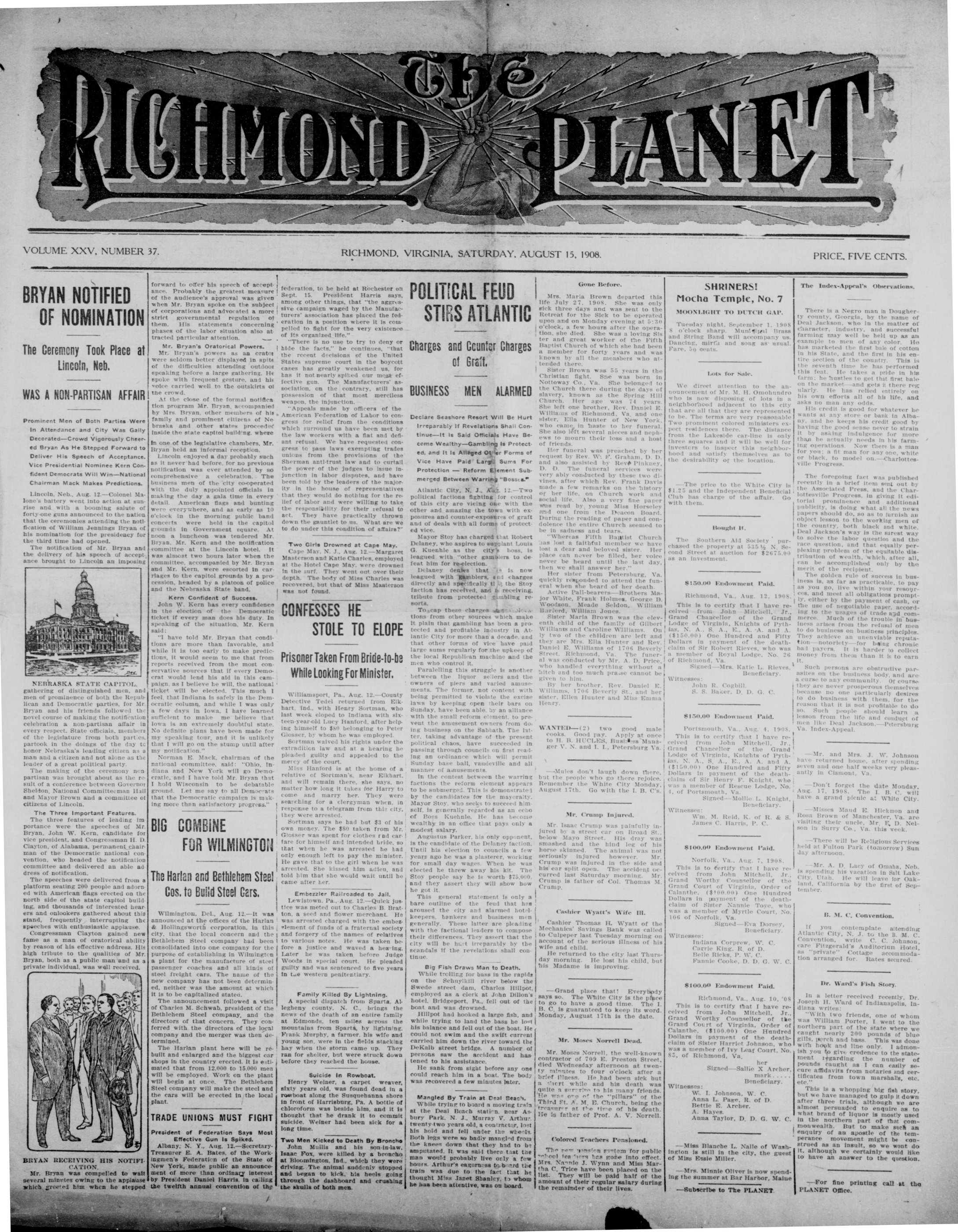
Page text (machine-generated)
The RICHMOND PLANET
BRYAN NOTIFIED OF NOMINATION
The Ceremony Took Place at Lincoln, Neb.
WAS A NON-PARTISAN AFFAIR
Prominent Men of Both Parties Were In Attendance and City Was Gaily Decorated—Crowd Vigorously Cheered Bryan As He Stepped Forward to Deliver His Speech of Acceptance. Vice Presidential Nominee Kern Confident Democrats Will Win—National Chairman Mack Makes Predictions.
Lincoln, Neb., Aug. 12.—Colonel Malone's battery went into action at sunrise and with a booming salute of forty-one guns announced to the nation that the ceremonies attending the notification of William Jennings Bryan of his nomination for the presidency for the third time had opened.
The notification of Mr. Bryan and the delivery of his speech of acceptance brought to Lincoln an imposing
NEBRASKA STATE CAPITOL, gathering of distinguished men, and men of prominence of both the Republican and Democratic parties, for Mr. Bryan and his friends followed the novel course of making the notification celebration a non-partisan affair in every respect. State officials, members of the legislature from both parties, partook in the doings of the day to honor Nebraska's leading citizen as a man and a citizen and not alone as the leader of a great political party.
The making of the ceremony non-partisan was brought about as the result of a conference between Governor Sheldon, National Committee Hall and Mayor Brown and a committee of citizens of Lincoln.
The Three Important Features.
The three features of leading importance were the speeches of Mr. Bryan, John W. Kern, candidate for vice president, and Congressman H. D. Clayton, of Alabama, permanent chairman of the Democratic national convention, who headed the notification committee and delivered an able address of notification.
The speeches were delivered from a platform seating 200 people and adorned with American flags erected on the north side of the state capitol building, and thousands of interested hearers and onlookers gathered about this stand, frequently interrupting the speeches with enthusiastic anglise.
Congressman Clayton gained new fame as a man of oratorical ability by reason of his effective address. His high tribute to the qualities of Mr. Bryan, both as a public man and as a private individual, was well received.
BRYAN RECEIVING HIS NOTIFICATION.
Mr. Bryan was compelled to wait several minutes owing to the applause which greeted him when he stepped
forward to offer his speech of acceptance. Probably the greatest measure of the audience's approval was given when Mr. Bryan spoke on the subject of corporations and advocated a more strict governmental regulation of them. His statements concerning phases of the labor situation also at tracted particular attention.
Mr. Bryan's Oratorical Powers.
Mr. Bryan's powers as an orator were seldom better displayed in spite of the difficulties attending outdoor speaking before a large gathering. He spoke with frequent gesture, and his voice carried well to the outskirts of the crowd.
At the close of the formal notification program Mr. Bryan accompanied by Mrs. Bryan, other members of his family and prominent citizens of Nebraska and other states proceeded inside the state capitol building, where in one of the legislative chambers, Mr. Bryan held an informal reception.
Lincoln enjoyed a day probably such as it never had before, for no previous notification was ever attended by so comprehensive a celebration. The business men of the city co-operated with the duly appointed officials in making the day a gala time in every detail. American flags and bunting were everywhere, and as early as 10 o'clock in the morning public band concerts were held in the capitol grounds in Government square. At noon a luncheon was tendered Mr. Bryan, Mr. Kern and the notification committee at the Lincoln hotel. It was almost two hours later when the committee, accompanied by Mr. Bryan and Mr. Kern, were escorted in carriages to the capitol grounds by a procession, headed by a platoon of police and the Nebraska State band.
Kern Confident of Success.
"I have told Mr. Bryan that conditions are more than favorable, and while it is too early to make predictions, it would seem to me that from reports received from the most conservative sources that if every Democrat would lend his aid in this campaign, as I believe he will, the national ticket will be elected. This much I feel, that Indiana is safely in the Democratic column, and while I was only a few days in Iowa, I have learned sufficient to make me believe that Iowa is an extremely doubtful state. No definite plans have been made for my speaking tour, and it is unlikely that I will go on the stump until after my notification."
Norman E. Mack, chairman of the national committee, said: "Ohio, Indiana and New York will go Democratic, and I have told Mr. Bryan that I hold Wisconsin to be debatable ground. Let me say to all Democrats that the Democratic campaign is making more than satisfactory progress."
The Harlan and Bethlehem Steel Cos. to Build Steel Cars.
Wilmington, Del., Aug. 12.—It was announced at the offices of the Harlan & Hollingsworth corporation, in this city, that the local concern and the Bethlehem Steel company had been consolidated into one company for the purpose of establishing in Wilmington a plant for the manufacture of steel passenger coaches and all kinds of steel freight cars. The name of the new company has not been determined, neither was the amount at which it is to be capitalized stated.
The announcement followed a visit of Charles M. Schwab, president of the Bethlehem Steel company, and the directors of that concern. They conferred with the directors of the local company and the merger was then determined.
The Harlan plant here will be rebuilt and enlarged and the biggest car shops in the country erected. It is estimated that from 12,000 to 15,000 men will be employed. Work on the plant will begin at once. The Bethlehem Steel company will make the steel and the cars will be erected in the local plant.
TRADE UNIONS MUST FIGHT
President of Federation Says Most Effective Gun Is Spiked.
Albany; N. Y., Aug. 12.—Secretary-Treasurer E. A. Bates, of the Workingmen's Federation of the State of New York, made public an announcement of more than ordinary interest by President Daniel Harris, in calling the twelfth annual convention of the
RICHMOND, VIRGINIA, SATURDAY, AUGUST 15, 1908
federation, to be held at Rochester on Sept. 15. President Harris says, among other things, that "the aggressive campaign waged by the Manufacturers' association has placed the federation in a position where it is compelled to fight for the very existence of its organized life."
"There is no use to try to deny or hide the facts," he continues, "that the recent decisions of the United States supreme court in the boycott cases has greatly weakened us, for has it not nearly spiked our most effective gun. The Manufacturers' association, on the contrary, still has possession of that most merciless weapon, the injunction.
"Appeals made by officers of the American Federation of Labor to congress for relief from the conditions which surround us have been met by the law workers with a flat and defiant refusal. We have requested congress to pass laws exempting trades unions from the provisions of the Sherman anti-trust law and to curtail the power of the judges to issue injunction in labor disputes, and have been told by the leaders of the majority in the house of representatives that they would do nothing for the relief of labor and were willing to take the responsibility for their refusal to act. They have practically thrown down the gauntlet to us. What are we to do under this condition of affairs?"
Two Girls Drowned at Cape May.
Cape May, N. J., Aug. 12—Margaret Masterson and Katie Charles, employed at the Hotel Cape May, were drowned in the surf. They went out over their depth. The body of Miss Charles was recovered, but that of Miss Masterson was not found.
CONFESSES HE STOLE TO ELOPE Prisoner Taken From Bride-to-be While Looking For Minister.
Williamsport, Pa., Aug. 12.—County Detective Tedel returned from Elkhart, Ind., with Henry Sortman, who last week eloped to Indiana with sixteen-year-old Lucy Hanford, after helping himself to $80 belonging to Peter Glosser, by whom he was employed. Sortman waived his rights under the extradition law and at a hearing he pleaded guilty and appealed to the mercy of the court.
Miss Hanford is at the home of a relative of Sortman's, near Elkhart, and will remain there, she says, no matter how long it takes for Harry to come and marry her. They were searching for a clergyman when, in response to a telegram from this city, they were arrested.
Sortman says he had but $3 of his own money. The $80 taken from Mr. Glosser was spent for clothes and carfare for himself and intended bride, so that he was arrested he had only enough left to pay the minister. He gave that to the girl when he was arrested. She kissed him adieu, and told him that she would wait until he came after her.
Embezzler Railroaded to Jail
Lewistown, Pa., Aug. 12.—Qulek justice was meted out to Charles B. Bratton, a seed and flower merchant. He was arrested charged with the embezzlement of funds of a fraternal society and forgery of the names of relatives to various notes. He was taken before a justice and waved a hearing. Later he was taken before Judge Woods in special court. He pleaded guilty and was sentenced to five years in the western penitentiary.
Family Killed By Lightning
A special dispatch from Sparta, Allegheny county, N. C., brings the news of the death of an entire family at Edmonds, ten miles across the mountains from Sparta, by lightning. Frank Murphy, a farmer, his wife and young son, were in the fields stacking hay when the storm came up. They ran for shelter, but were struck down before they reached the house.
Suicide In Rowboat.
Henry Weiner, a carpet weaver, sixty years old, was found dead in a rowboat along the Susquehanna shore in front of Harrisburg, Pa. A bottle of chloroform was beside him, and it is thought that he drank it to commit suicide. Weiner had been sick for a long time.
Two Men Kicked to Death By Broncho John Mullis and his son-in-law, Isaac Fox, were killed by a broncho at Bloomington, Ind., which they were driving. The animal suddenly stopped and began to kick, his heels going through the dashboard and crushing the skulls of both men.
POLITICAL FEUD STIRS ATLANTIC
Declare Seashore Resort Will Be Hurt Irreparably If Revelations Shall Continue—It Is Said Officials Have Become Wealthy—Gambling Is Protected, and It Is Allied Other Forms of Vice Have Paid Large Sums For Protection — Reform Element Submerged Between Warring "Bosses."
Atlantic City, N. J., A.U.S. 12.—Two political factions fighting for control of this city are vieing one with the other and amazing the town with exposures and counter-exposures of graft and of deals with all forms of protected vice.
Mayor Stoy has charged that Robert Delaney, who inspires to supplant Louis G. Kuenhle as the city's boss, is leagued with "other gamblers to defeat him for re-election.
Delaney denies that he is now leagued with gamblers, and charges directly and specifically that the Stoy faction has received, and is receiving, tribute from protected gambling resorts.
To cap these charges, gross violations from other sources which make it plain that gambling has been a protected and profitable industry in Atlantic City for more than a decade, and that other forms of vice have paid large sums regularly for the upkeep of the local Republican machine and the men who control it.
Paralelling this struggle is another between the liquor sellers and the owners of piers and varied amusements. The former, not content with being permitted to violate the excise laws by keeping open their bars on Sunday, have been able, by an alliance with the small reform element, to prevent the amusement owners from doing business on the Sabbath. The latter, taking advantage of the present political chaos, have succeeded in passing through councils on first reading an ordinance which will permit Sunday base ball, vaudeville and all manner of amusements.
In the contest between the warring factions the reform element appears to be submerged. This is demonstrated by the candidates for the mayoralty, Mayor Stoy, who seeks to succeed himself, is generally regarded as an echo of Boss Kuehnle. He has become wealthy in an office that pays only a modest salary.
Augustus Parker, his only opponent, is the candidate of the Delaney faction. Until his election to councils a few years ago he was a plasterer, working for small day wages. When he was elected he threw away his kit. The Stoy people say he is worth $75,000, and they assert they will show how he got it.
This general statement is only a bare outline of the feud that has aroused the city and alarmed hotel-keepers, bankers and business men generally. These latter are pleading with the factional leaders to compose their differences. They assert that the city will be hurt irreparably by the scandals if the revelations shall continue.
Big Fish Draws Man to Death:
While trolling for bass in the rapids on the Schuylkill river below the Swede street dam, Charles Hillpot, employed as a clerk at John Dillon's hotel, Bridgeport, Pa., fell out of the boat and was drowned.
Hillpot had hooked a large fish, and while trying to land the bass he lost his balance and fell out of the boat. He could not swim and the swift current carried him down the river toward the DeKalb street bridge. A number of persons saw the accident and hastened to his assistance.
He sank from sight before any one could reach him in a boat. The body was recovered a few minutes later.
Mangled By Train at Deal Beach
Mangled By Train at Deal Beach.
While trying to board a moving train at the Deal Beach station, near Asbury Park, N. J., Murray V. Arthur, twenty-two years old, a contractor, lost his hold and fell under the wheels. Both legs were so badly mangled from the knees down that they had to be amputated. It was said that the man would probably live only a few hours. Arthur's eagerness to board the train was due to the fact that he thought Miss Janet Shanley, to whom he has been attentive, was on board.
Tuesday night, September 1, 1909
8 o'clock sharp. Municipal Brass
and String Band will accompany us
Dancing, mirta and song as usual.
Fare, 50 cents.
We direct attention to the announcement of Mr. M. H. Omohundro who is now disposing of lots in a neighborhood adjacent to this city that are all that they are represented to be. The terms are very reasonable Two prominent colored ministers expect residences there. The distance from the Lakeside car-line is only three squares and it will be well for investors to inspect this neighborhood and satisfy themselves as to the desirability or the location.
—The price to the White City is $1.25 and the Independent Beneficial Club has charge of the affair. Go with them.
The Southern Ald Society purchased the property at 535 $1/2 N. Second Street at auction for $2675.00 as an investment.
This is to certify that I have received from John Mitchell, Jr.,
Grand Chancellor of the Grand Lodge of Virginia, Knights of Pythias, N. A., S. A., E., A. A. and A.
$150.00) One Hundred and Fifty Dollars in payment of the death-claim of Sir Robert Rieves, who was a member of Royal Lodge, No. 26 of Richmond, Va.
Signed—Mrs. Katie L. Rieves,
Beneficiary.
Witnesses:
Portsmouth, Va., Aug. 4, 1908.
This is to certify that I have received from John Mitchell, Jr.
Grand Chancellor of the Grand Lodge of Virginia, Knights of Pythians, N. A., S. A., E., A. A. and A.
($150.00) One Hundred and Fifty Dollars in payment of the death-claim of Sir Henry F. Knight, who was a member of Rescue Lodge, No. 4, of Portsmouth, Va.
Signed—Mollie L. Knight,
Beneficiary.
Norfolk, Va., Aug. 7, 1908.
This is to certify that I have received from John Mitchell, Jr.,
Grand Worthy Counsellor of the Grand Court of Virginia, Order of
Calanthe, ($100.00) One Hundred Dollars in payment of the death-
claim of Sister Nannie Toye, who was a member of Myrtle Court, No.
106 of Norfolk, Va.
Signed—Eva Dorsey,
Beneficiary.
Witnesses:
Richmond, Va. Aug. 10, '08
This is to certify that I have received from John Mitchell, Jr.,
Grand Worthy Counsellor of the
Grand Court of Virginia, Order of
Calanthe, ($100.00) One Hundred
Dollars in payment of the death-
claim of Sister Harriet Johnson, who was a member of Ivy Leaf Court, No.
85, of Richmond, Va.
Witnesses:
W. I. Johnson, W. C.
Anna L. Page, R. of D.
Bettie E. Archer.
A. Hayes.
Anna Taylor, D. D. G. W. C.
—Miss Blanche L. Nalle of Washington is still in the city, the guest of Miss Essie Miller.
—Mrs. Minnie Oliver is now spending the summer at Bar Harbor, Maine
—Subscribe to The PLANET.
Gone Before.
Mrs. Maria Brown departed this life July 27, 1908. She was only sick three days and was sent to the Retreat for the Sick to be operated upon and on Monday evening at 5:30 o'clock, a few hours after the operation, she died. She was a loving Sister and great worker of the Fifth Baptist Church of which she had been a member for forty years and was known by all the members who attended there.
Sister Brown was 55 years in the Christian fight. She was born in Nottoway Co., Va. She belonged to the Church there during the days of slavery, known as the Spring Hill Church. Her age was 74 years. She left one brother, Rev. Daniel E. Williams of Richmond, Va, and one sister, Ella Hunter of New York, who came in haste to her funeral. She also left several nieces and nephews to mourn their loss and a host of friends.
Her funeral was preached by her request by Rev. W: F. Graham, D. D. and also assisted by Rev. Pinkney, D. D. The funeral services were very ably conducted by these two divines, after which Rev. Frank Davis made a few remarks on the history of her life, on Church work and social life. Also a very fine paper was read by, young Miss Horsley and one from the Deacon Board. During the reading of paper and condolence the entire Church seemed to be in sadness and tears.
"Whercas Fifth Baptist Church has lost a faithful member we have lost a dear and beloved sister. Her place can never be filled, her voice never be heard until the last day, then we shall answer her." Her sister from Petersburg, Va. quickly responded to attend the funeral when she heard of her death. Active Pall-bearers—Brothers Major White, Frank Holmes, George D. Woodson, Meade Seldon, William Barford, William Jones. Sister Maria Brown was the eleventh child of the family of Gilbert Williams and Caroline Williams. Only two of the children are left and they are Mrs. Ella Hunter and Rev. Daniel E. Williams of 1706 Beverly Street, Richmond, Va. The funeral was conducted by Mr. A. D. Price, who handled everything without a hitch and too much praise cannot be given to him. By her brother, Rev. Daniel E. Williams, 1706 Beverly St. and her sister, Ellen Hunter and Miss Emma Henry.
WANTED—(2) two good male cooks. Good pay. Apply at once to H. B. HUCLES, Busch's Manager V. N. and I. L. Petersburg Va.
—Mules don't laugh down there, but the people who go there rejoice. Remember the White City Monday, August 17th. Go with the L. B. Cs.
Mr. Crump Injured.
Mr. Isaac Crump was painfully injured by a street car on Broad St., below Mayo Street. His dray was smashed and the hind leg of his horse skinned. The animal was not seriously injured however. Mr Crump was injured in the side and his ear split open. The accident occurred last Saturday morning. Mr Crump is father of Col. Thomas M. Crump.
Cashier Wyatt's Wife Ill
Cashier Thomas H. Wyatt of the Mechanies' Savings Bank was called to Culpeper last Tuesday morning on account of the serious illness of his wife and child.
He returned to the city last Thursday morning. He lost his child, but his Madame is improving.
—Grand place that! Everybody says so. The White City is the place to go to have a good time. The I B. C. is guaranteed to keep its word Monday, August 17th is the date.
Mr. Moses Norrell Dead
Mr. Moses Norrell, the well-known contractor of 709 E. Preston Street, died Wednesday afternoon at twenty minutes to four o'clock after a brief illness. He had been sick but a short while and his death was quite a surprise to his many friends. He was one of the "pillars" of the Third St. A. M. E. Church, being the treasurer at the time of his death. He is father of Prof. A. V. Norrell.
Colored Teachers Pensioned.
The new pension system for public school tea hra has gone into effect. Mrs. Nannie J. Wynn and Miss Martha C. Trice have been placed on the list. They will be paid half of the amount of their regular salary during the remainder of their lives.
SHRINERS!
Mocha Temple, No. 7
MOONLIGHT TO DUTCH GAP.
Lots for Sale.
Bought It
$150.00 Endowment Paid
Richmond, Va., Aug. 12, 1908.
John R. Cogbill.
S. S. Baker, D. D. G. C.
$150,00 Endowment Paid
Wm. M. Reld. K. of R. & S.
James C. Harris. P. C.
$100.00 Endowment Paid
Indiana Corprew, W. C.
Carrie King, R. of D.
Belle Ricks, P. W. C.
Fannie Cooke, D. D. G. W. C.
$100.00 Endowment Paid
PRICE, FIVE CENTS.
The Index-Appeal's Observations
There is a Negro man in Dougherty county, Georgia, by the name of Deal Jackson, who in the matter of character, industry, and successful farming may well be held up as an example to men of any color. He has marketed the first bale of cotton in his State, and the first in his entire section of the country. This is the seventh time he has performed this feat. He takes a pride in his farm; he hustles to get that first bale on the market—and gets it there regularly. He has relied entirely on his own efforts all of his Life, and asks no man any odds. His credit is good for whatever he wants at any store or bank in Albany, and he keeps his credit good by having the good sense never to strain it by asking indulgence for more than he actually needs in his farming operations. Now there is a man for you; a fit man for any one, white or black, to model on—Charlottesville Progress.
The foregoing fact was published recently in a brief item sent out by the Associated Press, and the Charlottesville Progress, in giving it editorial prominence and additional publicity, is doing what all the news papers should do, so as to furnish an object lesson to the working men of the country, both black and white. Deal Jackson's way is the surest way to solve the labor question and the race question, and that equally perplexing problem of the equitable distribution of wealth, which after all, can be accomplished only by the merit of the recipient.
The golden rule of success in business is, as far as practicable, to pay as you go, live within your resources, and meet all obligations promptly, either by the payment of cash, or the use of negotiable paper, according to the usages of trade and commerce. Much of the trouble in business arises from the refusal of men to do business on business principles. They achieve an unenviable reputation—notoriety—for being chronic bad payers. It is harder to collect money from them than it is to earn it.
Such persons are obstructive parasites on the business body, and are a curse to any community. Of course they are never prosperous themselves because no one particularly desires to do business with them, for the reason that it is not profitable to do so. Such people should learn a lesson from the life and conduct of men like Deal Jackson.—Petersburg Va. Index-Appeal.
---
—Mr. and Mrs. J. W. Johnson have returned home, after spending seven and one half weeks very pleasantly in Cismont, Va.
—Don't forget the date Monday, Aug. 17, 1908. The I. B. C. will have a grand picnic at White City.
—Misses Maud E. Hickmon and Rosa Brown of Manchester, Va. are visiting their uncle, Mr. F. D. Nelson in Surry Co., Va. this week.
—There will be Religious Services held at Fulton Park (tomorrow) Sun day afternoon.
—Mr. A. D. Lacy of Omaha, Neb. is spending his vacation in Salt Lake City, Utah. He will leave for Oakland, California by the first of September.
B. M. C. Convention
If you contemplate attending Atlantic City, N. J. to the B. M. C. Convention, write C. C. Johnson, care Fitzgerald's Auditorium Hotel, as "private" Cottage accommodation arranged for. Rates secured
Dr. Ward's Fish Story
In a letter received recently, Dr. Joseph H. Ward of Indianapolis, Indiana writes:
"With two friends, one of whom was William Porter, I went to the northern part of the state where we caught nearly 200 pounds of blue gills, perch and bass. This was done with hook and line only. I admonish you to give credence to the statement regarding the number of pounds caught as I can easily secure affidavits from notaries and certificates from town marshals, etc. etc."
This is a whopping big fish story, but we have managed to gulp it down after three trials, although we are almost persuaded to enquire as to what brand of liquor is mostly used in the northern part of that commonwealth. But to make such an enquiry of an apostle of the temperance movement might be construed as an insult, so we want do it, although we certainly would like to have an answer to the question.
—For fine printing call at the PLANET Office.
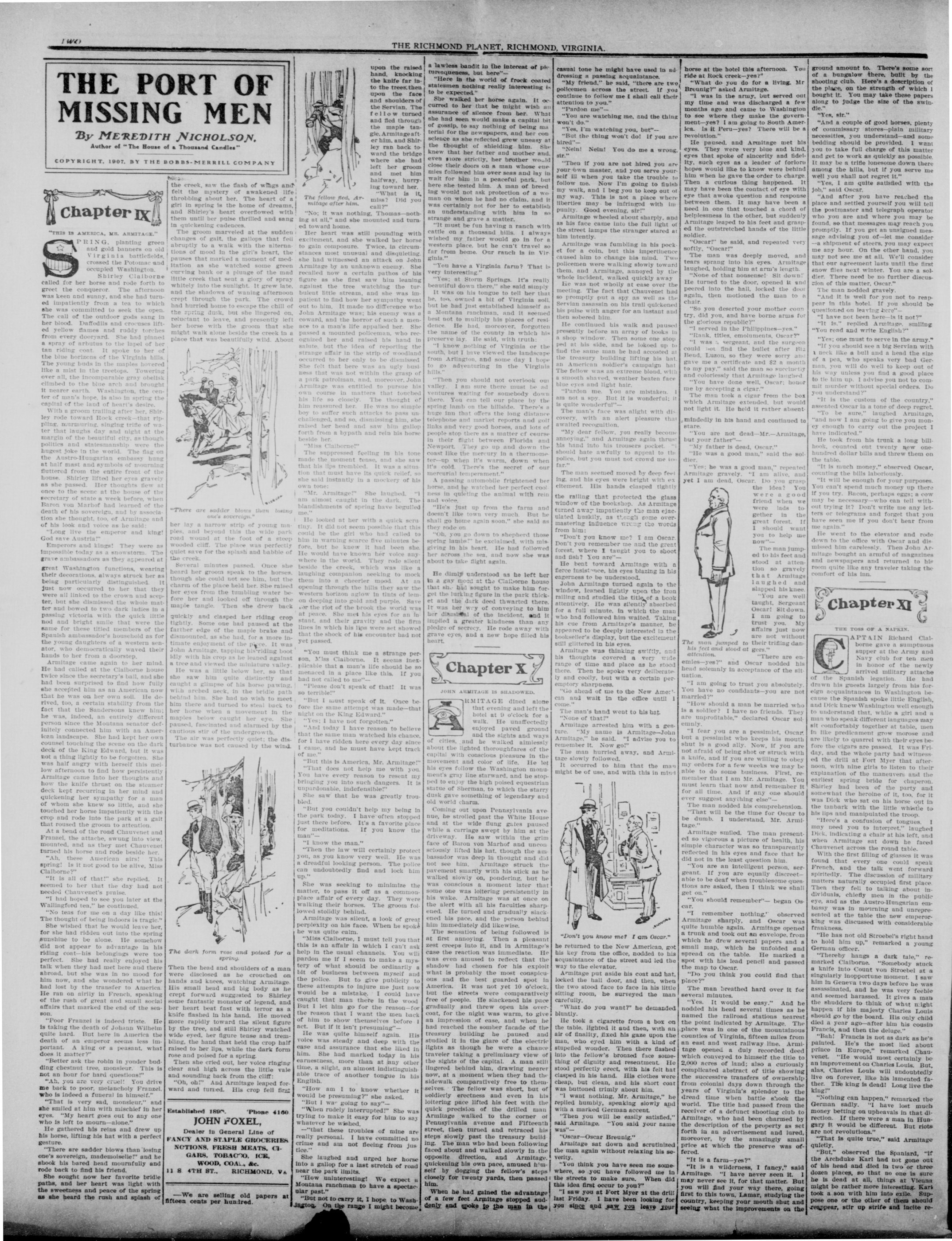
THE PORT OF MISSING MEN
By MEREDITH NICHOLSON. Author of "The House of a Thousand Candles"
COPYRIGHT. 1907. BY THE BOBBS-MERRILL COMPANY
TWO
Chapter IX
"THIS IS AMERICA, MR. ARMITAGE."
PRING, planting green
and gold banners on old
Virginia battlefields
crossed the Potomac and
occupied Washington.
PRING, planting green and gold banners on old Virginia battlefields, crossed the Potomac and occupied Washington. Shirley Claiborne called for her horse and rode forth to greet the conqueror. The afternoon was keen and sunny, and she had turned impatiently from a tea to which she was committed to seek the open. The call of the outdoor gods sang in her blood. Daffodilis and crocuses lifted yellow flames and ruddy torches from every dooryard. She had plined a spray of arbutus to the lapel of her tan riding coat. It spoke to her of the blue horizons of the Virginia hills. The young buds in the maples hovered like a mist in the treetops. Towering over all, the incomparable gray obelisk climbed to the blue arch and brought it nearer earth. Washington, the center of man's hope, is also in spring the capital of the land of heart's desire.
With a groom trailing after her, Shirley rode toward Rock creek—that rippling, murmuring, singing trifle of water that laughs day and night at the margin of the beautiful city, as though politics and statesmanship were the highest joke in the world. The flag on the Austro-Hungarian embassy hung at half mast and symbols of mourning fluttered from the entire front of the house. Shirley lifted her eyes gravely as she passed. Her thoughts flew at once to the scene at the house of the secretary of state a week before, when Baron Marhof of Marhof had learned of the death of his sovereign, and by association she thought, too, of Armitage and of his look and voice as he said: "Long live the emperor and king! God save Austria."
Emperors and kings! They were as impossible today as a snowstorm. The grave ambassadors as they appeared at great Washington functions, wearing their decorations, always struck her as being particularly distinguished. It just now occurred to her that they were all linked to the crown and scepter, but she dismissed the whole matter and bowed to two dark ladies in a passing victoria with the quick little nod and bright smile that were the same for these titled members of the Spanish ambassador's household as for the young daughters of a western senator, who democratically waved their hands to her from a doorstep.
Armitage came again to her mind. He had called at the Cialborne house twice since the secretary's ball, and she had been surprised to find how fully she accepted him as an American now that he was on her own soil. He derived, too, a certain stability from the fact that the Sandersons knew him; he was, indeed, an entirely different person since the Montana senator definitely connected him with an American landscape. She had kept her own counsel touching the scene on the dark deck of the King Edward, but it was not a thing lightly to be forgotten. She was half angry with herself this mellow afternoon to find how persistently Armitage came into her thoughts and how the knife thrust on the steamer deck kept recurring in her mind and quickening her sympathy for a man of whom she knew so little, and she touched her horse impatiently with the crop and rode into the park at a gait that roused the groom to attention.
At a bend of the road Chauvenet and Franzel, the attache, swung into view, mounted, and as they met Chauvenet turned his horse and rode beside her. "Ah, these American airs! This spring! Is it not good to be alive, Miss Claiborne?" "It is all of that!" she replied. It seemed to her that the day had not needed Chauvenet's praise. "I had hoped to see you later at the Wallingford ten," he continued.
"No tears for me on a day like this! The thought of being indoors is tragic." She wished that he would leave her, for she had ridden out into the spring sunshine to be alone. He somehow did not appear to advantage in his riding coat—his belongings were too perfect. She had really enjoyed his talk when they had met here and there abroad, but she was in no mood for him now, and she wondered what he had lost by the transfer to America. He ran on airily in French, speaking of the rush of great and small social affairs that marked the end of the season.
"Poor Franzel is indeed triste. He is taking the death of Johann Wilhelm quite hard. But here in America the death of an emperor seems less important. A king or a peasant, what does it matter?"
"Better ask the robin in yonder budding chestnut tree, monsieur. This is not an hour for hard questions!"
"Ah, you are very cruel! You drive me back to poor, melancholy Franzel, who is indeed a funeral in himself."
"That is very sad, monsieur," and she smiled at him with mischief in her eyes. "My heart goes out to any one who is left to mourn—alone."
He gathered his reins and drew up his horse, lifting his hat with a perfect gesture.
"There are sadder blows than losing one's sovereign, mademoiselle!" and he shook his bared head mournfully and rode back to find his friend.
She sought now her favorite bridle paths, and her heart was light with the sweetness and peace of the spring as she heard the rush and splash of
the creek, saw the flash of whigs and felt the mystery of awakened life throbbing about her. The heart of a girl in spring is the home of dreams, and Shirley's heart overflowed with them until her pulse thrilled and sang in quickening cadences.
The groom marveled at the sudden changes of gait, the gallops that fell abruptly to a walk with the alternations of mood in the girl's heart, the pauses that marked a moment of meditation as she watched some green curving bank or a plunge of the mad little creek that seat a glory of spray whitely into the sunlight. It grew late, and the shadows of waning afternoon crept through the park. The crowd had hurried home to escape the chill of the spring dusk, but she flingered on, reluctant to leave, and presently left her horse with the groom that she might walk alone beside the creek in a place that was beautifully wild. About
"There are sadder blows than losing one's sovereign."
"There are sadder blows than losing one's sovereign."
her lay a narrow strip of young maples, and beyond this the wide park road wound at the foot of a steep wooded cliff. The place was perfectic quiet save for the splash and babble of the creek.
Several minutes passed. Once she heard her groom speak to the horses, though she could not see him, but the charm of the place held her. She raised her eyes from the tumbling water before her and looked off through the maple tangle. Then she drew back
quickly and clasped her riding crop tightly. Some one had paused at the farther edge of the maple brake and dismounted, as she had, for a more intimate enjoyment of the piece. It was John Armitage, tapping his riding boot idly with his crop as he leaned against a tree and viewed the miniature valley. He was a little below her, so that she saw him quite distinctly and caught a glimpse of his horse pawing, with arched neck, in the bridle path behind him. She had no wish to meet him there and turned to steal back to her horse when a movement in the maples below caught her eye. She paused, fascinated and alarmed by the cautious stir of the undergrowth.
The air was perfectly quiet; the disturbance was not caused by the wind.
A man in a hat and coat stands in front of a tree, looking into the distance.
The dark form rose and poised for a spring.
Then the head and shoulders of a man were disclosed as he crouched on hands and knees, watching Armilitage. His small head and big body as he crept forward suggested to Shirley some fantastic monster of legend, and her heart beat fast with terror as a knife flashed in his hand. He moved more rapidly toward the silent figure by the tree, and still Shirley watched wide eyed, her figure tense and trembling, the hand that held the crop half raised to her lips, while the dark form rose and poised for a spring.
Then she cried out, her voice ringing clear and high across the little vale and sounding back from the cliff:
"Oh, oh!" And Armitage leaped forward and turned. His crop fell first
11 8 4TH ST., RICHMOND. VA
—We are selling old papers at fifteen cents per hundred.
THE RICHMOND PLANET, RICHMOND, VIRGINIA
the raised knocking life far in- trees, then the face
a lawless bandit in the interest of picturesqueness, but here"— "Here in the world of frock coated statesmen nothing really interesting is to be expected."
casual tone he dressing a pass "My friend," policemen acre
She walked her horse again. It occurred to her that he might wish an assurance of silence from her. What she had seen would make a capital bit of gossip, to say nothing of being material for the newspapers, and her conscience as she reflected grew uneasy at the thought of shielding him. She knew that her father and mother and, even more strictly, her brother would close their doors on a man whose enemies followed him over seas and lay in wait for him in a peaceful park, but here she tested him. A man of breeding would not ask protection of a woman on whom he had no claim, and it was certainly not for her to establish an understanding with him in so strange and grave a matter.
"It must be fun having a ranch with cattle on a thousand hills. I always wished my father would go in for a western place, but he can't travel so far from home. Our ranch is in Virginia."
"You have a Virginia farm? That is very interesting."
"Yes; at Storm Springs. It's really beautiful down there," she said simply. It was on his tongue to tell her that he, too, owned a bit of Virginia soil, but he had just established himself as a Montana ranchman, and it seemed best not to multiply his places of residence. He had, moreover, forgotten the name of the county in which his preserve lay. He said, with truth:
"I know nothing of Virginia or the south, but I have viewed the landscape from Arlington, and some day I hope to go adventuring in the Virginia hills."
"Then you should not overlook our valley. I am sure there must be adventures waiting for somebody down there. You can tell our place by the spring lamb on the hillside. There's a huge inn that offers the long distance telephone and market reports and golf links and very good horses, and lots of people stop there as a matter of course in their flight between Florida and Newport. They go up and down the coast like the mercury in a thermometer-up when it's warm, down when it's cold. There's the secret of our mercurial temperament."
A passing automobile frightened her horse, and he watched her perfect coolness in quieting the animal with rein and voice.
"He's just up from the farm and doesn't like town very much. But he shall go home again soon," she said as they rode on.
"Oh, you go down to shepherd those spring lambs!" he exclaimed, with misgiving in his heart. He had followed her across the sea, and now she was about to take flight again.
He dimly understood as he left her in a gay mood at the Clalborne house that she had sought to make him forget the lurking figure in the park thicket and the dark deed thwarted there. It was her way of conveying to him her dismissal of the incident, and it pledge a greater kindness than any pledge of secrecy. He rode away with grave eyes, and a new hope filled his heart.
Chapter X
KMITAGE dined alone that evening and left the hotel at 9 o'clock for a walk. He unaffectedly enjoyed paved ground and the sights and ways of cities, and he walked almessly about the lighted thoroughfares of the capital with conscious pleasure in the movement and color of life. He let his eyes follow the Washington monument's gray line starward, and he stopped to enjoy the high poised equestrian statue of Sherman, to which the starry dusk gave something of legendary and old world charm.
Coming upon Pennsylvania avenue, he strolled past the White House and at the wide fung gates paused while a carriage swept by him at the driveway. He saw within the grim face of Baron von Marhof and unconsciously lifted his hat, though the ambassador was deep in thought and did not see him. Armitage struck the pavement smartly with his stick as he walked slowly on, pondering, but he was conscious a moment later that some one was loitering persistently in his wake. Armitage was at once on the alert with all his faculties sharpened. He turned and gradually slackened his pace, and the person behind him immediately did likewise.
The sensation of being followed is at first annoying. Then a pleasant zest creeps into it, and in Armitage's case the reaction was immediate. He was even amused to reflect that the shadow had chosen for his exploit what is probably the most conspicuous and the best guarded spot in America. It was not yet 10 o'clock, but the streets were comparatively free of people. He slackened his pace gradually and threw open his overcoat, for the night was warm, to give an impression of ease, and when he had reached the somber facade of the treasury building he paused and studied it in the glare of the electric lights as though he were a chance traveler taking a preliminary view of the sights of the capital. A man still lingered behind him, drawing neer now, at a moment when they had the sidewalk comparatively free to themselves. The fellow was short, but of soldierly erectness and even in his loitering pace lifted his feet with the quick precision of the drilled man Armitage walked to the corner of Pennsylvania avenue and Fifteenth street, then turned and retraced his steps slowly past the treasury building. The man who had been following faced about and walked slowly in the opposite direction, and Armitage, quickening his own pace, amused himself by dogging the fellow's steps closely for twenty yards, then passed him.
When he had gained the advantage of a few feet Armitage stopped suddenly and spoke to the man in the
upon the raised hand, knocking the knife far in to the trees, then upon the face and shoulders of the Servian. The fellow turned and fled through the maple tangle. Armitage after him, and Shirley ran back toward the bridge where she had left her groom and met him halfway, hurrying toward her. 'What, is it
A man is running through a forest.
"What is it
miss? Did you
call?"
What is the fellow fled, Ar-
miss? Did you
mitage after him.
call?"
"No; it was nothing. Thomas—nothing
at all," and she mounted and turned
toward home.
Her heart was still pounding with excitement, and she walked her horse to gain composure. Twice, in circumstances most unusual and disquieting, she had witnessed an attack on John Armitage by an unknown enemy. She recalled now a certain pathos of his figure as she first saw him leaning against the tree watching the turbulent little stream, and she was impatient to find how her sympathy went out to him. It made no difference who John Armitage was; his enemy was a coward, and the horror of such a menace to a man's life appalled her. She passed a mounted policeman, who recognized her and raised his hand in salute, but the idea of reporting the strange affair in the strip of woodland occurred to her only to be dismissed. She felt that here was an ugly business that was not within the grasp of a park patrolman, and, moreover, John Armitage was entitled to pursue his own course in matters that touched his life so closely. The thought of him reassured her. He was no simple boy to suffer such attacks to pass unchallenged, and so, dismissing him, she raised her head and saw him gallop forth from a bypath and rein his horse beside her.
"Miss Clalborne!"
The suppressed feeling in his tone made the moment tense, and she saw that his lips trembled. It was a situation that must have its quick relief, so she said instantly in a mockery of his own tone:
"Mr. Armitage!" She laughed. "I am almost caught in the dark. The blandishments of spring have beguiled me."
He looked at her with a quick scrutiny. It did not seem possible that this could be the girl who had called to him in warning scarce five minutes before, but he knew it had been she. He would have known her voice anywhere in the world. They rode silent beside the creek, which was like a laughing companion seeking to mock them into a cheerler mood. At an opening through the hills they saw the western horizon aglow in tints of lemon on deepening into gold and purple. Save for the riot of the brook the world was at peace. She met his eyes for an instant, and their gravity and the firm lines in which his lips were set showed that the shock of his encounter had not yet passed.
"You must think me a strange person, Miss Claiborne. It seems inexplicable that a man's life should be so menaced in a place like this. If you had not called to me"—
"Please don't speak of that! It was so terrible!"
"But I must speak of it. Once before the same attempt was made—that night on the King Edward."
"Yes; I have not forgotten."
"And today I have reason to believe that the same man watched his chance, for I have ridden here every day since I came, and he must have kept track of me."
"But this is America, Mr. Armitage?"
"That does not help me with you. You have every reason to resent my bringing you into such dangers. It is unpardonable, indefensible!"
She saw that he was greatly troubled.
"But you couldn't help my being in the park today. I have often stopped just there before. It's a favorite place for meditations. If you know the man"—
"I know the man."
"Then the law will certainly protect you, as you know very well. He was a dreadful looking person. The police can undoubtedly find and lock him up."
She was seeking to minimize the matter, to pass it off as a commonplace affair of every day. They were walking their horses. The groom followed stolidly behind.
Armitage was silent, a look of great perplexity on his face. When he spoke he was quite calm.
"Miss Calborne, I must tell you that this is an affair in which I can't ask help in the usual channels. You will pardon me if I seem to make a mystery of what should be ordinarily a bit of business between myself and the police. But to give publicity to these attempts to injure me just now would be a mistake. I could have caught that man there in the wood. But I let him go for the reason--for the reason that I want the man back of him to show themselves before I act. But if it isn't presuming"-
He was quite himself again. His voice was steady and deep with the ease and assurance that she liked in him. She had marked today in his earnestness, more than at any other time, a slight, an almost indistinguishable trace of another tongue in his English.
"How am I to know whether it would be presuming?" she asked.
"But I was going to say"—"When rudely interrupted!" She was trying to make it easy for him to say whatever he wished.
—"that these troubles of mine are really personal. I have committed no crime and am not fleeing from justice."
She laughed and urged her horse into a gallop for a last stretch of road near the park limits.
"How uninteresting! We expect a Montana ranchman to have a spectacular past."
"But not to carry it, I hope to Washington. On the range I might become
JOHN ARMITAGE IS SHADOWED.
RMITAGE dined alone that evening and left the hotel at 9 o'clock for a walk. He unaffectedly enjoyed paved ground and the sights and ways
casual tone he might have used in addressing a passing acquaintance.
"My friend," he said, "there are two policemen across the street. If you continue to follow me I shall call their attention to you."
"Pardon me"—
"You are watching me, and the thing won't do."
"Yes, I'm watching you, but"—
"But the thing won't do! If you are hired"—
"Nein! Nein! You do me a wrong, sr."
"Then if you are not hired you are your own master, and you serve yourself ill when you take the trouble to follow me. Now I'm going to finish my walk, and I beg you to keep out of my way. This is not a place where liberties may be infringed with impunity. Good evening, sr!"
Armitage wheeled about sharply, and as his face came into the full light of the street lamps the stranger stared at him intently.
Armitage was fumbling in his pocket for a coin, but this imperfection caused him to change his mind. Two policemen were walking slowly toward them, and Armitage, annoyed by the whole incident, walked quickly away. He was not wholly at ease over the meeting. The fact that Chauvenet had so promptly put a spy as well as the Servian assassin on his trail quickened his pulse with anger for an instant and then sobered him.
He continued his walk and paused presently before an array of books in a shop window. Then some one stop ped at his side, and he loked up to find the same man he had accosted at the treasury building lifting his hat. an American soldier's campaign hat. The fellow was an extreme blond, with a smooth shaved, weather beaten face blue eyes and light hair.
"Pardon me. You are mistaken. I am not a spy. But it is wonderful; it is quite wonderful!"
The man's face was alight with discovery, with an alert pleasure that awaited recognition.
"My dear fellow, you really become annoying." and Armitage again thrust his hand into his trousers pocket. "I should hate awfully to appeal to the police, but you must not crowd me too far."
The man seemed moved by deep feeling, and his eyes were bright with excitement. His hands clasped tightly the ralling that protected the glass window of the bookshop. As Armitage turned away impatiently the man ejaculated hunkily, as though some overmastering influence wring the words from him:
"Don't you know me? I am Oscar. Don't you remember me and the great forest, where I taught you to shoot and fish? You are"
He bent toward Armitage with a fierce insistence, his eyes blazing in his eagerness to be understood.
John Armitage turned again to the window, leaned lightly upon the front railing and studied the title of a book attentively. He was silently absorbed for a full minute, in which the man who had followed him waited. Taking his cue from Armitage's manner, he appeared to be deeply interested in the book-seller's display, but the excitement still glittered in his eyes.
Armitage was thinking swiftly, and his thoughts covered a very wide range of time and place as he stood there. Then he spoke very deliberately and coolly, but with a certain peremptory sharpness.
"Go ahead of me to the New American and wait in the office until I come."
The man's hand went to his hat.
"None of that!"
Armitage arrested him with a gesture. "My name is Armitage-John Armitage," he said. "I advise you to remember it. Now go!"
The man hurried away, and Armitage slowly followed. It occurred to him that the man might be of use, and with this in mind
"Don't you know me? I am Oscar."
he returned to the New American, got his key from the office, nodded to his acquaintance of the street and led the way to the elevator.
Armitage put aside his coat and hat, locked the hall door, and then, when the two stood face to face in his little sitting room, he surveyed the man carefully.
"What do you want?" he demanded bluntly.
He took a cigarette from a box on the table, lighted it and then, with an air of finality, fixed his gaze upon the man, who eyed him with a kind of stupefied wonder. Then there flashed into the fellow's bronzeed face something of dignity and resentment. He stood perfectly erect, with his felt hat clasped in his hand. His clothes were cheap, but clean, and his short coat was buttoned trimly about him.
"I want nothing, Mr. Armitage," he replied humbly, speaking slowly and with a marked German accent.
"Then you will be easily satisfied," said Armitage. "You said your name was"—
"Oscar—Oscar Breunig."
Armitage sat down and scrutinized the man again without relaxing his severity.
"You think you have seen me somewhere, so you have followed me in the streets to make sure. When did this idea first occur to you?"
"I saw you at Fort Myer at the drill last Friday. I have been looking for you since and saw you leave your
horse at the hotel this afternoon. You ride at Rock creek—res'r"
"What do you do for a living. Mr Brounig?" asked Armitage.
"I was in the army, but served out my time and was discharged a few months ago and came to Washington to see where they make the government—yes? I am going to South America. Is it Peru—yes? There will be a revolution."
He paused, and Armitage met his eyes. They were very blue and kind, eyes that spoke of sincerity and fidelity, such eyes as a leader of forlorn hopes would like to know were behind him when he gave the order to charge. Then a curious thing happened. It may have been the contact of eye with eye that awoke question and response between them. It may have been a need in one that touched a chord of helplessness in the other, but suddenly Armitage leaped to his feet and grasped the outstretched hands of the little soldier.
"Oscar!" he said, and repeated very softly, "Oscar!"
The man was deeply moved, and tears sprang into his eyes. Armitage laughed, holding him at arm's length.
"None of that nonsense! Sit down!"
He turned to the door, opened it and peered into the hall, locked the door again, then motioned the man to a chair.
"So you deserted your mother country, did you, and have borne arms for the glorious republic?"
"I served in the Philippines—yes."
"Rank, titles, emoluments, Oscar."
Lank, tides, enoluments, Oscar:
"I was a sergeant, and the surgeon could not find the bullet after Biz Bend, Luzon, so they were sorry and gave me a certificate and $2 a month to my pay," said the man so succinctly and colorlessly that Armitage laughed.
"You have done well, Oscar; honor me by accepting a clear."
The man took a cigar from the box which Armitage extended, but would not light it. He held it rather absentmindedly in his hand and continued to
mindedly in his hand and continued to stare.
"You are not dead—Mr.—Armitage, but your father"—
"My father is dead, Oscar."
"He was a good man," said the soldier.
"Yes; he was a good man," repeated Armitage gravely. "I am alive, and yet I am dead, Oscar. Do you grasp the idea? You were a good friend when we were lads together in the great forest. If I should want you to help me now"—
J
The man jumped to his feet and stood at attention so gravely that Armitage laughed and slapped his knee. "You are well taught, Sergeant Oscar! Sit down. I am going to trust you. My affairs just now are not without their trifling dangers."
The man jumped to his feet and stood at attention.
attention.
"There are enemies—yes?" and Oscar nodded his head solemnly in acceptance of the situation.
"I am going to trust you absolutely. You have no confidants—you are not married?"
"How should a man be married who is a soldier? I have no friends. They are unprofitable," declared Oscar solemnly.
"I fear you are a pessimist, Oscar but a pessimist who keeps his mouth shut is a good ally. Now, if you are not afraid of being shot or struck with a knife, and if you are willing to obey my orders for a few weeks we may be able to do some business. First, remember that I am Mr. Armitage. You must learn that now and remember it for all time. And if any one should ever suggest anything else"—
The man nodded his comprehension.
"That will be the time for Oscar to be dumb. I understand, Mr. Armitage."
Armitage smiled. The man presented so vigorous a picture of health, his simple character was so transparently reflected in his eyes and face that he did not in the least question him.
"You are an intelligent person, sergeant. If you are equally discreet—able to be deaf when troublesome questions are asked, then I think we shall get on."
"You should remember"—began Oscar.
"I remember nothing." observed Armitage sharply, and Oscar was quite humble again. Armitage opened a trunk and took out an envelope, from which he drew several papers and a small map, which he unfolded and spread on the table. He marked a spot with his lead pencil and passed the map to Oscar.
"Do you think you could find that place?"
The man breathed hard over it for several minutes.
"Yes. It would be easy." And he nodded his head several times as he named the railroad stations nearest the point indicated by Armitage. The place was in one of the mountainous counties of Virginia, fifteen miles from an east and west railway line. Armitage opened a duly recorded deed which conveyed to himself the title to 2,000 acres of land; also a curiously complicated abstract of title showing the successive transfers of ownership from colonial days down through the years of Virginia's splendor to the dread time when battle shook the world. The title had passed from the receiver of a defunct shooting club to Armitage, who had been charmed by the description of the property as set forth in an advertisement and lured, moreover, by the amazingly small price at which the preserve was offered.
"It is a farm—yes?"
"It is a wilderness, I fancy," said Armitage. "I have never seen it. I may never see it, for that matter. But you will find your way there, going first to this town, Lamar, studying the country, keeping your mouth shut and seeing what the improvements on the
ground amount to. There's some sort of a bungalow there, built by the shooting club. Here's a description of the place, on the strength of which I bought it. You may take these papers along to judge the size of the swindle.
"Yes, sir."
"And a couple of good horses, plenty of commissary stores—plain military necessities, you understand—and some bedding should be provided. I want you to take full charge of this matter and get to work as quickly as possible. It may be a trifle lonesome down there among the hills, but if you serve me well you shall not regret it."
"Yes, I am quite satisfied with the job," said Oscar.
"And after you have reached the place and settled yourself you will tell the postmaster and telegraph operator who you are and where you may be found, so that messages may reach you promptly. If you get an unsigned message advising you of—let me consider—a shipment of steers, you may expect me any hour. On the other hand, you may not see me at all. We'll consider that our agreement lasts until the first snow files next winter. You are a soldier. There need be no further discussion of this matter, Oscar."
The man nodded gravely.
"And it is well for you not to reappear in this hotel. If you should be questioned on leaving here"—
"I have not been here—is it not?"
"It is.," replied Armitage, smiling
"You read and write English?"
"Yes; one must to serve in the army."
"If you should see a big Servian with 1 neck like a bull and a head the size of a pea, who speaks very bad German, you will do well to keep out of his way unless you find a good place to tie him up. I advise you not to commit murder without special orders. Do you understand?"
"It is the custom of the country," assented Oscar in a tone of deep regret.
"To be sure," laughed Armitage,
"and now I am going to give you money enough to carry out the project I have indicated."
He took from his trunk a long billhook, counted out twenty new one-hundred dollar bills and threw them on the table.
"It is much money," observed Oscar, counting the bills laboriously.
"It will be enough for your purposes. You can't spend much money up there if you try. Bacon, perhaps eggs; a cow may be necessary—who can tell without trying it? Don't write me any letters or telegrams and forget that you have seen me if you don't hear from me again."
He went to the elevator and rode down to the office with Oscar and dismissed him carelessly. Then John Armitage bought an armful of magazines and newspapers and returned to his room quite like any traveler taking the comfort of his inn.
Chapter XI
THE TOSS OF A NAPKIN.
PTAIN Richard
Clatborne gave a sumptuous
supper at the Army and
Navy club for ten men
in honor of the newly
arrived military attaché
C
of the Spanish legation. He had drawn his guests largely from his foreign acquaintances in Washington because the Spanish spoke little English, and Dick knew Washington well enough to understand that, while a girl and a man who speak different languages may sit comfortably together at table, men In like predicament grow morose and are likely to quarrel with their eyes before the cigars are passed. It was Friday, and the whole party had witnessed the drill at Fort Myer that afternoon, with nine girls to listen to their explanation of the maneuvers and the earliest spring bride for chaperon. Shirley had been of the party and somewhat the heroine of it, too, for it was Dick who sat on his horse out in the tankbark with the little whistle to his lips and manipulated the troop. “Here’s a confusion of tongues. I may need you to interpret,” laughed Dick, indicating a chair at his left, and when Armitage sat down he faced Chauvenet across the round table.
With the first filling of glasses it was found that every one could speak French, and the talk went forward spiritedly. The discussion of military matters naturally occupied first place. Then they fell to talking about individuals, chiefly men in the public eye, and as the Austro-Hungarian embassy was in mourning and unrepresented at the table the new emperorking was discussed with considerable frankness.
"He has not old Stroebel's right hand to hold him up," remarked a young German officer.
"Thereby hangs a dark tale," remarked Claiborne. "Somebody stuck a knife into Count von Stroebel at a singularly inopportune moment. I saw him in Geneva two days before he was assassinated, and he was very feeble and seemed harassed. It gives a man the shudders to think of what might happen if his majesty Charles Louis should go by the board. His only child died a year ago—after him his cousin Francis, and then the deluge." "Bah! Francis is not as dark as he's palated. He's the most lied about prince in Europe," remarked Chauvenet. "He would most certainly be an improvement on Charles Louis. But, alas, Charles Louis will undoubtedly live on forever, like his lamented father. The king is dead! Long live the king!"
"Nothing can happen," remarked the German sadly. "I have lost much money betting on upheavals in that direction. If there were a man in Hungary it would be different. But riots are not revolutions."
"That is quite true," said Armitage quietly.
"But," observed the Spaniard, "if the Archduke Karl had not gone out of his head and died in two or three dozen places, so that no one is sure he is dead at all, things at Vienna might be rather more interesting. Karl took a son with him into exile. Suppose one or the other of them should reappear, stir up strife and incite re-
ne f Sie a
fan Gate ea
a ys
SATURDAY. .... AUGUST 15 1908,
bellion.””
“Of course,” said the German. “If
be were not the death of the old em-
peror would have brought him to life’
again.”
“Lhe same applies to the’ boy he
carried away with bim—undoubtedly
dead, or we should hear of him. Karl
disappeared soon after Lis son Francis
was born. It was said"—
“A pretty tale It 4s.” commented the
German, “that the child wasn't ex
actly Karl's own. He took It quite
hard—went away to hide bis shame in
exite, taking his son, Frederick Au
gustus, with bi."
“He was surely mad.” remarked
Chouvenet, sipping a cordial. “He ts
much better dead-and out of the way
for the good of Austria. Francis, as 1
say, Is a good fellow. We have hunted
toxether, and T know him well.”
‘They fell to talking about the lost
fons of royal houses—and a goodly num-
ber there have been, even in these
later centuries--and then of the latest
marriages between American women
and titled foreigners. Chauvenet was
now leading the conversation. It might
even have seemed to a critical listener
that he was guiding it with a certain
intention
He laughed as though at the remem-
brance of something amusing and held
the little company while he bent over
a candle to light a cigar.
“With all due respect to our Amert-
ean host, I aiust say that a title in
America goes further than anywhere
else in the whole, I was at Bar Har-
bor three years ago when the Baron
von Kissel devastated that region. He
made 2d havoc among the ladies that
summer. The rest of us simply had no
place to stand. You remember, gentle-
men”—and Chauvenet looked slowly
around the listening elrcle—“that the
unexpected arrival of the excellent
ambassador of Austria-Hungary caus-
ed the baron to leave Bar Harbor be-
tween dark and daylight. The story
was that he got off in a safiboat, and
the next we heard of him be was mas-
querading under some title in San
Francisco, where he proved to be a
dangerous forger. You all remember
that the papers were full of his per-
formances for awhile, but he was a
lucky rascal and always disappeared at
the proper psychological moment. He
had, as you may say, the cosmopolitan
accent and was the most plausible fel-
tow alive.
“It's my experience that we never
meet @ person once only—there’s al-
ways a second meeting somewbere—
and I was not at all surprised when I
fan upon my old friend the baron tn
Germany last fall.”
“At his old tricks, I suppose.” ob-
served some one.
“No. ‘That was the strangest part of
{t. He's struck a deeper game, though
I'm blessed if I can make it out. He's
dropped the title altogether and now
calls himself Mister—I've forgotten for
the moment the rest of It, but It is an
English name. He's made a stake
‘somehow and travels about in decent
comfort. He passes now as an Amert-
can—his English 1s excellent—and be
hints at large American interests.”
“He probably has forged securities
to sell,” commented the German, “I
know those fellows. The business is
best done quietly.”
“{ dare say,” returned Chauvenet.
“Of course you greeted him as a long
lost friend," remarked Claiborne lead-
ingly.
“No; I wanted to make sure of him,
and, strangely enough, he assisted me
fn a very curious way.”
All felt that they Were now tu hear
the denouement of the story, and sev-
eral men bent forward in their absorp-
tion, with thelr elbows on the table.
Chauvenet smiled and resumed, with a
Uttle shrug of his shoulders.
“Well, I must go back a moment to
‘say that the man I knew at Bar Har.
bor had a real crest. The Indies to
whom he wrote notes treasured them,
1 dare say, because of the pretty in-
Signium. He had it engraved on his
cigarette case, a bird of some kind tip-
toeing on a helmet, and beneath there
was a motto, ‘Fide Non Armis’"
“The devil!" exclaimed the young
German. “Why, that's very like”—
“Very lke the device of the Austrian
Schomburgs. Well, I remembered the
cigarette case, and one night at a con-
cert—in Berlin, you know—I chanced
to sit with some friends at a table
quite near where he sat alone. 1 had
my eye on him, trying to assure my-
self of his identity, when in closing
his cigarette case it fell almost at my
feet, and I bumped heads with a waiter
as I picked it up—I wanted to make
sure—and handed it to him, the tmita-
tlon baron.”
“That was your chance to startle
him a trifle, I should say,” remarked
the German.
“He was the man beyond doubt
‘There was no mistaking the cigurette
case. What I said was,” continued
‘Chauvenet, “‘Allow me, baron!’ ”
“Well spoken!” exclaimed the Span-
tsh officer,
“Not so well, either,” laughed Chau-
venet. “He had the best of it He's a
clever man, I am obliged to admit. He
said”"— And Chauyenet’s mirth stifled
him for a moment.
“Yes: what was it?’ demanded the
rable | {| Il
| | t
\gile, Wale
{| Fg) |
eee
re SP
Be re eet ee
‘the surface, on the snowy falcon and
‘the silver helmet on which the bird
‘yolsed, He started slightly, then toss-
ed his napkin carelessly on the table
i that it covered the gold. trinket
completely.
“Gentlemen.” he sald. “If we are go
ing to show ourselves at the Darling:
ton ball we'll have to run along.”
Below tn the coat room Claiborne
was favtening the frogs of his military
overcoat when Armitage, whe bad
waited for the opportunity, spoke to
him.
“hat story {sa Ue, Clalhorne. That
man never saw me or iny cigarette
case n Berlin, and moreover, | was
never at Bar Harbor in my Ife. 1
gave you some account of myself on
the ‘King Edward. Every word of it
is true.”
“You should face him—you must
have it out with him! exclaimed Clal-
borne. And Armitage saw the conflict
and uncertainty in the officer's eyes.
“But the time hasn't come for
that—
“Then if there 1s something between
you''— began Claiborne, the doubt now
clearly dominant.
“There is undoubtedly a great. deal
between us, and there will be more
before we reach the end.”
Dick Claiborne was a _ perfectly
frank, outspoken fellow, and this bint
of niystery by a man whose character
had just been boldly assailed angered
hit,
“Good God, man! 1 know as much
about Chauvenet as I do about you.
This thing is ugly, as you must see. I
don’t like it, I tell you! You're got to
do more than deny a circumstantial
story like that by a fellow whose
standing here is as good as yours. If
you don't offer some better explana.
tion of this by tomorrow night I shall
have to ask you to cut my acquaintance
and the acquaintance of my family!"
Armitage’s face was grave, but be
smiled ax he took his hat and stick.
‘“] shall aot be able to satiety you of
my respectability
by tomorrow
night, Captain
Claiborne. My
own affairs must
wait on larger
matters.”
“Then you
need never take
the trouble!”
“In my own
time you shall
be quite fully
satisfied.” said
SS ee
by tomorrow
night, Captain
Claiborne. My
own affairs must
wait on larger
matters.”
“Phen you
need never take
the trouble!”
t “In my own
| time =you shal!
| [ ] be quite fully
? satisfied.” sald
He sent a message to Armitage quietly
Oscar Brewnig. and tarned away
He was not among the others of the
Claiborne party when they got tnto
their carriage to go to the ball He
went, in fact, to the telegraph office
and sent a message to Oscar Breunig.
Lamar, Va., giving notice of his com-
ing.
‘Then he returned to the New Amer:
fean and packed his belongings.
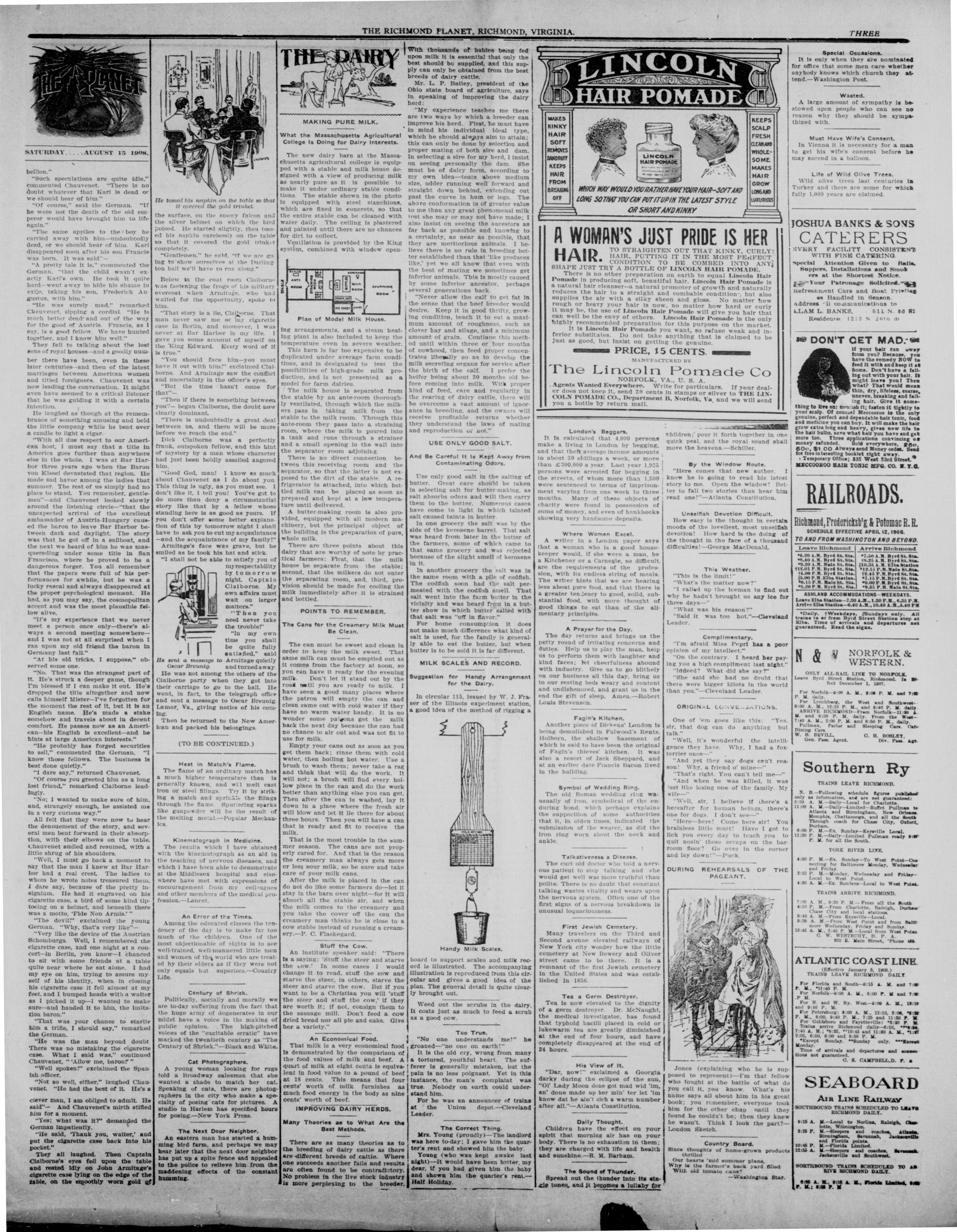
(TO BE CONTINUED.)
Heat in Match's Flame.
The flame of an ordinary match has
‘a much higher temperature than is
generally known, and wil melt cast
fron or steel filings. Try tt by strik-
jing a match and sprinkic the filings
‘through the flame. Sputtering sparks
lke gunpowder will be the result of
the melting mecal.—Popular Mecban-
oon
Kinematograph In Medicine.
The results which I have obtained
with the kinematograph as an afd In
the teaching of nervous diseases, and
which I have been able to demonstrate
at the Middlesex hospital and else-
where have met with expressions of
encouragement from my colleagues
and other members of the medical pro-
fession.—Lancet.
An Error of the Times.
Among the educated classes the ten-
dency of the day is to make far too
much of the ebildren. One of the
most objectionable of sights is to see
well-trained, well-mannered little men
and women of tha world who are treat-
ed by their elders as if they were not
only equals bat superiors.—Couatry
Life.
Century of Shriek.
Politically, socially and morally we
are to-day suffering from the fact that
the huge army of degenerates in our
midst have a voice in the making of
public opinion. The high-pitched
Voices of the “excitable erratic” have
marked the twentieth century as “The
Century of Shriek.”—Biack and White.
‘ahaa: Miommsentinesieaiat
A young woman looking for rugs
told a Broadway salesman that she
wanted a shade to match her cat.
Speaking of cats, there are photog-
raphers in the city who make a spe-
clalty of posing’ cats for pictures. A
studio in Harlem has specified hours
for posing —New York Press.
The Next Door Neighbor.
An eastern man has started a hum-
ming bird farm, and perhaps we may
hear later that the next door neighbor
has put up a spite fence and appealed
to the police to relfeve him from the
maddening effects of the constant
‘humming.
THE RICHMOND PLANET, RICHMOND, VIRGINIA
ean Le
PAY r
I , See »
KEIPES
iy fa a
A ay
se} G fy Ay
fa.
MAKING PURE MILK.
What the Massachusetts Agricultural
College ts Doing for Dairy Interests.
‘The uew dairy bern at the Masse
ped vith n ctable and vilik hese ae
aigted. wits siview ot peoticiag tallk
which are ‘Sing In conereen’ oo. thas
water dally. ‘The celling is plastered
Ventliation is provided by the King
systtm, combined with window open:
m Ef]
3 aC ovenine
i G Ce avon 7
El
Plan of Model Milk Housa.
ing arrangements, and a steam heat-
ing plant is also included to keep the
temperature even in severe weather.
This barn fs far too expensive to be
duplicated under average farm condi-
tions, and is designated to tese the
Possibilities of high-grade milk _pro-
duction, and is not presented as a
model for farm dairies.
The milk house ts separated from
the stable by an anteroom thorouzh-
ly ventilated, through which the milk-
ers pass in taking milk from the
stable to the milk room. ‘Through this
anteroom they pass into a straining
room, where the milk 1s poured into
@ tank and runs through a strainer
and a small opening in the wall into
the separator room adjoining
| There is no direct connection be.
tween this recelving room and the
separator, so that the latter is not ex.
posed to the dirt of the stable. A re
frigerator 1s attached, into which bot-
ted milk can be “placed ws soon as
prepared and kept at a low tempera
ture until delivered.
A butter-making room {s also. pro-
vided, equipped with all modern ma.
chinery, but the principal object of
the bullding is the preparation of pure,
whole milk.
There are three points about this
dairy that are worthy of note by prac:
tical farmers: First, that the milk
house be separate from the stable;
‘Second, that the milkers do not enter
the separating room, and, third, pro
vision should be made for cooling th
milk immediately after it is strainec
and bottled.
POINTS TO REMEMBER.
‘The Cans for the Creamery Milk Must
Be Clean,
‘The can must be sweet and clean tn
order to keep the milk sweet. ‘That
same milk can must be emptied out as
it comes from the factory at noon, #0
you ean have it ready for the evening
milk. Don’t let {t stand out by the
Toad wmtil you are ready to milk. I
have seen a good many places where
the patron will empty the can and
clean same out with cold water if they
have no warm water handy. It is no
wonder some pa'gons get the milk
back the next day because the can had
Ro chance to air out and was not fit to
use for milk.
Empty your cans out as soon as you
get them back; rinse them with cold
water, then boiling hot water. Use a
brush to wash them; never take a rag
and think that will do the work. It
will not; @ brush will find every hol-
low place in the can and do the work
better than anything else you can get.
‘Then after the can fs washed, lay it
down in a place where the fresh alr
will blow and let ft le there for about
three hours. Then you will have a can
that is ready and fit to receive the
milk.
‘That is the most trouble in the sum-
mer season. The cans are not prop-
erly cared for. And that is the reason
the creamery man always gets more
or less sour milk, so be sure and take
care of your milk cans,
After the milk is placed in the can
do not do like some farmers do—let it
stay in the barn over night—for it will
absorb all the stable air, and when
the milk comes to the creamery and
you take the cover off the can the
creamery man thinks he is close to a
cow stable instead of running a cream-
ery.—P. C. Flaskesard.
Stuff the Cow.
An institute speaker said: “There
fs a saying: ‘Stuf the steer and starve
the cow.” In some cases I would
change it to read, stuff the cow and
starve the steer, in others, starve the
steer and starve the cow. But if you
want to be a Christian you will ‘stuff
the steer and stuf the cow,' if they
are worth it; if not, consign them to
the sausage mill. Don't feed a cow
dried bread nor all pte and cake, Give
her a variety.”
An Economical Food.
| ‘That milk is a very economical food
{s demonstrated by the comparison of
‘the food values of milk and beef. A
quart of milk at eight cents is equiva-
lent in food value to a pound of beet
at 18 cents. This means that four
cents’ worth of milk furnishes as
much food energy in the body as nine
cents’ worth of beef.
IMPROVING DAIRY HERDS.
Many Theories as to What Are the
Best Methods.
‘There are as many theories as to
the breeding of dairy cattle as there
are different breeds of cattie. Where
jone succeeds another fails and results
are often found to be contradictory.
[No problem in the live stock industry
ig more perplexing to the breeder,
With thoisands of babies being fed
upon milk it is essential that only the
dest should be supplied, and this sup-
ply can only be obtained from the best
breeds of dairy cattle,
Mr. L. P. Bailey, president of the
Oblo state board of agricuiture, says
{m speaking of improving the ‘dairy
rd:
“My experience teaches me there
are two ways by which a breeder can
improve his herd. First, he must have
in mind his individual ideal type,
which he should always aim to attain;
this can only be done by selection and
proper mating of both sire and dam.
In selecting a sire for my herd, | insist
on seeing personally the dam. She
must be of dairy form, according to
my own idea—teats above medium
size, udder running well forward and
Straight down behind, extending out
past the curve in ham or legs. The
abore conformation {s of gteater value
to me than any great phenomenal milk
test she may or may not have made; I
also insist on seeing the ancestors as
far back as possible and knowmg to
a certainty, as near as possible, that
they are meritorious animais. 1 be-
Heve there is no rale in breeding bet-
ter established than that ‘like produces
like,” yet we all know that even with
the best of mating we sometimes get
inferior animals. This is mostly caused
by some Inferior ancestor, perhaps
several generations back.
| “Never allow the calf to get fat In
the sense that the beef breeder would
|desire. Keep it in good thrifty, grow.
ing condition, teach it to eat a maxt-
mum amount of roughness, such as
clover bay and silage, and a minimum
amount of grain. Continue this meth-
od until within three or four months
of cowhood, then feed proper concen
trates Mbepally so as to develop the
milk secreting organs for service after
the birth of the calf. I prefer the
heifer being about 30 months oid be-
fore coming Into milk. With proper
kind of feed, care and regularity in
the rearing of dairy cattle, there will
be overcome a vast amount of ignor
ance in breeding. and the owners will
receive profitable returns whether
they understand the laws of mating
and reprodection os dat”
USE ONLY GOOD SALT.
And Be Careful It Is Kept Away from
Contaminating Odors.
Use only good salt in the salting of
butter. Great care shotld be taken
in selecting salt for butter-making, as
salt absorbs odors and will then carry
them to the butter. Numerous cases
have come to light in which tainted
salt caused taints in butter.
In one grocery the salt was by the
side of the kerosene barrel. That salt
was heard from later in the butter of
the farmers, some of which came to
that same grocery and was rejected
because of the slight smell of kerosene
in it.
Im another grocery the salt was in
the same room with a pile of codfish.
‘The codfish soon had the salt per.
meated with the codfish smell. That
salt went into the farm butter in the
vielnity and was heard from in a but-
ter show in which butter salted with
that salt was “off In flavor.”
For home consumption it does
not make much difference what kind of
salt is used, for the family is general-
ly able to eat the butter, but when
butter ts to be sold tt is far different.
MILK SCALES AND RECORD.
Suggestion for Handy Arrangement
for the Dairy.
In circular 115, issued by W. J. Fra-
sie on tammuds Capea aac:
& good idea of the method of rigging a
:
y
i
} \
sees =
5 seessesese:
Ee
i
Hanae aT ecalee,
board to support scales and milk rec-
ord is illustrated. The accompanying
illustration is reproduced from this clr-
cular and gives a good idea of the
plan. The general detail is quite clear
ly brought out.
Weed out the scrubs in the dairy,
It costs just as much to feed @ scrub
as & good cow.
an Pe
| “No one understands me!" he
Eroaned—“no one on earth!”
It fs the old cry, wrung from many
'@ tortured, youthful beart. The suf-
ferer ix generally mistaken, but the
pain {s no less poignant. Yet in this
instance, the man’s complaint was
true. Nebody on earth could under-
stand him.
For he was an announcer of trains
at the Union depot—Cleveland
Leader.
The Correct Thing.
Mrs. Young (proudly)—The landlord
was here to-day; I gave him the quar
ter's rent and showed him the baby.
Young (who was kept awake last
night)-—it would have been better, my
dear, if you had given him the baby
and shown him the quarter's rent.—
Half Holiday.
eee a
ay! NCOLN 3%
ie Pen aul
ar
i) HATR POMADE @
MAKES fee. Gat? KEEPS
wonky ||, chekeeees = se ae SCALP
wair || gee : Pe B lreesn
sort ae 5 yf \\ccmm
eemoves A a a) ae? OLE
xorurt a Han PORE ‘—F SOME
KEEPS = E mre gen MAKES.
HAIR Y ~ <a 77> lnair
FROM z a Grow
fereatns|| WHICH WAY WOULD VOURATHER HAVE YOUR HAIR-SOFTAND |) ons AND
OFF |) LONG SOTHAT YOU GIN PUT ITUPIN THE LATEST STYLE \|wxurias
SS OR SHORT ANDKINKY ——
A WOMAN'S JUST PRIDE IS HER
TO STRAIGHTEN OUT THAT KINKY, CURLY:
HAIR, sceceorne 25s Tat sost peareer
* CONDITION TO BE COMBED INTO ANY]
SHAPE JUST TRY A BOTTLE OF LINCOLN HAIR: POMADE.
There is no other preparation on earth to equal Lincoin Hatr
Pomade in producing soft, beautiful hair. Lincoln Hair Pomade {ts
natural hair cleanser—a natural promoter of growth aud naturally
Teduces the hair to a straight and combable conditions bat eles
supplies the air with a silky sheen and gloss. No matter how
rough or heavy your hair is now. no matter how hard or cooly
1t may be, the use of Lincoln Hale Pomade will sive you helt that
can well be the envy of others. Lincoin Hair Pemade ts the cuig
highly recommended preparation for this purpose om the nanny
It ts Lincoln Hair Pomade you want, 20 refuse week oat ne
ferior substitates. Do not take anything that ts claimed to be
Just as good, but insist on getting the genuine.
quem PRICE, 15 CENTS. sums
The Lincoln Pomade Co
NORFOLK, VA., U. S. A.
Agents Wanted Everywhere. Write for particulars. If your deal-
er does not Keep it, send £0 cents in stamps or silver to THE Lan
COLN POMADE CO., Department B, Norfolk, Va, and we will send
you a bottle by return mail.
London's Beggars.
It fs calculated that 4,000 persons
make a living in London by begging,
and that theft average income amounts
to about 30 shillings a week, or more
than £300,000 a year. Last year 1,925
persons were arrested for begging in
the streets, of whom more than 1,500
were sentenced to terms of tmprison-
ment varying from one week to three
months. Many of these objects of
charity were found in possession of
sums of money. and even of bankbooks
showing very handsome deposits.
Where Women Excel.
A writer In a London paper says
that a woman who Is a good house-
keeper would, if she were a man, be
a Kitchener or a Carnegie, so difficult
are the requirements of the _profes-
ston, with its endless string of meals.
The writer hints that we are hearing
less about pure food, and that there Is
@ greater tenJency to good, solid, sub-
stantial food, with more thought of
good things to cat than of the alt
mentary principles.
ik: Cees tae tan
The day returns and brings us the
petty round of irritating concerns and
duties. Help us to play the man, heip
tis to perform them with laughter and
kind faces; tet cheerfulness abound
with industry. Give us to go blithely
on our business all this day, bring us
to our resting beds weary and content
and undishonored, and grant us in the
end the gift of sleep. Amen.—Robert
Louls Stevenson.
Fagin’s Kitchen.
Another plece of Dickens’ London ts
being demolished in Fulwood’s Rents,
Holborn, the shallow Gasement of
which Is said to have been the original
of Fagin’s thieves’ kitchen, It was
also a resort of Jack Sheppard, and
at an earlier date Francis Bacon lived
fo the building,
Symbot of Wedding Ring.
The old Roman wedding rag was
usually of fron, symbolical of the en-
during bond, which perhaps explains
the supposition of some authorities
that It, In olden times, indicated the
submission of the wearer, as did the
fron ring worn about the neck and
ankle.
aii ote hl Ie iota
‘The curt old doctor who told a nerv-
ous patient to stop talking and she
would get well was more truthful than
polite. There is no doubt that constant
talking wastes vitality and wears upon
the nervous system, Often one of the
first signs of a nervous breakdown is
unusual loquaciousness.
First Jewish Cemetery.
Many travelers on the Third and
Second avenue elevated railways of
New York city wonder how the little
cemetery at New Bowery and Oliver
street came to be there. It is a
Femnant of the first Jewish cemetery
in the United States and was estab-
Mshed in 1656.
Tea a Germ Destroyer.
Tea is now elevated to the dignity
of a germ destroyer. Dr, McNaught,
the medical investigator, has found
that typhoid bacilli placed in cold or
lukewarm tea are greatly diminished
at the end of four hours, and have
completely disappeared at the end of
24 hours.
His View of It.
“Dar, now!" exclaimed a Georgia
darky during the eclipse of the sun,
“OY Lady Moon done got mad wid ‘im,
an’ done made up her min’ ter let "im
know dat he ain't sich a warm number
after all."—Atianta Constitution.
Dally Thoucht.
Children have the effect on your
spirit that morning air has on your
body. There {s no exhaustion ini them;
they are charged with life and health
and sunshine.—R. M. Barham.
The Gound of Thandie.
ee ae aes bet eat
Spread out the thunder into its sin- |
aig tones, and jt becomes a lullaby for
. AS ET
thildren; pour It forth together in one
quick peal, and the royal sound shall
move the heavens.—Schiller.
By the Window Route.
“Here comes that new author. 1
know he fs going to read his latest
story to me. Open the window! Het-
ter to fall two stories than hear him
read one!"—Atlanta Constitution,
Unselfish Devotion Difficult.
How easy is the thought tn certain
moods of the loveliest, most unselfish
devotion! How hard is the doing of
the thought in the face of a thousand
diMculties!—George MacDonald.
‘This Weather.
“This ts the Hmit!”
“What's the matter now?"
“1 called up the feeman to find out
why he hadn't brought us any fee for
three days—"
| “What was his reason?”
“Said it was too hot.”"—Cleveland
Leader.
Comoblimentary.
“I'm afraid Miss Peprt has @ poor
opinion of my intellect."
“On the contrary. I heard ber pay-
ing you a high compliment last night.”
“Indeed? What did she say?"
“She sald she had no doubt that
there were bigger {dfots tn the world
than you."—Cleveland Leader.
ORIGINAL CONVE..SATIONS,
One of ‘em goes like this: “Yes,
sir, that dog can do anything but
talk.”
“Well, it's wonderful the Intell:
gence they have, Why, I had a fox-
terrier once—"
“And yet they say dogs cen't rea-
son! Why, a friend o' mine—"
“That's right. You can't tell me—"
“And when he was killed, tt was
just Ike losing one of the family. My
wite—"
“Well, str, I believe if there's a
hereafter for human beings, there's
one for dogs. I don't see—"
| “Here—here! Come here str! You
brainless Little mutt!” Have T got to
lek you every day to teach you to
att Rosin’ those seraps on the bar-
room floor? Go over in the corner
and lay down!”—Puck.
DURING REHEARSALS OF THE
PAGEANT.
‘ Nas) eee |
Hi AS ieee? |
(A i4Z\ aes ¥ |
YZ ee acd
Ly gee
Meee) £7, \ |
{ He 7 3 be a vas |
Spires iy ’ \ |
y ey JH |
ie eed f | \
hits aye Z 1
fo er
LPar\t dy ee eS
eg “A
BPageieeae i U4
Rat fb Pat \
ri gi i Y
es : {
z i Bi are
“eH y es
ASS Mp7
ee tt
Jones (explaining who he is sup
posed to represent)—I'm that fellow
who fonght at the battle of what do
you call it, you know. What's his
bame says all about him ta his great
book; you remember, everyone took
him for the other chap antil they
found he couldn't be; then they knew
he wasn’t. Think I look the part?—
London Sketch.
Country Beard.
Since thoughts of home-grown product
‘thrilled
Our hearts "mid summer plana,
Wy te the farmer back ‘yard Milled
ik old tomato cana?
px
THREE
LTS
Special Occasions.
It ts only when they are nominated
for office that some men care whether
anybody knows which church they at
tend.—Washington Post.
Wasted.
A large amount of sympathy is be
stowed upon people who can see 2
reason why they should be sympa
thized with.
Giust ave Witite’s Geneant..
In Vienna it is necessary for a man
to get Mis wife's consent before be
may ascend in a balloon.
Life of Wild Olive Trees.
Wild olive trees last centuries im
Turkey and there are some for which
fully 1,000 years are claimed,
JOSHUA BANKS & SONS
SVBRY FACILITY CONSISTENT
WITH FINE CATERING.
Special Attention Given to Balle,
Suppers, installations and Smok
ers at the Shortest Notice.
Ter Your Patronage Solicited. ey
Kefrevament Cars and Boat Privfieg
8 Handled in Season
Address “li communications to
LLAM L. BANKS, BIL. 80 #
Residence: 1212 N z6tn dt
*#@ DON'T CET MAD-@
Mt your hair ran way
fiom you? Because, You
have the remedy NOW to
food it with and keep it at
home. Don't have a fall-
ing out with your hair. It
might leave you! Them
what? That would meam
thin, éry, lifeless, coarse,
yr uneven, breaking and fall~
ing bait. Give it some-
thing to live on: Gouvish {t; fasten it tightly to
your scalp. Of couse! Meccoctoo te the. eoly
Keauine, perfect and depeodable hair tonic, food
and medicine you can buy. It will make the bair
ROE TEE OSE an henry, given ow lite te
the hair bulbs, save what halt you have and get
more too. Three applications convincing o®
money refunded a everywhere. B60,
£0; $100, Always nend Money onde.
for feds Tniarenting booklet HEME Away
|) Temporary Office; 335 West Sard Street.
- MECCOOROO HAIR TONIC MFG. CO. H.¥.0.
; tect
Richmond, Fredericksh’g & Potomac R. R.
SCHEDULE EFFECTIVE APRIL 12. 1908.
TO AND FROM WASHINGTON AND BEYOND.
“Leave Richmond | Arrive Richmond
76.20 AM. Byrd Sta | 97-50 AM. Byrd Ou
SEGUE Rech) TE athe
Seto LN main Rtcate| gods cw Roa uattos
tient Et Ryed bpte| Saad Pom te eae
tiga hire Se hee] aad Perm genie
SERGI) EE Racnine ne
TPM Malone ste] coor BTee Rtg
SSOP myrdte Stal “3.40 Poa Note nas
ASHLAND ACCOMMODATIONS - WEEKDAYS.
Loare Kine Staton “7.90 hl 120 F-86310 FM.
Arrive Kibe Statlon—6.40 4.0-, 10.40 4.06.40 Pa
“sDally. ]Weetdaye, fOusdaye only. an
hiss So Me as lhe sete Lion at
| cestantecds Heed the sense ee
N & ¥ NORFOLK &
WESTERN.
ONLY AUL-RAML, Live TO NonFOUR.
Leave hye et ton, Tatoo
| "baer, ir
pF or Nortolk—0:00 A. M., 8:00 P.M. ond Tem
ost sty
or Tzeiberg. the West and Soutnene-
ag ee et Nah 2s
Shite ‘niciuoDCntea Notch Mi
wivtnd :30 fea aly peat te
‘T:H0 A. M., 2:06 P.M. and 8:50 P.M, daily.
Frias” Ponte Sad hcping “Sat une
pine tin
we hava, ©. #. postr,
Soa! shee OnE aes
|
TRAINS LEAVE RICHMOND.
X. BRollowing schedule Aguree published
only ax information, and are net guaranteed:
8:20 “A. M.—Daily-—Local for ‘Charlotte.
11:00 A. M.—Daily—Limited—Bufet Pullman te
Atunta “and Birmingham, New Orleasa,
Memphis, “Chattanooga, and all the South
‘Through’ couch for Chase ‘City, Oxford,
Burhan,
9:00 P. M—Px. Suntay—Keyweille Local.
11:80 PF. M—Dally—Limited Pullman ready O:0r
PL MC for all the South.
YORK RIVER LINE,
2) P M—Ex. Sunday—To West Poist—Ooe
necting for Daltkore Monday, Weneeday
nd. Priday
28 Pe MC Moniay, (Wetneatay and Priday—
Local to West Point
4:30 A M—Ex. Sundays Local to West Potat.
TRAINS ARRIVE RICHMOND.
7:00 A. M., 9:20 P M.— From all the Sout
€10 P. M—From Charlotte, "Raleigh, Durkew/
Chase’ City and local. stations
8:40 A. M.—From Reywille Local.
9:20 A. M—From West Point sod trom Baltt
more Wednestay. Friday and Sunday.
10465 A M., 8:45 P. M—Loeal from West Potme
©."W. WrSTRURY, D. P- A.
20 R. Main’ Street, "Phone 6
$s
(Bective January 5, 1908.)
TRAINS LEAVE RICHMOND DAILY.
For Florida and South—6:15 4. M. and 7
roi tno Pe
For "Norfolk 0:00 A. M., 8:00 P.M and 72m
Pi
For X. and W. Ry. Wen—0:00 A. M., 1820
and"940 Pee
For Petersburg: 9:00 A. M.. 12:10, 3:08, sesame
P.M, 6:00, 940 PM 7:35 and 1130 Pe
Wor” Goldsboro and Fayetteville: °8:30_ FM
Trion serie, Miche dallye:16, ee,
1:0 A. My eas, "1048 and 1) A ML,
2:05, “6:00, 6:00. and 8:90 PM
wecEeceot Sunday. “Bontay” only, “aeegt
Time of arcivala and departores and. somnee
tone wot guaranteed.
| ©. 8 CAMPBELLD. F. a
ar
Are Line Ramway
SOUTHBOUND TRAINS SCHEDULED TO LaAWa.
RICHMOND DAILY- 7
‘%:15 4. M—Local to Norlina, Raleigh, Char
lotta, “Wilmington.
2 PM “ecpers ae concen, Attante.
ae Gavennab,
i Forte imitea.
fas A At ‘od couches, Sevanaah.
Secizevile anf octet,
NORTHBOUND, THAINS SCHEDULED TO 4B
‘RIVE RICHMOND .
08 a. A ML, Plovide Limited, oom
oe ee
FOUR
THE PLANET
Published every Saturday by JOHN MITCHELL,
JR., at 311 N. Fourth Street, Richmond, Va.
JOHN MITCHELL, JR., - EDITOR.
All communications intended for publication
should be sent so as to reach us by Wednesday.
TERMS IN ADVANCE.
One Copy, eight months. $ 1.50
One Copy, six months. 1.00
One Copy, six months. .80
One Copy, four months. .50
One Copy, three months. .40
Single Copy .00
ADVERTISING RATES.
For one inch, one insertion. $ .50
For one inch each subsequent insertion. .40
For two inches, three months. 6.00
For two inches, six months. 10.00
For two inches, nine months. 14.00
For two inches, twelve months. 30.00
Marriage and Funeral Notices, one inch. .50
Standing and Treasured Notices per line. .10
POSTAGE STAMPS OF A HIGHER DENOMINATION THAN TWO CENTS NOT RECEIVED ON SUBSCRIPTIONS.
THE PLANET is issued weekly. The subscription price is $1.50 per year in advance.
There are four ways by which money can be sent by mail at our work- In a Post Office Money Order, by Bank Check or Draft, or an Express Money Order, when the amount of those can be mentioned. See the Adjacent Letter. MONEY ORDER—You can buy a Money Order at your Post Office, payable at the Richmond 'oat Office and we will be responsible for its arrival. MONEY ORDERS can be obtained at any office of the American Express Co., the United States Express Co., and the Wells Fargo Co.'s Express Company. We will be responsible for sending money to the United States Express Money Order is a safe and convenient way for forwarding money. REGISTERED LETTER—If a Money Order, Post Office or an Express Office is not within the United States Express Company, the Letter you wish to send us on payment of ten cents. Then, if the Letter is lost or stolen, it can be traced. You can send money in this manner. We cannot be responsible for money sent in letters in any other way than one of the four ways mentioned above. If you send your money in any other way, you must do it at your own
RENEWALS, ETC.—If you do not want THE PLANET continued for another year after your subscription has run out, you then notify us by postal Card or discontinuation. The postmaster will submit your name and address who do not order their paper discontinued at the expiration of time for which it has been paid are liable for the payment of the subscription up to date when they order the paper discontinued.
COMMUNICATIONS—When writing to us to renew your subscription or to discontinue your subscription, your name and address in full, otherwise we cannot find your name on our books.
CHANGE OF ADDRESS—In order to change the address of a subscriber, we must be sent the former as well as the present address.
Entered at the Post Office at Richmond, Va. second class matter.
SATURDAY.....AUGUST 15 1908.
Business before pleasure should be your maxim, even though most of us like pleasure before business.
---
Colored folks do themselves about as much injury as some white folks do to them, but they don't seem to know it.
---
Few young folks strike out in new avenues and indulge in new ventures They all want to follow the crowd, not realizing that to do this is to keep both their income and prospects down to the level of the average man in that same crowd.
---
Good-time folks are ruining their own prospects and those of their offspring. It wont pay, except to the fellow who is making money by your good-time notions and expenditures.
---
People who are well on in years have the experience and young folks have the foolishness. To get rid of the latter in early life and get more of the former at the same time means prosperity and money for the young folks who have the wisdom to do it.
One of the most dastardly crimes in the criminal annals of this country was perpetrated upon two colored families at Camden, Arkansas. Friday morning before day, August 7, 1908. As a result, two of the family were killed and eight others seriously injured. The houses had been blown up by dynamite. Edward Moore and his father-in-law Arnold occupied the houses and the cause of this evidence of savagery is unknown. As usual, there is absolutely no clue to the guilty parties
---
The Alexandria, Va. Horizon is of the opinion that the Socialist Party platform is more liberal in its attitude towards the Negro than is the Republican Party platform. We have read both and we have reached another point where we cannot agree with our able contemporary. It deals in generalities, while the Republican platform is specific. The most serious charge against the latter instrument is that it does not mean what it says and fails to say what it means.
The Horizon is supporting Hon. William J. Bryan and is calling for one hundred colored men to pledge $25.00 each for the support of the journal during the campaign.
Messrs. F. H. M. Murray, L. M. Hershaw, W. E. B. DuBois and F. L. McGhee have pledged this amount. Further than this, deponent sayeth not.
A CASE IN POINT.
Labor Commissioner James B. Doherty saw fit while in Michigan recently to speak of the chicken-stealing Negro, and we are now interested to know what he thinks of the shoe-stealing white man. Here is a clipping from the Richmond, Va. Times-Dispatch of August 13, 1908, heading and all:
YARD-CONDUCTOR ALLEGED
THIEF.
Harry Marshall Placed Under Arrest at Byrd Street Station Last Night.
Harry Marshall, yard conductor at the Byrd Street Station, was arrested early last night while in the act it is alleged, of stealing a quantity of shoes from cases in the freight depot. He was seen by Special Officer Perkins, who made the arrest and turned his man over to Policeman Atkinson.
Marshall is twenty-six years old, and hales from Manchester. The evidence seems to be against him, as five pair shoes and two pair rubbers were found in his possession. He took his arrest calmly, and had little to say.
Does this indicate that all white men steal shoes when they get a chance or that only a few of them are guilty of these criminal indiscretions? We have our opinion, but ask that the same tape line be used in measuring the chicken-stealing Negro that is employed in getting the dimensions of the shoe-stealing white man. Further comment is unnecessary.
---
MR. LEE'S PREDICAMENT
It was reported that Mr. Joseph E. Lee of Jacksonville, Florida who was the only colored man on the notification committee at Cincinnati, when Hon. William H. Taft was notified of his nomination for the presidency had been forced to ride in the freight elevator at Hotel Sinton and that other discountes were shown him on account of his color. It seems that the Republican management are adepts at getting colored gentlemen to make denials for this letter of Mr. Lee assumes that if any discriminations were made, he made them himself and upon himself. Certain it is that this ends all comment so far as the hotel people are concerned. The report is as follows:
"Cincinnati, Aug. 6.—When the Taft notification committee was in this city Joseph E. Lee of Jacksonville, Fla., was the only Negro in attendance. A story was printed that Lee could not get service in the dining room of the Hotel Sinton, the headquarters of the committee. Mr Lee in a communication printed today in the newspaper owned and edited by Charles P. Taft, brother of Candidate Taft, denies this story and says that the newspaper first printing the story 'has been imposed upon by some one other than myself. Mr. Lee also says:
"It has been my rule to always take my meals at some place other than the hotel at which I may have my room when away from my residence city, which rule, for reasons personal and satisfactory to myself. I have never departed from, whether in Cleveland, Chicago, St. Louis Minneapolis, Indianapolis New York Boston, Philadelphia, Cincinnati or any other city to which I may have been at any time called. I beg to say that I was accorded every courtesy by the management and attaches of the Hotel Sinton while thereat, regardless of what may have been their personal feelings as to myself, that any gentleman could have desired, and I wish, through your paper, to convey my sincere thanks and the thanks of my race to the management and attaches of said hotel and the citizens of Cincinnati, both white and colored, who in any way contributed to my comfort and pleasure while I was in your city in attendance upon the notification com mittee, and a guest of the Hotel Sinton."
Mr. and Mrs. Charles P. Taft are stockholders of the Hotel Sinton and the hotel is named after the late David Sinton, Mr. Taft's father-in-law."
Mr. Lee intimates that the personal feelings of the hotel management may have been one thing, but they did not show it so far as his presence was concerned. Shrewd men, who undersetstand conditions in Cincinnati will read between the lines and draw their conclusions accordingly.
No denial is made that Mr. and Mrs. Charles P. Taft are stockholders in a hotel that discriminate against the Negroes. Mr. Lee admits that while the management's personal feeling may have been one way, it acted another. And so the world moves on.
---
PRESIDENT ROOSEVELT AND HIS SUBORDINATES
That affairs are not altogether harmonious at Oyster Bay, N. Y., where President Roosevelt now resides is evident. If we are to judge by the following telegraphic report:
Oyster Bay, N. Y. Aug. 3.—Whether or the dismissal from the West Point Military Academy of the eight cadets who had been found guilty of hazing is to be made permanent or the young men reinstalled through congressional action or executive clemency, is still undetermined. The attitude of the government is set forth in an official statement issued to-day by President Roosevelt, through Rudolph Foster, who is the acting private secretary to the President in the absence of Secretary Loeb, now on his vacation.
The President characterizes as er-
THE RICHMOND PLANET, RICHMOND, VIRGINIA
roneous contrary announcements made earlier by Secretary Loeb and Secretary of War Luke E. Wright. To-day's statement explains that the President has not, as yet, heard finally from the Secretary of War as to the latter's recommendations in the matter, and that therefore the national Executive has reached no final decision. By Secretary Loeb the President had been reported as favoring the dismissal of the cadets. Subsequently and following a conference with Mr. Roosevelt, Secretary Wright told the newspaper men that a decision to reinstate offending cadets had been reached.
The statement issued by the President at Sagamore Hill to-day follows:
"No action whatever has been taken by the President in the cases of the cadets, the statement that they were originally ordered dismissed and that they had been ordered kept being equally erroneous. An appeal was originally made to the President to interfere. He declined to take any action or interfere in any way until the Secretary of War had expressed his opinion, the view of the department then being seemingly that the coatside should be turned out of the secretaries noaving come to any final decision. The secretary then notified the President that instead of making any report, he would like to discuss the matter with the President in person.
"He accordingly came, and the discussion was held, but no final decision was reached, the secretary stating that he was not able to make a final and definite recommendation as to all the cases, and preferred to make none as regards any until he could do it as regards all. The President has not yet heard finally from the secretary, and therefore, of course, he came to no final decision.
"This is the first announcement that the President has made in the matter at all, and he has never at any time come to any decision one way or the other, excepting to state that he would probably follow the views of the department."
That Secretary of War, Luke E. Wright is disgusted is to express it mildly, if his utterances upon the subject are to be accepted. Here is what he said:
"Washington, D. C., Aug. 3.—When seen to-night as to the statement given out at the executive offices in Oyster Bay to-day to the effect that the President had come to no decision in regard to the dismissal of the eight West Point cadets charged with hazing, Secretary of War Luke E. Wright said:
"Whatever the President does is right. I do not wish to discuss the matter further."
In regard to the statement accredited to him on Saturday to the effect that President Roosevelt and he had decided to reinstate the dismissed cadets, Secretary Wright explained that the decision may not have been definitely agreed upon."
This then is the lesson that Hon. William H. Taft learned so well. A false statement becomes the truth; if Mr. Roosevelt utters it, and a wrong policy becomes a right policy if Mr. Roosevelt fathers it. "The king can do no wrong." "Whatever the President does is right." How long will this condition of affairs continue?
In this connection, the remarks of the Richmond, Va. News-Leader of the 5th inst. are timely and appropriate. Under the caption of "Another Initiate," it says:
"Secretary of War Luke Wright, but a month old in office, is the latest statesman and gentleman to be admitted as a member in full standing and with all the degrees of President Roosevelt's justly celebrated Ananias Club. As usual, the initiation ceremonies were performed with proper finish, solemnity and effect by Private Secretary Loeb.
"If the followers of Moses had possessed Loeb in the wilderness he would have been priceless. He is the most venerable, faithful, frequent, patient and miscellaneous scapegoat in all history. Metaphorically, he must have horns hard as iron reaching back to his withers, a beard a yard long and a hide hard as that of a bull alligator fifty years of age. Without a blat, a murmur or a bat of the eye, he takes on him the sins of whole administrations and of processes of cabinet members and diplomats and endless bales of tangled prevarications and then goes browsing peacefully off on his vacation, apparently unperturbed. He sure is a useful man.
"King Arthur at his round table had Lywarch, the bard; Urien, of Reghed, the chief; Myrdhinn, the prophet; Lancelot, Tristan, Ban and Bohor and the rest of them. Each was admitted to the circle by reason of some magnificent deed of daring, vast feat of strength, beautiful demonstration of virtue, chivalry or generosity or shining talent. President Roosevelt has his Ananias Club composed of leading republican statesmen. The one qualification for admission seems to be that the candidate shall be a very distinguished person and shall be lured by Loeb to make a direct and public statement and have it flatly and immediately contradicted by the president. The candidate bites and then things are done to him.
"Mr. Wright has complied with these terms precisely. He is one of the youngest and tenderest members but entitled to wear all the regalia there is in the lodge. He was cunningly cajoled by statements of Loeb supposed to come from the president into saying that the eight West Point cadets convicted of hazing had been dismissed and then that they had not been dismissed. Now comes the President, intent on his prey, and administers the blow signifying full admission to the club with the swiftness, force and promptness of a Chicago strong-arm man using a sand bag on a plethoric citizen. He says there never has been and is not a suggestion of foundation for any of these assertions; that he never consented to have the cadets dismissed and never suggested their retention and has done nothing in the case.
"So let the curtain to the most sacred sanctum and the innermost mysteries of the club be raised; and let Brother Wright pass in and receive the grip, the pass-word and all the mystic signs. He is clearly
branded, fully endowed, enrobed and entitled and may parade in full uniform and receive all the benefits of the order."
But then this is the same distinguished gentleman, who so ignominiously punished the members of Companies B. C. and D. of the Twenty-fifth Infantry without a trial. It was a case of Negroes then; it is a case of white men now.
COMMISSIONER DOHERTY'S ASSERTIONS.
The following from a Detroit newspaper, culled from a report of the proceedings of the National Association of Labor Commissioners will be read with surprise by the thousands of property-owning, tax-paying Negroes, who are on the higher plane of industrial and business intelligence and who are in the wage-earning and money-saving arena, where "worth makes the man and lack of it the fellow."
'Charles I. Daughtery, commissioner of labor for the State of Oklahoma, and Commissioner John B. Doherty, of Richmond, Va. are two delegates to the convention of labor commissioners, who have the faculty of telling stories about the local conditions in their districts which are of more or less public interest.
"The Virginia Doherty is a typical Southerner, and like all residents of the South he is interested in the Negro question. He expressed himself as surprised at the difference he finds between the Negro of the north and those of his native state.
"I met a Negro yesterday, employed as a caller on one of the touring cars, whom I look upon as a perfect gentleman," said Doherty. "This type of Negro is not to be found in the South, if they were, you northern people would never hear of our troubles with them down there. Our native Negro is generally lazy, and cleanliness is foreign to their nature.
"A man who can keep chickens in that country deserves a medal. I had 36 fine specimens and 35 of them disappeared in one night. I gave the other one to an old darkey and told him to see what he could do with it. The old man knew his business all right, for that fowl was in a pot-ple before the sunset.
"The northerners who only come in contact with the Negroes of the North, have no conception of what the people of the South are up against. The problem is an entirely different one than it is with the people of the North." What could have been Mr. Doherty's purpose in exploiting the northern Negro at the expense of those of his own state is a mystery. The gen tlemman must have been a regular attendant of the Police Court of Richmond, rather than a communicant or a sight-acer at some one of the palatial Negro churches or an observer of the progress of the Negroes in some one of their many industrial and business enterprises.
The Negroes of the state pay taxes on property, real and personal valued at twenty-two million dollars and they did not accumulate this wealth by stealing chickens either. Right here in Richmond, where we are operating four banks with a combined deposit of eight hundred thous and dollars, it seems to us that Mr. Doherty should have made his investigations before going up to his farm somewhere in Virginia, where they pay Negroes fifty cents per day with the expectation that they steal the other fifty cents from the white folks hen-roosts at night. Moreover we noted recently that a white preacher was tried and convicted of stealing chickens by the wagon load
Moreover, Negroes do not consider chicken as much of a luxury as they once did. True, white folks often eat stolen chickens from some of the green groceries without knowing it, for it is really the white men who traffic in the disreputable Negro's weaknesses that make the business profitable. But the intelligent Negroes, those of the better class and they are in the large majority have long since learned that honesty is the best policy and despite the fact that white men throughout the country are stealing thousands and tens of thousands of dollars and grafting in a way that would make a brass monument groan, so to speak, they are pursuing the weather-beaten way as defined in the Scriptures.
Mr. Doherty should come home at once and study the New Negro and then he will be in a position to speak before an audience of northerners, who no doubt are better posted with reference to the actual statistical progress of the Negroes than he seems to be.
---
LATER DISCLOSURES
When the discussion in the United States Senate was under way, those Senators who were defending the administration were careful to say that the suspension of the members of Companies B, C and D of the Twenty-fifth Infantry was not visited upon them as a penalty or as a punishment. It was realized that to say so would be to acknowledge that President Roosevelt had violated his oath of office in general and the Constitution of the United States in particular.
Article V, of the Constitution of the United States reads:
"No person shall be held to answer for a capital or otherwise infamous crime, unless on a presentment or indictment of a grand jury, except in cases arising in the land or
naval forces, or in the militta, when in actual service in time of war or public danger; nor shall any person be subject for the same offence to be twice put in jeopardy of life or limb; nor shall be compelled in any criminal case to be a witness against himself, nor be deprived of life, liberty of property without due process of law."
The Articles of War provide for the trial of soldiers alleged to be guilty of criminal offences, by court-martial. Article VI, reads:
"In all criminal prosecutions, the accused shall enjoy the right to a speedy and public trial, by an impartial jury of the state and district wherein the crime was committed, which district shall have been previously ascertained by law, and to be informed of the nature and cause of the accusation; to be confronted with witnesses against him."
The Texans carried out this provision and declared that there was not sufficient evidence on which to even indict the accused soldiers.
President Roosevelt and the War Department made strenuous efforts to have the colored soldiers testify against themselves. They went so far as to threaten them with punishment should they fall so to do. In the face of the specific provisions of the Constitution, President Roosevelt's cablegram to Secretary Taft refusing to hold up the order dismissing the Companies B, C and D of the Twenty-fifth Infantry from the service will be interesting. Here is the cablegram sent from Ponce, November 21, 1906:
"Cablegram received. Discharge is not to be suspended unless there are new facts of such importance as to warrant your cabling me. I care nothing whatever for the yelling elf or the politicians or the sentimentalists. The offense was heinous and the punishment I inflicted I imposed after due deliberation. All I shall pay heed to is the presentation of facts showing the official report to be in whole or in part untrue, exculpating some individual man. If any such facts shall later appear I can act as may be deemed desirable, but nothing has been brought before me to warrant the suspension of the order. I direct that it be executed.
"THEODORE BOOSEVELT."
"The offense was heinous," he says, "and the punishment I imposed inflicted after due deliberation." This then is a most autocratic declaration and it would seem that it would have been more in place in the realms of the Czar than in the confines of the United States. The fact that he took this action after due deliberation makes the offense against the Constitution and laws of the United States all the more flagrant.
It is no surprise then that the New York Sun has repeatedly declared that former Presidents have been presented to the Congress for impeachment for much less offences than those charged up to the distinguished occupant of the White House. That Mr. Taft and his friends need make explanations is evident. There is a rumbling in the land and surprises may be in store not only for Mr. Roosevelt, but for Hon. William H. Taft, who must bear the brunt of the approaching conflict and suffer for President Roosevelt's short-comings at the polls.
MR. TAFT AND THE BROWNS
VILLE ORDER.
The disaffection among the colored voters of this country with reference to their relationship to the Republican Party is widespread and omnious. Never in the history of the nation has there been so many colored voters, who are outspoken in their disapproval of the attitude and policies of those leaders, who are now in control of the national organization. It will take the ablest colored men in the country to even in a measure counteract this feeling. It is so deep and felt by a class of colored voters that money will not have any effect upon them. It will take argument. It must be shown that the course now being pursued by those opposing the Party and its leadership will result in dire disaster to one of the kindiest races of people on the face of the globe.
President Roosevelt has shown a contemptuous disregard of the rights and privileges of the Negro and he has gone over "with boots and baggage to the enemy." Colored men will find more sympathy with the liberal elements in the Democratic Party than it will with him. We say this after a careful review of the situation.
He is turning the Republican Party of the South over to the Democrats just as absolutely as President Hayes ever did and he seems to be careless as to the consequences of his own actions. He has placed every colored soldier in the country under that race discriminating Southerner Gen. Luke E. Wright, whose blunders in the Philippines with reference to the race question made him hated from one end of the Islands to the other.
That the Republican managers are beginning to scent trouble seems evident and that this apprehension has reached President Theodore Roosevelt at Oyster Bay, New York seems to be equally evident. What' else can the following authorized publication mean? Here it is:
"Washington, Aug. 7.—Gen. Henry C. Corbitt, retread. to-day, made
public a copy of a cable message sent by President Roosevelt to Secretary of War Tart from Ponce, Porto Rico, at the time of the President's tour there, directing the former Secretary not to suspend the order discharging the battalion of Negro soldiers for alleged participation in the Brownsville riots.
"The cable message was sent from Ponce, bearing date of November 21, and is as follows:
"Cablegram received. Discharge is not to be suspended unless there are new facts of such importance as to warrant your cabling me. I care nothing whatever for the yelling either of the politicians or the sentimentalists. The offense was helmous and the punishment I inflicted I imposed after due deliberation. All I shall pay heed to is the presentation of facts showing the official report to be in whole or in part untrue, excupating some individual man. If any such facts shall later appear I can act as may be deemed desirable, but nothing has been brought before me to warrant the suspension of the order. I direct that it be executed.
"THEODORE ROOSEVELT."
Gen. Corbin belay, by way of explanation, that the Negroes were still ignorant of the real attitude of former Secretary Taft toward the Brownville case.
"Of course the Brownville affair," said Gen. Corbin, "is going to be paraded in the campaign. Any cred it or blame in that matter cannot in any way be laid to Mr. Taft. As a matter of fact, Mr. Taft was not in Washington at the time but was in the West on some important business connected with the Department.
"And right here I want to remark that or all the men I have ever known Judge Taft knows the least about exploiting his own efforts and letting the people know what he has done in Washington left Washington October 27, 1906, for an inspection of the Western military posts, notably Fort Riley, going as far west as Fort D. A. Russell and Fort Sill. He was absent from October 27 to November 17.
"The Brownsville order was issued on November 9, or twelve days after Mr. Taft left Washington and eight days before his return and while Gen. Oliver was acting as Secretary of War. When Mr. Taft returned to the Department the order discharging the battalion of the Twenty-fifth Infantry was brought to his attention.
"That the President might consider the matter Mr. Taft, as Secretary of War, suspended the order. I do not happen to have a copy of Mr. Taft's cable dispatch to the President, who was then in the West Indies, the message given is what the President sent back in reply.
"It was sent from Ponce." Gen. Corbin concluded, "Four days after Mr. Taft returned to the Department."
Hints have been passed out from time to time by the Taft managers that at the proper time evidence would be supplied to prove that Secretary Taft was not responsible for the discharge of the Negro battalion and that in carrying out the President's orders he simply performed his duty to his superior against his own judgment.
The publication indicates to the minds of politicians here that Mr. Taft intends to make his campaign on independent personal policies and stand or fall on his own official record.
There is much curtosity exhibited here as to what view will be taken by the President of Gen. Corbin's statement.
It may be that President Roosevelt will look unfavorably upon the action of Gen. Henry C. Corbin. We are not among those, however who think so. It is one of those presidential fits, where the distinguished statesman plunges into the fray and boldly announces that he will take all of the responsibility upon his own shoulders and he is beyond the point where he can be injured by so doing. Still, if the revolting colored men in the North choose to search the official archives and give copious extracts from Hon. William H. Taft's official message to the Congress upon the Brownsville affair, they will find that the language of the distinguished Ohioan was but little less severe than that used by the President himself.
Mr. Taft deserves credit thought for suspending the order of President Roosevelt until he heard from his chief. The Brownsville affair will be one of the most potent subjects of discussion in the present campaign and President Roosevelt's candidate will be the greatest sufferer from the blunder of his chief.
Strenuous. Indeed
"Great Caesar, man!" gasped the corpulent individual in the Turkish bath parlors. "You are nearly rubbing the skin off of me. I don't believe you ever had any experience as a rubber." "Yes, I have, sir," hastened the new employee. "I used to work in a livery stable and rub down horses."—Chicago Daily News.
SHOCKED.
There once called on a girl a young Dr
Who so quickly proposed that It shr.
"Yes" was all she could say
Ere she fainted away
In his arms where so gently he lr.
First Sufferer—And to think that when we were boys we wanted to go to sea.
Second Sufferer—For goodness sake
don't bring up childish memories now.
First Sufferer—I ain't got anything
else to bring up.
Not Then.
A thing of beauty is a joy
Forever, but a warning
I would sound; don't go to see
Her early in the morning.
—Detroit Free Press.
A man without a purpose in life is like a dog with no tail to wag.—Phila-
delhia Record.
Time, the common physician, will heal thee.—Philliscus.
Weak Man Receipt Free.
Any man who suffers with nervous debility, loss of natural power, weak back, falling memory or deficient manhood, brought on by excesses, dissipation, unnatural drains or the follies of youth, may cure himself *b* home with a simple prescription that *i* will gladly send free, in a plain sealed envelope, to any man who will write for it. A F Robinson, 3892 Luck Building, Detroit, Michigan.
A Great Opportunity for Young Men Who Desire an Agricultural Knowledge
Many of the young men who have finished the courses in agriculture at the Tuskegee Institute are commanding salaries ranging from $50 to $100 per month. The graduates of this Department of the school are successfully employed as Instructors, or as managers of important agricultural operations. The school has an agricultural faculty of twenty instructors; men who have received their training in the best agricultural schools of the country.
Young colored men and women who desire to take courses in practical and scientific agriculture are now offered the best opportunity to pursue such courses in one of the largest and best equipped schools for practical and scientific agriculture to be found in the South. The following courses are offered:
Opportunities are now open to 500 young men and women who may wish to take any of the above courses of instruction. The cost of board is $8.50 per month. No charge for instruction. For further information address, BOOKER T. WASHINGTON, Principal. Tuskegee Institute, Alabama.
The Demand for an Educated Ministry.
Realizing the demand among the Negro people for an educated ministry, The Tuskegee Normal and Industrial Institute conducts in connection with its other Departments a Bible Training School. The courses of study are so arranged that, not only ministers and licentiates may be benefited, but those also who desire to do better missionary work or become intelligent Sunday School teachers.
The chief aim of the Bible Training School is to afford a comprehensive knowledge of the English Bible and to implant in the hearts of those who attend an ambition to dedicate their lives to the elevation and Christianization of their people. Daily supplementary exercises designed to instill habits of sobriety, cleanliness, regularity and accuracy are provided.
The teaching is wholly undenominational, the intention being not to oppose or antagonize any theological work being done elsewhere, but instead to assist all denominations.
During the past year, the enrollment in the Bible Training School has been satisfactory, but the opportunity is now provided for a considerably larger number.
The teaching is free. The cost of board, including furnished room, light, fuel, laundering, etc. is $8.50 per month. The entrance fee is $7 to be paid in cash by each student when he registers. Students will be given the opportunity to work out much of the $8.50 in some cases all of it. Lack of means should not keep any one from entering the Bible School. If the student is not afraid of word and study he will succeed.
co
eee
Reaper
WN
Nie
Discovered What the Noite Was.
w lanes
ims Fe :
Roasting ears are almort without
Juice this serson, snap beans are dry,
lawns are scorebed and unusually full
of wild clover, which is killing the
grass. On the other hand, this year’s
crop of Irish potatoes Is the best
we have had fn ten years. Caull-
flower Is watery and insipid, Cabbages
are porous, some actually spongy.
Beets are as sweet as honey. All
these signs mean something. What?
—New York Press.
The Majority Is Never Right?
‘The mejorliy ts never right. Never.
Tsay, This fs on@ of those society
les which a free, thinking man must
rebel against. Who are they that
make up the majority of a country’s
inhabitants? Are they the wise or
the ignorant? T believe that we must
agree that the ignorant are overwhelm.
ingly in the majority everywhere on
the wide earth. But it is never right
that the ignorant should rule over the
{ntelligent.—Henrik Ibsen.
‘Trout Catching Story from Florida.
A peculiar catch was made near
Canfleld’s mill yesterday. The end of
@ hay binding wire carelessly dropped
into the San Sebastian river caught
and held a big trout for hours. A com-
motion tn the vicinity of the wire was
noticed, but the wire was not pulled up
for several hours, and then the trout
was discovered securely impaled on
the end.—St. Petersburg Independent.
‘The Smug Fellow.
“I don’t see why Goodley should be
unpopular with you all. He never
speaks 11 of anyone.” “No, but he's
‘one of these very smug fellows who
can say: ‘Oh, yes! Jones seemed
‘Yery happy when T saw him last,’ and
say it In such a way as to give the im-
Pression that Jones was horribly
drank.”
eee
Romantic British Wooers.
The Engilshman, in his wooing,
shows a reckless improvidence which
would turn a Frenchman's halr gray
No concern of his is the tmportant
matter of a “dot;” he chooses—when
he {8 true to himself—for purely ro
mantic reasons.—Black and White.
Keeping Cool.
Samuel Babcock was asked on a hot
summer day how he managed to keep
‘80 cool, while the rest of the world
Sweltered. He replied: “By avoiding
mental activities. I never allow my:
self, in the dog days, to think much of
anything, or anything of much.”
A High Aim indeed.
Uncle Rooster filled his corned.
“Aim high, young feller," he said to
his city nephew. Chuckling, he struck
and held at arm’s length a blue-head-
ed sulphur match. Then he grunted:
“Frrinstance, try to live up to yer
mother’s estimate of ye.”
Still Has Life.
A Chicago professor predicts that
English will have Decome a dead lan-
xuage by the year 4000. Nevertheless,
the English language has demon.
strated that it can withstand an awful
lot of wear and tear and hard usage.
Valuable Cocoanut.
In Zangibar island there grows a
cocoanut which has only a very thin
layer of meat, being entirely filled
with milk; this furnishes the natives
drink, both before and after fermenta-
tion.
And the Questioner Wondered.
“Poor man! Have you always been
blind?” “No, mum,” answered Tired
Tifins, unthinkingly. “Last week I
wur lame, but dere wuzn't enuff in it.”
—New York Globe.
Miess Cee Qs Tee
Who is so wise that he can fully
know all things? Be not, therefore,
too confident in thine own opinion, but
be willing to hear the opinion of
others.—Thomas a Kempls.
Britain's Consumption of Flour.
About 60,000,000 barrels (of 196
pounds each) of wheat flour are con-
sumed annually in the United King-
dom of Great Britain and Ireland.
Slow Work W@etien Tene.
Ea Soh Popes neil ~ wate» Soe cepa rll
Some of the anest French tapestry
1s manufactured so slowly that an
artist cannot produce more than @
Quarter of @ square yard in a year.
Gratifying,
Every sinner revar.s it as a per
Sonal triumph fo: hiz:sslf when @ good
man goey wrens.
ee
The only people who really enjoy
rising early cre these who don't have
0.—The Corn-Fed Fhitoxorber.
To Prevent Suet.
Before excrip: kaives oll them care
fully and wrap them in paper to keep
them from resting.
Men Preponderate.
Of the English in India, there are
six men to one woman.
The Wise Man.
The wise man says to the child:
“You are a big boy!” And to his wife:
“You are an aave!!” And to his friend:
“Do you need money? And to the
people: “Herren!” But if he needs
to relieve his heart wih a word of
truth pe shuts himself in and whis-
pers with the hend upon his mouth,
40 that none may hear him. Only the
one be’ne he knows will understand.—
Arne Garbors.
Youth and Ace.
Indeed ft ts woeful when the young
usurp the place or despise the wisdom.
of the axed; end among the many
dark signs of these times, the disobe-
dience and fasolence of youth are
among the darkest. But with whom
is the fault? Youn never yot lost
its modesty where azo bad not lost
{ts honor; nor did ¢ildheod ever re-
fuse ts reverence except where age
had forgotten correction—Rusiin,
The Villains of Fiction.
What wonld happen to writers of
fiction If the world suddenly became
good and there were no rogues left, no
bad men. no bad women? It is to be
feared that the craft of novelship
would then be in sad straits, because,
as it happens, the wicked make much
more inte-esting reading than the
g00d.—Nook Monthly.
ae es Res
“The proverb may be right,” mused
Noah, as he cast one last, long, linger-
ing look before he went into the ark
and shut the door, “but this does not
seem to fit the category of events in
the tide of men’s lives, which, taken
at the flood, leads on to fortune.”"—
Baltimore American.
Bad Work.
“Look here, young man.” said the
clty editor to the cub reporter, “this
story of the lynching won't do at all.
The lead Is all right, and your de-
scription of how they strung him up
will do. Tut you've neglected to say:
‘The body of the unfortunate victim
was then riddied with bullets.’ %
Just a Billville Opinion.
“We are so fond of worry,” says a
Billville philosopher, “that if we ever
reach Paradise we'll worry about hav-
ing to fy too high and sing too often.
We once knew a man who passed his
Ufetime trying to find out what he had
to worry about!”—Atlanta Constitu-
tion.
A New Thought.
A Chicago beauty enhancer says that
women can retain thelr good looks by
encouraging pleasant thoughts. From
this ft will be assumed that those
women who paint and powder are
merely trying to conceal what's on
their minds.
Plenty of Time.
“Give me a little time,” said the Iit-
erary young man, according to Speed,
“and I will do something to arouse the
country.” Three months later he had
his chance. He was peddling alarm-
clocks in a farming communtty.—
Youth's Companion.
Young Love.
“Could you bring yourself to live in
& flat on $20 a week?" “I could, Har-
old,” answered the pampered yet un-
spoiled darling. “Rut I do not know
just how it would sult” my French
maid."—Wachington Herald
Word from Br'er Williams.
“Even in de summer time,” says
Brother Williams, “It's a good idee ter
have a steam heater In de meetin®
house, kaze tt puts ¢* sinners in mind
er what's ahead of ‘um?"—Atlanta
Constitution
Seeing Things Squarely.
So live that you vay look every man
squarely in the face, You will see
many hideous things, but if there be
one or two fair you will be wholly
reguited.—Lincoln (Neb.) Journal,
New York's Many Clocks.
‘Time is apparently of more tmport-
ance in New York than in any other
city, for the city displays more public
clocks than London and Paris com-
bined.
New York's Growth in Wealth,
New York city’s land values are in-
creasing faster than the total value of
the entire outyut of all the gold and
silver mines in the world.
Making Werk Noble.
Any sort of work fs noble, the de-
Bree of nobility depending upon the
care with which it Is done.—Syracuse
(X. ¥.) Journal,
Ceorala Sentiment.
No twatter how rough the road to
heaven 1s you'll feel the more like en-
Joying your rest when you get there-—
Atlanta Constitu'ion
How to Find Out.
Some people never learn to appre:
late the comforts of home wail they
have traveled on river steamboats
Habit Hard to Overcome.
Many people find it impossible to
get over the habit of adulteratiag the
truth which they use.
A Man's Last Wish.
After a man has gained everything
be has wished for he begins to wish
be might begin all over again.
The Allotment of Benefits.
“You believe in the greatest good
for the greatest number, do you not?”
‘said the altruist.
“Yes,” answered Mr. Dustin Stax.
“But this is a Seer y age. The
number doesa't count unless
| dollar mark in front of it.”"—
\
THE RICHMOND PLANET. RICHMOND. VIRGINIA PIVE
rts Tere TET STE +H 707878 TOTP De
TSTSTETS ISS resis sissets iets o
HEBRRRRRRRRERB se HBR a
=— i
3 eee ees
te eG b he
i &e
: ~ FZ
i To interest yourself in promot- #
a ing the CIRCULATION of th -
Ee ‘
Pe rr i
e
* °e- e@e _
e e $3
: ee
te * #
at fF yo witht TALK WITH YOUR NEIGH SHOULD YOU DESIRE ANY COLORED 33
ST q * 3
= — JOURNAL IN THE UNITED STATES, WE WILL 4°
ea DUNG aun ive bebe SEENE IN SPE PLANE) SEND IT TO YOU IN CONJUNCTION WITH THE +
2) ee ER E 5 ; ae :
BBE WE WILL HELP YOU TO OBTAIN A PREMIUN Fon a) ® CREATEY REDUCED RATE. Ss
Of ae SR EE OR BOTH a
: IN ORDER TO FURTHER INCREASE OUR S!hA DiLY GROWING CIRCULATION WE WILL OFT ei
7 Lt Lae 1 hi a
3 & WE WILL SEND YOU g@PTHE PLANES FURNISH THE PHOTOGRAPH, ONE FOUN. $8
+ Le AND THE ST LOUIS, MISSOURI, SEMI-WEEKLY TAIN PEN, GOLD POINT; ONE LADIES RING, #8
Pee ‘ GLOBE DEMOCRAT, ONE OF THE LEADING ONE BREAST-PIN, GOLD FILLED; HALF DOZ. ‘f°
3 ¢Y~\ REPUBLICAN JOURNALS IN THE UNITED EN LINEN HANDKERCHIEFS, ONE ALARM
+ > STATES FOR $2.25 PER YEAR FOR BOTH. CLOCK, ONE DOZEN NAPKINS, ONE HALF #4
3 A WE WILL SEND YOU THE PLANET AND DOZEN TOWELS, ONE CHOCOLATE POT. ONE &;
i\ THE COSMOPOLITAN MAGAZINE FOR $2.25 PAIR VASES, ONE PAIR KID GLOVES, ONE 44
ht (>) PER YEAR FOR BOTH HAM, ONE TURKEY. *
: WE WILL SEND YOU THE PILANET AND i
\ SP McCLURE’S MAGAZINE FOR $2.25 PER YEAR FOR TEN NEW SUBSCRIBERS ;
* T Ms ein ss Ma :
3 ; FOR BOTH WE WILL SEND ONE CHINA SET, THIRTY-ONE x
at {3 FOR TWO YEARLY SUBSCRIBERS PIECES; ONE NECKLACE; DICKENS, SHAKES.
es he, PEARE, BYRON WORKS; ONE UMBRELLA, ONE
ee \. } OR THEIR EQUIVALENT, WE WILL SEND PIC PLAIN GOLD RING, ONE PAIR LACE CURTAINS
3 TURES, ONE ONLY, OF PRESIDENT THEO- 1,000 ENVELOPES, 1,000 SHEETS OF PAPER #
Se (C ? DORE ROOSEVELT, DR. BOOKER T. WASH PRINTED AWD DELIVERED: ONE TOILET SET.
ei \ INGTON, BATTLE OF SANTIAGO, LAND BAT ONE HALF CORD OF SAWED WOOD. :
a TLE OF QUASIMAS NEAR SANTIAGO, JUNE 24, : :
+3 1 } 1898, SHOWING THE NINTH AND TENTH COL FOR TWENTY NEW SUBSCRIBERS 4
ORED CAVALRY IN SUPPORT OF, ROUGH RI : <i Riba ‘i x
i 4 DERS, SIZE 20X28 AND 20X24 INCHES, LAND in roe ae eee oe = §
+ ‘ THE 24TH & 25TH ue : : -
BATTLE AND CHARGE OF THE ELRY BOX FINISHED IN GOLD OR SILVER: ©
COLORED INFANTRY IN RESCUE OF ROUGH NE. SILK SHIRT WAIST; ONE READY MADE ®
RIDERS AT SAN JUAN HILL, JULY 2, 1898, SIZE DRESS. ONE GOLD WATCH, FILLED, WAR. $
20X28 AND 20X24 INCHES, ADMIRAL DEWEY'S RANTED FOR TEN YEARS, ONE ROCKING
GREAT NAVAL BATTLE OFF CAVITE IN MA- CHAIR. ONE LOAD OF COAL, ONE GROSS OF #
NILA BAY. MAY IST, 1898, NAVAL BATTLE, SOAP. EITHER WASHING OR TOILET: ONE
DESTRUCT'ON OF ADMIRAL CERVERA'S BARRE OF BEST FLOUR, ONE PAIR BLANK-
SPANISH Fi-EET OFF SANTIAGO DE CUBA, JU- "TS. ONE. MANICURE SET, ONE SEAMSTRESS' #
LY 3RD, 1898, SIZE 22X28 INCHES; LAND BAT. WORK BOX. ONE PAIR SHOES GENTS OR La. &
TLE, CAPTURE OF EL CANEY. EL PASO AND DIES t
FORTIFICATIONS OF SANTIAGO, JULY FIRST
a AND SECOND, 1898, SIZE 22X28 AND 22X27 FOR FORTY YEARLY SUBSCRIBERS 4
INCHES. WE WILL SEND YOU ONE OF ANY OR EQUIVALENT. WE W es
?H OF THE FOLLOWING BATTLES OF THE CIVIL ING MACHINE, ONE CAR, aoe Sew. %
<3 WAR ON THE SAME TERMS. THE PICTURE> GOLD WATCH, ONE PAIR FINE GOLD EAR. 2
PEP LIKE THE OTHER BATTLES ARE FINISHED I RINGS. ONE MUSIC BOX, ONE PHONOGRAPH,
e COLORS. THEY ARE 22X28 INCHES AND RE INE. READY MADE DRESS, ONE SUIT OF GEN. >
; TAIL AT ONE DOLLAR EACH. WE WIL! TLEMEN'S CLOTHES. ONE GOLDAmATeD #
et FURNISH FRAMES FOR ANY OF THESE FIN «ANE, ONE. GOLD-HEADED UMBRELLA. ONE. &
eee CHROMOS FOR 2 DOLLARS & 50CTS. EACH Al CHINA SET, ONE DOZEN Sit VER Bearer ..
pea DITIONAL BATTLE OF GETTYSBURG. BA} KNIVES AND FORKS, ONE HAT Ree eee
t TLE OF SHILOH, BATTLE OF FIVE FORKS. VA SILK DRESS, ONE WEEK'S TRIP TO THE SEA. ©
BATTLE OF ATLANTA, GA. BATTLE OF SHORE, RAILROAD FARE AND HoTE: an; 172°
De os seat] Senet eee ee ‘
recs ite NUMBER IS OBTAINED, WE WILL 4
FORWARD THE PRESENT INDICATED. & ;
A PERSON WHO TRIES TO GET FORTY \ z
SUBSCRIBERS AND GETS TIRED MAY INDE me 3
CATE HIS WISH AND WE WILL SEND THE oe >
PRESENT FOR THE NUMBER HE HAS SE. ‘ 3
CURED OVER FIVE. ‘3
THE NUMBER WILL BE FOR NOT LESS t
THAN FIVE NOR MORE THAN TEN AND NOT)
LESS THAN TEN NOR V HAN TWENTY #-— 4
AND NOT LESS THAN rY NOR MORE "Sd
THAN FORTY, TO DET THE PRIZE TO c) q
WHICH THE WORKER ‘TLED. ( 5 ae
&@\F ANYTHING IS DESIRED NOT SPECI. yy
FIED IN THIS LIST, WRITE US ABOUT IT AND ay
WE WILL TELL YOU IN WHAT CLASS IT BE. i fo
1ONCS
roy
SIX
THE YCHET
SATURDAY.....AUGUST 15 1908
ROAD AND FARM IMPROVEMENT
It Can Only Be Secured by the Right Kind of Care.
Our first illustration explains why an unkept road grows worse so rapidly. This road does not look very bad and it is true the traveled road way was tolerably smooth and not unpleasant for driving. But let me point out a few certainties not observed at first sight, yet apparent when known. Glance at the hedge and you will perceive that it and its shadow obscure almost half the road, so that the traveled road is altogether to the east side of the center of the highway proper.
```markdown
```
Fig. 1.—Why an Unkept Road Grows Worse so Rapidly,
that is, of the space between the hedge fence and the board fence, thus locating the ditch, in which are two wheels of each buggy, squarely in the center of the legal highway.
An appreciation of this fact changes one's good opinion of the road instantly. The ditch is almost a gully and, on the day the picture was taken, it was dangerous to try to cross it with
```markdown
```
Fig. 2.—A Piece of Road That Will Drain Well.
a vehicle. The space between the central ditch and the hedge was unfit for any kind of traffic, being a series of small gullies. It is clear that all the water which falls between the board fence and the central ditch will find its way into the ditch before it flows very far down the hill.
The smaller ditches on the hedge fence side of the road will also overflow into the middle ditch when the limit of their capacity is reached. Naturally, the middle ditch must become more and more a gully. The road is hollow in the middle clear to the top of the hill and the ditch carried not only the water which fell on the highway, but also furnished drainage for a considerable area of farm land to the east and a smaller scope of territory on the west. This hill has been fixed repeatedly with the big grader, but it does not stay fixed; it is in bad condition to-day.
Our second picture is of the clay hill immediately south of my home, writes D. Ward King, in Orange Judd Farmer. My front gate is under the tree which seems to be out in the road at the hilltop. Beginning at this gate and coming south down the hill is the half-mile stetch which I began to drag in March, 1896, and which has been cared for solely with a drag and a plow ever since that date. Pictures of good and bad roads are disappointing, as a rule, and this pair of pictures is not an exception. Few pictures of good roads show the road as good as it really is, while in all my experience I never have seen a picture of a bad road which gave any adequate idea of its badness. In this case the depth of the central ditch (Fig. 1) does not appear, and the gullies near the hedge fence are hidden entirely, while the apparent roughness of this hill (Fig. 2) is an exaggeration.
This picture proves to my experienced eye that the soil was too dry when the drag was used. Although I probably dragged it myself, I do not remember the circumstances, but I
suspect the soil was just right on Sunday, and the work was deferred till Monday. In Iowa there are people who drag the road on the Sabbath, rather than wait 24 hours, when they feel certain that the wait will make the road too dry for the best results. Whatever may be the faults of this hill (Fig. 2) no one will believe the water can run down the middle of it during the next rainfall. The water is bound to go to the side ditches; it cannot stay away from them.
HARVESTING WHEAT.
An Important Point in the Proper Shocking of the Grain.
Since the day of self-binders, the harvesting of wheat has been an easy task. Six horses, to be worked interchangeably, and a good binder are the essentials. If the weather is cool, a man can cut from 15 to 20 acres each day by getting an early start and changing teams every three or four hours.
The cutting of wheat is a small matter compared with shocking it so that it will turn the heavy rains sometimes incident to this country and also stand the fierce winds that often accompany them. After a number of years experience in shocking wheat, writes a correspondent of Farmers' Voice, I have found that the shock constructed after this plan will stand the wind and weather better than any other kind. The shock is made of 16 bundles. Three pair are set together in a line running north and south, then three bundles are placed to each side and one at each end of the shock, after which it is capped with two good bundles broken so as to form a kind of roof. This makes a strong shock; the caps act as a water shed, the sides of the shock being to the east and west are dried out quickly after a rain, and being set to the north and south it is better able to defy the storms that generally come from the northwest in the summer time.
As soon as the shocks are sufficiently cured after cutting the wheat should be threshed or put into long ricks, for if allowed to stand in the shock it will be injured to some degree, however good the weather may be. If the farmer has a large crop, he should thresh it the first opportunity after it is ready, and then put it on the market from the machine, for it seldom pays to bulk it up and wait for a better market.
HAND OR MACHINE LABOR
Latter Is That Which Marks the Superiority of American Agriculture.
It is the use of machines that has distinguished the American farmer from the farmers in some of the older countries in the world. The use of machinery has made the American farmer rich. Without it, he would have been compelled to employ very many more men to carry on the work of the farm, with the result that a very large part of the returns coming from the farm would have had to be paid out for labor.
The American farm laborer has also become a higher class worker because he has had to handle machinery. His pay, as represented in his living, has been far above that of the hired laborers on some European farms where the compensation is so low that the laborer has to live on black bread and beer. Think, says the Farmers' Review, of the American farm laborer living on black bread and beer the year around! He would revolt at once and would flee to the city.
The most successful American farmers to-day are those that have settled down to the conviction that they cannot afford to farm without the best farm machinery that can be had. The higher the price of labor the more is necessary to secure first-class farm machines of all kinds, that the place of the man that cannot be secured may be taken by a machine.
PERFECT GATE LATCH.
Quickly and Easily Made and Operates Perfectly.
It is perfect because it is always in order, is easy to operate and is quick and easy to make. A board 18 inches long is first nailed to the post, and a narrower piece the same length, rounded to catch the nose of the gate is nailed to its lower side.
quick and easy to make. A board 18 inches long is first nailed to the post, and a narrower piece the same length, rounded to catch the nose of the gate is nailed to its lower side. Then to each end, as shown, is bolted a piece one inch thick by three inches wide and seven inches long. The gate, explains Farm and Home, is pushed together and slides under one of these pieces against the other, the piece it slid under dropping into place and preventing it from opening. To open the gate merely raise one piece and it will swing either way.
HINGE FROM CHAIN LINKS
Are Very Serviceable on Small or Medium-Sized Doors.
Two links from an old chain used in driving the common grain binder or similar machines, may be utilized for making hinges for small or medium-sized doors or small gates, suggests PrairieFarmer. They are used in the manner indicated in the accompanying Illus.
similar machines, may be utilized for making hinges for small or medium-sized doors or small gates, suggests PrairieFarmer. They are used in the manner indicated in the accompanying illustration. Place the open face side down, and secure each link to the door and side jamb with four wire staples, driving them in the corners of each link.
For very heavy doors three of these hinges may be used.
Science hasn't yet got where it can see how much truth there is in "superstitions."—Grand Rapids News.
THE RICHMOND PLANET. RICHMOND. VIRGINIA
NEW COAT SLEEVES
NOVEL EFFECTS NOTED IN THEIR
ARRANGEMENT.
Tight-Fitting Garment Worn Over Thin Silk or Volle Costume Is One of the Newest in This Style.
Fancy coats to be worn with different gowns depend largely for their charm upon the sleeve arrangement. In some instances the whole tone is due to a draped effect over a sleeve less under section, and again it is achieved by having the arm covered with a closely fitting series of overlapping folds reaching from the shoulder down over the hand. This design is followed out very attractively in the figure shown, which shows a tight fitting half length coat, intended to be worn over a thin silk or volle costume, of a contrasting color. The sleeve is decidedly novel, being tailor-like in its simplicity, yet possessing a dressy enough air to be worn for smart afternoon affairs.
From the cut out neck, which is striking on account of the absence of lapels or ornamentation of any kind, to the tops extending over the back of
KO. OLYT
the hand, there are rows of stitching to outline the overlapping tucks. These are, perhaps, two inches deep and varying in width only a trifle as they extend down the arm. The shoulder folds measure half an inch or so in depth in the wrist ones. Just at the curve of the shoulders the tuck assumes a crescent shape to make it fit the figure and to allow space for the two simulated tucks crossing almost vertically over the shoulder seam line. These stitched slits terminate down above the bust and are finished with silk covered buttons.
A satin binding or flat piping gives a trim finish to the edge of the coat all around, at the neck, down the front and around the bottom. This fold is at least three-quarters of an inch in width and is made of soft satin, cut on the cross and stitched evenly on both edges. One front laps ever so little over the other and is supplied with cord loops to fasten over the round satin covered buttons used to close the coat.
On account of the severity of the coat lines great care must be taken to combine with it a soft style of neckwear, such as a lace jabot or a hemstitched linen neck frill. It is better style to have this neck piece come just to the top of the coat opening than to have it fall lower, as such neckwear sometimes does. If the extremely long sleeves are not fancied the series of folds may be discontinued at the elbow or just below without in any great measure detracting from the smartness of the model.
Making Baby's Dresses
The "long" dresses for infants are made of nainsook, unless for special occasions, and they are prettier made simply and finished around the lower edge with tucks, lace, or embroidery. These dresses are so tiny that when it is attempted to make them fancy and too elaborate they become bulky and uncomfortable for the child. Ruffies are rarely used on infants' clothes unless perhaps on the christening rebes. The length of the first long clothes may be 34 inches, although some mothers make them even shorter —from 28 to 30 inches long. These little dresses are no longer known as the "long" dresses, but are now called "three-quarter" dresses. They are especially recommended by physicians, who claim that the long dresses which were put on babies a few years ago were too heavy for the tender and weak little muscles to hold. Small flat pearl buttons should be used for children's first dresses, so that they will not press into the tender flesh of a baby.
Knitted Sacque for Baby
At all times of the year baby sacues are desirable—those attractive little affairs that serve to protect infants and larger children from vagrant breezes and which, at the same time, may be easily washed. One of the most attractive models for such a sacue is where the plain knitting stitch forms the border and the yoke, while the rest of the sacue is composed of a bean stitch.
The sacue requires five skeins of baby blue two-ply yarn, and one skein of cream white yarn, while four steel needles. No. 10, are also necessary. The little cuffs are ribbed, while the border is composed of 15 rows of plain knitting. The yoke has six rows, with a ribbed collar above. Ribbon is run just below the collar and above the cuffs, and the whole sacue, when finished, is as pretty and dainty as could possibly be.
THREE IDEAS OF VALUE.
Pointers Picked Up by the Exercise of Observation.
There is something to be learned in every house we enter, some valuable bit of information to be gleaned from nearly everybody we meet. At a musical one day I was served with ice cream which was entirely new to me, and later I learned that it was the
Knights of Pythias,
This organization is one of the most powerful in the country and its progress has been phenomenal. The Grand Lodge of Virginia has jurisdiction over all of the cities and counties in this state. Thirty males are required to organize a new lodge. The benefits paid constitute one of its strongest features, but the principles are greater than anything else. Founded on Friendship, based on Charity and established on benevolence, the respectable, upright people of the state will find it an order worthy of their heartiest support.
It pays an endowment and burial benefit of of $200.00 for all ages. It pays $4.00 per week sick dues. The badge costing 75 cents each is the only absolutely necessary regalia. For information concerning the organization of lodges apply at the main office.
The Courts of Calanthe
Is the Female Department of the Order. It requires a membership of thirty persons to organize a court. Its members are pledged to exhibit Fidelity, exercise Harmony and prove Love one for the other. It pays an endowment and burial benefit of $150.00. It pays $3.00 per week sick dues. The only expense for regalia is the cost of the badge, 50 cents and a rosette, costing 25 cents for funeral occasions.
THE BANDS OF CALANTHE or Children's Department also constitutes a feature and persons cannot do better than to enter the little ones into this mystic circle. The expense is nominal and the benefits all that could be expected. It pays from $1.00 to $1.50 sick dues and death benefits of from $30.00 to $40.00. If you have no Pythian Lodge or Court or Band in your neighborhood, orgrniz one.
For all information concerning the Children's Department address
For all information concerning special rates of membership in the lodges and courts, address
KNIGHTS OF PYTHIAAS
FCB
pays $4.00 only absolutely necessary rega apply at the main office.
The Court
Is the Female Department of the thirty persons to organize a co Fidelity, exercise Harmony and an endowment and burial ben dues. The only expense for m arosette, costing 25 cents for THE BANDS OF CALA stitutes a feature and persons a circle. The expense is nomin $1.00 to $1.50 sick dues and do Lodge or Court or Band in you For all information concern
For all information cone membership in the lodges and
sauce which gave the touch of origi-
nality, as the cream was the old
standby, vanilla. Home-made pres-
erves, blueberries, were poured over
the cream, giving an air of unfamiliarity to the stuff and imparting a delicious flavor. I have used the hint to good advantage, substituting raspberries, strawberries, pineapple, blackberries and peaches—preserved and fresh—for the blueberries, and on one occasion using maple sirup with chopped nut meats.
At another house I was introduced to a milk sherbet, called "One, two, three" sherbet by the hostess because it was easier to remember by numerals. One quart of milk, two cups of sugar and the juice of three lemons were poured into the freezer and came out a delicious dessert, despite the tendency to curdle. The freezing smoothed the mixture.
The best stew I ever ate was called "Dutch," and baked in a bean pot. It was made of two pounds of chuck steak, cut In squares, one can of peas, one-fourth cupful of soft bread crumbs, one-half can of tomatoes, one carrot, one onion, four cloves, one-fourth cupful pearl taploca, salt and pepper to taste. This mixture was covered with cold water and baked four or five hours in the oven, closely covered all the time. it is a whole meal in itself, and quite good enough for a company dish.—Exchange.
NEW FABRIC FOR SKIRT8
Poplinette Largely Takes Place of
Linen and Linen Duck.
There is a fabric called poplinette by some, and cottonette by others, which has to some extent taken the place of all linen and linen duck for wash skirts. It has a fine cord in it that reminds one of plique, but it is not nearly so heavy and unwieldy. It is cheaper than most of the fabrics for wash white skirts, and it serves two seasons of constant tubbing. It is not expensive. It is made up by the popular ten-gored circular model buttoned straight down the front. Women who do not wish to go to the trouble of pressing a white linen skirt after every wearing are quite delighted with this good-looking cotton fabric that does not easily crush. It is also being used for children's every-day slips. It makes excellent blouse suits for small boys. The model is the envelope one now popular for a good many garments.
This buttons down each shoulder, and nowhere else. It has a blunt down the center, back and front, and the under arm seams are almost straight. For little girls' slips it is made up in the same fashion, but cut out at the neck. At the edges there are bands of finely figured chintz or calico.
One Result of Poverty
Poverty, like a lamp, shows everything bad and annoying.—Aristophanes.
The Need.
"Did you study Volapuk or Esperanto?" "I did not," answered Mr. Sirius Barker. "We have plenty of language. What we need is more ideas of sufficient importance to deserve expression."—Washington Star.
Measurements.
"You say there was great applause?" "Well," answered the man who is useful at conventions, "I wouldn't like to say definitely whether it was great applause, an ovation or a riot of enthusiasm. You see I forgot my stopwatch."—Washington Star.
Impossible for Him
"Have you ever been homesick?" "No. I have had to board ever since I could remember anything."—Chicago Record-Herald.
The Usual Way
"Jones looks and acts like a king,
doesn't he."
"Yes, that's probably because he's
always in debt."—Detroit Free Press.
rs. ANNA TAYLOR, W. M.,
120 W. Hill St., Richmond, Va.
of JOHN MITCHELL, JR.,
311 N. 4th St., Richmond, Va.
N. A., S. A., E. A., A. AND A.
organization is one of the most powerful has been phenomenal. The Grand Court all of the cities and counties in need to organize a new lodge. The biggest features, but the principles handed on Friendship, based on Charity, the respectable, upright people of their heartiest support. An endowment and burial benefit of $5 per week sick dues. The badge of regalia. For information concerning courts of Calantia.
in the Order. It requires a memorial court. Its members are pledged and prove Love one for the other. Benefit of $150.00. It pays $3.00 per memorialia is the cost of the badge, 50 funeral occasions.
ANTHE or Children's Department cannot do better than to enter the final and the benefits all that could death benefits of from $30.00 to $40 per neighborhood, orgniz one. Admining the Children's Department at Mrs. ANNA TAY 120 W. H. Warning special rates of JOHN and courts, address
THE YEARNING PESSIMIST
I am longing for the country, with its many shades of green.
I am weary of the city; I would seek some shady scene
Where the wind is gently blowing past the oak trees and wobbles
Where sweet williams in abundance bloom beside the brilliant phlox;
I would gladly lie outonder, looking upward where some tree
Spreads its welcome shade above me and a song bird spilled its glee.
I am longing for the country; I would like to leave the town
Where the smoke pours in my window and the soot comes swooping down;
I am weary of the clanging and the never-ceasing roar
That the builders are producing where the trees hangs next door
The steam is loudly whining while I try to work away.
And I hear the foreman swearing as a foreman only may.
I am longing for the country, I would like to journey far
From basky dusty precincts where the tolling horns are.
I would like to lie out yonder, far from all the noise and dirt.
Wearing but a pair of trousers and a short-sleeved undershirt.
Lying on my back and dreaming, 'neath some gentle swaying tree.
While the farmer's lovely daughter hummed a sweet old song to me.
I am longing for the country; but I fear that if I went
She might play a squeaky organ and have freckles on her face;
And I don't suppose the farmer would be willing at the price
I could pay, to make provision to keep anything on ice.
-S. E. Klaer, in Chicago Record-Herald.
1
The corselet skirt of this costume is trimmed with three shaped flounces, machine stitched three times at the edge; a band of linen of a different color heads the flounces. The little coat has a shaped strap of linen round the edge, and is trimmed with buttons covered with the same; it is open in front, and shows a white lawn skirt, that is worn with a linen collar and silk tie. The sleeves are gathered into deep bands below the elbows. Panama hat, trimmed with ribbon and bunches of cherries.
Massage Refreshes Nerves
Nothing so speedily eliminates the feeling of fatigue as massage. Skillfully done, it will work wonders on the skin, smoothing out wrinkles and filling in hollows of the cheeks and throat. The average skin needs a thorough massage once a month and the dry skin should be massaged offener than that, weekly, in fact, for the oil of the cream will work into the skin and take the place of the natural oil which is lacking. The skillful manipulation of a clever masseuse will be found amazingly soothing to a nervous mental condition.
```markdown
```
ment also con-
little ones into this mystic
id be expected. It pays from
40.00. If you have noPythian
address,
MAYLOR, W. M.,
Hill St., Richmond, Va.
N MITCHELL, JR.,
RII N. 4th St., Richmond, Va.
The Ruling Passion.
"Haven't you any purpose in life?"
asked the minister of the melancholy druggist. "No," sighed the druggist,
"but I've something just as good!"
In the Light of Fortune.
Fortune displays our virtues and our vices, as light makes all objects apparent.—La Rochefoucauld.
The Truest Breeding.
Whoever makes the fewest persons uneasy is the best bred in the company.—Swift.
Let Him Alone.
Don't be too ready to blame the man who indulges in self-praise. It may be the only kind he ever gets.
Select Your Street.
Streets running north and south have the best health records.
BOARDING & LODGING
Rates Reasonable. All the Comforts
of Home
Orders received by letter or telegraph
MRS. BOOKER LEFTWICH.
PROPRINTRESS,
816 N. 2nd St.,
Richmond. Vs
BLACKWELL & BRO
ONE OF THE LEADING PAINTERS
Practical House and Sign Painters.
Graining and General Contractors.
...ALL WORK GUARANTEED.....
Cards, Letters or Orders.
...Give us a trial, you will never regret it.....
Address, 608 St. Peter Street,
RICHMOND. VA.
'Phone 5688.
—Nelson's Hair Dressing can be bought at Jennings and Brown Drug
Store, Pittsburgh, Pa.
Furnished Rooms, 50c. up.
Meals, 50c. up.
THE MT. CLEMENS HOTEL AND MINERAL BATH HOUSE
AMERICAN AND EUROPEAN PLAN. Phone, 245. Has opened its doors for the accommodation of
that may come to Mt. Clem ens in the future for their
on Rheumatism.
It is the only Hotel and Mineral Bath House owned and conducted by a colored man at any of the health resorts in the United States. Write for Special Rates. GEO. I. HUTCHINSON, PROP. 48 Welts St., Mt. Clemens, Mich.
Virginia's Most Successful Hair Culturist.
....PARLORS.....
108 E. Leigh St., - Richmond,
'Phone, 1034.
Private Parlors, Confidential Inter-
views and Correspondence.
The largest and most up-to-date
Hair Dressing Parlors in Richmond.
The very best preparations that can
be made for the hair, scalp, face
and skin.
Graham's Superior Scalp Food for
growing hair on bald heads and
bare temples, 25cts. per jar. By
mail, 35cts.
Graham's Superior Orange Flower
Skin Fo ' for developing and beauti-
fying the skin, 25cts a jar. By mail
35cts.
Graham's Superior Velvet Liquid
Powder for giving the face a beautiful fair color, 25 cents a bottle.
By mail 35cts.
Graham's Vegetable Hair Dye the best on market giving a rich natural color, $1.00 per bottle. By maE.
$1.25.
Mrs. Graham makes a speciality of massaging art beautifully ladies faces for parures and public gatherings, 35 cents.
Mrs. Graham is scampoos the head and puts it in a healthy condition 25 cents.
All ladies who attend parties and other social gatherings should have their finger nails manicured and made beautiful, 25 cents.
Mrs. Graham's preparations sell at sight. Ladies living in other cities and towns can make good money by selling these preparations. Write for terms to Mrs. J. A. Graham. No. 108 E. Leigh St., Ricemond, Va.
SCHOOL SHOES.
Capitol Shoe & Supply Company,
No. 210 East Broad Street.
A complete stock of Boys,' Misses,' Men's, Ladies,' & Children's Shoes.
ALL THE LATEST STYLES.
H F Jonathan
FISH, OYSTERS AND
PRODUCE.
120 N. 17TH ST., RICHMOND, VA.
ALL ORDERS WILL RECEIVE
PROMPT ATTENTION.
Long Distance 'Phone, 752.
STRAUS' SPECIAL
Old Yacht Club,
PURE WHISKEY
Will Satisfy the lover of the right
kind of stimulant. Special prices.
We have all grades of good liquors,
Cigars and Tobacco. Call and see us.
ISAAC STRAUS & CO.,
422 E. Broad St.,
Richmond, Virginia.
S. W. ROBINSON.
NO. 23 NORTH 18TH ST
FINE WINES, LIQUORS CIGARS, &c.
All Stock Sold as Guaranteed.
PROMPT ATTENTION
Your patronage is respectfully solicited.
GEORGE O. BROWN
Fine Photographs. True to Life. High class service. Latest Improvements in Photograph execution. Executed. Reasonable Estimates and Promotion. From old negatives or Photographs. 8-m
THE ECONOMY
303-5 North Third St
FINE
TAILORING
CLEANING, DYEING AND
REPAIRING
CHITMAN M. WHITE,
PROPRIETOR.
A. Hayes
OFFICE AND WARE-ROOMS,
727 North Second Street
RESIDENCE, 725 N. 2nd St.
First-class Hacks and Caskets of all descriptions. I have a spare room for bodies when the family have not a suitable place. All country orders are given special attention. Your special attention is called to the new style Oak Caskets. Call and see me and you shall be waited on individually.
ee nee i ry 5
ose
RG bey as
re!
aN
»° &
: .
eartnhhe<- MoGGee dé shen)
VERSE WORTH READING.
The Poets.
‘This one out of his heart made song,
And this one out of his brain:
Delicate, deft, with m quaint retrain,
It_entered the fancy ‘und lingered lone,
‘To echo but dim in the day of pain,
But he, who forged the song in his heart
Bared the soul of the world in his tune.
Men lghtly Uatened, “and passed; but
the rune
Came back to them when they wept
apart
In the winter's sorrow that trod down
June.
The poets met: the singer said:
“Ab, If T could but touch the heart.”
And’ the seer sighed: “In contempt. I
‘smart
TIN the soul of the world with grief has
bled.”
And sorrowing still they moved apart.
‘The fathomiess word and the airy rhyme
Both from the heart's deep knowledge
row,
Out of the heart's own fret they flow:
And the poct will grieve till the end of
times
That his song i thence he will never
know.
New York Sun
Views of Mrc Worldly Wiseluan,
‘Tt may seem quite the thing to do,
And yet you'll, find before you're
through,
You'll wish you hadn't done tt,
Nou with that you had had the sense
‘To have foreseen the consequence
Before you had begun It
You'll say advice in always cheap,
But always look before you leap.
It's vory likely that she may
Be all and more, too, than you say;
Her virtues may be many,
Hor beauty great. but don't be rash
In thinking she has lots of cash,
Perhaps she hasn't any.
Tl say, if my advice you week,
‘Think twenty times before you speak.
Tye known young men considered bright
Who thought the maiden was all right,
‘A prize they'd luck in Innding,
Who never took the time to run
‘To look in Bradstreet or in Dun
For her Snanctal standing.
Particularly, when you wed,
Be sure you're right, then go ahend,
—Chicago News,
tetamed Vitae,
‘The man of life upright
Whose guiltless heart is free
From all dishonest deeds,
‘Or thought of vanity;
‘The man whose silent days
In harmless Joya are spent,
Whom hopes can not delude,
Nor sorrow discontent,
‘That man needs neither towers
Nor armor for defense,
Nor secret vaults to fy.
‘From thunder's Violence:
He only can behold
With unaffrighted eves
The horrors of the deep
And terrors of the skies.
Thus, scorning alt the cares
‘That fate or fortune brings,
He makes the heaven hin bool,
His windom heavenly things;
Good thoughts hin only friends,
His wealth a well-spent age,
The earth his wober inn
And quiet pilgrimage.
“Thomas Campion,
‘ekare.
‘The bubbling brook doth leap when I
come by,
Bochuse my feet tind measure with Ite
call
‘The birds know when the friend they love
im nigh,
For T sm known to them, both great
and small,
‘The flower that on the lonely hillside
grows
Expects me there when spring its bloom
has given:
And many a tree and bush my wander-
ings knows,
And een the cloads und silent stars of
heaven;
For he who with his Maker walks aright,
Bhall be thelr lord ax Adam was before:
‘His ear shall catch each sound wkh new
deltent,
His object wear the dress that then it
And he, ax when erect in soul he stood,
Hear from Ns Father's lips that all ts
ood.
—Jones Very.
‘ahi ateok Mine
‘Wait—ay, the hours bring night and night
brings morn,
‘The old wheel forces on the waning
‘ay.
‘Wait, til the pale to-morrow shall be
born,
As little gracious, and in turn decay.
Rest ts cloud above the setting sun
‘That seen him set, nor fails in stead-
fast sphere:
Peace ix a moon that when the stars are
‘done
Without @ twinkle sleeps upon the
Death # the mother and the queen of
Peace,
Against whose breast each little way-
‘ward child,
Who ‘never rested yet on atien knees,
Feels her his own and ere he slumbers
smfles,
Lord De Tabley.
‘The Shortcake Mother Used to Make.
‘The shortcake mother used to make—
Ah, you will wisely say
That in those days my appetite
‘Was alwaya with me, day and night:
‘That "tis but fancy’ play!
Well, have your fling! Say I have lost
The Joy of eating for the sake
Of ‘satisfying hunger which
Youth only knows! But, Of the rich,
Rare shortcake mother used to make!
‘The shorteake mother used to make!
‘Was built three stories tall,
T never had to wear h with care
To find the Juley berries there,
Not were they xreen or small
And when I rraved a second plece,
Defying an. future ache,
I got It without extra charge,
For it wan tree as well as large,
The shortcake mother used to. make!
8. E. Kiker, in Chicago Re-ord-Herald,
His Banner Cver Me.
Burrounded b. unnumbered foes,
Against my soul the battle goes!
Yet though I weery sore distrest,
I know that,T shall reach my rest:
lift my tearful eyes above—
His banner over me ix love.
{ts sword my epirit Yi not yield,
Though flesh may fa'at upon the field;
He waves betore my [ating sight
‘The araach of . 1a—ihe crows of Nght;
‘{ lft my Drightening eyes above—
‘His banner over me in love.
My cloud of battle-dust may dim,
Hin vell of splendor curtain Him!
And in the midnight of my fear
I may not fecl Him standing near;
But, ax I itt mine eyes above,
His’ Danner over me is love
‘Gerald Massey.
MEDITATIONS OF A SPINSTER,
A man’s (dea of being good 1s not
being found out.
Marrying for moncy is even wors:
chan marrying for love—if that is pos
sible,
Nearly every girl gets the bluer
when she has neither a new hat nor #
Airtation to think of.
Real hippiness ts when you arc
pretty near certain you are going to
miss a train and don't.
When a girt fs not sure whether she
loves a fellow or not it means that
there is another one hovering near,
Whether a woman trusts to luck or
judgment when she bets on a horse
race, she loses the money just the
same.
Funny that a girl's folks hate to
have her sit up late with a man before
she Is engaged to him and positively
forbid it after she is engaged to him.
aes
| Sometimes even when a man is In
love with his wife he has moments
when he fecls as if he would like to
see if he could be as successful as
usual with a love affair,
| Astonishing how even a dumb girl
can be cute enough to act so as to
make the man believe who has suc
ceeded tn kissing her that he ts the
greatest conqueror in the world.
THE FIRST DOZEN.
‘The first coal was mined in 300 B,C.
‘The first windmills were the Sara:
cens’.
The first handkerchiefs appeared in
1743,
‘The first balloon wes made by a
French priest in 1620,
The first music book was issued in
1495 by Wynkyn de Worde.
The first stecl pens came into use
—at 25 cents aplece—in 1820,
| ‘The first surnames appeared in the
reign of Edward the Confessor.
The first dictionary, Pacut She's,
‘was issued in China about 1100 B. C.
‘The first colned money ts attributed
to Pheidon, king of Argos, in 895
B.C.
‘The first spectactes—Allessandro d’
Spina invented them—were worn in
1285,
‘The first books—in ther present
form Instead of in rolls—were made
by Attalus, king of Persamus, in $87.
‘The first striking clock was tmport
ed into Europe by the Persians In $00
Abdallah, king of Persia, sent it as
present to Charlemagne.
CHURCH AND CLERGY.
Four young men of the Melchisede®
priesthood, the clerical order of the
Yormou church, are working tn New
York state.
The greatest evangelistic effort
mate in London singe the Torrey-Alex
der mission Is now being organized for
the autumn of 1909,
It Is told of Gen. Sir Redvers Buller,
the British soldier who recently died,
that he always tried to lve up to
the fifteenth Psalm.
One of the big summer evangelistic
tents in New York is for German
speaking people only, while another is
for Swedes and Finns,
‘The Methodist churches of Norfolk
and Portsmouth, Va, are trying to
raise $20,000 for the Methodist univer-
sity at Foochow, China.
There is now on hand nearly $100,-
000 of the $230,090 wanted for the
Episcopal cathedral at St, Paul, on
which work has just been commenced,
THOUGHTS FCR THE DAY.
Poverty 1s not respectable if a man
is satisfled under it
Ruins are picturesque, yet no artist
would deliberately create them,
Every one likes a positive character,
except those that are more positive.
Pride geeth befo#e a fall, though the
right kind of pride will keep you from
falling —St. Louis Globe Democrat.
Great oaks from little acorns grow,
though you must not expect shade
from any acorn of your own planting.
FLASHLIGHTS.
Mighty few women nowadays know
the art of patching trousers.
‘When a woman says that she has
nothing to wear, that is not neces-
sarily the naked truth.
A man begins to doubt the good
Judgment of a woman when he dis-
covers that she has used his best razor
for a corn knife.
A good washerwoman fs one person
that the housewife will never tntro-
duce to her neighbors, for fear they
will hire her away from her.—Detrolt
Free Press.
ee eee a ae
‘Self-mastery ts half of all morality.
THE RICHMOND PLANET, RICHMOND, VIRGINIA.
Life without di Mcuities is hut death.
It takes a tender heart to do we
really hard things. |
‘The desired haven is not reached
hal sailing before the wind.
"Many are willing to be soundly pl-
ous so long as piety is all sound.
i
| Bad times often come as a result of
‘too much living for good times only.
No man has said Amen to his pray-
ers until he gets busy answering them.
He who never said a harsh word of
any one failed in his duty to every
one.
- Cynicism ts the atrophy that comes
from refusing to realize our own
ideals.
The problems of any day are the
indications of the keenness of its con-
actence,
‘The needy can better afford to miss
your gifts than you can afford to miss
the giving.
It fs hard to see in what way an im-
puted righteousness is better than a
borrowed reputetion.
If the man who boasts of always say-
ing what he thinks were honest he
would say mighty little.
There's a lot of difference between
serving one of these little ones and
kowtowing to one of our great ones.
He who only prays “Give us our
@aily bread—with some butter, too,
does not pray at all and dies of bun.
ger.—Chicago Tribune,
REFLECTIONS OF A BACHELOR.
‘The best rule about bringing up
your children ts not to have any.
A woman's idea of a good figure
wouldn't be if it looked natural.
Half the time the reason a girl wants
to marry a man ts he doesn't want
her to.
When a man takes pride in having
people think he is well off it's because
he isn't.
‘There never was a thin woman wh
would admit that she was that way
all over.
Anyway a woman does as well at
obeying her husband as he does at
cherishing her.
Lou don't find any widows willing
to bdelfeve that lightning will never
strike twice in the same place.
Lots of sons who could earn thei:
own living are too smart to as long
ax thelr fathers will do it for them.
It fs better to have been betrothed
and bad it broken off than never to
have had an engagement ring at all.
‘The reason a woman likes to go out
for dinner is so she can worry over
whether her husband put the snap on
the lock of the front door.—New York
Press.
. QuiPs,
Some folks have more money than
brains, and are not rich, either.
|The older a man grows the more
funerals he has to attend and the few-
jer wedding invitations reach him.
Why foes the girl who, at 16, insist
ed on being called Miss Jones, like
at 35 to be called “Babe” or
“Toodles?”
It takes $55 worth of flowers tw
make a teaspoonful of attar of roses
‘ut a copper’s worth of onions will
scent a whole theater.
‘That hackneyed newspaper phrase:
“The blushing bride,” is too true ever
to die out. Considering the kind of
man she marries, it {s no wonder the
average bride blushes.
A newspaper interview—you'll uo
tice it as election time approaches—
is a modern invention that enables
statesmen to put their views before
the public without assuming respon:
sibility for them. If the views don't
take they are repudiated as the inac
curacies of careless reporting.
PERT PARAGRAPHS.
Industry 4s the vice of energetic peo-
ple.
It is extremely hard for a silver
tongued orator to be at all interested
in golden silence.
‘When a man forgets his own name
sometimes he fsn’t as absent minded
as he would appear.
If leap year doesn't turn out to be
a match factory, there will be many
a cold hearth next year.
‘There are a lot of ordinary peopte
in the world. In fact, there is where
most of them make the hit of their
lives.
Anybody who is fond of us must of
necessity possess @ certain amount of
taste and good judgment.—Nashville
American.
WHAT SHE WANTED.
‘The fair young thing drifted into
the furniture shop like a motor-bus in
wet weather.
An attendant! stepped forward with
& winning smile.
“I—er—want—er—a—er—sofa,” she
muttered, coyly.
“Excuse me, miss,” asked the wise
young man, “but have you a sweet
heart?”
gon blushed red and yet more red,
pat violently.
“And is be bashful?”
“Yea.” she replied, stirred at the
IL Sk
ES WITHIN
aa Bais ONE BLOCK OF
gone aA = | STREET CAR LINES
il Bee g AE THAT TAKE YOU
ie | Rana
iu en ey | PERTS OF THE
Witt ei a 4 Ce
uu | ae TLRMS
Seer REASONABLE
SECOND AND LEION STS.
RICHMOND, VA.
_
Sie
Hat Repairing.
Silk, Stiff and Soft Felt dats Cleaned. Blocked,
2Scts; and SOcts Binding. Bands, Sweat Leathers,
also Soft Hats made to order.
AMERICAN HATTERS,
404 E. Marshall St.
SSE95333393555325S5
Pe Bictihidiectsthing
a
Bx FU RNITURE 8
@ FLoor CovVERINGSK8
8
: SYONOR & HUNDLEY, ING. 2
awietar a
@ Leaders. :;
8 yoo 711 713 EAST BROAD STREET. %
Sdpoaso oss a aoassowoosEECeee
recollection of Wer wrongs; “and We
ts right at the other end of the sofa
trom me”
“Ah, indeed! . Well, here is the very
thing for you."
“That? Its broken, surely! Why
ts it shaped Ike the letter V2"
“That te our speciatty. We call it
the ‘Cupld Stide’ sofa. ‘Try one. That
ah ef the geocbte bed Hall meet
jou haltway”
to be delivered before eight p. m. that
evening.
NO DANGER.
eae
oe Es
FS
% % r,
ae
ey
Lars
eae
my
re
Fe
Ba
om
See Sy CRad
| Helen—I'm going to Paris next
year.
Millicent—Truly?
Helen—Yes, unless I'm engaged be
fore then.
Millfcent—If I were you, I'd begin
studying French right away.—Chica.
go Journal.
tncreased Facilities Not Desired.
“In a little while you will be able
to talk with people on Mars,” said the
sctentist.
“What's the use?” asked the busy
citizen. “I haven't time to listen to all
the funny stories and political gossip
on this planet.”—Washington Star.
An Observant Host.
“You don’t seem to have as much
call for hammocks as you used to,”
said the regniar boarder.
“No,” answered Farmer Corntossel.
“I guess times has been too hard for
silk stockings this summer."—Wash-
ington Star.
Signs and Certainties.
Customer—I see signs up around
the room: “If you fee the waiters you
will be ejected.”
Walter—Yes, sah. Feein’ us is a
risk, now, sah; but “nothin’ venture,
nothin’ have,” you know—N. Y.
Weekly.
Favorably Impressed.
Interviewer—Are you favorably tm-
Pressed with this country?
Eminent Foreign Lecturer—Very.
Tm raking in a thousand dollars
week.--N, Y. Weekly.
Basten Gira Werk.
Hub—I see three out of four of the
Old South prizes given in Boston have
been won by girls.
Gotham—What were the prizes for?
Cooking beans?—Yonkers Statesman.
Not a Paradise.
Westerner—Goin’ ter settle here,
are ye?
Tenderfoot—Yes, I have come here
to stay, and have already bought a
home. I was cttracted to this place
by an item in a newspaper which said
there had not been a lawsuit in your
country for ten years,
Westerner—Waal, there hasn't. You
see, there ain't no use goin’ ter law
wen Winchesters is as cheap as they
air now.—N. Y. Weekly.
Her Step-Ma.
Wealthy Widower (to daughter)—
My dear, I—ahem—I have concluded
to marry again, and the—the -bride
Will be Miss De Sweet. To be sure,
there is some difference in our ages,
but, er—as she is so young, she will
de fond of society, you know, and will
Greatly enjoy going out with you.
Daughter (respectfully)—Well, Ti
chaperon her.—N. Y, Weekly,
His Assessment.
Father (who bas given his consent)
—I hope, young man, that you know
the value of the prize you will get in
my daugh‘er.
Young =Man—Well—er—no, sir; 1
don't know the exset value; but as
Rear as I can find out, it’s in the neigh-
Dorhood of $50,000 —Hall Hv tiday
6C YEARS’
ieee, EXPERIENCE
: A AE
ZATENTS
REE Trace MARKS
fe. Sa Ocsians
eee edie Rees
Linn me rictly Conndentlul RANGBOOK cn Patents
TESS Roaate ge ee
Scientific American,
Fame foar mthn, ‘GL Bald by all newsdcaters,
MUNI & &9,3210reses. New York
JURGEN'S SON
Before making your purchase
you would do well to call at
the most reliable furniture
house in the city and see the
fine line of
REFRIGERATORS,
MATTINGS,
OIL-CLOTHS
And in fact everything that is
needed in house furnishings.
RUGS AND
CARPETS
Of every description; also the
latest designs in ROCKERS
and special CHAIRS. _
een ea Syn eton sat
C. G., JURGEN’S SON,
| ADAMS AND BROAD STREETS.
= A PROBLEM SOLVING INSTI UTION.
TO OWN YOUR HOME MEANS TO SOLVE THE NEGRO PROBLEM.
HEN BUYING, o
W HEN SELLING, the
; HEN RENTING PROPERTY call on the
| PEOPLE'S REAL ESTATE & INVESTMENT Co
REALTY IN ALL Ol ITS BRANCHES
707 North Second Street, Richmond, Virginia.
e Telephone, 4854.
BS CARTER, President. W. F. DENNY, Se <7 8
SOAS TUN. ONT VARI POMS CS OR TOT OE
PRPS RAKERRHRRREEEeeeeeee
S&S The People’s Restaurant, gy
—_ 750 North 3rd St., Richmond, Va ——- ——
MEALS at All Hours—Hot or Cole. Board by Day, Week
or Month. SOFT DRINKS.
POLITE ATTENTION cive MEA CALL
Mme. SYLVIA L. MITCHELL, Proprietress.
*NKOKRGHKHK HGR Hee eeeeeeese
—_ ROIS I 75 10 eeReeaenn Sey
*Phone. 577. Richmond, Va
A.D. PRICE
| : : 9
. Funeral Director, Embalmer and Liveryman.
; All orders promptly Biled at short notico by telegraph or tel-
f eyhone. Halls rented for meetings and nice entertainments,
Plenty of room with all necessary conveniences. Large plente oF
band wagons for hire at reasonable rates and nothing but first-
y chss, carriages, buggles, ete. Keep constantly on hand fine fun
| erat ‘supplies.
: “ww No. 212 East Leigh Street.
(Residence Next Door.) |
; OPEN ALL DAY AND NIGHT.—Man on Duty All Night. i
ERR i ieee ease he ik oc ees
} in’q HAIR GROWER &
ie AWKIN'S RESTORER <<”
. (TRADE MARK REGISTERED]
aan Has proved to be a fortune to
many of the anfortunates, who >
are to-day delighted with its won
derfal rosalts. ‘The merite of this \
great hair preparation naturally
$s places it in w aphere all of it
We rwn, and the glowing terms 4
k a « which our patrous epeak of it ry
eae UY sentence ties costae ’
as MG] suits. We can well boast of *
OATS Beg/ sree patronage throughout this t
Dew and other ‘States and slag enjoy: \g i
Nea 7 tne commendation of the very gga.
r best white aud colored people in =
the immectate community. In order to convince the most skeptical readers of
the merits and results of the J. V. Hawkin's Hair Grower and Restorer, we
‘will from time to time produce in’ print the photographs of those giviu os
yermimion to do sc, who dlFhave used our proparation and are to-day “Qe,
mmong the nny bearing wituess of its genuine qualities. We do not desretee
correspondence of those expecting a miracle or anything unreasonable. Our prepa.
ration is @ patural and pore compound, the ingredients of which we would not
hesitate to put in print. We will just here remind the public that the United
States Government has placed national patent rights on our hair preparation by
which tt is protected and we are in turn responsible to the governiuent for how
est methods and sqoare dealings.
It will positively remove Dandruff, Cure Scalp of all impurities, Restore
Hair on Cican Temples or Bald Meads, where the roots are not dead
MW Prices;—85 cts. per box; eight boxes, $2.50expross prepaid. ‘The Face
Beautitier makes the ase of powder entirel’ unnecessary, and ta perfectly harm.
less. Sal prices; 25, S0cts and $1.00. Morey can be sent by Post Olice “Money
Order or Express Money Order 9-4 charge of 10cts. extra ix imposed on
all out of city orders Way
Address all comnsanications to
Mme. J. Vo HAWKINS
! CS, NS,
612 NORTH FIRST ST., — RICHMOND, VA
~~ Telephone, 4605. ===
@=—Correspondence Strictly Confidential yr
|W I JOHNSON,
' Funeral Director and Embalmner,
! Office & Warerooms, 207 N. Foushee St. Cor. Broad.
' HACKS FOR HIRE.
: Orders by Telephone or Telegraph filled, Weddings,
2 Suppers and Entertainments promptly attended.
| Telephon, 686 Residence in Building.
Ce a aiid eee
Strange, Wonderful, but True are
the ave stricken tests given by The
Great Australian Medium
PROF. D. 0, BRUCE, M.D.
the ouly Living Apostle ‘ef Science
of the Mysteries.
$5000 in Gold to any one in the
sessing more power than any four
mediums combined.
No card. trance or hand humbug
Greatest Hindoo Medtum ir the
World.
8O GREAT IS HIS POWER that
ne can tell yeu while in a Clairvey-
ant stite, all you wish to know with
out a word being spokea. Come,
all ye unbellev’~s, scoffers end jeer-
ers; bring all your skepticism with
you—he will open your eyes to the
private chamber mystery. Come all
ye broxen hearted wives, all with
low spirits and let hin Mft the bur-
den fiom your aching and jealous
heart. He challenges the World to
compete with him in causing a epeed-
y marriage with the one you love;
uniting the separated and bring
SEVEN ~
back the lost one. Traces lost oF
|stolen goods. Unearthe” ‘chtacn
jtreasures. Removes evil. influences
Crosses, Spells, IM Luck, cures tricks
Jand Conjurations, “givea reek wns
Success in all you undertake. Cures
the Tobacco and Liquor Habits. Ale
lows the Captive to be set Free.
He 1s the only one that will give
a Written Guarantee to complete
your bus* eas or refund your money
Are you sick? Do you know what
the trouble ts with you? Come and
Consult Nature's Doctor.
Rheumatism, Insomnia, Aysterta
and all Diseases cured. Points giv.
en on Horse Racing and all Games
of Chance
No matter what alle you, come
and see this wonderful man. Read.
er have you noticed that some peo.
ple have « hard time to get along,
Ro matter how they toll, while oth:
jers have success. Many” wealthe
men and women owe thelr success te
this wonderful man.
He will tell you whom you wis
marry. Will you be happy? “He
will tell you who your friends and
enemies are. Can you tall? Dont
take a leap ine dark, but be ad-
vised by this wonderful man. Great-
est Prophet in existence.
He always Succeeds when others
fail. This te tho chance of @ life
time. Don’t tet it pass you.
Office hours: 9 A. M. to 9:30 P.M
Sunday: 2:30 to 7:30 2. M.
N. B.—Our ‘cunsultation Fee ts
£0 conta. | Sittings, 4100." All les
era containing $1.00 si! he anew.
in full,
| MAIN OFFICE;
510 8. Stn St, Philadelphia, Pa,
a
yr
J oe 7
TEN DEAD
IN EXPLOSION
Boiler Lets Drive in Big Rolling
Mill at York, Pa,
NEARLY A SCORE INJURED
Nine men were killed and nearly a
score of others were more or less ser
ously injured, one of whom died, and
thousands of dollars worth of property
damaged during an explosion at the
York, Pa., roiling mill. The catastrophe,
which was caused by the explosion of
the boller in the center of the mill
which operated the jumbo engine and
which was undergoing repairs, attract.
€d thousands of persons to the scene.
Patrolmen. nremen and employes of
plants nearby organized to keep the
curious crowds away from the mill,
while a party under Ernest Glenbloom
began searching for the bodies buried
under the debris. About a dozen were
removed in ambulances, delivery wag
ons and other vehicles to the York
hospital, where their injuries were
given attention.
‘Those killed are: John Clency, York,
Pa.; Benjamin Brenner, Columbia, Pa.:
Harry Seachrist, Columbia, Pa; Paoli
Puel, Columbia, Pa.; Alfred Struck.
Columbia, Pa.; John Slossman, Colum.
bia. Pa.; Harry Feger. Columbia, Pa;
Edward” Fidler, Marietta, Pa; Ezra
Crum, York; Mar Puthkeimer, Colum-
bia, Pa.
‘The mill has been closed down for
about a week, and about twenty-five
men were engaged in making repairs
to the large engine. Without warning
the explosion took place. and none of
the men at work were able to make
their escape. The report was so terrific
that it demolished a large part of the
mill and sent large pieces of twisted
fron and other missiles in all direc-
tions. The plant of the Broomell,
Schmidt & Steacy company was con.
siderably damaged; a horse which was
standing in front of the York Cold
Storage plant, on Arch street, 300
yards away, was killed; box cars
standing on the railroad sidings near
the mill were put out of use and men
and women in that vicinity at the time
of the accident were struck and in-
jured.
‘The report, which resembled an
earthquake, was heard all over the
city. The head of the boiler, about
four feet square, was hurled nearly a
square.
‘The house of Harry Rowman, on
North Queen street, about 1000 feet
from the mill, was struck by a plece
of the boiler shell and demolished. No
one was injured.
Two Killed By Lightning.
Two persons were killed and two
others were severely injured by light
ning during a severe and destructive
electrical storm that swept over east:
erm Pennsylvania and New Jersey,
causing much bavoc. Robert Heim:
bach, a farmer, was struck and in-
stantly Killed near Lewisburg, Pa..
while working in the fields, and Walter
Cattell, aged seventeen years, was
struck and killed near Glassboro, N.
J. His sister, Mabel, and Rebecca
‘Turner were also struck and severely
injured, the latter being in a serious
condition. Cattell, his sister and Miss
Turner were seated under a shed
watching the lightning, when a bolt hit
the peak of the house and ran down a
corner, across the floor and through
the shed where they were sitting. The
lightning broke the legs off the chairs
and rendered the trio unconscious.
The charge passed down Cattell’s
back, searing the spine, and he was
dead when picked up. The shoes were
ripped from the fect of hix sister, but
she recovered consciousness after a
short time, but Miss Turner remained
dazed for some time and is seriously
WM from shock. One corner of the Cat-
tell home was torn out by the boit of
Hightoing. =
A minor palace official at Constan-
tinople of the sultan of Turkey rusbed
past the guard into the private apart
ment of the sultan and stabbed him in
the breast
The blow, it was asserted, was de-
flected by a coat of mail which the
sultan always wears and caused only
@ bruise. The assailant was promptly
arrested.
A large sum of money was found up-
on him and his baggage bad been
packed ready for Might It Is believed
that he had been bribed to make the
attempt on the sultan's life.
Sald Pasha. the grand vizier, and
the newly formed ministry have re-
signed. The sultan has accepted the
resignation and Invited Kiamil Pasha
to form a ministry.
Survives 11,000 Voit Shock.
Enoch Round, an experienced work-
man at the plant of the Niagara Falls
Power company, was shocked by 11.
000 volte of ciectricity and he will live.
While tracing out some cables Round
accidentally leaned against one of the
heavily charged transmission cables
and sank to the floor unconscious. He
was soon reyived. His feet and the
top of bis head were burned.
Ce)
a to The Richmond
; ET. $1.50 per year. /
CONDENSED NEWS iTEMS
‘Theda, Aad 6.
house airbrike, died in Pittsburg.
R. J. Hume, wife and ot
Fan Claire, Wis., were tn
Lake Nabaganon, Wit;-whife attempt-
tng to cross the lake in a duck boat.
Continued brooding over the death
of his favorite daughter, Anna, who
died several years ago, tt is believed,
led Robert S. Burr, aged seventy-one,
a farmer living at Farmingdale, N. J.
to swallow laudanum, that caused bis
death,
Friday, August 7.
While scuffting over the possession
of a shoteun at Elgin, tL, Victor
Swanson shot his friend, Regnow Nel-
son, and then shot himself.
Unable to sleep because of the heat,
Henry Thiele, of Jersey City, N. J.
tried to end his life by shooting him:
self and is in a critical condition.
Captain D. G. Purse, a noted devel-
oper. industrial writer and promotor,
and having connections in New York,
Pittsburg and other centers, commit.
ted suicide at Savannah, Ga.
Governor Stuart approved Nov. 1
as the date upon which the memorial
to Pennsylvania regiments at Freder-
icksburg. Md., shall be dedicated, bis
approval being required by law.
Saturday, August 8.
The bottling works of Thomas J.
Beck, at Harrisburg, Pa. was destroy-
ed by fire, entailing a loss of several
thousand dollars
Mrs. Eliza D. Stewart the noted
temperance advocate. and known. all
over the country as “Mother” Stewart.
died at her home In Hicksville, 0.
Two negro children were killed. one
was fatally hurt and one seriously in
Jured when a double tenement at Cam-
den, Ark., was blown up by dynamite.
Governor Stuart fixed Sept. 24 as
the date for the execution of Francis
M. Schuts, who killed his little daugh-
ter in Fairmount park, Philadelpaia,
and then tried suicide, and Raphael
Peric, also of Philadelphia
Monday, August 10. |
For assaulting a threeyearold girl,
Henry Johnson, colored, was banged
at Memphis. Tenn,
Smoke from a burning tobacco ware
house at New York overcame thirteen
firemen, three seriously,
Six hundred men won a fight to save
the famous Calaveras grove of big
trees n California from a forest fire.
While gunning for groundhogs In
lower Lehigh county, Pa., Milton Dor
ney, of Centre Valley, was seriously
wounded by the accidental discharge
of his gun
While pickingacoal on the Pennsyl-
vania_ tracks near Coatesville, Pa,
Mrs. Mike Gembarche, a native of Po-
land, was struck by the Chicago lim-'
ited and instantly killed
Tuesday, August 11. |
G.C. Bantz was appointed assistant
treasuerof the United States in the
place of the late J. F. Melino
Mrs, Louise Chandier Mouiton, the
wellknown authoress, died at her
home in Boston after an iliness of
nearly nine months. .
Charlie Lokle, colored, about elgh-
teen years of age, was lynched at Tif-
ton, O., for making insulting remarks
to a young white woman. '
Secretary H.E. Van Norman, of the
Pennsylvania State college, announced
that the next convention of the Penn-
sylvanta Dairy unton will be held in
Harrisburg the same week as the
meeting of the state boan! of agricul:
ture and the Live Stock Breeders’ as-
sociation, Jan, 25-29, 1908.
Wishtasny, Reais 12:
Judson B. Evang, forty-five years
old, n farmer of Gladwyn, near Norris-
town, Pa, while chasing several horses
out of a cornfield, dropped dead of
heart failure
One man was killed and three were
badly injured as a result of a boiler
explosion at the plant of the Break
water Construction company at Sa-
Ciem's Head, Conn.
Threeyearold ‘Cornelius Morey,
who drank a half pint of whiskey,
which he found on the table of his
home, 8521 Sullivan street, in Phita-
delpbia, died from convulsions, de
spite the efforts of two physicians.
While holding a nozzle and dircet-
ing a stream of water upon a fire in
an abandoned building of the Consolt-|
dated Ice company at Pittsburg. a
brick wall, twelve feet high, fell upon
William Poppinger, driver of enzine
No. 47, and instantly killed him.
MARKET QUOTATIONS
Principal Markets.”
PHILADELPHIA — FLOUR quiet;
winter extras, new, $3.5003.63; Penn
sylvania roller. clear. $3.70@3.$5; city
mills, fancy, $646.25. RYE FLOUR
quiet; per barrel, $4.20@4.30. WHEAT
lower; No. 2 red, western, 97@97 te.
CORN, steady; No. 2 yellow, local,
87%@88c_ OATS firm; ‘No. 2’ whive
clipped. 67@67%4e.; lower grades, 6c
Hee steady; timothy, large bales, $15.
PORK firm; family, ee barrel, $18.50.
BEEF steady; beef hams, zz barrel,
$27@28, POULTRY: Live firm: hens,
I3igqlie.: old roosters, 10c. Dressed
steady; choice fowls, 14e,; old. roost
ers, le. BUTTER firm; extra cream.
ery, 26c. EGGS firm; selec‘ed. 4@
Zhe; nearby, 21c.; western, 2ic. POTA.
TOES firm: new, Br barrel, zy.
BAL TIMORE—WHEAT stea: iz No,
2 spot, 994 99\e.; steamer No. 2 ‘spot,
94% @ 94%c.; southern, 95 @ Vgc.
CORN firm? mixed. spot, 8205 south
erm, S2c. OATS unsettled: wiite. No.
2, 62@63c.; No. 3. 60@6ic: mixed
No. 2, 60c.; No. 3, 58@59c° BUTTER
easier; creamery’ separator extras,
22e.; held, eee prints, 24@25c.;
Maryland ans Sean vania dairy
hee s¢ lve. EGGS firm; fancy
jaryland. Pennsylvania, Virginia and
West Virginia, 19c,; southern, 18c,
Live Stock Markets.
PITTSBURG (Union Stock Yards)—
CATTLE steady; choice, $6.30@6.50;
prime. $6@ 6.35. SHEEP steady; prime
wethers, $4504.60: culls and com-
mon, $e: ; lambs. $4@6: vem: caives,
37@7.50. HOGS siow; prime heavies.
sy lige Vorken’ sesbieote! ig,
90 orkers: $6,506,155 pigs,
se.siasss: rouens seasis DS
Rédsiver Die Ste Bi
A voluntary petition in bankruptey
Was filed in the United States circuit
court at Pittsburg by Attorney Charles
Morschauser, of New Yerk, who ts
representing Harry K. Thaw, of this
city, who is now confined in the jail of
Duchess county, N. J.
In the petition Thaw states that his
assets are $128,012.38, and his liabili-
tes $453,140.43.
Roger O'Mara, a well-known Pitts-
THE RICHMOND PLANET, RICHMOND, VIRGINIA.
burg detective and personal friend of
the Thaw family, was appointed as re-
ceiver. His bond was placed at $200,-
000, and John Newell and James W.
Piatt, two prominent business men of
this city, became security for Mr.
O'Mara.
‘The most interesting information
given regarding the proceeding ts to
de found in the petition asking for the
appointment of a receiver in which it
is alleged that the action ts taken for
the purpose of preventing hig property
being dissipated in litigation over
claims, many of whicb are unjust.
Among the disputed claims are the
following: John B. Gleason, New York,
$80,000; Hartridge & Peabody, New
York, $60,000; J. 3. Graham, New-
burgh, N. Y., $2964; Dr. Hammond,
New York, $1000; Dr. Wagner, Bing:
hamton, N. ¥., $4040; Dr, Jelliffe, New
York, $5245; Dr Jones, Morristown,
N. J. $6000; Martin Littleton, New
York, $8055; Dr. Hamilton, New York,
$12,000; Dr. Dana, New York, $1600.
Strikers Fire On Train; Three Killed.
‘Three men were killed and cleven
injured, two of whom will probrbly
die, when striking miners fired ino a
passenger train on the Birmingh .m
Mineral ratiroad at Blocton, Miss.
‘The train was a spectal, bearing non
union men to the Blocton mines un‘te~
guard of soldiers and deputies. On tue
outskirts of the town the enzinser sud:
denly saw a loz across the track. ant
at once a fusiliade was fired into tae
train. The engineer did not stop. but
let the cow-cateher throw the log fr m
the track and put on full speed. Tae
place where the attack was made was
in a cut, the ground being on a level
with the lower part of the winlows.
‘The assailants behind the rocks above
poured down a murderous fire directly
into the windows and at the engineer.
Practically every window In the train
was broken, and shots struck all parte
of the engine and cab. The train pro-
ceeded to Blocton and the dead and in.
jured were returned to Birmingham.
Dogs were hurried to the scene, and
took trails through the woods directly
to the union headquarters. Eight ne
groes were arrested and other arrests
are expected.
‘Torn Artery is Cleaned and Tied.
An operation that was performed
upon the arm of Henry % Russell, a
Honesdale banker, by Dr. Reed Burns
of Scranton, Pa. is sald .to be the
first one of its kind in the Untied
States. Dr. Burns opened the arm, re:
moved a large quantity of coagulated
Diood and tied the brachial artry
which was badly torn. The arm, al
though swollen to four times Its nor.
mal size, i being nourished by the
blood.
Drove Nail Into Brain, But Still Lives,
Ry taking a hammer and driving @
Jong nail Into his brain with one blow,
Fred C. Niles, of Chenango Bridge.
N. Y., tried to end his life. He was
suffering from nervous tonhle. The
nail has been extracted and be may
eacewns:
Welsh Clergy.
It is adisgraceful scandal that so
many of the Welsh clergy should live
in @ state of acute poverty and Mteral
Dexgary, and that no practical effort
should ever be made to tmprove their
condition by bishops and wealthy
churehmen. ‘The wonder {s that in the
face of this state of things anyone
should consider the chureh establish-
ment in Wales worth fighting for—
London Truth.
Dishonest Heroines.
The steady Increase of crime among
stage heroines {s beginning to get
serious. It used to be the men who
did all, or most of the dreadful things
in plays—I mean the picking and steal-
ing, the forging and embezzling. and
offenses of that kind. Now it is the
women—and \t is all the fault of the
late Henrik Ibsen. Heaven rest his
Soul, notwithstanding—M. A. P.
Women as Fakir Victims,
Women are especially warned that
there are many fake curios In Europe
and other places, and women who are
traveling are considered fair prey as
‘A general thing. In most places there
any persons who can be relied upon
to give true information in regard
to these things, and women should
trust to their judgment,
‘With on Mien 60 Meecle
A Billville jury, slow in arriving at
‘@ decision, and feeling the keen de-
mands of appetite, sent the following
note to the judge: “If you don't send
us somethin’ to eat quick, we'll have
to find the defendant guilty; but if
you'll send us three meals a day we'll
stay here till he’s innocent.”
Final Test.
Spongem—"I say, old man, in case 1
should die suddenly, will you make
sure that | am really dead before they
bury me?” Knox—“Yes; you may de-
pend on me. Ill ask you to have a
drink, and tf you don't sit up and take
notice, I'll tell the undertaker to go
ahead and plant you.”
Sacrificed Life for Horse.
It was testified at an inquest at
Bryn (Wales) on a young man named
Owen Richards, who was killed by a
fall of rock at a local colliery, that
he had liberated his horse, which was
attached to a tram, and in doing so
delayed his own escape and was
killed.
International Marriages.
International marriages may prove
excellent in this respect: The off-
spring generally inherit the physteal
qualities of both nations. But morally
and intellectually it is doabifal wheth-
er such marriages are a success.—Ga-
gzette Mewtica, Milan. *
Aged Esns.
Judging by the number of foreign
esas sold, the Pritish pub'lc is not so
punctitious in the matter of freshaess
as is supposed, Many ef the “box”
eggs sold @re, it 1s safe to assume,
eaten when six wegks old —Grocers’
al: -
The Cosmopolitan
TRS SEE EE ETON SET
; >
Ladies and Gents
Tailoring Parlors
WILL BE OPEN MONDAY, AUGUST 17, 1908 at
- 212 North 3rd Street
|
| With a full line of new goods and styles for the Fall and
Winter Seasons LADIES and GENTS’ SUITS made
| to order in the latest designs.—Fit and Workmanship
| Guaranteed. Our prices are most reasonable.
Special Reductions
| Given until September Ist. Nothing but the best cutters
and fitters employed. We solicit the patronage of the
red people, and will be pleased to have them call
and look over our Samples and Styles.
THE COSMOPOLITAN TAILORING CO.,
212 North Third Sireet.
Ore of Nature's Beet Gifts.
Greaiest of aN gifts is tact, and
second Is the art of being a “mixer,”
and above both that talent of benz
able to see tnto everybody's mind, talk
to them, and forget yourself.
Money Well Spent.
Health ts an important factor to the
people of New York city and the pub-
He treasury expends $6,200 each day
in looking after tt,
Patience.
If a man were only as patient in
business as he is in fishing what
couldn't he accomplish —Detroit Free
Press.
Generous.
People who have little knowledge
are always willing to scatter that It-
tle as far as they can.
Stay in New York.
Nearly one-third of the immigrants
who arrive in the port of New York
never go beyond the city for a home.
A Werd te the Unwiee.
Beware of the “good thing” that
confes to your door and tries to
break in.
VIRGINTA—In the Clerk's Office of
the Law and Equity Court of the
City of Richmond, Aug, 6, 1908.
IN VACATION.
Sidney J. Jones, Plaintift
va. IN CHANCERY.
Ann E. Jones, Defendant,
‘The object of this ault Is to obtain
‘a divorce, a vinculo matrimonti by
‘the plainti against the defendant
‘And an affidavit having been made
‘and filed that the defendant, Ann E.
Jones is a non-resident of the state
of Virginia, it is ordered that she
appear here within fifteen days af-
ter due publication of this order and
do whatever is necessary to protect
her Interest herein, —
Gopy—Teste:
P. P..WINSTON, Clerk
J. HENRY CRUTCHFIELD, pa.
Ann E. Jones:
You will take notice that T shall
on the 24th day of September, 1908
at the office of Phil B, Shields, room
numbered 60, Chamber of ' Com-
merce Building, situated S, W. Cor-
ner 9th and Main Streets in the city
of Richmond, Virginia between the
hours of 9 ovclock A. M. and ¥ 0”
clock P. Mf. of that day proceed to
take the depositions of witnesses to
be read as evidence in my behalf in a
certain suit in Chancery depending
in the Law and Equity Court for the
City of Richmond, Virginia, wherein
you are defendant and T am plaintift,
and if from any cause the taking of
the said depositions be not commen-
ced on that day, or, if commenced
be not coneludedon that day. the
taking of the same will be adjourned
and continued from day to dgy or
from time to time at the same place
and between the same hours until
the same shall have been concluded.
Respectfully,
SIDNEY J. JONES,
By Counsel.
J. HENRY CRUTCHFIELD, pa.
Office: 1211% BE. Broad’ St.,
Richmond, Virginia,
VIRGINIA—In the Law and Equity
/ Court of the City of Richmond,
| the Bist day of July, 1908,
Lucinda 8. Doggett Plaintiff.
vs.
Addie S. Long, Charles S. Long, her
husband, and Cassander N. Sellers,
their Attorney in fact.
IN CHANCERY.
The object of this suit is to com-
pel defendants Add’e S. Long and
Charles 8S. Long, to execute and de-
liver to the purchaser, a good and
suffictent deed, conveying all of their
right, title and faterest, in that par-
cel of Jand with the improvements
thereon, lying and being in the City
ef Richmond, Va., fronting on Wil-
liams Street, twenty feet/and running
back between naraliel lines one hun-
dred and thirty feet, the same being
pm untivited taterest In the real ex:
tate of which George W. Doggett
diet intertete, setzed and possessed.
Ant am¢avit having been made
rn? filed. thet the defen*ants Addie
8. Lone, Cans, 8, Lang. her husband,
and Cassander N. Sellers, their at-
torney in fact, are not rosidents of
the State of Tiesirsn, it is ordered
that they appear within fifteen days
er ne this order,
an wl necessary to
pectam their fhterest~ herein.
CL WEA ak,
HOWARD UNIVERSITY SCHOOL of MEDICINE.
—_——
1867 REV. W. P. THIRKIELD, Li. D., President. 1008.
ROBERT REYBURN, M.D.." Dean 1S MENEILL, MD. Secretary.
Pook Yate ait Reon Si bore Oxener 3. im and conte ght
$ FOUR YEARS “GRADED "COURSE “IN MEDICINE. THREE YEARS®- GRADED
COURSE IN DENTAL SURGERY. "THREE YEARS GRADED COURSE IN
PHARMACY. AN OPTIONAL FIVE-YEAR COURSE IN MED"
ICINF. 1S OFFERED.
Full, corps of instructors. Well ‘equipped lnboratories. ‘The New Freedmen's Hospital
Which adjoins the Medical College. just, completed at €_ cost’ of $900,000 elle unscented
$F clinical tacitities: “The third ‘anion of the POST-GRADUATE SCHOOE AND POUT
3 CLINIC will begin aay 0, i000 and’ continue ‘six weeks for Medical. Courses omy tore
= For further information cr catalogue write W. ©. McNEILL, M. D, Secretary,
} S80 Piorida “Avenue, Washington, D.C
ee ee ee ee ne ee rere ane
¢ ON, WINSTON covrectionze ?
: HEADQUARTERS FOR PURE ICE-CREAM
: Q
: Wa WATER-ICES, ETC. =9
; SPECIAL ATTENTION TO FAMILY TRADE.
—_—$—$— ee YE TRADE.
; Picnics, Lawn Parties, Excursions, ete Furnished on 4
$ = Short Notice. 3
3
Special Attention to Dealers 3
and the Wholesale Trade. 3
: WA7INSTION-S :
3
537 Brook Ave. *Phone, 2253. 3
100000000000000000000000000000000000000000000—080"
Here’s a
Bargain!
E ‘
B Far r. |
beararmer. — |
ee
ee ee :
qa LON the commencement of the new term, on the rst af November,
12S St Emma's Industrial and Agricultural College, at Rock Gastle
Powhatan Co. Va... will be prepared to. receive a limited number of peur
mien desirous of taking the agricultural course at that lontinnen, :
wha tlie few vacancies in the college will only be filled with young men
who desire to becrane agriculturiste, as all of the trade brenches ae Cane
pletely filled. “Under these circumstances, it will will not be possible to
transfer a student from the Agricultural course 10 one of the trade comvoes.
and unless an spplicant is firmly resolved to follow the apricaltaeal ee
while in the college, it will Le a waste of thie for hitn to apply ‘
artis the aim of the college that apraduate of the agricultural course
shall be skilled in the latest approved methods of agriculture: the hand
ling of suitable modern machiner'; the preparing of land for planting aed
harvesting of crops. and shail be farther instructed. in the molery eon
oda of handling dairy cattle, stock and poultry, and also the Faislog of
trek ;
For further particulars, send for proepectus to the Director of the Cole
lege, at Rock Castle PO. Virginia ‘
Lots in Omohundro Plan, just
north of Ginter Park, right at St.
John Church for $100. $5.00 cash
balance, $5.00 per month. A single
car ticket on Lakeside car takes you
there. These lots will advance in
price soon. Buy now before the ai-
vance at this price and on these
terms,
Apply to
. ... M. I, OMOHUNDRO,
Room 32, 1103 BE. Main St.
’
Here’s a
MAKER.
I have originated a little business
which isa sure money maker. It Is
good for at least $20 weekly. Some
do much better. You can make a
Hving at home with this plan, or
you can travel around the world on
it. No canvassing or manufactur.
ing scheme. If you wish to make
money, enclose $1.00 and a red stamp
and I will start you
J.P. CLARK,
Conway, -- Arkansas.
7 See Bi pe ee bees i ee
;
; A WMonderful Record
a >
;
: Made by Natural Treatment. 35,000 Cases 3
Treated and not one complaint received. 3
$s gGFHEVERY ONE CURED.-qqq Headaches, Fevers, Billous-
} ness, Indigestion, Neuralgia, Catarrh, Rheumatism, ete, cured as if
> by magic. Never fails to give speedy relief. Cures complete and
permanent. Cheapest Treatment on Earth. Painless! Pleaeant!
} ment will full instructions, testimonials, ete., absolutely free by :
} return mail. This offer ts limited: write toway ;
;
; L. C. FARRAR, 3
:
:
. 501 Brooks St., - - - Charleston, W. Va. 3
:
ee edie. okecesbiabieebccssec ee ae
AND ASTROLOGIST
See shes
S eg See
2 eo EL
ee EERIE Uncweyir Sener
Abd: eee
WA) Bie) fa hts
yf nF gers
ENA Se
fon ageat oor atte tend ateese
vey Spout See hte Tostyteet ra
BS ott Abzadriet tte St roy rotor
Es froria tsar er ads ane at ot
free. Send birth daten esazenrs presieton
DR. F. PERRY '% wigan,
SELOLLILELESESIOLEEL SELOSESSESESESSOSESEESEEOESE
; DINWIDDIE AGRICULTURAL & INDUSTRIAL =
; SCHOOL, Dinwiddie, Va. (5 wiles from Petersburg) $
} Advanced and Elementary Academic Instruction. _ £
; Ccurses in Agriculture and Domestic Science. :
y Year begins October ist Be-For Catalogue, address =
; J_M. COLSON, Principal £
$OO5$$466666666666646665666006860460608006004000000.."
‘The Gorden Ses View Hote.”
Ser eE OY Ree
pe ts By al ee a 87
Straight
¥, Hai
Eineyatadcieniasnr aces
STS WEE Mv muse nee
Ford’s Hair
vermeil epcnaban Gace
Ferris oees ctr: |
Ferazem cornet ieprenat teen
‘and pliable, so you can comb it and arrange it a
Removes and prevents dandruff, invigorates:
Ss scalp, stops the hair from falling out or
a
pT aed
pees mercer creel
aml
sabi ag deste te te Beaaare, no
Sea Bee rene Cees ten
prams es pete, Det
Pretcereecanerae tee seen
aay wie ell
1s Fired Leak |
It your draceist Rie ror pe
Saeed e Etin soe tml of
fe wilt torward Lowtie poeta Ge tay pointe U
Eiitece aces pene moana
cman een se
asta icha' yids oe TS oe
Gago by the above frm. 7
See eas
| * $3]
| |
| rel
| west a
hg Suey Sa
og ome , a
| ‘ pate {See
| 2h a eae.
‘< sia Beet
nS a ary a>
Serer Sete ee a |
SEA ISLE CITY, NEW JERSEY.
A charming cottage of 25 rocms. situated on the corner
of Vineland Avenue and the Beach. The sea breeze can be
enjoyed from all parts cf the veranda. Every rcom an expo:
sure to sea air. Electric lights, bathing suits, bath houses and
shower baths. First-class accommodations
Rates: $1.00 to $1.25 perday. $7 00 to $850 per week,
according to location of the room. sg@Large, airy third fiecr
rooms at reduced rates to parties.
Address all communications to
REV. J. H. GORDON, Prop.,
1550 Dean Street, Brooklyn, N. Y.
Let Us Do Your Job Work.
—Subscribe to The PLANET.