Richmond Planet
Saturday, August 22, 1908
Richmond, Virginia
Page text (machine-generated)
THE RICHMOND PLANET
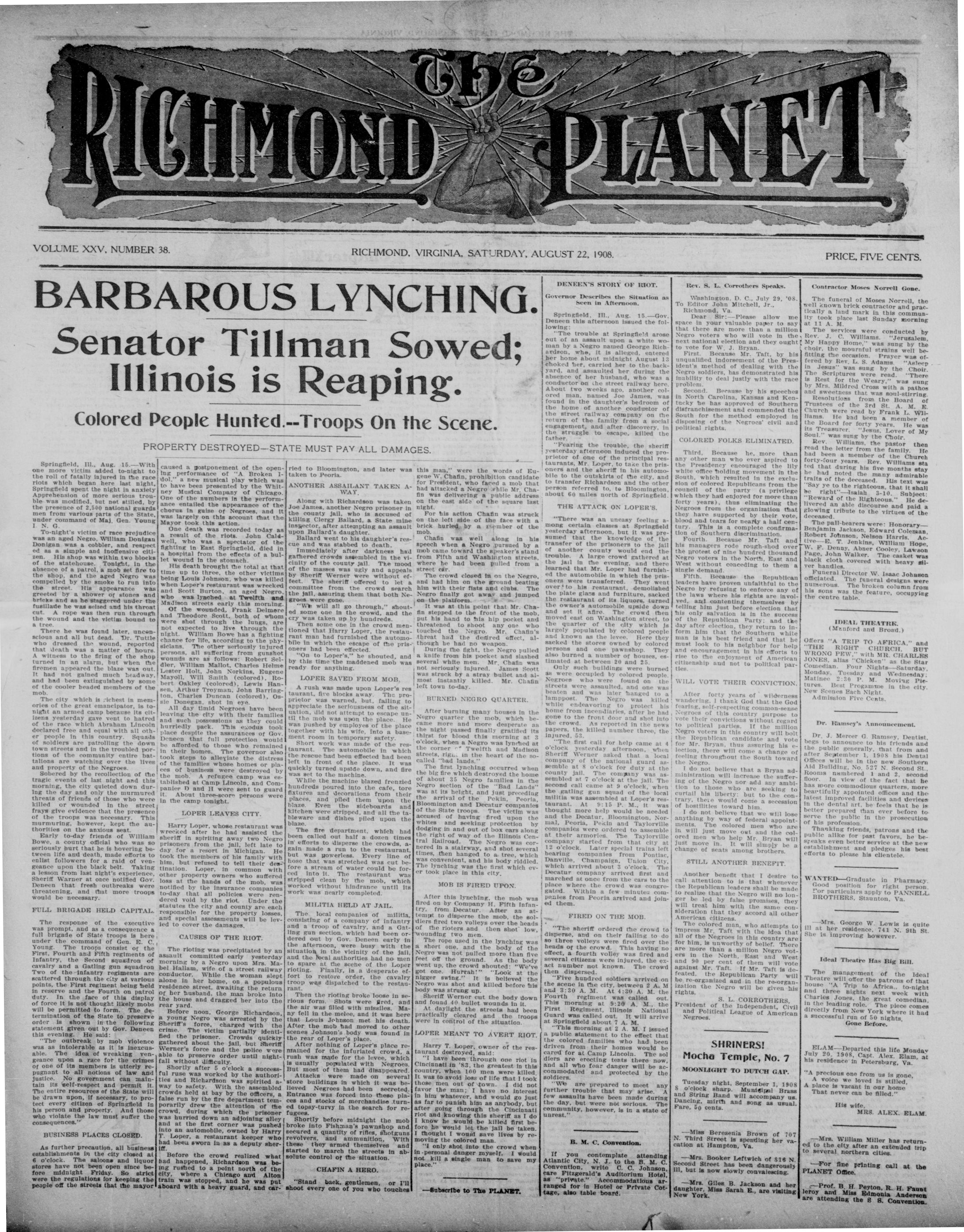
BARBAROUS LYNCHING. Senator Tillman Sowed; Illinois is Reaping.
PROPERTY DESTROYED-STATE MUST PAY ALL DAMAGES
VOLUME XXV, NUMBER 382
BARBA
Senate
Illin
Colored Pe
PROP
Springfield, Ill., Aug. 15.—With one more victim added to night to the roll of fatally injured in the race riots which began here last night. Springfield spent the night in anxiety Apprehension of more serious trouble was modified, but not stilled, by the presence of 2,500 national guards men from various parts of the State, under command of Maj. Gen. Young I. N. G.
To-night's victim of race prejudice was an aged Negro, William Donigan Donigan was a cobbler, and respected as a simple and inoffensive citizen. His shop was within two blocks of the statehouse. Tonight, in the absence of a patrol, a mob set fire to the shop, and the aged Negro was compelled by the smoke to run into the street. His appearance was greeted by a shower of stones and bricks and as he staggered under the fusillade he was seized and his throat cut. A rope was then run through the wound and the victim bound to a tree.
There he was found later, unconscious and all but dead. Dr. Tuttle who dressed the wound, reported that death was a matter of hours. A witness to the firing of the shop turned in an alarm, but when the firemen appeared the blaze was out. It had not gained much headway, and had been extinguished by some of the cooler headed members of the mob.
The city which is richest in memories of the great emancipator, is tonight an armed camp because its citizens yesterday gave vent to hatred of the race which Abraham Lincoln declared free and equal with all other people in this country. Squads of soldiers are patrolling the down town streets and in the troubled portions of the community entire battalions are watching over the lives and property of the Negroes.
Sobered by the recollection of the tragic events of last night and this morning, the city quieted down during the day and only the murmured threats of friends of those who were killed or wounded in the street frays give evidence that the presence of the troops was necessary. This murmuring, however, kept the authorities on the anxious seat.
Early to-day friends of William Bowe, a county official who was so seriously hurt that he is hovering between life and death, made efforts to enlist followers for a raid of vengeance upon the black belt. Taking a lesson from last night's experience, Sheriff Warner at once notified Gov. Deneen that fresh outbreaks were threatening, and that more troops would be necessary.
FULL BRIGADE HELD CAPITAL
The response of the executive was prompt, and as a consequence a full brigade of State troops is here under the command of Gen. E. C. Young. The troops consist of the First, Fourth and Fifth regiments of Infantry, the Second squadron of cavalry and a Gatling gun squadron Two of the infantry regiments are scattered through the city at various points, the First regiment being held in reserve and the Fourth on patrol duty. In the face of this display of force it is not thought likely mobs will be permitted to form. The determination of the State to preserve order is shown in the following statement given out by Gov. Deneen this evening. He said:
"The outbreak by mob violence was as intolerable as it is inexcusable. The idea of wreaking vengeance upon a race for the crimes or one of its members is utterly repugnant to all notions of law and justice. No government can maintain its self-respect and permit it. The entire resources of the State will be drawn upon, if necessary, to protect every citizen of Springfield in his person and property. And those who violate the law must suffer the consequences."
BUSINESS PLACES CLOSED
As further precaution, all business establishments in the city closed at 6 o'clock. The saloons and liquor stores have not been open since before midnight Friday. So strict were the regulations for keeping the people off the streets that the mayor
caused a postponement of the opening performance of "A Broken Idol," a new musical play which was to have been presented by the Whitney Musical Company of Chicago. One of the numbers in the performance entailed the appearance of the chorus in guise of Negroes, and it was largely on this account that the Mayor took this action.
One death was recorded today as a result of the riots, John Caldwell, who was a spectator of the fighting in East Springfield, died in a hospital from the effects of a bullet wound in the stomach.
His death brought the total at that time up to the other victims being Louis Johnson, who was killed when Loper's restaurant was wrecked and Scott Burton, an aged Negro, who was lynched at Twelfth and Madison streets early this morning.
Of the wounded, Frank Delmire and Theodore Scott, both of whom were shot through the lungs, are not expected to live through the night. William Bowe has a fighting chance for life, according to the physicians. The other seriously injured persons, all suffering from gunshot wounds are as follows: Robert Seldler, William Mallot, Charles Helme Lester Holt, John Norkins, Engene Mayoll, Will Smith (colored), Robert Oakley (colored), Lewis Hansen, Arthur Troyman, John Barrington, Charles Duncan (colored), Ossie Donegan, shot in eve.
All day timid Negroes have been leaving the city with their families and such possessions as they could hurriedly pack. This exodus took place despite the assurances of Gov Deneen that full protection would be afforded to those who remained in their homes. The governor also took steps to alleyate the distress of the families whose homes or places of business were destroyed by the mob. A refuge camp was established at Camp Lincoln, and Companies D and H were sent to guard it. About three-score persons were in the camp tonight.
LOPER LEAVES CITY.
Harry Loper, whose restaurant was wrecked after he had assisted the sheriff in spiriting away two Negro prisoners from the jail, left late to day for a resort in Michigan. He took the members of his family with him, but refused to tell their destination. Loper, in common with other property owners who suffered loss at the hands of the mob, was notified by the insurance companies to-day that all policies were rendered void by the riot. Under the statutes the city and county are each responsible for the property losses, and special assessments will be levied to cover the damages.
CAUSES OF THE RIOT.
The rioting was precipitated by an assault committed early yesterday morning by a Negro upon Mrs. Mabel Hallam, wife of a street railway conductor. While the woman slept alone in her home, on a populous residence street, awaiting the return of her husband, the man broke into the house and dragged her into the rear yard.
Before noon, George Richardson, a young Negro was arrested by the Sheriff's force, charged with the crime. The victim partially identified the prisoner. Crowds quickly gathered about the jail, but Sheriff Werner's force and the police were able to preserve order until nightfall without difficulty.
Shortly after 5 o'clock a successful ruse was worked by the authorities and Richardson was spirited away to safety. With the assembled crowds held at bay by the officers, a false run by the fire department temporarily drew the attention of the crowd, during which the prisoner was hurried down an adjoining alley and at the first corner was pushed into an automobile, owned by Harry T. Loper, a restaurant keeper who had been sworn in as a deputy sheriff.
Before the crowd realized what had happened, Richardson was being rushed to a point north of the city, where a Chicago and Alton train was stopped, and he was put aboard with a heavy guard, and car-
RICHMOND, VIRGINIA, SATURDAY, AUGUST 22, 1908
rled to Bloomington, and later was taken to Peoria.
ANOTHER ASSAILANT TAKEN AWAY
Along with Richardson was taken Joe James, another Negro prisoner in the county jail, who is accused of killing Clergy Ballard, a State mine inspector, after attempting an assault upon Ballard's daughter. Ballard went to his daughter's rescue and was stabbed to death. Immediately after darkness had gathered crowds assembled in the vicinity of the county jail. The mood of the masses was ugly and appeals by Sheriff Werner were without effect. The sheriff offered to let a committee from the crowd search the jail, assuring them that both Negroes were gone. "We will all go through," shouted some one in the crowd, and the cry was taken up by hundreds. Then some one in the crowd mentioned that Harry Loper, the restaurant man had furnished the automobile in which the escape of the prisoners had been effected. "On to Loper's," he shouted, and by this time the maddened mob was ready for anything.
LOPER SAVED FROM MOB
A rush was made upon Loper's restaurant, fire blocks away. The proprietor was warned, but, falling to appreciate the seriousness of the situation, did not attempt to escape until the mob was upon the place. He was pushed by employees of the place together with his wife, into a basement room in temporary safety. Short work was made of the restaurant. The automobile in which the rescue had been effected had been left in front of the place. It was quickly turned upside down, and fire was set to the machine. While the machine blazed frenzied hundreds poured into the cafe, tore fixtures and decorations from their places, and piled them upon the blaze. Even the sideboards and kitchen were stripped, and all the tableware and dishes piled upon the blaze. The fire department, which had been called out half a dozen times in efforts to disperse the crowds, again made a run to the restaurant, but was powerless. Every line of hose that was stretched was cut before a stream of water could be forced into it. The restaurant was stripped clean by the mob, which worked without hindrance until its work was nearly completed.
MILITIA HELD AT JAIL
The local companies of militia, consisting of a company of infantry and a troop of cavalry, and a Gatling gun section, which had been ordered out by Gov. Deneen early in the afternoon, were busy with the situation in the vicinity of the fall, and the local authorities had no men to spare at the scene of the Loper rioting. Finally, in a desperate effort to restore order, the cavalry troop was dispatched to the restaurant.
Then the rioting broke loose in serious form. Shots were fired, and the air was filled with missiles. Many fell in the melee, and it was here that Louis Johnson met his death. After the mob had moved to other scenes Johnson's body was found in the rear of Loper's place.
After nothing of Loper's place remained for the infurulated crowd, a rush was made for the levee, which is usually populated with Negroes. But most of them had disappeared.
Attacks were made on several store buildings in which it was believed Negroes had been secreted. Entrance was forced into these places and stocks of merchandise turned toopsy-turvy in the search for refugees.
Shortly before midnight the mob broke into Fishman's pawnshop and secured a quantity of rifles, shotguns revolvers, and ammunition. With these they armed themselves and started to march the streets in absolute control of the situation.
CHAFIN A HERO.
"Stand back, gentlemen, or I'll shoot every one of you who touches
this man," were the words of Eugene W. Chafin, prohibition candidate for President, who faced a mob that had attacked a Negro while Mr. Chafin was delivering a public address on the east side of the square last night.
For his action Chafin was struck on the left side of the face with a brick hurled by a member of the mob.
Chafin was well along in his speech when a Negro pursued by a mob came toward the speaker's stand from Fifth and Washington streets, where he had been pulled from a street car.
The crowd closed in on the Negro, and had him on the ground beating him with their fists and clubs. The Negro finally got away and jumped on the platform.
It was at this point that Mr. Chafin stepped to the front of the mob, put his hand to his hip pocket and threatened to shoot any one who touched the Negro. Mr. Chafin's threat had the desired effect, although he had no weapon.
During the fight, the Negro pulled a knife from his pocket and slashed several white men. Mr. Chafin was not seriously injured. James Scott was struck by a stray bullet and almost instantly killed. Mr. Chafin left town to-day.
BURNED NEGRO QUARTER
After burning many houses in the Negro quarter the mob, which became more and more desperate as the night passed finally gratified its thirst for blood this morning at 3 o'clock, when a Negro was lynched at the corner of Twelfth and Madison streets, right, in the heart of the so-called "bad lands." The first lynching occurred when the big fire which destroyed the home of about 35 Negro families in the Negro section of the "Bad Lands" was at its height, and just preceding the arrival of the Pekin, Peoria, Bloomington and Decatur companies of the State troops. The victim was accused of having fired upon the whites and seeking protection by dodging in and out of box cars along the right of way of the Illinois Central Railroad. The Negro was cornered in a stairway, and shot several times, then hanged to a tree, which was convenient, and his body riddled. The lynching was the first which ever took place in this city.
MOB IS FIRED UPON.
After this lynching, the mob was fired on by Company H, Fifth Infantry, from Decatur. After an attempt to disperse the mob, the soldiers fired two volleys over the heads of the rioters and then shot low, wounding two men.
The rope used in the lynching was a short one, and the body of the Negro was not pulled more than five feet off the ground. As the body went up, the crowd shouted: "We've got one. Hurrah!" "Look at the nigger swing." It is believed the Negro was shot and killed before his body was strung up.
Sheriff Werner cut the body down and found 40 bullet wounds in it.
At daylight the streets had been practically cleared and the troops were in control of the situation.
LOPER MEANT TO AVERT RIOT.
Harry T. Loper, owner of the restaurant destroyed, said:
"I have been through one riot in Cincinnati in '83, the greatest in this country, when 100 men were killed, It was to avoid loss of life that I took those men out of town. I did not favor the man; I have no interest in him whatever, and would go just as far to punish him as anybody, but after going through the Cincinnati riot and knowing this sheriff as I do I know he would be killed first before he would let the jail be taken. I thought I would save lives by removing the colored man.
"I only shot into the crowd when in personal danger myself. I would not kill a single man to save my place."
—Subscribe to The PLANET.
DENEEN'S STORY OF RIOT.
Governor Describes the Situation as Seen in Afternoon.
Springfield, Ill., Aug. 15.—Gov. Deneen this afternoon issued the following:
"The trouble at Springfield arose out of an assault upon a white woman by a Negro named George Richardson, whe, it is alleged, entered her home about midnight August 13 choked her, carried her to the backyard, and assaulted her during the absence of her husband, who was a conductor on the street railway here. About two weeks ago, another colored man, named Joe James, was found in the daughter's bedroom of the home of another conductor of the street railway company on the return of the family from a social engagement, and after discovery, in the struggle to escape, killed the father.
"Fearing the trouble, the sheriff yesterday afternoon induced the proprietor of one of the principal restaurants, Mr. Loper, to take the prisoners and the sheriff in his automobile to the outskirts of the city, and to transfer Richardson and the other person referred to, to Bloomington, about 60 miles north of Springfield.
THE ATTACK ON LOPER'S
"There was an uneasy feeling among certain classes at Springfield yesterday afternoon, but it was presumed that the knowledge of the transfer of the prisoners to the jail of another county would end the trouble. A large crowd gathered at the jail in the evening, and there learned that Mr. Loper had furnished the automobile in which the prisoners were transferred. They went over to his restaurant, demolished the plate glass and furniture, sacked the restaurant of its liquors, turned the owner's automobile upside down and set it afire. The crowd then moved east on Washington street, to the quarter of the city which is largely populated by colored people and known as the levee. Here they sacked the stores owned by colored persons and one pawnshop. They also burned a number of houses, estimated at between 20 and 25. Only such buildings were burned as were occupied by colored people. Negroes who were found on the streets were assaulted, and one was beaten and was later hanged to a lamppost. The Negro was killed while endeavoring to protect his home from incendiaries, after he had gone to the front door and shot into the crowd. As reported in the news papers, the killed number three, the injured, 53.
"The first call for help came at 4 o'clock yesterday afternoon, when Sheriff Werner asked that a local company of the national guard assemble at 8 o'clock for duty at the county jail. The company was assembled at 7 o'clock at the jail. The second call came at 9 o'clock, when the gattling gun squad of the local militia was assembled at Loper's restaurant. At 9:15 P. M., it was more thought help would be needed and the Decatur, Bloomington, Normal, Peoria, Peadin and Taylorville companies were ordered to assemble at their armories. The Taylorville company started from that city at 12 o'clock. Later special trains left bearing companies from Pontiac, Danville, Champaign, Union City, which arrived about 3 o'clock. The Decatur company arrived first and marched at once from the cars to the place where the crowd was congregated. Within a few minutes companies from Peoria arrived and joined them.
FIRED ON THE MOB.
"The sheriff ordered the crowd to disperse, and on their failing to do so three volleys were fired over the heads or the crowd. This having no effect, a fourth volley was fired and several citizens were injured, the exact number not known. The crowd then dispersed.
"Five hundred soldiers arrived on the scene in the city, between 2 A. M and 3:30 A. M. At 4:30 A. M. the Fourth regiment was called out. This morning at 8:30 A. M., the First Regiment, Illinois National Guard was called out. It will arrive at Springfield about 7 A. M.
"This morning at 2 A. M. I issued a public statement to the effect that the colored families who had been driven from their homes would be cared for at Camp Lincoln. The soldiers are erecting tents there now, and all who fear danger will be accommodated and protected by the soldiers.
"We are prepared to meet any further trouble that may arise. A few assaults have been made during the day, but were not serious. The community, however, is in a state of unrest."
B. M. C. Convention
If you contemplate attending Atlantic City, N. J. to the B. M. C. Convention, write C. C. Johnson, care Fitzgerald's Auditorium Hotel, as "private." Accommodations arranged for in Hotel or Private Cottage, also table board.
Rev. S. L. Corrothers Speaks.
Washington, D. C., July 29, '08. To Editor John Mitchell, Jr., Richmond, Va.
Dear Sir;—Please allow me space in your valuable paper to say that there are more than a million Negro voters who will vote in the next national election and they ought to vote for W. J. Bryan.
First. Because Mr. Taft, by his unqualified endorsement of the President's method of dealing with the Negro soldiers, has demonstrated his inability to deal justly with the race problem.
Second. Because by his speeches in North Carolina, Kansas and Kentucky he has approved of Southern disfranchisement and commended the South for the method employed in disposing of the Negrocs' civil and political rights.
COLORED FOLKS ELIMINATED
Third. Because he, more than any other man who ever aspired to the Presidency encouraged the lily white office holding movement in the South, which resulted in the exclusion of colored Republicans from the council of the party (a privilege which they had enjoyed for more than forty years), thus eliminating the Negroes from the organization that they have supported by their vote, blood and tears for nearly a half century. This is a complete confirmation of Southern discrimination. Fourth. Because Mr. Taft and his managers rode rough-shed over the protest of nine hundred thousand Negro voters in the North, East and West without conceding to them a single demand. Fifth. Because the Republican leaders have proven unfaithful to the Negro by refusing to enforce any of the laws where his rights are involved, and contenting themselves by telling him just before election that his only salvation is in the success of the Republican Party; and the day after election, they return to inform him that the Southern white man is his best friend and that he must look to his neighbor for help and encouragement in his efforts to rise to the enjoyment of American citizenship and not to political parties.
WILL VOTE THEIR CONVICTION
After forty years of wilderness wandering, I thank God that the God fearing, self-respecting common-sense Negroes of this country purpose to vote their convictions without regard to political parties. If the million Negro voters in this country will hold the Republican candidate and vote for Mr. Bryan, thus assuring his collection, there will come a change of feeling throughout the South toward the Negro.
I do not believe that a Bryan administration will increase the suffering of the Negro nor add any ambition to those who are seeking to curtail his liberty; but to the contrary, there would come a secession of hostilities toward him.
I do not believe that we will lose anything by way of federal appointments. The colored men who are in will just move out and the colored men who help Mr. Bryan will just move in. It will simply be a change of seats among brothers.
STILL ANOTHER BENEFIT
Another benefit that I desire to call attention to is that whenever the Republican leaders shall be made to realize that the Negro will no longer be led by false promises, they will treat him with the same consideration that they accord all other American citizens. The colored man, who attempts to impress Mr. Taft with the idea that all of the Negroes in this country are for him, is unworthy of belief. There are more than a million Negro voters in the North, East and West and 90 per cent of them will vote against Mr. Taft. If Mr. Taft is defeated, the Republican Party will be re-organized and in the re-organization the Negro will be given his rights.
S. L. CORROTHERS,
President of the Independent, Civil and Political League of American Negroes.
MOONLIGHT TO DUTCH GAP.
Tuesday night, September 1, 1908
8 o'clock sharp. Municipal Brass
and String Band will accompany us.
Dancing, mirth and song as usual.
Fare, 50 cents.
—Miss Beresenia Brown of 707 N. Third Street is spending her vacation at Hampton, Va.
—Mrs. Booker Leftwich of $16 N. Second Street has been dangerously ill, but is now slowly convalescing.
—Mrs. Giles B. Jackson and her daughter, Miss Sarah E., are visiting New York.
PRICE, FIVE CENTS.
Contractor Moses Norrell Gone
The funeral of Moses Norrell, the well known brick contractor and practically a land mark in this community took place last Sunday morning at 11 A. M.
The services were conducted by Rev. J. C. Williams. "Jerusalem, My Happy Home," was sung by the choir, the mournful strains well befitting the occasion. Prayer was offered by Rev. L. S. Adams. "Asleep in Jesus" was sung by the Choir. The Scriptures were read. "There is Rest for the Weary," was sung by Mrs. Mildred Cross with a pathos and sweetness that was soul-stirring. Resolutions from the Board of Trustees of the 3rd St. A. M. E. Church were read by Frank L. Williams. He had been a member of the Board for forty years. He was its Treasurer. "Jesus, Lover of My Soul." was sung by the Choir.
Rev. Williams, the pastor then read the letter from the family. He had been a member of the Church forty-four years. Rev. Williams stated that during his five months stay he had noted the many admirable traits of the deceased. His text was "Say ye to the righteous, that you shall be right"—Isaiah 3-10. Subject: "Reward of the Righteous." He delivered an able discourse and paid a glowing tribute to the virtues of the deceased.
The pall-bearers were: Honorary—Benjamin Jackson, Edward Coleman, Robert Johnson, Nelson Harris, Active—E. T. Jenkins, William Hope, W. F. Denny, Abner Cooley, Lawson Page, John Walker. The casket was black cloth covered with heavy silver vials. Funeral Director W. Isaac Johnson officiated. The funeral designs were numerous. The broken column from his sons was the feature, occupying the centre table.
IDEAL THEATRE.
(Manford and Broad.
Offers "A TRIP TO AFRICA," and
"THE RIGHT CHURCH, BUT
WRONG PEW," with MR. CHARLES
JONES, alias "Chicken" as the Star
Comedian. Four Nights—Saturday,
Monday, Tuesday and Wednesday;
Matinee 2:30 P. M. Mougiet Pictures. Best Progamme in the New Scenes Each Night.
Admission Five Cents.
Dr. Ramsey's Announcement
Dr. J. Mercer G. Ramsey, Dentist, begs to announce to his friends and the public generally, that from and after September 1, 1908 his Dental Offices will be in the new Southern Aid Building, No. 527 N. Second St. Rooms numbered 1 and 2, second floor. In view of the fact that he has more commodious quarters, more beautifully appointed offices and the latest improved facilities and devices in the dental art, he feels that he is better prepared than ever before to serve the public in the prosecution of his profession.
Thinking friends, patrons and the public allike for past favors, he be-speaks even better service at the new establishment and pledges his best efforts to please his clientele.
WANTED—Graduate in Pharmacy.
Good position for right person.
For particulars apply to PANNELL
BROTHERS, Stau顿, Va.
—Mrs. George W. Lewis is quite ill at her residence, 741 N. 9th St. She is improving however.
Ideal Theatre Has Big Bill
The management of the Ideal Theatre will offer the patrons of that house "A Trip to Africa., to-night and three nights next week with Charles Jones, the great comedian, in the leading role. The piece comes directly from New York where it had a successful run of 50 nights. Gone Backers
ELAM—Departed this life Monday
July 20, 1908, Capt. Alex. Elam, at
his residence in Petersburg, Va.
"A precious one from us is gone,
A voice we loved is stillled,
A place is vacant in our home
That never can be filled."
His wife,
MRS. ALEX. ELAM.
—Mrs. William Miller has returned to the city after an extended trip to several northern cities.
—For fine printing call at the PLANET Office.
—Prof. B. H. Peyton, R. H. Fauntleroy and Miss Edmonia Andersen are attending the S. S. Connaught.
THE PORT OF
MISSING MEN
‘Veeee
a
[i225
—o—— «ff seceoranhical know}.
a
tl
“we— of geographical know!
edge as Interpreted in such literature
He could tell you without leaving his
room and probably without openiug
bis trunk the quickest way out of
‘Tokyo or St. Petersburg or Calcutta or
(Cinch Tight, Mont., If you suddeniy re-
celved a cablegram calling you to Vi-
enna or Paris or Washington from one
of those places.
Such being the case, it was remark-
able that he should have started for a
point in the Virginia hills by way of
Boston, theace to Norfolk by coastwise
steamer and on to Lamar by lines of
railroad whose schedules would have
been the despair of unhardened travel
ers. He had expressed his trunks di
rect and traveled with two sult cases
and an umbrella. His journey since his
boat swung out {nto Massachusetts
bay had been spent in gloomy specula
tions. and two young women booked
for Baltimore wrongly attributed his
reticence and aloofness to a grievous
disappointment in love.
* He bad wanted time to think—to pon.
Ger his affaire—to devise some way out
of his ditiicuities and to contrive the
defeat of Chauvenet Moreover, bis
relations to the Clalbornes were in an
‘agly tangle. Chauvenet had dealt him
© telling blow tn a quarter where he
Particularly wished to appear to ad.
vantage
He jumped out of the day coach tn
which he bad accomplished the last
stage of his journey to Lamar just at
dawn and found Oscar, with two
horses, waiting
“Good morning.” said Oscar, salut-
ing.
“You are prompt. sergeant.” And Ar
mitage shook bands with him.
‘As the train roared on through the
valley Armitage opened one of the suit
cases and took oot a pair of leather
leggings, which be strapped on. Then
‘Oscar tied the cases together with a
Tope and hung them across bis saddle
bow.
“The place—what of It? asked Arm.
tage.
“There may be worse. I have not
decided.”
Armitage laughed aloud
“Is it as bed as that?"
‘The man was busy tightening the
eaddle girtbs, and he answered Arm!
tage's further questions with soldier
Uke brevity.
“You have been here"—
Two weeks, sir.”
“And nothing has happened? It Is »
good report.”
“It Is good for the soul to stand on
mountains and look at the world. You
will Ike that antmal—yes? He ts Neht
er than a cavalry horse. Mine, you wi!)
notice, Is a trifle heavier, I bough!
them at a stock farm in another val
ley and rode them up to the place”
‘The train sent back loud echoes. 4
girl In a pink sunbonnet rode up on =
mule and carried off the maf! pouch
‘The station agent was busy tnsite 2:
Bis telegraph instruments and paid n:
‘Reed to the horsemen. Save for a few
Suts clustered on the hillside there
‘were no signs of human habitation in
sight. The lights in a switch target
showed yellow against the growing
dawn.
“I am quite ready, str,” reported Os-
ear, touching his hat. “There ts noth.
ing here but the station. The settle.
‘ment Is farther on our way.”
“Then let us be off,” sald Armitage,
winging into the saddle.
‘Oscar led the way in silence along a
marrow road that clung close to the
base of a great pine covered bill. The
morning was sharp and the horses
steppe! smartiy, the breath of their
i=
pie 29
Mt) a
"AY iT
EY |e
alle
Sa | Le
sh Ks
Oe Re er an me Re Sere! Pre ae ee Coe ter
tng.
nostrils showing white on the air. The
far roar and whistle of the train came
back more and more faintly, and when
it had quite ceased Armitage sighed,
pushed his soft felt bat from his face
and settled himself more Grmly in his
saddle. The keen air was as stimulat:
ing as wine, and he put bis horse to
the gallop aod rode shead to shake up
bis blood.
“It is good,” said the stolid cavairy-
man as Armitage wheeled again into
Une with bim.
“Yes, it is good,” repeated Armitage.
A peace descended upon him that he
bad not known in many days, The
light grew as the sun rose higher, blaz-
img upon them like a brazen target
through deep clefts in the mountains.
‘The morning mists retreated before
‘them to fartber ridges and peaks, and
the beautiful gray-biue of the Virginia
Allis delightei Armitage’s eyes. The
region was very wild. Here and there
from some mountaineer's cabin a light
penciling of smoke stole upward.
‘They once passed a boy driving a
yoke of steers. After several miles the
toad. that had bung midway of the
rough hill, dipped down sharply, and
they came out
into anotherand <>
broader valley, ©
wherethere were
tilled farma and & = Ske
a ltte settle O4 -
: ee See
blacksmith shop wr
and a country ~ \-
store, postoftice
and inn combin- — Len
ot The etre
keeper stood tn
the door smok-
ing a cob pipe “iy
Seeing Oscar, he I
went tnwide and at
broughtoutsome 4 country store, Post
2a
eGay
SSe-aiet)
; ry
a
wP $s
broughtoutsome 4 country store, post
letters andnews- pftce and nn com-
papers, which he
delivered to him in silence.
“This is Lamar postotce,” announce
ed Oscar,
“There must be some mall here for
me,” sald Armitage.
Oscar handed him several long en
velopes—they bore the name of the
Bronx Loan and Trust company, whose
office In New York was bis permaneat
address, and he opened and read a
number of letters and cablegrams that
had been forwarded. Their contents
evidently gave him satisfaction, for te
whistled cheerfully as he thrust then
Into his pocket.
“You Keep in touch with the world
do you, Oscar? It ts commendable.
“i take a Washington paper. It re
Neves the monotony. and I can sce
where the regiments are moving sud
whether my old captain te yet out of
the hospital and what happened to my
Keutenant In his court martial about
the pay accounts. One must observe
the worid—ges. At the postoffice back
there"—he Jerked his head to Indiente
“it Is against the law to sell whisky In
A postoffice, no that storekeeper with
the red nose and small yellow eyes
keeps it in a brown jug in the back
room.”
“To be sure.” laughed Armitage. “1
hope it is a good article.”
“It tn vile" replied Oscar. “tle
brother makes It up in the hills, and
it ts ax strovg as wood lye.”
“Moonshine! Ihave heard of tt. We
ust hays some for rainy days.”
It was a new world to John Armi
tage, aud his heart was as light as the
morning alr as he followed Oscar along
the ruddy mountain road. He was {1
Virginia, and somewhere on this soll.
perhaps to some valley Nke the one
through which he rode, Shirley Clal
borne bad gazed upon blue distances,
with ridge rising against ridge. and
dark pine covered slopes like these he
saw for the first time. He had left bis
affairs In Washington in a sorry mud
dle, but he faced the new day with a
buoyant spirit and did not trouble hiro:
self to look very far ahead. He had a
definite business before him, His ca
blegrams were reassuring on that
point. ‘The fact that he was In a sense
& fugitive did not trouble him in the
loast. He had no intention of allowing
Jules Chanvenet's assassins to kill him
or of being locked up in a Washington
Jail as the false Baron von Kissel. {f
Re admitted that he was not John Ar-
miltage it would be difficult to prove
that be was anybody else—a fact touch
ing human testimony which Jnies
Chauvenet probably knew perfectly
well.
On the whole, he was satisfied that
he had followed the wisest course thus
far. The broad panorama of the morn-
ing hills communicated to his spirit a
gtowtng elation, He began singing in
German a ballad that recited the sor-
rows of a pale maiden prisoner in a
dark tower on the Rhine, whence her
true knight rescued her after many
and fearsome adventures. On the last
stave he ceased abroptly, and an ex-
clamation of wonder broke from him,
They had been riding slong a narrow
trail that afforded, as Oscar said, a
short cut across a long timbered ridge
that lay between them and Armitage's
property. The path was rough and
steep, and the low hanging pine boughs
and heavy underbrush increased the
difficulties of ascent. Straining to the
top, a new valley, hidden until now,
was disclosed to long and beautiful
vistas.
__ Armitage dropped the reins upon the
neck of his panting horse.
“It is @ fine valley—yes?" asked Os-
car.
“It is @ possession worthy of the no-
blest gods!” replied Armitage. “There
is a white buliding with colonnades
away over there. Is it the house of
the reigning deity?”
“It is not, sir,” answered Oscar, who
spoke English with a kind of dogged
Precision, giving equal value to all
words. “It is a vast hotel where the
rich spend much money. That place at
‘the foot of the hills—do you see?—It is
‘there they play a foolish game with
‘Sticks and little balls”—
“Golf? Is It possible!”
“There is no doubt of tt, sir. Ihave
seen the fools myself—men and wom-
en. The place fs called Storm valley.”
Armitage slapped bis thigh sharply,
‘fo that bis horse started.
“Yes; you are probably right, Oscar.
I have heard of the place. And those.
napoes that I Bayon tare fo the: yA
ley belong to gentiemen of taste and
leisure who drink the waters and ride
horses and play the foolish game you
describe with little white balls.”
“¥ conld not tell it hetter.” responded
‘Oscar, who had dismounted, like #
good trooper. to rest bis horse.
“And our place—is it below thers?
THE RICHMOND PLANET, RICHMOND, VIRGINIA.
demanded Armitage.
“Ut Is not, sit. It Heslito the west.
But a man may come here when he ts
lonesome and look at the people and
the gentlemen's honses. At night it ts
‘a pleasure to see the lights, and some-
times, when the wind ts right. there ts
music of bands.”
“Poor Oscar!” laughed Armitage.
His mood had not often in bis life
been so high.
‘On bis flight northward from Wasb-
ington and southwan! down the Atlan-
tie capes, the thought that Shirley Clal-
borne and her family must now bellere
him an fgnoble scoundrel had wrought
misgtvings and pain tn his heart, but
at least he would soon be near her—
even now she might be somewhere be-
low in the lovely vailey, and be drew
off his hat and stared down upoo what
‘was glorified and enchanted ground.
“Let us go.” he said presently.
| Oscar saluted, standing bridie in
hand.
“You will find it easter to walk.” be
said, and, leading thelr horses, they re-
traced thelr steps for several hundred
yards along the ridge, then mounted
and proceeded slowly down again until
they came to a mountain road. Pres-
ently a high wire fence followed at
their right, where the descent was
sharply arrested, and they came to a
barred wooden gate, and beside it a
smalt cabin, evidently designed for a
lodge.
“This ts the place, air,” and Oscar
dismounted and threw open the gute.
| The road within followed the rougt
contour of the hillside that still turned
downward until it broadened into a
wooded plateau. The flatter of wings
tn the underbrush, the scamper of
squirrels, the mad lope of a fox. kept
the eye busy. A deer broke out of s
Wk
(hae wll)
AVN Way
ihe \ |
licate
| Ee)
\KCAR a |
aN 4!
REQ 4
Ve SUSAR
Ge
hazel thicket, stared at the horsemen
in wide eyed amazement, then plunged
into the wood and disappeared.
“There are deer and of foxes a great
plenty,” remarked Oscar.
He turned toward Armitage and add-
ed with lowered voice:
“It ts different from our old bills and
forests—yes? but sometimes 1° have
been homesick.”
“But this ts not so bad. Oscar, and
some day you shall go back?*
“Here,” said the soldier, as they
swung out of the wood and inte the
open, “is what they call the Port of
Missing Men.”
‘There was @ broad park-like area
that tended downward almost imper
ceptibly to a deep defile. They dis-
mounted and walked to the edge and
looked down the steep sides. A little
creck flowed out of the wood and emp-
‘ted Itself with @ silvery rush into the
vale, caught {te breath below and be
came a creck again. A slight suspen-
sion bridge flung across the defile bad
once afforded a short cut to Storm
Springs, but it was now fn disrepair,
end at either end was posted “No
Thoroughfare.” Armitage stepped
upon the loose planking and felt the
frail thing vibrate under his weight.
“It ts a bad place,” remarked Oscar,
as the bridge creaked and swung, and
Armitage laughed and jumped back to
sold ground.
‘The surface of this harbor of the
bills was rough with outcropping rock.
In some great stress of nature the
trees had been destroyed utterly, and
only a scant growth of weeds and wild
flowers remained. The place suggest.
ed a battleground for the winds, where
they might meet and struggle in wild
combat, or, more practicaily, it was
large enough for the evolutions of a
‘squadron of cavalry.
“Why the name?” asked Armitage.
“There were gray soldiers of many
battles — yes—whe fought the long
fight against the blue soldiers tn the
valley of Virginia, and after the war
was over some of them would not sur.
render—no; but they marched here and
Stayed a Jong time and kept their last
flag, and so the place was called the
Port of Missing Men. They built that
stone wall over there beyond the patch
of cedars and camped. And a few died,
Se a eee
are there by the
cedars. Yes;
they had brave
hearts,” and Os-
car lifted his
bat as though
be were saluting
the lost legion.
They turned
again to the road
and went for-
ward et a gal-
lop, until, half a
mile from the
gate, they came
upon a clearing
and a low, red
roofed bunga-
eee
Kt !
eikat
errs |
oA ae.)
Ale
a
They came upon a red
prnalonmae ype
N fe ee
str,” and Oscar swung himself down at
the steps of a broad veranda. He led
the horses away to a barn beyond the
house, while Armitage surveyed the
landscape. The bungalow stood on a
Tough knoll and was so placed as to
afford a splendid view of a wide re
gion. Armitage traversed the long ver-
anda, studying the landscape and de-
lighting In the far stretching pine cov-
ered barricade of bills. He was arous-
ed by Oscar, who appeared carrying
the suit cases.
“There shall be breakfast,” said the
man.
He threw open the doors, and they
entered a wide, bare hall, with « fire
place, into which Oscar dropped a
eee ee ee, ae ae a
lished.”
“This is yours, The baggage that
came by express ts there. A wagon
goes with the place, ané I brought the
things up yesterday. ‘There ts a show-
er bath beyond the rear veranda. ‘The
mountain water ts off the ice, but—
Fou will require hot water for shaving
ts {t not so?"
“You oppress me with luxuries, Os
car. Wind up the clock, and nothing
will be wanting."
Oscar unstraped the trunks and then
stood at attention in the door. He had
expected Armitage to condemn the
place in bitter language, but the pro-
prietor of the abandoued hunting pre-
serve was in excellent spirits and
Tihistied bitthely as he drew out his
keys.
“The place was bullt by fools,” de
elared Oscar gloomily.
“Undoubtedly! ‘There is a saying
that fools build houses and wise men
live In them, You see where that
leaves us, Oscar. Let us be cheerful!” |
He tried the shower and changed bis
raiment, while Oscar prepared coffee
and Inid a cloth on the long table be
fore the fire. When Armitage appeared
coffee steamed fn the tin pot in which
ft had been made. Bacon, eggs and
toast were further offered. |
“You bave done excellently well, Os
car. Go get your own breakfast.” Ar.
mitage dropped a lump of sugar into
his coffee cup and surveyed the room. |
A large map of Virginia and a series
of houting prints bung on the wntinted
walls, and there were racks for guns
and & work bench at one end of the
room where guns might be taken apart
and cleaned. A few novels, several
three-year-old magazines and a variety
of pipes remained on the shelf above
the fireplace. The house offered possi
Diltties of meager comfort, and that
was about all. Armitage remembered
what the agent through whom he had
made the purchase had sald—that the
place had proved too isolated for even
8 bunting preserve and that ite only
Yalue was in the timber. He was satis:
‘fled with his bargain and would not
‘set up a lumber mill yet awhile. He
‘Mgbted a cigar and settled himself in
fn easy chair before the fire, glad of
the luxury of peace and quiet after bis
cireultous journey and the tumult of
oubt and question that bad shaken
Bim.
He silt the wrapper of the Washing.
ton newspaper that Oscar had brought
from the mountain postoftice and scan
bed the beadlines. He read with care
& dispateh from London that purported
to reflect the sentiment of the contt
nental capitals toward Charles Louis.
the new emperor-king of Austria-Hun-
gary, and the paper dropped upon his
Knees, and be stared Into the fire. Then
be picked up a paper of earlier date
and read all the foreign dispatches and
he ews of Washington. He war
about to tows the paper aside when bis
eyes fell upon a boldly headlined arti
cle that cause bis heart to throb flere
ty. It recited the sudden reappear-
ance of the fraudulent Raron von Kis
sel in Washington and described ir ¢>
tall the baron’s escapades at Bar Har-
bor and his Ieter career in California
and elsewhere. Then followed a story,
Yelled In careful phrases, but based, 90
the article recited, upon information
furnished by a gentleman of extensive
acquaintance on both sides of the At-
lane, that Baron yoo Kissel, onder a
ew pseudonym and with even more
daring effroutery, bad within a fort-
night sought to Intrench bimaelf tn the
most exclusive circles of Washington.
Armitage’s cigar allpped from his fin-
gers and fell upon the brick hearth as
he rend:
“The boldness of this clever adven-
turer ts naid to have reached a climax
tm this city within « few days. He
had, under the name of Armitage,
palmed himself off upon members of
one of the most distinguished familes
of the capital, whom be had met
abrond during the winter. A young
gentleman of this family, who, it will
soifice to say, beara a commission and
Utle from the American government,
entertained a small company of friends
at a Wasbington club only a few
nights ago, and this plausible adven-
turer was among the guests. He was
recognized at once by one of the for-
elgners present, who, out of considera-
tion for the host and fellow guests,
held his tongue, bot it is understood
that this gentleman sought Armitage
privately and warned him to leave
Washington, which accounts for the
fact that the sumptuous apartments at
the New American In which Mr. John
Armitage, allas Baron von Kissel, had
established himself were vacated tm-
mediately. None of those present at
the supper will talk of the matter, but
it has been the subject of lively gossip
for several days, and the German em-
bassy i said to have laid before the
Washington police all the information
in ftx arehives relating to the American
adventures of this impudent scoun-
Armitage rose, dropped the paper
into the fire, and, with bis elbow rest
{ng on the mantel shelf, watched it
burn. He laughed suddenly and faced
about, his back to the flames. Oscar
stood at atten- 1
stood at atten
tion in the mid-
dle of the room.
“Shall we un-
pack—yes?"
“it is a capt
tal idea.” said
Joho Armitage.
“I was striker
for my captain
also, who bad
fourteen pairs of
boots and a bad
disposition—and
bis uniforms—
yes? He was
very pretty to
look at on a
horse.”
ee ee eee
tion in the mid:
die of the room
“cal a
pack—yes?” OL
“It fea capk i
tat den” can
Jobo Armitage. Us @
A was stricer CA
for my captain i
also, who bad \')
fourtenn poles ot SO ANN
boots and a bad ie
disposition—and ©
bis uniform POON
yes? He was \ a
very pretty to 5
look at oo 8
horse.” Armitage dropped the
“The ideal is payer into the fre
high, Oscar, but I shall do my best
‘That one frst, please.”
‘The contents of the two trunks were
disposed of deftly by Oscar as Arml-
tage directed. One of the bedrooms
‘was utilized as a closet, and garments
for every imaginable occasion were
brought forth. There were stout Eng-
lish tweeds for the heaviest Weather,
two dress suits and Norfolk Jackets In
corduroy. The owner's taste rap to
grays and browns, it seemed, and he
whimstcally ordered his raiment group-
ed by colors as he lounged about with
® pipe ta bis mouth.
“You may bang those scarfs oo the
string provided by my predecessor,
sergeant They will help our color
scheme. That pale bive doesn’t blend
well in our rainbow—put it In your
pocket and wear it, with my compli.
ments: and those tan shoes are not
bad for the Virginia mud. Drop them
bere. Those gray campaign hats are
coantoceabin “tive fas Soest ta Oo
And there is a riding cloak 1 bad for-
guia) are coo aad on lee we
ee ee Gee eee
down to Storm Springs?”
“A forced march, and you are there
& {
{Chapter xi’,
wee
he Uy the mantel; a portfolio
he and traveler's writing
wiaterinis distributed about a table pro
duced for tue purpose, and additions
to the meager bookshelf —a line of
Bacdekers, & pocket atlas, a compre
hensive American railway gulde, sev
eral volumes of German and French
poetry—and the place was not so bad
Arwitage slept for an bour after »
simple Iuncheon bad been prepared by
Oscar, studied bis letters and cable
grums—made, in fact, some notes in
regard to them and wrote replies
‘Then at 4 o'clock he told Oscar to sad
le the hortes
“It is spring, and to April « man’s
blood will not be quiet We sball go
forth and taste the air.”
He had studied the map of Lamar
county with care and led the way out
of bis own preserve by the road over
which they bad entered in the morn
ing. Oscar and bis horses were a
credit to the training of the American
army and would bave passed inspec:
tion anywhere, Armitage watched his
adjutant with approval ‘The map
served without question, and, quicker
of wit than of speech, his buf gaum
tleted hand went to bis hat brim when
ever Armitoge addressed bim
‘They songht again the spot whence
Armitage bud Sret looked down upon
Storm valley. and he opened his pocket
map. the better to clarity his ideas of
the region.
“We shall go down into the valley,
Oscar,” be said, and thereafter it was
he that led.
They struck presently into an old
road that had beeu an early highway
Across the mouatains. Abore and be
low the forest hung gloomlly, and pass.
tug clouds darkened the slopes and oc-
casionally spilled rain. Armitage drew
on bis cloak, and Oscar enveloped him:
self in a silcker ax they rode through
a sharp shower. At a lower level they
came into fair weather again and,
crossing a bridge, rode down {nto
Storm valley. ‘The road at once bore
marks of care, and they passed a num
ber of traps that spoke unmistakably of
cities and riders whose mounts knew
well the bridle paths of Central park.
The hotel loomed massively before
them and beyond were bandsome es:
tates and ambitious mansions scat
tered through the valley and on the
lower slopes:
Artnitage paused in a clump of trees
and dismounted.
“You will stay here until I come
back. And remember that we don't
know any one, and at our time of life,
Oscar, one should be wary of making
new acquaintances.”
He tossed his cloak over the saddle
and walked toward the inn. The size
of the place and the great number of
people golng and coming surprised
him, but In the numbers be saw bis
own security, and he walked boldly up
the steps of the main hotel entrance.
He stepped into the long corridor of
the inn, where many people lounged
about, and heard with keen sutistactir
and relief the click of a telegraph in.
strument that seemed at once to bring
him nto contact with the remote
world. He filed his telegrams and
walked the length of the broad hall,
his riding crop under his arm. The
gay banter and laughter of a group of
young men and women just returned
from a drive gave bim a touch of heart
ache, for there was a girl somewhere
io the valley whom he had followed
across the sea, and these people were
of ber own world—they undoubtedly
knew her; very likely she came often
to this huge caravansary and mingled
with them.
At the entrance he passed Baron vou
Marhof, the Austrian ambassador,
who, by reason of the death of his roy:
al chief, had taken a cottage at the
Springs to emphasize his abstention
from the life of the capital. The am-
bassador lifted his eyes and bowed te
Armitage, as be bowed to «@ great
many young men whose names he
uever remembered; but, oddly enough,
the baron paused, stared after Armi
tage for a moment, then shook his
head snd walked on with kait brows.
Armitage had lifted his hat and passed
out, tapping bis leg with bis crop.
He walked toward the private houses
that lay scattered over the valley and
along the gradual slope of the hills as
though carelessly dung from « dice
box. Many of the places were hand
some estates, with Imposing houses set
amid beautiful gardens. Half « mite
from the hotel he stopped a passing
negro to ask who owned a large house
that stood well back from the road.
‘The man answered. He seemed anr
fous to tmpart furtber information.
and Armitage avalied bimseif of tbe
opportunity.
“How wear ts Judge Clatborne’s
Place?” he asked.
‘The man pointed. It was the vex
bouse on the righthand side, and ar
mitage smiled to himself and strolled
oo
He looked down tn = moment vpon
& pretty estate, distinguished by Its
format garden. but with the broad
acres of » practical farm stretch:
ing far out foto the vailey. The lawn
terraces were green, broken only bs
plots of spring flowers The walks
were walled in box «pd privet. ‘The
bouse, of the pillared colonial type
crowned a series of terraces A long
Pergola, with pillars topped by red
urns, curved gradually through the
garden toward the mansion Arwitage
followed a side road along the brick
partition wall and contemplated the
Spner iandscape. The sharp snap of s
gardener’s shears far up the slope was
the only sound that reached bim. It
was » charming piace, and be yielded
( ¥ ie ae
he —_,
on aoe
x 03D)
aT
ie 2B
e Le ee
Be dropped over the walt and strotiea
away
tos temptation to explore !t_ He drop.
ped over the wall and strolled away
through the garden, the smel! of warm
earth, moist from the day's light show
ers, and the faint odor of green things
growing, sweet In his nostrils, He
walked to the far end of the pergola.
sat down on 2 wooden bench and gave
himself up to reverie. He bad been de
nounced as an impostor. He was on
Claiborne soll, and the situation re
quired thought.
It was while be thus pondered his
affairs that Shirley, walking over the
soft lawn from a neighboring estate
came suddenly upon bln.
Her head went op with surprise and
—be was sure—with disdain. Sbe stop-
ped abruptly as he Jumped to his feet.
“I am caught—In flagrante delicto!
1 can only plead guilty and pray for
mercy.”
They sald—they said you bad gone
Yo Mexico?" sald Shirley question-
ingly.
“Plague take the aewspapers! How
dare they so misrepresent me!” be
taughed.
“Yes; I read those newspaper articles
with « good deal of interest. And my
orother"—
| “Yes; your brotber—he is the best
fellow in the world!” ;
Sbe mused, but « smile of rea! mirth
wow played over her face and inghted
her eyes.
“Those are generous words, Mr. Ar
aitage. My brother warned me against
you Ip quite unequlvocal Innguage. He
told me about your matchbox"—
| “Ob, the cigarette case!” and be beld
' Op “Es really mine, and f'm going
i | a4
IN, WH! 1 t/
| ah Sufh
se es eee
OES
to keep It It was very damaging evi
dence. It would argue strongly against
me in any court of law.”
“Yes; I believe that is true.” And
she looked at the trinket with frank
interest.
“But I particularly do not wish to
have to meet that charge In any court
of law, Miss Claiborne.”
Shé met his gaze very steadily, and
her eyes were grave. Then she asked
in much the same tone that she would
have used if they bad been very old
friends and be had excused bimself
for not riding that day or for not going
upon a hunt or to the theater:
“Why?
“Because I bave a pledge to keep
and a work to do, and if I were forced
to defend myself from the charge of
being the false Baron von Kissel every:
thing would be spoiled. You see, un-
fortunately—most unfortunately—I am
not quite without responsibilities, and
I have come down into the mountalas,
where I hope not to be shot and tossed
over a precipice until I bave had time
to watch certain people and certaio
events for a little while. I tried to
say as much to Captain Clatborne, but
1 saw that my story did not impress
him. And now I bave said the same
thing to you"—
He waited. gravely watching her, bat
(p band.
“And I bave stood here and listened
to you and done exactly what Captain
Claiborne would not wish me to do un
der any circumstances,” said Shirley.
“You are infinitely kind and gener
ous"
“No I do not wis you to think me
either of those things—of course not”
Her conclusion was abrupt and point
oa.
“Then” —
“Then 1 will tell you—what 1 pave
not told any one else—that I know
‘very well that you are not the persoo
who appeared at Bar Harbor three
‘xears age and palmed himself off a»
‘am sure you are not the same person.”
Her direct mapner of speech, ber de-
disive tone, In which sbe placed the
watter of bis identity on a purely prac
tical and unsentimental plane. gave
bim @ new impression of ber character
“But Captain Clatborne”—
He ceased suddenly. and she antiel-
pated the question at which be bad
faltered and answered, a little felis:
“1 do not consider it any of my bust
ness to meddle fn your affairs with my
brother. He undoubtedly believes you
are the Impostor who palmed himselt
of at Bar Harbor as the Barow vou
Kissel He was told so”—
“By M Chauvenet.”
“So he said.”
“And of course he Is a capital wit-
ness. There is no doubt of Chauve
net's entire credibility.” deciared Arm!-
tage, a little airily.
“I should sey not,” said Shirley un-
responsively. “I am quite as sure that
he was not the false baron as 1 am
that you were not.”
Armitage laughed
“Phat Is a litle pointed.”
“It was meant to be,” said Shirley
sternly. “It is"—she weighed the word
"ridiculous that both of sou should
be bere.”
“Thank you for my half! 1 didn't
know he was here! But I am not
exactly here—I have a much safer
place.” He swept the bive billed hor!-
zon with bis hand “M. Chauvenet
and I will not shoot at each other in
the hotel dining room. But Lam really
relieved that he has come. We have
an interesting fashion of running into
aach other. It would positively grieve
me to be obliged to wait long for bim."*
He smiled and thrust bis bat onder
bis arm. The sun was dropping behind
the great western barricade. and a chi!l
wind crept sharply over the valley
He started to walk beside ber as she
turned away, but she paused abruptly.
“Oh, this won't do at all! I can't be
seen with you, even in the shadow of
my own house. I must trouble you to
take the side gate,” and she indicated
it by a nod of her head.
“Not if | know myself! I am not a
fraudulent member of the German no-
bility—you have told me so yourself.
Your consctence is clear. I assure you
mine {s equally so! And T am not a
person, Miss Claiborne, to sneak out by
side gates, particularly when 1 came
over the fence! It's u long way around
anyhow, and I have « horse over there
somewhere by the inn.”
“My brother’—
“Is at Fort Myer, of course. At about
this bour they are baving dress parade,
‘and he ts thoroughly occupied.”
“But—there is M. Chauvenet. He
bis nothing to do but amuse himself.”
‘They bad reached the veranda steps.
and she ran to the top and turned for
& moment to look at him. He still car-
Hed bis hat and crop in one hand and
bad dropped the other into the side
pocket of bis coat. He was wholly at
ease, and the wind rufiied his hair and
gave him a boyish look that Sbirley
liked. But she bad no wish to be
found with him, and sbe instantly nod-
ded his dismissal and half turned away
to go Into the house, when he detained
her for a moment.
“I am perfectly wilting to afford M.
Chauvenet all imaginable entertain.
ment. We are bound to have many
meetings. Tam afrald he reached this
charming valley before me; but, as a
rule, I prefer to be a little ahead of
dim. It's a whim, the merest whim.
Lussure you."
He laughed, thinking little of what
be said. but delighting tm the picture
she made, the tall ptllars of the veran.
da framing her against the white wall
of the house and the architrave bigh
above speaking, so he thought, for the
amplitude, the breadth of her nature.
Her gree cloth gown afforded the
happtest possible contrast with the
white background, and her hat—for »
gown, let us remember, may express
the dressmaker, but a hat expresses
the woman who wears tt—her hat, Ar-
mitage was aware, was a trife of
Diack velvet caught up at one side
with snowy plumes.
Her annoyance at Anding herself
Ungering to listen to him was marked
in an almost fmperceptible gathering
of her brows, It was all the matter of
an instant His heart beat fast In his
Joy at the sight of her, and the tongue
that years of practice bad skilled In
Feserve and evasion was possessed by
& reckless spirit.
She nodded carelessly, but sald noth-
tng, waiting for bim to go on.
“But when 1 walt for people they
always come—even in a strange per-
goin,” be added daringly. “Now, ip
Geneva, not long ago"—
He lost the profile and gained her
face, as he Hked it best, though her
bead was lifted a little high tn resent-
ment against her own yielding curiosi-
ty. He was speaking rapidly, and the
alight bint of some other tongue than
his usually fuent English arrested ber
ear now, as ft had at other times,
“In Geneva, when I told a young
indy that 1 was waiting for « very
oie a fl yy
ee a7
| Be
ef f i
fe = \
ee le
\ Ne wes Z.
\
She watantly modded nes durmeanat
wicked mao to appear—it was really
the oddest thing in the world that a!-
most immediately M. Jules Chauvevet
THE PULLET
arrived at mine own inn! It is inevitable; it is always sure to be my fate. he concluded mournfully.
He bowed low, restored the shabby hat to his head with the least bit of a flourish and strolled away through the garden by a broad walk that led to the front gate.
He would have been interested to know that when he was out of sight Shirley walked to the veranda rail and bent forward, listening to his steps on the gravel, after the hedge and shrubbery had hidden him. And she stood thus until the faint click of the gate told her that he had gone.
She did not know that as the gate closed upon him he met Chauvenel face to face
AN ENFORCED INTERVIEW.
ONSIBUR CHAUVE
NETT
M
Armitage uncovered smilingly. Chauvenet stared mutely as Armitage paused with his back to the Clalborne gate. Chauvenet was dressed with his usual care and wore the latest carnation in the lape of his top coat. He struck the ground with his stick, his look of astonishment passed, and he smiled pleasantly as he returned Armitage's salutation.
"My dear Armitage! he murmured "I didn't go to Mexico, after all, my good Chauvenet. The place is full of fevers. I couldn't take the risk."
"He is indeed a wise man who safeguards his health," replied the other.
"You are quite right. And when one has had many narrow escapes one may be excused for exercising rather particular care. Do you not find it so?" mocked Armitage.
"My dear fellow, my life is one long fight against ennui. Danger, excitement, the hazard of my precious life—such pleasures of late have been deuled me."
"But you are young and of intrepid spirit, monsieur. It would be quite surprising if some perilous adventure did not overtake you before the silver geys in your hair."
"Ah! I assure you the speculation interests me, but I must trouble you to let me pass," continued Chauvenet in the same tone. "I shall quite forget that I set out to make a call if I linger longer in your charming society."
"But I must ask you to delay your call for the present. I shall greatly value your company down the road a little way. It is a trifling favor, and you are a man of delightful courtesy." Chauvenet twisted his mustache reflectively. His mind had been busy seeking means of turning the meeting to his own advantage. He had met Armitage at quite the least imaginable spot in the world for an encounter between them, and he was not a man who enjoyed surprises. He had taken care that the exposure of Armitage at Washington should be telegraphed to every part of the country and put upon the cables. He had expected Armitage to leave Washington, but he had no idea that he would turn up at a fashionable resort greatly affected by Washingtonians and only a comparatively short distance from the capital. He was at a great disadvantage in not knowing Armitage's plans and strategy. His own mind was curiously cunning, and his reasoning powers traversed oblique lines. He was thus prone to impute similar mental processes to other people. Simplicity and directness he did not understand at all. He had underrated Armitage's courage and daring; he wished to make no further mistakes, and he walked back toward the hotel with apparent good grace. Armitage spoke now in a very different key, and the change displeased Chauvenet, for he much affected ironical railery, and his companion's sterner tones disconcerted him.
"I take this opportunity to give you a solemn warning, M. Jules Chauventel, alias Rambaud, and thereby render you a greater service than you know. You have undertaken a deep and dangerous game. It is spectacular, it is picturesque, it is immense! It is so stupendous that the taking of a few lives seems trifling in comparison with the end to be obtained. Now look about you for a moment, M. Jules Chauventel! In this mountain air a man may grow very sane and see matters very clearly. London, Paris, Berlin, Vienna—they are a long way off, and the things they stand for lose their splendor when a man sits among these American mountains and reflects upon the pettiness and sorridness of man's common ambitions."
"Is this exordium or peroration, my dear fellow?"
"It is both," repiled Armitage succinctly, and Chauvenet was sorry he had spoken, for Armitage stopped short in a lonely stretch of the highway and continued in a disagreeable, incisive tone:
"I ran away from Washington after you told that story at Clatborne's supper table, not because I was afraid of your accusation, but because I wanted to watch your plans a little in security. The only man who could have helped me immediately was Senator Sanderson, and I knew that he was in Montana."
Chauvenet smiled with a return of assurance.
"Of course. The hour was chosen well."
"More wisely, in fact, than your choice of that big assassin of yours. He's a clumsy fellow, with more brawn than brains. I had no trouble in shak-
ing him off in Boston, where you probably advised him I should be taking the Montreal express."
Chauvenet blinked. This was precisely what he had told Zmai to expect. He shifted from one foot to another and wondered just how he was to escape from Armitage. He had gone to Storm Springs to be near Shirley Glalborne, and he deeply resented having business thrust upon him.
"He is a wise man who wields the knife himself, M. Chauvenet. In the taking of poor Count von Streebel's life so deftly and secretly you prove my philosophy. It was a clever job, monster!"
Chauvenet's gloved fingers caught at his mustache.
"That is almost insulting. M. Armitage. A distinguished statesman is killed, therefore I must have murdered him. You forget that there's a difference between us. You are an unknown adventurer carried on the books of the police as a fugitive from Justice, and I can walk to the hotel and get twenty reputable men to vouch for me. I advise you to be careful not to mention my name in connection with Count von Stroeebel's death."
He had begun jauntily, but closed in heat, and when he finished Armitage nodded to signify that he understood perfectly.
"A few more deaths, and you would be in a position to command tribute from a high quarter, monsieur."
"Your mind seems to turn upon assassination. If you know so much about Strobeel's death it's unfortunate that you left Europe at a time when you might have rendered important aid in finding the murderer. It's a bit suspicious, M. Armitage! It is known at the Hotel Monte Rosa in Geneva that you were the last person to enjoy an interview with the venerable statesman. You see I am not dull, M. Armitage!"
"You are not dull, Chauvenet. You are only shortsighted. The same witnesses know that John Armitage was at the Hotel Monte Rosa for twenty-four hours following the count's departure. Meanwhile where were you, Jules Chauvenet?"
Chauvenet's hand again went to his face, which whitened, though he sought refuge again in flinppant irony.
"To be sure! Where was I, monsieur? Undoubtedly you know all my movements, so that it is unnecessary for me to have any opinions in the matter."
"Quite so! Your opinions are not of great value to me, for I employed agents to trace every move you made during the month in which Count von Stroebel was stabbed to death in his railway carriage. It is so interesting that I have committed the record to memory. If the story would interest you"—
The hand that again sought the slight mustache trembled slightly, but Chauvenet smiled.
"You should write the memoirs of your very interesting career, my dear fellow. I cannot listen to your babble longer."
"I do not intend that you shall, but your whereabouts on Monday night, March 18, of this year may need explanation, M. Chauvenet."
"If it should, I shall call upon you, my dear fellow!"
"Save yourself the trouble! The bureau I employed to investigate the matter could assist you much better. All I could offer would be copies of its very thorough reports. The number of cups of coffee your friend Durand drank for breakfast this morning at his lodgings in Vienna will reach me in due course!"
"You are really a devil of a fellow, John Armitage! So much knowledge!"
Armitage pointed down the road with his riding crop.
So acute an intellect! You are too wise to throw away your life futilely."
"You have been most generous in sparing it thus far!" laughed Armitage, and Chauvenet took instant advantage of his change of humor.
"Perhaps—perhaps—I have pledged my faith in the wrong quarter, monsieur. If I may say it, we are both fairly clever men; together we could achieve much!"
"So you would sell out, would you?" laughed Armitage. "You miserable little blackguard, I should like to join forces with you! Your knack of getting the polish into the right cup every time would be a valuable asset! But we are not made for each other in this world. In the next—who knows?"
"As you will! I dare say you would be an exacting partner."
"All of that, Chauvenet! You do best to stick to your present employer. He needs you and the like of you. I don't! But remember—if there's a sudden death in Vienna in a certain high quarter you will not live to reap the benefits. Charles Louis rules Austria-Hungary. His cousin, your friend Francis, is not of kingly proportions. I advise you to cable the amable Durand of a dissolution of partnership. It is now too late for you to call at Judge Clalborne's, and I shall trouble you to walk on down the road for ten minutes. If you look round or follow me, I shall certainly turn you into something less attractive than a pillar of salt. You do well to consult your watch. Forward!"
Armitage pointed down the road with his riding crop. As Chauvenet walked slowly away, swinging his stick, Armitage turned toward the hotel. The shadow of night was infolding the hills, and it was quite dark when he found Oscar and the horses.
THE RICHMOND PLANET, RICHMOND, VIRGINIA.
He mounted, and they rode through the deepening April dusk, up the winding trail that led out of Storm valley.
Chapter XV
SHIRLEY LEARNS A SECRET
HIRLEY CLAIBORNE was dressed for a ride, and while waiting for her horse she reread her brother's letter, and the postscript which follows she read twice:
HIRLEY CLAIBORNE was dressed for a ride, and while waiting for her horse she reread her brother's letter, and the postscript which follows she read twice:
I shall never live down my acquaintance with the detectable Armitage. My brother officers insist on rubbing it in. I even hear, ma cherie, that you have gone into retreat by reason of the exposure. I'll admit for your consolation that he really took him in and further, really wonder who the devil he or she was to interview at the club after Chauvenet told his story lingers with me disagreeably. I was naturally pretty hot to find him playing the darkly mysterious, which never took him better eating my bird and drinking my bottle. I have looked up Chauvenet to the best of my ability. At the Austro-Hungarian embassy they speak well of him. He's over here to collect the price of a few cruisers of some auction rubbish from one chair after capricious shows the gulf. But bad luck to all foreigners! Me for America every time!
"Dear old Dick!" And she dropped the letter into a drawer and went out into the sunshine, mounted her horse and turned to ward the hills.
S
She had spent the intermediate seasons of the year at Storm Springs ever since she could remember and had climbed the surrounding hills and dipped into the valleys with a boy's zest and freedom. The Virginia mountains were linked in her mind to the dreams of her youth, to her earliest hopes and aspirations
Shirley Claiborne was dressed for a ride.
Shirley Claiborne was dressed for a ride. she her earliest hopes and aspirations and to the books she had read, and she galloped happily out of the valley to the tune of an old ballad. She rode as a woman should, astride her horse and not madly clinging to it in the preposterous ancient fashion. She had known horses from early years, in which she had tumbled from her pony's back in the stable yard, and she knew how to train a horse to a gait and how to master a beast's fear, and even some of the tricks of the troopers in the Fort Myer drill she had surreptitiously practiced in the meadow back of the Claiborne stable. It was on Tuesday that John Armitage had appeared before her in the pergola. It was now Thursday afternoon, and Chauvenet had been to see her twice since, and she had met him the night before at a dance at one of the cottages.
Once free of the settlement she rode far and fast until she was quite beyond the usual routes of the Springs excursionists; then in mountain byways she enjoyed the luxury of leisure and dismounted now and then to delight in the green of the laurel and question the rhododendrons.
Jules Chauvenet had scoured the hills all day and explored many mountain paths and inquired cautiously of the natives. The telegraph operator at the Storm Springs inn was a woman, and the dispatch and receipt by Jules Chauvenet of long messages, many of them in cipher, plied her curiosity. No member of the Washington diplomatic circle who came to the Springs, not even the shrewd and secretive Russian ambassador, received longer or more cryptic cables. With the social diversions of the Springs and the necessity for making a show of having some legitimate business in America, Jules Chauvenet was pretty well occupied, and now the presence of John Armitage in Virgilha added to his burdens. He was tired and perplexed, and it was with unaffected pleasure that he rode out of an obscure hill path into a bit of open wood overhanging a curious defile and came upon Shirley Clalborne.
The soil was soft, and his horse carried him quite near before she heard him. A broad sheet of water flashed down the farther side of the narrow pass, sending up a pretty spurt of spray wherever it struck the jutting rock. As Shirley turned toward him he urged his horse over the springy turf.
"A pity to disturb the picture, Miss Claiborne! A thousand pardons! But I really wished to see whether the figure could come out of the canvas. Now that I have dared to make the test, pray do not send me away."
Her horse turned restlessly and brought her face to face with Chauvenet.
"Steady, Fanny! Don't come near her, please!"— this last to Chauvenet, who had leaped down and put out his hand to her horse's bridle. She had the true horsewoman's pride in caring for herself, and her eyes flashed angely for a moment at Chauvenet's proffered aid. A man might open a door for her or pick up her handkerchief, but to touch her horse was an altogether different business. The pretty, graceful mare was calm in a moment and arched her neck contentedly under the stroke of Shirley's hand.
"Beautiful! The picture is even more perfect, mademoiselle!"
She was thinking of the long ride which she had no intention of taking in Chauvenet's company. He stood uncovered beside her, holding his horse.
"But the danger, mademoiselle! You should not hazard your life with a runaway horse on these roads. It is not fair to your friends."
"You are a conservative, monsleur. I should be ashamed to have a runaway in a city park, but what does one come to the country for?"
"What, indeed, but for excitement? You are not of those tame young women across the sea who come out into the world from a convent, frightened at all they see and whisper Yes, sis-
ter,' 'No, sister,' to everything they hear.
"Yes; we Americans are deficient in shyness and humility. I have often heard it remarked, M. Chauvenet."
"No, no! You misunderstand! Those deficiencies, as you term them, are delightful. They are what give the charm to the American woman. I hope you would not believe me capable of speaking in disagreement,ademolosse. You must know"—
The water tumbled down the rock into the vale; the soft air was sweet with the scent of pines. An eagle cruised high against the blue overhead. Shirley's hand tightened on the rein, and Fanny lifted her head expectantly.
Chauvenet went on rapidly in French: "You must know why I am here—why I have crossed the sea to seek you in your own home. I have loved
you, mademoiselle, from the moment a first saw you in Florence. Here, with only the mountains, the sky, the wood, I must speak. You must hear, you must believe, that I love you! I offer you my life, my poor attainments."
"Monsieur, you do me a great honor, but I cannot listen. What you ask is impossible, quite impossible. But. monsieur"—
Her eyes had fallen upon a thicket behind him where something had stirred. She thought at first that it was an animal of some sort, but she saw now quite distinctly a man's shabby felt hat that rose slowly until the bearded face of its wearer was disclosed.
"Monsieur," cried Shirley in a low tone, "look behind you and be careful what you say or do. Leave the man to me."
Chauvenet turned and faced a scowling mountaineer who held a rifle and drew it to his shoulder as Chauvenet threw out his arms, dropped them to his thighs and laughed carelessly.
"What is it, my dear fellow—my watch, my purse, my horse?" he said in English.
"He wants none of those things," said Shirley, urging her horse a few steps toward the man. "The mountain people are not robbers. What can we do for you?" she asked pleasantly.
"You can't do nothin' for me," drawled the man. "Go on away, miss, I want to see this little fella." I got a little business with him.
"He is a foreigner—he knows little of our language. You will do best to let me stay," said Shirley.
She had not the remotest idea of what the man wanted, but she had known the mountain folk from childhood and well understood that familiarity with their ways and tact were necessary in dealing with them.
"Miss, I have seen you befo', and I reckon we ain't got no cause for trouble with you, but this little fella' isn't no business up byeh. The hotel people have their own places to ride and drive, and it's all right for you, miss, but what's yo' frien' ridin' the hills for at night? He's lookin' for some un, and I reckon as how that some un air me!" He spoke drawlingly, with a lazy good humor in his tones, and Shirley's wits took advantage of his 'deliberation to consider the situation from several points of view. Chauvenet stood looking from Shirley to the man and back again. He was by no means a coward, and he did not in the least relish the thought of owing his safety to a woman. But the confidence with which Shirley addressed the man and her apparent familiarity with the peculiarities of the mountainains impressed him. He spoke to her rapidly in French.
"Assure the man that I never heard of him before in my life—that the idea of seeking him never occurred to me."
The rifle, a repeater of the newest type, went to the man's shoulder in a flash and the blue barrel pointed at Chauvenet's head.
"None o' that! I reckon the American language air good enough for these 'ere negotiations."
Chauvenet shrugged his shoulders, but he gazed into the muzzle of the rifle unflinchingly.
"The gentleman was merely explaining that you are mistaken, that he
"You ahr a liar, sch!"
does not know you and never heard of you before, and that he has not been looking for you in the mountains or anywhere else."
As Shirley spoke these words very slowly and distinctly she questioned for the first time Chauvenet's position. Perhaps, after all, the mountaineer had a real cause of grievance. It seemed wholly unlikely, but while she listened to the man's reply she weighed the matter judicially. They were in an unrequented part of the mountains, which cottagers and hotel guests rarely explored. The mountaineer was saying:
"Mountain folks air slow, and we don't know much, but a stranger don't ride through these hills more than once for the scenery. The second time he's got to tell why, and the third time, well, miss, you kin tell the little fella' that there ain't no third time."
Chauvenet flushed, and he ejaculated hotly:
"I have never been here before in my life."
The man dropped the rifle into his arm without taking his eyes from Chauvenet. He said succinctly, but still with his drawl:
"You air a liar, seh!" Chauvenet took a step forward, look-
LINCOLN
HAIR POMADE
MAKES
KINKY
HAIR
SOFT
REMOVES
DANDRUFF
KEEPS
HAIR
FROM
BREAKING
OFF
LINCOLN
HAIR POMADE
WHICH WAY WOULD YOU RATHER HAVE YOUR HAIR--SOFT AND
LONG. SO THAT YOU CAN PUT IT UP IN THE LATEST STYLE
OR SHORT AND KINKY
KEEPS
SCALP
FRESH
CLEAN AND
WHOLE-
SOME
MAKES
HAIR
GROW
LONG AND
LUXURIOUS
A WOMAN'S JUST PRIDE IS HER
HAIR. TO STRAIGHTEN OUT THAT KINKY, CURLY
HAIR, PUTTING IT IN THE MOST PERFECT
CONDITION TO BE COMBED INTO ANY
SHAPE JUST TRY A BOTTLE OF LINCOLN HAIR POMADE.
There is no other preparation on earth to equal Lincoln Hair Pomade in producing soft, beautiful hair. Lincoln Hair Pomade is a natural hair cleanser—a natural promoter of growth and naturally reduces the hair to a straight and combable condition; but also helps the hair with a silky sheen and gloss. No matter how rough or heathy the hair is now, no matter how hard or curly it may be, the use of Lincoln Hair Pomade will give you hair that can well be the envy of others. Lincoln Hair Pomade is the only highly recommended preparation for this purpose.
It is Lincoln Hair Pomade you want, so refuse weak and inferior substitutes. Do not take anything that is claimed to be just as good, but insist on getting the genuine.
PRICE, 15 CENTS.
MANUFACTURED BY
Agents Wanted Everywhere. Write for particulars. If your dealer does not keep it, send 26 cents in stamps or silver to THE LIN-COLN POMADE CO., Department B, Norfolk, Va, and we will send you a bottle by return mail.
ed again into the rifle barrel and stopped short. Fanny, bored by the prolonged interview, bent her neck and nibbled at a weed.
"This gentleman has been in America only a few weeks. You are certainly mistaken, friend," said Shirley boldly. Then the color flashed into her face as an explanation of the mountaineer's interest in a stranger riding the hills occurred to her.
"My friend," she said, "I am Miss Claiborne. You may know my father's house down in the valley. We have been coming here as far back as I can remember."
The mountaineer listened to her gravely, and at her last words he unconsciously nodded his head. Shirley, seeing that he was interested, seized her advantage.
"I have no reason for misleading you. This gentleman is not a revenue man. He probably never heard of a—still, do you call it—in his life." And she smiled upon him sweetly. "But if you will let him go I promise to satisfy you entirely in the matter."
Chauvenet started to speak, but Shirley arrested him with a gesture and spoke again to the mountaineer in her most engaging tone:
"We are both mountaineers, you and I, and we don't want any of our people to be carried off to jail. Isn't that so? Now let this gentleman ride away, and I shall stay here until I have quite assured you that you are mistaken about him."
She signaled Chauvenet to mount, holding the mystified and reluctant mountaineer with her eyes. Her heart was thumping fast, and her hand shook a little as she tightened her grasp on the rein. She addressed Chauvenet in English as a mark of good faith to their captor.
"Ride on, monsieur. Do not wait for me."
"But it is growing dark. I cannot leave you alone, mademoiselle. You have rendered me a great service when it is I who should have extricated you"—
"Pray do not mention it! It is a mere chance that I am able to help. I shall be perfectly safe with this gentleman."
The mountaineer took off his hat.
"Thank ye, miss," he said, and then to Chauvenet, "Get out!"
"Don't trouble about me in the least, M. Chauvenet," and Shirley affirmed the last word with a nod as Chauvenet jumped into his saddle and rode off. When the swift gallop of his horse had carried him out of sight and sound down the road, Shirley faced the mountaineer.
"Whom you did take that man to be, Mr. Fridridge?" asked Shirley, and in her eagerness she bent down above the mountaineer's bared tangle of tow.
"The name you called him ain't it? It's a queer name I never heared tell on befo'-it's-its like the 'a'my"—
"Is it Armitage?" asked Shirley quickly.
"That it's, miss! The postmaster over at Lamar told me to look out for 'im He's moved up by'eh, and it ain't for no good. The word's out that a city man's looking for something or somebody in these hills. And the man's stayin'—"
"Where?"
"At the huntin' club where folks don't go no more. I ain't seen him, but th' word's passed. He's a city man and a stranger and got a little fella' that's been a soldier into th' army stayin' with 'im. I thought yo' furriner was him, miss, honest to God I did."
The incident amused Shirley, and she laughed aloud. She had undoubtedly gained information that Chauvenet had gone forth to seek; she had—and the thing was funny—served Chauvenet well in explaining away his presence in the mountains and getting him out of the clutches of the mountaineer, while at the same time she was learning for herself the fact of Armitage's whereabouts and keeping it from Chauvenet. It was a curious adventure, and she gave her hand smilingly to the mystified and still doubting mountaineer.
"I give you my word of honor that neither man is a government officer
"What is your name?"
"Tom Selfridge."
"Where?"
and neither one has the slightest interest in you. Will you believe me?
"I reckon I got to, Miss."
"Good, and now, Mr. Selfridge, it is growing dark, and I want you to walk down this trail with me until we come to the Storm Springs road."
"I'll do it gladly, Miss."
"Thank you. Now let us be off."
She made him turn back when they reached a point from which they could look upon the electric lights of the Springs colony and where the big hotel and its plazas shone like a steamship at night. A moment later Chauvet, who had waited impatiently, joined her, and they rode down together. She referred at once to the affair with the mountaineer in her most frivolous key.
"They are an odd and suspicious people, but they're as loyal as the stars. And please let us never mention the matter again—not to any one, if you please, monsleur."
An ornithologist says that women make better field photographers than men, as they have that tact and perseverance which wins the confidence of the bird and gives them the opportunity to get photographs of it in natural poses. Any work in connection with natural history ought to be interesting to women, but they do not seem to have the love for it that men have.
The experience of all countries which have adopted old age pensions is that, when once the principle is admitted, further concessions as to amount or age limit follow as a matter of course, and the cost of system grows at a remarkable rate. In New Zealand the annual expenditure on pensions has increased from £157,432 in 1900 to £314,184 in 1907. —Press, Christchurch, New Zealand.
There is no denying that engaged lovers stand on one platform and married lovers on another. Previous to marriage so little is said about money. There are discussions, there are wranglings, but they are done by proxy, by the lawyers. Once married, however, the principals must talk of money matters between themselves; its management, its disbursement—London Lady.
Many a lawyer who puts up a good argument in court fails to be convincing at home.
There is nothing like deprivation to excite content and gratitude for small mercles.
Meat is a bad thing for the stomach financially and physically. — Dayton Herald.
"The man who does nothing," was the observation of our Uncle Homer, "does worse than nothing."
A small cloud may hide both sun and moon.
"I understand you've been working with a bunch of trained fleas."
"That's right—fineest aggregation you ever saw. I've been teaching 'em tricks for a year, now, and they've got their act down to perfection. Going to take 'em out and exhibit 'em on the road this fall."
"Got any dates yet?"
"Provisional. The act's been rehearsed to perfection, but the managers are a little uncertain about how it'll hit the public. So I'm going to take it to a one-night stand, next week, and 'try it on the dog.'"—Cleveland Leader.
(TO BE CONTINUED.)
Women as Photographers
How Pensions Grow
Married and Single
Argument.
Spanish Proverb
A. Paradox.
Dramatic Note
THREE
Literary Text
Nearly all the great geniuses lived and died poor; but don't run away with the idea that poverty is a sign of genius. As the late Josh Billings remarked: "It's often a sign of natural-born laziness!"—Atlanta Constitution.
"The tactful man," says the Philosopher of Folly, "never addresses another by the title of 'mister' after he learns that the latter has been captain of a down-state militia company."
Chinese Sacred Number
Five is the sacred number of the Chinese, who have five planets, five cardinal points, five virtues, five tastes, five musical tones, five ranks of nobility and five colors.
JOSHUA BANKS & SONS
CATERERS
EVERY FACILITY CONSISTENT
WITH FINE CATERING
Special Attention Given to Bata,
Suppers, Installations and Snorkers at the Shortest Notice.
Your Patronage Solicited.
Refresnment Cars and Boat Printers Handled in Season.
Address All communications to
LAM L. BANKS, 511 N. 3d St.
Residence, 511 N. 3600 81
DON'T GET MAD.
P
If your hair ran away from you? Because, you have the remedy NOW to food, water and keep it at home. Don't get out with your hair. It might leave you! Then what? That would mean thin, dry, lifeless, coarse, uneven, breaking and falling thing to live on: nourish it fast; it fastest to your scalp. Of course Mecoooroo is the only genuine, perfect and dependable hair, food and medicine you can buy. It will make the hair grow extra long and heavy, gives new life to the hair bobble, save what hair you have and get more to wear. These amazing convincing or money refunded. Sold out always send Money orders. Send for free interest booklet right away.
* Temporary Office; 235 West 53rd Street.*
MERCCOORO HAIR TONIC MFG. CO. W. G.
RAILROADS.
Richmond, Fredericksb'g & Potomac R. R.
SCHEDULE EFFECTIVE APRIL 12, 1808.
TO AND FROM WASHINGTON AND BEYOND.
Leave Richmond Arrive Richmond
*6.20 A.M. Byrd St. Sta.
*8.40 A.M. Byrd St. Sta.
*8.20 A.M. Byrd St. Sta.
*12.01 P.M. Byrd St. Sta.
*5.00 P.M. Ela Station.
*6.15 P.M. Main St. Sta.
*8.20 P.M. Ela Station.
*9.00 P.M. Byrd St. Sta.
*9.25 P.M. Main St. Sta.
Southern Ry
TRAINS LEAVE RICHMOND.
N. B.-Following schedule figures published only as information and are guaranteed:
6:20 A. M.-Daily-Local for Charles
11:00 A. M.-Daily-Limited-Buffet Pullman to Atlanta and Birmingham, New Orleans, Madison, Chattanooga, and all the South. Through coach for Chase City, Oxford, Purhask.
6:00 P. M. -Ex. Sunday -Keyville local. 8:00 P. M. -Daily -Limited Pullman read. 8:00 P. M. -Daily
YORK RIVER LINE
Local to West Point.
4:30 A. M. -Ex. Sundays-Local to West Point.
TRAINS ARRIVE RICHMOND.
7:00 A. M. -9:30 P. M.-From all the South.
4:10 P. M.-From Charlotte, Raleigh, Durham
Chase City and local stations.
8:40 A. M.-From West Point-Local to Baltimore
more Wednesday, Friday and Sunday.
10:45 A. M. -8:45 P. M.-Local to West Point.
C. W. WESTPOINT.
9:20 E. Walt Street. Phone 468
ATLANTIC COAST LINE
For Florida and South -8:15 A. M. and 7:00
P. M. *11:40 P. M.
For Norfolk -9:00 A. M. 8:00 P. M and 7:00
P. M.
For N. and W. Ry. Wear -9:00 A. M. 18:10
and 9:40 P. M.
For Bobcaw. 9:00 A. M. 12:10 9:40 P. M.
For M. 6:00 9:40 P. M. 7:25 and 11:30 P. M.
For Goldbob and Fayetteville -8:20 P. M.
Trains arrive Richmond daily -6:16. ***8:20 P. M.
18:45 and 11:30 A. M. 8:27
2:05 6:50 8:00 and 11:30 A. M.
*Except Sunday. *Sunday only. ***Excorn
*Except Sunday. **Sunday only. ***Except Monday.
Time of arrivals and departures and necessities not guaranteed.
C. S. CAMPBELL, D. F.
SEABOARD
SOUTHBOUND TRAINS SCHEDULED TO LEAVE
RICHMOND DAILY.
9:15 A. M.—Local to Norlina, Raleigh, Char-
lotte, Wilmington.
9:25 P. M.—Local to New York.
NORTHBOUND TRAINS SCHEDULED TO AB-
RIVE RICHMOND DAILY.
6:05 A. M., 9:15 A. M., Florida Limited, 6:35
P. M.; 6:38 P. M
FOUR
THE PLANET
Published every Saturday by JOHN MITCHELL,
JR., at 511 N. Fourth Street, Richmond, Va.
JOHN MITCHELL, JR., - EDITOR.
All communications intended for publication
should be sent so as to reach us by Wednesday.
TERMS IN ADVANCE
RENEWALS, ETO—If you do not want THE PLANET continued for another year after your subscription has run out, you then notify us by e-mail, and we will pay you the payment of two newspapers you do not order their paper discontinued at the expiration of time for which it has been paid are decided that subscribers to newspapers you do not update when they order the paper discontinued.
MUNICIPATIONS—When writing to us to renew your subscription or to discontinue your paper, you should give your name and address in full, eitherwise we cannot find your name on our books.
CHANGE OF ADDRESS—In order to change the address of a subscriber, we must be sent the former as well as the present address.
Fettered at the Post Office at Richmond, Va. as second class matter.
SATURDAY . . . AUGUST 22, '08
It is just as necessary to have a repeating rifle in your home in Illinois as it is to own one in Virginia
---
Senator B. R. Tillman, seems to have timed his Illinois lynch-fuse so that the charge wouldn't go off until he got to Europe.
---
It begins to look like the northern white folks beg the colored folks to go North and then are not prepared to protect them after they get there
---
It looks now as though it will be necessary for colored folks in Illinois to own shot-guns and repeating rifles as it is for colored folks in Virginia and other Southern States to own them.
Well, one good thing about Illinois — it pays for all property destroyed by the mob and then gives five thousand dollars to the heirs of the person who is lynched.
---
A colored man of respectability should be the one to own a repeating rifle and not the lawless, shiftless colored one who is better off in jail than he would be upon the sidewalk.
---
It is a good thing that the mob got in its work in Illinois just before a Presidential election. Had it taken place just afterwards, there would have been a wholesale planting of white Ivychers.
---
Colored folks should make friends with the liberal minded white people in their localities, be they Democrats or Republicans. This friendship is essential and politeness will do much to bring it about.
---
When colored folks learn that they do not have to die but once and to go fighting in a good cause is better than to slink out of life with a bullet in the back, such happenings as those at Springfield, Illinois will be of rare occurrence.
---
They say some colored folks left Springfield, Illinois running and if their strength had not given out, they would be running yet. It depends altogether on what a person has in this worldly goods to keep him from running.
We think that the Illinois colored
folks had a good opportunity to practice some of that bravery upon that mob of white hoodlums. Shotguns and revolvers are useless, if you haven't the nerve to use them.
The thing that is worrying us most is as to the whereabouts of the police officers of Springfield, while the outlaws were looting stores and hanging Negroes. Cowardice may not have been in evidence, but it seems to have been lurking somewhere about the city, if we are to judge by the ominous silence as to what the police officers accomplished.
We confess that we can see reason in a colored man's remaining from the polls or voting for some other than the Democratic Party, but our vision is not sufficiently clear to see why we should support Mr. Bryan in his effort to secure a seat at the head of the table in the dining room of the White House.
---
Dr. Booker T. Washington's observations upon the lynching question are conservative and timely. He is unquestionably a great character. His utterances, though now are devoid of errors and replete with the elements of transcendent statesmanship.
---
The worthless, trifling Negro is a great handicap to our own progress. He is here with us and it is our duty to use all of the means to reform him or this failing to beg the white man to keep him in jail where he can do no harm to the community or to the respectable colored people who form a part of it.
On last Saturday morning the home of Rev. C. H. McDaniels, a colored clergyman at Springfield, Illinois was torn to pieces by an enraged mob. Troops dispersed the rioters, but there is no record of any of the ring-leaders being arrested at the time. Indictments are since being brought in and there is hope that the guilty parties will be punished.
---
Colored folks who thought that they did not need to protect themselves because they had the government of Illinois to protect them were badly deceived. It is said that instead or giving the Negroes fire-arms with which to protect themselves, they actually took away from them their own property that they were carrying for the purpose of defending themselves. This thing might have been looked for in Louisiana, Mississippi and Texas, but hardly in the Republican state of Illinois.
---
It will dawn on the average thick-headed, Negro-hating lawless white man after a while that the officers of the law are not primarily defending a Negro criminal that they are bent on lynching, but are upholding the majesty of the law. Under our form of government, we have delegated the power to punish to the government and we have no right to exercise a right that we have previously given away. Argument will some times convince these people, but when the lynching fever is upon them a shot-gun or a rifle, fired with precision will do more to clear their understanding than anything else.
---
We cannot understand how it was that the entire National Guard of Illinois was ordered out with the exception of the Illinois Regiment, colored. With their guns in their hands, they would have commanded just as much respect as would the white regiments. From observation we believe that they would have commanded a little more, because everybody believed that they would "shoot to kill" when ordered. Knowing this they would not have been fooled with by any of that cowardly crowd around Springfield.
---
Rev. S. L. Corrothers of Washington, D. C. is unquestionably one of the most influential and impressive agitators in the country. In energy and earnestness, he is surpassed perhaps only by Rev. J. Milton Waldron, D. D. of the same city. Opposition seems only to increase their determination and multiply their energy. Rev. Wm. H. Scott and Editor William Monroe Trotter, both of Massachusetts are men on the same order
Hon. William J. Bryan and his managers will make no mistake to secure the services of these able leaders and the Republican leaders should not be slow in picking out colored leaders to match them. It will not do to underestimate their influence and the time is right for missionary efforts in this direction. President Roosevelt has estranged the Republican voters. There is an upheaval, the like of which has never been seen in the history of the nation. If Hon. William H. Taft's election is assured, so well and good, but if it is in any wise doubtful, it will be well to call into service the ablest colored orators this country affords
THE RICHMOND PLANET, RICHMOND, VIRGINIA
MAYOR REED AND MOB LEADERS
The way that the officials in Virginia stamp out the mob spirit is commendable. Mayor Reed of Portsmouth is certainly removing the responsibility from his own shoulders. The following telegraphic dispatch explains itself.
"NORFOLK, Aug. 19—Ten of the fourteen Portsmouth and Norfolk county men charged with participating in the attack made on the county jail last week by a mob that sought to lynch hte Negroes, Henry Smith and Brack King, charged with criminal assault on aged Mrs. Powell of Prentis place, were tried by Mayor Reed in Portsmouth to-day and each fined $106 and cost with sixty days in jail. The others were discharged All of those convicted appealed and were bailed.
"Commonwealth's Attorney Stewart, a Confederate army officer, said he did not desire to see the defendants harshly punished, but that mob law was anarchy and he believed punishment should be inflicted."
The object of these guilty men in taking an appeal is to awaken the sympathy of a jury and thus get off either "scott free" or with the jail sentence eliminated. We shall note with interest the result of their maneuver.
---
THE ILLINOIS LYNCHINGS
The sporadic outbreak in Springfield, Illinois, which resulted in the lynching of Scott Burton, colored, Saturday morning before daylight and William H. Honigan colored, eighty years of age and inoffensive, whose throat was cut and a rope tied through the wound will be a revolution to tens of thousands of people, who live on infraced security, unmindful of the fact that the storm of lynching is now passing northward as a result of the lecture systems of Senator Benjamin Tillman and men of his ilk, who urge the anarchistic and venal white elements throughout this republic to deeds of violence which will put these northern sections on a par with those of the Southland.
It has been demonstrated too that the northern communities are not as well prepared to cope with these out breaks as some of our southern cities seem to be. The alleged crime of a Negro, who is said to have committed an assault upon a white woman is not to be taken into consideration. These things are only taken as excuses for the lawless, thieving elements to ply their advocations and to bring shame and disgrace upon the communities in which they live.
We have read with interest the reports as to the attitude of the state militia and it seems to us that politics was to an extent mixed up in the whole affair. The authorities seemed to be too anxious to avoid blood-shed and as a result of dallying with the mob other excesses followed. 7 were killed and 60 injured up to this writing. The 8th Illinois Regiment, a colored organization was not ordered to the scene of the disturbance. It may have been wisdom in one sense, but it was poor policy in another. Rifles are said to have been wrenched from the hands of some of the white soldiers. This would seem to indicate that it was known that the local militia would not fire on the mob.
That it was surprised is evident by its demand that the soldier, who stabbed Earl Nelson, a white man, who boarded a troop train and attacked him shall be delivered up to the civil authorities for indictment and punishment. Governor Deneen has held that the soldier was in the discharge of his duty and the blood of the killed man was on his own head.
The mob got the notion that because their own soldiers, those residing in Springfield were disinclined to shoot, that those outside of that city were "built the same way." Had the Eighth Illinois Regiment been ordered to Springfield, they would have scrupulously obeyed orders and just the appearance of them would have convinced any man under the sun that they were there for business. As a matter or fact, no sane man will stand before one of those high power rifles now used by the National Guard unless he has secured a ticket to heaven with his luggage checked for the other world.
But these officials at Springfield dallied with the mob and endcaved by a show of force to overawe the lawless elements. Much damage was done before the lawless elements saw a sufficient force to satisfy them that the guilty rioters and murderers would be punished.
This brings us back to our oft-repeated declarations that the only proper way to deal with a mob is to shoot the life out of it. The ring-leaders should be taken into custody, be the cost what it may. It seems that the indisposition of the State troops was more than counter-balanced in one case at least. The report says:
Just before midnight, a veritable race war was waged on Washington street along the row of Negro resorts between Sixth and Eighth Streets. Hundreds of shots were fired. It is said Negroes fired upon the mob below from second story windows. James Scott, white, was shot through the left lung and later died. Thomas
Snell of Sherman was shot through the left shoulder. His injuries are serious."
This then is the boldest thing done by the colored people so far as the newspaper reports are concerned. The lynching disease and the orgles of lawlessness cannot be confined to any one section any more than can a deadly disease be limited in its scope unless the proper means are taken to check it. Senator Benjamin R. Tillman has studiously endeavored to arouse the North to a race war. He has aroused the worst prejudices and now we find the home of Abraham Lincoln in the throes of a race war, with the thieves liars and murderers looting stores and hanging innocent people.
Besides the damage done the community in advertising it as a lawless locality, which damages estimated in dollars and cents will run up into millions or dollars we note that the troops alone are costing the State thirty thousand dollars a day and the tax-payers will be called upon to foot the bill. One thing about this is evident and that is that it has brought into prominence the Chief Executives of every southern state from Virginia to Texas. Democratic Governers have done just what Governor Deneen of Illinois has done.
Governor Swanson of Virginia, with all of his Negro-hating notions prevented a lynching in Portsmouth, Va., just a few days before the trouble occurred in Illinois. We are frank to confess that we feel safer in Richmond after this surprising ebulition than we would in Springfield.
PROHIBITION NOTIFICATION
Address of Notification Was Made By Professor Charles Scanlon, of Pittsburg, At Music Hall, Chicago, Who Said Candidate "Is Not Asked to Lead a Forlorn Hope" — Leading Members of Party From All Parts of Country Were Present at the Ceremonies.
Chicago, Aug. 19.—At Music hall, in the presence of a large and enthusiastic audience, Eugene W. Chafin, of Chicago, accepted the nomination for the presidency by the Prohibition party. The address formally notifying Mr. Chafin of his selection as the head
S.
EUGENE W. CHAFIN.
of the Prohibition ticket was made by Professor Charles Scanlon, of Pittsburg on behalf of the committee on notification appointed at the national convention in Columbus, O. July 16.
Leading members of the party from Illinois, Michigan, Wisconsin, Ohio, Indiana and other states attended. Seated on the platform were the national executive committeemen, chairmen of the various state committees, the committee on notification and several prominent Prohibitionists.
Charles R. Jones, chairman of the national committee, called the meeting to order, and announced the selection of Samuel Dickie, president of Albion college, Albion, Mich., as chairman of the gathering. Mr. Dickie delivered a brief address and then introduced Mr. Scanlon. He was greeted with applauses as he began his notifying address, and throughout his speech was interrupted by evidences of approval of his remarks.
"You are not asked," said Mr. Scanlon, turning to Mr. Chafin, who occupied a seat on the platform, "to lead a forlorn hope. The final issue of this struggle is not now nor ever has been in doubt. The principles adopted by the Prohibition party are as certain to prevail as time is to continue."
Mr. Scanlon concluded amid an outburst of cheering. When it had subided he handed Mr. Chafin an elaborately engrossed copy of the Prohibition party platform adopted at Columbus, and signed by the chairman of the national committee.
Prolonged applause greeted Mr. Chafin as he accepted the honor of the nomination. It was some minutes before he was able to continue his speech of acceptance. Mr. Chafin, in beginning, dwelt on the party strife over false issues for the sake of obtaining office.
FIRE CHIEF ONE OF VIGTIMS
Firemen Were In Cellar, Trying to Get At Source of Flames, When First and Second Floors of Building Crashed Down Upon Them, and Those Who Were Not Instantly Killed Met Death By Drowning, Loss Was $50,000.
London, Ont., Aug. 19.—Three firemen were killed and a fourth was dangerously hurt when the floors of a burning building fell upon them.
The dead: Fire Chief Lawrence Clark, Fireman McQuain, Fireman Cockburn.
The fire broke out in the basement of Westman's hardware store. The firemen were in the cellar trying to get at the source of the flames, when the first and second floors of the building crashed through on them. The fire developed to be burning worse on the top floor.
Cockburn, who is a sergeant of the Seventh regiment, was in the cellar with the chief when he met his end. The cellar had much water in it, and if the men were not instantly killed they were drowned. Their bodies have not been recovered. Fireman Ferguson, who was hurt in another part of the crash, was taken to a hospital. The loss will be $50,000.
Two Laborers Killed On Pennsy
Philadelphia, Aug. 19.—Two Italians were killed and five others seriously injured by the blowing out of a cylinder head on a locomotive drawing a New York express train on the Pennsylvania railroad, near Bristol, a suburb. The accident occurred at a point where a gang of laborers were at work on the roadbed. The men were standing along the tracks waiting for the train to pass when the cylinder head blew out. The labors were bled over like tempins, and Francisco Bolando was instantly killed. Antonio Rogo was so injured that he died in a short while, and the others were scaffled by the steam and brushed. At the time of the accident the train was running at the rate of fifty miles an hour.
Kills His Long-Long Friend
Philadelphia. Aug. 19. — Carino Bailouse, aged forty years, was shot and instantly killed in the lower section of the city by Paul Jessup, aged thirty-five years, a life-long friend. The shooting was due to the failure of Jessup to appreciate Blouse's conception of a joke. At a family gathering Bailouse threw a cup of beer over Jessup's head. A moment later, while laughing at his host's discomfiture, he tossed a cup of beer over Mrs. Jessup, whereupon Jessup drew a revolver and, chasing Bailouse from the house, shot him dead. Jessup fled, and was only captured after an exciting chase
Tarantula Bites Man's LIn
Philadelphia, Aug. 19—Amos Eckert, proprietor of a grocery store at 2011 Westmoreland street, has a badly swollen lip, the result of a bite from a tarantula, which jumped from a bunch of bananas which he was cutting. The big hairy spider ran down his arm and he yelled. This frightened two women customers, who made a dash for the door. They tripped over a basket of potatoes and fell to the floor, scattering groceries and provisions in every direction. Eckert was unable to shake off the insect until it had bitten him on the lip. His swollen lip was treated at the Samaritan hospital.
Old Injuries Caused His Death.
Los Angeles, Cal., Aug. 19.—James M. Lee, of East St. Louis, Ill., died of injuries received in a football game nearly seven years ago. Lee was playing centre on the East St. Louis High school team, and in a scrimmage two of his ribs were so loosened that they injured the lung tissues. He went to Colorado and Arizona seeking health, and not finding it came to this city. He was twenty-five years old and was a newspaper man.
Rock Rolls Down Bank On Train
Cumberland, Md., Aug. 19.—By a hair's breadth a wasteland express train on the Baltimore & Ohio escaped being wrecked near Mannington by a five-ton rock which rolled down into a cut. Passengers in the Pullman chair car, the last car on the train, saw the rock coming, and there was a wild scramble toward the front of the train. The boulder tore away the steps and did other damage.
Boy Spun Like a Whirligig
Columbia, Pa., Aug. 19.—Attracted by a revolving shaft, which protruded through the wall of Herbert's ice plant, nine-year-old Edward Hohnade seated himself upon it. In an instant he was being whirled around, his feet hitting the ground at every revolution. The machinery was stopped in time to save his life, but he was seriously injured.
Choked to Death On Olive Seed.
Pittsburg, Aug. 19.—While eating olives one of the seeds lodged in the throat of Mildred Evans, ten years old, of Sharon, and she choked to death before a physician arrived.
Frank Opiuski, fifteen months old, of West End, choked to death on a piece of bologna sausage.
Governor Uhheldt (Filipino)
Governor Upholds "Unwritten Law."
Denver, Aug. 19.—Governor Buchler has unconditionally pardoned George P. Nicola for shooting John Moore, who was alleged to have been intimate with Mrs. Nicola. The governor said:
"The laws of Colorado do not count this villainy as a serious crime. Colorado is about 100 years behind other civilized states in the estimate which its laws place on certain crimes."
GOMPERS ENDORSED
Jersey Federation of Labor In Session At Trenton.
Trenton, N. J., Aug. 19.—The State Federation of Labor adopted by a close vote the resolution endorsing the policies of Samuel Gompers. The resolution was put through at the close of the session, and after a number of the delegates had left the state house. Its passage followed an unsuccessful attempt to adopt a resolution endorsing Bryan, which was headed off by a resolution declaring it to be the sense of the delegates that no resolution of a political nature should be considered. The convention also adopted a resolution favoring a modification of the Bishops law, under which the sale of liquor is prohibited on Sunday. It was also decided to hold the next annual session at Atlantic City.
The following officers were elected for the ensuing year: Cornellus Ford, president, Hoboken; E. W. Bannaman, first vice president, Vineland; H. J. Gottlib, second vice president, Newark; James J. Darvis, secretary, Elizabeth; Joseph T. Love, treasurer, Hoboken.
BANKER A SUICIDE
Left Note Saying He Was Neither Drunk Nor Insane.
Louisville, Ky., Aug. 19.—Alfred T. Wimberly state manager of the Bankers' Life association of Des Moines, Ia., was found dead in bed at his home. Death was caused by a self-inflicted pistol wound. A letter found on a table in the room reads:
"I am neither drunk nor insane. I have no domestic troubles or business troubles. I have committed no crime. I am simply tired of life. I have always had despondent spells, for which my Creator is responsible. I have no fears for the hereafter, if there is any. This is for the public if the public wants it.
A. T. WIBERLY."
SOUGHT A BURGLAR;
FOUND EXPLOSION
Woman's Lighted Match Set Gas Afire and Caused Fire Alarm.
New York, Aug. 19. — Mrs. Mary Harmon thought she heard burglaries in her apartment, on the fifth floor of the house at 44 Johnson street, Brooklyn.
She got out of bed and struck a match. Holding it above her head she went through the place and came to the bathroom. As she entered there was a terrific explosion, which blew her through the door and deprived her of her senses.
Other persons in the house who had heard the explosion broke in the door of Mrs. Harmon's flat and found her unconscious. There was an overpowering smell of gas, and the bathroom was badly wrecked.
Somebody turned in an alarm of fire before it was realized there was blaze, and the arrival of the engines added to the excitement of the twenty families in the house.
Mrs. Harmon was taken to the Long Island College hospital, where it was said that her injuries are not serious
Order of Buffaloes Elect Officers
Cincinnati, Aug. 19.—The National convention of the Order of Buffaloes which has been in session here, selected New Orleans as the place of meeting in 1909, and elected these officers: Grand bison, T. M. David; New Orleans; vice grand bison, Dr Louis Grear; Cincinnati; grand chap laim, Captain J. B. Wilson, For Wayne, Ind.; grand scribe, I. O. De planier, New Orleans; greed treasurer, Philip Johnson, New Orleans; grand guide, Frank Leininger, Cincinnati; inner picket, F. A. Hebel, New Orleans; grand outer picket, John Wingram, New Orleans.
Prisoner's East Fatal
Marshall, Mich., Aug. 19. — Oliver Rouse, the prisoner held for trial at the September term of circuit court on a statutory charge, who had refused to eat since his incarceration, physicians being forced to inject nonslurbed into his body, is dead. He had not taken any form of solid food since July 15, when he was remanded to jail. Rouse was sixty-six years old, and he preferred death to trial on such a charge. Several times in the jail he tried to dash his brains out against the stone floor of his cell, but his attempts were frustrated.
Killed in Gasoline Fuel
Rifled in Gasoline Explosion.
Hanover, Pa., Aug. 19.—Harry Wildasin, aged thirty-six years, was killed and three other men were seriously injured, following an explosion of gasoline in the shops of the Western Maryland railroad company, in this place. Wildasin, who was foreman was shrinking the tire of a locomotive, and gasoline was used to generate the gas. Too high a pressure was used, causing the explosion. Wildasin was saturated with the burning fluid and was practically burned to death. In an attempt to drag the body from the fire which followed the shock, Bert Wildasin, a brother of the foreman, Jacob Bixler and William Staub were badly burned.
Girl Killed By Lightning
Lawrenceburg, Ind., Aug. 19—During a violent storm the barn of Adam Sahm, near Weisburg, was struck by lightning. Four of his daughters were in the barn. One of them was instantly killed. The others were rendered unconscious. The barn caught fire and was destroyed, but Sahm rescued his three living daughters and removed the body of the dead girl.
Fish Capsizes Boat; Doctor Drowns Tupper Lake, N. Y., Aug. 19—Dr Joseph Eichberg, of Cincinnati, was drowned in Big Tupper lake while fishing. In trying to land a large pick erel the boat was capsized. Dr. Eichberg could not swim.
To Remove Sunburn.
Butternilk is not only good for the stomach, but for the skin of the face and hands. It is the simplest bleach for tan, and is a refreshing lotion to apply to new sunburn.
It makes the skin smooth and white and takes off the partial brown shading which seems to develop on all faces during the hot weather.
If sunburn is pronounced and one wishes to get rid of it speedily, the following remedy is good:
A tablespoonful of fresh horseradish grated in a cupful of good vinegar. This is applied to the skin frequently during the day and always upon retiring and arising.
By Cab Measure
"And," continued the teacher, "how many feet are there in a mile?" "Two thousand," promptly answered Willie Metterson, whose father was president of a taxicab company. — Life.
Hard
Briggs—They say the French are deteriorating.
Briggs—I know it. The last time I was over in France I couldn't even make them understand their own language—Life.
Her Observation
He—I love simple things above all else.
She—Yes; I've noticed how self-satisfied you are.—Chicago Daily News.
Getting Back at Him
He (peewishly)—Here and now I wash my hands of the whole affair.
She (calmly)—And don't forget your face and neck while engaged in the laundry act. Chicago Dally News
Weak Man Receipt Free.
Any man who suffers with nervous debility, loss of natural power, weak back, falling memory or deficient manhood, brought on by excesses, dissipation, unnatural drains or the follies of youth, may cure himself *b* home with a simple prescription that I will gladly send free, in a plain sealed envelope, to any man who will write for it. A F Robinson. 3895 Luck Building, Detroit, Michigan.
Many of the young men who have finished the courses in agriculture at the Tuskegee Institute are commanding salaries ranging from $50 to $100 per month. The graduates of this Department of the school are successfully employed as Instructors, or as managers of important agricultural operations. The school has an agricultural faculty of twenty instructors; men who have received their training in the best agricultural schools of the country.
Young colored men and women who desire to take courses in practical and scientific agriculture are now offered the best opportunity to pursue such courses in one of the largest and best equipped schools for practical and scientific agriculture to be found in the South. The following courses are offered:
Dairying, three years course; Dairy
Husbandry, two years course; Swine
Raising, two years course; Beef
Raising, three years course; Slaughtering,
two years course; Fruit Raising,
two years course; General Farming,
two years course; Truck-gardening,
two years course; Care and Man-
agement of Cattle and Stock, two
years course; Poultry Raising, two
years course.
In addition there is a special Post
Graduate Course of one or two years
provided by graduates of High
Schools and Colleges. We are espe-
cially anxious to have a large number
of agricultural students who have
finished high school or college courses.
Any young man who is ambil-
ious enough to finish any of the
courses above mentioned can readily
secure immediate employment at
good salaries.
Opportunities are now open to 500 young men and women who may wish to take any of the above courses of instruction. The cost of board is $8.50 per month. No charge for instruction. For further information address, BOOKER T. WASHINGTON.
The Demand for an Educated Ministry.
Realizing the demand among the Negro people for an educated ministry. The Tuskegee Normal and Industrial Institute conducts in connection with its other Departments a Bible Training School. The courses of study are so arranged that, not only ministers and licentates may be benefited, but those also who desire to do better missionary work or become intelligent Sunday School teachers.
The chief aim of the Bible Training School is to afford a comprehensive knowledge of the English Bible and to implant the hearts of those who attend an ambition to dedicate their lives to the elevation and Christianization of their people. Daily supplementary exercises designed to instil habits of sobriety, cleanliness, regularity and accuracy are provided.
The teaching is wholly denominational, the intention being not to oppose or antagonize the theological work being done elsewhere, but instead to assist all denominations.
During the past year, the enrollment in the Bible Training School has been satisfactory, but the opportunity is now provided for a considerably larger number.
The teaching is free. The cost of board, including furnished room, light, fuel, laundering, etc. is $8.50 per month. The entrance fee is $7 to be paid in cash by each student when he registers. Students will be given the opportunity to work out much of the $8.50 in some cases all of it. Lack of means should not keep any one from entering the Bible School. If the student is not afraid or word and study he will succeed.
```markdown
```
HEY JUNET
THREE KILLED BY SERVANT IN HOME
BLOODY DEED OF FRANK ZASTERA
THAT SEEMS HARD TO
ACCOUNT FOR.
MURDERER MAKES CONFESSION
Had Been with the Family Less Than Forty-Eight Hours Before He Committed the Crime—Dead Man Had Been Soldier.
New York.—Frank Zastera, 21 years old, is on trial for the killing on May 16 of William Sheppard, his wife and their servant, Jennie Bendy of the Marlboro squab farm, near Wickatunk, N.J. Zastera has already confessed. Zastera was born in Austria-Hungary, but has been in this country since he was five years old.
Sheppard, the murdered man, was a Nebraskan. He served all through the Spanish-American campaign, being promoted to quartermaster sergeant for valliant service. On October 10, 1906, he was married to Miss Josephine Ryan, daughter of Patrick Ryan, of No. 201 Eighteenth street, Brooklyn. Zastera was acquainted with the Sheppards less than 48 hours when he committed the murder. He answered an advertisement inserted by Sheppard's mother, and was selected for a place on the farm out of 15 applicants.
Sheppard came to New York on May 14 and brought home with him Zastera, his violin, crayons and drawing paper. Arriving at Wickatunk, a mile and a half from the Sheppard poultry and pigeon plant, about dusk, they were driven home by James Kendall, then in Mr. Sheppard's employ. Zastera slept in the servants' quarters with Kendall that night, and next morning Kendall left after showing the new man the dudes he was to perform.
There was evidence of the utmost kindly feeling among all when the family retired that night, but later developments proved that there was murder in Zastera's heart. He arose early next morning, went to the cow barn, milked one cow, and returned to the house. No one was about yet, but a stir could be heard upstairs. Zastera
Sent a Charge Into His Breast.
set the pall of milk on the floor in an outer kitchen, went through the house to Mr. Sheppard's den, secured his employer's repeating shot gun, and secreted himself in the parlor.
A few minutes later Mrs. Sheppard came downstairs in her nightdress after milk for the baby. She was within two feet of the first step when Zastera stepped from his hiding place and fired a charge of shot into her hip. Mrs. Sheppard fell, and the murderer poured two more loads into her prostrate form.
Sheppard, who was dressing, rushed to his wife's aid, when Zastera sent a charge into his breast. As Sheppard, now mortally wounded, fell over the balustrade another shot was fired into his side.
That there should be no witnesses to the tragedy, Zastera then ran to the kitchen, where Jennie Bendy was preparing the morning meal. The girl, who was but 19 years old, had become alarmed at the shots, and had started to run when Zastera reached the kitchen. He shot her through the heart as she was going out the door, however.
This occurred at 5:40 in the morning, the time being fixed by Frank McDowell, a neighbor, who heard the gunshots. However, it was not until seven o'clock that news of the tragedy reached the outside world. It was near that hour when Zastera appeared at the home of William Wall, nearest neighbor to the Sheppards, and in a wildly excited manner informed him: "They're all dead over there."
The murderer went back to the scene of the crime, and without suspicion being directed toward him mixed with the crowd of curious people until late that afternoon, when Detectives Cosgrove and Sylvester of a New York agency detected a number of flaws in the story he told. He was then detained as a witness in the county jail at Freehold. That night
BORS AND INTEREST THEM IN THE PLANET
WE WILL HELP YOU TO OBTAIN A PREMIUM
COLORED INFANTRY IN RESCUE OF ROUGH RIDERS AT SAN JUAN HILL, JULY 2, 1898, SIZE 20X28 AND 20X24 INCHES, ADMIRAL DEWEY'S GREAT NAVAL BATTLE OFF CAVITE IN MANILA BAY, MAY 1ST, 1898, NAVAL BATTLE, DESTRUCTION OF ADMIRAL CERVERA'S SPANISH FLEET OFF SANTIAGO DE CUBA, JULY 3RD, 1898, SIZE 22X28 INCHES; LAND BATTLE, CAPTURE OF EL CANEY, EL PASO AND FORTIFICATIONS OF SANTIAGO, JULY FIRST AND SECOND, 1898, SIZE 22X28 AND 22X27 INCHES. WE WILL SEND YOU ONE OF ANY OF THE FOLLOWING BATTLES OF THE CIVIL WAR ON THE SAME TERMS. THE PICTURES LIKE THE OTHER BATTLES ARE FINISHED IN COLORS. THEY ARE 22X28 INCHES AND RETAIL AT ONE DOLLAR EACH. WE WILL FURNISH FRAMES FOR ANY OF THESE FINE CHROMOS FOR 2 DOLLARS & 50CTS. EACH ADDITIONAL. BATTLE OF GETTYSBURG, BATTLE OF SHILOH, BATTLE OF FIVE FORKS, VA., BATTLE OF ATLANTA, GA., BATTLE OF SPOTTSYLVANIA, VA., BATTLE OF VICKSBURG, MISS., BATTLE OF LOOKOUT MOUNTAIN, TENN., BATTLE BETWEEN THE MONITOR AND THE MERRIMAC, BATTLE OF BULL RUN, VA., BATTLE OF CHANCELLORSVILLE, BATTLE OF THE BIG HORN, (CUSTER'S LAST CHARGE) STORMING OF FORT WAGNER, S. C., (COLORED TROOPS IN THIS FIGHT), BAT-
E. OF NEW ORLEANS, LA., CAPTURE AND ATH OF SITTING BULL, THE GREAT INDIAN CHIEFTAIN; FORT PILLOW MASSACRE, FALL OF PETERSBURG, VA., BATTLE OF WINCHESTER, VA., BATTLE OF OLUSTEE, FLA. WE WILL SEND FAMILY RECORD, SIZE 22 BY 28, WHICH CONTAINS SPACE FOR PHOTOGRAPHS OF PARENTS AND TEN CHILDREN. WE WILL SEND SOLDIERS WAR RECORD (CERTIFICATE OF SERVICE IN UNITED STATES ARMY.)
FOR ONE YEAR EACH, OR THEIR EQUIVALENT, WE WILL SEND YOU A COPY OF UNCLE TOM'S CABIN, THE MOST INTENSELY INTERESTING BOOK IN THE COUNTRY. WE WILL SEND YOU A GOLD-PLATED BROOCH WITH YOUR PICTURE THEREIN, YOU TO
he was put through the third degree and confessed.
The ten months' old infant which was made an orphan by Zastera has been taken by Mr. Sheppard's mother. The baby was found upstairs in its crib unharmed.
HATBOX THAT FOLDS UP.
Useful Thing to Put in Summer Vacation Trunk.
A folding hatbox of cardboard which you can slip into the bottom of your trunk is a great convenience for a girl on her vacation.
All during the visit one's hat can be kept fresh and free from dust.
Guest room closets are apt not to be over large and the proper care of a big hat is a question.
These boxes are covered with a flowered paper and make a dainty as well as a useful gift.
To make one of the boxes, cut two square pieces of cardboard the size you want the bottom of the box. Then cut four pieces for the sides—the desired height usually is about eight inches. Cut four pieces the same height, but only two inches wide. Cover each of these with pretty cretonne. On the wider side-pieces fasten ribbon, an inch from the top and the bottom. Sew the sides to the bottom square, but do not join the side-pieces.
Sew pieces of ribbon on the ends of each of the narrower pieces to the other square, to make the cover to the box. When in use, the ribbons tied into bows will keep the cover in shape. The ribbon on the sides of the box proper, tied into bows, will keep the box part in shape. When not in use the box can be untidied, the sides dropped down and so the entire contrivance be easily packed.
The sides can be further strengthened by pasting pieces of gummed paper to the inside. This paper can easily be removed when the box is not in use, and will not disfigure it in any way.
FOR HAT OR GOWN.
Wallachian Embroidery Makes a Most Effective Trimming.
Fascinating flowers that may be applied to costumes or hats may be made in wallachian embroidery. The buttonholing on each edge makes them easy to cut away from the material on which they are done, and the result is a piece of solid embroidery like a motif or medallion.
A dainty lingerie hat is embroidered in wallachian work, the flowers done separately, as suggested. These are cut out and tacked round the crown so that the ribbon trimming may be run through them. The appearance is as though the sides of the crown were done in some complicated eyelet work.
Linen coats may be most admirably trimmed with these flowers, and what attractive linen jumper dresses may be made where embroidery flowers, petal to petal, are placed around the edge of the guimpe line!
DAINTY LITTLE FROCK.
Pale-blue eolienne is the material employed in a dainty little frock. The skirt is oddly trimmed with cream lace and tucks and the bodice and sleeves in one piece are made in Japanese fashion. There is a little vest of tucks topped with a band of lace and the frill on sleeves is of the same material. A pointed girdle has an inset of lace in front.
Vogue of the Princess.
Princess dresses of linen may be described as "all the rage" with short and slender, young and old. A blue linen is made with covered buttons, which fasten it all the way down the front, from the line of the V-shaped gimp to the hem.
---
The sleeves are cut in one piece with the gown and show the undersleeve only at the elbow line. A violet linen, made with square neck, buttons all the way down one side. The outer dress has no sleeves, so the guipure is berried and trimmed with lace. Walking suits of white and pink linen are trimmed with guipure lace; one tafted semi-directoire of dark-brown linen was heavily incrusted with bands of Irish insertion.
Blouses of Silk Mull.
Silk mult has come into first favor this season. Not only is it in wide demand for afternoon and evening gowns, but it is now being made up into blouses.
Shirtwalts for morning wear on hot days are also built of it. They have little trimming, merely fine tucks and a soft ruffle down the front, edged with lace or a band of narrow colored ribbon.
The sleeves are long and a round Dutch collar of lingerie or lace is added, which is finished in front with a bow of mult to match the ribbon on the ruffle.
Told in Brief.
"What was the fruit of your wooing?"
"A lemon."—Baltimore American.
To interest yourself in promoting the CIRCULATION of th
IN ORDER TO FURTHER INCREASE OUR STEADILY GROWING CIRCULATION WE WILL OFF
WE WILL SEND YOU THE PLANET AND THE ST LOUIS, MISSOURI, SEMI-WEEKLY GLOBE DEMOCRAT, ONE OF THE LEADING REPUBLICAN JOURNALS IN THE UNITED STATES FOR $2.25 PER YEAR FOR BOTH.
WE WILL SEND YOU THE PLANET AND THE COSMOPOLITAN MAGAZINE FOR $2.25 PER YEAR FOR BOTH.
WE WILL SEND YOU THE PLANET AND McCLURE'S MAGAZINE FOR $2.25 PER YEAR FOR BOTH.
OR THEIR EQUIVALENT, WE WILL SEND PICTURES, ONE ONLY, OF PRESIDENT THEODORE ROOSEVELT, DR. BOOKER T. WASHINGTON, BATTLE OF SANTIAGO, LAND BATTLE OF QUASIMAS NEAR SANTIAGO, JUNE 24, 1898, SHOWING THE NINTH AND TENTH COLORED CAVALRY IN SUPPORT OF ROUGH RIDERS, SIZE 20X28 AND 20X24 INCHES, LAND BATTLE AND CHARGE OF THE 24TH & 25TH
THE RICHMOND PLANET, RICHMOND, VIRGINIA
IF YOU WILL TALK WITH YOUR NEIGH
```markdown
```
FOR TWO YEARLY SUBSCRIBERS
FOR FIVE NEW SUBSCRIBERS.
REQUISITE NUMBER IS OBTAINED, WE WILL FORWARD THE PRESENT INDICATED.
A PERSON WHO TRIES TO GET FORTY SUBSCRIBERS AND GETS TIRED MAY INDICATE HIS WISH AND WE WILL SEND THE PRESENT FOR THE NUMBER HE HAS SECURED OVER FIVE.
THE NUMBER WILL BE FOR NOT LESS THAN FIVE NOR MORE THAN TEN AND NOT LESS THAN TEN NOR M HAN TWENTY AND NOT LESS THAN FY NOR MORE THAN FORTY, TO DET THE PRIZE TO WHICH THE WORKER ITLED.
IF ANYTHING IS DESIRED NOT SPECIFIED IN THIS LIST, WRITE US ABOUT IT AND WE WILL TELL YOU IN WHAT CLASS IT BE LONGS.
JOHN MITCHELL, JR. 311 North Fourth Street, RICHMOND. VIRGINIA
A man sitting in a chair and a man standing in front of him.
LANET
WEEKLY
READING
UNITED
H.
T AND
R $2.25
T AND
YEAR
ND PIC-
THEO-
WASH-
D BAT-
JUNE 24,
H COL-
UGH RI-
LAND
& 25TH
REQUISE
FORWA
SHOULD YOU DESIRE ANY COLORED JOURNAL IN THE UNITED STATES, WE WILL SEND IT TO YOU IN CONJUNCTION WITH THE PLANET AT A GREATLY REDUCED RATE FOR BOTH.
FURNISH THE PHOTOGRAPH, ONE FOUNTAIN PEN, GOLD POINT; ONE LADIES RING, ONE BREAST-PIN, GOLD FILLED; HALF DOZEN LINEN HANDKERCHIEFS, ONE ALARM CLOCK, ONE DOZEN NAPKINS, ONE HALF DOZEN TOWELS, ONE CHOCOLATE POT, ONE PAIR VASES, ONE PAIR KID GLOVES, ONE HAM, ONE TURKEY.
FOR TEN NEW SUBSCRIBER
WE WILL SEND ONE CHINA PIECES; ONE NECKLACE, PEARE, BYRON WORKS; PLAIN GOLD RING, ONE IN 1,000 ENVELOPES, 1,000 PRINTED AND DELIVERY ONE HALF CORD OF SAVES.
FOR TWENTY NEW WE WILL GIVE ONE HALF WITH OPALS, RUBIES OR ELRY BOX FINISHED IN ONE SILK SHIRT WAIST DRESS, ONE GOLD WAIST RANTED FOR TEN YEAR CHAIR, ONE LOAD OF OIL SOAP, EITHER WASHING BARREL OF BEST FLOUR ETS, ONE MANICURE SERVICE WORK BOX, ONE PAIR SHOES.
FOR FORTY YEAR OR EQUIVALENT, WE WILL MACHINE, ONE DOLLAR WATCH, ONE PAIR RINGS, ONE MUSIC BOX, ONE READY MADE DRESS, TLEMEN'S CLOTHES, CANE, ONE GOLD-HEAD CHINA SET, ONE DOLLAR KNIVES AND FORKS, ONE SILK DRESS, ONE WEEK SHORE, RAILROAD FAIR PAID, FOR ANY RICHMOND THESE OFFERS MAY TAGE OF BY SENDING SCRIBER'S NAMES AT KEEP A RECORD OF THE NUMBER IS OBTAINED, WE WILL THE PRESENT INDICATED PERSON WHO TRIES TO GET BERS AND GETS TIRED MIS WISH AND WE WILL SET FOR THE NUMBER HE OVER FIVE.
THE NUMBER WILL BE FOR NOR MORE THAN TEN A MAN TEN NOR M HAN T LESS THAN FY NO DRTY, TO DET THE WORKER ITLED.
IF ANYTHING IS DESIRED NO THIS LIST, WRITE US ABOUT TELL YOU IN WHAT CLAS
ALL SEND ONE CHINA SET, THIRD
ONE NECKLACE; DICKENS, OR
BIBYRON WORKS; ONE UMBRELLA,
GOLD RING, ONE PAIR LACE CU
ENVELOPES, 1,000 SHEETS OF
AND DELIVERED; ONE TOIRE
FALF CORD OF SAWED WOOD.
FOR TWENTY NEW SUBSCRIBERS,
ALL GIVE ONE HANDSOME GOLD
PAPALS, RUBIES OR PEARLS; ONE
BOX FINISHED IN GOLD OR
FILK SHIRT WAIST; ONE READ
ONE GOLD WATCH, FILLED
FOR TEN YEARS, ONE H
ONE LOAD OF COAL, ONE G
EITHER WASHING OR TOILI
L OF BEST FLOUR, ONE PAIR,
ONE MANICURE SET, ONE SEAM
BOX, ONE PAIR SHOES, GENTS
FOR FORTY YEARLY SUBSCRIBERS,
EQUIVALENT, WE WILL GIVE ONE
MACHINE, ONE DIAMOND RING
WATCH, ONE PAIR FINE GOL
ONE MUSIC BOX, ONE PHONO
READY MADE DRESS, ONE SUIT
N'S CLOTHES, ONE GOLD-
ONE GOLD-HEADED UMBRELL
SET, ONE DOZEN SILVER
AND FORKS, ONE HAT-RA
PRESS, ONE WEEK'S TRIP TO T
RAILROAD FARE AND HOT
OR ANY RICHMOND WORKER
THE OFFERS MAY BE TAKEN
OF BY SENDING ONE OR TY
ER'S NAMES AT A TIME. W
RECORD OF THEM; AS SOON
IS OBTAINED, WE WILL
SENT INDICATED.
DO TRIES TO GET FORTY
GETS TIRED MAY INDIC
WE WILL SEND THE
NUMBER HE HAS SE-
WILL BE FOR NOT LESS
MORE THAN TEN AND NOT
FOR M HAN TWENTY
AN FY NOR MORE
ETY THE PRIZE TO
ER ITLED.
IS DESIRED NOT SPECI-
WRITE US ABOUT IT AND
IN WHAT CLASS IT BE-
WE WILL SEND ONE CHINA SET, THIRTY-ONE PIECES; ONE NECKLACE; DICKENS, SHAKESPEARE, BYRON WORKS; ONE UMBRELLA, ONE PLAIN GOLD RING, ONE PAIR LACE CURTAINS 1,000 ENVELOPES, 1,000 SHEETS OF PAPER PRINTED AND DELIVERED; ONE TOILET SET, ONE HALF CORD OF SAWED WOOD.
FOR TWENTY NEW SUBSCRIBERS
WE WILL GIVE ONE HANDSOME GOLD RING WITH OPALS, RUBIES OR PEARLS; ONE JEWELRY BOX FINISHED IN GOLD OR SILVER; ONE SILK SHIRT WAIST; ONE READY MADE DRESS, ONE GOLD WATCH, FILLED, WARRANTED FOR TEN YEARS, ONE ROCKING CHAIR, ONE LOAD OF COAL, ONE GROSS OF SOAP, EITHER WASHING OR TOILET; ONE BARREL OF BEST FLOUR, ONE PAIR BLANKETS, ONE MANICURE SET, ONE SEAMSTRESS' WORK BOX, ONE PAIR SHOES, GENTS OR LADIES.
FOR FORTY YEARLY SUBSCRIBERS
OR EQUIVALENT, WE WILL GIVE ONE SEWING MACHINE, ONE DIAMOND RING, ONE GOLD WATCH, ONE PAIR FINE, GOLD EARRINGS, ONE MUSIC BOX, ONE PHONOGRAPH, ONE READY MADE DRESS, ONE SUIT OF GENTLEMEN'S CLOTHES, ONE GOLD-HEADED CANE, ONE GOLD-HEADED UMBRELLA, ONE CHINA SET, ONE DOZEN SILVER-PLATED KNIVES AND FORKS, ONE HAT-RACK, ONE SILK DRESS, ONE WEEK'S TRIP TO THE SEASHORE, RAILROAD FARE AND HOTEL BILL PAID, FOR ANY RICHMOND WORKER. THESE OFFERS MAY BE TAKEN ADVANTAGE OF BY SENDING ONE OR TWO SUBSCRIBER'S NAMES AT A TIME. WE WILL KEEP A RECORD OF THEM; AS SOON AS THE
ADDRESS ALL ORDERS TO
MIN MITCHELL,
311 North Fourth Street,
ND,
CHELL, JR.,
On Fourth Street,
VIRGINIA.
FIVE
COLORED WE WILL WITH THE RED RATE
ONE FOUNDIES RING, ALFALF DOZZLE ALARM ONE HALF POT, ONE LIVES, ONE
SHIRTY-ONE SHAKESPELLA, ONE CURTAINS OF PAPER DILET SET.
GOLD RING ONE JEWELER SILVER; DY MADE, WARN ROCKING GROSS OF DILET; ONE BLANK AMSTRESS' TTS OR LA.
ONE SEWING, ONE GOLD EARNOGRAPH, TIT OF GEN-O-HEADED SELLA, ONE PLATED BACK, ONE THE SEA-O-TEL BILLER.
IN ADVANTO TWO SUBWE WILL ON AS THE
```markdown
```
```markdown
```
SIX
THE PLANET
SATURDAY.....AUGUST 22, '08
Curtain of Wine Corks.
One of the most fashionable clubs in Berlin has in its supper room a curtain made of champagne corks. Four thousand corks with their silver or gilt covering have been threaded on thin ribs decorated with colored ribbons and embellished with small copper bails. It gives a very decorative effect at a distance and has the appearance of a Japanese panel. Each cork is from a bottle of champagne costing about a sovereign, so that the curtain represents an expenditure of something like £4,000.
St. James' Day.
According to a saying that has long been current in London. "Whoever eats oysters on St. James' day will never want money." As a result Londoners, under the effect of this old superstition, begin to eat oysters on the 25th of July, instead of waiting for the coming of the first month with the "R." So far as can be ascertained, it makes 'no difference whether the oysters are eaten raw or cooked.—Circle.
Man's Blundering Reason
Beasts, birds and insects, even to the minuteat and meanest of their kind, act with the unerring province of instinct; man, the while, who possesses a higher faculty, abuses it, and therefore goes blundering on. They, by their unconsciousness and unesthistication obedience to the laws of nature, fulfill the end of their existence; he, in willful neglect of the laws of God, loses sight of the end of his.—Robert Southey.
Useful Tears.
Tears have their use, apart from the crying aspect. The eye requires to be kept clear and clean, and tears perform this duty. A striking example of this is shown when the eye is hurt. It at once commences to water, and often this natural method of cleansing relieves the pain and removes the cause of the discomfort.
Why Alex Went
Alexander had just cut the Gordian knot, but the reporters failed to take interest. "It's hardly worth a paragraph," they said, coldly, "unless you make a record of at least 24 knots an hour." It was then that Alexander's toars began to flow—Kansas City Times.
The World of Women
The world of women divides itself into two parts, one of which is composed of feminine beings which it is more or less possible to fall in love with, and the other where we really feel as if we were in the company of men.—Karl Gleicher.
Not in This State
Because an Indiana man was fined $100 for embracing the wrong woman the Milwaukee Sentin' advises: "Before you hug a girl, take a good look at her." After that, in a good many cases, you may not want to hug her.—Washington Post.
Microbes in Ink.
A scientist has found microbes of various kinds in 77 samples of ink—red, blue and black—supplied to schools, and some of the microbes were deadly enough to kill mice inoculated with them.
Comfort for the Afflicted
"No baby under two years old can digest starch," says Dr. Wiley. His statement, more or less official, may afford some gratification to those who have resented the tendency of babies to gnaw on collars, cuffs and shirt bosoms.
A Philadelphia paper says that diamonds may be burned like coal. We never get so far along as shovelling diamonds into the furnace before walking up.
Ought to Be Able To
"Do you think he can afford to maintain an auto?" "He ought to be able to. He's been an amateur photographer for four years and hasn't gone into bankruptcy yet."
But He Is Not.
"If havin' de bes" of every argument amounted to as much as some men think it do," said Uncle Shen "de base ball umpire ought to be de happies" man on earth."
Employed.
Magistrate—You are charged with having no visible means of support. The Accused—It's not so, your honor.
"Have you got a job?"
"Yes."
"What do you do?"
"I am employed by the Society for the Diffusion of Wholesome Sentiment to pity the idle rich."
"Do you work hard at it?"
"I do; eight hours a day, which is all the union allows."
"What wages?"
"All I can collect from the society's sympathizers."
"Discharged."—Life.
Migrating Needle
An Aberdeen lady 30 years ago received a needle in her left foot, an event which she had forgotten until at the end of last year it presented itself in her right elbow and was easily removed.—Lancet.
Crow bar—"Cock-a-doodle-doo!"
The book publishers try many novel experiments.
As you might say, a married woman is never a miss.
A small mouth is no proof a woman hasn't a big jaw.
Would you call the aged mermaid an old fish woman?
Sometimes even the most cultivated widow runs to weeds.
A burr in a man's speech doesn't make what he says a chestnut.
A mended windmill is once more able to be up around.
It might not make a wagon behave to give it a tongue lashing.
Figuratively speaking, Eve's fig leaf didn't cut much of a figure.
If you take yourself too seriously, others may take you as a joke.
Some people who are not very sharp seem able to cut a dash.
The surgeon believes that some of the best people need looking into.
The centipede may live a long time after it has one foot in the grave.
Does a man with a cork leg necessarily belong to the floating population?
Some cranky people keep as busy as bees administering stinging reproofs—Philadelphia Bulletin.
SO LIKE THE WOMAN HATER:
Many a man's awakening is due to his wife's dream of a bonnet.
Don't judge a woman by the company she is compelled to entertain.
A girl who is always fishing for compliments seldom hooks one worth while.
Marriage merely gives one woman the exclusive right to find fault with a man.
Did you ever see a woman offer to pay her street car fare before the conductor reached for it?
Occasionally a woman makes a fool of a man, but more often she makes him make a fool of himself.
It takes a woman to conceal the things she doesn't know, but a man's ignorance is always cropping out.
Sometimes a woman, after paying $20 for a hat tells her friends it cost $30 and her husband that it cost $10.
Perhaps you have noticed that when a woman says, "There's no use talking" she keeps right on talking, just the same.
It sometimes happens that a woman does a thing the way she wants to—unless her husband expects her to do it that way.
A woman is so used to pinning things that she can't understand why a man should make so much fuss about a missing button.
CURBSTONE COMMENT.
Sometimes people think they are unhappy when they are only billious.
Now don't you think you were silly to get so mad when the furnace fire went out last winter?
It is not always the poorest church member that puts the plugged nickel in the collection box.
When the average man wants to give his family a treat he buys something he likes for dinner.
The man who predicted a cool summer is not any warmer under the collar than the rest of us, but he feels the heat more.
Women may eventually be given the ballot, but mere man will fight till doomsday before he will allow a change in the rule by which four kings beat four queens.
The man who was so positive a year ago at this time that the visit of the fleet to the Pacific would precipitate war with Japan, is now looking for trouble elsewhere with faith in his judgment unshaken.—Syracuse Post-Standard.
EPIGRAMS
The old-young man is a bore; but
the young-old woman is a tragedy.
Women of impulse rarely weigh
their words; more rarely their deeds.
Heathen artisans are not the sole
makers of false gods. Women are
great at it.
The best friend and the worse
enemy any of us can have, we need only
look in a mirror to see.—Minna
thomas Antrim, in The Sunday
Magazine.
Avoid Malanchoy.
Melanoboly is neither romantic nor
pretty. It does not pay. Sharpen
your wits make merry, and keep up
in the race.
Homicious Tragichest Error.
"Red Cross Society WILL Fight Corbett"
was the way a tyranny was
formed the copy concealing a crusade
against cholera.
THE RICHMOND PLANET. RICHMOND. VIRGINIA
Success too often digs the grave of genius.
The three Fates are devotion, divorce and death.
The pinnacle of fame—but would it be comfortable?
At least Eve had the satisfaction of knowing she was the only girl in the world.
Even living in this vale of tears sometimes gets to be a dry-as-dust performance.
A shop girl's idea of an adventure is fainting in the arms of a good-looking policeman and having him turn out to be a lord.
Wisdom sits in the market place and weeps because she's such an everlasting bore nobody wants her even to chaperon a Sunday-school picnic.
No mere man can ever hope to understand why a girl is most angelically sweet just before she is getting ready to flare up in a diabolical fit of temper.
When philosophers can give us something more comforting to think about in the dark it will be time enough to quit believing in heaven's angels.
Cupid usually shies off from the woman who wears the common-sense shoes because he has a deep-rooted suspicion that she'll make him shine them.
POINTED PARAGRAPHS.
A misfit truth is the worst of all lies.
The average woman is a good act-
ress off the stage.
A good neighbor is as great a bless-
ing as a bad one isn't.
Warm language is sometimes used
in demonstrating cold facts.
The poorer a man is the less likely
he is to be called a grafter.
For every patient that swears by a
doctor at least a dozen swear at him.
Occasionally a couple marry and live
happily ever after they are divorced.
A rose by any other name would
smell as sweet and cost as much when
out of season.
It's awfully hard to be popular with yourself and please your neighbors at the same time.
When the average man falls to make good he begins to look around for some one to blame it on.
Just because a married man does the things his wife wants him to do is no sign that he is stuck on the job.
With the waning of the honeymoon Cupid again gets busy and substitutes a pair of green goggles for the rose-colored glasses.—Chicago News.
SAID BY THE BACHELOR GIRL.
Between lovers a little confession is a dangerous thing.
Of course there are men who can't be flattered—but they are all in asylums for the deaf.
When a man declares that making love to a particular woman "wouldn't be right," he really means that it wouldn't be safe; but he is too polite to say that.
Call a woman weak-minded and a man will wonder if you aren't jealous of her; but call her strong-minded and he will take your word without stopping to investigate.
A man's idea of showing real consideration for his wife is to make sure that she won't find out what he is doing before he does anything that she would disapprove of.
In tragic moments we think of trifles; no doubt a girl who is being run down by an automobile stops to thank heaven that there are no holes in her stockings and a man that there are no incriminating letters in his pockets.
BY THE WAY.
Few lives are better than they seem to be.
We say our conscience is good if it suits ourselves.
Everyone will have his turn in the court justice holds.
The oftener people are in love the less they know what it is.
Educating is making pupils able to learn and to use what they learn.
No man is a nobody, but it may take a great many men to furnish a somebody.
The chief work of a great and true man is bringing the world to know what he is.
The only way some can get themselves seen is by not being in the majority crowd.
The Helping Hand.
All the gold in the world does not fill up more space than a single drop of warm human blood in the gap that exists between those who are well off and those who are not.—Alexander Klielland.
Bird Slaughter
Of those living gems, the humming birds of America, 11,443 were put up one of the regular auction sales in London not long ago—London Spec-
"I thought you wrote me there were no mosquitoes at your place," said the visitor.
"Well," answered Farmer Corntosel, "I thought I was tellin' you correct. I didn't believe they were any mosquitoes here. When I wrote that I was up to Si Simlin's place and I thought all the mosquitoes in the world must be in his front yard."—Washington Star.
Miss Dre Rich—Now, my love, you must ask pa.
Mr. Dr Poore—Oh, I'm in no hurry. Let's wait.
"I do not object to a long engagement. If it is your wish, but how long?"
"Um—er—how old is your pa?"—New York Weekly
"The angels live up in th' sky, don't they?"
"Yes, I suppose so."
"They're star boarders, ain't they, pa?"—Cleveland Leader
A. Hayes
A. Hayes
127 North Second Street
RESIDENCE, 725 N. 2nd St.
First-class Hacks and Caskets or
all descriptions. I have a spare
room for bodies when the family
have not a suitable place. All country
orders are given special attention.
Your special attention is called
to the new style Oak Caskets
Call and see me and you shall be
waited on individually.
S. W. ROBINSON.
NO. 23 NORTH 18TH ST
FINE WINES, LIQUORS
CIGARS, &c.
All Stock Sold as Guaranteed.
PROMPT ATTENTION.
Your patronage is respectfully solicited
THIS R
Practically FRE
IS RAZ FREE
THIS RAZOR Practically FREE
With a year's subscription to the (Name of Your Paper) and
The Philadelphia Press
The Philadelphia Press
The razor is made from the best Sheffield Steel, hardened and tempered thermometrically and guaranteed.
It's Particular Merit is
iar Merfit is its Shavhi
It's Particular Merit is its Shaving Quality
$3.50
BUYS
The Philadelphia
ONE YEAR daily, regular pri
Fremont Razor
Your Favorite Home Newspa
BUYS
Philadelphia
R daily, regular pri
Razor . . .
Write Home Newspa
Value . .
The Philadelphia Press
ONE YEAR daily, regular price $3.00
Fremont Razor . . . . $2.00
Mailed immediately upon receipt of your subscription.
Order To-day—NOW!
Willing to Wait
'Pbane. 2778
DEALER IN
Knights of Pythias,
KNIGHTS OF PYTHIAS.
1837 E.C.E.
only absolutely necessary reg
apply at the main office.
The Court
Is the Female Department of
thirty persons to organize a c
Fidelity, exercise Harmony a
an endowment and burial benn
dues. The only expense for
a rosette, costing 25 cents for
THE BANDS OF CALA
stitutes a feature and persons a
circle. The expense is nomin
$1.00 to $1.50 sick dues and o
Lodge or Court or Band in yo
For all information concern
For all information cone
membership in the lodges and
Is the Female Department of the Order. It requires a membership of thirty persons to organize a court. Its members are pledged to exhibit Fidelity, exercise Harmony and prove Love one for the other. It pays an endowment and burial benefit of $150.00. It pays $3.00 per week sick dues. The only expense for regalia is the cost of the badge, 50 cents and a rosette, costing 25 cents for funeral occasions.
THE BANDS OF CALANTHE or Children's Department also constitutes a feature and persons cannot do better than to enter the little ones into this mystic circle. The expense is nominal and the benefits all that could be expected. It pays from $1.00 to $1.50 sick dues and death benefits of from $30.00 to $40.00. If you have no Pythian Lodge or Court or Band in your neighborhood, orgrniz one.
For all information concerning the Children's Department address.
For all information concerning special rates of membership in the lodges and courts, address
GEORGE O. BROWN.
PHOTOGRAPHER,
608 N. 2nd St., Richmond, V.
Fine Photographs. True to Life. High-ils
service. Improvements in Photograp
ic Outdoor Settings. Reasonable
timates and Prompt Service. Protective Solar
ed from Old negatives or Photographs. 8-m
—Subscribe to The Richmond
PLANET. $1.50 per year.
RAZOR
EE
ia
its Shaving Quality
lphia Press
regular price $3.00
$2.00
Newspaper $3.00
This organization is one of the most powerful in the country and its progress has been phenomenal. The Grand Lodge of Virginia has jurisdiction over all of the cities and counties in this state. Thirty males are required to organize a new lodge. The benefits paid constitute one of its strongest features, but the principles are greater than anything else. Founded on Friendship, based on Charity and established on Benevolence, the respectable, upright people of the state will find it an order worthy of their heartiest support.
The Courts of Calanthe
N. A., S. A., E. A., A. AND A.
organization is one of the most power-
has been phenominal. The Grand
over all of the cities and counties in
led to organize a new lodge. The
largest features, but the principles
led on Friendship, based on Chas-
the respectable, upright people of
their heartiest support.
an endowment and burial benefit o
per week sick dues. The badge
alla. For information concerning
hurts of Calant
the Order. It requires a memb
court. Its members are pledged
and prove Love one for the other.
efit of $150.00. It pays $300 per
regalia is the cost of the badge, 50
funeral occasions.
ANTHE or Children's Department
cannot do better than to enter the
real and the benefits all that could
death benefits of from $30.00 to $40
our neighborhood, orgrniz. one.
ing the Children's Department ad
Men's Department also con-
tain to enter the little ones into this mystic
is all that could be expected. It pays from
on $30.00 to $40.00. If you have no Pythian
orgrniz. one.
Department address,
Mrs. ANNA TAYDOR, W. M.
rning special rates of courts, address 120 W. HH JOHN 31
rd St STRAUS' SPECIAL Old Yacht Club,
303-5 North Third St
FINE
TAILORING
CLEANING, DYEING AND
REPAIRING
CHITMAN M. WHITE,
PROPRIETOR.
Dealer in General Line of
FANCY AND STAPLE GROCERIES,
NOTIONS, FRESH MEATS, CI-
GARS, TOBACCO, ICE,
WOOD, COAL, &c.
11 8. 4TH ST., RICHMOND. VA
BOARDING & LODGING
Rates Reasonable. All the Comforts
of Home
Orders received by letter or telegraph
MRS. BOOKER LEFTWICH.
PROPRIETRESS.
816 N. 2nd St., Richmond, Va
120 N. 17TH ST., RICHMOND, VA.
ALL ORDERS WILL RECEIVE
PROMPT ATTENTION.
Long Distance 'Phone, 752.
BLACKWELL & BRO.
Practical House and Sign Palinters.
Graining and General Contractors.
...ALL WORK GUARANTEED.....
Cards, Letters or Orders.
...Give us a trial, you will never regret it....
Address, 608 St. Peter Street,
RICHMOND. VA.
'Phone 5688.
Nelson's Hair Dressing can be
bought at Jennings and Brown Drug
Store, Pittsburgh, Pa.
Furnished Rooms, 50c. up.
Meals, 50c. up.
THE MT. CLEMENS HOTEL
AND MINERAL BATH HOUSE
AMERICAN AND EUROPEAN PLAN. Phone, 245. Has opened its doors for the accommodation of
COLORED PEOPLE
that may come to Mt. Clemens in the future for their Health and Treatment on Rheumatism. It is the only Hotel and Mineral Bath House owned and conducted by a colored man at any of the health resorts in the United States. Write for Special Rates. GEO. I. HUTCHINSON, PROP. 48 Welts St., Mt. Clemens, Mich.
THE ECONOMY
PURE WHISKEY
Will Satisfy the lover of the right kind of stimulant. Special prices We have all grades of good liquor. Cigars and Tobacco. Call and see us.
Richmond, Virginia.
H F Jonathan
FISH, OYSTERS AND
PRODUCE.
SCHOOL SHOES.
Capitol Shoe & Supply Company,
No. 210 East Broad Street.
A complete stock of Boys,
Misses,' Men's, Ladies,' &
Children's Shoes.
ALL THE LATEST STYLES.
MRS. JOSIE A. GRAHAM
Virginia's Most Successful Hair Culturist.
...PARLORS.....
108 E. Leigh St., - Richmond,
'Phone, 1034.
views and Correspondence
The largest and most up-to-date Hair Dressing Parlors in Richmond. The very best preparations that can be made for the hair, scalp, face and skin.
Graham's Superior Scalp Food for growing hair on bald heads and bare temples, 25cts, per jar. By mall, 35cts.
Graham's Superior Orange Flower Skin Fo' for developing and beauti-fying the skin, 25cts a jar. By mall 35cts.
Graham's Superior Velvet Liquid Powder for giving the face a beautiful fair color, 25 cents a bottle. By mall 35cts.
Graham's Vegetable Hair Dye the best on market giving a rich natural color, $1.00 per bottle. By mall, $1.25.
Mrs. Graham makes a specialty of massaging and beautifying ladies faces for parures and public gatherings, 35 cents.
Mrs. Graham shampooe the head and puts it in a healthy condition, 25 cents.
All ladies who attend parties and other social gatherings should have their finger nails manicured and made beautiful, 25 cents.
Mrs. Graham's preparations sell at sight. Ladies living in other cities and towns can make good money by selling these preparations.
Write for terms to Mrs. J. A. Graham, No. 108 E. Leigh St., Ricemond, Va.
—We are selling old papers at fifteen cents per hundred.
```markdown
```
THE PLANET
SATURDAY.....AUGUST 22, '08
GIANT SNAKE AT LARGE IN COUNTRY
TENNESSEEANS OFFER $100 RE
WARD FOR REPTILE, AND
LOUDON BRAVES ARM.
IS CARRYING OFF ANIMALS
Shot by Farmer, His Snakeship Is Declared to Have Torn Up Sapling in Getting Away from the Scene.
Knoxville, Teen.—A giant snake, said to measure at least 25 feet in length, 8 inches in diameter and 24 inches in circumference, is terrorizing the people of Loudon and that section, and a reward of $100 has been offered for its capture, dead or alive.
Several posses of young Loudon braves have formed for the purpose of capturing the reptile, but as yet without result. It has been seen off and on for the past 28 years, but not until this year has it caused any serious alarm. Recently it left its track in the field of W. T. Huff, resembling in size that made by a log dragged by lumber wheels. A woman saw the snake, which actually ran over a fence, tearing it down, being unable to get through the cracks. She thought it was the devil, but for the fact that it ran from her, instead of toward her. A few days later a lamb belonging to Eff Huff was caught and killed by the reptile.
Ed. McQueen, a prominent farmer, has stopped his children from going after the cows in the section where the snake is said to reside. John McDonnell, a farmer, is the only man who has got a shot at the snake. He saw it going toward the river and then drinking at the edge of the water, and from his boat he fired a charge of small shot into the snake from his Winchester.
The reptile, in a frenzy from the pain, tore up saplings in getting away. No one will now make the trip in London over the road leading to Pond Creek, Sweetwater and Kingston.
Men from Loudon on horseback and with their guns are doing picket duty
O.
The Snake Measured 25 Feet in Length.
Arthur Rodgers and Ned Cassady are armed with guns which shoot steel bullets. Women and children have barricaded themselves in their homes and the least noise causes them to fear and they cry: "The snake!"
Dick Ferguson is now organizing a posse to go after the monster, which is believed to reside in a cave on the bluff overlooking the river on the McQueen farm. There is no known species of snake growing to such size in this section.
GOULD'S COUSIN IN POORHOUSE.
Aged Relative of Millionaire Has Become a County Charge.
Los Angeles, Cal.—Melvin A. Gould, who says he is a second cousin of the late Jay Gould, is seriously ill at the county hospital. He is 70 years of age and is suffering from lack of proper nourishment.
The old man has been living in his own cottage and has been cared for by his foster daughter, whom he had befriended in former years. She is said to be no longer able to care for him and he must become a county charge. There is a mortgage on the cottage and if he dies there will be hardly enough money to bury him. He once was wealthy.
Most of his property was turned into cash in order that he might speculate in mines. He lost thousands of dollars trying to develop a claim which was worthless.
Attacked in Hier Own Home
Attacked in Her Own Home.
Hot Springs, Ark—Mrs. N. Pettit of this city was attacked by an unknown assailant, who, after beating her almost into insensibility, thrust a saturated with arsenic into her mouth, bound her to her bed with wire and then tied a number of matches in her
mouth so that they would become frightened if she moved her head. Two hours after Mrs. Pettit had been bound and gagged, her husband returned from work and released her. On being released, she fell into a faint and is now in a dangerous condition from nervous exhaustion.
HAD PREMONITION OF
BOY'S TWIN SISTER, MILES AWAY,
HEARD DROWNING BOY CALL
TO HER FOR HELP.
Mitchell, Ill.—While her twin brother Fred was being sucked to his death in the quicksands of Long Lake, Merle Huber, 17 years old, who was 12 miles away in Granite City, at home alone, shrieked and fell to the front porch in a faint. Neighbors ran to her assistance and revived her.
"Fred is dying. I can hear him calling to me. He is drowning. Let me go to him," moaned the girl.
Merle made frantic efforts to leave the house, but was held back by friends who assured her that Fred was all right. The girl could not be quieted.
Five minutes later a message came
JULI
He Threw Up His Hands and Fell Back.
from Mitchell that Fred Huber had been drowned.
The Huber boy, who was a student at the Granite City high school, was spending his vacation with friends on a farm.
Accompanied by two of the farm hands, Henry Stovall and Jesse Collins, he went to Long Lake to swim. When the trio arrived at the body of water the men decided that it was too cold to swim.
"Come on," urged Fred, "the water is just right."
Stovall and Collins, however, refused to go. Huber dressed and sprang into the water, while his companions sat on the bank whittling.
Huber swam out several yards into the lake and then started to return. He got about half way to the shore when he threw up his hands and fell back. The water is not very deep at this point and the boy's hair could be seen above the surface. Stovall and Collins went into the water after Huber. When they reached the boy he was still alive. He was struggling to free his feet which had become imbedded in the sand, which is several feet deep all along the shore of the lake.
The two men stayed only a few seconds with Huber. Weighted down with their clothes and shoes, the quagmire was already pulling them in and it was only with an effort that they were able to tear themselves from the sand and get to the shore.
An hour later the boy's body was taken from the lake. A rope was tied about his shoulders and he was dragged out of the sand. It required five men to extricate the body.
Huber and his sister, Merle, were inseparable companions. The pair were known throughout southern Illinois on account of their marvelous likeness. They were in the same class at school.
BULLDOG DINED IN STATE.
And Afterward, Owner Paid Bill for "Breakage."
New York.—A man named Dickson, who said he was the attorney for a lot of corporations, strolled into the hunting room of the Hotel Astor. He had a French bulldog with him, and he and the dog took chairs at a table.
"Bring fried spring chicken and a pot of tea," ordered Dickson. "My dog likes it."
"Yes, sir," said the waiter, thinking what a facetious gentleman Mr. Dickson was.
The food was brought, Dickson tled a napkin about the dog's neck, and told him to go as far as he liked.
"Yep, yep," remarked the dog, and fell to.
When he had finished he immersed his nose and paws in a finger bowl. Dickson dried him off with a napkin.
When Dickson got his bill there was an extra item on it—"Breakage, $2.75."
"But I haven't broken anything," he declared.
"Not yet, monsieur, but soon," said the grinning waiter, and he smashed the dog's plate, cup and saucer.
More Room Needed
"How many persons do you seat in a pew?" asked the parson.
"Well, we used to seat five; but since the 'Merry Widow' hat made its appearance, only two."—Yonkers Statesman.
Fresh Reporter
"Yes," said Stormington Barns, "I love the stage. I am bound to it by many ties, as it were."
"Railroad ties?" queried the fresh reporter.—Chicago Daily News.
Prominent institution.
Gotham—What is the most prominent institution in Brooklyn?
Church—The baby carriage.—Yonkers Statesman.
THE RICHMOND PLANET, RICHMOND, VIRGINIA
FROCKS AND BELTS
CAN BE MADE EFFECTIVE IN COMBINATION.
Care and Good Taste Will Do Wonders in Transforming Old Costume Into the Appearance of New.
A really well-designed gown is complete and nothing can be added without interfering with its perfection, nor taken away without robbing it of its finish unless the utmost skill be exercised or natural taste of a high order be employed in making the changes. Nothing is apt to interfere more with the original style of a gown than the alteration of the belt or the placing
A
How the Wide Crushed Belt May Be Used.
of a belt where no belt was originally intended. And yet if care and taste be used it is perfectly possible to fix an old gown by the addition of one of these broad belts in cases where no other kind of alteration would be feasible.
The costume shown is one of those useful frocks in which the blouse may be changed. The bodice part, which matches the skirt, may be either in the bolero shape or in that of bretelles, the only marked difference being that in the case of the jacket the lower part is loose from the belt, while the bodice is made as bretelles or a jumper—fearful, menacing, but all useful word—the lower part is fastened in below the belt. In either case the blouse is separate, and the owner of such a costume may vary the effects by having a blouse to match the gown and others of white ecru, etc. Having a jacket effect, if not a jacket in fact, this gown is a most useful one, for it may be worn in the street without an extra wrap, and the change of blouses makes it extremely practicable for fairly hard wear. The gown has a long plain skirt of a most graceful style, such as looks particularly well in the soft cashmere of which it is fashioned. The gown shown is of pale gray cashmere, with a belt of black satin and bands of black satin around the armholes and lapels. The buttons used to trim the bodice are also covered with black satin. A filet blouse in a slightly lighter tone of gray is worn with this costume. The embroidery on the lapels is of two shades of green on a pale green ponge background. One of the notable features of this year's trimmings is shown in this costume in the trimming, the same being used on the cuffs of the blouse and on the lapels of the bodice. As different fabrics are used for the blouse and the bodice of the jacket, it would formerly have been considered correct to have different trimmings.
Relief for Shiny Face.
"How do you manage to look so respectable?" said one shopper to another one hot morning as they met at the lace counter. "Look at my face, a mass of grease and shining like an oily paper! I can do nothing with it."
"Yes you can. Mine used to shine just as much as yours and perspire more. Now I carry in my hand-bag a small flask of glycerine and rosewater and whenever I'm feeling particularly hot and sticky, I surreptitiously turn some of it out on my handkerchief and rub the shiningness off with that.
"Besides removing the grease, it keeps one's face clean. Mine was always a grand smear after a day of shopping in such weather as this. If glycerine does not agree with your skin you can use cologne and water instead."
Cotton Slippers.
Bedroom slippers for summer wear are sometimes knitted in mercerized crochet cotton, which may be bought in all colors.
They are, of course, not nearly so warm as slippers of wool yarn and, when knitted on steel kneedles, they are firm and durable.
Mercerized cotton is very inexpensive and very pretty. In fact, the finished slippers are so much like silk that it seems impossible that they are not made of that expensive material.
The work, too, is nice, for there are no loose threads about cotton to get caught on the sharp needles—as yarn when knitted on steel sometimes does.
TWO IDEAS FOR SUNSHADES.
Pretty Trimming That Need Not Be In Any Way Costly.
A plain sunshade of habitual rivals the handsomest of its kind when lined by mousselline de sole to which splashy cretonne roses are sewn.
When the parasol is folded, no one would imagine it to be anything but white, but when it is opened and the
MILLER'S HOTEL
W.M. MILLER.
PROPRIETOR
WITHIN
ONE BLOCK OF
STREET CAR LINES
THAT TAKE YOU
• TO ALL
PARTS OF THE
CITY
TERMS
REASONABLE
SECOND AND LEIGH STS.
RICHMOND, VA.
Hat Repairing.
Silk, Stiff and Soft Felt Hats Cleaned. Blocked, 25cts; and 50cts Binding. Bands, Sweat Leathers, also Soft Hats made to order.
sun shines through the thin materials, the cover seems to have a faint design of roses, almost invisible and altogether alluring. Any one can carry out the idea by buying a white parasol and lining it. Not many roses need be used; in fact, only a few—just a suggestion—give the prettiest effect. They are best placed in a row about three inches above the edge of the sunshade, and about two on each panel are quite sufficient. This makes 16 in all for the average parasol.
For a more elaborate sunshade, the outer border might be formed of large roses, and toward the stick the flowers might become smaller, thus making a decoration for the whole. Great care must be taken in choosing the flowers that the effect is not overdone and made ordinary.
AN ODD EVENING SLEEVE.
Idea Seen Recently on a Smart Imported Gown.
So many tricks have been tried in sleeves for the last few months that there is no telling what kind of drapery will next be substituted for a genuine sleeve.
A new idea on a smart French gown is, in this connection, quite worth describing. It is on a gown that is to be worn in the house, although by the use of a short under-sleeve halfway to the elbow, it can be made of service for a smart afternoon affair where one wears long gloves.
It is a five-inch band of lace in fillet weave, embroidered with an octopus design of silver bullion. The lace begins in a point at the top of the empire belt, then each piece goes up to the armhole, is attached to the side and top of it, and then ends abruptly at the bust with a bullion ornament.
There is no other kind of sleeve on the bodice.
HANDSOME GOWN.
A.
Here is a gown combining style and service. It is natural pongee and, as the cut indicates, the long skirt is given a double effect, put on in designs on both skirt and bodice. On
the latter tucks of different style play an important part in its formation. The yoke and full cuffs on ends of sleeves are all-over ecru lace.
Linena Are Now Cheap.
The housewife who purchases her linens now, or a little later on, will be able to get the same for less money than will be the case if purchases are delayed until later in the fall. Wholesalers and importers of linens have reduced prices fully 15 to 20 per cent. under last spring's values on both housekeeping goods and dress linens. Excellent values can now be had in dress linens in all the popular shades and novelty effects at from 20 cents per yard up. Damask cloths and napkins are also lower in price, and can be had in a large variety of patterns. For late fall and next spring prices will be much higher, as Belfast manfacturers, the best makers of Irish linens, have notified buyers that they will shortly advance prices for all additional supplies of goods.
Dyed Lace in Favor
The fashion for dyeing lace
match the frock has been revived.
Cotton volles, silk mulls, the same
and crepe de chine carry wide the
Spanish and German val lace dyes
to match the stripe or the surface.
60 YEARS' EXPERIENCE
PATENTS
TRADE MARKS
DESIGNS
COPYRIGHTS & C.
Anyone sending a sketch and description may
quickly ascertain our opinion free whether an
communicativeness seriously confidential. HANDBOOK on Patents
sent free. Oldest agency for securing patents.
Patents target through Munn & Co. Receive
special notice, without charge, in
A bandoneon illustrated weekly. Large-scale
circulation of any scientific journal. Terma $2
MUNN & Co. 381 Broadway, New York
Branch Office F. F. St. Washington, D.C.
JURGEN'S SON
Before making your purchase you would do well to call at the most reliable furniture house in the city and see the fine line of REFRIGERATORS, MATTINGS, OIL-CLOTHS And in fact everything that is needed in house furnishings. BUGS AND
Of every description; also the latest designs in ROCKERS and special CHAIRS. Our goods are the best for the price and the price is very low. C. G. JURGEN'S SON, ADAMS AND BROAD STREETS.
A PROBLEM SOLVING INSTITUTION.
TO OWN YOUR HOME MEANS TO SOLVE THE NEGRO PROBLEM.
WHEN BUYING,
WHEN SELLING,
HEN RENTING PROPERTY call on the
PEOPLE'S REAL ESTATE & INVESTMENT Co
REALTY IN ALL OF ITS BRANCHES
707 North Second Street, Richmond, Virginia.
Telephone, 4854.
J. J. CARTER, President. W. F. DENNY, Se. eary
MEALS at All Hours—Hot or Colc. Board by Day, Week or Month. SOFT DRINKS.
All orders promptly filled at short notice by telegraph or telephone. Halls rented for meetings and nice entertainments. Plenty of them are necessary conveniences. Large picnic or band wagons for hire at reasonable rates and nothing but first-class, carriages, buggies, etc. Keep constantly on hand fine funeral supplies.
Has proved to be a fortune to many of the unfortunate, who are to-day delighted with its wonderful results. The merits of this great hair preparation naturally places it in a sphere all of its own, and the glowing terms in which our patrons speak of it reassures us of its satisfactory results. We can well boast of a large patronage throughout this and other States and also enjoys the commendation of the very best white and colored people in
the immediate community. In order to
the merits and results of the J. V. He
will from time to time produce in print
permission to do so, who have us
among the many oaring witness of its
correspondence of those expecting a mira-
ration is a natural and pure compound,
hesitate to put in print. We will just
States Government has placed national
which it is protected and we are in turn
est methods and square dealings.
It will positively remove Dandruff
Hair on Clean Temples or Bald Heads,
PRICES:—35 cts. per box; eight
Beautiful makes the use of powder enti-
less. Sale prices; 25, 50cts and $1.00.
M Order or Express Money Order
all out of city orders.
unity. In order to convince the man of the J. V. Hawkin's Hair Groove produce in print the photograph who have used our preparation witness of its genuine qualities, expecting a miracle or anything unpure compound, the ingredients of it. We will just here remind the person placed national patent rights on our and we are in turn responsible to the dealings.
Remove Dandruff, Cure Scalp of less or Bald Heads, where the roots are, per box; eight boxes, $2.80express price of powder entirely unnecessary roots and $1.00. Money can be sent by Order A charge of 10c
the immediate community. In order to convince the most skeptical readers of the merits and results of the J. V. Hawkinson's Hair Grower and Restorer, we from time to time produce in print the photographs of those giving us permission who have used our preparation and are to-day among the many oceans of our genuine qualities. We do not desire the correspondence of those expecting a miracle unreasonable. Our preparation is a natural and pure compound, the thing we would not hesitate to put in print. We will just here remind the public that the U.S. States Government has placed national patent rights on our hair preparation by which it is protected and we are in turn responsible to the government for honest methods and square dealings.
It will positively remove Dandruff, Cure Scalp of all impurities, Restore Hair on Clean Temples or Bald Heads, where the roots are not dead
PRICES: -35 cts. per box; eight boxes, $2.80express prepaid. The Face
Beautifier makes the use of powder entirely unnecessary, and is perfectly harmless.
Sale prices; 25, 50cts and $1.00. Money can be sent by Post Office Money
Order or Express Money Order
A charge of 10cts, extra is imposed on
all out of city orders.
Address all communications to
Mme. J. V.
612 NORTH FIRST ST.,
Telephone
Correspondence S
W. I. JO
Funeral Director
Office & Warerooms, 207
HACKS F
Orders by Telephone or T
Suppers and Entertainm
Telephone, 686.
J. V. HAWK
FIRST ST., — R
Telephone, 4601.
Respondence Strictly Conflic
I. JOHNS
Director and B
Sterrooms, 207 N. Foushee S
CKS FOR H
Telephone or Telegraph filled
and Entertainments prompt
186. Resident
Telephone, 4601. Correspondence Strictly Confidential.
W. I. JOHNSON,
Funeral Director and Embalmer,
Office & Warerooms, 207 N. Foushee St. Cor. Broad.
HACKS FOR HIRE.
Orders by Telephone or Telegraph filled. Weddings,
Suppers and Entertainments promptly attended.
Telephone, 686. Residence in Building.
PROF. D. D. BRUCE, M. D.,
Strange, Wonderful, but True are
the awe stricken tests given by The
Great Australian Medium.
PROF. D. D. BRUCE, M. D.
the only Living Apostle of Science
of the Mysteries.
$5000 in Gold to any one in the
museum with him. Possessing
more power than any four
mediums combined.
No card, trance or hand humbug
Greatest Hindoo Medium in the
World.
SO GREAT IS HIS POWER that he can tell you while in a Clairvoyant state, all you wish to know with out a word being spoken. Come, all ye unbelieve in, scoffers and jeerers; bring all your skepticism to you—he will open your eyes to the private chamber mystery. Come all ye broken hearted wives, all with few spirits and let him lift the burden from your aching and jealous heart. He challenges the World to compete with him in causing a speedy marriage with the one you love; uniting the separated autos bring
A. E.
M.
o convince the most skeptical readers of owkin's Hair Grower and Restorer, we but the photographs of those giving us our preparation and are to-day genuine qualities. We do not desire the cle or anything unreasonable. Our preparation the ingredients of which we would not remind the public that the United patent rights on our hair preparation by responsible to the government for honour Cure Scalp of all impurities, Restore where the roots are not dead, boxes, $8.00express prepaid. The Face relief unnecessary, and is perfectly harmoney can be sent by Post Office Money a charge of 10cts. extra is imposed on
HAWKINS,
RICHMOND, VA
4601.
Districtly Confidential.
JOHNSON,
r and Embalmer,
N. Foushee St. Cor. Broad.
FOR HIRE.
Telegraph filled. Weddings,
ments promptly attended.
Residence in Building.
back the lost one. Traces lost or stolen goods. Unearths hidden treasures. Removes evil influences Crosses, Spells, Ill Luck, cures tricks and Conjurations, gives Luck and Success in all you undertake. Cures the Tobacco and Liquor Habits. Allows the Captive to be set Free.
He is the only one that will give a Written Guarantee to complete your business or refund your money Are you sick? Do you know what the trouble is with you? Come and Consult Nature's Doctor.
Rheumatism, Insomnia, Hysteria and all Diseases cured. Points given on Horse Racing and all Games of Chance.
No matter what ails you, come and see this wonderful man. Reader have you noticed that some people have a hard time to get along, no matter how they toil, while others have success. Many wealth; men and women owe their success to this wonderful man.
He will tell you whom you will marry. Will you be happy? He will tell you who your friends and enemies are. Can you tell? Don't take a leap in e dark, but be advenient to wonderful man. Greatest Prophet in existence. He always Success when others fail. This is the chance of a life time. Don't let it pass you. Office hours: 9 A. M. to 9:36 P. M.
Office hours: 9 A. M. to 9:30 P. M.
Sunday: 2:30 to 7:30 P. M.
Sunday: 2:30 to 7:30 P. M.
N. B.—Our consultation Fee is
50 cents. Sittings, $106. All le
ternt consulting $1.00 will be
answered in full.
MAIN OFFICE:
510 5. 8th St. Philadelphia, Pa.
SEVEN
MARY
Se
TEAR ES
aac ACOs
’ ry <9
THE SHERMAN
NOTIFICATION
Committee Waits On Republican
Vice Presidential Nominee,
CEREMONY AN ELABORATE ONE
Methodists to Fight Speaker Cannon.
Cordova Is Released From Prison.
Ira D. Sankey Passes Away—Boiler
Explosion Kills Ten Fifteen-Year-
Old Girl Weds Veteran of Seventy:
two—Dies As Result of Swallowing
Teeth—Wireless "Phone At Last.
Old Fencing Master Dies,
Utica, N. ¥., Aug. 18.—No event in
the history of Utica has brought forth
@ecorations so elaborate or plans so
extensive for a single day as did
those when Congressman James 5.
Sherman was officially notified that he
has been nominated by the Repubil
cans for the office of vice president
All this part of the state helped t:
celebrate the event. The festivities
began at 7 a m, when a salute of
nineteen guns was fred, followed two
hours later with a parade through the
principal streets. At 11 o'clock th.
notification committee, escorted by the
Conkling Unconditionals, a marching
club, proceeded bebind a band of 100
pieces to the home of Mr. Sherman
on Genesee street.
‘The notification exercises took piace
at noon at the Sherman home, where
& platform had been erected. Senator
Julius C. Burrows, of Michigan, ad
dressed Mr. Sherman, and the latter
responded. Secretary of State Elihu
Root, a warm friend of Mr. Sherman
Likewise delivered an address, ax di
Mayor Thomas Wheeler, of Utica,
Charles 8. Symonds, chairman of the
citizens’ reception committee, ant!
President M. W. Stryker, of Hamilton
college. These and invited guests were
entertained at luncheon following th:
ceremonies.
The decorations are unusually han?
some, consisting of flags, bunting, Jap
anese lanterns and strings of electric
Ughta. The fronts of buildings ani!
business blucks are a mass of color
Many of the mills and business houses
are closed, and the affair is a grand
holiday in honor of Mr. Sherman.
Methodists to Fight Speaker Cannon.
‘The Methodist Episcopal church has
hegun an active crusade for the ole:
tion of & speaker “who will allow con:
gress to vote on the ‘interstate liquor
‘shipment bill"
‘The church, which has over 8,000,000
communicants, has created the Tem
Perunce Society of the Methodis
Episcopal church, with authority t
Tepresent the denomination in all tem
perance matters. This society ts mar
aged by a board composed of a bishop
and fifteen members named by th
bishop and elected by the late genera!
conference. ‘The board of managers
has organized and directed {ts chair.
man to take steps to begin an active
campaign. An official address has
been issued to all members of the de
nomination asking their co-operation
The “shipment bill,” which has been
Pending in congress for at least five
Years does not seck to impose prohi
bition upon any locality, but provides
‘that Liquor shipped from one state t:
‘another shall immediately upon cross
ing the boundary become subject t
the laws of the state into which tt is
exasieneé.
Found Women Praying Beside Corpse.
L. Emerson Wheat, a physician
forty-five years of age, was found dea
in his home im Philadelphia, in on
of the most pretentious resident!a
sections of this city, under most start
Ung circumstances. Beside the body of
the dead man, which lay upon a couch
two women were found praying for his
resurrection and muttering strange in
cantations, though physicians say the
condition of the corpse indicates that
the man had been dead at least forty.
eight hours. Mrs. Fannie Soult, a pro-
fessed spiritualist, and Miss Florence
Beckman, who were arrested by the
police, are the women. With them tr
the house was a five-year-old son o!
Mrs. Soult.
‘The police took the women to th:
station house, where Mrs. Soult movi«
@ statement in which she said tha
she bad known Dr. Wheat for abou
seven years, and that since last Ap™
she had been treating him by rubbing
im with her hands—giving him wha:
is known as the magnetic treatm nt
Oe a ee ee
Tra D. Sankey, famous throughout
the English-speaking world as an
evanegelist and hymn writer, died at
his home, 148 South Oxford street.
Brooklyn, He was in his sixty-eight!
year.
‘The funeral services over Mr. San
key's body took place at the Lafayette
Avenue Presbyterian church, where a
tremendous crowd had gathered, and
on all sides wére heard expressions of
sorrow at the passing of the man who
had touched so many hearts and in
spired so many souls,
—Subsoribe to The Richmond
PLANBT. $1.50 per year.
Wireless "Phone At Last.
‘The naval Heutenants, Colin, Jeance
tnd Mercer, the inventors of a wireless
telephone apparatus which recent tests
have shown to be superior to anything
existing, achieved remart success
with their new instrument, amuntcat:
ing with the wireless station at Raz De
Sein, department of Finistere, France,
tranamitted words were somewhat (aint,
but could be plainly distinguished, and
the officers are confident that they can
make great improvements in the ap-
paratus, which has been the result of
only four months’ experimentation, en
abling the exchange of conversation
up to 600 oF 700 miles.
Lieutenant Colin, the chief inventor,
4s a we'l-known wireless expert, hav.
ing installed the wireless station in
the Eiffel Tower, which Is one of the
most efficient in the world. He is
now superintending the installation of
an improved and more powerful plant,
making possible the transmission of
York.
‘Shot to Death As Result Sao
Benjamin De Gildo, of Philatelphia,
shot and killed Benjamin De Felix, fa-
tally wounded Pasquale De Felix, fa-
ther of the murdered man, at West
Chester, Pa., and then, to escape cap
ture at the hands of an infuriated mob,
committed suicide by shooting him.
self.
De Gildo came to West Chester nc-
companied by Angelia Diermernegiido.
The couple met Benjamin De Felix on
the street. A few words passed, and De
Gildo drew a revolver and shot De
Felix im the breast. As the man fell
De Gildo sent another bullet into his
body. The shooting took place not
far from the De Felix home, and Pas-
quale De Felix, father of the murdered
man, ran to the assistance of his son.
He felled De Gildo with a brick and
engaged in personal combat. As he
struggled to his feet De Gildo again
used his revolver and shot the elder
De Felix in the abdomen and fied.
pursued by an angry mob, including
many friends of the De Felix family.
aE an ro at
J. Frank Cordova, the former South
River, N. J. minister who eloped
with Julla Bowne, a choir singer,
and who afterward was sentenced to
state prison at Trenton, N. J. was re
leased from that institution after an
imprisonment of nearly four years.
Cordova was taken to the Trenton
Press club and later left the city in an
automobile. It is thought he boarded
‘& train at Bristol, Pa, for Philadel
phia. He would not discuss his per
sonal affairs. It ts thought that Cor.
dova will remain in Philadelphia until
he receives funds from his brother to
take him to Mexico, where he was
born
15-Year-Old Girl Weds Veteran of 72.
Considerable surprise was occw
sioned at West Chester, Pa, when
Miss Frances Pinkerton, aged fifteen
years, an employe of the State Normal
School in the laundry and kitchen
work, announced that she had been
married on Monday to John McKnight,
of this place, whose age is seventy.
two years.
McKnight served several years in
the regular army, fought in the Civil
War and was for many years a mem:
ber of Company I, Sixth regiment, N
G. P. He is a pensioner for a good
round sum for bis services to his
country,
Dies As Result of Swallowing Teeth.
Michael Reilly, the {ron worker,
who swallowed his false teeth while
at work at Danville, Pa, on the night
of July 31, and died at the Joseph
Ratt hospital. When the accident hap-
pened the teeth and the plate lodged
in Reilig’s windpipe and the man
caused much excitement by running
through the town to a physician's of
fice for assistance. He was taken to
the hospital, where {t was found neces
Sary to make a long incision in his
neck to remove the plate, The man
was convalescing, when an internal
hemorrhage set in and caused death.
Water Famine May Cause Beer Famine
In the midst of a water famine,Shen-
andoah, Pa, is threatened with a beer
famine as well. For six weeks water
service has been maintained but four
hours in twenty-four, and unless rain
brings quick relief the hours of service
will be cut to two. If this is done the
breweries will be obliged to close, as
their output has already been greatly
curtailed. The two big breweries lo-
cated in this town are the biggest users
of water. The electric light and the
fas companies may also be forced to
close as a result of the drought, thus
throwing the town in complete dark-
heen.
Alleged Mail Robber Held For Court.
John L. Holly, the railway mail
clerk who was arrested at Harris
burg, Pa., for robbing the mails, was
held for the October term of the Unit.
€d States court, after a hearing before
United States Commissioner Wolfe.
Holly, who was grand commander of
the Knights of Malta of Pennaylvania
has tendered his resignation to Grand
Recorder Hoffman, who came here
from Philadelphia to receive it.
Bathers Drowned At Bowers Beach.
Clarence Dutton, aged twenty-five
years,and Nellie Nickerson,aged twen
ty years, both of Chester, Pa, were
drowned at Bowers Beach, a summer
resort on the Delaware bay, a few
miles below this city. Dutton, Miss
Nickerson and three other persons
had gone in bathing, and were carried
beyond their depth by the treacher.
ous current at this point.
Governor Magoon to Visit President.
In response to President Roosevelt's
Invitation to visit him at Oyster Bay
‘and discuss the Cuban situation, Gov-
ernor Magoon, accompanied by Cap-
tain J. A. Ryan, of the Fifteenth cav
siry, left Havana for New York.
Old Fencing Master Dies.
Regis Senac, a fencing master well
known in this country and Burope.
died in New York of pneumonia after
@ brief i!iness. Senac was a French
soldier, who came to this country in
1872 and opened the first school of
fencing In the United States. He was
seventy years old.
THE RICHMOND PLANET, RICHMOND, VIRGINIA.
meee FLARE L, Ri MOND,
Wilbur P. Thirkield, LL. D., Pres.
Washington, D.C.
Located in the Capital of the Nation. Advan.
tage uneurpaneed. Sodera ecentite and po
eqalpe.cnt. Umosaat opportunities for” eel aap
’
THE COLLEGE OF ARTS AND SCIENCES.
Devoted thera sen Wh an ae teen
the “beat approved colleges Addrea Kelly Mil
fer, A Bean
THR TEACHERS COLLEGE. Atfonls epecial
‘oppertunition for preparation of teuchers. "Nog:
ular college courses, with degree of A. Be Pesago
gical courses lewling to PL degree. High
rade courses in Normal Training. “Music, Mar
Gal Arte sind Domestic Scieace.” Lewis 1. Moore,
aM. PhD, Dean.
THE ACADEMY. Faculty of ten. ‘Tiiee
coumes of four years each. George J. Cumming,
An, Dean
THE. COMMERCIAL COLLEGE. Gives busines
and ‘English High School. education combined
George W. Cook, ALM, Li, Dean
SCHOOL OF MANUAL ARTS AND APPLIED
SCIENCES. Otters two-year courses tn Mecham
I and Cisil Engineering. Six Instructors
PROFESSIONAL SCHOOLS.
oa ee ce UT: Taterdencesinn
tional. ‘Five " profeaors ahd thoroua
gouree of study. imane Clark, D.Du. Dea
THE Schon. Oe sbebicIsE“anipiGine. DEN.
TAL AND: PHARMACEUTIC COLLEGES. Over
fecty renee Meier laboring a ep
ment. ! Clinical facilities not surpanmed tn. Stay
ica. Pharmaceutic College; ‘twelve prolesors
Deutal Colleges twenty-three profemors Rober
Reyburn, M.D. Dean, Fifth anh W'S Nowe
THE SCHOOL ‘OF "LAW" Farulty at Sight
Courses of ‘three years, giving thorough. Know
edge of ‘theory abl practice ‘ot iaw, “Lange ik
Beery, Occvic ng,” uliing oppo the
Courthouse. Adireme Benjamin F. Lelgeien, Eke
Bh, Deno, «20 Fifth Sk Ww.
For Catalogue amt special Inlormation addres
DEAN" Or ‘DEPARTMENT:
pl eeepc
‘Thursday, August 13.
Stephen Bocbeck was killed ant
Eldo Haycock fatally Injured by two
runaway freight cars on the Read
ing railway at Coatesville, Pa., which
dashed into a company of men on the
way to work.
Edward Kaiser, of New York, was
Killed, and James J. Jobnaon, of
‘Wilkes-Barre, Pa, painters, was prob
ably fatally injured at Elmira, N. Y.
when a scaffold on which they were
working gave way.
Levi Fannan, seventy-three years of
age, shot and fatally injured his wife.
Marearet. fifty-three years of age; so
verely injured his fifteen-yearol
daughter EM™e and then ended his own
life at his bome in Dallasburg, O.
Friday, August 14.
William H. Taft and William J.
Bryan are expected to attend the G.
A. R. encampment at Toledo, O., the
first week in September.
‘The delegates to the International
‘Typographical union convention at
Boston decided to hold the next con-
Yention at St. Joseph, Mo.
Swimming off the beach at Mar.
quette, Mich, Charles Foresman, six-
teen years of age, and Harry Rose,
aged fourteen, were drowned.
John Clouser, aged nine years, was
drowned in the Swatara creek, near
Middietown, Pa, within seventy-five
feet of where his father was working.
Saturday, August 15.
The New York Democratic state
convention will be held at Rochester,
Sept. 15.
Rear Admiral James Kelsey Cogs
well, U. 5..N,, retired, is dead at Jack
sonville, Fla.
Two men were killed and nearly a
dozen others were overcome in a man-
hole of the Empire City Subway com.
pany in New York by gas from a leak-
ing main.
Crazed with Jealousy, Stephen Pe-
trik, twenty-two years of age, prob:
ably fatally shot Marie. Petrik, elx®:
teen years old, bis bride of seven
‘weeks, at their home in Cleveland, 0.,
and then committed auleide.
Monday, August 17,
Ten thousand Indiana coal miners
may strike over the discharge of a
mule driver. Several mines have ss
pended.
Told by her doctors she would dic
of a cancer, Mrs. Robert Arthur kiile:!
herself with a revovlver at Sheepshezd
Bay, RL
Lockjaw, caused by stepping on a
rusty nail, brought about the death of
Allen S. Miller, an undertaker, of
Schaefferstown, Pa.
A vanload of articles, belleved to
have been stolen from the mails dur
ing three years, were found in the
room of Mail Wagon Driver Amos C.
Nolan, under arrest at New York.
Tuesday, August 18.
‘The National Editorial association
met in its twenty-third annual cea
vention at St. Paul, Minn.
Two men were killed and two fatal
ly injured by the explosion of the
boiler at William Reid’s sawmill nea
Drace, Caldwell county, N. C.
‘The annual polo tournament for th
Brenton's Reef and West Chester ny
began on the grounds of the We:
“Chester Country club at Newport. It |
| William S. St Clair, an actor, dt
in St. Vincent's hospital, New Yor
where he had recently been cpe-atet
on for cancer of the stomach. Mr. St
Clair, who was fifty years old, hod ay
peared frequently tn production a
many cities throughout the country,
Wednesday, August 19. :
Stanley Ketcheil knock d Jo# Thow-
as out in the second round at Sat
Francisco.
The National Shorthand Reporters’
association began its tenth annual con-
vention at Milwaukee, Wis,
“Billy” Papke, of [linols, had the
better of = rough sixround bout with
“Sailor” Burke, of New York, at the
National Athletic club in New York.
Seven hundred Italian track labor.
ers on the Northern Pacific railroad
went on strike for higher wages. Near.
ly the entire Pacific division is af.
fected.
The home of Wofford Tweed. o:
Laurel Mountain, near Greensboro, N.
C., was destroyed by fire, and his wife
‘their three children and Mr-y@ ‘urray
Tweed were burned to death aud thetr
‘bodies cremated in the flames.
MARKET QUOTATIONS
The Latest Closing Prices In the
Principal Markets.
PHILADELPHIA — FLOUR steady;
Tyivasia voller, cleat $8.1093 45: ©. y
Biig. anc, eae, RYE FLOOR
eacre, red pe
Sin Getta Nae eee toe
The Cosmopolitan
SEE ET OAR
i >
Ladies and Gents
Tailoring Parlors
WILL BE OPEN MONDAY, AUGUST 17, 1908 at
212 North 3rd Street
With a full line of new goods and styles for the Fall and
| Winter Season LADIES and GENTS’ SUITS made
| to order in the latest designs.—Fit and Workmanship
| Guaranteed. Our prices are most reasonable
Special Reductions
Given until September Ist. Nothing but the best cutters
and fitters employed. We solicit the patronage of the
colored people, and will be pleased to have them call
and look over our Samples and Styles.
THE COSMOPOLITAN TAILORING co.,
212 North Third Street.
Tete ARS Out: No. 2. wis
clipped. c.: lower grades, ic
HAT sienays timothy. laces bales, $15
PORK firm, tarily, per barrel, $18.
BEEF sendy: bee! hams. per barre!
$2728. POULTRY: Live frm: ‘hen
1SieG 14c,, old roosters, “0c. Dresse
steady; choice fowls. Iie: old roost
ers, 10e. “BUTTER firm; extta crea:
Sty. 25c. EGGS firm: selected, 2te
siemens Senos Sone
BALTIMORE’ Wien steady: No,
B.svot. SBG98MC ; steamer No. 3 ‘spor
2200, Bikes wourhern. 65g “ohlac
CORN firm; ‘mixed spot, S2c; sours
Paves te teehee
3 No. 3. ie; mlxe
Ro. 2° 60c! No. 2, ssatse BUTTER
easier; creamery’ Separator. ex ras
Bic: held. 18g 2b. "prints. ago
Maryland“ and Penusylvania “dairy
Eines a: Pentieytvanin: Virwioic se
farylan syivanin, Virginia as
fest Virginia, 1c. southern Ise.
Live Stock Markets.
RITE een Sr eet
LE steady: choice, $6.20@%40,
Drime, $6q830. SHEEP steady: “prime
others, $4406.50: culls. and "com
mon, $293; lambs. ‘$3.50@6: ‘veal
calves, $7@7.75. HOGS lower: prim=
heaviea” and mediums, SeTsde 8).
$e sCOe TO; plas SetogE is; rouek
5 plas. 15; rowgas,
ae per io Sanka a
Stites the tkdder: Ghe Aease: Fiemme.
Morrisville, Pa, Aug. 19—As (he
result of being bitten on the finger by
& large spider last. week, Mrs. Ray
mond Ditrick, of this town, had one
of her fingers amputated at St. Fran.
cis’ hospital, Trenton, in order to save
her life. Blood poisoning had sot in.
. GLOBE THEATRE,
North Ist St., Formerly Skating
Rink,
) ‘The above theatre will be o-
pened on or about August 26th
; with attractive moving pictures
and illustrated songs. Will be
yhandsomely decorated and ren-
ovated thoughout and present
the most spacious and comfort-
able theatre in the City of Rich
mond.
A first-class place of amuse-
; ment for colored people which
will be appreciated. —Perform-
ances daily from 6 jm. to 11
;p. m. Matinees to be announced
later. Admission, 5 cents.
POSSEOEEHOESHEHESSEGEEER
TEACHERS WANTED.
We want 200 Colored Teachers to
fill vacancies; reported to us. We
have never had such a demand for
colored teachers.
If you wish to secure a good placo
don’t wait until the last minute, The
best places are fast being supplied.
Register now so we will have time
to secure you Just what you want.
We prefer teachers holding certifi
cates of some grade Issued by the
State Board of Examiners.
| Graduates of reputable schools
without certificates may also register
with us. Give us a trial. Terms
ranging from 5 to 9 months. Sala.
ries from $20 to $75 according to cer
tifleates. If you want further Infor-
mation send for our circular, enclos-
ing two cent atamp for reply, to the
VIRGINIA TEACHERS’ CO-OPERA-
TIVE ASSOCIATION, 14 E. Thir-
teenth St, Manchester, Va.
VIRGINIA—In the Law and Equity
| Court of the City of Richmond,
the Sist day of July, 1908.
Lueinda S. Doggett Plaintiff.
Addie S. Long, Charles 8. Long, her
husband, and Cassander N. Sellers,
their Attorney in fact.
IN CHANCERY.
The object of this suit is to com-
pel defendants Add‘e S. Long and
Charles S. Long, to execute and de-
liver to the purohaser, a good and
sufficient deed, conveying ail of thelr
right, title and interest, in that par-
cel of land with the {mprovements
thereon, lying and being in the City
of Richmond, Va., fronting on Wil-
Hams Street, twenty feet and running
back between parallel lines one hun-
dred and thirty feet, the same being
an undivided interest in the real es-
tate of which George W. Doggett
died intestate, seized and possessed.
And affidavit having been made
and filed, that the defendants Addie
8. Long, Chas, @ Long: her husband,
and Cassander'N. Sellers, their at-
torney in fact, are not. residents of
the State of Virginia, it ts ordered
that they appear within fifteen days
after due publication of this order,
and do whatsoever is necessary to
Protect their interest herein.
| Copy—Teste:
c P. P. WINSTON, Clerk.
C.F. WHITTLE, p. q.
%o
Here’s a
B in!
argain!
Jobn Church for $100. $5.00 cash
balance, $5.00 per month. A single
M. H. OMOHUNDRO,
Room 32, 1103 E. Main St.
>
Here’sa
MARKER.
good for at least $20 weekly. Some
do much better. You can make a
ing scheme. If you wish to make
money, enclose $1.00 and a red stamp
J.P. CLARK,
Conway, -- Arkansas.
AND ASTROLOGIST
ba) Mae ad Sr
Aa Se weiss
Fs SPR Se
ef , 1 ee
j Be es oll ss
y 1a Bee css
. 69 oN at) bee toc a
OTD Fiseien
EE 7ma Sone taba Sor Somat ea
Be pied witbeadtioal ete arene
Ee fete Eatery anes
rmotisttwo Stays gst ate neetiies
fee. Bend bith date noes Ses
DR. F. PERRY '*° Finsciyr,
era Srey
°
Straighten
Y Hai
BS wperedcredear ey eek
nO See Wo. Watts, Wha. 1-Hlarrtman, Tons,
’s Hair
Ford’s
Pomade
Formerty kaon as Onnend Ox Marrow,
Risener,
satninharssTermnsent nee eet ee
Sp Ensen saseeeeie totes
entra eal pets Galion eae tin
Siete dae ces etn Su stoes
‘Ronaltsely"Hacniensased wih ples re
rics g'seruat hs Ste ere a
wadlen a hdnaatser tate
buy anythlog ese altered to be fuse nn ghee
Peder bene San Sat Seon Sey fe at oe
eS
coe
1 gene, eget SHOES Zon tn se
ice eerste oo eal
is eiitisicand fetus paste penarsaeate t
ie asrraias aie Fp nein
The Ozonized Ox Marrow Sn
tant Kenta Cutees,
SAUD Rome te mae cai Ot
Tae
Sg asia cote
—Subseribe to The PLANET.
HOWARD UNIVERSITY SCHOOL of MEDICINE.
107 REV. W. P. THIRKIELD, Lhe D President = > =o aa08,
ROBERT REYBURY, M. b., been JY. MELA, M.D Secretary.
‘The Forty-frst Annial Session will. begin October 1” 805 mat month,
3 POUR "YEARS: “GRADED CoUNsE “IN “MEDION. THREE TBARS oman
COURSE IN DENTAL SURGERY." THREE YEARS GRADED COURSE tH
= PHARMACY. “AN OPTIONAL FIVE-YEAR COURSE PX MEN"
2 Wait ‘Sqapped, beratedea. The New Preedmen's optat
Full. corpe of instructors. Well ‘squipped. beets cow a
J which “adjoin the Medical College, Tun completed at's: coe of Seba peenee sree
$ einicat Geitition “The thint semion. of the POST-GRADUATE BOGE AMD Ea
} CLINIG “wilt “ein May 8, Ibu) and’ continue Wie wees foe Medtent’ Peart Oat tour §
vor station. lnbortatin ee cue write W. © MeNEILL, M: D. secretary, $
$s Flonas Washington,” 3
et. ee
eRe E PELE SEES L DIODE OTL OVI OPE SE SESOOSOOOS
. oes
T
ON, WINSTON covrecrionén
— HEADQUARTERS FOR PURE ICE-CREAM.
: WG WATER-ICES, ETC <9
;
; SPECIAL ATTENTION TO FAMILY TRADE.
—— TRADE,
; Picnics, Lawn Parties, Excursions, etc Furnished on
$ —- Shoft Notice.
;
: Special Attention to Dealers 3
and the Wholesale Trade. 2
: VMATIN STON-S 3
:
; 537 Brook Ave. *Phone, 2253. 3
PLEAS TOROSEDS ODE SOF OFO$O906000560000006006000008
7 ee _ , a
Made by Natura! Treatment. 35,000 Cases
Treated and not one complaint received.
fF" EVERY ONE CURED.<gpq Headaches, Fevers, Bilious-
nese, Indigestion, Neuralgia, Catarrh, Rheumatism, ete. cured as if
by magic. Never fails to give speedy relief. Cures complete and
permanent. Cheapest Treatment on Earth. Painless! Pleasant!
Will be a wall of defense to you as long as you live. Trial treat-
ment will full instructions, testimonials, ete., absolutely free by
return mail. This offer is limited: write to-day.
;
: L. C. FARRAR,
;
;
. SO! Brooks St., - - - Charleston, W. Va.
; :
eeeeecesoresceoeseesoesonoossosesooeoese:
SPtSOELELLIDLAEDLETILGLECOPIEDSOSOSESOSESEOSESELEOOS
$ DINWIDDIE AGRICULTURAL & INDUSTRIAL ¢
$ SCHOOL, Dinwiddie, Va. (5 mites from Petersburg )
Advanced and Elementary Academic Instruction.
Courses in Agriculture and Domestic Science.
$ Year begins October ist. g@P-For Catalogue, address
$ J. M. COLSON, Principal.
$O0660000000000000006000000000040b8 A... oO
es
“The 6 rq Vian Vi i i
ie Gorden Sea View Hotei.
eee Ri ie Spat Seehae a eps
E |
I 5 |
| |
i i |
|
|
SEA ISLE CITY, NEW JERSEY.
A charming cottage of Z5 rooms, situated on the corner
of Vineland Avenue and the Beach. The sea breeze can be
enjoyed from all parts of the veranda. Every room an expo-
Sure to sea air. Electric lights, bathing suits, bath houses and
shower baths. First-class accommodations.
Rates: $1.00 to $1.25 per day. $7.00 to $8 50 per week,
according to location of the reom. g@Large, airy third floor
rooms at reduced rates to parties.
Address all communications to
REV. J. H. GORDON, Prop.,
1550 Dean Street, Brooklyn, N. Y.
———
Let Us Do Your Job Work.
VIRGINIA—In the Clerk's Office of
the Law and Equity Court of the
City of Richmond, Aug. 6, 1908.
IN VACATION.
Sidney J. Jones, Plaintifr.
vs, IN CHANCERY.
Ann E. Jones, Defendant.
The object of this suit is to obtain
a divorce, a vinculo matrimonti by
the plaintiff against the defendant.
And an affidavit having been made
and filed that the defendant, Ann EB.
Jones is a non-resident of the state
of Virginia, it Is ordered that she
appear here within fifteen days af-
ter due publication of this order and
do whatever Is necessary to protect
her interest herein,
Gopy—Teste:
P. P. WINSTON, Clerk.
J. HENRY CRUTCHFIELD, pq.
Ann E. Jones:
You will take notice that I shall
jon the 24th day of September, 1908
at the office of Phil B, Shields, room
numbered 60, Chamber. of ' Com-
merce Building, situated.8. W. Cor-
her 9th and Main Streets in the city
of Richmond, Virginia between the
hours of 9 o'clock A. M. and 6 0°
clock P. M. of that day proceed to
take the depositions of witnesses to
be read as evidence in my behalf in a
certain suit in Chancery depending
in the Law and Equity Court for the
City of Richmond, Virginia, wherein
you are defendant and I am plaintif,
and if from any cause the taking of
the said depositions be not commen-
ced on that day, or, if commenced
be not concluded on that day the
taking of the same will be adjourned
and continued from day to day or
from time to time at the same place
and between the same hours until
the same shall have been concluded.
Respectfully,
SIDNEY J. JONES,
By Counsel
J. HENRY CRUTCHFIELD, pa.
OMce: 1211% FE. Broad’ st.,
Richmond, Virginia,