Richmond Planet
Saturday, August 29, 1908
Richmond, Virginia

Page text (machine-generated)
THE RICHMOND PLANET
WOMAN LEADER COMMITS SUICIDE The Springfield Lynchings. An Open Confession.
A GRAPHIC RECITAL OF THE MOB'S ACTION—BURNED MANY HOUSES
VOLUME XXV, NUMBER 39
WOMAN
COMM
The Spring
An Op
A GRAPHIC RECITAL OF
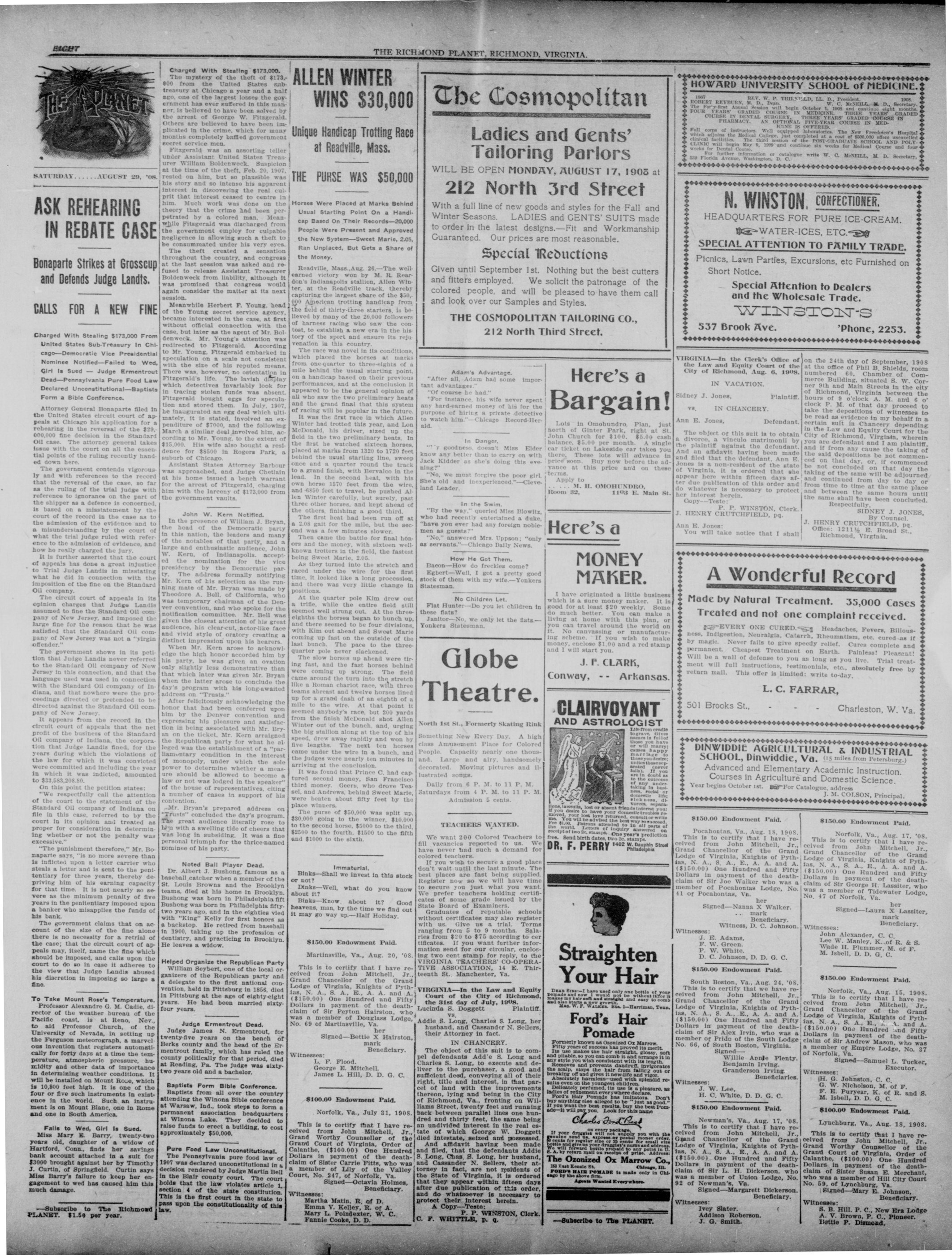
"Springfield, Ill., Aug 26.—Mrs. Kate Howard one of the leaders in the recent riot in this city, committed suicide to-day by swallowing acid soon after being placed under arrest. She died as she was being led into the jail.
"Before the special grand jury, now in session many witnesses testified that Mrs. Howard was one of the ringleaders of the mob which wrecked Loper's restaurant and cafe. She was the first person indicted and was held on several counts in the sum of $10,000, which she furnished. When she was released she said she would never be arrested again.
"To-day shortly after the special jury returned another indictment against her, charging murder in connection with the recent lynchings. Deputy Sheriff Kramer was sent to Mrs. Howard's rooms to arrest her. Mrs. Howard received the officer at the door. She secretly swallowed a large dose of poison, then said: 'I'm ready to go now.' She accompanied him to jail, two blocks away, and was just entering the door when she fell dead.
Ten more indictments, three charging murder, were returned by the special grand jury late this afternoon. True bills charging murder, were found against Mrs. Kate Howard, Abraham Raymor and Ernest, alias "Slim" Humphrey.
"Ethel Hethe, a young woman, was indicted for malicious mischief. She was a friend of Mrs. Howard."
SPRINGFIELD, ILL., Aug. 17.—A special Grand Jury has been called to begin to-morrow investigating the riots. Scores were arrested to-day as suspects, or charged with riot. The arrest of another mob leader, Roy Young, 22 years old, who proudly confesses he helped burn Negro homes and engaged in a revolver battle with Negroes, was made today. James Scott, aged 72, died to day from a bullet wound through his left lung, inflicted during Friday night's battle along Washington St. The authorities are struggling to reassure the people who are wondering if juries can be secured which will convict any who may be placed on trial. Consternation was caused when it was known that wholesale arrests were to be made. Scores were taken to jail. With the arrest this afternoon of Roy Young, the police think they have the ring leader of the mob which Friday afternoon created a reign of terror in the "black belt" and wound up with the lynching of Scott Burton, an aged Negro, at the corner of Twelfth and Madison Sts. Later Young made a confession in which he said:
"When I heard they were shooting niggers I went over. When the niggers commenced shooting on East Washington street some of us broke into Fishman's pawnshop to get some guns. I took three or four revolvers and some cartridges and some of the other fellows got some guns too. We went east on Washington street and the fighting got bad.
"I commenced shooting at niggers. I shot at every one I got a chance. I guess I hit some of them, but I don't know. They tried to kill me just the same. When we went over to Madison street some one started setting fire to the houses of niggers and I helped. I guess I poured oil on about fifteen or sixteen houses and set fire to them.
"I didn't set fire to Burton's beds nor did I help hang him to the tree. When we got to Ninth and Madison streets I was just setting fire to a house when a white man ran up to me and told me not to burn the place, that it belonged to him and was rented to niggers. We did not burn this house."
Roy Young has been living with his uncle, Edward Young. Their home is located at 206 North Seventh street and it was there that goods, guns and much ammunition were found by the authorities following Young's arrest. When confronted with the stolen property he confessed he had taken the articles from the various stores visited by the raiders along East Washington street last Friday night.
When questioned at the station he the said that he had set fire to ten or twelve houses, but when taken along cit Madison and Mason streets through to the ruins of the colored district he
identified only two or three houses that had been burned as a result of the firebrands applied by his own hands.
He says he was present at the lynching of Scott Burton.
Young has been a resident of this city but about a month. He came to Springfield from Missouri and has since been employed at Uehman's livery barn.
The arrests next in importance were those of Mudge Clark and "Fingers" William Lotherington, charged with burglary and larceny.
Mudge Clark is the keeper of a resort at Ninth and Mason streets, and Lotherington is said to be her follower. When the house was searched by officers many articles of wearing apparel were found secreted about the house.
Many reports were sent to the police of persons who had made efforts to dispose of stolen goods.
One man is said to have offered silver sugar bowls, taken from Loper's restaurant, to a local cafe manager for five cents each. Others are reported to have disposed of stolen goods which they could not use.
Incensed by saloon keepers persist ing in violating the closing order issued Friday night Mayor R. R. Reece declared to night that the next dram shop keeper arrested on this charge will lose his license instantly.
Attorney Potts, representing the Reisch Indemnity Company, the spokesman for a committee of saloon keepers, had a warm interview Saturday with the Mayor and Brig. Gen. H. P. Wellson regarding the subject of closing the saloons. The city executive minced no words in telling what he thought of the proposition.
The Mayor to-day sent a message to the managers of Ringling Brothers' circus saying that owing to the grave situation in Springfield at present the circus will not be permitted to show in Springfield to-morrow as had been scheduled.
Coroner Woodruff said to-night that he would begin the inquest to-morrow morning on Scott Burton, the Negro lynched Saturday morning.
Attorneys who have consulted on the question of whether the city or the county will have to pay for the destruction of property by the mob say that the city will have to bear the expense. They quote a recent statute on the subject which states that the damage allowed in such cases will be three-fourths of the total value of the property. The section of the law on which the claim that the city and not the county will have to bear the expense is as follows:
"Whenever any building or other real or personal property except property in transit shall be destroyed or injured in consequence of any mob or riot composed of twelve or more persons, the city, or if not in a city then the county in which such property was destroyed, shall be liable to an action by or in behalf of the party whose property was thus destroyed or injured for three-fourths of the damages sustained by reason thereof."
It is pointed out that the law expressly says that the county is liable only when the property destroyed is not located in a city, and when it is located in a city the city is liable.
Attorneys and others interested in legal matters have also been discussing the question of liability for death in such cases as that with which Springfield now has to do. Two men have been hanged by the mob, and some argue that the liability would apply in this case the same as in the case of property destroyed.
If such an action were brought, however, it would have to be under common law, as there is no statute which would apply.
The trouble would be in proving that the man in each case was not in himself to blame. It would have to be shown that he used no force or did anything to lay himself liable to an attack before a good case could be made.
With the arrival this morning of the First Cavalry a force of nearly 5,000 armed men now patrol nearly every street in Springfield. While the city is not under martial law, troops are sprinkled over the entire city with a presence expected to prevent further constructions. The artillery battalion of this city
RICHMOND, VIRGINIA, SATURDAY, AUGUST 29, 1908
is occupying the schoolhouse yard. At Eighteenth and Kansas streets in the Sixth ward, which has a large Negro population, a regiment is stationed.
At the convening of the court today State's Attorney Frank Hatch entered a formal motion asking that a special Grand Jury be ordered. The motion was allowed by Judge Creighton with the exception that he called the Grand Jury for 2 o'clock to-morrow afternoon instead of 9 o'clock to-morrow morning, as petitioned by the State's Attorney.
The Grand Jury will be composed of the same men who deliberated a few weeks ago upon the evidence submitted implicating Joe James, the charge with the murder of Clergy Boy Ballard rushed to his daughter's bedroom at midnight to rescue her from the Negro Judge Creighton in ordering the jury said to Sheriff Werner.
"In summoning this Grand Jury impress it upon each man summoned that unless he appears in court at 1:30 o'clock to-morrow afternoon he will be attached and heavily fined."
In his petition for a special Grand Jury States Attorney Frank Hatch said:
"The prompt and vigorous administration of justice toward all persons who have been actively connected with the various acts of mob violence will do much toward restoring law and order in the county.
The case of George Richardson, the Negro charged with criminally assaulting Mrs. Hallam, causing the riots, will be taken up first. After this case is disposed of the other evidence will be placed before that body that will implicate several of the rioters.
A special request has been made by the State Attorney's Office to all good citizens to aid in obtaining information of those who participated in any acts of lawlessness.
Resolutions of Sympathy
WHEREAS, It has pleased the Almighty to be removed from our midst by death an esteemed friend and collaborer Sister Sallie Henry, who had for many years occupied a prominent rank in our midst.
Therefore, RESOLVED, That in the death of Sister Sallie we have sustained the loss of a friend whose fellowship it was an honor and a pleasure to enjoy, that we bear willing testimony to her many virtues, to her unquestioned probity and stainless life that offer to her beweaved family and mourning friends over whom sorrow has hung her sable mantle, our heartfelt condolence and pray that infinite goodness may bring speedy relief to their burdened hearts and inspire them with the consolation that hope in futurity and faith in God give even in the shadow of the tomb.
RESOLVED, That we send these resolutions to The Richmond PLANET to be printed.
Committee:
L. A. TATE, Chair.
DELLA LAWRENCE.
ELLA FIELDS, Sec.
B. M. C. Convention.
If you contemplate attending the B, M. C. Convention at Atlantic City, write now. Address C. C. Johnson, Care Fitzgerald's Auditorium, N. Kentucky Avenue. Accommodations arranged for in hotel or private cottage, also table board.
--You haven't been there, then you should take the trip with the Young Men's Rose of Sharon Association to City Point, Sept. 6th.
SHRINERS!
Mocha Temple, No. 7
MOONLIGHT TO DUTCH GAP.
Tuesday night, September 1, 1908
8 o'clock sharp. Municipal Brass
and String Band will accompany us.
Dance and song as usual. Usual.
Fare, 50 cents.
Visitors to Our Office.
Mrs. R. F. Tate, Mrs. Hattie Gunn,
Special Deputy, I. O. St. Luke; Miss
Frances Taylor, Mrs. R. E. Harth,
R. W. G. V. I. O. St. Luke, all of
Roanoke, Va. Mrs. Agnes Mason,
New York, N. Y.; Mrs. Lucy B. Flemm
ing, Germantown, Pa.; Mrs. Annie
Turner and Miss Florida Scott, Hunt
ington, W. Va.; Mrs. W. H. W.
Williams and Mrs. G. T. Coakley of
Jersey City, N. J. in company with Mrs.
M. Sheppard; Mr. John L. Jackson,
Miller School, Va. in company with
Sir J. A. Moss; Mrs. Irene A. Jurix,
Boston, Mass.; Mrs. L. T. Holmes
and Mrs. S. Johnson, Washington,
D. C.
—Sir George W. Rison of Danville, Va. was in the city on business last week.
—Misses M. L. Hairston, L. Virginia Hill, Mrs. Florence L. Wilson, and Mr. J. R. Wilson of Danville, Va. were in attendance at the Baptist Sunday School Convention.
—National Grand Sire J. W. Thompson left the city last Tuesday to attend the National Grand Lodge of G. S. and D. of S., held at Atlanta, Ga. He was accompanied by his Madame Mrs. H. E. Thompson.
—Misses Virginia and Armeta Knight left Richmond, last Friday for Charles City Co., where they will spend a few days with Mrs. John Smith.
—Miss V. C. Proctor in company with Miss Florence Jackson is on a visit to her relatives in Washington, D. C. Jersey City, N. J. and other northern cities.
—Gen. M. D. Meekler of Norfolk, left the city to-day on the he.
—Dr. J. A. Lewis left the city last Monday for New York.
—Miss Cora L. Bright is spending her vacation in the country.
—September 6th is the time. Go with the Young Men's Rose of Sharon Association to City Point.
—If you wish first class service and expect high grade tailoring, it will be well for you to call and see the Cosmopolitan Tailoring Company. They will quote you eight prices and the latest designs in tailoring. Ladies and gents served promptly. Call and see them at 212 North Third Street.
—Mr. Thomas H. Wyatt is making improvements at his residence.
—Mr. Miles C. Debbress is preparing to make extensive improvements at his residence.
—Dr. D. A. Ferguson, our popular dentist left the city last week to visit Saratoga, N. Y. and New York City.
—Mrs. W. F. Graham has been visiting at Hampton, Va.
—Miss Carsie D. Isham is spending the summer at Hampton.
—Miss Annie, youngest daughter of Mr. and Mrs. S. P. Brown has been ill, but is now much improved.
The Independence Party Thinks We Should I Support It.
Editor of Richmond PLANET:
The warning has been sounded. Mr. Russell strenuously keynote. The call to duty has been sounded. You owe a duty to yourself and family to insist upon having a voice in the selection of candidates and the lawmaking of this country. We are here to stay, and as tax-payers should have some say in the government. We have been distranchised by the Democrats and thrown down by the Republicans. It is said that God in His wisdom causes things to so happen that circumstances will force us to abandon the old beaten path and seek another. Some time ago Mr. Russell said that the "Lily-white" movement would ultimately drive 800,000 voters from the Party, who would only find right and justice by combining with some other Party. That being so, why not seek the other Party instead of opposing the "Lily-whites?" The Independence Party promises great things. Their platform is against discrimination. Do you know what that means to the Negro? If the Democrats don't want us, and the Republicans wont have us, don't fight them, nor give up the fight. Join the new Party and help them to elect a President that will stand for the whole people and maybe some day in the near future when the weak has triumphed over the strong, we shall reap our reward.
For fine printing call at the PLANET Office.
A WHITE OFFICER CONVICTED IN GEORGIA. He Killed a Colored Barber. Defended by 2 Lawyers.
THE PENALTY IS CONFINEMENT IN THE PENITENTIARY FROM
INVOLUNTARY MANSLAUGHTER WAS THE VERDICT OF JURY.
Judge Roan Will This Morning Pass Sentence Upon Bailiff J. W. Hutchins.
"Wb, the jury, find the defendant guilty of involuntary manslaughter, in the commission of an unlawful act."
Such was the verdict of the jury after about two hours' deliberation in the trial of J. W. Hutchins yesterday.
Judge Roan, in whose court the trial was held, stated that he would sentence Hutchins to-day. The punishment for the offense of involuntary manslaughter is confinement in the penitentiary, from one to three years.
Attorneys John W. Moore and James Branch represented the defendant, and it is thought that they will make a motion for a new trial tomorrow, and, in the event that the court refuses the motion, they will appeal it. This, however, is thought to depend on the length of the sentence.
J. W. Hutchins, it will be remembered, was a bailiff of Justice J. W. Hopkins, court, and went to the barber shop on Piedmont avenue and Harris street, in which Frank Dixon the Negro who was killed, worked on June 13.
Balliff Hutchins had a warrant for the colored man's arrest, but the subsequent happenings after the balliff entered the shop are at variance, but the trend of evidence submitted seemed to show that Hutchins tried to arrest Dixon, who demurred and broke loose from the officer, and the latter shot him down. The defendant in his testimony stated that Dixon had hit him, and that he shot him in self defense. Balliff Hutchins was composed all during the trial, showing no signs of agitation, and feeling perfectly confident that the jury would return a verdict in his favor; but, when it was adverse, his coolness did not leave him, and he is hoping for better if a new trial is granted. Several members of his family were with him in the court, and have been doing everything in their power to make his prison life comfortable ever since he has been locked up. Hutchins was locked up again immediately and the verdict of the jury, but, if a new trial is asked for and granted, it is thought that application for bond will be made.
---
WANTED—A good Piano Player at once. A good position for the right person. For particulars, write to: A. N. Auriga Street, Shaunton, Va.
—Don't grumble. Be happy and go to City Point, Sunday, September 6th, with the Young Men's Rose of Sharon Association.
Eighth Annual Convention.
The 8th Annual Convention of the Baptist Sunday School Convention of Va. and the State B. Y. P. U. held their Annual Sessions at the First Baptist Church, Rev. W. R. Brown, D. D., Pastor; Brother William Trent, Superintendent, Roanoke, Va. The sessions were well attended—delegates and friends from the mount tains, the valleys, from the seashore. We can well say with the attendance of delegates and visitors, there was a total of between 700 and 800. It can be safely said that it was one of the largest conventions of the Sunday School and B. Y. P. U. workers in the history of the work. Excellent addresses and papers, looking to the betterment of the S. S. and B. Y. P. U. work were presented to the Conventions. Prof. J. S. Lee, of Newport News, the President, presided with his usual dignity, as did Dr. W. R. Ashburn of the B. Y. P. U. Convention. Dr. G. B. Howard of Petersburg preached an able annual sermon, as well as his response to the welcome
ONE TO THREE YEARS.
address on the part of the Convention to the address delivered by the Mayor of the City of Roanoke.
Dr. Bolling delivered a fitting sermon on Education, also a dedicated address was delivered by Rev. T. J. Jones, subject: "Hayes, the Immortal." Miss Annie V. Taylor of the Fifth Street Baptist Church, Richmond, Va. carried the Convention by storm in her paper, subject: "Young People's Activity in Church Work."
The closing sermon of the Convention was preached by Rev. M. H. Payne, Pastor of the Mt. Vernon Baptist Church, Richmond. Text: "Peace within thy gates, prosperity within thy walls." This sermon well pleased the many hearers, for in fact the Church was crowded from pulpit to door.
The financial success of the Convention was beyond expectation. The Finance Committee reported nearly $700 had been raised. The Convention closed with much enthusiasm for more active wqrk. District Missionaries for the two bodies were selected and each District will vie with the other in making the two Conventions a success.
The B. Y. P. U. Active Board will be located in Richmond. Prof. J. S. Lee of Newport News was elected President; Dr. A. L. Winslow of Danville, Recording Secretary; W. R. Smith, of Lynchburg, Treasurer, of S. Convention. Rev. W. R. Ashburn, D. D., President; R. H. Fauntleroy, Secretary; Richard Ash, Treasurer, of the B. Y. P. U. Convention. Prof. B. H. Peyton was elected member of the S. S. Board and also of the B. Y. P. U. Board and ViceChairman and Manager of the Board located at Richmond. Miss Annie V. Taylor and Rev. J. H. Stephens are the District Missionaries of Richmond and the vicinity.
The Grand United Order of St. Luke
in Session.
The R. W. G. Council, Grand United Order of St. Luke held its 44th Annual Session in Phoebus, Va. at St. Luke's Hall, County St. August 28th and 31st inclusive. The harmony and good spirits shown and the desire for progress implanted by this meeting will live long, long after 1908 has passed on into history.
A Juvenile Council was organized while there and Guardians appointed viz.; Sisters Catharine Smith, Victoria Jones, Jane Richardson, Mary E. Tyson. Friday morning the usual business was dispatched to give way to the Initiation and setting apart of a Past Chief's Council in Phoebus. It would be hard to find a more enthusiastic part of members that attended the meeting. It was largely attended and the P. C. S. Degree was conferred in an able impressive manner by the Staff brought to the face of the R. W. G. Chief, Brother Frey the smile that won't come off.
PRICE, FIVE CENTS.
OFFICER
GEORGIA.
d Barber.
lawyers.
ENITENTIARY FROM
Elizabeth Pinn, Mary E. Tyson, Eliza Howe. There were ten R. W. G.
P. Chief's present.
Thursday night a public installation took place at the Hall and a very reception was tendered the Grand Officers and delegates by Morning Star and Daughters of Israel Councils of Phoebus, Va. Dr. Graham, Pastor of Zion Baptist Church gave the officers and delegates a heart welcome and an instructive address at the Reception.
Installation was conducted by R. W. G. S., L. A. Vincent; R. W. G. P., C. M., A. A. Harris; R. W. G. P. C., Washington Digga; R. W. G. P., C., H. E. Frey; R. W. G. P. C., T. H. Hardac, Honors of R. W. G. P. C's were conferred upon R. W. G. Presiding Chief, James W. Frey and R. W. G. V. C., Sister Alice Robinson,
R. W. G. Council closed in L. P. C., sine die to meet at Bethel, York Co., Va.
Notice!
Norfolk, Va., Aug. 25, 1908.
To the Baptist Brotherhood—
Every member and friend of Virginia Theological Seminary and College is requested to meet at Lynchburg, Va., Friday, October 2nd in special session of the Virginia Bapt.
State S. S. Convention to install Prof J. R. L. Diggs as President of the Virginia Seminary and College.
Let this meeting mark a new epoch in the history of our school. Don't forget the date.
R. H. BOWLING, Pres.
W. F. GRAHAM, D. D. Chair.
C. E. MILLER, Secretary.
From Springfield, Ill.
Springfield, Ill., Aug. 17, '08.
THE PLANET, Richmond Va.;
Dear Sir—I will simply say to you that the mob has played havoc, in destroying property and the colored man's businesses. I never read of such a hing before. But they have fed the mob with more bullets than they ever before received and 5 to 1 whites have gone to that land where no traveler ever returns.
Many Negroes are frightened and many are standing firm with shotgun and rifle. The State militia sur rounds the city—its an awful thing. Yours truly.
E. L. ROGERS.
$150.00 Endowment Paid
Pocahontas, Va., Aug. 18, 1908.
This is to certify that I have received from John Mitchell, Jr.
Grand Chancellor of the Grand Lodge of Virginia, Knights of Pythians, N. A., S. A., E., A. A. and A.
($150.00) One Hundred and Fifty Dollars in payment of the deathclaim of Sir S. H. Mullins who was a member of Pocahontas Lodge, No. 41, of Pocahontas, Va.
Signed—Henrielle Mullins,
Beneficiary.
Witnesses:
D. C. Johnson, D. D. G. C.
J. E. Adams.
William Haxton.
P. W. White.
$150.00 Endowment Paid
Richmond, Va., Aug. 17, 1908.
This is to certify that I have received from John Mitchell, Jr.
Grand Chancellor of the Grand
Lodge of Virginia, Knights of Pythias,
N. A., S. A., E., A. A. and A.
($150.00) One Hundred and Fifty
Dollars in payment of the death-
claim of Sir Herman Jackson who
was a member of Cherry St. Lodge,
No. 112 of Covington, Va.
Signed
Flora Jackson.
Clara Jackson.
Beneficiary.
Witnesses:
—Subscribe to The PLANET.
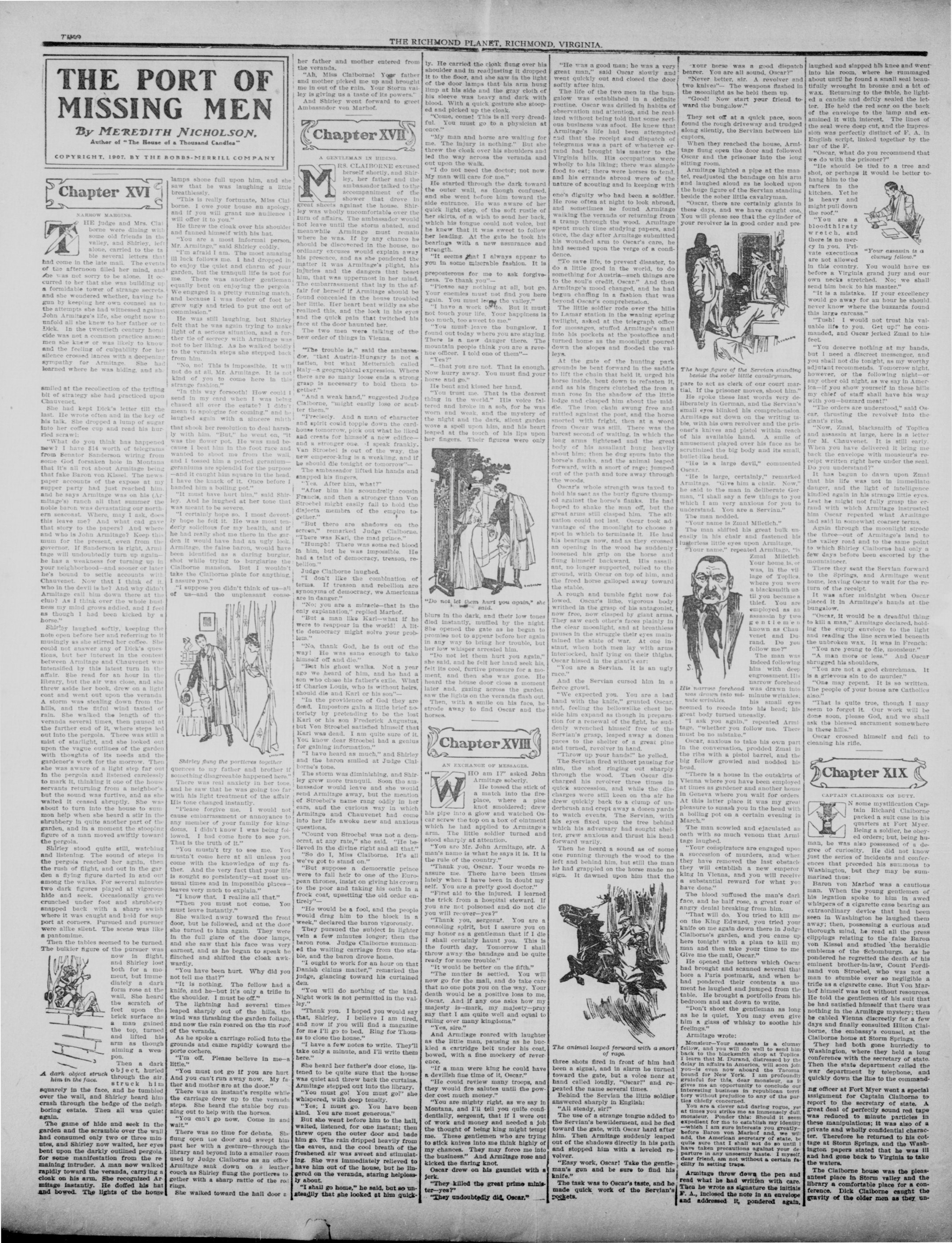
THE PORT OF MISSING MEN
By MEREDITH NICHOLSON.
Author of "The House of a Thousand Candles"
COPYRIGHT, 1907. BY THE BOBBS-MERRILL COMPANY
TWO
Chapter XVI
NARROW MARGINS.
HE judge and Mrs. Clairborne were dining with some old friends in the valley, and Shirley, left alone, carried to the table several letters that
HE Judge and Mrs. Claiborne were dining with some old friends in the valley, and Shirley, left alone, carried to the table several letters that had come in the late mall. The events of the afternoon filled her mind, and she was not sorry to be alone. It occurred to her that she was building up a formidable tower of strange secrets, and she wondered whether, having been by keeping her own counsel as to the attempts she had witnessed against John Armitage's life, she ought now to unfold all she knew to her father or to Dick. In the twentieth century homicide was not a common practice among men she knew or was likely to know, and the feeling of culpability for her silence crossed lances with a deepening sympathy for Armitage. She had learned where he was hiding, and she
smiled at the recollection of the trilling bit of strategy she had practiced upon Chauvenet.
She had kept Dick's letter till the last. He wrote often and in the key of his talk. She dropped a lump of sugar into her coffee cup and read his hurried crawl:
"What do you think has happened now? I have $14 worth of telegrams from Senator Sanderson wiring from some God forsaken hole in Montana that it's all rot about Armitage being that fake Baron von Klissel. The newspaper accounts of the expose at my supper party had just reached him, and he says Armitage was on his (Armitage) ranch all that summer the noble baron was devastating our northern seacoast. Where, may I ask, does this leave me? And what cad gave that story to the papers? And where and who is John Armitage? Keep this mum for the present, even from the governor. If Sanderson is right, Armitage will undoubtedly turn up again—he has a weakness for turning up in your neighborhood—and sooner or later he's bound to settle accounts with Chauvenet. Now that I think of it, who in the devil is he? And why didn't Armitage call him down there at the club? As I think over the whole business my mind grows added, and I feel as though I had been kicked by a horse."
Shirley laughed softly, keeping the note open before her and referring to it musingly as she stirred her coffee. She could not answer any of Dick's questions, but her interest in the contest between Armilitage and Chauvenet was intensified by this latest turn in the affair. She read for an hour in the library, but the air was close, and she threw aside her book, drew on a light coat and went out upon the veranda. A storm was stealing down from the hills, and the fitful wind tasted of rain. She walked the length of the veranda several times, then paused at the farther end of it, where steps led out into the pergola. There was still a mist of starlight, and she looked out upon the vague outlines of the garden with thoughts of its needs and the gardener's work for the morrow. Then she was aware of a light step far out in the pergola and listened carelessly to mark it, thinking it one of the house servants returning from a neighbor's but the sound was furtive, and as she waited it ceased abruptly. She was about to turn into the house to summon help when she heard a stir in the shrubbery in quite another part of the garden, and in a moment the stooping figure of a man moved swiftly toward the pergola.
Shirley stood quite still, watching and listening. The sound of steps in the pergola reached her again, then the rush of flight, and out in the garden a flying figure darted in and out among the walks. For several minutes two dark figures played at vigorous hide and seek. Occasionally gravel crunched under foot and shrubbery snapped back with a sharp swish where it was caught and held for support at corners. Pursued and pursuer were allike silent. The scene was like a pantomime. Then the tables seemed to be turned. The bulkier figure of the pursuer was
now in flight,
Shirley lost
both for a moment,
but immediately a dark
form rose at the
wall. She heard
the scratch of
feet upon the
brick surface as
a man gained
the top, turned
and lifted his
arm as though
aiming a weapon.
```markdown
```
Then a dark
object, hurled
through the air,
struck him
A dark object struck object hurled him in the face. through the air. struck him squarely in the face, and he tumbled over the wall, and Shirley heard him crash through the hedge of the neighboring estate. Then all was quiet again.
The game of hide and seek in the garden and the scramble over the wall had consumed only two or three minutes, and Shirley now waited, her eyes bent upon the darkly outlined pergola, for some manifestation from the remaining intruder. A man now walked rapidly toward the veranda, carrying a cloak on his arm. She recognized Armitage instantly. He doffed his hat and bowed. The lights of the house
lamps shone full upon him, and she saw that he was laughing a little breathlessly.
"This is really fortunate, Miss Clalborne. I owe your house an apology, and if you will grant me audience I will offer it to you."
He threw the cloak over his shoulder and fanned himself with his hat.
"You are a most informal person. Mr. Armitage," said Shirley coldly.
"I'm afraid I am. The most amazing ill luck follows me. I had dropped in to enjoy the quiet and charm of your garden, but the tranquill life is not for me. There was another gentleman equally bent on enjoying the pergola. We engaged in a pretty running match, and because I was feierer of foot he grew ugly and tried to put me out of commission."
He was still laughing, but Shirley felt that he was again trying to make light of a serious situation, and a further tie of secrecy with Armitage was not to her liking. As he walked boldly to the veranda steps she stepped back from him.
"No, no! This is impossible. It will not do at all. Mr. Armitage. It is not kind of you to come here in this strange fashion."
"In this way forsooth! How could I send in my card when I was being chased all over the estate? I didn't mean to apologize for coming." and he laughed again with a sincere mith
that shook her resolution to dress harshly with him, "But," he went on, "it was the flower pot. He was mad because I beat him in the foot race and wanted to shoot me from the wall, and I tossed him a potted geranium—geraniums are splendid for the purpose—and it caught him square in the head, I have the knack of it. Once before I handed him a boiling pot."
"It must have hurt him," said Shirley. And he laughed at her tone that was meant to be severe.
"I certainly hope so. I most devoltely hope he felt it. He was most tenderly solicitous for my health, and if he had really shot me there in the garden it would have had an ugly look. Armitage, the false baron, would have been identified as a daring burglar, shot while trying to burglarize the Clalbera mansion. But I wouldn't take the Clalbera plate for anything, I assure you."
"I suppose you didn't think of us—all of us—and the unpleasant conse
A
quences to my father and brother if something disagreeable happened here." There was real anxiety in her tone, and he saw that he was going too far with his light treatment of the affair. His tone changed instantly.
"Please forgive me. I would not cause embarrassment or annoyance to any member of your family for kingdoms. I didn't know I was being followed. I had come here to see you. That is the truth of it."
"You mustn't try to see me. You mustn't come here at all unless you come with the knowledge of my father. And the very fact that your life is sought so persistently—at most unusual times and in impossible places—leaves very much to explain."
"I know that. I realize all that."
"Then you must not come. You must leave instantly."
She walked away toward the front door, but he followed, and at the door she turned to him again. They were in the full glare of the door lamps, and she saw that his face was very earnest, and as he began to speak he flinched and shifted the cloak awkwardly.
"You have been hurt. Why did you not tell me that?"
"It is nothing. The fellow had a knife, and he—but it's only a trifle in the shoulder. I must be off."
The lightning had several times leaped sharply out of the hills, the wind was thrashing the garden foliage, and now the rain roared on the tin roof of the veranda.
As he spoke a carriage rolled into the grounds and came rapidly toward the porte cochere.
"I'm off. Please believe in me—a little."
"You must not go if you are hurt. And you can't run away now. My father and mother are at the door."
There was an instant's respite while the carriage drew up to the veranda steps. She heard the stable boy running out to help with the horses. "You can't go now. Come in and wait."
There was no time for debate. She flung open the door and swept him past her with a gesture—through the library and beyond into a smaller room used by Judge Claiborne as an office Armitage sank down on a leather couch as Shirley flung the portieres to gether with a sharp rattle of the roiling.
She walked toward the hall door a
THE RICHMOND PLANET, RICHMOND, VIRGINIA
her father and mother entered from
the veranda.
"Ah, Miss Claiborne! Your father
and mother picked me up and brought
me in out of the rain. Your Storm valley is giving us a taste of its powers."
And Shirley went forward to greet Ambassador von Marhof.
Chapter XVII
A GENTLEMAN IN HIDING.
RS. CLAIBORNE excused
herself shortly, and Shirley, her father and the ambassador talked to the accompaniment of the shower that drove in
RS. CLAIBORNE excused herself shortly, and Shirley, her father and the ambassador talked to the accompaniment of the shower that drove in great sheets against the house. Shirley was wholly uncomfortable over the turn of affairs. The ambassador would not leave until the storm abated, and meanwhile Armitage must remain where he was. If by any chance he should be discovered in the house, no ordinary excuses would explain away his presence, and as she pondered the matter it was Armitage's plight, his injuries and the dangers that beset him, that was uppermost in her mind. The embarrassment that lay in the affair for herself if Armitage should be found concealed in the house troubled her little. Her heart beat wildly as she realized this, and the look in his eyes and the quick pain that twitched his face at the door haunted her. The two men were talking of the new order of things in Vienna.
"The trouble is," said the ambassador, "that Austria-Hungary is not a nation, but what Metternich called Italy—a geographical expression. Where there are so many loose ends a strong grasp is necessary to hold them together."
"And a weak hand," suggested Judge Claiborne, "might easily lose or scatter them."
"Precisely. And a man of character and spirit could topple down the cardhouse tomorrow, pick out what he liked and create for himself a new edifice—and a stronger one. I speak frankly. Van Stroebel is out of the way, the new emperor-king is a weakling, and if he should die tonight or tomorrow"—
The ambassador lifted his hands and snapped his fingers.
"Yes. After him, what?"
"After him his scoundrelly cousin Francis, and then a stronger than Von Stroebel might easily fail to hold the disjecta membra of the empire together."
"But there are shadows on the screen," remarked Judge Clalborne. "There was Karl, the mad prince."
"Humph! There was some red blood in him, but he was impossible. He had a taint of democracy, treason, rebellion."
Judge Clalborne laughed.
"I don't like the combination of terms. If treason and rebellion are synonyms of democracy, we Americans are in danger."
"No; you are a miracle—that is the only explanation," replied Marhof.
"But a man like Karl—what if he were to reappear in the world! A little democracy might solve your problem."
"No, thank God, he is out of the way! He was sane enough to take himself off and die."
"But his ghost walks. Not a year ago we heard of him, and he had a son who chose his father's exile. What if Charles Louis, who is without heirs, should die and Karl or his son"— "In the providence of God they are dead. Impostors gain a little brief notoriously by pretending to be the lost Karl or his son Frederick Augustus, but Van Stroebel satisfied himself that Karl was dead. I am quite sure of it. You know dear Stroebel had a genius for gaining information."
"I have heard as much," and Shirley and the baron smiled at Judge Clalborne's tone.
The storm was diminishing, and Shirley grew more tranquil. Soon the ambassador would leave and she would send Armitage away, but the mention of Stroebel's name rang oddly in her ears, and the curious way in which Armitage and Chauvenet had come into her life awoke new and anxious questions.
"Count von Stroebel was not a democrat, at any rate," she said. "He believed in the divine right and all that." "So do I, Miss Claiborne. It's all we've got to stand on." "But suppose a democratic prince were to fall heir to one of the European thrones, insist on giving his crown to the poor and taking his oath in a frock coat, upsetting the old order entirely"— "He would be a fool, and the people would drag him to the block in a week." declared the baron vigorously. They pursued the subject in lighter vein a few minutes longer; then the baron rose. Judge Claiborne summoned the waiting carriage from the stable, and the baron drove home. "I ought to work for an hour on that Danish claims matter," remarked the judge, glancing toward his curtained den. "You will do nothing of the kind. Night work is not permitted in the valley."
"Thank you. I hoped you would say that, Shirley. I believe I am tired, and now if you will find a magazine for me I'll go to bed. Ring for Thomas to close the house."
"I have a few notes to write. They'll take only a minute, and I will write them here."
She heard her father's door close, listened to be quite sure that the house was quiet and threw back the curtains. Armitage stepped out into the library.
"You must go! You must go!" she whispered, with deep tension.
"Yes; I must go. You have been kind. You are most generous."
But she went before him to the hall, waited, listened, for one instant; then threw open the outer door and bade him go. The rain dripped heavily from the eaves, and the cool breath of the freshened air was sweet and stimulating. She was immediately relieved to have him out of the house, but he lingered on the veranda, staring helplessly about.
"I shall go home," he said, but so steadily that she looked at him quick-
ly. He carried the cloak flung over his shoulder and in readjusting it dropped it to the floor, and she saw in the light of the door lamps that his arm hung limp at his side and the gray cloth of his sleeve was heavy and dark with blood. With a quick gesture she stooped and picked up the cloak.
"Come, come! This is all very dreadful. You must go to a physician at once."
"My man and horse are waiting for me. The injury is nothing." But she threw the cloak over his shoulders and led the way across the veranda and out upon the walk.
"I do not need the doctor; not now. My man will care for me."
He started through the dark toward the outer wall, as though confused, and she went before him toward the side entrance. He was aware of her quick light step, of the soft rustle of her skirts, of a wish to send her back, which his tongue could not voice, but he knew that it was sweet to follow her leading. At the gate he took his bearings with a new assurance and strength.
"It seems that I always appear to you in some miserable fashion. It is preposterous for me to ask forgiveness. To thank you"—
"Please say nothing at all, but go. Your enemies must not find you here again. You must leave the valley."
"I have a work to do. But it must not touch your life. Your happiness is too much, too sweet to me."
"You must leave the bungalow. I found out today where you are staying. There is a new danger there. The mountain people think you are a revenge officer. I told one of them"— "Yes?"
"—that you are not. That is enough. Now hurry away. You must find your horse and go." He bent and kissed her hand. "You trust me. That is the dearest thing in the world." His voice faltered and broke in a sob, for he was worn and weak, and the mystery of the night and the dark, silent garden wove a spell upon him, and his heart leaped at the touch of his lips upon her fingers. Their figures were only
"Do not let them hurt you again," she said.
blurs in the dark, and their low tones died instantly, muffled by the night. She opened the gate as he began to promise not to appear before her again in any way to bring her trouble, but her low whisper arrested him.
"Do not let them hurt you again," she said, and he felt her hand seek his, felt its cool, furtive pressure for a moment, and then she was gone. He heard the house door close a moment later and, gazing across the garden, saw the lights on the veranda flash out.
Then, with a smile on his face, he strode away to find Oscar and the horses.
Chapter XVIII
AN EXCHANGE OF MESSAGES.
"HO am I?" asked John Armitage sobly.
W
He tossed the stick of a match into the fireplace, where a pine knot smoldered; drew his pipe into a glow and watched Oscar screw the top on a box of ointment which he had applied to Armitage's arm. The little soldier turned and stood sharply at attention.
"You are Mr. John Armitage, sir. A man's name is what he says it is. It is the rule of the country."
"Thank you, Oscar. Your words reassure me. There have been times lately when I have been in doubt my self. You are a pretty good doctor."
"First aid to the injured. I learned the trick from a hospital steward. If you are not poisoned and do not die you will recover—yes?"
"Thank you, sergeant. You are a
consoling spirit, but I assure you on
my honor as a gentleman that if I die
I shall certainly haunt you. This is
the fourth day. Tomorrow I shall
throw away the bandage and be quite
ready for more trouble."
"It would be better on the fifth."
It would be better on the infirm.
"The matter is settled. You will now go for the mall, and do take care that no one pots you on the way. Your death would be a positive loss to me, Oscar, and if any one asks how my majesty is—mark, my majesty—pray say that I am quite well and equal to ruling over many kingdoms."
"Yes, sire."
And Armilitage roared with laughter as the little man, pausing as he buckled a cartridge belt under his coat, bowed, with a fine mockery of reverence.
"If a man were king he could have a devilish fine time of it, Oscar."
"He could review many troops, and they would fire salutes until the powder cost much money."
"You are mighty right, as we say in Montana, and I'll tell you quite confidently, sergeant, that if I were out of work and money and needed a job the thought of being king might tempt me. These gentlemen are trying to stick knives into me think highly of my chances. They may force me into the business." And Armilitage rose and kicked the flaring knot.
Oscar drew on his gauntlet with a jerk.
"They killed the great prime minister-yes?"
"They undoubtedly did, Oscar."
"He was a good man; he was a very great man," said Oscar slowly and went quickly out and closed the door softly after him.
The life of the two men in the bungalow was established in a definite routine. Oscar was drilled in habits of observation and attention, and he realized without being told that some serious business was afoot. He knew that Armitage's life had been attempted and that the receipt and dispatch of telegrams was a part of whatever erand had brought his master to the Virginia hills. His occupations were wholly to his liking; there was simple food to eat; there were horses to tend, and his errands abroad were of the nature of scouting and in keeping with
one's dignity who had been a soldier.
He rose often at night to look abroad,
and sometimes he found Armitage
walking the veranda or returning from
a tramp through the wood. Armitage
spent much time studying papers, and
once, the day after Armitage submitted
his wounded arm to Oscar's care,
he had seemed upon the verge of a
confidence.
"To save life, to prevent disaster, to
do a little good in the world, to do
something for Austria—such things are
to the soul's credit, Oscar." And then
Armitage's mood changed, and he had
begun chaffing in a fashion that was
beyond Oscar's comprehension.
The little soldier rode over the hills
to Lamar station in the waning spring
twilight, asked at the telegraph office
for messages, stuffed Armitage's mall
into his pockets at the postoffice and
turned home as the moonlight poured
down the slopes and flooded the valleys.
At the gate of the hunting park grounds he bent forward in the saddle to lift the chain that held it, urged his horse inside, bent down to refasten it, and as his fingers clutched the iron a man rose in the shadow of the little lodge and clasped him about the middle. The iron chain swung free and rattled against the post, and the horse snorted with fright, then at a word from Oscar was still. There was the barest second of waiting. In which the long arms tightened and the great body of his assailant hung heavily about him; then he dug spurs into the horse's flanks, and the animal leaped forward, with a snort of rage; jumped out of the path and tore away through the woods.
Oscar's whole strength was taxed to hold his seat as the burly figure thumped against the horse's flanks. He had hoped to shake the man off, but the great arms still clasped him. The situation could not last. Oscar took advantage of the moonlight to choose a spot in which to terminate it. He had his bearings now, and as they crossed an opening in the wood he suddenly loosened his grip on the horse and flung himself backward. His assailant, no longer supported, rolled to the ground, with Oscar on top of him, and the freed horse galloped away toward the stable.
A rough and tumble fight now followed. Oscar's lithe, vigorous body writhed in the grasp of his antagonist, now free, now clasped by giant arms. They saw each other's faces plainly in the clear moonlight, and at breathless pauses in the struggle their eyes maintained the state of war. At one instant, when both men lay with arms interlocked, half lying on their thighs, Oscar hissed in the giant's ear:
"You are a Servian. It is an ugly race."
And the Servian cursed him in a fierce growl.
"We expected you. You are a bad hand with the knife," grunted Oscar, and, feeling the bellowlike chest beside him expand as though in preparation for a renewal of the fight, he suddenly wrenched himself free of the Servian's grasp, leaped away a dozen paces to the shelter of a great pine and turned, revolver in hand.
"Throw up your hands!" he yelled. The Servian fired without pausing for aim, the shot ringing out sharply through the wood. Then Oscar charged his revolver three times in quick succession, and while the discharges were still keen on the air he drew quickly back to a clump of underbrush and crept away a dozen yards to watch events. The Servian, with his eyes fixed upon the tree behind which his adversary had sought shelter, grew anxious and thrust his head forward warily. Then he heard a sound as of some one running through the wood to the left and behind him, but still the man he had grappled on the horse made no sign. It dawned upon him that the
The animal leaped forward with a snort of rage.
The animal leaped forward with a snort of rags.
three shots fired in front of him had been a signal, and in alarm he turned toward the gate, but a voice near at hand called loudly, "Oscar!" and repeated the name several times.
Behind the Servian the little soldier answered sharply in English:
"All steady, sir!"
The use of a strange tongue added to the Servian's bewilderment, and he fled toward the gate, with Oscar hard after him. Then Armitage suddenly leaped out of the shadows directly in his path and stopped him with a leveled revolver.
"Easy work, Oscar! Take the gentleman's gun and be sure to find his knife."
The task was to Oscar's taste, and he made quick work of the Servian's pockets.
"your horse was a good dispatch bearer. You are all sound. Oscar?"
"Never better, sir. A revolver and two knives!"—The weapons flashed in the moonlight as he held them up.
"Good! Now start your friend toward the bungalow."
They set off at a quick pace, soon found the rough driveway and trudged along silently, the Servlan between his captors.
When they reached the house, Armitage flung open the door and followed Oscar and the prisoner into the long sitting room.
Armitage lighted a pipe at the mantel, readjusted the bandage on his arm and laughed aloud as he looked upon the huge figure of the Servian standing beside the sober little cavalryman.
"Oscar, there are certainly giants in these days, and we have caught one. You will please see that the cylinder of your revolver is in good order and pre-
The huge figure of the Servian standing beside the sober little cavalryman.
pare to act as clerk of our court martial. If the prisoner moves, shoot him."
He spoke these last words very deliberately in German, and the Servian's small eyes blinked his comprehension. Armitage sat down on the writing table, with his own revolver and the prisoner's knives and pistol within reach of his available hand. A smile of amusement played over his face as he scrutinized the big body and its small, bullet-like head.
"He is a large devil," commented Oscar.
"He is large, certainly," remarked Armitage. "Give him a chair. Now," he said to the man in deliberate German, "I shall say a few things to you which I am very anxious for you to understand. You are a Servian."
The man nodded.
"Your name is Zunal Milletch."
The man shifted his great bulk uneasily in his chair and fastened his lusterless little eyes upon Armitage.
"Your name," repeated Armitage, "is
Zimal Miletch
Your home is, or was, in the village of Topica,
where you were a blacksmith until you became a thief. You are employed as an assassin by two gentlemen known as Chau venet and Durand. Do you follow me?"
S.
The man was indeed following him with deep engrossment. His narrow forehead
His narrow forehead was drawn into
was drawn into mt- minute wrinkles;
nute wrinkles.
his small eyes
seemed to recede into his head; his
great body turned uneasily.
"I ask you again," repeated Armitage,
"whether you follow me. There
must be no mistake."
Oscar, anxious to take his own part
in the conversation, prodded Zmal in
the ribs with a pistol barrel, and the
big fellow growled and nodded his
head.
"There is a house in the outskirts of
Vienna where you have been employed
at times as gardener and another house
in Geneva where you wait for orders.
At this latter place it was my great
pleasure to smash you in the head with
a boiling pot on a certain evening in
March."
The man scowled and ejaculated an
oath with so much venom that Armitage
laughed.
"Your conspirators are engaged upon a succession of murders, and when they have removed the last obstacle they will establish a new emperor king in Vienna, and you will receive a substantial reward for what you have done."
The blood suffused the man's dark face, and he half rose, a great roar of angry denial breaking from him.
"That will do. You tried to kill me on the King Edward, you tried your knife on me again down there in Judge Claiborne's garden, and you came up hero tonight with a plan to kill my man and then take your time to me. Give me the mail, Oscar."
He opened the letters which Oscar had brought and scanned several that bore a Paris postmark, and when he had pondered their contents a moment he laughed and jumped from the table. He brought a portfolio from his bedroom and sat down to write.
"Don't shoot the gentleman as long as he is quiet. You may even give him a glass of whisky to soothe his feelings."
Armitage wrote:
Monsieur-Your assassin is a clumsy fellow, and you will do well to send back to the blacksmith shop at Toploca I learn that M. Durand, distressed by the delay in affairs in America, will soon join you- is even now aboard the Tacoma bound for New York. I am profoundly puzzled by the monstrous, as it gives me an opportunity to interest business in republican territory without prejudice to any of the parties chiefly concerned.
You are a clever and daring rogue, yet you strike me at immensely dull monstrous. Poseidon is an expedient for me to establish my identity—which I am sure interests you greatly-before Baron von Marhof and, we will add, the American secretary of state, be quite sure that I shall not do so until your departure in any unseemly basis I myself dear friend, am not without a certain facility in settling traps.
Armitage throw down the pen and read what he had written with care. Then he wrote as signature the initials F. A., enclosed the note in an envelope and addressed it, pondered again.
laughed and slapped his knee and went into his room, where he rummaged about until he found a small seal beautifully wrought in bronze and a bit of wax. Returning to the table, he lighted a candle and defyly sealed the letter. He held the red scar on the back of the envelope to the lamp and examined it with interest. The lines of the seal were deep cut, and the impression was perfectly distinct of F. A. In English script, linked together by the bar of the F.
"Oscar, what do you recommend that we do with the prisoner?"
"He should be tied to a tree and shot, or perhaps it would be better to
"He should o shot, or perhaps hang him to the rafters in the kitchen. Yet he is heavy and might pull down the roof."
C
"You are a bloodthirsty wretch, and there is no mercy in you. Private executions are not allowed
vate executions "Your assassin is a clumsy fellow." are not allowed in this country. You would have us before a Virginia grand jury and our own necks stretched. No; we shall send him back to his master."
"It is a mistake. If your excellency would go away for an hour he should never know where the buzzards found this large carcass."
"Tush! I would not trust his valuable life to you. Get up!" he commanded, and Oscar jerked Zmal to his feet.
"You deserve nothing at my hands, but I need a discreet messenger, and you shall not die tonight, as my worthy adjutant recommends. Tomorrow night, however, or the following night—or any other old night, as we say in America—if you show yourself in these hills my chief of staff shall have his way with you—buzzard meat."
"The orders are understood," sald Oscar, thrusting the revolver into the giant's ribs.
"Now, Zmal, blacksmith of Topica and assassin at large, here is a letter for M. Chauvenet. It is still early. When you have delivered it bring me back the envelope with monsieur's receipt written right here under the seal. Do you understand?"
It has begun to dawn upon Zmal that his life was not in immediate danger, and the light of intelligence kindled again in his strango little eyes. Lest he might not fully grasp the erand with which Armitage instruced him Oscar repeated what Armitage had said in somewhat coarser terms. Again through the moonlight strode the three-out of Armitage's land to the valley road and to the same point to which Shirley Claiborne had only a few days before been escorted by the mountaineer. There they sent the Servian forward to the Springs, and Armitage went home, leaving Oscar to wait for the return of the receipt.
It was after midnight when Oscar placed it in Armilitage's hands at the bungalow.
"Oscar, it would be a dreadful thing to kill a man." Armilitage declared, holding the empty envelope to the light and reading the line scrawled beneath the unbroken wax. It was in French:
"You are young to die, monsieur."
"A man more or less." And Oscar shrugged his shoulders.
"You are not a good churchman. It is a grievous sn to do murder."
"One may repent. It is so written. The people of your house are Catholics also."
"That is quite true, though I may seem to forget it. Our work will be done soon, please God, and we shall ask the blessed sacrament somewhere in these hills."
Oscar crossed himself and fell to cleaning his rifle.
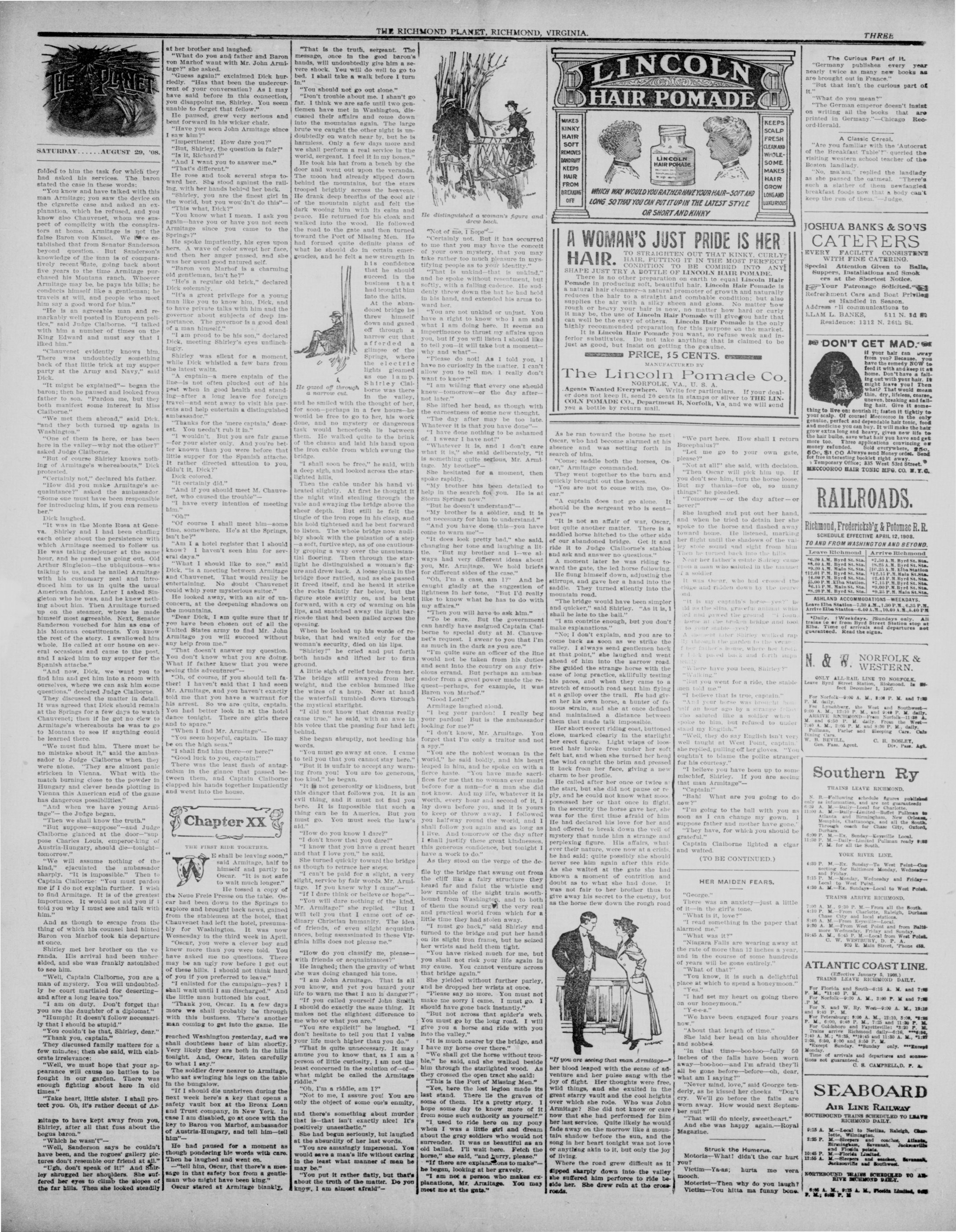
Chapter XIX
CAPTAIN CLAIBORNE ON DUTY.
N some mystification Captain Richard Claiborne packed a suit case in his quarters at Fort Myer. Being a soldier, he obeys
N some mystification Captain Richard Claiborne packed a suit case in his quarters at Fort Myer. Being a soldier, he obeyed orders; but, being human, he was also possessed of a degree of curiosity. He did not know just the series of incidents and conferences that preceded his summons to Washington, but they may be summarized thus:
Baron von Marhoff was a cautious man. When the young gentlemen of his legation spoke to him in aewed whispers of a cigarette case bearing an extraordinary device that had been seen in Washington he laughed them away; then, possessing a curious and thorough mind, he read all the press clippings relating to the false Baron von Kissel and studied 'the heraldic emblems of the Schomburgs. As he pondered he regretted the death of his eminent brother-in-law, Court Ferdinand von Stroebel, who was not a man to stumble over so negligible a trifle as a cigarette case. But Von Marhoff himself was not without resources. He told the gentlemen of his suit that he had satisfied himself that there was nothing in the Armitage mystery; then he cabled Vienna discreetly for a few days and finally consulted Hilton Clalborne, the embassy's counsel, at the Clalborne home at Storm Springs.
They had both gone hurriedly to Washington, where they held a long conference with the secretary of state. Then the state department called the war department by telephone, and quickly down the line to the commanding officer at Fort Myer went a special assignment for Captain Claiborne to report to the secretary of state. A great deal of perfectly sound red tape was reduced to minute particles in these manipulations; it was also of a private and wholly confidential character. Therefore he returned to his cottage at Storm Springs, and the Washington papers stated that he was ill and had gone back to Virginia to take the waters.
The Claiborne house was the pleasantest place in Storm valley and the library a comfortable place for a conference. Dick Claiborne caught the gravity of the older men as they un-
eg a eve
ieee NET.
: Se
Ny
‘the cigarette case and asked an ex-
planation, which he refused, and you
know also Chauvenet, whom we aus-
pect of complicity with the conspira-
fore at home. | Armitage is pot the
false Baron von Kissel. We ive es-
tablished that from Senator Sanderson
Beyond question... But Sanderson's
knowledge of the man is of compara-
tively recent Wate, golng back about
five years to the time Armitage pur-
chased his Montana ranch. Whoever
Armitage may be, he pays his bills; he
conducts himself lke a gentleman; he
travels at will, and people who meet
him say a good word for bim.”
“He 1s an agreeable man and re-
markably well posted In European poll
tics,” said Judge Claiborne. “I talked
with him a number of times on the
King Edward and must say that 1
Uked him.”
“Chauyenet evidently knows him.
There was undoubtedly something
back of that little trick at my supper
party at the Army and Navy," said
Dick.
“It might be explained”— began the
baron; then he paused and looked from
father to son. “Pardon me, but they
both manifest some interest in Miss
Claiborne."
“We met them abroad,” sald Dick.
“and they both turned up again in
Washington.”
“One of them 18 here, or has been
here in the valley—why not the other?
asked Judge Claiborne.
“But of course Shirley knows noth:
ing of Armitage's whereabouts,” Dick
protested.
“Certainly not," dectared bis father.
“How did you make Armitage’s ac.
auaintance?” asked the ambassador.
“Some one must have been responsible
for introducing him, if you can remem
ber.”
Dick laughed.
“It was in the Monte Rosa at Gene.
va. Shirley and I bad been chafing
each other about the persistence with
which Armitage seemed to follow us.
He was taking dejeuner at the same
hour, and he passed us going out. Old
Arthur Singleton—the ublquitous—wns
taiking to us, and he nailed Armitage
with bis customary zeal and intro-
duced him to us in quite the usual
American fashion, Later I asked Sin-
gleton who he was, and he knew neth-
ing about him. Then Armitage turned
up on the steamer, where be made
himself most agreeable. Next, Senator
Sanderson vouched for him as one of
his Montana coustituents. You know
the rest of the story. I swallowed him
whole. Ho called at our house on sev-
eral occasions and came to the post.
and I asked him to my supper for the
Spanish attache.”
“And now, Dick, we want you to
find him and get him into a room with
ourselves, where we can ask him some
Questions.” declared Judge Claiborne.
‘They discussed the matter In detail
It was agreed that Dick should remain
at the Springs for a few days to watch
Chauvenet; then if he got no clew to
Armitage’s whereabouts he was to £0
to Montana to see if anything could
be learned there.
“We most Sind him, There must be
no mistake about it,” said the ambas.
sador to Judge Claiborne when they
were alone. “They are almost panic
stricken tn Vienna. What with the
match burning close to the powder in
Hungary and clever heads plotting in
Vienna this American end of the game
has dangerous possibilities.”
“And when we have young Armi-
tage”— the Judge began.
“Then we shall know the truth.”
“But suppose—suppose”—and Jude
Claiborne glanced at the door—“sup
Dose Charles Lous, emperor-king of
Austria-Hungary, should die—tonight—
tomorrow.”
“We will assume nothing of the
kind,” ejaculated the ambassador
sharply. “It 1s impossible.” Then to
Captain Claiborne: “You must pardon
me if I do not explain further. I wish
to find Armitage. It is of the greatest
importance. It would not aid you if 1
told you why I must see and talk with
tim.”
And as though to escape from the
thing of which his counsel had hinted
Baron vou Marhof took bis departure
at once.
Shirley met ber brother on the ve
randa. THis arrival had been unber
alded, and she was frankly astonished
to seo him.
“Well, Captain Claiborne, you are a
man of mystery. You will undoabted-
ly be court martlaled for deserting—
and after @ long leave too.”
“I am on duty. Don't forget that
you are the daughter of a diplomat.”
“EHumph! It doesn't follow necessari-
ly that I should be stupid.”
“You couldn't be that, Shirley, dear.”
“Thank you, captain.”
‘They discussed family matters for a
few minutes; then she said, with elab-
orate irrelevance:
“Well, we must hope that your ap-
pearance will cause no battles to be
fought In our garden. There was
enough Sighting about here in old
times.”
“Take heart, littie sister. I shall pro-
tect you. Oh, it's rather decent of Ar
qnitage to have kept away from you,
‘at her brother and laughed.
“What do you and father and Baron
von Marhof want with Mr. John Armi-
tage?” she asked.
“Guess again!” exclaimed Dick bur-
edly. “Has that been the undercur-
rent of your conversation? As I may
have said before tm this connection,
You disappoint me, Shirley. You seem
unable to forget that fellow.”
He paused, grew very serious and
bent forward in his wicker chatr.
“Have you seen John Armitage since
Teaw him?"
“Impertinent! How dare you?"
“But, Shirley, the question is fair!
“Is it, Richard?”
“And I want you to answer me.”
“That's different.”
He rose and took several steps to-
ward ber. She stood against the rall-
ing, with her hands behind her back.
“Shirley, you are the finest girt in
the world, but you wou'dn't do this"—
“This what, Dick?"
“You know what I mean. I ask you
again—have you or have you not seen
Armitage since you came to the
Springs?”
He spoke impatiently, his eyes upon
hers. A wave of color swept her face,
and then her anger passed, and she
was her usual good natured self.
“Baron von Marhof is a charming
old gentieman, isn't he?”
“He's a regular old brick,” declared
Dick solemnly,
“It's a great privilege for a young
man like you to know him, Dick, and
to have private talks with him and the
governor about subjects of deep im-
portance. The governor fs a good deal
of a man himself.”
“I am proud to be his son," declared
Dick, meeting Shirley's eyes unflinch-
ingly.
Shirley was silent for a moment,
while Dick whistled a few bars from
the latest waltz,
“A captain—a mere captain of the
Mne—ts not often plucked out of his
pest when in good health and stand-
ing—after a long leave for foreign
travel—and sent away to visit bis par-
ents and help entertain a distinguished
ambassador.”
“Thanks for the ‘mere captain’ dear.
est. You needn't rub it in.”
“I wouldn't. But you are fair game
—for rour sister only. And you're bet-
ter known than you were before that
Uttle supper for the Spanish attache.
It rather directed atteution to you,
didu’t it, Dick?"
Dick colored.
“It certainly id.”
“And {f you should meet M. Chaure-
net, who caused the trouble”—
“I have every intention of meeting
btm."
“ont
“Of course I shall meet him—some
time, somewhere. He's at the Springs,
isn’t he?”
“Am T a hotel register that I should
know? I haven't seen him for sev-
eral days.”
“What I shoukl like to see,” said
Dick, “is a meeting between Armitage
and Chauvenet. That would really be
entertaining. No doubt Chauvenet
could whip your mysterious sultor.”
He looked away, with an air of un-
concern, at the deepening shadows on
the mountains.
“Dear Dick, I am quite sure that if
you have been chosen out of all the
United States army to find Mr. John
Armitage you will succeed without
‘any help from me.”
“That doesn't answer my question.
You don't know what you are doing.
‘What If father knew that you were
seeing this adventarer”—
“Oh, of course, If you should tell fa-
ther! I haven't said that I had ecen
Mr. Armitage, and you haven't exactly
told me that you have a warrant for
his arrest. So we are quits, captain.
You had better look in at the hotel
dance tonight. There are girls there
and to spare.”
“When I find Mr. Armitage"—
“You seem hopeful, captain, He may
be on the high seas."
“I shall find him there—or here!"
“Good luck to you, captain!”
There was the least flash of antag-
onism in the glance that passed be-
tween them, and Captain Clalborne
clapped his hands together impatiently
and went Into the house,
p) Chapter XX
fe
said Armitage, half
& ~ to wait much longer.”
He tossed a copy of
the Noue Freie Presse on the table. Os-
car had been down to the Springs to
explore and brought back news, gained
from the stablemen at the hotel, that
Chuuvenet had left the hotel, presuma-
bly for Washington. It ‘was now
Wesnesday {a the third week in April
“Oscar, you were a clever boy and
knew mere than you were told. You
have asked me no questions. There
may be an ugiy row before 1 get out
of these bills, I should not think hard
of you If you preferred to leave.”
“I enlisted for the campaign—yes? 1
sball wait until I am discharged.” And
the little man buttoned his coat.
“Thank you, Oscar. In a few days
more we shall probably be through
with this business. There's another
man coming to get into the game. He
reached Washington yesterday, aad we
shall doubtless bear of him shortly.
Very likely they are both in the hills
tonight And, Oscar, listen carefully
to what I say.”
‘The soldier drew nearer to Armitage,
who sat swinging his legs on the table
in the bungalow.
“If I should die unsbriven during the
ext week here's a key that opens a
safety vault box at the Bronx Loan
and Trust company, in New York. In
ease I am disabled, go at once with the
key to Baron von Marhof, ambassador
of Austria-Hungary, and tell him—teil
bim"—
He had paused for a moment as
though pondering bir words with care.
‘Theo he laughed and went on.
—“tell him, Oscar, that there's a mes-
Sage in that safety box from a gentle
man who might have been king.”
‘Oscar stared at Armitage blankly,
THE RICHMOND PLANET, RICHMOND, VIRGINIA
“That {s the truth, sergeant. The
message, once in the gvod baron's
hands, will undoubtedly give him a se-
vere shock. You will do well to go to
bed. I shail take a walk before 1 turn
a
“You should not go out alone."
“Don't trouble about me. I shan't go
far. I think we are safe until two gen-
jtlemen have met in Washington, dis-
cussed thelr affairs and come down
into the mountains again. The large
brute we caught the other night ts un-
doubtedly oa watch near ty, but he ts
harmless. Only a few days more and
we shall perform a real service in the
world, sergeant. I feel it In my bones."
He took his hat from a tench by the
door and went out upon the veranda.
‘The moon had already slipped down
behind the mountains, but the stars
trooped brightly across the heavens.
He drank deep breaths of the cool air
of the mountain night and felt the
dark wooing him with its calm and
peace. He returned for his cloak and
walked Into the wood. He followed
‘the road to the gate and then turned
toward the Port of Missing Men. Ie
jhad formed quite definite plans of
‘what he should do in certain emer-
| gendins, and be felt & new etreneth ta
ts confidence
that he should
succeed in the
business that
hud brought bim
into the hills.
At the aban-
donet bridge he
threw himself
down and gazed
of through a
narrow cut that
afforded a
glimpse of the
Springs, where
the electric
lights gleamed
as cue lamp.
Shirley Clal-
borne was there
a
yi" as one lam p.
A Shirley Clal-
He gazed of through tore wan there
en in the valley,
and he smiled with the thought of her,
for soon—perhaps in a few hours—he
would be free to go to her, his work
done, and no mystery or dangerous
task’ would henceforth lie between
them. He walked quite to the brink
of the chasm and laid his hand upon
the fron cable from which swung the
bridge,
“I shall soon be free,” he sald, with
& deep sigh, and looked across the star-
lighted hills,
‘Then the cable under his hand vi
brated slightly. At frst he thought tt
the night wind etealing through the
vale and swaying the bridge above the
sheer depth. But still be felt the
tlugle of the fron rope tn his clasp, aud
his hold tightened and he bent forward
to Usten. ‘The whole bridge now audi-
bly shook with the pulsation of a step
—a soft, furtive step, as of one cautious-
ly groping a way over the unsubstan-
tinl flooring. ‘Then through the star-
Ught he distinguished a woman's fig-
ure and drew back. A loose plank in the
bridge floor rattled, and as she passed
it freed itself, and ae heart it strike
the rocks faintly far below, but the
figure stole swiftly on, and he bent
forward, with a cry of warning on bis
Ups, and snatched away the light bar
ricade that had been palied across the
opening.
When he looked up his words of re-
buke, that had waited only for the
woman's security, died on bis lips.
“Shirley!" he cried and put forth
both hands and lifted her to firm
ground,
A little sigh of relief broke from her.
‘The bridge still swayed from her
weight, and the cables hummed like
the wires of a harp. Near at hand
the waterfall tumbled down through
the mystical starlight.
“I did not know thet dreams really
came true,” he sald, with an awe in
his votce that the passing fear had left
behind.
She began abruptly, not heeding his
words.
“You must go away at once. I came
to tell you that you cannot stay here.”
“But It is unfair to accept any warn-
Ing from you! You are tov generous,
too kind," he began.
“It fi not generosity or kindness, but
this danger that follows you It is an
evil thing, and it must not find you
here. It is impossible that such a
thing can be in America, But you
must go. You must seek the law's
ald.”
“How do you know I dare?”
“I don't know that you dare!”
“I know that you Lave a great heart
and that I love you,” he sald.
She turned quickly toward the bridge
as though to retrace her steps.
“I can't be paid for a slight, a very
slight, service by fair words Mr. Arml-
tage. If you knew why 1 came"—
“If I dare think or belleve or hope"—
“You will dare nothing of the kind,
Mr. Armitage! she repiled. “But I
will tell you that I came out of or-
inary Christian humanity. ‘The idea
of friends, of even siizht acquaint-
ances, being assassinated In these Vir-
€inia hills does not please me.”
“How do you classify me, please—
with friends or acquaintances?”
He laughed; then the gravity of what
she was doing changed his tone.
“I am John Armitage. That fs all
you know, and yet you hazard your
Ufe to warn me that I am to danger?”
“If you called yourself John Smith
I should do exactly the same thing. It
makes not the slightest diference to
me who or what you are.”
“You are explicit!” he laughed. “I
don’t hesitate to tell you that I value
your lfe much higher than you do.”
“That is quite unnecessary. It may
amuse you to know that, as I am a
person of little curfosity, Iam not the
jJeast concerned in the solution of —of—
what might be called the Armitage
riddle.” |
“Ob, I'm a riddle, am 17"
“Not to me, I assure you! You are
only the object of some oue's enmity,
and there's something about murder
that is—that isn’t exactly nice! Its
Positively unaesthetic.”
She had begun seriously, but laughed
at the absurdity of her last words,
“You are amazingly impersonal. You
‘would save a man’s life without caring
$0 the lest whet manner of :man be}
may be.”
“You put it rather fatly, but that's
about the truth of the matter. De you
know, I am almost afraid”
i
I} if ‘4 Lt
val (
a a ae A
nee Ve
pi ce een ne are
“Certainly not. But it has occurred
to me that you may have the conceit
of your own mystery, that you may
take rather too much pleasure in mys
titying people as to your identity.”
“That is unkind—that {s unkind,”
and he spoke without resentment, but
softly, with a falling cadence. He sud.
denly threw down the hat he had held
fn bis hand, and extended his arms to
ward her.
“You are not unkind or unjust. You
have a right to know who 1 am and
what Iam doing here. It seema an
impertinence to thrust my affairs upon
you, but {f you will listen I should like
to tell you—it will take but a moment—
why and what"—
“Please do not! As I told you, 1
| have no curiosity in the matter, I can't
allow you to tell ma 1 really don't
want to know!"
“1 am willing that every one should
know—tomorrow—or the day after—
not later.”
She lifted her head, as though with
the earnestness of some new thought.
“The day after may be too late.
Whatever it ts that you have done”—
“I have done nothing to be ashamed
of. 1 swear I have not!”
“Whatever it 4s, and I don't care
what it is," she said deliberately, “it
is something quite segious, Mr. Armt-
tage. My brother"—
She hesitated for a moment, then
spoke rapidly
“My brother has been detailed to
help in the search fof you. He is at
Storm Springs now.”
“But he doesn’t understana”—
“My brother fs a soldier, and {t in
not necessary for him to understand.”
“and you have done this—you have
come to warn me"—
“It does look pretty bad,” she sald.
changing her tone and laughing a lt
Ue. “But my brother and I—we al
ways had very different ideas about
you, Mr. Armitage. We hold briefs
for different sides of the case."
“Ob, I'm a case, am IY" And he
caught gladly at the snggestion of
Ughitness In her tone. “But 11d really
like to know what he has to do with
my affairs.”
“Then you will have to ask him.”
“To be sure. But the government
can hardly have assigned Captain Clal-
borne to special duty at M. Chauve
net's request. I swear to you that I'm
as much in the dark 2s you are.”
“I'm quite sure an officer of the Ine
would not be taken from his duties
and sent Into the country on any friv
olons errand. Bat perhaps an ambas
sador from a great power made the re
Quest—perhaps, for example, it was
Baron von Marhof.”
“Good Loni?”
Armitage laughed aloud.
“1 beg your pardon! T really beg
your pardon! But is the ambassador
| looking for me?*
forget that I'm only w@ traitor and not
a spy.”
“You are the noblest woman In the
world,” he said boldly, and his heart
Heaped Io him, and he spoke on with a
‘fierce haste. “You have made sacri-
| flees for me that no woman ever made
before for a man—for a man she did
not know. Aud my life, whatever it fs
worth, evers hour and second of it, I
lay down before you, and it is yours
to keep of throw away. I followed
you halfway round the world, and I
Shall follow you again and as long as
| Tltve, Aud tomorrow or the day after
I shail justify these great kindnesses,
this generous confidence, but tonight I
[have a work to do."
| As they stood on the verge of the de-
file by the bridge that swung out from
the cliff lke a fairy structure they
heard far and falat the whistle and
low rumble of the night train south-
bound from Wasbingtop, and to both
of them the sound urgWi the very real
and practical world from which for a
little thne they had stolen away.
“I must go back,” said Shirley and
turned to the bridge and put her hand
on its slight fron frame, but he selzed
her wrists and held them tight.
“You have risked much for me, but
you shall not risk your life again in
my cause, You cannot venture across
that bridge again.”
She ylelded without further parley,
and he dropped her wrists at once.
| “Please say no wore. You must not
make me sorry I came. I must go. I
should have gone back instantly.”
“But not across that spider's web.
You must go by the long road. I will
give you a horse and ride with you
tnto the valley.”
| “It is much nearer by the bridge, and
T have my horse over there.”
| “We shall get the horse without trou-
ble.” he said, and she walked beside
him through the starlighted wood. As
they crossed the open tract she said:
“This is the Port of Missing Men.”
“Yes, here the lost legion made its
last stand. There le the graves of
some of them. It's a pretty story. 1
hope some day to know more of it
from some such authority as yourself.”
“I used to ride bere on my pony
when I was a litte girl and dream
about the gray soldiers who would not
surrender. It was as beautifal as an
‘old ballad. I'l walt here. Fetch the
L-——. —__ —_- as a
—————— tT ES
Eg aXe
eee i
=
uD HATR POMADE @i
waxes fen & ayy KEEPS,
Cad | ee 2 ScaLp
HAIR = a = / FRESH
SOrT es FW & yy acs
removes Se so ae es WHOLE
DaNDRUrE 9] . SOME
_ = (ee lees
HAR YS {= FON Tair
FROM - Grow
jameumie}| WHICH MAY WOULD YOU RATHERMAVEYOUR HAIR-SOFTAID |] .encam
ort _]) LONG SOTRAT YOU GIN PUT ITUPIN THE LATEST STYLE |\umwR0%
— OR SHORT AND KINKY ————
A WOMAN'S JUST PRIDE IS HER
TO STRAIGHTEN OUT THAT KINKY, CURLY?
HAIR, suctborixe 25s Tire nook pease
© CONDITION TO BE COMBED INTO ANy{
SHAPE JUST TRY A BOTTLE OF LINCOLN HAIR POMADES
There 1s no other preparation on earth to equal Lineolt Hate
Pomade in producing soft, beautiful hair, Lincoln Hair Pomade is
@ natural hair cleanser—a natural promoter of growth and naturally
reduces the hair to a straight and combable condition: but alee
supplies the air with a silky sheen and gloss. No matter how
rough or heavy your hair Is now, no matier how hard ee cult
it may be, the use of Linceln Hair Pomade will ever hair that
can well be the envy of others. Lincoln Hair Pomate is the cont
highly recommended preparation for this purpose on the market.
It {8 Lincoln Hair Pomade You want, #0 refuse week oat te
ferlor substitutes. Do not take anything that le claimed to ts
Just as good, but Insist on getting the geasioe
«moma PRICE, 15 CENTS. exam
x ; sy x
The Lincoln Pomade Co.
NORFOLK, VA., U.S. A.
Agents Wanted Everywhere. | Writs for particulars, If your deal-
er does not keep it. send 20 cents In stamps or silver to THE LIN-
COLN POMADKE CO., Department B, Norfolk, Va, and we will send
You a bottle by return mail.
As be ran towand the house he met
Oscar, who had become alarmed at his
absence and was setting forth in
search of him.
“Come; saddle both the horses, Os-
car.” Armitage commanded.
‘They went together to the barn and
quickly brought out the horses,
“You are not to come with me, Os
car.”
“A captain does not go alone. It
should be the sergeant who Is sent—
yes?”
“It Is not an affair of war, Oscar,
but quite another matter. There is a
saddled horse hitched to the other side
of our abandoned bridge. Get tt and
ride It to Judge Claiborne’s stables
and ask and answer no questions.”
A moment later he was riding to
ward the gate, the led horse following.
He flung himself down, adjusting the
stirrups, and gave her a hand into the
Saddle. They turned silently into the
mountain road.
“The bridge would have been simpler
and quicker,” said Shirley. “As it is, 1
‘shall be late to the ball.”
“I am contrite enough, but you don’t
make explanations.”
“No; I don’t explain, and you are to
come back as soon as we strike the
valley. I always send gentlemen back
at that point,” she laughed and went
abead of him nto the narrow road.
She guided the strange horse with the
ease of long practice, skillfully testing
hs paces, and when they came to a
stretch of smooth road sent him fying
ata gallop over the trail. Me had giv:
en her his own horse, a bunter of fu.
mous strain, and she at once defined
and maintained a distance between
them that made talk Impossible,
Her short covert riding coat, buttoned
clone, marked clearly in the starlight
her erect figure. Light wisps of loos.
ened hair broke free under her soft
felt bat, and when she turned her head
the wind caught the brim and pressed
it back from her face, giving a new
charm to her profile.
He called after her once or twice a
the start, but khe did not pause or re
ply, and he could not know what moo
Possessed her or that once in fight
in the security the horse gave her, she
was for the first time afrald of him
He had deciared his love for her and
had offered to break down the vell of
mystery that made him a strange aud
perplexing figure. His affairs, what
ever their nature, were now at a crisis,
he had said; quite possibly she should
never see him again after this ride.
As she waited at the gate she had
known a moment of contrition and
doubt as to what she had done. It
was not fair to her brother thus to
sive away his secret to the enemy, but
‘ag the horse flew down the rough road
i bis) ,
“IY you are aecing that man Armitage—
her blood leaped with the sense of ad-
Venture and her puise sang with the
Joy of fight. Her thoughts were tree,
wild things, and she exulted in the
great starry vault and the cool heights
over which she rode. Who was John
‘Armitage? She did not know or care
now that she had performed for him
her last service. Quite likely he would
fade away on the morrow like a moun-
tain shadow before the sun, and the
song in her heart tonight was not love
or anything akin to it, but only the joy
of living.
Where the road grew difficult as tt
“pped sharply down into the valley
the suffered him perforce to ride be-
side her. She drew rein at the cross
“We part here, How shall I return
Bucepbalus?”
“Let me go to your own gate,
please?"
Not at allt? she said, with decision
“Then Osear will pick him up. If
you don’t see him, turn the horse loose.
But my thanks—for ob, so many
things!” he pleaded.
| “Tomorrow —or the day after—or
“never!”
She laughed and put out her hand,
and when he tried to detain her she
spoke to the horse and flashed away
towanl home. He listened, marking
her flight until the shadows of the val
Hey stole sound and sight from. hia
‘Then te turned back Into the bills
Near her father’s estate Sulriey came
fhon a Wan who saluted in Ube tanuner
fa soldier
Tr was Osear, who bid crossed the
Huge aud ridden down by the ear
seu
“it is my eaptatn's horse—yeR?” te
Ud wi the sift, eraveray aninnat wiki
ed and pawed the ground 4 joun
Livre att che broken bridke sand tol
to Sone stable. vest
A diwownt Liter Skitiey walked rap
fy vlirounch the garden tw Ute verar
f her fachors bouse, where ter Urti
f Lik pwed back and forth itgpn
Where have you been, Suirtey %
“Walking.”
“tut you went for a ride, the stable
wwen told me"
“I belleve that t# true, captain.”
And your botse was breuett he
vif an hour ago by a siranye fli
vho saluted like a soldier when
spoke to bim, but refused to uuder
stuud my English.”
“Well, they do say English isn't very
well taught at West Point, captain
she replied, pulling off ber gloves. “You
oughtn't to blame the polite strange:
for his courtesy.”
“I belleve you have been up to som
mischief, Shirley. If you are seein;
that man Armitage"—
“Captain!”
“Bah! What are you going to &
now?”
“I'm going to the ball with you a:
soon as I can change my gown, |
suppose father and mother have gone."
“They have, for which you should be
grateful.”
Captain Clafborne lighted a elgar
and watted.
(TO BE CONTINUED.)
HER MAIDEN FEARS.
“George.”
There was an anxiety—just a little
of it—in the girl's tone.
“What is it, love?”
“I read something in the paper that
alarmed me.”
“What was it?”
“Niagara Falls are wearing away at
the rate of more than 12 inches a year,
and in the course of some hundreds
of years will be gone entirely.”
“What of that?”
“You know, it 1s such a delightful
place at which to spend a honeymoon.”
“Yea”
“I had set my heart on going there
9n our honeymoon.”
“Yees.”
“We have been engaged four years
now.”
“About that length of time.”
She laid her head on his shoulder
and sobbes.
“In that time—boohoo—fully 50
inches of the falls have been worn
away—boohoo—and I'm afraid they'll
All be gone before—before—oh, dear,
what am I saying?”
“Never mind, love,” said George ten:
derly, as he kissed her cheeks. “Don’t
ery. We'll go before the fatls are
worn away. How would next Septem:
ber suit?”
“That will do nicely, sweetheart.”
And she was happy again.—Royal
Magazine.
Struck the Humerus.
Motoris—What! didn't the car hurt
you?
Vietim—Yaas; hurta me vera
mooch.
| Motertst—Then why do you laugh?
Victim—You hitta ma funny bone.
THRRE
‘The Curious Part of It.
“Germany publishes every year
nearly twice as many new books as
are brought out in France.”
“But that isn't the curious part of
te
“What do you mean?”
“The German emperor doesn’t tnstat
on writing all the books that are
printed in Germany.”—Chicago Reo
ord-Herald.
A Classic Cereal,
“Are you familiar with the ‘Autocrat
of the Breakfast Tabie'?”. queried the
visitiug western school teacher of the
Boston landlady.
“No, ma’am,” replied the landiady
as she passed the oatmeal. “There's
Such a slather of them newfangled
breakfast foods now that a body cam't
keep the run of them.” —Judge,
JOSHUA BANKS & SONS
EVERY FACILITY CONSISTENT
WITH FINE CATERING.
Special Attention Given to Balla,
Suppers, Instatiations and Smok
ers at the Shortest Notice,
EgPYour Patronage Bolicited. ey
Retrechment Cara and Boat Privieg
es Handled in Season.
Address ti communications to
KLAM L. BANKS, S11 N. 34.98
Residence: 1312 N. 26th St
*@ DON'T CET MAD-@«
Mf your air can wway
ftom you? Because, you
have the remedy NOW to
feod it with and keep it at
home. Don'thave = fall-
tng out with your hair. 18
might leave youl Then
What? That would meam
thin, dry, lifeless, coarse,
tuveven, breaking and fall
ing bait. Give it some-
thing to live en: nourish it; fasten it tightly to
your scalp. Of course! Beccootoe 19 the caly-
Eenuice. perfect and dependable hair tonic, food
and medicine you can buy. It will make the hate
ROW extra long and heavy, gives new lite te
he hair bulbs. save what bait you Lave and get
more too. Three applications. convincing “ow
money refunded. Sold everywhere, #Bo.
$c, $100 Always send Money ordee. ‘Sead
fot tbe interesting booklet right away. gy
» Temporary Office; 335 West Sind Street.
MECCOOROO BAIR TONIC MFG. CO. H.¥.0
Fe mR
‘Richmond, Frederictst’g & Potomac R. R.
| SeHEDULE EFFECTIVE APRIL 12,908.
TO AND FROM WASHINGTON AND BEYOND.
| Zeave Richmond | Arrive Richmond
CEROE Bred se sia| rae mores ti:
TOM Byrd Sst! feiss Am. Byrd Se Sta.
ICE We RSS] PSA 8 sate
sn ord Se in| Sse hate Ree
OCs) TAR AS ae
TP aaiwee se] saaok waged ae bie
SSSA ped st hel S320 clan ha
ASHLAND ACCOMMODATIONS WEEKDAYS.
Aare tba Station 7.0 ao Fone Po
Arrive Elbe Station—6.40 A.0-, 10.40 4.3..3.40 PM
Coal, J Wenndary JSundaye only. al
ares of Yeom Byrd siren Shae Biop a
Eber Huge gf agitate asd departtres at
Eestintecd: Read the gees
N & 8 NORFOLK &
. * WESTERN.
ONLY ALI-RAIL LINE TO NORFOLK.
Leave Hyrd Btreet Station, “Richmond. Ie ie
| fect December 'l, Lat.
For Norfolk-0:00 A. M., 9:00 P.M. and Temp
P.M. daily.
For Lynchberg, the West and Southwest—
OS ive aitnabatt ete! Bee, Sete
ARIIVE "RICHMOND—Prem Norfolle—ILae
Mant 6:50 VM. daily. Prous the. West
70 0M, 2:06 P.M ‘and 4:00 PML dally
Tullman,” “Parle sad Sleeping Care. Oat
Dining ‘Care
W. mh hevitn, ©. H nostey,
Gen. Pam. “Agent, Div, Paws! Agt
TRAINS LEAVE RicmMOND.
X. R—ollowing schedule Agures publishes
caly as information, nd ‘are oot: guanetesde
ra) 'h “M"Dally"Loeat for ‘Chatlotias
0 8 Mba Aaelted nate Paina
Aitanta ‘and Rirmingham, "New, Opleame,
Memphis, “‘Chattanoge and all the Boa
Firat’ uch ar" Chase ‘City, Oxford
6:00 PME. Senday—Keyevitle Local.
11:90 F: M—Daliptimitel Polina Ready em
PL AL for alt the Soutn.
YORK RIVER LINE.
4:90 P, M—Ex Sunday—To West Point—Gom
beeing foe Taltimore Monday, Wedonatag
sod Friday.
235 BMC Meday, Weloewtay and Feldag—
Local” tg. West’ Point’
4:30 AMF Sindaye Local to West Poti.
TRAINS ARRIVE RICHMOND.
3:09 A. AL, 9:90 P.M — From all the South.
10 FM rem Charlotte, Raleigh Dorkaas
Giase’ City’ and local stations’
8:10 A. M.—“From Keswille Laval
6:30 A. M—Prom ‘West Point nd from Bate
shore’ Wevdoentay. Friday ant: Seiags
10365 AM, PM Lent from Weet Pola,
C.'W. WeETHORY, D. Pe ae
#20 KE Main Street, “Phone i
eS
a TAT ete,
TRAINS LEAVE KRICMMOND DAILY.
For Florida and South—€:16 A.M, and 7:98
eo ni Pe
Por "Nortolk—9:00 A. M., 9:00 P.M and 72m
pM
For. and W. Ry. Weet—6:00 A.M, 2938
ont 6:0 Pe
Wor Petersburg: 9:00 A. M., 12:10, 3:00, *B-mg
PM, €:00, 0:40 P Mey 735 aod tee
For" Goldsboro and. Fayetteville: “5:30: Me
Son arrce Michal dalr06, Seta,
7:40 AL Me; "36, Sel0s45 andl 11:8) Ae My
2:06, 6:00, 8:00. and 8:80 P.M.
wibrcert’ Bunday.. *Buniay” caly. nome
‘Time of arrivale and departures and sommme
tious not guaranteed
OS CAMPRELIAD. Fax
nna
Are Lins Ramwway
SOUTHBOUND TRAINS SCHEDULED TO LAV
RICHMOND DAILY.
9:5 A, M—Local to Merling, Raleigh, Cham
lette, “Wilmington.
2:95 P. M—Elcepers aed couches, Atianitm,
‘Birmingham, Gavamash, Jacksavills
Sf viorae Cini.
est Ee ee
| Setseovite and’ eoctrees.
POR adage sen
6:8 A 15 AM, Plosida Limited, Oa
vw My ay! x
THE PLANET
REFLECTIONS OF A BACHELOR.
When a girl can love an old man, it's a sign she can fool him into thinking it's real.
Everybody is intolerant of other people's bad habits when he has different ones of his own.
One of the easiest things is to marry a girl because she made you think you wanted to.
Maybe the reason some women don't hesitate to color their hair is because generally it isn't theirs.
A pleasant thing about expecting money is all you can plan to do with it until it comes and your family gets it.
It's the easiest thing in the world for a woman to make a man think he is in love with her unless they are married.
Even when she's a grandmother of several years' standing a woman can wonder why she has gray hair at such an early age.
The maddest girl in the world is the one who ate onions because she was sure nobody was going to call, and then he came.
A good way to get men to drink plenty of water and pay lots of money for it would be to put an internal revenue tax on it.
A man is hardly ever prouder of anything than when he sat in the same smoking room of a sleeping car with some politician and told him what time it was.—New York Press.
PERT PARAGRAPHS
Mosquitoes have insomnia worse than any other created thing.
The woman who wears a directoire gown has a good opinion of herself.
When a woman doesn't know what else to do she eats a chocolate sundae.
The trouble with brains is that so few people know what they are or how to use them.
Having a good disposition is often a matter of carefully choosing your companies and environment.
Women may have queer ideas of what fun consists of, but they aren't apt to be sorry the next morning.
Understanding a little about everything and everything about a little is what constitutes an educated man.
Some people never turn up their noses at anything, as nature has already anticipated them in the matter.
POINTS AND PLEASANTRY.
To avoid breach-o'promise suits, get a wife.
It's a poor mule that don't work both ways.
You must either give up your grouch, or your friends.
Foundations for divorce suits are usually laid during the honeymoon.
Even in very hard times, furs are worn most extravagantly by the lady beavers.
The gas company doesn't claim to make the city any better; only a little brighter.
When a man has nothing to say he is usually given an opportunity to make a speech.
Eve's sheath skirt wouldn't hang well, because it wasn't tailor-made. Adam said he "wouldn't give a fig for it."
THOUGHTS FOR THE DAY.
If a man knows his faults, no good is accomplished by making him confess them.
Every man's life may be a poem, but he wastes an awful lot of time trying to make all the lines rhyme.
It is a hard struggle, but one worth keeping up not to meddle in other people's affairs, even when they ask us to.
Public speakers running for office utter many stale and virtuous platitudes, but it may be fortunate that they are not smarter men than they are.
Because you once easily found a lifetime friend do not think you will do so often.—St. Louis Globe-Democrat
LOG CABIN SAYINGS
Man can't rule de weather, but he
kin have a high ol' time growlin' at it.
No matter how big de fish is, hit
aln't half ez big ez de story de man'll
tell 'bout it.
No matter how de worl' goes, sence
you is gwine wid it, de wisest way is ter make de best of it.
Some folk believe nuttin' dey can't see. Well, you can't see de wind, but ht sho' raises ol Satan in a hurricane —Atlanta Constitution.
SENTENCE SERMONS
Many a big sorrow is born of a little sin. *
Greater work is the best reward for good work.
Laws always depend on our essential valuation of life.
Character depends more on conscience than on creed.
Religion is not to bind back, but to bind together all men.
The god who can be expressed in figures is only a figurative god after all.
He who sells out his friends lays his own soul on the bargain counter.
Envy is the habit of extracting our own misery out of the happiness of others.
Success is not so much in getting there as in knowing what you are there for.
The greatness of any man's present depends on the length of his view of the future.
Salvation is more than consciousness of my soul; it is the sense of the worth of every soul.
Those who think they have all religion are the ones who most need to worry whether they have any.
When the preacher gets anxious as to popular opinion on his brain, he has not his people on his heart.
The difference between what we are and what we know we ought to be is the great opportunity in life. —Chicago Tribune.
SOME THINGS TO THINK ABOUT.
Sara Bernhardt's real name is Mme. Damala.
Uncle Sam uses 17,000,000 barrels of salt a year.
The rose is queen of flowers in the millinery world.
The Dead sea is nine times saltier than the ocean.
The real name of Mme. Schuman-Heink is Mrs. William Rapp, Jr.
Don't save all your smiles for the parlor—use a few in the kitchen.
Franklin county, Missouri, shipped out 22,608,488 corncob pipes in 1907.
President Garfield's first act after taking the oath of office was to kiss his mother.
Commodore Stephen Decatur, U. S. N., at a banquet in 1817, gave this toast: "Our country, right or wrong!"
SNAP SHOTS.
An aviator is an aerial high roller. He is a bird.
Do not do your best and leave others to do the others.
The sum of human happiness is all that is in sight, and then some.
Give woman a cool pillow to cry into and she can cry over anything.
It is hard to carry courtesy too far, particularly when one is going toward home.
Some color-blind women persist in putting more on one cheek than on the other.
Mrs. Peevish says she thought she was marrying a tower of strength, only to find out it was a crooked stick.
The foolkiller can never enjoy his vacation for wishing that he had brought his gun.—Dallas News.
THE GENTLE CYNIC.
We learn to do by doing. Also by being done.
It is almost as easy to give advice as to reject it.
Speech may also be a means of concealing what we really think.
A mule seldom kicks without cause, but with a man it different.
A virtuous man never blows his own horn. In fact, a virtuous man is generally too poor to own one.
A statistical friend of mine has computed that there are 98,645 ways of separating a fool and his money, and then some.
THE BUSINESS MAN AND THE MAID.
A Maid once loved a Business Man,
Full young he was and fair,
He had big innocent blue eyes,
And wavy golden hair.
But so demure and shy was he,
No wife, however,
The Malden in her love designed,
Could bring him to her feet.
But now it was the glad leap /ear,
When privilege was hers
To his hand as each /old may
Of hire, however properly,
She took him for a trolley ride
Adown to Bay Shore park,
And popped the question in a place
Romantically dark.
He hung his head quite bashfully
And asked for time to think,
When he would soon, as 'twas his wont,
Reply by pen and ink.
But when his missive she received,
She could not understand.
It was, "Dear Miss:—
I'll let you have
Refusal of my hand."
-Baltimore American.
THE RICHMOND PLANET, RICHMOND, VIRGINIA
IT WILL PAY YOU
1
Rl
IF YOU WILL
BORS AND INTERE
WE WILL HELP YOU
IN ORDER TO F
YOU WILL TALK WITH YOUR
AND INTEREST THEM IN THE
WILL HELP YOU TO OBTAIN A P
ORDER TO FURTHER INCREASE
WE WILL SEND YOU
AND THE ST LOUIS, MISSO
GLOBE DEMOCRAT, ONE
REPUBLICAN JOURNALS
STATES FOR $2.25 PER YEAR.
WE WILL SEND YOU
THE COSMOPOLITAN MA-
PER YEAR FOR BOTH.
WE WILL SEND YOU
McCLURE'S MAGAZINE FOR
FOR BOTH.
FOR TWO YEARLY
OR THEIR EQUIVALENT, T
ATURES, ONE ONLY, OF
DORE ROOSEVELT, DR.
INGTON, BATTLE OF SAN
TLE OF QUASIMAS NEAR
1898, SHOWING THE NINTH
ORED CAVALRY IN SUPP
DERS, SIZE 20X28 AND 20
BATTLE AND CHARGE OF
ED INFANTRY IN RESCUE OF
AT SAN JUAN HILL, JULY 2,
AND 20X24 INCHES, ADMIRAL
NAVAL BATTLE OFF CAVIT
BAY, MAY 1ST, 1898, NAVAL
CONDUCTION OF ADMIRAL CEN-
SILH FLEET OFF SANTIAGO DE O
1898, SIZE 22X28 INCHES; LA
CAPTURE OF EL CANEY, EL PA
ICATIONS OF SANTIAGO, JU
SECOND, 1898, SIZE 22X28 AN
. WE WILL SEND YOU ONE,
THE FOLLOWING BATTLES OF T
IN THE SAME TERMS. THE P
THE OTHER BATTLES ARE FIN
S. THEY ARE 22X28 INCHES
AT ONE DOLLAR EACH. WE
WITH FRAMES FOR ANY OF THE
MOS FOR 2 DOLLARS & 50CTS. E
AL. BATTLE OF GETTYSBUR
SHILOH, BATTLE OF FIVE FO
E OF ATLANTA, GA., BAT
NYLVANIA, VA., BATTLE OF
MISS., BATTLE OF LOOKOUT
EENN., BATTLE BETWEEN THE
AND THE MERRIMAC, BATTLE OF
A., BATTLE OF CHANCELLO
E OF THE BIG HORN, (CUSTE
E) STORMING OF FORT WAR
COLORED TROOPS IN THIS FIGHT
IN NEW ORLEANS, LA., CAPTU
E OF SITTING BULL, THE GR
CHIEFTAIN; FORT PILLOW MA
OF PETERSBURG, VA., BATTLE
ER, VA., BATTLE OF OLUSTE
ALL SEND FAMILY RECORD, SIZ
WHICH CONTAINS SPACE FOR
COS OF PARENTS AND TEN CH
LEND SEND SOLDIERS WAR RECORD
OF SERVICE IN UNITED STAT
IF YOU WILL TALK WITH YOUR NEIGH-
IN ORDER TO FURTHER INCREASE OUR STEADILY GROWING CIRCULATION WE WILL OFF
WE WILL SEND YOU THE PLANET AND THE ST LOUIS, MISSOURI, SEMI-WEEKLY GLOBE DEMOCRAT, ONE OF THE LEADING REPUBLICAN JOURNALS IN THE UNITED STATES FOR $2.25 PER YEAR FOR BOTH.
WE WILL SEND YOU THE PLANET AND THE COSMOPOLITAN MAGAZINE FOR $2.25 PER YEAR FOR BOTH.
WE WILL SEND YOU THE PLANET AND McCLURE'S MAGAZINE FOR $2.25 PER YEAR FOR BOTH.
OR THEIR EQUIVALENT, WE WILL SEND PICTURES, ONE ONLY, OF PRESIDENT THEODORE ROOSEVELT, DR. BOOKER T. WASHINGTON, BATTLE OF SANTIAGO, LAND BATTLE OF QUASIMAS NEAR SANTIAGO, JUNE 24, 1898, SHOWING THE NINTH AND TENTH COLORED CAVALRY IN SUPPORT OF ROUGH RIDERS, SIZE 20X28 AND 20X24 INCHES, LAND BATTLE AND CHARGE OF THE 24TH & 25TH
COLORED INFANT RIDERS AT SAN JUY 20X28 AND 20X24 IN GREAT NAVAL BAY, MAY 15 DESTRUCTION OF SPANISH FLEET OF LY 3RD, 1898, SIZE TLE, CAPTURE OF FORTIFICATIONS OF AND SECOND, 1898 INCHES. WE WILL OF THE FOLLOWING WAR ON THE SAMS LIKE THE OTHER I COLORS. THEY AT TAIL AT ONE DO FURNISH FRAMES CHROMOS FOR 2 DO DITIONAL. BATTLE TLE OF SHILOH, BAT BATTLE OF ATL SPOTTSYLVANIA, BURG, MISS., BATT TAIN, TENN., BATT TOR AND THE MEN RUN, VA., BATTLE BATTLE OF THE B CHARGE) STORMIN C., (COLORED TRO E OF NEW ORLI EATH OF SITTING DIAN CHIEFTAIN; I FALL OF PETERSBU CHESTER, VA., BAY WE WILL SEND FAY 28. WHICH CONTA GRAPHS OF PAREN WE WILL SEND SOL TIFICATE OF SERVI MY.)
COLORED INFANTRY IN RESCUE OF ROUGH RIDERS AT SAN JUAN HILL, JULY 2, 1898, SIZE 20X28 AND 20X24 INCHES, ADMIRAL DEWEY'S GREAT NAVAL BATTLE OFF CAVITE IN MANILA BAY, MAY 1ST, 1898, NAVAL BATTLE, DESTRUCTION OF ADMIRAL CERVERA'S SPANISH FLEET OFF SANTIAGO DE CUBA, JULY 3RD, 1898, SIZE 22X28 INCHES; LAND BATTLE, CAPTURE OF EL CANEY, EL PASO AND FORTIFICATIONS OF SANTIAGO, JULY FIRST AND SECOND, 1898, SIZE 22X28 AND 22X27 INCHES. WE WILL SEND YOU ONE OF ANY OF THE FOLLOWING BATTLES OF THE CIVIL WAR ON THE SAME TERMS. THE PICTURES LIKE THE OTHER BATTLES ARE FINISHED IN COLORS. THEY ARE 22X28 INCHES AND RETAIL AT ONE DOLLAR EACH. WE WILL FURNISH FRAMES FOR ANY OF THESE FINE CHROMOS FOR 2 DOLLARS & 50CTS. EACH ADDITIONAL. BATTLE OF GETTYSBURG, BATTLE OF SHILOH, BATTLE OF FIVE FORKS, VA., BATTLE OF ATLANTA, GA., BATTLE OF SPOTTSYLVANIA, VA., BATTLE OF VICKSBURG, MISS., BATTLE OF LOOKOUT MOUNTAIN, TENN., BATTLE BETWEEN THE MONITOR AND THE MERRIMAC, BATTLE OF BULL RUN, VA., BATTLE OF CHANCELLORSVILLE, BATTLE OF THE BIG HORN, (CUSTER'S LAST CHARGE) STORMING OF FORT WAGNER, S. C., (COLORED TROOPS IN THIS FIGHT), BAT-
E OF NEW ORLEANS, LA., CAPTURE AND DEATH OF SITTING BULL, THE GREAT INDIAN CHIEFTAIN; FORT PILLOW MASSACRE, FALL OF PETERSBURG, VA., BATTLE OF WINCHESTER, VA., BATTLE OF OLUSTEE, FLA. WE WILL SEND FAMILY RECORD, SIZE 22 BY 28, WHICH CONTAINS SPACE FOR PHOTOGRAPHS OF PARENTS AND TEN CHILDREN. WE WILL SEND SOLDIERS WAR RECORD (CERTIFICATE OF SERVICE IN UNITED STATES ARMY.)
FOR FIVE NEW SUBSCRIBERS.
FOR ONE YEAR E
LENT, WE WILL SE
CLE TOM'S CABIN, T
TERESTING BOOK
WILL SEND YOU A
WITH YOUR PICT
THE YEAR EACH, OR THEIR
WE WILL SEND YOU A COPY
MIS CABIN, THE MOST INTEN-
TING BOOK IN THE COUNTRY
END YOU A GOLD-PLATED
YOUR PICTURE THEREIN,
FOR ONE YEAR EACH, OR THEIR EQUIVALENT, WE WILL SEND YOU A COPY OF UNCLE TOM'S CABIN, THE MOST INTENSELY INTERESTING BOOK IN THE COUNTRY. WE WILL SEND YOU A GOLD-PLATED BROOCH WITH YOUR PICTURE THEREIN, YOU TO
ADDRESS ALL ORDERS TO
JOHN MITCHELL, JR.,
311 North Fourth Street,
RICHMOND, VIRGINIA.
```markdown
```
```markdown
```
To interest yourself in promoting the CIRCULATION of th
FOR TWO YEARLY SUBSCRIBERS
REQUISITE NUMBER IS OBTAINED, WE WILL FORWARD THE PRESENT INDICATED.
A PERSON WHO TRIES TO GET FORTY SUBSCRIBERS AND GETS TIRED MAY INDICATE HIS WISH AND WE WILL SEND THE PRESENT FOR THE NUMBER HE HAS SECURED OVER FIVE.
THE NUMBER WILL BE FOR NOT LESS THAN FIVE NOR MORE THAN TEN AND NOT LESS THAN TEN NOR M HAN TWENTY AND NOT LESS THAN Y NOR MORE THAN FORTY, TO DET THE PRIZE TO WHICH THE WORKER
IF ANYTHING IS DESIRED NOT SPECIFIED IN THIS LIST, WRITE US ABOUT IT AND WE WILL TELL YOU IN WHAT CLASS IT BELONGS.
A man and a woman
LANET
WEEKLY
READING
UNITED
H.
T AND
ER $2.25
T AND
YEAR
ND PIC-
THEO-
WASH-
D BAT-
JUNE 24,
H COL-
JUGH RI-
LAND
& 25TH
```markdown
```
REQUIST
FORWAR
SHOULD YOU DESIRE ANY COLORED JOURNAL IN THE UNITED STATES, WE WILL SEND IT TO YOU IN CONJUNCTION WITH THE PLANET AT A GREATLY REDUCED RATE FOR BOTH.
FURNISH THE PHOTOGRAPH, ONE FOUNTAIN PEN, GOLD POINT; ONE LADIES RING, ONE BREAST-PIN, GOLD FILLED; HALF DOZEN LINEN HANDKERCHIEFS, ONE ALARM CLOCK, ONE DOZEN NAPKINS, ONE HALF DOZEN TOWELS, ONE CHOCOLATE POT, ONE PAIR VASES, ONE PAIR KID GLOVES, ONE HAM, ONE TURKEY.
WE WILL SEND ONE CHINA SET, THIRTY-ONE PIECES; ONE NECKLACE; DICKENS, SHAKESPEARE, BYRON WORKS; ONE UMBRELLA, ONE PLAIN GOLD RING, ONE PAIR LACE CURTAINS 1,000 ENVELOPES, 1,000 SHEETS OF PAPER PRINTED AND DELIVERED; ONE TOILET SET, ONE HALF CORD OF SAWED WOOD
FOR TWENTY NEW SUBSCRIBERS
WE WILL GIVE ONE HANDSOME GOLD RING WITH OPALS, RUBIES OR PEARLS; ONE JEWELRY BOX FINISHED IN GOLD OR SILVER; ONE SILK SHIRT WAIST; ONE READY MADE DRESS, ONE GOLD WATCH, FILLED, WARRANTED FOR TEN YEARS, ONE ROCKING CHAIR, ONE LOAD OF COAL, ONE GROSS OF SOAP, EITHER WASHING OR TOILET; ONE BARREL OF BEST FLOUR, ONE PAIR BLANKETS, ONE MANICURE SET, ONE SEAMSTRESS' WORK BOX, ONE PAIR SHOES, GENTS OR LADIES.
FOR FORTY YEARLY SUBSCRIBERS
OR EQUIVALENT, WE WILL GIVE ONE SEWING MACHINE, ONE DIAMOND RING, ONE GOLD WATCH, ONE PAIR FINE GOLD EARRINGS, ONE MUSIC BOX, ONE PHONOGRAPH, ONE READY MADE DRESS, ONE SUIT OF GENTLEMEN'S CLOTHES, ONE GOLD-HEADED CANE, ONE GOLD-HEADED UMBRELLA, ONE CHINA SET, ONE DOZEN SILVER-PLATED KNIVES AND FORKS, ONE HAT-RACK, ONE SILK DRESS, ONE WEEK'S TRIP TO THE SEASHORE, RAILROAD FARE AND HOTEL BILL PAID, FOR ANY RICHMOND WORKER. THESE OFFERS MAY BE TAKEN ADVANTAGE OF BY SENDING ONE OR TWO SUBSCRIBER'S NAMES AT A TIME. WE WILL KEEP A RECORD OF THEM; AS SOON AS THE
FOR TEN NEW SUBSCRIBERS
ALL SEND ONE CHINA SET, THIRD
ONE NECKLACE; DICKENS, AND
BYRON WORKS; ONE UMBRELL,
GOLD RING, ONE PAIR LACE CU
ENVELOPES, 1,000 SHEETS OF
AND DELIVERED; ONE TOI
LF CORD OF SAWED WOOD.
OR TWENTY NEW SUBSCRIBER
ALL GIVE ONE HANDSOME GOLD
PALS, RUBIES OR PEARLS; ONE
BOX FINISHED IN GOLD OR
SKIRT WAIST; ONE READY
ONE GOLD WATCH, FILLED
FOR TEN YEARS, ONE R
ONE LOAD OF COAL, ONE G
EITHER WASHING OR TOIL
OF BEST FLOUR, ONE PAIR
THE MANICURE SET, ONE SEAM
BOX, ONE PAIR SHOES, GENTS.
OR FORTY YEARLY SUBSCRIBER
INVALENT, WE WILL GIVE ONE
MACHINE, ONE DIAMOND RING
WATCH, ONE PAIR FINE GOLD
ONE MUSIC BOX, ONE PHONO
ADY MADE DRESS, ONE SUIT
ITS CLOTHES, ONE GOLD-
ONE GOLD-HEADED UMBRELL
SET, ONE DOZEN SILVER-
AND FORKS, ONE HAT-RAC
RESS, ONE WEEK'S TRIP TO T
RAILROAD FARE AND HOT
OR ANY RICHMOND WORKER,
USE OFFERS MAY BE TAKEN
OF BY SENDING ONE OR TW
ITS NAMES AT A TIME. WE
RECORD OF THEM; AS SOON.
IS OBTAINED, WE WILL
RENT INDICATED.
I TRIES TO GET FORTY
GETS TIRED MAY INDIED
WE WILL SEND THE
NUMBER HE HAS SE-
WILL BE FOR NOT LESS
MORE THAN TEN AND NOT
R M HAN TWENTY
N Y NOR MORE
THE PRIZE TO
R ITLED.
IS DESIRED NOT SPECI-
RITE US ABOUT IT AND
IN WHAT CLASS IT BE-
ALL ORDERS TO
CHELL, JR.,
Fourth Street,
VIRGINIA.
FIVE
NOT=TH
COLORED WE WILL WITH THE RATE
ONE FOUNDIES RING,
HALF DOZZE ALARM
ONE HALF POT, ONE MOVES, ONE
BERS
SHIRTY-ONE, SHAKES-DELLA, ONE CURTAINS, PDF PAPER DILET SET,
BERS
GOLD RING
ONE JEW-ER SILVER;
LADY MADE, WARN-ROCKING GROSS OF
LET; ONE
ER BLANK-AMSTRESS'
ITS OR LA-
BERS
ONE SEWING, ONE GOLD EAR-NOGRAPH,
TOT OF GEN-HEADED
DELLA, ONE
ER-PLATED
BACK, ONE
IN THE SEA-OTEL BILL
ER.
IN ADVANT-TWO SUB-WE WILL ON AS THE
]
```markdown
```
61X
THE PLANET
HORTICULTURE
PRUNING.
To Do Successful Work You Need Proper Tools.
One trouble with the novice in pruning is that he may not have a clear idea of what he wishes to accomplish. He may think that the tree is headed too low and so chops off the main limbs and ruins it, or, the top is too thick and proceeds to trim up the limbs, leaving a tuft of branches at the ends, destroying the fruiting spurs and leaving what fruit does grow inaccessible and exposed to the action of heavy winds. Better to have no pruning at all than such work as this.
The tools needed are a saw, shears, knife, step-ladder and occasionally a long ladder. The saw should be the ordinary, narrow, stiff-blade pruning saw, about 18 inches long and with rather coarse teeth so that it will cut
Pruning Tools.
freely. The right kind of shears are a great help and with them much of the work can be done easier and quicker than with any other tool, but few of those found in the hardware stores are worth much. Most of them with only one cutting blade which works against a shoulder, will spring apart after a little use and they bruise the wood more or less.
The double-cut shears with both blades alike, while high priced are by far the best thing on the market as they cut close and do not bruise the wood. The handles are of wood and can be had from 25 to 30 inches long. For a knife, the common large pruning knife with a hooked blade is all right.
BITTER ROT OF APPLES:
Proper Spraying with Bordeaux Mixture Will Save Crop.
As the result of experiments conducted by the Illinois station, the following conclusions have been reached regarding bitter rot of apples and its treatment:
Bordeaux mixture properly made and applied will save over 90 per cent. of the fruit liable to attack by bitter rot.
Fruit sprayed in such a manner as to be thoroughly coated with the spray mixture when the first infection of the disease appears will be injured least by bitter rot.
Spraying until the fruit is completely coated with the mixture as soon as the first infection of bitter rot is discovered is of considerable value but is much less effective than the treatment mentioned above.
Spraying until the fruit is completely coated with the mixture after bitter rot has become thoroughly established is effective in controlling as much as 50 per cent. of the disease during some seasons. In other season its effect as a remedy is very slight. Bordeaux mixture applied in the liquid form is the most effective spraying material for the control of apple bitter rot. Pure copper sulphate solution failed to check the disease and caused injury to the foliage. To coat fruit thoroughly with the mixture it is necessary to make at least three applications of the spray material. Applications of 25 pounds of salt to the ground about a tree have no value in checking the disease.—W. Paddock
HORTICULTURAL NOTES.
The American plums are great bearers.
The Japanese plums do not do well in the northwest.
Blackberries should be heavily fertilized or they will not do their best.
Plums must be protected from the curculio if they are to give satisfaction.
There is little satisfaction in trying to grow a garden on poor soil not properly enriched.
Every farmer that has a few fruit trees only should learn the science of protecting them by spraying.
An apple grower says that there is never an over-supply of good apples. The over-supply is of poor fruit.
In pruning the grape, it is necessary to have a good deal of technical knowledge. Pruning too much will prevent fruit production on account of removing the wood that should bear the fruit; while pruning too little will allow a large development of vines
at the expense of fruit.
The longest keeping fruits are the most profitable, except in locations where all marketing facilities are of the best.
FERTILIZING DRY LAND.
The Moisture Content of Soil Must Be Considered.
The problem of fertilizing dry land is not the same as fertilizing moist land or land in the humid regions where the soil contains a fair supply of moisture at all seasons of the year. The writer is informed by Mr. T. C. Wallace of California that in the dry soils of California the roots of the grape vines are very deep in the soil, and that, where irrigation is or is not practiced, it is found to be very difficult to properly fertilize the vineyards and orchards. It is a problem on which many are working, but it is doubtful if any have fully solved it—how to get the fertilizer that is put into the surface soil to decompose and yield up its plant food for the roots in the moist layer of soil far below.
It might be suggested that the irrigation water would do the work, but the irrigation water is not at the top of the soil for a long enough period to accomplish very much in this regard. It is not a question of dissolving what is soluble but seems to be a question of establishing a moist medium in the vicinity of the fertilizer in which moist medium the soil organisms can work. The problem of fertilizing grape vines and fruit orchards is the greatest because these do not permit of the turning over of the soil for the purpose of working fertility into it.
The problem that exists in California all the time exists here in the Mississippi valley part of the time. We have dry seasons in which the effects of the fertilizers applied to our vineyards and orchards is not greatly felt. The moisture conditions of the soil have a very large influence on the decay of manure. For this reason many of the purchasers of fertilizers complain of not getting results from the fertilizers, without ever taking into account the fact that the availability of the plant food in the fertilizers depends on the perfection of the water supply. Land habitually dry is exceedingly difficult to fertilize, for the reason that the fertility remains in the soil without being submitted to the agencies that would change it into materials that the roots of trees and vines can use.
In the fertilizing of orchards and vineyards, the fertilizer should be gotten into the soil and should be applied at times of the year when the moisture supply is likely to be good but is not over-abundant. If barnyard manure is to be placed in the surface soil of an orchard, it should be gotten in in the fall, before the coming of the fall rains if possible. If it is to be applied to the surface, it should be put on in the winter, that the rains and snows may wash the soluble portions into the soil.
If the fertilizer is a highly nitrogenous one, like dried blood. It should be worked into the soil in the spring as early as possible. If it is applied in the fall, a large part of the soluble plant food will disappear before spring. The part of this that will be most lost will be the nitrogen, the very ingredient for which the blood is applied. Yet if it is applied too late in the spring to get the benefit of the spring moisture, the nitrogen is likely to be largely dissolved into the air. Thus, in dry land fertilizing, the moisture supply must be closely considered, and because it is not closely considered is the reason that some of our fruit growers do not get the results from their orchards they have expected.
PROTECTING TREES
Brace Them So That Windstorms Will Not Ruin Them.
Many fine apple trees are annually destroyed by severe windstorms. When there is no windbreak around an orchard, it is not easy to keep it intact. It is a good plan to drive stakes on west side of trees, then with a piece of cord pull back the tree till it leans a little to the west or southwest or toward the prevail
there is no windbreak around an orchard, it is not easy to keep it intact. It is a good plan to drive stakes on west side of trees, then with a piece of cord pull back the tree till it leans a little to the west or southwest or toward the prevailing winds and tie firmly to a stake as shown in the cut. The same plan can be followed where any tree is liable to be blown about by the wind. Wrap several thicknesses of burlap or an old rubber hose around the trunk of the tree so the twine will not injure the bark. In transplanting large shade trees it's a good plan to protect them for a year or two with three such stays.
Pack Carefully.
The fruit grower should strive to produce a better quality of apples, and whoever packs them should pack and grade more carefully, and mark each grade just as it is, and also mark the name of the packer or association putting up the fruit. Then if there is anything wrong the blame can be placed where it belongs.
Rapid Growing Pear Trees
The more rapidly a pear tree grows, the more likely is it to be attacked by blight. The reason seems to be that the texture of the bark is so open that the spores of the blight can get an entrance with the threadlike sprouts that are too fine to be seen by the unaided eye.
The hardest thing to fight in plum growing is the curculio. Jarring and spraying both help to protect the plums.
WITH THE SAGES.
Nothing can atone for want of truth
-Ruskin.
THE RICHMOND PLANET, NICHMOND, VIRGINIA
Goodness thinks no ill where no ill
soems.—Milton.
The best workman is he who loves
his work.—T. T. Lynch.
There is nothing little to the really
great in spirit.—Dickens.
Habit, if not resisted, soon becomes
necessity.—St. Augustine.
Never trouble another for what you
can do yourself.—Jefferson.
Greatness and goodness are not
means, but ends.—Coleridge.
It is one thing to see your road;
another to cut it.—George Elliot.
Labor rids us of three great evils;
poverty, vice and ennui.—Voltaire.
A man must stand erect, not be kept erect by others.—Marcus Aurelius.
The reward of one duty is the power to fulfill another.—George Ellot.
The most important of all is the education of the will.—F. W. Farrar.
Habit has more force in forming our characters than opinions have.—R. Hall.
We hand folks over to God's mercy and show none ourselves.—George Ellot.
Each man has his special duty to perform, his special work to do.—Smiles.
BY THE WAY.
It is lucky to do right.
Justice doesn't drop stitches in her knitting.
We must learn to think to learn what to think.
If we have reason for an act we don't need an excuse.
People that are religious to get rich won't get rich to be religious.
How clearly a lawyer states things—if he isn't trying to win a bad case.
You can't think a face is homely if you see a beautiful soul through it.
There is hope of a person who has sense enough to get tired of being a fool.
A fellow does well to get out of the devil's trap if he has to gnaw off his leg to do it.
The person who isn't going to do right till to-morrow is always 24 hours from it.
Jurisprudence is beginning to think it doesn't exist to see that a criminal shall never be anything else.—Grand Randos News.
A CLEVER WOMAN
A clever woman is one whose ability is never unpleasantly felt by the rest of the world.
A clever woman is one who acts like hot water on tea—she brings the sweetness and strength out of everybody else.
A clever woman is one who acknowledges her neighbors' right to live, who doesn't believe that she alone is the motive power of the world.
SUNFLOWER PHILOSOPHY
Pray for the things you want, but
work for the things you must have.
Before accepting a favor look for the
string that may be tied to it.
Complaining of the folly of fashion
is as useless as complaining when the
weather is bad.
Never tell a friend anything that
would not look well in print with your
name signed to it.
You didn't have the right kind of a
good time if you are not good natured
the next day after you had it.
Working after you have had a few
glasses of beer in the middle of the
day is like trying to work after dark.
There are lots of men who seem worthless until compared with a girl who has just returned from a vacation.—Atchison (Kan.) Globe.
A Nice Time.
Miss Tiptop—Did you enjoy yourself
at the opera last evening?
Miss Westend—Oh, awfully. Mr.
Blatherskite is the most delightful
conversationist I ever attended a
musical performance with—New York
Weekly.
Rooester, the Dog.
Bill—What do you call your dog?
Jill—I call him Rooster.
"Funny name for a dog. Why Rooster?"
"Because he's a setter dog, but he
never lays any eggs!"—Yonkers
Statesman.
A person who understands the business of putting on new gloves says that one should see to it that they are well powdered. Slightly moisten the thumb and for finger of one hand while slipping the fingers of the glove for the other hand into place. Never try to insert all fingers at once. First turn back the glove, leaving the thumb on the outside until all the fingers are well into the tips of the glove fingers, then insert the thumb and adjust well at the wrist. If the glove is not thoroughly drawn on the first time it will never look trim on the hand.
To Hold Woman Goifer's Skirts.
An easy way for women golfers to keep their skirts in order when putting or playing over the fair green on windy days is to make a band of wide white cotton elastic that is loose enough to permit freedom of limb in the attitude most comfortable to the player in either part of the game. This elastic is hitched up to the back waist line when not in use, some players adjusting it to a tape belt by side tapes made sufficiently long to piece the band at will between hip and knee so it will not jerk when the stroke is taken—Vogue.
only absolutely necessary regu-
apply at the main office.
The Court
Is the Female Department of the
thirty persons to organize a co-
Fidelity, exercise Harmony and
an endowment and burial ben-
dues. The only expense for a
rosette, costing 25 cents for a
THE BANDS OF CALA-
stitutes a feature and persons a
circle. The expense is nomin-
$1.00 to $1.50 sick dues and do-
Lodge or Court or Band in you.
For all information concern
For all information conce-
membership in the lodges and
A. Hayes
727 North Second Street
RESIDENCE, 725 N. and St.
First-class Hacks and Caskets of all descriptions. I have a spare room for bodies when the family have not a suitable place. All country orders are given special attention. Your special attention is called to the new style Oak Caskets Call and see me and you shall be waited on individually.
NO. 23 NORTH 18TH ST
FINE WINES, LIQUORS
CIGARS, &c.
All Stock Sold as Guaranteed.
PROMPT ATTENTION.
Your patronage is respectfully solicited.
IS RAZOR FREE
THIS RAZOR Practically FREE
With a year's subscription to the (Name of Your Paper) and
The Philadelphia Press
The razor is made from the best Sheffield Steel, hardened and tempered thermometrically and guaranteed.
It's Particular Merit is its
star Merit is its Shaving Quality
It's Particular Merit is its Shaving Quality
$3.50
BUYS
The Philadelphia
ONE YEAR daily, regular pri
Fremont Razor
Your Favorite Home Newspa
BUYS
Philadelphia Press
R daily, regular price $3.00
Razor $2.00
Favorite Home Newspaper $1.50
BUYS
The Philadelphia Press
ONE YEAR daily, regular price $3.00
Fremont Razor $2.00
Your Favorite Home Newspaper $1.50
Value $6.50
ALL FOR
3.50 Cash
immediately upon receipt of your
subscription.
To-day—NOW!
Mailed immediately upon receipt of your subscription.
Order To-day—NOW!
When Putting on Gloves.
'Pbane, 2778.
S. W. ROBINSON.
DEALER IN
Knights of Pythias,
This organization is one of the most powerful in the country and its progress has been phenomenal. The Grand Lodge of Virginia has jurisdiction over all of the cities and counties in this state. Thirty males are required to organize a new lodge. The benefits paid constitute one of its strongest features, but the principles are greater than anything else. Founded on Friendship, based on Charity and established on Benevolence, the respectable, upright people of the state will find it an order worthy of their heartiest support.
It pays an endowment and burial benefit of of $200.00 for all ages. It pays $4.00 per week sick dues. The badge costing 75 cents each is the only absolutely necessary regalia. For information concerning the organization of lodges apply at the main office.
The Courts of Calanthe
The Courts of Calanthe
Is the Female Department of the Order. It requires a membership of thirty persons to organize a court. Its members are pledged to exhibit Fidelity, exercise Harmony and prove Love one for the other. It pays an endowment and burial benefit of $150.00. It pays $3.00 per week sick dues. The only expense for regalia is the cost of the badge, 50 cents and a rosette, costing 25 cents for funeral occasions.
THE BANDS OF CALANTHE or Children's Department also constitutes a feature and persons cannot do better than to enter the little ones into this mystic circle. The expense is nominal and the benefits all that could be expected. It pays from $1.00 to $1.50 sick dues and death benefits of from $30.00 to $40.00. If you have no Pythian Lodge or Court or Band in your neighborhood, orgruiz one.
For all information concerning special rates of membership in the lodges and courts, address
KNIGHTS OF PYTHIAAS
FCB
GEORGE O. BROWN.
PHOTOGRAPHER,
603 N. 2nd St., Richmond, Va.
Fine Photographs. True to Life. High-class
service. Latest improvements in Photograp-
to. Durable, high-quality equipment. Avail-
tates and Prompts Service. Pictures Satisfy
ed from Old seatives or Photographs. 2-mi
—Subscribe to The Richmond
PLANET. $1.50 per year.
N. A., S. A., E. A., A. AND A.
organization is one of the most power-
has been phenominal. The Grand
over all of the cities and counties in
in to organize a new lodge. The
longest features, but the principles
ended on Friendship, based on Chas-
the respectable, upright people of
their heartiest support.
an endowment and burial benefit o
per week sick dues. The badge
galla. For information concerning
hurts of Calant
the Order. It requires a memi
court. Its members are pledged
and prove Love one for the other.
feit of $150.00. It pays $3.00 per
pregalia is the cost of the badge, 50
funeral occasions.
ANTHE or Children's Department
cannot do better than to enter the
final and the benefits all that could
death benefits of from $30.00 to $40
our neighborhood, orgrunz one.
ing the Children's Department ad
THE ECONOMY,
303-5 North Third St
FINE
TAILORING
CLEANING, DYEING ANL
REPAIRING
CHITMAN M. WHITE,
PROPRIETOR.
STRAUS'
Old Yacht
PURE W
Will Satisfy the
kind of stimulant
We have all grade
Cigars and Tobacco
us.
ISAAC STR
422 E. E.
Dealer In General Line of
FANCY AND STAPLE GROCERIES,
NOTIONS, FRESH MEATS, CI-
GARS, TOBACCO, ICE,
WOOD, COAL, &c.
11 S. 4TH ST. RICHMOND, VA.
BOARDING & LODGING
Rates Reasonable. All the Comforts
at Home
Orders received by letter or telegraph
MRS. BOOKER LEFTWICH,
PROPRIETRESS
S16 N. 2nd St., Richmond, Va.
BLACKWELL & BRO.
ONE OF THE LEADING PAINTERS
Practical House and Sign Palaters.
Graining and General Contractors.
...ALL WORK GUARANTEED.....
Cards, Letters or Orders.
...Give us a trial, you will never regret it....
Address, 608 St. Peter Street,
RICHMOND. VA.
Phone 5088.
Nelson's Hair Dressing can be bought at Jennings and Brown Drug Store, Pittsburg, Pa.
Furnished Rooms, 50c. up.
Meals, 50c. up.
THE MT. CLEMENS HOTEL
AND MINERAL BATH HOUSE
AMERICAN AND EUROPEAN PLAN. Phone, 245. Has opened its doors for the accommodation of COLORED PEOPLE that may come to Mt. Clemens in the future for their Health and Treatment
on Rheumatism.
It is the only Hotel and Mineral Bath House owned and conducted by a colored man at any of the health resorts in the United States.
Write for Special Rates.
GRO. I. HUTCHINSON, PROP.
48 Welts St., Mt. Clemens, Mich.
ment also con-
he little ones into this mystic
ld be expected. It pays from
$40.00. If you have noPythian
address.
311 N. 4th St., Richmond, Va.
STRAUS' SPECIAL
PURE WHISKEY
Will Satisfy the lover of the right kind of stimulant. Special prices. We have all grades of good liquors, Cigars and Tobacco. Call and see us. ISAAC STRAUS & CO., 422 E. Broad St..
H F Jonathan
FISH, OYSTERS AND
PRODUCE.
120 N. 17TH ST., RICHMOND, VA.
ALL ORDERS WILL RECEIVE
PROMPT ATTENTION.
Long Distance 'Phone, 752.
SCHOOL SHOES.
Capitol Shoe & Supply Company,
No. 210 East Broad Street.
A complete stock of Boys,' Misses,' Men's, Ladies,' & Children's Shoes.
ALL THE LATEST STYLES.
MRS. JOSIE A. GRAHAM
Virginia's Most Successful Hair Culturist.
...PARLORS.....
108 E. Leigh St., - Richmond,
'Phone, 1034.
Private Parlors, Confidential Inter-
views and Correspondence.
The largest and most up-to-data
Hair Dressing Parlors in Richmond.
The very best preparations that can
be made for the hair, scalp, face
and skin.
Graham's Superior Scalp Food for
growing hair on bald heads and
bare temples, 25cts. per jar. By
mail, 35cts.
Graham's Superior Orange Flower Skin Fo' for developing and beautifying the skin, 25cts a jar. By mail 35cts.
Graham's Superior Velvet Liquid Powder for giving the face a beautiful fair color, 25 cents a bottle. By mail 35cts.
Graham's Vegetable Hair Dye the best on market giving a rich natural color, $1.00 per bottle. By mail, $1.25.
Mrs. Graham makes a specialty of massaging and beautifying ladies' faces for parties and public gatherings, 35 cents.
Mrs. Graham empaquois the head and puts it in a healthy condition, 25 cents.
All ladies who attend parties and other social gatherings should have their finger nails manicured and made beautiful, 25 cents.
Mrs. Graham's preparations sell at sight. Ladies living in other cities and towns can make good money by selling these preparations. Write for terms to Mrs. J. A. Graham, No. 108 E. Leigh St., Ricemond, Va.
—We are selling old papers at fifteen cents per hundred
M
Virginia.
THE PLANET
SATURDAY.....AUGUST 29, '08
THE DAIRY
SIMPLE CHURN.
Revolving Barrel Type of Machine Hard to Beat.
Several new and ingeniously devised churns have appeared on the market in recent years, most of which are no improvement over the old designs. The most practical, and at the same time the most economical, churn is the re
in recent years, most of which are no improvement over the old designs. The most practical, and at the same time the most economical, churn is the revolving barrel form shown in the sketch. The labor of operating this churn is less than either the dash or the whirling paddle form, and it makes better butter. There are no inside fixtures to be cleaned and no crevices or corners that are difficult to clean. This churn has a hole in the side near the bottom, through which the buttermilk may be drawn off, which is a great advantage. It is a demonstrated fact that butter can be churned better in a churn having no internal fixtures than in one with an elaborate set of naddles.
PERIOD OF LACTATION.
It Has an Important Bearing on the Value of the Cow.
The period of lactation, or the length of time a cow will milk, is an important point, and one that does not seem thoroughly appreciated. The "escutecheon," or "milk mirror," is a fair guide to what may be expected from a cow on this score, but weekly records of the milk are more reliable, and if these records are compared with the escutecheon and general appearance, much valuable information will be learned.
The heaviest milkers are not always the best cows, as many an animal giving a comparatively small quantity will continue to milk almost up to her next calving, yielding in the long run more milk, and being, therefore, the more profitable cow for the dairy.
As a rule, the smaller the yield, the richer is the quality of the milk, and similarly the smaller breeds of cattle generally give the best milk. The richness of milk is due to the properties of the fat globules. Milk containing large and regular sized fat globules yields up all the butter fat in the churn, and all conditions being equal, makes better butter, both in flavor, color and quality, than that containing small and irregular sized fat globules.
The trade or business of the farm should therefore determine the breed of the cow to be used. If milk is required, the larger breeds of cattle should be kept; if butter, the smaller ones.
Making Permanent Pastures
Timothy alone does not make good pasture, and blue grass is slow about coming in. The quickest returns are obtained from sowing thickly a mixture of many grasses, which will give varieties that mature at all seasons. Prepare land very thoroughly by repeated harrowings, pulverize the surface and sow at the rate of two bushels per acre very early in the spring. The following is a good mixture for land that is neither too wet or too dry: Six pounds timothy, six pounds rye grass, seven pounds Kentucky blue grass, five pounds orchard grass, four pounds red top, three pounds tall meadow oat grass, three pounds sheep's fescue, and one pound each of hard fescue, soft meadow grass, meadow fox tall, red clover and white clover. Seed should be thoroughly mixed, divided in equal portions and the field sown both ways, then the seed brushed in lightly. Keep animals off until midsummer, when the grass may be pastured lightly for the rest of the year.
Sandy Soil.
Sandy soil is very easy to work, and when the humus is abundant the productivity is not below that of other soils. Many sandy soils carry a good percentage of clay, though that does not appear to the ordinary observer. A soil that has no clay is not soil but sand. Such is not suitable for agricultural operations till it has been modified by the application of clay. There are many localities where a slight increase of the clay content of the sand soil would greatly increase its capacity. The clay makes the sandy soil retentive of moisture and also enables it to hold the soluble plant food so necessary to the growth of plants.
Time Proves Dairy Theories.
It will be difficult in a few years more to find any dairymen who ever poked fun at the practical experiments with balanced ratios. You can't find a man to-day who ever said, for example, that the United States department of agriculture was wild when it called Dr. E. Lewis Sturtevant to investigate the merits of the first Danish Weston milk separator and yet there were hundreds. -Agricultural Report.
STORAGE OF BUTTER.
Stated That Large Amount Is Being Packed in Cold Storage.
It is reported that the amount of butter being stored for next winter is very large. The fine pastures this spring and summer have made it possible to produce an enormous amount of milk, and the creameries have been able to secure an unusually large amount of this. The surplus butter, instead of going onto the retail market to depress the prices, has gone into the storage houses.
It is said that on the first of June last year the total amount of butter in the cold storage houses of the country amounted to 1,500,000 pounds, while this year the amount on the same date was 7,000,000 pounds. This is a good start and indicates that the market is well under control.
It also indicates, says Farmers' Review, that there is a great deal of money in the hands of the men that are storing this butter. Last summer when the tightness of the money market began to be felt, much of the butter being held had to be thrown on the market to get out of it the value tied up in it. That the buyers of butter are able to store and hold such large quantities indicates a decided improvement in the commercial conditions. The farmers are in every way benefited by the state of affairs, as it prevents the demoralization of the butter market, which would affect the farmers both through the creameries and through the farm butter trade.
ADVANTAGES OF FALL CALVES.
Milk Is Worth More Then, and Calves Are Easier to Raise.
There is every good reason why calves should ordinarily be dropped in the fall. September and October are the best months. In the first place, it brings the biggest production of milk at the season of the year when prices are highest. Then, too, it is better for the calf to go through the cold months of his first winter unweaned, and if turned out upon pasture about June 1 he will hardly miss the milk. Much has been said and written about raising calves, but unless the underlying principles are kept in mind the job is a failure. Indigestion is the chief difficulty with the pall-fed calf. Some' calves seem to be born with poor stomachs, and no amount of care will prevent the trouble. Use moderate quantities of milk, not exceeding four quarts for a young calf, heated to 100 degrees. Feed at regular intervals from a clean pail. If the milk of the cow is very rich it will be safe to make it one third hot water for the first few feeds.
After five or six days begin to substitute skim milk in a small proportion, until at the end of three weeks the youngster is wholly upon skim milk. Keep some bright bay and mixed feed before him, and he will soon learn to lick them. A good, bright stable, plenty of sun, and in the spring a good pasture, are essential.
PROFITABLE DAIRYING.
Careful Feeding Essential to Getting Largest Profits.
It is estimated that the average amount of feed required to produce a ton of butter worth $500 is equivalent to 40 tons of hay, worth in the market $280. Adding the fertility value of the hay left after producing the butter, to the value of the ton of butter, equals $700, or a return of $17.50 per ton for the hay when sold to the cow, while that fed to produce beef or mutton returns only $13.50. Of course, the difference in favor of feeding the cow goes to pay for the excess of labor required in dairying. This view of the matter might help in the choice of the kind of animals to feed. With broad acres and little available help, it might be best to feed beef or sheep. On smaller farms and more help, feed the cow and hog. The degree of profit in either case depends much on the skill of the feeder and on the selection of the animal. A friend of mine, whose farm is near Fond du Lac, told me that he received from his 25 cows one year an average of $92 per cow for milk and cream. Some of my neighbors are satisfied to get $45 per cow.-George C. Hill in Address.
METHOD OF THROWING CATTLE
Simple and Effective Manner of Doing
the Trick.
A is a rope of any size desired and
about 24 feet long. It is first tied
my size desired and g. It is first tied around the animal's neck at E, then passed to B, where it is held and allowed to drop down and is
around the animal's neck at E then passed to B where it is held and allowed to drop down and is then raised over the animal's back and passed through the part held at B When the rope is pulled it will draw tight. The rope is then passed at D, where it is fixed in the same way as at B. Now pull on the rope, and the animal will tie down.
STRIPPINGS.
Welch the milk, and find out what the cows are doing.
If the milk flow drops off from flies and short pastures you cannot bring the cows up again to their yield without great cost.
There ought to be a law prohibiting the mortgaging of the family cow. Where a man has a large family of small children, a good cow furnishes half of their living.
His Two Weights
Jones—What do you think young Chumpley weighs?
Brown—About 200 pounds on the scales and about ten ounces in the community.—Half Holiday.
Life's Requirements
Thou must command and win, or serve and lose, suffer or triumph, be an anvil or a hammer.—Goethe.
THE RICHMOND PLANET, RICHMOND, VIRGINIA
SELECT WITH CARE
SELECT WITH CARE
MATERIALS FOR SMALL DAUGHTER'S WARDROBE.
Light Designs Are Pretty for a Time. But Not Serviceable—Patterns by All Means to Be Avoided.
These are the days when the younger daughters of the household strike terror to mother's heart by announcing that they have nothing to wear!
Their elder sisters, knowing how to care for delicate summer fabrics and how to select the proper gown to wear on occasions when wear and tear must be considered, generally have a presentable wardrobe in midsummer, but a sorry array is presented in the closet of the younger girl.
A few thrifty mothers have learned to select heavy and medium-weight tub fabrics for the majority of frocks
```markdown
```
to be worn by Miss Sixteen, but the
vast majority are caught in the lure
of delicately tinted and woven fabrics
which can be washed only with infi-
nite care and which yield to the sun's uncompromising rays.
The mothers who now find themselves face to face with the task of renowing Miss Sixteen's summer
wardrobes, will do well to recall that
fall and school days are ahead, and to
plan upon making the new gowns do
double duty, that is, finish off the
vacation season and answer various
purposes in the fall.
Lawnss, batistes, organdles, etc.,
should be avoided except for making
up party frocks, and even then a net
or chiffon cloth, or light silk, is a better investment for fall and winter
evening use.
Chiffon cloth, unlike chiffon pure and simple, does not suffer greatly from humidity, and all the nets, silk or cotton, are excellent between-season investments. Be careful in selecting your net and avoid the fillet patterns. This because fillet has had such a long run that certainly in the fall it will be counted among the passe designs. Better far to employ a simple dotted, ringed or flowered net, and trim it with pipings, bias folds or shirrings of white satin or ribbon in soft finish.
Right here a word about slips to be worn under these little party frocks. Do not buy taffetta for this purpose. It has gone out entirely, and soft mossaline or a fine grade of china silk is used instead under net, chiffon, eto.
For wear under organdle, batiste or fine lawn, there is nothing better than a delicately tinted lawn, blue, pink, green or lavender, according to the complexion of the wearer. This may be trimmed with inexpensive german val lace, and will wash and outwear the silk ship.
A very pretty party frock is illustrated, which shows the apron effect now growing in popularity. This would be most effective in soft finished batiste, with batiste insertion and flouncing for trimming. Or the flouncing may be of batiste embroidery and the insertions of lace.
If batteat insertion is employed, get a fine but rather open pattern, suggesting Irish crochet. The epaulet effect over the shoulder is very becoming to the slender girl. This frock should be worn over a delicately-tinted silk, and may have a matching cash in soft fall ribbon, made into a chou with long ends or in a very long narrow, bow, running up and down but never across the waist line, and very long ends.
Pretty Summer Card Cases
Card cases of cretonne or linen are useful and pretty with summer dresses, and they are very easily made at home.
Most of them are lined with linen, although others are finished with taffeta. All are stiffened by a piece of tailor's canvas, placed between cover and lining. The linen must, of course, be cut straight—not bias—and turned back on the lining side at either end, to form pockets. Such card cases are usually bound in braid or stitched bands of the material, but, should they be of white linen, they are very attractive, when buttonholed all round the edge.
The owner's monogram, too, may be embroidered at one corner, either in linen floss or mercerized cotton, which greatly adds to the beauty and individuality of the whole.
WEDDING DRESS NOT COSTLY.
Fine Cream Veiling the Chief Material for Costume.
It is carried out in fine cream vel- ing. The skirt is slightly full at the waist, sides and back; the foot is
MILLER'S HOTEL
W.M. MILLER,
PROFRIETOR
WITHIN
ONE BLOCK OF
STREET CAR LINES
THAT TAKE YOU
• TO ALL
PARTS OF THE
CITY
TERMS
REASONABLE
SECOND AND LEIGH STS.
RICHMOND, VA.
Hat Repairing.
Hat Repairing.
Silk, Stiff and Soft Felt Hats Cleaned. Blocked, 25cts; and 50cts Binding. Bands, Sweat Leathers, also Soft Hats made to order.
Everything Everything
IN FURNITURE AND
FLOOR COVERINGS
SYDNOR & HUNDLEY, INC.
Leaders.
709 711 713 EAST BROAD STREET.
[Illustration of a bride in a long, flowing gown with a veil, holding a bouquet of flowers.]
taffetas, cut in scallops, the silk being gradually wider towards the back. The over-bodice is finely tucked on the shoulders, and is trimmed round the large armholes with silk passementerie; a bunch of orange blossom and myrtle ornaments the left side and trails up to the shoulder; the under-ship is of white crepe-de-chine with lace yoke, the sleeves, being trimmed with insertion. The tulle vell is attached to the hair under a coronet of orange blossoms.
SMALL RUFFLE IS GOOD.
Becoming Arrangement of Tulle in White or Colors.
The ruffle of the moment is a very becoming arrangement of tulle in white or colors, the middle of which is under the chin, and the strings tied tightly at the back.
One great objection to the long ruffle is that it hides the often very pretty line of the shoulders, but the little neck ruff is not open to this objection. The wide-brimmed hats surrounded by ruchings of silk or tulle ought always to have a neck ruff to match the latter, so very becoming is the effect. For instance, one of the new small brown straw toques, with a tan-brown ruche of tulle, this repeated in the ruff round the neck, goes beautifully with a clinging brown alpaca frock, and is rendered inexpressibly dainty by the addition of a touch or two of soft gray blue tulle, just resting on the hair.
It is a pity that one cannot describe in words the exact tone of this very becoming soft blue. It is not turquoise, and it is not nattier, but is very much softer, and paler, and grayer than either.
The Velvet Neckband.
The black velvet neckband, that for a short time was little seen, is now again being effectively used to give the desired pliant touch of black to the gimp of the one-piece frock. The velvet is very narrow, from half an inch to a little more in width, and is usually placed at the base of the lace stock; the ends are then crossed in the front, and a small brooch or buckle holds them in place. The ends left after crossing are not over an inch or less in length. They are seldom placed at the top of the stock, being too heavy and hot looking; beside it is not nearly so dainty to have the velvet close to one's skin
Toilet Table Lights
It is impossible to dress to look one's best unless the toilet table has a brilliant light above it. It is mortifying to discover small wisps of straying hair and errors about one's attire which entirely escaped attention in the semi-darkness at home. A clever woman has her bedroom most cunningly lighted so that by means of another mirror opposite that on her dressing table she can see herself in every position. This is one reason why she is rarely seen with "yawnings" between bodice and skirt, glimpses at petticoats through plackets and the back of collar badly adjusted.
Equal to the Occasion.
Tourist—My physician advises me to locate where I may have the benefit of the south wind. Does it blow here?
Landlord—My! but you're fortunate in coming to just the right place! Why, the south wind always blows here.
Tourist—Always? Why, it seems to be blowing from the north now.
Landlord—Oh, it may be coming from that direction, but it's the south wind. It's just coming back, you know.—Judge.
60 YEARS' EXPERIENCE
PATENTS
TRADE MARKS DESIGNS
RIGHTS & C.
Anyone sending a sketch and a letter quietly ascertain our opinion free whether an invention is probably patentable. Communication Patents are free. Oldest agency for securing patentes taken through Munn & Co. receive special notice, without charge, in the Scientific American. A handsomely illustrated weekly. Largest circulation of any scientific journal. Terns $3, a year; four months, $1. Sold by new advertisers.
MUNN & Co. 361 Broadway, New York Branch Office, 6 F. St. Washington, D.C.
JURGEN'S SON
Before making your purchase you would do well to call at the most reliable furniture house in the city and see the fine line of REFRIGERATORS, MATTINGS, OIL-CLOTHS And in fact everything that is needed in house furnishings.
Of every description; also the latest designs in ROCKERS and special CHAIRS. Our goods are the best for the price and the price is very low. C. G. JURGEN'S SON, ADAMS AND BROAD STREETS.
MEALS at All Hours—Hot or Cold. Board by Day, Week or Month. SOFT DRINKS.
Funeral Director, Embalmer and Liveryman.
All orders promptly filled at short notice by telegraph or telephone. Halls rented for meetings and nice entertainments. Plenty of room with all necessary conveniences. Large picnic or band wagons for hire at reasonable rates and nothing but first-class, carriages, buggies, etc. Keep constantly on hand fine funeral supplies.
The J V Hawkin's HAIR GROWER & RESTORER [TRADE MARK REGISTERED]
Has proved to be a fortune to many of the unfortunate, who are to-day delighted with its wonderful results. The merits of this great hair preparation naturally places it in a sphere all of its own, and the glowing terms in which our patrons speak of it reassures us of its satisfactory results. We can well boast of a large patronage throughout this and other States and also enjoys the commendation of the very best white and colored people in
the immediate community. In order to
the merits and results of the J. V. H.
will from time to time produce in print
permission to do so, we have uve
among the many bearing witness of its
correspondence of those expecting a mira-
rization is a natural and pure compound,
hastitate to put in print. We will just
State Government has placed national
which it is protected and we are in turn
est methods and square dealings.
It will positively remove Dandruff
Hair on Clean Temples or Bald Heads.
Prices: - 85 cts. per box; eight
Beautifier makes the use of powder ent-
less. Sale prices; 25, 50cts and $1.00.
I Order or Express Money Order
all out of city orders.
quantity. In order to convince the man of the J. V. Hawkins Hair Group produce in print the photograph who have used our preparation witness of its genuine qualities, expecting a miracle or anything unpure compound, the ingredients of it. We will just here remind the person placed national rights on our and we are in turn responsible to the dealings. Remove Dandruff, Cure Scalp of Ibs or Bald Heads, where the roots are, per box; eight boxes, $2.80express of powder entirely unnecessary, roots and $1.00. Money can be sent by Order. A charge of 10ct
the immediate community. In order to convince the most skeptical readers of the merits and results of the J. V. Hawkinson's Hair Grower and Restorer, we will from time to time produce in print the photographs of those giving us permission to do so, who have used our preparation and are to-day among the many bearing witness of its genuine qualities. We do not desire the correspondence of those expecting a miracle or anything unreasonable. Our preparation is a natural and pure compound, the ingredients of which we would not hesitate to put in print, all just here remind the public that the United States Government has placed national patent rights on our hair preparation by which it is protected and we are in turn responsible to the government for honest methods and square dealings.
It will positively remove Dandruff, Cure Scalp of all impurities, Restore Hair on Clean Temples or Bald Heads, where the roots are not dead.
PRICES:—85 cts. per box; eight boxes, $2.80express prepaid. The Face Beautifier makes the use of powder entirely unnecessary, and is perfectly harmless. Sale prices: 25, 50 cts and $1.00. Money can be sent by Post Office Money Order or Express Money Order. A charge of 10 cts. extra is imposed on all out of city orders.
Address all communications to
Mme. J. V. HAWKINS,
612 NORTH FIRST ST., RICHMOND, VA
Telephone, 4601.
Correspondence Strictly Confidential.
Mme. J. V.
612 NORTH FIRST ST.,
Telephone
Correspondence S
W. I. JO
Funeral Director
Office & Warerooms, 207
HACKS F
Orders by Telephone or T
Suppers and Entertain
Telephone, 686.
J. V. HAWK
FIRST ST., — RI
Telephone, 4601.
Respondence Strictly Confid
I. JOHNS
Director and B
Serooms, 207 N. Foushee S
CKS FOR H
Telephone or Telegraph filled
and Entertainments prompt
186. Residence
W. I. JOHNSON, Funeral Director and Embalmer, Office & Warerooms, 207 N. Foushee St. Cor. Broad. HACKS FOR HIRE.
Orders by Telephone or Telegraph filled. Weddings, Suppers and Entertainments promptly attended.
PROF, D. D. BRUCE, M. D.,
Strange, Wonderful, but True are
the awe stricken tests given by The
Great Australian Medium.
PROF, D. D. BRUCE, M. D.,
the only Living Apostle of Science
of the Mysteries.
$5000 in Gold to any one in the
World to compete with him. Possessing more power than any four mediums combined.
No card, trance or hand humbug.
Greatest Hindoo Medium in the
World.
SO GREAT IS HIS POWER that he can tell you while in a Clairvoyant state, all you wish to know with out a word being spoken. Come, all ye unbelievers, scoffers and jeerers; bring all your skepticism with you—he will open your eyes to the private chamber mystery. Come all ye broken hearted wives, all with lew spirits and let him lift the burden from your aching and jealous heart. He challenges the World so compete with him in causing a speedy marriage with the one you love; uniting the separated and bring
MARY E. MAYER
A.
to convince the most skeptical readers of the Hairin's Grower and Restorar, we met the photographs of those giving us our preparation and as to-day genuine qualities. We do not desire the oracle or anything unreasonable. Our prepare the ingredients of which we would not mere remind the public that the United patent rights on our hair preparation by responsible to the government for honour. Cure Scalp of all impurities, Restore where the roots are not dead boxes, $2.80express prepaid. The Face truly unnecessary, and is perfectly harmcure can be sent by Post Office Money A charge of 10cts. extra is imposed on
HAWKINS,
RICHMOND, VA
ne, 4601.
Strictly Confidential.
JOHNSON,
r and Embalmer,
N. Foushee St. Cor. Broad.
FOR HIRE.
Telegraph filled. Weddings,
ments promptly attended.
Residence in Building.
back the lost one. Traces lost or stolen goods. Unearths hidden treasures. Removes evil influences Crosses, Spells, ill Luck, cures tricks and Conjurations, gives Luck and Success in all you undertake. Cures the Tobacco and Liquor Habits. Allows the Captive to be set Free.
He is the only one that will give a Written Guarantee to complete your business or refund your money Are you sick? Do you know what the trouble is with you? Come and Consult Nature's Doctor.
Rheumatism, Insomnia, Hysteria and all Diseases cured. Points given on Horse Racing and all Games of Chance.
No matter what all you, come and see this wonderful man. Reader have you noticed that some people have a hard time to get along, no matter how they tell, while others have success. Many wealthy men and women owe their success to this wonderful man.
He will tell you whom you will marry. Will you be happy? He will tell you who your friends and enemies are. Can you tell? Don't take a leap in e dark, but be advised by this wonderful man. Greatest Prophet in existence.
He always succeeds when others fall. This is the chance of a life time. Don't let it pass you.
Office hours: 9 A. M. to 9:30 P. M.
Sunday: 2:30 to 7:30 P. M.
N. B.—Our consultation Fee is 50 cents. Sittings. $1.00. All letters containing $1.00 will be answered in full.
MAIN OFFICE:
510 S. 8th St., Philadelphia, Pa.
SEVEN
1
EIGHT
THE PYCHET
SATURDAY.....AUGUST 29, '08.
ASK REHEARING IN REBATE CASE
Bonaparte Strikes at Grosscup and Defends Judge Landts.
CALLS FOR A NEW FINE
Charged With Stealing $173,000 From United States Sub-Treasury In Chicago—Democratic Vice Presidential Nominee Notified—Failed to Wed Girl Is Sued — Judge Ermentrout Dead—Pennsylvania Pure Food Law Declared Unconstitutional—Baptists Form a Bible Conference.
Attorney General Bonaparte filed in the United States circuit court of appeals at Chicago his application for a rehearing in the reversal of the $29,000,000 fine decision in the Standard Oil case. The attorney general takes issue with the court on all the essential points of the ruling recently handed down here.
The government contends vigorously and with references to the record that the reversal of the case, so far as the ruling of the trial judge with reference to ignorance on the part of the shipper as a defence is concerned, is based on a misstatement by the court of the record in the case as to the admission of the evidence and to a misunderstanding by the court of what the trial judge ruled with reference to the admission of evidence, and how he really charged the jury.
It is further asserted that the court of appeals has done a great injustice to Trial Judge Landis in misstating what he did in connection with the imposition of the fine on the Standard Oil company.
It appears from the record in the circuit court of appeals that the net profit of the business of the Standard Oil company of Indiana, the corporation that Judge Landis fined, for the years during which the violations of the law for which it was convicted were committed and including the year in which it was indicted, amounted to $33,583,208.80.
On this point the petition states: "We respectfully call the attention of the court to the statement of the Standard Oil company of Indiana on file in this case, referred to by the court in its opinion and treated as proper for consideration in determining whether or not the penalty was excessive."
"The punishment therefore," Mr. Bonaparte says, "is no more severe than is inflicted upon a letter carrier who steals a letter and is sent to the penitentiary for three years, thereby depriving him of his earning capacity for that time. It is not nearly so severe as the minimum penalty of five years in the penitentiary imposed upon a banker who misapplies the funds of his bank.
The government claims that on account of the size of the fine alone there is no necessity for a retrial of the case; that the circuit court of appeals may, itself, name the fine which should be imposed, and calls upon the court to do so in case it adheres to the view that Judge Landis abused his discretion in imposing so large a fine.
To Take Mount Rose's
To Take Mount Rose's Temperature.
Professor Alexandre G. M. Cadie, director of the weather bureau of the Pacific coast, is at Reno, Nev., to aid Professor Church, of the University of Nevada, in setting up the Ferguson meteorograph, a marvelous invention that registers automatically for forty days at a time the temperature, atmospheric pressure, humidity and other data of importance in determining weather conditions. It will be installed on Mount Rose, which is 10,800 feet high. It is one of the four or five such instruments in existence in the world. Such an instrument is on Mount Blanc, one in Rome and one in South America.
Fails to Wed. Girl Is Sued.
Miss Mary E. Barry, twenty-two years old, daughter of a widow of Hartford, Conn., finds her savings bank account attached in a suit for $3000 brought against her by Timothy J. Curtin, of Springfield. Curtin says Miss Barry's failure to keep her engagement to wed has caused him this much damage.
Subscribe to The Richmond PLANET. $1.50 per year.
Charged With Stealing $173,000.
The mystery of the theft of $173,000 from the United States subtreasury at Chicago a year and a half ago, one of the largest losses the government has ever suffered in this manner, is believed to have been solved by the arrest of George W. Fitzgerald. Others are believed to have been implicated in the crime, which for many months completely baffled government secret service men.
Fitzgerald was an assorting teller under Assistant United States Treasurer William Boldenweck. Suspicion at the time of the theft, Feb. 20, 1907, rested on him, but so plausible was his story and so intense his apparent interest in discovering the real culprit that interest ceased to centre in him. Much work was done on the theory that the crime had been perpetrated by a colored man. Meanwhile Fitzgerald was discharged from the government employ for culpable negligence in allowing such a theft to be consummated under his very eyes. The theft created a sensation throughout the country, and congress at the last session was asked and refused to release Assistant Treasurer Boldenweck from liability, although it was promised that congress would again consider the matter at its next session.
Meanwhile Herbert F. Young, head of the Young secret service agency, became interested in the case, at first without official connection with the case, but later as the agent of Mr. Boldenweck. Mr. Young's attention was redirected to Fitzgerald. According to Mr. Young, Fitzgerald embarked in speculation on a scale not consistent with the size of his reputed means. There was, however, no ostentation in Fitzgerald's life. The lavish display which detectives invariably look for in tracing stolen funds was absent. Fitzgerald bought eggs for speculation and stored them. In July, 1907, he inaugurated an egg deal which ultimately, it is stated, involved an expenditure of $7000, and the following March a similar deal involved him, according to Mr. Young, to the extent of $15,000. His wife also bought a residence for $8500 in Rogers Park, a suburb of Chicago.
Assistant States Attorney Barbour was approached, and Judge Chettain at his home issued a bench warrant for the arrest of Fitzgerald, charging him with the larceny of $173,000 from the government vanills.
John W. Kern Notified.
In the presence of William J. Bryan, the head of the Democratic party in this nation, the leaders and many of the notables of that party, and a large and enthusiastic audience, John W. Kern, of Indianapolis, accepted the nomination for the vice presidency by the Democratic party. The address formally notifying Mr. Kern of his selection as the running mate of Mr. Bryan was made by Theodore A. Bell, of California, who was temporary chairman of the Denver convention, and who spoke for the notification committee. Mr. Bell was given the closest attention of his great audience, his clear-cut, actor-like face and vivid style of oratory creating a distinct impression upon his hearers.
When Mr. Kern arose to acknowledge the high honor accorded him by his party, he was given an ovation only slightly less demonstrative than that which later was given Mr. Bryan when the latter arose to conclude the day's program with his long-awaited address on "Trusts."
After felicitously acknowledging the honor that had been conferred upon him by the Denver convention and expressing his pleasure and satisfaction in being associated with Mr. Bryan on the ticket, Mr. Kern arraigned the Republican party for what he alleged was the establishment of a "parliamentary condition in the interest of monopoly, under which the sole power to determine whether a measure should be allowed to become a law or not was lodged in the speaker" of the house of representatives, citing a number of cases in support of his contention.
Mr. Bryan's prepared address on "Trusts" concluded the day's program. The great audience literally rose to blen with a swelling tide of cheers that was long in subsiding. It was a fine personal triumph for the thrice-named nominee of his party.
Noted Ball Player Dead.
Dr. Albert J. Bushong, famous as a baseball catcher when a member of the St. Louis Browns and the Brooklyn teams, died at his home in Brooklyn. Bushong was born in Philadelphia fifty-two years ago, and in the eighties vied with "King" Kelly for first honors as a backstop. He retired from baseball in 1900, taking up the profession of dentistry, and practicing in Brooklyn. He leaves a widow.
---
Helped Organize the Republican Party William Seybert, one of the local organizers of the Republican party and a delegate to the first national convention, held in Pittsburgh in 1856, died in Pittsburg at the age of eighty-eight years. He had been married sixty-four years.
Judge Ermentrout Dead
Judge James N. Ermentrout, for twenty-five years on the bench of Berks county and the head of the Ermentrout family, which has ruled the county politically for that period, died at Reading, Pa. The judge was sixty-two years old and a bachelor.
Baptists Form Bible Conference.
Baptists from all over the country attending the Winina Bible conference at Warsaw, Ind., took steps to form a permanent association headquarters at Winina Lake. They decided to raise funds to erect a building, to cost approximately $50,000.
Pure Food Law Unconstitutional
Pure Food Law Unconstitutional.
The Pennsylvania pure food law of 1907 was declared unconstitutional in a decision rendered by Judge Martin Bell in the Blair county court. The court holds that the law violates article 1, section 4 of the state constitution.
This is the first court in the state to pass upon the constitutionality of this law.
THE RICHMOND PLANET, RICHMOND, VIRGINIA
ALLEN WINTER WINS $30,000
Unique Handicap Trotting Race at Readville, Mass.
THE PURSE WAS $50,000
Horses Were Placed at Marks Behind
Usual Starting Point On a Handicap Based On Their Records—20,000
People Were Present and Approved
the New System—Sweet Marie, 2.05,
Ran Unplaced, But Gets a Share of
the Money.
Readville, Mass., Aug. 26.—The well-earned victory won by M. R. Reardon's Indianapolis stallion, Allen Winter, at the Readville track, thereby capturing the largest share of the $50,000 American trotting handicap from the field of thirty-three starters, is believed by many of the 20,000 followers of harness racing who saw the contest, to establish a new era in the history of the sport and ensure its rejuvenation in this country.
The race was novel in its conditions, which placed the horses at marks from one-quarter to three-eights of a mile behind the usual starting point, on a handicap based on their previous performances, and at the conclusion it appeared to be the general opinion of all who saw the two preliminary heats and the grand final that this system of racing will be popular in the future.
It was the first race in which Allen Winter had trotted this year, and Lon McDonald, his driver, sized up the field in the two preliminary heats. In the first he watched sixteen horses, placed at marks from 1320 to 1720 feet behind the usual starting line, sweep once and a quarter round the track to a grand finish, with Bervalco in the lead. In the second heat, with his own horse 1570 feet from the wire, and -6850 feet to travel, he pushed Allen Winter carefully, but surely, past three other horses, and kept ahead of the others, finishing a good third.
The first heat had been run off at a 2.08 gait for the mile, but the second was a few minutes slower.
Then came the battle for final honors and the money, with sixteen well-known trotters in the field, the fastest being Sweet Marie. 2.05.
As they turned into the stretch and raced under the wire for the first time, it looked like a long procession, and there was very little change in positions.
At the quarter pole Kim drew out a trifle, while the entire field still seemed well strung out. At the three-eighths the horses began to bunch up, and there seemed to be four divisions, with Kim out ahead and Sweet Marie coming up fast on the outside of the last bunch. The pace to the three-quarter pole never slackened.
The slow horses up ahead were tiring fast, and the fast horses behind were coming up strong. The field came around the turn into the stretch like a Roman chariot race, with three teams breather and twelve horses lined up for a grand dash of an eighth of a mile to the wire. At that point it seemed anybody's race, but 200 yards from the finish McDonald shot Allen Winter out of the bunch, and, urging the big stallion along at the top of his speed, drew away rapidly and won by five lengths. The next ten horses came under the wire in a bunch, and the judges were nearly ten minutes in arriving at the conclusion.
It was found that Prince C. had captured second money, San Francisco third money. Geers, who drove Teasel, and Andrews, behind Sweet Marte, were beaten about fifty feet by the place winners.
The purse of $50,000 was split up,
$30,000 going to the winner, $10,000
to the second horse, $5000 to the third,
$2500 to the fourth, $1500 to the fifth
and $1000 to the sixth.
Immaterial
Binks—Shall we invest in this stock or not?
Dinks—Well, what do you know about it?
Binks—Know, about it? Good heavens, man, by the time we find out it may go way up—Half Holiday.
$150.00 Endowment Paid.
Martinsville, Va., Aug. 20, '08.
This is to certify that I have received from John Mitchell, Jr., Grand Chancellor of the Grand Lodge of Virginia, Knights of Pythias, N. A., S. A., E., A. A. and A. ($150.00) One Hundred and Fifty Dollars in payment of the deathclaim of Sir Peyton Hairston, who was a member of Donglass Lodge, No. 69 of Martinsville, Va.
L. F. Flood.
George E. Mitchell.
James L. Hill, D. D. G. C.
$100.00 Endowment Paid.
Norfolk, Va., July 31, 1908.
This is to certify that I have received from John Mitchell, Jr., Grand Worthy Counsellor of the Grand Court of Virginia, Order of Calanthe, ($100.00) One Hundred Dollars in payment of the death-claim of Sister Carrie Fitts, who was a member of Lily of the Valley Court, No. 247, of Norfolk, Va.
Signed—Octavia Holmes, Beneficiary.
Witnesses:
Martha Matin, R. of D.
Emma V. Kelley, R. or A.
Mary L. Poindexter, W. C.
Fannie Cooke, D. D.
The Cosmopolitan
Ladies and Gents' Tailoring Parlors WILL BE OPEN MONDAY, AUGUST 17, 1908 at 212 North 3rd Street
With a full line of new goods and styles for the Fall and Winter Seasons. LADIES and GENTS' SUITS made to order in the latest designs.—Fit and Workmanship Guaranteed. Our prices are most reasonable.
Special Reductions
Given until September 1st and fitters employed. We colored people, and will and look over our Samples
THE COSMOPOLITI
212 North T
Given until September 1st. Nothing but the best cutters and fitters employed. We solicit the patronage of the colored people, and will be pleased to have them call and look over our Samples and Styles. THE COSMOPOLITAN TAILORING CO., 212 North Third Street.
Adam's Advantage.
"After all, Adam had some important advantages."
"Of course he had."
"For instance, his wife never spent any hard-earned money of his for the purpose of hiring a private detective to watch him."—Chicago Record-Herald.
"Yy goodness, doesn't Miss Elder know any better than to carry on with Jack Kidder as she's doing this evening?"
"No, we must forgive the poor girl. She's old and inexperienced."—Cleveland Leader.
"By the way," queried Miss Blowitz, who had recently entertained a duke "have you ever had any foreign noblemen as guests?" "No," answered Mrs. Uppson; "only as servants."—Chicago Daily News.
Bacon—How do freckles come?
Egbert—Well, I got a pretty good
stock of them with my wife.—Yonkers
Statesman.
No Children Let.
Flat Hunter—Do you let children in
the flats?
Janitor—No, we only let the flats.—
Yonkers Statesman.
Globe Theatre.
North 1st St., Formerly Skating Rink
Something New Every Day. A high
class Amusement Place for Colored
People. Capacity nearly one thousand.
Large and alry, handsomely
decorated. Moving pictures and
illustrated songs.
Daily from 6 P. M. to 11 P. M.
Saturdays from 4 P. M. to 11 P. M.
Admission 5 cents.
TEACHERS WANTED.
We want 200 Colored Teachers to fill vacancies reported to us. We have never had such a demand for colored teachers.
If you wish to secure a good place don't wait until the last minute. The best places are fast being supplied. Register now so we will have time to secure you just what you want. We prefer teachers holding certificates of some grade issued by the State Board of Examiners.
Graduates of reputable schools without certificates may also register with us. Give us a trial. Terms ranging from 5 to 9 months. Salaries from $20 to $75 according to certificates. If you want further information send for our circular, enclosing two cent stamp for reply, to the VIRGINIA TEACHERS' CO-OPERATIVE ASSOCIATION, 14 E. Thirteenth St. Manchester, Va.
VIRGINIA—In the Law and Equity Court of the City of Richmond, the 31st day of July, 1908, Lincoln S. Doggett. Plaintiff
Addle S. Long, Charles S. Long, her husband, and Cassander N. Sellers, their Attorney in fact.
IN CHANCERY.
The object of this suit is to compel defendants Add'e S. Long and Charles S. Long, to execute and deliver to the purchaser, a good and sufficient deed, conveying all of their right, title and interest, in that parcel of land with the improvements thereon, lying and being in the City of Richmond, Va., fronting on Williams Street, twenty feet and running back between parallel lines one hundred and thirty feet, the same being an undivided interest in the real estate of which George W. Doggett died intestate, seized and possessed. And idavidav it having been made and filed, that the defendants Addie S. Long, Chas, S. Long, her husband, and Cassander N. Sellers, their attorney in fact, are not residents of the State of Virginia, it is ordered that they appear within fifteen days after due publication of this order, and do whatsoever is necessary to protect their interest herein.
A Copy-Teste:
P. P. WINSTON, Clerk.
C. F. WHITTLE, p. q.
"Of course he had."
In Danger.
In the Swim.
Nothing but the best cutters solicit the patronage of the be pleased to have them call and Styles. AN TAILORING CO., Third Street.
Here's a Bargain!
Here's a Bargain!
Lots in Omohundro, Plan, just north of Ginter Park, right at St. John Church for $100. $5.00 cash balance, $5.00 per month. A single car ticket on Lakeside car takes you there. These lots will advance in price soon. Buy now before the advance at this price and on these terms.
Apply to
M. H. OMOHUNDRO,
Room 32,
1103 E. Main St.
Here's a
MONEY
MAKER.
I have originated a little business which is a sure money maker. It is good for at least $20 weekly. Some do much better. You can make a living at home with this plan, or you can travel around the world on it. No canvassing or manufacturing scheme. If you wish to make money, enclose $1.00 and a red stamp and I will start you.
J. F. CLARK.
Conway, -- Arkansas
CLAIRVOYANT
from credit to tenure, we come in full
those you have
of the causes
causes happy
marriage to
disease, relict
unites these
separated (never
fails) you are in doubt as
to the outcome
of undertaking
ness, social or
disease, sickness, dloros, separa-
tions, lawsuits, lost or absent friend,
you if you desire to have your domestic troubles
moved, you will have returned, consult or write
you will be invited to the ceremony,
Fee $1.00. Patrons attended to in lieu of
letters of inquiry answered on
receipt of two 24. One year's prediction
Send birth dates.
DR. F. PERRY 1402 W. Dauphin Street Philadelphia
Straighten Your Hair
DEAR SINES:-I have used only one bottle of yours
permade and now I would not be without it for
it makes my hair soft and straight and easy to comb
and also starts a new growth.
Ford's Hair Pomade
Formerly named as Ozonized Ox Marrow.
Fifty years of success has proved its merit.
It is a skin-friendly product and plurable, so you can comb it and arrange in any style you wish consistent with its length.
Removes and prevents dandruff, invigorates the skin and helps to prevent or breaking off and gives it new life and vigor.
Absolutely harmless—used with splendid resins even on the youngest children.
Provides a pleasant, pleasure, as ladies of refinement everywhere declare.
Ford's Hair Pomade has imitators. Don't bury anything else alleged to be "just as good." If you want to be "just as good," Pomade it will pay you. Look for this name.
If your drugstore will not supply you with the
clinician and pharmacist, use express or postal money order,
50 cents for regular mail or 25 cents for small size
bottles and give your drugstore's name and address.
We will forward both prepaid to any polls in U.
S.A. by return mail on receipt of price. Address
The Ozonized Ox Marrow Co.,
153 East Kenzie St.
Chicago, Ill.
FORD'S HAIR POMADE is made only in Chicago
by the above firm.
Agents Wanted Everywhere.
—Subscribe to The PLANET.
HOWARD UNIVERSITY SCHOOL of MEDICINE.
Full corps of instructors. Well equipped laboratories. The New Freedman's Hospital, Medical College, just completed at a cost of $200,000 offers unexcelled clinical facilities. The Medical College will provide CLINIC will begin May 9, 1999 and continue six weeks for Medical Courses and four weeks for further information or catalogue write W. C. McNEIL, M. D. Secretary.
N. WINSTON. CONFECTIONER.
HEADQUARTERS FOR PURE ICE-CREAM.
WATER-ICES, ETC.
SPECIAL ATTENTION TO FAMILY TRADE.
Picnics, Lawn Parties, Excursions, etc Furnished on
Short Notice.
Special Attention to Dealers
and the Wholesale Trade.
WINSTON'S
537 Brook Ave. 'Phone, 2253.
VIRGINIA—In the Clerk's Office of the Law and Equity Court of the City of Richmond, Aug. 6, 1908.
Ann E. Jones, Defendant.
The object of this suit is to obtain a divorce, a vinculo matrimonii by the plaintiff against the defendant. And an affidavit having been made and filed that the defendant, Ann E. Jones is a non-resident of the state of Virginia, it is ordered that she appear here within fifteen days after due publication of this order and do whatever is necessary to protect her interest herein.
Copy—Teste:
P. P. WINSTON, Clerk.
J. HENRY CRUTCHFIELD, pq.
Ann E. Jones:
You will take notice that I shall
A Wonder
Made by Natural Trea
Treated and not one
EVERY ONE CURED.
ness, Indigestion, Neuralgia, Cata
by magic. Never falls to give sp
permanent. Cheapest Treatment.
Will be a wall of defense to you
ment will full instructions, test
return mail. This offer is limite
A Wonderful Record
EVERY ONE CURED. Headaches, Fevers, Billiousness, Indigestion, Neuralgia, Catarrh, Rheumatism, etc. cured as if by magic. Never falls to give speedy relief. Cures complete and permanent. Cheapest Treatment on Earth. Painless! Pleasant! Will be a wall of defense to you as long as you live. Trial treatment will full instructions, testimonials, etc., absolutely free by return mail. This offer is limited: write to-day.
L. C. FARRAR.
DINWIDDIE AGRICULT
SCHOOL, Dinwiddie,
Advanced and Elementa
Courses in Agriculture
Year begins October 1st. For C
DINWIDDIE AGRICULTURAL & INDUSTRIAL SCHOOL, Dinwiddie, Va. (15 miles from Petersburg.)
Advanced and Elementary Academic Instruction.
Courses in Agriculture and Domestic Science.
Year begins October 1st. For Catalogue, address
J. M. COLSON, Principal.
$150.00 Endowment Paid.
Pocahontas, Va., Aug. 18, 1908.
This is to certify that I have received from John Mitchell, Jr.,
Grand Chancellor of the Grand Lodge of Virginia, Knights of Pythias, N. A., S. A., E., A. A. and A. ($150.00) One Hundred and Fifty Dollars in payment of the deathclaim of Sir Joe Walker who was a member of Pocahontas Lodge, No. 41 of Pocahontas, Va.
her
Signed—Nanna X Walker.
.. mark
Beneficiary.
Witness, D. C. Johnson.
Witnesses:
J. E. Adams,
F. W. Green.
P. W. White.
D. C. Johnson, D. D. G. C.
South Boston, Va., Aug. 24, '08.
This is to certify that we have received from John Mitchell, Jr.,
Grand Chancellor of the Grand
Lodge of Virginia, Knights of Pythias, N. A., S. A., E., A. A. and A.
($150.00) One Hundred and Fifty
Dollars in payment of the death-
claim of Sir Alex Irvin, who was a
member or Pride of the South Lodge
No. 66, of South Boston, Virginia.
Signed—
Willie Annie Plenty.
Benjamin Irving.
Granderson Irving.
Beneficiaries.
Witnesses:
J. W. Lee,
H. C. White, D. D. G. C.
$150.00 Endowment Paid.
Newman's, Va., Aug. 17, '08.
This is to certify that I have received from John Mitchell, Jr.
Grand Chancellor of the Grand
Lodge of Virginia, Knights of Pythias,
N. A., S. A., E., A. A. and A.
($150.00) One Hundred and Fifty
Dollars in payment of the death-
claim of Sir L. H. Dickerson, who
was a member of Union Lodge, No.
92 of Newman's, Va.
Signed—Margarett Dickerson.
Beneficiary.
Witnesses:
Ivey Slater.
Addison Roberson.
J. G. Smith.
IN VACATION.
on the 24th day of September, 1908
at the office of Phil B. Shields, room
numbered 60. Chamber of Com-
merce Building, situated S. W. Corner
9th and Main Streets in the city of
Richmond, Virginia between the
hours of 9 o'clock, V. M. and 6 o'
clock P. M. of that day proceed to
take the depositions of witnesses to
be read as evidence in my behalf in a
certain suit in Chancery depending
in the Law and Equity Court for the
City of Richmond, Virginia, wherein
you are defendant and I am plaintiff,
and if from any cause the taking of
the said depositions be not commen-
ced on that day, or, if commenced
be not concluded on that day the
taking of the same will be adjourned
and continued from day to day or
from time to time at the same place
and between the same hours until
the same shall have been concluded.
SIDNEY J. JONES,
By Counsel.
J. HENRY CRUTCHIELD, pq.
Office: 1211% E Broad St.
Richmond, Virginia.
Faulful Record
Treatment. 35,000 Cases
of complaint received.
Headaches, Fevers, Billious-
errh, Rheumatism, etc. cured as if
needy relief. Cures complete and
on Earth. Painless! Pleasant!
as long as you live. Trial treat-
monials, etc., absolutely free by
d: write to-day.
ARRAR,
NATURAL & INDUSTRIAL
Va. (15 miles from Petersburg.)
Library Academic Instruction.
and Domestic Science.
intalogue, address
J. M. COLSON, Principal.
$150.00 Endowment Paid.
Norfolk, Va., Aug. 17, '08.
This is to certify that I have received from John Mitchell, Jr.,
Grand Chancellor of the Grand
Lodge of Virginia, Knights of Pythias,
N.A. A. S. A. E., A. A. and A.
($150.00) on Hundred and Fifty
Dollars in payment of the death-
claim of Str George H. Lassiter, who
was a member of Tidewater Lodge,
No. 47 of Norfolk, Va.
John Alexander, C. C.
Lee W. Manley, K. of R. & S.
Wade H. Plummer, M. of F.
M. Isbell, D. D. G. C.
$150.00 Endowment Paid
Norfolk, Va. Aug. 15, 1908.
This is to certify that I have received from John Mitchell, Jr.,
Grand Chancellor of the Grand
Lodge of Virginia, Knights of Pyth-
Aen A. A. S. A., E., A. A. and A.
($150.00) On Hundred and Fifty
Dollars in payment of the death-
claim of Sir Andrew Mason, who was
a member of Empire Lodge, No. 37
of Norfolk, Va.
[H. G. Johnston, C. C.
G. W. Nicholson, M. of F.
F. E. Puryear, K. of R. and S.
M. Isbell, D. D. G. C.
This is to certify that I have received from John Mitchell, Jr., Grand Worthy Counselor of the Grand Court of Virginia, Order of Calanthe, ($100.00) One Hundred Dollars, in payment of the deathclaim of Sister Susan E. Merchant, who was a member of Hill City Court No. 59, of Lyonburg, Va.
Signed—Mary E. Johnson,
Beneficiary.
Witnesses:
S. B. Hill. P. C., New Era Lodge
A. V. Brown. P. C., Pioneer.
Iettle P. Dismond.
Charleston, W. Va.
her
Signed—Laura X Lassiter,
mark
Beneficiary
Signed—Samuel L. Tucker.
Executor.