Richmond Planet
Saturday, October 3, 1908
Richmond, Virginia
Page text (machine-generated)
THE RICHMOND PLANET
CHAMPIONS CAUSE OF THE BLACK BATTALION. Senator Foraker Upheld How the Agitation Began. Mr. Andrew B. Humphrey's Ringing Declaration.
PRESIDENT ROOSEVELT ATTACKS THE MONEYED INTERESTS
VOLUME XXV, NUMBER 44
CHAMPION
THE B
Senator
How the Agita
Humphrey
PRESIDENT ROOSEV
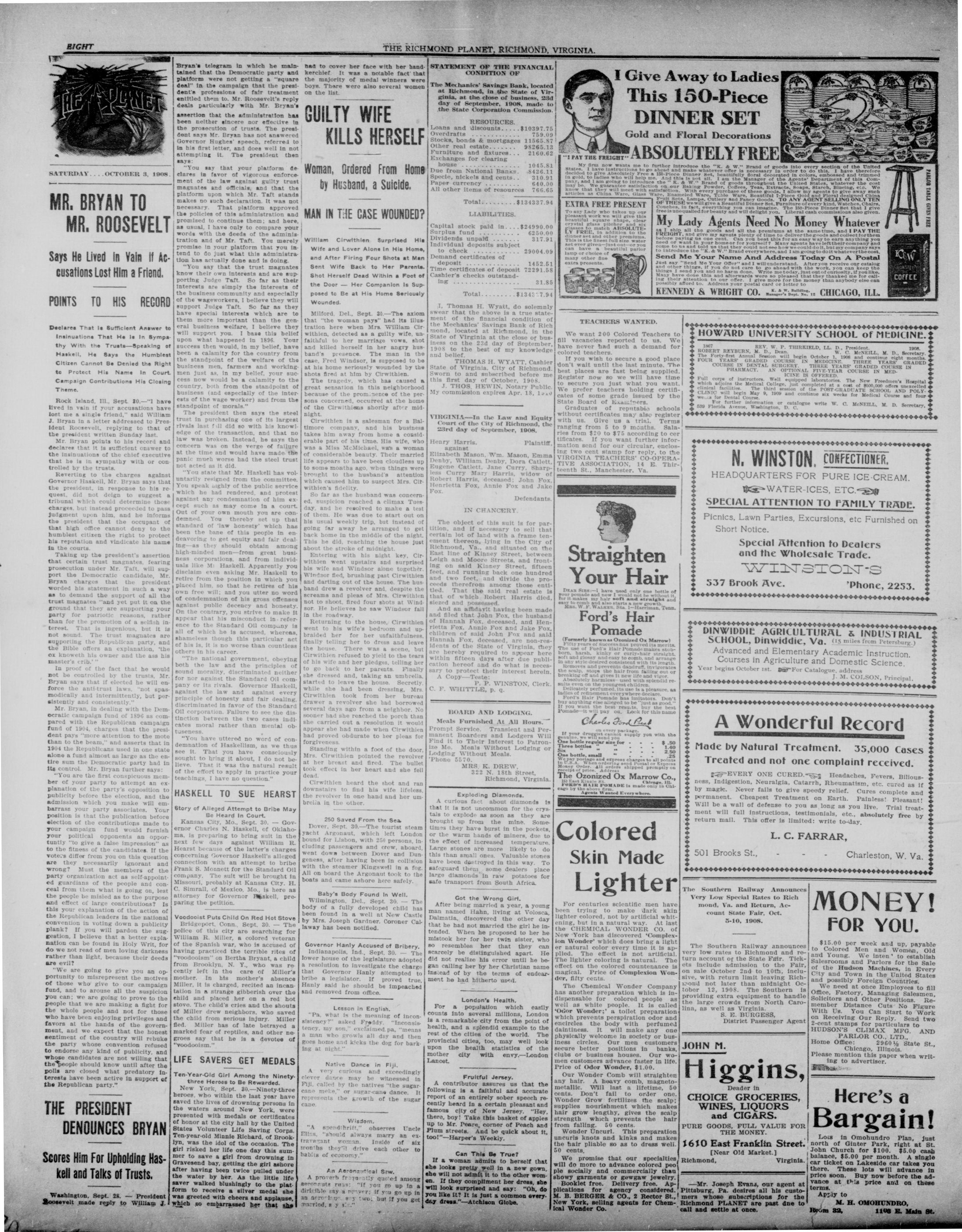
NEW YORK, September 27.—President Roosevelt's untimely attack upon Senator Foraker, charges "the great and sinister moneyed interests" with instigating the Brownsville investigation in order to "bring discredit" upon his Administration. Thus the President has sumarily and unnecessarily injected into the campaign a suppressed topic.
JUDGE TAFT'S PROMISES.
This endangers the efforts of thousands of colored and white men who have been trying to rescue the old-fashioned Republicanism temporarily submerged by the Rooseveltian Anti-Negro policy. These old-fashioned Lincoln Republicans are relying upon Judge Taft's promises, sincerity and ability to bring the "Grand Old Party" back to its "cradle of liberty" foundation. The President says:
THE PRESIDENT'S CHARGE
"The entire agitation over Brownville ville was, in large part, not a genuine agitation on behalf of the colored men at all but merely one phase of the effort, by representatives of certain law-defying corporations, to bring discredit upon the Administration."
REMEMBER BROWNSVILLE
This is an attempt to whitewash the Brownville blunder by linking it with the popular outney against the "sins of predatory wealth," but it will fail, for Brownville will remain a plague-spot in history until competent authority shall right this national disgrace.
THE INVESTIGATION
A dispute between the President and "undesirable citizens" is entirely irrelevant for the purposes of the following statement. The Brownsville investigation originated under the auspices of the Constitution League of the United States, which took the initiative, developed the testimony, and with it memorialized the President and The Congress. While regretting the necessity for exposing hasty Executive action, the League of the United States concluded "the agitation" or the evidence recorded in the 4,500 pages of printed testimony taken by the United States Senate Committee.
COLORED SOLDIERS NOT GUILTY
As early as November, 1906, the League sent a special commission to Fort Reno, Oklahoma, where the colored soldiers were being dismised. Their individual affidavits were taken. It was established that the soldiers arrested had been discharged by a hostile Texas Grand Jury. The President had proceeded in this matter regardless of the usual methods laid down by Congress in the Articles of War for the government of the Army. The memorial of the League, with the evidence, was presented to the President, without result, but when presented to the United States Senate was received with favor, and became Senate Document No. 107, December 10, 1906. This was reprinted with the President's message on the matter in Senate Document No. 155.
FORAKER ESPOUSED CAUSE OF
COLORED SOLDIERS.
Senator Foraker did not instigate either the investigation or the agitation which resulted in the investigation, but when the preliminary facts were produced by the League's Commission at Fort Reno, the Senator became convinced that the colored soldiers had been denied the right of trial before conviction, and he eloquently espoused the cause of justice for the colored soldiers before the
United States Senate. What was more natural for such a champion of human rights, hailing from a constituency rich in the traditions of the struggle for constitutional liberty?
MASS-MEETINGS HELD.
Where did the money come from? Was the Brownsville agitation, as charged by the President, promoted by the "beneficiaries of predatory wealth?" No! Though it might well have been so for the purpose of defending the defenders of the Nation. Mass meetings were held throughout the country, and through them "the soldiers' defense fund" was raised, by penny, nickel and dollar contributions from thousands of colored men, women and children, gathered in their churches and assisted by their white friends, interested solely in the principle involved.
"LED ALL THE REST."
When the sods of a century are grown over us all, Senator Foraker's personal heroism and sacrifices in behalf of the discharged colored soldiers will be perpetuated in art and song by a grateful people, who will remember that, in an age of greed and power madness, the senior Senator from Ohio "led all the rest" in championing the cause of the Black Battalion.
AGITATION FOR PRINCIPLES
The Brownsville agitation was begun in defense of a fundamental principle underlying the life of the Republic itself, and "the agitation" will be continued. Presidents, Senators and corporations may come and go, but the perpetual struggle of the ages for fundamental law and justice will go on until Presidents, Congresses and the Courts respond to the aroused conscience of a liberty, law and justice-loving people. ANNIE B. HUMPHREY, Secretary, Constitution League of the United States
PERSONALS AND BRIEFES
—Mrs. J. A. Taylor and Mrs. J. Taylor Nickens of Washington, D. C. were in the city last week.
—Mrs. R. T. Cogbill of 1017 Hull St., Manchester, Va., who was taken very ill last Monday night is improving slowly.
—Mr. A. H. Washington and daughter, Anna J. E., of Cumberland, Md. passed through the city this week enroute to Hampton, Va. Miss Washington will attend the Hampton School this session.
—Prof. C. F. Simpson, A. B., B. S. Cumberland, Md. passed through our city this week and called on us. He was enroute to take up his new duties.
—Messrs. John H. C. Smith, Jas. A. Anderson, Richard D. Weeks and John M. Blair of Wilmington, Del. and members of the Monday Club were here last week to bury the remains of Mr. Simon G. Wooldridge. They were looking well.
Do You Know Them?
I am very anxious to locate some of my people, Delcie Graves, my aunt and Frederick Graves., her husband, and my mother's brother, James Washington. Frederick Graves and James Washington were soldiers in the war of 1863. My mother Georgianna and the others mentioned above belonged to Mr. Tom Alyer in Madison Co. I will be very glad to receive any information coacering them. Write ARTHUR THOMAS, 94th and Eastwick Ave., Southwest Phila., Pa.
RICHMOND, VIRGINIA, SATURDAY, OCTOBER 3, 1908
Ben Hur Lodge, No. 96, Anniversary Sermon.
A special sermon will be preached to Ben Hur Lodge, No. 96, K. of P. Sunday afternoon, 3:30 by the Rev. R. O. Johnson at the Moore Street Baptist Church. The public in general is invited to attend: GEO. W. JACKSON, C. C GEO. W. DANDRIDGE. Master of Ceremonies.
President Mitchell in Denver, Colo.
President John Mitchell, Jr. of the Mechanics' Savings Bank left the city September 22, 1908 for Denver, Colorado, where he will attend the sessions of the American Bankers' Association. The session opened Monday, September 28, 1908 with a very fine attendance. He will also visit Cincinnati, O., St. Louis, Mo. Chicago, Ill. and other western cities before he returns
Mr. Fuller Dies Suddenly in Saloon.
Manchester, Va., Sept. 30, '08.
Last Monday afternoon about 2:30 o'clock Mr. John Fuller, a well known fireman of the Southern Ry, was taken suddenly sick in front of Mr. J. A. Turner's saloon, 1904 Hull Street. Dr. J. M. Vaughan, the well known physician who was in the immediate vicinity was called and rendered what medical assistance he could.
Mr. Fuller was carried to the rear portion of the saloon and laid down and in a few minutes without a murmur life was extinct. He was about 47 years old and resided at No. 12 East 20th Street.
Coroner Broadnax was notified, reviewed the remains and deemed an inquest unnecessary and the remains were taken to Johnson and Jackson's Undertaking Establishment. Tuesday night the corpse was taken to Daville to be interred. Thus ended the life of one of the most widely known colored firemen in this city. I.B.C.
Mr. Robinson Passes Away.
Mr. Linwood Robinson departed this life on Monday morning, the 21st ult. at the residence of his parents, Mr. and Mrs. George Robinson, 117 E. 20th Street, Manchester, Va. after a long period of ill health, in the 22d year of his age. Although he was a sufferer for many months, he bore his illness with Christian patience and fortitude.
Mr. Robinson was well-known in all parts of the city as a model young man, and his life was worthy of patronage for the young men of our city. The entire community as well as his many associates elsewhere mourn the loss of their departed friend and extend their sympathies to the bereaved family.
The funeral took place from the First Baptist Church, Rev. Dr. A. Binga officiating Wednesday after noon September 23d, at 2:30 o'clock. The floral designs were many, beautiful and costly. The interment was made in Maury's Cemetery.
"Peace to his ashes."
J. R. C.
Playful Struggle Ends Wife's Life.
Dover, Del., Sept. 30. While playfully attempting to prevent her husband from going duck hunting, Mrs. Ida Simpler, twenty-one years old, wife of Henry Simpler, living near Leipsi, Kent county, was strangely shot, dying from her wounds. As Simpler left the house his wife ran after him and tried to take the gun from him. During the playful struggle the gun went off, the charge shattering her leg. Shied from loss of blood. Simpler is nearly crazed with grief.
A Brilliant Affair
On last Monday night, the new Home Office of the Southern Ard Society of Virginia, Inc., No. 527 North Second Street this city, was a scene of rarest brilliance. The occasion was marked by the new and magnificent building to the public. Fortune's Orchestra dispersed sweet music while the thousands of visitors filed in, around and out of the spacious new building each receiving a magazine, a souvenir and the best wishes of the congenial officers of the Company.
THE BUILDING
The building, which is the most modern building owned and occupied exclusively as an office building by Negroes in the United States was built by Messrs. Moore and Archer of Richmond, Va., Messrs. Lankford and Bros., Architect of Washington, D. C. It is a two story building and basement, consisting of concrete, steel, brick and hard wood style of Architecture, Gothic.
In the basement, which is $5 by 24 feet, is located the heating plant, vault for old records gents' lavatories, fuel bins, storage for stock etc. The first story, with its beautiful plate glass octagon font and brilliant electric display, focusing a picture of rarest beauty upon the artistic gold lettering, wrought by the hands of our抚man Goo, A. Cobbs, contractor for painting, in itself a monument of Negro skill and art, and for ages to come will stand out in bold detritus and challenge the world in defense of his genius.
LIGHTED BY GAS AND ELEC
TRICITY
The electrical work throughout the building was installed by our townman Mr. William Jones. To say that the electrical display and lighting is one of the finest in the city of Richmond would not be magnifying a fact. In this story is 65 display lights with 15 reversible, transferable desk lights, connected with the latest patent floor sockets which can be transferred from one socket or desk to another, with 20 front display lights in side of front and two special 300 candle power Teungston electric lamps, suspended in either vestibule on front display. The gas and electric fixtures throuhout the building are a combination of the oxidized copper, ornamentally designed, controlled by switches and push buttons accessible in all parts of the building. The electrical works also include call bells, janitor bells and fire gongs located in various parts of the building.
BURGLAR PROOF VAULT
The first or main floor is occupied by the Home Office force, the executives and Richmond District force. The main vault which is furnished with metal fixtures, vertical filing cases, steel lockers, etc. The vault is built of reinforced concrete, brick and steel. It is fire, water and burglar proof, with metal fixtures and filing cases with capacity for carrying 20 years records before removable to lower vault.
FILTRATION PLANT
On this floor is located the ladies' cloak room, lavatories and refrigerating and filtration plant, where the product of the Noble James is turned out like a crystal flow and iceed in the process, this reformed product is then drawn through a marble alcove ready for consumption by the employees.
OTHER OFFICES.
The second floor consists of two suites, two rooms each; two single office rooms and the directors' room which is 32 by 22 feet at the rear end. Ladies and gentlemen's lavatories. This floor has an independent entrance from front and a grand balustrade and a magnificent stairway and corridor leading to the offices above, which are beautifully lighted and artistically arranged and finished.
DR. RAMSEY'S HEADQUARTERS
The front suite is already occupied by Dr. J. M. G. Ramsey, who has fitted out the finest dental parlors in the city. The way his reception room remains crowded attests his efficiency and the approval of the public of his advanced improvements.
BANQUET TENDERED DIRECTORS
This brilliant affair came to a close with a surprise in the shape of a heavy laden table prepared for the Directors by Messrs. Joshua Banks and Son, the popular caterers, at the instance of Messrs. Moore and Archer Contractors, who successfully planned
Endowment Departments Pay Large Sum in the Month of September.
This is to certify that I have received from John Mitchell, Jr.
Grand Worthy Counselor of the Grand Court of Virginia, Order of Calauthe, ($100.00) One Hundred Dollars in payment of the death-claim of Sister Cornelia Washington, who was a member of Shining Star Court, No. 121 of Newport News, Va.
Signed—J. E. Byrd.
Beneficiary.
Witnesses:
Maggie Wallace, W. C.
Catherine Hewitt, R. of A.
This is to certify that I have received from John Mitchell, Jr., Grand Worthy Counselor of the Grand Court of Virginia, Order of Calanthe, ($100.00) One Hundred Dollars in payment of the death of a trainee trainee, was a member of Hermione Court, No. 127 of Danville, Va.
This is to certify that I have received from John Mitchell, Jr.
Grand Worthy Counselor of the Grand Court of Virginia, Order of Calanthe, ($100.00) One Hundred Dollars in payment of the death-claim of Sir Andrew Morton, who was a member of Industrial Court, No. 74 of Danville, Va.
Signed—Mary Morton.
Beneficiary.
This is to certify that I have received from John Mitchell, Jr., Grand Chancellor of the Grand Lodge of Virginia, Knights of Pythias, N. A., S. A., E., A. A. and A. ($150.00) One Hundred and Fifty Dollars in payment of the deathclaim of Sir James Stewart, who was a member of Moving Light Lodge, No. 86 of Danville, Va.
Danville, Va., Sept. 25, '08.
This is to certify that I have received from John Mitchell, Jr.
Grand Chancellor of the Grand
Lodge of Virginia, Knights of Pythias, N. A., S. A., E., A., A. and A.
($150.00) One Hundred and Fifty
Dollars in payment of the death-
claim of Sir Spencer Fitzgerald, who was a member of Moravian Lodge,
No. 13, of Danville, Va.
Witnesses:
This is to certify that I have received from John Mitchell, Jr., Grand Chancellor of the Grand Lodge of Virginia, Knights of Pythias, N. A., S. A., E., A., A. and A. ($150.00) One Hundred and Fifty Dollars in payment of the death claim of Sr Andrew Morton, who
rectors. The menu consisted of the delicacies of the season and was the supper as a surprise to the Disumptuously partaken of.
OFFICE FORCE IN ATTENDANCE
The Richmond force of the Southern Aid Society of Va. Inc. was out in full as follows.....
Clerks: Misses Nannie Crump, Addie L. Terrell, Maggie Baker, Octavia R. Shackelford, Marriette Layne, Amanda Nelson, Ethel A. Scruggs, Alberta G. Burrell, Florence C. Jackson, Addie L. Stanton, Mary E. Ammons, Mrs. Hattle Wilson, Mrs. Fannie James.
Agents: William H. Banks, H. B. Burrell, George M. Booker, James H. Brown, W. A. Graves, R. D. Granderson, J. R. Hicks, R. H. Harrison, V. L. Hawkins, W. A. Jordan, W. H. Jones, William H. Jackson, A. R. Jones, Marvin Jones, Arthur Jones, John L. Mines, B. W. Perkins, M. C. Ruffin, W. H. Spurlock, W. U. Scott, John R. West, W. E. Randolph, Mesdames P. W. Willis and Hannah Bray.
Supt. of Agents, Paul Ervin.
Inspectors: Lucius Storrs, and James A. Dixon.
Sheriff of Building, Joseph Brown.
Directors: A. D. Price, President; Thomas M. Crump, Secretary; B. L. Jordan, Assistant Secretary; Edward Stewart, 1st Vice-President; B. A. Cephas, 3rd Vice-President; W. E. Baker, Treasurer; E. C. Brown, W. A. Jordan, A. Washington, Charles N. Jackson, W. E. Randolph, Samuel Morgan.
Winners of Prizes
The garden party conducted at St. Joseph's Church grounds closed Sept. 29, 1908 with great success. The winners of the prizes are as follows: holder of ticket No. 284, ten of coal; ticket, No. 127, barrel of flour, Mrs. Mary Russell; ticket No. 713, $2.50 all donors and are very grateful to those who helped to make the affair a success.
Parent and Cradle Day at the Fifth Street Baptist Church.
The programme committee has arranged an excellent programme for Parent and Cradle Day at the Fifth Street Baptist Sunday School on next Sunday morning at 9:30. Special excercises from 10:25 to 11:20 A. M. All parents and friends are invited to be present and bring their children, old and young.
Progamme—Solo, Mr. Joseph Matthews; Recitation, Mr. Armistead Walker, Jr.; Recitation, Miss Estelle Ward; Solo, Miss Ottie B. Graham; Recitation, Miss Olivia Taylor; Duet, Miss Mildred and Louisa Johnson; Paper, Miss Annie V. Taylor; Remarks, Rev W. F. Graham, D. D. and Sunt. B. H. Pepton.
Dr. R. A. Reynolds Passes Away.
News reached this city last Sunday of the death of Dr. R. A. Reynolds. He died Sunday, September 27, 1908 at 7:30 A.M. at his residence in Danville, Va. He was a practitioner of some note and had enjoyed a large practice in that section.
Entered Into Rest
WOOLDRIDGE—Simon G. Wooldridge, eldest son of Mr. and Mrs. B. P. Wooldridge, departed this life Sunday morning, September 20th, at 5 o'clock after an illness of two hours at his residence, 317 E. 13th Street, Wilmington, Del. in the 36th year of his age.
The remains were brought to Richmond, Va. Thursday morning and conveyed to his parents residence, 1215 Chaffin Street, City. He is survived by his wife, father, mother, two brothers and four sisters to mourn their loss.
Funeral took place Friday morning, Sept. 25, 1908 from Second Baptist Church.
In Memoriam.
In loving memory of Percival Bernard Pervall, the fourth son of Clara Griggs and Frank Pervall, who departed this life Monday morning, October 3, 1904 at 7:25.
"Arise my soul from deep distress
And banish every fear,
He calls thee to His throne of grace
To scree thy sorrows there.
HIS MOTHER
FOR RENT—Three elegant rooms Apply to B. L. JORDAN, 527 N. Second Street, City.
- For fine printing call at the PLANET Office.
$100.00 Endowment Paid.
Newport News, Va., Sept. 26, '08
$100.60 Endowment Paid
Danville, Va., Sept. 28, '08.
Lillie B. Moore.
H. Grace West.
S. J. Holbrook, Deputy.
$100.00 Endowment Paid
Danville, Va., Sept. 28, '08
H, Grace West.
'Lillie B. Moore.
S. J. Holbrook, Deputy.
$150.00 Endowment Paid
Danyille, Va., Sept. 25, '08
her
Signed—Mary X Stewart,
mark
Beneficiary
sses:
C. H. Flippin, C. C.
Henry Smith, M. of Ex.
C. M. Smith, D. D. G. C.
$150.00 Endowment Paid.
George W. Rison.
Chester Echols.
C. M. Smith, D. D. G. C.
$150.00 Endowment Paid.
Danville, Va., Sept. 25, '08
was a member of Roman Eagle
Lodge, No. 18 of Danville, Va.
Signed—Mary Morton.
Beneficiary.
Witnesses:
| F. H. Smith, C. C.
| Peter Williams,
C. M. Smith, D. D. G. C.
$150.00 Endowment Paid.
Fincastle, Va., Sept. 22, '08.
This is to certify that I have received from John Mitchell, Jr.,
Grand Chancellor of the Grand
Lodge of Virginia, Knights of Pythias,
N. A., S. A., E., A. A. and A.
($150.00) One Hundred and Fifty
Dollars in payment of the death-
claim of Sir Lewis Jones, who was a
member of Cascade Lodge, No. 99
of Hot Springs, Va.
her
Signed—Jennie X Jones,
mark
Beneficiary.
Witnesses:
J. W. Mathery.
W. H. Burger.
$150.00 Endowment Paid.
This is to certify that I have received from John Mitchell, Jr.,
Grand Chancellor of the Grand Lodge of Virginia Knights of Pythias, N. A. N. S. A. E., A. A. A. and A. ( $150,000 ) One Hundred and Fifty Dollars in payment of the death claim or Sir Alexander Lively, who was a member of Royal Lodge, No. 26 of Richmond, Va.
Signed—Lucy Lively,
Benofchry,
Witnesses:
J. J. Carter.
S. S. Baker, D. D. G. C.
$150.00 Endowment Paid.
This is to certify that you have received from John Mitchell, Jr.,
Grand Chancellor of the Grand Lodge of Virginia Knights of Pytas,
N. A., S. A., E., A., A., and A. (4150 00) One Hundred and Fifty Dollars in payment of the death claim of Sir Josiah Coleman, who was a member of Auxiliary Lodge,
No. 2 of Petersburg, Va.
Signed—Polly Coleman,
Aaron Coleman,
Beneficiaries.
Witnesses:
W. T. Station.
Jesse Maclin.
Thomas Butler.
William A. Scott.
Eddie Pegram.
Aaron Batts.
Edw. W. Wood, D. D. G. C.
Mr. Fennell Speaks.
Dear Editor—For sometime I have been thinking of writing a few lines on the subject: "The Trade Ways of My People." I will say I am at loss for what to say. Mostly we, as a race are trodden upon by every nation on earth, it seems to me. We are industrious and have accomplished something in America. We have some wealth and property and we justly earned it. Now we ought to learn to be united so we might save it. I want to speak in such a way that my people might think and do. First, let us give all trade that we can to our own. Second. If we have a mercantile store opened at our door and next door, across the street or Mr. — and we have the same amount let us go first to our own. Third. We can't thrive and prosper by giving our time and trade to a nation who has millions, can we? We need to teach it to our children around our firesides daily and when they have become old they will not depart from it. We deny our own when we are permitted elsewhere and it is not good for us either. We are making and have made mistakes all along that line and I would be proud to know of a change.
We, the Afro-American men don't care for each other as we ought. Let us move up another round. Our daughters and our sons are best treated from our own race. If we get any at all. We should not only care only in trade but in social ways. If we happen to meet our fair sex we should tip our hats. But not so. On the other hand we meet a white woman, we never forget to tip our hat and say Mrs. or Miss and then think we are right.
In the Afro-American nation we are to get our suitor for life and we need to are more for them and train them more.
Yours,
A. A. FENNELL.
Falco, Ala.
—"The Seventh Person." If you are not reading this story on the second page you are missing the treat of your life.
THE SEVENTH PERSON
BY
BEN M.CUTCHEON
COPYRIGHT 1906 BY BOOZ NEED and COMPANY
TWO
CHAPTER I.-Gerard Chambers, son of a wealthy importer and a student at an eastern college, was awarded a member's crest organization, founded by Rodney Graves. The society was exclusive, only seven being admitted. The members knew the crest was held and each member was awarded "call of destiny," which amounted to an assignment to test his metal.
CHAPTER II.-Chambers read his destiny and was to pass a period as a sailor and set forth to work for a year. He was then directed to go to Mexico for further instructions which he assign him to another year's exile, during which he must make his own living unassisted, and keep everything a secret.
CHAPTER III.-Jerry then told his father's duty. He gained his elder's consent, and again gained Bayley's, his father's choice for his wife, with the fact that he would be away two years. She left him angrily.
CHAPTER IV.-Young Chambers had a friend with his father, who sought again to be with him, parture. Jerry obtained a berth as supercargo on an ocean freighter. His father promised that he would seek the hand of his promise that he would
CHAPTER V
The Sister Mary Goes to Sea
The Sister Mary goes to Sea.
With his mother's sobbed blessing and his father's strained words of parting ringing in his ears, Jerry Chambers boarded the old ship Sister Mary a few minutes after seven o'clock the next morning. In his pockets was $25 in money and in a small satchel were clothing and other things not exceeding a total value of $25. Capt. Bulger was grumly issuing orders up forward, but his face lost its sternness when he saw Jerry.
"On time, I see," said he. "I reckon you've made a good enough start."
"Where are we bound for, captain?" promptly asked Jerry, who had been in a stew of wonder as to the vessel's destination.
"I tell you all about it as soon as I get time," said the captain. With this on his lins he started across the deck.
Jerry took his satchel into the dingy old cabin, returning almost immediately to the deck, where all hands were busy in final preparation for the departure. He further worked his way into the officer's good graces by volunteering his assistance, but the grizzled old salt suggested that he would be more serviceable out of the way of the men, who knew what to do and how to do it. He went up forward, away from the other men, and, lighting his pipe, fell to picturing the possibilities of his remarkable adventure. The longer his eyes looked in the direction of his old home the more strongly did he realize the sacrifice he was making to earn an enduring right to his personality.
"I did my level best to make peace with father," he mused, "but," and the spirit of resentment again flared up, "he wouldn't let me. He was the unreasonable one." Although he felt that his action was justified, he went to sea with a new love for Wallace Chambers.
As the old vessel glided away from her pier a spirit akin to remorse and despondency seized him, and he went to the cabin in order to escape seeing his beloved New York fade from his view. Sitting at the captain's table, he started to read a novel, but the hook had no charm for him. He was alone until the boat was well away from the Hook, when Capt. Bulger joined him.
"What's your name?" asked the captain, drawing up a chair and reaching for a bottle of whisky.
"Gerard Chambers—they call me Jerry" for short."
"Well, Jerry, I've got time to talk about this trip now." He filled a tumbler almost full of liquor and cocked his feet upon the table.
"I am all ears," said Jerry, leaning forward.
"Well, sir, the Mary ain't bound for no port straight across and them guns below ain't meant for no trainin' school!"
Jerry was a picture of startled interest. His eyes were wide open and his lower lip was down. The captain wore something of a guilty smile.
"The guns are not for a training school?" Jerry exclaimed.
"No, sir—ee! Them guns are meant for somethin' more'n mere school kids. I don't reckon they'll ever be introduced to blank catridges." The old sailor looked thoughtfully at the floor for a minute and then added: "I reckon you know all the world ain't as peaceable as the U. S. A., don't you?" "I suppose there are strifes somewhere," said Jerry, his mind whirling.
when, said Serry, his hand wrinkling,
"Well, to come right down to the fine 'pint', went on the captain in a business-like tone, "this boat 'n' me's engaged in a little movement that ain't just o' the sort to appeal fav'bly to the U. S. government. The guns are goin' to the enemies of a government that's friendly with her. Understand? They're goin' to the rebels in Uraria—far down in South America."
"To the Uranian insurrectionists?" gasped Jerry, dropping his pipe to the table and staring wildly at the smiling captain.
"That's the trick perzackly," answered Bulger, with a smack of the lips.
"Who—who is shipping the guns?"
"Hank Bulger o' the Sister Mary. Me 'n' the Mary are known a tarnal sight better in South American waters than we are in the Erle basin. Herrero Barado, the head o' the Uranian rebels, dickered with me to fetch him two cargoes o' guns. The fust lot was delivered about four months ago."
"Go on, go on," half cried Jerry,
with no intention to interrupt.
"I buy up the guns on my own hook"
"And assume all responsibility?"
"I'm not entirely responsible for my supercargo. You see, he takes some chances hissef. You was looking for excitement?"
"Some, perhaps," floundered the seventh person. "Who was in charge of the other cargo?"
"A nice young fellow—a little more hardened 'n you, I reckon."
"Why isn't he in charge of this lot? He had the experience."
"Well, I'll tell you, Jerry. Things didn't go just accordin' to program last time. To come right down flat, we was s'prised. I had arranged with Barado to land the guns on the main coast, about 100 mile below Pandaro, the capital, but there must a' been a cat at the rathole. The government got wind o' the deal and set about to splice our plans. It near done it, too. We managed to land the guns, but just as we was takin' off the last boxes one o' the government gunboats come down on us. We was in a position to move at short notice, and we pulled away as fast as we could. The gunboat kept gettin' closer 'n closer, and I'd about give up hope o' gettin' away. She sent a pill across our bow, and just as I was givin' orders to slow down, I noticed the chaser check up suddenly. I took a long chance and sprinted. We got away. The gunboat busted an engine, we jedged, and that was the on'y thing that saved our hides from perforation. It was a great streak o' luck!"
There was a gleam of triumph in his eyes and he shook his head emphatically. Jerry's mouth was open and his eyes were like burning coals. "And the fellow in charge of the guns?" he asked. "He was on shore when we steamed away."
"And now—"
"We ain't seen him since, but"—with a little chuckle—"we bet he's runnin' yet."
"Capt. Bulger," said Jerry, stoutly, "what am I expected to do in connection with this enterprise?"
"You're the supercargo, of course."
"And what does that mean—in full?"
"Watch the guns—if they need watchin', and see that they get into proper hands."
"Won't the government of Urania be sharply on the lookout for this bont?"
"The Mary wasn't the Mary last time. She was the Spartan then, and we changed the name for convenience's sake. But there ain't goin' to be no trouble this time, Jerry. We're goin' to land the guns on a little island—called Ringo岛 island—50 mile off the upper coast. You ain't weakenin', are you?"
"And, captain, if I should decline to act in this capacity?"
"But you ain't gin' to decline—now," smiled the captain, most convincingly. Jerry's philosophy was quick to overcome his excitement and to disguise the fear that was within him. He determined to employ his diplomacy in dealing with the filibuster.
"Did you say weakening?" he laughed with affected bravado. "Well, I should say not! I suppose I can make a pretty hard try at what you expect me to do. Still, I must confess that I had not bargained for this."
"You must certainly think hard o' me," said the captain; "but you are sensible enough to know I couldn't 'a' told you about it on shore. I didn't know who you were; and, comin' right down to it, I don't know who you are now."
"How did you manage to get away with these guns?"
"By a leetle twist o' the wreest," chuckled the captain. "We cleared for Havre with a cargo o' merchandise!" "Am I expected to collect for the guns on this island?" "You're simply to get a receipt. That won't be hard, and as soon as I get it we'll nose right back." Jerry thought hard for a full minute, and, while he realized the possible dangers, his spirit of philosophy gave him strength and courage to display it. He was, naturally, brave and fearless—some have said that all Gemini persons are brave and fearless—but he would have been infinitely more comfortable if the duty before him did not carry with it such strong possibilities. He felt much as a rat in a trap. "Of course, I may count on your full assistance?" "Most certain," said Bulger, in great assurance. "You ain't awful sorry you took the contract, are you?"
"Contract" is a little strong," laughed Jerry, "but I can't say that I am downright sorry."
"That's the spirit—it's a heap stronger 'n I thought it would be. Make yoursef at home and everything 'll come out to your entire satisfaction. Why, lad, it's a treat for you."
"But, captain, tell me—won't our government learn of this some time—and isn't there the possibility of unpleasantness?"
"Young man, the U. S. A. ain't my government, and to be frank with you, I don't care a whoop in blue hell what it does. I ain't afaired of it."
"You're not an American?"
"Never was—never will be."
"What is your country?"
"Advertisin' don't always pay," chuckled Bulger.
CHAPTER VI
it spilled.
It was after midnight when he
went to his narrow bunk. For an hour
or more he tossed about with a
nervousness that was almost chilling.
In a moment of his wildest emotion
he half determined to attempt an ex-
THE RICHMOND PLANET, RICHMOND, VIRGINIA
cape from the old vessel, but an afterthought assured him that the wily captain had planned to keep him under watch all the time.
Before he finally fell asleep he was reconciled to his fate, and just before his uneasy mind found temporary relief he was experiencing, in a degree, the sensation of actually yearning for the climax to this phase of his extraordinary adventure.
He was on deck at the first gray tint of dawn. Here and there members of the small crew were sleeping in blankets that served as both beds and coverings. The old boat was moving along at what seemed to him smallpace. The shore was barely visible. Jerry was standing against the ralling, his eyes fixed on the dim streaks in the east, when Capt. Bulger came on deck.
"Well!" exclaimed the captain. "I'm srilled to find you up so early. Even Mother Carey's chickens ain't off their roosts yet. Didn't you sleep well?"
"I don't think I did. A bunk is a bit new to me, you know."
"Sure it wasn't worry that kept you from restin' well?"
"I think not—that is, not exactly worry. Still, I must confess that I did an unusual amount of thinking. When do you expect to reach Ringo island?"
"Maybe in five weeks. We'll put in three or four times—once at Havana, where I'll be able to tell you more definite about things that interest you most."
Jerry drank his strong coffee with Capt. Hank Bulger half an hour later. Notwithstanding the assurance he had given, the officer was certain that he detected signs of worry and apprehension in the young man's manners. After a time he said:
"Lad, I'm gettin' more'n more to the belief that you ain't feelin' just as chipper as you might—cause o' wryin' about what's ahead of us. I like you fust rate, and I ain't goin' to do nothin' that'll rub too hard agin' in the grain. I think you're square all round; and the more I've been thinkin' about deceivin' you the more I've been hankerin' for a way to polish up my conscience. You should a'known before we started just where you was goin' and what you'd be expected to do. But you know I didn't know you from Adam's off ox, and I ain't got your full pedigree yet. Still, I believe you're o' the right sort, and I'm goin' to take a chance. If you want to leave this boat at Havana you can; there'll be no strings tied to you. Do you want to leave the Mary?
"I'll stick with you, captain!" he said, the excited emotions raging wildly within. "You may count on me to the finish!"
"Good!" cried the captain, extending his hand, which Jerry gripped firmly as he brought his teeth together in determination. "And you'll be glad of it. I'll warrant."
Jerry's heart brightened and he was actually happy. His spirit of adventure now was thoroughly aroused, and he longed for the exciting times that he felt sure were ahead of him.
The Sister Mary kcpt close to shore all the way down to Havana, where the second of the stops was made. It was two weeks to the day after leaving New York that the old craft slowly glided into the harbor of the Cuban metropolis, where several days were spent in recalling. On the second day Capt. Bulger communicated with a representative of the Uranian revolutionists—Senor Emilio Chahara, receiving from him final instructions for landing the gung on Ringo island.
On the rest of the trip the course was well out at sea, the rocky outlines of the northern parts of South America coming to view only at intervals of days at a time. All the time the Sister Mary crept along slowly, the captain using the jury-rig as much as possible in order to save fuel.
"No suggestions at all, captain," he answered. "I am ready to act on your instructions."
"Well, then, we'll make final preparations in the mornin'—get the guns in shape to put into the small boats. Chahara told me to swing around to the nor'west p'int o' the island till we come to a protrudin' cliff. There'll be a white sheet stuck up there. That's where the guns will be landed. The water there is shallower than I thought, and we'll not be able to get closer 'n half a mile o' the place."
The two remained on deck until after midnight talking over the plans. At last Jerry said:
"Captain, I'm going to see that those guns are properly landed and to come back to you with a receipt for them if it lies within my power to get it. But there is a possibility that, in view of what Chahara said about the shallow water, we might have some difficulty. You know it will take a long time to finish the job. If anything should go wrong, and we should be parted in some way, I wish you would make it a point to—"
"To hunt you up?" provided the captain, lightly.
"Yes, in a way. I want you to see that I don't stay on that island forever."
"I understand, lad."
"And, captain," Jerry went on, after a little thought, taking a pencil and an envelope from his pocket, "I'll just give you the address of my father in New York, in case—"
"You'd best be goin' to my bunk, Jerry," laughed the captain; "you're getin' sort o' sentimental."
CHAPTER VII.
The Surprise at Ringo Island.
"There! To the left a loetie, Jerry! Look sharp! Don't you see?" said Capt. Bulger, peering through his glasses from the hurricane deck late in the afternoon of the next day.
Jerry quickly brought his glasses to the direction indicated and looked intently for a moment.
"It looks like a heavy haze," said he.
"That's Ringo! We'll make it in three hours."
Jerry remained on the hurricane deck until the ragged outlines of the island could be distinguished plainly. It was still quite light, and the captain ordered the steam shut down for a time. A stiff wind was blowing and the water was choppy, making the Sister Mary restless and measy. Jerry naturally was excited, despite the fact that he tried to keep cool and composed, and when the order came to put on steam again his heart beat wildly. The sky was as clear as a crystal, to the utter disappointment of Bulger. It was about six o'clock when the vessel crept to within a mile of the shore. Here she was swung around and all eyes were on the lookout for the white sheet on the cliff. In order that the signal might not be overlooked, three of the small boats were sent closer to land. The ship went on slowly for about two miles farther, when the captain suddenly ordered all steam off.
"The first boat sees it!" shouted Bulger, unable to conceal his excitement. "See, it's signallin' yet! This is the place, and—yes, sir—ee, I can see the sheet myse'n now! Right straight over there, Jerry; see that spot high up—that white spot?" Jerry brought his glasses to play on the object indicated and kept them there a full minute. "That must be the sheet," said he, moving nervously. "And, see! There are some men moving about down below it! We're expected!" Capt. Bulger looked long, finally exclaiming: "Barado's men, as I live! This business is movin' along like it was on greased lightnin'." The small boat had signaled the captain that the revolutionists were there to receive the guns, and was headed for the Sister Mary. Within a few minutes the other boats had returned.
"Lower all boats," ordered Bulger, "and pack the guns on as fast as possible. We'll be through with this thing before we get started."
The eight small boats were quickly loaded and manned to start to the island. The captain had difficulty in keeping his men on the ship until it became darker. The delay was irritating to Jerry, who was assigned to the first boat that was to start in. Time and time again he urged that the move be begun. After a while a small boat was seen to put out from shore, and all eyes on the Sister Mary watched it as he neared hailing distance. Capt. Bulger spoke it in Spanish, which Jerry understood.
The man at the bow called out excitedly, and both Bulger and Jerry turned deathly pale.
"The hell you say!" roared Bulger, forgetting that the man in the boat did not understand English. Then, in Spanish, he spoke rapidly and excitedly for several minutes, being interrupted frequently by the man from the shore, who was to receive the guns for Barado. The small boat started back, and Capt. Bulger turned sharply and paced across the deck, his head down in deep thought. It was plain to everybody that he was much disturbed. Jerry was close at his heels.
"What—what does it all mean, captain?" he asked.
"We are expected!" answered Bulger, and the big veins in his neck stood out. "The Uranian government has learned o' this movement and it's on the lookout sharp! Barado's man says to hurry, hurry, hurry! At first he urged that I give it up, but I kicked like a stung shark at that. Them guns have got to be landed—and this very day! There's 50 or 60 rebels ashore waitin' for 'em. They're keepin' pretty much to 'emselves, for the government's gunboat Cristobal is in these waters—just where, they don't seem to know. But it's near, that's certain."
Jerry was quick to bring himself together and face the inevitable, and, with teeth firmly set and his greatest courage buoyed up, he urged that there be no further delay in taking the guns to the island. Capt. Bulger could not refrain from commenting on the young man's fearlessness.
Jerry went ashore with the first boatload of guns, accompanied by four sailors. He had been instructed to remain on shore until all the guns had been sent away in the boats.
As the boats were returning to the vessel after the third trip in, Capt. Bulger, who was keenly watching from the hurricane deck, uttered an exclamation of horror. For an instant his blood was frozen, his senses paralyzed.
Stealing down the shore was a low, rakish black craft headed straight for the Sister Mary. She had come from a point less than four miles away. Bulger caught the attention of the men in the returning boats, and they laid full strength to the oars.
As soon as the last set of sailors had scrambled over the side of the vessel the steam was high and great clouds of black smoke were rolling from the weather-stained funnel. The ship was swung around sharply to the open and every ounce of steam put on. The intruder was bearing down fast, and the rugged Bulger's heart almost stood still. There seemed to be no possibility of escape, and in a moment of wild rage he determined to keep away from the chaser as long as possible and then, to prevent capture, scuttle and burn the Sister Mary. There was a puff of white smoke from the ominous-looking craft and then a spout of water to the old boat's stern. Capt. Bulger knew that the range was too great for accuracy, but that it would be a matter of only a short time until the government's scout would be near enough to do damage. He watched the approach of the little warship and cursed as only a seasoned sailor can curse. Closer and closer the gunboat came, gaining with every turn of the propeller. With a shout that could be heard in almost every part of the vessel Bulger ordered the men to prepare for setting the ship on fire. Then, before the men had time to respond, he observed that the chaser was turning around. The order was countermanded, and the old captain's hopes rose high. The scout had seen lights on the shore, and, to Bulger's utmost surprise, it gave up the chase for the Sister Mary and
AIRCRAFT
"You Are a Prisoner In the Hands of the Uranian Government."
started straight for the island. She knew the waters of Ringo well and she plowed through the choppy waves until she was within a quarter of a mile from land. Then, under the protection of her guns, boatload after boatload of Uranian marines started in to shore.
Jerry Chambers was the only one of the Sister Mary's flock ashore!
The insurrectionists were practically helpless to resist, and, panic-stricken, they abandoned the guns, for which they possessed no ammunition, and ran madly to the heavy thicket.
The marines were wading through the shallow water, guns in hand, before many of the revolutionists succeeded in reaching the dense growth of bushes, and those in the fore were beginning to shoot.
Jerry Chambers was wittless for a time, and, in his uncontrollable excitement, simply ran along the shore line, not knowing whither to go. He was a target for the shots of the marines, some of whom were near enough to land to make their voices distinctly heard by him.
Brought to a shocking realization of his position, Jerry started towards the nearest thicket, which was fully 50 yards away. He had gone less than 40 feet when he felt a tingling sensation in the calf of his right leg. He ran a few feet farther, and then the leg seemed to become paralyzed. It would serve him no longer. Exhausted, he sank to the ground and tried to drag himself along. Then his eyes closed and his senses were gone.
When he regained consciousness he was surrounded by a half dozen swarthy-locking men in the soiled white clothing of the Uranian marines, all talking at the same time in the most excited manner. It was a long time before he could appreciate his situation. At the first thought of the awful reality, he asked: "Where am I?" His words were in English, and those about him simply stared blankly at him. Then he put the question in Spanish.
"You are a prisoner in the hands of the Uranian government—on board the gunboat Cristobal," snapped a fierce-eyed man in the uniform of an officer. "Your trick failed, as we knew it would fall, and now you will pay the penalty."
"What will they do to me?" Jerry asked.
"You will get a trial," said the officer, laughing heartlessly, "and then—well, you'll find out soon enough that the Uranian government is not to be trifled with. We are not slow in acting with such as you. It's too bad—you're so young, so strong—such a good-looking fellow, too," he added with a laugh that was almost diabolical. Jerry's eyes flashed anger, and for an instant he forgot his pain.
"I suppose you will be promoted for this," said the captive, with a sneer born of absolute desperation. He felt that there was no hope for him; he had read about the "justice" of Spanish court-martials.
The captain of the Cristobal had enough heart to do what he could to alleviate the suffering of the young collegan, turning him over to the surgeon, who hurriedly dressed the wound. It was very dark and very foggy when the vessel steamed towards the mainland with all the guns that had been landed from the Sister Mary. The boat sped along cautiously, and it was in the middle of the next morning when she drew up at one of the government's camps. Jerry was taken to the headquarters of the general commanding, where he was subjected to heartless questioning.
Gen. Fernandez Bostos, the leader of the government's forces in the field, was on his way to Pandaro, the capital, where he was to consult with President Cardovas, and he probably would not reach the coast camp until the elapse of a week. Jerry was ordered confined in a dungeon cell on the outskirts of the camp, near a running stream, where his ration should consist of only bread and water. The cell was not more than six feet square and it was unfurnished save for some damp straw that was to serve him as a bed.
CHAPTER VIII
The Little Saint of Ursula
At the outset of the Uranian rebellion a dozen or more young women high in the social life at Pandaro met at the president's palace and inaugurated what had come to be known as the "humane movement." The organizers were: A daughter of the president, a daughter of the vice-president, a niece of the minister of justice, and the adopted daughter of Gen. Fernandez Bostos. They issued a call to the "loyalist" young women for volunteers as nurses to serve on the field and in the hospitals. While the movement was distinctly a "loyalist" one, it was the purpose of the organization to extend the spirit of humanity to helpless and suffering insurrectionists as well as to the sick and wounded in the service of the Cardovas government. The president's daughter was chosen chief officer, and she appointed
six of the other organizers to assume charge of the half dozen departments under which the work was to be carried on. Marina Bostos, the general's adopted daughter, was placed in charge of the department of the north, which included much of the territory north of the capital, where the revolutionists had numerous strongholds and where the heaviest fighting was expected to take place. The camp in which Jerry Chambers was held prisoner was within the territory of the department of the north.
Two days after Jerry's capture Marina Bostos arrived in camp at the head of a score of nurses, fatigued from duty for weeks inland, where fever had wrought havoc in the ranks of both sides.
Marina Bostos was 21 years of age. She was the daughter of a Philadelphia concessionaire, who went to Urania to seek his fortune when the population of that country was less than 50,000; Fernandez Bostos had come to Urania from Madrid a year before Philip Bolton's arrival. Bolton had been in the country barely a year when he was stricken with fever and died. A few months later his widow died of the same fever. The Boltons were the parents of a year-old daughter—Mary. Bostos and Bolton had joined hands in building up their fortunes and had become inseparable friends. When Bolton knew that he must die and that his wife, who had been dangerously ill for many weeks, could not recover, he asked Bostos to adopt his little daughter. Immediately after Mrs. Bolton's death Bostor became the foster-father of little Mary, whom he had rechristened Marina and to whom he gave his own surname.
Marina, through her indefatigable efforts in relieving the soldiers of their sufferings; and because of her angelic nature, had come to be known as the "little saint of Urania." She had labored so hard and so long in the fortnight immediately preceding her arrival at the camp that she was on the verge of physical collapse. However, she insisted that she must keep on with her work, and the officers at the camp, knowing that she would not be satisfied to be wholly idle and without responsibility, permitted her to supervise the work of the hospital corps until she was strong enough to resume the more arduous work in the field.
Late one afternoon, Marina Bostos, accompanied by Miguel Pilaro, a captain under Gen. Bostos, started out to visit the sick and wounded in the dungeons. Her heart rebelled against the treatment accorded the prisoners in the damp, unsanitary cells, and she was fiery in her denunciation of the inhumane methods practiced.
Jerry Chambers was in a restless doze when she and the captain came to the grating of his miserable death-chamber. Capt. Pilaro called out to him, and as his half-crazy senses became roused, he began to moan in his pleading to be put out of his misery.
"Poor soul," said Marina, as she peered into the gloomy cell, "his mind is wandering. Unlock the door, captain, and I will try to help him."
The captain did her bidding, and she went into the cell and knelt at Jerry's side, her eyes showing greatest sympathy. At her request, Capt. Pharo brought a lighted lantern, which showed more plainly to her a face that told of the awful sufferings of the young prisoner. As Jerry's eyes opened and looked into hers a thrill never before experienced went over her. Her eyes came closer to his, almost as though they were drawn by a magnet, until her warm breath touched his forehead. "My captain," she finally said, "you have a heart and I want you to show that you have one. Please go to headquarters and get me a new bandage and some antiseptic—not from the prisoners' supply room."
A request from the "little saint of Urania" was equivalent to a command, and the captain, surprised at the request, hastened to do her blinding. She tenderly lifted Jerry's head until it rested on her knee, his big eyes still holding the gaze that was new to her. "Poor soul," she finally said.
"Poor soul," she finally said.
A soft smile came to his lips, and he said, weakly: "You are so gentle. Won't you spare me this terrible suffering?"
"You shall be cared for," said she; "you shall not suffer such agony any longer. I shall care for you myself, and—"
The expression of gratitude that came into his eyes made her forget the rest of the sentence, and she stroked his brow soothingly.
Pilaro returned within 15 minutes with the materials Marina had sent him for. He scarcely had entered the cell when she asked him to relate the circumstances surrounding the capture of the young New Yorker. The captain told the whole story while she redressed the wound, concluding:
"He said he did not conspire against the government, but that he was compelled to do the blinding of the filibuster. They all have good stories to tell, you know, senorita," he aided, mockingly.
She said not a word, but in her heart there was a feeling that Jerry had spoken truthfully. Through her efforts the prisoner was taken to a more comfortable cell, although not in the hospital, where she tried to have him confined.
In her room that night Marina Bostos slept not a wink—not a wink of the sleep that her worn-out body so badly needed. Her mind seemed riveted to the handsome young prisoner in the dungeon cell. She well knew the heartlessness of a court-martial such as must come to Jerry, and the certain verdict caused her to shudder. Gen. Bostos was a soldier before he was a father, and she knew that intervention on her part would prove futtle. The thought of the fate that surely awaited him finally caused her to break down completely.
CHAPTER IX
To the Forest of the Somber Shadows. Marina was at Jerry's side very early the next morning, and her heart quickened when she saw that his spirits were much brighter and that his general condition was improved. Jerry the highest gratitude bringing
nims of moisture to his eyes, held out both hands when she entered the cell. He was very weak, but there was strength in his grasp.
"I should have died if you had not come to me," he said, earnestly. "You saved my life yesterday—saved it"—and the gloom of hopelessness clouded his features—"saved it for them to take. Ah, but I appreciate what you have done for me, what relief you have given me, and my last words shall be of you. I should like to call you 'sister,' for your solicitude has been that of a sister—that of one who can share the suffering of another. You never can feel sorry for what you have done for me."
"No-no, I cannot feel sorry," she exclaimed, unconsciously pressing his hand as she looked into his eyes; "I wish I could do more for you." Her voice trembled slightly and she swallowed two or three times in her successful effort to keep back the tears. "But you must bear up" she went on. "The worst may not—cannot come!" God in heaven, it cannot come!" she half cried in a tone of agony, and Jer-
ry's eyes opened wide in surprise,
"You will bear up—be brave—"
"Yes, little sister," he whispered in a smile, but the hopelessness in his eyes told her that he was speaking only for her; that little word "sister" reached her heart, but it awakened a new sensation in her bosom—a sensation that began to take shape when his eyes first met hers.
"You shall not be put to death," she whispered, her eyes flashing. "You are too young—too good—too you must not die!"
At this juncture one of the officers came to the cell door and announced: "Senorita, we have just received word from your father, Gen. Bostos, to the effect that he will reach this camp within three days. He will remain at Pandaro with the president a day longer. He conveys his love to you."
"My father coming within three days!" she half muttered, with bated breath, quickly bringing a hand to her
H
"Will You Stay with Me Until—Until Sunrise?"
mouth. The arrival of Gen. Bostos would mark the beginning of Jerry Chambers' court-martial.
For fully two minutes after the message-bearer's departure Marina sat in silence, her brain burning with contemplation. Jerry simply stared at her, unable to speak. The announcement of the general's coming shocked him with its significance.
"Won't you smile?" he said, bravely. "A smile from you, senorita—no, little sister, is better than medicine to me."
She did smile, and with it came a soft blush.
"Senor—"
"Call me 'Jerry,'" he interrupted. "It sounds so much as though we have known each other a long time. And besides, it is what a sister would call me."
"Shall I call you Brother Jerry?"
"No—just Jerry," said he, and he pressed her hand slightly.
Capt. Miguel Pilaro was desperately in love with Marina Bostos. On the night of the president's inaugural ball at Pandaro, three years before, she had rejected his offer of marriage, and although she never had given him the slightest encouragement, he continued to press his suit tactfully and diplomatically. He had kept near her much of the time since her arrival at the camp, and her pronounced interest in Jerry Chambers aroused the spirit of jealousy within him, although he could not bring himself to believe that her interest in the handsome prisoner was more than that inspired by her natural solicitude and pity.
In a moment of his wildest jealousy, after he had heard Marina call the prisoner "Jerry," he thought: "If she does love him, the love will count for naught. He is to die within the week, and then—" But his human nature checked the thought and he blushed for shame.
Under Marina's care and treatment Jerry improved rapidly. The swelling in his leg was greatly reduced and the inflammation began to disappear. He felt that he could stand on the injured limb, but Marina would not permit him to put it to such a test.
Gen. Bostos did not arrive at the camp until two days after the scheduled time, and on the evening before his arrival, as Marina was on her way back to headquarters from Jerry's cell, she was met in the pathway, lined on each side with brush growth, by Capt. Pilaro.
"Marina," said he, "your 'patient' is improving, I trust."
"Senor Chambers is a brave man," she responded. "He is absolutely fearless in the face of what must certainly await him on the morrow. My captain," she went on after a little thought, "Senor Chambers does not deserve to die. He is a victim of circumstances. You are a man. Capt. Pillaro, and as such you must have a heart that beats in sympathy for him." "Marina," he pleaded. "I wish I could prove to you that I have a heart—a heart that beats only in thought of you. I love you with a love that is consuming my very life. Still," with
THE PLANET
SATURDAY...OCTOBER 3.1908.
SATURDAY . . . OCTOBER 3, 1908.
discouragement, "you will not—"
"You still love me?" she half whispered, excitedly. Her trembling hand touched his arm and her sparkling eyes came close to his.
"Marina," he cried, desperately, "my life is yours! I love you better than all the world—better than heaven!"
"My captain, my—yes, yes, my love is for you!" she said, rapidly, her voice choking. "Senor Chambers must not die!" Capt. Pilaro trembled as her meaning became plain to him.
"He shall not die, my adored angel!" he cried, dropping to a knee and taking her hand into his. "Senor Chambers, as you wish, shall live!"
In her misery she tried to look away from him, but he drew her close to him and pressed a kicks to her lim.
Toward ten o'clock the following morning Gen. Bostos and his staff arrived at the camp, and the old warrior's fatigue had netted his humor. Within the fortnight the forces of the government had suffered three defeats at the hands of the desperate revolutionists, and the results of the conflicts clouded Gen. Bostos' heart with keenest despair and apprehension. What humanity was left in him was almost snuffed out, and he had determined that no quarter, no mercy, should be shown to the "rebels" that fell into his hands.
Marina had intended to plead with the general for Jerry's life, but she knew it would be useless in view of his gloom and desperation. Capt. Pilaro recited to Gen. Bostos the story of Jerry's capture, and the grizzled old warrior became fiery red in the face as he listened.
"The dog!" he said, in a curse so bitter that even the captain quailed. "Let his trial be speedy, let his punishment be quick!" At two o'clock that afternoon Capt. Pilaro and two guards carried Jerry Chambers to Gen. Bostos' headquarters on a stretcher. Bostos sat as sole judge, and it was evident that his mind already was made up as to the young man's fate. He had heard the full story of the capture, and he displayed but little interest in the formalities of the "trial." Jerry was permitted to testify in his own behalf, and he spoke only the truth. He had expected Marina to intercede for him, and when she remained in the background, her head cast down so that her eyes could not meet his, his heart became chilled.
"The punishment shall fit the crime," said the general, sternly. "Let the prisoner be shot at sunrise to morrow! He shall have one night in which to make peace with his God, Capt. Pilaro, I place the prisoner into your hands, to be delivered to the colonel commanding here at sunrise to-morrow. Take him back to his cell."
Within half an hour Jerry Chambers was in the cell of the doomed. Pilaro stationed a death-watch at his grated door. Marina did not accompany the prisoner from the trial, and to Jerry's surprise and infinitely increased despair, she did not appear at any time that afternoon. At last, after the fall of dusk, Capt. Pilaro came to the cell, for the first time since he had established the death-watch. His face was white and he could not conceal the excitement that was raging within him.
"Where is she—Senorita Bostos?" Jerry asked.
"Senorita Bostos bids me say that she will see you soon," said the officer in a low tone. "She prays that you bear up—bear up a short time longer." "Ah, what a woman," Jerry sighed, almost forgetting the sentence of death that hung over him. "She is an angel on earth, Capt. Pilaro—one of the noblest women that ever lived. Even to me she has made the little life left worth the living. I have a request to make, and I feel sure that you will grant it. Send to Wallace Chambers—" Here his voice broke and he could go no further. Capt. Pilaro's heart beat in great pity for him, and he longed to tell him why Marina had not been to his cell since the trial. He seemed to smile when he agreed to grant the request, and Jerry almost quirled at the apparently heartless unconcern. Capt. Pilaro, after a few minutes, approached the guard and said:
"You may be relieved at nine o'clock. I shall remain with the prisoner until sunrise."
It was not long before Pilaro was outside the cell. Jerry, watching the shades of night fall—like the drooping of an ominous pall of death, lay flat on his back on the cot for half an hour, at the expiration of which time, to his utmost surprise afterwards, he was asleep. His senses were not aroused until the soft words of Marina Bostos fell upon his ears.
Before she awoke him she placed a bulky package under the cot. Almost while she was speaking the first words she was preparing to re-dress the wound. She was long and thorough in her work, and Jerry wondered why such extraordinary care should be shown to him at such a time.
"You have done too much for me already," said he. "The wound is not paining me, and I feel that I could stand on the leg without much suffering. Only talk to me; let me forget—"
She smiled faintly, but in such a way that he could not complete his sentence, and kept on with the dressing.
"Will you stay with me until—until sunrise?" he asked after a long silence. "You will not leave me in these awful hours."
"You shall not be alone," she said, softly. "Capt. Pilaro and I shall be with you."
After the wound had been dressed she went to the grating and conversed
fully ten minutes with Pilaro. At times their conversation, subdued almost to a whisper, was very animated. Jerry strained his ears to hear, but he could no satisfaction. At last, towards midnight, Capt. Pilaro entered the cell, nervous and visibly excited. He whispered a few words to Marina, and then, to Jerry's great surprise, kissed her and went out. That kiss told Jerry a whole story.
"Capt. Pilaro, senorita — is your—"
"Capt. Pilaro loves me," she said, with a little smile. Jerry's senses were almost stunned when, a few minutes later, she drew the package from under the cot. With her back to the grated door she opened the package and took from it a black cape with hood attached, a bundle of surgeon's gauze, five or six bottles, and three revolvers. She put on the cape and drew the hood well down over her
eyes, and then knelt at Jerry's side.
"You are not to die at sunrise!" she whispered. "You are to live!"
Jerry was startled into rising like a flash to a sitting position.
"What—what do you mean?" he gasped.
"My captain and I are to have your life! Come, be quick; get up! Can you stand on your leg for a time—just a little time?"
Jerry sprang to his feet, and so great was his excitement and so starling his full-born hope that he scarcely felt the sharp twinge of pain in the leg.
"See! he cried in a whisper; 'I can stand on it! Are you going to help me to escape?'"
"Yes; but for God's sake, make no noise!"
Marina tiptoed to the door where she stood in absolute silence for almost five minutes. She sprang back with a start when there came to her ears and to Jerry's a low whistle.
"Come!" she whispered, excitedly. "Follow me!"
In another instant the door was open and the two, his hand in hers, were stealthily moving towards the bushes that lined the bank of the little stream. When they emerged from the undergrowth they were within ten feet of the water's edge. A few yards away, behind a clump of small trees, was Capt. Pilaro with two saddled horses. They moved quickly towards him.
"Quick, my captain!" she urged, in a low tone. "He shall ride with you. You lead and I shall follow!"
"Marina Bostos," the captain said, almost fiercely, "do you love me?"
"Yes!"
In another instant Jerry Chambers was on the horse's back, with a firm hold to Pilaro's shoulders.
"Where—where are we going?" half cried Jerry.
"To the Forest of the Somber Shadows!" answered Marina.
At the captain's word the horses were whipped into the stream, through which they splashed and struggled to the other side. Just as the horses reached the narrow path that was to offer the course to the dense forest 20 miles away three shots rang out in rapid succession at the camp.
"Fly—fly with your might, my captain!" cried Marina, and the officer began to lay whip to his horse's side with merciless vigor.
CHAPTER X
Capt. Jerry Chambers.
The horses responded so splendidly that after the first mile of the trail had been covered the whips and spurs were unnecessary. The sterling black charger bearing Pilaro and Jerry was kept to the fore all the time, Marina's handsome bay—Gen. Bostos' favorite field horse—keeping so close behind that at times its burning breath almost reached Jerry's back. The trail was crooked and at some places so narrow that only one horse could have passage. Pilaro knew the way well, and, although the dangers were great, he plunged ahead fearlessly and confidently. The Forest of the Somber Shadows was the largest and densest unbroken wood in Urania, covering a vast area of unexplored territory. The first suggestion of light in the east marked the trio's arrival at its edge.
A little spot free from the underbrush and vines afforded them the first resting place. The horses, almost dead from the performance of their valiant work, sank to the ground as soon as their reins were free. Jerry, kept up almost entirely by the excitement of the perilous ride, collapsed. Marina, drawing upon her last bit of reserve strength, spread out one of the horse blankets for him to lie on, and then sat by his side and gave him a stimulant.
The three slept until the sun was high. The captain had brought three or four tins of meat and some coffee and hardtack, and after a very meager meal he went to the edge of the forest to reconnoiter. Jerry fell into deep meditation after the officer went away, and Marina aroused him with:
"Do you know that it is after sunrise?"
"Don't—don't, Marina!" he cried, shuddering at what the rising of the sun might have brought to him.
"And still you live," she weed out,
with a faint smile—a smile of triumph.
with a faint smile—a smile of triumph.
"I owe my miserable life to you, little sister; do with it as you will." The gratitude that glistened in his eyes shot into her brain.
"In the eye of God, Jerry, I have done no wrong." she said, lifting her hands. "I have done a great right, and I shall be forgiven—if not by my father, by my God. I will keep strong in the knowledge that I have performed a duty to my Maker."
Jerry took her hand into his and gazed thoughtfully at the specks of light above the densely foliaged tree-tops.
"How can I ever repay you for what you have sacrificed—given up for me?" he asked.
"You cannot repay me, Jerry; you never can—but we are not far enough away to talk this way," she went on bravely, almost forgetting the misery in her own heart; "we are not safe yet."
"But what shall you do?"
"I will not go back to my father or to the ranks of the government's army," she said, the old fire coming back to her eyes and her hands clenching determinedly. "until I have
THE RICHMOND PLANET, RICHMOND, VIRGINIA
the sacred promise that no harm shall come to either Capt. Pilaro or myself. I shall not go back unless I am dragged back." After a moment's thought she went on: "After all, Jerry, this war is not such a terrible crime against the government of Cardovas. The revolutionists, among whom are many of the best men in Urania, believe their cause to be right—so strong in that belief that they will fight until the last man falls. If it were not for the favors received at Pandaro, many an officer in the government's ranks would be fighting with the revolutionists this very day. My heart, God knows, has beat for the government's cause more for the reason that my father commands its forces in the field than for anything else. The government of Urania—the autocratic government of Cardovas—is not strong enough to threaten me as it threatened you!"
Jerry's surprise was so great at this speech that he scarcely could believe his ears.
"You would not go to the other side?" he asked.
"Why not? They are my people as much as the government's men are, and, if needs be, I can turn my whole heart and sympathy to them. My father must come to me with a heart overflowing with forgiveness. This I swear!"
The situation was gone over very carefully after Pilaro returned, and, with hands uplifted in oaths, the captain and Marina swore they would not seek to return to the government ranks until they had been assured of complete forgiveness.
"But the government will not—cannot—forgive you," said Jerry.
"Then I shall go to the other side," exclaimed the captain. "For a long time my sympathies have been turning to the cause of the revolutionists, and it would take but little more to make me desert Cardovas and take up the fight against him!" "But Senorita Bostos?" put in Jerry, "I will die for" her, Senor Chambers," said Piliaro. "It was my love for her that made me assist you to escape death. But, and this confession alone would bring a bullet to my heart, I believe that I should have deserted if Senor Chambers never had been in his position. Cardovas is not one of the people, he is not democratic."
"Who, then?" asked Marina.
"Herrero Barado—the foremost man of the people, the champion of the common people, the man who eventually will march at the head of his army into Pandaro—the man, Marina, who fought for the old cause at the side of Gen. Bostos, the man who saved your father's life at the risk of his own. Barado is the one man of all men to be at the head of the government."
After using the rest of the coffee at nightfall the trio started out of the forest, the purpose being to reach the ranch of a British citizen about 15 miles southwest of the Forest of the Somber Shadows. They left the trail and took to the rolling prairies. The eastern sky was faintly gray when they brought up at the home of the neutral. After relishing a hot breakfast at the ranchman's hospitable board they settled on plans for the immediate future. Jerry had placed his destinies wholly into the hands of the two, expressing a willingness to follow any course suggested by them.
The ranchmen told them that a wing of Barado's army was reported to be advancing from the northwest, with Barado himself in command, and that scouts from the government's ranks had been in the vicinity within the last 18 hours. He confidently believed that a decisive battle would be fought, probably near the forest which had afforded them refuge. This move by Barado had been anticipated by the strategists of the other side.
Pilaro and Marina talked excitedly for a long time, and, although their words did not reach Jerry's ears, he believed that he was pleading with her. At last, as though unconscious of Jerry's presence, the captain embraced her and kissed her repeatedly.
"We are going to wait for Barado!" said Marina, her eyes dancing with excitement. "My captain has opened my eyes to the reality. We are going with Barado!"
"But your father, Marina?" gasped Jerry.
"My father is a soldier before he is a father," she cried, "and I can be a soldier before I am a daughter! The inhumanity he would have subjected you to—which, in a measure, he did subject you—has turned my heart against such methods. Jerry, I love my father; he loves me, but—God, in my heart I am with the others now!" Disguised as well as he could be under the circumstances, Pilaro set out on horseback in the afternoon in the direction from which Barado was reported to be approaching. He did not return to the ranch until long after nightfall, and when he burst in upon Marina and Jerry his face reflected his excited emotions.
"Barado's scouts are close at hand!" he cried Marina sprang to her feet and hurled question after question at him. Jerry felt the excitement quite as keenly as they, and it was with much difficulty that she could keep him from overexerting himself physically. He slept for four or five hours, but the others did not close an eye throughout the night. In the middle of the next day the advance of Barado's army of 7,000 men came in sight. Barado himself reached the ranch about three o'clock. The sleep had done Jerry a world of good, and, when the "rebel" leader came up, he was limping about with the sid of an improvised crutch.
Pilaro convinced Barado of his sincerity in wanting to join his forces, and was appointed a member of the general's personal staff. Marina appeared before Barado in the uniform of a field nurse, and, although the general, knowing her as the daughter of the commander of the opposing forces, did not place implicit trust in her, and, while he agreed that she might serve in his ranks, he told her that at all times she would be watched. Pilaro introduced Jerry to the weather-beaten old warrior and told of the circumstances surrounding his capture and escape. Barado was deeply interested in the recital, and his
Gen. Barrao: he said.
The old warrior grasped his hand warmly.
"The autocratic government at Panduro," he said, "shall be crushed and the government of the people established there! We cannot fail. We are right! Cadovas is falling—failing."
And so it was that the seventh person of the 1838 Cluster of the Gemini went forth with a bandaged leg and a grateful heart as Capt. Jerry "Camper of Gen. Herrau Baradou" personnel.
"Not a riffo."
"Who gave you the script for them?"
"I didn't get any."
"Why?"
"They got me before I could find anybody with a receipt."
"Right. You tell the truth," said Barado. "Although the plan failed, you did heroic service, and you should be rewarded. You may remain with my army and become one of my staff officers, or you may be taken to the frontier under escort. Which?"
Jerry's brain was in a whirl. What should he be do? Quick as a flash he recalled the words in the message from the black sack of descent commanding him to present himself at — Callie Colisco, City of Mexico, on the last day of the first year of his absence from home and state. He had been away from New York but little more than two months, and he had almost ten months in which to reach the City of Mexico.
"I shall remain with your army."
On Mango island.
"How much did you collect for
"Bulger
"Whom did Bulger meet at Ha-
(TO BE CONTINUED)
eyes flashed with keen admiration for
the young man.
"What was the name of your boat?"
WOMEN WHO ARE DOING THINGS
North Carolina has just acquired its first woman dentist, Mrs. D. Z. McGulre of Asheville having obtained a license from the North Carolina Dental association.
Miss Anna Pritchett of Louisville, Ky., has just been appointed to the chair of economics at Wellesley college. She has just passed her twenty-fifth birthday and is the youngest member of the Wellesley faculty.
Mrs. Rose Becker has been appointed a claim agent and United States pension attorney in Missouri. She has been known for a number of years as one of the most successful women in St. Louis, being a notary public and insurance agent.
一
A shortage of 1,200 teachers is reported in Oklahoma. The cause is said to be the small salaries of women teachers. The club women declare that if the salaries of the women teachers were made to equal those of the men the shortage would cease to exist. In the meantime women out of employment are looking to Oklahoma for places during the coming school term.
Over $3,000,000 was given by women to philanthropy during the past year. Mrs. Russell Sage gave more than any other one person with the single exception of John D. Rockefeller. While some of her gifts are hot large they mean much to some young people. She recently gave $2,700 to pay the rent of the school building of the Pascal institute in New York city and to cover the expenses of free vacation classes for young children. To Sag Harbor, L. L., she gave the fair grounds to be turned into a park especially for the children. When the citizens proposed changing the name of the village to Sage Harbor she expressed the opinion that the old place should cling to its original name.
HOW TO TELL IF YOU ARE CRAZY
If you never had a sweetheart, you are of unsound mind.
If you are of any higher order of being than an animalcule, you are insane.
If you are skeptical as to your ever becoming president, you suffer from melancholia.
If you join in the welcome ovation to the Browns to-day, you have incipient paresis.
If you have confidence in the brightness of your future, you have an exaggerated ego.
If you are devoted to your wife to the exclusion of all else, you have dementia uxoriosa.
If your sweetheart seems to you wiser and lovelier than any other girl, you are the victim of delusions.
If you, after a day's work, doze
while your wife reads Browning aloud,
you are one-sided and abnormal, pos-
sessing only ability to have one inter-
est in life.
SERMONS IN SENTENCES.
Faith in God is best evidenced by
fellowship with him.
The hardest seats in the world are
those on Easy street.
Nagging people are always praying
for peace in glory.
Worms of the dust make poor lead-
ers of men to the divine.
The world is not lifted to virtues by
picturing it as wholly vicious.
No preacher who was fishing for
compliments ever caught men.
---
LINCOLN
HAIR POMADE
MAKES
KINKY
HAIR
SOFT
REMOVES
DANDRUFF
KEEPS
HAIR
FROM
BREAKING
OFF
LINCOLN
HAIR POMADE
KEEPS
SCALP
FRESH
CLEAN AND
WHOLE-
SOME
MAKES
HAIR
GROW
LONG AND
LUXURIOUS
WHICH WAY WOULD YOU RATHER HAVE YOUR HAIR-SOFT AND
LONG SO THAT YOU CAN PUT IT UP IN THE LATEST STYLE
OR SHORT AND KINKY
A WOMAN'S JUST PRIDE IS HER
MANUFACTURED BY
ncoln Pom
NORFOLK, VA. U. S. A.
Agents Wanted Everywhere. Write for particulars. If your dealer does not keep it, send 26 cents in stamps or silver to THE LIN-COLN POMADE CO., Department B, Norfolk, Va. and we will send you a bottle by return mail.
Agents Wanted Everywhere. Writer does not keep it, send 28 cents COLN POMADE CO., Department you a bottle by return mail.
RIBBON EMBROIDERY
A LATE NOVELTY WITH MANY PLEASING POSSIBILITIES.
Ribbon work is one of the season's latest novelties in embroidery. In Germany this ribbon work is very elaborate and the ladies there delight in working out some of the most beautiful original designs on cushions, sofa pillows and opera and fancy work bags. Not only are the color schemes exquisite, but brightly colored beads and sequins are worked in with the ribbon.
It is done very much like other plain embroidery. There is a special needle made for the ribbon. It is very short and quite thick at the threading
```markdown
```
end. The design is filled in with the ribbon, but the narrow parts of the stems may be done in an outline stitch with embroidery silk.
This dainty ribbon work may be picked up at odd moments and many pretty and useful articles made.
The little band shown in the illustration is to wear at the top of the lingerie collar. It gives a dainty touch of color and also serves to hold the lace in place. The ribbon may be tied in a small bow at the back of the hook invisibly under a bow of the ribbon, as shown in the sketch.
The design is first transferred to the ribbon, which may be a taffeta, watered or soft satin. The very narrow ribbon for the embroidery comes in all colors. It has a very tiny stripe, thus giving more variety to the color scheme.
The design shown may be worked out very prettily in pink, blue or some other becoming color. One half of the design is given. After it is cut from the page it may be transferred to the ribbon by means of carbon paper. A very dalty design for a pin cushion top is also given. It may be transferred to a piece of silk as suggested for the collar band. It may be done on taffeta or satin, but is especially pretty on a soft corded silk. A delicate pink silk with the flowers done in deep rose and stems of green embroidery silk would be attractive, or two shades of lavender on a cream silk. This makes a useful little gift for a girl, and to follow the color scheme of the girl's room is a pretty fancy.
Don't rinse laces in blued water under a mistaken notion that it will Improve the color. It won't. Rinse in skimmed milk, which will give a soft, creamy tint.
---
Pretty Designs.
Showing Possibilities
KITCHEN DONT'S
Don't fill an oil or any other kind of stove or lamp when it is lighted. This seems superfluous advice, but with the coming of hot weather cannot be too often repeated.
Don't leave a gas stove with anything which may boll over—milk or soup—and extinguishe the flame. Besides the loss of gas, there is danger of an explosion. Don't turn off the gas at the main, unless the taps are all off as well.
Don't light the kitchen fire unless there is water in the boiler. If not, the rush of cold water is liable to crack the boiler.
There is no end of things that alcohol is good for. It should always be kept in the house. It is excellent to rub on the head for headaches; it will remove spots from rugs and carpets; it will remove spots from dress goods; it will remove odors from many things, such as the tobacco odor from a seal amber cigar holder; it is used to burn in alcohol lamps; it is an excellent tonic to rub on the skin if you are tired. It will almost always remove medicine stains.
Two Items for the Pressmaker
When making a circular skirt finish all but the lower edge and hang up for a few days. After that length of time it can be safely turned up, as it will have stretched as much as it ordinarily will. In pressing all wool and mohair dress goods care should be taken to remove the pressing cloth while the material is damp, allowing it to steam dry. If pressed until perfectly dry the material receives a sort of polished glazed finish and is made tender.
"So you wish for the hand of my daughter, do you?" asked the great lawyer of the young man who had sought an interview.
"Yes, Mr. Smith," said the young man in question, "Gertie loves me and I am making a good income."
The lawyer mused for a second or so, rubbing his chin thoughtfully, then he looked up:
"Gertie approves of you, you say, Mr. Spilks, and no doubt you are fully aware that what Gertie determines upon it is of no use for me to raise objection to?"
Spilks modestly admitted that he did possess the imputed knowledge.
"Then," said papa, going on with the conversation, "it is an open secret that Mrs. Smith favours your suit, and you know that when Mrs. Smith insists, it matters not one jot whether I raise objection or not?"
Young Spilks owned that the case had been stated exactly.
"Then," said Smith, and for the first time a shade of interest crept into his voice, "why in the name of common sense did you call to ask my consent." "Why, to tell the truth, Mr. Smith," said Spilks, frankly, "I was curious to know how you would conduct the defense, so to speak." "Young man," said Smith, solemnly, "take the girl and welcome; there's a great career before you if you will but leave the banking business and take up reporting for the Mally Dall."
Hearts.
They tell a pretty story of how the good princess came to lose her heart.
Like so many other things, it happened once upon a time. The princess beheld a very handsome prince, who seemed furthermore to be extraordinarily clever, and her heart went out to him.
But heart was not used to going out, and it was soon lost.
Some maintain that the feminine heart is pretty much incapable of going out in such fashion, for the first time, without being lost; and to this circumstance they ascribe the custom, so prevalent among girls, of wearing their hearts on their sleeves, where they can't get away.—Puck.
An Oversight.
Regular Customer (to waiter)—Your portions are very small to day. As an old customer I generally have two slices of beef, and to-day you have only brought me one.
KEEPS
SCALP
FRESH
CLEAN AND
WHOLE-
SOME
MAKES
HAIR
GROW
LONG AND
LUXURIOUS
Uses of Alcohol.
HE WAS CURIOUS.
Hearts.
An Oversight.
Waiter (with a look of surprise)—
By the powers, sir, you're right; the
cook must have forgotten to cut it in
two.
Jessie—I suppose you are enjoying your vacation?
Jack Yes. It is something of a rule that a real excuse for not doing something is
Too Late.
His Wife—If I had my life to live over again I would never marry.
Her Husband—I'm sorry you didn't tell me that when I proposed—Chicago Daily News.
CATERERS
EVERY FACILITY CONSISTENT WITH FINE CATERING.
WITH FINE CATERING.
Special Attention Given to Balls,
Suppers, Installations and Smokers at the Shortest Notice.
ers at the Shortest Notice.
Your Patronage Solicited.
Refressement Cars and Boat Privile
es Handled in Season.
Address all communications to
LLAM L. BANKS, 511 N 80
Residence: 1312 N 261
RAILROADS.
Richmond, Fredericksb/g & Potomac R. R.
SCHEDULE EFFECTIVE SEPT. 6, 1908.
TO AND FROM WASHINGTON AND BEYOND.
Leave Richmond Arrive Richmond
*5.20 A.M. Byrd St. 8a.
*5.20 A.M. Byrd St. 8a.
*5.20 A.M. Byrd St. 8a.
*12.01 P. M. Byrd St. 8a.
*12.01 P. M. Byrd St. 8a.
*12.01 P. M. Byrd St. 8a.
*14.15 P. M. Byrd St. 8a.
*5.20 P. M. Main St. 8a.
*5.20 P. M. Main St. 8a.
*5.20 P. M. Main St. 8a.
*8.20 P. M. Main St. 8a.
*10.45 P. M. Main St. 8a.
ASHLAND ACCOMMODATIONS—WEEKDAYS.
Leave Elba Station—7.30 A.M. 1.30 A.M. 6.35 P.M.
Arrive Elba Station—6.40 A.M. 10.40 A.M. 6.40 P.M.
*Daily.* 1 Weekdays. 1 Sundays only. AIN
to train or from Byrd Street Station stop at
Elba Station and departures not
guaranteed. Read the slip.
N. & W. NORFOLK & WESTERN
ONLY ALL-RAIL LINE TO NORFOLK.
Leave Byrd Street, Stichion. Richmond. In December 1, 1907.
For Norfolk—9:00 A. M. 2:00 P. M. and 7:00 P. m. daily.
Lyndsburgh, the West and Southwest—9:00 A. M. 12:10 P. M., and 9:40 P. M.
ARRIVE RICHMOND—From Norfolk—11:00 A. M. and 0:50 P. m. daily. From the West—7:40 P. M. and 8:50 P. m. daily.
Pulman, Parlor and Sleeping Cars. Café Dining Cars.
C. H. BOSLEY.
Div. Pass. Agt.
N. B. BEVILLE,
Gen. Pass. Agent.
Southern Ry
TRAINS LEAVE RICHMOND.
N. R.—Following schedule & figures published only as information and on guaranteed:
6:30 A. M.—Limited for Chattanooga.
11:00 A. M.—Daily-Limited-Buffet Pullman to Atlanta & Birmingham, New Orleans, Montana, Chattanooga, and all the South. Team coach for Chatt City, Oxford, Durham.
6:00 P. M.—Ex. Sunday-Keyville Local.
11:30 P. M.—Daily-Limited Pullman ready 9:20 P. M.
YORK RIVER LINE.
4:30 P. M.—Rx. Sunday—Toe Wet Point—Con
Sunday. Baltimore—Baltimore Week, Wednesday
and Friday.
Monday, Wednesday and Friday—
Local to
4:30 A. M.—Expo.—Local to West Park
TRAINS ARRIVE RICHMOND
7:00 A. M. 9:20 P. M. —From the South.
4:10 A. M. 9:20 P. M. —From the North. Durkheim
Chase City and local stations.
8:40 A. M. —From Keysville —Local.
9:20 A. M. —From Baltimore —Wednesday, Friday and Sunday.
10:45 A. M. 5:45 P. M. —Local from West Fork.
C. W. W. 5:45 P. M. —Local from West Fork.
2020 E. Main Street. Phone 485
RECEIVE January 6, 1998.)
TRAINS LEAVE RICHMOND DAILY.
For Florida and South—8-115 A. M. and 7:16 P.
M. *11:40 A.M.
For Norfolk—9-00 A. M. 5:00 P. M.
For N. and W. By. West—9-00 A. M., 18:18
and 9:40 P. M.
For Petersburg: 8:00 A. M., 12:10, 10:00, **8:20**
P. M., 8:40 P. M., 7:25 and 11:30 P. M.
For Godoxburg: 8:00 A. M., 12:10, 10:00, **8:20**
P. M., 8:35, **10:45 and 11:20 A. M.**
Trains arrive Richmond daily-6:10, **8:20**
7:40 A. M.; **8:35**, **10:45 and 11:20 A. M.**
2:25 A. M. and 8:00 P. M. P.
**Except**
Sunday. **Sunday only.** **Except**
Monday.
Time of arrivals and departures and con-
tributions not guaranteed.
S. CAMPBELLED. D. P.
SEABOARD
AIR LINE RAILWAY
SOUTHBOUND TRANS SCHEDULED TO LEAVE
RICHMOND DAILY.
9:15 A. M.-Local to Norwalk, Raleigh, Clam
lotte, Wilmington.
2:25 P. M.-Sleepers and coach, Atlanta,
Birmingham, Savannah, Jacksonville
10:45 P. M.-Florida Limited.
12:55 A. M.-Sleepers and coachee, Savannah,
Jacksonville and Southwest.
NORTHBOUND TRANS SCHEDULED TO ABRIVE RICHMOND DAILY.
6:05 A. M. 9:15 A. M., Florida Limited, 6:15
P. M.: 6:15 P. M.
FOUR
THE PLANET
published every Saturday by JOHN MITCHELL,
at 811 N. Fourth Street, Richmond, Va.
All communications intended for publication should be sent so as to reach us by Wednesday.
TERMS IN ADVANCE.
One Copy, one year,
One Copy, eight months,
One Copy, six months,
One Copy, four months,
One Copy, three months,
Single Copy
ADVERTISING RATES.
For one inch, one insert/in... $50
For one inch each subsequent insertion... $60
For two inches, three months... $6.00
For two inches, six months... $10.00
For two inches, nine months... $14.00
For two inches, twelve months... $20.00
Marriage and General Notices, one inch... $50
Handling and Transient Notices per line... $10
PORTAGE STAMPS OF A HIGHER DENOMINATION THAN TWO CENTS NOT RECEIVED ON SUBSCRIPTIONS.
THE PLANET is issued weekly. The subscripted price is $1.50 per year in advance.
can price is $15.00 per year in 1994/95.
You can be sent by mail at our risk. In a Post Office Money Order, by bank Check or Draft, or an Express Money Order, and when none of these can be procured, in a Registered Letter.
MONEY ORDER You can buy a Money Order at your Post Office, payable at the Richmond and we will be responsible for its arrival.
EXPRESS MONEY ORDERs can be obtained & any office of the American Express Co., the United States Express Co., and the Well's Fargo ad Co.'s Express Company. We will be responsible for money sent by any of these companies, and we will be safe and convenient way for forwarding money.
REGISTERED LETTER - If a Money Order, Post Office or an Express Office is not within your reach, the Postmaster will Register the Letter you wish to send on payment of ten cents. Then, if the Letter is lost or stolen, you can send money in this manner at our risk.
We cannot be responsible for money sent in letters in any other way than one of the four ways mentioned above. If you send your money in any other way, you must do it at your own risk.
RENEWALS, ETC.-If you do not want THE PLANET continued for another year after your subscription has run out, you then notify us by Postal Card to discontinue it. The courts have decided that subscribers to newspapers who do not order their paper discontinued at the expiration of time for which it has been paid are able for the payment of the subscription up to date when they order the paper discontinued.
COMMUNICATIONS—When writing to us to renew your subscription or to discontinue your paper, you should give your name and address otherwise we cannot find your name on our books.
CHANGE OF ADDRESS—In order to change the address of a teacher, we must be sent the former as well as the present address.
Entered at the Post Office at Richmond, Va. as sound class matter.
SATURDAY, OCTOBER 3, 1908.
THE NEGRO BAPTISTS AND MR.
TAFT
---
That the Negro Baptists of the United States intend to equal if not supplant the African Methodist Episcopal Church in its influence in the political affairs of the nation seems now to be a foregone conclusion if we take note of the fact that a delegation of fifteen leading ministers with the president, Rev. E. C. Morris, D. D. at its head went over from Lexington, Kentucky, where the session or the National Baptist Convention has recently been held and on Tuesday, September 22nd called upon Hon. William H. Taft, the presidential nominee of the Republican Party and assured him that the Negroes of this country were all right for him and those associated with him.
As a result there were some very interesting speeches delivered. The one by Rev. Dr. Morris was a model of its kind. It will be interesting to know whether these able divines went there in the capacity of private citizens or in the role of the official representatives of the two and a half million Baptists that they represent.
We hope too, that the Republican managers will not deceive themselves into believing that there is no disaffection among the colored voters of this country; either North or South. To do so will be suicidal. The visit of the delegation was a wise political stroke but it should be followed up by others of equal importance and of similar significance.
Thousands of colored men are preparing to "slip the hawser" of party allegiance and it will be necessary to employ able colored orators and campaigners to check the movement. Rev. Dr. Morris and his supporters constitute a valuable factor in the contest and their influence will no doubt be felt as a result of the contest.
The Brownsville affair is uppermost in every colored man's breast in this country and the least friendliness displayed by the Democratic managers would have been attended with most disastrous results to the Republican Party. But it seems as though the Democratic Party is blundering as usual.
But to Rev. Dr. Morris' remarks. He is quoted as follows:
"We come here today as representatives of that class of American citizens who were made citizens by the adoption of the Thirteenth, Fourteenth and Fifteenth amendments to the constitution of the United States
We represent also a posterity who are and will continue to be American citizens to the manor born. As such we deem it an exalted privilege as well as an honor to be permitted to call upon and pay our respects to the man who has been made the standard bearer of the great Republican party in the approaching contest.
"We beg to assure you that the choice made by the party in its supreme council on the 14th of June last is our choice and the choice of a very large majority of our people in this country.
"We beg to assure you also that we are in hearty accord with the declaration of principles enunciated by the party in national convention, and were highly pleased when we learned from your speech of acceptance that you stood squarely on that platform. We do not come to ask any promise from you for any special favor as a race, but to say that we will be thoroughly well satisfied, for the chief magistrate of our nation to serve the whole people without regard to section, race or creed."
The above is a most commendable deliverance and the expressions there in contained do credit to the good judgment and rare wisdom of this great churchman. There can be no doubt of the fact that if the Republican Party platform means all that it says and its precepts are to be accepted in good faith by the representatives of the organization who approved the same, then the dawn of a new era for the Negro in this country is at hand.
But the detractors of the Party declare that the platform does not mean what it says and quote unfulfilled platform pledges of other years in support of their contention. This then is the issue to be met by argument and sound reason. Rev. Dr. Morris continued:
"In common with many of the wisest and best men of our country, we believe that your election to the Presidency will be for the best interests of the whole people and a guarantee of a return of settled business conditions and prosperous times, and a continuation of the splendid administration of Theodore Roosevelt."
Evidently the distinguished church man overlooked the fact that President Roosevelt announced over his own signature that he had appointed fewer colored men to office than any of his predecessors. He must have overlooked the fact that President Roosevelt put the seal of his approval of punishing admittedly innocent Negroes with alleged guilty ones as was done in the cases of the 167 soldiers of Companies B, C, and D of the Twenty-fifth United States Infantry.
In his zeal for commercialism, President Roosevelt has lost sight of human rights. President Morris' address was a gem and flawless, until he concluded. He makes a positive declaration rather than expresses an opinion when he says:
"Rest assured, my dear sir, that there will be no considerable falling-away from the Republican party by the race with which we are identified, for it is the only party which promises to give any consideration whatever to the constitutional rights of our people.
This statement may be correct and it may be incorrect. We are inclined to believe that it is questionable. Certainly it lulls the Republican managers and the candidates into a sense of security, which may prove disastrous in the coming campaign that confronts the nation.
There were no doubt nearly a thousand delegates in the National Baptist Convention at Lexington, Kentucky and yet only 15 went to see Candidate Taft at Cincinnati. This to our mind is significant, indicating a lack of enthusiasm and interest that should be in evidence. Still, the visit will prove beneficial for it brought out an expression of kindly feeling on the part of Mr. Taft which will go far towards allaying the antipathy now existing towards him by the most intelligent elements of the colored people in this country. Mr. Taft is quoted as follows:
"In replying to the address, Judge Taft said: 'I am honored by this visit and I welcome you here. The sympathy which I feel in my bosom for your race makes me feel that your support is deserved.' This brought forth hearty cheers and yells of 'You'll see that in November.' " "I am the best judge of what is there in my bosom,' continued Judge Taft. 'I came from a family which was charged with the greatest sympathy for your race. I am not going into a political discussion now, but my father was an abolitionist and a member of Grant's Cabinet. (Great applause). As Attorney General he issued the last order under the law for the army to protect the constitution. The policy has now been changed, and that power has been withheld from the Government by a bill passed by a Democratic Congress."
Mr. Taft would leave the inference that he is "the son of his father" in all that the designation implies. He is determined to make it plain that he has no racial antipathy but on the other hand is determined that the colored people and their leaders shall have all of the recognition to which they are justly entitled. He is quoted further.
"It is by your own efforts that you will show yourselves thrifty, intelligent, hard-working American citizens. What you ask is equality before the law. You don't want any crutches. (Cheers of 'No. That's right.') Those who ask equality before the law are those who stand squarely on their own feet. I know the burning indignation that comes to men of dark skin when they are deprived of their rights because of
THE RICHMOND PLANET. RICHMOND. VIRGINIA
prejudice. People can not be argued out of prejudice. The only way is to wear it out by demonstrating its unreasonableness."
The above is a scintillation of genuine statesmanship.
He is quoted further:
"In closing his address, Judge Taft turned and spoke to the ministers in the audience. He said: 'You have the power to uplift your people by teaching them thrift and industry. No one wants to get rid of them. When I get in the White House—assuming that I am put there—no plea in favor of the Negro will have less consideration because he is a Negro, than if he were white.'"
This then is a pledge specifically given and if lived up to, will gratify the wishes of all conservative colored leaders throughout the country.
Here is the conclusion:
"Judge Taft then paid a high tribute to Booker T. Washington and in closing repudiated the idea of the Negroes emigrating from this country. He said: 'I have no patience with the theory that the colored people should emigrate to another country. They are here to stay. Their ancestors were brought here by force and there is imposed on us the heavier duty on that account toward their descendants.'"
This is plain, unvarnished, satisfactory talk. It has the true ring of statesmanship and breathes throughout that spirit of justice and statesmanship for which we have prayed ever since the unfortunace happening at Brownsville, Texas.
Shall me analyze these words and construe these utterances to mean that he will do justice to the innocent soldiers of the Black Battallon? Shall we read in all that he has said a desire to undo that great wrong and do justice to those Negro soldiers? Let us hope so.
THE OUTLOOK
That the presidential campaign is lagging so far as it relates to the Republican part of the contention hardly admits of a question. President Roosevelt has seen fit to take charge of the campaign and to direct its management if we are to judge by his two letters to the country. They have not amazed everybody, but they have surprised many people. It has developed by this correspondence that Mr. Roosevelt has not looked with favor upon the compromises made by Mr. Taft and his friends with the Foraker interests in Ohio. He has skillfully taken advantage of the Hearst disclosures, of which he was no doubt previously advised, by severing the alliance between Mr. Taft and Mr. Foraker.
Be that as it may, the result must necessarily be disheartening to every lover of harmony and well wisher for peace in the Republican Party, President Roosevelt insists upon dictating the policies of the Party and eliminating all men and interests who do not accept without question his mandates. Should he win, his sway will be absolute and his will unquestioned. He is uncompromising in his attitude and absolute in his decrees. What shall the end be?
It is hardly necessary for us to assert that the attempt of President Roosevelt and his ally, Hon. William Randolph Hearst will not estrange the rank and file of the colored people of this country from their support of the brave, chivalric and honorable Senator from Ohio. His meth ods have been like an open book and his attitude one of fearless indifference to the power that has for months been exercised to crush him.
He stood in the breach when colored men were charged with felonies and declared by a drum-head court martial authority to be worse than murderers. At no time did he waver in the advocacy of our cause or pause in his effort to vindicate the soldiers of Companies B. C. and D. of the Twenty-fifth United States Infantry in the forum of the world.
It is not too much to say then that these same colored people will stand by him when he is under the fire of criticism and fighting for his political life. For us not to support him would lay us liable to the charge of ingratitude, but also to perfidy. He may rest assured that the shafts aimed at him from the White House will not affect his standing, or shake the confidence of the colored people or this country in his integrity as a statesman or his courage as an advocate. He should remember that it has always been so. Men ride into power oft-times upon the reputations of others and maintain their positions only by the slaughter of those whom they fear will finally overthrow them. Right will come uppermost and Justice will reign in all of this land.
SENATOR FORAKER'S DEFENSE.
The reply of Senator Joseph Benson Foraker to the charges of Hon. W. R. Hearst and President Roosevelt, to our mind completely refutes the charges of any wrong-doing on his part. It shows much of the char acteristic fire of this great statesman who is virtually the last of the "Old Guard." His emphatic declarations
will tend to increase the antipathy of his friends towards Hon. W. H. Taft and make absolutely impossible all hope of harmonious action on the part of the Republicans in Ohio.
His reference to his family has a tinge of sadness in it all that will be felt keenly by those of his friends who have admired his courage and recognized his ability during his long career as a statesman and a soldier. His enemies seem to have paled but scant attentions to his services in the United States Army when the nation's life was at stake.
Mr. Roosevelt was too young to personally know anything about all of this and he declines to be impressed by anything that the old veterans have been bold enough to say.
THE CROUGHT IS BROKEN
Schoolboy Kills Himself In Presence of Sweetheart—Fights Devil Fish In Hold of Sunken Shlp—Surrenders Son to Authorities As a Murderer. Haskell Resigns As Treasurer of Democratic Campaign Fund—Mad Hen Attacks Two Babies — Camel the Emblem of the Prohibitionists.
The long drought in New York, New Jersey and Pennsylvania, which resulted in serious forest fires, stopped industrial pursuits and caused a water famine in many districts, is broken. Rain, which fell lightly and increased in volume as the day advanced, and reports from throughout the affected territory announce that the rainfall has become general and heavy. High winds accompanied the storm and damaged telegraph wires, thereby interfering with communication. Brief dispatches, however, have come to hand from many points in the Catskills, the Adirondacks and other regions which have suffered from forest fires, announcing that copious rains are falling and that the fires are being rapidly obliterated. Although reports from some Adirondack districts still indicate menace from the flames, it is believed that the effects of the rainfall accompanying the widespread storm will soon be beneficially felt throughout all the affected districts.
The drought, which has been the most prolonged, in many years, has lasted about eight weeks. So serious has been its effect, especially in the country districts, that prayers were offered up in many churches for relief.
Hearst Reads More Oil Letters
William R. Hearst, while he was addressing the New York state convention of the Independence League party, as the New York state branch of the national Independence party is officially known, renewed his attack upon members of both the Republican and Democratic parties, and produced another batch of letters, which he said were written by or to John D Archbold, of the Standard Oil company. One of the letters was addressed to United States Senator John L. McLaurin, of South Carolina, and there was also a letter from former Senator McLaurin to Mr. Archbold, in which the writer declared he could "beat Tillman if properly and generously supported."
Mr. Hearst read also a letter from Representative Joseph C. Sibley to Mr. Archbold, and a letter from Mr. Archbold to a "Rep. senator," whose name did not appear. Mr. Hearst also read a letter from John P. Elkin, now a justice of the Pennsylvania supreme court, then (in 1904) a candidate for election to that office, to Mr. Archbold begging for support for the regular Republican ticket in Lancaster county, Pennsylvania, against an independent movement.
Renewing his assault upon Governor Charles N. Haskell, of Oklahoma, the treasurer of the Democratic national committee, Mr. Hearst declared that not only was he a "Standard Oil tool and promoter of crooked railways, but was one of the organizers of the steel trust."
Eights Devil Fish In Shig's Hold
Wrapped in the tentacles of a giant devil fish, Martin Lund, a diver, fought for his life in the hold of the wrecked steamer Pomona, which lies in thirty feet of water off the Marin county coast in California.
A giant tentacle, four inches in diameter, first gripped a leg. Before Lund could realize what had happened others encircled his body.
The diver began to chop frantically at the rubber-bonded bonds and signaled to ascend. The efforts of the men on the surface to comply with his signal threatened to pull his helmet off, and he was forced to signal them to desist.
He was being drawn toward the deadly beak, when he saw the outline of the devil fish's body. Plunging suddenly toward it, he drove his knife into the head until he had slashed it into sections.
In its death throes the octopus tightened its tentacles until the diver was almost crushed. Lund was brought to the surface in a fainting condition.
Resigns As Democratic Treasure
did not desire to be responsible for any embarrassment which might result to the Democratic party by retaining the office of treasurer. That his resignation is the direct result of the charges made against him by William R. Hearst and President Roosevelt, Mr. Haskell also admitted. At the same time he did not by his resignation intend to admit that any of the charges were true. Herman Ridder, editor of the New York Staats Zeitung, was appointed to succeed Mr. Haskell.
Ravense of White Plague
"Every third death during the period of working life is caused by pulmonary tuberculosis; every workman who becomes incapacitated must ascribe his condition to tuberculosis," declares Dr. Gothold Pannwitz, of Berlin, one of the world famous authorities on the "white plague," in an address on "Social Life and Tuberculosis" before the Hospital Association of Philadelphia. The meeting was preliminary to the opening of the International conference on Tuberculosis, of which Dr. Pannwitz is secretary-general.
In beginning his address, Dr. Pannwitz pointed out the dangers that come to mankind through intimate contact in the modern civilization, and showed how the influence of one individual upon another had become enormously magnified through the close modern relation, both in the pursuit of pleasure and in the necessity of earning a living. "Neither the consumer nor the pleasure-seeker can escape the influence of his fellow-men," declared the speaker, "and whether he is enjoying a well-earned rest in his private apartments or seeking enjoyment and relaxation in restaurants or hotels, at social gatherings, in concert halls, or at the theatre, everywhere the effects of social life make themselves felt. Though the rich man store up money and what money represents and imagine that others are working for him and that he is independent of the rest of the world, in the last analysis he does not escape the common fate. His after-dinner cigar has been rolled by another's hand, who may be diseased and thus may have been the means of introducing the danger of death into his house along with his choice cigar. Man is never entirely free and independent. He cannot escape certain points of contact with his neighbors."
Schoolboy Kills Himself
Horace J. Rea, fifteen years of age, committed suicide in Philadelphia by shooting himself in the presence of Florence Marshall, fifteen years of age, his schoolgirl sweetheart, because he had been forbidden paying attention to her to the neglect of his studies.
The children went to the same public school near their home in the northern section of the city, and the boy regularly escorted the girl to and from school. So serious was he in his attentions that his family childed him. They told him he was too young to pay such marked attention to the girl and forbade him going to her house. The boy insisted that he loved the girl and could not exist without her. He remained away from school Friday afternoon, and after Florence returned ed to her home he went to her house. He bade her goodby, and after telling her that he could not live without her and intended to end it all, drew a revolver and attempted to shoot himself through the heart. The revolver failed to explode, and the girl struggled to keep him from injuring himself. He managed to readjust the revolver, and as the girl struggled to get the pistol he shot himself in the breast. The girl, who was alone in the house save for younger children, helped him to the kitchen sink, where he died in her arms.
---
Surrenders Son As Murderer
Harry Hosmer, thirty-one years old, while walking from the village of Fines, St. Lawrence county, N. Y., to his home, was held up by a highwayman, who took from him his watch and money, gagged him and made him walk into the woods, and there shot him to death. Leslie Combs, aged eighteen years, who was released from the state prison at Dannemora on Saturday after serving two years for burglary, is said to have told his parents that he had killed Hosmer, and his father surrendered him to the au thorides.
Colonel Dunopt Has Berloped
Following many rumors on the subject which were afloat in New York York city and in Washington, Chairman Hitchcock, of the Republican national committee, has announced that General T. Coleman Dupont, of Delaware, head of the bureau of campaign speakers of the national committee, had resigned as head of that bureau and also as a member of the executive committee of the national committee, and that his resignation had been accepted. His successor has not been named.
Mad Hen Attacks Two Babies
A big hen, supposed to have the rabies, furiously attacked Edward Emerich and Leroy Taylor, three-year-old children, of Mt. Winans, a suburb of Baltimore, Md. The children were at play, when the chicken flew in their faces, pecking at their eyes and clawing their faces. The little ones screamed and rolled over on the ground while the hen continued to peck at them until assistance came. The hen was killed. The children are not seriously injured.
Camel Emblem of the Prohibitionists.
Alonzo E. Wilson, the Illinois state chairman of the Prohibition party, has announced that the Prohibitionists have decided to adopt the camel as their emblem, replacing the fountain and the rising sun. Among the reasons for the change, he says, are that the camel is the original water wagon, that it can travel faster than the elephant or the donkey, and that it always has a hump on itself.
Atlantic City Publisher Dies Suddenly
State Chairman Nugent and was seized with a gastric hemorrhage and died in an ambulance while on the way to a hospital.
CONDENSED NEWS ITEMS
Thursday, September 24.
President Roosevelt has commuted the five-year sentence in the Baltimore city jail imposed on William H. White, the bookkeeper and paying teller of the Canton National bank, of Canton, Md., to three years and four months, with allowance for good conduct.
The Egg-O-See Cereal company, with headquarters in Chicago and factories in Buffalo, N. Y., and Quincy, Ill., has been placed in the hands of a committee of creditors, the assets being valued by the company at $1,500,000, but the creditors are said to regard them as about equal to the indebtedness.
Friday, September 25.
William R. Payne, a writ server in the sheriff's office at Philadelphia, committed suicide by shooting himself in the head.
A big motor bus in New York, traveling at a high rate of speed, crashed into an electric light post at Forty-fourth street and Fifth avenue and twenty persons were hurt, including many women.
More than 8,000,000 feet of partly finished lumber, piled in the yards of the George W. Barker company and the Jordan Lumber company, at Milford, Me., was destroyed by a fire, entailing a loss of $175,000.
Saturday, September 26.
Harmon L. Nissley, president of the Harrisburg, Pa., school board, died suddenly.
Mrs. Eliza Bragg, widow of Major General Braxton Bragg, of the Confederate army, died at New Orleans.
The comptroller of the currency issued a call on national banks for a statement of their condition at the close of business on Sept. 23.
Fire almost totally destroyed the plant of the Schauble Brewing company, at Hudson, N. Y. The loss will be at least $150,000.
Lessie Carter, one time capitalist and president of the South Side Elevated Railroad company, of Chicago, died in Chicago after a prolonged illness.
Monday. September 28.
By a vote of 55 to 45 the Indiana legislature passed a county local option bill.
Charles F. Beck, of Catasauquan, Pa., died suddenly of excitement, due to attending the Allentown fair.
Forty winners of Cecil Rhodes scholarships from all over the country sailed from New York to begin a four-years' course at Oxford.
Confederate veterans rendered military honors when the widow of the late General Braxton Bragg was buried beside her husband at Mobile, Ala.
Harry Miller, of Manchester, Md., was struck by a passenger train on the Northern Central railway, south of York, Pa., and his body was horribly mangled.
Tuesday, September 29.
John H. Rankin, superintendent of materials and supplies of the Reading railway system, died at Reading, Pa., aged seventy-one years.
Emil F. Grau, the student who had his back broken in the annual sophomore-freshman cane rush at the Worcester (Mass.) Polytechnic institute last week, died of his injuries.
Caleb Powers, the Kentuckian, who spent eight years in a Kentucky pententary in connection with the Goebel assassination case before being pardoned by Governor Wilson, was baptized into the Baptist church at Jellico, Tenn., in the presence of 500 persons.
Wednesday. September 30.
The State bank at Ladysmith, Wis., was robbed of about $3000 by crackmen, who escaped on a hand car. Rev. Alexander LeClaire, ninety-six years old, who had been for seventy-five years a member of the Masonic fraternity, died at Lynden, Wash. The Wisconsin supreme court declared unconstitutional the Wisconsin eight-hour telegraphers' law, which was enacted at the 1907 session of the legislature. While officers were attempting to arrest him for bigamy, George von der Schulenburg, a drug clerk, jumped from a window into a 100-foot airship in East One Hundred and Twenty-eighth street, New York, and was killed
MARKET QUOTATIONS
The Latest Closing Prices In the Principal Markets.
PHILADELPHIA — FLOUR quiet; winter extras, new, $3.60@3.75; Pennsylvania roller, clear, $3.85@4.10; city mills, fancy, $5.85@6.1; RYE FLOUR steady; per bbl, $4.15@4.25. WHEAT steady; no. 2 red, western, $1.03@1.03%. CORN firm; No. 2 yellow, local, 87@87%c. OATS firm; No. 2 cured, 45@45%e. Sweet grades, 53c. HAY steady; timothy, large bales, $17.50@18. Poultry: Live steady; hens, 13%c; old roosters, 9%c. Dressed firm; choice fowls, 14%c; old roosters, 10c. BUTTER steady; extra creamy, 28c. EGGS firm; selected, 28@30c; nearby, 25c.; western, 25c. POTATOES steady, at the store; bushel. Sweet Potatoes, Eastern Shore, Va., per barrel, $1.25@1.50.
BALTIMORE — WHEAT dull and easy; No. 2 spot, $1.05% @ 1.05%; steamer No. 2 spot, $1.00% @ 1.00%; southern No. 2 spot, $1.00% @ 1.00%; southern, $8c, OATS 41m; white, No. 2 52%; No. 3, 51% @ 25%; No. 4, 50% @ 51%; mixed, No. 2, 51% @ 51%; No. 3, 50% @ 50%; BUTTER steady; creamy separator extras, 24% @ 25%; held, 18@ 20c; prints, 25@ 26c; Maryland EGSGS easy; fancy Maryland, Pennsylvania, Virginia, and West Virginia, 23c; southern, 21c.
Live Stock Markets.
PITTSBURG (Union Stock Yards)—
CATTLE greedy; choice $6;@1.5;1.5;
lams lower; prime wethers, $4;@1.0;
culs and common, $1.50;@2 lams,
$3.50;@7.5; calves, $8;@8.25;
HOGS prime, prime heavies, $7.25;@
meduins, $7.25;@7.5;
culs, $6.75;@6.90; light Yorkers, $5
;5.50; pigs, $4;@4.75; roughs, $5;@2.5
The Car of Freedom
She—What did Barker do when he discovered that his wife and chaufeur had planned to elope in his car? He—He oiled it thoroughly and put it in first-class shape.—Half-Holiday
Weak Man Receipt Free.
Any man who suffers with nervous debility, loss of natural power, weak back, falling memory or deficient manhood, brought on by excesses, dissipation, unnatural drains or the follies of youth, may cure himself a home with a simple prescription that I will gladly send free, in a plain sealed envelope, to any man who will write for it. A F Robinson, 3895 Luck Building, Detroit, Michigan.
BESIDE THE RIVULET.
We sat beside a rivulet
When neither of us knew a care;
It was a day I'll never forget;
The sky spread blue above us there.
Her eyes were dark, her lashes curled;
Her cheeks and tempting lips were red;
Below our feet the water swirled,
A leafy branch spread overhead.
I took her slender hands in mine,
I saw her blushes come and go;
Her profile was superbly fine.
Her soft neck was as white as snow.
"My first fond kiss I give to you,"
I said alas, I'll never forget!
For then an out called out "To who?"
I fancy she suggests me yet.
-S E. Kisarr, in Chicago Record-Herald.
Absence of Mind
The Professor (at the dinner table)
—Oh, by the way, Mrs. Chopsticks,
have you seen your little boy Willie
lately?
Mrs. Chopsticks—No, professor, I
have not seen him since ten o'clock,
and I can't imagine what has become
of him. In fact, I am very much worried
about him.
Professor—Well, seeing Martha
pour me out that glass of water just
now reminded me of something that
I had on my mind to tell you some
time ago, but which unfortunately escaped my mind. It was just about ten o'clock, I think, that I saw little Willie
fall down the well.
Mortuary
The dead past was burying its dead,
"It's a perfectly absurd performance," grumbled the d. p. "I'm only doing this because Mr. Longfellow tells me to do it."
Back of this seeming reluctance, however, there may have been a conviction that mankind would not begin to act in the living present until the funeral was over—Chicago Tribune.
Opportunity
The two sat on the park bench, looking at the moonbeams dancing over the lake. "Just one, Doris!" he pleaded. "Sh!" she whispered. "I feel as if some other man were watching us!" Just then the moon accommodatingly went behind a cloud—and the man in it disappeared—Chicago Tribune.
Inexcusable.
"Why do you persist in your aversion to that man?"
"He's impractical an insinceree. He's one of those people who say 'don't worry' one minute and the next ask you if it is hot enough for you."—Washington Star.
GENEROUS MAN.
A man and a boy are standing in front of a door. The man is pointing to the door while the boy is pointing to the ground. There are two suitcases on the ground.
Boy (who expected sixpence for carrying luggage, and has received a penny)—Ere, guv'ner, ain't yer made a mistake?
Jones—No! That's all right. I never give less.
Puzzled
First Summer Girl—That young man is a puzzle to me.
Second Summer Girl—How so?
First Summer Girl—Well, I can't make up my mind whether he's a millionaire's son or a dry goods clerk.—Detroit Free Press.
Up-to-Date.
"You have made this Cupid with a revolver," said the editor to his artist. "Isn't it customary to arm the god of lovers with a bow and arrows?" "Yes, sir," replied the artist; "but art must keep up with the times."
Vegetarians
First Tramp—You won't get nothing decent there; them people is vegetarians.
Second Tramp—Is that right?
First Tramp—Yes; and they've got a dog wotn't—Half-Holiday.
Father—My boy. never ask for credit.
Son—No?
Father—No; put up a pouter-pigeon front and let 'em force it on you.— Half-Holday.
Boggs—How much is two times one,
plus one?
Joggs—Why, three, of course.
Boggs—No; a man, wife and baby;
two and one to carry.—Half Holiday.
Stumping Pa.
Ethel—"Papa, if a lion should swallow me should I die?" Papa—"Of course, dear." Ethel—"And should I go to heaven?" Papa—"Being such a good little girl, you certainly would." Ethel—"And would the lion have to go, too?"
IT WILL PAY YOU To interest yourself in promot ing the CIRCULATION of the RICHMOND PLANET.
HE PLANET
SATURDAY . . OCTOBER 3. 1908
HORTICULTURE
PRUNING OF CANE FRUITS.
Break Off the Tips of the New Growths.
Each year blackberries and raspberries produce new canes. When the new growth has attained a height of 18 to 20 inches for black and red raspberries and two feet for blackberries, I break off the top of each cane. No shears or other pruning device is required. The work can be done with the thumb and finger, as the new growth snaps off easily.
It is especially important that the shoots be nipped when they reach the height mentioned, instead of being cut back to that height after growing beyond it.
A long cane with all the laterals near the top is likely to lop over nearly, or quite, to the ground when laden
Pruning Shears for Berry Bush,
with fruit unless it is given some artificial support. If the shoots are nipped at the proper time they will develop into strong, stocky canes, well supplied with strong laterals, and holding up the fruit without support.
I stop the young growths of gooseberries and currants at a height of 15 to 18 inches. The new canes are not all produced at the same time, and some do not develop as rapidly as others, thus making several trips necessary before all of the new wood is pinched.
After harvesting the fruit I cut and burn old blackberry, raspberry, currant and gooseberry canes, and from raspberry and blackberry plants I remove all wood older than the present season's growth, and also new canes that are weak and crowding. Leave six or eight canes per plant of red raspberries and blackberries, but fewer canes (about four) of black raspberries, since these naturally make more branches.
From gooseberries and currants I remove all canes over three years old and allow a new shoot to take the place of each old cane removed. After pruning a bush consists of six to ten canes of all ages, from one to four years, and there is approximately an equal number of canes of each age.
In addition, continues the writer in Farm and Home, to cutting out old canes and superfluous young shoots, the young wood on the old canes that are left is thinned out and shortened to eight to twelve inches. For cutting out of canes I use a pair, of two-hand pruning shears, which are shown in the sketch. The handles of the shears are about 3½ feet long, and the hook is used for pulling old canes out of the row.
BUD DEVELOPMENT.
Results of Observations of Various Varieties of Fruit Trees.
The age at which a bud begins to develop its floral organs is governed somewhat by the variety, species and condition of the tree. Tabulations have been made upon several sorts by which it is found that the peach, plum and cherry usually require from three to four months, while in the case of the apple and pear great variations in age occur. Some buds form floral organs the first year, while many wait until the second and even third seasons after formation before they blossom. When the spurs are densely shaded they sometimes never develop. This semi-dormant condition of the buds, awaiting until a favorable season comes before developing is very interesting to us, since it gives a plausible explanation for certain trees producing alternating crops of fruit, first a large one and then a small one. A large number of fruit buds are formed and developed during the season the tree bears a light crop of fruit or when it can supply plenty of plant food, while during the season of heavy crop it is impossible for the tree to properly feed the fruit buds and hence a light crop is sure to follow. On this basis apple trees may be readily grouped into two classes—the those that possess the characteristics of forming annual flower buds and those that require more than one year to develop.
FRUIT FACTS.
It pays to raise good fruit.
Cultivation among bush fruits should not be continued later than about the middle of this month.
The longest keeping fruits are the most profitable, except in locations where all marketing facilities are of the best.
Continue to cultivate the strawberry bed. Keep out all weeds and cut off all surplus runners. The care given the patch now determines next season's crop.
It may be wise to carry over three-year-old strawberry plants under some conditions—but the rule does not fol-
WE WILL HELP YOU TO OBTAIN A PREMIUM
COLORED INFANTRY IN RESCUE OF ROUGH RIDERS AT SAN JUAN HILL, JULY 2, 1898, SIZE 20X28 AND 20X24 INCHES, ADMIRAL DEWEY'S GREAT NAVAL BATTLE OFF CAVITE IN MANILA BAY, MAY 1ST, 1898, NAVAL BATTLE, DESTRUCTION OF ADMIRAL CERVERA'S SPANISH FLEET OFF SANTIAGO DE CUBA, JULY 3RD, 1898, SIZE 22X28 INCHES; LAND BATTLE, CAPTURE OF EL CANEY, EL PASO AND FORTIFICATIONS OF SANTIAGO, JULY FIRST AND SECOND, 1898, SIZE 22X28 AND 22X27 INCHES. WE WILL SEND YOU ONE OF ANY OF THE FOLLOWING BATTLES OF THE CIVIL WAR ON THE SAME TERMS. THE PICTURES LIKE THE OTHER BATTLES ARE FINISHED IN COLORS. THEY ARE 22X28 INCHES AND RETAIL AT ONE DOLLAR EACH. WE WILL FURNISH FRAMES FOR ANY OF THESE FINE CHROMOS FOR 2 DOLLARS & 50CTS. EACH ADDITIONAL. BATTLE OF GETTYSBURG, BATTLE OF SHILOH, BATTLE OF FIVE FORKS, VA. BATTLE OF ATLANTA, GA., BATTLE OF SPOTTSYLVANIA, VA., BATTLE OF VICKSBURG, MISS., BATTLE OF LOOKOUT MOUNTAIN, TENN., BATTLE BETWEEN THE MONITOR AND THE MERRIMAC, BATTLE OF BULL RUN, VA., BATTLE OF CHANCELLORSVILLE, BATTLE OF THE BIG HORN, (CUSTER'S LAST CHARGE) STORMING OF FORT WAGNER, S. C., (COLORED TROOPS IN THIS FIGHT), BAT
E. OF NEW ORLEANS, LA., CAPTURE AND ATH OF SITTING BULL, THE GREAT INDIAN CHIEFTAIN; FORT PILLOW MASSACRE, FALL OF PETERSBURG, VA., BATTLE OF WINCHESTER, VA., BATTLE OF OLUSTEE, FLA. WE WILL SEND FAMILY RECORD, SIZE 22 BY 28, WHICH CONTAINS SPACE FOR PHOTOGRAPHS OF PARENTS AND TEN CHILDREN. WE WILL SEND SOLDIERS WAR RECORD (CERTIFICATE OF SERVICE IN UNITED STATES ARMY.)
FOR ONE YEAR EACH, OR THEIR EQUIVALENT, WE WILL SEND YOU A COPY OF UNCLE TOM'S CABIN, THE MOST INTENSELY INTERESTING BOOK IN THE COUNTRY. WE WILL SEND YOU A GOLD-PLATED BROOCH WITH YOUR PICTURE THEREIN. YOU TO
low with hens. Better make pie of the old birds when they fall. The development of the fruit-growing interests must continue, for the demand is ever on the increase, and much land still remains that will produce fruit better than anything else.
An Undiagnosed Proceeding
"It's strange that we can't even have a quiet literary meeting in this town," says the Billville Banner. "A most undignified scene occurred at the last 'Literary,' when the president was hit side the head with a leg of barbecued mution! And barbecued mution is so hard to come by, too!"—Atlanta Constitution.
TAKING CARE OF ORCHARDS.
Protect * Your Fruit Trees from Rodents This Winter.
In protecting fruit trees from rabbits and other rodents, I first clear the vicinity of the base of the tree of all rubbish. Then I remove some of the dirt from around the base of the tree. After that I take a strip of cloth 30 inches long and $1\frac{1}{2}$ inches wide and begin as low on the trunk of the tree as possible, wrapping the trunk tightly with the cloth, drawing it a little diagonally upward as I wrap. If it is started right it will inclose the trunk 18 or 20 inches high. I then fasten the strip and put back the clean dirt around the trunk of the tree. I have found this to be a good way to protect the tree from rabbits and mice.
Wire screen will do as well or better, but it is more expensive. I have occasionally had rabbits bark trees early in the fall, and have had a large per cent. of nursery stock and young set trees ruined by mice in the early fall, even before frost, says a writer in Farmers' Review, but only in times of drought, and that on land that was trashy, weedy or grassy. I think they gnaw the bark for the moisture they obtain in it, rather than for the food.
I have never been annoyed by the mice on clean nursery land, as no rodent will tarry long where he has no shelter. The rodent naturally seeks shelter on weedy or grassy land and will live on what he can find in the vicinity. I have had trees that were newly set in the orchard and which were mulched with manure, barked six inches below the surface of the mulching. So I believe that a man should either keep the land clean or protect the trees from early fall till late spring.
As to the age at which trees are most likely to be attacked, I find that the younger the tree and the tenderer the bark, the more likely is the tree to be attacked. If the bark of a tree remains tender, no tree, whatever its age, is immune from the attack of mice and other rodents. In orchards where the ground was covered with rubbish, grass and weeds I have seen trees 12 to 15 years old ruined by both rabbits and mice.
Pear trees and apple trees are most often attacked by rabbits and mice. Then come the peach and plum trees. The bark on the latter trees becomes rigid earlier than the bark on apple and pear trees and that is why the plum and peach trees are not so often attacked.
For protection, my neighbors have used strips of cloth, wire screen, stubble or cornstalks tied around the trunks of young trees. The latter is a protection against the rabbits, but I think it is a harbor for the mice. The strip of cloth is as effective as anything I have tried and much the cheaper. It is easily applied and costs about nothing, as any old cast-off clothes will furnish the material. I know of no one using the liquid wash here to protect the trees against rodents.
For the other enemies of fruit trees
I use a wash consisting of a pretty
strong solution of soap and water for
both trunk and branch. I find that
this keeps the tree healthy and vigorous,
and induces a strong growth.
In climates or regions where deep
snows fall and lie for long periods,
the trees should be protected above
the snow, as in times when the snow
stays for long periods is when the
rabbits do the greatest damage.
Thorough and clean cultivation for
both the nursery and newly set
orchard will always be worth the
labor applied. Success is not possible
in the orchard if careless methods are
followed, any more than if careless
methods are followed in other kinds
of business.
NEW IDEA FOR ORCHARD SAW.
Effective Instrument Made Out of
Old Materials.
The orchard saw shown in the accompanying illustration may be made from a buck saw blade and a tooth from an old horse rake. Have your blacksmith, suggests Prairie Farmer, turn the tooth end at right angles and thread it for a nut where it passes through the saw blade at A.
```markdown
```
Shrink a clip on the opposite end of the arc at B, also with a threaded
A Home-Made Pruning Saw.
shank, which is secured in place with a nut. Properly adjusted the spring of the tooth keeps the saw taut. Straighten the tooth end so it may be clamped or stapled to a light pole of suitable length. With this tool you may stand on the ground and cut off limbs 12 to 15 feet above you, large or small, quite readily. Gum shellac and alcohol does fairly well for wound paint. Melted paraffine brushed on is good, so is Bordeaux mixture in a white wash.
IN ORDER TO FURTHER INCREASE OUR STEADILY GROWING CIRCULATION WE WILL OFF
WE WILL SEND YOU THE PLANET AND THE ST LOUIS, MISSOURI, SEMI-WEEKLY GLOBE DEMOCRAT, ONE OF THE LEADING REPUBLICAN JOURNALS IN THE UNITED STATES FOR $2.25 PER YEAR FOR BOTH.
WE WILL SEND YOU THE PLANET AND THE COSMOPOLITAN MAGAZINE FOR $2.25 PER YEAR FOR BOTH.
WE WILL SEND YOU THE PLANET AND McCLURE'S MAGAZINE FOR $2.25 PER YEAR FOR BOTH.
OR THEIR EQUIVALENT, WE WILL SEND PICTURES, ONE ONLY, OF PRESIDENT THEODORE ROOSEVELT, DR. BOOKER T. WASHINGTON, BATTLE OF SANTIAGO, LAND BATTLE OF QUASIMAS NEAR SANTIAGO, JUNE 24, 1898, SHOWING THE NINTH AND TENTH COLORED CAVALRY IN SUPPORT OF ROUGH RIDERS. SIZE 20X28 AND 20X24 INCHES, LAND BATTLE AND CHARGE OF THE 24TH & 25TH
TH= RICHMOND PLANET, RICHMOND, VIRGINIA
iF YOU WILL TALK WITH YOUR NEIGH-
```markdown
```
FOR TWO YEARLY SUBSCRIBERS
FOR FIVE NEW SUBSCRIBERS
REQUISITE NUMBER IS OBTAINED, WE WILL FORWARD THE PRESENT INDICATED.
A PERSON WHO TRIES TO GET FORTY SUBSCRIBERS AND GETS TIRED MAY INDICATE HIS WISH AND WE WILL SEND THE PRESENT FOR THE NUMBER HE HAS SECURED OVER FIVE.
THE NUMBER WILL BE FOR NOT LESS THAN FIVE NOR MORE THAN TEN AND NOT LESS THAN TEN NOR M HAN TWENTY AND NOT LESS THAN TY NOR MORE THAN FORTY, TO DET THE PRIZE TO WHICH THE WORKER TLED.
IF ANYTHING IS DESIRED NOT SPECIFIED IN THIS LIST, WRITE US ABOUT IT AND WE WILL TELL YOU IN WHAT CLASS IT BE LONGS.
ADDRESS ALL ORDERS TO
JOHN MITCHELL, JR.,
311 North Fourth Street,
RICHMOND, VIRGINIA.
A man in a suit is sitting in a chair and a woman in a dress is standing next to him.
LANET
WEEKLY
READING
UNITED
TH.
T AND
R $2.25
T AND
YEAR
ND PIC-
THEO-
WASH-
D BAT-
JUNE 24,
TH COL-
BLEUG RI-
LAND
& 25TH
```markdown
```
REQUISE FORWA
SHOULD YOU DESIRE ANY COLORED JOURNAL IN THE UNITED STATES, WE WILL SEND IT TO YOU IN CONJUNCTION WITH THE PLANET AT A GREATLY REDUCED RATE FOR BOTH.
FURNISH THE PHOTOGRAPH, ONE FOUNTAIN PEN, GOLD POINT; ONE LADIES RING, ONE BREAST-PIN, GOLD FILLED; HALF DOZEN LINEN HANDKERCHIEFS, ONE ALARM CLOCK, ONE DOZEN NAPKINS, ONE HALF DOZEN TOWELS, ONE CHOCOLATE POT, ONE PAIR VASES, ONE PAIR KID GLOVES, ONE HAM, ONE TURKEY.
WE WILL SEND ONE CHINA SET, THIRTY-ONE PIECES; ONE NECKLACE; DICKENS, SHAKESPEARE, BYRON WORKS; ONE UMBRELLA, ONE PLAIN GOLD RING, ONE PAIR LACE CURTAINS 1,000 ENVELOPES, 1,000 SHEETS OF PAPER PRINTED AND DELIVERED; ONE TOILET SET, ONE HALF CORD OF SAWED WOOD.
FOR TWENTY NEW SUBSCRIBERS
WE WILL GIVE ONE HANDSOME GOLD RING WITH OPALS, RUBIES OR PEARLS; ONE JEWELRY BOX FINISHED IN GOLD OR SILVER; ONE SILK SHIRT WAIST; ONE READY MADE DRESS, ONE GOLD WATCH, FILLED, WARRANTED FOR TEN YEARS, ONE ROCKING CHAIR, ONE LOAD OF COAL, ONE GROSS OF SOAP, EITHER WASHING OR TOILET; ONE BARREL OF BEST FLOUR, ONE PAIR BLANKETS, ONE MANICURE SET, ONE SEAMSTRESS' WORK BOX, ONE PAIR SHOES, GENTS OR LADIES.
FOR FORTY YEARLY SUBSCRIBERS
OR EQUIVALENT, WE WILL GIVE ONE SEWING MACHINE, ONE DIAMOND RING, ONE GOLD WATCH, ONE PAIR FINE GOLD EARRINGS, ONE MUSIC BOX, ONE PHONOGRAPH, ONE READY MADE DRESS, ONE SUIT OF GENTLEMEN'S CLOTHES, ONE GOLD-HEADED CANE, ONE GOLD-HEADED UMBRELLA, ONE CHINA SET, ONE DOZEN SILVER-PLATED KNIVES AND FORKS, ONE HAT-RACK, ONE SILK DRESS, ONE WEEK'S TRIP TO THE SEASHORE, RAILROAD FARE AND HOTEL BILL PAID, FOR ANY RICHMOND WORKER. THESE OFFERS MAY BE TAKEN ADVANTAGE OF BY SENDING ONE OR TWO SUBSCRIBER'S NAMES AT A TIME. WE WILL KEEP A RECORD OF THEM; AS SOON AS THE
FOR TEN NEW SUBSCRIBERS
FIVE
COLORED
WE WILL
WITH THE
RED RATE
ONE FOUN-
DIES RING,
ALF DOZ-
ZE ALARM
ONE HALF
POT, ONE
LAVES, ONE
ERS
SHIRTY-ONE
, SHAKES-
BELLA, ONE
CURTAINS
OF PAPER
DILET SET,
ERS
GOLD RING
ONE JEW-
ER SILVER;
BODY MADE
ED, WAR-
ROCKING
GROSS OF
LET; ONE
BIR BLANK-
AMSTRESS'
ITS OR LA-
ERS
ONE SEW-
ING, ONE
GOLD EAR-
NOGRAPH,
TOT OF GEN-
D-HEADED
BELLA, ONE
BIR-PLATED
BACK, ONE
IN THE SEA-
OTEL BILL
ER.
IN ADVAN-
TWO SUB-
WE WILL
ON AS THE
```markdown
```
```markdown
```
THE PANET
SATURDAY...OCTOBER 3.1908
OCTOBER 3. 1908
David Brings the Ark to Jerusalem
Sunday School Lesson for Oct. 4, 1908
Specially Arranged for This Paper
LESSON TEXT.—2 Samuel 6:1-12. Memory verse 12.
GOLDEN TEXT.—"Enter into his gates with thanksgiving and into his courts with praise."—Psalm 100:4.
TIME.—Either B. C. 1038 (Usher); or 1049 by revised chronology of the Assyrian points out the fact that David's reign of 38 years in Jerusalem is divided up into three periods: 1. A period of war and conquest, about 14 years. 2. A period of rest and upbuilding, about seven years. 3. A period of domestic troubles, about 12 years. 4. A period of conquest to the second period, or to a period of rest during the conquest. But the exact order of events is not easily obtained from the narrative.
PLACE.—(D) The ark had been for a loathen at Kirjath-jearim, about Dilmes west at Kirjath-jearim, about Sorek (where Dellahil lived), a valley which leads up from the Philistine country toward Jerusalem. (2) At house of Obed-edom between Kirjath-jearim and Jerusalem.
JUSS COUNSELORS.—Athuphelpe, a very shrewd man; Nathan, the prophet; and Joab, his chief general.
Comment and Suggestive Thought.
The Long Period of Decline—For 70 years the ark as the center of religious worship had lain in partial neglect. Soon after the settlement of the Israelites in Palestine Joshua deposited the ark at Shiloh, 20 miles north of Jerusalem, and ten miles north of Bethel (Josh. 18:11). It was still there at the close of the period of the judges (1 Sam. 1:3); and Samuel lived at Shiloh with Eli. The sons of Eli had carried the ark from Shiloh into a battle against the Philistines, hoping that God would give them the victory for the sake of this symbol of his worship. But God did not reward wickedness in that way. The Israelites were defeated, and the Philistines captured the ark. But the Lord would not permit them to retain it. Their idol, Dagon, fell before it. The people were smitten with severe sickness wherever the ark was sent. Finally it was restored to Israel, and sent up the Sorek valley as far as Kirkjath-jearim, 11 miles southwest of Jerusalem, in the house of Abnadab on the hill (1 Sam. 7:1), who put it under the charge of one of his sons.
The neglect of the ark and its separation from its place in the tabernacle at Shiloh, with one high priest following Saul and another David, shows to what a low and divided state religion had fallen in Israel under Saul. The neglect of the means of religion, of places of worship, and set times for devotion is generally accompanied by a decline in the spirit of religion. It is both a sign of the decline and a means toward it.
V. 1. "Againn." For a different purpose from the former gatherings for war. "Thirty thousand," representatives of the whole people. According to Chronicles, they came as far as from Shihor, 50 miles south of Gaza, and from Hamath in Lebanon, 250 miles north of Jerusalem. The restoration must be a national act, or it would lose much of its unifying power. The joyful procession and the religious enthusiasm were marred by an act of disobedience, where a good thing was done in a wrong way.
The first error was committed by transporting the ark by a cart instead of in the way ordained by God (Numbers 4). The ark was to be carried by Leytes.
The next error grew out of this first one. "The jagged bridlepaths of those parts are not at all adapted for wheeled conveyances," and when the procession had reached Nachon's threshing-floor, the "oxen shook" the ark, "were throwing it down," and (6) "Uzzah put forth his hand to the ark of God," to keep it from falling to the ground. If he had carried the ark as he was commanded, he would not have been tempted to this second disobedience.
V. 7. "And the anger of the Lord was kindled." Not passion, but rather indignation—that feeling which makes him hate sin and compels him to punish it. All that was loving and good in God was aroused against the act. "And God smote him there."
Why this severity? (1) It was a direct, double disobedience. (2) The wrong was enhanced by the fact that it was committed by a man who as a son of Abinadab had been with the ark, and should have known the law. (3) It was a public disobedience in matters of religion. It was a desecration of the holiest symbol of their religion. It was needful at the outset to prove to the people the necessity of exact obedience, and hence the careful study of God's law.
A Note of Encouragement. 1. There was real encouragement in the fact that God was so careful of the religion of the Jews that he expressed by his act the value of religion, and impressed it so deeply on their hearts.
2. The blessing that rested upon the family of Obed-edom through the presence of the symbol of religion in his house was a foretaste and a promise, and a prophecy of what it would be to the nation.
A fuller description of this festival procession is given in 1 Chronicles 15 and 16.
"It was the greatest day of David's life. Its significance in his career is marked by his own preeminent position—conqueror, poet, musician, priest, in one. It was felt to be a turning-point in the history of the nation. David was on that day the foun-
der, not of freedom only, but of an empire; not of religion only, but of a church and commonwealth." The ark was borne on the shoulders of the Levites (1 Chron. 15:15), amid the greatest enthusiasm.
MOBILE MOTS
He's a wise motorist who knows his own machine.
If you need exercise, it's not necessary to buy an auto—just dodge.
Motoring improves the lungs. You have to shout to make the chauffeur hear.
Many a six-cylinder car is the substance of things owned, the odor of things not seen.
When a motorboat breaks down one wishes for a motor car—unless he's a mighty good swimmer.
It's hard to rise above trouble, when the trouble's a balky car. Usually you have to crawl under it.
The acme of politeness, when your host's car breaks down, is to persuade him you'd rather walk, anyhow.
If odor, not speed, were the standard unit, many a small car would be rated as at least 100 horsepower.
It's said that running a car brings wrinkles in one's face, but dodging accomplishes exactly the same result.
A motor car is something like a wife; you must own one to know whether or not you can manage one.
There are degrees of hard luck, but the limit is to be run over by an auto while you're dodging sand ballast from an airship.
The California man, named Leggitt, who bought his first auto the other day, declares he already knows what's in a name.
No chauffeur need complain of the names he may be called in this country; in Germany he has become an "Oberhofwange兜hrer."
The automobile throws new light upon the old phrase: "The quick and the dead." The quick are the ones smart enough to dodge.—The Bohemian.
MEDITATIONS OF A SPINSTER.
A sleeping car is like love—nice to make you enjoy life after you get out of it.
It's fairly safe to be nice to a married man—as long as there are plenty of people around.
If a married woman came home late at night the worse for liquor, I wonder if husbands would see anything funny in it?
One great relief just now in the heated season is the way you have no duty to go to church because the minister is away on his vacation.
Kissing in the dark is more enjoyable to a girl, because then she does not have to pump up some sort of a blush and an awfully embarrassed look.
More than one man believes that his argument is unanswerable—when all the time it is the same sort of thing you hear at a poor braz band commences to perform.
Many a girl replies because she has to earn her own living, and so gets married, and after that she earns it under the hardest possible circumstances and for no cash payment.
FOR A HAPPY HOME
Learn to govern yourself.
Beware of the first disagreement.
Also of meddlers and tale-bearers.
Do not expect angelic qualities in your helpmate.
Never conceive a bad motive if a good one be possible.
Do not neglect duties which affect the comfort of others.
Speech is excellent, but silence is sometimes more valuable.
When the opportunity occurs for kind speeches make them.
Never retort in anger. It is the answer which usually begins the quarrel.
OUT OF THE MOUTHS OF BABES.
Teacher—"Johnny, can you tell me where the north pole is?" Small Johnny—"Yes, ma'am. It's at the top of the map."
"What straits are the most dangerous?" asked the teacher of the juvenile class in geography. "Whisky straights," promptly answered the boy at the foot.
Mamma—"Tommy, I see you took two pieces of cake instead of one, as I told you. Why did you do that?" Tommy—"Well, mamma, I was playing that another little boy was visiting me, and I knew you wouldn't mind me giving him a piece."
Little Allen was crying because he had accidentally let his toy balloon get away from him. "Never mind, Allen," said his small sister. "When you die and go to heaven you'll get it again."
If you can't be happy, appear to be it is nearly as great an honor as being rich—St. Louis Globe-Democrat.
THE RICHMOND PLANET, RICHMOND, VIRGINIA
A FORWARD MISS.
It is quite a mistake to suppose that the child of to-day is the pity-my-simplicity sort of tender shoot it ought to be. One of female gender approached me in a side street the other day. She was about seven, and possessed an unmistakable air of refinement and good breeding that arrested my attention. Seeing my regard, she looked up and said: "Mornin', Cardinal; has anyone seen our cat circumambulating round this district?" I was so taken aback that I made no reply. "Speak up, Lord William," said the child. "Don't say you've had your voice turned off at the main. I'm one cat short—she's long and thin, with tortoise-shell points, sound in wind and limb, city broke, stands without hitching, and answers to the name of Winfred Ermintrude Brown. Where Is she, colonel?" "Young lady," said I, "I do not quite follow you."
"I do not ask you to follow me, grandpa," she replied. "I addressed you without prejudice. I'm not trying to score off you. Either you've seen our cat or you haven't. If you haven't we'll part friends with no clothes torn. But if you have, I would request you to dig up, excavate, produce and relinquish the cat forthwith. Failing which—well, I shall apply for a discovery."
"I haven't seen your cat," I said.
"Is that a true bill?" she replied.
"No go in cats? Nothing doing in the feline way?"
"Nothing." I replied.
"Then, tra-la-la, Charlie, I go to seek my cat elsewhere." And with a curtsey she withdrew.
Couldn't Believe It
"Er-r-r-r--this can't be the place," stammered the city visitor as he dropped his bags on the platform and hurriedly wiped his glasses. "Here, my good man, is this Carylville and is that magnificent building up there among those trees - the 'Caryl House'?" "Wal, I guess as how you've got it about right, stranger. What's bitin' you?" answered the native with true country interest. "Oh, I was sure I had made a mistake," said the visitor, laughing hysterically, "because those buildings and the scenery tally exactly with the descriptions and pictures in the Summer Vacationists' Catalogue."—Puck.
NO OBLIGATION.
The Angry Man—I won't stand it! Didn't you promise to love, honor and obey me?
The Woman—Yes, b-but that minister had known me since I was a child, and he he knew I was just bluffing!—Cleveland Leader.
Striving to Please
He tried to smile his cares away
And in a very little while
He overheard his neighbors say
He wore an idiotic smile.
He got to looking sober then.
But still his case was very sad.
For everywhere he ventured men
Spoke gibby of the grouch he had.
—Chicago Record-Herald.
When the Wind Blows Right.
Stranger—How far is it to the stockyards?
Native—Right here. Can't you tell by your nose?
Stranger—No; been smelling just like this ever since I came in sight of the town—Chicago Tribune.
A Mutual Service
"You always start the phonograph when that young man calls."
"Yes," answered Miss Cayenne. "He thinks it is a polite attention on my part and it protects me from his tiresome efforts at conversation."—Washington Star.
No Need to Steal.
Stella—Jack stole a kiss from me
last night.
Mabel—Poor fellow!
Stella—Why do you say that?
Mabel—Had he been wealthy there
would have been no occasion for him
to steal it.—Chicago Daily News.
"It hurts, doesn't it?" asked the surgeon, probing away.
"No!" answered the patient, through his set teeth. "I only think it does!"
—Chicago Tribune.
How She Earned It.
"Where did Maudie get that dandy $50 gown?"
"She earned it by writing an article on 'How I Dress on $50 a Year.'"—Judge.
Talking On and Off the Stage.
"A monologue artist on the stage is usually a man," remarked the Observer of Events and Things; "in real life it is usually a woman."—Yonkers Statesman.
Useless.
The things that a man intends to do when he gets the time never help him up the ladder of success.—Detroit Free Press.
Of Course Not.
A man doesn't cast much of a shadow when he's standing in his own light.-Detroit Free Press.
"Look here, old chap; forgive me for speaking of it, but you really ought to know. Your wife doesn't play a square game of bridge."
"My dear fellow, that's a compliment to you. It shows that you play such a corking game that she couldn't afford to."—Life.
Finnigan—An' is there any money in goats?
Hennigan—There is in that wan.
Finnigan—So?
Hennigan—Yis. He ate me pocket-book this marnin'—Judge.
Mrs. De Riche (showing her home to Mrs. Windfall)-What do you think of my Venus de Milo?
Mrs. Windfall-Aln't it a shame how careless servants are! But couldn't you glue the arms on again?-Puck.
only absolutely necessary reg
apply at the main office.
The Court
Is the Female Department of
thirty persons to organize a c
Fidelity, exercise Harmony and
an endowment and burial ben
dues. The only expense for a
rosette, costing 25 cents for
THE BANDS OF CALA
stitutes a feature and persons a
circle. The expense is nomin
$1.00 to $1.50 sick dues and d
Lodge or Court or Band in you
For all information concern
For all information cone
membership in the lodges and
AYES
RE-ROOMS,
Bond Street.
N. 2nd St.
and Cagkets of
have 8 spares
when the family
pace. All coun-
special atten-
tention is call-
d Oak Caskets.
and you shall be
1778.
ENSON
"But how could you tell, darling,
that I had never proposed to any other girl?"
"Because you were not married," she murmured rapturously and admiringly.—Judge.
A. Hayes
127 North Second Street
RESIDENCE, 725 N. 2nd St.
First-class Hacks and Caskets of
all descriptions. I have a spare
room for bodies when the family
have not a suitable place. All
country orders are given special attention.
Your special attention is called
to the new style Oak Caskets
Call and see me and you shall be
waited on individually.
NO. 23 NORTH 18TH ST
FINE WINES, LIQUORS CIGARS, &c.
Your patronage is respectfully solicited
IS RAZOR
THIS RA Practically FREE
THIS RAZOR Practically FREE
With a year's subscription to the (Name of Your Paper) and
The Philadelphia Press
The razor is made from the best Sheffield Steel, hardened and tempered thermometrically and guaranteed.
It's Particular Merit is its
cular Merit is its Shaving Quality
It's Particular Merit is its Shaving Quality
$3.50
BUYS
The Philadelphia
ONE YEAR daily, regular pri
Fremont Razor
Your Favorite Home Newspa
BUYS Philadelphia Press R daily, regular price $3.00 Razor $2.00 Home Newspaper $1.50
The Philadelphia Press
Your Favorite Home Newspaper $1.50
Mailed immediately upon receipt of your subscription.
Order To-day----NOW!
He Spoke Too Soon.
Hard to Get Out
Ah, Me!
'Phone. 2778.
S. W. ROBINSON.
DEALER IN
Knights of Pythias,
This organization is one of the most powerful in the country and its progress has been phenominal. The Grand Lodge of Virginia has jurisdiction over all of the cities and counties in this state. Thirty males are required to organize a new lodge. The benefits paid constitute one of its strongest features, but the principles are greater than anything else. Founded on Friendship, based on Charity and established on Benevolence, the respectable, upright people of the state will find it an order worthy of their heartiest support.
It pays an endowment and burial benefit of of $200.00 for all ages. It pays $4.00 per week sick dues. The badge costing 75 cents each is the only absolutely necessary regalla. For information concerning the organization of lodges apply at the main office.
The Courts of Calanthe
The Courts of Calanthe
Is the Female Department of the Order. It requires a membership of thirty persons to organize a court. Its members are pledged to exhibit Fidelity, exercise Harmony and prove Love one for the other. It pays an endowment and burial benefit of $150.00. It pays $3.00 per week sick dues. The only expense for regalia is the cost of the badge, 50 cents and a rosette, costing 25 cents for funeral occasions.
THE BANDS OF CALANTHE or Children's Department also constitutes a feature and persons cannot do better than to enter the little ones into this mystic circle. The expense is nominal and the benefits all that could be expected. It pays from $1.00 to $1.50 sick dues and death benefits of from $30.00 to $40.00. If you have no Pythian Lodge or Court or Band in your neighborhood, orgrniz one.
For all information concerning the Children's Department address
For all information concerning special rates of membership in the lodges and courts, address.
KNIGHTS OF PYTHIAAS
FCB
GEORGE O. BROWN.
PHOTOGRAPHER,
603 N. 2nd St., Richmond, Va.
Fine Photographs. True to Life. High-class
service. Latest Improvements in Photograp-
h to Outside Views. Lessonable Re-
sultates and Prompt Services. Photos Earl-
gard from Old negatives or Photographs.
- 3-m
---Subscribe to The Richmond
PLANET. $1.50 per year.
A
N. A., S. A., E. A., A. AND A.
organization is one of the most power-
has been phenominal. The Grand
over all of the cities and counties in
led to organize a new lodge. The
largest features, but the principles
sended on Friendship, based on Cha-
the respectable, upright people of
their heartiest support.
an endowment and burial benefit o-
per week sick dues. The badge
galla. For information concerning
hurts of Calant
in the Order. It requires a memu-
court. Its members are pledged
and prove Love one for the other.
feit of $150.00. It pays $3.00 per
regalia is the cost of the badge, 500
funeral occasions.
ANTHE or Children's Department
cannot do better than to enter the
nal and the benefits all that could
death benefits of from $30.00 to $40
our neighborhood, orgniz one.
ing the Children's Department ad
Mrs. ANNA TAYLOR, W. M.,
120 W. Hill St., Richme
erning special rates.of
courts, address
JOHN MITCHELL,
311 N. 4th St.,
THE ECONOMY,
303—5 North Third St
FINE
TAILORING
CLEANING, DYEING ANI
REPAIRING
CHITMAN M. WHITE,
PROPRIETOR.
STRAUST
Old Yach
PURE W
Will Satisfy the
kind of stimulant
We have all grade
Cigars and Tobac
us.
ISAAC STR
422 E. E.
Established 1890. Phone 4160.
JOHN FOXEL,
Dealer in General Line of
FANCY AND STAPLE GROCERIES,
NOTIONS, FRESH MEATS, CI-
GARS, TOBACCO, ICE,
WOOD, COAL, &c.
11 S. 4TH ST. RICHMOND. VA
BOARDING & LODGING
Rates Reasonable. All the Comforts
of Home
Orders received by letter or telegraph
MRS. BOOKER LEFTWICH.
PROPRIETRESS
816 N. 2nd St., Richmond, Va
BLACKWELL & BRO
ONE OF THE LEADING PAINTERS
Practical House and Sign Painters,
Graining and General Contractors.
...ALL WORK GUARANTEED.....
Cards, Letters or Orders.
...Give us a trial, you will never regret 18....
Address, 608 St. Peter Street,
RICHMOND VA.
'Phone 5688.
Nelson's Hair Dressing can be
bought at Jennings and Brown Drug
Store, Pittsburg, Pa.
Howitzers are used especially to set fire to buildings, to reach an enemy that is behind parapets or hills, to make breaches in mud walls by exploding shells in them and against cavalry. They project common shells, common and spherical case-shot and sometimes round shot. In howitzers the trunions are in the middle.
Something New for the Dead
Glass headstones are the latest mortuary device sent forth to order from inventive Pittsburg. Not only the epitaph, but also the photograph of the deceased person, will be blown into the glass, thus giving a joint destructibility to both fame and features.
"Henry, do I ever talk in my sleep?"
"No, thank goodness."
he has gaited on a bright copper
cent
Has noticed, unless I mistook.
The proud aborigine's classical face
And remarkable in a-cent look.
THE ECONOMY
Use of Howitzers.
SOME REST.
ment also con-
the little ones into this mystic
ld be expected. It pays from
$40.00. If you have noPythian
address,
STRAUS' SPECIAL
Old Yacht Club,
PURE WHISKEY
Will satisfy the lover of the right kind of stimulant. Special prices. We have all grades of good liquors, Cigars and Tobacco. Call and see us.
ISAAC STRAUS & CO.,
422 E. Broad St.,
Richmond, Virginia.
H F Jonathan
FISH, OYSTERS AND
PRODUCE.
120 N. 17TH ST., RICHMOND, VA.
ALL ORDERS WILL RECEIVE
PROMPT ATTENTION.
Long Distance 'Phone, 752.
SCHOOL SHOES.
Capitol Shoe & Supply Company,
No. 210 East Broad Street. A complete stock of Boys,' Misses,' Men's, Ladies,' & Children's Shoes. ALL THE LATEST STYLES.
MRS. JOSIE A. GRAHAM
Virginia's Most Successful Hair Culturist.
.....PARLORS.....
108 E. Leigh St., - Richmond,
'Phone, 1034.
views and Correspondence
The largest and most up-to-date Hair Dressing Parlors in Richmond. The very best preparations that can be made for the hair, scalp, face and skin.
Graham's Superior Scalp Food for growing hair on bald heads and bare temples, 25cts. per jar. By mail, 35cts.
Graham's Superior Orange Flower Skin Fo ' for developing and beauti fying the skin, 25cts a jar. By mail 35cts.
Graham's Superior Velvet Liquid Powder for giving the face a beautiful fair color, 25 cents a bottle. By mail 35cts.
Graham's Vegetable Hair Dye the best on market giving a rich natural color, $1.00 per bottle. By mail, $1.25.
Mrs. Graham makes a specialty of massaging arl beautifying ladies' faces for parries and public gatherings, 35 cents.
Mrs. Graham s.ampoos the head and puts it in a healthy condition, 25 cents.
All ladies who attend parties and other social gatherings should have their finger nails maintained and made beautiful, 25 cents.
Mrs. Graham's preparations sell at sight. Ladies living in other cities and towns can make good money by selling these preparations.
Write for terms to Mrs. J. A. Graham, No. 108 E. Leigh St., Riemond, Va.
—We are selling old papers at fifteen cents per hundred.
```markdown
```
THE PLANET
SATURDAY....OCTOBER 3.1908
THE DAIRY
Run a Round Stick Through One Side of the Manger.
About six or eight inches from the end of the manger bore two holes opposite each other, one on each side of manger. Procure a round stick long
Bar to Hold Hay in Manger.
enough to slip through the holes and project one or two inches at each end. A nail may be driven through the end of the stick, suggests Prairie Farmer, to prevent it from slipping through the hole. In filling the manger with hay the stick can be slipped out.
THE CLEAN BARNYARD
It is Absolutely Essential to the Production of Pure Milk.
the barnyard is a considerable factor in the maintaining of good dairy conditions. It is impossible with a dirty barnyard to maintain good dairy conditions. This is because the barnyard is used every day, and if it is contaminated the cows also will be contaminated and the air also in the vicinity of the barn will be contaminated. The necessity for keeping the barnyard clean is now so well recognized that no one thinks of trying to produce the best of milk without having a barnyard that is also clean. Even underdraining has been resorted to, to give the necessary conditions of cleanliness.
The clean barnyard does not have dirty water standing in it. It is so well drained that the water is drawn off as fast as it comes down in the form of rain. The shorter the period during which water is in the barnyard the less plant food will it carry off because the less time will it have in which to dissolve the fertilizing materials.
It has been found that in barnyards on quite heavy clay the drains should be laid under the fences along the side of the barnyard. Otherwise the animals tramp the clay hard over the tile and make it impossible for the water to get down to it.
Some farmers are going to the extent of paving their barnyards with different materials that will not become muddy when the rain falls. Some use cinders and some coarse gravel. In some experimental barnyards cement has been used as a basis.
BAN ON BOX MANGERS
Dairy Barns Now Being Built With out Them.
There are many farmers who do not approve of the use of box mangers. The best dairy barns are now built without them. It has been realized that they are not only an unnecessary encumbrance but often they are extremely dangerous. The box manger can not be kept clean—it hinders ventilation and it prevents the cow from feeding in her natural position
With small corners and tall sides the box can not be satisfactorily swept nor cleaned of the odd scraps of feed which collect. This accumulating dirt and dust becomes moldy and rotten, and attracts flies and rats. It is further harmful, in that it becomes gradually eaten by the cow and is harmful to her. The box manger affords a roosting place for chickens, whose droppings be mixed with the cow's feed, with injurious effects. Sweeping or shovelling the waste material from the manger does not thoroughly clean the box, but removes only the very largest pieces of dirt, the small particles and dust remaining being able to do as much harm as the larger ones.
DAIRY NOTES.
Working in filth about the dairy is only a habit.
Plant fodder corn and lots of it. Then drill in some more.
The successful dairyman is kind to his family because he is a kindly man.
There is no reason why the barns should not be clean at this time of the year.
When a man says he has a hard time drying up a cow, you may know he has a good one.
The farmer in medium circumstances can readily put himself in the "well off" class by handling a dairy herd.
The average cow produces only about 165 pounds of butter yearly. She would produce more if she had the chance.
Throw some corn fodder over the fence to the cows if you can't snare
the time to put them in the barn and feed them there.
Creamery Success
The fate of any creamy rests with the farmers. They are the ones who are to say whether a sufficient supply of milk and cream shall be furnished to make it a success.
CERTIFIED MILK.
Not an Easy Matter to Produce High
Grade Product.
Prof. C. B. Lane of the dairy division of the United States department of agriculture, says:
The production of certified milk, or even market milk profitably and in a pure form is no amateur's work. If a canvas were to be made to determine how many men were capable of producing milk that would pass reasonable requirements from a sanitary and chemical standpoint I don't know just how many would pass, but I am satisfied that the percentage would be very, very small. A man capable of producing milk that would meet the requirements of our various milk commissions is an unusual dairyman and would make a success in almost any profession. He must be a thoroughly capable man and should command a good salary. His work is often too little appreciated, particularly by the consumer, who should rejoice in the fact that his milk is delivered to his door guaranteed to be pure, clean and wholesome and to be produced from healthy cows without their even seeing the dairy herd or the way the product is handled. Even if this were possible one customer in a hundred would not know whether it was handled properly or not.
To be successful the producer of high-class milk must know how to breed animals and develop their capacity for production of milk and keep in mind their healthfulness. He must be acquainted with all dairy feeds in the market and must not only know how to feed economically, but he must also use feeds that will not produce abnormal flavor in the milk. He must become acquainted with the characteristics of his individual animals and determine how much feed they can utilize profitably. He must be able to detect any unusual disturbances or change in the condition of animals which may affect the quality or flow of the milk. He must understand the effect of disease or any inflammation or unusual condition of the cow, upon the milk—for example, I will relate an instance that came to my notice. A man was producing a high-class milk when suddenly the number of bacteria in the mixed milk of the herd jumped from a few hundred to several thousand to the c.c. On looking for the cause, the milk of each cow was examined and it was found that one cow had a slight attack of garget and this contributed the bacteria.
GRASS AND THE DAIRY.
The Lesson of This Year of Abundant Pasturage.
This season has been a great one for grass, and the dairy. The pastures have been been good and the returns from the pastures have been large. The prices of farm produce have kept up in spite of the large supply of raw material, and the farmer producing milk and butter has not experienced the low prices of some former years. This time of pasture abundance was not one that could have been foreseen and therefore no farmers have been able to greatly increase the number of their cows to enable them to make the most of the grass crop in the pastures. Just when they wanted to buy, other farmers also wanted to buy, with no one willing to sell. This is an illustration of the truth that has been previously noted in this paper, that a dairy cow can be produced only after a lapse of years.
Therefore, declares the Kansas Farmer, the production of first-class dairy cows should go on, in all years, when there are good pastures and when there are poor pastures. The farmer can anticipate the coming of the flush years, but in no other way can he be ready for them when they do come. That they do come along about so often is a well-demonstrated fact. Fortunate are the men that this year have all the cows they need to help them harvest their pasture grasses.
EASY-SITTING MILK STOOL
Why Not Have a Little Comfort During Milking Time.
A milking stool is an article that can be used twice a day on most farms.
The cut taken from the Agricultural Epitomist, explains itself, the seat can be made out of an old piece of belting or a burlap sack.
The cut taken from the Agricultural Epitonist, explains itself; the seat can be made out of an old piece of belting or a burlap sack. Either of these materials will make a comfortable seat.
Feeding Aifalfa Hay
An experienced dairyman says that $1\frac{1}{2}$ pounds of alfalfa hay are required to one pound of bran in feeding value. If bran gets too high at your local store the next best thing to do is to grow a little alfalfa.
Keeping Cheese.
The only reasonable way to keep cheese from molding is to dip it in paraffin and then store in a room which has a temperature below 40 degrees and where the air is dry.
Profit in a Cow.
If a cow is well cared for and the milk or cream is delivered in good condition the result should be a good profit. If the profit is not forthcoming it is the fault of the cow.
Farmers' Clubs.
Organize a club among your neighbors and talk farming methods over with them. Why not do this for the coming winter?
—Subscribe to The PLANET.
THE RICHMOND PLANET, RICHMOND, VIRGINIA
BIRTHDAY CAKES.
Home-Made Boards of Novel Design for Serving Them.
In some families where there are several children and birthday anniversaries come around every month or so a birthday cake board is made to serve for each celebration, which is observed by the making of a large cake adorned with candles. It is almost impossible to find in the shops such a board as is needed to hold the cake and display it to the best advantage, so some sisters of the little ones have designed their own birthday cake boards with great success.
A novel one of home made design and construction was cut from a wide board and measured over two feet in diameter. It was covered with crepe paper and holes were bored an inch or so apart for holding the small birthday candles. A flickering border of pink or yellow candlelight gave an effective appearance to the cake surroundings. The real birthday candles, of the right number, were placed on top of the cake, each one being set in a delicate pink or yellow rosebud holder.
A more elaborate cake board was somewhat smaller in circumference, not over two feet, and it was raised on small but substantial logs, so that the board itself stood three inches above the table. There was a flat covering of pink crepe paper over the top and sides of the board and a border or edge that was made of a double width of the paper frilled around the edge of the board, then pulled out so that it looked as though the board had been partly buried in huge flower petals. The frilled paper stood up a little above the level of the board, and inside of the petal border quite close to the edge was fastened a row of crepe paper roses that lay rather flat and appeared to nestle under the wide petal border. The roses were arranged so closely together that the petals touched and sometimes overlapped.
A QUAINT COIFFURE
It Is Especially Appropriate with an Evening Costume.
A charmingly quaint collure, much worn with evening costume, shows the hair parted at the left side and waved away from the face. The knot is at the back of the head and is a rounded
A
Greclan. At either side is set a group of soft curls which stand well out and widen the coiffure materially. This style admits of the use of flowers, ribbons, and many real garnitures.
Mending Silk Stockings
Silk stockings are an expensive luxury. The first cost is considerable, and they do not stand hard wear. When the first stitch breaks their beauty is much impaired, if not actually destroyed. That one tiny break rapidly runs down the length of the stocking, and if not quickly mended the open strip speedily widens and the case is hopeless. The usual way of mending is to sew the raveled edges together with over and over stitch. This may stop further raveling, but even with the greatest care there will be a rough seam, very conspicuous on the plain part of the stocking, and most unlightly on any part. A better way, which only requires patience, is to pick up the stitches and crochet the edges together with a fine needle and fine silk of the same color. This seam then will never be noticed by anyone but the wearer.
Handy Bottle Holder
A convenient way to keep bottles of flavoring extract where they will not be knocked over and broken, as is so often the case when they are kept in the kitchen cupboard, is to nail a narrow strip of wood on the inside of the cupboard door, not quite the width of the door, supported at each end by a small block, making the width of the space between the strip and the door the width of the bottles. Another strip of wood about one inch square is nailed one and one-half inches below for the bottles to rest upon. Slip the bottles between the door and the upper strip of wood, with the label side out, and you have a perfectly safe place to keep them.
Td Dry Woolens.
Hang woolens out on the line dripping wet, without wringing them at all. If dried in this way they will not shrink.
Fool Things We Do
Remember the day you and she had your pictures taken together, and you stood back of her chair and rested one hand on her shoulder? Proud of that picture now, aren't you?
Also the night she took you to an ice cream social and you two got along with one spoon? Lovesick, eh!
Also the day you took her to a baseball game?-Detroit Free Press.
MILLER'S HOTEL
W.M. MILLER
PROPRIETOR
WITHIN
ONE BLOCK OF
STREET CAR LINES
THAT TAKE YOU
• TO ALL
PARTS OF THE
CITY
TERMS
REASONABLE
SECOND AND LEIGH STS.
RICHMOND, VA.
Hat Repairing.
Hat Repairing.
Silk, Stiff and Soft Felt Hats Cleaned. Blocked, 25cts; and 50cts Binding. Bands, Sweat Leathers, also Soft Hats made to order. AMERICAN HATTERS.
Everything Everything
IN FURNITURE AND
FLOOR COVERINGS
SYDNOR & HUNDLEY, INC.
Leaders.
709 711 713 EAST BROAD STREET.
There is a little more than 26% miles of railroad in the United States for every 10,000 inhabitants.
In the matter of paper production, New York, Maine and Wisconsin rank first, second and third respectively.
An unsuccessful attempt has been made to give the Indian city of Delhi electric lighting and street car service.
Oysters are wild animals, according to a Queensland judge, who held that there was no penalty for stealing them.
Discouraging.
Tom-I don't think I'll marry Miss
Golding after all.
Jack—But I thought you were quite fond of her?
Tom—Well, I used to be, but I’m getting tired of hearing her say “no” every time I propose to her.—Chicago Daily News.
Ants Dislike Cloves
This time of the year many ants find their way into the house, especially into the pantry. Scatter ground cloves on the pantry shelves and in places where the ants appear the most, and in a few days the ants will all be gone.
A Thriller.
Slow Waiter—"Have I ever been in the country, sir? No sir. Why do you ask?" Tired Customer—"I was just thinking how thrilling you'd find it to sit on the fence and watch the tortoises whiz by." -Pick-Me-Up.
Aurora Borealis.
The aurora borealis is supposed to be caused by electricity. Its appearance is frequently accompanied by interference with the telegraph as far south as Chicago.
Not Worth Repeating
Kind Lady—"But that isn't the same story you told me the last time you were here." The Hobo—"Course is ain't. Youse didn't herleeve de odder one."
The Things of This World
It is not we who possess the things of this world. It is the things of this world which possess us.—Johannes Jorgensen.
Troubles of To-Day
In these days of scientific miracles when a man sees a mysterious monster in the air he has to guess whether it is a flying machine or a woman's hat—New York Press.
Genealogical Trees
I make little account of genealogical trees. Mere family never made a man great. Thought and deed, not pedigree. The passports to enduring fame.—Gen. Skobleeff.
Twice Told Tales.
"Binks, of all young fathers, is the one I most shun when he begins tales of his offspring's remarkable sayings." "Why so? " "Because Binka' offspring are twins."
INDUSTRIUS.
Mrs. Handout—Did you help at the town fire last night?
Tramp—A little. I got out of the way of the fire engine.—Chicago Journal.
A Life Tragedy.
A man who thought much of himself. Found out that he was laid on the shelf. He cried, with wrist stirred. "This had not occurred.
If I had plenty of perf." Baltimore America.
60 YEARS' EXPERIENCE
DATENTS
TRADE MARKS
DESIGN
COPYRIGHTS & C.
Anyone sending a sketch and description may quickly ascertain our opinion free whether an
application of praising particulars. Continuing
patents taken through MUNK & Co. receive
special notice, without charge, in the
Scientific American.
A handsomely illustrated weekly. Largest cir-
culation of praising particulars. Continuing
patents taken through MUNK & Co. receive
special notice, without charge, in the
MUNN & Co. 3618roadway. New York
Branch Office. C.S.F. W. Washington, D.C.
JURGEN'S SON
Before making your purchase you would do well to call at the most reliable furniture house in the city and see the fine line of
REFRIGERATORS,
MATTINGS,
OIL-CLOTHS
And in fact everything that is needed in house furnishings.
RUGS AND
CARPETS
Of every description; also the latest designs in ROCKERS and special CHAIRS.
Our goods are the best for the price and the price is very low.
C. G. JURGEN'S SON,
ADAMS AND BROAD STREETS.
HEN RENTING PROPERTY call on the PEOPLE'S REAL ESTATE & INVESTMENT Co REALTY IN ALL OF ITS BRANCHES 707 North Second Street, Richmond, Virginia. Telephone, 4854.
MEALS at All Hours—Hot or Cold. Board by Day, Week or Month. SOFT DRINKS.
Funeral Director, Embalmer and Liveryman. All orders promptly filled at short notice by telegraph or telephone. Halls rented for meetings and nice entertainments. Plenty of room with all necessary conveniences. Large picnic or band wagons for hire at reasonable rates and nothing but first-class, carriages, buggies, etc. Keep constantly on hand fine funeral supplies.
The J V Hawkin's HAIR GROWER & RESTORER (TRADE MARK REGISTERED)
Has proved to be a fortune to many of the unfortunate, who are to-day delighted with its wonderful results. The merits of this great hair preparation naturally places it in a sphere all of its own, and the glowing terms in which our patrons speak of it resumes us of its satisfactory results. We can well boast of a large patronage throughout this and other States and also enjoys the commendation of the very best white and colored people in
the immediate community. In order to the merits and results of the J. V. Hair will from time to time produce in print permission to do so, who have not among the many bearing witness of its correspondence of those expecting a mirrification is a natural and pure compound, hesitate to put in print. We will just to States Government has placed national which it is protected and we are in turn est methods and square dealings.
It will positively remove Dandruff Hair on Clean Temples or Bald Heads. PRICES:—35 cts. per box; eight Beautifier makes the use of powder ent less. Sale prices; 25, 50cts and $1.00. I Order or Express Money Order all out of city orders.
unity. In order to convince the mer-
chant of the J. V. Hawkin's Hair Group
produce in print the photograph
who have used our preparation
witness of its genuine quality,
are expecting a miracle or anything
pure compound, the ingredients of
it. We will just here remind the pro-
cess placed national patent rights on
and we are in turn responsible to the
dealings.
Remove Dandruff, Oure Scalp of
les or Bald Heads, where the roots are
per box; eight boxes, $2.80 express
use of powder entirely unnecessary
Dots and $1.00. Money can be sent
by Order A charge of 10c
the immediate community. In order to convince the most skeptical readers of the merits and results of the J. V. Hawkin's Hair Grower and Restorer, we will from time to time produce in print the photographs of those giving us permission to do so, who have used our preparation and are to-day among the many bearing witness of its genuine qualities. We do not desire the among the many expecting a miracle or anything unreasonable. Our preparation is a natural and pure compound, the ingredients of which we would not hesitate to put in print. We will remind the public that the United States Government has placed national parental rights on our hair preparation by which it is protected and we are in turn responsible to the government for honest methods and square dealings.
It will positively remove Dandruff, Oure Scalp of all impurities, Restore Hair on Clean Temples or Bald Heads, where the roots are not dead.
PRICES;—$3 cts. per box; eight boxes, $2.80express prepaid. The Face
Beautifier makes the use of powder entirely unnecessary, and is perfectly harmless.
Sale prices; $5, 50cts and $1.00. Money can be sent by Post Office Money
Order or Express Money Order
A charge of 10cts, extra is imposed on
all out of city orders.
Address all communications to
Mme. J. V.
612 NORTH FIRST ST.
Telephone
Correspondence S
W. I. JO
Funeral Director
Office & Warerooms, 207
HACKS F
Orders by Telephone or T
Suppers and Entertain
Telephone, 686.
J. V. HAWK
FIRST ST., — RI
Telephone, 4601.
Respondence Strictly Conflic
I. JOHNS
Director and B
Stereooms, 207 N. Foushee S
CKS FOR H
Telephone or Telegraph filler
and Entertainments prompt
186. Resident
Mme. J. V. HAWKINS,
612 NORTH FIRST ST. RICHMOND V.
W. I. JOHNSON, Funeral Director and Embalmer, Office & Warerooms, 207 N. Foushee St. Cor. Broad. HACKS FOR HIRE.
Orders by Telephone or Telegraph filled. Weddings, Suppers and Entertainments promptly attended.
PROF. D. D. BRUCE, M. D.,
Strange, Wonderful, but True are
the awe stricken tests given by The
Great Australian Medium.
PROF. D. D. BRUCE, M. D.,
the only Living Apostle of Science
of the Mysteries.
$5000 in Gold to any one in the
World to compete with him. Possessing more power than any four mediums combined.
No eard, trance or hand humbug
Greatest Hindoo Medium in the
World.
SO GREAT IS HIS POWER that
he can tell you you in a Clairavry-
ant state, all you wish to know with
out a word being spoken. Come,
all ye unbelievers, scoffers and jeer-
ers; bring all your skepticism with
you—he will open your eyes to the
private chamber mystery. Come all
ye broken hearted wives, all with
lew spirits and let him lift the bur-
den from your aching and jealous
heart. He challenges the World to
compete with him in causing a speedy
marriage with the one you love;
uniting the separated and bring
A. H.
to convince the most skeptical readers of owkin's Hair Grower and Restorer, we put the photographs of those giving us our preparation and are to-day genuine qualities. We do not desire the sole or anything unreasonable. Our prepaste ingredients of whom we would not here remind the public that the United patent rights on our hair preparation by responsible to the government for honour. Cure Scalp of all impurities, Restore where the roots are not dead boxes, $8.80express prepaid. The Face freely unnecessary, and is perfectly harmoney can be sent by Post Office Money A charge of 10cts, extra is imposed on
HAWKINS,
RICHMOND, VA
me, 4601.
Strictly Confidential.
JOHNSON,
r and Embalmer,
N. Foushee St. Cor. Broad.
FOR HIRE.
Telegraph filled. Weddings,
ments promptly attended.
Residence in Building.
back the lost one. Traces lost or stolen goods. Unearths hidden treasures. Removes evil influences Crosses, Spells, Ill Luck, cures tricks and Conjurations, gives Luck and Success in all you undertake. Cures the Tobacco and Liquor Habits. Allows the Captive to be set Free. He is the only one that will give a Written Guarantee to complete your business or refund your money Are you sick? Do you know what the trouble is with you? Come and Consult Nature's Doctor. Rheumatism, Insomnia, Hysteria and all Diseases cured. Points given on Horse Racing and all Games of Chance. No matter what alls you, coms and see this wonderful man. Reader have you noticed that some people have a hard time to get along, no matter how they toll, while others have success. Many wealthy men and women owe their success to this wonderful man.
He will tell you whom you will marry. Will you be happy? He will tell you who your friends and enemies are. Can you tell? Don't take a leap in e dark, but be advised by this wonderful man. Greatest Prophet in existence.
He always Succeeds when others fall. This is the chance of a life time. Don't let it pass you.
Office hours: 9 A. M. to 9:30 P. M.
Sunday: 2:30 to 7:30 P. M.
N. B.—Our consultation Fee is 50 cents. Sittings. $1.00. All letters containing $1.00 will be answered in full.
MAIN OFFICE:
$10 S. 8th St.
Philadelphia, Pa.
SEVEN
MARY C. BROWN
THE PLANET
MR. BRYAN TO MR. ROOSEVELT
Declares That is Sufficient Answer to Insinuations That He Is in Sympathy With the Trusts—Speaking of Haskell, He Says the Humblest Citizen Cannot Be Denied the Right to Protect His Name in Court Campaign Contributions His Closing Theme.
Rock Island, Ill., Sept. 20.—"I have lived in vain if your accusations have lost me a single friend," said William J. Bryan in a letter addressed to President Roosevelt, replying to that of the president written Sunday last.
Mr. Bryan points to his record and declares that it is sufficient onswer to the insinuations of the chief executive that he is in sympathy with or controlled by the trusts.
Reverting to the charges against Governor Haskell, Mr. Bryan says that the president, in response to his request, did not delign to suggest a tribunal which could determine those charges, but instead proceeded to pass judgment upon him, and he informs the president that the occupant of that high office cannot deny to the humblest citizen the right to protect his reputation and vindicate his name in the courts.
Taking up the president's assertion that certain trust magnates, fearing prosecution under Mr. Taft, will support the Democratic candidate, Mr. Bryan charges that the president worded his statement in such a way as to demand the support of all the trust magnates "and yet put it on the ground that they are supporting your party for patriotic reasons, rather than for the promotion of a selfish interest. That is ingenious, but it is not sound. The trust magnates are supporting the Republican party, and the Bible offers an explanation, "the ox knoweth his owner and the ass his master's crib.""
In proof of the fact that he would not be controlled by the trusts, Mr. Bryan says that if elected he will enforce the anti-trust laws, "not spasmodically and intermittently, but persistently and consistently."
Mr. Bryan, in dealing with the Democratic campaign fund of 1896 as compared with the Republican campaign fund of 1904, charges that the president pays "more attention to the more than to the beam," and asserts that in 1904 the Republicans used in one state alone a fund almost as large as the entire sum the Democratic party had in its control. Mr. Bryan further says:
"You are the first conspicuous member of your party to attempt an explanation of the party's opposition to publicity before the election, and the admission which you make will embarrass your party associates. Your position is that the publication before election of the contributions made to your campaign fund would furnish your political opponents an opportunity "to give a false impression" as to the fitness of the candidates. If the voters differ from you on this question are they necessarily ignorant and wrong? Must the members of the party organization act as self-appointed guardians of the people and conceal from them what is going on, lest the people be misled as to the purpose and effect of large contributions? Is this your explanation of the action of the Republican leaders in the national convention in voting down a publicity plank? If you will pardon the suggestion, I believe that a better explanation can be found in Holy Writ, for do we not read of men loving darkness rather than light, because their deeds are evil?
"We are going to give you an opportunity to misrepresent the motives of those who give to our campaign fund, and to arouse all the suspicion you can; we are going to prove to the people that we are making a fight for the whole people and not for those who have been enjoying privileges and favors at the hands of the government, and we expect that the honest sentiment of the country will rebuke the party whose convention refused to endorse any kind of publicity, and whose candidates are not willing that the people should know until after the polls are closed what predatory interests have been active in support of the Republican party."
THE PRESIDENT DENOUNCES BRYAN
Scores Him For Upholding Haskell and Talks of Trusts.
Washington, Sept. 28. — President
Goosevelt made reply to William J.
Bryan's telegram in which he maintained that the Democratic party and platform were not getting a "squares deal" in the campaign that the president's professions of fair treatment entitled them to. Mr. Roosevelt's reply deals particularly with Mr. Bryan's assertion that the administration has been neither sincere nor effective in the prosecution of trusts. The president says Mr. Bryan has not answered Governor Hughes' speech, referred to in his first letter, and does well in not attempting it. The president then says:
"You say that your platform declares in favor of vigorous enforcement of the law against guilty trust magnates and officials, and that the platform upon which Mr. Taft stands makes no such declaration. It was not necessary. That platform approved the policies of this administration and promised to continue them; and here, as usual, I have only to compare your words with the deeds of the administration and of Mr. Taft. You merely promise in your platform that you intend to do just what this administration has actually done and is doing.
"You say that the trust magnates know their own interests and are supporting Judge Taft. So far as their interests are simply the interests of the business community and especially of the wageworkers, I believe they will support Judge Taft. So far as they have special interests which are to them more important than the general business welfare, I believe they will support you. I base this belief upon what happened in 1896. Your success then would, in my belief, have been a calamity for the country from the standpoint of the welfare of the business men, farmers and working-men just as, in my belief, your success now would be a calamity to the country, both from the standpoint of business (and especially of the interests of the wage worker) and from the standpoint of morals."
The president then says the steel trust in purchasing one of its largest rivals last fall did so with his knowledge of the transaction, and that no law was broken. Instead, he says the concern was on the verge of failure at the time and would have made the panic much worse had the steel trust not acted as it did.
"You state that Mr. Haskell has voluntarily resigned from the committee. You speak slightly of the public service which he had rendered, and protest against any condemnation of him except such as may come in a court. Out of your own mouth you are condemned. You thereby set up that standard of 'law honesty' which has been the bane of this people in endeavoring to get equity and fair dealing—as they should obtain among high-minded men—from great business corporations, and from individuals like Mr. Haskell. Apparently you disclaim even asking Mr. Haskell to retire from the position in which you placed him, so that he retires of his own free will; and you utter no word of condemnation of his gross offenses against public decency and honesty. On the contrary, you strive to make it appear that his misconduct in reference to the Standard Oil company is all of which he is accused, whereas, shameless though this particular act of his is, it is no worse than countless others in his career.
"The national government, obeying both the law and the principles of sound morality, discriminated neither for nor against the Standard Oil company or its rivals. Governor Haskell, against the law and against every principle of honesty and fair dealing, discriminated in favor of the Standard Oil corporation. Failure to see the distinction between the two cases indicates moral rather than mental obtuseness.
"You have uttered no word of condemnation of Haskellism, as we thus see it. That you have consciously sought to bring it about, I do not believe. That it was the natural result of the effort to apply in practice your teachings, I have no question."
HASKELL TO SUE HEARST
Story of Alleged Attempt to Bribe May Be Heard In Court.
Kansas City, Mo., Sept. 30. — Governor Charles N. Haskell, of Oklahoma, is preparing to bring suit in the next few days against William R. Hearst because of the latter's charges concerning Governor Haskell's alleged connection with an attempt to bribe Frank S. Monnett for the Standard Oil company. The suit will be brought in Missouri, probably at Kansas City, H. C. Simrall, of Mexico, Mo., is here as attorney for Governor Haskell, preparing the petition.
Voodooist Puts Child On Red Hot Stove Bridgeport, Conn., Sept. 30. — The police of this city are searching for William R. Miller, a colored veteran of the Spanish war, who is accused of having practiced the terrible rites of "vooodoism" on Bertha Bryant, a child from Brooklyn, N. Y., who was recently left in the care of Miller's mother. In his mother's absence Miller, it is charged, recited an incantation in a strange gibberish over the child and placed her on a red hot stove. The child's cries and the shouts of Miller drew neighbors, who saved the child from serious injury. Miller fled. Miller has of late betrayed a marked fear of reptiles, and other negroes say that he is a devotee of "vooodoism."
LIFE SAVERS GET MEDALS
Ten-Year-Old Girl Among the Ninety-three Heroes to Be Revealed
three Heroes to Be Rewarded.
New York, Sept. 20.-Ninety-three heroes, who within the last year have saved the lives of drowning persons in the waters around New York, were presented with medals or certificates of honor at the city hall by the United States Volunteer Life Saving Corps. Ten-year-old Minnie Richard, of Brooklyn, was the idol of the occasion. The girl risked her life one day this summer to save a girl from drowning in Gravesend bay, getting the girl ashore after having twice pulled under the water by her. As the little life saver walked blushingly to the platform to receive a silver medal she was greeted with cheers and applause, which so embarrassed her that she
THE RICHMOND PLANET. RICHMOND. VIRGINIA
had to cover her face with her hand- kerchief. It was a notable fact that the majority of medal winners were boys. There were also several women on the list.
GUILTY WIFE KILLS HERSELF
Woman, Ordered From Home by Husband, a Suicide.
MAN IN THE CASE WOUNDED?
William Cirwithien. Surprised His Wife and Lover Alone In His Home, and After Firing Four Shots at Man Sent Wife Back to Her Parents. Shot Herself Dead Within a Foot of the Door — Her Companion Is Supposed to Be at His Home Seriously Wounded.
Milford, Del., Sept. 30.—The axiom that "the woman pays" had its illustration here when Mrs. William Cirwithien, detected as a guilty wife, unfathal to her marriage vows, shot and killed herself in her angry husband's presence. The man in the case, Fred Windsor, is supposed to be at his home seriously wounded by the shots fired at him by Cirwithien.
The tragedy, which has caused a great sensation in this neighborhood because of the prominence of the persons concerned, occurred at the home of the Cirwithiens shortly after midnight.
Cirwithien is a salesman for a Baltimore company, and his business takes him away from home a considerable part of his time. His wife, who was a Miss McMichael, was a woman of considerable beauty. Their married life appears to have been cloudless up to some months ago, when things were brought to the husband's attention which caused him to suspect Mrs. Cirwithien's fidelity.
So far as the husband was concerned, suspicion reached a climax Tuesday, and he resolved to make a test of them. He was due to start out on his usual weekly trip, but instead of going far away he arranged to get back home in the middle of the night. This he did, reaching the house just about the stroke of midnight.
Entering with his night key, Cirwithien went upstairs and surprised his wife and Windsor alone together. Windsor fied, brushing past Cirwithien and darting out of the house. The husband drew a revolver and, despite the screams and pleas of Mrs. Cirwithien not to shoot, fired four shots at Windsor. He believes he saw Windsor fall in the roadway.
Returning to the house, Cirwithien went to his wife's bedroom and upbraided her for her unfaithfulness, finally telling her to dress and leave the house. There was a scene, but Cirwithien refused to yield to the tears of his wife and her pledges, telling her to go back to her parents. Finally she dressed and, taking an umbrella, started to leave the house. Secretly, while she had been dressing, Mrs. Cirwithien took from her bureau drawer a revolver she had borrowed several days ago from a neighbor. No sooner had she reached the porch than she carried out a resolution it would appear she had made when Cirwithien had proved obdurate to her pleas for forgiveness.
Standing within a foot of the door, Mrs. Cirwithien pointed the revolver at her breast and fired. The bullet took effect in her heart and she fell dead. Cirwithien heard the shot and ran downstairs to find his wife lifeless, the revolver in one hand and her umbrella in the other.
250 Saved From the Sea
Dover, Sept. 30.—The tourist steam yacht Argonaut, which left London bound for Lisbon, with 250 persons, including passengers and crew, aboard, went down between Dover and Dungeness, after having been in collision with the steamer Kingswell in a fog. All on board the Argonaut took to the boats and came ashore here safely.
Baby's Body Found In Well
Wilmington, Del., Sept. 30. — The body of a fully developed child has been found in a well at New Castle by Mrs. Joseph Gardner. Coroner Callaway has been notified.
Governor Hanly Accused of Bribery.
Indianapolis, Ind., Sept. 30. — The lower house of the legislature adopted a resolution to investigate the charge that Governor Hanly attempted to bribe a legislator. If proved true, Hanly said he should be impeached and removed from office.
Lesson in English
"Pa, what is the meaning of inconsistency?" asked Freddy. "Inconsistency, my son," exclaimed pa, "means a man who growls all day and then goes home and kicks the dog for barking at night."
Native Dance in Fiji
A very curious and exceedingly clever dance may be witnessed in Fiji, called by the natives "the sugar-cane meke," or sugar-cane dance. It represents the growth of the sugar cane.
Wisdom
"A spendthrift," observes Uncle Ellis. "should always marry an extravagant woman. Inside of six months they'll drive each other to habits of economy."
An Aeronautical Sew
A proverb frequently quoted among astronauts runs: "If you go up in a dirible say a prayer; if you go up in an aeroplane say two; but if you get married, say three."
STATEMENT OF THE FINANCIAL CONDITION OF
The Mechanics' Savings Bank, located at Richmond, in the State of Virginia, at the close of business, 23d day of September, 1908, made to the State Corporation Commission.
RESOURCES.
Loans and discounts.....$10397.75
Overdrafts.....759.09
Stocks, bonds & mortgages 11565.87
Other real estate.....92825.13
Furniture and fixtures.....2160.62
Exchanges for clearing house.....1045.81
Due from National Banks.....8426.11
Specie, nickels and cents.....310.91
Paper currency.....640.00
All other items of resources 766.65
Total.....$134337.94
LIABILITIES.
Capital stock paid in . . . $24990.00
Surplus fund . . . 6250.00
Dividends unpaid . . . 317.91
Individual deposits subject
to check . . . 29004.09
Demand certificates of
deposit . . . 1452.51
Time certificates of deposit 72291.58
Cashier's checks outstanding . . . 31.85
Total . . . $13437.94
I. Thomas H. Wyatt, do solemnly swear that the above is a true statement of the financial condition of the Mechanics' Savings Bank of Richmond, located at Richmond, in the State of Virginia at the close or business on the 23d day of September, 1908 to the best of my knowledge and belief.
THOMAS H. WYATT, Cashier
State of Virginia, City of Richmond.
Sworn to and subscribed before me
this first day of October, 1908.
J. THOS. HEWIN, Notary Public.
My commission expires Apr. 18, 1920.
VIRGINIA—In the Law and Equity Court of the City of Richmond, the 23rd day of September, 1908.
Henry Harris. Plaintiff against
Henry Harris, Plaintiff,
against
Elizabeth Mason, Wm. Mason, Emma
Denby, William Denby, Dora Catlett,
Eugene Catlett, Jane Curry, Sharp-
less Curry Mary Harris, widow of
Robert Harris, deceased; John Fox,
Henrietta Fox, Annie Fox and Jake
Fox.
Defendants.
IN CHANCERY
The object of this suit is for partition, and if necessary to sell that certain lot of land with a frame tenement thereon, lying in the City of Richmond, Va., and situated on the East line of Kinney Street, between Leigh and Moore Streets, and fronting on said Kinney Street, fifteen feet, and running back one hundred and two feet, and divide the proceeds therefrom among those entitled. That the said real estate is that of which Robert Harris died, sized and possessed.
And an affidavit having been made and filed that John Fox, the husband of Hannah Fox, deceased, and Henrietta Fox, Annie Fox and Jake Fox, children of said John Fox and said Hannah Fox, deceased, are non-residents of the State of Virginia, they are hereby required to appear here within fifteen days after due publication hereof and do what is necessary to protect their interest herein.
A Copy—Teste:
P. P. WINSTON, Clerk.
C. F. WHITTLE, p. q.
BOARD AND LODGING
Meals Furnished At All Hours.
Prompt Service. Translent and Permanent Boarders and Lodgers Will Find it to Their Interest to Patronize Me. Meals Without Lodging or Lodging Without Meals.
'Phone 5570.
MRS. K. DREW.
322 N. 18th Street,
Richmond, Virginia.
Exploding Diamonds.
A curious fact about diamonds is that it is not uncommon for the crystals to explode as soon as they are brought up from the mine. Sometimes they have burst in the pockets, or the warm hands of miners, due to the effect of increased temperature. Large stones are more likely to do this than small ones. Valuable stones have been destroyed in this way. To safeguard them, some dealers place large diamonds in raw potatoes for safe transport from South Africa.
Got the Wrong Girl.
After being married a year, a young man named Hahn, living at Volosca, Dalmatia, discovered the other day that he had not married the girl he intended. When he proposed to her he mistook her for her twin sister, who so resembles her that they can scarcely be distinguished apart. He did not realize his error until he began calling her by her Christian name instead of by the terms of endearment he had hitherto used.
London's Health.
For a population which easily counts into several millions, London is a remarkable city from the point of health, and a splendid example to the rest of the cities of the world. The provincial cities, too, may well look upon the health statistics of the mother city with envy.-London Lancet.
Fruitful Jersey.
A contributor assures us that the following is a faithful and accurate report of an entirely sober speech recently heard in a certain pleasant and famous city of New Jersey. "Hey, there, boy! Take this basket of apples up to Mr. Pearce, corner of Peach and Plum streets. And be quick about it, too!"-Harper's Weekly.
Can This Be True?
If a woman admits to herself that she looks pretty well in a new gown, she will not admit it to the other women. If they compliment her dress, she will look surprised and say: "Oh, do you like it? It is just a common everyday dress."—Atchison Globe.
I Give Away to Ladies This 150-Piece DINNER SET
as I ship all the goods and all the premiums at the same time, and I PAY THE FREIGHT, and give my agents plenty of time to deliver the goods and collect for them before paying us one cent. Can you beat this for an easy way to earn anything you want, and give yourself? Many agents have left their company and come to us and told us that they want to introduce the "K. & W." Brand everywhere, and I am going to do whatever the cost. Send Me Your Name and Address Today On A Postal Just as soon as you "Make Your Offer!" and I will understand. After you receive our catalog and other things you want, I will send you another thing. I send you and no harm done. Write metoday, just out of curiosity, if you like. Many have done this and afterwards were so pleased that they thanked me for call-ons and other things. My money than anybody else can possibly afford to. Address your postal card or letter to:
I
EXTRA FREE PRESENT
To any Lady who takes up our pleasant work we will give this beautiful square shape, clear glasses to match ABSOLUTELY FREE, in addition to the glasses for our premiums. This is the finest set of glasses set ever given—just out- or can have a beautiful parlor lamp or choice of glasses for extra presents.
many other fine extra presents.
TEACHERS WANTED
We want 200 Colored Teachers to fill vacancies reported to us. We have never had such a demand for colored teachers.
If you wish to secure a good place don't wait until the last minute. The best places are fast being supplied. Register now so we will have time to secure you just what you want. We prefer teachers holding certificates of some grade issued by the State Board of Examiners.
Graduates of reputable schools without certificates may also register with us. Give us a trial. Terms ranging from 5 to 9 months. Salaries from $20 to $75 according to certificates. If you want further information send for our circular, enclosing two cent stamp for reply, to the VIRGINIA TEACHERS' CO-OPERATIVE ASSOCIATION, 14 E. Thirteenth St., Manchester, Va.
Straighten Your Hair
DEAR SUNS—1] have used only one bottle of your pomade and now I would not be without it, for it makes my hair soft and straight and easy to comb and also starts a new growth.
(Formerly known as Ozonized Ox Marrow)
Fifty years of success has proved its merits. Fifty years of success has made stubs born, harsh, kinky or curled, soft and glossy and easy to comb, and arrange in any style desired consistent with its length. In the process of growing the scalp, stop the hair from falling out or breaking off and gives it new life and vigor. The results are endless and硕id results even on the youngest children.
Delicately perfumed, its use is a pleasure. as ladies of refinement everywhere declare.
your business.
Ford's Hair Pomade beats your hair. Don't buy anything else else to be "just good." If you want the best resu,ts, buy the best Pomade—it will pay on. Look for this name
If your drugstore cannot supply you with the
genuine, we will send you
- regular size for - - - - - $ . 50
Three bottles - - - - - 1. 40
Six - - - - - 2. 50
One bottle, small - . 25
Wrapped express charges to all patients
in U.S.A. When ordering Post or Express or
Aero carriers shipped promptly on receipt of price. Add to cart.
The Ozonized Ox Marrow Co.,
13 East Kingstown - Chicago, IL
The POMADE is made only in Chicago
by the ship.
Colored Skin Made Lighter
For centuries scientific men have been trying to make dark skin lighter colored, not by artificial whitening, but in a natural way. At last the CHEMICAL WONDER CO. of New York has discovered 'Complexion Wonder' which does bring a light or natural color every time it is applied. The effect is not artificial. The lighter coloring is natural. The effect on the colored countenance is magical. Price of Complexion Wonder, fifty cents.
The Chemical Wonder Company has another preparation which is indispensable for colored people as well as white people. It is called 'Odor Wonder'; a toilet preparation which prevents perspiration odor and encircles the body with perfumed daintaint. It will make any one physically welcome in society or business circles. Our men customers secure better positions in banks, clubs or business houses. Our women customers advance faster in life. Price of Odor Wonder, $1.00.
Our Wonder Comb will straighten any hair. A heavy comb, magnetometallic. Will last a lifetime, 50 cents. Don't fail to order one. Wonder Grow fertilizes the scalp; supplies nourishment which makes hair grow lengthy, gives the scalp strength which prevents the hair from falling. 50 cents.
Wonder Uncurl. This preparation uncurles knots and kinks and makes the hair pliable so as to dress well. 50 cents.
We promise that our specialties will do more to advance colored peo people socially and commercially than showy garments or gewgaw jewelry. Booklet free. Delivery free. Applications for agency considered. M. B. BERGER & CO., 2 Rector St., New York, selling agents for Chemical Wonder Co.
HOWARD UNIVERSITY SCHOOL of MEDICINE
Full corps of instructors. Well equipped laboratories. The New Freedman's Hospital which attains the Medical College just completed at cost of $800,000 offers unexcelled training. The Medical College GRU/CLINIC will begin May 9, 1909 and continue six weeks for Medical Course and four CLINIC will begin May 9, 1909 and continue six weeks for Medical Course and four For further information or catalogue write W. C. McNELL, M. D. Secretary.
N. WINSTON. CONFECTIONER.
HEADQUARTERS FOR WATER SPECIAL ATTENTION Picnics, Lawn Parties, E Short Notice.
ADQUARTERS FOR PURE ICE-CREW WATER-ICES, ETC. SPECIAL ATTENTION TO FAMILY TRE ns, Lawn Parties, Excursions, etc Furnis tion Notice.
SPECIAL ATTENTION TO FAMILY TRADE. Picnics, Lawn Parties, Excursions, etc Furnished on Short Notice. Special Attention to Dealers and the Wholesale Trade. WINSTON'S
537 Brook Ave.
DINWIDDIE AGRICULTURE
SCHOOL, Dinwiddie,
Advanced and Elementary
Courses in Agriculture
Year begins October 1st. For r
A Wonder
Made by Natural Treatment
Treated and not one
EVERY ONE CURED.
ness, Indigestion, Neuralgia, Cats
by magic. Never fails to give s
permanent. Cheapest Treatment.
Will be a wall of defense to you
ment will full instructions, test
return mail. This offer is limited
L. C. F.
BROOK Ave. 'Phone, 21
MIDDIE AGRICULTURAL & INDUSTRY
WOOL, Dinwiddie, Va. (15 miles from Peterson)
Advanced and Elementary Academic Instructors in Agriculture and Domestic Science
as October 1st. For Catalogue, address
J. M. COLSON, P.
Wonderful Record
By Natural Treatment. 35,000
tited and not one complaint received.
EVERY ONE CURED. Headaches, Fever,
Ingestion, Neuralgia, Catarrh, Rheumatism, etc. C
Never falls to give speedy relief. Cures con-
trol. Cheapest Treatment on Earth. Painless!
Wall of defense to you as long as you live. T
full instructions, testimonials, etc., absolutely.
This offer is limited: write to-day.
DINWIDDIE AGRICULTURAL & INDUSTRIAL SCHOOL, Dinwiddie, Va. (15 miles from Petersburg.)
Advanced and Elementary Academic Instruction.
Courses in Agriculture and Domestic Science.
Year begins October 1st. For Catalogue, address
J. M. COLSON, Principal.
A Wonderful Record
Made by Natural Treatment. 35,000 Cases Treated and not one complaint received.
EVERY ONE CURED. Headaches, Fevers, Billiousness, Indigestion, Neuralgia, Catarrh, Rheumatism, etc. cured as if by magic. Never fails to give speedy relief. Cures complete and permanent. Cheapest Treatment on Earth. Painless! Pleasant! Will be a wall of defense to you as long as you live. Trial treatment will full instructions, testimonials, etc., absolutely free by return mail. This offer is limited; write to-
L. C. FARRAR.
Books St., - - - Charleston
The Southern Railway Announces Very Low Special Rates to Rich mond, Va. and Return, Account State Fair, Oct. 5-10, 1908. MONEY! FOR YOU
The Southern Railway announces very low rates to Richmond and return account of the State Fair. Tickets include admission to the Fair, on sale October 2nd to 10th, inclusive, with return limit leaving Richmond not later than midnight October 12, 1908. The Southern is providing extra equipment to handle the large crowds from North Carolina, as well as Virginia.
S. E. BURGESS,
District Passenger Agent
Higgins,
CHOICE GROCERIES,
WINES, LIQUORS
and CIGARS.
PURE GOODS, FULL VALUE FOR
THE MONEY.
1610 East Franklin Street.
[Near Old Market.]
Richmond, Virginia.
Mr. Joseph Evans, our agent at
Pittsburg, Pa. desires all his customers whose subscriptions for the Richmond PLANET are past due to call and settle at once.
501 Brooks St.
100
PRSITY SCHOOL of MEDICINE.
P. THIRKIELD, LL. D., President. 1908
Man. W. C. McNEILL, M. D., Secretary.
Will begin October 1, 1908 and continue eight months.
CURSE IN MEDICINE. THREE YEARS' GRADED
GERGERY. THREE YEARS' GRADED COURSE IN
OPTIONAL FIVE-YEAR COURSE IN MED.
MEDICINE IS OFFERED.
equipped laboratories. The New Freedmen's Hospital
is just completed at a cost of $600,000, offers unrestricted
session of the POST-GRADUATE SCHOOL AND POLY-
and continue six weeks for Medical Course and four
or catalogue write W. C. McNEILL, M. D. Secretary.
D. C.
RS FOR PURE ICE-CREAM. TER-ICES, ETC. INTION TO FAMILY TRADE. les, Excursions, etc Furnished on
MICULTURAL & INDUSTRIAL
Middie, Va. (15 miles from Petersburg.)
Elementary Academic Instruction.
Agriculture and Domestic Science.
For Catalogue, address
J. M. COLSON, Principal.
Wonderful Record
Treatment. 35,000 Cases
at one complaint received.
URED. Headaches, Fevers, Billousia, Catarrh, Rheumatism, etc. cured as if give speedy relief. Cures complete and treatment on Earth. Painless! Pleasant!
to you as long as you live. Trial treatments, testimonials, etc., absolutely free by limited: write to-day.
Charleston, W. Va.
MONEY! FOR YOU.
$15.00 per week and up, payable to Colored Men and Women, Old and Young. We inten' to establish Salesrooms and Parlors for the Sale of the Hudson Machines, in Every City and Town in the United States and possibly Foreign Countries. We need at once Employees to fill Office, Factory, Managing Salesmen, Solicitors and Other Positions. Remember Distance Cuts No Figure With Us. You Can Start to Work on Receiving Our Reply. Send two 2-cent stamps for particulars to HUDSON'S CLIMAX MFG. AND PARLOR CO. LTD.,
Home Office: 2960 1/2 State St., Chicago, Illinois. Please mention this paper when writing to advertiser.
Here's a Bargain!
Lots in Omohundro Plan, just north of Ginter Park, right at St. John Church for $100. $5.00 cash balance, $5.00 per month. A single car ticket on Lakeside car takes you there. These lots will advance in price soon. Buy now before the advance at this price and on these terms.
PARLON TABLE GIVEN FREE
K&W
COFFEE
COFFEE