Richmond Planet
Saturday, October 10, 1908
Richmond, Virginia
Page text (machine-generated)
THE RICHMOND PLANET
SEN. FORAKER MAKES A REPLY. Denies Charges Made by Mr. Wm. R. Hearst.
VINDICATES HIMSELF—SERVED STANDARD OIL CO. IN LEGAL CAPACITY CONCLUSIVE PROOF THAT HIS SERVICES WERE NOT FOR
VOLUME XXV, NUMBER 45
SEN. FO
MAK
Denies C
Mr. W
VINDICATES HIMSELF—SER
CONCLUSIVE PRO
"Cincinnati, Ohio, Sept. 25.—In a long and carefully prepared statement, United States Senator Joseph B. Foraker tonight took up recent charges preferred by William R. Hearst and President Roosevelt, explaining his temporary connection with the Standard Oil Company, and discussing the Brownsville incident, and his connection with the rate bill. The statement is, in part as follows: "The President compences his statement connected with the citation of Judge Tatt's letter with a bitter arrangement of me because of Mr. Hearst's charges, which he appears to have accepted as fully proven as soon as made. He does not wait for proofs or explanation, nor accept the same when offered." "Mr. Hearst's charges are not simply that I was in the employment of the Standard Oil Company, and that I was paid for my services, but that I was secretly in that employment for illegitimate purposes, and that the money I received was paid as compensation for improperly influencing legislation by Congress in conflict with and in violation of my official duties." "He read a number of letters, and made certain comments calculated, if unanswered or explained, to create the belief that his charges were true."
HE TOLD MONNETT
"That I was employed by the company was never concealed or denied. On the contrary, such employment was well known at the time to all concerned. Only a few days ago, former Attorney General Monnett, who was prosecuting the proceedings against the Standard Oil Company at the time, stated in a public interview that I told him at the time that I had been retained by the company. 'If employed and rendering services, presumably I was compensated. 'In announcing, therefore, the mere fact that I was employed by the company, and showing that I received payments on that account, no information was imparted by Mr Hearst and no offense was established, for it remained that such employment and payment might be entirely proper and legitimate.
"Under all the circumstances an explanation was required, and in former statements I made such explanation by showing that my employment was confined to the affairs of the company in Ohio, and its reorganization, after the trust was dissolved by order of our supreme court and that my employment had no relation in the slightest degree to anything in which the Federal government was then interested, or with respect to which the Congress was then legislating, or at that time proposing to legislate, and that the employment was ended long before the company was made the subject of any special attention in Congress and longer still before it was attacked in the Federal courts or proceeded against in any way by the Federal government; and, further, that the employment was not to defend the compulsory must charges of violation of the laws of Ohio or of United States, or the orders of any of courts, but only to assist in executing the orders of the courts, and so reorganizing as to conform to all laws, State and national, and to fully comply with all the orders of the Courts that had been made against it.
RIGHT TO PRACTICE LAW
"If my statements in this behalf are true they make a complete defense against Mr. Hearst's charges and all deductions from of improper conduct unless the ethics involved have been radically changed from what they have always heretofore been supposed to be.
"From the beginning of our government, senators and congressmen who were lawyers have been regarded as free to continue the practice of their profession if they so desired, during their terms of office in so far as they might be able to do so without interfering with their public duties; and in such practice free to take any kind of employment that was offered which did not in any way
ILLEGITIMATE PURPOSES.
conflict with their duties as members of Congress.
"Nobody has ever before been criti-cled on such account. The only question has been as to the character of business a senator or member of Congress was at liberty to take, and uniformly and universally it has been considered that there was no prohibition of any class of business outside or those named in the statutes and such business as might con-flict with publice duties.
"When I accepted the employ-ment of the Standard Oil Company in 1899 it was not forseen by me, and probably not by anybody else, that it would become the object of Federal legislation or of Federal prosecution or action of any kind, and that employment ended when the company decided to reorganize under the laws of New Jersey, which was before anything of that nature occurred.
HELPED PASS ELKINS BILL
"That I was not in the employment of the company after the services I have mentioned were rendered, and that such employment did not afterward influence me to favor the company in legislation, is shown by the part I took in the enactment of the Elkins law, approved February 19, 1903. Under the statute the Attorney General has brought and caused to be brought all the prosecutions against the Standard Oil Company, of which we have read so much, including the case in which Judge Landis imposed the fine of $29,240,000. "I was one of the subcommittee of three—Senators Elkins and Clapp being the other two members—who considered that bill in the interstate commerce committee of the Senate, and after making such amendments as in our judgment made it more effective, reported it favorably to the committee and then to the Senate, where it was passed. Under this Elkins law, for the first time in interstate commerce legislation, the shippers were made liable as violators of law and subjected to heavy penalties for accepting or soliciting rebates or discriminations. Until that time only the carriers were liable for such offenses.
"The bill was especially aimed at the large corporations because they were supposed, by reason of their large shipments, to be able to command and enforce rebates and discriminations which could not be secured by their weaker competitors. That statute has been put to the severest tests, and they have shown that it is worth more in the regulation of interstate commerce than all the other statutes that have been enacted. It makes effective all the other provisions of law against rebates and discriminations, and nobody has suffered more under it than the Standard Oil Company, against which indictments have been found by scores, containing counts and charges amounting to thousands in numbers.
"Much more might be said as to the character of this state, but it is unnecessary for present purposes."
AIMED AT STANDARD OIL
"I refer to it and speak of its general character only to show that this legislation, which I helped to frame and to enact, aimed directly at the Standard Oil Company and the other great corporations, is, or ought to be, convincing evidence that I was not employed by the company at that time, and that I was not influenced in the discharge of my public duties by reason of the employment that had ended long before.
"But if that fact is not sufficient, the following correspondence is not only additional proof, but conclusive in its character to the same effect:
"26 Broadway, New York,
"May 7, 1806
"My Dear Senator: In the possibility of an action being brought against us in Ohio, are you in a position to accept a retainer from us in connection with such matter? "Your early response will oblige Yours, very truly. "JOHN D. ARCHBOLD. "To Hon. Joseph B. Foraker, 1500 Sixteenth Street, northwest, Washing-
RICHMOND, VIRGINIA, SATURDAY, OCTOBER 10, 1908
"To which I answered as follows:
"Washington, D. C., May 9, '66,
"John D. Archbold, Esq., 26 Broadway, New York.
"My Dear Sir: My duties in the Senate have so multiplied that I found it necessary to retire entirely from the practice of the law. I have not taken any new employment for more than two years past.
"On this account, as well as because of my relations to the public service, I cannot accept a retainer in the contingency named, as I would be very glad to do if it were otherwise saving you of my proper appreciation for the compliment involved in the inquiry you make, I remain very truly yours.
"J. B. FORAKER.
"For weeks prior to the date of these letters the newspapers were filled with announcements threatening the company with very serious litigation and with criminal prosecutions in the courts of Ohio. It was in view of these threatened proceedings that the company again sought to employ me—surely an idle and unnecessary performance if already employed. And these letters further show that I declined such employment, among other reasons, because I could not accept the same consistently with my relations to the public service.
"The conditions had greatly changed since my former employment largely because of the prosecutions against the company under the Elkins law, which I had helped frame; furthermore, the employment proposed was different in its character from that which I had previously accepted. That is to say, instead of being an employment, as the former employment was, to aid the company in complying with the orders of the courts and the statutes of the State, it was to be an employment to resist suits and prosecutions instituted by the State."
(To Be Continued.)
—Cadet George Banks of West Jackson Street is out again after an illness of four weeks.
B. Y. P. U. Organized.
Prof. B. H. Peyton and Miss Annie V. Taylor organized a fine B. Y. P. u. on last Sunday at the Mt. Vernon Baptist Church, Rev. M. H. Payne pastor. The attendance was very appreciative and the exercises interesting. The following officers were installed by the Chairman B. H. Peyton and the District Missionary; President, Miss Emma L. Craig; Vice President, Mr. Simeon Duncan; Recording Secretary, Miss Mabel Smith; Assistant Secretary, Virginia Robinson; Corresponding Secretary Miss Carey Martin; Treasurer, Miss Annie Payne; Chorister, Miss Adelaide Williams; Assistant Chorister, Mr. Charlie Austin; Librarian, Andrew Coles; Assistant Librarian, John Thomas; Reporter, Rev. M. H. Payne. Vigilant Committee: Mrs. Henderson and Mary C. Ford. The Union will meet every Sunday at 3:30 P. M. All are invited.
WANTED—A colored man and wife on the farm of the Brooklyn Howard Colored Orphan Asylum, at St James, L. I. The man for foreman and the wife to look after the boys. He must be a practical farmer with reference of his ability to act in the capacity of foreman. Address, REV. J. H. GORDON, 1550 Dean St., Brooklyn, N. Y.
—Sir A. B. Bettis and Rev. William Ewell of Houston, Va. passed through the city this week enroute to Baikimore.
EXTRA SESSION OF THE VIRGINIA
BASTIST STATE CONVENIENCE
One Thousand Dollars Raised. Dr.
J. R. L. Diggs Installed.
Yes we had an extra session of the Virginia Baptist State Convention. It was largely attended. Distinguished men and women were present from several states. $1601. 01 spot cash was laid on the table in honor of the occasion. Dr. Bowling was happy. The other officers full of joy. Dr. Diggs and his wife were convinced that the Virginia Brethren mean business.
DISTINGUISHED DIVINES PRES
ENT
There were present from other States such men as Drs. Granville Hunt, Holland Powell, of New York; George W. Morris, V. B. Reed of New Jersey; W. Bishop Johnson, Willbanks, W. J. Howard, J. Anderson Taylor of Washington, D. There were also present Dr. D. N. Vivian, J. O. Lewis, P. J. Wallace and W. B. Carrington of the General Association. These all showed the best of spirit and good will toward our work.
WELCOME ADDRESS.
The Convention was called at Court Street Baptist church, where preaches the sacred young pastor, Rev. L. R. W. Johnson, A M. The church of Lynnbury covered soils in glory in making it pleasant for the large deletion. The Convention opened Friday, October 2nd at 11 A. J. One hour or not was spent in sweet prayer or service, and then we got down to busining. R. W. welcome in a heat and most timely address. Dr. Nelson Jordan of Farmville made the response, and right FOUR—well did he stir the hearts of the brethren as he discourses in a very able manner upon the work of the Convention. He was cloaked, pathetic and convincing. Prof. B. H. Peyton and Rev. Dr. Pannell were appointed to enroll the members. Some happy sceeches were made by Drs. Granville Hunt, J. N. Jeter, J. Anderson Taylor, P. J. Wallace, W. H. White of Richmond, W. B. Carrington of Richmond, D. N. Vassar, G. B. Howard, W. R. Brown, W. B. Reed of New Jersey, Dr. George Morris; Dr. C. H. Philips, Richmond.
PROF. DIGGS INTRODUCED
When Prof. J. R. L. Diggs was introduced to the Convention there was a great stir and commotion. Brethren wept for joy. Dr. Diggs made a modest bow and in a few choice words assured the brethren that he had come in their midst in the capacity of a servant to build up the work of the Lord. The Convention adjourned at two o'clock for dinner to reassemble at eight P. M. for the installation services.
TRUSTEE BOARD MEETS
During the interval Chairman W. F. Graham held a very excellent Trustee Board meeting at the Virginia Seminary Building. It was largely attended and the brethren vied with one another in trying to suggest and accomplish most for the educational work. Mrs. Mary Rice Hayes had everything in first class shape and soon showed to the brethren that she was doing all within her power to make the incoming of the new President pleasant and agreeable. The Board fixed a reasonable salary for Mrs. Hayes as Secretary-Treasurer of the College. After transacting some very important business the Board adjourned until after the installation services.
INSTALLATION SERVICES
At 7:30 P. M. the Doctors of Divinity and Board members who were to take the lead in the installation services met at the Fifth Street Baptist Church, Rev. Mr. Wynn, pastor, where they rocked themselves in black gowns and caps and proceeded to the great Court Street Baptist Church. Having arrived there Drs. W. B. Johnson and R. H. Bowling in front, Drs. W. T. Hall and W. F. Graham immediately behind them followed by the new President, Dr. Diggs, supported by Dr. G. B. Howard, marched to the strains or sweetest music up the spacious aisle to the pulpit.
Having been beautifully arranged in, around and about the pulpit, we confronted one of the grandest audiences ever assembled upon such an occasion. Men and women from the humbest to the highest walks of life packed the grand old Court Street in honor of the occasion. Dr. R. H. Bowling, President of the Convention, presided. Dr. Wilbanks of Washington, D. C. led in prayer. Most excellent speeches were made by Prof. Clark, Dr. Tyrrell, Madam Tyrrell and others.
WASHINGTON PROMISES SUPPORT.
Dr. W. J. Howard of Washington
D. C. made an address and assured the brethren that the Washington brethren as a ministers conference would support Dr. Diggs and our work. This is good news to us. It was confirmed by that great headlight of our denomination. Rev. W. Bishop Johnson, D. D., L.L. D. and Dr. Anderson Taylor. An address was made by the editor of this department reviewing the past history or the school. Owing to the lateness of the hour Dr. W. Bishop Johnson declined making a dress but the Brethren will certainly hear him in the future. I move now, President Bowling, that Dr. Bishop Johnson of Washington, D. C. deliver an address on the "Spirit of Hayes" at our next Convention in May. I want this motion seconded by Dr. W. T. Hall of Danville, Va.
ADDRESSED BY DR DIGGS
Dr. Diggs made a happy address and then Mrs. Mary Rice Hayes who was upon the rostrum arose and in a most dignified manner and the choicest language, with a queenly, self possessed bearing, welcomed Dr. Diggs to the joys and hardships of the great work upon the Hill. Her remarks were received with universal applause.
The house again was cestial when the charming cultured wife of Dr. Diggs was introduced to the audience. The brethren declared that they now have on the hill in the persons of Mrs. Hayes and Mrs. Diggs two of the most charming ladies in the land. Long may they live to give life light and length of days to our educational work.
PRONOUNCED PRESIDENT
As the great congregation arose and the trocked Doctors and the prolates and Board members surrounded him, the scholarly giant, J. R. L. Diggs, was publicly pronounced President of the Virginia Theological Seminary and College. All of us said "Amch." Right after the benediction, Chairman Graham called the Board of Trustees and transacted some very important business. Drs. Bernard T. Burks, Brent by motion of James H. Burks, Moderator of the biggest Association in the State, were added to the Executive Committee located at Lynchburg.
BUILDING TO BE REPAIRED
The building will be put in proper repairs and the Hennings building will be fitted up for the home of the President of the School. The back pay of all of the teachers was settled up and the coal for the running of the entire school was paid for.
ALL ARE JUBILANT
Dr. R. H. Bowling is happy, Dr. R. W. Goff is smiling, Dr. Bishop Johnson is exultant, Dr. G. B. Howard is laughing, Father J. B. Smith is crying for joy and all the rest of us are waving our banners as we sing "Onward Christian Soldiers."
Let President Bowling issue the battle cry right away for next May. Put Fifth Street Baptist Church people down for $100.00 put W. F. Graham down for $100.00. What say ye brethren?
FOR RENT—To colored tenants. Very desirable flats, No. 521 N. Third St. Seven rooms, water, gas and porcelain bath. Very complete.
C. L. & H. L. DENOON, 821 E. Main Street.
Why Pay More?
For rent of an office, when the Southern Aid Society of Va., Inc. has finely finished offices in its new modern office building, from $8.00 to $11 per month including all sundries; such as gas, electricity, water steam heat and janitor service. You have only one expense—the rent. Apply to SOUTHERN AID SOCIETY OF VIRGINIA, INC., 527 N. Second Street, City.
LIGGONS—GRAY.
The marriage of Miss S. L. Gray to Mr. J. D. Liggons will take place at the residence of the bride's brother, Rev. F. G. Gray, 208 West Leigh Street Thursday, October 22, 1908 at 9 o'clock P. M. Friends invited
Polk Miller's Quartette.
Grand Concert by Polk Miller's
Quartette at True Reformers Hall.
Monday night, October 19, 1908 at
8 o'clock. General admission, 25
cents; Gallery, 15 cents; Reserved
Seats, 35 cents, on sale at the hall.
DICK SAMPSON.
JONH H. MASON.
2t Managers.
Managers.
THE BANKERS AT DENVER
Grand Entertainment There—Sensational Debates—Guarantee Deposits Not Approved—Postal Savings Banks Not Favored—Attendance Largest in the History of the Association.
DENVER, COLO., October 2.—The annual meeting of the American Bankers' Association held in this city during the past week was the greatest in the history of the organization. Delegates from every State in the Union were present. Brown's Palace Hotel, the finest hostelry in the western country was the headquarters of the Association. It was here that the Savings Bank session met last Monday morning at 10 o'clock with President Lucius Teter of Chicago presiding and Mr. William Hanhart of New York, as secretary.
THE PLACE OF MEETING
The ball room where the sessions were held was handsomely decorated with United States flags. Potted plants were in evidence and there was a large attendance at the meeting of this section than has ever been known in its history. The registration in the morning was slow, but as the morning wore away, the hall was filled to overflowing, standing room being at a premium.
ALL WHITE EMPLOYEES
This hotel employs no colored help. From the roof to the basement, it is manned by the servant class of the white race. It was into this place that Mr. John Mitchell, Jr., President or the Mechanics' Savings Bank, the colored institution of Richmond, Va. was ushered. He registered both in the general offices of the American Banners' Association and those of the Savings Bank Section. He has been the object of much attention here, being the only colored man ever seen wearing the handsome emblem of the Association.
THE SAVINGS BANK SECTION.
The local committee has spared no pain to make the delegates comfortable and the service is well-nigh perfect. Prayer was offered by Rev. Louis Albert Banks, D. D. Mr. W. T. Ravenscroft, President of the Federal State and Savings Bank of this city welcomed the delegates. President Teter responded in behalf of the section. His annual address was able and to the point and elicited much applause. The report or the Executive Committee was read and adopted. The report of Secretary William Janhart showed that the section had increased its membership from 500 in 1902 to 1523 in 1908. Mr. Hanhart has done more to build up this section than any other man in the Association and it is due to his untiring efforts that such an increase was noted.
THE VITAL ISSUES
The guarantee of bank deposits was condemned by the section as being antagonistic to the economic system of finance. The establishment of Postal Savings Banks was also opposed. The discussion at times was spirited. Ex-Governor Myron T. Herrick was very much in evidence in these discussions. Mr. Festus J. Wade, the great financier from St. Louis also engaged in the discussion. The election of officers resulted in the election of Mr. John H. Johnson of Detroit, Mich. as President of the Savings Bank Section and Mr. William Hanhart of New York, Secretary. Mr. William R. Creer of Cleveland, Ohio was elected Vice-President.
OTHER SECTIONS
The Clearing House Section met in the afternoon and the Trust Section met Wednesday morning. Each delegate was presented with a book of street-car tickets and invitations to all of the leading clubs in the city as well as to the grand ball Wednesday evening. The trip over the "Moffat Road" to the top of the Rocky Mountains, the land of perpetual snow was by far the most pleasing act of the Reception Committee. Box lunch was served every member of the American Bankers Association. There were four trains with over two thous and people aboard.
SECRETARY TAFT IN EVIDENCE
A colored man with a corp of colored waiters had charge of the service. The trains left within ten minutes of each other last Friday morning and made the run in about three hours and a half, starting at 8:30 o'clock and returning to the city at from 5 to 6 o'clock in the evening.
The city is ablaze with fireworks and marching clubs who accompanied Hon. William H. Taft to the Auditorium. The place seats 12,000 people and it was filled at 8 o'clock with a surging crowd clamoring for admission on the outside. Mr. Taft's carriage was drawn by four horses and was decorated with United States
PRICE, FIVE CENTS
flags. He stood up as he passed through the streets of the city, bowing to the thousands who had gathered on the sidewalk to see him.
Dr. R. A. Reynolds Dead
Danville, Va., Oct. 5, 1908.
Dr. Robert Abbott Reynolds, the leading colored physician of Danville Va. died at his residence, 302 So. Main Street Sunday, 7:30 A. M. September 27, 1908 after an illness or three successive weeks.
He was born at Murfreesboro, N. C., January 5, 1861. He attended the public schools of his home and in 1883 entered Leonard Medical College of Shaw University at Raleigh, N. C. to study medicine. In 1885 he graduated from said school at the head of his class.
The same year he located at New Berne, N. C. December 25, 1888 he was married to Miss Nannie K. McNemar of Christiansburg, Va. and located at Wellington, N. C. He remained at Wellington about nine years, after which he cast his lot in Danville where he won a large and lucrative practice and remained with us eleven years.
His funeral took place from Loyal Street Baptist Church of which he was a member. Rev. A. Galvin D. D. officiated. The floral designs were numerous and costly; the most handsome one was "Gates Ajar" presented by the white and colored doctors of our city.
He leaves a wife and two children and a host of sorrowing friends to mourn their loss. Danville has lost a good doctor in the true sense of the word; the community a good citizen and the family a dear member. He was a strong Pythian and a faithful member of Nightingale Lodge, No. 45, thus he was buried with Pythian honors by the above named Lodge. May he rest in peace. A FRIEND.
Wonders Never Cease
Now comes a 'Wonder Comb' to straighten the hair. It is a heavy magneto-metallic comb which will last a life time. It is claimed to be elit the scalp also. M. B. BERGER & CO., 2 Rector Street, New York, are the agents and the price is fifty cents.
The House Was Warmed
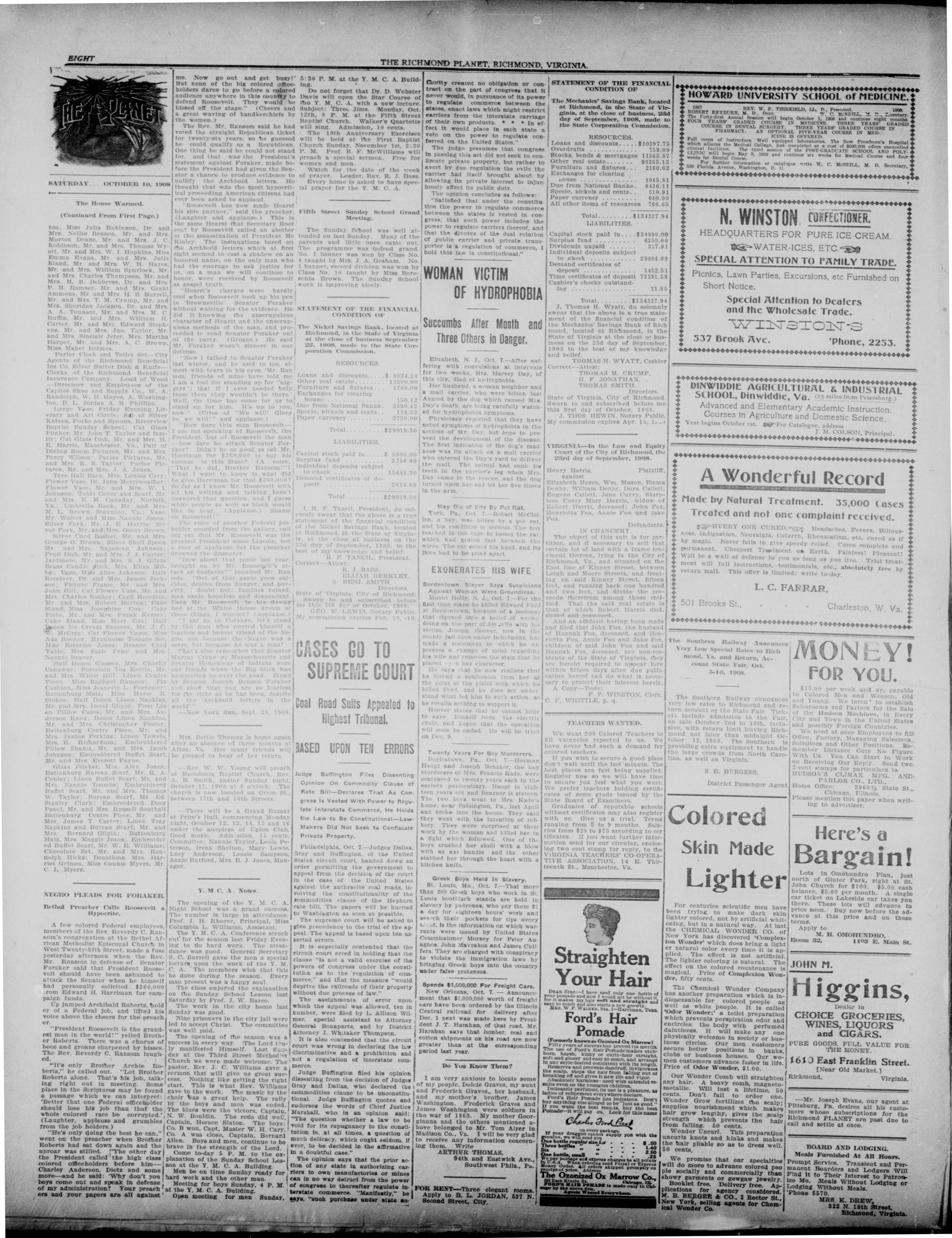
The new residence of Mr. and Mrs. E. F. Johnson was packed from cellar to garret on Wednesday, Sept. 30, 1908, the occasion being the celebration of the opening of their new home. The festivities began at 8:30 o'clock and lasted until one, during which time not less than 400 people passed through the spacious building, inspecting every nook and corner and viewing the many beautiful and costly presents, that had been sent from their many friends. The building, which is very large and one of the most attractive in the State owned by colored people is located at 1216 Beverly Street. The plans were drawn by Mr. B. C. West, Richmond's well known architect, Mr. George N. Evans, was the contractor and builder. Being a young man of only 32 years of age, he deserves great credit for the skill displayed in the erection of this building.
It will be a standing monument to his efficiency as a builder. Already he has begun to profit by the reputation, that has come to him because of his mechanical skill and aside from other contracts which he has on hand he has also one for the erection of a large brick structure for the Richmond Beneficial Insurance Company of which Mr. Johnson is President, in Newport News. Mr. Evans is a product of the Hampton School.
Many thanks are returned by Mr. and Mrs. Johnson for the following presents and those contributing to the same.
Dining Table—The Richmond Beneficial Insurance Company.
Leather Couch—Mr. and Mrs. Joseph M. Jackson, Mr. and Mrs. E. C. Burke, Mr. and Mrs. Ray, Mr. and Mrs. George Reader, Mrs. Lucy Cole, Mrs. Susan Jasper, Mr. and Mrs. E. R. Giles, Mrs. Mary Hosley, Mrs. Patsy Ferguson, Mr. and Mrs. Robert Fife, Mr. and Mrs. James Reese, Mrs. Nannie Turpin, Mr. and Mrs. Edward Stewart, Mrs. Mary Brooks, Mrs. Annie Churchhill, Mrs. Lucinda Cox, Mrs. Sallie Jasper, Mrs. Fannie Walker, Mrs. Fannie Smith, Mrs. Susie Brown, Mr. Minnie Davis, Mrs. Jas Goode, Mr. Lottie Goode, Mr. and Mrs. John Cary, Mr. and Mrs. Bell, Mr. and Mrs. Curtis Toombs, Mr. and Mrs. Richard Jones, Mr. and Mrs. George N. Evans, Mrs. Mary Jones, Mrs. W. A. Harris, Mr. and Mrs. J. Garrant.
Six Pairs of Lace Curtains—Mr. and Mrs. J. R. Hicks, Dr. and Mrs. W. H. Smith, Dr. and Mrs. M. B. Jones, Mr. and Mrs. James W. Thompson, Dr. and Mrs. Q. W. Moon, Mrs. John Sheppard, Mr. and Mrs. Mary Young, Mr. and Mrs. Sydney Stan-Continued on 8th Page, 1st Column
THE SEVENTH
DERSON
BY
BEN. M.CUTCHEON
COPYRIGHT 1906 BY DOOD NEED and COMPANY
CHAPTER I. -Gerard Chambers, son of a wealthy importer and a student at an eastern college, was awarded a membership in the college, the Seeth, crest organization, founded by Kenny Graves. The society was exclusive, only seven being admitted. The members knew the library held and each member was awarded the "call of destiny," which amounted to an assignment to test his metal.
CHAPTER II. -Chambers read his destiny and to pass a period as a sailor and not set foot on a sailor for a year. Then he was directed to go Mexico for further instructions which he to another year's exile, during which he lived his own living unassisted, and keep everything a secret.
CHAPTER III. -Jerry then told his father, he. He gained his elder's consent. He also. Bayless, his father's choice for his wife, with the fact that he would be away two years. She left him angrily.
CHAPTER IV. -Young Chambers had a fiery interior and sought again to prevent the boy's departure. Jerry obtained a berth as superviseor of an ocean freighter. His father offered to take him where he would seek the hand of Miss Bayless.
CHAPTER V—Jerry sailed the following morning on the Sister Mary. After the morning work, the York Capt. Bulger told him that the boat was full of guns. South America, loaded with guns for enemies of that government.
CHAPTER VI—Sister Mary put in at Harbor, and ordered regarding the landing of guns, and given opportunity to desert, passed it up.
CHAPTER VII—Jerry landed the guns as a Uranian cruiser hove in view. At first she was chased, but escaped. Chambers was captured and thrown into a dungeon.
CHAPTER VIII—Marina Bostos, adopted daughter of Gen. Bostos, entered the dungeon. Each made a strong impression on her other. She was known as the "little saint of Urania" because of her nursing.
CHAPTER IX—Jerry, tried by Gen. Bostos, to die at sunrise the following day. Upon her rina's love, Cast. Pilar pledged himself to the dungeon. The trio dashed away on horseback night.
CHAPTER X—Shelley sailed the following day. Marina and Pilar decided to join Gen. Barado's army, seeking the government. They united with the rebels, Chambers being made a captive.
Gen. Barardo's army went into camp in the foothills of the Bermendes mountains, about 50 miles southeast of the Foreat of the Somber Shadows. The leader of the revolutionists, spurred on by recent important victories in the south and west, was preparing for the most decisive stroke of the long and bitter struggle. The western division of the revolutionists, under the command of Gen. Provoco, reached the foothills 5,000 strong and in excellent condition. Gen. Agoncillo's army of 4,000 men was
THE WAR OF 1861
The Old Man Drew a Dagger and Sprang Towards the Victorious Leader.
hastening with all possible speed from the south, and with these two divisions Barado calculated that he would be strong enough to defeat the forces under Bostos.
He was about ready to move across the plains to a position which nature had made almost impregnable, when severe rains set in and continued for days without cessation. Two streams coursed to the sea between the armies, and it was not long before they were impassable. The rains had resulted in dire hardships for the revolutionists, and after the first downpours hundreds of men fell ill with fever, which, though fatal to many, was combated with reasonable success by the hospital forces.
Capt. Pilaro waited too long before he placed himself under the care of the nurses; and, in the middle of one of the wildest storms, he breathed his last, with Capt. Jerry and Marina kneeling at his side. Jerry was permitted by Gen. Barado to assume charge of Pilaro's funeral arrangements, and just before the wasted body was prepared for removal to the captain's birthplace, a hamlet about 100 miles southward, he delivered, in the presence of Barado and his staff officers, a funeral oration.
Marina, much against the wishes of the physicians, was present at the simple ceremonies, and sitting within a few feet of Jerry, her poor body trembled in a sapling chill when the speaker referred to "pity" as that to which he owed his life. Pity! How that word ranked in her bosom!
Before Jerry Chambers entered The College he had spent three years at a military training school on the Hudson, and his knowledge of military tactics made him particularly valuable to Gen. Barado, whose men knew very well the secret of getting the men
out of more strength and organization. Indeed, the general considered himself fortunate in having such a cool, steady, practical head at his side. The weeks of delay that the rains had caused were busy ones for Jerry, who brought all of his military training into play; many a raw recruit became as straight and soldierly in bearing as patriarchs of the service. Jerry requested Gen. Barado that he be selected to accompany the body of Capt. Pilaro to its last resting place. At first the rugged commander was inclined to grant the request, but he finally refused to do so, giving no other reason than "because." He suggested that the trip would be of inestimable benefit to Marina, who, after consulting Jerry, assumed charge of the body and proceeded in a roofed wagon on the long journey. "I shall be back with the revolutionists," Marina said at the parting. "And you, Jerry?"
"I shall await you, Marina." It was only a warm clasping of the hands that marked the parting.
The order to march was not given until early in the autumn, when the army was practically in as good condition as when it took up position in the foothills. The forces were divided into four divisions, all of which proceeded together until the second stream was crossed and the natural fortifications were reached. Here they spread out and formed into a crescent, ready to sweep down on the government's strongholds in such a manner as to make the charge most effective and to prevent retreat from any side. Bostos presented a most formidable defense, his preparations and strength being much greater than Barado had calculated they would be. The leader of the "rebels" had confidently expected that Bostos would march out to meet him and give battle in the open. While the government's tactics surprised him and created no small degree of disappointment, Barado knew that his strategic position was the better and that he could prevent a retreat.
"Let them stay," said he. "We shall move in no closer, but shall wait for them to come out or starve. Their supplies are cut off and they must come out."
In the middle of a dark night the ranks of Barado's army were thrown into wild excitement and activity by the announcement from the advance lines that Bostos was hastily preparing to bring his full strength to bear on the southern wing of the beoggers. With all possible haste, after the certainty of Bostos' intentions was learned, the northern wing of the revolutionists was awing around to the proposed point of attack. The other divisions were placed in readiness to give support to the men who were to meet the first force of the government's blow.
For two days the armies were engaged in the deadliest battle of the war. Bostos succeeded in breaking through the first division, but his strength was too nearly gone to beat down the fresh barrier presented. At the close of the second day the government's losses had reached 1,000 killed, 3,000 wounded and 800 captured. The losses on the other side were about two-thirds as great.
On the morning of the third day, Bostos rallied his men for a last supreme effort, and for hours and hours he gallantly faced the fresher forces of Barado. Slowly his ranks were driven back to the sea, where, no avenue of escape being left, he signaled his surrender.
The joy that came into the ranks of the revolutionists when the surrender was announced was indescribable. It was soon after the announcement that one of the most thrilling events of the conflict occurred. An old soldier in ragged clothing proceeded to Barado's tent with a request that he be given a chance to fight for the revolutionists' cause. Jerry Chambers, by what afterwards was called "providential intuition" by some, suspected that the old man had another purpose in mind. Jerry was alone with Barado, who was awaiting Bostos and the sword of surrender, when the man appeared at the tent opening.
"Gen. Barado," began the old man, nervously, and with side glances, "I have come to offer you my services. I have fought for the government, but Gen. Bostos has put two of my sons to death for what he unfairly called desertion. My heart is for you and against him and his cause."
Barado hade him wait a minute, and turned his back to him. The instant his eyes were away the old man whipped out a dagger from under his coat and sprang towards the victorious leader. Jerry, his eyes all the time on the stranger, drew his sword in a flash and struck the blade from the man's hand just as it touched the general's coat. The old man attempted to recover the dagger, but Jerry's hands were at his throat, and in another instant he was helpless on the ground.
Barado merely looked at Jerry for a moment, and then calmly walked over to him and extended his hand. He said not a word, but the expression in his eyes might have told a long story if it could have spoken. It was not until the would-be assassin was placed under guard that the incident became known in the ranks.
Gen. Bostos, grilled old veteran of many wars, advanced under a white flag to deliver his sword to the victor. In other wars Barado and Bostos had fought for the same cause, had planned together, had suffered together. They had spent many years of their lives
THE RICHMOND PLANET, RICHMOND, VIRGINIA
together. They had loved each other with the love of brothers. When Bostoe' arrival was announced, Gen. Barado' heart failed him. His hand trembled, his voice quaked, and a mist came into his eyes.
"I cannot take his sword," he finally said; "he is still my best friend, the one man in all Urania that I love as a brother. I shall delegate one of my officers to accept his surrender and to return his sword. I cannot face him in his time of distress. Whom shall I name? No sooner had the last word of the sentence been spoken than his eyes rested upon Capt. Jerry Chambers.
Within a few minutes Capt. Jerry went forth, his head high and his body rigid, other officers of the staff following behind.
Haggard and despondent, Gen. Bostos, surrounded by members of his staff, dropped his eyes as Jerry approached to within a few feet of him, and without looking up he held out his sword with a trembling hand.
"I accept your surrender in the name of the Confederacy of Urania," said Jerry, with great dignity, "being duly delegated by Gen. Barado, commanding the forces of the confederacy in the field."
Then Gen. Bostos glanced up for the first time and held out his sword again, Jerry continuing: "Gen. Barado desires that you retain your sword, Gen. Bostos."
Bostos' eyes dropped again, but when he lifted them the second time his chin fell and he took a startled step backward. For a moment his eyes were fixed in a glassy stare.
"You—you who escaped—!"
"I beg to introduce myself as Capt. Chambers of Gen. Barado's personal staff," was the soft interruption.
CHAPTER XII
"On to Pandaro! On to Pandaro!" This cry rang exultantly from the throats of thousands in the drawn-up ranks of the victorious army as Jerry Chambers escorted the fallen leader of the government's forces past the soldiers to Gen. Barado's tent. The rigid elfquette of war was forgotten when the two grizzled leaders met. Apparently oblivious to their surroundings, they embraced each other, and the tears from Gen. Barado's eyes were as sincere and fast-falling as those which dimmed the sight of the vanquished Bostos.
"On to Pandaro! On to Pandaro!" again and again burst from the ranks. "Gen. Bostos shall be my guest," said Barado, after he had regained control of his emotions; "he shall enjoy every privilege, every honor, every respect to which I am entitled."
"On to Pandaro! On to Pandaro!" "Yes—on to Pandaro!" cried Barudo, bringing his form to its full height, seeming for a moment to forget his old friend. Then, his eyes mellowing and his voice softening, he placed his hand on Bostos' shoulder and said: "It is the fortune of war, my old friend, and it has been against you. Though the tide of battle has swept you from your feet, my love for you now is even stronger than it was when we stood side by side and fought for the old cause—fought for the republic. Your freedom shall be unrestricted; your every desire shall be gratified."
Barado grasped the hand of the fallen leader with the warmth of true love, and with a whispered word of comfort, left the tent. The few members of the staff, excepting Jerry, departed with him. Gen. Bostos sat down on a campstool and immediately fell into deep meditation. Jerry, standing near the entrance to the tent, keenly sympathized with him. The general was the first to break the long silence.
"Tell me, Capt. Chambers," he said, laboriously, "where is my Martina?"
"That I cannot tell you, Gen. Bostos," was the answer.
"You do not know?"
"She may return to you."
"No—no, no!" the old man cried; "she must not come to me, against whom she has so deeply sinned! I shall not look into her face; I shall—I shall strike her down!"
Jerry's first impulse was to retort sharply, but it expired in pity for the vanquished leader, who seemed almost ready to collapse.
"Gen. Bostos," he began, slowly and calmly, "you cruelly wrong, Senorita Bostos, who, in the face of what she has done, still remains the 'little saint' of all Urania—the first woman in the heart of every soldier. You still have the father's heart, and, though the fortune of war has been against you, you must retain some of the old love—yes, all of the old love for her. Gen. Bostos, your daughter has been very ill."
"My Marina ill?" muttered the old man, tremblingly, his eyes showing the fear that was behind them.
"Very, very ill. Would you not see her with a heart of forgiveness?" "Yes, yes," the general cried in anguish, wringing his hands; "bring her to me, bring her to me! She shall see the father of old!"
"I cannot bring her to you now, Gen. Bostos," said Jerry, "for she is not here. She has gone with the remains of Capt. Pilaro to their final resting place. But she has promised to come back. You must be patient, Gen. Bostos."
The old man's face became stern and his eyes flashed. "Capt. Pilaro was a traitor," said he. "It is well that the world is rid of him. His body should be torn to pieces by the dogs and his stripes should be stripped from his clothing and burned. One thousand riffos is offered for the return of his body, dead or alive. Men are in every direction hunting for him. He yet shall receive the deserts of a traitor."
Gen. Bostos sat down again and buried his face in his hands. Jerry bowed and departed without speaking another word.
A few days later, when final preparations were being made for the march of the victorious army on to the capital, one of Barado's scouts dashed into camp with information that a score of men from the government's forces had intercepted the small Pilaro funeral train 40 miles from the hamlet to which the body of the captain was destined and that Marina Bostos and the
—Subscribe to The PLANET.
men who accompanied her had been captured and taken in the direction of Pandaro.
"Following the instructions of Gen. Bostos," said the scout, "the body of Pilaro was cut to pieces and burned with what remained of his uniform."
These words reached the ears of the almost frantic Bostos, who pleaded that every effort be made to recover his daughter.
"I shall do all in my power to recover your daughter," said Barado, and he forthwith dispatched men in all directions.
Gen. Barado's sweeping victory practically ended the bitter war. The government at Pandaro now was hopelessly overmatched, and even the most loyal supporters of Cardovas urged him to acknowledge the inevitable and to give up before more blood was needlessly spilled. The news of Barado's victory created panic at the capital; thousands of terror-streaked "loyals" fled to the mountains.
President Cardovas, in a last desperate effort, concentrated his discouraged, half-hearted forces around Pandaro, determined to prevent, if possible, the entrance of the revolutionists into the city. Barado's triumph resulted in thousands of desertions from the government's ranks; among those who went over to the other side were numerous officers high in both military and civic circles. Gen. Bostos, realizing the hopelessness of further resistance, urged the president to cease hostilities and to make immediate peace.
Two week after the great battle in the north the victorious Barado and his army started for the capital. Everywhere along the route he was hailed as Urania's greatest hero. There was some bashing at places, but the progress of the victors was not seriously checked. Cardovas, heedless of all advice and entreaty, stubbornly prepared to offer battle on the outskirts of Pandaro, but the size and splendid strength of Barado's forces overawed his men, who fled in panic before them. The triumphant march to the Palacio del Presidente was one of the most inspiring sights ever witnessed in Urania. The flag of the confederacy soon was fluttering from the top of the palace and the government of Jose Cardovas was fallen, never to rise again.
In the minds of the masses there seemed to be but one name, one man—Herrero Barado. With the plaudits of tens of thousands ringing in his ears, Gen. Barado was proclaimed president of the Uranian Confederacy. The new president, modest and unassuming, magnanimously gave full credit where credit was due, and in parceling out those to whom extraordinary honors would be shown, he did not overlook the Seventh Person of The Gemini, who after the story of how he had saved Barado's life from the hand of an assassin had become generally known, was hailed everywhere as one of the great figures of the war. The suggestion that a great reception be given in his honor met with unanimous approval, though Jerry did his best to ward off such a demonstration.
"But if you will do it," said Jerry, after he was convinced that the people would have their way. "I shall ask that the honors be shared by one to whom I owe my life and my services to the cause of the Confederacy. I have the right to insist that the reception be given as much for Senorita Hostos as for myself."
"But Senorita Bostos is dead," some one suggested; "else why is she not here?"
"She is not dead; I am sure of that," said Jerry, confidently. "It is not her time to be dead. She must be found." But there was not a word of encouragement from any side. Almost everybody in the capital believed that Marina either had been murdered or was being held for ransom. President Barado had offered a large reward for the return of Marina, and the constabulary of the nation, as well as the soldiery, did everything in its power to restore to the people the "little saint of Urania."
Gen. Bostos, now firmly reconciled to the situation, promised the president his full support and loyalty in establishing the new government, and he agreed that Marina. If found, should share the honor of the proposed reception to the beloved Capt. Jerry.
The reception was set for May 5, when the first great flesta de palasinos since the outbreak of the rebellion should be in full sway at the capital.
As the time dragged on, Jerry became more and more despondent over the fate of Marina Bostos. At last, he had come to share the general belief that she either had succumbed to illness or had been killed.
CHAPTER XIII
A Hitch in a Program
All preparations for the great reception to Capt. Jerry Chambers had practically been completed. The peasants' fete had begun, and the city of Pandoro never before had been in such gala dress. The bright colors of the new Confederacy fluttered from every building, and the public houses were almost hidden from view by bunting and streamers. The visitors came early, and when the fete was begun there were fully 25,000 country people mingling with the democrats of the capital.
The absence of Marina Bostos cast a gloom over the occasion. That she was dead was believed by almost everybody, and the faint hope in Jerry's breast that she might be alive was now but a dim spark. It was suggested that one day be given over to mourning for the "little saint of Urania," but the suggestion did not carry because of the doubt of her being dead. In many churches, however, prayers for the repose of her soul were offered, and so certain were many that she was not alive that they wore bits of crepe on their sleeves. Jerry pleaded that the reception to him be stricken off the program, but in view of the fact that thousands had traveled from the countryside to see only him and the president of the nation it was decided that the reception should be held. Out of deference to the memory of Marina Bostos, however, a postponement to May 12 was made.
It is doubtful if any other man shared President Barado's glory more fully than Jerry. He was lionized by all classes, and there was a demonstration of enthusiasm every time he appeared in public view.
Not only was the name of Jerry Chambers on the lips of every man, woman and child of Uruania, but it was lofty in the minds of the people of the United States of America by this time.
One of the proudest hearts in all America beat within the breast of Wallace Chambers, who, upon receipt of information as to his son's whereabouts and accomplishments in the cause of liberty, declared that he knew "he would show the 'Chambers colors.'" Of course, Mrs. Chambers' anxious heart throbbed with apprehension and fear, but the tears that came to give her relief sprang from a pool of incomparable pride. And there was another, too, who wept tears—Marsyla Bayless—but they were tears of regret.
Jerry Chambers was under "contract," it will be recalled, to present himself at — Calle Coliseo, City of Mexico, at noon on June 19, the last day of the first year of his absence. It was on the morning of May 12 that he found himself trying to give definite shape to his plans for the future. Keeping as much as possible from the sight of the joyous throngs, he went to the office of the Trans-Oceanic Transportation Company. "I want to reach Havana about June 10," said he. "What are your sailings?"
"Just in time, sir," said the agent. "This afternoon at four one of our combination freight and passenger vessels—the Pranzos—will start for Havana. You see, since the war began our service out of Pandaro has been uncertain and unsatisfactory, and we have not had chance yet to whip it into shape. The Pranzos is a slow goer, and she will put in three times before reaching Havana. With good luck, she should arrive there by June 8. Until the government turns our other boats back to us our service must necessarily be irregular. I don't think you can count on anything else earlier than the last of the mouth." Jerry's heart almost ceased beating and for a moment he was speechless. Finally he exploded:
"Great Scott! Must I sail for Havana this afternoon, or not at all?"
"If you must reach Havana around the tenth, yes," answered the surprised agent.
Jerry's mind was in a jumble, and before he fully realized what he was doing he had made his reservation. He fumbled in his pockets for money, which a sober thought convinced him he did not have.
"What's the fare?" he snapped.
"Sixty; sixy riffos."
"I'll bring the money around when I call for the ticket," and the next moment he was rushing towards the palace to see President Barado. There was only one thought in his mind: "I must catch that boat."
"Mr. President," Jerry said, as soon as he had hustled the nation's chief officer into a private office, his eyes and voice betraying the intense excitement under which he was laboring, "I'd like to tell you all, but—but I haven't now time. I must leave Pandaro this afternoon for Havana!"
Barado's chin dropped in amazement and he began to stammer unintelligibly.
"There's no way out of it." Jerry went on rapidly, "and I want you to help me. See." "I don't see," gasped the executive. "What—what are you talking about?" "I didn't know—that is, wasn't real sure about it until I inquired this morning. I thought the sallings were regular and frequent by this time, and—" "You are going to leave Pandaro this afternoon—the afternoon of all afternoons?" said the president. "That's it, that's it, Mr. President. Now, you see. My presence on board the Pranzos before she sails is far more important than my presence at the palace after that hour—four—I can tell you. I know you must be in the dark and think I'm crazy, but I simply cannot tell you any more than that I must be aboard that vessel by four."
"You have said nothing to me about this before," said the president, scarcely able to believe his own ears. "Have you had important word from home? Is some one—"
"No—nothing of the sort; that is, yes—oh, you see, I am under contract to be at Havana within a specified time." He sighed and smiled as though he had made himself perfectly clear to the befuddled mind of the executive.
"And you want—"
"Yes, I've simply got to have it—66 riffos at least. If you can fix me out I'll be under lasting obligations to you, and will return the money as soon as I can."
Barade looked into Jerry's dancing eyes for fully a minute and then burst into violent laughter. Jerry smiled, but it was a sleek smile.
"Of course, you shall have all the money you want," said the president. "but I cannot understand why you are in such great haste to leave Pandaro. Surely, you cannot be weakening before the honor that is to be shown you this afternoon, and—" "Oh, that will be easy," said Jerry. "But you will fix me out?"
"For all you want."
Within a few minutes Jerry Chambers had on his person 500 riffos, equivalent to about $400 in the money of the United States of America. This was a fortune to him, for at no time after he boarded the Sister Mary in the Erie basin had he possessed more than $25.
While he was dressing for the great reception Jerry reflected on the situation with mixed amusement and doubt.
It was shortly after two o'clock when the first strains from the great military band of 70 pieces burst like musical thunder from behind a forest of palms in the balcony of the grand ballroom of the palace. Almost all of the guests had assembled by that time. The committee on arrangements had planned to have Capt. Jerry escorted to the station of honor promptly at 2:30 o'clock. The minister of justice was to have his arm to the center of
the hall, where President Barado was to await him with the Cross of Honor. As is usual in such cases, however, there was delay. The floor was not cleared until ten minutes before three, and Jerry, who had been waiting in an ante-room for an hour, was but little short of a bundle of unstrung nerves. His eyes were on the clock all the time that he was not trying to be pleasant with those about him. When the dignified, slow-moving minister of justice finally did come he almost ran to meet him.
A fanfare of trumpets was followed by a mighty roar from the thousand persons assembled, being succeeded by an outburst that was but little less than wild pandemonium when Jerry, clothed in the full dress of a captain, appeared in view. Under most circumstances he could keep cool and reasonably calm, but when he felt himself the sole object of 2,000 eyes he almost lost his bearings completely, scarcely realizing where he was and what he was expected to do. From the massed sidelines roses were hurled at him by the women, and the seas of wildly fluttering handkerchiefs and small flags almost made him dizzy. This demonstration was accompanied by a din of voices that probably is ringing in his ears yet.
Nothing could have pleased the president more than the great reception accorded to the handsome young officer, who, when he came to a stop before him, looked into a pair of eyes that snapped with love and admiration.
A signal from the master of ceremonies instantly hushed the vast assemblage, and every ear was inclined towards the station of honor.
"Capt. Gerard Chambers," Began President Barado, slowly and impressively, "you stand in the presence of this vast concourse of people this afternoon one of the most beloved men in all Urania." Deafening applause halted the speaker fully three minutes. "You are here to receive the greatest honor that the president of the people can confer upon you—the Cross of Honor. The whole republic thus honors you; all Urania takes this means of expressing its gratitude and its appreciation. Your name forever shall stand out brilliantly on our roll of honor; it shall serve as an inspiration to the rising generations not only of Urania, but of every other land that admires all that is good and strong in a young man. Now, in the name of the whole people, I decorate you with the Cross of Honor of the Confederacy of Urania, and lift a silent prayer that you long may enjoy happy life, and that Urania and her people may occupy the warm spot in your heart that you monopolize in theirs."
In another moment the barriers had crumbled and a wild rush was made towards the young hero, who stood beside the executive. The thought of
A
Jerry Jumped for the Rail, Which He Barely Reached.
the sailing of the Franzos had been swept from Jerry's mind. Men and women struggled among themselves to touch his hands, and at times the crush became so great that guards had to intercede to keep him and the president from being carried off their feet.
High on the wall was a big clock, which up to this time had escaped the notice of the young captain. While Jerry was mumbling out thanks to the persons who took his hand, President Earado sent into his ear at close range:
"The Pranzos sails in 13 minutes!" The warm smile on Jerry's lips froze instantly and his eyes shot up to the big timepiece. For an instant he was paralyzed; then, in a realization that sent the blood surging to his brain, he turned and grasped the arm of the beaming executive, exclaiming excitedly:
"I still have time! I must reach her! Take me out—let me run to the rear!" He acturally was tugging at the president's arm, the masses before him gaping in bewilderment.
"But, captain, you cannot—"
"I must! Come on, if you—if you love me!"
In another instant the president of the Uranian Confederacy was being hurried across the floor towards a rear door, holding back as best he could and all the time trying to get his words into Jerry's heedless ears. Once in an adjoining room, the president held Jerry in a determined effort to be heard.
"Mr. President," desperately cried Jerry, "I must run for my very life! I'll jmpb to the first carriage and—I will reach that boat in time!"
"But, my captain—"
"I'll write you from Havana! Good!
by, Mr.—"
"But—"
"So long, so long!"
"Captain—"
But the next instant the president of Urania was alone, and rushing madly towards a carriage in the driveway was Capt. Jerry Chambers, the Cross of Honor beating on his gilded breast and his eyes wild with fear and excitement.
"To the Trans-Oceanic docks!" he cried to the surprised man on the box. "Fifty riffos if you get me there in
time—before four's your knocked off if you don't."
The next moment two horses were galloping down the driveway, a merciless whip cutting streaks in their backs. Never before had two steeds raced so madly through the streets of the old capital; never before had a driver taken such chances.
As Jerry sprang out of the carriage at the dock, just as the clock in a tall tower near by rang out the hour of four, he threw a handful of coins at the dazed driver and dashed for the pier of the Pranzos.
The gang-plank was just being taken in and the boat's propeller was beginning to churn the water. Jerry did not wait for the plank to be reset, but jumped for the rail, which he barely reached.
"Close shave," said one of the boat's officers.
"I have had closer ones," gasped Capt. Jerry.
The brilliant Cross of Honor remained on Jerry's breast more than an hour before he thought of taking it off and making himself less conspicuous before the eyes of the hundred or more passengers. It was a matter of only a short time before his identity became known to every one on board, and, although he sought to keep himself in the background, he was unable to escape the admiring glances that were shot at him from all angles, and often he felt uncomfortable under the whispered conversation of which he knew himself to be the sole subject. He remained below as much out of the view of the others as possible until after dusk.
Jerry regretted leaving the scene of his greatest triumph, but he was exuberantly glad that he had succeeded in catching the Pranzos and correspondingly disgusted that he had not arranged to have the boat held an hour or two. After the last of the capital had been hidden from view he stretched out on a chair and fell to picturing the possibilities of the future. Allowing the Pranzos until June 10 to reach Havana, he would have about nine days in which to cover the distance between that city and Vera Cruz and the City of Mexico. There were sailings twice a week between the Cuban metropolis and Vera Cruz, and he felt that if he could not leave Havana until the 12th or 13th he still would have time to reach — Calle Coliseo according to "contract." Satisfied that he would have no trouble in appearing in time for his further instructions, he let his mind wander back to New York, and boarded Capt. Bulger's filibustering beat the feeling of homeliness selzed him.
What would he not have given this very moment if he could step into the presence of his parents in the full-dress of a captain of the Uranian Confederacy and with the greatest honor that a grateful people could confer upon him?
Many men prominent in the commercial affairs of Urania were on the Pranzos, among them being Senor Calio Lopez, the foremost exporting and importing merchant of South America, and a man of almost fabulous wealth. With Senor Lopez was his only daughter—Senorita Mercedes, a belle of Pandaro and of Madrid, and recognized as one of the most beautiful young women of all Urania. Jerry had heard of Senor Lopez as a staunch supporter of the Cardovas government.
On the morning of the next day Senor Lopez introduced himself to Jerry, in turn presenting his daughter.
"Capt. Chambers," said the great merchant, "almost every one on this vessel is a Uranian and a loyal supporter of the new government at Pandaro, though many of us sympathized with and gave aid to President Cardovas during the long and bitter struggle. There are no lines now; we all are Uranians, loyal and true, and there is not a person on board who does not feel indebted to you for what you have done, chiefly for saving the life of the best loved man in our country from a murderer's knife. We all admire you, and as admirers, we desire to honor you in some manner. I have been delegated by the other passengers to invite you to sit at a supper to-morrow night as the guest of honor. Necessarily the expression of our admiration for you must be mild, but we are sure that you will feel the spirit of the occasion to be earnest and full-born."
"Really, Senor Lopez," blushed Jerry. "I think I already have received mostly more honor than is due me. However, I am in the hands of my friends, to be done with as they deem fit. But, candidly, I don't think I deserve any such consideration."
"The idea was born in the mind of my daughter," said the merchant, "and there is a saying that a woman never thinks amiss."
"Are all North Americans as modest as you, Capt. Chambers?" asked Senorita Mercedes. A faint smile came to his lips and he moved rather nervously before the steady gaze from her big black eyes.
"Many of us do not have time to be modest."
With an expression bordering almost on gratitude, Senor Lopez departed to frame up preliminary arrangements for the supper of honor.
Senorita Mercedes became intensely interested in Jerry, who, reluctantly complying with her urgent request, related part of the story of his thrilling experiences in Urania. After he had told of Marina Bostos' heroism and sacrifice, she said, with a straightforwardness that half startled him:
"Senorita Bostos must have loved you, my captain—else why should she have sacrificed all to save your life?"
"Senorita Bostos was prompted by her scuse of justice and humanity," he foundered.
"She must have loved you, my captain," she persisted.
"She could not have loved me," said he; "she did not know me."
"One does not need to know to love," she said, promptly and decisively. "Do you know there is not a girl in all Urania?"—and how her sparkling eyes pierced him!—that would not have sacrificed all to have done as Senorita Bostos did? What manner of woman was this? Jerry was stricken
THE PLANET
SATURDAY...OCTOBER 10, 1908
"Senorita Lopez," he finally managed to say, clumsily, "must recognize right and justice, and—"
"I should have acted quite as quickly, quite as determinedly as Senorita Bostos acted," she broke in, and there was a strange ring to her voice. He tried to laugh, but her steady, unswerving gaze checked him; he tried to switch to another phase of the general subject, but her mind kept in the old channel doggedly. "My captain does not believe that I should have sacrificed as she sacrificed," she went on, in a tone of injury.
"Such candor, Senorita Lopez," said he, "cannot be doubted."
There was a strange light in her eyes as she turned them to the sea, and he was becoming more and more uncomfortable. To him she was a revelation, the most remarkable girl he had ever met; never before had he seen such frankness, such openness displayed under similar circumstances. He was familiar enough with Spanish blood to make big allowances, but he could not bring himself to understand this daughter of a Cresusus.
"How long will you be in Havana?" she asked, after a long, thoughtful silence.
"Only a short time—maybe not more than a few hours," he answered.
"My father has been called to the City of Mexico," said she, "and I am going with him. From there we shall make a tour of the United States. We shall spend two weeks in Havana. Can you not come to Mexico?"
This completely stumped Jerry, "Why," said he, "I intend to leave Havana almost immediately, for Vera Cruz, from where I shall move on to the capital."
"Leave Havana immediately!" she exclaimed. "Then, we may conclude to leave on the same vessel. How glorious!"
Jerry Chambers was one of the most unassuming men in the world, but so persistently did Senorita Mercedes force herself upon him that at last he was compelled to believe that she had become desperately infatuated with him. He felt that the infatuation was very shallow—an emotion of a girl whose nature bad for its foundation, superstructure and all a romantic spirit. He thought her startling candor could be traced to a father's stern and rigid watchfulness. In fact, she as much as had told him that she was constantly under her father's eye and that she was fast tiring of it.
On the afternoon of the following day a very strong eastern wind came up and set the old Pranzos to dancing restlessly. By dusk there came distant rumblings of thunder and faint flashes of heartlightning. The waves rolled higher as the storm laden wind increased into the fierceness of a gale, and by nightfall the heavens were booming constantly directly above.
The long table in the dining saloon had been prepared for the supper of honor, but much of the spirit of the occasion was lost in the fear that had become almost panic in the heart of every passenger. Although appreciating the peril quite as keenly as the others, Jerry was composed, and his apparent unconcern served as an inspiration to many of the men. At last the 30 or more women became panic-stricken, some falling into the throes of ungovernable hysteria. The men were helpless to curb their fear and excitement. Jerry struggled to the captain of the vessel and put this:
"Are we in great danger? Be frank with me."
"We are." answered the officer, "although she is holding her own as well as any similar boat could under the conditions. This is the worst storm I have ever seen in all my life on the water. If we can keep away from the rocks—and they are plentiful along the coast—she may weather it out all right. At present my whole mind is on escaping two massive rocks, about 30 or 40 feet apart, known as the 'silent sentinels'. Each stands 50 feet out of the water. We cannot be far from them."
"How far are we now from shore?" "The wind has blown us to within ten miles of it. We are going in nearer every minute," and the captain's face became very grave.
"How far are the 'silent sentinels' from shore?" "About four miles." "Good God, captain," exclaimed Jerry, "if we strike them?"
"There'll be hell to pay, sir!" roared the officer. "The women must be kept quiet; they upset my men completely." For a moment Jerry seemed paralyzed. Finally recovering his wits, he laboriously picked his way back to the dining saloon, where the white-faced passengers were huddled in plunging, reeling groups. His face wore an expression of complacence as he tumbled into their presence.
"Be calm," Jerry urged. "The captain requests that the supper be delayed no longer. The cooks are very impatient and they fear that if the coffee stands much longer it will lose all its strength."
Jerry's purpose in getting the passengers to the table was to make possible a more systematic retreat to
deck in case the vessel reached the rocks. The terrible tossing of the old craft had made many of the passengers care little whether they ever saw land again. The fear and excitement had kept many from getting slick. With the exception of but three or four of the women and two of the men, all took seats at the table, though few doubted that they could take a moutiful to eat. Senor Lopez escorted Jerry to the seat of honor, both struggling and plunging into the wall as they picked their way together.
```markdown
```
"Senorita Bostos Must Have Loved You. My Captain."
Senor Lopez acted as master of ceremonies. Jerry taking the seat at his right, Senorita Merecedes, pale but staunch, having the one at his left. When the merchant struggled to his feet to announce formally the purpose of the supper, it seemed to Jerry, who had been infinitely more interested in the storm and the fate of the Pranzos than in the honor being shown him, that the old vessel was plunging and twisting and groaning more furiously than at any time before. He did not believe she could stand the terrific strain much longer.
"Uranians like no such thing as a storm at sea deter them from showing honor to whom honor is due," began Senor Lopez, smiling weakly, but his enthusiasm was hopelessly at low ebb. "Capt. Chambers deserves every consideration that we, as Uranians, can show him. He possesses every quality that contributes to the greatness of a man, and his achievements in our beloved land will shine out for ever—"
Crash! The tumbling, twisting, creeking Panzos had reached the "slippery slope."
CHAPTER XV
Senorita Mercedes Loren
When the Pranzos thundered against the "silent sentinels" every one at the supper of honor was thrown to the floor, many being pitched headlong over the table. Senior Lopez, the only one standing, was hurled against the wall and rendered unconscious, and Jerry Chambers awoke from a moment's insensibility to find himself at the bottom of a heap of four or five persons. On all sides lay the stunned passengers, a few just beginning to realize what had happened. The littered floor was at an angle of almost 45 degrees, the vessel having been driven between the rocks and pitched to a position from which the continued fury and force of the elements could not dislodge her. A great hole had been torn in one of her sides, and the angry waves were fairly ripping off the timbers.
Many of the crew had been swept from the deck and pounded to death on the rocks, and only a few of those remaining were sufficiently possessed of their faculties to attempt the salvation of passengers and themselves.
While Jerry Chambers, bruised and battered, was trying to extricate himself the captain of the vessel dashed through the saloon commanding every one to go on deck, where he purposed putting as many as possible into the few remaining boats and setting them out at the mercy of the night. Jerry by this time was on his unsteady feet, and he plunged towards the narrow stairway leading to the deck. Before he had scrambled up half a dozen steps he heard a shriek behind him. He turned and saw Senorita Mercedes on her knees at the first step.
"Save father!" she screamed. "He is not dead! Save him!"
Jerry never knew why he returned to the saloon, for his swimming mind was intent only on getting to the deck himself. When he reached the base of the staircase the young woman staggered to her feet and threw her arms around his neck.
"Save father! Save father!" she cried, as Jerry tried to tear himself away from her.
"Where is he?" shouted he. "We cannot wait! We shall all be dead! We must save ourselves!" "Try to save father!"
Jerry stared at her for an instant and then pitched forward, rolling to within a foot of the girl's father. Senor Lopez was showing signs of regaining consciousness, and Jerry picked him up and, stumbling, pitching, plunging, dragged him to the stairway. Just as he reached the first step his arms lost their strength and the body of the great merchant fell to the floor and rolled to the side of the ship. Jerry's brain was whirling and his eyes scarcely saw the flashes of lightning that illumined the stairway. He began to reel and was about to fall when Senorita Mercedes caught him and managed to place him on the steps. Almost instantly Jerry's senses returned, and the first words he heard were:
"We—you and I—shall go together!" In a flash of lightning he saw the face of the girl—a face that displayed none of the terror that was in his. "Come!"
A few minutes later the two were at the top of the stairs, he holding with a deathlike grip to a part of the remaining rail and she clinging to his arm. After a great wave had broken over them, she cried out:
"We shall go together—to the mast—first!" An instant later, she succeeded in tearing Jerry's hands from the rail, and together they pitched towards the mast; which Jerry barely reached just as another wave swept over the deck. Senorita Mercedes was carried on the way to a part of the unbroken rail on the vessel's side. Jerry thought she had been swept into the sea until he heard dimly above the deafening roar:
"We shall go together—you and I!" Jerry, after long tugging, managed to take a coil of rope from the trem-
THE RICHMOND PLANET, RICHMOND, VIRGINIA
Bling mast, and, with an end in his hands, he threw it towards her. He thought little of his aim, but his throw could not have been more accurate, the tangled rope striking her body squarely.
In a few minutes, after almost exhausting himself in the effort, he succeeded in hauling her back to the mast.
"You have done more for me than you ever did for Senorita Bostos!" the girl cried, as she strengthened her grip on his tired arm.
The remark so startled Jerry that for an instant he almost forgot the awful situation.
The two clung to the mast for hours, both half drowned and thoroughly exhausted. The remaining part of the old ship had gradually been pounded and hammered to a position behind the eastern rock, where the force of the wind and water was considerably broken, and it was only then that they dared venture away from the mast. While they clung to that mast the constant battering against the rocks had torn a gaping hole just below the water line on the higher side, and the life of every one in the saloon was lost in a swirling flood of water. Of all on board there remained alive not more than 25. all of whom managed to reach the deck. Only seven of the crew, including the captain, survived.
All that was left of the Pranzos when the first tint of dawn came, and when the storm had spent itself, was about 40 feet in the bow. which was anchored high on the western rock. Those who could wield a hand secured the anchor chains and hawkers and made fast the wreckage to parts of the ragged rock.
Seniorita Mercedes was fatherless, and she was the only woman to escape death. And to the surprise of all, she was the calmest person in the little terror stricken group. At times she jested, and once, to the horror of all, she started to sing a catechy Spanish song.
"For God's sake!" cried the dumb-founded Jerry, to whom the girl always clung, "what kind of a woman are you, anyway? Have you no sense of danger? Have you no fear?"
"No," she said, in a tone that chilled him; "I thought the storm would do what I had intended doing myself."
"What—what—"
"God!"
"I was tired—tired of all, my captain—tired of life, tired of father, tired—"
"You plended with me to save your father," cried Jerry; "you held me back and—"
"Yes, yes, yes," she interrupted, with a flandish laugh—"for him to see me dead, for him to know that I had kept my vow to— And you were going with me!"
"Good heaven, she's crazy!" Jerry cried to the captain.
(TO BE CONTINUED.)
changing Courtesies.
Barber. Your head is sadly in need of a shampoo.
Tailor (in the chair)—Yes, and your clothes are decidedly seductive, but I don't nag you about it.—Royal Magazine.
In the Morning.
I set the thing, but that's no matter!"
FIDO FIRST.
Hubby—Pray do not misunderstand me, Jeannette, all I ask is that you should kiss me before and not after you have kissed the dog.
Wife—But Leopold, don't you think that the dog may have his preference, too?
Reversed.
"Be mine! Be mine!" the man implored. The maiden tossed her head; "I'll marry you, if that you mean, But you'll be mine," she said.
His Finest Act.
"How was your speech received at the club?" asked one of Chumley's friends.
"Why, they congratulated me very heartily. In fact, one of the members came to me and told me that when I sat down he had said to himself it was the best thing I had ever done."—Half-Holiday.
Columbus, Mistake
Teacher—Did Columbus know that he discovered a new continent?
Class—No; he thought it was India.
Teacher-Correct. Why did he think he had found India?
Bright Boy—I s'pose it was 'cause the inhabitants was Indians.—New York Weekly.
The Rich Culprit.
"I am sorry to inconvenience you," said the policeman, "but your machine was going 40 miles an hour." "Don't apologize," replied Mr. Giltedge. "Always do your duty. John, go along with the officer and be fined."—Half-Holiday.
Considerate.
The Cabman—Gimme your bag, lady,
and I'll put it on top of the cab.
Mrs. Oatcake (as she gets in)—No;
that poor horse of yours has got
enough to pull. I'll carry it on my
lap.—Half-Holiday.
CURRENT VERSE.
Nature's Hired Man.
Diggin' in the earth,
Helpin' things to grow,
Foolin' with a rake,
Flirting' with a hoe,
Waterin' the plants,
Pullin' up the weeds,
Gatherin' the stones,
Putting' in the seeds.
On your face an' hands
Pullin' up a tan;
That's the job for me—
Nature's hired man.
Wages best of all,
Better far than wealth.
Pald in good fresh air,
And a lot o' health.
Never any chance
Of your getin' fired,
And when night comes on
Known' why you're tired.
Nature's hired man—
That's the job for me,
With the birds and flowers
For society.
Let the other feller
For the dollar scratch—
I am quite contented
In the garden patch!
—John Kendrick Bangs.
The Discoverer.
When first I thought to kiss her—say,
I used to sit an wonder
Which way would be the smoothest way
An bide a chance, by thunder!
I'd plan: To-neight I'll do it, shore;
I'll up an' kiss Lousey
The minute I'm inside the door—
Jes' loverlike a breeze.
Then—"No," I'd think; "I'll wait a bit,
An' do it at a pucker."
Yet when she'd dimple there I'd sit
Like any downright mucker!
An' think; "I'll do it at good-night,
An' simply keep on in!
But at the threshold out I'd light—
An' kick myself for balkin'.
Till, sirs, I'd done it! Slick as pie!
We two stood there together;
I hadn't planned this time—I
Was thinkin' of the waiter.
When sudden—gosh! Well, anyhow,
'Twas nothin' that she hated;
An' went so natural that now
'I'm mad becuz I waited.
Send them to Bed with a Kiss.
Oh, mothers, so weary, discouraged,
Worn out with the cases of the day.
You often cross and impatient,
Complaint of the naked play;
For the day brings so many vexations,
So many things going amiss;
But, mothers, whatever may vex you,
Send the children to bed with a kiss.
The dear little foot wander often,
Perhaps from the pathway of right;
The dear little hands find new mischief;
To try you from morning till night;
But think of the desolate mothers
Who'd give all the world for your bliss.
And, as thanks for your infinite blessing,
Send the children to bed with a kiss!
For some day their noise will not vex you,
The silence will hurt you far more;
You will long for the sweet, childish voices
For sweet, childish face at the door,
And to press a child's face to your boson,
You'd give all the world for just this;
For the comfort 'twill bring you in sorrow,
Send the children to bed with a kiss!
—New Orleans Pleasure.
Fagots.
Hope dwells within the heart,
A vest velled in white.
That when our joys depart,
Alone, renown her light.
Yes, he who sings should be content
And thank the powers divine,
If Time—to be his monument—
Will spare a single line.
A wolf, beholding Cupid fast asleep,
Though hungry, left him to his slumber
light.
Saying, "I much prefer to feast on
sleep."
Than on what might destroy my appetite."
One's books deceive not, but, alas!
How often friends become our foes;
Never a snake within the grass
Comes to us with a rose.
As all roads lead to Rome,
Lead all my thoughts to thee,
Love's Golden House, the home
Of immortality,
-C-C Blanden, in Chicago Evening
Post.
Sleep.
Plenty there are to sow the seed—
Plenty there are to reap;
Of the dream is born the deed;
Sleep!
Sleep!
Sleep!
Thunders from the heavens hurled
Die in echoes deep:
**After all the toll and strife**
Over vale and steep
Sighs the later voice of Life:
Sleep!
Sleep!
Sleep!
—Atlanta Constitution.
The Eternal Gate.
Far off and faint as echoes of *n* dream,
The songs of boyhood seem,
Yet on our autumn bough, unflown with
spring,
The evening thrushes sing.
The hour draws near, howe'er delayed
and late.
When at the Eternal Gate,
We leave the words and works we call
our own.
And lift void hands alone
For love to fill. Our nakedness of soul,
Brings to that gate no toll;
Gittles we come to Him who all things
gives.
And live because He lives.
—John Greenleaf Whittier.
Joy and Sorrow.
I'll not confer with Sorrow
Till to-morrow;
But Joy shall have her way
This very day.
Ho, eglantine and cresses
For her tresses!
Let Care, the beggar, wait
Outside the gate.
Tears if you will—but after
Mirth and laughter;
Then, folded hands on breast
And endless rest.
—T. B. Aldrich.
Almost Brilliant.
"Has Maud a light part in that new
play?"
"I believe so. She comes on the
stage in the last act with a candle."—
Baltimore American.
Appropriate End
"What do you think the fashion critics ought to do about the sheath skirt?"
"Knife it."—Baltimore American.
LINCOLN
HAIR POMADE
MAKES
KINKY
HAIR
SOFT
REMOVES
DANDRUFF
KEEPS
HAIR
FROM
BREAKING
OFF
LINCOLN
HAIR POMADE
KEEPS
SCALP
FRESH
CLEAN AND
WHOLE-
SOME
MAKES
HAIR
GROW
LONG AND
LUXURIOUS
WHICH WAY WOULD YOU RATHER HAVE YOUR HAIR- SOFT AND
LONG SO THAT YOU CAN PUT IT UP IN THE LATEST STYLE
OR SHORT AND KINKY
A WOMAN'S JUST PRIDE IS HER
HAIR. TO STRAIGHTEN OUT THAT KINKY, CURLY HAIR, PUTTING IT IN THE MOST PERFECT CONDITION TO BE COMBED INTO ANY SHAPE JUST TRY A BOTTLE OF LINCOLN HAIR POMADE.
MANUFACTURED BY
The Lincoln Post
NORFOLK, VA., U. S.
Agents Wanted Everywhere. Write for po
er does not keep it, send 20 cents in stamp.
COLN POMADE CO., Department B, Norf
e you a bottle by return mail.
Agents Wanted Everywhere. Write for particulars. If your dealer does not keep it, send 20 cents in stamps or silver to THE LINCOLN POMADE CO., Department B, Norfolk, Va. and we will send you a bottle by return mail.
All millinery fashions change
Each season more than twice;
The only constant thing at all
About them is the price.
—Detroit Free Press.
Surcasm.
THE FLIGHT.
"Come fly with me!" the young man said
and he turned to me, unbounded way.
My airplane wafted overhead
And frets the bonds that bid it stay.
'Tis but a pleasure jaunt I ask
You'll try with me.
This is no life-long journey's task.
Come! Fly with me!
"The fervid phrase of other days
Has given way to simple fact;
No more a fancy playmy plays.
Our speed is exact.
I don't request you'll live life through
And die with me;
I merely am inviting you
To fly with me." — Washington Star.
Fragrant Bermuda
Church—The air of Bermuda is laden with fragrance because the automobile is not allowed there.
Gotham—But, how about those Bermuda onions?—Yonkers Statesman.
DEEP SEA GOSSIP.
First Mermaid—What was the excitement about at the bottom awhile ago?
Second Mermaid—Why, haven't you heard? The swordfish and the sawfish fought a duel over the hand of Miss Octopus, and now they'll have to send for a scissors grinder to fix them up.
Never Gets Less.
Sarcasm.
The Rev. Mr. Goodman paused a moment in his discourse.
"There are five or six persons in the congregation, if I mistake not," he said, mildly, "who did not turn their heads when the door opened just now. For their benefit I will state that the sexton has just come in for the purpose of attending to the ventilation. He is attired in plain black, and wears a patch over one eye. I remark, fourthly, that this clause in the text," etc.-Royal Magazine.
One Good Turn, Etc.
Dying Millionaire—I have been much in litigation, always successful, too, and I feel that I owe everything to the lawyers. I want them to have all my property.
Attorney—Ah! You wish me to make a will, then bequeathing—
Dying Millionaire—Cutting off all my relations, and bequeathing the money to charitable institutions.—New York Weekly.
Barbaric Simplicity
"You know," said the man who stores his mind with quaint and curious facts, "that the savages have a way of getting fire by rubbing two sticks together."
"What a very tiresome method!"
"Yes. And yet, it must be a heap quicker and handier than fooling with a box of safety matches on a damp day."—Washington Star.
The First Step.
"So you have a plan for making diamonds?"
"I have," answered the man from Paris.
"And what is the first step in your process?"
"To find some one who has foolish money to invest."—Chicago Record-Herald.
KEEPS
SCALP
FRESH
CLEAN AND
WHOLE-
SOME
MAKES
HAIR
GROW
LONG AND
LUXURIOUS
A HAIR-RAISING TALE.
They were discussing the proper way to bring up rabbits, when the young man in the white canvas hat with a light-blue band threw away his cigarette and remarked dreamily.
"Speaking of raising hairs, when I was up in Canada last year I heard of a hair tonic that was so marvelous it made me somewhat skeptical. Finally I borrowed some of it to try on a tame jack-rabbit that had been rather out of sorts ever since his tail got chopped off by accident. I gave him some of it, and it sure toned him up great—in fact, I reckon he's running yet. But he left the loose piece of his tail behind him, and I says to myself, 'It's a poor hair tonic that won't grow hair.' So I tried some of it on that chunk of tail. Well, boys, you can be believe me or not, but as sure as my name is Bates that stuff was so powerful that it grew another hare on the tail in nine and three-fifths seconds by my watch."
There was silence for 4$ \frac{1}{2} $ seconds, and then the stout man in the pink shirt and the pale-green tie with purple dots spoke.
"That's what you call a hare-raising tail," he murmured in a sudden burst of inspiration.—Graham Hawley in Judge.
SAVING HIS CONSCIENCE.
LOYS FOR SALE
Prospective Buyer—Place entirely free from mosquitoes?
Hiram Wayback (thoughtfully)— Yes, if you come around at the right time of year.
Sensible Heiress
furious.
"I'll not wad the cedar he said," his bride I'll never me.
His castles fair are in the air, I'd suffer from insomnia there—So it's America for me.
—Chicago Daily News.
Definition
As nearly as can be differentiated, a job is where a man does most of the work and somebody else gets most of the pay, and a position is where a man gets most of the pay and somebody else does most of the work.—Puck.
Theater Properties
A German newspaper had an advertisement the other day for the sale of the properties of a theater. This postscript was added: "To be sold at the same time, 32 substantial old ghosts, with a very fine new devil—a striking likeness of Bonaparte."
The Hope of It.
"It is true dat Jordan is a hard road ter travel," said Brother Williams, "but dar's dis consolation: We kin all lay down our burdens on de green banks er de river an' go in swimmin' w'en we gits dar!"—Atlanta Constitution.
Nobility of Labor
There is a perennial nobleness, and even sacredness, in work. Were a man ever so benighted, or forgetful of his high calling, there is always hope in him who actually and earnestly works; in idleness alone is there perpetual despair—Carlyle.
THREE
The Philosopher of Punjab
"Blessings seem brightest as they take their flight," quoted the Philosopher of F伯尔. "I always notice that the father of a family thinks the most of his children at the time when they are being taken upstairs to bed."
Cheap Wit.
"I'm tired of these mother-in-law jokes," declared Bjirks, emphatically.
"Who are these cheap humorists who earn dirty money by scribbling such stuff? I want to tell you that my mother-in-law is a saint." a saint. "ir"
Cheap Wit
"Is that so?" said Spinks, sympa-
thetically. "When did the old lady
die?"—Cleveland Leader.
Woman Like
Bacon—What's the matter with your wife, to-day? She seems to be in a bad humor.
Egbert—Why, she heard a lot of hens cackling in the next yard this morning, and she's put out because she couldn't understand them!—Yonkers Statesman.
Guest—What kind of a lamp is that?
Host—A study lamp.
Host-No. Called that because it takes a great deal of study to run it. New York Weekly.
JOSHUA BANKS & SONS
CATERERS
EVERY FACILITY CONSISTENT
WITH FINE CATERING
Your Patronage Solicited
Refreshment Cars and Boat Privileges
Handled in Season.
Address all communications to
KLAM L. BANKS,
511 N. 2d St
Residence: 1312 N. 26th St.
RAILROADS.
TO AND FROM WASHINGTON AND BEYOND.
Leave Richmond
Arrive Richmond
*5.20 A.M. Byrd St. Sta.
*5.45 A.M. Main St. Sta.
*8.40 A.M. Byrd St. Sta.
*12.01 P.M. Byrd St. Sta.
*4.00 P.M. Byrd St. Sta.
*4.15 P.M. Elba Station.
*5.20 P.M. Main St. Sta.
*8.20 P.M. Byrd St. Sta.
*7.50 A.M. Byrd St. Sta.
*8.25 A.M. Byrd St. Sta.
*10.35 A.M. Elba Station
*12.15 P.M. Main St. Sta.
*2.45 P.M. Byrd St. Sta.
*7.15 P.M. Byrd St. Sta.
*9.00 P.M. Byrd St. Sta.
*10.45 P.M. Main St. Sta.
ASHLAND ACCOMMODATIONS - WEEKDAYS.
ASHLAND Accumulation - 1,000 P.M. - 6,350 P.M.
Arrive Nashville Nation - 6:30 P.M.
Arrive Nashville Nation - 6:30 P.M.
*Daily.* *Weekdays.* *Sundays only.* All trains to or from Byrd Street Station stop at Elba. Time of arrivals and departures not guaranteed. Read the signs.
N. & W. NORFOLK & WESTERN
ONLY ALL-RAIL LINE TO NORFOLK.
Leave byd Strd Station, Railway. Inb. M
fecct December 1, 1907.
For Norfolk-
0-900. A. M. 3:000. P. M. and 7:00
P. M.午课
For Lynchbwr, the West and Southwest—
9:00 A.M. 12:30 P.M. M., and 9:40 P.M. daily.
ANRHB RICHMOND—Pram Norfolk—11:30 A.M.
Richmond, daily. From the West—
7:40 A.M. 2:05 P.M. 12:30 P.M. M., daily.
Pulman, Parlor and Sleeping Cars. Cabs
Dining Cars.
7. B. BEVILL,
Gen. Pass. Agent.
C. H. BOSLEY,
Div. Pass. Art.
Southern Ry
TRAINS LEAVE RICHMOND.
N. B.-Following schedule figures published only as information for charities:
6:20 A. M.-Daily-Local for Charles
11:00 A. M.-Daily-Limited-Buffet Pullman to M. M., and Birmingham, New Orleans, Memphis, Chinooka, and all the South, through coach for Chase City, Oxford, Durham.
6:00 A. M.-Sunday-Keysville Local.
11:30 P. M.-Daily-Local Pullman ready 8:20 P. M. for all the South.
YORK RIVER LINE.
4:20 P. M - Ex. Sunday - To West Point -Cous-
tains Baltimore Monday, Wednesday
and Friday.
2:15 P. M - Monday, Wednesday and Friday -
Lewis West Point.
4:23 M - Wednesday point to West Point.
TRAINS ARRIVE RICHMOND.
7:00 A. M. 9:30 P. M. —From all the South.
7:10 A. M. —From Raleigh, Durham,
Chase City and local state.
8:40 A. M. —From Keysville—Local.
8:50 A. M. —From Friant and Bald
more West Friant and local
Westbury, Sunny.
10:45 A. M. 5:45 P. M. —Local from West Fork.
C. W. WESTBURY, D. P. M.
Phone 714-222-2222
ATLANTIC COAST LINE
(Effective January 5, 1998.)
TRAINS LEAVE RICHMOND DAILY.
For Florida and South-8-15 A. M. and 7:18
P. M. *11:40 P. M.
For Norfolk-9-00 A. M. 8:00 P. M and 7:58
P. M.
For N. and W. Ry. West-9-00 A. M., 18:18
and 9:40 P. M.
For Petersburg: 9:00 A. M. 12:10, 8:00
P. M. 6:00, 9:40 P. M. 7:25 and 11:30 P. M.
For Goldsboro and Fayetteville: *$2.50 P. M.
Trail arm at Richmond daily-8-16, *$2.50
7:40 8:00 11:30 A. M. *12:10
2:05, 6:50, 8:00 and 8:50 P. M.
*Except Sunday. **Sunday only.** **Except
Monday.**
Time of arrivals and departures and con-
sultions not guaranteed.
O. C. S. BRUNKELD. D. P.
SEABOARD
AIR LINE RAILWAY
SOUTHBOUND TRAINS SCHEDULED TO LEAVE
RICHMOND DAILY.
9:15 A. M.-Local to Norlah, Raleigh, Charle-
lott, Wilmington.
2:55 P. M.-Sleepers and coaches, Atlanta,
Birmingham, Savannah, Jacksonville
and Palm Beach.
10:45 P. M.-Florida Limited.
12:55 A. M.-Sleepers and coaches, Savannah,
Jacksonville and Southwest.
NORTBOUND TRAINS SCHEDULED TO ARRIVE
RICHMOND DAILY.
6:45 A. M. 9:15 A. M., Florida Limited, 6:45
P. M. 8:25 P. M.
FOUR
THE PLANET
Published every Saturday by JOHN MITCHELL,
JR., at 311 N. Fourth Street, Richmond, Va.
JOHN MITCHELL, JR., - EDITOR.
All communications intended for publication
should be sent so as to reach us by Wednesday.
TERMS IN ADVANCE
One Copy, one year, $1.50
One Copy, eight months, $1.00
One Copy, six months, $0.80
One Copy, four months, $0.50
One Copy, three months, $0.40
Single Copy $0.05
ADVERTISING RATES.
For one inch, one insert. $50
For one inch, each subsequent insertion... $40
For two inches, three months $6.00
For two inches, six months $10.00
For two inches, nine months $14.00
For two inches, twelve months $20.00
Marriage and Funeral Notices, one inch $50
Standing and Trusient Notices per line $10
POSTAGE STAMPS OF A HIGHER DENOMINATION THAN TWO CENTS NOT RECEIVED ON SUBSCRIPTIONS.
THE PLANET is issued weekly. The subscription price is $1.50 per year in advance.
don price is $1.50 per year in advance.
There are four ways by which money can be obtained:
Money Order, by Bank Check or Draft, or an Express Money Order, and when none of these can be procured, in a Registered Letter.
MONEY ORDERS—You can buy a Money Order at your Post Office, payable at the Richmond Post Office and we will be responsible for its payment.
EXPRESS MONEY ORDERS can be obtained if any office of the American Express Co., the United States Express Co., and the Wells Fargo and Co.'s Express Company. We will be responsible for money sent by any of these companies.
we Express Money Order is a safe and cavernous place.
we Registered LETTER—If a Money Order, Post Office or an Express Office is not within your reach, your Postmaster will Register the letter you wish to send on payment of ten cents. Then, if the Letter is lost or stolen, you can send money in this manner at our risk.
W: cannot be responsible for money sent in letters in any other way than one of the four ways mentioned above. If you send your money in any other way, you must do it at your own risk.
RENEWALS, ETC.—If you do not want THE PLANET continued for another year after your subscription has run out, you then notify us by Postal Card to discontinue it. The courts have decided that subscribers to newspapers who out order their paper discontinued at the expiration of time for which it has been paid are held liable for the payment of the subscription date when they order the paper discontinued.
COMMUNICATIONS—When writing to us to renew your subscription or to discontinue your paper, you should give your name and address in full, otherwise we cannot find your name on our order.
CHANGE OF ADDRESS—In order to change the address of a subscriber, we must be sent the former as well as the present address.
Entered at the Post Office at Richmond, Va. as second class matter.
SATURDAY...OCTOBER 10, 1908
Money that is made easily is spent easily.
We must increase our financial holdings and buy property.
We should support race enterprises first and engage in business afterwards.
One dollar saved is worth ten dollars spent, if we value it by the equation of a man's future prosperity.
---
It is disappointing to note the indifference of the rising generation. They are given up to pleasure and riotous living.
---
Prayer accomplishes wonders and it is about time for colored men to make good use of it.
---
The Democratic managers may lose this contest, but it will not be from lack of wisdom or effort.
---
In the controversy between the contending parties, the colored brother is apparently forgotten.
If you run your family by the opinions of other people, it will not be long before disaster will be knocking at your door.
---
A person who makes fifty dollars per month in cash with which to pay fifty-five dollars per month worth of credit is a candidate for the poorhouse and a prospective inmate of a lunatic asylum.
---
Matrimony is all right when it is utilized and operated for the benefit of the two people concerned. But there is usually the third person. Then comes trouble to either the one or the other or to all concerned.
---
Mr. Roosevelt has gotten into the letter-writing business again and bombards the public with a five thou and word message. If the people get as tired of him as Congress did
before adjournment, the effect will be disastrous both to him and his candidate.
We have seen darker times than these and we have experienced worse oppression than this that is now being visited upon us.
---
Senator Foraker's letter will unquestionably strengthen the opposition of the colored people to Mr Roosevelt's running for president by proxy.
---
We are of the opinion that Hon. William H. Taft can do more to secure the support of the colored voters than can Mr. Roosevelt. The way matters are now as fast as Mr. Taft gets them over on his side of the line, Mr. Roosevelt drives them away.
Some of his political enemies are declaring that Mr. Roosevelt is mad. This may be true, but surely, "there is method in his madness."
---
We should make friends with those around us, both North and South. There is but little for the colored people in the national government. We must look to the States
---
We should be respectful and obliging to the white people of this country, and we will find that this exercise of good manners will have a reflex action upon ourselves.
---
The American Bankers' Association at Denver has no race significance in any of its meetings. Gov Swanson's blunder at Atlantic City, N. J. last year was not reflected at the great western metropolis.
---
There is no use denying the fact that the revulsion of feeling against us is manifesting itself all over the country. Each man, woman and child can most surely counteract its effect by being on their good behaviours. President Roosevelt's Brownsville order tended to increase this unfriendliness, and the force of this whirlwind of disapproval has not yet expended itself.
---
PRESIDENT ROOSEVELT'S INTER
FERENCE.
---
It is an open question as to whether or not the action of President Roosevelt in taking charge of the present campaign for Hon. William H. Taft and the virtual side-tracking of the party managers will result disastrously to the Republican ticket. Certain it is that there is a feeling of disgust over the impropriety of the President of the United States in engaging in an unseemly controversy with every gentleman of prominence in the country who cares to take issue with him.
It has been the custom for all men of his calibre and influence to have a spokesman rather than to engage in such an unseemly debate himself. The inference is that Mr Roosevelt has no one around him that he can trust or who is imbued with that strenuous vigor that suits him in a controversy of this kind. Even the genial and amiable Mr. Taft is unable to meet the requirements and give voice to threats and arguments such as the distinguished occupant of the White House would himself employ
Mr. Roosevelt was an original civil service reformer and his utterances and opinions relative to the pernicious party activity of officeholders would of course apply to himself. Just now he is engaged in using not only facts in his arguments, but even hear-say evidence and newspaper stories to substantiate all that he has been strenuous enough to say. His weakness is emphasized and his unfairness exposed by his evident indisposition to make a retraction when he has unjustly accused a person or has been mistaken in many of his allegations. In his criticism of Senator Foraker, he says:
"For instance, the entire agitation over Brownsville was in large part not a genuine agitation on behalf of the colored men at all, but merely one phase of the effort by the representatives of certain law-defying corporations to bring discredit upon the administration, because it was seeking to cut out the evils connected not only with the corrupt use of wealth, but especially with the corrupt alliance between certain business men of large fortunes and certain politicians of great influence."
Granting that the statement is true, is that any justification for the President of the United States and a statesman in denying simple justice to innocent colored men, who have been unfortunate enough and without any responsibility on their part forced in between the two contending, warring political elements now struggling for supremacy in the nation? Did this justify Mr. Roosevelt in using all of the machinery of the national government, reinforced
THE RICHMOND PLANET, RICHMOND, VIRGINIA
by his personal prestige in the country in crushing the members of Companies B, C, and D, of the Twenty-fifth infantry? We do not think so. Senator J. B. Foraker has always been friendly towards the colored people of this country. His record then would indicate that even though many white men of influence and money who aided him may have been impelled by the motives which Mr. Roosevelt ascribes to them, it is evident that this could not be a fact in the case of Mr. Foraker. It seems too that Mr. Roosevelt in his refusal to grant simple justice to these colored men was largely actuated by a motive to embarrass and discomfort those interests against which he and his associates had been coattending. In this instance he was as much deserving of condemnation as were the men whom he has so unceremoniously criticized. From a colored man's viewpoint all parties were open to the charge of selfish interests utilized in the Brownsville case to accomplish a given purpose.
But even conceding this, we cannot see that this relieves Mr. Roosevelt of the charge of having violated the higher moral law in an effort to bring about certain commercial reforms, which in a comparison with human rights pales into insignificance. It may not be to-day and it may not be tomorrow but some day right will come uppermost and the great statesman in the White House will pay dearly for his folly.
"All the world's a stage
And all men and women merely players:
They have their exits and their entrances;
And one man in his time plays many parts—
His acts being seven ages. * * * *
* * * Then a soldier
Full of strange oaths, and bearded like the pard,
Jealous in honour, sudden and quick in quarrel,
Seeking the bubble reputation
Even in the cannon's mouth. * * *
* * * The sixth age shifts
Into the lean and slipped pantaloon,
With spectacle on nose, and pouch on side
His youthful hose, well sav'd, a world too wide
For his shrunk shank; and his big manly voice.
Turning again toward childish treble, pipes
And whistles in his sound. Last scene of all.
That ends this strange eventful history.
Is second childishness and mere obe
tion.
Sans teeth, sans eyes, sans taste
sans everything."—Shakespeare.
KOCH'S THEORY BOWLED OUT
Tuberculosis Congress Declares Bovine Peril is Real.
COULDN'T MAKE KOCH BETRACT
"Devil Chaser" Threatened to Kill His Children—Foraker Abandons Fight For United States Senate — Two Killed When Auto Plunged Over Embankment—Child Fatally Burned Trying to Light Pipe—Driven to Suicide By Campaign Yarns—Dropped Dead Talking to Students.
A signal victory was won by the opponents of the theory advanced by Dr. Robert Koch, the eminent German scientist, minimizing the danger of human infection from bovine tuberculosis bacillus, when the sixth triennial Congress on Tuberculosis at Washington, just before the final adjournment, placed itself squarely on record in opposition to the views of the German savant.
The controversy over this momentous issue, which has been the subject of much spirited debate during the entire proceedings of the congress, reached its climax when that body, by unanimous vote, adopted a resolution recognizing the "possibility" of human infection from the bovine tuberculous bacilli. The text of the resolution, which was one of a series of official declarations, is as follows:
"Resolved. That the utmost efforts should be continued in the struggle against tuberculosis to prevent the conveyance from man to man of tuberculosis infection, as the most important sources of the disease.
"That preventive measures be continued against bovine tuberculosis, and that the possibility of the propagation of this to man be recognized."
This official expression, which was one of the most important results of the sessions of the congress, was greeted with prolonged cheers.
An effort was made at a secret meeting of notable American and foreign scientists to Induce Dr. Koch to recede from his position, but he refused. The meeting was very spirited. Dr. Abraham Jacobi, of New York, declared at one point: "The lives of thousands of babies in the world are of far more importance than the reputation of one scientist."
Threatened to Kill Family
Another insane outbreak among the "Devil Chasers," whose religious orgies were responsible for the death of a beautiful little girl in the early summer, came when William H. Bachman, a cousin of Albert Bachman, the Nazareth man who killed the child in the first outbreak, went upon one of the frenzied "Bible studies" to which the members of the sect are addicted.
William Bachman, who is now in jail as an insane patient, first exhibited his frenzy by kicking his wife out of the house at West Leesport, near Reading, Pa. and then turning in to beat all of his five children, whose ages range from a baby of a year to a boy of eleven, for their "sense," as he called it.
He got the children together in a room, and with an old army cutlass and a flint-lock rifle in his hands, danced around them, declaring that he was inspired to blow all of them "into eternity."
Auto Plunged Over Embankment.
In an automobile plunge over a 25-foot embankment at Gordon, Pa., Mrs. Peter Young, thirty-four years old, and her daughter Helen, aged eight years, were instantly, killed, and her husband, Peter Young, Sr., their son Peter, Jr., aged six years, and Charles Clark, a nephew of Mrs. Young, all of Ashland, sustained fractured skulls and internal injuries. The injured were take to the State hospital, where the physicians state that there is little hope of their recovery.
The steering gear of the machine failed to work, and in his eagerness to apply the emergency brake Mr. Young, who was driving the car, put on the power, which caused the 3500-pound machine to veer and plunge over the embankment, trapping the victims beneath it.
Fear That Bears Have Eaten Child.
Melvin Robbins, aged four, son of Ellis Robbins, of Emmons, a mountain town near the Sullivan county. Pa. line, has been lost in the woods since Tuesday, and though a determined hunt has been made by organized posses no traces of him can be found. A number of bears have been seen in the vicinity recently, and it is feared the child has been eaten by one of them.
Driven to Suicide By Campaign Yarns
After telling his friends he would rather die than live to hear the reports which some of his political opponents were circulating about him, W. Reagan Rice, registrar of deeds of Madison county, N. C., shot himself to death at his home, near Marshall. Rice was elected on the Republican ticket two years ago.
Elected Bishop of Washington.
Dr. Alexander Mall, of Plymouth
Episcopal church, Boston, Mass., was
elected bishop of the Protestant Episcopal diocese of Washington on the seventh ballot.
Dog Smothers Sleeping Baby.
Elmer, the three-months-old son of Annie Coleman, was found dead in his little crib in the kitchen of his mother's home at Allentown, Pa., smothered to death under the weight of a big bulldog.
The child's crib had been placed in the kitchen because the mother considered that the warmest room. When she went to look at the child she was horrified to find the huge dog, weighing nearly fifty pounds, stretched across the baby and the little body stiff and cold in death.
A sad tale is attached to the life of the mother of the child. Engaged to wed in Austria, her lover pretended to purchase two tickets for this country, went with her on board the steamer and then made some pretext to return to land, failing to return. She has been in this country nearly a year.
Two Killed By Explosion.
Two persons lost their lives and twenty or more others were injured in Spencer, N. C., by the explosion of a powder storage house in the yards of the Southern Railway company, and most of the buildings nearby were damaged by the shock and the fire which followed. Fire was discovered in the storage room of the powder house, and the Spencer shop fire department rushed to the scene. C. H. Layton and W. F. Stafford were holding the fire hose when the explosion occurred and were buried under the debris. With great difficulty their bodies were pulled out of the burning ruins after the scene was reached by fellow workmen.
The Lord's Day Alliance
Official announcement has been made in Philadelphia that a national convention has been called to be held in the Second United Presbyterian church, Pittsburg, Dec. 1, 2 and 3 for the purpose of organizing a National Lords' Day Alliance of the United States. It is proposed that the alliance shall be organized along the same lines as the Lord's Day Alliance of Canada, which is said to be doing effective work in the preservation of the Sabbath. All religious bodies, labor organizations and other organizations interested are invited to send representatives to the convention.
---
Father Shot Son and Killed Himself. Because his son Richard refused to give him money which he demanded, John Burkhardt, sixty-six years old, shot and seriously wounded the younger man, drank carbolic acid and jumped from a window of his home at Union Hill, N. J., in an effort to end his own life. While the father and son were being rushed to a hospital in an ambulance the old man sprang upon the wounded boy and attempted to strangle him. He fell back and died just as the ambulance reached the hospital. Young Burkhardt probably will recover.
---
Foraker Abandons Fight For Senate
Senator Joseph B. Foraker announced at Cincinnati, O., that he would not make a speaking tour of Ohio this fall in advocacy of his re-election to the United States senate. This announcement, following one made just after the Hearst expose, saying he would tour the state and speak in defense of his connection with the Standard Oil company, is taken by his opponents to mean that Foraker recognizes the futility of trying for re-election to the senate.
Fatally Burned Trying to Light Pipe.
Wandering away from his home Edward Thompson, four years cf age, was burned to death near Tower
City, Pa A searching party found the child near a haystack terribly burned. He was still living and managed to tell his mother that he had tried to light a pipe and his clothing took fire. He ran along the cornfield wherehe knew his father was working, but was unable to reach him. The little fellow died in great agony a few hours later.
Dropped Dead Talking to Students.
Suicide Rather Than Death
Suicide Rather Than Burden Family.
To prevent his wife and eight children from becoming impoverished by his illness, August Figl, of East St Louis, Mo., cut the arteries in his wrists and died. "It's no use wasting what little money we have in doctor bills for me," he said. Figl worked in a paint factory grinding lead. This polished him and brought on a waating disease.
Farmer, Sixty, Offers $5000 For Bride.
The Dover, Dec. girls are anxiousy watching for the arrival of James H. Furbush, a wealthy farmer of Maryland, who is seeking a wife—one who will love his three children and make allowance for his sixty years. Furbush, it is said, has promised to give his bride $5000 on the day they are married.
Son's Blow Killed Father
In a quarrel over money matters, Samuel Hohenshelt, aged eighty-three, was knocked off the front porch of his home at Stroudsburg, Pa., by his son John. His head struck a stone and he died in twenty minutes. The son was arrested.
CONDENSED NEWS ITEMS
Thursday, October 1.
The strike of Canadian Pacific railroad mechanics, involving about 20,000 men, which started Aug. 4, has been declared off.
Cardinal Gibbons, archbishop of Baltimore, left London for Liverpool, where he will embark on the steamer Caronia for New York.
Fearing to face the disgrace which he felt would follow his arrest on a charge of abusing his wife, Leonard J. Schmitt, a pianist maker, killed himself in New York by inhaling illuminating gas.
Fire destroyed property valued at between $150,000 and $200,000 In the heart of the business district of Dallas, Tex., and resulted in serious injury to several firemen, who were caught beneath falling floors.
Friday. October 2.
Owen Moran, English featherweight, won the decision over Eddie Hanlon, a lightweight, at San Francisco, after twenty rounds of fighting.
By the explosion of the boiler of a freight engine on the Trenton cut-off at Fort Hill, near Norristown, Pa., three members of the crew were badly injured.
Thieves ransacked the apartment in Washington of Major C. L. McCauley, one of the president's aides, stealing jewelry and brica-brac valued at $1500.
Three laborers were killed and seven injured in a collision between a work train and a freight train on the Central New England railroad at Clinton Corners, near Poughkeepsie, N. Y.
Saturday, October 3.
Montreal was selected as the convention city of the League of American Municipalities for 1909.
Dr. George W. Holstein, aged eighty, eight years, the oldest Odd Fellow in Pennsylvania, died at Norristown.
John O'Brien, a longshoreman and iron worker, was held up in the yard of the Pennsylvania railroad at Wilmington, Del., by five men and badly beaten. Masked men held up a Steubonville-East Liverpool Interurban car as the car was entering Wellsville, O., and at the point of revolvers took $21 from the conductor.
Monday. October 5.
Gus Jones, a negro, cut the throats of his wife, his son and himself at Gallipolis, O., and all will die.
Oliver Loders, of Bethlehem, Pa., went to Bingen to gather chestnuts and was killed by a fall from a tree, his neck being broken.
Charles Lee, a negro, of Houston, Tex., has invented a method of exterminating the boll weevil in cotton fields by means of chemical fumes.
Lewis Korzon was imprisoned at Sunbury, Pa., charged with breaking the neck of Alex. Chikillo, in Mount Carmel, by hurling him over a high porch.
Tuesday. October 6.
F. J. Geissinger, of J. K. Taylor Post, No. 182 Bethlehem, Pa., dropped dead in Philadelphia while waiting to view a parade.
Mary Devine, two years old, was burned to death on a lot near her home in Philadelphia, when her clothing caught ablaze from a rubbish fire.
Ten persons were killed and more than a dozen injured in an incendiary fire which wrecked the tenement house at 71½ Mulberry street, New York.
Thomas Morrison, prominent in railroad and business circles, dropped dead in the office of the Spring Grove Cemetery association at Cincinnati, O., just as a meeting of the cemetery trustees was about to be called to order.
Wednesday, October 7.
General Louis Fitzgerald, for more than half a century a prominent figure in New York, died at his home, Garrison-on-the-Hudson, aged seventy-one years.
Andrew Zydusa, a retired hotelkeeper at Jessup, near Scranton, Pa., shot and killed his wife and, turning the revolver on himself, committed suicide.
Charged with criminal assault on his own daughter, Ben Price, a negro, was seized by a mob at Glenfora, Tex. taken to the center of the town and
hanged to a tree.
As the result of a collision between a yard engine and a special freight train on the Grand Trunk railway near Brantford, Ont., three persons were killed and two injured.
MARKET QUOTATIONS
The Latest Closing Prices In the Principal Markets
PHILADELPHIA — FLOUR quiet; winter extras, new, $3.60@3.75; Penn sylvania roller, clear, $2.85@4.10; city mills, fancy, $5.85@6. RYE FLOUR steady; per bbl, $4.15@4.25. WHEAT steady; No. 2 red, western, $1.00@1.01. CORN quiet; No. 2 yellow, local, $861@87c. OATS steady; No. 2 white, clipped, $4.5@55c; lower grades, $53c. HAY steady; timothy large bales, $17.50@18. POULTRY. Live steady; hens, $13.5@, old roosters, $9.5@, old roosters, choice $14.2c; old roosters, $10c. BUTTER firm; extra creamery, $30c. EGGS firm; selected, $28.30@, nearby, $25c. western, $25c. POTATOES steady, $75@80c. per bushel. Sweet Potatoes, Eastern Shore, Va., per bbl, $1.25. BALTIMORE—WHEAT firm; No. 2 spot, $1.03@1.04; steamer No. 2 spot, $99@$99c; southern, $81.5@$1.01; OATS steady; white, No. 2, $52c; No. 3, $2.52@52c; No. 4, $50.5@51c; mixed, No. 51@51c; no. 5, $50@50c. POTATOES, creamery separator extras, $28.1@29c; held, $19@20c;�, $29@$20c; Maryland and Pennsylvania dairy prints, $16.00@$1.50; fancy Maryland, Pennsylvania, Virginia and West Virginia, $23.5@, southern, $22.00@$22c.
Live Stock Mackets
PITTSBURG (Union Stock Yards)—
CATTLE higher; choice, $6@6.25;
prime, $5.65@5.90. SHEEP higher;
prime wethers, $4.25@4.40; culls and
common, $1.50@1.50; AMO $4@7.55;
prime wethers, $8@7.75; AMO $4@7.55;
prime heavies, $7.15@7.30; mediums,
$6.50@7.05; beavy Yorkers, $6.75@
6.90; plgs, $5.60; roughs, $6@6.
FIREMEN AND POLICE PARADE
Held Big Parade and Lay Cornerstone of Monument In Germantown to Francis Daniel Pastorius, the First Immigrant From Germany to America—President Roosevelt Sent Felicitations, and the German Embassy at Washington Was Represented By Attache.
Philadelphia, Oct. 7.—Another day of cloudless skies, of brilliant sunshine and crisp autumnal weather marked the continuance of the celebration of Philadelphia's Founder's Week. The entire morning was given over to the German-American citizens, who paid homage to the memory of the first immigrant from Germany to American shores. This part of the celebration had its center in Germantown, where there was a parade many miles long and where the corner-stone of the monument to be erected in honor of Francis Daniel Pastorius in Vernon park was unveiled with appropriate ceremony. President Roosevelt sent felicitations; the German embassy at Washington was represented by an attache; Governor Stuart paid Pennsylvania's tribute, and Mayor Reyburn spoke in eulogy of the German residents of the city. Prominent German-Americans from all sections of the country attended the celebration.
The feature of the afternoon was a parade down Broad street of the police, firemen and letter carriers of the city, the state constabulary and volunteer fire companies from many of the neighboring towns and villages. The idea of historic significance, prevailing in the entire scope of the Founder's Week celebration, was carried out in the display of the police and fire departments. The far cry from the old hand-drawn hose reels and hook and ladders, with their spider-like wheels and scant equipment, to the modern trucks with towering extension ladders, the powerful compound steamers and the heavy laden hose wagons of the present day, was amply illustrated. The Volunteer Firemen's Association of Philadelphia exhibited on floats an old-time engine used by the Union Fire company away back in 1748. An old hand engine built in 1790 for the Pennsylvania Fire company also was displayed, as well as a hose carriage of the Neptune Hose company, which was a prize winner at the world's fair in New York in 1851. The more than a century old apparatus, and the grizzled old fire veterans in white caps and red shirts got an uproarious welcome from the crowds along the line of march. The policemen and letter carriers also came in for a heavy share of the applause, while the out-of-town visitors were unstinted in their appreciation of the soldierly appearance of the state constabulary.
A great throng on Monday gathered along Broad street to witness the military parade, which called out 20,000 soldiers and sailors of the United States and of the National Guard of Pennsylvania. Major General Frederick D. Grant, commanding the department of the east, United States army, acted as grand marshal of the imposing pageant and received a veritable ovation all along the line of march.
The regulars of the United States army from the cavalry, artillery and infantry branches had the right of the line and were followed by the battalion of bluejackets and sailors from the North Atlantic or present "home" squadron of the navy. The second division was composed of the entire national guard of the state, and at its head rode Governor Stuart and his staff. The governor vied with General Grant in sharing the plaudits and cheers of the throngs of spectators. A third division of the parade was made up of veteran organizations, some troops from New Jersey and a Boys' Brigade.
Weak Man Receipt Free.
Any man who suffers with nervous debility, loss of natural power, weak back, falling memory or deficient manhood, brought on by excesses, dissipation, unnatural drains or the follies of youth, may cure himself a home with a simple prescription that I will gladly send free, in a plain sealed envelope, to any man who will write for it. A F Robinson. 3895 Luck Building, Detroit, Michigan.
NOMAN MACK COLLAPSES
Democratic Chairman Is Suffering
From Nervous Exhaustion
Chicago, Oct. 7.—Norman H. Mack, chairman of the Democratic national committee, collapsed as a result of fatigue and a severe cold. He is under the care of a physician and a trained nurse. The illness of Mr. Mack came suddenly and alarmed fellow members of the Democratic committee. Dr. Hammond, of the Auditorium hotel, was summoned, and he said that Mr. Mack was suffering from overwork and nervous exhaustion. He did not believe the illness serious, and intimated that the patient would be able to resume his duties in a few days.
Says President Won't Go On Stump, Rochester, N. Y., Oct. 7.—President Roosevelt will not take the stump in the campaign this fall, according to Bishop Earl Cranston, D. D., of Washington, presiding bishop of the Geneese Methodist conference. The bishop said to a number of clergymen at the close of the conference here: "If anyone tells you that he will, say to him that he is mistaken." When asked how he was able to speak positively, Bishop Cranston took out a letter and said that in it President Roosevelt had assured him that he would not go on the stump. Bishop Cranston is a personal friend of the president.
SHOT AND KILLED BY SISTER-IN-LAW
Domestic Troubles of J. Clayton Erb End in His Death.
Philadelphia, Oct. 7. — Captain J. Clayton Erb, of the Third regiment, National Guard of Pennsylvania, and formerly actuary for Israel W. Durham when he was state insurance commissioner, was shot and killed at his home, Red Gabies, in Village Green, Delaware county, by his sister-in-law, Catherine Beisel. The shooting came as the climax to a series of domestic troubles which Mr. Erb has recently experienced.
Captain Erb figured recently in the news because of his marital troubles. He was married a little more than two years, and for several months there had been rumors of their inability to agree. Erb had a negro coachman named Poulson, and Mrs. Erb, declaring that the negro had insulted her, insisted that her husband dismiss him.
This Erb refused to do. Mrs. Erb obtained a warrant for the negro's arrest, and at the hearing the captain befriended the coachman and entered ball for him. Troubles in the Erb home continued, and Captain Erb, it was rumored, announced his purpose to sue for divorce.
Seven Years for having Screw Driver New York, Oct. 7. - For the seventh time in twenty-seven years John Murphy, aged forty-seven, was sentenced to Sing Sing for having burglar tools in his possession. The tools consisted of a revolver and a screw driver. Because of his record the judge interpreted the screw driver as a burglar's tool. Murphy's sentence this time was seven years.
Killed Soon After He Found
Killed Soon After He Found Work.
Chicago, Oct. 7.—Two hours after
Harry Brown, twenty-five years old,
had found work—he had been without
work for two months—he was killed
in a fall in the building where he had
found employment. He was the sole
support of his mother, who lives in
Chester, Pa., and came here from that
city in search of work.
OCTOBER
SUN. NON. TUE. WEB. THU. FRI. SAT.
4 5 6 7 8 9 10
11 12 13 14 15 16 17
18 19 20 21 22 23 24
25 26 27 28 29 30 31
A
She—It didn't change me a bit when my uncle left his fortune to me.
He—No, you are as crazy over a bargain as ever.—Chicago Journal.
Passing.
A deathless fame, don't pray for?
The only deathless fame fate gives.
Is that which knows no death, because it never lives.
IT WILL PAY YOU To interest yourself in promot ing the CIRCULATION of the RICHMOND PLANET.
THE PLANET
SATURDAY...OCTOBER 10, 1908
POULTRY AND BEES
A Contrivance That Will Prove Serviceable to the Bee Keeper.
Honey production having grown from retail to wholesale, hives, of necessity, need handling more rapidly and easily. Every professional apliarist surely must always need a hand-cart of some sort. Then why not try to make it do more than one thing? By the plan shown in the illustration I think anyone can modify the details to suit his needs; as, owing to hives being so various in many ways, one particular pattern would suit only one man. In a truck made as suggested, I would have the floor-boards of the truck nearest the front free—just to rest on the handles—and kept in place by cleats on the under side, either to come inside or outside of handles so
The Hive-Lifter
that when the truck is wanted to lift hives off the bottom boards or to carry to another stand they can be removed; and by opening the front pull-bar the handles may be sprung open sufficiently to go easily each side of the hive; and when the pull-bar is put back in place and the pin put in, the hive cannot slip or shift. The drop-leg shown will hold the hive up and leave both hands free, and two ends and sides clear to work at. As regards the drop-leg, make the joint so that the leg will be free to work only one way—back and forth; otherwise the weight of the hive will swing the truck round and let the hive down. I suggest a joint something like the hinge of a rule; and below the pin the leg swings, by have a hole right through the joint and leg to put a pin through; then the truck cannot possibly move. Now, when you lift a hive by the truck, the writer in Bee Culture goes on to explain, you can, if you wish, move it sidewise, or back or forth, as needed; and in putting it back you can golde it home to one-sixteenth inch. When the drop-leg is lifted for ordinary work about the yard I would have short fixed legs to oome, say, just back of where the back of the hive comes for lifting; and when the drop-leg is hooked up to the side-calls it is out of the road. With the loose floor boards in place, you have a handy cart for carrying supers and the many other things needed in a yard worked for bread and butter. With a pair of wheels and an axle a handy man would make it is a day, and have a tool that would make many a hard task pleasant and easy.
FATTENING CHICKENS.
They Must Be Confined to Obtain the Best Results.
After taking his readers through the period of fattening chickens from one to six weeks, the Irish Homestead expert sums up the subject as follows: "We will say, then, in the first place that cockcocks and pullets will not fatten, no matter what quality or quantity of food you feed them, so long as they are running pell mell about the farm and, therefore, the chief essentials for fattening them successfully are not only suitable foods, but also suitable quarters in which they can be confined.
"You must select a good table breed, and one which can be made to suit the requirements of your market.
"You must separate the cockerels from the pullets while fattening, and must conline both in either yards or coops. You must begin to fatten at the proper age, and keep the birds under treatment neither longer nor shorter than the periods recommended, which are six weeks for yard fattening, two weeks for coop fattening, and three weeks for cramming.
"The fowls must be fed only twice a day, and the foods used must be sound, wholesome and of good fat and flesh-forming nature. The yards, coops and all appliances must be kept strictly clean, and it is well to use slack lime and lime wash freely whenever possible.
"The fattening or cramming industry in Sussex, England, and the adjoining counties, has now assumed such gigantic proportions that hundreds of thousands of pounds' worth of dressed poultry are dispatched from every parish in a single year, and there are thousands of families depending for their livelihood on the industry."
POULTRY NOTES.
Be sure that the pullets have plenty of good food during the summer if you expect them to develop and lay when eggs are scarce.
The fowl yards should be plowed up occasionally; this serves two purposes. It gives the fowls a chance to eat the
WE WILL HELP YOU TO OBTAIN A PREMIUM
COLORED INFANTRY IN RESCUE OF ROUGH RIDERS AT SAN JUAN HILL, JULY 2, 1898, SIZE 20X28 AND 20X24 INCHES, ADMIRAL DEWEY'S GREAT NAVAL BATTLE OFF CAVITE IN MANILA BAY, MAY 1ST, 1898, NAVAL BATTLE, DESTRUCTION OF ADMIRAL CERVERA'S SPANISH FLEET OFF SANTIAGO DE CUBA, JULY 3RD, 1898, SIZE 22X28 INCHES; LAND BATTLE, CAPTURE OF EL CANEY, EL PASO AND FORTIFICATIONS OF SANTIAGO, JULY FIRST AND SECOND, 1898, SIZE 22X28 AND 22X27 INCHES. WE WILL SEND YOU ONE OF ANY OF THE FOLLOWING BATTLES OF THE CIVIL WAR ON THE SAME TERMS. THE PICTURES LIKE THE OTHER BATTLES ARE FINISHED IN COLORS. THEY ARE 22X28 INCHES AND RE TAIL AT ONE DOLLAR EACH. WE WILL FURNISH FRAMES FOR ANY OF THESE FINE CHROMOS FOR 2 DOLLARS & 50CTS. EACH ADDITIONAL. BATTLE OF GETTYSBURG, BATTLE OF SHILOH, BATTLE OF FIVE FORKS, VA., BATTLE OF ATLANTA, GA., BATTLE OF SPOTTSYLVANIA, VA., BATTLE OF VICKSBURG, MISS., BATTLE OF LOOKOUT MOUNTAIN. TENN., BATTLE BETWEEN THE MONITOR AND THE MERRIMAC, BATTLE OF BULL RUN, VA., BATTLE OF CHANCELLORSVILLE, BATTLE OF THE BIG HORN, (CUSTER'S LAST CHARGE) STORMING OF FORT WAGNER, S. C., (COLORED TROOPS IN THIS FIGHT), BAT-
ATH OF SITTING BULL, THE GREAT INDIAN CHIEFTAIN; FORT PILLOW MASSACRE, FALL OF PETERSBURG, VA., BATTLE OF WINCHESTER, VA., BATTLE OF OLUSTEE, FLA. WE WILL SEND FAMILY RECORD, SIZE 22 BY 28, WHICH CONTAINS SPACE FOR PHOTOGRAPHS OF PARENTS AND TEN CHILDREN. WE WILL SEND SOLDIERS WAR RECORD (CERTIFICATE OF SERVICE IN UNITED STATES ARMY.)
FOR ONE YEAR EACH, OR THEIR EQUIVALENT, WE WILL SEND YOU A COPY OF UNCLE TOM'S CABIN, THE MOST INTENSELY INTERESTING BOOK IN THE COUNTRY. WE WILL SEND YOU A GOLD-PLATED BROOCH WITH YOUR PICTURE THEREIN, YOU TO
worms and gets rid of the trampled
unclean soil on top.
```markdown
```
Success in poultry raising is like everything else—there's money in it for the right man. However, it's not get-rich-quick scheme and there's a lot of hard work to do.
POULTRY DISEASES
Common Ailments and Their Remedies by an Expert.
W. S. Jacobs of the Arkansas station gives the following remedies for the diseases named:
Apoplexy—In this trouble by the time it is noticed the fowls are usually too far gone for treatment. Death is caused by a sudden rush of blood to the head, causing the bursing of one of the blood vessels. Overeating, sudden fright or extreme heat may result in this trouble, and the best remedy, of course, is to avoid the causes. If the fowl is not too far gone a cure may sometimes be effected by bleeding from under the side of the wing.
Humblefoot—This is an abscess on the bottom of the foot caused by a bruise received by the fowl jumping from a high roost. The treatment is to lance the abscess, remove the pus and then wash the wound thoroughly with a solution made of carbolic acid one part, and warm water 50 parts. It is best to place the fowl in a clean stall or box for a few days till the wound has a chance to heal. Chicken Cholera—This is a contagious disease of the bowels and may be observed by the characteristic green frothy nature of the droppings. Treatment is generally useless. Kill all infected birds, burn or deeply bury, and disinfect the quarters thoroughly. Potassium permanganate or copperes in the drinking water of the well birds is a wise precaution, and which should not be neglected.
Colds—While these may not in themselves have much effect on the fowl they often lead to something more serious and ought never to be neglected. The quarters should be made as comfortable as possible. Then take equal parts of cayenne pepper, ginger and mustard, mix with lard or butter until a stiff paste is obtained. Roll these mixtures into little pellets and give to the affected bird by opening the mouth and dropping it down the throat. A single treatment will generally effect a cure. If not, repeat the dose later on.
Roup—This term is used to apply to a number of diseases affecting the head and throat. What is now generally recognized as roup is diphtheria or diphtheritic roup. And what is ordinarily called roup which does not seriously affect the throat, is influenza or heavy cold. Opinions differ in regard to the permanent cure of this disease. We would not advise attempting a cure except in the case of very valuable fowls, when the following treatment is recommended: Make a swab of cotton and tie it on the end of a stick and swab the mouth with hydrogen peroxide. As the disease is very contagious all infected birds should be removed from the others and the premises thoroughly disinfected. For the mild form wash sores and discharges from the nostril with a 2 per cent. solution of carbolic acid, and give some stimulant such as ginger or red pepper in the food. For ordinary fowls it will generally be found cheaper in the end to kill the affected birds and burn their bodies.
Limber Neck—As the name indicates, this disease is characterized by the limp condition of the neck. The fowl loses all control of the neck muscles and the head rests on the ground. It is caused by the fowls eating decayed flesh in which a pomegranate has developed. Treatment is rarely successful. Some cures have been reported, but it is doubtful if the bird will be worth the labor expended. The most effective and best treatment is to prevent it by being careful not to leave any decayed flesh where the fowls will have access to it.
Gapes—In chickens this disease frequently destroys large numbers and is caused by trematode worms in the windpipe. The trouble can be very easily identified, as the worms in the windpipe cause the birds considerable difficulty in breathing, causing it to open its mouth and gape, hence the name. Like the other diseases, the best cure is prevention, and it can best be accomplished by keeping the fowls on fresh ground and not allowing their quarters to become foul or filthy. A good remedy for the disease is to shut the affected fowls in a limited space and cause them to breathe air into which fine slaked lime is occasionally dusted.
A Slight Jolt.
"I want you to understand, sir," said the pompous party, "that I am a self-made man."
```markdown
```
"No doubt about it," rejoined the surcastic individual. "But it looks to me as if you had spet' too much time on your feet and not enough on your head."—Chicago Daily News.
No Fight to Kick
Customer—It seems to me that one's awful price to have to pay for a pound of liver.
Butcher—You must remember, ma'am, that the liver is a choice part. This steer weighed nearly a ton, and he had only one small liver.—Chicago Tribune.
"Did you have a pleasant trip?" they asked him.
"Yes," said the returned aeronaut, "until we landed. We came down in a farmer's pasture, where there was a big red bull. We got away safely, but the—er—balloon is there yet."—Chicago Tribune.
More Trouble.
"I wish my husband had sent me a post office order instead of this check," said Mrs. Lapsling, as she looked at the little slip of paper that had dropped out of the letter. "I suppose, now, I'll have to take it to the bank and repudiate it in order to get the money."—Chicago Tribune.
IN ORDER TO FURTHER INCREASE OUR STEADILY GROWING CIRCULATION WE WILL OFF
WE WILL SEND YOU THE PLANET AND THE ST LOUIS, MISSOURI, SEMI-WEEKLY GLOBE DEMOCRAT, ONE OF THE LEADING REPUBLICAN JOURNALS IN THE UNITED STATES FOR $2.25 PER YEAR FOR BOTH.
WE WILL SEND YOU THE PLANET AND THE COSMOPOLITAN MAGAZINE FOR $2.25 PER YEAR FOR BOTH.
WE WILL SEND YOU THE PLANET AND McCLURE'S MAGAZINE FOR $2.25 PER YEAR FOR BOTH.
OR THEIR EQUIVALENT, WE WILL SEND PICTURES, ONE ONLY, OF PRESIDENT THEODORE ROOSEVELT, DR. BOOKER T. WASHINGTON, BATTLE OF SANTIAGO, LAND BATTLE OF QUASIMAS NEAR SANTIAGO, JUNE 24, 1898, SHOWING THE NINTH AND TENTH COLORED CAVALRY IN SUPPORT OF ROUGH RIDERS. SIZE 20X28 AND 20X24 INCHES, LAND BATTLE AND CHARGE OF THE 24TH & 25TH
THE RICHMOND PLANET, RICHMOND, VIRGINIA
IF YOU WILL TALK WITH YOUR NEIGH-
```markdown
```
FOR TWO YEARLY SUBSCRIBERS
5. OF NEW ORLEANS, LA.. CAPTURE AND
FOR FIVE NEW SUBSCRIBERS.
REQUISITE NUMBER IS OBTAINED, WE WILL FORWARD THE PRESENT INDICATED.
A PERSON WHO TRIES TO GET FORTY SUBSCRIBERS AND GETS TIRED MAY INDICATE HIS WISH AND WE WILL SEND THE PRESENT FOR THE NUMBER HE HAS SECURED OVER FIVE.
THE NUMBER WILL BE FOR NOT LESS THAN FIVE NOR MORE THAN TEN AND NOT LESS THAN TEN NOR M HAN TWENTY AND NOT LESS THAN CY NOR MORE THAN FORTY, TO DET THE PRIZE TO WHICH THE WORKER TLED.
IF ANYTHING IS DESIRED NOT SPECIFIED IN THIS LIST, WRITE US ABOUT IT AND WE WILL TELL YOU IN WHAT CLASS IT BELONGS.
JOHN MITCHELL, JR.,
311 North Fourth Street,
RICHMOND, VIRGINIA
A
DILY GROW
LANET
WEEKLY
READING
UNITED
H.
T AND
R $2.25
T AND
YFAR
ND PIC
THEO-
WASH-
D BAT-
JUNE 24,
H COL-
GH RI-
LAND
& 25TH
五
REQUIRED
FORWA
SHOULD YOU DESIRE ANY COLORED JOURNAL IN THE UNITED STATES, WE WILL SEND IT TO YOU IN CONJUNCTION WITH THE PLANET AT A GREATLY REDUCED RATE FOR BOTH.
FURNISH THE PHOTOGRAPH, ONE FOUNTAIN PEN, GOLD POINT; ONE LADIES RING, ONE BREAST-PIN, GOLD FILLED; HALF DOZEN LINEN HANDKERCHIEFS, ONE ALARM CLOCK, ONE DOZEN NAPKINS, ONE HALF DOZEN TOWELS, ONE CHOCOLATE POT, ONE PAIR VASES, ONE PAIR KID GLOVES, ONE HAM, ONE TURKEY.
WE WILL SEND ONE CHINA SET, THIRTY-ONE PIECES; ONE NECKLACE; DICKENS, SHAKESPEARE, BYRON WORKS; ONE UMBRELLA, ONE PLAIN GOLD RING, ONE PAIR LACE CURTAINS 1,000 ENVELOPES, 1,000 SHEETS OF PAPER PRINTED AND DELIVERED; ONE TOILET SET. ONE HALF CORD OF SAWED WOOD.
FOR TWENTY NEW SUBSCRIBERS
WE WILL GIVE ONE HANDSOME GOLD RING WITH OPALS, RUBIES OR PEARLS; ONE JEWELRY BOX FINISHED IN GOLD OR SILVER; ONE SILK SHIRT WAIST; ONE READY MADE DRESS, ONE GOLD WATCH, FILLED, WARRANTED FOR TEN YEARS, ONE ROCKING CHAIR, ONE LOAD OF COAL, ONE GROSS OF SOAP, 'EITHER WASHING OR TOILET; ONE BARREL OF BEST FLOUR, ONE PAIR BLANKETS, ONE MANICURE SET, ONE SEAMSTRESS' WORK BOX, ONE PAIR SHOES, GENTS OR LADIES.
FOR FORTY YEARLY SUBSCRIBERS
OR EQUIVALENT, WE WILL GIVE ONE SEWING MACHINE, ONE DIAMOND RING, ONE GOLD WATCH, ONE PAIR FINE GOLD EARRINGS, ONE MUSIC BOX, ONE PHONOGRAPH, ONE READY MADE DRESS, ONE SUIT OF GENTLEMEN'S CLOTHES, ONE GOLD-HEADED CANE, ONE GOLD-HEADED UMBRELLA, ONE CHINA SET, ONE DOZEN SILVER-PLATED KNIVES AND FORKS, ONE HAT-RACK, ONE SILK DRESS, ONE WEEK'S TRIP TO THE SEASHORE, RAILROAD FARE AND HOTEL BILL PAID, FOR ANY RICHMOND WORKER. THESE OFFERS MAY BE TAKEN ADVANTAGE OF BY SENDING ONE OR TWO SUBSCRIBER'S NAMES AT A TIME. WE WILL KEEP A RECORD OF THEM: AS SOON AS THE
FOR TEN NEW SUBSCRIBERS
FIVE
COLORED WE WILL WITH THE RED RATE
ONE FOUNDIES RING,
HALF DOZZLE ALARM
ONE HALF POT, ONE DOVES, ONE
BERS
SHIRTY-ONE
IS, SHAKES-
VELLA, ONE
CURTAINS
DFP PAPER
DOILET SET.
BERS
GOLD RING
ONE JEW-
ER SILVER;
ADY MADE
LED, WAR-
ROCKING
GROSS OF
FILET; ONE
DIR BLANK-
AMSTRESS'
ITS OR LA-
BERS
ONE SEW-
RING, ONE
GOLD EAR-
NOGRAPH,
TIT OF GEN-
D-HEADED
VELLA, ONE
PER-PLATED
BACK, ONE
IN THE SEA-
OTEL BILL
ER.
IN ADVAN-
TWO SUB-
WE WILL
ON AS THE
```markdown
```
```markdown
```
THE YELLOWET
SATURDAY...OCTOBER 10,1908
GOD'S PROMISE TO DAVID
Sunday School Lesson for Oct. 11, 1908
Specially Arranged for This Paper
LESSON TEXT.—1 Chronicles 17:1-14
Memory verses 15:14
GOLDEN TEXT.—"There hath not
failed one word of all his good promises."
-1 Kings 8:56.
TIME.—About the middle of David's
reign. Not long after the ark was brought
to Jerusalem.
PLACE-Jerusalem.
PROPHETS—Nathan, now first mentioned; and God who had been with David in his exile.
The second period of David's reign.
Comment and Suggestive Thought.
David, in his magnificent palace of cedar, looked out upon the place of worship for the nation and saw only a tent, which must soon decay, as the Mosaic tent had decayed. It did not seem right and fitting that any private house, even a king's should be more beautiful and costly than God's house. It did not honor God nor religion. The prophet Haggai (1:4), five centuries later, uttered the Lord's rebuke to his people, "Is it time for you, O ye, to dwell in your ceded houses, and this house lie waste?"
The king, with a noble longing for the good of his people and the honor of God, desired to build a temple that would worthily express the nation's feelings toward their God and strengthen their religious moral life. Accordingly he consulted with Nathan the prophet.
V. 2. "Nathan said . . . Do all that is in thine heart; for God is with thee." David's desire was right.
V. 3. "The same night, . . . the word of God came to Nathan." In a vision (2 Sam. 7:17)
The prophet was right in the assurance that the object of David's desire was pleasing to God, but there was need of light upon the best way of accomplishing it. God had a better answer to David's prayer than David imagined.
V. 4. "Thou shalt not." Emphasize the pronoun—"THOU shalt not build me a house to dwell in." It shall be built, but not by David's hands.
There is a deep lesson for us in God's treatment of David's plan. We are tempted to do a right thing in a wrong way, or a second best way.
God approved of Jacob's possessing the birthright, but not of his method of obtaining it. The early Christians were right in their expectation of the fact of the early coming again of Christ, but not necessarily of the exact method of his coming. God approves of our desire for the conversion of men, for the unity of the church, for the reformation of the land from certain evils, but that does not necessarily carry with it his approval of every method and saying of revivalists and reformers.
Instead of David's building a house for God, God will build a house for David. "I tell thee . . . the Lord will build thee an house." The emphasis is on thee. His descendants shall be on the throne for evermore.
V. 14. "I will settle him in mine house and in my kingdom for ever." The real kingdom of God consists of his people, gradually increasing in numbers, in character, in power for good, till the kingdom shall include the wide, wide world, the spiritual temple in which God dwells, and is worshiped by all creation for evermore. Through the whole history of Judah there was but one dynasty, while in the Northern Kingdom there were seven different dynasties in their 19 kings.
"After the destruction of the temple and the extinction of David's dynasty in Jerusalem, the writer in Chronicles and the post-exilian Prophets regard the promise as still in force, and still in process of fulfillment to the seed of David, with no limit to its eternal operation." This was the period of transition from the formal to the spiritual, but none the less real, kingdom and inheritance of David. The complete fulfillment was in Jesus Christ, "great David's greater Son." In the works of Keil, "The posterity of David could only last forever by running out in a person who lives forever; that is, by culminating in the Messiah, who lives forever, and of whose kingdom there is no end." "The prediction of Balaam, of a scepter and star arising out of Jacob, is now to be unfolded in the scepter of David's line." The New Testament repeatedly speaks of Jesus as the son of David, and inheritor of the promises (Lake 1:31-33; 20:41-44; Acts 2:29-31; 13:22-23).
Soon after Christ's death, authority and almost existence as a separate nation was taken away from the Jews, at the destruction of Jerusalem. But before this time Christ set up his kingdom, which was David's kingdom, in another form, for David's kingdom was in his time the visible kingdom of God in the world. And thus David's kingdom, through his descendant and heir, still continues, and will abide forever, bringing all nations and peoples under its sway, and more than realizing all the visions of glory which filled the Jewish heart.
Practical Points.
God will answer our sincere prayers, but often in a better way than we had planned for ourselves.
Note the glorious blessings God promised to bestow in place of the small one he refused, a spiritual temple for one of stone; an eternal temple instead of a decaying one; a house
built by God instead or one for him.
Most of these blessings it was impossible for David to receive in their fullness during his lifetime. And the very blessings he had asked for were granted in a better way, at a better time.
FOR FALL EVENINGS
FOR FALL EVENINGS
ATTRACTIVE WRAPS THAT ARE
IN VOGUE JUST NOW.
This is the season of the year when we long for something which will prolong the life of the summer wardrobe. None of us know just what color or material to select for the new fall costume, and hence we turn to light wraps which may be worn over summer frocks until a wise decision has been made. A word about selecting hats to wear with a costume consisting of an odd
1
wrap and a separate frock. Match the color of the wrap rather than the gown.
The coloring of all separate wraps should be neutral. No glaring reds, brilliant blues, or vivid greens. Rather select something which will harmonize with almost any dress you may find in the wardrobe.
A soft, dull gray wrap can be worn well with any gown. Tan color is an old standby, and if you can boast of only one wrap, this would be a safe choice.
Dark blue is almost strictly a summer shade, and a soft golden brown makes a better looking fall garment. For evening wear, of course, the pale shades are every appropriate.
The well-dressed summer girl has boasted of a striped skirt, and this she now wishes to use for general wear. With these skirts are worn odd jackets, matching the dark stripe in the skirt material. If the skirt is a three-toned gray stripe, then match the darkest shade for the odd jacket. The illustration presents a splendid model for a jacket of this character. The picture shows a narrow braided vest, but the jacket could be cut two inches larger in the fronts, and the vest eliminated entirely. This particular jacket was worn with a brown and tan striped skirt. The material was French serge. The jacket was of plain brown French serge in the matching shade. The braiding was done by hand in a soft shade of brown sik soutache. The soft silk tie, forming a collar at the back, and falling in graceful ends over the front, was of brown louisine, finished off at either side with bronze buckles.
The model could be made simpler by making the sleeves full length and eliminating the brading. It would require 2½ yards of double width serge to make this jacket, or five yards of silk.
Oil Stains.
It is very aggravating to find that a good blouse is ruined—or seems to be—with drops of oil from the sewing machine.
You were stitching along so steadily that you did not notice you had put on just one drop of oil too many, and that it was leaving a trail along the new material.
At first you will be discouraged, but remember, the oil can speedily be taken out and the material left as good as new.
Cover the stain thickly with lard; let it stand long enough to absorb all the grease; then wash out in cold water with soap.
The most elegant and attractive dinner tables are seldom the most elaborate ones. Linen which has the gloss of good laudering, china and silver which shine from perfect care and a few flowers or a jardiniere of ferns in the center make a more impressive dinner table than the more elaborate ones ornamented with lace and ribbons and expensive centerpieces.
All Sorts
Customer—What's the price of butter?
Grocer—Different prices, accordin'
to quality. Do you want it for eatin'
cookin', er greasin'? — New York
Weekly.
Sleep Walking
"Tiresome preacher, that Dr. Ninthly."
"My goodness, yes! Why, the vex trymen had to advertise for somnamblists to act as ushers."—Cleveland Leader.
THE RICHMOND PLANET, RICHMOND, VIRGINIA
SAYINGS OF GAGES.
The essence of generosity is ever in self-sacrifice.—Taylor.
In all things it is better to hope than to despair.—Goethe.
Humility is to make a right estimate of one's self.—Spurgeon.
No thoroughly occupied man was ever yet very miserable.—Landon.
There is no genius in life like the genius of energy and industry.—Mitchell.
Adversity borrows its sharpest sting from our own impatience.—Bishop Horne.
He is the happiest be he king or peasant who finds peace in his home.—Goethe.
It requires greater virtues to support good than bad fortune.—Roche-foucauld.
Genius is the gold in the mine; talent is the miner who works and brings it out.—Blessington.
He is great who can do what he wishes; he is wise who wishes to do what he can.—Iland.
Honor is not a matter of any man's calling merely, but rather of his own actions in it.—Dwight.
A noble heart, like the sun, showeth its greatest countenance in its lowest estate.—Sir P. Sidney.
Every branch of knowledge which a good man possesses he may apply to some good purpose.—Buchanan.
To an honest mind, the best perquisites of a place are the advantages it gives for doing good.—Addison.
He that takes time to think and consider will act more wisely than he that acts hastily and on impulse.—Simmons.
DOINGS OF PROMINENT FOLK.
Senator Robert M. La Follette of Wisconsin is about to establish a newspaper in Milwaukee of which he will be the editor.
Sergt. Walsh, U. S. A., recently finished at New York city a walk across the continent from San Francisco in 64 days. He is 52 years old.
King William and Queen Charlotte of Wurttemberg recently made a balloon ascension with Count von Zeppelin, an experience said to be unique among members of royal families.
Richard Harding Davis has been sworn in as deputy sheriff at White Plains, N. Y., at his own request, so as to police his property in North Castle, where there have been some daring hold-ups.
Thomas A. Edison, at 61 years of age, and sald to be worth $25,000,000, is ready to relinquish his long-sustained and strenuous work in the line of inventions, and to do only scientific work that has special interest for him.
Carl Goldmark, the veteran composer, at the age of 78 has brought out a new opera, "A Winter's Tale," with text from Shakespeare, which is spoken of as a new departure, and has been meeting with much success in Europe.
SOME SEASONABLE BITS.
The Cook—Salt, pepper, vinegar and mustard.
The Epicure—The lamb, clam, quail and terrapin.
There are four seasons. These are, according to:
The Tramp—The unemployed, leisure, idle and lazy.
The Boy—The baseball, swimming, football and skating.
The Toper—The bock beer, gin rickey, ale and hot Scotch.
The Pieman—The dried apple, cherry, pumpkin and mince.
Society Folk—The European, Newport, Berkshire and New York.
His Father—The millinery bill, ice bill, clothing bill and the coal bill.
The Poet—The lush and gladsome springtime; summer, with harvest cheer; hale autumn, clad in russet; old winter chill and drear.
American History — Jones, Perry, Farragut and Dewey. — New York Press.
The man who pays his debts is true to his trust.
Pretty teeth are responsible for a good many smiles.
Telling the truth accidentally is apt to be embarrassing.
If a wagon wheel could speak, would it complain of the tired feeling?
A woman is always explaining that her photograph doesn't do her justice.
By relying on his own judgment a man may succeed in not accumulating money.
A Corrected Reading
Mrs. Quiverful (sighing)—Seems to me, poor folks like us always have large families.
Mr. Quiverful (who has just laid in a fresh supply of shoes for Johnny, Dickle, Willie, Georgie, Jimmy and the rest)—You mean, my dear, people with large families are always poor.—New York Weekly.
New leather belts have a purse combined with them and so placed under the buckle that it will be hard for a burglar to get it unless the belt can be detached. There is also a new belt purse that is fastened to a chin that is worn around the neck, the purse then being slipped under the belt as watches often are.
An average yield of blackberries in a cultivated patch is said to be 3,158 quarts, or about 98 bushels. An acre has been known to produce 10,000 quarts, but this is an exceptional yield.
"What has young Knowbranes ever done to distinguish himself?" "Why, he has disproved the doctrine of the survival of the fittest. Notice how well he is?"—Cleveland Leader.
only absolutely necessary reg
apply at the main office.
The Court
Is the Female Department of the thirty persons to organize a co-
Fidelity, exercise Harmony and an endowment and burial ben-
dues. The only expense for it is a rosette, costing 25 cents for a THE BANDS of CALA
stitutes a feature and persons a circle. The expense is nomin-
$1.00 to $1.50 sick dues and d
Lodge or Court or Band in you.
For all information concern
For all information concern membership in the lodges and
Little Willie—Say, pa, what is a philanthropist?
Pa—A philanthropist, my son, is a man who labors for the benefit of his fellow men and makes them pay him for his trouble.—Chicago Dally News.
A. Hayes
727 North Second Street
RESIDENCE, 725 N. 2nd St.
First-class Hacks and Caskets of all descriptions. I have a spare room for bodies when the family have not a suitable place. All country orders are given special attention. Your special attention is called to the new style Oak Caskets Call and see me and you shall be waited on individually.
NO.23 NORTH 18TH ST
FINE WINES, LIQUORS CIGARS, &c. All Stock Sold as Guaranteed. PROMPT ATTENTION. Your patronage is respectfully solicited
IS RAZOR
THIS RA Practically FREE
THIS RAZOR Practically FREE
With a year's subscription to the (Name of Your Paper) and
The Philadelphia Press
The razor is made from the best Sheffield Steel, hardened and tempered thermometrically and guaranteed.
It's Particular Merit is its
cular Merit is its Shaving Quality
It's Particular Merit is its Shaving Quality
$3.50
BUYS
The Philadelphia
ONE YEAR daily, regular pri
Fremont Razor
Your Favorite Home Newspa
BUYS
Philadelphia Press
R daily, regular price $3.00
Razor $2.00
orite Home Newspaper $1.50
BUYS
The Philadelphia Press
Value . . . $6.50
ALL FOR
3.50 Cash
immediately upon receipt of your
subscription.
r To-day—NOW!
Mailed immediately upon receipt of your subscription.
Order To-day----NOW!
Protections for the Purse
His Achievement.
Pa's Opinion.
'Phone. 2778.
S. W. ROBINSON.
DEALER IN
knights of Pythias,
This organization is one of the most powerful in the country and its progress has been phenomenal. The Grand Lodge of Virginia has jurisdiction over all of the cities and counties in this state. Thirty males are required to organize a new lodge. The benefits paid constitute one of its strongest features, but the principles are greater than anything else. Founded on Friendship, based on Charity and established on Benevolence, the respectable, upright people of the state will find it an order worthy of their heartiest support.
It pays an endowment and burial benefit of of $200.00 for all ages. It pays $4.00 per week sick dues. The badge costing 75 cents each is the only absolutely necessary regalla. For information concerning the organization of lodges apply at the main office.
The Courts of Calanthe
The Courts of Calanthe
Is the Female Department of the Order. It requires a membership of thirty persons to organize a court. Its members are pledged to exhibit Fidelity, exercise Harmony and prove Love one for the other. It pays an endowment and burial benefit of $150.00. It pays $3.00 per week sick dues. The only expense for regalia is the cost of the badge, 50 cents and a rosette, costing 25 cents for funeral occasions.
THE BANDS OF CALANTHE or Children's Department also constitutes a feature and persons cannot do better than to enter the little ones into this mystic circle. The expense is nominal and the benefits all that could be expected. It pays from $1.00 to $1.50 sick dues and death benefits of from $30.00 to $40.00. If you have no Pythian Lodge or Court or Band in your neighborhood, orgrniz one.
For all information concerning special rates of membership in the lodges and courts, address
KNIGHTS OF PYTHIAAS.
F.C.B.
GEORGE O. BROWN.
PHOTOGRAPHER,
603 N. 2nd St., Richmond, Va.
Fine Photographs. True to Life. High-class
service. Improvements in Photograp-
h. Outdated photos. Reasonable Estimates and Prompt Service. Photographs from old negatives or Photographs. $-mn
—Subscribe to The Richmond
PLANET. $1.50 per year.
BARBER'S RAZOR
N. A., S. A., E. A., A. AND A.
organization is one of the most powerful has been phenomenal. The Grand over all of the cities and counties in need to organize a new lodge. The largest features, but the principles handed on Friendship, based on Charity, the respectable, upright people of their heartiest support. An endowment and burial benefit of per week sick dues. The badge, regalia. For information concerning hurts of Calantio in the Order. It requires a memorial court. Its members are pledged and prove Love one for the other. Debt of $150.00. It pays $3.00 per regalia is the cost of the badge, 50 funeral occasions. ANTHE or Children's Department cannot do better than to enter the final and the benefits all that could death benefits of from $30.00 to $4 our neighborhood, orgniz one. ing the Children's Department ad
THE ECONOMY,
303-5 North Third St
FINE
TAILORING
CLEANING, DYEING ANI
REPAIRING
CHITMAN M. WHITE,
PROPRIETOR.
STRAUSY
Old Yacc
PURE W
Will Satisfy the
kind of stimulant
We have all grads
Cigars and Tobac
us.
ISAAC STR
422 E. H
Established 1890. Phone 4160. JOHN FOXEL,
Dealer in General Line of
FANCY AND STAPLE GROCERIES,
NOTIONS, FRESH MEATS, CI-
GARS, TOBACCO, ICE,
WOOD, COAL., &c.
11 S. 4TH ST.. RICHMOND, VA.
BOARDING & LODGING
Rates Reasonable. All the Comforts
of Home
Orders received by letter or telegraph
MRS. BOOKER LEFTWICH,
PROPRIETRESS,
816 N. 2nd St., Richmond, Va
BLACKWELL & BRO.
ONE OF THE LEADING PAINTERS
Practical House and Sign Painters,
Graining and General Contractors.
...ALL WORK GUARANTEED.....
Cards, Letters or Orders.
...Give us a trial, you will never regret it....
Address, 608 St. Peter Street,
RICHMOND. VA.
'Phone 5688.
Nelson's Hair Dressing can be
bought at Jennings and Brown Drug
Store, Pittsburgh, Pa.
THE GRCSS INJUSTICE.
The politician was in a bad humor. "This isn't right," he said. "The national committee has only sent us $10,000 to handle the election in this town and we haven't enough. Last national election we had $20,000 and had a hard time making it go around. "In the first place we have to hire four carriages at $5 a day. That's $20. Then we have to pay rent on our headquarters for two months, which amounts to $40. Then there's the incidental expenses of the chairman, which run up to $140. Now, how much have we left up? Just $8,800. "There are five precinct chairmen, who receive $100 each to handle their precincts on election day. This is a meansy sum for their work, too. That leaves about $9,300 for myself and my friends. I tell you, this isn't fair. It isn't the proper spirit. We simply cannot get out the voters on such a small sum from the national committee. If they are going to cut down, they ought to do it somewhere else.
"While I don't intend to be a 'quitter' and desert the party at the last moment, I want to make a strong protest against this kind of false economy. It isn't just to the workers at the polls. I guess I'll just send a telegram and demand more money. They'll have to give it to us, too, or reduce the majority in this town one-half." - John H. McNeely in Puck.
Not Worth the Price
"Ain't you goin' to take in no summer boarders this year, Mrs. Turniptop?"
"Nope. Both me and Reuben have made up our minds that it's too much bother. The people we had last year seemed to think we ought to take them along whenever we went out ridin' in our automobile, and their little daughter drummed on the grand piano so that we had to git it tuned twice in three weeks."—Chicago Record-Herald.
THE ECONOMY
ment also con-
he little ones into this mystic
uld be expected. It pays from
$40.00. If you have noPythian
address.
STRAUS' SPECIAL
Old Yacht Club,
PURE WHISKEY
Will Satisfy the lever of the rights kind of stimulant. Special prices. We have all grades of good liquors, Cigars and Tobacco. Call and see us.
ISAAC STRAUS & CO.,
422 E. Broad St.,
Richmond, Virginia.
H F Jonathan
FISH, OYSTERS AND
PRODUCE.
120 N. 17TH ST., RICHMOND, VA.
ALL ORDERS WILL RECEIVE
PROMPT ATTENTION.
Long Distance 'Phone' 752.
SCHOOL SHOES.
Capitol Shoe & Supply Company,
No. 210 East Broad Street.
A complete stock of Boys,' Misses,' Men's, Ladies,' & Children's Shoes.
ALL THE LATEST STYLES.
MRS. JOSIE A. GRAHAM
Virginia's Most Successful Hair Culturist.
...PARLORS.....
108 E. Leigh St., - Richmond,
'Phone, 1034.
views and Correspondence.
The largest and most up-to-date Hair Dressing Parlors in Richmond. The very best preparations that can be made for the hair, scalp, face and skin.
Graham's Superior Scalp Food for growing hair on bald heads and bare temples, 25cts. per jar. By mail. 35cts.
Graham's Superior Orange Flower Skin Fo' for developing and beautifying the skin, 25cts a jar. By mail 35cts.
Graham's Superior Velvet Liquid Powder for giving the face a beautiful fair color, 25 cents a bottle. By mail 35cts.
Graham's Vegetable Hair Dye the best on market giving a rich natural color, $1.00 per bottle. By mail. $1.25.
Mrs. Graham makes a specialty of massaging and beautifying ladies' faces for parades and public gatherings. 35 cents.
Mrs. Graham skampoos the head and puts it in a healthy condition, 25 cents.
All ladies who attend parties and other social gatherings should have their finger nails manicured and made beautiful, 25 cents.
Mr. Graham's preparations sell at night. Ladies living in other cities and towns make good money by selling their preparations.
Write for terms to Mrs. J. A. Graham, No. 108 E. Leigh St., Riceamond, Va.
We are selling old papers at fifteen cents per hundred.
```markdown
```
THE PLANET
STYLES IN BELTS
SEASON IS TO BE ONE OF NOV
ELTIES.
Extravagance Promises to Be Marked
Feature of Coming Winter—Split
Skirt an Extreme Type of
Directoire Style.
Women who are planning their winter wardrobes will be interested to know what novelties this season offers.
In belts, if one is to be up-to-date, it is absolutely necessary that they match the costumes for which they are intended in both tone and color. This of course means added expense, but the season is to be one of great extravagance.
A novelty which is really very pretty is the cut-out patterns of colored suede mounted over heavy-coated silk
Another of the novelties produced in belts is a type having for its buckle an arrangement similar to the end of a man's suspenders. The buckle consists of an ordinary suspender hook having the suspender-end straps attached, which fasten with the ordinary ball and socket. Belts of both elastic and leather can be hd with this novel buckle.
In leather hand bags, both large and medium size ones will be popular. There is a marked change, however, in their equipment for women are tiring of carrying around vanity sets which add both bulk and weight to the hand bag. Even the most expensive bags are now considered complete with nothing more than a small purse for change and a card case.
The over-night bags that offer such comfort for one going on a short trip are increasing in favor and can be had in a good quality leather at a more reasonable price than heretofore. The frames are about 12 inches long and the bag varies in depth from five to ten inches. Such bags can be obtained in morocco, pigskin, horn-back and plain alligator. A novelty shown in an imported bag of medium size has a flap extending over the top and fastens low at the front. Two large eyelets are socketed into the flap at the top of the bag through which the ends of the bag handle are inserted.
Attached to the ends of the handle on the inner side of the bag is a small pocketbook for change. By opening the bag the pocketbook can be far enough removed to make its contents conveniently accessible. The bag handle serves as a check and thus prevents it belong separated and at the same time eliminates the possibility of the owner losing the change purse. The split skirt is a modification of the extreme type of the directoire. The style is particularly well liked in walking lengths and is developed in one-piece garments as well as gored models. The opening at the left side from the waist line to the hem is drawn together with military ornaments to just below the knee level, where it shows a self-colored silk petticoat or fan-shaped plaited gore of silk that is stitched on either side of the opening. It is possible to make a last season's skirt over in this style if all fullness is taken out of the gores.
Green is fashionable in the millinery world and so are pompons and the combination of green chip hat with shaded green pompons makes a delightful chapeau, appropriate for wear with any sort of frock.
To Glaze Collars and Cuffs
A good glaze to add to the starch used for collars, cuffs, shirt-fronts, or other articles requiring a high gloss is obtained by boiling one-half pound of white curd soap and two ounces of Japan wax in two quarts of water until thoroughly amalgamated. When it has cooled sufficiently for the hand to be able to bear the warmth add two ounces of powdered French chalk and eight drams of glycerine beaten to a froth. It should be used at the rate of one-quarter ounce to each one-half pound of starch. Use a rice starch, and see that the articles are very dry before you start to iron. Elfstering is often caused by the underlining, owing to dampness, sticking to the lining-board. Use very hot irons.
Hair Ornaments
Since the hair has been dressed low on the back of the neck, daggers of gold, silver, tortoise shell and ever celluloid are offered for sale in the shops. They are about six inches long and the ends are twisted to prevent them from falling out.
DESIGNED FOR FALL WEAR.
Tailor-Made Gown That is Sure to Have Wide Vogue.
Fall styles are already under almost full headway, and before long the streets and avenues will be filled with the not-quite-summer, nor-yet-fall costumes.
The figure sketched shows one of the new fall tailor-made gowns. It
J. M.
is of plain cloth and is made extremely simple—and it has the new tight sleeve. The coat has a somewhat full skirt and is cut away at the front. The new collar that is shown with this gown is one of the features of the costume. It is made extremely high and is finished by a ruff around the top. This style is quite the latest thing in Paris and is seen with most tailor-made gowns.
SECRET OF DRESSING WELL.
Wise Choice of Costumes Counts Above Everything.
A well-known fashion writer in Paris says:
A woman who dresses beautifully once strongly impressed on my mind that to be always well dressed it is necessary to purchase each year only one new gown, garment or coat of the best material and well made with due regard to becomingness and beauty of line, but of inconspicuous color and texture. Nothing is more foolish, she used to say, than for a woman of modern means to attempt to be "in the fashion." The beauty of simplicity counts far higher. One year there should be perhaps a good evening gown, the next a carefully considered tailored costume, and in their turn an afternoon calling or reception gown or an evening or traveling cloak. These are the important features of a wardrobe, and each one, if whelly chosen, will keep well within the fashion for two years, the tailored costume it is quite worn out. The gowns of more perishable materials may be remodeled only when the time comes for the new one. Variety is easily achieved, even violent color contrasts, if one wishes them, in the little accessories, such as collars, cuffs, waltzcots, hats and parasols. A young woman married ten years ago, with her trousseau selected on these lines, is still wearing portions of it, though she sustains the reputation of being especially well-dressed.
Naturally all the world must not follow this advice; it is only for those of moderate means, for dressmakers must live. The really good dressmaker, however, avoids exaggeration, but is often forced into it by clients themselves, for some women think a gown must be weirdly or conspicuously decorated to be up-to-date. The lesson that repulse in gowning is better than extremes is not nearly learned. Women of good taste, if of moderate means, will leave the last word in dress to those who can afford to discard it inside a month.
To Set Colors.
With the proper treatment before the first washing, wearing apparel made of any wash material could keep its original color until worn to tatters. The idea that the process of setting the color must be gone through with before a garment is worn is entirely erroneous, as even badly-soled garments may be put through the setting process and then readily washed clean in the soapy water. Fold the garment to a small size and lay it in the bottom of a laundry crock or some other vessel which will not rust. For a large garment dissolve one pound of salt in two quarts of water and pour scalding hot over the garment in the vessel. Loosen up the folds so that the salt solution may thoroughly penetrate and leave it in the water for at least one hour. Wring the garment and wash the same as usual. The same solution may be reheated and used again for goods of the same tones.
Boots and Shoes.
A careful study of the French fancies show that fashions in shoes do not indicate any radical change. For general winter wear the moderately high cut boot, not extremely high, will be much worn. Women are recognizing the need of outdoor winter boots, such as were originally designed for skating. They have a good broad sole and low, flat heels. These, of course, are only used for walking. For the house and ballroom light shades that match the gown, in both skin and satin, are cut very low, have high heels and are ornamented with buckles and embroidery.
Not an Apt Pupil.
"I have at last come to the conclusion," remarked Miss Primleigh, "that men are not to be trusted."
"My dear," rejoined Miss DeYoung, "has it taken you all these years to discover that fact?"
And the subsequent silence couldn't have been broken with a rock crusher.
-Chicago Daily News.
THE RICHMOND PLANET, RICHMOND, VIRGINIA
MADE UP IN RAJAH SILK.
Pretty Costume Designed for Wear at Home or the Tieater.
Soft rose-colored rajah silk has been used for this pretty costume, which will answer all purposes for a dressy at home gown during the coming season and which will be equally suitable for a luncheon or the theater dress. The waist is made with three wide tucks turning toward the armhole, the V-shaped neck being outlined with Gro-
V
clan banding of gold and black. The chemisette is of all-over lace in deep cream-color and the sleeves are tucked from just below the shoulder to the wrist, being finished with the banding and a frill of edging matching the yoke. The skirt is a two-piece model, with an inset sheath panel of the material, the trimming consisting of the Grecian banding. The model closes under an inverted box-plait at the center-back.
For 36 bust the waist requires six yards of material 20 inches wide, 4½ yards 27 inches wide, 3¼ yards 36 inches wide, or three yards 42 inches wide, with seven-eighths yard of all-over lace 18 inches wide for the chemisette.
For 26 waist the skirt requires 8½ yards of material 20 inches wide, 4½ yards 36 inches wide, 4¼ yards 42 inches wide, or 3½ yards 54 inches wide. Width of lower edge about 4½ yards.
USE FOR WORN TABLE LINEN.
Luncheon Sets May Be Made of Old Tablecloths.
The prettiest luncheon sets can be made of tablecloths which are past repair, provided the pattern on the cloth is small and unobtrusive. The exact size of the table it is proposed to use should be cut in paper, and the paper laid over the cloth, placing it so as to take advantage of the best pieces of the linen. If the edge is to be finished with a scalloped border, a pencil line may be run round the paper to mark where the transfer pattern is to be ironed off; but if a hem and edging of lace are to be used, then the linen may be at once cut to the required shape and dimensions. Further elaboration will perhaps be necessary to cover thin places or small darns, and this may take the form of crochet or torchon insertions arranged in geometrical designs, or square, round, or diamond-shaped appliques let into the cloth. The polished wood of the table throws up the pattern of the lace, and a luncheon table, spread with a cloth of this description and decked with a few simple flowers and bon-bon dishes, s.g. gests anything rather than economy on the part of the hostess. Servlettes may have scalloped or lace-edged borders to match the cloth, and are generally of a smaller size than those used for the more formal dinner party.
New Candle Shade
New and pretty candle shades are made in the simplest possible way. The frame is merely two wire circles—an umbrella-shaped affair, with no angles whatever. The cover is a circle of cretonne, about six inches bigger in diameter than is the frame. Around the edge of this cretonne is ewn a fringe of glass beads, which is heavy enough to hold down the cover and to cause it to fall in graceful folds.
Another circle is cut from the center of the cover just the size to fit around the frame. The cover is then fastened at the inside circle to the frame by a binding of gold braid. The mica shade, of course, fits on the stand entirely independently of the candle shade.
The great advantage of the shade Hes in the fact that, unlike most of its kind, it need not be fitted to the frame, nor are there seams to be finished on the under side. Bead fringe may be bought by the yard and wire frames are extremely inexpensive.
Slip-Over Effects
In the new gowns the slip-over effect continues to be well liked. This no doubt is because it offers so many possibilities in the way of combination of materials and colors, making it easy to select a gown regardless of whether the color is becoming or not, for in the yoke the required touch of becoming color can be introduced. For this purpose net is more used than chiffon or silk.
NOT ALL BAD.
I saw a pure mure, weeping at the grave
Of one who all his life was steeped in
the earth.
MILLER'S HOTEL
WM.MILLER.
PROFRIECTOR
WITHIN
ONE BLOCK OF
STREET CAR LINES
THAT TAKE YOU
TO ALL
PARTS OF THE
CITY
TERMS
REASONABLE
SECOND AND LEIGH STS.
RICHMOND, VA.
Hat Repairing.
Hat Repairing.
Silk, Stiff and Soft Felt Hats Cleaned. Blocked, 25cts; and 50cts Binding. Bands, Sweat Leathers, also Soft Hats made to order.
---
Everything Everything
IN FURNITURE AND
FLOOR COVERINGS
SYDNOR & HUNDLEY, INC.
Leaders.
709 711 713 EAST BROAD STREET.
What price he had to pay.
And worth and virtue evermore have
years and
To vice and sin on this unhappy earth.
Would it be so, did not those have, who
spurned
Church—She says she is only 28.
Do you think she looks it?
Gotham—Why, yes; I think she
looks like the kind of a woman who
would say she was only 28.—Yonkers
Statesman.
A DESPERATE CHANCE.
VOKEZ
First City Boarder—Let's climb that mountain this morning.
Second City Boarder—Great Scott, man, would you take such chances?
First City Boarder—What do you mean?
Second City Boarder—Why, we might not get back in time for dinner, and they're going to have three kinds of pie to-day.
Alas!
Full many a flower is born to blush unseen
And waste its sweetness on the desert air
Full many a golfer gets upon the green
In three strokes, and takes five to hole-out there.
-Chicago Record-Herald.
When Greek Met Greek.
Flipson—Young Waggles has got the laugh turned against him in his little joke against the Blazes Fire Insurance company.
Flipson—He insured 500 cigars, smoked them, and then sent in a claim, on the ground that they had been destroyed by fire. Flipson—And they laughed at him, I suppose?
Most Economical.
House-Hunter—I thought you said this house was a perfect gem?
Agent—Indeed it is, madam.
"Why, the ceilings are very low."
"That's so; they'll be easy to keep clean."
"And the windows are dreadfully small."
"To keep the sun from fading the carpets."
"And there is no bathroom."
"That's to save soap, madam."—Royal Magazine.
A Hard Case.
Jones—His wife earns her own money.
Brown—Indeed! I did not know she was employed.
Jones—Oh, yes; hard at it all the time.
Brown—What does she do?
Jones—Works him to hand over—Half-Holiday.
Superintendent—Well, sir, what have you to recommend you to the place?
Mike—Be gorra! O ife overy man in town that'll thrust me, an' divil a bit more raison has anny wan fer th' job—Judge.
The Walter—How are those eggs
sir?
"Yes; I think you took 'em out of the incubator too soon!"—Yonkers Statesman.
Biggs—Smawley claims to be a self-made man.
Diggs—Well, if you ever saw him when his wife is around, you would think he was made to order.—Chicago Daily News.
60 YEARS' EXPERIENCE
PATENTS
TRADE MARKS DESIGNS
COPYRIGHTS, LLC.
Anyone sending a sketch and description may quickly ascertain our opinion free whether an invention is probably patentable. Communities interested in confidential. HANDBOOK on Patents sent free. Oldest agency for securing patents. Donates taken through Munn. Co. receive special notes, without charge, in the
A handsomely illustrated weekly. Largest circulation of any scientific journal. Series $3 a month. MUNN & Co 3618roadway, New York Bison Office, F. F. St. Washington, D.
JURGEN'S SON
JURGEN'S SON
Before making your purchase you would do well to call at the most reliable furniture house in the city and see the fine line of REFRIGERATORS.
And in fact everything that is needed in house furnishings.
Of every description; also the latest designs in ROCKERS and special CHAIRS. Our goods are the best for the price and the price is very low. C. G. JURGEN'S SON, ADAMS AND BROAD STREETS.
REALTY IN ALL OF ITS BRANCHES 707 North Second Street, Richmond, Virginia. Telephone, 4854.
MEALS at All Hours—Hot or Cold. Board by Day, Week or Month. SOFT DRINKS.
Funeral Director, Embalmer and Liveryman. All orders promptly filled at short notice by telegraph or telephone. Halls rented for meetings and nice entertainments. Plenty of room with all necessary conveniences. Large picnic or band wagons for hire at reasonable rates and nothing but first-class, carriages, buggies, etc. Keep constantly on hand fine funeral supplies.
OPEN ALL DAY AND NIGHT.—Man on Duty All Night.
The J V Hawkin's HAIR GROWER & RESTORER [TRADE MARK REGISTERED]
Has proved to be a fortune to many of the unfortunate, who are to-day delighted with its wonderful results. The merits of this great hair preparation naturally places it in a sphere all of its own, and the glowing terms in which our patrons speak of it reassures us of its satisfactory results. We can well boast of a large patronage throughout this and other States and also enjoys the commendation of the very best white and colored people in
the immediate community. In order to the merits and results of the J. V. H. will from time to time produce in print permission to do so, we have us among the many bearing witness of its correspondence of those expecting a miracle is a natural and pure compound, hesitate to put in print. We will just States Government has placed national which it is protected and we are in turn est methods actively remove Dandruff Hair on Clean Temples or Bald Heads Prices;—35 cts. per box; eight Beautifier makes the use of powder entitles. Sale prices; 25, 50cts and $1.00. Order or Express Money Order all out of city orders.
Address all co.
Mme. J. V.
612 NORTH FIRST ST.,
Telephone
Correspondence S
W. I. JO
Funeral Director
Office & Warerooms, 207
HACKS F
Orders by Telephone or Tele Suppers and Entertainments
Telephone, 686.
unity. In order to convince the man of the J. V. Hawkin's Hair Grower to produce in print the photograph who have used our propagation witness of its genuine qualities, we expect a miracle or anything un pure compound, the ingredients of it. We will just here remind the person placed national patent rights on our and we are in turn responsible to the dealings. Dandruff, Cure Scalp of Cissus or Bald Heads, where the roots are per box; eight boxes, $2.80 express价 of powder entirely unnecessary Dots and $1.00. Money can be sent by Order A charge of 10c
Address all communications to
J. V. HAWKIN
FIRST ST., — RI
Telephone, 4601.
respondence Strictly Confid
I. JOHNS
Director and B
roooms, 207 N. Foushee S
CKS FOR HA
telephone or Telegraph filled
and Entertainments prompt
186. Residence
the immediate community. In order to convince the most skeptical readers of the merits and results of the J. V. Hawkin's Hair Grower and Restorer, we will from time to time produce in print the photographs of those giving us the opportunity to do so, who have used our preparation and are to-day among the many witness of its genuine qualities. We do not desire the correspondence of those exact or anything unreasonable. Our preparation is a natural and pure compound, the which we would not hesitate to put in print. We will just here remind the public of the United States Government has placed national patent rights on our hair preparation by which it is protected and we are in turn responsible to the government for most methods and square dealings.
will positively remove Dandroff, Cure Scalp of all impurities, Restore Hair on Clean Temples or Bald Heads, where the roots are not dead
PRICES;-30 cts. per box; eight boxes, $2.80express prepaid. The Face Beautifier makes the use of powder entirely unnecessary, and is perfectly harmless. Sale prices; 25, 50cts and $1.00. Money can be sent by Post Office Money Order or Express Money Order A charge of 10cts, extra is imposed on all out of city orders.
Address all communications to
Mme. J. V. HAWKINS,
612 NORTH FIRST ST., — RICHMOND, VA
Telephone, 4601.
Correspondence Strictly Confidential
W. I. JOHNSON,
Funeral Director and Embalmer,
Office & Warerooms, 207 N. Foushee St. Cor. Broad.
HACKS FOR HIRE.
Orders by Telephone or Telegraph filled. Weddings,
Suppers and Entertainments promptly attended.
Telephone, 686. Residence in Building.
Strange, Wonderful, but True are the awe stricken tests given by The Great Australian Medium.
PROF. D. D. BRUCE, M. D.
the only Living Apostle of Science of the Mysteries.
$5000 in Gold to any one in the World to compete with him. Possessing more power than any four mediums combined.
No earl, trance or hand humbug. Greatest Hindoo Medium in the World.
SO GREAT IS HIS POWER that he can tell you while in a Clairvoyant state, all you wish to know with out a word being spoken. Come, all ye unbelievers, scoffers and jeers; bring all your skepticism with you—he will open your eyes to the private chamber mystery. Come all ye broken hearted wives, all with few spirits and let him lift the burden from your aching and jealous heart. He challenges the World to compete with him in causing a speedy marriage with the one you love; uniting the separated and bring
MARY
A.
to convince the most skeptical readers of Hawkins's hair Grower and Restorer, we sent the photographs of those giving us our preparation and are today genuine qualities. We do not desire to mole or anything unreasonable. Our preparation the ingredients of which we would not here remind the public that the United patent rights on our hair preparation by responsible to the government for home.
Cure Scalp of all impurities, Restore where the roots are not dead boxes, $2.80 express prepaid. The Face entirely unnecessary, and is perfectly harm-free can be sent by Post Office Money A charge of 10cts, extra is imposed on communications to HAWKINS,
RICHMOND, VA
4601.
Strictly Confidential.
JOHNSON,
Sir and Embalmer,
N. Foushee St. Cor. Broad.
FOR HIRE.
Telegraph filled. Weddings, events promptly attended.
Residence in Building.
back the lost one. Traces lost or stolen goods. Unearths the hidden treasures. Removes evil influences Crosses, Spells, Ill Luck, cures tricks and Conjurations, gives Luck and Success in all you undertake. Cures the Tobacco and Liquor Habits. Allows the Captive to be set Free. He is the only one that will give a Written Guarantee to complete your business or refund your money Are you sick? Do you know what the trouble is with you? Come and Consult Nature's Doctor. Rheumatism, Insomnia, Hysteria and all Diseases cured. Points given on Horse Racing and all Games of Chance. No matter what ails you, come and see this wonderful man. Reader have you noticed that some people have a hard time to get along, no matter how they toll, while others have success. Many wealthz men and women owe their success to this wonderful man.
he will tell you whom you will marry. Will you be happy? He will tell you who your friends and enemies are. Can you tell? Don't take a leap in e dark, but be advised by this wonderful man. Greatest Prophet in existence. Always Succeeds when others fall. This is the chance of a life time. Don't let it pass you. Office hours: 9 A.M. to 9:30 P.M. Sunday: 2:30 to 7:00 P.M. N. R.—Our consultation Fee is 50 cents. Sittings, $1.00. All letters containing $1.00 will be answered in full.
MAN OFFICE:
510 S. 9th St., Philadelphia, Pa.
SEVEN
A. B.
EIGHT
HEY PLANET
The House Warmed.
(Continued From First Page.)
ton, Miss Julia Robinson, Dr. and Mrs. Nellie Benson, Mr. and Mrs. Morton Deane, Mr. and Mrs. J. C Robinson, Mr. and Mrs. Thomas Wyatt, Mr. and Mrs. W. I. Hopkins, Miss Emma Evans, Mr. and Mrs. Julia Bland, Mr. and Mrs. W. H. Hayes, Mr. and Mrs. William Spurlock, Mr. and Mrs. Charles Thompson, Mr. and Mrs. M. B. Debress, Dr. and Mrs. P. B. Ramsey, Mr. and Mrs. Grant Ammons, Mr. and Mrs. H. B. Burrell Mr. and Mrs. T. Crump, Mr. and Mrs. Sheridan Jackson, Dr. and Mrs. A. A. Tennant, Mr. and Mrs. M. C. Ruffin, Mr. and Mrs. William H. Carter, Mr. and Mrs. Edward Stephens, Mr. and Mrs. Jno. Taylor, Mr. and Mrs. Sinclair Jeter, Mrs. Martha Harper, Mr. and Mrs. A. C. Brown, Miss Mabel Holmes.
Parlor Clock and Toilet Set—City Agents of the Richmond Beneficial Ins Co. Silver Butter Dish & Knife—Clerks of the Richmond Beneficial Insurance Company. Load of Wood
Large Vase, Friday Evening Literary and Art Circle; $4d of Silver Knives, Forks and Spoons, Riview River Baptist Sunday School; Cut Glass Pitcher, Mr. John T. Taylor and family; Cut Glass Dish, Mr. and Mrs. H. E. Harris, Manchester, Va., Pair of Dining Room Pictures, Mr. and Mrs. Percy Wilson; Parlor Pictures, Mr. and Mrs. R. B. Taylor; Parlor Pictures, Mr. and Mrs. J. A. Jones; Tree Hall Rack, Mrs. Lousa Cary; Flower Vase, Dr. John Merriwether; Flower Vase, Mr. and Mrs. W. J. Flower; Tibbler E. Mckay; Married M and Mrs. E M. Canday, Norfolk, Va.; Umbrella Rack, Mr. and Mrs. M. L. Brown, Staunton, Va.; Vase, Mr. Walter and Miss Nannie Jones; Silver Fork, Mr. J. E. Harris; Silver Fork, Mr. and Mrs. Oscar Brown
Silver Card Basket, Mr. and Mrs.
George O. Brown; Silver Shell Spoon
Mr. and Mrs. Napoleon Johnson;
Fruit Disch. Mr. and Mrs. J. J. Carter;
Dardinine. Mr. and Mrs. S. J. Glinp
Brass Candie Stick, Mrs. Eliza Miler;
Vase, Míss Alice Johnson; Hair
Receiver, Dr. and Mrs. James Jackson;
Picture Frame, Mr. and Mrs.
John Hill; Cut Flower Vase, Mr. and
Mrs. Charles Booker; Card Receiver,
Mr. and Mrs. Robert Burton; Cake
Stand, Miss Josephine Cox; Cake
Pinate, Mr. and Mrs. Frank Kersay;
Cake Stand, Miss Mary Cox; Hail
Owen Cream Cream Saucers; Mr. J
Owen Cream Cream Flavor Sauces; Miss
Ada Booker; Myronnaise Tomato Set
Miss Esterine Jones; Bronze Card
Table, Mrs. Susie Price and Mrs.
Nannie Reaver
Half Dozen Glasses, Mrs. Charity Conaway, Porcelain Tea Kettle, Mr. and Mrs. Willie Hill; Linen Centre Piece, Miss Raphael Ramsey; Pin Cushion, Miss Jeanette L. Forrester, Battenburg Mats, Miss Marie R. Stokes; Half Dozen Linen Napkins, Mr. and Mrs. David Glipin; Four Lin en Pillow Cases, Mr. and Mrs. Anderson Knox; Dozen Linen Napkins, Mr. and Mrs. Christopher Foster; Battenburg Centre Piece, Mr. and Mrs. David Glipin; Four Lin en Pillow Mats, Mrs. E. Richardson; Embroidered Pillow Shams, Mr. and Mrs. Jacob Johnson; Embroidered Buffet Scarf, Mr. and Mrs. Everett Payne.
Glass Pitcher, Mrs. Alex, Jones
Battenburg Bureau Scarf, Mr. R. A
Conley; Linen Buffet Scarf, Mr. and
Mrs. Nannie Toombs; Embroidered
Buffet Scarf, Mr. and Mrs. Thomas
W. Taylor; Bureau Scarf, Mr. Ed
Stanley Clark; Embroidered Door
Panel, Mr. and Mrs. Russell Southball
Battenburg Centre Piece, Mr. and
Mrs. James T. Carter; Linen Tray
Napkins and Bureau Scarf, Mr. and
Mrs. Bernard Glipin; Battenburg
Mats, Mrs. Maggie Jones; Embroidered
ed Buffet Scarf, Mr. W. E. Williams;
Chocolate Set, Mr. and Mrs. Randolph Hicks; Donations, Mrs. Harriet Grimes, Miss Connie Myers, Mr.
C. L. Myers.
NEGRO PLEADS FOR FORAKER
Bethol Preacher Calls Roosevelt a Hypocrite.
A few colored Federal employees, members of the Rev. Reverdy C. Ransom's congregation at the Bethel African Methodist Episcopal Church in West Twenty-fifth Street, made a fuss yesterday afternoon when the Rev. Mr. Ransom in defense of Senator Foraker said that President Roosevelt should have been ashamed to attack the Senator when he himself had personally solicited $260,000 from Edward H. Harriman for campaign funds.
Up jumped Archibald Roberts, holder of a Federal job, and lifted his voice above the cheers for the preacher.
"President Roosevelt is the greatest man in the world!" yelled Brother Roberts. There was a chorus of boos and groans sharpened by hisses. The Rev. Reverdy C. Ransom laughed.
"It's only Brother Archie Roberts," he called out. "Let Brother Roberts alone. That's his job, talking right out in meeting. Some place in the Scriptures may be found a passage which we can interpret: 'Better that one Federal officeholder should lose his job than that the whole colored race be corrupted.' (Laughter, applause and grumbles from the job holders.) "He's only doing the best he can," went on the preacher when Brother Roberts had sat down again and the uproar was stilled. "The other day the President called the high class colored officeholders before him—Charley Anderson, Dietz and some more—and he said: 'Why don't you boys come out and speak in defense of my administration?' Your preachers and your papers are all against
me. Now go out and get busy!" But none of the big colored officeholders dares to go before a colored audience anywhere in this country to defend Roosevelt. They would be hissed off the stage." (Cheers and a great waving of handkerchiefs by the women.) The Rev. Mr. Ransom said he had voted the straight Republican ticket for twenty-six years, so he guessed he could qualify as a Republican. One thing he said he could not stand for, and that was the President's statement against Foraker, made before the President had given the Senate chair the promise to nullify the Archbold letters. He thought that was the most hypocritical proceeding American citizens had ever been asked to unlaugh.
"Roosevelt has now made Hearst his side partner," said the preacher. (Laughter and applause.) This is the same Hearst that Secretary Root sent by Roosevelt called an abettor of the assassination of President Mc Kinley. The insinuations based on the Archbold letters which at first sight seemed to cast a shadow on an honored name, on the only man who had the courage to ask justice for us, on a man we will continue to honor, were received by Roosevelt as gospel truth.
"Hearst's charges were hardly cool when Roosevelt took up his pen to 'Brownsville' Senator Foraker without waiting for the evidence. He did it knowing that the miscrepulous character of Hearst and the unrepentious methods of the man, and proceeded to read Senator Foraker out of the party. (Groans.) He said Mr. Foraker wasn't sincerely in our defense.
"Now I talked to Senator Foraker last winter, and he said to me, almost with tears in his eyes, 'Mr. Ram som, friends of mine have told me I am a fool for standing up for "niggers";" that if I ever needed help from them they wouldn't be there. Well, the time has come for us to stand up for him. It's up to you, now." (Cries of "We will! Glory be, we will!" and applause.) "How dare this man Roosevelt—I am not speaking of Roosevelt, the President, but of Roosevelt the man—how dare he attack Senator Foraker? Didn't he as good as ask Mr. Harriman for $250,000 to buy his success in this State?" (A voice: "That he did, Brother Ransom!" What want to know is when he have loved for that $260,000? So far as I know Mr. Roosevelt with all his writing and talking hasn't answered that question, and I guess white people as well as black would like to hear. (Applause.) Shame on Roosevelt!"
The voice of another Federal jobholder sounded from the gallery, calling out that Mr. Roosevelt was the greatest President since Lincoln, but a roar of applause for the preacher drowned the dissenter.
"How about that panic last year, brought on by Mr. Roosevelt's attack on business?" inquired Mr. Ran som. "Out of that panic grew suicides, deaths from hunger, and poverty." I doubt not; families ruined, men made hopeless and despondent. Does Mr. Roosevelt in his downy bed at the White House dream of these things, I wonder? (Applause.) I say as (o Fortaker, let's stand by a man who prefers a fearless and bold friend of the Negro, not because the 'Negro was a roater, but because he was a man'
"Let's also remember that Senator Murray Crane or Massachusetts and Senator Hemenway of Indiana were our friends when the Big Stick was hammering us over the head. Stand by Senator Joseph Benson Foraker and show that you are as fearless for the right as he has been, despite all the Archbold letters in the world!"
—New York Sun, Sept. 28, 1908.
Mrs. Bettle Thomas is home again after an absence of three months at Afton, Va. Her many friends will be pleased to hear of her return.
—Rev. W. W. Young will preach at Macedonia Baptist Church, Reach, A. B. Smith, pastor Sunday night, October 11, 1908 at 8 o'clock. The church is now located on Grace St., between 17th and 18th Streets.
—There will be a Grand Bazaar at Price's Hall, commencing Monday night, October 12, 13, 14, 15 and 16 under the auspices of Uplion Club. Good music. Admission, 15 cents. Committee: Nannie Taylor, Loola Peterson, Irena Shelton, Mary Lewis, Lucy Anderson, Lessie Sampson, Annie Burford, Mrs. R. J. Jones, Manager.
Y. M C. A. Notes
The opening of the Y. M. C. A. Night School was a grand success. The number is large in attendance. Prof. J. H. Rorer, Principal, Miss Columbia L. Williams, Assistant. The Y. M. C. A. Conference struck out for the season last Friday Evening to do hard work. The attendance was good. General Secretary S. C. Burrell gave the men a special lecture upon the work of the Y. M. C. A. The members wish that this be done during the season. Every man present was a happy soul. The class enjoyed the explanation on the Sunday School Lesson last Saturday by Prof. J. W. Barco.
The work in the city home last Sunday was good.
Nine prisoners in the city jail were led to accept Christ. The committee was well paid.
The opening of the season was a success in every way. The Lord truly manifested Himself. Last Sunday at the Third Street Methodist Church we were made welcome. The pastor, Rev. J. C. Williams gave a sermon that will give us great success. Nothing like getting the right start. This is what Rev. Williams gave to the work. The music by the choir was a great help. The rally by the boys and men was ended. The blues were the victors, Captain, N. W. Bouldin. The rods did well, Captain, Horace Slaton. The boys: Co. B. won, Capt. M. W. H. Cary, Co. A was close, Captain, Bernard Allen. Boys and men, continue to be brave in the strength of the Lord. Come to-day 5 P. M. to the explanation of the Sunday School Lesson at the Y. M. C. A. Building. Men be on time Sunday ready for hard work and the other man.
Meeting for boys Sunday, 4 P. M. at the Y. M. C. A. Building.
at the Y. M. C. A. Building. Open meeting for men. Sunday.
THE RICHMOND PLANET, RICHMOND, VIRGINIA
5:30 P. M. at the Y. M. C. A. Building.
Do not forget that Dr. D. Webster Davis will open the Star Course of the Y. M. C. A. with a new lecture. Subject: Three Jims. Monday, Oct. 12th, 8 P. M. at the Fifth Street Baptist Church. Walker's Quartette will sing. Admission, 10 cents.
The 19th Anniversary Exercises will be held at the First Baptist Church Sunday, November 1st, 3:30 P. M. Prof. F. McWilliams will preach a special sermon. Free for women and men.
Watch for the date of the week of prayer. Leader, Rev. R. J. Bass. Every home is asked to have special prayer for the Y. M. C. A.
Fifth Street Sunday School Grand Meeting.
The Sunday School was well attended on last Sunday. Many of the parents and little ones came out. The programme was indeed grand. No. 1 banner was won by Class No. 4 taught by Mrs. J. A. Graham. No. 1 banner, second division was won by Class No. 10 taught by Miss Beresenia Brown. The Sunday School work is improving nicely.
STATEMENT OF THE FINANCIAL CONDITION OF
The Nickel Savings Bank, located at Richmond, in the State of Virginia at the close of business September 22, 2015, the State Corporation, Commission.
RESOURCES
Loans and discounts..... $ 8034.24
Other real estate..... 13500.00
Furniture and fixtures..... 1700.00
Exchanges for clearing
house..... 150.12
Due from National Banks..... 3609.42
Specie, nickels and cents..... 114.52
Paper currency..... 2730.00
Total..... $29919.30
LIABILITIES.
Capital stock paid in..... $ 8900.00
Surplus fund..... 2756.40
Individual deposits subject
to check..... 15648.30
Demand certificates of de-
posit..... 2614.60
Total..... $29919.30
I. R. F. Tancil, President, do solemnly swear that the above is a true statement of the financial condition of the Nickel Savings Bank, located at Richmond, in the State or Virginia, at the close of business on the 23d day of September, 1968, to the best of my knowledge and belief.
R. F. TANCIL, President.
Correct - Attest:
State of Virginia, City of Richmond,
Sworn to and subscribed before
me this 5th day of October, 1908.
GEO. W. LEWIS, Notary Public.
GEO. W. LEWIS, Notary Public.
My commission expires Feb. 19, -10.
CASES GO TO
SUPREME COURT
Coal Road Suits Appealed to Highest Tribunal.
BASED UPON TEN EBROBS
Judge Buffington Files Dissenting Opinion On Commodity Clause of Rate Bill—Declares That As Congress Is Vested With Power to Regulate Interstate Commerce, He Holds the Law to Be Constitutional—Law-Makers Did Not Seek to Confiscate Private Property.
Philadelphia, Oct. 7.—Judges Dallas, Gray and Buffington, of the United States circuit court, handed down an order permitting the government to appeal from the decision of the court in the case of the United States against the anthracite coal roads, involving the constitutionality of the commodities clause of the Hepburn rate bill. The papers will be hurried to Washington as soon as possible.
The supreme court will be asked to give precedence to the trial of the appeal. The appeal is based upon ten asserted errors.
It is especially contended that the circuit court erred in holding that the clause "Is not a valid exercise of the powers of congress under the constitution as to the regulation of commerce," and that the measure "would deprive the railroads of their property without due process of law." The assignments of error upon which the appeal was allowed, ten in number, were filed by L. Allison Wilmer, special assistant to Attorney General Bonaparte, and by District Attorney J. Whitaker Thompson. It is also contended that the circuit court was wrong in declaring the law discriminative and a prohibition and not a regulation of interstate commerce.
Judge Buffington filed his opinion dissenting from the decision of Judges Gray and Dallas, who declared the commodities clause to be unconstitutional. Judge Buffington quotes and endorses the words of Chief Justice Marshall, who in an opinion said: "The question whether a law to be void for its repugnancy to the constitution is, at all times, a question of much delicacy, which ought seldom, if ever, to be decided in the affirmative in a doubtful case."
The opinion says that the prior action of any state in authorizing carriers to own manufactories or mines can in no way detract from the power of congress to thereafter regulate interstate commerce. "Manifestly," he says, "such purchase under state au
Shortly created no obligation or contract on the part of congress that it never would, in pursuance of its power to regulate commerce between the states, enact laws which might restrict carriers from the interstate carriage of their own products. * * * In effect it would place in each state a veto on the power to regulate conferred on the United States." The judge presumes that congress in passing this act did not seek to confiscate private property, but rather to avert by due regulation the evils the carrier had itself brought about by allowing its private interest to injuriously affect its public duty.
The opinion concludes as follows: "Satisfied that under the constitution the power to regulate commerce between the states is vested in congress, that such power includes the power to regulate carriers thereof, and that the divorce of the dual relation of public carrier and private transporter is a regulation of commerce, I hold this law is constitutional."
WOMAN VICTIM OF HYDROPHOBIA
Succumbs After Month and Three Others in Danger.
Elizabeth, N. J., Oct. 7.—After suffering with convulsions at intervals for two weeks, Mrs. Harvey Day, of this city, died of hydrophobia.
Her husband, a woman neighbor and a mail carrier, who were bitten last August by the dog which caused Mrs. Day's death, are being carefully watched for hydrophobia symptoms.
Physicians reported that they have noted symptoms of hydrophobia in the actions of Mr. Day, but hope to prevent the development of the disease.
The first indication of the dog's madness was its attack on a mail carrier who entered the Day's yard to deliver the mail. The animal had sunk its teeth in the carrier's leg when Mrs. Day came to the rescue, and the dog turned upon her and bit her five times in the arm.
May Die of Bite By Pet Rat.
York, Pa. Oct. 7. 2-Robert McClellan, a boy, was bitten by a pot rat, and his condition is serious. The boy reached in the cage to loosen the rat, which had gotten fant between the wires. The rat seized his hand, and itsaws had to be pried apart.
EXONERATES HIS WIFE
Bordentown Slayer Says Suspicions Against Woman Were Groundless.
Mount Holly, N. J., Oct. 7.—For the first time since he killed Edward Ford at Bordentown, because of a jealousy that ripened into a belief of wrung doing on the part of his wife with his victim, Joseph Hoover, now in the county jail here under indictment, has made a statement in which he expresses a change of mind regarding his wife and removes the stain that he placed upon her character.
He says that he now realizes that he forced a confession from her at the point of the pistol with which he killed Ford, and he does not under stand what led him to such action, as he recalls nothing to support it.
Hoover states that he cannot hope to save himself from the electric chair, and hopes that the operation will soon be ended. He will be tried on Dec. 9.
Twenty Years For Boy Murderers.
Doylestown, Pa., Oct. 7.—Herman Haupt and Joseph Benzner, the boy murderers of Mrs. Francis Kade, were sentenced to twenty years each in the eastern penitentiary. Haupt is eighteen years old and Benzner is sixteen. The two boys went to Mrs. Kade's home, near Falsington, Pa., last April and broke into the house. They said they went with the intention of robbery. They were surprised at their work by the woman and killed her in a fight which followed. One of the boys crushed her skull with a blow with an axe handle and the other stabbed her through the heart with a kitchen knife.
Greek Boys Held In Slavery.
St. Louis, Mo., Oct. 7. That more than 200 Greek boys who work in St. Louis bootlight stands are held in slavery by padrones, who pay them $1 a day for eighteen hours' work and search their pockets for tips every night, is the information on which warrants were issued by United States Commissioner Morse for Peter Anagnos, John Mavrakos and James Chilfers. They are charged with conspiracy to violate the immigration laws by bringing Greek boys into the country under false pretenses.
Spends $1,000,000 For Freight Cars.
New Orleans, Oct. 7. — Announcement that $1,000,000 worth of freight ears have been ordered by the Illinois Central railroad for delivery after Dec. 1 next was made here by President J. T. Harahan, of that road. Mr. Harahan says that lumber, coal and cotton shipments on his road are now greater than at the corresponding period last year.
Do You Know Them?
I am very anxious to locate some of my people, Delcie Graves, my aunt and Frederick Graves., her husband, and my mother's brother, James Washington. Frederick Graves and James Washington were soldiers in the war of 1863. My mother Georgianna and the others mentioned above belonged to Mr. Tom Alyer in Madison Co., Va. I will be very glad to receive any information concerning them. Write
ARTHUR THOMAS,
94th and Eastwick Ave.,
Southwest Phila., Pa.
FOR RENT—Three elegant rooms. Apply to B. L. JORDAN, 527 N. Second Street, City.
STATEMENT OF THE FINANCIAL CONDITION OF
The Mechanics' Savings Bank, located at Richmond, in the State of Virginia, at the close of business, 23d day of September, 1908, made to the State Corporation Commission.
RESOURCES.
Loans and discounts..... $10397.75
Overdrafts..... 759.09
Stocks, bonds & mortgages 11565.87
Other real estate..... 98265.13
Furniture and fixtures..... 2160.62
Exchanges for clearing house..... 1045.81
Due from National Banks. 8426.11
Specie, nickels and cents. 310.91
Paper currency..... 640.00
All other items of resources. 766.65
Total.....$134337.94
LIABILITIES.
Capital stock paid in.....$24990.00
Surplus fund.....6250.00
Dividends unpaid.....317.91
Individual deposits subject
to check.....29004.09
Demand certificates of
deposit.....1452.51
Time certificates of deposit 72291.58
Cashier's checks outstanding.....31.85
Total.....$134337.94
I. Thomas H. Wyatt, do solemnly
swear that the above is a true state-
ment of the financial condition of
the Mechanics Savings Bank of Rich
mond, located at Richmond, in the
State of Virginia at the close of bus-
ness on the 23d day of September,
1908 to the best of my knowledge
and belief.
THOMAS H. WYATT, Cashier
Correct—Attest:
State of Virginia, City of Richmond, Sworn to and subscribed before me this first day of October, 1908.
J. THOS, HEWIN, Notary Public.
My commission expires Apr. 18, 19.9.
VIRGINIA—In the Law and Equity
Court of the City of Richmond, the
23rd day of September, 1908.
Henry Harris,
against
Elizabeth Mason, Wm. Mason, Emma
Denby, William Denby, Dora Catlett,
Eugene Catlett, Jane Curry, Sharpe-
less Curry Mary Harris, widow of
Robert Harris, deceased; John Fox,
Henrietta Fox, Annie Fox and Jake
Fox.
Defendants.
IN CHANCERY.
The object of this suit is for partition, and if necessary to sell that certain lot of land with a frame tenement thereon, lying in the City of Richmond, Va., and situated on the East line of Kinney Street, between Leigh and Moore Streets, and fronting King Street, fifteen feet, and running back one hundred and two feet, and divide the proceeds therefrom among those entitled. That the said real estate is that of which Robert Harris died, slegged and possessed.
And an aladdin having been made and filed that John Fox, the husband of Hannah Fox, deceased, and Henrietta Fox, Annie Fox and Jake Fox, children of said John Fox and said Hannah Fox, deceased, are non-residents of the State of Virginia, they are hereby required to appear here within fifteen days after due publication hereof and do what is necessary to protect their interest herein.
A Copy—Teste:
P. P. WINSTON, Clerk.
C. F. WHITTLE, p. q.
TEACHERS WANTED:
We want 200 Colored Teachers to fill vacancies reported to us. We have never had such a demand for colored teachers. If you wish to secure a good place don't wait until the last minute. The best places are fast being supplied. Register now so we will have time to secure you just what you want. We prefer teachers holding certificates of some grade issued by the State Board of Examiners. Graduates of reputable schools without certificates may also register with us. Give us a trial. Terms ranging from 5 to 9 months. Salaries to $75 according to certificates. If you want further information send for our circular, closing two cent stamp for reply, to the VIRGINIA TEACHERS' CO-OPERATIVE ASSOCIATION. 14 E. Thirteenth St. Manchester, Va.
Straighten
Your Hair
DEAR SINES: I have used only one bottle of
your pomade and now I would not be without it,
it makes me look and straight and
for it makes me look and straight and
easy to comb and also starts a new growth.
Miss W. Rose, We are sure and straight.
(Formerly known as Ozonized Ox Marrow)
Fifty years of success has proved its merits. It is a skinny, hardy, kinky or curly hair straight, soft and glossy and easy to comb, and arrange in layers consistent with its length. Removes and protects the scalp, stops the hair from falling out or breaking, and gives it new life and vigor. Helps relieve the scalp's prickly顽端 results even on the youngest children. Delicately perfumed, its use is a pleasure, as she loves it everywhere else. Ford's Hair Pomade, Don't buy anything else alleged to be "just as good" you want the best results, buy the best one.
If your druggist cannot supply you with the genuine, we will send you
One bottle regular size for $0.50
Three bottles $1.40
Six $2.50
One bottle, small $0.25
We pay postage and express charges to all points in U.S.A. When ordering send Postal or Express Money Order. All orders shipped promptly on receipts of price. Address
The Ozonized Ox Marrow Co.,
123 East Kingle St.
FORIPS MAIR POMADE is made only in Chicago by the above firm.
Agents Wanted Everywhere
N. WINSTON. CONFECTIONER.
HEADQUARTERS F
WATER
SPECIAL ATTENTION
Picnics, Lawn Parties, B
Short Notice.
Special Atten
and the Who
WIN
537 Brook Ave.
DINWIDDIE AGRICULT
SCHOOL, Dinwiddie
Advanced and Element
Courses in Agriculture
Year begins October 1st.
A Wonder
Made by Natural Tree
Treated and not on
EVERY ONE CURED
ness, Indigestion, Neuralgia, Cat
by magic. Never fails to give a
permanent. Cheapest Treatment.
Will be a wall of defense to you
ment will full instructions, test
return mall. This offer is limiti
L. C. F.
501 Brooks St.,
DINWIDDIE AGRICULTURAL & INDUSTRIAL SCHOOL, Dinwiddie, Va. (15 miles from Petersburg.)
Advanced and Elementary Academic Instruction.
Courses in Agriculture and Domestic Science.
Year begins October 1st. For Catalogue, address
J. M. COLSON, Principal.
A Wonderful Record
Made by Natural Treatment. 35,000 Cases
Treated and not one complaint received.
EVERY ONE CURED. Headaches, Fevers, Billiousness, Indigestion, Neuralgia, Catarrh, Rheumatism, etc. cured as if by magic. Never falls to give speedy relief. Cures complete and permanent. Cheapest Treatment on Earth. Painless! Pleasant! Will be a wall of defense to you as long as you live. Trial treatment will full instructions, testimonials, etc., absolutely free by return mail. This offer is limited: write to lay
L. C. FARRAR
The Southern Railway Announces Very Low Special Rates to Richmond, Va. and Return, Account State Fair, Oct. 5-10, 1908.
The Southern Railway announces very low rates to Richmond and return account of the State Fair. Ticketa include admission to the Fair, on sale October 2nd to 10th, inclusive, with return limit leaving Richmond not later than midnight October 12, 1908. The Southern is providing extra equipment to handle the large crowds from North Carolina, as well as Virginia.
S. E. BURGESS,
District Passenger Agent
Colored Skin Made Lighter
For centuries scientific men have been trying to make dark skin lighter colored, not by artificial whitening, but in a natural way. At last the CHEMICAL WONDER CO. of New York has discovered 'Complexion Wonder' which does bring a light or natural color every time it is applied. The effect is not artificial. The lighter coloring is natural. The effect on the colored countenance is magical. Price of Complexion Wonder, fifty cents.
The Chemical Wonder Company has another preparation which is indispensable for colored people as well as white people. It is called 'Odor Wonder,' a toilet preparation which prevents perspiration odor and encircles the body with perfumed daintiness. It will make any one physically welcome in society or business circles. Our men customers secure better positions in banks, clubs or business houses. Our women customers advance faster in life. Price of Odor Wonder, $1.00.
Our Wonder Comb will straighten any hair. A heavy comb, magneto-metallic. Will last a lifetime, 50 cents. Don't fail to order one. Wonder Grow fertilizes the scalp; supplies nourishment which makes hair grow lengthy, gives the scalp strength which prevents the hair from falling. 50 cents.
Wonder Uncurl. This preparation uncurl knots and kinks and makes the hair pliable so as to dress well. 50 cents.
We promise that our specialties will do more to advance colored people socially and commercially than showy garments or gewgw jewelry. Booklet free, Delivery free. Plications for agency considered. M. B. BERGER & CO., 2 Rector St. New York, selling agents for Chemical Wonder Co.
FOR PURE ICE-CREAM.
R-ICES, ETC.
TON TO FAMILY TRADE.
Excursions, etc Furnished on
ention to Dealers
Wholesale Trade.
STON'S
'Phone, 2253.
CULTURAL & INDUSTRIAL
M., Va. (15 miles from Petersburg.)
Primary Academic Instruction.
Care and Domestic Science.
Catalogue, address
J. M. COLSON, Principal.
Furful Record
Treatment. 35,000 Cases
the complaint received.
Headaches, Fevers, Billious-
tarrh, Rheumatism, etc, cured as if
speedy relief. Cures complete and
ent or Earth. Painless! Pleasant!
You as long as you live. Trial treat-
timonials, etc., absolutely free by
used: write to-day.
Charleston, W. Va.
MONEY! FOR YOU.
$15.00 per week and up, payable to Colored Men and Women, Old and Young. We Inten' to establish Salesrooms and Partlers for the Sale of the Hudson Machines, in Every City and Town in the United States and possibly Foreign Countries. We need at once Employees to fill Office, Factory, Managing Salesmen, Solicitors and Other Positions. Remember Distance Cuts No Figure With Us. You Can Start to Work on Receiving Our Reply. Send two 2-cent stamps for particulars to HUDSON'S CLIMAX MFG. AND PARLOR CO., LTD., Home Office: 2960½ State St., Chicago, Illinois. Please mention this paper when writing to advertiser.
Here's a Bargain!
Lots in Omohundro Plan, just north of Ginter Park, right at St. John Church for $100. $5.00 cash balance, $5.00 per month. A single car ticket on Lakeside car takes you there. These lots will advance in price soon. Buy now before the advance at this price and on these terms.
Apply to:
M. H. OMOHUNDRO,
Room 32, 1103 E. Main St.
JOHN M.
Higgins,
Dealer in
CHOICE GROCERIES,
WINES, LIQUORS
and CIGARS.
PURE GOODS, FULL VALUE FOR
THE MONEY.
1610 East Franklin Street.
[Near Old Market.]
Richmond, Virginia.
Mr. Joseph Evans, our agent at
Pittsburg, Pa. desires all his customers whose subscriptions for the Richmond PLANET are past due to call and settle at once.
BOARD AND LODGING.
Meals Furnished At All Hours.
Prompt Service. Transient and Permanent Boarders and Lodgers Will Find it to Their Interest to Patronize Mo. Meals Without Lodging or Lodging Without Meals.
'Phone 5570.
MRS. K. DREW.
322 N. 18th Street.
Richmond, Virginia.
---