Richmond Planet
Saturday, October 17, 1908
Richmond, Virginia
Page text (machine-generated)
The RICHMOND PLANET
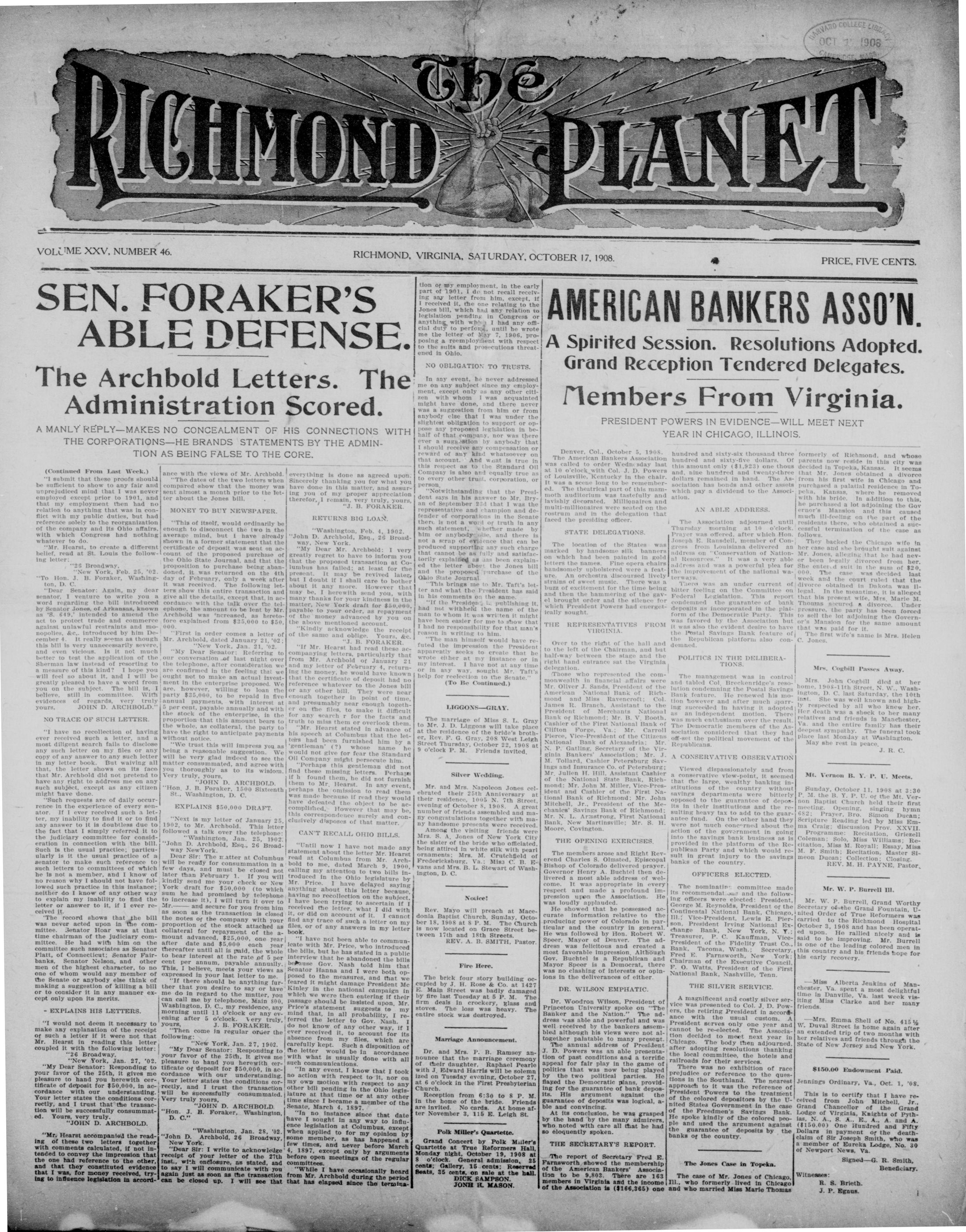
SEN. FORAKER'S ABLE DEFENSE. The Archbold Letters. The Administration Scored.
A MANLY REPLY—MAKES NO CONCEALMENT OF HIS CONNECTIONS WITH THE CORPORATIONS—HE BRANDS STATEMENTS BY THE ADMIN- TION AS BEING FALSE TO THE CORE.
VOLUME XXV, NUMBER 46
SEN. F
ABL
The Archb
Adminis
A MANLY REPLY—MAKES NO
THE CORPORATIONS—
TION AS
(Continued From Last Week.)
"I submit that these proofs should be sufficient to show to any fair and unprejudiced mind that I was never employed except prior to 1901, and that my employment then had no relation to anything that was in conflict with my public duties, but had reference solely to the reorganization of the company and its Ohio affairs, with which Congress had nothing whatever to do.
"Mr. Hearst, to create a different belief, read at St. Louis the following letter:
"26 Broadway.
"New York, Feb. 25, '02.
"To Hon. J. B. Foraker, Washington, D. C.
"Dear Senator: Again, my dear senator, I venture to write you a word regarding the bill introduced by Senator Jones, of Arkansas, known as 'S. 649' intended to amend the act to protect trade and commerce against unlawful restraints and monopolies, &c., introduced by him December 4. It really seems as though this bill is very unnecessarily severe, and even vicious. Is it not much better to test the application of the Sherman law instead of resorting to a measure of this kind? I hope you will feel so about it, and I will be greatly pleased to have a word from you on the subject. The bill is, I believe, still in committee. With evidences of regards, very truly yours, JOHN D. ARCHBOLD."
NO TRACE OF SUCH LETTER
"I have no recollection of having ever received such a letter, and a most diligent search fails to disclose any such letter on my files or any copy of any answer to any such letter in my letter book. But waiving all that, the letter shows on its face that Mr. Archbold did not pretend to have any right to address me on any such subject, except as any citizen might have done.
"Such requests are of daily occurrence in the experience of every senator. If I ever received such a letter, my inability to find it or to find any answer to it is doubtless due to the fact that I simply referred it to the judiciary committee for consideration in connection with the bill. Such is the usual practice; particularly is it the usual practice of a senator to make such reference to such letters to committees of which he is not a member, and I know of no reason why I should not have followed such practice in this instance; neither do I know of any other way to explain my inability to find the letter or answer to it, if I ever received it.
The record shows that the bill was never acted upon in the committee. Senator Hoar was at that time chairman of the judiciary committee. He had with him on the committee such associates as Senator Platt, of Connecticut; Senator Fairbanks, Senator Nelson, and other men of the highest character, to no one of whom would any member of the Senate or anybody else think of making a suggestion of killing a bill or to consider it in any manner except only upon its merits.
- EXPLAINS HIS LETTERS
"I would not deem it necessary to make any explanation of the receipt of such a letter if it were not that Mr. Hearst in reading this letter coupled it with the following letter: "26 Broadway, "New York, Jan. 27, '02. "My Dear Senator: Responding to your favor of the 25th, it gives me pleasure to hand you herewith certificate of deposit for $50,000, in accordance with our understanding. Your letter states the conditions correctly, and I trust that the transaction will be successfully consummated. Yours very truly.
"JOHN D. ARCHBOLD.
"Mr. Hearst accompanied the reading of these two letters together with comments calculated, if not intended to convey the impression that the one had reference to the other, and that they constituted evidence that I was, for money received, trying to influence legislation in accord-
ance with the views of Mr. Archbold.
"The dates of the two letters when compared show that the money was sent almost a month prior to the letter about the Jones bill.
MONEY TO BUY NEWSPAPER
"This of itself, would ordinarily be enough to disconnect the two in the average mind, but I have already shown in a former statement that the certificate of deposit was sent on account of the proposed purchase of the Ohio State Journal, and that the proposition to purchase being abandoned, it was returned on the 4th day of February, only a week after it was received. The following letters show this entire transaction and give all the details, except that, in accordance with the talk over the telephone, the amount to be lent by Mr. Archbold was 'increased, as herefore explained from $35,000 to $50,000.
"First in order comes a letter of Mr. Archbold, dated January 21, '02.
"New York, Jan. 21, '02.
"My Dear Senator; Referring to our conversation of last night over the telephone, after consideration we are confirmed in the feeling that we ought not to make an actual investment in the enterprise proposed. We are, however, willing to loan the party $25,000, to be repaid in five annual payments, with interest at 5 per cent, payable annually and with the stock of the enterprise, in the proportion that this amount bears to the whole, as collateral, the party to have the right to anticipate payments without notice.
"We trust this will impress you as being a reasonable suggestion. We will be very glad indeed to see the matter consummated, and agree with you thoroughly as to its wisdom. Very truly, yours.
JOHN D. ARCHBOLD.
"Hon J. E. D. Sixteenth
St., Washington D.
EXPLAINS $50,000 DRAFT
"Next is my letter of January 25, 1902, to Mr. Archbold. This letter followed a talk over the telephone: "Washington, Jan. 25, 1902; "John D. Archbold, Esq., 26 Broadway New York.
Dear Sir: The matter at Columbus will be ready for consummation in a few days, and must be closed not later than February 1. If you will kindly send me your check or New York draft for $50,000 (to which sum he had promised by telephone to increase it), I will turn it over to Mr.—— and secure for you from him as soon as the transaction is closed the notes of the company with your proportion of the stock attached as collateral for repayment of the amount advanced, $25,000, one year after date and $5,000 each year thereafter until all is paid, the whole to bear interest at the rate of 5 per cent per annum, payable annually. This, I believe, meets your views as expressed in your last letter to me.
"If there should be anything further that you desire to say or have me do in regard to the matter, you can call me by telephone, Main $80, Washington, D. C., my residence, any morning until 11 o'clock or any evening after 5 o'clock. Very truly, yours, J. B. FORAKER.
"Then come in regular order the following:
"New York, Jan. 27, 1902.
"My Dear Senator: Responding to your favor of the 25th, it gives me pleasure to hand you herewith certificate or deposit for $50,000, in accordance with our understanding.
Your letter states the conditions correctly, and I trust the transaction will be successfully consummated. Very truly yours,
"JOHN D. ARCHBOLD.
"Hon. J. B. Foraker, Washington, D. C."
"Washington, Jan. 28, '02.
"John D. Archbold, 26 Broadway, New York.
"Dear Sir: I write to acknowledge receipt of your letter of the 27th inst., with enclosure, as stated, and to say I will communicate with you again just as soon as the transaction can be closed up. I will see that
RICHMOND, VIRGINIA, SATURDAY, OCTOBER 17, 1908
everything is done as agreed upon.
Sincerely thank you for what you
have done in this matter, and assuring
you of my proper appreciation
therefor, I remain, very truly, yours,
"J. R. FORD."
RETURNS BIG LOAN
"Washington, Feb. 4, 1902.
"John D. Archbold, Esq., 26 Broadway, New York.
"My Dear Mr. Archbold: I very greatly regret to have to inform you that the proposed transaction at Columbus has failed; at least for the present. It may be revived later, but I doubt if I shall care to bother about it any more. However that may be, I herewith send you, with many thanks for your kindness in the matter to New York draft for $50,000, payable New York order, as repayment of the money given by you on the above mentioned account.
"Kindly acknowledge the receipt of the same and oblige. Yours, &c.
"J. B. FORAKER
"If Mr. Hearst had read these accompanying letters, particularly that from Mr. Archbold of January 21 and my letter of February 4, returning the money, he would have known that the certificate of deposit had no reference whatever to the Jones bill or any other bill. They were near enough together in point of time, and presumably near enough together on the files, to make it difficult for any search r for the facts and truth to miss them or overlook them.
"Mr. Hearst stated in advance of his speech at Columbus that the letters had been furnished him by a 'gentleman' (?) whose name he would not give for fear the Standard Oil Company might persecute him.
"Perhaps this gentleman did not find these missing letters. Perhaps if h found them, he did not furnish them to Mr. Hearst. In any event, perhaps the omission to read them was made because if read they would have defeated the object to be accomplished. However that may be, this correspondence surely and conclusively disposes of that matter."
CAN'T RECALL OHIO BILLS
"Until now I have not made any statement about the letter Mr. Hearst read at Columbus from Mr. Archbold to me, dated March 9, 1900, calling my attention to two bills introduced in the Ohio legislature by Mr. Price. I have delayed saying anything about this letter because, having no recollection on the subject, I have been trying to ascertain if I received the letter, what I did with it, or did on account of it. I cannot find any trace of such a letter on my files, or of any answers in my letter book.
"I have not been able to communicate with Mr. Price, who introduced the bills, but he has stated in a public interview that he abandoned the bills because Gov. Nash told him that Senator Hanna and I were both opposed to the measures, and that we feared it might damage President McKinley in the national campaign in which we were then entering if their passage should be insisted upon. Mr. Price's statement suggests to my mind that, in all probability, I referred the letter to Gov. Nash. I do not know of any other way, if I ever received it, to account for its absence from my files, which are carefully kept. Such a disposition of the letter would be in accordance with what is usually done with all such communications.
"In any event, I know that I took no action with respect to it, nor on my own motion with respect to any other bill pending in the Ohio legislature at that time or at any other time since I became a member of the Senate, March 4, 1897.
"In no instance since that date have I sought in any way to influence legislation at Columbus, except when applied to for my opinion by some member, as has happened a few times, and never before March 4, 1897, except only by arguments before open meetings of the regular committees.
"While I have occasionally heard from Mr. Archbold during the period that has elapsed since the terroir-
tion or my employment. In the early part of 1901, I do not recall receiving any letter from him, except, if I received it, the one relating to the Jones bill, which had any relation to legislation pending in Congress or anything with which I had any official duty to perform, until he wrote me the letter of May 7, 1906, proposing a reemployment with respect to the suits and prosecutions threatened in Ohio.
NO OBLIGATION TO TRESTS
In any event, he never addressed me on any subject since my employment, except only as any other citizen with whom I was acquainted might have done, and there never was a suggestion from him or from anybody else that I was under the slightest obligation to support or impose any proposed legislation in behalf of that company, nor was there ever a suggestion by anybody that I should receive any compensation or reward of any kind whatsoever on that account. And what is true in this respect as to the Standard Oil Company is also and equally true as to every other trust, corporation, or person.
"Notwithstanding that the President says in his answer to Mr. Bryan of September 23d that I was the representative and champion and defender of corporations in the Senate there is not a word or truth in any such statement, whether made by him or anybody else, and there is not a scrap of evidence that can be produced supporting any such charge that cannot be as fully and satisfactorily explained as has been explained the letter about the Jones bill and the proposed purchase of the Ohio State Journal.
"This brings me to Mr. Taft's letter and what the President has said in his comments on the same.
"If the President is publishing it, had not withheld the name of the man to whom it was written it might have been easier for me to show that I had no responsibility for that man's reason in writing to him.
"The man himself would have refuted the impression the President apparently seeks to create that he wrote either at my instance or in my interest. I have not at any time or in any way, sought Mr. Taft's help for reelection to the Senate."
*(To Be Continued.)*
LIGGONS—GRAY.
The marriage of Miss S. L. Gray to Mr. J. D. Liggons will take place at the residence of the bride's brother, Rev. F. G. Gray, 208 West Leigh Street Thursday, October 22, 1908 at 9 o'clock P. M. Friends invited
Silver Wedding.
Mr. and Mrs. Napoleon Jones celebrated their 25th Anniversary at their residence, 1005 N. 7th Street, evening of October 8, 1908. A great number of friends assembled and many congratulations together with many handsome presents were received. Among the visiting friends were Mrs. S. A. Jones of New York City the sister of the bride who officiated, being attired in white silk with pearl ornaments; Mrs. M. Crutchfield of Fredericksburg, Va.; Miss C. B. Evans and Mrs. B. L. Stewart of Washington, D. C.
Notice!
Rev. Mayo will preach at Maceo donla Baptist Church, Sunday, October 18, 1908 at 8 P. M. The Church is now located on Grace Street between 17th and 18th Streets. REV. A. B. SMITH, Pastor
Fire Here.
The brick four story building occupied by J. H. Rose & Co. at 1427 E. Main Street was badly damaged by fire last Tuesday at 5 P. M. The firm deals in crockery, glass and stoves. The loss was heavy. The entire stock was destroyed.
Marriage Announcement
Dr. and Mrs. P. B. Ramsey announce that the marriage ceremony of their daughter, Raphael Pearle with J. Edward Harris will be solemnized on Tuesday evening, October 27, at 6 o'clock in the First Presbyterian Church. Reception from 6:30 to 8 P. M. in the home of the bride. Friends are invited. No cards. At home after November 3, 115 E. Leigh St.
Polk Miller's Quartette
Grand Concert by Polk Miller's Quartette at True Reformers Hall, Monday night, October 19, 1908 at 8 o'clock. General admission, 25 cents; Gallery, 15 cents; Reserved Seats, 35 cents, on sale at the hall. DICK SAMPSON. JONH R. MASON.
AMERICAN BANKERS ASSO'N
A Spirited Session. Resolutions Adopted. Grand Reception Tendered Delegates. Members From Virginia.
PRESIDENT POWERS IN EVIDENCE—WILL MEET NEXT YEAR IN CHICAGO, ILLINOIS.
Denver, Col., October 5, 1908. The American Bankers Association was called to order Wednesday last at 10 o'clock with Col. J. D. Powers of Louisville, Kentucky in the chair. It was a scene long to be remembered. The theatrical part of this mammoth auditorium was tastefully and lavishly decorated. Millionaires and multi-millionaires were seated on the rostrum and in the delegation that faced the presiding officer.
hundred and sixty-six thousand three hundred and sixty-five dollars. Of this amount only ($1,923) one thou-sand, nine hundred and twenty-three dollars remained in hand. The Association has bonds and other assets which pay a dividend to the Association.
AN ABLE ADDRESS.
formerly of Richman parents now reside decided in Topeka, K that Mr. Jones obey from his first wife purchased a palatial peka, Kansas, whithis his bride. In he purchased a lot an error's Mansion amuch ill-ill on residence.
STATE DELEGATIONS
The location of the States was marked by handsome silk banners on which had been painted in gold letters the names. Fine opera chairs handsomely upholstered were a feature. An orchestra discoured lively strains of sweet music. There was a buzz of excitement for the time being and then the hammering of the gavel brought order and the silence for which President Powers had energetically sought.
THE REPRESENTATIVES FROM VIRGINIA.
Over to the right of the hall and to the left of the Chairman, and but half-way between the stage and the right hand entrance sat the Virginia delegation. Those who represented the commonwealth in financial affairs were Mr. Oliver J. Sands, President of the American National Bank of Richmond and Miss Ravencroft; Col. James R. Branch, Assistant to the President of Merchants National Bank of Richmond; Mr. B. V. Booth, Cashier of the First National Bank of Clifton Forge, Va.; Mr. Carroll Pierce, Vice-President of the Citizens National Bank of Alexandria; Mr. N. P. Gatling, Secretary of the Virginia Bankers' Association; Mr. J. M. Tollard, Cashier Petersburg Savings and Insurance Co. of Petersburg; Mr. Julien H. Hill, Assistant Cashier of the National State Bank, Richmond; Mr. John M. Miller, Vice-President and Cashier of the First National Bank of Richmond; Mr. John Mitchell, Jr., President of the Mechanics' Savings Bank of Richmond; Mr. N. L. Armstrong, First National Bank, New Martinsville; Mr. S. H. Moore, Covington.
THE OPENING EXERCISES
The members arose and Right Reverend Charles S. Olmsted, Episcopal Bishop of Colorado delivered prayer, Governor Henry A. Buchtel then delivered a most able address of welcome. It was appropriate in every respect and made a profound impression upon the Association. He was loudly applauded. He showed that he possessed accurate information relative to the producing power of Colorado in particular and the country in general. He was followed by Hon. Robert W. Speer, Mayor of Denver. The address was felicitous and created a most favorable impression. Although Gov. Buchtel is a Republican and Mayor Speer is a Democrat, there was no clashing of interests or opinions in the deliverances of either.
DR. WILSON EMPHATIC.
Dr. Woodron Wilson, President of Princeton University spoke on "The Banker and the Nation." The address was able and powerful and was well received by the bankers assembled although his views were not altogether palatable to many present. The annual address of President J. D. Powers was an able presentation of past conditions and a terrific appeal for fair play in the game of politics that was now being played by the two political parties. He flaxed the Democratic plans, providing for the guarantee of bank deposits. His argument against the guarantee of deposits was logical, able and convincing. At its conclusion, he was grasped by the hand by the many admirers, who noted with care all that he had so eloquently spoken.
THE SECRETARY'S REPORT
The report of Secretary Fred E. Farnsworth showed the membership of the American Bankers' Association to be 9,803. There are 163 members in Virginia and the income of the Association is ($166,365) one
hundred and sixty-six thousand three hundred and sixty-five dollars. Of this amount only ($1,923) one thousand and nine hundred and twenty-three dollars remained in hand. The Association has bonds and other assets which pay a dividend to the Association.
AN ABLE ADDRESS
The Association adjourned until Thursday morning at 10 o'clock. Prayer was offered, after which Hon. Joseph E. Ransdell, member of Congress from Louisiana delivered an address on "Conservation of National Resources." It was a very able address and was a powerful plea for the improvement of the national waterways.
There was an under current of bitter feeling on the Committee on Federal Legislation. This report condemned the guarantee of bank deposits as incorporated in the platform of the Democrate Party. This was favored by the Association but it was also the evident desire to have the Postal Savings Bank feature of the Republican platform also condemned.
POLITICS IN THE DELIBERATIONS.
The management was in control and tabled Col. Breckenridge's resolution condemning the Postal Savings Bank feature. He renewed his motion however and after much sparring succeeded in having it adopted as an independent motion. There was much enthusiasm over the result. The Democratic members of the Association considered that they had off-set the political movement of the Republicans.
A CONSERVATIVE OBSERVATION
Viewed dispassionately and from a conservative view-point, it seemed that the large, wealthy banking institutions of the country without savings departments were bitterly opposed to the guarantee of deposits in their institutions and the resulting heavy tax to add to the guarantee fund. On the other hand they were not much concerned about the action of the government in going into the savings bank business as is provided in the platform of the Republican Party and which would result in great injury to the savings banks of the country.
OFFICERS ELECTED
The nominating committee made its recommendations and the following officers were elected: President; George M. Reynolds, President or the Continental National Bank, Chicago Ill.; Vice-President, Lewis E. Pierson, President Irving National Exchange Bank, New York, N. Y.; Treasurer, P. C. Kauffman, Vice-President of the Fidelity Trust Co. Bank, Tacoma, Wash.; Secretary Fred E. Farmsworth, New York; Chairman of the Executive Council, F. O. Watts, President of the First National Bank, Nashville, Tenn.
THE SILVER SERVICE
A magnificent and costly silver service was presented to Col. J. D. Powers, the retiring President in accordance with the usual custom. A President serves only one year and cannot be re-elected. The Association decided to meet next year in Chicago. The body then adjourned, after adopting resolutions thanking the local committee, the hotels and railroads for their services. There was no exhibition of race prejudice or reference to the questions in the Southland. The nearest approach to it was the reference of President Powers to the treatment of the colored depositors by the United States Government in the case of the Freedmen's Savings Bank. He spoke kindly of the colored people and used the argument against the guarantee of deposits by the banks or the country.
The Jones Case in Topeka.
The case of Mr. Jones of Chicago, Ill., who formerly lived in Chicago and who missed Miss Marie Thomas
PRICE, FIVE CENTS.
S ASSO'N.
tions Adopted.
d Delegates.
Virginia.
LL MEET NEXT
S.
formerly of Richmond, and whose parents now reside in this city was decided in Topeka, Kansas. It seems that Mr. Jones obtained a divorce from his first wife in Chicago and purchased a palatial residence in Topeka, Kansas, where he removed with his bride. In addition to this, he purchased a lot adjoining the Governor's Mansion and this caused much ill-feeling on the part of the residents there, who obtained a successful termination of the case as follows.
They backed the Chicago wife in her case and she brought suit against Mr. Jones, alleging that he had never been legally divorced from her. She entered suit in the sum of $20,000. The case was decided last week and the court ruled that the divorce obtained in Dakota was illegal. In the meantime, it is alleged that his present wife, Mrs. Marie M. Thomas secured a divorce. Under pressure, the party has been forced to sell the lot adjoining the Governor's Mansion for the same amount that was paid for it.
The first wife's name is Mrs. Helen C. Jones.
Mrs. Cogbill Passes Away
Mrs. John Cogbill dled at her home, 1908-11th Street, N. W., Washington, D. C. last Saturday, the 10th inst. She was well known and highly respected by all who knew her. Her death was a sheck to her many relatives and friends in Manchester, Va. and the entire family has their deepest sympathy. The funeral took place last Monday at Washington. May she rest in peace. J. R. C.
Mt. Vernon B. Y. P. U. Meets
Sunday, October 11, 1908 at 3:30
P. M. the B. Y. P. U. or the M. Vernon Baptist Church held their first meeting. Opening, singing hymn 682; Prayer, Bro. Simon Ducan; Scripture Reading led by Miss Emma Craig; discussion Prov. XXVII. Programme: Recitation, Griezel Coleman; Solo, Miss Williams; Recitation, Miss M. Royall; Essay, Miss M. F. Smith; Recitation, Master Simeon Ducan; Collection; Closing.
REV. M. H. PAYNE, Pastor
Mr. W. P. Burrell III
Mr. W. P. Burrell, Grand Worthy Secretary of the Grand Fountain, United Order of True Reformers was carried to the Richmond Hospital October 3, 1908 and has been operated upon. He rallied nicely and is said to be improving. Mr. Burrell is one of the leading colored men in this country and his friends hope for his early recovery.
—Miss Alberta Jenkins of Manchester, Va. spent a most delightful time in Danville, Va. last week visiting Miss Clarke and her many friends.
—Mrs. Emma Shell of No. 415½ W. Duval Street is home again after an extended trip of two months with her relatives and friends through the State of New Jersey and New York.
$150.00 Endowment Paid
Jennings Ordinary, Va., Oct. 1, '08.
This is to certify that I have received from John Mitchell, Jr. Grand Chancellor of the Grand Lodge of Virginia, Knights of Pythias, N. A., S. A., E., A., A. and A. ($150.00) One Hundred and Fifty Dollars in payment of the deathclaim of Sir Joseph Smith, who was a member of Eureka Lodge, No. 30 of Newport News, Va.
Signed—G. R. Smith,
Beneficiary.
Witnesses:
R. S. Brieth.
J. P. Egus.
THE SEVENTH PERSON
BY
BEN M'CUTCHEON
COPYRIGHT 1906 BY DOOD, MEND COMPANY
SYNOPSIS.
CHAPTER I. -Gerard Chambers, son of a wealthy importer and a student at an institution in the city, was exclusive only seven being admitted. He were known as Persons. A meeting was held and each member was awarded the assignment to test his test.
CHAPTER II. -Chambers read his descent. He was told to pass a period as a sailor, during which he met to another year's exile, during which he met his own living unassisted, and keep a secret. CHAPTER III. Jerry then told his father of his duty. He gained his elder's consent. He also acquainted Marrysla he chose for his wife, with the fact that he was away two years. She left him angrily.
CHAPTER IV. -Young Chambers had an interview with his father, who sought parture. Jerry obtained a berth as supergoon on an ocean freighter. His father would seek the hand of Miss Bayless.
CHAPTER V.-Jerry sailed the following morning on the Sister Mary. After meeting him the boat was bound for Tampa, South America, loaded with guns for enemies of that government.
CHAPTER VI.-Sister Mary put in at Riverside, orders regarding the landing of guns. Jersey given opportunity to desert, pass it up.
CHAPTER VII.-Jerry landed the guns as a Uranian cruiser hove in view. At first she was chased, but escaped. Chambers was captured and thrown into a dungeon.
CHAPTER VIII.- Marina Bostos, adopted daughter of Gen. Bostos, entered Gen. Bostos's wounds. Each made a strong impression other. She was known as the "little saint of Urania" because of her nursing.
CHAPTER IX.-Jerry, tried by Gen. Bostos, landed the following day. Upon promise of Marina's love, Capt. Pilaro pledged himself to free Chambers. The trio dashed away from the government.
CHAPTER X.-Shaler was secured the following day. Marina and Pilaro decided to join Gen. Barade's army, seeking to overthrow the government. They unified with the rebels, Chambers being made a captive.
CHAPTER XII -Capt. Filaro died of fever. Marina accompanied his body to Bostos, where he met for Bostos. In a Bostos battle the former was Jerry frustrated an attempt to assassinate Barada. Capt. Chambers was delegated to accept Bostos' sword as a token of surrender.
CHAPTER XII -Gen. Bostos forgives his daughter, Marina. Her funeral party was attacked and she was reported missing. Marina and a confederacy established. Chambers was made much of. By that time Marina was given up as dead.
CHAPTER XII -Jerry was given a big reception by the Cross of Honor. He was awarded the Cross of Honor. He sailed for Havana in order to report to Malaga City for further instructions.
CHAPTER XIV -Capt. Chambers was honored by the wealthy Manor Senor Lopez, a wealthy man, and his daughter. The ship encountered a terrible storm when Jerry was being feted.
CHAPTER XV—The steamer was dashed on the rocks, nearly all on board drowning. Jerry saved himself and senorita Lopez, by clinging to a mast. It's strange actions caused him to express the belief that she was demented.
CHAPTER XVI
"She is demented," said the captain of the ill-fated Pranzos when Senorita Mercedes was asleep, "but she is not violently insane. Senor Lopez was on his way to Havana, where he intended placing her in a sanitarium for treatment. She seemed to court danger. God only knows if any of us will ever live to get to Havana."
The remaining members of the crew had succeeded in saving some of the provisions and two casks of water, in the vain hope that the supply might serve the survivors until they were rescued, if such an event ever came to pass.
"What hope is there that a vessel may pass and see us?" asked Jerry.
"The slimmest in the world," answered the captain "The sallings from Uranian and Pardacinian ports are generally arranged so that this point is passed in the night. Unless we are discovered in the day time we must keep up burning signals all night, no matter if the whole of the boat be sacrificed."
The captain's talk sent a new chill of terror through every one of the little group. Already they had been on the rock 15 hours. By this time the sea had calmed and the gale had subsided to a brisk head wind. The sky had cleared and the sun shone bright from far in the west. As the shades of night began to fall preparations were made for signaling in the darkness. Jerry Chambers and three or four of the younger men climbed up the ragged rock as high as they could go and set a heap of the splintered wood.
It was not until the first stars began to twinkle in the east that fire was touched to the wood. The men worked in shifts in keeping the blaze alive; at the first signs of dawn the fire was allowed to die down. Throughout that fearful night of anxiety no vessel passed, and the little group was infinitely more depressed. The provisions were banded out sparingly, not withstanding that food was craved ravenously, and not enough water was apportioned at any one time to satisfy a baby's thirst.
Seniorita Mercedes, who was watched all the time, and who had been sleeping with the unconcern of an infant, talked very little when awake. Her mind seemed to be away from the Pranzos and everybody on it. Jerry offered her food, but she paid no attention to him and ate practically nothing. Once in a while she was overheard to mumble to herself, and occasionally to smile as though amused.
"Her father permitted her to have her own way much of the time," said the captain to Jerry, as they stood behind the girl. She was a belle in Pandaro, and her frequent visits to Madrid were marked by social tri-
umphs. It is said that she once tried to kill herself because she could not have every dance with a young officer of the Spanish army. People generally considered her eccentric and most unusual, but I don't think they believed her to be insane. Senor Lopez had no notion of placing her in any ayulum for the violently demented."
In the middle of the third night on the rock a joyous sound came from the signal station to the brave little party on the wreckage. Jerry Chambers shouted down that a vessel was discerned to the northward, far out at sea. All but three or four of the men, almost delirious with hope, scrambled up the rock.
"She is moving away!" cried one man. "She does not see us!"
"More wood, more wood!" screamed the captain. "She must see us or we are lost!"
All the inflammable material that could be carried up the rock soon was blazing. But still the vessel at sea kept moving away.
"Fire the whole wreckage!" cried Jerry. "It's our only chance in the world!"
It was a matter of but a short time before the heavy timbers of the ill-fated craft began to blaze. So dense became the smoke that the survivors were forced to pick their hazardous way to the other side of the rock. Jerry and the captain succeeded in carrying Senorita Mercedes to a place where the breathing was bearable, but three men who followed them were suffocated and fell to death in the sea below. Jerry, almost overcome by the smoke, managed to reach a place where he could, at intervals of a few minutes, watch the vessel at sea. "She doesn't see us!" cried he, his hope almost expiring. "She is going away from us!"
It was now that the flames were highest. The wind had shifted so that the only point of observation be-
THE BOOK OF THE WEEK
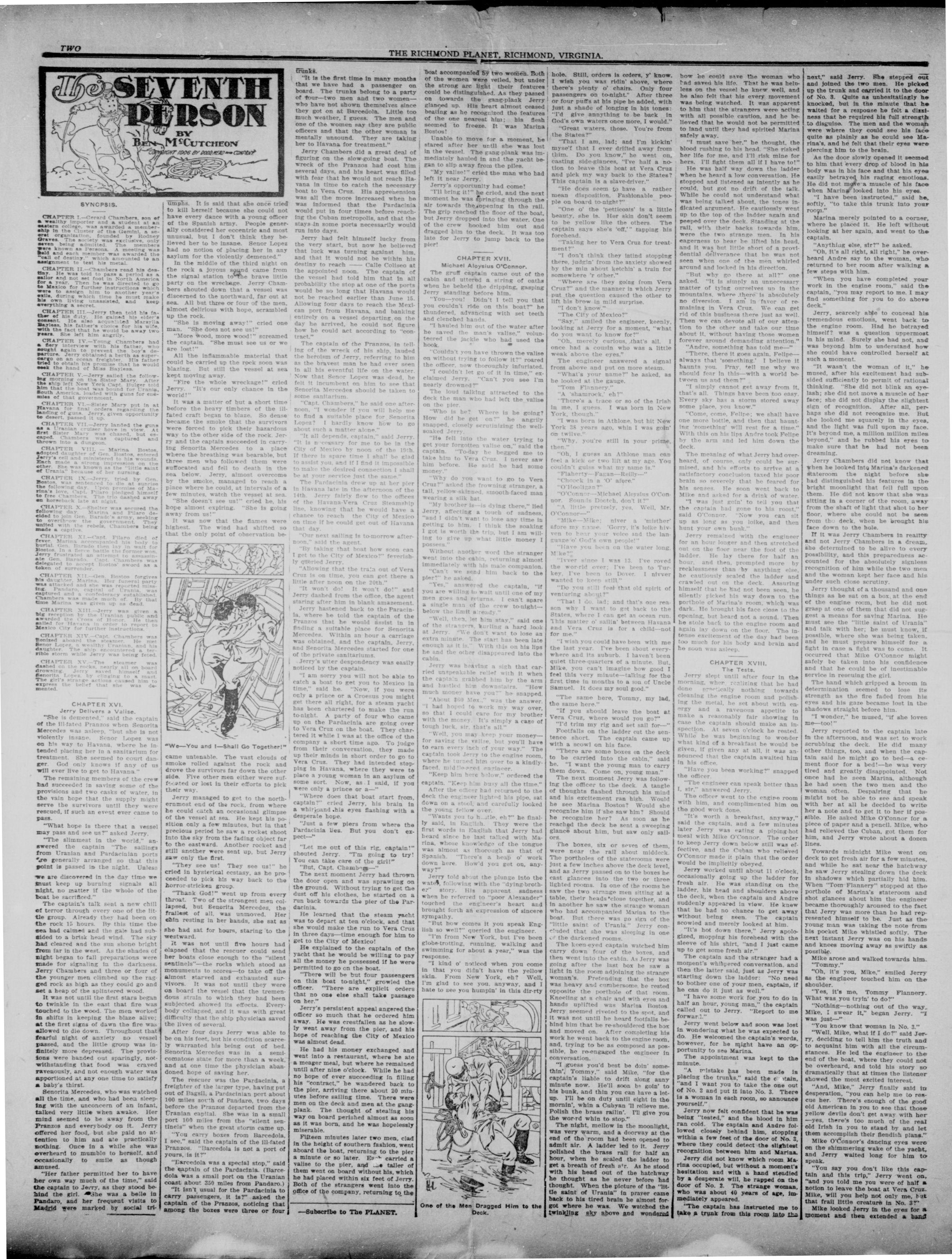
"We—You and I—Shall Go Together!" came untenable. The vast clouds of smoke rolled against the rock and drove the survivors far down the other side. Five other men either were suffocated or lost in their efforts to pick their way.
Jerry managed to get to the northernmost end of the rock, from where he could catch an occasional glimpse of the vessel at sea. He kept his position only a few minutes, but in that precious period he saw a rocket shoot into the sky from the fading object far to the eastward. Another rocket and still another were sent up, but Jerry saw only the first.
"They see us! They see us!" he cried in hysterical ecstasy, as he proceeded to pick his way back to the horror-striken group.
"Thank God!" went up from every throat. Two of the strongest men collapsed, but Senorita Mercedes, the frailest of all, was unmoved. Her chin resting in her hands, she sat as she had sat for hours, staring to the westward.
It was not until five hours had elapsed that the rescuer could send her boats close enough to the "silent sentinels"—the rocks which stood as monuments to scores—to take off the almost starved and exhausted survivors. It was not until they were on board the vessel that the tremendous strain to which they had been subjected showed its effects. Everybody collapsed, and it was with great difficulty that the ship physician saved the lives of several.
After four days Jerry was able to be on his feet, but his condition scarcely warranted his being out of bed. Senorita Mercedes was in a semi-comatose state for more than a week, and at one time the physician abandoned hope of saving her.
The rescuer was the Pardacinia, a freighter of the larger type, having put out of Bagslil, a Pardacinian port about 100 miles south of Pandaro, two days before the Pranzos departed from the Uranian capital. She was in a small port 100 miles from the "silent sentinels" when the great storm came up.
"You carry boxes from Bardecola, I see," said the captain of the ill-fated Pranzos. "Bardecola is not a port of yours, is it?"
"Bardecola was a special stop," said the captain of the Pardacinia. (Bardecola was a small port on the Uranian coast about 250 miles from Pandaro.)
"It isn't usual for the Pardacinia to carry passengers, it is?" asked the captain of the Pranzos, noticing that among the boxes were three, or four
THE RICHMOND PLANET, RICHMOND, VIRGINIA
trunks.
"It is the first time in many months that we have had a passenger on board. The trunks belong to a party of four—two men and two women—who have not shown themselves since they got on at Barcedola. Little too much weather, I guess. The men and one of the women say they are public officers and that the other woman is mentally unsound. They are taking her to Havana for treatment."
Jerry Chambers did a great deal of figuring on the slow-going boat. The wreck of the Pranzos had cost him several days, and his heart was filled with fear that he would not reach Havana in time to catch the necessary boat to Vera Cruz. His apprehension was all the more increased when he was informed that the Pardacinia would put in four times before reaching the Cuban metropolis, and that the stays in some ports necessarily would run into days.
Jerry had felt himself lucky from the very start, but now he believed that luck was turning against him, and that it would not be within his destiny to reach —— Calle Coliseo at the appointed noon. The captain of the vessel had told him that in all probability the stop at one of the ports would be so long that Havana would not be reached earlier than June 15. Allowing four days to reach the Mexican port from Havana, and banking entirely on a vessel departing on the day he arrived, he could not figure how he could act according to "contract."
The captain of the Pranzos, in telling of the wreck of his ship, lauded the herobism of Jerry, referring to him as the bravest man he had ever seen in all his eventful life on the water. Now that Senor Lopez was dead, he felt it incumbent on him to see that Senorita Mercedes should be taken to some sanitarium.
"Capt. Chambera," he said one afternoon. "I wonder if you will help me to find a suitable place for Senorita Lopez? I hardly know how to go about such a matter alone."
"It all depends, captain," said Jerry. "It is necessary for me to be in the City of Mexico by noon of the 19th. If there is spare time I shall be glad to assist you, and if I find it impossible to make the desired connection I shall be at your service just the same."
The Pardacinia drew up at her pier in Havana late in the afternoon of the 14th. Jerry fairly flew to the offices of the Havana-Vera Cruz Steamship line, knowing that he would have a chance to reach the City of Mexico on time if he could get out of Havana that day.
"Our next sailing is to-morrow afternoon," said the agent.
"By taking that boat how soon can I get to the City of Mexico?" feverishly uttered Jerry.
"Allowing that the train out of Vera Cruz is on time, you can get there a little after noon on the 20th."
"It won't do! It won't do!" and Jerry dashed from the office, the agent staring after him in blank amazement.
Jerry hastened back to the Paracinia, where he told the captain of the Pranzos that he would insist in in finding a suitable place for Senorita Mercedes. Within an hour a carriage was obtained, and the captain, Jerry, and Senorita Mercedes started for one of the private sanitariums. Jerry's utter despondency was easily noticed by the captain.
"I am sorry you will not be able to catch a boat to get you to Mexico in time," said he. "Now, if you were only a prince or a Croesus you might get there all right, for a steam yacht has been chartered to make the run to-night. A party of four who came up on the Pardacinia are going over to Vera Cruz on the boat. They chartered it while I was at the office of the company a short time ago. To judge from their conversation, they made up their minds in short order to go to Vera Cruz. They had intended stopping in Havana, where they were to place a young woman in an asylum of some sort. Now, as I said, if you were only a prince or a—"
"Where does that boat start from, captain?" cried Jerry, his brain in a white band his eyes flashing with a desperate hope.
"Just a few piers from where the Pardacinia lies. But you don't expect—"
"Let me out of this rig, captain!"
shouted Jerry. "I'm going to try!
You can take care of the girl!"
"But, Capt. Chambers—"
The next moment Jerry had thrown the door open and was sprawling on the ground. Without trying to get the dust off his clothes, he started on a run back towards the pier of the Paradacinia.
He learned that the steam yacht was to depart at ten o'clock, and that she would make the run to Vera Cruz in three days—time enough for him to get to the City of Mexico!
He explained to the captain of the yacht that he would be willing to pay all the money he possessed if he were permitted to go on the boat.
"There will be but four passengers on this boat to night," growled the officer. "There are explicit orders that no one else shall take passage on her."
Jerry's persistent appeal angered the officer so much that he ordered him away. He was crestfallen as he slowly went away from the pier, and his hope of reaching the City of Mexico was almost dead.
He had his money exchanged and went into a restaurant, where he ate a meager meal, but where he remained until after nine o'clock. While he had no hope of ever succeeding in filling his "contract," he wandered back to the pier, arriving there about 20 minutes before sailing time. There were men on the deck and men at the gang-plank. The thought of stealing his way on board perished almost as soon as it was born, and he was hopelessly miserable.
Fifteen minutes later two men, clad in the height of southern fashion, went aboard the boat, returning to the pier a minute or so later. Each carried a valise to the pier, and the taller of them went on board without his, which he had placed within six feet of Jerry. Both of the strangers went into the office of the company, returning to the
—Subscribe to The PLANET.
Boat accompanied by two women. Both of the women were veiled, but under the strong arc light their features could be distinguished. As they passed on towards the gang-plank Jerry glanced up. His heart almost ceased beating as he recognized the features of the one nearest him; his flesh seemed to freeze. It was Marina Hostos!
Unable to move for a moment, he stared after her until she was lost in the vessel. The gang-plank was immediately hauled in and the yacht began to slip away from the piles.
"My vallse!" cried the man who had left it near Jerry.
Jerry's opportunity had come!
"Iil bring it!" he cried, and the next moment he was springing through the air towards the opening in the rail. The grip reached the floor of the boat, but Jerry dropped into the water. One of the crew hooked him out and dragged him to the deck. It was too late for Jerry to jump back to the pier!
CHAPTER XVII.
Michael Aloyeisus O'Connor.
The gruff captain came out of the cabin and uttered a string of oaths when he beheld the dripping, gasping Jerry standing before him.
"You—you! Didn't I tell you that you couldn't ride on this boat?" he thundered, advancing with set teeth and clenched hands.
"I hauled him out of the water after he saved the man's valise," volunteered the jackle who had used the hook.
"Couldn't you have thrown the valise on without trying to follow it?" roared the officer, now thoroughly infuriated.
"I couldn't let go of it in time," exclaimed Jerry. "Can't you see I am nearly drowned?"
The loud talking attracted to the deck the man who had left the valise on the pier.
"Who is he? Where is he going? How did he get on?" he angrily snapped, closely scrutinizing the well-soaked Jerry.
"He fell into the water trying to get your forgotten vallse on," said the captain. "To-day he begged me to take him to Vera Cruz. I never saw him before. He said he had some money."
"Why do you want to go to Vera Cruz?" asked the frowning stranger, a tall, yellow-skinned, smooth-faced man wearing a silk hat.
"My brother is—is dying there," lied Jerry, affecting a touch of sadness, "and I didn't want to lose any time in getting to him. I think the soaking I got is worth the trip, but I am willing to give up what little money I possess."
Without another word the stranger went into the cabin, returning almost immediately with his male companion.
"Can't we send him back to the pler?" he asked.
"Yes," answered the captain. "If you are willing to wait until one of my men goes and returns. I can spare a single man of the crew to night—below the limit already."
"Well, then, let him stay," said one of the strangers, kurling a hard look at Jerry. "We don't want to lose an extra minute. The start has been late enough as it is." With this on his lips he and the other disappeared into the cabin.
Jerry was heaving a sigh that carried unspeakable relief if it when the captain grabbed him by the arm and hastiled him downstairs. "How much money have you?" he snapped. "About $60 Max." was the answer. "I had hoped to work my way over, so that I could care for my brother with the money. It's simply a case of tough luck, sir, that's all."
"Well, you may keep your money—for saving the vallse, but you'll have to earn every inch of your way." The captain took Jerry to the engine room, where he turned him over to a kindly-faced, middle-aged engineer.
"Keep him here below," ordered the captain. "Keep him busy all the time."
sepia. "Keep him busy all the time."
After the officer had returned to the deck the engineer lighted his pipe, sat down on a stool, and carefully looked the young fellow over.
"Wants you to hustle, eh?" he finally said, in English. They were the first words in English that Jerry had heard since he last talked with Marina, whose knowledge of the tongue was almost as thorough as that of Spanish. "There's a heap o' work down here. How'd you get on, anyway?"
Jerry told about the plunge into the water, following with the "dying-brother" story. His apparent sadness when he referred to "poor Alexander" touched the engineer's heart and brought forth an expression of sincere sympathy.
"But how comes it you speak English so well?" overried the engineer.
hss so well?" querted the engineer.
"I'm from New York, but I've been globe-trotting, running, walking and swimming for about a year," was the response.
"I kind o' noticed when you come in that you didn't have the yellow skin. From New York, eh? Well, I'm glad to see you, anyway, and I hate to see you humpin' in this dirty
H.
One of the Men Dragged Him to the Deck.
hole. Still, orders is orders, y' know. I wish you was ridin' above, where there's plenty o' chairs. Only four passengers on to-night." After three or four puffs at his pipe he added, with just a shade of longing in his tones: "I'd give anything to be back in God's own waters once more, I would."
"Great waters, those. You're from the States?"
"That I am, lad; and I'm kickin' myse' that I ever drifted away from thim. Do you know," he went on, casting side-glances. "I've half a notion to leave this boat at Vera Cruz and pick my way back to the States? This captain is a slave-driver."
"He does seem to have a rather mean disposition. Fashionable people on board to-night?"
"One o' the 'petticoats' is a little beauty, she is. Her skin don't seem to be yellow like the others. The captain says she's 'off.'" tapping his forehead.
"Taking her to Vera Cruz for treatment?"
"I don't think they intind stopping there, judgin' from the anxiety showed by the min about ketchin' a train for somewhere 'r other."
"Where are they going from Vera Cruz?" and the manner in which Jerry put the question caused the other to lift his brow in mild surprise.
"I don't know."
"The City of Mexico?"
"Say," smiled the engineer, keenly, looking at Jerry for a moment, "what do you want to know for?"
"Oh, merely curious, that's all. I once had a cousin who was a little weak above the eyes."
The engineer answered a signal from above and put on more steam.
"What's your name?" he asked, as he looked at the gauge.
"Tom Flannery."
"A 'shamrock,' eh?"
"There's a trace or so of the Irish in me, I guess. I was born in New York, though."
"I was born in Athlone, but hit New York 38 years ago, whin I was goin' on twelve."
"Why, you're still in your prime, then."
"Oh, I guess an Athlone man can feel a kick or two lift at my age. You couldn't guiss what my name is."
"Flaherty—Fagan—Reilly—"
"Choock in a 'O' afore."
"O'Hooligan?"
"O'Connor—Michael Aloysius O'Connor.
Souns Dootch, don't it?"
"A little pretzely, yes. Well, Mr. O'Connor—"
"Mike—Mike; niver a 'misther' afore my name. 'Gorry, it's loike hiven to hear your voice and the language o' God's own people!"
"Have you been on the water long, Mike?"
"Ivver since I was 13. I've roved the wor-lrd over; I've been to Turkey, I've been to Dover. I nivver wanted to keep still."
"Do you still feel that old spirit of venturing about?"
"That I do, lad; and that's one reason why I want to get back to the States, where I can get an ocean run. This matter o' sallin' between Havana and Vera Cruz is for a child—not for me."
"I wish you could have been with me the last year. I've been about everywhere and its suburb. I haven't been quiet three-quarters of a minute. But, Mike, you can't imagine how good I feel this very minute—talking for the first time in months to a son of Uncle Samuel. It does my soul good."
"The same here, Tommy, my lad, the same here."
"If you should leave the boat at Vera Cruz, where would you go?" "I'd trim my rig and set sail for—" Footfalls on the ladder cut the sentence short. The captain came up with a scowl on his face.
"There are some boxes on the deck to be carried into the cabin," said he. "I want the young man to carry them down. Come on young man."
The next moment Jerry was following the officer to the deck. A tangle of thoughts fashed through his mind and his excitement ran high. Would he see Marina Bostos? Would she recognize him if she saw him? Should he recognize her? As soon as he reached the deck he sent a sweeping glance about him, but saw only sailors.
The boxes, six or seven of them, were near the rail about middeck. The portholes of the staterooms were just a few inches above the deck level, and as Jerry passed on to the boxes he cast glances into the two or three lighted rooms. In one of the rooms he saw the two strange men sitting at a table, their heads"close together, and in another he saw the strange woman who had accompanied Marina to the boat. But there was no sign of the "little saint of Uranla." Jerry concluded that she was sleeping in one of the darkened rooms.
The keen-eyed captain watched him carry down four of the boxes, and then went into the cabin. As Jerry was going after the last box he saw a light in the room adjoining the strange woman's. Pretending that the box was heavy and cumbersome, he rested opposite the porthole of that room. Kneeling at a chair and with eyes and hands uplifted was Marina Boston. Jerry seemed riveted to the spot, and it was not until he heard footfalls behind him that he re-shouldered the box and moved on. After completing his work he went back to the engine room, and trying to be as composed as possible, he re-engaged the engineer in conversation.
"I guess you'd best be doin' some thin', Tommy," said Mike. "for the captain's liable to drift along anny minute now. He'll soon be goin' to his bunk, and thin you can have a let-up. I'll be on duty until eight in the morning', whin a Cubyan I relieve me. Polish the brass rail'. I'll give you the wor-rd whin to stop."
The night, mellow in the moonlight, was very warm, and a doorway at the end of the room had been opened to admit air. A ladder led to it. Jerry polished the brass rail for half an hour, when he scaled the ladder to get a breath of fresh air. As he stood with his head out of the hatchway he thought as he never before had thought. When the picture of the "little saint of Urania" in prayer came back to his tired brain he almost forgot where he was. We watched the twinkling sky above and wondered
how he could save the woman who had saved his life. That he was helpless on the vessel he knew well, and he also felt that his every movement was being watched. It was apparent to him that the strangers were acting with all possible caution, and he believed that he would not be permitted to land until they had spirited Marina safely away.
"I must save her," he thought, the blood rushing to his head. "She risked her life for me, and I'll risk mine for hers. I'll fight them all if I have to."
He was half way down the ladder when he heard a low conversation. He stopped and listened as intently as he could, but got no drift of the talk. While he could not understand what was being talked about, the tones indicated argument. He cautiously went up to the top of the ladder again and peeled over the deck. Standing at the rail, with their backs towards him, were the two strange men. In his eagerness to hear he lifted his head, and it was little short of a providential deliverance that he was not seen when one of the men whirled around and locked in his direction.
"But why go there at all?" one asked. "It is simply an unnecessary matter of tying ourselves un in the mountains, where there is absolutely no diversion. I am in favor of remaining in Vera Cruz. We can get rid of this business there just as well. Then we can devote all of our attention to the other and take our time about it, without having those women forever around demanding attention."
"Andre, something has told me—"
"There, there it goes again. Fellpe—always that 'something.' I believe it haunts you. Pray, 'tell me why we should fear in this—with a world between us and them?"
"I simply cannot get away from it, that's all. Things have been too easy. Every sky has a storm stored away some place, you know."
"Come, come, Fellpe; we shall have one more bottle, and then that haunting 'something' will rest for a time." With this on his lips Andre took Fellpe by the arm and led him down the deck.
The meaning of what Jerry had overheard, of course, only could be surmised, and his efforts to arrive at a satisfactory conclusion taxed his poor brain so severely that he feared for his senses. He soon went back to Mike and asked for a drink of water, "I was just goin' to tell you that the captain had gone to his roost," said O'Connor. "Now you can sit up as long as you loike, and then hunt your own bunk."
Jerry remained with the engineer for an hour longer and then stretched out on the floor near the foot of the ladder. He lay there for half an hour, and then, prompted more by recklessness than by anything else, he cautiously scaled the ladder and crawled out on the deck. Assuring himself that he had not been seen, he silently picked his way down to the porthole of Marina's room, which was dark. He brought his face close to the opening, but heard not a sound. Then he stole back to the engine room and again lay down on the floor. The intense excitement of the day had been too much for his body and brain and he soon was asleep.
CHAPTER XVIII.
Jerry slept until after four in the morning, when realizing that he had done practically nothing towards cleaning the engine room and polishing the metal, he set about with energy and a ravenous appetite to make a reasonably fair showing in case the captain should make an inspection. At seven o'clock he rested. While he was beginning to wonder what kind of a breakfast he would be given, if given any at all, it was announced that the captain awaited him in his office.
"Have you been working?" snapped the officer.
"The engineer can speak better than I, sir," answered Jerry.
The officer went to the engine room with him, and complimented him on the good work done.
"It's worth a breakfast, anyway," said the captain, and a few minutes later Jerry was eating a piping-hot meal with Mike O'Connor. The order to keep Jerry down below still was effective, and the Cuban who relieved O'Connor made it plain that the order would be implicitly obeyed.
Jerry worked until about 11 o'clock, occasionally going up the ladder for fresh air. He was standing on the ladder, his head and shoulders above the deck, when the captain and Andre suddenly appeared in view. He knew that he had no chance to get away without being seen. The captain scowled and merely looked at him.
"It's hot down there," Jerry apologized, mopping his forehead with the sleeve of his shirt, "and I just came up to get some fresh air."
The captain and the stranger had a moment's whispered conversation, and then the latter said, just as Jerry was starting down the ladder: "No need to bother one of your men, captain, if he can do it just as well."
"I have some work for you to do in half an hour, young man," the captain called out to Jerry. "Report to me forward."
Jerry went below and soon was lost in wondering what he was expected to do. He welcomed the captain's words, however, for he might have an opportunity to see Marina.
The appointment was kept to the minute.
"A mistake has been made in placing the trunks," said the captain, "and I want you to take the one out of No. 2 and put it into No. 3. There is a woman in each room, so announce yourself."
Jerry now felt confident that he was being "tested," and the blood in him ran cold. The captain and Andre followed closely behind him, stopping within a few feet of the door of No. 3, where they could detect the slightest recognition between him and Marina. Jerry did not know which room Marina occupied, but without a moment's hesitation and with a hand steadied by a desperate will, he rapped on the door of No. 2. The strange woman, who was about 40 years of age, immediately appeared.
"The captain has instructed me to take a trunk from this room into the
next," said Jerry. She stepped out and joined the two men. He picked up the trunk and carried it to the door of No. 3. Quite as unhesitatingly he knocked, but in the minute that he waited for a response he felt a dizziness that he required his full strength to disguise. The men and the woman were where they could see his face quite as plainly as he could see Marina's, and he felt that their eyes were piercing him to the brain.
As the door slowly opened it seemed to him that every drop of blood in his body was in his face and that his eyes easily betrayed his raging emotions. He did not move a muscle of his face when Marina looked into his eyes.
"I have been instructed," said he, softly, "to take this trunk into your room."
Marina merely placed to a corner, where he placed it. He left without looking at her again, and went to the captain.
"Anything else, sir?" he asked.
"Oh, it's all right, all right," he overheard Andre say to the woman, who returned to her room after walking a few steps with him.
"When you have completed your work in the engine room," said the captain, "you may report to me. I may find something for you to do above deck."
Jerry, scarcely able to conceal his tremendous emotions, went back to the engine room. Had he betrayed himself? was a question uppermost in his mind. Surely she had not, and was beyond him to understand how she could have controlled herself at such a moment.
"It wasn't the woman of it," he mused, after his excitement had subsided sufficiently to permit of rational thinking. "She did not blink an eyelash; she did not move a muscle of her face; she did not display the slightest sign of recognition. After all, perhaps she did not recognize me. But she looked me squarely in the eyes, and the light was full upon my face. It's beyond me, a million million miles beyond," and he rubbed his eyes to make sure that he had not been dreaming.
Jerry Chambers did not know that when he looked into Marina's darkened stateroom the night before she had distinguished his features in the bright moonlight that fell full upon them. He did not know that she was sitting in a corner of the room, away from the shaft of light that shot to her floor, where she could not be seen from the deck, when he brought his face down to the hole.
If it was Jerry Chambers in reality and not Jerry Chambers in a dream, she determined to be alive to every possibility, and this preparedness accounted for the absolutely signless recognition of him while the two men and the woman kept her face and his under such close scrutiny.
Jerry thought of a thousand and one things as he sat on a box at the end of the engine room, but he did not grasp at one of them that did not suggest a means for saving Marina. He must see the "little saint of Urania" and talk with her; he must know, if possible, where she was being taken, and he must prepare himself for a fight in case a fight was to come. It occurred that Mike O'Connor might safely be taken into his confidence and that he could be of inestimable service in rescuing the girl.
The hand which gripped a broom in determination seemed to lose its strength as the fire faded from his eyes and his gaze became lost in the shadows straight before him.
"I wonder," he mused, "if she loves me—too!"
Jerry reported to the captain late in the afternoon, and was set to work scrubbing the deck. He did many other things, too, and when the captain said he might go to bed—a cement floor for a bed!—he was very tired and greatly disappointed. Not once had he seen Marina, although he had seen the two men and the woman often. Despairing that he might not be able to see and speak with her at all he decided to write her a note and to get it to her if possible. He asked Mike O'Connor for a piece of paper and a pencil. Mike, who had relieved the Cuban, got them for him, and Jerry wrote about a dozen lines.
Towards midnight Mike went on deck to get fresh air for a few minutes, and while he sat near the hatchway he saw Jerry stealing down the deck in shadows which partially hid him. When "Tom Flannery" stopped at the porthole of Marina's stateroom and shot glances about him the engineer became thoroughly aroused to the fact that Jerry was more than he had represented himself to be. Just as the young man was taking the note from his pocket Mike whistled softly. The next instant Jerry was on his hands and knees moving away as swiftly as possible.
Mike arose and walked towards him. "Tommy."
"Oh, it's you, Mike," smiled Jerry as the engineer touched him on the shoulder.
"Yes, it's me, Tommy Flannery. What was you tryin' to do?"
"Nothing—nothing out of the way, Mike, I swear it," began Jerry. "I was just—"
"You know that woman in No. 3." "Well, Mike, what if I do?" said Jerry, deciding to tell him the truth and to acquaint him with all the circumstances. He led the engineer to the end of the boat, where they could not be overheard, and told his story so dramatically that at times the listener showed the most excited interest. "And, Mike," Jerry finally said in desperation, "you can help me to rescue her. There's enough of the good old American in you to see that those yellow devils don't get away with her —yes, there's too much of the real old Irish in you to stand by and let them accomplish their flendish plans." Mike O'Connor's dancing eyes were on the shimmering wake of the yacht, and Jerry waited long for him to speak.
"You say you don't like this captain and this trip," Jerry went on, "and you told me you were of half a notion to leave the boat at Vera Cruz. Mike, will you help not only me, but that frail little creature in No. 33." Mike looked Jerry in the eyes for a moment and then extended a hand
THE PLANET
SATURDAY...OCTOBER 17, '08.
with such enthusiasm as only the Irish can display.
"I'm with you to the finish, Tommy!" said he; "and so is my money." he added, patting a bulging inside pocket of his shirt.
"Then we'll see that, whatever may happen, they don't get away with her at the pier in Vera Cruz?"
"We? Why, lad, the boat ain't goin' to the pier this time. A gasoline launch is to await the four half a mile from the landing. The young Cubyan downstairs is goin' to take them in, and you're goin' to stay on the boat until he comes back."
Jerry's heart almost froze. For an instant he could not utter a word. Then he blurted:
"What!"
"That's right, Tommy. I heard 'em makein' o' their plans, and they won't even trust an outside engineer to take 'em in."
"Good heavens! Then, neither will you be able to be there when they land!"
"I can't be there, lad."
Jerry was as desperate as any human being could be. He suggested a number of things that Mike only ridiculed as wholly impracticable, until finally he said:
"You are with me, Mike, to the finish?"
"Me n' my wad, Tommy."
"Then that Cuban must not go in with that waiting launch. You must take his place!"
"What—what do you mean?" exclaimed Mike, in a loud whisper, his eyes opening wide.
"He must not go in! Some means must be thought of to keep him on this boat. You are the only other on board who knows anything about an engine?"
"Me n' the Cubyan's all, Tommy."
"Mike, what do they keep in the medicine chest?"
O'Connor instantly understood the significance of the low, slow question.
"You mean—dope?"
"That's it exactly," answered Jerry, decisively.
"Chloryform"
"Something—anything that will make him too sick to get off this boat."
"Tommy Flannery, you're devilish, you are."
"I'm desperate, Mike; they are the devilish ones. If you can't get the kind of stuff we want, you show me where that chest is, and, by all that's good and holy, I'll get it!"
Mike, further aroused by the excitement of the prospective chapter of his long life of adventure, winked an eye, whispering very softly, most assuringly:
"Now, Tommy, lad, you run along to your little perch and sleep in pleasant dreams. Remember, there's a good angel hovering near."
There never was a more honest handshake than that which marked the parting of the two men 15 minutes later.
Just before the fast-falling moon emerged from behind a silver-edged
J. M.
"I'm with You to the Finish, Tommy, and So It My Money!" Said He. cloud, Jerry was stooping before the porthole of Marina's darkened room. An he reached in with the note he felt a soft kiss on his hand. He waited an instant for a word, but none came. Jerry did have pleasant dreams that might.
(TO BE CONTINUED.)
Everyday Repartee.
"I would like," said the gentlemanly agent, "to call your attention to a little work which I have here."
"Well, let me call your attention to a whole lot of work which I have here," replied the man at the desk.
Having the ability to appreciate a quick come-back, the gentlemanly agent caught the next elevator down.
—Chicago Record-Herald.
What He Thought.
Composer's Wife—Yes; but he is composing. Don't you hear him singing?
Doctor—Composing? Heavens! I thought from the sound he was decomposing. That's why I stopped.—Half-Holiday.
Not the Same Man.
Constable (to man driving horse and cart)—Are you aware that the law demands your name to be written plainly on your cart? And yours is obliterated.
Mike O'Brady—Me name is not O'Blitherated at all; it's O'Brady.—Half-Holiday.
FARM GARDEN "CUT-UNDER" HAY RACK.
Easy to Make If One Is Handy with Tools.
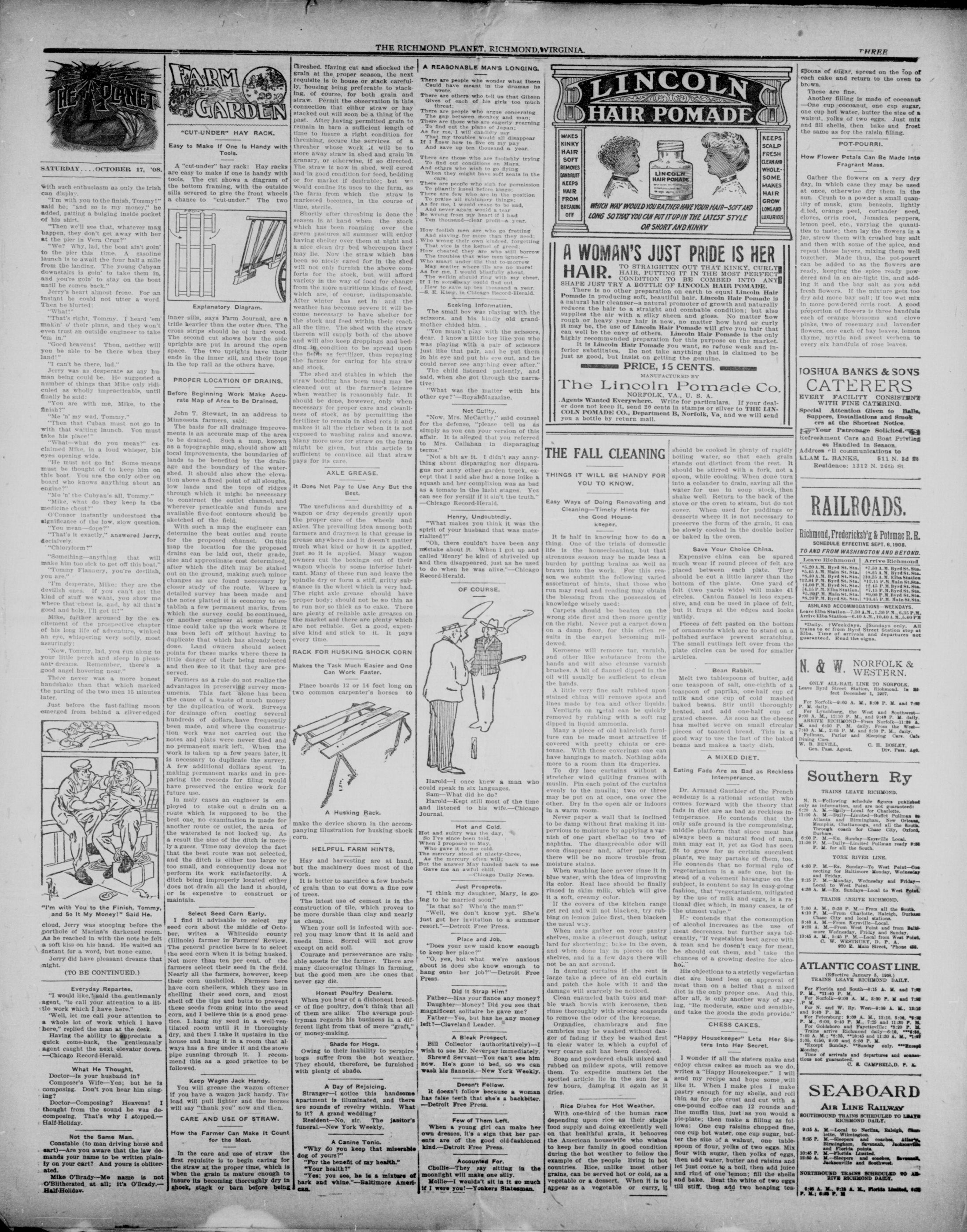
A "cut-under" hay rack: Hay racks are easy to make if one is handy with tools. The cut shows a diagram of the bottom framing, with the outside sills severed to give the front wheels a chance to "cut-under." The two
Explanatory Diagram.
inner sills, says Farm Journal, are a trifle heavier than the outer ones. The cross strips should be of hard wood. The second cut shows how the side uprights are put in around the open space. The two uprights have their ends in the inner sill, and their tops in the top rail as the others have.
PROPER LOCATION OF DRAINS.
Before Beginning Work Make Accurate Map of Area to Be Drained.
John T. Stewart, in an address to Minnesota farmers, said:
The basis for all drainage improvements is an accurate map of the area to be drained. Such a map, known as a topographic map, should show all local improvements, the boundaries of lands to be benefited by the drainage and the boundary of the watershed. It should also show the elevation above a fixed point of all sloughs, low lands and the tops of ridges through which it might be necessary to construct the outlet channel, and wherever practicable and funds are available five-foot contours should be sketched of the field.
With such a map the engineer can determine the best outlet and route for the proposed channel. On this map the location for the proposed drains can be laid out, their grade, size and approximate cost determined, after which the ditch may be staked out on the ground, making such minor changes as are found necessary by closer study of the route. Where a detailed survey has been made and the notes platted it is economy to establish a few permanent marks, from which the survey could be continued, or another engineer at some future time could take up the work where it has been left off without having to duplicate that which has already been land. Land owners should select points for these marks where there is little danger of their being molested and then see to it that they are preserved.
Farmers as a rule do not realize the advantages in preserving survey monuments. This fact alone has been the cause of a waste of much money by the duplication of work. Surveys for drainage often costing several hundreds of dollars, have frequently been made, and where the construction work was not carried out the notes and plats were never filed and no permanent mark left. When the work is taken up a few years later, it is necessary to duplicate the survey. A few additional dollars spent in making permanent marks and in preparing the records for filing would have preserved the entire work for future use.
In many cases an engineer is employed to stake out a drain on a route which is supposed to be the best one, no examination is made for another route or outlet, the area of the watershed is not looked up. As a result the size of the ditch is merely a guess. Time may develop the fact that the best route was not selected, and the ditch is either too large or too small, and consequently does not perform its work satisfactorily. A ditch being improperly located either does not drain all the land it should, or is expensive to construct or maintain.
Select Seed Corn Early.
I find advisable to select my seed corn about the middle of October, writes a Whiteside county (Illinois) farmer in Farmers' Review. The general practice here is to select the seed corn when it is being husked. Not more than ten per cent, of the farmers select their seed in the field. Nearly all the farmers, however, keep their corn unshelled. Farmers here have corn shellers, which they use in shelling their seed corn, and most shell off the tips and butts to prevent these seeds from going into the seed corn, and I believe this is a good practice. I hang my seed in a well-ventilated room until it is thoroughly dry, and then I take it upstairs in the house and hang it in a room that always has a fire under it and the stove pipe running through it. I recommend this as a good practice to be followed.
Keep Wagon Jack Handy
You will grease the wagon oftener if you have a wagon jack handy. The load will pull lighter and the horses will say "thank you" now and then.
CARE AND USE OF STRAW.
How the Farmer Can Make It Count for the Most.
In the care and use of straw the first requisite is to begin caring for the straw at the proper time, which is when the grain is mature enough to insure its becoming thoroughly dry in shock, stack or barn before being
THE RICHMOND PLANET, RICHMOND. VIRGINIA
threshed. Having cut and shocked the grain at the proper season, the next requisite is to house or stack carefully, housing being preferable to stacking, of course, for both grain and straw. Permit the observation in this connection that either straw or hay stacked out will soon be a thing of the past. After having permitted grain to remain in barn a sufficient length of time to insure a right condition for threshing, secure the services of a thresher whose work it will be to store away straw in shed and grain in granary, or otherwise, if so directed. The straw is now in shed, well cured and in good condition for feed, bedding or for market if desirable; but we would confine its uses to the farm, as the farm from which the straw is marketed becomes, in the course of time, sterile.
Shortly after threshing is done the season is at hand when the stock which has been roaming over the green pastures all summer will enjoy having shelter over them at night and a nice clean dry bed whereupon they may lie. Now the straw which has been so nicely cared for in the shed will not only furnish the above comforts for the stock, but will afford variety in the way of food for change from the more nutritious kinds of feed, which are, of course, indispensable. After winter has set in and the weather has become severe it will become necessary to have shelter for the stock and feed within their reach all the time. The shed with the straw therein will supply both of the above and will also keep droppings and bedding in condition to be spread upon the fields as fertilizer, thus repaying the farmer for caring for his straw and stock.
The shed and stables in which the straw bedding has been used may be cleaned out at the farmer's leisure when weather is reasonably fair. It should be done, however, only when necessary for proper care and cleanliness of stock, as by permitting the fertilizer to remain in shed rots it and makes it all the richer when it is not exposed to washing rains and snows. Many more uses for straw on the farm might be given, but this article is sufficient to convince all that straw pays for its care.
AXLE GREASE.
It Does Not Pay to Use Any But the Best.
The usefulness and durability of a wagon or dray depends greatly upon the proper care of the wheels and axles. The prevailing idea among both farmers and draymen is that grease is grease anywhere and it doesn't matter much what kind or how it is applied, just so it is applied. Many wagon owners cut the boxings out of their wagon wheels by some inferior lubricant. Many of these run and leave the spindle dry or form a stiff, gritty substance in the wheel which is very bad. The right axle grease should have proper body; should not be so thin as to run nor thick as to cake. There are plenty of reliable axle greases on the market and there are plenty which are not reliable. Get a good, expensive kind and stick to it. It pays every time.
RACK FOR HUSKING SHOCK CORN
Makes the Task Much Easier and One Can Work Faster.
Place boards 12 or 14 feet long on two common carpenter's horses to
A Husking Rack.
make the device shown in the accompanying illustration for husking shock corn.
HELPFUL FARM HINTS
Hay and harvesting are at hand, but the machinery does most of the work.
It is better to sacrifice a few bushels of grain than to cut down a fine row of trees.
The latest use of cement is in the construction of tile, which proves to be more durable than clay and nearly as cheap.
When your soil is infested with sorrel you may know that it is acid and needs lime. Sorrel will not grow except on acid soil.
Courage and perseverance are valuable assets for the farmer. There are many discouraging things in farming, but the good men are the ones that never say die.
Honest Poultry Dealers
When you hear of a dishonest breeder of fine poultry, don't think that all of them are alike. The average poultryman regards his business in a different light from that of mere "graft," or money-making.
Shade for Hogs.
Owing to their inability to perspire hogs suffer from the hot weather. They should, therefore, be furnished with plenty of shade.
A Day of Releasing
Stranger—I notice this handsome apartment is illuminated, and there are sounds of revelry within. What is it? A grand wedding? Resident—No, sir. The jasitor's funeral—New York Weekly.
A Canine Topic
"Why do you keep that miserable dog of yours?"
"For the benefit of my health."
"Your health?"
"Yes: you see, he is a mixture of bark and whine."—Baltimore American
A REASONABLE MAN'S LONGING.
There are people who wonder what Ibsen
Could have meant in the dramas he
wrote.
There are others who tell us that Gibson
Gives of each of his girls too much
threat;
There are people who argue concerning
The gap between monkey and man;
There are those who are eagerly yearning
To find out the plans of Japan;
As for me, I will candidly say
That my troubles would all disappear
If I knew how to live on my pay
And save up ten thousand a year.
There are those who are foolishly trying
To find out conditions on Mars.
And others who wish to go flying
When they might have soft seats in the cars:
Are people who sigh for permission
To please himself before kings.
There are few who are in the position
To praise all sublunary things:
As for me, I would cease to be sad,
And never again would a tear
Be wrong from my heart if I had
Ten thousand—clear profit—a year.
How foolish men are who go fretting
And slaving for more than they need.
Who wrong their own kindred, forgetting
That vice is the kernel of greed.
How cheated they are who still borrow
The troubles that wipe men ignore—
Who smart under lilis that to-morrow
May scatter their lilis are no more!
As for me, I would blissfully shout,
That vice is the kernel of greed my cheer,
If I in some way could find out
How to save up ten thousand a year.
—S. E. Kiser, in Chicago Record-Herald.
Seeking Information
The small boy was playing with the scissors, and his kindly old grandmother chided him.
"You mustn't play with the scissors, dear. I know a little boy like you who was playing with a pair of scissors just like that pair, and he put them in his eye and put his eye out, and he could never see anything ever after."
The child listened patiently, and said, when she got through the narrative:
"What was the matter with his other eye?"—RoyabMagazine.
Not Guilty.
"Now, Mrs. McCarthy," said counsel for the defense, "please tell us as simply as you can your version of this affair. It is alleged that you referred to Mrs. Callahan in disparaging terms."
"Not a bit av it. I didn't say anything about disparaging nor disparagus nor any other garden truck, except that I said she had a nose lolike a squash and her complication was as bad as a tomato in the lasht stages. Yee can see for yersil if it ain't the truth." —Chicago Record-Herald.
Henry: Undoubtedly
"What makes you think it was the spirit of your husband that was materialized?"
"Oh, there couldn't have been any mistake about it. When I got up and called 'Henry' he kind of shriveled up and then disappeared, just as he used to do when he was alive."—Chicago Record-Herald.
OF COURSE.
Harold—I once knew a man who could speak in six languages.
Sam—What did he do?
Harold—Kept still most of the time and listened to his wife.—Chicago Journal.
Hot and Cold
Hot and sultry was the day,
So I've since been told,
When I proposed to May,
Who gave it to me cold.
The mercury stood at ninety-three,
As the mercury often will;
But the answer May handed back to me
Gave me an awful chill.
Just Prospects.
"I think my daughter, Mary, is going to be married soon."
"Is that so? Who's the man?" "Well, we don't know ygt. She's just got her invitation to a summer resort."—Detroit Free Press.
Place and Job.
"Does your new maid know enough to keep her place?"
"O. yes, but what we're anxious about is does she know enough to hang onto her job?"—Detroit Free Press.
Did It Strap Him?
Father—Has your fiance any money?
Daughter—Money? Did you see that magnificent solitaire he gave me?
Father—Yes, but has he any money left?—Cleveland Leader.
A Bleak Prospect
Bill Collector (authoritatively)—I wish to see Mr. Neverpay immediately. Shrewd Servant—You can't see him now. He's gone to bed, so we can wash his flannels.—New York Weekly.
Doesn't Follow.
It doesn't follow because a woman has false teeth that she's a backbiter.
—Detroit Free Press.
Few of Them Left.
When a young girl can make her own dresses, it's a sign that her parents are of the good old-fashioned kind.—Detroit Free Press.
Accounted For
Chollie—They say sitting in the moonlight will make one silly. Mollie—I wouldn't sit in it so much if I were you!—Yonkers Statesman.
LINCOLN
HAIR POMADE
MAKES
KINKY
HAIR
SOFT
REMOVES
DANDRUFF
KEEPS
HAIR
FROM
BREAKING
OFF
LINCOLN
HAIR POMADE
WHICH WAY WOULD YOU RATHER HAVE YOUR HAIR-SOFT AND
LONG SO THAT YOU CAN PUT IT UP IN THE LATEST STYLE
OR SHORT AND KINKY
KEEPS
SCALP
FRESH
CLEAN AND
WHOLE-
SOME
MAKES
HAIR
GROW
LONG AND
LUXURIOUS
A WOMAN'S JUST PRIDE IS HER
MANUFACTURED BY
Agents Wanted Everywhere. Write for particulars. If your dealer does not keep it, send 26 cents in stamps or silver to THE LIN-COLN POMADE CO., Department B, Norfolk, Va, and we will send you a bottle by return mail.
THE FALL CLEANING
THINGS IT WILL BE HANDY FOR YOU TO KNOW.
Easy Ways of Doing Renovating and Cleaning—Timely Hints for the Good House.
It is half in knowing how to do a thing. One of the trials of domestic life is the housecleaning, but that strenuous season may be made less a burden by putting brains as well as brawn into the work. For this reason we submit the following varied assortment of hints, that those who run may read and reading may obtain the blessing from the possession of knowledge wisely used:
Carpets should be beaten on the wrong side first and then more gently on the right. Never put a carpet down on a damp floor, for this often results in the carpet becoming mildew.
Kerosene will remove tar, varnish, and other like substance from the hands and will also cleanse varnish brushes. A bit of flannel dipped in the oil will usually be sufficient to clean the hands.
A little very fine salt rubbed upon stained china will remove spots and lines made by tea and other liquids. Verdigris on metal can be quickly removed by rubbing with a soft rag dipped in liquid ammonia.
Many a piece of old halcloth furniture can be made most attractive if covered with pretty chintz or cretonne. With these coverings one can have hangings to match. Nothing adds more to a room than its draperies.
To dry lace curtains without a stretcher quilt quilting frames with muslin. Pin each point of the curtains evenly to the muslin; two or three may be put on at once, one over the other. Dry in the open air or indoors in a warm room.
Never paper a wall that is inclined to be damp without first making it impervious to moisture by applying a varnish of one part shellac to two of naphtha. The disagreeable odor will soon disappear and, after papering, there will be no more trouble from moisture stains.
When washing lace never rinse it in blue water, with the idea of improving its color. Real lace should be finally rinsed in skim milk, which will give it a soft, creamy color.
If the covers of the kitchen range get red and will not blacken, try rubbing on lemon juice first, then blacken the usual way.
When ants gather on your pantry shelves, make a pie-crust dough, using lard for shortening; bake in the oven, and when done lay in pieces on the shelves, and in a few days there will not be an ant ground.
In darning curtains if the rent is large take a piece of an old curtain and patch the hole with it and the damage will scarcely be noticed.
Clean enameled bath tubs and marble wash bowls with kerosene, then rinse thoroughly with strong soapsuds to remove the odor of the kerosene.
Organdies, chambrays and fine cambries may be washed without danger of fading if they be washed first in clear water in which a cupful of very coarse salt has been dissolved.
Soap and powdered chalk mixed and rubbed on mildew spots, will remove them. To expedite matters let the spotted article lie in the sun for a few hours, damping it again as it dries.
Rice Dishes for Hot Weather
With one-third of the human race depending upon rice as their staple food supply and doing excellently well on that healthful grain, it behooves the American housewife who wishes to keep her family in good condition during the hot weather to follow the example of the people living in hot countries. Rice, unlike most other grains, can be served hot or cold, as a vegetable or a dessert. When it is to appear as a vegetable or curry, it
keeper.
should be cooked in plenty of rapidly boiling water, so that each grain stands out distinct from the rest. It should be stirred with a fork, not a spoon, while cooking. When done turn into a colander to drain, saving all the water for use in soup stock, then shake well. Return to the back of the stove or the oven to steam, but do not cover. When used for puddings or desserts where it is not necessary to preserve the form of the grain, it can be slowly cooked in the double boiler or baked in the oven.
Save Your Choice China.
Expensive china can be spared much wear if round pieces of felt are placed between each plate. They should be cut a little larger than the bottom of the plate. One yard of felt (two yards wide) will make 41 circles. Canton flannel is less expensive, and can be used in place of felt, but it frays at the edges and looks untidy.
Pieces of felt pasted on the bottom of ornaments which are to stand on a polished surface prevent scratching. The small cuttings left over from the plate circles can be used for smaller articles.
Melt two tablespoons of butter, add one teaspoon of salt, one-eighth of a teaspoon of paprika, one-half cup of milk and one cup of cold mashed baked beans. Stir until thoroughly heated, and add one-half cup of grated cheese. As soon as the cheese has melted serve on small circular pieces of toasted bread. This is a good way to use the last of the baked beans and makes a tasty dish.
Eating Fads Are as Bad as Reckless Intemperance.
Dr. Armand Gauthier of the French academy is a rational scientist who comes forward with the theory that fads in diet are as bad as reckless intemperance. He contends that the only safe ground is the compromising, middle platform that since meat has always been a natural food of man, man may eat it, yet as God has seen fit to grow for us certain succulent plants, we may partake of them, too. He contends that no formal rule of vegetarianism is a safe one, but instead of a vehement harangue on the subject, is content to say in easy-going fashion, that "vegetarianism, mitigated by the use of milk and eggs, is a rational diet which, in many cases, is of the utmost value."
He contends that the consumption of alcohol increases as the use of meat decreases, but further says tolerantly, "If vegetables best agree with a man and he doesn't care for meat, he should eat them, and take the chances of a growing desire for alcoho." His objections to a strictly vegetarian diet are based less on approval of meat than on a belief that a mixed diet is the only proper one. And this, after all, is only another way of saying, "Be moderate, sane and sensible, and take the goods the gods provide."
"Happy Housekeeper" Lets Her Sisters Inher Into Her Secret.
I wonder if all the sisters make and enjoy chess cakes as much as we do, writes a "Happy Housekeeper." I will send my recipe and hope some will like it. When I make ples I make pastry enough for my shells, and roll thin as for ple crust and cut with a one-pound coffee can 12 rounds and line muffin tins, just as you would a pie-plate; then make a filling as follows: One cup raisins chopped fine, one cup hot water, one cup sugar, butter the size of a walnut, one table-spoon of flour, yolks of two eggs. Mix flour with sugar, then yolks of eggs, then add water, butter and raisins and let just come to a boll, then add juice and rind of one lemon; fill the shells and bake. Beat the white of two eggs till stiff, then add two heaping tea
Save Your Choice China.
Bean Rabbit.
A MIXED DIET.
CHESS CAKES.
THREE
spoons of sugar, spread on the top of each cake and return to the oven to brown.
These are fine.
Another filling is made of cocoanut
—One cup cocoanut, one cup sugar, one cup hot water, butter the size of a walnut, yolks of two eggs. Just mix and fill shells, then bake and frost the same as for the raisin filling.
POT-POURBI
How Flower Petals Can Be Made Into Fragrant Mass.
Gather the flowers on a very dry day, in which case they may be used at once, otherwise dry them in the sun. Crush to a powder a small quantity of musk, gum benzoin, lightly dled, orange peel, cortlander seed, cloves, rosr root, jamaica peppers, lemon peel, etc., varying the quantities to taste; then lay the flowers in a jar, strew them with crushed bay salt and then with some of the spice, and repeat these layers, mixing them well together. Made thus, the pot-pourri can be added to as the flowers are ready, keeping the spice ready powdered and in an air-tight tin, and adding it and the bay salt as you add fresh flowers. If the mixture gets too dry add more bay salt; if too wet mix in more powdered orris root. A good proportion of flowers is three handfuls each of orange blossoms and clove pinks, two of rosemary and lavender flowers, one each of bay leaves, lemon thyme, myrtle and sweet verbena to every six handfuls of rose leaves.
JOSHUA BANKS & SONS CATERERS EVERY FACILITY CONSISTENT WITH FINE CATERING
WITH FINE CATERING. Special Attention Given to Balls, Suppers, Installations and Smok
ers at the Shortest Notice.
Your Patronage Sollicited.
Refreshment Cars and Boat Privilege
Handled in Season.
Handled in Season.
Address rll communications to
LLAM L. BANKS, 511 N. 2d St
Residence: 1312 N. 26b St
RAILROADS.
TO AND FROM WASHINGTON AND BEYOND
Leave Richmond
*2.50 A.M. Byrd St. Sta.
*5.45 A.M. Main St. Sta.
*8.25 A.M. Byrd St. Sta.
*10.55 A.M. Elba Station
*12.01 P.M. Byrd St. Sta.
*14.00 P.M. Byrd St. Sta.
*14.15 P.M. Elba Station.
*5.20 P.M. Main St. Sta.
*8.20 P.M. Byrd St. Sta.
Arrive Richmond
*7.50 A.M. Byrd St. Sta.
*8.25 A.M. Byrd St. Sta.
*10.55 A.M. Elba Station
*12.01 P.M. Byrd St. Sta.
*14.00 P.M. Byrd St. Sta.
*14.15 P.M. Elba Station.
*5.20 P.M. Main St. Sta.
*8.20 P.M. Byrd St. Sta.
ASHLAND ACCOMMODATIONS—WEEKDAYS.
Leave Elba Station—7.30 A.M. 1.30 P.M. 6.35 P.M.
Arrive Elba Station—6.40 A.M. 10.40 P.M. 5.40 P.M
*Daily. † Weekdays. † Sundays only. All trains to or from Byrd Street Station stop at Elba. Time of arrivals and departures not guaranteed. Read the signs.
N. & W. NORFOLK & WESTERN.
ONLY ALL-RAIL LINE TO NORFOLK.
Leave Byrd Street, Station, Richmond. In effect December 1, 1907.
For Norfolk—9:00 A. M., 8:00 P. M. and 7:00 P. M. daily.
For Lynchbarg, the West and Southwest—9:00 A. M., 12:10 P. M., and 9:40 P. M. daily.
For Norfolk—11:00 A. M., 6:50 P. M. daily. From the West, 7:40 A. M., 2:05 P. M. and 8:50 P. M. daily.
Pullman, Parlor and Sleeping Cars. Cars Dining. Cars.
W. B. REVILL.
Gen. Pas. Agent.
C. H. BOSLEY.
Div. Pass. Agent.
Southern Ry
TRAINS LEAVE RICHMOND.
N. B—Following schedule figures published only as information in the program; warranted:
6:20 A. M—Baily—Local for Chattanooga
11:00 A. M—Baily—Limited-Buffet Pullman to Atlanta and Birmingham, New Orleans, Memphis, Chattanooga, and all the south.
Town coach for Chase City, Oxford, Durham.
6:00 P M - Fx. Sunday - Keysville Local.
11:39 P M - Fx. Limited Pullman ready #188
1:00 P M - Fx.
YORK RIVER LINE
4:30 P. M.—Ex. Sunday—To West Point—On
necting for Baltimore Monday, Wednesday
and Friday.
2:15 P. M.—Sunday, Wednesday and Friday—
Local to West Point.
4:26 A. M.—Ex. Sundays—Local to West Point.
TRAINS ARRIVE RICHMOND.
7:00 A. M. 9:30 M.—From all the South.
4:10 P. M.—From Charlotte, Raleigh, Durham
city and local stations.
8:40 A. M.—From West Point, Lakewood.
9:20 A. M.—From West Point and from Baltimore
Wednesday, Friday and Sunday.
10:45 A. M. 5:45 M.—From West Point,
C. W. WESTBURG.
9:20 E. Main Street, Phone 486.
ATLANTIC COAST LINE
(Effective January 6, 1998.)
TRAINS LEAVE RICHMOND DAILY.
For Florida and South-8-15 A. M. and 7:00
P. M.
For Norfolk-9-00 A. M. 8:00 P. M. and 7:00
P. M.
For N. N. and W. R. Wy. West-9-00 A. M., 12:25
P. 040 P. M.
For Peterburg: 8:00 A. M., 12:00, 12:10, *8:20*
P. M., 6:00, 9:40 P. M., 7:25 and 11:30 P. M.
For Goldbabor and Fayetteville: *8:20 P. M.*
Trains arrive Richmond daily -6:10, ****8:50*
7:40 A. M.; *8:35*, *10:45 and 11:30 A. M.; *12:50*
2:05, 6:50, 8:00 and 8:50 P. M.
Time for Sunday. ***Sunday only.** ****Excuse*
Monday.
Time of arrivals and departures and ocean
Time of arrivals and departures and con-
sultations not guaranteed.
C. B. CAMPBELL, D. P.
SEABOARD
AIR LINE RAILWAY
SOUTHBOUND TRAINS SCHEDULED TO LEAVE
RICHMOND DAILY.
9:15 A. M.—Local to Norlina, Raleigh, Glenn
lettle, Wilmington.
2:25 P. M.—Sleepers and coaches, Atlanta,
Birmingham, Savannah, Jacksonville,
and Florida.
10:45 P. M.—Florida Limited.
12:55 A. M.—Sleepers and coaches, Savannah,
Jacksonville and Southwest.
NORTHBOUND TRAINS SCHEDULED TO ARRIVE RICHMOND DAILY.
6:55 A. M. 6:18 A. M., Florida Limited, 6:21
P. M. 6:28 P. M.
FOUR
TE aun es
tie Py aw A
Ug AACS tS
BS SS
Ni
ss Le
JOHN MITCHELL, JR, - EDITOR.
For . < *
: ;
ieee ees <
Eo
aes
a
ee a
di foc 6.03 per gar ome
Feet a ea ay a
eens Seen nr ee ee
PGRN Bac and see ee
Be rae ee a ae
es Ten Ta
wont ORO You cet Meme,
ig gee fg
Sal Sal tas Ss Aihte mocuine O
=n
xen MONET ORDERS gare ssn
ayers seer me
iS sn Sa AER
eS Rape Cesag ead ene
a
Shoe ier eset save oes
Se bes:
SSD, “LATTER “i « Many. Or
see nee fay ee
ES
SS Sere
Se eoe S mses
Se Ss
ae
Sa a peeecn, e mimy
ioe See ae
Sein oe eee
Sarai ey rs alan poe
RSSUWALS, ETC-Mt odo mt cant TH
eee rat one mt oe Te
eee ge seep an es
fats Sac ee
eet
SPiN pare seat ee
Sawa Sako nt
Sort Se peat run cae
Soe the shen ae ae a we lo
Ea}
COMUESICATIONE Wen, wing o_o
SS
Se eee see aoe oneal
i Ee
alice gr ROME In wir lo ane
eeee aces Soe
Sree
Fang oh fg Com Renee, ve
aPotergt at the Rost
SATURDAY... OCTOBER 17, "08.
‘The campaign is now at fever heat
and the time of recrimination is at
hand.
—o——_
We should remember that right
principles are eternal and never
change.
—
if we are to judge by thelr own
utterances, the only perfect citizens
are Hon. Theodore Roosevelt of
Washington, D. C. and Hon. W. J.
Bryan of Lincoln, Nebraska.
President Roosevelt seems to have
forgotten that he occupies a position
where the rules of propriety prohib-
it the occupant from engaging in an
unseemly political controversy.
We are now confronted with
Rooseveltism on the one hand and
Bryanism, on the other. The voter
can choose between the two, Re-
publicanism and Democracy are
treated as strangers in both of the
politieal camps.
THE POLITICAL QUESTION.
My voice is still for war.
Gods! can a Roman Senate long de
bate
Which of the two choose, slavery 01
Weath?— Addison.
We are sometimes asked as to our
position relative to the present po:
litical contest. We confess that we
feel uncomfortable, whon we con:
template either phase of the situa-
tion. When we read the platforms
of the political parties unaffected by
outside inuendoes and assertions, the
Republican Party platform alone
holds out definite pledges to the col-
ored people of the nation. If we
looked no further and if we believed
all that its representatives in the
doubtful States say to us, we would
go no further. There would be nc
cause for further meditation. Every
colored man in the United States
would necessarily be a Republican
and would loyally support the ticket
named at Chicago.
But them here comes the Indepen-
dents, the “kicking” contingent of
the colored race with thetr lurid
pictures of Brownsville, Texas, the
discharge of the 167 members of
Companies B, C, and D of the Twen-
ty-fifth United States Infantry and
the refusal of a Republican President
e OR et a. ope in ees
oS eh
men of the hand a
feeling of resentment takes the
place of conservative consideration.
_In the meantime, his politieal pro-
totype and supporter appears upon
the scene of the controversy vainly
attempting to assert an individuality
of his own, which is being constant-
ly overshadowed by the trampeting
messages from the White House, de-
[elaring that “my policies" are para-
mount, and asserting that “if ye be-
Neve In me, ye must believe also tn
him," and vice versa.
‘Im the meantime colored people
are being forced to the rear in all
of the Southern States and the many
Negro-haters, who at one time held
‘igh carnival in the Democratic Par-
ty are now assigned to duty in the
councils of the Roosevelt Republican
Party of the Southland. ‘The colored
man fs not only made to understand
that he is not wanted save as a “hew-
er of wood and a drawer of water,”
but ho is frequently told to make
himself scarce at the meetings of the
Republican Party.
In the doubtful States, the atti-
tude of the Republican managers Is
entirely different. Colored men “
not only welcomed to the mass-meet-
ing of the party, but their leaders
are allowed money to defray the le-
gitimate expenses of the campaign.
Race journals gre mustered into ser-
[vice atong with the daily newspapers
owned and controlled by white Re-
publicans. Official patronage ts also
promised and if the color line is in
evidence, it 1s not observable.
‘These then are the methods In
Yogue in the country. The desire
of the Republican managers was to
have some colored men support the
Democratic candidates and to be af-
fillated with the Democratic Party in
order to relieve the Republican Party
of the Southland of the odium of
being characterized as the Negro Par
ty in the Southland.
These same Republicans did not
wish though for the colored men in
the North to follow suit and vote
the Democratic ticket in the doubtful
Northern and Western States. To
speak plainly, the intention Is to
treat the Negroes of the South so
badly that they will vote the Demo-
cratle Ucket, where his vote ts of no
consequence and to traat him so
fairly in the North that he will awear
slegiance and remain faithful to the
Republican Party
‘They hoped that the disaffection
of the colored people in the South
Would be more than off-set by the
entrance of the dissatisfied Demo-
cratic elements of ‘the South, who
Femained ovtside of the Republican
Party limits because of tho predom-
finance in party affairs of the colored
people and the olf Ume white Re-
publican elements that have grown
gray in the service of the party. As
an extra inducement too, the best
political offices In the Southland have
been promised and given to this re-
volting Democratic, Negro-hating con
tingent, who came over so quickly
that they have not had time to
change thelr unlferm or to discard
their old-time weapons and methods
of war-fare.
‘They had been taught to yell, nix-
ger! nigger! nigger!!! on the Dem-
ocratic side of the contention and
they frequently thoughtlessly use the
same language, forgetful of the fact
that times have changed and they
should have changed with them.
This then Is the disorganized, con-
tending, incongruous element that is
striving for mastery in this section
of the country.
It may be well to state that these
Negro-hating Democratic Roosevelt
Republicans haye been unable to
bring with them enough recruits to
man the political guns and form a
regiment. The old line Republicans
are sullen and resentful. They re-
fuse either to move the artillery or
to organize a regiment. In this con-
dition the Republican Party of the
South is expected to win a victory.
Win or loge, the new white recruits
are triumphant. The spoils of office
have been promised beforehand.
If the forces of the Memocratic
Party are defeated by the Republi-
can Armies in the North and West,
victory for them is an assured fact.
But then the Republican managers
of the country seem to have forgot-
ten that the fathers, sons, brothers
and relatives in the North sympa-
thize with their kin-folks in the
South and that revenge is one of the
most valuable assets of any spirited
THE RICHMOND PLANET, RICHMOND, VIRGINIA.
- te et Nn ts 32
: it Roosevelt, too, seems
to be aware that the situation
‘is desperate and the outlook diseour-
aging. He has “shied itls castor” in-
to the ring in an effort to stem the
"tide that has been so steadily setting
in against his chosen candidate. He
bus done some good in some quar-
ters by his activity and much harm
in others.
It {s known that the outlook ts
puzzling and the result in| much
doubt. Mr. Bryan has certainly
shown remarkable ability im conduct-
ing bis campaign and in corralling
that element of the Democratic Par-
ty that has been so consistently an-
tagonizing him. Whether they are
playing the same game on him, that
he Is alleged to have played on Judge
Parker is an open question.
But we must not get away from
the subject. What Is to be the at-
titude of the conservative, polite, o-
biiging, tax-paying, wealth-producing
citizen of color who {s not swayed
by brass bands or influenced by emp-
ty logic? Where shall he stand. in
this campaign? What does the Dem-
ecratic Party and Its candidate prom-
ise or offer him? Are the princt-
lies of the Party as laid down and
enunciated at Denver sound to bis
idea of thinking or are they un-
sound? Do they tend to promote
tne prosperity of the country or are
they phrases, carefully put together
‘tor the purpose of elevating certain
lambifious white citizens to office?
These \questions applicable to the
Democratic Party are equally as ap-
propriate in our dealings with the
Republican Party. On the other
hand, will the defeat of the Repub-
iean Party tend to make it more
‘careful of the rights of the Negro in
‘the future? Will it be a rebuke of
President Roosevelt and tend to make
impossible his reappearance as a can-
Uidate for the presidential nomination
in 19122 These are the questions
[which demand an answer and It is
Indeed a wise man who can give a
satisfactory reply to all of them
| For our part, we suggest that the
colored people of this country, for
once, practice individualism. ‘That
‘is vote in each and every locality as
thelr surroundings would seem best
for the race's prosperity in that com-
‘munity. Learn to cast a diserimi-
nating ballot, voting for one man on
the Republican ticket that 1s favor-
able to them and seratehing another
that Is injurious to thetr tnterests,
Vote Republicanism in State matters
and something else in national ones
and vice versa.
‘This will tend to alarm the indi-
vidual white Republican nominee and
individual white Democratic nomi-
‘nee. The result will be a remarka-
ble improvement In our political con
dition. The time has passed when
we should condemn any colored man
for the exerelse of his political priv-
fleges, be they Republican, Demo-
erat, Prohibition, Independence Pay-
ty, Socialist or otherwise
Let us all remember the Divine in-
junction and, “Speak unto the chil-
dren of Israel, that they go forward.”
TRUE TO LIFE.
“Thanks.” s:id the tragedtan;
many thanks for your good opinion
L always study from Nature—from Na
ture, sir. In my acting you see re
flected Nature berselt."
“Try this cigar,” sald an admirer
of Nature reverently, “Now, where
aid you study that expression of in
tense surprise that you assume in the
second act?”
“From Nature, sir—trom Nature.
To secure that expression, T asked an
intimate friend to lend me five pounds,
He refused. This caused me no sur-
prise. I tried several more. Finally 1
asked one who was willing to oblixe
me, and as he handed me the note
I studied in a glass the expression of
my own face. I saw there surprise,
but tt was not what I wanted. Tt was
alloyed with suspicion that the note
might be a bad one. I was in de-
spair.”
“Well,” said the other breathlessly.
“Then an idea struck me. I re
eolved upon a desperate course. I re-
turned the five pounds to my friend
the next day and on his astounded
countenance I saw the expression I
‘Was in search of.”—Royal Magazine.
gig eee ace cle
Young Man—I am to be married tn
About a month, and I'm looking for a
home. What {s the rent of these
flats?
Janitor—H'm. Did the girl you fn.
tend to marry ever have a mother?
| “A mother? Certainly.”
“A grandmother?”
“Ot course.”
“H'm! Let me see. Did that grand-
mother have a daughter?”
“Why, yes.”
“And did the daughter have a daugh-
ter?”
“Great snakes! Of course.”
“Very sorry, sir; but I can’t rent
one of these fine flats to people like
that. I'm afraid having children runs
in the family."—New York Weekly.
Fought and Bled.
‘Uncle George, did you do any
fighting in the Spanish war?”
“Yes, my boy; I was fighting nearly
all the time. Those mosquitoes down
in Florida, where we camped, were
the fiercest things you ever heard of.”
“But weren't you in any battles,
uncle?”
“O, yes; we had a few little skir-
mishes over in Cuba, of course; but I
thought you wanted me to tel you
about war and bloodshed.”—Chi-
cago. Cel ws te
PHILADELPHIA'S —
PICTURE PARADE
Story of Old Gy Told in
Gorgeous Pageant.
OVER 5000 WERE IN. LINE
Wife and Sisterin-Law Held For Kill-
ing T. Clayton Erb—Shot Wife at
Church Door—Case of Leprosy in
Camden—He Made Canes For Presl-
dents—Boy saailece Get Twenty
Years—Killed In Motor Cycle Race.
John W. Kern's Son Has Paralysis.
Killed Man She Was Forced to Wed.
Philadelphia's greatest picture pa-
rade—the historical pageant of Found-
er’s Week—brought hundreds. of thou-
sands of persons to Broad street,
where, for @ distance of more than
four miles, they reviewed the spec-
tacle, covering every event of import:
‘ance in the 225 years’ existence of the
city.
The procession tcluded as particl-
pants about 40% persons on floats and
fully 5000 on foot and horseback.
‘The pageant in said to be the first
of the kind to be held in the United
States. It has been prepared along
lines similar to that given at the Que-
bec celebration Iast summer.
‘The more notable historical floats
representing the pre-Revolutionary
periods were: Onrust, First Ship to
Enter the Delaware River, Penn Under
Arrest, 1668; Penn's Treaty With the
Indians, Palatines Going to Take the
Oath, 1740.
‘The “colonial Philadelphia” section
depicted the proclaiming of George L
in 1714 by the governor and council,
& street fair of 1740, the coming to
town of Benjamin Franklin from Bos-
ton In 1728, the first fire company, the
oid London coffee house, Franklin and
his kite, the founding of the Univer
sity of Pennsylvania, the arrest of
pirates in 1718 and other scenes. In
the street fair scene there were 140
girls wearing the costumes of 1740.
‘The revolution was trented in the
fourth division with such historic
acenes as the resisting of the stamp
act, Virginians coming to congress,
New Englanders coming to congress,
John Paul Jones, the sisning of the
Declaration of Independence, the mak
ing of the flag, the Uberty bell, a group
comprising Washington, Wayne and
Lafayette in 1777, the entrance of the
British in October,/1777; Franklin at
the court of Louls XVI. Robert Mor-
ris’ ox train, Americans on the way to
Yorktown in 1781,-Rochambeau and
the French allies, and lastly the flags
captured at Yorktown
Later periods of the city’s history
were shown by floats representing
Wasbington's inauguration, 1793; the
visit of Lafayette, 1824; Lincoin in
Philadelphia, 1864, and the Centennial,
1876.
Tramps Bind Boy to Train.
Bound with a wire rope to a rail-
road train. near Allentown, Pa, that
was about to move by two tramps,
Harvey Fatzinger, a sixteen-yearold
boy. after a desperate struggle man-
aged to release himself and started
for home, falling exbausted at the
doorstep. He is now in a critical con-
dition in consequence’ of the treat:
ment he received and from fright.
Young Faizinger was held up in an
isolated spot by two tramps, who, af-
tey they had relieved im of his pay,
tied a rope about his meck and led
him about the country, stopping at
several out-of-the-way hotels, where
they spent the money in drink, Fata.
inger being in the meantime tled to a
tree nearby.
| Finally they boun@ bie bands with
a wire rope and, tying him to a rail-
road train that was about to move,
abandoned the boy, expecting him to
be killed.
| Rilehtatan. Cured Mia Rheematien.
| Walter W. Keen, of Clayton, N.
J., who was nearly killed by a bolt
of lightning during the phenomenal
electrical storm this summer, had been
aMicted with rheumatism for many
weeks ipeavices, and wag’ shable to
walk without a cane. The lightning
so nearly cured his (rheumatism that
he threw away his cane and has not
used ft since, t
Gets Twenty Years For Murder.
Abraham Rosenthal, of Philadelphia,
‘who was convicted a mouth ago at
Reading, Pa, of the murder of Lewis
1B. Clawson, a wealthy shirt manu-
facturer, was denied a new trial in
court and sentenced to twenty years’
imprisonment.
May Form Fish Combine.
Frederick Thorton and Charles Mad-
arix left Crisflela, Md., for Chicago,
where they will meet several capital-
ists who are forming a fish combine to
control the fish business of the Great
Lakes and of this, the center of the
fish industry of Maryland,
Finds $1800 Goid Hidden In Rags.
Concealed in a lot of old rags which
he bought with the rest of the con-
tents of the junk shop of his dead
father, Lewis Walter, of Frederick,
Ma., found $1800 in gold.
pi uae ee eer ee eas
| The eight-yearold son and name.
‘sake of Jolin W. Kern, Democratic
candidate for vice president, Is seri-
eusly {il from infantile paralysis.
‘Women Heid For Killing Erp.
“I shot Captain Erb. I am sorry,
but I could not help it. He pointed a
revolver at me, Suddenly I had the
‘strength of seven women. I took the
revolver from him atd pressed the
trigger. It kept on shooting. I could
not stop it.” j
e“pnia is the story of Mra. Catharine
Beisel, of 162 South Pitteenth street,
Philadelphia, as retoid/on the witness
‘stand by Detective Richard Doyle, of
Phifadeiphia police departmént, in
the combined alderman's hearing and
‘coroner's inquest to fix the responst
bility for the murder of Captain J.
Clayton Erb, national guardeman and
politician, who was shot to death at
his country home, Red Gables, near
Media, Delaware county, Pa.
‘The coroner's jury promptly found
the following verdict:
“We find that J. Clayton Erb’s death
was due to Internal hemorrhages, the
Feault of gunshot wounds Infleted by
Mra. Catharine Deleel.”
Magistrate Robert Smith immediate
jy held Mrs. Beisel and Mrs. Clayton
Erb for trial without bail District
Attorney McDade argued that Mrs.
Erb had been proved to be am acces
sory to the killing. *
| ‘The commonwealth made it plain
that it will proceed on the theory that
‘Mrs. Erb, after dining tn her own room
‘with her sister, Mre. Beisel, to whom
Erb had canceled the hospitality of
This house, had gone secretly to the
‘Village Green inn after her husband
‘had arrived home from Philadelphia,
‘that she and her sister had drunk por
ter in the Inn and had mado an agree
ment that she would telephone to Mrs.
Belsel if there would be trouble in
Red Gables, the Erb home.
She said she and her husband had
‘exchanged bitter words and that she
Thad telephoned her hister, that she
had battered at her husband's. door,
the woodwork showing evidence of
this action; that Captain Erb. bad
‘come from his room and that bis wife
had thrown a’glass er vase at him,
cutting his scalp to the skull in a
wound two inches long, from which
the blood flowed freely.
Then, she said, Erb was shot, the
first bullet breaking his leg, and as
he fell the second bullet struck him In
front just below the collarbone, break
ing the first rib, plowing downwas
through the lung, fracturing the spiat
column and passing through the body
in the lower part of the back. That six
shots in all were fired, four of them
going wie.
Killed Man She Was Forced to Wed.
That she was sold for $100 and
forced by her father to marry a man
she did not love, was the statement
made by seventeen-yearold Julin
Madelin at New Brunswick, N. J., who
last Saturday shot and killed Tony
Madelin, to whom she was married
four months ago. The girl said sho
had no regret for her act.
“I was {ll and lying on the bed when
he came in Saturday night,” said she.
“He asked me why supper was not
ready, and I told him I was not well
enough to get it Then he ordered me
to get up and close a window. I said
I could not, and he struck me. He
beat and kicked me, and then, taking
out bis knife, sald he would kill me. I
Fan around him and got the revolver,
and when he made as if he would stab
me I killed him.”
Shet Wife at Church Door.
Following his wife to church Sun
day, William Bennington, a middle
aged man, residing near Delta, York
county. Pa, shot her through the heart
and then killed himself. The double
killing was inspired by jealousy. A
short time ago, it 1s sald, the husband
accused his wife of infidelity.
When Mrs. Bennington, accompanied
by a neighbor, neared the church
door, her husband, in a carriage, over.
took her, He ordered the other wo.
man to move on while he talked to his
wife. After a few words between them
the man was seen to raise a shotgun
and fire at his wife. Bennington then
drove down the road to State hill,
where he reloaded the gun and shot
himself.
Case of Leprosy In Camden.
Charles Clark, sixteen, a Barbadoes
negro, fg a patient in the Camden (N.
J.) County hospital at Blackwood, suf
fering from a well developed case of
leprosy. The young man came to this
city from the Barbadoes with his fath:
er three years ago. He became i
some time ago and went to a Phila
delpbia hospital, from which he was
discharged after a short time. After
returning to his home he was taken
in charge by the overseers of the poor
and sent to the hospital, where the
nature of his ailment was discovered,
A shed was built for him in the rear
of the hospital, and there he ts kept
with an old colored inmate of the
almsbouse on guard duty.
He Made Canes For Presidents.
The favorite pastime of William Me.
Kinzie, a farmer, eighty-four years old,
who died in Wyandotte county, Kan.,
was making canes. Every president of
the United States from General Grant
down bas received a cane carved by
him and has acknowledged it by an
autograph letter.
Killed In Motor Cycle Race.
During a motor cycle race at the
Coperthwaite track, at Burke, Va,
James Connelly, of Washington, one
of the participanta, ran tnto a post and
Tecelved injuries wrich later result-
ed in his death at a hospital. Connelly
was eighteen years old.
Child Waited For Engine to Kif! Him.
Fiveyearold Adam Miscovitz, of
Nanticoke, Pa, had # foot caught in a
railroad frog and was so badly fright-
ened that he could make no outcry.
He watched the approach of a locomo-
live which struck and killed him.
LEFT HUSBAND ONE DOLLAR
ane iS raeyanie in Monthly Inetall-
ments of Twenty-five Cents.
Chicago, Oct. 14.—One dollar, pay
able in monthly installments of 25
cents, is the peculiar bequest given
Andrew Heckler by his late wife, Cath.
erine E. Heckler, of Portland, Ore.
whose will was filed in the probate
court here. The will was filed by At
torney B.S. Pague, of Portland, who
is bequeathed a cut glass water bot
tle. Mrs. Isabella Vanco, a friend, is
given the balance of the estate.
In the will Heckler is referred to as
“the individual who married me in
1905 In San Diego, Cal., and who got
from me thousands of dollars, and
when he could get no more deserted
me.” The estate consisted mainly of
personal property.
CONDENSED NEWS ITEMS
Seiden, Getshes &
oath ater several vidita tothe pope,
month, after several vitits to the pope,
‘returned from Europe Wednesday on
‘the steamer Caronia.
| After rescuing an aged woman from
@ burning house, Policeman Nicholas
Nestor, of Jersey City, N. J.. again
plunged into the blazing building and
met death by suffocation.
| Harry Augustus Garfteld, a son of
President James A. Garfield and a
brother of Secretary of the Interior
James R Garfield, was inducted as
president of Williams college, at Wil-
Mamstown, Mass.
| Friday, October 9.
Henry T. McBride was killed by
falling from an electric light pole in
New York, from which he yaa trying
to get a view of a base bail game.
Robert Quailey, the fourteen-year-
old schoolboy, who was shot in New
York while standing in front of bis
home during a clash between striking
and non-union chauffeurs, died.
| The proposed arbitration treaty be
tween Soe the United States
was stgned at the state department,
Wu Ting Fang, the Chinese minister,
acting on behalf of the Chinese gov-
ernment and Secretary Root on behalf
of the Americéa government.
/ Saturday, October 10.
A ftth conviction for fraudulent
election practices was recorded at St.
Louis, when John H. Buckner pleaded
guilty and was sentenced to three
years’ imprisonment.
Joseph Painter, Sr., aged eighty-six
years, head of the firm of Joseph
Painter & Sons, who operate a big
iron foundry at Myerstown, Pa. died
from a complication of diseases.
Lucy Mitchell, forty years old, who
ts charged with killing Minnie Mc-
Bryde, a seventeen-yearold girl, with
an axe in her home at Union’ Hall,
Franklin county, Va, was brought to
the Roanoke jail for safekeeping.
Monday, October 12.
E. A. 8. Blake, a contractor, was
convicted at San Francisco of trying
to bribe a prospective juror in the Abe
Ruef bribery case.
For the murder of Albert Baker, his
wife, Myrtle Baker, was given a six
yoars’ sentence and bis mother-in-law,
Mra. M. H. Raney, a five years’ sen
tence at St. Louis,
‘The body of Ambro Watson, aged
sixty years, a prominent farmer and
churchman, was found in a fled on
his farm, near Meadville, Pa, with a
suicidal bullet hole in the temple.
While strolling through his garden,
quietly celebrating his seventy-seventh
birthday anniversary, George Breakell,
a well-known citizen, dropped dead at
his home near Hancock, Ma
‘Tuesday, October 13.
Mrs. Charlotte Decker, who would
have been 110 years old on Nov. 27,
died at Seneca Falls, N. Y.
Several thousand chickens and prop-
erty valued at $75,000 was destroyed
by fire in the wholesale produce mar-
ket In Chicago.
Colonel J. Mansfield Davies, promi-
nent at a commander in the Cixi
War, died at his residence at Burling-
ton, Vt, aged eighty years.
Harold Ewing, the twenty-fouryear.
old son of Judge Robert L. Ewing, ac-
cidentally shot and killed himself at
his home in Nashville, Tenn
Despondency because he had been
Stited by a young woman led John Bd.
wards, of Philadelphia, to attempt to
commit suicide by Jumping from the
Brooklyn bridge.
Wednesday, October 14.
In a signed statement, Chancellor
Andrews, of the Nebraska State uni-
versity, forbade class fights, kidnap
pings and night gown parades.
‘A large section of the town of Stet
tler, Alberta, was wiped out by fire,
including five hotels, twenty stores,
the bank and the postoffice, and Leslie
Miller, who was sleeping in a store,
Jont his life
D. O. Seaman, a farmer, went to the
district school at Goldsberry, Mo.
called out his two sons, aged ten and
twelve years, shot one of them dead.
mortally wounded the other and then
shot and killed himeelf.
Several girls were slightly injured
and 100 more had a narrow escape
from death when the ferry steamer
Ariel, running between Walkerville,
Ont., and Detroit, collided in a fog
ith, a teas Gidea aa.
MARKET QUOTATIONS
The Latest Closing Prices in. the
Priskioae ies
PHILA SELPHIA—FLOUR_ steady;
winter extras, new, $8.75@3.90: Pent:
ryivania roller, Gleur, 4426; city
mills, fancy, $5806. RYE FLOUR
quiet: per bbl. $415@4.25. WHEAT
Heady No. 2 fed, womern, $102%¢
1.03. CORN quiet; No. 2 yellow, local,
86@8b%4C. OATS Grm; No. 2 white,
clipped, 54@54\%c.; lower grades, 53¢.
Hat Steady: a gimothy. 1arge tales,
$14.50. POULTRY: Live steady; hens,
I4tgc.; old roosters, ie. Dressed firin;
choice fowls, 14%g¢.; old roosters, 10c
BUTTER firm; “extra creamery, dle.
EGGS firm; aéclected29@ ic." near.
by, 26c.; western, 26c. POTATOES
steady; "per bushel, 75@s0e. Sweet
Potatoes, Eastern Shore, Va, $1@ 1.26
per barrel.
BALTIMORE—WHEAT firm; No.
2 spot. $1.05%@1.05%; steamer No. 2
spot, $1.04 d-O0ig: “Southern. '$1.00%
Eisle, CORN firm: southern, 3214
S7c.; Year, 68@E8%4c; Jan, 67%
Ke. OATS, steady; ‘white’ No. 2,
Sle No. 3 S2062%4c7, No 4, Sug
Sie; mixed, No. 2, AG slic; No. 3,
60@S0%c. “BUTTER firm; creamery
yeparator extras, 2814@296.; held, 21
B22 prints, 20 30¢ - Maryland ‘and
‘ennsylvania dairy prints, 16c. EGGS
steady; fancy Maryland, Pennsylvania,
Virginia and West Virginia, 24c.;
southern, 28, per dozen.
Live Stock Markets.
PITTSBURG (Union Stock Yards)—
CATTLE lower: choice. $5.15@6;
prime, " $5.36@6.65. SHEEP lower:
prime wethers, $3.60G3.90; culls and
Sommon. $193;, lambs, 33 5095.60:
Yeal calves, boos, HOGS lower;
rime heavies, $6.10@6.15: mediuns,
5.8006; heavy, Ferry SS eOOE TE:
i! kere. $5.25@8.40; i
roughe, $4600 6.80,
: eeeiiin” wei aie aie
Mahanoy City, Pa, Oct. 14.—While
playing ball with companions in a
school yard during recess at William
Penn, eight-year-old Albert Wychunis
was struck over the heart by a batted
ball and killed. The lad was playing
shortstop, and the ball, smaller than
the usual size, was a liner from David
Behinkel’s bat.
ae
& b Ps)
7 by Receipt That
“ieee ~=Weak Men
KS |
mae) FREE.
can
Any man no rales tro nervous dcbiity,
memory, beoaght oe’ We nxeeees ane
polee beasties Saas Ste eee
a ae
a
Soe see aie
I Will Send FREE, in a
Plain, Sealed Envelope.
fale eoetjaes save fais Geach
Fu sme ct wae Peta
bnsoa artis sarees Sepaeereee toes
Sot cee Shae eee ces
IME A. E. ROBINSON,
BNOd Lock Buna cn ae
DIES IN AGONY OF LOCKJAW
Woman's Death Follows Extraction of
Fourteen Teeth.
Belvidere, N. J. Qet. 14—Mra, An
thur Walters, twenty-five years old,
died here of lockjaw. Last Saturday
she had fourteen teeth drawn. The
next day she became quite {ll and it
was thought this condition was due to
the anaesthetic she took when the
dentist operated upon her. Monday
unmistakable signs of tetanus mani-
fested themselves and the woman suf-
fered frightful agony. The disease ad-
vanced rapidly until death came.
LEPROSY CAUSES STRIKE
Fellow Employes of Charles Clark's
Patner Bier Cobtanion,
Camden, N. J., Oct. 14.—The work-
‘ohn ta. tue Cantien Gabe ase can
working with them. Clark was takes
to the headquarters of the board of
health and examined by physicians.
GOL, TUCKER ARRESTED
ull
.
Husband of Logan's Daughter
Caught Ficeing With Another,
St. Louts, Mo, Oct. 14.—Lieutenant
Colonel William F. Tucker, a paymas-
ter of the United States army, was ar-
rested on @ Wabash train at ‘the De-
catur, HL, station on the charge of
deserting his wife, the daughter of the
late General John A. Logan. Too iil to
be taken from the train, Colonel
Tucker agreed to return without re-
quisition papers and came on to St.
Louis in the custody of Sergeant Wil-
Ham O'Brien, of the Chicago police de-
partment, who made the arrest.
Tucker was accompanied by the wo
man for whom he deserted his wife
and whose name was not learned, by a
woman nurse who was taking charge
of him and by two men servants.
Tucker was on his way to Hot
Springs, Ark. from Mount Clemens,
Mich. The warrant has been out for
some time, but It was held off !n order
to catch Tucker in Mlinois.
Asks 839,000 For £10 Rill of 1777.
New York, Oct. 14.—A £10 note of
the English colony of New York, is-
sued Feb. 16, 1771, 137 years ago and
before the Declaration of Independ-
ence, bas been presented to Comp-
troller Metz, with a request for pay-
ment. He has been staggered by the
figuring of his experts, who have in-
formed him that if the city is obit-
gated to redeem the note, with com-
pound interest to date, it will have to
pay over something like $39,000.
Comptroller Metz has asked the cor-
poration counsel for advice. The note
was sent to the comptroller by a com-
mercial agency. It is in a good state
of preservation.
Brothers Murdered and Robbed.
Oswego, N. Y., Oct. 14. — When
Charles Ward, surprised at getting no
Tesponse to his rapping at the house
of his neighbors, John and Peter Bobi,
at Ingalls Crossing, broke in the door,
he found the two brothers dead. They
lay on the floor, both with several bul-
let wounds in their bodies and their
heads battered in, evidently with on
axe, which lay beside them. The rifled
pockets of the two farmers, an empty
wallet on the table and the ransacked
trunk upstairs indicated that robbery
had been the motive, but there was
every evidence also that it was not
‘ccomplished until after a flerce fight,
Tafts Grother Den® Went Am
Waterbury, Conn., Oct. 14.—Horace
D. Taft, principal of Taft school at
Watertown, and a brother of William
H. Taft, Republican Candidate for
president, refused to run as a nomi-
nee for representative (in the state
legislature at the Republican caucus
held in Watertown. Principal Taft,
while he will wgrk for the best inter.
cats of Waterigwn, could mot ‘even
think of running for a poiltical office.
‘andtGet Cenafies
Critieus—I overheard a compliment
at the art exhibition on that painting
of yours entitled “A Decayed Forest.”
DeAuber—Indeed!
Criticus—Yes. A stranger, after
looking It over carefully, remarked
that ft was rotton—Chicago Dally
News.
The Orivinat Kickers,
Farmer gFodieraucks—This here
long spell er dry weather's jest nach-
erly burnin’ th’ esrn all up,
Reuben Huskham--Paper says itll
rain like tarnation. termorrer,
| Farmer Fotdersbuc’s— ves, rl bet
ye. An’ rot all my po:taters—Cleve-
Jand Leader!
IT WILL PAY YOU To interest yourself in promot ing the CIRCULATION of the RICHMOND PLANET.
---
THE PANET
REMOVE THE STAIN
WAYS IN WHICH DRESS FABRICS MAY BE CLEANED.
Now Is the Time to See That the Wardrobe Is Put In
A few general rules in regard to removing stains from dresses will probably be useful just now when the fall renovating is about to be undertaken. It must be understood, however, that the sooner the spot is taken out after the accident the better will be the result; yet stains that have been in all summer are not impossible to cleanse if the work is done in the right way.
For instance, boiling water poured through a tea stain will entirely remove it if the stream is kept percolating through the material a sufficient length of time, it depending upon the obstinacy of the stain.
Coffee spots should be soaked in cold water until they disappear, changing the water as often as it becomes much discolored.
The stains from chocolate are not so easy to remove. They should be soaked in lukewarm water, which will be renewed as occasion requires.
Fruit stains will surely be in evidence during the coming season, if not on old garments then on new ones.
When such spots are fresh pour boiling water steadily through them and they will usually disappear. If the water is hard borax or ammonia in a small quantity should be added to the water.
A grease stain on cotton or linen will usually yield to the treatment of a mixture of fuller's earth and pipe-clay in equal quantities.
When any greasy substance has been dropped upon silk it can be abstracted by mixing French chalk with methylated spirits to the consistency of cream, laying it upon the stain, then covering with a brown paper and pressing with a warm iron.
Ice cream marks can be removed by this means, but it must be applied at once.
A bottle of cologne is a most useful article, for it will take away smears if rubbed on as soon as they appear. It can be used alike on white or colored fabrics, cotton or woolen, without the slightest injury. Many persons make use of it all the year round, not exactly as a cleansing agent, but as an emergency. For instance, when a person is quite ready to go out and then detects some stain that has been overlooked when putting the garment away, a rag saturated with cologne and applied will remedy the spot at least temporarily. Grass stains yield to the cologne application, though a thorough bath in alcohol is perhaps more certain. Kerosene is another liquid that may be applied successfully to grass stains, while some recommend covering the spots with a paste made from cream of tartar and water. This should not be used in the case of colored goods, as the color is likely to disappear.
Medicine stains may often be removed by sponging thoroughly with alcohol. Blood stains, if fresh, should be put into cold water. When old or set a very thick paste made from starch and water should be laded on both sides of the stain and allowed to remain until perfectly dry, when it can be shaken off. Stains from an acid will usually disappear under a bath of alcohol. Rub fresh paint with a rag dipped in spirits of turpentine, and if this is not forthcoming rub the soiled part with both hands, as though the fabric were being washed. Ink can be taken from white goods with tomatoes if applied freely. Cold milk is good when the stains are fresh, changing the milk as often as necessary. If very obstinate and the material will stand hot water the stain should be covered with melted tallow, then washed in the usual way.
Oxalic acid will remove any very obstinate stains, but can be used only on white goods, as it will the destroy the color. The crystals are dissolved in boiling water and the liquid is applied to the stain. A thorough rinsing in clear water afterward is necessary.
Beef in Tomato Jelly.
A good-sized cube of cold, tender beef not over cooked and a pint of tomato jelly. Pour the tomato about two-thirds of an inch deep in a mold slightly larger than the beef and put on ice to harden. Place the piece of beef on this, pour around the remainder of the tomato and when cool place directly on the ice for two hours. Serve very cold.
Cream Almond Cake.
One-half cup butter, one cup granulated or powdered sugar, $1\frac{1}{4}$ cups of flour, three teaspoons baking powder, one-half cup milk, whites of four eggs, one-half teaspoon almond flavoring. Cream butter and sugar, sift flour and baking powder, add milk and flavoring, and fold in the whites of eggs last.
To Drive Files Away.
Rub the screen doors with a cloth
COLORED INFANTRY IN RESCUE OF ROUGH RIDERS AT SAN JUAN HILL, JULY 2, 1898, SIZE 20X28 AND 20X24 INCHES. ADMIRAL DEWEY'S GREAT NAVAL BATTLE OFF CAVITE IN MANILA BAY, MAY 1ST, 1898, NAVAL BATTLE, DESTRUCTION OF ADMIRAL CERVERA'S SPANISH FLEET OFF SANTIAGO DE CUBA, JULY 3RD, 1898, SIZE 22X28 INCHES; LAND BATTLE, CAPTURE OF EL CANEY, EL PASO AND FORTIFICATIONS OF SANTIAGO, JULY FIRST AND SECOND, 1898, SIZE 22X28 AND 22X27 INCHES. WE WILL SEND YOU ONE OF ANY OF THE FOLLOWING BATTLES OF THE CIVIL WAR ON THE SAME TERMS. THE PICTURES LIKE THE OTHER BATTLES ARE FINISHED IN COLORS. THEY ARE 22X28 INCHES AND RETAIL AT ONE DOLLAR EACH. WE WILL FURNISH FRAMES FOR ANY OF THESE FINE CHROMOS FOR 2 DOLLARS & 50CTS. EACH ADDITIONAL. BATTLE OF GETTYSBURG, BATTLE OF SHILOH, BATTLE OF FIVE FORKS, VA., BATTLE OF ATLANTA, GA., BATTLE OF SPOTTSYLVANIA, VA., BATTLE OF VICKSBURG, MISS., BATTLE OF LOOKOUT MOUNTAIN, TENN., BATTLE BETWEEN THE MONITOR AND THE MERRIMAC, BATTLE OF BULL RUN, VA., BATTLE OF CHANCELLORSVILLE, BATTLE OF THE BIG HORN, (CUSTER'S LAST CHARGE) STORMING OF FORT WAGNER, S. C., (COLORED TROOPS IN THIS FIGHT), BAT-
OF NEW ORLEANS, LA., CAPTURE AND ATH OF SITTING BULL, THE GREAT INDIAN CHIEFTAIN; FORT PILLOW MASSACRE, FALL OF PETERSBURG, VA., BATTLE OF WINCHESTER, VA., BATTLE OF OLUSTEE, FLA. WE WILL SEND FAMILY RECORD, SIZE 22 BY 28, WHICH CONTAINS SPACE FOR PHOTOGRAPHS OF PARENTS AND TEN CHILDREN. WE WILL SEND SOLDIERS WAR RECORD (CERTIFICATE OF SERVICE IN UNITED STATES ARMY.)
FOR ONE YEAR EACH, OR THEIR EQUIVALENT, WE WILL SEND YOU A COPY OF UNCLE TOM'S CABIN, THE MOST INTENSELY INTERESTING BOOK IN THE COUNTRY. WE WILL SEND YOU A GOLD-PLATED BROOCH WITH YOUR PICTURE THEREIN, YOU TO
dipped in kerosene oil and the files will not come near the door and the house can be kept free of them by this method. Oil of peppermint or oil of lavender put in an atomizer or sprayed around the rooms and porch will drive all files away.
IN THE LAUNDRY.
New Ideas Which Will Lighten Monday's Task.
Drive a hook or staple in small end of ironing board and hang in closet or inside of door.
A faint scent of violets is imparted to handkerchiefs by adding a small piece of arris root to the water in which they are boiled.
When a garment is scorched, but not burned, the stain may be removed by hanging in the sun or in front of a blazing fire.
If you unexpectedly find your wire clothesline hopelessly rusted, lay strips of newspaper on it and pin clothes over them, then the first bright day give your line two good coats of gray paint.
In ironing handkerchiefs it is well to begin at the center; if one irons the hem first the middle will have a tendency to bulge or "full."
Flannel will not harden or shrink if, when new, it is put into clean, cold water and left for a week, changing the water frequently. Wash well in warm water, using a little soap to remove the oil. Flannel thus washed never hardens.
If a glass is desired on linen, add a teaspoonful of salt to starch when making.
Hang woolens out on the line dripping wet, without wringing them at all. If dried in this way they will not shrink.
A clean brick makes an excellent rest for the hot iron on laundry days, as it holds the heat better than the perforated iron stands generally used for the purpose.
NELLY BLYE'S "SLAPPERS."
They Were Batter Cakes and They Were Good.
It was not so much that the Maryland dishes were different, but that the cooks of Maryland named them so differently. The first morning Nelly Blye was asked to have a "slapper," and was on the point of a terrified refusal when the black cook brought in some steaming hot batter cakes! And early every day she was awakened by a pounding and thumping that lasted half an hour. On inquiry she learned that they were making "beat discuit." This is a batter of water, flour, salt and butter (no leaven), and they beat it, pound it, fling it around, until ready for the oven. It makes a very delicious biscuit—a sort of compromise between the "raised" biscuit and the common cracker. To distinguish them they call the ordinary dough "light biscuit."
Nelly noticed, too, that dishes were not "baked;" they were "soaked" in the oven. Which reminded her, too, that the roast we here describe as rump or round, they call a "bouillon" roast. It is next in price to the rib roast, and is very solid and nutritious; making, in short, excellent "bouillon"—whence the Maryland title.
Salt in Cooking.
If one portion of a vegetable is cooked in pure water, the other half in salted water, a decided difference is perceptible in the tenderness of the two. Those boiled in pure water are vastly inferior and in many cases will be almost tasteless. Salt brings out the delicate flavor of cauliflower, cabbage, potatoes, peas, beans and practically all vegetables. Onlons cooked in water without salt can be rendered almost tasteless. As salt increases the temperature of boiling water above the average temperature of pure boiling water its cooking advantage is at once apparent. Salt in cold water is used to drive insects from vegetables growing above ground. They instantly release themselves from the leaves when they are plunged in salty water and can be rinsed off. Celery is improved by standing it in slightly salted water for one half hour before it is served.
Porch Furniture.
The wicker furniture for porch, garden and country use is just as attractive as ever, but there are few new pieces, unless it be the all-wicker chiffonier and dressing-tables, which certainly are very pretty and cool-looking. They are models of the old-time mahogany sets, and even shelves are quite handsome, even in wicker. These are shown mostly in pale green, and, of course, one can get table, couch and chairs to match easily. Some of the new wicker chairs are really enormous, having very high, broad backs, and arms that are flat and broad enough for quite a library of books. They look very summery and comfortable, but one must have plenty of house or porch room for such furniture. Clothes hampers and waste baskets are now made to match chairs and tables in weave and color. Such harmony is satisfying, as it makes inconspicuous these useful, but not always ornamental, furnishings.
```markdown
```
Dandelion Wine.
Two quarts dandelion blossoms, well pressed down. Two fresh lemons. Two and one-half pounds granulated sugar. Put into porcelain or earthen dish alternate layers of blooms, thinly-sliced lemon, sprinkle over sugar. Have kettle of water which has only just come to boiling, pour over the ingredients four quarts, cover, let stand 24 hours. Strain the wine, bottle in air-tight jugs or cans, set in cool place and keep two months. It will then be ready for use—Chicago Daily News.
Scorch from China Silk
Put the juice of an onion into a pan;
add two ounces of fuller's earth and
one-half pint of vinegar. Cook slowly
for five minutes; strain and cool.
Use a little on a clean white rag to
remove scorch stains.
Land of the Famine.
Russia has a famine every ten
12 years.
WE WILL SEND YOU THE PLANET AND THE ST LOUIS, MISSOURI, SEMI-WEEKLY GLOBE DEMOCRAT, ONE OF THE LEADING REPUBLICAN JOURNALS IN THE UNITED STATES FOR $2.25 PER YEAR FOR BOTH.
WE WILL SEND YOU THE PLANET AND THE COSMOPOLITAN MAGAZINE FOR $2.25 PER YEAR FOR BOTH.
WE WILL SEND YOU THE PLANET AND McCLURE'S MAGAZINE FOR $2.25 PER YEAR FOR BOTH.
FURNISH THE PHOTOGRAPH TAIN PEN, GOLD POINT; ONE BREAST-PIN, GOLD FILLEN LINEN HANDKERCHIEFS, CLOCK, ONE DOZEN NAPKIN DOZEN TOWELS, ONE CHOCO PAIR VASES, ONE PAIR KID HAM, ONE TURKEY.
FOR TEN NEW SUBSCO
OR THEIR EQUIVALENT, WE WILL SEND PICTURES, ONE ONLY, OF PRESIDENT THEODORE ROOSEVELT, DR. BOOKER T. WASHINGTON, BATTLE OF SANT AGO, LAND BATTLE OF QUASIMAS NEAR SANTIAGO, JUNE 24, 1898, SHOWING THE NINTH AND TENTH COLORED CAVALRY IN SUPPORT OF ROUGH RIDERS. SIZE 20X28 AND 20X24 INCHES, LAND BATTLE AND CHARGE OF THE 24TH & 25TH
TH= RICHMOND PLANET, RICHMOND, VIRGINIA
IF YOU WILL TALK WITH YOUR NEIGH-
```markdown
```
FOR TWO YEARLY SUBSCRIBERS
FOR FIVE NEW SUBSCRIBERS
REQUISITE NUMBER IS OBTAINED, WE WILL FORWARD THE PRESENT INDICATED.
A PERSON WHO TRIES TO GET FORTY SUBSCRIBERS AND GETS TIRED MAY INDICATE HIS WISH AND WE WILL SEND THE PRESENT FOR THE NUMBER HE HAS SECURED OVER FIVE.
THE NUMBER WILL BE FOR NOT LESS THAN FIVE NOR MORE THAN TEN AND NOT LESS THAN TEN NOR M HAN TWENTY AND NOT LESS THAN Y NOR MORE THAN FORTY, TO DETI THE PRIZE TO WHICH THE WORKER TLED.
IF ANYTHING IS DESIRED NOT SPECIFIED IN THIS LIST, WRITE US ABOUT IT AND WE WILL TELL YOU IN WHAT CLASS IT BELONGS.
ADDRESS ALL ORDERS TO
JOHN MITCHELL, JR.,
311 North Fourth Street,
RICHMOND, VIRGINIA.
A man sitting in a chair and a man standing in front of him.
LANET
WEEKLY
READING
UNITED
H.
T AND
R $2.25
T AND
YEAR
ND PIC-
THEO-
WASH-
D BAT-
JUNE 24,
H COL-
BUGH RI-
LAND
& 25TH
```markdown
```
REQUISIT
FORWAR
SHOULD YOU DESIRE ANY COLORED JOURNAL IN THE UNITED STATES, WE WILL SEND IT TO YOU IN CONJUNCTION WITH THE PLANET AT A GREATLY REDUCED RATE FOR BOTH.
FURNISH THE PHOTOGRAPH, ONE FOUNTAIN PEN, GOLD POINT; ONE LADIES RING, ONE BREAST-PIN, GOLD FILLED; HALF DOZEN LINEN HANDKERCHIEFS, ONE ALARM CLOCK, ONE DOZEN NAPKINS, ONE HALF DOZEN TOWELS, ONE CHOCOLATE POT, ONE PAIR VASES, ONE PAIR KID GLOVES, ONE HAM, ONE TURKEY.
WE WILL SEND ONE CHINA SET, THIRTY-ONE PIECES; ONE NECKLACE; DICKENS, SHAKESPEARE, BYRON WORKS; ONE UMBRELLA, ONE PLAIN GOLD RING, ONE PAIR LACE CURTAINS 1,000 ENVELOPES, 1,000 SHEETS OF PAPER PRINTED AND DELIVERED; ONE TOILET SET, ONE HALF CORD OF SAWED WOOD
FOR TWENTY NEW SUBSCRIBERS
WE WILL GIVE ONE HANDSOME GOLD RING WITH OPALS, RUBIES OR PEARLS; ONE JEWELRY BOX FINISHED IN GOLD OR SILVER; ONE SILK SHIRT WAIST; ONE READY MADE DRESS, ONE GOLD WATCH, FILLED, WARRANTED FOR TEN YEARS, ONE ROCKING CHAIR, ONE LOAD OF COAL, ONE GROSS OF SOAP, EITHER WASHING OR TOILET; ONE BARREL OF BEST FLOUR, ONE PAIR BLANKETS, ONE MANICURE SET, ONE SEAMSTRESS' WORK BOX, ONE PAIR SHOES, GENTS OR LADIES.
FOR FORTY YEARLY SUBSCRIBERS
OR EQUIVALENT, WE WILL GIVE ONE SEWING MACHINE, ONE DIAMOND RING, ONE GOLD WATCH, ONE PAIR FINE GOLD EARRINGS, ONE MUSIC BOX, ONE PHONOGRAPH, ONE READY MADE DRESS, ONE SUIT OF GENTLEMEN'S CLOTHES, ONE GOLD-HEADED CANE, ONE GOLD-HEADED UMBRELLA, ONE CHINA SET, ONE DOZEN SILVER-PLATED KNIVES AND FORKS, ONE HAT-RACK, ONE SILK DRESS, ONE WEEK'S TRIP TO THE SEASHORE, RAILROAD FARE AND HOTEL BILL PAID, FOR ANY RICHMOND WORKER. THESE OFFERS MAY BE TAKEN ADVANTAGE OF BY SENDING ONE OR TWO SUBSCRIBER'S NAMES AT A TIME. WE WILL KEEP A RECORD OF THEM; AS SOON AS THE
FOR TEN NEW SUBSCRIBERS
FIVE
COLORED WE WILL WITH THE RED RATE
ONE FOUNDEDIES RING, HALF DOZEN ALARM ONE HALF POT, ONE MOVERS, ONE
BERS
HIRTY-ONE BIS, SHAKESPELLA, ONE CURTAINS OF PAPER BOILET SET.
BERS
GOLD RING ONE JEWELER SILVER; ADY MADE, WARROCKING GROSS OF FILET; ONE HIR BLANKAMSTRESS'TS OR LA.
BERS
ONE SEW-RING, ONE GOLD EAR-NOGRAPH, IT OF GEN-D-HEADED SPELLA, ONE PER-PLATED BACK, ONE IN THE SEA-HOTEL BILL BER.
IN ADVANT-WO SUBWE WILL ON AS THE
```markdown
```
```markdown
```
David’s Kindness to.
Jonathan’s Son |
GOLDEN TEXT—"And be yo kind to
one “another, tender-hearted, forgiving
one another Eph. #2
TIME—Not far from the middle of
David's rein, about the time of the close
Of his “wars. Prof. Willis J. Beecher
thinks that “it was sulwequemt to David's
Kreat sin and was probably one of the
Carlleat of the fruitx of his repentance.”
PLACE,—David was at Jerusalem, Me-
phibosteth tived near Makanalm, where
Gaus son Isiboheth, by the ald of bis
General. Abner, bad undertaken to, hold
the kingdom during David's reign at He-
bron. It was east of the Jordan, about
half way between the Dead Sea and the
Seu of Galilee
Comment and Suggestive Thought.
David's Mind Reverts to Forgotten
Dutles —Overlooked in the great pres.
sure of the duties of defending and or.
ganizing bis kingdom and building
them up into material and religious
prosperity
David had made a leamue of friend-
ship with Jonathan, Sau!'s son, which
was to extend to thelr children. All
the affection this prince had lavished
upon David now came back in full tide
to prompt him to express his apprecia
ton of it by kind deeds to some of the
family. He had also loved Saul him-
Self. As far as Saul was concerned It
Was a noble example of doing good to
enemies, according to the precept of
Prov. 25:21, 22 and Rom, 12:19:21
Saul had several times tried to kill
David: he had driven him into exile,
and hunted him from place to place.
There was a long, black chapter of
wrongs in the past
He Finds Mephtbouseth, Son of
Jonathan—Ziba, an officer of the
house of Saul, reported to David that
@ son of Jonathan was living in the
home of Machir in Lo-debar, a place
not far from Mahanaim.
Mephibosheth, whose name was or-
iginally § Merib-baa!, “Lord xori"
(1 Chron. 8:34; 9:49), was five years
old (2 Sam. 4:4), when his father Jon.
athan and his grandtather Sau} were
slain on Mount Gilboa, When the news
came of their death the boy's nurse
took him and fled toward Jearoel, and
io her haste let bim fall. He was so
injured that he was all his life lame In
Both feet. Heing five years old at
Baul's death he must have been 12
OF 12 years oldwhen David became
king over all Israel. When, therefore,
he came to court he must have been
20 years old, was married, and had 2
Uttle son (¥, 12). Mephibosheth, as
the representative of Saul’s eldest son,
had the precedence over Saul's other
Srandsons, and was Saul's helr.
Other Accounts of Mephibosheth.—
Bee 1 Chron. §:3440; 9:4044; 2 Sam.
4:45 21:7; 16:14; 19:2430.
Mephibosheth’s Property Restored
and Himself Breught to the Palace —
‘The orlental idea was that all the fam-
fly of a rival clatmant to the throne
Gbould be put to death, or removed
from all possibility of tneiting an tp.
surrection
His Inheritance from Saul was re
stored to Mephibosheth, It must have
been considerable. It was placed un.
der Ziba, a steward, and the revenues
Were to be sent to his master at the
court of David.
Mephibosheth was invited to sit at
the royal table as a part of David's
household. The Syrian missionary,
Rev. William Ewing, says in the Sun.
ay School Times: “When two men
eat bread together, this is the desert
Sacrament, the sign and seal of a cov:
enant of friendship, a league for mu-
tual protection. This ts #0 if they eat
‘Dut once. Had David only om one oc-
easion Invited Mephibosheth to eit and
eat with him, he would thenceforth
hhave beep known as the king's friend,
fo injure whom would be to provoke
the monarch's vengeance. But a
place ‘continually’ at the royal table
Geclared a relationship of a deeper
‘and stronger kind. He who eats ‘con-
Cinually’ at an Arab’s board has
Passed the conditions of mere ‘guest’
or ‘friend,’ and is acknowledged as
Adentified with the family in all its
manifold Interests. David thus devised
right liberal things for the unfortu-
nate son of the beloved comrade of
other days.”
Like David, we are not to walt tn
the needy come to us, but we are to
wearch for any we can help; canvass
our field, and find out who can be in-
‘vited to eat the bread of life continu
ally with us in our class.
We should organize and train our
class to go into the highway and
hedges if need be, and bring others in
to enjoy the good things of the bible
‘with them.
No one should be too busy to do
acts of kindness to individuals, and
to pay by kindness the debts of love.
“Elevation to power is 2 God-given
ers for remembering those
have been less successful.
. A woman came to an oriental king
to have some wrong redressed, and he
refused ate he had not time.
“Then,” said she, “if you have not
ume ae. Justice, you have not time
to be king.” .
Great Men of Culture,
The great men of culture are those
who have had a passion for diffus-
ing, of making prevail, for carrying
from one end of society to the other,
the best knowledge, the best ideas of
their time; who bave labored to divest
Knowledge of all that was harsh, un-
couth, dificult, abstract, professional,
exclusive; to humanize M; to make
it efficient outside the clique of the
cultivated and learned, yet still re-
maining the best knowledge and
thought of the time, and a true
source. therefore, of sweetness and
Ught—Matthew Arnold.
Witls Widow to Convent.
A curious provision is made im the
will of Michael Hanmore, an Irish so-
Ucitor, who left nearly $40,000. He
Dequeathed $5,000 to the Mother Su-
perior of any convent his wife should
enter after his death, it being his de-
sire that the widow should devote the
remainder of her Ife to prayer. If
she declines to enter a convent she is
to receive only some jewelry.
Man's Study of Himself.
Omit s few of the most abstruse
sciences aud mankind's study of man
occupies nearly the whole field of lit-
erature. The buftien of history is
What man has been; of law, what he
does; of physiology, what he is; of
ethics, what he ought to be; of revela-
tion, what he shall be—George Fin-
Jayson.
ghia ded en Wastin
Ruth Tate Brady of Oklahoma is the
Tichest girl in the far west. She is
22 years old and has in her own right
‘au income of $400 a day. Her mother
‘was a halfblood Cherokee Indian.
Miss Brady received 300 acres of pub-
Me land on the allotment, and on this
tract ofl wells have been developed
Producing daily 2,000 barrels of ol.
Native “Biri” Mest Popular.
Fven the extraordinarily low-priced
cigarettes with which American man-
‘ufacturers have flooded India hardly
hold their own with the native “bir.”
The “biri ts now made in large quant!-
tles at Tirora. The tobacco is brought
from so far afield as Madras and
Assam. *
A Difference of Taste.
One of the eastern papers has been
@iscussing the subject of “The Sort
of Women Men Admire.” Consider.
ing the sort of women some of them
have married, tastes seem to differ,
taking {t for granted that they ad
mired their wives in the first place.
Charities.
We tell our charities, not because
we wish to be praised for them, not
Decause we think they have great
merit. but for our justiftcation, It 1s
a capital blunder; as you discover,
when another man recites bis chart
ten.
‘Tobacco Growing in Ireland. /
Tobacco was successfully grown um
der government supervision in Ireland
last year; but as the crop has not yet |
been marketed, the financial result
will not be known for some time.
Japanese Timepieces.
Japan has 32 timepiece factories,
which turn out annually goods valued
at nearly $800,000, the latest figures
being 209,792 standing clocks, 441,755
hanging clocks and 25,300 watches,
An Unknown Industry.
Bagdad has no newspapers in which
It would pay to advertise. There is
really but one publication, and that
devotes its columns entirely to gow
ernment notices.
Probably Out.
Caller—“Is your boss in?" Office Boy
—"I don't know. He went out to the
club last night and he's been back to
get more money twice to-day.”—Bos-
ton Globe.
Truth.
‘Truth must be ground for every
man by himself out of its husk, with
such help as he can get indeed, but
not without stern labor of his own.—
Ruskin.
iii Meas Ciihes
One of the fastest-growing cities {a
the world is Kobe, Japan; its popula-
tion Increased from 190,000 to 360,-
000 in ten years.
Yearly Coal Output.
‘The 350,000,000-.0da tons of coal
mined in the United States each year,
if piled together, would make a cube
having sides 714 yards long.
Werld’e Lend Predustios.
| ‘The estimated world’s production of
Toad in 1907 was 964,910 metrie tons,
as compared with 968,174 tons im 1906.
| Church Built from Single Tree.
A large Baptist church at Santa
“Ross, Cal, was built from the wood of
& single California redwood tree.
Khedive a Poet.
Tt is not generally known that the
khedive of Egypt is s poet of no mean
order—in Arabic, of course.
‘The Unknown.
Blessed ten times is the maa whose
nearest neighbors do not know his
mame nor where be lives.
Blessed Prudence.
How completely blessed ts prudeace
im 8 good disposition —Diphilus.
School and State,
‘The foundation of every state is the
‘education of its youth.—Diogenes,
How to Live.
Live this day as if your last—
Horace.
France's Tobacco Supply.
More than half of France's tobacco
imports come from the Unitetd States
A Good Reason,
“Why didn't our milkman give his
tasual call this morning?”
“I think ft was because an inspector
dumped his cans in the street, end he
aid not think it was any use to cry
about spilt miik."—Baltimore Ameri
o-. >
THE RICHMOND PLANET, RICHMOND, VIRGINIA.
Falled to Keep His Word.
Labiche, the French dramatist, was
‘once asked to support as a candidate
for the academy a certaia literary
mendicant, but hesitated for a long
time, and yielded only when he was
told that if the ambitious author
should fail to be elected he would die
of it. Failure, nevertheless, did come,
and the following year, when a second
vacancy occurred. Labiche's vote was
once more solicited in the man’s be-
half. “No,” shouted Labiche in vehe-
ment indignation, “I will not vote for
& man who does not keep bis word.
He did not die.”
What the Eyes Show.
Gray eyes are said to denote intel
lect pnd wellbalanced character.
Brown tyes, with a touch of hazel
show courage, intelligence and affec-
tion. Black eyes show intelligence
and courage, Lightbiue eyes often
show deceit and cruelty. Violet eyes
are loving and ardent, but impetuous
and do not show a high order of intel-
lect. Hazel eyes with arched eyebrows
show fickle temper. Velvety brown
eyes show Intense feeling and are not
often to bé trusted,
diane: bie tienen
‘The Woman's university, founded in
Japan in 1900 by Jinzo Naruse, now
has nearly 200 pupils, and over 100
teachers are employed. There are
several American and English teach-
ers. Agricultural and domestic science
are taught, along with other things
considered necessary for a woman's
education. The pupils must work,
lauadering their own clothes after ap-
proved methods, cooking and doing
other practical work.
Congestion in New York City.
\When horse cars took the place of
stages in New York cily it was
thought that congestion in travel
would be avoided, but it wasn't. Then
it was said a cable road would help
relieve it and elevated trains would
surely accomplish the purpose. Still
the congestion continued. Then sub-
way trains were brought into use, and
the congestion {s worse today than
ever before. The city grows faster
than the means of transportation.
Room Without Noise.
For many physical researches a per.
fectly noiseless room is a desideratum,
If such could be devised It would open
out new possibilities of research. At
the University of Utrecht the problem
has been apparently successfully
solved by the room designed by
Zwaardemaker.
(il ead a aie
Electromagnetic cranes have proven
the most efficient and economical de
vices known for handling rails, kegs
of nulls and bolts and other heavy
pleces of fron and steel, Electromag-
nets are now made to lift 25,000
pounds with ease.
For Fathers and Children.
Clubwomen at Orange, N. J., are to
dutld a $55,000 clubhouse, which is to
be a meeting jilace, not only for the
mothers, but for the fathers and chil-
dren, too, according to the plans of the
ladies. The clubhouse of the women
of Los Angeles cost $20,000,
Will Have Plenty of Water.
When New York city’s Catskill
Aqueduct 1s completed the city will
have water enough for a population of
7,000,000, without any cause for anx-
ety.
Not as of Old,
It is @ rare mother who will tell her
children that she married thelr father
for love's sake, and then fail to add,
“but he bas changed.”—Atchison
Globe.
Senmecsiibie.
It is dificult to understand how the
young man with the turned-up trousers
and the striped hat band can be as
foolish as he ivvks.—Chicago Record-
Herald.
Holland's Fishermen.
Holland conducts its famous herring
fishery with a fleet of about 750 ships
—perhaps 45 of them steamboats—
and only 10,000 men.
In Scarecrow’s Pocket.
On an allotment garden at Ash-
bourne, Derbyshire, robins built and
reared a nest of young ones in the
breast pocket of a scarecrow.
City Growing Fast.
At the prevailing increase in popu-
lation New York city will be the home
of 11,000,000 persons in 1932.
Probably Too Modern.
‘An unsuccessful attempt has been
made to give the Indian city of Delhi
electric lighting and street car service.
Far Below Capacity. |
‘The eapacity of the Atlantic cables
4s 300,000,000 words anouslly. Only
25,000,000 are sent. |
Friends.
‘When men are friends there is no
Reed of justice.—Aristotle.
Open Enemy Least Dangerous.
Better an open enemy than a false
friend.—Spanish proverb.
Time ts Life.
De not squander time; for that is
the stuff life is made of —Frankiin.
5 Beware of Malice.
Let naught be set down in malice —
Shakespeare.
Avoiding Temptation.
‘Tommy—Ma, I met the minister on
™my way to Sunday school, and he
asked me if I ever went fishing on
Sunday.
Mater—And what did you say, dar
ing?
Tommy—I seid, “Get thee behind
me, Satan.” and ran right away from
THIS RAZOR
|<<" FREE )
oocc f
The aN
Philadelphia #
Press 7%
che beet Sbeiheld Secc,
hardened and tempered
be seta aad
$ 3:20
BUYS
The Philadelphia Press
ONE YEAR daily, regular price $3.00
Fremont Razor . . . . . $2.00
Your Favorite Home Newspaper $1.50
Valves. $6.50
ALL FOR
$3.50 Cash
Mailed immediately upea receipt of your
F subscription,
Order To-day—NOW!
His Objection.
“I don't see," hts wife sald, “why
you should ¥ strongly object to the
marriage of Gladys and Mr. Pippleton.
He's one of the nicest young men I
ever knew.”
“Oh, he's mice enoush, as far as
that's concerned, but he's only 23
years old. He ought to be willing to
walt a while.”
“But you were only 23 when you
married me.”
“1 was thinking of that."—Chicago
Record-Herald,
Summer Vows.
“I wil love you as long as T live,”
he vowed in tones so vibrant that the
sands shifted
She viewed Bim with alarm that
would have put a 98-cent alarm clock
to shame.
“Is ft possible,” she queried, “that
You expect to @le wo soon?"
‘And as it all happened at the sea-
shore her alarm was not foundation-
less.—Chicago Dally News.
Not Always a Fool.
Though ahe may bo when rowing
A rather risky crew
Bhe dots not rock’ the hammock
When ft is holding two,
Puck,
A. Hayes
OFFICE AND WARE-ROOMS,
727 North Second Street
» RESIDENCE, 725 ee
First-class Hacks &fa Sapper ot
all descriptions. I have re
Toom for bodies when the titifils
have not a suitable place. AN coun.
try orders are given special atten-
tion. Your special attention ts call-
ed to the new style Oak Caskets.
Call and see me and you shall be
waited om individually.
"Phone, 2778.
SEES SEN REST SE
S. W. ROBINSON,
NO. 23 NORTH 18TH ST
DRALER IN
FINE WINES, LIQUORS
CIGARS, &c.
BGA Stock Sold as Guaranteed.-we
PROMPT ATTENTION
Your patronage is respeetiuily solicited
fy iG bts of P ythias,
| N.A.,S. A. E. A., A. AND A,
Sor. This organization is one of the most powerful in the country and its
| eq SOX progress has been phenominal. The Grand Lodge of Virginia has juris-
| MB GE) ‘iction over all of the cities and counties in this state. Thirty males
. ¥ are required to organize a new lodge. ‘The benefits paid constitute one
wr EG of its strongest features, but the principles are greater than anything
Ce Dy * else. Founded on Friendship, based on Charity and established on Be-
\ SCAT nevolence, the respectable, upright people of the state will fiad itan order
ONS 7 worthy of their heartiest support.
Ont” It pays an endowment and burial benefit of of $200.00 for all ages. It
pays $4.00 per week sick dues. The badge costing 75 cents each is the
only absolutely necessary regalla, For information concerning the orgauzaition of lodges
apply at the main office.
The Courts of Calanthe _%¥
Is the Female Department of the Order. It requires a membership of
thirty persous to organize a court. Itsmempers are pledged to exhibit
Fidelity, exercise Harmony and prove Love one for the other. It pays
fan endowment and burial benefit of $150.00. it Pays $3.00 per week sick
dues, The only expense for regalia is the cost of the badge, 50 cents and
arosette, costing 25 cents for funeral occasions.
THE BANDS OF CALANTHE or Children’s Department also con-
stitutes a feature and persons cannot do better than to enter the little ones into this mystt
circle. The expense is nominal and the benefits all that could be expected. It pays ee
£1.00 to $1-5o sick dues and death benefits of from $30.09 to $40.00. If you have acPythin
Lodge or Court or Band in your neighborhood, orgrniz one.
For all information concerning the Children's Deparianent address,
Mrs. Anna Taytor, W. M.,
120 W. Hill St, Richmond, Va.
For all information concerning special rates of JOHN MITCHELL, JR.,
membership in the lodges and courts, address 3tr N. 4th St.. Richmond, Va
GEORGE 0. BROWN, |THE ECONOMY, STRAUS’ SPECIAL
DET Et Po Sn ee a aa
PHOTOGRAPHER, 303—5 North Third St Old Yacht ‘Club,
603 N, 2nd St, Richmond, Va * -
ie Phologrgia, Treste ie, Rieko SEIN EY PURE WH ISKEY
service, Later improremeswin Phestarae aie mein
mbt Work crerotel}omanmaite fe SPs Witt bhi ths over oe
‘diem Oa nenlrm orien es! |T ATT ORING | Bt satin the! "Special rites
We bave all grades of ood liquors,
=== ie mnanGhieaned del a and Tobacco. Call and see
—Subscribe to The Richmond oe oe si
PLANET. $1.50 per year. _____ REPAIRING =~=——s |: ISAAC STRAUS &CO..
THE ECONOMY,
—
303—5 North Third St
SPINY
CLEANING, ne ANL
REPAIRING
CHITMAN M. WHITE,
PROPRIETOR.
Established 1890, "Phone 4100.
JOHN FOXEL,
Dealer in General Line of
FANCY AND STAPLE GROCERIES,
NOTIONS, FRESH MEATS, Cl-
GARS, TOBA, 1ck,
WOOD, COAL, &e.
118 4TH ST. RICHMOND, Va
eee ee OD. V4.
BOARDING & LODGING
Rates Reasonable, Ali the Comtorts
# wm otHome 6 we |
Orders received by letter or telegraph
MES. BOOKER LEPTWICH.
PROPRIETREGS,
(816 N. 2nd St., Biehmond, Ys
_ BLACKWELL & BRO.
ONE OF THE LEADING PAINTERS
Practical House and Sign Painters,
Graining and General Contrac
tors.
swe ALL WORK GUARANTEED...
Cards, Letters or Orders,
~Gtve asa trial, you will never regret tt...
Address, 608 St. Peter Street,
RICHMOND. VA.
"Phone 5688.
——
——Nelson,s Hair Dressing can be
bought at Jennings and Brown Drug
Store, Pittsburg, Pa.
Ses rstens tat aorta reat, antergees _j<tomes
One scientist has calculated that
the weight of an ant's brain ts fifteen-
one hundredths of a milligrame. A
milligrame 1s one hundred and fifty:
four-ten thousandths of a grain. Yet
it Is generally conceded that an ant
can think.
Good Reason.
Mrs. Gotham—t never caught you
Kissing the policeman on this beat,
Bridget?
Bridget—No, ma’am, and you never
wil”
“Never, Bridget?”
“No, ma’am, for he's me husband!”
—Yonkers Statesman.
* Aftermath.
“We came to ask your forgiveness,
father!” said the bride who had re-
cently eloped.
“Well, all right,” replied the parent.
“But, father,” came from the groom;
“we had the automobile charged to
you!""—Yonkers Statesman.
Modest Precaution.
“Why do you insist on so much red
tape in your department?”
“Because,” answered the official,
“we're only human and liable to make
mistakes, and we want to put ‘em off
as long as possible.”"—Washington
Star,
“ The Base of Hie Claim.
“Mr. Addlepait claims to be a good
deal of @ ladies’ man.
“Om what, I wonder, does he base
Bis claim?”
. “I believe he has a tipping se
quaintance with several affable wait-
Fesves."—Chicago Record-Heraid.
A @entle Hint.
Sympathetic Relative —How are you
shout that wine I sent you?
Plausible Invalié—Biace you sent
ft 1 have that “all gone” feeling —
Bakimore American.
STRAUS’ SPECIAL
STRAUS’ SPFCIAL_
Old Yacht ‘Club,
Will Satisty the lover of the right
kin« of stimulant. Special prices,
We bave all grades of good liquors,
Cigars and Tobacco. Call and see
ISAAC STRAUS & CO.,
422 E. Broad St.,
Richmond, Virginia,
H F Jonathan
FISH, OYSTERS AND
PRODUCE,
120 N. 17TH 8T., RICHMOND, VA.
ALL ORDERS WIL. RECEIVE
PROMPT ATTENTION.
Long Distance ‘Phone, 752.
SCHOOL SHOES,
——_—_—
Capitol Shoe a Supply
Company,
No. 210 East Broad Street.
A complete stock of Boys,’
Misses,’ Men's, Ladies,’ &
Children’s Shoes.
ALL THE LATEST STYLES,
J
MRS. JOSIE A. GRAHAM
| Virginia’s Most Success-
ful Hair Culturist,
++--PARLORS....
108 B. tele Reine, wo Kictmond, '
Private Parlors, Confidential Inter
Views and Correspondence.
ir lersest and most up-to-date
Hair Dressing Pariors in Richmond.
The very best Preparations that cap
be made for the hair, scaip, tace
and skin,
Graham's Superior Scalp Food for
growing hair on bald heads sca
bare temples, 25cts. per jar. By
mail, 35cts.
@ Graham's Superior Orange Flower
Skin Fo * for devetoping and beaut!
fying the skin, 26cts a jar. By matt
B5cts.
Graham's Superior Velvet Liquia
Powder for giving the face a beau-
tiful fair color, 26 cents a bottle.
By mail 36cts.
Graham's Vegetable Hair Dye the
best on market giving a rich natunt
sclot. $1.00 per bottle. By mail,
1.28,
Mrs. Graham makes a specialty of
massaging apt beautifying tadlog
faces for pares and public gather
ings, 86 conta.
Mrs. Grabam s..ampoos the head
and pute it in a ‘healthy condition,
25 cents.
All ladies who attend parties amd
other social gatherings should have
mety to ful, 26 conta
made putt cent
Mrs. Graham's preparations sell
at sight. Ladies lving in other ek
ten and towns can make good mom
selling these preparations,
Wine for tones to Mrs. J. A. Gra-
ham, No. 108 H. Leigh St. Rica
mond, Va. ,
-We are selling old papers af
fifteen cents per hundred.
EE
sue Ae Gy,
Wiss
THEIR BALLOON
LOST AT SEA
The Saint iculs Met Disaster
Off German Goast.
OCCUPANTS SAVED BY VESSEL
Americans In International Balloor
Race Lost Their Bearings at Nigh
and Were Carried to Sea—Landec
In Water and For An Hour Were
Buffeted By the Waves, When Life
boat Came to Their Rescue—at
tempt to Save Balloon Failed and |
Was Washed Away.
Berlin, Oct. 14—The second of the
three American balloons that started
tn the race for the international trophy
en Sunday from Schmargendorf has
met disaster in the North sea. The
Saint Louis. manned by N. H. Arnold,
of North Adams, Mass, and Harry J.
Hewitt, was carried overland by
treacherous air currents, and Inter in
the haze the aeronauts lost their bear-
ings until suddenly they saw the guard
lights of an unknown coast.
This meant that they must descend
or risk the danger of being driven far
out of the track of vessels. They chose
the former course, and for an hour
they were buffeted by the waves, al-
most giving up in despair,
Eventually they were rescued by a
Mfedoat, and the first intimation that
‘am accident had occurred to the Saint
Louis was conveyed in wireless mes-
sage from Arnold, saying: “Lost
everything in the North sea.”
Mr. Arnold told a graphic story of
thelr descent and rescue by a lifeboat.
Ho said:
“All day Monday, with the excep-
tion of the early afternoon, we were
unable to see the earth, and we low.
€red the balloon repeatedly to com-
municate with the people to ascertain
our whereabouts. Apparently we could
not make them understand, but this
probably was due to our poor German.
Finally we decided to risk proceed:
ings, still baying twenty sacks of dal-
Jast.
<."Moving in @ nogthwesterly direc
tion {nf the evening, we passed a city,
the lights Of which were visible five.
miles to the west, and we learned.
Inter that it was Bremerhaven, Soon
afterwards we noticed lighthouses and |
Duoys which convinced us that we
were moving above big water, but we
had no idea where we were,
“tn order to avoid drifting out of the
Mine of ship traffic we concluded to go.
down to the water, but before doing
‘#0 we put on life proservers. This was
& perilous task, for it was dark and
there was great danger of being
swamped in the basket. .
“after pitching about in the water
for almost an hour and giving up all
hopes of rescue, ‘ewitt, who had
climbed into the rigging, discovered a
flashlight, and soon after we saw a
Mfeboat approaching us. The boat,
however, could not reach us, as we
‘were being dragged through the waves
at the rate of about fifteen or twenty,
miles an hour. The boatmen shouted to
us to jump overboard, which we did.
“I tried to save the Saint Loute
¢lub’s balloon by ripping it up, but the
rope was jerked out of my hands.
About ten minutes later 1 was picked
wp by the boat, which in the mean:
time bad saved my companion, Mr.
Hewitt”
‘Three of the balloons in the interna-
tional race are still unaccounted for.
They are the German balloon Busley,
the Spanish balloon Castilla and the
Swiss balloon Helvetia.
A report received here from Wang-
‘erloog island, in the North sea, says
that a balloon passed over there, but
that there were no further tidings of
it. The flotilla of torpedoboat destroy-
‘ars is searching the North sea, where
@ thick fog prevails.
‘The English balloon Banshee, ao tar
‘as present estimates go, has covered
the longest distance in the race, 275
miles.
Sie Aa a ak ee oon) a |
Washington, Oct. 14.—Dr. Charles
Franklin Rand, the first volunteer to
enlist in the Union army after Presi
dent Lincoln's call for troops and the
first soldier to receive from congress
& medal of honor for bravery on the
field, died here, aged seventy years.
He was born in Batavia, N.Y. He
spent three months in Libby prison
Later President Lincoln appointed
him provost marshal of the District
of Columbia. He will be buried at
Arlington in lot No. 1, which was set
aside about forty years ago for the
Grat volunteer when he died.
Doctor Asks $21,000 From Rich Patient
Atlantic City, N. J., Oct. 14—Dr.
Joseph M. Reeves, of 1525 Spruce
street, Philadelphia, has made a legal
demand for $21,000 for treating An-
drew M. Moreland, a Pittsburg mil-
Honaire. He says in his bill of com-
plaint, fled before the civil court at
Mays Landing, that he made thirty.
six trips to Pittsburg and to Spring
Lake to attend the patient and that he
Was detained several days on each
visit. He declared that for such trips
he price of $500 per visit wes not ox-
cessive.
CHARGES AGAINST
THE PRESIDENT
Accused of Offering Labor Leader
Office to Vote For Taft.
DEMOCRATS ISSUE STATEMENT
| Aliege Mr. Roosevelt Promised to Ap:
point Daniel J. Keefe, President of
the Longshoremen, Commissioner
General of Immigration For Repu:
diating Samuel Gompers In His Ad:
vocacy of the Slection of Mr. Bryan,
President Will Make a Reply to the
‘Charge,
New York, Oct. 14—The Democrati=
national committee, through John J.
Gordan, assistant an acting ehief of
the press bureau at headquarters, has
made public the following statement:
“It was stated at the national Demo-
cratic committee headquarters that
President Roosevelt, by promise of
office, has succeeded in having one of
‘the big men of the American Federa-
tlon of Labor desert President Gomp-
ere in his advocacy of the election of
Mr. Bryan for the presidency.
“The Inbor leader in question ts
Daniel J. Keefe, of Detroit, president
of the International Association of
Longahoremen, and one of the vice
Presidents of the Federation of La-
bor.
“rhe Democratic committee alleges
that Keefe and the president were,
closeted for several hours in Washing.
ton on Saturday, Oct. 3, and the offer
of being named commissioner general
of immigration, made vacant by the
death of Commissioner Sargeant, was
made, in consideration of Keefe repu-
diating Mr. Gompers and the executive
council of the federation
“Keefe on Saturday last tesued a
statement, in which he said: ‘I am go-
ing to vote for William H. Taft
“It {a pointed out that on Sept. 28
lant the executive council of the Amer-
ican Federation of Labor issued a clr-
cular calling on all organizations of
labor to work for the defeat of Mr.
Taft, ani Republican congresemen,
seeking re-election, and Mr. Keefe au:
thorized his signature to be attached
to tt
“The source of the Democratic com-
mittee's information was not divulged,
but the information was oifered that
it Mr. Keefe or President Roosevelt
deny the charge, another big labor
leader, now in New York, will come
forward with facts to prove that the
offer was made, and Mr. Keefe accept.
ed it and has commenced to make
good his part of the deal.”
‘Will Answer the Charge.
Washington, Oct. 14. — Secretary
Loeb, upon being shown the statement
fssued from Democratic headquarters
in New York, said that the charge
probably would receive attention.
Daniel J. Keefo was one of the presi:
dent's callers on Oct. $. Patrick
Morrissey, of Cleveland, ©., head ot
the Brotherhood of Railway Trainmen,
also saw the president the same day.
ae So
KEEFE’S DENIAL
Says President Did Not Offer Him Of
fice to Support Taft.
Detroit, Mich., Oct. 14. — President
Daniel J. Keefe, of the International
Loneshoremen, Marine and Transport
Workers’ association, when informed
of the statement made at national
Democratic headquarters in New York
that he had been promised the posi-
tion of commissioner general of im-
migration In return for bis advocacy
of the presidential candidacy of Wil-
Mam H. Taft, entered a vigorous de-
Bial. Mr. Keele said: “I was not clos-
eted with President Roosevelt at all.
I did see him on Oct. 3, but it was only
‘a four or five minutes’ audience, at
which several others were present.
‘These included P. H. Morrissey, head
‘of the Brotherhood of Railway Train-
men, and I think one of the others was
General Powell Clayton. There were
others that I did not know. I am of the
opinion that every word that was said
to me at that time was overheard.
“The president did not offer me the
position of commissioner general of
Immigration directly or indirectly
then or at any other time.
“The executive council of the Amer-
fean Federation of Labor did not to
my knowledge send out any circular
4s Is referred to in the dispatch from
New York; consequently I could not
bave endorsed it.
“On Aug. 15, more than six weeks
before I saw President Roosevelt, I
made identically the same statement
which I made a few days ago in regard
to W. H. Taft's candidacy.”
Colones! Edward Irvin Dead.
Atlantic City, N. J. Oct. 14.—Colo-
nel Edward A. Irvin, said to be the
last surviving officer of the famous
“Pennsylvania Bucktails,” died here
quite suddenly. Colonel Irvin was born
in 1838 at Curwensville, Pa, to which
place his body will besent for inter-
ment.
Author Wills Brain to Science.
Newark, N. J, Oct. 14—The brain
of Dr. Alexander Wilder, the journalist
and author, was bequeathed to Pro-
fessor Burt Green Wilder, of Cornell
university, by the will of Dr. Wilder,
which was filed for probate. Professor
Wilder has large collection of brains,
PLANT. “Only $1.50"
. Only $1.50 per year in
advance.
THE RICHMOND PLANET. RICHMOND, VIRGINIA.
Bm, 1 Give Away to Ladies fy fax ER NY £8 Fe
Re} This 150-Piece ~ ee
s) DINNER SET hig tee cea
Sr Gold and Floral Decorations je) ped
A e ee e
Phe come ABSOLUTELY FREE 2 caste aceg
nee eee re
‘naknormse [Paice cea [I E
see nf lee My Lady Agents Need No Money Whatever 2
Eo rmbt i auton to toe | Mabie ‘hal pletiy anata pests ma diver tee sodssidcahinett ct
: wan | Fong saestaete atgiay cao tetey Ceameae a scot Feng fl
We Pattee aoe eee gee arene Nees oe A Foal bak, |
| a) Hiop irae tga aso: “rs atacay tn orci ot ie 1
fdideapee, |ESGSE RRS os eS
ey a KENNEDY & WRIGHT CO. 2S27s%". CHICAGO, ILE ee
' > TRE |
SRS. eee eee |
SS ee oe ee
erg cd eee |
Sie |
—a |
Ss - Seo S
y att _ Pros Se
3 4 Bee anes
| SS ee ae 2 |
REV. THOMAS KNIGHT, :
Who Is doing a great work at the St. John Baptist Church
f York County, Virginia
rr ee ae,
A great baptizing by Rev. Thomas
Knight took place at Grove, Va. Sun-
day, October 11, 1908 down on the
James River, There were more than
38 baptized and many more added
WANTED—A colored man and wife
on the farm of the Brooklyn How-
ard Colored Orphan Asylum, at St.
James, L. I. The man for fore-
man and the wife to look after the
boys. He must be a practical far-
mer with reference of his abfiity
to act in the capacity of foreman.
Address, REV. J. H. GORDON,
1550 Dean St, Brookiya, N. ¥,
Subversion of an Monor,
|. An extraordinary commission has
been created in Paris to investigate
the affairs of the Order of the Legion
of Honor, created by Napoleon as a
signal mark of merit for distinguished
service rendered to the state. This
original purpose of its founder has
been gradually subverted and the
cross has been bestowed for rather
Grdinary causes, frequently political.
Beer in Belgium.
A consular report sets forth that In
Helgium more varieties of beer are for
sale than In any other country. All
the European brewerfes have their
agents In this fortunate country and
some American beers are sold there
too. When the reputation of Germany
as a beer country ig temembered it
seems odd to think of Belgium taking
in more kinds,
Devon Silver.
‘We hear little nowadays about the
silver mines of Devon, but the ume
‘was when they flourished exceedingly.
So late as 1800 we hear of 9,000 tons
of silver ore sent to South Wales for
smelting. The mines are now discon-
tinued, but there fs plenty of silver
there yet—Cardiff Western Mail.
) er
Cigarette smoking is epidemic in
Egypt. Of the 12,000,000 natives, one
half smoke an average of ten = day,
making a total daily consumption of
60,000,000. Dr. Lipa Bey of Cairo
found among 25 patients 22 who were
Suffering from the effects of nicotine
poisoning.
To Diecover Fish Shoals.
Experiments are being made in Ew
rope with a microphone for the discov-
ery of the presence of shoals of fish.
The instrument ts sunk into the water
and the ecustant tapping of the fish
against {t as they pass warns the fish-
ermen.
Latest Fly Screen.
A quadrangular screen, which opens
or closes as a door to which ft is at-
tached at the top is opened or closed,
invented by a Kansan, is sald to pre
Vent files and other insects from ea-
tering @ house.
Lumber Measuring Device.
A Louisiana man has invented a ma-
chine for measuring and recording the
measurements of lumber. Planks
Pasred through it engage a roller at-
tached to a rogiscering device on the
aide,
Great Britain's Imports.
‘Great Britain jraports about $148.
to the Church. There were people
from all paris of the county to wit
hese one of the greatest baptizings
that has been held in this section
for more than thirty years. White
and black wore praising the Lord
down by the river-side.
000,000 worth of Umber, wood and
| Manufactures thereof yearly, of which
| the United States supplies about §23,-
000,000 wort.
A Valuable Forest.
After investlzating recently, a Brit:
ish official reported the Kenis forest
}in East Africa to be 287 miles long by
eight miles wide, and to contain stand-
ing timber worth $115,000,000.
Live for Joy Alone.
But we mast live as much as we can
for human joy, dwelling on sorrow
and pain only #0 far as the conscious-
ness miy help us in striving to rem-
edy them.—George Eliot.
‘Keeping Up to Date.
After all, you know, keeping abreast
of the times*is a simple matter. It
consists merely of doing a lot of things
that your neighbor designates as fook
ish
Household Note,
All men may be born free and equal,
but no man is as indepentcut as a
hired girl—Borlingon (la.) Hawk-
Eye.
Gold of Different Shades.
The yellowest gold comes from Alas
kan placers, the reddest from the
Ural. California gold is yellow in
hue, that from Australia reddish.
Not $8 Particular Then.
At the age of 16 a girl figures on
marrying a Percival or @ Reginald,
Dut at the ase of 26 she is willing to
marry @ Bill or a Tom.
Boon to Homeless Young.
The Chureh of England Waifs and
Strays society has taken care of 13,476
children in the 26 years that it has
been in operation.
Women Smoke in Restaurante.
Smoking by women in restaurants
1s said to be very largely on the in-
crease in London.
Pellehian with Cora Clusia.
Perhaps the most curious of polish-
ing wheels is that made of corn buske
for finishing shel? or bone combs.
Longest Telegraph Wire Span.
An Indian stream, the River Kist-
nab, 600 feet wide, has the longest
span of telegraph wire in the world.
Camel vs. Horse.
A camel is able to carry @ load three
times greater than the horse.
Big Floor Space.
There are 70,000 acres of floor space
om Manhattan island.
Difficult at First.
All things are dificult before they
‘are oasy.—Danish Proverd.
——____
Coast Line.
| Great Bray hss the longest coast
Mae of any of the countries of Europe.
$100.00 Endowment Paid.
Roanoke, Va., October 2, "08.
‘This is to certify that T have re
ceived from John Mitchell, Jr.
Grand Worthy Co nsellor of the
Grand Court of Va., Order of Calan-
the ($100.00) One Hundred Dollars
in ppyment of the death-claim of
Sister Nannie Page, who was a mem-
ber of Blooming Rose Court, No. 104
of Roanoke, Va.
Signed—t. H. Page,
Administrator.
Witnesses:
E. B. Taylor.
M. Majors.
ee ‘a
VIRGINIA—In the Law and Equity
Court of the City of Richmond, the
28rd day of September, 1908,
Henry Harris, Plaintift,
against
Elizabeth Mason, Wm. Mason, Emma
Denby, Willlam Denby, Dora Catlett,
Eugene Catlett, Jane Curry, Sharp-
less Curry Mary Harris, widow of
Robert Harris, deceased; Jobn Fox,
Henrietta Fox, Annie Fox and Jake
Fox.
Defendants.
IN CHANCERY.
‘The object of this suit is for par-
tition, and if necessary to sell that
certain lot of land with a frame-ten-
ement thereon, lying in the City of
Richmond, Va., and situated on the
East line of Kinney Street, between
Leigh and Moore Streets, and front-
ing on said Kinney Street, fifteen
feet, and running back one hundred
and two feet, and divide the pro-
ceeds therefrom among those enti-
led. That the said real estate is
that of which Robert Harris died,
slezed and possessed.
And an affidavit having been made
and filed that John Fox, the husband
of Hannah Fox, deceased, and Hen-
rietta Fox, Annie Fox and Jake Fox,
children of said John Fox and said
Hannah Fox, deceased, are non-res-
idents of the State of Virginia, they
are hereby required to appear here
within fifteen days after due publi-
cation hereof and do what is neces-
sary to protect their interest herein.
A Copy—Teste:
P. P. WINSTON, Clerk.
C.F. WHITTLE, p. a.
‘TEACHERS WANTED.
We want 200 Colored Teachers to
fill vacancies reported to us. We
have never had such a demand fer
colored teachers.
If you wish to secure a good place
don't wait until the last minute. The
best places are fast being supplied.
Register now so we will have time
to gecure you just what you want
We prefer teachers holding certifi
cates of some grude issued by the
State Board of Examiners.
Graduates of reputable schools
without certificates may also register
with us. Give us a trial. Terms
ranging from 5 to 9 months. Sala.
ries from $20 to $75 according to cer
tiflcates. 1f you want further infor-
matjon send for our circular, enclos
ing two cent stamp for reply, to the
ViRGINIA TEACHERS’ CO-OPERA-
TIVE ASSOCIATION, 14 E. Thir-
teenth St., Manchester. Va.
—_—_—_—_—_—_
Do You Know Them?
I am very anxious to locate some
of my people, Delele Graves, my aunt
and Frederick Graves, her husband,
and my mother's brother, James
Washington. Frederick Graves and
James Washington were soldiers in
the war of 1863. My mother Geor-
gianna and the others mentioned a-
dove belonged to Mr. Tom Alyer in
Madison Co., Va. I will be very glad
to receive any information concern:
ing them. Write
ARTHUR THOMAS,
94th and Eastwick Ave.
Southwest Phila, Pa.
; DR. P. B. RAMSEY,
DENTIST;
115 East Leigh St.
"PHONE, 816.
Why Pay More?
For rent of an office, when the
Southern Aid Society of Va., Inc.
has finely finished offices in its new
modern office building, from $8.00
to $11 per month including all sun-
dries; such as gas, electricity, water
steam heat and janitor service. You
we only one expense——the rerit.
UTHER
sol fos SOCIETY OF. ‘VIR-
627 N. Second Street, City.
ee eae See oe Se a. ee aaa i ore ee eS
N. WINSTON. coxrectionen. 2
rail Sasa a
HEADQUARTERS FOR PURE ICE-CREAM.
=> WATER-ICES, ETC. Se
SPECIAL ATTENTION TO FAMILY TRADE.
———— EL AMILY TRADE.
. Picnics, Lawn Parties, Excursions, etc Furnished on
$ Short Notice. :
: Speciat Attention to Dealers ;
: and the Wholesale Trade. 3
: WZ7IINSTON'S :
:
3 537 Brook Ave. "Phone, 2253. }
Band) 5 eee RRS 2 Tent eg
ee ee ee Oe eee een
3
i A Wonderful Record . |
3 Made by Natural Treatment. 35,000 Cases
3 Treated and not one complaint received.
: ®Gp-EVERY ONE CURED.=gg Headaches, Fevers, Billous-
3 ness, Indigestion, Neuralgia, Catarrh, Rheumatism, etc. cured as if
3 bY macic. Never falls to give speedy relief. Cures complete and
$ Permanent Cheapest Treatment om Earth. Painless! Pleasant!
3 Will be a wall of defense to you as long as you lve. Trial treat-
3 ment will full instructions, testimonials, etc., absolutely free by
3 return mall. This offer ts itmited: write to-day,
3
3
: L. C. FARRAR, 3
3 3
3 3
3 501 Brooks St., - - : Charleston, W. Va. :
3
3
soccecccccocconccsooccooocooooee WOSCCSOSOOOOSOOONSS
The Southern Railway Announces
Very Low Special Rates to Rich oe
mond, Va. and Return, Ac- .
count State Fair, Oct.
5-10, 1908. q
The Southern Railway announces
8. BE. BURGEss,
District Passenger Agent
patel ast
Li S hter
For centuries scientific men have
been trying to make Wark skin
Mghter colored, not by artificial whit
ening, but in a natural way. At last
the CHEMICAL WONDER CO. of
New York has discovered *Complex-
ion Wonder’ which does bring a light
er natural color every time it is ap-
plied. The effect is not artificial.
The lighter coloring is natural. The
effect on the colored coyntenance is
magical. Price of Complexion Won-
der, fifty cents.
‘The Chemical Wonder Company
has another preparation which is in-
dispensable for colored people as
well as white people. It is called
‘Odor Wonder;’ a toilet preparation
which prevents perspiration odor and
encircles the body with perfumed
daintiness. It will make any one
physically welcome in society or bus-
iness circles. Our men customers
Secure better positions in banks,
clubs or business houses. Our wo-
men customers advance faster in life.
Price of Odor Wonder, $1.00.
Our Wonder Comb will straighten
any hair. A heavy comb, magneto-
metallic. Will last a lifetime, 50
cents. Don't fail to order one.
‘Wonder Grow fertilizes the scalp;
supplies nourishment which makes
hair grow lengthy, gives the scalp
strength which prevents the hair
from falling. 50 cents.
Wonder Uncurl. This preparation
uncuris knots and kinks and makes
the hair pliable so as to dress well.
50 cents,
‘We promise that our specialties
will do more to advance colored peo
ple socially and commercially than
showy garments or gewgaw jewelry.
Booklet free. Delivery free. , Ap-
plications for agency considered.
M. B. BERGER & CO, 2 Rector St.,
New York, selling agents for Chem-
feal Wonder Co.
FOR YOU.
$15.00 per week anid up, payable
to Colored Men and Women, Old
and Young. We inten’ to establish
Salesrooms and Parlors for the Sale
of the Hudson Machines, in Every
City and Town in the United States
and possibly Foreign Countries.
We need at once Employees to fill
Office, Factory, Managing Salesmen,
Solicitors and Other Positions. Re-
member Distance Cuts No Figure
With Us. You Can Start to Work
on Receiving Our Reply. Send two
2-cent stamps for particulars to
HUDSON'S CLIMAX MFG. AND
PARLOR CO., LTD.,
Home Office: 2960% State St.,
Chicago, Mlinois,
Please mention this paper when writ-
ing to advertiser,
—_—_——————————
ye
Str; i ht
¥ H. i
ran Smt hare engl gw btn ot
ErisSaiey Rye fof'ana’ eaten Sg
HSE Woe Waa Be EES oe,
’s Hai
Ford’s Hair
Pomade
Cqrmecte haan se Onenieed Ox Merwe)
Fry rtoberiencs Orentest On Memen)
tae tad ot Fords al Poses
Bore. barant Cicko or comesecenee sate
Sorta itnay Sd tacy Seas rma
fSinuy ecinciniees somzarncoet ane erage
edarce col peeccona teehee eee,
ge pein pond te hate are ooeetnn
Seatac an moat
Riestiely nareiiee eed nests
einarees tr tomers
Dolenig senaeen nas Ee tinanare, co
telnet sebporsonn cate Sha peas
ee a
bay aaytntng elec sihened ts betwee DOP
Proa'mect ths betase te femme
Fomsnde is wif poy" ou back for wis es
dsnfeet Arefiaucasea sy 708 eth the
bottle regular fer - - - $.90
fer: 2 4g
Spee ceasae
fo Wa When ontering wogd Bester eh erpress
Money. Seder aifigrtere shipped promptly on
The Ozonized Ox Marrow Co.
Fok Wilic Bowne ts maileste Te a,
SOW RE Sa mercen
——————————
ROT Ene RSET
Here’s a
B re in!
Lots in Omohundro Pian, Just
north of Ginter Park, right at St.
John Church for $100. $5.00 cash
balance, $5.00 per month. A single
car ticket on Lakeside car takes you
there. These lots will advance in
price soon. Buy now before the ad-
vance at this price and on these
M. H. OMOHUNDRO,
Room 32, 1103 BE. Main St.
JOHN M.
es e
Higgins,
Dealer in
CHOICE GROCERIES,
WINES, LIQUORS
and CIGARS.
PURE GOODS, FULL VALUE FOR
THE MONEY.
3640 East Franklin Street.
(Near Old Market.)
Richmond, Virginia.
ae
—Mr. Joseph Evans, our agent at
‘Pittsburg, Pa. desires all his custo-
‘mers whose subscriptions for the
Richmond PLANET are past due to
call and settle at once.
—
BOARD AND LODGING.
Meals Furnished At All Hours.
Prompt Service. Transient ami Por-
manent Boarders and Lodgers Will
Find it to Thetr Interest to Patrom-
ize Me. Meals Without Lodging or
Lodging Without Meals.
“Paoce 6078.
392 N. a8th Berect, —
Rivhmond, Virginia,
Let the PLANET do your Job-work.