Richmond Planet
Saturday, October 24, 1908
Richmond, Virginia
Page text (machine-generated)
The RICHMOND PLANET
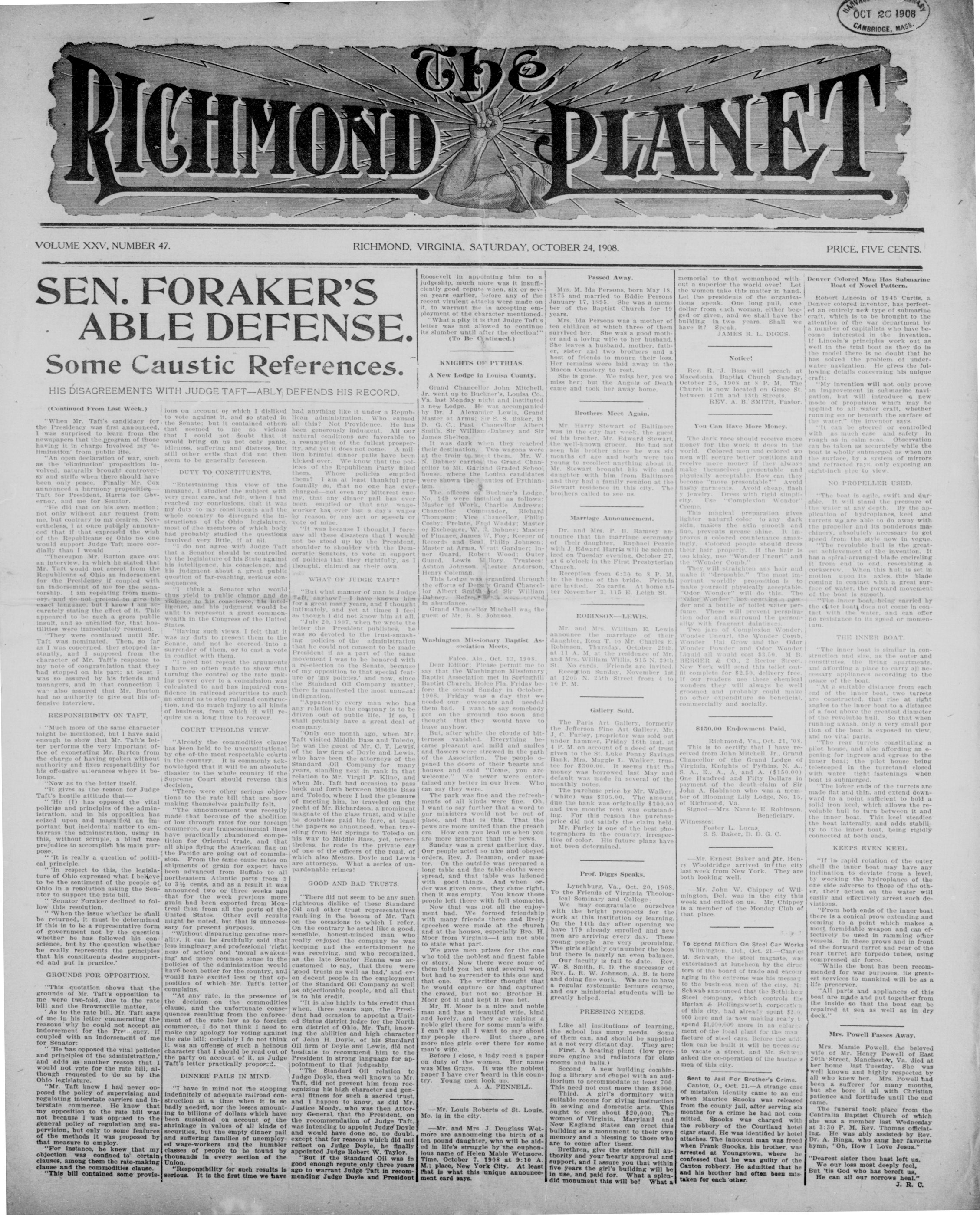
SEN. FORAKER'S ABLE DEFENSE. Some Caustic References.
HIS DISAGREEMENTS WITH JUDGE TAFT—ABLY DEFENDS HIS RECORD
VOLUME XXV, NUMBER 47
SEN. F
ABL
Some Ca
HIS DISAGREEMENTS WI
(Continued From Last Week.)
"When Mr. Taft's candidacy for the Presidency was first announced, I was surprised to learn from the newspapers that the program of those having it in charge involved my 'elimination' from public life.
"An open declaration of war, such as the 'elimination' proposition involved, naturally brought controversy and strife when there should have been only peace. Finally Mr. Cox announced a harmony proposition—Taft for President, Harris for Governor, and me for Senator.
"He did that on his own motion; not only without any request from me, but contrary to my desires. Nevertheless, I at once publicly announced that if that expressed the wish of the Republicans or Ohio no one would support Judge Taft more cordially than I would.
"Thereupon Mr. Burton gave out an interview, in which he stated that Mr. Taft would not accept from the Republicans of Ohio an indorsement for the Presidency if coupled with an indorsement of me for the senatorship. I am repeating from memory, and do not pretend to give his exact language, but I know I am accurately stating the effect of it. This appeared to be such a gross public insult, and so uncalled for, that hostilities were immediately resumed.
"They were continued until Mr. Taft was nominated. Then, so far as I was concerned, they stopped instantly, and I supposed from the character of Mr. Taft's response to my note of congratulation that they had stopped on his part; at least I was so assured by his friends and managers, and in that connection I was also assured that Mr. Burton had no authority to give out his offensive interview.
RESPONSIBILITY ON TAFT
"Much more of the same character might be mentioned, but I have said enough to show that Mr. Taft's letter performs the very important office of exonerating Mr. Burton from the charge of having spoken without authority and fixes responsibility for his offensive utterances where it belongs.
"Now as to the letter itself,
"Now as to the letter itself.
"It gives as the reason for Judge Taff's hostile attitude that—
"He (I) has opposed the vital policies and principles of the administration, and in his opposition has seized upon and magnified an important but incidental matter to embarrass the administration, using in this, without scruple, a blind race prejudice to accomplish his main purpose.
"It is really a question of political principle.
"In respect to this, the legislature of Ohio expressed what I believe to be the sentiment of the people of Ohio in a resolution asking the Senator to support the rate bill.
"Senator Foraker declined to follow this resolution.
"When the issue whether he shall be returned, it must be determined if this is to be a representative form of government not by the question whether he has followed his conscience, but by the question whether he really represents the principles that his constituents desire supported and put in practice."
GROUNDS FOR OPPOSITION
"This quotation shows that the grounds of Mr. Taft's opposition to me were two-fold, due to the rate bill and the Brownsville matter.
"As to the rate bill, Mr. Taft says of me in his letter enumerating the reasons why he could not accept an indorsement for the Prescription, if coupled with an indorsement of me for Senator:
"He has opposed the vital policies and principles of the administration," and adds as another reason that I would not vote for the rate bill, although requested to do so by the Ohio legislature.
"Mr. Taft knew I had never opposed the policy of supervising and regulating interstate carriers and interstate commerce. He knew that my opposition to the rate bill was not because I was opposed to the general policy of regulation and supervision, but only to some features of the methods it was proposed by that measure to employ.
"For instance, he knew that my objection was confined to certain clauses, among them the rate-making clause and the commodities clause.
"This bill contained some provis-
ions on account of which I disliked to vote against it, and so stated in the Senate; but it contained others that seemed to me so vicious that I could not doubt that it would bring on us not only panic, idleness, suffering and distress, but still other evils that did not then seem to be generally foreseen.
DUTY TO CONSTITUENTS.
"Entertaining this view of the measure, I studied the subject with very great care, and felt, when I had reached my conclusions, that it was my duty to my constituents and the whole country to disregard the instructions of the Ohio legislature, most of the members of which body had probably studied the questions involved very little, if at all.
"I do not agree with Judge Taft that a Senator should be controlled by the legislature of his State against his intelligence, his conscience, and his judgment about a great public question of far-reaching, serious consequences.
"I think a Senator who would thus yield to public clamor and deviance to his conscience, his intelligence, and his judgment would be unfit to represent a great commonwealth in the Congress of the United States.
"Having such views, I felt that it was my duty to present them to the Senate, and not be coerced into a surrender of them, or to cast a vote in conflict with them.
"I need not repeat the arguments I have so often made to show that turning the control of the rate making power over to a commission was calculated to and has impaired confidence in railroad securities to such an extent as to stop railroad construction, and do much injury to all kinds of business, from which it will require us a long time to recover."
COURT UPHOLDS VIEW
"Already the commodities clause has been held to be unconstitutional by one of the most respectable courts in the country. It is commonly acknowledged that it will be an absolute disaster to the whole country if the Supreme Court should reverse this decision.
"There were other serious objections to the rate bill that are now making themselves painfully felt.
"The announcement was recently made that because of the abolition of low through rates for our foreign commerce, our transcontinental lines have practically abandoned competition for Oriental trade, and that all ships flying the American flag on the Pacific are going out of commission. From the same cause rates on shipments of grain for export have been advanced from Buffalo to all northeastern Atlantic ports from 3 to $3\frac{1}{2}$ cents, and as a result it was announced two or three weeks ago that for the week previous more grain had been exported from Montreal than from all the ports of the United States. Other evil results might be noted, but that is unnecessary for present purposes.
"Without disparaging genuine morality, it can be truthfully said that less imaginary and professional 'rightness of action' and 'moral awakening' and more common sense in the policies of the administration would have been better for the country, and would have excited less or that opposition of which Mr. Tatt's letter complains.
"At any rate, in the presence of the decision on the commodities clause, and the unfortunate consequences resulting from the enforcement of the rate law as to foreign commerce, I do not think I need to make any apology for voting against the rate bill; certainly I do not think it was an offense of such a heinous character that I should be read out of the party on account of it, as Judge Taft's letter practically proposed.
DINNER PAILS IN MIND
"I have in mind not the stopping indefinitely of adequate railroad construction at a time when it is so badly needed, nor the losses amounting to billions of dollars which have been sustained on account of the shrinkage in values of all kinds of securities, but the empty dinner pail and suffering families of unemployed wage-workers and the humber classes of people to be found by thousands in every section of the Union.
"Responsibility for such results is serious. It is the first time we have
RICHMOND, VIRGINIA, SATURDAY, OCTOBER 24, 1908
had anything like it under a Republican administration. Who caused all this? Not Providence. He has been generously indulgent. All our natural conditions are favorable to a resumption of the fullest prosperity, and yet it does not come. A million brimful dinner pails have been kicked over. We know that the policies of the Republican Party filled them. Whose policies emptied them? I am at least thankful profoundly so, that no one has ever charged—not even my bitterest enemy, that any dinner pail has ever been emptied or that any wageworker has ever lost a day's wages by reason of any act or speech or vote of mine.
"It was because I thought I fore-saw all these disasters that I would not be stood up by the President, shoulder to shoulder with the Democratic Senators, to vote in support of policies that they rightfully, as I thought, claimed as their own.
WHAT OF JUDGE TAFT?
"But what manner of man is Judge Taft, anyhow? I have known him for a great many years, and I thought intimately, and yet at times I feel as though I did not know him at all." July 20, 1907, when he wrote the letter the President publishes, he was so devoted to the trust-smashing policies of the administration that he could not consent to be made President if as a part of the same movement I was to be honored with a re-election to the Senate, because of my opposition to that special feature of 'my policies,' and now, since the Standard Oil Company matter, there is manifested the most unusual indignation.
"Apparently every man who has any relation to the company is to be driven out of public life. If so, I shall probably have a great deal of company.
"Only one month ago, when Mr. Taft visited Middle Bass and Toledo, he was the guest of Mr. C. T. Lewis, of the law firm of Doyle and Lewis, who have been the attorneys of the Standard Oil Company for many years, standing next in rank in that relation to Mr. Virgil P. Kline, and when Mr. Taft had occasion to pass back and forth between Middle Bass and Toledo, where I had the pleasure of meeting him, he traveled on the yacht of Mr. Richardson, a prominent magnate of the glass trust, and while he doubtless paid his fare, at least the papers so announced, when traveling from Hot Springs to Toledo on his way to Middle Bass, yet, nevertheless, he rode in the private car of one of the officers of the road, of which also Messrs. Doyle and Lewis are attorneys. What a series of unpardonable crimes!
GOOD AND BAD TRUSTS
"There did not seem to be any such righteous dislike of these Standard Oil and other trust representatives ranking in the bosom of Mr. Taft on the occasions to which I refer. On the contrary he acted like a good, sensible, honest-minded man who really enjoyed the company he was keeping and the entertainment he was receiving, and who recognized, as the late Senator Hanna was accustomed to say, that there were 'good trusts as well as bad,' and even decent people in the employment of the Standard Oil Company as well as objectionable people, and all that is to his credit.
"It is also highly to his credit that when, three years ago, the President had occasion to appoint a United States district judge for the Northern district of Ohio, Mr. Taft, knowing the abilities and high character of John H. Doyle, of his Standard Oil firm of Doyle and Lewis, did not hesitate to recommend him to the President in strong language for appointment to that judgeship.
"The Standard Oil relation to Judge Doyle, then well known to Mr. Taft, did not prevent him from recognizing his high character and general fitness for such a sacred trust, and I happen to know, as did Mr. Justice Moody, who was then Attorney General, that the President, on the recommendation of Judge Taft, was intending to appoint Judge Doyle and would have done so, no doubt, except that for reasons which did not reflect on Judge Doyle, he finally appointed Judge Robert W. Taylor. "But if the Standard Oil was in good enough repute only three years ago to warrant Judge Taft in recommending Judge Doyle and President
Roosevelt in appointing him to a judgeship, much more was it insufficiently good repute when, six or seven years earlier, before any of the recent virulent attacks were made on it, to warrant me in accepting employment of the character mentioned.
"What a pity it is that Judge Taft's letter was not allowed to continue its slumber until after the election!"
KNIGHTS OF PYTHIAS
A New Lodge in Louisa County.
Grand Chancellor John Mitchell, Jr. went up to Buckner's, Louisa Co. Va. last Monday night and instituted a new Lodge. He was accompanied by Dr. J. Alexander Lewis, Grand Master at Arms; Sir S. S. Baker, D. D. G. C.; Past Chancellor Albert Smith, Sir William Dabney and Sir James Shelton.
It was dark when they reached their destination. Two wagons were at the train to meet them. Mr. W. N. Dabney carries the Grand Chancellor to Mt. Garland Graded School house, where the Louisa candidates were shown the beauties of Pythianism.
The officers of Buckner's Lodge, No. 149 were installed as follows: Master of Work, Charlie Andrews; Chancellor Commander, Richard Thompson; Vice Chancellor, Philip Cosby; Prelate, Fred Waddy; Master of Exchequer, W. S. Dabney; Master of Finance, James W. Foy; Keeper of Records and Seal, Philip Johnson; Master at Arms, Watt Gardner; Inner Guard, Robert Woolf; Outer Guard, Lewis Millory. Trustees: Ashton Johnson, Chester Anderson, Henry Coleman.
This Lodge was organized through the efforts of Depuy Grand Chancellor Albert Smith and Sir William Dabney. Referees were served in abundance.
Grand Chancellor Mitchell was the guest of Mr. R. S. Johnson.
Washington Missionary Baptist Association Meets
Falco, Ala., Oct. 13, 1908.
Dear Editor: Please permit me to say that the Washington Missionary Baptist Association met in Springhill Baptist Church, Holce Fla. Friday before the second Sunday in October, 1908. Friday was a day that we needed our overcoats and needed them bad. I want to say somebody got on the ground too soon and thought that they would have to leave anyhow.
But, after while the clouds of bitterness vanished. Everything became pleasant and mild and smiles and flowers were strewed in the path of the Association. The people opened the doors of their hearts and houses and said "Come, you are welcome." We never were entertained any better in our lives. Who can say they were.
The park was fine and the refreshments of all kinds were fine. Oh, I want to say further that a word to our ministers would not be out of place, and that is this. That the pews are more united than the preachers. How can you lead us when you are more ignorant than the pews.
Sunday was a great gathering day. Our people acted so nice and obeyed orders, Rev. J. Beaman, order master. On the outside was prepared a long table and fine table-cloths were spread, and that table was laden with good things. And when order was given come, they came right, then it was empty. You know those people left there with full stomachs.
Now that was not all the enjoyment had. We formed friendship with many friends there and lively speeches were made at the church and at the houses, especially Bro. H. Moor from Virginia—I am not able to state what part.
We gave men prizes for the one who told the noblest and finest fable or story. Now there were some of them told you bet and several won, but had to surrender to this one and that one. The writer thought that he would capture or had captured the crowd, but not so; Brother H. Moor got it and kept it you bet.
Mr. H. Moor is a nice and noble man and has a beautiful wife, kind and lovely, and they are raising a noble girl there for some man's wife. I can't say all I want to say about my people there. But there are more nice girls over there for some man's wife.
Before I close, a lady read a paper on duty of the women. Her name was Miss Grays. It was the noblest paper I have ever heard in this country. Young men look up.
A. A. FENNELL.
—Mr. Louis Roberts of St. Louis, Mo. is in the city.
—Mr. and Mrs. J. Douglass Wetmore are announcing the birth of a ten pound daughter, who will be aided in life's struggle by the euphonious name of Helen Mable Wetmore. Time, October 7, 1908 at 9:10 A.M.; place, New York City. At least that is what this unique announcement card says.
Passed Away
Mrs. M. Ida Persons, born May 18, 1875 and married to Eddie Persons January 17, 1895. She was a member of the Baptist Church for 19 years.
Mrs. Ida Persons was a mother of ten children of which three of them survived her. She was a good mother and a loving wife to her husband. She leaves a husband, mother, father, sister and two brothers and a host of friends to mourn their loss. Her remains were laid away in the Macon Cemetery to rest.
She is gone. We miss her, yes we miss her; but the Angels of Death came and took her away home.
Brothers Meet Again
Mr. Harry Stewart of Baltimore was in the city last week, the guest of his brother, Mr. Edward Stewart, the well-known grocer. He had not seen his brother since he was six months of age and both were too young to recollect anything about it. Mr. Stewart brought his wife and daughter with him from Baltimore and they had a family reunion at the Stewart residence in this city. The brothers called to see us.
Marriage Announcement.
Dr. and Mrs. P. B. Ramsey announce that the marriage ceremony of their daughter, Raphael Pearle with J. Edward Harris will be solemnized on Tuesday evening, October 27, at 6 o'clock in the First Presbyterian Church. Reception from 6:30 to 8 P. M. in the home of the bride. Friends are invited. No cards. At home after November 3, 115 E. Leigh St.
ROBINSON—LEWIS
Mr. and Mrs. William E. Lewis announce the marriage of their daughter, Rosa T. to Mr. Charles E. Robinson, Thursday, October 29th at 11 A. M. at the residence of Mrs. and Mrs. William Willis, 915 N. 29th St. No cards. Friends are invited. Recreation Sunday, November 1st at 1205 N. 25th Street from 4 to 10 P. M.
Gallery Sold
The Paris Art Gallery, formerly the Jefferson Fine Art Gallery, Mr. J. C. Farley, proprietor was sold out under hammer, Friday 16th inst. at 4 P. M. on account of a deed of trust given to the St. Luke Penny Savings Bank, Mrs. Maggie L. Walker, trustee for $300.00. It seems that the money was borrowed last May and default was made in several of the monthly notes.
The purchase price by Mr. Walker, (white) was $305.00. The amount due the bank was originally $300.00 and two months rent was outstanding. For this reason the purchase price did not satisfy the claim held. Mr. Farley is one of the best photographers in the country, irrespective of color. His future plans have not been determined.
Prof. Diggs Speaks
Lynchburg. Va., Oct. 20, 1908. To the Friends of Virginia Theological Seminary and College:
We may congratulate ourselves with the bright prospects for the work at this institution or learning. On the 14th day after opening we have 179 already enrolled and new men are arriving every day. These young people are very promising. The girls slightly outnumber the boys but there is nearly an even balance. Our faculty is full to date. Rev. W. S. Smith, B. D. the successor of Rev. L. R. W. Johnson, A. B is here and doing fine work. We are to have a regular systematic lecture course, and our ministerial students will be greatly helped.
PRESSING NEEDS
Like all institutions of learning, the school has many needs. Some of them can, and should be supplied at a not very distant day. They are: First. A heating plant (low pressure engine and radiators for classrooms and halls.) Second. A new building combining a library and chapel with an auditorium to accommodate at least 700. This need not cost more than $8000. Third. A girl's dormitory with suitable rooms for giving instruction in sewing and domestic arts. This ought to cost about $20,000. The women of Virginia, Maryland and New England States can erect this building as a monument to their own memory and a blessing to those who are to come after them. Brethren, give the sisters full authority and your hearty approval and support, and I assure you that within five years the girl's building will be in use, and paid for. What a splendid monument this will be! What a
memorial to that womanhood without a superior the world over! Let the women take this matter in hand. Let the presidents of the organizations speak. One long pull, one dollar from each woman, either begged or given, and we shall have the building in two years. Shall we have it? Speak. JAMES R. L. DIGGS.
Notice!
Rev. R. J. Bass will preach at Macedonia Baptist Church Sunday October 25, 1908 at 8 P. M. The Church is now located on Grace St. between 17th and 18th Streets.
REV. A. B. SMITH. Pastor
You Can Have More Money
The dark race should receive more money for the work it does in the world. Colored men and colored women will secure better positions and receive more money if they always make themselves presentable and physically acceptable. How can they become "more presentable?" Avoid flashy garments. Avoid cheap, flashy jewelry. Dress with rigid simplicity. Use "Complexion Wonder" Creme.
This magical preparation gives lighter natural color to any dark skin, makes the skin smooth and fine, prevents grease shine. It improves a colored countenance amazingly. Colored people should dress their hair properly. If the hair is too kninky, use "Wonder Uncurl" and the "Wonder Comb."
They will straighten any hair and make it "dressable." The most important worldly proposition is to make yourself physically acceptable. "Oder Wonder" will do this. The "Oder Wonder" box contains a powder and a bottle of toilet water perfume. These will prevent perspiration odor and surround the personality with fragrant daintings.
Two jars of Complexion Wonder
Wonder Uncurl, the Wonder Corub
Wonder Hal, Grow and the Odor
Wonder Powder and Odor Wonder
Liquid all would cost $2.50. M B.
BERGER & CO., 2 Rector Street,
New York will send this toilet outfit
complete for $2.50, delivery free.
If our readers use these chemical
wonders they will always be well
groomed and probably could make
no other expenditure so beneficial,
commercially and socially.
$150.00 Endowment Paid
Richmond, Va., Oct. 21, '08.
This is to certify that I have received from John Mitchell, Jr., Grand Chancellor of the Grand Lodge of Virginia, Knights of Pythias, N. A., S. A., E., A., A, and A. ($150.00)
One Hundred and Fifty Dollars in payment of the death-fall of Sir John A. Robinson who was a member of Blooming Lily Lodge, No. 15, of Richmond, Va.
Signed—Mrs. Nannie E. Robinson,
Beneficiary.
Witnesses:
Foster L. Lucas,
S. S. Baker, D. D. G. C.
—Mr. Ernest Baker and the Henry Wooldridge arrived in the city last week from New York. They are both looking well.
—Mr. John W. Chippey of Wilmington. Del. was in the city this week and called on us. Mr. Chippey is a member of the Monday Club of that place.
To Spend Million On Steel Car Works
Wilmington, Del. Oct. 21.—Charles
M. Schwab, the steel magnate, was
entertained at luncheon by the directors
of the board of trade and encouraging in the extreme was his message to the business men of the city. Mr. Schwab announced that the Bethlehem Steel company, which controls the Harlan & Hollingsworth corporation of this city, had already spent $2,000 here and is now making ready to spend $1,000,000 more in an enlargement of the local plant for the manufacture of steel cars. Before the addition can be built it will be necessary to vacate a street, and Mr. Schwab asked the co-operation of the business men of this city.
Sent to Lailah E. Benton
sent to Jail For Brother's Crime.
Canton, O., Oct. 21. A strange case of mistaken identity came to an end when Maurice Snooks was released from the county jail, after serving six months for a crime he had not committed. Snooks was charged with the robbery of the Courtland hotel cigar stand. He was identified by hotel attaches. The innocent man was freed when Frank Snooks, his brother, was arrested at Youngstown, where he confessed that he was guilty of the Canton robbery. He admitted that he and his brother had often been mistaken for each other.
PRICE. FIVE CENTS.
Denver Colored Man Has Submarine Boat of Novel Pattern.
Robert Lincoln of 1945 Curtis, a Denver colored inventor, has perfected an entirely new type of submarine craft, which is to be brought to the attention of the war department by a number of capitalists who have become interested in the invention. If Lincoln's principles work out as well in the trial boat as they do is the model there is no doubt that he has solved the problem of underwater navigation. He gives the following details concerning his unique craft:
"My invention will not only prove an improvement in submarine navigation, but will introduce a new mode of propulsion which may be applied to all water craft, whether running on or beneath the surface of the water," the inventor says.
"It can be steered or controlled with as much ease and safety in rough as in calm seas. Observation can be taken as accurately while the boat is wholly submerged as when on the surface, by a system of mirrors and refracted rays, only exposing an eight-inch pipe to view.
NO PROPELLER USED
"The boat is agile, swift and durable. It will stand the pressure of the water at any depth. By the application of hydroplanes, keel and turrets we are able to do away with the propeller and its ponderous machinery, absolutely necessary to get speed from the style now in vogue. "The revoluble hull is the greatest achievement of the invention. It has a spiral-arranged blade encircling it from end to end, resembling aorkscrew. When this hull is set in motion upon its axles, this blade coming in contact with a great surface of water, the forward movement of the boat is smooth. "The inner boat, being carried by the outer boat, does not come in contact with the water, and can offer no resistance to its speed or momentum.
THE INNER BOAT
"The inner boat is similar in construction and size, as the outer and constitutes the living apartments, and affording a place to carry all necessary appliances according to the usage of the boat.
"At a suitable distance from each end of the inner boat, two turrets are constructed, that rise at right angles to the inner boat to a distance of a foot above the greatest diameter of the revoluble hull. So that when running awash, only a very small portion of the boat is exposed to view, and no vital parts.
"The rear turrets constituting a pilot house, and also affording an opening for ingress and egress to the inner boat; the pilot house being telescoped in the turretand closed with water tight fastenings when boat is submerged.
"The lower ends of the turrets are made flat and thin, and extend downward to a point sufficient to hold a solid iron keel, which allows the revoluble hull to turn between it and the inner boat. This keel steadies the boat latterly, and adds stability to the inner boat, being rigidly connected at both ends.
KEEPS EVEN KEEL
"If in rapid rotation of the outer shell the inner boat may have any inclination to deviate from a level, by working the hydroplanes of the one side adverse to those of the other, their action on the water will easily and effectively arrest such deviations.
"From both ends of the inner boat there is a conical prow extending and coming to a point which makes a most formidable weapon and can effectively be used in ramming other vessels. In these prows and in front of the forward turret and rear of the rear turret are torpedo tubes, using compressed air force.
"While the boat has been recommended for war purposes, its greatest services to mankind will be as a life preserver.
"All parts and appliances of this boat are made and put together from the inside so that the boat can be repaired at sea as well as in dry dock."
Mrs. Powell Passes Away
Mrs. Mamie Powell, the beloved wife of Mr. Henry Powell of East 20th Street, Manchester, Va. died at her home last Tuesday. She was well known and highly respected by all who knew her. Mrs. Powell had been a sufferer for many months, but she bore it all with Christian patience and fortitude until the end came.
The funeral took place from the Centralia Baptist Church of which she was a member last Wednesday at 3:30 P. M, Rev. Thomas officiating. He was ably assisted by Rev. Dr. A. Binga, who sang her favorite hymn, "Oh, How I Love Jesus."
"Dearest sister thou hast left us. We our loss most deeply feel. But 'tis God who has bereft us. He can all our sorrows heal."
J. R. C.
THE SEVENTH
DERSON
BY
BEN M'CUTCHEON
COMPONENT 1905 BY BOBB MERRY COMPANY
TWO
SYNOPSIS
CHAPTER I.-Gerard-Chambers, son of a wealthy importer and a student at an eastern college, was awarded a membership in the Genghis Khan secret organization, founded by Grays. The society was exclusive, only seven being admitted. The members knew the meeting was held and each member was aware of the "call of destiny," which amounted to an assignment to test his metal.
CHAPTER II.-Chambers read his destiny to pass perplex as a sailor and not set for no longer for a year. Then he was directed to go to Mexico for further instructions which he him to another year's exile, during which he lived his own living unassisted, and keep everything a secret.
CHAPTER III.-Jerry then told his father his duty. He gained his elder's conscience. He gave Bayless, his father's choice for his wife, with the fact that he would be away two years. She left him angrily.
CHAPTER IV.-Young Chambers had a brief interview with sought again to prevent the boy's departure. Jerry obtained a berth as supercarbon on an ocean freighter. His father would seek the hand of Miss Bayless.
CHAPTER V.—Jerry sailed the follow-
bear morning on the Sister Mary. After
him that the boat was bound for Urania,
South America, loaded with guns for en-
mies of that government.
CHAPTER VI.—Sister Mary put in at
Fairfax orders regarding the
landing of guns, for given opportunity
to desert, passed it up.
CHAPTER VII.—Jerry landed the guns
at a Uranian cruiser hove in view. At
first the gun was chased, but escaped.
Chambers was captured and thrown
into a dungeon.
CHAPTER VIII.—Marina Boosts,
adopted daughter of Gen. Bostos, entered
Chambers. Each made a strong impression
the other. She was known as the "little saint
of Urania" because of her nursing.
CHAPTER IX.—Jerry, tried by Gen.
Bostos, came at sunrise
the following day. Upon arrival
rina's love, Cart. Pilore plured himself
to free Chambers. The trio dashed away
the night.
CHAPTER X.—Scheffler secured the
following day. Marina and Pilore de-
cided to join Gen. Barado's army, seek-
ing to withdraw the government. They
united the rebels, Chambers being
made a captive.
CHAPTER XI.-Capt. Pilaro died of fever. Marina accompanied his body to Boston. Gen. Raido then lay in wait for Boston in a Boston carriage. Jerry frustrated an attempt to assassinate Gen. Harado. Capt. Chambers was killed. Boston sword sword as a token of surrender.
CHAPTER XII.-Boston forgives his daughter, Marina. Her funeral was attacked and she was reported missing. Pamaro, capital of Urania, was murdered. Pamaro, capital of Urania, was murdered. Chambers was made much of. By that time Marina was given up as dead.
CHAPTER XIII.-Jerry was given a big reception by the Uranian public and swapped the Cross of Hono. He then forged a note to the president to Mexico City for further instructions.
CHAPTER XIV.-Capt. Chambers was honored aboard the steamer. He met Senor Lopez, a wealthy Uranian, and his daughter, who accompanied a terrapin storm when Jerry was being feted.
CHAPTER XV.-The steamer was dashed on the rocks, near Boston, drowning. Jerry saved himself and Senor Lopez, by clinging to a mast. Jerry's strange actions caused him to express the belief that she was demented.
CHAPTER XVI—After a long time on the rocks the party were rescued and conveyed to the boat. The boat later to catch a round-bound him. He recognized Marina Bostos, a passenger of a yacht sailing immediately for Marina, r. r. r. he gained the deck.
CHAPTER XVI—Chamberb was granted the privileges of a cruz. Cruz. He discovered that Marina was being held a prisoner on board, the preacher she was demented.
CHAPTER XVI—Fully passed prepared test of a possible interest in Marina, which plotter suspected. She got her a note and confided the whole copy to the American engineer, who promised aid.
CHAPTER XIX
Swimming, Shadowing, Scorching.
Soon after one o'clock in the morning of the 18th the lights in the dozing harbor of Vera Cruz appeared in view. A member of the crew told the excited and desperate Jerry that at the end of another hour the trim little craft would be at anchor half a mile out, and that a launch would take the four passengers in as soon thereafter as possible.
Jerry had not seen O'Connor for several hours, when he was told that the Cuba engineer was "still able to sit up and take nourishment."
"And he isn't down and out?" feverishly asked Jerry.
"I heard him groaning a while ago," significantly smiled the engineer, as he kept on polishing some of the nickel plating on the engine.
"Has the captain said anything to you?"
"Not a word."
"Then, good heavens, maybe he doesn't intend to!" half cried the almost frantic Jerry. While he fretted and moved nervously about, the engineer calmly kept on with his work, making the contrast of the two states of mind all the more pronounced by whistling a lively little Irish air.
Just before the anchor was thrown out the captain approached Jerry and ordered him to go below and awaken the Cuban engineer.
"Back again, I see," smiled Mike, as the white-faced Jerry came up to him.
"The captain wants the Cuban," came from the almost breathless son of The Gemini.
"Go over and wake him up, thin," said Mike.
Jerry went into the Cuban's room and violently shook the occupant of the bunk. Groans were the only response. His face was a sun of joy when he came out of the room, but before he could say a word to Mike the captain hurriedly came down the stairs.
"Why doesn't he hurry?" snapped the officer.
"I can't arouse him," said Jerry. "Seems to be sick, the way he groans and moans."
The captain went into the room and redoubled Jerry's efforts to awaken the man. Only more groans came from the engineer, and, with a string
of oaths that would shock the most hardened senses, the captain called out to Mike: "What's the matter with this fellow?"
"I don't know," answered Mike. "I heard him groaning a while ago, but guessed he was only havin' mean dreams."
The officer thought hard for a moment and then said to Mike: "You will run the launch in for us. Be ready in 15 minutes." Turning to Jerry, he growled: "There'll not be room for you in the launch. You will wait until daylight." Then he hastened to the deck.
"What shall I do? What shall I do?" cried Jerry, wringing his hands.
"You heard the captain."
"But I must get in—to-night. She may get away from you."
"Then, you'll have to make up a load and swim."
"I'll do that! I will, so help—"
"You don't mean that, Tommy," said the surprised Mike, dropping his chamois skin to the floor.
"I mean it if I ever meant a thing in my life. I can drop off and splash in some way. I'll make out for the nearest—"
"Tommy Flannery, your life would not be worth tin cints. It's far enough for an expert in the daytime, and there ain't a man that would attempt it at night."
"There is one man!" cried the desperate Jerry.
"Do you really mean to try it?"
"I do."
"Then grab off one of those preservers over there. It'll keep you afloat in case your legs give out, anyway."
Jerry took a cork preserver from a hook and hid it near the ladder, returning immediately to Mike, who was preparing to report to the captain.
"I'll keep my eye on them as long as I can, Tommy," said Mike, as he took Jerry's trembling hand. "If you ever get in, wait for me at the far end o' the pier, no matter how long I am gone. And God help you!" Before Jerry could give expression to his jumbled thoughts Mike O'Connor was moving briskly towards the stairs. Jerry then fastened the preserver to the top of the ladder. When he reached the forward part of the deck he was surprised to find that Marina and the strange woman already had gone down the side of the boat to the launch, and Mike was just stepping into the little boat. A minute or so later the launch was moving off in the darkness.
Jerry started away from the captain so abruptly and with such apparent excitement that the officer called him to hait.
"You seem to me in a great hurry to reach shore," said the captain.
"My poor brother, my poor brother!" wailed Jerry. "If there only had been room in that launch I could have—" "Your poor brother must wait till morning," said the captain, very determinedly.
Jerry, utterly unable to control himself, tugged to get away, and his actions thoroughly aroused the officer's suspicions. He succeeded in breaking loose, and immediately started madly towards the stern, the other in hot pursuit. Just as he reached the end of the cabin the infuriated captain threw his arms around him and brought his hands to his throat in an attempt to strangle him into submission. By an almost superhuman effort Jerry broke away from the tightening grip and hurled himself at the other with the ferocity of a maddened beast. The two grappled for a minute, the officer trying to cry out for help, and then fell to the deck. The officer was a big, powerful man, but he was no match for the desperate Jerry, who, after they had rolled over and over several times, succeeded in freeing himself. He was on his feet only an instant before the other, but the advantage gained was sufficient. Before the captain could protect himself Jerry's big fist crashed to his jaw and he sank to the deck unconscious.
Without waiting to see what effect the blow had had, Jerry was at the hatchway snatching the life preserver from its fastening. A moment later, after casting a final glance at the still body of the officer, he climbed over the rail and dropped into the black water.
Mike O'Connor's quick wits were hard at work the moment after Jerry announced his determination to leave the vessel that night and to risk his life in the waters of the harbor. After taking the launch in about 100 yards he suddenly stopped the machinery and appeared to be worried.
"Come, come, man," impatiently said Andre, who sat nearest him. "Why do you not go on?"
"The propeller is balking," answered Mike, seeming to concentrate his whole attention to a part of the machinery. His sole purpose in stopping the machinery was to afford Jerry all possible time before effecting a landing. The delay was not as long as he intended it should be, for the impatient, nervous Andre touched the wheel that set the propeller in motion again.
Mike made no excuse, but his wits were working harder than ever. He was as familiar with the waters and the dockage of Vera Cruz as any sailor that came to them, but this time he determined to make his memory failing. Instead of drawing up at the proper pier he nosed the boat into an adjoining slip, discovering the "mistake" only after he had gone 25 yards. He exercised undue caution in swinging the launch around and in picking his way to the right landing place,
THE RICHMOND PLANET, RICHMOND, VIRGINIA.
which, judging from the conversation, was familiar to Andre. As he brought the boat to a stop, he figured that he had unaccessible consumed about 20 minutes. He also knew, however, that Jerry had not had time to reach the pier, and there was a feeling deep in his heart that he would not succeed in getting to shore at all.
Andre and Felipe appeared very nervous as they landed, each continually casting his eyes about and scanning the faces of the few men at the landing. Mike assisted in taking some luggage to the end of the pier, where a closed carriage was in waiting. There was no other vehicle in sight, and the quick-thinking Irish-American, unable to hear the instructions given the driver, noted the color of the horses and got a good look at the man on the box. Andre gave Mike a coin, and the next moment the horses were clattering down the dark, narrow street.
Mike waited in the shadows at the end of the pier for more than two hours, and he was beginning to fear all the more that Jerry had not succeeded in reaching shore when he saw a small boat draw up at the landing. He got farther back in the shadows, for he knew that the boat was from the yacht. Presently the captain and a member of the crew walked briskly down the pier, stopping and looking about within 20 feet from where he was hidden.
"He's had more than plenty of time to get back," fumed the captain, who wore a bandage over his eye, "and he is in league with that other fellow. What a damned fool I was to trust an American!"
The conversation that followed indicated to Mike that the jackle was in the captain's confidence.
"You know where they went from here?" asked the jackle.
"To a house in Celle Cordoba, I think," said the officer. "I don't know where it is, and it will be impossible for me to see them until they keep their appointment with me to day." Mike O'Connor determined not to lose sight of the captain, but a few minutes later the officer and his man returned to the yacht. Mike watched them until he saw them going over the side of the vessel, and then ventured from his hiding place, just in time to see the dripping Jerry coming towards him.
"Thank God, you're saved, anyway!" exclaimed Mike, drawing him into the shadows and embracing him. Jerry was so exhausted that he could not speak for a minute or two, and it was not until Mike had gone down the street to an "all-nighter" and procured some whisky, of which Jerry partook freely, that he told of his death-inviting swim. The excitement that was aroused within him by the story told by Mike gave him new strength.
It was agreed that the thing to do was to await the captain and to shadow him to the place where he was to meet Andre and Felipe. In the meantime, one at a time, they bought suits of cheap clothing and ate breakfast at a little restaurant near the pier.
Five o'clock in the afternoon rolled around, but the captain had not left the yacht, so far as they knew, and there scarcely a moment that the eyes of one or the other were not on the boat. The waiting wore heavily on the shattered nerves of Jerry, but there was nothing else to do but wait. Mike tried to find the driver of the carriage, but he saw nobody that resembled him.
Towards six o'clock the captain came ashore, the man who rowed him in returning immediately to the yacht. Jerry, hidden with Mike behind a great pile of boxes, actually smiled when he beheld the bandage over his eye.
"That's what he got for getting gay," said he. The next moment he thought nothing of the fight he had had with the officer, who walked briskly to a small store across the street. He stood in the doorway fully 15 minutes, looking in the direction of thepler, and Mike and Jerry did not dare to move. Presently, after looking at his watch, he called a cab and soon was being driven in a direction opposite from that taken by the four in the carriage. The cab turned at the first corner, and Jerry and Mike fairly ran to the only other vehicle in sight, a ramshackle cab with a sleepy driver on the seat. "Keep a block behind the cab that just left," snapped Jerry, "and if it stops, you stop. You get five times the regular price."
The driver ran his horse in a full gallop to the next corner, and when he got into the cross street Jerry, bubbling over with fear and apprehension, opened the door and looked out. The captain's cab was a little more than a block ahead. It may have occurred to the officer that he was being followed, for the route taken by his driver was long and zigzaggy. The chase was kept up successfully, and Jerry directed his driver to turn up another street a few yards and stop. He got out of the cab and ran to the corner. The captain's cab was two blocks away now, and Jerry could distinguish the driver in the act of welding his whip.
"After him, after him!" cried Jerry, running back to the cab.
Just as he was about to re-enter the vehicle a thought struck him so forcibly that he had to reach for the wheel to support himself.
"Good heavens, Mike!" he exclaimed, his face without a drop of color in it, "what time is it?" Mike, wearing an expression of great surprise, pulled out his watch and said: "Eight thirty-five." Jerry simply gasped. "Driver, where are we?" he managed to ask. "In Calle Morelia." "How far is it to the station of the National line?" "About four miles." "God!" and Jerry brought his hand to his forehead.
"Why—what—" began the bewildered O'Connor.
—Subscribe to The PLANET.
"Keep after him. Mike, and telegraph me at at—— Calle Coliseo, Mexico, to-morrow without fall! I can't stop to tell you anything now, old man, but follow, follow, follow!" The next instant Jerry Chambers was running down the street, not knowing whether he was going in the right direction or not, and before he had covered 25 feet the driver was receiving instructions from Mike to keep after the captain's cab.
CHAPTER XX
Just how Jerry Chambers managed to reach the station of the National line in time to catch the train for the City of Mexico he never was able to explain fully. He simply gave Luck the entire credit for his success.
Once on that train, which began to steam out just as he fell into a seat, a thoroughly exhausted creature, he breathlessly ran his eyes over a timetable. Calculating that the train would arrive in the City of Mexico according to schedule, he figured that he would have one hour in which to reach the number in Calle Coliseo. He felt that Luck would not desert him now, and he worried but little about the train's being on time.
His heart grew cold at the thought that perhaps Mike O'Connor would not continue to follow the captain of the yacht, and that the mysterious trio would succeed in spiriting Marina beyond his ultimate reach.
"If I only had had another day," he thought, mentally cursing the luck that had stood by him so valiantly, "I could have rescued her. Mike O'Connor may keep on the trail, and he may not. Still, I believe that the spirit of adventure in him will serve me well. He does not dare return to the yacht; the captain would make short work of him if he did. The task is all the harder now, for the captain will apprise the kidnappers of their danger, and the chances are they will be able to elude Mike, however vigilant he may be. Damn a Gemini's luck, anyway!"
It was not until the train was waiting at Jalaya for a connecting train that was 15 minutes late that he pailed at the doubt of reaching the place in Calle Colisco before noon of the next day.
When the train finally did pull out, a quarter of an hour behind the scheduled time, he experienced great relief, and his hope rose high when a trainman gave him reasonable assurance that there would be no further loss of time, and that the engineer probably would make up the lost time on the straight stretches of track ahead. But there was new worry ahead of him.
On the outskirts of the City of Mexico the corner of a small house being moved from one lot to another was still on the track, and another 15 minutes was lost before the train could proceed. Jerry had but 20 minutes in which to go from the station to the place in Calle Coliseo, and when he learned that the distance was more than three miles he scarcely could control himself. Of the six or eight cabs lined up at the station he jumped into the one whose horse looked the fastest and urged the driver to stop at nothing in taking him to the specified number.
When the pasting, lathered horse was suddenly brought to a halt and Jerry saw that he was at the place, the clock in a tower a few blocks away indicated two minutes before noon. He tossed what remaining money he had at the driver and rushed into the building, over whose door nung the sign; "Thomas Worthway, Assayer."
It was a small, narrow room, in which there were but two desks. At the first desk set a gray-haired man of about 60 years, and, as Jerry came up to him, scarcely able to a werd out of his mouth, the man smiled and nodded his head significantly.
"Is there a letter here for Rodney Graves?" Jerry panted.
Without a word the man, who later introduced himself as Thomas Wentworth of The College class of '64 and who wore on the lapel of his coat the Pin of the Twins, handed Jerry a long envelope addressed to Rodney Graves.
Mike O'Connor told the driver of his cab that if he did not keep the captain's cab in sight, he would be trounced to within an inch of his life.
Mike steadily gaited on the captain, and it was not long before he was only a block and a half behind. Then, seeing the captain's cab draw up to the curbing, Mike directed his driver to turn into a side street. He immediately dismounted and peeped around the building on the corner. The captain stood in the middle of the side-
A
walk fully a minute before he sent his driver away, and kept casting glances up and down the street for several minutes before he went to the door of
the house. Mike knew Vera Cruz well enough to find his way around, and he told his man to drive on a few blocks and wait. Then he went to the other side of the street and, moving cautiously in the darkest shadows, soon was almost opposite the house which the captain had entered. The faint light over the door revealed a number he had heard the officer mention at the pier.
The house stood in the middle of a yard, and Mike was able to see three sides of it. The only light visible shone through a rear basement window. Mike O'Connor was a brave man, but when he thought of stealing through the shadows to that window a chill flashed over his sturdy frame. This thought came only after he had waited almost two hours.
"They ain't comin' out to-night," he said to himself, "and what's goin' on in there is enough to fill a book. Tommy wouldn't stop at it, and I'll be damned if I do!" Gripping his revolver and setting his teeth in Irish determination, he stealthily picked his way to the yard and crept to the window, which was open. He crawled to a position from which he could look into the room. He saw Andre, Felipe, the captain and an old man wearing a white beard.
"Then, we must get out," be heard Andre say, desperately, "and there is no time to lose. We must not take the train in the city, but at some place outside."
"The fast train can be stopped at Blanco del Oro," said the captain, "if there are at least five persons in the party."
"Riaz here will make the fifth," said Felipe. "What time does the train reach there?"
"it's a run of two hours from here," answered the captain.
"How far to Jimenez?"
"Between 30 and 35 hours from Mexico. The rest of the way must be in a wagon or boat, as Riaz knows, and it should be covered in 24 hours easily."
Mike O'Connor waited no longer. He thought of having the house surrounded by the police, but the time it would take to get the required response from the authorities would be too long. He arrived in the business section of the city soon after daybreak and went into a private stall of a small eating house. He had intended remaining there only long enough to drink a cup of coffee and eat some bread, but he was tired and fell asleep. When he awoke it was after ten o'clock. The thought of communicating with Jerry Chambers was the first to enter his mind, and he hastened to a telegraph office and sent the following message to "Tom Flannery":
"Located them. Watch train into Mexico. Mike is coming."
CHAPTER XXI
Into Another Year of Uncertainty.
Jerry put the envelope into his pocket, for the instructions he had received from the black sack of destiny in the darkness of the chamber a year before gave him an hour in which to acquaint himself with its contents.
Mr. Wentworth, a quiet, pleasant gentleman, had been in Mexico for more than 15 years, and it had been said that but few knew more about the mines and mining possibilities of the country than he. He showed much interest in Jerry, but not once did he touch upon the sacred subject of his experience in the twelvemonth just ended.
"That envelope," said he, "was in my keeping for almost a year, having come from New York, and it has been in my safe until this very morning. I trust that you will have luncheon with me to-day and that, if conditions are favorable, you may see your way clear to spend a few days at my home."
It was about 12:30 o'clock when a messenger boy entered the office. He handed Mr. Wentworth a telegram, which was immediately returned to him, with:
"Wrong address; there is no such person here."
The lad was closing the door after him when it suddenly occurred to Jerry that he had asked Mike O'Connor to wire him at that number.
"Was that for me?" he asked.
"No; it was for Tom Flannery. There is no such fellow—"
"Great Scott, that's meant for me!" exclaimed Jerry, as he started after boy. He could not conceal his uneasiness and intense interest after he had read Mike's short message, and the old Gemini plainly noticed his perturbed condition.
"Important news, I daresay," said Wentworth.
"By jingo, but he's a brick!" said the dancing-eved Jerry. "He's constructed of the right material, that fellow is. I felt deep down in my heart all along that he would be 'Johnny on the spot,' and —"
"A brick—right material—Johnny on the spot?" bckee in the wondering Mr. Wentworth.
Jerry colored as he stammered something that was intended for an explanation, but which only served to mystify the other all the more.
"I think you need a cup of strong coffee," smiled Wentworth. "so we'll go out to luncheon now." He had not risen from his chair before Jerry floundered:
"Really, Mr. Wentworth, you'll have to excuse me to day. I am tremendously obliged to you, but you see—I that is, but I had a late breakfast, and I'm not a bit hangry. What time do the trains get in?"
"Trains—what trains?"
"From Vera Cruz, of course. Are there many of them, and which is the first?"
"Well, really, brother. I am not familiar with the time of train arrivals and departures. But I shall insist that you come along right away for a cup of coffee."
The clock over the desk indicated 12:40.
"All right," said Jerry, as pleasantly as possible, but he really wanted to be away from his elderly fraternity brother.
They were at a table in a near-by eating house when he suddenly thought of the time. Mr. Wentworth's watch showed 12:58.
"Thunder!" exclaimed Jerry. "You'll excuse me _ won't you?" he man-
aged to smile, as he snatched the envelope from his pocket. Twelve $50 United States of America gold certificates fell from the folded sheet of paper to the table.
"Well, well," said Mr. Wentworth;
"that is welcome news. I trust that the letter is quite as—"
"Walt a second," broke in Jerry, for he had only a minute in which to read those instructions. As his eyes hastily passed over the lines his face paled and his chin dropped. For a moment he simply stared at the other.
"I hope there is nothing—" solicitously began Wentworth.
"For heaven's sake!" Jerry burst out, cold moisture forming on his brow.
"Well, well?"
"Great Scott!"
"Yes—well?"
"This is the limit!"
Mr. Wentworth merely looked at him, the picture of intense interest. Jerry, his brow knit, re-read the instructions, and then laughed feebly. "It's none of my business, of course?" said Wentworth. "No; but I'd give 17 times the amount of those bills if it were all your business. What the devil do I know about it? You know all about it." Jerry, practically devoid of all socialability, left Mr. Wentworth at the next corner, promising to return to his office not later than six o'clock. He walked for several blocks down the street, oblivious to all surroundings, and then turned into a quiet saloon, where, at a table at the end of the room, he re-read these instructions: "Ye Person of The Gemini, ye have performed well, the spirit of Rodney Graves knows ye have performed well. But ye have not yet earned an enduring right to your priceless Personality. Ye must, ye are we are told herein to the best of your ability."
"Go ye forth to the City of Escalon,
State of Chihuahua, Republic of Mexico,
where, at the office of the
Mining Company
Calle Gomez, ye shall inquire for an
envelope addressed to Rodney Graves. The
contents of this envelope will give ye
further instructions.
Ye shall possess the envelope
not later than 40 hours after 12
o'clock (noon) of the nineteenth day of
June, 1893.
"Ye Person of The Gemini, ye have
been given life on the land and on the
waters of the earth. Ye possess the
sphere beneath the surface of the
earth. That ye may know the spirit of your
beloved Gemini to be munificent, ye may
have with ye one companion, whomso-
mone may know, ye may possess the
may arise, shall not know the true
purpose of your mission. Ye must keep
inviolably secret these instructions
and all instructions to follow.
Ye shall possess the Gemini Grave guide
ye well and the values of all Gemini give
ye unbounded courage."
Jerry tried to procure a railroad time table at the saloon, but was unsuccessful. Then he set out for a railroad office. As he walked briskly down the street, unconsciously bumping into pedestrians, his brain was in a stew.
"I wonder where in the devil this Escalon is, anyway," he thought.
There were several persons in the railroad office when Jerry, pushing his way to the desk, asked the agent:
"Where is Escalon?"
"A little more than 800 miles on our main line—north."
"Eight hundred miles!" gasped Jerry, his manner attracting the attention of everybody in the office. "How long, for heaven's sake, does it take to get there?"
"Our fast train makes it in a little less than 30 hours," answered the wondering agent.
"Thirty hours, eh? Well, that'll give me ten hours to spare, won't it? And—"
"Ten hours to spare—I don't understand—"
"That'll be all right," snapped Jerry; "of course you don't understand. What time can I get a train?"
"Our next train leaves at five this afternoon."
"Gee, that clips five hours off the ten, doesn't? But it still gives me plenty of time, anyway."
He bought a ticket and arranged for sleeping-car accommodations, the agent accepting payment out of one of
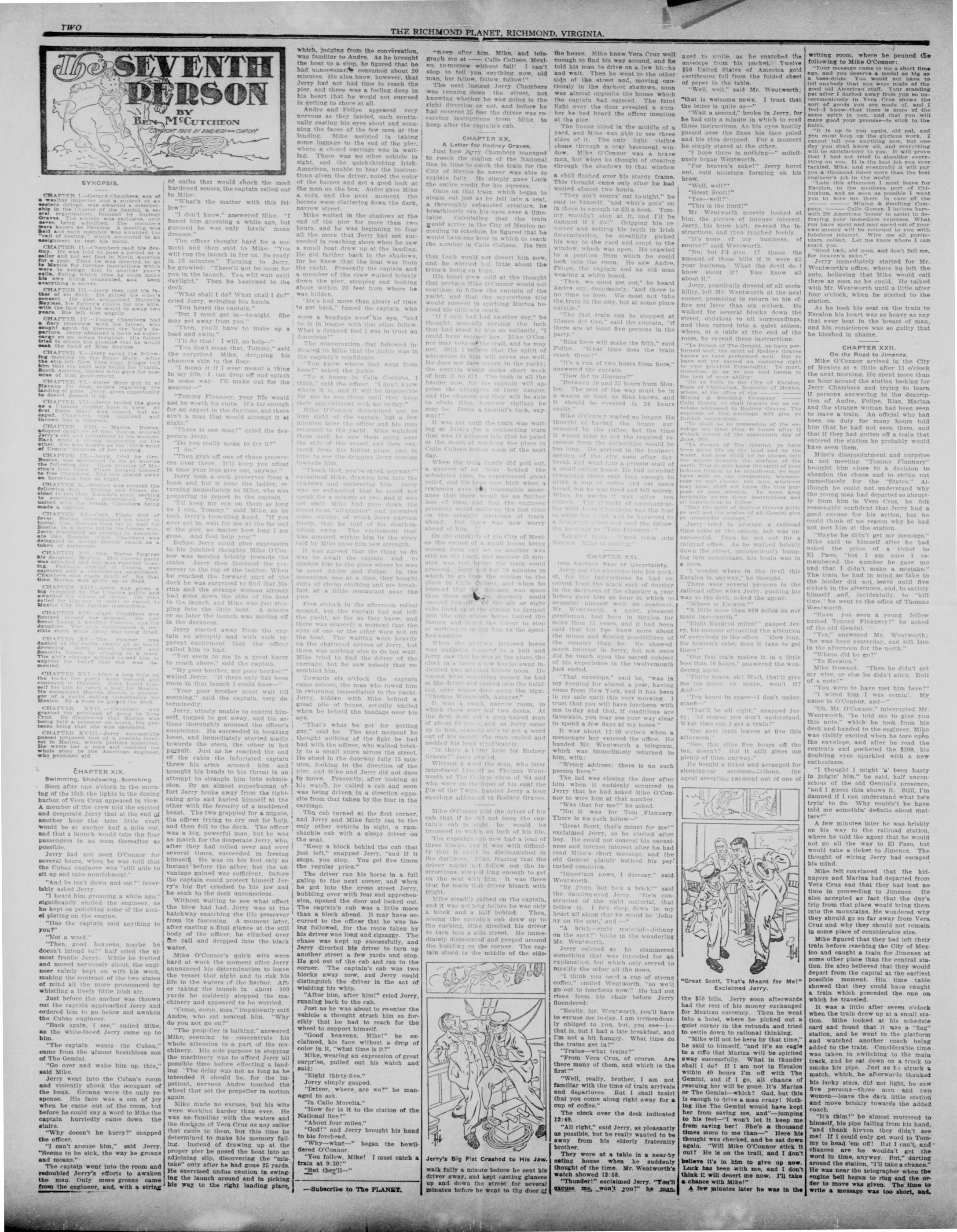
A man in a suit is being pushed by a boy in a uniform. A man in a suit is being pushed by a boy in a uniform.
"Great Scott, That's Meant for Me!"
Exclaimed Jerry.
the $50 bills. Jerry soon afterwards
had the rest of his money exchanged
for Mexican currency. Then he went
into a hotel, where he picked out a
quiet corner in the rotunda and tried
to settle down to rational thinking.
"Mike will not be here by that time," he said to himself, "and it's an eagle to a rifle that Marina will be spirited away successfully. What in thunder shall I do? If I am not in Escalon within 40 hours I'm off with The Gemini, and if I go, all chance of rescuing her will be gone. It's Marina or The Gemini—which? Gad, but this is enough to drive a man crazy! Nothing like The Gemini would have kept her from saving me, and"—jumping to his feet—"I won't let it keep me from saving her! She's a thousand times more to me than"—Here his thought was checked, and he sat down again. "Will Mike O'Connor stick it out? He is on the trail, and I don't believe it's in him to give up now. Luck has been with me, and I don't think it will desert me now. I'll take a chance with Mike!"
A few minutes later he was in the
writing room, where he penned the following to Mike O'Connor:
"Your message came to me a short time ago, and you deserve a medal as big as a bass-drum. You would not have to tell anybody that you were made of the same spirit as you did. You pat after I dashed away from you so uneconomically in Vera Cruz shows the sort of goods you are made of, and I feel—I know—that there is more of the same spirit in you, and that you will good your promise—to stick to the finish.
"It is up to you again, old pal, and you must keep up the glorious work. I cannot tell you anything now, but one thing is certain: you will be satisfactory to you. It will prove that I had not tried to shoulder everything on you. It is the best job you ever tackled. Mike, and eventually it will pay off."
"Late this afternoon I must leave for Escalon, in the southern part of Chihuahua, and as soon as possible I want you to wire me there, in care of the Mining & Smelting Company, _____. Clearly I close here with 200 American 'bones' to assist in defraying your immediate expenses. What you have spent and may spend out of your own money will be returned to you with fabulous interest. Wire me all particulars, collect. Let me know where I can re-read, "Good task, old man, and don't fail me, for heaven's sake."
Jerry immediately started for Mr. Wentworth's office, where he left the note, believing that Mike would call there as soon as he could. He talked with Mr. Wentworth until a little after four o'clock, when he started to the station.
As he took his seat on the train to Escalon his heart was as heavy as any that ever beat in the breast of man, and his conscience was so guilty that he blushed in shame.
CHAPTER XXII.
Mike O'Connor arrived in the City of Mexico at a little after 11 o'clock the next morning. He spent more than an hour around the station looking for Jerry Chambers and trying to learn if persons answering to the description of Andre, Felipe, Riaz, Marina and the strange woman had been seen to leave a train. An official who had been on duty for many hours told him that he had not seen them, and that if they had gotten off a train that entered the station he probably would have seen them.
Mike's disappointment and surprise in not meeting "Tommy Flannery" brought him close to a decision to abandon the chase and to strike out immediately for the "States." Although he could not understand why the young man had departed so abruptly from him in Vera Cruz, he felt reasonably confident that Jerry had a good excuse for his action, but he could think of no reason why he had not met him at the station.
"Maybe he didn't get my message." Mike said to himself after he had asked the price of a ticket to El Paso, "but I am sure I remembered the number he gave me and that I didn't make a mistake." The train he had in mind to take to the border did not leave until five o'clock in the afternoon, and, to satisfy himself and, incidentally, to "kill time," he went to the office of Thomas Wentworth.
"Have you seen a young fellow named Tommy Flannery?" he asked of the old Gemini.
"Yes," answered Mr. Wentworth; "he was here yesterday, and left late in the afternoon for the north."
"Where did he go?"
"To Escalon."
Mike frowned. "Then he didn't get my wire, or else he didn't stick. Hell of a note!"
"You were to have met him here?" "I wired him I was comin'. My name is O'Connor, and—"
"Oh, Mr. O'Connor," interrupted Mr. Wentworth, "he told me to give you this note," which he took from his desk and handed to the engineer. Mike was visibly excited when he tore open the envelope, and after he read the contents and pocketed the $200, his doubting eyes sparkled with a new enthusiasm.
"I thought I might 'a' been hasty in juggin' him," he said, half unconscious of the old Gemini's presence, "and I guess this shows it. Still, I'm damned if I can understand what he's tryin' to do. Why couldn't he have told me somethin' definite about matters?
A few minutes later he was briskly on his way to the railroad station, where he told the agent that he would not go all the way to El Paso, but would take a ticket to Jimenez. The thought of wiring Jerry had escaped his mind.
Mike felt convinced that the kidnapers and Marina had departed from Vera Cruz and that they had lost no time in proceeding to Jimenez. He also accepted as fact that the day's trip from that place would bring them into the mountains. He wondered why they should go so far away from Vera Cruz and why they should not remain in some place of considerable size.
Mike figured that they had left their train before reaching the City of Mexico and caught a train for Jimenez at some other place than the central station. He also believed that they would depart from the capital at the earliest possible moment. His time table showed that they could have caught a train which preceded the one on which he traveled.
It was a little after seven o'clock when the train drew up at a small station. Mike looked at his schedule card and found that it was a "flag" station, and he went to the platform and watched another coach being added to the train. Considerable time was taken in switching to the main track, and he sat down on a truck to smoke his pipe. Just as he struck a match, which, he afterwards thanked his lucky stars, did not light, he saw five persons—three men and two women—leave the dark little station and move briskly towards the added coach.
"It's thim!" he almost muttered to himself, his pipe failing from his hand, "and thank hivven they didn't see me! If I could only get word to Tommy to head 'em off! But I can't, and chances are he wouldn't get the word in time, anyway. But," darting around the station, "I'll take a chance." He was near the telegrapher when the engine bell began to ring and the order to move was given. The time to write a message was too short, and.
THE SUNNET
pulling his hat down over his eyes, he ran to the train.
The first thought that flashed across his mind after he was aboard was that either Andre or Fellpe would go through the train with eyes fitted for either him or Jerry. The train had not proceeded far before he was talking with the conductor.
"I'd give almost anything to ride on an ingine." said he. "I'm an engineer myself, but I've never seen the workin's on a locomotive afore. Is it possible for me to get in the cab?"
"It's in violation of an iron-bound rule for any passenger to ride in the cab," said the conductor.
"I'll tell you what I'll do," said Mike; "Till give you the price of a suit of clothes if you can fix it for me." He drew a crisp note from his pocket and held it so that the poorly paid official could feast his eyes on it.
"I'll see what I can do for you," said the conductor, as he moved towards the engine. Mike followed him to the door and whispered in his ear:
"Try to get me on right away; I want to see things when it ain't too dark."
Mike had just settled into a seat when the rear door of the coach opened. He drew his hat down over his eyes and appeared to be asleep, but he managed to cast a glance down the aisle. Wearing a cap well down over his eyes Andre came towards him. The stranger drew a glassful of water from the tank at the forward end of the car and then dropped into the fourth or fifth seat, three seats from Mike. He took a paper from his pocket and began to read as the conductor re-entered the coach. The official, a smile of pleasant anticipation on his lips, went to Mike and whispered: "I've fixed it. Come right along."
"Sh-!' I've got a pain in my stomach now, and I think I'll wait till it's gone. I'll be there all right."
Fifteen minutes later Andre, his cap on the back of his head and his face wearing an expression of confidence, slowly went out of the coach.
"A pretty detective!" smiled Mike, as he sat up and pushed back his hat. "You won't always be gone" about with your cap on the back o' your head, my dandy, I can tell you that. Your name's what my father's was!"
Riding on a locomotive was not a novelty to Mike O'Connor, for he had "run" engines in the United States in his earlier days, and when he went to the cab the sensations were not strong enough to keep him from concentrating his whole mind on plans for the failure. When he returned to the coach, after midnight, with an "invitation" to come back to the cab any time, he had decided to follow the five as far as he could out of Jimenez, to find out their hiding place, if possible, and then to communicate with "Tommy."
When the train reached Escalon he looked around for jerry, and, while he would have given much to see him, he was glad that he was not at the station. Numerous delays added half a dozen hours to the running time, and Jimenez was not reached until after nightfall. Mike was on the front platform when the train came to a stop at the station, and, after giving the engineer a bill, he got off and hastened to a building 50 feet away, stationing himself where he could see the full length of the platform. He remained there until the train pulled out, and, to his great surprise, he had not seen the five occupants of the last coach get off. But as the last car swept past him he saw a carriage moving away from the other side of the track.
He ran to the end of the platform and cast his eyes after the vehicle, which soon was lost in the darkness. Then, not knowing what course to take, he approached a policeman and asked where the street led to.
"To the mountains," was the answer. "The city's down the other."
"It doesn't ordinarily meet trains," was the answer. "Why did you want to know?" "I thought maybe an old friend o'mine—Aurello Zacate—was drivin'. I have come all the way from the south to see him, and the last I heard o' him he was drivin' a rig here."
Before Mike had thought of hiring a cab and following the carriage the officer said something about its being one of the only two vehicles of the kind in the city. Knowing that he could do nothing further that night, he sat down on a box and engaged the officer in conversation. The policeman was a willing talker, for Mike had a bottle of extra fine whisky, which he extended often to him.
They had conversed fully an hour, when a carriage came towards them. "That's the carriage," said the policeman. "Is that your friend driving?"
"Aurello didn't wear a mustache when I saw him last," said Mike. "and he didn't appear so skinny. The carriage couldn't have gone very far."
"No; perhaps not farther than the river—the Florida. Perhaps the people in the carriage took a small boat down the river. Many folks spend the hot weather down there."
"Any particularly attractive spots down the river?"
"Some beauties, but I don't think I'd go down there. Fifty miles southwest is pretty tough. We know of several gangs that have headquarters down that way, but we've never been able to locate them."
"There's a good deal o' minin' around here, aln't there?"
"Yes; and northerners seem to be crazy about finding a mine that was lost in a landslide 100 years ago down that way. But it's time thrown away and money wasted for the end of the rainbow. The mine—the San Dimas—may be down there, and it may not. There's a story that it was the best pro-
J.
He Ran to the End of the Platform and Cast His Eyes After the Vehicle.
ducer in all Mexico 200 years ago, but what's left of it now is buried so deep that all the steamshovels in the universe could not get at it."
When Mike went to a cheap hotel that night he felt certain that the five had taken a boat for some point down the river, and, recalling that the captain of the yacht had mentioned a trip of about 24 hours, he calculated that their destination must be far down the stream. He also decided that he could accomplish but little alone, and that the first morning train should have him as a passenger back to Encalon, where he would try to locate "Tommy Flannery" and apprise him of the development.
(TO BE CONTINUED.)
Too Formal for "Fighting Bob."
An officer who was with Admiral Evans at San Francisco writes home that he was one day talking with "Fighting Bob" when a petty officer appeared on the scene. The under officer, not recognizing the two, came blustering up with, "Say, do you know where I can find Evans?" The admiral gazed up at him quietly a moment and exclaimed: "Oh, don't bother about being so formal. Just call me Bob."
World's Newspapers
There are 12,500 newspapers published in the United States; about 1,000 of them are published daily and 120 are managed, edited and published by negroes. In Asia there are 3,000 periodical publications, of which the greater part appear in British India and Japan; the latter country publishes 1,500 newspapers. Africa has only 200 newspapers, of which 30 are published in Egypt and the rest appear in the European colonies.
He Got the Booty
A laborer named Christiansen, who lives at Copenhagen, bought an old overcoat for a few cents two years ago. He recently noticed something hard in the lining at the back, and, on regretfully cutting it open, discovered a savings bank book with $2,230 credited. He reported the treasure to the police, but they have not been able to find the original owner, and the money has been awarded to the laborer.
Centenarian "Children."
In recently published reports of the fair which took place at the Home of the Daughters of Jacob, New York, mention is made of the chief usher, a "lad" aged 105 years, and of the "girls" who sold candy and lemonade, although they were only 103 and 105 years old.
Big Tobacco Farm.
On the largest tobacco farm in the world, a 25,000-acre affair, near Amsterdam, Ga., is grown about a third of all the Sumatra tobacco used for cigar wrappers in the United States.
New Boats Larger
While the tonnage of the fleet of the Great Lakes is increasing, the number of craft is decreasing, owing to the greater capacity of the newer boats.
Wood in Paper Making
Just 3,962,660 cords of wood were used in the United States in the manufacture of paper pulp last year, twice as much as was used in 1899.
When New York city gets its water from the Catskills, the longest flow will be from a point 130 miles from the city hall.
Service Is Profitable
The sale of land recaimed by the federal reclamation service is expected more than to repay the $60,000,000 expended to date by the government.
Refuse to Quit
His Satanic majesty is like a political officeholder; he gets a lot of abuse, but he never thinks of resigning his job.
Cause of the Break
"What caused that awkward break in the conversation?" "Some one dropped the subject."—San Francisco Argonaut.
Rich Silver Country
The state of GuantJuato, Mexico,
has produced silver worth $510,000,000
Mexican, during the last 50 years.
A Joke
It naturally follows that if the subject is dropped the discussion is broken up.—Corn-Fed Philosopher.
THE RICHMOND PLANET. RICHMOND VIRGINIA
THE CANNING SEASON
THE CANNING SEASON
BUSY TIME FOR THE PROVIDENT
HOUSEWIFE.
Winter's Supply of Vegetables and Fruits Must Be Put Up Now
The season is here when the good housewife is making her preparations for her winter's supply of canned fruits and vegetables, and the following is offered in the way of helping her successfully perform the task:
To prepare peas for canning, pour into a coander. Rinse them thoroughly and put in a saucepan. Add three very large cooking spoonfuls of cold water, salt, a little sugar, enough to make them taste like a sweet pea, and a lamp of butter. Set the saucepan in another of hot water, cover, and cook for 30 minutes.
Corn to be canned must be fresh and sweet. Split kernels lengthwise with a knife, then scrape with back of knife, thus leaving the hulls upon the cob. Fill glass jars full of corn, pressing very hard to get all the spaces filled up and the air crowded out. Use ten or eleven ears (medium size) to fill a quart jar. Put in no water, but put on top rather loosely or not real tight. Place a rack in bottom of boiler (to prevent breakage), fill boiler with cold water to cover jars and boll three hours steady. Do not let them stop boiling one minute. Jars can be laid down on side in boiler if preferred when canning vegetables. After removing from boiler screw on tops tight. When cold see that tops have not loosened. Set away in dry, dark closet.
Tomatoes for canning should not be scalded to remove the skins. Instead, lay them in a dripping pan and place them in oven, letting them bake for a few minutes. A black liquor will come from them, which if not managed in this way remains in the fruit, causing them to spoil. When they are partly cool peel them and cook them for about 30 minutes in a boiler, or until they are done as they would be for the table. Fill cans and seal them at once. Do not season them until you wish to use them. When they are to be used' on the table, if cooked enough when put up, they will only need a thorough heating and seasoning. Always use perfectly ripe, fresh tomatoes to can, and do not use them after August.
To can beets, place in a saucepan, cover with cold water and cook until tender. This will take an hour in summer and four in winter—possibly longer. Do not pierce or bruise, or they will bleed and lose color and flavor. When tender, skin, cool, pack in jars and cover with very salt water that has been boiled and cooled. When cooled put in a boiler of cold water, cook an hour with the cover partly off, then a half hour with it screwed tight. Benzoate of soda and borax or boric acid are the preservatives most largely used in the commercially prepared vegetables. But these are not necessary if the best raw materials are selected in the first place and the canning is done with absolute cleanliness and a due regard for sanitation. In an examination conducted at Washington as to the effects of borax and boric acid on the system it was proved that $3 per cent, of the borax used on the "poison squad," as the young men who were testing its effect on themselves were called, affected the kidneys.
Blueberries can be canned without sugar and taste more like the fresh fruit for use in pies, shortcakes and puddings. If preferred sweet, allow a half cup of sugar to a quart of berries, excepting in the case of swamp berries, when a cup of sugar is none too much. In putting up without sugar, pick over and wash the berries, drain, then pack in jars, filling as full as possible. Pass a silver knife down around the sides to help them settle into place. Pour boiling water over the fruit, going over and adding more boiling water as the fruit settles and absorbs the water. When filled to running over, screw air-tight and keep in a cool, dark place.
To every three pounds of pears allow 1½ pounds of sugar and a half pint of water. Peel pears and lay them in cold water to keep them from turning black. When sirup is boiling put in pears and cook until they are clear and a fork will go into them easily. Have jars standing in pan of hot water, and carefully fill them with the fruit. Pour sirup over them, filling to top. Seal at once.
Stem grapes and heat gently until when mashed the juice will run easily. Strain them through a colander and cloth bag. To one pint of juice allow one pound of sugar, and to every quart a scant quarter of a box of gelatin. When the juice is put to boll add gelatin and warm sugar in a tin basin, watching it closely to see that it does not burn. When the juice is boiled 20 minutes run it through a hair sleeve, let it boll again and add the sugar. Wen it bubbles up once remove from fire. It is very hard to make grapes and cherries "jell" without gelatin.
Sour Cream Dressing.
One cupful fresh sour cream, one teaspoonful each of salt, sugar, pepper, mustard. Beat well and set in ice chest two hours. Use.
No. 2.—Melt one tablespoonful of butter, beat it with two egg yolks, one teaspoonful of onion juice. Add one cupful of sour cream, one-half teaspoonful salt, one-quarter teaspoonful of cayenne, one-half teaspoonful of sugar. Use for cucumbers or cold boiled vegetables—La Polka.
WHEN MEAT IS LEFT OUT.
Two Good Recipes That Will Provide Substantial Diet.
Cream Crabs in Peppers.—If you live near salt water where crabs are obtainable this is a most inexpensive dish. If you are not in a crab country, substitute any good white fish with a firm texture. Select large green sweet
Peppers of uniform size, one for each person. Cut off enough of the stem ends to make the vegetable set firmly but do not make an opening through which the juice can come. Cut off the tops, scrape out the seeds and throw into ice water to soak for an hour. For six peppers make the following mixture: A coffee cupful of crab meat, flaked after the crabs have been boiled. In a porcelain or enameled saucepan melt one tablespoonful of flour. Add slowly one cup of milk, stirring all the while. When this has come to a boll remove the pan from the fire, add a beaten yolk of one egg, a large teaspoon of chopped parsley, a little lemon juice, salt and paprika. Add the crab meat, return to the fire and bring to boiling point. Remove immediately, wipe out the pepper cases with a soft cloth and fill with the fish mixture; place in a brick oven and bake ten minutes.
Scrambled Eggs and Mushrooms.—An economical dish for the out-of-town housewife who knows where and how to gather mushrooms. For six people a quarter of a pound of mushrooms will be required. They are light in weight. Skin the tops, scrape the stems and wash in cold water; have ready some melted butter, drop in the mushrooms, whole if they are small, halved if they are large; shake vigorously until they are lightly browned, and then set on the back of the stove while you prepare your eggs. Warm a cup of rich milk in which you melt two tablespoons of butter, salt and pepper to taste. In another bowl beat six eggs, whites and yolks together. Stir in the mushrooms and the seasoned milk last. Turn the mixture into a porcelain lined or enameled frying pan, rubbed with butter. Cook over a moderate fire until the eggs are set, using a silver fork to keep the cooked portion from sticking to the bottom and sides of the pan. Serve on hot toast garnished with parsley.
PRACTICAL HINTS
for the HOUSEWIFE
To keep poached eggs in shape set the water whirling with a spoon and drop the egg in the center of the maelstrom. The motion rounds the eggs.
Place eggs on table. With the finger and thumb try to spin them. A good egg will only twirl a little while; a bad one will spin like a top. Put the broiler pan of your gas range up in the oven and set your pie in it. The ple will bake just as well and if the juice runs out, and it always does, it will not burn and smoke.
Citron which stands awhile is difficult to cut, as it gets extremely hard. If taken and placed in a colander and held over steam for a short while it will regain its original freshness and be ready for use.
An excellent way to avoid staining the fingers when paring vegetables and fruit, particularly apples, is to wind the thumb and first finger of the right hand with strips of clean white cloth. They can be pulled off easily when paring is completed and the stains will be on the cloth instead of the fingers, which invariably become deeply stained from fruit and knife.
Corn Entree.
Score and scrape a dozen ears of corn, put the pulp in a bowl or dish and steam for 20 minutes. Meantime put one pound of finely chopped raw beef in a saucepan with two tablespoonfuls of butter; stir over a moderate fire until the juices of the meat are well drawn out, then put in a meat or potato press, a little at time, and press out every drop of the juice. Return this to the fire, season with salt, pepper and a suspicion of mace and thyme; stir in sufficient flour wet in cold water to make a little thiever than cream, the exact quantity depending on the amount of gravity. Butter a baking dish, put in it the corn which has been seasoned and pour over it the gravy. Over all put a thick layer of grated swiss cheese and bake in a hot oven until the cheese is well browned. Send at once to the table.
Moth Killer.
Saturate a cloth 12 inches square with formaldehyde; put in closet, closing the door for 12 hours. Also put a cloth in trunk or boxes where clothes are stored. The fumes will kill the eggs, moths, or germs of any kind and leave no odor in the clothing. Repeat this during the summer, and your house will be free from moths.
Boiled Icing.
Put a pound of granulated sugar over the fire with a small cup of water and bring to a boil. Do not stir. When it spins a thread from the tip of a fork take from the fire and when it begins to cool a little stir and beat to a soft mass. To use this for icing heat a little in a vessel set in hot water and spread on quickly. Flavor to taste.
Pork Pancake.
Cut sweet salt pork into small pieces, fry a little and stir into a good griddle batter. Put into a bread pan and bake to a nice brown. A little sugar is an improvement. Pancakes are good made with apples instead of the pork.
FIDO BROKE A TOOTH.
A youth slunk into the dentist's office with a pained expression on his face. His hat was gone and his smart attire showed evidence of a struggle. The dentist stepped forward with a professional air. "What can I do for you?" The youth glanced apprehensively at the door. "I—I wish to have a tooth removed." "Very well, please be seated."
Shuffling over to the chair the youth crawled into it on his hands and knees. The dentist looked on in amazement.
"Great heavens!" he cried, "what's the matter with you? Are you crazy?"
"Well, you see I went to call on Miss Neverhome, and—and—"
"And what?"
LINCOLN
HAIR POMADE
MAKES
KINKY
HAIR
SOFT
REMOVES
DANDRUFF
KEEPS
HAIR
FROM
BREAKING
OFF
LINCOLN
HAIR POMADE
KEEPS
SCALP
FRESH
CLEAN AND
WHOLE-
SOME
MAKES
HAIR
GROW
LONG AND
LUXURIOUS
WHICH WAY WOULD YOU RATHER HAVE YOUR HAIR-SOFT AND
LONG SO THAT YOU CAN PUT IT UP IN THE LATEST STYLE
OR SHORT AND KINKY
A WOMAN'S JUST PRIDE IS HER
HAIR. TO STRAIGHTEN OUT THAT KINKY, CURLY HAIR, PUTTING IT IN THE MOST PERFECT CONDITION TO BE COMBED INTO ANY SHAPE JUST TRA A BOTTLE OF LINCOLN HAIR POMADE.
There is no other preparation on earth to equal Lincoln Hair Pomade in producing soft, beautiful hair. Lincoln Hair Pomade is a natural hair cleanser—a natural promoter of growth and naturally reduces the hair to a straight and combable condition; but also supplies the air with a silky sheen and gloss. No matter how rough or heavy your hair is now, no matter how hard or curly it may be, the life of Lincoln Hair Pomade will give you hair that can well be the envy of others. Lincoln Hair Pomade is the only highly recommended preparation for this purpose on the market.
It is Lincoln Hair Pomade you want, so refuse weak and inferior substitutes. Do not take anything that is claimed to be just as good, but insist on getting the
The Lincoln Pomade Co
NORFOLK, VA., U. S. A.
Agents Wanted Everywhere. Write for particulars. If your dealer does not keep it, send 20 cents in stamps or silver to THE LINCOLN POMADE CO., Department B, Norfolk, Va, and we will send you a bottle by return mail.
MAKES
KINKY
HAIR
SOFT
REMOVES
DANDRUFF
KEEPS
HAIR
FROM
BREAKING
OFF
"Fido bit me."—Judge.
IT WAS.
Ella—When I looked out of the car window the first person I saw had red hair. Does that mean good luck? Stella—Well, it was certainly a bright outlook—Chicago Daily News
The Woman of It
The Woman of It.
The forward movement of her sex
Goes onward day by day
And yet she off a street car gets
In the same old backward way.
-Chicago Daily News
Sweet Revenge
Mrs. Shopper (after Inspecting everything in the store)—I don't see anything here that suits me. I suppose I may as well go down to Stacys and see what they have. They usually have a good assortment.
Mrs. Shopper—Ah! A friend of yours I presume.
Salesman—No, madame; he has owed me ten dollars for the past three years—Puck.
Not So Bad.
Mr. Subbs (after engaging cook)—There's one other thing I suppose you should know, Miss Flannigan—my wife is a chronic invalid, confined to her room.
Miss Flannigan—That's fine! I wor afeeden she might be wan iv thim chronic kickers that arr confined 't h' kilchen, beggs!
A Minority Holder
Clara—Why are you always complaining because I have other callers. You didn't purpose I would cease to be attractive just because we became engaged, did you?
George—No, not exactly; but I did not understand that I was only a member of an underwriting syndicate.
—Puck.
Pride of Ancestry.
A germ nudged his neighbor eagerly,
"See that female coming yonder,
with the grand air? She's a colonial
dame?"
"A which?"
"A colonial dame. Her ancestors
were among the first 13 colonies of
bacteria in American drinking-water."
—Puck.
Sad Termination.
Said She—Did the story you were writing when I last saw you end happily or unhappily?
Said He—Unhappily. The publishers refused to accept it.—Chicago Daily News.
To Be Congratulated
"Every time Buzington tells a story his wife butts in and finishes it." "I take off my hat to Buzington. A good many men tell stories that their wives wouldn't want to finish."—Chicago Record-Herald.
Perhaps She Did
Cumso—Did your daughter inherit her talent for drawing?
KEEPS
SCALP
FRESH
CLEAN AND
WHOLE-
SOME
MAKES
HAIR
GROW
LONG AND
LUXURIOUS
Dumso—Well, I never thought of it before, but it may be that she did. One of my brothers is a dentist
The Real Test
Jones—Some people believe a man cannot smoke and be a Christian. Do you?
Brown—I don't know. I've never tried any of your cigars.
She—Singing is awfully hard on my throat.
He—And how much harder it must be on the ears of your neighbors.—Chicago Daily News.
Repartee.
"My! how tanned you are."
"Yes, I've been in hiding."—Detroit Free Press.
Farming on the Increase.
Argentina's area under cultivation is now 36,000,000 acres, comparing with 12,000,000 in 1905.
Leaves on an Oak Tree.
An oak tree 60 feet high contains about 6,000,000 leaves.
Opposed to Cremation.
Belgium officially frowns on cremation.
Entirely Too Many.
As far as is known at present there are 48 kinds of houses.
Where Air Is Pure.
The atmosphere is free of microbes at an elevation of 2,000 feet.
A Chinese Delicacy.
Soup made of fried wasp is a Chinese delicacy.
Area of Canada.
The Dominion of Canada contains nearly 2,746,000 square miles.
Flour Buried During Civil War. While the grading of Main street, Manassas, Va., was in progress recently the workmen discovered that their picks went to a depth that indicated a subterranean cavity. Upon investigation it was discovered that a trench to the depth of three feet had been dug and a number of barrels of flour put therein and concealed from the enemy on the evacuation of Manassas by the confederate troops. A large quantity of barrel staves and a white substance resembling decayed flour were exhumed.
Our Mail Service
The first record contained in our Colonial history of any kind of mail service dates from 1677, when the court at Boston appointed Mr. John Hayward to "take in and convey" letters according to their direction. It is impossible to say what the charges were for this first mail service, but in 1792 the rates were as follows: One letter, less than 80 miles, six cents; between 80 and 100 miles, ten cents; between 200 and 250 miles, 17 cents; more than 400 miles, 25 cents.
Potato Croquettes
A delicious way of serving potatoes is the following: Boil and mash 12 medium-sized white potatoes, using one tablespoonful of butter instead of milk. When they are nearly cold add beaten yolks of three eggs, one teaspoon of chopped parsley, one-quarter teaspoon of grated nutmeg, and six drops of onion juice. Sift these ingredients together until they are smooth. Make up into small cone-shaped croquettes and stand away to harden. When they are firm roll them in the beaten whites of the eggs and cracker dust and fry in deep boiling lard until a light brown. This will make 25 croquettes.
Combination Salad.
One small, firm head of white cabbage, shredded very fine, four medium sized tart apples cut in small squareg.
THREE
six cold potatoes cut the same, one small cup of English walnuts broken in small pieces, one teaspoonful of chopped white onion, two stalks of celery and a pinch of cayenne pepper. Mix with two silver forks (steel will turn the apple black), pour over a generous quantity of mayonnaise dressing. Place on lettuce leaves and set on ice one hour before serving.—Boston Post.
Mayonnaise Dressing.
In making mayonnaise dressing, be sure to have fresh eggs. It is very important. It is better to use an egg beater than a spoon in mixing the condiments, and a little lemon juice is not amiss in this dressing. If you wish to have light and fluffy mayonnaise, add a cup of whipped cream just before the dressing is sent to the table. The lack of cream is what makes the mayonnaise in most restaurants such an olly and sad affair.
How True.
"One of the greatest comforts in life," remarks a prominent newspaper man, "is to be able to go to a poor show now and then, and feel superior to the people who seem to be enjoying it."
Dull Times.
Burglar—How is business with you, Jim?
Pickpocket—Pretty poor picking.
New York Weekly.
JOSHUA BANKS & SONS CATERERS
EVERY FACILITY CONSISTENT
WITH FINE CATERING.
Your Patronage Solicited
Refreshment Cars and Boat Printer
sa Handled in Season.
Address - H communications to
LAM L. BANKS,
611 N. td
Residence: 1812 N. 26b St.
RAILROADS.
Richmond, Frederick'skig & Potomac R. R.
SCHEDULE EXECIVE, SAVE I, J, IROR
TO AND FROM WASHINGTON AND BEYOND
Leave Richmond
Arrive Richmond
*5.20 A.M. Byrd St. Sta.
*5.45 A.M. Main St. Sta.
*8.40 A.M. Byrd St. Sta.
*12.01 P.M. Byrd St. Sta.
*4.00 P.M. Byrd St. Sta.
*4.15 P.M. Elba Station.
*5.20 P.M. Main St. Sta.
*8.20 P.M. Byrd St. Sta.
*7.50 A.M. Byrd St. Sta.
*8.25 A.M. Byrd St. Sta.
*10.25 A.M. Elba Station
*12.15 P.M. Main St. Sta.
*2.45 P.M. Byrd St. Sta.
*7.15 P.M. Byrd St. Sta.
*9.00 P.M. Byrd St. Sta.
*10.45 P.M. Main St. Sta.
ASHLAND ACCOMMODATIONS - WEEKDAYS.
Leave Elba Station - 7.30 A.M., 1.30 P.M., 6.25 P.M.
Arrive Elba Station - 6.40 A.M., 10.40 A.M., 6.40 P.M.
*Daily. *1 weekdays. *Sundays only. All trains to or from Byrd Street Station stop Elba. Time of arrivals and departures not guaranteed. Read the signs.
N & W. NORFOLK & WESTERN
ONLY ALL-RAIL LINE TO NORFOLK.
Leave byrd Street Station, Striolow. Incd.
fect December 1, 1607.
For Norfolk-9.00 A. M. 6.00 P. M. and 7:00
P. m. daily.
For Newburyburg, the West and South-
9:00 A. M. 12:10 P. M., and 9:49 P. m. daily.
ARRIVE RICHMOND-From Norfolk-11:00 A.
m. and 6:50 P. m. daily. From the West-
7:40 P. m. and 8:50 P. m. daily.
Pullman, Parler and Sleeping Cars Cah
Dining Cars.
W. B. BEVILL. C. H. BOSLEY.
Gen. Pass. Agent. Div. Pass. Agn.
Southern Ry
TRAINS LEAVE RICHMOND.
N. B—Following schedule figures published only as information, and are not warranted
6:20 A. M—Daily-Local for Charlotte.
11:00 A. M—Daily-Limited-Buffet Pullman N. M.
Melea, and Birmingham, New Orleans,
Mesquiah, and Charleston, and all the South.
Through coach for Charleston City, Oxford,
Durham.
6:00 P. M—Sunday—keyville Local.
11:30 P. M—Daily-Limited Pullman ready
P. M. for all the South.
YORK RIVER LINE.
4:30 P. M—Rx. Sunday—To West Point—Cos-
mected for Baltimore Monday, Wednesday
and Friday
7:15 P. M—Monday, Wednesday and Friday—
Located to West Point
10:30 P. M—Local to West Point
TRAINS ARRIVE RICHMOND
7:00 A. M. 9:30 P. M. —From all the South.
8:10 A. M. —From all the North.
Chase City and local stations.
8:40 A. M. —From Keysville-Local.
9:20 A. M. —From Keysville-Friday and Bal-
more Wednesday, Friday and Sunday.
10:45 A. M. 5:54 P. M. —Local from West Pofak-
C. W. W. Keysville-Friday, Friday and
10:45 A. M. 5:54 P. M. —Local from West Pofak-
C. W. W. Keysville-Friday, Friday and
ATLANTIC COAST LINE
(Effective January 5, 1985.)
TRAINS LEAVE RICHMOND DAILY.
For Florida and South—6:15 A. M. and 7:00
P. M. *11:40 P. M.
For Norfolk—9:00 A. M. 3:00 P. M. and 7:00
P. M.
For N. and W. Ry. West—9:00 A. M. 18:15
and 9:40 P. M.
For Petersburg: 9:00 A. M. 12:10, 8:00, *8:20
P. M. 6:00, 9:40 P. M. 7:25 and 11:30 P. M.
Goldboro and Bethesda: *7:20
Trains Richmond and Richmond daily—9:10 A. M. *1:19
7:40 A. M. *8:35, *10:45 and 11:30 A. M. *1:19
2:05, 6:50, 8:00 and 8:50 P. M.
*Except Sunday. **Sunday only.** **Excee
Monday.
Of arrivals and departures and
Time of arrivals and departures and associations not guaranteed.
C. S. CAMPBELL, D. F.
SEABOARD
AIR LINE RAILWAY
SOUTHBOUND TRAINS SCHEDULED TO LEAVE
RICHMOND DAILY.
12:50 A. M. Sleepers and coaches, Savannah,
Jacksonville and Southwest.
NORTHBOUND TRANS SCHEDULED TO AB-
RIVE RICHMOND DARBY.
6:40 A. M. 8:15 A. M., Florida Limited, 8:25
F. M. 8:25 F. M.
FOUR
THE PENET
*oblished every Saturday by JOHN MITCHELL
JR., at 311 N. Fourth Street, Richmond, Va.
All communications intended for publication should be sent so as to reach us by Wednesday.
TERMS IN ADVANCE.
One Copy, one year, ..... $1.50
One Copy, eight months, ..... $1.00
One Copy, six months, ..... $0.80
One Copy, four months, ..... $0.50
One Copy, three months, ..... $0.40
Single Copy ..... $0.00
ADVERTISING RATES.
For one inch, one inertia..... $ .50
For one inch each subsequent insertion..... $0.00
For two inches, three months..... $0.00
For two inches, nine months..... $0.00
For two inches, twelve months..... $0.00
Marriage and Funeral Notices, one inch..... $0.00
Standing and Resilient Notices per line..... $0.00
POSTAGE STAMPS OF A HIGHER DENOMINATION THAN TWO CENTS NOT RECEIVED ON SUBSCRIPTIONS.
THE PLANET is issued weekly. The subscription price is $1.50 per year in advance.
dian price is $1.50 per year in advance.
There are four ways by which money can be received. You can buy a Money Order, by Bank Check or Draft, or an Express Money Order, and when none of these can be procured, in a Registered Letter.
MONEY ORDERS—You can buy a Money Order at your Post Office, payable at the Richmond Post Office and we will be responsible for its delivery.
EXPRESS MONEY ORDERS can be obtained at any office of the American Express Co., the United States Express Co., and the Wells Fargo Co.'s Express Company. We will be responsible for money sent by any of these companies, so we can be safe and cavernent way for forwarding money.
REGISTERED LETTER—If a Money Order, Post Office or an Express Office is not within your reach, your Postmaster will Register the Letter you wish to send us on payment of ten cents. Then, if the Letter is lost or stolen, you can send money in this manner at our risk.
We cannot be responsible for money sent in letters in any other way than one of the four ways mentioned above. If you send your money in any other way, you must do it at your own risk.
BENEWALS, ETC.—If you do not want THE PLANET continued for another year after your subscription has run out, you then notify us by Postal Card to discontinue it. The courts have decided that subscribers to newspapers who do not order their paper discontinued at the expiration of time for which it has been paid are held liable for the payment of the subscription up to date when they order the paper discontinued.
COMMUNICATIONS.—When writing to us to renew your subscription or to discontinue your paper, you should give your name and address in full, otherwise we cannot find your name on our schedule.
CHANGE OF ADDRESS.—In order to change the address of a subscriber, we must be sent the former as well as the present address.
Entered at the Post Office at Richmond, Va as good class matter.
SATURDAY.....OCTOBER 24, '08.
A persevering individual with good common-sense is bound to succeed in life.
---
When a person cannot make a living for himself and one other, then his education is a failure.
Some people are always wishing for more money without first learning how to spend best the money that they already have.
0
Mr. James E. McGirt announces that McGirt's Magazine will hereafter be issued as a quarterly. It will be kept up to its usual high standard.
Colored people in this section are not losing any time over the political situation. The Democrats here saved them all the trouble in this respect by enacting laws that tend to promote Democratic success by the disfranchisement of the Negro. Strange to say, some of these "latter-day" Republicans are endorsing these laws.
We have received a postal card containing strong arguments in favor of the ordaining of colored Catholics to the priesthood in this country and the assigning of such persons to colored parishes, where their efforts will be beneficial and helpful in bringing over many thousands of our people to the Church. We had labored under the impression that the Roman Catholic Church had already given its approval to such practices. We understood that the late Father Tolton of Chicago and Father Uncles of Baltimore were in this class.
We presume that C. Marcellus Dorsey, President of St. Benedict's Ind. and Missionary Association of Baltimore, Md. knows what he is talking about and we stand corrected. We shall note with interest the result of the agitation.
A CASE IN POINT
The "Jim Crow" street-car law now in force in this city has caused more embarrassment to white people than it has caused annoyance to colored ones. As a matter of fact, a colored person is "mighty tired" when he rides on a street-car. The use of the service has been aban-
doned almost entirely as a means of pleasure and mules and horses have been purchased or borrowed to enable the average colored family to "get a breath of fresh air."
The following clipping from the Richmond, Va. Evening Leader of Wednesday, October 21, 1908 will be of interest:
"On a Main Street car yesterday was witnessed an incident which was both humorous and an exemplification or the trouble the conductors sometimes have in enforcing the 'Jim Crow' law.
"At First Street two Negro men boarded the car, one black and the other almost white, and both somewhat under the influence of liquor. They entered the car and seated themselves in one of the seats reserved for colored people. Not seeing them enter the car together, the conductor, when he came for the fares, took the bright darky to be white and told him he would have to move to the front seats. The darky got up with a surprised and mystified expression, and seeing this, the conductor asked him if he was white or colored. The Negro with a sheepish grin said, "Boss, I is mixed."
Yes, he was mixed and there are many more hereabouts who are not only mixed, but are constantly being mixed by virtue of the love of some of these white men for the blackest specimens of humanity on the face of the globe. They get away from them on the street-cars and under electric lights, but bring on the darkness and the average man looking at them in the dark would think that it was a honey-moon case of twenty-four hours standing. Oh, the hypocrisy of the Negro-bater!
BLOODY MISSISSIPPI
The reports from the South during the last few weeks seem to indicate that the mob spirit is again disposed to gain the ascendancy. Three admittedly innocent colored men were lynched at Hickory, Miss.
The following report explains itself:
"Hickory, Miss., Oct. 10.—Terrorstriken and making every effort to leave the county, Negro residents in this community are shaking with fear lest some of their number be lynched by a mob, which to-night is searching for 'Sheep' Jones, a Negro who shot and killed Albert J. Wall, a planter, and for which crime three innocent Negroes were lynched last night.
"Soon after the shooting Jones escaped. A posse went to the home of his father-in-law, William Fielder took him out and hanged him to a tree.
"Frank Johnson, a friend of Jones and Dee Dawkins, at whose home the fugitive spent a few hours, were shot to death. Then the mob began a campaign of extermination.
"Already a Nero church and lodge hall have been destroyed and the posses threaten to lynch an old Negro unless Jones is apprehended."
One is led to ask if these people are civilized. The remedy may be in the education of the white hoodlums guilty of these outrages, but it seems to us that the same kind of treatment that they accord to others should be accorded to them by way of the strong arm of the law. It is certainly a "condition" and not a theory that confronts us" and colored FIVE.
men who arm and sell their lives as dearly as possible will be the pioneers in the movement that will result in a changed condition of affairs in this section of the Southland. The man who uses force, fears force, the man who uses the shot-gun for lawless purposes fears the shot-gun in the hands of another, and this rule applies to the gallows as much so as to anything else. Lynch-law must go!
JUDGE TAFT IN RICHMOND
Hon. William H. Taft, Republican candidate for the presidency of the United States spoke at the Horse Show Building in this city last Saturday night to a large and enthusiastic audience. He made a most favorable impression upon all who were anxious to hear his address upon the political situation. The local management made radical discrimination on account of color and our people were given separate seats, where they listened to the applause of the business contingent of this city most of whom seem to be deeply interested in the success of the distinguished visitor.
We are frank to state that we are of the opinion that the local management was alone responsible for these arrangements and we are not disposed to charge any of it up to the Republican candidate for the Presidency. It seems to be a difficult matter to have the average colored man understand that his day as a political factor in the equation is passed and that these meetings are now being held for the double purpose of getting Democratic white men to vote the Republican ticket and to use the names of these white Democrats who forsake the Democratic Party as an asset at Washington, should the Republican candidate be elected, so that the present Democratic-Republican political, officeholding regime may use it to show that they are building up a strong Republican Party in this District.
Defeat in Virginia will not affect them. Hon. William H. Taft has been so impressed by this spectacular display that he will surely extend
THE RICHMOND PLANET, RICHMOND, VIRGINIA
the glad hand to this political combine should he reach the White House. We congratulate the "illy-white" management upon the success of the showing at the Horse show building and we also commend those colored men, who failed to see the purpose or appreciate the motive of the display made there. "Where ignorance is bliss, 'tis folly to be wise." Our colored friends and neighbors do not act in concert and give notable indications of their own lack of harmony and that discriminating judgment which is so essential in all movements for the advancement of any cause or the elevation of any people.
Mr. Taft is saying many nice things concerning our people and if he desired to present himself to us, it would have been far better for arrangements to have been made at some one of our many halls and under auspices that were at least friendly to us by virtue of the management being in our own hands.
THE OUTLOOK
No one treated seriously at the time the nomination of Hon. William J. Bryan as a candidate for the Presidency. It was then believed that he led a forlorn hope and that he was preordained to defeat. The remarkable canvass that he has made has tended to emphasize the mistake made for the Democratic Party is more thoroughly organized and united than it has been for many years.
Mr. Bryan has made a most remarkable canvass and he has been unfairly handicapped by the interference of the President of the United States. The lack of money during the closing hours of his canvass will no doubt bring about his undoing and he is now declaring that the Republican Party, beaten before the people is now getting ready to use money for the purpose of buying votes and thus corrupting the electorate.
He might have known this before-hand. To be unable to prepare for just such a contingency is to admit that he and his associates are not equal to the occasion. The electorate of the South is honey-combed with fraud and the vote is kept solid by methods that do not stop short of murder.
This is a fright in which the man will win who can and the methods will not be open to question unless they violate the manifest provisions of the law. The Republican Party and its managers are meeting Mr. Bryan on his own ground. We regard the distinguished Nebraskan's utterances now as a confession of defeat. He is preparing for the worst and as was to be expected, he is making the monumental blunder during the closing hours of the campaign.
Mr. Bryan has been and is nearer the presidential goal than numbers of people think. His weakness is in the East, where he needs electoral votes to bring him under the line first in this Presidential race. His theories have alarmed the business interests and they fear his accession to power as they would a plague. Mr. Roosevelt is not so powerful and popular as he once was and the fear of him may land Hon. William H. Taft in the White House.
MIKADO HONORS
NAVY OFFICERS
Emperor Entertains Officers of Our Battleship Fleet at Luncheon and Shows Them Honors Very Few Japanese Have Received — Sends Friendly Answer to President Roosevelt in Answer to His Message—All Shook Hands With the Empress at the Palace.
Tokio, Oct. 21.—All court precedents were broken by the mikado in his reception to the admirals and other high officers of the American battleship fleet. It was the most brilliant function that the palace has ever known.
The emperor greeted each guest cordially, and the empress shook hands with all. The American officers, in gold-braided full dress, and the magnificent apparel of the functionaries in attendance upon the court made a glittering and imposing picture.
The procession to the palace was through the streets lined with cheering multitudes. Thousands of children were massed near the palace. Only a select few Japanese have ever visited these grounds, and few indeed have had an audience with the emperor. Arriving at the palace, the visitors were ushered into the great audience hall, where the admirals were introduced by the American ambassador, Thomas J. O'Brien, who, with Admiral Sperry, was invited to enter the emperor's room, where a message from President Roosevelt was read. Mr. Roosevelt's message was at once accepted as the highest official indorsement of the peaceful mission and friendly spirit with which the fleet
left the Atlantic and is now visiting Japan, hence the unusual tone of the emperor's reply was understood as indicating that the entente between America and Japan, although unwritten, was most sincere and real. The emperor said:
"Admiral Sperry, I affords me a special pleasure to welcome your party as the representatives of the American navy, and to receive from your respected president his friendly message. It is my request that you assure the president that I most sincerely appreciate and most cordially reciprocate his sentiments of friendship and good will.
"It is to me a source of profound satisfaction that the most cordial relations exist between Japan and the United States, and my thanks are due the president for affording my subjects, by your visit, the opportunity to give new proof of their sincere attachment for your countrymen."
"I also wish you to convey to the president this message: The historic relations, the good understanding and the genuine friendship of the United States I count as a valued heritage of my reign, and it shall be in the future, as it has been in the past, my constant aim and desire to weld ties of amity, uniting the two countries in indissoluble bonds of good neighborhood and perfect accord.
"I trust the same success that has so far attended your voyage may still be wish you to the end."
After this speech the emperor and Admiral Sperry entered the audience hall, the emperor standing at one end with Rear Admiral Sperry on his left and an interpreter on the right. The fleet officers were then presented. The whole scene was repeated in another magnificent room, where the empress stood and received the visitors.
The preconception was followed by an elaborate luncheon, at which forty-five persons were present, the emperor occupying a position at the center of the table, with Rear Admiral Sperry sitting opposite him, the officers on both sides being graded down according to rank, with the Japanese and American officers intermixed. That the emperor should take part in such a banquet is unprecedented.
---
Boy Drowned While Canoeing
Boy Drowned While Canoeing.
Easton, Pa., Oct. 21. - While James Brixius and Walter Cramer, two boys about eight years of age, were canoeing at the mouth of the Lehigh river their craft was upset. The Brixius boy was drowned, but the other lad was rescued by Professor W. T. Lyle, of Lafayette college, who had a class in civil engineering on the opposite shore of the river. The professor, hearing the boys' cries, plunged into the river and swam across in time to save the Cramer boy. The other lad had dispared before he reached him.
$500,000 Fire In Newark
Newark, N. J., Oct. 21. Fire destroyed the huge trunk factory of Louis Goldsmith & Son in Newark and threatened a whole block of buildings. The loss is estimated at $500,000. The fire started on the top floor in a shellac room, burned out the entire building and spread to Lyons & Sons brewery. A large number of tenements in the vicinity were burned. Four firemen slid down a line of hose to the first story extension to keep from being burned to death on the roof of the building.
NEARLY BURIED ALIVE
Physician Removes Woman's Body
From Coffin and Bedridden Woman
From Coffin and Revives Her.
Ellis, Kan., Oct. 21.—The timely intervention of a physician who was not satisfied with the appearance of the body prevented the burial alive on Mrs. Thomas Chapman, sixty years old, who was supposed to have died suddenly of heart disease on Saturday. The body was prepared for burial but was not embalmed. The funeral was to have taken place Tuesday afternoon. A few minutes before the coffin was sealed a physician requested permission to see the body. After confirming his suspicions that the woman's body was made rigid by his pended animation, the woman was removed from the coffin, placed in bed and revived. While her heart is weak it is believed that Mrs. Chapman will recover.
JAMES KERR SERIOUSLY ILL
Democratic National Committeeman
Suffering From Disease of Liver.
Philadelphia, Oct. 21—Democratic National Committeeman James Kerr is seriously ill, suffering from some obscure disease of the Iver. Drs Henry Shoemaker, of this city, and Santvoord, of New York, have been called into consultation by the attending physician, but the doctors have not yet definitely determined whether an operation will be necessary.
Mr. Kerr has been confined to his room in a private hospital in New York during the past three weeks. He has not been able to give any attention to his business affairs.
FOUR MEN COOKED TO DEATH BY STEAM
Pipe Burst in Engine Room on Barge and Trapped Men.
Kenosha, Wis., Oct. 21.—Chief Engineer John Petersen and three assistants were cooked to death or board the steam barge Maggie Marshall in midlake off Kenosha, when a steam pipe in the engineroom burst. Escaping steam killed the men at their posts. Three members of the crew reached Kenosha after swimming a mile against a north wind. The steamer was making its last trip of the season, and the crew of thirteen was making merry when the steam pipe burst, dealing out death to
the four members of the crew who were below. The steamer then anchored, started the bells and put up a flag of distress. As no assistance came, three sailors volunteered to attempt to reach shore. The sea was high, and when within a mile from shore their boat capsized and the men were compelled to swim the rest of the distance.
FOUND DEAD IN HIS OFFICE
Missing Justice of the Peace Ends
Life With a Bullet.
Allentown, Pa., Oct. 21.—Newton C.
Peters, of Egypt, who was appointed
a justice of the peace of White Hall
township Aug. 11 last by Governor
Stuart, was found dead in his office
by his predecessor, F. C. Lindaman, su-
pervisor of the township schools. At
Paters' side lay a revolver with an
empty chamber. It is believed that
Squire Peters took his life Monday
night, though he had been missing a
fortnight. He was thirty-two years old,
a widower with five children and was
electrician for the Lehigh Portland
Cement company. No cause for the
suicide is known.
CONDENSED NEWS ITEMS
Thursday, October 15.
Harry Andrews, nineteen years old, of Philadelphia, died at the Delaware hospital in Wilmington, Del., from the effects of a broken neck sustained by a fall from a chentnut tree near Wilmington two weeks ago.
The conscience fund of the postoffice department was enriched to the extent of $1.50 by a remittance, received from a woman, who explained that fifteen years ago, when she was postmistress at a small office, she appropriated the contents of a package.
J. W. Lorraine, charged with stealing pay checks from the public health department in Washington last August, pleaded guilty in the federal court at Atlanta, Ga., and was sentenced to five years' imprisonment and to pay a fee of $1000.
Six persons were badly burned and others were less seriously injured at Amherst, O., when a tank car filled with gasoline on the Lake Shore road, exploded, following a wreck.
Antoine Muzzarelli, aged sixty-one, a veteran of the French army and prominent both in this country and abroad as an educator and a writer, committed suicide in New York by shooting.
Yonkers, N. Y., the place, and the second Tuesday in October, 1809, the time, were selected for the next annual convention of the supreme castle, Knights of the Golden Eagle.
Saturday, October 17.
Dr. Von Tiedmann, postmaster at Cortez, Nev., was arrested, charged with embezzling $4400 of the funds of his office.
The treasury purchased 75,000 ounces of silver for delivery at New Orleans and 50,000 ounces for delivery at Denver at 51,807 per fine ounce.
Fire destroyed 20,000,000 feet of lumber and two saw mills and devastated an area of ten acres at Rock Island, Ill., causing a loss of $500,000.
One child was killed and another seriously injured and a whole neighborhood was thrown into a tumult as a result of an explosion in the paint shop of Louis Kersberg, in New York.
Monday, October 19.
Pittsburgh has a girl dying of too many pickles, eaten in a facotry where she worked.
Captain Joseph T. Brown, of Birney, Mont., Democratic candidate for presidential elector, died in a St. Louis hospital.
Government experts at Yuma, Ariz. declare tests have shown both Egyptian cotton grown there and an imported roller gin are great successes.
Tuesday, October 20.
Gus Rogers, the comedian of Rogers Brothers, died suddenly at his home in New York.
Mrs. John A. Blackburn was burned to death near her home at Schell, W. Va., while fighting forest fires.
Harry E. Crout, manager of the Club hotel at Baltimore, Md., was stricken with heart trouble while attending the performance at the Gayety theatre and died within five minutes in the theatre lobby.
John Karle, a porter in the plant of the American Rope Manufacturing company, in Brooklyn, was mangled to death by a carding machine in the presence of 300 screaming girl operatives.
Wednesday, October 21.
The skeleton of a prehistoric animal forty feet long and twenty-two feet in height has been found in the Bad Lands south of Glasgow, Mon.
Stepping from a train side-tracked at Burlington, N. J., Walter Stackhouse, of Bridgeboro, walked in front of the westbound milk train and was fatally injured.
Harry and Lewis Kanarr were killed and their mother, Mrs. James Quick, was fatally injured at Clare, Mich., by the explosion of sixteen pounds of dynamite which had been placed in their oven to dry and was forgotten.
An attempt to light a fire with kerosene cost the life of Mrs. Mary Petiak at Cleveland, O., inflicted burns upon her husband, Lawrence, from which he will probably die, and came near burning their infant child, asleep in an adjoining room.
MARKET QUOTATIONS
The Latest Closing Prices In the Principal Markets.
PHILADELPHIA — FLOUR quiet; winter extras, new, $375@3.90; Penn sylvania roller, clear, $4 @ 4.25; city mills, fancy, $5.75@5.90; RYE FLOUR steady, no barrel, $4.15@4.25; WHEAT steady, no barrel, $1.02%, CORN firm; No 2 yellow, local, 85%@86c; OATS quiet; No 2 white-clipped, $53%@54c; lower grades, 52c, steady, timothy, large bales, $14.50, STRYM, steady, heed bales, 11%@2c; old roosters, 2d firm; choice fowls, 14%c; old roosters, 10c. BUTTER steady; extra cremery, 29c. EGGS firm; selected, 20@32c, nearby, 27c; western, 27c. OVEN, bushel, 75@8c. Sweet Potatoes, Eastern Shore, Va. $1@1.25 per barrel
BALTIMORE - WHEAT quiet and steady; No. 2 spot, $1.01%@1.01%; steamer No. 2 spot, 98%@98%; southern, 98%c@1.01%; CORN dull and easy; southern, 88@86%; year, 88@86%; 2.55@55%; No. 3, 52@52%; No. 4, 51@51%; mixed, No. 2, 51@51%; No. 3, 50%@51%; BUTTER steady; creamy separator extras, 28%@28%; held, 21@22%; prints, 29@30%; Mar. 21@22%; prints, 29@30%; Mar. 21@22%; prints, 29@30%; p in s, 16c. EGGS firm; fancy Maryland, Pennsylvania and Virginia, 27c.
Live Stock Markets
PITTSBURG (Union Stock Yards)—
CATTLE steady; choice, $5.75@6;
prime, $5.35@6.65. SHEEP active on
higher; prime wethers, $4.10@4.25;
culls and common, $1.50@2.50; lambs
$4@6; veal calves, $7.50@8.0; HOGS
active; prime heavies, $5.80@8.8;
muscle, prime 5.55@6; heavy Yorkers
$5.20@5.59; light Yorkers $4.40@4.6;
pigs, $4@4.25; roughs, $4@5.
Mistaken for Burglar and Shot By Son
Mistaken For Burglar and Shot By Son Norfolk, Va. Oct. 21.-H. H. Smith clerk of the Merchants' & Miners Steamship line, was mistaken for a burglar and fatally wounded by his son. Hearing a noise downstairs their home on Charlotte street, young Smith took his shotgun, and seeing a man entering a side window, fired. The elder Smith was out late, and finding the door locked, had forced a window.
LAWYER SLAIN BY NIGHT RIDERS
PARTNER MAY ALSO BE DEAD
Two Prominent Tennessee Lawyers Were Taken From a Hotel at Night and Carried Away By Night Riders. Captain Rankin's Body Found Hanging From Tree at Edge of Lakes. Col. Taylor's Body Not Found, But Believed He Was Also Killed—Trouble Over Fishing Privileges In Lake. Union City, Tenn., Oct. 21.—Colonel R. Z. Taylor and Captain Quinton Ralinkin, prominent attorneys of Trenton, were taken from Ward's hotel. st Walnut Log fifteen miles from here, by masked night riders and murdered. Captain Rankin's body was found riddled with bullets and hanging from a tree one mile from the hotel. Efforts to find the body of Colonel Taylor have been futile thus far, but it is believed that he was also killed.
Sheriff Eastwood and a posse left Union City for the scene of the murder. If they meet any of the night riders it is expected that a pitched battle will be fought. Sheriff Haynes, of Lake county, is also on his way to the scene with a posse from Tiptonville.
The trouble that resulted in the death of Captain Rankin and the probable murder of Colonel Taylor was caused by the passage of an act by the legislature regulating fishing in Reel Poot lake, a short distance from Walnut Log.
Mr. Ward, manager of the hotel at Walnut Log, telephoned Sid Waddell a stockholder of the West Tennessee Land company, that about twenty-five masked night riders came to his hotel at midnight. They lined up outside the hotel, pulled out their revolvers and called Taylor and Rankin. The men did not suspect trouble and came down immediately.
As the attorneys passed into the front yard of the hotel the night riders covered them with their revolvers, and before they could retreat they were seized, put on horses and placed under guard.
The night riders then took up their march from the hotel, turning down the road toward Reel Foot lake. The guests at the hotel in a few minutes lost the sound of hoof beats and nothing more was learned of the fate of Captain Rankin and Colonel Taylor until morning.
Going to the edge of Reel Foot lake, the bandits put a rope about Captain Rankin's neck and strung him up from a limb on the bank of the lake, for the fishing privileges of which he had contended. The masked men stepped back and opened fire on the swinging body, riddling it with bullets.
They took Colonel Taylor to some other spot. Search has failed to reveal a trace of him.
The trouble between inhabitants on the banks of Reel Foot lake and Colonel Taylor and Captain Rankin originated several years ago, when the two latter men organized the West Tennessee Land company, bought Reel Foot lake from non-resident property owners and made regulations of their own concerning fishing privileges. Colonel Taylor also secured the passage in the legislature of an act making it a misdemeanor to fish in the lake without paying a heavy fee. A man named Powell, who hauls fish from Walnut Log to Hickman, is said to have been forced to accompany the mob. Powell says that after killing Rankin a vote was taken regarding the disposition to be made of Taylor. During the dispute Taylor made a dash, jumped into the bayou and started to swim across. A number of shots were fired at him. In the confusion Powell slipped away and brought back the story of the escape or attempted escape of Taylor.
Searchers found the trees on the edge of the bayou clipped by bullets, and there were deep footprints in the mud along the shore. On the other side of the bayou there was a single footprint, and some think this may be the track of Colonel Taylor. Governor Patterson arrived at Humboldt and held a consultation with citizens of Trenton, who came down to meet him. Governor Patterson announced that he had offered a $10,000 reward and would visit the scene in person.
Receipt That
CURES
Weak Men
FREE.
BET. U.S. PAY OFFICE
Any man who suffers from nervous debility,
loss of mental power, weak back or falling
memory, brought on by excuses, disi-
pation, unsnatural drains or the follies of
youth, may cure himself quickly and
quietly right. In his own home with a
simple prescription which
I Will Send FREE, in a
Plain, Sealed Envelope
This prescription comes from a physician who has made a special study of men, and I am convinced it is the surest acting combination for the cure of deficient manhood and vigna. I am together. MR. A. E. ROBINSON. 3835 UCK Building. Detroit. Mick
Masked Men Bob House; Get $1500
Orange, N. J., Oct. 21.—Three masked men broke into the home of Henry B. March, 209 Berkley avenue, and while one stood guard over Mr. March with a revolver, two went through the house and took about $1500 worth of money and valuables. After getting all they could find the three men fired a shot over Mr. March's head, and telling him not to stir until they were out of the neighborhood, made their escape.
Mine Tipple Burned; 200 Men Idle.
Morgantown, W. Va., Oct. 21.—Fire destroyed the tipple of the Elkins Coal company at Bretz, near here, together with adjoining buildings, entailing a loss of $50,000 and throwing 200 men out of employment. Beckers creek is almost dry, and there was no water to fight the fires. Temporary arrangements for mining coal will be made.
NOT REALLY KINDS
He was a bald-headed bachelor, whose heart for the first time had been moved by the tender passion.
"Then you confess," he said in a trembling voice to the object of his regard, "that you like me a little—that you admire certain qualities of my head."
"Yes," shyly responded the young lady.
"And may I ask," he continued, in a tone of emotion, "what those qualities are?"
"I can hardly explain," said the young lady bashfully, "but I think it is because your head is so mellifluent—I can't express it more clearly."
"And you can never know how I appreciate your high opinion," exclaimed the happy bachelor, as he pressed her hand. He didn't know just what "mellifluent" meant, but he was sure it was the synonym for something grand and ennobling; and, when he bade her good night, he rushed eagerly home, excited; took down the dictionary, and turtled feverishly to the endeared word. His blood changed to ice as he read—"smooth, soft, melow."—Royal Magazine
67
"O say, Bill, bring up my baccacbox when yer comes up again."
Overdue.
Advised to try the barefoot cure.
By doctors and all he tried.
"Tis shoesless" he explained, at length.
And then, pernicious for shame, he died.
-Puck.
To Confirm the News
Park Rowe—I understand the Howler has engaged a bishop on its editorial staff.
William Streete—As a theological authority, I presume.
Park Rowe—No; just because most of its news matter needs confirmation.
—Judge.
He May Be.
"Don't you think," asked Mrs. Oldcastle, "that Mr. Bibbison is a good deal of a pragmatist?" "I don't know much about him," replied her hostess, as she kicked over the up-turned edge of the $450 rug, "but his wife is strong Christian Science."—Chicago Record-Herald.
A New One in Town
He had been in town only a week. With a bored air he said:
"There are no new jokes."
"Do you think so?" she robled. "I have heard several of the girls say this evening that there was one present."—Chicago Record-Herald.
Advantage of Proving Superiority.
"Pa," boo-hoced the enlisted son, "if I had let Willie Stimmonds lick me, instead of me licking him, would you've whipped me just the same?"
"Yes; but remember that in such a case you would be getting two lickings in place of one!"—Judge.
No Fiction Wanted
Little Boy—Uncle, won't you tell us a story?
Genial Uncle—Certainly, my boy. What kind of a story?
"Oh, any kind only so it's true. Tell us about 'Jack and the Beans talk'—New York Weekly
THE PLANET
SATURDAY.....OCTOBER 24, '08.
CURRENT VERSE
I daurna droop my weary een,
Though dark the nicht and slow,
Gin I watch weel, the Scottish Queen
Sleeps weel in Fontainebleau.
Wha wadna guard a lassie wee,
Ower fond o' play and dance,
Borne free her neither ower the sea
To wed the Heir o' France.
Aboot her doors my watch I keep
Frae mony foes aroon',
As Mons Meg frac its rocky steep
Guards Edinboro' toon.
It watches ower the Canongate,
And ower the High street there,
And keeps the toon till, soon or late,
The Queen comes hame since mair.
Rest lassie, safe frae mony plots,
A Scotsman guards ye-so
Shall Gary Stuart, Queen o' Scots,
Sleep well weel again,
—Robert Gilbert Welsh in Amplaton's.
Beside the Gate of Dreams.
An idle youth one summer day
Went wandering afield-
Nor east or west on any quest
That eye or thought revealed.
But on and on through bloom and shine,
And down by shady streams.
Through lane and wood, until he stood
Beside the Gate of Dreams.
What saw he there? Nay, rather ask
What saw he not and heard,
Hath mind perceived? Hath heart received?
Hath soul been deeply stirred
By radiant things, by whisperings
From better lands? It seems
All these he saw and heard in awe
Beside the Gate of Dreams.
What brought him back that summer day
From wandering afield?
Clarence Ousley. In Uncle Remus' Magazine.
"Childe Roland."
You the slug-horn to your lips and
blow.
And after—what came after? Did it
Of shape unspeakable, come forth, that made
You fetch quick breath, and grasp the loose-slung blade
sling them.
And pray at last your soul prove not untrue?
That there was fight there, tauntings face to face.
Hilary hatred matched against one proud soul's scorn.
We guess, but not how went the fight's disgrace.
Yet, to our fancy is the wonder borne
That you came forth unscathed, and left
A-ring with the shrill mocking of your
born.
— Applauding.
Where lifes of love with the love-lives
tweth:
The near light, the dear light, the clear
light for me.
The starlight of home leading home from
the sea!
The blue light, the true light, the light
of all glory.
Of dreams in the dell and the dew-dream
of clever!
The sunlight, the one light, the light that
burns for me.
Where the will bean down and where
eyes will adore me!
The door light, the clear light, that
shines where I roam.
To bring the sweet hour, love, that turns
again home!
The Failure.
Say that he failed, perhaps, as this dull
world
Counts failure; say in life he did not win
The largesse of the crowd, nor hear the din
Of noisy acclamations; that unfurred
No flags of conquest for him, nor were
didst
The pipes of victory; but as one akin
To Him who came to suffer for the sin
Of those who crucified Him, was he curled
To depths of irrepressible woe;
Mocked and maligned and spat upon by men
Who in their blindness could not understand
Yet Christ, who walked before him here below.
Come Back.
Come back and bring the summer in your eyes
The errant days!
Of old I saw the sunlight on the corn,
The wind-blown ripple running on the
wheat;
But now the ways are shabby and for-
lorn
That knew your feet!
Forget the words meant only by my lips.
Could you not understand
The language of my fevered finger-tips
When last you took my hand?
I Will Give Thanks.
(From "God of the Open Air") For the comforting warmth of the sun
For the long breath, the deep breath, the breath of a heart without care,—
I will give thanks and adore thee, God
of thee, we are all!
Fate.
It is not ours to separate
The tangled skein of will and fate.
To show what metes and bounds should
stand
upon the soul's debatable land.
And between choice and Providence
Divide the circle of events;
But he who knows our frame is just,
Merciful and compassionate,
And full of sweet assurances
And hope for all the language is.
That He remembereth we are dust!
THE REMEDY WAS EASY.
The doctor had told her she had no organic trouble and the cure rested with herself. She had doctored and drugged for years, so learning this good news, she determined to try a new plan.
She cut out all medicine.
She stopped dieting; that is, she tested things till she found those that agreed with her, and ate of them freely.
She ate slowly, laughing and talking much in the process.
She gave up violent exercise, but took a brisk walk each day.
She took a cold sponge bath each morning, going back to bed for five minutes afterward before beginning to dress.
She gave herself massages of the abdominal, chest and throat muscles for five minutes, morning and evening.
She stopped overstraining her mind.
When her head or eyes began to feel tired she rested them.
—
She neglected to worry and cultivated her amusing friends.
—
In a month she was well.
FOR THE SUPERSTITIOUS
To make tea too strong is a sign of new friends.
If you make it too weak, then you will lose friends.
To forget to put coffee in the coffee pot is a sign of a coming gift.
If a cork pops out of a bottle suddenly, beware of an unknown enemy.
A quarrel is coming if you allow a cooking stove to get red hot on top.
In washing dishes, if you forget an article you will soon hear of a wedding.
If a girl who is kneading dough clutches a lad's face he'll never grow a beard.
When bread, cake or pie will burn in spite of you, your husband or lover is angry with you.
If while opening a tin of fruit, or anything similar, the juice should happen to spurt up in the operator's face, it is a sign of some coming good.
N. B.—And if you place too much weight in these omens you are simply looking for trouble.
A FEW "DEVILGRAMS."
What we lose we run after. Such is man.
There is only one true woman—the other fellow's wife.
A wife is like a monocle—without it the eyesight is clearer.
People who are content to be poor stay poor. The rich have arranged all that.
Life is a treasure only when you spend it freely.
He who spurns the good things of life has not lived.
When the tigress has already swallowed her man the other man has nothing to fear from her.
What men call a code of ethics was devised by the strong in order that they might rule the weak.
Consider how stupid it would be if every one told the truth. There'd be no conversation—Sentences Uttered by George A. Arliss in "The Devil."
PHILOSOPHIC MAUNDERINGS.
Any fool may ask questions of a wise man.
Politics is a great game, but a mighty poor business.
Commercial navigation aloft still seems to be up in the air.
It's a poor choice of suicide between firing the cook and judging a baby show.
No matter how much the conductor may knock down, the motorman is always ahead of him.
A growing lack of veracity among boys may be attributed to a reported shortage of cherry trees.
Formalities are the substitute with which the empty heart tries to make up for faith.
It is not the Bible in your pocket but the Bible in your practice that will make you better—Los Angeles Express.
Challenged Them All.
"The old man is feeling pretty good these days, isn't he?" ventured the windmill agent.
"Wall, I should say so," drawled the farmer's son. "Dad is feeling powerful pert. Yeou see, the doctor dosed him on iron all spring."
"Ordinary iron?"
"No, I think it must have been scrap iron. Dad has been feeling so pert he says he can lick anything in seven counties."—Chicago Daily News.
THE RICHMOND PLANET, RICHMOND, VIRGINIA
IT WILL PAY YOU
```markdown
```
IF YOU WILL T
BORS AND INTERES
WE WILL HELP YOU
IN ORDER TO FU
RICHMAN
YOU WILL TALK WITH YOUR
INTEREST THEM IN THE
HELP YOU TO OBTAIN A PRE
ORDER TO FURTHER INCREASE
WE WILL SEND YOU
AND THE ST LOUIS, MISSOURI,
GLOBE DEMOCRAT, ONE OF
REPUBLICAN JOURNALS
STATES FOR $2.25 PER YEAR.
WE WILL SEND YOU
THE COSMOPOLITAN MAGAZINE
PER YEAR FOR BOTH.
WE WILL SEND YOU
McCLURE'S MAGAZINE FOR
FOR BOTH.
FOR TWO YEARLY S
OR THEIR EQUIVALENT, V
ATURES, ONE ONLY, OF
DORE ROOSEVELT, DR.
INGTON, BATTLE OF SAN
TLE OF QUASIMAS NEAR S
1898, SHOWING THE NINTH
ORED CAVALRY IN SUPP
DERS. SIZE 20X28 AND 20
BATTLE AND CHARGE OF
ED INFANTRY IN RESCUE OF
AT SAN JUAN HILL, JULY 2, 1898
AND 20X24 INCHES, ADMIRAL
NAVAL BATTLE OFF CAVITTE
MAY, MAY 1ST, 1898, NAVAL
ACTION OF ADMIRAL CEN-
FLEET OFF SANTIAGO DE O
1898, SIZE 22X28 INCHES; LA
CAPTURE OF EL CANEY, EL PAC
ICATIONS OF SANTIAGO, JUL
COND, 1898, SIZE 22X28 AND
WE WILL SEND YOU ONE
IN FOLLOWING BATTLES OF T
IN THE SAME TERMS. THE H
THE OTHER BATTLES ARE FIN
S. THEY ARE 22X28 INCHES
AT ONE DOLLAR EACH. WE
WH FRAMES FOR ANY OF THE
ROS FOR 2 DOLLARS & 50CTS. E
AL. BATTLE OF GETTYSBUR
SHILOH, BATTLE OF FIVE FO
E OF ATLANTA, GA., BATT
YLVANIA, VA., BATTLE OF
MISS., BATTLE OF LOOKOUT
BENN., BATTLE BETWEEN THE
AND THE MERRIMAC, BATTLE
VA., BATTLE OF CHANCELLO
E OF THE BIG HORN, (CUSTE
E) STORMING OF FORT WAR
LORED TROOPS IN THIS FIGHT
NEW ORLEANS, LA., CAPTU
OF SITTING BULL, THE GR
HIEFTAIN; FORT PILLOW MA
F PETERSBURG, VA., BATTLE
ER, VA., BATTLE OF OLUST
IL SEND FAMILY RECORD, SIN
WHICH CONTAINS SPACE FOR
PARENTS AND TEN CH
LEND SOLDIERS WAR RECORD
OF SERVICE IN UNITED STA
IF YOU WILL TALK WITH YOUR NEIGH-
WE WILL HELP YOU TO OBTAIN A PREMIUM
IN ORDER TO FURTHER INCREASE OUR STEADILY GROWING CIRCULATION WE WILL OFF
WE WILL SEND YOU THE PLANET AND THE ST LOUIS, MISSOURI, SEMI-WEEKLY GLOBE DEMOCRAT, ONE OF THE LEADING REPUBLICAN JOURNALS IN THE UNITED STATES FOR $2.25 PER YEAR FOR BOTH.
WE WILL SEND YOU THE PLANET AND THE COSMOPOLITAN MAGAZINE FOR $2.25 PER YEAR FOR BOTH.
WE WILL SEND YOU THE PLANET AND McCLURE'S MAGAZINE FOR $2.25 PER YEAR FOR BOTH.
FURNISH THE PHOTOGRAPHY PEN, GOLD POINT; ONE BREAST-PIN, GOLD FILL; EN LINEN HANDKERCHIEFS CLOCK, ONE DOZEN NAPKIN DOZEN TOWELS, ONE CHOCO PAIR VASES, ONE PAIR KID HAM, ONE TURKEY.
FOR TEN NEW SUBSCO
OR THEIR EQUIVALENT, WE WILL SEND PICTURES, ONE ONLY, OF PRESIDENT THEODORE ROOSEVELT, DR. BOOKER T. WASHINGTON, BATTLE OF SANTIAGO, LAND BATTLE OF QUASIMAS NEAR SANTIAGO, JUNE 24, 1898, SHOWING THE NINTH AND TENTH COLORED CAVALRY IN SUPPORT OF ROUGH RIDERS. SIZE 20X28 AND 20X24 INCHES, LAND BATTLE AND CHARGE OF THE 24TH & 25TH
COLORED INFANTRY RIDERS AT SAN JUAN 20X28 AND 20X24 IN GREAT NAVAL BAY NILA BAY, MAY 15 DESTRUCTION OF SPANISH FLEET OFF LY 3RD, 1898, SIZE TLE, CAPTURE OF FORTIFICATIONS OF AND SECOND, 1898 INCHES. WE WILL OF THE FOLLOWING WAR ON THE SAMS LIKE THE OTHER B COLORS. THEY AT TAIL AT ONE D FURNISH FRAMES CHROMOS FOR 2 DO DITIONAL. BATTLE TLE OF SHILOH, BAT BATTLE OF ATL SPOTTSYLVANIA, BURG, MISS., BATT TAIN, TENN., BATT TOR AND THE MER RUN, VA., BATTLE BATTLE OF THE B CHARGE) STORMIN C., (COLORED TRO OF NEW ORLE ATH OF SITTING DIAN CHIEFTAIN; FALL OF PETERSBU CHESTER, VA., BAY WE WILL SEND FAIL 28, WHICH CONTA GRAPHS OF PAREN WE WILL SEND SOL TIFICATE OF SERVIC MY.)
COLORED INFANTRY IN RESCUE OF ROUGH RIDERS AT SAN JUAN HILL, JULY 2, 1898, SIZE 20X28 AND 20X24 INCHES, ADMIRAL DEWEY'S GREAT NAVAL BATTLE OFF CAVITE IN MANILA BAY, MAY 1ST, 1898, NAVAL BATTLE, DESTRUCTION OF ADMIRAL CERVERA'S SPANISH FLEET OFF SANTIAGO DE CUBA, JULY 3RD, 1898, SIZE 22X28 INCHES; LAND BATTLE, CAPTURE OF EL CANEY, EL PASO AND FORTIFICATIONS OF SANTIAGO, JULY FIRST AND SECOND, 1898, SIZE 22X28 AND 22X27 INCHES. WE WILL SEND YOU ONE OF ANY OF THE FOLLOWING BATTLES OF THE CIVIL WAR ON THE SAME TERMS. THE HCTURES LIKE THE OTHER BATTLES ARE FINISHED IN COLORS. THEY ARE 22X28 INCHES AND RETAIL AT ONE DOLLAR EACH. WE WILL FURNISH FRAMES FOR ANY OF THESE FINE CHROMOS FOR 2 DOLLARS & 50CTS. EACH ADDITIONAL. BATTLE OF GETTYSBURG, BATTLE OF SHILOH, BATTLE OF FIVE FORKS, VA., BATTLE OF ATLANTA, GA., BATTLE OF SPOTTSYLVANIA, VA., BATTLE OF VICKSBURG, MISS., BATTLE OF LOOKOUT MOUNTAIN, TENN., BATTLE BETWEEN THE MONITOR AND THE MERRIMAC, BATTLE OF BULL RUN, VA., BATTLE OF CHANCELLORSVILLE, BATTLE OF THE BIG HORN, (CUSTER'S LAST CHARGE) STORMING OF FORT WAGNER, S. C., (COLORED TROOPS IN THIS FIGHT), BAT-
OF NEW ORLEANS, LA., CAPTURE AND ATH OF SITTING BULL, THE GREAT INDIAN CHIEFTAIN; FORT PILLOW MASSACRE, FALL OF PETERSBURG, VA., BATTLE OF WINCHESTER, VA., BATTLE OF OLUSTEE, FLA. WE WILL SEND FAMILY RECORD, SIZE 22 BY 28, WHICH CONTAINS SPACE FOR PHOTOGRAPHS OF PARENTS AND TEN CHILDREN. WE WILL SEND SOLDIERS WAR RECORD (CERTIFICATE OF SERVICE IN UNITED STATES ARMY.)
FOR FIVE NEW SUBSCRIBERS
FOR ONE YEAR E
LENT, WE WILL SE
CLE TOM'S CABIN,
TERESTING BOOK
WILL SEND YOU A
WITH YOUR PICT
THE YEAR EACH, OR THEIR
WE WILL SEND YOU A COPY
MIM'S CABIN, THE MOST INTEN-
TING BOOK IN THE COUNT
END YOU A GOLD-PLATED
YOUR PICTURE THEREIN.
FOR ONE YEAR EACH, OR THEIR EQUIVALENT, WE WILL SEND YOU A COPY OF UNCLE TOM'S CABIN, THE MOST INTENSELY INTERESTING BOOK IN THE COUNTRY. WE WILL SEND YOU A GOLD-PLATED BROOCH WITH YOUR PICTURE THEREIN, YOU TO
ADDRESS ALL ORDERS TO
JOHN MITCHELL, JR.,
311 North Fourth Street,
RICHMOND, VIRGINIA.
```markdown
```
```markdown
```
To interest yourself in promoting the CIRCULATION of the
FOR TWO YEARLY SUBSCRIBERS
REQUISITE NUMBER IS OBTAINED, WE WILL FORWARD THE PRESENT INDICATED.
A PERSON WHO TRIES TO GET FORTY SUBSCRIBERS AND GETS TIRED MAY INDICATE HIS WISH AND WE WILL SEND THE PRESENT FOR THE NUMBER HE HAS SECURED OVER FIVE.
THE NUMBER WILL BE FOR NOT LESS THAN FIVE NOR MORE THAN TEN AND NOT LESS THAN TEN NOR M HAN TWENTY AND NOT LESS THAN TY NOR MORE THAN FORTY, TO DET THE PRIZE TO WHICH THE WORKER TLED.
IF ANYTHING IS DESIRED NOT SPECIFIED IN THIS LIST, WRITE US ABOUT IT AND WE WILL TELL YOU IN WHAT CLASS IT BELONGS.
A
LANET
WEEKLY
LEADING
UNITED
TH.
T AND
ER $2.25
T AND
YEAR
S
AND PIC-
THEO-
WASH-
D BAT-
JUNE 24,
TH COL-
UGH RI-
LAND
& 25TH
花
REQUISE FORWA
SHOULD YOU DESIRE ANY COLORED JOURNAL IN THE UNITED STATES, WE WILL SEND IT TO YOU IN CONJUNCTION WITH THE PLANET AT A GREATLY REDUCED RATE FOR BOTH.
FURNISH THE PHOTOGRAPH, ONE FOUNTAIN PEN, GOLD POINT; ONE LADIES RING, ONE BREAST-PIN, GOLD FILLED; HALF DOZEN LINEN HANDKERCHIEFS, ONE ALARM CLOCK, ONE DOZEN NAPKINS, ONE HALF DOZEN TOWELS, ONE CHOCOLATE POT, ONE PAIR VASES, ONE PAIR KID GLOVES, ONE HAM, ONE TURKEY.
FOR TEN NEW SUBSCRIBERS
WE WILL SEND ONE CHIC
PIECES; ONE NECKLACE
PEARE, BYRON WORKS;
PLAIN GOLD RING, ONE
1,000 ENVELOPES, 1,000
PRINTED AND DELIVERY
ONE HALF CORD OF SAVES.
FOR TWENTY NEVER
WE WILL GIVE ONE HALF
WITH OPALS, RUBIES OF
ELRY BOX FINISHED IN
ONE SILK SHIRT WAIST
DRESS, ONE GOLD WA
RANTED FOR TEN YEAR
CHAIR, ONE LOAD OF O
SOAP, EITHER WASHING
BARREL OF BEST FLOUR
ETS, ONE MANICURE SE
WORK BOX, ONE PAIR S
DIES.
FOR FORTY YEARS
OR EQUIVALENT, WE W
ING MACHINE, ONE D
GOLD WATCH, ONE PA
RINGS, ONE MUSIC BOX,
ONE READY MADE DRE
TLEMEN'S CLOTHES,
CANE, ONE GOLD-HEAD
CHINA SET, ONE DOL
KNIVES AND FORKS, O
SILK DRESS, ONE WEEK
SHORE, RAILROAD FA
PAID, FOR ANY RICHMO
THESE OFFERS MAY
TAGE OF BY SENDING
SCRIBER'S NAMES AT
KEEP A RECORD OF THE
THE NUMBER IS OBTAINED, W
ORD THE PRESENT INDICATED
PERSON WHO TRIES TO GET
BERS AND GETS TIRED M
IS WISH AND WE WILL SE
IT FOR THE NUMBER HE
OVER FIVE.
THE NUMBER WILL BE FOR N
IVE NOR MORE THAN TEN A
THAN TEN NOR M HAN
IT LESS THAN TY NO
DRTY, TO DET THE P
THE WORKER ITLED.
IF ANYTHING IS DESIRED NO
THIS LIST, WRITE US ABOUT
TELL YOU IN WHAT CLAS
ALL SEND ONE CHINA SET, THIRD
ONE NECKLACE; DICKENS, S.
BABYRON WORKS; ONE UMBRELLA,
GOLD RING, ONE PAIR LACE CU
ENVELOPES, 1,000 SHEETS OF
AND DELIVERED; ONE TOIRE
LF CORD OF SAWED WOOD.
FOR TWENTY NEW SUBSCRIBERS
ALL GIVE ONE HANDSOME GOL
OPALS, RUBIES OR PEARLS; ONE
BOX FINISHED IN GOLD OR
SKIRT WAIST; ONE READY
ONE GOLD WATCH, FILLED
AND FOR TEN YEARS, ONE F
ONE LOAD OF COAL, ONE G
EITHER WASHING OR TOILI
OF BEST FLOUR, ONE PAIR
ONE MANICURE SET, ONE SEAM
BOX, ONE PAIR SHOES GENTS.
FOR FORTY YEARLY SUBSCRIBERS
QUIVALENT, WE WILL GIVE O
MACHINE, ONE DIAMOND RIN
WATCH, ONE PAIR FINE GOL
ONE MUSIC BOX, ONE PHONO
READY MADE DRESS, ONE SUIT
N'S CLOTHES, ONE GOLD-
ONE GOLD-HEADED UMBRELL
SET, ONE DOZEN SILVER
AND FORKS, ONE HAT-RAIL
PRESS, ONE WEEK'S TRIP TO T
RAILROAD FARE AND HOT
FOR ANY RICHMOND WORKER
THESE OFFERS MAY BE TAKEN
OF BY SENDING ONE OR TY
ER'S NAMES AT A TIME. WE
RECORD OF THEM; AS SOON
IS OBTAINED, WE WILL
SENT INDICATED.
O TRIES TO GET FORTY
GETS TIRED MAY INDI
WE WILL SEND THE
NUMBER HE HAS SE
WILL BE FOR NOT LESS
MORE THAN TEN AND NOT
M HAN TWENTY
HAN TY NOR MORE
ETY THE PRIZE TO
ER ITLED.
IS DESIRED NOT SPECI-
WRITE US ABOUT IT AND
IN WHAT CLASS IT BE-
WE WILL SEND ONE CHINA SET, THIRTY-ONE PIECES; ONE NECKLACE; DICKENS, SHAKESPEARE, BYRON WORKS; ONE UMBRELLA, ONE PLAIN GOLD RING, ONE PAIR LACE CURTAINS 1,000 ENVELOPES, 1,000 SHEETS OF PAPER PRINTED AND DELIVERED; ONE TOILET SET, ONE HALF CORD OF SAWED WOOD.
FOR TWENTY NEW SUBSCRIBERS
WE WILL GIVE ONE HANDSOME GOLD RING WITH OPALS, RUBIES OR PEARLS; ONE JEWELRY BOX FINISHED IN GOLD OR SILVER; ONE SILK SHIRT WAIST; ONE READY MADE DRESS, ONE GOLD WATCH, FILLED, WARRANTED FOR TEN YEARS, ONE ROCKING CHAIR, ONE LOAD OF COAL, ONE GROSS OF SOAP, EITHER WASHING OR TOILET; ONE BARREL OF BEST FLOUR, ONE PAIR BLANKETS, ONE MANICURE SET, ONE SEAMSTRESS WORK BOX, ONE PAIR SHOES GENTS OR LADIES.
FOR FORTY YEARLY SUBSCRIBERS
OR EQUIVALENT, WE WILL GIVE ONE SEWING MACHINE, ONE DIAMOND RING, ONE GOLD WATCH, ONE PAIR FINE GOLD EARRINGS, ONE MUSIC BOX, ONE PHONOGRAPH, ONE READY MADE DRESS, ONE SUIT OF GENTLEMEN'S CLOTHES, ONE GOLD-HEADED CANE, ONE GOLD-HEADED UMBRELLA, ONE CHINA SET, ONE DOZEN SILVER-PLATED KNIVES AND FORKS, ONE HAT-RACK, ONE SILK DRESS, ONE WEEK'S TRIP TO THE SEASHORE, RAILROAD FARE AND HOTEL BILL PAID, FOR ANY RICHMOND WORKER. THESE OFFERS MAY BE TAKEN ADVANTAGE OF BY SENDING ONE OR TWO SUBSCRIBER'S NAMES AT A TIME. WE WILL KEEP A RECORD OF THEM: AS SOON AS THE
ADDRESS ALL ORDERS TO
N MITCHELL,
311 North Fourth Street,
ND,
CHELL, JR.,
Fourth Street,
VIRGINIA.
HIV
COLORED
WE WILL
WITH THE
RED RATE
THE FOUN-
DIES RING,
ALF DOZ-
ZE ALARM
ONE HALF
POT, ONE
VES, ONE
ERS
HIRTY-ONE
, SHAKES-
ELLA, ONE
CURTAINS
OF PAPER
FILET SET.
ERS
OLD RING
ONE JEW-
ER SILVER;
DY MADE
ED, WAR-
ROCKING
GROSS OF
LET; ONE
ER BLANK-
AMSTRESS'
ITS OR LA-
ERS
ONE SEW-
ING, ONE
OLD EAR-
NOGRAPH,
T OF GEN-
HEADED
ELLA, ONE
ER-PLATED
BACK, ONE
IN THE SEA-
OTEL BILL
ER.
IN ADVAN-
TWO SUB-
WE WILL
ON AS THE
```markdown
```
```markdown
```
THE PLANET
THE JOY OF FORGIVENESS
Sunday School Lesson for Oct. 25, 1908
Specially Arranged for This Paper
LESSON TEXT—Psalm 32. Memory verses 1, 2.
GOLDEN TEXT—"Blessed is he whose transgression is forgiven, whose sin is covered."—Psalm 32.1.
TIME—David's sin and repentance, a 180-year-old record of his reign, about B. C. 104 according to our Bible. His capital and palace were at Jerusalem. David was almost 50 years old, successful as a general and a statesman. The author of the Psalm was probably David, with possible additions to adapt it to special occasions, as often occurs in our hymns. PLACE—Jerusalem.
Comment and Suggestive Thought.
Some time in David's later life, looking back from the Beulah land heights of the restored favor of God, as the Prodigal Son after he had returned to his father's home and love. King David puts into a hymn his own experience for the comfort and encouragement of all who have sinned and long to be restored to their father's home and heart. For like Adam and Eve, he had been driven out of Paradise for disobeying God, and the flaming cherubim had kept him from the Tree of Life. But he had at last found the waters of rest and the green pastures of forgiven sin. So he sings:
V. 1. "Blessed." The word here, as in Psa. 1:1 and Prov. 3:13, is in the plural, Oh the blessednesses of him whose, etc., "to denote the most supreme and perfect blessedness," and "to express the manifold nature of the blessedness, at all times, from all sources, in all departments of life in all circumstances; blessed in body and in soul, in time and in eternity." "Transgression . . . sin . . . iniquity" (2). "Sin is here (as in Ex. 34:7) spoken of under three appellations, so as to include the whole idea of sin in all its manifestations." -Pereywo
"Porsgliven." That is given away, removed. "This is, according to the Hebrew conception, the taking up of transgression as a burden, a heavy load, resting upon the sinner, and bearing it away from him to a place where it will trouble him no more."—C. A. Briggs, in Int. Crit. Com. "Covered," so as to hide it and obliterate it. "It is commonly used in connection with sacrifices, as staining and defiling the divine altars, was covered over by the application to them of the blood of the victim of the sin offering."—Prof. C. A. Briggs. V. 2. "Imputet not." "Does not estimate, consider, or think of in connection with the sinner"—Professor Briggs. "In whose spirit there is no gulle, no deceit" "who conceals his sin neither from God nor himself." Prof. S. R. Driver. Other Bible words for forgiveness are result, send away, destroy, wash away, cleans, make them as if they had never been.
V. 3. "When I kept silence." Trying to hide his sin; refusing to acknowledge it to himself, to others, or to God. "My bones (the most solid and enduring part of his body) waxed (became increasingly) old." Exhausted, enfeebled, worn out. The secret sin wore out and made him slick. "Through my roaring all the day long." "The figure is drawn from the loud and unrestrained outeries of one suffering intolerable and unremitting pain. He was enduring an agony which forced from him sobs and groans that he could not stifle."—W. H. Green.
"A sin concealed is like a hidden fire. It eats into the very life."—Van Dyke.
"The Spartan boy hid the fox beneath his coat, and denied the theft until he dropped dead, the fox all the while gnawing at his vitals. David felt the gnawing of remorse, and it was eating out his heart."—Dr. W. E. Barton.
V. 4. "Thy hand was heavy upon me." "God would not leave him to go on in sin. God's hand was heavy upon him in chastisement in order to bring him into a better mind, as a father chastises his child in love (Heb. 12:6-11)." "Not merely by its pressure of weight; but, as the context implies, heavy because of heavy strokes smiting him again and again with his powerful hand, so as to make him roar with the agony of suffering."—Prof. C. A. Briggs. "My moisture" (v. 4), etc. This sentence Professor Briggs translates: "I was changed (from a former condition) into misery as when thorns smite me." The blows of God's hands are very appropriately compared with the smiting of the body with thorns, as when Gideon taught the elders of Succoth with thorns and briers (Judg. 8:16).
V. 5. "I acknowledged my sin." We have seen above how the bitterness of concealment and the reproof of the prophet led David to take this step. "Sin . . . iniquity . . . transgressions." The three forms of sin mentioned in vs. 1, 2. "Acknowledged . . . not bid . . . confess." The three words expressing the completeness and thoroughness of the confession. Nothing was withheld.
Forgiveness
1. We all need forgiveness, for sin keeps us from nearness to God; we cannot look him in the face.
2. Forgiveness takes away the barrier between us and God. It is a restoration to God's family.
3. Forgiveness includes the washing away of sin and the love of sin.
It will be remembered no more.
4. Forgiveness, whether by God or man, does not remove all the consequences of sin, at least immediately; but it does remove the punishment of sin in time; it does immediately take away its bitter sting
Roses as Rent
An interesting feature of the distribution of prizes at St. Olave's Grammar school, Bermondsey, was the payment of the "rent" of a freehold field which was leased in 1656 to trustees for the benefit of the poor of the parish. The lease was "for a term of 500 years, at the yearly rent of a red rose, payable at midsummer if lawfully demanded." The representatives of the trustees paid the rent with a bouquet of red roses which was handed to the warden of the school.—London Mall.
Some English Societies.
In the list of Friendly Societies in London, just issued by the chief registrar, appears the Amalgamated Order of Comical Fellows, which may or may not be a variety artists' trade union. Another is the Grand Independent Order of Loyal Caledonian Corks, a title suggesting anything but a temperance body. For pomp and circumstance, however, the Grand Imperial Banner of the Royal Antedeluvian Imperial Buffalos Friendly society undoubtedly comes first.
Singers Need Big Room
Many excellent voices are ruined, according to a communication which Dr. Weiss has made to the French Academie du Medecine, by practicing in too small a room. A public singer must throw every intonation of his voice a distance of 30 or 40 yards, he says, but a student practicing in a small room is only able to throw it a yard or two, and the consequence is that the voice, instead of expanding, becomes telescoped.
Indian Bridal Customs
Among the Hopi, a tribe of Pueblo Indians, the bride goes to the home of the bridegroom and grinds corn for his parents for three weeks. He makes a sash for her, and then they pour water on their heads and the ceremony is complete. When a Navajo girl marries, the bridegroom gives 12 horses to his mother-in-law. In some tribes the man never meets his mother-in-law after the marriage.
Needn't Close Doors
According to a decision by the state's attorney and the counsel to the police board of Baltimore the hotel-keepers of that city, under the liquor law passed by the last legislature, will have little use for the keys to their barrooms. They can sell liquor at almost any time.
Increasing Population of Gotham.
There has been a large increase in the number of emigrants from the port of New York during the last year, but the net result is that the city is growing at the rate of about 22,000 a month through immigration.
Peculiar Shifting of Sands
French scientists are studying a peculiar movement of the sands along the northern coasts of France, Belgium and Holland. A fine sand originating on the coast of Normandy has been found as far away as Denmark.
Slower Than Men.
A Harlemite fond of figures has been keeping tab and says that New York women in a line to buy tickets or postage stamps consume two and one-fourth as much time as men.
2,600 Islands in Philippines
Systematic investigation of the Philippine islands reveals the fact that the group consists of 2,600 islands, while before the American occupation the number was estimated at 1,200.
Only Colony of Kind
The colony of Barbary apes on the Rock of Gibraltar is the only one of its kind in existence, and is being protected by the British government.
A Frugal Diner
Although the Austrian emperor eats very frugally his majesty pays his chief cook $10,000 a year. The court is noted for its elaborate repasts.
Love.
Have love! Not love alone for one; but man, as man thy brother's call; and scatter like the circling sun, thy charities on all.-Schiller.
Oysters Wild Animals
Oysters are wild animals, according to a Queensland judge, who held that there was no penalty for stealing them.
Troubles Minimized
A clever man turns great troubles into little ones and little ones into none at all.—Chinese.
Words Uttered by a Speaker.
A ready speaker will utter about 7,500 words an hour in making an address.
Origin of Fireworks
REGION OF FIREWORKS.
Fireworks were originated in the thirteenth century by the Florentines,
and later were popularized in Rome.
Jerusalem's Gates.
The gates of Jerusalem are still closed at night.
Camel a Tame Animal
There is said to be no record of the existence of the camel in a wild state.
Handkerchief Shoehorn
To put low shoes on without a shoe horn, put part of a handkerchief in the shoe before putting it on, then pull and it will slip on easily.
Hope.
There seems to be no one so hard to discourage as the person who can't sing.—Atchison Globe.
THE RICHMOND PLANET. RICHMOND. VIRGINIA
THE MEERSCHAUM PIPE.
Twas ever thus; I never spent
My leisure time on some fond plan,
But what, when it should bring forth
fruit.
Someone it always failed to pan,
And now, to-day, the same sad fate
Pursues me still, I cannot choke it;
I colored up my meerschaum pipe,
Then broke it.
Full many a pleasant hour I've spent
In puffing out that pipe of wine.
And many a dream I have lily dreamt
Of when it's color should be fine.
To-day it's ruddy brown, I spied,
A perfect color I bespoke it;
But in the first full flush of pride
I broke it.
That meerschaum pipe, how long I
toiled.
How patiently I strove to shade
Its glossy howl. What care I gave,
And what devotion I displayed!
On velvet cloth it used to rest.
Pleasure was not disposed to smoke it;
But when success my efforts crowned,
I broke it.
Evidently.
Among the begging letters recently received at the office of a benevolent society was one running thus: "This unfortunate young man is the only son of a widow, who died childless, and his earnings maintain his aged father and infant brothers, whose sole support he is." The secretary of the society wrote on the margin of the epistle the following note: "The circumstances of the case are evidently exaggerated."—Royal Magazine.
Those Neighbor Children
Fond Mother—I have called Johnny a dozen times to come in and go on an errand, but he won't come. He is out there playing with one of the neighbor's children.
Caller (meaningly)—He—won't—come?
Fond Mother—No. Those neighbor children ought to have more respect for my feelings than to go on playing with him after he has been called, and I shall send them home this instant.—New York Weekly.
The Place for a Record
"Well," answered Farmer Cortes-
sel, "if I was a regular sportsman, look-
in' far a record, I should say it's 'bout
as good a place to fish as they is?"
"What kind of fish do you catch?"
"I didn't say anything 'bout catchin'
fish. I was just talkin' 'bout fishin'.
If you was to fish in this pond
an' catch a sure 'nuff fish, you'd
set a pace that 'ud have the whole
state talkin' 'bout you!"—Washington
Star.
Grasping.
He used to cry for the moon.
Some twelve months after birth:
But since he has grown to man's estate
Would he ever die or dieuate?
And now he wants the earth.
HIS WIFE.
Tomkins—Your wife seems to be a very thoughtful woman.
Thompson—She is. She thinks all kinds of things if I happen to be out late.-Brooklyn Eagle.
Mary's Cart.
Mary had a horseless cart,
Run by gasoline, you know;
And everywhere that Mary went
The smell was sure to go.
She headed it for school one day—
Her mother said she must.
But why was Mayme an hour late?
Alas, a fire bit them.
Chicago Daily News
Superfluous Advice.
"If you want to be comfortable and prosperous," said the man who takes a friendly interest in everybody, "you should go to bed with the chickens." "Deed boss," answered Mr. Rastus Pinkley, "in disyere tired kin" o'weather dem chickens don' go to bed early 'nuff to suit me."—Washington Star.
A Clear Conscience
"Did you ever take advantage of anybody in a bargain?"
"Not of recent years," answered Mr. Cumrox. "You see, we've been livin' so much in the great capitals of Europe that I've gotten sort of accustomed to bein' the feller that pays up without asking questions."—Washington Star.
The Problem Play
"I'm going to write an original problem play."
"Yes?"
"Yes, I'm going to locate the action at a summer cottage and the problem's going to be how to make five knives and six forks do for 18 unexpected guests."—Detroit Free Press
No Chance to Talk.
"Well, dear, you did not expect me to keep my mouth closed all the time, did you?"—Royal Magazine.
MEXICAN PROVERBS
Behind the cross is the devil.
To the hungry no bread is dry.
No evil will endure a hundred years
Files cannot enter a closed mouth.
A cat in gloves will never catch
A good laundress washes the shirt first.
A book that is shut makes no scholar.
PERVERSE MAXIMS OF CUPID.
To know all is to seek the divorce court.
Be sure you're on with the new love before you're off with the old.
You rarely insult a woman by jealousy; you frequently inconvenience her.
It is easier to love a woman in spite of her faults than because of her virtues.—Smart Set.
only absolutely necessary regu-
apply at the main office.
The Court
Is the Female Department of the
thirty persons to organize a co-
Fidelity, exercise Harmony and
an endowment and burial bene-
dues. The only expense for me
a rosette, costing 25 cents for a
THE BANDS OF CALA-
stitute a feature and persons a
circle. The expense is nomin-
$1.00 to $1.50 sick dues and d
Lodge or Court or Band in you.
For all information concern
For all information conce-
membership in the lodges and
Boothby—What were you playing when you disbanded in the west?
Hamfatt—Hamlet.
Boothby—What was the trouble—didn't the ghost walk?
Hamlett—By me troth, we all walked—Cleveland Leader.
A. Hayes
OFFICE AND WARE-ROOMS,
727 North Second Street
RESIDENCE, 725 N. 2nd St.
First-class Hacks and Caskets of
all descriptions. I have a spare
room for bodies when the family
have not a suitable place. All
country orders are given special attention.
Your special attention is called
to the new style One Caskets
Call and see me and you shall be
waited on individually.
NO. 23 NORTH 18TH ST
FINE WINES, LIQUORS CIGARS, &c.
Your patronage is respectfully solicited
S RAZOR
THIS RA Practically FREE
THIS RAZOR Practically FREE
With a year's subscription to the (Name of Your Paper) and
The Philadelphia Press
The razor is made from the best Sheffield Steel, hardened and tempered thermometrically and guaranteed.
It's Particular Merit is its
Cular Merit is its Shaving Quality
It's Particular Merit is its Shaving Quality
$3.50
BUYS
The Philadelp
ONE YEAR daily, regular
Fremont Razor .
Your Favorite Home N
Value
BUYS
Philadelphia Press
R daily, regular price $3.00
Razor $2.00
Priate Home Newspaper $1.50
Value $6.50
The Philadelphia Press
ONE YEAR daily, regular price $3.00
Fremont Razor $2.00
Your Favorite Home Newspaper $1.50
Value $6.50
ALL FOR
$3.50 C
Mailed immediately upon
subscription
Order To-day
3.50 Cash immediately upon receipt of your subscription.
To-day—NOW!
Mailed immediately upon receipt of your subscription.
Order To-day----NOW!
To forget is to forgive
Hard Going.
RESIDENCE, 725 N, 2nd St.
'Phone. 2778.
S. W. ROBINSON.
Knights of Pythias,
This organization is one of the most powerful in the country and its progress has been phenomenal. The Grand Lodge of Virginia has jurisdiction over all of the cities and counties in this state. Thirty males are required to organize a new lodge. The benefits paid constitute one of its strongest features, but the principles are greater than anything else. Founded on Friendship, based on Charity and established on Benevolence, the respectable, upright people of the state will find it an order worthy of their heartiest support.
It pays an endowment and burial benefit of of $200.00 for all ages. It pays $4.00 per week sick dues. The badge costing 75 cents each is the only absolutely necessary regalia. For information concerning the organization of lodges apply at the main office.
The Courts of Calanthe
The Courts of Calanthe
Is the Female Department of the Order. It requires a membership of thirty persons to organize a court. Its members are pledged to exhibit Fidelity, exercise Harmony and prove Love one for the other. It pays an endowment and burial benefit of $150.00. It pays $3.00 per week sick dues. The only expense for regalia is the cost of the badge, 50 cents and a rosette, costing 25 cents for funeral occasions.
THE BANDS OF CALANTHE or Children's Department also constitutes a feature and persons cannot do better than to enter the little ones into this mystic circle. The expense is nominal and the benefits all that could be expected. It pays from $1.00 to $1.50 sick dues and death benefits of from $30.00 to $40.00. If you have no Pythian Lodge or Court or Band in your neighborhood, orgriz one.
For all information concerning the Children's Department address
For all information concerning special rates of membership in the lodges and courts, address
KNIGHTS OF PYTHIAST
F.C.B.
GEORGE O. BROWN
PEOTOGRAPHER,
603 N. 2nd St., Richmond, Va.
Fine Photographs. True to Life. High-clear service. Late Ink Workements. Photograph to Outdoor Work Environments. Responsible Estimates and Prompt Service. Pictures Enlarged from Old negatives or Photographs. 8-m
- Subscribe to The Richmond
PLANET. $1.50 per year.
A
N. A., S. A., E. A., A. AND A.
organization is one of the most power-
has been phenominal. The Grand
over all of the cities and counties in
led to organize a new lodge. The
largest features, but the principles
adored on Friendship, based on Cha-
the respectable, upright people of
their heartiest support.
an endowment and burial benefit o
per week sick dues. The badge
galla. For information concerning
hurts of Calant
in the Order. It requires a memu
court. Its members are pledged
and prove Love one for the other.
feit of $150.00. It pays $3.00 per
regalia is the cost of the badge, 50
funtal occasions.
ANTHE or Children's Department
cannot do better than to enter the
real and the benefits all that could
death benefits of from $30.00 to $4
our neighborhood, orgruiz one.
ing the Children's Department ad
Mrs. ANNA TAYLOR, W. M.,
120 W. Hill St., Richmond
cerning special rates of
courts, address
JOHN MITCHELL
311 N. 4th St.,
THE ECONOMY,
303-5 North Third St
FINE
TAILORING
CLEANING, DYEING ANI
REPAIRING
STRAUST
Old Yack
PURE W
Will Satisfy the
km of stimulant
We have all grade
Cigars and Tobac
us.
ISAAC STR
CHITMAN M. WHITE,
PROPRIETOR.
Established 1890. Phone 4160.
JOHN FOXEL,
Dealer in General Line of
FANCY AND STAPLE GROCERIES,
NOTIONS, FRESH MEATS, CI-
GARS, TOBACCO, ICE,
WOOD, COAL, &c.
11 S 471 ST RICHMOND. VA
BOARDING & LODGING
Rates Reasonable. All the Comforts
of Home
Orders received by letter or telegraph
MRS. BOOKER LEFTWICH.
PROPRIETRESS
816 N. 2nd St., Richmond, Va.
BLACKWELL & BRO
ONE OF THE LEADING PAINTERS
Practical House and Sign Painters.
Graining and General Contractors.
...ALL WORK GUARANTEED.....
Cards, Letters or Orders.
...Give us a trial, you will never regret it....
Address, 608 St. Peter Street,
RICHMOND VA.
Phone 5688.
—Nelson's Hair Dressing can be bought at Jennings and Brown Drug Store, Pittsburg, Pa.
"Mr. Smigg must be very rich and influential," remarked the stranger in the town.
"What makes you think so?"
"I hear people referring to him as a very conservative citizen instead of calling him a back number."—Washington Star.
Precent and Practice
Betty—Please, Dolly, give me that doll.
Dolly—Shan't, 'cause I want it myself—Royal Magazine.
"You don't act like a blind man."
"Doing my best, sir; but when such chaps as you come along, it's hard to pretend not to see them."—Philadelphia Ledger.
he saucy seesaw.
A girl bade her escort named Chaucer
To tilt on a teethtail and kiss her.
Said she, with a thud.
As she fell in the mud:
"Such a saucy seesaw I ne'er saw, sir!"
-Judge.
THE ECONOMY
Choice of Terms
The Saucy Seesaw
ment also cont
the little ones into this mystic
ld be expected. It pays from
$40.00. If you have noPythian
address,
STRAUS' SPECIAL
Old Yacht Club,
PURE WHISKEY
Will Satisfy the lover of the right
kin of stimulant. Special prices.
We have all grades of good liquors,
Cigars and Tobacco. Call and see
us.
ISAAC STRAUS & CO.,
422 E. Broad St.,
Richmond, Virginia.
H F Jonathan
FISH, OYSTERS AND
PRODUCE.
120 N. 17TH ST., RICHMOND, VA.
ALL ORDERS WILL RECEIVE
PROMPT ATTENTION.
Long Distance 'Phone, 752.
SCHOOL SHOES.
Capitol Shoe & Supply Company,
No. 210 East Broad Street. A complete stock of Boys,' Misses,' Men's, Ladies,' & Children's Shoes. ALL THE LATEST STYLES
MRS. JOSIE A. GRAHAM
Virginia's Most Successful Hair Culturist.
...PARLORS.....
108 E. Leigh St., - Richmond,
'Phone, 1034.
The largest and most up-to-date Hair Dressing Parlors in Richmond. The very best preparations that can be made for the hair, scalp, face and skin.
Graham's Superior Scalp Food for growing hair on bald heads and bare temples, 25cts. per jar. By mail, 35cts.
Graham's Superior Orange Flower Skin Foil for developing and beautifying the skin, 25cts a jar. By mail 35cts.
Graham's Superior Velvet Liquid Powder for giving the face a beautiful fair color, 25 cents a bottle. By mail 35cts.
Graham's Vegetable Hair Dye the best on market giving a rich natural color, $1.00 per bottle. By mail, $1.25.
Mrs. Graham makes a speciality of massaging armless beautifying ladies' faces for parishes and public gatherings, 35 cents.
Mrs. Graham sampoos the head and puts it in a healthy condition, 25 cents.
All ladies who attend parties and other social gatherings should have their finger nails manicured and made beautiful, 25 cents.
Mrs. Graham's preparations sell at sight. Ladies living in other cities and towns can make good money by selling these preparations.
Write for terms to Mrs. J. A. Graham, No. 103 E. Leigh St., Riescmond, Va.
—We are selling old papers af fifteen cents per hundred.
```markdown
```
THE PLANET
FOR AUTUMN WEAR
HEAVIER DRESS MATERIALS DIS
TINCTLY ADVISORY.
Foulards and Voiles Seem to Fill the Bill Better Than the Lighter Stuffs — Come in All Shades of Colors.
When replenishing the wardrobe at this time of year, it is well to select materials that will not be too thin to wear as autumn days approach. Usually the linens—the coat and skirt suit and the jumper dress—are still fit to wear, while the frocks that seem to suffer most in summer time are the sheer lawns and dimities that are used for afternoon festivities and Sunday-go-to-meeting occasions.
One's wardrobe usually contains three or four of these gowns, and they are the most charming and dainty things imaginable, but toward September there grows a need for something fresh, something appropriate for afternoons and evenings that seems to breathe of autumn.
In selecting such a gown choose a material that is soft, yet not so pliable that it is almost impossible for the home dressmaker to manage.
A good material for such a gown is foulard, or one might use crepe foulard or volle. Of course, the very newest dresses are of satin, but, while this may not be expensive—for liberty satin is procurable for 75 cents a yard—the material is so narrow that it requires a great deal to make even the simplest dress.
Volles, on the other hand, are quite possible, and we have eloquence and many materials which are called by various names, each interesting in its own way.
We are all familiar with colliene. It is a material of silk with a cord effect running across the breadth of the goods. Its prices range from one to two dollars the yard and it measures 46 inches in width. Besides the plain colliene there are variations of the same. Some are woven with a silk diagonal, while others have a broken line. All of the collienes are soft and pliable and make up beautifully in the present mode. The colliene with fancy designs costs two dollars the yard.
Of volles there are three varieties: silk, wool and cotton. Cotton volle is appropriate only for summer wear, but wool volle is the material that is always worth buying, for it wears perfectly and always looks well. It comes plain and with a shadowed check, and usually costs from $1 to $1.50 the yard. Plain wool volle may be purchased for as little as 75 cents the yard, and it measures from 40 to 40 inches. Volles must be made up over silk, and usually taffetta is best for the purpose.
Silk volleys are thin and soft and smooth to the touch. They may be found in two or three qualities, ranging from one to three dollars per yard. There is a chiffon volle which is very fine and is almost as thin as chiffon. This sometimes has a design in it and costs but one dollar the yard; it is 42 inches wide. The silk volle with a shadowed check is very beautiful and somewhat more durable than a chiffon volle. This costs two dollars per yard. Plain silk volle or Tokyo volle is perfect in texture and finish and is fit to use for the finest dress. This may be bought for $1.75 to three dollars the yard and comes in every shade of every color.
REVERT TO OLD COLORS
Tints Popular Years Ago Are Again in Favor.
With the vogue of coats and skirts pertaining to the olden times there has been revived a fancy for those quaint old hues seen in the scraps of ancient silk, poplin and ribbon which form pieced bedspreads, crazy quilts and soft pillows dear to the hearts of our grandmothers and maiden aunts—probably because of the recollections which they renew of past times, faces and pleasures. The shade which the owners of the patchwork blocks still call "prune" bears a strange resemblance to the modern wistaria, and that fondly referred to as "magenta" is marvelously like mulberry. Then there is a queer brownish pink that has the look of the rose leaf pot pouri and the lavender that was years ago regarded as the only proper shade for first relief to the black and white of second mourning or for a woman to wear when undertaking matrimony for the second time.
Washable Scarfs
Because of the popularity of the fine chiffon scarfs during the spring there has come out a scarf of thin mercerized material that is not expensive and is very pretty. Cotton volle, wash net, near-silk gauzes and other such fabrics are also used. All of these scarfs wash like linen and they keep their color, as they are not worn during the glare of the sun. They make a pretty addition to a thin linen frock and give just that slight degree of perfection one often wants on a cool summer evening. Some of them are striped, others are in flowered design, and these are the prettiest.
Fashion Hirts.
Skirts are shorter than ever.
The long earring is growing in favor.
Prevailing hat styles are driving out puffs.
Empire aprons are effective for small girls.
Cuff ruffles are as popular as throat frills.
FOR SHOPPING TOUR
FOR SHOPPING TOUR
HANDBAGS OF VARIOUS SIZES
AND DESIGNS.
Matter Is One That Calls for Careful
Consideration and Is by No
Means to Be Lightly
Dismissed.
A recent fashion article gives ex-
plicit instructions to women as to
what they should carry when they go
shopping. It tells the thin woman it
is perfectly allowable for her to carry
a bag—for sylphlike forms may carry
whatever they desire. But it goes on
to say that the stout woman should
TO CARRY
WITH LIGHT
PROCKS
OP SUEDE TO
MATCH DRIPS
HAND CARVED
LEATHER
never carry a handbag; that it is quite inappropriate for the woman of dimensions to carry anything in her hand save an umbrella.
However, whether fat or thin ladies carry bags or do not carry bags, many and new and interesting are the bags displayed in the shops.
The bag with the watch, for instance, is extremely useful in that it will carry the pocketbook, handkerchief and what other necessaries the lady requires during the strenuous morning of bargain hunting. It is small enough to fit easily over the arm, and will not be in the way when carrying other things.
Another very useful bag is that of striped suede. It is intended for the papers, pencils and other tools usually carried by the business woman, for somehow or other it is almost impossible to attend to any sort of important matter without being burdened with memoranda and the like. It may be bought in many shades.
Practically the same bag is made up in alligator, with two alligator paws for decoration. The flirtatious malden may hold them with propriety. The square bag of hand-carved leather is very effective, and its cost proves that it is extremely desirable. It is not very large, but it easily holds the little things that most women carry.
The bag of cretonne is quite the nicest thing in the handbag line while light frocks are worn. It is particularly useful, for it may be carried with any lingerie dress, no matter what color it may be. A great advantage of this bag is that it may be cleaned and cleaned—in fact, it will take a long time for it to become shabby. In summer such a bag is extremely convenient to carry one's papier, poudre and mirror, as well as change and handkerchief.
Powdered Hair.
There's a startling whisper in the air that powdered hair will soon be again the fashion. One can believe anything after viewing the fashions which are now being eagerly accepted by American women. And, of course, it is all in line with the sudden striving after picturesque effects, which just at present agitate fashionable or would-be fashionable womankind.
There is an undeniable quality of picturesqueness about powdered heads, and especially do they make an excellent background for jeweled hair ornaments. The silver and gold ribbons which are being much worn, sometimes caught with metallic flowers, sometimes ended in wired bowknots, will look particularly fetching woven through powdered locks.
Fruit "Cocktail."
Verandas and porches afford opportunities for the most picturesque entertaining. A fruit cocktail in spite of its naughty name is not at all sinful, and if one is temperance no alcoholic liquors are used at all. One of the most popular of the year uses grape juice. It consists of strawberries, bananas, cherries, oranges and pineapples, all cut into small pieces and mixed with grape juice, and served in sherbet glasses. Of course the cocktail must be thoroughly chilled before putting in the glasses. Grape fruit glasses may also be used. Grape fruit juice, lime juice, or orange juice should be kept on hand for occasions of this kind.
Often Unknown to Each Other. Conscience is health are not always neighbors senger.
A Dutch Proverb.
Much would have more and lost all.
—Dutch.
THE RICHMOND PLANET, RICHMOND, VIRGINIA
FLOWERS MADE FROM SILK.
Hints for Those Who Enjoy Making Artificial Petals.
Artificial flowers in silk are quickly made, but require a light, artistic touch, and sure eye. For making a rose five inches in diameter about 30 inches of taffeta or soft satin will have to be cut on the bias carefully, so as to produce, when the various pieces are sewn together, a band four inches wide and three and one-quarter yards long. Fold it into two; this strip is slightly gathered along the raw edges into scallops, which are further defined by the cutting out into shape of the border just a little below the thread. There are no petals. The modeling is executed in the same way as in crepe flowers, with a single piece of some shiny material, which is more attractive than dull fabrics.
Now a three-yard band has to be twined into rows of waves round a heart, bought ready made or made at home out of a piece of cotton wool covered with the silk, and secured to a thin wire, such as is used by florists. In this deft turning of the hand to simulate the petals of a real blossom lies the art of the modeler.
A calyx is added when the flower is intended to ornament a vase, but it is dispensed with for a hat or dress trimming, in which case the center at the back is filled and made neat by a silk wafer being put on, across which are fixed two wire stems or stalks, tipped at either end with green leaves projecting effectively all around the brilliant blossom.
Clever workers occasionally do some striking shading, which has to be decided on when cutting out the band from either a single piece or several, according to the scheme of shading contemplated.
On a smaller scale showy carnations for home decoration are made with plain or shaded baby ribbon, with picot edges tastefully gathered into scalloped petals round a small heart or roll of baby ribbon fastened to a wire wrapped with green silk paper and threaded with a calyx. Green ribbon is used, for the leaves. A medium-sized carnation takes four yards of serrated ribbon in its modeling.
READY FOR THE POST.
Useful Receptacle Designed to Hold Letters Before Mailing.
Our sketch illustrates an extremely useful little article for hanging up in the hall as a receptacle for letters that are ready for the post, and also as a place for hanging up keys.
The back portion should be cut out in cardboard, about ten inches long by six inches deep, and the front portion
LETTERS
the same length, but two inches less in depth. Two wedge-shaped pieces also will be required for the sides. Any pretty material may be used to cover the pocket, and it is suspended from the wall by a loop of ribbon with three bows. A little flounce of lace is sewn on all round the edge, and the word "letters" can be embroidered in ornamental lettering on the front. At the base, five large mantle hooks are sewn, on which keys may be hung and be ready to hand when required.
Remedy for Boils.
After a boil has come to a head by putting common soap and sugar mixed as salve on it you can get the pus out of it easily by the following process: Take a pop bottle, or grape juice bottle is better; fill it full of warm water and cork it; put the filled bottle in a wash basin with warm water in it; set on the stove till the water in the basin almost bolls—that in the bottle will be just as hot. Then remove the basin from the fire and empty the bottle; cool only as much of mouth and neck of the bottle as will be necessary so that when placing the mouth of the bottle over the head of the boil it will not blister the skin; hold it there a few seconds, which will be painful, but the steam in the bottle will draw all the pus out. The boil will not hurt after that and will begin to heal.
Velvet-Faced Fabrics
Because of its soft and clinging characteristics, velvet and velvetweens are suddenly coming into vogue, especially for the more elaborate order of tailormades, although they will be worn in short severe suits during the winter by girls who are within several years of making their initial bow to society. For afternoon reception costumes, those in chiffon and Lyons velvet will, of course, have the long skirt slightly trimmed with chenille, jet or gold bullion, and coats of ahy length from 36 to 52 inches, usually bearing directoire earmarks, and always with full-length sleeves. When velvet is employed solely as a material for a street suit, its trimming will be simpler and of the satin band or fancy braid order, as was the case last season with the comparatively few costumes worn of that fabric.
Truth by Walton.
Employment for Many.
New York city has 133 department
stores that employ 11,000 persons.
Citizens at Fault.
The disgrace of the city is the fault
of the citizens.—Modera Greek.
MILLER'S HOTEL
W.M.MILLER.
PROPRIETOR
WITHIN
ONE BLOCK OF
STREET CAR LINES
THAT TAKE YOU
• TO ALL
PARTS OF THE
CITY
TURMS
REASONABLE
SECOND AND LEIGH STS.
RICHMOND, VA.
Hat Repairing.
Silk, Stiff and Soft Felt Hats Cleaned. Blocked, 25cts; and 50cts Binding. Bands, Sweat Leathers, also Soft Hats made to order.
Everything Everything IN FURNITURE AND FLOOR COVERINGS SYDNOR & HUNDLEY, INC. Leaders.
709 711 713 EAST BROAD STREET.
Animal Nearly Extinct.
About 300 steelmens of the steinbok are under protection on the southern slope of Monte Rosa, but, apart from that, the animal is nearly extinct in the Alps. It breeds slowly, and the efforts of the government in its behalf have helped little. In two places private herds have lately been established, and it is hoped thus to prevent the extinction of the steinbok.
Solicitous for Their Nerves.
"I lost a number of my sensitive boarders this summer," said the manager of a dog and cat boarding house. "The owner of the property next door put up a big apartment house, and many of my patrons took their high-priced pets away for fear their nerves would be unstrung by the noise of building."
Blame Safer Than Praise
As the Sandwich islander believes that the strength and valor of the enemy he kills passes into himself, so we gain the strength of the temptation we resist. But as soon as honeyed words of praise are spoken for me I feel as one that lies unprotected before his enemies. Elame is safer than praise.
Beet Sugar in Europe.
Europe's production of beet sugar in the season of 1907-08 was 6,552,000 tons, a decrease of 158,000 tons from 1906-07 and 350,000 tons from 1905-06. Germany led in 1907-08 with 2,123,000 tons followed by Austria-Hungary with 1,440,000 and Russia with 1,410,000.
An Echo. Not a Voice
He who floats with the current, who does not guide himself according to higher principles, who has no ideal, no convictions—such a man is a mere article of the world's furniture—an echo, not a voice—Henri Frederick Amiel.
The Thoughtful Girl
"Can't you take a little care of that card of mine?" implored the imprecunious girl to the office boy who was rapidly rolling it into a wad, "and bring it back to me so I can send it in somewhere else? Cards cost me a cent apiece."
Stamp for the Religious
Belgium has a Sunday postage stamp, issued for those who do not wish to have their mail delivered on Sunday. All mail bearing the Sunday stamp is held over by the carriers for delivery Monday.
The Man Who Knows.
The man who really knows more than the boss usually gets to be boss. If he only thinks he knows more he usually gets fired.—Richard's Poor Almanac, in Salt Lake Herald.
Seaweed as a Water Filter
Seaweed may be planted in the Schuylkill river in Pennsylvania as an experiment to attempt to filter the water which is used for drinking purposes in Philadelphia.
Glass Bottle Making.
Although glass bottles were made by the Romans as far back as the year 70 A. D. their manufacture was
not begun in England until 1558.
It takes about 2,000,000 cords of wood a year to make the newspapers that go through the presses of New York city.
Sea Air Generator.
The latest wonder is the installation at the London hippodrome of a series of tiny machines that silently generate sea air into the auditorium.
Many Feathers Used.
Twenty million feathers are sent from Germany to England every year for millinery purposes.
Railroads in United States.
There is a little more than 26% miles of railroad in the United States for every 10,000 inhabitants.
Leading Paper Making States.
In the matter of paper production,
New York, Maine and Wisconsin rank
first, second and third, respectively.
The chance of one fingermark being exactly like another is one in 64,000, 600,000.
60 YEARS' EXPERIENCE
PATENTS
COPYRIGHT & C.
TRADE MARKS DESIGN?
Anvone sending a sketch and description may quickly ascertain our opinion free whether an invention is probably patentable. HANDBOOK sent free. Oldest agency for securing patents. Patient启发, through. Munin, and Patente receive special notice, without charges, in the Scientific American.
A handsomely Illustrated weekly. Largest circulation of the patent office. Cervus. $3 a year. F. R. Browne. $4. By all manners. MUNN & Co. 361 Broadway. New York Branch Office, 65 F. St., Washington D. C.
JURGEN'S SON
Before making your purchase you would do well to call at the most reliable furniture house in the city and see the fine line of REFRIGERATORS, MATTINGS, OIL-CLOTHS And in fact everything that is needed in house furnishings.
Of every description; also the latest designs in ROCKERS and special CHAIRS. Our goods are the best for the price and the price is very low. C. G. JURGEN'S SON, ADAMS AND BROAD STREETS.
REALTY IN ALL OF ITS BRANCHES 707 North Second Street, Richmond, Virginia. Telephone, 4854.
MEALS at All Hours—Hot or Cold. Board by Day, Week or Month. SOFT DRINKS. POLITE ATTENTION
CNAEAL DIRECTOR, EMBASSY AND LIVINGMAN.
All orders promptly filled at short notice by telegraph or telephone. Halls rented for meetings and nice entertainments. Plenty of rooms all necessary conveniences. Large plumcle or band wagons for hire at reasonable rates and nothing but first-class, carriages, buggies, etc. Keep constantly on hand fine funeral supplies.
Has proved to be a fortune to many of the unfortunate, who are to-day delighted with its wonderful results. The merits of this great hair preparation naturally places it in a sphere all of its own, and the glowing terms in which our patrons speak of it ensure us of its satisfactory results. We can well boast of a large patronage throughout this and other States and also enjoys the commendation of the very best white and colored people in
the immediate community. In order to the merits and results of the J. V. H. will from time to time produce in print permission to do so, who have us among the many bearing witness of its correspondence of those expecting a miRNA is a natural and pure compound, hesitate to put in print. We will just Stats Government has placed national which it is protected and we are in turn est methods and square dealings. It will positively remove Dandruff Hair on Clean Temples or Bald Heads, Prices:—35 cts. per box; eight Beautifier makes the use of powder entess. Sale prices: 25, 50cts and $1.00. Order or Express Money Order all out of city orders.
Address all com
Mme. J. V.
612 NORTH FIRST ST.,
Telephone
Correspondence S
W. I. JO
Funeral Director
Office & Warerooms, 207
HACKS F
Orders by Telephone or Tele Suppers and Entertainment
Telephone, 686.
unity. In order to convince the man of the J. V. Hawkin's Hair Grower produce in print the photograph who have used our preparation witness of its genuine qualities, we expect a miracle or anything un pure compound, the ingredients of it. We will just remind the press placed national patent rights on the land and we are in turn responsible to the dealings. Dandruff, Cure Scalp of Mussels or Bald Heads, where the roots are per box; eight boxes, $2.80 express use of powder entirely unnecessary roots and $1.00. Money can be sent by Order A charge of 10c
Address all communications to
J. V. HAWKIN
FIRST ST., — R
Telephone, 4601.
Respondence Strictly Confid
I. JOHNS
Director and
Stereooms, 207 N. Foushee S.
CKS FOR H
Telephone or Telegraph filled
and Entertainment prompts
186. Resident
the immediate community. In order to convince the most skeptical readers of the merits and results of the J. V. Hawkinson's Hair Grower and Restorer, we will from time to time produce in print the photographs of those giving us permission to do so, who have used our preparation and are to-day the many bearing witness of its genuine qualities. We do not desire the correspondence, thus expecting a miracle or anything unreasonable. Our preparation is a natural and pure compound the ingredients of which we would not hesitate to put in print. We will remind the public that the United States Government has placed national patent rights on our hair preparation by which it is protected and we are in turn responsible to the government for honest methods and square dealings. It will positively remove Dandruff, Cure Scalp of all impurities, Restore Hair on Clean Temples or Bald Heads, where the roots are not dead.
PRICES:—35 cts. per box; eight boxes, $2.80express prepaid. The Face Beautitner makes the use of powder entirely unnecessary, and is perfectly harmless. Sale prices; 25, 50cts and $1.00. Money can be sent by Post Office Money Order or Express Money Order A charge of 10cts, extra is imposed on all out of city orders. Address all communications to Mme. J. V. HAWKINS, 612 NORTH FIRST ST., RICHMOND, VA Telephone, 4601. Correspondence Strictly Confidential.
W. I. JOHNSON, Funeral Director and Embalmer Office & Warerooms, 207 N. Foushee St. Cor. Broad. HACKS FOR HIRE.
Orders by Telephone or Telegraph filled. Weddings,
Suppers and Entertainments promptly attended. Telephone. 686 Residence in Build
PROF. D. D. BRUCH, M. D.,
Strange, Wonderful, but True are
the awe stricken tests given by The
Great Australian Medium.
PROF. D. D. BRUCE, M. D.
the only Living Apostle of Science
of the Mysteries.
$5000 in Gold to any one in the
world to compete with him. Possessing
more power than any four
mediums combined.
No card, trance or hand humbang,
Greatest Hindoo Medium in the
World.
SO GREAT IS HIS POWER that
we can tell you while in a Clairvray-
ant state, all you wish to know with
out a word being spoken. Come,
all ye unbelievers, scoffers and jeer-
ers; bring all your skepticism with
you—he will open your eyes to the
private chamber mystery. Come all
ye broken hearted wives, all with
lew spirits and let him lift the bur-
den from your aching and jealous
heart. He challenges the World to
compete with him in causing a speedy
marriage with the one you love;
uniting the separated ard bring
A. B.
to convince the most skeptical readers of Hawkins' hair Grower and Restorer, we put the photographs of those giving us our preparation and are to-day genuine qualities. We do not desire the single or anything unreasonable. Our prepare the ingredients of which we would not remember the public that the United patent rights on our hair preparation be responsible to the government for honour. Cure Scalp of all impurities, Restore where the roots are not dead boxes, $2.80express prepaid. The Face freely unnecessary, and is perfectly harmoney can be sent by Post Office Money. A charge of 10cts, extra is imposed upon communications to HAWKINS, RICHMOND, VA 4601. Strictly Confidential.
JOHNSON, Car and Embalmer, N. Foushee St. Cor. Broad. FOR HIRE. Telegraph filled. Weddings, events promptly attended. Residence in Building.
back the lost one. Traces lost on stolen goods. Unearths hidden treasures. Removes evil influences Crosses, Spells, Ill Luck, curses tricks and Conjurations, gives Luck and Success in all you undertake. Cures the Tobacco and Liquor Habits. Allows the Captive to be set Free.
He is the only one that will give a Written Guarantee to complete your business or refund your money Are you sick? Do you know what the trouble is with you? Come and Consult Nature's Doctor.
Rheumatism, Insomnia, Hysteria and all Diseases cured. Points given on Horse Racing and all Games of Chance.
No matter what ails you, comes and see this wonderful man. Reader have you noticed that some people have a hard time to get along, no matter how they toll, while others have success. Many wealthy men and women owe their success to this wonderful man.
He will tell you whom you will marry. Will you be happy? He will tell you who your friends and enemies are. Can you tell? Don't take a leap in e dark, but be advised by this wonderful man. Greatest Prophet in existence.
He always Succeeds when others fall. This is the chance of a life time. Don't let it pass you.
Office hours: 9 A. M. to 9:30 P. M.
Sunday: 2:30 to 7:30 P. M.
N. B.—Our consultation Fee is 50 cents. Sittings, $100. All letters containing $1.00 will be answered in full.
MAIN OFFICE:
510 S. 8th St. Philadelphia, Pa.
SEVEN
A. B. C.
EIGHT
THE PLANET
REFUGEES DIE IN BURNING TRAIN
Hemmed in on All Sides by Flames Fifteen Perish.
BRAKEMAN COOKED IN TANK
Anthracite Coal Miners Frame New Demands—Track Walker Murdered and Robbed—Invalid Leaps From Bed During Fire—Blown to Pieces By Explosion—The Fleet at Yokohama—Four Children Burned to Death In Their Home—Lieutenant Evans Punished.
Fifteen people lost their lives on Thursday night in the burning of the Detroit & Mackinaw Raiway company's relief train, which was carrying the inhabitants of the little village of Metz, Mich., twenty-three miles north of Alpena, to safety from the forest fires which were sweeping away their homes. The ill-fated train was ditched by spreading rails at Nowicki siding, a few miles south of Metz, and the terrified refugees were forced to abandon the cars and rush for safety either down the track, with burning forests on either side, or into the plowed fields near the siding. Eleven of the victims were women and children, who were unable to escape quickly enough from the gondola car which they were occupying. Their charred bodies were found there when rescuers reached the scene. Two of the men victims were members of the train crew.
Four additional fatalities occurred in the neighborhood of the wreck, Mr. and Mrs. Fred Wagner died from heat and exhaustion on their farm near the scene of the wreck, and Mr. and Mrs. Fred Nowicki, Jr., lost their lives in their burning house near the siding where the wreck occurred.
When the forest fires closed in about the little village, a special train of three empty box cars and two coal gondolas was rushed to Metz, in charge of John E. Kinville, conductor; William Foster, engineer; Arthur Lee fireman, and William Barrett, brake man.
As rapidly as possible the people and their goods were loaded into the cars. When the train started there were about 100 frightened people on board. The flames were already sweeping through the village. Nearing the Nowicki crossing, Engineer Foster saw blazing tiles of cedar ties on both sides of the track. Opening wide the throttle, he tried to dash through at full speed, but the heat had loosened the rails and they had spread and the train left the track. Blazing piles of ties surrounded it, and in an instant the cars caught fire. The terror stricken people, caught by the peril from which they were fleeing, jumped from the cars and rushed down the track. Three mothers and their nine little ones were not quick enough. They were cremated in the gondolas car where they were caught. Brake man William Barrett sprang into the water tank behind the engine, only to be literally boiled to death as the flames swept over it.
Four Children Burned to Death
Four Children Burned to Death.
An overheated stove set fire to a dwelling house at Summit, a mining town ten miles west of Altoona Pa., and four children perished in the flames, while two other persons were probably fatally injured. The dead: Morris Delaney, aged fifteen; Robert Nagle, aged thirteen; Joseph Delaney, aged nine, and Charles Delaney, aged twenty months. The injured: Mrs Lnke Delaney, mother of the Delaney children, jumped from second-story window, in dying condition, and Wilson Judge, aged ten years, leg broken, internally injured.
Mrs. Delaney was aroused by the heat from the fire. When she opened her bedroom door, intending to rescue her children, who were asleep in another room, she was confronted by flames through which it was impossible to pass, leaving her no alternative but to jump to save her life. Besides being injured in her fall she was severely burned. The children were burned to ashes in their cots.
Invalid Leaps From Bed During Fire
Invaid Leaps From Bed During Fire
After being confined to bed for years,
with no hope of ever having the use of
her legs, Mrs. David Tegarden, Beale
ville, Pa., leaped from her bed and ran
through the hall and down stairs,
where she fell fainting. Her little
daughter in looking for her cat struck
a match, which ignited a stand cover.
Mrs. Tegarden, seeing that there was
no one to sound an alarm, forgot her
infirmity and rushed for help. The
fire was soon put out. It is believed
the accident will lead to her full recovery.
Blown to Pieces By Explosion
Blown to Pieces By Explosion.
Harvey Barnes, an employee of the South Penn Oil company at Clarks burg, W. Va., was blown to pieces, an Huber Rankin, farm boss, was fatally injured when a boiler at an oil well on the J. W. Williams farm in the Indian Run district, near Bristol, exploded. Rankin died just as he reached
the Clarksburg hospital.
Drank Poisoned Beverage.
J. E. Judd, said to be a wealthy New Yorker, died at Richmond, Va., of poisoning as a result of drinking a beverage containing acetanid.
Miners Frame New Demands
The convention of the anthracite miners' union at Scranton, Pa., approved the following demands to be presented to the operators:
First—That an agreement shall be negotiated between the representatives of the miners and the operators of the anthracite region, and all disputes arising under the contract shall be adjusted as provided for in the said agreement.
Second—We demand the complete recognition of the United Mine Workers of America as a party to negotiate a wage contract, and that the United Mine Workers of America shall be recognized in our right to provide any method we may adopt for the collection of revenues for the organization.
Third—That we demand an eight-
Fourth—That all coal shall be mined and paid for by the ton of 2000 pounds. Fifth—That we demand a definite and more uniform scale of wages and prices for all classes of labor at all collieries in the anthracite region; and that all employees paid less than $1.50 per day shall receive a 10 per cent advance, and all employees paid more than $1.50 and less than $2 per day, shall receive a 5 per cent advance. Sixth—That the system whereby a contract miner has more than one job, or employs two laborers, be abolished. After the convention had adjourned President Lewis said that the convention had appointed the national president and the three district presidents to get into communication with the representatives of the operators for the purpose of agreeing upon a time when a joint conference of the representatives of the miners and operators would be held.
Track Walker Murdered and Robbed,
Antonio Julianna, a track walker on
the Stone Harbor division of the West
Jersey & Seashore road, was robbed
and murdered along the railroad near
Avalon, N. J. His body was found
concealed in the bushes beside the tracks.
The man's head had been crushed in
with a maul which he carried in his
walks along the railroad, and his pockets
had been cut out. Besides his
watch and some pieces of jewelry, the
murders secured $200 which Julianna is known to have had with him. The dead man lived at Avalon and had been employed by the railroad for ten
years. Mayor Smith, of Avalon, has
sworn in several deputies to aid him
in running down the murderers.
Clark a Lerner. Say Experts
Clark a Leper, Say Experts.
Charles Clark, the young Barbadoes negro, who has been held under surveillance in the Camden county, N. J., almshouse as a leper, was declared to be suffering from tubercular leprosy by Dr. MacDonald, government surgeon at Fort Mott, and his assistant, Dr. Lee. Acting under instructions from the Camden county board of free holders, the surgeons made an examination of the patient in the presence of physicians of the Camden board of health. Clark's case is declared to be in its incipiency and incurable. He is believed to have been afflicted for about three years. Decision has not been reached as to what will be done with him.
Lieutenant Evans Found Guilty
Lieutenant Evans Pound Guilty.
Lieutenant Frank T. Evans, of the battleship Louisiana, which is now at Manila, and who recently was court-martialled on a charge of absenting himself from his post while officer of the deck, disrespect to his superior officer and intoxication, has been found guilty of the two former charges. The sentence pronounced provides that Lieutenant Evans shall lose 150 numbers and shall be publicly reprimanded. The commander-in-chief adds that in his opinion the sentence is inadequate, but has approved it in order that Evans shall not entirely escape punishment.
Officer and Prisoner Hit By Engine.
Struggling in the grasp of Frank Burke, a police officer, who had arrested him for fighting at Wheeling, W. Va., ex-Officer Elzie Gill, in an effort to escape, pulled the officer and himself directly in front of a rapidly approaching Cleveland & Pittsburg switch engine, while a hundred horrified men shouted in warning, but too late. Both men were struck and tossed forty feet. Officer Burke died in ten minutes and Gill is not expected to recover.
Chaplain Jersey G. A. R. Drops Dead.
Rev. Charles E. Hill, chaplain Grand
Army of the Republic of New Jersey,
and one of the best known Methodist
clergymen in the state, dropped dead
from heart disease at the home of his
daughter, John B. Bergen, of Red
Bank. He was eighty-five years old.
He served as chaplain of a Pennsylvania
regiment during the Civil War
and had occupied the pulpits of many
prominent Methodist churches.
Gives $1,000,000 to Hospital
It was announced in New York that Banker S. Kennedy has given $1,000,000 to the Presbyterian hospital of that city, of which he is president. The money is to be used in construction of buildings. Other gifts made by Mr. Kennedy and previously announced are $500,000 to Columbia university, a $600,000 building for the United Charities and $250,000 to the School of Philanthropy.
500 Harvard Students in Danger. Five hundred Harvard college students fled pell-mell from their dinner in Randall hall, Cambridge, Mass, when the ammonia reservoir in the ice-making plant burst, flooding the building with suffocating fumes. A dozen mails in the kitchen were overcome and rescued with difficulty by the firemen.
-Subscribe to the Richmond PLANET. Only $1.50 per year in advance.
THE RICHMOND PLANET, RICHMOND, VIRGINIA
Rugby
The Devil
Novelized by Joseph O'Brien from Oliver Herford's Adaptation of Molnar's Play.
Illustrated by Berger
The sensation of New York and the country. If you doubt there is a personal devil read the story in this paper. You will be sure when you have finished that he exists and that you should resist his wiles.
A DREAD CATASTROPHE.
Now, Mr. Thomas Montague
Had recently been blessed
With such a charming son and heir,
A beauty, all confessed.
The happy father's heart, of course,
Was overwhelmed with glee;
But people said he looked so young
A stately pa to be.
No hair upon his face would grow,
Although he'd often tried;
But now he made a last attempt
By using "Whisperide."
This wondrous preparation.
(Price, per bottle, one-and-three).
Would grow a beard on anything,
From marble to a tree.
He held the bottle in his hand,
And read the label there;
And then, albeit the bottle fell
Upon the sleeping heir.
The bottle broke and on the babe
An awful sight appeared;
For, even as the father gazed,
There sprouted out a beard.
-Herbert J. Brandon, in Royal Magazine.
All Accessories.
The night was dark, cloudy, and romantic, as he stood under her window at the parental mansion. A rope, chock-full of elopement, stretched from the window to the ground. Softly the sash was raised and her angelic form appeared at the casement.
"Is everything ready?" she whispered, in a third-scene voice.
"Yes," he responded, in the same theatrical tones.
"Have you the horse and carriage at the corner, a dark lantern, two revolvers, and a double-barreled gun?"
"Yes, yes," he replied, "everything
"Yes, yes," he replied, "everything is arranged. Slide down."
"And have you hired two men to chase us?"—Royal Magazine.
A Mild Rebuke.
Patron (just finding standing-room
on an overloaded street car—I think this company should be stopped from overloading its cars this way.
Conductor—Please, sir, the company don't overload them. It's the people getin on after the cars is full!—New York Weekly.
A. Slight Mistake
Westerner—Oh, yes, I've heard of your brother in Grizzly Gulch City. He's a road agent.
Easterner—Sir! My brother is a real-estate agent, sir!
Westerner—Well, I knew it was something like that.—New York Weekly.
Fred—So the pretty girls are going to sell kisses to help along the proceeds, eh? What will the kisses be worth?
Nina—Oh, I guess they'll be sold at their fare value.
Pro and Con.
Some women say they want to vote.
Some women say they don't.
Some women will arrest you for vote.
While others will say they won't.
VIRGINIA—In the Law and Equity
Court of the City of Richmond,
the 16th day of October, 1908.
Lucinda S. Daggett
against
Addie S. Long, Charles S. Long, her
husband, and Cassander N. Sellers,
their attorney in fact. Defendants.
IN CHANCERY.
The object of this suit is for specific performance of a Contract, and to compel the defendants Addie S. Long and Charles S. Long to execute and deliver to the purchaser Lucinda S. Daggett, a good and sufficient deed conveying all of their right, title and interest, in that parcel of land with the improvements thereon, lying and being in the City of Richmond, Va., fronting on Williams St. twenty feet, and running back between parallel lines one hundred and thirty feet, the same being an undivided interest in the real estate of which George W. Daggett died intestate seized and possessed.
And affidavit having been made and filed that the defendants Addie S. Long, Charles S. Long, her husband and Cassander N. Sellers, their attorney in fact are not residents of the State of Virginia, it is ordered that they appear here within fifteen days after due publication of this order, and do whatsoever is necessary to protect their interest herein.
A Copy-Text:
P. P. WINSTON, Clerk
C. F. WHITTLE, p. q.
WANTED—A colored man and wife on the farm of the Brooklyn Howard Colored Orphan Asylum, at St James, L. I. The man for forman and the wife to look after the boys. He must be a practical farmer with reference of his ability to act in the capacity of foreman. Address, REV. J. H. GORDON, 1550 Dean St., Brooklyn, N. Y.
VIRGINIA—In the Law and Equity Court of the City of Richmond, the 23rd day of September, 1908.
Henry Harris. Plaintiff
Henry Harris, Plaintiff,
against
Elizabeth Mason, Wm. Mason, Emma
Denby, William Denby, Dora Catlett,
Eugene Catlett, Jane Curry, Sharpless Curry Mary Harris, widow of
Robert Harris, deceased; John Fox,
Henriella Fox, Annie Fox and Jake
Fox.
Defendants
IN CHANCERY
The object of this suit is for partition, and if necessary to sell that certain lot of land with a frame tenement thereon, lying in the City of Richmond, Va., and situated on the East line of Kinney Street, between Leigh and Moore Streets, and fronting on said Kinney Street, fifteen feet, and running back one hundred and two feet, and divide the proceeds therefrom among those entitled. That the said real estate is that of which Robert Harris died, sized and possessed.
And an affidavit having been made and filed that John Fox, the husband of Hannah Fox, deceased, and Henrietta Fox, Annie Fox and Jake Fox, children of said John Fox and said Hannah Fox, deceased, are non-residents of the State of Virginia, they are hereby required to appear here within fifteen days after publication hereof and do what is necessary to protect their interest herein.
A Copy—Teste:
P. P. WINSTON, Clerk
C. F. WHITTLE, p. c.
TEACHERS WANTED
We want 200 Colored Teachers to fill vacancies reported to us. We have never had such a demand for colored teachers. If you wish to secure a good place don't wait until the last minute. The best places are fast being supplied. Register now so we will have time to secure you just what you want. We prefer teachers holding certificates of some grade issued by the State Board of Examiners. Graduates of reputable schools without certificates may also register with us. Give us a trial. Terms ranging from 5 to 9 months. Salaries from $20 to $75 according to certificates. If you want further information send for our circular, enclosing two cent stamp for reply, to the VIRGINIA TEACHERS' CO-OPERATIVE ASSOCIATION, 14 E. Thirteenth St., Manchester, Va.
Do You Know Them?
I am very anxious to locate some of my people, Deleie Graves, my aunt and Frederick Graves., her husband, and my mother's brother, James Washington. Frederick Graves and James Washington were soldiers in the war of 1863. My mother Georgianna and the others mentioned above belonged to Mr. Tom Alyer in Madison Co., Va. I will be very glad to receive any information concerning them. Write
ARTHUR THOMAS,
94th and Eastwick Ave.
Southwest Phila.. Pa.
DR. P. B. RAMSEY,
DENTIST,
115 East Leigh St.
'PHONE, 816.
Whg Pay More?
For rent of an office, when the Southern Aid Society of Va., Inc. has finely finished offices in its new modern office building, from $8.00 to $11 per month including ali sundries; such as gas, electricity, water steam heat and janitor service. You have only one expense—the rent. Apply to SOUTHERN AID SOCIETY OF VIRGINIA, INC., 527 N Second Street City
HEADQUARTERS FOR PURE ICE-CREAM. WATER-ICES, ETC. SPECIAL ATTENTION TO FAMILY TRADE. Picnics, Lawn Parties, Excursions, etc Furnished on Short Notice. Special Attention to Dealers and the Wholesale Trade.
537 Brook Ave.
A Wonder
Made by Natural Treatment
Treated and not one
EVERY ONE CURED. T
ness, Indigestion, Neuralgia, Cata
by magic. Never fails to give sp
permanent. Cheapest Treatment.
Will be a wall of defense to you
ment will full instructions, test
return mail. This offer is limited
A Wonderful Record
Made by Natural Treatment. 35,000 Cases Treated and not one complaint received. EVERY ONE CURED. Headaches, Fevers, Billiousness, Indigestion, Neuralgia, Catarrh, Rheumatism, etc. cured as if by magic. Never falls to give speedy relief. Cures complete and permanent. Cheapest Treatment on Earth. Painless! Pleasant! Will be a wall of defense to you as long as you live. Trial treatment will full instructions, testimonials, etc., absolutely free by return mail. This offer is limited: write to-lay
L. C. FARRAR.
The Southern Railway Announces Very Low Special Rates to Richmond, Va. and Return, Account State Fair, Oct. 5-10, 1908.
The Southern Railway announces very low rates to Richmond and return account of the State Fair. Tickets include admission to the Fair, on sale October 2nd to 10th, inclusive, with return limit leaving Richmond not later than midnight October 12, 1908. The Southern is providing extra equipment to handle the large crowds from North Carolina, as well as Virginia.
S. E. BURGESS.
District Passenger Agent
Colored Skin Made Lighter
For centuries scientific men have been trying to make dark skin lighter colored, not by artificial whitening, but in a natural way. At last the CHEMICAL WONDER CO. of New York has discovered 'Complexion Wonder' which does bring a lighter natural color every time it is applied. The effect is not artificial. The lighter coloring is natural. The effect on the colored countenance is magical. Price of Complexion Wonder, fifty cents.
The Chemical Wonder Company has another preparation which is indispensable for colored people as well as white people. It is called 'Odor Wonder'; a toilet preparation which prevents perspiration odor and encircles the body with perfumed daintiness. It will make any one physically welcome in society or business circles. Our men customers secure better positions in banks, clubs or business houses. Our women customers advance faster in life. Price of Odor Wonder, $1.00.
Our Wonder Comb will straighten any hair. A heavy comb, magneto-metallic. Will last a lifetime, 50 cents. Don't fall to order one. Wonder Grow fertilizes the scalp; supplies nourishment which makes hair grow lengthy, gives the scalp strength which prevents the hair from falling. 50 cents. Wonder Uncurl. This preparation uncurls knots and kinks and makes the hair pliable so as to dress well. 50 cents.
We promise that our specialties will do more to advance colored peo ple socially and commercially than showy garments or gewgaw jewelry. Booklet free. Delivery free. Applications for agency considered. M. B. BERGER & CO., 2 Rector St., New York, selling agents for Chemical Wonder Co.
MONEY! FOR YOU.
$15.00 per week and up, payable to Colored Men and Women, Old and Young. We inten' to establish Salesrooms and Parlors for the Sale of the Hudson Machines, in Every City and Town in the United States and possibly Foreign Countries. We need at once Employees to fill Office, Factory, Managing Salesmen, Solicitors and Other Positions. Remember Distance Cuts No Figure With Us. You Can Start to Work on Receiving Our Reply. Send two 2-cent stamps for particulars to HUDSON'S CLIMAX MFG. AND PARLOR CO., LTD. Home Office: 2960% State St. Chicago, Illinois. Please mention this paper when writing to advertiser.
501 Brooks St..
'Phone, 2253.
ful Record
tment. 35,000 Cases
complaint received.
Headaches, Fevers, Bilious-
erh, Rheumatism, etc. cured as if
needy relief. Cures complete and
on Earth. Painless! Pleasant!
as long as you live. Trial treat-
monials, etc., absolutely free by
: write to-day.
Charleston, W. Va.
Straighten Your Hair
DEAK SINS - I have used only one bottle of your pomade and my I would not be without it, for it makes my hair more and more straight and easy to comb and also starts a new growth. Msg W. Waterhouse.
(Formerly known as Ozonized Ox Marrow)
Fifty years of success has proved its merits. It is a soft, flexible, and firm hair, born, kinky or curly-hair straight, soft and glossy and easy to comb, and arrange in a neat, tidy manner. Removes and prevents dandruff, invigorates the scalp, stops the hair from falling out or browning, and gives it new life and vigor. Absolutely perfect for children. Results even on the youngest children. Delicately perfumed, its use is a pleasure, as Ford's Hair Pomade has facilitated. Don't buy anything else alleged to be "just as good." Ford's Hair Pomade will be used. Pomade-it will pay you. Look for this name
If your druggist cannot supply you vith the
genuine, we will send you
a regular size for - - - $ . 50
Three bottles - - - 1.40
Six - - - 2.50
Bottle small - - - 250
Weap postage and express charges to all point
in U.S.A. When ordering送 Postal or Express
Motion Mail, all orders shipped promptly on
point of delivery.
The Ozonized Ox Marrow Co.,
I3 East Kinsei, IL
Chicago, IL.
Our MADE is made only in Chicago by
the above firm.
Let the PLANET do your Job-work
Here's a Bargain!
Lots in Omohundro Plan, just north of Ginter Park, right at St. John Church for $100. $5.00 cash balance, $5.00 per month. A single car ticket on Lakeside car takes you there. These lots will advance in price soon. Buy now before the advance at this price and on these terms.
Apply to
M. H. OMOHUNDRO,
Room 32,
1193 E. Main St.
JOHN M.
Higgins,
CHOICE GROCERIES,
WINES, LIQUORS
and CIGARS.
PURE GOODS, FULL VALUE FOR
THE MONEY.
1610 East Franklin Street.
[Near Old Market.]
Richmond, Virginia.
—Mr. Joseph Evans, our agent at Pittsburg, Pa. desires all his customers whose subscriptions for the Richmond PLANET are past due to call and settle at once.
BOARD AND LODGING.
Prompt Service. Transient and Permanent Boarders and Lodgers Will Find it to Their Interest to Patronize Me. Meals Without Lodging or Lodging Without Meals. 'Phone 5570. MRS. K. DREW, 322 N. 18th Street, Richmond, Virginia.
Let the PLANET do your Job-work.