Richmond Planet
Saturday, October 31, 1908
Richmond, Virginia
Page text (machine-generated)
The RICHMOND PLANET
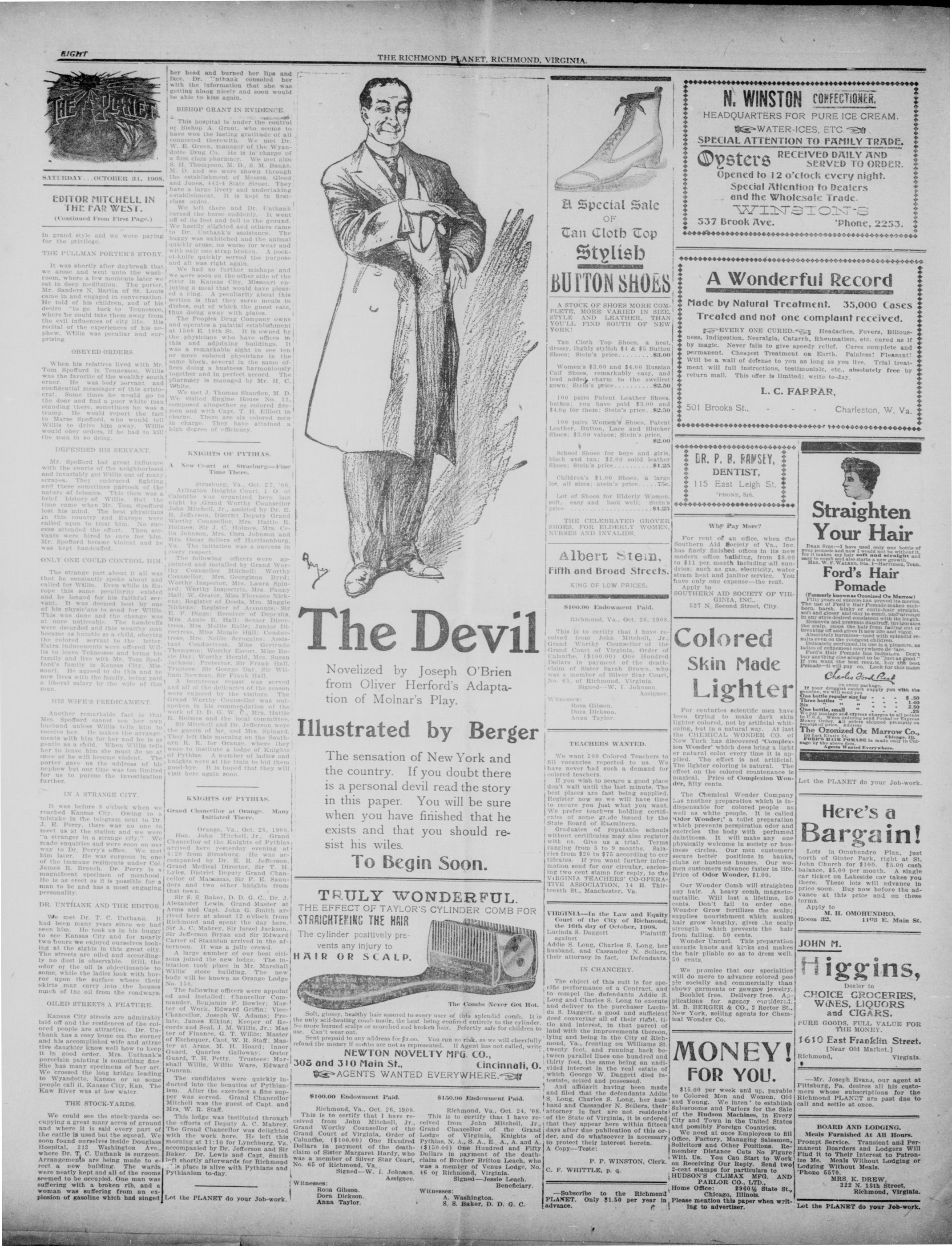
EDITOR MITCHELL IN THE FAR WEST. Scenes Along the Route. St. Louis and Its People.
A FULLMAN PORTER'S RECITAL—A DEAD-HOUSE AND ITS VICTIMS—THE DISPLAY OF A FUNERAL DIRECTOR—OILED STREETS IN KANSAS CITY
VOLUME XXV, NUMBER 48
EDITOR
IN THE
Scenes Alo
Louis
A FULLMAN PORTER'S R
DISPLAY OF A FUNERAL
We left Richmond Tuesday, Sept. 22, 1908 en route to Denver, Colorado. J. Alexander Lewis, M. D. S. S. Baker and Roscoe C. Mitchell accompanied us to the C. and O. train and at 11 o'clock sharp we bid adieu to Richmond on our way to the Far West. Mr. John H. Graham was the porter on the Pullman sleeper and he was untiring in his efforts to serve us. It was not long before we had retired and we "slept the sleep of the just" long after the sun had risen in the eastern heavens.
IN WEST VIRGINIA
We lifted the curtain and looked up upon the rushing waters of New River. When we crossed into Kentucky and Ohio, the effect of the drought could be seen for half of the river bed was exposed to view. We felt the effect of the oppressive heat all during the day. The electric fans buzzing at both ends of the car served to better the situation but little. In sheer desperation we asked for a table and a few moments later were writing editorials for The PLANET
A CHANGE OF TIME.
We reached Cincinnati late, being due there at 5 o'clock. We were now in a city of central time and our watch hands were moved back just one hour. To be exact, when it is 5 o'clock in Cincinnati, it is 6 o'clock in Richmond. We were to leave at 9 o'clock that night. We went up to Mr. W, L. Anderson's printing establishment. He and his Madame were just leaving. We joined them and spent a half hour in their company.
ON TO MISSOURI
We left for St. Louis, Missouri and awoke next morning just before we crossed the Mississippi River. East St. Louis loomed up and then the sluggish waters of the Father of Waters could be seen well within its bank for the drought had similarly affected the flow here. Reaching the station we walked into the waiting arms, so to speak of Mr. A. W. Lloyd, Grand Chancellor of the Knights of Pythias of Missouri. We entered the carriage which was waiting and we were soon at our destination. A hurried preparation and we were at the dining parlors of Gen. B. J. Carruthers, where breakfast was served.
MANY FRIENDS THERE
Then came Mr. C. K. Robinson, Supreme Keeper of Records and Seal. He is the proud owner of a three cylinder automobile, and he has become expert in handling the same. We met Dr. D. W. Scott, W. P. Curtis, M. D. and Dr. T. A. Curtis also Mr. W. R. Hill, dealer in real estate and loans, and Mr. George B. Jones
AN AUTOMOBILE TRIP
We inspected the C. K. Robinson Company's printing plant. It is doing a good business and every inch of available space is utilized. Mr. Robinson took us with Grand Chancellor Lloyd over St. Louis in a short while.
A visit to the exposition grounds was an enjoyable feature and then to the residence where Mrs. C. K. Robinson better known as Capt. Jessie D. Robiison holds sway. We had only a few moments time and we were soon in the business section again. We met Miss Florence G. Robinson, who did not tire of reminding us of that "forbrn hope" in Cincinnati. We met Mr. William M. Johnson.
THAT TRIP TO EUROPE
It brought back old memories to meet Editor P. H. Murray of the St. Louis Advance. He may be older than he was fifteen years ago, but he does not look to be. We visited Prof. Charley H. Brown, the principal of one of the largest colored schools in St. Louis. He possesses rare ability along this line. He spent three months with his wife travelling in Europe and he is now a walking bureau of information.
In reply to the question as to what
induced him to make the trip, he said. "Well, I promised my wife that when I got out of debt, I would take her on a trip to Europe. What did it cost me? Well, I guess, all things considered, it cost about $900. I brought the 'boys' cigarette holder made in Germany. What did they cost? Why did you ask me that question?" He was evidently embarrassed for one of the beneficiaries of his liberality was standing at his elbow. "They cost about sixty cents a piece over there."
DR. CURTIS IN EVIDENCE
We visited Dr. T. A. Curtis' office where a spirited discussion was inculded in, much to the amusement of all present. As no one would consent to have a tooth pulled, there was nothing exciting and we left his cosy quarrers with a feeling of genuine regret. From the Doctor to the Undertaker is rather a gruesome performance, but that is the way Mr. A. W. Lloyd arranged it, for we found ourselves within the magnificent undertaking establishment of Mr. W. C. Gordon, of 2649 Walnut Street.
A FUNERAL DIRECTOR AND HIS BUSINESS.
We inspected his stables and rolling stock. The former was a mode of cleanliness and the latter the subject of favorable comment. Then we were ushered into his dead-house better known as the morgue. It was underground. Three men were at work. They wore long black rubber gowns and rubber gloves. A nude woman, who had evidently just come from under the dissecting knives of physicians was stretched upon the cooling board or table.
A GRUESOME SIGHT
The breast was open and the skin thrown back, while the contents of the body were being placed in position after having been thoroughly covered with the disinfecting and en balming compound. There was no unpleasant odor, but the sight was grusome.
AN UP-TO-DATE ESTABLISHMENT
Still there were the electric light the concrete walls and flooring, the drain pipes to carry off all liquids and cleanliness was everywhere in evidence. "I wouldn't have that job for a thousand dollars!" was our in voluntary exclamation. Still we admired the skill shown by these colored embalmers, the lack of frivolity or noise, the death-like stillness and the military precision with which orders were given
ANOTHER CORPSE THERE
We passed on with Mr. Gordon leading the way to the room in front. Here was a corpse, all ready for burial. It was shrouded and save for the deathly rigidity one would have supposed that it was a person asleep. We passed on upstairs. We were in a room of gloom, but only for a moment. The click or the electric button flooded the richly carpeted room with light and displayed to view some of the most expensive caskets in glass cases that we have ever gazed upon.
A FINE DISPLAY
Certainly, the master mind that arranged that displayed deserved credit. We stood there for many moments at first awe-streken and then enraptured by their beauty. But it was the chamber of death or rather the entrance room to a higher better life. One step more and we were in a small sized chapel where funeral services were conducted and the last words spoken over the departed. This then was nearing the end.
THE ACCOMPLISHED MADAME
We turned away and up-stairs met the tall, sedate queenly Miss Mamie Hunton of other days who is now the presiding genius of the home department of this establishment and is now Mrs. W. C. Gordon. We were surprised and gratified. Only a brief conversation and we were hurried away to get dinner and to take
the train for Kansas City, Missouri
where on Saturday, Mr. Lloyd and
Mr. Brown promised to join us. We
left at 9 o'clock via Burlington route.
THE TRAIN CREW AND THE BANKER
It was strange but nevertheless true that our presence on the train was soon made known to all of the train crew. The presence of a Negro banker was a wonder in itself and this information was given us by one of the porters who proceeded to circulate the visiting card that we had given him. We were travelling
(Continued on Eighth Page.)
WANTED—A cook. Good wages. Apply to second flat on the northside of the house, 410 Allen Ave.
FOOT-BALL GAME!!!
VIRGINIA UNION UNIVERSITY
AGAINST HAMPTON NORMAL AND
AGRICULTURAL INSTITUTE MON-
DAY, NOVEMBER 9, 1908, 2:30
O'CLOCK P. M., BROAD STREET
PARK. THE FINEST GAME OF
THE SEASON.
STOCKHOLDERS MEETING
Capitol Shoe and Supply Co., Inc. Reports of the Officers Most Gratifying, Business on the Increase.
The Second Annual Meeting of the Capitol Shoe and Supply Co., Inc. was held at the store of the Company 210 E. Broad Street, Richmond, Va. on Monaday night, October 26, 1908 The Company has shown a most successful career during these two years taking into consideration that it was a new feature. Mr. Jno T. Taylor, the Organizer and first President deserves credit for his forethought in being able to get a sufficient number of men as stockholders and having them interested in such a feature. The reports of our President, Mr. R. T. Hill and Manager, Mr. William H. Hayes were very encouraging and showed that the business did in excess of that of the first year of the company's existence was more than $2500.00. So much elated over the results were the stock-holders that at the suggestion of the President, the directors were empowered and authorized to increase the Capital Stock to $15000.00.
It is the purpose of this corporation to continue the first and only-up-to-date Shoe Store run by our peep in this city. The Management feels exceedingly grateful to its patrons which have been a large number and the polite service given in the past will be the feature of the store in the future and if possible to better accommodate the public, it may be expected at the hands of our management.
This was indeed the most successful and harmonious meeting since the corporation's organization. After the routine or business the directors were elected as follows:
W. A. Jordan, Rev. W. L. Taylor, W. A. Saunders, W. H. Hayes, A. D. Price, R. T. Hill, T. M. Crump, A. Washington, Rev. M. C. Ruffin, B. L. Jordan, W. E. Randolph, Edward Stewart, Samuel Morgan, Dr. M. B. Jones and W. H. Banks.
The officers for the ensuing term are President and Treasurer, R. T. Hill; Vice-President, W. A. Saunders; Secretary, T. M. Crump; Manager, William H. Hayes.
In the future it is the purpose of the store to carry in addition to its high grade stock, the best makes of cheap grade shoes to be found in the city for men, women and children and we earnestly solicit the patronage of the people of this entire community assuring them that business courtesy consistent in the mercantile world will characterize our efforts.
CAPITOL SHOE AND SUPPLY CO., INC.
Headquarters Established.
The rapid growth of the work of the Supreme Grand Council, Independent Order of St. Lukes, under the guiding hand and wise supervision of Lawyer J. Thomas Hewin, made it encumbent upon the Board to seek a suitable location for headquarters and main offices, as the temporary rooms on Fifth Street were found to be inadequate, insufficient and otherwise unsuited for general office purposes.
Thus a special meeting was held in the law office of J. Thomas Hewin, 603 North Second Street at 2:30 P.M., on Friday Sept. 25th. The entire Board was present, viz.; J. Thomas Hewin, E. T. Jenkins, W. H. James, Mrs. Belle Christian, Mrs. Ora B. Stokes, Miss Clara Holmes of Richmond, Va.; Mrs. Lizzie Smith, Whitestone, Va.; Mrs. Athleine Hill, Newport News, Va.; Miss Mary J. Jenkins, Scottsville, Va.; J. A. Pratt, Baltimore, Md.; J. P. Archer, Chula, Va.; C. A. Dungee, Cumberland, Va.
The rooms over the Smith Pharmacy on Second Street opposite the Reformers' Bank were found to be available, and a more suitable location.
This place was decided upon, and the Board authorized the purchase of furniture and fixtures with a view to having the rooms ready for occupancy by the time of October.
Great strides are being made by this Order. Its management is conservative, taxation moderate, and all claims promptly met. It is an Order for the people, of the people and by the people. For further information see circulars, newspaper notices, deputies or write headquarters.
An informal reception was held at the residence of Miss Clara Holmes on St. John St. The entertainment was royal. The collation ample. All the delicacies of the season served to which the visitors and those present from the city justice JACK STUDIO
Woman Standing at the Gate
Of all the stands in the world, the worse stand and most wristrises sight to see is a woman standing at the gate, talking everybody's business instead of attending to the necessary things to be done in the home such as attending to the domestic duties, getting the children to school mending the children's clothes, and cleaning the house with hands, broom and brush instead of cleaning some one else's with their LIP.
All good men think it horrid to see a woman standing at the gate from morn till night, and if it rains, standing at the door waiting for a passerby. I happened to pass along one of our most popular streets a few days ago at 7:30 A. M. and a woman was standing at the gate talking with a woman; at 9 A. M. I passed the same gate and the same woman was standing at the same gate talking to a man.
I passed the same gate on my way to lunch at 12:30 P. M. and the same woman was standing at the same gate talking to another man. I passed the same gate on my way back at 1:30 P. M. and there at that same gate stood that same woman talking to another woman. I was called to the City Hall at 3 P. M. I passed the same gate and the same woman was there by herself, seeming ly to be waiting for some one to hang her tongue on.
On my way back at 4:15 P. M. I passed through this street and there to my disgust stood this same woman " rubbering" waiting to talk other people's affairs. If I could but present to your sight a picture of scoop it would be that of a woman standing at the gate looking for other people's business while her own is undone. If you would but stop I feel that my mission " is finished." Woman take heed. Cook your husband's breakfast and stop hanging over the gate, you know not how idle you look. People passing by call you "Talking Machine." Buy yourself a talking machine and let it play all day as this sister stood talking at the gate all day and see if you would not become annoyed. So it is with a talking woman; it is annoying. W. F. DENNY.
WANTED—I will give ($50.00) fifty dollars cash to each of two purchasers of two high grade planes direct from factory. None but bonafide purchasers need apply. Address, "PIANO." PLANET OFFICE.
—Mr. Henry Wooldridge left the city this week after spending a pleasant stay here and in Manchester, Va. with his many friends.
Notice!
Mrs. Fannie Jones has tendered her resignation to St: Francis Temple No. 12. Daughters of Elks as no longer a member of that order.
SPRINGFIELD.
It was but yesterday we looked and saw
Was supplemented by the Book of right.
But, ah-alhs! to-day, we look again.
Instead of honor now we see the dust
Of all thy glory crimson with the stain
Yea, trusting eyes once looked to
thee and felt
Assurance in thy steady legal arm;
And grateful hearts oft to thy bless-
ings knelt
But we have seen thy baser self descend
Into the flendish Tophet c/ disgrace;
We marked thy sympathetic legal trend
And saw dishonor written on thy face.
Lives trusted to thy keeping, with the right
Sweat-bought by brows or honest toll and care.
Fond homes tax-pledged to thy pro-
tecting sight
Met by thy hand a murd'rous arson
fare.
O. how couldst thou pollute the sa-
cred air
That halo o'er the sainted Lin-
coln's head!
O, how couldst thou disturb the silent prayer
That often by those martyred lips were said.
Well may thou bow thy head in guilty shame.
Clothed in repentent ashes of thy sin.
While trailing in grim gory is thy name,
Imploriously beneath the echoed din.
Thou needst not seek thy streaming hand to hide,
Imbued with ghoullish Imprints' telling hue,
But seek baptism in the cleansing tide
Of justice and redeeming birth a new.
—LUCIAN B. WATKINS,
Author of "Voices of Solitude"
Mule Killed Him
James Mitchell, a small colored boy, about twelve years of age, was kicked and killed by a mule he was leading down Marshall Street last Sunday afternoon. The boy was just turning the corner into Madison, when, because the mule was progressing slowly and showing some obstinacy, he took the tail end of the rope and laid it across the animal's flanks. The mule let out with both heels, and the boy was struck on the head. Dr. Eggleston, of the city ambulance, was summoned at once. He found that the boy's skull was fractured. He was taken to the City Colored Hospital, where he died soon after, just as he was about to be operated on
Colored Man's Politeness
On an electric car, bound for Richmond last Thursday morning between 7 and 8 o'clock, Mr. George Robinson of East 20th Street, Manchester, Va. was highly complimented by a distinguished white lady, who carried a basket of flowers, when he vacated his seat for her, while a number of white men held fast to their own.
This white lady is well known and highly respected throughout the city and the encomium given Mr. Robinson was well received as he sat with bared head and drank in her every utterance, especially when she said with emphasis, "You acted like a gentleman."
$150.00 Endowment Paid.
Natural Bridge, Va., Oct. 22, '08.
This is to certify that I have received from John Mitchell, Jr. Grand Chancellor of the Grand Lodge of Virginia. Knights of Pythias, N. A., S. A., E., A. and A. ($150.00) One Hurdred and Fifty Dollars in payment of the death-claim of Sir A. J. Watts who was a member of Natural Bridge Lodge, No. 124 of Natural Bridge, Va. Signed—S. S. Watts, Administrator.
Witnesses:
Sir Steward Moore, M. of F.
Sir Samuel Turner, K. of R. & S
Sir William Jasper Lyle.
Sir Will'am D. Carter, C. C
Senator Foraker Closes His ABLE DEFENSE.
PRESIDENT THEODORE ROOSEVELT AND JUDGE WILLIAM H. TAFT ARRAIGNED
THE BROWNSVILLE STAND
(Continued From Last Week.)
(Continued From Last Week.)
"As to the Brownsville affair, Mr. Taft says, speaking of me, 'He has seized upon and magnified an important but incidental matter to embarrass the administration, using in this without scruple, a blind race prejudice to accomplish his main purpose.'
"I have no way of proving what was in my mind except by referring to the record. Any one who reads that will fail to find a sentence or a word to justify any such statement as Mr. Taft makes.
"In view of Judge Taft's statement, I trust I may be allowed to repeat what I have said a number of times, that in this whole matter I had no revenues to seek, or personal ends to serve, but was anxious to see that common justice was done to the representatives of a noble and loyal race, every one of whom is by nature a Republican.
"The colored voters are known to be more or less displeased with the action of the Republican Party in not passing some relief measure for these soldiers, and many of them have signified a purpose to vote against Judge Taft, because of his official relation to the matter. Much work has been done to overcome this trouble and to induce the colored Republican voters of the country to stand by the party with which they have always affiliated.
SORE NEEDED A PLASTER
"And now comes the President and publishes Judge Taft's letter containing his unfortunate reference to this unfortunate case. What does he mean? Does anybody imagine that the President is unable to see that he is rubbing a sore, when he should have brought a plaster? Does he imagine, or can anybody suppose, that the Republican colored voters of this country can be broun't to the support of Judge Taft by parading in these closing days of the campaign, Judge Taft's belittling of their chief grievance by mentioning it as an 'incidental matter' which has been 'seized upon and magnified, using in this without scruple a blind race prejudice,' and then adding the charge that all this is done only to 'embarrass the administration' of President Roosevelt?
"Can it be possible that the President wants to defeat Judge Taft? That cannot be, and yet he could hardly do any other one thing better calculated to lose him votes, for no self-respecting Negro reading what Judge Taft says in this letter and adding it to all that has gone before, can vote for him without feeling that he is making a greater sacrifice than most men, white or black, are willing to make
"In any event, the President's action and comments are a wrong toward the Republican Party, for they amount to a charge against the party at a critical hour of the campaign of an unworthy purpose in connection with a matter that every colored man who has any pride of race holds of highest value and in deepest appreciation. What Judge Taft says in his letter is the equivalent of any assertion that the colored people of the country who have been gratified because of what was done in the Brownsville matter have simply been hoodwinked by the designing selfishness.
PRESIDENT MAKES IT WORSE
"This is bad enough, but the President makes it worse when he says: * * * * The entire agitation over Brownsville was in large part not a genuine agitation on behalf of the colored men at all, but merely one phase or the effort by the representatives of certain law-defying corporations to bring discredit upon the administration because it was seeking to cut out the evils connected not only with the corrupt use of wealth, but especially with the corrupt alliance between certain business men of large fortunes and certain politicians of great office.
"In other words, the Brownsville proceeding was not only all Judge Taft said it was, but in addition to being designing and selfish, it was prompted by the representatives of law defying corporations to bring discredit upon the administration of its policy with respect to them.
"This is worse than the President's claim that the panic of last October was precipitated by a lot of rich men in Wall Street who wanted to bankrupt themselves and the whole country, that they might discredit him; and worse even than the story that these same men raised a fund of $5,000,000 with which to prevent him from naming his chosen successor.
"I happen to know
PRICE, FIVE CENTS.
kier Closes His
EFENSE.
ROOSEVELT AND JUDGE
FT ARRAIGNED.
VILLE STAND
anybody else can know, that there is not the slightest ground for such a charge. It is invention, pure and simple, and judging by the frequency with which the President is bringing the matter to the front, born of that disquiet which comes to the conscience when there is consciousness of having done a great wrong.
AIDED PRESIDENT'S POLICIES
"Except only the Brownsville matter, the rate bill, and the joint Statehood, I voted for all the measures the President enumerated among the achievements of his administration, and some of them I was in charge of on the floor of the Senate when they were passed.
"I have said enough, I hope, to justify my course both as to the rate bill and as to Brownsville, and it is not necessary that I should say anything in justification of my course with respect to joint Statehood, except only to point to the Republican national platform upon which Mr. Taft stands, one plank of which declares in favor of separate Statehood for New Mexico and Arizona.
"If in making this defense I have said anything that will work the slightest injury to the Republican Party, I shall regret it; but I shall always feel that those who have no consideration for me, my family, or good name, but would gloatingly rejoice if they could accomplish the shame and humiliation they have attempted, are not entitled to any consideration at my hands, and that my duty to the party should be subordinated to duty to family and the good name I have striven to make, that I may leave it to them as their heritage, more priceless in their estimation than anything else within my power to give them.
FORAKER NOT CONSULTED
"Since dictating the foregoing I have received the following letter, which is self-explanatory;
"Columbus, O., Sept. 24, '08.
"Hon. Joseph B. Foraker, Cincinnati, Ohio.
"My Dear Senator: Noticing the recent newspaper statement about two bills relating to corporations introduced in Ohio general assembly in the year 1901 by the Hon. Aaron H. Price, of Athens, and his statement that they were presented at the request of the late Gov. Nash, I beg to state that I was present at that session of the general assembly engaged in watching legislation; that I personally consulted with Gov. Nash as to the propriety and wisdom of these bills becoming laws, and he agreed with me that it was not wise to press these measures at that time, and with his consent they were not passed.
"I had no consultation with you in this matter, and final action was in no wise influenced by you.
"I make this statement in justice to you and in that history may be clear and accurate.
"With best wishes, yours, &c.
"M. W. HISSEY."
November McClures
Frontispiece: Augustus Saint Gaudens.
Famillar Letters, Augustus Saint Gaudens. Edited by Rose Standish Nichols. Illustrated with photographs.
The Persistence of the Uninspired. A story, Fleming Wilson. Illustrations by Thomas Fogarty.
What Organized Labor Wants. Samuel Gompers.
Caroline and Her Note-Book. A story, by Claude C. Washburn. Illustrations by James Hamilin Gardner Soper.
Scotty. A story, Colin McKay. Illustrations by Gordon McCouch.
Summer's Close. A poem, Madison Cawein.
... The Vanderbilt Fortune, Burton J. Hendrick. Illustrated with photographs.
... That There Oliver'. A story, Caspar Day. Illustrations by W. T. Benda.
The Bugle Call. A poem, S. H. Kemper.
The Golden Fleece. A story, Albert Kinross. Illustrations by Andre Castaigne.
Loving's Bend, Edgar Beecher Bronson. Illustrations by Maynard Dixon.
The Domino of Behring Beach. A story, Helen Green.
Fire: An American Extravagance, F. W. Fitzpatrick. Illustrated with photographs.
The fight for a New Navy.
THE SEVENTH PERSON
BY
BEN. M'CUTCHEON
COPYRIGHT 1806 BY DADDY MEDDY COMPANY
TWO
CHAPTER I—Gerard Chambers, son of a wealthy importer and a student at an eastern college, was awarded a member of the Gemini secret organization, founded by Johnny Graves. The society was exclusive, only seven being admitted. The members were required to pass a period as a sailor and not set foot on the sea for a year. Then he was directed to go Mexico for further instructions which were to him to another year, during which he made praise his own living unassisted, and keep everything a secret.
CHAPTER III—Jerry then told his father, he had given his elder's consent. He also Bayless, his father's choice for his wife, with the fact that he would be away two years. She left him angrily.
CHAPTER IV—Young Chambers had a brief interview to prevent the boy's departure. Jerry obtained a berth as superviseor of an ocean freighter. His father tried to convince the boy would seek the hand of Miss Bayless.
CHAPTER V—Jerry sailed the following morning on the Sister Mary. After the ship left him that the boat was bound for Irania, South America, loaded with guns for enemies of that government.
CHAPTER VI—Sister Mary put in at Havana. Final orders regarding the landing of guns, given opportunity to desert, passed it up.
CHAPTER VII—Jerry landed the guns at a Uranian cruise hove in view. At first the gun was chased, but escaped. Chambers was captured and thrown into a dungeon.
CHAPTER VIII—Marina Bostos, adopted daughter of Gen. Bostos, entered Havana. Each made a strong impression on the other. She was known as the "little saint of Urania" because of her nursing.
CHAPTER VIX—Jerry tried by Gen. Bostos, was sent to Urania to join dashed away the following day. Upon promise of Marina's love, Cant. Pilaro pledged himself on horseback late at night.
CHAPTER X—Shelter was secured the following day. Marina and Pilaro decided to join Gen. Barado's army, seeking the government. They united with the rebels, Chambers being made a captive.
CHAPTER XI—Capt. Pilaro died of cancer. Marina accompanied his body to Boston. In a fierce battle she former wom. Jerry frustrated an attempt to assassinate Capt. Cant. Chambers was delegated to accept Boston's sword as a token of surrender.
CHAPTER XII—Gen. Boston forgives his daughter Marina. Her funeral party was attacled, and she was reported missing. Marina was captured and a confederacy established. Chambers was made much of. By that time Marina was given up as dead.
CHAPTER XIII—Jerry was given a big reception by the Cross of Honor. He then sailed for Havana in order to report to leadership for further instructions.
CHAPTER XIV—Capt. Chambers was honored aboard the wealthy Iranian, and his daughter. The ship encountered a terrible storm when Jerry was being fetted.
CHAPTER XV- The steamer was drawn on the rocks, nearly all on board and Senorita Lopez, by clinging to the mast. The girl's strange actions caused him to express the belief that she was demented.
CHAPTER XVI- After a long time on the rocks the steamer rescued and conveyed to Havana, Jerry self too late to catch a boat for Mexico. He recognized Marina Hostas, a passenger, calling immediately for Mexico. By a rush he decked the ship.
CHAPTER XVII- Chambers granted the privilege of going to Vera Cruz. He discovered that Marina was being held a prisoner on board, the pretense that she was demented.
CHAPTER XVIII- Jerry successfully passed prepared test in Marina, which plotters suspected. He wrote her a note and confided the American engineer, who promised aid.
CHAPTER XIX- The plotters took Marina into Vera Cruz, secretly, Jerry following by swimming, after he had knocked senseless the captain of the Steddymen remembering he must hurry to Mexico within a few hours he left the engineer to resume the chase.
CHAPTER XXJ.-Yerry reached Mexico City in time to receive letter of instructions, and finally trailed Mariné's abductors and learned their plans. He then wired Chambers.
CHAPTER XXI.-Young Chambers received the secret society's orders to proceed with the construction. He again left Mike O'Connell the engineer, in charge of the shadowing structures.
CHAPTER XXII.-Mike trailed the fugitives to Jimenez, using various ruses.
CHAPTER XXIII
The Man with the White Whiskers.
"Is there something here for Rodney Graves?" asked Jerry Chambers of an elderly man in the office of the
Mining and Smelting Company at Escalon, three minutes before the expiration of the 40 hours. He had been in the Chihnahuan town a few hours, but he had determined to wait until the last moment before calling for his instructions.
Robert Hallington of The College class of '68, and a wearer of the Pin of the Twins, cordially extended his hand and gave him the "grip."
"There is, just such an envelope as I received many years ago," smiled Mr. Hallington, producing the instructions from his pocket.
"Haven't you received a telegram for me—Tom Flannery?" Jerry quickly asked, showing considerable concern.
"You—Flannery? Why, no. The envelope is all I have to give you."
"Strange," muttered Jerry his brow knitting. "I was sure there would be a message here for me."
He soon was in the street, and his extreme disappointment in not receiving word from Mike O'Connor embodied fear that the engineer had foraken him. In the shade of an awning he opened his envelope and read the following:
"Within 48 hours after ye have received these instructions ye shall start in search of the Sea Strait mine, supposed to be in the Sierra Madre mountains about 50 miles southwest of Escalon, not far from the source of the river Florida. Your beloved brothers in The Gemini, Robert Hallington and Thomas Wentworth, will direct ye to the traffit route, and you will witness the endless quest of hidden treasure; also, they will instruct ye in the method of procedure and provide all supplies which they may deem necessary. The one com-
Janson whom ye may have with ye, if ye desire to be accompanied in your exploring, shall be paid in Mexican currency the equivalent of $150 a month in the United States of America, and he shall be subject to no orders other than your own.
"It is the will of all Gemini that ye shall appear at 12 o'clock (noon) on the nineteenth day of September, 1899 at the Museum at Palaeo-Telam for further instructions. In going to El Paso ye shall consume no more time than is necessary to make the trip in time to receive your further instructions. Proof that ye have labored honestly in your work will be the lost San Dimas gold mine be purchased with love for the instructions which shall await ye in El Paso.
"May the spirit of Redwood Graves guide ye well and the love of all Gemini give ye new courage."
After re-reading the instructions Jerry went back to Mr. Hallington and asked about the trodden trail to the mountains. The old Gemini smiled knowingly and told him that within 24 hours he would be supplied with all possible information that he could provide.
"It will be an exceedingly interesting time for you," said Mr. Hallington. "Then you know all about it?"
"I know what has brought you to Escalon." returned Mr. Hallington.
Jerry had almost two days in which to prepare for the search for the lost gold mine. The question uppermost in his mind was the matter of selecting a companion. After reading the instructions in the City of Mexico he decided that Mike O'Connor should go with him, but now that he had not heard from the engineer and had decided that his services could not be counted on any longer, he felt he could do no better than to accept some experienced man suggested by Mr. Hallington. Shortly after noon the next day, after he had learned much from Mr. Hallington relative to the trip into the mountains, he went to a restaurant with an appetite that could easily be satisfied. He sat at a table from which he could look into the street, and as he nibbled at his victuals his gloom was inexpressibly great. The coffee had just been brought to him when his eyes almost popped out of their sockets.
Casting his eyes from one side to the other, Mike O'Connor was moving slowly down the street. Jerry rapped on the window frame so excited that the waiter and other customers were startled. Mike did not see him until he called at the top of his voice. A minute later, the engineer, a smile lighting his rugged features, was grasping the almost ecstatically eager hand of Jerry Chambers. Mike sat down at the table and soon was trying to answer question after question that Jerry hurled at him.
"I told you I'd stick to the finish, didn't I, Tommy?" said Mike; "and I meant what I said."
"But what are you doing here?"
"I was with 'em till I got to Jimenez, and I know just about where they're cooped up now. Oh," proudly patting his chest, "an Athlone man knows how to do a thing or two."
"They got there last night and immediately shot off in a carriage to a small boat in the Florida river, on the edge of the town. They're in the mountains now, for sure, and they're right where things are as tough as whit-leather. I know the man that drove them from the station, and I know a copper who is familiar with that part of the country. He say it's infested with gangs o' criminals. I couldn't follow thim, and I figured you'd have to be with me in keepin' up the chase."
"By George," exclaimed Jerry, "but luck is still with us! To-morrow, Mike, you and little Tommy duck to the mountains. I'll pay you a hundred and fifty a month, U. S., and you don't have to handle a pick unless you—"
"You see—that is, I'm going to try my hand at mining a bit—when we're not on their heels, of course," fumbled Jerry. "I've arranged with a local mining concern to make a few investigations in the mountains near the source of the Florida, and the money will be easy for both of us. Don't you see?"
"Why, that's where the copper said a lost gold mine was—the San something or other. You're not after it, are you?"
"We can keep our eyes open for it," said Jerry. "But we are after them. Why, Mike, this whole thing is just like a novel, isn't it?"
"It is that," said O'Connor, "and there'll be some mighty excitin' readin' afore we reach the happy end, I can tell you."
Late that afternoon Jerry introduced Mike to Mr. Fallington and announced that he had selected him to accompany him on the trip of exploration. Towards dusk Jerry and Mike departed from Escalon for Jimenez on a freight train, the former being in possession of maps and orders on a merchant of Parral for provisions.
The first train out of Jimenez for Parral was not scheduled to leave until early the following morning, thus necessitating the remaining of the two in the town over night. That night Jerry and Mike hunted up the policeman whom the latter had met at the station and induced him to learn from the driver of the carriage, if possible, the ultimate destination of the kidnapers. The officer succeeded in locating the driver and learned that the five had taken a small boat and started in the direction of the village of Rio Florido, a mining camp about 45 miles up the river. This he communicated to Mike, who believed that they were at or near that village.
THE RICHMOND PLANET, RICHMOND, VIRGINIA
They had several hours to wait in Parral before they could take a train for the south. After they had obtained provisions for two weeks, a small tent, a few necessary cooking utensils and lanterns and picks they went to the station on the seat with the merchant's driver. Just before they reached the station Mike clutched Jerry's arm and brought his other hand to his mouth. His eyes were riveted to a man crossing the street a few yards away in front of the wagon, and he did not turn his head until the man, who wore white whiskers, went into a small store. "It's old Riaz!" excitedly whispered Mike, when the two were at a window in the baggage room. "Riaz—who is he?" questioned Jerry.
"The old codger I saw with Andre and Fellipe in the Vera Cruz house, and who got into the carriage with the bunch at Jimenez. What do you suppose he is—" The man came out of the store with a basket on his arm and Mike did not finish the sentence. O'Connor, tanned almost to the complexion of a Mexican, went into the waiting room and stood near the tick-eteller's window when the white whiskered old man entered. He moved up a few feet as the man stepped to the window and took out his purse. Although Riaz spoke in a low tone, Mike's ear was keen enough to catch the word—"Rosario." Then he went back to the baggage room, his eyes blazing with excitement, and whispered to Jerry: "He is going to Rosario."
CHAPTER XXIV
The Old Man of the Adobe
It would be too difficult to express the surprise and consternation of Jerry Chambers and Mike O'Connor when the train of two old-fashioned, well-torn coaches, in which the total number of passengers was less than 15 stopped at the mountain village of Rosario and Riaz did not get off. They were simply dumb-tounded. True, they did not ride in the same coach with him, desiring to be together and not wishing to be seen together by him, but they were on the sharp lookout at every stop.
"He must a' floated out o' the window," said the mystified O'Connor, as the two stood on the platform and watched the train move southward. "The old terrifier a' wizard, and simply made himself invisible."
"I'd take an oath he was on the train after we pulled out of Paloma," said Jerry, "for I saw him dezing in his seat, the basket at his side."
"But the train didn't stop between Paloma and Rossero," said Mike. "and the clip was too fast for him to get off. That fellow's a dill in white whiskers, Tommy, and —" Here he stopped and his hand came down hard on his knee. "I know it now!" he exclaimed. "He looks as old as Methuselum, and a man o' his age has hard enough time gettin' off a train that's standin' still. Riaz ain't an old man at all! He's a young divil in disguise, and he flipped from the rear end while the train was skimming' along." At the end of a few hours they had bought a small skiff and had it laden with their boxes and packages, and it was not long thereafter that Jerry was leisurely pulling down the narrow stream. While he rowed Mike did most of the talking, the subject of greatest interest, of course, being the mysterious disappearance of Riaz.
"If you're sure you saw him at Paloma," said Mike, "he can't be a million miles from Rosario, and where he is they are. I'd like to run into the whole bunch, but I'd hate for only us two to meet 'em face to face."
The sun had just sunk behind a distant mountain when the intersection of the two branches of the river was reached. To the right of Mike great ragged cliffs rose thousands of feet, and to his left mountains, blackish-green in spots, rolled far to the north. The skiff was grounded on the bank a few hundred feet below the fork, at a spot which promised a suitable place for the camp. The small tent was put up about 40 feet from the bank, behind a clump of bushes, which screened the view from the other side of the stream, and the boat was carried into the brush.
Both men were thoroughly tired when they lay down and smoked their pipes.
"Mike, this is the most secluded place on earth," said Jerry, after a long silence.
"Dammed if I can't hear myself think," said Mike. "Wouldn't it be fine to turn a few owls loose and let a lost dog howl 'round here in the dead o' night?"
After partaking of some coffee, bacon and bread they stretched themselves out and fell asleep. The earliest sign of day found them awake and much refreshed. The first thing Mike said was:
"I had a divil of a dream, Tommy, I dreamed I saw a man goin' down the other side o' the stream with a lantern in his hand, and he had a dog with him. The dog barked and the man—I think he was old, from the sound o' his voice—talked to him just like he was a man, tto. Then the old codger turned into the bushes and disappeared. The dog kept barkin' and barkin' till it sounded like it was miles away. I think I woke up, but I'm not sure about it."
"What's the old saying about dreaming the first night in a new bed?" laughed Jerry.
"It's a sign the dream comes true," answered Mike; "but I don't want this one to come true. That dog was a big divil, and the man looked all in a hump. I don't remember what kind of a face he had, but it must a' been a dandy to wake me up."
After breakfast they started out on a tour of investigation, Jerry going down the stream in the boat and Mike pleking his way up along the bank. On his return to the camp Jerry kept on the other side of the river. He was nearing the camp when he noticed an opening in the underbrush. He grounded the skiff and went up to it. He was surprised to find fresh footprints in the soggy soil. Going into the bushes he found a well-worn path. He did not venture far, but hastened
Let the PLANET do your Job-work.
back to the camp, which Mike had reached a few minutes before. His excited manner brought Mike to immediate attention.
"Mike O'Connor," said Jerry, "I'll bet you didn't have a dream last night."
Mike simply stared.
"You did see a man and a dog. I'll stake my life on it."
"How do you know, Tommy?"
"Where was it the man disappeared?"
"Right over there," answered Mike, pointing in the direction of the opening in the bushes.
"Then, that's where you saw a real man and a real dog go. I found an opening and a path right there, and in the path were fresh prints of a man's bare feet and a dog's feet. There is somebody else around this locality, Mr. Michael Alosysi O'Connor. But who in thunder can it be? Who could be going around bare-footed with a dog? Surely, not Andre or Felipe, and I don't think it could be Riaz. There are too many burrs and rocks along the bank for anybody with the price of a pair of shoes to be going bare-footed."
"Shall we investigate?" asked Mike.
"Of course, but we must be mighty careful. It may be that one of those gangs the corper was telling us about has its headquarters around here, and if we ever stumbled on to it, it would all be off with two fellows I'm acquainted with. What have you to suggest?"
"Well afore we follow up that path."
said Mike. "we might climb up the cliffs and see if we can locate any tents or shacks from a distance. We might be able to get a line that way. Then, if we can't see anything up there, we'll simply have to take a chance and pick our way along that path till it brings us somewhere or another. And we might as well start right away."
Half an hour later Jerry and Mike were climbing the cliffs on the other side of the stream, but, although they got a good view of the land, they saw no sign of habitation. They had almost reached the base of the cliff when the faint barking of a dog reached their ears.
"Did you hear it, Tommy?" asked Mike.
"It was that same dream dog of yours. Mike."
"Then, by golly, it wasn't a dream after all, was it?" it sounds just like it sounded last night." The barking of the dog sounded nearer and nearer, and the two secluded themselves.
"It's lucky I hid the boat in the grass," said Jerry.
"Oh, an Athlete man thinks of a thing or two," whispered Mike.
"Yes, you shall have food," said he, his arms around the depriving dog's neck, "and you shall have sport. But what are you going to do when old Jose is gone, faithful brother? Who will play with you then? Who will get you fish and game? Who will help you—" Here he brought his hands to his eyes and shook with soba. With great labor he got to his feet and started to patrice his steps. Jerry and Mike picked their way after him, going through please underbrush, and, to their surprise, they soon rescheduled a pathway. They no longer heard the barking of the dog.
"Let us follow this path," suggested Jerry, and a moment later he was leading Mike through the brush alongside the crooked pathway. After half an hour they came to an open space, and the path was lost.
"Now, where do you suppose the old divil wint?" said Mike, scratching his head. "There's nothin' after us now but the mountains, and we don't know which way to go."
They decided to lie in wait another time for the old man and to station themselves near the opening in the underbrush. When they returned to the camp they tried to figure out who the man could be and what he was doing in this part of the country, far away from any habitat and, judging from the words they had heard him speak, with only his dog for a companion.
For three days, from the first sign of dawn to the fall of night, one or the other was stationed at a spot immediately across the river from the beginning of the pathway in the bushes. But not once did the old man or his dog appear.
"I guess we'll have to go out and hunt him ourselves," said Mike. "He don't seem to be comin' our way himself."
Early in the morning of the fourth day Jerry and Mike, armed with revolvers, started out to find the old man. They had walked about, 100 yards when they came to two paths, one turning abruptly into much heavier undergrowth.
"This is a new one," said Mike, "and the chances are he didn't follow the other at all whin we saw him."
They followed the new-found way for several hundred yards, finally coming to another open spot. Again the path was lost.
"Now, what do you think o' that?" said Mike, clearly nonplused. "If he had gone to the mountains he'd a' left some prints in the sand, but there ain't a sign of a foot."
"The chances are, Mike," said Jerry,
"that he turned off the path some-
where back in the bushes. Let's go
back that way and keep our eyes open
wider."
They retraced their steps about 100
feet when Jerry suddenly stopped and
clutched Mike's arm.
"Hear?" he whispered.
Heart: we whispered.
"It's a groan," answered Mike. "It's to our right. Hear? There it goes again. It's the old divil! What shall
we do?" "Let's find out," said Jerry, and it must be confessed that his fingers were very serious when he gripped his revolver tighter. They picked their way through the bushes, the moaning of the man becoming louder and more distinct. Presently they emerged to find themselves within 20 feet of a hatched-roofed adobe. "Hello, there!" Jerry sang out. The only answer was a moan. "Who's there? What's the matter?" cried out Mike.
Again a noun for an answer.
"Something's the matter with him," said Jerry, and he went up to the door of the adobe. Stretched out on the ground lay the old man, his face bearing expressions of great pain and suffering. Behind him lay the dog—dead.
"Dying—dying," whispered the old man. "I have sent my dog first; I could not bear to think of his beingClone."
"Have you no medicine?" asked Mike.
The old man merely shook his head. "We'll get you some whiskey," said Jerry, and a few minutes later Mike
Jerry, and a few minutes later Mike was on his way back to the camp.
"You are going to help me?" feebly asked the old man. "We'll do all we can for you," answered Jerry.
A smile of appreciation lighted the old man's wrinkled face, and he tried to lift a hand.
"You are good," he went on; "you are the first who has ever been good to poor old Jose." He looked Jerry full in the face for a minute before he added: "Why should you not know what I know? You are going to help me and I can help you." His voice fell to a very weak whisper and Jerry was unable to distinguish the words that he tried to speak. He thought he was dying.
When Mike returned with whisky and some painine and a small box of food the old man seemed to regain part of his feeble strength, and he
A man and a woman sit together in a snowy landscape, sharing a tender moment. The man is wearing a hat, and the woman is also wearing a hat. They are surrounded by snow-covered trees and a house in the background.
"You Are Going to Help Me and I Can Help You."
again could speak to be understood. The whiskey revived him very noticeably and he ate freely of the bread and cold meat.
"Some time, some time," began the old man, "I am going to tell you, but not now, not now." He seemed to be much agitated when he went on: "Go now, and come to-morrow; come and bury my faithful brother. Then I shall tell you. Go, go, now!"
CHAPTER XXV
The Red-Topped Mountain
"It's dead certain the old cougar's got somethin' important to tell," said Mike that night at the camp, as he and Jerry lay on the ground and smoked their pipes. "He fluttered all to pieces when he told us to go. I thought he was goin' to get up and chase us away. Good thing that dog wasn't alive."
"It's a cinnah," said Jerry, "that he either has a big secret on his mind or is crazy. Anybody that would live down here must have space to rent in his noddle. I suppose we'll have to bury that dog."
Shortly after daybreak they arrived at the old adobe and found the aged man mumbling to himself, as though slightly delirious. Jerry gave him some whisky and presently his eyes spoke recognition. It was evident that he was much weaker than when they left him the day before.
"We have come at your bidding," said Jerry, "and we shall give your dog a burial."
"I know you would care for my faithful brother," whispered the aged man with great effort. "The end is near—near—near, and I am going to tell you all—all that it has taken me more than 60 years to find out—find out at the last moment." Jerry's ear was close to his mouth now, for the voice was very low. "There is no open trail," the old man went on, "and you must seek, seek, seek as I have sought. There are holes, many of them, but they all lead away from it, and—" Here his eyelids drooped and the shadow of death fell upon his drawn features. Jerry gently shook him and touched the whiskey bottle to his lips again. "I had planned to go myself, but it is too late—too late," he went on with greater effort. "Go to Ojito, from whose church steps you will see towering above all other peaks a mountain that is red in the light of the setting sun. It is the only peak that is red. Follow the trail that leads from Ojito until the base of the mountain is reached. Leave it where a red sandstone lies in the path and go through the trees to the north and then turn—turn—" Here he stopped and his eyes rolled a little.
"Go on, go on!" excitedly whispered
Jerry.
"Turn—turn—turn and look for
14—"
"What is it?"
"The San D—" The lips of the old man of the adobe were closed, never to open again. Mike pressed his ear to the unclothed breast and listened intently for a minute.
"He is dead," he solemnly whispered.
"Mike," he an Jerry in low tones, "he has given us a lead to the lost San Dimas gold mine! He has told us almost all that it took him more than 60 years to find out. Poor soul," he went on, looking into the dead man's face. "Sixty years of searching, with success coming too late. That's a part of life, I guess, Mike." "And see," said Mike, pointing to a corner of the little room, "he had everything packed ready to go there." He examined the few effects of the old man and discovered a pick and showel at the bottom of the heap. "He'll get as good a burial as we can give him, anyway, and so will the dog," he went on, going outside. After burying the old man and his dog side by side within a few feet of the entrance to the mud house, they made a careful search of the premises, but found nothing that indicated success in locating a vast hidden treasure.
It was decided to lose no time in trying to find the red-topped mountain to which the old man of the adobe referred, and a few hours later they were going down the river with their camping outfit and remaining provisions. Jerry's map convinced them that it would be easy for them to go down the stream to Jimenez, from which place they could travel by train to the village of Ojito, which nestled in the mountains about 30 miles southwest of Parral.
"There undoubtedly is something in the old man's story," said Jerry, who was at the oars, "but we may be going right away from where they are with Marina. Mike, this business is nearly driving me daft. Where is she? What have they done to her? What may they do to her? And what can we do to reach her, save her?"
"Lad, you've often heard that the really good things in this world of curs are hard to get," said Mike. "and that perseverance generally brings things to a head. I feel from the crown of my head to the tip of my big toe that we're goin' to find that little girl and that she will be safe and sound."
Mike's optimism was beautiful to Jerry's mind, but it could not dispel the gloom that darkened his hope of ever finding Marina Bostos.
They arrived at Jimenez early the next morning, where they had to wait only an hour before they could proceed to Parral. They took their tent and provisions with them, but gave the boat to a small boy. On the outskirts of Parral they caught a train which made the short run between that city and Olito, the terminus of the line.
It was late in the afternoon when they reached Ojito, and they immediately went to the steps of the village church. The light of the sinking sun made red the peak of only one mountain, which proved to be fully 50 miles away. They waited until morning before starting for the mountain on burrows with their outfit. They had not been out of the village long before they were in a dense wilderness, the trail winding around hills and along dangerously steep cliffs. The stars were out when they arrived at the red sandstone in the trail. Here they rested until daylight, when they tried to locate a path to the mountain. "Tommy," said Mike, "he died before he could tell us which way to turn, and all we can do is to take the shortest cut to the mountain." The suggestion carried, and it was not long before the tent was up, on a level spot a short way up the mountain side.
For a solid week they searched for "No. 14," but failed to find a trace of it. One going one way and the other another, they explored with reasonable thoroughness every place within a radius of a mile that could be reached. One morning Jerry found an opening in the mountain, and his hopes ran high, for it appeared to have been artificially made. He explored it as far as he could go, at times being compelled to crawl on hands and knees. The light of his lantern was brought to play on every ledge, his eyes forever on the lookout for "14." Mike, big about the girth, also struck what he regarded as a possible lead one afternoon, at a place within a few yards of the camp. He tried to squeeze his way under a hanging rock a few feet from the opening, but became lodged so that he could not move one way or the other. Fortunately for him, his voice was strong enough to be heard by Jerry, who at the moment happened to be at the camp, and his rescue was effected through the efforts of his young companion.
On the night of the seventh day at the camp there was undisguised despair in the hearts of both men.
"Lad, we've hunted high and low, thin and deep," said Mike. "but we haven't any more to show than clay-soaked clothes and blistered hands. I've got a bump on my knee as big as a belle-flower, besides. What are we going to do? This pile o' dirt's only about a million feet high and about seventeen thousand miles around, you know. We couldn't get over a little bit of it if we lived to be a thousand times as old as the old codger up the river."
"I can't think of anything, Mike," gloomily讲 Jerry. "I haven't seen anything that resembles '14' any more than I look like this red-headed mountain. Why, couldn't he have lived long enough to tell us which way to turn and where to stop!"
"He simply aggravated us, that's all, lad—told us just enough to make us feel that we owned the earth and had a mortgage on the moon. I feel about seven years older than I felt seven days ago; every joint's as sore as a gum-boll. What's more, our provisions won't last two days longer. One of us has to drift up to Ojito and re-stock, if we're goin' to hang 'round here anny longer."
The flipping of a coin decided that Mike should start for the mining village the next morning and lay in a new supply of provisions.
"And, Mike," said Jerry at daybreak, as the gray-haired O'Connor got on his burro, "keep an eye peeled for that fellow Rlaz, too, or any of the others. If you get a line on any of them, learn something worth while. But you'll never go to heaven, Mike, if you don't come back at all."
"If the goblins or the yellow divils don't get me, Tommy, I'll be back with
both feet and the big bump on my knee." The next moment they were waving farewells.
The thought of being alone in that wilderness, particularly at night, caused Jerry to shudder, and more than once that day, while he continued his exploring, he forced himself to sing and whistle to keep down his gloom. That night, although he was thoroughly tired, he slept but little.
All that day he explored, but with no success. He had calculated that Mike would be back that night, but he was doomed to disappointment and to another night of misery. He remained at the camp until noon, and was beginning to worry over the non-appearance of his companion. He left a note on a box and resumed his hunt for the hidden treasure. He went far up the mountain side and became so interested in his work that he did not start back to the camp until after dusk.
When he emerged from a dense clump of trees into an open space about 100 feet from the camp he was startled into a cold shiver by seeing a bright light through the trees before him. For a moment his legs seemed to be paralyzed and his mind blank.
"It must be Mike giving me some signal"-he finally decided, and he cautiously picked his way towards the camp. When he was within 40 feet of it, well hidden from view in the tangleed underbrush, his heart almost cooled beating and his eyes almost popped from his head. The tent and all the provisions were in flames, around which a dozen or more Indians, clad only as savages are clad, were on their hands and knees, their faces to the ground as though in worship.
"The Yaquis!" flashed through his mind, and he sank to the ground.
An instant later a wild, concerted whooping pierced his ears and chilled him to the marrow. The Indians danced around the fire, frantically waving guns and acting more like mad men with each succeeding minute. Jerry thought of his revolver, but if he had been compelled to bring it into action it is doubtful if he would have possessed the strength to handle it. The mauraders remained at the camp until the flames died down, and then, with horrible velling, they ran down the mountain side.
Jerry, his brain afire, did not—could not—move for minutes. After his wits had been restored sufficiently to permit of reasonably rational thinking his first impulse was to flee to the trail and pick his way back towards Ojito, hoping to meet Mike on the way. He picked his way down to the trail, but had not gone far when his strength left him and he sank to the ground. Not far from the red stone in the pathway he fell asleep, and while he slept a thunder shower came up and the rain fell in torrents. He thought nothing of shelter, but lay there, a target for the elements.
When the first faint tint of morning came he was almost mad for water. Fever was burning him up, and he was so weak that he scarcely could keep his feet. But he worked his way back to the brooklet, his mind awhirl. After he had drunk a great quantity of water he staggered aimlessly back towards the trail.
CHAPTER XXVI
Early in the evening Mike O'Connor led his well-laden burro up the mountain side towards the camp. He was singing a lively Irish song, occasionally breaking the refrain with shouts to Jerry. The terror that seized him when he came to the site of the camp, littered with ashes, can well be imagined. Then, all the time shouting for his companion, he made a search. Lying near the edge of the clump of bushes he*found the note that Jerry had written before he went up the mountain at noon the day before. The note was the only thing he found that had not been touched by the flames.
Without a moment's delay, after quartering his burro, he started for the place designated in the note, and for hours he searched and shouted for him. The thought that perhaps the camp had been wiped out by fire through accident quickly was banished, for if it had caught fire in Jerry's absence Jerry certainly would be there now to explain. With greatly increased fear and a heart that beat so rapidly he scarcely could breathe, he plunged into the thicket in further search of his friend. Where Jerry lay when he saw the Indians at the camp Mike found his hat, and a few feet away was his pick.
"He's been murdered!" groaned Mike. "They've killed him and carried his body away!"
A more courageous man than Mike O'Connor could not be found; but the thought of being alone there, with the murderers of Jerry Chambers perhaps near by, made his heart quake. His first impulse was to hasten to the fresh burro and start immediately back to Ojito, where he could notify the authorities of Jerry's disappearance.
"No," he finally decided, his face still white; "he may not be dead, and if he's alive it's my place to find him. Tommy would have stuck it out for me until the last spark of hope was gone, and I'll stick it out for him until I know something definite one way or another."
He hid the provisions in some bushes and turned his burro loose. Then, with a revolver ready for each hand, and an eye that spoke fearlessness, he started out to hunt for Jerry. For three days he searched, scouring far down the trail and far up the side of the mountain, but he found no trace of his companion. His voice became weak from shouting and his sturdy body was almost worn out. Still he went on and on, the little hope in his breast becoming fainter the longer he hunted. On the morning of the fourth day he decided to abandon the search and return to Oljito, where he could enlist the aid of the authorities. He planned to leave immediately after breakfast. After building a fire he went to the brooklet to get water for his coffee. He was in the act of dapping his pail into the stream when he heard a faint but hideous laugh beyond him. He dropped the pail and whipped out his revolvers, beads of
ee
TeAdo oN ~
esac aNeT.
SATURDAY.. OCTOBER 31, 1908
Perspiration coming to his brow. Then
he stepped into the bushes and waited
until he heard another sound,
“Let me have just another drop of
water, and I'll go—go,” reached his
ears.
It was Jerry Chambers’ voice.
“Tommy! Tommy!” cried Mike, ak
most insanely, dashing out of the
Dushes and running up the stream.
“Where are you, Tommy, lad? For
God's sake, where are you?”
Behind a great boulder he found
Jerry bending over so that his face
vas only a few Inches above the
water.
“Tommy? Thank God I've found you
at last!) Where—"
* Jerry looked up, but the expression
in his eyes and the absolute lack of
Tecornition checked Mike.
“One more drop of water,” sald Jer-
ry, his volce weak and trembling and
very strange, “and I'll go—"
“My God, he's crazy!” gasped Mike.
He lifted the wasted body of the
young man to a sittin position and
felt his brow. “The fever Is burnin’
‘Lim up. sappin’ his very lifet” he went
on. He carried him back to where the
Provisions were stored, and a few
minutes later the feverish, delirious
head was on a pillow mage of a coat
and his body lay on a blanket. Then
he congiructed a shelter of leaves and
twigs.
Mike administered large doses of
whisky and quinine and remained at
his side until he began to show sisns
of normal mentality. It was plain to
be seen that Jerry was almost starved
and that the great quantities of water
he had drunk had made his condition
very precarious.
Mike had laid in provisions enough
to last two hungry men for two weeks,
but he made them last five full weeks,
at the end of which time he had nursed
Jerry back to health. ‘The Seventh
Porson of The Gemint was not the
strong, husky fellow he had been be-
fore the fover seized him and sent
him wandoring in the wilderness de-
Urious, but he felt strong enough to
‘continue the search for the lost gold
mine. Mike brought his stron-
est argument against continuing the
search, but Jerry was obstinate, and
finally the engineer submitted to his
way of thinking.
“But we'll not be apart after this,
Jad,” sald Mike. “Where one goes to
hunt, the other goes, and when more
provisions are neoded we'll both go for
them. ‘There'll be no, more meetin’
Indians single handed.”
They both went back to Otjito and
Jald in a further stock of supplies,
enough to last them for a long time,
and reestablished another camp, this
one nearer the brooklet and at a
Spot wholly screened from view from
all sides. They explored far up the
side of the mountain, remaining away
from the base of operations days at a
time, but they found no trace of “14.”
They followed the trail farther than
the red stone designated by the old
man of the adobe, and found that It
skirted the mountain. They went
over it for five or six miles, until they
reached a wider pathway leading up
the mountain side.
“This,” said Jerry, “must be the
way to one of the holes the old man
‘said led tho wrong way. It might be a
‘g00d {dea to follow it, anyway.”
The sun was sinking and the trall
was through a dense wilderness, and
they decided to wait until the next
morning before starting over it. After
L RE
Sy
eh SaaS
Ke SEN Si
Poo FED ey
PIO aS ‘@.
Pts Rs ©)
x Ne
ah
q Fig GM
YY ee
eer ee gee We yee ee ee
they had gone about three miles back
over the old trail Mike suddenly
checked his burro aad whispered ex-
eitedly:
“Did you see it, Tommy—a light on
the trail? Or have I got ‘em?”
Before Jerry could answer he saw a
light bobbing up and down far down
‘the path.
“What in thunder can it be, Mike?
he exclaimed.
“A goblin or somebody comin’ this
way.” The next moment the burros
were led into s thicket at the side of
‘the trail, far enough away so that they
could not be heard, and the two men
secreted themselves within a few
feet of the pathway. The light came
nearer and nearer, until a man on
Burroback could be seen. The light
came from a lantern fastened to the
sadd's, and was brilliant enough to
make the features of the rider dis
tinguishable. Ten yards from where
‘Mike and Jerry lay the rider got off
Ihis burro and began to tighten the
girth The animal was bard to man-
‘age, end the man cursed it roundly.
‘The man socn remounted and pro
ceeded on his way. The light showed
the smooth face of a young man. After
‘he had passed them about 60 feet they
crawled to the edge of the trail and
watched him out of sizht.
“Riaz!” exciaimed Jerry. “How do
you know?"
“It's the voice I heard from the
“old man’ that night In Vera Cruz, rl
swear. Tommy, the voice I heard that
Bight was an unusual one, and the
Yoice We just heard was the same.
What sha'l we do?”
“We must find where he goes, by all
means,” sail Jecry, his blood running
fast and hot. “A thousand to one he’s
headed for where they are, and if he
is wo shail fnd her!”
They sot out afoot to follow the
man wich the lantern. It was not long
before they had picked their way to
within 10) feet of the rider. They
Fetraced these miles and were sur-
prised to sce the man turn up the new.
found pathway, which they had de.
cided to £0 over on the following day
He bad not gone up the mountain
side very far when he, dismounted
and sat down gt the side of the trail
Mike and Jere crept up 50 fect mear-
er, and then/Iay back in the bushes to
awalt his further proceeding. Pres.
ently they saw another Usht come
suddenly into view about 100 yards
farther up, at a place in the open.
“There's a cave up there,” whispered
Jerry, “and that's where this fellow is
bound for.”
The new light came nearer, and In
ten minutes It was near enouzh to
show the outline of the man carry
ing tt.
“he burro was ready to drop in his
tracks.” said the man Jerry and Mike
had followed, “and I bad to give him
A rest.” The other man came up and
snapped
“It has taken you a long time to go
and come, And now you rest!” He
fat down beside him.
“Andre!” whispered Mike, again
elutehine Jecty's arm
“Whe. did you find out? asked
Anilre.
“He fs at Parral, and he ts almost
ready to scour the country with gow
ernment troops) The whole town
knows of his presence there and of
Dis mission, and every man seems
willing to ran us down and risk his
Ufe to rescue her. On many sides T
heard the belief expressed that we
Were on this trail, and one man even
Went so far as to say that wo were
hidden near the red-topped mountain.
There are those who know every cay-
ern on this trail, and our situation,
however careful we may be, is dan-
serous.”
“When will they start out?"
“Forerunners will leave, heavily
armed, on fast horses, in the morn-
ing.”
“Riaz, we must get away from here
tonight!” sald Andre, now on bis feet
and moving about nervously.
“Taree of us would be mighty weak
if they should come upon us,” sald
Riaz, who, too, was visibly excited,
“Only three o’ thim,.” whispered
Mike, and he gripped his revolver.
“We can skin “om!”
Without saying a word Jerry started
to craw! towards the two men, Mike
following at his heels. When they
had gone to within a dozen feet of
them Mike's knee came down hard on
& piece of dead wood which broke In
two and brought the gaze of Andre
quickly in their direction. With their
hearts in their mouths and fearing
that they were about to be discovered,
they stopped still
“What was that noise?” Andre
asked.
“Only an animal, I guess,” answered
Riaz.
‘They continued to move forward,
‘but had not gone more than five feot
when Mike's hand came down on an
‘upturned thorn and he uttered a faint
expression of pain.
“It 1s somebody!” exclaimed Andre.
“It was a human voice!”
‘The next moment Jerry and Mike
were in the trail, thelr revolvers lev.
eled at the heads of the two men.
“One move, one sound, and you will
be shot!" commanded Jerry, with
deadly calmness,
Andre made un attempt to reach for
his revolver, but before he could
touch the butt of it Jerry's weapon
crashed against bis forehead and he
sank to the ground with a groan.
Riaz’s neck was in the terrible grasp
of Mike's big hands, and, after a min-
nute’s struggle, he, too, was on the
ground helpless.
The two were dragged into the
bushes, and a few minutes later thelr
clothing, torn Into strips, bound their
hands and legs and gagged thelr
mouths,
“Just to make sure,” said Mike.
“Now for the other one!” said Jer
Ty, starting up the trail.
“Cautious, cautious, Tommy, ad,”
warned Mike. “We can get there just
as easy by bein’ careful.”
With the lanterns they picked thelr
way through the brush to the spot
where they bad seen Andre's light as
it suddenly into view. They
Walked almost into the mouth of a
cavern, and it is probable that Jerry
would ‘have gone in if Mike had not
grabbed him by the arm and pulled
oo heaton a ee ee
THE RICHMOND PLANET, RICHMOND. VIRGINIA.
‘FeacKing {€ just in Tine fo prevent her
from closing an iron door. He grabbed
her, but before he could get her tn his
Power he felt a tinge of pain in his
arm. The woman had tried to kill
him with a dagger. It was not long
before she was overpowered. Her
hysterical screaming brought forth
sounds of rapping on an iron door
farther back in the dimly-lighted
cavern,
“It Is she!” Jerry ried, running
down the narrow corridor. “Where are
you, Marina, where are you?”
“Go down the steps to your left,”
Was the faint response.
Jerry ran along until he reached an
avenue to his left, down which he
‘Went for 10 or 12 feet, when he came
to two or three steps.
“Are you hore?” he erled, hammer.
fag on an iron door.
“Yes,” was the answer. “One of the
others has the key.”
Jerry called to Mike, who dragged
the strange woman to where he was
waiting.
“Bind her securely, Mike,” said Jer
Fy, “and both of us will try to break
the door down.” After the woman
had been rendered absolutely helpless
the two men threw their shoulders
against the door many times before
the lock finally gave way.
Standing before them, in the dim
light of a candle, stood the frail,
emaciated Marina Bostos
“Thank God!” cried Jerry, and the
next instant she was in his embrace,
her arn.s around his neck.
(TO BE CONTINUED.)
AN ENTERPRISING AGENT.
“Now, str,” said the agent, “I am
sure I have got what you want. Now
here is a new patent paper cutter, sir,
that I am selling for 25 cents. It is
the best on the market, never tears
the pages of an uncut book—"
“Very nice, indeed,” Interrupted bis
victim; “but I have mo uncut books,
and so—"
“I suspected that, sir,” returned the
agent. “That's why I have brought
along this beautiful, uncut copy of
For's ‘Book of Martyrs.’ Three hun-
dred pages of elevating reading, em-
Dellished with beautiful pictures, Just
the thing for a center-table in this
‘superb binding—*
“I haven't got a centertable,” sald
the victim, “so you see—"
“Fine!” said the agent. “Let me
‘show you the catalogue of our com
pany's furniture. It is all of the very
best make, and a center-table like that
fn tho pleture on Page 22 will prove
an ornament to your parlor—*
|. “But I haven't any parlor—I hare
no house, my friend. Consequently—"
| “Glorious!” cried the agent. “I rep-
Tesent the Own Your Own Home Com.
pany of—"
| “Oh, thunder!” sald the victim.
“Here's your quarter. I'll take a paper
‘cutter.”"—Judge,
ss
| The geese, by thelr loud cackling,
had saved Rome.
“That'll do,” said the old gander, ir
ritably. “You've done all that any.
body has a right to expect from you,
Stop your noise now and let me go to
sleep!”
For the geese of ancient Rome, like
unto many a biped of a later period,
when once started to cackling didn't
know when to quit—Chicago Tribune.
A Patron of Art.
Wealthy Buyer — Frankly, Mr.
Chrome, I consider you the best artist
of the day. Among contemporary pie-
tures your canvases stand out vividly
and are sure to increase in worth.
Chrome—Oh, thank you—and—er—
would you mind buying one?
Wealthy Buyer—Ahem! Well, 1
might give you two dollars for this
large one, if you have a good. frame
for it—Lite,
Modern Conveniences.
A plous man, entering business, was
careful to say: “Remember now, I
cannot tell a lie!™
To which the general counsel of the
concern, rubbing his hands uwnctious-
ly, made answer: “Oh, certainly not!
Really, tt isn't in the least necessary,
tn modern business. We form a subst-
diary corporation to attend to all that
sort of thing.”—Life.
VERY CRUCL.
KES,
Ge
Sf
By >
att
Birr th ey
gs 2
5 =
yi eA
I, A ee aaa
i Se,
\ ~
Wife—Well, Ili bet you a box of
cteara
Husband—No, I won't bet!
Wife—You're afraid you'll lose.
Husband—No, I'm afraid I'd win.
Financial Fact.
Down tn the street named Wall
Gare things G0 sot'm fortune mai
=
‘as a ee
One of the season’s fancies is for
the waist of heavy lace, Irish, Italian
or piece lace, trimmed with bands,
pipings and strappings of linen. ‘These
lace waists are very open and are
worn over colored slips or over a alip
of white. Fancf rather turns toward
the all-white slip these days, and even
fn winter it bids fair to be popular,
The overwaist of heavy Irish lace,
with its ning of white taffeta, is both
‘heautiful and durable.
RAMS HORN BROWN’S PHILOSO-
PHY.
It takes all of a man's history to ex-
plain any part of it.
Folks who know lttle are little, no
matter how big they tal.
The cross to which Jesus wont was
‘Rot covered with velvet.
Diplomas from the school of expe-
Tience are generally worth all they
cost,
It we could only get our eyes wide
open, everywhere would be Wonder-
jand.
| Make your mistakes pay thelr board
and room rent by teaching your some
thing.
_ If the cow ever did Jump over the
moon, she didn't do it all in one
jump.
Christ did not come to give the
World a new religion. He came to
give it Himself,
The parable of the wise and fool-
ish virgins will be repeated as long
as the world stands.
| The faint heart gives up at the first
shade tree, because the road ahead
Jooks so hot and dusty.
| The devil soon gets tired of wasting
‘ammunition on the man who has on
‘the whole armor of God.
| Anybody can go on dress parade,
but it takes a man wth tron in his
blood to fight and win battles.
The Lord may be showing the
angels what good work he can do with
poor tools.—Indianapoiis News.
REFLECTIONS OF A BACHELOR.
A small boy would be as bad under
any other name.
The influence behind self-control ts
usually somebody else's club.
A good way to get a girl to marry
you is not to be able te support her.
The reason a girl wants to marry a
man is she wouldn't ifehe knew what
was best for her.
Once fn a while there {s a good man
to be a sort of measuring yardstick on
fall the bad ones.
The only thing needed to mark a
inan as a bore is for him to have good
sense,
A woman bas such imagination she
jean tell by the way a man has his hair
cut that he admires her.
There's hardly any way a man can
Matter a woman more than to tell her
she doesn't som to eat as much as a
bird.
A woman never regrets the change
from the bathing to the evening re-
ception season if she is equally built
for elther.
No matter how many times you kiss
somebody else's sister it always tastes
different, and no matter how few
Umes your own sister, always the
same.—New York Press.
ADVICE TO RAW YOUTHS.
Retter be told to go home than take
out your watch too early.
When a girl tells you she had never
been kissed before, quit and sce how
much she misses it.
After the second dark hallway mis-
take it's a safe bet her mother {s
watching the gas meter.
If she starts right away by saying
she intends to be an old maid, be eure
the's plotting your destruction.
Never call a lady honey or molasses
or anything like that. It’s too sticky
@ name to be complimentary.
The charms of calf love are its va-
garles, Marriage 1s the only reality,
and it {s sterner than its parent.
When studying the color of a girl's
eyes, the approved method ts by the
‘small end of a fleldgiass at 20 paces.
| Never turn a light out when the
same effect can be produced by the
wind. It's an ill wind that blows no
girl good.
| A well-blown lass {s the apple of a
young man’s eye and a lemon to his
Pocketbook. Ambiguous. Read “Soda-
water Tess, the Flatiron Girl."—Hi-
ram Hall, in New York World.
THE LAST PHASE.
‘There are patriots and patriots,
|__A rarer patriot, perhaps, is he who
1s willing to be shot to pleces for his
country.
He fs no doubt a patriot who takes
off his hat whenever the band plays
the lugubrious national anthem.
| But rarest of all is the patriot who
|wishes so ardently for the safety of
his country that he will not be dis-
[gruntied when it is saved by the other
fellow’s formulary.
| A careful survey of the political
field discovers the usual conspicuous
absence of this variety of patriot—
Puck.
FADS.
What is a fad? The answer ts not
Bo easy, but let us uy.
Fads are either domestic or tm
ported. The imported fads are in the
‘Sreatest demand.
‘Most of our fads come from England
Jaze France. A fow—like the kindse
garten—are from Germany.
—=t YY 2.
1a Ll ak : @) I Ney
wkES er & =f [neers
KINKY Ce Wiz he SCALP
HAIR eae = be JB lireesn
sor] Ge 3 FY | lm
remores a3 [- = Ss WHOLE-
oowonurr mm = SOME
a f= |e. lees
KAR Wf * i==see FO -N TiMaR
FROM — GROW
fercaune|| AUCH WAY WOULD YOURATHER NAVE YOUR HAIR-SOFTAND \\,0nca¥0
OFF “ONG SOTHAT YOU CAN PUT ITUPIN THE LATEST STYLE WKURIONS}
—S OR SHORT AND KINKY — =
A WOMAN'S JUST PRIDE IS HER
TO STRAIGHTEN OUT THAT KINKY, CURLYR
HAIR HAIR, PUTTING IT IN THE MOST PERFECT
* CONDITION TO BE COMBED INTO ANYBy,
SHAPE JUST TRE A BOTTLE OF LINCOLN HAIR POMADE.
There is no other preparation on earth to equal Lincoln Hair
Pomade in producing soft, beautiful halt. Lincoln Hair Pomade {s
‘4 natural hair cleanser—a natural promoter of growth and waturally
Teduces the hair to a straight and combable condition; but also
Supplies the air with a silky sheea and gloss. No matter how
rough or heavy your hair is now, no matter how hard er curly ||
it may be, the \ce of Lincoln Hair Pomade will glve you hair that
can well be the envy of others. Lincotn Hair Pomade {s the only
‘highly recommended preparation for this purpose on the market,
It ts Lincoin Hair Pomade you want, so refuse weak wud Ine
ferior substitutes. Do not take anything that is claimed to be
Just as good, but insist on getting the genuine.
qumams PRICE, {5 CENTS. emumums
MANUFACTURED By
The Lincoln Pomade Co
NORFOLK, VA., U. 5. A.
-Agents Wanted Everywhere. Write for particulars. If your deal-
er does not keep it, send 20 cents in stamps or silver to THE LIN.
COLN POMADE CO., Department B, Norfolk, Va, and we will send
you a bottle by return mail.
Some countries are fadless. There-
fore they sink into old fogeyism, and
we rarely hear of them again,
Or, a fad fs a mechanical toy with
an appearance of usefulness, that we
wind up once, and then throw away
the key.
A fad is a friendly visitor that we
ask in, hug to our bosoms, give the
best room in the house, and then kick
‘out of the back door.
If it were not for our fads we would
hot be the serious people that we are.
But in taking them up and dropping
them we have a permanent occupa-
ton,
It ts only by constantly creating
new fads that an} country can hope to
hold its own. This is why, among the
nations of the earth, we are so proud
and happy and preeminent.
Once we had a roller skating fad, a
Bicycle fad and a ping-pong fad. This
was succeeded by the investigating
fad, the most amusing of all, not only
decause it furnished more fua, but was
shorter, and brevity is a!ways the soul
of wit.
We now have the economy fad. It
Js instructive, and has the charm of
novelty.—Lite.
SERMON SENTENCES.
Friendship cannot live save in free-
dom.
Liberality is the saving grace of
frugality.
Ie ta Batts tba gracious than to
‘be graceful.
I een tons gst 08s walk only from
free hearts.
Makers of criticism are never good
takers thereof.
No man can long be a bigot who
trles to be a brother.
He counts for most in prayer who
counts himself last of all.
Practical pity for men {s the best
Kind of plety toward God.
‘They who accuse others often are
only excusing themselves.
ae
Cheerful sinners may work less
harm than the sour saints,
No heart is more sick than the one
that always nurses {(self,
| “Strength” may be the way that
heaven spelis our word struggle.
No man can live a whole life with-
out some sense of the life of all men,
‘The angels never have time to
fal to the man who leaves his work
to listen for them.—Chicag6 Tribune.
REFLECTIONS.
Life is a dream of events; death,
the awakener.
Vanity is the rouge on a woman's
life patent to all observers
When the moon goes out of office,
marriage will have (o be accomplished
through advertiseeat
When a man loves, he tells it; when
a@ woman entertains the little god, she
immediately scoffs at the grand pas-
sion.
| “Many of us look wistfully into our
neighbor's dooryard and wonder why
we didn’t plant roses instead of holly-
hocks.
| Matrimony Is only a sort of riddle:
some find the correct answer, while
others spend thelr /ives tying to find
why thelrs waa wrong.
Reason is © man's stock tn trade;
‘a woman keeps it on a back shelf to
,
pull out occasionally in case complatat
ie made as to tts tack.
When a woman arrives at the atage
where she has positively nothing to
worry about she will pay some fortune
teller a small fortune to supply the
‘need.—Grace G. Bostwick, in The Sun-
day Magazine.
NATIONS AND STANDING ARMIES,
The most unmilitary nation In the
world {s the most backward—China.
The nations that most negiect thelr
military forces today are those that
suffer most from militarism, tyranny
and revolutions—the Latin-Americans,
The nation that has most aston-
ished the world by {ts enormous prog.
ress along all Ines has been the one
that has in recent years turned most
of all to military ife—Japan,
‘The European nation that to-day is
making the greatest strides in indus
tries and the world’s progress and
commerce is the one that keeps the
greatest standing army of the world
—Germany,—Army and Navy Life.
fe Se
“I should be afraid to accept Tom,
my dear,” cautioned the fond mother.
“Why so, mamma?” asked the fatr
cooking-school graduate in surprise.
“Why, he is such an athletic young
man. T heard him telling some friends
that he had an appetite lke an ele
phant.”
“Oh, don't let that worry you, mam-
ma. If he has an appetite like an ele
pant I'll just feed him on peanuts and
baled hay."—Chicago Dally News.
Extremely Proper.
“No, my dear, you cannot go Into
that boat,” raid the New England
chaperon to her young charge.
“Why not?” demanded the maiden,
naturally angry at being deprived of
her row.
“Because I heard somebody say the
other day that she was hugging the
shore.”"—Baltimore American,
A Natural Consequence,
“I bave an account of a rattle
snake's getting loose at the roo and
biting three men,” cried the young re
porter, in breathless excitement.
“You have?” sald the city editor.
“That ought to be a rattling good
story."—Baltimore American.
0) Miditad Stieniitrvebadiiiien.
“I want some more crash for the
kiteben, mum,” announced the new
cook.
“I can't afford it, Maggie,” replied
the mistress, feebly. “I heard the last
plate go this morning."—Baltimore
American.
A Dead Certainty.
“There is one contrary fact of bu-
man nature which shows ftself con-
cerning widows.”
“What is that?”
“A man {s apt to appreciate any
widow's charms but his own."—Baltl-
more American.
All Used Up.
“Pa, what's dead language?”
“Any old language after your mother
gets through with {t."—Chicago Ree-
ord-Herald.
Sse ’
. No Secret,
| “What {s the secret of bis success?”
“Why, it's no secret. He had the
| G00ds."—Detroit Free Press.
| Better Dad Than Editors.
Judge—How do you earn your liv-
ing?
Prisoner—By writing, your honor.
Judge—And what do’ you write for,
would you mind telling us?
Prisoner—Not at all; I wrote for
money at home.—Judge.
‘ids te fee!
Judge—What is your name?
Young Wife—Carolina Augusta
Emma.
Judge—And how are you generally
called?
Young Wife (bashfully)—My sweet
@ucky.—Haltf-Holiday. :
THREE
TT
Johnny's Lamb,
Johnny had a lamb
His fleece was bia eine
And he coud butt to beat tse band
For he was :
go Dally News
ALL IN HER DREAMS.
ls CB
veg =
ey V2
Gao i <4
ory AN iT
OSHUA BANKS & SONS
>
CATERERS
EVERY FACILITY CONSISTENT
WITH FINE CATERING.
Special Attention Given to Bally
‘Suppers, Installations and Smok
exe et the Bhortest Notice.
rerYour Patronage Solicited. eq
Retresament Cars and Boat Privileg
ee Handled in Season.
Address +1! communteations to
ALAM L. BANKS, — 611 N. 34 8
Residence: 1812 N. 26th Bt.
‘ Pe
Richmond, Fredericksh’g & Potomac R. R.
SCHEDULE EFFECTIVE SEPT. 6, 1908.
70 AND FROM WASHINGTON AND BEYOND.
“Ieave Richmond | Arrive Richmond
spam tyra sh mea orate Brae
SSR SSS) SRE rai
ste a'm: nyrg Rupes] aa: prea meee
sigat Bm: Byrg hc nee] Sevan e's ce etion
ioe Pw: mtranccin| (eer Fema geees
JUS PaElweunen| St Pe Bred te men.
eee mint Sn os Remi
ede Rae Byrd need ins Baa ee
ASHLAND ACCOMMODATIONS WEEKDAYS. >
rare Ha Station “7.30 LM-r}-ao Hee oe
Arrive kibe Station—6.40 (9, 1040 4 9.8.40 PM
| “SDally. {Weekdays jeundays_saiy, Ai
Re a eee
Hees hare of arte cae aortas
Euerantecds West tke slenss
N. & W, NORFOLK &
. * WESTERN.
ONLY ALL-RAIL, LINE TO NORFOLK.
Leave iyed treet Btn, Mawonls sme
feet December, at
Tap Nortlk—o:t0 A. M00 P.M ant m0
Set
Wor Tynchbere. the West and Southwest
2 aie giatteey tet Sate Me Sag.
Shutivis"RiCiWONDCFrem Nort Tice
weiia 0:80 PM. dally From the, West
Tin “R” als 2.06 pe. ‘an aso Fe Mee alg
Puls, “Pate ‘aod elerping “Care Gate
Woke beviee, ©. B, nosuay,
* Gen. Pam. “Agent. ‘Div. Pam! Age
TRAINS LEAVE RICHMOND.
X. B—Pollowing schedule gure _pebliding
uly as information, Sadare oct guartemode
3) he alie-atea for ‘Chateteee
fi:0o A: M—Dally—tamited "poder ‘Palinam
Aivanta “tnd” Birmingham, New. Orleamme
Mempti,“Chattanoogs, ani all the Sota
Tio cach ae “Sy, Oran
a9 PM, Bunlay—Keyere Lac
1:88 F: M—Dalipntinekad Fallen ‘ready 6:58
PMC tor al the Bouthe
YORK RIVER LINE.
4:30 P. Mme. Bunday—To West Pelat—Com
bectlng fer Baltimore Monday, ‘Weleectng
235 Fi Mseday, Wetneetay and Friday—
Lacal” ta. West’ Feist
20 ATM the Sindage Local ty Went Pata
| TRAINS ARRIVE RICHMOND.
7:00 A.M, 9:30 P. M— Prom alt the fouth.
620 FMC Ohariattes Waleige, Deck
boo Gig Gand tot atone
40 A. Miva Reyerille tora
$59 4 Se Or pai Som ma
tore Weinaday.Frday ant Bessay:
ros "SGP Sk “Lest frm ‘Weat Pol,
Gi'W. “weetnoky, DF. k
100K Maia' Breet, "Phone 48a,
po eee ee
en” we anateee ardent ae,
TRAINS LEAVE RICHMOND DamLy,
For Florida ani ovth—#:1b A.M. and Tom
Pei ae PM
For Nortelk—oi0e A.M, 8:00 P.M and Tam
vi
For N. ant W. Ry. Weet-0:00 A. ML, 18a
wos Pa
Wor Petersburg: 9:00 A. ML. 12:10, 2:08, osm
Pik, 60m, se Peay 75 aad ee
Fer’"Goldsboro and Fayetieriiie: “3:30, Fm
Teas orice ikea Sly @0, aay
TAO AL Mey 76:38, Si0.48 and 10-90 Ae My
2:06, 6:60, 8:00 and ¥:t0 PM.
ae Sunday. **Bunday only. ***Bxeag@
Tae of accra aad dupartare and sean
ios ‘of guaran
Om CAMPRELL.D. Fx
ates tee naa
Ara Lins Ramway
SOUTHBOUND TRAINS SONRDULED TO LEAR
‘RICHMOND DAILY.
15 A, M—Local to Nerina, Raleigh, Cham
2:25 P. Mtpers tad couches
OS Riagtn,“Srensah eae
Set Ee rn
Decieatine and" sooahee.
sore LETTE
oe =, O08 A. ML, Plectiie Lintied, Camp
Pr Ms oer
FOUR
THE PLANET
THE PLANET is issued weekly. The subscription price is $1.50 per year in advance. The money order can be sent by mail at our risk—In a Post Office Money Order, by Bank Check or Draft, or an Express Money Order, and when none of these can be procured, in a Registered Letter.
MONEY ORDERS—You can buy a Money Order at Post Office, payable at the Richmond Post Office, and we will be responsible for its sale arrival.
EXPRESS MONEY ORDERS can be obtained at any office of the American Express Co., the United States Express Co., and the Wells Fargo Company. You can pay for money by any of these companies, the Express Money Order is a safe and convenient way for forwarding money.
REGISTERED LETTER—If a Money Order, Post Office or an Express Office is not within the United States, you can send the Letter you wish to send us on payment of ten cents. Then, if the Letter is lost or stolen, it can be traced. You can send money in this form. We cannot be responsible for money sent in letters in any other way than one of the four ways mentioned above. If you send your money in any other way, you must do it at your own risk.
BENEVALS, ETC.-If you do not want THE PLANET continued for another year after your subscription has run out, you then notify us by email or call us directly. The website declared that subscribers to newspapers who do not order their paper discontinued at the expiration of time for which it has been paid are required to pay for the payment of the subscription up to date when they order the paper discontinued.
COMMUNICATIONS.-When writing to us to renew your subscription or to discontinue your paper, you should give your name and address here. Otherwise we cannot find your name on our books.
CHANGE OF ADDRESS.-In order to change the address of a subscriber, we must be sent the former as well as the present address.
Entered at the Post Office at Richmond, Va. send class matter.
SATURDAY, OCTOBER 31, 1908.
The outlook for improved business conditions is not good, but it is proper to look on the bright side.
The drift is towards Judge Taft, but Mr. Bryan reminds the public that he is still in the race and will be in at the close of the race.
---
Mr. Taft says that he will receive callers in the White House after the fourth of March and Mr. Bryan says that Mrs. Bryan will have charge of the same residence after his inauguration. Brethren, one of those gentlemen is mistaken.
---
A CHURCH DESTROYED.
Alabama now comes to the front with an outrage. This time the colored people have done absolutely nothing to cause it. It is an attempt to deny to colored people the right to work. Their church and lodge hall have been destroyed according to the following report:
"Tuscaloosa, Ala., Oct. 11.—A Negro Baptist Church and lodge hall at Spring Hill, Ala., were burned Friday night by unknown persons. A band of horsemen, alleged to have been organized with the intention of driving the Negroes out of the community, is said to have set fire to the church and hall.
"It is reported that several of the Negroes have received anonymous letters, telling them if they do not leave the county they will be killed, and that their houses have already been fired into."
"The Negroes are badly frightened, and are hiding in the woods, being afraid to remain in their homes at night. White farmers are doing everything possible to protect the Negroes."
White farmers are to protect them. This is a ray of hope. These farmers find that the Negro's labor is better and cheaper than that of the white men, who are attempting to drive them out. Some people will argue that this constitutes a Negro problem. We do not see it in that light. It is a question of the white man's lawlessness and will be settled in a short while if the same energy and devotion displayed by Gov. Patterson of Tennessee is brought into action" in Alabama.
Where human life, be it Negro's or white man's, is insecure capital will not find an abiding place, and where capital will not abide, hard-times will set up its throne without thought of molestation or annoyance.
MORE LYNCHINGS
The lawless elements in Mississippi seem to have full sway. Although this is a section of the country where to try a colored man for an offense against a white one, these mobs proceed to lynch colored men without ceremony. This is the weakness of our form of government. The freedom about which we prate is a source of weakness in many instances.
The report is as follows:
"Lola, Miss., Oct. 11.—Jim and Frank Davis, Negroes, charged with having shot and probably fatally wounded John C. Kendall, an Illinois Central Conductor, were taken from the jail here to-night by a mob and hanged."
"The shooting of Kendall occurred aboard a passenger train near here late to day, when the conductor endearced to quiet the Negroes. Another Negro who participated in the shooting is being pursued by a poacher."
There is no charge of criminal assault upon women. It was a case of mean Negro perhaps, filled with the white man's cheap whiskey. The men were evidently crazed and were in about the condition described by a congressman, who said that to drink this kind of liquor would cause a rabbit to fight a bull-dog.
That conditions will improve we fondly hope, even if the millennium of good government will come two hundred years after we have been gathered "unto the fathers."
---
A DEADLY DUEL
The following telegraphic report indicates that some white men have about as little show in some sections of Louisiana as Negroes:
"New Orleans, Oct. 25.—News was received here to-day of a double tragedy during the night at Gulfport Miss, in which a cowboy belonging to a Wild West show and a Gulfport policeman lost their lives. While the show was packing up preparing to leave for New Orleans, Lon Seely, the cowboy is alleged to have ridden them to the hoof with the butt of his revolver. Polite Lee Varandee started in pursuit of Seely, and the two men were lost to view in a cloud of dust.
"Later their bodies were found near the railroad, each body bearing a single bullet wound, and each man's revolver containing one empty shell. Seely was the son of a ranch-owner living near El Paso, Texas."
The colored folks seem to understand how to keep out of trouble and they gave the policeman an opportunity to show his abilities along the line of handling some of the worst specimens of humanity that the western country has ever produced.
NIGHT RIDER CONFESSES
Implicates Forty Men in Tennessee Outrages.
Tiptonville, Tenn., Oct. 28. — Ted Burton, self-confessed night rider, told a remarkable story of night rider depredations near Reefoot lake, compressing to the part he played in the outrages, which reached a culmination in the putting to death of Captain Quinten Rankin, an attorney of Trenton, Tenn., on the banks of the lake a week ago, and implicating men prominent in this part of the state.
Of the persons who he declared had taken a part in the killing of Captain Rankin, more than half are now in custody at Camp Nemo, the military base near Samburg.
While Burton denies that he was present when Captain Rankin was put to death, he admits that it was through information given by him that the band congregated and took the attorney while he was staying at the hotel at Walnut Log.
He declared that on the night before the lynching he went to Walnut Log and there met James F. Carpenter, an attorney of Union City, at whose solicitation Rankin and Judge R. Z. Taylor, owners of the land on which the lake is situated, came to the lake. It was stated that the visit of the two attorneys was to discuss a timber deal with Carpenter. After this conversation, Burton says, he communicated with the night rider leaders and told of the intended visit of the representatives of the land company.
On the following night he saw the two attorneys at supper at the Walnut Log hotel, but he declares he left Walnut Log early in the night and went out on the lake to fish. He says that he was fishing when he heard the shots which ended the life of Captain Rankin, but he did not return to the shore for some time.
In his confession Burton gave the names of no fewer than forty alleged members of the night riders.
Eleven-Year-Old Girl Mistreated.
Oil City, Pa., Oct. 28. - Flora Sha-
aged eleven years, while passing
through a woods near this city, was
mistreated, after which her assailants
attempted to murder her with a shot-
gun. The girl was seriously injured.
Fred Campbell, a married man, aged
twenty-six years, was arrested and
recognized by his alleged victim, who
picked him out from a crowd of men.
He says he is innocent.
Assassinated In His Own Yard
Norfolk, Va., Oct. 28.—T. G. Jones, aged fifty years, a prominent merchant at Holland, Va., was shot from ambush in his own yard, following his return from Suffolk, and died of gun shot wounds in the chest and abdomen and pistol wounds in the mouth and face. There is no clue. Jones was to have given testimony in a contested will case on Nov. 5.
THE RICHMOND PLANET. RICHMOND. VIRGINIA
STEALS GIRL AND WEDS HER
Two Men Killed in Battle to Secure Bride.
SHE WAS A WILLING CAPTIVE
Hunter Found Dead In the Woods.
Bridegroom Stain By Rival As He
Begins Bridal Tour—Railroads Order
New Equipment to Cost $17,000,000.
Twenty Thousand Sheep Frozen to
Death In Blizzard—Woman Preacher
Ordained — Ate Green Apples and
Gets Six Months.
After a battle, in which two men
were killed, L. C. Edenfield, a promi-
nent young man, gained possession of
Miss Effie Carter, the fifteen-year-
old daughter of the wealthiest man
in Coffee county, Ga., hastened with
her to a justice of the peace and made
her his wife.
Edenfield and Miss Carter had been sweethearts for some months, but her parents objected to the marriage on account of her youth. To get Miss Carter away from Edenfield and prevent an elopement, she was sent by her parents to the home of her brother, John W. Carter, at Millwood, Ga.
The girl notified Edenfield of her whereabouts and expressed her willingness to elope if he would come for her. Accompanied by D. A. Wilson, Edenfield went to the home of the girl's brother and tried to steal her. He was discovered and a battle occurred in which Wilson was killed outright and A. J. Little, a friend of Carter, was so badly shot that he soon died.
While the fight was going on Miss Carter rushed from her brother's home to her sweetheart, Edenfield put the girl in a carriage and hurried to the nearest magistrate and they were quickly married.
It is said that Wilson, who accompanied Edenfield to aid in abducting Miss Carter, was killed by her brother and that Little, who was aiding Carter, was shot by Edenfield. The bridegroom and his brother-in-law will be prosecuted for murder.
Marrin Gets Fifteen Years
Frank C. Marrin, who has won international fame as a swindler, was sentenced to not less than fifteen years and not more than twenty years in prison by Judge Dike in the county court, Brooklyn, N. Y., on a charge of perjury.
Marrin was a lawyer and politician in Brooklyn until he fled after swindling a number of clients with worthless mortgages. From one woman, Mrs. Barry, he obtained $70,000.
The Barry swindle was thirteen years ago, after which Marrin left the country. He was finally traced to Honduras. Later he went to Philadelphia and engaged in extensive operations in cotton in that city. Under the name of Judge Franklin Stone he was one of the promoters' of the Storey Cotton company swindle.
New Equipment to Cost $17,000,000.
The railroads of the United States are showing more disposition to order new rails and equipment for next year. Following the recent statement of President McCrea, of the Pennsylvania, that his road would spend about $7,000,000 for general improvements, it developed that the St. Paul had placed an order for 7500 freight cars and fifty locomotives. Orders for thirty-eight engines have been given to the American Locomotive company and for twelve with the Baldwin Loco motive works. The contracts are valued at $8,000,000.
Orders for $2,000,000 worth of new car equipment have been placed by the Morgan lines of the Louisiana & Texas Railway & Navigation company. The new equipment will include 1800 freight and ten passenger cars.
Montgomery Convicted
William Montgomery, former cashier of the defunct Allegheny National bank, which failed several months ago for more than $1,000,000, and who was placed on trial at Pittsburg on two indictments, charging the embezzlement and abstraction of $469,000, was found guilty as indicted by a jury in the United States district court.
Montgomery was immediately put on trial on a third and last indictment charging him with the misappropriation of $144,000 in bonds. It is expected the second trial will be disposed of as quickly as the first.
20,000 Sheep Perished in Snowstorms
Twenty-thousand sheep grazing on
the Cumbers mountain range, in Ri
Arriba county, N. M., 140 miles north
of Santa Fe, are reported to have per-
ished in the blizzard which has raged
there the last three days. The storm
is the worst in years and snow is from
five to ten feet deep. Besides the great
loss of sheep, six herders are missing
and it is believed they were also
frozen to death.
Kills Wife As Unfaithful
Brooding over the alleged infidelity of his young wife, Daniel J. Hennessy, a naval seaman, shot her and then killed himself at Nortford, Va. Hennessy once before threatened to shoot her for frequenting low resorts, and she had caused his arrest. The couple had not lived together for some time.
Slain By Rival On Bridal Tour
On her bridal trip, which had begun scarcely an hour before, and seated in a railroad coach bound for New Orleans, almost between her husband and a former suitor for her hand, Mrs. Fred Van Ingen saw the flash of the suitor's revolver, felt the grip of her husband's hand as the bullet killed him, and then fought for her own life. When the girl appeared about to he
come the victim of the second bullet from the revolver, her uncle, a man with gray hair, but cool under the excitement, rushed up and thrust his thumb beneath the hammer of the revolver, rendering the weapon harmless.
This was the story the other passengers on the Texas & Pacific "Cannonball" told when they reached New Orleans, but the principal actors in the tragedy, most of whom are connected with Louisiana's leading families, have so far refused to discuss the matter.
The former sailor is F. S. Beauvre, of Plauquine, La., at which place he was taken from the train and placed under arrest. The unfortunate husband was Professor Fred Van Ingen, a prominent teacher of Alexandria, La., and a relative of former Gove nor Blanchard. The bride is the daughter of James M. Rhorer, one of the leading officials of Iberville parish, residing at Baton Rouge. Beauvre is twenty-four years old, and Van Ingen was twenty-three.
Found Dead In the Woods.
John Denny, Jr., aged twenty-three years, was found dead in a woods near Upper Providence, Chester county, Pa., under conditions which strongly point to his having been murdered. A large hole had been torn in the lower portion of his face by a charge of shot.
Denny started from his home in this place on Friday to go hunting for rabbits. He carried a magazine gun and plenty of ammunition, and was seen late in the afternoon going toward the woods where he was found. He was then walking with a tall man. The suggestion that he was the victim of an accident or shot himself is discounted by the fact that his gun and ammunition and all of his valuables had been taken. Beside the body was found a dilapidated cap. His own hat also lay nearby. Several shattered twigs were also picked up in front of the body. These bits of wood the authorities say show that the charge of shot came from some distance away and not from Denny's own gun.
A superficial examination of the wound in Denny's face seems also to indicate that two charges struck him and that the shot was not of the size he used. The police have arrested three negroes, who admit they talked with Denny early on Friday afternoon, but they declare they know nothing of the shooting.
Ate Green Apples; Gets Six Months.
Because he persisted in the eating of green apples after repeated instructions from his superior officer not to do so, Private Bernard Leiser, of Battery D. Third Field Artillery, U. S. A., has been dishonorably discharged from the service and sentenced to forfeit all pay and allowances due him and to be confined at hard labor for six months. The specific charge was "conduct to the prejudice of good order and military discipline in violation of the sixty-second article of war." It was found that Leiser ate the green apples after having received a lawful order from a sergeant to throw them away.
Four Years For Girl Forger
Four years' confinement in the penitentiary was the verdict of the jury which tried Dora Smith, the seventeen-year-old Luray, Va. girl, charged with burglary and forgery. She was given two years on each count. The girl was said to have forged her father's name to an order which she presented at one of the Luray stores. When she begins her term she will be the most youthful prisoner in the penitentiary and the youngest white woman ever given a penitentiary sentence from the valley of Virginia.
Woman Preacher Ordained
A simple service, held in Atlantic City, N. J., in which all the members of the Methodist Protestant church took part, endowed five candidates with ministerial honors, and the feature of the ceremonies was the creation of Miss Emma Nutter, of Atlantic City, into a full member of the conference. She is the first woman to receive orders in New Jersey. There is one in New York and several in the west.
Old Guinea Found
While he was rambling along the banks of the Indian river, Harry Melson, of Millsboro, Del., found an old English gold guinea, bearing date 1630. The coin is said by local numismatists to be worth between $800 and $1200. As this section of Indian river is said to have been the stopping place of early colonists before they went to what is now Baltimore, the coin is believed to have been lost at that time.
Closed Pupil's Mouth With Plaster.
The case against Miss Edith Wirth, the Kansas City, Kan., school teacher, accused of cruelty because she stuck a pupil's lips together with court plaster, was dismissed by Prosecuting Attorney Taggart. Harvey Galloway, the nine-year-old boy, whose conversational propensities caused the teacher to punish him, has been taken out of the school by his parents.
Girl Ten Years Old Attacked By Uncle
Attacked by her uncle, James Johnson,
aged thirty-five, little ten-year-old
Maggie Gradwell, of Pottsville, Pa.
may die. Johnson was arraigned and
committed to prison without ball. He
had a narrow escape from lynching by
angry citizens.
Sugar Barrels For Ballot Boxes
Fremont, O., Oct. 28.—Sugar barre's will be used for ballot boxes in Sandusky county at the coming election. The board of elections purchased forty barrels. Tops with hinges and the necessary slot were placed on all barrels, after which they were distributed to the various precincts. This step was necessary because of the large ballots to be used in the presidential election on Nov. 3.
Another "Dry" County
Union, S. C., Oct. 28—Union county again voted for prohibition by about 300 majority out of 1500 votes cast. During the past three years of prohibition the arrests for drunkenness decreased 50 per cent, and property valuations in the county are said to have increased $2,000,000.
PRINCE HENRY IN AIRSHIP
Goes Up With Count Zeppelin From Friedrichshafen.
The German Emperor's Brother Sat at the Steering Wheel of Remodelled Airship For Many Miles of the Flight, Guiding the Craft and Executing All Kinds of Manoeuvers. Was Anxious to Make a Few More Flights, But Engagements Would Not Permit.
Friedrichshafen, Oct. 28. — Prince Henry of Prussia spent several hours in the air as the guest of Count Zeppelin who made an ascension in his remodelled airship. Not only did the prince thoroughly enjoy his experience, but he sat at the steering wheel for many miles of the flight, guiding the movements of the craft and compelling it to execute all kinds of complicated manoeuvers.
Prince Henry's satisfaction at the great flight was unbound, and he gave expression to it in a telegram which he sent to the emperor: "Under Zeppelin's guidance I felt just as saf as on my own flagship."
Captain Mischel also was a passenger when the start was made in the direction of Uberlingen, to the northward of Constance. With Count Zeppelin himself at the wheel, the airship rose to an altitude of 600 feet and, moving rapidly against a strong wind, soon disappeared behind a bank of clouds. Soon messages began to arrive from the towns in the Rhine valley announcing the passage of the airship, but about 2 o'clock in the afternoon a sonorous sound from the sky indicated that the craft was returning. Soon it appeared above the thronged streets of Constance, where the prince gracefully saluted in acknowledgment of the ovation from the cheering crowds below.
After manoevering above Lake Constance in full view of the city for some time, the airship made its way towards the Swiss frontier, disappearing in the direction of Tyrol. It returned to its moorings about sunset, Captain Mischek said that the prince was anxious to remain for a few more flights, but that he was uncertain whether his engagements would permit. The prince expressed himself as astonished to find that the lengthy body of the airship showed only the slightest vibration. He regarded the vertical steering gear as simply perfect.
It had been originally intended to make a flight of only three hours, and the royal family expected the prince to lunch at 2 o'clock, but the prince was so charmed with his successful aerial flight that he extended the cruise until he was driven home by approaching darkness.
Count Zeppelin evidently wished to show the prince some manoeuvres by the craft, and he descended to about 300 feet from the surface of the water, turning from right to left and from left to right like a well-drilled file of soldiers. Then suddenly it mounted a thousand feet and shot into the clouds, only the mighty hum of its propellers indicating the course it had taken.
THREE AMERICAN CARDINALS
Reported In London That Pope Has Decided Upon Special Consistency. London, Oct. 28.—A dispatch from Rome to a London news agency says the pope has decided that a special consistory shall be held for the nomination of new American cardinals after the reorganization of the American dioceses, and that the United States shall have three cardinals.
Woman Confesses to Free Her Lover. Williamsport, Pa., Oct. 28.—In an effort to free her sweetheart, Vitro Gurgano, from jail at Emporium, Miss Maria Lippoll confessed to the police here that she and not Gurgano shot Luigi Sanbaldi, his rival for her hand, Miss Lippoll had gone to Driftwood with Gurgano and Sanbaldi followed. The girl says that Sanbaldi clutched her throat because she would not leave Gurgano and marry him, and she shot him. Sanbaldi is badly wounded, but will recover.
LADY CURZON BECAME POOR
Ruling in India Was Costly and Viceroy Was Penniless.
COULDN'T OPEN TOWN HOUSE
Joe Leiter Dropped $9,000,000 In His Famous Plunge In the Wheat Pit a Few Years Ago and Has to Pay Interest On $2,000,000, After His Father Assumed $7,000,000 of the Burden—Now Receives $4500 a Month From the Estate.
Chicago, Oct. 28.—Revelations showing the poverty of Lord and Lady Curzon, who was Mary Leiter, after their return from India, where they had ruled over millions of subjects in regal splendor, and the disclosure that Joe Leiter dropped $9,000,000 in his famous plunge in the wheat pit, were made public in the suit of Hugh Crabble against the Zeigler Coal company for $416.
Because of Letter's unfortunate speculations, as was shown, his allowance is now only $54,000 a year, while both his sisters are receiving more than twice as much. Lady Curzon's poverty followed her to her grave. When she and Lord Curzon returned to England they could not open their magnificent London house, but were forced to live inexpensively in a hotel while waiting for funds from America. In a few months Lady Curzon died. The financial difficulties of the Curzons were caused by the immense drains made upon Lady Curzon's purse by their establishment and entertainment in India. Lord Curzon was without private means and his salary as viceroy was comparatively small. Now Lord Curzon has sufficient money for his and his children's needs. They get $68,000 a year from the Levi Z. Leiter estate, besides the income from $1,700,000 placed in trust.
Joseph Leiter receives $4500 a month from the estate. When he dropped the $2,000,000 his father assumed $7,000,000 of the burden. When he died, however, he charged each one of the children up with the money they had received from him before his death. Therefore Joe Leiter has to pay interest on $2,000,000 that he dropped in the wheat pit.
Lady Suffolk, who was Miss Deisy Leiter, receives an income of $125,000 a year, as also does her sister, Mrs. Colin Campbell, formerly Miss Nancy Leiter.
Lady Curzon told of her financial straits in a letter to Hugh Crabbe in February, 1907. A short time after this she died, and Lord Curzon received a settlement in part of the Leiter estate. It appears that he was paid too much money and was informed that his income would be forwarded to him, less $10,700.
His lordship p expressed his "horror" at this in a letter to Crabbe, who was then employed by the estate.
An attempt to get these letters be fore the jury failed.
BIG EARNINGS OF STEEL TRUST Are Nearly $7,000,000 Above Previous Quarter.
New York, Oct. 28.—Directors of the United States Steel corporation declared a quarterly dividend of one-half of 1 per cent on the common stock and 1¾ per cent on the preferred stock. These are unchanged from the last previous quarter.
The report for the quarter ended Sept. 30 shows total earnings of $27,016,274, a decrease of $16,698,011 as compared to the corresponding period of last year; net earnings of $21,310,417, a decrease of $14,384,688; surplus for the quarter, $15,152,023, a decrease of $14,759,698. Unfilled orders, 3,421,977 tons, a decrease of 3,003,031 tons.
As compared with the earnings of the quarter ended June 30 last those of the quarter just ended show increases of $6,840,558 in total earnings; of $4,956,427 in net earnings; of $4,956,428 in the surplus for the quarter, and of 108,101 tons in unfilled orders.
CONDENSED NEWS ITEMS
Thursday, October 22.
Charles Elliot Norton, the well-known philanthropist and scholar and for many years a member of the Harvard faculty, died at his home at Cambridge, Mass.
William A. Gerton, an engineer on the Reading railway, was struck and instantly killed by a stone projecting from a bridge at Fort Washington, near Philadelphia.
Three persons were killed, four others badly injured and the lives of a hundred more were imperilled by fire in the six-story tenement hous at 83 East Third street, New York.
Friday October 23
Because she was forced to change her home thirty-nine times in her married life, Mrs. Jennie E. V. Jarrett, of Fort Wayne, Ind., asked a divorce from James E. Jarrett.
Crazed at the cancellation of his engagement to Nellie Dlomeyer, nineteen years old, August Sauereris, aged twenty-three, shot her twice and then sent a bullet into his brain at Grand Rapids, Mich.
Benjamin F. Gilbert, aged 18 years, was found guilty of murder in the first degree at Norfolk, Va., for killing his sweetheart, Miss Amarse Morse, when she refused his suit for the attentions of another young man.
Saturday. October 24.
City Detective Clyde Edgeburn, of Pittsburg, shot and almost instantly killed Policeman Thomas Farrell, whom it is said, he mistook for a highwayman.
While driving across a Baltimore & Ohio railroad crossing at Derby, o., a peddlers wagon in which were Albert Lewis and Harry Bernfeldt was struck by an express train and both occupants were killed.
Despondent over long illness from nervous prostration, Oscar S. Sell, who managed five and ten-cent syndicate stores at Roanoke, Va., and Bristol, Tenn., and who returned to Allentown, Pa., fourteen weeks ago, shot himself in the head at the home of his father-in-law.
Monday, October 26.
A dummy election will be held on the Isthmus of Panama, with Bryan and Taft as candidates.
Major Harry Benson succeeds General Samuel M. Young as superintendent of Yellowstone park.
While picking coal on the railroad at island park, near South Bethlehem, Pa., Mrs. Michael Wasco was killed instantly.
Dr. W. H. Jones, of Millerstown, Pa., has received from his friend, P. J. Scanton, in Cork, Ireland, a piece of the original blarney stone from the castle in Ireland.
An injunction has been issued at Terre Haute Ind., restraining the National United Mine Workers' officers from deposing leaders of the district organization at that place.
Receipt That
CURES
Weak Men
FREE.
Any man who suffers from nervous debility,
loss of natural power, weak back or failing
memory, brought on by excesses, dis-
pation, unnatural drains or the follies of
youth, may cure himself quietly and
quietly right. In his own home with a
simple prescription which
I Will Send FREE, in a
Plain, Sealed Envelope.
Plain, Sealed Envelope.
This prescription comes from a physician who has made a special study of men, and I am convinced it is the most acting combination for the cure of deficient manhood and vigor. I am together, Mr. A. E. ROBINSON.
MR. A. C. ROBINSON
3895 Luck Building, Detroit, Mich.
Tuesday, October 27.
Cardinal Francis Mathieu, of France, died in London after an operation.
Rev. Dr. Hiram Bingham, the noted Congregational missionary, who underwent a surgical operation at John Hopkins hospital at Baltimore, died. The supreme court of the United States set Jan. 4 for hearing of arguments in the case of the "commodities clause" of the Hepburn railroad rate act. Because of ill health, Secretary Metcalf has been obliged to cancel his engagement to address a political gathering at Charlestown, W. Va., next Friday, and has declined an invitation to speak at Akron, O.
Wednesday, October 28.
Miss Theresa Heinfurter, ninety-seven years old, died at Hudson, Wis., and is said to have been the oldest spinster in America.
With his neck broken, the result of falling down stairs at Milwaukee, Wis., Herman Haedekeb, aged forty-four, lived twenty-eight hours before he expired.
The greater portion of the thickly housed summer colony at Salisbury Beach, Mass., was wiped out by a fire which destroyed more than 100 cottages, entailing a loss of $100,000.
Rev. E. H. Nelson, who until two weeks ago was pastor of the Camden (N. J.) Methodist Episcopal church, died suddenly at the residence of Rev. E. E. White, at Delaware City, Del., where he was visiting.
MARKET QUCTATIONS
The Latest Closing Prices In the Principal Markets.
PHILADELPHIA — FLOUR quiet; winter extras, new, $3$75.90; Pennsylvania roller, clear, $4$ @ 4.25; city mills, fancy, $5.75@9.30. RYE FLOUR steady; per bbl, $4.15@4.25. WHAT mills, 1.02$ % CORN quiet; No. 2 yellow, local, $84@4.1$c. OATS quiet; No. 2 white, clipped, 53 @ $31.3$c.; lower grades, 52c. HAY steady; timothy, large bales, $414@4.19. OULTRY; live dressers, 99.1% c. Dressed floor; choice towels, 14c.; old roosters, 10c. BUTTER steady; extra creamy, 30c. EGGS steady; selected, 32@34c.; nearby, 29c.; western, 29c. POTATOES steady, at 75@Eastern Shore. Vae, per bbl.
BALTIMORE-WHEAT steady; No. 2 spot, $1.04@1.04%; steamer No. 2 spot, 98%@1.88%; southern, 98%@c; year, 66%@c; January, 66%@c; June, 66%@c; white, No. 2, 52%@52%; No. 3, 61%@51%; No. 4, 50%@51%; mixed No. 2, 50%@51%; No. 3, 49%@50%. BUTTER firm; creamery separator extras, 28%@29%; held, 21@22%; prints, 29@30%; and and creamery dairy prints, 29@31%; EGGS; anney Maryland, Pennsylvania, Virginia, and West Virginia, Florida; souths, 26%.
Liv3 Stock Market
PITTSBURG (Union Stock Yards)—CATTLE *steady*, choice, $5.75@6; prime, $5.32@6.65, SHEEP steady, lambs lower, prime wethers, $4.10@4.25, bulls lower, common, $1.50@2.5; lambs, $3.80@5.73, veal wethers, $@2.5, HOGS lower, prime boarwaters, $5.90@6.10; mediums, $5.60@5.75, heavy Yorkers, $5.40@5.60; light Yorkers, $4.75@5.10; pigs, $4.50@4.65; roughs, $4.25@5.25.
Countess Szechenyi Has a Daughter, Budapest, Oct. 28.—The Budapest newspapers announce that the Countess Szechenyi, formerly Miss Glays Vanderbilt, has given birth to a daughter.
REV. E. JAY COOKE STRICKEN
Political Excitement Caused Attack of Heart Disease.
Schenectady, N. Y., Oct. 28.—Rev. R. Jay Cooke, rector of St. Stephen's Episcopal church at Schuylerville, N. Y., dropped, dying of heart disease, in front of the waitingroom of the Schenectady Railway company. Dr. Cooke fell to the pavement and was carried into the waitingroom. A physician was summoned, as was Rev. Father Dowd, who administered the last rites of the church, it being assumed from Dr. Cooke's garb that he was a Roman Catholic. Dr. Cooke died a few moments later.
Dr. Cooke was a nephew of Jay Cooke, the great Philadelphia financier of Civil War times, after whom he was named.
It is supposed that Dr. Cooke came to this city to hear Judge Taft and was on his way home when stricken. Judge Taft's automobile passed the station just before Rev. Cooke fell, and the accompanying demonstration and attendant excitement is thought to have affected the weak heart of the clergyman.
Bank Cashier's Account Short $549,884 Norfolk, Va., Oct. 28.—The report of Receiver Griffin, of the People's bank, of Portsmouth, shows a shortage in the accounts of Cashier Alexander B. Butt of $549,884. Butt is now serving a sentence of three years in the penitentiary upon a plea of guilty of misapplying the bank's funds. Commonwealth's Attorney Stewart has been petitioned by the depositors of the bank to have Butt returned upon the expiration of his term and prosecuted upon nineteen remaining indictments.
Embezzler Gets Ten Years
Embezzler Gets Ten Years.
Sac City, Ia., Oct. 28—Will H. Pettis, former county treasurer, pleaded guilty in the district court to embezzling $27,000 of the funds of the county. He was sentenced to ten years in the penitentiary.
THE PLANET
ROAD AND
FARM
IMPROVEMENT
WAGON TIRE DRAG.
Loop Together Four Old Iron Hoops
and Let Them Break Up the Clods.
The writer while driving over the northern portion of Arkansas observed the drag shown in the illustration at work. The tool was so much different from anything we had ever seen that we at once stopped and walked one round with the driver, simply to watch the drag grind up the clods. While the cut is self explaining, and it is easily seen that the drag is made with four old wagon tire irons, the driver informed us that the two front tires should be heavier than the two rear tires, and that sometimes he
The Dew
The Drag.
wired a log on the front tires, when the ground was very vumpy. The four tires were fastened together with short chains, and the ever fastened with chains to the two front tires, as shown. We were later shown one of these drags, fastened with open rings, which appeared to be preferable to the chains, continues the writer in Wallace's Farmer. The tires simply ground the clods and lumps into a fine powder and left the surface of the field in better shape than any we have ever seen. The drag is inexpensive and may possibly be of some help to those who intend to sow wheat or late cowpeas, etc.
FARM SURVEYS
How a Straight-Edge Board and Spirit Level Can Be Used.
A means of surveying for the farmer without investment in any expensive equipment has been offered by a 'correspondent'. This can be readily practiced by any one, and requires only a board with a straight edge and a spirit level. The way to go about it is this: First determine the only two points, the levels of which you desire to determine, and drive stakes in the ground. Then take a board with an even edge and tack it to a tree, if one happens to be available within the line of the two stakes. Otherwise drive a third stake in the ground between them. Put the board at such a height that you can readily sight over it, and carefully level this board by means of the spirit level. Then sight over it toward one of the stakes, having some one at that stake who will, by means of a small piece of paper locate the point at which your line of vision cuts it—in other words, where a line projected from your sighting board would strike the stake. Make some sort of a mark at this point, and then sight to the other stake in the same way, and mark the point where the line would strike it. By measuring distances that these two points are above the ground you can get the difference in levels with reasonable accuracy, says the Journal of Agriculture. For instance, if your line of vision has cut one stake eight feet from the ground, and the other one five feet from the ground, then obviously the difference in level is three feet, or, in other words, the vicinity of the stake on which the mark is five feet from the ground is three feet higher than the other stake, and you will have a three foot fall from draining from this point to the other.
RAISING ONION SETS
A Suggestion to Women Folks for Making a Little Pin Money.
An easy way for a woman to make a little money for herself is by raising onion sets from seed. To get the best results the seed should be planted late, using ground where an early crop, such as peas or string beans, has grown. The seedbed should be made firm and solid, and the seed planted thickly in wide rows, lightly covered and pressed down with a board.
All weeds should be kept out, says the Farm and Home, but no thinning is done, as the object is to crowd them so that the onions will not grow too large for sets. If the earth seems to cover the bulbs entirely it should be swept away from them with a broom.
When sufficient growth has been made it is usually late enough in the season so that the tops die down naturally, but if they do not they should be broken down by running a roller
over them. Soon after this they should be dug and dried carefully, outdoors if possible, then stored in a cool, dry place till spring. All greens handle them and it is not difficult to find a market for all one has to sell.
CARE OF EARTH ROADS.
Treatment of a Clay Roadbed Diffuser
from One Composed of Sand.
On clay roads a thin layer of sand, gravel or ashes will prevent the sticking of clay to the roller or to the wheels of vehicles. Clay soils as a rule absorb water quite freely and soften when saturated, but water does not pass through them readily. When used alone clay is the least desirable of all road materials, but roads composed of clay may be created with sand or small gravel from which a comparatively hard and compact mass is formed, which is nearly impervious to water. Material of this character found in the natural state commonly known as "hardpan" makes, when properly applied, a very solid and durable road. In soils composed of a mixture of sand, gravel and clay all that is necessary to make a good road is to crown the surface and keep the ruts and holes filled, and the ditches open and free.
While clay alone never makes a good road, except in dry weather, sand alone never makes a good road except in wet. The more the drainage of a sand road is improved the more deplorable becomes its condition. Nothing will rain one quicker than to dig a ditch on each side and drain all the water away. The best way, therefore, to make such a road firm is to keep it constantly damp. This can be done by planting shade trees along its sides to prevent the evaporation of water, or by growing upon the surface of such sand roads a thick turf, preferably Bermuda grass. Roads running through loose sand may be improved by mixing clay with the sand and slightly crowding the surface.
For the temporary improvement of earth or sand roads, any strong fibrous substance, especially if it holds moisture, such as refuse of sugar cane or sorghum, and even common straw, flax, swamp grass or pine needles will be useful. Spent tan bark is sometimes beneficial and wood fiber in any form is excellent. Enough sand or earth should be thrown over such roads to keep them damp and protect them from catching fire.
Earth is composed of small, irregular fragments which touch each other at points, leaving voids between. When the earth is broken up and pulverized these voids are almost equal in volume to the solid particles, and as a result the earth will absorb almost an equal volume of water. In the building or maintaining of earth roads it is, therefore, very desirable that these small, irregular particles be pressed and packed into as small a space as possible. In order that surplus water may not pass in and destroy the stability of the road. To this end rolling is very beneficial. The work of maintaining dirt roads will be much increased by lack of care in properly rolling the surface.-Department of Agriculture Report.
SERVICEABLE CLOTHES HANGER
Something the Wife Will Find Handy for the Kitchen.
Two pieces of pine one inch in diameter and 40 inches in length are required to make the simple device shown in the accompanying illustration.
Making the Clothes Hanger.
tion. Small screws are fastened in the ends of the sticks to which pieces of wire, 19 inches long, are attached. Two other pieces nine inches long are added with loops bent in the ends.
From hook eyes in the ceiling suspend two wires 32 inches long and loop them into the ends of the nine-inch wires, allowing the lower piece of wood to hang even with the stove. Such a device, says Prairie Farmer, will also be found useful in a closet of cellarway.
MOWING BRUSH
Clean the Pastures and Seed Them to Tame Grass.
There is much time and strength wasted where brush is mowed in the early part of the growing season because the roots will at once sprout and produce another crop. This is not true where the brushing is done during the fall months.
There are many pastures so occupied with brush that the grass cannot gain a place in the soil. Get after these idle fields with a brush scythe and clear them as soon as possible. Burn the waste material and seel the land to tame grass which will make the idle acres as profitable as the clearings, declares the Northwestern Agriculturist. Where land is selling for $50 to $100 per acre it should be productive of grain or grass. Don't allow weeds or brush to occupy the same.
Raise Good Calves
When a dairy calf can be raised on skim milk and sold from $30 to $100 at real age, it looks as if scrub stock were at a discount.
"She's passionately fond of bathing." "Surf or board walk?"—Detroit Free Press.
THE RICHMOND PLANET, RICHMOND, VIRGINIA
Hand pointing
R I
IF YOU WILL
BORS AND INTERE
WE WILL HELP YOU
IN ORDER TO F
IF YOU WILL TALK WITH YOUR NEIGH-
IN ORDER TO FURTHER INCREASE OUR STEADILY GROWING CIRCULATION WE WILL OFF
WE WILL SEND YOU THE PLANET AND THE ST LOUIS, MISSOURI, SEMI-WEEKLY GLOBE DEMOCRAT, ONE OF THE LEADING REPUBLICAN JOURNALS IN THE UNITED STATES FOR $2.25 PER YEAR FOR BOTH. WE WILL SEND YOU THE PLANET AND THE COSMOPOLITAN MAGAZINE FOR $2.25 PER YEAR FOR BOTH. WE WILL SEND YOU THE PLANET AND McCLURE'S MAGAZINE FOR $2.25 PER YEAR FOR BOTH.
OR THEIR EQUIVALENT, WE WILL SEND PICTURES, ONE ONLY, OF PRESIDENT THEODORE ROOSEVELT, DR. BOOKER T. WASHINGTON, BATTLE OF SANTIAGO, LAND BATTLE OF QUASIMAS NEAR SANTIAGO, JUNE 24, 1898, SHOWING THE NINTH AND TENTH COLORED CAVALRY IN SUPPORT OF ROUGH RIDERS. SIZE 20X28 AND 20X24 INCHES, LAND BATTLE AND CHARGE OF THE 24TH & 25TH
COLORED INFANTS RIDERS AT SAN JUCO 20X28 AND 20X24 IN GREAT NAVAL BANILA BAY, MAY 12 DESTRUCTION OF SPANISH, FLEET OF LY 3RD, 1898, SIZE TLE, CAPTURE OF FORTIFICATIONS OF AND SECOND, 1898 INCHES. WE WILL OF THE FOLLOWIN WAR ON THE SAM LIKE THE OTHER COLORS. THEY A TAIL AT ONE D FURNISH FRAMES CHROMOS FOR 2 D DITIONAL. BATTLE OF SHILOH, BA BATTLE OF ATL SPOTTSYLVANIA, BURG, MISS., BATT TAIN, TENN., BATT TOR AND THE MEN RUN, VA., BATTLE BATTLE OF THE B CHARGE) STORMIC., (COLORED TRG E OF NEW ORL ATH OF SITTIN DIAN CHIEFTAIN; FALL OF PETERSB CHESTER, VA., BA WE WILL SEND FA 28, WHICH CONT GRAPHS OF PARE WE WILL SEND SOD TIFICATE OF SERV MY.)
COLORED INFANTRY IN RESCUE OF ROUGH RIDERS AT SAN JUAN HILL, JULY 2, 1898, SIZE 20X28 AND 20X24 INCHES, ADMIRAL DEWEY'S GREAT NAVAL BATTLE OFF CAVITE IN MANILA BAY, MAY 1ST, 1898, NAVAL BATTLE, DESTRUCTION OF ADMIRAL CERVERA'S SPANISH, FLEET OFF SANTIAGO DE CUBA, JULY 3RD, 1898, SIZE 22X28 INCHES; LAND BATTLE, CAPTURE OF EL CANEY, EL PASO AND FORTIFICATIONS OF SANTIAGO, JULY FIRST AND SECOND, 1898, SIZE 22X28 AND 22X27 INCHES. WE WILL SEND YOU ONE OF ANY OF THE FOLLOWING BATTLES OF THE CIVIL WAR ON THE SAME TERMS. THE PICTURES LIKE THE OTHER BATTLES ARE FINISHED IN COLORS. THEY ARE 22X28 INCHES AND RETAIL AT ONE DOLLAR EACH. WE WILL FURNISH FRAMES FOR ANY OF THESE FINE CHROMOS FOR 2 DOLLARS & 50CTS. EACH ADDITIONAL. BATTLE OF GETTYSBURG. BATTLE OF SHILOH, BATTLE OF FIVE FORKS, VA., BATTLE OF ATLANTA, GA., BATTLE OF SPOTTSYLVANIA, VA., BATTLE OF VICKSBURG, MISS., BATTLE OF LOOKOUT MOUNTAIN, TENN., BATTLE BETWEEN THE MONITOR AND THE MERRIMAC, BATTLE OF BULL RUN, VA., BATTLE OF CHANCELLORSVILLE, BATTLE OF THE BIG HORN. (CUSTER'S LAST CHARGE) STORMING OF FORT WAGNER, S. C., (COLORED TROOPS IN THIS FIGHT), BAT-
E OF NEW ORLEANS, LA., CAPTURE AND
ATH OF SITTING BULL, THE GREAT INDIAN CHIEFTAIN; FORT PILLOW MASSACRE,
FALL OF PETERSBURG, VA., BATTLE OF WINCHESTER, VA., BATTLE OF OLUSTEE, FLA.
WE WILL SEND FAMILY RECORD, SIZE 22 BY
28, WHICH CONTAINS SPACE FOR PHOTOGRAPHS OF PARENTS AND TEN CHILDREN.
WE WILL SEND SOLDIERS WAR RECORD (CERTIFICATE OF SERVICE IN UNITED STATES ARMY.)
FOR FIVE NEW SUBSCRIBER
FOR ONE YEAR H
LENT, WE WILL S
CLE TOM'S CABIN,
TERESTING BOOK
WILL SEND YOU
WITH YOUR PICT
FOR ONE YEAR EACH, OR THEIR EQUIVALENT, WE WILL SEND YOU A COPY OF UNCLE TOM'S CABIN, THE MOST INTENSELY INTERESTING BOOK IN THE COUNTRY. WE WILL SEND YOU A GOLD-PLATED BROOCH WITH YOUR PICTURE THEREIN, YOU TO
ADDRESS ALL ORDERS TO 444
JOHN MITCHELL, JR.,
311 North Fourth Street,
RICHMOND, VIRGINIA.
```markdown
```
---
To interest yourself in promoting the CIRCULATION of the
FOR TWO YEARLY SUBSCRIBERS
SHOULD YOU DESIRE ANY COLORED JOURNAL IN THE UNITED STATES, WE WILL SEND IT TO YOU IN CONJUNCTION WITH THE PLANET AT A GREATLY REDUCED RATE FOR BOTH.
FURNISH THE PHOTOGRAPH, ONE FOUNTAIN PEN, GOLD POINT; ONE LADIES RING, ONE BREAST-PIN, GOLD FILLED; HALF DOZEN LINEN HANDKERCHIEFS, ONE ALARM CLOCK, ONE DOZEN NAPKINS, ONE HALF DOZEN TOWELS, ONE CHOCOLATE POT, ONE PAIR VASES, ONE PAIR KID GLOVES, ONE HAM, ONE TURKEY.
WE WILL SEND ONE CHINA SET, THIRTY-ONE PIECES; ONE NECKLACE; DICKENS, SHAKESPEARE, BYRON WORKS; ONE UMBRELLA, ONE PLAIN GOLD RING, ONE PAIR LACE CURTAINS 1,000 ENVELOPES, 1,000 SHEETS OF PAPER PRINTED AND DELIVERED; ONE TOILET SET, ONE HALF CORD OF SAWED WOOD.
FOR TWENTY NEW SUBSCRIBERS
WE WILL GIVE ONE HANDSOME GOLD RING WITH OPALS, RUBIES OR PEARLS; ONE JEWELRY BOX FINISHED IN GOLD OR SILVER; ONE SILK SHIRT WAIST; ONE READY MADE DRESS, ONE GOLD WATCH, FILLED, WARRANTED FOR TEN YEARS, ONE ROCKING CHAIR, ONE LOAD OF COAL, ONE GROSS OF SOAP, EITHER WASHING OR TOILET; ONE BARREL OF BEST FLOUR, ONE PAIR BLANKETS, ONE MANICURE SET, ONE SEAMSTRESS' WORK BOX, ONE PAIR SHOES, GENTS OR LADIES.
FOR FORTY YEARLY SUBSCRIBERS
OR EQUIVALENT, WE WILL GIVE ONE SEWING MACHINE, ONE DIAMOND RING, ONE GOLD WATCH, ONE PAIR FINE GOLD EARRINGS, ONE MUSIC BOX, ONE PHONOGRAPH, ONE READY MADE DRESS, ONE SUIT OF GENTLEMEN'S CLOTHES, ONE GOLD-HEADED CANE, ONE GOLD-HEADED UMBRELLA, ONE CHINA SET, ONE DOZEN SILVER-PLATED KNIVES AND FORKS, ONE HAT-RACK, ONE SILK DRESS, ONE WEEK'S TRIP TO THE SEASHORE, RAILROAD FARE AND HOTEL BILL PAID, FOR ANY RICHMOND WORKER. THESE OFFERS MAY BE TAKEN ADVANTAGE OF BY SENDING ONE OR TWO SUBSCRIBER'S NAMES AT A TIME. WE WILL KEEP A RECORD OF THEM; AS SOON AS THE
FOR TEN NEW SUBSCRIBER
```markdown
```
REQUISITE NUMBER IS OBTAINED, WE WILL FORWARD THE PRESENT INDICATED.
A PERSON WHO TRIES TO GET FORTY SUBSCRIBERS AND GETS TIRED MAY INDICATE HIS WISH AND WE WILL SEND THE PRESENT FOR THE NUMBER HE HAS SECURED OVER FIVE.
THE NUMBER WILL BE FOR NOT LESS THAN FIVE NOR MORE THAN TEN AND NOT LESS THAN TEN NOR M HAN TWENTY AND NOT LESS THAN TY NOR MORE THAN FORTY, TO DET THE PRIZE TO WHICH THE WORKER TLED.
IF ANYTHING IS DESIRED NOT SPECIFIED IN THIS LIST, WRITE US ABOUT IT AND WE WILL TELL YOU IN WHAT CLASS IT BELONGS.
FIVE
```markdown
```
```markdown
```
LEE LEE
SATURDAY...OCTOBER 31, 1908
ABSALOM REBELS
AGAINST DAVID
Sunday School Lesson for Nov. 1, 1908
Specially Arranged for This Paper
LESSON TEXT.-2 Samuel 15:1-12
Monday, June 24
GOLDEN TEXT-"Honor thy father
and thy mother, that thy days may be
long upon the land which the Lord thy
God giveth thee."-Exodus 20:13
TIME—The exact time is uncertain.
The following dates are as exact as can well be obtained: David begins to reign B. C. 1823-1021. David's sin and repentance B. C. 1823-1021. David's crime, one year later. B. C. 1841-1849. Absalom kills his brother, two years later. B. C. 1823-1828. Absalom's exile, three years. B. C. 1823-1828. Absalom two years later. B. C. 1823-1828. Absalom's plotting, three or four years. B. C. 1809-1875. Death of David, B. C. 1832-1837.
PLACE—(1) Jerusalem, the capital and home of David. (2) Hebron, the oldest town of Palestine, 20 miles south of where Absalom began his open rebellion.
DAVID—About 2 or 3 years old, in the thirty-second year of his reign.
SOLOMON—Probably eight or nine years old.
DAVID'S COUNSELERS—(1) The prophet Nathan, who was also one of David's biographers (1 Chron. 29:20). (2) Abijahphil, the grandfather of Bathabsha, and a man of murreous sagacity, who was like "the oracles of God." (3) Sen. J. (4) Hushai, a wise friend of David.
Comment and Suggestive Thought.
The Young Man Absalom.—Absalom was the son of Manacah, a princess, the daughter of Talmal, king of Geshur, a region northeast of the Sea of Gallilee in the footloths of the Lebanon mountains. He was born soon after David became king of Israel, and hence was between 25 and 30 years old at the time of his rebellion.
His inheritance. Being the descendant of kings in both lines of descent, of distinguished appearance and princely manners, Absalom inherited "all the handsomness, manly bearing, and beauty of his father's handsome and manly house. The sacred writer expatiates with evident relish upon Absalom's extraordinary beauty. In all Israel there was none to be so much praised as Absalom for his beauty. From the sole of his foot even to the crown of his head there was no blemish in him. And the hair of his head is a proverb to this day."
—Alexander White.
But this was not all he inherited. From his mother he inherited all that a corrupt court and heathen tendencies and environment had impressed upon her nature. From his father he inherited a great mind, a strong will, a large nature, strong passions, but also a power of self-control, an enlightened conscience, a religious nature, and all that the training of his Bethlehem home could impress upon his character.
Conditions Favorable to a Change of Government. 1. It was a time of general peace throughout the wide empire. For all restless, warlike spirits an opportunity was given for internal dissension, fault-finding, and opposition.
2. There was a growing dissatisfaction with the king. The business of the law courts, over which the king himself presided, had become too vast to be attended to by one man. Appeals from inferior judges and cases brought directly before the king could not all receive a fair hearing.
3. David was very busy preparing materials and gathering money for a future temple. Nothing was visibly accomplished, yet the taxes were high.
4. David would naturally at his age be less active, less in the people's eye, doing less for the outward glory of the kingdom.
5. It is possible that the events described in the last chapter of 2 Samuel took place before this time. The enrollment would be unpopular. The plague that followed would intensify the discontent.
6. In this case David was near the end of life, and Absalom would try not so much to take his father's kingdom from him, as to insure that he himself should be the successor.
V. 1. "Prepared him chariots and horses and 50 men to run before him." The orientals are very fond of such display. Dr. Trumbull says when his little party started from Cairo for the pyramids a bandsome young "Sais" bedecked with scarlet and blue and green and gold ran before them at the top of his speed, calling out for a clear path among the camels and donkeys and foot passengers—Oriental Social Life, p. 215.
V. 2. "Absalom rose up early" to be on hand when the people came to present their cases to the king. Business in the cast is held early, in order to escape the heat of the day. They retired early, for modern lights were not in their houses for evening work. Kings therefore held courts in the early morning. "Beside the way of the gate." There was usually an open market place near the gates for business and public meetings.
We should inquire of our own hearts whether we are grateful to God for all his benefits to us, and whether we are showing our gratitude by our lives.
The story of King Lear is a commentary on ingratitude.
V. 7. "And it came to pass after 40 years." Some think this number is counted from the beginning of David's reign, but most regard it as a transcriber's error for four, a mistake easily made when numbers were designated by letters often very similar. The R. V. margin says: "Some ancient authorities read 'four years.'" So does
Josephus. "Let me go and pay my
vow. 'In Hebron.' A place
conveniently distant for his purpose,
and at the beginning of David's reign
the capital of Judea.
Far worse than ingratitude of man
is ingratitude of children to parents.
THE DAIRY
Requires Less Material and Makes Care of Animals Easy.
The accompanying illustration shows a design for a stall such as I have been using in my barn for the past 12 years, writes a correspondent of Prairie Farmer. It is what is free
Interior Arrangement of a Cow Stall
quently termed a double stall. The stall is six feet wide and accommodates two animals, the one great advantage being that it requires considerably less material in its construction than any other method. The mangers are constructed upon a cement foundation with a 2 by 12 plank for the back. The manger is 18 inches at the base and 22 at the top. The animals are tied to the partition on each side with a sliding bar and chain. I have used this sort of a stall with all kinds of animals and find it very satisfactory.
CREAM HAULING.
Care Must Be Taken to Keep Cool and Prevent Shaking Up.
It often happens that cream which has been well cared for at the farm is damaged during transportation to the creamery. The cream-gathering wagon starts out early in the morning, and the first cream which it collects must remain on the wagon until it returns at night. This trip when taken in the hot days of summer or cold days of winter is apt to be injurious to the quality of the cream, and its protection from these extreme temperatures is a problem which must be solved if the butter made from it is to grade as extra in quality. The cream-carrying receptacle, whatever it is, should be well insulated and provided with a float to prevent churning during transportation. Different styles of cans, barrels and tanks are now used for this purpose. The creamery should make every provision possible for keeping the cream in a sweet condition until it is received at the factory.
When patrons fall to take good care of their cream at the farm, some creameries adopt the practice of grading it and keeping the tainted, sour cream separate from that of good quality. Two grades of butter are made and the farmers are paid for the kind of butter which their cream makes.
These problems in regard to farm separator cream are important ones. The creamy owner and the buttermaker together with the farmer will have to shoulder his share of the responsibility of upholding the standard of American butter and the condition of the creamy industry five years from now will show how well this work has been done.—E. H. Farrington.
SELLING PROFITLESS COWS
Test Your Herd and Find Out the Poor Ones.
It is generally conceded that the average cow will eat about $40 worth of feed each year. If the herd has not produced 200 pounds of butter per cow that will sell for an average of 20 cents per pound they have certainly not all paid expenses. Most of us know which are the good cows and which are the poor ones. If we are not certain about the quality of the milk, as regards butter fat, produced by each cow, it is an easy matter to test them and know. The weeding out process may seem like a severe ordeal, but it must be before the farm dairy is made a paying proposition.
It does not pay to keep a poor cow to eat and make manure to keep up the fertility of the soil, says Orange Judd Farmer, when a good producing cow will do that part just as well, and at the same time will pay for her, keep the labor bestowed in caring for her, and return a profit beside.
Where the Trouble Lies:
At this season we often hear of the germ which causes milk to turn slimy or stringy. The trouble is usually laid to the cow or her feed, but this germ is responsible, and it usually lives on the pails, pans or other milk utensils. Boiling everything which the milk is carried in is the remedy.
Keep Posted.
Dairy farmers to be successful should be thoroughly posted on all that pertains to the business. They should keep in touch with all modern appliances and should know the good and bad points of the different breeds of cattle.
Clean milk keeps.
The dairyman who is careful enough to deliver clean milk is seldom bothered with sour milk.
THE RICHMOND PLANET, RICHMOND, VIRGINIA
WHERE PROFITS GO
Mary a Leak Occurs in the Poor Dairy Herd.
There are authorities who claim that there is one element in the American dairy industry which effectually blocks the way of supremacy. This is the "small-yield cow." That is the cow, and the sheer steal that costs $40 to $50 a year to keep and returns her owner $25 to $35 for milk. Many a milk producer, with a herd of 30 such cows, representing an investment of $1,000 or $1,200, is losing money regularly, and must lose as long as he insists on operating with such cows. He can invest his $1,200 in, say, 12 cows that cost $100 apiece, and these cows will give him more milk than 30 scrubs givo him. He would save the feed of 18 cows with all the labor and other cost of their keep, and he would be in the way to make money. There is in sight no change in farm and market conditions that promises ever to put a profit into dafrying carried on with milk that average 1,000 to 1,500 quarts of milk per head per year, and producers may as well open their eyes to this truth. The proposition to make money into their milk than they can hope ever to get out of it when it is sold in the market. The student of milk production is surprised every day to observe what a large number of herds he will find that average less than 1,800 quarts per head per year. The owners of these herds say that they "cannot afford better cows." The truth is that they cannot "afford" these cows. One correspondays says that last summer in a tour over 300 so-called "dairy farms" he found less than 20 herds whose average yield was large enough to bring the cost of production inside of the net returns of their milk sold at the average price of the year. The 20 who owned these herds were making money. The other 180 owners were losing money on their small-yield herds. The lesson is plain. The conclusion is inevitable.
IMPROVED SLOP BUCKET
Here Is a Good Suggestion for the
Dairy Farmer.
Here is a good thing for keeping the
files and chickens out of the slon
LID
PIN
1901
WINE
ROOT INJECTION
The Bucket and Lid.
bucket. The cut shows the lid raised, which is done by stepping on the footboard. The dotted lines show position when closed. A candy bucket makes a good slop bucket, says the Farmers' Mall and Breeze. Nail two strips on the cover so that one will go on each side of the post. A wire should run from each strip to the footboard, and the cover will always be on.
DAIRY NOTES.
The good dog never chases the cows.
The dry pasture calls for a soiling crop.
Stand by your creamery; it never pays to knock.
It is best to milk the cows in the barn even in hot weather. Every pasture should contain water grass, shade and salt.
Some cows are expensive at $30 and others are cheap at $300.
The fly spray keeps the cow's tail still while you are milking.
Dalryming may have its ups and downs, but there is generally a living income from it.
Some first-class feeds if fed alone and to excess will cause indigestion, and thus indirectly affect the milk. One example is green clover.
Corn silage alone will not make beef cheaply. It requires the addition of other grain in order to produce the most economical growth.
In Kansas a famous dalryman tested his herd of 15 cows. He found that eight of them were making money while the other eight were eating it up.
Provide Pure Water
When cows are compelled to drink the water of swamps, muddy ponds, or sluggish streams and ditches, in which there is decaying animal matter, there is a constant menace to their health. The mud, which collects on the legs, flanks and udders of the cows, and falls into the milk at the time of milking, is a direct source of infection which is often overlooked.
Rural Rudness
De Style—You say Farmer. Plantz em chased you?
Mrs. De Style—Yes; when I told him that I had a little plot of ground in our yard nicely plowed and raked and asked him what I should plant in it, he said: "Dect it."—Life.
Unsatisfactory Menu
Unsatisfactory Menu.
Timpkins—I saw Windig partake of a linguistic meal yesterday.
Simpkins—What do you mean by hat?
Simpkins—Piffkins made him end is works. Chicago Daily News.
"Is the south really dry?" asked the Chicago man.
"Dry as the Sahara at high noon," sighed the hat drummer. "When I was down in Georgia I sneaked through the side door of a drug store and asked the clerk if I couldn't get a pint for a snake cure."
"And did you get it?"
"Not on your life. He said the only way I could get it was to show him the snake I wanted cured and even then he didn't care much about curing sick snakes."—Chicago Daily News.
POOR RICHARD JR'S PHILOSOPHY
Faint heart ne'er escaped fair lady.
He who puts on alrs only takes off dignity.
Scandal travels fast, but a good deed goes without saying.
only absolutely necessary regu-
apply at the main office.
The Court
Is the Female Department of the
thirty persons to organize a co-
Fidelity, exercise Harmony and
an endowment and burial bene-
dues. The only expense for a
rosette, costing 25 cents for a
THE BANDS OF CALA
stitutes a feature and persons a circle. The expense is nomin-
$1.00 to $1.50 sick dues and do-
Lodge or Court or Band in you.
For all information concern
For all information concer-
membership in the lodges and
If mankind depended on the milk of human kindness, half of us would starve.
A soft answer turneth away wrath—sometimes. At other times it inviteseth a liking—Saturday Evening Post.
A. Hayes
OFFICE AND WARE-ROOMS,
727 North Second Street
RESIDENCE, 725 N. 2nd St.
First-class Hacks and Caskets of all descriptions. I have a spare room for bodies when the family have not a suitable place. All country orders are given special attention. Your special attention is called to the new style Onk Caskets. Call and see me and you shall be waited on individually.
NO. 23 NORTH 18TH ST
FINE WINES, LIQUORS CIGARS, &c. All Stock Sold as Guaranteed. PROMPT ATTENTION. Your patronage is respectfully solicited
IS RAZOR FREE
THIS R Practically FREI
THIS RAZOR Practically FREE
With a year's subscription to the (Name of Your Paper) and
The Philadelphia Press
The razor is made from the best Sheffield Steel, hardened and tempered thermometrically and guaranteed.
It's Particular Merit is its
Solar Merit is its Shaving Quality
It's Particular Merit is its Shaving Quality
$3.50
BUYS
The Philadelphia
ONE YEAR daily, regular pri
Fremont Razor
Your Favorite Home Newspa
BUYS
Philadelphia Press
R daily, regular price $3.00
Razor $2.00
orite Home Newspaper $1.50
BUYS
The Philadelphia Press
Value . . . $6.50
ALL FOR
3.50 Cash
immediately upon receipt of your
subscription.
To-day—NOW!
Mailed immediately upon receipt of your subscription.
Order To-day----NOW!
The Sick Snake.
"And did you get it?"
'Phone. 2778
S. W. ROBINSON.
DEALER IN
Knights of Pythias,
This organization is one of the most powerful in the country and its progress has been phenomenal. The Grand Lodge of Virginia has jurisdiction over all of the cities and counties in this state. Thirty males are required to organize a new lodge. The benefits paid constitute one of its strongest features, but the principles are greater than anything else. Founded on Friendship, based on Charity and established on Benevolence, the respective upright people of the state will find it an order worthy of their heftiest support.
It pays an endowment and burial benefit of of $200.00 for all ages. It pays $4.00 per week sick dues. The badge costing 75 cents each is the only absolutely necessary regalia. For information concerning the organization of lodges apply at the main office.
The Courts of Calanthe
The Courts of Calanthe
Is the Female Department of the Order. It requires a membership of thirty persons to organize a court. Its members are pledged to exhibit Fidelity, exercise Harmony and prove Love one for the other. It pays an endowment and burial benefit of $150.00. It pays $3.00 per week sick dues. The only expense for regalia is the cost of the badge, 50 cents and a rosette, costing 25 cents for funeral occasions.
THE BANDS OF CALANTHE or Children's Department also constitutes a feature and persons cannot do better than to enter the little ones into this mystic circle. The expense is nominal and the benefits all that could be expected. It pays from $1.00 to $1.50 sick dues and death benefits of from $30.00 to $40.00. If you have no Pythian Lodge or Court or Band in your neighborhood, orgniz. one.
For all information concerning the Children's Department address.
For all information concerning special rates of membership in the lodges and courts, address
KNIGHTS OF PYTHIAST
F.C.B.
GEORGE O. BROWN.
PHOTOGRAPHER,
603 N. 2nd St., Richmond, Va.
Fine Photographs. True to Life. High-class
service. Improvements in Photograp-
to Outdoor Photography. Reasonable
timates and Prompt Service. Priceless Enclai-
dage from Old negatives or Photographs. 3-m
-Subscribe to The Richmond
PLANET. $1.50 per year.
N. A., S. A., E. A., A. AND A.
organization is one of the most power has been phenominal. The Grand over all of the cities and counties is in need to organize a new lodge. The largest features, but the principles added on Friendship, based on Charity, the respect, upright people of their heathest support. An endowment and burial benefit of per week sick dues. The badge, galla. For information concerning courts of Calanty in the Order. It requires a memorial court. Its members are pledged and prove Love one for the other. debt of $150.00. It pays $3.00 per regalia is the cost of the badge, 50 funeral occasions. ANTHE or Children's Department cannot do better than to enter the final and the benefits all that could death benefits of from $30.00 to $4 four neighborhood, orgrniz one. using the Children's Department ad
Mrs. ANNA TAYLOR, W. M.,
120 W. Hill St., Richmond
ERNING special rates of
courts, address
JOHN MITCHELL,
311 N. 4th St.,
THE ECONOMY,
303-5 North Third St
FINE
TAILORING
CLEANING, DYEING AND
REPAIRING
CHITMAN M. WHITE,
PROPRIETOR.
STRAUST
Old Yacht
PURE W
Will Satisfy the
kind of stimulant
We have all grade
Cigars and Tobac
us.
ISAAC STR
422 E. E.
Established 1890. Phone 4160.
JOHN FOXEL,
Dealer in General Line of
FANCY AND STAPLE GROCERIES,
NOTIONS, FRESH MEATS, CI-
GARS, TOBACCO, ICE,
WOOD, COAL, &c.
11 8 4TH ST RICHMOND, VA.
BOARDING & LODGING
Rates Reasonable. All the Comforts
of Home
Orders received by letter or telegraph
MRS. BOOKER LEFTWICH,
PROPRIETRESS.
816 N. 2nd St., Richmond, Va.
BLACKWELL & BRO.
ONE OF THE LEADING PAINTERS
Practical House and Sign Painters,
Graining and General Contractors.
...ALL WORK GUARANTEED.....
Cards, Letters or Orders.
...Give us a trial, you will never regret it....
Address, 608 St. Peter Street,
RICHMOND VA.
'Phone 5688.
—Nelson's Hair Dressing can be
bought at Jennings and Brown Drug
Store, Pittsburgh, Pa.
MISPLACED SYMPATHY.
"Strike one!" bawled the umpire.
"Strike two!"
Intense excitement prevailed.
A third time the batsman of the visiting team sawed the empty air.
"Striker out!" hoarsely cried the ampire.
Instantly a wildly enthusiastic cheer burst from 25,000 throats. Hats flew up in the air, women waved their handkerchiefs, madly excited men sipped one another on the back, megaphones roared, and general pandemonium prevailed.
"O, what a pity!" piped the lovely blonde in the grand stand. "He didn't get to hit it at all, did he!"
The masculine rooter who had paid 75 cents for the seat she occupied merely looked at her, but said nothing.
With only the English language in which to express himself he couldn't to anything else.—Chicago Tribute.
For Social Reasons.
"So you don't permit your husband to take a part in politics?"
"Not if I can help it," answered Mrs. Cumrox. "These candidates have such a habit of saying they appeal to the common people that one really doesn't dare show much interest in them."—Washington Star.
No Change.
"I never pretend to know a thing that I do not," remarked Binnie. "When I don't know a thing, I say at once: 'I don't know it.'"
"A very proper course," said Fogg; "but, Binnie, how exceedingly monotous your conversation must be!"—Half-Holiday.
mrs. Von Biumer (purring)—What was it, Bobble?
"She said you didn't show your age."—Life.
For Social Reasons
No Change.
ment also con-
e little ones into this mystic
id be expected. It pays from
$40.00. If you have noPythian
address,
TAYLOR, W. M.,
Hill St., Richmond, Va.
N MITCHELL, JR.,
311 N. 4th St., Richmond, Va.
STRAUS' SPECIAL
Old Yacht Club,
PURE WHISKEY
Will Satisfy the lover of the right kind of stimulant. Special prices. We have all grades of good liquors, Cigars and Tobacco. Call and see us. ISAAC STRAUS & CO., 422 E. Broad St., Richmond, Virginia. H F Jonathan FISH, OYSTERS AND PRODUCE.
120 N. 17TH ST., RICHMOND, VA.
ALL ORDERS WILL RECEIVE
PROMPT ATTENTION.
Long Distance 'Phone, 752.
SCHOOL SHOES.
Capitol Shoe & Supply Company,
No. 210 East Broad Street.
A complete stock of Boys,' Misses,' Men's, Ladies,' & Children's Shoes.
ALL THE LATEST STYLES.
MRS. JOSIE A. GRAHAM
Virginia's Most Successful Hair Culturist.
...PARLORS.....
108 E. Leigh St., - Richmond, 1
'Phone, 1034.
Private Parlors, Confidential Inter-
views and Correspondence.
The largest and most up-to-date
Hair Dressing Parlors in Richmond.
The very best preparations that can
be made for the hair, scalp, face
and skin.
Graham's Superior Scalp Food for
growing hair on bald heads and
bare temples, 25cts. per jar. By
mall, 35cts.
Graham's Superior Orange Flower
Skin Fo. for developing and beauti-
fying the skin, 25cts a jar. By mall
35cts.
Graham's Superior Velvet Liquid
Powder for giving the face a beautiful fair color, 25 cents a bottle.
By mail 35cts.
Graham's Vegetable Hair Dye the best on market giving a rich natural color, $1.00 per bottle. By mail, $1.25.
Mrs. Graham makes a specialty of massaging and beautifying radies' faces for parties and public gatherings, 35 cents.
Mrs. Graham scampoos the head and puts it in a healthy condition, 25 cents.
All ladies who attend parties and other social gatherings should have their finger nails manicured and made beautiful, 25 cents.
Mrs. Graham's preparations sell at sight. Ladies living in other cities and towns can make good money by selling these preparations.
Write for terms to Mrs. J. A. Graham, No. 108 E. Leigh St., Riesmond, Va.
—We are selling old papers as fifteen cents per hundred.
MINT
THE APEEJET
NO LONGER SEVERE
SEASON'S TAILOR-MIDES INCLINE
TOWARD FUSSINESS
Marked Change Noted in Costumes Intended for Street Wear—Manish Lines and Cut No Longer in Style.
The tailor-made suit has reached that point in the estimation of the average woman that it is her first purchase at the opening of each season.
She may indulge in old conceits or try experiments with her house frocks, but when it comes to the tailor-made in which she makes her appearance on the street this must come from the hands of its naker absolutely correct to the smallest detail.
The general tendency of the tailor-made suit this fall is toward heaviness, and, alas, somewhat toward fussiness. The mannish lines and cut have disappeared, save for storm suits and hardwear suits.
The cloths employed are very heavy in appearance if not in actual
A
Designed for Slender Figure.
weight. The smooth, silky broadcloth will be used only by the daring few who insist upon simplicity and slender proportions. The average shopper will fall into line and select one of the mixed, heavy looking cloths.
These are not necessarily rough, but they are woven in the most wonderful combinations of colors and patterns. Cloudy effects of all sorts prevail, and while stripes are much used, they do not appear in the bold, direct weaves that we had during the spring and summer.
The darker stripe gives the appearance of receding into the background or melting into the lighter one. Among the popular combinations along this line are black and leather color, green and brown, prune and black, a very rich magenta or a claret and plum color also combined with black.
In fact much dull, dark red, verging on purple is shown, in combination with black, a combination by the way, which we have not seen since our grandmothers wore it. More browns and greens are shown in combination than the long popular blue and green. Braid will be used in great quantities for trimming, also appliques of cloth outlined by braid. Buttons are very large, and collars and trimming on cuffs show a marked return to velvet. Skirts vary tremendously. While there is a pronounced movement against the plaited skirt, as it was worn this past season, unquestionably plaits in various forms will appear on the new skirts. The plain kilted skirt, however, has disappeared, and certainly all skirts are longer. For shopping and all ordinary street use, they barely escape the ground. For semi-tailored costumes, suitable for calling, church, etc., the skirt touches.
The illustration shows a model peculiarly suited to the tail, slender figure. The skirt is a perfectly fitted princess pattern, cut almost to reach the bust line. It fits snugly about the waist and hips, then just above the knees shows inverted plaits which give it the necessary flare.
Sleeves of the Moment
Inseparably connected with the modes for holiday wear are the closely fitting sleeves that La Mode has commanded for tailor-made costumes. The full sleeves which created such a furore of admiration a few short months ago are now conspicuous by their absence, and their place has been taken by the plain coat sleeves set in without any fulness, like a man's.—Tatier.
Sweet Sented Clower.
If bunches of wild clover blossoms
found growing in the vacant lots in the city and along the roadside in the country are pieced, put into cheesecloth bags and played in clothes closets and drawers lovers of perfume will find that their clothes have a delicate, sweet color. The blossoms can be changed each season.
ARE DAINTY AND ATTRACTIVE
Simple Bed Coverings Made in White and Colored muslin.
Girls who like their beds to look very dainty and attractive will like the simple new coverings of white and colored muslin. These are easy to make and they are not expensive to buy.
The spread for the bed is long enough to nearly reach the floor. It is of white muslin with a three-inch border of blue or pink or violet muslin. The two pillow shams are square pieces of white bordered with the color. They are put on over the bed with the upright pillows after it has been made up in the usual manner for the day. Instead of putting on a Marseilles spread it is much better to use spreads of plain white striped dimity. These are left on at night to protect the blanket after the fancy spread is removed. They should be used on every bed unless one has the French double sheets, which are twice the length of the bed.
They are finished with a three-inch
hem and have the initials of the house
straight across the center done in
heavy padded embroidery.
IDEA FOR CHILDREN'S PARTY.
Little Ones Sent to Hunt for Paper
Dolls in Garden.
A clever hostess provided an enjoyable party for her little girl, something that was truly pleasant for all. It was called a paper-doll party and the children had no idea, of course, what this party was to be like until they arrived and the hostess informed them that a good fairy arrived the night before and left pretty paper dolls for them, but they would have to go in search of them. The yard was very large, so it was a long time before they found the paper dolls hidden among the rosebushs and flowers. In one place would be a very large doll; another very little doll, so tiny it could scarely be seen, was found among the hollyhocks, and dolls of every description were picked up by the children. The hostess was clever enough to dress all dolls in green crepe paper dresses, so the search for them among green leaves was not so easy as you might imagine. Of course the little girl who found the most fairy paper dolls received a reward, but it was merely a paper doll much larger and more nicely dressed. This would be great fun for the weeots and something entirely new.
FOR AFTERNOON WEAR.
```markdown
```
This pretty gown is of hydrangea blue tussorce combined with silk soutache braid in the same color, the latter put on in effective designs. The long plain skirt has a front seam and there is a deep circle of blue chiffon velvet defining the high waist line. The skirt is fitted in to the figure and has embroidered designs on the hips corresponding to those on bodice.
To Freshen Linen Collars
In this day of the popular linen collar, the careful woman who counts the pennies will be glad to know that such collars may be cleansed most satisfactorily without sending to the laundry. Just rub powdered French chalk on the soiled place, let it stand for a few minutes, then brush off, and the collar will be fresh again. This is a particularly good plan to follow with the linen collars embroidered in colors, as there is no danger of their fading when cleansed in this manner.
A Life Preserver
"Do you ever use that extra tire you carry fastened to the top of the tonneau?" the motor enthusiast was asked.
"Surest thing you know," was the reply. "The other night I ran off a bridge into the river."—Puck.
Useful Accomplishment.
"Every young man should learn to swim," remarked Huggins.
"Yes, that's right," rejoined Muggsby. "A fellow never knows what minute a girl may throw him overboard."
—Chicago Daily News.
THE RICHMOND PLANET, RICHMOND, VIRGINIA
EASY TO TRIM STOCKINGS
Luxury at Command of Any Girl Skillful with the Needle.
Every girl likes one pair of fancy and rather elaborate stockings, but there are a great many pockeebooks which cannot afford to buy these luxuries ready made. Still, any girl who is at all handy with her needle can have these and not at a great deal of expense.
Select some lace motifs or medallions of some design which you like. A butterfly design is easy for the first one and often a piece of black lace or embroidery can be found which will contain several of these.
These ornaments may be sewed on silk or thin lisle stockings. Baste the design on as smoothly as you can, for it will be impossible to sew it on neatly and daintily unless the basting is neatly done. Buttonhole the entire outside edge of the design to the stocking, and when the ornament is securely fastened to the fabric the stocking may be turned inside out and the material carefully cut away from beneath the motif about a quarter of an inch from where it is sewed.
This edge may be turned over and basted down. It then may be made fast by another row of buttonholing. Three upright lines of black lace insertion form an attractive method for finishing off the motif. The center strip of insertion may extend several inches higher up than do the other two.
SHORT COATS NOT WORN.
Seven-Eighths and Knee Lengths Are the Styles in Fashion.
While the more stylish new models in coats are seven-eighths length, still the square and cutaway coats that reach nearly to the knees are in good style.
It would be foolish to alter these in any way to conform to this winter's fashion. The really short coat cut off at the waist or the hips is quite out of fashion, and one would be in doubt what to do with it.
The short cutaway coat which some women wore last spring can be altered for midseason wear by adding a five or seven-inch fold of velveten or cloth to the edges.
This is begun in a narrow point at the lowest button, and instantly widens as it goes around the sides and back of the coat.
Length is obtained in this way, and one also conforms to the fashions. The same color of color should be used to match the cloth. A slight variation toward a darker tone is permissible, especially when velveten is used.
Even English mohair suits of the heavy durable quality that have been worn all summer can be altered in this way to advantage.
It is not recommended for light serges or pongee or rajah silk. These fabrics are best put away in camphor until next spring.
MAKES DAINTY THEATER BAG.
Foundation of Shell-Pink Satin, Pretty Embroidered.
A delicate shell-pink satin forms the foundation of the bag; it is embroidered with gold and mother-of-pearl sequins; gold thread laid on in couching stitch. The mother-of-pearl se-
quins are used for what represents flowers, the gold for the leaves; the gold thread for the stalks, which form a kind of trellis work. The tiniest gold beads are dotted about over the satin. Line the embroidered satin with soft white silk quite to the edge of frill, then sew on gold rings below the frill, thread pink ribbon through the rings to form a slide. The ribbon should, of course, match the shell-pink satin that forms the bag.
Gold and Silver Lace
Gold and silver dress trimming that has become tarnished can be cleaned and brightened very satisfactorily by the following method: Shake the trimming thoroughly to get rid of any dust; then tie it in a white linen bag made expressly for the purpose and lay the bag in a bowl of soapy water. Place the bowl over the fire and let it boil for a few minutes; then remove and rinse in cold water. After the trimming is taken out of the bag the tarnished parts can be freshened still more by rubbing them with a small quantity of spirits of ammonia.
A Double Petticoat
Where it is necessary for a child to wear two flannel petticoats for warmth, a petticoat made in the following way saves the making of one band and set of buttonholes, also time in dressing and is less clumsy than two petticoats; Cut the flannel twice as long as the length you wish the petticoat, less three inches. Turn lower edge up to within three inches of the top and stitch. Put a row of stitching three inches from bottom to represent a hem; gather to band, and you have the warmth of two petticoats.
Couldn't Afford to Throw it Away.
Uncle Ebb (feebly)—Well, Hanna,
I reckon you had better call de chillun
around me, 'cause I believes I se gwine
die.
Aunt Hanna—No, you ain't. You
ain't gwine do no such a thing till you
takes dis here medicine what I done
gone and paid a dollar and a half for.
—Judge.
MILLER'S HOTEL
W.M.MILLER.
PROFRIETOR
WITHIN
ONE BLOCK OF
STREET CAR LINES
THAT TAKE YOU
• TO ALL
PARTS OF THE
CITY
TURMS
REASONABLE
SECOND AND LEIGH STS.
RICHMOND, VA.
Hat Repairing.
Silk, Stiff and Soft Felt Hats Cleaned. Blocked, 25cts; and 50cts Binding. Bands, Sweat Leathers, also Soft Hats made to order.
Everything Everything
IN FURNITURE AND
FLOOR COVERINGS
SYDNOR & HUNDLEY, INC.
Leaders.
709 711 713 EAST BROAD STREET.
A YOUNG MAN WHO ONCE HAD
A CHANCE.
Oh, Cella's announced her betrothal,
And Cella is soon to be wed;
And she shall I send prostrate
Cella
That is so sad to head;
Not a commonplace token, but something
Recalling a fading romance,
Conveying a subtle suggestion
From a Young Man Who Once Had a
Chance.
The while knowing well I was not what
is known as a fitting portl.
Ab, Cella, and was it all fancy?
Or you allure me along
With arts and clothes
More subtle than Lorley's song?
Was it the caprice of a moment
You led me so merry a dance?
Or do you (who knows) still regard me
As a young Man Who Once Had a
Chance?
But there! What's the use of bewailing
When a fellow's been left in the burgh?
A formal engraved invitation
Requesting my presence at church
Reminds me that you have a Mother,
And that you are the most important
And there is no trust in the country
So strong an this combine, my dear,
So Colta's announced her betrothed,
And Colta, is to be in love.
And it's what shall I send pretty Celia
That is sorely perplexing my head.
Neither cut glass nor silver, but some-
thing
Recalling a withered romance;
I'll send her—regrents, and they're heart-
t
NOT EQUAL TO THE OCCASION.
Admiring Onlooker (after a most eloquent silence, during which the colonel has been trying to think of a suitable word)—Don't mention it, guv'nor!
The Reason.
Her head is stuffed,
But what of that?
'Tis not hay fever,
Just her rat.
—Detroit Free Press.
Smashing Her Baggage.
A series of terrific crashes against the front door brought the mistress to that exit, and, flinging it open, she beheld standing calmly before it the new cook, her baggage lying about in confusion, while driving off with a black countenance was the baggageman.
"Mercy!" exclaimed the startled mistress, "why did that rude man hurt your baggage after you like that, Mary? Wouldn't you pay him?"
1. "Oh, it ain't thot, mum; but me last
job wor at his house."—Judge.
In the Forefront of Reform.
The convention had adopted 437 resolutions in rapid succession, when a delegate raised his voice in protest.
"I warn you," he exclaimed, "that you are going too fast. You leave no opportunity for discussion. How, I ask you, are we to avoid promulgating a mass of undigested doctrines, unless we Fletcherize the rag."
Additional Comforts
"I see your rates here are double on rainy days," said the drummer. "What is the reason for that?" "Sir," replied Landlord Sparerib, "a careful examination of this hostelry will convince you that all our rooms are furnished with baths at that time." —Judge.
Protected.
Old Key Inkentien was so ill that a trained nurse had to be sent for. When she came on duty her first remark was: "Now I will take your temperature." To which Nesoy promptly replied: "You can't, a near. Every dink vos in ma vife's name"—Half Holiday.
60 YEARS' EXPERIENCE
PATENTS
COPRIGHTS & C.
TRADE MARKS
DESIGNS
COPYRIGHTS & C.
Anyone sending a sketch and description may quickly ascertain our opinion free whether an application for patent is satisfactory, confidential, HANDBOOK on patent sent free. Udited agency for securing patent. Patents Laken Through, D.C. receive special notice, without charge, in the Scientific American.
A handsomely illustrated weekly. Largest distribution of patent information. A year; four months. $1. Sold by new advertisers.
MUNN & Co. 361 Broadway, New York
Branch Office, CS F St., Washington, D.C.
JURGEN'S SON
Before making your purchase you would do well to call at the most reliable furniture house in the city and see the fine line of REFRIGERATORS, MATTINGS, OIL-CLOTHS And in fact everything that is needed in house furnishings.
Of every description; also the latest designs in ROCKERS and special CHAIRS. Our goods are the best for the price and the price is very low. C. G. JURGEN'S SON, ADAMS AND BROAD STREETS.
The People's Restaurant. 750 North 3rd St., Richmond, Va MEALS at All Hours—Hot or Colc. Board by Day, Week or Month. SOFT DRINKS.
Funeral Director, Embalmer and Liveryman. All orders promptly filled at short notice by telegraph or telephone. Halls rented for meetings and nice entertainments. Plenty of room with all necessary conveniences. Large picnic or band wagons for hire at reasonable rates and nothing but first-class, carriages, buggies, etc. Keep constantly on hand fine funeral supplies.
Has proved to be a fortune to many of the unfortunate, who are to-day delighted with its wonderful results. The merits of this great hair preparation naturally places it in a sphere all of its own, and the glowing terms in which our patrons speak of it reassures us of its satisfactory results. We can well boast of a large patronage throughout this and other States and also enjoys the commendation of the very best white and colored people in
the immediate community. In order to the merits and results of the J. V. Hair will from time to time produce in print permission to do sc. who have us among the many bearing witness of its correspondence of those expecting a miRNA is a natural and pure compound, hestitate to put in print. We will just the States Government has placed national which it is protected and we are in turn eat methods and square dealings.
It will bear remove Dandruff Hair on Clean Temples or Bald Heads. Prices:—35 cts. per box, eight Beautifier makes the use of powder or outless. Sale prices; 25, 50 cts and $1.00. Order or Express Money Order all out of city orders.
Address all co.
Mme. J. V.
612 NORTH FIRST ST.,
Telephone
Correspondence S
W. I. JO
Funeral Director
Office & Warerooms, 207
HACKS F
Orders by Telephone or Tele Suppers and Entertain
Telephone, 686.
unity. In order to convince the man of the J. V. Hawkin's Hair Group to produce in print the photograph who have used our preparation witness of its genuine qualities, expecting a miracle or anything unpure compound, the ingredients of it. We will just remind the printers placed national patent rights on us and we are in turn responsible to the dealings.
Remove Dandruff, Oure Scalp of moles or Bald Heads, where the roots are per box; eight boxes, $2.80express of powder entirely unnecessary Dots and $1.00. Money can be sent by Order A charge of 10c.
Address all communications to
J. V. HAWK
FIRST ST., — RI
Telephone, 4601.
Respondence Strictly Confid
I. JOHNS
Director and E
Serooons, 207 N. Foushee S.
CKS FOR H
Telephone or Telegraph filled and Entertainment prompts
186. Residence
the immediate community. In order to convince the most skeptical readers of the merits and results of the J. V. Hawkinson's Hair Grower and Restorer, we will from time to time produce in print the photographs of those giving us permission to do sc, who have used our preparation and are to-day among the many bearing witness of its genuine qualities. We do not desire the occurrence of those expecting a miracle or anything unreasonable. Our preparation is to put compound, the ingredients of which we would not hesitate to put in print. We past here remind the public that the United States Government has placed patent rights on our hair preparation by which it is protected and we are in turn responsible to the government for honest methods and square dealings.
It will positively remove Dandruff, Oure Scalp of all impurities, Restore Hair on Oclean Temples or Bald Heads, where the roots are not dend.
**PRICES:** -35 cts. per box; eight boxes, $2.80express prepaid. The Face
Examiner makes the use of powder entirely unnecessary, and is perfectly harmless
and safe. 50cts and $1.00. Money can be sent by Post Office Money
Order or Express Office Order
A charge of 10cts, extra is imposed on all out of city orders.
Correspondence Strictly Confidential.
Orders by Telephone or Telegraph filled. Weddings, Suppers and Entertainments promptly attended.
PROF, D. D. BRUCE, M. D.
Strange, Wonderful, but True are
the awe stricken tests given by The
Great Australian Medium.
PROF, D. D. BRUCE, M. D.
the only Living Apostle of Science
of the Mysteries.
$5000 in Gold to any one in the
World to compete with him. Possessing more power than any four mediums combined.
No card, trance or hand humbug.
Greatest Hindoe Medium in the
World.
SO GREAT IS HIS POWER that we can tell you while in a Clairvoyant state, all you wish to know with out a word being spoken. Come, all ye unbelievers, scoffers and jeerers; bring all your skepticism with you—he will open your eyes to the private chamber mystery. Come all ye broken hearted wives, all with low spirits and let him lift the burden from your aching and jealous heart. He challenges the World to compete with him in causing a speedy marriage with the one you love; uniting the separated and bring
---
MARY ANNIE BROWN
TOMMY BROWN
HAIR GROWER & RESTORER
TRADE MARK REGISTERED
to convince the most skeptical readers of Hawkins's Hair Grower and Restorer, we met the photographs of those giving us used our preparation and are today genuine qualities. We do not desire the mole or anything unreasonable. Our prepare the ingredients of which we would not here remind the public that the United patent rights on our hair preparation by responsible to the government for hon-
Oure Scalp of all impurities, Restore where the roots are not dead boxes, $2.80express prepaid. The Face is purely unnecessary, and is perfectly harm-money can be sent by Post Office Money A charge of 10cts, extra is imposed on communications to
HAWKINS,
RICHMOND, VA
4601.
Strictly Confidential.
JOHNSON,
and Embalmer,
N. Foushee St. Cor. Broad.
FOR HIRE.
Telegraph filled. Weddings, events promptly attended.
Residence in Building.
back the lost one. Traces lost or stolen goods. Unearths hidden treasures. Removes evil influences Crosses, Spells, Ill Luck, curses tricks and Conjurations. gives Luck and Success in all you undertake. Cures the Tobacco and Liquor Habits. Allows the Captive to be set Free. He is the only one that will give a Written Guarantee to complete your business or refrain your money Are you sick? Do you know what the trouble is with you? Come and Consult Nature's Dector. Rheumatism, Insomnia, Hysteria and all Diseases cured. Points given on Horse Racing and all Games of Chance. No matter what alls you, come and see this wonderful man. Reader have you noticed that some people have a hard time to get along, no matter how they toll, while others have success. Many wealthy men and women owe their success to this wonderful man.
He will tell you whom you will marry. Will you be happy? He will tell you who your friends and enemies are. Can you tell? Don't take a leap in e dark, but be advised by this wonderful man. Greatest Prophet in existence.
He always Succeeds when others fail. This is the chance of a life time. Don't get it pass you.
Office hours: 9 A.M. to 9:30 P.M.
Sunday: 2:30 to 7:30 P.M.
N. B.—Our consultation Fee is 50 cents. Sittings, $1.00. All letters containing $1.00 will be answered in full.
MAIN OFFICE:
510 S. 8th St., Philadelphia, Pa.
SEVEN
A. B. C. D. E. F. G. H. I. J. K. L. M. N. O. P. Q. R. S. T. U. V. W. X. Y. Z.
EIGHT
HEY PLANET
SATURDAY...OCTOBER 31, 1908
EDITOR MITCHELL IN THE FAR WEST.
(Continued From First Page.)
in grand style and we were paying for the privilege.
THE PULLMAN PORTER'S STORY
It was shortly after daybreak that we arose and went unto the washroom, where a few moments later we sat in deep meditation. The porter, Mr. Sanders N. Martin of St. Louis came in and engaged in conversation. He told of his children, and of his desire "to go back to Tennessee, where he could take them away from the evil influences of city life. His recital of the experiences of his nephew, Willis was peculiar and surprising.
OBEYED ORDERS
When his relatives lived with Mr. Tom Spofford in Tennessee, Willis was the favorite of the wealthy south erner. He was body servant and confidential messenger of this aristocrat. Some times he would go to the door and find a poor white man standing there, sometimes he was a tramp. He would report the fact to Marse Spofford, who would tell Willis to go away. Willis would obey orders, if he had to kill the man in so doing.
DEFENDED HIS SERVANT
Mr. Spofford had great influence with the courts of the neighborhood and invariably got Willis out of many scraps. They embraced fighting and these sometimes partook of the nature of felonies. This then was a brief history of Willis. But the time came when Mr. Tom Spofford lost his mind. The best physicians in this country and Europe were called upon to treat him. No success attended the effort. Then servants were hired to care for him. Mr. Spofford became violent and he was kept handcuffed.
ONLY ONE COULD CONTROL HIM
The strange part about it all was that he constantly spoke about and called for Willis. Even while in Europe this same peculiarity existed and he longed for his faithful servant. It was deemed best by one of his physicans to send for Willis. This was done and the change was at once noticeable. The handouts were discarded and the wealthy man became as humble as a child, obeying the colored servant to the letter. Extra inducements were offered Willis to leave Tennessee and bring his family and live with Mr. Tom Spofford's family in Kansas City, Missouri. He agreed to do this and he now lives with the family, being paid a liberal salary by the wife of this man.
HIS WIFE'S PREDICAMENT
Another remarkable fact is that Mrs. Spofford cannot see her own husband unless Willis tells him to receive her. He makes the arrangements with him for her and he is as gentle as a child. When Willis tells her to leave him she must do so at once or he will become violent. The porter gave us the address of his nephew but our time was too limited for us to pursue the investigation further.
IN A STRANGE CITY
It was before $ o'clock when we reached Kansas City. Owing to a mistake in the telegram sent to Dr. J. E. Perry, there was no one to meet us at the station and we were "a stranger in a strange city." We made enquiries and were soon on our way to Dr. Perry's office. We met him later. He was surgeon in one of the immune regimens under Col. James R. Branch. Dr. Perry is a magnificent specimen of manhood. He is as erect as it is possible for a man to be and has a most engaging personality.
DR. UNTHANK AND THE EDITOR
We met Dr. T. C. Unthank. It had been many years since we had seen him. He took us in his buggy to see Kansas City and for nearly two hours we enjoyed ourselves looking at the sights in this great city. The streets are oiled and accordingly no dust is observable. Still, the odor or the oil is objectionable to some, while the ladies look with horror upon the surface where their skirts may carry into the houses much of the oil from the roadways.
OILED STREETS A FEATURE
Kansas City streets are admirably laid off and the residences of the colored people are attractive. Dr. Unthank has a cosy home on the corner and his accomplished wife and attractive daughter know well how to keep it in good order. Mrs. Unthank's porcelain painting is something fine. We have many specimens of her art. We create long bridge leading to Wyandotte, Kansas, was some people call it, Kansas City Kan. The Kaw River was at low water.
THE STOCK-YARDS
We could see the stock-yards occupying a great many acres of ground and where it is said every part of the cattle is used but the squelc. We soon found ourselves inside Douglass Hospital, 312 Washington Ave., where Dr. T. C. Unthank is surgeon. Arrangements are being made to erect a new building. The wards were neatly kept and all of the rooms seemed to be occupied. One man was suffering with a broken rib, and a woman was suffering from an explosion of gasoline which had singed
her head and burned her lips and face. Dr. Tnthank consoled her with the information that she was getting along nicely and soon would be able to kiss again.
BISHOP GRANT IN EVIDENCE
This hospital is under the control of Bishop A. Grant, who seems to have won the lasting gratitude of all connected therewith. We need Dr. W. E. Green, manager of the Wyandotte Drug Co. He is in charge of a first class pharmacy. We met also S. H. Thompson, M. D., S. M. Browne, M. D. and we were shown through the establishment of Messrs. Gleed and Jones, 442-4 State Street. They have a large livery and undertaking establishment. It is kept in first-class order.
We left there and Dr. Unthank turned the horse suddenly. It went off of its feet and fell to the ground. We hastily alligated and others came to Dr. Unthank's assistance. The buggy was unhitched and the animal quickly arose, no worse for wear and with only one strap broken. A pocket-knife quickly served the purpose and all was right again.
We had no further mishaps and we were soon on the other side of the river in Kansas City, Missouri enjoying a meal that would have pleased a king. A peculiarity about this section is that they serve meals in dishes, out of which the guest eats, thus doing away with plates. The Poepoles Drug Company owns and operates a palatial establishment at 1508 E. 18th St. It is owned by the physicians who have offices in this and adjoining buildings. It was a remarkable sight to see ten or more colored physicians in the same block, several in the same offices doing a business harmoniously together and in perfect accord. The publicity is managed by Mr. H. C. White. We met j. Thomas Shandon, M. D. We visited Engine House No. 11, composed altogether or colored firemen and with Capt. T. H. Elliott in charge. There are six colored men in charge. They have attained a high degree of efficiency.
KNIGHTS OF PYTHAS
A New Court at Strasburg—Fine Time There.
Strasburg, Va., Oct. 27, '08, Arlington Heights Court, I. O. of Calanthe was organized here last night by, Grand Worthy Counsellor John Mitchell, Jr., assisted by Dr. E. R. Jefferson, District Deputy Grand Worthy Counsellor, Mrs. Hattie R. Holmes; Sir J. C. Holmes, Mrs. Cecilia Johnson, Mrs. Cora Johnson and Mrs. Orca Sellers of Harrisonburg, Va. The initiation was a success in every respect.
The following officers were appointed and installed by Grand Worthy Counsellor Mitchell; Worthy Counsellor, Mrs. Georgiana Byrd; Worthy Inspector, Mrs. Laura Spinard; Worthy Inspectrix, Mrs. Fanny Hall; W. Orator, Mrs. Florence Nickens; Register of Deeds, Mrs. Maggie Nickens; Register of Accounts, Sir E. P. Diggs; Receiver of Deposits, Mrs. Annie R. Hall; Senior Directress, Mrs. Mollie Ralls; Junior Directress, Miss Manie Hall; Conductress, Mrs. Nellie Scroggins; Assistant Conductress, Miss Gertrude Thompson; Worthy Escort, Miss Rosie Day; Worthy Herald, Mrs. Susan Jackson; Protector, Sir Frank Hall. Trustees: Sir George Day, Sir William Newman, Sir Frank Hall.
A bounteous repast was served and all of the delicacies of the season were enjoyed by the visitors. The Grand Worthy Counselor was outspoken in his commendation of the work of D. D. G. W. C., Mrs. Hattie R. Holmes and the local committee. Sir Mitchell and Dr. Jefferson were the guests of Mr. and Mrs. Spinard. They left this morning on the Southern R. R. for Orange, where they were to institute a lodge of Knights of Pythias. A number of ladies and knights were at the train to bid them good-bye. It is hoped that they will visit here again soon.
KNIGHTS OF PYTHIAS
Grand Chancellor at Orange. Many Initiated There.
Orange, Va., Oct. 28, 1905.
Hon. John Mitchell, Jr., Grand Chancellor of the Knights of Pythias arrived here yesterday evening at 6:20 from Strasburg. He was accompanied by Dr. E. R. Jefferson, Grand Medical Director, Sir T. H. Lyles, District Deputy Grand Chancellor of Manassas, Sir F. E. Saunders and two other knights from that town.
Sir S. S. Baker, D. D. G. C., Dr. J. Alexander Lewis, Grand Master at Arms and Capt, John G. Smith arrived here at about 12 o'clock from Richmond and spent the day here. Sir A. C. Mabrey, Sir Israel Jackson, Sir Jefferson Bryan and Sir Edward Carrier of Staunton arrived in the afternoon. It was a jolly crowd.
A large number of our best citizens joined the new lodge. The initiation took place in Mr. Marshall Willis' store building. The new body will be known as Orange Lodge No. 150.
The following officers were appointed ed and installed: Chancellor Commander, Benjamin F. Bowler; Master of Work, Edward Griffin; Vice-Chancellor, Joseph W. Adams; Prelate, James Elkins; Keeper of Records and Seal, J. M. Willis, Jr.; Master of Finance, G. T. Willis; Master of Exchequer, Capt, W. R. Staff, Master at Arms, M. H. Hoard; Inner Guard, Quarles Galloway; Outer Guard, T. H. Petty; Trustees: Marshall Willis, Willie Ware, Edward Duncan.
The candidates were quickly inducted into the beauties of Pythianism. After the exercises a fine supper was served, Grand Chancellor Mitchell was the guest of Capt. and Mrs. W. R. Staff.
This lodge was instituted through the efforts of Deputy A. C. Mabrey. The Grand Chancellor was delighted with the work here. He left this morning at 11:10 for Lynchburg, Va. accompanied by Dr. Jefferson and Sir Briar Dr. Dr. Lawrence Smith left shortly afterwards for Richmond. His place is alive with Pythians and
I is place is alive with Pythians and Pythianism to-day.
Let the PLANET do your Job-work.
THE RICHMOND PLANET, RICHMOND, VIRGINIA
Ruger
The Devil
Novelized by Joseph O'Brien from Oliver Herford's Adaptation of Molnar's Play.
Illustrated by Berger
The sensation of New York and the country. If you doubt there is a personal devil read the story in this paper. You will be sure when you have finished that he exists and that you should resist his wiles. To Begin Soon.
TRULY WO THE EFFECT OF TAYLOR STRAIGHTENING THE HAIR
THE EFFECT OF TAYLOR'S CYLINDER COMB FOR STRAIGHTENING THE HAIR The cylinder positively prevents any injury to HAIR OR SCALP.
Soft, glossy, healthy hair assured to
the only self-heating comb made, the he
No more burned scals or scorched and
use. Can't wear out.
Sent prepaid to any address for $2.00
refund the money if combs are not as re
NEWTON NOV
308 and 310 Main St.,
AGENTS WANTED
Soft, glossy, healthy hair assured to every user of this splendid comb. It is the only self-heating comb made, the heat being confined entirely to the cylinder. No more burned scals or scorched and broken hair. Perfectly safe for children to use. Can't wear out.
Sent prepaid to any address for $2.00. You run no risk, as we will cheerfully refund the money if combs are not as represented. If Agent has not called, write NEWTON NOVELTY MEG CO.
$100.00 Endowment Paid.
Richmond, Va., Oct. 26, 1908.
This is to certify that I have received from John Mitchell, Jr.
Grand Worthy Counsellor of the
Grand Court of Virginia, Order of
Calanthe, ($100.00) One Hundred
Dollars in payment of the death-
claim of Sister Margaret Hardy, who was a member of Silver Star Court,
No. 65 of Richmond, Va.
Signed—W. I. Johnson.
Assignee.
Witnesses:
Rosa Gibson.
Dora Dickson.
Anna Taylor.
WONDERFUL.
R'S CYLINDER COMB FOR
The Combs Never Get Hot.
Every user of this splendid comb. It is
at being confined entirely to the cylinder,
broken hair. Perfectly safe for children to
do. You run no risk, as we will cheerfully
presented. If Agent has not called, write
DELTY MFG. CO.,
Cincinnati, O.
D EVERYWHERE.
$150.00 Endowment Paid.
Richmond, Va., Oct. 24, '08.
This is to certify that I have received from John Mitchell, Jr.,
Grand Chancellor of the Grand
Lodge of Virginia, Knights of
Pythias, N. A., S. A., E. A., A. and A.
($150.00) One Hundred and Fifty
Dollars in payment of the death-
claim of Brother Britton Leach, who
was a member of Venus Lodge, No.
46 or Richmond, Virginia.
Signed—Jessie Leach.
Beneficiary.
Witnesses:
A. Washington.
S. S. Baker, D. D. G. C.
1
A Special Sale OF Tan Cloth Top Stylish BUTTON SHOES
Children's $1.00 Shoes, a large lot, all sizes; stein's price . . . 75c.
Lot of Shoes for Elderly Women, soft, easy and look well; Stein's price . . . $1.25
THE CELEBRATED GROVER SHOES, FOR ELDERLY WOMEN, NURSES AND INVALIDS
Albert Stein Fifth and Broad Streets
KING OF LOW PRICES.
$100.00 Endowment Paid.
Richmond, Va., Oct. 26, 1908
This is to certify that I have received from John Mitchell, Jr.
Grand Worthy Counselor of the Grand Court of Virginia, Order of Calanthe, ($100.00) One Hundred Dollars in payment of the death-claim of Sister Sarah Brown, who was a member of Silver Star Court, No. 65, of Richmond, Virginia.
Signed—W. I. Johnson.
Assignee.
Witnesses:
Rosa Gibson.
Dora Dickson.
Anna Taylor
TEACHERS WANTED.
We want 200 Colored Teachers to fill vacancies reported to us. We have never had such a demand for colored teachers. If you wish to secure a good place don't wait until the last minute. The best places are fast being supplied. Register now so we will have time to recure you just what you want. We prefer teachers holding certificates of some grade issued by the State Board of Examiners. Graduates of reputable schools without certificates may also register with us. Give us a trial. Terms range from 5 to 9 months. Salaries from $25 to $75 according to certificates. If you want further information send for our circulating two cent stamp for reply, to the VIRGINIA TEACHERS' CO-OPERATIVE ASSOCIATION, 14 E. Thirteenth St., Manchester, Va.
VIRGINIA—In the Law and Equity
Court of the City of Richmond,
the 16th day of October, 1908.
Lucinda S. Daggett Plaintiff
against
Addie S. Long, Charles S. Long, her
husband, and Cassander N. Sellers,
their attorney in fact. Defendants.
IN CHANCERY
The object of this suit is for specific performance of a Contract, and to compel the defendants Addie S. Long and Charles S. Long to execute and deliver to the purchaser Lucinda S. Daggett, a good and sufficient deed conveying all of their right, title and interest, in that parcel of land with the improvements thereon, lying and being in the City of Richmond, Va., fronting on Williams St. twenty feet, and running back between parallel lines one hundred and thirty feet, the same being an undivided interest in the real estate of which George W. Daggett died intestate, seized and possessed.
And affidavit having been made and filed that the defendants Addie S. Long, Charles S. Long, her husband and Cassander N. Sellers, their attorney in fact are not residents of the State of Virginia, it is ordered that they appear here within fifteen days after duplication of this order, and do whatsoever is necessary to protect their interest herein.
A Copy—Teste:
P. P. WINSTON, Clerk
C. F. WHITTLE, p. q.
-Subscribe to the Richmond PLANET. Only $1.50 per year in advance.
HEADQUARTERS FOR PURE ICE CREAM.
WATER-ICES, ETC.
SPECIAL ATTENTION TO FAMILY TRADE.
Oysters RECEIVED DAILY AND SERVED TO ORDER.
Opened to 12 o'clock every night.
Special Attention to Dealers
and the Wholesale Trade.
WINSTON'S
537 Brook Ave. 'Phone, 2253.
A Wonderful Record
Made by Natural Treatment. 35,000 Cases Treated and not one complaint received. EVERY ONE CURED. Headaches, Fevers, Billiousness, Indigestion, Neuralgia, Catarrh, Rheumatism, etc. cured as if by magic. Never fails to give speedy relief. Cures complete and permanent. Cheapest Treatment or Earth. Painless! Pleasant! Will be a wall of defense to you as long as you live. Trial treatment will full instructions, testimonials, etc., absolutely free by return mail. This offer is limited; write to-lay
L. C. FARRAR.
---
For rent of an office, when the Southern Aid Society of Va., Inc. has finely finished offices in its new modern office building, from $8.00 to $11 per month including all sundries; such as gas, electricity, water steam heat and janitor service. You have only one expense—the rent. Apply to SOUTHERN AID SOCIETY OF VIRGINIA, INC., 527 N. Second Street, City
Colored Skin Made Lighter
For centuries scientific men have been trying to make dark skin lighter colored, not by artificial whitening, but in a natural way. At last the CHEMICAL WONDER CO. of New York has discovered 'Complexion Wonder' which does bring a lighter natural color every time it is applied. The effect is not artificial. The lighter coloring is natural. The effect on the colored countenance is magical. Price of Complexion Wonder, fifty cents.
The Chemical Wonder Company has another preparation which is indispensable for colored people as well as white people. It is called 'Odor Wonder'; a toilet preparation which prevents perspiration odor and encircles the body with perfumed daintiness. It will make any one physically welcome in society or business circles. Our men customers secure better positions in banks, clubs or business houses. Our women customers advance faster in life. Price of Odor Wonder, $1.00.
Our Wonder Comb will straighten any hair. A heavy comb, magneto-metallic. Will last a lifetime, 50 cents. Don't fail to order one. Wonder Grow fertilizes the scalp; supplies nourishment which makes hair grow lengthy, gives the scalp strength which prevents the hair from falling. 50 cents. Wonder Uncurl. This preparation uncurls knots and kinks and makes the hair pliable so as to dress well. 50 cents.
We promise that our specialties will do more and advance colored people socially and commercially than showy garments or gewgaw jewelry. Booklet free. Delivery free. Applications for agency considered. M. B. BERGER & CO., 2 Rector St., New York, selling agents for Chemical Wonder Co.
MONEY! FOR YOU.
$15.00 per week and up, payable to Colored Men and Women, Old and Young. We Inten' to establish Salesrooms and Parlors for the Sale of the Hudson Machines, in Every City and Town in the United States and possibly Foreign Countries. We need at once Employees to fill Office, Factory, Managing Salesmen, Solicitors and Other Positions. Remember Distance Cuts No Figure Wit. Us. You Can Start to Work on Receiving Our Reply. Send two 2-cent stamps for particulars to HUDSON'S CLIMAX MFG. AND PARLOR CO., LTD. Home Office: 2960% State St., Chicago, Illinois. Please mention this paper when writ- ing to advertiser.
WhF Pay More?
---
Straighten Your Hair
DEAR SIRS: I have used only one bottle of your pomade and now I would not be without it, for it makes my hair soft and straight and easy to comb and also starts a new growth.
(Formerly known Ozonized Ox Marrow)
Fifty years of success has proved its merits. The firm's expertise has made usstubborn, born, kinky or curly-haired, soft and glossy and easy to comb, and arrange the hair and prevent it attent with its length. Removes and prevents it new life and vigor. Absolutely harmless to the child. Results even on the youngest children. Delicately perfumed, its use is a pleasure, as a haircut for the youngest. Ford's Hair Pomade has imitators. Don't buy anything else alleged to be "just as good." Ford's Hair Pomade will pay out. Look for this name
Ice Jzonized Ox Marrow Co.
Ice Jzonized Ox Marrow Co.
Ice Jzonized Ox Marrow Co.
Let the PLANET do your Job-work
Here's a Bargain!
Lots in Omohundro Plan, just north of Ginter Park, right at St. John Church for $100. $5.00 cash balance, $5.00 per month. A single car ticket on Lakeside car takes you there. These lots will advance in price soon. Buy now before the advance at this price and on these terms.
Apply to
M. H. OMOHUNDRO,
Room 32. 1103 E. Main St.
JOHN M.
Higgins,
Dealer in
CHOICE GROCERIES,
WINES, LIQUORS
and CIGARS.
PURE GOODS, FULL VALUE FOR
THE MONEY.
1610 East Franklin Street.
[Near Old Market.]
Richmond, Virginia.
—Mr. Joseph Evans, our agent at
Pittsburg, Pa. desires all his customers whose subscriptions for the Richmond PLANET are past due to call and settle at once.
Meals Furnished At All Hours.
Prompt Service. Transient and Permanent Boarders and Lodgers Will Find it to Their Interest to Patronize Me. Meals Without Lodging or Lodging Without Meals.
Ph550 7570
Let the PLANET do your Job-work.
```markdown
```
```markdown
```
Charleston, W. Va.
Dealer in
MRS. K. DREW,
222 N. 18th Street,
Richmond, Virginia.