Richmond Planet
Saturday, November 28, 1908
Richmond, Virginia
Page text (machine-generated)
THE RICHMOND PLANET
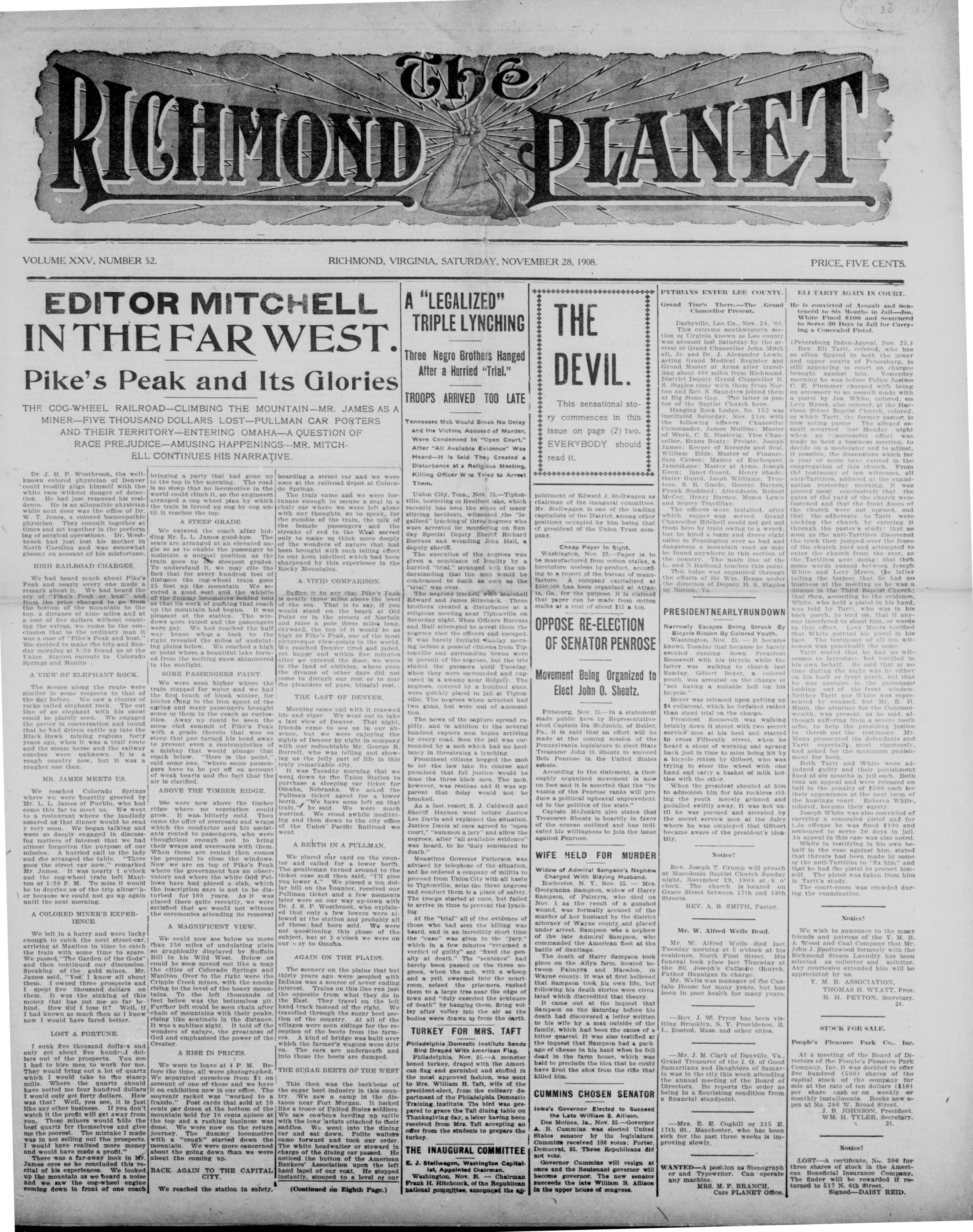
EDITOR MITCHELL IN THE FAR WEST. Pike's Peak and Its Glories
THE COG-WHEEL RAILROAD—CLIMBING THE MOUNTAIN—MR. JAMES AS A MINER—FIVE THOUSAND DOLLARS LOST—PULLMAN CAR PORTERS AND THEIR TERRITORY—ENTERING OMAHA—A QUESTION OF RACE PREJUDICE—AMUSING HAPPENINGS--MR. MITCH- FLL CONTINUES HIS NARRATIVE
VOLUME XXV, NUMBER 52
EDITOR
IN THE
Pike's Pea
THE COG-WHEEL RAILROAD
MINER—FIVE THOUSAND
AND THEIR TERRITORY
RACE PREJUDICE
ELL C
Dr. J. H. P. Westbrook, the well-known colored physician of Denver could readily align himself with the white race without danger of detection. He had just removed his residence. He is an allopathic physician while next door was the office of Dr. W. T. Jones, a colored homeopathic physician. They consult together at times and act together in the performing of surgical operations. Dr. Westbrook had just lost his mother in North Carolina and was somewhat gloomy on account of his misfortune.
HIGH RAILROAD CHARGES
We had heard much about Pike's Peak and nearly every one made a remark about it. We had heard the cry of "Pike's Peak or bust" and from the price charged to go from the bottom of the mountain to the top, a distance of nine miles and at a cost of five dollars without counting the extras, we came to the concessionary man it was a case of "Pike's Peak and bust." We decided to make the trip and Sunday morning at 8:30 found us at the Union Station enroute to Colorado Springs and Manito.
A VIEW OF ELEPHANT ROCK.
The scenes along the route were similar in some respects to that of the day before. We saw a cluster of rocks called elephant rock. The out line of an elephant with his snout could be plainly seen. We engaged the porter in conversation and found that he had driven cattle up into the Black Hawk mining regions forty years ago, when it was a trail route and the steam horse and the railway coaches were unknown. It is a rough country now, but it was a rougher one then.
MR. JAMES MEETS US
We reached Colorado Springs where we were heartily greeted by Mr. L. L. James of Pueblo, who had come this far to meet us. We went to a restaurant where the landlady assured us that dinner would be read very soon. We began talking and were so deeply engaged in discussing matters of interest that we had almost forgotten the purpose of our mission. A hurried call to the lady and she arranged the table. "There goes the street car now," remarked Mr. James. It was nearly 1 o'clock and the cog-wheel train left Manitou at 1:30 P. M. To miss it would be to deprive us of the trip altogether because we could not go up again until the next morning.
A COLORED MINER'S EXPERIENCE.
We left in a hurry and were lucky enough to catch the next street-car arriving at Manitou in time to catch the train with some time to spare. We passed, "The Garden of the Gods" and then continued our discussion. Speaking of the gold mines, Mr James said, "Yes, I know all about them. I owned three prospects and I spent five thousand dollars on them. It was the sinking of this money that has put me so far behind. How did I lose it? Well, if I had known as much then as I know now I would have fared better.
LOST A FORTUNE.
I sunk five thousand dollars and only got about five hundred dollars out of the prospects. You see I had to hire men to work for me. They would bring out a lot of quartz which I would take to the stamp mills. Where the quartz should have netted me four hundred dollars I would only get forty dollars. How was that? Well, you see, it is just like any other business. If you don't watch it the profit will get away from you. These miners would hide the best quartz for themselves and give me the poorest. The mistake I made was in not selling out the prospects. I would have realized more money and would have made a profit."
There was a far-away look in Mr. James eyes as he concluded this recital of his experiences. We looked up the mountain as we heard a noise and we saw the cog-wheel engine coming down in front of one coach
bringing a party that had gone up to the top in the morning. The road is so steep that no locomotive in the world could climb it, so the engineers arranged a cog wheel plan by which the train is forced up cog by cog until it reaches the top.
A STEEP GRADE
We entered the coach after bidding Mr. L. L. James good-bye. The seats are arranged at an elevated angle so as to enable the passenger to maintain a normal position as the train goes up the steepest grades. To understand it, we may cite the fact that for every hundred feet of distance the cog-wheel train goes 25 feet up the mountain. We secured a good seat and the whistle of the dummy locomotive behind told us that its work of pushing that coach up the mountain had begun. It was pleasant at the station. The winchers and sold of the passengers were gay. We had reached the half way house when a look to the right revealed the miles of undulating plains below. We reached a higher point where a beautiful lake formed from the melting snow shimmered in the sunlight.
SOME PASSENGERS FAINT
We were soon higher where the train stopped for water and we had the first touch of bleak winter, for lecicles chung to the iron spout of the spring and many passengers brought some or them in the coach as curiosities. Away up could be seen the snow clad summit of Pike's Peak with a grade thereto that was so steep that one turned his head away to prevent even a contemplation of what that would plunge that coach below. "Here I could tell said some one, "where some passengers have to be put off on account of weak hearts and the fact that the air is clarified.
ABOVE THE TIMBER RIDGE
We were now above the timber ridge where no vegetation could grow. It was bitterly cold. Then came the offer of overcoats and wraps which the conductor and his assistants rented to passengers, who were thoughtless enough not to bring their wraps and overcoats with them. When these are rented then comes the proposal to close the windows. Now we are on top of Pike's Peak where the government has an observatory and where the white Odd Fellows have had placed a slab, which the inscription says is not to be disturbed for 100 years. As it was placed there quite recently, we were satisfied that we would not witness the ceremonies attending its removal
A MAGNIFICENT VIEW
We could now see below us more than 150 miles of undulating plain so graphically displayed by Buffalo Bill in his Wild West. Below us could be seen spread out like a map the cities of Colorado Springs and Manitou. Over to the right were the Cripple Creek mines, with the smoke rising to the level of the hoary mountains. To the left thousands of feet below was the bottomless pit. Further left could be seen chain after chain of mountains with their peaks, rising like sentinels in the distance. It was a sublime sight. It told of the wonders of nature, the greatness of God and emphasized the power of the Creator.
A RISE IN PRICES
We were to leave at 4 P. M. Before the time, all were photographed. We separated ourselves from $1 on account of one of these and we have it on exhibition now in our office. The souvenir racket was "worked to a frazzler." Post cards that sold at 10 cents per dozen at the bottom of the mountain sold for 10 cents aplece at the top and a rushing business was done. We were now on the return journey. The dummy locomotive with a "cough" started down the mountain. We were more concerned about the going down than we were about the coming up.
BACK AGAIN TO THE CAPITAL CITY.
We reached the station in safety,
RICHMOND, VIRGINIA, SATURDAY, NOVEMBER 28, 1908.
boarding a street car and we were soon at the railroad depot at Colorado Springs.
The train came and we were fortunate enough to secure a seat in a chair car where we were left alone with our thoughts, so to speak, for the rumble of the train, the talk of the female passengers and the streaks of red in the West served only to make us think more deeply of the wonders of nature that had been brought with such telling effect to our keen intellect which had been sharpened by this experience in the Rocky Mountains.
A VIVID COMPARISON
Suffice it to say that Pike's Peak is nearly three miles above the level of the sea. That is to say, if you would stand on the beach at Old Point or in the streets of Norfolk and raise a pole three miles long, skyward, the top of it would be as high as Pike's Peak, one of the most picturesque view-points in the world. We reached Denver tired and jaded, yet happy and within five minutes after we entered the door, we were in the land of oblivion, where even the dreams of other days did not come to disturb our rest or to mar the pleasures of pure, blissful rest.
THE LAST OF DENVER
Morning came and with it renewed life and vigor. We went out to take a last view of Denver. That night, friends came to see us in our absence, but we were enjoying the sights of Denver by night in company with our redoubtable Mr. George B. Burrell, who was telling and showing us the jolly part of life in this truly remarkable city.
It was Tuesday morning that we went down to the Union Station to purchase a sleeping car ticket for Omaha, Nebraska. We asked the Pullman ticket agent for a lower berth. "We have none left on that train," he said. We were much worried. We stood awhile meditating and then down to the city office of the Union Pacific Railroad we went.
A BERTH IN A PULLMAN
We placed our card on the counter and called for a lower berth. The gentleman turned around to the ticket case and then said, "I'll give you lower 4." We placed a ten dollar bill on the counter, received our Pullman ticket and a few moments later were on our way up-town with Dr. J. S. P. Westbrook, who explained that only a few lowers were allowed at the station and probably all of these had been sold. We were not questioning this phase of the subject, but at 2 o'clock we were on our way to Omaha.
AGAIN ON THE PLAINS
The scenery on the plains that but thirty years ago were peopled with Indians was a source of never ending interest. Trains on this line run just the opposite from what they do in the East. They travel on the left hand track instead of the right. We travelled through the sugar beet section of the country. At all of the villages were seen sidlings for the reception of the beets from the farmers. A kind of bridge was built over which the farmer's wagons were drive en. The cars are underneath and into these the beets are dumped.
THE SUGAR BEETS OF THE WEST
This then was the backbone of the sugar beet industry in this country. We saw a camp in the distance near Fort Morgan. It looked like a troop of United States soldiers. We saw cowboys herding up cattle with the long tariats attached to their saddles. We went into the dining car and sat down. Polite waiters came forward and took our order. The white headwaiter or steward in charge of the dining car passed. He noticed the button of the American Bankers' Association upon the left hand lapel of our coat. He stopped instantly, stooped to a level or our
(Continued on Eighth Page.)
Tennessee Mob Would Brook No Delay and the Victims, Accused of Murder, Were Condemned In "Open Court," After "All Available Evidence" Was Heard—It Is Said They Created a Disturbance at a Religious Meeting, Killing Officer Who Tried to Arrest Them.
Union City, Tenn., Nov. 25—Tiptonville, bordering on Reefoot lake, which recently has been the scene of many stirring incidents, witnessed the "legalized" lynching of three negroes who were arrested for murdering on Sunday Special Deputy Sheriff Richard Burruss and wounding John Hall, a deputy sheriff.
The execution of the negroes was given a semblance of leagility by a hurried "trial," arranged with the understanding that the men would be condemned to death as soon as the "trial" was over.
The negroes lynched with Marshall Edward and James Stitneback. These brothers created a disturbance at a religious meeting near Tiptonville on Saturday night. When Officers Burruss and Hall attempted to arrest them the negroes shot the officers and escaped. It was barely daylight Sunday morning before a posse of citizens from Tiptonville and surrounding towns were in pursuit of the negroes, but the tri eluded the pursuers until Tuesday, when they were surrounded and captured in a swamp near Ridgely. The negroes, covered by a hundred guns, were quickly placed in jail at Tiptonville. The negroes when arrested had two guns, but were out of ammunition.
The news of the capture spread rapidly, and in addition to the several hundred captors men began arriving by every road. Soon the jail was surrounded by a mob which had no hesitancy in threatening a lynching.
Prominent citizens begged the mob to let the law take its course and promised that full justice would be done the three black men. The mob, however, was restless and it was apparent that delay would not be brooked.
As a last resort, S. J. Caldwell and Sheriff Haynes went before Justice Lee Davis and explained the situation. Justice Davis at once agreed to "open court," "summon a jury" and allow the negroes, after "all available evidence" was heard, after "duly sentenced to death."
Meantime Governor Patterson was advised by telephone of the situation, and he ordered a company of militia to proceed from Union City with all haste to Tiptonville, seize the three negroes and conduct them to a place of safety. The troops started at once, but failed to arrive in time to prevent the lynching.
At the "trial" all of the evidence of those who had seen the killing was heard, and in an incredibly short time the "case" was given to the "jury," which in a few minutes "returned a verdict of guilty" and "fixed the penalty at death." The "sentence" had barely been passed on the three negroes, when the mob, with a whoop and a yell, swarmed into the courtroom, seized the prisoners, rushed them to a large tree near the edge of town and "duly executed the sentence of death" by hanging them, firing volley after volley into the air as the bodies were drawn up from the earth.
TURKEY FOR MRS. TAFT
Philadelphia Domestic Institute Sends Bird Draped With American Flag. Philadelphia. Nov. 25.—A monster boned turkey, draped with the American flag and garnished and stuffed in the most approved fashion, was sent to Mrs. William H. Taft, wife of the president-elect, from the culinary department of the Philadelphia Domestic Training institute. The bird was prepared to grace the Taft dining table on Thanksgiving day, a letter having been received from Mrs. Taft accepting an offer from the students to prepare the turkey.
THE INAUGURAL COMMITTEE
E. J. Stellwagon, Washington Capitalist, Appointed Chairman.
Washington, Nov. 25. — Chairman Frank H. Hitchcock, of the Republican national committee, announced the ap-
pointment of Edward J. Stellwagen as chairman of the inaugural committee. Mr. Stellwagen is one of the leading capitalists of the District, among other positions occupied by him being that of president of the Union Trust company.
Cheap Paper In Sight
Washington, Nov. 25.—Paper is to be manufactured from cotton stalks, a heretofore useless by-product, according to a report of the bureau of manufacture. A company capitalized at $500,000 has been organized at Atlanta, Ga., for the purpose. It is claimed that paper can be made from cotton stalks at a cost of about $15 a ton.
OPPOSE RE-ELECTION OF SENATOR PENROSE
Movement Being Organized to Elect John O. Sheatz.
Pittsburg, Nov. 25.—In a statement made public here by Representative-elect Captain Ira McJunkin, of Butler, Pa., it is said that an effort will be made at the coming session of the Pennsylvania legislature to elect State Treasurer John O. Sheatz to succeed Bois Penrose in the United States senate.
According to the statement, a thoroughly organized movement is now on foot and it is asserted that the "invasion of the Penrose ranks will produce a political upheaval unprevented in the politics of the state."
Captain McJunkin also states that Treasurer Sheatz is heartily in favor of the course outlined and has indicated his willingness to join the issue against Penrose.
WIFE HELD FOR MURDER
Widow of Admiral Sampson's Nephew Charged with Slaying Husband.
Rochester, N. Y., Nov. 25. — Mrs. Georgianna Sampson, widow of Harry Sampson, of Palmyra, who died on Nov. 1 as the result of a gunshot wound, was formally accused of the murder of her husband by the district attorney of Wayne county and placed under arrest. Sampson was a nephew of the late Admiral Sampson, who commanded the American fleet at the battle of Santiago.
The death of Harry Sampson took place on the Allyn farm, located between Palmyra and Macedon, in Wayne county. It was at first believed that Sampson took his own life, but following his death stories were circulated which discredited that theory.
It came out at the inquest that Sampson on the Saturday before his death had discovered a letter written to his wife by a man outside of the family, which had been the cause of a bitter quarrel. It was also testified at the inquest that Sampson had a package of cheese in his hand when he fell dead in the farm house, which was held to preclude the idea that he could have fired the shot from the rifle that killed him.
CUMMINS CHOSEN SENATOR
Iowa's Governor Elected to Succeed the Late William B. Allison.
Des Moines, Ia., Nov. 25—Governor A. B. Cummins was elected United States senator by the legislature.
Cummins received 108 votes; Porter, Democrat, 85. Three Republicans did not vote.
Governor Cummins will resign at once and the Heutenant governor will become governor. The new senator succeeds the late William B. Allison in the upper house of congress.
PYTHIANS ENTER LEE COUNTY.
Grand Tim's There.—The .Grand
Chancellor Present.
Darbyville, Lee Co., Nov. 24, '08.
This extreme southwestern section of Virginia known as Lee county was aroused last Saturday by the arrival of Grand Chancellor John Mitch Jr, and Dr. J. Alexander Lewis, acting Grand Medical Register and Grand Master at Arms after travelling about 400 miles from Richmond. District Deputy Grand Chancellor H. S. Staples came with them from Norton and Rev. S. Saunders joined them at Big Stone Gap. The latter is pastor of the Baptist Church here.
Hanging Rock Lodge, No. 153 was instituted Saturday, Nov. 21st with the following officers: Chancellor Commander, James Mullins; Master of Work, C. E. Haslerig; Vice Chancellor, Beaty Beaty; Prelate, Joseph James; Keeper of Records and Seal, William Eds; Master of Finance, Sam Carson; Master of Exchequer, JamesLane; Master at Arms, Joseph Keen; Inner Guard, Henry Shade; Outer Guard, Jacob Williams; Trustees, S. R. Goode, George Barnes, Frank Stoddard; Attendants, Robert McCoy, Henry Barnes, Moses Lewis and Searcy Travillian.
The officers were installed, after which supper was served. Grand Chancellor Mitchell could not get out from here by train owing to a wreck, but he hired a team and drove eight miles to Pennington over as bad and dangerous a mountain road as may be found anywhere in this section of the country. The main line of the L. and N Railroad touches this point.
This lodge was organized through the efforts of Sir Wm. Evans under the direction of Deputy H. S. Staples or Norton, Va.
PRESIDENTNEARLYRUNDOWN
Narrowly Escapes Being Struck By
Bicycle Ridden By Colored Youth.
Washington, Nov. 25. — It became
known Tuesday that because he barely
avoided running down President
Roosevelt with his bicycle while the
latter was walking to church last
Sunday, Gilbert Boyer, a colored
youth, was arrested on the charge of
"not having a suitable bell on his
bicycle."
Boyer was released upon putting up
$4 collateral, which he forfeited rather
than stand trial on the charge.
President Roosevelt was walking
briskly down H street with two secret
service men at his heel and started to
cross Fifteenth street, when he
heard a shout of warning and sprang
back just in time to miss being hit by a
bicycle ridden by Gilbert, who was
trying to steer the wheel with one
hand and carry a basket of milk
bottles with the other.
When the president shouted at him
to admonish him for his reckless riding
the youth merely grinned and pedalled swiftly. It was not until he was pursued and arrested by the secret service men at the dairy
where he was employed that Gilbert
became aware of the president's identity.
Notice!
Rev. Joseph T. Crump will preach at Macedonia Baptist Church Sunday night, November 29, 1908 at 8 o'clock. The church is located on Grace Street between 17th and 18th Streets.
REV. A. B. SMITH. Pastor
Mr. W. Alfred Wells Dead
Mr. W. Alfred Wells died last Tuesday morning at 5 o'clock at his residence, North First Street. His funeral took place last Thursday at the St. Joseph's Catholic Church, Father Hannigan in charge. Mr. Wells was manager of the Custalo House for many years, but has been in poor health for many years.
—Rev. J. W. Pryor has been visiting Brooklyn, N. Y. Providence, R. L. Bostor, Mass, and other cities.
—Mr. J. M. Clark of Danville, Va., Grand Treasurer of the I. O. of Good Samaritans and Daughters of Samarria was in the city this week attending the annual meeting of the Board of Directors. He reports the order as being in a flourishing condition from a financial standpoint.
—Mrs. E. E. Cogbill of 215 E. 17th St., Manchester, who has been sick for the past three weeks is improving slowly.
WANTED-A position as Stenographer and Typewriter. Can operate any machine.
MRS. M. F. BRANCH.
Care PLANET Office.
PRICE, FIVE CENTS
ELI TARTT AGAIN IN COURT
He is convicted of Assault and Sentenced to Six Months in Jail—Jos. White Fined $100 and Sentenced to Serve 30 Days in Jail for Carrying a Concealed Pistol.
(Petersburg Index-Appeal, Nov. 25.)
Eli. Eli Tartt, colored, who has so often figured in both the lower and upper courts of Petersburg, is still appearing in court on charges brought against him. Yesterday morning he was before Police Justice C. E. Plummer charged with being an accessory to an assault made with a pistol by Jos. White, colored, on Levy Myers, also colored, at the Harrison Street Baptist Church, colored, or which Tartt, the former pastor, is now acting pastor. The alleged assault occurred last Monday night when an unsuccessful effort was made to hold a business meeting, to decide on a moderator and to adjust, if possible, the dissensions which for a year or more have existed in the congregation of this church. From the testimony of ten witnesses, all anti-Tarttites, adduced at the examination yesterday morning, that it proved most conclusively that the gates of the yard of the church were fastened and that the front doors of the church were not opened, and that the adherents to Tartt were packing the church by entering it through the pastor's study; that as soon as the anti-Tarttites discovered the trick they jumped over the fence of the church yard and attempted to enter the church from the rear, as the Tarttites were doing; that then some words ensued between Joseph White and Levy Myers, the latter telling the former that he had no business at the meeting as he was a deacon in the Third Baptist Church; that then, according to the evidence, White, who held a pistol in his hand, was told by Tartt, who was in his back porch, to lead on, that if anyone interfered to shoot him, or words to that effect. Levy Myers testified that White pointed his pistol in his face. The testimony of all ten witnesses was practically the same.
Tartt stated that he had no witnesses to introduce, but testified in his own behalf. He said that at no time during the night was he either on his back or front porch, but that he was upstairs in the parsonage looking out of the front window. Neither Tartt nor White was represented by counsel, but Mr. R. H. Mann, the attorney for the Commonwealth, was present, as he said, although suffering from a severe tooth ache, to help the presiding justice to thresh out the testimony. Mr. Mann prosecuted the defendants and Tartt especially, most vigorously, and asked for the maximum punishment for both.
Both Tartt and White were adjudged guilty and their punishment fixed at six months in jail each. Both took an appeal and were released on bail in the penalty of $500 each for their appearance at the next term of the hustings court. Rebecca White, colored, became their surety.
Joseph White was also convicted of carrying a concealed pistol and for its offense he was fined $100 and sentenced to serve 30 days in jail. An appeal in this case was also noted. White in testifying in his own behalf in the case against him, stated that threats had been made by some or the anti-Tarttites to "fix him" and that he had the pistol to protect himself. The pistol was taken from him in Tartt's study.
The court-room was crowded during the examination.
Notice!
We wish to announce to the many friends and patrons of the Y. M. B. A. Wood and Coal Company that Mr. John J. Spotswood formerly with the Richmond Steam Laundry has been selected as collector and solicitor. Any courtesies extended him will be appreciated by us.
Y. M. B. ASSOCIATION,
THOMAS H. WYATT, Pres.
B. H. PEYTON, Secretary.
STOCK FOR SALE.
People's Pleasure Park Co., Inc.
At a meeting of the Board of Directors of the People's Pleasure Park Company, Inc. it was decided to offer five hundred (500) shares of the capital stock of the company for sale at the rate of ten dollars ($10) per share cash or on weekly or monthly installments. Books now open at No. 206 W. Broad Street.
J. B. JOHNSON, President.
WM. H. TYLER, Secretary.
2t.
Notice!
LOST—A certificate, No. 306 for three shares of stock in the American Beneficial Insurance Company. The finder will be rewarded if returned to 517 N. 6th Street.
Signed—DAISY REID.
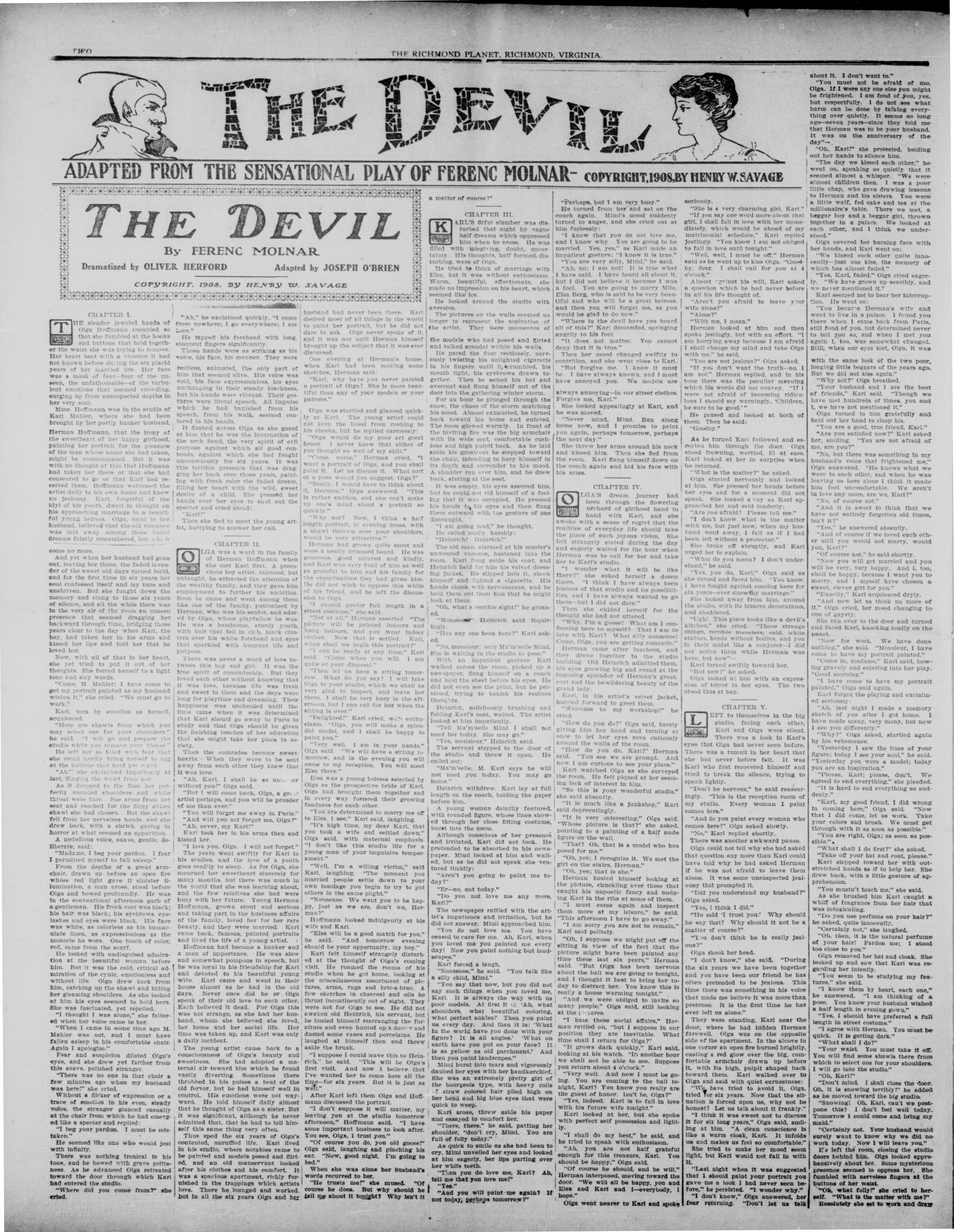
THE DEVIL
COPYRIGHT, 1908, BY HENRY W. SAVAGE
---
CHAPTER I
THE slender jeweled hands of Olga Hoffmann trembled so that she fumbled at the books and buttons that held together the waist she was trying to remove. Her heart beat with a violence it had not known before during the six plaudd years of her married life. Her face was a mask of fear—fear of the unseen, the unfathomable—of the turbulent emotions that seemed crowding, surging up from unsuspected depths in her very soul.
Mme. Hoffmann was in the studio of Karl Mahler, where she had been brought by her portly banker husband, Herman Hoffmann, that the irony of the sweetheart of her happy girlhood, painting her portrait for the pleasure of the man whose name she had taken, might be consummated. But it was with no thought of this that Hoffmann had taken her there or that she had consented to go or that Karl had received them. Hoffmann welcomed the artist daily to his own home and knew no jealousy. Karl, forgetful of the idyl of his youth, dwelt in thought on his approaching marriage to a beautiful young heiress. Olga, loyal to her husband, believed that the old romance was laid away among those faded dreams faintly remembered, but which come no more.
And yet when her husband had gone out, leaving her there, the faded lavender of the sweet old days turned lurid, and for the first time in six years her soul confessed itself and lay bare and unshriven. But she fought down the memory and clung to those six years of silence, and all the while there was in the very air of the room an unseen presence that seemed dragging her backward through time, bridging those years clear to the day when Karl, the boy, had taken her in his arms and kissed her lips and told her that he loved her.
Now, with all of that in her heart, she yet tried to put it out of her thoughts. She forced herself to a light tone and airy words.
"Come, M. Mahler; I have come to get my portrait painted as my husband wishes it," she cried. "We must go to work."
Karl, torn by emotion as herself, acquiesced.
"Here are shawls from which you may select one for your shoulders." he said. "I will go and prepare the studio while you remove your blouse." He left her so filled with fear that she could hardly bring herself to tug at the buttons that held her waist. "Ah!" she exclaimed impatiently at last, flinging the waist from her. As it dropped to the floor her perfectly rounded shoulders and white throat were bare. She arose from her seat and reached for the filmy silken shawl she had chosen. But the shawl fell from her nerveless hands, and she drew back, with a shriek, gazing in horror at what seemed an apparition. A melodious voice, suave, gentle, delibereate, said: "Madame, I beg your pardon. I fear I permitted myself to fall asleep."
From the depths of a great armchair, drawn up before an open fire whose red light gave it sinister illumination, a man arose, stood before Olga and bowed profoundly. He was in the conventional afternoon garb of a gentleman. His frock coat was black; his hair was black; his eyebrows, eyelashes and eyes were black. His face was white, as colorless as his immaculate linen, as expressionless as the monocle he wore. One touch of color, red, came from the scarf.
He looked with undisguised admiration at the beautiful woman before him. But it was the cold, critical admiration of the cynic, emotionless and without life. Olga drew back from him, catching up the shawl and hiding her gleaming shoulders. As she looked at him his eyes seemed to hold hers. She was fascinated, yet repelled.
"I thought I was alone," she faltered when her voice came to her.
"When I came in some time ago M. Mahier was out, and I must have fallen asleep in his comfortable chair. Again I apologize."
Fear and suspicion dilated Olga's eyes, and she drew yet farther from this suave, polished stranger.
"There was no one in that chair a few minutes ago when my husband was here!" she cried.
Without a flicker of expression or a trace of emotion in his even, steady voice, the stranger glanced casually at the chair from which he had emerged like a specter and replied:
"I beg your pardon. I must be mistaken."
He seemed like one who would jest with infinity.
There was nothing ironical in his tone, and he bowed with grave politeness. As he advanced Olga retreated toward the door through which Karl had entered the studio.
"Where did you come from?" she cried.
"Ah." he exclaimed quickly. "I come from nowhere; I go everywhere; I am here."
He tapped his forehead with long, eloquent fingers significantly.
Those hands were as striking as his voice, his face, his manner. They were restless, animated, the only part of him that seemed alive. His voice was cold, his face expressionless, his eyes unchanging in their steady blackness, but his hands were vibrant. Their gestures were literal speech. All impulse which he had banished from his speech, from his walk, seemed centered in his hands.
It flashed across Olga as she gazed at him that he was the incarnation of the arch fiend, the very spirit of evil purpose against which all good contends, against which she had fongt unconsciously for six years. It was this terrible presence that was dragging her back over those years, palting with fresh color the faded dream, filling her heart with the wild, sweet desire of a child. She pressed her hands over her eyes to shut out the specter and cried aloud: "Karl!"
Then she fled to meet the young artist, hurrying to answer her call.
CHAPTER 1L
LGA was a ward in the family of Herman Hoffmann when she met Karl first. A preoccuous boy artist, talented, but untaught, he attracted the attention of the wealthy family, and they gave him employment to further his ambition. Soon he came and went among them like one of the family, patronized by Herman, who was his senor, and adored by Oiga, whose playfellow he was. He was a handsome, sturdy youth, with hair that fell in rich, black clusters over his white forehead and eyes that sparkled with buoyant life and purpose.
There was never a word of love between this boy and girl. It was the true spirit of comradeship. But they loved each other without knowing that it was love, because life was fresh and sweet to them and the days were long for playtime and dreaming. Their happiness was unclouded until the time came when it was determined that Karl should go away to Paris to study and that Olga should be given the finishing touches of her education that she might take her place in society.
Then the comrades became sweet-hearts. When they were to be sent away from each other they knew that it was love.
"Ah, Karl, I shall be so unhappy without you!" Olga said.
"But I will come back, Olga, a great artist perhaps, and you will be prouder of me than ever."
"You will forget me away in Paris."
"And will you not forget me, Olga?"
"Ah, never, my Karl!"
Karl took her in his arms then and kissed her.
"I love you, Olga. I will not forget." The years went swiftly for Karl in his studies, and the love of a youth goes readily to sleep. As for Olga, she mourned her sweetheart sincerely for many months, but there was much in the world that she was learning about, and the few relatives she had were busy with her future. Young Herman Hoffmann, grown stout and serious and taking part in the business affairs of the family, loved her for her rare beauty, and they were married. Karl came back, famous, painted portraits and lived the life of a young artist.
Hoffmann had become a banker and a man of importance. He was slow and somewhat pompous in speech, but he was loyal in his friendship for Karl and devoted to his beautiful young wife. Karl came and went in their house almost as he had in the old days. Never once did he or Olga speak of their old love to each other. Each believed it dead. For Olga this was not strange, as she had her husband, whom she believed she loved, her home and her social life. Her time was taken up, and Karl was only a daily incident.
The young artist came back to a consciousness of Olga's beauty and sweetness. She had adopted a maternal air toward him which he found vastly diverting. Sometimes there throbbed in his pulses a beat of the old fervor, but he had himself well in control. His emotions were not waryward. He told himself daily almost that he thought of Olga as a sister. But it was significant, although he never admitted that, that he had to tell himself this same thing very often.
Thus sped the six years of Olga's contented, unruffled life. Karl lived in his studio, where notables came to be painted and models posed and flirted, and an old manservant looked after his clothes and his comfort. It was a spacious apartment, richly furnished in the trappings which artists love. There he lounged and worked, but in all the six years Olga and her
THE RICHMOND PLANET, RICHMOND, VIRGINIA
husband had never been there. Karl desired most of all things in the world to paint her portrait, but he did not dare to ask. Olga never spoke of it, and it was not until Herman himself brought up the subject that it was ever discussed.
One evening at Herman's house, when Karl had been making some sketches, Herman said:
"Karl, why have you never painted a portrait of Olga? She is more beautiful than any of your models or your patrons."
Olga was startled and glanced quickly at Karl. The young artist could not keep the blood from rushing to his cheeks, but he replied carelessly:
"Olga would do my poor art great honor. I never knew that either of you thought so well of my skill."
"Come, come," Herman cried.
"I want a portrait of Olga, and you shall paint it. Let us discuss it. What sort of a pose would you suggest, Olga?"
"Really, I would have to think about it, Herman." Oliga answered. "This is rather sudden, and one can't make up one's mind about a portrait so quickly."
"Why not? Now, I think a half length portrait, in evening dress, with a shawl thrown over your shoulders, would be very attractive."
Herman had grown quite stout and wore a neatly trimmed beard. He was generous, good natured and kindly, and Karl was very fond of him as well as grateful to him and his family for the opportunities they had given him. He did not wish to oppose this whim of his friend, and he left the discussion to Oliga.
"I should prefer full length in a street costume," she said.
"Not at all." Herman asserted. "The picture will be painted indoors and hung indoors, and you wear indoor clothes. Now that is settled. Karl, when shall we begin this portrait?" "I can be ready at any time." Karl said. "Come when you will. I am quite at your disposal." "Then let us have a sitting tomorrow. What do you say? I will take Oiga to your studio, which we shall be very glad to inspect, and leave her there. I shall be very busy in the afternoon, but I can call for her when the sitting is over." "Delighted!" Karl cried, with enthusiasm. "Oiga, you will make a splendid model, and I shall be happy to paint you." "Very well. I am in your hands," Oiga said. "We will have a sitting tomorrow, and in the evening you will come to my reception. You will meet Elsa there."
Elsa was a young heiress selected by Olga as the prospective bride of Karl. Olga had brought them together and in every way fostered their growing fondness for each other.
"You are determined to marry me off to Elsa, I see," Karl said, laughing.
"It's high time, my dear Karl, that you took a wife and settled down." Olga said, with maternal emphasis.
"I don't like this studio life for a young man of your impulsive temperament."
"Well, I'm a willing victim," said Karl, laughing. "The moment you married people settle down to your own bondage you begin to try to put others in the same plight."
"Nonsense. We want you to be happy, just as we are, don't we, Herman."
Hoffmann looked indulgently at his wife and Karl.
"Elsa will be a good match for you," he said. "And tomorrow evening should be your opportunity, my boy."
Karl felt himself strangely disturbed at the thought of Olga's coming visit. He roamed the rooms of his studio when he got home, looking at the miscellaneous assortment of pictures, arms, rugs and brie-a-brac. A few sketches in charcoal and oils he thrust incontinently out of sight. They were not for Olga to see. He did not awaken old Heinrich, his servant, but he busied himself rearranging the furniture and even hunted up a duster and dusted some vases and porcelains. He laughed at himself then and threw aside the brush.
"I suppose I could leave this to Heinrich," he said. "This will be Olga's first visit. And now I believe that I've wanted her to come here all the time—for six years. But it is just as well."
After Karl left them Olga and Hoffmann discussed the portrait.
"I don't suppose it will matter, my leaving you at the studio tomorrow afternoon," Hoffmann said. "I have some important business to look after. You see, Olga, I trust you." "Of course you do, you old goose!" Olga said, laughing and pinching his ear. "Now, good night. I'm going to bed." When she was alone her husband's words recurred to her. "He trusts me!" she mused. "Of course he does. But why should he tell me about it tonight? Why isn't it
a matter of course?"
CHAPTER III
KARL'S fitful slumber was disturbed that night by vague half dreams which oppressed him when he arose. He was filled with misgiving, doubt, uncertainty. His thoughts, half formed, disturbing, were of Olga.
He tried to think of marriage with Elsa, but it was without enthusiasm. Warm, beautiful, affectionate, she made no impression on his heart, which seemed like ice.
He looked around the studio with aversion. The pictures on the walls seemed no longer to represent the aspiration of the artist. They were mementos of the models who had posed and flirted and talked scandal within his walls.
He paced the floor restlessly, nervously twisting his unlighted cigarette in his fingers until it crumbled, his mouth tight, his eyebrows drawn together. Then he seized his hat and overcoat and flung himself out of the door into the gathering winter storm. For an hour he plunged through the snow, the chaos of the storm matching his mood. Almost exhausted, he turned back toward his home and entered. The room glowed warmly. In front of the inviting fire was the big armchair with its wide seat, comfortable cushions and high pulpit back. As he laid aside his greatcoat he stepped toward the chair, intending to bury himself in its depth and surrender to his mood. A shudder ran over him, and he drew back, staring at the soot. It was empty, his eyes assured him, but he could not rid himself of a feeling that it was occupied. He pressed his hands to his eyes and then flung them outward with the gesture of one distraught.
"I am going mad," he thought.
He called loudly, harshly:
"Heinrich! Heinrich!"
The old man, alarmed at his master's unwonted violence, hastened into the room. Karl flung aside his coat, and Heinrich held for him his velvet dressing jacket. He slipped into it, shook himself and lighted a cigarette. His hands shook with nervousness, and he held them out from him that he might look at them.
"Oh, what a terrible sight!" he groaned.
"Monsieur!" Heinrich said inquiringly.
"Has any one been here?" Karl asked.
"No, monsieur; only Ma'm'selle Mimi! She is waiting in the studio to pose." With an impatient gesture Karl walked across the room, picked up a newspaper, flung himself on a couch and held the sheet before his eyes. He did not even see the print, but he persisted, trying to banish his restless thoughts. Heinrich, soitlously brushing and folding Karl's coat, waited. The artist looked at him impatiently. "Tell Ma'm'selle Mimi I shall not need her today. She may go." "Yes, monsieur." Heinrich said.
The servant stepped to the door of the studio and threw it open. He called out:
"Ma'melle, M. Karl says he will not need you today. You may go home."
Heinrich withdrew. Karl lay at full length on the couch, holding the paper before him.
A young woman daintily featured, with rounded figure, whose lines showed through her close fitting costume, burst into the room.
Although conscious of her presence and irritated, Karl did not look. He pretended to be absorbed in his newspaper. Mimi looked at him and waited, but as he did not speak she ventured timidly:
"Aren't you going to paint me today?"
"Er—no, not today."
"Do you not love me any more, Karl?"
The newspaper rattled with the artist's impatience and irritation, but he did not answer. Mimi approached him. "You do not love me. You have ceased to care for me. Ah, Karl, when you loved me you painted me every day! Now you paint nothing but landscapes."
Karl forced a laugh. "Nonsense," he said. "You talk like a silly child, Mimi."
"You say that now, but you did not say such things when you loved me, Karl. It is always the way with us poor models. At first it is, 'Ah, what shoulders, what beautiful coloring, what perfect ankles.' Then you paint us every day. And then it is: 'What in the world have you done with your figure? It is all angles.' 'What on earth have you put on your face? It is as yellow as old parchment.' And then you paint landscapes."
Mimi burst into tears and vigorously daubed her eyes with her handkerchief. She was an extremely pretty girl of the bourgeois type, with heavy coils of straw colored hair piled high on her head and big blue eyes that were quick to weep.
Karl arose, throw aside his paper and essayed to comfort her.
"There, there," he said, patting her shoulder, "don't cry, Mimi. You are full of folly today."
As quick to smile as she had been to cry, Mimi unvelled her eyes and looked at him eagerly, her lips parting over her white teeth.
"Then you do love me, Karl? Ah, tell me that you love me!"
"Yes."
"And you will paint me again? If not today, perhaps tomorrow?"
I
"Perhaps, but I am very busy."
He turned from her and sat on the couch again. Mimi's mood suddenly turned to anger, and she cried out at him furiously:
"I know that you do not love me, and I know why. You are going to be married. Yes, yes," as Karl made an impatient gesture: "I know it is true."
"You are very silly, Mimi." he said.
"Ah, no; I am not! It is true what I have said. I have heard all about it, but I did not believe it because I was a fool. You are going to marry Mille, Elsa Berg, who is said to be very beautiful and who will be a great beiren, and then you will forget me, as you would be glad to do now."
"Where in the devil have you heard all of this?" Karl demanded, springing angrily to his feet.
"It does not matter. You cannot deny that it is true."
Then her mood changed swiftly to contrition, and she went close to Karl.
"But forgive me. I know it must be. I have always known, and I must have annoyed you. We models are always annoying—in our street clothes. Forgive me, Karl."
She looked appealingly at Karl, and he was moved.
"Never mind. Mimi. Run along home now, and I promise to paint you again, perhaps tomorrow, perhaps the next day."
She threw her arms around his neck and kissed him. Then she fed from the room. Karl flung himself down on the couch again and hid his face with his arms.
CHAPTER IV.
O
GA'S dream journey had been through the flowering orchard of girlhood hand in hand, with Kart, and she
"I wonder what it will be like there?" she asked herself a dozen times. "I think I have always been jealous of that studio and its possibilities, and I have always wanted to go there—but I did not dare."
Then she chided herself for the thought she had not uttered.
"Why, I'm a goose! What am I confessing here to myself? That I am in love with Karl? What silly nonsense! Come, Olga, you are getting romantic!"
Herman came after luncheon, and they drove together to the studio building. Old Heilrich admitted them, his eyes growing big and round at the imposing splendor of Herman's great coat and the bewildering beauty of the grand lady.
Karl, in his artist's velvet jacket, hurried forward to greet them.
"Welcome to my workshop!" he cried.
"How do you do?" Olga said, barely giving him her hand and turning at once to let her eyes rove curiously around the walls of the room.
"How do you do, Karl?" Herman said. "You see we are prompt. And now I am curious to see your place."
Karl watched Olga as she surveyed the room. He felt plump at her seeming lack of interest in him.
"So this is your wonderful studio," she said absently.
"It is much like a junkshop," Karl said deprecatingly.
"It is very interesting," Olga said. "Whose picture is that? she asked, pointing to a painting of a half nude figure on the wall.
"That? Oh, that is a model who has posed for me."
"Oh, yes; I recognize it. We met the girl on the stairs, Herman."
"Oh yes; that is she."
Herman busied himself looking at the picture, chuckling over those that caught his unpoetic fancy and nudging Karl in the ribs at some of them.
"I must come again and inspect them more at my leisure," he said.
"This afternoon I have to go away."
"I am sorry you are not to remain." Karl said politely.
"Oh, I suppose we might put off the sitting in view of the fact that the picture might have been painted any time these last six years," Herman said.
"But Olga has been nervous about the ball we are going to tonight, and I thought it best to bring her today to distract her. You know this is really a house warming tonight."
"And we were obliged to invite so many people." Olga said, still looking at the pictures.
"I have these social affairs," Herman rattled on, "but I suppose in our position they are inevitable. What time shall I return for Olga?"
"It grows dark quickly," Karl said, looking at his watch. "In another hour we shall not be able to see. Suppose you return about 4 o'clock."
"Very well. And now I must be going. You are coming to the ball tonight, Karl? You know you really are the guest of honor. isn't he, Olga?" "Yes, indeed. Karl is to fall in love with his future wife tonight." Karl looked at her, but she spoke with perfect self possession and lightly.
"Ah, you are not half grateful enough for this treasure, Karl. You should be happy." Olga said. "Of course he should, and he will." Herman interposed, moving toward the door. "We will all be happy, you and Elsa and Karl and I—everybody, I hope." Olga went nearer to Karl and spoke
seriously.
"She is a very charming girl, Karl."
"If you say one word more about that girl, I shall fall in love with her immediately, which would be ahead of my matrimonial schedule," Karl replied jestingly. "You know I am not obliged to fall in love until tonight."
"Well, well, I must be off." Herman said as he went up to kiss Olga. "Goodby, dear. I shall call for you at 4 o'clock."
Almost against his will, Karl asked a question which he had never before in all his life thought of.
"Aren't you afraid to leave your wife alone?"
"Alone?"
"With me, I mean."
Herman looked at him and then spoke jestingly, with but an effort. "I am hurrying away because I am afraid I shall change my mind and take Olga with me," he said.
"You are not jealous?" Olga asked.
"If you don't want the truth—no. I am not." Herman replied, and in his tone there was the peculiar meaning which his words did not convey. "If I were not afraid of becoming ridiculous I should say warningly, 'Children, be sure to be good.'"
He paused and looked at both of them. Then he said:
"Goodby."
As he turned Karl followed and escorted him through the door. Olga stood frowning, worried, ill at ease. Karl looked at her in surprise when he returned.
"What is the matter?" he asked.
Olga started nervously and looked at him. She pressed her hands before her eyes and for a moment did not speak. She looked a way as Karl approached her and said tenderly:
"Are you afraid? Please tell me."
"I don't know what is the matter with me, but just now, when my husband went away, I felt as if I had been left without a protector."
She broke off abruptly, and Karl urged her to explain.
"What do you mean? I don't understand," he said.
"Yes, you do, Karl." Olga said as she turned and faced him. "You know. I have fought against coming here for six years—ever since my marriage."
She looked away from him, around the studio, with its bizarre decorations, and shuddered.
"Ugh! This place looks like a devil's kitchen," she cried. "These strange things, terrible monsters, cold, white statues, heads without bodies, and you in their midst like a conjurer—I did not notice them while Herman was here, but now"—
Karl turned swiftly toward her.
"But now?" he asked.
Olga looked at him with an expression of terror in her eyes. The two stood thus at bay.
CHAPTER V.
L
EFT to themselves in the big studio, facing each other, Karl and Olga were silent. There was a look in Karl's eyes that Olga had never seen before. There was a tumult in her heart that she had never before felt. It was Karl who first recovered himself and tried to break the silence, trying to speak lightly.
"Don't be nervous," he said reassuringly. "This is the reception room of my studio. Every woman I paint comes here."
"And do you paint every woman who comes here?" Olga asked slowly.
There was another awkward pause.
Olga could not tell why she had asked
that question any more than Karl could
have told why he had asked Herman
if he was not afraid to leave them
alone. It was some unsuspected jealousy that prompted it.
"Did you understand my husband?"
Olga asked.
"Yes, I think I did."
"He said 'I trust you.' Why should
he say that? Why should it not be a
matter of course?"
"You don't think he is really jealous?"
Olga shook her head.
"I don't know," she said. "During the six years we have been together and you have been our friend he has often pretended to be jealous. This time there was something in his voice that made me believe it was more than pretense. It is the first time he has ever left us alone."
They were standing, Karl near the door, where he had bidden Herman farewell. Olga was on the opposite side of the apartment. In the alcove in one corner an open fire burned brightly, casting a red glow over the big, comfortable armchair drawn up before it, with its high, pulpit shaped back toward them. Karl walked over to Olga and said with quiet earnestness:
"We have tried to avoid it, Olga, tried for six years. Now that the situation is forced upon us, why not be honest? Let us talk about it frankly."
"I think it was sweet not to discuss it for six long years," Olga said, smiling at him. "A clean conscience is like a warm cloak, Karl. It infolds us and makes us feel so comfortable."
She tried to make her mood seem light, but Karl would not fall in with it.
"Last night when it was suggested that I should paint your portrait you gave me a look I had never seen before," he persisted. "I wonder why."
"I don't know," Olga answered, her fear returning. "Don't let us talk
about it. I don't want to."
"You must not be afraid of me, Olga. If I were any one else you might be frightened. I am fond of you, yes, but respectfully. I do not see what harm can be done by talking everything over quietly. It seems so long ago—seven years—since they told me that Herman was to be your husband. It was on the anniversary of the day"—
"Oh, Karl!" she protested, holding out her hands to silence him.
"The day we kissed each other," he went on, speaking so quietly that it seemed almost a whisper. "We were almost children then. I was a poor little chap, who gave drawing lessons to Herman and his sisters. You were a little wolf, fed cake and tea at the millionaire's table. There we met, a beggar boy and a beggar girl, thrown together in a palace. We looked at each other, and I think we understood."
Olga covered her burning face with her hands, and Karl went on:
"We kissed each other quite innocently—just one kiss, the memory of which has almost faded."
"Yes, Karl, faded," Olga cried eagerly.
"We have grown up sensibly, and we never mentioned it."
Karl seemed not to hear her interruption. He went on:
"You became Herman's wife and went to live in a palace. I found you there when I came back from Paris, still fond of you, but determined never to tell you so, and when I met you again I, too, was somewhat changed. Still, when our eyes met, Olga, it was with the same look of the two poor, longing little beggars of the years ago. But we did not kiss again."
"Why not?" Olga breathed.
"Your husband and I are the best of friends," Karl said. "Though we have met hundreds of times, you and I, we have not mentioned it."
Olga turned to him gratefully and held out her hand to clasp his.
"You are a good, true friend, Karl."
"Are you satisfied now?" Karl asked her, smiling. "You are not afraid of me, are you?"
"No, but there was something in my husband's voice that frightened me," Olga answered. "He knows what we were to each other, and when he was leaving us here alone I think it made him feel uncomfortable. We aren't in love any more, are we, Karl?"
"No, of course not."
"And it is sweet to think that we have not entirely forgotten old times, isn't it?"
"Yes," he answered absently.
"And of course if we loved each other still you would not marry, would you, Karl?"
"Of course not," he said shortly.
"Now you will get married and you will be very, very happy. And I, too, shall be happy, because I want you to marry, and I myself have chosen a sweet, clever girl for you." "Exactly," Karl acquiesced dryly.
"And now let us think no more of it." Olga cried, her mood changing to one of gayety.
She ran over to the door and turned and faced Karl, knocking loudly on the panel.
"Now for work. We have done nothing," she said. "Monsieur, I have come to have my portrait painted."
"Come in, madame." Karl said, bowing gravely and entering into her play. "Good morning."
"I have come to have my portrait painted," Olga said again.
Karl forgot the playing and exclaimed seriously:
"Ah, last night I made a memory sketch of you after I got home. I have made many, very many, but now I see you differently."
"Why?" Olga asked, startled again by his vehemence.
"Yesterday I saw the lines of your figure; today I see your soul," he said.
"Yesterday you were a model; today you are an inspiration."
"Please, Karl; please, don't. We agreed to end everything," she pleaded.
"It is hard to end everything so suddenly."
"Karl, my good friend, I did wrong in coming here," Olga said. "Now that I did come, let us work. Take your colors and brush. We must get through with it as soon as possible."
"You are right, Olga; as soon as possible."
"What shall I do first?" she asked.
"Take off your hat and coat, please."
Karl stepped toward her with outstretched hands as if to help her. She drew back, with a little gesture of apprehension.
"You mustn't touch me," she said.
As she brushed him Karl caught a whiff of fragrance from her hair that was intoxicating.
"Do you use perfume on your hair?" he asked, quite innocently.
"Certainly not," she laughed.
"Oh, then, it is the natural perfume of your hair! Pardon me; I stood too close to you."
Olga removed her hat and cloak. She looked up and saw that Karl was regarding her intently.
"You seem to be studying my features," she said.
"I know them by heart, each one," he answered. "I am thinking of a pose. You know your husband wished a half length in evening gown."
"Yes, I should have preferred a full length in street costume."
"I agree with Herman. You must be quick. It is getting dark."
"What shall I do?"
"Your waist. You must take it off. You will find some shawls there from which to select one for your shoulders. I will go into the studio."
"Oh, Karl!"
"Don't mind. I shall close the door. Oh, it is snowing terribly!" he added as he moved toward the big studio.
"Snowing! Oh, Karl, can't we postpone this? I don't feel well today. Tomorrow I could come and bring my maid."
"Certainly not. Your husband would surely want to know why we did no work today. Now I will leave you."
He left the room, closing the studio doors behind him. Olga looked apprehensively about her. Some mysterious presence seemed to oppress her. She fumbled with nerveless fingers at the buttons of her waist.
"Oh, what folly!" she cried to herself. "What is the matter with me?" Resolutely she set to work and drew
THE PLANET
from her beautiful shoulders and gleaming rounded arms the silken waist that covered them. She turned to get the shawl, and the waist fell to the floor as she recoiled, with a shriek of terror, from an apparition that arose slowly from the depths of the big armchair.
Where there had been no human being an instant before Olga saw a tall, strange looking man. He was in conventional afternoon attire, save that his waistcoat was red, in sharp contract to the somber black of his frock coat. His hair was black. His upward pointing eyebrows were black, and his eyes shone like dull burning lumps of coal. His face was like a mask, matching his immaculate linen in whiteness. It was cynical in its expression and almost sinister as he bowed low, with his hands folded over his breast, and sald in a low, musical voice:
"Pardon me, madame; I think you dropped something."
He stooped and picked up the silken waist which had fallen from Olga's hands. As he held it out to her she drew back in horror.
(To Be Continued.)
FOR THE BREAKFAST TABLE
Suggestions for Those Who Would Begin the Day Well.
The average American family is fast following in the footsteps of foreign cousins and eating light breakfasts and one hot dish is considered sufficient. The motherly mother and devoted wife may find one or two of the following dishes tempting. Generally speaking, something with a little salty flavor appeals to a man's appetite.
Finnan Haddie and Eggs—Select a thick fish and cut into pieces large enough for single portions. Parboll the fish for a few minutes. Remove from the pan, dry with a cloth. Put the fish on the fine broiler, rub butter over it and broil until nicely browned. Lay on a hot platter, brush once more with butter, squeeze a little lemon juice over it and serve with a poached egg on each square of fish.
Baked Breakfast Dish.—In the bottom of a baking dish put a layer of cold mashed potatoes left from dinner. Sprinkle with bits of butter. Over this place a layer of finely chopped ham and then break several eggs over the top. Place in a moderately quick oven and bake until done. Grated cheese may be added on top of the eggs if cheese is liked. Many prefer it without the cheese for breakfast and with the cheese for luncheon. Bacon in Potatoes.—Select large potatoes of even size and cut a small piece off one end so they will stand. When baked remove the second end scoop out part of the inside. Fill this cavity with chopped broiled bacon, making a little pyramid in each potato. Serve on hot platter and stick a sprig of parsley in each potato.
Barberry Jelly.
Add enough water to nearly cover the berries. They should be thoroughly cooked and drained through a jelly bag. Add one pound of sugar to a pint of juice. Add one pound of sugar to a pint of juice. Boll gently, removing any scum that may arise until the juice thickens when dropped on a plate. Then pour in tumbler and seal. I should boil the juice 15 or 20 minutes before adding sugar.
Here is another recipe: Take as many apples by measure as barberries, remove bad places, then quarter. Do not pare or core. Add berries with water enough to cover, boll until the apples are soft, then strain. To a cup of juice use a cup of sugar, put juice on to boll about 20 minutes. In the meantime put sugar in the oven to heat. Stir often so as to not burn. Put all together and boll until it comes to a jelly. Sometimes it takes only five minutes. Make it on a clear day.
Rose Cake.
Here is a cake to serve with the ice at luncheon. Bake in a brick loaf, cover with a white boiled icing and serve uncut on a handsome platter with a single pink rose laid on each side. Let the hostess cut the cake and serve it on small plates. The recipe reads: Cream one cup of butter with two cups of sugar, mix one cup of corn starch with one cup of milk and stir into the butter and sugar; beat until smooth, add one-third teaspoon of rose flavoring then stir in two cups of flour sifted with four level teaspoons of baking powder. Beat just enough to mix well, fold the stiffly beaten whites of four eggs in lightly, and turn into the buttered and floured pan. Bake in a moderate oven.
A. Macaroni Dish.
Have ready a cupful of macaroni which has been boiled in salted water and cut up rather finely. This means a cupful after cooking, not before, and the pieces should be half an inch or more in length. Melt a tablespoon of butter in a skillet, and add one tablespoon of cornstarch and stir until well mixed. Add gradually half cup of sweet thin cream and cook two minutes. Add quarter teaspoon of salt, a dash of cayenne pepper, and quarter teaspoon of mustard. Into this sauce stir first your macaroni, then half pound of mild American cheese, grated. Stir and simmer gently until the cheese has melted, then turn the mixture out on triangles of toasted bread. Serve at once.
Apricot Catsup.
Cook two gallons of very ripe apri-
cots for one hour; then remove fire and put through colander to remove the pits and skins; then add one gallon of pure cider vinegar, two pounds of brown sugar, three tablespoonfuls each of cinnamon, cloves, mace, allspice and ginger and one cupful of horseradish. Return to the fire and cook three hours. Bottle when cool.
"Expert" Carving
At a dinner where half a duck was served each guest the host was complained upon his skilful carving. Later it was divulged that before cooking them the birds were cut in two, stuffed, sewed together and baked. Mr. Host merely cut the threads at the table.
Razard no Cake Pans
Do not grease your cake pans with butter. This is the poorest of all material for this purpose. Beef suet is much better than anything else. To positively avoid having the cake stick to the pan, first grease the pan and then line it with greased paper.
Good Paste.
To a pint of smooth thick paste add one teaspoonful of powdered alum and ten drops of clove oil, this will keep it moist and also prevent it from turning sour.
To Keep Flues Clear of Soot.
Stove pipes, boiler tubes and flues may be kept free of soot by occasionally throwing a scrap of zinc into the fire.
In D.e Form.
Orlando Spoonamore had proposed,
"I shall have to refer you to papa," said the young and lovely Clarinda Hewligus.
Orlando reflected.
"Yes," he said, "I suppose that is the correct procedure. I take the initiative and you order the referendum."—Chicago Tribune.
A Clear Retort.
"What do you do for a living?"
asked the lawyer of the hatchet-faced witness who was undergoing cross-examination.
"Everybody you lawyers don't beat me to," answered the h. f. w.
And, knowing where to get off, the lawyer applied the emergency brake.
—Chicago Daily News.
Regular Tough.
"I've heard of Skimmerhorn as a pretty hard case."
"That describes him exactly. An automobile ran over him one day and had to go to the shop for repairs. Didn't hurt Skimmerhorn a blamed bit."—Chicago Tribune.
ON THE GOLF LINKS
A boy and a girl playing golf.
The Lady Golfer (to new boy)—
Have you ever been a caddie before?
The New Caddie (knows his business)—That's all right, lady. Swear as much as you please; don't mind me.—Chicago Daily News.
Beckless Freedom
When freedom from her cart-tall height
Unfurls her speeches to the air
She tears the union-suit of night
And waves the tattered underwear
Abortive Scheme
The Sultor—Johnny, your parlor clock is an hour fast.
The Kid Brother—I know it. But don't tell sister so.
The Sultor—Why not?
The Kid Brother—Because she thinks you don't know it.—Cleveland Leader.
Exclusive.
Mulligan—The byes say ye licked poor Casey. Shure, he niver hurt iny man's feelin's.
Harrigan—He's a shnake in the grass. The blackgurd referred to me as his contimperary, and I'll be the contimperary to no man livin'—Puck.
Had Her Doubt
Hair-dresser (while giving lady a vigorous shampoo)—Will you have anything on your head when I have finished, madam?
Madam—I'm sure I don't know. I was in hopes you would leave enough hair to pin my hat to—judge.
THE SAD TALE OF A MOTORIST.
There was a man of modest means,
But inclinations gay,
Who sold his property and bought
A motor-car one day.
He closed his business up to ride
Within the big machine,
And parted with his diamond ring
To buy the gasoline.
He thought of all the country roads,
He'd scorch like 'llectric wires';
And put a mortgage on his house
To purchase rubber tyres.
And next he auctioned off his beds,
His tables and his chairs
To give the coat of paint
And make some slight repairs.
But speeding in the early dusk,
Without his lamps alight,
A numbered man in blue appeared
And stopped his dizzy flight.
He didn't have a single cent
To pay the fine imposed.
They took the motor for the debt,
And so the taie was closed.
Expecting a Crash.
Mrs. Gunner—I overheard Nora talking to herself as she brushed off the fancy china. She said so much of it was nothing short of monotony. Mr. Green—Don't worry, my dear; it won't be long before she breaks the monotony—Chicago Daily News.
THE RICHMOND PLANET, RICHMOND, VIRGINIA
AROUND THE HOUSE
CHAT ON MATTERS OF MORE OR LESS IMPORTANCE.
Useful Duster Devised from Worn-Out
Garment — Simple Method of
Marking Linen Before
Sending to Laundry.
Dusters—There is nothing that can
be used to dust with that can equal
the lower portion of a gauze under-
vest. Wet in warm water and wrung
out tight, it will take up every particle
of dust, and then, as it is rinsed, one
feels sure of actually getting rid of
so much dirt. Twenty years of dusting
highly finished furniture with a soft,
damp woven dust cloth has not dimmed its luster.
Old Sheets—When sheets wear out past recovery, tear out the center or worn part, sew up in a double seam, thus hiding the edges, and sew one, two or three brass rings as needed on to one end. Use this to hang over nice dresses in the closets. If too long, cut a piece off from the bottom and use to cover the sleeve board, or, if of good quality, this piece would make a pillow case.
Stockings—All stockings should be marked so as to mate. Initials can be worked in long outlining stitches with either white thread or different colored silks for different members of the family. Use the Roman numerals with one long stitch for each line to mate them. This sort of marking takes but a few moments as soon as the stockings are bought, and saves m ch time in sorting and gives general satisfaction in the household.
For Safety—One mother with several daughters has hit upon a good plan to protect her right of ownership. Each week when preparing clothes for the Monday wash she takes a needle with white thread and runs a stitch through one corner of each of her own handkerchiefs, also each stocking. The mall is instructed to dampen the handkerchiefs and break the thread only when ready to iron them and see that they are placed on her bureau. The same instructions are given in regard to the stockings.
Lace Curtains—All lace curtains should be soaked for a least an hour in cold water in which a little borax has been dissolved before putting them into warm suds. This takes out the smoky odor and softens the dirt.
Ice Pick—Always remember that if the ice pick is lost or misplaced for the time being, an ordinary hat pin gradually forced into ice will produce a crack and separate the ice without a sound. Nurses in hospitals use needles and even common pins to crack ice for patients.
Shoes Blacked—There is no reason why young or old should be carele about having their footwear kept in proper condition. A lamb's wool glove and dauber can be bought for ten cents and a box of blacking for another dime. By being careful to never use but one side of the dauber there will be no need of soiling the fingers, and the wool glove gives a fine polish with very little effort.
Furniture Polish—All outlay of energy required in polishing furniture after the fall cleaning is well repaid in the appreciation shown by every member of the family. A well tested polish is made of one part benzine, one part linseed oil and two parts turpentine. Use two cloths, one to rub on the liquid and the other for polishing.
Useful Tea Stone
While all English and Irish lovers of tea have their quilted cozy to keep tea hot, the Hollanders have a tea stone that performs the same function. These are made of polished wood, are nearly circular in shape, six or seven inches in height, with a flat brass top perforated in a design. There is an opening on one side through which is slipped a glazed pottery receptacle, usually three cornered, which holds the glowing bits of charcoal that supply heat to the teapot resting on the openwork brass top.
Oyster Salad.
To make this delicate dish stew the oysters in their own liquor until the edges curl. Then pour the whole into a bowl to cool. To four dozen oysters and three tablespoonfuls of vinegar, one of oil, with a little salt and pepper and set all on ice until wanted. Cut up the tender part of a head of celery into dice and mix it with the oysters, adding a cupful of mayonnaise dressing.
A Treated Duster
A big piece of cheese cloth wring out of turpentine and dried is almost a magic duster. It accumulates all dust, does not scatter it and at the same time brightens everything it touches.
Bathtub.
A ten-cent small-sized scrubbing brush is the nicest thing to use when washing out a bathtub. It appeals to the men folk of the household as a very sensible way of arranging for a rather dreaded duty.
Nut Cakes.
Three pounds of sugar, half a pound of butter, one pound of finely-chopped almonds, grated rind of one lemon, three pounds of flour. Drop in pans, a teaspoonful for a cake, and bake in moderate oven.
Dishwashing Hint
Invert all hard cooking dishes over steam or hot water for a few minutes and every particle will wash off easily, especially dishes that have been used for syrup, bread or pastry dough.
The American Girl Abroad.
At the luncheon hour in the Strand recently the traffic was held up, pedestrians puzzled after the nearest fire alarm, constables spread their arms and the crowd increased. From the edge of the crowd the struggling wayfarer peered and heard the snap of the camera through the official silence. It was an American girl snapshooting her companions.—London Chronicle.
The reason why thieves are such smart thieves is that they have a keen sense of humor. The street arab picks your house while he grills at you. It is only the thieves who are serious. Poor thief Twist's seriousness was the result of his arrest. The humor of the Artful Dodger and Charley Bates saved them—Strand Magazine.
RAM'S HORN BROWN'S PHILOS
OPHY.
Love never finds out that its burden is heavy.
Treasure laid up in heaven draws interest on earth.
It is a waste of time to try to understand some folks.
A man with the divine affatus can find poetry in his own back yard.
A thought is to the mind of the thinker what coal is to the boiler.
If the salt has lost its savor the sooner it goes to the dumpheap the better.
It will some day astonish us to learn how much real good has come out of our mistakes.
Theer is no more positive way of being a failure than by being neither cold nor hot.
Thathever we would get into the life of the nation we must first get into the mind of the child.
The art of pleasing is the art of going upstairs in everything, from sweeping a street to running for congress.
An ordinary man, with a great purpose, is sure to accomplish more than an extraordinary man who has none.
Paul was half killed a good many times before he could say: "I have fought a good fight."—Indianapolis News.
REFLECTIONS OF A BACHELOR.
The chief trouble with ideals is they won't pay any grocery bills.
Nobody ever heard of a pretty girl who envied an ugly one her brains.
The reason a man enjoys going to the theater is he wouldn't if it was with his family.
The meanest thing about mean people is how they don't care what you think of them for it.
The exciting thing to a girl about a secret engagement is having everybody know about it.
The better a man's excuse for getting home late the more his state won't let him tell it.
If a man could solve the mystery of why a woman appeals to him she wouldn't any longer.
The only compensation about not being rich is the way you can pretend to despise somebody who is.
The only reason a patriot can get more excited about the constitution than about his party candidate's platform is he knows less about the former.
No matter how smart a woman thinks a man is she is clever enough to fatter him by making him believe she thinks it's a lot more than she does.-New York Press.
ITEMS OF INTEREST
The longest span of telegraph wire in the world is 600 feet, across the river Kistnah, in India.
Germany rewards every locomotive engineer who runs his engine for ten years without an accident.
A 2,000-acre farm near Idaho Falls, Idaho, owned by Thomas W. Lee, is operated entirely by electricity.
It has been estimated that the eyelids of the average man open and close no less than 4,000,000 times each year.
Experiments with new machinery on the Chilian nitrate fields are expected to cut the cost of production in half.
An investigation by the state geologist of New York found much more important deposits of iron than had been generally supposed, and in his recent report that official expressed the opinion that the state one day will be prominent in the production of the metal.
DYSPEPTIC PHILOSOPHY
The busier a man is the less time he has to think about being overworked.
It is seldom the lightweight who rises to the top.
The pessimist seems to get a lot of fun out of being miserable.
The greatest compliment an egotist can confer is to say: "I agree with you."
There is quite a difference between delivering the goods and being caught with them.
LITTLE PHILOSOPHIES
Each day is a jewel strung on the
necklace of eternity.
—
The egotist feels his pulse and
thinks the world has fever.
—
Let us cast the roses over our shoul
ders that they who come after may
step softly.
LINCOLN
HAIR POMADE
MAKES
KINKY
HAIR
SOFT
REMOVES
DANDRUFF
KEEPS
HAIR
FROM
BREAKING
OFF
LINCOLN
HAIR POMADE
KEEPS
SCALP
FRESH
CLEAN AND
WHOLE-
SOME
MAKES
HAIR
GROW
LONG AND
LUXURIOUS
WHICH WAY WOULD YOU RATHER HAVE YOUR HAIR-SOFT AND
LONG SO THAT YOU CAN PUT IT UP IN THE LATEST STYLE
OR SHORT AND KINKY
A WOMAN'S JUST PRIDE IS HER
HAIR. TO STRAIGHTEN OUT THAT KINKY, CURLY
HAIR, PUTTING IT IN THE MOST PERFECT
CONDITION TO BE COMBED INTO ANY
SHAPE JUST TRY A BOTTLE OF LINCOLN HAIR POMADE.
There is no other preparation on earth to equal Lincoln Hair Pomade in producing soft, beautiful hair. Lincoln Hair Pomade is a natural hair cleanser—a natural promoter of growth and naturally reduces the hair to a straight and combable condition; but also supplies the air with a silky sheen and gloss. No matter how you apply your hair is now, no matter how hard or curly it may be, the Lincoln Hair Pomade will give you hair that can well be the envy of others. Lincoln Hair Pomade is the only highly recommended preparation for hair.
It is Lincoln Hair Pomade you want, so refuse weak and inferior substitutes. Do not take anything that is claimed to be just as good, but insist on getting the service.
Agents Wanted Everywhere. Write for particulars. If your dealer does not keep it, send 26 cents in stamps or silver to THE LINCOLN POMADE CO., Department B, Norfolk, Va. and we will send you a bottle by return mail.
MAKES
KINKY
HAIR
SOFT
REMOVES
DANBRUFT
KEEPS
HAIR
FROM
BREAKING
OFF
PRIZE HOUSE MAID IS FOUND
AT LAST.
Housekeeper (to pleasant-faced girl
at employment agency)—Have you
any objection to the country?
Girl (politely)—None at all, madam.
Housekeeper—I have quite a large
family.
Girl—The more the merrier.
Housekeeper—Seven children, two
of them quite young.
Girl—I love little children.
Housekeeper—It will be necessary for you to bake bread, wash and get the meals. I attend to the pastry and chamber work myself.
Girl—I will also make the pastry and do the rest, if you will allow me.
Housekeeper—I cannot give you more than three afternoons off.
Girl—Two will be sufficient, perhaps more than I will want, as my plan is to give strict attention to my household duties, and thus get the work done up promptly, every day, so as to have plenty of opportunities to rest between times.
Housekeeper—I am delighted—Stranger (suddenly entering)—Sorry to interrupt you, madam, but you are conversing with one of my patients, who has just escaped from the hopelessly incurable lunatic asylum.—N. Y. Weekly.
HOW IT APPEARED TO BOBBY.
文
Mrs. Old Bryde (to her grandson)—There, Bobby, that was my grand-mamma!
Bobby—Ah! They had new grand-mas in those days, I suppose.—London Sketch.
Just a Minute.
Excuse us, just
A minute here;
We've heard the score
And want to cheer.
—Detroit Free Press.
A Natural Inquiry
She—The man I marry must be handsome, witty, cultivated, courteous, kindly, considerate, and, above all, of high moral character.
He—In view of the fact that this is leap year, I find myself constrained to ask you I am to regard your words in the light of a proposal?—Judge.
Suspicious Conduct.
Patron—The conductor on car No. 999 is the most agreeable street car conductor I ever saw. He is very polite. Street Car Superintendent (alarmed)—Polite, is he? My gracious! He must be knocking down ten dollars a day—N. Y. Weekly.
Mammoth Beets of New Mexico
Mammoth Beets of New Mexico.
From Mora comes a story of sugar beets more than two feet long and weighing only a trifle less than 12 pounds. There are said to be two of these monster tubers there, and it is claimed they were grown on the farm of a native who lives several miles up the valley from the town of Mora. It is the intention of the Mora county grange to send these monster beets to the irrigation congress.—Las Vegas Optie.
KEEPS
SCALP
FRESH
CLEAN AND
WHOLE-
SOME
MAKES
HAIR
GROW
LONG AND
LUXURIOUS
Mr. Joseph Evans, our agent at Pittsburg, Pa. desires all his customers whose subscriptions for the Richmond PLANET are past due to call and settle at once.
PROLONGS LIFE OF SHEETS
Simple Idea Which Means a Doubling of Their Usefulness.
Every good housewife is interested in the care of sheets, and many of them will like to hear a few suggestions made by an economical and clever woman.
She said: "I never have my sheets made with a small hem on one end. There is always a three-inch hem on both ends—so there is no top or bottom—and the sheets wear just twice as long as they otherwise would. It is not difficult to do, for I always have my sheets made in the house by a scamstress, so they will be the right size. And, speaking of size, do you know what to do when ready-made linen sheets are too short for the beds?"
Of course, I did not, so she told me that a false hem might be added, and either fagoted or hemstitched to the one already on the sheet. In this way the sheet could be easily made as long as desired, and the embroidery only added to the beauty of the sheet. This is certainly very useful information, for many a mother has a tall boy who is constantly complaining that the sheets are too short. The addition of the false hem is quickly done, and the extra material required does not form a very large item in the family expense account.
FRENCH COATS AND WRAPS.
Frequently Made So as to Cover the Entire Costume.
The coat, the new coat with the long directoire lines, the massed trimming, and the qualt, individualized sleeve, is to be the crowning glory, the acme or point of all others in the street dress of the immediate future. All formal and half formal coats will be long. So, too, will be the plain coat for general wear. Fur coats are all either extremely long or oddly short. In some instances the longer ones cover the entire costume. In all instances the motor and comfort coat will do this, and long fur coats and the others I have named will be finished an even length all the way round. Of the others, the half formal directoire coats for the street and the long picture coats for afternoon wear, are invariably uneven at the lower edge. They may be long in the front or at the back, or they may droop at the side or zigzag like the peplum, the outlines of which they follow.—Harper's Bazar.
ORNAMENTAL WAIST
To Acquire Bright Eyes.
The first step in acquiring clear, bright eyes is to see that they are healthy. By exercising a little care and common sense the eyes can be made healthy. Never strain them by reading in a poor light or with the
brilliant sun shining on the book, and do not lie down to read. On arising in the morning do not dig the fast into the eyes and rub until they are red and inflamed. There is no better wash for the eyes than salt and water, as salt is a disinfectant and a stimulant. When the eyes are inflamed or itchy dissolve a little boracic acid in water and drop some in the eyes by means of a medicine dropper or an eye cup. This is perfectly safe and is especially splendid for inflamed or irritated eyes.
Exercise for Infants
Mothers should remember that a child's muscles are not sufficiently strong to be kept in a sitting posture until it has passed its fifth or sixth month. In lifting a baby, take it up by the body, without pressing it tightly, and accustom the left as well as the right arm to nursing it. Dandling and swinging, and so on, should be done gradually and gently, so as to produce no sort of violence, which can only harm the infant. The exercise which a perambulator ride affords is excellent.
The Nanojeon Collar
Evidently we are going to reign over the field of French history this winter. Whatever is smart in dress bears the name of a person or epoch famous in France. The new thing is the Napoleon collar, which has been brought out on the ultra-smart coat suits. It is made of the material or of satin, is very high, rolls over with a wide sweep and is tied or fastened with a huge satin scarf.
JOSHUA BANKS & SONS
CATERERS
EVERY FACILITY CONSISTENT WITH FINE CATERING.
Your Patronage Solicited
Refressement Cars and Boat Privileges
Handled in Season.
Address all communications to
LAM L. BANKS,
611 N. 2d
Residence: 1312 N. 23th St.
RAILROADS.
ASHLAND ACCOMMODATIONS - WEEKDAYS.
Leave Elba Station - 7.30 A.M. 1.70 P.M. 6.35 P.M.
Arrive Elba Station - 6.04 A.M. 10.40 P.M. 6.40 P.M.
*Daily. † Weekdays. *Sundays only. All
trans to or from: Byrd Street Station stop at
Elba. Nine of departures and departures not
guaranteed. Read the signs.
N & W. NORFOLK &
WESTERN.
ONLY ALL-RAIL LINE TO NORFOLK.
Leave Byrd Street Station, Richmond. In
fect December 1, 1907.
For Norfolk - 9:00 A.M. M. 3:00 P.M. M. and 7:00
P. M. daily.
Lyme, the West and Southwest—
9:00 A.M. Lyme, the West and Southwest—
ARRIVE RICHMOND—From Norfolk - 11:00
A. M. and 6:50 P. M. daily. From the West-
M. A. and 6:50 P. M. daily. From the West-
Pallman. Pair and Larser Cars. Cars
Dining Cars.
C. H. BOSLEY.
Div. Pass. Agd.
B. BEVILL
Gen. Paas. Agent
Southern Ry
TRAINS LEAVE RICHMOND.
N. B—Following schedule figures published
only as information, and are not guaranteed
6:20 A. M—Daily—Local for Charlotte.
11:00 A. M.—Daily-Limited-Buffet Pullman
11:00 A. M.—Birmingham, New Orleans,
Memphis, Chattanooga, and all the south
Through force for Chase City, Oxford,
Durham.
5:00 P. M. - Ex. Sunday - Keysville Local.
11:58 P. M. - Ex. Sunday - Palm ready. $250
11:58 P. M. for the south
YORK RIVER LINE.
4:30 P. M.-Ex. Sunday - To West Point -One
Court Baltimore Monday, Wednesday
and Friday
2:15 P. M.-Monday, Wednesday and Friday -
Local to West Point.
4:25 P. M.-Monday to West Point.
TRAINS ARRIVE RICHMOND
7:00 A. M. 9:30 P. M. - From the south
4:10 Chase City and local stations
8:40 A. M. - From Keysville - Local.
9:40 more Point and Point to Raleigh
more Wednesday Friday to Sunday
10:45 A. M. 6:45 P. M. - Local from West Point
C. W. Warehouse
$20 E. Main Street. Phone 485
ATLANTIC COAST LINE
**Directive January 8, 1988.**
**TRAINS LEAVE RICHMOND DAILY.**
For Florida and south-815 A. M. and 758
P. M. "11:10 P. M.
For Norfolk-9:00 A. M. 8:00 P. M.
P. M.
M. N. and W. Ry. West-9:00 A. M., 18:28
24:00 P. M.
For Petersburg: 8:00 A. M., 12:10, 8:00 *S*
P. M., 6:00, 8:40 P. M., 7:25 and 11:30 P. M.
For Goldsboro and Fayetteville: *S*:30 P. M.
Trains arrive Richmond daily-6:10, *S*:30
A. M., 7:25 and 11:30 P. M., *S*:30
2:05, 6:00, 8:00 and 8:30 P. M.
*Except Sunday.* **S**:only **.** **Except**
Monday. Time of arrival and departure and return
Time of arrivals and departures and conditions not guaranteed
C. C. BAMPELL, D. P.
SEABOARD
9:15 A. M. -- Local to Norlica, Raleigh, Cham-
lotte, Wilmington.
2:25 P. M. -- Sleepers and coaches, Atlanta,
Birmingham, Savannah, Jacksonville,
and Ft. Lauderdale.
10:45 P. M. -- Florida Limited.
12:55 A. M. -- Sleepers and coaches, Savannah,
Jacksonville and Southwest.
NORTHBOUND TRAINS SCHEDULED TO AL-
RIVE BROOKHUND DAILY.
9:25 A. M. 9:25 A. M., Florida Limited, 622
P. M. 6:25 P. M.
THE PLANET
Published every Saturday by JOHN MITCHELL, JR., at 311 N. Fourth Street, Richmond, Va.
JOHN MITCHELL, JR., - EDITOR
All communications intended for publication should be sent so as to reach us by Wednesday.
TERMS IN ADVANCE.
One Copy, one year.
One Copy, eight months.
One Copy, six months.
One Copy, four months.
One Copy, three months.
ADVERTISING RATER.
For one such, one insert.
For one lush each subsequent insertion.
For two inches, three months.
For two inches, six months.
For two inches, nine months.
For two inches, twelve months.
For two inches and Fuseral Notices, one inch.
Standing and Treatment Notices per line.
POSTAGE STAMPS OF A HIGHER DEMONIMATION THAN TWO CENTS NOT RECEIVED ON SUBSCRIPTION.
The PLANET is issued weekly. The subscript
Mon, the price is $1.50 per day, to advance.
Can price is $15.00 per year in a finance
order. You can be sent by mail at our risk—In a Post Office Money
Order, by Bank Check or Draft, or an Express
Money Order, and when none of these can be
procured, in a Registered Letter.
MONEY ORDERS—You can buy a Money Orde
at your Post Office, payable at the Richmond
and we will be responsible for its
arrival.
EXPRESS MONEY ORDERS can be obtained
if any office of the American Express Co., the
United States Express Co., and the Well's Fargo
and Co.'s Express Company. We will be
responsible for money sent by any of these companies.
We will be safe and convenient
way for forwarding money.
REGISTERED LETTER—If a Money Order,
Post Office or an Express Office is not within
your reach, your Postmaster will Register the
Letter you wish to send us on payment of ten
cents. Then, if the Letter is lost or stolen, you
can send you cash in this manner at our risk.
We cannot be responsible for money sent in
letters in any other way than one of the four
ways mentioned above. If you send your money
any other way, you must do it at your own risk.
RENEWALS. ETC. If you do not want THE PLANET continued for another year after your subscription has run out, you then notify us by Postal Card to discontinue it. The courts have decided that subscribers to newspapers who did not order their paper discontinued at the expiration of time for which it has been paid are held liable for the payment of the subscription date when they order the paper discontinued.
COMMUNICATIONS—When writing to us to renew your subscription or to discontinue your paper, you should give your name and address in full, otherwise we cannot find your name on our database.
ORANGE OF ADDRESS—In order to change the address of a subscriber, we must be sent the former as well as the present address.
Entered at the Post Office at Richmond, Va. as second class matter.
SATURDAY . . . NOVEMBER 28, '08.
STRIKING BACK.
"Cowards die many times before their deaths. The valiant never taste of death but once."—Shakespeare.
The lynching of colored men in Tennessee has led to the lynching of white men in this same state. Now the pendulum has swung back the other way and one of the most dastardly murders in modern times is again chronicled. The colored men were not charged with helmous crimes. It was not alleged that they had assaulted white women. They killed and wounded white men in a fair fight. These white men are alleged to have been deputy sheriffs, which means that they were ordinary white men or the most commonplace type, who had been designated to exercise the powers and prerogatives or a sheriff.
So far as their general appearances may be concerned, they might be lynchers, violators of the law, instead of men lawfully commissioned to uphold the statutes of Tennessee. The telegraphic reports are graphic as well as interesting. They are humorous as well as tragical. They disclose a state of lawlessness that makes no discrimination on account of race or color for it causes the lynching of a prominent white citizen on Reel Foot Lake and the killing of a white ex-United States Senator upon the streets of Nashville. But to the telegraphic report; here it is:
"Union City, Tenn., November 24.—The little town of Tiptonville, bordering on Reel Foot Lake, which has been the scene of many stirring incidents the past month, witnessed the lynching late to-day of three Negroes who were arrested this morning for murdering Special Deputy Sheriff Richard Burriss, and fatally wounding John Hall, a deputy sheriff. The Negroes are Marshall Stinebeck, Edward Stinebeck, John Stinebeck. These brothers created a disturbance at a religious meeting near Tiptonville, Saturday night, and when the two officers attempted to arrest them a fight ensued, the Negroes come out victorious and made their escape."
This victory was short-lived as the following report will show:
"It was barely daylight Sunday morning before a posse of citizens from Tiptonville and the surrounding country were in pursuit of the Negroes, but they effectually eluded them until 8 o'clock this morning, when they were captured in a little swamp near the village of Ridgeley. The vicinity is known as the old river bed canebrake, and it is difficult to trace man or beast through its tangles.
"The Negroes were quickly landed in jail at Tiptonville. When arrested the Negroes had two guns in their possession, but had run out of
ammunition. The news of their capture spread rapidly to the surrounding territory, and in addition the several hundred members of the posse began arriving by every road, and soon the jail was surrounded by a mob which threatened a lynching quickly and surely.
J. T. Burnett, a well-known lawyer, from the steps of the jail appealed to the mob, admonishing his hearers not to do anything desperate, and to let the law take its course, at the same time promising that full justice would be done the three black men.
This met with disapproval, and Mr. Burnett pleaded with the men that if they were determined to lynch the Nuremberg at least the night had fallen. Taylor Hall, a brother of the wounded deputy sheriff, said in effect that a postponement of the lynching would be satisfactory to him. It was soon seen, however, that it would be impossible to stem the tide of feeling of the mob."
Then came the most deplorable part of it all, the surrender of the law to the mob, the participation in the murders of the duly authorized officers of the law. The trial was nothing less than a farce and the mob knew it. These court officials had unlawfully entered into a combination with a band of criminals, who should have been then in the county jail.
Twelve men, alleging to represent the court together with the judge and sheriff had entered into this combination and then they wanted to rob the mob of its right to continue to participate in this ridiculous miscarriage of justice.
The mob said, "No." It stood upon its rights, if it ever had any. It knew that these colored men had fought only as brave men can fight and it wanted blood. When the officials got through convicting, the lynchers held them up to the compact. They wanted to do the hanging and they did it, although the sheriff stood back with evident satisfaction. It was his sworn duty to prevent the murders.
We do not know the law in Tennessee and we are puzzled at the designation "justice" instead of judge. In this state, this would apply to magistrates, commonly known as justices of the peace. Here these officials try only misdemeanor cases and do not have juries in their courts. But then it is different in Tennessee. Here is what the report says:
"As a las: resort S. J. Caldwell, a townman, and Sheriff Haynes went before Justice Lee Davis and told of the menacing attitude of the crowd which throughed the streets leading to the jail. Justice Davis at once agreed to open his court, and at 5 o'clock summoned a jury of twelve men and allowed the Negroes, after all evidence that could be adduced, was heard, to be duly sentenced to death.
"Meanwhile Governor Patterson was advised by telephone of the situation, and ordered a company or militia in this city to proceed with all haste to secure the Negroes and conduct them to a place of safety. The troops were started at once, but failed to arrive in time to prevent the lynching."
This then is a violation of a constitutional right guaranteed to every citizen. Here is the way they "tried" them:
"At the trial only the evidence of those who had seen the killing was heard, and in an incredibly short time the case was given to the jury, who, in a few minutes, returned a verdict of guilty, and fixing the penalty at death. The sentence had barely been pronounced when the mob with a whoop and a yell, swarmed into the courtroom, seized the Negroes and rushed them to a large tree near the edge of the town, and hanged them, firing volley after volley into the air as the bodies were run over.
"The Governor, on being apprised of the trouble about noon to-day, sent the following telegraph message to a half dozen Tiptonville prominent citizens:
"Prevent lynching by all means; it will bring additional disgrace and notoriously to our State. As Governor, I implore that the law may take its course. Read this to the people."
It would have been far better for the mob to have gone on with the lynching without any interruption by the officers of the law, than that they should have been parties to one of the blackest crimes that has disgraced the name of the commonwealth of Tennessee.
These colored men surrendered only when their ammunition had given out. Had it lasted, the presumption is that there would have been a different stroy to this dark tragedy. This Tennessee case reminded us of the one in Oklahoma where Jim Deckard a noted Negro desperado died "with his boots on" and with a bravery that challenges admiration, even though he was steeped in sin and born in iniquity.
In many respects, it was similar to the Tennessee case, both as to its origin and its results. Colored men who joined with the officers of the law paid the penalty, so that it was evidently a case where race lines did not figure in the contest. The following graphic account explains itself:
OKMULGEE, OK., Nov. 15—In a battle with Jim Deckard, a Negro desperado, four persons were killed here this afternoon and ten were wounded. Deckard, barricaded in a shanty, shot down seven of the attacking party and when wounded he set fire to the house, being cremated. Deckard took refuge in the house after he had shot down Assistant City Marshal Klaber, who had attempted to arrest him. The sheriff was notified, and, with his deputies, attacked the house. The dead:
THE RICHMOND PLANET. RICHMOND. VIRGINIA
Henry Klaber, assistant police chief
Edgar Robinson, sheriff
Jim Deckard, desperado
Bill and Henry Chapman, Negroes
Bill and Henry Chaphap, Negrees.
The trouble started in a personal encounter between Jim Grayson, a young Cree man, and the name of Deckard, at the Frisco Depot, about 5:40 o'clock this evening. Deckard and Grayson engaged in a fist fight and the latter was getting the better of the Negro when Deckard, picking up a rock, hit Grayson over the head with it. Deckard then ran, and Grayson phoned up town for the police.
Assistant Chief of Police Henry Klaber, in charge of the Okmulguee police force at the time responded to the call and met Deckard at the cross of the road. They met midway between the business center of the city and the Frisco depot.
Deckard opened fire on Klaber, killing him. Deckard then took refuge in a small house, where he had evidently secreted a Winchester rifle, and began firing upon all who approached the house. A hurry call was sent for Sheriff Edgar Robinson, who, after summoning several deputies, started for the scene of the trouble.
Robinson with his deputies approached the house in which Deckard was barricaded. In the meantime several Negroes had congregated and they were called upon by the sheriff to assist him.
Deckard continued firing from the door and windows of the house, and one of the first to fall was Sheriff Robinson. Two of the Negroes also were killed. Two of them were brothers named Chapman. During the melee some nine or ten others were wounded, including Police Chief Dick Farr, hit in the shoulder: a white deputy sheriff, name unknown, shot in the shoulder, and Steve Grayson, who will probably die.
The sheriff commissioned Negroes as deputies with the evident intention of saving the lives of white men. In this he was wise as the terrible casualty list will show. Deckard of Oklahoma seems to have been the equal of Bob Brewer of Georgia in rifle practice. That which appeals to us especially is the manner in which he died. The report says:
When $^1$ it was seen that it would cost additional lives to capture Deckard, a small house next to where he was hidden was vaulted and fired with the hope that the flames would communicate to the shack in which Deckard had taken refuge. Before the fire reached the house in which Deckard was barricaded he was seen to roll over on the floor, strike a match and set fire to his own house, which was soon a roaring furnace, in which his body was baked.
Both houses were burned to the ground and Deckard was roasted to a crisp. While the fire was in progress there was an incessant discharge of cartridges. Deckard has lived in Okmulgee about two years and was recently employed in a Negro jewelry shop. Heretofore he has borne a good reputation.
Gov. Haskell, at Guthrie, was notified of the battle and of the bad feeling between whites and Negroes that had grown out of it; and threatened a race riot. The governor at once ordered the militia company at Muskogee to prepare to go to Okmulgee, and a special trian was made ready to carry the troops, the govern-ment in his office to keep in touch with the nation.
News of the preparation to send militia here had a good effect on the disorderly element of both races, and at 7 o'clock to-night the crowd had dispersed and further trouble was not expected. When it became known that no other Negro had assisted Deckard against the officers, the talk of reprisals subsided.
The following extract explains it self:
During the past week District Court has been in session at Okmulgee, and there has been wholesale conviction of Negro bootleggers. Yesterday a protest was made because the white jury convicted the Negroes as fast as they came up for trial. A Negro woman was to be tried Saturday, and Judge Alexander had a special jury composed of Negroes try her. She was acquitted. This has caused a bitter race feelings, and to-morrow an effort will be made to quash the panel of Negro jurors.
It was all right for a white jury to convict Negroes with but little regard for the evidence in the cases presented, but it was all wrong for a colored jury to acquit them upon the same principle. That there were grounds for the colored folks complaints was evident, else the judge would not have accorded the colored prisoners a trial at the hands of men of their own race.
The moral or it all is that some colored people in some sections of the Southland are getting desperate. The repeated miscarriages of justice and the frequent exercise of the brutal methods of the ante-bellum period are driving them to a condition where they will "fight to the last ditch" and then destroy their own lives rath er than to become the sport of the white hoodlums and the tortured objects of pity to the white brutes who now seem to be swarming in many portions of this sunny land.
This then was the last desperate act of a desperate man. He knew that he had reached the end of his tether. He knew that he had concluded the last act of a lawless, dissolute life. He sold that spark that was left as dearly as possible and he plunged into the future, the abyss of that great beyond, without a murmur, after having sent five men on before to meet him.
How many times we have wished that the law-abiding, well-meaning persecuted colored men of the Southland, avoiding the bad dissolute qualities of this kind of a Negro would emulate the traits of bravery that he displayed. We have so often wished that they would meet the Negro-hating, hoodlum type of white men
with just such a defense and after
killing some of their murderers, go
"shouting home to glory."
"Toll for the brave,
The brave that are no more."
—Cowper.
ARCHBOLD TELLS OF OIL FIGHTS
85.000.000 BARRELS STORED
John D. Rockefeller, In Closing His Testimony, Tells of Investing His Tremendous Earnings In Railroad Securities, Mostly Bonds—Declares He Opposed the Keeping of Millions of Dollars Surplus By the Standard Oil Company.
New York, Nov. 25.—Closing his testimony in the federal suit to dissolve the Standard Oil company, John D. Rockefeller threw some unexpected light on the popular question of into what channels of investment he turned his tremendous earnings from the oil combination. Mr. Rockefeller was loath to state the names of the railroads in which his investments were made, but did so after entering his objection. The head of the so-called oil trust declared that his holdings in railroads consisted chiefly in bonds, and that, with the exception of a few roads in which he held only small amounts of stock, he preferred the bonds as a form of investment. Mr. Rockefeller appeared greatly delighted that his long ordeal as a witness was over and hurriedly left the room when counsel excused him.
Mr. Rockefeller said that he did not think that he should be made to tell the form of his investments, declaring "that the gentlemen over there in the stock exchange might not think it very wise." After some legal contention by counsel, Mr. Rockefeller said he held stock in the Delaware, Lackawanna & Western, the New York Central, the Pennsylvania, the Western Maryland, the Missouri Pacific, the Texas Pacific and the Colorado Southern. He said he owned his shares in either the Union or the Southern Pacific. Mr. Rockefeller said he opposed the keeping of millions of dollars of surplus by the Standard.
During the cross-examination the following facts were brought out:
Original investment of Standard Oil company, $67,000,000; dividends, $591,000,000; surplus, $300,000,000.
Stock dividend in 1886, when company had capital of $98,328,000, was $15,000,000.
Up to 1906, company's net earnings were $551,922,904.
Dividend in 1907, about $30,000,000.
Net earnings from 1889 to 1906, about $400,000,000. Net earnings for 1907, about $80,000,000.
Nevertheless the business is hazardous. Always present is the fear of fire, since oil is an explosive product.
The Pennsylvania railroad in 1877 agreed to give a rebate of 10 per cent of freight rates, but, says Mr. Rockefeller, "we sought to secure what all shippers then and now seek."
Later the company got from the Pennsy a rebate of 20 cents a barrel on its own shipments and a rebate on shipments by independent refiners too.
John D. Archbold, vice president of the Standard, proved a mine of detailed information, under the direction of the company's counsel, regarding the early production of crude oil and the development of the pipe line system. Mr. Archbold gave his answers in short, brisk manner and seemed possessed of infinite details of the Standard's business from its inception to the present time. Mr. Archbold beamed with satisfaction in telling of the Standard's early history. His clear blue eyes twinkled when he told of the industrial fights, saying that he kept careful watch on his competitor and then "tried to beat him."
Mr. Archbold said the Standard found and was now finding much competition abroad. This affected the price paid for crude oil. It was the policy of the company, he said, to take care of all the crude oil produced. Crude oil was stored in tanks holding on an average 35,000 barrels. Mr. Archbold said that there was now stored in tanks 85,000,000 barrels of oil waiting for use.
"Why has that been stored?"
"Because the production has been ahead of the demand."
"And in spite of that the Standard has kept on buying?"
"Yes."
"How long may this oil be held?"
"How long may this oil be held?" "Altogether it is, improbable that this oil now being taken out of the mid-continent field will be used for ten years." Mr. Archbold said that in the early days it was a question of a bargain between the shipper and the railroad. "This continued until the passage of the interstate commerce law," said Mr. Archbold, "and this tremendous talk about our company being peculiar in its relation toward the railroads was very unjust, indeed. The people who made the outcry have done it for ulterior reason." "Did you ever know what your next door neighbor did?" "I did not except what I could find by careful inquiry; then I tried to beat him. When a manufacturer got a rate from a railroad the manufacturer made that a basis of cost which resulted in a benefit to the consumer. That was the general rule I worked under."
— For fine printing call at the PLANET Office.
CONDENSED NEWS ITEMS.
Thursday, November 19
Fire of unknown origin destroyed Green Brothers' shoe factory at Fredericksburg, Va.
Bitten in the hand on Aug. 30 while rescuing several children from a rabid dog, Gustave A. Wolff died in Chicago of hydrophobia.
Major General W. H. Duvall has been selected to succeed Major General John F. Weston, in command of the troops in the Philippines.
Fire, supposedly of incendiary origin, at the Wabash Screen Door company, at Memphis, Tenn., destroyed 3,300,000 feet of lumber, entailing a loss of $125,000.
Friday, November 20.
Continued ill health caused Judge S. A. McClung, of common pleas court of Pittsburg, to send his resignation to Governor Stuart.
Mrs. Mary Harbour, accused of the murder of Miss Rose Adams, her foster daughter, was found guilty of murder in the second degree at Sloux City, Ia.
Samuel E. Campbell, an automobile dealer at New Haven, Conn., was held criminally responsible for the death of Rev. Dr. G. Brinley Morgan, who was struck and killed by Campbell's machine.
John Krauss, who is connected with the Pacific State & Sunset Telegraph company, of San Francisco, committed suicide in his cabin on the steamer Adrillic while the vessel was enroute to Queenstown, Ireland.
Saturday, November 21.
Seven track laborers on a hand car were run down by a Chicago, Burlington & Quincy railroad passenger train between Highland and Lagrange Ill.
Henry L. Schrifogel was found guilty of murder in the first degree for killing Mrs. Mary Hamilton by a jury in the criminal court, Washington.
Joseph Meyer, a chaufeur, and Margaret Atkins were drowned when an automobile carrying them and three other chaufeurs, each with a young woman companion, swerved from its course and plunged into the Calumet river at Chicago.
Monday, November 23.
Bryan's official plurality in Nebraska was 4102.
A heavy bowler that fell into the West Algion slate quarry at Pen Angell Pa., struck Martin Parson, at work at the bottom, and crushed out his life.
Fred Campbell, convicted of attacking and shooting a twelve-year-old girl, was sentenced at Franklin, Pa., to a term of fifteen years in the penitentiary.
A big automobile, containing nine occupants, was struck by an electric car at East Charlerol, Pa., and seven of the occupants injured, one of them fatally.
Tuesday, November 24.
John Barrow, a well-known river man at Pittsburg, was murdered and robbed of $500 and his body thrown into the Allegheny river.
Arthur Honekar, ten years old, was drowned while paddling in a leaking boat on a lake at Bridgeport, N. J.
Rev. Henry F. O'Reilly, rector of the Roman Catholie Church of the Annunciation, at Sheencoah, Pa., for the last forty years, died suddenly of apoplexy.
During a heavy fog at Wheeling, W. Va., two street cars collided at Schads Crossing, fatally injuring Motorman Woods and seriously hurting six passengers.
Wednesday, November 25.
The largest wooden schooner in the world, the six-master Edward B. Winslow, 318 fet long, was launched from the yard of Percy & Small at Bath, Me. While playing with the fire in the kitchen stove in his home in Philadelphia, the clothing of three-year-old Russell Simon became ignited and he was burned to death.
John Haynes, a farmer of Winona, S. C., after trying to kill his wife and children with a shotgun, shot Henry Moore, who went to the assistance of the faimly, in the leg, and then blew out his own brains.
The orange crop of Cuba this year will be the largest in the history of the island and will reach 500,000 boxes, according to a report made to the bureau of manufactures by Consul Holaday, of Santiago, Cuba.
PRODUCE QUOTATIONS
The Latest Closing Prices In the Principal Markets.
PHILADELPHIA — FLOUR quiet;
winter extras, new, $3.75@3.90; Pennsylvania roller, clear, $4 @ 4.25; city firm, $4 @ 4.25; firm, per barrel, $4.15@4.25; WHEAT steady, No. 2 red, western, $1.04@1.05; CORN steady; No. 2 yellow, local, $4.25; OATS steady, No. 2 oop, oop; cow, two grades, 58c; HAY steady, timothy, large bales, $1.450; POULTRY: Live steady; hens, $1.25@13c; old roosters, 9%c; Dressed steady; choice fowls, steady; extra creamery, 34c. EGGS steady; selected, 37@9c; nearby, 34c; western, 34c; POTATOES firm, at 75@80c; per bushel. Sweet Potato; western Shore, Va., per barrel, $1.25
BALTIMORE—WHEAT easy; No. 2 spot, $1.071%@1.071%; steamer No. 2 spot, $1.033%@1.044%; southern $1.012%@1.012%; steamer No. 2 spot, $1.033%@1.044%; southern $1.012%@1.012%; steamer mixed, 68@68%; southern, 66@71%; Nov. 70@70%; year, 68%@68%; OATS steady; No. 2 white, 54%@55%; No. 3, 52%@52%; No. 4, 53%@53%; No. 3, 52%@52%; BUTTER firm; creamy separator, extra, 30@31%; held, 23@24%; prints, 31@32%; Maryland and Pennsylvania dairy printer; 23@24%; EGGs steady; West Virginia, 21%; Pennsylvania, 21%; southern, 30%. per dozen.
Live Stock Markets.
PITTSBURG (Union Stock Yards)—
CATTLE strong; choice, $6@6.25;
prime, $7.55@6. SHEEP steady; lambs
higher; prime wethers, $4.15@4.25;
culls and common, $1.50@2.50; lamb
$5.75; valal calves, $7.50@8. HOGS
and medium; value calves, $6.10;
medium, $5.50@6. Yorkers, $5.75@5.0; roughs, $4.50@
5.40; light Yorkers and plums were not
in demand.
Love's Labor Lost.
"Ah," said the politician after he had kissed each of the woman's six children twice around, "and now I presume you'll hand my card to your husband and tell him that I shall appreciate the favor of his vote."
"I'm sorry," said the mother, "but my husband's been dead two years."
And thus was love's labor lost.-Detroit Free Press.
REPUBLICANS HAD $1,655,518
List of Contributions Filed By Treasurer at Albany.
G. P. TAFT GAVE $110,000
Tom Johnson, Mayor of Cleveland,
Says He Is Broke—Carnegie De-
clares For Tariff Revision—Grand-
son Shot Read While Chums Held
Him—Fifteen Dead In Gas Explo-
sion—Admits He Caused Death of
Father—White Stork For the Presi-
dent—Richmond Publisher Dead.
The list of the contributions that were made to the Republican campaign fund was filed with the secretary of state of New York by George R. Sheldon, treasurer of the national committee. The total amount contributed was $1,655,518. The largest contribution came from Charles P. Taft, brother of the president-elect, who gave $110,000. The reports shows 12,330 contributors, from all the states in the country, and one from Paris, $1000 from Henry White.
Fred W. Upham, assistant national treasurer for the western territory, collected more than $500,000 of the $1,600,000. President Roosevelt is down for $1000.
Some of the leading contributions are:
$1,000,000—C. P. Taft, Cincinnati.
$34,777—Union League, New York.
$22,500—Union League, Philadelphia.
$35,000—Larz Anderson, Boston; G. A. Garrettson, treasurer.
$20,000—Andrew Carnegie, New York city; J. P. Morgan, New York city.
$15,000—Alex Smith Cochran, New York; J. N. Bagley, chairman, Michigan; William Nelson Cromwell, New York.
$10,000—M. C. D. Borden, New York; Whitelaw Reid, New York; Frank A. Munsey, New York; Jacob H. Schiff, New York; Fred P. Smith, Michigan; Edyth Agnes Corbin, Washington; W. J. Gehan, treasurer, Washington.
$8000—S. Vail and associates, Washington; H. N. Coe, chairman.
$7500—Mark T. Cox, New York.
$7000—R. C. Kerens, St. Louis.
$6000—William Barbour, Paterson.
---
Tom Johnson Says He's Broke
Tom L. Johnson, the mayor of Cleveland, O., and who for years has been credited with possessing a very large fortune, announced that he had lost everything and would be compelled to give up his beautiful home on Euclid avenue and move into smaller and less expensive quarters. The mayor also stated that he would give up his automobiles and other luxuries, because he could no longer afford to keep them.
His fortune was wrecked, the mayor declared, by his devotion to the afairs of the estate of his dead brother Albert, who was heavily interested in traction property in the east.
The Municipal Traction company, of which Mayor Johnson was treasurer, passed into the hands of receivers in the federal court several days ago. Following this came the transfer to two local banks of the Depositors' Savings & Trust company, of which the mayor was president. It is said this action was precipitated by the threats of Mr. Johnson's individual creditors to file suits to obtain payment on notes endorsed by the mayor.
Quick Justice
One of the briefest criminal cases on record was that tried at Easton, Md., in the circuit court. It took but thirty minutes to hear the testimony of both the state and defense, the arguments for both sides, and for Judge Atkins to pronounce guilty and sentence Clarence Foster, colored, to sight years in the penitentiary for attempting to assault Mrs. Sadie Arrington, wife of Walter Arrington, a prominent farmer living near Easton, on July 15.
---
Taken From Jail and Lynched
Jim Glimore, a negro, aged twenty, was taken from the guard house in Luray, a small town in Hampton county, S. C., and lynched by a party of enraged citizens. Glimore had attempted to criminally assault one of the daughters of his employer, A. C. Fitts, a prominent farmer, while the young woman and her sister were in bed asleep.
Mr. Roosevelt to Speak in London.
President Roosevelt has accepted the invitation of the president of the Royal Geographical society in London to deliver an address before the society on his visit to London about April, 1910. The subject of the address has not been decided upon, but it probably will deal with his impressions of his African tour.
White Stork For President Roosevelt,
George Myers, an old-time trapper
and fisherman of Elwood, Ind., will
send to President Roosevelt a snow
white stork, which the hunter found
in the swamps adjacent to White
river, south of Perkinsville.
Carnegie Favors Tariff Revleton
A notable article from Andrew Carnegie, dealing with the tariff, will appear in the December number of the Century Magazine, in which the ironmaster takes the position that "infant industries" no longer need protection; that the steel and other industries have now grown beyond the need of tariff protection; that duties on luxuries used by the rich should be maintained, but that those on manufactured
Receipt That CURES Weak Men FREE,
New U.S. PAL OFFICE
Any man who suffers from nervous debility, loss of natural power, weak back or failing memory, broubles with his visions, pain or natural drains or the follicles of youth, may cure himself quickly and quietly right in his own home with a simple prescription which
I Will Send FREE, in a Plain, Sealed Envelope.
This prescription comes from a physician who has made a special study of men, and I am convinced it is the surest acting combination for the cure of deficient manhood and vigor the cure ever put together.
MR. A. E. ROBINSON
3895 Luck Building, Detroit, Mich
articles should be reduced greatly, or abolished entirely when no longer needed.
Mr. Carnegie says of future tariff legislation: "The next congress dealing with the tariff will probably be inclined at first to reduce duties all around and perhaps to abolish some, but its first care should be to maintain present duties, and even in some cases to increase them, upon all articles used almost exclusively by the rich, and this not for protection, but for revenue, not drawn from the workers, but from the rich. That is the first and prime duty of congress.
"Its second duty is to reduce duties greatly upon manufactured articles and to abolish entirely those no longer needed.
"The writer has co-operated in making several reductions as steel manufacturers became able to bear reductions. Today they need no protection, unless perhaps in some new specialties unknown to the writer, because steel is now produced cheaper here than anywhere else, notwithstanding the higher wages paid per man." Mr. Carnegie says that several other features of the tariff should be carefully looked into, more particularly illuminating oils, thread and cutlery.
---
Grandson Shot Read as Chum Held Him
The circumstances surrounding the murder of aged William Read at Vineyard, N. J., were apparently made clear by the confession of Herbert Grigg, who, with Walter Zeller, Read's grandson, and Cline Wheeler, were arrested for the crime.
Grigg, who at first denied knowledge of the murder, admitted that he took an active part in the murder. He said that Zeller told him that Read had between $1000 and $1500 in the house and the three went there to get it. He and Wheeler jumped upon Read as he lay in bed and held him while Zeller searched for the money. When Read awoke Zeller beat him over the head with a revolver. Subsequently he shot his grandfather, who struggled to his feet and seized Grigg. Finally the aged man fell struggling to the floor, with his arms around Grigg. Zeller then shot his grandfather in the head, according to Grigg. The latter says the blood spurted over his sweater and face, and after they left the house he washed the sweater to remove the traces of blood. The actual shooting of Read, all three of the boys say, was due to the fact that the aged man recognized his grandson. The thought that he had been discovered and would be exposed, Grigg says, made Zeller crazy and he attacked his grandfather in his frenzy. The boys secured a small amount of money. Grigg says he got $6 and Wheeler $5.
---
Fifteen Dead In Gas Explosion:
Fifteen persons lost their lives in an explosion of gas which tore up Gold street, Brooklyn. The explosion occurred in a fifty-foot deep excavation, where a water main was being laid. The gas main recently sprung a leak, and in a manner unknown a spark came in contact with escaping gas. Immediately there was a terrific explosion that lifted the surface of the street for half a block in both directions and hurled dirt, paving stones and debris into the air.
Gold street was crowded with school children when the explosion occurred, and that scores of children were not killed or injured was remarkable. A woman and three children were almost opposite the excavation when the earth crumbled under their feet and they were swept down into the hole under tons of wreckage. Two other children were on the opposite side of the street when the sidewalk caved in and they lost their lives.
Admits He Caused Death of Father.
John Hinkle, Jr., of Upper Lehigh,
near Hazleton, Pa., gave himself up to
Squire Buckley, of Freeland, and
confessed that he struck the blow
which caused the death of his father,
John Hinkle, last week. He was held
awaiting the action of the coroner.
Young Hinkle said that on Nov. 6 his
father came home from work and took
the last dollar in the house to buy
whisky. Then he returned and abused
the family. Hinkle, the son, threw half
a brick at his father and hit him on
the head, resulting in a fractured skull.
Lucky Stone Caused His Death
Oscar Brown, thirty years of age, of Ridley Park, near Chester, Pa., was walking along the Pennsylvania railroad tracks with a companion when he stooped to pick up what appeared to be a lucky stone, at the curve above Crum Lynne station. He was struck and instantly killed by the express train due at Chester at 10.21.
Richmond Publisher Dead
Joseph Bryan, owner of the Richmond, Va., Times-Dispatch, probably the best known citizen of Richmond and one of the well known men of the south, died at his home. "Laburnum," just outside of Richmond.
Two Boys Drowned While Skating. Raymond and Herbert Smith, two brothers, aged eleven and nine years, were drowned at White Haven, Pa., while skating on thin ice on the Lo-high river.
On the Great Clock of Time there is but one word, "NOW!" Andrew wage earner
The Lincoln Land
Of Washington
OPENS ITS NEW SU
LIN
NEAR WAS
And offers the people of Richmond and vi
are sure to be made by those who grasp
Land and Imp
Of Washington, D. C.,
ITS NEW SUBDIVISION,
LINCOL
NEAR WASHINGTON,
and Improvement Co.
h, D. C., Inc.
DIVISION, KNOWN AS
OLN
NGTON, 'D. C.
an opportunity to share in the large profits that
opportunity at once.
The Lincoln Land and Improvement Co.
And offers the people of Richmond and vicinity an opportunity to share in the large profits that are sure to be made by those who grasp the opportunity at once.
THE WHITE HOUSE
THE CAPITOL BUILDING
ca of 87,189,392 enthusiastic and pa- and is not only the seat of the National diplomatic centre of the Western World. colleges and universities as any city in
This Op
How often have have been offered
UNITED STATES CAPITOL BUILDING
Washington, D. C., is the Mecca of 87,189,392 enthusiastic and triotic citizens of the United States, and is not only the seat of the National Government, but the social and diplomatic centre of the Western W. Washington has as fine schools, colleges and universities as any city America. Lincoln is right at the gateway of these magnificent institutions. According to the latest official register of the United States, there are 28,947 persons employed in the service of the United States Government in Washington, and these persons receive an aggregate annual compensation of $31,541,225.00. This means that each person receives an average salary of more than $1,000 per year, and these Government positions are open to both men and women in all walks of life, irrespective of or creed. Persons obtaining these positions find suburban residence in Washington to be very desirable and much cheaper than living in District of Columbia.
For those who have sufficient income to live without work, Washington is an ideal city in which to live. Where it takes a lifetime in other cities to get social recognition, in Washington you are recognized by your name and at once taken into the social whirl. There are as high as 100 receptions a day in Washington during the season.
Those with literary tastes can find in Washington the most learned scientific men of our country.
Washington, D. C., is the Mecca of 87,189,392 enthusiastic and patriotic citizens of the United States, and is not only the seat of the National Government, but the social and diplomatic centre of the Western World. Washington has as fine schools, colleges and universities as any city in America. Lincoln is right at the gateway of these magnificent institutions. According to the latest official register of the United States, there are 28,947 persons employed in the service of the United States Government in Washington, and these persons receive an aggregate annual compensation of $31,541,225.00. This means that each person receives an average salary of more than $1,000 per year, and these Government positions are open to both men and women in all walks of life, irrespective of race or creed. Persons obtaining these positions find suburban residence near Washington to be very desirable and much cheaper than living in the District of Columbia.
How often have you neglected to take advantage of opportunities that have been offered to you which you NOW realize would have proven profitable investments? What are you going to do with this one? ACT NOW. Buy one of our title, building and improvement bonds for a beautiful building lot at Lincoln and make money.
How often have you neglected to take advantage of opportunities that have been offered to you which you NOW realize would have proven
C
For those who have sufficient income to live without work, Washington is an ideal city in which to live. Where it takes a lifetime in other cities to get social recognition, in Washington you are recognized by your merits and at once taken into the social whirl. There are as high as 100 receptions a day in Washington during the season.
TERMS: These $400 bonds for title are sold on easy payments of $10 cash and thereafter $4 in cash and one $2 coupon clipped from the title bond each month until paid. The $4 can be paid $1 weekly. Each of this series is a bond for title to a large building lot at Lincoln, Md., which we want you to join in making one of the most beautiful sections in the vicinity of Washington, the Capital of the Nation.
Those with literary tastes can find in Washington the most learned and scientific men of our country.
Washington, D.C., Inc.
Cut this out to-day and Mail to The Lincoln Land
631 Pennsylvania Avenue, N. W., Washington
Send your illustrated
booklet of Lincoln free
of cost to me.
Name _____
Address _____
The Lincoln Land and Improvement Co., of Wash
631 Pennsylvania Avenue, N. W., Central National Bank Building,
and Improvement Co., of Washington a Avenue, N. W., Central National Bank Building, Washington, D
The Lincoln Land and Improvement Co., of Washington, D.C., Inc.
631 Pennsylvania Avenue, N. W., Central National Bank Building, Washington, D. C.
Our Interests Are Mutual. Help Us to Build a City, and We Will Make You a Handsome Profit on Your Investment
FIVE
Andrew Carnegie says: "The wise young man or wage earner of to-day invests his money in real estate."
WHITE HOUSE----HOME OF THE PRESIDENT
This Opportunity is Open to Everyone.
Real Estate is the Basis of All Wealth
Lincoln, Md., near Washington, D.C., is a new suburb where values are sure to grow. Large building lots at Lincoln are sold under the very attractive title, building and improvement bonds, combining many advantages and features not in any other real estate investment.
Send your illustrated booklet of Lincoln free of cost to me.
THE YULET
SATURDAY . . . NOVEMBER 28. '08
World's Temperance Sunday
Sunday School Lesson for Nov. 29, 1908
Specially Arranged for This Paper
LESSON TEXT.—Isaiah 28:1-13. Memory
verse, verse 11.
GOLDEN TEXT.—I keep under my
body, and bring it into subjection.—I
Cor. 9:27.
Comment and Suggestive Thought.
In order to understand this great
prophecy of Isaiah, our lesson for
today, we must first have a vivid realization
of—
The Historical Situation.—Read 2
Kings 17:1-23; 18:1-10; Chron. 29, 30
It is about 725 B. C. Isaiah, the royal
prophet, was in Jerusalem, the capital
of Judah. The good King Hezekiah,
the rulers and leaders of the state
were his audience. The nations were
going astray, they were worldly,
drunken, selfish, cruel, luxurious, oppressing the poor, neglecting religion,
forgetting God.
From the northwest were coming great bordes of Assyrian soldiers devastating everything on their way. They had reached the northern kingdom of which Samaria was the capital. Like an overwhelming scourge these semi-savage armies were overrunning the country with all wanton crimes and cruelties, destroying everything good.
They were sweeping away cities and villages, farms, cattle, orchards—everything. The prophet sees them drifting, as in the rapids of Niagara, swiftly toward destruction. He sees the storm-clouds on the horizon threatening tempests and lightning blasts and destruction.
Within three or four years Samaria, the capital, was captured, and the northern kingdom swept out of existence by the Assyrians.
But the people of Jerusalem felt comparatively safe, for their city was a mighty fortress, a very Gibraltar, rarely captured, and probably it never could be captured if the people within were brave, united and true.
The prophet, pointing to the northern kingdom, warns his own people that nothing could save them if they continued to sin. "Repent, or that overwhelming scourge will sweep over Judea and Jerusalem in its devastating course."
V. 1. "Woe." Not a wish or a prayer for woe, but a warning that woe was coming. "To the crown of pride." The capital, so called, because it crowned the hill, or because its battlement walls resembled a crown. "To (better 'of) the drunkards of Ephraim," put for the whole kingdom, because Ephraim was the leading tribe. "Whose glorious beauty." The "glorious beauty" of Samarla was a beauty of magnificent luxury. "Summer" and "winter houses," distinct each from the other (Amos 3:15); "livery palaces" (1 Kings 22:39; Amos 3:15); a wealth of "gardens, vineyards, fig-orchards and olive yards" (Amos 4:9); residences of "hewn stone" (Amos 5:11); feasts elvivened with "the melody of viols" (Amos 5:23); "beds of ivory" (Amos 6:4); "wine in bowls" (Amos 6:6); "chief ointments" (Amos 6:6) constituted a total of luxurious refinement beyond which few nations had proceeded at the time—Rawlinson. "Is a fading flower." It was a kind of beauty that was liable to fade. It had nothing of the riches that endure.
V. 2. "The Lord hath a mighty and strong one." The Lord would use the Assyrian power, "as a tempest of hall, and a destroying storm" to punish the wickedness which was injuring the people far more than the Assyrian hordes could their outward prosperity.
V. 4. "As the hasty fruit." R. V., "the first ripe fig," swiftly decaying or destroyed by the birds.
V. 5. Turning from this "crown of pride" and "fading flower" and "decaying fruit" of sin, the prophet points to the only true "crown of glory and . . . diadem of beauty, the Lord of hosts."
V. 6. For he would bring to them the "spirit of judgment," justice, right courness, and turn back "the battle at the gate," defeating and scattering their enemies.
V. 7. Then he shows one source of their woes, "erred through wine . . . out of the way . . . through strong drink," therefore "they err in vision, they stumble in judgment."
The Jerusalem drinkers indignantly ask:
V. 9. "Whom shall he teach knowledge?" What right has Isaiah to talk to us thus? Are we babies just weaned from the milk? Are we mere school children to be chided and warned in this way?
V. 10. "For precept must be upon precept." The R. V. gives the true meaning: "For it is precept upon precept." The prophet is telling the same story all the time, continually repeating, everywhere, all the time, in season, out of season, the same old warning.
The prophet answers: "This seems monotonous to you, but you will have another kind of monotony if you do not give heed to my words." "For with stammering lips." Better as R. V., "For by men of strange lips, and with another tongue." (viz., that of the Assyrian hordes) "will he speak to this people (11) to whom he said, This is the rest . . . this is the refreshing." God had pointed out to them how they might have rest and prosperity.
"yet they would not hear (12)."
13. Therefore by the Aesyrian invasion, they should find "precept upon precept," etc., a monotonous teaching by afflictions and sorrows, "till they . . . fall backward, and be broken," as came to pass in after years.
MAKE NICE LITTLE PRESENTS.
Filmy Summer Handkerchiefs Can Be Turned Into Cravats.
A girl who makes her own Christmas presents, and has many of them to make, should look about her at this time and pick up exquisite handkerchiefs, which are reduced because they are soiled.
These sales happen in all the shops about this time. Filmy handkerchiefs have been brought out for summer use, not all of them have been sold, and the remaining ones have been handled until they are not quite fresh.
They are, therefore, thrown on the counters for about half price. The girl who doesn't want handkerchiefs passes them by. She is wrong. She should pick them up, because they make excellent cravats which she can send as gifts.
The fashion of the day, which shows no sign of decreasing, is the one for many pieces of smart neckwear. No matter what kind of a collar a girl wears, a stock or a turnover, she wants a bow, or a jabot, or a plaited frill to wear in front.
Now, fine handkerchiefs make one or two of these at a small cost. If the handkerchief is small, it is finely plaited, doubled back on itself about two-thirds of its length and makes a double jabot with one end shorter than the other.
But the handkerchief may be cut in half to make two cravats. The edges are finished with a small point of Irish crochet, as this seems to be the lace of the day for all neckear—Philadelphia Ledger.
TO WARD OFF AGE.
Never Allow Yourself to Feel Dread of Advancing Years.
The way to ward off old age is not to fear it, not to allow one's self to be oppressed by the dread of advancing years.
Use only legitimate preventives and avoid trying experiments with preparations not indoors by physicians.
Do not wear toilers intended for young girls. They only add years to the appearance. Keep up your interest in the young, but do not envy them. Retire with dignity from the struggle; do not pose as your daughter's rival. Above all, surround your life with sweet true affections, which prevent the heart from growing bitter.
Do not lose interest in the growing events of the day; do not fall behind the times, and do not harp on other and better days. To those who come to you for advice be always kind and sympathetic.
As you advance in years preserve carefully your personal appearance, for once lost it may not be regained save by strenuous effort. Last of all, your costume should be simple and unpretentious, yet graceful. These rules, carefully and sensibly followed, will keep you young and attractive.
A PRETTY DEVICE.
```markdown
```
Many pretty notions in photograph holders are to be seen, and among them this pretty arrangement from Paris. It is a triangular panel covered with old gold plush and framed and divided into two sections by a Louis XVI. galon, with bows and loops of satin ribbon. At the back of the top one is inserted a loop of gold cord to suspend the frame to the wall. A bunch of crimson carnations is fastened lightly at one side.
"Flower" Face.
In the meantime not to be wearing a big ruche or frill of some kind is to be incompletely costumed, and, regardless of whether or not they are becoming, every girl puts on one. Truth to tell, it is only that rarely to be seen "flower" face that does not suggest toothache when surrounded by one of the high frills. If there is the least breadth of jaw the ruche emphasizes it in a truly distressing manner, and a girl who might look fairly pretty becomes hideous. Feather boas of any description are far kinder in effect, because of being softer, and a girl whose mirror tells her her face is not of the "delicate" type will do well to wear a feather neckpiece rather than a ruche.
Embroidery Frame for Mending:
In many instances an embroidery hoop will be found a great help when mending. Underwear will be found much easier to mend when put over the frame, because this holds it firmly in place, while if the frame is not used the garment is apt to be pulled out of shape in the mending. When mending any kind of a hole in any material, be sure to press the mended portion carefully on the wrong side of the material, for this will make it less unsuspectuous.
Why is it?
Why is it that the woman who is a man hater always tries to make herself look like a woman?
THE RICHMOND PLANET, RICHMOND, VIRGINIA
MADE FOR UTILITY
SIMPLICITY MARKS OUTFIT OF
THE SCHOOL GIRL.
Wardrobe Contains Nothing That Is Useless or Unnecessary—House Frecks in Many Shades of Cashmere Worn.
The most conspicuous feature of dressmaking for school girls in this day and age is the simplicity of the outfit as a whole. Or perhaps the better term would be its utility and compactness.
Time was when the mother, picking up a remnant of this and another of that, built by degrees a fall ward-
ALICE
In Ivory Lansdowne.
robe containing many useless and unnecessary articles. To-day the mother who is up to date and a good manager plans her daughter's outfit as judiciously as she does her own.
Instead of giving the girl a number of changes in "bargain" raliment the latter gets a few good things and is taught how to take care of them.
The girl in her teens has an outfit planned very much on her mother's. For school days she has two costumes, a stout tailored suit for clear weather, a rain skirt and waterproof coat for stormy weather.
For best wear, church, visiting, the matinee, etc., she has a better tailored suit or a one-piece frock with matching hat and separate jacket. She will have in addition a pretty house frock to wear at home and relieve her tailored clothes, an evening dress and something simple and strong to wear when helping mother around the house.
For house frocks worn by girls of all ages, cashmere is in great demand and it comes in some exquisite shades showing to great advantage under artificial light.
These include geranium, red-copper, peach and old rose, sapphire, turquoise and Persian, hyacinth and prune, canelle, frieze and morocco—all variants of such staple hues as red, blue, purple and brown. Silk braids and folds of self-tone messagea or soft satin are used to trim these frocks, with plenty of tucked net or all-over lace at throat and wrist. Like her mother, the young girl is coming back to long sleeves, and the thin girl can wear the shirred or mousquetaire sleeves admirably.
Another fabric very popular for house frocks is lansdowne, which is more silky and lighter weight than cashmere. In many shades it can be washed and is particularly useful for simply fashioned gowns on this account.
For young girls the princess design elaborately inset with lace and softened by a silken girdle and sash ends is extremely good, but the girls in their later teens find empire frocks very becoming, especially the high, full-backed skirt.
A pretty frock for the girl just entering her teens is the one of ivory-white lansdowne, trimmed with cardinal red braid in a rather heavy silk design, with a finish of tassels. This model is most effective on the tall, thin girl.
When Pictures Fall
Some housewives wonder that their pictures and mirrors crash to the floor, never knowing it is their own fault. They blame the trouble on jarring trolley cars, and blasting by the city; when the wire is rotted. It is not generally known that the life of wire is about three years. To prevent calamity it is a good thing to wire all the pictures of the house at once and renew it before its allotted time to wear out.
Metal-Rimmed Buttons
Because women complained loudly last year of braid and cloth buttons wearing out so soon, the new ones have a metal rim, which entirely protects the edges. The mold inside may be covered with any material desired and the metal cap fitted on. Horn is also used as well as bone, and it is possible that both the latter look better on a rough serge or cheviot suit than buttons with rims of metal
Colored Handkerchiefs
Colored handkerchiefs become more and more in vogue every day, and now when they match not only the hat, but the parasol, they are almost, a rage. The tiny glove mouchoirs are extremely ornate, and a dainty corner peeping forth from the chamois gauntlet is most attractive.
Rock and Rye
Many a man has been wrecked on the rock of adversity, but there is generally a little rye on the side. Philadelphia Record.
Can't Understand It
Many a wife is seriously wonderin' why her mother-in-law ever thought so woman was good enough for he boy.
Trotter (who has been abroad)—So Maud and Charlie finally married?
Miss Homer—Yes.
Trotter—I suppose they are happy?
Miss Homer—Undoubtedly; they each married some one else—Chicago Daily News.
Miss Screecher—1 wonder if Uncle Jim remembered me when he made bis will? I used to sing for him.
Lawyer—Yes, he evidently remembered you—at least your name isn't mentioned in the document—Chicago Daily News.
Higgins,
Dealer in
CHOICE GROCERIES,
WINES, LIQUORS
and CIGARS.
PURE GOODS, FULL VALUE FOR
THE MONEY.
1610 East Franklin Street.
[Near Old Market.]
Richmond, Virginia.
Meals Furnished At All Hours.
Prompt Service. Transient and Permanent. Boarders and Lodgers Will Find it to Their Interest to Patronize Me. Meals Without Lodging or Lodging Without Meals.
'Phone 5570.
MRS. K. DREW,
322 N. 18th Street,
Richmond, Virginia.
Let the PLANET do your Job-work.
A Wonder
Made by Natural Treatment
Treated and not one
EVERY ONE CURED.
ness, Indigestion, Neuralgia, Catar
by magic. Never fails to give sp
permanent. Cheapest Treatment.
Will be a wall of defense to you
ment will full instructions, testi
return mail. This offer is limited
Wonderful P
Ral Treatment.
not one compla
BE CURED. Head
ralgia, Catarrh, Rheum
s to give speedy relief
Treatment on Earth
ense to you as long as
ections, testimonials, et
ter is limited: write to
A Wonderful Record
Made by Natural Treatment. 35,000 Cases Treated and not one complaint received. EVERY ONE CURED. Headaches, Fevers, Billiousness, Indigestion, Neuralgia, Catarrch, Rheumatism, etc. cured as if by magic. Never falls to give speedy relief. Cures complete and permanent. Cheapest Treatment on Earth. Painless! Pleasant! Will be a wall of defense to you as long as you live. Trial treatment will full instructions, testimonials, etc., absolutely free by return mail. This offer is limited: write to-day.
L. C. FARRAR.
501 Brooks St.,
N. WINSTON
HEADQUARTERS FOR
WATER-IQ
SPECIAL ATTENTION
Oysters RECI
Opened to 12 o'c
Special Attention
and the Whole
WIN
537 Brook Ave.
WINSTON. CONFERENCE
WATERS FOR PURE
WATER-ICES, ETC.
ATTENTION TO FAIL
S RECEIVED DAILY
SERVICED
to 12 o'clock every
Final Attention to D
the Wholesale Tr
WINSTON.
ave.
N. WINSTON. CONFECTIONER.
HEADQUARTERS FOR PURE ICE-CREAM.
WATER-ICES, ETC.
SPECIAL ATTENTION TO FAMILY TRADE.
Oysters RECEIVED DAILY AND SERVED TO ORDER.
Opened to 12 o'clock every night.
Special Attention to Dealers and the Wholesale Trade.
WINSTON'S
537 Brook Ave. 'Phone, 2253.
"I suppose you are proud of the ascent you made in your made in your new alirship?"
"Oh, no," answered the inventor,
"I don't attach so much importance to the ascent. But I am rather proud of the way in which I got back to earth."
—Washington Star.
"Just the same," said the vegetarian, "a meat diet is injurious to health." "Nonsense!" protested Muggins. "My ancestors, for hundreds of years, ate meat." "Yes," replied the vegetarian, "and look at them to-day. They're all dead ones." - N. Y. Weekly.
Artist—Your wife ordered this portrait from me.
Rockford—She did, eh? Well, it certainly is very much like her. Did she pay for it?
Artist—No, str.
Rockford—Ah, that is still more like her—Chicago Daily News.
"What kind of a politician is Billygins?" "Oh, he's like a baseball umpire. He's intelligent and he means well, but he's sure to be unpopular with both sides before he gets through talking." —Washington Star.
Trotter—When young Biffkins left college a few years ago he declared he was going to forge his way to the front. Did he make good? Homer—As a forger, yes. He's now occupying a front row cell in the pententiary.
The Thoughtful Thinker
"Your opinion in the matter," remarked the friend of the family, "does you great credit."
"Well," sighed the thoughtful thinker, "I'm glad I can get credit for something. I'm sorry, however, that you do not own a grocery."—N. Y. Weekly-
No Boom for Doubt
Hadn't Forgotten
JOHN M.
Satisfaction.
Point of View.
Exactly Like Her
The Inevitable Finish
He Made Good.
KNIGHTS OF PYTHIAAS
F.C.B.
It pays an endowment and burial benefit of of $200.00 for all ages. It pays $4.00 per week sick dues. The badge costing 75 cents each is the only absolutely necessary regalla. For information concerning the organization of lodges apply at the main office.
The Court
Is the Female Department of the thirty persons to organize a court Fidelity, exercise Harmony and an endowment and burial benefits. The only expense for a rosette, costing 25 cents for five THE BANDS OF CALAIS institutes a feature and persons on circle. The expense is nominal $1.00 to $1.50 sick dues and do Lodge or Court or Band in you. For all information concern
For all information concern membership in the lodges and
Fabulous Record
Petition. 35,000 Cases of complaint received.
Headaches, Fevers, Billious-earth, Rheumatism, etc. cured as if needy relief. Cures complete and on Earth. Painless! Pleasant! as long as you live. Trial treat-mentials, etc., absolutely free by mail: write to-day.
BARRAR,
Charleston, W. Va.
CONFECTIONER.
PURE ICE-CREAM.
SICES, ETC.
TO FAMILY TRADE.
REVED DAILY AND SERVED TO ORDER.
Block every night.
Union to Dealers
Resale Trade.
STON'S
'Phone, 2253.
Is the Female Department of the Order. It requires a membership of thirty persons to organize a court. Its members are pledged to exhibit Fidelity, exercise Harmony and prove Love one for the other. It pays an endowment and burial benefit of $150.00. It pays $3.00 per week sick dues. The only expense for regalia is the cost of the badge, 50 cents and a rosette, costing 25 cents for funeral occasions.
THE BANDS OF CALANTHE or Children's Department also constitutes a feature and persons cannot do better than to enter the little ones into this mystic circle. The expense is nominal and the benefits all that could be expected. It pays from $1.00 to $1.50 sick dues and death benefits of from $30.00 to $40.00. If you have no Pythian Lodge or Court or Band in your neighborhood, orgrniz one.
For all information concerning the Children's Department address.
For all information concerning special rates of membership in the lodges and courts, address
MONEY! FOR YOU.
$15.00 per week and up, payable to Colored Men and Women, Old and Young. We inten to establish Salesrooms and Parlors for the Sale of the Hudson Machines, in Every City and Town in the United States and possibly Foreign Countries. We need at once Employees to fill Office, Factory, Managing Salesmen, Solicitors and Other Positions. Remember Distance Cuts No Figure With Us. You Can Start to Work on Receiving Our Reply. Send two 2-cent stamps for particulars to HUDSON'S CLIMAX MFG. AND PARLOR CO., LTD..
Home Office: 2960 1/2 State St., Chicago, Illinois.
Please mention this paper when writing to advertiser.
"Well, Sagebrush Sam has had his wish. He always wanted to die with his boots on."
"Yes; but they didn't know why until they took his boots off. He didn't wear any socks."—Chicago Tribune.
Popleigh—Our baby is cutting teeth.
Singleton—So? Is the little fellow having much trouble?
Popleigh—Oh, no; his mother and myself are having all the trouble.
Chicago Daily News.
Over the hills and far away
He followed her and called her name;
She scorned his love day after day,
But ate his lobster, just the same.
He paid for all the meals she ate,
And still she scorned him in her pride;
Ah, his was but a common fate—
But had she loved, his love had died.
—Chicago Record-Herald.
Knights of Pythias,
This organization is one of the most powerful in the country and its progress has been phenominal. The Grand Lodge of Virginia has jurisdiction over all of the cities and counties in this state. Thirty males are required to organize a new lodge. The benefits paid constitute one of its strongest features, but the principles are greater than anything else. Founded on Friendship, based on Charity and established on Benevolence, the respectable, upright people of the state will find it an order worthy of their heartiest support.
The Courts of Calanthe
The Courts of Calanthe
Had a Reason.
The Real Sufferers
How She Kept Him:
N. A., S. A., E. A., A. AND A.
organization is one of the most power-
has been phenominal. The Grand
over all of the cities and counties in
led to organize a new lodge. The
largest features, but the principles
funded on Friendship, based on Cha-
the respectable, upright people of
their heartiest support.
an endowment and burial benefit o-
per week sick dues. The badge
galla. For information concerning
hurts of Calant
in the Order. It requires a memb
court. Its members are pledged
and prove Love one for the other.
feit of $150.00. It pays $300 per
regalia is the cost of the badge, 50
funeral occasions.
ANTHE or Children's Department
cannot do better than to enter the
final and the benefits all that could
death benefits of from $39.00 to $4
our neighborhood, orgrniz one.
using the Children's Department ad
Mrs. ANNA TAYLOR, W. M.,
120 W. Hill St., Richmond
Emering special rates of
courts, address
JOHN MITCHELL,
311 N. 4th St.
THE ECÓNOMY,
303—5 North Third St
FINE
TAILORING
CLEANING, DYEING AND
REPAIRING
CHITMAN M. WHITE,
PROPRIETOR.
STRAUST
Old Yacht
PURE W
Will Satisfy the
kind of stimulant
We have all grade
Cigars and Tobacco.
ISAAC STR
422 E. H.
Established 189C. Phone 4160
JOHN FOXEL,
Dealer in General Line of
FANCY AND STAPLE GROCERIES
NOTIONS, FRESH MEATS, CIGARS,
TOBACCO, ICE.
BOARDING & LODGING
Rates Reasonable. All the Comforts
of Home
Orders received by letter or telegraph
MRS. BOOKER LEFTWICH.
PROPRINTRESS
816 N. 2nd St., Richmond, Va
BLACKWELL & BRO.
ONE OF THE LEADING PAINTERS
Practical House and Sign Painters
Graining and General Contractors.
.....ALL WORK GUARANTEED.....
Cards, Letters or Orders.
...Give us a trial, you will never regret it....
Address, 608 St. Peter Street,
RH HMOND VA.
'Phone 5688.
—Nelson's Hair Dressing can be
bought at Jennings and Brown Drug
Store, Pittsburgh, Pa.
VIRGINIA—In the Law and Equity Court of the City of Richmond, the 16th day of October, 1908. Lucinda S. Daggett Plaintiff against Addie S. Long, Charles S. Long, her husband, and Cassander N. Sellers, their attorney in fact, Defendants,
The object of this suit is for specific performance of a Contract, and to compel the defendants Addie S. Long and Charles S. Long to execute and deliver to the purchaser Lucinda S. Daggett, a good and sufficient deed conveying all of their right, title and interest, in that parcel of land with the improvements thereon, lying and being in the City of Richmond, Va., fronting on Williams St. twenty feet, and running back between parallel lines one hundred and thirty feet, the same being an undivided interest in the real estate of which George W. Daggett died intestate, seized and possessed.
And affidavit having been made and filed that the defendants Addie S. Long, Charles S. Long, her husband and Cassauder N. Sellers, their attorney in fact are not residents of the State of Virginia, it is ordered that they appear here within fifteen days after due publication of this order, and do whatsoever is necessary to protect their interest herein.
A Copy—Teste:
P. P. WINSTON, Clerk
C. F. WHITTLE, p. q.
DR. P. B. RAMSEY,
DENTIST,
115 East Leigh St.
'PHONE, 816.
—Subscribe to The PLANET.
THE ECONOMY,
IN CHANCERY.
ment also con-
he little ones into this mystic
ld be expected. It pays from
$40.00. If you have noPythian
address.
STRAUS' SPECIAL
Old Yacht Club,
PURE WHISKEY
Will Satisfy the lover of the right
kin of stimulant. Special prices.
We have all grades of good liquors,
Cigars and Tobacco. Call and see
us.
ISAAC STRAUS & CO.,
422 E. Broad St..
H F Jonathan
FISH, OYSTERS AND
PRODUCE.
120 N. 17TH ST., RICHMOND, VA.
ALL ORDERS WILL RECEIVE
PROMPT ATTENTION.
Long Distance 'Phone, 752.
SCHOOL SHOES.
Capitol Shoe & Supply Company,
No. 210 East Broad Street.
A complete stock of Boys,' Misses,' Men's, Ladies, & Children's Shoes.
ALL THE LATEST STYLES.
MRS. JOSIE A. GRAHAM
Virginia's Most Successful Hair Culturist.
...PARLORS....
108 E. Leigh St. - Richmond,
'Phone, 1034.
views and Correspondence.
The largest and most up-to-date Hair Dressing Parlors in Richmond. The very best preparations that can be made for the hair, scalp, face and skin.
Graham's Superior Scalp Food for groving hair on bald heads and bare temples 25cts. per jar. By mail, 35cts.
Graham's Superior Orange Flower Skin Fo ' for developing and beautifying the skin, 25cts a jar. By mail 35cts.
Graham's Superior Velvet Liquid Powder for giving the face a beautiful fair color, 25 cents a bottle. By mail 35cts.
Graham's Vegetable Hair Dye the best on market giving a rich natural color, $1.00 per bottle. By mail, $1.25.
Mrs. Graham makes a specialty of massaging armless beautifying ladies' faces for parties and public gatherings, 35 cents.
Mrs. Graham s.ampoos the head and puts it in a healthy condition, 25 cents. All ladies who attend parties and other social gatherings should have their finger nails manicured and made beautiful, 25 cents. Mrs. Graham's preparations sell at sight. Ladies living in other cities and towns can make good money by selling these preparations. Write for terms to Mrs. J. A. Graham, No. 108 E. Leigh St., Riesmond, Va.
—We are selling old papers at fifteen cents per hundred.
```markdown
```
THE YANET
SATURDAY...NOVEMBER 28,'08.
LIVE STOCK
PHOSPHATE FOR HOGS
Why They Need Food Containing This Element.
A noted veterinary authority says: "If hogs show a tendency to weakness on the legs, feed less corn and more bran." The reason why bran is good for weak bones is, that it contains more phosphate than corn. But if the farmer has provided himself with a few bags of raw ground phosphate rock, he will find it an excellent thing to sprinkle a little of it on the floor of the pen every day. The hogs will root for it greedily.
Two years ago we studied the phosphate experiment made with pigs, at the Wisconsin experiment station. It was most convincing of the truth of the statement we have made, declares the Hoard's Dairyman. Three pens of pigs, of three each, were taken for the experiment. One lot was fed as farmers ordinarily feed hogs; the second lot was fed the same as the first, except that a little phosphate was added to their food daily. The effect was astonishing in the increased strength of the second lot. But it was with the third lot that the full truth was unfolded.
This lot was fed food from which all the phosphate had been extracted by washing, but the process left all other elements such as the nitrogen and potash, in full strength. The effect of this loss of phosphate on these pigs was very striking. They were stunted in size though well covered with fat, and at the stage of the experiment we saw them, they could not stand on their legs a minute. Get one of them upon his feet for a moment and he would commence to falter at once. Here was a lesson in the principles of nutrition that was very valuable to the man who can take it. Phosphorus is one of the most important elements we have for the support of the brain, nerve and bone in animal life, and for seed growth in plants.
We have always noticed that our own hogs will at once commence to root in and cat the ground phosphate when we sprinkle it on the floor of their pens. A small handful each day to each hog is valuable for the animal and the greater efficiency of the manure.
HOG TRAP FOR RINGING TIME.
Contrivance That Will Make the Task an Easy One.
The accompanying illustration shows a handy device for ringing and separating hogs. The front and adjustable bars only are represented, but the body is in the shape of an oblong box, long and deep enough to admit any sized hog and narrow enough to prevent his turning around.
The parts of the front illustrated as G C and H D should be made double, with the pieces E and F between the strips. The double pieces of GC should be connected with four strong bolts, and the pieces of H D should have holes bored through them; then the bars are put down and the forked end
Device for Ringing and Separating Hogs.
rests on a bolt, while an iron pin is put through H D. and the bar also, making it stationary.
The adjustable hand bars A and B should be made of two by four lumber, and slightly hollowed out, so as to fit the neck of the hog. They are forked on the end and so fit the bolts that are in G C.
The back of the trap is made like the front, says Prairie Farmer, but no bars are used. Instead a board is dropped down in place, thereby keeping the hog from backing out.
The hog is admitted at the back, and when he gets to the front he is gripped around the neck with the bars. The iron pin is put through each bar and the holes of H D. He is held in this position while being rung after which one of the bars is slipped out and the hog passes on.
Give Young Sow a Rest.
After a young sow brings her first litter it is a good plan to give her a rest before breeding again. The first litter is the hardest draft on the system of the dam, and for this reason if no other she should have rest
Must Be Considered.
With the increased value of pasture lands comes the necessity for con-
sidering the milk producing power of beef cows.
Dusty Hog Yard Objectionable.
A dusty hog yard is objectionable because the dust gets into the lungs of the hogs and causes trouble.
HOG SELF-FEEDER:
Convenient Receptacle for Holding Charcoal, Salt, Etc., for Animals.
A good box or self-feeder for charcoal, salt, etc., for hogs can be made from a box with a frame of four by four inch pine, strongly braced with two by four inch pine, set inside a hollow box with faring sides, as indicated in the drawing. It should have cone-shaped center. The corner costs of the box should be toe-nailed to the bottom. The whole or upright art should be made of matched lumber, leaving an open space on each of the four sides at the bottom of about three inches for the mixture to work down where the hogs can get it. The box should be covered to prevent rain getting the mixture wet.
Our plan in making cob charcoal continues the writer in Breeders' Gauge, is to dig a pit five feet deep and about five feet in diameter. If the soil is such that there is danger of caving wall the pit up with brick or stone. Have a sheet iron cover made large enough to cover the top of the pit. Start fire in pit and add cobs as fast as those burning come to a glow or recoals. Keep doing this till the pit is full. Then pour on one or more bars of water in which enough salt has been dissolved to make it quite salty. About two pounds of copper pul
SECTIONAL VIEW
Sectional View of Feeder.
verized and dissolved in the water would be a good preventive of worms. Pour this water over the burning man till the fire is put out. Then cover the pit with the iron cover, being sure that no air can get under the cover to cause it again to burn. Leave till the next day when you will have a pit full of a fine mixture that your hoss will eat in preference to anything you can offer them. Wood ashes in proportion of eight parts ashes to one part salt will also be a good mixture to keep before horses.
AUTUMN AND WORK HORSES
Do Not Neglect Them or Half-Feed Them When Hard Work Is Over.
It always seems like a cruel, as well as a risky practice, to work the horses through the spring, summer and fall, feeding them well and grooming them, then as soon as the heavy work is finished take the grain away from them and turn them out to shift for themselves. In the first place, their systems are not accustomed to the grass feed, and it is a shock to them—an abrupt letdown. It is no wonder if they lose flesh rapidly and their general appearance becomes one of sad dejection and unthriftiness.
The frost-bitten grass is not sufficient to sustain them; they eat a great deal of it, get pedgy, lose flesh and ambition rapidly. The system is not prepared to stand against the cold, frosty nights and stormy days, and the consequence is that they catch cold and some attain that condition of stomach and lungs called the heaves. The thoughtless owner often attributes the depreciation in value and usefulness to bad luck, instead of bad management.
I believe it is a good plan, continues this correspondent of the Orange Judd Farmer, to give the work horses a run to grass after the heavy work is done, but would not take all the grain away, nor leave them out nights and during cold storms. The run at fall grass will save part of the hay, but it should not constitute the whole diet. It is bad management to let the horses run down in flesh now when they can be sustained on much less grain, and at less cost, than they can be put in condition with toward spring. Exercise in the field each day is very beneficial, and the taste of grass is a change which they relish; but do not go to extremes and overdo the matter. The prudent man who has in mind the comfort of his animals, as well as the financial value of them, will keep a watchful eye on them and jealously guard them against conditions that will depreciate them in appearance, value and usefulness.
STOCK NOTES.
Cornstalks contain a large overbalance of starchy materials and should not be used in balancing a ration of corn.
Cattle differ greatly in their grazing power. This is largely a matter of inheritance.
Corn and clover hay or corn and alfalfa hay make a good balance in the ration.
If you would raise large sheep, do not breed the ewes before they are a year to 18 months old. Also feed liberally.
Allow one ram to every 40 or 50 ewes and take the rams away as soon as the breeding season is over.
The number of pigs to the litter can be increased by continually picking out the sow pigs from the biggest litters.
If you are feeding a small amount of corn to sows on pasture shell ir and scatter it widely. Then no ons will get more than her share.
Few Carry Life Insurance. Of those who die only about 11 per cent. are insured.
THE RICHMOND PLANET, RICHMOND, VIRGINIA
It takes a big heart to guide little folk.
He who fears has his greatest foe within.
He is greatest who gives most of himself to men.
Tact is simply taking pains to keep in touch with people.
Paying the price of purity is the best prayer for paradise.
The touch of tears is often the closest cement of hearts.
No man ascends to heaven on whom heaven has not descended.
Following your appetites is turning your back on your ambitions.
The best legacy any man can leave his children is willfulness to work.
There are a lot of people trying to light the world by painting their lanterns.
The dead man has a great advantage over a lazy one, because he eats nothing.
the saddest thing about some is
that they never are touched by the sorrows of others.
Lots of sour people would be tolerable if they did not prate so much about their honey.
It is not the fact of the salary but the motive in the service that stamps the hireling—Chicago Tribune.
POINTED PARAGRAPHS.
It's a wooden leg that cannot be pulled.
Real charity doesn't employ a publicity promoter.
Every man's troubles are the worst —from his point of view.
Cheap notoriety sometimes costs more than the other kind.
And there are girls who dislike being kissed—by the wrong fellow.
Few men are as wicked as they like to have women think they are.
A woman may have an old hat on her head and a new one on her mind.
Every old widower realizes that the whole world loves to laugh at a lover.
The average man is what he is because some woman thinks that's what he ought to be.
Perhaps nothing is calculated to worry a pessimist more than the noise made by people who shout for joy.
Although a married man may never have been a witness in a lawsuit, he usually knows what it is to be cross-examined—Chicago News
WISE PARAGRAPHS
Count it a crime to let a truth slip.—Browning.
Our deeds are fetters that we forge ourselves.—G. Elliot.
The soul of every great enterprise is self-denial.—Davies.
It is less pain to learn in youth than to be ignorant in old age.—Solon.
See that children be taught not only the labors of the earth, but the lovellness of it.—John Ruskin.
Courage consists not in blindly overlooking danger, but in seeing it, and conquering it.—Richter.
As soon as a man begins to love his work, then will he also begin to make progress.—Ruskin.
Whoever is capable of joy can learn to maintain it. The habit once fixed, will never be lost.-Sibbes.
It is a great thing to mix betimes with clever people. One picks their brains unconsciously.-Bulwer Lytton
THE CROSSROAD SOLOMON
Peace societies do little business in time of war.
Cupidity makes the occupation of the swindler a profitable one.
When you judge men by their pretentious promises, you later discover your mistake.
Dreams of empire never fall to bring a long train of undesirable realities to mankind.
The reduction of inequalities of life is the essence of the science of statesmanship and religion.
From youth to age it looks like a long journey. But from age back to youth it appears to be but a short step.
The man who cheats his neighbor never enjoys being cheated himself Then, only, he discovers the wickedness of the transaction.—Columbus Press-Post.
BULLETIN BUBBLES
Army officer—the vaccine physician
Train dispatchers—busy dressmakers.
Expensive fish seem to be raised in high schools.
The king is careful not to get his reign coat wet.
Mme. SYLVIA L. MITCHELL. Proprietress.
You can not always get posted, even at the postoffice.
Does the two-faced man who drinks have room for more "smiles?"
It is no sign a man is polished just because you can see his finish.
The incorrect bookkeeper seems to be weighed in the balance and found wanting.
As to the teeth of the storm, the oarsman may have a better pull than the dentist.
No doubt the nearsighted palm reader is sometimes compelled to use a hand glass.
To stand in with some high and mighty people you have to let them sit down on you.
A kiss in the dark may be the divine spark that makes two people the light of each other's lives.
The photographer often has to be all in the dark in order to see things in the right light.—Philadelphia Bulletin.
REFLECTIONS OF UNCLE EZRA.
A nature faker is a woman who uses an old stocking for a rat.
There are lots of old settlers in our midst who never settle for anything. What's in a name?
A pessimist is a feller that stays to hum and waits for it to rain, while the other folks go to the picnic.
The only way to git the laugh on a magazine editor is to tear up your manuscript and throw it into the fire before sending it.
Hi Spink's latest heir was born with a full set of teeth, and Hi don't know whether he is going to be a president or an ironjawed man in some circus.
The last time Hod Peters was down to York he went to see a play called Vaudeville. He said it was fair in spots, but he had hard work figgering out the plot.
Hank Tunnis says all this talk about congress doing so much for infant industries is a blame lie. Hank has got 19 kids, and says congress aln't never done nothing for him.
Hiram Huggins has got a new outmobile, which he calls a "runabout." It will run about 40 rod, and then they have to gift out and fix it.—Judge.
REFLECTIONS OF A BACHELOR GIRL.
Every new club house is just another advertisement that marriage is a failure.
A man never kisses a pretty girl unless he is tempted to, a fiancee unless he wants to, and a wife unless he has to.
A "high-browed" woman has about the same peculiar fascination for the average man as the strong armed lady in the side show.
A man's astonishment when a girl accepts him is not so much at the fact that she took him as at the fact that he gave her the chance.
One reason why women dress so extravagantly is probably because it takes such an expensive frock to get a cheap compliment out of a husband.
Success with the opposite sex depends entirely on how cleverly a woman can pretend to be indifferent to the men with whom she is in love, and how skillfully a man can pretend to be in love with the women to whom he is indifferent.-Helen Rowland, in New York World.
QUAKER MUSINGS
Most of the stars in the theatrical
armament are merely rockets.
We all might take lessons from the
shoemaker. He puts his sole into his
work.
If we could read the future as we
can the past it would probably be
just as unsatisfactory.
Some women are born heirs, and
some acquire airs, and others have
heirs thrust upon them.
The only man who can afford to buy
champagne on a beer income is the
proprietor of a brewery.
It's all right to whisper sweet nothings, but if a fellow really wants to marry he must make a noise like real money.
Mrs. Guzzler—"It seems to me your breath is unusually strong this evening, John Henry Guzzler." Mr. Guzzler—"Strong? Nonsense, my dear. My breath is barely strong enough to blow the froth from a glass of beer." —Philadelphia Record.
A Solemn Question
unless she also respects him." "In that case," answered Mr. Sirius Barker, "why does she show her affection by hauling his necktie into place as if he wore a lay figure or a dry
GIVE ME A CALL
ITCHELL, Proprietress.
goods store dummy?"—Washington
Star.
EH, WHAT?
"I'd like to join some good club."
"Join the Swells; I belong to it."
"I would, only they take everybody
in it!"—Chicago Journal.
Modern.
Mary had a little bamb.
Its fleece was up to date;
Nine-tenths of it was cotton waste.
The rest was under weight.
—Life.
Knew What He Wanted.
"It looks to me" said the architect
to an exact patron, "that you want
the earth."
"You look at it about right," rejoined the e. p. "I have no intention
of building a castle in the air."—Chicago Daily News.
GEORGE O. BROWN.
PHOTOGRAPHER,
603 N. 2nd St., Richmond, Va.
Pine Photographs. True to Life. High-class
service. Latest improvements in Photograp-
hic Outfitting. Richmond, Va.
Estimates and Prompt Service. Pictures Enlarged
from Old negatives or Photographs. Swi
—Subscribe to The Richmond
PLANET. $1.50 per year.
A. Hayes
727 North Second Street
RESIDENCE, 725 N. 2nd St.
First-class Hacks and Caskets or
all descriptions. I have a spare
room for bodies when the family
have not a suitable place. All coun-
try orders are given special attention.
Your special attention is call
to the new style Oak Caskete
Call and see me and you shall be
waited on individually.
S. W. ROBINSON.
NO. 23 NORTH 18TH ST
FINE WINES, LIQUORS
CIGARS, &c.
All Stock Sold as Guaranteed.
PROMPT ATTENTION.
Your patronage is respectfully solicited
60 YEARS'
EXPERIENCE
PATENTS
TRADE MARKS
DESIGNS
Copyrights, Inc.
Anyone sending a sketch and description may
quickly ascertain our opinion free whether an
invention is probably reiterable. Communicat-
tions strictly confidential. HBINKBOOK on Patent-
tent free. Oldest agency for securing patents.
I am taken through A&C. Co receive
special notice, without charge, in the
A handsomely illustrated weekly. Largest circulation of any scientific journal. Terns. $3 a month. MUNN & Co. 361Broadway, New York Branch Office, 212 W. Washington St.
JURGEN'S SON
JURGEN'S SON
Before making your purchase you would do well to call at the most reliable furniture house in the city and see the fine line of REFRIGERATORS, MATTINGS, OIL-CLOTHS And in fact everything that is needed in house furnishings.
Of every description; also the latest designs in ROCKERS and special CHAIRS.
Our goods are the best for the price and the price is very low.
C. G. JURGEN'S SON,
ADAMS AND BROAD STREETS.
A PROBLEM SOLVING INSTITUTION.
TO OWN YOUR HOME MEANS TO SOLVE THE NEGRO PROBLEM
Everything Everything
IN FURNITURE AND
FLOOR COVERINGS
SYDNOR & HUNDLEY, INC.
Leaders.
709 711 713 EAST BROAD STREET.
GENERAL DIRECTOR, LINDBANNER and LIVYMAN.
All orders promptly filled at short notice by telegraph or telephone. Halls rented for meetings and nice entertainments. Plenty of room with all necessary conveniences. Large picnic or band wagons or hire at reasonable rates and nothing but first-class, carriages, buggies, etc. Keep constantly on hand fine funeral supplies.
OPEN ALL DAY AND NIGHT.—Man on Duty All Night
MILLER'S HOTEL
W.M. MILLER,
PROPRIETOR
WITHIN
ONE BLOCK OF
STREET CAR LINES
THAT TAKE YOU
TO ALL
PARTS OF THE
CITY
TERMS
REASONABLE
SECOND AND LEIGH STS.
RICHMOND, VA.
PROF. D. D. BRUCE, M. D.
Strange, Wonderful, but True are
the awe stricken tests given by The
Great Australian Medium.
PROF. D. D. BRUCE, M. D.
the only Living Apostle of Science
of the Mysteries.
$5900 in Gold to any one in the
World to compete with him. Possessing more power than any four mediums combined.
No card, trance or hand humbug
Greatest Hindoo Medium in the
World.
SO GREAT IS HIS POWER that
he can tell you while in a Clairevray-
ant state, all you wish to know with
out a word being spoken. Come,
all ye unbelievers, scoffers and jeer-
ers; bring all your skepticism with
you—he will open your eyes to the
private chamber mystery. Come all
ye broken hearted wives, all with
lew spirits and let him lift the bur-
den from your aching and jealous
heart. He challenges the World to
compete with him in causing a speedy
marriage with the one you love;
uniting the separated and bring
SEVEN
back the lost one. Traces lost or stolen goods. Unearths hidden treasures. Removes evil influences Crosses, Spells, Ill Luck, cures tricks and Conjurations, gives Luck and Success in all you undertake. Cures the Tobacco and Liquor Habits. Allows the Captive to be set Free. He is the only one that will give a Written Guarantee to complete your business or refund your money Are you sick? Do you know what the trouble is with you? Come and Consult Nature's Doctor. Rheumatism, Insomnia, Hysteria and all Diseases cured. Points given on Horse Racing and all Games of Chance. No matter what alls you, come and see this wonderful man. Reader have you noticed that some people have a hard time to get along, no matter how they toll, while others have success. Many wealthy men and women owe their success to this wonderful man.
He will tell you whom you will marry. Will you be happy? He will tell you who your friends and enemies are. Can you tell? Don't take a leap in e dark, but be advised by this wonderful man. Greatest Prophet in existence.
He always succeeds when others fail. This is the chance of a life time. Don't let it pass you.
Office house
Office hours: 9 A. M. to 9:30 P. M.
Sunday: 2:30 to 7:30 P. M.
Sunday: 2:30 to 7:30 P. M.
M. B. Our consultation Fee is
50 cent. Settings. $1.00. All le-
ters containing $1.00 will be an-
sweated in full.
BIGHT
THE PLANET
Editor Mitchell IN THE Far West.
(Continued From First Page.)
shoulder and gazed at it intently without saying a word. He passed on, but when he mentioned, we handed him one of our cards.
NO APLOGY NEEDED
He was evidently much embarrassed. "I hope you will excuse me sir," he said, "I meant no offense." We told him that we did not so regard it. That as each banker had his name printed and placed in the badge he wore, it was a common thing for the name to be read by those desirous of knowing who he was. This incident was amusing and especially when we informed him too that we were only colored delegate that had ever attended a session of the American Bankers' Association.
THOSE PULLMAN PORTERS
Night crept quietly upon us. Darkness veiled the plains from view and save the rumbling of the car-wheels and the lights of the palatial Pullman, we were again buried in thought aroused only by the action of the Pullman porter, who proceeded to make down the berths for the tired passengers to waft themselves unconsciously to the dawn of another day. There is something peculiar, yet it is remarkable about these "colored sentinels" of the railways. Go North, East, South or West and these polite, blue-coated servants of the Pullman company will greet you.
A DIVERSITY OF CALLINGS
They are sometimes as stolical as an Indian and as polite as a dancing master. You may find men who have studied theology, law and medicine. You may find scholars as well as artisans. You may find men from the farm and the plantations, yet they all have a renew feeling one for the other and even when a high-founding member of the colored race is discriminated against, they are silent only to give vent to their pent up feelings against some Negro-hating conductor, within the confines of their quarters or over a glass of cheering beverage in a restaurant.
IN OMAHA, NEBRASKA
We arrived at Omaha on Wednesday morning, October 7, 1908 at 7 o'clock. We had written to Mr. T. P. Mahammitt, editor of the Enterprise. His reply came, after we had left Denver, so we found ourselves a stranger in a strange city, standing in the midst of a throng of white men who were on the way to the drawings of land at the Rosebud agency in the Dakotas. We placed our satchel in the parcel room and strolled to what appeared to be the building where the air was bracing. It was $ 0'clock when we decided to call at Mr. Mahammitt's office in Union Block.
THE WONDERFUL CURES
We met the aged janitor, who was quite sociable. He told of wonderful cures made by a man, who was part Indian, and he specified the remedies, all of which we remembered for just about five minutes after he was telling us. One was a case of consumption and the other was a case of dropsy all or which had been given up by the doctors. He knew all about these things, but very little about Mr. Mahammitt gave that his lady clerk usually came at 8 o'clock and that she was due there then. We looked at the locked door, and smiled in our bewilderment and proceeded to get acquainted with Omaha on our own motion.
MR. MAHAMMITT'S OFFICE
We went to the other station which seemed to be the new one and enjoyed a good breakfast being content then to wait three hours longer if need be for Mr. Mahammitt. When we returned again, we found Mrs. Eva M. Robinson, a bright-eyed industrious compositor doing double service of answering calls and setting type. She called up Mr. Mahammitt and it was not long before he was there welcoming us to the city of Omaha. Then we talked and laughed, and laughed and talked.
A QUESTION OF RACE PREJUDICE
Previous to this, we had met Porter J. B. Newsom in the depot. He liked to talk and it was not long before he was relating his experiences as a porter extending over a decade. He had been with the royalty, when Buffalo Bill led them a chase on the plains. "Tell me," said we, "in all of your travels" the United States, if there is any place where you found absolutely no race prejudice." He shook his head sadly in the negative, expressing the opinion that it was no where more in evidence than at Los Angeles, Cal. "Tell me then," said "where you have found least race prejudice." "Chicago," was his slow response. "Good God!" was our involuntary exclamation. It caused a laugh and after further comment, we bled him good day and went on our way to see the sights of the city.
SOME PEOPLE THERE
We met Silas Robins, Esq., Dr. A.
G. Edwards, Mr. Joseph Carr, Mr. Alfred Jones, Mrs. J. C. Collier, Mrs. Robert Burns, Mr. and Mrs. L. A. smallwood, Miss Eulalia S. Overall, H. J. Pinkett, Esq. and Dentist Peples.
The latter had been married recently and his six months experience had made him as voluble and as emphatic on the duties and beauties of married life as a country lawyer prac tion before the bar with his first client. He furnished much argument for us and we furnished more to him and the listeners. It was a warm argument and we enjoyed the discussion.
THE WATER WORKS
We visited the water works at Florence, the town adjoining, where the Mormons camped on the way West. The works are owned by a corporation and a bitter fight is being waged for their possession by the city. They have a settling basin that doesn't settle. The water is a shade worse than that of James River Returning to Omaha, we wended our way to Mr. Mahammitt's cosy mansion. We confess that he had taste in the selection of his better she has as taste in the arrangement of his names. The supper we enjoyed there demonstrated that she was past mistress at the business of tempting the appetite We regretted that one night's rest was all we had time to secure in the "home of the Mahammitt."
THE LADIES OF THE WEST
We were invited to attend a reception at Bay Right Hall Wednesday night in honor of the Misses Newsom who were leaving to attend the State Normal School at Emporia, Kansas. We met the society, the 400 of Omaha here. The ladies as a rule are tall and buxom, with winning ways that would cause a whirl in the head of the average man. They were gay and understood "tripling the light fantastic toe" to perfection. For an hour or more we gazed upon this scene of western loveliness and then when the midnight hour came and the "Home, Sweet Home" of the orchestra announced the end, we walked at the side of one of Mr. Mahammitt's guests and a few moments later were entering the door-way of our cosy but lovely bed-room where a few moments later we were sleeping as though we had reached the end of our long journey.
THANKS TO THE BURGLAR.
The dark lantern flashed through the flat. Then came the gleam of a revolver.
"Hands up!" hissed the head of the family. "You're a burglar!"
"Yyes," gasped the intruder, as he faced the cold steel.
"What have you stolen?"
"Your wife's pug dog."
"H'm! Er—if that's all you may sneak out quietly."
"And your mother-in-law's parrot."
"You don't say. Well, here is some loose change."
"And your daughter's phonograph."
"Good! Here's some more loose change."
"Also your son's punching bag."
"What! Great Scot, man, come out to the library and I'll open a special bottle. There certainly will be some peace in this flat from now on."
Ostriches
Many stories are told of the foolishness of the ostrich. Everybody has heard, for instance, how this bird will bury its head in the sand and conceive itself altogether hidden. There can be no reasonable doubt that the species goes to great lengths of folly. And yet, if the testimony of reliable naturalists may be taken, dark ostriches don't bleach themselves with peroxide of hydrogen in the belief that society will thereupon deem them blondes. Nor do they resort to rats, expecting to create the impression that their feathers fuff naturally—Puck.
The Uncrowned King
Mary a man who goes around boasting that he is his own master doesn't know that we have primary elections, and if he were told that there were such things he would wonder what people did at them.
Not so High
"John, dear," said the wife of his bosom, "here is the bill for my new gown."
"Great Scot," exclaimed John, as he glanced at the "but it's awfully high!"
"Oh, no, it isn't," replied his better half. "It's the most decollete gown I ever had."—Chicago Daily News.
Marion (a college girl, to her room-mate)—Myrtle, if you will lend me ten dollars, I shall be everlastingly indebted to you.
Myrtle (who speaks from experience)—I don't doubt it.
Black and Pink Veil
There is a novelty vell offered in combination with a large sailor hat that is made of black net, with an underthird of rose pink. The mesh is coarse and wide and there are no dots or squares on it. The touch of pink makes it quite becoming to every face.
THE RICHMOND PLANET, RICHMOND, VIRGINIA
THE DISCOVERY AND A SAD
AFTERTHOUGHT.
"Caleb, we've got it!"
The early morning light was throwing its feeble rays through the observatory. The two astronomers—their shaggy heads together over the table, whereon was spread large groups of figures—gazed at each other in solemn awe over the wonderful discovery they had just made.
"Yes," whispered the one who had spoken. "Here it is; there is no error—we have checked off everything. In three months, eight hours, 39 minutes and 20 seconds—19—18—17—seconds from now this comet, the largest one known in the history of the universe, will come into conjunction with our orbit, and this little earth, with all its inhabitants—everything—will vanish utterly, in the twinkling of an eye."
The other astronomer took up his penult, his hands trembling with excitement.
"That's right!" he muttered. "We have allowed for everything. There can be no mistake. We have aimed independently at the same conclusion." He smiled triumphantly. "It's a great discovery, Gideon!" he exclaimed. "Think of it—the greatest discovery known!" Then he turned and looked at his companion fixedly. "There's only one thing that troubles me," he observed. "And that—" "Who's going to give us credit when it all comes true?"—Life
A STOLEN KISS
Grace—I think a stolen kiss the most terrible thing I ever heard of. Helen—I don't think it is the most terrible thing I ever heard of.
Helen (coyly)—Because it bears repeating.
Long and Terrible Words.
No doubt the wicked little germs
Denounced in scientific terms
Would be disheartened and appalled
Unhappy.
If they could hear the names they're called.
—Washington Star.
ONE OF THE DRAWBACKS.
"The life of an actor is a hard one,
isn't it?"
"I should say it was! It's almost
impossible to borrow a dollar, if you're
an actor!"—Meggendorfer Blaetter.
A Deduction
If honest toll makes horny hands,
Then cannot it be said
That one who works his brain
Should have a horny head?
Real Curiosity.
Gunner—Come up to my office, old man, I want to show you a wonderful curiosity.
Guyer—What in thunderstation is it?
Gunner—Why, a picture postal card with a view that really looks like the view it is taken from—Chicago Daily News.
Horrible Fate
"You've heard what happened to Lot's wife, I suppose?"
"Yes; she looked back and turned into a pillar of salt."
"Well, I saw something to-day which beat that."
"No?"
"Fact. A red-nosed woman, with a kettle in her hand, hurrying down the street. She looked furtively over her shoulder—and turned into a saloon." —Judge.
The Force of Habit
"Who is that man who speaks on every subject so authoritatively?" "He? Oh, he's a dictionary expert." "Ah! that accounts for his having such pronounced opinions"—Baltimore American.
Literal.
"Did you take your shoes to that place with the sign, 'Shoes Repaired While You Wait?'"
"Yes. They repaired six while I waited, and told me to call in three days for mine."—Judge.
More Small Competitors
Weary Walker—I see 500 more men has been trown out of work.
Tired Traveler—Gee! Dere's gettin' to be too much competition in our business!—Puck.
A Lucky Star.
"In that vaudeville act are the chorus of butchers and bakers especially prominent?" "No; they are merely feeders for the star."-Baltimore American.
CURRENT VERSE
He'd cross his legs an' say:
"Mighty hot weather, I reckon, in town,
but mighty fine season for hay!
No use to grumble an' growl, my
friend.
It's only the weather the good Lord
sends!"
When the worl' wuz all frozen an' snow
comin down.
He'd give us this goodly advice:
"No use to grumble in country an' town—
It's."
That wuz his way in the winter an'
May.
New wuz known to complain.
Thankful for sunshine that blazed on his
way.
It's only the weather the good Lord sends!"
John o' Dreams
What a world that was you planned us-
Made of summer and the sea.
When we were wind that fanned us
Dritted down from Acaday.
There where never fate might sunder
Rose your castle's shining beams,
Are you there to-day, I wonder,
John o'Dreams?
That was but a trick life played you
When this planet knew your birth,
When she trapped your soul and made
you
One of us on dreary earth.
Since for you what flowers crossed it,
Lures of alien stars and streams;
Have you found the path or lost it,
John o'Dreams?
Just a little day in May time.
Once I took the road with you;
Just a boy and girl in play time
With a vision to pursue.
I but glimpsed the glow around it
Eve I turned, and yet it seems
Something that you surely found it,
John o'Dreams?
Spare Leaves.
Not a sound the old leaves utter
As they swirl and swoop and flutter
From the branches to the gutter.
From their glory to their shame;
As they die before their fellow
Leaves fall and their red and yellow
Ere the autumn's fashions mellow
Into flame.
Yet I catch my spirit trying
To interpret their replying
To the sympathetic sighing
Of the deepest weest—
"We have garrisoned London's leanness
With a tiny spot of greenness,
We have touched man's sordid meanness
With God's best."
So these leaves of nightly pussing
For a stem my heart are using
Till they fall to meet the bruising
Of the traffic rushing by.
Yet perchance their shadows, waving
Oer the heartless city paving.
Yield the hope some soul is craving
Top Late.
To turn and fall asunder, and forget,
And take up the dropped life of yesterday!
So ancient, so far-off, is yesterday!
To the last hour ere I had kissed thy cheek!
Too late to say farewell!
Too late to say farewell.
Can anight remain hereafter as of old?
A touch, a tone bath changed the heav-
en and earth.
And a hand-cheap all begins ane.
Somewhere is thine, of thee is mine.
Too late to say farewell.
Too late to say farewell.
We are not May-day masquers, thou
and I!
We have lived deep life, we have drunk of trample springs.
'Tis for light hearts to take light leave of love.
But ah, for me, for thee, too late, dear Spirit!
Too late to say farewell
William Watson
The Harvest Moon
There's the moon above the houseets,
there's the harvest moon, my sweet.
Shining softly o'er the gray roofs, o'er
the somber city street.
As it's shining o'er the wheatfields, turning
gold to silver sheen.
While the little winds go whispirng burnished bach leaves in between.
There's the moon above the housetops, there's the night push over the town. And a sudden drifting spear point of the silly rhythetledown;
Has it come to tell us, darling, of the harvest fields that lie
Wave on wave of gleaming splendor 'neath the moonlit autumn sky?
hearts again, my sweet.
And soough on kind sweet wheatears
downtown on kind sweet street.
Love and Death
Sweet is true love, tho' given in vain, in vain:
Love, art thou sweet? then bitter death
must be;
Love, thou art bitter; sweet is death to
me;
O Love, if death be sweeter, let me die.
Sweet Love, that seems not made to
fade away.
Sweet death that seems to make us love-
less clay;
I know not which is sweeter, no, not I.
I fain would follow love, if that could
be;
I needs must follow death, who calls for
me;
My heart is full of song, my lips are scant of speech,
It is you, you, you, it is us, each to each!
It is happy winds of dawn that blow the
world awake.
It is sunlight, teaping sunlight on the
ripple-crested ink!
O, the wave of love in me that sweeps
up with it memory.
O, the founts of memory where my glad
spirits drink!
Night and star and ripened corn, harvest-buried hill.
And the woods at twilight when the earth is still:
C. loveliness of years that floods my mind anew.
And back of all and in all just you, you, you!
-James Oppenheim, in Metropolitan Magazine.
Declared Off.
Said He—Darling, we have been engaged for six months. Don't you think it is about time we were getting married?
Said She—Well, I'm willing to be married just as soon as you can provide me with a home.
Said He—That being the case, I suppose I am to consider the engagement broken.—Chicago Daily News.
I Give Away to Ladies This 150-Piece DINNER SET
Gold and Floral Decorations
KENNEDY & WRIGHT CO. K. & W. Building Manager's Desk, No. 12 CHICAGO, ILL.
Colored Skin Made Lighter
For centuries scientific men have been trying to make dark skin lighter colored, not by artificial whitening, but in a natural way. At last the CHEMICAL WONDER CO. of New York has discovered 'Complexion Wonder' which does bring a light or natural color every time it is applied. The effect is not artificial. The lighter coloring is natural. The effect on the colored countenance is magical. Price of Complexion Wonder, fifty cents.
The Chemical Wonder Company has another preparation which is indispensable for colored people as well as white people. It is called 'Odor Wonder:' a toilet preparation which prevents perspiration odor and encircles the body with perfumed daintiness. It will make any one physically welcome in society or business circles. Our men customers secure better positions in banks, clubs or business houses. Our women customers advance faster in life. Price of Odor Wonder, $1.00.
will straighten
comb, magneto-
a lifetime, 50
to order one
izes the scalp;
but which makes
gives the scalp's
events the hair
pts.
Our Wonder Comb will straighten any hair. A heavy comb, magneto-metallic. Will last a lifetime, 50 cents. Don't fail to order one. Wonder Grow fertilizes the scalp; supplies nourishment which makes hair grow lengthy, gives the scalp strength which prevents the hair from falling. 50 cents.
Wonder Uncurl. This preparation uncurls knots and kinks and makes the hair pliable so as to dress well. 50 cents.
We promise that our specialties will do more to advance colored people socially and commercially than showy garments or gewax jewelry. Booklet free. Delivery free. Applications for agency considered. M. B. BERGER & CO., 2 Rector St., New York, selling agents for Chemical Wonder Co.
we may be in a position to match PRI
For Braids, (Natural Hair).
For All-round Pompadours,
For Front Pieces, (Natural
This preparation has proved
fortunates, who are to-day deli
The merits of this great hair p
sphere all of its own, and the gl
HOME?
If not, why not, when a home is so easily secured in Omohundro's plan on New North Road, near St. John's Church, $5.00 cash and $5.00 per month?
somebody, buy
down a home, or
UNDRO.
E. Main St., City.
hten
Hair
only one bottle of
did not be without it,
and straight and
a new growth.
I- Harriman, Penn.
Hair
and results of the Hawkins-Price
will from time to time produce
giving us permission to do so, we
are to-day among the many bearin
We do not desire the correspond
or anything unreasonable. Our
compound, the ingredients of whi
in print.
We will just here remind the
Government has placed national
tion by which it is protected, and
government for honest methods are
It will positively remove Dair
purities, Restore Hair on Clean T
Roots are not Dead. Price, 35 c
The Face Beautifier makes th
sary and is perfectly harmless. S
per bottle. A charge of ten cents
orders. Money can be sent by Po
Money order. Address all comm
HAWKINS-PRICE
Phone 4601.
Correspondence SQ
CHRISTM
If you want to be somebody, buy land and own a home.
If you want to own a home, or buy land, see
M. H. OMOHUNDRO,
Room 32, 1103 E. Main St., City.
Straighten Your Hair
DEAR SIRS: I have used only one bottle of your pomade and now I would not be without it for it makes my hair soft and straight and easy to comb and also starts a new growth.
(Formerly named Ozonized Ox Marrow)
The use of Fords Hair Pomade makes sun-born, harsh, hairy or curly-hair straight.
The use of Fords Hair Pomade makes sun-born, harsh, hairy or curly-hair straight.
In any style desired consistent with its length.
Removes and prevents dandruff, invigorates the skin.
Breaking off and gives it new life and vigor.
ed with splendid re-
children.
use is a pleasure, as
where declare.
as imitates. Don't
to be "just as good."
nuts, buy the best
Look for this name
Package.
supply you with the
. $ .50
. 1.40
. 2.50
. 2.50
charges to all points
and Fees or Express
shipped promptly on
Marrow Co.,
Chicago, Ill.
is made only in Chi-
everywhere.
As simple as ironing and just
scalps or scored and broken hair
heated plain combs. Every comb b
can at least seep for one and try it
back to us and get your money. You
paid to any address for $2.00 the di
Have you tried Electro-Capital
ery comb. For further particulars.
NEWTON NOVELTY
308 and 310 Main St.,
All correspondence confiden
mails of refinement everywhere declare. Ford's Hair Pomade has imitators. Don't buy anything else alleged to be "just as good." You must best result, buy the best Pomade—it will work better.
The Ozonized Ox Marrow Co. 13 East Kindle St. Chicago, IL. FORD'S MAIL POMADE is made only in Chicago by the above firm.
Let the PLANET do your Job-work.
I GIVE
THE
D
Gold
AF
"I PAY THE FREIGHT"
My firm now wants me to
State. I have instructions to go
decided to give Absolute to Free
in gold, to ladies who will help
people and men going to introcu-
may be. We guarantee saffsac
know that they will meet with
articides as China Ware.
EXTRA FREE PRESENT
To any Lady who takes up our pleasant work we wish give this piece a crystal glass pitcher and six crystal glass match **BUSOLITE-LYE FREE** match **BUSOLITE-DINER set** and other premiums. This is the finest full size water pitcher you can have a beautiful parchmilk amp or choice of
or because of
other fine
presenta.
HAVE YOU A
Charles Ford Park
of goods into every section of the宦叙 order in order to do this. I have decorated in colors, embosed an order of the Acacia Department of high, Extreme, Royal, Blinging about the United States, whatever goods, I allow my Sears to give me a great 7.Piece Gold and Floral design to AND AGEN HILING set. Furniture of every kind, Watching machine. The 150-Piece Dinner Set to gift you. Liberal cash commission premiums at the same time, and I time to deliver the goods and collect this for an easy way to earn and sell it. Many acquire a leather set! not see how you could do it, but my cow where, and I am going to do what we Address Today On A Hair Culturist, who is astonner, the quickest and sure of hair. Either she or her Nov. —. Every woman of one personal treatment with such to an inch. One person so pleased that they thanked me for a written to an curiosity, are so pleased that they thanked me for a card or letter to K. A. W. Bulldog, Manager's Dept. No. 12 CHICAGO PERSONAL PHOTOS OF MY BEFORE USING
Name C. J. W. Hair Culturist, who is astonner, the quickest and sure of hair. Either she or her Nov. —. Every woman of one personal treatment with such to an inch. One person so pleased that they thanked me for a card or letter to K. A. W. Bulldog, Manager's Dept. No. 12 CHICAGO PERSONAL PHOTOS OF MY BEFORE USING
Hawkins-Prince Crowers and Re
MADAM C. J. WALKER
BEFORE USING
Madame C. J. Walker.
The world's greatest Hair Culturist, who is astonishing the world with her wonderful Hair Grower, the quickest and surest remedy ever discovered for the growth of hair. Either she or her daughter will appear in this city on or about Nov. — Every woman or pride should see her while in this city. One personal treatment with a six weeks supply will produce from a half inch to an inch. One personal treatment only $2.00. She is the woman who grew the hair of Nannie H. Burroughs. Corresponding Secretary of Woman's Auxiliary to National Baptist Convention. For further information address
The Hawkins-Price Co. Hair Growers and Restorers.
(TRADE MARK REGISTERED)
Carries a full line of natural human hair braids, bangs, pompadours and the latest styles in front pieces—all colors—black, brown gray and mixed gray.
Those desiring pieces to match the hair must be very sure in stating explicitly the colors desired.
It is always safe to send a small sample of hair if possible, so that
tion to match it correctly.
PRICES:
Natural Hair).....
Compadours, (Natural Hair).....
Mes, (Natural Hair).....
In has proved to be a fortune
to-day delighted with its
great hair preparation nation,
and the glowing terms
for us of its satisfactory re-
sistance throughout this and
dation of the very best white
community.
Advise the most skeptical re-
Hawkins-Price Hair Grower
mature produce in print the
pun to do so, who have used
the many bearing witness of t
the correspondence of those
our. Prepare is important
instients of which, we would
here remind the public that
neceded national patent rights
protected, and we are in tue
best methods and square敢
ly remove Dandruff, Curse
on Clean Temples or Bake
Price, 35 cents per box.
Differ makes the use of power
barmess. Sale Price, 25
of ten cents extra is impor-
be sent by Post Office Mon-
ess all communications to
HAWKINS-PRICE COMPANY
616 N. 15
respondence Strictly Confid
For Braids, (Natural Hair).....$2.50 to $5.00
For All-round Pompardours, (Natural Hair) $3.00 to $5.00
For Front Pieces, (Natural Hair).....$1.00 to $1.50
This preparation has proved to be a fortune to many of the unfortunates, who are to-day delighted with its wonderful results. The merits of this great hair preparation naturally place it in a sphere all of its own, and the glowing terms in which our patrons speak of it, reassure us of its satisfactory results. We can well boast of a large patronage throughout this and other States and also enjoy the commendation of the very best white and colored people in this immediate community.
In order to convince the most skeptical readers or the merits and results of the Hawkins-Price Hair Grower and Restorer, we will from time to time produce in print the photographs of those giving us permission to do so, who have used our preparation and are to stay among the many bearing witness of the genuine qualities. We do not desire the correspondence of those expecting a miracle or anything unreasonable. Our preparation is a natural and pure compound, the ingredients of which, we would not hesitate to put in print.
We will just here remind the public that the United States Government has placed national patent rights on our hair preparation by which it is protected, and we are in turn responsible to the government for honest methods and square dealings.
It will positively remove Dandruff, Cure the Scalp of all Impurities, Restore Hair on Clean Temples or Bald Heads, where the Roots are not Dead. Price .35 cents per box.
The Face Beautifier makes the use of powder entirely unnecessary and is perfectly harmless. Sale Price, 25 and 50 cents and $1 per bottle. A charge of ten cents extra is imposed on all out of city orders. Money can be sent by Post Office Money Order, or Express Money order. Address all communications to
HAWKINS-PRICE COMPANY.
Phone 4601. 616 N. 1st St., Richmond, Va.
Correspondence Strictly Confidential.
CHRISTMAS GIFT.
Taylor's Cylinder Comb No More Useful GIFT can be found. It means a present for the whole family for years to come. They can't wear out. Its all in the Cylinder.
The
ing and just as effective.
broken hair that so often
Every comb guaranteed to
me and try it and if not for
our money. You run absolu
r $2.00 the day order is re
electro-Capals? You'll like
er particulars, address with
NOVELTY MFG. CO.
main St.
ce confidential. AGB
Christmas Adv. to The
As simple as ironing and just as effective. No danger of burned scals or scorched and broken hair that so often result from the overheated plain combs. Every comb guaranteed to give satisfaction. You can at least send for one and try it and if not found satisfactory mail it back to us and get your money. You run absolutely no risk. Sent prepaid to any address for $2.00 the day order is received.
Send your Christmas Adv. to The Planet Office.
MARY HARRIS
adds into every section of the United
Order桌, and I have, therefore
taken in colors, embossed and trimmed
the Aechta' Department of this Com-
puter Bureau, whites, the colors
Koops, Starch, Binding, etc. We
I allow my agents to give away such
Piece Gold and Piece Silver. China
TO ANY AGENT SELLING ONLY TEN
frature of every kind, Watches, Chairs,
The six Piece Dinner Set that I give
Liberal cash commissioners also give.
To Money Whatever
is at the same time, and I PAY THE
NATIONAL PHOTOS OF MME. C. J. WALKER.
BEFORE USING
AFTER USING.
Le C. J. Walker.
Culturist, who is astonishing the world with the quickest and surest remedy ever discovered. Either she or her daughter will appear in — Every woman or pride should see her personal treatment with a six weeks supply will an inch. One personal treatment only $2.00. by the hair of Nannie H. Burroughs, Corres-sons's Auxiliary to National Baptist Convention. address
DAM C. J. WALKER.
kins-Price Co. ers and 1Restorers.
match it correctly.
PRICES:
(Hair).....$2.50 to $5.00
dours, (Natural Hair) $3.00 to $5.00
natural Hair.....$1.00 to $1.50
proved to be a fortune to many of the un-
any delighted with its wonderful results.
hair preparation naturally places it in a
the glowing terms in which our patrons
of its satisfactory results. We can well
throughout this and other States and also
of the very best white and colored people
ity.
the most skeptical readers of the merit
Ins-Price Hair Grower and Restorer, we
produce an in print photographs of those
so, who have used our preparation and
bearing witness of the genuine qualities.
respondence of those expecting a miracle
of which, we would not hesitate to put
emind the public that the United States
national patent rights on our hair prepara-
ed, and we are in turn responsible for the
thods and square dealings.
move Dandruff, Cure the Scalp of all Im-
Clean Temples or Bald Heads, where the
ce, 35 cents per box.
makes the use of powder entirely unneces-
less. Sale Price, 25 and 50 cents and $1
nents extra is imposed on all out of city
at by Post Office Money Order, or Express
communications to
INS-PRICE COMPANY.
616 N. 1st St., Richmond, Va.
dence Strictly Confidential.
TMAS GIFT.
bomb for Straightening the Hair
100A CYLINDER KONG
MATERIAL 100A 100A
The Combs Never Get Hot.
Did just as effective. No danger of burned on hair that so often result from the over-comb guaranteed to give satisfaction. You try it and if not found satisfactory mail it key. You run absolutely no risk. Sent pre-0 the day order is received.
Capals? You'll like it. Free box with eviculars, address with stamp.
ELTY MFG. CO., Dep't. B.
St.,
Cincinnati, O.
confidential. AGENTS WANTED.
Has Adv. to The Planet Office.
K&W
ROASTED
COFFEE
Pittsburg, Pa
[Oval portrait of a woman]