Richmond Planet
Saturday, December 12, 1908
Richmond, Virginia
Page text (machine-generated)
THE RICHMOND PLANET
FAIN WOULD I SING.
Raise me above the winds that blow
A taste of care, for I would go
Into the trystings of the Muse,
The dreamland that the Fairies use—
Where Fancy sits and meditates,
Or Nymph her dreamy longing sates—
Thou spirit wings of posey, fly
With me into the space-blue sky,
Seal every trace of outer sight,
Where searching eye of Day or Night
Canst not disturb my solitude,
Or give a color to my mood.
Move every hindrance of rule,
Or any precept taught in school;
Clear 'way the requisite of form,
Just leave my spirit free and warm
With all its longings—there to pour
Upon the space of time its store
Of songs just for their own sweet
sake.
Far from the mist of pain or ache,
Free as the zephyr of the spring
Fain would I sing.
—LUCIAN B. WATKING,
Author of "Voices of Solitude."
HARRISON BAPTIST CHURCH
Contempt of Court Cases of Members Before Judge Mullen—Rule and Answer Filed—Case's Continued to Friday Next.
Shortly after ten o'clock yesterday morning the cases of the Commonwealth against B. R. Powell, Wm. H. Major, Levy D. Myers, John Dangerfield, John H. Mason, Walter Blas, Jos, Burrough, Geo. Hill, Thomas Riddly, Thomas Gates, Jas, Thweatt, George W. King, Robert Tate and Hoge Clark, all members of the Harrison Street Baptist Church, colored, charged with contempt of court, were called for trial in the hustings court.
There was a large attendance of colored men, who were either members of the Tartt or anti-Tartt faction. Mr. Paul Pettus appeared as counsel for the Tartt faction and Mr. Bernard Mann represented the defendants. Mr. Pettus read the rule against the disputed parties, who were charged with and disturbing a business meeting of the church on the 23rd of November last in disregard of the decree of the hustings court. Mr. Mann read the answer of the defendants, a very voluminous document, in which they denied the allegation contained in the rule.
After considerable argument on the part of counsel Judge Mullen said, in a most emphatic manner, that something must be done to put an end to this trouble in the Harrison Street Baptist Church, and added that he did not know how to believe either side. He suggested that the Tartites and the anti-Tartites select three members each from the First Baptist Church (white) to settle the matter, and that if this committee or six could not agree that then the seventh committeeman from the same church be selected and that the decision of the committee be final. Mr. Pettus said all they wanted was a vote on the question and let Judge Mullen and counsel on both sides be present at the meeting. Judge Mullen did not think it was possible to hold a meeting unless a third element was possible. Mr. Mann thought the court should dismiss those cases as had been done in the Tartt contempt case. Judge Mullen said he would continue further hearing of the cases to Friday next.
—Petersburg, Va. Index-Apeal, Dec. 8, 1908
Meroe Lodge Surprised.
Just as Mereo Lodge was about to close on Thursday night, 3d inst, the door of their Castle Hall was alarmed and forthwith there entered a concourse of ladies, headed by Mrs. S. A. Steward and Mrs. Eliza Eatman, singing, "By the Grace of God We'll Meet You.".
The Lodge was in the act of singing their closing ode; the men's voices were drowned by the stronger and more shrill notes of the ladies and they had no recourse but to desist and chime in with the hymn led by their lady friends.
The ladies brought with them a band of music and plenty or good things for the inner man. Sir O. M. Steward, Jr., Past Chancellor of the Chancellor Commander to welcome the ladies which he did in a neat and brilliant speech. Rev. W. S. Jackson K. of R. and S. also made a fine address.
These were responded to on the part of the ladies by Mrs. S. A. Steward and Mrs. Eliza Eatman. Miss Marion Steward rendered a humorous recitation and Misses Albuna and Racilia Steward sang a duet, all of which was received with deafening applause.
The evening was then spent in the amenities of sociability and the company broke up and repaired to their several homes in the "we sma hours" of the morning, resolved to be in the future, good Knights and faithful ladies.
KNIGHTS OF PYTHIAS
Grand Worthy Counsellor Mitchel Organizes—Two New Courts in Hallifax County.
Elmo, Hallafax Co., Va., Dec. 9, '08. Grand Worthy Counsellor John Mitchell, Jr. arrived here at about 11 o'clock, accompanied by Dr. J. Alexander Lewis, District Deputy Grand Chancellor A. B. Betts and Mrs. Isabella Betts, D. D. G.W. C. Sir Mitchell was met by Sir Granville Marable and later Sir R. D. Jennings arrived.
Fearless Court, No. 142 was organized at the residence of Sir Granville Marable, who was the organizer.
The following are the officers installed by the Court.
ed by the Grand Worthy Counsellor;
Worthy Counsellor, Mrs. Hannah Penick; Worthy Inspector, Mrs. Emma Lee Marable; Worthy Inspectrix, Mrs. Julia Marable; Senior Directress Mrs. Laura Wilson; Junior Directress, Mrs. Clara Oliver; Orator, Allen Wilson; Escort, Mrs. Minnie Marable; Register of Deeds, Mrs. Rosa Lee Marable; Register of Accounts, Mrs. Emma J. Marable; Receiver of Deposits, Mrs. Maria Kirby; Conductress, Mrs. Carrie Marable; Assistant Conductress, Miss Mary Queen Kirby; Herald, Mrs. Lella May Wells; Protector, Mrs. Cattle Marable. Trustees: Granville Marable, William Marable, Robert Oliver.
The initiation was a success and Grand Worthy Counsellor Mitchell complimented Sir Granville Marable on his work.
Grand Worthy Counsellor Mitchell with his assistants then went over to the school-house, where the club for another court was in readiness. Dr. J. Alexander Lewis had preceded him and was examining the candidates. The new body will be known as Lebanon Court. No. 143
After the initiation the following officers were installed: Worthy Counsellor, Sir R. D. Jennings; Worthy Inspectrix, Mrs. Laura Oliver; Orator Mrs. L. A. Edmonds; Register of Deeds, Mrs. Addie Hogue; Register of Accounts, Miss J. L. Chalmers; Escort, Mrs. W. J. Tune; Receiver of Deposits, Mrs. S. S. Hughes; Senior Directress, Mrs. Fannie Wade; Junior Directress, Mrs. Rosa Marable; Conductress, Mrs. S. T. Marable; Assistant Conductress, Mrs. Rosa Kirby; Worthy Inspector, Mrs. Ella Ragsdale; Herald, Mrs. Fannie L. Forrell; Protector, Mrs. A. Wells; Trustees, Mrs. Sallie Haymes, Mrs. Emily Crews, Sir Thomas R. Oliver.
The ladies had brought baskets of eatables and all heartily enjoyed them themselves. Miss Maria Akers of South Boston teaches here and she assisted in the initiation. Grand Worthy Counsellor Mitchell left at 4:30 o'clock for Richmond
The Mechanics' Savings Bank, one of the strongest Afro-American banks in the United States, located at Richmond, Va., in its annual statement shows deposits amounting to $481,243.65. This is commendable and illustrates what a thriving community Richmond, Virginia is. President John Mitchell Jr. is to be congratulated.—Brooklyn, N. Y. Ex-
BEVERLY—FERRELL
Mr. and Mrs. John R. Ferrell request the honor of your presence at the marriage or their daughter, Martha Ann, to Mr. Cornelius Peverly. Thursday morning December 24, '08 at 11 o'clock at 208 N. Fourth St., Richmond, Va. Reception January 3, 1909 from 8 to 10 o'clock P. M. at 520 Hancock Street.
A Free Homestead
100 acres, mineral, coal, agriculture or timber lands, located in nearly all of the States South, West and Southwest of Florida and in North Dakota and Alaska. Government properties. Land absolutely free; $250.00 furnished each applicant to defray the expenses of moving, building and improving the premises. Total expenses, $75.00, including attorney fee, cost of filing application recording the deed and transportation to the land. Extra gifts for ex-sailors, soldiers, seamen, and marines (if living, if dead, for their relatives) of the army, navy or marine corps of the United States. Why pay rent? Own a home on the government land. State location desired, and send stamp for full particulars. Address, D. AUGUSTUS WRIGHT, 1248-3rd St., S. W., Washington, D. C.
Crippled By a Street Car.
John Boyd, 35 years of age, who resides at 636 N. 27th Street was knocked down at 25th and Broad Streets by a street car and his hip broken. The crippling and killing of people by street cars are now so common that but little attention is being paid to it.
RICHMOND, VIRGINIA, SATURDAY, DECEMBER 12, 1908
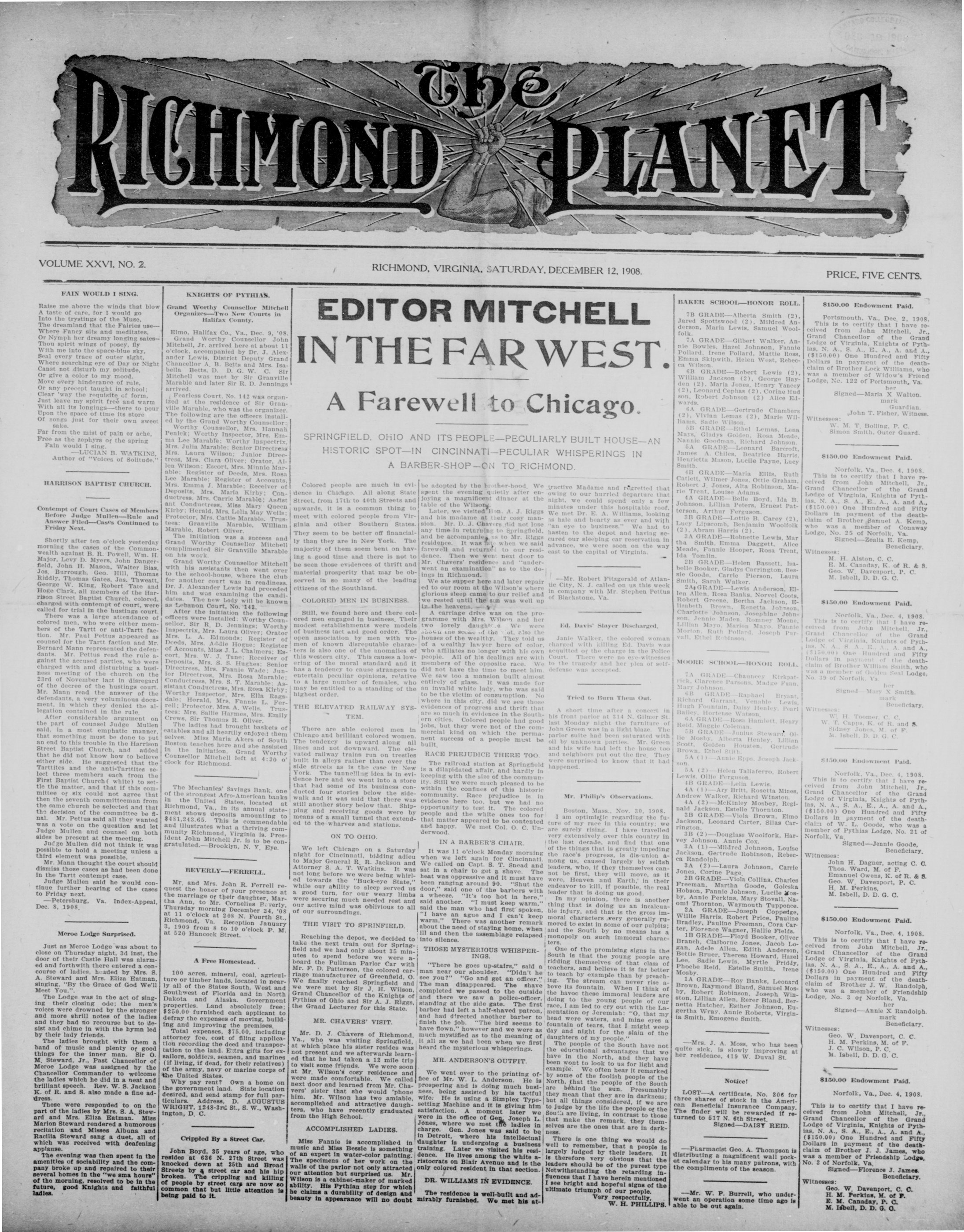
EDITOR MITCHELL IN THE FAR WEST
SPRINGFIELD, OHIO AND ITS PEOPLE—PECULIARLY BUILT HOUSE—AN HISTORIC SPOT—IN CINCINNATI—PECULIAR WHISPERINGS IN A BARBER-SHOP—ON TO RICHMOND.
Colored people are much in evidence in Chicago. All along State Street, from 17th to 40th Streets and upwards, it is a common thing to meet with colored people from Virginia and other Southern States. They seem to be better off financially than they are in New York. The majority of them seem bent on having a good time and there is not to be seen those evidences of thrift and material prosperity that may be observed in so many of the leading citizens of the Southland.
be adopted by the brother-hood. We spent the evening quietly after enjoying a magnificent dinner at the table of the Wilsons.
Later, we visited Hon. A. J. Riggs and his madame at their cosy mansion. Mr. D. J. Chavers did not lose any time in returning to Springfield, and he accompanies us to Mr. Riggs residence. It was late when we said farewell and returned to our residence. Then we went next door to Mr. Chavers' residence and "underwent an examination" as to the doings in Richmond.
We ate supper here and later repair ed to our room at the Wilson's where
tractive Madame and regretted the owing to our hurried departure the night, we could spend only a few minutes under this hospitable room. We met Dr. E. A. Williams, looking as hale and hearty as ever and wishing to the depot and having cured our sleeping car reservation advance, we were soon on the west to the capital of Virginia.
—Mr. Robert Fitzgerald of Atlantic City, N. J. called on us this week.
COLORED MEN IN BUSINESS
Still, we found here and there colored men engaged in business. Their modest establishments were models of business tact and good order. The open association by men with women of known disreputable characters is also one of the anomalies of this western city. This causes a lowering of the moral standard and it has a tendency to cause strangers to entertain peculiar opinions, relative to a large number of females, who may be entitled to a standing of the highest order.
THE ELEVATED RAILWAY SYS TEM.
There are able colored men in Chicago and brilliant colored women. The tendency is upward along all lines and not downward. The elevated railway trains run on trestles built in alleyways rather than over the side streets as is the case in New York. The tunnelling idea is in evidence here and we went into a store that had some of its business conducted four stories below the sidewalk and it was said that there was still another story below that. Shipping and receiving goods were by means of a small tunnel that extended to the wharves and stations.
ON TO OHIO
We left Chicago on a Saturday night for Cincinnati, bidding adeu to Major General R. R. Jackson and Attorney S. A. T. Watkins. It was not long before we were being whirled towards the "Buck-eye State," while our ability to sleep served us a good turn, for our weary limbs were securing much needed rest and our active mind was oblivious to all of our surroundings.
THE VISIT TO SPRINFIELD
Reaching the depot, we decided to take the next train out for Springfield and we had only about 35 minutes to spend before we were aboard the Pullman Parlor Car with Mr. F. D. Patterson, the colored carriage manufacturer of Greenfield, O. We finally reached Springfield and we were met by Sir J. H. Wilson, Grand Chancellor of the Knights of Pythias of Ohio and Sir A. J. Riggs, the Grand Lecturer for this State.
MR. CHAVERS' VISIT
Mr. D. J. Chavers of Riehmond, Va., who was visiting Springfield, at which place his sister resides was not present and we afterwards learned that he had taken a 12 mile trip to visit some friends. We were soon at Mr. Wilson's cosy residence and were made comfortable. We called next door and learned from Mr. Chavers' sister that she would 'phone him. Mr. Wilson has two amiable, accomplished and attractive daughters, who have recently graduated from the High School.
ACCOMPLISHED LADIES
Miss Fannie is accomplished in music and Miss Bessie is something of an expert in water-color painting. The specimens of her work on the walls of the parlor not only attracted our attention but surprised us. Mr. Wilson is a cabinet-maker of marked ability. His Pythian step for which he claims a durability of design and beauty in appearance will no doubt
be adopted by the brother-hood. We spent the evening quietly after enjoying a magnificent dinner at the table of the Wilsong. Later, we visited Hon. A. J. Riggs and his madame at their cosy mansion. Mr. D. J. Chavers did not lose any time in returning to Springfield, and he accompanies us to Mr. Riggs residence. It was late when we said farewell and returned to our residence. Then we went next door to Mr. Chavers' residence and "underwent an examination" as to the doings in Richmond. We ate supper here and later repair ed to our room at the Wilson's where glorious sleep came to our relief and we rested until the sun was well up in the heavens.
A carriage drive was on the programme with Mrs. Wilson and her two lovely daughters. We were shown the scene of the lot, also the houses of the wealthy. They told us of a wealthy lawyer here of color, who affiliates no longer with his own people. All of his dealings are with members of the opposite race. We did not have the time to meet him. We saw too a mansion built almost entirely of glass. It was made for an invalid white lady, who was said to be the victim of consumption. No where in this city, did we see those evidences of progress and thrift that are so much in evidence in the Southern cities. Colored people had good jobs, but they were not of the commercial kind on which the permanent success of a people must be built.
RACE PREJUDICE THERE TOO
The railroad station at Springfield is a dilapidated affair, and hardly in keeping with the size of the community. Still we were much pleased to be within the confines of this historic community. Race prejudice is in evidence here too, but we had no opportunity to test it. The colored people and the white ones too for that matter appeared to be contented and happy. We met Col. O. C. Underwood.
IN A BARBER'S CHAIR
It was 11 o'clock Monday morning when we left again for Cincinnati. We called on Capt. S. T. Snead and sat in a chair to get a shave. The heat was oppressive and it must have been ranging around 90. "Shut the door," said one of the barbers with a wheeze. "It's too hot in here," said another. "I must keep warm," said the man who had first spoken, "I have an ague and I can't keep warm." There was another remark about the need of staying home, when ill and then the assemblage relapsed into silence.
THOSE MYSTERIOUS WHISPERINGS.
"There he goes up-stairs," said a man near our shoulder. "Didn't he see you?" "Go and get an officer." The man disappeared. The shave completed we passed to the outside and there we saw a police-officer, standing at the side gate. The first barber had left a half-shaved patron, and had directed another barber to finish the job. "The bird seems to have flown," however and we were as much mystified as to the meaning of it all as we had been when we first heard the mysterious whisperings.
MR. ANDERSON'S OUTFIT
We went over to the printing office of Mr. W. L. Anderson. He is prospering and is doing much business, being assisted by his tacful wife: He is using a Simplex Type-setting Machine and it is giving him satisfaction. A moment later we were in the office of Gen. Joseph L. Jones, where we met the ladies in charge. Gen. Jones was said to be in Detroit, where his intellectual daughter is undergoing a business training. Later we visited his residence. He lives among the white aristocrats on Blair Avenue and is the only colored resident in that section.
DR. WILLIAMS IN EVIDENCE
The residence is well-built and admirably furnished. We met his at-
tractive Madame and regretted that owing to our hurried departure that night, we could spend only a few minutes under this hospitable roof. We met Dr. E. A. Williams, looking as hale and hearty as ever and with "an eye to business." We had to hasten to the depot and having secured our sleeping car reservation in advance, we were soon on the way east to the capital of Virginia.
Mr. Robert Fitzgerald of Atlantic City, N. J. called on us this week in company with Mr. Stephen Pettus of Blackstone, Va.
Ed. Davis' Slayer Discharged
Jamie Walker, the colored woman charged with killing Ed. Davis was acquitted or the charge in the Police Court. There were no eye-witnesses to the tragedy and her plea of self-defense was accepted.
Tried to Burn Them Out
A short time after a concert in his front parlor at 314 N. Gilmer St. last Monday night the furniture of John Green was in a light blaze. The parlor suite had been saturated with oil by unknown parties. Mr. Green and his wife had left the house too and neighbors put out the fire. They were surprised to know that it had happened.
Mr. Philip's Observations.
Boston, Mass., Nov. 30, 1908. I am optimistic regarding the future of my race in this country; we are surely rising. I have travelled very extensively over this country in the last decade, and find that one of the things that is greatly impeding the race's progress, is dis-union among us, caused largely by selfish leaders, who, if they themselves cannot be first, they will move, as it were, Heaven and Earth, in their endeavor to kill, if possible, the real leader that is doing us good.
In my opinion, there is another thing that is doing us an incalculable injury, and that is the gross immoral characters very generally rumored to exist in some of our pulpits; and the South by no means has a monopoly on such immoral characters.
One of the promising signs in the South is that the young people are ridding themselves of that class of teachers, and believe it is far better to teach by example than by preaching. The stream can never rise above its fountain. When I think of the havoc these immoral leaders are doing to the young people of our race, I am led to cry out with the Lamentation of Jeremiah: "O, that my head were waters, and mine eyes a fountain of tears, that I might weep day and night for the slain of the daughters of my people."
The people of the South have not the educational advantages that we have in the North, and they have been wont to look to us for light and example. We often hear it remarked by some of the foolish people of the North, that the people of the South are behind the sun. Presumably they mean that they are in darkness; but all things considered, if we are to judge by the life the people of the South are living, in contrast to those that make the remark, they themselves are the ones that are in darkness.
There is one thing we would do well to remember, that a people is largely judged by their leaders. It is therefore very obvious that the leaders should be of the purest type Notwithstanding the retarding influences that I have herein mentioned I see bright and hopeful signs of the ultimate triumph of our people.
Very respectfully,
W. H. PHILLIPS.
BAKER SCHOOL—HONOR ROLL
7B GRADE—Alberta Smith (2), Jared Spotswood (2), Mildred Anderson, Maria Lewis, Samuel Woolfolk.
7A GRADE—Gilbert Walker, Annie Bowles, Hazel Johnson, Fannie Pollard, Irene Pollard, Mattie Ross, Emma Skipwith, Helen West, Rebecca Wilson.
6B GRADE—Robert Lewis (2), William Jackson (2), George Hayden (2), Maria Jones, Henry Yancey (2), Leonard Cephas (2), Corine Hudson, Robert Johnson (2) Alice Edwards.
6A GRADE—Gertrude Chambers (2), Vivian Lemas (2), Marie Williams, Sadie Wilson.
5B GRADE—Ethel Lemas, Lena Mays, Gladys Golden, Rosa Meade, Nannie Goodman, Richard Johnson.
5A GRADE—Leonard Barcroft, James A. Chiles, Beatrice Harris, Henrietta Mason, Lucile Payne, Lucy Smith.
4B GRADE—Maria Ellis, Ruth Catlett, Wilmer Jones, Ottie Graham, Robert J. Jones, Alta Robinson, Marie Trent, Louise Adams.
4A GRADE—Belle Boyd, Ida B. Johnson, Lillian Peters, Ernest Patterson, Arthur Ferguson.
3B GRADE—Lottie B. Carey (2), Lucy Lipscomb, Benjamin Woolfolk (2), Abram Harris (2).
3A GRADE—Robinette Lewis, Martha Smith, Emma Daggett, Alice Meade, Fannie Hooper, Rosa Trent, Ida Tollin.
2B GRADE—Helen Bassett, Isabelle Booker, Gladys Carrington, Bessie Goode, Carrie Pierson, Laura Smith, Sarah Walker.
2A GRADE—Lewis Anderson, Ellen Allen, Rosa Banks, Norvel Coots, Robert Greene, Bertha Jackson, Elizabeth Brown, Renetta Johnson, Charlotte Johnson, Josephine Johnson, Jennie Maden, Romney Moone, Lillian Mayo, Marion Mayo, Fannie Morton, Ruth Pollard, Joseph Purvall, Ethel Robinson.
---
MOORE SCHOOL—HONOR ROLL
7A GRADE—Channeyce Kirkpatrick, Clarence Parsons, Madge Funn, Mary Johnson.
6B GRADE—Raphael Bryant, Richard Garrant, Venable Lewis, Hugh Fountain, Daisy Henley, Pearl Bailey, Hortense Watson.
6A GRADE—Rosa Hamlett, Henry Reid, Maggie Coleman.
5B GRADE—Junius Stewarda, Ollie Mosby, Alberta Henley, Lillian Scott, Golden Housten, Gertrude Brown, Ethel Stith.
5A (1)—Annie Epps, Joseph Jackson.
5A (2)—Helen Tallafero, Robert Lewis, Ollie Ferguson.
4B GRADE—Lella Lewis.
4A (1)—Ary Britt, Rosetta Mines,
Andrew Walker, Richard Winston.
4A (2)—McKinley Mosher, Bertl
4A (2)—McKinley Mosby, Reginald Jackson, Estelle Thornton.
3B GRADE—Viola Brown, Elmo Jackson, Leonard Carter, Silas Carrington.
3B (2)—Douglass Woolfork, Harvey Johnson, Annie Cox.
3A (1)—Mildred Johnson, Louise Jackson, Gertrude Robinson, Rebecca Randolph.
3A (2)—Laura Johnson, Carrie Jones, Corine Page.
2B GRADE—Viola Collins, Charles Freeman, Martha Goode, Goleska Hobson, Fannie Johnson, Lucille Kosy, Annie Perkins, Mary Stovall, Naomi Thornton, Waymouth Tuppence.
2A GRADE—Joseph Coppedge, Willie Harris, Robert Price, Pauline Bradley, Pauline Freeman, Cora Carter, Florence Wagner, Hallie Fields.
1B GRADE—Floyd Booker, Oliver Branch, Claiborne Jones, Jacob Logan, Adele Allen, Edith Anderson, Bettie Bruer, Theresa Howard, Hazel Lee, Sadie Lewis, Myrtle Pridy, Phoebe Reid, Estelle Smith, Irene Mosby.
1A GRADE—Roy Banks, Leonard Brown, Raymond Bland, Samuel Mosby, Robert Robinson, Joseph Winston, Lillian Allen, Rerer Bland, Bernetta Hatcher, Esther Johnson, Eugertha Wray, Annie Roberts, Virginia Smith, Emogene Smith.
—Mrs. J. A. Moss, who has been quite sick, is slowly improving at her residence, 419 W. Duval St.
Notice!
LOST—A certificate, No. 306 for three shares of stock in the American Beneficial Insurance Company. The finder will be rewarded if returned to 517 N. 6th Street.
Signed—DAISY REID.
- **Pharmacist Geo. A. Thompson** is distributing a magnificent wall pocket calendar to his many patrons, with the compliments of the season.
Mr. W. P. Burrell, who underwent an operation some time ago is able to be out again
PRICE, FIVE CENTS
$150.00 Endowment Paid
Portsmouth, Va., Dec. 2, 1908.
This is to certify that I have received from John Mitchell, Jr.
Grand Chancellor of the Grand Lodge of Virginia, Knights of Pythias, N. A., S. A., E. A., A. and A. ($150.00) One Hundred and Fifty Dollars in payment of the deathclaim of Brother Lock Williams, who was a member of Widow's Friend Lodge, No. 122 of Portsmouth, Va.
her
Signed—Marla X Walton
mark
Guardian
W. M. T. Bolling, P. C.
Simon Smith, Outer Guard.
$150.00 Endowment Paid
Norfolk, Va. Dec. 4, 1905.
This is to certify that I have received from John Mitchell, Jr.,
Grand Chancellor of the Grand
Lodge of Virginia, Knights of Pythias, N. A., S. A., E., A., A. and A.,
($150.00) One Hundred and Fifty
Dollars in payment of the death-
claim of Brother Samuel A. Kemp,
who was a member of Conaway
Lodge, No. 25 of Norfolk, Va.
Signed—Zealia E. Kemp,
Beneficiary.
Witnesses:
M. H. Alston, C. C.
E. M. Canday, K. of R. & S.
Geo. W. Davenport, P. C.
M. Isbell, D. D. G. C.
$150.00 Endowment Paid
Norfolk, Va., Dec. 4, 1908.
This is to certify that I have received from John Mitchell, Jr.,
Grand Chancellor of the Grand Lodge of Virginia, Knights of Pythias, N. A., S. A., E., A., A. and A.,
($150.00) One Hundred and Fifty Dollars in payment of the death-calm of Brother William Smith, who was a member of Golden Seal Lodgo,
No. 39 of Norfolk, Va.
her
Signed—Mary X Smith.
mark
Beneficiary.
Witnesses:
W. I. Toomer, C. C.
W. T. Capps, K. of R. and S.
Sidney Jones, M. of F.
M. Isbell, D. D. G. C.
$150.00 Endowment Paid
Norfolk, Va., Dec. 4, 1908.
This is to certify that I have received from John Mitchell, Jr.,
Grand Chancellor of the Grand Lodge of Virginia, Knights of Pythias, N. A., S. A., E., A., A. and A. ($150.00) One Hundred and Fifty Dollars in payment of the death claim of W. L. Goode, who was a member of Pythias Lodge, No. 21 of Norfolk, Va.
Signed—Jennie Goode,
Beneficiary.
Witnesses:
John H. Dagner, acting C. C.
Thos. Ward, M. of F.
Emanuel Owens, K. of R. & S.
Geo. W. Davenport, P. C.
H. M. Perkins,
M. Isbell, D. D. C.
$150.00 Endowment Paid
Norfolk, Va., Dec. 4, 1908.
This is to certify that I have received from John Mitchell, Jr., Grand Chancellor of the Grand Lodge of Virginia, Knights of Pythias, N. A., S. A., E., A., A. and A. ($150.00) One Hundred and Fifty Dollars in payment of the death-claim of Brother J. W. Randolph, who was a member of Friendship Lodge, No. 3 or Norfolk, Va.
her
Signed—Annie X Randolph.
mark
Beneficiary.
Witnesses:
Geo. W. Davenport, C. C.
H. M. Perkins, M. of F.
J. C. Wilson, P. C.
M. Isbell, D. D. G. C.
$150.00 Endowment Paid.
Norfolk, Va., Dec. 4, 1908.
This is to certify that I have received from John Mitchell, Jr., Grand Chancellor of the Grand Lodge of Virginia, Knights of Pythias, N. A., S. A., E., A., A. and A. ($150.00) One Hundred and Fifty Dollars in payment of the death-claim of Brother J. J. James, who was a member of Friendship Lodge, No. 3 of Norfolk, Va.
Signed—Florence J. James.
Beneficiary.
Geo. W, Davenport, C. C.
H. M. Perkus, M. of F.
E. M. Canaday, P. C.
M. Isbell, D. D, G. C.
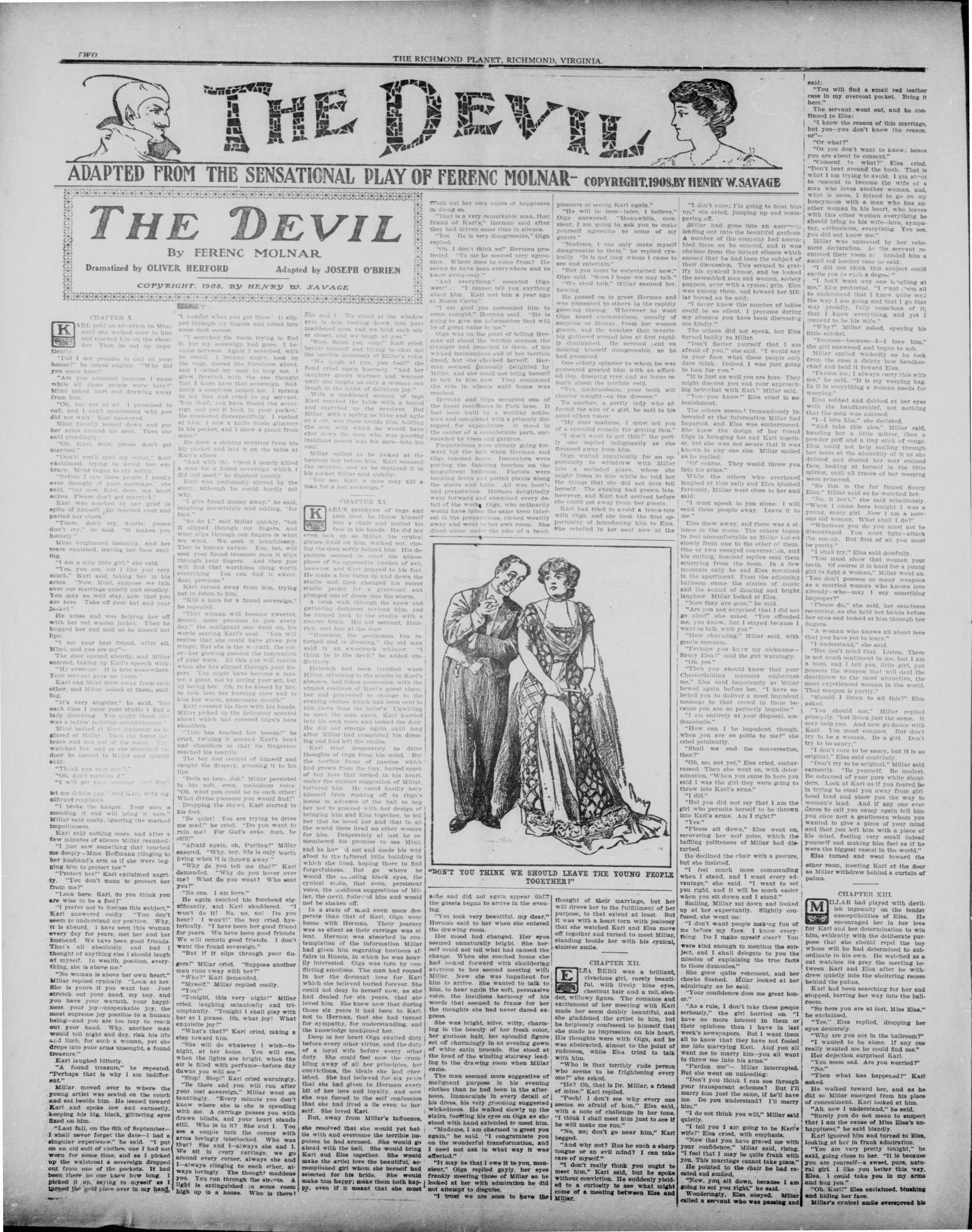
THE DEVIL
ADAPTED FROM THE SENSATIONAL PLAY OF FERENC MOLNAR- COPYRIGHT.190&BY HENRY W.SAVAGE
THE DEVIL
COPYRIGHT. 1908. BY HENRY W. SAVAGE
rwo
CHAPTER X
K
Hently
ARL pald no attention to Mimi until she walked over to him and touched him on the shoulder. Then he sat up impatiently.
"Did I not promise to call at your house?" he asked angrily. "Why did you come here?"
"Are you ashamed because I came while all those people were here?"
Mimi asked, hurt and drawing away from him.
"Oh, no; not at all. I promised to call, and I can't understand why you did not wait." Karl answered.
Mimi timidly leaned down and put her arms around his neck. Then she said pleadingly:
"Oh, Karl, dear, please don't get married."
"Don't; you'll spoil my collar." Karl exclaimed, trying to avoid her embrace. Mimi began to cry softly.
"Before I saw these people I hardly ever thought of your marriage," she said, "but now, Karl, dear, my heart aches. Please don't get married."
Karl was touched by her grief in spite of himself. He reached over and patted her cheek.
"There, don't cry, dearie, please don't cry," he said. "It makes you homely."
Mimi brightened instantly and her tears vanished, leaving her face smiling.
"I am a silly little girl," she said.
"Yes, you are, but I like you very much." Karl said, taking her in his arms. "Now, Mimi, suppose we talk over our marriage quietly and sensibly. You may as well stay, now that you are here. Take off your hat and your jacket."
He arose and was helping her off with her red woolen jacket. Then he hugged her and said as he kissed her lips:
"I am your best friend, after all, Mimi, and you are my"—
The door opened silently, and Millar entered, taking up Karl's speech with.
"My overcoat. It is here somewhere. Your servant gave me yours."
Karl and Mimi drew away from each other, and Millar looked at them, smiling.
"It's very singular," he said, "but each time I enter your studio I find a lady disrobing. You might think this was a ladies' tailoring establishment."
Mimi looked at Karl jealously as he glared at Millar. Then she burst into tears and ran out of the room. Karl watched her, and as she shammed the door he turned to Millar and quietly said:
"Thank you very much."
"Oh, don't mention it!"
"I will get your overcoat, and don't let me detain you," said Karl, with significant emphasis.
"I broke the hanger. Your man is mending it and will bring it here." Millar said coolly, ignoring the marked impoliteness.
Karl said nothing more, and after a few minutes of silence Millar resumed: "I just saw something that touched me deeply -Mme. Hoffmann clinging to her husband's arm as if she were begging him to protect her."
"Protect her!" Karl exclaimed angrily. "You don't mean to protect her from me?"
"Look here. Karl, do you think you are wise to be a fool?"
"I prefer not to discuss this subject," Karl answered coldly. "You don't seem to understand my position. Why, it is absurd. I have seen this woman every day for years, met her and her husband. We have been good friends. That's all absolutely, and had I thought of anything else I should laugh at myself. In wealth, position, everything, she is above me."
"No woman is above her own heart."
Millar replied cynically. "Look at her. She is yours if you want her. Just stretch out your hand, my boy, and you have your warmth, your happiness, your joy—unspeakable joy, the most supreme joy possible to a human being—and you are too lazy to reach out your hand. Why, another man would toil night and day, risk his life and limb, for such a woman, yet she drops into your arms unsought, a found treasure."
Karl laughed bitterly.
"A found treasure," he repeated.
"Perhaps that is why I am indifferent."
Millar moved over to where the young artist was seated on the couch and sat beside him. He leaned toward Karl and spoke low and earnestly, keeping his big, black, glittering eyes fixed on him.
"Last fall, on the 6th of September—I shall never forget the date—I had a singular experience." he said. "I put on an old suit of clothes, one I had not worn for some time, and as I picked up the waistcoat a sovereign dropped out from one of the pockets. It had been there no one knew how long. I picked it up, saying to myself as I turned the gold piece over in my hand.
"I wonder when you got there." It slipped through my fingers and rolled into some dark corner.
"I searched the room trying to find it, but my sovereign had gone. I became nervous. Again I searched, with no result. I became angry, took up the rugs, moved the furniture about, and I called my man to help me. I grew feverish with the one thought that I must have that sovereign. Suddenly a suspicion seized me. I sprang to my feet and cried to my servant. "You thief, you have found the sovereign and put it back in your pocket." He answered disrespectfully. I rushed at him. I saw a knife blade glimmer in his pocket, and I drew a pistol from mine.
He drew a shining revolver from his hip pocket and laid it on the table at Karil's elbow.
"And with this pistol I nearly killed a man for a found sovereign which I did not need," he finished quietly.
Karl was profoundly stirred by the story, although he could hardly tell why.
"I give found money away," he said, laughing uncertainly and adding, "for luck."
"So do I," said Millar quickly, "but it slipped through my fingers, and what slips through our fingers is what we want. We seek it breathlessly. That is human nature. You, too, will seek your found treasure once it slips through your fingers. And then you will find that worthless thing worth everything. You can find it sweet, dear, precious."
Karl turned away from him, trying not to listen to him.
"Kill a man for a found sovereign," he repeated.
"That woman will become sweeter, dearer, more precious to you every day," the malligant one went on, his words searing Karl's soul. "You will realize that she could have given you wings; that she is the warmth, the color—her glowing passion the inspiration of your work. All this you will realize when she has slipped through your fingers. You might have become a master, a giant, not by loving your art, but by loving her. Oh, to be kissed by her, to look into her burning eyes and to kiss her warm, passionate mouth!" Karl covered his face with his hands. Millar picked up the delicately scented shawl which had covered Olga's bare shoulders. "This has touched her bosom!" he cried, twining it around Karl's head and shoulders so that its fragrance reached his nostrils. The boy lost control of himself and caught the drapery, pressing it to his lips.
"Both so bea-ful." Millar persisted in his soft, even, melodious voice. "Oh, what you could be to each other! What divine pleasure you would find!" Dropping the shawl, Karl started to his feet.
"Be quiet! You are trying to drive me mad!" he cried. "Do you want to ruin me? For God's sake, man, be all!" "Afraid again, oh, Puritan!" Millar sneered. "Why, boy, life is only worth living when it is thrown away." "Why do you tell me that?" Karl demanded. "Why do you hover over me? What do you want? Who sent you?" "No one. I am here."
He again touched his forehead significantly, and Karl shuddered. "I won't do it! No, no, no! Do you hear? I won't!" the boy cried hysterically. "I have been her good friend for years. We have been good friends. We will remain good friends. I don't want the found sovereign."
"But if it slips through your fingers!" Millar cried. "Suppose another man runs away with her?"
"Who?" Karl demanded.
"Myself," Millar replied coolly.
"You!"
"Tonight, this very night!" Millar cried, laughing satanically and triumphantly. "Tonight I shall play with her as I please. Oh, what joy! What exquisite joy!"
"What's that?" Karl cried, taking a step toward him.
"She will do whatever I wish—tonight, at her home. You will see, when the lights are bright, when the air is filled with perfume—before day dawns you will see."
"Stop! Stop!" Karl cried warningly.
"Be there and you will run after your lost sovereign," Millar went on tauntingly. "Every minute you don't know where she is she is spending with me. A carriage passes you with drawn blinds, and your heart stands still. Who is in it? She and I. You see a couple turn the corner with arms lovingly interlocked. Who was that? She and I—always she and I. We sit in every carriage, we go around every corner, always she and I—always clinging to each other, always lovingly. The thought maddens you. You run through the streets. A light is extinguished in some room high up in a house. Who is there?"
THE RICHMOND PLANET, RICHMOND, VIRGINIA
She and I. We stand at the window arm in arm looking down into your maddened eyes, and we hold each other closer, and we laugh at you."
"Stop, damn you, stop!" Karl cried, beside himself and trying to shut out the terrible monotony of Millar's voice "We laugh at you, you fool!" the fiend cried again hourseily. "And her laughter grows warmer and warmer until she laughs as only a woman can laugh in the midst of delirious joy."
With a maddened scream of rage Karl reached the table with a bound and snatched up the revolver. But Millar, with a spring as lithe and agile as a cat, was there beside him, holding the arm with which he would have shot down the man who was pouring insidious poison into his ears—into his soul.
Millar smiled as he looked at the helpless boy before him. Karl released the revolver, and as he replaced it in his pocket Millar said quietly:
"You see. Karl, a man may kill a man for a lost sovereign."
CHAPTER XI
K
RLS paroxysm of rage and pain over, he threw himself into a chair and buried his face in his hands. He did not
A brisk walk through the snow and gathering darkness revived him, and he turned back to the studio with a clearer brain. His old servant, Heinrich, met him at the door.
"Monsteur, the gentleman has returned and is dressing," the old man said in an awestruck whisper. "I think he is the devil," he added vindictively.
Heinrich had been terrified when Millar, returning to the studio in Karl's absence, had taken possession with the utmost coolness of Karl's guest chamber and proceeded to change to the evening clothes which had been sent to him there from the tailor's. Unwilling to meet the man again, Karl hurried into his own room and locked the door. He did not emerge again until long after Millar had completed his dressing and had left the studio.
Karl tried desperately to drive thoughts of Olga from his mind. But the terrible flame of passion which had grown from the tiny, buried spark of boy love that turked in his heart, under the sinister suggestion of Millar, tortured him. He could hardly keep himself from rushing off to Olga's house in advance of the ball to beg her not to proceed with her design of bringing him and Elsa together, to tell her that he loved her and that in all the world there lived no other woman for him. Desperately at last he remembered his promise to see Mimi, and he hurried out and made his way afoot to the tattered little building in which she lived, hoping there to find forgetfulness. But go where he would the mourning black eyes, the cynical smile, that even, persistent voice, the insidious suggestions of Millar, the devil, followed him and would not be shaken off.
In a state of mind even more desperate than that of Karl. Oliga went home with Herman. Their journey was as silent as their carriage was silent. Herman was absorbed in contemplation of the information Millar had given him regarding business affairs in Russia, in which he was heavily interested. Oliga was torn by conflicting emotions. The man had roused in her the dormant love for Karl which she believed buried forever. She could not deny to herself now, as she had denied for six years, that she loved him. She knew now that during those six years it had been to Karl, not to Herman, that she had turned for sympathy, for understanding, and the knowledge maddened her.
Deep in her heart Olga exalted duty before every other virtue, and the duty of a loyal wife before every other duty. She could feel now the crumbling away of all her principles, her convictions, the ideals she had cherished. She had believed for six years that she had given to Herman every bit of her love and loyalty, and now she was forced to the self confession that she had lived a lie even to herself. She loved Karl.
But, away from Millar's influence, she resolved that she would yet battle with and overcome the terrible impulses he had aroused. She would go ahead with the ball. She would bring Karl and Elisa together. She would make the artist love the beautiful, accomplished girl whom she herself had selected for his bride. She would make him happy; make them both happy, even if it meant that she must
"DON'T YOU THINK WE SHOULD LEA
TOGETHER!"
R. MAY
"DON'T YOU THINK WE SHOULD LEAVE THE YOUNG PEOPLE TOGETHER?"
crush out her own hopes of happiness in doing so.
"That is a very remarkable man, that friend of Karf's," Herman said after they had driven some time in silence.
"Yes. He is very disagreeable," Olga replied.
"Oh. I don't think so!" Herman protested. "To me he seemed very agreeable. Where does he come from? He seems to have been everywhere and to know everybody."
"And everything." assented Olga wearls. "I cannot tell you anything about him. Karl met him a year ago at Monte Carlo."
"I am glad you persuaded him to come tonight." Herman said. "He is going to give me information that will be of great value to me."
Oiga was on the point of telling Herman all about the terrible sermon the stranger had preached to them, of his wicked insinuations and of her terrible dread, but she checked herself. Herman seemed fatuously delighted by Millar, and she could not bring herself to talk to him now. They continued the ride in silence until home was reached. Herman and Oiga occupied one of the finest residences in Park lane. It had been built by a wealthy nobleman and completed with a principally disregard for expenditure. It stood in the center of a considerable park, surrounded by trees and gardens.
Preparations were already going forward for the ball when Herman and Oliga reached home. Decorators were putting the finishing touches on the magnificent ballroom. Florists were banking ferns and potted plants along the stairs and halls. All was bustle and preparation. Herman delightedly went forward and examined every detail of the work. Oliga, who ordinarily would have taken the same keen interest in the preparations, turned wearily away and went to her own room. She dined alone under the plea of a head.
ache and did not again appear until the guests began to arrive in the evening.
"You look very beautiful, my dear," Herman said to her when she entered the drawing room.
Her mood had changed. Her eyes seemed unnaturally bright. She herself could not tell what had caused the change. When she reached home she had looked forward with shuddering aversion to her second meeting with Millar. Now she was impatient for him to arrive. She wanted to talk to him, to hear again the soft, persuasive voice, the insidious harmony of his words that seemed to frame for her the thoughts she had never dared express.
She was bright, alive, witty, charming in the beauty of her fresh color, her glorious hair, her splendid figure set off charmingly in an evening gown of white satin brocade. She stood at the head of the winding stairway leading to the drawing room when Millar came.
The man seemed more suggestive of malignant purpose in his evening clothes than he had been in the afternoon. Immaculate in every detail of his dress, his very grooming suggested wickedness. He walked slowly up the stairs, feasting his eyes on Oliga as she stood with hand extended to meet him.
"Midame, I am charmed to greet you again." he said. "I congratulate you on the wonderful transformation, and I need not ask in what way it was effected."
"It may be that I owe it to you, monsieur," Oliga replied gaily, her eyes frankly meeting those of Millar as he looked at her with admiration he did not attempt to disguise.
"I trust we are soon to have the
pleasure of seeing Karl again."
"He will be here—later, I believe."
Olga answered. "Meauwhile, monsieur, I am going to ask you to make yourself agreeable to some of my guests."
"Madame, I can only make myself disagreeable to them," he replied cynically. "It is not who whom I came to see and entertain."
"But you must be entertained now." Olga said. "Soon I hope we may talk."
"We shall talk." Millar assured her, bowing
He passed on to greet Herman and was presented to others in the rapidly growing thong. Wherever he went Olga heard exclamations, usually of surprise or dismay, from her women guests, and the number that invariably gathered around him at first rapidly diminished. He seemed bent on making himself disagreeable, as he had promised.
One elderly spinster to whom he was presented greeted him with an affected lisp, drooping eyes and an hame remark about the terrible cold.
"Yes, mademolseille, your teeth will chatter tonight—on the dresser."
To another, a portly lady who affected the airs of a girl, he said in his most silken tones:
"My dear madame, I must tell you of a splendid remedy for getting thin."
"I don't want to get thin!" the portly one replied indignantly as she flounced away from him. Oliga waited impatiently for an opportunity to withdraw with Millar into a secluded place, where she might listen to him while he told her the things that she did not dare tell herself. The evening had grown late, however, and Karl had arrived before she could get away from her guests. Karl had tried to avoid a tete-a-tete with Olga, and she took the first opportunity of introducing him to Elsa. She rebelled in her soul now at the
D LEAVE THE YOUNG PEOPLE
HER?"
thought of their marriage, but her will drove her to the fulfillment of her purpose, to that extent at least. But it was with a heart torn with jealousy that she watched Karl and Elsa move off together and turned to meet Millar standing beside her with his cynical sinister smile.
CHAPTER XII.
E
ELSA BERG was a brilliant, vivacious girl, rarely beautiful, with lively blue eyes, chestnut hair and a tall, slender, wilfully figure. The romance and excitement of her meeting with Karl made her seem doubly beautiful, and she gladdened the artist in him, but he helplessly confessed to himself that she made no impression on his heart. His thoughts were with Olga, and he was abstracted, almost to the point of rudeness, while Elsa tried to talk with him.
"Who is that terribly rude person who seems to be frightening every one?" she asked.
"He? Oh, that is Dr. Millar, a friend of mine," Karl replied.
"Pooch! I don't see why every one seems so afraid of him," Elsa said, with a note of challenge in her tone.
"I think I shall meet him just to see if he will make me run."
"No, no; don't go near him," Karl begged.
"And why not? Has he such a sharp tongue or an evil mind? I can take care of myself."
"I don't really think you ought to meet him," Karl said, but he spoke without conviction. He suddenly yielded to a curiosity to see what might come of a meeting between Elsa and Millar.
"I don't care; I'm going to hunt him up," she cried, jumping up and scampering off.
Millar had gone into an anteroom leading out into the beautiful gardens. A number of the company had assembled there as he entered, and it was obvious from the instant silence which ensued that he had been the subject of their discussion. This seemed to gratify his cynical humor, and he looked the assembled men and women, society puppets, over with a cynical grin. Elsa was among them, and toward her Millar bowed as he said:
"I never knew this number of ladies could be so silent. I presume during my absence you have been discussing me kindly."
The others did not speak, but Elsa turned boldly to Millar.
"Don't flatter yourself that I am afraid of you," she said. "I would say to your face what these people only dare think. Indeed, I was just going to look for you."
"It is just as well you are here. They might discuss you and your approaching betrothal with Karl." Millar said.
"You—you know!" Elsa cried in astonishment.
The others seemed tremendously interested at the information Millar had imparted, and Elsa was embarrassed. She knew the design of her friend Olga in bringing her and Karl together, but she was not aware that it was known to any one else. Millar smiled as he replied:
"Of course. They would throw you into his arms."
While the others who overheard laughed at this sally and Elsa blushed furiously, Millar went close to her and said:
"I must speak to you alone. I will send these people away. Leave it to me."
Elsa drew away, and there was a silence in the room. The others began to feel uncomfortable as Millar looked slowly from one to the other of them. One or two essayed conversation, and his cutting, insolent replies sent them scurrying from the room. In a few moments only he and Elsa remained in the apartment. From the adjoining ballroom came the strains of music and the sound of dancing and bright laughter. Millar looked at Elsa.
"Now they are gone," he said.
"Are you not surprised that I did not go also?" she asked. "You offended me, you know, but I stayed because I want to talk with you."
"How charming," Millar said, with gentle sarcasm.
"Perhaps you know my nickname—Saucy Elsa?" said the girl warningly.
"Oh, yes."
"Then you should know that your Chesterfieldian manners embarrass me." Elsa said impatiently as Millar bowed again before her. "I have selected you to deliver a most impudent message to that crowd in there because you are so perfectly impolite."
"I am entirely at your disposal, mademoisse."
"How can I be impudent, though, when you are so polite to me?" she cried petulantly.
"Shall we end the conversation, then?"
"Oh, no; not yet," Elsa cried, embarrassed. Then she went on, with determination. "When you came in here you said I was the girl they were going to throw into Karl's arms."
"I did."
"But you did not say that I am the girl who permits herself to be thrown into Karl's arms. Am I right?"
"Please sit down," Elsa went on, recovering her self poise, which the baffling politeness of Millar had disturbed.
He declined the chair with a gesture, but she insisted.
"I feel much more commanding when I stand, and I want every advantage," she said. "I want to set you right, and it will be much easier when you sit down and I stand."
Smiling, Millar sat down and looked up at her expectantly. Slightly confused, she went on:
"I don't want people making fun of me before my face. I know everything. Do I make myself clear? You were kind enough to mention the subject, and I shall delegate to you the mission of explaining the true facts to those dummies."
She grew quite vehement, and her cheeks flushed. Millar looked at her admiringly as he said:
"Your confidence does me great honor."
"As a rule, I don't take these people seriously," the girl hurried on. "I have no more interest in them or their opinions than I have in last week's newspapers. But I want them all to know that they have not fooled me into marrying Karl. And you all want me to marry him--you all want to throw me into his arms."
"Pardon me"—Millar interrupted. But she went on unbeeding:
"Don't you think I can see through your transparent schemes? But I'll marry him just the same, if he'll have me. Do you understand? I'll marry him."
"I do not think you will," Millar said quietly.
"I tell you I are going to be Karl's wife!" Elsa cried, with emphasis.
"Now that you have graced me with your confidence," Millar said, rising.
"I feel that I may be quite frank with you. This marriage cannot take place."
He pointed to the chair he had vacated and smiled.
"Now, you sit down, because I am going to set you right," he said. Wonderingly, Elsa obeyed. Millar called a servant who was passing and
said:
"You will find a red leather case in my overcoat pocket. Bring it here."
The servant went out, and he continued to Elsa:
"I know the reason of this marriage, but you—you don't know the reason, or"
"Or what?"
"Or you don't want to know; hence you are about to consent."
"Consent to what?" Elsa cried.
"Don't beat around the bush. That is what I am trying to avoid. I am about to consent to become the wife of a man who loves another woman, and, what is more, I intend to go on my honeymoon with a man who has an another woman in his heart, who leaves with this other woman everything he should bring to his wife—love, sympathy, enthusiasm, everything. You see, you did not know me."
Millar was unmoved by her vehement declaration. As the servant reentered their room and handed him a small red leather case he said: "I did not think this subject could exeite you to such a degree."
"I don't want any one laughing at me," Elsa protested. "I want them all to understand that I know quite well the way I am going and that I go that way proudly, fully conscious of it; that I know everything, and yet I consent to be his wife."
"Why?" Millar asked, opening his little satchel.
"Because—because—I—I love him," the girl answered and began to sob.
Millar smiled wickedly as he took from the case a dainty lace handkerchief and held it toward Elsa.
"Pardon me; I always carry this with me," he said. "It is my weeping bag. In it is everything a woman needs for weeping."
Elsa sobbed and dabbed at her eyes with the handkerchief, not noticing that the man was amused.
"I-I love him," she declared.
"And take this also." Millar said, handing her a little mirror, then a powder puff and a thy stick of rouge. Elsa could not help smiling through her tears at the absurdity of it as she dabbed and dusted her tear stained face, looking at herself in the little mirror, until all traces of her weeping were removed.
"So this is the far famed Saucy Elsa," Millar said as he watched her.
"Whatever you do you must not be discouraged. You must fight—attack 've enemy. But first of all you must be pretty."
"I shall try," Elsa said dolefully.
"You must show that woman your teeth. Of course it is hard for a young girl to fight a woman," Millar went on.
"You don't possess so many weapons as a married woman who knows love already—who may I say something improper?"
"Please do," she said, her sauciness returning, as she held her hands before her eyes and looked at him through her fingers.
"A woman who knows all about love that you have yet to learn."
"I understand," she said.
"But don't mind that. Listen. There is not much sentiment in me, but I am a man, and I tell you, little girl, you possess the weapon that will deal the deathblow to the most attractive, the most experienced woman in the world. That weapon is purity."
"Should I listen to all this?" Elsa asked.
"You should not," Millar replied promptly. "but listen just the same. It may help you. And now go dance with Karl. You must conquer. But don't try to be a woman. Be a girl. Don't try to be saucy."
"I don't care to be saucy, but it is so original." Elsa said contritely.
"Don't try to be original." Millar said earnestly. "Be yourself. Be modest. Be ashamed of your pure white shoulders. Look at Karl as if you feared he is trying to steal you away from girlhood land and show you the way to woman's land. And if any one ever dares to call you saucy again tell him you once met a gentleman whom you wanted to give a piece of your mind and that you left him with a piece of his mind, feeling very small indeed yourself and making him feel as if he were the biggest rascal in the world."
Else turned.
other room, meeting Karl at the door as Millar withdrew behind a curtain of palms.
CHAPTER XIII
M
LLAR had played with devilish ingenuity on the tender susceptibilities of Elsa. He encouraged her in her love
Karl had been searching for her and stopped, barring her way into the ballroom.
"So here you are at last, Miss Elsa," he exclaimed.
"Yes." Elsa replied, dropping her eyes demurely.
"Why are you not in the ballroom?" "I wanted to be alone. If any one really wanted me he could find me"
Her dejection surprised Karl.
"You seem sad. Are you worried?" "No."
"Then what has happened?" Karl asked.
He walked toward her, and as he did so Millar emerged from his place of concealment. Karl looked at him.
"Ah, now I understand," he said.
"Surely you do not mean to suspect that I am the cause of Miss Elsa's unhappiness," he said blandly.
Karl ignored him and turned to Elsa, looking at her in frank admiration.
"You are very pretty tonight," he said, going close to her. "It is because you are yourself—a sweet, pure, natural girl. I like you better this way, Elsa. I could take you in my arms and hug you." "Oh. Karl!" Elsa exclaimed, blushing and hiding her face.
Millar's cynicel smile overspread his
THE PLANET
SATURDAY...DECEMBER 12, '08.
face, and he turned away, well satisfied with the progress he was making.
"Excuse me," he marmured. "I must say good evening to our hostess." And he stole quietly out.
The two young people did not notice him. They sat down very close to each other, Karl leaning forward and looking into the big blue eyes of the girl. Elsa gave a glance at the disappearing figure of Millar.
"I am awfully glad to be alone with you, Elsa," Karl said. "You are the one natural thing in the fetid, artificial atmosphere. Don't you feel warm?" "Yes, as if some hot breeze were blowing through this room. It stifes me."
"You never spoke like that before," Karl said.
His back was toward the ballroom door, and he did not see Millar usher Olga into the room. The man had brought Olga that she might witness the fulfillment of her plan and that he might triumph in her jealousy and further thwart them. Elsa saw them come in and seat themselves across the room.
"There is Olga," she said, and she, too, is jealous. "Don't you want to speak to her?" "I have seen her," Karl replied without turning around. "I would rather talk with you. It's far more interesting." "They are talking about us," Elsa said warningly as she saw Olga and Millar look toward them.
"Why do you look around then?" Elsa said.
"Am I looking around?" Karl asked.
"I wasn't aware of it."
But even as he spoke he could not helpfurtively glancing around to see what Millar and Oiga were doing. He remembered the man's declaration in the studio that afternoon, and he distrusted and feared him. He was beginning to hate him.
By a sheer effort of will he forced himself to turn to Elsa. He resolved that he would talk to her; that he would make love to her; that he would marry her and banish from his heart those hateful emotions which Millar had aroused. He leaned forward and spoke of love to the girl in low tones, while Elsa, with color coming and going in her face, listened and watched the woman she knew for her rival.
"Our first love usually is our last love—our last love always is the first," Karl said.
"I don't know," Elsa cried demurely, "I have never been in love, although I was disappointed twice," she added gaily.
Karl was beginning to find his task difficult. His attention wandered to Oiga.
"Disappointments! Well, yes, who has not been disappointed?"
Elsa observed his growing inattention, his efforts to concentrate his thoughts on their talk, his futile love-making, and she turned from him coldly. Meanwhile Millar and Oiga were having a conversation in which Oiga was being torn on the rack of her jealous emotions.
Millar had brought her into the anteroom to show her Karl making love to Elsa. Every circumstance favored his design. Oiga at first was disposed to withdraw when she saw them.
"Don't you think we should leave the young people together?" she said.
"You are too considerate," Millar replied cynically.
"They seem to be growing fond of each other." Olaa said jealously.
"Yes. Do you dislike it?"
"No."
"Shall we leave now?"
"No. I rather enjoy watching my seed bear fruit."
Olga tried to speak lightly and smile. Millar, watching her closely, saw her lips twitch, and it was with difficulty that she controlled herself.
"They are an interesting couple," he said.
"Can't we discuss something besides these two?" Olga asked impatiently.
"Yes, certainly." Millar acquiesced.
"I came here tonight to decide a wager," he went on.
"What was it?" Olga asked absently, looking with jealous eyes at Elsa and Karr.
"I made a wager that you would fall in love with me tonight."
Olga was startled by the declaration, but she treated it lightly as one of Millar's strange savings.
"With whom did you make such a wager?" she asked.
"With Karl," Millar answered quickly.
"Karl. And what did he say?" Olaa cried, almost rising from her seat.
"Oh, no; it won't. Please tell me now," Olga pleaded, leaning over the table toward him.
Millar, too, leaned forward, his face almost touching her white shoulder, his hand touching hers as it rested on the table. It was thus Karl saw them with one of those furtive glances, and the glist froze the pretty speech he was trying to make to Elsa. The girl, seeing his look, jumped to her feet, exclaiming angrily, and so that all three heard her:
"Take me to the ballroom immediately. I have promised the next dance."
Karl also, his face white with passion, had jumped to his feet. Elsa, almost in tears, stamped her foot at him.
"Why do you stand there? Take me away. Aren't you coming?"
She turned and started to the door, Karl following. They passed Millar and Olga, still seated at the table.
"I thought you were in the ballroom," Olga said sweetly to the girl.
"Oh, did you."
"I hope you are enjoying the dancing."
"I hate dancing, but I shall dance every dance tonight," Elsa cried passionately.
She looked angrily at Olga, who arose and moved toward her. Karl stepped between them, giving his arm to Elsa. The two walked together, leaving Olga looking helplessly into the smiling face of Millar.
(To Be Continued.)
CAKES IN FANCY SHAPES.
Quaintly Formed Tins an Aid in Setting Forth Table.
Fancy little cakes in quaintly-shaped tins are easily made. For these, cream one cupful of sugar and a tablespoonful of butter. Beat the whites and yolks of three eggs separately. Add first the yolks, then a half cupful of milk and two cupfuls of sifted flour to the sugar and butter, sitting a teaspoonful of cream of tartar and a half teaspoonful of soda with the flour. Lastly, add the beaten whites and flavoring. Bake in shallow pans and cut out in fancy animal and leaf shapes with cookie cutters. Ice the cats with chocolate, the owls either white or chocolate, with bits of citron for eyes. The leaf shapes may be frosted green or yellow, and, if wished, veinings of angelica or shredded orange peel make most realistic autumn leaves.
Fruits and nuts with the pumpkin pies supply the dessert, and the cider should be chilled and sparkling. Hot mulled cider is delicious for the old folks. The hot cider is spiced and a slice of lemon changes it to an elaborate beverage.
TO MAKE "SUNSHINE" CAKE.
Ingredients for Well-Liked and Digestible After-Dinner Dish.
Two popular cakes are the "sunshine" and the "moonshine" cakes. The whites of eggs are used in both, but the sunshine gains its color by the addition of the yolks. For sunshine cake: Whites of eight eggs, yolks of five eggs, one and one-quarter cupfuls of granulated sugar, one and one-quarter cupfuls of fine pastry flour, one teaspoonful of orange flavoring, one half teaspoonful of lemon flavoring, one teaspoonful of cream of tartar and a pinch of salt. Sift sugar and flour five times before measuring, beat the yolks for five minutes, whip whites with salt and cream of tartar, as directed for angel food, then add sugar gradually to whites and whip for two minutes, add flavoring to yolks, beat one minute, add this slowly to whites, whipping until well mixed and creamy, add in flour and bake.
Boil Rice in Bag
This is a delicious substitute for the old way of boiling rice: Put one cupful of rice into a pudding bag that will hold about one quart, tie the bag so as to leave room for the rice to swell and put this into a kettle containing a liberal quantity of boiling water. Add a teaspoonful of salt, and boil briskly for half an hour; then turn from the bag and serve with cream and sugar. Rice cooked in this way is far superior to ordinary boiled rice.
Apple Preserves
Select fall apples of uniform size; peel and core; cut each in four round slices, scallop edge with a cookie cutter. To retain a perfect shape, cover with sugar over night, alternating, using half as much sugar as fruit; drain off juice extracted into a vessel; after reaching boiling heat, add apples and cook rapidly until a pink transparent tinge is obtained.
No Trouble to Cook Peas
Instead of spending a great deal of valuable time shelling peas, simply throw them into a kettle, pods and all, after carefully washing and discarding all spoiled ones. When they are done the pods will break and rise to the surface, while the peas will be found in the bottom of the kettle, Peas cooked in this manner will have a much better flavor.
Cornmeal Cone
Boll in a double boiler two cups of cormeal and two of milk with a seasoning of salt. Pack in small coneshaped molds and set to harden. When turned out scoop a little from the top of each one carefully and fill in the hollow with a teaspoonful of currant jelly.
Prevent Jelly Mold.
To preserve jelly from mold, use the following method: Beat the white of an egg until stiff. Spread on the top of the jelly and cover.
Jumping at a Conclusion.
"What sort of play is this?" asked the man who had just come in and taken his seat.
The question was answered by a man named Oison, who happened to be sitting next to him.
"Ay tank—"
"O, it's a tank drama, is it?"—Chicago Tribune.
A Smart Girl.
My love in her attire doth show her wit,
And in her conversation shows her
witness.
And so no pin I fear about her waist,
And in the candy store know what to
git.
—Puck
The Real Boss
Facetious Friend (teasing!y)—Well, which rules—you or you wife?
Mr. Youngwed (with hauteur)—You forgot we can afford to keep a cook. Baltimore American.
Joy to Come.
Mr. Green—No, my dear. I still have that pleasure in anticipation—Judge.
THE RICHMOND PLANET, RICHMOND, VIRGINIA
How to Make Christmas Presents For Both Sexes—Hatpin Cushion—Needle book. Suit Case Set For a Man.
The hatpin cushion shown is made of pompadour ribbons and val lace. It is tied in the center with baby ribbon. The needlebook is also a dalyty little trinket, easily made, and appreciated either by men or women. The design shown is a conventional primrose pattern worked in ribbons. For the man who travels nothing will be more appreciated than what is call
MATERIALS REQUIRED.
One piece of cotton wadding.
One yard of Dresden ribbon.
Yard and half valenciennes lace.
Quarter yard taffeta silk.
Two yards baby ribbon.
HATPIN CUSHION
ed a suit case set. So many people use the suit case, but have never been able to overcome the difficulty of keeping the shoes and brushes from rubbing up against their clean linen. There are three different articles in this set, all of which are made of coarse linen. The receptacle for shirts is in the shape of a large envelope, the edges bound with braid, and should be large enough to contain two shirts.
The bag for collars is made from the same material. The bottom is circular and made from pasteboard. A good idea is to sew to this a strip of pasteboard about two inches deep. These should be covered with the linen be fore being fastened together. The upper part of bag should be full and gathered with a drawing string. This protects the collars from crushing as well as keeps them clean.
The third article in the set is a plain linen bag lined with oiled silk. This is intended for sponges and protects the contents of the suit case from the moisture of this toilet necessity after it has been used. The hairbrush can be put in this bag if no sponge is used. The monogram can be embroidered on the outside.
To make a slumber robe for baby take two and a half yards of plain silkoline, three bolts of No. 1 ribbon, one skein of Shetland floss and one bar of fine cotton.
Divide the silkoline into two equal parts, place in a frame and put in
MATERIALS REQUIRED.
Quarter yard of plain taffeta silk.
Quarter yard of brocade silk.
Filo embroidery silks.
Two yards of half inch ribbon.
NEEDLEBOOK.
layers of cotton between, ready for tying.
Tie the ribbons all in tiny bows.
Thread the needle with the Shetland floss, using it double. Bring the needle up from the bottom, then down again, taking a stitch through one of the bows. Tie the yarn on the wrong side, with three or four extra needles tied in the knot to make a small tuft.
Continue the knotting in this manner, beginning with two and a half inches from the edges, making the tufts four inches apart. Turn in the edges all around and buttonhole closely with the yarn used singly.
Crochet a row of shells around the quilt, each shell of five double crochet fastened with a single crochet and placed close enough together to make the work lie flat and fulled at the corners.
On the right side, just inside the buttonholing, make a row of feather-stitching with the yarn.
This makes a light, dainty cover for the baby. It is very pretty of blue silkoline tied with white ribbons or of white silkoline tied with pink and blue
Safety Pin Holder
As a gift to young mothers to accom pany the baby basket safety pin hold ers make useful presents.
The Usual Hold-Up
"Yes," said the man who had been traveling in the far west, "I saw three trains held up in one night." "You don't say!' exclaimed the innocent bystander. "Was anyone hurt? "No," answered the traveler. "They were held at her station in a balcony."—Chicago Daily News.
PAPER CHRISTMAS GIFTS
How to Make Attractive Desk Blotters and Wall Pockets.
Make your Christmas presents of paper. One of the most attractive of these paper articles is a desk blotter. The usual size for a woman is eighteen inches deep by fifteen wide. The materials necessary are one piece of cardboard of the dimensions mentioned and a second piece half an inch less in each dimension. The pad is covered with flowered paper on the lower side and has flowered paper corners. Plain crape paper is used to cover the top of the pad.
The largest of the cardboard rectangles is first covered with the flowered paper. The paper is folded over the edge to a considerable depth, at least an inch and a half being desirable. Its edges are then pasted neatly down, care being taken to make neat corners. The smaller cardboard rectangle is covered with the plain crape paper, which, for instance, may be yellow if a yellow flowered paper is being used. Four right angled triangles which are three inches on the two even sides are then cut from stiff and very heavy wrapping paper and covered on one side with plain and on the other with flowered paper. These are the four corners. When they are covered a margin of paper is left on the equal sides, and this is re-enforced by a narrow strip of muslin. This margin is turned over and pasted to the upper side of the cardboard, which is to form the bottom of the pad. The upper part of the pad is then laid on the lower part, and they are pasted neatly together. The corners, of course, go underneath the pad corners. The pad corners are not pasted down along their long side, as it is desirable to have them free so that new blotters may be slipped in and out at will.
A wall pocket of paper may be made which contains three pockets. For this purpose the bordered crape paper which comes in rolls may be used, or you may select paper napkins whose borders are in the form of garlands.
MATERIALS REQUIRED.
One piece of cardboard eighteen inches wide by fifteen deep and a second piece half inch less in dimension.
One roll of plain crape paper.
One large blotter.
DESK BLOTTER
which will not make the pocket too long. The pocket must, of course, be just as long as the motif of the design. The materials needed are three pieces of cardboard about nine inches long. The length, however, depends upon the design of the paper which is to be used. The cardboard is just the length of the design. The three cardboards are of graduated depths. They are straight on three slides, and on the top they are cut in the shape of the design of the paper. Sometimes the top line is straight and rounding, and again it will have large scallops. A design should not be chosen which has too small a pattern.
All of the cardboards are covered on the outside with the bordered paper and inside with plain crape paper. Perforations are made at equal distances in the three pieces along the bottom and sides. The perforations along the bottom are close enough together to permit of the sections of the pocket being laced together. Only three holes are necessary along the sides. Ribbon the color of the flower in the border is used to lace the sections together and fastened at the ends
MATERIALS REQUIRED.
Three pieces of cardboard
nine inches long.
Two bordered crape paper napkins.
Colored paper for backing.
Six yards of inch wide
ribbon.
with two tiny bows. Along the sides bands of ribbon are used to hold the sections together. The lowest band is very short, the next one longer and the top one longest of all. The edges of the pocket may be touched with gold paint, which adds to the attractiveness of the design.
Took Money with Him
Easterner—I am here looking for a man named Smarth, who came here from our section some years ago.
Westerner—Look along among those palaces on New street. He has probably made a fortune by this time.
Easterner—He had money when he came here.
Westerner—Oh! Look in the poor house.—N. Y. Weekly.
LINCOLN
HAIR POMADE
MAKES
KINKY
HAIR
SOFT
REMOVES
DANDRUFF
KEEPS
HAIR
FROM
BREAKING
OFF
LINCOLN
HAIR POMADE
WHICH WAY WOULD YOU RATHER HAVE YOUR HAIR-SOFT AND
LONG SO THAT YOU CAN PUT IT UP IN THE LATEST STYLE
OR SHORT AND KINKY
KEEPS
SCALP
FRESH
CLEAM AND
WHOLE-
SOME
MAKES
HAIR
GROW
LONG AND
LUXURIOUS
A WOMAN'S JUST PRIDE IS HER
HAIR. TO SRAIGHTEN OUT THAT KINKY, CURLY HAIR, PUTTING IT IN THE MOST PERFECT CONDITION TO BE COMBED INTO ANY SHAPE JUST TRY A BOTTLE OF LINCOLN HAIR POMADE
There is no other preparation on earth to equal Lincoln Hair Pomade in producing soft, beautiful hair. Lincoln Hair Pomade is a natural hair cleanser—a natural promoter of growth and naturally reduces the hair to a straight and combable condition; but also supplies the air with a silky sheen and gloss. No matter how hard the hair is now, no matter how hard or curly it may be, the use of Lincoln Hair Pomade will give you hair that can well be the envy of others. Pomade is the only highly recommended preparation for this purpose.
it is Lincoln Hair Pomade you want, so refuse weak and inferior substitutes. Do not take anything that is claimed to be just pomade.
MANUFACTURED BY
Agents Wanted Everywhere. Write for particulars. If your dealer does not keep it, send 20 cents in stamps or silver to THE LINCOLN POMADE CO., Department B, Norfolk, Va. and we will send you a bottle by return mail.
GIVEN A NEW LIFE
HOUSEHOLD ARTICLES REJUVEN
NATED WITH LITTLE CARE.
Judicious Use of Paint Counts for Much in Preservation of Furnishings That Have Been Allowed to Become Worn.
Attention need hardly be called to the amount of preservation that may be done by the judicious use of paint. Many an object formerly presentable is made good with a well-applied coat of paint.
Kitchen chairs, laundry benches, old tables that a coat of varnish would hardly improve in appearance, and even trellises in the flower garden, which in a few years must be renewed if not guarded from the weather; all these things and many articles of furniture might easily be restored to newness by a few coats of paint.
Mixed paints can be bought, and these require no expert knowledge of handling. After the can is opened a stick of durable wood about the thickness of one's finger is required to stir the mixture so the paint and oil may coalesce. The stirring should be done thoroughly, ten or fifteen minutes being necessary. A pint of linseed oil can easily be used in a pint of paint, and this will make the quantity of paint applied one quart. This does not spoil the effect and is used when the painting is half done and is beginning to thicken. Only a small quantity of linseed oil should be added at a time. It does not take long to learn when there is enough and when it has been slackened enough. When the wood uses up too much of the paint only a very light coat can be applied for the first, and when this is perfectly dry a second and a third coat can be given with satisfaction and a saving of paint.
Woods that do not take much paint need only have two coats applied, and his is sufficient in almost every case where plained wood is being painted. All inside woodwork may be done by the housewife, with the assistance of a stephadder. This painting is done generally in white, representing old colonial style, or in oak or mahogany. All that is needed are two paint brushes, one about $2\frac{1}{2}$ inches wide and a very small one. The large one is to go over the wide surfaces and the small one to get into crevices or to paint thin strips such as the middle section of window sashes. After the brushes are used they can be thoroughly cleaned with petroleum and laid away for another time.
Two squares chocolate, one-half cup sugar, three tablespoons of sweet milk. Beat these together until smooth. Cream one-quarter cup butter and one cup sugar, add two eggs, saving white of one, one-half cup sweet milk, one-half cup pastry flour, one good teaspoon baking powder. Mix these together, then add the other chocolate mixture, and teaspoon vanilla and beat well. Bake in two layers. Don't be too generous with butter or the cake will be too short. Frosting—Boll one cup granulated sugar and three tablespoons water until it strings well. Pour into the beaten white of egg and a pinch of cream of tartar. Beat until it will spread.
With all due respect to the criticisms of doctors anent coffee-drinking, the morning cup properly made can hardly be injurious, and is to people of a certain form of nervous temperament a food. Coffee is so seldom properly made, and yet there are many ways of accomplishing it. In some of the French restaurants milk is used instead of water, and it is therefore not only much richer, but is really nutritious. Three tablespoonfuls of coffee are used to a pint. The milk is put into the pot and when at the boiling point the coffee, always freshly ground, is put in and the
Caramel Cake.
Properly Made Coffee
Mr. Joseph Evans, our agent at Pittsburg, Pa. desires all his customers whose subscriptions for the Richmond PLANET are past due to call and settle at once.
whole boiled for about seven minutes, then strained, and is ready to serve.
Housework Mittens.
Kitchen mittens can be bought in several thicknesses and sizes for various branches of housework. There are thick ones with straps across the wrist to wear when polishing the range, then there are others to put on when scrubbing floors or sinks and still thinner ones with chamois cloth inside to use for polishing silverware. These mittens are a great protection to the hands and finger nails, and they really simplify the work more than those women who have not availed themselves of this convenience realize.
Apples Preserved in Grape Juice
Boll four quarts of grape juice in an open preserving kettle, until reduced one-third. Have tart, mellow apples peeled, cored and quartered. Put in a porcelain lined preserving kettle, cover generously with the grape juice, and simmer gently until the apples are clear and tender. Seal at once in sterilized lars.
Every housewife does not know that an ounce of ginger root makes a delicious taste if put into her crabapple jelly.
Some cheap grades of sugar will often turn apple jelly a pinkish color.
Loaves for Sandwiches.
Half fill pound baking powder cans with bread dough; let rise until nearly level.
Bake as any bread, and you will find neat, round slices with no crust, suitable for sandwiches for luncheon boxes, parties, picnics, etc.
WHEN YOU'VE DONE YOUR BEST
When you've done your best, having hoped and planned.
And, in spite of all, you have failed to land.
When you've done the thing that for many days
You have banked upon, and no word of praise
Brings the flush of joy to your careworn cheeks—
When you've done your best, and when no one speaks
The obeying word you have longed to hear,
And nobody seems to know or care—
When you've done your best and your rivals sneer
And the hopes are shattered that were
When the dreams are ended that were so sweet,
And the victory that had seemed so near
Has been turned, somehow, into sore de-
When you've done your best after planning long,
When you've had your chance and have failed to score,
When you shrink from the gaze of the passing through
And then why you had hopes before-
Then—then, when your best has been done
[all]
-S. E. Kiser, in Chicago Record-Herald.
Actor Person—Yes, my boy, they were absolutely glued to their seats! The Depreciator—That's how you kept them there, was it?
11 Lun of August
11 of August at the old bank
Housework Mittens
Crahapple Jelly
Loaves for Sandwiches
WHY THEY STAYED.
THREE
Crab Apple Jelly with Pineapple. Materials—Two large pineapples, one-half peck crab apples, water, sugar.
Way of preparing—Peel the pineapple and chop fine. Wash the crab apples, drain and cut into pieces. Place the crab apples in a kettle and add water until they are nearly covered. Place on the fire and cook until the fruit is soft. Remove from the fire, place in a jelly bag and allow it to drain. Then measure the juice and allow a cup of sugar to each cup of juice. Place the chopped pineapple and sugar in a kettle and let stand on a warm range for 20 minutes. Then add the strained crab apple juice. Place on the fire and boil until it jellies. Then place in glasses and when cold cover with paraffin and seal.—What-to-Eat.
A. Fruit Salad
Fruit salads are becoming more and more popular, chiefly because they are quickly prepared and are more digestible after a heavy meal than a heavier salad.
As a rule they are better with a French dressing, that is made very thick almost like an emulsion, but occasionally mayonnaise is preferable, as with pineapple cubes.
Another fruit mixture that is good with mayonnaise is made from slices of banana and sections of orange, soaked in the sirup of preserved ginger, with small pieces of the ginger added.
Serve the fruits on tender lettuce leaves and cover with a thick mayonnaise.
JOSHUA BANKS & SONS
CATERERS
EVERY FACILITY CONSISTENT
WITH FINE CATERING.
Special Attention Given to Balls,
Suppers, Installations and Smokers
at the Shortest Notice.
Your Patronage Solicited.
Refreshment Cars and Boat Privilege
as Handled in Season.
Address all communications to
LAM L. BANKS, 511 N. 3d 68
Residence: 1312 N. 26th St.
RAILROADS.
Richmond, Fredericksb'g & Potomac R. R.
SCHEDULE EFFECTIVE SEPT. 6, 1908.
TO AND FROM WASHINGTON AND BEYOND.
Leave Richmond
* 5.20 A.M. Byd. St. Sta.
* 5.45 A.M. Byd. St. Sta.
* 8.40 A.M. Byd. St. Sta.
* 12.01 P.M. Byd. St. Sta.
* 12.15 P.M. Main St. Sta.
* 12.45 P.M. Main St. Sta.
* 14.15 P.M. Elha Station
* 5.20 P.M. Main St. Sta.
* 8.20 P.M. Main St. Sta.
Arrive Richmond
* 7.50 A.M. Byd. St. Sta.
* 8.45 A.M. Byd. St. Sta.
* 10.45 A.M. Byd. St. Sta.
ASHLAND ACCOMMODATIONS - WEEKDAYS.
Leave Elba Station - 7:30 A.M. 1:30 P.M. 6:35 P.M.
Arrive Elba Station - 6:40 A.M. 10:40 A.M. 5:40 P.M
*Daily. *Weekdays. *Sundays only.
All trips to or from Byrd Street Station atop
Elba. Time of arrivals and departures not
guaranteed. Read the signs.
N & W. NORFOLK & WESTERN.
ONLY ALL-RAIL LINE TO NORFOLK.
Leave Byrd Street Station, Richmond. In
fect December 1, 1907.
For Norfolk - 9:00 A.M. 8:00 P.M. and 1:00
P.M. daily.
New Hampshire, the West and Southwest
- 9:00 A.M. 12:10 P.M. and 1:10 P.M.
ARRIVE RICHMOND—From Norfolk - 11:00
M. and 6:50 P.M. daily. From the West
- 7:00 A.M. 2:00 P.M. and 8:50 P.M. daily.
Pullman. Parlor and Sleeping Cars. Cars
Dining Cars.
W. B. BEVILL. C. H. BOSLEY.
Gen. Pass. Agent. Dix. Pass. Amh.
Southern Ry
TRAINS LEAVE RICHMOND.
N. B.-Following schools figure published only as information, and are not guaranteed:
6. 20 A. M.-Daily-Local for Charlotte.
11:00 A. M.-Daily-Limited-Buffet Pullman is at Athens, Birmingham, New Orleans, Memphis, Chattanooga, the South Through coach for Chase City, Oxford, Durham.
6:00 A. Ex. Sunday-Kevapillar Local.
11:39 A. M.-Daily-Limited Pullman ready $1.50 P. M. for all the South.
YORK RIVER LINE
4:30 P. M.—Ex. Sunday—To West Point—Gos
necting for Baltimore Monday, Wednesday
and Friday.
2:15 P. M.—Monday, Wednesday and Friday—
Local to West Point.
4:35 A. M.—Ex. Sunday—Local to West Point.
TRAINS ARRIVE RICHMOND.
7:00 A. M. 9:30 P. M.—From all the South.
7:10 A. M.—From Charlotte, Raleigh, Durham
Chase City and Local locations.
8:40 A. M.—From Keysville—Local.
9:20 A. M.—From West Point and from
more Wednesday, Friday and Sunday.
10:45 A. M. 5:45 A. M.—Local from West rote-
c, C. W. WESTBUCK, O. N. P.
$20 A. M. Main Street, Thous. 688.
ATLANTIC COAST LINE
(Effective January 8, 1983).
TRAINS LEAVE RICHMOND DAILY.
For Florida and South—8-15 A. M. and 7-28
P. M. *11-40 P. M.
For Norfolk—9-00 A. M. 8:00 P. M and 7-28
P. M.
For N. and W. Ry. West—9-00 A. M. 12:15
and 9:40 P. M.
For Petersburg: 9:00 A. M. 12:10, 8:00
P. M. 6:00, 9:40 P. M. 7:25 and 11:30 P. M.
Goldboro andyttelleville: *12:30 P. M.
Trains arrive Richmond—11:30 A. M. 12:50
7:40 A. M.; *1:35; *10:45 and 11:30 A. M.; *1:29
2:05, 6:50, 8:00 and 8:50 P. M.
*Except Sunday. *Sunday only. *Bring
Monday.
Time of arrivals and departures and
not guaranteed.
C. S. CAMPBELL, D. P.
SEABOARD
AIR LINE RAILWAY
SOUTHBOUND TRAINS SCHEDULED TO LEAVE
RICHMOND DAILY.
9:15 A. M.-Local to Norlina, Raleigh, Glen
lotte, Wilmington.
2:25 P. M.-Sleepers and coaches, Atlanta,
Birmingham, Savannah, Jacksonville
and Florida polite.
10:45 P. M.-Florida Limited.
12:55 A. M.-Sleepers and coaches, Ravenna,
Jacksonville and Southwest.
NORTHBOUND TRAINS SCHEDULED TO ARRIVE RICHMOND DAILY.
6:05 A. M., 9:15 A. M., Florida Limited, 6:05
P. M.; 6:35 P. M.
FOUR
THE PLANET
Published every Saturday by JOHN MITCHELL, JR., at 811 N. Fourth Street, Richmond, Va.
#JOHN MITCHELL, JR., - EDITOR.
All communications intended for publication should be sent as to reach us by Wednesday.
TERMS IN ADVANCE.
One Copy, one year. $1.50
One Copy, a grid months. 1.00
One Copy, six months. 8.00
One Copy, four months. 5.00
One Copy, three months. 4.00
Single Copy. 0.00
ADVERTISING RATES.
For one inch, one insertion. $0.50
For one inch each subsequent insertion. 4.00
For two inches, three months. 6.00
For two inches, six months. 10.00
For two inches, nine months. 14.00
For two inches, twelve months. 20.00
Marriage and Fetalist Notices, one inch. 5.00
Standing and Treatment Notices per line. 10.00
POSTAGE STAMP OF A HIGHER DENOMINATION THAN TWO CENTS NOT RECEIVED ON SUBSCRIPTIONS.
THE PLANET is issued weekly. The subscription price is $1.50 per year in advance. There are four ways by which money can be obtained: you can pay the Post Office Money Order, by Bank Check or Draft, or an Express Money Order, and when none of these can be procured, in a Registered Letter.
MONEY ORDERS—You can buy a Money Order at your Post Office, payable at the Richmond and we will be responsible for its arrival.
EXPRESS MONEY ORDERS can be obtained at any office of the American Express Co., the United States Express Co., and the Wells Fargo Co. of Company. We will be responsible for your express money order. The Express Money Order is a safe and convenient way for forwarding money.
REGISTERED LETTER—If a Money Order, Post Office or an Express Office is not within your reach, your Postmaster will Register the Letter. If you do not have the cents, then. If the Letter is lost or stolen, it can be traced. You can send money in this manner, but you cannot be responsible for money sent in letters in any other way than one of the four ways mentioned above. If you send your money in any other way, you must do it at your own
RENEWALS, ETC.—If you do not want THE FLANRT continued for another year after your subscription has run out, you then not*$^{2}$ by Postal Card or by subscribers to newspapers who do not order their paper discontinued at the expiration of time for which it has been paid are required to up to date when they order the paper discontinued.
COMMUNICATIONS.—When writing to us to renew your subscription or to discontinue your paper, you should give your name and address to our service we cannot find your name on our books.
CHANGE OF ADDRESS.—In order to change the address of a subscriber, we must be sent the new address.
SATURDAY, . . . DECEMBER 12, '08.
We have received "The Modern Hospital: Its Construction, Organization and Management," a paper read before the annual meeting of the National Medical Association, August 1908 by Dr. N. F. Mossell
---O---
We return thanks for an invitation to the subscription banquet and reception of the Aim and Object Club at the New Auditorium Hall, Washington, D. C., Wednesday evening, 30th inst. from darkness until dawn
COLORED TROOPS IN THE ARMY
---
The well planned attempt to discredit colored men as soldiers in the United States Army has ignominiously failed despite the active support it received at the hands of President Theodore Roosevelt and the War Department. The denial to the members of Companies B C and D of that even-handed justice so often spoken in song and story will prove to be the darkest blot upon the escutcheon of the present administration. But some way and somehow colored men ultimately come to the front, demonstrating to the country and the world at large that they possess those qualities which make a people truly great. We are almost ready to assert that it is indeed God's hand and that there is a great underlying purpose in all of this.
How else can we explain the following telegraph report?
"Washington, D. C., Dec. 4.—What ever may be the attitude of other communities toward the Negro troops in the United States Army, West Point has only words of praise and appreciation for the colored cavalry detachment stationed at the United States Military Academy. Colonel H. L. Scott, superintendent of the Academy, voices this attitude in his annual report to the Secretary of War, made public to-day.
"The cavalry detachment (colored) has continued its excellent showing, and has demonstrated still further the advantages of colored over white men for this duty," says Col. Scott. "There is a waiting list now, and only experienced men having former service and very good, excellent records are accepted."
Commendation from this quarter is of the greatest value at this time. Col. H. L. Scott is a disciplinarian of the most improved type and when he goes so far as to pay a compliment of this character to the colored soldiers, it will do more than anything else towards correcting the wrong impression concerning them. This is not
all. Adjutant F. C. Ainsworth, U. S. A. in his annual report to the Secretary of War testifies to the fact that the colored soldiers, as a rule do not desert. The report says:
"General Ainsworth points out the significant fact that of the white troops 4.75 per cent. were reported as deserters, while only .57 per cent. of the colored troops in the service deserted."
This then is testimony from unwilling lips, but it is written in plain letters and it should fm m the basis of action in restoring to all of their rights and privileges, the 167 colored soldiers, who have been so ignomiously treated at the hands of the officials of the government.
We shall watch the developments and we hope that there is enough of the spirit of fair play left to guarantee justice when the subject is again discussed in the United States Senate.
---
MR. TAFT AND THE RACE QUESTION.
Hon. William H. Taft, who has been recently chosen as the statesman to succeed President Roosevelt in the White House delivered an address last Monday night before the North Carolina Society of New York at Hotel Astor. His address was one of the most remarkable that he has as yet delivered, and all things considered, one of the best. He showed more skill in dealing with a delicate and embarrassing subject than he has shown on several similar occasions. He is quoted as follows:
"Prosperity in the North is accompanied by prosperity in the South, and a halt in one means a halt in the other. Northern people meet Southern people and find them friendly and charming and full of graceful and grateful companionship.
"What is it that sets the South apart, and takes from the Southern people the responsibilities which the members of a republic ought to share in respect to the conduct of the national government? Why is it that what is done at Washington seems to be the work of the North and the West and not of the South? Should this state of affairs continue? These are the questions that force themselves on those of us concerned with the Government, who are most anxious to have a solid, united country, of whose will the course of the Government sha' be an intelligent interpretation and expression."
This then was the sum and substance of what he desired to discuss. He said further:
"I come at once to the present condition of things, stated from a constitutional and political standpoint. And that is this. That in all the Southern States it is possible by election laws prescribing proper qualifications for the suffrage, which square with the Fifteenth Amendment and which shall be equally administered as between the black and white races to prevent entirely the possibility of a domination of Southern State, county or municipal governments by an ignorant electorate, white or black. It is further true that the sooner such laws when adopted are applied with exact equality and justice to the two races the better for the moral tone of State and community concerned."
The above is minimally stated. It is spoken in a way and manner that can certainly give no offense to an intelligent colored man, who has the welfare of the country at heart. He says:
"Negroes should be given an opportunity equally with whites by education and thrift to meet the requirements of eligibility which the State legislatures in their wisdom shall lay down in order to secure the safe exercise of the electoral franchise. The Negro should ask nothing other than an equal chance to qualify himself for the franchise, and when that is granted by law and not denied by executive discrimination he has nothing to complain of."
Mr. Taft stated the situation exactly and we heartily agree with him. We should have equal opportunities with the whites in the matter or education and we hope some day to get it. Here in Richmond, we have two school buildings closed to the children and the pupils are now being taught in a limited time and no arrangements have been made for the betterment of their condition. The City Council has just appropriated $200.00 per annum for the colored children to play and absolutely nothing for the colored children to study. Indro Taft said.
"The proposal to repeal the Fifteenth Amendment is utterly impracticable and should be relegated to the limbo of forgotten issues. It is very certain that any party founded on the proposition would utterly fall in a national canvass and that the hope is futile. What we are considering is something practical, something that means attainable progress. It seems to me to follow, therefore, that there is or ought to be a common ground upon which we can all stand in respect to the race question in the South and its political bearing that takes away any justification for maintaining the continued solidity of the South to prevent the so-called Negro domination."
Let us hope that this statesman will and this common ground. President Rutherford B. Hayes looked for it and went out of existence with his eyes set in that direction. President Garfield sought this common ground and he was never successful enough to find it. President Grover Cleveland did all in his power to lo-
THE RICHMOND PLANET, RICHMOND, VIRGINIA
cate this much desired platform, and at his death, he was still looking for it.
President William McKinley made a great effort to bring this same common ground to view, in order that he might put just one of his feet upon it, but he found the tomb before he found this common ground.
President Theodore Roosevelt has made a most strenuous effort to locate this phantom territory and he even went so far as to appoint a Confederate General as Secretary of War, but Gen. Luke E. Wright did no more towards landing Tennessee in the Republican column than did the appointment of D. W. D. Crum as Collector of the Port at Charleston, South Carolina contribute to the increased Republican vote in that state.
Even the "booting out of the army" of the members of Companies B, C, and D of the Twenty-fifth Infantry did not change the political complexion of a single southern state, although it produced a loud hurrah of Negro-hating southern approval. Now comes Mr. Taft, chasing the same "ignas fatuas," the same "Jacko-lantern," with openly expressed hope that he will succeed where all others failed. Cannot the distinguished statesman see that the time is not yet ripe? The liberal minded white men, who applaud his utterances are just as far removed from the control of the Democratic machines as are the managers of the Republican Party from the managers of the Democratic Party and they are unable "to speak the language of the tribe."
No better evidence of this is to be obtained than the spectacle of Hon. William J. Bryan controlling southern states, whose interests are and have been antagonized by every economic principle or declaration that Mr. Bryan utters
Mr. Taft tells the plain, unvarnished truth, when he says:
"The fear that in some way or other a social equality between the races shall be enforced by law or brought about by political measures really has no foundation except in the imagination of those who fear such a result. The Federal Government has nothing to do with social equality. The war amendments do not declare in favor of social equality: all that the law or Constitution attempts to secure is equality of opportunity before the law and in the pursuit of hap piness and in the enjoyment of life, liberty and property. Social equality is something that grows out of voluntary concessions by the individuals forming society."
They all know it Mr. Taft, but it is not to the interest of the Democratic politicians to concede it. Mr. Taft is not deceived. if we are to judge by his language into believing that only the race question and that of so-called fear of social equality cause the South to remain outside of the Republican fold. He says:
"With the elimination of the race question can we say that there are removed all the reasons why the people of the South are reluctant to give up their political solidity and divide themselves on party lines in accordance with other economic and political views? No. There are other reasons, perhaps only reasons of sentiment, but with the Southern people who are a high-strung, sensitive and outspoken people, considerations of sentiment are frequently quite as strong as those of some political or economic character."
Judge Taft sizes up the situation correctly when he says:
"We believe that the solution of the race question in the South is largely a matter of industrial and thorough education. We believe that the best friend that the Southern Negro can have is the Southern white man and that the growing interest which the Southern white man is taking in the development of the Negro is one of the most encouraging reasons for believing the problem is capable of solution. The hope of the Southern Negro is in teaching him how to be a good farmer, how to be a good mechanic; in teaching him how to make his home attractive and how to live more comfortably and according to the rules of health and morality."
Nothing that Judge Taft said impressed us more deeply than the following:
"Primary and industrial education for the masses, higher education for the leaders of the Negro race, for their professional men, their clergymen, their physicians, their lawyers and their teachers, will make up a system under which their improvement, which statistics show to have been most noteworthy in the last forty years, will continue at the same rate."
This distinguished Ohioan recognizes the necessity for the higher education of the Negro. The position he assumes is the correct one. The leaders of the race must be given all of the culture possible in order that they may be qualified to lead the masses to that plane of racial responsibility, where men are gauged according to their ability and races are rated in keeping with their productive power in the markets of the world.
If Judge Taft will continue to preach the gospel of civil and political equality before the law, there can be no just cause of disagreements between him and the leading men of the race in whose welfare he now seems to take such a kindly interest. Let us hope that the Roosevelt mistake may not crystallize into a Taft blunder.
HOUSE AND SENATE MEET
Legislators Separate After Short Session In Order to Pay Respect to Memory of Late Senator Allison, Members Who Lost Their Seats In Recent Election Receive Much Attention From Fellow Lawmakers.
As the hands of the clock in the hall of representatives in the national capitol in Washington converged at noon Monday, Representative Joseph G. Cannon, of Illinois, let fall the gavel that is the outward symbol of his authority as speaker of the house of representatives and announced in his usual short, sharp tones that the members of the house would come to order. As he did so the voices of the legislators, blended in a habel of discussion that filled the immense hall, were suddenly stilled, and they awaited in reverent silence the opening prayer of Chaplain Couden.
While this scene was being acted in one end of the capitol another very similar, but on a much smaller scale, took place at the other end at the same minute as the senate was summoned from its private conversation to public business by the voice of Vice President Fairbanks.
Following the divine invocation in the two houses there were the usual scenes of the swearing in of new members, escorted up to the seats of the presiding officers by their colleagues. As the present session is the second session of the Sixteenth congress, no organization was necessary, Speaker Cannon retaining his authority by virtue of his former election and Mr. Fairbanks as ex officio presiding officer of the senate. The only changes that will be made are those in the committees, made necessary by deeds and resignations.
Monday's session was very short. After the absolutely necessary business was transacted the two houses adjourned for the day in order to pay proper tribute to the memory of the late Senator Allison, of Iowa. His successor, Albert B. Cummins, was sworn in.
Church Council to Aid Workmen.
A clear conception of what the Federal Council of the Churches of Christ in America hope to accomplish through church unity was conveyed by the actions of the body in session in Philadelphia in adopting resolutions placing itself on record as favoring active work in the interest of the laboring man and organized labor and also urging a better distribution of churches and the home missionary workers.
The resolution recommends the abolition of child labor; the regulation of the work of women so as to protect the physical and moral health of communities; the suppression of the "sweating system"; the protection of the worker from dangerous machinery; a reasonable reduction of the hours of labor to the lowest practicable point; a living wage as a minimum in every industry and for the highest wage that each industry can afford and many other matters of reform as affecting the working men. The committee also recommends the forming of classes in the church for the study of sociology and the establishment in theological seminaries of courses in economics.
Mrs. Maybrick Wins Land Suit
The case of Mrs. Florence Maybrick and her mother, Baroness von Roque, of New York, involving title to land said to be worth about $2,500,000, was decided in their favor in the chancery court at Richmond, Va.
Judge Grinnan announced the decision. Under the decree deeds conveying two and one-half million acres of land in Virginia, West Virginia and Kentucky to D. W. Armstrong, of New York, former counsel for Mrs. Maybrick and her mother, is set aside and Armstrong is ordered to give an accounting of all lands and money handled by him while attorney for them.
They inherited the land from the first husband of the baroness. They employed Armstrong as their attorney to secure deed to the enormous tracts shortly after the death of Mrs. Maybrick's husband, for which she served a term in a British prison, her imprisonment furnishing a famous international episode.
Rebels Win In Haiti.
President Nord Alexis, of the Haytien republic, has been deposed and is now safe on board the French training ship Duguay Trouln, and Port Au Prince is in the hands of the revolutionists. General Antone Simon, the leader of the insurgents, is marching up the peninsula with an army of 5000 men, and a new president. General Legitime, has been proclaimed.
At the last moment President Alexis yielded to the urging of those about him and decided to take refuge aboard the French warship. A salute of twenty-one guns announced his departure from the palace. Thousands had gathered thore, threatening to tear down the walls to drive out the president and his loyal followers. The mob was armed, and men and women, beside themselves with rage, heaped curses on the head of the aged man, who had been deposed from the presidency, but who had fiercely expressed his determination to fight to the last.
All along the route the people who lined the streets jeered and cursed at the fallen president.
Will Try to Revive Electrocuted Man.
County Physician Frank G. Seamell, has announced that he would make an effort to resuscitate the next man electrocuted in the New Jersey
state prison at Trenton in order to disprove the claim of a New York physician, recently put forth, that electricity does not kill, but that electrocuted criminals die under the surgeon's knife in the autopsy or in the quick lime in which they are buried. The next man to be electrocuted is John Mantasanna, who is to die during the week of Dec. 21.
Steamer Goes Down In Storm
Wreckage which has come assnore at Cape Bay, N. F., leaves little room for doubt that the sturdy little steamer Soo City, which for twenty years plied as an excursion steamer on the Great Lakes, went down with her crew in the midst of a gale that lashed the New Foundland coast for two days. The exact number of the members of the crew is in doubt. It is known, however, that no less than eighteen men were on board, and it has been reported that the crew was recently increased to twenty-eight men.
Selzes 12,000 Pounds of Oleo
More than 12,000 pounds of oleomargarine shipped by the Narragansett Dairy Co., of Narragansett, R. I., to the Eastern Provision Co. in Philadelphia, were confiscated at the freight station here by United States internal revenue agents. The revenue officers say the oleo is artificially colored, but was being handled as an uncolored product, and as such the manufacturers paid a government tax of one-fourth cent a pound, as against a tax of 10 cents necessary on colored oleomargarine.
Historical Residence Burned.
Malvern Hill, the historic colonial residence in Charles City county, Va., below the city of Richmond, on the James river, now the property of William H. Hall, of New York, was completely destroyed by fire. Malvern Hill house was built by Governor Randolph 270 years ago. It was occupied at one time during the Revolutionary War by General Lafayette, and the farm was the scene of the battle of Malvern Hill.
Drowned in Four Inches of Water.
While sitting on a bench where its mother had placed it while she was busy washing, the two-year-old child of Mathew Morgan, of Greenwood, Del. slipped and fell backward, striking its head on a tub, which was standing close by. When the mother returned from hanging clothes in the yard she was horrified to find the child dead inside the tub, which contained about four inches of water.
Child Turning to Stone
Slowly turning to stone, each of his limbs already having become hard and still, Benjamin Gordon, whose parent is live at 130 East One Hundredth street, New York, is in Mount Sinai hospital and is hardly expected to recover. Dr. Karl Goldstone said that the child, a few days after birth, had commenced to turn cold in the limbs, and he thought ossification was about to follow through the entire body.
Boy is a Victim of "Lumpy Jaw."
George Coppy, fourteen years of age, is suffering from "lumpy jaw," a disease common among cattle. This is the first case of this kind ever reported at Crawfordsville, Ind. The lumps are in the abdomen, near the appendix. It is thought the lad became afflicted by eating diseased meat. Physicians have pronounced the case as hopeless.
Miners Can't Smoke at Work.
As a result of the explosion in the mines at Mariannan, Pa., near Pittsburg, Steve Kaczort, Joe Warnickz and Julian Budny, miners employed by the Bessmer Coal & Coke company, near Tarentum, have been locked up at the Allegheny county jail without ball to await trial on a charge of violating the mining laws.
Accidentally Killed His Sister.
The fifteen-year-old daughter of Andrew Hendrickson, of Tidlure, Pa., was accidentally shot and killed by a younger brother. The boy was examining a shotgun, when it was discharged, the load shattering the girl's knee. She bled to death before doctors arrived.
Two Drowned Shooting Banide
Joseph H. Palmer, thirty years old, a botanist in the National museum, and sls companion, Robert Wallace, sixteen years old, were drowned while trying to shoot the rapids in the Potomac river about ten miles north of Washington.
Engineer, In Cab, Killed By Assassin. J. A. Holt, a Southern railway engineer, was instantly killed by an assassin near Durham, N. C., while the engineer was in his cab attending to his datties. The assassin came out of the woods and fired at the moving locomotive.
Herman Billik Gets Reprieve.
Herman Billik, under sentenced to be hanged Dec. 11 in Chicago for the murder of Mary Vzral, was granted a reprieve until Jan. 29 by Acting Governor Sherman.
Burton Offered Cabinet Post.
The Cleveland Plain Dealer says that Representative Theodore Burton, of Cleveland, has been offered the portfolio of secretary of the treasury by President-elect Taft.
Saved Children From Burning Home.
Altoona, Pa. Dec. 9.—The home of John Alken, a laborer, was completely destroyed by fire, involving the loss of all of his world belongings, as the house, which was new and of which he had recently taken possession of, carried no insurance. When the fire broke out in the upper rooms his seven small children were all in bed and were rescued with difficulty. Mrs. Alken gave the alarm, and neighbors at great risk of their lives carried the children out.
Live Stock Markets
PITTSBURG (Union Stock Yards)—
CATTLE steady; choice, $6.10@6.75;
prime, $6.10@6.40 SHEEP steady;
common, $2.50@2.50 Yorkers;
common, $1@2; lamba, $4.50@
val calves, $8.50@9.50. HOGS active;
prime heavies, $8.50@6.15; mediums,
$6.10@heavy Yorkers, $8.90@6.
Yorkers, $4.50 plgs, $4.60@4.75;
lamba, $4.50@6.00
ROOSEVELT'S LAST MESSAGE
Would Curse the Trusts, But Says the Sherman Act Should Be Amended to Permit Combinations Which Are In the Interest of the Public—Currency System Defective.
Washington, Dec. 9.—More than ordinary interest was evinced in the last regular message of President Roosevelt to congress before his retirement from office next March, which was read simultaneously in the senate and house.
The document, which was temperate in tone and about 20,000 words in length, reiterated the president's policies concerning corporations and other subjects of prime importance. He made no mention of the tariff.
In dealing with corporations, President Roosevelt expressed the belief that it was worse than folly to attempt to prohibit combinations. The Sherman anti-trust act, he said, worked almost as much hardship as good, and he strongly advocated the substitution of a law that would expressly permit combinations which were in the interest of the public, but would permit the national government to exercise full power of control and supervision over them. Publicity he declared, should be the chief feature of government control over corporations and he recommended executive rather than judicial action in putting a stop to corporation evils.
Commenting upon the railroads, the president said they should be removed entirely from the domain of the antitrust law and placed completely under the interstate commerce commission. He advocated increasing the powers of this commission so that it could exercise supervision and control over the issue of securities as well as over rutes.
The president favored traffic agreements between railroad corporations and said power to make such agreements should be explicitly conferred upon the railroads, with permission of the interstate commerce commission and providing the details of the agreements were published in full.
Summary of the Message
A summary of the message is as follows:
FINANCE—"The financial standing of the nation at the present time is excellent, and the financial management of the nation's interests during the last seven years has shown the most satisfactory results. But our currency system is imperfect, and it is earnestly to be hoped that the currency commission will be able to propose a thoroughly good system which will do away with existing defects.
CORPORATIONS—"I believe it is worse than folly to attempt to prohibit all combinations, as is done by the Sherman anti-trust law, because such a law can be enforced only imperfectly and unequally, and its enforcement works almost as much hardship as good.
"I strongly advocate that instead of an unwise effort to prohibit all combinations, there shall be substituted a law which shall expressly permit combinations which are in the interest of the public, but shall at the same time give to some agency of the national government full power of control and supervision over them.
"One of the chief features of this control should be securing entire publicity in all matters which the public has a right to know, and furthermore, the power, not by judicial but by executive action, to prevent or put a stop to every form of improper favoritism or other wrongdoing.
"The railways of the country should be put completely under the interstate commerce commission, and removed from the domain of the antitrust law. Power to make combinations and traffic agreements should be explicitly conferred upon the railroads, the permission of the commission being first gained and the combination or agreement published in all its details.
"The proposal to make the national government supreme over * * * * * the railroads and other instruments of interstate commerce is merely a proposal to carry out to the letter one of the prime purposes, if not the prime purpose, for which the constitution was founded.
"The central government is the only power which, without oppression, can thoroughly and adequately control and supervise the large corporations."
"We do not object to the concentration of wealth and administration; but we do believe in the distribution of the wealth in profits to the real owners, and in securing to the public the full benefit of the concentrated administration.
"We no more believe in that empiricism which demands absolutely unrestrained individualism than we do in that empiricism which clamors for a deadening socialism which would destroy all individual initiative and would ruin the country with a completeness that even unrestrained individualism could not achieve.
LABOR—"There must be prohibition of child labor, diminution of women labor, shortening of hours of all mechanical labor. The national government should legislate in thoroughgoing and far-reaching fashion not only for all employees of the national government, but for all persons engaged in interstate commerce.
"There is no good ground for the distinction made in the between those engaged in hazardous occupations and those not so engaged. If a man is killed or injured in any line
Receipt That
CURES
Weak Men
FREE.
N.S. U.S. PAT. OFFICE
Any man who suffers from nervous debility,
loss of natural power, weak back or failing
memory, brought on by excess, dis-
pation, unnatural drains or the follies of
youth, may cure himself quickly and
quietly right in his own home with a
simple prescription which
I Will Send FREEL, in a
Plain, Sealed Envelope.
This prescription comes from a physician
who has made a special study of men, and
I am convinced it is the最着acting com-
bination for the cure of deficient manhood
and vigor, failure, ever, put together.
MR. A. E. ROBINSON
3895 Luck Building. Detroit, Mich.
THE COURTS—"I most earnestly urge upon congress the duty of increasing the totally inadequate salaries now given to our judges. Beginning with the supreme court, the judges should have their salaries doubled.
"It is earnestly to be desired that some method should be devised for doing away with the long delays which now obtain in the administration of justice, and which operate with peculiar severity against persons of small means.
"The courts are jeopardized primarily by the action of federal judges who * * * * fail to understand and apply the needed remedies for the wrongs produced by the new and highly complex social and industrial civilization which has grown up in the last half century.
"Our judicial system is sound and effectual at core and it remains * * * * as the safeguard of those principles of liberty and justice which stand at the foundation of American institutions.
INJUNCTIONS—"There is ground for the belief that substantial injustice is often suffered by employees in consequence of the custom of courts issuing temporary injunctions without notice to them. Organized labor is chafing under the unjust restraint which comes from repeated resort to this plan of procedure.
"Provision should be made that no injunction or temporary restraining order issue otherwise than on notice, except where irreparable injury would otherwise result.
FORESTS—We have already crossed the verge of a timber famine in this country * * * * but we can prevent further mischief being done, and it would be in the highest degree reprehensible to let any consideration of temporary convenience or cost interfere with such action.
INLAND WATERWAYS — "Action should be begun forthwith during the present session of congress for the improvement of our inland waterways — action which will result in giving us not only navigable but navigated rivers.
POSTAL SAVINGS BANKS—"I again renew my recommendation for postal savings banks with the security of the government behind them.
PARCEL POST — "The establishment of a local parcel post on rural routes would be to the mutual benefit of the farmer and the country store-keeper, and it is desirable that the routes, serving more than 15,000,000 people, should be utilized to the fullest practicable extent.
PUBLIC HEALTH — "The dangers to public health from food adulteration and from many other sources, such as the menace to the physical, mental and moral development of children from child labor, should be met and overcome.
FOREIGN AFFAIRS — "This nation's foreign policy is based on the theory that right must be done between nations precisely as between individuals, and in our actions for the last ten years we have in this matter proven our faith by our deeds.
THE PHILIPPINES — "Real progress toward self-government is being made in the Philippines.
JAPANESE EXPOSITION — "The United States, because of the ancient friendship between the two peoples, because each of us fronts on the Pacific, and because of the growing commercial relations between this country and Asia, takes a peculiar interest in seeing the exposition made a success in every way.
THE ARMY—"The cavalry arm should be reorganized upon modern lines. At present both the infantry and artillery are too few in number for our needs.
THE NAVY—"It is desirable to complete as soon as possible a squadron of eight battleships of the best existing type."
HELEN GOULD SUED FOR SLANDER Maid Alleges She Used Impolite Language.
New York, Dec. 9.—Miss Helen Miller Gould, demanding and getting a bill of particulars, revealed in the supreme court that Elizabeth Gauley, of Brooklyn, is suing her for $20,000 damages for alleged slander.
The bill of particulars attributes to Miss Gould language which could not be repeated in polite society or a decent newspaper. The plaintiff says she was employed as maid by Miss Gould in 1894, 1895 and 1896, and that Miss Gould charged her with being an improper character.
Fish Dam Is Dry; Cows Drink It All.
Harrisburg, Pa., Dec. 9.—State Fish Commissioner Mechan announced that the work at the Conneaut hatchery has been transferred to Union City, because cows have drunk up the water snuppy at the former place. The flow ceased a day or two ago and men had to carry water 1000 yards to save the young fish. Investigation showed the dam had been emptied by a drove of cattle.
REVOLUT
SATURDAY,....DECEMBER 12, '08.
HIS VOICE By HAROLD HARMER.
C
1953
CORN WALL, England, and Wales are very similar in one respect—the inhabitants of both are very fond and very proud of their singing. In Cornwall they call it a "gift," and a gift is supposed to run in families. That was really how the idea that he could sing got so firmly implanted in Bob's head. He took his place in the choir of the little Wesleyan chapel, and no one liked to hurt his feelings or minded till Hilda Trevena, who had been away teaching in London, came home to look after her widowed father. Quite naturally she took command of the whole tiny fishing village as well as her father and incidentally became organist of the unpretentious choir.
Now, Hilda Trevena was a very fine, lovable mild of twenty-two, and Bob Pengelly was a fine youth of much the same age. It was only to be expected, therefore, that on summer evenings they should fall into a habit of strolling along the cliffs. It was only to be expected also that one night Bob should find himself tongue tied and yet madly anxious to speak and should finally blurt out:
"Hilda, I love 'ee!"
Two nights later, as they sat silent for a minute or two after a couple of hours of lover talk, Hilda, from the best of motives, blundered.
"Bob," she said, "now we are engaged we can speak plainly to each other. Would you mind not singing in the choir any more?"
"Why, what do 'ee mean?" he exclaimed in astonishment. "Not sing in the choir when I've sung there since I were ten?"
"You see, dear, I want to make our choir a special one. I don't want any but really good voices in it." "Every one 'll tell 'e as I've always had as fine a voice as any hereabouts," he protested. "It may have been good once, Bob," she said gently, "but it's certainly not good now." He took his arm from around her waist and sat up stillly. "I certainly never spected to hear from you, Hilda, that I can't sing!" he said.
"Don't be angry," she pleaded. The end of it was a quarrel—a real, hot Cornish quarrel, in which each said twice as much as either meant, in as nasty a way as possible. Hilda's father was undoubtedly the leading man of Polpenney, since he was the owner of the fish factory. The news that his daughter's engagement to Bob Pengelly had been suddenly broken off came at a time when he was too much perturbed to give it much attention. A certain fishing company, owning a large steam fleet, having a glut of pichards, had telegraphed him an offer of a cargo at an extremely low price. He had wired back his acceptance, and the steamer was due to arrive from Plymouth about half past 10. And during breakfast, while Hilda was telling her news and trying to pretend to him and herself that she did not care, his thoughts were mainly occupied with wondering what the fishermen of Polpenney would say and do when the steamer appeared.
They were all drift net fishers at Polpenny, and the pilchard catch was their principal means of livelihood. A bad season meant a hard winter—pinched cheeks for the mothers, tightened belts for the fathers and no boots for the children. The fish factory was their only market. All their fish were sold for cash to John Trevena. If he bought the fish he needed for his customers elsewhere at a lower price, what was to become of the Polpenny fishermen?
As John Trevena drank his coffee that morning he regretted that he had accepted the steam company's offer. When the steamer hove in sight, a group of highly indignant fishermen were waiting on the quay of the little harbor to welcome it.
“What's to do, lads?” asked one. “Will 'ee stand quiet and see the bread taken out o' our children's months?”
"Remember the winter that's coming," said another, "and let's pitch his fish over the side dreckly he comes into harbor!"
"Nay: let's prevent him landin' at all," suggested a third. "Let's out wif' the boom, so's he can't get in!"
The entrance to Polpenny harbor was a passage between two rocky cliffs, at the outside twenty-five feet wide, and the boom was a heavy beam which was placed across this entrance on stormy nights to serve the double purpose of breaking the force of the waves and preventing any of the boats being washed out to sea.
The village policeman, who had been listening with interest, entered an official protest.
"Look here, mates," he said. "I don't say as I don't sympathize wif' 'ee, but the law's the law, and I've got to do my duty. Any one as illegally prevents a ship from entering will ha' to be arrested."
"All right, Ned!" exclaimed Bob Pengelly. "Us won't do anything illegal!" "Illegal or not, us have got to keep that chap hanging about outside with his cargo cill it's gone bad!" said an old fisherman surely. "He's took up wi Trevenna's daughter." jeered another, "so o' course he stands up for the old skinflint!"
"It's all off with Trevena's daughter," declared Bob hotly. "and I be going to teach Trevena a legal lesson all by myself"
He jumped into a big, clumsy, leaky old rowing boat, such as you may see rotting in any harbor. She was already half full, and he made no attempt to bail her out, but pushed off, standing in water up to his knees. By the time he had poled the boat across the basin she was in imminent danger of sinking, but he managed to keep her afloat till the fairway was reached and then let her sink as nearly as possible in the middle and swam back to his mates on the quay.
"There!" he laughed to the constable. "I couldn't help having an accident and getting smok right in the harbor mouth, could I?"
With her deeper draft no steamer could enter that shallow little harbor now, however high the tide, but the light, handy little fisher boats could go in and out as usual.
"He's done me," said John Trevena to his daughter. "By sundown they'll have to throw the lot overboard, and I shall have to pay just the same."
"It was too bad of you, father, to buy them at all," Hilda answered.
"You ought to have thought of the fishermen."
"Hold your tongue!" he said angrily.
"Can't I make a bargain when it's offered me?"
He stood there thinking.
"That fish could be landed in the steamer's boats as sure as my name's John!" he announced. He took down his fowling piece and deliberately loaded it.
"Oh, father!" Hilda exclaimed, agast.
"Be quiet!" he snapped and stalked out to the group on the quay.
"Those pilehards are coming ashore now, my lads," he said determinedly.
Cowed, each afraid that if John Trevena fired he would be hit, they stayed and watched in sullen silence till the last boat load had been carried into the factory.
Fearing that the factory would be broken into in the night and the fish destroyed, John Trevena insisted upon keeping watch there with his fowling piece.
Hilda, alone in the house, tossed unhappily in her bed. She was utterly miserable and could not sleep.
Suddenly she jumped out of bed and ran to the window, frightened by an unnatural glare in the sky. The fish factory was on fire. Some ungovernable spirits among the fishermen had chosen that way of revenging themselves.
Hastily throwing on some clothes, she rushed out, making her way through the crowd of onlookers straight to Bob Pengelly, their quarrel forgotten, her instinct urging her to turn to the man she loved.
"Where's my father?" she cried, laying a trembling hand upon his arm.
"Isn't he at home in bed?" Bob queried anxiously.
"No," she mooted. "He would spend the night in the factory on guard. Oh, save him, Bob!" she pleaded. "He didn't really mean any harm! Don't let him be burned to death!
"I'll save him, dear," Bob answered shortly. "Th's be none o' my work!"
And without more ado he plunged into the fames.
The acrid smoke which arose from the course paddle oil as it burned and the hot air he had perforce to breathe scorched his lungs, but he groped about until he found the body of John Trevena lying on the floor. Each breath was like a stab with a redhot iron, and he dared not open his eyes. Blindly, desperately, he dragged the unconscious man along until his head swam and his legs gave way beneath him. Strugging up again by a superhuman effort, he managed to regain the open air with his burden and fell in a dead faint at Hilda's feet.
An hour later he lay in a bed in John Trevena's house, with Hilda and the doctor standing over him.
"Now I am allowed to speak again," said Bob Pengelly in a thin, husky whisper, "I should like to tell you how grateful I am and how much I love you!"
"It is I who should be grateful to you for saving my father's life," said Hilda, leaning down so that her face was close to his.
He raised his head and kissed her full upon the lips.
"There, dear!" he whispered in the same wheezy, asthmatic voice. "Us'll never quarrel again. And you'll try, sweetheart, to learn to like my singing, won't you?
"Your—your voice will always be like this now," she faltered. "You'll never be able to sing any more!"
"Never be able to sing any more!" he echoed, his face falling at the thought of being thus forced to give up the only hobby of his life.
"Don't look so unhappy." Hilda begged. "You lost your voice doing a brave deed, and—and you'll have me, you know!"
"Yes," he responded more cheerfully, "I shall have you, and I shall also have the memory of how I could sing once to look back upon!"
Why She Could Not Tell!
"What was the text, Jane?" asked Mr. Tribbles as his wife came home from church.
Mrs. Tribbles had to confess that she had forgotten it. "Or, rather," she added, "I lost it. In fact, I didn't get it."
"When I fail to remember the text you always want to know why. What was the reason that you didn't get it?" "Something happened that drove it from my mind."
"What was it that happened?"
as it that happened:
"Well, if you must know," said his wife, rubbing her nose, "just as the preacher was about to give out the text a moth flew along right in front of me. You know well enough what a woman does when she sees a moth. Of course I couldn't clap my hands there in church and crush it between them, but I spread out my handkerchief, made a quick motion and folded it together. Then I pressed it tightly. I got the moth, but I lost the text."—Youth's Companion.
—For fine printing call at the PLANET Office.
THE RICHMOND PLANET, RICHMOND, VIRGINIA
IT WILL PAY YOU
```markdown
```
WE WILL HELP YOU IN ORDER TO FU
WE WILL SEND YOU THE PLANET AND THE ST LOUIS, MISSOURI, SEMI-WEEKLY GLOBE DEMOCRAT, ONE OF THE LEADING REPUBLICAN JOURNALS IN THE UNITED STATES FOR $2.25 PER YEAR FOR BOTH.
WE WILL SEND YOU THE PLANET AND THE COSMOPOLITAN MAGAZINE FOR $2.25 PER YEAR FOR BOTH.
WE WILL SEND YOU THE PLANET AND McCLURE'S MAGAZINE FOR $2.25 PER YEAR FOR BOTH.
FURNISH THE PHOTOGRAPH TAIN PEN, GOLD POINT; ONE ONE BREAST-PIN, GOLD FILL; EN LINEN HANDKERCHIEFS CLOCK, ONE DOZEN NAPKIN DOZEN TOWELS, ONE CHOCO PAIR VASES, ONE PAIR KID HAM, ONE TURKEY.
FOR TEN NEW SUBSOCI
OR THEIR EQUIVALENT, WE WILL SEND PICTURES, ONE ONLY, OF PRESIDENT THEODORE ROOSEVELT, DR. BOOKER T. WASHINGTON, BATTLE OF SANTIAGO, LAND BATTLE OF QUASIMAS NEAR SANTIAGO, JUNE 24, 1898, SHOWING THE NINTH AND TENTH COLORED CAVALRY IN SUPPORT OF ROUGH RIDERS. SIZE 20X28 AND 20X24 INCHES, LAND BATTLE AND CHARGE OF THE 24TH & 25TH
COLORED INFANTR
RIDERS AT SAN JUAN
20X28 AND 20X24 ING
GREAT NAVAL BAT
NILA BAY, MAY 1ST
DESTRUCTION OF
SPANISH FLEET OFF
LY 3RD, 1898, SIZE 2
TLE, CAPTURE OF 1
FORTIFICATIONS OF
AND SECOND, 1898,
INCHES. WE WILL
OF THE FOLLOWING
WAR ON THE SAME
LIKE THE OTHER B
COLORS. THEY ARE
TAIL AT ONE DO
FURNISH FRAMES F
CHROMOS FOR 2 DO
DITIONAL. BATTLE
TLE OF SHILOH, BAT
BATTLE OF ATLA
SPOTTSYLVANIA, V
BURG, MISS., BATT
TAIN. TENN., BATT
TOR AND THE MER
RUN, VA., BATTLE
BATTLE OF THE BIG
CHARGE) STORMING
C., (COLORED TROC
OF NEW ORLE
ATH OF SITTING
DIAN CHIEFTAIN; FO
FALL OF PETERSBUR
CHESTER, VA., BAT
WE WILL SEND FAM
28, WHICH CONTA
GRAPHS OF PAREN
WE WILL SEND SOLD
TIFICATE OF SERVICE
MY.)
COLORED INFANTRY IN RESCUE OF ROUGH RIDERS AT SAN JUAN HILL, JULY 2, 1898, SIZE 20X28 AND 20X24 INCHES, ADMIRAL DEWEY'S GREAT NAVAL BATTLE OFF CAVITE IN MANILA BAY, MAY 1ST, 1898, NAVAL BATTLE, DESTRUCTION OF ADMIRAL CERVERA'S SPANISH FLEET OFF SANTIAGO, JULY FIRST AND SECOND, 1898, SIZE 22X28 INCHES; LAND BATTLE, CAPTURE OF EL CANEY, EL PASO AND FORTIFICATIONS OF SANTIAGO, JULY FIRST AND SECOND, 1898, SIZE 22X28 AND 22X27 INCHES. WE WILL SEND YOU ONE OF ANY OF THE FOLLOWING BATTLES OF THE CIVIL WAR ON THE SAME TERMS. THE PICTURES LIKE THE OTHER BATTLES ARE FINISHED IN COLORS. THEY ARE 22X28 INCHES AND RETAIL AT ONE DOLLAR EACH. WE WILL FURNISH FRAMES FOR ANY OF THESE FINE CHROMOS FOR 2 DOLLARS & 50CTS. EACH ADDITIONAL. BATTLE OF GETTYSBURG, BATTLE OF SHILOH, BATTLE OF FIVE FORKS, VA., BATTLE OF ATLANTA, GA., BATTLE OF SPOTTSYLVANIA, VA., BATTLE OF VICKSBURG, MISS., BATTLE OF LOOKOUT MOUNTAIN, TENN., BATTLE BETWEEN THE MONITOR AND THE MERRIMAC, BATTLE OF BULL RUN, VA., BATTLE OF CHANCELLORSVILLE, BATTLE OF THE BIG HORN, (CUSTER'S LAST CHARGE) STORMING OF FORT WAGNER, S. C., (COLORED TROOPS IN THIS FIGHT), BAT
OF NEW ORLEANS, LA., CAPTURE AND
ATH OF SITTING BULL, THE GREAT INDIAN CHIEFTAIN; FORT PILLOW MASSACRE,
FALL OF PETERSBURG, VA., BATTLE OF WINCHESTER, VA., BATTLE OF OLUSTEE, FLA.
WE WILL SEND FAMILY RECORD, SIZE 22 BY
28, WHICH CONTAINS SPACE FOR PHOTOGRAPHS OF PARENTS AND TEN CHILDREN.
WE WILL SEND SOLDIERS WAR RECORD (CERTIFICATE OF SERVICE IN UNITED STATES ARMY.)
FOR FIVE NEW SUBSCRIBERS
FOR ONE YEAR EASILENT, WE WILL SEND CLE TOM'S CABIN, THE INTERESTING BOOK WE WILL SEND YOU A WITH YOUR PICTURE
FOR ONE YEAR EACH, OR THEIR EQUIVALENT, WE WILL SEND YOU A COPY OF UNCLE TOM'S CABIN, THE MOST INTENSELY INTERESTING BOOK IN THE COUNTRY. WE WILL SEND YOU A GOLD-PLATED BROOCH WITH YOUR PICTURE THEREIN, YOU TO
```markdown
```
---
To interest yourself in promoting the CIRCULATION of the
FOR TWO YEARLY SUBSCRIBERS
SHOULD YOU DESIRE ANY COLORED JOURNAL IN THE UNITED STATES, WE WILL SEND IT TO YOU IN CONJUNCTION WITH THE PLANET AT A GREATLY REDUCED RATE FOR BOTH
FURNISH. THE PHOTOGRAPH. ONE FOUNTAIN PEN, GOLD POINT; ONE LADIES RING, ONE BREAST-PIN, GOLD FILLED; HALF DOZEN LINEN HANDKERCHIEFS, ONE ALARM CLOCK, ONE DOZEN NAPKINS, ONE HALF DOZEN TOWELS, ONE CHOCOLATE POT, ONE PAIR VASES, ONE PAIR KID GLOVES, ONE HAM, ONE TURKEY
WE WILL SEND ONE CHINA SET, THIRTY-ONE PIECES; ONE NECKLACE; DICKENS, SHAKESPEARE, BYRON WORKS; ONE UMBRELLA, ONE PLAIN GOLD RING, ONE PAIR LACE CURTAINS 1,000 ENVELOPES, 1,000 SHEETS OF PAPER PRINTED AND DELIVERED; ONE TOILET SET ONE HALF CORD OF SAWED WOOD
FOR TWENTY NEW SUBSCRIBERS
WE WILL GIVE ONE HANDSOME GOLD RING WITH OPALS, RUBIES OR PEARLS; ONE JEWELRY BOX FINISHED IN GOLD OR SILVER; ONE SILK SHIRT WAIST; ONE READY MADE DRESS, ONE GOLD WATCH. FILLED, WARRANTED FOR TEN YEARS. ONE ROCKING CHAIR, ONE LOAD OF COAL, ONE GROSS OF SOAP, EITHER WASHING OR TOILET; ONE BARREL OF BEST FLOUR, ONE PAIR BLANKETS, ONE MANICURE SET, ONE SEAMSTRESS' WORK BOX, ONE PAIR SHOES, GENTS OR LADIES.
FOR FORTY YEARLY SUBSCRIBERS
OR EQUIVALENT, WE WILL GIVE ONE SEWING MACHINE, ONE DIAMOND RING, ONE GOLD WATCH, ONE PAIR FINE GOLD EARRINGS, ONE MUSIC BOX, ONE PHONOGRAPH, ONE READY MADE DRESS, ONE SUIT OF GENTLEMEN'S CLOTHES, ONE GOLD-HEADED CANE, ONE GOLD-HEADED UMBRELLA, ONE CHINA SET, ONE DOZEN SILVER-PLATED KNIVES AND FORKS, ONE HAT-RACK ONE SILK DRESS, ONE WEEK'S TRIP TO THE SEASHORE, RAILROAD FARE AND HOTEL BILL PAID, FOR ANY RICHMOND WORKER.
THESE OFFERS MAY BE TAKEN ADVANTAGE OF BY SENDING ONE OR TWO SUBSCRIBER'S NAMES AT A TIME. WE WILL KEEP A RECORD OF THEM; AS SOON AS THE
FOR TEN NEW SUBSCRIBERS
```markdown
```
REQUISITE NUMBER IS OBTAINED, WE WILL FORWARD THE PRESENT INDICATED.
A PERSON WHO TRIES TO GET FORTY SUBSCRIBERS AND GETS TIRED MAY INDICATE HIS WISH AND WE WILL SEND THE PRESENT FOR THE NUMBER HE HAS SECURED OVER FIVE.
THE NUMBER WILL BE FOR NOT LESS THAN FIVE NOR MORE THAN TEN AND NOT LESS THAN TEN NOR M HAN TWENTY AND NOT LESS THAN Y NOR MORE THAN FORTY, TO DET THE PRIZE TO WHICH THE WORKER TLED.
IF ANYTHING IS DESIRED NOT SPECIFIED IN THIS LIST, WRITE US ABOUT IT AND WE WILL TELL YOU IN WHAT CLASS IT BE LONGS.
ADDRESS ALL ORDERS TO
JOHN MITCHELL, JR.,
311 North Fourth Street,
RICHMOND,
VIRGINIA.
FIVE
```markdown
```
```markdown
```
SIX
THE PLANET
Solomon Dedicates the Temple
Sunday School Lesson for Dec. 13, 1908
Specially Arranged for This Paper
LESSON TEXT-1 Kings 31-11. Mem-
ory verses, P. II.
GOLDEN TEXT. — I was glad when they said unto me, let us go into the house of the Lord. — I psalm 122, 1.
THE TEMPLE. — The temple was begun in the fourth year of Solomon's reign, in C. 1921, and completed seven years later, according to the Assyrian Covenant about 80 years later. The dedication was in Solomon's twelfth year.
CONTEMPORARY HISTORY. — The kingdom was now at its largest extent, from the Lebanon mountains to the Red sea, from the Mediterranean to the Syrian desert on the east. Tyre flourishing under King Hirum. The Sabaean kingdoms Vatilah, the queen of which came to see Solomon, became extended to Europe, Africa and India.
Comment and Suggestive Thought.
The Temple. — The situation was on the eastern hill of Jerusalem, called sometimes Mount Moriah, overlooking the valley of the Kidron and the Mount of Olives.
Modern authorities are inclined to think that the temple platform was a part of Mount Zion; and that Zion was the name of the eastern hill of Jerusalem, and not of the western hill, as has been the general opinion.
"The rugged top of Morish was leveled with immense labor; its sides, which to the east and south were precipitous, were faced with a wall of stone, built up perpendicular from the bottom of the valley, so as to appear to those who looked down of most terrifying height—a work of prodigious skill and labor, as the immense stones were strongly mortised together and wedged into the rock."—Milman.
The platform, according to Josephus, was square, three quarters of a mile in circuit (Wars, 5:15, 2). In the time of Herod, but he also says that Herod doubled the original inclosure. "Probably, therefore, the platform constructed by Solomon's engineers was an area of about 12 acres, or a quadrangle of 900 by 600 feet."—James Sime
"Alone and isolated in its grandeur stood the Temple Mount. Terrace upon terrace its courts rose, tilt high above the city, within the inclosure of marble collaters, the temple itself stood out, a mass of snowy marble and of gold, glittering in the sunlight against the half encircling green background of Olivet. . . Nor has there been in ancient or modern times a sacred building equal to the temple, whether for situation or magnificence."—Edersheim
The Size and Flan of the Temple.—"The beat model of the temple I have ever seen," declares Dr. F. N. Peloubet, "is the one sent from England to Mr. Dwight L. Moody, and placed in his school at Northfield, Mass. It is said to have cost $3,000. A similar one belonged to Mr. Thomas Newberry, Alexander Villa, Weston-Super-Mare, England."
Counting a cubit as 18 inches, the main building was as follows: Porch, 20 feet broad, 15 feet deep, 180 feet high; holy place, 60 feet long, 30 feet wide, 30 feet high; holy of holes, 30 feet long, 30 feet wide, 30 feet high; chanbers, 15 feet wide on the two sides and rear.
In front of the porch were two great pillars.
The whole was situated according to the points of the compass, the front entrance being toward the east.
The Courts—There were two courts (2 Chron. 33:5). The outer court was surrounded by a wall partly of stone, partly of cedar; on the eastern border was a cloister or colonnade. This court was adorned with trees, and free to all the people. Within this quadrangle was a smaller court, the court of the priests, on the highest ridge of the hill inclosing the temple, and the great brazen altar, and brazen sea, and the lavers.
In the inner court were the great brazen altar of sacrifice, 15 feet high and 30 feet square, in sight of all the worshipers of the outer court, and the molten or brazen sea supported by 12 huge oxen, each $7\%$ feet high.
V. 10. "The cloud filled the house of the Lord." The article before cloud denotes that it was the well-known cloud which betokened the divine presence. "The cloud was the vell that hid (V. 11) "the glory of the Lord," for that glory was too bright to be seen by mortal eyes. This was the same as the pillar of cloud and of fire that guided the people through the wilderness, which had rested on the tabernacle on the day it was dedicated (Ex. 40:34). "and had apparently been specially displayed" certain junctures in the history, of Israel (Num. 12:5, 10; 16:42; Deut. 31:15). It was thus the acknowledged symbol of God's presence, and as such was a visible sign that he now accepted the temple, as he had formerly accepted the tabernacle, as his shrine and dwelling place."
The Dedication Services.
1. Sentences (Vs. 12, 13; 2 Chron. 6:1, 2).
2. King blesses congregation (V. 14;
2 Chron. 6:3), all standing.
3. Address, (Vs. 15-21; 2 Chron. 6:
4-11), standing.
4. Dedicatory prayer (Vs. 23-52; 2
Chron. 6:14-40), kneeling (V. 54;
2 Chron. 6:13).
5. Psalm 132 (2 Chron. 6:41, 42):
"Arise, O God" Glory filled the house:
people prostrated themselves (2
Chron. 7:1-3).
6. "For his mercy endureth
forever," by the congregation (2 Chron.
7:3).
7. Closing address (1 Kings 8:54-
61), standing—Prof. Willis J. Beecher.
THE DAIRY
A TEN-YEAR RECORD.
Valuable Points for the Dairy Farmer Suggested by Nebraska Station.
In October, 1888, the dairy herd of the Nebraska experiment station was established for the purpose of supplying milk and cream to the class room and also to furnish animals which could be used in various practical experiments. The herd was started with ten animals and increased to 27. During the ten years, 160 complete yearly records were recorded. The breeds of the herd were principally Jersey and Holsteins, with some Shorthorns and a few grades of various breeds. All records were carefully kept from day to day during the ten years and all the records were compiled. The 160 records show an average of 6.513.2 pounds of milk, and 332.66 pounds of butter per cow per year. This average made by a number of different breeds covering a period of ten years gives a reliable basis for figuring
The conclusions deduced from the data are as follows:
As a rule, short lactation periods result in a high per cent, of fat, while long periods give a lower per cent of fat.
A large flow of milk is generally associated with a low per cent, of fat while a small flow gives a higher test. It was found, however, that the amount of butter fat did not vary as much as the milk flow or the per cent of fat.
The per cent of butter fat did not seem to be changed by the food ration, given.
In order to know the value of a dairy herd and its members, it is necessary to keep a milk and butter fat record of each cow from year to year. Such a record will show variation in the value of the animals and will serve as a guide in building up the herd.
The cows varied from year to year in their butter fat production. The good cows were inclined to give large yields year after year, while the poor ones were in nearly all cases low.
It was found that, as a rule, the variation in milk flow in individual cows from year to year was due to length of lactation and rest before freshening. A long lactation period favors a larger milk production; also, a long period of rest before freshening brings the same result.
The years 1905 and 1906 were used to found the data of this experiment, and special care was taken to record
Katy Holstein. Record for 1906: 18,573.4 Pounds Milk, 620.44 Pounds Butter Fat, 723.85 Pounds Butter in 365 Days.
accurately all data concerning the amount of feed consumed by the cows. The principal feeds given were as follows: For roughage, alfalfa hay, corn silage and pasture; for concentrates, corn, bran, oats and linseed-meal. The prices charged for the foods were based on the average market price during the time they were fed. The butter fat produced was credited to the cows at the market value, based on prices paid by the creameries of the state.
The conclusions from this test are as follows;
The amount of milk and butter fat produced depends upon the dairy capacity of the animal and the amount and quality of the ration used.
Cows vary in their cost of keep, also in their ability to use economically the food consumed.
Cows of a decided dairy type will return the greatest profit when fed to their full capacity.
The average cost of feeding a dairy cow, as shown by these records, is about $30 per year, and the total value of butter fat is about $70, leaving an average of about $40 for labor and profit, in addition to the value of the skim-milk and the value of the calf.
It is fair to state that the calf, skim-milk and manure will balance the labor required to care for the cow, and the net earnings per cow would therefore be $40 per year.
THE CONTINUOUS DOOR.
Type of Opening for the Silo That Is Most Desirable.
The advantages of a continuous door to the silo making it possible to climb a ladder on the inside of the chute and step directly on to the silage without even stooping would be appreciated by all and especially by the man past middle age. Our illustration shows a general plan of a proposed silo which will have a door with nothing extending across it. The doors could be of any height, perhaps simply tongued and grooved plank sawed as long as width of door. The chute is built with the rest of the silo, of the same masonry construction, and the re-enforcing steel passes around the chute. The portion of the wall at B in the figure is only supported at A
THE RICHMOND PLANET, RICHMOND, VIRGINIA
and C. However, for concrete brick or tile, a light steel rod may be laid in the wall approximately as shown, which makes a re-enforced beam of
A Real Continuous Drop Door for the Silo.
that portion of the wall, that, if properly built, will withstand the silage pressure. If this chute were roofed over, the doors could all be left out and no warm air escape. Windows should be provided at frequent heights along the chute, thus providing plenty of light within the silo. The silage chute is quite essential and should be as permanent as the rest of the silo. This being the case the extra expense of a door of this type is entirely justified.—Iowa Bulletin.
INFLUENCE OF THE SIRE
One of the Most Important Factors in Successful Dairying.
A writer illustrates this principle very well this way:
"If the bull be of inferior breeding it affects all the calves of his get, more or less, in the entire herd. But if there is a single cow that is inferior, the loss extends no farther than her own calf."
This is true, declares Hoard's Dairy man, and it emphasizes the truth of the old maxim: "The bull is half of the herd for good or bad." When farmers get this idea into their minds full size, there will be less fooling with inferior buils or sires of any kind. In reality it is this low, cheap estimate of the value of good breeding in the bull that is at the bottom of all the poor, unprofitable cows that we see. Of course, if a man has a poor estimate of the value of the sire, he is apt to set a poor estimate on what he should do in other things. It is true, as Hiram Smith said: "A good bull is a great educator."
There is another mistaken idea which prevails very largely with farmers who have not looked into this question of breeding as they ought.
They think that if they have a good cow she will bring a good heifer no matter how she is bred. It is that over confidence in the mother that makes them so indifferent to good qualities in the sire.
We may have the best soil in the world, but if we use poor seed we harvest disappointment.
Then, again, if the mother is a grade, and of course of mixed blood, there is just as good a chance that she will breed from the inferior elements in her nature, as from the superior, unless she is always coupled with a superior male.
It is a mistake to suppose that a good cow of inferior breeding is thereby qualified to drop good calves. We must look deeper than her performing power at the pail for her ability to give us profitable heifers. Her veins must be heavily stored with the blood of high performing ancestors and she must be bred, if possible, to a sire of still richer inheritance. This puts us on a constantly ascending grade, and then we have reverses enough.
HOW ONE FARMER MANAGES.
Way in Which He Feeds His Calves to Avoid Scours.
I have had good success in raising calves from skim and sour milk, writes an Indiana correspondent in Farm and Home. I take them from the cow when one to three days old, giving first warm milk and after ten days begin to add skim milk.
I use a tablespoonful of oil meal, and warm the milk before each feeding. I gradually increase the meal until I give them a large handful at a feed. When four or five weeks old, I begin to feed sour milk from which cream has been taken, still continuing the calf meal. When he drinks the sour milk readily, I begin to add a handful of wheat shorts or middlings, and later a little corn meal.
With this method of feeding I have had no trouble from scours. Once with a bad case I tried paragree, with doses of one ounce every three hours, and although it was a very bad case, I had no more trouble, the calf being completely cured.
DAIRY NOTES.
By proper management of the feed an even flow of milk can be secured from most cows. England is in the market for large quantities of American butter, and this demand may result in higher prices. Cows know almost to the minute when feeding time comes 'round and they should not be kept waiting long. No matter what the market is the maker of good, reliable butter can always find ready sale at better than quotations. Have you ever tried a winter rye pasture for the cows? It is well worth while to do so. Then you will need very little butter color preparation
Naturally.
"Did Jenks agree with the others in standing pat on that ice deal?"
"No, he was afraid. The proposition gave him cold feet."—Baltimore American.
The Cause of the Quarrel.
"Why did Mabel and Agnes quarrel?"
"Didn't you hear about it? Agnes bought a hat just like Mabel's, the thing."—Detroit Free Press.
How to Find Out.
"I say, boy," said the city chap who was passing a couple of weeks on the farm, "how long can a goose stand on one leg?"
"S'pose yew try it an' see," rejoined the rural youngster, with a large, open-faced grin. -Chicago Daily News,
Very Simple.
"I understand that after Jones went west he rose rapidly in the community. What was the cause of his rapid rise?" "I'm not quite sure, but I think it was a piece of rope."—Baltimore American.
JOHN M.
Higgins,
Dealer in
CHOICE GROCERIES,
WINES, LIQUORS
and CIGARS.
PURE GOODS. FULL VALUE FOR
THE MONEY.
1610 East Franklin Street.
[Near Old Market.]
Richmond, Virginia.
BOARD AND LODGING.
Meals Furnished At All Hours.
Prompt Service. Transient and Permanent Boarders and Lodgers WILL Find it to Their Interest to Patronize Me. Meals Without Lodging or Lodging Without Meals.
Phone 5570.
MRS. K. DREW,
322 N. 18th Street,
Richmond, Virginia.
Let the PLANET do your Job-work
N. WINSTON
HEADQUARTERS FOR
WATER-IN
SPECIAL ATTENTION
Oysters REC
Opened to 12 o'c
Special Attent
and the Whole
WIN
537 Brook Ave.
BEST OF ALL DESSERTS
Recipe for Pumpkin Pie That Will
Please Everybody.
A good pumpkin-pie recipe is as follow: Steam the pumpkin until soft, dry and rub through a sieve. Add one and a half teaspoonful of brown sugar to a cupful and a half of pumpkin; two eggs, beaten slightly; one teaspoonful of cinnamon, one-half teaspoonful of ginger and a little salt; one and a half cupfuls of milk and a half-cuelf of cream. Bake until golden brown in a pan lined with rich pastry.
Little pies of oyster or chicken or mushrooms are preferred by many entertaining housekeepers in place of the big pies. Pimentoes give a spicy novelty. Either make or buy at the caterer's puff-paste cases and fill them with this mixture: One can of pimentoes, drained and cut into small pieces, mixed with an equal proportion of fresh mushrooms, friend lightly in butter and added to a thickened sauce made as for cream sauce, but with chicken stock used instead of the usual milk. Fill the cases, and top with whipped cream and a touch of currant jelly.
The Home.
Water kept in bottles on the ice, instead of breaking the ice into the water, reduces ice bills.
Growing parsley, sage and other herbs in a kitchen window garden gives better seasoning at less money.
To bake pancakes without greasing the griddle, add one tablespoonful of butter or a half-cup of cream to the batter.
If your soup is found too salty add a few slices of raw potatoes and cook a little longer. The potato will absorb the surplus salt.
Paraffine used on the tops of preserve glasses can be saved until the next season by washing in cold water and putting in a tin box with a tight lid.
To extract juice of lemon or orange much more juice will be obtained if the fruit is first covered with cold water and allowed to come to a boil before the fruit is cut.
Japanned trays should never be touched with hot water, for it will cause the varnish to crack and peel off. To clean these trays, rub a little olive oil on and then polish it off with a flannel. When broiling steaks in the gas oven put water in the pan beneath the broiler. It catches all grease which, when cold, can be skimmed off. This keeps the oven clean and saves labor in cleaning the pan.
English Bath Buns
Sift one quart of flour into bowl, add one-half teaspoon salt. Make hole in center and break in four eggs, then add three-quarters cup lukewarm milk in which dissolve one yeast cake and one-half cup butter. Mix thoroughly with spoon and set aside to rise in a warm place 1½ hours. When light,
Knights of Pythias,
This organization is one of the most powerful in the country and its progress has been phenominal. The Grand Lodge of Virginia has jurisdiction over all of the cities and counties in this state. Thirty males are required to organize a new lodge. The benefits paid constitute one of its strongest features, but the principles are greater than anything else. Founded on Friendship, based on Charity and established on Benevolence, the respectable, upright people of the state will find it an order worthy of their heartiest support.
It pays an endowment and burial benefit of of $200.00 for all ages. It pays $4.00 per week sick dues. The badge costing 75 cents each is the only absolutely necessary regalia. For information concerning the organization of lodges apply at the main office.
The Courts of Calanthe
The Courts of Calanthe
Is the Female Department of the Order. It requires a membership of thirty persons to organize a court. Its members are pledged to exhibit Fidelity, exercise Harmony and prove Love one for the other. It pays an endowment and burial benefit of $150.00. It pays $3.00 per week sick dues. The only expense for regalia is the cost of the badge, 50 cents and a rosette, costing 25 cents for funeral occasions.
THE BANDS OF CALANTHE or Children's Department also constitu
stitutes a feature and persons cannot do better than to enter the little ones into this mystic circle. The expense is nominal and the benefits all that could be expected. It pays from $1.00 to $1.50 sick dues and death benefits of from $30.00 to $40.00. If you have noPythian Lodge or Court or Band in your neighborhood, orgniz one.
For all information concerning the Children's Department address
For all information concerning special rates of membership in the lodges and courts, address
KNIGHTS OF PYTHIAST
F.C.B.
The Court
Is the Female Department of the thirty persons to organize a court Fidelity, exercise Harmony and an endowment and burial benefiues. The only expense for rent a rosette, costing 25 cents for for THE BANDS OF CALA. constitutes a feature and persons of circle. The expense is nominal $1.00 to $1.50 sick dues and de Lodge or Court or Band in you. For all information concerning
For all information concerning membership in the lodges and
CONFECTIONER.
OR PURE ICE-CREAM.
ICES, ETC.
N TO FAMILY TRADE.
REVED DAILY AND SERVED TO ORDER.
Block every night.
Union to Dealers
Sale Trade.
STON'S
'Phone, 2253.
turn out on floured board and sprinkle with five tablespoons sugar and three tablespoons chopped almonds, and work them into the mass by drawing the tips of fingers lightly and quickly through the dough. Do not knead. Then drop by spoonfuls half-inch apart into greased pans. Let rise ten minutes. Bake in hot oven. This makes two dozen. Process takes about two hours and 15 minutes.
Beef Curry.
Coarsely chop one large or two small onions and fry them slowly in two tablespoonfuls of butter until nicely colored; add one teaspoonful of curry powder and cook for three minutes, then one pound of raw beef from any lean part; stir until brown, add one tablespoonful of flour, mix well and brown, then stir in gradually one cupful of stock or gravy. Bring to the boiling point, add the juice of a sour orange and two tablespoonfuls of apple sauce or one small tart apple chopped fine. Simmer until the meat is very tender and serve with a dish of plain boiled rice.
Gingered Pears.
This is particularly nice served with ice cream or muskelnet. To eight pounds of pears chopped very thin allow four pounds or less of sugar, one cupful of water, the juice and thin yellow rind of four lemons (be sure they are not bitter) and one-eighth pound or more of green ginger root, scraped and cut in thin slices. Bring the sugar and water to a boil, add the fruit, ginger and lemon, then simmer three-quarters of an hour or until the consistency of marmalade.
Amber Drips
Pare and remove seeds, cut in small cubes, and steam till easily pierced with a straw. Make a sirup of lemons, a pound and a half of sugar to a pint of juice. Allow one lemon to a pint of the cooked melon. Add to the sirup and cook slowly, stirring often, until it will drop from the point of a spoon. It should be like a marmalade when cool. This is something new and should be clear as amber.
Prevent Grape Juice Fermenting.
To keep grape juice after bottling, lay each bottle down on its side in a drawer or box and in this way keeping the corks moist with the juice. This prevents the air from getting in, as the corks never shrink, and it will never spoil.
Window Ledges
The men helpers of a household would not dread to lock up at night if they always felt sure that the ledges and locks of the windows were kept free from dust with a damp cloth.
Disputed.
Caller—Is the lady of the house in?
Waltress (who has been given notice)—She's in; but she's no lady!—Life.
To Be Pitied.
"I feel mighty sorry for that man."
"Why?"
"He has an income of $50,000 a year and only nine-dollar-a-week tastes."—Chicago Record-Herald.
N. A., S. A., E. A., A. AND A.
organization is one of the most powerful has been phenominal. The Grand over all of the cities and counties is intended to organize a new lodge. The longest features, but the principles founded on Friendship, based on Charity, the respectable, upright people of their heartiest support. An endowment and burial benefit of 20 per week sick dues. The badge of regalia. For information concerning courts of Calantia of the Order. It requires a member court. Its members are pledged and prove Love one for the other. Benefit of $150.00. It pays $3.00 per regalia is the cost of the badge, 500 funeral occasions. ANTHE or Children's Department cannot do better than to enter the final and the benefits all that could death benefits of from $30.00 to $40our neighborhood, orgrunz one. Iming the Children's Department ad
THE ECONOMY,
303-5 North Third St
FINE
TAILORING
CLEANING, DYEING AND
REPAIRING
CHITMAN M. WHITE,
PROPRIETOR.
STRAUS'
Old Yacht
PURE W
Will Satisfy the b
kind of stimulant.
We have all grade
Cigars and Tobac
us.
ISAAC STR
422 E. B
Richmond
Established 1890. Phone 4160.
JOHN FOXEL,
Dealer in General Line of
FANCY AND STAPLE GROCERIES,
NOTIONS, FRESH MEATS, CI-
GARS, TOBACCO, ICE,
WOOD, COAL, &c.
11 8 4TH ST.. RICHMOND, VA
BOARDING & LODGING
Rates Reasonable. All the Comforts
of Home
Orders received by letter or telegraph
MRS. BOOKER LEFTWICH.
PROFRIETRESS
816 N. 2nd St. Richmond, Va
BLACKWELL & BRO.
ONE OF THE LEADING PAINTERS
Practical House and Sign Painters.
Graining and General Contractors.
...ALL WORK GUARANTEED.....
Cards, Letters or Orders.
Give us a trial, you will never regret it....
Address, 608 St. Peter Street,
RIH HMOND. VA.
'Phone 5688.
—Nelson's Hair Dressing can be
bought at Jennings and Brown Drug
Store, Pittsburgh, Pa.
MONEY! FOR YOU.
$15.00 per week and up, payable to Colored Men and Woman, Old and Young. We inten' to establish Salesrooms and Parlors for the Sale of the Hudson Machines, in Every City and Town in the United States and possibly Foreign Countries. We need at once Employees to fill Office, Factory, Managing Salesmen, Solicitors and Other Positions. Remember Distance Cuts No Figure With Us. You Can Start to Work on Receiving Our Reply. Send two 2-cent stamps for particulars to HUDSON'S CLIMAX MFG. AND PARLOR CO., LTD. Home Office: 29601% State St., Chicago, Illinois. Please mention this paper when writ- ing to advertiser.
DR. P. B. RAMSEY,
DENTIST,
115 East Leigh St.
'PHONE, 8:6.
Man's Greatest Weakness.
As long as men remain what they are and what they have been for centuries, a woman who is an able cook will have more chances to marry than one who is not. Unfortunately, men are disposed to look for beauty as well, and beautiful women are seldom good cooks.—Algemeen Handelsblad, Amsterdam.
THE ECONOMY
ent also con-
ne little ones into this mystic
ld be expected. It pays from
$40.00. If you have noPythian
address,
TAYLOR, W. M.,
Hill St., Richmond, Va.
N MITCHELL, JR.,
311 N. 4th St., Richmond, Va.
STRAUS' SPECIAL
Old Yacht Club,
PURE WHISKEY
Will Satisfy the lover of the right kind of stimulant. Special prices. We have all grades of good liquors, Cigars and Tobacco. Call and see us.
ISAAC STRAUS & CO.,
422 E. Broad St.,
Richmond, Virginia.
H F Jonathan
FISH, OYSTERS AND
PRODUCE.
120 N. 17TH ST., RICHMOND, VA.
ALL ORDERS WILL RECEIVE
PROMPT ATTENTION.
Long Distance 'Phone, 752.
SCHOOL SHOES.
Capitol Shoe & Supply
Company,
No. 210 East Broad Street.
A complete stock of Boys,' Misses,' Men's, Ladies,' & Children's Shoes.
ALL THE LATEST STYLES.
MRS. JOSIE A. GRAHAM
Virginia's Most Successful Hair Culturist.
...PARLORS.....
108 E. Leigh St. - Richmond,
'Phone, 1034.
The largest and most up-to-date Hair Dressing Parlors in Richmond. The very best preparations that can be made for the hair, scalp, face and skin.
Graham's Superior Scalp Food for growing hair on bald heads and bare temples 25cts. per jar. By mail. 35cts.
Graham's Superior Orange Flower Skin Fo' for developing and beautifying the skin, 25cts a jar. By mail 35cts.
Graham's Superior Velvet Liquid Powder for giving the face a beautiful fair color, 25 cents a bottle. By mail 35cts.
Graham's Vegetable Hair Dye the best on market giving a rich natural color, $1.00 per bottle. By mail, $1.25.
Mrs. Graham makes a specialty of massaging and beautifying hairs' faces for parries and public gatherings, 35 cents.
Mrs. Graham skampoos the head and puts it in a healthy condition, 25 cents.
All ladies who attend parties and other social gatherings should have their finger nails manicured and made beautiful, 25 cents.
Mrs. Graham's preparations sell at the store. Ladies living in other cities and towns can make good money by selling their preparations.
Write for terms to Mrs. J. A. Graham, No. 108 E. Leigh St., Riemond, Va.
We are selling old papers at fifteen cents per hundred.
P
THE PLANET
SATURDAY,....DECEMBER 12, '08.
HORTICULTURE
TREE SURGERY
How Cement Is Used to the Preservation of Valuable Trees.
What is tree surgery? In so far as it applies to the cement work alone a good answer would be that it is the practical application of dentistry to trees, says Cement Age, New York. But this answer would not cover the many branches of the profession, consisting of trimming, chaining, packing, scraping, spraying and fertilizing. Tree surgery is, in fact, an advanced development of arboriculture. Both fruit and shade trees are valued now as never before, and the fact has become generally known that by skillful methods of the tree surgeon it is possible to give a new lease of life to trees which apparently had reached their limit of existence. It is safe to say that almost any tree of medium age may be saved by these methods. Of the many branches embraced in this work the cement filling forms by far the largest and most important part. The practice of filling cavities with cement has long been in use, but when carried out along the usual lines it only serves to add to the original trouble. The method of sealing up the decayed section simply increased the decay. Many examples may be seen where the bark at one side of the cavity was covered by the cement, no regard having been paid to drainage or the subsequent healing of the wound. As the cement did not stricte to the wood and the swaying of the tree by the wind often enlarged the crack between the wood and the filling, water penetrated behind the cement and decay went on even more rapidly than before.
The tree grows in girth by the deposit of a thin layer of new wood between the wood and the bark. There are three layers in this coat—the middle one being composed of the thin forming tissues known as the "cambium." The inner side of this layer forms new wood, the outer new bark. It is this new layer and the layers of the four or five previous years that are known as the sapwood, and form the active section of the trunk and branches. The cells of these inner rings are gradually covered by the yearly deposit of new growth, and from living sapwood be heartwood, which is dead and serves merely as a strong framework for the living parts of the tree and as storehouses for excess material.
This is often the reason why hollow trees may often be found in a flourishing condition when the heartwood may have entirely disappeared. However, a landscape tree in this condition, deprived of the shelter of its fellows, is in grave danger, for a high wind or a heavy snowfall may find it an easy victim.
After the mass of decay has been removed from the interior of a rotting trunk there remains a shell of living sapwood and bark. In this cavity a steel brace is inserted and bolted in place. This gives to the tree a stability which by the decay of the supporting heartwood it had lost. Now comes an important operation, the cutting of the watersheds, which prevent the entrance of moisture. The watersheds consist of a deep groove cut about an inch inside the edge and opening to the ground below. The cement, being packed tightly into these grooves, forms a channel down which the water flows, to be led out at the base. The cavity is then wired throughout, the wire being stretched from nails driven into the wood, and acting as re-enforcing for the cement. This work having been completed, the cement is made as moist as possible, and then built out into the original outline of the tree. The bark which has been cut back for an inch or so in order to prevent bruising while the work is in progress will eventually cover the filled in wound, the tree thus regaining its normal appearance.
In the base of exceptionally large cavities the opening is covered by large strips of zinc. The cement is then forced down into every crevice and allowed to set, after which the zinc is removed and a coat of fine finishing cement put on and painted the color of the bark. By this method the tree surgeon is enabled to build out trees where fully half the wood may have been destroyed by lightning or from some other cause. This treatment serves as a fine example of the healing powers of nature, for it is remarkable how quickly, wounds will heal when protected from moisture and further decay by the cement filling insured by the watersheds.
ORCHARD AND GARDEN
We need a tomato that will ripen its fruit in a short time so as to accommodate itself to the short season of the northern states. A tomato is needed that will produce fruit for a month before it is caught by the frost. High fertilization is said to accomplish wonders in the way of variation of plants. After killing frosts cut off asparagus tops and burn them to destroy insects and disease. Mulch the bed with stable manure for protection and ter-
tillity.
If you would make your home attractive have an orchard or fruit garden. The man who plants trees gets his pay day by day, and at the same time builds a monument which will stand after he is dead.
FOREST TREE PLANTING
A Matter Which Is Receiving Increasing Attention By Farmers.
The matter of planting forest trees as well as fruit producers on the farm is rapidly becoming more common in all sections of the country. The fact that there are now few areas of natural forests left and that the available timber supply is very low has at last caused even the farmer to recognize the needs of the hour. Judicious planting now means timber and wood for the future, and while it may be in a way providing for the next generation, it is a plain duty nevertheless. So far, it has been mostly the large corporations and investment companies that have given any serious consideration to the planting of forests, but we are now finding the private citizen coming to the front in the work. Authentic reports show that about 25,000 acres in all have been planted to forest trees in the New England states this year by private citizens. Surely this is a good showing in the work of reforesting this old section of our country, and the same should be encouraged by all. The practice should become contagious and affect other sections as well as New England. In time we believe it will.
A HANDY BARREL CARRIER
Makes Their Moving a Comparatively Easy Matter.
The side pieces should be of hard wood 1¾ x 2½ inches in size and about six feet long. From the center of each of these is hung from an eye-bolt
2 LARGER THAN BARREL
EYEBOLT
2 HEIGHT OF BARREL
FLATTER
Device for Carrying Barrels.
a piece of three-quarter-inch iron about 18 inches long. This device, says Farm and Ihone, may be made so that one man can handle a barrel if the handles at one end are brought together and hung on a wheel.
PROTECTING APPLE TREES
Make Your Own Shields of Lath and Wire.
Apple trees need to be protected against rodents, but the safest way is to use lath held together by means of wire. Any farmer can take lath and wire and make the shields himself, and this will remove the necessity of paying high prices for patented articles. The lath should be brought as close together as possible, so that not even a mouse can get between. The shields thus made for the tree should not be so small that they will interfere with the growth of the tree if they are left on, but should be large enough to permit growth and also to permit the air to have a free circulation between the tree and the lath. These lath shields should be placed about the trees at once and pushed down in to the soil around the trees, so that no mice can get under them. The sooner this work is done the better.
BARREL HEADER.
Can Be Quickly Rigged Up and Will Do Good Work.
The stores sell very excellent barrel headers or presses. But one can be rigged very quickly by using a plank or scantling with one end under a
The Barrel Header.
stud reaching to the shed plate and nailed temporarily in place. The barrel to be headed forms the fulcrum. Be careful, cautions the Farm Journal, not to press the apples too hard.
CLEAN THE ORCHARD
If You Have not Already Done So Do It Now.
No orchard should be allowed to go into winter with the ground covered with weeds, cornstalks, straw or anything else under which mice can hide. This has been the undoing of many an orchard. Soon often produces a growth of grass late in the fall that mats together and makes a good hiding place for the field mice. From their hiding places they sally out and attack the trees, making paths under the snow to the trees. The burning of the dry grass and the harrowing of the soil, if it be plowed, will do away with the refuges of the mice. The danger does not come from mice far from the orchard, but from mice in the orchard. Especially is it undesirable for the grass and weeds to be allowed to grow up immediately around the trees, as this increases the danger.
Not Much.
"I don't think much of either Mr. or Mrs. Jones."
"No?"
"No. They're not much. She actually does her own housework and he looks after the furnace himself."—Detroit Free Press.
THE RICHMOND PLANET, RICHMOND, VIRGINIA
ILLUSTRATION SHOWING EFFEC TIVE USE OF TRIMING.
Biscuit Broadcloth the Foundation for Costume at Once Modish and Striking—Sash a Feature of the Design.
In our illustration one observes a striking use of black trimming on a rather light costume. Biscuit broadcloth of a light shade is the material of which this costume is made, and the lapels of black satin with sash of the same form a most effective contrast. The coat is a very handsome model, quite tight-fitting, with long
Biscuit Cloth' Street Costume
skirts cut very much away in front and without any trimming to relieve its absolute plainness excepting the lapels and cuffs of satin and stitched shoulder bands of cloth which mark the joining of sleeve and coat. There are also two large black satin buttons. The sleeves are very close-fitting and the satin cuffs are pointed and slightly flaring. With such a sleeve lace ruffles at the wrists are most appropriate. The skirt for this costume is long, tight-fitting and plain. Over it the black satin sash falls most gracefully. It will be noted that the coat is cut away in front up to the bust line, and from this line to the waist the open space is filled in by the sash, which is carried across and knotted below the waist on the left side. The ends of the sash are of different lengths and are finished with fringe.
PLANTS NEED LITTLE CARE
Do Better When Left Alone and Not "Coddled."
Do not make the mistake of thinking your plants are about to die because they seem to droop when first brought indoors in the fall. A florist says that more beginners lose their foliage plants from fear than from disease. The changed surroundings cause the foliage to turn yellow; often a few leaves drop. There is no cause for alarm if nature is allowed to have its innings; in a few weeks the plants begin to look up. But the anxious owner at once begins dosing. She treats her sickly plants to liquid manure and other fertilizers, and they soon become dyspeptic. It is a safe rule to remember that no plant should be fertilized when not in a growing state. When, after a week or two, the house plants become adjusted to their surroundings, they should be given food, but not before
Stunning Traveling Gowns
Since many fashionable wedded couples elect to take their honeymoon tour in an automobile, the traveling costume of the bride now shows radical departures from the simply tallored, soberly shaded suit of a few years ago, when it was the aim of every well-bred pair to attract as little attention as possible. Some of the traveling gowns that are being made up for October brides are of fine broadcloth in the light shades of blue and brown and usually in three pieces, the trained skirt and elaborately trimmed bodice of the princess gown being supposed to represent two pieces, and the long and fancifully shaped directoire or empire coat the third section. Not always are these costumes of one material trimmed with satin or silk, for it is the fad of the moment to have the gown of heavy corded ottoman or satin and the coat of cloth or vice versa.
Two Tailored Suits
Every young woman should include in her trousseau at least two tailored suits for knockabout purposes. One of them should be of a dust-shedding English mohair, in black, green, brown or blue, checked with white, and the other should be of serge or cheviot in some dark shade. She will thus always have at hand a neat street costume, as when one suit is being pressed and sponged the other can be in commission. If she does not care to provide several special morning frocks, she may wear the tailored skirts, with pretty muslin blouses, or those of silk or fine soft flannel in simple shirt design.
To Fit Skirt Top
If the top of your dress skirt you are making is too large for the belt, so that you will have to "full" it in too much, wet it for about one inch around the top and press with a hot iron. This will shrink it enough to allow it to go into the belt nicely. Of course this applies only to goods not already shrunk.
PROPER CARE OF SHOES.
Copal Varnish Excellent for Rendering the Soles Waterproof.
The soles of shoes can be made water-proof and will wear much longer if they are given several coats of copal varnish. The varnish may be bought at any paint store and is applied in very small quantities to the
The People's Restaurant.
MEALS at All Hours—Hot or Cold. Board by Day, Week or Month. SOFT DRINKS. POLITE ATTENTION
sole leather.
Put a few drops on and spread it evenly over the surface with a flat stick of wood, or better still, if one happens to have it, the handle of an old toothbrush.
Stand the shoes upside down and allow the first coat to thoroughly dry before another is applied. When the leather will absorb no more the varnish will form a shiny surface on the outside.
Shoes that have never been worn should have the soles sand-papered, so as to remove the glazed finish before applying the varnish. The wearing qualities of shoes can be greatly increased if forms are placed in them each night or when not in use. This will stretch the leather and not permit it to draw and crack, as it keeps the shoe in its original shape.
IN TULLE OR MALINE.
Material Now Worn Embroidered in Metal Effects.
Both nets and tulle or maline are shown embroidered in metal effects, as well as colored silks. Maline bands embroidered in metal threads in the simple crochet stitch are shown, and these lace-trimmed bands are shown in brown as well as cream and white, embroidered in gold threads. Laces showing metal threads are very handsome and decorative for certain purposes, notably for trimming evening wraps. Steel and silver, as well as gold, are used in embroidering the nets and laces and steel on gray and silver on rose red, with gold on white and green for the laces are dyed all colors—are effective. Silver and mauve make one of the most charming possible color effects in these trimmings.
Sometimes the net itself is silver or gold coated, and these are embroidered in colored silks. Many antique designs are embroidered on these nets or maltines.
BRUSH AND COMB CASE.
Pretty Contrivance Designed for the Toilet Table.
In our sketch may be seen a case for a couple of military hair brushes and a comb, which should be made of a size to fit the particular brushes and comb it is intended for. It should be stiffened throughout with thin card-
board and edged all round with cord. There is a flap at the top which bends over and fastens on to a button. In this flap is fitted a small pocket in which a comb may find a place, and as it rests more or less on the top of the brushes it will be practically free from the chance of getting broken when the case is used for traveling purposes. The exterior of the case may be covered with dark green art linen, and the inside lined with soft silk in any shade to harmonize with the outer cover.
To Give Clothes a Good Color.
Very frequently after one has been away for the summer and the clothes have been submitted to incompetent laundresses, they acquire a bad color. In this case the following method has been recommended to restore their whiteness without any danger of rotting the clothes by strong bleaches:
Soak clothes over night. In the morning shave two cakes of good laundry soap into a half boilerful of water, adding two tablespoonfuls of kerosene. Boil 20 to 30 minutes.
In taking the clothes from the boiler drain all the suds back possible. Rub on board. If the washing is more than one boilerful put back enough of the suds—after rubbing the clothes—to keep the boiler half full of suds. Rinse through two clean waters be fore blueing, and you will never have yellow clothes.
If particular to measure kerosene and rinse thoroughly there will be no odor of kerosene.
Dainty Bits of Neckwear
There never has been a season when so many clever, attractive things have been designed for women's neckwear. From the narrow silk tie, tied in a four-in-hand knot, to the elaborate jabots designed to wear with coat suits, the range is endless. The combination of embroidery and white linen in collar and tab is particularly popular. One of the most attractive coat sets of collar and cuffs is made of Irish crochet, applied to hand-made filet.
Women Wear Bla
The wide bibs of lace or embroidery plinned on the waist last winter are still popular and are fashioned to trim separate Hingler waists. They are sometimes of lace and again of thin muslin covered with a small design in white braid.
An Exploded Theory.
tellectual people have hay fever." "Oh, there's no truth in that theory, thy husband suffers terribly with it."—Chicago Record Herald.
GIVE ME A CALL
TCHELL, Proprietress.
Describea.
A meddler is a man who usually wants to give you good advice that you haven't asked for.
A SURFEIT OF ADVICE.
I've had a cold,
And can't endure
The folks who know,
A certain cure,
I've been advised
Just what to do,
The folks who are
Look good as new,
Suggestions I
Have had my share,
Just what to eat
And what to wear,
But since my baby
tries to wear,
I get advice
From everywhere.
Some tell us
That we mustn't feed
Her more than such
A child should feed.
Two hours apart,
And some say three.
And some, when her
She cries, tell me.
Don't walk, the floor,
I have been told.
In time she'll be as
Good an gold.
Don't rock her nights,
And if she cries.
To leave her quite
Alone is wise.
If bleeoughs come,
Twerp best, some say.
To let them wear
Themselves away
White others swear
Warm water will
Relieve her quick,
And keep her still.
I new knew
Till baby smiled.
How many folks
Can raise a child.
—Detroit Free Press.
GEORGE O. BROWN,
PHOTOGRAPHER,
603 N. 2nd St., Richmond, Va.
Fine Photographs. True to Life. High-class
service. Improvements in Photographs. to
limitate and Prompt Service. Pictures Enlarged
from Old negatives or Photographs. 3-m
—Subscribe to The Richmond
PLANET. $1.50 per year.
A. Hayes
First-class Hacks and Caskets or all descriptions. I have a spare room for bodies when the family have not a suitable place. All country orders are given special attention. Your special attention is called to the new style Oak Caskets Call and see me and you shall be waited on individually.
S. W. ROBINSON.
NO. 23 NORTH 18TH ST
FINE WINES, LIQUORS
CIGARS, &c.
All Stock Sold as Guaranteed.
PROMPT ATTENTION
Your patronage is respectfully solicited
60 YEARS' EXPERIENCE
PATENTS
TRACE MARKS
DESIGN
COPYRIGHTS &C.
Anyone sending a sketch and description may
quickly ascertain our opinion free whether an
invention is probably patentable. Commu-
cations strictly confidential. HANDBOOK on Patents
sent free. Oldest agency for securing patents.
Letters taken through alarm & Co. receive
special notice, without charge, in the
A handsomely illustrated weekly. Largest circulation of any scientific journal. Terms $3.50. MUNN & Co. 3618 Roadway. New York. Brooklyn Branch C. 91 W. St. Washington, NY
JURGEN'S SON
JURGEN'S SON
Before making your purchase you would do well to call at the most reliable furniture house in the city and see the fine line of REFRIGERATORS,
MATTINGS,
OIL-CLOTHS
And in fact everything that is needed in house furnishings.
Of every description; also the latest designs in ROCKERS and special CHAIRS. Our goods are the best for the price and the price is very low. C. G. JURGEN'S SON, ADAMS AND BROAD STREETS.
REALTY IN ALL OF ITS BRANCHES 707 North Second Street, Richmond, Virginia. Telephone, 4854.
Everything Everything
IN FURNITURE AND
FLOOR COVERINGS
SYDNOR & HUNDLEY, INC.
Leaders.
709 711 713 EAST BROAD STREET.
Funeral Director, Embalmer and Liveryman. All orders promptly filled at short notice by telegraph or telephone. Halls rented for meetings and nice entertainments. Plenty of room with all necessary conveniences. Large picnic or band wagons for hire at reasonable rates and nothing but first-class, carriages, buggies, etc. Keep constantly on hand fine funeral supplies.
MILLER'S HOTEL
W.M. MILLER,
PROPRIETOR
WITHIN
ONE BLOCK OF
STREET CAR LINES
THAT TAKE YOU
• TO ALL
PARTS OF THE
CITY
TERMS
REASONABLE
SECOND AND LEIGH STS.
RICHMOND, VA.
W. I. JOHNSON,
Funeral Director and Embalmer,
Office & Warerooms, 207 N. Foushee St. Cor. Broad.
HACKS FOR HIRE.
Orders by Telephone or Telegraph filled. Weddings,
Suppers and Entertainments promptly attended.
Telephone, 686. Residence in Building.
PROF. D. D. BRUCE, M. D.
Strange, Wonderful, but True are the awe stricken tests given by The Great Australian Medium.
PROF. D. D. BRUCE, M. D.
the only Living Apostle of Science of the Mysteries.
$5000 in Gold to any one in the world to compete with him. Possessing mere power than any four mediums combined.
No card, trance or hand humbug
Greatest Hindoo Medium in the
World.
SO GREAT IS HIS POWER that
he can tell you while in a Clairevay-
ant state, all you wish to know with
out a word being spoken. Come,
all ye unbelievers, scoffers and jeer-
ers; bring all your skepticism with
you—he will open your eyes to the
private chamber mystery. Come all
ye broken hearted wives, all with
lew spirits and let him lift the bur-
den from your aching and jealous
heart. He challenges the World to
compete with him in causing a speed-
y marriage with the one you love;
uniting the separated and bring
SEVEN
back the lost one. Traces lost or stolen goods. Unearths hidden treasures. Removes evil influences Crosses, Spells, Ill Luck, cures tricks and Conjurations, gives Luck and Success in all you undertake. Cures the Tobacco and Liquor Habita. Allows the Captive to be set Free. He is the only one that will give a Written Guarantee to complete your business or refund your money Are you sick? Do you know what the trouble is with you? Come and Consult Nature's Doctor. Rheumatism, Insomnia, Hysteria and all Diseases cured. Points given on Horse Racing and all Games of Chance. No matter what ails you, come and see this wonderful man. Reader have you noticed that some people have a hard time to get along, no matter how they toll, while others have success. Many wealthy men and women owe their success to this wonderful man.
He will tell you whom you will marry. Will you be happy? He will tell you who your friends and enemies are. Can you tell? Don't take a leap in e dark, but be advised by this wonderful man. Greatest Prophet in existence.
He always Succeeds when others fail. This is the chance of a life time. Don't let it pass you. Office building.
Office hours: 9 A. M. to 9:80 P. M.
Sunday: 2:30 to 7:30 P. M.
Sunday: 2:30 to 7:30 P. M.
N. B. — Our consultation Fee is
50 cents. Sittings, $1.00. All lil-
tors accommodating $1.00 will be an-
waved in full.
MAIN OFFICE:
510 5. St. 8th, Philadelphia, Fla.
BIGHT
THE AYLNET
SATURDAY,....DECEMBER 12, '08.
STREET BATTLE WITH FANATICS
Religious Cranks Exchange Shots With Kansas City Police.
TWO DEAD AND THREE DYING
Trouble Started When Exhorter Known as "Adam God" Struck Policeman With a Revolver—Volley of Pistol Shots Greeted Officers as They Appeared on Scenes—Leader of Fanatics Shot Down.
Kansas City, Mo., Dec. 9.—In the shadow of the city hall a riot, in which religious fanatics and policemen were participants and during which a hundred shots were fired, resulted in the death of Policeman A. O. Dalbow, and Lola Pratt, thirteen year old; probably fatal injuries to three persons and slight injuries to two other persons.
Those probably fatally injured are: John Sharp known as Adam God, a street preacher; Michael Mullane, a patrolman, and Patrick Clark a police sergeant. Harry E. Stage, a policeman, and George M. Holt, a probation officer, were also hurt.
Probation Officer Holt went to Fifth and Main streets to investigate a case of alleged abduction. Near that corner he mot John Sharp, known as Adam God, who was exhorting a crowd. With Sharp were A. J. Seizer, a woman and five children ranging in age from three to fourteen years. Holt did not like the manner in which the woman attempted to get money contributions from the crowd, and he decided that she and her male companions were not proper persons to have the custody of young children.
Officer Holt inquired as to the identity of the children. The woman immediately assumed an attitude of resentment and replied that the officer "had better attend to his own business."
The officer persevered in his inquiries, and "Adam God," who wears long white beard and haif, threatened the officer with physical violence. Officer Holt was not armed, but stood his ground until "Adam God" struck him a heavy blow behind the car with a pistol, making an ugly wound. Holt then started for the police station for assistance. As Holt moved away the preacher tried to shoot him, but the cartridge failed to explode. Officer Holt rushed into the police station for sid. The police sergeant in charge ordered Patrolmen A. O. Dalbow and Harry E. Steger to arrest sharp and his followers.
Sharp and his companions were within fifty yards of the police station when the officers stepped into the street. The Sharpites gave evidence of frenzy, and with profane abuse they served notice on all that they would preach right "under the eaves of the police station and the police cannot prevent us." The officers did not, however, expect serious trouble and were not prepared for the volley of bullets which met them almost immediately after they appeared on the scene. Dalbow was killed instantly and a bullet passed through Stege's arm. Other of officers, hearing the firing, rushed into the street and a general fight ensued. The officers refrained from shooting for fear of endangering the lives of innocent persons. Sargent Clark, who had come into the street unarmed, was shot in the eye, and Patrolman Mullane was shot in the back as he hurried into the police station for reinforcements.
In the meantime a riot call brought policemen from all directions. Thoroughly aroused, the officers closed in on Sharp and his followers, firing as they went. When the firing ceased "Adam God" lay fatally wounded, shot through the head and body.
FATALLYHURTINAUTOWRECK
Guatemalan Envoy In Smaah at Washington—Two Others Injured
Washington, Dec. 9. — Senator Don Juan Barrios, Guatemala's minister of foreign affairs, who is in Washington on a special mission for his government, was probably fatally injured, and Senator Dr. Don Luis Toledo Herrante, Guatemalan minister to the United States, and General John Drummond, a wealthy coffee planter in South America, were badly hurt in an automobile accident. The diplomats were riding in a heavy touring car, when it turned turtle just after passing over the highway bridge into Virginia, the occupants being hurled beneath the car and pinioned under the tonneau. When they were extricated they were apparently unconscious and all were bleeding freely from face and scalp wounds. George Starling, the chauffeur, who was driving the machine at swift speed, escaped with bruises about the head and legs. The party were going to Mt. Vernon to place a wreath on Washington's tomb.
CONDENSED NEWS ITEMS.
Thursday, December 8.
Twenty horses were burned to death
in a fire which destroyed the livery
stable of Goff Brothers, at Charleston,
W. Vs.
J. H. Sharer, commander for Ohio of the Grand Army of the Republic, died at his residence in Alliance, O., of acute indigestion. John Francis Gilder, a brother of Richard Watson Gilder and well known as a musician, died at Bordentown, N. J., aged seventy-one years. Edward H. Jones, an executive officer in many Wilkes-Barre, Pa., corporations and well known in the iron industry, died from a complication of diseases.
Friday. December 4.
Herbert L. Satterlee, of New York, was sworn in as assistant secretary of the navy, in the presence of Secretary Newberry and others.
Major George T. West, paymaster of the Texas National Guard, fell four stories down an elevator shaft at Fort Worth, Tex., and was killed.
As a result of over-exertion at champion roller skating, Charles Mackerick, a Pottstown (Pa.) high school boy, is in a critical condition with appendicitis.
Dr. Frederick G. Davis, of Blossburg, Pa., has been appointed a member of the board of trustees of the Cottage State hospital at Blossburg, vice Hamilton B. Humes, resigned.
Saturday, December 5.
Richard Evans, of Philadelphia, was shot and fatally wounded at Superior, Wis., by a man whose demand for money Evans had refused.
The treasury has purchased 75,000 ounces of silver for delivery at New Orleans and 50,000 ounces for delivery at Denver at 48,535 per fine ounce.
A man who registered at the St. James hotel at Baltimore, Md., as J. L. O'Neal, of Harrisburg, Pa., committed suicide in his room by shooting.
Captain Robert Hanna, U. S. A., retired, died suddenly in the office of Dr. George E. Brewer in New York when just about to submit to an examination by Dr. Brewer.
Monday, December 7.
A state tuberculosis dispensary has been opened in Bangor, Pa., with Dr H. S. Sherer in charge and Mrs. J. Halsey Miller as nurse.
Rev. Mary Hanna Graves, the first woman to be ordained to the Unitarian ministry in Massachusetts, died at her home in Boston, aged seventy-one years.
Postal officials at Chicago are investigating a letter received by Rev. W. O. Waters threatening to damage his church unless $5000 was placed at a designated spot in Lincoln park.
Twelve hours after being freed from the rocks in Buzzards bay and while being towed to New Bedford, Mass., the cruiser Yankee sank in six fathoms of water.
Tuesday. December 8.
The safe in the jewelry repair store of W. G. Coxeler, at Hartford, Conn., was blown open and jewelry to the value of about $4000 taken. Rev. W. H. D. Hatton, chaplain of the First Pennsylvania Volunteers, known as the "Bucktails," died at Harburg, Pa., aged eighty-one years. Lottie and Ida Kaplan, sisters, respectively nineteen and, seventeen years old, were found dead in their room in an East Side tenement in New York, having been asphyxiated by illuminating gas.
Wednesday. December 9.
a vote of 330 to 201 decided in favor of continuing the death penalty in France. While returning home from a party, Michael Dorsey, a cripple, was struck by a train at Gilbertton, Pa., and instantly killed. James J. Corbett, former heavyweight champion of the world, has consented to referee the fight between Hugo Kelly and Billy Papke the night of Dec. 15 at Los Angeles, Cal. A big seven-story building at 154 Franklin street, New York, used by the Western Union Telegraph company as a storehouse, was destroyed by fire, causing a loss of $150,000. President Roosevelt notified the secretary of war that as soon as it can be done without injustice he desires all negro regiments in the army to be supplied with negro band masters.
PRODUCE QUOTATIONS
The Latest Closing Prices in the Principal Markets.
PHILADELPHIA FLOUR first;
winter extras, new, $3.75% to 3.99;
sylvania roller, clear, $4@4.25;
mills, fancy, $5.85% to 6.92;
quiet, per barrel, $4.15@4.25;
VENT, per barrel, $1.45@1.06%;
CORN quiet, No 2 yellow local, 67½¢. OATS firm; No 2 white-chick, 56¢. lower grades, 54¢ HAY steady, timothy, large bales, 141¢. OATS firm; we steady, 11½@12¢. old roosteries, Dressed steady, choice fowls, 14¢. old roosters, 9½¢. BUTTER steady; extra creamy, 35¢. EGGS firm; selected, 40@42%; nearby, 36¢. western, 36¢. POTATOES steady; per bushel, Sweet Potatoes, per basket, 40@56¢.
BALTIMORE - WHEAT steady; No 2 spot, $1.06@1.06%; steamer No. 2 spot, $1.01@1.01%; southern, $1.01@1.04. CORN steady; contract spot, $4.64@67%c; steamer mixed, 64%@67%c; steamer mixed, 64%@67%c; OATS firm; white, No. 5 5c; No. 3, 55@58%c; No. 4, 58%@55c; mixed, No. 2, 54@54%c; No. 3, 53@55%c. BUTTER firm; creamy separator extras, 31%@31%c; prints, 23@33c; held, 23@24c; Maryland and Georgia, 23@24c; EGGS firm; Maryland, Pennsylvania and Virginia, 33c; West Virginia, 32c; southern, 31c.
Spake in a Beer-Barrel
A party of foreigners tapped a keg of beer at Lake Altoona, Pa., but could not get the fluid through the spigot. Investigation disclosed the fact that the bunghole was stopped up by a snake. The reptile must have crawled into the keg while it was lying empty on the ground, and was drowned when the keg was filled.
An Official Report
The following report was sent by a subordinate inspector to his chief in the telephone service. It concerned a faulty house connection: "Found wire with no outside outside. Put inside wire outside and outside inside. Need more outside for inside."—Youth's Companion.
Manless Land of Plenty
If we judge by agricultural resources and special natural advantages, Australia must become one of the greatest countries in the world. Life, Melbourne.
THE RICHMOND PLANET, RICHMOND, VIRGINIA
Jebba, Oman of Egypt.
America has now cramped over
Egypt and India in holding what
soon be the largest irrigated tract
of desert land in the world. This is what
is known as the Twin Falls county in
the state of Idaho. The ultimate area
under irrigation, when the entire Twin
Falls project shall have been completed,
will be 1,350,000 acres.—Harper's Weekly.
The Celt, or the kind of man our ignorance calls Celt, has shown himself more than any of his brethren of other races dogged in following his ideas—whether in politics, in religion or in social customs—dogged and dauntless, beaten often but never giving in, never changing his demand and not readily even changing his tactics—London Freeman's Journal.
A Clover Bride
A bride-to-be not long ago was busily engaged in embroidering dainty napkins, and whenever she joined a crowd of girls there was always a chorus of "I am so sorry I have no thimble. I should love to help you." So the next time she went to a store
Satan Sa
By Hallie E
an Sander Hallie Erminie Ri
Satan Sanderson
By Hallie Erminie Rives
Illustrated by Will Jones
Here is a story about who agreed. "Powerful," "thrills are some of the terms used with startling climaxes and done with artistic skill.
It will be published to reader who begins in each succeeding installment.
Satan Said
By Hallie Erickson
history about which the critics are Powerful," "thrilling," "intense, of the terms used to describe it, big climaxes and the character, artistic skill.
will be published in this paper and for who begins it will wait eagerly succeeding installment.
History of a Thousand
Jan Sander
Hallie Erminie Riv
Here is a story about which the critics are generally agreed. "Powerful," "thrilling," "intense," "dramatic," are some of the terms used to describe it. It is filled with startling climaxes and the character painting is done with artistic skill.
It will be published in this paper and every reader who begins it will wait eagerly for each succeeding installment.
The Story of a Thousand Thrills
J. M.
Satan Sanderson
"As a man soweth so shall he reap." a great truth that is pictured in this great story that are intense with action and thrillingmatic surprises. It grips, holds, fascin men, one strong, the other weak, and one man are the leading characters and they with a sure hand. The love element is sweet and uplifting.
is soweth so shall he reap." what is pictured in this great story sense with action and thrilling rises. It grips, holds, fascin- long, the other weak, and one leading characters and they hand. The love element is splifting.
As a man soweth so shall he reap." That is the great truth that is pictured in this great story, in scenes that are intense with action and thrilling with dramatic surprises. It grips, holds, fascinates. Two men, one strong, the other weak, and one noble woman are the leading characters and they are drawn with a sure hand. The love element is there also, sweet and uplifting.
Race Traits.
she bought a dozen thimbles of assorted sizes. After that the napkins were speedily completed.
Old Connecticut Milestone
Old Connecticut Milestone.
In Old Lyme, Conn., is one of the celebrated Franklin milestones which in 1776 saw Washington pass into Lyme on his way from Cambridge after the British had evacuated Boston. Franklin measured the miles by a machine of his own invention, attached to his chaise, the ancestor of our cyclometer.
Can Feed Cows Newspapers
Can Feed Cows Newspapers.
That is a great invention, to make cheap and good print paper out of cornstalks. Farmers can feed the old papers to the cows, to their (the cows)' physical, mental and moral betterment, and also get more for the cornstalks in the first instance.
Do the Work First
Pondering on the unknowable is wasted time when you have other work to do. Do your day's work first, look on the bright side, and if you must think of these problems, join a class in psychology or philosophy.
anderson
minie Rives
which the critics are generally calling," "intense," "dramatic," and to describe it. It is filled and the character painting is
in this paper and every will wait eagerly for installment.
Thousand Thrills
Anderson
Ferminie Rives
all he reap." That is the on this great story, in scenes on and thrilling with dra- holds, fascinates. Two weak, and one noble wo actors and they are drawnove element is there also,
Straighten Your Hair
DEAR SIRS:-I have used only one bottle of your pomade and how I would not be without it, for make my hair soft and straight and easy to comb and also starts a new growth.
(Formerly known as Ozonized Ox Marrow)
Fifty years of success has proved its merits. It is soft, flexible and has been born, harah, kinky or curly-hair straight, soft and glossy and easy to comb, and arrange in a neat fashion. Removes and prevents dandruff, invigorates the scalp, stops the hair from falling out or breaking off and gives it new life and viricor. It is also used to result in a dendroid result even on the youngest children. Dellecately perfumed, its use is a pleasure, as Ford's Hair Pomade has facilitated anything else alleged to be "just as good." Ford's Hair Pomade has facilitated Ford's Hair Pomade—it will pay on. Look for this name
Charles Ford Preak
If your druggist cannot supply you with the genuine, we will send you
One bottle regular size for $0.50
Three bottles $1.40
Six $2.50
One bottle, small $0.25
We pay postage and express charges to all points in U.S.A. When ordering send Postal or Express Money Order. All orders shipped promptly on receipt of price. Address
The Ozonized Ox Marrow Co., US East Kinxie St. Chicago, IL
FORO'S HAIR POMADE is made only in Ch
WANTED—A young man, barber with good habits and first-class workman. Guarantee $10.00 a week and all over this amount. Write to HARRY R. ELLIIS, 110 William St., New Redford, Mass.
STATEMENT OF THE FINANCIAL CONDITION OF The Mechanics' Savings Bank of Richmond, located at Richmond in the State of Virginia, at the close of Business, Nov. 27th, 1908, made to the State Corporation Commission.
RESOURCES
Loans and discounts . . . $10428.51
Overdrafts, . . . 881.29
Stocks, bonds & mortgages . 1157.378
Other real estate . . . 98265.13
Furniture and fixtures . . . 2160.62
Exchanges for clearing
house . . . 963.86
Due from Nat'l Banks . . . 14868.64
Specie, nickels and cents . . . 836.38
Paper Currency. . . . 627.00
LIABILITIES
Capital stock paid in..... $25000.00
Surplus fund..... 6250.00
Individual deposits subject
to check..... 35255.34
Time certificates of deposit 73708.44
Cashier's checks outstand-
ing..... 5.60
Total..... $140604.70
I, Thomas H. Wyatt, do solemnly
swear that the above is a true state-
ment of the financial condition of the
Mechanics' Savings Bank of 'Rich-
mond, located at Richmond, in the
State of Virginia, at the close of business
on the 27th day of November,
1908, to the best of my knowledge
and belief.
THOS. H. WYATT, Cashier,
Correct—Attest:
H. F. JONATHAN.
J. J. CARTER.
JOHN R. CHILES.
Directors.
State of Virginia, City of Richmond,
S sworn to and subscribed before me
on December, 1908,
J. THOS. HEWIN,
my Commission expires April, 18, 1909.
STATEMENT OF THE FINANCIAL CONDITION OF
The Nickel Savings Bank, located at Richmond, in the State of Virginia, at the close of business, Nov. 27, 1908, made to the State Corporation Commission.
RESOURCES
house
Due from Nat'l. Banks.
Specie, nickels and cents.
Paper Currency.
429.28
3188.54
228.40
2780.00
LIABILITIES
Capital stock paid in . . . $ 8900.00
Surplus fund . . . 2740.20
Individual deposits subject
to check . . . 15754.23
Demand certificates of de-
posit . . . 2560.12
Total . . . $29954.55
I. R. F. Tancil, do solemnly swear
that the above is a true statement
of the financial condition of the
Nickel Savings Bank, located at
Richmond, in the State of Virginia,
at the close of business on the 27th
day of November, 1908 to the best
of my knowledge and belief.
R. F. TANCIL, President.
Correct—Attest:
State of Virginia, City of Richmond.
S sworn to and subscribed before me this 7th day of December, 1908.
GEO, W. LEWIS, Notary Public.
My commission expires Feb. 19, '10.
—Subscribe to the Richmond
PLANET. Only $1.50 per year
THESE ARE PERSONAL PHOTOS OF MME. C. J. WALKER.
BEFORE USING
AFTER USING.
The world's greatest Hair Culturist, who is astonishing the world with her wonderful Hair Grower, the quickest and surest remedy ever discovered for the growth of hair. Either she or her daughter will appear in this city on or about Nov. —. Every woman or pride should see her while in this city. One personal treatment with a six weeks supply will produce from a half inch to an inch. One personal treatment only $2.00. She is the woman who grew the hair of Nannie H. Burroughs. Corresponding Secretary of Woman's Auxiliary to National Baptist Convention. For further information address
MADAM C. J. WALKER,
2518 Wylie Avenue,
Pittsburg, Pa.
The Hawkins-Price Co.
Hair Growers and Restorers.
2518 Wylie Avenue.
Pittsburg, Pa.
```markdown
```
The Hawkins-Price Co. hair Growers and Restorers.
(TRADE MARK REGISTERED )
Carries a full line of natural human hair braids, bangs, pompades and the latest styles in front pieces—all colors—black, brown gray and mixed gray. Those desiring pieces to match the hair must be very sure in stating explicitly the colors desired. It is always safe to send a small sample of hair if possible, so that
A. B.
A. B. C.
we may be in a position to match it correctly.
PRICES:
For Braids, (Natural Hair) $2.50 to $5.00
For All-round Pompadours, (Natural Hair) $3.00 to $5.00
For Front Pieces, (Natural Hair) $1.00 to $1.50
This preparation has proved to be a fortune to many of the unfortunates, who are to-day delighted with its wonderful results. The merits of this great hair preparation naturally place it in a sphere all of its own, and the glowing terms in which our patrons speak of it, reassure us of its satisfactory results. We can well boast of a large patronage throughout this and other States and also enjoy the commendation of the very best white and colored people in this immediate community.
In order to convince the most skeptical readers or the merits and results of the Hawkins-Price Hair Grower and Restorer, we will from time to time produce in print the photographs of those giving us permission to do so, who have used our preparation and are to-day among the many bearing witness of the genuine qualities. We do not desire the correspondence of those expecting a miracle or anything unreasonable. Our preparation is a natural and pure compound, the ingredients of which, we would not hesitate to put in print.
We will just here remind the public that the United States Government has placed national patent rights on our hair preparation by which it is protected, and we are in turn responsible to the government for honest methods and square dealings.
It will positively remove Dandruff, Cure the Scalp of all Impurities, Restore Hair on Clean Temples or Bald Heads, where the Roots are not Dead. Price, 35 cents per box.
The Face Beautifier makes the use of powder entirely unnecessary and is perfectly harmless. Sale Price, 25 and 50 cents and $1 per bottle. A charge of ten cents extra is imposed on all out of city orders. Money can be sent by Post Office Money Order, or Express Money order. Address all communications to
HAWKINS-PRICE COMPANY.
Phone 4601. 616 N. 1st St., Richmond, Va.
Correspondence Strictly Confidential.
For Braids, (Natural Hafr) $2.50 to $5.00
For All-round Pompadours, (Natural Hafr) $3.00 to $5.00
For Front Pieces, (Natural Hafr) $1.00 to $5.00
This preparation has proved to be a fortune to many of the un-
fortunates, who are to-day delighted with its wonderful results.
The merits of this great hair preparation naturally place it in a
sphere all of its own, and the glowing terms in which our patrons
speak of it, reassure us of its satisfactory results. We can well
boast of a large patronage throughout this and other States and also
enjoy the commendation of the very best white and colored people
in this immediate community.
In order to convince the most skeptical readers of the merits
and results of the Hawkins-Price Hair Grower and Restorer, we
will from time to time produce in print the photographs of those
giving us permission to do so, who have used our preparation and
are a day among the many bearing witness of the genuine qualities.
We do not desire the correspondence of those expecting a miracle
or anything unreasonable. Our preparation is a natural and pure
compound, the ingredients of which, we would not hesitate to put
in print.
We will just here remind the public that the United States
Government has placed national patent rights on our hair prepara-
tion by which it is protected, and we are in turn responsible to the
government for honest methods and square dealings.
It will positively remove Dandruff, Cure the Scalp of all Impurities.
Restore Hair on Clean Temples or Bald Heads, where the
Roots are not Dead.
Price, $3.25 per box.
The Face Beautifier makes the use of powder entirely unnecessary and is perfectly harmless. Sale Price, 25 and 50 cents and $1 per bottle. A charge of ten cents extra is imposed on all out of city orders. Money can be sent by Post Office Money Order, or Express Money order. Address all communications to
HAWKINS-PRICE COMPANY,
Phone 4601, 616 N. 1st St., Richmond, Va.
Correspondence Strictly Confidential.
CHRISTMAS GIFT.
Taylor's Cylinder Comb for Straightening the Hair
Taylor's Cylinder Comb No More Useful GIFT can be found. It means a present for the whole family for years to come. They can't wear out. Its all in the Cylinder.
TAYLOR CTUNNEL PROFESSIONAL
---
As simple as ironing and just as effective. No danger of burned scalps or scorched and broken hair that so often result from the over-heated plain combs. Every comb guaranteed to give satisfaction. You can at least end for one and try it and if not found satisfactory mail it back to us and get your money. You run absolutely no risk. Sent prepaid to any address for $2.00 the day order is received.
Have you tried Electro-Capails? You'll like it. Free box with every comb. For further particulars, address with stamp.
NEWTON NOVELTY MFG. CO., Dep't. B.
308 and 310 Main St.,
Cincinnati, O.
All correspondence confidential. AGENTS WANTED.
As simple as ironing and just as effective. No danger of burned scalps or scorched and broken hair that so often result from the overheated plain combs. Every comb guaranteed to give satisfaction. You can at least send for one and try it and if not found satisfactory mail it back to us and get your money. You run absolutely no risk. Sent prepaid to any address for $2.00 the day order is received. Have you tried Electro-Capalis? You'll like it. Free box with every comb. For further particulars, address with stamp.
NEWTON NOVELTY MFG. CO., Dep't. B.
308 and 310 Main St..
Cincinnati, O.
All correspondence confidential. AGENTS WANTED.
Colored Skin Made Lighter
any hair. A heavy comb, magneto-
metallic. Will last a lifetime, 50
cents. Don't fall to order ona.
Wonder Grow fertilizes the scalp;
supplies nourishment which makes
hair grow lengthy, gives the scalp
strength which prevents the hair
from falling. 50 cents.
Wonder Uncurl. This preparation
uncurls knots and kinks and makes
the hair pliable so as to dress well.
50 cents.
We promise that our specialities
will do more to advance colored peo
ple socially and commercially than
showy garments or gewaw jewelry.
For centuries scientific men have been trying to make dark skin lighter colored, not by artificial whitening, but in a natural way. At last the CHEMICAL WONDER CO. of New York has discovered 'Complexion Wonder' which does bring a light natural color every time it is applied. The effect is not artificial. The light colored is natural. The effect on the colored countenance is magical. Price of Complexion Wonder, fifty cents.
Booklet free. Delivery free. Applications for agency considered. M. B. BERGER & CO., 2 Rector St., New York, selling agents for Chemical Wonder Co.
HAVE YOU A
The Chemical Wonder Company has another preparation which is indispensable for colored people as well as white people. It is called 'Odor Wonder'; a toilet preparation which prevents perspiration odor and encircles the body with perfumed dain'ness. It will make any one physically welcome in society or business circles. Our men customers secure better positions in banks, clubs or business houses. Our women customers advance faster in life. Price of Odor Wonder, $1.00.
HOME?
If not, why not, when a home is so easily secured in Omohundro's Plan on New North Road, near St. John's Church, $5.00 cash and $5.00 per month?
If you want to be somebody, buy land and own a home.
If you want to own a home, or buy land
If you want to own a home, or buy land, see
M. H. OMOHUNDRO.
Room 32, 1103 E. Main St. City.
Our Wonder Comb will straighten