Richmond Planet
Saturday, January 23, 1909
Richmond, Virginia
Page text (machine-generated)
THE RICHMOND PLANET
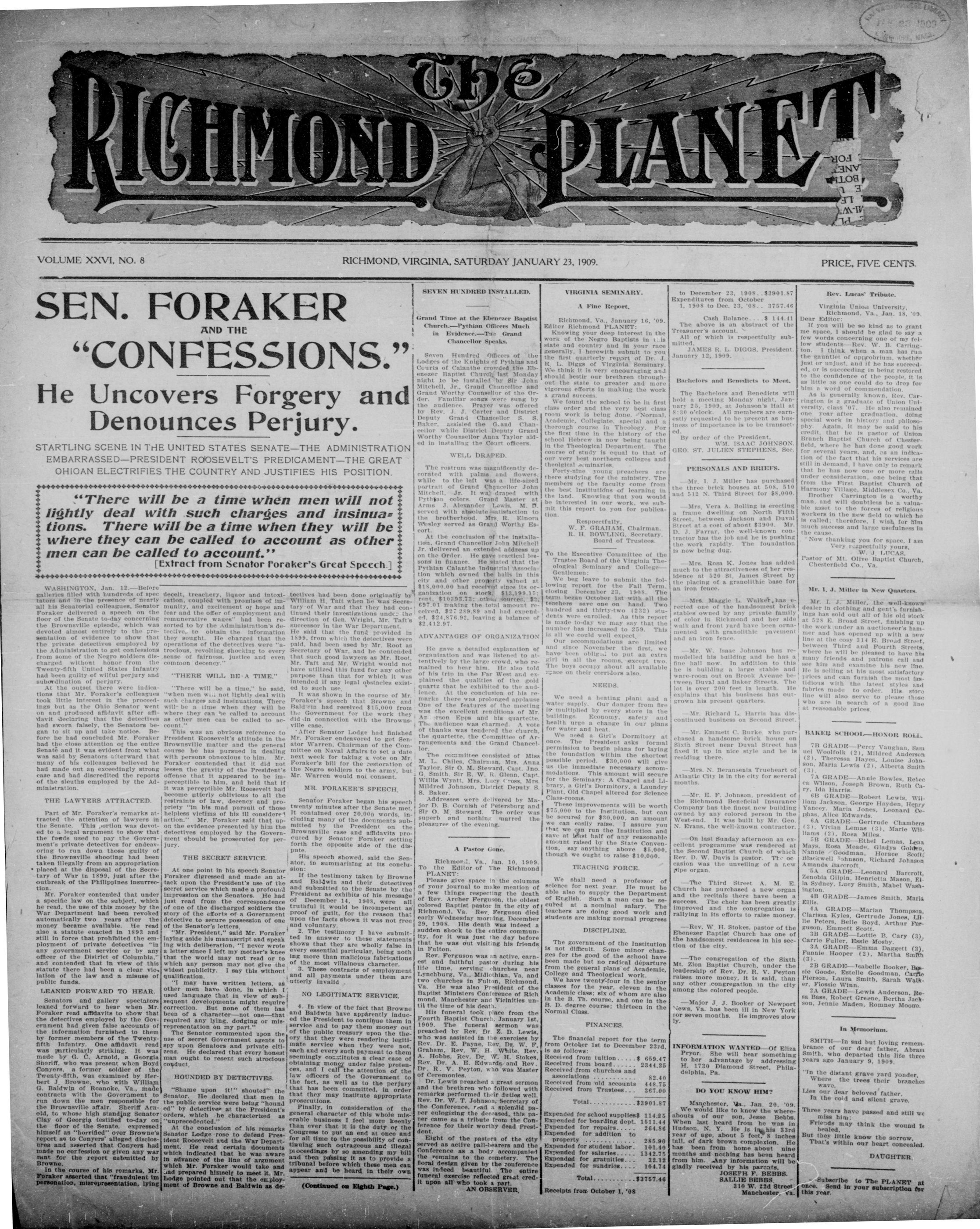
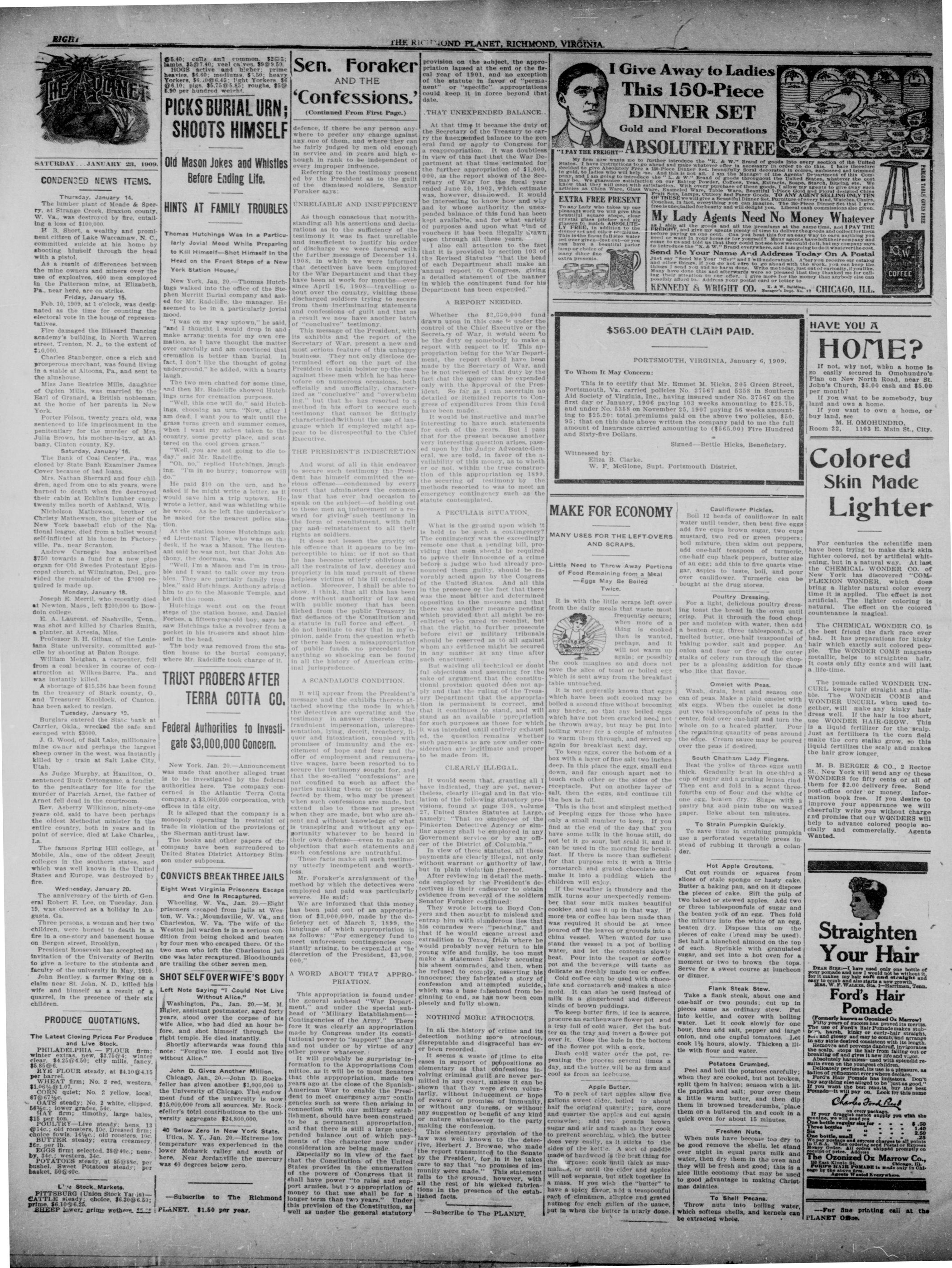
SEN. FORAKER AND THE "CONFESSIONS." He Uncovers Forgery and Denounces Perjury.
STARTLING SCENE IN THE UNITED STATES SENATE—THE ADMINISTRATION EMBARRASSED—PRESIDENT ROOSEVELT'S PREDICAMENT—THE GREAT OHIOAN ELECTRIFIES THE COUNTRY AND JUSTIFIES HIS POSITION.
"There will be a time when men will not lightly deal with such charges and insinuations. There will be a time when they will be where they can be called to account as other men can be called to account." [Extract from Senator Foraker's Great Speech.]
VOLUME XXVI. NO. 8
SEN. H
"CON
He Unco
Deno
STARTLING SCENE IN THE
EMBARRASSED—PRESI
OHIOAN ELECTRIFIES
"There will
lightly deal w
tions. There w
where they can
men can be call
WASHINGTON, Jan. 12.—Before galleries filled with hundreds of spectators and in the presence of nearly all his Senatorial colleagues, Senator Foraker delivered a speech on the floor of the Senate to-day concerning the Brownsville episode, which was devoted almost entirely to the presentation of evidence to show that the private detectives employed by the Administration to get confessions from some of the Negro soldiers discharged without honor from the Twenty-fifth United States Infantry had been guilty of wilful perjury and subordination of perjury. At the outset there were indications that Mr. Foraker's colleagues took little interest in the proceedings but as the Ohio Senator went on and produced affidavit after affidavit declaring that the detectives had sworn falsely, the Senators began to sit up and take notice. Before he had concluded Mr. Foraker had the close attention of the entire Senate and it was evident from what was said by Senators afterward that many of his colleagues believed he had made out an exceedingly strong case and had discredited the reports of the sleuths employed by the Administration.
THE LAWYERS ATTRACTED
Part of Mr. Foraker's remarks attracted the attention of lawyers in the Senate. This portion was devoted to a legal argument to show that the funds used to pay the Government's private detectives for endeavoring to run down those guilty of the Brownsville shooting had been taken illegally from an appropriation placed at the disposal of the Secretary of War in 1899, just after the outbreak of the Philippines insurrection.
Mr. Foraker contended that under a specific law on the subject, which he read, the use of this money by the War Department had been revoked automatically two years after the money became available. He read also a statute enacted in 1893 and still in force that prohibited the employment of private detectives "in any government service or by any officer of the District of Columbia," and contended that in view of this statute there had been a clear violation of the law and a misuse of public funds.
LEANED FORWARD TO HEAR.
Senators and gallery spectators leaned forward to hear when Mr. Foraker read affidavits to show that the detectives employed by the Government had given false accounts of the information furnished to them by former members of the Twenty-fifth Infantry. One affidavit read was particularly striking. It was made by G. C. Arnold, a Georgia Sheriff, who was present when Boyd Conyers, a former soldier of the Twenty-fifth, was examined by Herbert J. Browne, who with William G. Baldwin of Roanoke, Va., made contracts with the Government to run down the men responsible for the Brownsville affair. Sheriff Arnold, to whose high standing Senator Clay of Georgia testified to-day on the floor of the Senate, expressed himself as "horrified" over Browne's report as to Conyers' alleged disclosures and asserted that Conyers had made no corfession or given any war want for the report submitted by Browne.
In the course of his remarks, Mr. Foraker asserted that "fraudulent personalization, misrepresentation, lying
deceit, treachery, liquor and intoxication, coupled with promises of immunity, and excitement of hope and fear and the offer of employment and remunerative wages" had been resorted to by the Administration's detective, to obtain the information they sought. He charged that the operations of the detectives were "atrocious, revolting shocking to every sense of fairness, justice and even common decency."
"THERE WILL BE A TIME"
"There will be a time," he said, "when men will not lightly deal with such charges and insinuations. There will be a time when they will be where they can be called to account as other men can be called to account."
This was an obvious reference to President Roosevelt's attitude in the Brownsville matter and the general course he has pursued in dealing with persons obnoxious to him. Mr. Foraker contended that it did not lessen the gravity of the President's offense that it appeared to be imperceptible to him, and held that if it was perceptible Mr. Roosevelt had become utterly oblivious to all the restraints of law, decency and propriety "in his mad pursuit of those helpless victims of his ill consider'd action." Mr. Foraker said that upon the evidence presented by him the detectives employed by the Government should be prosecuted for perjury.
THE SECRET SERVICE
At one point in his speech Senator Foraker digressed and made an attack upon the President's use of the secret service which made a profound impression on the Senators. He had just read from the correspondence of one of the discharged soldiers the story of the efforts of a Government detective to secure possession of one of the Senator's letters.
"Mr. President," said Mr. Foraker laying aside his manuscript and speaking with deliberation, "I never wrote a letter since I left my mother's knee that the world may not read or to which any person may not give the widest publicity. I say this without qualification.
"I may have written letters, as other men have done, in which I used language that in view of subsequent developments might require correction. But none of them has been of a character—not one that required any lying, dodging or misrepresentation on my part."
The Senator commented upon the use of secret Government agents to spy upon Senators and private citizens. He declared that every honest man ought to resent such atrocious conduct.
HOUNDED BY DETECTIVES
"Shame upon it!" shouted the Senator. He declared that men in the public service were being "hounded" by detectives at the President's orders, which he characterized as "unprecedented."
At the conclusion of his remarks Senator Lodge rose to defend President Roosevelt and the War Department. He read certain documents which indicated that he was aware in advance of the line of argument which Mr. Foraker would take and had prepared himself to meet it. Mr. Lodge pointed out that the employment of Browne and Baldwin as de-
RICHMOND, VIRGINIA, SATURDAY JANUARY 23, 1909.
tectives had been done originally by William H. Taft when he was Secretary of War and that they had continued their investigations under the direction of Gen. Wright, Mr. Taft's successor in the War Department. He said that the fund provided in 1899, from which the detectives were paid, had been used by Mr. Root as Secretary of War, and he contended that such good lawyers as Mr. Root, Mr. Taft and Mr. Wright would not have utilized this fund for any other purpose than that for which it was intended if any legal obstacles existed to such use. It was shown in the course of Mr. Foraker's speech that Browne and Baldwin had received $15,000 from the Government for the work they did in connection with the Brownsville case. After Senator Lodge had finished Mr. Foraker endeavored to get Senator Warren, Chairman of the Committee on Naval Affairs to set a date next week for taking a vote on Mr. Foraker's bill for the restoration of the Negro soldiers to the army, but Mr. Warren would not consent.
MR. FORAKER'S SPEECH
Senator Foraker began his speech twenty minutes after the Senate met. It contained over 20,000 words, including many of the documents submitted by the President on the Brownsville case and affidavits procured by Senator Foraker setting forth the opposite side of the dispute.
His speech showed, said the Senator, in summarizing at its conclusion:
If the testimony taken by Browne and Baldwin and their detectives and submitted to the Senate by the President as exhibits of his message of December 14, 1908, were all truthful it would be incompetent as proof of guilt, for the reason that upon the facts shown it was not free and voluntary.
2. The testimony I have submitted in answer to these statements shows that they are wholly false in every essential particular, being not ing more than malicious fabrications of the most villainous character.
3. These contracts of employment and all payments under them are utterly invalid.
NO LEGITIMATE SERVICE
4. In view of the fact that Browne and Baldwin have apparently induced the President to continue them in service and to pay them money out of the public treasury upon the theory that they were rendering legitimate service when they were not, each and every such payment to them seemingly constitutes a clear case of obtaining money under false pretences, and I call the attention of the law officers of the Government to the fact, as well as to the perjury that has been committed, in order that they may institute appropriate prosecutions.
Finally, in consideration of the general character of this whole miserable business I feel more keenly than ever that it is the duty of the Congress to put an end at once and for all time to the possibility of continuing such outrageous and illegal proceedings by so amending my bill and then passing it as to provide a tribunal before which these men can appear and be heard in their own
(Continued on Eighth Page.)
SEVEN HUNDRED INSTALLED.
Grand Time at the Ebenezer Baptist Church.—Pythian Officers Much in Evidence.—Tre. Grand
Seven Hundred Officers of the Lodges of the Knights of Pythias and Courts of Calanthe crowded the Ebenezer Baptist Church last Monday night to be installed by Sir John Mitchell, Jr., Grand Chancellor and Grand Worthy Counsellor of the Order. Familiar sons were sung by the audience. Prayer was offered by Rev. J. J. Carter and District Deputy Grand Chancellor S. S. Baker, assisted the G. and Chancellor while District Deputy Grand Worthy Counsellor Anna Taylor aided in installing the Court officers.
WELL DRAPED
The rostrum was magnificently decorated with palms and flowers, while to the left was a life-sized portrait of Grand Chancellor John Mitchell, Jr. It was draped with Python colors. Grand Master at Arms J. Alexander Lewis, M. D. served with absolute satisfaction to the brotherhood. Mrs R. Elinora Wesley served as Grand Worthy Escort.
At the conclusion of the installation, Grand Chancellor John Mitchell Jr. delivered an extended address up on the Order. He gave practical lessons in finance. He stated that the Pythian Calanthe Industrial Association which owned the balls in this city and other property valued at $18,000.00 had received since its organization on stock. $13,199.15, rent, $102,93.73, other sources. $3,697.01 making the total amount received, $27,299.89 and had expended, $24,876.92, leaving a balance of $2,412.97.
ADVANTAGES OF ORGANIZATION
He gave a detailed explanation of organization and was listened to attentively by the large crowd, who remained to hear him. He also told of his trip in the Far West and explained the qualities of the gold quartz that he exhibited to the audience. At the conclusion of his remarks there was prolonged applause. One of the features of the meeting was the excellent renditions of Mr. Anselson Epps and his quartette. The audience was charmed. A vote of thanks was tendered the church, the quartette, the Committee of Arrangements and the Grand Chancellor.
The committee consisted of Miss M. L. Chiles, Chairman, Mrs. Anna Taylor, Sir O. M. Steward, Capt. Jno. G. Smith, Sir E. W. R. Glenn, Capt. Willis Wyatt, Mrs. Lucy Cross, Mrs. Mildred Johnson, District Deputy S. S. Baker.
Addresses were delivered by Major D. B. Cornish of Petersburg and Sir O. M. Steward. The order was superb and nothing marred the pleasure of the evening.
A. Pastor Gone.
Richmond, Va., Jan. 10, 1909.
To the Editor of The Richmond PLANET:
Please give space in the columns of your journal to make mention of a few things respecting the death of Rev. Archer Ferguson, the oldest colored Baptist pastor in the city of Richmond, Va. Rev. Ferguson died early Wednesday morning, December 29, 1908. His death was indeed a sudden shock to the entire community, for it was just the day before that he was out visiting his friends in Fulton.
Rev. Ferguson was an active, earnest and faithful pastor during his life time, serving churches near Lynchburg, Va., Midlothian, Va, and two churches in Fulton, Richmond, Va. He was also President of the Baptist Ministers Conference of Richmond, Manchester and Vicinities until the time of his death.
His funeral took place from the Fourth Baptist Church, January 1st, 1909. The funeral sermon was preached by Rev. Dr. Z. D. Lewis, who was assisted in the exercises by Rev. Dr. E. Payne, Rev. Dr. W. F. Graham, Rev. W. H. White, Rev. A. Hobbs, Rev. Dr. W. H. Stokes, Rev. Dr. A. E. Edwards and Rev. Dr. R. V. Peyton, who was Master of Ceremonies.
Dr. Lewis preached a great sermon and the brettren who followed with remarks performed their duties well. Rev. Dr. W. T. Johnson, Secretary of the Conference, read a splendid paper eulogizing the deceased, this paper came as a tribute from the Conference for their worthy dead President. Eight of the pastors of the city served as active pill-bearers and the Conference as a body accompanied the remains to the cemetery. The floral design given by the conference was indeed beautiful. The entire funeral exercise reflected great credit upon all who took a part. AN OPERATION
AN OBSERVER
VIRGINIA SEMINARY.
A Fine Report
Richmond, Va., January 16, '09.
Editor Richmond PLANET:
Knowing your deep interest in the work of the Negro Baptists in this state and country and in your race generally, I herewish submit to you the first quarterly report of Dr. J. R. L. Diggs of Virginia Seminary. We think it is very encouraging and should bestir our brethren throughout the state to greater and more vigorous efforts in making the work a grand success.
We found the school to be in first class order and the very best class room work is being done. Normal, Academic, Collegiate, special and a thorough course in Theology. For the first time in the history of the school Hebrew is now being taught in the Theological Department. The course of study is equal to that of our very best northern colleges and theological seminaries.
Forty-nine young preachers are there studying for the ministry. The members of the faculty come from the best institutions of learning in the land. Knowing that you would be interested in our work, we submit this report to you for publication.
Respectfully,
W. F. GRAHAM, Chairman.
R. H. BOWLING, Secretary.
Board of Trustees.
To the Executive Committee of the Trustee Board of the Virginia Theological Seminary and College—Gentlemen:
We beg leave to submit the following report for the Fall Term, closing December 23, 1908. The term began October 1st with all the teachers save one on hand. Two hundred and thirty-two (232) students were enrolled. As this report is made to-day we may say that the number has increased to 259. This is all we could well expect. Our accommodations are limited and since November the first, we have been obliged to put an extra girl in all the rooms, except two. The boys occupy about all available space on their corridors also.
NEEDS.
We need a heating plant and a water supply. Our danger from fire is multiplied by every stove in the buildings. Economy, safety and health urge a change in our plans for water and heat.
We need a Girl's Dormitory at once. The President asks formal permission to begin plans for laying the foundation within the shortest possible period. $30,000 will give us the immediate necessary accommodations. This amount will secure for the Seminary: A Chapel and Library, a Girl's Dormitory, a Laundry Plant, Old Chapel altered for Science Class-rooms.
These improvements will be worth $75,000 to the Institution, but can be secured for $30,000, an amount we can easily raise. I assure you that we can run the Institution and save at least half of any reasonable amount raised by the State Convention, say anything above $5,000, though we ought to raise $10,000.
TEACHING FORCE
We shall need a professor of science for next year. He must be able also to supply the Department of English. Such a man can be secured at a nominal salary. The teachers are doing good work and students are making normal progress
DISCIPLINE
The government of the Institution is not difficult. Some minor changes for the good of the school have been made but no radical departure from the general plans of Academic, College and Theological work. We have twenty-four in the senior classes for the year, eleven in the Academic class; six of whom are also in the B. Th. course, and one in the B. D. degree course; thirteen in the Normal Class.
FINANCES
The financial report for the term
from October 1st to December 23rd,
is as follows:
Received from tuition.....$ 659.47
Received from board.....2344.25
Received from churches and
associations.....82.40
Received from old accounts.....448.75
Received from Trustees.....367.00
Total.....$3901.87
Expended for school supplies$ 114.25
Expended for boarding dept. 1511.44
Expended for repairs.....264.86
Expended for addition to
property.....285.90
Expended for student labor. 101.40
Expended for salaries.....1342.75
Expended for gratuities.....32.12
Expended for sundries.....104.74
Total.....$3757.46
Receipts from October 1, '08
SALLY M. subscribe to The PLANET at 310 W. 22d Street and in your subscription for Manchester, va. this year.
to December 23, 1908...$3901.87
Expenditures from October
1, 1908 to Dec. 23, '08... 3757.46
Cash Balance.....$ 144.41
The above is an abstract of the
Treasurer's account.
All of which is respectfully submitted.
JAMES R. L. DIGGS, President January 12, 1909.
Bachelors and Benedicts to Meet.
The Bachelors and Benedicts will hold a meeting Monday night, January 25, 1909, at Johnson's Hall at 8:30 o'clock. All members are earnestly requested to be present as business of importance is to be transacted.
By order of the President,
WM. ISAAC JOHNSON,
GEO. ST. JULIEN STEPHENS, Sec.
PERSONALS AND BRIEFES.
Mr. I. J. Miller has purchased the three brick houses at 508, 510 and 512 N. Third Street for $8,000.
Mrs. Vera A. Bolling is erecting a frame dwelling on North Fifth Street, between Jackson and Duval Street at a cost of about $3900. Mr. D. J. Farrar, the well-known contractor has the job and he is pushing the work rapidly. The foundation is now being dug.
Mrs. Rosa K. Jones has added much to the attractiveness of her residence at 520 St. James Street by the placing of a granolithic base for an iron fence.
Mrs. Maggie L. Walker, has erected one of the handsomest brick stables owned by any private family of color in Richmond and her side walk and front yard have been ornamented with granolithic pavement and an iron fence.
Mr. W. Isaac Johnson has remodelled his building and he has a fine hall now. In addition to this he is building a large stable and ware-room out on Brook Avenue between Duval and Baker Streets. The lot is over 200 feet in length. He explains that his business has outgrown his present quarters.
Mr. Richard L. Harris has discontinued business on Second Street.
Mr. Emmett C. Burke who purchased a handsome brick house on Sixth Street near Duval Street has fixed it up in nice style and he is residing there.
Mrs. N. Beransenia Trueheart of Atlantic City is in the city for several months.
Mr. E. F. Johnson, president of the Richmond Beneficial Insurance Company has the finest new building owned by any colored person in the West-end. It was built by Mr. Geo. N. Evans, the well-known contractor.
On last Sunday afternoon an excellent programme was rendered at the Second Baptist Church of which Rev. D. W. Davis is pastor. The occasion was the unveiling of a new pipe organ.
The Third Street A. M. E. Church has purchased a new organ and the recitals there have been a success. The choir has been greatly improved and the congregation is rallying in its efforts to raise money.
Rev. W. H. Stokes, pastor of the Ebenezer Baptist Church has one of the handsomest residences in his section of the city.
The congregation of the Sixth Mt. Zlon Baptist Church, under the leadership of Rev. Dr. R. V. Peyton raises more money, it is said, than any other congregation in the city among the colored people.
Major J. J. Booker of Newport News, Va. has been ill in New York for seven months. He improves slowly.
INFORMATION WANTED—Of Eliza
Pryor. She will hear something
to her advantage by addressing
H. 1730 Diamond Street, Philadelphia, Pa.
DO YOU KNOW HIM?
Manchester, Va.. Jan. 20. '09.
We would like to know the where-
abouts of our son, Jesse Bebbs.
When last heard from he was in
Hudson, N. Y. He is in his 33rd
year of age, about 5 feet, 8 inches
tall, of dark brown complexion. He
has been from home about nine
months and nothing has been heard
from him. Any information will be
gladly received by his parents,
JOSEPH F. BEBBS.
SALLIE BEBBS.
310 W. 22d Street.
Manchester, va.
PRICE, FIVE CENTS
Rev. Lucas' Tribute.
Virginia Union University,
Richmond, Va., Jan. 18, '09.
Dear Editor:
If you will be so kind as to grant me space, I should be glad to say a few words concerning one of my fellow students—Rev. W. B. Carrington. I think when a man has run the gauntlet of opprobrium, whether just or unjust, and if he has succeeded, or is succeeding in being restored to the confidence of the people, it is as little as one could do to drop for him a word of commendation.
As is generally known, Rev. Carrington is a graduate of Union University, class '07. He also remained one year after graduation, doing special work in history and philosophy. Again, it may be said to his credit, that he is pastor of Union Branch Baptist Church of Chesterfield, where he has done good work for several years, and, as an indication of the fact that his services are still in demand, I have only to remark that he has now one or more calls under consideration, one being that from the First Baptist Church of Harmony Village, Middlesex Co., Va.
Brother Carrington is a worthy man, and will doubtless be a valuable asset to the forces of religious workers in the new field to which he is called; therefore, I wish for him much success and large usefulness in the cause.
Now thanking you for space, I am Very respectfully yours,
W. J. LUCAS.
Pastor of Mt. Olive Baptist Church, Chesterfield Co. Va.
Mr. I. J. Miller in New Quarters
Mr. I. J. Miller, the well-known dealer in clothing and gent's furnishings has sold out all of his old stock at 528 E. Broad Street, finishing up the work under an auctioneer's hammer and has opened up with a new line at the cosy 314 E. Broad Street, between Third and Fourth Streets, where he will be pleased to have his many friends and patrons call and see him and examine his new line. He is selling at his most satisfactory prices and can furnish the most fastidious with the latest styles and fabrics made to order. His store line will also serve to please those who are in search of a good line at reasonable prices
---
BAKEB SCHOOL—HONOR ROLL
7B GRADE—Percy Vaughan, Samuel Woolfolk (2), Mildred Anderson (2), Theressa Hayes, Louise Johnson, Maria Lewis (2), Alberta Smith (3).
7A GRADE—Annie Bowles, Rebecca Wilson, Joseph Brown, Ruth Cary, Ida Harris.
6B GRADE—Robert Lewis, William Jackson, George Hayden, Henry Yancey, Maria Jones, Leonard Cephas, Alice Edwards.
6A GRADE—Gertrude Chambers (3), Vivian Lemas (3), Marie Williams (2), Rosa Miles.
5B GRADE—Ethel Lemas, Lena Mays, Rosa Meade, Gladys Golden, Nannie / Goodman, Horace Scott, Blackwell 10hnson, Richard Johnson Amanda Barcroft.
5A GRADE—Leonard Barcroft, Zenobia Gilpin, Henrietta Mason, Ella Sydney, Lucy Smith, Mabel Washington.
4B GRADE—James Smith, Maria Ellis.
4A GRADE—Marian Thompson, Clarissa Kyles, Gertrude Jones, Lille Peters, Belle Boyd, Arthur Ferguson, Emmett Scott.
3B GRADE—Lottie B, Cary (3), Carrie Fuller, Essie Mosby.
3A GRADE—Emma Daggett (3), Fannie Hooper (2), Martha Smith (3).
2B GRADE—Isabelle Booker, Bessie Goode, Estelle Goodman, Carlie Pierson, Laura Smith, Sarah Walker, Flosios Winn.
2A GRADE—Lewis Anderson, Rosa Bass, Robert Greene, Bertha Jackson, Jennie Maden, Romney Mooney
In Memorium
SMITH—In sad but loving remembrance of our dear father, Abram Smith, who departed this life three years ago January 9, 1909.
"In the distant grave yard yonder,
Where the trees their branches wave,
Lies our dear beloved father,
In the cold and silent grave.
Three years have passed and still we miss him;
Friends may think the wound is healed.
But they little know the sorrow,
That's within our heart concealed.
DAUGHTER
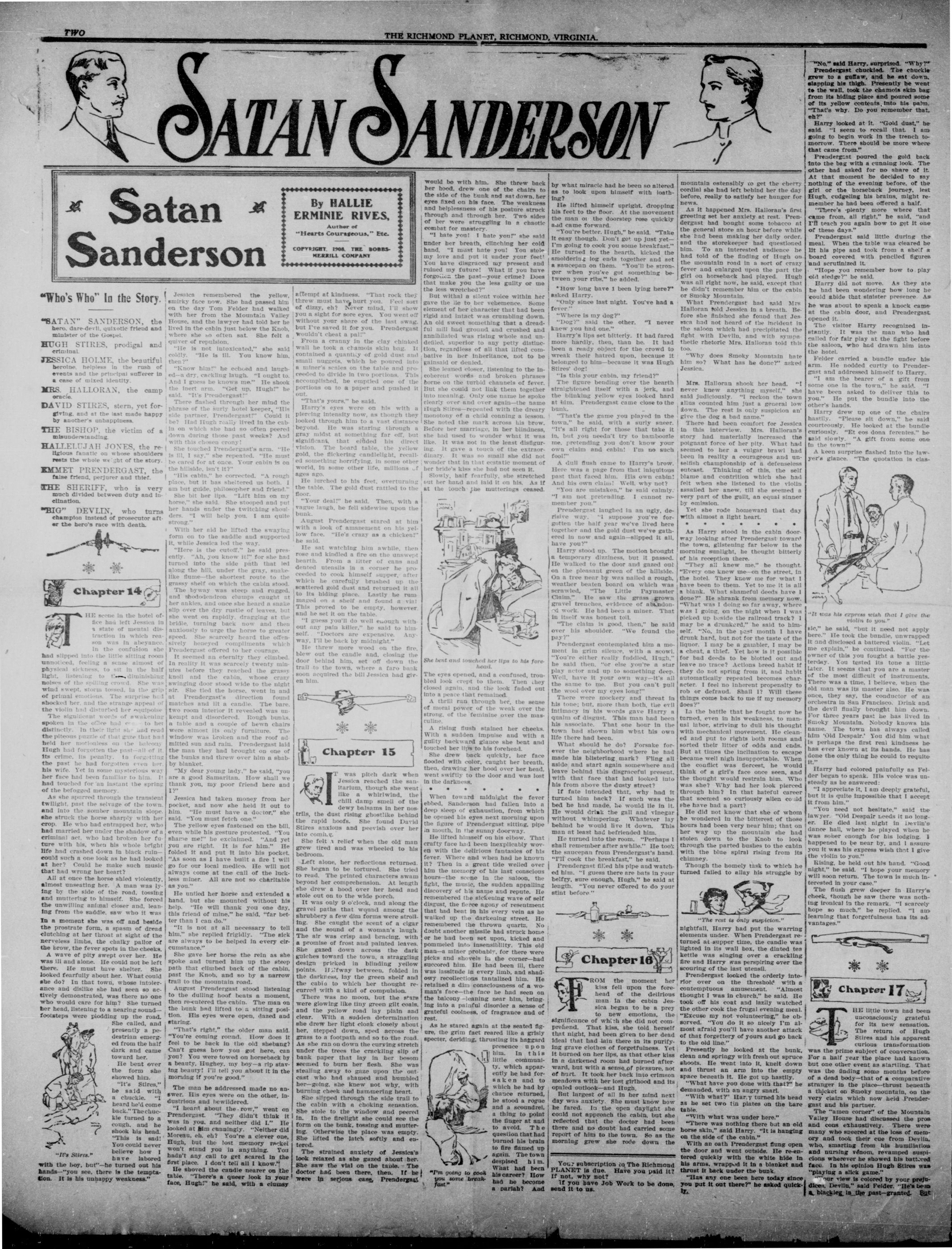
Satan Sanderson
TWO
"Who's Who" In the Story
"SATAN" SANDERSON, the hero, dare-devil, quixotic friend and minister of the Gospel.
HUGH STIRES, prodigal and criminal.
JESSICA HOLME, the beautiful heroine, helpless in the rush of events and the principal sufferer in a case of mixed identity.
MRS. HALLORAN, the camp oracle.
DAVID STIRES, stern, yet forgiving, and at the last made happy by another's unhappiness.
THE BISHOP, the victim of a misunderstanding.
HALLELUJAH JONES, the religious fanatic on whose shoulders rests the whole weight of the story.
KMMET PRENDERGAST, the false friend, perjurer and thief.
THE SHERIFF, who is very much divided between duty and inclination.
BIG" DEVLIN, who turns champion instead of prosecutor after the hero's race with death.
Chapter 14
THE scene in the hotel office had left Jessica in a state of mental distraction in which reason was in abeyance in the confusion she
THE scene in the hotel office had left Jessica in a state of mental distraction in which reason was in abeyance. In the confusion she had slipped into the little sitting room unnoticed, feeling a sense almost of physical sickness, to sit in the half light, listening to the diminishing noises of the spilling crowd. She was wind swept, storm tossed, in the grip of primal emotions. The surprise but shocked her, and the strange appeal of the violin had disturbed her equulse
The significant words of awakening spoken in the office had come to her distinctly. In their light she and read the piteous puzzle of that gaze that had held her motionless on the latecony. Hugh had forgotten the past—all of its crime, its penalty. In forgetting the past he had forgotten even her his wife. Yet in some mysterious way her face had been familiar to him. It had touched for an instant the spring of the befogged memory.
As she spurred through the transient twilight, past the salvage of the town and into the somber mountain slope she struck the horse sharply with her crop. He who had entrapped her, who had married her under the shadow of a criminal act, who had broken her future with him, when his whole bright life had crashed down in black ruin—could such a one look as he had looked at her? Could he make such music that had wrung her heart?
All at once the horse shied violently, almost unseating her. A man was lying by the side of the road, tossing and muttering to himself. She forced the unwilling animal closer and, leaning from the saddle, saw who it was. In a moment she was off and beside the prostrate form, a spasm of dread clutching at her throat at sight of the nerveless limbs, the chalky pallor of the brow, the fever spots in the cheeks. A wave of pity swept over her. He was ill and alone. He could not be left there. He must have shelter. She looked fearfully about her. What could she do? In that town, whose intolerance and dislike she had seen so actively demonstrated, was there no one who would care for him? She turned her head, listening to a nearing sound—footsteps were plodding up the road.
She called, and presently a pedestrian emerged from the half dark and came toward her.
MARCELA MAYER
He bent over the form she showed him.
"It's Stires," he said with a chuckle. "I heard he'd come back." The chuckle turned to a cough, and he shook his head. "This is sad! You could never believe how I have labored with the boy, but"—he turned out his hands—"you see, there is the temptation. It is his unhappy weakness."
Jessica remembered the yellow, smirky face now. She had passed him on the day Tom Felder had walked with her from the Mountain Valley House, and the lawyer had told her he lived in the cabin just below the Knob, where she so often sat. She felt a quiver of repulsion.
"He is not intoxicated," she said coldly. "He is ill. You know him, then."
"Know him!" he echoed and laughed—a dry, cackling laugh. "I ought to. And I guess he knows me." He shook the inert arm. "Get up, Hugh!" he said. "It's Prendergast!"
There flashed through her mind the phrase of the surly hotel keeper, "His side partner, Prendergast!" Could it be? Had Hugh really lived in the cabin on which she had so often peered down during those past weeks? And with this chosen cry!
She touched Prendergast's arm. "He is ill, I say," she repeated. "He must be cared for at once. Your cabin is on the hillside, isn't it?" "His cablin," he corrected. "A rough place, but it has sheltered us both. I am but guide, philosopher and friend." She bit her lips. "Lift him on my horse," she said. She stooped and put her hands under the twitching shoulders. "I will help you. I am quite strong." With her aid he lifted the swaying form on to the saddle and supported it, while Jessica led the way. "Here is the cutoff," he said presently. "Ah, you know it." for she had turned into the side path that led along the hill, under the gray, snake-like flume—the shortest route to the grassy shelf on which the cabin stood.
The byway was steep and rugged, and rhododendron clumps caught at her ankles, and once she heard a snake slip over the dry rustie of leaves, but she went on rapidly, dragging at the bridle, turning back now and then anxiously to urge the horse to greater speed. She scarcely heard the offensively honeyed compliments which Prendergast offered to her courage. It seemed an eternity they climbed. In reality it was scarcely twenty minutes before they reached the grassy knoll and the cabin, whose crazy swinging door stood wide to the night air. She tied the horse, went in and at Prendergast's direction found matches and lift a candle. The bare, two room interior it revealed was unkempt and disordered. Rough bunks, a table and a couple of hewn chairs were almost its only furniture. The window was broken and the roof admitted sun and rain. Prendergast laid the man they had brought on one of the bunks and threw over him a shabby blanket.
"My dear young lady," he said, "you are a good Samaritan. How shall we thank you, my poor friend here and I?" Jessica had taken money from her pocket, and now she held it out to him. "He must have a doctor," she said. "You must fetch one." The yellow eyes fastened on the bill, even while his gesture protested. "You share me!" he exclaimed. "And yet you are right. It is for him." He folded it and put it into his pocket. "As soon as I have built a fire I will for our local medico. He will not always come at the call of the luckless miner. All are not so charitable as you." He untied her horse and extended a hand, but she mounted without his help. "He will thank you one day, this friend of mine," he said, "far better than I can do."
"It is not at all necessary to tell him," she replied frickly. "The slick are always to be helped in every circumstance."
She gave her horse the rein as she spoke and turned him up the steep path that climbed back of the cabin, past the Knoh, and so by a narrow trail to the mountain road.
August Prendergast stood listening to the dulling hoof beats a moment, then re-entered the cabin. The man on the bunk had lifted to a sitting position. His eyes were open, dazed and staring.
"That's right," the older man said. "You're coming round. How does it feel to be back in the old shebang? Can't guess how you got here, can you? You were towed on horseback by a beauty, Hughey, my boy—a rip staving beauty! I'll tell you about it in the morning if you good."
The man he addressed made no answer. His eyes were on the other, industrious and bewildered.
"I heard about the row," went on Prendergast. "They didn't think it was in you, and neither did I." He looked at him cunningly. "Neither did Moreau, eh, eh? You're a clever one, Hugh, but the lost memory racket won't stand you in anything. You hadn't any call to get scared in the first place. I don't tell all I know."
He shoved the candle nearer on the table. "There's a queer look in your face, Hugh!" he said, with a clumsy
THE RICHMOND PLANET, RICHMOND, VIRGINIA.
Author of
"Hearts Courageous." Etc.
COPYRIGHT, 1908, THE BOBES-
MERRILL COMPANY
aempt at kindness. "That rock they threw must have hurt you. You feel sort of dizzy, eh? Never mind, I'll show you a sight for sore eyes. You went off without your share of the last swag, but I've saved it for you. Prendergast wouldn't cheat a pal!" From a cranny in the clay chinked wall he took a chamois skin bag. It contained a quantity of gold dust and small nuggets, which he poured into a miner's scales on in two portions. This accomplished, he emptied one of the portions on to a paper and pushed it out. "That's yours." he said.
Harry's eyes were on his with a piercing intensity now, as though they looked through him to a vast distance beyond. He was staring through a gray midst at something far off, but significant, that elided his direct vision. The board table, the yellow gold, the flickering candlelight, recalled something horrifying, in some other world, in some other life, millions of ages ago.
He lurched to his feet, overturning the table. The gold dust rattled to the floor.
"Your deal!" he said. Then, with a vague laugh, he fell sidewise upon the bunk.
August Prendergast stared at him with a look of amazement on his yellow face. "He's crazy as a chicken!" he said.
He sat watching him awhile, then rose and kindled a fire on the unswept hearth. From a litter of cans and dented utensils in a corner he proceeded to cook himself supper, after which he carefully brushed up the scattered gold dust and returned it all to its biding place. Lastly he rummaged on a shelf and found a vial. This proved to be empty, however, and he set it on the table.
"I guess you'll do well enough without any pain killer," he said to himself. "Doctors are expensive. Anyway, I'll be back by midnight."
He threw more wood on the fire, blew out the candle and, closing the door behind him, set off down the trail to the town, where a fark bank soon acquired the bill Jessica had given him.
Chapter 15
It was pitch dark when Jessica reached the sanitarium, though she went like a whirlwind, the chill damp smell of the dewy helsams in her nos.
It was pitch dark when Jessica reached the sanitarium, though she went like a whirlwind, the chill damp smell of the dewy balsams in her nostrils, the dust rising ghostlike behind the rapid hoofs. She found David Stires anxious and peevish over her late comh.g.
She felt a relief when the old man grew tired and was wheeled to his bedroom.
Left alone, her reflections returned. She began to be tortured. She tried to read. The printed characters swam beyond her comprehension. At length she drew a hood over her head and stole out on to the wide porch.
It was only 9 o'clock, and along the gravel paths that wound among the shrubbery a few dim forms were strolling. She caught the scent of a cigar and the sound of a woman's laugh. The air was crisp and bracing, with a promise of frost and painted leaves. She gazed down across the dark gulches toward the town, a straggling design pricked in blinding yellow points. Hailway between, folded in the darkness, lay the green shelf and the cabia to which her thought recurred with a kind of compulsion.
There was no moon, but the stars were glowing like tiny green gift coals, and the yellow road lay plain and clear. With a sudden determination she drew her light cloak closely about her, stepped down, sped across the grass to a footpath and so to the road. As she ran on down the curving stretch under the trees the crackling slip of bank paper that lay in her bosom seemed to burn her flesh. She was stealing away to gaze upon the outcast who had shamed and humbled her—going, she knew not why, with burning cheek and hammering heart. She slipped through the side trail to the cabin with a choking sensation. She stole to the window and peered in. In the firelight she could see the form on the bunk, tossing and muttering. Otherwise the place was empty. She lifted the latch softly and entered.
The strained anxiety of Jessica's look relaxed as she gazed about her. She saw the vial on the table. The doctor had been there, then. If he were in serious case, Prendergast
would be with him. She threw back her hood, drew one of the chairs to the side of the bunk and sat down, her eyes fixed on his face. The weakness and helplessness of his posture struck through and through her. Two sides of her were struggling in a chaotic combat for mastery.
"I hate you! I hate you!" she said under her breath, clutching her cold hand. "I must hate you! You stole my love and put it under your feet! You have disgraced my present and ruined my future! What if you have forgotten the past—your crime? Does that make you the less guilty or me the less wretched?"
But withal a silent voice within her gave the lie to her vehemence. Some element of her character that had been rigid and intact was crumbling down. An old sweet something that a dreadful mill had ground and crushed and annihilated was rising whole and undefiled, superior to any petty distinction, regardless of all that lifted combative in her inheritance, not to be grained or denied.
She leaned closer, listening to the incoherent words and broken phrases borne on the turbid channels of fever. But she could not link them together into meaning. Only one name he spoke clearly over and over again—the name Hugh Stires—repeated with the dreary monotony of a child conning a lesson. She noted the mark across his brow. Before her marriage, in her blindness, she had used to wonder what it was like. It was not in the least disgust. It gave a touch of the extraordinary. It was so small she did not wonder that in that ecstatic moment of her bride's kiss she had not seen it.
Slowly, half fearfully, she stretched out her hand and laid it on his. As if at the touch the mutteries ceased.
She bent and touched her lips to his fore head.
The eyes opened, and a confused, troubled look crept to them. Then they closed again, and the look faded out into a peace that remained.
A thrill ran through her, the sense of moral power of the weak over the strong, of the feminine over the masculine.
A rising flush stained her cheeks. With a sudden impulse and with a guilty backward glance she bent and touched her lips to his forehead.
She drew back quickly, her face flooded with color, caught her breath, then, drawing her hood over her head, went swiftly to the door and was lost in the darkness.
When toward midnight the fever ebbed, Sanderson had fallen into a deep sleep of exhaustion, from which he opened his eyes next morning upon the figure of Prendergast sitting, pipe in mouth, in the sunny doorway.
He lifted himself on his elbow. That crafty face had been inexplicably woven with the delirious fantasies of his fever. Where and when had he known it? Then in a great tide welled over him the memory of his last conscious hours—the scene in the saloon, the fight, the music, the sudden appalling discovery of his name and repute. He remembered the sleekening wave of self disgust, the fierce agony of resentment that had beat in his every vein as he walked up the darkening street. He remembered the thrown quartz. No doubt another missile had struck home or he had been set upon, kicked and pomped into insensibility. This old man—a miner probably, for there were picks and shovels in the corner—had succored him. He had been ill, there was lassitude in every limb, and shadowy recollections tantalized him. He retained a dim consciousness of a woman's face—the face he had seen on the balcony—leaning near him, bringing into a painful disorder a sense of grateful coolness, of fragrance and of rest.
As he stared again at the seated figure, the grim fact reared like a grisly specter, deriding, thrusting its haggard presence upon him. In this little community, which apparently he had forsaken and to which he had by chance returned, he stood a rogue and a scoundrel, a thing to point the finger at and to avoid. The question that had burned his brain to fire famed up again. The town despised him. What had been his career? How had he become a pariah? And
"I'm going to cook you some breakfast."
"I'm going to cook you some breakfast."
by what miracle had he been so altered as to look upon himself with loathing?
He lifted himself upright, dropping his feet to the floor. At the movement the man or the doorstep rose quickly and came forward.
"You're better, Hugh," he said. "Take it easy though. Don't get up just yet—I'm going to cook you some breakfast."
He turned to the hearth, kicked the smoldering log ends together and set a sancepan on them. "You'll be stronger when you've got something between your ribs," he added.
*How long have I been lying here?* asked Harry.
"Only since last night. You've had a fever."
"Where is my dog?"
"Dog?" said the other. "I never knew you had one."
Harry's lips set bitterly. It had fared more hardly, then, than he. It had been a ready object for the crowd to wreak their hatred upon, because it belonged to him—because it was Hugh Stires' dog!
"Is this your cabin, my friend?"
The figure bending over the hearth straightened itself with a jerk, and the blinking yellow eyes looked hard at him. Prendergast came close to the bunk.
"That's the game you played in the town," he said, with a surly sneer.
"It's all right for those that take it in, but you needn't to bambooze me, pretending you don't know your own claim and cabin! I'm no such fool!"
A dull flush came to Harry's brow. Here was a page from that iniquitous past that faced him. His own cabin!
And his own claim! Well, why not?
"You are mistaken," he said calmly. "I am not pretending. I cannot remember you."
Prendergast laughed in an ugly, derisive way. "I suppose you've forgotten the half year we've lived here together and the gold dust we've gathered in now and again—slipped it all, have you?"
Harry stood up. The motion brought a temporary dizziness, but it passed. He walked to the door and gazed out on the pleasant green of the hillside. On a tree near by was nailed a rough, weather beaten board on which was scrawled, "The Little Paymaster Claim." He saw the grass grown gravel trenches, evidence of abandoned work. He had been a miner. That in itself was honest toll.
"The claim is good, then," he said over his shoulder. "We found the pay?"
Prendergast contemplated him a moment in grim silence, with a scowl, "You're either really fuddled, Hugh," he said then, and "or else you're a star play actor and up to something deep. Well, have it your own way—it's all the same to me. But you can't pull the wool over my eyes long!"
There were mockery and threat in his tone; but, more than both, the evil intimacy in his words gave Harry a qualm of disgust. This man had been his associate. That one hour in the town had shown him what his own life there had been.
What should he do? Forsake forever the neighborhood where he had made his blistering mark. Fling all aside and start again somewhere and leave behind this disgraceful present, with that face that had looked into his from above the dusty street?
If fate intended that, why had it turned him back? If such was the bed he had made, he would lie in it. He would drink the gall and vinegar without whimpering. Whatever lay behind he would live it down. This man at least had befriended him. He turned into the room. "Perhaps he shall remember after awhile." He took the saucepan from Prendergast's hand. "I'll cook the breakfast," he said. Prendergast filled his pipe and watched him. "I guess there are bats in your belfry, sure enough, Hugh," he said at length. "You never offered to do your stint before."
Chapter16
FROM the moment her kiss fell upon the forehead of the delirious man in the cabin Jessica began to be a prey to new emotions, the
significance of which she did not comprehend. That kiss, she told herself that night, had been given to her dead ideal that had lain there in its purifying grave clothes of forgetfulness. Yet it burned on her lips, as that other kiss in a darkened room had burned afterward, but with a sense of pleasure, not of hurt. It took her back into crimson meadows with her lost girlhood and its opaled outlook—and Hugh. But largest of all in her mind next day was anxiety. She must know how he fared. In the open daylight she could not approach the cabin, but she reflected that the doctor had been there and no doubt had carried some report of him to the town. So as the morning grew she rode down the
You? subscription to The Richmond PLANET is due. Have you paid it? If not, why not? How much Job Work to be done, send it to me.
mountain ostensibly to get the cherry cordial she had left behind her the day before, really to satisfy her hunger for news.
As it happened Mrs. Halloran's first greeting set her anxiety at rest. Prendergast had bought some tobacco at the general store an hour before while she had been making her daily order, and the storekeeper had questioned him. To an interested audience he had told of the finding of Hugh on the mountain road in a sort of crazy fever and enlarged upon the part the girl on horseback had played. Hugh was all right now, he said, except that he didn't remember him or the cabin or Smoky Mountain.
What Prendergast had said Mrs Halloran had Jessica in a breath. Before she finished she found that Jessica had not heard of the incident in the saloon which had preplacitated the fight with Devlin, and with sympathetic rhetoric Mrs. Halloran told this too.
"Why does Smoky Mountain hate him so? What has he done?" asked Jessica.
Mrs. Halloran shook her head. "I never knew anything myself," she sald judiciously. "I reckon the town allus counted him just a general low down. The rest is only suspicion an' give the dog a bad name."
There had been comfort for Jessica in this interview. Mrs. Halloran's story had materially increased the poignant force of her pity. What had seemed to her a vulgar brawl had been in reality a courageous and unselfish championship of a defenseless outcast. Thinking of this, the self blame and contrition which she had felt when she listened to the violin assailed her anew, till she seemed a very part of the guilt, an equal sinner by emission.
Yet she rode homeward that day with almost a light heart.
As Harry stood in the cabin doorway looking after Prendergast toward the town, glistening far below in the morning sunlight, he thought bitterly of his reception there.
"They all knew me," he thought. "Every one knew me—on the street, in the hotel. They know me for what I have been to them. Yet to me it is all a blank. What shameful deeds have I done?" He shrank from memory now. "What was I doing so far away, where was I going, on the night when I was picked up beside the railroad track? I may be a drunkard," he said to himself. "No, in the past month I have drunk hard, but not for the taste of the liquor. I may be a gambler, I may be a cheat, a thief. Yet how is it possible for bad deeds to be blotted out and leave no trace? Actions breed habit if they do not spring from it, and habit automatically repeated becomes character. I feel no inherent propensity to rob or defraud. Shall I? Will these things come back to me if my memory does?"
In the battle that he fought now he turned, even in his weakness, to manual labor, striving to dull his thought with mechanical movement. He cleaned and put to rights both rooms and sorted their litter of odds and ends. But at times the inclination to escape became well nigh insupportable. When the conflict was fiercest, he would think of a girl's face once seen, and the thought would restrain him. Who was she? Why had her look pierced through him? In that hateful career that seemed so curiously allen could she have had a part?
He did not know that she of whom he wondered in the bitterest of those hours had been very near him; that on her way up the mountain she had stolen down to the Knob to look through the parted bushes to the cabin with the blue spiral rising from its chimney. Though the homely task to which he turned failed to allay his struggle by
"The rest is only suspicion." nightfall, Harry had put the warring elements under. When Prendergast returned at supper time, the candle was lighted in its wall box, the dinted tes kettle was singing over a crackling fire and Harry was perspiring over the scouring of the last utensil. Prendergast looked the orderly interior over on the threshold with a contemptuous amusement. "Almost thought I was in church," he said. He took off his coat and lazily watched the other cook the frugal evening meal. "Excuse my not volunteering," he observed. "You do it so nicely I'm almost afraid you'll have another attack of that forgettery of yours and go back to the old line."
Presently he looked at the bunk, clean and springy with fresh out spruce shoots. He went into it, knelt down and thrust an arm into the empty space beneath it. He got up hastily.
"What have you done with that?" he demanded, with an angry snarl.
"With what?" Hary turned his head as he set two tin plates on the bare table.
"With what was under here."
"With what was under here."
"There was nothing there but an old horse skin," said Harry. "It is hanging on the side of the cabin."
With an oath Prendergast flung in the door and went outside. He re-entered quickly with the white hide in his arms, wrapped it in a blanket and thrust it back under the bunk.
"Has any one been here today since you put it out there?" he asked quickly.
"No," said Harry, surprised. "Why?" Prendergast chuckled. The chuckle grow to a guffaw, and he sat down, slapping his thigh. Presently he went to the wall, took the chamols skin bag from its hiding place and poured some of its yellow contents, into his palm. "That's why. Do you remember that, eh?" Harry looked at it. "Gold dust," he said. "I seem to recall that. I am going to begin work in the trench to morrow. There should be more where that came from."
Prendergast poured the gold back into the bag with a cunning look. The other had asked for no share of it. At that moment he decided to say nothing of the evening before, of the girl or the horseback journey, lest Hugh, cudgeling his brains, might remember he had been offered a half. "There's -plenty more where that came from, all right," he said, "and I'll teach you again how to get it one of these days."
Prendergast said little during the meal. When the table was cleared he lit his pipe and took from a shelf a board covered with penciled figures and scrutinized it.
"Hope you remember how to play old sledge?" he said.
Harry did not move. As they ate he had been wondering how long he could abide that sinister presence. As he was about to speak a knock came at the cabin door, and Prendergast opened it.
The visitor Harry recognized instantly. It was the man who had called for fair play at the fight before the saloon, who had drawn him into the hotel.
Felder carried a bundle under his arm. He nodded curtly to Prendergast and addressed himself to Harry.
"I am the bearer of a gift from some one in the town," he said. "I have been asked to deliver this to you." He put the bundle into the other's hands.
Harry drew up one of the chairs hastily. "Please sit down," he said courtlyously. He looked at the bundle curiously. "Et eos dona ferentes," he said slowly. "A gift from some one in the town!" A keen surprise flashed into the lawyer's glance. "The quotation is els-
"It was his express wish that I give the violin to you."
sic," he said, "but it need not apply here." He took the bundle, unwrapped it and disclosed a battered violin. "Let me explain," he continued. "For the owner of this you fought a battle yesterday. You tested its tone a little later. It seems that you are a master of the most difficult of instruments. There was a time, I believe, when the old man was its master also. He was once, they say, the conductor of an orchestra in San Francisco. Drink and the devil finally brought him down. For three years past he has lived in Smoky Mountain. Nobody knows his name. The town has always called him 'Old Despalt.' You did him what is perhaps the first real kindness he has ever known at its hands. He has done the only thing he could to requite it."
Harry had colored painfully as Felder began to speak. His voice was unsteady as he answered:
"I appreciate it, I am deeply grateful, but it is quite impossible that I accept it from him."
"You need not hesitate," said the lawyer. "Old Despain needs it no longer. He died last night in devil's dance hall, where he played when he was sober enough for his lodging. I happened to be near by, and I assure you it was his express wish that I give the violin to you."
Rising, he held out his hand. "Good night," he said. "I hope your memory will soon return. The town is much interested in your case."
The fush grew deeper in Harry's cheek, though he saw there was nothing ironical in the remark. "I scarcely hope so much," he replied. "I am learning that forgetfulness has its advantages."
Chapter 17
THE little town had been unconsciously grateful for its new sensation. The return of Hugh Stires and his apparent curious transformation was the prime subject of conversation. For a half year the place had known but one other event as startling. That was the finding some months before of a dead body—that of a comparative stranger in the place—thrust beneath a thicket on Smoky mountain, on the very claim which now held Prendergast and his partner.
The "amen corner" of the Mountain Valley House had discussed the pros and cons exhaustively. There were many who sneered at the loss of memory and took their cue from Devlin, who, smarting from his humiliation and nursing venom, revamped suspicions wherever he showed his battled face. In his opinion Hugh Stires was "playing a slick game." Our view is colored by your prejudice, Devlin," said Felder. "He's been a blackleg in the past—granted. But
THE PLANET
SATURDAY...JANUARY 23, 1909.
give the devil his due. As for the other ugly tale, there's no more evidence against him than there is against you or me."
"They didn't find the body on my ground," had been the other's surly retort, "and I didn't clear out the day before either."
The phenomenon, however, whether credited or poochooed, was a drawing card. More than a few found occasion to climb the mountain by the hillside trail that skirted the lonely cabin. These as likely as not saw Frendergast lounging in the doorway smoking, while the younger man worked, leading a trench along the brow of the hill to bring the water from its intake, which Harry's quick ere had seen was practicable.
The spectacle of Hugh Stires, who had been used to pass his days in the saloons and his nights in even less becoming resorts, turned practical miner added a touch of opera bouffe to the situation that to a degree modulated the rigor of disprise. It was the consensus of opinion that the new Hugh Stires seemed vastly different from the old; that if he were "playing game" it was a curious one.
On the one side was a black record, exemplified in Prendergast—clouded infamy, a shuddering abhorrence of his past self as he saw it through the pittless lens of public opinion; on the other was a grim constancy of purpose, a passionate wish to reconstruct the warped structure of life of which he found himself the tenant, days of healthful, peace inspiring toil, a woman's face that threaded his every thought. As he wielded his pick in the trench or laboriously washed out the few glistening grains that now were to mean his daily sustenance he turned often to gaze up the slope where, set in its foliage, the glass roof of the sanitarium sparkled softly through the Indian haze. Strange that the sight should mysteriously suggest the face that haunted him!
Prendergast saw the abstracted regard as he came up the trail from the town. He was in an ugly humor. The bag of gold dust which he had shown to Harry he had not returned to the hiding place in the wall, and with this in his pocket the faro table had that day tempted him. The pouch was empty now.
Harry's back was toward him, and the gold pan in which he had been washing the gravel lay at his feet. With a noiseless, mirthless laugh Prendergast stole into the cabin and reached down from the shelf the bottle into which each day Harry had poured his scanty findings. He weighed it in his hand—almost two ounces, a little less than $20. He hastily took the empty bag from his pocket.
But just then a shadow darkened the doorway, and Harry entered. He saw the action and, striding forward, took the bottle from the other's hand.
Prendergast turned on him, a sinister snarl under his affection of surprise. "Can't you attend to your own cat killing?" he growled. "I guess I've got a right to what I need."
"Not to that," said Harry quietly. "We shall touch the bottom of the dour sack tomorrow. You expect to get your meals here, I presume."
"I still look forward to that pleasure," answered Prendergast, with an evil sneer. "Three meals a day and a rotten roof over my head. When I think of the little I have done to deserve it, the hospitality overcomes me. All I have done is to keep you from starving to death and out of quod at the same time. I only taught you a safe way to beat the game, an easier one than you seem to know, and to live on Easy street."
"I am looking for no easy way," responded Harry, "whatever you mean by that. I expect to earn my living as I'm earning it now. It's an honest method, at all events."
"You've grown all fired particular since you lost your memory," retorted Prendergast, his eyes narrowing. "You'll be turning dominate one of these days. Perhaps you expect to get the town to take up with you and to make love to the beauty in the green riding habit that brought you here on her horse the night you were out of your head."
Harry started. "What do you mean?" he asked thickly. Prendergast's olly manner was gone now. His savage temper came uppermost.
"I forgot you didn't know about that," he scoffed. "I made a neat story of it in the town. They've been gabbling about it ever since."
Harry caught his breath. As through a mist he saw again that green habit on the hotel balcony—that face that had hatuated his waking consciousness. It had not been Prendergast alone, then, who had brought him here. And her act of charity had been made, no doubt, a thing for the tittering of the town, cheapened by chatter, coarsened by joke!
"I wonder if she'd done it if she'd known all I know," continued the other malevolently. "You'd better go up to the sanitarium, Hugh, and give her a nice sweet kiss for it!"
A lust of rage rose in Harry's throat, but he choked it down. His hand fell
608 N. 2nd St., Richmond, Va.
First Photograph. True to Life. High-class
service. Leads on-site photography.
To Out-door Work executed. Reasonable Re
timates and Prompt Service. Pictures Enlarged
from Old photos or Photographs. Bundle
like iron on Prendergast's shoulder and turned him forcibly toward the open door. His other hand pointed, and his suppressed voice said: "This cabin has grown too small for us both. The town will suit you better."
10
Prendergast shrank before the wrath whitened face, the dangerous sparkle in the eyes. "You've got
face, the danger. "The town will suitous sparkle in the you better." eyes. "You've got through with me," he glowered, "and you think you can go it alone." The old suspicion leaped in the malicious countenance. "Well, it won't pay you to try it yet. I know too much! Do you understand? I know too much!" Harry went out of the cabin. At the door he turned. "If there is anything you own here," he said, "take it with you. You needn't be here when I come back."
His fingers shaking with the black rage in his heart. Prendergast gathered his few belongings, rolled them in the white horse skin which he drew from beneath his bunk and wrapped the whole in a blanket. He fastened the bundle in a pack strap, slung it over his shoulder and left the cabin. He settled his burden and went rapidly down the trail, turning over in his mind his future schemes.
As it chanced, was one who
saw his vindictive face. Jessica, crouched on the Knob, had seen him come and now depart, pack on back, and guessed that the pair had parted company. Her whole being flamed with sympathy. She could see his malignant scowl plainly from where she leaned, screened by the bushes. It terrified her. What had passed between them in the cabin? She left the Knob wondering.
All that evening she was ill at ease. At midnight, sleepless, she was looking out from her bedroom window across the phantom peeped shadows, where on the face of the pale sky the stars trembled like slow tears. Anxiety and dread were in her heart; a pale phantom of fear seemed lurking in the shadows; the night was full of dread.
Chapter 18
N the day following the explosion of Prendergast, Harry woke restless and unrefreshed.
mocked him—a disturbing conviction that the struggling memory in some measure had succeeded in reasserting itself in the shadowy kingdom of sheep. Waking, the apparitions were fed again into their obscurity, leaving only the wreaths of recollection to startle and disquiet. A girl's face hovered always before him—ruling his consciousness as it had ruled his sleeping thought.
He took down from its shelf the bottle he had rescued from Prendergast's intention and emptied it of its glistening grains—enough to replenish his depleted stock of provisions. He paused a moment as he put on his hat, smiling whimsically, a little sadly. He dreaded entering the town. But there could be no remedy in concealment. If he was to live and work there, appear he must on the streets sooner or later. Smoky Mountain must continue to think of him as it might. What he was from that time on was all that could count to him.
If he had but known it there was good reason for hesitation today. Early that morning an angry rumor had disturbed the town. The sluice of the
The jeweler weighed the dust with a distrustful frown.
hydraulic company had been robbed again. Some two months previously there had occurred a series of depredations by which the company had suffered. The boxes were not swept of their golden harvest each day, and in spite of all precautions coarse gold had disappeared mysteriously from the riffles, this, although armed men had watched all night. There had been much guess work. The cabin on the hillside was the nearest habitation—the company's flume disgorged its flood in the gulch beneath it—and suspicion had eventually polished its way. The sudden ceasing of the robberies with the disappearance of Hugh Stires had given focus to this suspicion. Now, almost coincident with his return, the thievery had recommenced. It had been a red letter day for Devlin and his lik, who cavilled at the more charitable. Of all this, however, the object of their "I told you so" was serenely ignorant.
Entering the town, there were few stirring on the sunny streets, but he could not but be aware that those he met stopped to gaze after him. Some indeed followed. His first objective point was a jeweler's, where he could turn his gold dust into reader coin for needful purchases. He saw a sign next the Mountain Valley House and entered.
The jeweler weighed the dust, with a distrustful frown, but Harry's head was turned away. He was reading a freshly printed placard tacked on the wall, an offer of reward for the detection of the sluice thief. He read it through mechanically, for as he read there came from the street outside a sound that touched a muffled chord in his brain. It was the exhaust of a motor car.
He thrust the money the goldsmith gradually handed him into his pocket
THE RICHMOND PLANET, RICHMOND, VIRGINIA
and turned to the door. A long red automobile had stopped at the curb. Two men whom it carried were just entering the hotel. Something in the sight of the long, low "racer" reminded Harry—of what? His eye traced its polished lines, noting its cunning mechanism, its build for silent speed, with the eager lighting of a connoisseur. He took a step toward it, oblivious to all about him.
He did not note that men were gathering, that the nearest saloon was emptying of its occupants. Nor did he see a girl on horseback, with a tiny child before her on the saddle, who reined up sharply opposite.
The rider was Jessica, the child an ecstatic five-year-old she had picked up on the fringe of the town to canter in with her hands gripping the pommel of the saddle. She saw Harry's position instantly and guessed it perilous. What did the men mean to do? She leaned forward, a swift apprehension in her face.
Harry came back suddenly to a realization of his surroundings. He looked about him, startied, his cheek darkening its red, every muscle instinctively tightening. He saw danger in the low-aring faces, and the old lust of daring leaped up instantly to grape've with the rejuvenated character. Devil's voice came over the heads of the crowd as, burly and shirt sleeved, he strode across the street: "Hand over the dust you've stolen before you are tarred and feathered, Hugh Stres".
Harry looked at him, surprised, his mind instantly recurring to the placard he had seen. Here was a tangible accusation.
"I have stolen nothing," he responded quietly.
"Where did he get what he just sold me?" The jeweler's sour query rose behind him from the doorway.
"We'll find that out!" was the rough retoinder.
In face of his threatening peril Jessica forgot all else—the restive horse, the child. She sprang to the ground, her face pained and indignant, and started to run across the street. But, with a cry of dismay, she turned back. The horse had caught sight of the red automobile and, snorting and wild eyed, had swung into the roadway.
"It's Devilin's kid!" some one cried out, and Devilin, turning, went suddenly ashen. The baby was the one soft spot in his ruffianly heart. He sprang toward the animal, but the movement and the hands clutching at the bridle sent it to a leaping terror. In another instant it had broken through the ring of bystanders and, frenzied at its freedom, dashed down the long, level street with the child clinging to the saddle pommel.
It was all the work of a moment, one of panic and confusion, through which rang Jessica's scream of remorse and fright. Torpor held the crowd—all save one, whose action followed the scream as leap follows the spur. In a single step Harry gained the automobile. With an instantaneous movement he pushed the lever down and jerked the throttle wide. The machine bounded into its pace, the people rolling back before it, and, gathering headway, darted after the runaway.
The spectators stood staring. "He'll never catch him," said Michael Halloran, who had joined the crowd. "Funeral Hollow's only a mile away." With others he hurried to the hotel balcony, where he could watch the exciting race. Jessica stood stock still, as blanched as Devin, wringing her hands.
With the first bound of the car under him, as the crowd was snatched behind, a weird, exultant thrill shot through Harry's every nerve. Each bolt and bar he knew as one would tell his fingers. Somewhere, at some time, he had known such flight—through mellow sunlight, with the air singing past. Where? When? Not for the fraction of a second, however, did his gaze waver. He knew that the flat on which the town was built fell away in a hollow ravine to the southward—he could see it from the cabin doorway—a stretch of breakneck road only a mile ahead. Could the child hold on? Could he distance those frenzied hoofs in time? The arrow of the indicator stole forward on the dist.
Far behind as the crowd watched a cry rose from the hotel balcony. It was Barney McGlinn, the freighter, with a glass at his eye. "He's gaining!" he shouted. "He has almost overtaken the horse!"
The horse's first fury of speed was tiring. The steel steed was creeping closer. A thunder of hoofs in pursuit would have maddened the flying animal, but the gilding thing that was now so close to him came on with noiseless swiftness. Harry had reserved with the nicety of a practiced hand a last increment of speed. With the front wheels at the horse's flank, he drew suddenly on this. As the car
A
responded he swerved it sharply in and, holding with one hand, leaned far out from the step and lifted the child from the saddle.
The automobile halted again before the hotel amid a hush. The men who a little while before had been ripe for violence now stood in shamfacefaced silence. It was Jessica who ran forward and took the child, still sobbing
a little, from Harry's hands. One long look passed between them—a look on her part brimming with a great gratitude for his lifting of her weight of dread and compunction and with something besides that mantled her cheeks with rich color. She kissed the child and placed her in her father's arms.
Devilin's countenance broke up. He struggled to speak, but could not, and, burying his face in the child's dress and crying like a baby, he crossed the street hastily to his own door.
Harry stepped to the pavement with a dull kind of embarrassment at the manifold scrutiny. He had misconstrued Jessica's fushing silence, and the inference stung. The fierce fest
was gone, and the rankling barb or accusation smarted. He should apologize to the owner, he reflected satirically, for helping himself to the automobile—he who stole gold dust, he at whose door the town laid its unrefreted thieveries, he who was the scapegoat for the town's offenses.
That owner, in very fact, stood just then in the hotel doorway regarding him with interest. He was the sheriff of the county. He was about to step forward when an interruption occurred. A scuffle and a weak bark sounded, and a lean brown streak shot across the pavement.
"Rummy!" cried Harry. "Rummy!"
Through some chink of the dead wall in his brain the name slipped out, a tiny atom of flotsam retrieved from the wreck of memory. That was all, but to the animal which had just found its lost master the word meant a sublimation of delight, the clearing of the puzzle of namelessness that had perplexed its canine brain. The dog's heaven was reached.
Down on his knees on the pavement went Harry, with his arms about the starved, palpitating little creature and his cheek against its shaggy coat. In another moment he had picked it up in his arms and was walking up the street. He went back to his cabin with a strange feeling of exaltation and disappointment-exaltation at the recurrence of something of his old adventures, disappointment at the flushed silence with which Jessica had received the child.
(To Be Continued.)
THE MAN WHO WINS.
The man who wins
In the man who works.
The man, unwatched,
Who never shirks;
Not he who loafs
In the left alone.
And has no interest
But his own.
The man who wins
Is he to-day
Who honestly
Would earn his pay.
He seeks no snap
And, undismayed.
Doos more than that
For which he's paid.
Ah, yes, the man
Who wins is he
Who was me duty
Grumblingly.
But glad there's
Something he can do,
Takes off his coat
And buckles to.
Detroit Free Press.
A man in a suit sits at a table, holding a cup of coffee and a glass of water. He smiles widely, exuding a sense of satisfaction and contentment.
"Ah, the old days. Here's that old poem about husking bees. I always did like that."
"Husking bees? What do you mean?"
"Weren't you ever in the country during the season of husking bees?"
"No. I never heard of anybody husking a bee!"
She Was Mistaken
Hubby was evidently worried and wifey was trying to cheer him up, "Cheer up, John, and don't worry," she sald. "It doesn't do any good to borrow trouble. 'Borrow trouble,' echoed her husband. 'Great caesar's ghost!' I don't borrow trouble; I've got it to lend."
The Gift Off the Motor Car
Everybody in the entire motoring scheme to-day, whose presence in it goes back to more than a year ago, is more sober and less extravagant, and certainly spends less on his motoring, mile for mile, than he did before the keen edge of his enthusiasm was dulled.-Motoring illustrated.
Small Boy's Idea.
Little Charley Maloney, a six-year-old boy, heard a man practicing on the calliope preparatory to playing it in the circus parade. Rushing to his father, he said: "Listen, papa." "What is it?" asked his father: "It's de elephant singing," said Charley.
Simplified Spelling
"Write me an example of simplified spelling, children," said the teacher, and Tonnile wrote: "The man who carves monuments urs his living."
The One Certain Happy Action.
Doing good is the only certainly happy action of a man's life.—Sir Phillip Sidney.
Wise Words.
Colton: Next to acquiring good friends, the best acquisition is that of good books.
THE LAME MAN HEALED
Sunday School Lesson for Jan. 24, 1909
Specially Arranged for This Paper
LESSON TEXT.—Acts 3:1-28. Memory verses, 9, 10.
GOLDEN TEXT.—"His name, through faith in his name, hath made this man strong, whom ye see and know."—Acts 3:16.
TIME.—The time is unknown within one or more years. Possibly the event of this lesson took place not long after in the summer of A. D. 30. But since it was connected with persecution, it may have been a year or two later.
PLACE.—Jerusalem, in the outer court of the temple near the beautiful gate which led from the outer court, the Court of the Gentiles to the Court of the Wise, in e. l., the court in which women were allowed but beyond which they could not go. Peter's sermon was preached in Johnson's porch on the east side of the Court. PLACE IN HISTORY.—An example of the work of Christianity, and the beginning of persecution.
Comment and Suggestive Thought.
The Old and New Forms of Worship.
It was the custom of the early Christians to worship in their old accustomed way as well as in the new ways taught them by the Spirit. If they broke "the old bottles" before "the new bottles" were prepared, they would lose the very spirit and power of worship. As it was, they filled the old forms full of the spirit of worship, and thus were prepared to use the new alone.
V. 2. "And a certain man lame." All we know of him is (1) that he was born lame; (2) his lameness was caused by weakness of his feet and ankles (v. 7); (3) he was unable to walk; (4) he was poor; (5) he had been lame 40 years (Acts 4:22.) "Was carried." "Was being carried," possibly at the same time that Peter and John were entering. "Whom they laid." "Were accustomed to lay," as the tense shows. "At the gate" (one of the several gates) "of the temple." The word includes not only the house but the courts and their buildings. "Which is called Beautiful." Probably the gateway between the Court of the Gentiles and the Court of the Women, where the Jews went for worship. This gateway had magnificent doors of Corinthian brass 75 feet high, and adorned with plates of silver and gold.
The Gate Beautiful.—There are many beautiful gates in life to higher and better things. The Gate of Hope, the Gate of Love, the Gate of Character, the Gate of Faithfulness, the Gate of Prayer. Jesus Christ is the Beautiful Gate to eternal life.
Such As I Have Give I Thee—Only such as a person has can he give to others, and only in so far as he really possesses it. Pictures of fire will not warm, nor will semblances of virtues impart virtues. If a man has money he can give money. If he has truth he can impart truth. If one has courage, hope, love, goodness, he can infuse them into other souls. If he himself is full of doubts, hate, ill-temper, bad passions, it is these he will impart to those around him, and by no means can such a one impart to others the good he has not himself. Hence it is that the most important element in teaching and in preaching is the man behind them. A cold church cannot warm the impenitent to life. We cannot kindle others' unless we ourselves are on fire.
The test of true religion is its power to help men, to relieve suffering, to transform the lives of men. The gospel of Christ "is the power of God unto salvation to everyone that believes;" that is, to everyone who is willing to receive the salvation.
"Christianity is nothing, according to the writers of the New Testament, unless it moves in the realm of power."—C. E. Jefferson.
Does the church exert its whole power of healing disease and alleviating suffering? There has been a sad neglect of the power of prayer and faith, and of personal uplift for the sick and suffering. Christian Science is a reaction against this neglect. Professors of psychology are beginning to advocate the power of mind over body. Doctors are using this power more than hitherto. "Many diseases can be shaken off by simply lifting up the tone of the interior life. Elizabeth Barrett was a sick woman, confined to her bed, and Robert Brownning called upon her. She fell in love with him, and her love for him lifted her out of bed and gave her health again. Anything that quickens the emotions, and fills the heart with thoughts of God, must have its influence on every organ of the body, and make it more difficult for disease to work its ravages there."—C. E. Jefferson.
Experience of the Emmanuel Episcopal Church in Boston—Under Dr. Worcester, the rector, and his assistant, Rev. Samuel McComb, D. D., a remarkable work was done in 1906-7, for the cure of the ill in body and soul, especially for the victims of neurasthenia, or, as it is popularly called, "nervous prostration." Many have been greatly benefited.
One of the needs of the church today is more emphasis on the power of God, on the uplifting, encouraging power of the gospel to triumph over the ills of man.
However, this is only a lesser one of the ways in which the gospel is relieving the sick and suffering.
Medicine is a gift of God as really as faith, it should be used as such wherever it can aid in recovering from sickness. Works are the twin of faith.
It creates the atmosphere in which flourish all the science, the self-devotion, the desire to aid others, hospitals and institutions, that help the poor.
Women's Varying Tastes.
"What sort of a heroine does a woman like best in her books?" is a conundrum propounded by the London Book Monthly. In answer it has been said that a woman in a theater is always more interested in the here of a play than in the heroine, while her chief sympathy when she is reading a book goes out to the heroines rather than to the hero.
LINCOLN
HAIR POMADE
MAKES
KINKY
HAIR
SOFT
REMOVES
DANDRUFF
KEEPS
HAIR
FROM
BREAKING
OFF
LINCOLN
HAIR POMADE
KEEPS
SCALP
FRESH
CLEAN AND
WHOLE-
SOME
MAKES
HAIR
GROW
LONG AND
LUXURIOUS
WHICH WAY WOULD YOU RATHER HAVE YOUR HAIR-SOFT AND
LONG SO THAT YOU CAN PUT IT UP IN THE LATEST STYLE
OR SHORT AND KINKY
A WOMAN'S JUST PRIDE IS HER
HAIR. TO STRAIGHTEN OUT THAT KINKY, CURLY HAIR, PUTTING IT IN THE MOST PERFECT CONDITION TO BE COMBED INTO ANY SHAPE JUST TRY A BOTTLE OF LINCOLN HAIR POMADE
Agents Wanted Everywhere. Write for particulars. If your dealer does not keep it, send 26 cents in stamps or silver to THE LINCOLN POMADE CO., Department B, Norfolk, Va. and we will send you a bottle by return mail.
The Hawkins-Price Co. Hair Growers and Restorers.
(TRADE MARK REGISTERED )
Carries a full line of natural human hair-
braids, bangs, pompa-
dours and the latest
styles in front pieces—
all colors—black brown
gray and mixed gray.
Those desiring pieces to
match the hair must be
very sure in stating ex-
plicitly the colors desi-
red. It is always safe to
send a small sample of
hair if possible, so that
we may be in a position to match it correctly.
For Braids, (Natural Hair).
For All-round Pompadours, (Natural Hair).
For Front Pieces, (Natural Hair).
This preparation has proved to be a fortunate fortunate, who are to-day delighted with it. The merits of this great hair preparation nasal sphere all of its own, and the glowing terms in speak of it, reassure us of its satisfactory rejoast of a large patronage throughout this and we enjoy the commendation of the very best white in this immediate community.
In order to convince the most skeptical reason and results of the Hawkins-Price Hair Grower will from time to time produce in print the giving us permission to do so, who have used it are to-day among the many bearing witness of it. We do not desire the correspondence of those or anything unreasonable. Our preparation is compound, the ingredients of which, we would in print.
We will just here remind the public that Government has placed national patent rights to station by which it is protected, and we are in tun government for honest methods and square deal. It will positively remove Dandruff, Cure purities, Restore Hair on Clean Temples or Bar Roots are not Dead. Price, 35 cents per box.
The Face Beautifier makes the use of power sary and is perfectly harmless. Sale Price, 25 per bottle. A charge of ten cents extra is imposed. Money can be sent by Post Office Money order. Address all communications to:
HAWKINS-PRICE COMPANY
616 N. 1st
Correspondence Strictly Confided.
to be a fortune to many of the un-
lighted with its wonderful results.
reparation naturally place it in a
owing term in which our patrons
satisfactory results. We can well
about this and other States and also
very best white and colored people
most skeptical readers or the merits
the Hair Grower and Restorer, we
in print the photographs of those
who have used our preparation and
gift witness of the genuine qualities.
ence of those expecting a miracle
preparation is a natural and pure
which, we would not hesitate to put
the public that the United States
patent rights on our hair prepara-
we are in turn responsible to the
and square dealings.
andruff, Cure the Scalp of all Im-
temples or Bald Heads, where the
ents per box.
the use of powder entirely unneces-
Sale Price, 25 and 50 cents and $1
extra is imposed on all of city
Most Office Money Order, or Express
unifications to
RICE COMPANY.
616 N. 1st St., Richmond, Va.
Strictly Confidential.
For Braids, (Natural Hair).....$2.50 to $5.00
For All-round Pompads, (Natural Hair) $3.00 to $5.00
For Front Pieces, (Natural Hair).....$1.00 to $1.50
This preparation has proved to be a fortune to many of the unfortunates, who are to-day delighted with its wonderful results. The merits of this great hair preparation naturally place it in a sphere all of its own, and the glowing terms in which our patrons speak of it, reassure us of its satisfactory results. We can well boast of a large patronage throughout this and other States and also enjoy the commendation of the very best white and colored people in this immediate community.
In order to convince the most skeptical readers of the merits and results of the Hawkins-Price Hair Grower and Restorer, we will from time to time produce in print the photographs of those giving us permission to do so, who have used our preparation and are to-day among the many bearing witness of the genuine qualities. We do not desire the correspondence of those expecting a miracle or anything unreasonable. Our preparation is a natural and pure compound, the ingredients of which, we would not hesitate to put in print.
We will just here remind the public that the United States Government has placed national patent rights on our hair preparation by which it is protected, and we are in turn responsible to the government for honest methods and square dealings.
It will positively remove Dandruff, Cure the Scalp of all Impurities, Restore Hair on Clean Temples or Bald Heads, where the Roots are not Dead. Price, 35 cents per box.
The Face Beautifier makes the use of powder entirely unnecessary and is perfectly harmless. Sale Price, 25 and 50 cents and $1 per bottle. A charge of ten cents extra is imposed on all out of city orders. Money can be sent by Post Office Money Order, or Express Money order. Address all communications to
HAWKINS-PRICE COMPANY,
'Phone 4601.
616 N. 1st St., Richmond, Va.
Correspondence Strictly Confidential.
N. B.-Following schedule figures published
in the Bulletin and are presented:
3:20 A. M.-Daily-12:00 a.m.
TO AND FROM WASHINGTON AND BEYOND
Leave Richmond Arrive Richmond
*5.20 A.M. Byrd St. Nt.a. *7.50 A.M. Byrd St. Nt.a.
*6.58 A.M. Byrd St. Nt.a. *10.54 A.M. Elba Station
*7.22 A.M. Main St. Nt.a. *12.15 P.M. Main St. Nt.a.
*12.01 P.M. Byrd St. Nt.a. *7.10 P.M. Main St. Nt.a.
*4.00 P.M. Byrd St. Nt.a. *8.00 P.M. Byrd St. Nt.a.
*5.15 P.M. Main St. Nt.a. *10.45 P.M. Main St. Nt.a.
*8.20 P.M. Byrd St. Nt.a. *11.23 P.M. Byrd St. Nt.a.
Atlanta
Memphis
Through
Durham.
6:00 A.M. Ex-
12:30 A.M. M.-M. for
P. M. for
YOU
4:80 P. M.-Ex-
meeting for
and Friday
11:00 AM - Buffalo Pulman to Atlanta and Birmingham New Orleans Memphis, Chattanooga, and all the South. Through coach for Chase City, Oxford, Durham.
6:00 PM - Ex. Sunday - Kyleville Local.
12:30 A. M. - Daily-Limited Pulman ready 9:30
P. M. for all the South.
YORK RIVER LINE.
4:30 P. M. - Ex. Sunday - To West Point - One necking for Baltimore Monday, Wednesday and Friday.
2:15 P. M. - Menday, Wednesday and Friday.
4:28 A. M. - Ex. Sunday - Local to West Point.
7:00 A. M. 9:28 P. M. — From all the South.
7:10 A. M. 9:28 P. M. — Baleigh, Durkheim
Chance City and local town.
8:40 A. M. — From Keysville — Local.
9:20 A. M. — Point and from more
were Wednesday from West Fork.
10:45 A. M. 8:45 P. M. — Local from West Fork.
S. E. BURGESS, D. P. A.
K. KENNEDY
SEABOARD
SOUTHBOUND TRAINS SCHEDULED TO LEASE
RICHMOND DAILY.
9:15 A. M.-Local to Norlina, Raleigh,
Shannon, Wilmington.
2:25 P. M.-Sleepers and coaches, Atlanta,
Birmingham, Savannah, Jacksonville
and Florence point.
10:45 P. M.-Florida Limited.
12:55 A. M.-Sleepers and coaches, Ravenna,
Jacksonville and Southwest.
NORTHBOUND TRAINS SCHEDULED TO ALI-
RIVE RICHMOND DAILY.
6:25 A. M.; 9:15 A. M. Florida Limited, 6:25
P. M.; 6:25 P. M.
—Mr. Joseph Evans, our agent at Pittsburg, Pa. desires all his customers whose subscriptions for the Richmond PLANET are post due to call and settle at once.
MARY HARRIS
RAILROADS.
Richmond, Fredericksb'g & Potomac R. R.
SCHEDULE EFFECTIVE JAN. 4, 1909.
ASHLAND ACCOMMODATIONS—WEEKDAYS.
Leave Elba Station - 7.45 A.M. 1.45 A.M. 6.30 P.M.
Arrive Elba Station - 6.40 A.M. 10.40 A.M. 5.40 P.M
*Daily* *Weekdays* *Sundays only.* *Daily except Monday to or from Byrd
Street Station stop at Elba Station* and departures not guaranteed. Read the signals.
*All Pullman cars, no loca' stops.*
ONLY ALL-RAIL LINE TO NORFOLK.
Leave Bryd Street Station, Ribbon. In
fect December 1, 1907.
For Norfolk - 9:00 A. M. 8:00 P. M. and 7:00
P. m. daily
For Lynchburg, the West and Southwest-
9:00 A. M. 12:30 P. M. and 0:40 P. m. daily
ARRIVE RICHMOND—From Norfolk - 11:30 A.
m and 0:50 P. m. Daily. From the West-
7:40 P. m. 2:10 P. m. and 8:50 P. m. daily.
Pulman. Parlor and Sleeping Cars. Cah
Dining Cars.
ATLANTIC COASTLINE
TRAINS LEAVE RICHMOND DAILY.
For Florida and South-8:18 A. M. and 7:28
P. M. "11:40 P. M.
Norfolk-9:08 A. M. 8:00 P. M and 7:28
P. M.
For N. and W. Ry. West-9:08 A. M. 18:21
and 9:40 P. M.
For N. and W. Ry. West-9:08 A. M. 18:21
and 9:40 P. M.
For Calgary and Fayetteville: "18:20 P. M.
Trains arrive Richmond daily-8:18, "**8:18**
P. M. "19:40 and 11:20 A. M. "**8:18**
2:05, 8:00 A. M. 8:00 P. M.
"Except Sunday, "**Sunny** only. "**Sunny**
Monday.
Time of arrivals and departures and commu-
nities and guaranteed.
G. G. CAMPBELL, D. P. M.
THREE
A. B.
Southern Ry
TRAINS LEAVE RICHMOND.
YORK RIVER LINE
THE PLANET
JOHN MITCHELL, JR., - EDITOR.
All communications intended for publication should be sent as to reech us by Wednesday.
TERMS IN ADVANCE.
One Copy, one year. $1.50
One Copy, eight months. $1.00
One Copy, six months. $0.80
One Copy, four months. $0.50
One Copy, three months. $0.40
Single Copy $0.05
ADVERTISING RATES.
For one inch, one insert/a.....$0.50
For one inch each subsequent insertion.....$0.40
For two inches, three months.....$0.50
For two inches, six months.....$10.00
For two inches, nine months.....$14.00
For two inches, twelve months.....$20.00
Marriage and Funeral Notices, one inch.....$0.50
Standing and Trusted Notices per line.....$1.10
POSTAGE STAMPS OF A HIGHER DENOMINATION THAN TWO CENTS NOT RECEIVED ON SUBSCRIPTIONS.
THE PLANET is issued weekly. The subscription price is $1.50 per year in advance.
price—$150 per hour. In which money can be sent by mail at our risk—In a Post Office Money Order, by bank Check or Draft, or an Express Money Order, by mail. In these cases we can be registered Letter.
MONEY ORDENDS—You can buy a Money Order at your Post Office, payable at the Richmond Office and we will be responsible for its EXPRESS MONEY ORDENDS can be obtained at any office of the American Express or Wells Fargo. Co.'s Express Company. We will be responsible for money sent by any of these companies.
Express Money Order is a safe and convenient
REGISTERED LETTER. If a Money Order, Post Office or an Express Office is not within your reach, your Postmaster will Register the Letter wish to send us on payment of ten dollars. You can send money to someone can be traced. You can send money in this manner at our risk. You cannot responsible for money sent in letters may other way than one of the four ways mentioned above. If you send your money in any other way, you must do it at your own risk.
NEWALWS, ETC. If you do not want THE CLENT continued for another year after your subscription has run out, you then notify us by Postal Card to discontinue it. The courts have not ordered you to renew your not order their paper discontinued at the expiration of time for which it has been paid are held liable for the payment of the subscription up to date when they order the paper discuss COMMUNICATIONS. When writing to us to renew your subscription or to discontinue your paper, you should give your name and address otherwise we cannot find your name on our books.
CHANGE OF ADDRESS. In order to change the address of a subscriber, we must be sent the former as well as the present address.
Entered at the Post Office at Richmond, Va. as court class matter.
SATURDAY...JANUARY 23, 1909.
President Roosevelt seems to have been hunting for trouble for some time and there is no doubt in anybody's mind that he has found it.
---
Every colored man in the United States., who has professed religion should go down upon his knees in thankfulness, when the wild reign of President Roosevelt ends.
---O---
We have never understood why President Roosevelt should have selected the continent of Africa on which to do his hunting unless it was on account of his having begun it in that part of Africa that is in this country and he wants to finish the job in the other land.
Senator Tillman says that it is a 'mistake to say that he does not want the Negro to have education. The thing that is worrying him is that he doesn't want him to have a vote. In this respect, so far as South Carolina is concerned from a selfish standpoint, Mr. Tillman is wise, for if the educated Negro had a chance to vote on him, he wouldn't occupy his seat in the United States Senate "a pair minutes."
---
Mr. John L. Sullivan says that he is authorized to offer seventy-five thousand dollars for a match between Mr. James Jeffries, white heavyweight ex-champion and Mr. Jack Johnson, the colored heavyweight champion. In view of the fact that he persistently refused to fight a colored man, when he was champion heavyweight, his offer is amusing. In the face of the further fact that Californians have already offered one hundred thousand dollars for just such a match, it is more amusing.
In the meantime, Mr. Jack Johnson is drawing one thousand, seven hundred and fifty dollars per week for giving sparring exhibitions and announcing that he will meet and fight any man in the world, white or grizzled, Jew or Gentile. When Mr. Sullivan finds his man, he will have no trouble to find Mr. Johnson
Hon. William H. Taft seems to be keeping "a level head" on the race question and his utterances with reference to us teem with common sense and good logic and no where do we observe a tendency to go back on his utterances before the North Carolina Society of New York. If he can withstand southern beauty and loveliness and resist the insinuating influence of the skilled
Southern politician, using the polished weapons of diplomacy and performing the sworn duties of his office without finally angering his southern admirers and his northern champion, he will go down in history as the most remarkable character in the history of this country. It may be well to state that he is already showing signs of a delightful spirit of independence, which if followed to its logical conclusion will make him as much detested by Hon. Theodore Roosevelt; in the years to come as he has been by some of the bitterest enemies of that meteoric statesman, who hales from the euphonious shores of Buzzards Bay, New York.
ANOTHER EVASIVE DECISION
It seems to be utterly impossible to get a Negro's case before the Supreme Court of the United States upon its merits. Every effort is met by a policy of evasion. Some of the side-stepping characteristics of this august tribunal would do credit to a dancing master.
Oscar Reid, one of the members of the Twenty-fifth Infantry, who was punished by President Roosevelt and dismissed from the service was backed by some of his white friends in an effort to make a test case of the matter by bringing suit for back pay. It was also made to include pay to the time that his enlistment would have expired and primarily embraced the point of the right of the President of the United States to dismiss without honor a soldier from the army.
Other points were brought in, but this furnished the excuse for the diplomatic side-stepping that took place in the United States District Court of the Southern District of New York and which in turn was followed by an even more delicate acrobatic performance in the Supreme Court of the United States at Washington.
What the people of these United States wanted to know and especially the colored portion of them, was whether a President of the United States, either as an individual or as Commander-in-Chief of the Army had the legal right in times of peace to punish even the humblest soldier for an infamous crime without due process of law, that is, without having the charges preferred against the alleged guilty parties, in a regularly constituted legal tribunal known either as a court of law or as a court martial where witnesses for and against him could appear and face him and where he could have the benefit of counsel, who would exert their best efforts in his behalf.
The United States District Court ignored this phase of the question for the report of its decision says:
He claims that his enlistment in 1904 for three years, constituted a contract between himself and the government for that period, but the district court held that he had been merely hired by the government and was subject to dismissal at the will of his employer.
The only question left was the authority of the President to act for the government in making the discharge, and the New York Court had no difficulty in finding that authority to be ample.
This was passing the case "up," so to speak. When the Supreme Court of the United States found that it was coming to them, it quickly prepared to send it back with lightning speed, virtually refusing to even consider it. The report says:
Justice Holmes' decision was purely technical, and dealt almost exclusively with the question whether the act of 1891, relating to appeals, repeals the law fixing $3,000 as the limit for such cases as this coming to the court on writs of error, Reld's claim was for $122.
On this point he said in part:
"The limitation with reference to amount unquestionably remains in force for the district court in cases outside of the act of 1891, as well as for the court of claims. In our opinion, that act was not intended to create exceptions, when no such exception exists for the court of claims."
Justice Holmes took cognizance of what he characterized as "a hint at dissatisfaction with the government for raising the point as to the jurisdiction of the court" and said:
"Jurisdiction is not a matter of sympathy or favor. The courts are bound to take notice of the limits of their authority, and it is no part of the defendant's duty to help in obtaining an unauthorized judgment by surprise."
It will be seen then that the highest tribunal in the land dismissed the case, virtually by a wave of the hand and that the vital questions at issue are still an unsolved factor in the legal tribunals of this land
Wrong Thing to Say at the Right Time.
"No," she said. "I am sure I could never learn to really care for you."
"Well," he replied with an air of resignation, "I suppose it is unless to try to teach an old dog new tricks."—Chicago Record-Herald.
No Danger.
Excited Woman—Are you going to run away with me?
Reckless Driver (slightly intoxicated)—Sorry, mum; but—but I can't oblige you. I'm mar-married already. —Judge.
THE RICHMOND PLANET, RICHMOND, VIRGINIA.
LECTION OF U. S. SENATORS
Republican Legislature in Oregon Elects a Democrat.
HE WAS PEOPLE'S CHOICE
Benjamin Shively, Democrat, Chosen In Indiana to Succeed Senator Hemenway—Cummins, Republican, Elected in Iowa—Reed Smoot Gets Another Term—Thomas P. Gore, the Blind Senator, Re-Elected In Oklahoma.
Salem, Ore., Jan. 20. — Governor George E. Chamberlain, Democrat, was elected United States senator by a Republican legislature. Although Chamberlain is the people's choice for United States senator and there were enough members of the legislature
M.
pledged to elect him, a determined effort was made for months past to defeat him. Senator Charles W. Fulton, whom Chamberlain will succeed, it is alleged, repeatedly urged the legislators to elect a Republican instead of a Democrat, despite the fact that a majority of the members were pledged to the people to vote for Chamberlain. The election of Chamberlain may solve the problem of electing senators by popular vote without infringing upon the constitutional provisions for such elections.
Indiana Elects Democrat
Indianapolis, Jan. 20.—Obeying the mandate of the joint caucus, the Democratic members of the state senate and the house of representatives voted to elect Benjamin F. Shively senator of the United States from Indiana. As the Democrats have a majority of sixteen on joint ballot of the two houses, Mr. Shively was declared elected.
North Carolina to Send Overman Back, Raleigh, N. C., Jan. 20.—The general assembly of North Carolina voted separately for United States senator. In the house the vote was: Lee S. Overman, Democrat, 90; Spenver B. Adams, Republican, 26. In the senate: Overman, 36; Adams, 8.
The Blind Senator Re-Elected.
Guthrie, Okla., Jan. 20.—United States Senator Thomas P. Gore was re-elected at a joint session of the legislature by a straight party vote. The Republican minority vote was cast for Dennis T. Flynn.
Cummins Elected Senator.
Des Moines, Ia., Jan. 20.—By a vote of 112 to 40, Albert B. Cummins was elected to a six years' term in the United States senate over Claude P. Porter, Democrat.
Another Term For Reed Smoot.
Salt Lake City, Utah, Jan. 20.—United States Senator Reed Smoot was re-elected by both houses voting in separate session.
SALARIES INCREASED
Senate Adopts Amendment Raising President's Pay to $100,000.
Washington, Jan. 20.—The salaries of the president, vice president and speaker of the house were again under discussion in the senate when the legislative, executive and judicial appropriation bill was taken up. Amendments were adopted increasing the president's salary to $100,000, that of the chief justice of the supreme court of the United States to $15,000, and that of associate justices to $14,500.
Baptized in Creek In Zero Weather, Lebanon, Pa., Jan. 20.—In zero weather twenty-one converts of the German Baptist Brethren were baptized by immersion in Layser's creek, near Myerstown. The ceremony was in charge of Rev. John Herr, of Myerstown, and was witnessed by a crowd of several thousand people.
"Goodby; You'll Find Corpse Inside."
Franklin, Pa., Jan. 20.—"Goodby all; you will find the corpse inside," announced a placard posted on John Osmer's front door. When neighbors entered the house they found that Osmer had fired a rifle ball through his brain.
Congress Authorizes Lincoln Stamp.
Washington, Jan. 20.—The senate adopted the house resolution authorizing a special postage stamp in connection with the 100th anniversary of the birth of Abraham Lincoln.
Girl Pin Swallower Will Live
Girl Pin Swallower Will Live,
New York, Jan. 20—Florence Smith,
the fifteen-year-old school girl of
Patchogue, L. L, who swallowed 100
pins last Friday, will recover. Since
last Saturday eighty pins have been
taken from the girl's system. Dr. Willis believes there is little probability of peritonitis developing. The twenty
pins remaining in the girl will be
removed.
BITTER ATTACK ON PRESIDENT
Calls Mr. Roosevelt the Pigmy Descendant of Dutch Tradespeople and a Bogus Hero—Declares He is a "Beneficiary of Assassination," Who Established a Court in the White House.
Characterizing President Roosevelt as a gargoyle and as "this pigmy descendant of Dutch tradespeople," and charging him with having "established a court in the White House which would have delighted the heart of his admired Alexander Hamilton," Representative Willett, of New York, in the house made the most bitter attack on the chief executive ever heard in that body.
Before Willett had proceeded far the house, by a vote of 78 to 126, denied him the privilege of continuing the speech.
After declaring that, in the face of all sorts of conditions, Americans were possessed of a universal sense of humor, Mr. Willett said that to such a people "it must be confessed, a chief magistrate who has himself no sense of humor, moving like a horse tedder over the hay field of American activities; stirring up every drying blade of once green grass, to let it fall dryer than before; quarrelling one day with the practical politician, then with the part-your-hair-in-the-middle reformers, then with the socialists, then with the great industrial corporations; wrestling in agony of spirit with Noah Webster and our glorious English tongue; taking a fall out of nature fakers, exhorting our women to avoid race suicide, cannot be an unmixed nuisance."
Mr. Willet gave a brief biography of Mr. Roosevelt's life, beginning with his experiences as a cowboy down to the present time, and accused him, in his early manhood, of having had preposterous notions, of having "knifed" See retary Long, of being a "warrior alone in Cuba," of having won the governorship of New York by a mere fluke "when the false halo of San Juan Hill was above his head; the beneficiary of assassination; and last and crowning piece of luck the nominee for president when all the aggressive elements of the opposition wanted to see their own candidate defeated, the Mammoth Jocularity has got to laugh with every appearance, the gargoyle has been funny from the hour it left is nativ- quarry.
"He is proud to insist that the family whose name he bears comes from Holland; but his ready surrender to the politicians of his own party makes it clear enough that fat burghers who put up their shutters at the first beat of the war drum must have been his progenitors. He beats the Dutch, however, as even his severest critics must confess.
"We have a king and a court now as good an imitation of a real king known to the nobility of monarchial countries as the sion of a family of trading Dutchman can concoct."
Keener Admits Brutal Murder
Harry Keener, accused by Lorena Tawser of killing a man last July on his farm in North Codorus township, near York, Pa., has admitted committing the crime.
What physicians pronounce human bones were found on the Keener farm barchers under the direction of Keener, who pointed out the places where he had disposed of parts of the body of the murdered man. The bones were much charred. Keener saying that they had been burned by himself and the girl in the smoke house. Coal oil and corncobs were used for burning the remains of the body. The body was not buried until after it had been burned long enough to become so offensive as to cause fear of detection.
The Tawser girl, Keener declares, cut the head, legs and arms and severed, the trung into pieces. A skirt which is said to have been worn by the girl when she cut up the body was found in the house. It was covered with blood stains. Keener and the girl both identified it.
Rinehart Guilty; Is Given 15 Years.
J. B. F. Rinehart, former cashier and vice president of the Farmers' and Drovers' National bank, Waynesburg, Pa., which failed over two years ago for $2,000,000, was found guilty of wrecking the bank and was immediately sentenced to serve fifteen years in the penitentiary by United States Judge James S. Young.
The jury found Rinehart guilty of all the eleven counts charging him with making false reports to the comptroller of the currency and all of the nineteen counts charging him with making false entries and with abstraction in transactions connected with the Greene county political campaign of 1905.
Will Settle Venezuelan Disputes
After years of patient waiting on the part of the United States there is a prospect for the settlement by a method satisfactory to this country of the disputed claims with Venezuela, the refusal of which government to arbitrate them resulting last spring in the breaking of friendly relations between the two countries.
The state department announced that William I. Buchanan, the special commissioner who has been in Venezuela for several weeks negotiating regarding these cases, had reported that he had reached the basis of an agreement for their settlement and that a protocol to that effect was now being drawn up for signature.
T. Jenkins Hains Acquitted.
After reviewing the evidence for twenty-two hours and taking fifteen
RECEIPT THAT CURES WEAK MEN--FREE.
Send Name and Address To-day—
You Can Have It Free and Be
Strong and Vigorous.
I have in my possession a prescription
for nervous disability, lack of vigor,
weakened manhood, falling mem-
ory and lame back, brought on by
excesses, unnatural brains or the follies
of youth, that has cured so many
worn and nervous men right in their
own homes—without any additional
help or medicine—that I think every
man who wishes to regain his manly
power and virility, quickly and quietly,
should have a copy. So, I have
determined to send a copy of the
prescription, free of charge, in a
plain, ordinary sealed envelope, to
any man who will write me for it.
This prescription comes from a
physician who has made a special
study of men, and I am convinced it
is the surest-acting combination for
the cure of deficient manhood and
vigor-failure ever put together.
I think I owe it to my fellow man to send them a copy in confidence, so that any man, anywhere who is weak and discouraged with repeated failures may stop drugging himself with harmful patent medicines, secure what, I believe, is the quickest-acting, restorative, upbuilding, SPOTTOUCHING remedy ever devised, and so, cure himself at home quietly and quickly. Just drop me a line like this: Dr. A. E. Robinson, 3895 Luck Bldg., Detroit, Mich., and I will send you a copy of this splendid receipt, in a plain, ordinary sealed envelope, free of charge.
Ballots before all were agreed, the jury in the trial of Thornton Jenkins Hains, at Flushing, N. Y., found the prisoner not guilty as a principal with his brother, Captain Peter C. Hains, Jr. in the killing of William E. Annis. For the second time in his life Thornton Hains has been found not guilty of the charge of murder, he having been acquitted of murder in shooting a companion named Edward A. Hannigan in an open boat in Hampton Roads seventeen years ago.
348 Automobiles Destroyed By Fire.
348 Automobiles Destroyed By Fire. A sudden puff of flame shot up from the rear of the most extensive automobile storage and repair plant in Boston, located near Park square, and in the space of an hour over 348 automobiles, valued at $750,000, were a mass of tangled steel and iron. The fire spread to the old train shed of the Park Square railroad station, formerly used as a terminal of the Providence division of the New York, New Haven & Hartford railroad, and destroyed 'he bicycle track and a large pavilion used for exhibition purposes. The damage to the building will bring the total loss to above $860,000.
Says She's a Slave; Asks For Divorce.
Mrs. W. Edward Strong, in filing
her suit for divorce in New York,
makes the plea that she is a slave
and is being held in involuntary servitude, in violation of the thirteenth amendment to the constitution. She has raised a brand new point in divorce history, and if it should be upheld will furnish another basis for separation.
Dived Under Ice to Save Drowning Boy
Albert Brown, a youth of Port Republic, near Atlantic City, N. J., a mainland town, dived under the ice of the millpond there and saved the life of Tillman Hewitt, an eight-year-old boy, who had broken through while sliding. Brown carried the boy to the shore, where both were pulled out. Port Republic citizens will report the brave act to the Carnegie medal commission.
---
Senator Penrose Re-Elected
Boles Penrose was elected United States senator for the third time by the Pennsylvania legislature. Mr. Penrose's term begins on March 4 next and runs for six years. The Democrats, who are in a hopeless minority in both branches of the legislature, voted for George M. Dimeling, member of the senate from Clearfield county.
Found New Case of Cattle Disease.
A new case of foot and mouth disease appeared in Lancaster county Pa. The case developed last week but was kept quiet. State Veterinarian Pearson has gone to Lancaster to have the animals killed and a quarantine established.
Beaten to Death By a Machine.
While he was working at a machine in the Penn Carpet Cleaning works at 1127 East Columbia avenue, Philadelphia, the clothing of George Garber caught in a carpet beating machine, and before any help could reach him or the power be shut off his body was literally beaten to pieces.
Greek King Entertains U. S. Officers.
Greek King Entertains U. S. Officers.
King George, of Greece, gave a dinner at the palace in Athens to the superior officers of the American warships Missouri and Ohio. Covers weer laid for sixty, and the members of the royal family were most cordial to their guests.
Banker Gets Three Years
T. S. Anderson, former president of the defunct Davies County Bank and Trust company, at Owensboro, Ky., was found guilty of swearing falsely to a statement of the bank's condition and was sentenced to three years in the penitentiary.
Boy Acquitted of Murder
Luther Andrews, fourteen years old, was acquitted in the Norfolk, Va., circuit court on the charge of murdering Elizabeth K. Merrick, aged eleven years. He accidentally shot her with a shotgun that he thought unloaded.
Mother and Three Children Burned.
The wife of Arthur Cary, a negro, living near Neenah, Westmoreland county, a., and her three small children were burned to death in their home. The mother was ill at the time and was unable to leave the house.
Prohibition Law Uphheld.
Judge Thomas G. Jones, of the United States court for the middle district of Alabama, in an elaborate opinion
held the Carmichael prohibition act under which this state is operating, to be constitutional.
Drops Dead After Marriage Ceremony.
Rabbi David Bliddem, for twenty years a leader of the Orthodox Jews in Philadelphia, dropped dead at his home, after performing a marriage ceremony.
Tight Shoe Kills a Girl.
Blood poisoning, due to one of her heels being rubbed by a tight shoe, caused the death of Miss Catherine Metzger, a high school girl of Norristown, Pa.
Fired Jail to Escape; Two Dead.
In an attempt to escape from jail prisoners at Tillar, near Little Rock, Ark., set fire to the structure. George Lacey and Lassie Collins were incinerated in the flames.
WEIRD MEDICAL SOCIETY
Members Are Dissected and Cremated After Death.
Chicago, Jan. 20.—The formation recently among Bohemian residents of this city of a cremation society has led indirectly to the revelation of a medical secret of thirty-one years' standing. A score of prominent physicians and surgeons admitted that they are members of the Ustion Fraternity, a society having for its object the dissection of the bodies of its members after death and cremation of the remains.
This weird fraternity is of national scope. Secret chapters exist in New York, Philadelphia, Boston, Cleveland, Detroit and other cities in the east.
Each chapter is known as a vertebrae. The Chicago chapter, being the first organized, is called the prima vertebrae. Its high officer is known as the encephalon, the Greek word for head. Its next highest officer is the medulla. Its other officers are named after other parts of the human body.
MESSINA'S RUINS SWEPT BY FIRE
Rome, Jan. 20. — The conflagration at Messina, which threatened to sweep over the entire area of the ruined city, was isolated after the greatest efforts by the Italian soldiers, aided by large detachments from the crews of the foreign warships.
The flames consumed the bodies of many scores of victims of the earthquake which had not yet been extricated from the ruins.
The flames are still burning, but are under control. A large amount of valuables is known to have been buried beneath the debris, and these are nowfretrievably lost, as the ruins contained much inflammable material.
Eight Killed By Earthquake
Smyrna, Turkey, Jan 20.—So far as can be ascertained eight persons were killed by a sharp earthquake which occurred at Phoocaea, twenty-five miles northwest of this city, and at other neighboring towns. Considerable damage was done to buildings at Phoocaea. The shock was very strong at Chil, where the population became panic stricken, though no serious damage resulted there.
PENNEWILL TAKES OFFICE
Delaware's Governor Sworn In By His Brother With Ancient Bible
Dover, Del, Jan. 20. — Governor Elect Simeon S. Pennewill was inducted into office Tuesday, the oath of office being administered to him in the Dover Opera House by his brother, Judge James Pennewill, of the Delaware bench. The ancient Latin Bible, which was printed in France in the sixteenth century, and which was secured from that country by the late John M. Clayton, of Dover, when secretary of state in the Buchanan administration, was utilized. Prior to the inaugural ceremonies a large parade was given, which was reviewed by the retiring governor and the new executive.
FACTORY BLOW UP
Black Hand Dynamiters Are Charged With Explosion.
Scranton, Pa., Jan. 20.—Black Hand dynamiters are believed to have been responsible for the destruction c. the factory of Nicholas Fazio here. The explosion wrecked the front of the building, blowing out windows also in the Arlington hotel, the Zeidler and Burr business blocks and other buildings nearby.
Fazio and his family and a dozen employees who occupied rooms on the upper floors of the wrecked building escaped unhurt. Seven Itallians are under arrest on suspicion. Three years ago dynamiters blew up the same place, and two men are now in the eastern penitentiary serving sentences for that crime. Fazio is wealthy and has repeatedly been annoyed by Black Hand demands and threats.
SUICIDE SHOT KILLS TWO
Young Man's Mother Falls Dead Upon Hearing of Son's Deed.
Bloomsburg, Pa., Jan. 20.—Despondent over a week's illness, J. Benton Laubauch, aged forty-four years, a well known resident of Berwick, committed suicide by shooting himself in the head. When his mother, Mrs. G. A. Buckingham, aged seventy-six years, was informed of her son's act, she exclaimed, "Oh, my boy, my boy," and fell over dead.
Shot and Killed Through Window
Shot and Killed Through Window.
New York, Jan. 20.-While seated in the basement of his home reading a letter from his son, now in Sleigh, Giovanni Cardinello, one of the wealthiest Italians of the South Brooklyn colony, was shot and killed. Two shots were fired by his assailant through the windows opening on his own back yard.
HARD STRUGGLE.
Mr. Makinbrakes was doing his best to respond to a toast at a banquet. "If I had known I was going to be called on to make a speech." he said, "Mr. Toastmaster and—and gentlemen, I wouldn't have come. I don't quite mean that either, but I—would have kept away, although—" Here he paused a moment, mopped his brow with his napkin, and resumed.
"As I remarked a moment ago, if I had known I was going to be called upon to respond to the—the toast which the toastmaster has kindly—or rather which has been forced upon—that is to say, which I am honored, of course, in being asked to respond to, why, in that case, of course, which is quite different from being—and then, as I was about to say, what can any man say that is new on the question of the ethical—er—uplift, which forms the toast of the subject, or perhaps I should say the subject of the toast, when so many other eloquent speakers—so many eloquent speakers, I mean, have presented the familiar and—er—well-known ideas that you have heard so often—or which probably you have not heard, and that reminds me, gentlemen—and Mr. Toastmaster—of a little story of the—of the man but as the hour is growing late, I will not detain you any longer. Again, gentlemen, I thank you."
The applause, as Mr. Makinbrakes sat down, was terrific.—Chicago Tribune.
Always Available
"What is the trouble?" asked the wife of the brilliant essayist.
"I have received an offer of $300 from the editor of one of the magazines for a 2,000-word article on any subject I may choose, but there isn't a thing I can think of to write about. Every matter of any consequence seems recently to have been thoroughly gone over."
"What's the matter with Napoleon?" "By jove! Of course. Why couldn't I have thought of him myself?"—Chicago Record-Herald.
A. Prodlay, Etc.
"I believe our baby is a born orator."
"Why?"
"He is only three months old and already he says 'Da da' as plainly as you or I could say it."—Chicago Record-Herald.
A JOB—PERHAPS.
A
Irish Foreman (to applicant for work)—Sure an' there was only one vacancy at present, and that's filled; but the man we've got here to-day hasn't turned up—so if he doesn't come to-morrow we shall send him home again—after which—b-jabbers, there you are!—London Sketch
Getting Around It
"I can't accept such a valuable present from you, Mr. Gotrox," said the sweet young thing. "It wouldn't be proper, you know."
"I'm sorry," replied Gotrox. "Then I shall return it to the jeweler."
"No; you needn't do that. You might give it to mamma, and when I want to wear it, I am sure she will let me." -Detroit Free Press
Human Allment
"Yes," shrieked the suffragette, "that foot and mouth disease affects humans, too. I know a lot of men with it."
"How so?" asked a man in the audience.
"They're too tired to walk and always thirsty," was the prompt reply. -Detroit Free Press.
A. Hard. Working Man
"Yes, judge, I see a hard wo'kn' man, I is."
"What do you do?" inquired the judge.
"Well, yo' see, judge, my wife does washin' at home an' I turns de wringer fo' her, an' dats' powerful hard work, dat is."—Detroit Free Press.
Reading the Signs
"That couple who just had their pictures taken together are not married," said the photographer.
"How do you know?" queried his assistant.
"Because I didn't have to ask them to look pleasant," explained the wise artist.
His Little Jest.
"This," said the low comedian, in the banquet scene, as the servant removed the papier-mache charlotte russe, "is the only dinner in which the supe comes after the dessert."—Cleveland Leader.
Better and Worse
"How's yer 'usband after the accident, Mrs. Ginnery?"
"Faith, sumtolimes he's betther an' sumtolimes he's wurse, but from the way he swears and yllans 'a takes on whin he's betther, Of think he's betther whin he's wurse."
Her Knowledge of 'Em.
"And how do you like newspaper men?" he asked the little maid in a most condescending tone of voice. "I don't know," she replied, artlessly; "the only one I know is the one who brings our paper every morning."
THE PLUNGER
SATURDAY...JANUARY 23, 1909
NEEDS MUCH CARE
SEWING MACHINE MUST BE KEPT
IN ORDER
Careful Dusting and Oiling Imperative
—Small Bellows Will Be Found
Useful to Remove Dirt from
Crevices.
Women who do not thoroughly
understand the sewing machine often
blame the manufacturer when the
fault of stiff running can be traced
to not keeping the machine clean.
blame the manufacturer when the fault of stiff running can be traced to not keeping the machine clean.
Most persons think that liberal doses of oil are all that is necessary. Too much oilling is injurious and oil where there has not been careful dusting is worse than none at all.
It is not enough to give a surface dusting; the cracks and crevices must be kept clean. This cannot be done with a cloth. Instead use a coarse silk thread, to draw back and forth through cracks to get out fine dirt that cannot otherwise be removed.
The work of cleaning a machine is lessened if a small bellows is kept in one of the drawers and the fine lint, threads and ravelings are blown out of the crevices. This should be done every day that the machine is in use.
Care should also be taken that pins and needles do not slip into the shuttle part of the machine, as often they clog it and the cause cannot be discovered for some time.
It is a mistake to use a cheap oil as it cakes and makes the parts sticky. Never let the machine stand uncovered when not in use; and guard carefully from dampness.
Rubbing the running strap occasionally with a little vaseline or oil will make the leather wear longer.
Norcross Buns.
Sift into a large bowl one quart of flour, one-half cup of sugar, one-half teaspoon salt. Melt one-quarter cup butter in one-half pint warm milk and add to dry ingredients, with the beaten yolks of two eggs. Add one-half yeast cake dissolved in a little warm water, one-half nutmeg, grated, and the whites of the arms beaten stuff. Cover bowl with clean cloth and put in a warm place to rise over night. In the morning take pieces of the size of an egg and mold into round cakes. Place in buttered tin, leaving a little space between them. Cover and put in warm place to rise. They should be about double original size. With a sharp knife cut a cross on top of each bun. Bake them in a moderate oven about one-half hour. When done brush the tops with a syrup of sugar and water. A cup of dried currants may be added at pleasure.
Marrow on Toast.
Split a large marrowbone, remove and blanch the marrow and pound it with four hard-boiled yorks of eggs, add a tablespoonful of finely chopped parsley, a pinch of chopped bayleaf and thyme, a little paprika and salt, and when well mixed and quite smooth spread it on some small rounds or squares of toast about an inch thick, or on fried coutona, in the center of which little wells about a quarter of an inch deep have been made, sprinkle a few brown breadcrumbs on the top, place them in a piece of paper on a baking tin, cover them with a similar piece of paper and put them in a quick oven for ten to twelve minutes; dish them up, sprinkle them with a little chopped parsley, and serve very hot. The marrow will be sufficient for about eight crotches.
Mashed Potatoes Baked.
Boll some potatoes, with a little salt in the water, till they are tender; then drain them, and when quilty dry pass through a wire sleeve or mash them in the saucepan; season with a little warm butter and a little milk, to make them moist, when they are well mixed roll into a ball, place it on a buttered tin, and draw it up into a loaf or beehive shape with a knife or a fork; sprinkle it over with browned breadcrumbs, made from crusts of bread baked, crushed up, and rubbed through a sieve.
Cook the potatoes in the oven for about 20 minutes with a few little pieces of butter placed here and there on them. When a pretty color dish up, lightly sprinkle a little parsley over, and serve while hot.
Novel Chicken Salad.
Genuine chicken salad takes time and skill to make. It is not a pick-up dish. Here is a new kind of chicken salad that can be done in a few moments if one has had a chicken left over from another meal.
The legs have the bones removed from them, are neatly laid on leaves of lettuce and covered with mayonnaise dressing. If one has a jar of paragus in the house a few tips laid across the lettuce 'eaf would add flavor to the salad.
Scrambled Eggs with Peas
Take six eggs, one tablespoonful of butter, three tablespoonfuls of milk, salt and pepper, and one-half pint of cooked peas. Heat butter and milk in pan. Break eggs in pan and stir until mixture thickens. Drain off liquid from hot peas, which are in another pan, and stir them in eggs. Serve hot.
Roast Duck with Apples.
Cleanse and truss the duck for roasting, rub it well with dripping or butter and roast before a clear fire for
25 or 30 minutes, keeping it well basted, dish up and garnish round with a compote of apples. This should be served very hot, and a good brown sauce handed.
NEW WAY TO COOK OYSTERS.
Make a Most Paiatable Luncheon Dish When "Deviled."
Take some little cups, lime them with puff paste cut out in rounds about one-eighth of an inch thick, but a piece of buttered paper inside and fill up with rice and bake for about 15 minutes, then remove the paper and rice, take the cases from the molds, and place a little piece of fresh butter in each and a raw oyster that is thickly masked over with the mixture as below on the butter, sprinkle over the top a few browned breadcrumbs, and then put into the oven on a baking tin for about eight to ten minutes; dish up on a dish-paper while hot. Serve for a savory or for a second course dish.
For seasoning a dozen oysters chop up four washed and boned anchovies, mix them with a tiny dust of paprika, a saltspoonful of French mustard and the same of English mustard, a dessertspoonful of chopped chutney, two hard-bolled yolks of eggs that have been rubbed through the sieve, mix up with the liquor from the oysters that has been reduced to about a tablespoonful, and use.
The Home.
Roasted chestnuts are said to be very delicious when salted the same as peanuts.
Never add salt to cooked pork until it is almost done, since it tends to extract the juice.
An old turkey has rough and reddish legs, a young one smooth and black legs. Fresh killed, the eyes are full and clear, and the feet moist.
A fish sauce can be served in the half of a hard-boiled egg. Remove the yolk, pour in the sauce and place the little egg ramekin in the heart of a lettuce head.
Run peanuts through the chopping machine and cream them with melted butter. Some like a pinch of mustard in peanut butter, especially when used for dark bread sandwiches.
Clear soup or consomme should be strained through a folded towel laid on a colander. It must not be squeezed, or some of the small particles of egg used in clearing will be forced through and spoil the soup.
Clean iron holders are the exception rather than the rule. They need not be, for little washable cases, open at one end like a pillow slip, are easily made, and can be renewed as often as desirable with little trouble. Tie cases on with tapes.
Sardines a la Cambrione.
Take some sardines, say 12, for six to eight persons, remove all the outside skin, take the fillets from the bones and rub the meat through a fine hair sleeve and mix it with six minced raw oysters, two hard-boiled yolks of eggs, a thy dust of paprika, three ounces of freshly made white bread crumbs, $1\frac{1}{2}$ ounces of warm butter and the liquor from the oysters and two raw yolks of eggs. Divide the mixtures into portions about the size of a walnut, roll each up in flour and dip into whole beaten-up egg, then into freshly made white bread crumbs, and put into a frying basket and fry for three or four minutes in clean boiling fat; then dish up in a pile on a hot dish on a dish paper and serve. Garnish with a little fresh green parsley round the dish here and there.
Cream Cheese and Parsley.
Wash the parsley, shake and dry in a cloth, then remove the stems, and chop the leaves very fine. Add a tablespoonful of the chopped parsley to half a cup of cream cheese. Add also a generous quantity of paprika, and mix the whole thoroughly. Spread upon slices of bread prepared for sandwiches, or upon butter thins or other wafers. Press together, and serve as son as possible. Decorate the serving plate with parsley. The cheese mixture may be shaped into balls, and served with the crackers or plain bread and butter sandwiches.
Quickly Made Luncheon
To make a delicious luncheon dish on short notice mix a baking powder biscuit dough, using a little more shortening than usual and cut medium thick with a cooky cutter. In the center of each place about a spoonful of pork sausage and a thin slice of bacon, both raw. Fold the biscuit like a parker house roll, and bake in a moderate oven about 25 minutes. Serve with a thickened cream gravy. These can be warmed over for breakfast.
Potato Croquettes.
Cook one pound of potatoes, and, when they are quite dry, pass them through a fine wire sleeve, then, while they are hot, mix them with one ounce of butter, a pinch of salt, a dust of paprika, and two raw yolks of eggs.
Mix into a paste and let it remain till cold, then roll out with a little flour, and make into cylinder shapes, two inches long by one inch in diameter; egg and breadcrumb, and fry in clean boiling mutton fat till a nice golden color.
Potato Apples.
Two cups of hot rice potatoes, one third cup of grated cheese, one tablespoonful of butter, one-half tablespoonful of salt, few grains red pepper, slight grating nutmeg, two pounds of thick cream, yolks of two eggs. Mix ingredients in order given and beat thoroughly. Shape in form of small apples, roll in flour, egg and crumbs; fry in deep fat and drain on brown paper; insert a clove in the stem and blossom end of each.
Could Come Back, Then.
De Style—What is the best way to go to Calvary cemetery?
Gumbusta—Alive.—New York Herald
THE RICHMOND PLANET, RICHMOND, VIRGINIA
```markdown
```
IF YOU WILL T
BORS AND INTERES
WE WILL HELP YOU
IN ORDER TO FU
YOU WILL TALK WITH YOU AND INTEREST THEM IN THE WILL HELP YOU TO OBTAIN A FURDER TO FURTHER INCREASE.
WE WILL SEND YOU AND THE ST LOUIS, MISSOUL GLOBE DEMOCRAT, ONE REPUBLICAN JOURNALS, STATES FOR $2.25 PER YEAR.
WE WILL SEND YOU THE COSMOPOLITAN MAGAZINE PER YEAR FOR BOTH.
WE WILL SEND YOU McCLURE'S MAGAZINE FOR BOTH.
FOR TWO YEARLY OR THEIR EQUIVALENT TURES, ONE ONLY, OF DORE ROOSEVELT, DR. INGTON, BATTLE OF SAN TLE OF QUASIMAS NEAR 1898, SHOWING THE NINTH ORED CAVALRY IN SUPPERS. SIZE 20X28 AND 20 BATTLE AND CHARGE OF INFANTRY IN RESCUE OF AT SAN JUAN HILL, JULY 2, 1898, SIZE 20X24 INCHES, ADMIRAL NAVAL BATTLE OFF CAVITT, MAY 1ST, 1898, NAVAL BUCTION OF ADMIRAL CENSH FLEET OFF SANTIAGO DE OCTOBER, 1898, SIZE 22X28 INCHES; LA CAPTURE OF EL CANEY, EL PACIFICATIONS OF SANTIAGO, JULY SECOND, 1898, SIZE 22X28 AND 1898, WE WILL SEND YOU ONE FOLLOWING BATTLES OF THE SAME TERMS. THE PRESENT OTHER BATTLES ARE FINISHED. THEY ARE 22X28 INCHES AT ONE DOLLAR EACH. WE FRAMES FOR ANY OF THE BOS FOR 2 DOLLARS & 50CTS. BATTLE OF GETTYSBUILSHILOH, BATTLE OF FIVE FORCES OF ATLANTA, GA., BATTLE OF NYLVANIA, VA., BATTLE OF MISS., BATTLE OF LOOKOUT, PENN., BATTLE BETWEEN THE MERRIMAC, BATTLE, AMA., BATTLE OF CHANCELLOVE OF THE BIG HORN, (CUSTER, ELE) STORMING OF FORT WAR, CORED TROOPS IN THIS FIGHT, NEW ORLEANS, LA., CAPTURE OF SITTING BULL, THE GRIPHIEFTAIN; FORT PILLOW MALE OF PETERSBURG, VA., BATTLE, VA., BATTLE OF OLUSTIAL SEND FAMILY RECORD, SIX WHICH CONTAINS SPACE FOR PARENTS AND TEN CHILDREN SEND SOLDIERS WAR RECORD OF SERVICE IN UNITED STATES.
IF YOU WILL TALK WITH YOUR NEIGH BORS AND INTEREST THEM IN THE PLANET WE WILL HELP YOU TO OBTAIN A PREMIUM.
IN ORDER TO FURTHER INCREASE OUR STEADILY GROWING CIRCULATION WE WILL OFF
WE WILL SEND YOU THE PLANET AND THE ST LOUIS, MISSOURI, SEMI-WEEKLY GLOBE DEMOCRAT, ONE OF THE LEADING REPUBLICAN JOURNALS IN THE UNITED STATES FOR $2.25 PER YEAR FOR BOTH.
WE WILL SEND YOU THE PLANET AND THE COSMOPOLITAN MAGAZINE FOR $2.25 PER YEAR FOR BOTH.
WE WILL SEND YOU THE PLANET AND McCLURE'S MAGAZINE FOR $2.25 PER YEAR FOR BOTH.
OR THEIR EQUIVALENT, WE WILL SEND PICTURES, ONE ONLY, OF PRESIDENT THEODORE ROOSEVELT, DR. BOOKER T. WASHINGTON, BATTLE OF SANTIAGO, LAND BATTLE OF QUASIMAS NEAR SANTIAGO, JUNE 24, 1898, SHOWING THE NINTH AND TENTH COLORED CAVALRY IN SUPPORT OF ROUGH RIDERS. SIZE 20X28 AND 20X24 INCHES, LAND BATTLE AND CHARGE OF THE 24TH & 25TH
COLORED INFANTRY RIDERS AT SAN JUAN 20X28 AND 20X24 ING GREAT NAVAL BATILA BAY, MAY 1ST DESTRUCTION OF SPANISH FLEET OFFLY 3RD, 1898, SIZE 2 TLE, CAPTURE OF B FORTIFICATIONS OF AND SECOND, 1898, INCHES. WE WILL OF THE FOLLOWING WAR ON THE SAME LIKE THE OTHER B COLORS. THEY ARE TAIL AT ONE DO FURNISH FRAMES FOR CHROMOS FOR 2 DONITIONAL. BATTLE TLE OF SHILOH, BAT BATTLE OF ATLAS SPOTTSYLVANIA, V BURG, MISS., BATT TAIN. TENN., BATT TOR AND THE MERI RUN, VA., BATTLE BATTLE OF THE BIG CHARGE) STORMING C., (COLORED TROO E OF NEW ORLEA ATH OF SITTING DIAN CHIEFTAIN; F OLL OF PETERSBUR CHESTER, VA., BATT WE WILL SEND FAM 28, WHICH CONTA GRAPHS OF PARENT WE WILL SEND SOLD TIFICATE OF SERVICE MY.)
COLORED INFANTRY IN RESCUE OF ROUGH RIDERS AT SAN JUAN HILL, JULY 2, 1898, SIZE 20X28 AND 20X24 INCHES, ADMIRAL DEWEY'S GREAT NAVAL BATTLE OFF CAVITE IN MANILA BAY, MAY 1ST, 1898, NAVAL BATTLE, DESTRUCTION OF ADMIRAL CERVERA'S SPANISH FLEET OFF SANTIAGO DE CUBA, JULY 3RD, 1898, SIZE 22X28 INCHES; LAND BATTLE, CAPTURE OF EL CANEY, EL PASO AND FORTIFICATIONS OF SANTIAGO, JULY FIRST AND SECOND, 1898, SIZE 22X28 AND 22X27 INCHES. WE WILL SEND YOU ONE OF ANY OF THE FOLLOWING BATTLES OF THE CIVIL WAR ON THE SAME TERMS. THE PICTURES LIKE THE OTHER BATTLES ARE FINISHED IN COLORS. THEY ARE 22X28 INCHES AND RETAIL AT ONE DOLLAR EACH. WE WILL FURNISH FRAMES FOR ANY OF THESE FINE CHROMOS FOR 2 DOLLARS & 50CTS. EACH ADDITIONAL. BATTLE OF GETTYSBURG, BATTLE OF SHILOH, BATTLE OF FIVE FORKS, VA., BATTLE OF ATLANTA, GA., BATTLE OF SPOTTSYLVANIA, VA., BATTLE OF VICKSBURG, MISS., BATTLE OF LOOKOUT MOUNTAIN. TENN., BATTLE BETWEEN THE MONITOR AND THE MERRIMAC, BATTLE OF BULL RUN, VA., BATTLE OF CHANCELLORSVILLE, BATTLE OF THE BIG HORN, (CUSTER'S LAST CHARGE) STORMING OF FORT WAGNER, S. C., (COLORED TROOPS IN THIS FIGHT), BAT
5. OF NEW ORLEANS, LA., CAPTURE AND ATH OF SITTING BULL, THE GREAT INDIAN CHIEFTAIN; FORT PILLOW MASSACRE, FALL OF PETERSBURG, VA., BATTLE OF WINCHESTER, VA., BATTLE OF OLUSTEE, FLA. WE WILL SEND FAMILY RECORD, SIZE 22 BY 28, WHICH CONTAINS SPACE FOR PHOTOGRAPHS OF PARENTS AND TEN CHILDREN. WE WILL SEND SOLDIERS WAR RECORD (CERTIFICATE OF SERVICE IN UNITED STATES ARMY.)
FOR FIVE NEW SUBSCRIBERS
FOR ONE YEAR EASILENT, WE WILL SEND CLE TOM'S CABIN, THE INTERESTING BOOK WE WILL SEND YOU A WITH YOUR PICTURE
THE YEAR EACH, OR THEIR
WE WILL SEND YOU A COPY
HAM'S CABIN, THE MOST INTEN-
TING BOOK IN THE COUNT
END YOU A GOLD-PLATED
YOUR PICTURE THEREIN.
FOR ONE YEAR EACH, OR THEIR EQUIVALENT, WE WILL SEND YOU A COPY OF UNCLE TOM'S CABIN, THE MOST INTENSELY INTERESTING BOOK IN THE COUNTRY. WE WILL SEND YOU A GOLD-PLATED BROOCH WITH YOUR PICTURE THEREIN, YOU TO
ADDRESS ALL ORDERS TO
JOHN MITCHELL, JR.,
311 North Fourth Street,
RICHMOND, VIRGINIA.
```markdown
```
```markdown
```
To interest yourself in promoting the CIRCULATION of the
FOR TWO YEARLY SUBSCRIBERS
REQUISITE NUMBER IS OBTAINED, WE WILL FORWARD THE PRESENT INDICATED.
A PERSON WHO TRIES TO GET FORTY SUBSCRIBERS AND GETS TIRED MAY INDICATE HIS WISH AND WE WILL SEND THE PRESENT FOR THE NUMBER HE HAS SECURED OVER FIVE.
THE NUMBER WILL BE FOR NOT LESS THAN FIVE NOR MORE THAN TEN AND NOT LESS THAN TEN NOR M HAN TWENTY AND NOT LESS THAN Y NOR MORE THAN FORTY, TO DET THE PRIZE TO WHICH THE WORKER TLED.
IF ANYTHING IS DESIRED NOT SPECIFIED IN THIS LIST, WRITE US ABOUT IT AND WE WILL TELL YOU IN WHAT CLASS IT BE-LONGS.
ADDRESS ALL ORDERS TO
JOHN MITCHELL, JR.,
311 North Fourth Street,
RICHMOND. VIRGINIA.
A man in a chair
LANET
EEKLY
READING
UNITED
H.
T AND
R $2.25
T AND
YEAR
ND PIC-
THEO-
WASH-
D BAT-
JUNE 24,
H COL-
GH RI-
LAND
& 25TH
REQUISIT FOR WAR
SHOULD YOU DESIRE ANY COLORED JOURNAL IN THE UNITED STATES, WE WILL SEND IT TO YOU IN CONJUNCTION WITH THE PLANET AT A GREATLY REDUCED RATE FOR BOTH.
FURNISH THE PHOTOGRAPH, ONE FOUNTAIN PEN, GOLD POINT; ONE LADIES RING, ONE BREAST-PIN, GOLD FILLED; HALF DOZEN LINEN HANDKERCHIEFS, ONE ALARM CLOCK, ONE DOZEN NAPKINS, ONE HALF DOZEN TOWELS, ONE CHOCOLATE POT, ONE PAIR VASES, ONE PAIR KID GLOVES, ONE HAM, ONE TURKEY.
WE WILL SEND ONE CHINA SET, THIRTY-ONE PIECES; ONE NECKLACE; DICKENS, SHAKESPEARE, BYRON WORKS; ONE UMBRELLA, ONE PLAIN GOLD RING, ONE PAIR LACE CURTAINS 1,000 ENVELOPES, 1,000 SHEETS OF PAPER PRINTED AND DELIVERED; ONE TOILET SET, ONE HALF CORD OF SAWED WOOD.
FOR TWENTY NEW SUBSCRIBERS
WE WILL GIVE ONE HANDSOME GOLD RING WITH OPALS, RUBIES OR PEARLS; ONE JEWELRY BOX FINISHED IN GOLD OR SILVER; ONE SILK SHIRT WAIST; ONE READY MADE DRESS, ONE GOLD WATCH, FILLED, WARRANTED FOR TEN YEARS, ONE ROCKING CHAIR, ONE LOAD OF COAL, ONE GROSS OF SOAP, EITHER WASHING OR TOILET; ONE BARREL OF BEST FLOUR, ONE PAIR BLANKETS, ONE MANICURE SET, ONE SEAMSTRESS' WORK BOX, ONE PAIR SHOES, GENTS OR LADIES.
FOR FORTY YEARLY SUBSCRIBERS
OR EQUIVALENT, WE WILL GIVE ONE SEWING MACHINE, ONE DIAMOND RING, ONE GOLD WATCH, ONE PAIR FINE GOLD EARRINGS, ONE MUSIC BOX, ONE PHONOGRAPH, ONE READY MADE DRESS, ONE SUIT OF GENTLEMEN'S CLOTHES, ONE GOLD-HEADED CANE, ONE GOLD-HEADED UMBRELLA, ONE CHINA SET, ONE DOZEN SILVER-PLATED KNIVES AND FORKS, ONE HAT-RACK, ONE SILK DRESS, ONE WEEK'S TRIP TO THE SEASHORE, RAILROAD FARE AND HOTEL BILL PAID. FOR ANY RICHMOND WORKER. THESE OFFERS MAY BE TAKEN ADVANTAGE OF BY SENDING ONE OR TWO SUBSCRIBER'S NAMES AT A TIME. WE WILL KEEP A RECORD OF THEM: AS SOON AS THE
FOR TEN NEW SUBSCRIBERS
FIVE
not= the
COLORED WE WILL WITH THE RED RATE
ONE FOUNDED RING, HALF DOZEN ALARM ONE HALF POT, ONE DOVES, ONE
BERS
HIRTY-ONE SHELF, SHAKESPELLA, ONE CURTAINS OF PAPER BOILET SET, D.
BERS
GOLD RING ONE JEWELER SILVER; ADY MADE, WAR-ROCKING GROSS OF BOILET; ONE BLANK AMSTRESS' ITS OR LA-
BERS
ONE SEWING, ONE GOLD EARNOGRAPH, IT OF GEN-HEADED SHELF, ONE PLATED BACK, ONE OF THE SEA-OTEL BILLER.
ON ADVANT-TWO SUBWE WILL ON AS THE
.
---
THE PLANET
SATURDAY...JANUARY 23,1909.
BOY'S SAILOR SUIT
CALLS FOR CARE IN WASHING AND IRONING.
Best Results Only Are Obtained
Through the Expenditure of Time
and Trouble—Should Not Be
Polished with Iron.
These require very careful washing.
If they are made of a firm texture they
will stand a good
deal of rubbing
and a brush on
the washing
board. They may
be boiled after
washing, if there
is no fear of any
color in them runn-
ing. After rins-
will stand a good deal of rubbing and a brush on the washing board. They may be boiled after washing, if there is no fear of any color in them running. After vinsing, starch is clear starch while still wet. The starch must not be too stiff, as the material is usually of a stiff nature. Wring well and dry slightly before ironing. Be careful to choose a very clean place for drying; and dry with the wrong side out.
To iron the trousers, turn them on the right side, smooth them on the table, with the waist at your left-hand side and the front uppermost. Iron the front of the two legs first, but not too dry, turn over and iron back, then iron over the fronts again. Iron hands and hems on the wrong side, and press hard with the iron to get a good glaze.
In ironing the jacket, commence with the collar, and if this is of navy blue or scarlet, iron it on the wrong side only, or on the right side with a handkerchief over it; it should not be glossed.
Next iron the sleeves on the right side, first the upper and then the under half.
In doing the jacket itself keep the neck at your left-hand side, commence with the piece nearest to you and then iron from one end to the other, smoothing out each piece as you go along; then finish off to the shoulders; round armholes, and the inside of the jacket.
Blue linens suits must not be polished with the iron, but either ironed entirely on the wrong side or ironed with a piece of mualn over the material.
Broiled Quail with Bacon
Wipe six quail carefully with a damp cloth, but do not wash; split them, break the long bones, and season with a mixture of salt, pepper and best salad oil, the oil being an absolute necessity on account of the absence of fat in the muscular tissues of game. Have a hot broiling oven or a clear fire, and broil for six minutes on each side. Arrange six slices of nicely-browned toast on a hot platter, place the birds on them, and baste with a mixture made by creaming one ounce of butter, flavored with a half teaspoonful of finely-chopped parsley, the juice of a half lemon, and, if desired, a few grains of nutmeg. Garnish with delicately broiled thin slices of bacon and watercress.
Angel's Hash
One quart hot water, one box gelatine, juice of two lemans, one and a half cups granulated sugar, one cup sherry wine, one stick cinnamon. Soak the box of gelatine in one cup of cold water for an hour. Put the hot water on the stove, add lemon juice, sugar, wine, cinnamon and lastly the dissolved gelatine. Let this come to a boil and remove from fire. When cold pour into dish, and when it begins to congeal—about four hours later—stir through it one small bottle of Maraschino cherries—minus the juice—one cup chopped walnuts and three bananas sliced round. Set this on the ice and serve with whipped cream. It is better if made the day before it is to be eaten.
Dumplings That Always Are Light.
When making chicken and dumplings instead of boiling the dumplings take a part of the gravy, put in a bake pan, then put in the dumplings, cover and bake in the oven until done. To make the dumplings for a small family take two teacups of flour, one-half teaspoonful salt, one-half teaspoonful soda, and three-fourths cup of buttermilk; dissolve soda in buttermilk. Or sweet milk and one teaspoonful of baking powder can be used instead. These dumplings are also nice with any kind of roast.
Chopped Beef Bake
Take two pounds of chopped beef and three tomatoes, add pepper and salt to taste, add three onions chopped fine, then put meat in pot, sprinkle flour over meat, and set in oven to bake three-fourths of an hour, and serve. This is a cheap and wholesome dish.
Stuffed Tenderloin
Procure a pork loin roast. Do not remove the tenderloin, but slit it, and stuff with dry dressing made of stale crumbs highly seasoned with salt, pepper and sage. Roast in usual manner, and serve with potatoes roasted in pan with meat, brown gravy, and apple sauce.
Put Sugar In Teapot
When putting away a teapot which will not be used for some time wash and dry thoroughly, then drop it into a lump of sugar. This will absorb any dampness and prevent the musty taste
which is often noticed in tea made in a pot which has not been in use.
Let Children Help.
A child's carpet sweeper will be found useful in taking up crumbs and threads and saves a person from stooping. A little child can be taught to use it, thus helping a busy mother.
IMPARTS A DELICIOUS FLAVOR.
Old Virginia, Recipe for Sugar Cured Hams and Shoulders.
This recipe is one that has been handed from mother to daughter for years and long before the war, and any one using it will have reason to be proud of the truly delicious flavor which will be imparted to the meat.
The sugar cured hams and shoulders after laying in salt six weeks hang them up and smoke well, throwing a very little sulphur on the fire the last two or three days. Then take down. Have a strong decoction of red pepper boiling hot—that is, a pot of boiling water into which has been put a liberal supply of red pepper, add an ounce of saltpeter, wash hams and shoulders thoroughly and place in the sun to dry. When perfectly dry coat the meat side with a paste made of molasses and black and white pepper made by warming the molasses and making it thick with the peppers. Wrap each piece nicely and closely in brown paper, put each in a cotton sack, sew the sack up closely and hang it up. Then whitewash each sack. Will keep for years. Breakfast bacon can also be prepared the same way.
COOKING LEG OF MUTTON.
Also the Proper Method of Serving It
When Cooked.
Take a leg of mutton about eight
pounds, trim it, wrap it in a greased
paper if the fire is fierce, and roast it
or bake it for two and a half or three
hours, keeping it well basted; when
ready to serve, dish up and garnish
it round with tomatoes and mushrooms,
prepared as below. Dish the tomatoe
alternately with mushrooms
round the mutton; pour the gravy from
the tomatoes and mushrooms in a saucerboat or serve round the joint.
Peel and cut the tomatoes in halves;
season them with a little paprika and
salt, and cook them in a tin in the
oven for about 12 minutes with a little
butter or dripping; put a little
greased paper over them, and occasionally baste them.
Well wash the mushrooms, peel and dry, then put them in a sancpean with a little batter or dripping mixed with a teapotful of flour, a little paprika and salt, and about a quarter of a plum of stock or gravy; let them boll for about 15 minutes; then take up and sprinkle over them a little chopped parsley.
Breaded Chicken with Tomatoes.
Cut two small chickens in nice sized pieces, roll them in bread crumbs, then dip them in beaten eggs, and again roll in crumbs. The crumbs should be seasoned with salt and pepper. Fry the chicken until tender in plenty of butter. When done piece the pieces on a heated dish, add a tablespoonful of minced parsley to the butter in the pan and a cupful of milk in which has been dissolved a teaspoon of corn starch. Sir it over the fire until slightly thickened and the cornstarch is cooked, add seasoning if necessary then pour it over the chicken, garnish with fried tomatoes and serve at once.—Mary Foster Suider.
Egg Sauce for Fish
Boil four eggs for seven minutes, then remove the shells and the whites, and rub the yolks through a wire sleeve; put two ounces of butter into a stewpan with one and a half ounces of fine flour, mix together on the side of the stove till the butter is quite melted, then add by degrees half a pint of hot water, keeping it stirred over the fire all the time; when it bolls, add the juice of half a lemon, half a gill of cream, a dust of red pepper, and a pinch of salt; wring through the strainer and then mix in the prepared yolks of eggs.
Serve in a sauceboat. This quantity will do for eight persons.
Hogshead Cheese
Take one medium-sized hog's head. Wash and scrape clean; put into pot, add one tablespoonful of salt and cover with boiling water. Bowl until meat falls off the bones. Put into chopping bowl the meat, brains and rinds. Chop very fine; squeeze out all the grease. Add to the chopped meat one salt-spoonful black pepper, one teaspoonful ground mustard and two tablespoonful vinegar. Take piece of white cheese cloth or muslin; put into bowl or deep iron pot chopped meat; cover top with muslin; lay plate on top and put flatiron on plate to press down. Let stand over night, when it is ready for table use.
Scotch Broth.
Boll four quarts of lean mutton in four quarts of water, stir into it half a pound of Scotch barley. Keep it well mixed until the water bolls and skim the surface carefully while simmering as fast as the scum rises. Cut up a couple of carrots, a turnip, and an onion, add these with a quart of green penn, a few sprigs of parsley and a dessertspoonful of pepper and salt mixed. The vegetables should not be allowed to boil a longer time than is required to cook them. Scotch broth may be made of beef or veal.
Don't Cry Over Onions.
Every housekeeper knows the great discomfort occasioned from chopping onions for chili sauce. If they will add the red peppers to the onion and chop together they will find the annoyance from smarting eyes entirely done away with. Hold the onions under the water while peeling.
The Price of It.
"Politeness costs nothing," said the man of ready-made wisdom.
"Then I reckon," answered Mr. Cumrox, "that you never had any experience with those cafe waiters who regulate their politeness by the size of the tip."
THE RICHMOND PLANET. RICHMOND. VIRGINIA
DESIGNS IN LINENS
DESIGNS IN LINENS
CONSIDER UTILITY AS WELL AS DAINTINESS.
Very Fine Bureau and Sideboard Covers Entail Heavy Laundry Bills —Good Ones That Can Be Made at Home.
Every housekeeper appreciates the difficulty of keeping the covers of bureaus and sideboards spotless. The woman who has enough fresh covers to do away with hasty laundering is yet to be found.
As frequent changes are necessary, the average housewife should sacrifice the average of daintiness to utility. Sheer linen scarfs inset with lace and hand embroidery are lovely, but distinct luxuries in this day of soot and big laundry bills.
Have them by all means if you can afford extra s仕s for special occasions; if not, choose covers that are service-able as well as good looking.
Among the best for general utility are the plain scarfs of heavy linen or fine pique that can be made at home for nothing but the cost of the materials. White linen is probably the most used, the pique is preferable, as it wrinkles less quickly.
The simplest, most effective, and, at present, the smartest of those heavy covers are those in pique, embroidered on the edges with a heavy, graceful scallop and with no other trimming but a large monogram directly in the center of the front, about two inches in from the scallop.
Pad the scallop heavily with darning cotton, using a chain stitch, and buttonhole closely to form a strong edge. The monogram, if one cannot draw it in for herself, can usually be designed for about fifty cents. The size for the bureau scarf is useful for towels, pillow cases and can even be used on the largest napkins; as the one monogram can easily be transferred with impression paper, the initial cost is worth while. At the same time, it is well to have two smaller monograms made to match, one for the placushion top and smaller napkins and the smallest to be used on handkerchiefs and lingerie. It is quite the thing just now to have a distinctive marking and use it on all one's belongings.
How the monogram is worked depends upon the style chosen. Some are done entirely in solid embroidery, others are combined with seeding. Care should be taken to do the padding smoothly and heavily. In working the satin stitch do not use too heavy a cotton and be careful about the slant of the stitches and to keep the edges even.
The woman who has leisure will find it convenient to cut her covers to fit a special bureau or sideboard and make at least two for each one; three is better yet. The scallop can be run on the four sides or on the ends and front, as preferred.
The pincushion tops are also scalloped and have a monogram in the center. The square or round ones are better liked at present than the oblong.
Sometimes these tops are made with a bottom that laces to the top through eyelets; more often the top is cut to fit and is held to the satin-covered cushion by tiny white pins. A specially good-looking one and easily laundered was for a round cushion. The top was a circle big enough to fit over the cushion and come half way down. The edge had a small scallop with a monogram in satin stitch in the center. Underneath was a small ruffle of pique scalloped on the edge. This was sewed in a circle, finished with a narrow band that just fitted on the sides of the pincushion when slipped over the top. The effect is elaborate, yet both pieces could be washed with only the trouble of pulling out a few pins.
The Toilet Table
To get the full value of cold cream, it must be let dry on the face. It takes time for the skin to absorb it. In massaging wrinkles, use the tips of the fingers and thumb, always working across the line. Never follow the lines of the creases.
For the baggy appearance under the eyes rub gently with the tips of the fingers dipped in alcohol. Afterward massage in the same way with cold cream. A pallid skin indicates an anaemic condition of the blood, the lack of the red corpuscles; a good iron tonic is a necessity to improve such a complexion. When shampooing, never rub the soap directly on the hair, as it gums and is almost impossible to rub or rinse off. Always have the soap in some liquid form. For falling hair, try massaging the scalp nightly with a lotion made of three drams of pure glycerin, four ounces of lime water and half an ounce of tincture of cantharides. Bushy, irregular eyebrows should be brushed lightly with a camel's hair brush dipped in olive oil. The same treatment is good for stiff and harsh eyebrows and is said to make them grow.
Tribute to American Skill
Observe the London Chronicle: "In London the man who demands respect has his clothes made for him. But no New York man who is not a millionaire, or near it buys anything but store clothes. And the ready made clothes are so standardized that you have but to confess your inches and you are clothed in America."
N. WINSTON CONFECTIONER.
HEADQUARTERS FOR PURE ICE-CREAM.
WATER-ICES, ETC.
SPECIAL ATTENTION TO FAMILY TRADE.
Oysters RECEIVED DAILY AND SERVED TO ORDER.
Opened to 12 o'clock every night.
Special Attention to Dealers and the Wholesale Trade.
WINSTON'S
537 Brook Ave. 'Phone, 2253.
EVERY FACILITY CONSISTENT
WITH FINE CATERING.
Special Attention Given to Balls
Suppers, Installations and Smokers
at the Shortest Notice.
Your Patronage Solicited.
Refresherment Cars and Boat Privileges
as Handled in Season.
Address all communications to
KLAM L. BANKS, 511 N. 2d St.
Residence: 1312 N. 26th St.
Let the PLANET do your Job-work
JOHN M.
Higgins,
Dealer in
CHOICE GROCERIES,
WINES, LIQUORS
and CIGARS.
PURE GOODS, FULL VALUE FOR
THE MONEY.
1610 East Franklin Street.
[Near Old Market.]
Richmond, Virginia.
BOARD AND LODGING.
Meals Furnished At All Hours.
Prompt Service. Transient and Permanent Boarders and Lodgers Will Find it to Their Interest to Patronize Me. Meals Without Lodging or Lodging Without Meals.
Phone 5570
MRS. K. DREW,
322 N. 18th Street.
Richmond, Virginia.
N. WINSTON
HEADQUARTERS FOR
WATER-
SPECIAL ATTENTION
Oysters REC
Opened to 12 o'c
Special Attent
and the Whole
WIN
537 Brook Ave.
WALL POCKET FOR TRINKETS
Useful Device for Hair Pins and Other Small Articles.
The accompanying illustration shows a very useful device in the way of a wall pocket, combining in one and the same article three distinctly different things. The roll-shaped cushion at the top has a deep pocket suspended from its lower edge, and in this pocket a continual supply of hair pins can be kept always at hand. Along the upper part of this pocket, three large dress
KIRR PINS
hooks are sewn, and covered with silk to make them more decorative, and from these a watch and other trinkets may be safely suspended. The whole thing should be mounted at the back on cardboard, and it may be covered with silk or art linen as preferred, and edged with strong silk cord, one loop of which is used to hang the pocket either against the wall or across the corner of a toilet glass. On front of the pocket the words "Hair Pins" are embroidered in some contrasting color, surmounted by a spray of flowers.
SHADOW PARTY GOOD FUN.
One of the Best of Impromptu Evening Entertainments.
For an impromptu evening's entertainment during the holidays nothing can excel shadow pictures. These are simply shadows made by hanging up a large sheet, setting a lamp behind it and permitting the actors to walk between the lamp and the sheet, making gestures in illustration of a story or a poem, which is read aloud by some one behind the scenes. In this way the audience hears the reading, but sees only the shadow. The "Tale of Old Bachelors," found in Max Reid's "Mohawk Valley," also "Maud Muller" and "Barbara Fretchle" and other exciting verses which everyone
Knights of Pythias,
This organization is one of the most powerful in the country and its progress has been phenomenal. The Grand Lodge of Virginia has jurisdiction over all of the cities and counties in this state. Thirty males are required to organize a new lodge. The benefits paid constitute one of its strongest features, but the principles are greater than anything else. Founded on Friendship, based on Charity and established on Benevolence, the respectable, upright people of the state will find it an order worthy of their heartiest support.
It pays an endowment and burial benefit of of $200.00 for all ages. It pays $4.00 per week sick dues. The badge costing 75 cents each is the only absolutely necessary regalla. For information concerning the organization of lodges apply at the main office.
The Courts of Calanthe
The Courts of Calanthe
Is the Female Department of the Order. It requires a membership of thirty persons to organize a court. Its members are pledged to exhibit Fidelity, exercise Harmony and prove Love one for the other. It pays an endowment and burial benefit of $150.00. It pays $3.00 per week sick dues. The only expense for regalia is the cost of the badge, 50 cents and a rosette, costing 25 cents for funeral occasions.
THE BANDS OF CALANTHE or Children's Department also con-
a feature and persons cannot do better than to enter the little ones into this mystic circle. The expense is nominal and the benefits all that could be expected. It pays from $1.00 to $1.50 sick dues and death benefits of from $30.00 to $40.00. If you have noPythian Lodge or Court or Band in your neighborhood, orgrniz one.
For all information concerning the Children's Department address.
For all information concerning special rates of membership in the lodges and courts, address
KNIGHTS OF PYTHIAAS
F.C.B.
only absolutely necessary rega-
apply at the main office.
The Court
Is the Female Department of the
thirty persons to organize a co-
Fidelity, exercise Harmony and
an endowment and burial bene-
dues. The only expense for re-
a rosette, costing 25 cents for f
THE BANDS OF CALA-
stitutes a feature and persons on
circle. The expense is nomin-
$1.00 to $1.50 sick dues and de-
Lodge or Court or Band in your
For all information concerni-
For all information concern
membership in the lodges and
CONFECTIONER.
FOR PURE ICE-CREAM.
SICES, ETC.
IN TO FAMILY TRADE.
REIVED DAILY AND
SERVED TO ORDER.
clock every night.
ention to Dealers
sale Trade.
STON'S
'Phone, 2253.
knows, managed with sufficient action behind the sheet, are very funny indeed. Mother Goose verses like "Simple Simon" and such old ballads as "The Girl I Left Behind Me" are very popular for such an entertainment. The only art required in this acting is to make motions in profile, thus showing a sharp shadow upon the sheet.-Good Housekeeping.
Piping Modish:
The woman who likes to pipe every edge of her costume can go in for a merry round of pleasure this season. Pipings are exceedingly popular. They are put on the edges of sleeves, of revers, cuffs, coat fronts, as well as all folds and plaits on the skirt.
The front and lower edges of coats are also piped. Lace used as yoke or bertha or shoulder drapery is finished off with some kind of colored edge.
Satin is more used than anything else. Black is the preferred color. All the other popular colors are used, but the choice must harmonize with the rest of the gown.
The passion for piping extends even to elaborate ball gowns. On tulle, chiffon, net and satin are pipings of some other material. The size of them ranges from the width of a thread to three inches.
Bird's-Eye Maple.
Lucky is the woman nowadays who numbers among her assets some pieces of bird's-eye maple. During the last few years this wood, which was formerly overlooked in the universal passion for mahogany, has taken a wonderful grip on popular fancy, and the dealers in antiques say that prices for it have gone up two-fold in the past two years. Of course, too, bird's-eye maple owes its present popularity to more than a caprice. A fine piece possesses all the luster of satin and it has the added advantage of improving with years of service.
Of course, the maple is used more especially for bedroom duty, and the old four-posters in this wood, when finished with a canopy of blue or some other delicate hue of chintz, are truly beautiful.
In Mending Gloves.
A mistake that is often made is mending gloves with silk. At any notion counter you can get for 15 cents a plait of cotton threads of various colors, especially intended for this purpose. With it should be kept a small piece of wax, a thimble, a glove mender and a paper of regular glove needles, which have the points slightly flattened.
Egyptian Pillows
Handsome pillow covers in Egyptian designs are shown in the fancy goods departments.
She Was Next
Him-I was reading in the paper today where one of these food cranks says that a couple can live comfortably on three dollars a week. Do you think that possible?
Her-No, Archibald, I do not. But I will be a sister to you.-Cleveland Leader.
N. A., S. A., E. A., A. AND A.
organization is one of the most powerful has been phenomenal. The Grand over all of the cities and counties is ined to organize a new lodge. The longest features, but the principles lended on Friendship, based on Charl the respectable, upright people of their heartiest support. An endowment and burial benefit of per week sick dues. The badge, regalia. For information concerning hurts of Calanty at the Order. It requires a memb court. Its members are pledged and prove Love one for the other. Benefit of $150.00. It pays $3.00 per regalia is the cost of the badge, 50 funeral occasions. ANTHE or Children's Department cannot do better than to enter the final and the benefits all that could death benefits of from $30.00 to $4 our neighborhood, orgniz. one. using the Children's Department ad
Mrs. ANNA TAYLOR, W. M. 120 W. Hill St., Richmond
mering special rates of
d courts, address 311 N. 4th St.,
303-5 North Third St
FINE
TAILORING
CLEANING, DYING AND
REPAIRING
CHITMAN M. WHITE,
PROPRIETOR.
Established 1890. Phone 4166.
JOHN FOXEL,
Dealer in General Line of
FANCY AND STAPLE GROCERIES,
NOTIONS, FRESH MEATS, CI-
GARS, TOBAOO, ICE,
WOOD, COAL, &c.
BOARDING & LODGING
Rates Reasonable. All the Comforts
of Home
Orders received by letter or telegraph
MRS. BOOKER LEFTWICH,
PROPRIETRESS,
816 N. 2nd St., Richmond, Va
BLACKWELL & BRO.
ONE OF THE LEADING PAINTERS
Practical House and Sign Palaters,
Graining and General Contractors.
.....ALL WORK GUARANTEED .....
Cards, Letters or Orders.
.Give us a trial, you will never regret it....
Address, 608 St. Peter Street,
RICHMOND. VA.
Phone 5088.
Nelson.s Hair Dressing can be bought at Jennings and Brown Drug Store, Pittsburg, Pa.
DR. P. B. RAMSEY,
DENTIST,
115 East Leigh St.
'PHONE, 816.
Footman—'Ow does the master get along with 'is bride?'
Valet—I think the 'oneymoon is over now; 'e noticed for the first time today that I'd been using 'is cigars.
Redd—I understand that new motor of yours goes like 'he wind?'
Greene—That's right. Nobody can tell just when the wind is going to start, or when it is going to stop.
Mrs. Gotham—Do you think the moths do much damage?
Mrs. Flatbush—Why, no; they e't all my husband's whiskers.—Yonkers Statesman.
"If Bangs had only a sense of humor, how he would enjoy himself!" "Why would he?" "Because he is such a joke."—Baltimore American.
Tommie (with a yawn)—Well, pop,
I don't feel like singing, this morning.
—Yonkers Statesman.
The Football Collegian.
"How long before you expect your
son to be out of college?"
"He's out now, for awhile. He is in
the hospital!"—Yonkers Statesman.
THE ECONOMY
A Sure Sign.
Just Like It.
ment also con-
the little ones into this mystic
ld be expected. It pays from
$40.00. If you have noPythian
address.
STRAUS' SPECIAL
Old Yacht Club,
PURE WHISKEY
Will Satisfy the lover of the righa
kin of stimulant. Special prices.
We have all grades of good liquors,
Cigars and Tobacco. Call and see
us.
ISAAC STRAUS & CO.,
422 E. Broad St.,
Richmond, Virginia.
H F Jonathan
FISH, OYSTERS AND
PRODUCE.
120 N. 17TH ST., RICHMOND, VA.
ALL ORDERS WILL RECEIVE
PROMPT ATTENTION.
Long Distance 'Phone, 752.
SCHOOL SHOES.
Capitol Shoe & Supply Company,
No. 210 East Broad Street.
A complete stock of Boys,' Misses,' Men's, Ladies,' & Children's Shoes.
ALL THE LATEST STYLES.
MRS. JOSIE A. GRAHAM
108 E. Leigh St., - Richmond,
Phone, 1034.
The largest and most up-to-date Hair Dressing Parlors in Richmond. The very best preparations that can be made for the hair, scalp, face and skin.
Graham's Superior Scalp Food for growing hair on bald heads and bare temples 25cts. per jar. By mail. 35cts.
Graham's Superior Grange Flower Skin Fo' for developing and beautifying the skin, 25cts a jar. By mail 35cts.
Graham's Superior Velvet Liquid Powder for giving the face a beautiful fair color, 25 cents a bottle. By mail 35cts.
Graham's Vegetable Hair Dye the best on market giving a rich natural color, $1.00 per bottle. By mail, $1.25.
Mrs. Graham makes a specialty of massaging and beautifying ladies' faces for parties and public gatherings. 35 cents.
Mrs. Graham schampoos the head and puts it in a healthy condition, 25 cents.
All ladies who attend parties and other social gatherings should have their finger nails manicured and made beautiful, 25 cents.
Graham's preparations sell at sight. Ladies living in other cities and towns make good money by selling their preparations.
Write for terms to Mrs. V. A. Graham, No. 108 R. Leigh St., Richmond, Va.
—We are selling old papers at fifteen cents per hundred.
M
MICKEY LARRET
SATURDAY...JANUARY 23.1909
USE TUCKER EFFECT
RELIEVES MONOTONY OF PLAIN
LACE GUIMPE.
Combined with Collar of a Different Kind of Lace Garniture May Be Made Strikingly Effective.
To relieve the monotony of the plain lace guipme, without which no gown is really fashionable at present, a quaint tucker effect is being introduced on dresses of rather simple design. The tucker is combined with a
```markdown
```
Qualtin Tucker of Sprigged Net.
collar of a different kind of lace, and its upper edge is rounded and held by a shirring string, while the lower edge is gathered rather scent and finished under the top of the bodice. A piping of velvet or silk or a fancy cord makes a serviceable and effective edge trimming. Sprigged or doted net combines as well as any other kind with the heavier variety of lace used for the collar. A lining may be added under the shirred gulpie and the upper part left transparent. This is a better arrangement and allows one to have quite a deep and graceful curve to the tucker without making it look too thin. The sash shown in the gulpie illustration is novel and pleasing in the way it laces under the front panel of the dress and fastens at the left side with a large rosette.
RED:NGOTE OF BLACK SILK
Garment Especially Adapted for the Quiet, Conservative Woman.
For quiet, conservative women is a redingote of heavy black corded silk hanging straight—there are no seams save those under the arms—and the fronds lap easily, buttoning twice below the bust; from here the fronds slope back to show much of the skirt of the dress beneath. At the front corners and in the middle corners of the back, where it is slashed waist high to allow walking room, are decorative bits of colored embroidery mingled faintly with gold and silver threads. Above the front closing, the material is cut away and the space is filled with lovely brocaded silk in faint dull shades of colors. This is adjusted in crossing folds that rise to shape a high directoire collar at the back; filling the space at the throat is a cravat of the new canvas that has wholly replaced the net and mull of the summer time. This new canvas is oddly woven in rather large meshes with line threads.—Vogue.
With Party Attire.
All the little novelties which go to finish the dainty toilet of a little maid are interesting to loving mothers and friends. The very newest idea is to embroider a hair ribbon. The ordinary five-inch ribbon is used in taffeta or satin, as the case may be, and a design is made at the mitered end, while the buttonhole stitch keeps the edge from ravelling. The idea is pretty, particularly when a sash is also made to match the hair ribbon. Of course, one would not embroider an ordinary hair ribbon intended for school wear, but for party attire it is just a little touch, for little maledicts may not wear the ornaments and trimming appropriate for older sisters. The embroidery is done in filo and Persian floss—the former used to carry out the design, the latter to work the buttonhole stitch.
Persian Effects Popular.
Persian effects are still good and are conspicuous among the best members of trimming collections. One of the most charming class of trimming is the one in which line beadwork plays a large part. In these trimming fine silk braids of exquisite weave furnish outlines and the beads, a solid filling for the centers of motives and for borders. The loveliest greens, blues, rose colors, etc., are worked out in these braids and beads. The solid beadwork of to-day is not embroidered on a background like Indian work, but is made in woven and strung patterns, the result of lighter effects.
Bedroom Mats
Most people find it rather difficult to prevent the mats at sitting or bedroom doors getting kicked out of place. Try this plan: Sew a small brass ring firmly to each corner of the mats, and screw tiny rounded cup hooks into the corners of the doorway, close to the floor. If the rings are hung over the hooks they will heat the mats firmly
in place, and as there are rings at all four corners each mat can be turned frequently, so that it may wear evenly. The hooks must be very small and rounded, or dresses will catch in them.
FOR COLLARS AND CUFFS.
Best Method of Starching, and Recipe for its Preparation.
Have your collars and cuffs washed, but not blued, and keep them in the rinsing water till you are ready for them. Any good starch will do, but it must be white, that sold in boxes is, for many reasons, preferable.
To make the starch—Put a handful of the dry lumps into a clean basin with a little cold water, and mix (with your hand) till the lumps are smooth, adding more clear water, by degrees, till the mixture is of the consistency of thin cream. Now, take half a teaspoonful of borax, and after dissolving it in a cupful of boiling water add that to your starch. Take a piece of white curd soap and rub it between your hands amongst the starch till the mixture becomes quite frothy. Last of all, add a few drops of blue to give the starch a good color.
Take the collars and cuffs now and wring them out of the water. And if the starch has settled, mix it up again thoroughly with your hands. Lay the collars neatly together by the bands, four or six at a time, and wash them in the starch, first on one side, then on the other; rub them well, so that if any dirt remains in them, in consequence of imperfect washing previously, that will now disappear. That is one use of the soap.
Wring the collars out of the starch and dry rub them between your knuckles, just as if you were washing in air. It takes away the flour part of the starch. Lay the collars and cuffs, one by one, separately on a dry cloth, roll it up over them, wring again to take away extra dampness. Slap the rolled bundle against the table two or three times and the collars are ready to iron.
POPULAR NECKWEAR.
```markdown
```
A collar with jabot made of net is one of the most popular pieces of neckwear. This design is a favorite. The net is slightly full around the neck, held in place with feather-bones. The jabot is like a full double boxplait. The velvet ribbons are black, or any color one chooses.
Washing a Plume
The thing is, in fact, almost as simple as laudering a muslin dress.
The advice given by one woman is as follows: Lay the plume in a suds made of good white soap and cold water and let it stand for two or three hours. Then put into hot water, where it should remain about twenty minutes. Then, with a piece of soft cloth or silk dipped in soap suds, remove any dirt which may remain. Lay it on a clean towel and touch with a piece of cloth rolled up to restore the curl. When almost dry shake until fuzzy, place in tissue paper and put it in the warming oven of the stove to dry thoroughly. If necessary use the dull side of an ivory paper cutter in restoring the curl.
Irish Linen the Best
In buying table linen remember that Irish linen is considered the best. The French loses its gloss, which is its chief beauty, and the Scotch is partially bleached with chlorine, which weakens the fiber. The Irish is grass bleached and improves with time. Many housekeepers claim that the stores of household linen should be kept in piles on shelves rather than in drawers, where they are likely to become tumbled. If kept on shelves they should be protected from dust by thin curtains.
Silk Skirt: Cloth Coat
Among the best of the new costumes is seen the combination of Ottoman silk and liberty brocade cloth. The skirt is of silk, long, flowing and untrimmed. The coat is also long, is of the cloth, and usually has revers of silk.
To Protect Baby's Stockings.
Baste a piece of muslin or cambril the color of the stockings in the top where the safety pin is used, and they will not be torn by the pins.
THE RICHMOND PLANET. RICHMOND. VIRGINIA
DRESS FOR WINTER
PLAN WARDROBE TO FIT THE SEASON.
Sewing Room Responsible for Duty of Keeping the Body Warm So That Bedroom May Be Properly Ventilated.
This is what may be termed the age of defensive therapeutics. The up-to-date physicians, as well as students of hygiene and sanitation, are concentrating their efforts on the prevention, not the cure, of illness.
We are so accustomed to connecting the word fashion with mere raiment that it comes with something of a shock to learn that there are also fashions in health and sanitation. There was a time when the semi-invalid was distinctly in fashion, a most interesting figure upon whom were showered social attentions, flowers, gifts, etc.
To-day the semin-valid, the possessor of indefinable, but chronic aches and pains, is completely out of the
T
Washable Design for Winter Night Robe.
running. She cuts so sorry a figure that she insists upon getting well.
Many of us can look back to the day when illness in the family meant the turning on of extra heat and the shutting out of all air, dubbed dangerous drafts.
To-day pure air in unlimited quantities and exercises of all sorts are prescribed. Hence in planning the family wardrobe, whether for the sick or the well, the new methods of preventing or attacking disease must be considered.
How to keep the body warm and the bodroom filled with pure air is one household problem which can be solved largely in the sewing room. It is generally agreed that with warm sleeping attire and warm feet, all under ample covering, the cold room will work good instead of harm to the sleeper.
This means a winter farewell to muslin, nailsock and dimity nightgowns, with low necks and elbow sleeves. A famous specialist in bronchial and lung troubles says that the low-necked short-sleeved nightdress worn in cold weather is a common cause of colds which if not fatal are deep-seated and difficult to cure. The proper nightdress for cold weather is the simplest model made in wash flannel, a pretty model for which is shown.
Barring a few tucks on the shoulder for the full figure, this gown is plain back and front, a factor in laundering all flannels. It also fits snugly around the throat and has long sleeves fitted into a narrow cuff.
In the model, silk-and-wool cloth was used with german valce lace for trimming, but equally satisfactory results can be secured by employing a good grade of wash flannel at about 12 cents a yard, with trimming of torchon lace. Do not use hamburg embroidery on wash flannel. It does not wash as well as the heavy torchon laces. If you do your own laundry work, and are sure that your night dresses will not be frozen in the process of drying, use fine striped designs in blue and white, and pink and white. But if your clothing is at the more or less tender mercy of an outside laudreas, pin your faith on gray and white, which will not fade under freezing. There are also some pretty designs in tan color and white. Another fashion in hygienic living is exercise outdoors, no matter what the weather, and this means warmer outdoor oatment than the smart tailored suit and in fabrics which will withstand rain and snow.
For this use, a skirt clearing the ground by at least four inches and a stout storm coat are essential. Cravenetted or rain-proof cloths can be bought from two dollars a yard upward, in 52-inch width, and a variety of subdued colorings, like oxford gray and tan.
Soap for Teeth
Many wisely prefer the best white castle soap for cleansing the teeth at least twice a week, if not every day. One ordinary cake will make three good-sized strips. Gradually, with a heated hatpin, work a hole through the solid cube of soap and push through a piece of white siring. Hang in a convenient place and use often instead or even with any preferred powder.
Costs Little, and Makes a Dainty and Effective Gift.
One of the most attractive of the new lamp shades is one that can easily be copied by the girl who can embroider. It is done in Madeira embroidery on the sheerest handkerchief linen or Persian lawn, and is made up
over an empire frame covered with shirred silk. A particularly attractive shade was made for a small lamp. The frame was circular, about ten inches in diameter at the bottom and six inches at the top. This was covered with emerald green silk, gathered to the frame at top and bottom. The outer cover was of white batiste, finished on the upper and lower edge with a tiny scallop such as is used on a fine corset cover. The design was an open one of dragons and twining foliage interspersed with eyelets. The work was done in a fine white mercerized cotton, in the over and over stitch wherever the work was raised, but most often in the eyelet stitch. There was just enough of the satin stitch to relieve the flatness of the Madeira embroidery. Such a shade coats little for materials, yet is dainty and effective as a gift.
UTILITY BOX FOR BATHROOM.
New Fad That Provides a Receptacle of Real Value.
Welcome addition to bathroom fittings is the utility box of white enamel about the size of a shirt-walst receptacle. It is intended to hold towels and half the surface at the top of the box is divided into compartments much like the tray of an ordinary trunk, except that it is stationary. These spaces are for holding clean wash rags and different kinds of soap. In addition to its legitimate use it is a convenient seat to use when putting on or taking off shoes and stockings. The price is eight dollars. Stockings in bright tartan effects, such as the Stewart, seem to be loud, but really they are charming when worn with shoes that harmonize or contrast. A less striking but equally effective combination is the piald of the black watch in hose, worn with dark-green suede shoes closing with smoke pearl buttons.
The vamps of the shoes are in narrow raised stripes, like corduroy, the uppers of plain smooth suede. Plains in wood brown and cream are lovely when the shoes are of tan suede.
"A STUDY IN MAUVE."
Mauve chip hat with soft draperies of mauve tulle caught down by sprays of wisteria.
Fur Trimmed.
Handsome cloth suits will be trimmed with fur. Bands of it will be put on the skirt and collars, cuffs and waistcoats made of it to go with the coat. This is good news to the woman who has odd pieces of fur or garments that are out of fashion. She can use them upon a cloth gown. One directore suit of dull cern broadcloth has a four-inch band of brown fur around the skirt, and the coat has a narrow, long waistcoat of it. The wide reverses are of brown satin, and the triple cuffs are of the satin, edged with a two-inch band of fur. The hat that goes with this is an immense flat sailor of cern satin with an Alsatian bow of brown fur across the sides.
For Boy or Girl
A charming little costume for the small boy or girl going to kindergarten could be made from golden brown broadcloth, trimmed with black astrakhan. The box coat could cover the dress or knickers as the case may be, and close double-breasted with black frogs. The coat sleeves should be deep shawl and the collar and cuffs of the black astrakhan. The hat of hussar shape will have a draped crown of the brown cloth and brim of astrakhan. A white brush on the left side will be held in place with a black cord ornament. Supposing a boy is the wearer, a black patent leather belt may be added.
Silk Umbrella Covers
This usually discarded article has many uses for the thrifty housewife. Cut the full length next to the seam. Dampen and press. Then roll up ready to be used to line a standing collar, replace a worn collar band, convert by folding and stitching into a tape to hang up coats and dresses, facing for sleeves, instead of a thickness of dress material, or binding for sleeves, as it is much softer than binding ribbon.
Make Your Tapers
If you run out of wax tapers make one by twisting a string and dipping it in melted paraffin wax and holding it up by one end to driin. It hardens instantly and you can place it in the lighter and use immediately.
"One-half of the world doesn't know how the other half lives," observed the moralizer.
"How provoking!" exclaimed Mrs. Gossyn.
Being an Optimist
Being an optimist is hoping you are going to make a fortune when you know you will lose your last cent.
Left-Handed People.
The proportion of left-handed people is one in six.
Adage Put in New Way.
Shakespeare: 'Tis an ill cook cannot lick his own fingers.
Bacon—I see when a dentist in China is extracting a tooth for a man, another man pounds on a gong, to drown the cries of the patient.
Egbert—Why don't they give gas?
"Which man do you think they ought to give the gas to?"—Yonkers Statesman.
All Conventions Observed.
Wife (suspiciously)—Who is this Kitty you and your friends talk about at your club? Is it proper for a young woman to call there?
Husband (innocently)—Perfectly proper, my dear. There is an "ante" there to chaperon this Kitty.—Baltimore American.
Ancient
Mrs. Snobbington (anxiously)—But, my dear son, is Miss Smith, to whom you are so strangely attracted, of an old family?
Headstrong Son—Yes, mother; she told me she had every reason to believe that some of her ancestors were really prehistoric.
A. Miss-Understanding
American Tourist—I understand, marquis, that you fell in love with a distinguished American lady on account of her pretty foot. Marquis—Dat is it. Dat is it. De pretty vay she foots de bills.—N. Y. Weekly.
Redd—Have you any Esperanto club in your town?
Greene—No; I think all those the police carry are of locust.—Yonkers Statesman.
Theatrical Manager—What leads you to believe you are fitted for the stage?
Applicant—Why, there ain't no doubt about it. Me and my husband are on the point of separatin' all the time.—Puck.
Hints to Fishermen
Always take a good supply of pepper with you. When sport is bad scatter the pepper over the water and get ready to lasso the fish whenever they come up to sneeze.
"I always measure my words," said the talkative man.
"What do you use?" asked a laconic listener. "a barrel or a tub?"—Chicago Record-Herald.
"What's the contortionist kicking about?"
"She's mad because her husband doesn't rush in to button her waist down the back"—Detroit Free Press.
A. Hayes
First-class Hacks and Caskets or all descriptions. I have a spare room for bodies when the family have not a suitable place. All country orders are given special attention. Your special attention is called to the new style Oak Caskets Call and see me and you shall be waited on individually.
S. W. ROBINSON.
NO. 23 NORTH 18TH ST
DEALER IN
FINE WINES, LIQUORS
CIGARS, &c.
All Stock Sold as Guaranteed.
PROMPT ATTENTION.
60 YEARS' EXPERIENCE
PATENTS
TRADE MARKS
DESIGNS
COPYRIGHT & C.
Anyone sending a sketch and description may quickly ascertain our opinion free whether an patent is patented or not. Our communications strictly confidential. HANDBOOK on Patents sent free. Oldest agency for securing patents. Patents taken by Research Co. receive special notice, without charges in the
Scientific American.
A handsomely illustrated weekly. Largest circulation of any scientific journal. Terns, Tortoises, and Sea Turtles in the United States. MUNN & Co. 361 Broadway, New York Branch Office, 652 F. St. Washington, D.C.
JURGEN'S SON
JURGEN'S SON
Before making your purchase you would do well to call at the most reliable furniture house in the city and see the fine line of REFRIGERATORS.
And in fact everything that is needed in house furnishings.
Of every description; also the latest designs in ROCKERS and special CHAIRS. Our goods are the best for the price and the price is very low. C. G. JURGEN'S SON, ADAMS AND BROAD STREETS.
A PROBLEM SOLVING INSTITUTION. TO OWN YOUR HOME MEANS TO SOLVE THE NEGRO PROBLEM
REALTY IN ALL OF ITS BRANCHES 707 North Second Street, Richmond, Virginia. Telephone, 4854.
Everything Everything
IN FURNITURE AND
FURNITURE SPECIALTIES
FLOOR COVERINGS
CHRISTMAS GIFTS AND PRESENTS.
SYDNOR & HUNDLEY, INC.
Leaders.
709 711 713 EAST BROAD STREET.
Funeral Director, Embalmer and Liveryman. All orders promptly filled at short notice by telegraph or telephone. Hallis rented for meetings and nice entertainments. Plenty of room with all necessary conveniences. Large picnic or band wagons for hire at reasonable rates and nothing but first-class, carriages, buggies, etc. Keep constantly on hand fine funeral supplies.
MEALS at All Hours—Hot or Cold. Board by Day, Week or Month. SOFT DRINKS.
Mme. SYLVIA L. MITCHELL, Proprietress.
W. I. JOHNSON,
Funeral Director and Embalmer,
Office & Warerooms, 207 N. Foushee St. Cor. Broad.
HACKS FOR HIRE.
Orders by Telephone or Telegraph filled. Weddings,
Suppers and Entertainments promptly attended.
Telephone, 686. Residence in Building.
Subscribe to the PLANET.
S
PROF. D. D. BRUCE, M. D.
Strange, Wonderful, but True are
the awe stricken tests given by The
Great Australian Medium.
PROF. D. D. BRUCE, M. D.
the only Living Apostle of Science
of the Mysteries.
$5000 in Gold to any one in the
world to compete with him. Possessing
more power than any four
mediums combined.
No card, trance or hand humbug
Greatest Hindoo Medium in the
World.
SO GREAT IS HIS POWER that he can tell you while in a Clairvoyant state, all you wish to know with out a word being spoken. Come, all ye unbelieve's, scoffers and jealers; bring all your skepticism with you—he will open your eyes to the private chamber mystery. Come all ye broken hearted wives, all with low spirits and let him lift the burden from your aching and jealous heart. He challenges the World to compete with him in causing a speedy marriage with the one you love; uniting the separatel ard bring
SEVEN
back the lost one. Traces lost or stolen goods. Unearths hidden treasures. Removes evil influence Crosses, Spells, Ill Luck, curses tracks and Conjurations, gives Luck amy Success in all you undertake. Cures the Tobacco and Liquor Habits. Allows the Captive to be set Free. He is the only one that will give a Written Guarantee to complete your business or refund your money Are you sick? Do you know what the trouble is with you? Come and Consult Nature's Doctor. Rheumatism, Insomnia, Hysteria and all Diseases cured. Points given on Horse Racing and all Games of Chance. No matter what all you, coms and see this wonderful man. Reader have you noticed that some people have a hard time to get along, no matter how they toil, while others have success. Many wealthy men and women owe their success to this wonderful man.
He will tell you whom you will marry. Will you be happy? He will tell you who your friends and enemies are. Can you tell? Don't take a leap in e dark, but be advised by this wonderful man. Greatest Prophet in existence.
He always Succeeds when others fail. This is the chance of a life time. Don't let it pass you.
Office hours: 9 A. M. to 9:30 P. M.
Sunday: 2:30 to 7:30 P. M.
N. B.—Our consultation Fee is 50 cents. Sittings, $1.00. All letters containing $1.00 will be answered in full.
MAIN OFFICE:
510 S. 8th St., Philadelphia, Pa.
RIGHT
THE PLANET
CONDENSED NEWS ITEMS.
Thursday, January 14.
The lumber plant of Meade & Sperry, at Strange Creek, Braxton county, W. Va., was destroyed by fire, entailing a loss of $100,000. H. B. Short, a wealthy and prominent citizen of Lake Waccamaw, N. C., committed suicide at his home by shooting himself through the head with a pistol. As a result of differences between the mine owners and miners over the use of explosives, 400 men employed in the Patterson mine, at Elizabeth, Pa., near here, are on strike.
Friday, January 15.
Feb. 10, 1909, at 1 o'clock, was designated as the time for counting the electoral vote in the house of representatives.
Fire damaged the Blissard Dancing academy's building, in North Warren street, Trenton, N. J., to the extent of $10,000.
Charles Stanberger, once a rich and prosperous merchant, was found living in a stable at Altoona, Pa., and sent to the almshouse.
Miss Jane Beatrice Mills, daughter of Ogden Mills, was married to the Earl of Granard, a British nobleman, at the home of her parents in New York.
Porter Folson, twenty years old, was sentenced to life imprisonment in the penitentiary for the murder of Mrs. Julia Brown, his mother-in-law, at Albany, Clinton county, Ky.
Saturday, January 16.
The Bank of Coal Center, Pa., was closed by State Bank Examiner James Cover because of bad loans.
Mrs. Nathan Sherrard and four children, aged from one to six years, were burned to death when fire destroyed their cabin at Echlin's lumber camp; twenty miles north of Ashland, Wis.
Nicholson Mathewson, brother of Christy Mathewson, the pitcher of the New York baseball club of the National league, died from a bullet wound self-inflicted at his home in Factory-ville, Pa., near Scranton.
Andrew Carnegie has subscribed $750 towards a fund for a new pipe organ for Old Swedes Protestant Episcopal church, at Wilmington, Del., provided the remainder of the $3000 required is made up.
Monday, January 18.
Joseph E. Merril, who recently died at Newton, Mass., left $200,000 to Bowdolin college.
E. A. Laurent, of Nashville, Tenn., was shot and killed by Charles Smith, a planter, at Artesia, Miss.
Professor B. H. Gilban of the Louisiana State university, committed suicide by shooting at Baton Rouge.
William Meighan, a carpenter, fell from a coal breaker in course of construction at Wilkes-Barre, Pa., and was instantly killed.
A shortage of $15.536 has been found in the treasury of Stark county, O., and Treasurer Knoblock, of Canton, has been asked to resign.
Tuesday, January 19.
Burglar entered the State bank at Carrier, Okla., wrecked the safe and escaped with $3000.
J. G. Wood, of Salt Lake, millionaire mine owner and perhaps the largest sheep owner in the west, was Instantly killed by a train at Salt Lake City, Utah.
As Judge Murphy, at Hamilton, O., sentenced Buck Cottongame, a feudist to the penitentiary for life for the murder of Parrish Arnet, the father of Arnet fell dead in the courtroom.
Rev. Asberry Wilkinson, ninety-one years old, said to have been perhaps the oldest Methodist minister in the entire country, both in years and in point of service, died at Lake Charles, La. The famous Spring Hill college, at Mobile, Ala., one of the oldest Jesuit colleges in the southern states, and which was well known in the United States and Europe, was destroyed by fire.
Wednesday. January 20.
The anniversary of the birth of General Robert E. Lee, on Tuesday, Jan. 19, was observed as a holiday In Augusta, Ga.
Three persons, a woman and her two children, were burned to death in a fire in a one-story and basement house on Bergen street, Brooklyn.
President Roosevelt has accepted an invitation of the University of Berlin to give a lecture to the students and faculty of the university in May, 1910.
John Bentley, a farmer living on a claim near St. John, N. D., killed his wife and himself as a result of a quarrel, in the presence of their six children.
PRODUCE QUOTATIONS
The Latest Closing Prices For Produce
and Live Stock.
PHILADELPHIA — FLOUR firm;
winter extras, new, $3.75@4; winter
clear, $4.25@4.50; city mills, fancy,
$5.85@6.
RYE FLOUR steady, at $4.10@4.15
per barrel.
WHEAT firm; No. 2 red, western.
$1.06½ c@1.07.
CORN quiet; No. 2 yellow, local.
67@67½ c.
OATS steady; No. 2 white, clipped.
54.6%; lower grades, 54.6.
HAY firm; timothy, large bales,
$15 per ton.
POULTRY—Live steady; bens. 12
@14c; old roosters, 10c. Dressed firm;
choice towls, 14½c; old roosters, 10c.
BUILT steady; extra creamy.
$6c per lb.
EGGS firm; selected, 38@40c; nearby,
34c; western, 34c.
POTATOES steady, at $5@8c; per bushel. Sweet Potatoes steady; per basket, 50@60c.
Lire Stock. Markets.
PITTSBURG (Union Stock Yards)—CATTLE Ranch choice, $6.30@6.53;
prime, $6.10@6.25.
SHEEP lower; prime wethers, $5.50
5.40; cuils and common. $25; lambs, $5@7.40; veal cavés, $9@9.50. HOGS active and higher: prime heavies, $6.60; mediums, $3.50; heavy Yorkers, $6.0@6.45; light Yorkers, $6@6.10; pigs, $5.75@5.85; roughs, $5@6.90 per hundred weight.
PICKSBURIAL URN; SHOOTS HIMSELF
Old Mason Jokes and Whistles Before Ending Life.
Old Mason Jokes and Whistles Before Ending Life.
HINTS AT FAMILY TROUBLES
Thomas Hutchings Was In a Particularly Jovial Mood While Preparing to Kill Himself—Shot Himself In the Head on the Front Steps of a New York Station House.
New York, Jan. 20.—Thomas Hutchings walked into the office of the Stephen Merritt Burial company and asked for Mr. Radcliffe, the manager. He seemed to be in a particularly jovial mood.
"I was on my way uptown," he said, "and I thought I would drop in and make arrangements for my own cremation, as I have thought the matter over carefully and am convinced that cremation is better than burial. In fact, I don't like the thought of going underground," he added, with a hearty laugh.
The two men chatted for some time, and then Mr. Radcliffe showed Hutchings urns for cremation purposes.
"Well, this one will do," said Hutchings, choosing an urn. "Now, after I am dead, I want you to wait until the grass turns green and summer comes, when I want my ashes taken to the country, some pretty place, and scattered on the cool green grass."
"Well, you are not going to die to day," said Mr. Radcliffe.
"Oh, no," replied Hutchings, laughing. "I'm in no hurry; tomorrow will do."
He paid $10 on the urn, and he asked if he might write a letter, as it would save him a trip uptown. He wrote a letter, and was whistling while he wrote. As he left the undertaker's he asked for the nearest police station.
At the station house Hutchings asked Leutenant Tighe, who was on the desk, if he was a Mason. The lieutenant said he was not, but that John Anthony, the doorman, was.
"Well, I'm a Mason and I'm in trouble and I want to talk over my troubles. They are partially family troubles." said Hutchings, Anthony advises him to go to the Masonic Temple, and he left the room.
Hutchings went out on the front steps of the station house, and Daniel Forbes, a fifteen-year-old boy, says he saw Hutchings take a revolver from a pocket in his trousers and shoot himself in the head.
The body was removed from the station house to the burial company, where Mr. Radcliffe took charge of it.
TRUST PROBERS AFTER
TERRA COTTA CO.
Federal Authorities to Investigate $3,000,000 Concern.
New York, Jan. 20.—Announcement was made that another alleged trust is to be investigated by the federal authorities here. The company concerned is the Atlantic Terra Cotta company, a $3,000,000 corporation, with offices in this city.
It is alleged that the company is a monopoly operating in restraint of trade in violation of the provisions of the Sherman anti-trust law.
The books and other papers of the company have been surrendered to United States District Attorney Stimson under subpoena.
CONVICTS BREAKTHREE JAILS
Eight West Virginia Prisoners Escape and One Is Recaptured.
Wheeling. W. Va., Jan. 20—Eight prisoners escaped from jails at Weston, W. Va.; Moundsville, W. Va., and Charleston, W. Va. The wife of the Weston jail warden is in a serious condition from being choked and beaten by four men who escaped there. Of the two men who left the Charleston jail one was later recaptured. Bloodhounds are trailing the other seven men.
SHOT SELFOVERWIFE'S BODY
Left Note Saying "I Could Not Live Without Alice."
Washington, Pa., Jan. 20.—M. M. Higler, assistant postmaster, aged forty years, stood over the corpse of his wife Alice, who had died an hour before, and shot himself through the right temple. He died instantly.
Shortly afterwards was found this note: "Forgive me. I could not live without Alice."
John D. Gives Another Million
Chicago, Jan. 20.—John D. Rockefeller has given another $1,000,000 to the University of Chicago. The endowment fund of the university is now $15,000,000 from all sources. Mr. Rockefeller's total contributions to the university aggregate $24,800,000.
40 Below Zero In New York State, Utica, N. Y., Jan. 20.—Extreme low temperature was experienced in the lower Mohawk valley and south of here. Near Jordanville the mercury was 40 degrees below zero.
PLANET. $1.50 per year.
THE RICHMOND PLANET, RICHMOND, VIRGINIA
Sen. Foraker AND THE 'Confessions.'
(Continued From First Page.)
defence, if there be any person any-where to prefer any charge against any one of them, and where they can be fairly judged by men old enough in service and in years and high enough in rank to be independent of every improper influence.
Referring to the testimony presented by the President as to the guilt of the dismissed soldiers, Senator Foraker says:
UNRELIABLE AND INSUFFICIENT
As though conscious that notwithstanding all his assertions and declarations as to the sufficiency of the testimony it was in fact unreliable and insufficient to justify his order of discharge we were favored with the further message of December 14, 1908, in which we were informed that detectives have been employed by the War Department and that they have been at work for months—ever since April 16, 1908—travelling about over the country, visiting these discharged soldiers trying to secure from them incriminating statements and confessions of guilt and that as a result we now have another batch of "conclusive" testimony.
This message of the President, with its exhibits and the report of the Secretary of War, present a new and most serious feature of this unhappy business. They not only disclose determined effort on the part of the President to again bolster up the case against these men which he has heretofore on numerous occasions, both officially and unofficially, characterized as "conclusive" and "overwhelming," but that he has resorted to a method in his effort to secure such testimony that cannot be fittingly characterized without the use of language which if employed might appear to be disrespectful to the Chief Executive.
THE PRESIDENT'S INDISCRETION
And worst of all in this endeavor to secure such testimony the President has himself committed the serious offense—condemned by every court that administers the common law that has ever had occasion to speak on the subject—of holding out to these men an inducement or a reward for giving such testimony in the form of reenlistment, with full pay and reinstatement to all their rights as soldiers.
It does not lessen the gravity of his offence that it appears to be imperceptible to him; or if not so that he has become utterly oblivious to all the restraints of law, decency and propriety in his mad pursuit of these helpless victims of his ill considered action. Moreover, I shall be able to show, I think, that all this has been done without authority of law and with public money that has been filched from the public Treasury in flat defiance of the Constitution and a statute in full force and effect. I do not hesitate to say that in my opinion, aside from the question whether there has been a misappropriation of public funds, no precedent for anything so shocking can be found in all the history of American criminal jurisprudence.
A SCANDALOUS CONDITION
It will appear from the President's message and the exhibits thereto attached showing the mode in which the detectives are operating and the testimony in answer thereto that fraudulent impersonation, misrepresentation, lying, deceit, treachery, liquor and intoxication, coupled with promises of immunity and the excitement of hope and fear and the offer of employment and remunerative wages, have been resorted to to secure the testimony sought for, and that the so-called "confessions" are not confined to such as affect the parties making them or to those affected by them, who may be present when such confessions are made, but extend also to those not present when they are made, but who are absent and without knowledge of what is transpiring and without any opportunity whatever to be heard in their own defense—even to make an objection that such statements and such confessions are untruthful.
These facts make all such testimony utterly incompetent and worthless.
Mr. Foraker's arraignment of the method by which the detectives were employed and paid was particularly severe. He said:
We are informed that this money has been paid out of an appropriation of $3,000,000, made by the deficiency act of March 3, 1899, the language of which appropriation is in follows: "For emergency fund meet unforeseen contingencies constantly arising, to be expended at the discretion of the President, $3,000,000."
A WORD ABOUT THAT APPRO
PRIATION.
This appropriation is found under the general subhead "War Department" and under the special subhead of "Military Establishment—Contingencies of the Army." There fore it was clearly an appropriation made by Congress under its constitutional power to "support" the army and not under or by virtue of any other power whatever.
It will probably be surprising information to the Appropriations Committee, as it will be to most Senators that this appropriation, made ten years ago at the close of the Spanish-American War to enable the President to meet emergency army contingencies such as were then arising in connection with our military establishment, should have been construed to be a permanent appropriation, and that there is still a large unexpended balance out of which payments of the character now under consideration are being made.
Especially so in view of the fact that the Constitution of the United States provides in the enumeration of the powers of Congress that it shall have power "to raise and support armies, but 10 appropriation of money to that use shall be for a longer term than two years." Under this provision of the Constitution, as well as under the general statutory
provision on the subject, the appropriation lapsed at the end of the fiscal year of 1901, and no exception of the statute in favor of "permanent" or "specific" appropriations could keep it in force beyond that date.
THAT UNEXPENDED BALANCE.
At that time it became the duty of the Secretary of the Treasury to carry the unexpended balance to the general fund or apply to Congress for a reappropriation. It was doubtless in view of this fact that the War Department at that time estimated for the further appropriation of $1,000,000, as the report shows of the Secretary of War for the fiscal year ended June 30, 1902, which estimate was, however, disallowed. It would be interesting to know how and why and by whose authority the unexpended balance of this fund has been kept available, and for what variety of purposes and upon what kind of vouchers it has been illegally drawn upon through all these years. I also call attention to the fact that it is provided by section 103 of the Revised Statutes "that the head of each Department shall make an annual report to Congress, giving a detailed statement of the manner in which the contingent fund for his Department has been expended."
A REPORT NEEDED.
Whether the $3,500,000 fund drawn upon in this case is under the control of the Chief Executive or the Secretary of War, it would seem to be the duty or somebody to make a report with respect to it. This appropriation being for the War Department, the report should have been made by the Secretary of War, and he is not relieved of that duty by the fact that the money can be expended only with the approval of the President. So far as I can ascertain no detailed or itemized reports to Congress of expenditures from this fund have been made.
It would be instructive and maybe interesting to have such statements for each of the years. But I pass that for the present because another very interesting question arises, passed upon by the Judge Advocate-General. we are told, in favor of the availability of this money, as to whether or not, within the true construction of this appropriation of 1899, the securing of testimony by the methods resorted to was to meet an emergency contingency such as the statute contemplated.
A PECULIAR SITUATION
What is the ground upon which it is held to be such a contingency? The contingency was the exceedingly remote one that a pending bill, providing that men should be required to prove their innocence of a crime before a judge who had already pronounced them guilty, should be favorably acted upon by the Congress of the United States. And all this in the presence or the fact that there was the most bitter and determined opposition to the measure and that there was another measure pending which provided that all might be reenlisted who cared to reenlist, but that the right to further prosecute before civil or military tribunals should be reserved as to all against whom any evidence might be secured in any manner at any time after such enactment.
But waiving all technical or doubtful objections and assuming for the sake of argument that the constitutional provision quoted does not apply and that the ruling of the Treasury Department that the appropriation is permanent is correct, and that it continues to stand, and will stand as an available appropriation for such purposes as those for which it was intended until entirely exhausted, the question remains whether such payments as are now under consideration are legitimate and proper to be made from it.
CLEARLY ILLEGAL.
It would seem that, granting all have indicated, they are yet, nevertheless, clearly illegal and in flat violation of the following statutory provisions, found at page 308, volume 27, United States Statutes at Large, namely; "That no employee of the Pinkerton Detective Agency or similar agency shall be employed in any Government service or by any officer of the District of Columbia." In view of these statutes, all these payments are clearly illegal, not only without warrant or authority of law, but in plain violation thereof. After reviewing in detail the methods employed by the President's detectives in their endeavor to obtain evidence from several of the soldiers Senator Foraker continued:
They wrote letters to Boyd Convers and then sought to mislead and entrap him with slanderous lies that his comrades were "peaching," and that if he would escape arrest and extradition to Texas, from where he would probably never return to his young wife and family, he too must make a statement falsely accusing his absent comrades, and then, when he refused to comply, asserting his innocence; they fabricated a story of confession and attempted suicide, which was a base falsehood from beginning to end, as has now been completely and fully shown.
NOTHING MORE ATROCIOUS
In all the history of crime and its detection nothing more atrocious, disreputable and disgraceful has ever been recorded.
It seems a waste of time to cite cases in support of propositions so elementary as that confessions involving criminal guilt are never permitted in any court, unless it can be shown that they were given voluntarily, without inducement or hope of reward or promise of immunity, or without any duress, or without any suggestion or benefit of any kind or nature whatsoever to the party making the confession.
This elementary provision of the law was well known to the detective, Herbert J. Browne, who made the report transmitted to the Senate by the President, for in it he takes care to say that "no promises of immunity were made." This statement falls to the ground, however, with all the rest of his wicked fabrications in the presence of the established facts.
My firm now wants me to further introduce the "K. & W." Brand of goods into every section of the United States. We instructations to go ahead and make whatever offer is necessary in order to do this. I have therefore decided to give them a set, beautiful floral decorated in colors, embossed and trimmed in gold, to ladies who will help me. And this is the company, and I am going to introduce the "E. & W." Brand of goods throughout the United States, whatever the company. We guarantee satisfaction on our Baking Powder, Coffees, Teas, Extracts, Soaps, Starch, Baking, etc. We know that the "K. & W." Brand will give every purchase of these goods, I allow my agents to give away such articles as China Ware, Glass Ware, Emplaced Ware.
as I ship all the goods and all the premiums at the same time, and I PAY THE FREIGHT, and give my agents plenty of time to deliver the goods and collect for them need or want in your home or for yourself, for an easy way to earn anything you come to or want told us that they could not see how we could do it, but my company says "Brand everywhere, and I am going to do whatever the cost. Send Me Your Name, Address Today On A Postal Just say, "Send Me Your Offer" and I will send you all the things you need and all the no harm done. Write metoday, just out of curiosity, if you like, and please please that they thanked me for calling their attention to our offer. I give more money than anybody can possibly afford to. Address your postal card or letter to
I
"I PAY THE FREIGHT
EXTRA FREE PRESENT
To any Lady who takes up our pleasant world we offer shape shaped crystal glass pitcher and six crystal glass pitcher and six crystal glass pitcher. LY FREE. In addition to the dimmer set and other miniatures, we offer set over given-last cut-or you set over beautiful parlor lamp choice many other fine
many other fine extra presents.
$565.00 DEATH CLAIM PAID.
PORTSMOUTH, VIRGINIA, January 6, 1909.
To Whom It May Concern:
This is to certify that Mr. Emmet M. Hicks, 205 Green Street, Portsmouth, Va. carried policies No. 37567 and 5358 in Southern Aid Society of Virginia, Inc., having insured under No. 37567 on the first day of January, 1906 paying 103 weeks amounting to $25.75, and under No. 5358 on November 25, 1907 paying 56 weeks amounting to $25.20; total premiums paid on the above two policies, $50, 95; that on this date above written the company paid to me the full amount of insurance carried amounting to ($565.00) Five Hundred and sixty-five Dollars.
Signed—Bettie Hicks, Beneficiary.
Witnessed by:
Eliza B. Clarke.
W. F. McGlone, Supt. Portsmouth District.
MAKE FOR ECONOMY
MAKE FOR ECONOMY
Cauliflower Pickles.
Boil 12 heads of cauliflower in salt water until tender, then beat five eggs add five cups brown sugar, two cups mustard, two red or green peppers; boil mixture, then skim out peppers, add one-half teaspoon of turmeric, one-half cup black peppers, butter size of an egg; add this to five quarts vinegar, aspices to taste, boil, and pour over cauliflower. Turmeric can be bought at the drug stores.
MANY USES FOR THE LEFT-OVERS AND SCRAPS.
Little Need to Throw Away Portions of Food Remaining from a Meal —Eggs May Be Boiled
Poultry Dressing
It is with the little scraps left over from the daily meals that waste weet
For a light, delicious poultry dressing toast the bread in the oven until crisp. Put it through the food chopper and molten with water, then add a beaten egg, three tablespoonfuls of melted butter, one-half teaspoonful of baking powder, salt and pepper. An onion and four or five of the outer stalks of celery run through the chopper is a pleasing addition for those who like that flavor.
BABY
frequently occurs;
when more of a
thing is cooked
than is wanted,
perhaps, and it
will not warm up
again; or possibly
the cook imagines so and does not save the slice of toast or boiled egg which is sent away from the breakfast table untouched
Omelet with Peas.
It is not generally known that eggs which have been soft cooked may be boiled a second time without becoming any harder, so that any boiled eggs which have not been cracked need not be thrown away, but may be put into boiling water for a couple of minutes to warm them through, and served up again for breakfast next day.
Wash, drain, heat and season one can of peas. Make a plain omelet with six eggs. When the omelet is done put two tablespoonfuls of peas in the center, fold over one-half and turn the whole on to a heated platter. Pour the remaining quantity of peas around the edge. Cream sauce may be poured over the peas if desired.
To keep eggs, cover the bottom of a box with a layer of fine salt two inches deep. In this place the eggs, small end down, and far enough apart not to touch each other or the sides of the receptacle. Put on another layer of salt, then the eggs, and continue till the box is full.
South Chatham Lady Fingers
Beat the yolks of three eggs until thick. Gradually beat in one-third a cup of sugar and a grating lemon rind. Then cut and fold in a scant three-fourths cup of flour and the white of one egg, beaten dry. Shape with a pastry bag and plain tube on waxed paper. Bake about ten minutes.
This is the best and simplest method of keeping eggs for those who have only a small number to keep. If you find at the end of the day that you have some milk in the house still, do not let it go sour, but scald it, and it can be used in the morning for breakfast. If there is more than sufficient for that purpose mix it with a little cornstarch and grated chocolate and make it into a pudding which the children will enjoy.
To Strain Pumpkin Quickly
To save time in straining pumpkin use a perforated vegetable press in stead of rubbing it through a colander.
Hot Apple Croutons.
Cut out rounds or squares from slices of stale sponge or hasty cake. Butter a baking pan, and on it dispose the pieces of cake. Sift the pulp of two baked or stewed apples. Add two or three tablespoonfuls of sugar and the beaten yolk of an egg. Then fold the mixture into the white of an egg, beaten dry. Dispose this on the pieces of cake (bread may be used). Set half a blanched almond on the top of each. Sprinkle with granulated sugar, and set into a hot oven for a moment or two to brown the tops. Serve for a sweet course at luncheon or dinner.
If the weather is thundery and the milk turns sour unexpectedly remember that sour milk makes beautiful cookies, and use it up in that way. If more tea or coffee has been made than was required it should be at once poured off the leaves or grounds into a china vessel. When wanted for use stand the vessel in a pot of boiling water, and let the contents slowly heat. Pour into the teapot or coffee pot and the beverage will taste as delicate as freshly made tea or coffee. Cold coffee can be used with chocolate and cornstarch and makes a nice mold. It can also be used instead of milk in a gingerbread and different kinds of brown puddings.
Flank Steak Stew
Take a flank steak, about one and one-half or two pounds; cut up in pieces same as ordinary stew. Put into kettle, and cover with boiling water. Let it cook slowly for one hour, then add salt, pepper and large onion, and one cupful tomatoes. Let cook 1½ hours, slowly. Thicken a little with flour and water.
To keep butter firm, if ice is scarce, procure an earthenware flower pot and a tray full of cold water. Set the butter on the tray and invert a flower pot over it. Close the hole in the bottom of the flower pot with a cork. Dash cold water over the pot, repeating the process several times a day, and the butter will be as firm and cool as from an icehouse.
Potatoes Grumbed
Peel and boil the potatoes carefully; when they are cooked, but not broken, split them in halves; season with a little paprika and salt; pour over them a little warm butter, and then dip them in browned breadcrumbs, place them on a buttered tin and cook in a quick oven for about 15 minutes.
Apple Butter
To a peck of tart apples allow five gallons sweet cider, boiled to about half the original quantity; pare, core and quarter the apples and cut again crosswise; add two pounds brown sugar and stir and mash as they cook to prevent scorching, which the butter does very easily, as it sticks to the sides of the kettle. A sort of paddle made of hardwood is the best thing for the purpose; cook until thick as marmalade, or until the cider and apples will not separate, but stick together in a mass. If you wish the "butter" to have a spicy flavor, add a teaspoonful each of cinnamon, allspice and grated nutmeg for each gallon of the sauce, put in when the butter is nearly done.
Freshen Nuts
When nuts have become too dry to be good remove the shells, let stand over night in equal parts milk and water, then dry them in the oven and they will be fresh and good; this is a nice little economy that may be used to good advantage in making Christmas dainties.
To Shell Pecans.
Throw nuts into boiling water, which softens shells, and kernels can be extracted whole.
```markdown
```
dads into every section of the United
order to do this. I have therefore
ed in colony, department and trimmed
the Agency department of this com-
mune the United States, whatever the cost
acts, Bucks, Starch Binding, etc. We
I allow my agents to give away such
Piece Gold and Floral designed China
Wooden Piece, a furnishing of every kind, Watches, Chair,
The 156-Piece Dinner Set that I give
Liberal cash commissions also given.
To Money Whatever
is at the same time, and I PAY THE
deliver the goods and collect for them
for an easy way to pay for any agents have left their company and
now we could do it, but my company save
and am印出ting me a press Today On A Postal
stand. After you receive our catalog
and with the work, you can keep the
today, just out of curiosity, if you like,
displaced that they thanked me for call
for the money than anybody else can
letter to
W. Building,
7 Depth, No. 12
CHIGAGO, ILL.
HAVE YOU A
HOME?
If not, why not, when a home is so easily secured in Omohundro's Plan on New North Road, near St. John's Church, $5.00 cash and $5.00 per month?
If you want to be somebody, buy land and own a home.
If you want to own a home, or buy land, see
M. H. OMOHUNDRO.
Room 32, 1103 E. Main St., City.
Colored Skin Made Lighter
For centuries the scientific men have been trying to make dark skin lighter colored, not by artificial whitening, but in a natural way. At last the CHEMICAL WONDER CO. of New York has discovered "COMPLEXION WONDER, which does bring a lighter natural color every time it is applied. The effect is not artificial. The lighter coloring is natural. The effect on the colored countenance is magical.
The CHEMICAL WONDER CO. is the best friend the dark race ever had. It has preparations for kinky hair which exactly suit colored people. The WONDER COMB magnetic metallic, helps to straighten hair. It costs only fifty cents and will last a life-time.
The pomade called WONDER UNCURL keeps hair straight and pliable. The WONDER COMB and WONDER UNCURL when used together, will make any kinky hair dress well. If the hair is too short, use WONDER HAIR-GROW. This is a liquid fertilizer for the scalp. Just as fertilizers in the corn field make the corn stalks grow, so this liquid fertilizes the scalp and makes the hair longer.
M. B. BERGER & CO., 2 Rector St., New York will send any or these WONDERS for fifty cents or all of them for $2.00 delivery free. Send post-office order or money. Information book free. If you desire to improve your appearance we will cheerfully write you without charge and promise that our WONDERS will help to advance colored people socially and commercially. Agents Wanted.
Straighten
Your Hair
DEAR SIRS:—I have used only one bottle of
your pomade and now I would not be without it
for it makes my hair soft and at right and
easy to comb and also starts a new growth.
MRS. W. F. WALKER, Sta. I-Harriman, Tenn.
Ford's Hair
Pomade
(Formerly known as Ozonized Oₓ Marrow)
Fifty years of success has proved its merit. The use of Ford's Hair Pomade makes stubborn, harsh, kinky or curly-hair straight, solid and glossy and easy to comb, and arrange in any style desired consistent with its length.
Removes and prevents dandruff, invigorates the scalp, stops the hair from falling out or breaking off and gives it new life and vigor.
Absolutely harmless—used with splendid results even on the youngest children.
Delicately perfumed, its use is a pleasure, as ladies of refinement everywhere declare.
Ford's Hair Pomade has imitators. Don't buy anything else alleged to be "just as good." If you want the best results, buy the best Pomade—it will pay out. Look for this name
no every package.
If your drugs need to supply you wish the
gummie, we will send you
the size for • • • $ 60
tix • • • $ 1.40
three bottles • • • $ 2.50
oix bottle, small • • • $ 2.00
We pay postage and express charges to all points
when ordering send Portal or Express
Money Order. We shiped promptly on
receipt of price. Address
"Conzemozed Ox Marrow Co.,
18 East Kirkwood,
FORPIR KAIR FOMADE is made on N in Chicago
by the Agent Wanted Everywhere."
water, For fine printing call at the PLANET Office.