Richmond Planet
Saturday, February 13, 1909
Richmond, Virginia
Page text (machine-generated)
THE RICHMOND PLANET
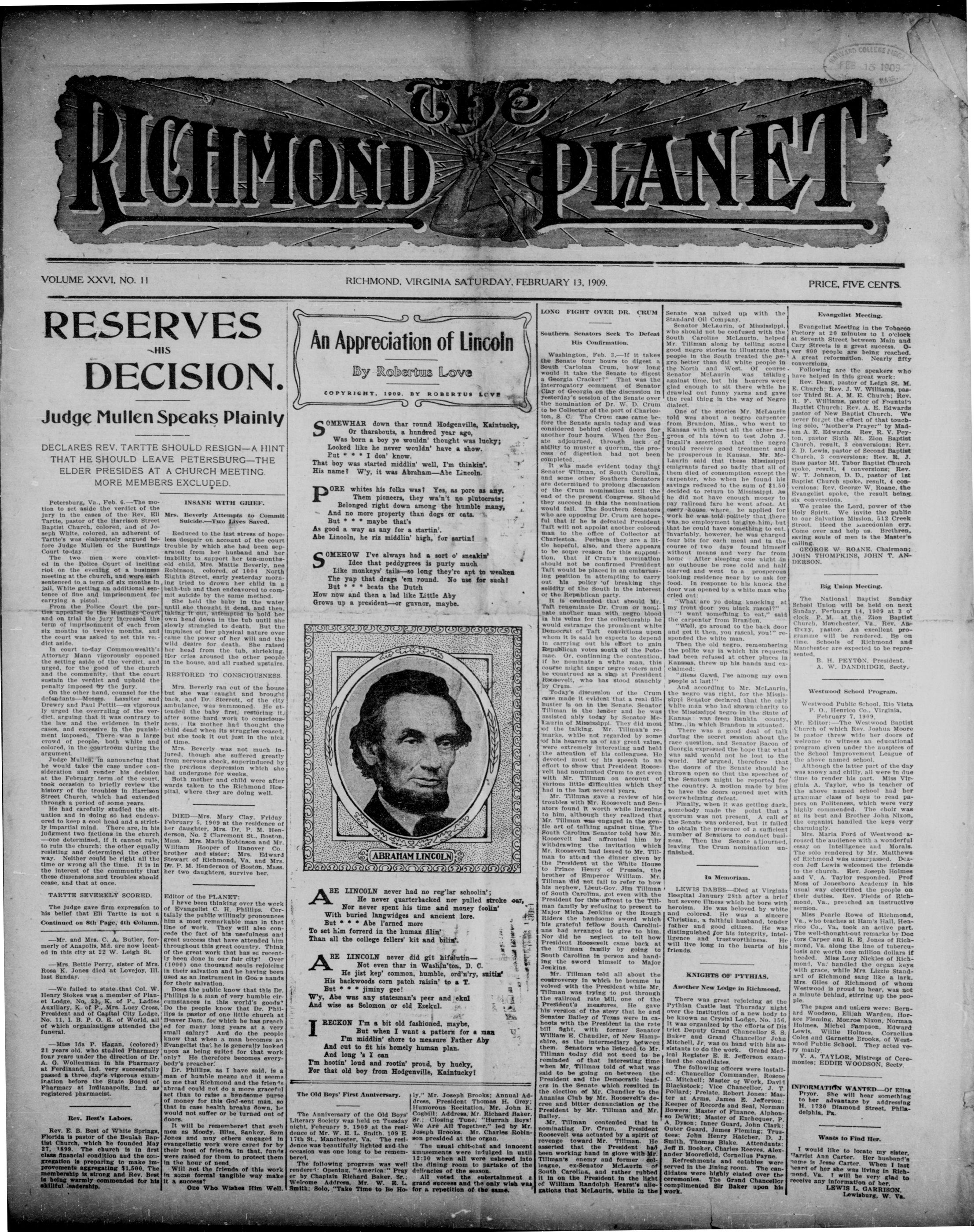
RESERVES HIS DECISION.
DECLARES REV. TARTTE SHOULD RESIGN-A HINT THAT HE SHOULD LEAVE PETERSBURG-THE ELDER PRESIDES AT A CHURCH MEETING. MORE MEMBERS EXCLUDED.
VOLUME XXVI, NO. 11
RESE
DEC
Judge Mullen S
DECLARES REV. TARTTE
THAT HE SHOULD LEA
ELDER PRESIDES AT
MORE MEMBE
Petersburg, Va., Feb. 6.—The motion to set aside the verdict of the jury in the cases of the Rev, Ell Tartte, pastor of the Harrison Street Baptist Church, colored, and of Joseph White, colored, an adherent of Tartte's was elaborately argued before Judge Mullen of the Hustings Court to-day.
The two men were convicted in the Police Court of inciting riot on the evening of a business meeting at the church, and were each sentenced to a term of six months in jail. White getting an additional sentence of fine and imprisonment for carrying a pistol.
From the Police Court the parties appeared to the Hustings' Court and on trial the jury increased the term of imprisonment of each from six months to twelve months, and the court was asked to set this verdict aside.
In court to-day Commonwealth's Attorney Mann vigorously opposed the setting aside of the verdict, and urged, for the good of the church and the community, that the court sustain the verdict and uphold the penalty imposed by the jury.
On the other hand, counsel for the defendants—Messrs. Lassiter and Drewry and Paul Pettit—as vigorous urged the overruling of the verdict, arguing that it was contrary to the law and the evidence in their cases, and excessive in the punishment imposed. There was a large crowd of people, both white and colored, in the courtroom during the argument.
Judge Mullen, in announcing that he would take the case under consideration and render his decision at the February term of the court, took occasion to briefly review the history of the troubles in Harrison Street Church, which had extended through a period of some years.
He had carefully studied the situation and in doing so had endeavored to keep a cool head and a strictly impartial mind. There are, in his judgment two factions in the church—one determined, if it cannot rule, to ruin the church; the other equally resisting and determined the other way. Neither could be right all the time or wrong all the time. It is in the interest of the community that these dissensions and troubles should cease, and that at once.
TARTTE SEVERELY SCORED.
The judge gave firm expression to his belief that Ell Tartte is not a Continued on 8th Page, 4th Column.
—Mr. and Mrs. C. A. Butler, formerly of Anapolis, Md. are now located in this city at 22 W. Leigh St.
—Mrs. Bettie Perry, sister of Mrs. Rosa K. Jones died at Lovejoy, Ill. last Sunday.
—We failed to state that Col. W. Henry Stokes was a member of Planet Lodge, No. 23, K. of P., Ladies Auxiliary, K. of P., Mrs. Lucy Cross, President and of Capital City Lodge, No. 11, I. B. P. O. E. of World, all of which organizations attended the funeral.
—Miss Ida P. Hagan, (colored) 21 years old, who studied Pharmacy four years under the direction of Dr. A. G. Wollenmam in his Pharmacy at Ferdinand, Ind. very successfully passed a three day's vigorous examination before the State Board of Pharmacy at Indianapolis, Ind. as registered pharmacist.
Rev. Best's Labors.
Rev. E. B. Best of White Springs, Florida is pastor of the Beulah Baptist Church, which he founded May 27, 1899. The church is in first class financial condition and the congregation is preparing to make improvements aggregating $1,500. The membership is strong and Rev. Best is being warmly commended for his skillful leadership.
INSANE WITH GRIEF.
Mrs. Beverly Attempts to Commit Suicide.—Two Lives Saved.
Reduced to the last stress of hopeless despair on account of the court trouble by which she had been separated from her husband and her inability to support her ten-month-old child, Mrs. Mattie Beverly, nee Robinson, colored, of 1004 North Eighth Street, early yesterday morning tried to drown her child in a bath-tub and then endeavored to commit suicide by the same method.
She held the baby in the water until she thought it dead, and then, taking it out, attempted to hold her own head down in the tub until she slowly strangled to death. But the impulses of her physical nature over came the power of her will and the wild desire for death. She raised her head from the tub, shrieking. Her cries aroused the other people in the house, and all rushed upstairs.
RESTORED TO CONSCIOUSNESS.
Mrs. Beverly ran out of the house but she was caught and brought back, and Dr. Sterrett, of the city ambulance, was summoned. He attended the baby first, restoring it, after some hard work to consciousness. Its mother had thought the child dead when its struggles ceased, but she took it out just in the nick of time.
Mrs. Beverly was not much injured, though she suffered greatly from nervous shock, superinduced by the previous depression which she had undergone for weeks.
Both mother and child were after wards taken to the Richmond Hospital, where they are doing well.
DIED—Mrs. Mary Clay, Friday
February 5, 1909 at the residence of
her daughter, Mrs. Dr. P. M. Henderson,
No. 2 Clarentmont St. Boston.
Mass. Mrs. Marla Robinson and Mr.
William Hooper of Hanover Co.
brother and sister; Mrs. Edward
Stewart of Richmond, Va. and Mrs.
Dr. P. M. Henderson of Boston. Mass.
her two daughters, survive her.
Editor of the PLANET:
I have been thinking over the work of Evangelist C. H. Phillips. Certainly the public willingly pronounces him a most remarkable man in that line of work. They will also concede the fact of his usefulness and great success that have attended him throughout this great country. Think of the great work that has so recently been done in our fair city! Over (1000) one thousand souls rejoicing in their salvation and he having been used as an instrument in God's nands for their salvation.
Does the public know that this Dr. Phillips is a man of very humble circumstances in this world's goods? Do the people know that Dr. Phillips is pastor of one little church at Beaver Dam, for which he has preached for many long years at a very small salary? And do the people know that when a man becomes an Evangelist that he is generally looked upon as being suited for that work only? He therefore becomes everybody's preacher.
Dr. Phillips, as I have said, is a man of humble means and it seems to me that Richmond and the friend's abroad could not do a more graceful act than to raise a handsome purse of money for this God-sent man, so that in case health breaks down, he would not suffer or be turned out of doors.
It will be remembered that such men as Moody, Bliss, Sankey, Sam Jones and many others engaged in evangelistic work were cared for by their host of friends, in that, funds were raised for them to protect them in the hour of need. Will not the friends of this work in some formal tangible way make it a success?
One Who Wishes Him Well.
RICHMOND, VIRGINIA SATURDAY, FEBRUARY 13, 1909.
SOMEHOW I've always had a sort o' sneakin'
Idee that peddygres is purty much
Like monkeys' tails—so long they're apt to weaken
The yap that drags 'em round. No use for such!
But * * * beats the Dutch
How now and then a lad like Little Aby
Grows up a president—or guvynor, maybe.
ABRAHAM LINCOLN
ABE LINCOLN never had no reg'lar schoolin';
He never quarterbacked nor pulled stroke oar,
Nor never spent his time and money foolin'
With buried langwidges and ancient lore.
But * * * Abe larned more
To set him forrerd in the human filin'
Than all the college fellers' kit and bilin'.
ABE LINCOLN never did git hisalutin—
Not even thar in Washin'ton, D. C.
He jist kep' common, humble, ord'n'ry, suitin'
His backwoods corn patch raisin' to a T.
But * * * jiminy gee!
Wy, Abe was any statesman's peer and ekul
And wise as Solomon or old Ezekul.
RECKON I'm a bit old fashioned, maybe,
But when I want a pattern for a man
I'm middlin' shore to measure Father Aby
And cut to fit his homely human plan.
And long 's I can
I'm hootin' loud and rootin' proud, by hucky,
For that old boy from Hodgenville, Kaintucky!
The Old Boys' First Anniversary.
The Anniversary of the Old Boys' Literary Society was held on Tuesday night, February 9, 1909 at the residence of Mr. W. E. L. Smith. 109 E. 17th St., Manchester, Va. The residence was beautifully lighted and the occasion was one long to be remembered.
The following program was well rendered: Opening, "America," Prayer by Chaplain Richard Baker, Sr.; Welcome Address, Mr. W. E. L. Smith; Solo, "Take Time to Be He.
ly," Mr. Joseph Brooks; Annual Address, President Thomas H. Grey; Humorous Recitation, Mr. John H. Cogbill: Address, Mr. Richard Baker, Sr.; Closing Tune, "Hurrah Boys! We Are All Together," led by Mr. Joseph Brooks. Mr. Charles Robinson presided at the organ.
The usual chit-chat and innocent amusements were indulged in until 12:30 when all were ushered into the dining room to partake of the delicacies of the season.
All voted the entertainment a grand success and the only wish was for a repetition of the same.
Southern Senators Seek To Defeat His Confirmation.
Washington, Feb. 2.—If it takes the Senate four hours to digest a South Carolina Crum, how long would it take the Senate to digest a Georgia Cracker?" That was the interrogatory comment of Senator Clay of Georgia on the discussion in yesterday's session of the Senate over the nomination of Dr. W. D. Crum to be Collector of the port of Charleston, S. C. The Crum case came before the Senate again today and was considered behind closed doors for another four hours. When the Senate adjourned, through lack of ability to muster a quorum, the process of digestion had not been completed.
It was made evident today that Senator Tillman, of South Carolina, and some other Southern Senators are determined to prolong discussion of the Crum nomination until the end of the present Congress. Should they succeed in this nomination would fail. The Southern Senators who are opposing Dr. Crum are hopeful that if he is defeated President Taft will not appoint another colored man to the office of Collector at Charleston. Perhaps they are a little hopeful, also, and there appears to be some reason for this supposition, that if Crum's nomination should not be confirmed President Taft would be placed in an embarrassing position in attempting to carry out his policy of breaking the solidity of the South in the interest of the Republican party.
It is contended that should Mr. Taft renominate Dr. Crum or nominate another man with negro blood his veins for the collectorship he will strangle the prominent white Democrats. Taft convictions upon whom it is said he should depend in carrying out his effort to gain Republican votes south of the Potomac. Or, continuing the contention, if he nominate a white man, this course might anger negro voters and be construed as a ship at President Roosevelt, who has stood stanchly by Crum.
Today's discussion of the Crum case made it evident that a real billbuster is on in the Senate. Senator Tillman is on the leader and he was assisted ably today by Senator McLaurin of Mississippi. They did most of the talking. Mr. Tillman's remarks, while not regarded by some of his hearers as of any great value, were extremely interesting and held attention of his colleagues. He devolved upon his speech to an effort to show that Crum resident Roosevelt had nominated Crum resident with Mr. Tillman on account of various little difficulties which they had in the last several years.
Mr. Tillman gave a review of his troubles with Mr. Roosevelt and Senators found it worth while listening to him, although they realized that Mr. Tillman was engaged in the gentle art of talking against time. The South Carolina Senator told how Mr. Roosevelt had affronted him by withdrawing the invitation which Mr. Roosevelt had issued to Mr. Tillman to attend the dinner given by the President at the White House to Prince Henry of Prussia, the brother of Emperor William. Mr. Tillman did not fall to refer to how his nephew, Leed-Gut. Jim Tillman of South Carolina, got even with the President, then affronted to the Tillman family by bringing to present to Major Micha Jenkins of Rough Riders the handsome sword which his grateful fellow South Carolinans had arranged to give to him. Nor did he neglect, to tell how President Roosevelt came back at the Tillman family by going to South Carolina in person and handing the sword himself to Major Jenkins.
Mr. Tillman told all about the controversy in which he became involved with the President while Mr. Tillman was trying to put through the railroad rate bill, one of the President's measures. He gave his version of the story that he and Senator Bailey of Texas were in cahoots with the President in the rate bill fight, with former Senator William E. Chandler, of New Hampshire, as the intermediary between them. Senators who listened to Mr. Tillman today did not need to be reminded of that interesting time when Mr. Tillman told of what was said to be going on between the President and the Democratic leaders in the Senate which resulted in the election of Mr. Chandler to the Ananias Club by Mr. Roosevelt's decree and bitter denunciation of the President by Mr. Tillman and Mr. Bailey.
Mr. Tillman contended that in nominating Dr. Crum, President Roosevelt was actuated by a spirit of revenge toward Mr. Tillman. He asserted that the President had been working hand in glove with Mr. Tillman's enemy and former colleague, ex-Senator McLaurin of South Carolina, and rather rubbed it on the President in the light of William Randolph Hearst's allegations that McLaurin, while in the
Senate was mixed up with the Standard Oil Company.
Senator McLaurin, of Mississippi, who should not be confused with the South Carolina McLaurin, helped Mr. Tillman along by telling some good negro stories to illustrate that people in the South treated the negro better than did white people in the North and West. Of course Senator McLaurin was talking against time, but his hearers were glad enough to sit there while he drawled out funny yarns and gave the real thing in the way of Negro dialect.
One of the stories Mr. McLaurin told was about a negro carpenter from Brandon, Miss., who went to Kansas with about all the other negroes of his town to test John J. Ingall's assertion that the negro would receive good treatment and be prosperous in Kansas. Mr. McLaurin said that these Mississippi emigrants fared so badly that all of them died of consumption except the carpenter, who when he found his savings reduced to the sum of $1.50 decided to return to Mississippi. As he did not have enough money to pay railroad fare he went afoot. At every house where he applied for work he was told politely that there was no employment to give him, but that he could have something to eat. Invariably, however, he was charged four bits for each meal and in the course of two days found himself without means and very far from home. After sleeping one night in an outhouse he rose cold and half starved and went to a prosperous looking residence near by to ask for food. In response to his knock the door was opened by a white man who cried out:
"What are yo doing knocking at my front door you black rascal?"
"I want something to eat," said the carpenter from Brandon.
"Well, go around to the back door and get it then, you rascal, you!" responded the white man.
Then the old negro, remembering the polite way in which his requests had been refused at other places in Kansas, threw up his hands and exclaimed:
"Bless Gawd, I're among my own people at last!"
And according to Mr. McLaurin, the negro was right, for the Mississippi Senator declared that the only white man who had shown charity to the Mississippi negro in the State of Kansas was from Rankin county, Miss., in which Brandon is situated.
There was a good deal of talk during the secret session about the race question, and Senator Bacon of Georgia expressed the hope that what was said would not be lost to the world. He argued, therefore that the doors of the Senate should be thrown open so that the speeches of the Senators might be reported for the country. A motion made by him to have the doors opened met with overwhelming defeat.
Finally, when it was getting dark, somebody made the point that a quorum was not present. A call of the Senate was ordered, but it failed to obtain the presence of a sufficient number of Senators to conduct business. Then the Senate atjourned, leaving the Crum nomination unfinished.
In Memoriam.
LEWIS DABBS—Died at Virginia Hospital January 28th after a brief but severe illness which he bore with heroism. He was beloved by white and colored. He was a sincere Christian, a faithful husband, tender and good citizen. He was distinguishing for his integrity, intelligence and trustworthiness. He will live long in the hearts of his friends.
KNIGHTS OF PYTHIAS
Another New Lodge in Richmond.
There was great rejoicing at the Pythian Castle last Thursday night over the institution of a new body to be known as Crystal Lodge, No. 156. It was organized by the efforts of District Deputy Grand Chancellor S. S. Baker and Grand Chancellor John Mitchell, Jr. was on hand with his assistants to do the work. Grand Medical Register E. R. Jefferson examined the candidates.
The following officers were installed: Chancellor Commander, Roscoe C. Mitchell; Master of Work, David Blackstock; Vice Chancellor, J. T. Pollard; Prelate, Robert Jones; Master at Arms, James E. Jefferson; Keeper of Records and Seat, Alphonowo DeWitt; Master of Finance, Alphonowo DeWitt; Master of Exchequer, P. A. Dyson; Inner Guard, John Clark; Outer Guard, James Fleming; Trustees: John Henry Hatcher, D. J. Smith, Thomas Blake, Attendants: Jeff B. Booker, Charles Reeves, Alexander Moorefield, Cornelius Payne. Refreshments and eatables were served in the lining room. The candidates were highly elated over the ceremonies. The Grand Chancellor complimented Sir Baker upon his work.
PRICE, FIVE CENTS
Evangelist Meeting.
Evangelist Meeting in the Tobacco Factory at 20 minutes to 1 o'clock at Seventh Street between Main and Cary Streets is a great success. Over 800 people are being reached. A great reformation. Nearly fifty conversions.
Following are the speakers who have helped in this great work:
Rev. Dean, pastor of Leigh St. M. E. Church; Rev. J. W. Williams, pastor Third St. A. M. E. Church; Rev. R. F. Williams, pastor of Fountain; Baptist Church; Rev. A. E. Edwards pastor of New Baptist Church. We never forget the effect of that touching solo. "Mother's Prayer" by Madam A. E. Edwards. Rev. R. V. Peyton, pastor Sixth St. Zion Baptist Church, result, 3 conversions; Rev. Z. D. Lewis, pastor of Second Baptist Church, 3 conversions; Rev. R. J. Bass pastor Mt. Tabor Baptist Church spoke, result, 4 conversions; Rev. W. T. Johnson, D. D., pastor of 1st Baptist Church spoke, result, 4 conversions; Rev. George W. Roane, the Evangelist spoke, the result being six conversions.
We praise the Lord, power of the Holy Spirit. We invite the public to our Salvation Mission, 512 Creek Street. Heed the macedonian cry. Come over and help us. Brethren, saving souls of men is the Master's calling.
GEORGE W. ROANE. Chairman; JOHN THOMPKINS, JOHN T. ANDERSON.
Big Union Meeting.
The National Baptist Sunday School Union will be held on next Sunday, February 14, 1909 at 3 o'clock P. M. at the Zion Baptist Church, Manchester, Va., Rev. Anthony, pastor. An excellent programme will be rendered. Be on time. Schools of Richmond and Manchester are expected to be represented. B. H. PEYTON, President. A. W. DADRIDGE, Secy.
Westwood School Program.
Westwood Public School, Rio Vista P. O., Hirenco Co., Virginia, February 7, 1909.
Mr. Editor:—The Westwood Baptist Church of which Rev. Joshua Moore is pastor threw wide her doors of welcome to witness an educational program given under the auspices of the School Improvement League of the above named school.
Although the latter part of the day was snowy and chilly, all were in due time to render his part. Miss Virginia A. Taylor, who is teacher of the above named school had her grammar class of boys to read papers on Politeness, which were very highly commended. The choir was at its best and Brother John Nixon, the organist handled the keys very charmingly.
Mrs. Maria Ford of Westwood aroused the audience with a wonderful essay on Intelligence and Morals. The solo rendered by Mr. Matthews of Richmond was unsurpassed. Deacon Jeff Lewis welcomed the friends to the church. Rev. Joseph Holmes and V. A. Taylor responded. Prof Moss of Jonesboro Academy in his usual way electrified the people on their duties. Rev. Fields of Richmond, Va., preached an instructive sermon.
Miss Pearle Rowe of Richmond, Va., who teaches at Ham's Hall, Henrico Co., Va., took an active part. The well-thought-out remarks by Doctor Carper and R. E. Jones of Richmond, Va. along the line of tuberculosis are worth one million dollars if headed. Miss Lucy Nickles of Richmond, Va.' handled the organ keys with grace, while Mrs. Lizzie Standard of Richmond sang like a lark. Mrs. Giles of Richmond of whom Westwood is proud to hear, was not a minute behind, stirring up the people.
The pages and users were: Bernard Woodson, Ellijah Warden, Horace Fleming, Morroe Nixon, Norman Holmes, Michel Sampson, Edward Lewis, Willie Holmes, Cornelius Coles and Garnette Brooks, of Westwood Public School. They acted very manly.
V. A. TAYLOR, Mistress of Ceremonies; EDDIE WOODSON, Secty.
INFORMATION WANTED—Of Eliza Pryor. She will hear something to her advantage by addressing H. 1730 Diamond Street, Philadelphia, Pa.
Wants to Find Her.
I would like to locate my sister, Harriet Ann Carter. Her husband's name is Jesse Carter. When I last heard of her she was living in Richmond, Va. I will be very glad to receive any information of her.
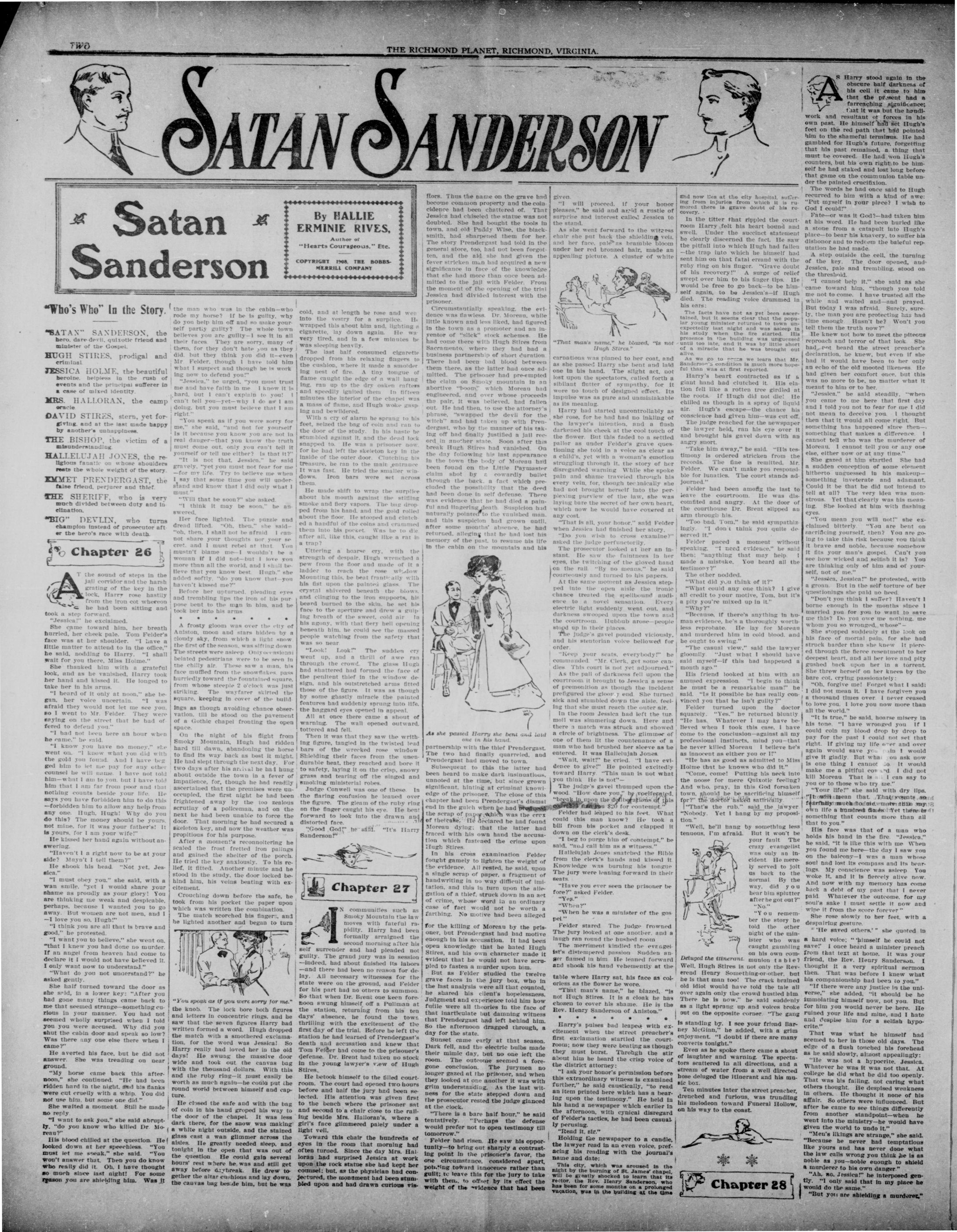
SATAN SANDERSON
Satan Sanderson
"BATAN" SANDERSON, the hero, dare devil, quixotic friend and minister of the Gospel.
HUGH STIRES, prodigal and criminal.
JESSICA HOLME, the beautiful heroine, helpless in the rush of events and the principal sufferer in a case of mixed identity.
MRS. HALLORAN, the camp oracle
DAVID STIRES, stern, yet forgiving, and at the last made happy by another's unhappiness.
THE BISHOP, the victim of a misunderstanding.
EMET PRENDERGAST, the
false friend, perjurer and thief.
THE SHERIFF, who is very
much divided between duty and in-
clination.
BIG" DEVLIN, who turns
champion instead of prosecutor aft-
er the hero's race with death.
Chapter 26
At the sound of steps in the
jail corridor and the harsh
grating of the key in the
lock, Harry rose hastily
from the iron cot whereon
he had been sitting and
took a step forward.
T the sound of steps in the jail corridor and the harsh grating of the key in the lock, Harry rose hastily from the iron cot where he had been sitting and took a step forward.
"Jessica! he exclaimed.
She came toward him, her breath hurried, her cheek pale. Tom Felder's face was at her shoulder. "I have a little matter to attend to in the office," he said, nodding to Harry. "I shall wait for you there, Miss Holme."
She thanked him with a grateful look, and as he vanished, Harry took her hand and kissed it. He longed to take her in his arms.
"I heard of it only at noon," she began, her voice uncertain. "I was afraid they would not let me see you. so I went to Mr. Felder. They were saying on the street that he had offered to defend you."
"I had not been here an hour when he came," he said.
"I know you have no money," she went on. "I know what you did with the gold you found. And I have begged him to let me pay for any other counsel he will name. I have not told him—what I am to you, but I have told him that I am far from poor and that nothing counts beside your life. He says you have forbidden him to do this—forbidden him to allow any help from any one. Hugh. Hugh! Why do you do this? The money should be yours, not mine, for it was your father's! It is yours, for I am your wife!"
He kissed her hand again without answering.
"Haven't I a right now to be at your side? Mayn't I tell them?"
He shook his head. "Not yet, Jes-
sican."
"I must obey you," she said, with a
wan smile. "yet I would share your
shame as proudly as your glory! You
are thinking me weak and despicable,
perhaps, because I wanted you to go
away. But women are not men, and I
-I love you so, Hugh."
"I think you are all that is brave and
good," he protested.
"I want you to believe," she went on,
"that I knew you had done no murder.
If an angel from heaven had come to
declare it I would not have believed it.
I only want now to understand."
"What do you not understand?" he
asked gently.
She half turned toward the door as she said, in a lower key: "After you had gone many things came back to me that seemed strange—something curious in your manner. You had not seemed wholly surprised when I told you you were accused. Why did you shut the cabin door and speak so low? Was there any one else when I came?"
He averted his face, but he did not answer. She was treading on near ground.
"My horse came back this afternoon," she continued. "He had been ridden hard in the night, and his flanks were cut cruelly with a whip. You did not use him, but some one did."
She waited a moment. Still he made no reply.
"I want to ask you," she said abruptly. "do you know who killed Dr Morreau?"
His blood chilled at the question. He looked down at her speechless. "You must let me speak," she said. "You won't answer that. Then you do know who really did it. Oh, I have thought so much since last night! For some reason you are shielding him. Was it
the man who was in the cabin—who rode my horse? If he is guilty, why do you help him off and so make yourself party guilty? The whole town believes you are guilty—I see it in all their faces. They are sorry, many of them, for they don't hate you as they did, but they think you did it—even Mr Felder, though I have told him what I suspect and though he is working now to defend you."
"Jessica," he urged, "you must trust me and have faith in me. I know it is hard, but I can't explain to you! I can't tell you—yet—why I do as I am doing, but you must believe that I am right."
"You speak as if you were sorry for me," she said, "and not for yourself is it because you know you are not in real danger—that you know the truth must come out, only you can't tell it yourself or tell me either; is that it?"
"It is not that, Jessien," he said gravely, "yet you must not fear for me—for my life. Try to believe me when I say that some time you will understand and know that I did only what I must."
"Will that be soon?" she asked.
Her face lighted. The puzzle and dread lifted. "Oh, then," she said—"oh, then, I shall not be afraid I cannot share your thoughts nor your secret, and I must rebel at that. You mustn't blame me I wouldn't be a woman if I did not—but I love you more than all the world, and I shall believe that you know best. Hugh," she added softly. "do you know that--you haven't kissed me?" Before her upturned, pleading eyes and trembling lips the iron of his purpose bent to the man in him, and be took her into his arms.
A frosty gloomy was over the city of Aniston, moon and stars hidden by a cloudy sky, from which a light snow the first of the season, was sifting down The streets were asleep. Onlyoccasionally belated pedestrians were to be seen in the chilly air. These saw a man, his face muffled from the snowflakes, pass hurriedly toward the fountained square, from whose steeple 2 o'clock was just striking. The wayfarer skirted the square, keeping in cover of the buildings as though avoiding chance observation, till he stood on the pavement of a Gothic chapel fronting the open space.
On the night of his flight from Smoky Mountain, Hugh had ridden hard till dawn, abandoning the horse to find its way back as best it might. He had slept through the next day. For two days after his arrival he had hung about outside the town in a fever of impatience, for, though he had readily ascertained that the premises were unoccupied, the first night he had been frightened away by the too zealous scrutiny of a policeman, and on the next he had been unable to force the door. That morning he had secured a skeleton key, and now the weather was propitious for his purpose.
After a moment's reconnoitering he scaled the frost fretted palings and gained the shelter of the porch. He tried the key anxiously. To his relief, it fitted. Another minute and he stood in the study, the door locked behind him, his veins beating with excitement.
Crouching down before the safe, he took from his pocket the paper upon which was written the combination. The match scored his fingers, and he lighted another and began to turn
"You speak as if you were sorry for me." the knob. The lock bore both figures and letters in concentric rings, and he saw that the seven figures Harry had written formed a word. Hugh dropped the match with a smothered exclamation, for the word was Jessica! So Harry really had loved her in the old days! He swung the massive door wide and took out the canvas bag with the thousand dollars. With this and the ruby ring—it must easily be worth as much again—he could put the round world between himself and capture.
He closed the safe and with the bag of coin in his hand groped his way to the door of the chapel. It was less dark there, for the snow was making a white night outside, and the stained glass cast a wan glimmer across the ales. He greatly needed sleep, and tonight in the open that was out of the question. He could gain several hours' rest where he was and still get away before daybreak. He drew together the altar cushions and lay down the canvas bag beside him, but he was
THE RICHMOND PLANET, RICHMOND, VIRGINIA
Author of
"Hearts Courageous," Etc.
COPYRIGHT 1908, THE BOBBS-
MERRILL COMPANY
cold, and at length he rose and went into the vestry for a surplice. He wrapped this about him and, lighting a cigarette, lay down again. He wavied very tired, and in a few minutes he was sleeping heavily.
The last half consumed cigarette dropped from his relaxing fingers to the cushion, where it made a smoldering nest of fire. A tiny tongue of flame caught the edge of a wall hanging, ran up to the dry cakeen rafters and speedily ignited them. In fifteen minutes the interior of the chapel was a mass of flame, and Hugh woke gasping and bewildered.
With a cry of alarm he sprang to his feet, seized the bag of coin and ran to the door of the study. In his taste he stumbled against it, and the dead lock snapped to. He was a prisoner now, for he had left the skeleton key in the inside of the outer door. Clutching his treasure, he ran to the main entrance it was fast. He tried the smaller windows. Iron bars were set across them.
He made shift to wrap the surprise about his mouth against the stifling smoke and fiery vapors. The bag dropped from his hand, and the gold rolled about the floor. He stooped and clutched a handful of the coins and crammed them into his pocket. Was he to die after all, like this, caught like a rat in a trap?
Uttering a hoarse cry, with the strength of despair, Hugh wrenched a pew from the floor and made of it a ladder to reach the rose window. Mounting this, he beat frantically with his fist upon the painted glass. The crystal shivered beneath the blows, and clinging to the iron supports, his beard burned to the skin, he set his face to the aperture and drew a guiding breath of the sweet, cold air. In his agony, with that fiery hell opening beneath him, he could see the massed people watching from the safety that was so near.
"Look! Look!" The sudden cry went up, and a thrill of awe ran through the crowd. The glass Hugh had shattered had formed the face of the penitent thief in the window design, and his outstretched arms fitted those of the figure. It was as though by some ghastly miracle the painted features had suddenly sprung into life, the hauzard eyes opened in glee.
All at once there came a shout of warning. The wall opened outward, tottered and fell.
Then it was that they saw the writhing figure, tangled in the twisted lead bars of the wrecked rose window Shielding their faces from the unendurable heat, they reached and bore it to safety, laying it on the crisp, snowy grass and tearing off the singed and smoking ministerial robes.
Judge Conwell was one of these. In the flaring confusion he teased over the figure. The gleam of the ruby ring on the finger caught his eye. He bent forward to look into the drawn and distorted face.
"Good God," he said. "It's Harry Sanderson."
Chapter 27
N communities such as Smoky Mountain the law moves with fateful rapidity. Harry had been formally arraigned the second morning after his
self surrender and had pleaded not guilty. The grand jury was in session—indeed, had about finished its labor—and there had been no reason for delay. All necessary witnesses for the state were on the ground, and Felder for his part had no others to summon. So that Dr. Brent one keen foremoon swung himself off a Pullman at the station, returning from his ten days' absence, he found the town thrilling with the excitement of the first day of the trial. Before he left the station he had learned of Prendergast's death and accusation and knew that Tom Felder had come to the prisoner's defense. Dr. Brent had taken no stock in the young lawyer's view of Hugh Stires.
He betook himself to the filled courtroom. The court had opened two hours before and half the jury had been selected. His attention was given first to the bench where the prisoner sat and second to a chair close to the railing beside Mrs. Halloran's, where a girl's face glimmered palely under a light vell.
Toward this chair the hundreds of eyes in the room that morning had often turned. Since the day Mrs. Halloran had surprised Jessica at work upon the rock statue she had kept her counsel; but, as the physician had conjectured, the monument had been stumbled upon and had drawn curious vis-
"I will proceed. If your honor pleases," he said and arid a rustle of surprise and interest called Jessica to the stand.
As she went forward to the witness chair she put back the shielding veil, and her face, pale as bramble bloom under her red bronzed hair, made an appealing picture. A cluster of white
"That man's name," he blazed, "is not Hugh Stires."
"That man's name," he blazed, "is not Hugh Stires." carnations was pinned to her coat, and as she passed Harry she bent and laid one in his hand. The slight act, not lost upon the spectators, called forth a sibilant flutter of sympathy, for it wore no touch of designed effect. Its impulse was as pure and unmistakable as its meaning.
Harry had started uncontrollably as she rose, for he had no inking of the lawyer's intention, and a flush darkened his cheek at the cool touch of the flower. But this faded to a settled palor as under Felder's grave questioning she told in a voice as clear as a child's, yet with a woman's emotion struggling through it. the story of her disregarded warning. While she spoke pain and shame traveled through his every vein, for, though technically she had not brought herself into the perplexing purview of the law, she was laying bare the secret of her own heart, which now he would have covered at any cost.
"That is all, your honor," said Felder when Jessica had finished her story.
"Do you wish to cross examine?" asked the judge perfunctorily.
The prosecutor looked at her an instant. He saw the faintness in her eyes, the twitching of the gloved hand on the rail. "By no means," he said courteously and turned to his papers.
At the same moment as Jessica stepped into the open aisle the ironic chance treated the spellbound audience to a novel sensation. Every electric light suddenly went out, and darkness sweoped upon the town and the courtroom. Hubbub arose—people stood up in their places.
The judge's gavel pounded viciously, and his stentorian voice bellowed for order.
"Keep your seats, everybody!" he commanded. "Mr. Clerk, get some candles. This court is not yet adjourned."
As the pill of darkness fell upon the courtroom it brought to Jessica a sense of premonition as though the incident prefigured the gloomy end. She turned sick and stumbled down the aisle, feeling that she must reach the outer air.
In the room Jessica had left the turmil was simmering down. Here and there a match was struck and showed a circle of brightness. The glimmer of one of them lit the countenance of a man who had brushed her sleeve as he entered. It was Halleluja Jones.
"Wait, wait!" he cried. "I have evidence to give!" He pointed excitedly toward Harry. "This man is not what you think He is not!"—
The judge's gavel thumped upon the wood. "How dare you?" he voicederated, "break in upon the deliberations of this court!" He gave $20 for contempt.
Felder had leaped to his feet. What could this man know? He took a bill from his pocket and clapped it down on the clerk's desk.
"I beg to purge him of contempt," he said, "and call him as a witness."
Halleujah Jones snatched the Bible from the clerk's hands and kissed it. Knowledge was burning his tongue. The jury were leaning forward in their seats.
"Have you ever seen the prisoner be fore?" asked Felder.
"Yes."
"When?"
"When he was a minister of the gospel."
Felder stared. The judge frowned
The jury looked at one another, and a
laugh ran round the bushed room.
The merriment kindled the evangelist's distempered passion Sudden anger faumed in him. He leaned forward and shook his hand vehemently at the table where Harry sat, his face as colorless as the flower he wore.
"That man's name," he blazed, "is not Hugh Stires. It is a clonk he has chosen to cover his shame. He is the Rev. Henry Sanderson of Aniston."
Harry's pulses bad leapee with excitement when the street preacher's first exclamation startled the courtroom; now they were beating as though they must burst. Through the stir about him he heard the crisp voice of the district attorney:
"I ask your honor's permission before this extraordinary witness is examined further," he said caustically, "to read an item printed here which has a bearing upon the testimony." He held in his hand a newspaper which earlier in the afternoon, with cynical disregard of Felder's tactics, he had been casually perusing.
"Read it, sir."
Holding the newspaper to a candle, the lawyer read in an even voice, prefacing his reading with the journal's name and date:
"This city, which was aroused in the night by the burning of St. James' chapel, be greatly shocked to learn that its rector, Henry Anderson, who has been for some months on probation vacation, was in the building at the time
fliors. Thus the name on the grave had become common property and the coincidence had been chattered of. That Jessica had chiselled the statue was not doubted. She had bought the tools in town, and old Paddy Wise, the blacksmith, had sharpened them for her. The story Prendergast had told in the general store, too, had not been forgotten, and the aid she had given the fever stricken man had acquired a new significance in face of the knowledge that she had more than once been admitted to the jail with Felder. From the moment of the opening of the trial Jessica had divided interest with the prisoner.
Circumstantially speaking, the evidence was flawless. Dr. Moreau, while little known and less liked, had figured in the town as a promoter and an inventor of "slick" stock schemes. He had come there with Hugh Stires from Sacramento, where they had had a business partnership of short duration. There had been bad blood between them there, as the latter had once admitted. The prisoner had pre-empted the claim on Smoky mountain in an abortive "boom" which Moreau had engineered, and over whose proceeds the pair, it was believed, had fallen out. He had then, to use the attorney's phrase, "swapped the devil for the witch" and had taken up with Prendergast, who by the manner of his taking off had finally justified a jail record in another state. Soon after this break Hugh Stires had vanished. On the day following his last appearance in the town the body of Moreau had been found on the Little Paymaster claim shot by a cowardly bullet through the back, a fact which precluded the possibility that the deed had been done in self defense. There was evidence that he had died a painful and lingering death. Suspicion had naturally pointed to the vanished man, and this suspicion had grown until, after some months' absence, he had returned, alleging that he had lost his memory of the past, to resume his life in the cabin on the mountain and his
M. M.
As she passed Harry she bent and laid one in his hand. partnership with the thief Prendergast. The two had finally quarreled, and Prendergast had moved to town. Subsequent to this the latter had been heard to make dark insinuations, notated at the time, but since grown significant, hinting at criminal knowledge of the prisoner. The close of this chapter had been Prendergast's dismal end in the guile when he had produced the scrap of paper which was the cree of the cake. He declared he had found Moreau dying; that the latter had traced with his own hand the accusation which fastened the crime upon Hugh Stires.
In his cross examination Felder fought gamely to lighten the weight of the evidence. All rested, he said, upon a single scrap of paper, a fragment of handwriting in no way difficult of imitation, and this in turn upon the allegation of a thief, struck down in an act of crime, whose word in an ordinary case of fact would not be worth a farthing. No motive had been alleged for the killing of Moreau by the prisoner, but Prendergast had had motive enough in his accusation. It had been open knowledge that he hated Hugh Stires, and his own character made it evident that he would not have scruped to fasten a murder upon him.
But as Felder studied the twelve grave faces in the jury box, who in the last analysis were all that counted, he shared his client's hopelessness. Judgment and experience told him how fufile were all the theories in the face of that inarticulate but damning witness that Prendergast had left behind him. So the afternoon dragged through, a day for the state.
Sunset came early at that season. Dark fell, and the electric bulbs made their mimic day, but no one left the room. The outcome seemed a foregone conclusion. The jurymen no longer gazed at the prisoner, and when they looked at one another it was with grim understanding. As the last witness for the state stepped down and the prosecutor rested the judge glanced at the clock.
"There is a bare half hour," he said tentatively. "Perhaps the defense would prefer not to open testimony till tomorrow."
Felder had risen. He saw his opportunity—to bring out sharply a contrasting point in the prisoner's favor, the one circumstance, considered apart, pointing toward innocence rather than guilt; to leave this for the jury to take with them, to offset by its effect the weight of the evidence that had been
Harry stood again in the obscure half darkness of his cell it came to him that the present had a farreaching significance; that it was but the handlwork and resultant of forces in his own past. He himself had set Hugh's feet on the red path that had pointed him to the shameful terminus. He had gambled for Hugh's future, forgetting that his past remained, a thing that must be covered. He had won Hugh's counters, but his own right to be himself he had staked and lost long before that game on the communion table under the painted crucifixion.
The words he had once said to Hugh recurred to him with a kind of awe: "Put myself in your piece? I wish to God I could!"
Fate—or was it God?—had taken him at his word. He had been hurled like a stone from a catapult into Hugh's place to bear his knavery, to suffer his dishonor and to redeem the baleful reputation he had made.
A step outside the cell, the turning of the key. The door opened, and Jessica, pale and trembling, stood on the threshold.
"I cannot help it," she said as she came toward him, "though you told me not to come. I have trusted all the while and waited and—and prayed. But today I was afraid. Surely, surely, the man you are protecting has had time enough. Hasn't he? Won't you tell them the truth now?"
He knew not how to meet the piteous reproach and terror of that look. She had not heard the street preacher's declaration, he knew, but even if she had it would have been to her only an echo of the old mooted likeness. He had given her comfort once, but this was no more to be, no matter what it meant to him or to her.
"Jessica," he said steadily, "when you came to me here that first day and I told you not to fear for me I did not mean to deceive you. I thought then that it would all come right. But something has happened since then—something that makes a difference. I cannot tell who was the murderer of Moreau. I cannot tell you or any one else, either now or at any time."
She gazed at him startled. She had a sudden conception of some element hitherto unguessed in his makeup—something inveterate and adamant. Could it be that he did not intend to tell at all? The very idea was monstrous. Yet that clearly was his meaning. She looked at him with flashing eyes.
"You mean you will not!" she exclaimed bitterly. "You are bent on sacrificing yourself, then? You are going to take this risk because you think it brave and noble, because somehow it fits your man's gospel. Can't you see how wicked and selfish it is? You are thinking only of him and of yourself, not of me."
"Jessica, Jessica!" he protested, with a groan. But in the self torture of her questionings she paid no heed.
"Don't you think I suffer? Haven't I borne enough in the months since I married you for you to want to save me this? Do you owe me nothing me whom you so wronged, whose"—
She stopped suddenly at the look on his face of mortal pain, for she had struck harder than she knew. It pierced through the fierce resentment to her deepest heart, and all her love and pity gushed back upon her in a torrent. She threw herself on her knees by the bare cot, crying passionately:
"Oh, forgive me! Forget what I said! I did not mean it. I have forgiven you a thousand times over. I never ceased to love you. I love you now more than all the world."
"It is true," he said, hoarse misery in his tone. "I have wronged you. If I could coin my blood drop by drop to pay for the past I could not set that right. If giving my life over and over again would save you pain I would give it gladly. But what you ask now is one thing I cannot do. It would make me a puffful coward. I did not kill Moreau. That is all I can say to you or to those who try me."
"Your life!" she said with dry lips, "it will mean that. That counts so fearfully much more than my own life a hundred times. Yet there is something that counts more than all that to you."
His face was that of a man who holds his hand in the fire. "Jessica," he said, "it is like this with me. When you found me here—the day I saw you on the balcony—I was a man whose soul had lost its compass and its bearings. My conscience was asleep. You woke it, and it is fiercely alive now. And now with my memory has come back a debt of my past that I never paid. Whatever the outcome, for my soul's sake I must settle it now and wine it from the score forever."
She rose slowly to her feet, with a despairing gesture.
"He saved others," she quoted in a hard voice; "himself he could not save." I once heard a minister preach from that text at home. It was your friend, the Rev. Henry Sanderson. I thought it a very spiritual sermon then. That was before I knew what his companionship had been to you.
"If there were any justice in the universe," she added, "it should be he immolating himself now, not you. But for him you would never be here. He ruined your life and mine, and I hate and despise him for a selfish hypocrite."
That was what he himself had seemed to her in those old days. The edge of a flush touched his forehead as he said slowly, almost apprehily.
"He was not a hypocrite, Jessica. Whatever he was it was not that. At college he did what he did too openly. That was his failing, not caring what others thought. He despised weakness in others. He thought it none of his affair. So others were influenced. But after he came to see things differently from another standpoint—when he went into the ministry—he would have given the world to undo it."
"Men's likings are strange," she said. "Because he never had temptations like yours and has never done what the law calls wrong you think he is as noble as you—noble enough to shield a murderer to his own danger."
"Ah, no. Jessica!" he interposed gently. "I only said that in my place he would do the same."
"But you are shielding a murderer."
```markdown
```
and now lies at the city hospital, suffering from injuries from which it is rumored there is grave doubt of his recovery.
In the titter that rippled the courtroom Harry felt his heart bound and swell. Under the succinct statement he clearly discerned the fact. He saw the pitfall into which Hugh had fallen—the trap into which he himself had sent him on that fatal errand with the ruby ring on his finger. "Grave doubt of his recovery!" A surge of relief swept over him to his finger tips. He would be free to go back—to be himself again, to be Jessica's—if Hugh died. The reading voice drummed in his ears:
The facts have not as yet been ascertained, but it seems clear that the older young minister returned to town unexpectedly last night and was asleep in his study when the fire started. His presence in the building was unguessed until too late, and it was by little short miracle that he was brought out alive.
As we go to news we learn that Mr. Sanderson's condition is much more hopeful than was at first reported.
Harry's heart contracted as if a giant hand had clutched it. His elbow fell like a rotten tree girdled at the roots. If Hugh did not die! He chilled as though in a spray of liquid air. Hugh's escape—the chance his conscience had given him—was cut off. The judge reached for the newspaper the lawyer held, ran his eye over it and brought his gavel down with an angry snort.
"Take him away," he said. "His testimony is ordered stricken from the records. The fine is remitted, Mr. Felder. We can't make you responsible for lunatics. The court stands adjourned."
Felder had been among the last to leave the courtroom. He was discomfited and angry. At the door of the courthouse Dr. Brent slipped an arm through his.
"Too bad, Tom." he said sympathizingly. "I don't think you quite deserved it."
Felder paced a moment without speaking. "I need evidence," he said then; "nothing that may help. I made a mistake. You heard all the testimony?"
The other nodded.
"What did you think of it?"
"What could any one think? I give all credit to your motive, Tom, but it's a pity you're mixed up in it."
"Why?"
"Because, if there's anything in human evidence, he's a thoroughly worthless reprobate. He lay for Moreau and murdered him in cold blood, and he ought to swing."
"The casual view," said the lawyer gloomily. "Just what I should have said myself—if this bad happened a month ago."
His friend looked at him with an amused expression. "I begin to think he must be a remarkable man" he said. "Is it possible he has really convinced you that he isn't guilty?" Felder turned upon the doctor squarely. "Yes." he returned bluntly. "He has. Whatever I may have believed when I took this case, I have come to the conclusion—against all my professional instincts, mind you—that he never killed Moreau I believe he's as innocent as either you or II." "He has as good as admitted to Miss Holme that he knows who did it." "Come, come! Putting his neck into the noose for mere Quixotic feeling? And who, pray, in this God forsaken town, should he be sacrificing himself for?" the doctor asked satirically. "That's the rub." said the lawyer "Nobody. Yet I hang by my proposition." "Well, he'll hang by something less tennons, I'm afraid. But it won't be
your fault The crazy evangelist was only an incident. He merely served to jolt us back to the normal. By the way, did you hear him splutter after he got out? "No."
LUCIE
JACQUES
"You remember the story he told the other night of the minister who was caught gambling on his own com
is standing by. I see your friend Barney McGinn," he added, with a grim enjoyment. "I doubt if there are many converts tonight."
Even as he spoke there came a shout of laughter and warning. The spectators scattered in all directions, and a stream of water from a well directed hose deluged the itinerant and his music box.
Ten minutes later the street preacher, drenched and furious, was trundling his melodone toward Funeral Hollow, on his way to the coast.
Chapter 28
Harry stood again in the obscure half darkness of his cell it came to him that the present had a farreaching significance; that it was but the handi-
AC PLANET
SATURDAY . FEBRUARY 13, 1909.
she insisted fiercely "You will not admit it, but I know. There can be no justice or right in that. If Harry Sanderson is all you think think, if he stood here now and knew the whole, he would say it was wicked—not brave and noble, but wicked and cruel." He shook his head, and the sad shadow of a bitter smile touched his lips. "He would not say so," he said.
KENNETH JONES
"It should be he immolating himself now, not you."
"It should be he immolating himself now, not you."
A dry sob answered him. He turned and leaned his elbows on the narrow window sill, all the nerve aching, but powerless to comfort. He heard her step. The door closed sharply.
Then he faced into the empty cell, sat down on the cot and threw out his arms, with a hopeless cry:
"Jessica, Jessica!"
Jessica left the jail with despair in her heart. The hope on which she had fed these past days had failed her. What was there left for her to do? Like a swift wind, she went up the street to Felder's office. She groped her way up the unlighted stair and tapped on the door. There was no answer. She pushed it open and entered the empty outer room, where a study lamp burned on the desk.
A pile of legal looking papers had been set beside it, and with them lay a torn page of a newspaper whose familiar caption gave her a stab of pain. Perhaps the news of the trial had found its way across the ranges to where the names of Stires and Moreau had been known. Perhaps every one at Aniston already knew of it, was reading about it, pitying her. She picked it up and scanned it hastily. There was no hint of the trial, but her eye caught the news which had played its role in the courtroom, and she read it to the end.
Even in her own trouble she read it with a shiver. Yet, awful as the fate which Harry Sanderson had so narrowly missed, it was not to be compared with that which awaited Hugh, for awful as it was. It held no shame.
In a gust of feeling she slipped to her knees by the one sofa the room contained and prayed passionately. As she drew out her handkerchief to stanch the tears that came something fell with a muscle tinkle at her feet. It was the little cross she had found in front of the billiside cabin that had lain forgotten in her pocket during the past anxious days. As she pressed it the ring at the top gave way, and the cross parted in halves. Words were engraved on the inside of the arms—a date and the name Henry Sanderson.
The recurrence of the name jarred and surprised her. Hugh had dropped it—an old keepsake of the friend who had been his beau ideal, his exemplar and whose ancient influence was still dominant. He had clung loyalty to the memento, bined in his constant liking, to the wrong that friend had done him. She looked at the date. It was May 28. She shuddered, for that was the month and day on which Dr. Moreau had been killed. The point had been clearly established today by the prosecution. To the original owner of that cross perhaps the date that had come into Hugh's life with such a sinister meaning was a glad anniversary.
Suddenly she caught her hand to her cheek. A weird idea had rushed through her brain. The religious symbol had stood for Harry Sanderson, and the chance coincidence of date had irresistibly pointed to the murder. To her excited senses the juxtaposition held a bizarre, uncanny suggestion. This cross, the very emblem of vicarious sacrifice! Suppose Harry Sanderson had never given it to Hugh Suppose he had lost it on the hillside himself!
She sn. tched up the paper again. "Who has been for some months on a prolonged vacation"—the phrase stared sardonically at her. That might carry far back—she said it under her breath, fearfully—beyond the murder of Dr. Moreau. Her face burned, and her breath came sharp and fast. Why when she brought her warning to the cabin had Hugh been so anxious to her her away unless to prevent her sight of the man who was there, to whom he had taken her horse? Who was there in Smoky Mountain whom he would protect at hazard of his own life? Jessica's veins were all afire. A rector murderer? A double career? Was it beyond possibility? It came to her like an impinging ray of light, the old curious likeness that had sometimes been made a jest of at the white house in the aspen. Moreau and Pren-
dergast had believed it to be Hugh. So had the town, for the body had been found on his ground. But on the night when the real murderer came again to the cabin perhaps it was his coming that had brought back the lost memory. Hugh had known the truth. In the light of this supposition, his strained manner then, his present determination not to speak, all stood plain.
What had he meant by a debt of his past that he had never paid? He could owe no debt to Harry Sanderson. If he owed any debt it was to his dead father, a thousand times more than the draft he had repaid. Could he be thinking in his remorse that his father had cast him off, counting himself nothing, remembering only that Harry Sanderson had been David Stires' favorite and St. James', which must be smirched by the odium of its rector, the apple of his eye?
Jessica had snatched at a straw, because it was the only buoyant thing aloft in the dragging tide. Now with a blind fatuousness she hugged it tighter to her bosom. One purpose possessed her—to confront Harry Sanderson. What matter though she missed the remainder of the trial? She could do nothing. Her hands were tied. If the truth lay at Aniston she would find it. She thought no farther than this. Once in Harry Sanderson's presence, what she should say or do she scarcely imagined. The horrifying question filled her thought to the exclusion of all that must follow its answer. It was surety and self conviction she craved, only to read in his eyes the truth about the murder of Moreau.
She suddenly began to tremble. Would the doctors let her see him? What excuse could she give? If he was the man who had been in Hugh's cabin that night he had heard her speak, had known she was there. He must not know beforehand of her coming lest he have suspicion of her errand. Bishop Ludlow, he could gain her access to him. Injured, dying perhaps, maybe he did not guess that Hugh was in jeopardy for his crime. Guilty and dying, if he knew this, he would surely tell the truth. But if he dled before she could reach him? The paper was some days old. He might be dead already. She took heart, however, from the statement of his improved condition.
She sprang to her feet and looked at her chateaigne watch. The castbound express was overdue. There was no time to lose. Minutes might count. She examined her purse. She had money enough with her.
Five minutes later she was at the station, a scrbbled note was on its way to Mrs. Halloran, and before a swinging red lantern the long incoming train was shuddering to a stop
(To Be Continued.)
HE WAS SURE OF IT.
The frate parent presented himself before the culprits. "Young man," demanded he, with the utmost sternness, "have I caught you kissing my daughter?" If by this he expected to plunge the young visitor into confusion, it must be confessed that the old gentleman was greatly mistaken, inasmuch as the young visitor evinced the greatest calmness.
"I hope, sir," he said, "there is no mistake about it. The lights are none too bright, and I would be much mortified to learn that, after all, I was kissing the housemaid."
JOINED THE SOCIETY.
TOWN CINEMAS
She—You don't mean to tell me that Green has joined a sewing society?
He—Well, I heard that he was sowing his wild cats.
At the Cafe
Strange sauce that's mingled with the meat.
Strange meat that's mingled with the
sage, onion, garlic.
—in what that's ingled with the sauce— in vain.
I eat, and wond'ring what and why I eat,
Long for the porridge of my youth again.
Qualifications
Editor—Have you ever done any work on a newspaper?
Applicant for Position—Yes, sir; for nearly six months I contributed to a column in our home paper under the head of "For the Uplift of Mankind."
Editor—Go to the office of the building, on the top floor, and see if they want an elevator man—Chicago Tribune.
A Fatal Catastrophe
Young Wife (mountainly)—I am afraid, doctor, my poor husband with this wretched cold will cough up his life.
Young Doctor (startled)—Oh, I trust not, my dear madam; at least not until he coughs up my bill.—Baltimore American.
His Experience.
Man with the Bulging Brow—
Glubbs "Jets you severely alone," does
he? What precise shade of meaning
do you intend to convey by that?
Man with the Bulbous Nose—He
never asks me to drink with him.
Chicago Tribune.
THE RICHMOND PLANET, RICHMOND, VIRGINIA
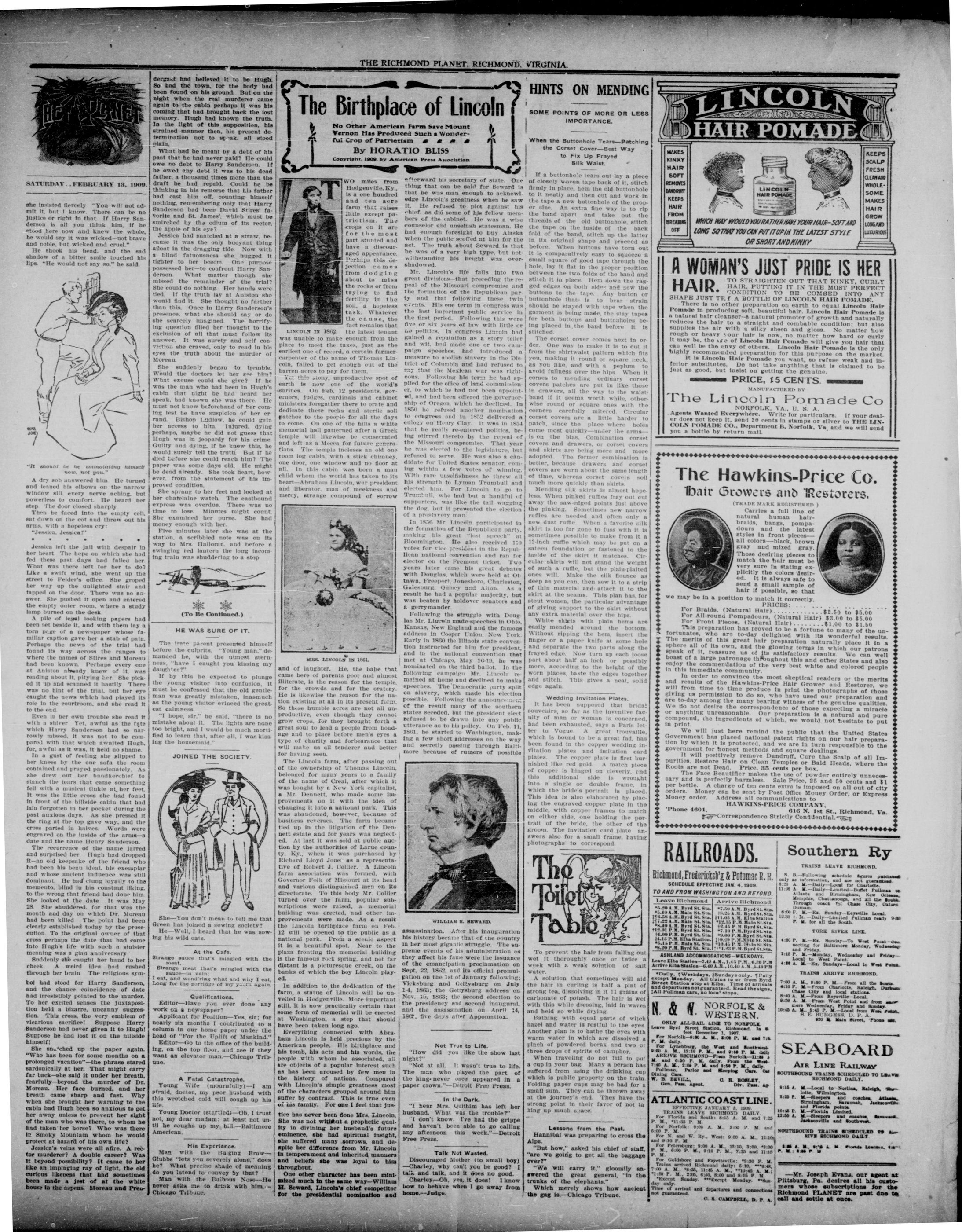
The Birthplace of Lincoln
T
WO miles from Hodgson, KY., is a one hundred and ten acre farm that raises little except patriotism. The crops on it are for the most part stunted and have a discouraged appearance. Perhaps this dejection comes from dodging about to miss the rocks or from trying to find fertility in the soil, a hopeless task. Whatever the cause, the fact remains that the latest
LINCOLN IN 1S62
LINCOLN IN 1852. the latest tenant was unable to make enough from the place to meet the taxes, just as the earliest one of record, a certain farmer-carpenter of the name of Thomas Lincoln, failed to get enough out of the barren acres to pay for them.
Yet this story, unproductive spot of earth is now one of the world's shrines. On Feb. 12 presidents, governors, judges, cardinals and cabinet ministers foregather there to orate and dedicate these rocks and sterile soil patches to the people for all the days to come. On one of the hills a white memorial hall patterned after a Greek temple will likewise be consecrated and left as a Mecca for future generations. The temple incloses an old one room log cabin, with a stick chimney, one door, one window and no floor at all. In this cabin was born a man child whom the world has taken to its heart—Abraham Lincoln, war president and librator, man of meekness and mercy, strange compound of sorrow
MRS. LINCOLN IN 1861
and of laughter. He, the babe that came here of parents poor and almost illiterate, is the reason for the temple, for the crowds and for the oratory. He is likewise the reason for the nation existing at all in its present form. So these humble acres are not all unproductive, even though they cannot grow crops, for they brought forth a great soul to lead a people from bondage and to place before men's eyes a type of charity and forbearance that will make us all tenderer and better for having seen.
The Lincoln farm, after passing out of the ownership of Thomas Lincoln, belonged for many years to a family of the name of Creal, after which it was bought by a New York capitalist, a Mr. Dennett, who made some improvements on it with the idea of changing it into a national park. This was abandoned, however, because of business reverses. The farm became tied up in the litigation of the Dennett estate and for years was neglected. At last it was sold at public auction by the authorities of Larue county, Ky., when it was purchased by Richard Lloyd Jonec as a representative of Robert J. Collier. A Lincoln farm association was formed, with Governor Folk of Missouri at its head and various distinguished men on its directorate. To this body Mr. Collier turned over the farm, popular subscriptions were raised, a memorial building was erected, and other improvements were made. As a result the Lincoln birthplace farm on Feb. 12 will be opened to the public as a national park. From a scenic aspect it is a beautiful spot. Near to the plaza fronting the memorial building is the famous rock spring, and not far distant is a picturesque creek, on the banks of which the boy Lincoln played.
In addition to the dedication of the farm, a statue of Lincoln will be unveiled in Hodgenville. More important still, it is now practically certain that some form of memorial will be erected at Washington, a step that should have been taken long ago.
Everything connected with Abraham Lincoln is held precious by the American people. His birthplace and his tomb, his acts and his words, the people with whom he associated, all are objects of a popular interest such as has been aroused by few men in the history of nations. Compared with Lincoln's simple greatness most of the characters grouped around him suffer by contrast. This is true even of his family. For one I feel that jus-
tice has never been done Mrs. Lincoln. She was not without a prophetic quality in divining her husband's future eminence, she had spiritual insight, she suffered many sorrows, and despite her difference from Mr. Lincoln in temperament and inherited manners and beliefs she was loyal to him throughout. One other character has been minimized much in the same way-William H. Seward, Lincoln's chief competitor for the presidential nomination and
afterward his secretary of state. One thing that can be said for Seward is that he was man enough to acknowledge Lincoln's greatness when he saw it. He refused to plot against his chief, as did some of his fellow members of the cabinet. He was a wise counselor and unselfish statesman. He had enough foresight to buy Alaska when the public scoffed at him for the act. The truth about Seward is that he was of a very high type, but notwithstanding his height was overshadowed.
Mr. Lincoln's life falls into two great divisions—that preceding the repeal of the Missouri compromise and the formation of the Republican party and that following these twin events. His one term in congress was the last important public service in the first period. Following this were five or six years of law with little or no politics. In congress Lincoln had gained a reputation as a story teller and wit, had made one or two campaign speeches, had introduced a measure to abolish slavery in the District of Columbia and had refused to say that the Mexican war was righteous. Following his term he had applied for the office of land commissioner, to which he had not been appointed, and had been offered the governorship of Oregon, which he declined. In 1800 he refused another nomination to congress and in 1852 delivered a eulogy on Henry Clay. It was in 1854 that he really re-entered politics, being stirred thereto by the repeal of the Missouri compromise. That year he was elected to the legislature, but refused to serve. He was also a candidate for United States senator, coming within a few votes of winning. With rare unselfishness he threw all his strength to Lyman Trumbull and elected him. For Lincoln to go to Trumbull, who had but a handful of supporters, was like the tall wagging the dog, but it prevented the election of a proslavery man.
In 1856 Mr. Lincoln participated in the formation of the Republican party, making his great "lost speech" at Bloomington. He also received 110 votes for vice president in the Republican national convention and ran for elector on the Fremont ticket. Two years later came his great debates with Douglas, which were held at Ottawa, Freeport, Jonesboro, Charleston, Gaiesburg, Quincy and Alton. As a result he had a popular majority, but was beaten by holdover senators and a gerrymander.
Following the struggle with Douglas Mr. Lincoln made speeches in Ohio, Kansas, New England and the famous address in Cooper Union, New York. Early in 1860 the Illinois state convention instructed for him for president, and in the national convention that met at Chicago, May 16-19, he was nominated on the third ballot. In the following campaign Mr. Lincoln remained at home and declined to make speeches. The Democratic party split on slavery, which made his election possible. Following the announcement of the result many of the southern states seceded, but the president elect refused to be drawn into any public utterance as to his policy. On Feb. 11, 1861, he started to Washington, making a few short addresses on the way and secretly passing through Baltimore because of rumors of possible
WILLIAM H. Seward.
assassination. After his inauguration his history became that of the country in her most gigantic struggle. The supreme events of his administration as they affect his fame were the issuance of the emancipation proclamation on Sept. 22, 1862, and its official promulgation on the 1st of January following; Vicksburg and Gettsburg on July 14, 1863; the Gettsburg address on Nov. 10, 1863; the second election to the presidency and second inaugural, and the assassination on April 14, 1863, five days after Appomattox.
Not True to Life.
"How did you like the show last night?"
"Not at all. It wasn't true to life.
The man who played the part of the king-never once appeared in a paper crown." -Detroit Free Press.
In the Dark
"I hear Mrs. Quithim has left her husband. What was the trouble?"
"I don't know. I've had the gripe and haven't been able to calling any afternoon this week."-Detroit Free Press.
Talk Not Wasted.
Charley--Oh, yes, it does! I know how to behave when I go away from home.--Judge.
HINTS ON MENDING
SOME POINTS OF MORE OR LESS
IMPORTANCE.
When the Buttonhole Tears—Patching
the Corset Cover—Best Way
to Fix Up Frayed
Silk Waist.
If a buttonhole tears out lay a piece of closely woven tape back of it, stitch firmly in place, hem the old buttonhole to it neatly and then cut and work in the tape a new buttonhole of the proper size. An extra fine way is to rip the band apart and take out the threads of the old buttonhole, stitch the tape on the inside of the back fold of the band, stitch up the latter in its original shape and proceed as before. When buttons have torn out it is comparatively easy to squeeze a small square of good tape through the hole, lay it flat in the proper position between the two folds of the band and stitch it in place. Hem down the ragged edges on both sides and sew the buttons to the tape. Any button or buttonhole that is to bear strain should be stayed with tape when the garment is being made, the stay tapes for both buttons and buttonholes being placed in the band before it is stitched.
The corset cover comes next in order. One way to make it is to cut it from the shirtwist pattern which fits you, making it round or square neck, as you like, and with a peplum to avoid fullness over the hips. When it comes to mending ordinary corset covers patches are put in like those in drawers, all the way to the walstband if it seems worth while, otherwise round or square ones with the corners carefully mitered. Circular corset covers are a little harder to patch, since the place where holes come most quickly—under the arms—is on the blas. Combination corset covers and drawers, or corset covers and skirts are being more and more adopted. The former combination is better, because drawers and corset covers are worn about the same length of time, whereas corset covers soll much more quickly than skirts.
Mending silk skirts is almost hopeless. When pinked ruffles fray out cut away the saw-edged points just above the pinking. Sometimes new narrow ruffles are needed and often only a new dust ruffle. When a favorite silk skirt is too far gone to fuss with it is sometimes possible to make from it a 12-inch ruffle which may be put on a sateen foundation or fastened to the inside of the skirt it matches. Circular skirts will not stand the weight of such a ruffle, but the plain-plaited ones will. Make the silk flounce as deep as you can, then sew it to a strip of thin material and attach it to the skirt at the seams. This plan has, for stout women, the particular advantage of giving support to the skirt without any extra material over the hips.
White skirts with plain hems are easily mended around the bottom. Without ripping the hem, insert the finger or a paper knife at some hole and separate the two parts along the frayed edge. Now turn up each loose part about half an inch or possibly more, according to the height of the worn places, baste the edges together and stitch. This gives a neat, solid edge again.
Wedding Invitiation Plates
It has been supposed that bridal souvenirs, so far as the inventive faculty of man or woman is concerned, had been exhausted, says a Paris letter to Vogue. A great trouville, which is bound to be a great fad, has been found in the copper wedding invitation plates and imitation card plates. The copper plate is first burnished like red gold. A match piece of copper is hinged on cleverly, and this additional side is wrought into a single or double frame, in which the bride's portrait is placed. This idea is also elaborated by placing the engraved copper plate in the middle, with copper frames to match on either side, one holding the portrait of the bride, the other of the groom. The invitation card plate answers also for a small frame, having photographs to correspond.
The Toilet Table
To prevent the hair from falling out wet it thoroughly once or twice a week with a weak solution of salt water.
A solution that sometimes will aid the hair in curling is half a pint of strong tea, dissolving in it 11 grains of carbonate of potash. The hair is wet with this while dressing, laid in waves and held so while drying.
Bathing with equal parts of which hazel and water is restful to the eyes. Another plan is to bathe the eyes with warm water in which are dissolved a pinch of powdered borax and two or three drops of spirits of camphor. When traveling do not fall to put a cup in your bag. Many a person has suffered from using the drinking cup which is public property on the train. Folding paper cups may be had for a small sum. They can be thrown away at the journey's end. They have the strong point in their favor of not taking up much space.
Lessons from the Past
Hannibal was preparing to cross the Alps.
"But how," asked his chief of staff, "are we going to get all the baggage over?"
"We will carry it," gloomily answered the great general, "in the trunks of the elephants."
Which merely shows how ancient the gag is.-Chicago Tribune.
LINCOLN
HAIR POMADE
WHICH WAY WOULD YOU RATHER HAVE YOUR HAIR--SOFT AND
LONG SO THAT YOU CAN PUT IT UP IN THE LATEST STYLE
OR SHORT AND MINNY
A WOMAN'S JUST PRIDE IS HER
HAIR. TO STRAIGHTEN OUT THAT KINKY, CURLY
HAIR, PUTTING IT IN THE MOST PERFECT
CONDITION TO BE COMBED INTO ANY
SHAPE JUST TRT A BOTTLE OF LINCOLN HAIR COMADE
There is no other preparation on earth to equal Lincoln Hair Pomade in producing soft, beautiful hair. Lincoln Hair Pomade is a natural hair cleanser—a natural promoter of growth and naturally reduces the hair to a straight and combable condition; but also supplies the air with a silky sheen and gloss. No matter how rough or heavy your hair is now, no matter how hard or curly it may be, the size of Lincoln Hair Pomade will give you hair that can well be the envy of others. Lincoln Hair Pomade is the only highly recommended preparation for this purpose on the market.
It is Lincoln Hair Pomade you want, so refuse weak and inferior substitutes. Do not take anything that is claimed to be just as good, but insist on getting the genuine.
PRICE, 15 CENTS.
MANUFACTURED BY
The Lincoln Pom
NORFOLK, VA., U. S. A.
Agents Wanted Everywhere. Write for particu
er does not keep it, send 20 cents in stamps or s
COLN POMADE CO., Department B, Norfolk, Va
you a bottle by return mail.
The Hawkins-Pri
Hair Growers and Res
The Lincoln Pomade Co
NORFOLK, VA. U. S. A.
Agents Wanted Everywhere. Write for particulars. If your dealer does not keep it, send 26 cents in stamps or silver to THE LIN-COLN POMADE CO., Department B, Norfolk, Va, and we will send you a bottle by return mail.
The Hawkins-Price Co. Hair Growers and Restorers.
(TRADE MARK REGISTERED)
Carries a full line of natural human hair-
braids, bangs, pompadours and the latest
styles in front pieces—
all colors—black, brown
gray and mixed gray.
Those desiring pieces to
match the hair must be
very sure in stating ex-
plicitly the colors desir-
ed it is always safe to
send a small sample of
hair if possible, so that
we may be in a position to match it correctly.
PRICES:
For Braids, (Natural Hair)
For All-round Pompardours, (Natural Hair)
For Front Pieces, (Natural Hair)
This preparation has proved to be a fortune to fortunate, who are to-day delighted with its use. The merits of this great hair preparation nature sphere all of its own, and the glowing terms in speak of it, reassure us of its satisfactory result boast of a large patronage throughout this and on enjoy the commendation of the very best white hair in this immediate community.
In order to convince the most skeptical real and results of the Hawkins-Price Hair Grower, will from time to time produce in print the phishing us permission to do so, who have used or are to-day among the many bearing witness of the We do not desire the correspondence of those or anything unreasonable. Our preparation is a compound, the ingredients of which, we would in print.
We will just here remind the public that Government has placed national patent rights on by which it is protected, and we are in turn government for honest methods and square deal. It will positively remove Dandruff, Cure the purities, Restore Hair on Clean Temples or Bald Roots are not Dead. Price, 35 cents per box.
The Face Beautifier makes the use of powder sary and is perfectly harmless. Sale Price, 25 a per bottle. A charge of ten cents extra is imposed orders. Money can be sent by Post Office Money Money order. Address all communications to:
CES:
..... $2.50 to $5.00
(Natural Hair) $3.00 to $5.00
(Hair) ..... $1.00 to $1.50
to be a fortune to many of the un-
lighted with its wonderful results.
preparation naturally place it in a
owing terms in which our patrons
satisfactory results. We can well
about this and other States and also
very best white and colored people
best skeptical readers or the merits
the Hair Grower and Restorer, we
in print the photographs of those
who have used our preparation and
g witness of the genuine qualities.
ence of those expecting a miracle
preparation is a natural and pure
Ich, we would not hesitate to put
the public that the United States
patent rights on our hair prepara-
we are in turn responsible to the
and square dealings.
ndruff, Cure the Scalp of all Im-
temples or Bald Heads, where the
ents per box.
the use of powder entirely unneces-
Sale Price, 25 and 50 cents and $1
extra is imposed on all out of city
Best Office Money Order, or Express
publications on
For Braids, (Natural Hair).....$2.50 to $5.00
For All-round Pompadours, (Natural Hair) $3.00 to $5.00
For Front Pieces, (Natural Hair) $1.00 to $1.50
This preparation has proved to be a fortune to many of the unfortunates, who are to-day delighted with its wonderful results. The merits of this great hair preparation naturally place it in a sphere all of its own, and the glowing terms in which our patrons speak of it, reassure us of its satisfactory results. We can well boast of a large patronage throughout this and other States and also enjoy the commendation of the very best white and colored people in this immediate community.
In order to convince the most skeptical readers or the merits and results of the Hawkins-Price Hair Grower and Restorer, we will from time to time produce in print the photographs of those giving us permission to do so, who have used our preparation and are to-day among the very best bearing witness of the genuine qualities. We do not desire the correspondence of those expecting a miracle or anything unreasonable. Our preparation is a natural and pure compound, the ingredients of which, we would not hesitate to put in print.
We will just here remind the public that the United States Government has placed national patent rights on our hair preparation by which it is protected, and we are in turn responsible to the government for honest methods and square dealings.
It will positively remove Dandruff, Cure the Scalp of all Impurities, Restore Hair on Clean Temples or Bald Heads, where the Roots are not Dead. Price 35 cents per box.
The Face Beautifier makes the use of powder entirely unnecessary and is perfectly harmless. Sale Price, 25 and 50 cents and $1 per bottle. A charge of ten cents extra is imposed on all out of city orders. Money can be sent by Post Office Money Order, or Express Money order. Address all communications to
HAWKINS-PRICE COMPANY
616 N. 1st St., Richmond, Va.
Strictly Confidential.
Phone 4601. 616 N. 1st St., Richmond, Va. Correspondence Strictly Confidential.
Southern Ry
N. B.—Following schedule figures published on
as information, and are not guaranteed.
6:20 a.m. Birmingham, New Orleans,
11:00 a.m. M.—Daily-Limited-Buffet Pullman on
Atlanta and Birmingham, New Orleans,
Monmouth, Chattanooga, and all the South.
Coach coach for Chase City, Oxford
Durham.
6:00 P. M.-Ek. Sunday-Keyville Local. 6:00 P. M.-Ky. Fullman read. 9-30 P. M. for all in the 8:00 P. M. for all in the 8:00 P.
4:30 P. M.-Ex. Sunday-To West Pace-One
Cemetery Baltimore Monday, Wednesday
and Friday.
7:15 P. M.-Monday, Wednesday and Friday-
A. 240 P. M.-Ex. Sunday-Local to West Pace.
7:00 A. M. 9:30 P. M. — From all the Boats.
7:10 A. M. 9:30 P. M. — From all the Boats.
Chase City and local stations.
8:40 A. M. — From Keysville — Local.
8:40 A. M. — From West Point and from more West Point.
10:45 A. M. 5:45 P. M. — Local from West Point.
S. E. BURGESS, D. P. A.
SEABOARD
AIR LINE RAILWAY
SOUTHBOUND TRAINS SCHEDULED TO LBAVE
RICHMOND DAILY.
9:15 A. M.-Local to Norlina, Raleigh, Wor-
lotte, Wilmington.
NORTHBOUND TRAINS SCHEDULED TO AIR
RIVE RICHMOND DAILY
8:00 A.M. 9:20 A.M. 9:40 A.M. Florida Lakes, 6:10
P. M. 9:20 P. 13
—Mr. Joseph Evans, our agent at Pittsburg, Pa. desires all his customers whose subscriptions for the Richmond PLANET are past due to call and settle at once.
Time of arrival and departures and connections not guaranteed. C. S. CAMPBELL, D. P. A.
A. B.
RAILROADS.
TO AND FROM WASHINGTON AND BEYOND
ASHLAND ACCOMMODATIONS - WEEKDAYS.
Leave Elba Station - 7.45 A.M., 14.55 A.M., 6.30 P.M.
Arrive Elba Station - 6.40 A.M., 10.40 A.M., 5.40 P.M
*Daily* *Weekdays* *Sundays only*. *Daily except Monday* *from or by from* *Broad Street Station at Elba*. *Tour* *arrivals and departures not guaranteed*. Read the signs,
*All Pullman cars, no loca' stops.*
ONLY ALL-RAIL LINE TO NORFOLK.
Leave Bryd Street Station, Hibiscus. Inch is
december 1, 1907.
For Nortor - 9:00 A. M., 8:00 P. M. and 7:10
P. M. daily.
For Lynchburg, the West and Southwest -
9:00 A. M., 12:10 P. M., and 9:40 P. M. daily
ARRIVE RICHMOND—From Norfolk -11:28 A.
and 5:00 P. M. daily. From the West -
7:40 A. M., 8:00 P. M. and 9:50 P. M., daily.
Pulman, Farlor and Sleeping Car. Our
Dining Cars.
ATLANTIC COAST LINE
TRAINS LEAVE RICHMOND DAILY
For Florida and South: 815 A. M. and 7:25
P. M. M.
M. M.
For Norfolk: 9:00 A.M., 3:00 P.M. and 6:00 P.M.
6:00 P. M.
P. M. and W. Ry., West: 9:00 A. M., 12:10
and 9:10 P. M.
For Petersburg: 9:00 A. M., 12:10, 3:00 *3:20
P. M., 6:00 P. M., 9:10 P. M., 7:25 and 11:15
P. M.
For Goldaboro and Fayetteville: *3:30 P. M.
Trains arrived Richmond daily: 5:10, *6:48, 8:
*8:36, 11:45 A. M., *10:45 A. M., 1:20 P. M.
, 2:00, 6:30, 8:00 and 8:15 P. M.
*Except Sunday. *Except Monday. *Sunday only.
KEEPS
SCALP
FRESH
CLEMAND
WHOLE-
SOME
MAKES
HAIR
GROW
LONGAND
LUXURIOUS
A. B. C.
TRAINS LEAVE RICHMOND
YORK RIVER LINE
TRAINS ARRIVE RICHMOND
FOUR
THE PLANET
published every Saturday by JOHN MITCHELL JR., at 311 N. Fourth Street, Richmond, Va.
JOHN MITCHELL, JR., EDITOR
All communications intended for publication should be sent as so as to reach us by Wednesday.
TERMS IN ADVANCE.
One Copy, one year.....$1.60
One Copy, eight months.....1.00
One Copy, six months.....8.00
One Copy, four months.....5.00
One Copy, three months.....4.00
Single Copy.....0.06
ADVERTISING RATES.
For one inch, one inset.....$0.60
For one inch, each subsequent insertion.....40
For two inches, three months.....6.00
For two inches, six months.....10.00
For two inches, nine months.....14.00
For two inches, twelve months.....20.00
Marriage and Funeral Notices, one inch.....5.00
Standing and Treatment Notices per line.....10
POSTAGE STAMPS OF A HIGHER DENOMINATION THAN TWO CENTS NOT RECEIVED ON SUBSCRIPTION.
THE PLANET is issued weekly. The subcrip-
tion price is $1.90 per unit, in addition.
There are four ways by which money can be sent by mail at our risk—In a Post Office Money Order, by Bank Check or Draft, or an Express Money Order, and when none of these can be sent by mail, you must have a MONEY ORDERS-You can buy a Money Order at your Post Office, payable at the Richmond Post Office and we will be responsible for its expenses. EXPRESS MONEY ORDERS can be obtained at any office of the American Express Co. the United States Express Co., and the Well'sargo Express Company are responsible for sending any of these orders to an Express Money Order is a safe and convenient way for forwarding money.
REGISTERED LETTER—If a Money Order, Post Office or an Express Office is not within the United States, you must send a Letter you wish to send us on payment of ten cents. Then, if the Letter is lost or stolen, it can be traced. You can send money in this way. We cannot be responsible for money sent in letters in any other way than one of the four ways mentioned above. If you send your money any other way, you must do it at your own
BENEWAIS, ETC.—If you do not want THE PLANET continued for another year after your subscription has run out of it, you may by a Card deal discontinue it. The courts have decided that subscribers to newspapers who do not order their paper discontinued at the expiration date for which it has been paid are liable for the payment of the subscription up to date when they order the paper discontinued.
COMMUNICATIONS—When writing to us to renew your subscription or to discontinue your paper, you should give your name and address in full, otherwise we cannot find your name or our book listing. CHANGE OF ADDRESS—In order to change the address of a subscriber, we must be sent the former as well as the present address.
Entered at the Post Office at Richmond, Va. as sound class matter.
SATURDAY. FEBRUARY 13, 1909.
It is plainly evident that every concession that is made to the Negro-hating element in the Southland calls for some other concession of a more radical sort.
0
It is not the liberal minded, business contingent of the white race in the South that is causing all of this trouble about the Negro's holding office, but it is the office seeking elements, who will not engage in business and who couldn't make a living if they did.
---
The Crum case puts the Negro question "on all fours" to the Republicans of the United States. He is not illiterate. He is a polished gentleman, endorsed and recommended by Dr. Booker T. Washington. He is the Negro of that type, which President Roosevelt declared should not have the door of hope slammed in his face.
---
It is announced that the office-seekers in Georgia are whetting their knives for Collector Henry A. Rucker's political scalp. Whether President Taft will give it, to them is an open question. When he decides that no Negro, no matter however competent shall hold office, then it will be time for the average colored man to quit thinking and go to work to improve his political as well as his financial condition.
---
Now it is announced that if President Roosevelt's veto of the census bill stands and the census enumerators are appointed through the Civil Service Bureau, many colored men will secure appointments to the exclusion of many more white men. This is a compliment to the colored people, acknowledging that whenever merit is the test, the Negro is found in the first rank of the class
THE CRUM APPOINTMENT
The issue is now squarely presented, not only to the United States Senate, whether or not a citizen of the United States in every way qualified to discharge the duties of a public office and who is in accord with the political policies of the administration, shall be denied the right to hold office and refused a confirmation by the Senate of the United States wholly and solely upon the ground of his race and color.
Here is a citizen of the United States, who is a resident of South Carolina a gentleman of scholarly
ability, culture and refinement. We might add that he is a man of means, who has held the position of Collector of the Port of Charleston, South Carolina for six years and whom even his enemies concede has made a model official. Senator Benjamin R. Tillman, resting his opposition upon a basis of color insists that he be not confirmed. Senator Tillman belongs to the ultra Democratic Party and it seems that with some Republicans, he has more influence than a rock-ribbed Republican.
He, living in the hostile political camp demands the political scalp of Hon. W. D. Crum of Charleston, South Carolina. We pause to ask if the Republican representatives in Congress are not up against a right principle and if they are, can they afford to shirk a solemn responsibility and commit the greatest blunder of the age?
The argument is that Dr. Crum comes in contact almost exclusively with white people. What if he does? Does not every servant in the Southland come in direct contact almost exclusively with white people? Does not every dry-goods merchant, shoe dealer, grocery man, and confectioner come in contact with colored people? Are there not letter carriers in the Southland, who in their routes come in contact almost exclusively with white people?
If this rule is to be applied in the Crum case, it is but a short time before this argument will be used in other cases and every office-holder in the "sunny land" will be forced out on account of a senseless race prejudice. Out of the tens of thousands of offices in the Southland, where the white vote is generally hostile to Republican interests, and the Republican vote is favorable to them, there are not ten per cent of the best offices held by colored Republicans.
There is talk about building up a Republican Party in the South. Can you build it up outside of Republican principles? Must the Party go to the beliefs of the voters or must the voters come to the principles of the Republican Party? For more than twenty years the siren voices of the white politicians of the southland have been heard. What has been their argument? They claimed that their opposition was against the ignorant electorate and as the Negroes were generally ignorant, they were opposed to the Negro. All over the state of South Carolina, there are white men, who say that they do not oppose the intelligent Negro and they will tell the better class of Negroes, the educated, property owning classes, that if all the Negroes were like them, there would be no objection, so long as the social relationship between the races was not disturbed and yet here is a cultured, property-owning colored citizen, who has practically lifted himself into prominence by his own bootstraps, unceremoniously condemned on account of the fact that he came into the world as the offspring of a colored woman instead of a white one.
Such logic is absurd, such argument is puerile and it remains to be seen whether or not the white men of the North, Democrat as well as Republican and the white men of the South of liberal views and progressive ideas stand ready to break down upon the first test of the assertions that they have been making to the country for twenty years or more.
The distinguished Senator from Nevada declared that the Negroes were a race of children, but all Negroes are not a race of children, although efforts are being made to keep them as such. Schools are being run in some sections only four months in the year and colored people are now establishing their own high schools for the reason that the most perfunctory education can be obtained in the county schools of their respective sections.
Here is a colored gentleman of exceptional ability, one who has demonstrated his ability to discharge the duties of the office to which he has been appointed and yet with Republican sympathy and underground encouragement, a Negro-hating Senator has been able to hold up his appointment and hints are being made that he will not be confirmed at this session and that efforts will be made to "buy him off" by his appointment to a position in Washington held by a colored man, who is equally capable in the discharge of his official duties.
We wish the issue presented and we wish to see where the distinguished President-elect will stand on such an all important question. Dr. W. D. Crum has stood like a stone-wall up to the present, will he weaken now?
White men hold every highly important Federal position in South Carolina but one, and it is now the intention to eliminate the lone representative of the race at Charleston, S. C. There is no other position held by a colored man in the state to compare with it. The Beaufort position is not to be compared with it. Will the colored people of the country resent this attempt to give official sanction to the elimination of the new Negro? We should say so
—Subscribe to The PLANET.
THE RICHMOND PLANET, RICHMOND, VIRGINIA
BIG SKIP NAMED FOR LITTLE STATE
TO BE OUR LARGEST WARSHIP
She Will Displace Twenty Thousand Tons of Water and Make Twenty-one Knots—Named by Daughter of State, Surrounded by State's Officials and Prominent Men—Sister Ship of the North Dakota.
Bearing the name of the next to the smallest state of the Union, the Delaware, the largest battleship of the United States navy, was launched at Newport News, Va. She shares with her sister ship, the North Dakota, recently launched at Fore River, Mass., the honor of being the first American Dreadnought.
Standing sponsor for the Delaware was Miss Anna P. Cahall, a daughter of the state for which the new ship is named. She is a resident of Bridgeville, Del., and a niece of Governor Pennwell, of Delaware. Assisting Miss Cahall in the task of smashing the bottle of champagne and naming the huge hull was Miss Hazel, of Dover, Del., a niece of Mrs. James Pennwell, sister-in-law of the governor.
Governor Pennwell, his brother, Judge James Pennwell; Delaware's representatives in the national legislature and the members of the state legislature, as well as a large number of prominent citizens of Dover, Wilmington and other places, were present to see the battleship take the water.
When completed the Delaware will be a first class armored battleship of 20,000 tons displacement. Her general dimensions are as follows: Length over all, 518 feet 9 inches; beam, 58 feet 2 inches; depth, 44 feet 6 inches. Her main battery will consist of ten twelve-inch guns mounted in pairs in turrets. She will be propelled by twin screws driven by two four-cylinder triple expansion engines capable of sending her through the water at a twenty-one knot gait. She will cost almost $4,000,000.
Charged With Heinous Crime
Joseph M. Janer, aged about thirty-four years, of Brooklyn, N. Y., a married man with children, was, after a hearing before Police Magistrate Grannan in Baltimore, held without bail for the action of the grand jury on a charge which, stripped of its legal technicalities, means felonious assault upon Catherine Loerch, of Brooklyn, who, she told the magistrate, will be twelve years old on the 22d of this months. The arrests were made at the instance of the police of New York, though it is not known they suspected Janer of anything more grave than kidnapping the child.
The crime with which Janer is charged is a most serious one in this state, conviction carrying with it imprisonment for from eighteen months to the life of the criminal, or the sentence may be death by hanging. The latter punishment has frequently been inflicted in this state.
Editor Dies of His Injuries
William L. Woodson, the editor of the American Press, died in a hospital at Yonkers, N. Y., from the injuries which he received in trying to board a moving train last Saturday. The cause of death was blood poisoning. He was fifty-five years old. The funeral will take place at Lynchburg, Va.
Mr. Woodson's paper, the American Press, is issued from the main office of the American Press Association in New York. He has been connected with the association many years, coming to the main office from the Atlanta branch, of which he was manager. Mr. Woodson was formerly one of the best known newspaper men of the south. He was a native of Virginia, but lived also in Georgia and other southern states.
Woman's Body Packed In Trunk
The body of Mrs. May Hazelton, colored, packed in a trunk, was discovered in an apartment at 80 Eaton street, New Haven, Conn., where James Hazelton and his wife, May, had been living.
The discovery of the murder came about through a visit of the landlord to the place to collect the rent. When the landlord went to the apartment and received no answer to his knocking he forced the door leading to the apartment. On entering he found blood spattered about the place and two blood-stained shirts. He at once notified the police and officers were sent to investigate. They found a trunk in the room and, forcing it open, found within the dismembered body. The police are searching for her husband.
Dropped Thirty Feet Into Mine Hole
Miles Lamoreaux, a young man employed as a driven by Dr. E. R. Teits worth, at Luzerne, across the river from Wilkes-Barre, Pa., had a rather unusual experience. He was sent to the cellar to fix the furnace, the doctor directing him meanwhile. The lad was standing in front of a refrigerator, when suddenly the concrete floor gave way and the young man and refrigerator dropped thirty feet into a mine opening.
The doctor rallied his wits, secured old and ropes and succeeded in a short time in hauling Lamoreaux from the depths, from whence he had been lustily yelling for help. When brought to the surface it was found that his leg was badly injured.
Placed Child on Red Hot Stove.
Julius Greenwalt, a coal miner, narrowly escaped rough handling at the hands of an infuriated mob at Staunton, III., after he had placed the four-year-old child of the woman with
whom he boarded on top of a red hot stove because the child annoyed him. Greenwalt was arrested and a number of his fellow workers heard of the act and started to wreak vengeance upon him.
Instead of taking Greenwalt to the jail the village marshal bid him in a restaurant near the interurban station, and when a northbound car arrived he was rushed aboard and bought to Carlinville, where he will await the action of the grand jury.
The child is in a serious condition as a result of her burns.
Lincoln Coach Burned
The historic "Lincoln coach," in which President Abraham Lincoln is said to have ridden to the city of Washington for his inauguration, was destroyed in a fire at Sharpsville, Pa. It was the sole passenger equipment of the little Sharpsville railroad, running between that town and Wilmington Junction. It was covered with sheet iron, put on before Lincoln made his famous ride, and was supposed to be bullet proof.
Woman Tried Black Hand Game. Mrs. Mary Walker, a domestic in the household of Thomas B. Sweeney, at Wheeling, W. Va., the business man who received a number of letters demanding $500 on pain of death, confessed that she was the author of the missives. She was arrested. She read a "Black Hand" story in a magazine and decided to play the game herself.
Jamaica Ginger and Alcohol Kills.
A solution of Jamaica ginger and alcohol, which is used by many persons as a substitute for liquor in local apa tion territory, is thought to have caused the death of Fred Britton, at Harrodsburg, Ky., who died under mysterious circumstances. Britton was seized with violent convulsions in a local drug store.
Walker 29 Miles in Five Hours.
Professor C. V. Cusachs, of the department of modern languages of the naval academy at Annapolis, Md., son-law of Commodore Theodoric Porter, U. S. N., walked to Baltimore, twenty-nine miles, in five hours.
A considerable sum of money was wagered by the naval officers against the performance of the feat.
Powder Inventor Terribly Injured.
George Lezinsky, a New York powder inventor, was terribly injured as he was making a test in a cement works quarry at La Salle, Ill. Lezinsky lost both eyes and his left arm.
His condition is critical. Six other men were hurt by the explosion of the powder.
Odd Fellows' Temple Robbed
The Odd Fellows' temple, Chatham, Ontario, was robbed of costly jewels and ornaments. What has caused the most consternation, however, was the discovery that copies of the secret work of the order were taken by the thieves.
Killed by Brother Odd Fellow.
Fred Walton, formerly grand master of the Odd Fellows of Idaho, was shot and killed by John H. Cradlebaugh, a brother Odd' Fellow, in Denver, Colo. Both men are from Wallace, Idaho, Walton, dying, gasped: "That man thought I stole his wife."
Raised Check For $27 to $27,000
Theodore Wasserman, the head of a contracting firm in Chicago, has been indicted on the charge of raising a check from $27 to $2,000. With the raised check Wasserman, it is asserted, secured $2,000 worth of bonds from the Illinois Trust & Savings bank.
Mother Smothered Babe In Bed.
While she was nursing her babe in bed, Mrs. John Mardos, of Girardville, Pa., fell asleep. Awakening, she was horrified and grief stricken to find that the babe had been smothered by her lying upon it. The coroner decided it was purely accidental.
Cutting Third Set of Teeth Kills Her.
Cutting her third set of teeth at the age of seventy-eight years, and complications produced by it, are assigned as the causes of the death of Mrs. Therese Suckfiel at McKeesport, Pa., near Pittsburg.
Negro Has Two Life Sentences.
Punished with two life sentences is the predicament of Noah Adams, a negro of Columbus, Ga. He pleaded guilty to two serious charges and was sentenced on each.
Three Children Burned In Home.
The three little children of John Wilson, a negro, of Browntown, Princess Anne county, Va. were cremated when Wilson's house was destroyed by fire. They upset an oil lamp.
Ninety-six Middles Are Deficient.
Ninety-six midshipmen are deficient in studies as a result of the recent zemi-annual examinations. This fact was given out at the academy at Anapolis, Md.
Cardinal Cretoni Dead.
Cardinal Serefino Cretoni, prefect of the congregation of sacred rites, indulgesenses and sacred relics, died of pneumonia in Rome.
FATAL FIGHT AT WEDDING
Several Arrests Follow Shooting In North Wilkes-Barre House.
Wilkes-Barre, Pa., Feb. 10. -During a wedding celebration at the home of a foreigner in the northern part of the city a fight started and Mike Gordock, aged thirty years, unmarried, was shot and killed. The police have arrested a number of those who were in the house at the time of the shooting.
Pair of Skaters Drowned
Springfield, Mass., Feb. 10.—Albert C. Heilmsath, twenty-six years old, of Cleveland, O., president of the senior class of the International Y. M. C. A. Training sc'cool, in this city, and Miss Gertrude Hung, eighteen years old, of this city, broke through thin ice on Watershops pond and both of them were drowned.
RECEIPT THAT CURES WEAK MEN--FREE.
Send Name and -Address To-day—
You Can Have It Free and Be
Strong and Vigorous.
I have in my possession a prescription for nervous debility, lack of vigor, weakened manhood, failing menory and lame back, brought on by excesses, unnatural drains or the collisions of youth, that has cured so many worn and nervous men right in their own homes—without any additional help or medicine—that I think every man who wishes to regain his manly power and virility, quickly and quietly, should have a copy. So, I have determined to send a copy of the prescription, free of charge, in a plain, ordinary sealed envelope, to any man who will write me for it.
This p prescription comes from a physician who has made a special study of men, and I am convinced it is the surest-acting combination for the cure of deficient manhood and vigor-failure ever put together.
I think I owe it to my fellow man to send them a copy in confidence, so that any man, anywhere who is weak and discouraged with repeated failures may stop drugging himself with harmful patent medicines, secure what, I believe, is the quickest-acting, restorative, upbuilding, SPOTTOUCHING remedy ever devised, and so, cure himself at home quietly and quickly. Just drop me a line like this: Dr. A. E. Robinson, 3895 Luck Bldg., Detroit, Mich., and I will send you a copy of this splendid receipt, in a plain, ordinary sealed envelope, free of charge.
IMPORTANCE OF TARIFF BOARD
Says Manufacturers Don't Give It Attention It Deserves.
WOULD BENEFIT BUSINESS
Philadelphia Manufacturer Calls Attention to Movement For Permanent Tariff Commission and Says If Successful Trade Won't Be Affeced by Revision In the Future.
Philadelphia, Feb. 10—Alva B. Johnson, of the Baldwin Locomotive works, says that the convention to be called at Indianapolis on Feb. 16, 17 and 18 to endearcor to bring about the appointment by congress of a national tariff commission, is a most important movement, but that unfortunately it has not received the attention from manufacturers which it deserves. He said: "Hitherto tariff schedules have been imposed upon the basis of statements made by manufacturers and the influence exerted by them, irrespective of the actual needs of the industry to be protected.
"When the tariff is under discussion all business is disturbed until the agitation is over and the new tariff law is passed. Under the plan proposed by the National Association of Manufacturers a permanent tariff commission of seven men will be continually engaged in conducting hearings of all the industries affected by any proposed tariff change. As but a small part of the whole industries of the country could at any time be affected business could never be disturbed by tariff revision as it is at present. The suggestion is sane and wise and should receive the support of protectionists, of manufacturers and of the community at large."
IS KNOX ELIGIBLE FOR CABINET JOB?
Increase of Salaries May Prevent Him Serving Under Taft.
Washington, Feb. 10.—Much discussion has been aroused over a question raised as to whether Philander C Knox, of Pennsylvania, who has been selected to be secretary of state in the Taft cabinet, is eligible under the constitution of the United States to accept the office.
Attention has been called to section 6, article 1, of the constitution, which reads as follows: "No senator or representative shall, during the term for which he was elected, be appointed to any civil office under the authority of the United States which shall have been created, or the emoluments whereof shall have been increased during such time."
During Mr. Knox's present term as senator the salaries of all cabinet officers were increased from $8000 to $12,000 a year. As the term of Senator Knox does not expire until March 3, 1911, two years after the time when his name would be sent by Mr. Taft to the senate for confirmation, the question is asked if Mr. Knox will be able constitutionally to accept the state portfolio. Mr. Knox declined to discuss the point when the matter was brought to his attention.
SAVED FROM DEATH VALLEY
Lost Prospectors Found Huddled Together in Cave.
San Bernardino, Cal., Feb. 10.—The Meilrose party of seven persons which left Nevada recently and became lost in the Death Valley region, has been rescued by searchers, who found the lost prospectors huddled together in a cave in the Panamint mountains, where they had taken shelter from the heavy showers.
IRISH PATRIOTS NEARLY RIOT
Delegates Yelled, Cheered and Shouted Encouragement to Disputants, and One Rushed to Platform to Assault John Redmond—Adopted the Usual Home Rule Resolution.
Dublin, Feb. 10.—The national convention of the United Irish league, attended by over 2000 delegates, which was opened at the Mansion House, under the presidency of John Redmond, was the scene, before the session closed, of an outbreak that resembled the proverbial Donnybrook fair. William O'Brien spoke in opposition to cheff secretary for Ireland's land bill. Mr. Redmond was in favor of this measure. During the controversy Eugene Grean, member of parliament from the Southeast division of Cork, rushed to the platform, apparently with the intention of assaulting Mr. Redmond. He was suppressed and hustled away, however. Then for a few moments the platform became a seething mass of angry disputants. Priests and legislators rushed into the fray and tugged at one another's collars, while the remainder of the audience yelled, cheered and shouted encouragement to the disputants.
Ten minutes or more elapsed before Mr. Redmond was able to quell the pandemonium and the business of the conference could be resumed. Resolutions offered by the followers of Mr. Redmond in favor of home rule and Secretary Birrell's land bill, and expressing confidence in Mr. Redmond's leadership, were carried by overwhelming majorities. It became apparent early that Mr. Redmond was in control and the speeches of the Sinn Feiners charging that the party was too friendly with the Liberals were shouted down. The convention adopted the usual home rule resolution and declared that this question must be made a vital issue at the next general election, so there could be no misunderstanding on the other side of the channel regarding what was meant. The convention was quickly put on good terms with itself by messages of congratulation, encouragement and good wishes from America, Australia and elsewhere.
The greeting from America contained also the news that $25,000 is now on its way and that another remittance would follow speedily.
FOUR MEN SMOTHERED
Colliery Workers Near Mahanoy City Caught In Rush of Culm.
Caught in Rush of Culm.
Pottsville, Pa., Feb. 10.—Four men were smothered to death and two others were seriously injured in a culm bank "slide" at the St. Nicholas washery of the Philadelphia & Reading Coal & Iron company, near Mahanoy City.
The dead, all colored employes, are: John Statick, John Maley and John Lipton, all of Mahanoy City, and Peter Parrick, of Mahanoy Plane.
The injured are: John Paulick and John Statick, of Mahanoy City.
The men were employed in digging at the base of a huge coal bank, which was being carried by an endless tramway into the washery, where the coal is separated from the slate and dirt.
T had dug a huge cavern in the bank, when the slide commenced.
TWO MINERS DROWNED
Fell Into Water Hole In Scramble For Safety After an Explosion.
Zeigler, III., Feb. 10.—Two miners were drowned in a scramble for safety in the Leiter coal mine here. Fourteen others' escaped without injury. The panic was caused by a slight explosion in the workings. The explosion did comparatively little damage. In the rush of the sixteen men for the shaft two of them, M. Kimball, white, and Lawson Palmer, a negro, fell into a water hole near the bottom of the shaft and were drowned.
125. Russian Mineral
Russian Miners Imprisoned.
Yuzovka, Russia, Feb. 10.—An explosion occurred in the Catherine mine here, and it was followed quickly by fire. One hundred and twenty-five miners are imprisoned in the mine. An engineer and three workmen who attempted to rescue the victims have been killed.
Father of Murdered Man Found Dead.
Rochester, N. Y., Feb. 10.—George Sampson, father of Harry Sampson, whose wife was arraigned, charged with the murder of her husband, was found dead in bed at his home at Palmyra. He was a brother of the late Rear Admiral Sampson and was an important witness for the prosecution of his daughter-in-law.
Thleves Carry Ton of Dynamite.
Allentown, Pa., Feb. 10. — Thleves broke into the magazine of the National Powder company, at Northampton, near this city, and stole a ton of dynamite. The explosive was carried away on a wagon, and on the way several of the boxes dropped into the road, but did not explode.
Lovers In Suicide Ract
Bowling Green, O., Feb. 10.—Miss Margaret Brandon, aged twenty-two years, is dead, and William Davis, her fance, aged nineteen, is not expected to live, as the result of a suicide pact. Miss Brandon drank carbolic acid at her home and Davis shot himself after going out into the woods. It is believed the pact was due to lack of funds that prevented their marriage.
CONDENSED NEWS ITEMS
Thursday, January 4.
A bill was introduced in the Colorado legislature making it a misdemeanor to give, accept or solicit a tip except on a sleeping car.
Rear Admiral William J. Barnette, superintendent of the naval observatory at Washington, was transferred to the retired list by reason of age.
The Pennsylvania state board of health ordered that sixteen cows affected with tuberculosis at the poor district almshouse at Freeland, Pa., be killed.
Three trainmen were killed and one was fatally injured when two stock trains on the Chicago, Milwaukee & St. Paul railroad collided head at Briceville, Mo.
Friday, February 5.
Richard Mueller, president of the Association of German Veterans in America, was received in audience by Emperor William in the palace in Berlin.
Charles E. Holmes, against whom damaging testimony was given by his twelve-year-old son in St. Louis, was declared not guilty of the murder of his wife.
The United States has been asked to be represented at the International Musical Congress, to be held in Vienna in May, 1909, on the occasion of the centennial celebration of the birth of Josef Haydn, the composer.
Saturday. February 6
Drinking carbolic acid in mistake for castor oil, Dudley E. Latham, a law student at Columbia university, New York, died in a hospital.
Five hundred cattle were drowned by the flood waters on the Stanford ranch, near Tehama, Cal., and 1500 sheep perished near Colusa.
Will Foster, a negro, twice convicted of murdering John Young, a well known white man, two years ago, was hanged in the county jail at Spartansburg, S. C.
William Cloke, one of the best known newspaper men in New Jersey and recently appointed by Governor Fort a state commissioner of reports, died at his home in Trenton.
Monday, February 8.
The postoffice at Enola, Pa., was robbed, the safe being blown open and over $200 t.ken.
It cost the Pennsylvania railroad $4360 in the Lancaster (Pa.) court for destroying the lumber sized of U. G. Meilinger through a spark from a locomotive.
Eight negroes will be hanged for murder at different places in Louisiana March 5.
The National Model License league, composed of liquor men, will hold conventions throughout the country to work for uniform license laws.
The Wyoming house has passed a bill appropriating $7500 for dry farming experiments this year.
Tuesday, February 9.
Dr. Elizabeth James, aged seventy-eight years the oldest woman physician in Chicago, died at the county hospital of heart disease.
T. H. Pardo de Tavera, who has been a member of the Philippine commission since September, 1901, has resigned on account of ill health, to take effect March 1.
Mrs. William H. Taft, wife of the president elect, has just been elected a member of the Connecticut Society of Colonial Dames of America, by right of her descent from Thomas Welles, one of the early governors of the state.
Henry and Bud Barrington, father and son, fought against Robert and Charles Weatherford, brothers, with pistols at Alexandra, La., over a dog, and both the Barringtons were killed and Robert Weatherford was mortally wounded.
Wednesday, February 10.
H. J. Miller, an erecting engineer, fell forty feet from a crane at Oakmont, near Pittsburg, and was killed. Senator Foraker on Tuesday presented to the senate the credentials of his successor, Senator Elect Theodore E. Burton, of Ohio. The comptroller of the currency issued a call for a statement of the condition of national banks at the close of business on Friday, Feb. 5. Joseph Bartosvec, twenty-two years old, was found along the Philadelphia & Reading railway, above Phoenixville, Pa., with both legs severed. The J. & E. Sismon corn mill, corn cribs and elevator, together with 100,000 bushels of corn, were destroyed by fire at Vincennes, Ind., causing a loss of $100,000.
PRODUCE QUOTATIONS.
The Latest Closing Prices For Produce
and Live Stock.
PHILADELPHIA — FLOUR firm;
winter extras, new, $3.75@4; winter
mills, $2.25@4.50; city mills, fancy,
$5.85@4;
RYE FLOUR quiet, at $4.10@4.15
per barrel.
RYE firm; No. 2 red, western,
$1.12@1.125;
CORN steady; No. 2 yellow, local,
$7@68c.
OATS steady; No. 2 white, clipped,
56½c; lower grades, 54c.
MIL steady; timothy, large bales,
15 per tote.
POULTRY: Live steady; heens, 14@
41½c; old roosters, 10c. Dressed
choice fowls, 15½c.; old roostera,
11½c.
BUTTER steady; extra creamery,
3 per lb.
EGGS steady; selected, 37 @ 39c; not western, 33c.
POTATOES steady, at 78@80c; per bushel. Sweet Potatoes steady, at 50 @ 60c; per basket.
Live Stock Mackets
GREAT (Union Stock Yards)—
CATTLE BANK, choice. $6.25; $6.40;
prime. $6@6.25
SHEEP higher; prime wethers. $5.25
@5.50; culls and common. $2.50; 5.50;
lambes. $@7.75; veal calves. $9@9.50;
lambs. $@7.75; veal heavens. $6.90
@7; medium; veal heavens. $6.90;
6.75@6.55; light Yorkers. $6.40@6.50
plgz. $6.20@6.30; roughs. $5.00@6.25
$70,000 Fire In Lancaster.
Lancaster, Pa., Feb. 10.—Fire which started in the Franklin house stables spread to the five-story factory of the Safe Padlock & Hardware company, entirely consuming that building, which is owned by Dulon F. Buchmiller, its president, together with its contents. Loss about $70,000.
—Subscribe to The PLANET
THE ROUND UP
Novelized from Edmund Day's Immensely Successful Play by John Murray and Mills Miller, Illustrated by Parker.
A Romance in which the Sufferings of a Faithful Lover, the Perfidy of a False Friend, the Machinations of a Half Breed Villian with the Stage Setting of an Arizona Ranch make a story as thrilling as the Popular Play.
TO APPEAR IN THESE COLUMNS SOON.
THE YLUET
SATURDAY...FEBRUARY 13, 1909
TROLLEY KILLS TWO
Old Woman and Nephew Ground to Death Under Car.
York, Pa., Feb. 10.—During a snow flurry at a grade crossing on the York & Hanover trolley line, near Graybillis Station, a heavy passenger car crashed into a buggy, killer both occupants, Daniel Gladfelter and his aunt, Mrs. Henrietta Young a woman of eighty years
The victims were thrown from the vehicle and, falling in front of the car, were horribly mangled, the entire length of the car passing over the bodies. Gladfelter's neck was broken, his right leg was cut off below the knee, one arm was broken and an eye was torn out.
INDIANA COUNTIES VOTE DRY
Only One Out of Fourteen Carried by the Wets.
Frankfort, Ind., Feb. 10.—In the local option election in Clinton county the temperance forces carried every township, and the aggregate majority, as shown by complete returns, is 20,055, one of the largest victories that the "drys" have yet gained in the state. The only saloon in the county will close on Saturday night.
When the returns were received the church bells were rung. The temperance forces are elated over the victory. Out of fourteen county local option elections, the "drys" have carried thirteen and the wets one.
Officers' Wives Arrive in New York After Trip Around World.
New York, Feb. 10.—A pleasing sentiment of devotion that has to do with the world voyage of the American battleship fleet was unfolded when the North German Lloyd liner Kronprinzessin Cecilia came into port with a party of wives of several officers of the approaching fleet. From port to port this brave little party of "mary widows," as they are called by their husbands, has followed the fleet, and now they have come on ahead to welcome home their sailor husbands as they come ashore in Hampton Roads.
BURNED IN THEIR BUNKS
Three Men Perish in Ferryboat at Norfolk, Va.
Norfolk, Va., Feb. 10.—The Norfolk & Portsmouth Traction company's ferry steamer, running between Willoughby Spit and Old Point Comfort, was burned to the water's edge at her Willoughby pier. Three of her crew were burned to death in their bunks. The pier also was destroyed. The cause of the fire is unknown. Many people enroute to Old Point were caught at the end of the spit with no way to cross Hampton Roads.
The loss is about $25,000 to the steamer and $5000 to the pier.
ESCAPED MURDERER CAUGHT
Man Who Killed Lansford Woman In 1903 Arrested in Montana.
Easton, Pa., Feb. 10. — Martin Leskowski, who while awaiting sentence of death for the murder of his boarding house mistress, at Lansford, Carbon county, nearly five years ago, broke jail, has been arrested at Butte, Mont. A Carbon county officer will go west with requisition papers and bring back the escaped murder.
President's Hunting Shoes Fitted.
Washington, Feb. 10. — President Roosevelt's hunting shoes for his African trip were fitted by a local tradesman. The president is understood to wear a No. 8 shoe. He weighs over 200 pounds and insists on his shoes being comfortable and easy. The shoes for his use in Africa are hob-nailed.
Bargain Crush Fatal
Bargain Crush Pata.
Camden, N. J. Feb. 10--Mrs. James
R. White, wife of James R. White,
a member of engine company No. 5, died
at her home, 328 North Tenth street
as a result of excitement while attending
a bargain sale Saturday last.
Your subscription to The Richmond PLANET is due. Have you paid it?
—For fine printing call at the PLANET Office.
HERE ARE OUR REASONS FOR THE ROUND-UP
I know only two things that command spontaneous circulation. First, fiction; second, human blood. You can always depend on those two features. If you run a placid magazine that omits them the source of great success is gone. If all the magazines combined their circulation into one and eliminated fiction 85 per cent of the total circulation would disappear. It is always the cry for blood, either the blood of fictitious creations or real people. This kind of "fiction" and this kind of "crucifiction" do not command all the people, but an overwhelming proportion, perhaps 90 or 95 per cent.
There is no better authority on circulation than Mr. Munsey. In the school of experience he learned the secret so well that he reaches about 15,000,000 readers, making him a multi-millionaire in the prime of life.
The Round-Up meets every specification Mr. Munsey
Frank Munsey says:
I know only two things that con lation. First, fiction; second, we always depend on those two placid magazine that omits them the gone. If all the magazines combine and eliminated fiction 85 per cent of disappear. It is always the cry for fictitious creations or real people. this kind of "crucifiction" do not c an overwhelming proportion, perha
There is no better authority or sey. In the school of experience I that he reaches about 15,000,000 millionaire in the prime of life.
The Round-Up meets every
THE DAIRY
AVERACE FARM DAIRY.
The Amount of Feed Which Will Be Required.
What shall the average farmer in the northwest do, in Minnesota, for example, with an average herd of cows in both number and quality, relative to feed supplies? Assuming that this average farmer has only a half dozen milk cows, shall he build a silo and grow silage corn or provide other roughage? This question was a feature at last winter's meeting of the Minnesota State Dairymen's association. It was handled by A. D. Wilson, who rather leaned toward improving the farm with clover, etc., rather than growing silage corn. His remarks were applicable solely to the small herd of cows rather than the well established dairy herd. Mr. Wilson placed the emphasis in handling the ordinary dairy herd on the farm on making a profit from the farm as a whole, instead of from the milk cows simply; otherwise there may be dis appointment in the final outcome at the end of the year. He believes there is very little net profit in the average crop of wheat alone, and felt much the same way about the average dairy herd made up, perhaps, of cows of in different quality.
"The farmers of Minnesota must get down to the idea of net profit on the farm as a whole," said Mr. Wilson. "Look out for real business management just as surely as the city merchant does in considering his investments. We must grow grass crops and clover in order to keep up the productivity of the soil." On a farm of 160 acres, 40 acres of grass and clover should be grown each year. He believes that farmers can more profitably use such good hay as we grow, or can wisely use recharge, such as fodder corn, roots, millets, etc. Depend heavily upon hay and a few roots, the
THE RICHMOND PLANET, RICHMOND, VIRGINIA
differ for succulence, rather than silage corn. For the average Minnesota farm, with a few cows, this question of silage mega is a considerable tax in the way of a structure, etc. Mr. Wilson believes enough roots can be grown on one-half to one acre to adequately supplement the hay. It is more expensive to supply silage, he says, for the small herd of cattle than for the large herd, where, of course, conditions may materially differ. In the large dairy herd the farmer can wisely put up more silage and use more of it the larger the number of cows kept, also a larger amount of manure, and thus avoid the growing of so much clover, as is necessary on the average farm with a few cows. He recommended as root crops mangels, rutsbagas and stock carrots.
STARTING A DAIRY
As to the Handling and Breeding of Pure Bred Stock.
The selection of the young females to maintain and increase the herd requires careful consideration on the part of the breeder. If the herd is a pure bred one, the sire being the same strain, and very much like the females, the offspring will be fairly uniform and the calves from the best producers can be selected unless they show some physical weakness or other reason for not being taken into the heard. When the herd is to be composed of grade animals the sire should be pure-bred, and if possible the selection of the females to maintain the herd should be tested, and the selection made of their individual merits. When it is necessary to select the females before they can be tested they should be from dams that respond the quickest to the changed environment of the herd. If a number of cows are placed in better environment the calves should be selected from the cows that show the greatest increase because of the better conditions. The bull will be likely to be most propitous over the females which respond the most readily to changed environment. The most improvement can be, expected in the first generation, as there are likely to be many reverbs in the second generation, some being much better than their dams and so as much poor.
makes for a serial story. In the first chapter the desperate fight of Dick Lane with the Apaches rivets the reader's interest. When Dick reveals that he is a successful prospector returning after years of absence with vast riches to claim the girl he left behind him the reader's tenderest sympathy is added to his interest. When a half breed villain, Dick's enemy, does what the Apaches failed to do and leaves him to burn to death there is simply no letting go to the story by young or old until the last chapter is read.
Throughout the exciting scenes on an Arizona ranch in which the actors are breezy cowboys, ranch owners, the half breed villain and a brave sheriff, some charming women and Dick's false friend making love to Dick's sweetheart, the reader's interest never for a moment flags.
New York Times Saturday Review.—Decidedly a stirring tale, abounding in thrills, lights and famine, torture and deceit, love and vengeance. What more could the most exacting sensational desire?
Baltimore Sun.—The big scene, that in which the Apaches attack the two men who love the same girl, is "wild west" enough to satisfy the most melodramatic admirer.
ef. By this time the offspring of the best producing females can be selected for the herd, as a line of breeding will have been established. If the bull produces offspring that are uniform, strong and vigorous, he can be safely bred to his own daughters, as inbreeding is the greatest factor in preventing reversions, but if another bull must be procured he should be related to the old one and resemble him as much as possible. However, no matter what attention is paid to the breeding of a herd it is all lost unless the feeding and care of the herd is what they should be. No amount of breeding can take the place of careful and regular feeding, pure water and sanitary stables. The results of careful breeding and selection are soon lost by the farmer who does not give his stock the care that has raised it to its high standard.—C. O. Carman.
Use of Brains.
No industry, agricultural particularly, can develop and prosper except in proportion to the increasing intelligence of those engaged in it. So dairying will develop only as a higher degree of efficiency is attained in selecting and breeding the cow and in feeding and taking care of her.
FEEDING SILAGE.
Some Good Advice from a Man Who Has Had Experience.
Perhaps some of my experience in regard to my silo and the use of silage on the farm will be of interest to others, writes a Michigan farmer in Farmers' Review. For a great many years I have made a specialty of breeding registered Oxford down sheep. A few years age I was unable to obtain any information in regard to feeding silage to breeding ewes, and so I concluded to try some ewes on silage three years ago and since then during the winter months, I have been feeding corn silage at least once each day to my entire flock. I find that the ewes give more milk when fed on corn silage than any other feed, aside from early grass pasture.
It is not necessary for me to say that it is one of the most valuable feeds for the dairy cow or the fatten-
fing steep, to almost every farmer has learned that corn silage is one of the best and cheapest feeds to be had for all cattle. A great many farmers are so slow in setting the advantages of a good silo. Compare this method of harvesting the corn crop where all is saved, with the old way, where the loss is at least one third of the crop.
When you build a silo, build a good one that is air tight. My silo is a "Lansing" silo, 14x30 feet, and holds 100 tons. About eight acres of good corn will fill it. Do not plant the corn too thick. Adjust this as if you wanted a good crop of ears and you will not go astray. During the past two years I have planted my corn with an ordinary 11-hoe grain drill, about $3\frac{1}{2}$ feet apart in the rows, and seven or seven and one-half quarts of grain per acre. Next use the spike tooth harrow and harrow the corn often, before it is us and until three or four inches high. Give it a good harrowing to destroy all small weeds that are coming up close to the corn.
In conclusion, a word about the cat crop next spring. Do not neglect to sow about two quarts of flaxseed. Mix it in with the seed cats in the drill or sow it broadcast. It will ripen at the same time with the oats, and you will find it a valuable grain to have mixed with oats to feed to horses, cattle or sheep. It will cost nothing except the seed. Try it. The flax straw will not injure the feeding of the cats straw, the horses and cattle will cat it in preference to the cat straw. If they can get it.
REGULATOR FOR STOCK TANK.
By Its Use the Tank Will Be Kept Full of Water.
To a common stop-cock is fastened a lever with a weight sufficiently heavy
to open the valve
when the water
gets low in the
tank from which
stock or hogs are
watered. The ac-
to open the valve when the water gets low in the tank from which stock or hogs are watered. The accompanying illustration indicates the manner in which it operates. One of these valve regulators will be found of considerable value in any stock tank of any farm. A commercial float valve, says the Prairie Farmer, can be found
Portland, (Ore.) Journal.-The action of the story is quick and exciting; the characters humorous or tough as the plot demands, and it is a love story from start to finish.
Boston Transcript.—It offers melodramatic sensation to the utmost limit, and it may be read with a pleasure akin to that derived from its acting.
New York Dramatic News.—All the strong points of the play are retained and the book holds the interest of the reader from cover to cover.
Nashville American.—It is full of stirring adventures and the book should prove as successful as the play itself.
New York Dramatic Mirror.—An interesting and thrilling novel, more entertaining in fact than the play.
Philadelphia Record.—The story is as exciting as the play and the dramatic incidents are well related.
In any hardware store, but in case one desires to economize this plan may be adopted.
CHURNING IN COLD WEATHER.
How to Overcome the Drawbacks and
Get Good Butter.
Cream does not ripen readily now if kept in a cool place, but it does become old and bitter if not attended as carefully as in summer. Use a cloth or a lid having ventilation provided for, and stir the cream twice a day. Do not hold to collect large churnings if it requires over three days. If cream is kept well aerated and cold it may be held a week and fair butter results but it is a risk and I think always produces butter that goes off in flavor very soon, though seemingly good when it comes from the churn. Many are complaining of slow separation of the butter from the milk at this season. This usually results, says the Journal of Agriculture, from improper ripening, or churning at too low temperature, or the skimming has been too deep. Cream holding little milk churns more rapidly.
Judgment and experience alone require years to determine when cream is exactly at the best churning temperature. Better spend 50 cents for a reliable thermometer and save hours of weary turning. Never let the cream become sharply acid nor whey at the bottom of the jar. It ought always to be smooth, velvety and mildly acid and pleasant to taste.
Revolve the churn slowly, so that the fall of the cream is distinctly heard. If it is in proper condition it will grow more heavy and slow to drop. Put a little vigor into the downward motion of the crank, and if the drop is felt you may be sure the "witches" are being driven out.
DAIRY MATTERS.
Do not compel the cows to bunk about the strawpile until the chilly nights are past. Dry spots for them to sleep on are usually very scarce at that season of the year. Don't tura the cattle to pa turge too early. A good plan to follow is to wait until you consider the grass is a little
cliently large to turn them on, then wait a week or ten days longer.
The measure of satisfaction secured from the dairy is dependent upon the profit returned to the farmer for his feed and labor. Profit can be realized only through the medium of a good cow and intelligent feeding and care-taking.
An Exclamation and a Confession.
The Dear Girl—He had the impudence to ask me for a kiss!
Her Dear Friend—The idea! What cheek!
The Dear Girl (blushing)—He wasn't particular which—Judge.
Uppson-You have a new baby at your house.I hear.
Downing—Great guns! and we live four miles apart! I had no idea any one could hear him that distance!—Judge.
A Palnable Proof.
"Do you believe such an emotion as jealousy can bring on indigestion?" "Well, it has been known to produce heartburn."—Baltimore American.
Excellent Reason:
The Dominie—How is it, my yong friend, that your mother always does the carving when you have company to dinner?
Freddie—Cause dad always says things while he's doing it.—Puck.
Nobody Pleased.
Wife (jealously)—George, I didn't like the way you looked at that woman.
George (savagely)—Well, she didn't, either.—Puck.
No Washington.
"Yesterday that boy of mine chopped down a cherry tree."
"Ah, an embryo president."
"No; he lied about it."—Puck.
What Was Handed to Him.
Raynor—What have you done with all your Christmas presents?
Shvne—Made a large cool bowl) of lemonade.—Chicago Tribune.
THE PLANET
SATURDAY...FEBRUARY 13, 1909
The Apostles Imprisoned
Sunday School Lesson for Feb. 14, 1909
Specially Arranged for This Paper
LESSON TEXT—Acts 5:17-32. Memory verses, 18, 20.
GOLDEN TEXT—Blessed are they which are persecuted for righteousness' sake; for theirs is the kingdom of heaven.
TIME—Immediately after the last lesson. The exact date is unknown, but between A. D. 20 and 33.
PLACE—Jerusalem; the preaching was in one of the porticos of the outer court of the temple. The trial was in the hall on the temple hill "between the portico and temple.
Comment and Suggestive Thought.
After the experience of the apostles with Ananias (our last lesson), there was such an increase in the numbers and influence of the church, so many good deeds were wrought, so many of the sick were healed, so widely prevailed the new teaching, that the whole community was stirred, and even the rulers felt the power and the danger to their position and influence.
Their reasons for opposing the Gospel were all reasons why they should have favored it. 1. The lessening of their influence and the loss of prestige was what ought to take place when the rulers ruled for themselves and not for the people.
2. The teaching they opposed was the very salvation of the nation.
3. The apostles "filled Jerusalem with their teaching." Their success brought joy, salvation, peace, fresh life to great numbers.
4. The apostles and the church were bringing healing to the people, lessening suffering, giving to the poor, reducing crime and vice, giving reality to the angels' song of "Peace, Good Will to Men," they were doing what every good ruler seeks to have done for his people.
V. 19. "But the (R. V., "an"), angel of the Lord." One of the "ministering spirits sent forth to minister for them who shall be heirs of salvation." (Heb. 1:14). "In this Book of the Acts the word angel occurs 20 times."
"The ministry of angels." I believe that angels wait on us as truly as ever they waited on Abraham, or Jacob, or Moses, or Elijah, or Mary, or Jesus himself. The medieval painters were fond of filling the background of the infancy with countless angels; the representation, though literally false, was morally true. I believe that angels are encamping around them that fear the Lord."—George Dana Boardman, D. D., "Opened the prison doors." Silently, without the knowledge of the guards (v. 23), who were asleep or had relaxed their vigilance, being confident of the strength of their prison.
Reasons for this intervention. 1. The apostles and the church were still in training for greater battles and harder work. Hence by this deliverance they were taught faith in God, and courage, and assurance that their bold, defiant course was approved by God. 2. It was a great advantage to the cause, as they went on preaching the gospel, impressing the people that it was God's cause, and the apostles were his messengers, speaking his truth. 3. It was a direct refutation of the Sadduces' doctrine, a blow at their position. 4. It tended to impress the minds of the enemies of the apostles with respect for them as under God's special protection, and probably suggested to Gamaliel (v. 34-39), his fear that by, opposing the apostles the rulers might be opposing God himself.
5. Hence, it influenced the result of the trial, and made the escape from prison a type of their greater deliverance from the power and wicked desires of the rulers.
V. 21. "The apostles obeyed, and entered the temple early in the morning," R. V., "about daybreak," as soon as the gates were opened. "Called the councell," "the sanhedrim," "together, and," "better "even" "all the senate."
Peter's argument. Critics have noticed the structure of Peter's brief defense as one of the finest specimens of pleading on record, clear, direct, true, personal, an argument without a flaw. Of course only the barest outlines are given in this report. See Peter's previous address.
The charges against the apostles. (1) Disobedience to and defiance of the national and lawful authorities. (2) Hence disloyalty, almost treason, to their country. (3) Charges to them seemingly slanderous, against their rulers, that they themselves were disobeying their God in whose name they ruled. These charges were not merely serious, but, to a Palestinian Jew, overwhelming.
The boldness and courage of the apostles was very great.
Threefold Victory of the Apostles. First. The arraignment of the apostles gave them an opportunity to preach the Gospel faithfully to the rulers, who could not easily be reached in any other way.
Second. They were released from their bonds, and were free to continue their work with all the more power because of the outcome of the efforts to put a stop to it.
Third They themselves received a new inspiration of power. They rejoiced in their sufferings for Jesus' sake, and in public and in private, in the temple courts, and from house to house, they preached that Jesus was the expected Messiah. The attractiveness and persuasive
power of the apesies and the early church is very marked and was one of the most influential means of leading others to become Christians. Theplety of some men lacks the genial, lovable qualities which would enable to attract young and old to the religion they love.
CYNIC PHILOSOPHY.
Ennui must be contagious. It always makes other people tired.
Praise an actress to the skies and she naturally thinks she is a star.
When a woman's age begins to tell on her she can't very well shut it up.
If the truth were known, it is often the under dog that began the fight.
Most of us get what we deserve, but few of us have the grace to recognize it.
The average man wants fair play, but he also wants to be the judge of that desideratum.
No man likes to be roasted, but after all it is no more uncomfortable than to be kept in hot water.
Every man should be able to recognize his duty. He would then be in a better position to dodge it.
It is possible to take most things apart to see how they are made, but a man's fortune is an exception.
There isn't much difference between marrying a man to reform him and trying to make an omelet out of a bad egg.
When a fellow gets married there's a fee for the minister, another for the organist, and sometimes there's the devil to pay.
Many a man's belief in the old theory that turn about as fair play has been shattered by going up against a roulette wheel.
QUIET THOUGHTS
One often regains confidence in one's self by being called a snob.
The encore for the applause of the world is confidence.
Help the man whose genius lies in his eccentricities.
Pity the man who finds his pleasure in another's discomfiture.
"Stop!" How many of you did? 'Tis indeed true that the imperative man can always claim us for awhile.
Most honest men consider their honesty abnormal, and therefore to be discontinued when it threatens them.
Why does his criticism anger you, friend? If you are grateful for rebukes you are helping yourself to mold your character.
Continue doing right even if you do not enjoy it in the beginning for it will soon become a habit and then you may be sure it will soon become a joy.
Life does not mean one continual round of pink teas to me. It means rather the constant struggle to overcome evil with good and a clear conception of what is good.
See how far you are an honest man. Have you helped a fallen brother? Are you keeping yourself brave and true? Are you reaching your moral ideals, and, above all, are you raising each ideal as you reach it a peg higher.
POINTERS FROM S. SLOCUM.
I hev always noted that straight whisky makes a crooked plow furrow.
Luv is like th' wind—no one can tell whence it comes or whither it goes.
When in doubt, listen to your wife; if not in doubt, listen to her anyway.
I hev read of the blessings of poverty, but, to tell the truth, I hev never seen any of them.
A man whom the world calls great may be but a very small potato in the eyes of his better half.
Yer can't stop the worst by sittin' down on the cracker barrel in the corner grocery and hopin' for the best.
It has alwus seemed a pity to me thet people who don't know anything, but think they do, alwus want to hand out information.
When a woman doesn't care a straw if she is caught in a rainstorm it indicates that she has no drug store complexion.
I notice that a New York physician wants society to fly kites for its health, which reminds me that anything at all will do, just so it is a useful occupation.
WITH THE SAGES
Culture is the study of perfection.—Matthew Arnold.
Virtue commands respect, even in a beggar's garb.—Novalis.
The small courtesies sweeten life; the greater ennoble it.—Richter.
Rectitude is only the confirmed habit of doing what is right.—Martineau.
Nobody ever got anything worth having unless they worked for it.—Blind-loss.
It is commendable to correct the faults of others if we are free of them ourselves.—Stow.
BY A WOMAN-HATER.
Kissing is less dangerous than the girl's father.
---
THE RICHMOND PLANET, RICHMOND, VIRGINIA
Love that feeds on beauty soon dies of starvation.
For ages women have been trying to conceal theirs.
A woman is known by the company she isn't at home to.
Feminine beauty is a poor substitute for a square meal.
Beware of the spinster who asks you for a match during leap year.
No matter how beautiful a man's wife is, he never wishes she was two-faced.
A girl seldom maps out a career until after she has been disappointed in love.
And many a man is unable to keep change in his nockets because of his wife's small hand.
Often a girl who will let a young man kiss her doesn't want to let him know that she will let him.
The sweetest music to the average woman's ear is that produced by the sound waves of her own voice.
After a woman has been married a few days she begins to think how much better she could have done.
Sometimes it makes a girl blush to think how a certain young man might have kissed her, but didn't.
When an heiress marries a title she probably thinks she may be able to live happily ever after she is divorced.
Sometimes a man can tell what a woman means by what she doesn't say—that is, if she leaves anything unsaid.
How it jolts a man's self-conceit in after years when he happens to come across a love letter he once wrote to his wife — New York Journal.
POINTED PARAGRAPHS
It's easy to be a hero—on the stage.
And a word to the unwise is sufficient—if it is the right word.
All the world's a stage—and the pawnbroker is an advance agent.
Success is sometimes the result of beating the other fellow to it.
The unkindest cut of all is the one handed you by a tricky butcher.
A girl always pretends to be just a little afraid to be alone with a man.
No matter how bad a man is, his wife firmly believes in his good intentions.
A woman who is popular with other women is seldom a reigning favorite with men.
The woman behind the broom doesn't draw a very large salary, but she raises a lot of dust.
Some one has advanced the startling theory that there is nothing so monotonous as monotony.
The average man does some mighty queer stunts for the purpose of keeping his name before the public.
Many a man's failure to make good is due to the reversal of things. He pulls when he should push and pushes when he should pull—Chicago News.
WISE AND OTHERWISE
When patience has its perfect work,
it does not stop work for shorter
hours.
No burglar yet has pleaded that he
entered a jewelry store thinking it a
watch house.
More than one Wall Street stock
king is made of lamb's wool.
Three years out of four she may
have to tell him to ask papa; but in
leap year she can be her own popper.
Some men will give assent to a
benevolent scheme when it is
proposed, but not even one cent afterward.
Genius never stops to look at the clock. Talent may look, but not stop. Diligence works up to the last second, and perhaps a little longer. Indolence and its twin, shiftlessness, like Genius, have no use for clocks.—E. G. Holden in The Sunday Magazine.
METRICAL MUSINGS
The folks who court trouble are lacking in wit. They always get double by marrying it!
Out of the frying pan into the fire is a state of affairs that is dreadfully dire; but if you'd stay out of the fire the plan is not to get into the frying pan.
Cupid used to aim his dart at a maiden's fragile heart. Now he alms, with cunning look, at her father's pocketbook.
A Possible Reason:
"I wonder why all the cold waves seem to lose their intensity as soon as they strike the east?" "I guess it is because they come in contact with some of the hot afr from Washington"—Baltimore American.
Self-Sacrificing.
"I just gave her a piece of my mind."
"How very self-sacrificing you are. Everybody knows that you couldn't afford to part with any."—Detroit Free Press.
knights of Pythias.
KNICHIS OF PYTHAS
F.C.B.
pays $4.00 per week sick dues. The badge costing 75 cents each is the only absolutely necessary regalla For information concerning the organization of lodges apply at the main office.
only absolutely necessary rega
apply at the main office.
The Court
Is the Female Department of the
thirty persons to organize a co-
Fidelity, exercise Harmony and
an endowment and burial bene-
dues. The only expense for r
arosette, costing 25 cents for f
THE BANDS OF CALA-
stitutes a feature and persons of
circle. The expense is nomin-
$1.00 to $1.50 sick dues and do
Lodge or Court or Band in you
For all information concern
For all information concer-
membership in the lodges and
Is the Female Department of the Order. It requires a membership of thirty persons to organize a court. Its members are pledged to exhibit Fidelity, exercise Harmony and prove Love one for the other. It pays an endowment and burial benefit of $150.00. It pays $3.00 per week sick dues. The only expense for regalia is the cost of the badge, 50 cents and a rosette, costing 25 cents for funeral occasions.
THE BANDS OF CALANTHE or Children's Department also constitutes a feature and persons cannot do better than to enter the little ones into this mystic circle. The expense is nominal and the benefits all that could be expected. It pays from $1.00 to $1.50 sick dues and death benefits of from $30.00 to $40.00. If you have no Pythian Lodge or Court or Band in your neighborhood, orgruiz one.
For all information concerning the Children's Department address
For all information concerning special rates of membership in the lodges and courts, address
N. WINSTON CONFECTIONER.
QUARTERS FOR PURE ICE-CREAM.
WATER-ICES, ETC.
REAL ATTENTION TO FAMILY TRADE.
sters RECEIVED DAILY AND
SERVED TO ORDER.
Opened to 12 o'clock every night.
Special Attention to Dealers
and the Wholesale Trade.
WINSTON'S
Brook Ave. 'Phone, 2253.
JURGEN'S SON
Before making your purchase you would do well to call at the most reliable furniture house in the city and see the fine line of
REFRIGERATORS,
MATTINGS,
OIL-CLOTHS
And in fact everything that is needed in house furnishings.
RUGS AND
CARPETS
Of every description; also the latest designs in ROCKERS and special CHAIRS.
Our goods are the best for the price and the price is very low.
C. G. JURGEN'S SON,
ADAMS AND BROAD STREETS.
C. & O. 9:00 A. Fast daily trains to Old Point, New-
11:00 P. [cargo and St. Louis Pullman].
8:50 A. Daily. Charlotteville, except Sunday.
5:16 P. Week days. Local to Gordonville.
10:00 A. Daily. Lynchburg, Lexington and
Glen Forte.
5:15 P. Week days. Lynchburg.
TRANS AIRS RICHMOND.
Local from East—11:45 M. and 13:15 M.
Through from East—11:45 M. and 7 P. M.
Local from West—8:30 M. and 7:45 M.
Through—7:30 M. and 3:45 M.
Alameda. Through—8:35 M. and 6:50 M.
*Daily except Sunday.*
me, you laught boy, and go with him to meet your new papa." No, "mnt father." I told you I wouldn't go a step-father."—Baltimore American can.
"Why don't you have Balder in your Shakespeare class?"
"He's no good. Why. He can't even sing or dance!"—New York, Heyald.
Did It on Purpose
Mrs. Grimshaw (while the visitor is removing his wraps)—What did you bring that man out here to dinner for, when the house is all torn up and full of the smell of paint? Besides, you've told me a thousand times that he's a bore and you don't like him? Mr. Grimshaw—I know it, my dear. That's why I brought him.—Chicago Tribune.
The Usual Rate.
Editor—Only half-price for chil dren's jokes.—Judge.
A. Hayes
First-class Hacks and Caskets or all descriptions. I have a spare room for bodies when the family have not a suitable place. All country orders are given special attention. Your special attention is called to the new style Oak. Caskets Call and see me and you shall be waited on individually.
*Prince, 2778*
CHOICE GROCERIES,
WINES, LIQUORS
and CIGARS.
PURE GOODS, FULL VALUE FOR
THE MONEY.
1610 East Franklin Street.
[Near Old Market.]
Richmond, Virginia
BOARD AND LODGING.
Meals Furnished At All Hours.
Prompt Service. Transient and Permanent Boarders and Lodgers Will Find it to Their Interest to Patronize Me. Meals Without Lodging or Lodging Without Meals.
'Phone 5570.
MRS. K. DREW,
322 N. 18th Street,
Richmond, Virginia.
Economy.
"My wife is certainly economical," said a caller, yesterday. "The last fall she wouldn't hire a man to rake up the dead leaves in the yard. I wanted to know why, but she said 'Leave it to me.' To-day she had a man come and shovel the snow away, and then I saw her scheme. She got both jobs done at once!"—Cleveland Leader.
"I've withdrawn the big snowstorm scene from the play."
"Because the audience can see a better one outside."
Leave a Little
When your cup of happiness is full
I tell you what you da:
Leave a little in the bottom for
The one that follows you.
-Life
Expert Opinion
"In your judgment," asked the caller, "what is the future of the aeroplane?" "It's all up in the air!" savagely answered the information editor, who had made the same response to the question 47 times before.—Chicago Tribune.
The Ruling Spirit
"So your daughter has broken off her engagement? I thought you and your wife were so pleased with the match—that he was such a fine young fellow."
"So he is; but there was nothing else to do. Our cook didn't like him."—Baltimore American.
Made That Way
"Do you know that suspicious-looking man over there?" "I know who he is." "What's his natural bent?" "He's a crook."—Baltimore Amer- can.
Aristocratic Fowls
"Do animals have their social customs and institutions?"
"I presume so. I have no doubt that the geese have their Descendants of the Cacklers Who Saved Rome."—Puck.
This organization is one of the most powerful in the country and its progress has been phenomenal. The Grand Lodge of Virginia has jurisdiction over all of the cities and counties in this state. Thirty males are required to organize a new lodge. The benefits paid constitute one of its strongest features, but the principles are greater than anything else. Founded on Friendship, based on Charity and established on Beenevolence, the respectable, upright people of the state will find it an order worthy of their heartiest support.
It pays an endowment and barial benefit of of $200,00 for all ages. It pays $4,00 per week sick dues. The badge ongoing no longer exists.
The Courts of Calanthe
The Courts of Calanthe
Comprehensive
N. A., S. A, E. A., A. AND A.
organization is one of the most powerful has been phenomenal. The Grand over all of the cities and counties is needed to organize a new lodge. The longest features, but the principles are founded on Friendship, based on Charity the respectable, upright people of their heartiest support. An endowment and burial benefit of $150.00 per week sick dues. The badge of gallia. For information concerning courts of Calantia.
In the Order. It requires a memorial court. Its members are pledged and prove Love one for the other. Benefit of $150.00. It pays $300 per megalia is the cost of the badge, 50 funeral occasions.
ANTHE or Children's Department cannot do better than to enter the final and the benefits all that could death benefits of from $30.00 to $40 per neighborhood, orgriz one. During the Children's Department as Mrs. ANNA TA 120 W. H. morning special rates of JOHV and courts, address
THE ECONOMY
303-5 North Third St
FINE
TAILORING
CLEANING, DYEING AND
REPAIRING
CHITMAN M. WHITE,
PROPRIETOR.
Established 1890. Phone 4160.
JOHN FOXEL,
Desaler in General Line of
FANCY AND STAPLE GROCERIES,
NOTIONS, FRESH MEATS, CI-
GARS, TOBAACO, ICE,
WOOD, COAL, &c.
11 8 4TH ST RICHMOND VA
BOARDING & LODGING
Rates Reasonable. All the Comfort
of Home
Orders received by letter or telegrap
MRS. BOOKER LEFTWICH.
PROPRIETRESS
816 1 N.2nd SL. Richmond, Va
BLACKWELL & BRQ.
ONE OF THE LEADING PAINTERS
Practical House and Sign Painters
Graining and General Contractors.
...ALL WORK GUARANTEED .....
Cards, Letters or Orders.
...Give us a trial, you will never regret it .....
Address, 608 St. Peter Street,
RH BMOND VA.
'Phone 5688.
—Nelson's Hair Dressing can be
bought at Jennings and Brown Drug
Store, Pittsburg, Pa.
DR. P. B. RAMSEY,
DENTIST,
115 East Leigh St.
'PHONE, 816.
60 YEARS' EXPERIENCE
PATENTS
TRADE MARKS
DESIGN
COPYRIGHTS & C.
Anyone sending a sketch and description may quickly ascertain our opinion free whether an invention is promptly patentable. HARDBOOK on Patents sent free, oldest agency for securing patents.
Patents taken, through Minn. Co. receive special notice, without charge, in the
Scientific American.
A handbook illustrated, carries circulation of any scientific journal. Turns a year; four months. £1. Sold by all newsagents.
MUNN & Co. 361 Broadway, New York
Branch Office, 625 F St., Washington, D.C.
Let the PLANET do your Job-work.
S. W. ROBINSON.
NO. 23 NORTH 18TH ST
DEALER IN
FINE WINES, LIQUORS
CIGARS, &c.
All Stock Sold as Guaranteed.
PROMPT ATTENTION
Your patronage is respectfully solicited.
```markdown
```
ent also con-
ne little ones into this mystic
d be expected It pays from
$40.00. If you have noPythian
address.
TAYLOR, W. M.
Hill St., Richmond, Va.
N MITCHELL, JR..
311 N. 4th St., Richmond, Va.
STRAUS' SPECIAL
Old Yacht Club,
PURE WHISKEY
Will Satisfy the lover of the right kin of stimulant. Special prices. We have all grades of good liquore. Cigars and Tobacco. Call and see us.
ISAAC STRAUS & CO.,
422 E. Broad St.,
Richmond, Virginia.
H F Jonathan
FISH, OYSTERS AND
PRODUCE.
ALL ORDERS WILL RECEIVE PROMPT ATTENTION. Long Distance Phone, 752.
SCHOOL SHOES.
No. 210 East Broad Street.
A complete stock of Boys,
Misses,' Men's, Ladies,' &
Children's Shoes.
ALL THE LATEST STYLES.
MRS. JOJIE A. GRAHAM
Virginia's Most Successful Hair Culturist.
...FARLORS.....
108 E. Leigh St. - Richmond,
'Phone, 1034.
The largest and most up-to-date Hair Dressing Parlors in Richmond. The very best preparations that can be made for the hair, scalp, face and skin.
Graham's Superior Scalp Food for groving hair on bald heads and bare temples 25cts. per jar. By mail. 35cts.
Graham's Superior Orange Flower Skin Fo' for developing and beautifying the skin. 25cts a jar. By mail 35cts.
Graham's Superior Velvet Liquid Powder for giving the face a beautiful fair color. 25 cents a bottle. By mail 35cts.
Graham's Vegetable Hair Dye the best on market giving a rich natural color. $1.00 per bottle. By mail. $1.25.
Mrs. Graham makes a specialty of massaging and beautifying ladies' faces for parures and public gatherings. 35 cents.
Mrs. Graham scampoos the head and puts it in a healthy condition. 25 cents.
All ladies who attend parties and other social gatherings should have their finger nails manicured and made beautiful, 25 cents.
Graham's preparations sell at sight. Ladies living in other cities and to make good money by selling their preparations.
Write for terms to Mrs. J. A. Graham, No. 108 E. Leigh St., Riemond, Va.
—We are selling old papers at fifteen cents per hundred.
A
Heart o' me, heart o' me, where hast thou flown,
Leaving me sorrowing here all alone?
Which is the fair one whose charms have won thee?
Heart o' me, heart o' me, where canst thou be?
His Comic Valentine.
By ANNIE BOOTH M'KINNEY.
[Copyright, 1909, by American Press Association.]
ISABEL NEWMAN was thoroughly normal despite her gusty temper. No amount of social dissipation had seemed to subdue her abounding energies and level cheeriness till now, but on the morning after the club cotillion she resolved to bring herself to a sainer outlook, whatever the cost. It had all begun with Dudley Jones' "rushing" the eldest Miss Reagan. Dudley was ever keen after novelty and visiting girls. Consequently at the dance Isabel had not refused Knapp Chilton's conspicuous attentions. Last night had achieved the crisis. It was a great relief to be off with the old love, Isabel told herself the morning after. She would rise superior to sentiment and regret, be equal
to playing fate to her own destiny. But as the day waxed the sander her mood became the more complex her environment. As a beginning the household descended to find itself breakfastless. Cook was reported ill and was sent home, fifteen miles distant, in charge of Milly, the housemaid. This meant a servant miles day
HER OWN WOES LIGHT
ENED.
In some fashion the children were dispatched to school, and Mrs. Newman ventured forth to keep an engagement with the dentist. And then, with zeal such as an unquiet soul bequeaths, Isabel entered upon the household orgy that was to drown her sorrows. She flung aside last night's storm and stress, got on her working garb and proceeded to spree in company with the latest improved stepladder, bucket and soap rack. Windows, blinds, mantles, doors, came under water. With the disappearance of each pall of grimy suds her own wees lightened; hence, with the exception of heartth and tilting in the reception hall, spotlessness reigned speedily.
Another bucket of somber slop to be disposed of sent virtuous thrills rioting through Isabel's tired body, its ebon hue being a visible token of her accomplishment. The blacker the scrub water the more virtuous Isabel.
With a commer
the fleckless kite
slink and turned
the hot water
faucet. No output.
She tried
the cold: That,
too, was obdurate.
She flew to
the bathroom. No
hope there. What
can it mean?
With a commendatory glance about the fleckless kitchen, she went to the slink and turned the hot water faucet. No output. She tried the cold: That, too, was obdu-rate. She flew to the bathroom. No hope there. What can it mean?
"Hello, central! Give me the water company. No water to be had at 1600 Tulip avenue. What's
"Hello, central! Give me the water company. No water to be had at 1600 Tulip avenue. What's wrong? 'Water cut off while you're working on the new house in the next lot?' Well, it's mighty uncomfortable. Do you understand, we haven't a drop on the whole place? 'Send out for some?' Yes, but you see, I can't; not a servant here, and I"—she giggled irrepressibly into the receiver—"I can't, that's all. For heaven's sake turn it on as soon as possible. 'Not before 6--don't like to promise?' Horrors!' The receiver went up with a click.
Just then Miss Newman caught sight of herself in the full length mirror. "You object!" she shrieked. "Milly could somersault in the coal cellar and not look like that. Well, the house is clean if I'm not. But if a prince came a-wooling, "water, water everywhere"—but here. Not a gill to do—or undo—my face with."
Catching up an unemptied bucket of grimy suds, she spread wide the front door for more light and frenziedly attacked hearth and tiling, humming a
fragment from last night's one divine
walz with him, a world of sentimental
pain in the pulsing measure.
of gravel as a carriage brought up at the step was heard, and before she could retreat or close the door a man's voice inquired of her back. "Is Miss Newman in?"
I
The amateur
char woman
sprang to her
feet, the scrubbing
clothed into the inky
pull, and she slipped
deftly, be-
"horrors!" ped deftly behind the door, but not before glimpsing two dainty figures in the waiting vehicle. Dudley Jones, growing impatient, asked, "Is Miss Newman in?" "She aln't at home, sir," the hidden personage answered in a suspiciously thready voice.
There was a twinkle in his eyes, and, stepping within, he pried forward the door and coolly looked her over, inwardly contrasting this exponent of the grimy side of labor with the blue gowned maiden of the previous night.
"An old friend with a new face," he said tentatively, towering above the girl in his blond immaculateness, his gaze scanning the dubious spectacle.
"The Cenci—you recall how I always insisted on the likeness and wanted you to try it for a masquerade? You have, I see," said he jubilantly, indicating with an ornate gesture a contaminated pillowcase wound turtiously about her bronze hair, below it the mosaic of a dirt smitten countenance.
"I hate you," she said venomously, "and there's no masquerade about it. How dare you come here after last night?"
"It's because of last night I'm here. The Misses Reagan, the club honorees—you observed them?—desire to pay their respects before leaving. I sacrificed myself on the altar of—courtesy. They await your lady-ship without."
I
"Courtesy! Let them wait."
"Sure, but I can't, you see."
His tactics became aggressive, and the girl found herself backed into the Indian alceve which they two had built and adorned. "I've been waiting and
so I shall just take what belongs to me."
A blush disclosed itself amid Isabel's facial decorations. "The bow and arrows over there are yours, and the— What will those girls think you're going in here so long?"
"Their thoughts don't concern me," he answered superciliously. "But if they propound the query I'll remind them of the day and say I was merely claiming my Valentine."
"The 14th, is it?"
"It is." He gathered her into his speckless embrace and despite her struggles laid a kiss upon one be smirched cheek. "A peck of dirt," he speculated musingly, sotto rote. "It's a peck, isn't it, or a bushel? Well, no matter, I'm quite content with both quality and quantity." His look deepened to one of fatuous beatitude as he
whispered, "I'd wade through acres of it to win my Valentine."
B
"All the same,
it's a comic one."
isabel choked
hysterically.
Mr. Dudley
Jones repeated
his seal of possession and ran
down the steps,
calling back:
"Don't forget the cards and be sure
to tell Mia Now."
miss her. You might mention I searched for what I had misplaced and found it. You won't forget?"
"No, sir" demurely replied a bob-
THE RICHMOND PLANET, RICHMOND, VIRGINIA
```markdown
```
Cupid, O Cupid, I beg of you, tell
Where is the one who exerteth the spell?
Draw thou the string of thy bow; speed the dart
Straight to the one that hath captured my heart.
bling fittation of Reatrix Cenct done in black and white, black predominating.
As they drove away Dudley answered Miss Reagan's arch query: "Valentines? Oh, yes one—a comic one."
"Comic? What a shame!"
"Not at all. I wouldn't exchange it for a Cupidly one; not I."
A little later the gravel scrunched again. Isabel tripped to the door
D
and adjusted a wary eye to the opaque glass panel. It was met by one equally as wary from without.
"It's only me."
And as the door swung back Mr. Dudley Jones, elegant and cotton leader, was disclosed bearing gloft a dripping lard can. He splashed a path
across isabel's "IT'S A COMIC ONE."
spotless floor and triumphantly deposited his burden in the kitchen.
"A 'comic one' for you, Miss Newman," he announced, the remark pointed by a tentative glance toward his liquid offering, then down at a molst, disordered person.
"You believe in quick returns!" cried the girl happily.
"Yes—a comic one first, then a Cupidy one, sweetheart." He caught the smudged left hand and set a glittering seal of ownership in the midst of honorable grime.
"Another chance for quick returns?" he suggested slyly.
Pagan Origin of Valentine's Day.
It would seem that Cupid should choose for his particular festival a day commemorative of some joyful event. St. Valentine's day is the anniversary of the putting to death of an early bishop of the Roman church
Cupid, 0 Cupid, I beg of
Where is the one who ex
Draw thou the string of
Straight to the one that
named Valentine, who suffered martyrdom for his faith on Feb. 14, 270 A. D. However, as most young men are willing to swear that they will die if need be for the love of their maids and as St. Valentine died for the love of his bride, the Christian faith, there is no great incongruity in using Feb. 14 as the day for the more or less anonymous expression of tender regard.
It is not altogether-perhaps not at all—the fact of St. Valentine's martyrdom that has caused the choosing of his death anniversary as the day for exchanging tinted, scented missives between young men and maidens. There was an ancient belief that birds began mating on Feb. 14. This belief andated Christianity. St. Valentine's day, therefore, so far as it is observed by modern youth, is of pagan origin. In "A Midsummer Night's Dream" Shakespeare alludes to this belief in the mating of birds thus: St. Valentine is past; Begin these wood birds but to couple now. In his "Hesperides" the tender Herrick sang: Ott have I heard both youth and virginia say. Birds choose their mates and couple, too, daily. But by their night I never can divine. When I shall couple with my pagan
Indians and St. Valentine.
By JAMES A. EDGERTON.
[Copyright, 1909, by American Press Association.]
O one would suspect the noble red man of stooping to send frivolous Valentines through
No one would suspect the noble red man of stooping to send frivolous Valentines through the mails. Yet there is a case recorded in Washington of some wealthy Osage Indians doing this very thing. It was Chief Jim Bigheart and three of his braves who bought the delicate creations and sent them to leading government officials. Perhaps the chief's name had something to do with his liberty. Indian names are
O
Valentine, Valentine, speed thee away
Straight unto her who my heart holds, I pray.
Swiftly return them to me, Valentine,
Bringing her heart back, a hostage for mine.
Bestowed because of qualities and not at hapazhard, as with us. So "Big-bear" may have meant that Chief Jim was that kind of an Indian. This happened a few years ago when some of the Osages were in Washington to see the "great father." One day the chief with his braves, dressed in all of their finery, with red blankets, blue trousers trimmed with por-
THE CLEARANCE
cupine quilts and hats with silver ornaments, stalked into a Washington department store. "Valentines! Heap Valentines!" said Chief Jim. When conducted to the counter and some of the cheaper ones were shown him he repeated "Heap Valentines!" with much emphasis. So, with a wink, the clerk treated out one worth $5. "Me take," said Chief Jim right off the bar, or whatever is the Indian equivalent of that expression. Then he was shown forty more of the same expensive pattern. "Me take," was the l-
you, tell
certeth the spell?
thy bow; speed the dart
hath captured my heart.
conic expression of Chief Jim in each case. Finally the store was ransacked from cellar to garret and every big priced Valentine in the house was prosecued, the Indians grunting approving "Ughs!" and adding "Me take" until the bill reached $20. The chief never batted an eye as he was informed of the amount, but paid it from an immense roll of bills. Then he asked that the Valentines be sent out for
7
Him. The manager kindly offered to mail them from the store. Asking the names of the ladies to whom they were to be directed, he was interrupted by Bighcart: "Injun ladies no get Valentines. Injun ladies work. Squaws. Ugh."
Then Chief Jim rattled off the names of senators, representatives and leading men in all parts of the country, even sending one to the president of the United States.
M.
Somewhere a heart shell be my home
Love, is it thine?
Hate hath but one antidote, and that is love. One touch of love will heal all wounds that hate inflicts.
Love is true, ingenuous and blind. Nor will it be wed to envy or deceit or crouch with fear in gloomy nooks of ill foreboding, for love is gentle eyed and credulous as a suckling babes naught nor falters at another's fortune.
Love's voice is soft and sweet as is the song of turtledoves, its touch medicinal as brawn of healing herbs.
Love refreshes all the soul, quickens the cockles of the heart and purifies the murky currents of the blood.
It knows not saint nor sinner, for to it all bearts that hold the hidden jewel for which it seeks are sacred caskets, hallowed by the breath of God.
CARDINAL NEWMAN'S VALENTINE.
Little mail dost thou pine
For a faith Valentine?
Art thou scanning timidly
Every face that meets thine eye?
Art thou fancying there may be
Fairer face than thou dost see?
Little maiden, scholar mine,
Wouldst thou have a Valentine?
Go and ask, my little child,
Ask the Mother undefiled;
Ask, for she will draw the near
And will whisper in thine ear—
Valentine! The name is good,
For it comes of lineage high
And a famous family,
And it tells of gentle blood,
Noble blood and nobler still,
For its owner freely poured
Every drop there was to spill
In the quarrel of his Lord.
Valentine! I know the name.
Many martyrs bear the same,
And they stand in glittering ring
Round their warrior God and King,
Who before and for them bled,
With their robes of ruby red
And their swords of cherub flame.
Yes, there is a-plenty there.
Knights without reproach of fear;
Such St. Denys, such St. George;
Martin, Maurice, Theodore
And a hundred thousand more;
Guerdon gained and war are o'er.
By that sea without a surge
And beneath the eternal sky
And the beatific sun
In Jerusalem above,
Valentine is every one.
Choose from out that company
Whom to serve and whom to love
A PROBLEM SOLVING INSTITUTION.
TO OWN YOUR HOME MEANS TO SOLVE THE NEGRO PROBLEM
Everything Everything
IN FURNITURE AND
FURNITURE SPECIALTIES
FLOOR COVERINGS
CHRISTMAS GIFTS AND PRESENTS.
SYDNOR & HUNDLEY, INC.
Leaders.
709 711 713 EAST BROAD STREET.
Femeral Director, Embalmer and Liveryman. All orders promptly filled at short notice by telegraph or telephone. Halls rented for meetings and nice entertainments. Plenty of room with all necessary conveniences. Large picnic or band wagons for hire at reasonable rates and nothing but first-class, carriages, buggies, etc. Keep constantly on hand fine funeral supplies.
MEALS at All Hours—Hot or Cold. Board by Day, Week or Month. SOFT DRINKS.
POLITE ATTENTION .... GIVE ME A CALL
Mme. SYLVIA L. MITCHELL, Proprietress.
W. I. JOHNSON,
Funeral Director and Embalmer,
Office & Warerooms, 207 N. Foushee St. Cor. Broad.
HACKS FOR HIRE.
Orders by Telephone or Telegraph filled. Weddings,
Suppers and Entertainments promptly attended.
Telephone, 686. Residence in Building.
PROF. D. D. BRUCE, M. D.,
Strange, Wonderful, but True are
the awe stricken tests given by The
Great Australian Medium.
PROF. D. D. BRUCE, M. D.
the only Living Apostle of Science
of the Mysteries.
$5000 in Gold to any one in the
sessing more power than any four
mediums combined.
No card, trance or hand humbring.
Greatest Hindoo Medium in the
World.
SO GREAT IS HIS POWER that
we can tell you all in a Clairvoyant state, all you wish to know with out a word being spoken. Come, all ye unbelieve as scoffers and jeerers; bring all your skepticism with you—he will open your eyes to the private chamber mystery. Come all ye broken hearted wives, all with new spirits and let him lift the burden from your aching and jealous heart. He challenges the World to compete with him in causing a speed-marriage with the one you love; uniting the separated and bring
SEVEN
back the lost one. Traces lost or stolen goods. Unearths hidden treasures. Removes evil influences Crosses, Spells, Ill Luck, cures tricks and Conjurations, gives Luck and Success in all you undertake. Cures the Tobacco and Llquor Habits. Allows the Captive to be set Free. He is the only one that will give a Written Guarantee to complete your business or refund your money Are you sick? Do you know what the trouble is with you? Come and Consult Nature's Doctor. Rheumatism, Insomnia, Hysteria and all Diseases cured. Points given on Horse Racing and all Games of Chance. No matter what asks you, come and see this wonderful man. Reader have you noticed that some people have a hard time to get along no matter how they toll, while others have success. Many wealth; men and women owe their success to this wonderful man.
He will tell you whom you will marry. Will you be happy? He will tell you who your friends and enemies are. Can you tell? Don't take a leap in e dark, but be advised by this wonderful man. Greatest Prophet in existence.
He always Succeeds when others fail. This is the chance of a lifetime. Don't let it pass you.
Office hours: 9 A. M. to 9:30 P. M.
Sunday: 2:30 to 7:30 P. M.
N. B.—Our consultation Fee is $50 cents. Sitting. $1,000. All letters containing $1,000 will be answered in full.
MAIN OFFICE:
510 S. 8th St.
Philadelphia, P.
LE PLANET
SATURDAY... FEBRUARY 13, 1900.
Public School Honor Roll.
MOORE SCHOOL.
7A Grade.
FIRST HONOR—Madge Funn,
Chauncey Kirkpatrick, Mary Johnson,
Clarence Parsons, Quincie Reed.
OTHERS PROMOTED—Richard
Branch, Emmett Fleming, Philip
Howard, Jackson Mitchell, Alexander
Washington, Shirley Williams, Nora
Dandridge, Hannah Glies, Sarah John
son, Rebecca Mann, Annie Preston,
Irma Robfinson.
6R Grade.
FIRST HONOR—Raphael Bryant
Hugh Fountain, Richard Garrant
Daisy Henley, Venable Lewis,
OTHERS PROMOTED—Raimond
Anderson, James Booker, Beatrice
Baker, Glinter Chatman, Julia Cary
Bertha Fife, William Jackson Stanley
Jay Jackson, Josephine Johnson, Martha Johnson, Mary Sella, Ella Goodwin,
James Wingfield, Edgar Robert
son.
6A Grade.
FIRST HONOR—Cornellus Brown
Maggie Coleman, Rosa Hamlett, Harvey Miles, Henry Reid.
OTHERS PROMOTED—Emma Allen,
Mary Branch, Junius Brown,
Thomas Baker, Oscar Bailey, William
Banks, Louise Conway, Eliza Chatman,
Mary Goode, Florence Gardner,
Junius Jeffries, Florence Mencer, Ella Martin, Braxton Payne, Junius
Scott, Clara Wells, Stanley Williams
5B Grade
FIRST HONOR—Alberta Henley, Gertrude Brown, Gladys Booker, Cornellia Hosley, Ethel Stith.
OTHERS PROMOTED—William Bradley, Ira Brown, Florence Chandler, Leon Cooke, Hattie Ellis, Inez Freeman, Lewis Goode, Golden Houston, Irene Minor, Ollie Mosby, Marion Orrange, Estelle Pinkney, Arthur Perry, Everett Reed, Flanigan Randolph, Howard Randolph, Willie Smith, Junius Steward, Mary Sydnor Bertha Winston, Maria Wormley, James Moore.
5A. Grade. No. 1.
FIRST HONOR—Annie Epps, Joseph Jackson.
OTHERS PROMOTED—Ruby Anderson, Subbasel Anderson, Clarence Beal, Oscar Butler, Sallie Cherry, Lewis Clarke, Frances Dawson, Zonolia Drewitt, Hermann Harris, Constance Hill, Olive Jackson, Olivia Jones, Estelle Logan, Georgia Moore, Kenneth Morton, Clinton Page, Marrian Pierce, Louise Preston, Julian Robinson, Inez Smith, Aresa Williams
5A Grade, No. 2.
FIRST HONOR—Robert Lewis.
OTHERS PROMOTED—Herman
Addison, James Brown, Mary Booker,
Viola Butter, Ollie Ferguson, Nettie
Funn, Willey Giles, Margaret Hill,
Sadie Hall, James Jackson, Junius
Lewis, Alex, Lewis, George Morris,
Moses Page, William Robinson, Marshall Spain, Gertrude Sculen, Selen
Taliaferro, Timothy Taylor, Annie
Watts, Aubrey Wyatt, James Waller.
4B Grade.
FIRST HONOR—Elizabeth Johnson, Lella Lewis, Ethel Taylor, Bennie Thomas, Viola Wingfield.
OTHERS PROMOTED—Harry Baugh, Mary Brown, Louise Brown, Marie Brown, Everett Evans, Bessie Fleming, Jennie Freeman, Mary Ford Lucy Gilpen, George Jasper, Walter Johnson, James Lewis, James Manns, Hester Martin, Bessie Price, Ollivia Robinson, Virginia Ray, George Staves, Gracie Scott, Emma Trent, Gertrude Wilson, Russell Williams.
4A Grade. No. 1.
FIRST HONOR—Ary Britt, Gregory Woolfoll, Rosetta Mines, Andrew Walker.
OTHERS PROMOTED—Inez Burton, Christopher Bolling, Jessie Brown, Jocubelle Frayers, Isaac Freeman, Thomas Hewlett, Evelyn Logan, Moses Logan, Belle Payne, Ruth Pem berton, Albert Robinson, Charles Robinson, Richard Royal, Emmett Randolph, Daisy Salsy, Annie Smith, Mary Smith, Richard Winston, Floyd Wingfield, Mary Williams
4A Grade. No. 2.
FIRST HONOR—Reginald Jackson
McKinley Mosby.
OTHERS PROMOTED — Samuel
Coles, Julius Falkener, Lee Lawson,
Arthur Price, Samuel Grey, John
Stokes, Minor Taylor, Emmett Thomas,
Georgeforth Susie Brown,
Arabella Coles, Larry Dandridge, Nola
Davis, Marion Robinson, Pauline
Perry, Lenora Robinson, Estelle
Thornton, Mael West
3B Grade. No. 1.
FIRST HONOR—George Boone, Inez Goode, Viola Brown, Elmo Jackson, Louise Warden.
OTHERS PROMOTED—Marie Beale, Mary Burton, Samuel Bolling, Leonard Carter, Letcher Chatman, Stiles Carrington, Edmonia Cokes, Willie Eldridge, James Ellis, Eddie Gilles, Pearl Dabney, Esterine Jones, Willie Kimbrough, Connecta Mossey, Westley Taylor, Mary Waller, Clara West.
3B Grade, No. 2.
FIRST HONOR—Annie Cox, Douglass Woolfork.
OTHERS PROMOTED—Oliver Gaines, Eva Boiling, Mary Booker, Joseph Beasley, Augustus Harris, Pocahontas Healey, Mozelle Hicks, Lizzie Hairston, Harvie Johnson, Simon Jones Ida Owens, Joseph Richardson, Carrie Randolph, James Shelton, Adaline Shackleford, Junius Smith, Wille Smith, Revisa Taylor, William Washington.
3A Grade. No. 1.
FIRST HONOR—Louise Jackson
Mildred Johnson.
OTHERS PROMOTED—Gerard
Brown, Ruby Billbury, Ollie Bassett,
William Conway, Eddie Conway,
Olga Charity, Daisy Cooke, Estelle Dawson,
William Fox, Joe Henderson,
Hautie Harvey, Ara Harris, George
Johnson, Norman Jones, Molly Johnson,
William Oatney, Maude Randolph,
Gertrude Robinson, Gladys
Robinson, Rebecca Randolph. Vera
Smith, Josephine Spain, Patrick Taylor,
Boyd Thompson.
3A Grade. No. 2.
FIRST HONOR—Carrie Jones, Laura Johnson.
OTHERS PROMOTED—Georgie Anderson, Edward Alexander, Willie Bolling, George Branch, Hennie Cox, Lucy Dorsey, Walter Dunstan, Ruth Giles, Nettie Harris, James Henley, Willie Mead, Alice Pettis, Corine Page, James Randolph, Herbert Wither
2P Grade
FIRST HONOR—Viola Collins, Flaxie Epps, Charles Freeman, Golesta Hobson, Mamie Jackson, George Johnson, Annie Perkins, Naomi Thornton, Mary Stovall, Waymouth Tupponce.
OTHERS PROMOTED—Russell Daniels, Daisy Brown, Viola Dillard, Mamie Dillard, Howard Ellis, George Ewell, Olivia Faurierley, Martha Goode, John Harris, Minnie Harris, Welford Jasper, James Jackson, Lugurtha Jackson, Joseph Johnson, Fannie Johnson, Hodges Kenny, Frank Lewis, Lucille Mosby, Alphonso Oatney, John Owens, Angelene Pemberton, Ether Preston, Mozelle Shelton, Ernest Shelton, Maud St. John, Louise Thomas, Alma Wilson, Dewey Woodye, Ruby Lewis.
2A Grade.
FIRST HONOR—Joseph Coppead
Willie Harris, Robert Price, Cora
Carter, Ruth Harris, Willie Harris,
Pauline Freeman, Regena Wilson,
Hallie Fields.
OTHERS PROMOTED—Matthew
Brown, John Crouch, Bennie Henley,
Orthella Houston, McKinley Minor,
Louis Stewart, Randall Thornton,
Malcon Trice, Charles Thompson,
Charles Wray, Powell Wilkerson,
Armstead Walker, Marcellus Waller,
Reginald Whitley, Pauline Bradley,
Aris Bland, Annie Brooks, Drusilla
Bacon, Pocahontas Carrington, Willie
Carter, Hamilton Gooseby, Eula Oatney,
Margaret Poindexter, Viola Pat
terson, Minnie Randolph, Mary Scha
fers, Daisy Winston, Dannetta War
ren, Katie Walker
1B Grade.
FIRST HONOR—Floyd Booker, Theresa Howard, Jacob Logan, Sadie Lewis, Irene Moshey, Myrtle Priddy, Arthur Randolph, 'Jagus Wood.
OTHERS PROMOTED—Adele Allen, Edith Anderson, Oliver Branch, Frances Bland, Bettie Bruer, Florine Brooks, Inez Braxton, Ella Goodwin, Walter Harris, John Harris, Winfred Jefferson, Clalborne Jones, Hazel Lee Linwood Moseley, James Nelson, Annis Parrish, Victoria Perkins, Phoebe Reid, Edward Randolph, John Roberts, Estelle Smith, James Thomas Junius White, Frank Wells.
1A Grade.
FIRST HONOR—Lillian Allen, Rehea Bland, James Brown, Royal Banks, Leonard Brown, Inez Green, Esther Johnson, Samuel Mosebey, Grace St. John, Joseph Winston.
OTHERS PROMOTED—Jas. Booker, Ramond Bland, Mary Baker, Efle Ferguson, Elizabeth Green, Bernett Hatcher, Maria Hickman, Maynard Hopkins, Florence Jefferson, Libbie Johnson, Richard Johnson, Bessie Lester, Ruth McGuinn, John Nash, Warwick Parsons, Annie Perkins, Eugentha Ray, Annie Roberts, Robert Robinson, Bradley Randolph, Adela Shelton, Virginia Smith, Elizabeth Tucker, Louise Thomas, Oliver Taylor, Hannah Walker, Elnora Johnson.
BAKER SCHOOL
7B Grade
PROMOTED PUPILS—Catherine Blunt, Percy Vaughan, Theresa Hayes, Samuel Woolfolk, Eugenia Ellis, Mildred Anderson, James Funn, Jared Spottswood, Eva Smith, Louise Johnson, Ada Freeman, Emmett Peyton, Celeste Weaver, Jennie Cunningham, Maria Lewis, Rosa Scott, Alberta Smith, Motae Lewis, Eva Wells, Maggie Kirkpatrick, Benjamin Thomas, Maggie Dorsey, Nellie Jasper Zaccheus Lewis, Salena Epps.
7A Grade.
FIRST HONOR—Annie Bowles, Fannie Pollard, Gilbert Walker, Helen West.
OTHERS PROMOTED—Rhoda Bowles, Ruth Cary, Davis Crawford, Daniel Farrar, Adolphus Gardner, Edra Harris, Ida Harris, Irvin Lewis, Allison Miles, Mattie Ross, Emmy Skipwith, Rebecca Wilson, Irene Pollard
6B Grade.
FIRST HONOR—Robert Lewis,
George Hayden, William Jackson,
Henry Yancey, Robert Johnson,
Maria Jones, Leonard Cephas, Alice Edwards.
OTHERS PROMOTED—Vera Allen,
Sadie Augustus, Ethelnd Barrett,
Julla Bolling, Edgar Brown,
Marie Brown, Mary Brown, Sarah Carter,
Wirt Hooper, Corine Hudson,
Edward Stanard, Florence Quarles.
6A Grade
FIRST HONOR—Gortrude Chambers, Vivian Lemas, Marie Williams.
OTHERS PROMOTED — James Booker, Daisy Chappele, Martha
CHE PLANET, RICHMOND, VIRGINIA
Chiles, Bertha Crawford, Jerome Davis, Robert Edwards, Joseph Harris, Christopher Jackson, Norval Jones, Lucie Knight, Hattie Lewis, Bertha Lockett, Camille Mayo, Rosa Miles, Lucile Smith, Hezekiah Stokes Pauline West, Lorraine Wilson, Saddle Wilson.
5B Grade
FIRST HONOR—Amanda Barcroft
Nannie Goodman, Gladys Golden,
Ethel Lemas, Lena Mays, Rosa
Meade, Horace Scott.
OTHERS PROMOTED—Benjamin
Carter, Georgia Gaskins, Richard Ed-
wards, Royal Hamfton, Blackwell
Johnson, Richard Johnson, Ardellia
Johnson, Edward Lee, Wendell Miles,
Rosa Pervall, Mabel Spottswood, Geo,
Scott, Helena Tomlin, Willie Watts,
Albert Finks, Frederick Grey.
5A Grade.
FIRST HONOR—Leonard Barcroft
James A. Chiles, Henrietta Mason,
Lucy Smith, Mabel Washington,
OTHERS PROMOTED—Bessie Anderson,
Cardwell Bass, Zenobia Gilpin,
Trixie Golden, Ophelia Gray,
Beatrice Harris, Zenobia Hodge,
Leroy Hooper, Carrie Hudson, Rosa L
James, Gracie Knox, Julian Lipscomb,
Hobart Lipscomb, William Mitchell,
Lucie Payne, James Plerson, Louis
Pindexter, Clarissa Smith Ella Sydney,
Elsworth Storrs, Irene Tomlin;
Thomas Webb Leroy Wyche.
4B Grade.
FIRST HONOR—Ruth Catlett, Maria Ellis, Daisy Green, Alta Robinson James Smith.
OTHERS PROMOTED—Louise Adams, Aubrey Chambers, Daisy Crutchfield, Robert Crawford, Marie Ellis, Ottie Graham, Jessie Harris, Robert J. Jones, Wilmer Jones, Magetta Jones, Allyn Lewis, Susie Polke, Marie Treile, Pearl Vest.
4A Grade.
FIRST HONOR—Belle Boyd, Clarissa Kyles, Lillian Peters, Emmett Scott.
OTHERS PROMOTED — Arthur Ferguson, Sam'l. Harris, Alex. James Robert Jones, Ernest Patterson, Pauline Clarke, Mamie Hall, Gertrude Jones, Sadie Johnson, Louise Shelton, Regina Smith, Marian Brown, Bertha Wells, Daniel Clarke, Walter Chiles, Joseph Fisher, Samuel Smith, Clara Pollard, Douglass Grey, Marian Brown.
3B Grade.
FIRST HONOR—Marian Anderson, Lottie B. Carey, Abram Harris, Essie Mosby, Benjamin Woolfolk, OTHERS PROMOTED—Ruth Augustus, Richard Ballard, Clinton Browne, Ada Carter, Creed Chiles, Iola Cosby, Rosalie Davis, Otella Ellington, Viola Epps, Ella Fountain, Carrie Fuller, Blanche Holmes, Garretta Jackson, Andrew Jackson, Maria Knight, Bessie Lemas, Irene Liggon, Lucy Lipscomb, Ada Pitts, Nannie Pollard, Hunter Scott, Geneva Shorts, James Wells, Louise Wyche, Mary Eldridge, Annie Graham, Thomas Hayes.
3A Grade.
FIRST HONOR—Emma Daggett, Robinette Lewis, Alice Meade, Lucile Smith, Martha Smith, Hallle Smith, Rosa Trent, Floeia Williams.
OTHERS PROMOTED—Linwood Archer, Irene Barcroft, Susie Benjamin, Beransenia Booker, Millie Brown, Robinson Davis, Ruth Carter-Laura Gaskin, Nellie Gilpin, Herman Giles, Fannie Hooper, Alice Jackson, Julia Jefferson, Oscar Jones Elmore Jones, Arnita Knight, Royal Mason, Geneva McIntosh, Lene Randall, Leola Samuels, Evelyn Stallings Ida Tomlinson.
2B Grade.
FIRST HONOR—Isabelle Booker,
Bessie Goode, Estelle Goodman, Carrie
Pierson, Sarah Walker, Flossie
Winn.
OTHERS PROMOTED—William
Anderson, Charles Bentley, George
Burrell, Littleburn Butler, John
Chiles, James Cooper, John Cooper,
Mercer Crawford, John Hill, Charlie
Jackson, Edward Johnson, Thomas
Robinson, Lovie Thomas, John
Vaughan, Alexander West, Helen Bass
sett, Esther Boyd, Hattie Burrell,
Gladys Carrington, Edna Crawford,
Gladyst Foster, Ruth Gaston, Louise
Goode, Ruth Leftwich, Flossie Martin,
Mabel Miller, India Shelton, Laura
Smith, Sydney Goode, Mabel Lockett.
2A Grade
FIRST HONOR—Lewis Anderson, Ellen Carter, Rosa Bass, Elizabeth Brown, Norvell Coots, Robert Greene Bertha Jackson, Renetta Jackson, Charlotte Johnson, Josephine Johnson, Romney Moone, Jennie Maden, Lillian Mayo, Marlan Mayo, Fannie Morton, Joseph Purvall, Ruth Pollard Ethel Robinson.
OTHERS PROMOTED—Rosa Banks, Thomas Chappell, Mamie Carroll, Cordella Carter, Zemoria Coles, Emma Davis, Adele Elam, Frank Entzinger, Joseph Gaines, Georgia Greene, Burnette Graham, Waverly Harrison, Allan Harrison, Flowy Jones, Ramos Johnson, Julian Jones, Adele Elmo, Elinora Plummer, Leslie Patterson, Frank Robinson, Evelyn Robinson, Carrie Royal, Frizzell Scott, Frank Smith, Burnell Storrs Martha Taylor, Effie Thomas, Percy Waddell, Stewart Wells, Leon E Wood, Philander Thomas.
1B Grade.
FIRST HONOR—Wellington Booker, William Branch, Ruby Booker, Lawrence Carter, Elnora Carrol, George Fuller, Elsie Gaines, Marion Graham, Alphonso Graham, Annette Hucles, Calvin Johnson, Ethel Robertson, Junius Spencer, Llnwood Smith, Elizabeth Smith, Elsie Stevens, Loney Walker.
OTHERS PROMOTED—Marle Anderson, Marion Brown, Viola Baker, David Cross, Alvyn Campbell, Angy Chiles Addle Green, Emmett Gorden, Otho Garrison, William Harris, William James, Warwick Kyles, Percy Lipscomb, Harvey Miles, Rufus Moss, Gladys Pitts, St. Julien Saunders, Auretha Vest, Trelma Smallwood, Milton Strackan, Reginald Scott, Paul Tomlin, William Trent, Beatrice Wells.
1A Grade. No. 1.
FIRST HONOR—Adlee Allen, Robert Archer. Beulah Anderson. John Branch. Willie Carter. Viola Carter.
Tessie Davis, Mamie Ellis, Ella Ellis, Mary Ellis, Inola Frye, Beatrice Jack
son, Thelma Jones, Fannie Johnson, James Lee, Clifton Pellam, Rose Patterson, Edgar Paige, Junius Randolph, Jessie Stevenson, Richard Smith, Cora Wyche.
OTHERS PROMOTED—Douglass Price, Benlah Coteman, Christopher Jones.
1A. Grade, No. 2.
FIRST HONOR — James Belfield, Ruby Brown, Mamie Clarke, Mary Eden, Bennie Fleming, Lula Lewis, Creolia Mays, Henry Morris, Mazee Mitchell, Mabel Nicholas, Ethel Pellam Bluford Scott, Ethel Washington.
OTHERS PROMOTED — Carroll Braxton, Bessie Brown, Maggie Booker, Fannie Burrell, Elizabeth Clarke, Willie Calloway, Granvile Dickerson, Franklin Fleming, Miriam Harris, Elosie Harris, Beatrice Herndon, Alonza Jones, Hezekiah Jordan, Wallace Johnson, Louise Logan, Roy Mays, Helena Payne, Clare Pervall, Josiah Robertson, Walter Strown, Robert Woodson, Edith Wilkerson.
1A Grade. No. 3.
PROMOTED PUPILS—Alice Butler, Hermione Brown, Charles Barlow, Inez Booker, Emanuel Carter, Eddie Carter, Elise Graves, Floyd Jackson, Clarence Mickens, Marian Patterson, Matthews, Rudolph, Merritt Smith, Blanche Williams, Maxwell Waddy, Waddy Waddell, Estelle White, Richetta Brown, Ida Brandon Isaiah Bell, Bessle Banks, David Cephas, Martha Cox, Sherman Dickerson, Simon Jeffries, Ruth Jones, Bernard Parsons, Horace Payne Thomas Scott, John Thompson Annie Wright, Oscar Woody, Pearl Wood, Melvin Wilson, Adele Chiles
Reserves His Decision.
Reserves His Decision.
Continued From First Page.
fit person to be pastor of this or any other church. He is unfit in temperament and self-control for so sacred an office. He is lacking in those Christion virtues that combine to make a useful pastor. He is lacking in those qualities that should mark the leader and teacher in the church. He should resign and go away, and if he does not voluntarily do so, his friends in the church and in the community should ask him to resign.
The judge stated that he would not hastily decide on the motion to set aside the verdict, but would take time to give the matter thorough and careful consideration before rendering his decision. Tartte and White were required to give bond, with good security, in the sum of $500 each for their appearance on the first day of the February term of the court.
The hustings court, Judge J. M. Mullen presiding, met yesterday morning at half-past ten o'clock, to hear argument on a motion for a new trial in the case of Rev. Ell Tartte and Joseph White, colored who were convicted a few days ago of an assault on Levi D. Myers, colored, and their punishment fixed at twelve months each in jail. Before the argument was begun it was discovered that the instructions given by the court to the jury in the case had been misplaced, and no one could tell what had become of them.
The argument was opened by Mr. Charles Troter Lassiter, who, with Messrs. Paul Pettitt, P. H. Drewry and Samuel W. Zimmer represented the accused. Mr. Lassiter said that the verdict of the jury in this case was one of the most shocking and improper that he had known in a practice of sixteen years at the bar and contended that no actual assault had been committed by his clients. Mr. Lassiter briefly reviewed the evidence in the case and the instruction of the court and hold that the punishment fixed by the jury was most excessive.
Mr. Lassiter was followed by Mr. Mann the attorney for the Commonwealth who made a strong argument in favor of the court upholding the verdict of the jury. He said that the verdict was a just one and just what it should have been. Mr. Mann reminded Judge Mullen that often the jury had been impanneled, he (Judge Mullen) had stated from the bench that the jury was a good one and one that would decide the case impartially. He then briefly reviewed the testimony and the instructions of the court and declared that the verdict of the jury was what it should have been from the testimony and the instructions of the court.
Mr. Mann was followed by Messrs. Petitt and Drewry. After the argument had been concluded Judge Mullen stated that shortly after he became judge he began to see the trouble at the Harrison Street Baptist Church, colored, cropping out, and that this trouble had been going on ever since. He did not believe a Moses could put an end to the dissensions now existing in the church.
Continuing, Judge Mullen stated that there was a coterie in the church which was determined to rule or ruin. Speaking of Tartte, who occupied a seat among a crowd of Negroes outside of the bar, Judge Mullen said that he was not a proper man to be pastor of the church, and that for the interest of the church and the good of the community he should resign his charge and leave Petersburg. Judge Mullen declared that he had endeavored to keep his mind clear and his head cool in these church matters, and that an end must be put to these disturbances in the church.
Judge Mullen stated that he would reserve his decision to the next term or the court and that Tartte and White would be released on bail in the penalty of five hundred dollars each. Ball was given — Petersburg. Va. Index-Appell. February 7, 1809
At the regular business meeting of the Harrison Street (colored) Baptist Church last Monday night, Rev. Ell Tartte, the pastor, presiding as moderator, the Tartte faction being in the majority, took matters in hand and expelled from membership of the church three of the prominent leaders of the opposing faction—men
who stand well in the community, who have long been members of this church, and who were formerly among its officers. Their names are Levi D. Myers, William H. Major and Benjamin R. Powers. Their main offense seems to have been their active opposition to Tartte as pastor. To what extent expulsions of anti-Tartte people from the church may be carried at future meetings is a matter of conjecture.
WOMEN AND WOMEN.
Men get along better with men than women do with women. At least we think they do. And the reason is that men are more used to liberty than women are, and reader to concede it. Women also seem better constituted to live with men than with women, which is just as it should be. One grown woman is a fairly comfortable provision for any house—not counting servants (who have their own troubles about getting along with one another).
Frequently women who have had 15 or 20 years' experience as the sole grown-up woman of the house, have daughters grow up on them. We would like to see statistics of the proportion of families in which that makes trouble. It is a natural trouble. The boss-woman who has been sole despot of her branch of the domestic kingdom has gradually to yield independence and a vote to another grown woman living under the same roof. The boss-woman has to learn to live with another grown-up female after being 20 years out of practice. Hookey! That's not easily done. No wonder mothers and daughters have their conflicts—Life
Disproved Theory
"Still waters run deep," said the philosopher.
"Not this weather," replied the matter-of-fact man. "You've got to keep the water moving these nights, or you'll wake up and find the pipes frozen. Then still water doesn't run at all."—Detroit Free Press.
WE DO
FINE
ARTISTIC
PRINTING
ALL
WORK
NEATLY EXECUTED.
When
in Need
of a Good
Live
Live
Up-to-date
Newspaper
Subscribe
To the
Planet.
THIS RAZOR
Practically FREE
With a year's subscription to the (Name of Your Paper) and
The Philadelphia Press
The razor is made from the best Sheffield Steel, hardened and tempered thermometrically and guaranteed.
It's Particular Merit is its Shaving Quality
$3.50
BUYS
The Philadelphia Press
ONE YEAR daily, regular price $3.00
Fremont Razor $2.00
Your Favorite Home Newspaper $1.50
Value $6.50
ALL FOR
$3.50 Cash
Mailed immediately upon receipt of your subscription
Order To-day—NOW!
Colored Skin Made Lighter
For centuries the scientific men have been trying to make dark skin lighter colored, not by artificial whitening, but in a natural way. At last the CHEMICAL WONDER CO. of New York has discovered "COMPLEXION WONDER, which does bring a lighter natural color every time it is applied. The effect is not artificial. The lighter coloring is natural. The effect on the colored countenance is magical.
The CHEMICAL WONDER CO. is the best friend the dark race ever had. It has preparations for kinky hair which exactly suit colored people. The WONDER COMB magnetic, helps to straighten hair. It costs only fifty cents and will last a life-time.
The pomade called WONDER UNCURL keeps hair straight and pliable. The WONDER COMB and WONDER UNCURL when used together, will make any kinky hair dress well. If the hair is too short, use WONDER HAIR-GROW. This is a liquid fertilizer for the scalp. Just as fertilizers in the corn field make the corn stalks grow, so this liquid fertilizes the scalp and makes the hair grow longer.
M. B. BERGER & CO., 2 Rector St. New York will send any of these WONDERS for fifty cents or all of them for $2.00 delivery free. Send post-office order or money. Information book free. If you desire to improve your appearance we will cheerfully write you without charge and promise that our WONDERS will help to advance colored people socially and commercially. Agents Wanted.
GEORGE O. BROWN,
PHOTOGRAPHER.
604: N. 2nd St., Richmond, Va.
Fine Photographs. True to Life. High-class
services. Latest Improvement. Photography.
Resources. Imagery. Resources. Reach
Imagery and Promotional Service.
Photographs.
If not, why not, when a home is so easily secured in Omohundro's Plan on New North Road, near St. John's Church, $5.00 cash and $5.00 per month?
If you want to be somebody, buy land or own a home.
If you want to own a home, or buy land, see
Room 32, 1103 E. Main St., City.
Straighten Your Hair
DEAR SISTER—I have used only one bottle of your pomade and now I would not be without it, for it makes my hair soft and straight and easy to comb and also starts a new growth.
Miss. W. F. WALKIN, Shir. of Hartman, Penn.
Ford's Hair Pomade
(Formerly known as Ozonised Ox Marrow)
Fifty years of success has proved its merits. It is a skinny, kinky or curly-hair straight, born, born, kinky or curly-hair straight, soft and glossy and easy to comb, and arrange neatly. It is also removable and prevents dandruff, invigorates the scalp, stops the hair from falling out or browning, and prevents wooziness. Absolutely harmless—used withpidid results even on the youngest children.
Delicately humped, its shape is a pleasure, as refined as refinement. Ford's Hair Pomade has limiters. Don't buy anything else alleged to be "just as good." Ford's Hair Pomade is paid on. Look for this name
on every package.
If your dream is to enjoy you with the
gauine, we will send you a regular die for $ . 50
a regular die for $ . 140
Three bottles $ . 2.50
Six bottles, small $ . 1.00
We pay postage and express charges to all points
Money Order. All orders shipped promptly on
receipt of price. Address
Tissueized Ox Marrow Co.,
13 East Kirkwood, Chicago, IL
FORD'S HAIR FOAME is made only in Chicago by the showroom.
Distributed Everywhere.