Richmond Planet
Saturday, February 20, 1909
Richmond, Virginia
Page text (machine-generated)
THE RICHMOND PLANET
THE FIELD
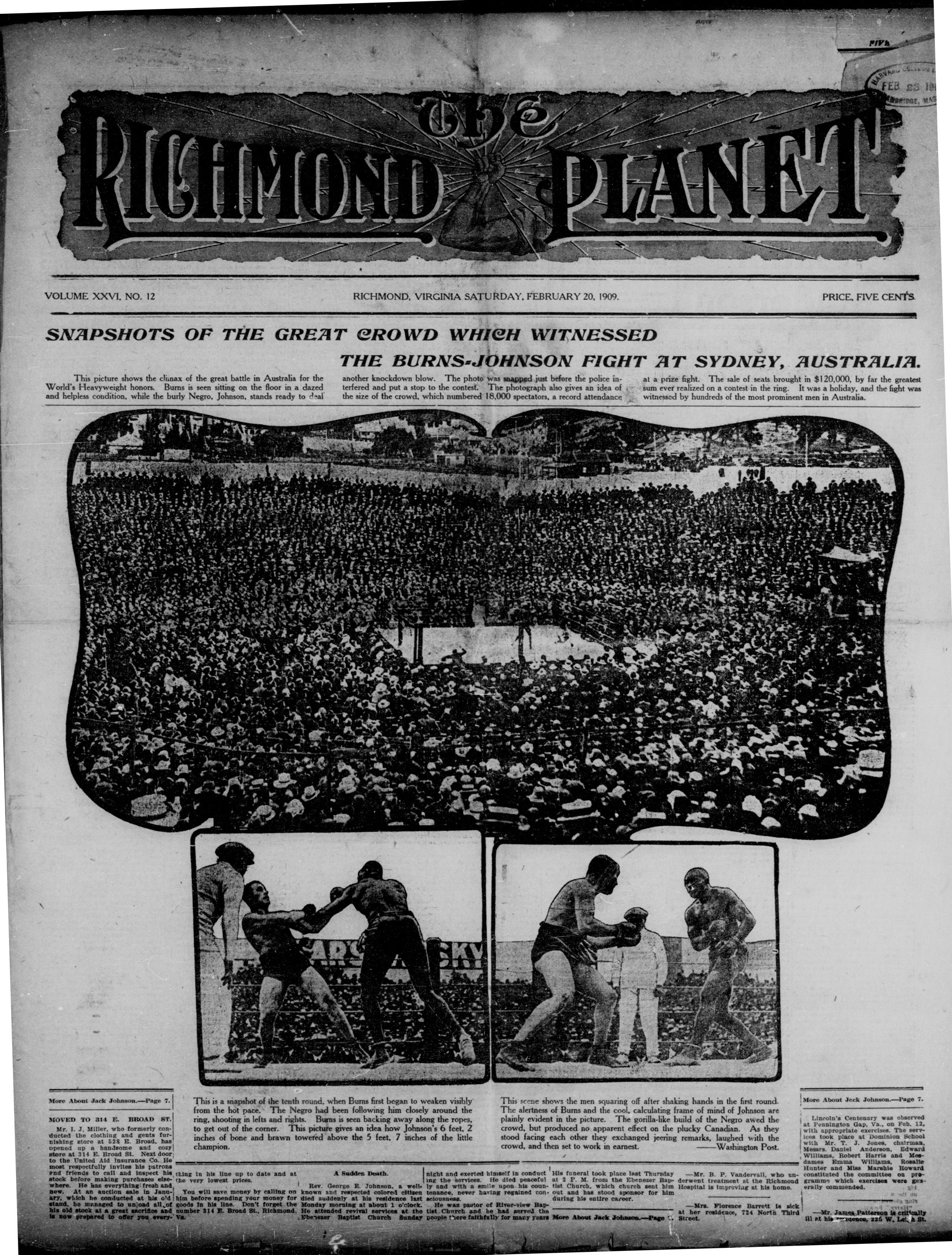
SNAPSHOTS OF THE GREAT @ROWD WHICH WITNESSED
SNAPSHOTS OF THE GREAT @ROWD WHICH WITNESSED
This picture shows the clinax of the great battle in Australia for the World's Heavyweight honors. Burns is seen sitting on the floor in a dazed and helpless condition, while the burly Negro, Johnson, stands ready to deal
VOLUME XXVI, NO. 12
This picture shows the clin
World's Heavyweight honors. Bu
and helpless condition, while the bu
More About Jack Johnson.—Page 7.
MOVED TO 314 E. BROAD ST.
Mr. I. J. Miller, who formerly conducted the clothing and gents furnishing store at $28 E. Broad, has opened up a handsome and cozy store at 314 E. Broad St. Next door to the United Aid Insurance Co. He most respectfully invites his patrons and friends to call and inspect his stock before making purchases elsewhere. He has everything fresh and new. At an auction sale in January, which he conducted at his old stand, he managed to unload all of his old stock at a great sacrifice and is now prepared to offer you every
SKY
This is a snapshot of the tenth round, when Burns first began to weaken visibly from the hot pace. The Negro had been following him closely around the ring, shooting in lefts and rights. Burns is seen backing away along the ropes, to get out of the corner. This picture gives an idea how Johnson's 6 feet, 2 inches of bone and brawn towered above the 5 feet, 7 inches of the little champion.
thing in his line up to date and at the very lowest prices.
You will save money by calling on him before spending your money for goods in his line. Don't forget the number 314 E. Broad St., Richmond, Va.
THE BURNS-JOHNSON FIGHT AT SYDNEY, AUSTRALIA.
another knockdown blow. The photo was snapped just before the police interfered and put a stop to the contest. The photograph also gives an idea of the size of the crowd, which numbered 18,000 spectators, a record attendance
Rev. George E. Johnson, a well-known and respected colored citizen died suddenly at his residence last Monday morning at about 1 o'clock. He attended revival services at the Ehebezer Baptist Church Sunday
THE BOXING FIGHT
This scene shows the men squaring off after shaking hands in the first round. The alertness of Burns and the cool, calculating frame of mind of Johnson are plainly evident in the picture. The gorilla-like build of the Negro awed the crowd, but produced no apparent effect on the plucky Canadian. As they stood facing each other they exchanged jeering remarks, laughed with the crowd, and then set to work in earnest. Washington Post.
night and exerted himself in conducting the services. He died peacefully and with a smile upon his countenance, never having regained consciousness. He was pastor of River-view Baptist Church and he had served the people there faithfully for many years
at a prize fight. The sale of seats brought in $120,000, by far the greatest sum ever realized on a contest in the ring. It was a holiday, and the fight was witnessed by hundreds of the most prominent men in Australia.
His funeral took place last Thursday at 2 F. M. from the Ebenezer Baptist Church, which church sent him out and has stood sponsor for him during his entire career.
—Mr. B. P. Vandervall, who underwent treatment at the Richmond Hospital is improving at his home.
—Mrs. Florence Barrett is sick at her residence, 724 North Third Street.
PRICE, FIVE CENTS
in $120,000, by far the greatest it was a holiday, and the fight was men in Australia.
More About Jack Johnson.—Page 7.
Lincoln's Centenary was observed at Pennington Gap, Va., on Feb. 12, with appropriate exercises. The services took place at Dominion School with Mr. T. J. Jones, chairman, Messrs. Daniel Anderson, Edward Williams, Robert Harris and Mendames Emma Williams, Rosalie Hunter and Miss Marble Howard constituted the committee on programmes which exercises were generally commended.
—Mr. James, Fatterson is critically ill at his residence, 226 W. L. h. St.
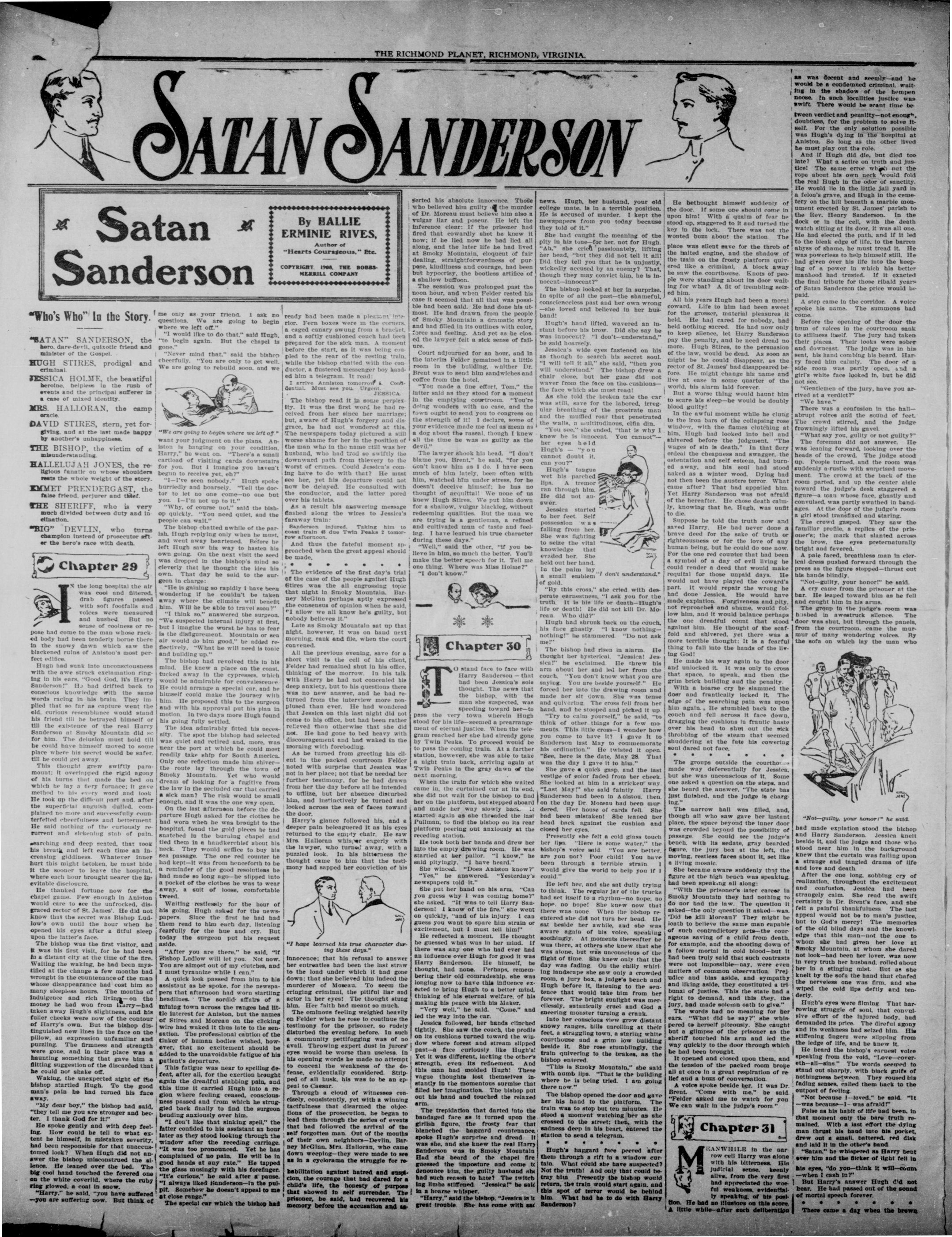
Satan Sanderson
Who's Who" In the Story
"SATAN" SANDERSON, the hero, dare-devil, quixotic friend and minister of the Gospel.
HUGH STIRES, prodigal and criminal.
JESSICA HOLME, the beautiful heroine, helpless in the rush of events and the principal sufferer in a case of mixed identity.
MRS. HALLORAN, the camp oracle.
DAVID STIRES, stern, yet forgiving, and at the last made happy by another's unhappiness.
THE BISHOP, the victim of a misunderstanding.
HALLELUJAH JONES, the religious fanatic on whose shoulders rests the whole weight of the story.
EMMET PRENDERGAST, the false friend, perjurer and thief.
THE SHERIFF, who is very much divided between duty and inelination.
"BIG" DEVLIN, who turns champion instead of prosecutor after the hero's race with death.
Chapter 29
In the long hospital the air was cool and filtered, drab figures passed with soft footfalls and voices were measured and pushed. But no sense of coolness or re
The long hospital the air was cool and filtered, drab figures passed with soft footfalls and voices were measured and nushed. But no sense of coolness or repose had come to the man whose racked body had been tenderly borne there in the snowy dawn which saw the blackened ruins of Aniston's most perfect edifice.
Hugh had sunk into unconsciousness with the awe strew exclamation ringing in his ears, "Good God, it's Harry Sanderson!" He had drifted back to conscious knowledge with the same words racing in his brain. They implied that so far as capture went the old, curious resemblance would stand his friend till he betrayed himself or till the existence of the real Harry Sanderson at Smoky Mountain did so for him. The delusion must hold till he could have himself moved to some place where his secret would be safer, till he could get away.
This thought grew swiftly paranount; it overlapped the rigid agony of his burns that made the bed on which he lay a fiery furnace; it gave method to his every word and took He took up the difficult part and, after the superficial anguish dulled, complained no more and successfully counterfetted cheerfulness and betterment. He said nothing of the curiously recurrent and sickening stab of pain.
searching and deep seated, that took his breath and left each time an increasing giddiness. Whatever inner hurt this might betoken, he must hide it the sooner to leave the hospital, where each hour brought nearer the inevitable disclosure.
He thanked fortune now for the chapel game. Few enough in Aniston would care to see the unfrocked, disgraced rector of St. James. He did not know that the secret was Bishop Ludlow's own until the hour when he opened his eyes after a fitful sleep upon the latter's face.
The bishop was the first visitor, and it was his first visit, for he had been in a distant city at the time of the fire. Waiting the waking, he had been mystified at the change a few months had wrought in the countenance of the man whose disappearance had cost him so many sleepless hours. The months of indulgence and rich living on the money he had won from Harry—had taken away Hugh's slightness, and his fuller cheeks were now of the contour of Harry's own. But the bishop distinguished new lines in the face on the pillow, an expression unfamiliar and puzzling. The firmness and strength were gone, and in their place was a haunting something that gave him a fitting suggestion of the discarded that he could not shake off. Waking, the unexpected sight of the bishop startled Hugh. To the good man's pain he had turned his face away.
"My dear boy," the bishop had said, "they tell me you are stronger and better. I thank God for it!"
He spoke gently and with deep feeling. How could he tell to what extent he himself, in mistaken severity, had been responsible for that unaccustomed look? When Hugh did not answer the bishop misconstrued the silence. He leaned over the bed. The big cool hand touched the fevered one on the white coverlid, where the ruby ring glowed, a coal in snow.
"Harry," he said, "you have suffered—you are suffering now. But think of
me only as your friend. I ask no questions. We are going to begin where we left off."
"I would like to do that," said Hugh, "to begin again. But the chapel is gone."
"Never mind that," said the bishop cheerfully. "You are only to get well. We are going to rebuild soon, and we
"We are going to begin where we left off." want your judgment on the plans. Aniston is hanging on your condition, Harry," he went on. "There's a small cartload of visiting cards downstairs for you. But I imagine you haven't begun to receive yet, eh?"
"I've seen nobody." Hugh spoke hurriedly and hoarsely. "Tell the doctor to let no one come—no one but you. I—I'm not up to it."
"Why, of course not," said the bishop quickly. "You need quiet, and the people can wait."
The bishop chatted awhile of the parish. Hugh replied only when he must, and went away heartened. Before he left Hugh saw his way to hasten his own going. On the next visit the seed was dropped in the bishop's mind so cleverly that he thought the idea his own. That day he said to the surgeon in charge:
"He is gaining so rapidly I have been wondering if he couldn't be taken away where the climate will benefit him. Will he be able to travel soon?" "I think so." answered the surgeon. "We suspected internal injury at first, but I imagine the worst he has to fear is the disfigurement. Mountain or sea air would do him good," he added reflectively. "What he will need is tonic and building up."
The bishop had revolved this in his mind. He knew a place on the coast, tucked away in the cypresses, which would be admirable for convalescence. He could arrange a special car, and he himself could make the journey with him. He proposed this to the surgeon and with his approval put his plan in motion. In two days more Hugh found his going fully settled.
The idea admirably fitted his necessity. The spot the bishop had selected was quiet and retired and, more, was near the port at which he could most readily take ship for South America. Only one reflection made him shiver—the route lay through the town of Smoky Mountain. Yet who would dream of looking for a fugitive from the law in the secluded car that carried a sick man? The risk would be small enough, and it was the one way open. On the last afternoon before the departure Hugh asked for the clothes he had worn when he was brought to the hospital, found the gold pieces he had snatched in the burning chapel and tied them in a handkerchief about his neck. They would suffice to buy his sea passage. The one red counter he had kept—it was from henceforth to be a measure of the good resolutions he had made so long ago—he slipped into a pocket of the clothes he was to wear away, a suit of loose, comfortable tweed.
Waiting restlessly for the hour of his going, Hugh asked for the newspapers. Since the first he had had them read to him each day, listening fearfully for the hue and cry. But today the surgeon put his request aside.
"After you are there," he said, "if Bishop Ludlow will let you. Not now. You are almost out of my clutches, and I must tyrannize while I can."
A quick look passed from him to his assistant as he spoke, for the newspapers that afternoon had worn startling headlines. The sordid affairs of a mining town across the ranges had little interest for Aniston, but the names of Stires and Moreau on the clicking wire had waked it thus late to the sensation. The professional caution of the tinker of human bodies wished, however, that no excitement should be added to the unavoidable fatigue of his patient's departure.
This fatigue was near to spelling defeat, after all, for the exertion brought again the dreadful stabbing pain, and this time it carried Hugh into a region where feeling ceased, consciousness passed and from which he struggled back finally to find the surgeon bending anxiously over him.
"I don't like that sinking spell," the latter confided to his assistant an hour later as they stood looking through the window after the receding carriage.
"It was too pronounced. Yet he has complained of no pain. He will be in good hands at any rate." He tapped the glass musingly with his forefinger.
"It's curious," he said after a pause.
"I always liked Sanderson—in the pulp. Somehow he不 appeal to me at close range."
The special car which the bishop had
THE RICHMOND PLANET, RICHMOND, VIRGINIA
Author of
"Hearts Courageous," Etc.
COPYRIGHT. 1908. THE BOBS-
MERRILL COMPANY
ready had been made a pleasant interior. Fern boxes were in the corners, a caged canary swung from a bracket, and a softly cushioned couch had been prepared for the sick man. A moment before the start, as it was being coupled to the rear of the resting train, while the bishop chatted with the conductor, a flustered messenger boy landed him a telegram. It read: I arrive. Apollon tomorrow. Cont
I arrive Anniston tomorrow & Confidential. Must see you. Urgent.
JESSICA
The bishop read it in some perplexity. It was the first word he had received from her since her marriage; but, aware of Hugh's forgery and disgrace, he had not wondered at this. The newspapers today pictured a still worse shame for her in the position of the man who in the name still was her husband, who had trod so swiftly the downward path from thievery to the worst of crimes. Could Jessica's coming have to do with that? He must see her, yet his departure could not now be delayed. He consulted with the conductor, and the latter pored over his tablets.
As a result his answering message flashed along the wires to Jessica's faraway train:
Sanderson injured. Taking him to coast train 45 due Twin Peaks 2 tomorrow afternoon.
And thus the fateful moment approached when the great appeal should be made.
The evidence of the first day's trial of the case of the people against Hugh Stires was the all engrossing topic that night in Smoky Mountain. Barney McGinn perhaps aptly expressed the consensus of opinion when he said, "I allow we all know he's guilty, but nobody believes it."
Late as Smoky Mountain sat up that night, however, it was on hand next morning, rank and file, when the court convened.
All the previous evening, save for a short visit to the cell of his client, Felder had remained shut in his office, thinking of the morrow. In his talk with Harry he had not concealed his deep anxiety, but to his questions there was no new answer, and he had returned from the interview more nonplused than ever. He had wondered that Jessica on this last night did not come to his office, but had been rather relieved than otherwise that she did not. He had gone to bed heavy with discouragement and had waked in the morning with foreboding.
As he turned from greeting his client in the packed courtroom Felder noted with surprise that Jessica was not in her place; not that he needed her further testimony, for he had drawn from her the day before all he intended to utilize, but her absence disturbed him, and instinctively he turned and looked across the sea of faces toward the door.
Harry's glance followed his, and a deeper pain beleguered it as his eyes returned to the empty chair. He saw Mrs. Halloran whisper eagerly with the lawyer, who turned away, with a puzzled look. In his bitterness the thought came to him that the testimony had sapped her conviction of his
"I hope learned his true character during these days."
innocence; that his refusal to answer her entreaties had been the last straw to the load under which it had gone down; that she believed him indeed the murderer of Moneau. To seem the cringing criminal, the pitiful liar and actor in her eyes! The thought stung him. Her "faith had meant so much. The ominous feeling weighed heavily on Felder when he rose to continue the testimony for the prisoner, so rudely disturbed the evening before. In such a community pettifogging was of no avail. Throwing expert dust in jurors' eyes would be worse than useless. In his opening words he made no attempt to conceal the weakness of the defense, evidently considered. Stripped of all husk, his was to be an appeal to Caesar.
Through a cloud of witnesses concisely, consistently, yet with a winning tactfulness that disarmed the objections of the prosecution, he began to lead them through the series of events that had followed the arrival of the self forgotten man. Out of the mouths of their own neighbors—Devilin, Barney McGinn, Mrs. Halloran, who came down weeping—they were made to see as in a cyclorama the struggle for rehabilitation against hatred and suspicion, the courage that had dared for a child's life, the honesty of purpose that showed in self surrender. The prisoner, he said, had recovered his memory before the accusation and as-
serted his absolute innocence. Those who believed him guilty the murder of Dr. Moreau must believe him also a vulgar liar and poseur. He left the inference clear: If the prisoner had fired that cowardly shot he knew it now; if he lied now he had lied all along, and the later life he had lived at Smoky Mountain, eloquent of fair dealing, straightforwardness of purpose, kindliness and courage, had been but hypocrisy, the bootless artifice of a shallow buffoon.
The session was prolonged past the noon hour, and when Felder rested his case it seemed that all that was possible had been said. He had done his utmost. He had drawn from the people of Smoky Mountain a dramatic story and had filled in its outlines with color, force and feeling. And yet as he closed the lawyer felt a sick sense of failure.
Court adjourned for an hour, and in the interim Felder remained in a little room in the building, whither Dr. Brent was to send him sandwiches and coffee from the hotel.
"You made a fine effort, Tom," the latter said as they stood for a moment in the emptying courtroom. "You're doing wonders with no case, and the town ought to send you to congress on the strength of it! I declare, some of your evidence made me feel as mean as a dog about the rascal, though I knew all the time he was as guilty as the devil."
The lawyer shook his head. "I don't blame you, Brent," he said, for "you don't know him as I do. I have seen much of him lately, been often with him, watched him under stress, for he doesn't deceive himself; he has no thought of acquittal! We none of us knew Hugh Stires. We put him down for a shallow, vulgar blackleg, without redeeming qualities. But the man we are trying is a gentleman, a refined and cultivated man of taste and feeling. I have learned his true character during these days." "Well," said the other, "if you believe in him, so much the better. You'll make the better speech for it. Tell me one thing. Where was Miss Holme?" "I don't know."
Chapter 30
O stand face to face with Harry Sanderson - that had been Jessica's sole thought. The news that the bishop, with the man she suspected, was speeding toward her-
pass the very town wherein Hugh stood for his life—seemed a prearrangement of eternal justice. When the telegram reached her she had already gone by Twin Peaks. To proceed would be to pass the coming train. At a farther station, however, she was able to take a night train back, arriving again at Twin Peaks in the gray dawn of the next morning.
When the train for which she waited came in, the curtained car at its end, she did not wait for the bishop to find her on the platform, but stepped aboard and made her way slowly back. It started again as she threaded the last Pullman, to find the bishop on its rear platform peering out anxiously at the receding station.
He took both her hands and drew her into the empty drawing room. He was started at her pallor. "I know," he said plightly, "I have heard."
She winced. "Does Aniston know?" "Yes," he answered. "Yesterday's newsmen told it."
She put her hand on his arm. "Can you guess why I was coming home?" she asked. "It was to tell Harry Sanderson. I know of the fire." she went on quickly, "and of his injury. I can guess you want to spare him strain or excitement, but I must tell him!" He reflected a moment. He thought he guessed what was in her mind. If there was any one who had ever had an influence over Hugh for good it was Harry Sanderson. He himself, he thought, had none. Perhaps, remembering their old comradeship, she was longing now to have this influence exerted to bring Hugh to a better mind, thinking of his eternal welfare, of his making his peace with his Maker. "Very well," he said. "Come," and led the way into the car.
Jessica followed, her hands clinched tightly. She saw the couch, the profile on its cushions turned toward the window where forest and stream slipped past—a face curiously like Hugh's! Yet it was different, lacking the other's strength, even its refinement. And this man had molded Hugh! These vague thoughts lost themselves instantly in the momentous surmise that filled her imagination. The bishop put out his hand and touched the relaxed arm.
The trepidation that darted into the bandaged face as it turned upon the gritish figure, the frosty fear that blanched the haggard countenance, spoke Hugh's surprise and dread. It was she, and she knew the real Harry Sanderson was in Smoky Mountain Had she heard of the chapel fire guessed the imposture and come to denounce him, the guilty husband she had such reason to hate? The twitching limbs stiffened "Jessica!" he said in a hoarse whisper.
"Harry," said the bishop. "Jesus is it great trouble. She has come with sat
news. Hugh, her husband, your old college mate, is in a terrible position. He is accused of murder. I kept the newspapers from you today because they told of it."
She had caught the meaning of the pity in his tone—for her, not for Hugh. "Ah," she cried passionately, lifting her head, "but they did not tell it all! Did they tell you that he is unjustly, wickedly accused by an enemy? That, though they may convict him, he is innocent—innocent?"
The bishop looked at her in surprise. In spite of all the past—the shameful, conscienceless past and her own wrong—she loved and believed in her husband!
Hugh's hand lifted, wavered an instant before his brow. Did she say he was innocent? "I don't—understand," he said hoarsely.
Jessica's wide eyes fastened on his as though to search his secret soul. "I will tell it all," she said, "then you will understand." The bishop drew a chair close, but her gaze did not waver from the face on the cushions—the face which she must read!
As she told the broken tale the car was still, save for the labored, irregular breathing of the prostrate man and the muffled roar that penetrated the walls, a multitudinous, elfin din. "You see," she ended, "that is why I know he is innocent. You cannot!"
"You see," she c
know he is innocent
her eyes held
Hugh's — "you
cannot doubt it.
can you?"
MARIE JANE
Hugh's tongue wet his parched lips. A tremor ran through him. He did not answer.
Jessica started to her feet. Self possession was falling from her. She was fighting to seize the vital knowledge that evaded her. She held out her hand. In the palm lay a small emblem of gold.
"By this cross," she cried with desperate earnestness, "I ask you for the truth. It is his life or death—Hugh's life or death! He did not kill Dr. Moreau. Who did?"
Hugh had shrunk back on the couch, his face ghastly. "I know nothing—nothing!" he stammered. "Do not ask me!"
The bishop had risen in alarm. He thought her hysterical. "Jessica! Jessica!" he exclaimed. He threw his arm about her and led her from the couch. "You don't know what you are saying. You are beside yourself." He forced her into the drawing room and made her sit down. She was tense and quivering. The cross fell from her hand, and he stooped and picked it up. "Try to calm yourself," he said, "to think of other things for a few moments. This little cross—I wonder how you come to have it? I gave it to Sanderson last May to commemorate his ordination." He twisted it open. "See, here is the date, May 28. That was the day I gave it to him."
She gave quick gasp, and the last vestige of color faded from her cheek. She looked at him in a stricker way. "Last May?" she said falsely. Harry Sanderson had been in Aulston, then on the day Dr. Moseau had been murdered. Her house of cards fell. She had been mistaken! She leaned her head back against the cushion and closed her eyes.
Presently she felt a cold glass touch her lips. "Here is some water," the bishop's voice said. "You are better, are you not? Poor child! You have been through a terrible strain. I would give the world to help you if I could."
He left her, and she sat dully trying to think. The regular jar of the trucks had set itself to a rhythm—no hope, no hope, no hope! She knew now that there was none. When the bishop reentered she did not turn her head. He sat beside her awhile, and she was aware again of his voice, speaking soothingly. At moments thereafter he was there, at others she knew that she was alone, but was unconscious of the flight of time. She knew only that the day was fading. On the chilly whirling landscape she saw only a crowded room, a jury box, a judge's bench and Hugh before it, listening to the sentence that would take him from her forever. The bright sunlight was mercilessly, satanically cruel and God a sneering monster turning a crank.
Into her conscious view grew distant snowy ranges, hills unrolling at their feet, a straagging town, a staring white courthouse and a grim low building beside it. She rose stumblingly, the train quirky to the brakes, as the bishop entered.
"This is Smoky Mountain," she said with numb lips. "That is the building where he is being tried. I am going there now."
The bishop opened the door and gave her his hand to the platform. The train was to stop but ten minutes. He stood a moment watching her as she crossed to the street; then, with the sadness deep in his heart, entered the station to send a telegram.
Hugh's haggard face peered after them through a rift in a window curtain. What could she have suspected? Not the truth! And only that could be tray him. Presently the bishop would return, the train would start again, and this spot of terror would be behind him. What had he to do with Harry Sanderson?
```markdown
```
He bethought himself suddenly of the door. If some one should come in upon him! With a qualm of fear he stood up, staggered to it and turned the key in the lock. There was not the wonted buzz about the station. The place was silent save for the throb of the halted engine, and the shadow of the train on the frosty platform quivered like a criminal. A block away he saw the courthouse. Knots of people were standing about its door waiting for what? A fit of trembling seized him.
All his years Hugh had been a moral coward. Life to him had been sweet for the grosser, material pleasures it held. He had cared for nobody, had held nothing sacred. He had now only to keep silence, let Harry Sanderson pay the penalty, and he need dread no more. Hugh Stires, to the persuasion of the law, would be dead. As soon as might be he could disappear, as the rector of St. James' had disappeared before. He might change his name and live at ease in some quarter of the world, his alarm laid forever. But a worse thing would haunt him to scare his sleep—he would be doubly blood guilty!
In the awful moment while he clung to the iron bars of the collapsing rose window, with the flames clutching at him, Hugh had looked into hell and shivered before the judgment. "The wages of sin is death." In that fiery ordeal the cheapness and swagger, the ostentation and self esteem, had burned away, and his soul had stood naked as a winter wood. Dying had not then been the austere terror. What came after? That had appalled him. Yet Harry Sanderson was not afraid of the hereafter. He chose death calmly, knowing that he, Hugh, was unfit to die.
Suppose he told the truth now and saved Harry. He had never done a brave deed for the sake of truth or righteousness or for the love of any human being, but he could do one now. For the one red counter that had been a symbol of a day of evil living he could render a deed that would make requital for those unpaid days. He would not have played the coward's part. It would repair the wrong he had done Jessica. He would have made explation. Forgiveness and pity, not reproaches and shame, would follow him, and it would balance perhaps the one dreadful count that stood against him. He thought of the scaffold and shivered, yet there was a more terrible thought: It is a fearful thing to fall into the hands of the living God!
He made his way again to the door and unlocked it. It was only to cross that space, to speak, and then the grim brick building and the penalty.
With a hoarse cry he slammed the door and frantically locked it. The edge of the searching pain was upon him again. He stumbled back to the couch and fell across it face down, dragging the cushions in frantastic haste over his head to shut out the sick throbbing of the steam that seemed shuddering at the fate his cowering soul dared not face.
The groups outside the courthouse made way deferentially for Jession, but she was unconscious of it. Some one asked a question on the steps, and she heard the answer. "The state has just finished, and the judge is charging."
The narrow hall was filled, and, though all who saw gave her instant place, the space beyond the inner door was crowded beyond the possibility of passage. She could see the judge's bench, with its sedate, gray bearded figure, the jury box at the left, the moving, restless faces about it, set like a living mosaic. She became aware suddenly that the figure at the high bench was speaking, had been speaking all along:
"With the prisoner's inter career in Smoky Mountain they had nothing to do nor had the law. The question it asked—the only question it asked—was. 'Did he kill Moreau?' They might be loath to believe the same man capable of such contradictory acts—the courageous saving of a child from death, for example, and the shooting down of a fellow mortal in cold blood—but it had been truly said that such contrasts were not impossible—nay, were even matters of common observation. Prejudice and blas aside, and sympathy and liking aside, constituted a tribunal of justice. This the state had a right to demand, and this they, the jury, had made solemn oath to give."
The words had no meaning for her ears. "What did he say?" she whispered to herself piteously. She caught but a glimpse of the prisoner as the sheriff touched his arm and led the way quickly to the door through which he had been brought.
It opened and closed upon them, and the tension of the packed room bridge all at once in a great respiration of relief and a buzz of conversation.
A voice spoke beside her. It was Dr Brent. "Come with me," he said. "Felder asked me to watch for you. We can wait in the judge's room."
Chapter 31
MEANWHILE in the narrow cell Harry was alone with his bitterness. His judicial sense, keenly alive, from the very first had appreciated the woofful weakness, evidential.
MEANWHILE in the narrow cell Harry was alone with his bitterness. His judicial sense, keenly alive, from the very first had appreciated the woeful weakness, evidently speaking, of his position. He had no illusions on this score. A little while-after such deliberation
as was decent and seemly—and he would be a condemned criminal, waiting in the shadow of the hempen noose. In such localities justice was swift. There would be scant time beween verdict and penalty—not enough doubtless, for the problem to solve itself. For the only solution possible was Hugh's dying in the hospital at Aniston. So long as the other lived he must play out the role.
And if Hugh did die, but died too late? What a satire on truth and justice! The same error which put the rope about his own neck would fold the real Hugh in the odor of sanctity. He would lie in the little jail yard in a felon's grave, and Hugh in the cemetery on the hill beneath a marble monument erected by St. James' parish to the Rev. Henry Sanderson. In the dock or in the cell, with the death watch sitting at its door, it was all one. He had elected the path, and if it led to the bleak edge of life, to the barren abyss of shame, he must tread it. He was powerless to help himself still. He had given over his life into the keeping of a power in which his better manhood had trusted. If it exacted the final tribute for those rihbald years of Satan Sanderson the price would be paid.
A step came in the corridor. A voice spoke his name. The summons had come.
Before the opening of the door the hum of voices in the courtroom sank to stillness itself. The jury had taken their places. Their looks were sober and downcast. The judge was in his seat, his hand combing his beard. Harry faced him calmly. The door of a side room was partly open, and a girl's white face looked in, but he did not see.
"Gentlemen of the jury, have you arrived at a verdict?" "We have."
There was a confusion in the hall—abrupt voices and the sound of feet. The crowd stirred, and the judge frowningly lifted his gavel.
"What say you, guilty or not guilty?"
The foreman did not answer. He was leaning forward, looking over the heads of the crowd. The judge stood up. People turned, and the room was suddenly a rustle with surprised movement. The crowd at the back of the room parted, and up the center alse toward the judge's desk staggered a figure—a man whose face, ghastly and convulsed, was partly swathed in bandages. At the door of the judge's room a girl stood transfixed and staring.
The crowd gasped. They saw the familiar profile, a replica of the prisoner's; the mark that slanted across the brow, the eyes preternaturally bright and fevered.
A pale faced, breathless man in clerical dress pushed forward through the press as the figure stopped—thrust out his hands blindly.
"Not—gulty, your honor!" he said.
A cry came from the prisoner at the bar. He leaped toward him as he fell and caught him in his arms.
The group in the judge's room was hushed in awestruck silence. The door was shut, but through the panels, from the courtroom, came the murmur of many wondering voices. By the sofa on which lay the man who
"Not—guilty, your honor!" he said.
had made expiation stood the bishop and Harry Sanderson. Jessica knelt beside it, and the judge and those who stood near him in the background knew that the curtain was failing upon a strange and tangled drama of life and love and death.
After the one long, sobbing cry of realization, throughout the excitement and confusion, Jessica had been strangely calm. She read the swift certainty in Dr. Brent's face, and she felt a painful thankfulness. The last appeal would not be to man's justice, but to God's mercy! The memories of the old blind days and the knowledge that this man—not the one to whom she had given her love at Smoky Mountain, at whom she dared not look—had been her lover, was now in very truth her husband, rolled about her in a stinging mist. But as she knelt by the shetland the hand that clenched the nerveless one was firm, and she wiped the cold lips defyly and tenderly.
Hugh's eyes were filming. That harrowing struggle of soul, that convulsive effort of the injured body, had demanded its price. The direful agony and its weakness had seized him. His stiffening fingers were slipping from the ledge of life, and he knew it.
He heard the bishop's earnest voice speaking from the void, "Love—cover-th—all—sins." The words seemed to stand sharply, with black guits of nothingness between. They roused his fading senses, called them back to the outpost of feeling.
"Not because I—loved," he said. "It—was because I—was afraid!"
False as his habit of life had been, in that moment only the bare truth remained. With a last effort the dying man thrust his hand into his pocket, drew out a small, battered, red disk and laid it in the other's hand.
"Satan," he whispered as Harry bent over him and the flicker of light fell in
his eyes, "do you--think it will--count
--when I cash in?" But Harry's answer Hugh did not
hear. He had passed out of the sound
of mortal speech forever. There came a day when the brown
HE PLANET
ravines of Smoky Mountain laughed in genial sunshine, when the tangled thickets and the foliaged reaches, painted with the cardinal and bishop's purple of late autumn, flushed and stirred to the touch of their golden lover and the silver water gushing through the flumes sang to a quicker melody. There was no wind. Everywhere save for the breathing life of the forest was dreamy beauty and waiting peace.
In the soft stillness Harry stood on the doorstep of the hillside cabin for the last time. Below him in the gulch
He dropped on his knees and took her hands and kissed them.
the light glanced and sparkled from the running flume, and beyond glimmered the long street of the town where the dead past of Satan Sanderson had been buried forever and the old remorseful pain of conscience had found its surcense. In the far distance, a tender haze softening their outline, stood the violet silhouette of the ending ranges, and far beyond them lay Aniston, where waited his newer life, his newer, better work and the hope that was the April of his dreams.
Since that tragic day in the courtroom he had seen Jessica once only—in the hour when the bishop's solemn "dust to dust" had been spoken above the man who had been her husband. One thought had comforted him—the town of Smoky Mountain had never known, need never know, the secret of her wifehood. And Anlston was far away. About the coming of Hurch injured and dying to his rescue would be thrown a glamour of knight errantry that would bespeak charity of judgment. When Jessica went back to the white house in the aspens she would meet only tenderness and sympathy. And that was well.
He shut the door of his cabin and, whistling to his dog, climbed the steep path where the wrinkled creeper flung its splash of scarlet and along the trail to the Knob, under the needled song of the redwoods. There in the dappled shade stood Jessica's rock statue, and now it looked upon two mounds. The prodigal had returned at last, father and son rested side by side, and that, too, was well.
He went slowly through the brown hollows to the winding mountain road, crossed it and entered the denser forest. He wanted to see once more the dear spot where he and Jessica had met—that deep, sweet day before the rude awakening. He walked on in a reverie; his thoughts were very far sway.
He stopped suddenly. There before him was the little knoll where she had stood waiting on the threshold of his palace of enchantment that one rosette morning. And she was there today—not standing with parted lips and eager eyes under the twittering trees, but lying face down on the moss, her red bronze hair shaming the gold of the fallen leaves.
There was a gesture in the outstretched arms that caught at his heart. He stepped forward, and at the sound she looked up, startled.
He saw the creeping color that mounted to her brow, the proud yet passionate hunger of her eyes. He dropped on his knees and took her hands and kissed them.
"My dear love that is!" he whispered.
"My dearer wife that is to be!"
HUSBAND WANTED
Preacher, Teacher, or Doctor, or some well educated christian gentleman who is no flirt. Send photograph.
MISS LILLIE M. THOMAS,
469 Shelby Street.
Memphis, Tenn.
Mr. T. J. Blackwell, left Friday for Raleigh, N. C., to visit his mother other relatives and friends. He will remain in Raleigh until the 3d of March when accompanied by his mother he will go to Washington, D. C. From there he will return home with his mother who will hereafter reside with him in this city.
WOMEN STAB EACH OTHER
Two negro women, each bearing the name of Mary Jones, got into a fierce quarrel last night on Bollingbrook Street, when one of the Mary's drew a knife and stabbed the other Mary, giving her an ugly cut on the back of the neck. Both women were taken in charge by the police.
HALLELIUJAH OF THE EMANCI-
PATION PROCLAMATION.
Our eyes have seen the glory of the
kindly grace of God.
Through the Abraham He send
us now we tread dear Freed-
dom's sod.
From beneath the heel of Bondage
and its centuries' bruising rod
Our race is marching on
CHORUS
Glory, glory, hallelujah! Glory, glory,
hallelujah! Glory, glory, hallelujah!
Our race is marching on.
We had prayed unto the heavens and
the Promise centered there.
And our groaning hearts sent
echoes through the mid-night
of despair.
But the glory of this moment heals our spirits every where.
And our souls are marching on.
Glory, etc.
From the center of contention on the crimson battle field.
From that crucible demanding that all wrong to right must yield.
There is raised to us the currain of a morning long concealed.
And our race is marching on, Glory, etc.
While we looked unto the heavens for its siglas of saving power, Watching lofty constellations for a merciful endower.
From a kindred lowly cabin came the saviour of the hour.
And now we're marching on, Glory, etc.
—LUCIAN B. WATKINS
TRAGEDY IN PETERSBURG
Colored Man Killed—Sad End of
Controversy, Claim of Self De-
fense
Petersburg, Va. . . February 7. — Joseph Jones, vn., an employee of the Virginia Passenger and Power Company, met his death at the hands of William Watkins, colored, between 12 and 1 o'clock last Sunday morning, in front of the former's home, on Ransom Street, in the extreme southern portion of the city. Watkins, who surrendered himself at the station-house this morning, made a voluntary statement about the affair to the Chief of Police, which clearly places his act as one of self-defense. On the other side, however, it is said that he may have been the aggressor in the trouble between himself and Jones. But it is believed that Katy Jones, the daughter of the dead man, was responsible for the trouble.
Watkins Tells It.
Watkins says that about 11:45 o'clock last night, with three companions, he was walking out Harrison Street, when they passed Katy Jones, her sister Alice and another woman, who were going in the same direction. When they got near the corner of Harrison and Early Streets, Katy Jones grabbed him, and he told her to let him loose. Katy said: "I am going to kill you!" She grabbed him again when they turned into Ransom Street and pulled a pailing from a fence with which to strike Watkins. The latter says he took the pailing from her and threw it away, when she began to curse and abuse him. Her sister Alice and her brother James tried to quiet her, but she caused so much noise that neighbors told them to bush up and go away.
Could not Carry Her in House.
Her brother tried to carry her into her father's house, when her father Joe Jones, came out and asked Watkins: "Why in ____ didn't you bring her home?" To which Watkins replied: "I couldn't do any more with her than you could, and you couldn't do anything with her." Katy told her father to go away: that she could settle it. She shewed her father aside, but the latter cursed Watkins and said: "I'm going to kill you anyhow!" Watkins says he then commenced to back away toward the middle of the street, with Joe Jones following and his son Jim standing near with a brick in his hand. Watkins said he stumbled, and Joe Jones grabbed and fell on him. While Jones was choking him Watkins says he cut him. When he got away from Jones he went to the house of Detective Heelan for protection and to surrender himself. Mr. Heelan was not at home, and he went with Horace Thompson to the station-house and there surrendered himself.
Only a Pocket Knife
The instrument with which Watkins cut Joe Jones was an ordinary size pocket-knife, and the wound proved fatal in twenty-five minutes. The knife blade sank deep through Jones's left throat, severing the large blood vessels and inflicting a ghastly wound. Jones bled to death before a physician could get to him. The cutting occurred at 12:25 and at 12:50 o'clock Jones was dead.
The coroner and a jury held an inquest over the body this evening at Wilkerson's undertaking rooms, and rendered a verdict of death caused by a stab wound inflicted by William Watkins.
COLORED CITIZENS PROTEST
Pittsburgh, Pa., Feb. 12—At the request of the colored pastors of the churches of the North Side, fully 300 citizens with their wives assembled last Sunday afternoon at three o'clock at the Metropolitan Baptist Church for the purpose of discussing the present strained relations between the whites and blacks of Pittsburg, as a result of the alleged assaults by negroes upon white women
The Purpose of the Meeting.
The purpose of the meeting was outlined by the pastor of the church Dr. James H. Holder, who took the position that the responsibility rests equally upon both races. He claim that the women of both races must be protected, and that it must be done by the men of both races. Following Dr. Holder, the Rev. C. M. Tanner, D. D., pastor of the Brown Chapel, A. M. E. Church pre-
THE RICHMOND PLANET; RICHMOND, VIRGINIA
sented the following resolutions for consideration and adoption:
All Represented.
We, the colored citizens of the city of Pittsburgh, Penna., representing the ministry and laymen of the churches of the North Side, in view of the deplorable condition of the civic and social affairs of the city, do hereby solemnly declare the following resolutions to be our unalterable and just position touching certain dangers which threaten our welfare, progress and development as a people in this community. There are 35,000 negroes in Greater Pittsburgh, representing about one ninth of the total population. In view of the crime wave which is sweeping over our community, and the wholesale arrests that are being made by the Department of Public Safety, together with the inflammatory newspaper publication touching these grave matters, we believe that we would be derelict in our duty and negligent as to our best interests were no expression given to our feeling and position in this crisis; or no effort made to join with all law abiding citizens in seeking the suppression of crime and the apprehension and punishment of the criminal element. We, therefore, declare our position to be as follows:
Lawlessness Deplored.
Rsolved: First. We deplore outrage and lawlessness of every kind by black criminals or white criminals, and stand with the law abiding citizens and the Department of Justice, in every just and legal method employed in the apprehension and punishment of the guilty wretches. Second. We, as law abiding citizens, never have and never will give aid, comfort or shield any criminal of our race; and as support and proof of this assertion, at no time has one of our respectable citizens been hailed before court for complicity in crime.
Third: We denounce the attempt to charge the whole race with the guilt and crime of the few. We do not deny that there are many bad and vicious negro men and women—a condition common to every race—yet we feel that it is the greatest injustice to us as a race, to make a wholesale arrest, charging all guilty, and placing the burden of proving ourselves innocent upon us, before first establishing our guilt. In our case, as in the case of all criminals, the presumption should be innocent until guilt be proven.
Those Wholesale Arrests.
Fourth: The wholesale arrests, where supposed guilty and innocent are alike apprehended and thrown promiscuously into the prison cells, and subsequently fined or sent to the Work-house, if found to be without a satisfactory explanation upon a hasty investigation, and unjust, illegal and calculated to do more harm than good. Spasmodic outbursts of police vigilance have neer v proven successful nor beneficial If half such vigilance were maintained throughout the year, there would never arise such an occasion as now holds our attention. Let the disorderly houses of both races be closed and kept closed.
Fifth: We ask for protection for all women whether they be white or colored. We ask that the strong arm of the law be extended to our wives, daughters and sisters, as well as to the wives, daughters and sisters of the white race. We claim the law adequate for all, and we ask that all women be equally sheltered under the law.
SUFFER GREATLY
Sixth: The colored people suffer greatly by reason of the unjust discrimination in many of the Labor Unions, and as a result, thousands of negroes are in forced idleness. As a result of such idleness, many negroes become less industrious than they otherwise would be. We, therefore, ask that as far as possible, the negro be given work to employ him, and by this process the worthless class can be easily determined.
Seventh: We urge that our parents keep their boys and girls under more close restraint, seeing to it that they are at home at a proper hour at night, and keeping constant vigilance over them night and day.
News-Paper Publications.
Eighth: Incalculable harm is done to law and order by inflammatory news-paper publications. The race riots of Springfield, IL., and Atlanta, Ga., are directly traceable to inflammatory news-paper reports. We beech the heads of the City Dallies to put forth some effort to prohibit the circulation of unsubstantiated reports which are calculated to infiltrate the public mind. Not: every reader thinks further into the reading matter than the print he absorbs and in all such instances glaring head lines work untold harm. We ask that the Dallies dispense with incendiary head lines, and join with no less zeal, but with more calmness and discretion, in the proper suppression of crime wherever found.
Sufficient Force There.
Ninth: We believe there is sufficient force in the city to apprehend every criminal, and we have equal confidence in the justice of the law of our city, if it be properly administered, that each and every transgressor shall find the way exceedingly hard.
When the best there is of both races interest themselves to the extent of an actual effort to suppress crime and punish the criminal, then will the season of peace and harmony among the races return.
BREAK IN WIRE; SAVES A NEGRO
Try to Lynch Negro for Attempted Assault.
Jacksonville, Fla., January 28.—A negro, answering the description of one who brutally attempted to criminally assault Mrs. Jesse Holland, near here last night, was captured by angry neighbors tonight and strung up to a tree, with a telephone wire. The wire broke and a second attempt was being made to hang the negro when a sheriff's posse scattered the crowd.
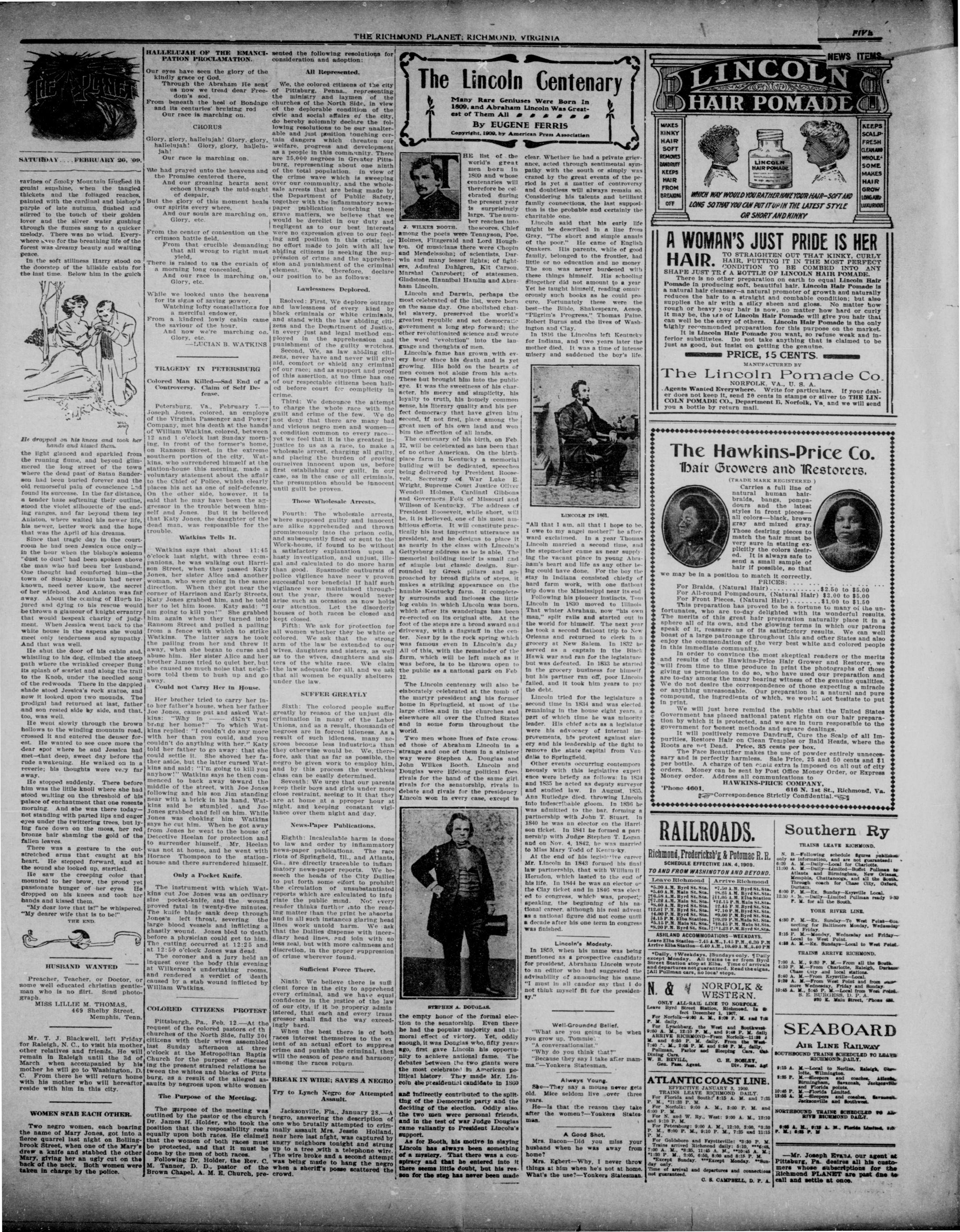
The Lincoln Centenary
Many Rare Geniuses Were Born In
1809, and Abraham Lincoln Was Great-
est of Them All
By EUGENE FERRIS
Copyright, 1909, by American Press Association
HE list of the world's great men born in 1809 and whose centenaries will therefore be celebrated during the present year is surprisingly large. The number reaches into
HE list of the world's great men born in 1809 and whose centenaries will therefore be celebrated during the present year is surprisingly large. The number reaches into the scores. Chief among the poets were Tennyson, Poe, Holmes, Fitzgerald and Lord Houghton. Of musicians there were Chopin and Mendelssohn; of scientists, Darwin and many lighter lights; of fighters, Admiral Dahlgren, Kit Carson, Marshal Canrobert; of statesmen, Gladstone, Hannibal Hamlin and Abra-bam Lincoln.
Lincoln and Darwin, perhaps the most celebrated of the list, were born on the same day. One abolished chatel slavery, preserved the world's greatest republic and set democratic government a long step forward; the other revolutionized science and wrote the word "evolution" into the language and thoughts of men.
Lincoln's fame has grown with every hour since his death and is yet growing. His hold on the hearts of men comes not alone from his acts. These but brought him into the public eye. It was the sweetness of his character, his mercy and simplicity, his loyalty to truth, his homely common sense, his literary quality and his perfect democracy that have given him second, if not first, place among the great men of his own land and won him the affection of all lands.
The centenary of his birth, on Feb. 12, will be celebrated as has been that of no other American. On the birthplace farm in Kentucky a memorial building will be dedicated, speeches being delivered by President Roosevelt, Secretary of War Luke E. Wright, Supreme Court Justice Oliver Wendell Holmes, Cardinal Gibbons and Governors Folk of Missouri and Willson of Kentucky. The address of President Roosevelt, while short, will be, it is believed, one of his most ambitious efforts. It will constitute practically his last important utterance as president, and he designs to place it as nearly in the class with Lincoln's Gettysburg address as he is able. The memorial building itself is small and of simple but classic design. Surrounded by Greek pillars and approached by broad flights of steps, it makes a striking appearance on the humble Kentucky farm. It completely surrounds and incloses the little leg cabin in which Lincoln was born, which after its wanderings has been re-erected on its original site. At the foot of the steps are a broad sward and driveway, with a flagstaff in the center. Near by is the rock spring which was famous even in Lincoln's day. All of this, with the remainder of the farm, which will be left much as it was before, is to be thrown open to the public as a national park on Feb. 12.
The Lincoln centenary will also be elaborately celebrated at the tomb of the martyr president and his former home in Springfield, at most of the large cities and in the churches and elsewhere all over the United States and in some form throughout the world.
Two men whose lifes of fate crossed those of Abraham Lincoln in a strange and one of them in a sinister way were Stephen A. Douglas and John Wilkes Booth. Lincoln and Douglas were lifelong political foes, rivals for the hand of the same girl, rivals for the senatorship, rivals in debate and rivals for the presidency Lincoln won in every case, except in
M. B.
STREHEN A. DOUGLAS.
the empty honor of the formal election to the senatorship. Even there he had the popular majority and the moral effect of victory. Yet, oddly enough, it was Douglas who, fifty years ago, first gave Lincoln his opportunity to achieve national fame. The debates between the two giants were the most celebrated in American political history. They made Mr. Lincoln the presidential candidate in 1800 and indirectly contributed to the splitting of the Democratic party and the deciding of the election. Oddly also, the two men were personal friends, and in the test of war Judge Douglas came valiantly to President Lincoln's support.
As for Booth, his motive in slaying Lincoln has always been something of a mystery. That there was a conspiracy and that he entered into it there seems little doubt, but his reason for the step has never been made
clear. Whether he had a private grievance, acted through sentimental sympathy with the south or simply was crazed by the great events of the period is yet a matter of controversy and doubtless will always remain so. Considering his talents and brilliant family connections, the last supposition is the probable and certainly the charitable one.
Lincoln said that his early life might be described in a line from Gray, "The short and simple annals of the poor." He came of English Quakers. His parents, while of good family, belonged to the frontier, had little or no education and no money. The son was never burdened with these things himself. His schooling altogether did not amount to a year Yet he taught himself, reading omnivorous such books as he could procure. Fortunately these were the best—the Bible, Shakespeare, Acop, "Pilgrim's Progress," Thomas Paine, Robert Burns and the lives of Washington and Clay.
In 1816 the Lincoln's left Kentucky for Indiana, and two years later the mother died. It was a time of intense misery and saddened the boy's life.
LINCOLN IN 1861
"All that I am, all that I hope to be, I owe to my angel mother!" he afterward exclaimed. In a year Thomas Lincoln married a second time, and the stepmother came as near supplying the vacant place in young Abraham's heart and life as any other being could have done. For the boy the stay in Indiana consisted chiefly of hard farm work, with one flatfoot trip down the Mississippi near its end. Following his pioneer instincts, Tom Lincoln in 1830 moved to Illinois That winter Abraham, now "his own man," split rails and started out in the world for himself. The next year he took a second flatboot trip to New Orleans and returned to clerk in a grocery at New Salem. In 1832 he served as a captain in the Black Hawk war and ran for the legislature but was defeated. In 1833 he started in the grocery business for himself but his partner ran off, poor Lincoln failed, and it took him years to pay the debt.
Lincoln tried for the legislature a second time in 1834 and was elected, remaining in the house eight years, a part of which time he was minority leader. His chief acts as a legislator were his advocacy of internal improvements, his protest against slavery and his leadership of the fight to remove the state capital from Vandalia to Springfield.
Other events occurring contemporaneously with this legislative experience were briefly as follows: In 1834 and 1835 he acted as deputy surveyor and studied law. In August, 1835, Ann Rutledge died, throwing Lincoln into indescribable gloom. In 1836 he was admitted to the bar, forming a partnership with John T. Stuart. In 1840 he was an elector on the Harrison ticket. In 1841 he formed a partnership with Judge Stephen T. Logan, and on Nov. 4, 1842, he was married to Miss Mary Todd of Kentucky.
At the end of his legislative career Mr. Lincoln in 1843 formed his final law partnership, that with William H. Herndon, which lasted to the end of his life. In 1844 he was an elector on the Clay ticket and in 1846 was elected to congress, which was, properly speaking, the beginning of his national career, although his real advent as a national figure did not come until a decade after his one term in congress was finished.
Lincoln's Modesty
In 1850, when his name was being mentioned as a prospective candidates for president, Abraham Lincoln wrote to an editor who had suggested the advisability of announcing his name. "I must in all candor say that I do not think myself fit for the presiden-ay."
Well-Grounded Belief
"What are you going to be when you grow up, Tommie!?"
"A conversationallist."
"Why do you think that?"
"Because they say I take after mamma ma"—Yonkera, Statesman
Always Young.
She—They say a mouse never gets old. Mice seldom live over three years.
He—Is that the reason they take after the women?—Yonkers Statesman.
A Good Shot.
Mrs. Bacon—Did you miss your husband when he was away from home?
Mrs. Egbert—Why, I never throw things at him when he's not at home. What's the use?—Yonkera Statesman.
LIN COLOR
HAIR POMADE
WHICH WAY WOULD YOU RATHER HAVE YOUR HAIR-SOFT AND
LONG SO THAT YOU CAN PUT IT UP IN THE LATEST STYLE
OR SHORT AND KINKY
A WOMAN'S JUST PRIDE IS HER
HAIR. TO STRAIGHTEN OUT THAT KINKY, CURLY HAIR, PUTTING IT IN THE MOST PERFECT CONDITION TO BE COMBED INTO ANY SHAPE JUST TRY A BOTTLE OF LINCOLN HAIR POMADE.
There is no other preparation on earth to equal Lincoln Hair Pomade in producing soft, beautiful hair. Lincoln Hair Pomade is a natural hair cleanser—a natural promoter of growth and naturally reduces hair to a straight and combable condition; but also supplies the skin a silky sheen and gloss. No matter how rough or heavy your hair, no matter how hard or curly it may be, the use of Lincoln Hair Pomade will give you hair that can well be the envy of others. Lincoln Hair Pomade is the only highly recommended preparation for this purpose on the skin.
It is Lincoln Hair Pomade you want, so refuse weak and inferior substitutes. Do not take anything that is claimed to be just as good, but insist on getting the genuine.
PRICE, 15 CENTS.
MANUFACTURED BY
The Lincoln Pomade Co.
NORFOLK, VA., U. S. A.
Agents Wanted Everywhere. Write for particulars. If your dealer does not keep it, send 26 cents in stamps or silver to THE LINCOLN POMADE CO., Department B. Norfolk, Va. and we will send you a bottle by return mail.
The Hawkins-Price Co.
Hair Growers and Restorers.
The Lincoln Pornade Co
NORFOLK, VA. U.S.A.
Agents Wanted Everywhere. Write for particulars. If your dealer does not keep it, send 26 cents in stamps or silver to the LN-COLN POMADE CO., Department B, Norfolk, Va, and we will send you a bottle by return mail.
The Hawkins-Price Co. Hair Growers and Restorers.
(TRADE MARK REGISTERED)
Carries a full line of natural human hair-braids, bangs, pompadours and the latest styles in front pieces—all colors—black, brown gray and mixed gray. Those desiring pieces to match the hair must be very sure in stating explicitly the colors desired. It is always safe to send a small sample of hair if possible, so that we may be in a position to match it correctly.
PRICES:
For Braids, (Natural Hair) $2
For All-round Pompadours, (Natural Hair) $2
For Front Pieces, (Natural Hair) $2
This preparation has proved to be a fortune to fortunate, who are to-day delighted with its use. The merits of this great hair preparation nature sphere all of its own, and the glowing terms in speak of it, reissue us of its satisfactory result. Boast of a large patronage throughout this and of enjoy the commendation of the very best white hair in this immediate community.
In order to convince the most skeptical reason and results of the Hawkins-Price Hair Grower, will from time to time produce in print the phishing us permission to do so, in which we have used our are to-day among the many bearing witness of the We do not desire the correspondence of those eavesdroppers or anything unreasonable. Our preparation is a compound, the ingredients of which, we would, in print.
We will just here remind the public that Government has placed national patent rights on by which it is protected, and we are in turn government for honest methods and square dealings. It will positively remove Dandruff. Cure the purlures, Restore Hair on Clean Temples or Bald Roots are not Dead. Price, 35 cents per box.
The Face Beautifier makes the use of powder sary and is perfectly harmless. Sale Price, 25 cents per bottle. A charge of ten cents is extra impossibly orders. Money can be sent by Post Office Money Money order. Address all communications to:
Natural Hair) $2.50 to $5.00
Natural Hair) $3.00 to $5.00
hair) $1.00 to $1.50
to be a fortune to many of the un-
nited with its wonderful results.
reparation naturally places it in a
swinging terms in which our patrons
satisfactory results. We can well
about this and other States and also
very best white and colored people
st skeptical readers of the merits
the Hair Grower and Restorer, we
print the photographs of those
have used our preparation and
fitness to the genuine qualities
of those expecting a miracle
preparation is a natural and pure
ch, we would not hesitate to put
the public that the United States
are the most important rights on our hair prepara-
ture are in turn responsible to the
and square dealings.
druf. Cure the Scalp of all Im-
emples or Bald Heads, where the
ents per box.
use of powder entirely unnecessary
the Price, 25 and 50 cents and $1
extra is imposed on all out of city
st Office Money Order, or Express
For Braids, (Natural Hair) . . . $2.50 to $5.00
For All-round Pompads, (Natural Hair) $3.00 to $5.00
For Front Pieces, (Natural Hair) $1.00 to $1.50
This preparation has proved to be a fortune to many of the unfortunates, who are to-day delighted with its wonderful results. The merits of this great hair preparation naturally place it in a sphere all of its own, and the glowing terms in which our patrons speak of it, reassure us of its satisfactory results. We can well boast of a large patronage throughout this and other States and also enjoy the commendation of the very best white and colored people in this immediate community.
In order to convince the most skeptical readers or the merits and results of the Hawkins-Price Hair Grower and Restorer, we will from time to time produce in print the photographs of those giving us permission to do so, who have used our preparation and are to-day among the many bearing witness of the genuine qualities. We do not desire the correspondence of those expecting a miracle or anything unreasonable. Our preparation in a natural and pure compound, the ingredients of which, we would not hesitate to put in print.
We will just here remind the public that the United States Government has placed national patent rights on our hair preparation by which it is protected, and we are in turn responsible to the government for honest methods and square dealings.
It will positively remove Dandruff, Cure the Scalp of all Impurities, Restore Hair on Clean Temples or Bald Heads, where the Roots are not Dead. Price, 35 cents per box.
The Face Beautifier makes the use of powder entirely unnecessary and is perfectly harmless. Sale Price, 25 and 50 cents and $1 per bottle. A charge of ten cents extra is imposed on all out of city orders. Money can be sent by Post Office Money Order, or Express Money order. Address all communications to
HAWKINS-PRICE COMPANY
616 N. 1st St., Richmond, Va.
Strictly Confidential.
Phone 4601. 616 N. 1st St., Richmond, Va.
Correspondence Strictly Confidential.
Southern Ry
N. B.-Following schedule Sgures publish only as information, and are not guaranteed; Sgures will be available at 11:00 A. M.-D.aily-Limited-Buffalo Pallona to Atlanta and Birmingham, New Orleans, Memphis, Chattanooga, and all the South. Team coach for Chase City, Orland, Durham.
6:00 P. M.—Ex. Sunday—Keyville Local.
12:00 A. M.—Daily—Limited Pullman ready 9:30
P. M. for all the South.
YORE RIVER LINE.
4:00 P. M.—Ex. Sunday—To West Point—Coat-
necting for Baltimore Monday, Wednesday
and Friday.
2:15 P. M.—Ex. Wednesday, Wednesday and Friday—
Local to West Point.
4:18 A. M.—Ex. Sunday—Local to West Point.
7:00 A. M. 9:30 P. M. --From all the South.
7:00 A. M. From Keysville-Local.
Chase City and Mt. Raleigh, Durkens
Chase City and Mt. Raleigh, Durkens
8:40 A. M. --From Keysville-Local.
9:28 A. M. From West Point and from
Washington-Sunday.
10:45 A. M. 5:45 P. M. --Local from West
West.
S. E. BURGESS, D. P. A.
SEABOARD
AIR LINE RAILWAY
SOUTHBOUND TRAINS SCHEDULED TO LEAVE
RICHMOND DAILY.
9:15 A. M.-Local to Northline, Raleigh,
Charlotte, Wilmington.
9:25 P. M.-Sleepers and coaches, Atlanta,
Birmingham, Savannah, Jacksonville,
Wilmington.
10:45 P. M.-Florida Limited.
12:55 A. M.-Sleepers and coaches, Savannah,
Jacksonville and Southwest.
NORTHBOUND TRAINE SCHEDULED TO ALIVE
RICHMOND DAILY.
9:25 A. M.; 9:15 A. M., Florida Limited, 8:15
P. M.; 8:25 P. M.
—Mr. Joseph Evaas, our agent at Pittsburgh, Pa. desires all his customers whose subscriptions for the Richmond PLANET are past due to call and settle at once.
C. S. CAMPBELL, D. P. A. call and settle
---
A. B.
RAILROADS.
RAILROADS.
Richmond, Fredericksb'g & Potomac R. R.
SCHEDULE EFFECTIVE JAN. 4, 1909.
TO AND FROM WASHINGTON AND BEYOND.
Leave Richmond Arrive Richmond
*5.20 A.M. Byrd St. Sta.
*5.40 A.M. Main St. Sta.
*5.60 A.M. Main St. Sta.
*17.22 A.M. Main St. Sta.
*8.40 A.M. Byrd St. Sta.
*11.24 A.M. Byrd St. Sta.
*10.00 P.M. Byrd St. Sta.
*14.5 P.M. Ebia Station.
*5.15 P.M. Main St. Sta.
*5.15 P.M. Main St. Sta.
*8.20 P.M. Ebia Station.
*10.45 P.M. Main St. Sta.
*11.23 P.M. Main St. Sta.
ASHLAND ACCOMMODATIONS-WEEKDAYS.
# SHLAND ACCOMMODATIONS - WEEKDAYS.
Love the Station - 7.45 AM, 1.45 AM, 6.30 PM
Love the Station - 7.45 AM, 1.45 AM, 6.30 PM
*Daily, + Weekdays, [Sunday through]
except Monday. All trains to or from Byrd
Street Station at Elba. Time of arrivals
and departures. Read the signs.
All Pullman cars, no locks.
ONLY ALL-RAIL LINE TO NORFOLK.
Leave Bryd Street Station, Richmond. In
decision at December 1, 1907.
For Norfolk: -0:00 A. M., 8:00 P. M. and 7:2
P. M. daily.
For Lynchburg, the West and Southswat-
9:00 A. M., 13:10 P. M., and 9:40 P. M. daily
AM/AVIATION MONDAY—From Norfolk—11:38 A.
M and 6:50 P. M.
7:40 A. M., 2:05 P. M. and 8:50 P. M. daily
Pallman, Parlor and Sleeping Cars. Oub-
Dining Cars.
ATLANTIC COAST LINE.
TRAINS LEAVE RICHMOND DAILY.
TRAINS LEAVE and South" 8:15 A. M. and 7:25
P. M. 7:138
P. M. 7:138
For Petersburg: 9:00 A. M., 12:00, 13:00,
P. M., 8:00 P. M., 9:10 P. M., 7:25 and 11:55
P. M.
For Goldaboro and Fayetteville: *3:30 P. M.
Trains arrived Richmond daily: 5:10, *6:48,
P. M., *8:25, 11:45 A. M., *10:45 A. M.
*1:20 P. M., 2:00, 6:50, 8:00 and 8:15 P. M.
*Except Sunday
*Except Monday
*Sunday only.
Time of arrival and departures and connections not guaranteed.
A. B. C. D. E. F. G. H. I. J. K. L. M. N. O. P. Q. R. S. T. U. V. W. X. Y. Z.
TRAINS LEAVE RICHMOND.
YORK RIVER LINE
THREE
Published every Saturday by JOHN MITCHELL,
JR., at 311 N. Fourth Street, Richmond, Va.
All communications intended for publication should be sent as to rech us by Wednesday
price is $1.50 per year in a Finance
seller and $1.00 per year in an Office
buy at mail or at risk—In a Post Office
Money Order, by bank Check or Draft, or an Express
Money Order, and when none of these can be
paid, you can send it to the MONEY ORDERS. You can buy a Money Order
at your Post Office, payable at the Richmond
Post Office and we will be responsible for its
arrive. MONEY ORDERS can be obtained
at any office of the American Express Co. the
United States Express Co. and the Wells Fargo
Co. the Express Company. We will be responsible
for sending the Money Order to the American
Money Order is a safe and convenient
way for forwarding money.
REGISTERED LETTER. If a Money Order,
Post Office or an Express Company will Register
the Letter you wish to send us on payment of ten
cents. Then, if the Letter is lost or stolen, it can be traced. You can send money in this
way. We cannot be responsible for money sent in
letters in any other way than one of the four
ways mentioned above. If you send your money
to any other way, you must do it at your own
RENEWALS, ETC.—If you do not want THE PLANET continued for another year after your subscription has run out, you the newly paid Deposit to discontinue it. The courts have decided that subscribers to newspapers who do not order their paper discontinued at the expiration of time for which it has been paid are bell liable for the payment of the subscription due to date when they order the paper discontinued.
COMMUNICATIONS.—When writing to us to renew your subscription or to discontinue your subscription, please send your name and address in full, otherwise we cannot find your name on our books.
CHANGE OF ADDRESS—In order to change the address of a subscriber, we must be sent the former as well as the present address.
Entered at the Post Office at Richmond, Va. and close matter.
SATURDAY . . . FEBRUARY 20, '09.
We have received the report of the Principal of the Tuskegee Normal and Industrial Institute, for the year end ing May 30, 1908.
We have received a copy of the Eleventh Annual Report of the Bureau and Labor Statistics made to Governor Claude A. Swanson. The report is highly creditable to the able Commissioner, Hon. James B. Doherty.
---
We have received one of the hand somest calendars of the season from the North Carolina Mutual and Provident Association. When it comes to advertising this concern goes the limit. John Merrick is President and Founder; Dr. A. M. Moore, Secretary-Treasurer and C. C. Spaulding Manager.
The Petersburg, Va., Index-Appeal in its issue of the 11th inst. says:
"Senator Newlands, of Nevada, thinks this ought to be a white man's country and that full citizenship ought not to be granted to any other race—yellow, brown or black. But full citizenship has already been granted, and yellow, brown and black men are already in the enjoyment of the privilege. What does Senator Newlands propose to do about this? Would he amend the Constitution and make the amendment retroactive so as to disqualify those already in the enjoyment of citizenship?
Is the Senator ambitious to play the role of Cadmus in sowing dragon's teeth? Isn't the race question already troublesome enough that he must start an agitation that will intensify the trouble and end in failure. What is the matter with Senator Newlands?
This is a crisp, sensible dissertation of the situation and we voice the same question. What is the matter with Senator Newlands?
MR. TAFT AND THE NEGRO.
If we are to accept the press reports of the speeches of President elect William H. Taft to the colored people of the country, we must concede that he will make an honest effort to live up to the high standard set by some of the Presidents of the United States who have gone on before. The report of his speech at New Orleans, Louisiana must be gratifying to every citizen of color in the United States, who is unprejudiced in his opinions and open to conviction in the matter of the attitude of this distinguished representative of the American people.
However, Mr. Taft is talking now
and we shall watch closely his actions after he has been duly installed in the White House at Washington. He is quoted as follows:
My fellow colored citizens, I thank the committee of arrangements, of which, Mr. Werlein is one of the chiefs and who has already addressed you, for giving me the opportunity of meeting you this morning. I should not feel that I had performed my duty in coming into a community in which the colored people play such a prominent part unless I had the opportunity of meeting and speaking to you. I wish in the first place to apologize for my tardiness. To be prompt is one of the small virtues which count very largely in a man reaching success, and I don't wish to set a bad example, but I am certain that if you were in the hands of Progressive Union committee and were arranging a cabinet and preparing an inaugural address and staying up late enjoying New Orleans hospitality you would find it very easy to forgive me for being late.
It is needless to say that he was forgiven. He said further:
I am going to make a non-political speech; I am going to be the President of all the people. (Comments of "That's right!" and "Amen.")
You are Americans, and as a part of the American people you are happy and contented. I heard the Rev. Mr. Walker, a member of your race in Augusta, express the feelings of all of you when he said that you know of no better place than the South this side of Glory. (Wild applause.)
He had that right, still we hope Mr. Taft did not interpret that statement of the distinguished colored orator to mean that the South is all right. It is the best place for the Negroes of the country as compared with any other place for the reason that the Negroes are used not only to the section, but to the most of the people of that section as well. There are two classes of white people in the Southland, one warring against the other and the colored people are frequently the bones of contention between them. Mr. Taft said
The salvation of the colored people will lie in thrift and energy. You have your own future to work out. In considering the race question we can have this conviction—that much has been accomplished in the last forty years. It has been hard work and heart rending. At times the agony of the spirit has been hard to bear. But when we look back a half century we see that the result has been marvellous. I do not tell you this to make you feel self-important or to swell your head, and you must remember that once a man conceives the idea that he is the most important man in the community and that he is indispensable his usefulness comes to an end at once.
Mr. Taft told the truth, the whole truth and nothing but the truth. In all that he said is observable a vein of sympathy and good feeling that to us has never been noticeable before. His reason for this may be found in what follows. He said:
I want to encourage you. I want you to realize that the welfare of an individual or of a race depends on his or its usefulness I know that you have had many friends who have been too candid in telling you not to get swelled heads, but I believe that you also need advice as to what you should do.
That is a frank way to put it.
He continued:
If you will be thrifty and energetic you will soon command the respect that you so greatly desire. You must not look for crutches to help you to something which you have not earned. There is not the slightest doubt but that the race question can be settled and that it is now in the process of being settled. The North, however, must not appear as if it would force the settlement. The South knows more about the problem than the North does, and we people of the North stand aside. Of course we must command what has been done and encourage both sides to accomplish more.
Here then is a very important admission. He states that the race question exists, that the colored people must help themselves and that the South and not the North will be left to settle the question without any interference from the North. Boiled down, what does this mean? It means that the federal laws so far as they affect the citizen will not be made operative in the cases of Negroes, but will be suspended, so far as they relate to the citizen of color and that they will wait upon the actions of the white people of the South land, to whose care, outside of the mandatory provisions of the constitution, the interests of the colored people have been entrusted.
President-elect Taft speaks kindly to us, but it is as a father to a child, as the Indian Commissioner to the Indian, as the intelligent to the ignorant. We are to be made the objects of special care and study by the white people, among whom we have lived during all of these years and they are to be the sponsors for us, the mouth-pieces, and they are to handle the funds for our welfare and our betterment and we like the sheep before her shearers are to be dumb and open not our mouths.
In this Mr. Taft makes the same mistake relative to the two classes of Negroes that some of our people make relative to the two classes of white people. There is a "new Negro" now, with education, refinement and money. There is be other class
THE RICHMOND PLANET, RICHMOND, VIRGINIA
with shiftlessness, ignorance and superstition. There are two classes of white people, one class hates the colored people, and all the more on account of their literary attainments and financial progress and another class of white people who wish them well and encourage them in every effort to better their condition and to increase their value as the individual unit of the community.
When Mr. Taft speaks in a general way, he is liable to offend the sensibilities of the one, while trying to appeal to the feelings of the other. For our part, we ask no special favors, we insist upon all of the rights and privileges given any other citizen. We resent any discrimination based upon our race or our color for the reason that the Book of books is against it and the Constitution of the United States prohibits it.
We are of the opinion that there is more of a white man's problem in the Southern States than there is a Negro's problem. We are endeavoring with the aid and sympathy of progressive white men to improve our surroundings and the admissions are already being made that we are succeeding. The record of our achievements is known of all men. Mr. Taft has decided to wash his hands of all responsibility for the settlement of these questions at issue.
What does he mean by this? Does he mean that the appointment of colored men of worth and respectability to political positions of responsibility will be discontinued, because, for sooth, the white office-seekers protest? Does he mean to state that the colored man can expect no recognition outside the gates of the Civil Service reservation? What else then can this distinguished Ohioan mean? Mr. Taft gave voice to much that was sound and he no doubt inspired a hope of "a square deal" in the minds of all or the colored people who heard him speak. He said:
We have been told that the whites and blacks cannot live together in the same country and that the negroes should be sent away to some other country. Now where are we going to send the negroes? You are here, and you will remain here. You are here to stay. But I tell you this, that if we were to find a place which it would be practical to send, you that the first people to protest would be those whom the theorists say you cannot live with. (Laughter and applause.)
Mr. Taft is right, and yet there are the Negro-haters, who are demanding this very thing. They have no financial interests to safe-guard. They are looking only at the "rich pickings," which they presume the better class of colored people are getting and they long to drive them out or send them out and then they hope to possess their land. Mr. Taft "struck home," when he said:
It does no good to say that the race question cannot be solved. It can be solved, and is being solved.
There is no doubt about this and if the politicians and so-called statesmen would cease their senseless agitation and let the better class of white people and the better class of colored people live in peace, this matter would adjust itself and peace and prosperity would abide in all of this land.
Mr. Taft was certainly right when he gave voice to the following declarations:
Again I ask you to elevate the individual. It may be necessary to give some of the cotored people advanced education—such as the professions—but the masses should have primary and industrial education so that they can make their hands useful and make themselves good citizens. Of course the white man has many advantages over you in the matter of wealth and education, but the two races are necessary to one another.
This then is common ground upon which the serried ranks of the higher education corp and the industrial army may stand with perfect confidence and a mutual satisfaction. This is the proper statement of the case and we have noted that Dr. Booker T. Washington has been occupying this platform for some time.
Mr. Taft's concluding words were replete with wisdom and brimful of common-sense. Oh, that every colored person in the United States would realize the full force and effect of it. He said:
Your history shows that a great deal of injustice has been done to you, but you must forget this and eliminate all prejudice if you wish to assist in settling the race question. If you want a square deal you must give a square deal.
You must teach your children that work is honorable, that no matter if they obtain the very best education no work is dishonorable, and that if it is necessary they should dig in the ditches and be proud of the honest labor they are doing. Labor is always honorable.
Now, if Mr. Taft will understand that the question confronting him and us is much more as to whether the white people of the South can exercise self-control and maintain a respect for their own than it is as to whether the Negroes of this same sec tion can comprehend the basic principles that he has laid down and prac tice all of the virtues that his speech contains. For our part, we no longer look further than our state lines for aid
or sustenance. That which we do not find as the result of our own efforts we expect at the hands of those liberal minded white southerners around us with whom we have come in contact and around whose heartstones we have worked, played and frolicled during all of these years. Colored men of the United States, look to your state, to your legislators, to your Governors for aid and comfort. The doors at Washington have been shut against you for many years and even now the distinguished President-elect is now making addresses which seem to sound the death knell of all your hopes. But then, we shall wait and see.
KNOX WILL ENTER CABINET
Taft Announces That Senator Has Accepted Post.
CONFERRED WITH PRESIDENT
The Heartiest Accord and Good Fellowship Exists Between the Incoming and Outgoing Presidents—Board of Engineers Unanimously Endorse the Present Procedure In Constructing Panama Canal.
Washington, Feb. 17.—In the opinion of President Elect Taft Philander C. Knox is now legally eligible to receive the appointment of secretary of state. That he will be the premier in the Taft cabinet was again positively stated by Mr. Taft at the White House, the statement being made after two conferences between the president elect and Mr. Knox.
Mr. Taft went further and gave it as his opinion that no court could entertain an action based on the constitutionality of Mr. Knox's coming appointment, for the reason that the first question that would arise in such a proceeding would be whether Mr. Knox was a "defacto" official of the government. This question, he maintained, would have to be answered in the affirmative, and there the proceeding would end.
That Mr. Knox shares these views was made evident by Mr. Taft in the unequivocal declaration that the Pennsylvania senator was to be his secretary of state.
With this question finally discussed and settled, with the unanimous report of the board of engineers endorsing the present procedure in constructing the Panama canal in the hands of President Roosevelt to be transmitted to congress with a message of endorsement by him, and with a demonstrative scene of cordiality towards him by President Roosevelt, Mr. Taft concluded a very busy day.
After his conference with the president Mr. Taft was surrounded by the newspaper men in the outer office, when President Roosevelt, dressed for his evening walk, came out. He stood for a moment unobserved, but with an expression of pleasurable enjoyment on his face as the questions were being hurled at the president elect.
"I would just like to see you take a few kinks out of him," he remarked to the correspondents, smiling, as he advanced and took hold of the lapei of the Taft coat. "This does me good."
Then, addressing Mr. Taft, the president inquired: "Am I going to see you tomorrow, Will?" The jocular remarks of the president and his hearty cordiality in addressing Mr. Taft as "Will," left no doubt in the minds of the observers that to all appearances there exists the heartiest accord and good fellowship between the incoming and the outgoing presidents.
136 IMPRISONED BY MINE EXPLOSION
Little Hope For Men Enfombed in English Colliery.
New Castle, Eng., Feb. 17.—A terrible disaster has occurred at West Stanley, a small mining town twelve miles distant, in which it is feared, 136 lives have been lost. There were two explosions in the West Stanley colliery, which employs 400 men, and 136 of the men were in the pit at the time. None of them has come to the surface, although rappings have been heard, and it is supposed that these are from some of the miners who escaped death from the explosion and the fire, which followed it. Almost immediately after the explosion fames burst through the shaft, scorching the workers at the pithead, and blowing out the fencing and apparatus at the entrance to the mine.
FOOTPADS USE ACID
Blinded Their Victim and Then Robbed Him on Lonely Road.
Pittsburg, Feb. 17.—Throwing acid into the face of their victim, two highwaymen robbed George Ortophi, a foreigner, of $47 and disfigured him for life on a lonely road near Uniontown, Pa. It is probable that Ortophi's sight will be permanently lost.
May Confer Citizenship on President, Rome, Feb. 17.—The mayor and city council are being urged to confer upon President Roosevelt prior to his arrival at Naples citizenship of Rome, as an appreciation of American gentility in connection with the earth.
RECEIPT THAT CURES WEAK MEN-FREE.
Send Name and Address To-day—You Can Have It Free and Be Strong and Vigorous.
I have in my possession a prescription for nervous debility, lack of vigor, weakened manhood, failing memory and lame back, brought on by excesses, unnatural drains or the follies of youth, that has cured so many worn and nervous men right in their own homes—without any additional help or medicine—that I think every man who wishes to regain his manly power and virility, quickly and quietly, should have a copy. So, I have determined to send a copy of the prescription, free of charge, in a plain, ordinary sealed envelope, to any man who will write me for it.
This p prescription comes from a physician who has made a special study of men, and I am convinced it is the surest-acting combination for the cure of deficient manhood and vigor-failure ever put together.
I think I owe it to my fellow man to send them a copy in confidence, so that any man, anywhere who is weak and discouraged with repeated failures may stop drugging himself with harmful patent medicines, secure what. I believe, is the quickest acting, restorative, upbuilding, SPOTTOUCHING remedy ever devised, and so, cure himself at home quietly and quickly. Just drop me a line like this: Dr. A. E. Robinson, 3895 Luck Bldg., Detroit, Mich., and I will send you a copy of this splendid receipt, in a plain, ordinary sealed envelope, free of charge.
quake. It is thought probable that Mr. Roosevelt would then come to Rome to receive personally this exceptional honor.
Lunatics Form Brass Band
Montclair, N. J., Feb. 17.—A brass band, to be recruited entirely from among the inmates, is to be organized at the Overbrook Insane asylum. At present there is a strong orchestra made up of asylum inmates.
FAVOR DIVIDING THE NAVY
The Senate Believes Half of Navy Should Be in Pacific Waters.
Washington, Feb. 17.—One-half of the United States navy should be kept on the Pacific coast at all times in the opinion of the senate. An amendment to the naval bill was agreed to providing that in the discretion of the president one-half of the navy shall be kept in Pacific waters, so far as practicable. The president already has the authority to so divide the fleet, but the amendment amounts to an expression of congress in favor of such action.
By another amendment the size of the two battleships authorized is limited to 21,000 tons and their cost, exclusive of armor and armament, to $4,500,000 each.
LEFT 10,000 TO PET HORSE
To Provide Pood and Care as Long as It Can "Get Up and Fat."
IT CAN GET Up and Eat.
Littis, Pa., Feb. 17.—Mrs. Matilda Erb, who died here several days ago, was a great lover of animals, and among her pets was a bay mare, which had been in the family for a number of years. Mrs. Erb's will. probated at Lancaster, provides a bequest of $10,000 for her favorite horse. The interest is to be used for the care of the animal as long as it is able to "get up and eat."
After it becomes disabled the will provides it is to be killed "in the easiest way possible." Cameron E. Lane, a nephew, is one of the executors of the will and to him is intrusted the care of the horse.
THINK THREE MADMEN KILLED ATTENDANT Found Dying on Tracks After Prisoners Escaped.
Norristown, Pa., Feb. 17.—it is believed that three criminal insane man, who escaped from the state hospital here, murdered William G. Lattimore, a keeper, who was pursuing them.
Lattimore was discovered lying in the roadway near the village of Seven Stars by the motorman of a trolley car. The motorman put on the brakes, but was unable to check the speed of the car, which passed over and severed one of Lattimore's arms.
The trolley crew then discovered that Lattimore was still alive and was suffering from a deep gash over the right eye, evidently inflicted some time before the car struck him.
Lattimore was rushed to the Charity hospital, where he died. It was found that the blow over the right eye had fractured his skull. This was taken as additional evidence that. Lattimore had caught up with the fugitive madmen and had been struck down in a fight or had been surprised by a sudden attack, knocked senseless and left lying beside the track.
The wound on the head might have been inflicted with the iron bar which the madmen wrenched from the window when they made their escape, and which they are supposed to have taken with them.
The attendants are scouring the countryside for the two madmen, Monzo Hindo, thirty years old, and George Balgner, thirty-six years old, who are still at large.
John Welss, sixty years old, who made his escape with Hindo and Balgner, was recaptured as he was about to board a trolley car bound for Philadelphia.
Alfonso May Fly With Wright.
Madrid, Spain. Feb. 17. A member of King Alfonso's entourage says that the king has expressed himself as being determined to make an aeroplane flight with Wilbur. Wright, the American aeroplaniist, who is conducting tests at Pau.
STITCHES IN HEART; LIVES
Victim of Stabbing Affray in Precarousal
Condition in Dilated Heart in Hospital
Condition in Philadelphia Hospital.
Philadelphia, Feb. 17. — With five stitches in his heart. Albert Johnson, forty years old, is in a precarica state at the Pennsylvania hospital. Dr. Francis T. Stewart, resident surgeon of the institution, sawed up the colored man's heart, but refuses to predict the outcome. About three years ago Dr. Stewart performed a similar operation on a man, who recovered and is still illving.
William Pitts, colored, who stabbed Johnson and made the delicate operation necessary, was arrested.
EATEN BY WOLVES
Lost Boy's Body Is Found on Canadian Prairie.
Yorkton, Can., Feb. 17. —The body of Harry Andrews, sixteen years old, who was lost on the prairie north of this town, has been found partly devoured by wolves. He had evidently started a fire, from which his clothes were ignited. He perished in this way and wild animals evidently attacked the body later.
Boy Mu'terer Gets Ten Years.
Worcester, Masa., Feb. 17. — "Not less than ten years in state prison" was the se. tence imposed by the supreme court upon Robert W. Krantz, fourteen years of age, for killing his playmate, W. B. Jones, two months ago in order that he might gain possession of a brand new revolver which the Jones boy owned.
---
Trespassing on Railroad is Dangerous. A report issued by the Pennsylvania railroad shows that during the year 1908 657 trespassers were killed and 791 injured on the lines of the company. This is a decrease in the list of killed of 165, as compared with 1907.
In connection with this report the company says that this wholesale killing only "emphasizes the recommendations of the state railroad commissions of Pennsylvania and Indiana that laws be enacted providing substantial punishment for all trespassers."
Torch That Cuts Steel Invented.
A torch operated by oxygen and acetylene, radiating a heat of $630 degrees, said to be the most terrific known to science, has been invented at Cleveland, O.
By means of this torch it is possible, it is declared to weld aluminum, heretofore regarded as an impossible. The torch makes a flame that will cut through two inches of solid steel in less than a minute and pierce a twelve-inch piece of the hardest steel in less than ten minutes. It would take a saw almost twenty hours to do the work.
Gifts to Employees.
The late Eva Smith Cochran, in her will, which was recently filed for probate at Yonkers, N. Y., left $1000 to every employee of the Smith Carpet company who has been in the company's employ twenty years or more. The number of such employees is said to be over 250. Mrs. Cochran, who was one of the owners of the carpet works, left an estate valued at about $8,000,000.
Jackson's Tree Blown Down
An historic silver-leaf maple tree in the White House grounds at Washington, which, tradition says, was planted by Andrew Jackson during the strenuous days of his administration, and which stood within fifteen feet of the oak planted in 1898 by President McKinley, was blown down by a heavy windstorm. The tree, hollow for some years, was the home of a pair of gray squirrels.
Pony Kills Owner; Chews Body.
Samuel Shipley, a Civil War veteran and former resident of Bristol, was found dead in his stable, near Kingsport, Tenn., with a Mexican pony standing over his body. The animal, a family pet, had kicked its owner in the head, fracturing his skull, following which it knawed off one arm and an ear.
Pickpockets Sentenced to 14 Years.
John Shevlin and Charles Rohrer, who were convicted in the Mercer county court in Trenton, N. J., upon a charge of attempting to pick pockets, were each sentenced by Judge Rellstad to fourteen years in the state prison. The heavy sentence against the men is due to the fact that they have a wide reputation as pickpockets.
Two New Episcopal Bishops
Two bishops of the Protestant Episcopal church were elected at a special session in the Church Missions Home in New York, which was attended by over sixty bishops. Rev. Benjamin Brewster was elected missionary bishop of western Colorado, and Rev. Nathaniel Seymour Thomas as missionary bishop of Wyoming.
Oldest Man in the World is 139. Jose Gaudalou, alcada of Jalostitan, state of Jalisco, Mexico, is said to be the oldest man now living in the world. The record of his birth in the archives of the parish church shows that he was born in 1770, which makes him 139 years old. He is in good physical condition.
Costs $1000 a Day to Violate Dry Law, Oklahoma State Prohibition Enforcement Attorney Caldwell has filed a suit against the lone Hotel company, proprietors of the lone hotel, for $38,000, at the rate of $1000 a day, fine accruing for alleged violations of the prohibition laws.
Blow Aimed at Elopers
Texas elopers were dealt a blow by the legislature when the house passed a bill introduced by Representative R. L. Cable requiring all parties contemplating matrimony to give ten days' public notice that they intend to apply for a marriage license.
CAPTURED BY A TRICK
Kansas City Merchant Tripped Intruder in Hallway and Overpowered Him — Confesses He Planned to Chain and Carry Away His Victim After Getting Money.
Kansas City, Feb. 17.—Armed with a revolver in one hand and a dynamite bomb in the other, a man giving the name of C. H. Garnett, about forty years old, entered the home of Lawrence M. Jones, president of the Jones Brothers' Dry Goods company, of this city, and demanded $7000.
The man appeared at the Jones home and asked for Mr. Jones. He was shown to the library. Mr. Jones, who was in another part of the house, upon entering the library was confronted by the intruder. He told Mr. Jones to be seated. He then drew from under his overcoat a dynamite bomb and explained that unless Mr. Jones have him $7000 he would immediately blow him into atoms.
In an endeavor to calm the man Mr. Jones talked with him over half an hour. Mrs. Jones, feeling apprehensive on account of her husband's long interview, entered the library at this point. The intruder ordered her to be seated. The conversation was resumed. Chester I. Jones, a son, followed his mother, and he, too, was ordered to be seated. Mr. Jones then suggested that as he did not have the necessary funds in the house the man accompany him to the bank. This was agreed to. As the pair were passing through the lower hall Mr. Jones stepped suddenly back and, placing his foot in front of his visitor, hurled him to the floor. Mr. Jones and his son then overpowered the man and stripped him of his weapons and called the police. The bomb did not explode when the intruder fell.
At the police station the man said he planned after securing the money from Mr. Jones to take him to Independence, e suburb, where he would have chained him up in a house he had fitted up for the purpose. He said he had been planning the scheme for several months. With his arms folded and his slouch he pulled down over his eyes, Garnett stood surly and defiant in his cell. "Am I sorry for what I've done?" he said. "No. I not. The only thing I'm sorry for is that I did not kill myself before the officers got me.
"Three months ago I quit my job in Omaha and decided that as soon as my money ran out I'd kill myself. I came to Kansas City Jan. 28. About ten days ago, when my funds got low, I decided that the time had come to quit this world. I took the revolver I had bought in Omaha, and went out on a bridge that spans the Missouri. Just as I was about to kill myself the thought came to me that I still had one more chance—if I could only get a few thousand dollars. The thought then came to me to make an infernal machine.
"I went to a hardware store at Independence and purchased ten sticks of dynamite. I believed this would scare my victim. I had no intention of harming any one. I simply wanted money."
Police officers and newspaper men found the house described by Garnett. It was a small vacant frame house in Independence. The closet contained three padlocks and a number of loos chains attached to the wall. Garne planned to imprison Jones until I could escape with the money.
FAIRBANKS TO TOUR WORLD
Vice President and Wife Start When Congress Adjourns. Washington, Feb. 17.—Vice President and Mrs. Fairbanks are contemplating taking a trip around the world shortly after the adjournment of congress. They probably will take a steamer at San Francisco, visiting Hawaii and the Philippine Islands, then China and Japan, and returning via Europe. The time of their return is not definitely fixed.
Held Baby as Lien For Bill; Arrested.
Denver, Colo., Feb. 17. — Charged with holding a baby as lien for a bill its father cannot pay, Dr. Charles Graef has been arrested. The infant, it is alleged, is held at a "baby farm," where it was born. The mother was a patient there, and Graef says she has not paid for treatment and attendance. The complaint is one of the most peculiar ever filed with the district attorney, who can find nothing in the law on the subject.
Killed Playing With Live Wires
Lebanon, Pa., Feb. 17—Eugene Herr, agen ten years, son of David Herr, was killed outright in Annville, while playing with electric light wires. Rudolph Spear, aged fourteen, was also so seriously shocked that he cannot recover.
Two New $10,000 dk
Washington, Feb. 17.—Two new positions, each paying a salary of $10,000 a year, are created in a bill passed by the house increasing the interstate commerce commission from seven to nine members.
Killed by Sister He Tried to Frighten. Pretending to be a burglar in order to frighten his younger sister, Tony Blair started a commotion in their chicken coop, near Nolan, W. Va. The little girl secured a shotgun and fired, killing him.
For Sunday Baseball in Indiana.
The Indiana senate aropted the majority report for the passage of the bill permitting Sunday baseball.
LEFT PANEL
Jeffries To Test His Condition Before Fighting.
Jim Jeffries will not declare that he is willing to fight Jack Johnson until he has found out in just what kind of physical trim it is possible for him to get after a steady course of training in the next few months." These words were spoken yesterday by a man who was once closely iden-tified with the management of Jeffries and who knows him like a book. "Jeffries would be foolish to agree to a match with Johnson now," this man continued, "for he does not know whether he can regain his old form or not. But just as soon as Jeff feels that he can show his old speed and skill you can bet that he will come out of his retirement and agree to defend the heavyweight championship against Johnson or anybody else. Jeffries knows the value or money and he also realizes that in addition to those $50,000 bonuses he can make a new fortune by giving boxing exhibitions on the road.
"He will begin a tour of the country in the near future under the management of Billy Deanley, his old trainer, and will have Al Kaufman as a sparring partner. It will be Jeffries' plan to box two four round bouts with Kaufman each day and he will probably take a lot of light exercise besides. He will practically go into training for the purpose of taking off weight and there is no doubt in my mind that he will be able to reduce himself to at least 240 pounds in the next two or three months by this method. It will be time then for the big fellow to decide whether he can fight as well as ever, and if he thinks he can he will lose no time in accepting one of the $50,000 offers that have been recently made to him. But Jeff will take no chances of suffering defeat at the hands of Johnson, who, in opinion, is a high class pugilist, so that if he finds that he cannot reduce to perhaps 225 or 230 pounds and be strong he will simply wind up his exhibition tour and retire permanently from the ring. When Jeffries was actively engaged in the ring he was always compelled to reduce. On one occasion he took off nearly forty pounds and was in superb condition, but that was nearly ten years ago. From what I have heard lately Jeff weighs closely to 275 pounds stripped and is soft and slow. He has been taking life easy and never had an idea a year ago that he would be asked to fight again. Jeff, however, knows that the sporting public is anxious to have him beat Johnson, and as there is big money for him in such a mill, he will accede to the general demand for his return to the ring if such a thing is possible. If Jeff could be as fast as when he beat Corbett in their second fight he would stop Johnson in half a dozen rounds. But even Jeff cannot say at present whether he can get himself into such perfect physical trim."
Word comes from the Coast that Kaufman will spar with Jeffries on the road under the supervision of Delaney, and that they will begin operation in 'Frisco in a couple of weeks. It is said that the combination will visit all of the large cities and will show in New York about the middle of next month.
Meanwhile Stanley Ketchel, the middleweight champion, has issued a statement making it clear that he is willing to tackle Johnson. He says: "As long as the American people are incensed over the fact that a colored man has captured the championship I will always be willing to re-establish the supremacy of the white race by showing the public that I am Jack Johnson's master. Johnson is a great fighter, but compare his record with mine and you will find that I have knocked out more opponents in jig time than Johnson has. I saw Johnson take eleven rounds to stop Jim Flynn and he did not impress me as being so much. If he fooled around with me that long I am satisfied that I would beat him. My record shows that all I have to do is to hit a man in the right place. If the American public demands it I will fight Johnson, but all other negroes are barred."
Ketchel is said to have released Joe O'Connor, his manager, because the latter opposed a match with Johnson, and has engaged Willis Britt to look after his affairs in future. It is reported that Ketchel will meet Philadelphia Jack O'Brien in a forty-five round bout at Los Angeles some time in March. Ketchel has long been regarded by some ring experts as the coming heavy-weight champion of the world. He has been growing rapidly and has repeatedly declared that he would soon fight in the "heavy" class. On the Coast they say that Ketchel could get into the ring now at 170 pounds and prove a dangerous antagonist for anybody. Ketchel's gameness is one of his sterling qualities, while he is regarded as one of the hardest punchers in the world. Should he be successful in putting O'Brien away he would probably be more willing to go after Johnson than he is at present.
JACK JOHNSON ENROUTE HOME
Melbourne, Feb. 13.—Jack Johnson leaves today for Sydney, where he will board the steamer Ma-Mon day and arrives March 12th. Then the negro heavyweight will leave for his home at Galveston, Texas, to visit his mother.
In his farewell statement here Johnson said: "I am willing to fight James J. Jeffries, Tommy Burns or any other man alive in England.
America, Australia, or any part of the civilized world where sufficient inducements are offered."
The colored citizens of the country are preparing to tender Hon. Joseph Benson Foraker, a public reception, March 6th at the Metropolitan A. M. E. Church, Washington, D.C., where an expensive silver loving cup will be presented to him in recognition of his signal services in behalf of human rights and his championship of the cause of the Black Battalion.
From Alexandria.
Alexander, Va., Feb. 16, 1909.
Editor The Richmond Planet:—
Howard University Quartette rendered a most excellent programme at Meade Chapel Episcopal Church last Sunday evening. The solos by the Misses Davis and Clark were indeed grand. Mr. W. A. Johnson, formally of Lynchburg, Va., who is a member of the Quarterette, treated the congregation to one of his famous bass solos, which was enjoyed by all present. The music-loving Alexandrias filled the cosy little chapel long before the program began, and many were turned away. We hope the Quartette will soon come this way again.
Lieut. E. R. Galither, of Washington, D. C., delivered a most masterly address before the Epworth League of Robert's Chapel M. E. church last Sunday afternoon at four o'clock on the subject, "The problems which confront the New Negro". This was an unusual lecture, and the well filled auditorium remained so through the entire two hours he reasoned with us. The Lieutenant contemplates making a lecture tour of the state of Virginia, during which he will discourse on the "Economic and Social Condition of The One Hundred Thousand Negroes in Washington".
Mr. Joseph Green was a visitor in the Epworth League last Sunday afternoon. Mr. Green was formally of Lynchburg, Va., but is now a citizen of the city or Washington.
Mrs. M. R. Jarvin, who has been visiting her daughter in Washington, returned home Saturday.
Miss Juliette Stewart, has been visiting relatives in Arlington this week.
Rev. Loving has just closed a most successful revival at his church, the Ebenezer Baptist. He baptised and added to the church four converts last Sunday.
The Junior Choir of the M. E. Church, undoubtedly tried themselves last Sunday afternoon before the League, Mr. P. H. Lumpkins, deserves much credit for the most excellent training he has so carefully given these young people who so beautifully pour fourth these Seraphic strains.
Alexandria will, perhaps, be glad to know that she has within her borders quite an artist in the person of Miss Lillian Lott. Ye who love real flowers and fruits, and think it possible to see them spread out on a painter's canvass, call at the residence of the Rev. Mr. Lott, on North Alfred Street and feast your eyes.
$150.00 ENDOWMENT PAID
Newport News, Va., Feb. 11, 1909.
This is to certify that I have received from John Mitchell, Jr.
Grand Chancellor of the Grand Lodge of Virginia, Knights of Pythias,
N. A., S. A., E., A., A. and A.
($150.00) One hundred and Fifty Dollars in payment of the deathclaim of Brother Richard Gaines,
who was a member of Athletic Lodge. No. 113 of Newport News,
S. C.
EARNEST NORMAN,
V. CLAY,
N. SPENCER,
J. C. ALLEN, D. D. G. C
LOOK, LOOK, THE FARMERS ASTROLOGICAL GUIDE FOR 1909.
It contains the exact time and dates for planting garden, corn and cotton; for fishing and hunting; weaning babies; coats; lucky days for speculating, and many other things too numerous to mention. It supplies a long felt want to all, it is one of the laws of the planetary system and should be found in every home. Will send all necessary information for 2 cents stamp, address, J. C. Arnwine, Box 117, Jacksonville, Tex.
PRESIDENTIAL INAUGURATION
MARCH 4th, 1909.
Low Rates to Washington via
R. F. & P. R. R.
$3.75 round trip from $3.75
RICHMOND
Proportionate fares from other
stations.
Tickets on sale March 2, 3, and
for trains arriving Washington by
1:00 P. M., March 4. Return limit,
March 8, 1909. Apply to ticket
agents.
W. P. TAYLOR,
Traffic Manager.
We have received "Negro Progress in a Mississippi Town, being a study of conditions in Jackson, Mississippi by D. W. Woodard, Tuskegee Institute, Alabama and "Negro Banks of Mississippi by Charles Banks of Mound Bayou, Mississippi. The pamphlet is of much interest and of greater value to every person interested in the welfare of the colored people of the South-land.
We return thanks to Mr. and Mrs. M. N. Lewis for an invitation to the reception hell at the "We Us" Hotel, Newport News, Va., February, 19, 1909.
THE RICHMOND PLANET, RICHMOND, VIRGINIA
Jack Johnson, of Galveston, Texas, Heavy-weight Champion of the World.
DRESS FOR A YOUNG GIRL.
Most Appropriate Made Up in Old Rose-Dyed Shantung.
This would be a very charming dress for a girl of 18 years. Made up in old rose-dyed shantung, the skirt is very high-walsted and is joined to the bodice; a panel of tucked glace silk
1
the same color as the shantung is taken from the shoulders, and continued down to the hem of skirt; the arm-hole trimming and cuffs are also of tucked silk; velvet to match edges the tucked silk, forms a walsband, and trims the foot of skirt. The yoke is of piece lace.
Materials required: Nine yards shantung 34 inches wide, five yards glace silk 3/4 yards velvet
of Galve
FLOWERS TRIM FUR TURBANS.
Bunch of Brilliant Red Velvet Geraniums Adorn Turban of Ermine.
A cluster of gardenias with their glossy green foliage is often the only trimming, and roses of gold tissue are much used upon the darker furs, two or three of them being tucked into the fur at the left side. One very effective French turban in ermine is trimmed in a glowing bunch of velvet geraniums shading from brilliant red to pink, and on another white turban was posed one huge purple orchid.
In addition to the round shapes there are many fur turbans slightly boat shaped, though even these, while being longer than they are wide, must come down well over the head and so of necessity have a considerable width. Some excellent scarf and baw effects are achieved in connection with these models—and, indeed, with the round turban also—and when they are be coming these shapes, adorned with
knots or flatly applied bows of white
supple satin or metallic tissue, with
probably pendant ends finished in
fringle or balls, are tremendously chic.
The appearance of the complexion is greatly influenced by the food we eat. As a general thing it is more beneficial to take fruit with the meal or just before it than it is after. Fruit is an essential part of the diet, but it is not a complete diet in itself. It aids various forms of secretion which prove most beneficial to the digestion. It has a nutritious bulk which prevents one from overloading the stomach with heavier and less easily digested foods. When fruit is eaten as a first course for breakfast one is not so likely to overheat when the pancakes with syrup and eggs appear. A healthy breakfast consists of fruit as a first course and crisp toast and a nutritious cereal. Oats lead the cereals in food value. Preparations made from this grenil are really the best and cheapest in the end, although a lighter cereal, such as corn or wheat, is often more desirable in hot weather.
Smart Use of Eur and Tulle
Could there be anything more luxurious and regardless of the exigencies of cost and weather than this trailing of priceless furs on the floor behind one. Note a chinchilla cloak banging in this fashion, over a black liberty satin frock, which in its limpness proves hardly a foundation for the heavy furs, the fur garment sleeveless and showing the length of a pink arm under black tulle, fur stole ends in front touching the satin molding knees, its top dropping low about the shoulders of a tulle guillempe a ruff of ermine high up about the throat, a drum major hat hat jammed down about the head into pink ear and penciled brow, and a muff as big as a barrel, does not this show the inconsequential and the aesthetic carried to its limit? - Vogue.
Printed Pique:
Among the new fabrics to be shown on the counters for the early spring sewing is printed white pique. They have already been used in Paris, and
Jack Johnson
ston, Texas, Hea
champion of the W
will probably find wide favor over here.
The plique is rather soft, and it is covered with stripes, dots and flowers in all the new colors. It is a trifle heavy for shirt waist, but it makes admirable one-piece summer gowns. Strips of it are also used for collar and cuffs and skirt borders on white linen gowns and suits.
Stop Nosebleed.
Place a piece of brown or tissue paper over the teeth of the upper jaw and the bleeding will stop at once—a recipe worth knowing.
Little Fritzie—If you please, papa,
don't whip me so hard—remember
how it hurts mammal!—Meggendorfer
Blaetter.
A Thought for To-Day.
Observe thyself as thy greatest
enemy would do; so shalt thou be thy
greatest friend—Jeremy Taylor.
Methodical Life
A well-known and highly prosperous business man of Boston who died the other day attributed his success to his methodical life. It was carried out to the last moment of his eventful career. He was 66 years old. He died on the sixth day of the month at six minutes after six o'clock. His last birthday was observed six months before his death.
The O'd Philosopher.
"Make up your mind to let Happiness enter with the dawn of the New Year," says the Old Philosopher, "but at that season, when he knocks at the door, some folks lay low and say nothing. There is some danger, you know, of getting Happiness mixed up with the New Year bill collector."—Atlanta Constitution.
People do not realize the value of hot water. It will stave off an attack of indigestion or check a sudden severe pain if taken as soon as one feels the attack coming on. It will ward off a nervous headache or eye strain, if the h ad or eyes are bathed in it and one is careful not to rush right out into the cold.
Spreading the Gospel
A missionary deaconess in Liberia has edited in native dialect a book containing the Ten Commandments, the Apostles' Creed, the doxology and a number of the best known hymns. The book is not only the first book published in the dialect, but the first successful attempt to make it a written language.
Clever Scheme.
"Our sales of indigestion tablets are falling off rapidly," said the proprietor of the patent medicine establishment. "We must do something to counteract it." "Why not start a factory for the manufacture of chafing dishes?" sucesed the advertising expert—Philippe Ia Recod.
Noteless Comptes.
To avoid, you should be buying com
heavy-weight world.
Which deflects the needle, a German inventor has devised a needleless one in the form of a gyroscope, the axis of which always adjusts itself parallel to the earth's axis.
On a Mileage Basis
The proprietor of a restaurant in Munich has adopted a novel method of paying his waiters. Instead of receiving a fixed salary each man will be paid according to the number of miles which he covers in the course of his work.
A Flattering Interest
James was watching a man paint a house. He seemed to be very interested, when he said to the painter: "Fall down and see how fast you will come."—The Delinator.
Perhaps.
If a woman didn't occasionally go wrong, the good ones would be so proud that there would be no living with them.--Atchison (Kan.) Globe
HOLOCAUST IN MEXICAN THEATRE
Between 250 and 300 People Burned to Death.
Flames Spread Rapidly to All Parts of the Building and Narrow Exilia Were Soon Choked by Persona Crushed to Death — Scores of Others Were Roasted Alive.
Between 250 and 300 people were burned to death and many were injured in a fire which destroyed the Flores theater in the city of Acapulco, Mexico, Sunday night.
The Flores theater was a wooden structure, and over 1000 people crowded into it to witness a special performance given in honor of Governor Damian Flores, of the state of Guerro. One of the numbers of the program consisted of a series of moving pictures. While the operator was exhibiting these a film caught fire, and the blaze was quickly communicated to some bunting which had been used for decorative purposes. In an incredibly short time the flames had spread to all parts of the structure. There were three narrow exits, and the panic stricken audience rushed to them, many falling, to be crushed to death, their bodies choking the way of escape to others.
The screams of those imprisoned were terrifying. Owing to the rapidity with which the fire spread and its intense heat it was impossible to attempt rescue work, and those imprisoned were litterally roasted alive, as the fire burned with little smoke and few were suffocated. The efforts of the fire department were confined to attempting to save the adjoining buildings, and they succeeded. The telegraph office, postoffice and custom house were damaged, but all of the government records and registered mail was saved.
Pitiful scenes of grief are being enacted on the streets of the little west coast port. Men, women and children are wandering from place to place in their search for relatives or friends. Many of the dead are from the first families of the state, the affair at the theater being a social event of considerable importance and calling out the wealthiest and oldest families for miles around. In some instances entire families were wiped out of existence. The municipal authorities caused large trenches to be dug, and into these the remains of the dead were laid.
Niagara Falls Ice Bound
Only a tiny rivulet, not deep nor swift enough to carry a pulp log over the brink is flowing over the American side of Niagara Falls. A strong northeast wind, which has blown since Friday, has held back the water and allowed the ice to gain a foothold.
A great wall of ice runs from the head of Goat island to the American mainland, through which only tiny streams are able to trickle. This wall has even encroached on the Canadian channel, extending out some 200 feet beyond the third Sister island and greatly diminishing the flow over the Horseshoe. Only the very apex of the Canadian fall is left and that is robbed of half its flow. The gorge below is choked and the rapids have lost their fury, while the whirlpool is barely in motion.
This is only the third time that this combination of wind and ice has thus affected the falls since the white man came here. The other occasions were on March 29, 1848, and March 22, 1903.
"Unwritten Law" Falle
The jury in the case of C. R. Smith, charged with the murder of E. A. Laurent, at Artesia, Miss., several weeks ago, brought in a verdict of murder in the first degree. Smith, who is a millionaire planter, alleged that Laurent had wronged his daughter, who is known in many cities of the south. She danced at the inauguration of Governor Vardaman, and at her father's home near Artesia she has entertained lavishly.
Miss Smith took the stand during the trial and absolutely denied her father's assertions that Laurent had wronged her, refusing to allow her name to be besmirched to save her parent.
Two Killed In Mine Fire.
Two men are dead, three others are in a serious condition and twenty-two mules were killed as a result of a fire in the Black Diamond colliery of the Haddock Coal company, near Wilkes-Barre, Pa., that is still burning and has already done much damage to the mine.
The fire started in the emergency hospital near the foot of the shaft and cut off the progress of the night shift men. All except five, however, got out. Rescuing parties came upon W. Hugh Fitzzer, a mine boss; Walter McGuire, a fire boss, and John Markovitch, a timberman. They were lying face downward in a smoke-filled gangway and were unconscious.
Another Crack In Liberty Bell
The discovery having been made that the crack in the Liberty Bell in Independence Hall in Philadelphia has extended seventeen inches beyond its original length may cause the starting of another movement to prevent the proposed trip of the old relic to the Pacific coast. The second crack, which is very fine and scarcely perceptible until closely examined, now extends almost to the top of the bell, and any sudden jolt may cause the bell to split in half. According to those who have charge of the bell, which rests in state in Independence Hall, every trip taken by the venerable relic has caused a slight increase in the original crack.
FIVb
CONDENSED NEWS ITEMS
Thursday, February 11.
Mrs. Elizabeth Lehman, the oldest resident of Lancaster county, Pa., died in Mount Joy, aged 104 years.
Four miners were fatally burned by an explosion of a keg of powder in the Gaylord mine, near Wheeling, W. Va. Waldron Bates, an attorney of Boston, Mass., was instantly killed under a train at Monroe, near Lynchburg, Va. Senator Ryee introduced a bill in the senate which requires all ocean-going steamers carrying fifty passengers or more between ports 200 miles apart to be equipped with wireless telegraph apparatus.
Friday, February 12.
William H. Whipple, founder of the first boys' branch of the Young Men's Christian association, died at his home at Salem, Mass.
Rev. G. P. Pledger, assistant to Evangelist "Billy" Sunday, who has just completed a six weeks' revival service at Spokane, Wash., died in that city of pneumonia.
Thomas Levis, postmaster at Grant Works, Ill., who pleaded guilty to embezzling $582.05 of postoffice funds, has been sentenced to serve two years in the penitentiary.
Joseph Adams, twenty-six years old, who claims he is wanted by the authorities of Quebec, Can., upon two charges of false pretense, has surrendered himself to the Pittsburg police and is being held pending word from Canada.
Saturday. February 13.
Rev. Dr. William Dunn Mitchell, of Baltimore, a widely known Methodist evangelist, died suddenly at Princeton, N. J., from heart disease.
Two men were killed and one so badly injured that he may not recover by an explosion in the McAdoo tunnel along the Hudson river at Jersey City, N. J.
Mrs. James Lamberton, aged eighty-one years, mother of Admiral Benjamin P. Lamberton, of the United States navy, died at her home in Carlisle, Pa.
James Klernan, a saloonkeeper, and Charles Winters, a driver, were shot and perhaps mortally wounded in Stapleton. S. I. in a quarrel over a dog owned by Winters.
Monday. February 15.
Caspar I. Simonds, son of the late Commissioner of Patents William H. Simonds, was accidentally asphyxiated at Hartford, Conn.
Francis Heine, of near Orwigsburg, Pa., obtained from his seventy-five colonies of bees last year two and three-quarter tons of honey.
The United Mine Workers will send 100 organizers into the Schuylkill, Pa., region to get recruits to line up for next April's scale contest.
A small fire in the Algonquln hotel, New York, caused a partial panic among the 350 guests, who rushed to the lobby in their night clothes.
Declaring that when he pleaded guilty to leavency he was promised a sentence of one year, and that he now discover he is "in" for twenty years, James O'Neill demands his release from the Illinois penitentiary.
Tuesday, February 16.
Andrew Carnegie gave Cincinnati, O., $100,000 with which to build three branch libraries.
The Bank of Oaktah, sixteen miles south of Muskogee, Okla., was broken into and robbed of $5000.
F. L. Woodruff, of Atlanta, Ga., dropped dead from heart disease on a passenger train near Detroit, Mich.
Battallion Chief Michael Graham, one of the five firemen who were injured by the collapse of a wall in a fire in the packing sheds of the Pratt Oil works in Brooklyn, died.
A bill authorizing the acceptance by the United States from the women's relief corps, auxiliary to the Grand Army of the Republic, of eighty-eight acres of land contiguous to the Andersonville National cemetery, Georgia, was passed by the senate.
Wednesday, February 17.
Rear Admiral James G. Green, U. S. N., retired, died at Benton, N. C. The house of representatives passed the bill providing for separate statehood for Arizona and New Mexico. Leslie Combs, aged nineteen years, was put to death by electricity in the state prison at Dannemora, N. Y., for the murder of Harry Hosmer, in St. Lawrence county, Sept. 26, 1808. General William E. Mickle, adjutant general of the United Confederate Veterans, gave out a statement saying there would be no joint session on the "Blue and Gray" at Memphis.
PRODUCE QUOTATIONS
The Latest Closing Prices For Produce
and Live Stock.
PHILADELPHIA — FLOUR firm;
winter extras, new, $3.75@; winter
clear, $4.25@4.50; city mills, fancy,
$5.85@6.
RYE FLOUR steady, at $4.10@4.15
per barrel.
WHEAT firm; No. 2 red, western,
$1.16@1.164%.
CORN steady; No. 2 yellow, local
70%@71c.
OATS steady; No. 2 white, clipped,
51½@58c; lower grades, 56c.
HAY stee.dy; timothy, large bales,
$14.50 per ton.
POULTRY: Live steady; hens, 15c; old roosters, 10c. Dressed firm; choice fowls, 15½c; old roosters, 11½c. BUTTER firm; extra creamy, 34c. BUTTER steady, selected, 34 @ 36c; nearby, 30c. POTATOES steady, at 80 @ 23c. per bushel. Sweet Potatoes steady, at 50 @ 60c. per basket.
Live Stock Marketa
PITTBURB (Union Stock Yards)—CATTLE lower; choice, $6.30@6.25;
prime, $5.90@6.15.
GIRHER higher; lambs lower; prime wethers, $5.40@5.75; culls and common, $2.30@5.80; lambs, $5.78@5.91; calves, $9.50.
HOGS steady; prime heavies, $6.90@6.95; mediums, $6.80; heavy Yorkers, $6.70@6.80; light Yorkers, $6.50@6.60; pigs, $6.20; roughs, $5.25.
Plunged Into Scalding Water to Die.
Diving headlong into a vat of scalding water, Philip Otto, a cooper, ended his life in Pittsburgh. Being a widower with six children, he became despondent over financial matters and for three days has been blinding his friends goodby.
HEY PLANET
SATURDAY . . . FEBRUARY 20, '09
Stephen the First Christian Martyr
Sunday School Lesson for Feb. 21, 1909
Specially Arranged for This Paper
LESSON TEXT—Acts 6:15- 7:54-8:2
Memory verses 55, 56.
GOLDEN TEXT—They stoned Stephen,
calling upon God, and saying: "Lord
Jesus, receive my spirit." Acts 7:58-
8:21. Stephen and Harnack place it earlier, 32 and 33. According to Prof. Riddle there was an interregnum of the Roman governors about A. D. 35 when Pilate was deposed, which made it easier for the Jewish rulers to Stephen to death contrary to Roman law.
PLACE—Jerusalem. The city, the synagogue of the Liberties, the council chamber, and outside of St. Stephen's gate opposite Gethsemane.
Comment and Suggestive Thought.
"We now enter upon a new ophoc of continuous development which will lead us without pause to Acts 11:26.
i. e., from Hebrew disciples at Jerusalem to Greek Christians at Antioch."—Rackam.
There were two classes of Jews at Jerusalem. "The Grecians" (v. 1), R. V., "Grecian Jews," Hellenists, those Jews who had settled in Greek speaking countries, who spoke the common Greek dialect in place of the vernacular Aramaic current in Palestine, and who would be more or less influenced by Greek thought and customs, and broadened to accept of the necessary new development of Christianity. "Against the Hebrews" (v. 1), the Jews of Palestine, who composed by far the larger part of the church of Jerusalem.
Between these two classes there arose a complaint and murmuring because the widows of the foreign Jews did not receive their natural share of the support given to the home Jews. And yet they needed it even more than the widows who were among acquaintances and friends.
The Difficulty Settled by the Organization of Laymen for the Work. The church elected seven men to attend to this and similar duties, leaving the apostles free to give their whole time to preaching, prayer, and training the disciples. The qualities required in these officers of the church were (1) of good report, (2) full of the Holy Spirit, (3) of wise judgment, (4) full of faith
Character Sketch of Stephen—1.
"A young man of such original genius and special grace that there was nothing he might not have attained to had he been allowed to live. His wonderful openness of mind; his perfect freedom from all the prepossessions, prejudices, and superstitions of his day; his courage, his eloquence, his spotless character; with a certain sweet, and at the same time majestic manner, all combined to set Stephen in the very front rank both of service and of risk. He was already all but the foremost man of his day."—Alexander Whyte, Bible Characters.
2. He was a man of power, the power of faith and character aflame with the Holy Spirit.
3. He was full of grace, and of graces, and the beauty of holiness. Grace and power do not always go together. Some things are beautiful, but not strong. Some things are strong and not beautiful. "How seldom is a Boanerges (son of thunder) at the same time a Barnabas (a son of consolation). But the highest characters combine both. They that wait upon the Lord shall renew their strength
4. The source of his power was that he was filled with the Holy Spirit (v. 5). Prof. Brule said of Phillips Brooks: "The man is just a great water-main attached to the everlasting reservoir of God's truth and grace and love, and streams of life, as by a heavenly gravitation, pour through him to refresh weary souls." -Prof. A. V. G. Allen's Life of Phillips Brooks.
5. The fruits of his power were deeds of healing and love, wonderful miracles, "signs," which were God's indorsement of his teachings. It is almost impossible to prove that one's teachings are from God, except by deeds that only God can do—miracles of transformed character, or miracles of healing and help.
1. Stephen's address is not a direct but a real answer to the charges against him.
2. His very use of the Scriptures is a proof that he received them and did not blaspheme by repudiating them.
3. He defends what the Christians thought of the temple by the history in the Bible they accepted.
4. He shows that the Jesus he preached was the one foretold by Moses.
5. He shows that they who pretended to uphold the law were themselves breaking it as did their fathers, whom the prophets condemned.
Saul standing by and deeply impressed by the scene, and not long afterward changed into a disciple of Jesus, shows how the blood of martyrs became the seed of the church
A seemingly ordinary man was converted, opened his heart to receive the Holy Spirit, and became one of the most influential of men. So it may be true of us. Out of troubled times, difficulties, and persecutions, as from Jacob's pilow of stones, there may arise a math
way to God and heaven, the "clea-
shing bills of Beuth above the mists of distraction and the thunder
bolts of suffering."
Stephen's Christian life was short
but he accomplished more than most
men had they lived as long as Methu-
selah.
THE FIGHT ON DR. CRUM
Democrats Assist Senator Tillman Shocking Declarations of the Southern Senator The
Washington, Feb. S.—If there were rafters to the Senate chamber they would have rung to-day. From 1 o'clock until after dark the Senators sat behind closed doors, ostensibly to consider the nomination of Dr. Crum to be Collector of Customs at Charleston, S. C., but really to indulge in an old fashioned talkfest that was full of venom and vinegar. It is true there was some discussion of the Crum case, but the debate took a wide range and at one time was confined to the current Japanese question, with particular regard to its racial features.
When the Senate adjourned at 5:30 o'clock this afternoon the Crum nomination had not been disposed of. It is not likely that it ever will be disposed of. Senator Tillman, of South Carolina, and his colleague, Senator Gary, did most of the talking and made it plain that their object was to hold forth in speech as long as it was possible by that means to prevent action on the Crum case. According to the gossip in the Senate wing of the Capitol nobody is making any strenuous objection to this course.
WILL KEEP ON TALKING
It is being asserted that if the Democrats keep on talking about Crum in order to prevent confirmation of his nomination the responsibility for delaying important legislation necessarily must be placed on the Democratic party. Of course this is the Republican view. The Democratic view is that the Republicans are not at all in sympathy with President Doosevelt's effort to have Dr. Crum confirmed and besides are perfectly willing to have time taken up in talk, because it will prevent the opportunity of giving consideration to some measures which Republican leaders do not care to have debated, let alone enacted into law.
Two secret sessions of equal length have been devoted to the Crum case. What went on in these made it apparent that some of the Southern Senators were engaged in a real filibuster against the nomination of Dr. Crum, and when to-day's session was begun the determination of the Southerners to keep up their diatory tactic was in evidence.
MUCH INTEREST AND AMUSE
MENT.
But even those who objected to filibustering methods found considerable interest and amusement in the proceedings. Senator Tilliman made a fine eating speech quite in his old pitchfork style. Senator Gary, who was the only speaker confining his remarks exclusively to the Crum case, talked about the appointment of negroes to Federal offices in the South, in a very frank way. Incidentally the attack made by President Roosevelt on Senator Perkins of California in connection with the Japanese situation was brought forward and explanatory remarks were made by Senator Perkins and his colleague. Senator Flint, who had been praised by the President as highly as Mr. Perkins had been condemned.
There was nothing calm or judicial in what Senator Tillman had to say, either from the standpoint of words, or delivery. At times his voice rose to the shrieking point. His free, and frank exposition of political methods in the South delighted many of the Republicans and so angered some of his Democratic colleagues that they left the Senate chamber. Mr. Tillman made no bones of saying that the disfranchisement laws of the South were frauds on their face. He declared that they openly violated the Fourteenth and the Fifteenth Amendment and that their administration was a joke, and he asserted boldly that they were intended solely to disfranchise negroes because they were negroes.
AMENDMENTS WORTHLESS
Of the Fourteenth and Fifteenth Amendments, Mr. Tillman said they were not worth the paper they were written on. South Carolina, he said, had an educational qualification and knew how to handle it with reference to the negro. There never was a negro who got the right to vote under it, he declared, and no white man had been disfranchised under it. In the course of his remarks Mr. Tillman astonished his hearers by admitting that once he had voted for a negro candidate for office. This he explained was before the days of the disfranchisement amendment, when he was living in the Anderson district, which was overwhelmingly Republican on account of its large negro population. The Democrats, he said, had gerrymandered the State so as to put all the negroes in this one district. It was necessary to draw the boundary lines in such a peculiar way that according to Mr. Tillman's description, the district, had wings like a hat and legs like a grasshopper. Mr. Tillman declared that he had voted for the negro candidate because he got tired of voting tissue paper ballots, which it was explained afterward were ballots printed on paper so thin that half a dozen or more when dropped in a ballot box looked to be of about the thickness of a ballot printed on ordinary paper. Of course all the tissue paper ballots were counted, or at least that was the inference drawn from Mr. Tillman's statement.
TALKS ABOUT THE JAPANESE
When Mr. Tillman found that he had about exhausted the negro question he began talking about the Japanese situation in California. He proclaimed himself to be anti-Japanese and contended that it was a case of racial antipathy pure and simple. While some of his hearers pursed up their lips and elevated
THE RICHMOND PLANET. RICHMOND. VIRGINIA
their eyebrows in disapproval Mr. Tillman declared that there was a law of God and a law of man, and he was for the law of God. God, he said, had put a brand upon the negro and the negro could not change that brand any more than the leopard could change his spots.
Others followed Mr. Tillman's lead and talked about the Japanese situation. It was apparent that there was indignation among Senators over President Roosevelt's telegram to Gov. Gillett, of California, in which he said that for the last seven years Senator Perkins had done whatever he could to hamper the upbuilding of the navy. It was well understood in the Senate that the cause of this attack was that Mr. Perkins, who was then the senior member of the Committee on Naval Affairs and is going to be the next chairman of the committee, had opposed the President's effort to have Congress appropriate money for the construction of four battleships at one time. Mr. Perkins felt called upon to make a statement in the Senate to-day when the President's attack on him was referred to during the executive session. He insisted that he had always been a friend of the navy and said that President Roosevelt had never sent for him to discuss the Japanese situation or given him an opportunity to express his views on it.
DECLINED TO ACT
Senator Flint, of California, to whom the President had given a clean bill of health, said that the President had wanted him to be the ambassador of the Government to the California Legislature, which was considering the anti-Japanese bills, but he had declined to act in that capacity until his State had called on him for an expression of his views.
Senator Gary insisted that the question involved in the Crum case was not whether Crum had performed his duties as Collector in a satisfactory manner, for Mr. Gary was willing to admit that he had, but it was whether a negro should be placed in a Federal position of importance when he was obnoxious in such position to the best element of the community. In other words, it was a social question. Those with whom Dr. Crum came in contact officially were nearly all white people. Mr. Gary applied to the Crum case the recognized principle of diplomacy that a foreign representative who is persona non grata should be recalled by his Government. He contended that this rule has as much force in the case of a Federal officeholder as it has in diplomacy.
YOUNGER REPUBLICANS ASSIST
DEMOCRATS.
Some of the younger Republican Senators, the busy bees, as they are called, are getting pretty restless over the way in which the Crum case is allowed to drag along. They are becoming suspicious that the conservative element is just as well satisfied to have the anti-Crum fillbuster proceed, because it will prevent action on the postal savings bank bill and some other measures which the younger men would like to see pushed to passage. There was some talk to-day among the younger Republicans or getting up a combination of Democrats to prevent further consideration of the Crum nomination. It was said that if the younger Republicans got a few more Senators from their side of the chamber to enlist in their cause a combination could be formed with the Democrats strong enough to outvote the older Republicans when they tried to put through a motion to go into executive session to discuss the Crum case some more.
McLaurin Springs it in a Speech Defending the Discharge of Negro Soldiers.
Washington. Feb. 11.—In the Senate this afternoon the Naval Appropriation bill was called up, but was laid aside temporarily to enable Senator McLaurin, of Mississippi, to address the Senate on the subject of the bill providing for the appointment of a military commission to pass on the applications for restoration to the army of former negro soldiers who were discharged "without honor" by President Roosevelt, for alleged participation in or having guilty knowledge of the "shooting up" of Brownville, Tex.
Senator McLaurin defended the course of the President in discharging the negro soldiers. He maintained that the discharge of these troops was not a punishment. It was a necessary act to protect the lives of the people and was done for that purpose, and because the negro soldiers could not serve any further useful military purpose.
In his speech he opened the race question by saying that the political activity of the negro should be discouraged and not encouraged by any section of the country. The negro, he said, was unfit for self-government and no more fit for it now than he was in 1861.
Senator Beveridge of Indiana interrupted to inquire if that was the reason the South disfranchised the negro.
"So far as that is concerned," retorted Mr. McLaurin, "I understood that there are towns in Indiana where a nigger is not allowed to get off a train and step on the sidewalk." Mr. Beveridge's voice rose to a high pitch in repudiating this statement. There was not a foot of Indiana soil, he declared, where every man, regardless of race, creed or color, was not allowed to exercise freedom of action and the right to vote as he pleased. He went on to say that Senator Tillman had openly declared that the South would not permit the negro to vote, and he assumed that Senator Tillman on this question was a spokesman for the South. With some severity Senator Bacon of Georgia told the Senator from Indiana, that he assumed a great deal in assuming that Senator Tillman spoke for anybody but himself and his State on this question.
Senator Money admonished Mr. Beveridge that he should not make such statements of any body. Mr. McLaurin denied the allegation for himself and his State, and said that the facts were that negroes
First-class Hacks and Caskets of all descriptions. I have a spars room for bodies when the family have not a suitable place. All country orders are given special attention. Your special attention is called to the new style Oak Caskets. Call and see me and you shall be waited on individually.
JOHN M.
Higgins,
Dealer in
CHOICE GROCERIES,
WINES, LIQUORS
and CIGARS.
PURE GOODS, FULL VALUE FOR
THE MONEY.
1610 East Franklin Street.
[Near Old Market.]
Richmond, Virginia.
BOARD AND LODGING.
Meals Furnished At All Hours.
Prompt Service. Transient and Permanent Boarders and Lodgers Will Find it to Their Interest to Patronize Me. Meals Without Lodging or Lodging Without Meals.
'Phone 5570.
MRS, K. DREW,
322 N. 18th Street,
Richmond, Virginia.
N. WINSTON. CONFECTIONER.
HEADQUARTERS FOR
WATER-IN
SPECIAL ATTENTION
Oysters REC
Opened to 12 o'c
Special Attention
and the Whole
WIN
537 Brook Ave.
did vote in Mississippi and the legal restraint placed upon their use of the franchise applied alike to white men.
Mr. McLaurin said they were told that the negro had not retrograded, but he would remind the Senate that the reason he had not was due to the hand the white man had exercised in bringing him up. Left to his own impetus the negro, he said, had no taste for politics, and if left "to form his own impulse he would never dabble in them." They were told that the South would close the door of hope to the negro, but the Senator thought the door of hope should not be understood as leading to office or political domination. The door of hope was open to him in all the natural requirements of his life.
"Which do you want to rule in the South, the negro or the Caucasian race?" Mr. Laurin inquired, turning to his colleagues on the other side of the chamber. "You can't have both. Both cannot rule. There is no more chance of a political partnership between the whites and blacks than there is of a connubial partnership between them."
WHAT HAPPENED AT THE TOWER
The Tower of Babel was nearly completed.
"Going up!" shouted one of the children of men; and the others gleefully made ready to ascend into heaven as soon as the connecting link was slipped in. Then came the confusion of tongues to blast their hopes forever.
A long-bearded patriarch came forward. "Let us swear, brothers," he said, solemnly. "It will do us good."
"Sacre bleu!" said one. "Donnerwetter!" thundered another. "Caramba!" swore a third. "Bedad and bejabbers!" shouted a fourth.
"Hoot, mon, hoot!" exclaimed a fifth.
"Damnation!" shrieked the last. After that there was an air of great relief upon the plain—New York Herald.
Literature on Wheels
The freight train could not be made up because American Beef Syndicate car 411,444 refused to ride with Slandered Oil Tank Line 232,323.
"It is tainted," said the A. B. S. car, and settled back on its massive springs.
"At any rate," responded the S. O. T. L. car, "I was never embalmed, nor have I ever carried a load of muck rakes."—New York Herald.
Cattle King.
First Vermont Farmer—Is your boy still on the stage?
Second Vermont Farmer—Nope. He gave up actin' an' went intew the cattle business.
First Vermont Farmer—In the cattle business, eh?
Second Vermont Farmer—Yep. Jest got a letter from him the other day, sayin' ez how he'd joined a stock company in Chicago.—Judge.
Knights of Pythias,
KNIGHTS OF PYTHIAST
F.C.B.
It pays an endowment and burial benefit of of $200.00 for all ages. It pays $4.00 per week sick dues. The badge costing 75 cents each is the only absolutely necessary regalla. For information concerning the organization of lodges apply at the main office.
only absolutely necessary rega
apply at the main office.
The Court
Is the Female Department of the
thirty persons to organize a co-
Fidelity, exercise Harmony and
an endowment and burial bene-
dues. The only expense for re-
rosette, costing 25 cents for f
THE BANDS OF CALA
stitutes a feature and persons of
circle. The expense is nomi-
$1.00 to $1.50 sick dues and de-
Lodge or Court or Band in you
For all information concerni
For all information concer-
membership in the lodges and
The Courts of Calanthe
The Courts of Calanthe
Is the Female Department of the Order. It requires a membership of thirty persons to organize a court. Its members are pledged to exhibit Fidelity, exercise Harmony and prove Love one for the other. It pays an endowment and burial benefit of $150.00. It pays $300 per week sick dues. The only expense for regalia is the cost of the badge, 50 cents and a rosette, costing 25 cents for funeral occasions. THE BANDS OF CALANTHE or Children's Department also con
stitutes a feature and persons cannot do better than to enter the little ones into this mystic circle. The expense is nominal and the benefits all that could be expected. It pays from $1.00 to $1.50 sick dues and death benefits of from $30.00 to $40.00. If you have no Pythian Lodge or Court or Band in your neighborhood, orgniz. one.
For all information concerning the Children's Department address.
For all information concerning special rates of membership in the lodges and courts, address
PURE ICE-CREAM.
ICES, ETC.
TO FAMILY TRADE.
REVED DAILY AND
SERVED TO ORDER.
lock every night.
ion to Dealers
sale Trade.
STON'S
'Phone, 2253.
JURGEN'S SON
Before making your purchase you would do well to call at the most reliable furniture house in the city and see the fine line of
And in fact everything that is needed in house furnishings.
RUGS AND
CARPETS
Of every description; also the latest designs in ROCKERS and special CHAIRS.
Our goods are the best for the price and the price is very low.
C. G. IURGEN'S SON,
ADAMS AND BROAD STREETS
C. & O.
9:00 A. Fast daily trains to Old Point, New
Port News and Nortok.
4:00 P. port News and Nortok.
7:40 A. Daily. Local to Newport News.
5:00 P. Daily. Local to Old Point.
2:00 P. Daily. Louisville, Cincinnati, Chi-
lton.
11:50 P. cagge and St. Louis Pullman.
8:50 A. Daily. Charlotteville, except Sunday
Clifton Forge.
5:16 P. Week days. Local to Gordonsville.
10:00 A. Daily. Lynchburg, Lexington and
Burton.
5:15 P. Week days. To Lynchburg.
TRANS ARRIVE RICHMOND.
Local from L.8:50 -8:45 A. M. 8:15 P. M.
Through from L.8:15 -11:45 A. M. 7 P. M.
Local from W.8:50 -8:30 A. M.
Through -7:30 A. M. and 8:45 P. M.
James River Line -8:35 A. M. 6:50 P. M.
*Daily except Sunday.
First Burglar—Did you git anything, Bill?
Second Burglar — No. The bloke what lives there is a lawyer. First Burglar—Didn't yer "lose" anything?
This organization is one of the most powerful in the country and its progress has been phenominal. The Grand Lodge of Virginia has jurisdiction over all of the cities and counties in this state. Thirty males are required to organize a new lodge. The benefits paid constitute one of its strongest features, but the principles are greater than anything else. Founded on Friendship, based on Charity and established on Benevolence, the respectable, upright people of the state will find it an order worthy of their heartiest support.
N. A., S. A., E. A., A. AND A.
organization is one of the most power-
has been phenominal. The Grand
over all of the cities and counties in
led to organize a new lodge. The
largest features, but the principles
standed on Friendship, based on Cha-
the respectable, upright people of
their heartiest support.
An endowment and burial benefit o
per week sick dues. The badge
galla. For information concerning
hurts of Calant
the Order. It requires a memb
court. Its members are pledged
and prove Love one for the other.
feit of $150.00. It pays $3 00 per
regalia is the cost of the badge, 50
funeral occasions.
ANTHE or Children's Department
cannot do better than to enter the
nal and the benefits all that could
death benefits of from $39.00 to $4
our neighborhood, orgriz one.
using the Children's Department ad
is the most powerful in the colo-
cal. The Grand Lodge of Virgina
and counties in this state.
New lodge. The benefits paid on
the principles are greater tha-
n, based on Charity and estab-
liright people of the state will be
support.
burial benefit of of $200.00 for
s. The badge costing 75 cen-
tion concerning the organiza-
tion.
Calanthe
requires a membership of
are pledged to exhibit
for the other. It pays
pays $3.00 per week sick
of the badge, 50 cents and
men's Department also con-
an to enter the little ones into
all that could be expected.
from $30.00 to $40.00. If you h
orgrizniz one.
Department address.
Mrs. ANNA TAYLOR, W. M. 120 W. Hill St., Richmo尔尔ning special rates of JOHN MITCHELL, and courts, address 311 N. 4th St.,
120 W. Hill St., Richmo
JOHN MITCHELL,
311 N. 4th St.,
NY,
4th Third St
STRAUS'
Old Yacht
PURE W
303-5 North Third St
FINE
TAILORING
CLEANING, DYRING AND
REPAIRING
CHITMAN M. WHITE,
PROPRIETOR.
Dealer in General Line of
FANCY AND STAPLE GROCERIES,
NOTIONS, FRESH MEATS, CI-
GARS, TOBACCO, ICE,
WOOD, COAL, &c.
11 8 4TH ST.. RICHMOND, VA.
BOARDING & LODGING
Rates Reasonable. All the Comforts
of Home
Orders received by letter or telegraph
MRS. BOOKER LEFTWICH.
PROPRIETRESS,
816 N. 2nd St., Richmond, Va.
BLACKWELL & BRO.
Practical House and Sign Painters
Graining and General Contractors.
...ALL WORK GUARANTEED.....
Cardd, Letters or Orders.
...Give us a trial, you will never regret it.....
Address, 608 St. Peter Street,
RICHMOND. VA.
'Phone 5688.
Nelson's Hair Dressing can be bought at Jennings and Brown Drug Store, Pittsburg, Pa.
DR. P. B. RAMSEY,
DENTIST,
115 East Leigh St.
'PHONE, 816.
60 YEARS' EXPERIENCE
PATENTS
TRADE MARKS
DESIGNS
COPYRIGHT & C.
Anyone sending a sketch and description may quickly assertin our opinion free whether an invention is any kind of commercial, technical, strictly confidential. HANDBOOK. Patent free. Oldest agency for securing patents.
Patents taken through Munn & Co. receive special notice, without charge, in the
Scientific American.
A handsomely illustrated weekly. Largest circulation of any scientific journal. Tues. & 4 a.m. every four months. $1. Sold by all newdesigers.
MUNN & Co. 36 15roadway, New York
Branch Office, 625 F St., Washington, D.C.
Let the PLANET do your Job-work.
S. W. ROBINSON
NO. 23 NORTH 18TH ST.
DEALER IN
FINE WINES, LIQUORS,
CIGARS, &c.
All Stock Sold as Guaranteed.
PROMPT ATTENTION.
Your patronage is respectfully solicited.
THE ECONOMY
nt also con-
e little ones into this mystic
d be expected. It pays from
40.00. If you have noPythian
address,
'AYTLOR, W. M.,
Hill St., Richmond, Va.
N MITCHELL, JR.,
111 N. 4th St., Richmond, Va.
STRAUS' SPECIAL
Old Yacht Club,
PURE WHISKEY
Will Satisfy the lever of the right kin of stimulant. Special prices. We have all grades of good liquors, Cigars and Tobacco. Call and see us. ISAAC STRAUS & CO., 422 E. Broad St., Richmond, Virginia. H F Jonathan FISH, OYSTERS AND PRODUCE.
120 N. 17TH ST., RICHMOND, VA.
ALL ORDERS WILL RECEIVE
PROMPT ATTENTION.
Long Distance 'Phone', 752.
SCHOOL SHOES.
Capitol Shoe & Supply Company.
No. 210 East Broad Street.
A complete stock of Boys,' Misses,' Men's, Ladies,' & Children's Shoes.
ALL THE LATEST STYLES.
MRS. JOSIE A. GRAHAM
Virginia's Most Successful Hair Culturist.
....PARLORS.....
108 E. Leigh St., - Richmond,
'Phone, 1034.
The largest and most up-to-date Hair Dressing Parlors in Richmond. The very best preparations that can be made for the hair, scalp, face and skin.
Graham's Superior Scalp Food For growing hair on bald heads and bare temples 25cts, per jar. By mail, 35cts.
Graham's Superior Orange Flower Skin Fo. for developing and beauti fying the skin, 25cts a jar. By mail 35cts.
Graham's Superior Velvet Liquid Powder for giving the face a beautiful fair color, 25 cents a bottle. By mail 35cts.
Graham's Vegetable Hair Dye the best on market giving a rich natural color, $1.00 per bottle. By mail, $1.25.
Mrs. Graham makes a specialty of massaging and beautifying ladies' faces for partees and public gatherings, 35 cents.
Mrs. Graham s.ampoos the head and puts it in a healthy condition, 25 cents.
All ladies who attend parties and other social gatherings should have their finger nails manicured and made beautiful, 25 cents.
Mrs. Graham's preparations sell at sight. Ladies living in other cities and towns can make good money by selling these preparations.
Write for terms to Mrs. J. A. Graham, No. 108 E. Leigh St., Riesmond, Va.
—We are selling old papers of fifteen cents per hundred.
```markdown
```
MORE ABOUT JACK JOHNSON THE COLORED CHAMPION.
FACTS REGARDING JACK
JOHNSON'S RING CAREER
It is a surprising fact that Jack Johnson, the new heavyweight champion, is known personally by a comparatively few persons in the boxing game. He has spent a greater part of his time boxing in the South, East, and West, and has as a rule kept away from the large cities. He has never made an extended tour of America, as did Peter Jackson, Geo, Dixon, Joe Walcott, and other noted colored pugilists. But he has an interesting history just the same, and is a character.
Johnson is as black as your hat. When he is in good humor his big, round face lights up with a pleasant smile. His teeth are perfect, and he knows how to show them to advantage. When he goes out on parade Johnson is a real swell—a genuine treat for the colored fraternity. He usually wears a large white plug hat, plaid clothes, a noisy vest, a shirt of many colors, green or gray spats, pointed patent leather shoes, and a big diamond headlight. He also rings around a young tree for a cane, and fairly covers his knotty knuckles with jeweled rings. Up to the fight with Tommy Burns Johnson did not have much money to speak of, but what he did have he spent for finery. He always smoked black cigars and drank the wealthy water whenever he had the price. But he never dissolved to such an extent that he impaired his wonderful physical condition. He is a six-footer, as hard as nails, and weighs about 200 pounds, stripped to the buff. His arms are unusually long like those of gorilla, and the muscles of his back and chest are like bunches of steel wire.
Born in Galveston.
Johnson was born in Galveston, Tex., and will be 30 years old on March 31. He has been in the prize ring for eight years, but it was not until he met Joe Choynski, the California heavyweight, in the fall of 1901 that he showed any real worth as a pugilist. After that he showed steady improvement, and in 1903 he was matched with Denver Ed. Martin, one of the finest built negroes that ever crawled through the ropes. They met in a 20 round bout at Los Angeles, and after a grueling mill Johnson got the decision on points.
This victory was so well earned and Johnson's performance was so impressive that he was at once pitted against Sam McVey, the big negro now all the rage in Paris. McVey was a tough proposition, a hard hitter, and fairly clever, but as in the battle with Martin Johnson displayed unusual skill and received the referee's verdict at the end of 20 rounds. Then the California promoters tried to dig up some other man for Johnson to beat, but as that was impossible, Texas Jack, as the new champion is called, came across the continent and tackled Sandy Ferguson, a rough-and-tumble mixed-age heavy-weight, in a ten-round-bout in Boston. At that time Ferguson was declared to be a coming man, a possible successor to Jeffries as champion, but Johnson made him look like a green amateur and not the decision.
Johnson went to Philadelphia after that and proceeded to knock out Joe Butler, a negro, in three rounds. Sandy Ferguson wanted another shy at Texas Jack, so they met in a six-round affair in the Quaker City. Johnson having much the better of it and Ferguson declaring after the mill that both of his hands were broken before he entered the ring. A trip back to California followed, and Johnson stacked up against McVey in another 20-round bout as Los Angeles, the latter receiving the same treatment as in the first encounter. Then Johnson wound up his 1903 campaign by getting a verdict over Ferguson in a 20-round bout at Coima, Cal.
All Colored Men
The big negro did not have many matches in 1904, and his opponents were all colored men. He defeated Black Bill, a local slugger, in a six-round bout at Philadelphia, and in a third mill with McVey in Frisco, he put the latter to sleep in the twentieth round with a heavy right-hand clip on the point of the jaw. After that he took the measure of Frank Childs in a six-round battle in Chicago, and then knocked Denver Ed. Martin out in three rounds.
On March 28, 1905, Johnson met Marvin Hart, in a 20-round mill in Frisco. It was a hard fight, and Johnson's friends at the ringside declared that he had won by a wide margin on points, but the referee decided that Hart was the winner amid a tremendous outcry. Johnson said that he had been "robbed" and that the gamblers had fixed the referee, and was so disgusted with the methods on the coast that he came East immediately and resumed his ring work at Philadelphia. He began by stopping Jim Jeffords in four rounds. Black Bill, in four, and Walter Johnson in three. He boxed Joe Jeannette six rounds to a draw and did the same with Jack Munroe, who had previously stayed four rounds with Jeffries, at Butte, Mont. After that he knocked out Morris Harris in three rounds and fought Black Bill a six-round draw. It was in July of that year that Johnson tackled Ferguson again at Chelsea, Mass. Ferguson had it in for the negro, and tried rough-house tactics to such an extent that Big Jack won on a roul in the seventh round. Johnson soon after that affair ran up against Joe Grim, the Iron Man, in Philadelphia. Grim had never been knocked out and managed to stick six rounds, the limit, in spite of the fact that he received a terrific beating.
Jeannette then faced Johnson for the second time in a six-round bout in the Quaker City. This was a rough-
and-tumble-battle, in which Jeannette was declared the winner on a foul in the second round. After beating Young Peter Jackson on points in a 12-round bout in Baltimore, Johnson returned to Philadelphia, where he boxed Jeannette again six rounds, to what looked like a good draw. That was Johnson's last battle in 1905. Jeannette was Big Big Jack's first opponent in 1905, as they boxed six rounds in this city with no decision. Another match was the result, and this time Johnson was declared the winner, after a 15-round mix-up in Baltimore, in which Jeannette, however, made an excellent showing.
After knocking out Black Bill in seven rounds, at Wilkes-Barre, Johnson met Sam Langford, with whom he is now matched to fight twenty rounds at the National Sporting Club of London on May 24. This battle took place at Chelsea on April 26, 1906. Johnson weighed 190 pounds, and Langford only 138. In the second round Langford caught the big fellow with a tremendous right on the jaw and knocked him to the floor. The referee apparently did not care to see the fight end so abruptly, so he indulged in a "slow count." Probably fifteen seconds' actual time had elapsed when he counted "Ten!" and Johnson staggered to his feet. But for this intelligence on the part of the referee, Johnson would probably have been put to sleep. As it was, Jack stalled and clinched for the remainder of the round, and after that he fought Langford at long range. Johnson was so much more scientific than his small antagonist that the latter lost, the battle on points.
- In May of the same year Johnson stopped Charley Haghey, at Gloucester, Mass., in a few punches, and then took on Jeannette once more for a six-round battle, which was to all intents and purposes a draw. After beating Jeffords in six rounds. Johnson battled with Jeannette again, the decision being a draw at the end of ten rounds.
Made a Clean Sweep.
Made a Clean Sweep.
Johnson's prowess prompted Alec McLain, a Boston boxing promoter, to take him to Australia in 1907, where Texas Jack made a clean sweep. He knocked out Peter Felix in one round at Sydney, and later sent Frank Lang to dreamland in the seventh round, the fight taking place at Melbourne. Bill Squires, the Australian heavyweight champion, evidently knew what he was about when he dodged the big negro's challenge and hurriedly sailed for America to make a match with Tommy Burns. Johnson followed Squires here, but could not get a match, so in July, 1907, he made a match with Bob Fitzsimmons, the aged Cornishman, for six rounds, in Philadelphia. Fitz said before the mill that he had an injured hand, but he declined to disappoint the crowd at the ringside. As soon as he toed the scratch it was seen that Robert was up against it, for Johnson, with his shifty cleverness, went around him like a cooper around a barrel, throwing in jabs, upper-cuts, and swings until Fitz was in serious trouble. In the second round Fitz was knocked down, and was in such a helpless state that the referee interfered.
By defeating Fitzsimmons so easily Johnson jumped into the limelight for fair, and all of the other big men steered clear of him. John L. Sullivan thought he could beat him, however, with Kid Cutler, his young swarring partner, so Johnson took him on. The mill tok-place in Reading, Pa., and Cutler wasn't in it, for Big Jack smothered him with punches and knocked him cold in the first round. Soon after that Johnson met Sallor Burke, at Bridgeport in a six-round bout, and Burke did the Tug Wilson act, dropping to the floor repeatedly in order to escape a knockout.
Stopped Jim Flynn
Johnson then went back to Frisco and finished the year 1907, by stopping Jim Flynn in the eleventh round. By that time Sam Fitzpatrick was sure that Johnson could beat Burns, but the latter ignored all challenges and went to England. For just one year Johnson and Fitzpatrick kept on Burns' trail until the latter was cornered in Australia, and was beaten to a standstill in fourteen rouns.
Looking over his record, it does not appear to good ring judges that Johnson, barring old Fitzimmons ever beat a really first-class man. The fact that ruch second-raters as Sam McVey, Ferguson and Marvin Hart were able to stay twenty rounds with him, while he was unable to knock out Young Peter Jackson, Joe Jeannette, and Sam Longford, would seem to indicate that Big Jack is not in the class with Jeffries, Corbett, Sharkey, and Fitzimmons when those men were at their best. His victory over Burns did not mean much, for the latter was purely a counterfeit and never whipped a genuine heavyweight of class, not excepting Philadelphia Jack O'Brien. Yet it cannot be denied that Johnson is a remarkable boxer, one of the best that ever stepped into the ring, though there is a general belief that he lacks a champion's knockout punch. Speaking of Johnson, Joe Choynski, the only one of the former heavyweight bunch, barring Fitz, who ever met him in the squared circle, says:
"It is not generally known that in Australia and England the boxer's wear two ounce gloves. In America they wear five and even seven ounce gloves. The small gloves made the Johnson-Burns contest look much like a slugging match. The use of small gloves gives a clever little fellow a hunch over a big man who depends on his strength rather than sillence. But to get down to my contest with Johnson at Galveston, I saw early in the first round that he had a surprise party for me. I waded into him, only to find that he was up to snuff and exchanged blow for blow like a finished ring general.
THE RICHMOND PLANET, RICHMOND, VIRGINIA
If I had boxed with him in my usual fashion the contest would surely have gone the limit. I quickly made up my mind that it it was my place to give him a hard one and take a chance of getting a stiff punch in return. I got in mine all right, but Jack as usual worked in one in return, but my blow was the harder, and that settled it. We were arrested, charged with taking part in a prized fight, and both got a jail sentence."
Johnson was anxious to fight Jeffries three years ago, but the bollermaker, not only said that he had retired, but also drew the color line. If Jeffries ever meets Johnson and is in his old trim, experts believe that Texas Jack will not last more than ten rounds, the limit of Jim Corbett's last mill with the burly California nivex five years ago. But can Jeffries come back?
JOHNSON FOUGHT WITH GRIN
THAT WOULDN'T COME OFF
The following story of the Johnson-Burns fight is republished from a Sydney paper and is the First Australian story of the battle to be published here.
Johnson grinned
The first thing that struck the huge assembly about the big negro was his grin—an everlasting, confident, self-possessed, defiant grin. He took it into the ring with him, he carried it unimpaired through the fight mixing it up occasionally with some terrific blows, and an almost ceaseless chatter of a deep, husky voice, and when the depressed crowd last saw him, he still had it; and there was something else, with it, the triumphant gleam of the victor. It was not a savage, ferocious grin, but the simple, good old pains-taking, faithful smirk of the negro that would not leave its native home. Times have been when the multitude has roared its sides out at that type of grin, but on Saturday morning it gave thousands the heartache. And Burns could not drive it away, and therein was the despondency of the people.
In its way Saturday morning in the Stadium provided a great human drama. On the one side a huge descendant of Ham, full of humor, almost tickled to death with the situation, lively as a kitten, dancing, prancing, endowed with magnificent physical attributes, showing the strength or the Nemean lion; on the other, a sallow-looking, huge-shouldered, terribly determined, steely eyed white man. It was a joke to one; a tragedy to the other. The one battered his way to the championship with a smile on his face and a joke on his lips; the other received the terrible punishment with a sullen, stony silence that sent the sympathy of thousands out to him, as it always will go out to the beaten man who takes his gruel uncomplainingly, unwaveringly, as Burns did on Saturday.
But yet it was not the black man's fault that the world was not made gay. He did his best with quip and crank and quiddity. He talked and joked with a tireless fluency at or about Burns, or the spectators. The gong had no sooner sounded the summons to arms than he greeted Burns with a grin and addressed him as a mother would an impatient child. "All right, 'Tahmy,' he soothingly said. A few seconds later he witheringly criticised the absence of Burn's hitting power. "Why, I thought you could hit, 'Tahmy,' he chirped, in tones of shocked pleasantly. Later on he invited his dearly beloved brother "to come in." He also inquired scornfully as to all this infighting he had heard about.
"Take a chance, Tahmy," he coaxingly murmured, and then, in a voice of supreme disgust, with eyeballs rolling and a row of gold and white teeth revealed, he asked, "What's that rib hit of yours, Thomas?" When he got tired of making unappreciated speeches to his foe, who had no time for debate, he turned his attention to Burns's party and the spectators. There was a code call from Burns's seconds—"Twenty-three—lower down." "Thirteen—good boy, Tommy," they cried. Johnson rolled his goo-goo eyes, grinned, welted Burns, and took up the story—"Fourteen—put that down." When the angry spectators resented his talk, he glared at them over Burns's shoulders, threw another grin at him—what a stock he had of them, of all shapes and sizes—and besought them to keep their eyes on "Mistah Johnson."
But it was not all speech-making. This ice-cool, blaring, dark-skinned gladiator found more deadly work to do. Between the speeches, and sometimes accompanying them, there was some terrific punishment, for Burns. The big negro distributed some sickening punches in the stomach. They sounded like a well-kicked foot-ball banging against a wall—whoophm. Then there would be a sharp, grinding click—that was the grinner sending his long, brawny arm jolting upward to the Canadian's chin. But, worse than all for Burns, as the men were locked together the long reach of the negro enabled his right arm to have free play over the smaller man's back. It was raised deliberately, and descended with gathering force, battering and crushing on the flesh in the region of Burn's kidneys. Human endurance has its limits, and Burns had to be beaten.
One other feature of the contest impressed itself—the fierceness of the negro when he dropped his grin and smashed into his opponent right and left. This was Johnson's response to the charge that he had a "yellow streak"—the cause of the terrible bitterness of the contest. These enraged responses of the negro were one of the real physical surprises of the contest, and the
most unpalatable to the disappointed spectators.
The sun did not wholly approve of the proceedings—it hid itself behind the clouds, until the fatal thirteenth round, when it gloriously beamed forth. With the sun came the end. It was the setting of the sun for the white man, and the rising for the black. Down went the champion, thudded on the jaw, to struggle to his feet, dazed, bruised and beaten, to receive another. Then the law humanely stepped in, and saved Burns from further partial disgustment—the left side of his face was then considerably out of shape.
JOHNSON WANTS TO FIGHT
BUT SAYS JEFF IS BLUFF!
W. H. Mosley, a sporting man from Richmond, Va., has just received a lengthy communication from Jack Johnson, new champion the world.
In it Johnson expresses the orion that Jeffries is only bluffing, that he does not intend to fight. says he would welcome Jeff's retreat to the ring, however, and that champion he intends to meet every body with any backing or any position in the ring who wants a chat at the title.
Happily there is a silver lining to most clouds. The screen will help Australia to get a great advertisement out of this grim business. Pictures of the huddled crowd inside, and the throng outside, were taken by the cinematograph, and the spectators responded with a tempest of enthusiasm, which will reveal to the four corners of the earth the facts that there are people and money in this land. Seventeen thousand inside, as many more outside, and if there had been space 50,000 would have been the record. It was not the Stadium or "Huge" D. McIntosh, but the Circus Maximus of Rome that was required. A slick minded American, bubbling, over with commercial instincts, surveying the scene, as the camera was focused on the masses of waving hats, umbrellas, coats, newspapers, flags and other portable articles, remarked. "By Jove, this beats a lot the bureau can do. Australia will be known where she has never been heard of before when they see these pictures."
There was a momentary pause—such as frequently unaccountably occurs in great gatherings, a lull before the storm like—then a sharp crack of applause was heard on the western side, where the gladiators were getting ready for the fray. I a big head and a grinning face, revealing great rows of gold-stopped and white teeth, was seen bobbing about among the crowd, and with his attendants making a snakelike track to the ring. It was Johnson, and the colored man was cheered with more enthusiasm than was to be expected from the average talk of the average man. As, clothed in an old smoking jacket, he climbed through the ropes, he created an impression that was never afterward destroyed—he looked confident and cheerful. The huge grin, that airy wave of the hand in recognition to some one in the crowd perplexed many. He seemed unconcerned bored even, so far as the thrilling adventure he was about to participate in was concerned. It was plain that the Burns party were puzzed—down in their hearts they seemed to feel that the negro's confidence was going to be a terrible factor in the coming struggle. It was.
Burns said nothing, but fought on, silently, determinedly, as bravely as he could, but how hopelessly! Johnson laughed over his opponent's shoulder, passed the time of day to some one he familiarly referred to as "Patsy," commented about the salubriity of the weather, and suggested that there were numerous precedents in mundane history for the ees of the world being perennially discussed on an estimable "party by the name of Johnson," or words to that effect. And he grinned again.
he grinned again.
Only once was there a gleam of hope for Burns—he winked at his faithful attendants after striking Johnson somewhat hard, and the crowd were not loth to encourage him to repeat it. But it was all in vain—there was too much strength and skill in front of him—he was a hopelessly beaten man. In the character of the fighting there was nothing sensational. They would shape up. Johnson would make a few speeches, there would be a smashing rush by the negro, and they would hold on to each other for minutes at a time. But in these clinches there would be thud after thud and the clicking sound of a man's teeth, being rattled. The victim was Burns. His face began to look pulpy, his left eye had lost 50 per cent of its usefulness, while internally he must have suffered from the terrific slugs of the black man as he crashed through his defense, and smashed his right-hand glove into the Canadian's stomach.
So the contest went on, hoplessly for Burns treated as a joke by Johnson. The champion was being slowly pounded. Smash after smash he received in the face until one side of it looked as if it didn't belong to the other. He was sent down with cruel smacks several times, and there was the anguish of a beaten man in his eyes. Game to the last, he poked his tongue out at the swarthy giant who was steadily teaching him to taste the bitterness of defeat by a process of battering that only a brave-hearted man with a tremendous capacity for taking punishment could have withstood so long.
The Huge son of Ham grinned and joked to the last. In the midst of the tempest of the fight he appealed to Burns's seconds, "Aln't I clever? Yah!" There was no response.
There was a melee in the fourteenth round, more smashing on the jaw for Burns, and he sank hopefully to his knees. A grinning Ethiopian walked to his corner. Eight seconds were counted. The brave Burns went down with his colors flying. He shaped up helplessly. Nature had done the best she could for him. Another crash on the jaw. Burns wabbled. A man in uniform made for the ringside, and the referee stopped the fight, awarding the championship to Johnson.
Johnson, still like a gentleman who had been talking to his dolce far niente, with a gleam of triumph bounded to the ropes, and called out, "What did J tell yar?" And Johnson grinned again—his finest, and his largest.
W. H. Mosley, a sporting man from Richmond, Va., has just received a lengthy communication from Jack Johnson, new champion of the world.
In it Johnson expresses the opinion that Jeffries is only bluffing, and that he does not intend to fight. He says he would welcome Jeff's return to the ring, however, and that as champion he intends to meet everybody with any backing or any-position in the ring who wants a chance at the title.
Here are the principle features of the Johnson letter:
Concerning the go with Burns, as I wrote you, I knew it was a cinch, and I would have won easily in the first two or three rounds, but I wanted to show I was not the yellow dog with the yellow streak that Burns called me. If you failed to get down a good bet on me why, it's your furneral, for in reality Burns was the easiest man I've ever been up against.
Says Langford Is Great.
"As to the suggestion that I do not fight Langford, I will say that I am open to all comers, and would not call myself the champion I couldn't defend the title. I gave my word to my English friends to fight Langford, or lose with Burns, and I shall do so. I know Sam has whipped some good men in America lately and that I am going up against a warm proposition, but you will remember I bested him in our fifteen-round fight, and if he has improved a great deal from his recent fight, I have learned a thing or two myself. I do think, however, Sam is the best to-day in the game outside of myself, but when we fight get a bunch on me, for I'll deliver the goods.
"The papers here from America spack of Jeff coming back as the only man to whip me. Well, let him come. You know he refused to fight me in his prime, but instead sent in brother Jack, and you know what I did to him. I do not fear Jeff or any man living. I am in much better condition now than when we were in Atlantic City, and have learned a thing or two since being on this side.
Says Jeffries Is Bluffing
"If I fight Jeff, or he will fight me, and I believe he is blinding, I would prefer the fight taking place in Sydney, as Australia is the greatest country for a fight I ever saw. The game here is on the square and very popular. With the exception of the English people the Australians are about the squarest I have ever seen. I feel at times as if I would like to be an Australian or an Englishman, instead of Jack Johnson, Galveston, Texas, U. S. A., champion heavy-weight of the world.
"However, I am from dear old America, and while press reports state that I am not taken seriously by my own country, I assure you that the fellow that gets the title from me will have to do some tall fighting indeed.
"My one ambition is now to return to America the champion, and after a short stop in Frisco, will visit New York, Chicago, and a few other cities, when, after a call on the President, I will visit my old home town down in Texas, and after a chat with the Mayor will give a public reception to every little American boy, both white and colored, in my town.
Wave Colored Referee.
"In the event of Jeffries returning to the ring, I would prefer fighting him here. Should I fight him in America, I shall have something to say, especially concerning the third man in the ring, and shall insist that he be one of my own color, as there are plenty of good men among the colored fighters who could act as referee. If we fight in Australia I am not so particular as to who the referee will be. As to the purse, I'll fight for $50,000 or $100,000, with a $10,000 side bet, winner take all. Melntosh will leave here in a few days for England, and from there to America. Any arrangements he makes will be satisfactory to me.
"I am booked here for five weeks at a good saiary, after which I shall leave for England, where I have offers enough to keep me busy for two years.
"But mine, you know, is the fight-ing game, and you know, too, what an actor I made in 'Uncle Tom's Cabin.' Imagine how I look before the footlights in the role of an actor!"
In Doubt
Patience—This paper says that terra cotta sleepers are used on some of the Japanese railroads.
Patrice—Do you suppose that refers to the color of somebody's pajamas?—Yonkers Statesman.
The Surgeon (enthusiastically)—
No, sir, I've never had the chance.—
New York Herald.
Wife's Mother (fanning vigorously)
—You've a very police way of calling
me an old hen!—Judge.
Some Uclv.
"She's not handsome, is she?"
"Lord, no! Sry, if there was a tax on beauty, she'd be entitled to a pension."
"Cleveland."
A PROBLEM SOLVING INSTITUTION.
TO OWN YOUR HOME MEANS TO SOLVE THE NEGRO PROBLEM.
WHEN BUYING,
WHEN SELLING,
HEN RENTING PROPERTY call on the
PEOPLE'S REAL ESTATE & INVESTMENT Co
REALTY IN ALL OF ITS BRANCHES
707 North Second Street, Rinnond, Virginia.
Telephone, 4854.
J. J. CARTER, President.
W. F. DENNY, Secretary.
Everything Everything
IN FURNITURE AND
FURNITURE SPECIALTIES
FLOOR COVERINGS
CHRISTMAS GIFTS AND PRESENTS.
SYDNOR & HUNDLEY, INC.
Leaders.
709 711 713 EAST BROAD STREET.
Phone. 577. Richmond, Va
A. D. PRICE,
Funeral Director, Embalmer and Liveryman.
All orders promptly filled at short notice by telegraph or telephone. Hall's rented for meetings and nice entertainments. Plenty of room with all necessary conveniences. Large picnic or band wagons for hire at reasonable rates and nothing but first-class, carriages, buggies, etc. Keep constantly on hand fine funeral supplies.
No. 212 East Leigh Street.
(Residence Next Door.)
OPEN ALL DAY AND NIGHT.—Man on Duty All Night.
MEALS at All Hours—Hot or Cold. Board by Day, Week or Month. SOFT DRINKS.
POLITE ATTENTION .... GIVE MP A CALL
Mme. SYLVIA L. MITCHELL, Proprietress.
W. I. JOHNSON,
Funeral Director and Embalmer,
Office & Warerooms, 207 N. Foushee St. Cor. Broad.
HACKS FOR HIRE.
Orders by Telephone or Telegraph filled. Weddings,
Suppers and Entertainments promptly attended.
Telephone, 686. Residence in Building.
M. B.
PROF. D. D. BRUCE, M. D.
Strange, Wonderful, but True are the awe stricken tests given by The Great Australian Medium.
PROF. D. D. BRUCE, M. D.
the only Living Apostle of Science of the Mysteries.
$5000 in Gold to any one in the to compete with him. Possessing more power than any mediums combined.
No card, trance or hand humbug Greatest Hindoo Medium in the World.
SO GREAT IS HIS POWER that he can tell you while in a Clairvoyant state, all you wish to know with out a word being spoken. Come, all ye unbelievers, scoffers and jeers; bring all your skepticism with you—he will open your eyes to the private chamber mystery. Come all ye broken hearted wives, all with few spirits and let him lift the burden from your aching and jealous heart. He challenges the World to compete with him is causing a speedy marriage with the one you love; uniting the separated and bring
Subscribe to
SEVEN
back the lost one. Traces lost are stolen goods. Unearth the hidden treasures. Removes evil influences. Crosses, Spells, Ill Luck, cures trifles and Conjurations, gives Luck and Success in all you undertake. Cures the Tobacco and Liquor Habits. Allows the Captive to be set Free.
He is the only one that will give a Written Guarantee to complete your business or refund your money. Are you sick? Do you know what the trouble is with you? Come and Consult Nature's Doctor.
Rheumatism, Insomnia, Hysteria and all Diseases cured. Potraits given on Horse Racing and all Games of Chance.
No matter what asks you, come and see this wonderful man. Reader have you noticed that some people have a hard time to get along, no matter how they toll, while others have success. Many wealthy men and women owe their success to this wonderful man.
He will tell you whom you will marry. Will you be happy? He will tell you wike your friends and enemies are. Can you tell it? Dare take a leap in e dark, but be advised by this wonderful man. Greatest Prophet in existence. He always Successes when others fail. Take the chance of a Life time. Don't let it pass you. Office hours: 8:40 a.m. to 6:00 p.m.
Office hours: 9 A. M. to 9:30 P. M.
Sunday: 8:20 to 7:30 P. M.
N. B.—Our consultation Fee is
50 cents. Sittings. $100. All h
ters containing $1.00 will be anw
ed in full.
MAIN OFFICE:
510 S. 9th St., Philadelphia, N.
e
THE PLANET
NEW REGULATIONS FOR BAKERIES Must Comply With The Law. Department of Agriculture ends the Bakery Controversy.
Richmond, Va., Feb. 1st. (Special).
—The end of the recent bakery controversy has at last been reached, and all cause for the future trouble has been removed. It will be recalled that after an Inspector of Labor Commissioner Doherty had investigated the condition of bakeries in certain cities, reports were circulated to the effect that some of these bakeries were in a most unsanitary condition. These reports created much excitement and led to an investigation by the grand-jury in one city. As no settlement was reached, Governor Swanson took the matter into his own hands and requested the State Health Commissioner and Prof. W. D. Saunders, Pure Food and Dairy Commissioner, to formulate new regulations for bakeries and other food manufactories of the State. The Governor's suggestion was at once acted upon, and the new regulations have been formulated and issued in the recent Bulletin of the State Department of Agriculture.
Cleanliness in the bakery and in every place where food is manufactured is the fundamental requirement of the new regulations. The buildings, its floors, walks and furnishings must be kept in a sanitary and healthy condition, and the food, during the process of manufacture must be kept protected from dust, and flies. Workmen in such plants are required to be dressed in clean clothing, preferable in clean white suits with blouses and must be free from any obnoxious disease. The windows of every such manufactory or bakery must be screened with fine wire gauze.
The regulations further provide that no person shall sleep in the same room where food is manufactured and that no animals, excepting cats, be admitted to such places. Expectoration in any factory, except into specially provided cuspidors, is strictly prohibited and no smoking will be permitted. Toilet rooms must be provided separately from the work shop.
The last provision of the new regulations has to do with the delivery wagons of bakeries and like establishments. These wagons must be covered and closed at both ends, except in the cases of meat wagons. The latter must be provided with tarpaulins to protect the meat.
It is fortunate that the Department of Agriculture has the power under the laws of the State to promulgate these regulations and to compel obedience to them. The results, it is worth noting, of the officials, will be of great benefit to the people of the State and will insure the cleanliness in all food manufactories.
KNIGHTS OF KHORASSAN
Attention!
You are hereby notified that at the last regular meeting of Mecca Temple, No. 1, I. D. O. K. K., held on Friday night, February 5, 1909, it was ordered that each member of the Temple be cited, through the columns of the Richmond Planet, to attend without failure, the next regular meeting of the Temple at Pythian Castle hall, No. 727 N. 3d St., at 8 P. M., on the first Friday in March prox.
Business of interest to every member will be transacted; beside, the R. V. will give an important lecture in the secret or ritualistic work of the rank. Members outside the city who can make it convenient to do so, are cordially invited to attend.
JOHN MITCHELL, JR., R. V.
O. M. STEWARD, Sec.
Portsmouth, Va.. R. F. D. No. 1,
Feb. 3, 1909.
To the many readers of the Richmond Planet:
I wish to state that I have had my claim promptly paid and $2 here by express my gratitude to the Beneficiary department of the Knights of Pythias, of which my devoted husband, Mr. Edmund Ballard was a member. Having about two years ago joined St. Stephen's Lodge, No. 89, and remained a full pledge member until his death. I wish also to state that the Knights of St. Stephen's Lodge, No. 89, to my knowledge, distinguished themselves to royal brothers and Knights to their lordship, and am sure that my husband could not have made a more safe investment than when he joined the Knights of Pythias.
I am a member of St. Mary's Court, Quillin, Va., and have been for more than a year. I am encourage to do all I can in perpetuating Pythianism in this locality.
I am yours respectfully,
MRS. MARY. E. BALLARD,
Wife of the deceased, EDMUND
BALLARD.
The Richmond Planet and the New York Age are on sale at the office of Hobb's Agency on North Alfred Street, at No. 318., every Sat urday and Sunday. They are only five cents the copy delivered to any part of the city by carriers. Each paper will contain a column of the Home News each week.
ELAM B. FULLER.
Secretary.
—Subscribe to The PLANET
LINCOLN DAY.
Eloquent Speeches Delivered.—Dr Bowen Makes Profound Impression.
Fort Sheridan, Ill., Feb. 13, 1909
Editor of the Planet:
Last evening, the 12th, inst., I was present at the Lincoln Centennial Memorial given at the Seventh Infantry Illinois National Guard Armory, Chicago, Ill. The exercises were arranged under the joint auspices of the Committee of One Hundred, the Eighth Infantry, and the Colored Citizens Committee, Rev. A. J. Carey, D. D., Ph. D., Presided; Colonel J. R. Marshall, Eighth Infantry, N. G., Commander. Music was furnished by a chorus of 200 voices, composed of "The Choral Study Club of Chicago," and The Eighth Regiment Band.
THE INVOCATION
From the reverential silence of the spirit-blown Invocation, offered by the Rt. Rev. Charles Edward Cheney, D. D., S. T. D., to the sweet "Peace be still", of the prayer and benediction, by the Rev. Mosse H. Jackson, the intervening moments sparkled, glowed, twinkled and flashed with the magnetic constellations of great cannoneers of rhetoric and masterful electricians of eloquence. The hearts thus exhilarated were led to rest upon the assuaging billows set adrift by the melodious chorus, and to dream with the pathetic echoes of the band in its rendition of "Massa in De Col. Col' Group."
This spacious hall, with its seating capacity of ten thousands was filled to overflowing with palpitating souls each with the same insatiable hunger and unquenchible thirst to hear more and more about this one of earth's few, who spoke always with a tongue of thought-borne simplicity, loved with a heart of mother tenderness and lived with a soul of celestial mercy. Could there have been a person sent here in this hall every English speaking, English understanding, person living upon this earth I am sure that each would have been materially benefited. Owing to limitation of time and space, I can only touch upon this program in the high places.
THE GREAT HONOR
The great honors of the evening were distributed to the audience by the Rev. J. W. E. Bowen, D. D. of Atlanta, Ga., and the Hon. William J. Calhoun, (white) of Chicago, Yet, I must say that the dearly beloved home voice of the Rev. A. J. Carey, D. D., Ph. D., must have sounded many new chords upon the heart strings of this audience, which expressed every willingness that he should continue to play thereon. Among the many good things that cling to me from this meeting, I must mention: "You are descendants, but I am an ancestor."—Rev. J. W. E. Bowen, D. D. "You cannot afford it."—Hon. William J. Calhoun. "The Negro has bought his freedom and ballot with his blood, let him have them."—Rev. A. J. Carey, D. D., Ph. D.
Touching upon these quotations, with regard to the first, (I quote from memory) Rev. J. W. E. Bowen, pictured very forcibly that each Negro is an ancestor in the fact that he is a unit in the making of a race. "While the Caucasian and other races may point with pride to their progenitors, the Negro prefers not to look beyond his tracks of Jan. 1, 1863. He prefers to stamp his mind indelibly with the fact that he is, at present, the ancestor for his posterior. What it shall be lies entirely with him. That it shall be great is his resolution. That it shall worthily rise and stand a towering pyramid in the history of the world of human achievements, is his determination." Another beautiful thought, set adrift from the ebony-hued brow of this speaker, is seen in this sentence, "A man who has a right to vote, has a right to be voted for." Again, in recognition of the composition of his audience, he said," I know that I am now walking upon eggs, but, I also, realize the fact that there are some eggs that should be walked upon."
Speaking of equality, he said: "There is no legal enactment that can make one man, in a true sense of the word, equal to another. Law can only grant him the privilege to show his equality, superiority or inferiority. Thought_power is the measure of the man. You cannot make me believe that a certain black man is equal to a certain white man. On the other hand you would have a hard time trying to make me believe that a certain white man is equal to a certain black man. Each case must be decided upon its own merit. The more individual superiorities there are, in numerical proportion, the greater the race."
MR. CALHOUN'S REMARKS
The quotation from the address of Hon. William J. Calhoun, is important in that it embodies a plain truth and reat thought. He said, in part, "The Negro must realize thoughtfully, that idleness, dishonesty, untrustworthiness, drunkenness gluttony and licentiousness demoralize and vitiate him as a man and are detrimental to him as a race. He must realize that every Negro who commits a crime is an enemy to his race, and should be regarded as such. Today, honesty is at a premium and trustworthiness is a priceless jewel. You cannot afford to be anything less than manly men and womanly women. The white man's sins, indulged in by a small minority, may not affect him as a race in the country which he owns, but you cannot afford it."
To me, there is enough thought in this one sentence, properly applied, to make a thousand races greater that any that have ever breathed upon this globe. What a sentence to meet the man with who gives you a dollar and tells you to, "go and treat yourself to a drink of whiskey." Sir, I cannot afford it "Johnson, have a glass of beer with me, say who are you going to vote for? Why not vote for Mr. J. E. R. Hotair?" Sir, I cannot afford it. I cannot afford it. I am helping to build a race. I am a unit in this
It was this "golden smile" of Johnson's which was one of the most remarkable features of his recent battle with Tommy Burns at Sydney. It was a grin, first of insulting confidence, then of bitter determination, then of vaunting victory—a grin which ever changed, but never came off.
New York Evening Journal.
(See article on 7th page, 3rd column entitled "Johnson Fought With Smile That Wouldn't Come Off.")
building. I may be chosen as one of the chief corner stones in this building. What if I should be found deficient, unsound. I cannot afford it. There little innocent colored girl, tell that Carcasian libertine that you cannot afford it. You cannot afford to accept his money. You cannot afford to wear his silk dress. Your mission in this great building is too important. You cannot afford to step aside one moment from your post of duty. You cannot afford it. Let us take this as our watch word, day and night. Thus always to the wrong let us say, "I cannot afford it."
THE FAITHFUL BLACK SERVANT.
Next, Mr. Calhoun spoke of the faithfulness of the black servant that remained at home and both protected and provided for his master's family while his master went to the battle field. He told a beautiful story of the fidelity of a certain slave in this conquestion. He also told or some who followed and served their masters on the battle field and often dragged their wounded masters off the firing line and nursed their wounds. He did not mention the fact that many Negroes fought with the Union forces in the Civil war, and that Negro blood was shed for America's Independence from England. He may not have noticed the thing that Abraham Lincoln saw in the fact that the Negro constituted the balance of power that saved the Union as well as brought about his own emancipation. He may have forgotten these things, since that was so long ago, or else he was listening to the stories of his friends when he should have been reading history.
Be that as it may, he was promptly and most forcibly reminded, by the Rev. A. J. Carey, D. D., Ph. D., of Bethel Colored Church, Chicago, of these facts and a few others of like importance. Pointing to the venerable gray hairs of the old veterans of the Civil war, who sat on the front
"It was this "go
markable features of H
a grin, first of insulting
victory—a grin which
(See article on 7th p
Y. M. C. A. NOTES.
The Y. M. C. A. Conference was a live number last Friday Evening.
The class for the explanation on the Sunday-school lesson last Saturday was well attended.
The work in the city home was blessed last Sunday with three converts.
The jail committee was made to rejoice last Sunday. 5 prisoners were won for Jesus Christ.
The boys were addressed by Prof. J. H. Rhorer last Sunday. Two boys left the building rejoicing in their soul salvation. Our brother knows how to reach the boy.
The men took an active part in the meeting last Sunday. Subject: Throw Out The Life Line. Every man was happy.
Today 5 P. M. at the Y. M. C. A.
Building you are invited to come and
hear the explanation on the Sunday-
school Lesson. Bring a friend.
Men be on time Sunday ready for
hard work. The other man.
A special meeting for boys Sunday
4 P. M. at the Y. M. C. A. Building.
Rev. William Johnson will address
the men Sunday 5:30 P. M. at the
LOND PLANET, RICHMOND, VIRGINIA
seats of honor, and pointing to Old Glory's stars and stripes, his tear-trained voice stirred the fountain of tears in the room that mingled with his own, a flowing tribute to this memorable evening.
WANT NO NEGRO/ MASONS
Mississippi Grand Lodge Resents Admission of Newark, N. J., Lodge.
Meridian, Miss., Feb. 16.—One thousand delegates to the Mississippi Grand Lodge of Masons today voted with Grand Master E. J. Martin to draw the color line and to affiliate with no grand jurisdiction that would recognize a negro in the fraternity.
The action came upon information from William D. Wolfkiel, grand master of New Jersey, that Alpha Lodge, No. 166 at Newark was a negro lodge and that the Grand Lodge not only warranted the lodge but admitted its delegates to the deliberation of the grand bodies.
"The negro is not fit for Masonic responsibilities," said Grand Master Martin, "and his utter disregard of the laws of morality and virtue disqualify him for membership in any order of respectable people. We must draw the line with such positiveness that there shall be no mistaken notion about our position."
Among the delegates who warmly indorsed the action of Grand Master Martin are many of the best known politicians and public officials in Mississippi.
Wants to Find Her.
I would like to locate my sister,
Harriet Ann Carter. Her husband's
name is Jesse Carter. When I last
heard of her she was living in Richmond,
Va. I will be very glad to
receive any information of her.
LEWIS L. GARRISON.
Lewisburg, W. V.
golden smile" of Johnson's which was this recent battle with Tommy Burns, g confidence, then of bitter determina in ever changed, but never came off.
—New Yor page, 3rd column entitled "Johnson That Wouldn't Come Off.")
Y. M. C. A. Building. Subject: Prayer. Do no forget that new songs will be sung. Hold Me Fast. My Sins are Forgiven. He Lifted Me. Bring the other man. Men 365 days must be given in service for the Lord.
Another Great Evangelistic Meeting only For Men Sunday Feb. 28th, 3:30 P. M. Dr. D. Webster Davis will deliver a special address, Mr. John T, Taylor will sing special soils. Talk this meeting up. Work and pray hard. There are men to be saved.
Every home is requested to have special prayer for the Y. M. C. A.
STATEMENT OF THE FINANCIAL CONDITION OF
The Mechanics' Savings Bank of Richmond, located at Richmond in the County of Henrico, State of Virginia, at the close of business, Fifth Day of February, 1909, made to the State Corporation Commission.
RESOURCES.
Loans and discounts..... $10014.31
Overdrafts..... 1114.85
Bonds, securities, etc.
owned, including premium on same..... 11697.37
Other real estate owned..... 98265.13
Furniture and fixtures..... 2160.62 d
Other cash items..... 1080.81
Due from National Banks 15606.15
Paper currency..... 890.00 M
Senator Says It Was Not Cast at Election.
By John Corrigan, Jr.
Washington, February 9.—(Special)—Senator Tillman was asked today about the report that he had admitted having once in his life voted for a negro for office, and had made the statement in the executive session of the senate. He denied that he had ever voted for a negro in an election, but said that when he was governor of South Carolina, and a member of the board of canvassers he voted to give George Washington Murray a certificate of election to congress over a white opponent, believing the negro had grown worm. He explained now the state had been gerrymandered in very much the same language as he was reported to have used. The purpose of the democrats was to get all the negroes in one congressional district.
Senator Tillman denied that he had voted for a negro for office, because of having grown tired of voting tissue paper ballots. He admitted having voted tissue paper ballots, meaning ballots so thin that a half dozen could be dropped in the basement of a man who appeared to be only voting once. The inference was that each ballot was counted.
Sir John Brown, of Valley Lodge, who has been indoors is improv-
ing.
Mr. Jas, E. Chick, of King William, Co., was in the city this week
and called on us.
—Mr. John H. Jones of 200 W.
21st Street, Manchester, Va. is some-
what indisposed this week.
e." == By FORSYTHE.
was one of the most re-
ms at Sydney. It was
nation, then of vaunting
York Evening Journal.
in Fought With Smile
Fractional paper currency,
nickels and cents .....
Gold coin .....
Silver coin .....
All other items of resources
and cents ..... 2.64
in ..... 222.50
coin ..... 90.00
er items of resources ..... 1856.50
Total ..... $143000.88
LIABILITIES.
Capital stock paid in.....$25000.00
Surplus fund.....6250.00
Dividends unpaid.....317.91
Individual deposits subject
to check.....39503.69
Time certificates of deposit 71929.28
Total.....$143003.88
I. Thomas H. Wyatt, do solemnly
swear that the above is a true state
ment of the financial condition of the
Mechanics' Savings Bank of Richmond,
located at Richmond, in the
county of Henrico, state of Virginia,
at the close of business on the fifth
day of February, 1909, to the best
of my knowledge and belief.
THOMAS H. WYATT, Cashier
Correct—Attest:
JOHN MITCHELL, JR.
JOHN R. CHILES.
J. J. CARTER.
Directors.
State of Virginia, City of Richmond.
S sworn to and subscribed before
me by Thomas H. Wyatt this 12th
day of February, 1909.
J. THOS. HEWIN, Notary Public
My commission expires Apr. 18, 1910
We are Having a STOCK REDUCING SALE, and Now is Your Opportunity to Buy a Pair of the Well Known
Ladies' $3.50 Patent and Gun Metal Shoes @.....$2.65 Pr.
Ladies' Patent, Tan and Gun Metal Shoes, Lace and Button,
Worth $3.00 and $3.50, @.....$2.45 Pr.
Ladies' Shoes Worth $2.50 and $3.00, Now go at
$2.15 and $1.95.
SEE OUR WINDOWS. COME IN AND SEE
THE GOODS.
The NELSON SHOE CO.,
417 East Broad Street.
Newest Thing in Town THE
Opens Friday, Feb. 19th
Watch for the Opening Advertisement
in This Paper
Biggest Money Saving
Event in this City.
Guarantee Raincoat, Co.
403 East Broad Street.
---
Colored Skin Made Lighter
For centuries the scientific men have been trying to make dark skin lighter colored, not by artificial whitening, but in a natural way. At last the CHEMICAL WONDER CO. of New York has discovered "COMPLEXION WONDER, which brings a lighter natural color every time it is applied. The effect is not artificial. The lighter coloring is natural. The effect on the colored countenance is magical.
The CHEMICAL WONDER CO. is the best friend the dark race ever had. It has preparations for kinky hair which exactly suit colored people. The WONDER COMB magnetic metallic, helps to straighten hair. It costs only fifty cents and will last a life-time.
The pomade called WONDER UNCURL keeps hair straight and pliable. The WONDER COMB and WONDER UNCURL when used together, will make any kinky hair dress well. If the hair is too short, use WONDER HAIR-GROW. This is a liquid fertilizer for the scalp. Just as fertilizers in the corn field make the corn stalks grow, so this liquid fertilizes the scalp and makes the hair grow longer.
M. B. BERGER & CO., 2 Rector St. New York will send any or these WONDERS for fifty cents or all of them for $2.00 free. Send post-office order or money. Information book free. If you desire to improve your appearance we will cheerfully write you without charge and promise that our WONDERS will help to advance colored people socially and commercially. Agents Wanted.
GEORGE O. BROWN,
PHOTOGRAPHER,
643 N. 2nd Nt. Richmond, Va.
Fine Photographs. True to Life. High-class serdl e. Latest Improvements in Photograph. Out door Work presented. Reasonable Prices and Prompt Services. Nature Enlarged from old negatives or Photograph.
Deacon L. H. Scott, 1107 N. 1st St., has been indisposed for about three weeks, but is now improving under the skillful treatment of Dr. E. R. Jefferson. We wish his speedy recovery.
Pink cheeks are not becoming to very black countenances, but they are a beautiful adornment to light brown skin. There are two kinds of 'Complexion Wonder Cream'. No.1
$2.15 and $1.95.
NEWS. COME IN AND SEE
FOODS.
TON SHOE CO.,
Broad Street.
ning in Town
HE
e Raincoat
ORE
day, Feb. 19th
ning Advertisement
s Paper
oney Saving
in this City.
Raincoat, Co.
Broad Street.
HAVE YOU A
If not, why not, when a home is so easily secured in Omohundro's Plan on New North Road, near St. John's Church, $5.00 cash and $5.00 per month?
If you want to be somebody, buy land and own a home.
If you want to own a home, or buy land, see
M. H. OMOHUNDRO,
Room 32, 1103 E. Main St., City.
Straighten Your Hair
DEAR SIRS:—I have used only one bottle of your pomade and now I would not be wihtout it. For it makes my hair soft and at night and easy to comb and also starts a new growth.
MRS. W. F. WALKER, Sta. I.-Harriman, Tenn.
Ford's Hair Pomade
(Formerly known as Ozonized Ox Marrow)
Ninety years of success has proved its merits. The skin of success makes stubs-born, harsh, kinky or eurypetal and glossy and easy to comb, and arrange in any style desired consistent with its length. In a skin condition the scalp, stops the hair from falling out or breaking off and gives it new life and vigor. It is also with splendid results even on the younger skin.
Delicately performed, its use is a pleasure, as
Bodies of refinement everywhere declare.
Nevada Mall. Pomade has indicators. Don't
buy anything else alleged to be "just a
sweet treat."
If you want the best results, buy the best
Pomade-It will pay out. Look for this name
Charlie Ford Paint
on every package.
If your drugstreet cannot supply you with the
same paint will send you
One bottle, small size for $ .50
Three bottles $ .140
One bottle, small $ .250
Way postage and express charges to all polls
in all orders ordering Postal or Express
Money Order. All orders shipped promptly on
receipt of price. Address
The Ozonized Ox Marrow Co.,
1800 Virginia St. Chicago, IL.
FOR SALE. MAIR OXMORADE is made only in Chicago
by the above firm.
Agents Wanted everywhere.
makes any dark skin lighter. No. 2
gives women with brown skin a very
attractive complexion. We recommend
our women to use 'Wonder
Cream' and the 'Wonder Comb' with
'Uncurl' pomade. This will improve
their faces and make their hair long
and dressy. Each article costs 50 cts
M. B. Berger & Co., 2 Rector St.,
New York, will mail it on request.