Richmond Planet
Saturday, February 27, 1909
Richmond, Virginia
Page text (machine-generated)
THE RICHMOND PLANET
HARVARD COLLEGE LIBRARY
FEB 27 1909
CAMBRIDGE, MASS.
They tell me that the background of the past
Has wrought predestin'd shadows through my soul;
They tell me that the hist'ryous cast For me a contraband—no lofty goal
Must grant admission to my plodding feet.
No excellence must yield to me a seat.
I link my will unto the north-star. My faith to Him who "maras the sparrow's fall."
I'll win, through every evil near or far.
In spite of it all.
They say the hue or ebony I wear Must mark for me a gage of certain height.
And that my real inner self must share No part of all the beauty of the light.
But e'er must smoulder on a modest plain.
Removed from competition's hope of gain.
If I be set below, I'll look above. And in that look shall cast a steady call.
With every varying shade of hope and love— In spite of it all.
They say that when I walk with all the pride Of justly-earned and all-deserved respect.
With kindly heart of peace to e'er abide And live an honor to a rising sect.
My life must hear the imprints of the elan.
Of weaker brethren—'neath the sphere of man.
Then 'rainset the bitter charge of crime and sin.
And 'rainset the Alpn that rise a mountain wall.
O'er interposing obstacles I'll win— In spite of it all.
A little evil spirit spoke to me And breathed discouragement into my thought:—
He told me that the loved, "Land of the free."
Must bear an application to me naught:
That I should find no home in my abode.
That gaint oppression stalked where e'er I strode.
He bade me seek a simple home afar In glad exchange for present grind and gall:—
No! Here I'll win through every Gordian bar— In spite of it all.
In spite of all the shadows of the past.
In spite of evil whispers on my way In spite of every spectacle aghast I'll blaze into the blackest night a day.
The space in which I move shall know that I
Ne'er met a task to stoop or bend or cry.
Full-hearted 'gainst the demon's evil frown.
Ne'er hopeless in a failure or a fall. The efforts of my life shall win their crown—
MR. JOHNSON'S DRIVER
BADLY INJURED
Paul Fauntleroy, a driver for Mr. W. Isaac Johnson, funeral director, was thrown from his seat last Tuesday morning at Laurel and Grace streets, and rendered unconscious, after colliding with a Laurel-street car. The carriage which Fauntleroy was driving was completely demolished. The horses were not hurt.
Fauntleroy was driving down Grace street, and was nearly on the traces before he say the car, which was also coming at a good rate of speed. Thinking, presumably, that he could get across the track before the car hit him, the driver lashed his horses and dashed across. The front part of the street-car struck the front wheel of the hack and the driver was thrown thirty feet to a culvert at the corner, where he lay as one dead. The car plowed through the carriage and almost cut it in two, shattering woodwork and glass. The smashing of the carriage released the horses, who ran away down the street to Mr. Johnson's stable, on Foushee street, between Grace and Broad. The car was not badly damaged.
Favorable to Negro Soldiers.
Washington. Feb. 25.—The bill which provides for the reinstatement of colored officers and soldiers, who were discharged as a result of the shooting affray at Brownville, Tex. on the night of August 19, 1906, will be favorably reported by the house committee on military affairs. The vote was taken by the committee on the bill as it passed the Senate. Ten members voted in the affirmative whilse five voted against the measure.
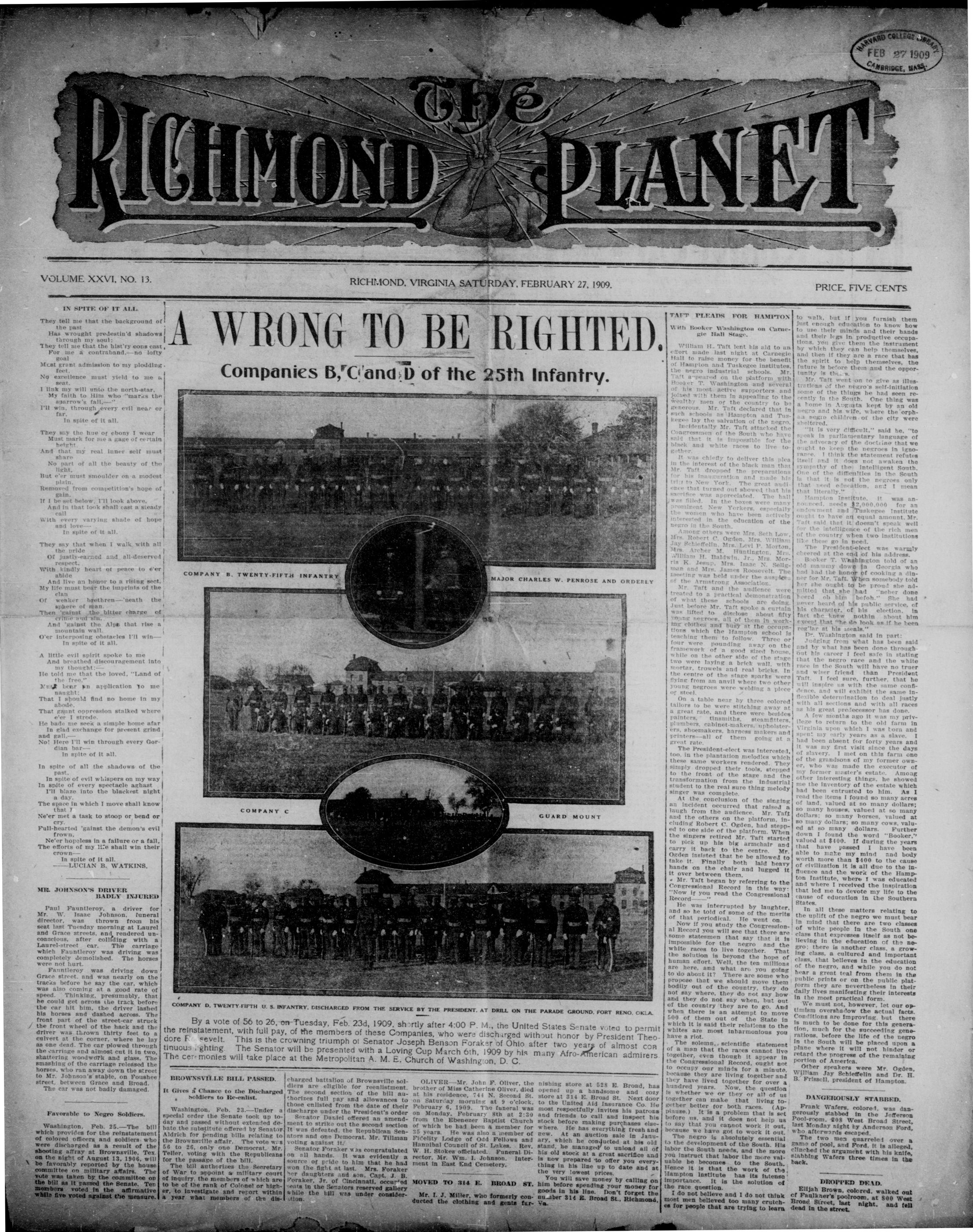
A WRONG TO BE RIGHTED.
COMPANY B. TWENTY-FIFTH INFANTRY
MAJOR CHARLES W. PENROSE AND ORDERLY
COMPANY C
GUARD MOUNT
COMPANY D. TWENTY-FIFTH U. S. INFANTRY. DISCHARGED FROM THE SERVICE BY THE PRESIDENT. AT DRILL ON THE PARADE GROUND, FORT RENO, OKLA.
By a vote of 56 to 26, on Tuesday, Feb. 23d, 1909, shortly after 4:00 P. M., the United States Senate voted to permit the reinstatement, with full pay, of the members of these Companies, who were discharged without honor by President Theodore Roosevelt. This is the crowning triumph of Senator Joseph Benson Foraker of Ohio after two years of almost continuous fighting. The Senator will be presented with a Loving Cup March 6th, 1909 by his many Afro-American admirers. The ceremonies will take place at the Metropolitan A. M. E. Church of Washington, D. C.
BROWNSVILLE BILL PASSED.
It Gives a Chance to the Discharged Soldiers to re-enlist
Washington. Feb. 23.—Under a special order the Senate took up today and passed without extended debate the substitute offered by Senator Aldrich for pending bills relating to the Brownsville affair. The vote was 56 to 26, only one Democrat, Mr. Teller, voting with the Republicans for the passage of the bill. The bill authorizes the Secretary of War to appoint a military court of inquiry, the members of which are to be of the rank of Colonel or higher, to investigate and report within a year what members of the dis-
RICHMOND, VIRGINIA SATURDAY, FEBRUARY 27, 1909.
charged battalion of Brownsville soldiers are eligible for recallment. The second section of the bill authorizes full ray and allowances to those enlisted from the date of their discharge under the President's order. Senator Daniel offered an amendment to strike out the second section It was defeated, the Republican Senators and one Democrat, Mr. Tillman voting against it. Senator Foraker was congratulated on all hands. It was evidently a source of pride to him that he had won the fight at last. Mrs. Foraker her daughters and son, Capt. J. B. Foraker, Jr. of Cinchnatti, occurred seats in the Senators reserved gallery while the bill was under consideration.
OLIVER—Mr. John F. Oliver, the brother of Miss Catherine Oliver, died at his residence, 744 N. Second St. on Saturday morning at 9 o'clock; February 6, 1909. The funeral was on Monday, February 8th at 2:30 from the Ebenezer Baptist Church of which he had been a member for 35 years. He was also a member of Fidelity Lodge of Odd Fellows and Hannibal Council of St. Lukes. Rev. W. H. Stokes officiated. Funeral Director, Mr. Wm. I. Johnson. Interment in East End Cemetery.
MOVED TO 314 E. BROAD ST
Mr. I. J. Miller, who formerly conducted the clothing and gents for
nishing store at 528 E. Broad, has opened up a handsome and cozy store at 314 E. Broad St. Next door to the United Aid Insurance Co. He most respectfully invites his patrons and friends to call and inspect his stock before making purchases elsewhere. He has everything fresh and new. At an auction sale in January, which he conducted at his old stand, he managed to unload all of his old stock at a great sacrifice and is now prepared to offer you everything in his line up to date and at the very lowest prices.
You will save money by calling on him before spending your money for goods in his line. Don't forget the number 314 E. Broad St., Richmond, Va.
TAFT PLEADS FOR HAMPTON
With Booker Washington on Carnegie Hall Stage.
William H. Taft lent his aid to an effort made last night at Carnegie Hall to raise money for the benefit of Hampton and Tuskegee institutes, the negro industrial schools. Mr. Taft appeared on the platform with Booker T. Washington and several of his most active supporters and joined with them in appealing to the wealthy men of the country to be generous. Mr. Taft declared that in such schools as Hampton and Tuskegee lay the salvation of the negro. Incidentally Mr. Taft attacked the Congressmen of the South who have said that it is impossible for the black and white races to live together.
It was chiefly to deliver this plea in the interest of the black man that Mr. Taft dropped the preparations for his inauguration and made his trium to New York. The great audience that turned out showed that his sacrifice was appreciated. The hall was filled. In the boxes were many prominent New Yorkers, especially the women who have been actively interested in the education of the negro in the South.
Among others were Mrs. Seth Low, Mrs. Robert C. Orden, Mrs. William Jay Schieffellin, Mrs. Levi P. Morton, Mrs. Archer M. Huntington, Mrs. William H. Baldwin, Jr., Mrs. Morris K. Jesup, Mrs. Isaac N. Selligman and Mrs. James Roosevelt. The meeting was held under the auspices of the Armstrong Association.
Mr. Taft and the audience were treated to a practical demonstration of what these schools are doing. Just before Mr. Taft spoke a curtain was lifted to disclose a fifty young negroes, all of them in working clothes and busy at the occupations which the Hampton school is teaching them to follow. Three or four were pounding away on the framework of a good sized house, while on the other side of the stage two were laying a brick wall, with mortar, trowels and real bricks. In the centre of the stage sparks were flying from an anvil where two other young negroes were welding a piece or steel.
On a table near by three colored tailors to be were stitching away at a great rate, and there were besides painters, tinsmiths, steamfitters, plumbers, cabinet-makers, upholsters, sheoamers, harness makers and printers—all of them going at a great rate.
The President-elect was interested, too, in the plantation melodies which these same workers rendered. They simply dropped their tools, stepped to the front of the stage and the transformation from the industrial student to the real sure thing melody singer was complete.
At the conclusion of the singing an incident occurred that raised a laugh from the audience. Mr. Taft and the others on the platform, including Robert C. Ogden, had stepped to one side of the platform. When the singers retired Mr. Taft started to pick up his big armchair and carry it back to the centre. Mr. Ogden insisted that he be allowed to take it. Finally both held heavy hands on the chair and lugged it it over between them. Mr. Taft began by referring to the Congressional Record in this way: "Now if you read the Congressional Record——"
He was interrupted by laughter, and so he told of some of the merits of that periodical. He went on. Now if you study the Congressional Record you will see that there are some statesmen that say that it is impossible for the negro and the white races to live together. That the solution is beyond the hope of human effort. Well, the ten millions are here, and what are you going to do about it? There are some who propose that we should move them bodily out of the country, they do not say where, they do not say how and they do not say when, but out of the country they are to go. And when there is an attempt to move 500 of them out of the State in which it is said their relations to the whites are most inharmonious you have a riot.
The solemn, scientific statement of a man that the races cannot live together, even though it appear in the Congressional Record, ought not to occupy our minds for a minute, because they are living together and they have lived together for over a hundred years. Now, the question is whether we or they or all of us together can make that living together better for both races. (Applause.) It is a problem that is set before us, and it does not help us to say that you cannot work it out, because we have got to work it out. The negro is absolutely essential to the development of the South. His labor the South needs, and the more you instruct that labor the more valuable he becomes to the South. Hence it is that the work of the Hampton institute has its intense importance. It is the solution of the race question.
I do not believe and I do not think most men believed too many crutches for people that are trying to learn
PRICE. FIVE CENTS
to walk, but if you furnish them just enough education to know how to use their minds and their hands and their legs in productive occupations, you give them the instrument by which they can help themselves, and then if they are a race that has the spirit to help themselves, the future is before them and the opportunity is theirs.
Mr. Taft went on to give as illustrations of the negro's self-initiation some of the things he had seen recently in the South. One thing was a home in Augusta kept by an old negro and his wife, where the orphan an negro children of the city were sheltered.
"It is very difficult," said he, "to speak in parliamentary language of the advocacy of the doctrine that we ought to keep the negroes in ignorance. I think the statement refutes itself and it does not awaken the sympathy of the intelligent South. One of the difficulties in the South is that it is not the negroes only that need education, and I mean that literally."
Hampton Institute, it was announced, needs $2,000,000 for an endowment and Tuskegee Institute ought to have an equal amount. Mr. Taft said that it doesn't speak well for the intelligence of the rich men of the country when two institutions like these go in need.
The President-elect was warmly cheered at the end of his address.
cheered at the end of his address.
Booker T. Washington told of an old mummy down in Georgia who had had the honor of cooking a dinner for Mr. Taft. When somebody told her she ought to be proud she admitted that she had "neber done beerd ob him befoh." She had never heard of his public service, of his character, of his election, in fact she knew nothin about him except that "she do look as if he be reg'lar at his acads."
Dr. Washington said in part:
Judging from what has been said and by what has been done throughout his career I feel safe in stating that the negro race and the white race in the South will have no truer and wiser friend than President Taft. I feel sure, further, that he will inspire us with the same confidence, and will exhibit the same inflexible determination to deal justly with all sections and with all races as his great predecessor has done
A few months ago it was my privilege to return to the old farm in Virginia upon which I was born and spent my early years as a slave. I had been absent for forty years and it was my first visit since the days of slavery. I met on this farm one of the grandsons of my former owner, who was made the executor of my former master's estate. Among other interesting things, he showed me the inventory of the estate which had been entrusted to him. As I read the items I found so many acres of land, valued at so many dollars; so many houses, valued at so many dollars; so many horses, valued at so many dollars; so many cows, valued at so many dollars. Further down I found the word "Booker," valued at $400. If during the years that have passed I have been able to make my mind and body worth more than $400 to the cause of civilization it is all due to the influence and the work of the Hampton Institute, where I was educated and where I received the inspiration that led me to devote my life to the cause of education in the Southern States.
In all these matters relating to the uplift of the negro we must bear in mind that there are two classes of white people in the South one class that expresses itself as not believing in the education of the negro; there is another class, a growing class, a cultured and important class, that believes in the education of the negro, and while you do not hear a great teal from them in the public prints or on the public platform they are nevertheless in their daily lives manifesting their interests in the most practical form.
We must not, however, let our optimism overshadow the actual facts. Conditions are improving, but there is much to be done for this generation, much for the succeeding generations, before the life of the negro in the South will be placed upon a plane where it will not hinder or retard the progress of the remaining portion of America.
Other speakers were Mr. Ogden, William Jay Schlefelin and Dr. H. B. Frissell, president of Hampton.
DANGEROUSLY STARRED
Frank Wafers, colorred, was dangerously stabbed in the Jofferson Pool-room. 208 West Broad Street, last Monday night by Anderson Ford, who afterwards escaped. The two men quarreled over a game of pool, and Ford, it is alleged, clinched the argument with his knife, stabbing Wafers three times in the back.
DROPPED DEAD
Elijah Brown, colored, walked out of Feulkner's poolroom, at $80 West Broad Street, last night, and fell dead in the street.
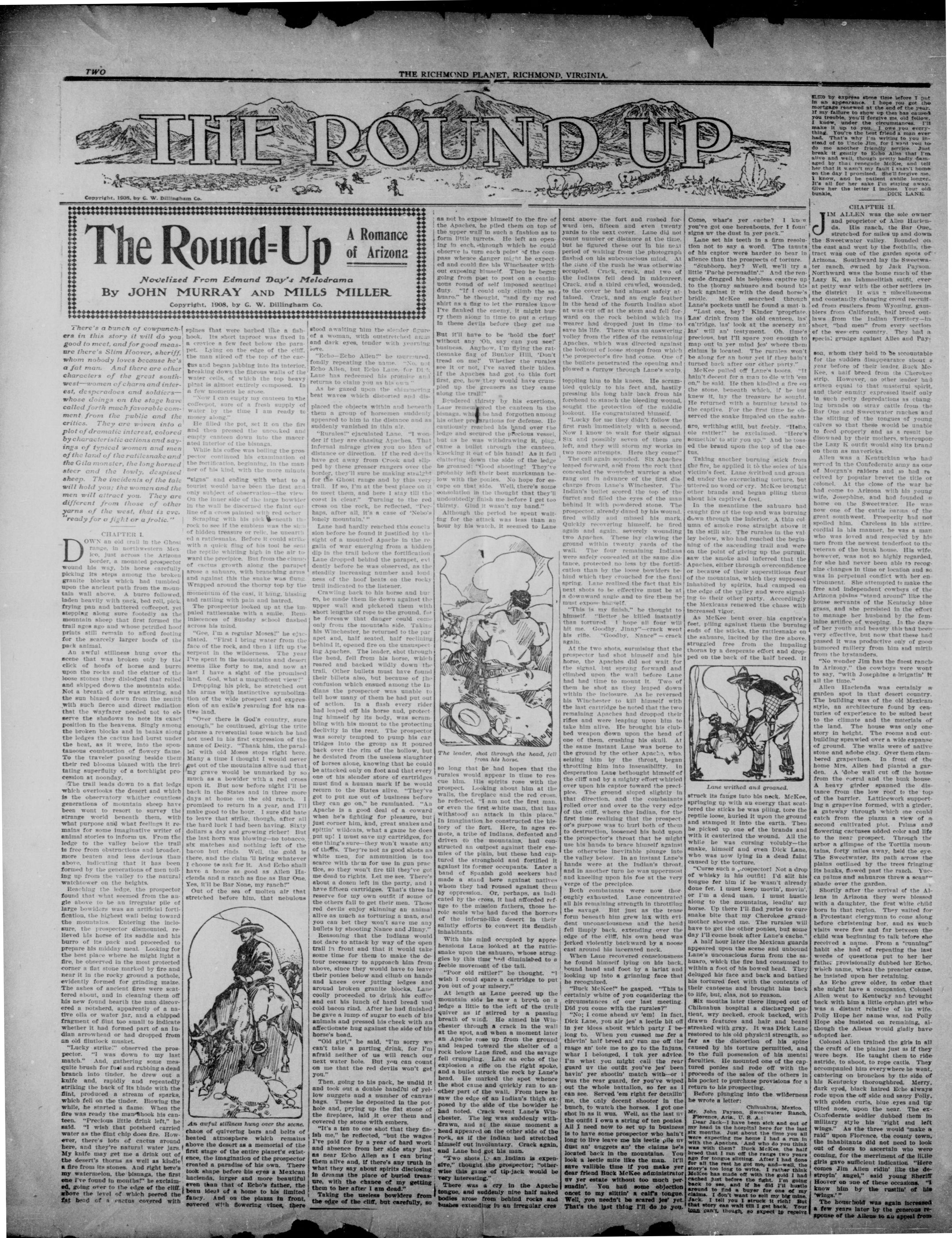
THE ROUND UP
The Round=Up A Romance of Arizona
There's a bunch of cowpunchers in this story it will do you good to meet, and for good measure there's Slim Hoover, sheriff, whom nobody loves because he's a fat man. And there are other characters of the great southwest—women of charm and interest, desperadoes and soldiers—whose doings on the stage have called forth much favorable comment from the public and the critics. They are woven into a plot of dramatic interest, colored by characteristic actions and sayings of typical women and men of the land of the ratlesnake and the Gila monster, the long horned steer and the lowly, despised sheep. The incidents of the tale will hold you; the women and the men will attract you. They are different from those of other yarns of the west, that is cve. "ready for a fight, or a frolic."
CHAPTER I
DOWN an old trail in the Ghost range, in northwestern Mexico, Just across the Arizona border, a mounted prospector wound his way, his horse carefully picking its steps among the broken granite blocks which had tumbled upon the ancient path from the mountain wall above. A burro followed, laden heavily with pack, bed roll, pick frying pan and battered coffeepot, yet stepping along sure footedly as the mountain sheep that first formed the trail ages ago and whose petrified hoof prints still remain to afford footing for the scarcely larger hoofs of the pack animal.
An awful stillness hung over the scene that was broken only by the click of hoofs of horse and burrow upon the rocks and the clatter of the loose stones they dislodged that rolled and skipped down the mountain side. Not a breath of air was stirring, and the sun blazed down from the zenith with such fierce and direct radiation that the wayfarer needed not to observe the shadows to note its exact position in the heavens. Singly among the broken blocks and in banks along the ledges the cactus had burst under the heat, as it were, into the spontaneous combustion of flowery flame. To the traveler passing beside them their red blooms blazed with the irritating superfunity of a torchlight procession at noonday.
The trail leads down to a flat ledge which overlooks the desert and which is the observatory whither countless generations of mountain sheep have been wont to resort to survey the strange world beneath them, with what purpose and what feelings it remains for some imaginative writer of animal stories to inform us. From the ledge to the valley below the trail is free from obstructions and broader, more beaten and less devious than above, indicating that it has been formed by the generations of men toiling up from the valley to the natural watchtower on the heights.
Reaching the ledge, the prospector found that what seemed from the angle above to be an irregular pile of large bowlers was an artificial fortification, the highest wall being toward the mountains. Entering the incisure, the prospector dismounted, relieved his horse of its saddle and his burro of its pack and proceeded to prepare his mildday meal. Looking for the best place where he might light a fire, he observed in the most protected corner a flat stone marked by fire and near it in the rocky ground a pothole, evidently formed for grinding maize. The ashes of ancient fires were scattered about, and in cleaning them off his new found hearth the man discovered a potsherd, apparently of a native olla or water jar, and a chipped fragment of flint too small to indicate whether it had formed part of an Indian arrowhead or had dropped from an old flintlock musket.
"Lucky strike!" observed the prospector. "I was down to my last match." And, gathering some mesquite brush for final and rubbing a dead branch into tinder, he drew out a knife and, rapidly and repeatedly striking the back of its blade with the flint, produced a stream of sparks, which fell on the tinder. Blowing the while, he started a flame. When the fire was ready the man shook his canteen. "Precious little drink left," he said. "I wish that potsherd carried water as the flint chip does fire. However, there's lots of cactus around here, and they're natural water jars. My knife may get me a drink out of the desert's thorns as well as kindle a fire from its stones. And right here's my watermelon, the bismagna, the first one I've found in months!" he exclaimed, going over to the edge of the cliff, above the level of which peered the fat head of a cactus covered with
Copyright. 1908. by G. W. Dillingham Co.
spines that were barbed like a fishhook, its short taproot was fixed in a crevice a few feet below the parapet. Lying on the edge of the cliff, the man sliced off the top of the cactus and began jabbing into its interior, breaking down the fibrous walls of the water cells, of which the top heavy plant is almost entirely composed. In a few moments he arose.
"Now I can empty my canteen in the coffeepot, sure of a fresh supply of water by the time I am ready to mosey along."
He filled the pot, set it on the fire and then pressed the uncooked and empty canteen down into the macerated interior of the bisnaga.
While his coffee was boiling the prospector continued his examination of the fortification, beginning, in the manner of his kind, with the more minute
"sligns" and ending with what to a tourist would have been the first and only subject of observation—the view. On the inner side of the large bowder in the wall he discerned the faint outline of a cross painted with red ocher. Scraping with his pick beneath the rock to see if the emblem was the sign of hidden treasure or relié, he unearched a rattlesnake. Before it could strike with a quick fling of his tool he sent the reptile whirling high in the air toward the preciice. But from the clump of cactus growth along the parapet arose a sahuaro, with branching arms, and against this the snake was flung. Wrapped around the thorny top by the momentum of the cast, it hung, blissing and rattling with pain and hatred. The prospector looked up at the impaled rattlesnake with a smile. Reminiscences of Sunday school flashed across his mind.
"Gee, I'm a regular Moses!" he ejaculated. "First I bring water from the face of the rock, and then I lift up the serpent in the wilderness. The year I've spent in the mountains and desert seems like forty to me, and now at last I have a sight of the promised land. God, what a magnificent view!" Dropping his pick, he stretched out his arms with instinctive symbolization of the wide prospect and expression of an exile's yearning for his native land.
"Over there is God's country, sure enough," he continued, giving the trite phrase a reverential tone which he had not used in his first expression of the name of Deity. "Thank him, the parallel with old Moses stops right here. Many a time I thought I would never get out of the mountains alive and that my grave would be unmarked by so much as a bowler with a red cross upon it. But now before night I'll be back in the States and in three more days at home on the old ranch. I promised to return in a year, and I'll make good to the hour. I sure did hate to leave that strike, though, after all the hard luck I had been having. Sixty dollars a day and growing richer! But the last horn was blowing—no tobacco, six matches and nothing left of the bacon but rinds. Well, the gold is there, and the claim "I'll bring whatever I choose to ask for it. And Echo shall have a home as good as Allen Hatchenda and a ranch as fine as Bar One. Yes, it'll be Bar None, my ranch!"
Out of the sea of molten air that stretched before him, that nebulous
CORRIDOR
An awful stillness hung over the scene, chaos of quivering bars and belts of heated atmosphere which remains above the desert as a memorial of the first stage of the entire planet's existence, the imagination of the prospector created a paradise of his own. There took shape before his eyes a Mexican hacienda, larger and more beautiful even than that of Echo's father, the beau ideal of a home to his limited fancy. And on the plaza in front, covered with flowering vines, there
THE RICHMOND PLANET, RICHMOND, VIRGINIA
stood awaiting him the slender figure of a woman, with outstretched arms and dark eyes, tender with yearning love.
"Echo—Echo Allen!" he murmured, fondly repeating the name. "No, not Echo Allen, but Echo Lane, for DLU Lane has redeemed his promise and returns to claim you as his own."
As he gazed upon the shimmering heat waves which distorted and displaced the objects within and beneath them a group of horsemen suddenly appeared to him in the distance and as suddenly vanished in thin air.
"Ruralest!" ejaculated Lane. "I wonder if they are chasing Apaches. That infernal mirage gives you no idea of distance or direction. If the red devils have got away from Crook and slipped by these greaser rangers over the border, they'll sure be making straight for the Ghost range and by this very trail. If so, I'm at the best place on it to meet them, and here I stay till the coast is clear." Turning to the red cross on the rock, he reflected. "Perhaps, after all, it's a case of 'Nebo's lonely mountain.'"
Lane had hardly reached this conclusion before he found it justified by the sight of a mounted Apache in the regalia of war emerging from a hidden dip in the trail below the fortification. Lane dropped behind the parapet, evidently before he was observed, as the steadily increasing number and loudness of the hoof beats on the rocky trail indicated to the listener.
Crawling back to his horse and burro, he made them lie down against the upper wall and picketed them with short lengths of rope to the ground, for he foresaw that danger could come only from the mountain side. Taking his Winchester, he returned to the parapet and, half seated, half reclining behind it, opened fire on the unsuspecting Apaches. The leader, shot through the head, fell from his horse, which reared and backed wildly down the trail. Other bullets must have found their billets also, but because of the confusion which ensured among the Indians the prospector was unable to tell how many of them he had put out of action. In a flash every rider had leaped off his horse and, protecting himself by its body, was scrummbling with his mount to the protecting declivity in the rear. The prospector was sorely tempted to pump his cartridges into the group as it poured back over the rim of the hollow, but he desisted from the useless slaughter of horses alone, knowing that he could be attacked only on foot and that every one of his slender store of cartridges must find a human mark if he would return to the States alive. "They've got to put me out of business before they can go on," he ruminated. "An Apache is a good deal of a coward when he's fighting for pleasure, but just corner him, and, great snakes and spitttin' wildeats, what a game he does put up! I must save my cartridges, for one thing's sure—they won't waste any of theirs. They're not as good shots as white men for ammunition is too scarce with them for use in gun practice, so they won't fire till they've got me dead to rights. Let me see. There's about a dozen left in the party, and I have fifteen cartridges. That's three in reserve for my own outfit if some of the others fall to get their men. Those devils enjoy skimming an animal alive as much as torturing a man, and you can bet they won't save me any bullets by shooting Nance and Jinny."
Reasoning that the Indians would not dare to attack by way of the open trail in front and that it would take some time for them to make the detour necessary to approach him from above, since they would have to leave their ponies below and climb on hands and knees over jutting ledges and around broken granite blocks, Lane coolly proceeded to drink his coffee and eat his lunch of hard bread and cold bacon rind. After he had finished he gave a lump of sugar to each of his animals and pressed his cheek with an affectionate hug against the side of his horse's head.
"Old girl," he said, "I'm sorry we can't take a parting drink, for I'm afraid neither of us will reach our next water hole. But you can count on me that the red devils won't get you."
Then, going to his pack, he undid it and took out a double handful of yellow nuggets and a number of canvas bags. These he deposited in the pot hole and, prying up the flat stone of the fireplace, laid it over them and covered the stone with embers.
"It's a ten to one shot that they finish me," he reflected, "but the wages I've paid for by a year of hard work and absence from her side stay just as near Echo Allen as I can bring them alive and, if there's any truth in what they say about spirits disclosing in dreams the place of buried treasure, with the chance of my getting them to her after I am dead."
Taking the useless bowlers from the edge of the cliff, but carefully, so
as not to expose himself to the fire of the Apaches, he piled them on top of the upper wall in such a fashion as to form little turrets. He left an opening in each, through which he could observe in turn each point of the compass whence danger might be expected and could fire his Winchester without exposing himself. Then he began going from post to post on a continuous round of self imposed sentinel duty. "If I could only climb the sahuaro, he thought, "and fly my red shirt as a flag to let the rurales know I've flanked the enemy, it might hurry them along in time to put a crimin in these devils before they get me
But I'll have to be 'hold the fort' without any 'Oh, say can you see!' business. Anyhow, I'm dying the rattlesnake flag of Bucker Hill, 'Don't trend on me!' Whether the rurales see it or not, I've saved their hides. If the Apaches had got to this fort first, gee, how they would have crumpled up the greasers as they came along the trail!
Beader thirsty by his exertions, Lane remembered the canteen in the bisnaga, which he had forgotten among his other preparations for defense. He cautiously reached his hand over the ledge and secured the precious vessel, but as he was withdrawing it, plunged a bullet through the canteen, knocking it out of his hand! As it fell clattering down the side of the ledge he groaned: "Good shooting! They've probably left their best marksmans below with the ponies. No hope for escape on that side. Well, there's some consolation in the thought that they'll undoubtedly finish me before I get too thirsty. Gind it wasn't my hand."
Although the period he spent waiting for the attack was less than an hour by his watch, it seemed to Lane
1
The leader, shot through the head, fell from his horse.
so long that he had hopes that the rurales would appear in time to rescue him. His spirits rose with the prospect. Looking about him at the walls, the fireplace and the red cross, he reflected. "I am not the first man, or even the first white man, that has withstood an attack in this place." In imagination he constructed the history of the fort. Here, in ages remote, a tribe of Indians, defeated and driven to the mountains, had constructed an outpost against their enemies of the plain, but these had captured the stronghold and fortified it against its former occupants. Later a band of Spanish gold seekers had made a stand here against natives whom they had roused against them by oppression. Or, perhaps, as indicated by the cross, it had afforded refuge to the mission fathers, those heroic souls who had faced the horrors of the inferno-like desert in their saintly efforts to convert its flendish inhabitants.
With his mind occupied by apprehensions Lane looked at the rattlesnake upon the sahuaro, whose struggles by this time had diminished to a feeble movement of the tail.
"Poor old rattler!" he thought. "I wish I could spare a cartridge to put you out of your misery."
At length as Lane peered up the mountain side he saw a brush on a ledge a little to the left of the trail quiver as if stirred by a passing breath of wind. He aimed his Winchester through a crack in the wall at the spot, and when a moment later an Apache rose up from the ground and leaped toward the shelter of a rock below Lane fired, and the savage fell crumpling. Like an echo of the explosion a rifle on the right spoke, and a bullet struck the rock by Lane's head. He marked the spot whence the shot came and quickly ran to another part of the wall. From here he saw the edge of an Indian's thigh exposed by the side of the bowler he had noted. Crack went Lane's Winchester. The leg was suddenly withdrawn, and at the same moment a head appeared on the other side of the rock, as if the Indian had stretched himself out involuntary. Crack again, and Lane had got his man.
"Two shots to an Indian is expensive," thought the prospector; "otherwise this game of tip jack would be very interesting."
There was a cry in the Apache tongue, and suddenly nine half naked bodies arose from behind rocks and bushes extending in an irregular cres.
cent above the fort and rushed forward ten, fifteen and even twenty yards to the next cover. Lane did not count number or distance at the time, but he figured these out in his next period of waiting from the photograph flashed on his subconscious mind. At the time of the rush he was otherwise occupied. Crack, crack, and two of the Indians fell dead in mildcare. Crack, and a third crawled, wounded, to the cover he had almost safely attained. Crack, and an eagle feather in the head of the fourth Indian shot at was cut off at the stem and fell forward on the rock behind which its weaver had dropped just in time to save his life. There was an answering volley from the rides of the remaining Apaches, which was directed against the lookout of loose stones from which the prospector's fire had come. One of the bullets penetrated the opening and plowed a furrow through Lane's scalp.
topping him to his knees. He scrambling quickly to his feet and, hastily pressing his long hair back from his forehead to stanch the bleeding wound, sought the protection of the middle lookout. He congratulated blimself.
"Lucky for me they didn't follow the first rush immediately with a second. Now I know to wait for their signal. Six and possibly seven of them are left, and they will storm my works in two more attempts. Here they come."
The call again sounded. Six Apaches leaped forward, and from the rock that concealed the wounded warrior a shot rang out in advance of the first discharge from Lane's Winchester. The Indian's bullet scored the top of the turret and filled the eyes of the man behind it with powdered stone. The prospector, already dazed by his wound, fired wildly and missed his mark. Quickly recovering himself, he fired again and again, severely wounding two Apaches. These lay clawing the ground within twenty yards of the wall. The four remaining Indians were safely concealed at the same distance, protected no less by the fortification than by the loose bowlers behind which they crouched for the final spring. Lane realized the fact that his next shots to be effective must be at a downward angle and to fire them he must expose himself.
"This is my finish," he thought to himself. "Better he be killed instantly than tortured. I hope all four will hit me. Goodby, Jimny"—crack went his riff. "Goodby, Nance"—crack again.
At the two shots, surmising that the prospector had shot himself and his horse, the Apaches did not wait for the signal, but sprang forward and climbed upon the wall before Lane had had time to mount it. Two of them he shot as they leaped down within the inclosure. As he reversed his Winchester to kill himself with the last cartridge he noted that the two remaining Apaches had dropped their rifles and were leaping upon him to take him alive. He brought his clubbed weapon down upon the head of one of them, crushing his skull. At the same instant Lane was borne to the ground by the other Apache, who seizing him by the throat, began throttling him into insensibility. In desperation Lane bethought himself of the cliff and by a mighty effort whirled over upon his captor toward the precipice. The ground slipped slightly in that direction, and the combatants rolled over and over to the very edge of the cliff, where the Indian, for the first time realizing that the prospector's purpose was to hurt both of them to destruction, loosened his hold upon the prospector's throat that he might use his hands to brace himself against the otherwise inevitable plunge into the valley below. In an instant Lane's hands were at the Indian's throat, and in another turn he was uppermost and kneeling upon his foe at the very verge of the precipice.
Both combatants were now thoroughly exhausted. Lane concentrated all his remaining strength in throttling the savage. But just as the tense form beneath him grew lax with evident unconsciousness and the head fell limply back, extending over the edge of the cliff, his own head was jerked violently backward by a noose cast around his lacerated neck.
When Lane recovered consciousness he found himself lying on his back, bound hand and foot by a larist and looking up into a grinning face that he recognized.
"Buck McKeel?" he gasped. "This is certainly white of you considering the circumstances of our last meeting. Did you come with the rurales?"
"No; I come ahead uv 'em! In fact, Dick Lee, you air jes' a leetle bit off in yer idees about which party I belong to. When you cussed me for a thlevin' half breed an' run me off the range an' tole me to go to the Injuns, whar I belonged, I tuk yer advice. I'm what you might call the rear guard uv the outfit you've jes' been havin' yer shootin' match with—or I wuz the rear guard, fer you wiped out the whole battalion, so fer as I can see. Served 'em right fer deternil' me, the only decent shooter in the bunch, to watch the horses. I got one shot in as it wuz. Well, as the last uv the outfit I own a string of ten ponies. All I need now to set up in business is to have some prospector who hain't long to live leave me his leetle olle mv dust an' nuggets an' the claims he' located back in the mountains. You look a leetle mike like the man. It'll save valible time if you make yer dear friend Buck McKeen administrator uv yer estate without too much persuadin'. You had some objection on to my slittin' a calf's tongue. Well, you needn't be scared jes' yet. That's the last thing I'll do to you.
Come, what's yer cache? I know you've got one hereabouts, for I four signs uv the dust in yer pack."
Lane set his teeth in a firm resolution not to say a word. The taunts of his captor were harder to bear in silence than the prospects of torture.
"Stubborn, hey? Well, we'll try a little 'Pache persuadin'." And the renegade dragged his helpless captive up to the thorny sahuaro and bound his back against it with the dead horse's bridle. McKee searched through Lane's pockets until he found a mat m. "Last one, hey? Kinder 'propiate. Las' drink from the canteen, las' ca-tridge, las' look at the scenery an' las' will an' testment. Oh, time's precious, but I'll spare you enough to map out in yer mund jes' where them claims is located. The ruralses won't be along for an hour yet if they haven't turned back after our other party."
McKeen pulled off Lane's boots. "It haint deceit for a man to die with 'em on," he said. He then kindled a fire on the stone, beneath which, if he but knew it, lay the treasure he sought. He returned with a burning brand to the captive. For the first time he observed the snake impaled on the sahuar, writhing still, but feebly. "Hello, ole rattert!" he exclaimed. "Here's somethin' to stir you up." And he tossed the brand upon the top of the cactus.
Taking another burning stick from the fire, he applied it to the soles of his victim's feet. Lane writhed and groused under the excrustating torture, but uttered no word or cry. McKeen brought other brands and began plining them about his captive's feet.
In the meantime the sahuaro had caught fire at the top and was burning down through the inferior. A thin column of smoke rose straight above it in the still air. The rurales in the valley below, who had reached the beginning of the ascending trail and were on the point of giving up the pursuit, saw the smoke and inferred that the Apaches, either through overconfidence or because of their superstitious fear of the mountains, which they supposed inhabited by spirits, had camped on the edge of the valley and were signaling to their other party. Accordingly the Mexicans renewed the chase with increased vigor. As McKeen bent over his captive's feet, piling against them the burning ends of the sticks, the rattlesnake on the sahuaro, incited by the fire above, struggled free from the impaling thorns by a desperate effort and dropped on the back of the half breed. It
Lane writhed and groaned
struck its fangs into his neck. McKee, springing up with an energy that scattered the sticks he was piling, tore the reptile loose, hurled it upon the ground and stamped it into the earth. Then he picked up one of the brands and with it cauterized the wound. All the while he was cursing volubly—the snake, himself and even Dick Lane, who was now lying in a dead faint caused by the torture.
"Curse such a prospect! Not a drop of whisky in his outfit! I'd slit his tongue fer him if he wasn't already done fer. I must keep movin', movin', or I'm a dead man. I must hustle along to the mountains, leadin' my horse. Up there I find and tars to cure snake bite that my Cherokee grandmother showed me. The rurales will have to get the other ponies, but some day I'll come back after Lane's cache."
A half hour later the Mexican guards appeared upon the scene and unbound Lane's unconscious form from the sahuaro, which the fire had consumed to within a foot of his bowed head. They deluged his face and back and bathed his tortured feet with the contents of their canees and brought him back to life, but, alas, not to reason.
Six months later there limped out of Chihuahua hospital a discharged patient, wry necked, crook backed, with drawn features and hair and beard streaked with gray. It was Dick Lane restored to his old physical strength, so far as the distortion of his spine caused by his torture permitted, and to the full possession of his mental faculties. He mounted one of the captured ponies and rode off with the proceeds of the sales of the others in his pocket to purchase provisions for a return to his prospecting.
Before plunging into the wilderness he wrote a letter:
Mr. John Payon, Sweetwater Ranch,
Florence, Artis, U.
John Payson, Sweetwater Ranch,
Florida. Dear Jack I have been sick and out of
my head in the hospital here for the last
six months. Just about the time you all
were expecting me home I had a run in
the hospital and I did do what I think
was with them? Buck McKeen
breed that I run off the range two years
ago for tongue slitting. After I had done
for all the rest he got me, and—well, the
writer I write, rather think McKeen has made off of me. I
cached just before the fight. I'm going
back to see, and if he did I will hustle
around to find a buyer for one of my
friends. I can't want to sell my big mike.
Jack. I tell that story can wait till I get back. Your
loan can't, though, so expect to receive
$1,000 by express some time before I put in an appearance. I hope you got the mortgage renewed at the end of the year. If my failure to show up then has caused me to lose my job. I know, under the circumstances. I'll make it up to you. I owe you everything. You're the best friend a man ever. You're the best friend to you instead of Uncle Jim. For now, you do me another friendly service. Just break it gently to Echo Allen that I'm alive and well, though pretty badly damaged. You're the best friend her that it wasn't my fault I wasn't home on the day I promised. She'll forgive me. I know, and be patient awhile longer. Call for her sake I'm staying away. Give the letter I included bunkle. DICK LANE.
CHAPTER 11
JIM ALLEN was the sole owner and proprietor of Allen Hacienda. His ranch, the Bar One, stretched for miles up and down the Sweetwater valley. Bounded on the east and west by the foothills, the tract was one of the garden spots of Arizona. Southward lay the Sweetwater ranch, owned by Jack Payson. Northward was the home ranch of the Lazy K, an Ishmaleitish tush, ever at petty war with the other settlers in the district. It was a miscellaneous and constantly changing crowd recruited from rustlers from Wyoming, gamblers from California, half breed outlaws from the Indian Territory—in short, "bad men" from every section of the wes ern country. They had a specia; grudge against Allen and Pay-
son, whom they held to be accountable for the sudden disappearance about a year before of their leader, Buck McKee, a half breed from the Cherokee strip. However, no other leader had arisen equal to that masterful spirit, and their enmity expressed itself only in such petty depredations as changing brands on stray cattle from the Bar One and Sweetwater ranches and the slitting of the tongues of young calves so that these would be unable to feed properly and as a result be disowned by their mothers, whereupon the Lazy K outfit would slap its brand on them as mavericks.
Allen was a Kentuckian who had served in the Confederate army as one of Morgan's raiders and so had received by popular brevet the title of colonel. At the close of the war he had come to Arizona with his young wife, Josephine, and had founded a home on the Sweetwater. He was now one of the cattle carons of the great southwest. Prosperity had not spotted him. Careless in his attire, cordial in his manner, he was a man who was loved and respected by his men from the newest tenderfoot to the veteran of the bunk house. His wife, however, was not so highly regarded, for she had never been able to recognize changes in time or location and so was in perpetual conflict with her environment. She attempted to make the free and independent cowboys of the Arizona plains "stand around" like the house servants of the Kentucky blue grass, and she persisted in the effort to manage her husband by the feminine artifact of weeping. In the days of her youth and beauty this had been very effective, but now that these had passed it was productive only of good humored railway from him and mirth from the bystanders.
"No wonder Jim has the finest ranch in Arizona." the cowboys were wont to say, "with Josephine a-irrigatin' it all the time."
Allen Hacela was certainly a garden spot in that desert country. The building was of the old Mexican style, an architecture found by centuries of experience to be suited best to the climate and the materials of the land. The house was only one story in height. The rooms and outbuilding sprawled over a wide expense of ground. The walls were of native stone and adobe clay. Over them clambered grapevines. In front of the home Mrs. Allen had planted a garden. A 'dobe wall cut off the house from the corral and the bunk house. A heavy girder spanned the distance from the low roof to the top of the barrier. Latticework supporting a grapevine formed, with a girder, a gateway through which one could catch from the plaza a view of a second cultivated plot. Palms and flowering cactuses added color and life to the near prospect. Through the arbor a glimpse of the Tortilla mountains, forty miles away, held the eye. The Sweetwater, its path across the plains outlined by the trees fringing its banks, flowed past the ranch. Yucca palms and saharon threw a scant shade over the garden.
Shortly after the arrival of the Allens in Arizona they were blessed with a daughter, the first white child born in that region. They waited for a Protestant clergyman to come along before christening her, and as such visits were few and far between the child was beginning to talk before she received a name. From a "cunning" habit she had of repeating the last words of questions put to her the father provisionally dubbed her Echo, which name, when the preacher came, he insisted upon her retaining.
As Echo grew older, in order that she might have a companion, Colonel Allen went to Kentucky and brought back with him a little orphan girl who was a distant relative of his wife. Polly Hope her name was, and Polly Hope she insisted on remaining, although the Alleus would gladly have adopted her.
Colonel Allen trained the girls in all the craft of the plains just as if they were boys. He taught them to ride astride, to shoot, to rope cattle. They accompanied him everywhere he went, cantering on bronches by the side of his Kentucky thoroughbred. Merry, dark eyed, black haired Echo always rode upon the off side and sane Polly, with golden curls, blue eyes and tilt tilted nose, upon the near. The ex-Confederate soldier dubbed them in military style his "right and left wings." As the three would "make a raid" upon Florence, the county town, the inhabitants did not need to look out of doors to ascertain who were coming, for the miment of the little girls gave sufficient indication. "Here comes Jim Allen rilin" like the destroyin' angel," said young Sherif Hoover on one of these occasions. "I know him by the rustlin' of his 'wings.'"
The household was again increased a few years later by the generous response of the Allens to an appeal from
THE PLANET
SATURDAY...FEBRUARY 27,'09
a children's aid society in an eastern city to give a home to two orphaned brothers, Richard and Henry Lance, Dick and Buddy (shortened in time to Bud), as they were called, being taken young, quickly adapted themselves to their new environment and by the time they arrived at manhood had proved themselves the equals of any cowboy on the range in horsemanship and kindred accomplishments. Dick, the elder brother, was a steady, reliable fellow, modest as he was brave and remarkably quick witted and resourceful in emergencies. He gave his confidence over readily to his fellows, but if ever he found himself deceived withdrew it absolutely. It was probably this last characteristic that attracted to him Echo Allen's especial regard, for it was also her distinguishing trait. "You have got to act square with Echo," her father was wont to say, "for if you don't you'll never make it square with her afterward."
Bud was a generous hearted, impetuous boy, who responded warmly to affection. He repaid his elder brother's protecting care with a loyalty that knew no bounds. The colonel, who was a strict disciplinarian, frequently punished him in his boyhood for wayward acts, and the little fellow made no resistance—only sobbed in deep penitence. Once, however, when Uncle Jim, as the boys and Polly called him, felt compelled to apply the rod to Dick—unjustly, as it afterward appeared—Bud burst into a tempest of passionate tears and, leaping upon the colonel's back, clung there, clawing and striking like a wildcat, until Allen was forced to let Dick go. It is shrewdly indicative of the colonel's character that not only did he refrain from punishing Bud on that occasion, but when floggings were subsequently due the little fellow laid on the rod less heavily out of regard for the loyalty to his brother he had then displayed.
This attack also won the admiration of Polly Hope, who was something of a spliture herself. A little jealous of Dick for the chief place he held in Bud's affection, she openly claimed the younger brother as her sweetheart and attempted to constitute him her knight, though with repeated discouragements, for Bud was a bashful lad, and though he had a true affection for the girl, boylike concealed it by show of rude indifference.
The tender relations of these boys and girls persisted naturally into young manhood and womanhood. No word of love passed between Dick and Echo until that time when the "nesting impulse," the desire to have a home of his own, prompted the young man to go out into the world and win his fortune. For a year he had acted as foreman of the Allen ranch, working in neighborly co-operation with Jack Payson of Sweetwater ranch, a man of about his own age. The two young men became the closest of comrades. When the fever of adventure selzed upon Lane and he became dissatisfied with the plooding career of a wage earner, Payson insisted on mortgage Sweetwater ranch for $3,000 and in lending Dick the money for a year's prospecting in the mountains of Sonora, Mexico, in search of a fabulously rich "lost mine of the Aztecs."
Traditions of lost mines are plentiful in Arizona and northern Mexico. First taken up by the Spanish invaders, of 300 years ago from the native Indians, they have passed down to each subsequent infuix of white men. The directions are always vague. The inquirer cannot pin his informant down to any definite data. Over the mountains always lies the road. Hundreds of lives have been sacrificed and cruelty unparalleled practiced upon innocent men, women and children by gold seekers in their lust for conquest. Prosperous Indian villages have been laid waste, and whole bands of adventurers have gone into the desert in search of these mines, never to return.
When the time for Lane's departure came Echo wept at the thought of losing for so long a time the close companion of her childhood and the sympathetic confidant of her youthful thoughts and aspirations. Dick, in whom friendship for Echo had long before ripened into conscious love, took her tears as evidence that she was similarly affected toward him, and he allowed all the suppressed passion of his nature full vent in a declaration of love. The girl was deeply moved by this revelation of the heart of a strong man made tender as a woman's by a power centering in her own humble self, and, being utterly without experience of the emotion even in its protective form of calf love, which is the varioloid of the genuine affection, she imagined through sheer sympathy that she shared his passion. So she assented with maidenly reserve to his plea that she promise to marry him when he should return and provide a home for her. Her more cautious mother secured a modification of this pledge by limiting the time that Echo should wait for him to one year. If at the expiration of that period Lane did not return to claim her promise or did not write making satisfactory arrangements for continuance of the engagement Echo was to be considered free to marry whom she chose.
Soon after Lane's departure Mrs. Allen persuaded the colonel to send Echo east to a New England finishing school for girls, where her mother hoped that her budding love for Lane might be nipped by the frigid atmosphere of intellectual culture, if not, indeed, supplanted by a saving interest in young men in general and perhaps in some particular scion of a blue blooded Boston family. The plan succeeded in part only.
The companionship of her schoolfellows, her music and art lessons, her books (during the limited periods allotted to serious study and reading) and above all, her attrition at receptions with another order of men than that she had known in the rough, uncultured west occupied her mind so fully that poor Dick Lane, who was putting a thought of Echo Allen in every blow of his pick, received only the scraps of her attention.
Dick had few opportunities to mall a letter and none of them for receiving one. Unpracticed in writing, his epistolary compositions were crude in the extreme, being wholly confined to bald statements of fact. Had he been as tender on paper as he was in his words and accents when he kissed away her tears at parting her regard for him would have had fuel to feed on and might have kindled into genuine love. As it was, she was forced to admit that in comparison with the brilliant university men with whom she conversed Dick Lane intellectually was as quartz to diamond.
On the other hand, she contrasted Dick in the essential point of manliness most favorably with the male butterflies of society that hovered around her. What one of them was so essentially chivalrous as the western man—so modest, so self sacrificing, so brave and resolute and resourceful? Dick Lane, or Jack Payson, for that matter, in all save the adventitious points of education and culture was the higher type of manhood, and Jack, at least, if not poor Dick, could hold his own in mental and artistic perception with the brightest, most cultured of Harvard graduates.
At the end of the year she came back home to await Dick's return from the wilds of Mexico. There was great anxiety about his safety, for Geronimo, attacked by Crook in the Apache stronghold of the Tonto basin, had escaped to the mountains of northwestern Mexico with his band of fierce Chiricahuas.
Now, Dick Lane had not been heard from in this region. When he neither made appearance nor sent a message upon the day appointed for his return, his brother, Bud, was for setting out instantly to find him and rescue him if he were in difficulties.
Then it was that Echo Allen discovered the true nature of her affection for her lover—that it was sisterly regard, differing only in degree, but not in kind, from that which she felt for his brother. She joined with Polly in opposing Bud's going, urging his recklessness as a reason. "You are certain to be killed," she said, "and I cannot lose you both." Jack Payson, for whom Bud was working, then came forward and offered to accompany him and keep within bounds. Again there was a revelation of her heart to Echo, one that terrified her with a sense of disloyalty. It was Jack she really loved, noble, chivalric, wonderful Jack Payson, whom, with a southern girl's intensity of feeling, she had unconsciously come to regard as her standard of all that makes for manhood. Plausible objections could not be urged against his sacrificing himself for his friend. With an irresistible impulse she cast herself upon his breast and said, "I cannot bear to see you go." Payson gently disengaged her arms. "I must. Echo. It is what Dick would do for me if I were in his place."
However, while Payson and Bud were preparing for their departure Buck McKeen appeared in the region and reported that Dick Lane had been killed by the Apaches. He told with convincing details how he had met Lane as each was returning from a successful prospecting trip in the Ghost range and how they had sunk their differences in standing together against an attack of the Indians. He extolled Dick's bravery, relating how severely wounded, he had stood off the savages to enable himself to escape. When he handed over Dick's watch to Echo—for he had learned on his return that she was betrothed to Lane—as a last token from her lover, no doubt remained in the minds of his hearers of the truth of his story, and Payson and Bud Lane gave up their purposed expedition. The owner of Sweetwater ranch, while accepting McKeen's account, could not wholly forget the hard breed's former evil reputation and was reserved in his reception of the advances of the ex-rustler, who was anxious to curry favor. Warm hearted, impulsive Bud, however, whose fraternal loyalty had increased under his bereavement to the supreme passion of life, took the insinuating half breed into the aching vacancy made by his brother's death. The two became boon companions, to the great detriment of the younger man's morals. McKeen had plenty of money, which he spent
"I can't bear to see you go."
liberally, gambling and carousing in company with Bud. Polly was wild with indignation at her sweetheart's desertion and savagely upbraided him
THE RICHMOND PLANET, RICHMOND, VIRGINIA
for his conduct whenever they met, which, as may be inferred, grew less and less frequently. In revenge she made advances to another man who had long "loved her from afar."
This was William Henry Harrison Hoover, sheriff of the county, known as "Slim" Hoover by the humorous propensity of men on the range to give nicknames on the principle of contraries, for he was the fattest man in Pinal county. Slim was one of those fleshy men who have nerves of steel and muscles of iron. A round, boyish face, twinkling blue eyes and flaming red hair gave him an appearance of innocence entirely at variance with his personality. A vein of sentiment made him all the more lovable. His associates—ranchers, men of the plains soldiers and the owners and frequenters of the frontier barroom—respected him greatly.
"He's square as Slim" was the best recommendation ever given of a man in that region.
Pinal county settlers had made Slim sheriff term after term because he was the one citizen supremely fitted for the place. He had ridden the range and "busted" bronchos before election. After it he hunted wrongdoers. Right was right and wrong was wrong to him. There was no shading in the meaning. All he asked of men was to ride fast, shoot straight and deal squarely in any game. He admitted that murder, horse stealing and branding another man's calves were subjects for the unwritten law. But in his code this law meant death only after a fair trial, with neighbors for a jury. He was not scrupulous that a judge should be present. His duties were ended when he brought in his prisoner. Hoover's rule had been marked by the taming of bad men in Florence and a truce declared in the guerrilla warfare between the cattlemen and the sheepmen on the range. Slim's seemingly superfluous flesh was really of great advantage to him. It served as a mask for his remarkable athletic abilities and so lailled the outlaws with whom he had to deal into a false sense of superlority and security. Slow and lethargic in his ordinary movements, in an emergency he was quick as a panther, never failing to get the drop on his man.
Furthermore, his fat exerted a beneficial influence on his character in keeping him humble minded. Being the most popular man in the county he would probably have been swollen with vanity had there been any space left vacant for it in his huge frame. He was especially admired by the women, but was at ease only in the company of those who were married. It was his fate to see the few girls of the region, with every one of whom by turns he was in love, grow up to marry each some less diffident wooer.
"Dangnation take it!" he used to say. "I don't git up enough spunk to cut a helper out o' the herd until somebody else has roped her an' slapped his brand on to her. Talk about too many irons in the fire! Why, I've only got one, an' it's hit up red all the time waitin' for the right chance to use it, but somehow I never git it out o' the coals. What's the use, anyhow? Nobody loves a fat man."
Slim was coordinately puffed up by Polly's preference for him, which she showed by all sorts of feminine tyrannies, and he was forced continually to slap his huge pauche to remind himself of what he considered his disabling deformity. "Miss Polly," he would apostrophize the absent lady, "you don't know what a volcano of seethin' fiery love this here mountain of flesh is that you're walkin' over. Some day I'll erupt an 'est eternally calyef you if you don't look out."
The sheriff took no stock in Buck McKee's professed reformation and was greatly worried over the influence he had acquired over Bud Lane, who had before this been Slim's protege. Accordingly he readily conspired with her to break off the relations between the former outlaw and the young horse wrangler, but thus far had met with no success.
Payson, feeling himself absolved by the death of Dick Lane from all obligations to his friend, began openly to woo Echo Allen, but without presuming upon the revelation of her love for him which she had made at his proposition to go into the desert to Lane's rescue. She responded to his courteous advances as frankly and naturally as a bud opens to the gentle wooing of the April sun. Softened by her grief for Dick as for a departed brother as the flower is by the morning dew, the petals of her affection opened and laid bare her heart of purest gold. The gentle, defiant girl expanded into a glorious woman, conscious of her powers and proud and happy that she was fulfilling the highest function of womanhood—that of loving and aiding with her love a noble man.
Jack Payson, however, failed to get the proper credit for this sudden flowering of Echo's beauty and charm. These were ascribed to her year's schooling in the east, and her proud mother was offended by the way in which she accepted the young ranchman's advances. "You hold yourself too cheap," she said. "It is at least due to the memory of poor Dick Lane," whom, now that he was safely dead, she idealized into a type of perfect manhood, "that you make Jack walt as long as you did him." When Payson reasonably objected to this delay by pointing out that he was fully able to support a wife, as Lane had not been, and proposed, with Echo's assent, six months as the limit of waiting. Mrs. Allen resorted to her old expedient—tears.
"Boooho! You are going to take away my only daughter!"
The colonel, however, though he had loved Dick Lane as if he were his own son, was delighted to the bottom of his hospitable soul that it was a man not already in the family circle who was to marry Echo, especially when he was a royal fellow like Jack Payson. So he arranged a compromise between the time proposed by Mrs. Allen and that desired by the lovers, and the date of the wedding was fixed nine months ahead.
"It will fall in June," said the old fellow, who knew exactly how to jam-
die his fractions write, "the month,
when swell folks back in the east do
all their hitchin' up. Way, come to
think of it, it was the very month I
ran off with you in, though I didn't
know then that we was eloquin' so
strictly accordin' to the book of etik-
wet."
(To Be Continued.)
WHOLESALE ARRESTS OF COL- ORED PEOPLE
Brought to Richmond for Safe Keeping.
Every suspicion that "Northeast," in Powhatan county, was robbed and burned, and that Mrs. Mary E. Skipwith and Walter G. Johnson, its two occupants, were murdered was confirmed yesterday, by the discov- ery of much of the household property in several outhouses and some articles in a colored man's home Wholesale arrests followed, two of the colored men. Joe and Isham Taylor, cousins, being brought to this city last night and landed in the City Jail for safe keeping.
After the finding of the coroner's jury on Sunday, the county authorities proceeded to make a thorough investigation. Sheriff E. A. Baugh, acting under orders of Commonwealth's Attorney Milton P. Bonifant swore in a posse of sixteen, or eighteen deputies before Magistrate J. T. Crump , and all houses and concealed places on the Skipwith farm and the houses of negroes living on the surrounding territory were searched.
Robbed House Before Fire.
Joe Taylor, whose home was only thirty yards from the ruined pile of the Skipwitt home, and who stated before the coroner's ingest that he run out in his night clothes when he saw the house afire late at night, was arrested on the spot when chinaware belonging to Mrs. Skipwitt was found in his residence hidden amid a pile of loose tobacco. Taylor declared that he had found it in one of the outhouses on the farm, and had taken it to his place for safekeeping, adding that his wife hid it because she became frightened. Suspicion then pointed strongly to his cousin, Isham Taylor, who lives across the road only a short distance away, as an accomplice, and he, too, was arrested. The pose concluded its work for the day by arresting five others, some of whom may have been accomplices in the atrocious arson and murder, and all of whom will be used as witnesses, for the Commonwealth when the case comes to trial.
The two Taylor men were brought here last night by the sheriff, his special deputy, G. K. Worsham, and policeman C. M. Johnson, of Rich, mond, brother of the murdered man, who has been untiring in his efforts to run the murderers down.
There is now not the slightest doubt that murder was committed, for the finding of so many of the household articles outside could lead to but one theory. Had some one seen the fire in time to remove the property, he could also have had time to warn the occupants and bring them out to safety.
Stole Johnson's Picture.
The posse found a large frame picture of the dead man (evidently stolen for the frame), crockery, a barrel of flour and two revolvers belonging to Mr. Johnson, hidden in the smoke-house outside. A 200 pound carpenter's chest, containing tools and silver spoons, evidently placed there by the thieves, was found in a stable 400 yards distant, concealed in a pile of feed.
Further search revealed, an old portrait of Mrs. Skipwith and a mirror, both hidden under a pile of feed. All the property was identified by Mrs. Johnson. The most conclusive evidence that murder was committed was the finding of a blood-bespattered axe in one of the tenants' houses. The officers are in possession of further evidence tending to show the guilt of the men arrested, but are not yet in position to disclose it. It is believed that they are now searching for others supposed to be connected with the crime.
The whole county is stirred over the tragedy, and the authorities deemed it wiser to bring the two principals to Richmond, for they knew not at what time an outbreak might be expected, and the county jail would hardly withstand a prolonged siege.
Theories as to Crime.
The most general theory concerning the time and manner of the murder and arson, is that the house was being robbed while Mr. Johnson was away with his wife, that he surprised the burglars by coming back unexpectedly, and was brained or shot as he entered the house.
Mrs. Skipwith may have been murdered before the robbers began their looting, or she may have been killed coming downstairs on hearing the sounds of scuffling. Neither had a chance for life, though Mr. Johnson was a man of tremendous size and powerful strength.
He left home at midday to escort his wife to a dance about a mile and a half away and must have returned about 4:30 o'clock in the afternoon. Before going, Joe Taylor says that Johnson gave him his keys to the stable, and that he asked for them when he returned, saying that he wanted to feed the stock. Then, according to Taylor, he said he was going into the house to put on a clean collar. But Johnson was killed when he entered the house and the probability is that he was killed early in the evening.
Knew She Was Away
Knowing that Mrs. Johnson would not return and that visitors were unlikely, the murderers put off setting fire to the house probably for the rea son that such a large fire would arouse the whole neighborhood when the murder would be discovered. As it was, no one except the negroes living on the plantation saw the blaze, and another brother of Mr. Johnson did not learn of it until 5 o'clock the following morning. Joe Taylor, however, bestrode a mule at 1 o'clock in the morning, he says, to ride up to the place where
Mrs. Johnson was staying and tell her of the fire.
The bodies were too badly burned to show wounds, only a few blackened bones being left. Both were found together in the parlor, where they evidently met their death.
No date has yet been set for the preeminary hearing, for time will be allowed in which to gather up further evidence and to get, if possible, confessions from those now under arrest.
HOUSE PASSES PENAL CODE.
If It Becomes a Law Negroes May
Be Debarred From Jury Duty.
Washington, Feb. 18.—The bill revising the penal code which has been before Congress off and on all of this last session was today finally passed by the House. The measure now goes to conference, each house having passed its own bill. The McCall amendment abolishing the death penalty in capital cases over which the Federal Government exercises jurisdiction was defeated in the House today.
Negroes may be debarred from jury duty in the South and elsewhere in the United States if the bill becomes a law, as it was amended in one important particular today. Section 22 of the bill as reported, made it a crime for State officers to disqualify any person from serving on juries "on account of race, color, or previous condition of servitude." Representative Bartlett, of Georgia, moved that this section be stricken from the bill, and it was so ordered by a viva voice vote.
Mr. D. J. Chavers, has returned to Springfield, Ohio, where his brother is reported quite sick.
Y. M. C. A. NOTES
The Y. M. C. A. Conference was well attended last Friday evening and we were happy to see new faces. Right you are men, get busy for the Lord.
Everybody who attended the class for the explanation on the Sunday-school lesson last Saturday was helped. Prof. J. W. Barco knows how to make the word of God plain.
The work in the city home last Sunday was a live number. Two souls were won for Jesus Christ.
The jail worf last Sunday made the committee happy. 8 prisoners surrendered to the Lord.
Committee John L. Ballard, gave the boys a very straight address last Sunday. Much light was given to the boys.
Rev. William Johnson delivered a very able address last Sunday to the men. Subject: Prayer. Every man was made to rejoice.
Today 5 P. M. at the Y. M. C. A. Building explanation on the Sunday-school lesson by Prof. J. W. Barce. Bring a friend.
Men be on time Sunday ready for hard work and the other man.
A special meeting for boys Sunday 4 P. M. at the Y. M. C. A. Building.
At the True Reformers' Hall a great evangelistic meeting for men only Sunday 3:30 P. M. Dr. D. Webster Davis will address the men. Subject: Ananias. Mr. John T. Taylor will sing special solos. Be a committee for this meeting. Bring another man. Be on time.
The women again. An evangelistic meeting only for women. At the Ebenezer Baptist Church Sunday, March 7th, 3:30 P. M. Dr. W. H. Stocks has another special message for women. Mrs. C. Bernard Glipin will sing for this meeting. Only women will be admitted. Come and help to do personal work.
Do not forget to pray for the Y. M. C. A.
DIED WITHOUT A STRUGGLE
Aroused from his sleep shortly after 4 o'clock last Sunday morning, Daniel Brazel, colored, of 3114 M Street, turned over in bed, and saw his companion, Edward Basset, struggling in the pangs of death. The struggle was short and sharp, lasting only a few minutes. Before Brazel could summon assistance his bedmate was dead. Basset, it is said, had been at work on Sunday, and had appeared to be in his usual health. He had not been heard to make complaints as to illness.
MURDERER NOW IN
DETENTION CELL
Felix Christian, Who Killed Annie May Dobbs, Awaits Electrocution at Penitentiary.
In charge of a special guard from the penitentiary. Felix Christian, colored, sentenced to die in the electric chair, March 22 for the murder of Annie May Dobbs, a fourteen-year-old girl, of Glen Wilton, Va., reached the city over the Norfolk and Western yesterday afternoon at 2:05 o'clock. A cab was waiting at the depot, and at 2:10 o'clock he was at the penitentiary. A few minutes later he had been locked up in the detention cell, where he will be constantly under the eye of a guard until the hour of his execution.
Christian committed the crime Thursday and was soon caught. It was with much difficulty that the officers of Botetourt county averted a lynching. When brought up for trial he confessed, and it took just twenty-one minutes to convict him and sentence him to the chair. So intense was the feeling, however, that it was feared he would be lynched even after the people were sure that he would get his deserts. It was thought necessary, therefore, to keep him under heavy guard until delivered to the penitentiary.
LINCOLN
HAIR POMADE
MAKES
KINKY
HAIR
SOFT
REMOVES
DANDRUFF
KEEPS
HAIR
FROM
BREAKING
OFF
LINCOLN
HAIR POMADE
WHICH WAY WOULD YOU RATHER HAVE YOUR HAIR--SOFT AND
LONG SO THAT YOU CAN PUT IT UP IN THE LATEST STYLE
OR SHORT AND KINKY
KEEPS
SCALP
FRESH
CLEAN AND
WHOLE-
SOME
MAKES
HAIR
GROW
LONG AND
LUXURIOUS
A WOMAN'S JUST PRIDE IS HER
HAIR. TO STRAIGHTEN OUT THAT KINKY, CURLY HAIR, PUTTING IT IN THE MOST PERFECT CONDITION TO BE COMBED INTO ANY SHAPE JUST TRY A BOTTLE OF LINCOLN HAIR POMADE.
The Lincoln Pomade Co.
NORFOLK, VA, U.S.A.
Agents Wanted Everywhere. Write for particulars. If your dealer does not keep it, send 26 cents in stamps or silver. to THE LINCOLN POMADE CO., Department B, Norfolk, Va. and we will send you a bottle by return mail.
The Hawkins-Price Co. Hair Growers and Restorers.
(TRADE MARK REGISTERED.) Carries a full line of natural human hair braids, bangs, pompadours and the latest styles in front pieces—all colors—black, brown gray and mixed gray. Those desiring pieces to match the hair must be very sure in stating explicitly the colors desired. It is always safe to send a small sample of hair if possible, so that
we may be in a position to match
PRICE
For Braids, (Natural Hair)
For All-round Pompadours,
For Front Pieces, (Natural
This preparation has proved
fortunate, who are to-day deli
the merits of this great hair p
sphere all of its own, and the g
speak of it, reassure us of its a
boast of a large patronage through
enjoy the commendation of the w
in this immediate community.
In order to convince the m
and results of the Hawkins-Price
will from time to time produce
giving us permission to do so, w
are to-day among the many bearin
We do not desire the correspond
or anything unreasonable. Our
compound, the ingredients of wh
in print.
We will just here remind the
Government has placed national
by which it is protected, and
government for honest methods s
It will positively remove Dep
purities, Restore Hair on Clean T
Roots are not Dead. Price, 35
The Face Beautifier makes
sary and is perfectly harmless. s
per bottle. A charge of ten cents
orders. Money can be sent by P
Money order. Address all comm
For Braids, (Natural Hair) ..... $2.50 to $5.00
For All-round Pompads, (Natural Hair) $3.00 to $5.00
For Front Pieces, (Natural Hair) ..... $1.00 to $1.50
This preparation has proved to be a fortune to many of the unfortunates, who are to-day delighted with its wonderful results. The merits of this great hair preparation naturally place it in a sphere all of its own, and the glowing terms in which our patrons speak of it, reassure us of its satisfactory results. We can well boast of a large patronage throughout this and other States and also enjoy the commendation of the very best white and colored people in this immediate community.
In order to convince the most skeptical readers of the merits and results of the Hawkins-Price Hair Grower and Restorer, we will from time to time produce in print the photographs of those giving us permission to do so, who have used our preparation and are to-day among the many bearing witness of the genuine qualities. We do not desire the correspondence of those expecting a miracle or anything unreasonable. Our preparation is a natural and pure compound, the ingredients of which, we would not hesitate to put in print.
We will just here remind the public that the United States Government has placed national patent rights on our hair preparation by which it is protected, and we are in turn responsible to the government for honest methods and square dealings.
It will positively remove Dandruff, Cure the Scalp of all Impurities, Restore Hair on Clean Temples or Bald Heads, where the Roots are not Dead. Price, 35 cents per box.
The Face Beautifier makes the use of powder entirely unnecessary and is perfectly harmless. Sale Price, 25 and 50 cents and $1 per bottle. A charge of ten cents extra is imposed on all out of city orders. Money can be sent by Post Office Money Order, or Express Money order. Address all communications to
HAWKINS-PRICE COMPANY.
Phone 4601.
616 N. 1st St., Richmond, Va.
Correspondence Strictly Confidential.
RAILROADS.
ATLANTIC COAST LINE.
TRAINS LEAVE RICHMOND DAILY.
For Florida and South: 8:15 A. M. and 7:25
P. M. *11:28 P. M.
For Norfolk: 9:00 A. M. 8:00 P. M. and
6:00 P. M.
For N. and W. Ry. West: 9:00 A. M. 12:10
and 9:10 P. M.
For Petersburg: 9:00 A. M. 12:10, 8:00, *2:30
P. M. 6:00 P. M. 9:10 P. M. 7:25 and 11:15
P. M.
For Goldeboro av. 7: Fayetteville: *2:30 P. M.
Trains arrived rhombond daily: 5:10, ****8:48,
7:00 A. M. *8:25, 11:45 A. M. ****10:45 A. M.
*1:20 P. M. *2:05, 6:50 and 8:15 P. M.
*Marry. Sunday. ***Except Monday. **Sunday only.
of arrival and departures and connections
not guaranteed.
O. S. CAMPELL, 1. D. P. A.
*
It correctly.
CES: $2.50 to $5.00
Natural Hair) $2.00 to $5.00
Hair) $1.00 to $1.50
to be a fortune to many of the unchited with its wonderful results. Reparation naturally places it in a owing terms in which our patrons satisfactory results. We can well out this and other States and also very best white and colored people.
st skeptical readers of the merits
Hair Grower and Restorer, we
in print the photographs of those
to have used our preparation and
g witness of the genuine qualities.
ence of those expecting a miracle
preparation is a natural and pure
ch, we would not hesitate to put
the public that the United States
patent rights on our hair prepara-
we are in turn responsible to the
and square dealings.
andfe, Cure the Scalp of all Im-
emples or Bald Heads, where the
ents per box.
use of powder entirely unnecessary
the Price, $2 and $0 cents and $1
extra is imposed on all out of city
st Office Money Order, or Express
incations to:
CE COMPANY.
616 N. 1st St., Richmond, Va.
rectly Confidential.
Southern Ry
TRAINS LEAVE RICHMOND.
N. B. - Following schedule $gures published
only as information, and are not attended
6:20 A. M. - Daily-Local for Charities.
11:00 A. M.-Daily-Limited-Buffet Fullman to Atlanta and Birmingham, New Orleans, Montana, Chattanooga, and all the Booths. Through coach for Chase City, Orkdur, Durham.
6:00 P. M. - Er. Sunday - Kayville Local.
8:00 P. M. for all the South ready 9-30
F. M. for all the South
4:30 P. M.-Ex. Sunday-To West Point-Go
London Baltimore Monday, Wednesday
and Friday.
2:15 P. M.-Monday, Wednesday and Friday-
Located West Point.
1:25 P.-Monday, Local to West Point.
7:00 A. M. 9:38 P. M. --From all the South.
8:00 A. M. 9:38 P. M. --From all the North.
Chase City and local city.
8:40 A. M. --From Keysville--Local.
Point and from more
mere Wednesday, Friday, Sunday.
10:45 A. M. 5:54 P. M. --Local from West Fork.
S. E. E. 6:54 P. M. --Local from West Fork.
R. M. Main Street. Phone 400
SEABOARD
AIR LINE RAILWAY
SOUTHBOUND TRAINS SCHEDULED TO LEASE
RICHMOND DAILY.
9:15 A. M.-Local to Norfolk, Raleigh, Sho-
lotte, Wilmington.
2:25 P. M.-Sleepsers and coaches, Atlanta,
Birmingham, Savannah, Jacksonville,
and Ft. Polk point.
10:45 P. M.-Florida Limited.
12:55 A. M.-Sleepsers and coaches, Savannah,
Jacksonville and Southwest.
NORTHBOUND TRAINS SCHEDULED TO ARRIVE RICHMOND DAILY.
8:05 A. M. 9:15 A. M., Florida Jackson, 8:25
P. M.; 8:25 P. M.
—Mr. Joseph Evans, our agent at Pittsburg, Pa. desires all his customers whose subscriptions for the Richmond PLANET are past due to call and settle at once.
THREE
KEEPS
SCALP
FRESH
CLEAN AND
WHOLE-
SOME
MAKES
HAIR
GROW
LONG AND
LUXURIOUS
MARY CATHERINE
YORK RIVER LINE
FOUR
THE PANET
$HOH MITCHELL, JR., - EDITOR
All communications intended for publication should be sent as to reach us by Wednesday.
TERMS IN ADVANCE
One Copy, one year, $1.50
One Copy, eight months, $1.00
One Copy, six months, $0.80
One Copy, four months, $0.60
One Copy, three months, $0.40
Single Copy $0.05
ADVERTISING RATES.
For one inch, one insert-ve. $0.50
For one inch each subsequent insertion. $0.40
For two inches, three months $0.00
For two inches, six months $10.00
For two inches, nine months $14.00
For two inches, twelve months $28.00
Marriage and Funeral Notices, one inch $0.50
Standing and Treasent Notices per line $0.19
POSTAGE STAMPS OF A HIGHER DENOMINATION THAN TWO CENTS NOT RECEIVED ON SUBSCRIPTIONS.
THE PLANET is issued weekly. The subscript
dion price is $1.50 per year in advance.
There are four ways by which money can be sent by mail at our risk. In a Post Office Money Order, you can send money by a money order, a money Order, and when none of these can be procured, in a Registered Letter.
MONEY ORDERS. You can buy a Money Order at a Post Office or the Richmond Post Office and we will be responsible for its arrival.
EXPRESS MONEY ORDERS can be obtained at the office of the American Express Co., the nited States Express Co., and the Well's Fargo Co.'s Express Company. We will be responsible for money sent by any of these companies. In the event of an error or convenient way for forwarding money.
REGISTERED LETTER. If a Money Order, Post Office or an Express Office is not within your reach, your Postmaster will send you a money order or payment of the cents. Then, if the Letter is lost or stolen, it can be traced. You can send money in this manner if you cannot be responsible for money sent in letters in any other way than one of the four ways mentioned above. If you send your money in any other way, you must do it at your own
RENEWALS, ETC.—If you do not want THE PLANET continued for another year after your subscription has run out, you then notify us by Mail. Carefully discontinuing it. The courts have decided that subscribers to newspapers who do not order their paper discontinued at the expiration of time for which it has been paid are held liable for the payment of the subscription up to date when they order the paper discontinued.
COMMUNICATIONS—When writing to us to renew your subscription or to discontinue your paper, you should give your name and address to otherwise we cannot find your name on our books.
CHANGE OF ADDRESS—In order to change the address of a subscriber, we must be sent the former as well as the present address.
Entered at the Post Office at Richmond, Va. sound class matter.
SATURDAY . . . FEBRUARY 27, '09
Colored people who talk too much and do too little should be avoided.
---
Heaven is for all of us, they say
Let us try and get there.
Qarrelling is an expensive pastime and it is not good to practice it too often.
Some people make promises only to break them, but these same people are the first to take offense when they are served with a proper proportion of their own short-comings.
---
Let us save our money and buy property. Own your homes. Cultivate a friendliness with the people with whom you live without sacrificing principles.
Colored men should continue to be industrious. They should teach their children good manners. Bring them up in the fear of God and impress upon them the necessity of being respectful to everybody.
The revival fever has struck Richmond. They have been planting colored folks in the grave-yards about here fast enough for something to strike them.
GLORIFYING JEFF. DAVIS
Why should the colored people of the country criticize or condemn the order of President Theodore Roosevelt by way of ex-Confederate, Secretary of War Luke E. Wright restoring the name of Jefferson Davis to the tablet on Cabin John bridge at Washington? It is a matter with which they have absolutely nothing to do. They did not take a part in the removal of the name for alleged traitorous conduct and they can see no reason to pass upon the restoration of the name for any reason.
It is a matter for the Grand Army of the Republic and the people of the North to discuss and consider. If the name was removed by executive order, it can be restored by executive order. It is a significant fact that the only Democratic President who has occupied the White House in fifty years did not risk doing this very thing. If it can be done now without protest from any quarter, it means that wounds of war are healed in the North even if they are bleed-
ing afresh in many of the unreconstructed portions of the South. One thing is being emphasized in all of this proceedings and that is that "the South is in the saddle" so to speak and its able leaders have succeeded in cajoling and persuading the white men or the North by fattery and by the exercise of that hospitable courtesy for which this section is noted, to such an extent as to be able to have their dearest wishes gratified.
MR. FORAKER WINS.
The passage of the Foraker compromise bill for the restoration of the colored soldiers was the culmination of one of the greatest contests that has ever been waged within the confines of the Republican organization in the United States Senate. When that August tribunal on last Tuesday by a vote of 56 to 26 passed this measure to light one of the greatest wrongs of teh decade, every right-thinking, justice-loving citizen in the United States rejoiced.
Senator Joseph Benson Foraker has rounded out his career in the United States Senate by a triumph which will cause his name to be revered by the citizens of color in this country. Brave, chivalric, patriotic, it was a pity that it should have been necessary for his great powers to have been expended in the effort to convince his party associates and colleagues of the justice or the position that he had assumed. He has won in the great struggle and a thankful race of suffering people with hearts aglow with love and sympathy hasten to weave a garland for his brow.
THE PRESIDENTIAL COLOR LINE
We are of the opinion that there are many white men, in this country, who believe that President Roosevelt did not nominate Dr. Wm. D. Crum for Collector of the Port at Charleston, South Carolina from altogether patriotic motives. They lean toward the opinion that it was done more to punish and humiliate Senator B. R. Tillman, whose antipathy to the President is too well known to need a further exploitation here.
Be that as it may, the fact remains that Hon. William H. Taft will be required to confront a situation which will not prove half so embarrassing to him as it will to the thousands of colored people who have espoused his cause.
When Mr. Taft made the announcement semi-officially that he would not appoint any colored man to office, who was distasteful to the white people in the community in which he serves, he drew the color-line in a manner that grates harshly with his sworn obligation as President of the United States. So far as we have been able to observe, he is the first President-elect, Democrat or Republican, who has had the temerity to give voice to any such position.
That he is violating the plain provisions of the Constitution which he will swear and is sworn to support will hardly admit of a question by those people who will read that instrument and carefully consider the provisions which it so plainly contains. If Mr. Taft is correctly quoted, he is "riding for a fall." No statesman or President can attain permanent success, unless he adheres strictly to great principles and ignores and avoids the prejudices of the age in which he lives. In this may be found true greatness. If Mr. Taft follows out his policies as outlined, it will go to prove that he did not possess it but that he has simply had greatness thrust upon him.
MR. BECKHAM'S REMARKABLE LETTER.
We have received from Mr. Edward Beckham, of Philadelphia, a truly remarkable letter. Mr. Beckham is thoroughly identified with the white race and his strictures are at times severe. He indulges in language that would be considered insulting were it not for the earnestness with which he drives home many of the truths that his truly remarkable letter contains. He is evidently worried over the outlook and he sees dire disaster ahead for the Negroes of this country unless some eloquent colored man, with the oratorical ability and wisdom of the late Frederick Douglass rises up and preaches a new crusade in behalf of the rights and privileges of this en-franchised people.
Mr. Beckham has laid down premises that are defective. He evidently has consulted the speeches of the Negro-haters in the United States Senate perhaps, rather than the United States statistics upon this all important question. When Mr. Beckham presumes to state that white men in the Southland cloth and feed the Negroes and their families, he is sadly in error, from the fact that "labor creates all wealth and accordingly, all wealth belongs to labor." This is a cardinal doctrine of the labor unions of this country and the meaning is logical, when we state that the bulk of labor in the South is performed by Negroes of whom this distinguished gentleman
THE RICHMOND PLANET, RICHMOND, VIRGINIA
has so caustically spoken. Instead of the white people supporting the Negroes, the Negroes have been supporting the white people of this section for more than two hundred years. All of the fine plantations, all of the wealth, all of the fine equipages were the direct result of the producing power of these colored people that Mr. Beckham declares that these white people down here have been supporting. It was when this labor was made free to work for itself that the most embarrassing part of this southern problem took place.
Evidently, Mr. Beckham is thoroughly unacquainted with southern customs. He is not aware of the fact that the Negroes of this sunny clime are the most faithful laborers in the world. About the only Negroes that the white people support down here are those in the falls of these commonwealths. They do not even support the convicts in the penitentiary for they are leased out to contractors and in other instances made to do work in the machine shops of the state's prisons. So true is this that we had several white men on the outside looking for convicts who had been discharged with a view to employing them in factories on the outside, so skilled had they become in the work of making shoes by machinery.
But what does the Census Bulletin No. 8 say about this industrious class of people? On Page 13, it reads as follows:
There are nearly four million (3,992,337) negroes in continental United States engaged in gainful ocupations. These persons, who may be called bread-winners, constitute 45.2 per cent of the total negro population, while for the total white population the per cent is 37.3, and for southern whites 34.2.
Negro breadwinners constitute 62.2 per cent of all negroes at least 10 years of age. For whites the corresponding per cent is 48.6, and for southern whites 46.9.
The relatively high per cent for negroes is closely connected with the marked prevalence of female labor in that race. Among females at least 10 years of age, 40.7 per cent of the negroes and only 16 per cent of the whites and 11.8 per cent of the southern whites report money getting occupations, a difference which accounts for about three-fourths of the difference in the proportion of breadwinners in the two races.
That part of the difference between negroes and whites in the proportion of breadwinners to population at least 10 years of age, which is not accounted for by the much greater prevalence of gainful occupations among negro women, finds its explanation in the fact that negro boys and young men, and also negro men over 55 years of age, are more generally engaged in breadwinning than white boys and men of corresponding ages.
This would seem to dispose of the intimation that the Negroes of this section sit around with their hands extended waiting for the white people to give them money or with their mouths open waiting for the white people to fill them with \food. As a further evidence of the thrift and industry of the Negroes, this same Bulletin on Page 69 reads:
There were in the United States, in 1900, 746,717 farms operated by negroes, of which 716,614 were improved by buildings. These farms contained 38,233,933 acres, or 59,741 square miles, an area about equal to that of the state of Georgia or that of New England; 23,362,798 acres, or 61 per cent of the total area, was improved for farming purposes. The total value of property on these farms was $499,943,734, of which $324,24,347 represented the value of land and improvements, $71,903,315 that of buildings, $18,859,757 that of implements and machinery, and $84,936,265 that of live stock. The gross value of all products on farms of negroes in 1899 was $255,751,145. Of this sum however, $25,843,443 represents products fed to live stock, the value of which reappears and is to that extent duplicated in the reported value of animal products such as meat, milk, butter, eggs, and poultry; subtracting this amount we have a net value of $229,907,702, or 46 per cent of the total value of farm property in farms cultivated by negroes. This sum represents the gross farm income. The total expenditure for la bor on farms of negroes in 1899 was $8,789,792, and the expenditure for fertilizers was $5,614,-844.
This may be interesting information to Mr. Edward Beckhain, who sees dire disaster in every flourish of the Tillman megaphone and rivers of blood in every performance of Dixon's Clansman. The better class of white people and the better class of Negroes are not worrying over the situation, but are coming closer together in the effort to work for the material advancement of the communities in which they live and the industrial elevation of the people whom they represent.
As further evidence of the Negro's progress, we direct Mr. Beckham's attention to Page 81 which reads as follows:
Of the 746,715 farms operated by negroes in continental United States in 1900, 21 per cent were owned entirely, and an additional 4.2 per cent owned in part; by the farmers operating them; in other words, forty years after emancipation 25.2 per cent or about one-fourth of all negro farmers had become landholders.
But we are not satisfied to stop here and we call Mr. Beckham's attention to Page 92, which reads as follows:
From this table it appears that the negro cultivates one-half of all the cotton farms, more than one-third of all the die farms, more than one-fifth of all the more exact, two eleventh-of the tobacco farms, and one-seventh of the sugar farms. Of all these farms he cultivates more than his die proportion, the negroes constituting, it will be remembered, hardly more than one-eighth of all the farmers in the United States. He also cultivates a considerable proportion or the miscellaneous and vegetable farms. In none of the remaining classes does his proportion come up to 4 per cent of the totals for the United States; but in the Southern states farms operated by negroes comprise a considerable percentage also of the hay and grain, fruit, live stock, and dairy farms.
This is some more information for the benefit of Mr. Beckham and for those who imagine that the conditions of 1859 are to be duplicated this year or the year after or the year after that and that a champion will be necessary to arouse the American people to the sense of their duty. But this Census Bulletin No. 8 says further:
The negro farmers produce almost two fifths of all the cotton raised in continental United States, more than one-fifth of the sweet potatoes, and about one-tenth of the tobacco and the rice. These are crops which are mainly or entirely confined to the South, the two Southern divisions producing all the rice grown in continental United States, and all the cotton, with the exception of a comparatively small quantity grown in Missouri and Kansas. Of the sweet potatoes, 87.2 per cent. are produced in the Southern divisions, and of the tobacco, 84.2 per cent. Accordingly, for these crops the proportion of the total production of continental United States, grown on farms operated by negroes corresponds closely to the proportion of the production of the Southern states grown on their farms.
Does Mr. Beckham or Mr. Anybody else suppose that the property-owning white people are simple enough to destroy this labor which comes to them cheaper and is more reliable than any other labor on earth? Even to suggest such a proposition is absurd.
When this gentleman so far forgets himself or errs to the extent of presuming that the white people pay wages to colored people that average as much as ninety cents per day for every man, woman and child or the colored race, he ignores facts and discounts statistics. Certainly he had not read the Census Bulletin, No. 8, Page $1, for it is as follows:
"There is the farm laborer who receives for his work, at the end of the year, certain fixed wages varying from $30 to $60. Some receive also a house, perhaps with a garden spot, and have their supplies or food and clothing advanced; in such cases the supplies must be paid for, with interest, out of the money wages. Another class of laborers are contract hands—1. e. laborers paid by the month or year and fed and supplied by the landowner. Such laborers receive from 35 to 40 cents per day during the working season; they are usually unmarried persons, many being women, and when they marry then they become metayers, or, occasionally, renters."
Here is then a positive statement that the Negroes pay for in labor all wages received and that these wages amount to from ($2.50) two dollars and a half per month to ($5.00) five dollars per month. This is from eleven cents to twenty-two cents per day in cash, and with this amount they must support a family. We have quoted the census statistics and we think that it is now in order for our good friend to revise his estimates and change his figures.
Mr. Edward Beckham's memory is at fault, when he states that we have at any time said that we had no use for Frederick Douglass. His worth we always appreciated and his memory we still revere.
But enough for this week. We shall deal further in our next issue with the many phases of this rather remarkable letter from the gentleman of Philadelphia.
Lost His Beauty
Policeman—Here, you! What are you doing wandering around this time in the morning?
Belated Pedestrian—The cursed barber cut my hair too short, and I don't dare go home to my wife—New York Herald.
Man who contributed a joke the other day was so encouraged that he sent another. This:
Fellow—Your wife talks like a book, doesn't she?
Other Fellow—No—you can shut a book up.—Cleveland Leader.
His View.
The Employer—Young man, I don't see how, with your salary, you can afford to smoke such expensive cigars.
The Employee—You're right, sir—I can't. I ought to have a bigger salary.—Cleveland Leader.
"There is no royal road to good essay writing."
"I know there isn't a royal road. On the contrary, you have to begin by taking a subject."—Baltimore American.
A Better Chance
Nodd—Have you seen Bilter's new house?
Todd—No, sir. I thought I would wait six months or so until he got tired of showing his friends all over it—New York Herald.
RECEIPT THAT CURES WEAK MEN--FREE.
RECEIPT THAT CURES WEAK MEN--FREE.
Send Name and Address To-day-
You Can Have It Free and Be
Strong and Vigorous.
I have in my possession a prescription for nervous debility, lack of vigor, weakened manhood, falling memory and lame back, brought on by excesses, unnatural drains or the follies of youth, that has cured so many worn and nervous men right in their own homes—without any additional help or medicine—that I think every man who wishes to regain his manly power and virility, quickly and quietly, should have a copy. So, I have determined to send a copy of the prescription, free of charge, in a plain, ordinary sealed envelope, to any man who will write me for it. This p prescription comes from a physician who has made a special study of men, and I am convinced it is the surest-acting combination for the cure of deficient manhood and vigor-failure ever put together.
I think I owe it to my fellow man to send them a copy in confidence, so that any man, anywhere who is weak and discouraged with repeated failures may stop drugging himself with harmful patent medicines, secure what, I believe, is the quickest-acting, restorative, upbuilding, SPOTTOUCHING remedy ever devised, and so, cure himself at home quietly and quickly. Just drop me a line like this: Dr. A. E. Robinson, 3895 Luck Bldg., Detroit, Mich., and I will send you a copy of this splendid receipt, in a plain, ordinary sealed envelope, free of charge.
BIG FLEET IS HOME AGAIN
WELCOMED BY THE PRESIDENT
He Reviews Homecoming Vessels on the Mayflower—Crowds on Excursion Boats Greet Sperry and His Men—Much Powder Burned in Saluting.
Our fleet is home again. Riding safely at anchor in Hampton Roads, Va., after a welcome such as never before warmed the hearts of returning sailors are the sixteen "bully" vessels that have sailed around the world. It is impossible to resist the temptation to say that they look as "fit for a fight or a frolic" as they did when they sailed away from here more than fourteen months ago under the command of Admiral Evans.
When the Mayflower, bearing President Roosevelt and his invited guests, Secretary Newberry and others sailed down the harbor the guns of Fort Monroe told the thousands of visitors to these shores that the welcome to the fleet would begin soon. Immediately the smoke began to rise from the stacks of the scores of excursion vessels chartered to bear the thousands of visitors out to sea to welcome the fleet. Turning their bows eastward, they steamed slowly after the Mayflower and took up their positions as near the presidential yacht as safety and the naval regulations would permit.
When the Mayflower reached the position selected for her off Thimble shoal light her anchor was cast and the party aboard prepared to await the coming of Admiral Sperry and his ships. Word was sent to the admiral that his commander in chief was waiting for him, and the Connecticut hoisted the signal for the fleet to follow the flagship in. Steaming at a fair rate, the Connecticut moved past the Mayflower, her guns booming out the presidential salute. The Mayflower responded, and the great naval review was on.
From that time until the last of the twenty-five returning warships had sailed past the Mayflower and paid its respects to the president in noise and smoke there was a continual roar of artillery that shook the Virginia hills and made conversation on the excursion boats a difficult task. The civilian vessels added to the din with sirens and whistles, amid which the cheers of the visiting thousands anxious to do their share in the noisy welcome was all but lost. It was a pandemonium such as was never before heard in this historic harbor.
---
Editors Indicted For Panama Libel.
Bench warrants were issued in Washington for the arrest of Joseph Pulitzer, Caleb M. Van Hamm and Robert H. Lyman, of New York, proprietor and editors of the New York World, and for Delevan Smith and Charles R. Williams, owners of the Indianapolis News, for criminal libel in connection with the publication in those newspapers of charges of irregularities in the purchase by the United States government of the Panama canal property from the French owners.
The indictments on which the warrants were based were returned by the United States grand jury sitting in Washington, and the warrants were issued later by the clerk of criminal court No. 1.
Theodore Roosevelt, William H. Taft, Ellinu Root, J. Piermont Morgan, Charles P. Taft, Douglas Robinson and William Nelson Cromwell are named in the indictments as the persons alleged to have been villified by the stories appearing in the two newspapers.
Saved Killed In Train Wreck
Seven Killed in Train Wreck.
The first section of the night express for Norfolk over the Delaware railroad was wrecked at Delmar, Del,
in a collision and seven men were killed.
The dead are: Oliver Perry, Adams
Express messenger, Philadelphia; J. D. McCready, baggage master, Wilmington, Del; George Davis, engine man, Seaford, Del; W. T. Corkran mall clerk, Philadelphia; J. W. Wood, mall clerk, Wilmington; R. M. Davis, mall clerk, Philadelphia; F. L. Whelm, mall weighman, New Castle, Del.
The express, No. 49, crashed into two locomotives standing on the main track. All three locomotives were derrailed, and a combination baggage and mail car and a baggage car of the passenger train caught fire.
Taft Is Now a Mason
William H. Taft, president elect of the United States, is now a Master Mason. The impressive ceremony which brought him that distinction was performed at Cincinnati, O., and was conducted by Charles S. Hoskinson, "the most worshipful grand master of the grand lodge of the most ancient and honorable fraternity of Free and Accepted Masons of the state of Ohio." The highest Masonic authorities of seventeen states witnessed Mr. Taft's admission into the order, as did a body of men representing distinguished citizens of Cincinnati and the members of Killwinning lodge, of which Alfonso Taft, father of the president elect, was a member, and in which Charles P. Taft was inducted under the auspices of his father.
Steel Prices Cut.
An "open" market in the iron and steel trade that manufacturers believe will lead to stimulation of the industry was created when former Judge Elbert H. Gary, chairman of the directorate of the United States Steel corporation, made an official announcement in New York that the "leading manufacturers of iron and steel have determined to protect their customers and, for the present sell at modified prices as may be necessary with respect of different commodities in order to retain their fair share of the business." The prices which may be determined upon will be given by the manufacturers to their customers direct.
Thousands Killed in Persian Quake.
News has just been received at Teheran, Persia, that the earthquake recorded Jan. 23 at almost every scientific observatory in the world where seismographs are installed, had its location in the province of Luristan in western Pensia.
Sixty villages in this district were wholly or partly destroyed, and the resultant loss of life is placed between 5000 and 6000.
The destitute survivors are flocking into the town of Burujurd, whence appeals for assistance are now reaching the government. The peasantry lost practically all their herds, and it is estimated that from 10,000 to 12,000 head of cattle perished.
Double Tragedy In Taxicab
A highly sensational murder and suicide took place in a taxicab at Reading, Pa. After firing a bullet through the head of Miss Estelle Rocktashel, twenty years old, George E. Knaut, aged twenty-four, ordered the chauffeur to drive to the Reading hospital. Just as the cab turned into the hospital grounds Knaut put a bullet through his own heart.
According to the mother of the girl, her daughter was engaged to marry Knaut, and the wedding was to have taken place at Easter. From this the police and some of the girl's relatives are inclined to believe that the couple had determined for some unknown reason to die together.
Quick Justice In Virginia.
Aurelius Christian, the negro who criminally assaulted and then murdered Miss Mary Dobbs, the pretty fourteen-year-old daughter of a prominent Botecourt county, Virginia, farmer, was sentenced to die in the electric chair in the Virginia pententiary on March 22. Christian was indicted by the grand jury and Judge Anderson appointed three lawyers to defend him.
The sentence came within twenty-four hours after the crime was committed, and Christian was sent to the Fincastle jail.
Poisoned Sausage Kills Three
Three persons are dead and five others are seriously ill at Memphis, Tenn., as a result of eating sausage that is supposed to have been poisoned. The dead are: Mrs. Mary Prora, Mrs. Mary Cassini and Miss Mamie Cassini. Several days ago Mrs. Cassini gave some sausage to the Prora family and the family of another relative named Noverisi, and practically all were taken ill. The sausage is being examined by chemists.
President's Nephew Fell to His Death.
Stewart Douglas Robinson, nineteen years old, a nephew of President Roosevelt and a sophomore of Harvard college, at Cambridge, Mass., fell from a six-story window of Hampton hall, a dormitory on Massachusetts avenue, and was killed. He was a son of Douglas Robinson. The young man's mother is President Roosevelt's sister. It is believed the young man was ill and lost his balance while leaning out of the window.
Pennsylvania County Dry
President Judge J. M. Woods and Associate Judges Bell and Snyder, at Lewistown Pa., refused all the sixteen liquor licenses applied for in this county, and after the old licenses expire on Saturday Mifflin county will be "dry." Last fall three-fourths of the voters declared for no license in the election of an associate judge, and there were nearly 5000 signatures to the remonstrances presented.
Would Raise the Maine.
The house committee on appropriations is to include in the sundry civil bill an item looking toward the raising of the battleship Maine, the wreck of which still remains in Havana harbor. The sub-committee which is preparing the bill has decided to insert a clause which provides for a commission, that will be directed to investigate the condition of the wreck and determine the feasibility and cost of raising it.
CONDENSED NEWS ITEMS.
Thursday, February 18.
Four miners were killed by an explosion in the Deering Coal company's mine at Benton, Ill.
Fred R. Haight, city editor of the New Haven, Conn., Regis.ler, killed himself by cutting his throat on the Yale campus.
The Air Line Manufacturing company's Port Norfolk, Va., furniture factory was destroyed by fire, with a loss estimated at $50,000.
Just after having finished two verses of a song he was writing, Edward Gardenier, a song writer, killed himself in his home in Brooklyn by cutting his throat.
Friday, February 19.
Joseph Leiter, who was operated on in Chicago for appendicitis Jan. 22, has recovered completely.
John Stansbury Wallace, president of the National bank of Fredericksburg, Va., died, aged forty-one years.
Crazed a the thought of Anna Wigent becoming the wife of another, Anton Tunanis killed himself at Chicago, after firing several shots at the girl and her father.
Charles Gillespie, a negro, who a month ago attempted an assault upon a young lady of this city while she was on her way to church, was put to death in the electric chair in the penitentiary at Richmond, Va.
Saturday, February 20.
Rear Admiral Charles Stanhope Cotton, U. S. N., retired, died at Nice, France.
The explosion of a salt works boiler at Hartford, W. V., killed William Smith, engineer, and William Barnett, fireman.
Two Italians were killed and several injured when a Pennsylvania railroad freight train struck a work train near Olean, N. Y.
Garl Loose, who shot and killed his sixteen-year-old daughter last November in New York, was sentenced to die in the electric chair at Sing Sing prison during the week of March 29.
Monday. February 22.
Suspicion that her husband perished by poison has resulted in the arrest at Rockford, Ill., of Mrsfl Henry Kaufman.
All saloons of Kenosha, Wis., have publicly blacklisted nine habitual toppers, and the latter threaten suits for damages.
The mysterious death by shooting of Mrs. Ida Cooper, a bride of four days, has resulted in the arrest of five men at Chicago.
The stringent Oklahoma corporation laws have caused the Royal Exchange and Lloyds Fire insurance companies to withdraw from the staie.
Lizzie Nezelowsky, crossed in love, drowned herself at Benton Harbor, Mich., by leaping from a bridge to the St. Joseph river, seventy feet below.
Tuesday, February 23.
Group aide of the Pennsylvania State Bankers' association held its annual meeting and dinner at Harrisburg.
The British battleship Vanguard, the seventh vessel of the Dreadnought class, costing $5,000,000, was successfully launched at Barrow, Eng.
Jesse Denson, a well known farmer living near Marshall, Tex., shot and instantly killed Mrs. Samuel W. Ford and dangerously wounded her husband.
John Dolby was fatally injured at Columbus, O., when he ran in front of a Toledo & Ohio Central freight train in an effort to save his poodle dog from destruction.
Two of Harrisburg's (Pa.) well known residents and war veterans, Jeremiah Uhler, a former banker and builder, and John A. Bigger, who had been living retired, died Monday.
Wednesday, February 24.
The president nominated the following captains to be rear admirals: Giles B. Harber and Urlah R. Harris. Fire of unknown origin completely wrecked the Evening Journal plant at Richmond, Va., entailing a loss of $40,000. The coal breaker of C. M. Dodson & Co., at Beaver Brook, Pa., near Hazleton, was destroyed by fine, entailing a loss of $80,000. Secretary Bacon and Count Von Bernstorff, German ambassador, signed a patent agreement between the two countries, negotiations for which have been under way for some time. The furious barking of a pug dog led to the discovery of a three-weeks-old baby box in good health in a bread box on the wall of Boyd's milk depot at Beechwood and Parrish streets, in Philadelphia.
PRODUCE QUOTATIONS
The Latest Closing Prices For Produce
and Live Stock.
PHILADELPHIA — FLOUR firm;
winter extras, new, $4.45; winter
clear, $4.60@4.90; city mills, fancy,
$6.10@6.25.
RYE FLOUR steady, at $4.20@4.25
per barrel.
WHEAT firm; No. 2 red, western,
$1.20@1.212\%.
CORN steady; No. 2 yellow, local,
72@72\%. c.
OATS firm; No. 2 white, clipped,
59½¹⁄₄cm; lower grades, 58¹⁄₄cm.
HAY steady; timothy, large bales,
$18¹⁄₄cm.
DULY Live steady; hens, 16
¹⁄₄cm; old roosters, 10¹⁄₄cm. Dressed
firm; choice fowls, 15½¹⁄₄cm; old roosters,
11½¹⁄₄cm.
BUTTER firm; extra creamy, 23¹⁄₄cm.
EGGS steady; selected, 26 ¹⁄₄cm; natu-
ral western, 24¹⁄₄cm.
POTATOES steady; $2¹⁄₄¥$6¹⁄₄cm, per bushel. Sweet Potatoes steady, at 50
¹⁄₄¥$6¹⁄₄cm per basket.
Live Stock Markets
BURG (Union Stock Yards)-
CATTLE choice, $2.20@6.55;
prime, $9.00@6.15;
SHEEP steady; prime wethers, $5.80
@6; culls and common, $2.25@3.50;
lambs, $5.50@8; valle calves, $9.50.
HOGS active; prime heavies, $6.80
@6; mediums, $7.00@7.75; heavy
Yorktra, $6.50@7.00; light Yorkers,
$6.25@6.40; pigs, $5.90@6.10; roughs,
$5@6.
New Chair In Medicine For Penn.
Philadelphia, Feb. 24.—The gift of
$200,000 to the University of Pennsylvania
through an unknown donor, announced at the university day exercises Monday, will result in a new professorship, to be known as the
"John H. Musser chair of research medicine." It is not known yet who will occupy the chair.
HE PLANET
SATURDAY...FEBRUARY 27, '09
A WHITE GENTLEMAN'S VISION
Sees Dire Disaster for the Negroes.
Pleads for Another Douglass.
Makes Remarkable Assertions. Planet's Editor Misquoted.
Mr. John Mitchell, Jr..
Editor, Richmond Planet.
My Dear Friend and Brother:
I write you a very serious letter. It has cost me much reflection to produce. You should equally meditate upon its contents. You and your people enjoy in full, liberty, abundance and independence for fifty years, have forgotten an old charac-ter by the name of Frederick Douglass. In fact, you never knew him, never knew what he was. He went about when you could not; spoke, when you could not speak, did when you could not do. He was an old man and you were but a child.
My brother, the serious thing I have to say to you is this—I am very much mistaken, if the time has not again come—be not close by, when you will have greater need of Fred Douglass. You are yet (as you were then) a stranger in a strange land, who can talk about anything except your rights. You are held strictly in the aspect, character and situation of a "stranger". You have been too much of a simple and ignorant child to understand, either the conditions, which beset you or the reasons for the treatment accorded to you.
It is my task in this letter to attempt to introduce and impress them upon you enlightened and mature judgment. Your race of ten millions population, "at an average of ninety cents per day" draw for their support from the white population a daily income of ninety million dollars which is a gross annual income of more than three thousand millions ($3,500,000,000). This is the enormous amount of money annually spent by the white population in wages to feed, clothe, house, protect, educate and rear the millions of your race and without this income, your race would perish in the midst of this abundance. So far the following has been the case.
A white man has produced more than his family can consume and the super-abundance, he has given to feed a black man and his black family.
The situation is changing to this, as the white man's family has multiplied and the black man's family increased, the super-abundance diminishes fast toward the point, where the white man has no more to spare for the black man's family and his own family and his own family be begins to starve. Foreseeing such a day he has vigilantly taken care to hold this black man strictly to the status and character or a stranger on his land, in order that if ever his own family should need all the land produces, the stranger possessed of nothing should go, leaving all to the white.
Now, it so happens that some of this white man's children were born quartered and reared in this black man's house. Among these was Frederick Douglass. They constituted the only blood tie and bond between the white and the black. For this black the white had not the slightest human interest, and only looked with human regard on the black man's house, as the estate of his "unfortunate" children. What pity, what mercy, what privileges, he conceded to this stranger's house, were conceded as gifts to ameliorate the condition of his own blood.
While the tongue of Frederick Douglass sounded "Negro" loudly up and down the land before Congress before the public, not a white heart heard that wordf it was only the white eye beholding a white man in slavery and degradation that melted to give him liberty by freeing the house in which he lived. You must know that no matter how much this white man may come to like, respect, appreciate the honor this black man, that day when his white children cry for tte bread the black children eat, that day the black man's children must find elsewhere to live.
My brother, I must beg you, you who are intelligent, well-to-do, respected Negro, enjoy the friendship and honor of the rich and worthy whites. I must beg you in the interest of your people to see the usefulness of it, to save your people and to face the fact that just as fifty years ago, the white man gave liberty, not to you, but to Fred Douglass, so in a short while, your people may get bread, only as given to Fred. Douglass. I do beg you to consider, that all equity, all justice, all truth, all right, to the contrary, notwithstanding, you are not to talk of "rights" in this land. Fred. Douglass can beg your "rights" as concessions to himself. You would fight first, if you asked for them. That in this land, you and your people are in such a position that no strength of infatuation for your own manhood and independence and no amount, of character of direct recognition from whites should ever seduce you from behind the lowly and humble, but forever safe point of Fred. Douglass.
You advance yourself, even shake hands, but only to a position, when destruction can strike you only to the very last. This white man will avoid destroying his own child. Fred. Douglass, ere long therefore, as Fred. Douglass is your front, head, mouth-piece and leader. Oppression may fall on you, but never destruction. A man pities most the most helpless of his children. This man would pity Fred. Douglass, more than one of his sons. To feed Fred. Douglass, he would let some (the worst) of his white children starve. There is not one
whatsoever of his white children, however low, he will let starve in order to feed the worthiest of the black man's sons. My brother, while you and the rich and intelligent of whites hold friendly intercourse, do you hear the barking of a, as yet distant pack of starving white wolves? Stop talking to and listening to the white man, whose abundance is yet so great that he feels no pinch and listen to this oncoming pack of starving white wolves. Their numbers increase, their howls be, come louder, their teeth, with gnashing grind sharper as they draw nearer.
As yet, the rich white man hearing the sound says, "only dogs", and continues to converse with you. When in multiplied numbers, they come in sight, he will behold that they are his own children—his starving children. These wolves will dash at you. You, stranger must not destroy his children yourself. Will he then slay his children to save you? That will be the time when you will be sorry to be so close to him and would be glad to have Fred. Douglass standing before him. At that day, the fourteenth and Fifteenth Amendments will be but soughs of the breezes passed by and it will require again the tongue and pen and face or Fred. Douglass to plead for you and yours. I wrote you recently to the effect that Fred. Douglass came to Philadelphia, that here your people had forgotten all about him, had no use for him.
You replied also that you had no use for him. I write to ask you again, are you sure about it? The old questions, all the old questions with some new ones will be up again soon, where it will be your face, not your tongue that will be heard. Your tongue listened to, your face heard. Will you undertake to plead your own cause? Will you then talk of your "rights"? The man, who hath no might can talk of his "rights" only to his God. Blood saves its own. The Fred. Douglass of '65 could only read and write.
He knew no emcomiums, no sociology, he knew only natural law in the spiritual world. The world to him was but a great rumble. He only rumbled at it. The next Fred. Doug. lass, if he saves you will be a master of political economy, to draft economic measures, providing means for both white and black, a master of sociology, who will make provision for the association of dissimilar idealities, else your national, annual income of three thousand millions of dollars will be taken to feed the hard pressed millions of whites.
Why the task of "bricks without straw"? Both Egyptians and Israelites multiplied beyond, the corn of the land and the "bricks without straw" was a silent request from him who had no cause to condemn for a worthy and well-beloved stranger to leave the land. My brother, I write to inform you that you again need Fred. Douglass more than ever. Here he is. It would be the part of the wisdom on your part to take him at once. Put him out front. Introduce him and have him well prepared and ready to speak with, plead, publicly for you again. Sincerely yours.
—EDWARD BECKHAM.
Wants to Find Her.
I would like to locate my sister,
Harriet Ann Carter. Her husband's
name is Jesse Carter. When I last
heard of her she was living in Rich-
mond, Va. I will be very glad to
receive any information of her.
LEWIS L. GARRISON.
Lewisburg, W. Va.
PRESIDENTIAL INAUGURATION,
MARCH 4th, 1909.
Low Rates to Washington via
R. F. & P. R. R.
$3.75 round trip from $3.75
RICHMOND
Proportionate fares from other
stations.
Tickets on sale March 2, 3, and
for trains arriving Washington by
1:00 P. M., March 4. Return limit,
March 8, 1909. Apply to ticket
agents.
W. P. TAYLOR,
Traffic Manager.
KNIGHTS OF PYTHIAS
The First Lodge at News Ferry.
News Ferry, Va., Feb. 25, 1909.
A lodge of Knights of Pythias was instituted here last night at the county school house and there are many smiling newly made Pythians this morning. Grand Chancellor John Mitchell, Jr., arrived here yesterday afternoon from Richmond. He was accompanied by Dr. E. R. Jefferson, Dr. J. Alexander Lewis. Capt. John G. Smith and District Deputy S. S. Baker. They were joined at South Boston by District Deputy A. B. Betts and Rev. William Ewell.
The two last named organized the club here and were the cause of the Grand Chancellor's visit. Dinner was served the visitors at Mr. and Mrs. Hames' residence. The following officers were installed by the Grand Chancellor: Chancellor Commander Gabriel Hughes; Master of Work, G. F. Calloway; Vice Chancellor, Philip Lipscomb; Prelate, John Ragsdale; Keeper of Records and Seal, Archer Harris; Master of Finance, Johnny Harris; Master of Exchequer, Giles S. Vassar; Master at Arms, Cabell Woody; Inner Guard, David Womack; Outer Guard, Shadrack Jackson; Trustees: George Gardwell, Moses Williams, James Vass; Attendants: Willis Majors, Aleck Hughes, Daniel Brown, Charley Ferrell.
Those who assisted in the initiation were Sirs John Logan, J. C James, Armistead James, Samuel Ewell, H. E Royal, R. D. Jennings, Eugene Barksdale, W. A. Simmons, Howard Edmunds, Lewis Hodge, E. W Oliver, W. P. Lipscomb, S. S. Ragsdale, Robert Wade, Bolling Thomas, R. H. Hunt.
The Grand Chancellor was elated over the work here and he delivered an eloquent address after the initiation. The party left at 2:35 this morning for Richmond.
THE RICHMOND PLANET, RICHMOND, VIRGINIA
KNIGHTS OF PYTHIAS.
Farmville, Va., Feb. 23, 1909. Never has our town been so stirred up over a fraternal organization than now with the Pythians and Courts of Calanthe since Rev. R. G. Alams, pastor of the First Baptist Church and him amiable wife, came to make their home with us and help our people to advance.
A few months ago a fine lodge was instituted and last night Pride of Farmville Court, No. with 37 members was initiated into the mysteries of Calantheism by Special D. Deputy Miss M. L. Chiles assisted by Mrs. Kate S. Thomas of Richmond, Va. and Sir H. L. Jackson of Blackstone, Va.
This court is composed of the best people of the town and was gotten up by Mrs. M. C. Adams, G. W. Orator of the Grand Court of Virginia. She also has another court to be made in the near future. The G. W. Counselor, Mr. John Mitchell, Jr. was so highly pleased with her work that he appointed her District Deputy Grand Worthy Counselor of Farmville, Va. The banquet was fine, all were delighted and the visitors left on the early morning train.
The following are the officers:
Worthy Counsellor, Mrs. Susie B. Foster; Worthy Inspectrix, Mrs. Mary Pettis; Worthy Inspector, Mrs. Annie Miller; Senior Directress, Mrs. Lillie Brown; Junior Directress, Mrs. Mattie Armstead; Orator, Mrs. M. E. White; Register of Deeds, Mrs. Pearle Madden; Register of Accounts, Mrs. Beatrice Fitzgerald; Receiver of Deposits, Mrs. Lizzie Scott; Escort, Mrs. Adeline Deane; Conductress, Mrs. Mary Holmes; Assistant Conductress, Mrs. Martha E. Holmes; Herald, Mrs. Addie Deane; Protector, Mrs. Mattie Allen.
ADAM AND EVE.
What's a woman? Ask a man.
What'd you fancy you will say?
"Alrs and graces, trills and laces,
Never knows what she wants
aaa aa"
Why, then, gossip, tell me true,
Why you woo her-as you do.
Ask a woman: What's a man?
What'd you fancy she will say?
"Swagging, swearing, overbearing,
Always wanting to have his way!"
Sev, then, gossip, if you can,
Why you wud him-horrid man!
Gentle sir and sweetest madam,
Would you know the reason true
Why to-day you scorn each other
And to-morrow bill and coo?
Ask your parents Eve and Adam,
They can tell, and-so you can!
A COMMON KIND.
Ted—What kind of a motor car did you have?
Ned—Oh, 20 horse-power going out, and one horse coming back.
The Discouraged Poet.
He wrote in verse called "Sylvan Joys," But now his spirit hags.
The printer man was off his pulse And set it "Sylvan Jags."
Described.
Nellie—Is that fellow of yours ever going to get up the courage to propose?
Belle—I guess not—he's like an hour glass.
Nellie—An hour glass?
Belle--Yes—the more time he gets,
the less sand he has.—Cleveland
Leader.
Suspicious Inspectors
Church—He brought some oysters over with him from the other side.
Gotham—Oh, did he?
"Yes, and the customs officers held them up."
"For what?"
"Thought there might be some pearls in them."—Yonkers Statesman.
The Patient's Chance.
Bill—Do you think club life is beneficial?
Jill—Why, yes; you know, the doctor spends a lot of his time at the club.
"How is that beneficial?"
"It gives his patients a chance, don't you see?"—Yonkers Statesman.
Not a New Thing
"I see where the aeronauts are to meet to make rules for the air." "Oh, the theatrical mangers have already done that."
"What do you mean?" "Isn't it an old custom with them to lay out star routes?"—Baltimore American.
An Impression.
"I made an impression on Mrs. Got- rocks, all right."
"What did she say?"
"O, nothing much, except that I hadn't been introduced to her five minutes before she began 'trying to think which one of her friends I looked like."-Detroit Free Press.
Logical.
Husband—I suppose you realize that was pure luxury. Why, then, did you buy it? You must have known that we couldn't afford it.
Wife—Of course I did. But you see, my dear, if it had been a necessity, we would have had to get it, anyway.—Life.
SYLVIA GREEN IS NOW MRS. WILKS
Daughter of World's Richest Woman a Bride.
WILL · HAVE $5000 A DAY
Was Married In Her Street Dress,
But Has Magnificent Trousseau For
Wedding Journey—Mother Opposed
Match and Spoke Plainly to Bridegroom.
Hoboken, N. J., Feb. 24. — Sylvia
Green, only daughter of Mrs. Hetty
Green, the richest woman in the
world, was married at Morristown,
N. J., to Matthew Astor Wilks, great-
grandson of the first John Jacob
Astor.
The bride is just past thirty years
of age and will inherit half of her
mother's estate of $60,000,000. The
bridgroom is about sixty-five years
old and is said to be worth $2,000,000.
The ceremony took place in St. Peter's Episcopal church and was performed by Rev. Philamon Sturges, the rector.
Although Sylvia Green was married in her street dress, she has as fine a trousseau as any wealthy girl married in this country ever packed into her trunks for a wedding journey.
There are more gowns than Hotty Green herself has possessed in her lifetime, and they are all of a character and costliness that a few years ago, before Sylvia began to have her own way a little, would have been utterly condemned by the mother. Practically no expense has been spared. The lingeries is largely of imported material and fit for a princess.
It can be stated on excellent authority that it was not until last Sunday that Mrs. Green gave her consent to the marriage, although Mr. Wilks has been courting Sylvia Green for some ten years, and the young woman has been favorably disposed toward him for the greater part of that time.
Mrs. Green was opposed to the match from the first. She objected, it is said, to Mr. Wilks' age. He is sixty-five. She would have preferred to have her daughter marry a younger man. Even though she has now given her consent, friends of the family understand she is not wholly certain in mind that her capitulation was wise. In fact Mrs. Green, noted for her frankness, did not hesitate to tell Mr. Wilks himself her reason for her hesitancy.
In a heart-to-heart talk Mrs. Green had several days ago with her daughter's suitor the old lady wound up somewhat snappily by saying:
"Mr. Wilks, I think you're a pretty nice man, and I've no doubt you'll treat Sylvia decently. But, Mr. Wilks, you're sixty-five years old and you've got the gout. And, Mr. Wilks, I want to know where my money's going to when I am gone. There'll be $5000 a day income for Sylvia after I'm dead, and who's going to look after it?
"You'll excuse me if I speak plainly to you.
"An heir would hold this great fortune intact in the direct line of descent, and the bulk of it would not be dispersed. This, I believe, concerns my daughter's happiness also."
Mr. Wilks smilingly took Mrs. Green's solicitude in good part.
CRAZED BY BEEFSTEAK
Former Harvard Man Lost Mind From Eating Too Much Meat.
Marshall, Mich., Feb. 24. — John Dwight Gorman, a graduate of Harvard and formerly a member of the Harvard crew, has been sent to the Michigan Asylum for the insane, he having lost his mind after eating too much beefsteak.
Gormham developed a mania for eating steak some time ago. On occasions, it is said, he has been known to eat as much as nine pounds at a sitting. He would purchase a steak and take it to a restaurant, where it would be prepared for him.
Tried to Burn Her Child.
Terre Haute, Ind., Feb. 24. — Mrs. James Pollitt, of Ridge Farm, Ill., who tried to burn her child to death as an offering to the Lord, has been adjudged insane. The condition of Mrs. Pollitt's mind was discovered when she was met by a neighbor on the highway. When taken to her home she caught one of her children and attempted to throw it into the fire. Religion is said to be the cause of her mental condition.
Baby Scalded to Death In Palk Philadelphia, Feb. 24. — Mrs. Mrs. Herman Lipschetz was washing in the back yard of her home at 511 Carpenter street, her two-year-old daughter Mary fell into a pail of scalding water which was standing on the kitchen floor, and died in her mother's arms on the way to Mount Sinai hospital.
Lift Ban Against Cattle.
Lancaster, Pa., Feb. 24.—The embargo against the shipment of cattle outside the county has been raised by the federal authorities, who put the embargo on several months ago upon the appearance of aphthous fever.
Can't Use Red Cross as Trade Mark. Washington, Feb. 24.—The house passed a bill prob'ting the use of the emblem of the American Red Cross society as a trade mark or advertisement.
Nichollis Quits as Miners' President. Congressman Thomas D. Nichollis resigned as president of district No. 1, United Mine Workers of America, an office which he has held for the past eleven years. Ill health is given as the reason. Notice of the resignation was forwarded to National President Lewis. Some in Scranton say that Nichollis' resignation will have an important bearing on the future of the organization in this field.
THE OIL TRUST FEARS FARMERS
ONLY THREE CHICAGOANS
Court Will Hear Argument as to Whether Shipments or Settlements of Freight Charges Constitute Offense—Could Be Fined $10,000,000 Under First Construction.
Chicago, Feb. 24.—The retrial of the Standard Oil Company of Indiana was unexpectedly delayed when Judge Anderson in the United States district court quashed the panel of 150 veniremen because of what he considered the singularly large proportion of farmers thereon.
It was a so-called "farmers" jury which brought in the verdict making Judge Landis' fine of $29,240,000 in the original case possible, and John S. Miller, of the defense, was prompt in calling the court's attention to the fact that the panel then presented for the new trial contained by three Chicagoans, although 60 per cent of the population within the jurisdiction of the court lives within Cook county.
"It looks like design, or if not design, it looks like a strange coincidence," commented Judge Anderson, whereupon T. C. McMillan and R. C. Jones, the jury commissioners, insisted with vigor that the latter was the case; that the panel had been drawn exactly as in other cases. This the court later admitted to be a fact.
District Attorney Sims and his special assistant, James H. Wilkerson, quoted authorities to show that all a defendant can legally claim is a fair trial and an honest and intelligent jury to try his case. Mr. Wilkerson declared that the jury did not need to represent every portion of a judicial district. "I don't want to start in with this hearing feeling that there is something unfair," answered the court. "We ought to start fair and keep fair. I think this panel ought to be set aside. I will instruct the jury commission to put in 150 names of men, a good proportion of whom shall be good business men from Chicago and Cook county."
On motion of Mr. Miller, Judge Anderson said he would hear arguments of counsel as to whether shipments or settlements of freight charges constitute the offense. The government will contend that each shipment of oil on which an alleged rebate was paid forms a separate violation of the law. Under this construction of the law it would be possible to fine the defendant, if found guilty, a maximum of $10,000,000. There were, it is charged, thirty-six settlements of freight charges on these shipments. Accepting this view, a maximum fine of $720,000 is possible. The jury commission was ordered to produce the new panel tomorrow.
U. S. COURT UPHOLDS ANTI-TRUST LAW Arkansas Wins Suit Against Meat Packers.
Washington, Feb. 24.—In an opinion by Justice White the supreme court of the United States upheld the validity of the Arkansas anti-trust law of 1905, which provides a penalty of from $200 to $500 for each offense and the forfeiture of the right to do business in the state. The decision was handed down in the case of the Hammond Packing company, of Chicago (which it was charged had conspired with other packers to fix the price of meats) vs. the state of Arkansas. The case originated in the circuit court of Pulaski county, Arkansas, where a $10,000 fine was imposed.
The constitutionality of the law was attacked on the ground that it impairs the obligation of contract, denies equal protection under the law and stands in the way of due legal process. It was also contended that inasmuch as the packing company is an outside corporation, its offense, if it committed any, which is denied, was committed outside the state. It was also urged that the trial had been irregular in that there had not been a jury as required by the Arkansas constitution in criminal actions.
Justice White's decision was against the packing company on all of these points.
WANTED TO DIE
Young Girl Failed at Suicide In Four Attempts.
Goshen, Ind., Feb. 24.—Nellie Toney, sixteen years old, living at Bristol, north of here, made four attempts at suicide when her parents refused to approve of her plans to marry Perry Rowe, Jr., eighteen years old. The girl took carbolic acid, twice jumped into the river and used a rope for hanging. Each time she failed.
Judge Gray May Go to The Hague.
Washington, Feb. 24.—If he can find it convenient to accept the position, Judge George Gray, of Delaware, will probably be appointed American representative on the international court at the Hague which is to arbitrate the Newfoundland fisheries dispute.
Pension For General Lee's Widow.
Washington, Feb. 24. On motion of
Senator Daniel, of Virginia, the ommib
pension bill passed by the senate
was amended to provide a pension of
$50 a month to Ellen B. Lee, widow of
the late Brigadier General Fitzhugh
Lee, United States army.
IWO WOMEN SENT BY MAIL
"Human Letters" the New Scheme in vented by Suffragettes.
London, Feb. 24.—Two "human letters" were dispatched to Premier Asquith by the militant suffragettes. Mrs. Drummond and Miss Cristobel Pankhurst were the senders of this novel mail.
Entering the Strand postoffice, the two women inquired if it was a possible thing to send two "human letters" by express. Upon being answered in the affirmative they brought in two of their colleagues, Mrs. McLellan and Miss Solomon, and addressed them to the premier's residence, prepaid. The two women were at once dispatched in the care of a telegraph messenger.
The servants at the premier's residence, however, refused to accept delivery of this suffragett mail, and the police appeared and quickly cleared the women out of Downing street.
$108.000 FINE STANDS
U. S. Supreme Court Affirms Punishment of New York Custody
Washington, Feb. 24. The verdict of the United States circuit court for the southern district of New York, imposing a fine of $108,000 upon the New York Central Railroad company on the charge of granting rebates to the American Sugar company, was affirmed by the supreme court of the United States.
MINERS WILL BROOK NO INTERFERENCE Board of Trade Rebuked For Urging Three-Year Agreement.
Scranton, Pa., Feb. 24.—The resolution adopted at the last meeting of the Scranton Board of Trade urging a three-year instead of a one-year agreement between the operators and the miners was sent by Secretary Edgar to President T. L. Lewis, of the United Mine Workers, and the presidents of the coal carrying railroads. President W. H. Truesdale, of the Lackawanna, wrote at length, but "not for publication," saying in his letter among other things that the activities of the miners' union are in effect "the outrageous prostitution of a great industry." President T. L. Lewis, of the United Mine Workers, writes resentfully of the board of trade's action, and intimates rather broadly that no interference will be tolerated from outside parties in the framing of the agreement. There were also some formal acknowledgments from other railroad presidents.
Steps to reinforce the ranks of the United Mine Workers of this district were taken here at a meeting of the district heads of the organization. It was decided to split district No. 1 into halves and to send union missionaries into each section to re-enroll as many miners as possible, that the miners may be sent an undivided front when they begin negotiations for a new working agreement with the operators in search.
FORGER SURRENDERS
Tired Dodging Detectives, He Gives Himself Up to Police.
Pottsville, Pa., Feb. 24—A stranger who gave his name as G. E. Loupp, of Maryland, surrendered himself to the police at this place. He said he was wanted in Hazleton and Reading for forgery and was tired of dodging the officers who were constantly on his trail. Hazleton detectives were in town looking for him, and he determined to end his life. He purchased a pistol, but he says his nerve failed him and he decided to bear the law's punishment for his offenses.
TRIEDTOR03PRAYING WOMAN
Church Thief Arrested as He Tries to Mulct Poor Worshipper. Chicago, Feb. 24. — Henry Vasey, twenty-six years old, who said his home was in Yorkshire, England, was arrested at St. Alphonsus' church as he was trying to steal a purse belonging to a poor woman who was kneeling in prayer. Vasey confessed to the police that he had made his living in this way during the last four years.
Extra Session March 15.
The extra session of congress will convene on March 15. This date was agreed on and President Elect Taft authorized the announcement. Previous to the announcement Mr. Taft held conferences with Senators Hale and Knox and Speaker Cannon.
New York's Population 4,422,685
New York, Feb. 24.—The estimated population of the city of New York is 4,422,685, according to Health Commissioner Thomas Darlington's annual report. The increase during 1908 aggregated 127,250 persons.
Tee Couture.
Matthew—You know that handsome young lawyer? Why, I thought you liked him.
Marybelle—I did, but when he proposed to me he put it in the form of a hypothetical question 400 words long—Chicago Tribune.
He Knew.
Teacher—Tommy, who was Cleopatra?
Tommy Tucker—Cleopatra was the colored woman who used to do our washin', ma'am. Her other name was Jackson—Chicago Tribune.
"I heard of a meeting lately of deaf and dumb painters. How do you suppose they got along?"
"Easily enough. They are all used to the sign language."—Baltimore American.
A little more cross and a little less creep.
A little more beauty of brotherly dead.
A little more bearing of things to be borne.
With faith in the infinite triumph of more.
A little less doubt and a little more do.
Of the simple, sweet service each day brings to view;
A little more cross, with its beautiful light,
its lesson of love and its message of right;
A little less sword and a little more rose
To overcome the struggle and lighten the blows;
A little more worship, a little more prayer
With the balm of its incense to brighten the care;
A little more song and a little less sigh,
And a cheery good-day to the friends that go by;
A little more cross and a little more trust
In the beauty that blooms like a rose out of dust;
A little more lifting the load of another,
A little more thought for the life of a brother;
A little more dreaming, a little more laughter.
A little more childhood, and sweetness thereafter;
A little more cross and a little less hate.
With love in the knees and a rose by the gate.
The Friends of Our Friends.
Our friends—well, they're all that fine folks ought to be.
But the girls
members of our friends—oh, my! We cannot account for our friends having friends
Of that sort—and it's no use to try.
Take the Slashings! They're lovely, in all things just right;
Why it is—and it's no use to try.
It's the same with the Jamsons, who're way up in G.
They're friends with the Bumseys! My eye!
They're friends with the Bumseys! My eye!
That fars us to think of—it "wonders" us much—
Can't "solution" it—and it's no use to try.
And it's all-fired tough when at evening we call
On our friends and find their friends there. By
Moses! We can't "explanation" those friends
Of our friends—and it's no use to try.
You.
I wear the stars like lilies in my hair,
I feel the breeze like God's breath on my face
Whispering an unknown word—and everywhere,
I see the vision of a love-lit face.
So strange it seems! A little while ago
I knew not any of these lovely things;
To all my dreams the demons answered 'no,
Darkening the daylight with their evil wings.
Tell me, beloved, who are learned and wise,
How do you hold all beauty in your hand,
And all the host of heaven in your eyes,
And in your hours the moons of fairy-land?
You pass my threshold, and the narrow roof
A balloon forms of air. The barrenoughs of faith are all abloom.
And I am mute with wonder and with prayer
- Elsa Paker, in Smart Set
On the peak that we call "Success." And he gave little heed, nor even would stop
At the cry of a soul in distress.
But proud of his strength and proud of his gold
And the toll of his day was done.
The papers recorded the facts of his life
The world condescended to pause
Men spoke of the part he had played in
the strife
And voted him formal applause.
Now his name is forgot and his fame is forgot.
And of all the processes who wend
Through the valley of shadows none visits the spot.
The Quitter.
It ain't the failures he may meet
That keeps a man from winning;
It's the discouragement complete
That blocks a new beginning;
You want to quit your habits bad;
And when the shadows flitten
Make you seem worthless like an' sad,
You want to quit your quittin'!
You wan't to quit a-layin' down
'an' sayin' hope is over,
Because the fields are bare an' brown
There once we lived in clover.
What bothered from water cart
It's painful to be littered.
The earth; but make another start.
Cheer up, an' quit your quittin'!
Although the game seems rather stiff
Don't be a doleful doubter;
There's always one more inning if
You don't face the out- and- out
But fortune's pretty sure to flee
From folks content with sittin'
Around, an' sayin' life's N. G.—
You've got to quit your quittin'.
When a Great Man Dies.
The fags are hung half-mast to-day,
But they'll be high to-morrow!
This is the big world's cruel way.
Ah! this is how we sorrow!
A moment's grief, a brief delay
From plow and field and furrow—
The flags are hung half-mast to-day!
But they all be high to-morrow!
We mourn one hour, we pause to pray
(Sad prayers that we must borrow!)
One little while we softly say
Poor words of pain and sorrow;
The flags are hung half-mast to-day.
But they all be high to-morrow!
Inter Nos.
I did not know that Henv'n was Heaven
Until thy heart touched mine;
I did not know that Love was Love
Until I drank of thine.
I did not know that Wrong was Wrong
Until I ruled thy soul;
That Weak was Weak and Strong was
Strong
Until I paid the toll.
And now I know that Lost is Lost,
For I cannot regain;
And now I know that Hell is Hell,
For I can feel its pain.
-John Rangeloph Sidman, in Appleton's
-John Randolph Stidman, in Appleton
A La Roosevelt.
Lady—Gracious! I told you to beat my rug, and you have torn it to shreds!
Tramp—I'm sorry, mum; but, you see, I am a great student of Roosevelt.
Lady—And what has that to do with it?
Tramp—Why, that's why it is beaten to a frazzle, mum!—Judge
SATURDAY... FEBRUARY 27, '09
The Gospel in Samaria
Sunday School Lesson for Feb. 28, 1909
Specially Arranged for This Paper
LESSON TEXT—Acts 8:14-25. Memory verses 14, 15.
GOLDEN TEXT—The people with one accord gave heed unto those things which Philip spake, hearing the miracles which he did—Acts 8:38 or 8:40. D. Immediately after the martyrdom of Stephen (our last lesson). The church has been in existence about six years, with rapid growth and varied experiences.
PLACE—Jerusalem, and some chief city of Samaria, either Samaria or Syracuse.
Comment and Suggestive Thought.
1. "There was a great persecution against the church which was at Jerusalem." Not by the heathen, but by the Jews whose authority was being threatened, and whose teaching was in some respects antagonized.
The marrydom of Stephen was the beginning of the first general persecution of Christians. The circumstances described in our last lesson, growing out of the unsettled state of the Roman government, the accusations against Pilate, and his summons to Rome for trial, followed soon by the death of Emperor Tiberius, gave an opportunity for the Jewish leaders to carry on their persecutions.
V. 2. "Saul . . . made havoc of the church," R. V. "lald waste." As an army devastates the country it overruns, or as wild beasts ravage a garden, or field of grain, or a pasture when they destroy the sheep. Paul's own statement confirms this description.
4. "They were scattered abroad." As seed scattered in all directions by the farmer sowing his field broadcast. They went through Samaria, Galliee, and as far as Phoenicia, Antioch and Cyprus. "Preaching the word." Every seed had life in it and took root and made a new plant, wherever the winds of persecution blew it. These scattered Christians were like brands of fire, kindling a new fire wherever the storm carried them.
Phillip here is not the apostle Philip, but Philip the deacon (Acts 6:5) and evangelist (Acts 21:8). He preached in Samaria, met Simon Magus, brought the Ethiopian eunuch to Christ, went on evangelizing the country till he reached Cesarea, where he eventually took up his abode. Here he had four virgin daughters who prophesied and entertained Paul on one of his journeys to Jerusalem.
He was, if not a Grecian Jew, at least of conspicuous liberal sympathies, as his work among the Samaritans shows.
He was "a born preacher," made mighty by being filled with the Holy Spirit, and trained under the apostles. The Sunday school teacher can be made an ideal teacher in the same way. "I have often wished," exclaimed Alexander Whyte, the wonderful pastor and teacher of Free St. George's church of Edinburgh, "that I could have been one of the two Emmaus men whose hearts burned within them as their risen Lord expounded unto them in all the Scriptures the things concerning himself." So does the teacher wish, and he may have his wish fulfilled.
V. 14. "The apostles . . . sent unto them Peter and John." Not as rulers, but as a friendly delegation of leading apostles who could be trusted. They sent their best men on the mission.
Vs. 15. 17. "Prayed for them . . . laid . . . their hands on them." The best spiritual gifts come through prayer. The laying on of hands was the connecting link between the giver and the receiver. "And they received the Holy Ghost," with the same outward manifestations of tongues of flame and speaking with tongues, as well as the inward grace and power, which characterized Pentecost six years before, as appears from Simon's request.
The special reasons for this gift were much the same as on its first bestowal at Pentecost. (1) It expressed clearly the inward grace and power, so that those who received it, and all others, might realize the fact of the unseen gift, as the spark or the lightning reveals the presence of electricity. (2) The new church, under new circumstances, needed the power, and gifts, and fresh life bestowed. (3) It proved to the Jewish disciples, and especially to the church at Jerusalem, that the Samaritan movement was from God, and approved by the Saviour and Master. V. 18. "Simon . . . offered them money" to purchase from the apostles the power they themselves possessed. Note 1. From this action of Simon his name has won immortality of infamy, since the crime of Simony is named after him.
Note 2. The best gifts cannot be bought with money—wisdom, love, peace, new hearts, character, spiritual power. The best things of God are free to all men, like air and sunshine and water, as the most beautiful forms and lines are the most common.
We can treat every one as Christians should treat them.
"There are some persons who think we ought to send missionaries to argue down the infidels. What did Philip do? He preached Christ. Philip did not argue down Simon, he supervised him. The daylight does not argue with the artificial light. The sun just shines!" Men sneakily
put the gas out. Let your light so shine. Life is the unanswerable logic. Heldness is the invisible argument. Charity, love, benevolence, chivalry, self-scriffce—these form the shining host that will chase all competitors away."—Joseph Parker.
ABRAHAM LINCOLN'S STEP
MOTHER.
Three quarters of a century ago, on a grassy hillock in the magnificent primeval forest of Southern Indiana, a few miles from the Ohio River, stood the small, unhewn, half-finished and most forlorn log-cabin of Thomas Lincoln. The father of the president was an idle, shiftless, worthless carpenter, who had taken up land in the wilderness, and lived by half cultivating a few acres, and shooting the wild turkeys, the deer, and another game with which the region teemed. The occupants of the cabin were himself, his wife, whose maiden name was Nancy Hanks, and two children, Nancy, eleven years of age, and Abraham, the future president, nine.
I suppose there never was a more beautiful county than this part of Indiana, as it was before the settlers disfigured it. Imagine an undulating country covered with trees of the largest size, oaks, beaches, maples, walnuts, without that intertangled mass of undergrowth which we find in the primeval forests of the Eastern States.
This land had probably been within a few centuries, a prairie. The forest had gained upon the grass; but, here and there, was a small portion of the prairie left, which, besides furnishing good pasture, gave to the region the aspect of an ancient, heavily wooded park, the result of labor, wealth, and taste expended for ages. Upon some of these oases of ornament, the deer found salt sprouts to which they resorted in great numbers; on the wider expanses, the buffaloes had recently fed; on others, the arriving pioneer had fixed his camp and built his cabin.
The knoll on which Thomas Lincoln had placed his house was free from frees, and sloped gently away on every side. The spot had every charm and every advantage except one; there was no good water within a mile, and it fell to the lot of these children to bring from that distance the water required for drinking.
Carpenter as he was. Thomas Lincoln had not taken the trouble either to finish or to furnish his house. It had no floor, no doors, no windows. There were three or four three-legged stools in the house, and no other seats. The table was a broad slab supported by four legs with the flat side upward. There was a bedstead made of poles stuck in the cracks of the logs in one corner of the cabin, the other ends being supported by forked sticks sunk in the carthen floor. On these poles some boards were laid upon which was thrown a covering of leaves, and these in turn were covered with skins and old clothes. For cooking utensils, the family possessed a Dutch oven and a skillet. There was a loft in the upper part of the cabin; but as this shiftless pioneer had not made either stairs or ladder, little Abe was obliged to climb to his perch at night by pegs driven into the logs.
The children were no better cared for than the house. They were ill-clad, ill fed, untaught and harshly treated. The father, naturally disposed to indulence, found it so easy to subsist in that rich country by his rifle, with which he was extremely expert, and from his patch of corn and potatoes, which his wife and children cultivated, that he gave way to his natural disposition, and passed his time, when he was not hunting, in telling stories to his neighbors. He was the great story-teller of the county, a character in much request on the frontier in the early days.
Some readers have doubtless visited the richly wooded parks of Germany, France, or England, where the game is carefully preserved, where droves of clean, glistening black pigs and great herds of deer are seen, and where, as you walk along, there is heard at every step the rustle of the startled hare, and where broods of partridges are following their mother in search of food, as tame as chickens. Now, it was as easy for the settler to subsist his family in this Indiana forest, as it would be for one of the huntsmen to live in great park, if he could shoot as much game as he liked. Thomas Lincoln, therefore, being such a man as he was, destitute of ambition either for himself or his children took life very easily, and any one acquainted with his family would have fortold for Abraham no higher destiny than that of a squatter on the frontier, or a flat-boot hand on the rivers.
A terrible and mysterious epidemic swept over that country, called the milk disease, one of the numerous maladies caused by the settlers' total disregard of sanitary conditions. One of the victims was Nancy Lincoln the wife or Thomas and mother of Abraham. The husband, who had been her only nurse and only physi-clan, was now her undertaker also. He sawed and hammered some green boards into a long box. The few neighbors, about twenty in all, carried and followed her remains to a little eminence half a mile away, and there buried her in the virgin soil of the wilderness. There was no ceremony performed at her funeral, because there was no one competent to perform it. Some months after, when a roving preacher came along, Thomas Lincoln induced him to preach a funeral sermon for his wife, and thus this omission was made good.
Thirteen months passed. The widower, who was not disposed to be both father and mother to his children, started for his native Kentucky in quest of a wife, and there he found Sally Bush, who had once rejected his suit, had married his rival Johnstone, and was now a widow with three children. He called upon her, and proposed, without beating about the bush.
"Well, Miss Johnstone," said Thomas, "I have no wife, and you have no husband. I came a purpose to marry you. I knowed you from a gal, and you knowed me from a boy. I have no time to lose and if you are willing, let it be done straight off."
"Tommy," was her reply, "I know you well, and have no objection to marrying you; but I cannot do it
THE RICHMOND PLANET, RICHMOND, VIRGINIA
First-class Hacks and Caskets of all descriptions. I have a spare room for bodies when the family have not a suitable place. All country orders are given special attention and are addressed to the new style Oak Caskets. Call and see me and you shall be waited on individually.
JOHN M.
Higgins,
Dealer in
CHOICE GROCERIES,
WINES, LIQUORS
and CIGARS.
PURE GOODS, FULL VALUE FOR
THE MONEY.
1610 East Franklin Street.
[Near Old Market.]
Richmond, Virginia.
Meals Furnished At All Hours.
Prompt Service. Transient and Permanent Boarders and Lodgers Will Find it to Their Interest to Patronize Me. Meals Without Lodging or Lodging Without Meals.
Phone 5570.
MRS, K. DREW,
322 N. 18th Street,
Richmond, Virginia.
HEADQUARTERS FOR
WATER-IC
SPECIAL ATTENTION
Oysters RECI
Opened to 12 o'c
Special Attention
and the Whole
WIN
537 Brook Ave.
ALL THE WHITE MEN GOT AWAY
Six colored men were arrested last Sunday afternoon in the rear of 817 North Second Street, on the charge of cock-fighting, and the officers have warrants for three white men, who, it is alleged, consorted with the negroes and indulged in the same pastime. Their arrest may be expected at any time.
The colored men are Josh Coles, Page Johnson, Lewis Freeman, Richard Randolph, Lewis Lacy and Cornellus Robinson. Another warrant was served against Johnson, charging him with having broken into the henhouse of John Lindsay and stealing therefrom seven chickens, two of which were probably the game cocks which the men had pitted against each other.
Both roosters were found by the police, one having gone to his reward after a hard fight, and the other badly wounded and well on the way. It is said that the yard was literally covered with their blood.
The head of the dead cock had been nearly severed by the spurs of his opponent. The officers broke in on the fight, and arrested all the colored men. The white men made a dash for liberty, and escaped. Cock-fighting is prohibited under the law which prohibits and punishes all cruelty to animals. The penalty, on conviction, is severe. Agent Emmett C. Taylor, of the S. P. C. A., issued the warrants against the men.
Lewis Lacy, the alleged owner, was fined $20 and costs. All of the others were taxed $10 and costs. Page Johnson had a second charge docked against him, that of breaking into the henhouse of John Lindsey and stealing seven fowls, but this charge was dismissed.
Following a fight over a disagreement as to the purchase of a midnight lunch, John Cottrell, twenty three years of age, was stabbed in the right arm and in the left leg early Sunday morning by Ward Bagby, who afterwards escaped. Cottrell's leg wound was of a very serious character, and he was in danger of bleeding to death before the arrival of Dr. Sterrett, of the city ambulance corps, who was called to attend him. After the preliminary dressing, Cottrell was taken to the City Hospital, where it was said last night that he was resting well.
The young man said yesterday, that he and Bagby first engaged in a friendly tussle, which later developed into a fight. This occurred on Sixth Street, between Broad and Marshall.
Walter Myer, who lives on North Sixth Street, and eye-witness to a part of the scuffle, stated that he saw two men running up Clay Street, from Seventh towards Sixth, and that it appeared to him as if one were pursuing the other. At the corner of Sixth and Marshall Streets he saw Cottrell moon, meaning "My God! My God!" as if he were in great pain. Baghy, he said, was standing near. Thinking that it was a case or at-
straight off, as I owe some debts that must first be paid."
The ceremony, however, took place on the following morning, the debts having been paid in the meantime, and the married pair and all the goods which the widow had possessed, were placed upon a wagon, and drawn by four horses, a journey of some days, to Thomas Lincoln's cabin in Indiana. These goods were of considerable value. There was a bureau which had cost forty dollars, and which Thomas considered sinfully magnificent, and urged her to sell it. But she was no Lincoln and refused to do this. There was a table, a set of chairs, a large clothes chest, some cooking utensils, knives and forks, bedding, and other articles essential to civilized living.
Abraham Lincoln never forgot the wonder and delight with which he beheld the arrival and unpacking of this wagon load of unimagined treasure. Neither he nor his sister had ever heard of such things. The new mother, on her part, was woefully disappointed on seeing the wretched cabin in which she was to pass her days; for it seems that Thomas Lincoln had drawn upon his imagination in describing his abode; and, indeed, the rude hoyel was a great advance upon the half-inclosed wigwam in which he had lived during the first years residence in the wilderness.
She made her idle husband put a floor in the cabin; then windows and doors, welcome appendages in that cold month of December. She made up warm beds for the children, now five in number, by the addition of her three. The little Lincolnns, even in that wintry season, were half naked, and she clothed them from fabrics saved from her own warrobe. They had never been used to cleanliness; she washed them, and taught them how to wash themselves. They had been treated with hardness; she opened her heart to them, treated them as she did her own children, and made them feel that they had a mother. Moreover, she had a talent, not merely for industry, but for making the most of everything. She was a good manager, a good economist, very neat in her own person, orderly and regularly in her housekeeping. The whole aspect of the home within and without, was changed; even the land was better cultivated, and Thomas Lincoln was a somewhat less dilatory provider.
Happily, too, she took a particular liking to Abe, then nine years old, utterly ignorant, wholly uninformed, but good humored and affectionate. He became warmly attached to her, and, as she often said, never once disobeyed her, or gave her a disrespectful reply. She soon had him dressed in new clothes from head to foot, and it appeared to make a new boy of him. Being now decretely clad, he could attend school, which he had never previously none, and very soon he showed those indications of intelligence which led to his entering the profession of the law. Sometimes the boy had to walk four miles and a half to school, and when he reached it the instruction given him was not of a very high quality. Every winter, however, added something to his knowledge and widened his view.
His gratitude to this excellent woman was pleasing to witness. He used to speak of her as his "saintly mother," or his "angel of a mother," of the woman who first made him feel like a human being," who taught him that there was something else for him in the world besides blows, ridicule, and shame. After his father's death he paid the mortgage on his farm, assisted her children, and sent her money as long as he lived.
After he was elected to the presidency, and before he started for Washington, he paid her a visit. She was then very old and in firm, and he marked the change in her appearance. She had been a very tall woman, straight as an Indian, handsome, sprightly, talkative, with beautiful hair that curled naturally; she was now best and worn with labor and sorrow, and he hade her farewell with a presentiment that he should see her no more. She, too, was oppressed with a vague fear of the future. When Mr. Herndon, the law partner of Mr. Lincoln, visited her after the assassination of the president, she was not able to speak of him without tears.
"Abe," said she, "was a poor boy, and I can say, what scarcely one woman can say in a thousand, Abe never gave me a cross word or look, and never refused, in fact or appear, to do anything I requested him. His mind and mine, what little I had, seemed to run together, I had a son John, who was raised with Abe. Both were good boys; but, I must say, both now being dead, that Abe was the best boy I ever saw. I did not want Abe to run for President; did not want him elected; was afraid somehow; and when he came down to see me after he was elected President, I still felt that something would befall Abe, and that I should see him no more."
She died soon after, and lies buried in an obscure grave, while the son whom she rescued from squalor, ignorance, and degradation, has a monument which pierces the skies. The much-maligned sisterhood of step-mothers might well combine to place a memorial over the tomb.
FOUND DEAD.
Frank Haden, a machinist, living at 2215 East Franklin Street, met a mysterious death early Sunday morning while on his way home, the police finding his body at 7:30 o'clock yesterday at the bottom of a ditch crossing the eastern pavement of Twenty-second Street, between Main and Franklin. He was found lying on his side, with half of his face submerged in water in the ditch, the water reaching just high enough above his nose and mouth to have strangled him, if the fall, or a previous blow, did not at first kill him. There was a wound over his left eyebrow, and another under the left jaw, and his right arm was broken. It may be developed by further examination that his neck was also broken.
Whether the injuries were received in the fall, or were administered by some unknown assailant, remains to be seen, though Coroner Taylor, who made a preleminary examination soon after the discovery of the body, inclines to the belief that Haden's death was accidental.
BOARD AND LODGING.
N. WINSTON. CONFECTIONER.
HEADQUARTERS FOR PURE ICE-CREAM.
Opened to 12 o'clock every night. Special Attention to Dealers and the Wholesale Trade.
Sports Enjoy Themselves.
SERIOUSLY STABBED
'Pbcne, 2778
Knights of Pythias,
This organization is one of the most powerful in the country and its progress has been phenominal. The Grand Lodge of Virginia has jurisdiction over all of the cities and counties in this state. Thirty males are required to organize a new lodge. The benefits paid constitute one of its strongest features, but the principles are greater than anything else. Founded on Friendship, based on Charity and established on Benevolence, the respectable, upright people of the state will find it an order worthy of their heartiest support.
It pays an endowment and burial benefit of of $200.00 for all ages. It pays $4.00 per week sick dues. The badge costing 75 cents each is the only absolutely necessary regalla. For information concerning the organization of lodges apply at the main office.
The Courts of Calanthe
Is the Female Department of the Order. It requires a membership of thirty persons to organize a court. Its members are pledged to exhibit Fidelity, exercise Harmony and prove Love one for the other. It pays an endowment and burial benefit of $150.00. It pays $3.00 per week sick dues. The only expense for regalia is the cost of the badge, 50 cents and a rosette, costing 25 cents for funeral occasions.
THE BANDS OF CALANTHE or Children's Department also constitutes a feature and persons cannot do better than to enter the little ones into this mystic circle. The expense is nominal and the benefits all that could be expected. It pays from $1.00 to $1.50 sick dues and death benefits of from $30.00 to $40.00. If you have no Pythian Lodge or Court or Band in your neighborhood, orgniz one.
For all information concerning the Children's Department address.
For all information concerning special rates of membership in the lodges and courts, address
KNIGHTS OF PYTHIAAS
F.C.B.
JURGEN'S SON
Before making your purchase you would do well to call at the most reliable furniture house in the city and see the fine line of REFRIGERATORS, MATTINGS, OIL-CLOTHS
Of every description; also the latest designs in ROCKERS and special CHAIRS. Our goods are the best for the price and the price is very low. C. G. JURGEN'S SON, ADAMS AND BROAD STREETS.
C. & O.
9:00 A. Fast daily trains to Old Point, New-
and
4:00 P. port News and Norfolk.
7:40 A. Daily. Local to Newport News.
P. Daily. Local to Old Point.
2:00 P. Daily. Louisville, Cincinnati, Cht-
11:00 P. cagoe and St. Louis Pullman.
12:00 P. daily. Charlotteville, except Sunday
Clifton Forg.
5:10 P. Week days. Local to Gordonsville.
10:00 A. Daily. Lynchburg, Lexington and
Clifton Forg.
5:15 P. Week days. To Lynchburg,
TRAINS ARRIVE RICIMOND.
Local from East -8:45 A. M., 8:15 P. M.
Through from East -11:45 A. M., 7 P. M.
Local from West -6:00 A. M., 7:45 P.
Through -7:30 A. M. and 8:45 P. M.
James River Line -8:36 A. M., 6:50 P. M.
*Daily except Sunday.
tempted hold-up, Mr. Meyer went into a doorway, awaiting the arrival of officers, who were attracted by the wounded man's cries. As soon as the police came on the scene Baghy disappeared.
Several others who were on their way home heard the sounds of the scuffle, and Cottrell's cries of pain.
Mistake in Terminology.
"A boy's conscience," says a Philadelphia teacher, "is never stimulated by a spanking." Well, that's not where he's spanked.—Cleveland Leader.
There never was a man so patient that it didn't make him mad to get a line under his horse's tail when out driving - Atchison Globe.
One Thing Certain.
Paul Revere may not have made that famous ride, but there can be no dispute about what happened next day.-Milwaukee Sentinel.
N. A., S. A., E. A., A. AND A.
organization is one of the most power-
has been phenominal. The Grand
over all of the cities and counties in
need to organize a new lodge. The
longest features, but the principles
funded on Friendship, based on Cha-
the respectable, upright people of
their heartiest support.
An endowment and burial benefit o-
to week sick dues. The badge
regalia. For information concerning
courts of Calant
of the Order. It requires a mem-
court. Its members are pledged
and prove Love one for the other.
benefit of $150.00. It pays $3.00 per
regalia is the cost of the badge, 50
funeral occasions.
ANTHE or Children's Department
cannot do better than to enter the
final and the benefits all that could
death benefits of from $30.00 to $4
your neighborhood, orgrniz one.
using the Children's Department a
Mrs. ANNA TAYLOR, W. M. 120 W. Hill St., Richmond
cerning special rates of
d courts, address 311 N. 4th St.,
THE ECONOMY,
303-5 North Third St
FINE
STRAUSS
Old Yac
PURE W
CLEANING, DYEING ANL
REPAIRING
Established 1890. Phone 4160. JOHN FOXEL,
Dealer in General Line of
FANCY AND STAPLE GROCERIES,
NOTIONS, FRESH MEATS, CI-
GARS, TOBACCO, ICE,
WOOD, COAL, &c.
11 S. 4TH ST., RICHMOND, VA.
BOARDING & LODGING
Rates Reasonable. All the Comforts
of Home
Orders received by letter or telegraph
MRS. BOOKER LEFTWICH.
PROFESSOR,
816 N. 2nd St., Richmond, Va.
BLACKWELL & BRO.
ONE OF THE LEADING PAINTERS
Practical House and Sign Painters,
Graining and General Contractors.
.....ALL WORK GUARANTEED.....
Cards, Letters or Orders.
...Give us a trial, you will never regret it....
Address, 608 St. Peter Street,
RICHMOND. VA.
'Phone 5688.
Nelson's Hair Dressing can be bought at Jennings and Brown Drug Store, Pittsburg, Pa.
DR. P. B. RAMSEY,
DENTIST,
115 East Leigh St.
'PHONE, 816.
60 YEARS' EXPERIENCE
PATENTS
TRADE MARKS DESIGN
COPYRIGHTS & C.
Anyone sending a sketch and description may quickly ascertain our opinion free whether an invention is probably patentable. HANDBOOK on Patents sent free. Ubient agency for securing patents.
Patents taken through Munn & Co. receive special notice, without charge, in the
Scientific American.
A handwritten illustrated weekly, largest circulation of any scientific journal. Terms & a year; four months, $1. Sold by all new dealers.
MUNN & Co. 36 18 broadway, New York
Branch Office, 625 F St., Washington, D.C.
Let the PLANET do your Job-work.
S. W. ROBINSON.
NO. 23 NORTH 18TH ST
FINE WINES, LIQUORS CIGARS, &c.
All Stock Sold as Guaranteed.
PROMPT ATTENTION.
Your patronage is respectfully solicited.
ment also con-
ne little ones into this mystic
d be expected. It pays from
$40.00. If you have noPythian
address.
STRAUS' SPECIAL
Old Yacht Club,
PURE WHISKEY
Will Satisfy the lever of the right kin of stimulant. Special prices. We have all grades of good liquors, Cigars and Tobacco. Call and see us.
Richmond, Virginia.
H F Jonathan
FISH, OYSTERS AND
PRODUCE.
120 N. 17TH ST., RICHMOND, VA.
ALL ORDERS WILL RECEIVE
PROMPT ATTENTION.
Long Distance 'Phone, 752.
SCHOOL SHOES.
Capitol Shoe & Supply Company,
No. 210 East Broad Street.
A complete stock of Boys,' Misses,' Men's, Ladies,' & Children's Shoes.
ALL THE LATEST STYLES.
MRS. JOSIE A. GRAHAM
Virginia's Most Successful Hair Culturist.
...PARLORS....
108 E. Leigh St., - Richmond,
'Phone, 1034.
The largest and most up-to-date Hair Dressing Parlors in Richmond. The very best preparations that can be made for the hair, scalp, face and skin.
Graham's Superior Scalp Food for growing hair on bald heads and bare temples 25cts. per jar. By mall, 35cts.
Graham's Superior Orange Flower Skin Fo ' for developing and beautifying the skin, 25cts a jar. By mall 35cts.
Graham's Superior Velvet Liquid Powder for giving the face a beautiful fair color, 25 cents a bottle. By mall 35cts.
Graham's Vegetable Hair Dye the best on market giving a rich natural color, $1.00 per bottle. By mall, $1.25.
Mrs. Graham makes a specialty of massaging and art beautifying ladies' faces for parses and public gatherings, 25 cents.
Mrs. Graham empaquois the head and puts it in a healthy condition, 25 cents.
All ladies who attend parties and other social gatherings should have their finger nails manicured and made beautiful, 25 cont.
Mrs. Graham's preparations sell at sight. Ladies living in other cities and towns can make good money by selling these preparations.
Write for terms to Mrs. J. A. Graham, Nc. 108 m. Leigh St., Rielmond, Va.
—We are selling old papers at fifteen cents per hundred.
MINT
THE AURNET
SATURDAY...FEBRUARY 27, '09
START DAY RIGHT
BREAKFAST COSTUME AN IMPORTANT MATTER.
Garment of White Flannelette Is Effective—Frills and Girdle of Ribbon and Lawn Ruffles for Neck and Sleeves.
Every woman has at least one dinner gown in her wardrobe. At lunchon she is careful to wear a frock that is becoming and in good style, in case a friend might drop in. How often does she consider her appearance at breakfast? Anything is good enough to put on then, because only the family are there. It is a curious thing that she is least anxious to please those for whom she cares most. It may seem impossible, but there are women who even go to the table with their hair in curl papers, wearing such an atrocity as a calico wrapper. There is, perhaps, nothing in the whole gamut of wearing apparel so fatal to a woman's good looks as one of these
A
poorly-cut garments, and they are invariably of a crude color. One of these wrappers, in combination with curl papers, is enough to make any man fancy that the muffins are stony, and so subside behind the morning paper in grim silence.
A woman should live up to her part as mistress of the manor, and do her best to be attractive and cheerful in the morning. Often the whole day is influenced by the mental state of different members of the family at the breakfast table, and if one is disagreeable then the day for all is begun unhappy, and is likely to end so. There really is no need of being grumpy in the morning, for it is the beginning of a new day, and every day has some bright spots, if we look for them.
A woman can do more than she realizes, by simply being pleasant and looking sweet and daunting in a little breakfast jacket and cap. It will make one feel good for the rest of the day just to look at her.
These little caps are wonderfully becoming, and lend a charming dignity to the wearer.
Women may rest assured that this little effort on their part to start the day happily will be thoroughly appreciated by all members of the family, and they, in their turn, will help make the morning meal a congenial affair, instead of the harried affair it so often has become.
The costume shown to-day is very effective made of a white flannelette with sky blue polka dots. It is edged with a frill of blue wash ribbon. Deep white lawn ruffles finish the neck and sleeves. The girdle is of blue ribbon
Hint for Papering
In papering any room it should be remembered that light is the first consideration, and that the paper must be chosen accordingly.
Pure white is the best choice when a specially light room is wanted, as it absorbs only about 15 per cent of the light thrown upon it. Dark green, on the other hand, is the greatest consumer of light, absorbing about 85 per cent.
Next to white as a light producer are the soft pastel tints and light blues, which absorb from 20 to 25 per cent of the light; then comes orange at 30 per cent; apple and gray greens, almost 50 per cent., and the popular brown is almost as bad as dark green, as it takes up about 65 to 70 per cent. of the light it should throw out.
Glass Lampshades
If imitation is the sincerest flattery, the artistic value of cretonne is established beyond a doubt by the new glass lamp shades, which seem to be huge frames covered with daimy cretonne—until you tap one with an investigating finger. The glass is fluted and wrinkled to follow the convolutions of the flower petals and leaves.
A square shade of opalescent cream glass has a border of blurred roses that look for all the world like one of the high-class French cretones.
SMART COATS WITHOUT CANVAS.
Fashion Eliminates Weight from the Skirt as Well as the Coat.
Not content with eliminating weight from the waist, the fashions demand that the coat should be as light as Shetland wool. Canvas is now eliminated except for customers who demand it. Whether or not this is quite pretty on the American figure is not the point here; the thing is that the coat has been considerably lightened by its omission.
The coat is not cut in what is known as skeleton fashion. It does not pretend to cut the figure. The rule is to cut it on perfect lines, leave out the canvas, put in lamb's wool for interlining, and adjust it to the wearer. If her figure isn't just like the coat she at least gives the semblance of perfection, because the lines of the coat may deceive anybody.
Lamb's wool gives the greatest warmth in the lightest weight, and this is the decided advantage for its use as an inter-lining. Therefore practically this light-weight costume rests on the shoulders, which are better able to stand weight than any other part of the body. The sleeves themselves have all fullness eliminated in the coat and are reduced to a more handful of net on the blouse. Therefore weight is taken off the arm.
One can easily see how restful is the modern costume by a summary of its advantages. Women have carried around too much weight and had too little freedom of muscles for their comfort. Now they are rejoicing in the Grecian freedom the modern costume gives. They say they will never change. This they have vainly said too often for it to sound sincere.
HATS ARE TO BE SMALLER.
That Seems to Be Millinery Forecast at Present.
There is a system among milliners of making up brilliant spring hats in January for the people who are going south. These hats are supposed to be the forerunners of the coming styles.
If they are, and even the milliners cannot prophesy surely so far ahead, this season, the hats that are worn as the warm weather comes in will be smaller than the enormous affairs of this winter.
They are still large enough, following the sailor shape, but the brims roll more, especially at the right side.
Flowers in great quantities are used as trimming, especially the huge shaded roses. Touches of gold ribbon or gauze are put in among these.
The new touch, however, is the wide ribbon placed at the sides well back of the ears. They begin in rosettes, are drawn loosely over the brim and the carelessly under the chin in a wide bow and ends.
Black velvet ribbon is often used, but all the new colors in satin are drawn upon for this purpose.
PRETTY FUR TOQUE.
A
Glossy black lynx, with dark rich red roses and a touch of foliage on right side, is the picturesque combination in this smart-looking toque. The shape is especially good and one may use any shade flowers.
To Hide Buttons on Corset Covers.
Many women who have been at loss as to how to hide the buttons on corset covers so that they would not show through thin waists can plan to conceal them in this way.
Take as many strips of lace six inches long as there are buttons on the corset cover and join the two ends of each piece and make rosettes of them. Fasten them to the upper edge of each button hole. When the corset cover is fastened the buttons will be hidden by the rosettes.
A still better way of hiding the buttons is to sew a piece of insertion about an inch wide down the front of the corset cover over the button holes, sewing it down on one edge only, and that the edge that is farthest away from the corset cover. The garment can be easily fastened, for the insertion is sewed on in the form of a fly with the edge left loose.
Flowers of Silver Tissue
On a large hat of soft black beaver the trimming is formed by a leafless garland of large marguerites made of silver tissue. The contour of each petal is outlined with a narrow band of black, fleecy beaver, in marked contrast with the delicate texture of the metallic goods.-Vogue.
Roses of Satin Bibbon
Huge roses made of satin ribbon in various tones of a natural color are finished with thick, brown, natural stems and sprays of foliage. Only one of them is used on a hat.—Vogue.
Russia's Great Monolith.
PARKSIDE, BOSTON.
The greatest military occasion
times is the Alexander column in
Admiralty square, St. Petersburg. It
is 80 feet in height and weighs 400 tons.
THE RICHMOND PLANET, RICHMOND, VIRGINIA
LIGHT FOR WINDOW
MEANS MUCH AS A MATTER OF
COMFORT.
Draperies Easy to Make or Mar the Beauty of a Room—Dainty Arrangement Shown in the Sketch.
Window arrangements may make or mar the beauty of a room. They should, therefore, be planned with the utmost care. Not only should the shape, size and location of the windows be taken into consideration, but every detail of the room as well.
The light that comes in through the window is one of the important items. A Window having a cold north light or one well shaded by trees may be curtained in light, even bright colors, though pure white muslins are not effective.
A window on the light, sunny side of the house, on the contrary, is more pleasing done in quieter tones, with the net or muslin sash draperies just off white.
The sun shining through a plain white curtain reflects a harsh, clear
```markdown
```
ing light that is most trying to the eyes, besides being inarticulate and unbeautiful. The most pleasing light in a room is one that is cheerful and sunny and yet subdued and restful. This very desirable quality of light is gained by the choice of color in the curtains.
In a sunny room a white curtain may be used with good effect, provided it is combined with a figured or flowered chintz or similar material, for this breaks up the all-white glare.
The materials for curtains vary in color and texture as in price. There are all grades, from the pretty flowered muslin for the dainty bedroom to the gorgeous and beautiful satin brocades for the drawing room.
Madras is a favorite material for all curtains, and is used to a great extent in summer cottages. Rajah and ponges silks are particularly good for the living and dining rooms, with sash draperies of net. Linen is also seen in these rooms, and some very unusual effects have been gained by using simple, inexpensive crash with stenciled or embruidered borders. Impossible as it may seem, these same borders have been worked out on cheesecloth. The effect is wonderfully individual. The cretonnes are a bewildering display of gay flowers and lovely colors. There are many beautiful designs, some of them showing the quaint old colonial patterns, such as our grandmother used.
Flowered muslin also makes very pretty curtains, especially for a bedroom or bathroom. A certain summer cottage, delightfully cool and picturesque, has tiny sash curtains on the kitchen window of pink poppy muslin, through which one catches a glimpse of a diminutive kitchen garden. The color scheme is all important. The curtains must harmonize with the room, both in line and color, to be effective. One rule that is invariable in all rooms is that if there is a figured paper on the walls then the hangings should be plain, for if both are figured the effect is confusing. A fancy curtain material, on the other hand, is best with plain wails, for if both are plain the result is flat and uninteresting. A very dainty arrangement for a bedroom window, shown in the illustration, is a shade of flowered chinz and a sash curtain of plain white muslin, with an insertion of lace.
A. New Luncheon
A unique and interesting form of entertainment is the Chinese luncheon. It is most practical in big cities, where a Chinese cook may be engaged. Then a real Chinese menu may be carried out, strange as to names and appearances, but delightful none the less. There should be a dish of soy, which is a part of every genuine Chinese meal. Birds' nest soup, of course; chicken, with the bones removed; tea, queer candied fruits, chop suey, made of fish, nuts and bamboo sprouts, and possibly roast duck, covered with chrysanthemum petals.
The decorations are more picturesque, if less astonishing, than the food. Plum and cherry blossoms should be used if possible; chrysan-themums and red and yellow Chinese flags, and on the table tiny Chinese fillies. For lights there should be the shaded Chinese lanterns. The favors might be little rans, or any pretty thing picked up in a Chinese shop. At the places should be a pair of Chinese chopsticks, tiny tencups, a China ladle for the birds' nest soup, and a soft paper napkin, which is changed with each course. If possible there should be a Chinese waiter, as well as cook as he adds much to the reality of the occasion.
LATEST THING IN RUGS
Really Rag Carpets, Though They Are Not So Called.
Great-grandmother's rag carpets are travelling under an assumed name. As you all know, they are now Martha Washington puritan rugs, but they have taken on a softer, smoother texture since their revival.
They still are made on an old hand
loom, but of new rags—not really rags, after all, but of new sateen carefully cut into even widths, and the thinnest among them of colored or white tape. The shades of material used in these rugs are varied according to the general effect desired, and what cannot be accomplished in the cotton material is gained by the careful selection of colors in the cotton chain. These lighter-weight rugs made of tape are so pliable as to be useful for table covers in studies, nurseries or even in a general sitting room where there are many children and things are designed for hard usage; also they are used to cover cushions for studio purposes or porches. The rugs made with a colored chain are warmer in tone, but those with a white chain are more serviceable, because they are more successfully laundered, which, in this case, is a polite way of describing the washing process, for in these particular rugs it may best be accomplished by laying them on a smooth surface and scrubbing them with a household scrub brush or else by putting them into a washing machine.
USE FOR OLD TABLECLOTHS.
When Worn, They Are Made Into Covers for Card Tables.
One housekeeper has found a somewhat novel use for her old tablecloths that are too worn for use; she cuts them into covers for her card tables.
As the family is an inveterate lover of games of all sorts there are a number of the green-covered card tables in the house. These soon get so dusty as to soil light dresses. To prevent this they are covered each time before playing with squares made from the old tablecloths.
The cloth is cut into squares two or three inches larger than the table, are hemmed neatly all around and tapes are fastened at each corner to tie the cover around the legs of the table.
If one has no old tablecloth that can be converted to such a use, cheap and attractive covers can be made from heavy linen, with a narrow scallop encodered around the edge and a monogram in one corner that rests on the table. If desired, the corners can be cut at right angles to make the cloth fit more easily and prevent it from slipping up.
IS USEFUL IN MANY WAYS.
Dainty Work Tray a Great Convenience for Busy Woman.
The illustration shows a work-tray—the utility of it is seen at a glance. For the nursery it is specially useful; it can stand on a side table with socks for darning in it, or any piece of work that might be taken up at odd times.
It can easily be made out of any cardboard or wooden box of a suitable size, from which the lid and one side has been removed. The box should be smoothly covered with silk or brocade, and lined with silk or satin in some contrasting color. The bottom should be thickly padded, so that it may serve as a pincushion, and the outer edges should be bordered with thick silk cord. The useful pockets round the sides are made of wide satin ribbon or silk, as preferred, gathered at the top, and run through with an elastic, so that they may serve to hold small pieces of work, lace, scissors, tapes, etc. A small ribbon strap on one side forms a resting place for the thimble and at the back of the box loops of narrow ribbon are arranged to hold four reels of cotton. The cotton can easily be used in this way without removing the reels from their places.
New Buckles.
Even on the best gowns one sees the new immense buckle in front or back.
It must not be worn at the waist line, but so few gowns have a waist line any more that this advice is superfluous.
They are worn at the top of the high skirt, at the bust or a little lower than the shoulder blade at the back.
They are five or six inches round, and studded with immense stones.
Cabochons of tarquise, pearls, corals and emeralds are all used.
These are cut round or in points, and are bedded in the metal. Many of them have heavy fringes hanging from the lower side.
These are worn on any kind of empire or Grecian frock.
Chinese Slippers.
Now that the importers bring over Chinese slippers large enough for the American woman's foot, they are having popularity. They wear forever and a day as a bedroom slipper and look very quaint and pretty.
Those who wear them say they are comfortable. The price is not beyond the average purse and one is sure of having a slipper that will not wear out in half a season, as the Turkish slippers do.
Rural Diplomacy
"Judgin' from the price ye charged me, neighbor, ye put three gallon uv l'lasses in a two gallon jug. Naw I ain't b'grudgin' the money, but I don't call-late ter hey the jug stretched."—Judge
It Wouldn't Sting
A little girl of three was playing with a yellow jacket when she was told by her mother that it would sting her. She answered: "No, it won't; I'm just holding it by the leaves on its back."
Old Church New Theater
One of New York city's old churches, built 119 years ago, and known as "The Rock of Methodism," is now a vaudeville theater. It is at No. 6 Forsyth street.
For Sore Throat
The old-fashioned remedy of applying a cold compress is one of the best that can be used for sore throat. To make it, a bandage, such as a folded handkerchief, is wet in cold water and wrung—not very dry. It is then bound around the throat and over it entirely to cover the wet cloth a flannel is securely planned to keep it in place. No part should be left exposed or the air, striking the skin through it, will make the cold worse.
India Needs Awakening
Only about one-third of the land of India is under cultivation. A portion of the other two-thirds is taken up by rivers, lakes, woods, uncultivable hills or sandy or stony plain, towns, etc. But much of the unused land might be very productive if properly managed, and especially if irrigated. India is rich in agricultural resources. If they are properly developed. It doubtless has rich mines of ore yet to be discovered - Muzafarpur Advocate.
Evolution of the Overcoat
It is surprising to what an extent the motoring pastime has influenced the shape of the present day overcoat worn by the man of the street. If the ordinary individual appeared muffled up in a heavy D. B. button over overcoat with storm collar worn in conjunction with a light one piece tweed cap some five years ago, he would have been dubbed a crank or a weakly individual from the troopes.—Tallor and Cutter.
Knowledge
Knowledge is like a current coin. A man is partly justified in feeling proud to possess it, if he himself worked on the gold and tried to coin it, or, at least, if he honestly obtained it as already tried and tested. But when he did not do anything, but simply received it from some passerby who had thrown it at his face, what ground has he then to be proud of it?—John Ruskin.
Litters Aid to Literature
The truly literary man has a cleared space about eight inches square on a corner of his desk; in this space he does his writing. The rest of the desk is buried deep under a heap of pressing bills. When a desk looks as orderly as a race-sulcide home, the chances are that the owner's literariness is assumed. No litter, no literature.—Newark Evening News.
Uncle Jerry.
"I shouldn't wonder," said Uncle Jerry Peebles, "if there was something in this idea that the condition of a man's teeth has a whole lot to do with his moral character. The biggest liar I ever knew in my life wore a full set of false teeth."
Status of the Monarch
A king may be a thing of straw; but if he serves to frighten our enemies and secure our property, it is well enough; a scarecrow is a thing of straw, but it protects the corn—Pope.
Proud.
Probably no buyer of a railroad ever felt the financial glow and happiness a woman experiences when she sells a quart of milk to a neighbor.—Atchison (Kan.) Globe.
Many in a Minute
In one of the big Swiss lace manufactories there is a new machine which threads 1,000 needles a minute, ties the knot for each, cuts the thread off at a uniform length, and then carries the needle along and sticks it into a cushion.
Contrary
There is a man in Atchison so contrary that you dare not suggest anything to him; if it is raining and you suggest that he seek cover, he will remain out in the rain, to show his independence—Atchison Globe.
Truth or Fiction?
"Ah! What a difference there is." remarked the Cynic wearily, "between courtship and marriage. Courtship is made up of soft nothings—marriage of hard facts." And he broke the world's record for a sigh.
Exercising the Dog.
"John!" The footman inclined his head deferentially. "John. step toward Fido and speak a kind word to him, to make him wag his tail. He has had no exercise to day."
Revealed by the Face.
It has been proved that strong thoughts realize themselves in words and acts. If you think bitterly you will soon show it in your face and verify it with your tongue.
THE LADY OR THE AUTO?
(With apologies to Stockton.)
So fair she was! she trim and trig!
So strong, yet shine, and not too big,
With seeming just enough of spice—
I wondered if I had the price!
I got her, the' her it cost me dear
(Or she got me, as doth appear).
Oh, how my face with joy did shine
When first I thought that she was minet!
How smoothly, swiftly on we drew.
As tender lovers always do.
And we were they, yes, we were such,
She yielded to my slightest touch.
She broke, she tore, she burned up bills,
She balked, she kicked, she gave me
chills.
And Still Increasing.
"What is the matter with the service this afternoon?" asked the angry manager of the telephone exchange, 'the town is in a tumult, and every subscriber has a complaint."
"It can't be avoided," explained a subordinate, calmly. "The papers came out and said that a man by the name of Smith had been injured in a trolley wreck. As a result every Smith is telephoning to every other Smith to learn if the Smith was struck was his Smith."—Puck.
A PROBLEM SOLVING INSTITUTION.
TO OWN YOUR HOME MEANS TO SOLVE THE NEGRO PROBLEM.
WHEN BUYING,
WHEN SELLING,
HEN RENTING PROPERTY call on the
PEOPLE'S REAL ESTATE & INVESTMENT Co
REALTY IN ALL OF ITS BRANCHES
707 North Second Street, Richmond, Virginia.
Telephone, 4854.
J. J. CARTER, President. W. F. DENNY, Secretary
Everything Everything
IN FURNITURE AND
FURNITURE SPECIALTIES
FLOOR COVERINGS
CHRISTMAS GIFTS AND PRESENTS.
SYDNOR & HUNDLEY, INC.
Leaders.
709 711 713 EAST BROAD STREET.
Funeral Director, Embalmer and Liveryman. All orders promptly filled at short notice by telegraph or telephone. Halls rented for meetings and nice entertainments. Plenty of room with all necessary conveniences. Large picnic or band wagons for hire at reasonable rates and nothing but first-class, carriages, buggies, etc. Keep constantly on hand fine funeral supplies.
MEALS at All Hours—Hot or Cold. Board by Day, Week or Month. SOFT DRINKS.
POLITE ATTENTION.... GIVE MEA CALL
Mme. SYLVIA L. MITCHELL. Proptetress.
W. I. JOHNSON,
Funeral Director and Embalmer,
Office & Warerooms, 207 N. Foushee St. Cor. Broad.
HACKS FOR HIRE.
Orders by Telephone or Telegraph filled. Weddings,
Suppers and Entertainments promptly attended.
Telephone, 686. Residence in Building.
Subscribe to the Pi.ANET.
PROF. D. D. BRUCE, M. D.,
Strange, Wonderful, but True are
the awe stricken tests given by The
Great Australian Medium.
PROF. D. D. BRUCE, M. D.
the only Living Apostle of Science
of the Mysteries.
$5000 in Gold to any one in the
world to compete with him. Possessing more power than any four mediums combined.
No card, trance or hand humbug.
Greatest Hindoo Medium in the
World.
SO GREAT IS HIS POWER that
he can tell you while in a Clairevay-
nant state, all you wish to know with
out a word being spoken. Come,
all ye unbelievers, scotters and jeer-
ers; bring all your skepticism with
you—he will open your eyes to the
private chamber mystery. Come all
ye broken hearted wives, all with
lew spirits and let him lift the bur-
den from your aching and jealous
heart. He challenges the World to
compete with him in causing a speedy
marriage with the one you love;
uniting the separated ard brine
SEVEN
back the lost one. Traces lost or stolen goods. Unearths, hidden treasures. Removes evil influences Crosses, Spells, Ill Luck, cures tricks and Conjurations, gives Luck and Success in all you undertake. Cures the Tobacco and Liquor Habits. Allows the Captive to be set Free. He is the only one that will give a Written Guarantee to complete your business or refrain your money Are you sick? Do you know what the trouble is with you? Come and Consult Nature's Doctor. Rheumatism, Insomnia, Hysteria and all Diseases cured. Points given on Horse Racing and all Games of Chance. No matter what all you, come and see this wonderful man. Reader have you noticed that some people have a hard time to get along, no matter how they toll, while others have success. Many wedding men and women owe their success to this wonderful man.
He will tell you whom you will marry. Will you be happy? He will tell you who your friends and enemies are. Can you tell? Don't take a leap in e dark, but be advised by this wonderful man. Greatest Prophet in existence.
He always Succeeds when others fail. This is the chance of a lifetime. Don't let it pass you.
Office hours: 9 A. M. to 9:30 P. M.
Sunday: 2:30 to 7:30 P. M.
N. B.—Our consultation Fee is 50 cents. Sittings. $1.00. All letters containing $1.00 will be answered in full.
MAIN OFFICE:
510 S. 8th St.
Philadelphia
THE PLANET
Newspaper Plant Totally Wrecked by Fire This Morning.
Fire originated from some cause unknown destroyed the plant of The Evening Journal two hours and a half before daybreak today.
The loss to the Journal Company, Incorporated, the publishers, is said to approximate $50,000. There is insurance amounting to $31,000 on the plant.
James Hartley, owner of the building, after viewing the premises this morning, estimated the damage done to the structure at between $12,000 and $15,000. The total of his insurance is about $8,500.
An hour after the working forces of General Marmot reported for duty General Marmot H. Holley and President Charles E. Cooke, of the company, had secured the store building at the southwest corner of Broad and Sixth streets, furnished and equipped the store floor and installed the editorial and reportorial forces in temporary quarters.
President Cooke said this morning that with the exception of a single edition, the 2 o'clock edition of today, publication of the newspaper will suffer no interruption. The blaze in the Journal building was discovered at 3:45 by Policeman Perkinson, who was patrolling his beat. Through the plate-glass window in the front of the building he saw flames and smoke rising from the rolls of paper stored in the room on the street floor between the business office and the press room. The policeman ran up the stairway leading from the street to the second floor, where were located the editorial and reportorial rooms and the linotype machine room. The door at the head of the stairway was locked. The only occupants of the building were Jefferson Berry, a linotype operator, who had been working all night at his machine, and Sidney R. Cates, a printer, working at the "case."
The hat-a-tat of Perkinson's night-stick on the panel brought the printers rushing to the door. As the door, opened and the policeman started to enter Berry pushed the muzzle of a revolver under Perkinson's nose, mistaking him for a night-bent paw on mischief. The policeman gave the alarm as soon as he recovered from his astonishment at the reception he had met and the three men ran to the storage room, which was then dense with smoke. With a few small tin vessels picked up in the rooms on the street floor, which they filled with water from a hydrant, they endeavored to extinguish the fire in the rolls of paper.
The thickening clouds of smoke drove them from the place in a few minutes. The policeman ran to the firm alarm box at Fifth and Broad streets and turned in an alarm. This was fifteen minutes after the fire was discovered and the flames had made rapid headway. The fire was eating its way through the ceiling of the storage room when four companies of firemen arrived—Engine Companies Nos. 3, 4, 5 and 9. A few minutes later Truck Company No. 1 was at the scene of the fire.
Assistant Chief Wise led a score of firemen into the storage room and directed their operations there until the heat and smoke drove them out.
The fire was then raging on the floor above and the flames were bursting into the business office on the ground floor.
From the front and the rear of the building streams were turned upon the building. For twenty minutes the five companies fought the flames seemingly without checking the progress or the stubborn fire. At 4:30 o'clock a second alarm was turned in, bringing Engine Companies Nos. 6, 7, and 10, and Truck Company No. 3 to reinforce the fire fighters. Several times the firemen with hose were driven from the second floor by the unbearable heat and the rolling smoke. Chief Joynes took command of the men shortly after the first engine arrived. Just after the firemen were driven for the first time from the storage room, a few moments it was thought that they had succumbed to the smoke.
Captain Wise sent six men back into the storage room to rescue the missing men. They groped through the smoke, crawling over the floor on their stomachs until almost overpowered (staggering out into the street, where they were met by the missing firemen, who had retreated through the rear door of the paper room, which was now a furnace of flame.
The floor of the second story, weakened by the steady progress of the fire, collapsed and the five linetype machines were dropped to the floor below, totally wrecked. Flames and falling debris had in the meantime made a wreck of the big printing press.
The fire was gotten under control about 5:30 o'clock, an hour and a half after the arrival of the first engine.
GILL BROTHERS' LOSS.
E. W. Gill, foreman of the Evening Journal composing rooms, and his brother, W. S. Gill, suffered a loss of probably $2,000. They conducted a small job printing business and had type, metal and other equipment belonging to them stored in the second story. They had on hand job work amounting to $1,500. Most of this was printing to be done on contract for the State. The copy of State records of a statistical nature, which cannot be replaced, was stored in the Gill workshop. All of these
documents were destroyed with the equipment of the Journal.
The Gill Brothers have insurance amounting to $1,000, which will cover scarcely two-thirds of their estimated loss.
"We are looking about for a suitable location for a new plant," said A. R. Holderby, general manager for the Journal Company, today. "Beyond that I am unable to say at this time what are our plans for the future. The Journal will appear as usual this afternoon, but no attempt will be made to get out a 2 o'clock edition today.
FROM ALEXANDRIA.
Religious Notes—Personal Items
Alexandria, Va. Feb. 22, 1909.
Elvin B. Fuller, Correspondent.
Editor The Planet, Richmond, Va.
Mr. W. W. Rauck, real estate bro-
tor and fiscal agent of The Alhambra
Bee, was a visitor, in the city last week.
A visit to the revival of the Mount Zion Baptist church last week awakened sweet memories of old times. On the banks of the Potomac river, far removed, from all other churches as if excommunicated, responds the little Mt. Zion Baptist church. Its wails are of plain hand made brick, perhaps; the steepee is not so high, and the benches or pews within are arranged in old fashion order. The organ is not a pipe organ, and the seats of the choir members are not upholstered. The chandeliers are plain simple gas lights, and the table on which the offerings are laid hasn't any marble top. But Jesus is there. I was struct with admiration when the plain-weeded crowd began to gather. My admiration was much increased when a little fourteen year old girl began to sing an old time Georgia Camp Meeting song, after which she called the house to prayer and led the prayer herself. This prayer was followed by two or three others from mere children. Five little girls and boys were at the old time mourner's bench during the entire service, seemingly deeply moved to become Christians. Rev. O. H. Wood, of Washington, preached the sermon. He may have been a Doctor, but he certainly laid aside the dignity of most Doctors and preached an old-fashion sermon. When he got through, the mourners bench was crowded. Rev. Johnson, the pastor, is an old war horse, and is undoubtedly much loved by his people.
We had occasion to visit R. H. Brooks' coal and coke yard this week on South Columbia Street, 412. Mr. Brooks sells stove coal at 28 I-2 cents a bushel, and by the ton, ten cents cheaper than it can be bought any where in the city. He is doing a flourishing business.
The devin's Cook Kitchen, a moving picture show exhibited at the Beulah Baptist church last week by Rev. H. C. Pope, of Washington, was very interesting, so we learn from one present.
The pastor of the Shiloh Baptist church is arranging for a musical program to be rendered in the main auditorium of that church on the fourth Sunday.
The funeral services of the infant of Mr. and Mrs. Eddie Johnson was conducted by Rev. Lovings. The statement in a recent issue of the New York Age that the funeral services were conducted by Rev. Truett, was a mistake. Rev. Truett assisted Rev. Loving.
His Holliness, Father Cutler, of Peyton Street Roman Catholic church, conducted the funeral rights according to that church over the remains of Mrs. Mary Johnson, a member of that church, on February ninth. Mrs. Johnson lived at 855 South Fairfax Street where she died Feb. sixth of Pneumonia. She was fifty-three years old, and leaves three sons and two daughters to mourn their loss. Her friends and neighbors say they will miss her, not as a disturber of the peace, but rather her motherly council and Christian walks. When Queen Victoria died, in less than thirty minutes the whole world knew it; when President McKinley died, every little child could tell how it all happened; their excellencies being spread on the pages of every known media in the land. But in the death of Mrs. John_son we feel safe in saying that a hero has fallen. Her works are before us. She endured. She toiled through slavery and through those darker days that followed it. She reared a family, and lived to see them grown men and women able to take care of themselves. She endured hardships unnecessary to list here. She fought well the battle of life and conquered. Being weary, God called her to rest, for "There remaineth a rest for the people of God.
Mrs. Jennie Travers, a seamstress of 307 Gibbon Street, will return to Washington March the third to resume work at that place.
The congregation of the Saint John Baptist near Arlington is much pleased with the excellent service Rev. Mr. Ross, B. D., of this city is giving them. They have a lovely edifice, and the church is strong financially, religiously and spiritually. I wouldn't be surprised if they called Rev. Ross to the pastorate. Being a son of Howard, he is well equipped for the high calling.
The owners and proprietors of the Hotel Jackson, Mr. and Mrs. Jackson, are preparing the large and roomy three story building to entertain all visitors who chance to stop over here for the Inauguration. The building is an old historical one and is located near the Union Station at 1500 West King Street. The Washington inter-urban cars stop nearly in front of this building, and a car can be had for Washington every ten minutes or less. Accommodation can be had either on the American or European plan, and the rates are very cheap. Richmonders will find Mrs. Jackson an amiable hostess, and The Hotel Jackson a home.
We wish to announce that after March third the main office of Hobb's Magazine Agency will be located at 1113 22nd St., N. W., Washington, D. C. The news of Alexandria will be included in the Washington news items.
Tablet on Cabin John Bridge.
WASHINGTON AQUEDUCT
BEGUN AD 1853 PRESIDENT OF THE U.S.
FRANKLIN PIERCE SECRETARY OF WAR
BUILDING AD 1861
PRESIDENT OF THE U.S. ABRAHAM LINCOLN
SECRETARY OF WAR SIMON CAMERON
Blank space once occupied by the name of Jefferson Davis which was removed in 1862, and which has been ordered restored by the President.
LATE HONORS FOR DAVIS
President Orders His Name Restored to Tablet.
The name of Jefferson Davis is to be restored to the tablet on Cabin John bridge, from which it was cut 47 years ago. President Roosevelt has instructed the chief of engineers of the United States army, through Secretary of War Wright, to see that this is done. While no official records bearing on the subject are extant, it is generally accepted as a fact that the name was cut out by order of Caleb Smith, Secretary of the Interior, then in charge of the aqueduct system, at the suggestion of Representative Ga. lusha A. Grow, of Pennsylvania.
The restoration of the name of the president of the Confederate States of America marks the triumph of the persistent and long continued efforts of the people of the South to remedy what they consider a blot on the memory of President Davis. The question of restoring it has arisen several times since the civil war, and, during the Cleveland administration it looked as if Congress would step in and order the name replaced. Last winter Representative Meyer, of Louisiana, made a strong effort to have Congress take some action. During War Wright, himself a former Confederate general is responsible for the order of the President. Mr. Roosevelt boasts of his Southern ancestry, and has always been an admirer of President Davis. Secretary Wright had but little difficulty in convincing him that the name should be replaced.
- Eighty Feet Above Water.
Cabin John bridge is one of the long and most imposing single-span masonary arches in the world. It is 450 feet long, and the height of the roadway above the stream is 100 feet. The tablet which bears the inscription and the mark of the erasure is 80 feet above the water and below the parapet of the bridge.
Two inscribed stone tablets are built into the masonry in corresponding positions on the south sides
Tablet on Cab
WASHINGT
BEGUN AD 1853
FRANKLIN PIERC
PRESIDENT OF THE
SECRETARY OF
Blank space once occupied by which was removed in 1862, and stored by the President.
of the two abutments. The tablet on the east abutment bears the following inscription:
Union Arch.
Chief Engineer; Capt Montgomery C.
Meigs,
U. S. Corps of Engineers.
Esto Perpetua.
The tablet on the west abutment contains the following inscription:
Washington Aqueduct.
Begun A. D. 1853.
President of the United States,
Franklin Pierce.
Secretary of War, Simon Cameron.
The blank space in this latter inscription originally contained the name of "Jefferson Davis."
Many accounts have been given of the manner in which the erasure of Mr. Davis' name from the tablet was brought about. The erasure repeatedly has been charged to Ge Montgomery C. Meigs, who was chief engineer of the Washington-Great Falls aqueduct, and to Edwin M. Stanton, Secretary of War under President Lincoln.
William R. Hutton, who was engineer of the aqueduct, has given this account of the mutilation, although the War Department does not include it in its records.
"In June, 1862, at the request of the Secretary of the Interior, Caleb R. Smith, to whose department the control of the aqueduct had just been transferred, I accompanied the Secretary and a number of members of Congress on a tour of inspection of the new works. We want as far west as possible into the Bay of the Chesapeake and Ohio Canal. Site Cabln John several of the party disembarked to get a nearer view of the bridge.
Ordered Name Removed.
"Galusha Grow, of Pennsylvania, was a member of he party. He returned from the bridge to the canal boat in hot haste and said to the Secretary: 'Do you know that Jeff Davis' name is on the bridge?' Turning to me, the Secretary said: 'The first order that I give you is to cut Jeff Davis' name off the bridge.'
"A few days later I was appointed
ND PLANET RICHMOND. VIRGINIA
TAFT STATES POSITION.
Will Not Place Negroes Where Objection is Made.
Unless something entirely unforeseen occurs to change his attitude towards the appointment of negroes to Federal offices, President Taft will not make any such appointments in States where they would tend to arouse opposition on the part of the people among whom they would serve.
It is expected that Mr. Taft will make a full statement of his position in this respect in his inaugural ad. dress.
When he was in Washington on Tuesday and Wednesday morning he showed the draft of it to several friends, some of whom had opportunity to read or hear it all, and others of whom saw or heard only portions.
It is understood that he read or showed nearly, if not quite all of it, to President Roosevelt on the occasion of one of his visits at the White House.
It has been learned that among the several subjects discussed in that draft of the address as it stood on Wednesday was the question of the appointment of negroes to Federal office.
On this point it said that where Negroes had demonstrated their fitness to share in the responsibilities of government and their personal qualifications for office, and where their selection would not create feeling in the community in which they reside they were entitled to take their share in the administration of the public business. But where their appointment would tend to create feeling in the community in which they live, suc hselections should not be made, and he would not make them.
Some of those who have seen or heard this part of the draft of the inaugural address regard it as an explicit announcement that Mr. Taft will not make any appointment of Negroes to office in any of the Southern States. He intimates, however, that if he finds any Negroes capable of filling offices in some of the other States he will not hesitate to appoint them.
in John Bridge.
MON AQUEDUCT
PRESIDENT OF THE U.S.
THE SECRETARY OF WAR
BUILDING A DIGGI
THE US ABRAHAM LINCOLN
OF WAR SIMON CAMERON
by the name of Jefferson Davis
and which has been ordered re-
if he finds an
milling offices
States he will
them.
NOT LIST
This position
That of Pres-
Democrats of the
been engaged in
vent the confi-
partment of the
lector of custo-
C. Crum was
appointment, l,
and desperate
appointment w
Democrats saw
an expression
the start of l
they could hold
of Crum until
administration
er would have
Taft or it wou
cans sought t
this possible d
confirmation, l,
so persistent f
the matter w
temporarily, b
man of the co
to which the n
ferred.
Now it appe
not to be emba
and has deter
ment of his
outset.
— Washington
MR. WATKIN
Dastardly
Arvonia, V.
Last night tha
Watkins, a co
in the western
was dynamite
This position is not in accord with that of President Roosevelt. The Democrates of the Senate have just been engaged in a sharp fight to prevent the confirmation of the re-appointment of W. D. Crum, to be collector of customs at Charleston, S.C. Crum was confirmed on his first appointment, but only after a long and desperate fight. When the re-appointment was made, the Senate Democrates saw an opportunity to get an expression from Mr. Taft right at the start of his administration. If they could hold up the confirmation of Crum until the expiration of the administration, the appointment either would have to be renewed by Mr. Taft or it would fall. The Republicans sought to relieve Mr. Taft of this possible dilemma by forcing the confirmation, but the Democrates were so persistent in their opposition that the matter was finally withdrawn, temporarily, by Senator Frye, chairman of the committee on commerce, to which the nomination had been referred.
Now it appears that Mr. Taft was not to be embarrassed by such tactics and has determined to make a statement of his position right at the outset.
—Washington Post, Feb. 19. '09.
MR. WATKINS HOME DYNAMITED
Dastardly Attempted Murder.
Arvonia, Va., February 23.—Last night the home of William Watkins, a colored man, who lives in the western section of this place, was dynamited by unknown persons, and he, with his two children, who were in the house with him, barely escaped with their lives. The house was badly shaken up, and an end of it broken to pieces.
The explosion occurred at midnight, when Watkins and his two boys were asleep. It was so violent that it was heard by citizens throughout. Arvonia, even guests at the Arvonia Inn, more than a mile and a half away, were awakened by the loud report.
It is not known here who perpetrated the crime. A like happening took place last fall, when the Colored Odd Fellows' Hall here was blown up with dynamite.
Much dynamite is used here in the slate quarries, and quantities of it are stolen from the powder and dynamite houses.
About six weeks ago Sheriff Lewis Williams and Matt Gregory went with a posse to search various houses west of Slate River, hoping thus to capture members of this gang. In one of the houses searched they found forty-seven sticks of dynamite concealed. The colored people of this entire community today are in a state of great excitement.
Inaugural Welcome-Club Busy
Representative colored citizens of the District have organized the inaugural Welcome Club. Its principal purpose is to entertain colored visitors who will be in this city next week. The club has secured Convention Hall, and the evening of March 5 will give a reception in honor or the visitors. The club is officered as follows: President, W. Bruce Evans; vice presidents, W. S. Lofton, W. J. Singleton and Aaron Russell; financial secretary, H. P. Slaughter; recording secretary, James C. Burlls, and treasurer, Daniel Murray; with the following as chairmen of committees: R. R. Horner, executive; W. E. Houston, reception; L. M. King, invitation, with Benjamin Washington as vice chairman; C. F. M. Browne, supper; J. A. Lankford; decorations; W. B. Mitchell, rusnic; C. J. Pickett, comfort; T. H. R. Clarke, floor, and Robert A. Pelham and R. W. Thompson, press.
The club is a permanent organization and has entertained on the occasion of several inaugurations.
chief engineer of the aqueduct, and not believing that the Secretary was serious in his wish that the tablet on the side of the bridge should be mutilated. I did nothing in the matter. A week after this, Robert McIntyre, a recently chosen contractor, arrived in Washington for the purpose of rashing the bridge work to completion.
"He called to pay his respects to the Secretary of the Interior, and Mr. Smith told him they had put Jeff Davis' name on the bridge and he (the Secretary) wished it cut out. The contractor agreed and one of his stone masons soon chiseled out the name."
Maj. Cosby's Report.
Maj. Spencer Cosby, engineer commissioner of the District, formerly in charge of the Washington aqueduct, two years ago made an examination of the records, and reported unfavorably on the plan to replace the erased name.
"Jefferson Davis was not Secretary of War when Cabin John bridge was built," he said, "and I can find nothing in our records to show that he ever saw or approved the plans for that structure.
"He was Secretary of War when work on other paris of the aqueduct was started. In 1853, but the plans which he then recommended for approval showed a bridge of five arches over Cabin John valley. The actual construction work on the bridge was begun in 1857, shortly after Mr. Daw ceased to be Secretary of War.
Other Claimants to Honor.
At the present time it is not usual to place the names of public officials upon structures erected by the engineer department. If it is decided to have any names inscribed on Cabin John Bridge, there are many Presidents, Secretaries of War, chief engineers, and assistant engineers whose names it might be claimed should be among those selected."
In one part of his report, Maj. Cosby made this comment. In view of the name given the arch (Union Arch), and inscribed on the corresponding panel of the opposite abutment, the replacing of the
name of Mr. Davis at this time would partake of a certain grim irony which would mar what otherwise might seem a gracious act. The policy of such an act is not thought to be a proper matter for discussion in this report."
HARD TO PUT NAME BACK
New Tablet Likely to be Placed on
Cabin John Bridge.
Now that the President has ordered through Secretary Wright, the restoration of the name of Jefferson Davis to the tablet on Cabin John bridge from which it was cut 47 years ago, the manner of replacing the name of the former Secretary of War on the mutilated tablet is a problem that is perplexing the army engineers, including Maj. J. J. Morrow, who will have direct supervision of carrying out the work.
To replace the name in the chisel-ed out portion of the tablet can be accomplished by two methods only, either to rut the name in deeper or to restore it by the use of raised letters. Both methods would give the name of Jefferson aDvis undue prominence on the tablet.
In all probability a new tablet will replace the old one, in which the entire inscription will be as it once appeared on the old tablet. This seemingly is the best solution of the problem.
Mal. Morrow is out of the city, and will not return until this afternoon. The statement was made at his office that, although they had received no official orders from the War Department, the matter had been considered and they realized that the problem was a difficult one.
INAUGURATION!
$3.75 Round Trip. $3.75
Special Train via R. F. & P. R. R.
Leaves Elba Station 6:00 A M
Thursday, March 4: due Union Station,
Washington, D.C. 9:20 A M
Returning, leave Washington 6:45
P. M.; due Elba 10:15 P. M. same
date.
MUST BE COMPETENT
NOT LIKE RGOSEVELT
Is Your Hair Beautiful
Soft, Silky and Long?
Does it comb easily without breaking?
Is it straight?
Does it smooth out nicely?
Can you do it up in any of the charming styles, so it will stay, and make you proud of it?
Is it long and full of life?
If you cannot say YES to all of the above questions, then you need
Nelson's
Hair Dressing
NELSON'S HAIR DRESSING is the finest hair pomade on the face of the earth if color d. It makes your hair grow fast it makes you shiny and tangled hair as a fit and supply as milk. It makes it healthy. It keeps it from splitting or breaking off. It makes it rich and gives it that charm re-longed by all true ladies.
Use Nelson's Hair Dressing and your it never have dandruff.
Your head will keep clean. The roots of your hair will have the necessary amount of oil. You will never have scalp disease. You will be delighted with its delicate perfume.
Nelson's Hair Dressing is put up in handsome four-ounce square tin boxes, like the lady holds in her hand. Druggists and agents everywhere sell it at 25 cents a box. If you can't get it, send us 30 cents and we will mail you a full size box postpaid. Go and buy it now, or sit right down and write us.
NELSON MANUFACTURING CO., Richmond, Va.
Live Agents Wanted. Write Quick for Terms.
Colored Skin Made Lighter
For centuries the scientific men have been trying to make dark skin lighter colored, not by artificial whitening, but in a natural way. At last the CHEMICAL WONDER CO. of New York has discovered "COMPLEXION WONDER, which does bring a lighter natural color every time it is applied. The effect is not artificial. The lighter coloring is natural. The effect on the colored countenance is magical.
The CHEMICAL WONDER CO. is the best friend the dark race ever had. It has preparations for kinky hair which exactly suit colored people. The WONDER COMB magnetic metallic, helps to straighten hair. It costs only fifty cents and will last a life-time.
The pomade called WONDER UN-CURL keeps hair straight and pizable. The WONDER COMB and WONDER UNCURL when used together, will make any kinky hair dress well. If the hair is too short, use WONDER HAIR-GROW. This is a liquid fertilizer for the scalp. Just as fertilizers in the corn field make the corn stalks grow, so this liquid fertilizes the scalp and makes the hair grow longer.
M. B. BERGER & CO., 2 Rector St., New York will send any or these WONDERS for fifty cents or all of them for $2.00 delivery free. Send post-office order or money. Information book free. If you desire to improve your appearance we will cheerfully write you without charge and promise that our WONDERS will help to advance colored people socially and commercially. Agents Wanted.
GEORGE O. BROWN,
PHOTOGRAPHER.
44.5 N. Snd NL. Richmond, Va.
Fine Photographs. True to Life. High-class
images. Latest Improvements in Photography
in Outdoor and Prompt Service. Fictures Enlarges
Ultimate and Prompt Service. Fictures Enlarges
TWO BEAUTIFUL WOMEN
Two noted beauties of New York sat together in the same box at the Opera recently. One had very white skin with pink cheeks and brown hair. The other had light brown skin, pink cheeks and black, glossy hair. Most people thought the light brown woman had the advantage. Both of these women used Complexion Wonder Cream, No. 1, to make the skin lighter and No. 2 (Shell pink), to give healthy, reddish tint to the cheeks. Every woman who uses this Wonder Cream will be improved if she follows the instructions Merge & Co. 2 Rector St. New York, Wonder Cream either kind of Complexion Wonder Cream for 50 cents. If you want long, glossy hair use their Wonder Grow and Wonder Comb.
APPEALS FOR AID
Mr. D. R. Thomas, Organizing Sec'y and Treasurer of the Movement Appeals to all the Presiding Elders of the Colored Churches in Richmond, Va., to take up one collection each, from their congregations between March 1, 1909, and April 2, 1909. To enable him to come out and organize the Sons and Daughters of Ethiopia for the movement to Africa, according to the will of God.
The Presiding Elders will please take the names and amount of each donor, for information at the coming convention, which will be called this summer.
Send all money orders and checks to D. R. Thomas, Bonita, Arizona.
It seems that Virginia must take the lead in the pending movement, which will be made by divisions.
Mr. Thomas has been sticking to the movement for the past 13 years, and is determined to bring it to the public. His books and papers have been examined, and found correct.
HAVE YOU A HOME?
If not, why not, when a home is so easily secured in Omohundro's Plan on New North Road, near St. John's Church, $5.00 cash and $5.00 per month?
If you want to be somebody, buy land and own a home.
Room 32. 1103 E. Main St., City.
Straighten Your Hair
DEAR SIRS—I have had only one bottle of your pomade and now I would not be without it, for it makes my hair soft and straight and easy to comb and also thats a new growth.
MRS. W. F. WALKER, St. J. HARTMAN, Tenn.
Ford's Hair Pomade
(Formerly known as Owenized Ox Marrow)
If fifty years of success has made him a stunner, harsh, kinky or curly-hair straight, harsh, kinky or curly-hair combed, and armenian in any style desired cosmetics, removes and prevents dandruff, invigorates or restores the skin, breaks or breaks off and gives it new life and vagus. splendid results even on the youngest children.
Delicately perfumed, its use is a pleasure as well as a health benefit.
ladies of refinement everywhere declare. Ford's Hair Pomade has imitators. Don't buy anything else alleged to be "just as good." Pomade will pay you. Pomade—it will pay on. Look for this name.
If your drugstreet cannot supply you with the
genuine, we will send you
a regular size for • • • $ . 50
Three bottles • • • 1. 40
Six • • • 2. 50
Bottle small • • • 2. 50
We postage and express charges are all point
in U.S.A. When ordering postal or Express
charges, we will ship promptly on receipt of price. Address
The Ozonized Ox Marrow Co,
133 East Kinseat St. Chicago, IL.
MADE is made only in Chicago
by the above firm.
—Rev. G. E. Morris, D. D. pastor of Calvary Baptist Church, Morris-town, N. J. called on us this week.
STATEMENT OF THE FINANCIAL CONDITION OF
The Nickel Savings Bank, located at Richmond in the County of Henrico, State of Virginia at the close of business, February 5, 1909, made to the State Corporation Commission.
RESOURCES
Loans and discounts......
Other real estate owned......
Furniture and fixtures......
Exchanges and checks for
next day's clearings......
Due from National Banks.
Paper currency......
Fractional paper currency,
nickels and cents......
Gold coin......
Silver coin.....
Capital stock paid in..... $ 900.00
Surplus fund..... 1058.26
Individual deposits subject
to check..... 14123.48
Demand certificates of de-
posit..... 2346.53
Total..... $26428.27
I. R. F. Tancil, President, do so-
lemely swear that the above is a true
statement of the financial condition
of the Nickel Savings Bank, located
at Richmond, in the county of Hen-
rico, State of Virginia, at the close
of business on the 5th day of Feb-
ruary, 1909, to the best of my knowl-
edge and belief.
R. F. TANCIL, President.
Correct—Attest:
JOHN LEWIS.
BENJAMIN SMITH.
ELLIJAH BERKLEY.
Directors.
State of Virginia, City of Richmond.
Sworn to and subscribed before me
this 23d day of February, 1909.
GEO. W. LEWIS, Notary Public.
My commission expires Feb. 19. '10.
---