Richmond Planet
Saturday, May 22, 1909
Richmond, Virginia
Page text (machine-generated)
THE RICHMOND PLANET
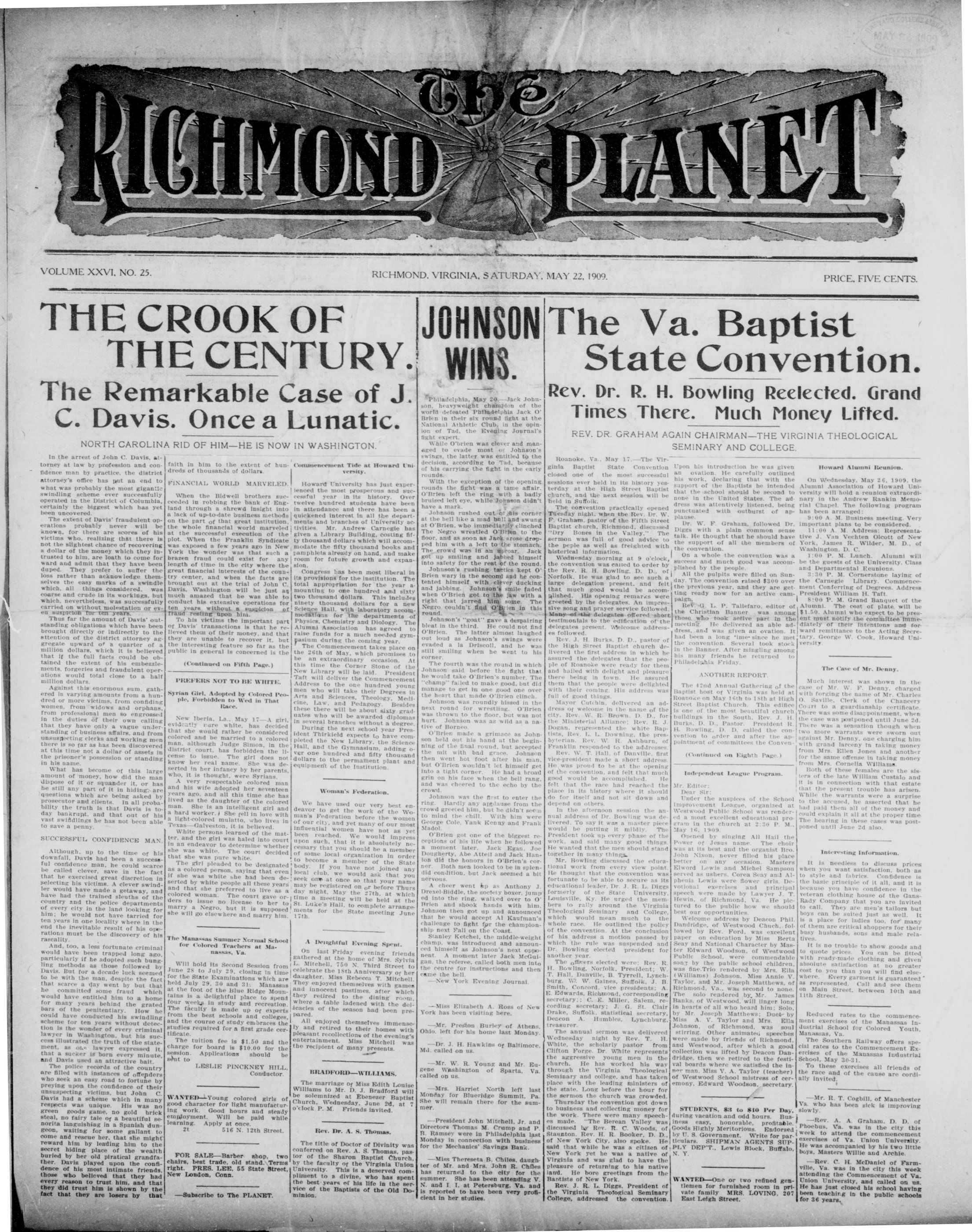
THE CROOK OF THE CENTURY. The Remarkable Case of J. C. Davis. Once a Lunatic.
NORTH CAROLINA RID OF HIM—HE IS NOW IN WASHINGTON.
VOLUME XXVI, NO. 25.
THE C
TH
The Remi
C. Davis
NORTH CAROLIN
In the arrest of John C. Davis, attorney at law by profession and confidence man by practice, the district attorney's office has put an end to what was probably the most gigantic swindling scheme ever successfully operated in the District of Columbia, certainly the biggest which has yet been uncovered.
The extent of Davis' fraudulent operations probably never will be known, for there are scores of his victims who, realizing that there is not the slightest chance of recovering a dollar of the money which they intrusted to him, are loath to come for ward and admit that they have been duped. They prefer to suffer the loss rather than acknowledge themselves the easy marks of a swindle which, all things considered, was coarse and crude in its workings, but which, nevertheless, was successfully carried on without molestation or even suspicion for ten years.
Thus far the amount of Davis' outstanding obligations which have been brought directly or indirectly to the attention of the district attorney agregate upward of a quarter of a million dollars, which it is believed that if the full facts could be obtained the extent of his embezzlements, forgeries and fraudulent operations would total close to a half million dollars.
Against this enormous sum, gathered in varying amounts from a hundred or more victims, from confiding women, from widows and orphans, from professional men so engrossed in the duties of their own calling that they have only a vague understanding of business affairs, and from unsuspecting clerks and working men there is so far as has been discovered at this time not a dollar of assets in the prisoner's possession or standing in his name.
What has become of this large amount of money, how did the man dispose of it or squander it, or has he still any part of it in hiding, are questions which are being asked by prosecutor and clients. In all probability the truth is that Davis is today bankrupt, and that out of his vast swiffflings he has not been able to save a penny.
SUCCESSFUL CONFIDENCE MAN
Although, up to the time of his downfall, Davis had been a successful confidence man, he could scarce be called clever, save in the fact that he exercised great discretion in selecting his victims. A clever sweder would have made a getaway, and have had the trained sleuths of the country and the police departments of every city in the land looking for him; he would not have tarried for ten years in one locality where in the end the inevitable result of his operations must be the discovery of his rascality.
And, too, a less fortunate criminal would have been trapped long ago, particularly if he adopted such bungling methods as those followed by Davis. But for a decade luck seemed to be with the man, despite the fact that scarce a day went by but that he committed some fraud which would have entitled him to a home for many years behind the grated bars of the penitentiary. How he could have conducted his swindling scheme for ten years without detection is the wonder of every criminal lawyer in Washington, but his success illustrated the truth of the statement, as one lawyer expressed it, that a sucker is born every minute, and Davis used an attractive belt.
The police records of the country are filled with instances of offenders who seek an easy road to fortune by preying upon the confidence of their unsuspecting victims, but John C. Davis had a scheme which in many respects was unique. His was no green goods game, no gold brick steal, no fair tale tale or a beautiful senorita languishing in a Spanish dungeon, waiting for some gallant to come and rescue her, that she might reward him by leading him to the secret hiding place of the wealth buried by her old piratical grandfather. Davis played upon the confidence of his most intimate friends, those who believed that they had every reason to trust him, and that they did trust him is shown by the fact that they are losers by that
faith in him to the extent of hundreds of thousands of dollars.
FINANCIAL WORLD MARVELED.
When the Bidwell brothers succeeded in robbing the bank of England through a shrewd insight into a lack of up-to-date business methods on the part of that great institution, the whole financial world marveled at the successful execution of the plot. When the Franklin Syndicate was exposed a few years ago in New York the wonder was that such a brazen fraud could exist for any length of time in the city where the great financial interests of the country center, and when the facts are brought out at the trial of John C. Davis, Washington will be just as much amazed that he was able to conduct his extensive operations for ten years without a suspicion of fraud resting upon him.
To his victims the important part of Davis' transactions is that he relieved them of their money, and that they are unable to recover it, but the interesting feature so far as the public in general is concerned is the
(Continued on Fifth Page.)
PREFERS NOT TO BE WHITE
Syrian Girl, Adopted by Colored People, Forbidden to Wed in That Place.
New Iberia, La., May 17—A girl evidently pure white, has decided that she would rather be considered colored and be married to a colored man, although Judge Simon, in the district court, has forbidden the license to issue. The girl does not know her real name. She was deserted in her infancy by her parents, who it is thought, were Syrians. A very respectable colored man and his wife adopted her seventeen years ago, and all this time she has lived as the daughter of the colored man. She is an intelligent girl and a hard worker. She jell in love with a light-colored mulatto, who lives in Texas—Galveston, it is believed.
White persons learned of the matter, and the girl was hailed into court in an endeavor to determine whether she was white. The court decided that she was pure white.
The girl pleaded to be designated as a colored person, saying that even if she was white she had been deserted by white people all these years and that she preferred to live as a colored woman. The court gave orders to issue no license to her to marry a Negro, but it is supposed she will go elsewhere and marry him.
The Manassas Summer Normal School for Colored Teachers at Manassas, Va.
Will hold its Second Session from June 28 to July 29, closing in time for the State Examinations which are held July 29, 30 and 31. Manassas at the foot of the Blue Ridge Mountains is a delightful place to spend four weeks in study and recreation. The faculty is made up of experts from the best schools and colleges, and the course of study embraces the studies required for a first grade certificate. The tuition fee is $1.50 and the charge for board is $10.00 for the session. Applications should be sent to LESLIE PINCKNEY HILL, Conductor.
WANTED Young colored girls of good character for light manufacturing work. Good hours and steady employment. Will be paid while learning. Apply at once.
FOR SALE—Barber shop, two chairs, best trade, old stand. Terms right. PRES. LEE, 55 State Street, New London, Conn.
—Subscribe to The PLANET.
RICHMOND, VIRGINIA, SATURDAY, MAY 22, 1909.
Commencement Tide at Howard University.
Howard University has just experienced the most prosperous and successful year in its history. Over twelve hundred students have been in attendance and there has been a quickened interest in all the departments and branches of University activities. Mr. Andrew Carnegie has given a Library Building, costing fifty thousand dollars which will accommodate the fifty thousand books and pamphlets already on hand, and make room for future growth and expansion.
Congress has been most liberal in its provisions for the institution. The total appropriation for the year amounting to one hundred and sixty two thousand dollars. This includes ninety thousand dollars for a new Science Hall, with laboratory accommodations for the departments of Physics, Chemistry and Diology. The Alumni Association has agreed to raise funds for a much needed gymnasium during the coming year.
The Commencement takes place on the 26th of May, which promises to be an extraordinary occasion. At this time the Corner Stone of the New Library will be laid. President Taft will deliver the Commencement Address to the one hundred young men who will take their Degrees in Arts and Sciences, Theology, Medicine, Law, and Pedagogy. Besides these there will be about sixty graduates who will be awarded diplomas in several branches without a degree.
During the next school year President Thirkield expects to have completed the New Library, the Science Hall, and the Gymnasium, adding over one hundred and fifty thousand dollars to the permanent plant and equipment of the Institution
Woman's Federation.
We have used our very best endeavor to get the work of the Woman's Federation before the women of our city, and yet many of our most influential women have not as yet been reached. We would impress upon such, that it is absolutely necessary that you should be a member of some local organization in order to become a member of the State body. If you have not joined any local club, we would ask that you seek one at once so that your name may be registered on or before Thursday day night. May the 27th, at which time a meeting will be held at the St. Luke's Hall, to complete arrangements for the State meeting June 17th.
A Denghtful Evening Spent
On last Friday evening friends gathered at the home of Mrs. Sylvia L. Mitchell, 750 N. Third Street to celebrate the 18th Anniversary or her daughter, Miss Rebecca T. Mitchell. They enjoyed themselves with games and innocent pastimes, after which they retired to the dining room, where a table ladened with the delicacies of the season had been prepared. All enjoyed themselves immensely and retired to their homes with pleasant recollections of the evening's entertainment. Miss Mitchell was the recipient of many presents.
BRADFORD—WILLIAMS
The marriage or Miss Edith Louise
Williams to Mr. D. J. Bradford will
be solemnized at Ebenezer Baptist
Church, Wednesday, June 2d, at 7
o'clock P. M. Friends invited.
Rev. Dr. A. S. Thomas
The title of Doctor of Divinity was conferred on Rev. A. S. Thomas, pastor of the Sharon Baptist Church, by the faculty of the Virginia Union University. This is a deserved compliment to a divine, who has spent the best years of his life in the service of the Baptists of the Old Dominion.
JOHNSON WINS.
Philadelphia, May 20. Jack Johnson, heavyweight champion of the world defeated Philadelphia Jack O'Brien in their six round fight at the National Athletic Club, in the opinion of Tad, the Evening Journal's fight expert.
While O'Brien was clever and managed to evade most or Johnson's swings, the latter was entitled to the decision, according to Tad, because of his carrying the fight in the early rounds.
With the exception of the opening rounds the fight was a tame affair. O'Brien left the ring with a badly bruised left eye, while Johnson didn't have a mark.
Johnson rushed out or his corner at the bell like a mad bull and swung at O'Brien, who immediately clinched The Negro wrestled O'Brien to the floor, and as soon as Jack arose dropped him with a left to the stomach. The crowd was in an uproar. Jack got up smiling and jabbed himself into safety for the rest of the round.
Johnson's rushing tactics kept O'Brien wary in the second and he contented himself with clever ducking and jabbing. Johnson's smile faded when O'Brien got to the jaw with a right that jarred him some. The Negro couldn't find O'Brien in this round.
Johnson's "goat" gave a despairing bleat in the third. He could not find O'Brien. The latter almost laughed out loud as Johnson's swings were evaded a la Driscoll, and he was still smiling when he went to his corner.
The fourth was the round in which Johnson said before the fight that he would take O'Brien's number. The "champ" failed to make good, but did manage to get in one good one over the heart that made O'Brien clinch.
Johnson was roundly hissed in the next round for wrestling. O'Brien was thrown to the floor, but was not hurt. Johnson was as wild as a native of Borneo.
O'Brien made a grimace as Johnson held out his hand at the beginning of the final round, but accepted the mit with bad grace. Johnson then went hot foot after his man, but O'Brien wouldn't let himself get into a tight corner. He had a broad grin on his face when the bell rang, and was cheered to the echo by the crowd.
Johnson was the first to enter the ring. Hardly any aglause from the crowd greeted him, but he didn't seem to mind the chill. With him were George Cole, Yank Kenny and Frank Madel.
O'Brien got one of the biggest receptions of his life when he followed a moment later. Jack Egan, Joe Dougherty, Abe Attell and Jack Hanlon did the honors in O'Brien's corner. Both men looked to be in splendid condition, but Jack seemed a bit nervous.
A cheer went up as Anthony J. Drexel-Biddle, the society boxer, jumped into the ring, walked over to O'Brien and shook hands with him. Johnson then got up and announced that he would accept Al Kaufman's challenge to fight for the championship next Fall on the Coast.
Stanley Ketchel, the middle-weight champ, was introduced and announced himself as Johnson's next opponent. A moment later Jack McGuigan, the referee, called both men into the centre for instructions and then came the bell.
—New York Evening Journal.
—Miss Elizabeth A. Ross of New York has been visiting here.
—Mr. Preston Burley of Athens, Ohio, left for his home last Monday.
—Dr. J. H. Hawkins of Baltimore, Md. called on us.
—Mr. W. R. Young and Mr. Eugene Washington of Sparta, Va. called on us.
—Mrs. Harriet North left last Monday for Blueridge Summit. Pa. She will remain there for the summer.
—President John Mitchell, Jr. and Directors Thomas M. Crump and P. B. Ramsey were in Philadelphia last Monday in connection with business for the Mechanics' Savings Bank.
—Miss Thereseta B. Chiles, daughter of Mr. and Mrs. John R. Chiles has returned to the city for the summer. She has been attending V. N. and I. L. at Petersburg, Va. and is reported to have been very proficient in her studies.
The Va. Baptist State Convention. Rev. Dr. R. H. Bowling Reelected. Grand Times There. Much Money Lifted.
REV. DR. GRAHAM AGAIN CHAIRMAN—THE VIRGINIA THEOLOGICAL SEMINARY AND COLLEGE.
Snoke, Va., May 17.—The Vir-
Baptist State Convention one of the most successful was ever held in its history yest-
er day at the High Street Baptist Church, and the next session will be in Suffolk.
The convention practically opened a day night, when the Rev. Dr. W.
Braham, pastor of the Fifth Street church, Richmond, discussed Bones in the Valley." The
Braham was full of good advice to people as well as freighted with local information.
Tuesday morning at 9 o'clock, convention was called to order by Rev. R. H. Bowling, D. D., of K. He was glad to see such a delegation present, and felt much good would be accommodated. His opening remarks were by the delegates. An impress-
ing and prayer service followed, of the delegates offered short remarks to the edification of the present. Welcome address-
owed.
J. H. Burks, D. D., pastor of High Street Baptist Church died the first address in which he had the delegates that the peo-
ple.
Upon his introduction he was given an ovation. He carefully outlined his work, declaring that with the support of the Baptists he intended that the school should be second to none in the United States. The address was attentively listened, being punctuated with outburst of applause.
Dr. W. F. Graham, followed Dr. Diggs with a plain common sense talk. He thought that he should have the support of all the members of the convention.
On a whole the convention was a success and much good was accomplished by the people.
All the pulpits were filled on Sunday. The convention raised $300 over the previous year, and they are get-
ting ready now for an active campaign.
Rev. G. L. P. Taliefaro, editor of the Christian Banner was among those who took active part in the meeting. He delivered an able address, and was given an ovation. It had been a long time since he met the convention. Several took stock in the Banner. After mingling among his many friends he returned to Philadelphia Friday.
Howard Alumni Reunion
On Wednesday, May 26, 19
Alumni Association of Howard
versity will hold a reunion ex-
nary in the Andrew Rankin oclot-
ial Chapel. The following pla-
has been arranged:
9:00 A. M. Business meeting
important plans to be consider
11:00 A. M. Address; Repe-
tive J. Van Vechten Olcott
York, James R. Wilder, M.
Washington, D. C.
1:00 P. M. Lunch. Alumni be the guests of the University and Departmental Reunions.
3:30 P. M. Cornersstone la-
cation the Carnegie Library. Com-
ment Conferring of Degrees. A
President William H. Taft.
8:00 P. M. Grand Banquet
Alumni. The cost of plate.
$1.50. Alumni who expect to be
must notify the committee
diately of their intentions a
ward remittance to the Acting
tary. George W. Cook, Howa
versity.
The 42nd Annual Gathering of the Baptist host of Virginia was held at Roanoke on May 16th to 18th at High Street Baptist Church. This edifice is one of the most beautiful church buildings in the South, Rev. J. H Burks, D. D., Pastor, President R H. Bowling, D. D, called the convention to order and after the appointment of committees the Conven
Mr. Editor:
Dear Sir:
Under the auspices of the School improvement League, organized at Westwood Public School was rendered a most excellent educational program in the church at 2:30 P. M., May 16, 1909.
Opened by singing All Hail the Power of Jesus name. The choir was at its best and the organist Bro. John Nixon, never filled his place better on any occasion. Masters Elword Lewis and Michel Sampson served as ushers. Corea Seay and Alphena Lewis were flower girls. Devotional exercises and principal speech were made by Lawyer J. T. Hewin, of Richmond, Va. He pictured to the public how we should best our opportunities.
Welcome address by Deacon Phil Dandridge, of Westwood Chuch, followed by Rev. Ford, was excellent paper on education by Miss Berts Seay and National Character by Master Edward Woodson, of Westwood Public School, were commendable song by the public school children, was fine Trio rendered by Mrs. Ella (Williams) Johnson, Miss Annie V. Taylor, and Mr. Joseph Matthews, of Richmond, Va., was second to none. The solo rendered by Mr. James Banks, of Westwood, will linger long in hearts of all who heard him; Solo, by Mr. Joseph Matthews; Duet by Miss A. V. Taylor and Mrs. Ella Johnson, of Richmond, was soul stirring. Other animated speeches were made by friends of Richmond, and Westwood, after which a good collection was lifted by Deacon Dandridge, then we retired to the festival boards where we satisfied the teacher. Miss V. A. Taylor (teacher) of Westwood School mistress of ceremony, Edward Woodson, secretary.
STUDENTS, $3 to $10 Per Day,
during vacation and odd hours. Business easy, honorable, profitable. Goods Highly Meritorious. Endorsed by U. S. Government. Write for particulars. SHIPMAN AGENTS SUPPLY DEP T., Lewis Block, Buffalo N. Y.
WANTED One or two refined gentlemen for furnished room in private family MRS. LOVING. 207 East Leigh Street.
Roanoke, Va. May 17.—The Virginia Baptist State Convention closed one of the most successful sessions ever held in its history yesterday at the High Street Baptist church, and the next session will be held in Suffolk.
The convention practically opened Tuesday night, when the Rev. Dr. W. F. Graham, pastor of the Fifth Street Baptist church, Richmond, discussed "Dry Bones in the Valley." The sermon was full of good advice to the people as well as freighted with historical information.
Wednesday morning at 9 o'clock, the convention was canned to order by the Rev. R. H. Bowling, D. D., of Norfolk. He was glad to see such a large delegation present, and felt that much good would be accomplished. His opening remarks were greeted by the delegates. An impressive song and prayer service followed. Many of the delegates offered short testimonials to the edification of the delegates present. Welcome addresses followed.
Rev. J. H. Burks, D. D., pastor of the High Street Baptist church delivered the first address in which he assured the delegates that the people of Roanoke were ready for them and hailed with delight and pleasure there being in town. He assured them that the people were delighted with their coming. His address was full of good things.
Mayor Cutchin, delivered an address of welcome in the name of the city, Rev. W. R. Brown, D. D., for the Ministerial Alliance; Rev. R. J. Dogan, represented the white Baptists, Rev. L. L. Downing, the presbyterian, Rev. W. R. Ashburn, of Franklin responded to the addresses, Rev. W. T. Hall, of Danville, first vice-president made a short address. He was proud to be at the opening of the convention, and felt that much good would be accomplished. He felt that the race had reached the place in its history where it should do for itself and not sit down and depend on others.
In the afternoon session the annual address of Dr. Bowling was delivered. To say it was a master piece would be putting it mildly. The President took up every phase of the work, and said many good things. He wanted that the men should stand together in many things.
Mr. Bowling discussed the educational work from every view point. He thought that the convention was fortunate to be able to secure as its educational leader, Dr. J. R. L. Diggs formerly of the State University, Louisville, Ky. He urged the members to rally around the Virginia Theological Seminary and College, which would mean much to the whole race. He outlined the policy of the convention. At the conclusion of his address a motion passed by which the rule was suspended and Dr. Bowling elected president for another year.
The officers elected were: Rev. R. H. Bowling, Norfolk, President; W. T. Hall, Danville, B. Tyrrell, Lynchburg, W. W. Gaines, Suffolk, J. B. Smith, Concord, vice presidents; A. E. Edwards, Richmond, corresponding secretary; C. E. Miller, Salem, recording secretary; J. G. St. Clair Drake, Suffolk, statistical secretary, Decon A. Humbles, Lynchburg, treasurer.
The annual sermon was delivered Wednesday night by Rev. T. H. White, the scholarly pastor from Clifton Forge. Dr. White represents the aggressive young men in the church. He has worked his way through the Virginia Theological Seminary and college, and has taken place with the leading ministers of the state. Long before the hour for the sermon the church was crowded.
Thursday the convention got down to business and collecting money for the work. There were many speeches made. "The Berean Valley was discussed by Rev. R. C. Woods, of Staunton. Rev. H. R. Booker, D. D. of New York City, also spoke. He said that while he was a citizen of New York yet he was a native of Virginia and was glad to have the pleasure of returning to his native land. He bore greetings from the Bantists of New York.
Rev. J. R. L. Diggs, President of the Virginia Theological Seminary College, addressed the convention
ANOTHER REPORT
(Continued on Eighth Page.)
Independent League Program
PRICE, FIVE CENTS.
tist
ention.
Selected. Grand
oney Lifted.
GINIA THEOLOGICAL
Howard Alumni Reunion
On Wednesday, May 26, 1909, the Alumni Association of Howard University will hold a reunion extraordinary in the Andrew Rankin Memorial Chapel. The following program has been arranged:
9:00 A. M. Business meeting. Very important plans to be considered.
11:00 A. M. Address: Representative J. Van Vechten Olcott of New York, James R. Wilder, M. D., of Washington, D. C.
1:00 P. M. Lunch. Alumni will be the guests of the University. Class and Departmental Reunions.
3:30 P. M. Cornerstone laying of the Carnegie Library. Commencement Conferring of Degrees. Address President William H. Taft.
8:00 P. M. Grand Banquet of the Alumni. The cost of plate will be $1.50. Alumni who expect to be present must notify the committee immediately of their intentions and forward remittance to the Acting Secretary, George W. Cook, Howard University.
The Case of Mr. Denny
Much interest was shown in the case of Mr. W. F. Denny, charged with forging the name of Mr. Charles O. Saville, Clerk of the Chancery Court to a guardianship certificate. There was some disappointment, when the case was postponed until June 2d. There was a sensation though when two more warrants were sworn out against Mr. Denny, one charging him with grand larceny in taking money from Mrs. Ellen Jones and another for the same offense in taking money from Mrs. Cornella Williams. Both of these females are the sisters of the late William Custalo and it is in connection with that estate that the present trouble has arisen. While the warrants were a surprise to the accused, he asserted that he had paid them all of the money and could explain it all at the proper time. The hearing in these cases was postponed until June 2d also.
Interesting Information
It is needless to discuss prices when you want satisfaction, both as to style and fabrics. Confidence is the basic principle of it all, and it is because you have confidence in the veteran clothing house of the Gans-Rady Company that you are invited to call. They are men's tailors but boys can be suited just as well. It is a place for ladies too, for many of them are critical shoppers for their busy husbands, sons and male relatives.
It is no trouble to show goods and to quote prices. You can be fitted with ready-made clothing and given absolute satisfaction at no greater cost to you than you will find elsewhere. Every garment is guaranteed as represented. Call and see them on Main Street, between 10th and 11th Street.
Reduced rates to the commencement exercises of the Manassas Industrial School for Colored Youth, Manassas, Va.
The Southern Railway offers special rates to the Commencement Exercises of the Manassas Industrial School, May 30-31.
To these exercises all friends of the race and of the cause are cordially invited.
Mr. R. T. Cogbill, of Manchester Va. who has been sick is improving slowly.
—Rev. A. A. Graham, D. D. of Phoebus, Va. was in the city this week to attend the commencement exercises of Va. Union University. He was accompanied by his two little boys, Masters Willie and Archie.
—Rev. C. H. McDaniel of Farmville, Va. was in the city this week attending the Commencement of Va. Union University, and called on us. He has just closed his school having been teaching in the public schools for 36 years.
DOLLY of the CIRCUS
BY MARGARET MAYO
COPYRIGHT, 1903, BY DODD, MEAD AND COMPANY
CHAPTER XIV.
THE "leap of death" implements were being carried from the ring, and Jim turned away to superintend their loading.
Performers again rushed by each other on their way to and from the main tent.
Polly stood in the center of the lot, frowning and anxious. The mere mention of the pastor's name had made it seem impossible for her to ride tonight. For hours she had been whipping herself up to the point of doing it, and now her courage failed her. She followed Barker as he came from the ring.
"Mr. Barker, please!"
He turned upon her sharply.
"Well, what is it now?"
"I want to ask you to let me off again tonight." She spoke in a short jerk, desperate way.
"What?" he shrieked. "Not go into the ring, with all them people inside what's paid their money because they knowed you?" "That's it!" she cried. "I can't! I can't!" "You're gettin' too tony!" Barker sneered. "That's the trouble with you. You ain't been good for nothin' since you was at that parson's house. You didn't stay there, and you're no use here. First thing you know you'll be out all round." "Out?" "Sure. You don't think I'm gain' to head my bill with a 'dead one', do you?" "I am not a 'dead one,'" she answered excitedly. "I'm the best rider you've had since mother died. You've said so yourself." "That was afore you got in with them church cranks. You talk about your mother! Why, she'd be ashamed to own you."
"She wouldn't!" cried Polly. Her eyes were flashing; her face was scarlet. The pride of hundreds of years of ancestry was quivering with indignation. "I can ride as well as I ever could, and I'll do it too. I'll do it tomorrow."
"Tomorrow?" echoed Barker. "What do you mean by that?"
"I mean that I can't go into that ring tonight," she declared, "and I won't."
She was desperate now and trading upon a strength beyond her own.
He looked at her with momentary indecision. She was a good rider, the best since her mother, as he had often told her. He could see this meant an issue. He felt she would be on her mettle tomorrow, as far as her work was concerned, if he let her alone tonight.
"All right," he said sullenly. "You can stay off tonight. I got the crowd in there anyway, and I got their money. I will let Elosee do a turn on Barbarian, but tomorrow you'd better show me your old act."
"I'll show you!" she cried. "I'll show you!"
"Well, see that you do." He crossed into the ring.
Polly stood where Barker had left her, white and tense. Jim came toward her from the direction of the wagons. He glanced at her uneasily. "What's he been a-sayin' to you?"
"He says I can't ride any more." Her lips closed tightly. She stared straight ahead of her. "He says I was no good to the people that took me in and I'm no use here."
"It's not so!" thundered Jim.
"No, it's not!" she cried. "I'll show him, Jim! I'll show him—tomorrow!" She turned toward the dressing tent. Jim caught her firmly by the wrist.
"Wait, Poll! You ain't ever goin' into the ring a feelin' that way." Her eyes met his defianty.
"What's the difference? What's the difference?" She wrenched her wrist quickly from him and ran into the dressing tent, laughing hysterically.
"An' I brung her back to it," mumbled Jim as he turned to give orders to the property men.
Most of the "first half props" were loaded, and some of the men were asleep under the wagons. The lot was clear. Suddenly he felt some one approaching from the back of the enclosure. He turned and found himself face to face with the stern, solitary figure of the pastor, wrapped in his long black cloak. The moonlight slipped through a rift in the clouds and fell into a circle around them.
"What made you come here?" was all Jim said.
"I heard that Miss Polly didn't ride today. I was afraid she might be ill."
"What's that to you?"
"She isn't ill?" Douglas demanded anxiously, oblivious to the gruffiness in the big fellow's voice.
"She's all right," Jim answered shortly as he shifted uneasily from one foot to the other and avoided the pastor's burning gaze.
"And she's happy, she's content?"
"Sure."
"I'm glad." said Douglas dully. He
POLLY of the CIRCUS
tried to think of some way to prolong their talk. "I've never heard from her, you know."
"Us folks don't get much time to write." Jim turned away and began tinkering with one of the wagons.
Douglas had walked up and down in front of the tents again and again, fighting against a desire to do the very thing that he was doing, but to no purpose, and now that he was here it seemed impossible that he should go away so unsatisfied. He crossed to Jim and came determinedly to the point.
"Can't I see her, Jim?"
"It's agin the rules." He did not turn. There was another pause; then Doug has started slowly out of the lot.
"Wait a minute," called Jim, as though the words had been wrung from him. The pastor came back with a question in his eyes.
"I lled to you."
"She's not well, then?"
"Oh, yes, she's well enough. It ain't that; it's about her being happy."
"Then why did she leave me?"
"I don't know. She wasn't gon' to do it at first. Somethin' must 'a' happened afterwards, somethin' that you an' me didn't know about."
"We will know about it, Jim. Where is she?" His quick eye searched the lot. His voice had regained its old command. He felt that he could conquer worlds.
"You can't do no good that way." answered Jim. "She don't want to see you again."
"Why not?"
"I don't know, but she told me she'd run away if I ever even talked to you about her."
"You needn't talk, Jim. I'll talk for myself. Where is she?"
"She'll be comin' out soon. You can wait around out here with me. I'll let you know in time." He led the way through a narrow passage between the wagons.
Jim and Douglas had barely left the lot when Deacon Elverson's small, round head slipped cautiously around the corner of the dressing tent. The little deacon glanced exultantly about him. He was monarch of all he surveyed. It was very thrilling to stand on this forbidden ground smelling the sawdust, gazing at the big red wagons, studying the unprotected circus properties and listening to the lightening tempo of the band.
"Did you see him?" shouted Strong, who had followed closely upon Elverson's heels.
The little deacon started. Strong was certainly a disturbing factor at times.
"Yes, I—I saw him."
"Well?"
"He—he—didn't see her."
"What did he do?" Strong was beside himself with impatience.
"He—he just talked to the big un and went out that way." Elverson nodded toward the wagons.
"I guess he ain't gone far," sneered Strong. "He come over to this lot to see her, and he ain't goin' to give up till he does it. You wait here. I'll take a look round." He went quickly in the direction of the wagons.
Elverson needed no second invitation to wait. He was congratulating himself upon his good fortune when he all but collided with a flying apparition, vanishing in the direction of the main tent. Sophisticated eyes would have seen only a rather stout acrobat clad in pink tights, but Elverson was not
sophisticated, and he teetered after the fitting angel, even unto the forbidden portals of the big top.
He was peeping through the curtains which had fallen behind her and was getting his first glimpse of the great sawdust world beyond when one of the clowns dashed from the dressing tent on his way to the ring.
The clown was late. He saw the limp coattails of the deacon, who was three-quarters in the tent. Here was a chance to make a funny entrance. He grabbed the unsuspecting little man from the rear. The terrified deacon struck out blindly in all directions, his black arms and legs moving like a centiped's, but the clown held him firmly by the back and thrust him headforemost into the tent.
Strong returned almost immediately from his unsuccessful search for the pastor. He looked about the lot for Elverson.
"Hey, there, Elverson!" he called lustily. There was no response.
"Now, where's he got to?" grumbled Strong. He disappeared quickly around the corner of the dressing tent, resolved to keep a sharp lookout for Douglas. Elverson was thrust from the tent soon after, spitting sawdust and much discomfited, by the laughing performers who followed him. His knees almost gave way beneath him when Barker came out of the ring, snapping his long black whip. "Get out of here, you bloke!" roared
THE RICHMOND PLANET, RICHMOND, VIRGINIA
BY MARGARET MAYO
COPYRIGHT, 1908, BY DODD, MEAD AND COMPANY
S.
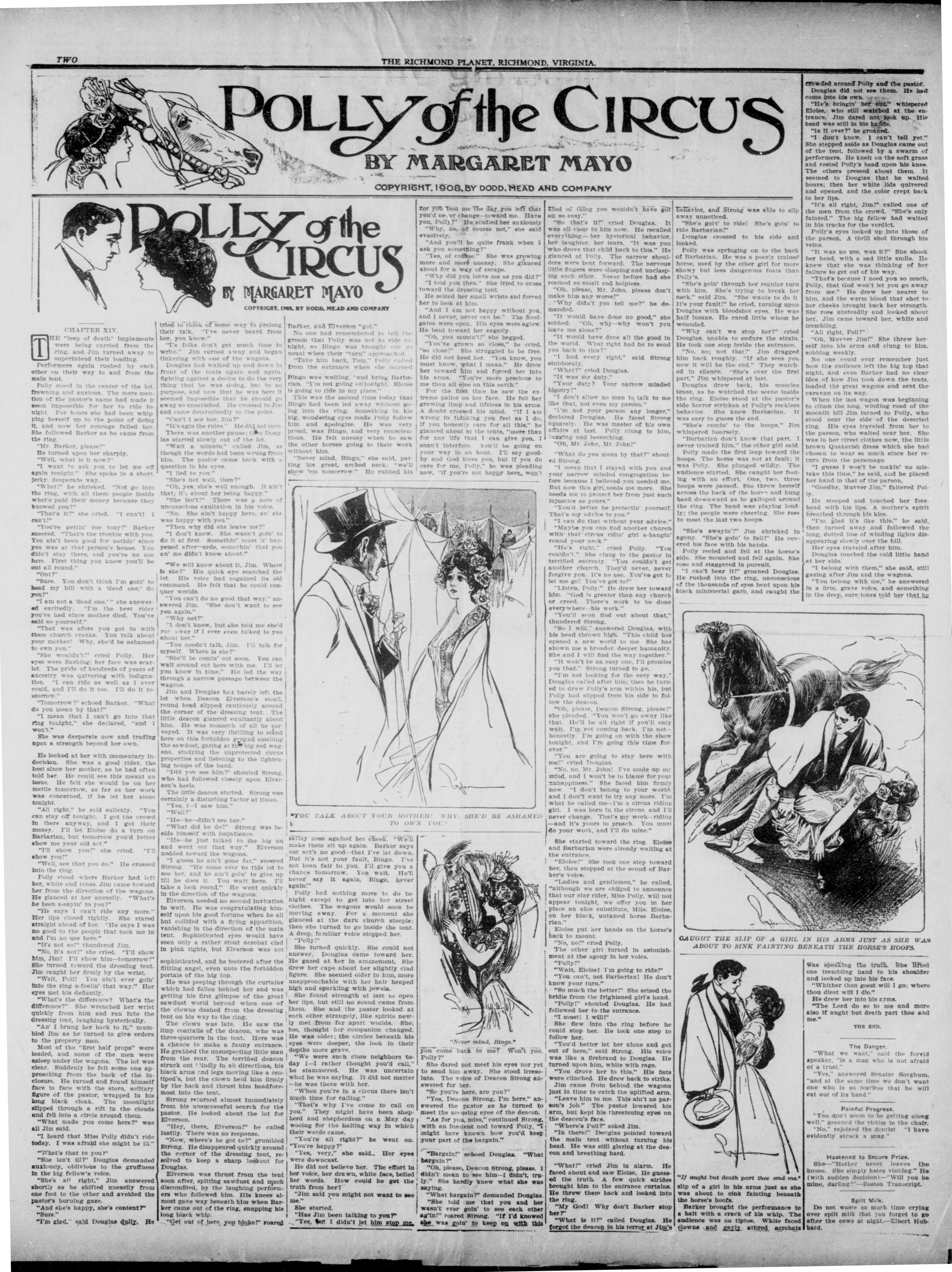
*YOU TALK ABOUT YOUR MOTHER! WHY, SHE'D BE ASHAMED TO OWN YOU.*
Barker, and Elverson "got."
No one had remembered to tell the groom that Polly was not to ride tonight, so Bingo was brought out as usual when their "turn" approached.
"Take him back, Tom." Polly called from the entrance when she learned Bingo was waiting, "and bring Barbarian. "I'm not going on tonight. Elosle is going to ride in my place."
This was the second time today that Bingo had been led away without going into the ring. Something in his big, wondering eyes made Polly follow him and apologize. He was very proud, was Bingo, and very conscientious. He felt uneasy when he saw the other horses going to their work without him.
"Never mind, Bingo," she said, putting his great, arched neck; "we'll show 'em tomorrow." He rubbed his
YOU TALK ABOUT YOUR MOTION TO OW
stuffy nose against her cheek. "We'll make them sit up again. Barker says our act's no good—that I've let down. But it's not your fault, Bingo. I've not been fair to you. I'll give you a chance tomorrow. You wait. He'll never say it again, Bingo, never again."
Polly had nothing more to do tonight except to get into her street clothes. The wagons would soon be moving away. For a moment she glanced at the dark church steeple; then she turned to go inside the tent. A deep, familiar voice stopped her. "Polly!"
She turned quickly. She could not answer. Douglas came toward her. He gazed at her in amazement. She drew her cape about her slightly clad figure. She seemed older to him, more unapproachable with her hair heaped high and sparkling with jewels.
She found strength at last to open her lips, but still no sound came from them. She and the pastor looked at each other strangely, like spirits newly met from far apart worlds. She, too, thought her companion changed. He was older; the circles beneath his eyes were deeper, the look in their depths more grave.
"We were such close neighbors today I—I rather thought you'd call," he stammered. He was uncertain what he was saying. It did not matter—he was there with her.
"When you're in a circus there isn't much time for calling."
"That's why I've come to call on you." They might have been shepherd and shepherdess on a May day wooing for the halting way in which their words came.
"You're all right?" he went on.
"You're happy?"
"Yes, very," she said.. Her eyes were downcast.
He did not believe her. The effort in her voice, her drawn, white face, belied her words. How could he get the truth from her?
"Jim said you might not want to see me."
She started.
"Has Jim been talking to you?"
"Has Jim been talking to you?
"Yes, but I didn't let him stop me.
for you told me the day you left that you'd nee me er change—toward me. Have you, Polly?" He studied her anxiously "Why, no, of course not," she said evasively. "And you'll be quite frank when I ask you something?" "Yes, of course." She was growing more and more uneasy. She glanced about for a way of escape. "I why did you leave me as you did?" "I told you then." She tried to cross toward the dressing tent.
He seized her small wrists and forced her to look at him.
"And I am not happy without you, and I never, never can be." The floodgates were open. His eyes were aglow. He bent toward her eagerly.
"Oh, you mustn't!" she begged.
"You've grown so close," he cried, "so close!" She struggled to be free. He did not heed her. "You know, you must know, what I mean." He drew her toward him and forced her into his arms. "You're more precious to me than all else on this earth."
For the first time he saw the extreme pallor on her face. He felt her growing limp and lifeless in his arms. A doubt crossed his mind. "If I am wrong in thinking you feel as I do, if you honestly care for all this," he glanced at at the tents, "more than for any life that I can give you. I snant interfere. you'll be going on your way in an hour. I'll say goodbye and God bless you, but if you do care for me, Polly," he was pleading now. "if you're not happy here, won't
HER! WHY, SHE'D BE ASHAMED
N YOU."
J.
"Never mind, Bingo."
you come back to me? Won't you, Polly?"
She dared not meet his eyes nor yet to send him away. She stood irresolute. The voice of Deacon Strong answered for her.
"So you're here, are you?"
"Yes, Deacon Strong, I'm here," answered the pastor as he turned to meet the accusing eyes of the deacon.
"As for you, miss," continued Strong, with an insolent nod toward Polly, "I might have known how you'd keep your part of the bargain."
"Bargain!" echoed Douglas. "What bargain?"
"Oh, please, Deacon Strong, please. I didn't mean to see him. I didn't, truly." She hardly knew what she was saying.
"What bargain?" demanded Douglas. "She told me that you and her wasn't ever goin' to see each other agin'" roared Strong. "If I'd knowed she was goin' to keep on with this
Kind of thing you wouldn't have got out so easy."
"So that's it!" cried Douglas. It was all clear to him now. He recalled everything—her hysterical behavior, her laughter, her tears. "It was you who drove that child back to this." He glanced at Polly. The narrow shoulders were bent forward. The nervous little fingers were clasping and unclasping each other. Never before had she seemed so small and helpless.
"Oh, please, Mr. John, please don't make him any worse."
"Why didn't you tell me?" he demanded.
"It would have done no good," she sobbed. "Oh, why—why won't you leave me alone?"
"It would have done all the good in the world. What right had he to send you back to this?"
"I had every right," said Strong stubbornly.
"What??" cried Douglas.
"It was my duty."
"Your duty? Your narrow minded bigotry!"
"I don't allow no man to talk to me like that, not even my parson."
"I'm not your parson any longer," declared Douglas. He faced Strong squarely. He was master of his own affairs at last. Polly clung to him, begging and beseeching.
"Oh, Mr. John, Mr. John!"
"What do you mean by that?" shouted Strong.
"I mean that I stayed with you and your narrow minded congregation before because I believed you needed me. But now this girl, needs me more. She needs me to protect her from just such injustice as yours."
"You'd better be protectin' yourself. That's my advice to you."
"I can do that without your advice."
"Maybe you can find another church with that circus ridin' girl a-hangin' round your neck."
"He's right." cried Polly. "You couldn't." She clung to the pastor in terrified entreaty. "You couldn't get another church. They'd never, never forgive you. It's no use. You've got to let me go! You've got to!"
"Listen, Polly." He drew her toward him. "God is greater than any church or creed. There's work to be done everywhere—his work."
"You'll soon find out about that," thundered Strong.
"So I will." answered Douglas, with his head thrown high. "This child his opened a new world to me. She has shown me a broader, deeper humanity. She and I will find the way together."
"It won't be an easy one, I'll promise you that." Strong turned to go.
"I'm not looking for the easy way," Douglas called after him; then he turned to draw Polly's arm within his, but Polly had slipped from his side to follow the deacon.
"Oh, please, Deacon Strong, please!" she pleaded. "You won't go away like that. He'll be all right if you'll only wait. I'm not coming back. I'm not honestly. I'm going on with the show tonight, and I'm going this time forever."
"You are going to stay here with me!" cried Douglas.
"No, no, Mr. John! I've made up my mind, and I won't be blame for your unhappiness." She faced him firmly now. "I don't belong to your world, and I don't want to try any more. I'm what he called me—I'm a circus riding girl. I was born in the circus, and I never change. That's my work—riding—and it's yours to preach. You must do your work, and I'll do mine."
She started toward the ring. Eloise and Barbarian were already waiting at the entrance.
"Eloise!" She took one step toward her, then stopped at the sound of Barker's voice.
"Ladies and gentlemen," he called, "although we are obliged to announce that our star rider, Miss Polly, will not appear tonight, we offer you in her place an abel substitute, Mile, Eloise, on her black, untaimed horse Barbarian."
Eloise put her hands on the horse's back to mount.
"No, no!" cried Polly.
The other girl turned in astonishment at the agony in her voice.
"Polly!"
"Wait, Elosse! I'm going to ride!"
"You can't, not Barbarian! He don't know your turn."
"So much the better!" She seized the bridle from the frightened girl's hand.
"Polly!" shouted Douglas. He had followed her to the entrance.
"I must! I will!"
She flew into the ring before he could stop her. He took one step to follow her.
"You'd better let her alone and get out of here," said Strong. His voice was like a firebrand to Douglas. He turned upon him, white with rage.
"You drove her to this." His fists were clinched. He drew back to strike. Jim came from behind the wagons just in time to catch the uplifted arm.
"Leave him to me. This ain't no parson's job." The pastor lowered his arm, but kept his threatening eyes on the deacon's face.
"Where's Poll?" asked Jim.
"In there!" Douglas pointed toward the main tent without turning his head. He was still glaring at the deacon and breathing hard.
"What!" cried Jim in alarm. He faced about and saw Eloise. He guessed the truth. A few quick strides brought him to the entrance curtains. He threw them back and looked into the ring.
"My God! Why don't Barker stop her?"
"What is it?" called Douglas. He forgot the deacon in his terror at Jim's
J.
CAUGHT THE SLIP OF A GIRL IN HIS ARMS JUST AS SHE WAS
ABOUT TO SINK FAINTING BENEATH THE HOBSES HOOFS
behavior, and Strong was able to slip away unnoticed.
"She's goin' to ride! She's goin' to ride Barbarian!" Douglas crossed to his side and looked.
Polly was springing on to the back of Barbarian. He was a poorly trained horse, used by the other girl for more showy but less dangerous feats than Polly's.
"She's goin' through her regular turn with him. She's trying to break her neck," said Jim. "She wants to do it. It's your fault!" he cried, turning upon Douglas with bloodshot eyes. He was half insane. He cared little whom he wounded.
"Why can't we stop her?" cried Douglas, unable to endure the strain. He took one step inside the entrance.
"No, no; not that!" Jim dragged him back roughly. "If she sees you now it will be the end." They watched in silence. "She's over the first part." Jim whispered at last.
Douglas drew back, his muscles tense, as he watched the scene inside the ring. Eloise stood at the pastor's side horror stricken at Polly's reckless behavior. She knew Barbarian. It was easy to guess the end.
"She's comin' to the hoops," Jim whispered hoarsely.
"Barbarian don't know that part. I never trained him," the other girl said. Polly made the first leap toward the hoops. The horse was not at fault; it was Polly. She plunged wildly. The audience started. She caught her footing with an effort. One, two, three hoops were passed. She threw herself across the back of the horse and hung head downward as he galloped around the ring. The band was playing loudly; the people were cheering. She rose to meet the last two hoops.
"She's swayin'!" Jim shrieked in agony. "She's goin' to fail!" He covered his face with his hands.
Polly reeled and fell at the horse's side. She mounted and fell again. She rose and staggered in pursuit.
"I can't bear it!" groaned Douglas. He rushed into the ring, unconscious of the thousands of eyes bent upon his black ministerial garb, and caught the
CAUGHT THE SLIP OF A GIRL
ABOUT TO SINK FAINTING B
P.
"IJ aught but death part thee and me"
slip of a girl in his arms just as she was about to sink falting beneath the horse's hoofs.
Barker brought the performance to a halt with a crack of his whip. The audience was on tiptoe. White faced clowns and gavly attired acrobats
crowded around Polly and the pastor. Douglas did not see them. He had come into his own.
"He's bringin' her out," whispered Elosee, who still watched at the entrance. Jim dared not look up. His head was still in his hands.
"Is it over?" he groaned.
"I don't know. I can't tell yet." She stepped aside as Douglas came out of the tent, followed by a swarm of performers. He knelt on the soft grass and rested Polly's head upon his knee. The others pressed about them. It seemed to Douglas that he waited hours; then her white lids quivered and opened, and the color crept back to her lips.
"It's all right, Jim!" called one of the men from the crowd. "She's only fainted." The big fellow had waited in his tracks for the verdict.
Polly's eyes looked up into those of the parson. A thrill shot through his veins.
"It was no use, was it?" She shook her head, with a sad little smile. He knew that she was thinking of her failure to get out of his way.
"That's because I need you so much, Polly, that God won't let you go away from me." He drew her nearer to him, and the warm blood that shot to her cheeks brought back her strength. She rose unsteadily and looked about her. Jim came toward her, white and trembling.
"All right, Poll?" "Oh, Muvver Jim!" She threw herself into his arms and clung to him, sobbing weakly.
No one could ever remember just how the audience left the big top that night, and even Barker had no clear idea of how Jim took down the tents, loaded the great wagons and sent the caravan on its way.
When the last wagon was beginning to climb the long, winding road of the moonlit hill Jim turned to Polly, who stood near the side of the deserted ring. His eyes traveled from her to the parson, who waited near her. She was in her street clothes now, the little brown Quakerish dress which she had chosen to wear so much since her return from the parsonage.
"I guess I won't be makin' no mistake this time," he said, and he placed her hand in that of the parson.
"Goodby, Muvver Jim," faltered Polly.
He stooped and touched her forehead with his lips. A mother's spirit breathed through his kiss.
"I'm glad it's like this," he said, then turned away and followed the long, dotted line of winding lights disappearing slowly over the hill.
Her eyes traveled after him. Douglas touched the cold little hand at her side.
"I belong with them," she said, still gazing after Jim and the wagons.
"You belong with me," he answered in a firm, grave voice, and something in the deep, sure tones told her that he
IN HIS ARMS JUST AS SHE WAS
BENEATH THE HORSE'S HOOFS.
Was speaking the truth. She lifted one trembling hand to his shoulder and looked up into his face. "Whither thou goest will I go; where thou dest will I die."
He drew her into his arms.
"The Lord do so to me and more also if aught but death part thee and me."
THE END.
"What we want," said the fervid speaker, "is a man who is not afraid of a trust."
"Yes," answered Senator Sorghum, "and at the same time we don't want one who is so fearless that he will eat out of its hand."
"You don't seem to be getting along well," groaned the victim in the chair. "No," rejoined the dentist. "I have evidently struck a snag."
She—"Mother never leaves the house. She simply hates visiting." He (with sudden decision)—"Will you be mine, darling?"—Boston Transcript.
Split Milk
Do not waste so much time crying over split milk that you forget to go after the cows at night.—Elbert Hubbard
enaser he?
"Seltzer. And, say, Tommy, has the Kid been around today?"
"Why, no, Miss Lizzie, I haven't saw him today."
"I'm lookin' for 'm,' said Liz after the chaser had spurted under her nose. "It's got to me that he says he'll take Annie Karlson to the dance. Let him. The pink eyed white rat! I'm lookin' for 'm. You know me, Tommy. Two years me and the Kid've been engaged. Look at that ring. Five hundred he said it cost. Let him take her to the dance. What'll I do? I'll cut his heart out. Another whisky, Tommy." "I wouldn't listen to no such reports, Miss Lizzie," said the waiter smoothly from the narrow opening above his chin. "Kid Mullaly's not the guy to throw a lady like you down. Seltzer on the side?"
"Two years," repeated Liz, softening a little to sentiment under the magic of the distiller's art. "I always used to play out on the street of evenin' 'cause there was nothin' doin' for me at home. For a long time I just sat on doorsteps and looked at the lights and the people goin' by. And then the Kid came along one evenin' and sized me up, and I was mashed on the spot for fair. The first drink he made me take I cried all night at home and got a lickin' for makin' a noise. And now—say, Tommy, you ever see this Annie Karlson? If it wasn't for peroxide the chloroform limit would have put her out long ago. Oh, I'm lookin' for 'm. You tell the Kid if he comes in. Me? I'll cut his heart out. Another whisky, Tommy."
A little unsteadily, but with watchful and brilliant eyes, Liz walked up the avenue toward the Small Hours Social club.
At 9 o'clock the president, Kid Mullaly, paced upon the floor with a lady on his arm. As the Loreleel's was her hair golden. Her "yes" was softened to a "yah," but its quality of assent was patent to the most Milesian ears. She stepped upon her own train and blushed, and—she smiled into the eyes of Kid Mullaly.
And then as the two stood in the middle of the waxed floor the thing happened to prevent which many lamps are burning nightly in many studies and libraries.
Out from the circle of spectators in the hall leaped Fate in a green silk skirt under the nom de guerre of Liz. Her eyes were hard and blacker than jet. She did not scream or waver. Most unwomanly she cried out one oath, the Kid's own favorite oath and in his own deep voice, and then while the Small Hours Social club went frantically to pieces she made good her boast to Tommy, the waiter-made good as far as the length of her knife blade and the strength of her arm permitted. Liz ran out and down the street swift and true as a woodcock flying through a grove of saplings at dusk.
And then followed the big city's biggest shame, handed down from a long ago century of the basest barbarity—the hue and cry. Nowhere but in the big cities does it survive, and here most of all, where the ultimate perfection of culture, citizenship and alleged superiority joins bawling in the chase. They pursued, a shrieking mob of fathers, mothers, lovers and maldens, howling, yelling, calling, whistling, crying for blood.
Knowing her way and hungry for her surcause, she darted down the familiar ways until at last her feet struck the dull solidity of the rotting pler. And then it was but a few more panting steps, and good mother East river took Liz to her bosom, soothed her muddily, but quickly, and settled in five minutes the problem that keeps lights burning o' nights in thousand of pastorates and colleges.
It's mighty funny what kind of dreams one has sometimes. Poems call them visions, but a vision is only a dream in blank verse. I dreamed the rest of this story.
I thought I was in the next world and there was a great crowd of us outside the courtroom where the judgments were going on. And every now and then a very beautiful and imposing court officer angel would come outside the door and call another case in a loud voice.
While I was considering my own wordly sins and wondering whether there would be any use of my trying to prove an alibi by claiming that I lived in New Jersey the bailiff angel came to the door and sang out, "Case No. 99.852.743"
Up stepped a plain clothes man—there were lots of 'em there, dressed exactly like preachers and hustling us spirits around just as cops on earth—and by the arm he dragged—whom, do you think? Why, Liz!
The court officer took her inside and closed the door. I went up to Mr. Fly Cop and inquired about the case.
"A very sad one," says he, laying the points of his manicured fingers together—"an utterly incorrigible girl. I am special terrestrial officer, the Rev. Jones. The case was assigned to me. The girl murdered her fiance and committed suicide. She had no defense. My report to the court relates the facts in detail, all of which are substantiated by reliable witnesses. The wages of sin is death. Praise the Lord!"
The court officer opened the door and stepped out.
"Poor girl!" said Special Terrestrial Officer the Rev. Jones, with a tear in his eye. "It was one of the saddest cases that I ever met with. Of course she was"— "Discharged," said the court officer. "Come here, Jones. First thing you know you'll be switched to the potpie squad. How would you like to be on the missionary force in the south sea islands—hey? Now, you quit making these false arrests or you'll be transferred—see! The guilty party you've got to look for in this case is a red haired, unshaven, untidy man, sitting by the window reading in his stocking feet while his children play in the streets. Get a move on you!"
Now, wasn't that a silly dream?
—Watch for our new Serial Story. It commences next week on Page Two. Dont fail to read every line.
HEAVY PLANET
THE
GUILTY PARTY
By O. HENRY.
RED haled, unshaven, untidy man sat in a rocking chair by a window. He had just lighted a pipe and was puffing blue clouds with great satisfaction. He had removed his shoes and donned a pair of blue, faded carpet slippers. With the morbid thirst of the confirmed daily news drinker, he awkwardly folded back the pages of an evening paper, eagerly gulping down the strong, black headlines, to be followed as a chaser by the milder details of the smaller type.
In an adjoining room a woman was cooking supper. Odors from strong bacon and boiling coffee contended against the cut plug fumes from the vesperine pipe.
Outside was one of those crowded streets of the east side in which as twilight falls Satan sets up his recruiting office. A mighty host of children danced and ran and played in the street. Above the playground forever hovered a great bird. The bird was known to humorists as the stork. But the people of Chrystle street were better ornithologists. They called it a vulture.
A little girl of twelve came up timidly to the man reading and resting by the window and said:
"Papa, won't you play a game of checkers with me if you aren't too tired?"
The red haired, unshaven, untidy man sitting sheoless by the window answered, with a frown:
"Checkers! No; I won't. Can't a man who works hard all day have a little rest when he comes home? Why don't you go out and play with the other kids on the sidewalk?"
The woman who was cooking came to the door.
"John," she said, "I don't like for Lizzie to play in the street. They learn too much there that ain't good for 'em. She's been in the house all day long. It seems that you might give up a little of your time to amuse her when you come home."
"Let her go out and play like the rest of 'em if she wants to be amused," said the red haired, untidy man, "and don't bother me."
* "You're on," said Kid Mullaly. "Fifty dollars to $25 I take Annie to the dance. Put up."
The Kid's black eyes were snapping with the fire of the baited and challenged. He drew out his "roll" and slapped five tens upon the bar. The three or four young fellows who were thus "taken" more slowly produced their stake.
"And, oh, what'll be done to you'll be a-plenty," said a better, with antipatory glee.
"That's my lookout," said the Kid sternly. "Fill 'em up all around, Mike."
After the round Burke, the Kid's sponge, sponge holder, pal, mentor and grand vizard, drew him out to the boot-black stand at the saloon corner, where all the official and important matters of the Small Hours Social club were settled.
"Cut that blond out, Kid," was his advice, "or there'll be trouble. What do you want to throw down that girl of yours for? You'll never find one that freeze to you like Liz has. She's worth a hall full of Anies."
"I'm no Annie admirer!" said the Kid, dropping a cigarette ash on his polished toe and wiping it off on Tony's shoulder. "But I want to teach Liz a lesson. She thinks I belong to her. She's been bragging that I daren't speak to another girl. Liz is all right—in some ways. She's drinking a little too much lately. And she uses language that a lady oughtn't."
"You're engaged, ain't you?" asked Burke.
"Sure. We'll get married next year, maybe."
"I saw you make her drink her first glass of beer," said Burke. "That was two years ago, when she used to come down to the corner of Chrystle bareheaded to meet you after supper. She was a quiet sort of a kid then and couldn't speak without blushing."
"She's a little spitfire sometimes now," said the Kid. "I hate jealousy. That's why I'm going to the dance with Annie. I'll teach her some sense."
"Well, you better look a little out," were Burke's last words. "If Liz was my girl and I was to sneak out to a dance coupled up with an Annie I'd want a suit of 'hain armor on under my gladsome rags, all right."
Through the land of the stork-vulture wandered Liz. Her black eyes searched the passing crowds fierly, but vaguely. Now and then she hummed bars of foolish little songs.
Liz's skirt was green silk. Her waist was a large brown and pink plaid, well fitting and not without style. She wore a cluster of rings of huge imitation rubles and a locket that banged her knees at the bottom of a silver chain. Her shoes were run down over twisted high heels and were strangers to polish. Her hat would scarcely have passed into a flour barrel.
"The family entrance" of the Blue Jay cafe received her.
"Whisky, Tommy," she said as her sisters farther uptown murmur. "Champagne, James." "Sure, Miss Lizzie! What'll the
Anpouncement.
THE RICHMOND PLANET, RICHMOND, VIRGINIA.
Whispering Smith
that great frontiersman, enemy of the desperadoes who preyed upon the railroads, and the most talked-of man of his time in the west, will make his debut to our readers in a short time.
Whispering Smith
is the leading character and title of a stirring story by Frank H. Spearman of the hardships and trials of railroad building in the west in the early days. Watch for the opening chapter.
Whispering Smith
deals with a double love affair, which becomes apparent in the first few chapters of the story, with the bandits of the western country, and the struggles of a great railroad system against these desperadoes.
READ THE OPENING INSTALLMENT. When you finish the last chapter you will admit that it is the BEST STORY YOU EVER READ.
AROUND THE HOUSE
MISCELLANEOUS ODDS AND ENDS OF INTEREST.
To Remove Scratches from Polished Furniture—Cleaning Mother-of-Pearl Bric-a-brac—Comfortable Position for Sewing.
A scratch on polished furniture can be almost obliterated by rubbing vigorously with linseed oil.
If an iron is not at hand when marking clothes with indelible ink, hold the writing against a lighted lamp chimney or gas globe.
Garments that are to be hung out
If an iron is not at hand when marking clothes with indelible ink, hold the writing against a lighted lamp chimney or gas globe. Garments that are to be hung out to air can be put on hangers, rather than pinned to the line. This prevents sagging or marking with clothes pins. Bric-a-brac containing mother-of-pearl should never be cleaned with soap and water. Instead, it should be rubbed with a cloth dipped into whiting and water. If, when using lemon for flavoring, you need only half a one, put the other half on a plate and cover with a glass tumbler. This excludes the air and prevents it from drying up or getting moldy.
If some of your country friends have sent you a box of flowers that are the worse for a journey, do not throw half of them out before plunging the stems in hot water in which has been put a few drops of ammonia. Let the flowers stand in hot water for about five minutes, then cut the ends of the stems and put them in cold water. The blossoms and leaves will be found to be wonderfully revived.
Hair brushes should be cleansed always once a week, if not oftener. Men, especially, are apt to neglect this duty, not from untidiness, but because they have no time to think about it. I know of one mother who gathers up the combs and brushes of her four sons regularly once a week and washes them in borax and water. A dessertspoonful of borax to a quart of hot water, she tells me, is the correct proportion. The brushes should always be rinsed afterward in clear water and if possible set to dry in the sun. Steam heat is apt to injure the backs.
A woman who sews a great deal of the time has found that her back does not become so tired if her chair is low, or if she has a stool upon which to rest her feet. It is surprising what a difference the comfortable position makes and how much more work she can do. Should the arms become weary she puts a cushion in her lap. On this she rests her elbows, changing the position of her sewing, thus giving both arms and eyes a chance to recover. Benzine is also good to clean the keys of a plano, but denatured alcohol is quite as satisfactory, and much cheaper, besides not having a disagreeable odor. Make the rag just can pouch to remove the soil, when
too wet it runs into the cracks and injures the wires.
Spinach and Hot Water
If housewives and cooks would only remember to wash spinach in scalding water, they would not only get it much cleaner, but kill all insects and worms which may happen to be clinging to the under part of the leaves. Also the process is a much quicker one than when cold water is used, and the spinach itself takes on a fresh greenness that is unexpected considering the temperature of the water. It should not, however, be washed until immediately before putting into the saucepan.
Pie Crust for One Pie
Six tablespoons melted lard and 3 tablespoons warm water, a good pinch of salt, flour enough to make a stiff dough. Take one-half of the mixture for lower crust, then roll out top crust, spread with melted lard. Sift a very little flour over top. Before putting in the oven cut a slit in the top crust, put it under faucet and wet with cold water. This makes the crust flaky. This recipe will make one pie.
Carrot Pie.
Sift two cups of stewed carrots, add one and one-half cups boiling milk, one cup sugar, one-half teaspoon salt, one teaspoon cinnamon, one teaspoon cloves, one-half teaspoon ginger, and two eggs, beaten lightly. Mix in order given. Line pie tin with paste, put on rim, fill with the above mixture and bake in moderate oven. This is an excellent substitute for squash pie.
Celery Tone.
In the winter, when celery is plentiful, one housekeeper cuts off the leaves and light green ends and puts the leaves into a pasteboard box to dry. When dry she packs them in a glass jar to be ready to use for flavoring soups and dressings later on.
Cleaning Engravings
When houses are being refurbished this autumn it might be well to know that yellow stains on the margins of engravings may be removed by sponging with a solution of hydrochloride of soda.
Best China
Malds should be periodically cautioned not to allow too hot water to be used with gold decorated china. Soap should be used sparingly. Rinse thoroughly.
Warning.
"He who takes a wife takes care"—
In that there's no mistake;
Although it very much depends
Upon whose wife you take. — Judga
Onion Sandwiches.
Take one cup of chopped onion and cover with strong salt water. Let stand three hours, drain and mix with a good mayonnaise dressing. Butter thin slices of bread and put a generous supply of the onion between.
Camphor Ice.
Two ounces of lard or nice mutton tallow, the same of spermacetti, one ounce of white wax, one-half ounce of camphor gum, one-quarter ounce of glycerine. Melt all together with as little heat as possible.
Cheese Straws
Chop two tablespoons of butter into one cup of flour, mix in one saltpaste of cayenne, one-half teaspoon salt. Roll and fold in one cup grated cheese. Wet with cold water to a stiff paste. Roll out thin, cut into strips one-quarter inch wide by six inches long and bake until brown. When cold tie them into bundles with a narrow ribbon or pile on a platter log cabin style, or roll and cut into strips four inches long and cut rings out of some of the pastry, put strips in rings after baked. These are excellent to serve with soups or salad.
Blitz Kuchen.
One cup sugar (granulated), one heaping spoon butter, three eggs beaten separately, one lemon, juice and grated rind, one tablespoon water, one pint sifted flour (scant), one heaping teaspoon baking powder, one fourth pound blanched almonds, cut fine; one-half cup granulated sugar into which one teaspoonful of cinnamon has been mixed. Pour mixture into long greased pan and cover with sugar, cinnamon, and almonds. This is fine and much like coffee bread.
To Teach Child Knitting.
Make a ball of bright worsted, new, of the ends that have accumulated, knotted. Begin to wind, covering small playthings, balls, tiny animals, candy hearts, anything a child would fancy, in the winding. When finished cast on the stitches for two needle knitting and teach your little one, boy or girl, to knit. You will be surprised over the amount of pleasure this simple thing will afford.
Bachelor's Buttons
These delicious little cakes are made by rubbing two ounces of butter into five ounces of flour; add five ounces of sugar; beat one egg with half the sugar, then put it in the other ingredients; add almond flavoring according to taste; roll them in the hand about the size of a large nut, sprinkle with white sugar, and place them on tins with buttered paper. Should be lightly baked.
When Using the Broiler
In using the broiler the housekeeper often is troubled by the fat drippings catching fire, causing confusion and delay, not to mention injury to steak. To overcome this take one of the oven shelves and slide in, in place of broiler, on which place meat. Set regular broiler or pan near the bottom of broiling oven, hereby catching the grease, and yet removing it to safe distance.
C. & O.
9:00 A. Fast daily trains to Old Point, |
and
4:00 P. Newport News and Norfolk.
7:40 A. Daily. Local to Newport News.
5:00 P. Daily. Local to Old Point.
2:00 P. Daily. Louisville, Cincinnati, Chica
11:00 P. go and St. Louis Pulkman.
8:50 A. Ch.ville, exc. Sun. C. Forge.
5:15 P. Week days. Local to Gordonaville.
5:15 P. L'burg, Lexington, C. Forge
5:15 P. L'burg, Lynchburg,
TRAINS ARRIVE BICHMOND.
Local from East - 6:45 A. M. 8:15 P. M.
Through from East - 11:45 A. M., 7 P. M.
Local from West - 8:20 A. M., 7:45 P. M.
Through - 7:80 A. M. and 8:45 P. M.
Jones River Line - 8:45 A. M., 8:50 P. D
Daily Except Sunday.
LINCOLN
HAIR POMADE
MAKES
KINKY
HAIR
SOFT
REMOVES
DANDRUFF
KEEPS
HAIR
FROM
BREAKING
OFF
LINCOLN
HAIR POMADE
KEEPS
SCALP
FRESH
CLEAN AND
WHOLE-
SOME
MAKES
HAIR
GROW
LONG AND
LUXURIOUS
WHICH WAY WOULD YOU RATHER HAVE YOUR HAIR-SOFT AND
LONG SO THAT YOU CAN PUT IT UP IN THE LATEST STYLE
OR SHORT AND KINKY
A WOMAN'S JUST PRIDE IS HER
HAIR. TO STRAIGHTEN OUT THAT KINKY, CURLY HAIR, PUTTING IT IN THE MOST PERFECT CONDITION TO BE COMBED INTO ANY SHARE HISTORY
It is Lincoln Hair Pomade you want, so refuse weak and inferior substitutes. Do not take anything that is claimed to be just as good, but insist on getting the genuine.
PRICE, 15 CENTS.
MANUFACTURED BY
The Lincoln Pomade Co.
NORFOLK, VA., U. S. A.
Agents Wanted Everywhere. Write for particulars. If your dealer does not keep it, send 20 cents in stamers or silver to THE LINCOLN POMADE CO., Department B, Norfolk, Va. and we will send you a bottle by return mail.
The Hawkins-Price Co. Hair Growers and Restorers.
(TRADE MARK REGISTERED.)
Carries a full line of natural human hair-braids, bangs pompous styles and the latest styles and colors, all black, brown, gray and mixed gray. Those desired pieces to match the hair must be very sure in stating explicated desires. It is always safe to use the sample of hair if possible, so that we may be in a position to match it correctly.
PRICES-For Braids, (Natural Hair) $3.00 to $6.00; For All-Comprised Hair $3.00 to $6.00;
For Front Pieces. (Natural Hair) $1.00 to $1.50.
This Preparation has proved to be a fortune to many of the unfortunate, who are to-day delighted with its wonderful results. The merits of this great hair preparation naturally lie in its ability to give us a glimpse of which our patrons speak of it, reassure us of its satisfactory results. We can well boast of throughout this and other States and also enjoy the commendation of the very best white hair.
This Preparation has proved to be a today delighted with its wonderful results. usually it is in a sphere all of its own, a speak of it, a reasonable rate throughout this and other States and also en and colored people in this immediate community. In order to convince the most skeptic HAWKINS HAIR GROWER AND REPAIRER in print the photograph and also en preparation and are to day among the man. We do not desire the correspondence of it onable. Our preparation is a natural and it would not hesitate to put in print. We will just be reminded the public national patent rights on our hair preparation turn responsible to the government for home. It will positively remove Dandruff. On clean Temples or Hald Heads, where he is of harmless. Sale Price, 25 and 60 cents and it is imposed on all out of city orders. Money or Express Money Order. Address all correspondence.
'Phone 4601. Correspondence St.
HAWKINS-PRICE
In order to convince the most skeptical readers of the merits and results of the HAWKIN-PRICE HAIR GROWER AND RESTORER, we will from time to time produce in print the photographs of those giving us permission to do so, who have used our preparation and day among the many hearing witnesses of the genius qualities. We do not desire the correspondence of those or anything unreasonable. Our preparation is a natural and pure compound, the ingredients of which, we would not hesitate to put in print.
We would remind the public that the United States Government has placed national patent rights to our preparation by which we are protected, and we are in turn responsible to the government for honest methods and squatting dealing.
It will positively remove Dandruff, cure the Scalp of all Impurities, Restore hair on Clean Temples or Bald Heads, where bee Roots are not Dead. Price, $3 cents per box. The Painter's Auctioneer makes the use of powder entirely unnecessary and is perfectly harmless. Sale Price, $60 cents. A charge of ten cents extra is imposed on all of city orders. Money can be sent by Post Office Money Order, or Express Money Order. Address all communications to:
HAWKIN-PRICE COMPANY.
Phone 4601. 616 N. 1st St., Richmond, Va.
Correspondence Strictly Confidential.
RAILROADS.
RAILROADS.
Richmond, Frederick's B. G. & Potomac R. R.
TO AND FROM WASHINGTON AND BEYOND.
Leave Richmond
Arrive Richmond
*5.20 A.M. Byrd St. Sta.
*5.40 A.M. Main St. Sta.
*5.40 A.M. Byrd St. Sta.
*11.05 A.M. Elba Station
*12.15 P.M. Main St. Sta.
*12.45 P.M. Byrd St. Sta.
*14.15 P.M. Elba Station.
*7.10 P.M. Byrd St. Sta.
*9.00 P.M. Main St. Sta.
*10.30 P.M. Main St. Sta.
ASHLAND ACCOMMODATIONS - WEEDKAYS.
Leave Ela Station - 7.30 A.M. 1.45 P.M. 6.30 P.M.
Arrive Ela Station - 6.40 A.M. 10.40 A.M. 5.30 P.M.
* Daily. * Weekdays. * Sundays only. * All
or any from Byrd Street Station stop at
Ela Station. * Departures departures
guaranteed. * Read the signs.
N. & W. NORFOLK & WESTERN
ONLY ALL RAIL LINE TO NORFOLK.
Schedule in Effect April 11, 1909.
Leaves Byrd Street Station, Richmond Downtown.
For North 0:00 - A. M. 3:00 P. M. and 6:00
P. M.
For Lynchburg and the West—9:00 A. M., 12:10
P. M., 12:30 A. M.
RICHARD MICHIGAN.
From Norfolk—11:45 A. M., 8:50 P. M.
From the West—7:00 A. M., 2:06 P. M., 8:15
P. M.
Pulman, Parlor and Sleeping Cars. Cafe Dining Cars.
W. B. BEVILL. C. H. BOSLEY.
G. Ben. Agent. District Pax. Agent.
ATLANTIC COAST LINE
TRAINS LEAVE RICHMOND DAILY.
For Florida and South: 8:15 A. M. and 7:25
P. M.
For Norfolk: 9:00 A. M., 8:00 P. M. and 6
P. M.
For N. and W. Ry., West: 9:00 A. M., 12:10
and 9:06 P. M.
For Petersburg: 9:00 A. M., 12:10, 8:00; *8:30
P. M, 6 P. M., 9:06 P. M, 7:35 and 11:15 P. M.
For Goldboro and Fayetteville: *8:30 P. M.
For Richmond daily: 5:10, 7:00 A. M.
*8:35 I:145 P. M. *8:15 P. M.
*2:06, 6:50, 8:00 and 8:15 P. M.
*Except Sunday. **Sunday Only.
Time of arrival and departures and con-
nections not guaranteed.
SEABOARD
AIR LINE RAILWAY
SOUTHBOUND TRAINS SCHEDULED TO LEAVE
RICHMOND DAILY.
9:10 A. M.-Local to Norlina, Raleigh, Charlottesville, Wilmington.
12:35 P. M.-Sleepers and coaches, Atlanta, Savannah, Jacksonville and Florida points.
10:55 P. M.-Sleepers and coaches Savannah, Jacksonville, Atlanta, Birmingham and Monmouth.
NORTHBOUND TRAINS SCHEDULED TO ARRIVE RICHMOND DAILY.
5:30 A. M., 5:05 P. M., 5:45 P. M.
O
fortune to many of the unfortunate, who are
the merits of this great hair preparation nat-
ural and the glowing terms in which our patrons
tuits. We can well boast of a large patronage
joy the communication of the very best white
unity.
real readers of the merits and the results of
THE STORER, we will from time to time produce
a book so who have used our
y bearing witness to the quality of
those expecting a miracle or anything unre-
sure compound, the ingredients of which, we
that the United States Government has placed
on by which it is protected, and we are in
set methods and square dealings.
are the Scalp of all Impurities, Restore Hair
are not dead. Price, 35 cents per box.
powder are entirely protected, and is perfectly
1.00 per bottle. A charge of ten cents extra
can be sent by Post Office Money Order,
inquiries to
ICE COMPANY,
610 N. 1st St., Richmond, Va.
prictly Confidential.
Southern Ry
TRAINS LEAVE RICHMOND.
N. B.-Following schedule figures published only as information and are not guaranteed:
6:30 P. M.-Daily for Charlotte.
11:00 A. M.-Daily for Buffet to Atlanta and Birmingham, Ft. Oaks, Memphis, Chattanooga, and the South. Through coach for Chase City, Oxford, Durham.
6:00 P. M.-Ex. Sunday-Keysville Local.
12:30 A. M.-Daily-Limited Pullman ready 9:30 P. M. for all the South.
YORK RIVER LINE.
4:30 P. M.-Ex. Sunday-To West Point-connection for Baltimore Monday, Wednesday and Friday.
2:15 P. M.-Wednesday, Wednesday and Friday-Local to West Point.
4:30 A. M.-Ex. Sunday-Local to West Point.
TRAINS ARRIVE RICHMOND.
From the South: 7:00 A. M.; 9:30 P. M., daily (Express).
8:40 A. M., Ex. Sunday: 4:10 P. M., daily (Local).
From West Point: 9:20 A. M., daily; 10:45 A. M., Wednesday and Friday; 5:45 P. M., except Sunday.
S. E. BURGESS, D. P. A.
E. O. E. Main St., Phone 466
JURGEN'S SON
JURGEN'S SON
Before making your purchase you would do well to call at the most reliable furniture house in the city and see the fine line of
REFRIGERATORS,
MATTINGS,
OIL-CLOTHS
And in fact everything that is needed in house furnishings.
RUGS AND
CARPETS
Of every description; also the latest designs in ROCKERS and special CHAIRS.
Our goods are the best for the price and the price is very low.
C. G. JURGEN'S SON.
ADAMS AND BROAD STREETS.
—Mr. Joseph Evans, our agent at Pittsburg, Pa. desires all his customers whose subscriptions for the same book are past due to call and settle at once.
—Subscribe to The PLANET.
THREE
KEEPS
SCALP
FRESH
CLEAN AND
WHOLE-
SOME
MAKES
HAIR
GROW
LONG AND
LUXURIOUS
A. B. C. D. E. F. G. H. I. J. K. L. M. N. O. P. Q. R. S. T. U. V. W. X. Y. Z.
1
FOUR
THE PLANET
All communications intended for publication should be sent as to reach us by Wednesday.
TERMS IN ADVANCE.
One Copy, one year, - - - - - $1.50
One Copy, eight months, - - - - - 1.00
One Copy, four months, - - - - - 5.50
One Copy, three months, - - - - - 4.00
One Copy, one year, - - - - - 4.00
ADVERTISING RATES
For one inch, one insertion..... $ 5.00
For one inch each subsequent insertion..... 4.00
For two inches, three months..... 6.00
For two inches, six months..... 14.00
For two inches, twelve months..... 20.00
Marriage and Funeral Notices, one inch..... 5.00
Standing and Transient Notices per line..... fu
POSTAGE STAMPS OF A HIGHER DENOMINATION THAN TWO CENTS NOT RECEIVED ON SUBSCRIPTIONS.
THE PLANET is issued weekly. The subscription price is $1.50 per year in advance.
There are four ways by which money can be sent by mail at our risk: In a Post Office Money Order, by Bank Check or Draft, or an Express Money Order, by Mail. Of these can be
MONEY ORDERS—You can buy a Money Order at your Post Office, payable at the Richmond Post Office and we will be responsible for it later. EXPRESS MONEY ORDERS can be obtained at any office of the American Express Co., the United States Express Co., and the Well's Fargo and Co.'s Express Company. We will be responsible for any order not received. The Express Money Order is a safe and convenient way for forwarding money. REGISTERED LETTER—If a Money Order, Post Office or an Express Office is not within ten miles of you, you may better you wish to send us on payment of ten cents. Then, if the Letter is lost or stolen, it can be traced. You can send money in this manner, but you cannot be responsible for money sent in letters in any other way than one of the four ways mentioned above. If you send your money in any other way, you must do it at your own expense. ETC.—If you do not want THE PLANET continued for another year after your subscription has run out, you then notify us by Postal Card to discontinue it. The courts have ruled that you must not order their paper discontinued at the expiration of time for which it has been paid and be held liable for the payment of the subscription up to date when they ord r the paper discontinued.
COMMUNICATIONS.—When writing to us to renew your subscription or to discontinue your paper, you should give your name and address in full otherwise we cannot find your name on our book.
CHANGE OF ADDRESS.—In order to change the address of a subscriber, we must be sent the former as well as the present address.
Entered at the Post Office at Richmond, Va.
as second class matter.
As a rule, people who make the most money spend all of it.
It is better to save and die well to-do than it is to spend and die a pauper.
---
There are some folks who labor harder dodging work than they would have to labor if they did the work.
---
A colored man who is a worthless citizen in Alabama will prove to be a worthless citizen in Pennsylvania.
---
There are lots of people in this world, who think that people who have money are in possessess of it only that they may give it to them.
---
The Southland is the best place for colored people as a matter of fact and the worst place for them as a matter of theory.
---
President Taft made a fine speech at Petersburg this week and he succeeded admirably well in his effort to praise the yankees without offending the "rebels."
---
A person who goes about the country telling about his troubles and seeking a place where he can unload them will die with these same troubles on his hands.
Men with nothing are always ready to tie up with women with something. Women with something are slow to "tie up" with men with nothing. And so the world wags on.
Colored people, who are industrious and who are endeavoring to save money that they have made honestly will hardly have time to be telling members of the community of their troubles.
---O---
Some people never think of patronizing race enterprises until they go in business for themselves, then they become enthusiasts upon a subject that they had previously regarded with derision.
People who tell you of your faults
in a way that you may be able to correct them without calling public attention to them and to you in particular are your friends. Don't forget that
When' we make ourselves worthy citizens of the community in which we live, we become a most important problem in settling all kinds of problems so far as they relate to us in the Southland.
---
Colored men should be unusually careful and remember that their conduct must be of such a kind and character as to win the esteem of the better class of white people among whom they live.
We have received a most interesting, and to colored people, a most valuable compilation of facts by R. R. Wright, Jr. of Philadelphia, entitled "Self-help in Negro Education."
---
We return thanks for an invitation to the Commencement Exercises of Howard University, Tuesday, May 25 1909 at the Academy. Washington D.C.
---
We return thanks for an invitation to the Sixteenth Annual Commencement Exercises of the Virginia College and Industrial Institute, May 24-27. 1909 at Lynchburg, Va.
---
Some folks seem to think that our position down here is getting critical, but we think that it is getting more satisfactory. It is the lazy element of the white folks whose condition is getting critical. The industrious elements of both races are becoming to know each other better, while the employing white folks are regarding our efforts with satisfaction.
---
Dr. N. F. Mossell, President of the Frederick Douglass Memorial Hospital is now at the head of an institution that will be a monument to his memory as long as one stone remains upon another. We visited that institution ii Philadelphia last Monday and no citizen of color can have any idea as to its scope and completeness. He has certainly shown to his friends as well as to his enemies that he was in possession of qualities that show the existence of true greatness in his make-up. We take pleasure in paying tribute to the consummation of his great undertaking. He has surrounded himself with an able corp of officers and the indications that he will yet accomplish much more during the years that are as yet left to him.
---O---
STRIKE NEGRO: HIT WHITE MAN
It is a strange, yet indisputable fact that every movement inaugurated for the embarrassment and injury of the Negro has resulted in a similar misfortune for the white man. The disfranchisement of the colored people in the Southland has led to the disfranchisement of large numbers of white men. As a respit, the elections now being held are absolutely controlled by the few to the exclusion of the many. So true is this that it is now possible to secure results by concerted action on the part of the leaders of any great movement.
Some white men are beginning to realize this. As a result millions of dollars worth of valuable property have been confiscated. The business interests and the financial institutions have felt the effect. In the states south of us, Prohibition has almost undisputed sway and the liquor dealers are facing disaster, the like of which could only have been brought about by pestilence or famine. The poor white man is as much a spectator in the contest as the oppressed Negro.
Now comes the political side of the question, so far as it relates to the colored brother. In his inaugural address, President Taft announced that he would not appoint colored men to office in the Southern States, when such an appointment would be extremely objectionable to the white men in the community. The white office-holders and office-seekers, who wore the uniform and accoutrements of the Republican Party, in the Southland nodded in most cases a most vigorous approval. Now, President Taft has hardly gotten warm in his seat before he throws overboard every Republican candidate for a judgeship in the North Carolina contest and names Judge Connors, a rock-ribbed Democrat for that same position. He even threw overboard the Republican gentleman named by his predecessor in office.
Now the long face has been transferred from the Negro to the white man and all of Democratic North Carolina is smiling. The only safe and just way is to treat all men fairly. It may be that this is another con-
THE RICHMOND PLANET. RICHMOND. VIRGINIA
firmation of the truism contained in
the lines:
"God moves in a mysterious way.
His wonders to perform.
He plants his footsteps on the sea
And rides upon the storm."
ORGANIZED LABOR AND THE NE
Colored people seem to be receiving encouragement and support from unexpected quarters and the Negro haters and strife-breeders are receiving set-backs of a kind and character that should tend to convince them that they have gone too far in their insane desire to injure one of the kindliest races of people on the face of the globe. The fact is heralded all over the country that between fifty and seventy-five white firemen on the Georgia railroad struck on the 17th inst. because the Company refused to dismiss its Negro firemen.
This is rather a peculiar position for organized labor to assume in a section of the country where more than sixty percent, of the labor is made up of men, who are of the colored race. Mr. R. A. Bugess, assistant grand chief of the Brotherhood of Locomotive Engineers and Mr. A. P. Kelly of Chicago, vice-president of the Brotherhood of Locomotive Firemen and Enginemen are there consulting with the local brotherhood men regarding the strike of the firemen on the Georgia Railroad.
It will be an interesting question as to whether these leaders will endorse the action of the local organization. Second Vice-President Ball of the Locomotive Firemen and Enginemen gave out the statement that the places of the white firemen, who have struck are being filled by colored firemen. We are at a loss to understand what else he could expect. This attack is not upon the lazy, loafing Negroes but upon the honest industrious ones.
In this connection, Mr. Thomas K. Scott, general manager of the Georgia Railroad is quoted as follows:
"There is an organized movement to eliminate Negroes as industrial factors in railroad work in the South and it is now under way. This strike is the first step of a movement, which is planned to eventuate in the abolition of the Negro as an industrial factor. It is the skirmish of the Brotherhood of Locomotive Firemen and Enginemen in its plan to drive the Negro out or employment on the railroads altogether.
"The plan has been smouldering for five years. This strike on the Georgia Railroad is just the first step. I have reason to believe that the same demand will in time be it soon or late, be made by officials of this firemen's union upon every other railroad in the South."
This is plain, clear-cut language and the effect of the whole matter will be to bind the colored laboring elements of the South to the white business elements as with hooks of steel. White men will stand by colored ones and there is no doubt about these colored men retaining the same favor. Even now, there are thousands of colored men, who will risk injury and face death in order to render substantial service to white men of the Thomas K. Scott type.
The better class of white men of the old slave-holding type were raised with many of these same Negroes that this union is fighting. The bond of union between them is so strong that one will risk all for the other. They will man those engines as long as they receive orders from the recognized authority so to do and will regretfully quit when they are so commanded from the same source. While we are discussing this outbreak of racial and industrial prejudice in the state of Georgia, a rather amusing report comes from the state of Illinois. White men charged and convicted of crime, and who are incarcerated in a common prison raised the cry of the color line. The following report explains itself:
"Chicago, Ill., May 18.—Four days of solitary confinement broke a "strike" among a score or more of prisoners on the first tier of the county jail. The "walkout" occurred when the men refused to exercise in the same corridors with Negroes, although Jailer Davies told them they would be placed in solitary cells and fed only bread and water if they did not obey the rules. "The men defied the jailer, and ten of the most obdurate were placed in the darkened cells and kept there until they sent word that they would obey. Then they were released."
This treatment of these white prisoners was drastic, but it was necessary. Men, who are so low and depraved as to be sent to prison should be dealt with in this manner in order to enforce discipline. It shows though that a reaction is setting in both North and South and that the rantings of Senator Tillman and the ravings of Thomas Dixon are no longer controlling the sober second thought of the country. Colored men, who have been despairing should look upward for the rainbow of promise may already be seen in the heavens.
—Subscribe to The PLANET
KERMIT WAS LOST IN AFRICA
FIRST ELEPHANT FOR TEDDY
Hunters, Led by F. C. Selous, Had a Narrow Escape From Elephant, Which Was Shot From Ambush, Baby Elephant Captured Will Be Sent to New York Zoo.
It has been learned that Kermit Roosevelt lost his way from his father's camp, near Machako, in British East Africa, and that he spent an entire night alone on horseback, riding through a region unknown to him. In the morning he turned up at Klu, a station on the railway, inquiring there the way to camp and was given the desired directions.
Theodore Roosevelt has killed his first elephant. It was a big "tusker," and the former president picked it out of a herd of about a dozen. A baby elephant about two months old was roped and taken alive, and it will go as a gift from Colonel Roosevelt to the New York Zoological Gardens.
Colonel Roosevelt, his son Kermit and F. C. Selous had a narrow escape from the elephant which fell a prize. The men were out for lions near Machakos, and there had been no report of elephants in the district. They wounded a lion returning to its lair, and the animal led them on a chase of several miles.
Colonel Roosevelt reached a fringe of grass at an open spot and instantly brought his rifle to his shoulder. Selous rose until he was almost standing upright, and saw that the former president was aiming at the leader in the herd of elephants.
His whispered command came just in time to keep Colonel Roosevelt from firing at a range of about 200 feet. Selous insisted upon a retreat, and warned Colonel Roosevelt that to fire on the herd would be to invite death in a charge.
Roosevelt reluctantly moved back along the trail, and followed Selous in a wide detour. The Englishman had marked down the herd. He kept safely to leeward, and finally directed Mr. Roosevelt and Kermit to climb a tree. All three men went into the branches, and were able to make out the backs of the elephants through the towering reeds. Roosevelt's elephant gun, firing explosive shells, was in the camp. Selous advised him in alming, and he sent half a dozen bullets into the big "tusker."
The elephant charged the fire, and went down on its knees close to the tree. Then at a distance of about forty feet Roosevelt fired and the animal fell over dead. The rest of the herd trod wildly through the thicket in retreat. Kermit trying several shots, but without effect.
Sanderson Dies In New York
John H. Sanderson, chief "trimmer" of the $13,000,000 state capitol at Harrisburg, Pa., died suddenly of Bright's disease in New York, just after he had returned to his apartments at Sherry's from a drive in Central park.
He left Sherry's in a victoria for a drive through Central park, but after he had been out a short time he told the driver to hurry back to Sherry's, as he felt ill. He went at once to his apartments and told a maid to call a doctor. He then went into his bedroom. When the doctor arrived he found the contractor dead.
Sanderson's illness was aggravated by his conviction and sentence in the Dauphin county court. March 13, 1908. Pending the decision of the superior court, to which appeal had been taken, the chief capitol "trimmer" was released in $25,000 bail.
Twenty Killed by Explosion
Twenty men were killed by a premature blast of dynamite in a stone quarry operated by the Callanan Road Improvement company near South Bothelem, eleven miles southwest of Albany, N. Y.
One thousand pounds of dynamite exploded, and the bodies of the victims were hurled hundreds of feet by the concussion and so badly mutilated as to be almost beyond recognition. As darkness was falling a wagon drew up to the engine house loaded with bodies that had been picked up back on the quarry hill. A crowd of grief stricken relatives gathered around, eager to identify the dead, only to turn away at the sickening sight.
Big Fuel Merger.
The Consolidation Coal company announced in Baltimore, Md., that negotiations had been completed for merging the Peidmont Coal company, the Somerset Coal company, the Clarksburg Fuel company, the Pittsburg & Fairmont Fuel company and their subsidiaries, including railroads, floating equipment and docks with the Consolidation Coal company. The companies have a combined capital stock of $27,650,000 and own and control 200,000 acres of coal lands in Maryland, West Virginia and Pennsylvania.
Dog Saves Man Sinking In Bog
His attention attracted by the antics of a dog that was racing up and down the tracks of the Reading railway between Chester, Pa., and Eddystone, William Peet followed the animal, which was barking and whining piteously by turns. The dog led Peets to a quagmire a couple of hundred yards distant from the railroad tracks and there he found Harry Morrison, of Chester, stuck in the mud up to his armpits and gradually sinking.
Morrison was rescued by Peet and a couple of men who were hailed by the rescuer, being dragged out upon the bank and the mud scraped from his clothing. It was an hour before Morrison was able to tell how he had
attempted to cross the bog for a short cut to Eddyjtqne, missed his footing and went down into the mire. He shouted for help until he was unable to speak, and would have been beaten alive had it not been for the dog's efforts in his behalf.
Kills Man, Meets Twin Brother, Insane
Kills Man, Meets Twin Brother, Insane
Rendered insane by unexpectedly
meeting on the street in the town of
Zacatecas, Mexico, the twin brother of
a nephew he had murdered, Antonio
Aguiller, believing he saw the ghost
of his victim, fell to his knees, pleading
for mercy and confessed the crime.
The murder of Eustacia Aguiller had
been a mystery until the return of his
twin brother, Juan, who had been
absent from home for years, led to the
chance meeting with and prostrating
effect upon his uncle Antonio. The
uncle was taken into custody, apparently
hopelessly insane.
Man Stabbed to Death at Dance.
John Lukacs, a married man, aged thirty years, was stabbed and killed by Miss Pearl Paskyl, aged eighteen years, at Trenton, N. J. Both the man and the girl were Hungarians, and they, with others, including the man's wife, had been to a dance. The murder occurred at the home of a friend of the girl's, which is one of a row of small houses occupied by Hungarians. According to the statement made by the girl she stabbed Lukacs in defending her honor.
Bryan at McKinley's Tomb
Standing in the mausoleum at Canton, Ohio, in front of the sarcophagi where rest the remains of the last President McKinley and his wife, William J. Bryan paid silent tribute to the memory of the man who twice defeated him in the presidential race. His comments to those who were with him in regard to the great value of McKinley the man were short, but fraught with strong words. Bryan refused to be quoted.
Bishop Galloway Dead
Bishop Charles B. Galloway, of the Methodist Episcopal Church South, Mississippi distinguished divine and best known publicist, who for the last twenty years held rank among the greatest pulpit orators of America, died at his residence in Jackson, Miss., after an illness of several days with a mild form of pneumonia, complicated with heart trouble.
Hains Gets Eight to Sixteen Years.
For the killing of William E. Annis at the Bayside Yacht club last August, Captain Peter C. Hains, Jr., who was convicted of manslaughter in the first degree, was sentenced by Justice Garretson in the supreme court at Flushing, N. Y., to not less than eight nor more than sixteen years at hard labor in state prison.
High Price For Pew Next Mrs. Tafta's
Mrs. Frenk B. Vrooman, daughter
of General John C. Black, of the civil
service commission, has paid $3000
for a pew next to the one occupied
by Mrs. William H. Taft in St. John's
Episcopal church in Washington. The
church authorities state that this is
the highest price ever paid for a pew
in that edifice.
Baby Weights Less Than Two Pounds.
A baby weight weighing only one pound
and fourteen ounces was born to Mr.
and Mrs. Jacob Levi, at Harrisburg,
Pa. The child is well formed and
apparently healthy, and the attending
physician says it will live. There is
no record among local doctors of a
living baby of such diminutive weight.
Bitten Two Years Ago; Has Rabies.
Bitten Two Years Ago: Has Rabies.
Miss Maud Klimel, sixteen years of age, the daughter of a Forsythe farmer, near Winston-Salem, N. C., who was bitten two years ago by a rabid dog, has been declared to be suffering from hydrophobia. It is said she care live but a few days.
Mustn't Even Drink From Own Bottle.
Under a new law which has just gone into effect in Kansas it is a crime in that state to drink intoxicating liquor even from your own bottle. This is said to be the most drastic prohibition law in existence.
George Meredith Is Dead
George Meredith, the English novelist, died in London. The immediate cause of death was heart failure. Mr. Meredith's illness began on May 14, and he had steadily declined since that time.
Batted Ball Killie Player.
The first base ball fatality in Washington, Pa., occurred when Leander Holmegreen, of McKeaport, Pa., was struck over the heart by a batted ball and died almost instantly.
Tillman Would Tax Tea
Senator Tillman has introduced an amendment to the tariff bill making tea dutiful at 10 cents a pound. The purpose is to protect the tea industry of South Carolina.
Canoe Capsized; Two Drowned.
While canoeing on the Genesee river at Rochester, N. Y., J. Louis Minges, armed twenty-eight, and his sister, Carrie Minges, thirty years old, were drowned.
Tornado Wrecks Town; Three Dead.
Three persons were killed and ten injured by a tornado which wrecked Hollis, Kan. Every building in the town was wrecked or damaged.
STOESSEL FREED BY CZAR
Commander of Port Arthur and Admiral Nebogatoff Leave Fortress Prison. St. Petersburg, May 19—Lieutenant General Anatole M. Stopsel and Rear Admiral Nebogatoff have been released from confinement in the fortress of St. Peter and St. Paul by order of Emperor Nicholas. The health of both men has been gravely affected by their confinement.
Bishops' Salary Raised.
Canton, O.. May 19. — During the next four years the bishops of the United Brethren church will receive a salary of $2500 a year, an increase of $500. This action was taken at the session of the United Brethren conference here.
CONDENSED NEWS ITENS.
CONDENSED NEWS ITENS.
Thursday, May 13.
Dominick Acdlerdi, two years old, was killed by falling from the fire escape at his home, 327 West Sixty-ninth street, New York.
The Pemigewassett house, one of the largest hotels in the White mountains, near Plymouth, N. H., was destroyed by fire, entailing a loss of $100,000.
Dr. Lucien Treadway, Walker Treadway, William Treadway and Samuel Amen were held for the grand jury at Beattyville, Ky., on the charge of attempting to assassinate Charles Williams, following feud troubles.
Friday, May 14.
Engineers in wireless telegraphy will be trained in the engineering department at the Ohio State university at Columbus.
Joseph Stickle, a veteran of the Civil War, committed suicide by inhaling gas in the room of Post 15, G. A. R. at Manayunk Pa.
The Christian Herald sent the Red Cross $5000 for relief work in Turkey, and this has been cabled to the American ambassador at Constantinople. Neal Harris, a negro, is held in the Madison county jail, at Brooklyn, Ill., in connection with the killing of Charles Cheatham over a game of crans
Saturday. May 15.
"General" Means, a negro, committed suicide at Zanesville, O., following his arrest on the charge of murdering his twenty-two-year-old wife. Mansfield Haroldson, one of the jurors who tried the eight night riders at Union City, Tenn., last January, six of whom were sentenced to be hanged, committed suicide. Some liquors confiscated at "speakeasies" by Pittsburg police and given to hospitals were found to contain "knockout drops" after patients and attendants became unconscious. A new speed record for typewritig was made at Kansas City, Mo., by E. Trefzger, of New York, when he wrote an average of 109 words from copy each minute for fifteen minutes. Monday, May 17. Three men were killed and one fatally injured when the starboard boiler of the steel steamer James H. Hoyt exploded at Cleveland, O.
President Taft has sent a letter to Governor Stubbs, of Kansas, in which he makes it clear that the administration will not be drawn into state factional fights.
Rt. Rev. John Lancaster Spalding, who recently retired from the direction of the Catholic diocese of Pecorla, has been elevated to a titular archbishop by Plus X.
A large number of persons were injured, none fatally, when a terrific electrical storm broke over Corry, Pa., and blew down the main tent of Cole Brothers' circus.
Captain John C. Henley, formerly mayor of Birmingham, Ala., and one of the city's wealthiest and oldest citizens, committed suicide at his home by shooting himself in the mouth with a pistol.
Tuesday, May 18.
Fire at Fort Smith, Ark., destroyed a compress and 5000 bales of cotton, causing a loss of $300,000.
Andrew Carnegie was received in audience by King Victor Emmanuel in his palace in Rome.
Two miners were buried alive in a mine at Negaunee, Mich., and when rescuers reached them they were dead.
Irwin W. Schultz, a former judge of the Warren county, N. J., courts, died at his home in Phillipsburg, N. J., of cancer.
Smith M. Lindsay, for years a prominent lawyer and post supreme regent of the Royal Arcanum, died at Utica, N. Y., after a long illness.
Wednesday, May 19.
The Delaware militia will camp from the 24th to the 31st of July on the state rifle range below New Castle.
President Taft has decided to appoint Oscar L. Whitelaw as assistant treasurer of the United States at St. Louis, to succeed T. J. Akins, recently appointed postmaster at that place.
On behalf of George B. Dovey, president of the Boston National league team, Senator Lodge presented to President Taft a special pass to the gates of that club in Boston this summer.
Aram Zartanian, nineteen years old, shot and killed himself at Providence, R. L., after inflicting a dangerous wound on Mabel Arabian, a sixteen-year-old girl, who objected to marrying him.
PRODUCE QUOTATIONS.
The Latest Closing Prices For Produce
and Live Stock.
PHILADELPHIA — FLOUR firm;
winter low grades, $5@5.25; winter
clear, $5.50@5.75; city mills, fancy,
RYE FLOUR firm; per barrel,
$4.50@4.60.
WHEAT steady; No. 2 red western,
$4.50@4.2.
CORN quiet; No. 2 yellow, local,
$8.50@8.4c
OATS firm; No. 2 white, clipped,
63@63%c%; lower grades, 62c.
HAY firm; timothy, large bales, per
ton, $16.50.
POULTRY: Live steady; hens,
16 @ 16½%; old roosters, 11 @ 12%;
Dressed steady; choice fowls, 17%; old
roosters, 13%.
BUTTER quiet; extra creamery;
28c. per lb.
EGGS steady; selected, 24 @ 25c;
nearby, 22%c; western, 22%c
POTATOES steady; old, per bushel,
85@99c; new, per barrel, $275@4
Sweet Potatoes steady, at 75c.$1
per basket.
Live Stock Markets
PITTSBURG (Unlon Stock Yards)—
CATTLE higher; choice, $6.85@7;
prime, $6.60@6.85.
SHEEP active and lower; prime
wheel, $6.60@6.20; culls and
common, $2.50@3.50; lambs, $4.50@8;
veal calves, $7.50.
HOGS slow; prime heavies, $7.65.
mediums, $7.55; heavy Yorkers, $7.50
@7.55; light Yorkers, $7.15@7.25; pigs,
$6.85@7; roughs, $6.60.
Washburn For Civt Service Best
Washburn For Civil Service Post. Washington, May 19. The nomination of W. S. Washburn, of New York, to be civil service commissioner to succeed James Thomas Williams, Jr., resigned, was sent to the senate.
William Williams Succeeds Watch
William Williams Succeeds Watchorn,
Washington, May 19—William William
Williams, of New York, was selected to
succeed Robert Watchorn as commis-
sioner of immigration at New York.
BLAMES MULES FOR HIGH COAL
LABOR COST MORE. TOO
W. J. Richards, Testifying In Government Suit, Gives the Reasons For Higher Cost of Mining In the Anthracite Fields.
Philadelphia, May 19.—Reasons why the cost of producing and the selling price of coal have risen were given by W. J. Richards, vice president and general manager of the Reading Coal and iron company, at the hearing before the referee in the government's suit against the coal roads.
In the course of his testimony Mr. Richards declared that even the patient mules which plod in and out of the collieries had aided and abetted the rise in the cost of the anthracite fuel. He asserted that the hybrids cost more now—and that the feed, hay, oats and so forth which they consume also eats more into the receipts of the operators than it did once upon a time.
The chief reasons given by Mr. Richards for the higher cost of mining were as follows:
The great depth at which coal now is mined, especially in the Schuylkill district. There the Reading Coal and Iron company, he said, is now mining coal at a depth of 1800 feet, and comparatively little coal is now left for the opening of new operations anywhere in the field that will be secured at a less depth than 1000 feet.
The increased cost of labor following the strike awards of the national commission appointed by President Theodore Roosevelt.
Taking the 1900-1902 strike periods, and from November, 1902, to March, 1903, and from 1903 to 1909, when the strike wage awards were felt by the company, Mr. Richards said the average labor cost had jumped from $1.35 to $1.57. He declared labor's cost had jumped about 16 per cent, following the strike award of 10 per cent increase for contract men.
"The price of coal is increasing," said he. "Before the 1900 strike the men had a sliding scale and were entitled to a 6 per cent increase. The strike award made it 16 per cent in the Schuylkill field, and the 'company men' were to have a day of nine hours instead of one of ten. The general result was that 43 cents a ton represented the total of increases since the 1900 strike."
Taking the decade from 1898 to 1908, Richards made the surprising statement that on account of the increased wages and increased output the total wages of the company's men had jumped from $8,164,836 in 1898 to $15,785,527 in 1908, an increase of 61 cents a ton. The difference in the cost of mining coal had jumped from $1,827 in 1898 to $2,14 in 1908, an advance of 32 cents.
The cost of labor, supplies, royalties, improvements and general expenses was included. On a ten-hour basis the average for "day men" in 1898 was $1.67 in 1908 $2.25.
Besides, said Mr. Richards, the strike had caused a falling off in tonage, and the company suffered loss from fire, flood and paucity of water.
LITTLE TOE WORTH $650
Jury Awarded Man That Amount For Injury Received While at Work.
New York, May 19.—A jury in the supreme court decided that the little toe of Frank Lester was worth $650, and awarded him that amount in a verdict brought in against the G. A. Just company. In December, 1906, Lester was working on a new building on Broadway, when a piece of the iron fell on the little toe of his right foot, crushing it so badly it had to be amputated.
Found Murdered Man In Box Car.
Detroit, May 19.—The dead body of a negro, dressed in chef's cap and uniform, with the head crushed, was found by customs officers at Windsor, Ont., when they opened a box car arriving in the Grand Trunk yards from Buffalo, N. Y.
Capitol Bans Vulgar Posters
Washington, May 19.—The District commissioners have ordered that hereafter no placards shall be publicly displayed or exhibited which are vulgar or which plasterly represent the commission of crime. The fine is from $5 to $20.
GOV. HUGHES' SON ILL
Suffered Severe Attack of Cerebro Spinal Meningitis. Providence, R. I., May 19—Charles E. Hughes, Jr., the son of Governor Hughes, of New York, and a senior at Brown university, was taken to the Rhode Island hospital suffering from a severe attack of cerebro spinal meningitis. Governor Hughes was immediately notified of the condition of his son. Overstudy is supposed to have brought on the trouble.
Robbers Ransack Express Car
Augusta, Ga., May 19—Two robbers boarded the Southern railway passenger train No. 17 at Warrenville, S. C. got the drop on Express Messenger Thomas L. Hutton, knocked him sense less with a piece of rubber hose and ransacked the car after throwing the express messenger into an empty express chest. They secured $200 and escaped.
Received Gourd Pipe From Roosevelt. Wilkes-Barre, Pa., May 19.—C. F. Sutherland, warden of the Luzerne county jail, has received a calabash gourd pipe from former President Roosevelt. An autograph letter accompanied the gift.
THE ATLANTIC
SATURDAY.....MAY 22, 1909.
The Crook OF THE Century.
method which he employed to separate them from their coin. That is the part of the story of his arrest and incarceration which has never been told.
John C. Davis is about 45 years old, and unmarried. Of his early history and antecedents little is known in Washington, except by those who are not willing to tell what they know of him. An effort is being made however, to gather all the facts obtainable concerning his life before he came to Washington to pursue his nefarious plans to procure money under false pretenses. Fifteen or sixteen years ago Davis came into the limelight in Washington, N. C., where he assumed to be a practicing attorney.
He was arrested there upon the charge of obtaining money under false pretenses, in much the same manner that he obtained it in Washington, although the extent of his operations was by no means as great as here. The Tar Heel people seem to have been a bit shrewder than the Washingtonians who were his victims. At any rate, they got next to his methods early in his career and before he had had an opportunity to get in very deep, and before the number of his victims was anywhere near so large as it is in Washington and vicinity. The case upon which it was decided to try him was plain and convincing. He had made false representations to obtain a sum of money, which he had used for a purpose other than that which he represented to his victim. There appeared to be no way for Davis to dodge the issue and escape a term in the penitentiary.
ENTERED INSANITY PLEA
There was nothing left for him to do but to plead insanity, which he did North Carolina justice is sometimes tempered with mercy—too much mercy it proved in his case. The plea of insanity was successful. A jury was made to believe that in his case a man who would deliberately take another man's money under a representation that he would invest it in a profitable enterprise, and, falling to do that, had devoted it to his own purposes, was not in his right mind. So Davis was sent to the State asylum for the insane. He remained in the madhouse for four or five years, and, there having come to the authorities of the institution no report that he had attempted to fleece any of his fellow inmates, and the people to a large extent having forgotten him. Davis was quietly released as cured.
He came to Washington eleven years ago last January, where unfortunately, the mania for getting his hands upon the money of others again seized him, and for ten years was his controlling passion. Now that discovery has come, Davis is again seeking extenuation and a release from prosecution on the ground of a disordered mind. Locating himself here, Davis opened an office and represented himself as a lawyer. So far as can be learned, he never appeared as an attorney of record in any case in the local courts.
He had a suite of offices in the Columbian building, in Fifth street opposite the City Hall, but few lawyers about the courthouse had more than a speaking acquaintance with the man. Many never knew him at all, except by name, until his arrest and exposure came a few days ago. They sometimes saw him coming and going from his offices, but they simply thought him an attorney who gave most of his attention to real estate matters and investments and had little business in the courts. As a matter of fact, Davis appears to have spent most of his time visiting his victims and encouraging them to make larger and larger "investments" with him.
SELECTED VICTIMS CAREFULLY
The average person with money to invest and a sufficient amount of business instinct to distinguish a deed of trust from a death warrant would have shied at once at any of the man's propositions. But Davis did not elect to have his transactions with that sort of people. He seemed to have almost unerring judgment in the selection of his victims, and his plan in general was the same with all of them.
One of the first moves he made up on coming to Washington was to enroll himself in church membership, and a bigger hypocrite never crossed the threshold of a house of worship. In his religious work he was more devout. He was a regular attendant at services. There couldn't be too many meetings on Sunday for him to attend, and he was even a leading spirit at the midweek prayer meetings. Being gifted with some fluency of speech, he was a ready talker when there was occasion for any member of the congregation to make remarks.
Was there a subscription list passed around to aid any worthy cause the name of John C. Davis was certain to be upon it, and well toward the top, and usually for a substantial
sum. Was there a sick brother or sister in the congregation, preferably a widow with some means, or even a spinister who might chance to have a snug sum laid by. Brother Davis would be among the first to call and present his sympathies and condolences. Oftimes he sent flowers, or, perhaps carried some present to cheer the alling one. He was such a dear, good soul that he brought sunshine and comfort wherever he went, and it might also be added that frequently he took away the cash. Although possessing no particular harm of manner or great force of character, Davis nevertheless possessed the faculty of ingratiating himself into the confidence and esteem of his friends, so that they believed him to be the essence of honor, and integrity and wholly above reproach.
So great was their trust in him that even now as he languishes in a prison cell with the evidences of his gross deception piling up mountain high against him, there are some of his victims who protest their belief in his sincerity, and contend that if left alone he would be able to straighten out his affairs and satisfy his clients.
EXAMPLES OF CONFIDENCE
A notable instance of this confidence in the man was brought to the attention of the district attorney's office in the case of Mrs. Anita H. Greaves, who has suffered a loss of something like $18,000 at the hands of Davis, and who holds nothing but a batch of worthless notes as security given by a man who did not know he was issuing them, and had no knowledge whatever of the purpose for which he was signing his name to the papers.
The signer is Capt. Thomas C. Owen, at first suspected of being in Davis conspiracy to defraud, but since shown to be absolutely innocent of any criminal act, and who has been completely exonerated by the district attorney, instead of being a party to the frauds. Capt. Owen is one of Davis most unfortunate victims, and a heavy loser by reason of the trust which he reposed in the swindler.
Despite the fact that both she and her daughter, Mrs. Hortense Shelton, were defrauded out of many thousands of dollars by Davis, Mrs. Greaves was a most reluctant witness against the man before the grand jiry. Mrs. Greaves is a widow, and is said to possess considerable means. Her first husband was Representative McKey, of North Carolina. Some years after his death she married Gen. Greaves, a well-known Confederate soldier, of Mississippi, whose widow she now is.
It is said that she met Davis at a time when he was convalescing from a severe illness, and, moved to sympathy for the man, and also having gained confidence in him by his apparent earnestness and pleasant manners, she intrusted a large part of her business to him. Little by little he obtained various sums from her, and finally the amounts grew to thousands. From time to time he presented her with statements showing the profits which he had accredited to her on account of her "investments." These were so alluring that Davis had no difficulty in inducing her to dip deeper and deeper into her money bag and turn its contents over to him. Whenever she wanted a sum for expenses of any sort, Davis always supplied it, usually with such promptness and such willingness that she had implicit faith in his integrity. Her daughter, Mrs. Shelton, also a widow, and employed in one of the government departments, parted with the $5,000 insurance money left her by her husband, by giving it to Davis for investment, upon recommendation of her mother.
While Davis had little trouble in popularizing himself with a class of women, all of whom he made his victims, he never would have made much of a success with a worldly wise woman, or with one with any knowledge of business affairs. He was too good to be true, and would have been suspected. To those whom he selected to defraud he appeared to be the model man. He was a strong churchman. He was a total abstainer, and could boast that never had a drop of liquor passed his lips. He neither smoked nor chewed tobacco. Never was he heard to utter a profane or obscene word.
His dealings with women were purely of a business and social nature, and there is no evidence anywhere of any immorality in connection with his transactions with his female clients. They regarded his moral character as above suspicion. There is evidence, however, of the fact that in several instances in order to inspire confidence he proposed matrimony, which helped to persuade his various finances to intrust their money to him.
The Widow Karrich, in an action filed against Davis since his arrest, charges that she was engaged to marry him, and was only awaiting a suitable time to elapse after the death of her husband to become his wife. By making love to the widow, Davis had ingratiated himself into her favor and obtained the money left to her upon the death of her husband.
At least two other women who have enjoined secrecy as to their names have also made statements to to the elect that one of the allurements presented by Davis which induced them to place their possessions in his hands was the promise of matrimony. When their manner indicated doubt as to the security of the investment. Davis would reassure them with the statement that if they could not trust to the business capacity of their intended husband, then there was no one upon whom they could rely. This line of argument won the confidence of the women, and also got the money.
DUPED CAPT. OWEN
Early in his career in Washington Davis formed the acquaintance, which ripened soon into a very close friendship, of Capt. Thomas A. Owen, who appears as signer of almost countless notes which Davis tendered as "security" to those from whom he obtained money. Owen is a typical riverman, rough, rugged, and honest, but his knowledge of the world is chiefly confined between the two banks of the Potomac.
He knows every eddy and creek
THE RICHMOND PLANET, RICHMOND, VIRGINIA
from Great Falls to the point where the river empties into the Cheapeake, and a better pilot never plowed the muddy waters of that historic stream. Aboard ship Capt. Owen is master, but on shore he is lost, and moves in business matters without a rudder.
Consequently, he fell an easy victim to the diabolical scheme of Davis. Capt. Owen's social transactions with Davis grew out of his purchase of a home in South Washington, and also of a tugboat with which he plied his vocation on the river, and to acquire which he was forced to incur some financial obligations. Davis with his keen sense of character, read Capt. Owen like an open book. He saw in him a man whom he could handle to his liking, and he used him for his purposes. In the purchase of his house and his boat Capt. Owen left everything in the hands of Davis, who was to arrange for a deed of trust on the property, which Owen was to pay off from time to time. How much money he has paid to Davis at various times Capt. Owen does not know, but he does know that he was frequently called upon by Davis to sign a batch of notes which Davis represented was necessary in order to readjust or refund the indebtedness. These notes Owen signed in blank, having implicit confidence in Davis and trusting to him to fill in the proper amounts and do with them as was necessary in the premises. How many of them signed Owen does not know. There were probably more than 100 of them.
NOTES AS SECURITY
These notes, in a large number of instances, were given by Davis to the persons from whom he obtained money as security. A favorite scheme employed by Davis was to represent to his victims that Owen was a large contractor, a personal friend of his, who was in need of funds to carry on his transactions which were certain to yield a large profit. Always be broached the subject of money in a casual way. He had been let into Owen's profit-making business, he would represent, and was willing to share his good fortune with his friends.
If they had any idle money or money which was drawing a low rate of interest in bank—and he always picked those friends who had money—he would offer to place it for them where it would yield a handsome return. It was always on the score of personal friendship that he made these representations. Having got into the good graces of his victims by his evidence of personal interest in their welfare and his close attention to their personal wants and comforts, he found it comparatively easy to obtain at first small sums for investment in short time loans—15 days, 20 days or perhaps 7 months.
Always in his representations the Contractor Owen was in pressing need of funds to carry out a big project, and was willing to guarantee large returns. Davis was anxious that his friends should get in on the ground floor. The investors got the notes of Owen or some other "contractor" as security. At maturay of the first notes he would always return the amounts called for to the investor, with the principal and a big rate of interests, 10, 15, or even as high as 25 per cent. Sometimes there was a bonus as profits in addition to interest.
Within a few days Davis would happen around again to make a social call. He kept a horse and carriage, and spent a great deal of time driving about visiting his friends. His coming was always welcomed, and in many homes he was regarded as a great benefactor. He would drop in at dinner time and graciously accept the proffered invitation to appease the appetite. He was a good conversationalist, and had with him a convincing manner, and a persistence which carried conviction and usually won his point. The wife liked to hear him talk; so did the children, while the head of the house became interested in his narration of his business affairs. The lone widows and spinisters he would take out driving, or perhaps, to the theater, but the production would have to be of high character; a Shakespearian drama or an opera.
ESCHEWED PROBLEM PLAY
The problem play and the average comic opera was demoralizing to one of his assumed Christian character, and he would not patronize them. Then there were from time to time little presents for the women. I inevitably his conversation veered to the subject of investments. He had presented to him another opportunity for large profits, and again if his friends wanted to take another chance, which was always a sure thing, he would let them in on the ground floor.
Each time, whenever it was possible, the amounts invested grew larger and larger. The investments came to be looked upon as such a good thing that it became the custom of many of his victims to allow the principle to remain in his hands for reinvestment, as he saw fit, while they took only the profits—profits which were, in fact, paid out of the original amount loaned, for there has not been discovered a single instance in all of Davies' long career where he ever invested a single dollar for any one of his clients in any sort of enterprise.
It frequently happened in many instances that investors came to have such confidence that they allowed their profits to remain in his hands, accepting only from time to time as they might ask for it or he saw fit to give it to them a fraudulently concocted statement of their account in his hands. Occasionally when they wanted money he would advance it to them in small sums cheerfully. His friends came to regard him as their business agent and gave money to him in the same way that they would deposit it in a bank with the purpose of allowing it to remain and accumulate. If a woman wanted coal and applied to him for money he would tell her to go home and he would attend to it. The coal would come up on time, and she would have no trouble about it, for the kind Mr. Davis was acting for her and attending to her wants. There was no reason in her mind why she should worry about business matters when all her affairs were
in the bands of so honorable and nice a gentleman as Mr. Davis.
A FAVORITE SCHEME.
Another simple but favorite scheme employed by Davies was to represent himself as agent of a large contractor who wished to purchase a big consignment of lumber in Virginia, where he could obtain it cheap for cash and avoid the exactions of the lumber trust. There was the same old story of big profits and a willingness to let his friends in on the ground floor. Then the thought of assisting some one to evade a trust took well, too, and the money was for incoming. At other times Davies would represent that he was negotiating to purchase a large quantity of concrete which had been condemned. The concrete was perfectly good and there was a chance for making a large amount of money by its purchase.
the contractor who understood all about it would give his notes, and again the money would pour into Davis coffers. If the notes were signed by Owen, they usually bore the name of P. C. Willson, L. C. Miller, or E. M. Austin. Willson is a clerk in a government department and so is Miller. In Willson's home Davis was treated like a member of the family. He had made investments for them, and there was always the good showing of profits on paper. Likewise Willson got money from him when he wanted it.
Just why he signed the notes which Davis requested him to execute Willson finds it hard to explain. Davis offered some plausible excuse, such as readjustment or loans, and the execution of deeds of trust, and other terms which Willson supposed were all right and he readily did as Davis requested him to do. The same is largely true in the case of the Miller notes. There is no evidence of any intent to do anything wrong on the part of either of these two men. The "E. M. Austin," whose name appears to some of the notes which Davis gave as security for certain loans and who was supposed to be a man develops to be a woman who is employed in the Agricultural Department. She declares all the notes circulated by Davis with her name attached to be forgeries.
REPRESENTED AS CONTRACTORS
As for Owen, Willson, and Miller, each of them represented by Davis to be contractors engaged in erecting apartments and dwellings and in buying lumber and concrete none of them ever was engaged in constructing houses, or ever purchased a stick of timber or a foot of concrete. Neither did they ever engage in any business necessitating the borrowing of money from Davis for any purpose.
That this fact was never discovered by those from whom Davis obtained money is not so remarkable when the credulity of the class of people who were his investors is considered and it is also remembered that "borrower" and "investor" were never brought together. Davis represented that he invested the sums which he obtained merely as a matter of friendship; it was, in short, apart from his regular business as they understood it. Then, too, they looked upon him as a gentleman of the highest moral character, which he was—aside from the fact that he was a crook, and embezzler, a swindler, forger, and confidence man.
Alleged loans upon real estate figure in some of Davis' transactions, and there have been unearthed thus far several instances where he has recorded deeds of trust which are absolutely worthless, for the reason that they were executed by persons who had no equity whatever in the property. Davis' transactions in this respect show the crude and simple methods which he sometimes employed, as well as his villainy. He would take an unsuspecting and confiding woman before a notary, introduce her as a client, and have her acknowledge signature to a deed of trust, under representation that it was a legal document connected with her investment, and the nature of which she did not know or understand. Thus she would execute an instrument conveying property in which she had no interest whatsoever.
Then, in order to make a showing before another victim, he would have the deed recorded and hold it as security for a client's loan. Such documents Davis kept in a little tin box in his safe, where they were ready for exhibition, when occasion demanded; but always with the advice that they be allowed to remain with him for safety.
EMPLOYED SEVERAL CLERKS
Davis maintained a suite of three offices in the Columbian building, and there he had employed at different times two or three clerks. Apparently, the maintenance of the offices was more for appearance sake and to give a show of doing business than anything else, for he never invested a dollar, so far as can be ascertained, and transacted no business except to fleece his victims. What the clerks did is more or less of a mystery. One of them was the daughter of Capt. Owen, whom Davis patronized extravagantly, visiting her home and giving her little presents and gratuities, thus helping to continue in good favor with her father.
An examination of Davis' salts failed to reveal anything of value, and, in fact, nothing but a few worthless papers. If he ever kept any books, they have either been hidden or destroyed as no trace of any ledgers has been found. It is believed that he kept only a memorandum, which he must have done in order to furnish the statements which he did from time to time to those of his clients who asked for them, or to whom he believed a showing of such business, methods was necessary in order to keep their confidence.
Gradually Davis' circle of friends widened, as his investors reported to their acquaintances the profitable result of their dealings with him, as represented by the statements and claims which he made to them. A particularly unfortunate case where a woman was induced through the recommendation of friends to place all of her money in the hands of Davis, where she was assured of large returns, is that of the widow Dr.
Gow. Dr. Gow was well known in Washington, had a long list of friends, and was highly respected. He died about a year ago, leaving his widow a small sum of money and $5,000 in life insurance. This, Mrs. Gow invested in a well-established and responsible building and loan association, where she drew 6 per cent. interest. Lured by the prospect of deriving a larger income, Mrs. Gow was induced by friends to give Davis an order upon the association for the entire sum, which he drew out and devoted to his own purposes. The money represented practically all that the woman had, and she is now prostrate over her loss. There are scores of almost similar instances which have been reported to the district attorney's office, and, doubtless, many others of like character which will never be revealed.
PRACTICED MANY DECEITS
Davis practiced many deciets to ensnare his victims. A prominent physician fell into his net in a peculiar way. Davis' brother, Martin, also under arrest and indictment, had been ill, and the physician performed a successful operation upon him, and restored him to health. Davis was most grateful for the kindness and skill exercised by the doctor. He expressed his high appreciation of the physician's services, paid the bill cheerfully, and indicated a willingness at some time to do the surgeon a good turn if the chance came within his way. The chance did come, but it was the chance Davis was looking for to obtain the doctor's money.
One day the doctor met Davis hurrying along the street on his way to close a big deed with a contractor, whereby he was to make a large profit. it was the old, old story of the contractor being pressed for money, and willing to make a sacrifice. The doctor fell for it when reminded by Davis that he wanted to do him a favor in return for the service which had been rendered to his brother. Davis got $500, as a starter, and but for the fact that the transaction was of comparatively recent date he might have obtained more.
In this instance, as it seems occurred in many others where sufficient confidence had been inspired, the doctor get only Davis' receipt for the money advanced. When the time for returns to come in came around Davis failed to make good. Upon one pretext and another he managed to stand off the doctor until inauguration time came along. That brought to Washington Mrs. Nettie McKeown, of Cincinnati, who was a guest at the home of P. C. Willson, one of Davis' clients. Mrs. McKeown had some idle money, and the Willss recommended that she invest it with Davis.
This she consented to do on a short time loan, and upon returning to Cincinnati forwarded Davis a draft for $1,000 made payable to the order of the physician who had been pressing Davis for the return of his money. Davis hastened to the physician's office, carrying with him a telegram from Mrs. McKeown stating that the money had been deposited in Cincinnati with which to meet the draft.
GOT ADDITIONAL MONEY
Davis' proposition then was that he could only pay the doctor $100 on account, and that the doctor should deposit the draft to his own credit and draw against it various checks for the remaining $900, in favor of persons indicated by Davis. The telegram strengthened the doctor's confidence, and he did as Davis requested, thinking that he would at least get $100 on account. The draft was honored all right, and then the doctor's confidence was so far renewed that when Davis appeared later and urged that the contractor would fail and would be lost unless he could get more money, the doctor's check book came out again and he made advances of several hundred dollars additional to Davis. He did not get even the notes of the pythical contractor, but accepted Davis' receipts.
When Mrs. McKeown's loan fell due and there was failure in payment, she became suspicious, and being wiser than the rest, placed the matter in the hands of an attorney, who readily detected the fraud, which led to Davis' arrest and the revelation of the gigantic frauds of which he is charged.
What has Davis done with the large sums of money he has gathered from his victims? The answer is not hard to find. There are reports to the effect that he lost much of it in gambling in margins where the bucket shops were in operation in Washington. But whether that is true or not, it is not necessary to account in this way for the disposal of the $250,000 or perhaps $500,000 which he has obtained.
EARNED NOTHING HONESTLY
He has lived ten years in Washington without earning an honest dollar. While he has not squandered the money in dissipation or riotous living, yet he has expended large sums, which in the case of a well-to-do attorney or respectable business man would not be considered exorbitant or extravagant. But with Davis it was the principal intrusted to him for investment.
Perhaps $100,000 would cover this living expense in a period of ten or eleven years. Some of the money is believed to have gone toward reimbursing those whom he victimized in North Carolina in his earlier days, in order to square himself with his friends at home. Other portions of the principal have been returned to investors in the form of interest and profits, there not having been any interest or profits earned by the principal, because Davis made no investments.
An annual profit of 10 per cent, would in ten years consume the entire amount or a given principal, but because of the fact that many of his victims allowed their profits to remain and accumulate, as they supposed, 10 per cent annually has not been returned to them. All the time there was never principal coming in which Davis from time to time, as occasion, required, paid out to other investors, thus maintaining a sort of chain system, robbing Peter to pay Paul, until finally all was exhausted and the chain snapped, landing the prize swindler of Washington behind the bars.
SEVEN POISONED BY BURDOCK
Family Eats It in Mistake For Horseradish.
TWO ARE LIKELY TO DIE
Boy of Four Discovers Weed In Lot Near His Home, and His Mother, Thinking It Was Horseradish, Served to Family, and All are Taken Ill.
Philadelphia, May 19. — Because neither four-year-old Adam Wood nor his mother, Mrs. Thomas Wood, knew the difference between burdock and horseradish, the entire family of seven was poisoned and two may die.
Frederick, eighteen years old, the oldest son, and his father are in the most serious danger. It is considered an even question at the West Phila delphia Homeopathic hospital whether they would live.
John, sixteen years old, and little Adam himself and Mrs. Wood are all in a serious condition. Lucy, fourteen years old, and Eva, ten years old, ate of the supposed horseradish, but neither was sick enough to be taken to the hospital.
Adam was the cause of it all. The family lives at 5818 Pearl street, and while the other children were away at school the boy was permitted to take care of himself.
In a neighboring lot he found a peculiar plant. When he pulled it up the roots looked to him just like those from which his mother made horse radish. There were other plants near by, and, convinced that he had discovered a treasure, he pulled up several and proudly carried them home.
Mrs. Wood was also deceived, and immediately began to prepare the "horseradish" for the evening meal. She cleaned the roots and grated them into fine bits and added vinegar to give them the proper flavor. At the table she told the family of the industry of Adam, and the little fellow was commended for his "find."
Every one ate heartily, and each used the supposed condirent on his meat. Presently Frederick complained of a pain. He became sick and had to leave the table. Then the others be gan to have queer pains.
CHILD ATTACKED
IN BED BY RAT
Girl's Screams Awake Parents Who Rush to Rescue.
Middletown, N. Y., May 17.—Emma Dunlap, eight years old, aroused her parents with her shrieks when a big rat attacked her in bed. The parents rushed to the child's room, and the rat, covered with the little girl's blood ran across the bed and disappeared in a hole in the floor. The rat bad bitten the child twice in her left cheek.
MRS. TAFT'S ILLNESS SLIGHT
Is Recovering From Her Nervous Breakdown.
Washington, May 19. — Mrs. Taft, who suffered a nervous breakdown on Monday, is much improved. After the call of Dr. Delaney, the president's family physician, at the White House it was announced that the president's wife had rested comfortably and was much better.
$150.000 FIRE IN NORFOLK
Piano Factory, Two Stables and 5000
Bags of Peanuts Burned.
Norfolk, Va., May 19—Fire which took three hours to get under control destroyed Marks' piano factory, 5006 bags of peanuts. Pritchett's stables and O. L. Williams' stables. Ninety horses were rescued. The probable loss is $150,000, partly insured.
Motor Cycle Agent Killed
Indianapolis, Ind., May 19.—While exhibiting his skill in controlling a motor cycle, William B. Genella, Jr., a salesman for the machine, was instantly killed under a street car in front of a hotel in this city. Genella travelled through the country as an agent for a motor cycle manufactory at Pottstown, Pa.
Woman Dead at 106
Matteawan, N. Y., May 19.—Mrs. Gertrude Schouten, who was born under Thomas Jefferson's administration, died here in her 106th year. For the last sixty years she has been living in the same house.
Stuart Signed 662, Vetoed 117 Bills.
Harrisburg, Pa. May 19—Governor Edwin S. Stuart approved 662 of the bills sent to him by the last legislature and vetoed 117, these figures including his action upon legislation or all classes.
Big Fire In Mining Village
Johnstown, Pa., May 15. — Nearly one-half of the village of Gilstown, a mining settlement fourteen miles from here, has been consumed by fire. The loss is estimated at over $80,000.
Not the Same Thing.
"Did your request to me to play cards antedate my engagement?"
"Naw. We hadn't got as far as the ante."—Baltimore American.
What It Was.
Agent-Is your new house a Queen Anne?
Owner-Yes: Queen Anne in front,
and Mary Ann at the back.
FIVE
K.OF P. Attention!
P. P. XLV.
Richmond, Va., May 4, 1909.
To the District Grand Chancellors, Fast Chancellors, Chancellor Commanders and to the Officers and Members of Subordinate Lodges:
Whereas, at the last annual session, Article II, Section 2 of the Constitution and Laws of the Grand Lodge of Virginia was changed so as to provide for the holding of our annual sessions commencing on the third Tuesday in June, and the city of Richmond, having been accepted as the place, therefore, by the power vested in me, I hereby proclaim that the next session will be held in Richmond, Virginia, Tuesday, Wednesday, Thursday, and Friday, June 15, 16, 17, and 18, 1909.
Ali Grand Representatives, who have not already done so will forward their credentials to Col. T. M. Crump, Grand Keeper of Records and Seal, 511 N. 3rd Street, through the K. of R. and S. of their respective Lodges. They will keep one copy of the credentials in their possession and bring the same to the Grand Lodge. The same will be signed and sealed by the officers of the subordinate lodges of which they are members. Blanks for this purpose may be obtained from the Grand Keeper of Records and Seal. Lodges that have not paid their semi-annual taxes for December 31st, 1908 and their Endowment Tax for June 30th, 1909 and their Pythian Temple Taxes will not be eligible to representation upon the floor of the Grand Lodge.
All Grand Representatives, who have not received the Grand Lodge Degree must pay the sum of $2.00 in order to receive the same. Only Past Chancellors are entitled to be Grand Representatives. Lodges must pay' the fee for the Grand Representatives that they send, who have not received the Grand Lodge Degree. All members should come prepared to take the Degree of the Improved Order of the Knights of Khorassan. The charge for this degree is $10.00, but it will be conferred at the Grand Lodge Session for $2.50. All members should be provided with fez caps, which will be furnished at $1.00 each. Send this amount to the Secretary, O. M. Steward, 2818 P Street, Richmond, Va.
The Grand Lodge will convene
Tuesday, June 15, 1909 at 9 A. M.
at the Fifth Street Baptist Church,
Fifth Street opposite Jackson Street.
The grand parade will take place
Wednesday, June 16, 1909, at 1:30
P. M., starting from the Pythian Castle,
727 N. Third Street. The prize
drill will take place at the Broad
Street Baseball Park, Wednesday,
June 16, 1909 at 4 P. M. The First
Prize for the best drilled Company
will be $25.00; Second Prize, $15.00;
Third Prize, $10.00.
To the Company having the most men in camp, $25.00 will be awarded; to the one that gets into camp first, $10.00 will be awarded; to the one that remains in camp longest, $15.00 will be awarded. The large and magnificent grounds of the Virginia Union University have been secured. Tents will be pitched there in ample time for the visitors. A Pythian Bazaar will be conducted during the entire week at the Pythian Castle, 727 N. Third Street, and music will be in attendance. Arrangements are being made to have entertainments at the St. John the Baptist Hall grounds, First Street, between Jackson and Duval Streets, where the Grand Banquet will be held Thursday night, June 17, 1909. The Public meeting will be held Tuesday night, 8 P. M. at the Fifth Street Baptist Church.
For all information concerning board and lodging and assignment to places, address Mrs. Josie A. Graham, Chalman, 108 E. Leigh Street, Richmond, Va. Grand Representatives will find it to their advantage to send their names in now and the assignments will be made and the names and addresses of the homes selected will be sent in advance and thus much trouble will be avoided. Persons can then go direct to their stopping places. Wagons and carriages will be at the depots. The rate for board and lodging will be $1.00 per day.
Companies that are going into camp and will take part in the parade will notify Adjutant B. H. Peyton, Chairman of Committee on parade, 613 N. Second Street, Richmond, Va. Lodges that have not subscribed or paid anything in the Stock Department of the Pythian Calanthe Industrial Association are urgently advised to do so at once. We have the plans and specifications for the building at Lynchburg and money is needed to begin work. The Pythian Relief Fund collection should be forwarded to this office. Blanks are provided for this purpose. The names of those who have contributed will be round in the Minutes of the last session. The names of all the Lodges contributing will be read out during the session of the Grand Lodge.
The work of the organization is such as to inspire hope and bring satisfaction to every true and loyal Pythian. Harmony and not strife is the watchword. The past year has been one of gratifying success and great prosperity. We have increased the number of Lodges and added to the membership.
Given under my hand and the seal of the Grand Lodge of Virginia, in the city of Richmond, this fourth day of May, nineteen hundred and nine
THOMAS M. CRUMP,
Grand Keeper of Records and Seal.
WANTED—A Pharmacist wanted at once good position for right person. For particulars apply to PANEL BROS. Augusta and Prospect Streets, Staunton, Va.
SIX
THE PLANET
THE COUNCIL AT JERUSALEM
Sunday School Lesson for May 23, 1909
Specially Arranged for This Paper
LESSON TEXT.—Acts 15:1-35. Memory
verses 23, 29.
GOLDEN TEXT. "We believe that through the grace of the Lord we shall be saved, even as they."—Acts 15:11.
TIME. About 50 A. D., as is commonly agreed, though various scholars place it earlier.
PLACE.—Antioch in Syria, and Jerusalem.
Suggestion and Practical Thought.
V.1. "Certain men," perhaps those sent by James (Gal. 2: 12) "came down from Judea." The Bezan text says that these visitors were Pharisees, members of the strictest sect of the Jews. Perhaps they came to investigate rumors of laxity in the church; at any rate, they "taught the brethren" (the verb is in the imperfect, implying continued action, they kept teaching), "and said, Except ye be circumcised, ye cannot be saved." "A very different doctrine from St. Paul's" "Believe on the Lord Jesus Christ, and thou shalt be saved" (Acts 16:31).—Rackham.
The Importance of the Question.—The Christian church, during its first 20 years, had spread over Palestine, Phoenicia, Damascus, Antioch, Cyprus and South Galatia in Asia Minor. It was rapidly growing, especially among the Gentiles. The difference that had arisen set off against each other the two great centers of growth, Jerusalem and Antioch. It threatened to divide the Christian churches into two contending and irreconcilable factions. If that happened, it would probably be the deathblow to the young religion, the destruction of the hopes of the world through Christ. Could any matter be more momentous?
V. 2. "They (that the brethren), v. 1) determined that (Paul and Barnabas, and certain other of them (including Titus, Gal. 2: 1, afterward Paul's companion, a Greek, a man of much ability, who would serve as a specimen of the Gentile converts), should go up to Jerusalem (300 miles away) about this question." Paul went "by revelation" (Gal. 2: 2), which is entirely consistent with the statement that the church sent him.
After much debate, that everyone might express his views, as is proper in a democratic assembly such as all Christian gatherings should be, Peter spoke up. His nearness to Christ and his strong character combined to make him a leader. Moreover, in this case he had had personal experience which placed him on Paul's side—the divine revelation bidding him go to the Gentile Cornelius, and the outpouring of the Spirit upon that convert and his household. It was precisely such witness to the right of the Gentiles to enter the church without circumcision as Paul himself described from his missionary experience. Peter insisted upon it with characteristic vigor, closing with the pointed question, "Why... put a yoke upon the neck of the (Gentile) disciples, which neither our fathers nor we were able to bear?"—the yoke being the minute oppressive rites of Judaism, with the Pharisaic additions, imposed as a condition of salvation. There is only one condition of salvation, said Peter in conclusion,—the grace (the free gift, unbought by any deed of ours) of the Lord Jesus Christ." As Peter sat down, Paul must have clapped his hands!
The decision embodied in a letter: (1) To clarify and unify judgment in the preparation of it; (2) to guard against slips of memory on the part of the envoys; (3) to prevent misunderstandings; (4) to preserve for future occasions the results of the conference. Capt. Cuttle's advice, "When found, make a note on," applies to all weighty matters.
The reasons for the restrictions: 1. The "pollutions of idols" (v. 20), explained as "meats offered to idols" (v. 29), came to be a sore trouble in the church, and liberty to eat such meat (the meat commonly sold had nearly all formed part of sacrifices) was at a later time claimed for Christians very strenuously by Paul. But until the Gentile churches were confirmed in their new separation from idolatry, it was wise to require them to abstain from whatever might tempt them with memories of the licentious revels which heathenism celebrated in the name of religion.
2. "Fornication," however, was the great sin of idolatry, which "glorified sexual vice with the halo of a sacred sanction."—Schaff. Courtezans were the priestesses of the temples of Venus, and crowds of abandoned women gathered around most of these so-called holy shrines. To this day, sexual immorality is the terrible sin of idolatry, as the missionary annals of Africa, India, China, Japan and the South seas most abundantly show.
3. "Things strangled," meant "the flesh of such animals as were killed in snakes, and whose blood was not poured forth."—Gloaq. The Jews were forbidden to eat these, as coming under the larger restriction that follows:
4. "Blood" was forbidden the Jews as an article of diet (Inductive Study 7) because blood was a symbol of life, which was to be held sacred, and of sacrifice, which was to be revered. It was the holy token of the remission of sin (Heb. 9: 22). Their most pre-
cious religious ideals urged the Jews to abstain from blood; but among the Gentiles it was, in various forms, a delicacy. To abstain from blood would be a little self-selden on the part of the Gentiles, while failure to do so would make it almost impossible for Jew and Gentile Christians to eat together.
VERSE WORTH READING
Two Boys.
Alonzo is a likely boy; he's full of mental grace.
He keeps a 'throwin' gems o' thought promiscuous 'round the place.
An' strives with me an' mother in a manner most polite
Two Boys
To get us to take notice when our grammar isn't right.
He makes him three times a week; Alonzo's mighty neat.
An' he's expert in his judgment about things that's good to eat.
His brother's kind o' different. He ain't built so much fur show.
Bill save an' splits the firewood an' he shovels off the snow.
The sewin' circle compliments the family now an' then.
About Alonzo; sayin' he's the nicest of young men.
But as for me an' mother, we jes' do as parents will.
It aln't right to be partial, but our hearts
is all aglow
Instead
When I am dead, forget me, dear,
For I shall never know.
Though 'er my cold and lifeless hands
Your burning tears should flow.
I'll cancel with my living voice
Dear, but I will love the dead-
Give me the love you'll show me then,
But give it now instead.
And bring no wreathes to deck my grave,
For shall never care
Though I will love the most
Should grow and wither there.
I'll sell my chance of all the flowers
You'll lavish when I'm dead
For one small bunch of violets now,
So give me that instead.
What salaints we are when we are gone?
But what's the use to me
Of praises written on my tomb
For other eyes to see?
One little simple word of praise
By lips we worship said
Is it what it epitaphs—
Dear, say it now instead.
And faults that now are hard to bear
Oblivion then shall win.
Our sins are soon forgiven us
When we no more can sin.
But any bitter thought of me—
Kill for me! I'm dead!
I shall not know I shall not care.
Forgive me now instead.
—Windsor Magazine
The Better Part
Long fed on boundless hopes, O race of man.
How angrily thou spurn'st all simpler fare!
"Christ," some one says, "was human as we are:
"We live no more, when we have done our span."
"Well, then, for Christ," thou answerest,
"who can care?
From sin which Heaven records not, why
fortune?
Live we like brutes our life without a
plan!"
So answerest thou; but why not rather
say:
"Hath man no second life? Pitch this
one high!
Sits there no judge in Heaven, our sin
to see?!
"More strictly, then, the inward judge
obey?
Was Christ a man like us? Ah, let us
If we then, too, can be such men as He""
-Matthew Arnold.
Of Time's Garden.
Within the garden-ground of Time I
stood.
Where rose the radiant blooms of love
and life.
And the gold flower that is the sun's
to wife;
In my fond summer idleness of mood
I plucked no flower of dreams for dream-
ing's food,
Unstained I kept the silver-gleaming
knife.
For it the foolish thought of me had
strife.
If life or love-in-life should be most
good.
One cast the veils of night about my
face.
And gave me hold on some faint flower-
unseen.
Crying: This is of passion drooped
the flower.
Enter no more upon this pleasant place—
Fool, thou hust hold on love that
loves you, and that you love Lo,
no man hath his choice, but for one
hour.
—Westminster Garette.
Compensation.
Though the roses in my garden
Waft a fragrant breath to me
Still the rose I long to gather
Is the rose I may not see.
Though the thrushes in my treetops
Trill a chorus sweet and clear,
Still the song for which I hunger
Is the song I may not hear.
Though the joys my heart yet houses
Bring me solace warm and deep,
Still the joy I rain would shelter
Is the joy I might not keep.
Yet had life and time not robbed me
Of my joy, my rose, my song—
I have been a treasure
Could to memory belong!
-Charlotte Becker, in New York Sun.
The Gathering Place
Life changes all our thoughts of heaven;
At first we think of streets of gold,
Of gates of pearl and dazzling light,
Of shining wings and robes of white
And things all strange to mortal sight,
But in the afterward of years
It is no longer in sight.
A home unhurt by sighs or tears,
Where waisteth many a well-known face.
With passing months it comes more near,
It grows more real day by day;
Nor strange nor cold, but very dear—
Where none are slick, or poor, or lone,
The place where we shall and our own.
And as we think of all we knew
Who there have met to part no more,
Our longing hearts desire home, too,
With all the strife and trouble o'er.
—Robert Brownning.
Song.
Love wove a song of weeping
To measure of heart-throbs,
And sang it to me sleeping
With cadences of sobs.
A mournful song of sorrow;
"A little love, life's dole;
Too captive, too crowed;
In death the perfect whole."
Love wove a song of sorrow
And sang to me asleep;
"Lo, love is life's to borrow,
But it is death's to keep."
—Mary Arnold, in Harper's.
—Subscribe to The PLANET.
THE RICHMOND PLANET, RICHMOND, VIRGINIA
WITH THE SAGES.
The common people believe without proof.—Tacius.
The losing side is full of suspicion.—Publius Syrus.
Things past may be repented but not recalled.—Livy.
Suspect the meaning and regard not speeches.—Socrates.
An unbridled tongue is the worst of diseases.—Eurlpides.
It is delightful to take out of a great hoard.—Horace.
No one sees what is before his feet; we all gaze at the stars.—Cicero.
It is a difficult task to speak to the stomach because " hath no ears.—Cato.
If thou speakest what thou wilt, thou shalt hear what thou wouldst not.—Bias.
A man without thought for the future must soon have present sorrow.—Confucius.
Even when the gates of prayer are shut the gates of tears are open.—Hebrew proverb.
The man who ruined the Roman people was he who first gave them treats and gratuities.—Plutarch.
Power and fortune must concur with prudence and virtue to effect anything great in a political capacity.—Plato.
Delicious fruit is pleasing to the taste, but it is the tree that bears it which merits our esteem.—Arabian maxim.
REFLECTIONS OF A BACHELOR.
What a girl likes about having a romance is imagining it is.
Good looks catch a man, but it's good housekeeping that holds him.
The mystery about a woman's figure is how she can shift it all over her body.
The gas that is burned over being engaged costs more than the wedding presents are worth.
A man is a successful politician when he can keep the public from getting any benefit out of its rights.
What makes a woman wonder at the way a man's mind works is he thinks shopping has something to do with buying.
Mostly always the reason a man starts an argument on his hobby is he is afraid if he doesn't the other fellow will on his.
The nuisance about people who know all about one subject is they try to make you think they know still more about some other.
About the only man who could be relied upon absolutely to pay back borrowed money would be the one who would never borrow it.
It's the man who talks about the ice cold baths he takes every morning that thinks he is being murdered with draughts if anybody lets some fresh air into the room—New York Press.
SIDE TALKS WITH BROKERS.
But for slumps you could not appreciate a rise.
Every time you make an assignment blame it on Fate.
One way to whitewash yourself is to blacken your accusers.
In a business deal say only half you think and think only half you say.
Mind you own business—and keep your eye on your neighbor's, too, if he is in the same line.
Never help a friend out of a hole, for to every man a sense of obligation is insupportable.
The millionaire, remember, worked hard for his pile. You will have to work harder to get it away from him.
The difference between the bathroom and Wall street sponge is that out of the latter nothling can be squeezed.
Tell your wife all your business affairs, at the same time remembering that a secret, in a woman's mind, is something that is really worth telling
FOOLSCAP FILOSOPHY
The main merit in using some kinds of butter is that it is strong enough to wait on the table in an emergency.
The girl next door who declares in glad cadenzas that she cannot sing the old songs ought not to tackle the new.
Some men are born with a gift that they don't want and the other fellows want it only because they haven't got it.
The difference between clean politics and boodle is the difference between your own children and your neighbor's.
The Point of View
"I should think you would catch your death wearing low shoes at this time of the year."
"Low shoes are the very kind one ought to wear at this time of the year. They make it unnecessary for one to raise one's skirt so high for the purpose of showing one's beautiful stockings."—Chicago Record-Herald.
only absolutely necessary regu-
apply at the main office.
The Court
Is the Female Department of the
thirty persons to organize a co-
Fidelity, exercise Harmony and
an endowment and burial bene-
dues. The only expense for m
rosette, costing 25 cents for r
THE BANDS OF CALA
stitutes a feature and persons of
circle. The expense is nomin-
$1.00 to $1.50 sick dues and do
Lodge or Court and Band in you
For all information concern
For all information conce-
membership in the lodges and
A RIDER AGENT IN EACH TOWN
bicycle mounted by our dealers everywhere are
or full participants and special offer of your bike. We
until you receive and approve of your bike. We
withhold a cent deposit in advance, property freight, and
ETC. We charge a fee for all purchases and furnish
the highest grade and you will not be out and cost.
If you are then, not perfectly satisfied or do not wish to
buy our bicycle and have the manufacturer's guar-
do NOT BUY our bicycle and learn our unhard of factory
offers to rider agents. You save $20
when you receive our beautiful catalogue and
study our superb models at the wonderfully
this year. We charge $10 for buying our catalogue and
we are satisfied with $1.00 profit above lessonary
you can sell our bicycles under your own name plate at
We do not regularly handle second hand bicycles, but
trade with our Chicago retail stores. These we clear out
and sell to our customers. We are fitted roller chains and pedals, parts, repairs and half the usual retail price.
PUNCTURE-PROOF $80
PRES A SAMPLE PAIR
TO INTRODUCE, ONLY
JOHN M.
Is the thirty
Fidelii
an en
WANTED-A RIDER AGENT
NG MONEY REQUIRED until you receive a special offer at once. We ship to anyone, anywhere in the U. S. without a cent deposit in advance, prepay fee, and put it to any test you wish. If you are the first or only time you may ride the bicycle and put it to any test you wish. If you are the first or only time you may ride the bicycle and keep the bicycle ship it back to us at our expense and you will not be out one cent. FACTORY PRICES The highest grade bicycles it is possible to make to $5 middleright's profits by buying direct of us and the manufacturer's warranty at any price until you receive our catalogue or bicycle or a pair of tires from anyone at any price until you receive our unharred of factory prices and memorable special offers to rider agents.
YOU WILL BE ASTONISHED when you receive our beautiful catalogue and timely price for our new year sale. We price our goods fairly. Long term we can make you this year. We sell the highest grade bicycles for leasing or purchase with $0.00 profit above factory cost. BICYCLE DEALERS, you can sell our bicycles for double the price. SECOND HAND BICYCLES. We do not regularly hand second hand bicycles, but a number of hand bikes taken in trade by our Chicago retail stores. These we clear out promptly at price and are sold at our warehouse. Single wheels, imported roller chains and pedals, parts, repairs and
COASTER-BRAKES, single wheels, imported roller
equipment of all kinds at half the usual
$ 50 HEDGETHORN PUNCT
SELF-HEALING TIRES A
70
NEWTHORN RECORD
1920-1921
a special quality of rubber, which never becomes porous and which closes up small punctures without allowing the air to escape. We have hundreds of letters from satisfied customers who order our rubber up once or twice in a whole season. They weigh no more than an ordinary tire, the puncture resisting qualities being given by several layers of tin, specially prepared fabric on the tread. The regular price of these tires is $0.50 per pair, but for larger sizes, the price is $1.00 per pair. The rider of only 15 or 20 pairs. All orders shipped same day.
good same day letter is received. We ship C. O. D. on
examined and found them strictly as represented.
(thereby making the price $4.65 per pair if you
returned at OUR expense if for any reason they are
really reliable and money sent to us is safe as in a
wish find that they ride easier, run faster,
free; we ever have or seen at any price. We
then you want a bicycle you will give us your order,
then this remarkable tire offer.
Any kind at any price you send for a pair of
ornaments or street tires on approval and trial at
for our big Tire and Sundry Catalogue which
is at about half the usual prices.
Company, CHICAGO, IL.
I today, BIO NOT THINK OF BUYING a bicycle
on anyone until you know the new and wonderful
learn everything. Write it NOW.
EMPANY, CHICAGO, IL.
approval. You do not pay a cent until you have examined and found them strictly as represented. We will allow a cash discount of 5 per cent (thereby making the price $4.55 per pair) if you pay us a cash discount of 10 per cent (thereby making the price $5.00 per pair) and send us an order as the tires may be returned at OUR expense if for any reason they are not satisfactory on examination. We are perfectly reliable and money sent to us is as safe as in a car. We will always wear our tires in the best weather, last longer and look fine than any tire you have ever used or seen at any price. We will always wear our tires as pleased that we will give you your order. We want you to send us a trial tire or a valuable tire offer.
approval. You do not pay a cent until you have examined a card and received a full CASH WITHOUT 5 per cent (whereby money will be sent to us as your order as the tires may be returned at O. not satisfactory on examination. We are perfectly reliable tire dealers. If your order pair of these tires you wear better, last longer and look fine; any tire you know that you will be so well pleased that when you want. We want you to send us a trial order at once, hence this remit. IF YOU NEED TIRES Hedgehog Functuaries provide you quotas or write for our describes and requires all makes and kinds of tires at about 80 cents. Do NOT WAIT but write us a postal today. DO NOT WAIT or a pair of tires from anyone offers we are making. It only costs a postal to learn every J. L. MEAD CYCLE COMPANY
IF YOU NEED TIRES don't buy any kind at any price until you send for a pair of the special introductory price quoted above for write-ups in a Big Tire or a special catalogue which describes and quotes all makes and kinds of tires at about half the usual prices. DO NOT WAIT or a pair of tires from anyone until you know the new and wonderful
---
---
Day or by the Week. Lowest Rates. Good Car Service to all Points of City.
A. Hayes
A. Hayes
OFFICE AND WARE-ROOMS,
727 North Second Street
RISDENCE, 725 N. 2nd St.
First-class Hacm and Caskets of
all descriptions. I have a spare
room for bodies when the family
have not a suitable place. All country
orders are given special attention.
Your special attention is called
to the new style Oak Caskets
Call and see me and you shall be
waited on individually.
Phone: 2778.
Higgins,
Dealer in
CHOICE GROCERIES,
WINES, LIQUORS
and CIGARS.
PURE GOODS, FULL VALUE FOR
THE MONEY.
1610 East Franklin Street.
[Near Old Market.]
double or
SECOND
usually known
promptly at
COASTER-BRAKES
$ 8 50 HI
SELF
The regular
For Sale
The regular retail price of these tires is $1,995. You can sell your sample pair for $3,000 in order or $3,500. NO MORE TROUBLE FROM PUNCTURES NAILS, Tecks or Glass will not let the air out. Sixty thousand pairs sold last year. Over two hundred thousand pairs now in use.
A Job He Liked.
Old Lady—Don't you find this work rather monotonous?
Little Boy—No, indeed, ma'am; it's very exciting. Only yesterday a man started to get out too soon, and got 'is 'ead cracked; and last week the machine broke and crippled everybody except me. That there rope looks sort o' weak. Hope she last till we're up. The engine driver is ill to-day, too, an' that makes things interesting.
Llars.
The man who walks the floor at night With baby until 2.
Will always tell you that's a trick He never has to do.
—Detroit Free Press.
HER GREATEST NEED.
Bernard P. Poulin
Wifey—Dr. Swell insists that I must spend the balance of the winter in the south. He says I need a change.
Hubby—Yes, you need a change—that's a fact.
Wifey—Ah, you admit it, then?
Hubby—Yes; you need a change of doctors.
Boarding-House Cleaning.
Maggie cleans the kitchen,
Agnes cleans the stairs.
Pop he cleans the sidewalk,
And Helen cleans the chairs.
M she cleans my face and hands
Well, she is able;
When it comes to dinner-time,
Boarders clean the table.
—Yankers Statesman.
Knights of Pythias,
This organization is one of the most powerful in the country and its progress has been phenomenal. The Grand Lodge of Virginia has jurisdiction over all of the cities and counties in this state. Thirty males are required to organize a new lodge. The benefits paid constitute one of its strongest features, but the principles are greater than anything else. Founded on Friendship, based on Charity and established on Benevolence, the respectable, upright people of the state will find it an order worthy of their heartiest support.
It pays an endowment and burial benefit of of $200.00 for all ages. It pays $4.00 per week sick dues. The badge costing 75 cents each is the only absolutely necessary regalla. For information concerning the organizaition of lodges apply at the main office.
The Courts of Calanthe
Is the Female Department of the Order. It requires a membership of thirty persons to organize a court. Its members are pledged to exhibit Fidelity, exercise Harmony and prove Love one for the other. It pays an endowment and burial benefit of $150.00. It pays $3.00 per week sick dues. The only expense for regalia is the cost of the badge, 50 cents and a rosette, costing 25 cents for funeral occasions.
THE BANDS OF CALANTHE or Children's Department also constitutes a feature and persons cannot do better than to enter the little ones into this mystic circle. The expense is nominal and the benefits all that could be expected. It pays from $1.00 to $1.50 sick dues and death benefits of from $30.00 to $40.00. If you have noPythian Lodge or Court or Band in your neighborhood, orgniz one.
For all information concerning the Children's Department address.
For all information concerning special rates of membership in the lodges and courts, address
KNIGHTS OF PYTHIAAS
F.C.B.
Notice the thick rubber tread "A" and puncture strip "B" to prevent rim cutting. This to prevent any other make- SOFT, LASTIC and EASY RIDING.
The Distinction
SchoolTeacher—Johnny, what is a patriot?
Johnny—A man that tries to benefit his country.
SchoolTeacher—And what is a politician?
Johnny—A man that tries to have his country benefit him—ludge.
Not Worrying
"I suppose you regret the fact that we have not been having an old-fashioned winter?" "No, str. I am not a plumber, and I have no money invested in an under-taking establishment."—Chicago Record-Herald.
A Cruel Rejoinder
He—Did you see where they suggest a law in Texas to make a man propose once a year?
She—Well, that won't affect you, for you propose every six weeks.—Baltimore American.
To Ring It Up.
De Style-What makes you think that Dlinger, who took up the collection in church last Sunday, was at one time a conductor on a pay-as-you-enter car?
Gunbusta—Because every time a coin was dropped into the collection plate he worked his foot as if ringing up a fare—Judge.
Always Ready
"Oh, this paper says a ready speaker will utter about 7,500 words an hour, and you're a ready speaker, all right." —Yonkers Statesman.
Sad Experience of It
Mr. Singer—Has your wife a voice?
Mr. Henpeck (sadly) --- She has never given me the slightest reason to believe otherwise.—Baltimore Ameri-ican.
They All Do.
"What kind of a lunch did she serve last night?"
"I thought it was all right but she apologized for it, just the same."—Detroit Free Press.
N. A., S. A., E. A., A. AND A.
organization is one of the most powerful has been nominal. The Grand over all of the cities and counties in to organize a new lodge. The longest features, but the principles based on Friendship, based on Charity the respectable, upright people of their heartiest support. An endowment and burial benefit of per week sick dues. The badge, galla. For information concerning courts of Calanta in the Order. It requires a memorial court. Its members are pledged and prove Love one for the other. Cost of $150.00. It pays $3.00 per regalia the cost of the badge, 50 funeral occasions. ANTHE or Children's Department cannot do better than to enter the real and the benefits all that could death benefits of from $30.00 to $40 per neighborhood, orgniz one. Using the Children's Department and Mrs. ANNA TA
Department also con-
to enter the little ones into this mystic
that could be expected. It pays from
$0.00 to $40.00. If you have noPythian
miz one.
Department address,
A. ANNA TAYLOR, W. M.,
120 W. Hill St., Richmond, Va.
JOHN MITCHELL, JR.,
311 N. 4th St., Richmond, Va.
STRAUS' SPECIAL
Old Yacht Club,
PURE WHISKEY
303-5 North Third St
FINE
TAILORING
BOARDING & LODGING Rates Reasonable. All the Comforts
ONE OF THE LEADING PAINTERS
Practical House and Sign Painters,
Graining and General Contractors.
SCHOOL SHOES.
Nelson, a Hair Dressing can be
bought in Angles and Brown Drug
Store, Pittsburgh, Pa.
Her form was bent, her head was gray,
Her face was lined with care,
As to the attic, yesterday,
She climbed the creaking stair.
Her dim eyes searched throughout the
room.
Her wedding gown: Jane's sampler, and
The quilt she'd never use—
And then she finds with groping hand,
Two tiny, battered shoes!
When Adam woke from his deep sleep and beheld Eve for the first time, he was terribly frightened and sprang up and fled into the depths of the forest.
But the first woman was by no means the least resourceful of her sex.
"I'll just go to work and cook something!" she remarked, to herself, and suited the action to the word it wasn't any time at all until she had Adam eating out of her hand.
perssely, and
the word it
will she had
other ani-
ck he never
back into his
Scientific American.
A handbook illustrated weekly. Largest cur-
culation of any scientific journal. A
years' four months. $1. Sold in new ad-
dition.
MUNN & Co. 361 Broadway, New York
Branch Office, 655 F. St., Washington, D.C.
And it proved a peculiarity of man, as distinguished from some other animals, that once domesticated he never had the courage to lapse back into his former wild state.-Puck.
"What," asked the young lady who had recently become the wife of a millionaire, "is this room back of my boudolr, on the second floor?" "That," replied the architect who had drawn plans for the fine mansion which her husband had promised before their marriage she should have, "is the nursery."
"The nursery!" she exclaimed. "Sir, I desire to have you understand that we are rich and are members of an exclusive circle socially. You may omit the nursery."—Chicago Record-Herald.
All Stock Sold as Guaranteed. PROMPT ATTENTION. Your patronage is respectfully solicited.
---
THE ECONOMY
CLEANING, DYEING AN1 REPAIRING CHITMAN M. WHITE, PROPRIETOR.
of Home
816 N. 2nd St., Richmond, Va
BLACKWELL & BRO.
.....ALL WORK GUARANTEED.....
Cards, Letters or Orders.
.Give us a trial, you will never regret it...
Address, 608 St. Peter Street,
RICHMOND, VA.
'Phone 5088.
IN THE ATTIC.
Past all the antique junk.
Until she found there, in the gloom,
A small, old-fashioned trunk.
With trembling hands she opened it,
And one by one she took
Its treasures forth—a faded bit
of the past.
She clasps them with convulsive grip:
Her voice comes, thin and flat—
"He hid 'em here, the little rip!
'I'll坦 him good for that!"
Domesticated.
A Useless Provision
```markdown
```
311 N. 4th St., Richmond, Va.
Will Satisfy the lover of the right kin of stimulant. Special prices. We have all grades of good liquors, Cigars and Tobacco. Call and see us. ISAAC STRAUS & CO., 422 E. Broad St., Richmond, Virginia. H F Jonathan FISH, OYSTERS AND PRODUCE.
120 N. 17TH ST., RICHMOND, VA.
ALL ORDERS WILL RECEIVE
PROMPT ATTENTION.
Long Distance 'Phone', 752.
Capitol Shoe & Supply Company,
No. 210 East Broad Street.
A complete stock of Boys,' Misses,' Men's, Ladies,' & Children's Shoes.
ALL THE LATEST STYLES.
DR. P. B. RAMSEY,
DENTIST,
115 East Leigh St.
'PHONE, 816.
---
60 YEARS'
EXPERIENCE
PATENTS
TRADE MARKS
DESIGNS
COPYRIGHTS & C.
Anyone sending a sketched or signed
quarterly accertain our opinion free whether an
inventor is hereby patented. MARKUP on patented
inventions strictly confidential. MARKUP on patented
patent free. Oldest agency for securing patent
patents taken through Mann & Co. receive
special notice without charge.
Let the PLANET do your Job-work
S. W. ROBINSON.
NO. 23 NORTH 18TH ST.
FINE WINES, LIQUORS CIGARS, &c.
THE SECRET
CHANGE IS COSTLY
EFFECT OF VOGUE OF THE ONE-
PIECE COSTUME.
Means a Variety of Wraps to Match
Similar Variety of Dresses—Some
Suggestions for Remodel-
ing a Gown.
After a reign of nearly a decade
the separate skirt is forced into re-
retirement, the independent blouse
is tossed into the discard. From the
jumble of fall fashions, the one-piece
costume, with a practically unbroken
line from the shoulder to hea, has
emerged triumphant.
The well-gowned woman of the
moment builds her wardrobe almost
exclusively from one-piece costume, with
matching or harmonious wraps.
This is not an economical change
by any means, for there has never
been a style so altogether pleasing to
10
the thrifty woman as the tailored or semi-tailored suit with its various separate blouses. Wraps are always an expensive item in the fall and winter wardrobe, and with a variety of one-piece costumes, a similar variety of wraps is almost essential.
The semi-tailored costume should come first in every woman's plans, certainly in those of the woman who has much shopping to do, or who goes to business each day.
The latest demand of Dame Fashion along this line is for the princess creation in medium weight cloth, especially rich colorings with fine hair stripes of black or deeper hue, made with bias bands of satin or with silk braid and a chemisette and half-sleeves of net, either dyed to match the fabric in the costume or of ecru, cream or white.
This princess gown is apt to have a girdle of self-tone silk or soft satin, built high to simulate the popular, short-waisted effect, and with it will be worn a long, semi-fitted coat, with rather a short waist line in the back at least. Most of these coats have long skirts cut in deep points, and the really smart ones for hard wear show little trimming beyond the silk braid or satin bands.
With such a costume or suit is worn a hat of beaver, satin or felt, trimmed with breasts and wings, never ostrich tips. A popular trimming for tailored satin hats is the aigrette, and aigrettes sufficient to encircle one of the new satin shapes will cost all of $25. Stunning breasts and wings in shaded effects to harmonize with all the new shades of cloth can be had at much lower prices and are far more durable.
Suggestions for remodeling a gown: Perhaps you have a long-plaited skirt left from last year with some odd pieces of the material which was not used. Rip up the skirt and, after sponging and pressing, cut out as economically as possible one of the new mounted skirts.
With the pieces left from the skirt, which will be not a few if you use a narrow skirt pattern, you can fashion the parts of this bodice which should match the skirt, then with the aid of a messaline girdle in self-tone, messaline bands, a little soutache braid and net or all-over lace, you can evolve a matching blouse so harmonious that the costume complete will simulate one of the new one-piece gowns. These self-tone girdles and sashes, as well as the nets dyed to match the cloth or silk in the gown, are first alds to home dressmakers, bent on remodeling gowns.
Save the Buttonholes.
When discarding a worn undergarment or waist, save the strip of goods on which the buttonholes were made, if the buttonholes are still strong. When repairing underwear on which the buttonholes have become torn or too large, select one of the strongest of the saved buttonholes and place it over the old one and stitch into place. This process requires, but half the time and labor that it would take to put a new band on and work the buttonholes.
Gleaning French Gloves
This excellent cleanser is used principally for the medium shades of kid gloves. It is as follows: Gum tragacanth, one-half ounce; white castile
soap, one ounce; rose water, one pint and tincture of musk, ten drops.
Rosettes and Buckles
In slippers the tendency is tow-
lower cuts and trimulings of rosette
and cut steel or rhinestone buckles.
WILL WEAR IMITATION FURS.
Real Things Have Become Too Expensive for the Small Girl
Real fur sets will be so expensive this winter that none but wealthy parents will feel they can afford to get collars, muffs, etc., for their small daughters. However, this advanced cost in skins does not mean that most young girls will go without these cold weather accessories, for there are many really beautiful pelts they can wear that are made into such excellent limitations of real furs that even an expert furrier finds difficulty in distinguishing them from natural skins.
Among these superior limitations that will be popular for children's use during the coming season are coney, brown "sable," white rabbit, that assumes the name of ermine, and muskrat, that claims distinction as mink.
Caracal cloth is such a good imitation of the real article that it defies detection, and the shorn furs are such a perfect match for chinchilla and sealskin that children in general will never doubt their genuliness. Squirrel, of course, is real and so is oppossum. Nutria and beaver, too, are usually left in their natural state; also the pretty white thibet and angora sets that will be affected by the very small girls.
As to the designs seen recently for these small girls' winter furs, the muffs are in cushion models, decorated with bows of dainty ribbon or pretty cord ornaments, and the neckpieces are decidedly warm and comfortable looking.
OF FEATHERS AND VELVET
Original Neckpiece Described by New York Fashion Writer.
A velvet and feather ostrich neck-piece, intended to take the place of fur, that was seen in one of the shops this week appealed strongly because it was so pretty, becoming and could be duplicated so easily, says the New York Times.
The collar itself was a double bias band of black velvet 15 inches wide. It had five shirrings, the top one graduated to five inches from the edge in the middle and four inches in the front. The other shirrings follow the same slant. These were drawn to fit the neck, being securely fastened at each side of the front. There then was a ruche, top and bottom, the lower part being wide, like a collarette.
Against the top or neck ruche were laid ostrich tips, standing erect, each about three inches apart. The tips curled out, the higher ones, of course, at the back, the smaller sloping toward the front. A wide soft satin ribbon, knotted into loops, went around the outside of the collar in such a manner as to conceal the stem of the tips and the stitches which held them. The same ribbon continued with long ends at the front, tying in a bow. It was simple and chic.
A white one would be charming for evening, but black is better for general use.
THE LATEST IN STOCKS.
```markdown
```
High boned stock of colored satin, with the new wide ruching at top. The satin is folded over a foundation of white net and boned at sides and back. At the base there is a band to form a cavat, twisted in a loop in front, finished with two ends and heavy silk tassels.
TOO MUCH FOR HIM.
Max—That is a stunning winter suit you have on. old man.
Dax—Yes. When I got the bill I felt as if somebody had hit me in the face with a snowball.
THE RICHMOND PLANET, RICHMOND, VIRGINIA
FROM THE PENCIL'S POINT.
The upper ten never lives in the top flat.
A woman is never younger than she says she is.
No, Cordelia, all makers of crazy quilts are not lunatics.
The chicken-hearted man is sometimes inclined to crow.
The bigger a man is the less his wife is afraid of him.
Some girls flirt with homely men merely from force of habit.
It doesn't take very swift retribution to overtake some swift men.
A genius would be all right if his folks didn't expect so much of him.
Try to drown trouble and you'll discover that it has more lives than a cat.
It isn't the abuse that millionaires get that keeps most of us out of that class.
The easiest way to flatter a girl is to congratulate her on her prospective engagement.
It is a waste of time to grasp an opportunity unless you know what you are going to do with it.
When a young married woman has a friend come to spend a few days with her she is apt to call it a house party.
It may not cost any more to keep two than one, but the father of a marriageable girl cannot always see it in that light.
"DON'TS" FOR HAPPINESS
Here are a few wise suggestions for the woman who wonders why her husband comes home late and goes out early, as suggested by Margaret Squire in the Scrap Book:
Don't start knocking the minute you hear the latchkey.
Don't fire questions at him while he hangs up his hat.
Don't tell him to go and lick the janitor before dinner.
Don't forget the powder on the nose or the parsley round the steak. They both help preserve illusions.
Don't rub it in about the last time he went out and stayed until 2:30. Let slumbering canines dream on.
Don't read all the ads. from the morning paper aloud just as he opens the evening paper at the sporting page.
Don't kick all through dinner about what the woman next door has. She's probably dodging the installment man three times a week.
Don't hasten to tell him that the ice-box leaks, and the furnace won't work, and the sink's stopped up; that Willie's teacher shook him black and blue, and Maggie's scorched his best white vest, and the gas man's going to shut off the meter at 10:30 the next morning. Consider cosmic harmony applied to concrete principles. He doesn't come home and fill you up with mulligrubs and doldrums of a day.
JESTLETS.
A skeptic is a man who has lost faith in himself.
The chiropodist believes in tight shoes—for others.
The loafer is willing to work—if he can work a loan.
And the man who does the least talking often has the most to say.
Unless you have faith in your effort it will be a failure.
The brand of popularity that you can buy isn't worth the price.
Dead men tell no tales—and even their epitaphs are not always believed.
The dreamer would be all right if his appetite didn't get busy and wake him up.
Widowers have to shoulder the responsibility for a lot of things they formerly blamed on their wives.
When a woman has occasion to hit her husband for a little pin money she is apt to make a few remarks that are striking.
CHIRPS OF A CHERUB.
A fellow feeling either makes us wondrous kind or makes us feel like a fool.
Never trust a husband with your diamonds. He may lose them or the pawn tickets.
If the fool catcher attended strictly to business, some people would have to sprint in automobiles.
Love in a cottage is real pretty; but man's inner consciousness needs other interior decorations.
Never say nasty things about another woman, because a man may go to the other woman to hear what she may have to say of you—Kate Thyson Marr, in the Sunday Magazine.
District of Columbia
The District of Columbia comprises an area of 69,245 square miles. The government consists of two civilian commissioners appointed by the president and confirmed by the senate, and one army engineer officer, detailed by the secretary of war, the three constituting the board of commissioners for three years.
A Two Family Suburban House.
Copyright, 1909, by F. G. Lippert, East Orange, N. J.
CHT
ENJ.
PERSPECTIVE VIEW—F
H. P. T. Z.
PERSPECTIVE VIEW-FROM A PHOTOGRAPH
Kitchen 10 x 12
Bed Rim 9 x 15.
Sink
Dalb.
Hall.
Clos.
Dining Room 11 x 12.
Bed Rim.
Living Room 12 x 17.
Hall.
Entr.
Porch
BOOM PLAN.
A LITTLE TRAGEDY.
Monday.
Carsone—Well, how are things?
Gebhart — Couldn't be better. I called on my tailor to-day to tell him I couldn't settle his account just yet, and found him out, too; I called on my butcher and he also was out. Splendid luck, ch?
Tuesday.
Carsone—Well, how are things today?
Gebhart—Couldn't be worse. You remember my telling you yesterday that I had called on my tailor, butcher and grocer, and found them out?
Carsone—Yes.
Gebhart—Well, when I got home they were all waiting for me!—New York Herald.
His Glorious Past.
Sympathetic Matron (giving him a plate of hash)—You haven't always been compelled to beg for your living, have you?
Saymold Storey (with a gleam of pride)—You bet Iain's haint, mum! I was wunst operated on fur appendicitis!—Chicago Tribune.
Real Bracer
Harker—There goes a chap who has braced people all over town for a quarter.
Barker—Great Jupiter! He doesn't look like a beggar!
Harker—And he isn't t. He manufactures a 25-cent pair of suspenders.—Chicago Daily News.
Would Arouse His Ire
Stubb—This old book states that William Shakespeare used to swear by the stars.
Penn—Well. I guess if Bill could see some of the alleged theatrical stars going through his plays these days he'd swear at them.—Chicago Dally News.
Forget to Think
Foot Lite—Your brother's lost his position in that company, I hear?
Miss Sue Brette—Yes; he had a thinking part, and he made a break.
"How could he make a break in a thinking part?"
"He said he didn't think."—Yonkers Statesman.
Yeast—Does your wife care if you go to your club much?
Crimsonbeak—No, she rather encourages my going.
"She does."
"Yes; she does her own cooking, you know."—Yonkers Statesman.
Monday
ROM A PHOTOGRAPH.
```markdown
```
The revival of the two family house style has resulted in the erection of many different types of structure. There is, however, a decided lack of plans adapted to the narrow lots of our suburbs, where high prices limit the average wage earner to a lot 25 by 100, with two neighbors in close proximity. The house given in the illustration is built on a lot 25 by 100. Its size is 20 by 67 feet, thus leaving an area of two feet six inches on each side to insure a sufficient amount of light. Each apartment contains living room, dining room, ball, two bedrooms with spacious closets, kitchen and bath, besides a porch across the whole front of the house and ample space in the cellar and attic. The inside trim is chestnut for the living room and dining room and whitewood painted for the bedrooms, the kitchen and bath.
The estimated cost for the structure is $4,200.
F. G. LIPPERT. Architect.
```markdown
```
Learn to see things with a balanced brain, not with your prejudices.
"When a man has lost confidence in himself he has nothing else to lose."
"Face the world with your heart forward and your backbone straight."
"Your body will soon be where your aspiration is, provided you hold there unwaveringly."
By the law of affinity you may know that your own is always seeking you if you are seeking it with all your might—Success Magazine.
As to Friends.
A friend may be often found and lost, but an old friend can never be found, and nature has provided that he cannot easily be lost.—Samuel Johnson.
New York's Vast Wealth
I each individual in New York city owned an equal portion of its real estate he would be worth in land $1,520, according to the assessed valuation.
Couldn't See It.
"Were you ever in Yellowstone Park?"
"Yes—once."
"What is it like?"
"Lord, I don't know! It was on my wedding trip."—Cleveland Leader.
Two Smart Models
With none of the exagregation of some of the new millinery, yet strikingly graceful and appropriate for wear with smart tailored or calling costumes, are two models shown today—the "Victorienne," of velvet, banded with satin and trimmed simply with a plume and full ruche of braid-edged net, and "La Rose," a Ronney shape of amethyst velvet, banded in ombre effect with airy folds of amethyst chiffon in three graded tones. The feature of this graceful hat is the mammoth rose of a new orchid purple, which blends charmingly with the amethyst tones of the hat.
Utilizing the Mattress Cover
When discarding or making over an old mattress, do not throw away the ticking. Make arrangements with the man who does the work to return the cover.
Everything Everything
IN FURNITURE AND
FURNITURE SPECIALTIES
FLOOR COVERINGS
SYDNOR & HUNDLEY, INC.
Leaders.
709 711 713 EAST BROAD STREET.
Funeral Director, Embalmer and Liveryman. All orders promptly filled at short notice by telegraph or telephone. Halls rented for meetings and nice entertainments. Plenty of room with all necessary conveniences. Large picnic or band wagons for hire at reasonable rates and nothing but first-class, carriages, buggies, etc. Keep constantly on hand fine funeral supplies.
MEALS at All Hours—Hot or Cold. Board by Day, Week or Month. SOFT DRINKS.
POLITE ATTENTION .... ..... GIVE ME A CALL
Mme. SYLVIA L. MITCHELL, Proprietress.
W. I. JOHNSON,
Funeral Director and Embalmer,
Office & Warerooms, 207 N. Foushee St. Cor. Broad.
HACKS FOR HIRE.
Orders by Telephone or Telegraph filled. Weddings,
Suppers and Entertainments promptly attended.
Telephone, 686. Residence in Building.
WHY DO YOU SCOWL?
Does it make things easier? About
as easy as sand on a ballroom floor,
or running an uncoiled jigsaw.
Does it pay? Not until crossness
becomes currency for content, and a
frown is pacemaker for a smile.
Does it add to your popularity? Not
while a sunny disposition is the winner
as friend maker and keeper.
Does it heighten your charms? Not
to those who count sullenness the
deadliest fault a woman can have.
Does it boost your chances in life?
Everything is IN FURNITURE FURNITURE FLOOR C SYDNOR & H LEAD 709 711 713 EAST
'Phone, 577.
A. D. H
Funeral Director, Embly
All orders promptly filled at ephone. Halls rented for me. Plenty of room with all necessities, band wagons for hire at reason class, carriages, buggies, etc. Heral supplies.
No. 212 East
(Residence)
OPEN ALL DAY AND NIGHT
The People's
750 North 3rd St
MEALS at All Hours—Hot or Month. SC
POLITE ATTENTION....
Mme. SYLVIA L. MI
W. I. JO
Funeral Director
Office & Warerooms, 207
HACKS F
Orders by Telephone or The Suppers and Entertainment
Telephone, 686.
PROF. D. D. BRUCE, M. D.
Strange, Wonderful, but True are
the awe stricken tests given by The
Great Australian Medium.
PROF. D. D. BRUCE, M. D.
the only Living Apostle of Science
of the Mysteries.
$5000 in Gold to any one in the
World to compete with him. Possessing more power than any four mediums combined.
No card, trance or hand humbug. Greatest Hindoo Medium in the World.
SO GREAT IS HIS POWER that he can tell you while in a Clairevrant state, all you wish to know with out a word being spoken. Come, all ye unbelievers, scotters and jeers; bring all your skepticism with you—he will open your eyes to the private chamber mystery. Come all ye broken hearted wives, all with lew spirits and let him lift the burden from your aching and jealous heart. He challenges the World to compete with him in causing a speedy marriage with the one you love; uniting the separated and bring
Subscribe to t
SEVEN
Not with the man who has ever had
the ill-luck to employ a sulky worker.
Does it make life sweeter? The
sweetening power of a scowl is as salt
in the sugar bowl or vinegar in the
molasses jug.
Does it improve your looks? Not
even so much as the thundercloud in
a summer sky, for it, at least, gives
signs of the sun behind.
Does it keep you young looking?
Ask the massacre who has to wage
war on that heavy line between the
eyes and the crow's feet at the
corners.
Everything
MATURE AND
SPECIALTIES
COVERINGS
HUNDLEY, INC.
Liders.
BROAD STREET.
Richmond, Va.
PRICE,
Embalmer and Liveryman.
Short notice by telegraph or tel-
tings and nice entertainments.
Early conveniences. Large picnic or
disable rates and nothing but first-
keep constantly on hand fine fun-
est Leigh Street.
Next Door.
HT.—Man on Duty All Night.
Restaurant,
At., Richmond, Va.
For Cold. Board by Day, Week
OFT DRINKS.
GIVE ME A CALL
TCHELL, Proprietress.
JOHNSON,
Embalmer and Embalmer,
N. Foushee St. Cor. Broad.
FOR HIRE.
Telegraph filled. Weddings,
events promptly attended.
Residence in Building.
back the lost one. Traces lost ev
stolen goods. Unearths hidd
treasures. Removes evil influences
Crosses, Spells, Ill Luck, cures tricks
and Conjurations, gives Luck and
Success in all you undertake. Cure
the Tobacco and Liquor Habits.
Allows the Captive to be set Froes.
He is the only one that will give
a Written Guarantee to complete
your business or refund your money
Are you sick? Do you know what
the trouble is with you? Come and
Consult Nature's Doctor.
Rheumatism, Insomnia, Hysteria
and all Diseases cured. Points given
on Horse Racing and all Games
of Chance.
No matter what ails you, come
and see this wonderful man. Reader
have you noticed that some people
have a hard time to get along,
no matter how they tell, while other
men have success. Many wealthy
men and women owe their success to
this wonderful man.
He will tell you when you will marry. Will you be happy? He will tell you who your friends and enemies are. Can you tell? Don't take a leap in e dark, but be advised by this wonderful man. Greatest Prophet in existence.
He always succeeds when others fail. This is the chance of a life time. Don't let it pass you.
Office hours: 9 A. M. to 9:30 P. M.
Sunday: 2:30 to 7:30 P. M.
N. B.—Our consultation Fee is $ 50 cents. Sittings, $1.00. All letters containing $1.00 will be answered in full.
MAIN OFFICE:
510 S. 8th St., Philadelphia, Pa.
the PLANET.
EIGL
THE PANET
The Sixteenth Annual Closing of the Temperance, Industrial and Collegiate Institute.
All debts save, save about $450.00 or $500.00 on the two school farms; the newly rebuilt "Old Bagley Hall" at a cost of $9,500 or $10,000; every teacher and all help paid up with the closing of the school year, May 8th, 9th and 10th.
The Sixteenth Annual Closing of the Temperance, industrial and Collegiate Institute began May 8th, and extended through May the 9th, 10th and 11th. Saturday, May 8th was the day upon which the Institution's guest began to come in. Rev. B. J. Richardson of Waverly, Va., Rev. C. V. Richardson, Rockymount, N. C. Miss Esther Sanders, Smithfield, N. C., Dr. P. B. Ramsey, Richmond, Va. Rev. A. A. Graham, Phoebus, Va. were present early during the closing week and made strong speeches.
Rev. L. E. Kelser of Petersburg, and the Rev. Mr. Gardner of Newport News and pastor of the First Baptist Church at Claremont, both pastoring large churches in Surry County, both present Sunday A. M. May 9th, with many of their people to hear the Annual Session by the Rev. B. J. Rich ardson of Waverly, Va.
Mr. Richardson preached a most practical, eloquent and needed sermon and was followed and listened to with the greatest attention from the time he took the stand until he completed his most remarkable message of God to his fellow man. Without ostentation, yet beautifully wrapped in earnestness the Rev. Mr. Gardner, Pastor of the First Baptist Church, Claremont, presided at this most remarkable meeting, Mr. Gardner made a most efficient presiding officer. The newly rebuilt assembly room of Bagley Hall was filled as Mr. Richardson commenced his great sermon.
At 2:30 P. M., Sunday, May 9th, the Sixteenth Annual Review of the Bible Study took place, at which time the students showed their remarkable knowledge of the Bible and Bible history. The Rev. C. V. Richardson of Rockymount, N. C. and Dr. P. B. Ramsey of Richmond, delivered strong speeches upon the Bible, Dr. P. B. Ramsey declaring "that the success of the Temperance, Industrial and Collegiate institute thus far came from the fact that it was based entirely upon the reachings of the Bible." Sunday, 7:30 P. M., the Sixteenth Annual Temperance Mass-Meeting. The Temperance songs and recitations were said to the best ever rendered in the history of the institution. Miss Louise Tilton, Rhondown being the special Music Directress. Earnest Temperance speeches were made by Rev. B. J. Richardson, Waverly, Va., Rev. C. V. Richardson, Rockymount, N. C.; Rev. L. E. Kelser, of Petersburg, Va.
Monday, May 11th at 10:30, the Advisory Board, Rev. L. E. Keiser, Petersburg, Va., Chairman met. Much important business was discussed. Among one the important requests made by Chairman Keiser upon President Smallwood was that Dr. Smallwood would permit this Advisory Board to appoint fifteen additional Trustees, that this Trustee Board would have the power to revise the present Board, appoint a Treasurer, Agents, employ Teachers and elect their President. Dr. Smallwood made it plain that he was willing to accede to every fair businesslike proposition, but wanted these, if newly elected Trustees to assume the position of Vice President. Northern friends, the continued assurance of money, peace, harmony and a continuation of a faithful operation of the institution.
2:30 P. M., Monday, May 10th, the Sixteenth Annual Farmers' Congress was held. Many of the best landowners in Surry and Prince George Counties being present. Messrs. Sampson Howell, Adam Boykins, P. Emmett Ellis, E. D. Nelson, John N. Howell, James T. Howell, George W. Taylor and other large land owners made good speeches.
The Rev. A. A. Graham of Phoebus Va. made the Annual Address. It was the most masterly and convincing speech ever listened to in Eastern Virginia before such an important body, of our Negro land buyers and farmers. Mr. Graham is undoubtedly one of the very few practical fearless Negro speakers. Rhetorical, logical, polite, free from impolite boldness, he made a profound impression upon all who heard him. Then came the very sensible, many speech or Dr. P. B. Ramsey, Dr. Ramsey made several speeches while here, but none so forcible and helpful as his speeches Monday at 4 P. M. and Monday night at 8:45 P. M.
7:30 P. M., May 10th. Miss Lula M. Clayton, High Gate won the First Prize in the George W. Williams' Prize Contest. Miss Murtie Richardson, Rockymount, N. C. won the Second Prize. Miss Gadore Bank of Oyster Point, Va. won honorary mention. Dr. Smallwood reports that this has been the hardest, but the most successful school year since 1892.
Strangers Can be Accommodated.
Write for further information.
L. A. HUGHES,
Proprietor.
Commencement Exercises at Virginia Union University.
The Tenth Annual Commencement of the Virginia Union University took place last Wednesday night at Coeburn Hall on the University grounds. The spacious edifice was brilliantly lighted by electricity and the auditorium and galleries were literally packed by a most critical audience that was duly appreciative.
Promptly at 8:15 the magnificent school orchestra rendered a selection and Preamble to the Rice Faculty marched in followed by the Faculty and by the distinguished Alumni by the institution. The Faculty and graduating class wore the four cornered student's caps. Among the number were the white instructors and also some members of the Faculty of Hartshorn Memorial College.
The rostrum presented a magnificent scene. The front was literally covered with flowers. When it will be remembered that about sixty persons occupied seats of prominence, some idea of the appearance of this array of the most brilliant colored men in the State may be appreciated, "The Stars and Stripes Forever," was the selection for the march by the Orchestra. The most appropriate invocation was promoted by Rev. Evans Payne, D. I., Pastor or the Fourth Baptist Church of this city. Overture: Lussospiel—Keler Bela, was the selection by the orchestra.
The following is the programme: The Philosophy of History, James Arthur Brinkley; Parallelisms in Humanity, Miles Washington Connion; Music, Quartette; Unseen Powers, Andrew William Hill; The Aims of the Pulpit, Virgil Matthias Meeds; Ideal Evangelism, John Anderson Martin; Wedding of the Winds—Hall, Orchestra; The Need of Social Reform, William Clarence Hodge; Qualifications for an Editor, John Mason Scott; Preparations for Citizenship, John Benjamin Pharr; Rainbow, Orchestra; Address to Graduating Classes; Presentation of Diplomas; Conferring of Degrees; Announcements; Hymn, Benediction Candidates for the Degree of Bachelor of Arts: James Arthur Brinkley, Lands P. O.; Miles Washington Connion, Portsmouth; William Clarence Hodge, Danville; John Ben Jamin Pharr, Gibson, La.; John Mason Scott, Washington, D. C. Candidate for the Degree of Bachelor of Divinity, John Anderson Martin, Danville.
Candidates for the Degree of Bachelor of Theology: Andrew William Hill, Liberty, S. C.; Virgil Matthias Meeds, Richmond.
The conclusion of the exercises marked a distinct triumph for Dr George Rice Hovey, the President in particular and his associate members of the Faculty in general. That the large audience was enthusiastic and satisfied was evident from the beginning of the exercises to the close.
HE KILLS THREE
Triple Tragedy Results From Jealousy of a Colored Man
Bowling Green, Va. May 14.—Reuben Coleman, who lived near Ideal post-office, killed his wife this morning at 2 o'clock; rode two miles and called Robert Washington to his door and killed him, then returned home and turned his weapon, a 44-callibre revolver, upon himself and ended his life. All were colored.
There had been trouble or several years between Coleman and his wife. She had been away from home and returned and spent the night at the house of her nephew in the neighborhood. Coleman, finding it not went to the house at 2 o'clock, broke in the door and shot her twice, killing her instantly; he then got on his horse and rode two miles to the house of Robert Washington and called him to his door, and as he opened the door shot him, death resulting in a few minutes. He then returned home, sent some boys to the nearest 'phone to ascertain if Washington was dead, and finding that he was, killed himself before the sheriff reached the scene.
A War Journal.
Mr. W. D. Selden, the well-known news-dealer has on sale duplicate copies of the Weekly Delta, published at New Orleans, La. February 16, 1861. It contains a report of the Louisiana Convention of Secession and other matters of interest and it will be a source of information to all persons. Call at the Chamber of Commerce Building and get a copy.
FOR CANDIED ORANGE PEEL
Delicacy That May Very Easily Be Made at Home.
This is so nice to use with mince meat or in fruit puddings, and it can be made at home so reasonably that it will pay the housewife if she has time to prepare it now. Cut oranges in half and scoop out all the pulp, or if the rinds of peeled oranges are to be used, keep in as good shape as possible. Put the rinds into a basin, cover with lightly salted water, and let them soak for a week. At the end of that time drain and put into a stew pan containing a thin sirup made with two pounds of sugar to every two quarts of water. Boll half an hour. In another sauce pan have a sirup made from two pounds of sugar and a cup of water, and cook over the fire until a thick sirup. Put the rinds into this thick sirup and cook until the sugar candies on them. Take out, put on a sieve laid on a platter to save all the sirup that might drip, and dry in a coolish oven. When quite dry put in wide mouthed bottles or glass cans and fasten securely.
Want to Find Her
Mrs. Bettie Graves, of Radnor, Pa. is very anxious to locate or hear something of the whereabouts of her grandmother, Mrs. Annie Kelley. Address all communications to. MRS. BETTII2 GRAVES, Care of Mrs. Henley, Radnor, Pa.
THE RICHMOND PLANET, RICHMOND, VIRGINIA
The Va. Baptist State Convention.
The Va. Baptist State Convention.
(Continued From First Page.)
tion proceeded along its preliminary lines until the hour arrived for the welcome addresses. The welcome on the part of the church and people was made by Dr. Burks.
He indeed pictured things in a most pleasing manner, also did Rev. W. Roe Brown, D. D. in behalf of the Minister, the treasurer, and assured the delegation that they were welcome. Dr. L. L. Downing spoke along the line of welcome on the part of entire denomination. His Honor, Joel E. Cutchins, in a happy, pleasing speech addressed the large concourse to the satisfaction of all present.
He assured the delegation that he was Mayor of the whole city and was only too glad to welcome a gathering who stood for high and lofty ideas.
Rev. Dogan, pastor of the white Baptist Church, gave a most brilliant address. He was more than pleased to be present to hear the great speeches and the fine singing of the Convention and he assured the Convention that his heart and soul were in their work. These addresses were met in response by Rev. Sharp of Berkley-Norfolk, Va. He represented the convention to the fullest extent. Various committees were appointed and the Convention got down to work. The President made his address. It was highly accepted and the rules were suspended and he was re-elected another year.
Prof. J. R. L. Diggs, President of the Virginia Theological Seminary and College was called upon and gave a very timely address on educational work. The few months Prof. Diggs has been President of the school show to a large extent what a wonderful progress had been accomplished. The report of the Trustee Board, which Dr. W. F. Graham, D. D. of Richmond is Chairman, made a fine report and brought forth many recommendations, which will be well for the work in general. Several new buildings are to go up on the Seminary Grounds, namely; Girl's Dormitory, Laundry, a New Chapel and Library, in fact, with the new plans adopted the Seminary and College of old will be, under Prof. Diggs, one of the leading schools of the country. It was one of the largest and most enthusiastic gatherings in the history of the old convention. Churches from the mountains to the sea, from the valley to the hills, from the cities to the country, were all there vying with each other for the access of the work. It must be aid to the credit of the country, arches that they all came up nicely from a financial standpoint. Convention closed with great joy for the future. When the ceremony is sounded for next year, the money counted upon us, every evidence shows $). money will be forthcoming.
One of Richmond's oldest ministers of the gospel was honored by the School in the person of Rev. W. H. White, D. D.
Among the officers elected from Richmond are the following: Rev M. H. Payne, Foreign Mission Board; Rev W. G. Anthony, Foreign Mission Board and Trustee of Virginia Theological Seminary and College.
Cash at the Convention, $2700 raised for Educational Department $9,500; total recoiled for the year $12,200.
RECEIPT THAT CURES WEAK MEN--FREE.
Strong and Vigorous.
I have in my possession a prescription for nervous debility, lack of vigor, weakened manhood, falling memory and lame back, brought on by excesses, unnatural drains or the follies of youth, that has cured so many worn and nervous men right in their own homes—without any additional help or medicine—that I think every man who wishes to regain his manly power and virility, quickly and quietly, should have a copy. So, I have determined to send a copy of the prescription, free of charge, in a plain, ordinary sealed envelope, to any man who will write me for it.
This prescription comes from a physician who has made a special study of men, and I am convinced it is the surest-acting combination for the cure of deficient manhood and vigor-failure ever put together.
I think I owe it to my fellow man to send them a copy in confidence, so that any man, anywhere who is weak and discouraged with repeated failures may stop drugging himself with harmful patent medicines, secure what, I believe, is the quickest-acting, restorative, upbuilding, SPOTTOUCHING remedy ever devised, and so, cure himself at home quietly and quickly. Just drop me a line like this: Dr. A. E. Robinson, 3895 Luck Bldg., Detroit, Mich., and I will send you a copy of this splendid receipt, in a plain, ordinary sealed envelope, free of charge.
VIRGINIA—In the Law and Equity Court of the City of Richmond Virginia, April 1, 1909. Hayes, Emanuel Plaintiff.
IN CHANCERY.
Hryes, Sallie
HYBES, Same Defendant.
The object of this suit is to obtain an absolute divorce by the plaintiff from the defendant.
And an affidavit having been made and filed that the defendant is a non-resident of this State, it is ordered that she appear here within fifteen days after due publication of this order to protect her interest herein.
A Copy-Teste:
P. P. WINSTON, Clerk.
R. W. IVEY, p. g.
N. WINSTON,
Special Attention to Family Trade, Picnics, Excursions, Sunday Schools, Lawn Parties, Etc. Furnished on Short Notice. Choice Pound and Wedding Cakes furnished to Order. Foreign and Domestic FRUITS AND DELICACIES. N. WINSTON,
'Phone, 2253.
Schools Are Introducing Foresty
Forestry is attracting wide attention among the schools of the United States. Not only have many colleges and universities introduced courses and even professional schools of forestry, but elementary phases of the subject have been introduced into hundreds of the graded and high schools, and teachers give enthusiastic reports of the success which is attending the new study. Public school teachers say that they have found in it a subject interesting to children, one which furnishes them attractive and childlike work upon, developing the child's observation, and being at once acceptable to the young mind, and most practical.
The public schools of Washington, D. C., and of parts of Iowa are in the vanguard of this movement. Every graded school in Washington and a large number of the rural schools of Pottawattamie County, Iowa, are now teaching the elements of forestry. In Iowa, the subject is being taught as a commercial course in connection with home geography and agriculture, while in the Washington schools it is used in the nature study courses. The four upper grades of the Washington schools are studying the forest and this year all are following practically the same outline; next year this outline will be confined to the fifth grade, while the other grades will follow an outline one step advanced, and so on until by the fourth year a four-year course will have been introduced. As a preparation for this work, forestry has been taught in the Normal School of the District of Columbia for several years past, and when the young student teachers take up the actual work of teaching they are already familiar with the details of elementary forest study. Prominent among the other normal schools of the country to take up work of this kind are those of Cleveland, Ohio; Rochester, N. Y.; and Joliet, IL.
There is a section in the Forest Service of the U. S. Department of Agriculture which works in co-operation with schools in teaching forestry and its related subjects. This cooperation is not limited to technical schools of forestry; it is equally open to primary and kindergarten grades; it is as willing to help teach tree study in a first year nature-study class as to assist in the establishment of a professional forest school. This section of education, as it is called, is now working out model courses of study for graded and high school co-operation with the public schools in washington, D. C., and Philadelphia, Pa. The work in Philadelphia is being conducted by W. N. Clifford, head of the Commerce Department of the Southern High School where he is building modern equipment and evolving a practical system for the teaching of forestry in high schools.
In Washington, the Section of Education is directing a similar work for graded schools in four of the public schools of that city. Besides special lessons in the class room, the pupils collect and mount specimens of leaves, twigs, bark, and seeds, and in connection with wood working, wood specimens of different commercial trees are prepared and placed in cabinets. Opposite each wood section is placed the name of the wood, its qualities, and uses. Extensive field work is planned for the spring months, and the different classes will be brought out into the woods, there to study the trees at first hand. As these courses are built up and tested they will be published from time to time for distribution among teachers, and it is expected that the practical line among which the courses are being evolved will win for them a wide application in other schools.
Most of the schools now teaching forestry are using as text books several of the publications issued by the Forest Service, including Farmers' Bulletin 173. "A Primer of Forestry." The service also issues many circulars dealing with local conditions, which teachers in the localities dealt with might find very useful. By writing to the Forest Service, Washington, D. C., as many copies of these various publications as are needed for class room use, as well as other helpful material and information may be secured free of charge.
$150.00 Endowment Paid
Petersburg Va. 1908
This is to certify that I have received from John Mitchell, Jr., Grand Chancellor of the Grand Lodge of Virginia, Knights of Pythias, N. A., S. A., E., A., A. and A. ($150.00) One Hundred and Fifty Dollars in payment of the death claim of Brother Orange Burrell, who was a member of Cross St. Lodge, No. 121 of Petersburg, Va.
Signed—Mary Burwell
Beneficiary.
Witnesses:
William Elementy, C. C.
William Macklin, M. at A.
Wilson Mason, I. G.
Moses B. Perry, K. or R. & S.
Moses B. Perry, K. of R. & S
Edw. W. Wood, D. G. C
HELPLESS TO SAVE
DROWNING FATHER
John Conway, of Manchester, Falls
From Boat and Sinks in Full
Water
While attempting to raise his boat anchor in the river at the foot of Eleventh Street, John Conway, of Manchester, where he is said to be well connected, was drowned Monday afternoon in full view or his fifteen-year-old son, whose frantic cries when he saw his father go down to his death resounded from shore to shore.
Though a strong swimmer, Conway was unable to stem the tide which was flowing out rapidly at that hour, and he evidently lost his head from the fact that he made no attempt to cross the current, but persisted in an effort to stem the tide. Two men who were in a boat higher up the river came down as fast as they could pull their oars, but Conway had gone down for the last time when they got to the scene or the accident.
Conway went out with his son to set his fish traps, and was preparing to return to shore when the accident occurred. The father reached down to raise the anchor, when he lost his balance and toppled over. The current is always particularly strong at this point, and it would take a powerful swimmer under favorable circumstances to stem it. Conway was heavily weighted by his clothing, and the current soon washed him straight down he river. His son stood on the trap, and screamed as loudly as he could for help. But there was none to hear him except the two men higher up the river, and they were too far away to be able to get down at time. He repeatedly called to his father to try to cross the current, but the latter appeared dazed, and was helpless to save himself.
The last the son saw of his parent's body was as it rolled over two large boulders in the middle of the river. Then it sank and came up no more.
The two men took the young boy, sobbing and crying, from the fish-trap and conveyed him home, where he imparted the news to his distracted family. Searchers from Manchester immediately started out to drag the river, but, though they worked for several hours after darkness came on, they were unable to locate it. The men will resume their work early this morning.
Conway formerly lived in Fulton, but several years ago moved over to Manchester.
EXCURSIONS TO WHITE CITY.
The Norfolk and Western Railway is the quickest and the only all rail line from Richmond to White City.
Round trip $1.50 every Sunday, beginning May 30th, 1909, leaving Richmond 8:10 A. M. Special arrangements may now be made for weekday excursions on a liberal basis. For Sunday Schools and other organizations, by applying at N. & W. passenger office, 838 E. Main Street
MRS. JOSIE A. GRAHAM
108 E. Leigh St., - Richmond,
'Phone, 1034.
views and Correspondence.
The largest and most up-to-date Hair Dressing Parlors in Richmond. The very best preparations that can be made for the hair, scalp, face and skin.
Graham's Superior Scalp Food for growing hair on bald heads and bare temples 25cts. per jar. B mail, 35cts.
Graham's Superior Orange Flower Skin Fo. for developing and beautifying the skin, 25cts a jar. By mail $5cts.
Graham's Superior Velvet Liquide Powder for giving the face a beautiful fair color, 25 cents a bottle. By mail 35cts.
Graham's Vegetable Hair Dye the best on market giving a rich natural color, $1.00 per bottle. By mail $1.25.
Mrs. Graham makes a special of massaging and beautifying ladies faces for parures and public gatherings, 35 cents.
Mrs. Graham skampoos the heels and puts it in a healthy condition, 25 cents.
All ladies who attend parties and other social gatherings should have their finger nails manicured and made beautiful, 25 cents.
Mrs. Graham's preparations sol at sight. Ladies living in other cities and towns can make good money by selling these preparations Write for terms to Mrs. J. A. Graham, No. 108 E. Leigh St., Riemond, Va.
W. R. ASHBURNE, D. D., A. ASHBURNE, A. B., J. ASHBURN, JR., A. B.
THE ASHBURN BROS. Manufacturers of SHIRTS.
Splendid Opportunity for Agents. Large Profits Allowed. Send $2 for Three Sample Shirts. Be quick before some one else will be the first to represent a Negro Factory in your Community. The Only Real Factory
The Only Real Negro Manufacturers in Virginia. Shirts Made to Order. Helping to Solve the Negro Problem. Workmanship Guaranteed. Capacity, 50 to 100 Dozen Shirts Per Day...25 to 30 Workmen Employed Under Experienced Managers.
Is Your Hair Beautiful
Soft, Silky and Long?
Does it comb easily without breaking?
Is it straight?
Does it smooth out nicely?
Can you do it up in any of the charm-
ing styles, so it will stay, and
make you proud of it?
Is it long and full of life?
If you cannot say YES to all of the
above questions, then you need
Nelson's
Hair Dressing
NELSON'S HAIR DRESSING is the finest hair
pomade on the face of the earth for colored people.
It makes your hair grow fast; it makes stubborn, kinky and
tangled hair as soft and supple as silk. It makes it healthy.
It keeps it from polishing or breaking off. It makes it rich
and gives it that charm so longed for by all true ladies.
Use Nelson's Hair Dressing
Your head will keep clean. The roots of your hair will have the necessary
amount of oil. You will never have scalp disease. You will be delighted with its delicate perfume.
Nelson's Hair Dressing is put up in handsome four-ounce square tin boxes,
like the lady holds in her hand. Druggists and
agents everywhere sell it at 25 cents a box. If you can't get it, send us 30 cents and we will mail
you a full size box postpaid. Go and buy it now, or sit right down and write us. Address
NELSON MANUFACTURING CO., Richmond, Va.
Live Agents Wanted. Write Quick for Terms.
THE MAGIC IS TWO TIMES LARGER THAN PICTURE. IT IS 9 IN LONG.
STEEL ORDER MAILD.
THE MAGIC SHAMPOO DRIER
AND HAIR-STRAIGHTENER.
MAILED ANYWHERE IN U.S. $100
POSTAGE PAID.
SEND MONEY BY POST OFFICE HONEY ORDER.
Address all letters to Magic Shampoo Drier Co. Minneapolis, Minn.
COMMEMORATING THE FIRST PERMANENT SERTLEMENT ON ENGLISH-SPEAKING PEOPLE IN AMERICA
AWARDED TO GEORGE O BROWN
Fine Photographs. True to Life. High-class Service. Latest Improvements in Photographic Out-door Work Executed. Reasonable Estimates and Prompt Service...Pictures Enlarged from Old Negatives or Photographs.
Do You Know Them?
I am desirous of locating some of my people I possible. My mother, Mrs Emeline Ward had five sons, Reece, Blair, Alexander, William and Joseph Ward. Mary Ward is dead. My father, John Ward belonged to Dr. Perry. I left him in Virginia. We were sold by Mr. Sam Graham in '59 at Huntsville, Alabama. Address all in formation to
ALEXANDER WARD,
Asylum, Miss
Straighten Your Hair
DEAR SIRS: I have used only one bottle of
your pomade and now I would not be without it,
for it makes my hair soft and straight and
makes it shine. Mrs. W. F. WALKER, I. H. ARMSTRONG, Tenn.
MRS. W. F. WALKER, I. H. ARMSTRONG, Tenn.
(Formerly known as Ozonized Ox Marrow)
Fifty years of success has proved its merits. It is a skinny, kinky or curly-hair straight, burn, kinky or curly-hair straight, soft and glossy and easy to comb, and arrange in layers. It is easy to remove. Removes and protects dandruff, invigorates the scalp, stops the hair from falling out or breaking off and gives it new life and vigor. It is also a result of successful results even on the youngest children.
sults even on the youngest children. Delicately perfumed, its use is a pleasure, a ladies of rejuvenation everywhere declares. Ford's Hair Pomade has imitators. Don't buy anything else alleged to be "just as good." If you want the best result, buy the best Pomade-it will pay you. Look for this name
Charles Ford Laurel
on every package.
If your drugstore cannot supply you with the one bottle regular sing for . . . $ . 50
Three bottles . . . $ 1.40
One bottle, small . . . $ 2.50
One bottle, small . . . $ 2.50
We pay postage and express charges to all points of expense. Money Order. All orders shipped promptly on receipt of price. Address
The Ozonized OX Marrow Co.,
1320 Jake Kinzie St.
Orange, CA 94405
ORDP'S HAIR POMADE is made only in Chicago by the above grim.
Agents Wanted Everywhere.
—When in need of a good, live and up-to-date newspaper subscribe to the Richmond PLANET. $ 1.50 per year in advance.
W. R. ASHBURNE, D. D., A. ASHB
THE ASHB
Manuf
Wants to Find His Father.
I would like to locate my father Bartlett Braxton. We were separated during slavery and I took my mother's name which was Mitchell. After freedom I lived at Nashville, Tenn. If any one can give me any information as to whether my father is living or dead it will be very thankfully received. Address B. B. MITCHELL. Spring Hill, Kan.
Colored Skin Made Lighter
For centuries the scientific men have been trying to make dark skin lighter colored, not by artificial whitening, but in a natural way. At last the GHEMICAL WONDER CO. of New York has discovered "COM-PLEXION WONDER, which does bring a lighter natural color every time it is applied. The effect is not artificial. The lighter coloring is natural. The effect on the colored countenance is magical.
The GHEMICAL WONDER CO. is the best friend the dark race/ever had. It has preparations for kinky hair which exactly suit colored people. The WONDER COMB magnetic, helps to straighten hair. It costs only fifty cents and will last a life-time.
The pomade called WONDER UN-CURL keeps hair straight and pliable. The WONDER COMB and WONDER UNCURL when used together, will make any kinky hair dress well. If the hair is too short, use WONDER HAIR-GROW. This is a liquid fertilizer for the scalp. Just as fertilizers in the corn field make the corn stalks grow, so this liquid fertilizes the scalp and makes the hair grow longer.
M. B. BERGER & CO., 2 Rector St., New York will send any of these WONDERS for fifty cents or all of them for $2.00 delivery free. Send post-office order or money. Information book free. If you desire to improve your appearance we will cheerfully write you without charge and promise that our WONDERS will help to advance colored people socially and commercially. Agents Wanted.