Richmond Planet
Saturday, May 29, 1909
Richmond, Virginia
Page text (machine-generated)
The RICHMOND PLANET
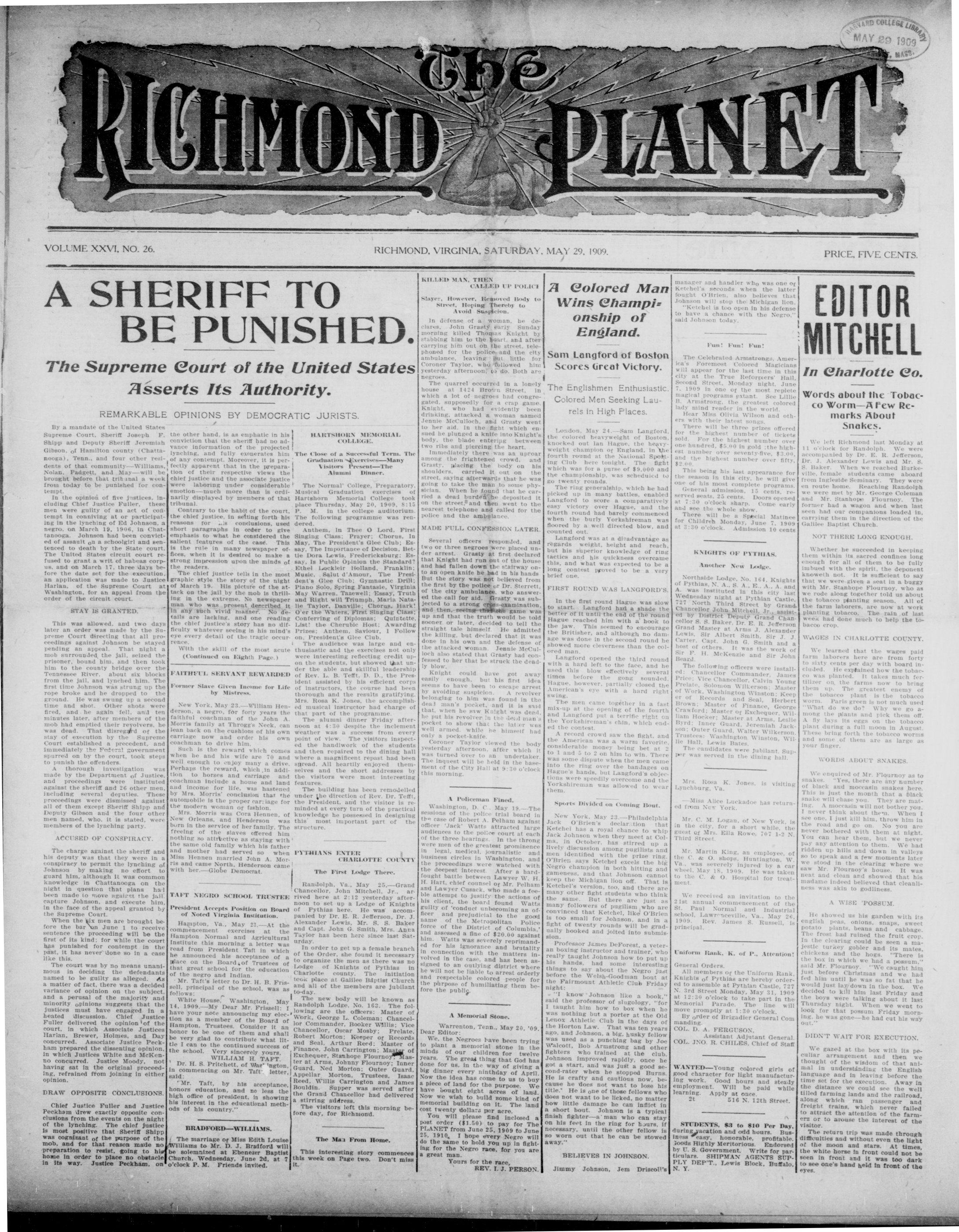
A SHERIFF TO BE PUNISHED.
The Supreme Court of the United States Asserts Its Authority.
REMARKABLE OPINIONS BY DEMOCRATIC JURISTS
VOLUME XXVI, NO. 26.
A SHEET BE
The Supreme
Asss
REMARKABLE
By a mandate of the United States Supreme Court, Sheriff Joseph F. Shipp and Deputy Sheriff Jeremiah Gibson, of Hamilton county (Chattanooga), Tenn., and four other residents of that community—Williams, Nolan, Padgett, and May—will be brought before that tribunal a week from today to be punished for contempt.
In the opinion of five justices, including Chief Justice Fuller, these men were guilty of an act of contempt in conniving at or participating in the lynching of Ed Johnson, a negro, on March 19, 1906, in Chattanooga. Johnson had been convicted of assault on a schoolgirl and sentenced to death by the State court. The United States circuit court refused to grant a writ of habeas corpus, and on March 17, three days before the date set for the execution, an application was made to Justice Harlan, of the Supreme Court at Washington, for an appeal from the order of the circuit court.
STAY IS GRANTED
This was allowed, and two days later an order was made by the Supreme Court directing that all proceedings against Johnson be stayed pending an appeal. That night a mob surrounded the jail, seized the prisoner, bound him, and then took him to the county bridge over the Tennessee River, about six blocks from the jail, and lynched him. The first time Johnson was strung up the rope broke and he dropped to the ground. He was swung up a second time and shot. Other shots were fired, and he again fell, and ten minutes later, after members of the mob had emptied their revolvers, he was dead. That disregarded the stay of execution by the Supreme Court established a precedent, and immediately the Federal government spurred on by the court, took steps to punish the offenders.
A thorough investigation was made by the Department of Justice, and proceedings were instituted against the sheriff and 26 other men, including several deputies. These proceedings were dismissed against all of them except Sheriff Shipp and Deputy Gibson and the four other men named, who, it is stated, were members of the lynching party.
ACCUSED OF CONSPIRACY
the charge against the sheriff and his deputy was that they were in a conspiracy to permit the lynching of Johnson by making no effort to guard him, although it was common knowledge in Chattanooga on the night in question that plans had been made to move against the jail capture Johnson, and execute him, in the face of the appeal granted by the Supreme Court.
When the six men are brought before the bar on June 1 to receive sentence the proceeding will be the first of its kind; for while the court has punished for contempt in the past, it has never done so in a case like this.
The court was by no means unanimous in deciding the defendants named to be guilty as alleged. As a matter of fact, there was a decided variance of opinion on the subject, and a perusal of the majority and minority opinions suggests that the justices must have engaged in a heated discussion. Chief Justice Fuller delivered the opinion of the court, in which Associate Justices Harlan, Brewer, Holmes, and Day concurred. Associate Justice Peckham prepared the dissenting opinion, in which Justices White and McKenno concurred. Justice Moody, not having sat in the original proceeding, refrained from joining in either opinion.
DRAW OPPOSITE CONCLUSIONS
Chief Justice Fuller and Justice Peckham drew exactly opposite conclusions from the events on the night of the lynching. The chief justice is most positive that Sheriff Shipp was cognizant of the purpose of the mob, and for that reason made no preparation to resist, going to his home in order to place no obstacle in its way. Justice Peckham, on
the other hand, is as emphatic in his conviction that the sheriff had no advance information of the projected lynching, and fully exonerates him of any contempt. Moreover, it is perfectly apparent that in the preparation of their respective views the chief justice and the associate justice were laboring under considerable emotion—much more than is ordinarily displayed by members of that tribunal.
Contrary to the habit of the court, the chief justice, in setting forth his reasons for his conclusions, used short paragraphs in order to give emphasis to what he considered the salient features of the case. This is the rule in many newspaper offices, when it is desired to make a strong impression upon the minds of the readers.
The chief justice tells in the most graphic style the story of the night of March 19. His picture of the attack on the jail by the mob is thrilling in the extreme. No newspaper man who was present described it in any such vivid manner. No details are lacking, and one reading the chief justice's story has no difficulty whatever seeing in his mind's eye every detail of the tragic occurrence.
With the skill of the most acute (Continued on Eighth Page.)
FAITHFUL SERVANT REWARDED
Former Slave Given Income for Life by Mistress.
New York, May 23.—William Henderson, a negro, for forty years the faithful coachman of the John A. Morris family at Throgg's Neck, can lean back on the cushions of his own carriage now and order his own coachman to drive him.
Such is the reward which comes when he and his wife are 70 and well enough to enjoy many a drive. Perhaps the reward, which in addition to horses and carriage and coachman include a house and land and income for life, was hastened by Mrs. Morris' conclusion that the automobile is the proper carriage for the modern woman or fashion.
Mrs. Morris was Cora Hennen, of New Orleans, and Henderson was born in the service of her family. The freeing of the slaves offered him nothing so attractive as staying with the same old family which his father and mother had served so when Miss Hennen married John A. Morris and came North, Henderson came with her.—Globe Democrat.
TAFT NEGRO SCHOOL TRUSTEE
President Accepts Position on Board of Noted Virginia Institution
Hampton, Va., May 23.—At the commencement exercises at the Hampton Normal and Agricultural Institute this morning a letter was read from President Taft in which he announced his acceptance of a place on the Board of Trustees of that great school for the education of the negro and Indian.
Mr. Taft's letter to Dr. H. B. Frissell, principal of the school, was as follows:
White House, Washington, May 14, 1909.—My Dear Mr. Frissell: I have your note announcing my election as a member of the Board of Hampton, Trustees. Consider it an honor to be one of them and shall be very glad to contribute what little I can to the continued success of the school. Very sincerely yours.
WILLIAM H. TAFT.
Dr. H. S. Pritchett, of Was'ington, in commencing on Mr. Taft' letter, said:
Mr. Taft, by his acceptance, honors education, and no less the high office of president, in showing his interest in the educational methods of his country."
BRADFORD—WILLIAMS
The marriage or Miss Edith Louise
Williams to Mr. D. D. J. Bradford will be
solemnized at Ebeneneer Baptist
Church, Wednesday, June 2d, at 7
o'clock P. M. Friends invited.
RICHMOND, VIRGINIA, SATURDAY, MAY 29, 1909.
HARTSHORN MEMORIAL COLLEGE.
The Close of a Successful Term. The Graduation Exercises—Many Visitors Present—The Alumni Dinner.
The Normal' College, Preparatory,
Musical Graduation exercises of
Hartshorn Memorial College took
place Thursday, May 20, 1909, 8:15
P. M. in the college auditorium
The following programme was rendered.
Anthem, In The O Lord, First
Singing Class; Prayer; Chorus, In
May, The President's Glee Club; Essay,
The Importance of Decision, Decision
Dora Lewis, Fredericksburg; Essay,
Is Public Opinion the Standard?
Ethel Lockleir Holland, Franklin;
Music, Salut d'Amour, The President's
Glee Club; Gymnastic Drill;
Piano Solo, Spring Fantasy, Virginia
May Warren, Tazewell; Essay, Truth
and Right will Triumph, Maria Natale
Taylor, Danville, Chorus, Hark!
O'er the Waters, First Singing Class;
Conferring of Diplomas; Quiltette;
List! the Cherubic Host; Awarding
Prizes; Anthem, Saviour, I Follow on,
President's Glee Club.
The audience was large and enthusiastic and the exercises not only were interesting reflecting credit upon the students, but showed that under the able and skilful leadership of Rev. L. B. Tefft, D. D., the President assisted by his efficient corps of instructors, the course had been thorough and the results gratifying.
Mrs. Rosa K. Jones, the accomplished musical instructor had charge of that part of the programme.
The alumni dinner Friday afternoon at 4:30 despite the inclement weather was a success from every point of view. The visitors inspected the handiwork of the students and then repaired to the dining hall where a magnificent repast had been spread. All heartily enjoyed themselves and the short addresses by the visitors were most interesting features.
The building has been remodelled under the direction of Rev. Dr. Tefft, the President, and the visitor is reminded at every turn of the practical knowledge he possessed in designing this most important part of the structure.
PYTHIANS ENTER
CHARLOTTE COUNTY
The First Lodge There.
Randolph, Va., May 25.—Grand Chancellor, John Mitchell, Jr., arrived here at 2:12 yesterday afternoon to set up a Lodge of Knights of Pythias here. He was accompanied by Dr. E. R. Jefferson, Dr. J. Alexander Lewis, Mr. S. S. Baker and Capt. John G. Smith, Mrs. Anna Taylor has been here since last Saturday.
In order to get up a female branch of the Order, she found it necessary to organize the men as there was no Lodge of Knights of Pythias in Charlotte county. The initiation took place at Gallilee Bptist Church and all of the members are jubilant to-day.
The new body will be known as Randolph Lodge, No. 163. The following are the officers: Master of Work, George L. Coleman; Chancellor Commander, Booker Willis; Vice Chancellor, Oscar Mosby; Prelate, Robert Morton; Keeper or Records and Seal, Arthur Reed; Master of Finance, John Carrington; Master of Exchequer, Stanhope Flournoy, Master at Arms, Johnny Flournoy; Inner Guard, Ned Morton; Outer Guard, Appellar Morton, Trustees, Isaac Reed, Willis Carrington and James Bouldin. Supper was served after the Grand Chancellor had delivered a stirring address.
The visitors left this morning before day, for Richmond.
The Man From Home.
This interesting story commences this week on Page two. Don't miss it.
KILLED MAN, THEN
CALLED UP POLICE
Slayer, However, Removed Body to
Street, Hoping Thereby to
Avoid Suspicion.
In defense of a woman, he declares, John Grasty early Sunday morning killed Thomas Knight by stabbing him to the heart, and after carrying him out on the street, telephoned for the police and the city ambulance, leaving but little for Coroner Taylor, who followed him yesterday afternoon, to do. Both are negroes.
The quarrel occurred in a lonely house at 1424 Brown Street, in which a lot of negroes had regregated, supposedly for a crap game. Knight, who had evidently been drinking, attacked a woman named Jennie McLloech, and Grasty went to her aid. In the fight which ensued he plunged a knife into Knight's body, the blade entering between two ribs and piercing the heart.
Immediately there was an unproar among the frightened crowd, and Grasty, placing the body on his shoulders, carried it out on the street, saying afterwards that he was going to take the man to some physician. When he found that he carried a dead burden, he deposited it on the street, and then went to the nearest telephone and called for the police and the ambulance.
MADE FULL CONFESSION LATER
Several officers responded, and two or three negroes were placed under arrest. Grasty at first declared that Knight had run out of the house and had fallen down the stairway onto an open knife he had in his hands. But the story was not believed from the first by the police or Dr. Sterrett, of the city ambulance, who answered the call for aid. Grasty was subjected to a strong cross-examination, and then, seeing that the game was up and that the truth would be told sooner or later, decided to tell the straight tale himself. He admitted the killing, but declared that it was done in his own and the defense of the attacked woman. Jennie McCulloch also stated that Grasty had confessed to her that he struck the deadly blow.
Knight could have got away easily enough, but his first idea seems to have been to escape arrest by avoiding suspicion. A revolver belonging to him was found in the dead man's pocket, and it is said that, when he saw Knight was dead, he put his revolver in the dead man's pocket to show that the latter was well armed, while he himself had only a pocket-knife.
Coroner Taylor viewed the body yesterday afternoon, after which it was turned over to an undertaker. The inquest will be held in the basement of the City Hall at 9:30 o'clock this morning.
A Policeman Fined
Washington, D. C. May 19.—The sessions of the police trial board in the case of Robert A. Pelham against officer 'Jack' Watts attracted large audiences to the police court at each of the three hearings. In the throng were men of the greatest prominence in legal, medical, journalistic and business circles in Washington, and the proceedings were watched with the deepest interest. After a hard-fought battle between Lawyer W. H. H. Hart, chief counsel or Mr. Pelham and Lawyer Cusack, who made a feeble attempt to justify the actions of his client, the board found Watts guilty of 'conduct unbecoming an officer and prejudicial to the good name of the Metropolitan Police force of the District of Columbia', and assessed a fine of $20.00 against him. Watts was severely reprimanded for his ignorance and brutality in connection with the matters involved in the case, and has been assigned to an outlying district where he will not be liable to arrest orderly and respectable colored people for the purpose of humiliating them before the public.
A Memorial Stone
Warrenton, Tenn., May 20, '09.
Dear Editor:
We, the Negroes have been trying to plant a memorial stone in the minds of our children for twelve years. The great thing that God has done for us, in the way of giving a big dinner every ninthday of April. Now the idea has come to us to buy a piece of land for the purpose. We have bought eight acres of land. Now we wish to build some kind of memorial building on it. The land cost twenty dollars per acre.
You will please find inclosed a post order ($1.50) to pay for The PLANET from June 25, 1909 to June 25, 1910. I hope every Negro will do the same to hold you up in fighting for the Negro race, for you are a great man.
Yours for the race,
REV. I. J. PERSON.
A Colored Man Wins Championship of England.
Sam Langford of Boston Scores Great Victory.
The Englishmen Enthusiastic Colored Men Seeking Laurels in High Places.
London, May 24.—Sam Langford, the colored heavyweight of Boston, knocked out Ian Hague, the heavyweight champion or England, in the fourth round at the National Sporting Club here tonight. The fight which was for a purse of $9,000 and the championship, was scheduled to go twenty rounds.
The ring generalship, which he had picked up in many battles, enabled Langford to score a comparatively easy victory over Hague, and the fourth round had barely commenced when the burly Yorkshireman was floored by a well directed blow, and counted out.
Langford was at a disadvantage as regards weight, height and reach, but his superior knowledge of ring tactics and his quickness overcame this, and what was expected to be a long contest proved to be a very brief one.
FIRST ROUND WAS LANGFORD'S
In the first round Hague was slow to start. Langford had a shade the better of it until the end of the round Hague reached him with a 'hook to the jaw. This seemed to encourage the Britisher, and although no damage was done in the second round he showed more cleverness than the colored man.
Langford opened the third round with a hard left to the face, and he used this blow effectively several times before the gong sounded. Hague, however, partially closed the American's eye with a hard right swing.
The men came together in a fast mix-up at the opening of the fourth and Langford put a terrific right on the Yorkshireman's chin, which ended the contest.
A record crowd saw the fight, and the American was a warm favorite, considerable money being bet at 2 to 1 and 5 to 2 on him to win. There was some dispute when the men came into the ring over the bandages on Hague's hands, but Langford's objections were speedily overcome and the Yorkshireman was allowed to wear them.
Sports Divided on Coming Rout
New York, May 23.—Philadelphia Jack O'Brien's declaration that Ketchel has a royal chance to whip Jack Johnson when they meet at Colma, in October, has stirred up a lively discussion among pugilists and men identified with the prize ring. O'Brien says Ketchel excels the big Negro champion in both hitting and gameness, and that Johnson cannot keep the Michigan lion off. That is Ketchel's version, too, and there are many other fight students who think the same. But there are just as many followers of pugilism who are convinced that Ketchel, like O'Brien is too small for Johnson, and in a fight of twenty rounds will be gradually booked and jolted into submission.
Professor James DeForest, a veteran boxing instructor and trainer, who really taught Johnson how to put up his hands, had some interesting things to say about the Negro just before the Welsh-Goodman bout at the Fairmount Athletic Club Friday night:
"I know Johnson like a book," said the professor of slugology, "for I taught him how to box when he was nothing but a porter at the Old Lenox Athletic Club in the days of the Horton Law. That was ten years ago, and Johnson, a big, husky fellow was used as a punching bag by Joe Walcott, Bob Armstrong and other fighters who trained at the club. Johnson improved rapidly, once he got a start, and was just a good second-rater when he stopped Burns. He is crafty and cautious now, because he does not want to lose his title. He is one of those fellows who does not want to be licked, no matter how little damage he can inflict in a short bout. Johnson is a typical finish fighter—a man who can stay on his feet in the ring for hours, if necessary, until the other fellow is so worn out that he can be stowed away."
BELIEVES IN JOHNSON
Jimmy Johnson, Jem Driscoll's
manager and handler who $ \mathrm{w}_{0} $ was one or Ketchel's seconds when the latter fought O'Brien, also believes that Johnson will stop the Michigan lion. "Ketchel is too open in his defense to have a chance with the Negro," said Johnson today.
Fun! Fun! Fun!
The Celebrated Armstrongs, America's Foremost Colored Magicians will appear for the last time in this city at the True Reforkers' Hall, Second Street, Monday night, June 7, 1909 in one of the most replete magical programs extant. See Lillie B. Armstrong, the greatest colored lady mind reader in the world. Hear Miss Olivia Wilson and others with their latest songs. There will be three prizes offered for the highest number of tickets sold. For the highest number over one hundred, $5.00 in gold; the highest number over seventy-five, $3.00, and the highest number over fifty, $2.00. This being his last appearance for the season in this city, he will give one of his most complete programs. General admission, 15 cents, reserved seats, 25 cents. Doors opened at 7:30 o'clock sharp. Come early and see the whole show. There will be a Special Matinee for Children Monday, June 7, 1909 at 3:30 o'clock. Admission 10 cents
KNIGHTS OF PYTHIAS
Another New Lodge
Northside Lodge, No. 164, Knights of Pythias, N. A., S. A., E. A., A. A. and A. was instituted in this city last Wednesday night at Pythian Castle, 727 North Third Street by Grand Chancellor John Mitchell, Jr., assisted by District Deputy Grand Chancellor S. S. Baker, Dr. E. R. Jefferson Grand Master at Arms J. Alexander Lewis, Sir Albert Smith, Sir J. J. Carter, Capt. John G. Smith and a host of others. It was the work of Sir F. H. McKenzie and Sir John Beard.
The following officers were installed: Chancellor Commander, James Price; Vice Chancellor, Calvin Young Prelate, Solomon Wilkerson; Master of Work, Washington Winston; Keeper of Records and Seal, Herbert Brown; Master of Finance, George Crawford; Master or Exchequer, William Hocker; Master at Arms, Leslie Byrd; Inner Guard, Jeremiah Jackson; Outer Guard, Walter Wilkerson; Trustees; Washington Winston, Willie Hall, Lewis Bates.
The candidates were jubilant. Supper was served in the dining hall.
Mrs. Rosa K. Jones, is visiting Lynchburg, Va.
—Miss Alice Luckadoe has returned from New York.
Mr. C. M. Logan, of New York, is in the city, for a short while, the guest of Mrs. Ella Rowe, 707 1-2 N. Third Street.
Mr. Martin King, an employee, of the C. & O. shops, Huntington, W. Va., was severely injured by a car wheel, May 18, 1909. He was taken to the C. & O. Hospital for treatment.
We received an invitation to the 21st annual commencement of the St. Paul Normal and Industrial school, Lawrenceville, Va., May 26, 1909. Rev. James S. Russell, is principal.
General Orders.
All members of the Uniform Rank,
Knights of Pythias are hereby ordered
to assemble at Pythian Castle, 727
N. 3rd Street Monday, May 31, 1969
at 12:30 o'clock to take part in the
Memorial Parade. The line will
move promptly at 1:30 o'clock.
By order of Brigadier General Com-
manding.
COL. D. A. FERGUSON,
Assistant Adjutant General.
COL. JNO. R. CHILES, Chief of Staff
WANTED—Young colored girls of good character for light manufacturing work. Good hours and steady employment. Will be paid while learning. Apply at once.
2t 516 N. 12th Street
STUDENTS, $3 to $10 Per Day, during vacation and odd hours. Business easy, honorable, profitable. Goods Highly Meritorious. Endorsed by U. S. Government. Write for particulars. SHIPMAN AGENTS SUPPLY DEPT., Lewis Block, Buffalo, N. Y.
PRICE, FIVE CENTS
EDITOR MITCHELL
Words about the Tobacco Worm-A Few Remarks About
We left Richmond last Monday at 11 o'clock for Randolph. We were accompanied by Dr. E. R. Jefferson, Dr. J. Alexander Lewis and Mr. S. Baker. When we reached Burkerville, female students came aboard from Ingleside Seminary. They were en route home. Reaching Randolph we were met by Mr. George Coleman and Mr. Stanhope Flournoy. The former had a wagon and when last seen had our companions loaded in, carrying them in the direction of the Gallilee Baptist Church.
NOT THERE LONG ENOUGH
Whether he succeeded in keeping them within its sacred confines long enough for all of them to be fully imbued with the spirit, the deponent knoweth not. It is sufficient to say that we were given a seat in a buggy with Mr. Stanhope Flournoy, who as we rode along together told us about the tobacco planting season. All of the farm laborers, are now at work planting tobacco. The rain of last week had done much to help the tobacco crop.
WAGES IN CHARLOTTE COUNTY
We learned that the wages paid farm laborers here are from forty to sixty cents per day with board included. He explained how the tobacco was planted. It takes much fertilizer on the farms now to bring them up. The greatest enemy of the tobacco plant is the tobacco worm. Paris green is not much used "What do we do? Why we go among the plants and pick them off. A fly lays its eggs on the tobacco plant during a full moon in August. These bring forth the tobacco worms and some of them are as large as your finger.
WORDS ABOUT SNAKES
We enquired of Mr. Flournoy as to snakes. "Yes, there are any number of black and moccasin snakes here. This is just the month that a black snake will chase you. They are mating. A moccasin will not bother you. I never think about the them. When I see one, I just kill him, throw him in the road and go on. No you are never bothered with them at night. You can hear them, but we never pay any attention to them. We had ridden up hills and down in valleys so to speak and a few moments later we stood in the clearing where we saw Mr. Flournoy's house. It was neat and clean and showed that his madame indeed believed that cleanliness was akin to godliness.
A WISE 'POSSUM
He showed us his garden with its english peas, onions, snaps, sweet potato plants, beans and cabbage. The frost had ruined the fruit crop. In the clearing could be seen a majestic turkey gobler and its mates, chickens and the hogs. "There is the box in which we had a possum," said Mr. Flournoy. "We caught him just before Christmas and we had fed him until he was so fat that he would just lay down in the box. We decided to kill him last Friday and the boys were talking about it last Thursday night. When we went to look for that possum Friday morning, he was gone—he had cut his way out."
DIDN'T WAIT FOR EXECUTION
We gazed at the box with its peculiar arrangement and then we thought of the wisdom of that animal in understanding the English language and in leaving before the time set for the execution. Away in the distance we could see the well tilled farming lands and the railroad, along which ran passenger and freight trains, which never failed to attract the attention of the farmers or to arouse the interest of the visitor.
The return trip was made through difficulties and without even the light of the moon and stars. At times, the white horse in front could not be seen in front and it was too dark to see one's hand held in front of the eyes.
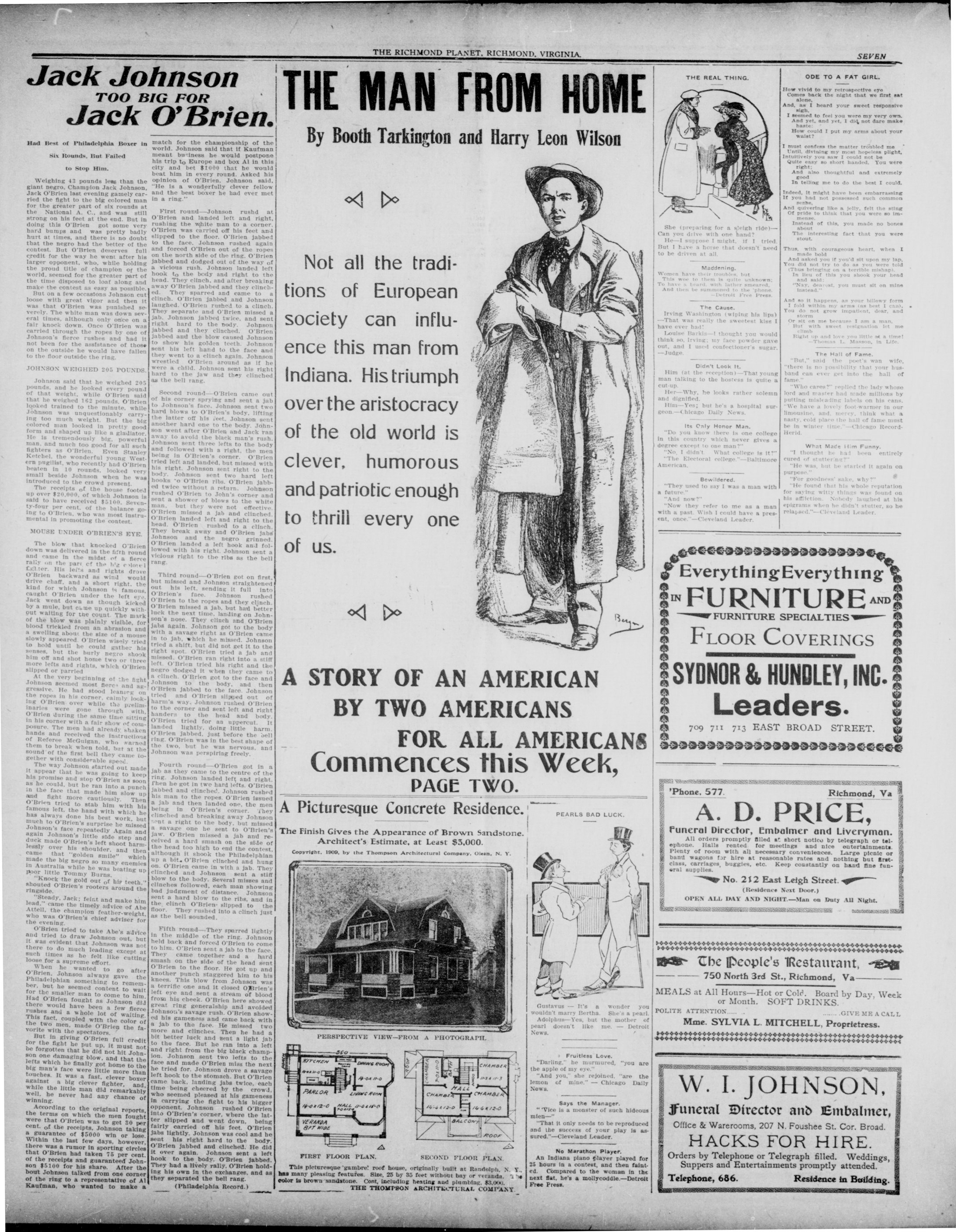
THE MAN FROM HOME A NOVELIZATION OF THE PLAY OF THE SAME NAME BY BOOTH TARKINGTON AND HARRY L. WILSON
COPYRIGHT 1899 BY A.M. MORRIS
COPYRIGHT. 1909. BY AMERICAN PRESS ASSOCIATION
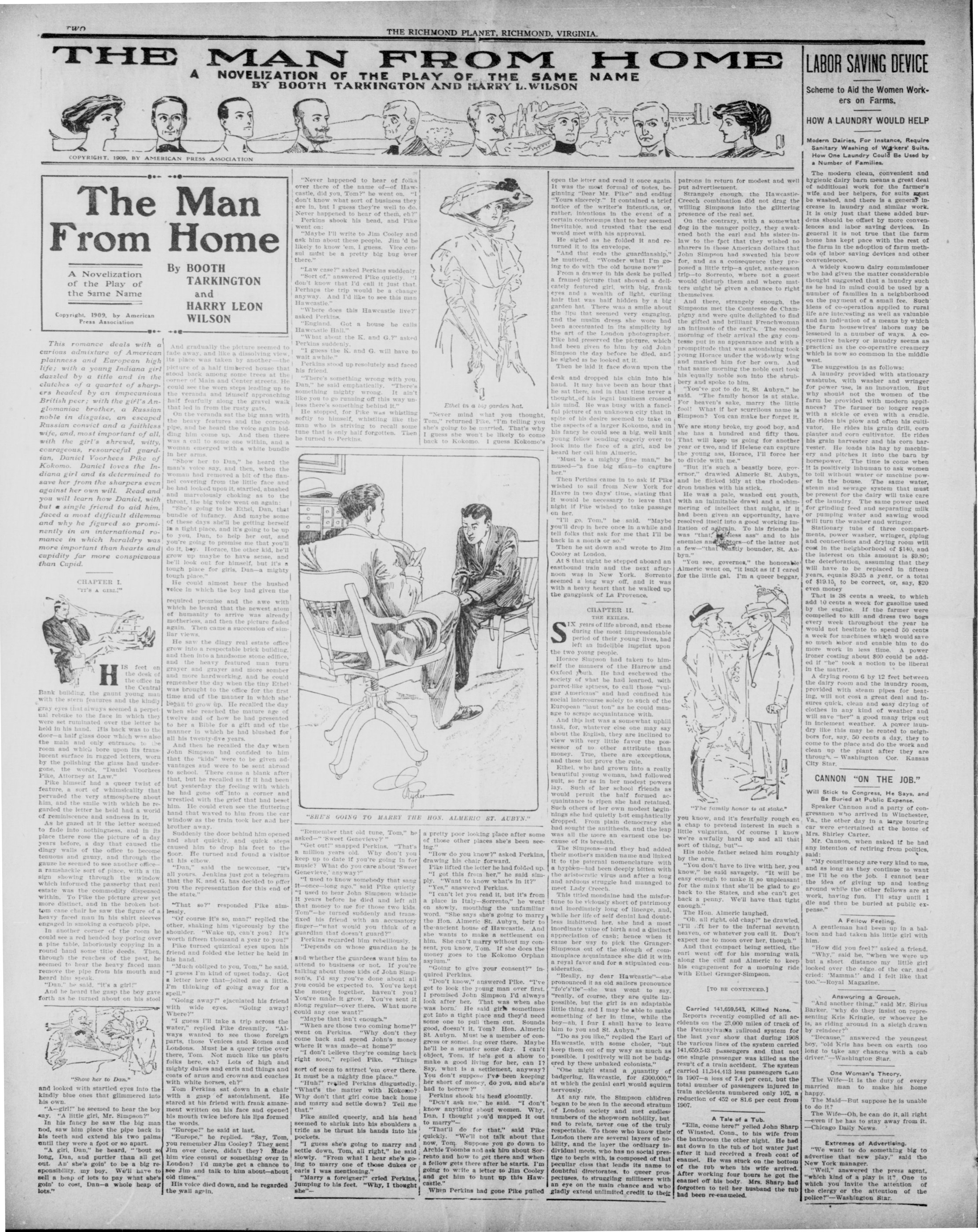
The Man From Home
A Novelization of the Play of the Same Name
Copyright, 1909, by American Press Association
一 号 0 + 号 0 处
This romance deals with a curious admixture of American plainness and European high life; with a young Indiana girl dazzled by a title and in the clutches of a quartet of sharpers headed by an impecunious British peer; with the girl's Anglomaniac brother, a Russian noble in disguise, an escaped Russian convict and a faithless wife, and, most important of all, with the girl's shrewd, witty, courageous, resourceful guardian, Daniel Voorhees Pike of Kokomo. Daniel loves the Indiana girl and is determined to save her from the sharpers even against her own will. Read and you will learn how Daniel, with but single friend to aid him, faced a most difficult dilemma and why he figured so prominently in an international romance in which heraldry was more important than hearts and cupidity far more conspicuous than Cupid.
CHAPTER I.
"IT'S A GIRL!"
H IS feet on
the desk of
the office in
the Central
Bank building, the gaunt young man with the stern features and the kindly gray eyes that always seemed a perpetual rebuke to the face in which they were set ruminated over the letter he held in his hand. His back was to the door—a half glass door which was also the main and only entrance to the room and which bore upon its translucent surface in ragged letters, worn by the polishing the glass had undergone, the words, "Daniel Voorhees Pike, Attorney at Law."
Pike himself had a queer twist of feature, a sort of whimsicality that pervaded the very atmosphere about him, and the smile with which he regarded the letter he held had a world of reminiscence and sadness in it.
As he gazed at it the letter seemed to fade into nothingness, and in its place there rose the picture of a day years before, a day that caused the dingy walls of the office to become tenuous and gauzy, and through the gauze he seemed to see another office—a ramshackle sort of place, with a tin sign showing through the window which informed the passerby that real estate was the commodity dispensed within. To Pike the picture grew yet more distinct, and in the broken bottom cane chair he saw the figure of a heavy faced man in his shirt sleeves engaged in smoking a corncob pipe. In another corner of the room he could see a red headed boy poring over a pine table, laboriously copying in a round hand some title deeds. Then, through the reaches of the past, he seemed to hear the heavy faced man remove the pipe from his mouth and heard him speak. "Dan," he said, "it's a girl!"
And he heard the gasp the boy gave forth as he turned about on his stool
"Show her to Dan."
and looked with startled eyes into the kindly blue eyes that glimmered into his own.
"A-girl!" he seemed to hear the boy say. "A little girl, Mr. Simpson?"
In his fancy he saw the big man nod, saw him place the pipe back in his teeth and extend his two palms until they were a foot or so apart.
"A girl, Dan," he heard, "bout so long, Dan, and purter than all get out. An' she's goin' to be a big responsibility. my boy. We'll have to sell a heap of lots to pay what she's goin' to cost, Dan—a whole heap of lots."
By BOOTH
TARKINGTON
and
HARRY LEON
WILSON
And gradually the picture seemed to fade away, and like a dissolving view, its place was taken by another—the picture of a half timbered house that stood back among some trees at the corner of Main and Center streets. He could see the worn steps leading up to the veranda and himself approaching half fearfully along the gravel walk that led in from the rusty gate.
On the veranda sat the big man with the heavy features and the corncob pipe, and he heard the voice again bidding him come up. And then there was a call to some one within, and a woman emerged with a white bundle in her arms.
"Show her to Dan," he heard the man's voice say, and then, when the woman had removed a bit of the fannel covering from the little face and he had looked upon it, startled, abashed and marvelously choking as to the throat, the big voice went on again:
"She's going to be Ethel, Dan, that bundle of infancy. And maybe some of these days she'll be getting herself in a tight place, and it's going to be up to you, Dan, to help her out, and you're going to promise me that you'll do it, boy. Horace, the other kid, he'll grow up maybe to have sense, and he'll look out for himself, but it's a tough place for girls, Dan—a mighty tough place."
He could almost hear the hushed voice in which the boy had given the required promise and the awe with which he heard that the newest atom of humanity to arrive was already motherless, and then the picture faded again. Then came a succession of similar views.
He saw the dingy real estate office grow into a respectable brick building, and then into a handsome stone edifice, and the heavy featured man turn grayer and grayer and more somber and more hardworking, and he could remember the day when the tiny Ethel was brought to the office for the first time and of the manner in which she began to grow up. He recalled the day when she reached the mature age of twelve and of how he had presented to her a Bible for a gift and of the manner in which he had blushed for all his twenty-five years.
And then he recalled the day when John Simpson had confided to him that the "kids" were to be given advantages and were to be sent abroad to school. There came a blank after that, but he recalled as if it had been but yesterday the feeling with which he had gone off into a corner and wrestled with the grief that had beset him. He could even see the fluttering hand that waved to him from the car window as the train took her and her brother away.
Suddenly the door behind him opened and shut quickly, and quick steps caused him to drop his feet to the floor. He turned and found a visitor at his elbow.
"Dan," said the newcomer, "it's all yours. Jenkins just got a telegram that the K. and G. has decided to offer you the representation for this end of the state."
"That so?" responded Pike aimlessly.
"Of course it's so, man!" replied the other, shaking him vigorously by the shoulder. "Wake up, can't you? It's worth fifteen thousand a year to you!" Pike turned quizzical eyes upon his friend and folded the letter he held in his hand.
"Much obliged to you, Tom," he said. "I guess I'm kind of upset today. Got a letter here that-jolted me a little. I'm thinking of going away for a spell."
"Going away!" ejaculated his friend with wide eyes. "Going away! Where?"
"I guess I'll take a trip across the water," replied Pike dreamily. "Always wanted to see those foreign parts, those Venices and Romes and Londons. Must be a queer tribe over there, Tom. Not much like us plain folks here, eh? Lots of high and mighty dukes and carls and things and coats of arms and crowns and coaches with white horses, eh?"
Tom Perkins sat down in a chair with a gasp of astonishment. He stared at his friend with frank amazement written on his face and opened his mouth twice before his lips formed the words.
"Europe?" he said at last.
"Europe," he replied. "Say, Tom, you remember Jim Cooley? They sent Jim over there, didn't they? Made him vice consul or something over in London? I'd maybe get a chance to see Jim and talk to him about--about old times."
His voice died down, and he regarded the wall age in.
THE RICHMOND PLANET, RICHMOND, VIRGINIA.
Dyder
"SHE'S GOING TO MARRY THE HON. ALMERIC ST. AURYN."
"Never happened to hear of folks over there of the name of—of Hawcastle, did you, Tom?" he went on. "I don't know what sort of business they are in, but I guess they're well to do. Never happened to hear of them, eh?" Perkins shook his head, and Pike went on:
"Maybe I'll write to Jim Cooley and ask him about these people. Jim 'd be likely to know 'em, I guess. Vice consul must be a pretty big bug over there."
"Law case?" asked Perkins suddenly. "Sort of." answered Pike quietly. "I don't know that I'd call it just that. Perhaps the trip would be a change anyway. And I'd like to see this man Hawcastle."
"Where does this Hawcastle live?" asked Perkins.
"England. Got a house he calls Hawcastle Hall."
"What about the K. and G.'?" asked Perkins suddenly.
"I guess the K. and G. will have to wait awhile."
Perkins stood up resolutely and faced his friend.
"There's something wrong with you, Dan," he said emphatically. "There's something mighty wrong. It ain't like you to go running off this way unless there's something behind it."
He stopped, for Pike was whistling softly to himself, whistling like the man who is striving to recall some tune that is only half forgotten. Then he turned to Perkins.
"SHE'S GOING TO MARRY TH
"Remember that old tune, Tom," he asked—"Sweet Genevieve?" "Get out!" snapped Perkins. "That's a million years old. Why don't you keep up to date if you're going in for music? What do you care about 'Sweet Genevieve,' anyway? "I used to know somebody that sang it—once—long ago," said Pike quietly "I used to hear John Simpson whistle it years before he died and left all that money to me for those two kids. Tom"—he turned suddenly and transfixed his friend with an accusatory finger—"what would you think of a guardian that doesn't guard?" Perkins regarded him rebelliously. "Depends on whose guardian he is
and whether the guardes want him to attend to business or not. If you're talking about those kids of John Simpson's, I'd say you've done about all you could be expected to. You've kept the money together, haven't you? You've made it grow. You've sent it along regular—over there. What more could any one want."
"Maybe that isn't enough."
"When are those two coming home?" went on Perkins. "Why don't they come back and spend John's money where it was made—at home?" "I don't believe they're coming back right soon," replied Pike. "Things sort of seem to attract 'em over there. It must be a mighty fine place." "Huh!" replied Perkins disgustedly. "What's the matter with Kokomo? Why don't that girl come back home and marry and settle down? Tell me that."
Pike smiled queerly, and his head seemed to shrink into his shoulders a trifle as he thrust his hands into his pockets.
"I guess she's going to marry and settle down, Tom, all right," he said slowly. "From what I hear she's going to marry one of those dukes or earls I was mentioning."
"Marry a foreigner!" cried Perkins, jumping to his feet. "Why, I thought she"—
```markdown
```
Ethel in a big garden hat.
"Never mind what you thought, Tom," returned Fike. "I'm telling you she's going to be married. That's why I guess she won't be likely to come back to Kokomo. I guess Kokomo's
HON. ALMERIC ST. AUBYN."
a pretty poor looking place after some of those other places she's been seeing."
"How do you know?" asked Perkins, drawing his chair forward.
Pike lifted the letter he had folded up.
"I got this from her," he said simply.
"Want to know what's in it?"
"Yes," answered Perkins.
"I can't let you read it, but it's from a place in Italy—Sorrento," he went on slowly, mouthing the unfamiliar word. "She says she's going to marry the Hon. Almeric St. Aubyn, heir to the ancient house of Hawcastle. And she wants to make a settlement on him. She can't marry without my consent, you know. Tom. If she does the money goes to the Kokomo Orphan asylum."
"Going to give your consent?" inquired Perkins.
"Don't know," answered Pike. "I've got to look the young man over first. I promised John Simpson I'd always look after her. That was when she was born." He said girl sometimes got into a tight place and they'd need some one to pull them out. Sounds good, doesn't it. Tom? Hon. Almeric St. Aubyn. Must be a member of congress or someting over there. Maybe he'll be a senator some day. I can't object, Tom. if he's got a show to make a good living for her, can I? Say, what is a settlement, anyway? You don't suppose I've been keeping her short of money, do you, and she's had to borrow? Perkins shook his head gloomily.
"Don't ask me," he said. "I don't know anything about women. Why, Dan. I thought you'd mapped it out to marry"— "That'll do for that," said Pike quickly. "We'll not talk about that now, Tom. Suppose you go down to Archie Toombs and ask him about Sorrento and how to get there and when a fellow gets there after he starts. I'm going to write a letter to Jim Cooley and get him to hunt up this Haw-castle." When Perkins had gone Pike pulled
open the letter and read it once again. It was the most formal of notes, beginning "Dear Mr. Pike" and ending "Yours sincerely." It contained a brief notice of the writer's intentions, or, rather, intentions in the event of a certain contemptures that to her seemed inevitable, and trusted that the end would meet with his approval.
He sighed as he folded it and returned it to its envelope.
"And that ends the guardianship," he muttered. "Wonder what I'm going to do with the old house now?"
he muttered. "Wonder what I'm going to do with the old house now?" From a drawer in his desk he pulled a framed picture that showed a delicately featured girl, with big, frank eyes and a wealth of light, curling hair that was half hidden by a big garden hat. There was a smile about the lips that seemed very engaging, and the muslin dress she wore had been accentuated in its simplicity by the art of the London photographer. Pike had preserved the picture, which had been given to him by old John Simpson the day before he died, and he sighed as he looked at it. Then he laid it face down upon the
desk and dropped his chin into his hand. It may have been an hour that he sat there, and in that time never a thought of his legal business crossed his mind. He was busy with a fanciful picture of an unknown city that in spite of his desire seemed to take on the aspects of a larger Kokomo, and in his fancy he could see a big, well knit young fellow bending eagerly over to look into the face of a girl, and he heard her call him Almeric.
"Must be a mighty fine man," he mused—a fine big man—to capture her."
Then Perkins came in to ask if Pike wished to sail from New York for Havre in two days' time, slating that it would be necessary to leave that night if Pike wished to take passage on her.
"I'll go, Tom," he said. "Maybe you'll drop in here once in awhile and tell folks that ask for me that I'll be back in a month or so."
Then he sat down and wrote to Jim Cooley at London.
At 8 that night he stepped aboard an eastbound train and the next afternoon was in New York. Sorrento seemed a long way off, and it was with a heavy heart that he walked up the gangplank of La Provence.
CHAPTER II.
THE EXILES.
SIX years of life abroad, and these during the most impressionable period of their young lives, had left an indelible imprint upon the two young people. Horace Simpson had taken to himself the manners of the Harrow and Oxford Youth. He had eschewed the society of what he had learned, with parrot-like aptness, to call those "vulgar Americans" and had confined his social intercourse solely to such of the European "haut ton" as he could manage to scrape acquaintance with. And this last was a somewhat uphill task, for, whatever else one may say about the English, they are inclined to view with very little favor the possessor of no other attribute than money. True, there are exceptions, and these but prove the rule.
Ethel, who had grown into a really beautiful young woman, had followed suit, so far as in her modest powers lay. Such of her school friends as would permit the half formed acquaintance to ripen she had retained. Such others of her own modest beginnings she had quietly but emphatically dropped. From plain democracy she had sought the antithesis, and the leap was all the more an earnest one because of its breadth.
The Simpsons—and they had added their mother's maiden name and linked it to the paternal nomenclature with a hyphen—had been deeply blitten with the aristocratic virus and after a long and arduous struggle had managed to meet Lady Creech.
This titled mondaine had the misfortune to be viciously short of patrimony and inordinately long of lineage, and, while her life of self dental had doubtless imbittered her, she had a most inordinate value of birth and a distinct appreciation of cash; hence when it came her way to pick the Granger-Simpson out of the slough of commonplace acquaintance she did it with a royal favor and for a stipulated consideration.
"Really, my dear Hawcastle"—she pronounced it as old sailors pronounce "fo'c'stile"—she was wont to say, "really, of course, they are quite impossible, but the girl is an adaptable little thing, and I may be able to make something of her in time, while the boy—ah, I fear I shall have to leave him to you and St. Aubyn."
"Do as you like," replied the Earl of Hawcastle, with some choler, "but keep them out of my way as much as possible. I positively will not be badgered by these unbaked colonists."
"One might stand a quantity of badgering. Hawcastle, for £300,000," at which the genial earl would squirm nervously.
At any rate, the Simpson children began to be seen in the second stratum of London society and met endless numbers of the shopworn nobility, but sad to relate, never one of the truly respectable. To those who know their London there are several layers of nobility, and the layer the ordinary individual meets, who has no social prestige to begin with, is composed of that peculiar class that lends its name to doubtful directorates, to queer prospectuses, to struggling millers with an eye on the main chance and who gladly extend unlimited credit to their
patrons in return for modest and well put advertisement.
Strangely enough, the Hawcastle-Creech combination did not drag the willing Simpsons into the glittering presence of the real set.
On the contrary, with a somewhat dog in the manger policy, they awakened both the earl and his sister-in-law to the fact that they wished no sharers in those American dollars that John Simpson had sweated his brow for, and as a consequence they proposed a little trip—a quiet, ante-season trip—to Sorrento, where not a guest would disturb them and where matters might be given a chance to right themselves.
And there, strangely enough, the Simpsons met the Comtesse de Champigny and were quite delighted to find the gifted and brilliant Frenchwoman an intimate of the earl's. The second morning of their arrival the gay contesse put in an appearance and with a promptitude that was astonishing took young Horace under the widely wing and marked him for her own. And that same morning the noble earl took his equally noble son into the shrubbery and spoke to him.
"You've got to do it. St. Aubyn," he said. "The family honor is at stake. For heaven's sake, marry the little fool! What if her scurrilous name is Simpson? You can make her forget it.
We are stony broke, my good boy, and she has a hundred and fifty thou. That will keep us going for another year or two, and if Helene can capture the young ass, Horace, I'll force her to divide with me."
"But it's such a beastly bore, governor," drawned Almeric St. Aubyn, and he flicked idly at the rhododendron bushes with his stick.
He was a pale, washed out youth, with an inimitable drawl and a shimmering of intellect that might, if it had been given an opportunity, have resolved itself into a good working imitation of a brain. To his friends he was "that, godless ass" and to his enemies an outliers of the latter not a few "that beastly bounder, St. Aubyn."
"You see, governor," the honorable Almeric went on, "it isn't as if I cared for the little gal. I'm a queer begar
A
"The family honor is at stake."
you know, and it's fearfully rough on a chap to pretend interest in such a little vulgarian. Of course I know we're awfully hard up and all that sort of thing, but"—
His noble father seized him roughly by the arm.
"You don't have to live with her, you know," he said savagely. "It will be easy enough to make it so unpleasant for the minx that she'll be glad to go back to the States, and she can't get back a penny. We'll have that tight enough."
The Hon. Almeric laughed.
"Oh, all right, old chap!" he drawled, "I'll lift her to the infernal seventh heaven, or whatever you call it. Don't expect me to moon over her, though."
And that compact be settled, the earl went off for his morning walk along the cliff and Almeric to keep his engagement for a morning ride with Ethel Granzer-Simpson.
[TO BE CONTINUED.]
Carried 141,659,543, Killed None.
Reports recently compiled of all accidents on the 23,000 miles of track of the Pennsylvania railroad system for the last year show that during 1908 the various lines of the system carried 141,659,543 passengers and that not one single passenger was killed as the result of a train accident. The system carried 11,344,413 less passengers than in 1907—a loss of 7.4 per cent, but the total number of passengers injured in train accidents numbered only 102, a reduction of 452 or 81.6 per cent from 1907.
A Tale of a Tub
"Elln, come here!" yelled John Sharp of Winsted. Conn, to his wife from the bathroom the other night. He had sat down in the tub of hot water just after it had received a fresh coat of enamel. He was stuck on the bottom of the tub when his wife arrived. After working four hours he got the enamel off his body. Mrs. Sharp had forgotten to tell her husband the tub had been enameled.
Scheme to Aid the Women Workers on Farms.
HOW A LAUNDRY WOULD HELP
Modern Dairies, For Instance, Require Sanitary Washing of Workers' Suits. How One Laundry Could Be Used by a Number of Families.
The modern clean, convenient and hygienic dairy barn means a great deal of additional work for the farmer's wife and her helpers, for suits must be washed, and there is a general increase in laundry and similar work. It is only just that these added burdens should be offset by more conveniences and labor saving devices. In general it is not true that the farm home has kept pace with the rest of the farm in the adoption of farm methods of labor saving devices and other conveniences.
A widely known dairy commissioner who had given the matter considerable thought suggested that a laundry such as he had in mind could be used by a number of families in a neighborhood on the payment of a small fee. Such ideas of co-operation applied to rural life are interesting as well as valuable and an indication of a means by which the farm housewives' labors may be lessened in a number of ways. A cooperative bakery or laundry seems as practical as the co-operative creamery which is now so common in the middle west.
The suggestion is as follows:
A laundry provided with stationary washtubs, with washer and wringer for power use, is an innovation. But why should not the women of the farm be provided with modern appliances? The farmer no longer reaps with a sickle or even with a cradle. He rides his plow and often his cultivator. He rides his grain drill, corn planter and corn cultivator. He rides his grain harvester and his corn harvester. He loads his hay by machinery and pitches it into the barn by horsepower. The time is come when it is positively inhuman to ask women to toil without water or machine power in the house. The same water, steam and sewage system that must be present for the dairy will take care of the laundry. The same power used for grinding feed and separating milk or pumping water and sawing wood will turn the washer and wringer.
Stationary tubs of three compartments, power washer, wringer, piping and connections and drying room will cost in the neighborhood of $140, and the interest on this amount is $9.80; the deterioration, assuming that they will have to be replaced in fifteen years, equals $9.35 a year, or a total of $19.15 to be correct, or, say, $20 even money.
That is 38 cents a week, to which add 10 cents a week for gasoline used by the engine. If the farmer were compelled to kill and dress two hogs every week throughout the year he would not hesitate to spend 50 cents a week for machines which would save so much labor and enable him to do more work in less time. A power ironer costing about $60 could be added if "he" took a notion to be liberat in the matter.
A drying room 6 by 12 feet between the dairy room and the laundry room, provided with steam pipes for heating, will not cost a great deal and insures quick, clean and easy drying of clothes in any kind of weather and will save "her" a good many trips out in inclement weather. A power laundry like this may be rented to neighbors for, say, 50 cents a day, they to come to the place and do the work and clean up the plant after they are through. - Washington Cor. Kansas City Star.
CANNON "ON THE JOB."
Will Stick to Congress, He Says, and
Be Buried at Public Expense.
Speaker Cannon and a party of congressmen who arrived in Winchester, Va., the other day in a large touring car were entertained at the home of Mrs. Shirley Carter.
Mr. Cannon, when asked if he had any intention of retiring from politics, said:
"My constituency are very kind to me, and as long as they continue to want me I'll be on the job. I cannot bear the idea of giving up and loading around while the other fellows are at work, having fun. I'll stay until I die and then be buried at public expense."
A Fellow Feeling
A gentleman had been up in a balloon and had taken his little girl with him.
"How did you feel?" asked a friend.
"Why," said he, "when we were up but a short distance my little girl looked over the edge of the car, and cried: 'Mamma!' and I felt like that too."—Royal Magazine.
"And another thing," said Mr. Shrius Barker, "why do they insist on representing Kris Kringle, or whoever he is, as riding around in a sleigh drawn by reindeer?"
"Because," answered the youngest boy, "old Kris has been on earth too long to take any chances with a cab driver."—Washington Star.
One Woman's Theory
The Wife—It is the duty of every married man to make his home happy.
The Maid—But suppose he is unable to do it?
The Wife—Oh, he can do it, all right—even if he has to stay away from it.
-Chicago Daily News.
Extremes of Advertising
"We want to do something big to advertise that new play," said the New York manager. "Well," answered the press agent, "which kind of a play is it? One to which you invite the attention of the clergy or the attention of the police?"—Washington Star.
THE PLANET
MOTORCAR CONTEST.
Novel Competition For Queensboro Bridge Celebration.
START FROM NEW YORK END.
One Hundred! "Covers" to Be Established, the Prize Going to Automobilist Discovering the Greatest Number In Twelve Hours.
A. R. Pardington, chairman of the automobile division of the Queensboro bridge celebration in New York, has planned a novel motoring diversion for that occasion, which promises to become popular in every part of the United States. It is called a "motor hunt," and it will take the hunter over much ground to unexpected places or, in short, to all points where the scent may lead or the "game" may be in biding.
The "game" in connection with the Queenenboro bridge celebration event is in the form of cards, showing that the hunter has visited an official control or cover. The person who at nighttime hands in to the committee the greatest number of these cards will be declared the winner of the hunt and will receive a silver trophy valued at $250 and either cash or plate amounting to $100, the latter going to the driver of the car. As an additional check on the movements of the hunter, at each control or cover his card of identification will be presented and punched with the number corresponding to that of the station visited.
Certain limits to the hunting ground have been agreed on, all of which are over good macadam roads suited to the motorcar. The western boundary of the northern section of the hunting ground will be Hillside avenue, Jamalca, reached by crossing from New York over the Queensboro bridge to Thompson avenue and Hoffman boulevard. Rockaway road, which enters Jamalca near the corner of Hillside avenue, and Hoffman boulevard will be the western boundary of the southern section. The eastern boundary will be a highway known as the Oyster Bay - Jericho - Hicksville - Central Park-Massapequa road, which runs almost north and south between Oyster Bay on the north and Massapequa on the south, Hicksville being about midway. This hunting area contains approximately 300 square miles. In this territory are several towns and villages.
In hotels, garages, road houses, real estate offices and other suitable points the controls or covers will be located, and there will be 100 of them. No particular order or system will be followed in establishing these points. This is purposefully done so that clews as to the different locations will not be easy to obtain in advance. A weatherproof card, yellow in color, with black printing, will indicate the control or cover. A banner or flag of good size, of yellow bunting with black center, either in the form of a star, square or other distinguishing emblem, will also mark the control or cover and will be posted in a conspicuous place. The contest will begin from the Manhattan end of the Queensboro bridge promptly at 8 o'clock on the morning of June 15 and will end at the same hour in the evening of that day.
In connection with the "hunt" for which entrants in that event are eligible will be another contest in which the principal figure will be a car suitably labeled roving at will in the hunting area in the manner of game bewildered by the close pursuit of bounds. This car will keep on the road continuously, traveling at moderate speed, and the representative of the committee riding therein will surrender to each contestant met a card of distinctive design and color. The driver securing the greatest number of these cards during the twelve hours will receive a trophy valued at not less than $100.
Entry fee will be charged only for the "hunt." and, irrespective of size, class, horsepower or capacity, the price for each car will be $2. Entries will be accepted up to 10 o'clock of the morning of the event at the office of the automobile division of the Queensboro bridge celebration.
In order to guard against speeding it is positively announced that it will be impossible for all of the controls or covers to be visited by any one car during the twelve hours. The winning of this event will take care and patience and not speeding, as controls or covers may be half a mile, a few yards or as many as five miles apart. There will be no blind controls established. Contestants who during the event have been convicted of exceeding the speed limit will be absolutely disqualified.
Pasteurization Plant For Toronto.
Steps were taken in New York recently to establish in Toronto, Canada, a system of infant milk depots for the distribution of pasteurized milk. A delegation from Toronto visited New York for the purpose of consulting Nathan Straus. It was decided to order a pasteurizing plant capable of supplying milk for 1,000 babies a day, and Mr. Straus agreed to send Dr. Arthur Randolph Green to Toronto to install the plant and to put the enterprise in working order. Among the Canadians were Ross Robertson, chairman of the board of trustees of the Hospital For Sick Children in Toronto. Dr. Charles J Hastings, chairman of the milk commission of the Canadian
Medical association; Dr. C. A. Hodgetts, chief health officer of the province of Ontario, and Professor John Armyot, director of the laboratory of the provincial board of health.
MEREDITH'S LOVE OF AMERICA
"They Always Liked Me Better There," Said Empignant English Novelist.
Said Eminent English Novelist.
George Meredith, the eminent English novelist, who died the other day in England, passed the later years of his life in his very quiet home, Flint cottage, Boxhill, Surrey. A visitor who found him there a few days previous to his eightteenth birthday, in February, 190S, described him as a big, full bearded giant of a man with a splendid head and a heavy crop of marvelous white thick hair. The novelist, his visitor being an American, regretted that he had never visited America.
"They have always liked me better in America," said he. "They don't care about me in England. People seem to feel it right to congratulate men who live to be eighty, though they really should not. What it means when a man lives to be so old is either that he is greedily tenacious of life or else that he is so insignificant that the fates have passed him by. It is a misfortune to live to be eighty. A man's life ought to finish when he is five and sixty. He must stop working then or else do work that is inferior. People will praise it then and write articles about it, but posterity will know better and see its weakness. You can't fool posterity. When a man stops working nature is finished with him, and when nature is finished with him he ought to go."
The novelist said that he feared it was now too late to visit America. "I have had many invitations," he said, "and I do not suppose there has ever been a nation so hospitable as America. They say that one good introduction will carry you right across the continent. So I suppose I should have been asked to a great many dinners, and the moss of reflection would have served to carry out the idea I advocate and remove me before I was sixty-five."
In the last year of his life Meredith used to rise daily at 7:30. At 11 he went for a drive in a cart to which was attached a led donkey and about which gamboled his favorite pet, an Irish terrier. The rest of the day he passed in reading and seeing his friends. He was for many years an enormous reader of newspapers and books. He was able to dispense with glasses, although he occasionally used them.
Of American writers he particularly liked Edith Wharton and Gertrude Atherton. Of Henry James he said: "I like to read one of his novels a year. James writes about America revisited, but what it really comes to is a tour of Henry James" inside. He tells you how he felt when he beheld this or that and how such things impressed him, and at rare intervals he may take you to a little window and show you a bit of landscape that might be America and might be anything—a tour of his own inside; that's what it really comes to."
MISS FARRAR IN ODD PACT
Was Not to Marry, It Is Said, Without
Those Were Wrong, So
Three Other Women's Consent.
Behind the brief announcement of Miss Geraldine Farrar's engagement to Antonio Scotti is the story of an anti-marriage agreement, known hitherto to only four girls, of whom the prima donna is one, says a Boston dispatch.
The other three are said to be making their names famous in Milan, Berlin and Paris. They are Maud Abramson, Elena Kirmes and Elvira Leveroni, who made the agreement with Miss Farrar nearly ten years ago, when they solemnly pledged themselves on no condition to marry until each had become famous; also they were not to marry until they had the consent of the others. This agreement was put in writing and secreted in Melrose, Mass.
Only after Miss Farrar had received the permission of the other three did she announce her engagement.
BIG TOBACCO KIT FOR KERMIT
Young Roosevelt Took It Along to Give to Natives of Africa.
Kermit Roosevelt, as official photographer of his father's African expedition, foreseeing that he could win the friendship of natives with tobacco rather than with money, laid in a generous smoking kit just before sailing. This is what he took: One hundred and twenty-five brerwood pipes, 200 short stemmed clay pipes, two dozen long stemmed churchwardens, 500 small packages of granulated smoking tobacco, 60 pounds of cut plug smoking, 100 tins of high grade birdseye, 80 pounds of plug chewing, 80 pounds of fine cut and 6,000 cigarettes.
When the package was ready for shipment it took up a space of sixteen cubic feet, the largest consignment of smoking material ever placed on board a transatlantic liner as the property of an individual.
Will Build a Magic House.
A contractor in Wilmington, Del., recently began the work of constructing the most unique apartment house ever built in Wilmington. It will be an electric automatic building, so that one room can be quickly converted into another. The structure has been described as a theatrical house. By pressing a button the occupant has a bedroom, and when he touches another button he finds himself in the slitting room, another button and he finds himself with the family at dinner.
Fashion Hint In Footgear.
White buckskin pumps and oxfordes are correct for morning and afternoon wear at seashore, summer resorts or country home.
The Man From Home.
This beautiful and thrilling story
commences this week on Page two.
THE RICHMOND PLANET. RICHMOND. VIRGINIA
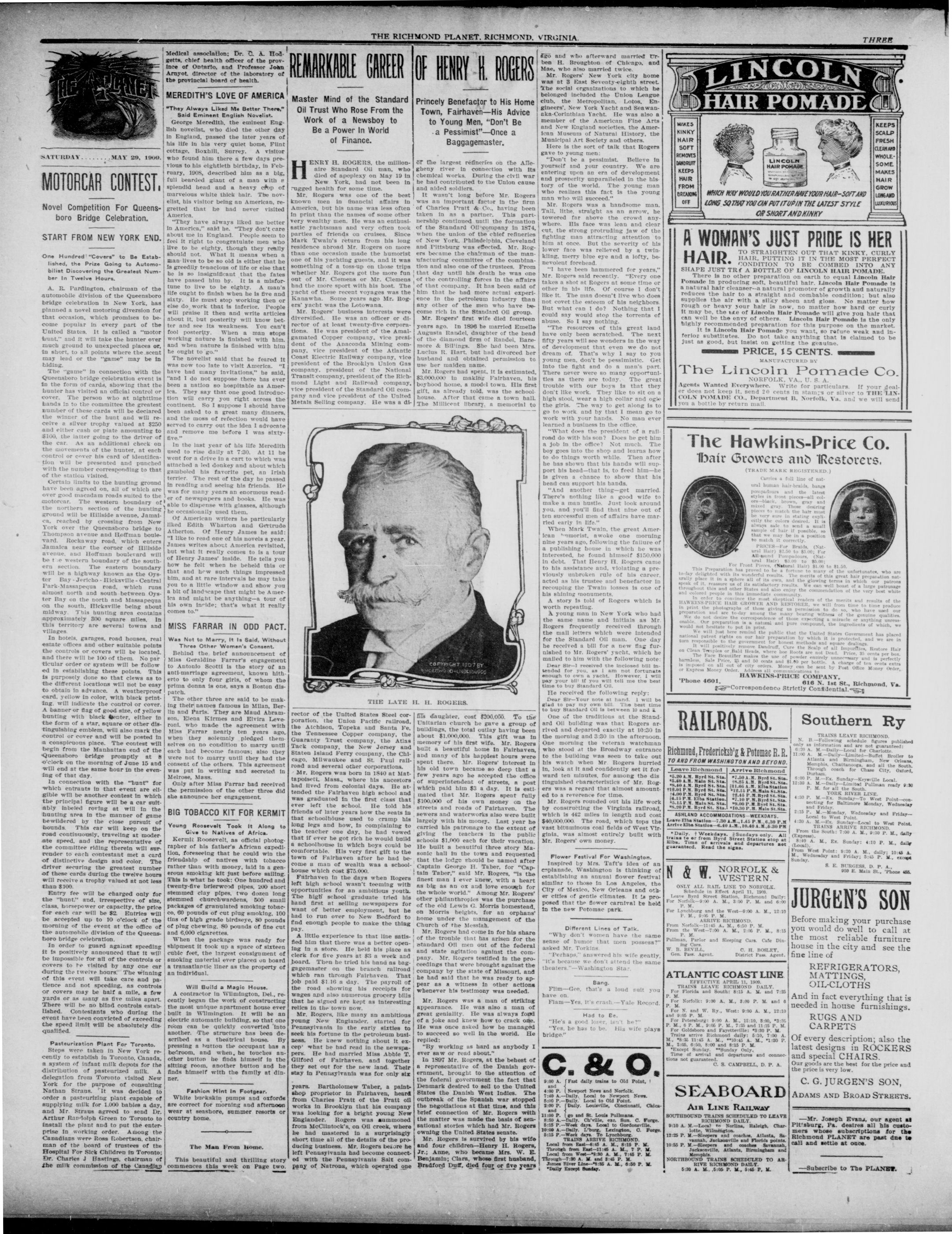
Master Mind of the Standard Oil Trust Who Rose From the Work of a Newsboy to Be a Power In World of Finance.
HENRY H. ROGERS, the millionaire Standard Oil man, who died of apoplexy on May 19 in New York, had not been in rugged health for some time.
rugged health for some time.
Mr. Rogers was one of the best known men in financial affairs in America, but his name was less often in print than the names of some other very wealthy men. He was an enthusiastic yachtman and very often took parties of friends on cruises. Since Mark Twain's return from his long residence abroad Mr. Rogers on more than one occasion made the humorist one of his yachting guests, and it was something of a toss-up on those trips whether Mr. Rogers got the more fun out of Mr. Clemens or Mr. Clemens had the more sport with his host. The yacht of these recent voyages was the Kanawha. Some years ago Mr. Rogers' yacht was the Lotowana.
COPYRIGHT 1907 BY
UNDERWOOD-UNDERWOOD
THE LATE H. H. ROGERS
rector of the United States Steel corporation, the Union Pacific railroad, the Atchison, Topeka and Santa Fe, the Tennessee Copper company, the Guaranty Trust company, the Atlas Tack company, the New Jersey and Staten Island Ferry company, the Chicago, Milwaukee and St. Paul railroad and several other corporations. Mr. Rogers was born in 1840 at Mattapoose, Mass., where his ancestors had lived from colonial days. He attended the Fairhaven high school and was graduated in the first class that ever left the school. He told his friends of later years how the seats in that schoolhouse used to cramp his long legs and how, in complaining to the teacher one day, he had vowed that if ever he got rich he would build a schoolhouse in which boys could be comfortable. His very first gift to the town of Fairhaven after he had become a man of wealth was a schoolhouse which cost $75,000.
Fairhaven in the days when Rogers left high school wasn't teening with opportunities for an ambitious youth. The high school graduate tried his hand first at selling newspapers for want of better employment, but he had to run over to New Bedford to find enough people to make the thing pay.
A little experience in that line satisfied him that there was a better opening in a store. He held his place as clerk for five years at $3 a week and board. Then he tried his hand as baggagemaster on the branch railroad which ran through Fairhaven. That job paid $1.16 a day. The payroll of the road showing his receipts for wages and also numerous grocery bills that he signed are kept as interesting relics in the town now.
Mr. Rogers, like many an ambitious young New Englander, started for Pennsylvania in the early sixties to seek his fortune in the petroleum business. He knew nothing about it except what he had read in the newspapers. He had married Miss Abble T. Gilford of Fairhaven, and together they set out for the new land. Their stay in Pennsylvania was for only six years. Bartholomew Taber, a painshop proprietor in Fairhaven, heard from Charles Pratt of the Pratt oil works in Brooklyn that his company was looking for a bright young New Englander. Rogers was summoned from McClintock's, on Oll creek, where he had mastered in a surprisingly short time all of the details of the producing business. Mr. Rogers before he left Pennsylvania had become connected with the Pennsylvania Salt company of Natrona, which operated one
---
HENRY H. ROGERS
Princely Benefactor to His Home Town, Fairhaven—His Advice to Young Men, "Don't Be a Pessimist"—Once a Baggagemaster.
or the largest refineries on the Allegheny river in connection with its chemical works. During the civil war he had contributed to the Union cause and aided soldiers.
It wasn't long before Mr. Rogers was an important factor in the firm of Charles Pratt & Co., having been taken in as a partner. This partnership continued until the formation of the Standard Oil company in 1874 when the union of the chief refineries of New York, Philadelphia, Cleveland and Pittsburg was effected. Mr. Rogers became the chairman of the manufacturing committee of the combination and also one of the trustees. From that day until his death he was one of the controlling forces in the affairs of that company. It has been said of him that he had more actual experience in the petroleum industry than any other of the men who have become rich in the Standard Oil group. Mr. Rogers' first wife died fourteen years ago. In 1896 he married Emelle Augusta Randel, daughter of the head of the diamond firm of Randel, Baremore & Billings. She had been Mrs. Lucius R. Hart, but had divorced her husband and obtained permission to use her maiden name.
Mr. Rogers had spent, it is estimated, $3,000,000 in making Fahrenhaven, his boyhood home, a model town. His first gift, as already told, was the schoolhouse. After that came a town hall. The Millicent library, a memorial to
COPYRIGHT 1907 BY
LINGERWOOD-UNDERWOOD
His daughter, cost $200,000. To the Unitarian church he gave a group of buildings, the total outlay having been about $1,000,000. This gift was in memory of his first wife. Mr. Rogers built a beautiful home in Fairhaven, and many of his happiest hours were spent there. Mr. Rogers' interest in his old town became so deep that a few years ago he accepted the office of superintendent of streets, a post which paid him $3 a day. It is estimated that Mr. Rogers spent fully $100,000 of his own money on the streets and roads of Fairhaven. The sewers and waterworks also were built largely with his money. Last year he carried his patronage to the extent of giving the teachers in the public schools $1,000 each for their vacation. He built a beautiful three story Masonic hall in the town and requested that the lodge should be named after Captain George H. Taber, for "Captain Taber," said Mr. Rogers, "is the finest man I ever knew, with a heart as big as an ox and love enough for the whole world." Among Mr. Rogers' other philanthropies was the purchase of the old Lewis G. Morris homestead, on Morris heights, for an orphans' home under the management of the Church of the Messiah.
Mr. Rogers had come in for his share of the trouble that has arisen for the standard Off men out of the federal and state agitation against the company. Mr. Rogers testified in the proceedings that were brought against the company by the state of Missouri, and he had said that he was ready to appear as a witness in other actions whenever his testimony was needed.
Mr. Rogers was a man of striking appearance. He was also a man of great geniality. He was always fond of a joke and knew how to crack one. He was once asked how he managed to succeed so well in the world. He replied:
"By working as hard as anybody I ever saw or read about."
In 1897 Mr. Rogers, at the behest of a representative of the Danish government, brought to the attention of the federal government the fact that Denmark desired to sell to the United States the Danish West Indies. The outbreak of the Spanish war stopped the negotiations at that time, and this brief connection of Mr. Rogers with the matter was made the basis of sensational stories which had Mr. Rogers owning the United States senate. Mr. Rogers is survived by his wife and four children—Henry H. Rogers, Jr.; Anne, who became Mrs. W. E. Benjamin; Clara, whose first husband, Bradford Duff, died four or five years
ago and who afterward married Urben H. Broughton of Chicago, and Mae, who also married twice.
Mr. Rogers' New York city home was at 3 East Seventy-eighth street. The social organizations to which he belonged included the Union League club, the Metropolitan, Lotos, Engineers', New York Yacht and Seawanaka-Corinthian Yacht. He was also a member of the American Fine Arts and New England societies, the American Museum of Natural History, the Municipal Art Society and others.
Here is the sort of talk that Rogers gave to young men:
"Don't be a pessimist. Belleve in yourself and your country. We are entering upon an era of development and prosperity unparalleled in the history of the world. The young man who realizes this fact is the young man who will succeed."
Mr. Rogers was a handsome man. Tail, litch, straight as an arrow, be towered far above the crowd anywhere. His face was lean and clear cut, the strong protruding jaw of the fighting man attracting attention to him at once. But the severity of his lower face was relieved by a twinkling, merry blue eye and a lofty, benevolent forehead.
"I have been hammered for years," Mr. Rogers said recently. "Every one takes a shot at Rogers at some time or other in his life. Of course I don't like it. The man doesn't live who does not covet the esteem of his neighbors. But what can I do? Nothing that I could say would stop the torrents of abuse. So I say nothing.
"The resources of this great land have only been scratched. The next fifty years will see wonders in the way of development that even we do not dream of. That's why I say to you young men, don't be pessimistic. Get into the fight and do a man's part. There never were so many opportunities as there are today. The great trouble with our boys is that they don't like work. They like to sit on a high stool, wear a high collar and ogle the girls. The way to get along is to go to work and by that I mean go to work with your hands. No man ever learned a business in the office.
"What does the president of a railroad do with his son? Does he get him a job in the office? Not much. The boy goes into the shop and learns how to do things worth while. Then after he has shown that his hands will support his head—that is, to feed him—he is given a chance to show that his head can support his hands.
"And another thing—get married. There's nothing like a good wife to make a man hustle. Just look around you, and you'll find that nine out of ten successful men of affairs have married early in life."
When Mark Twain, the great American "humorist, awoke one morning nine years ago, following the failure of a publishing house in which he was interested, he found himself $150,000 in debt. That Henry H. Rogers came to his assistance and, violating a previously unbroken rule of his career, acted as his trustee and benefactor in recupying the Twain losses is one of his shining monuments.
A story is told of Rogers which is worth repeating.
A young man in New York who had the same name and initials as Mr. Rogers frequently received through the mail letters which were intended for the Standard Oil man. One day he received a bill for a new flag furnished to Mr. Rogers' yacht, which he mailed to him with the following note: Dear Sir-1 received the inclosed bill intended for you, as I am not fortunate enough to own a yacht. However, I will pay your bill if you will tell me the best time to buy Standard Oil.
Dear Sir-Your note at hand. I will be glad to pay my own bill. The best time to buy Standard Oil is between 10 and 4.
One of the traditions at the Standard Oil building was that Rogers arrived and departed exactly at 10:30 in the morning and 3:30 in the afternoon. One morning the veteran watchman who stood at the Broadway entrance to the building was seen to take out his watch when Mr. Rogers hurried in, look at it and confidently set it forward ten minutes, for among the distinguished characteristics of Mr. Rogers was a regard that almost amounted to a reverence for time.
Mr. Rogers rounded out his life work by constructing the Virginia railroad, which is 442 miles in length and cost $40,000,000. The road, which tops the vast bituminous coal fields of West Virginia, was almost entirely built with Mr. Rogers' own money.
Flower Festival For Washington
Inspired by Mrs. Taft's idea of an explanade, Washington is thinking of establishing an annual flower festival similar to those in Los Angeles, the City of Mexico, New Orleans and other cities of gentle climates. It is proposed that the flower carnival be held in the new Fotomac park.
"Why don't women have the same sense of humor that men possess?" asked Mr. Torkins. "Perhaps," answered his wife gently, "it's because we don't attend the same theaters."-Washington Star.
"He's a good loser, isn't he?"
"Yes, he has to be. His wife plays bridge."
C. & O.
9:00 A. [Fast daily trains to Old Point,!
and
4:00 P. [Newport News and Norfolk.
7:00 A. [Daily. Local to Newport News.
10:00 A. [Daily. Local to Old Point.
2:00 P. [Daily, Louisville, Cincinnati, Calica
and
11:00 P. [go and St. Louis Pullmans.
8:50 A. [Daily. Ch.ville, exc. Sun. C. Forge.
8:15 P. -Week days. Local to Gordonsville.
8:15 P. -Week days. Local to Gordonsville.
8:15 P. -Week days. To Lynchburg.
TRAINS ARRIVE RICHMOND.
Local from East -8:45 A. M. 8:15 P. M.
Through from East -11:45 A. M. 7 P. M.
Local from West -8:30 A. M. 7:45 P. M.
Local from West -8:30 A. M. 7:45 P. M.
James River Line -8:35 A. M. 6:50 P. M.
*Daily Except Sunday.
LINCOLN
HAIR POMADE
MAKES
KINKY
HAIR
SOFT
REMOVES
DANDRUFT
KEEPS
HAIR
FROM
BREAING
OFF
LINCOLN
HAIR POMADE
KEEPS
SCALP
FRESH
CLEAN AND
WHOLE-
SOME
MAKES
HAIR
GROW
LONG AND
LUXURIOUS
WHICH WAY WOULD YOU RATHER HAVE YOUR HAIR-SOFT AND
LONG SO THAT YOU CAN PUT IT UP IN THE LATEST STYLE
OR SHORT AND KINKY
A WOMAN'S JUST PRIDE IS HER
HAIR. TO STRAIGHTEN OUT THAT KINKY, CURLY HAIR, PUTTING IT IN THE MOST PERFECT CONDITION TO BE COMBED INTO ANY SHAPE JUST TRACE A BOTTLE OF LINCOLN HAIR POMADE.
MANUFACTURED BY
The Lincoln Pomade Co.
NORFOLK, VA., U. S. A.
Agents Wanted Everywhere. Write for particulars. If your dealer does not keep it, send 20 cents in stamers or silver to THE LINCOLN POMADE CO., Department B, Norfolk, Va. and we will send you a bottle by return mail.
The Hawkins-Price Co. Hair Growers and Restorers.
(TRADE MARK REGISTERED.)
Carries a full line of natural human hair braids, bangs pompouads, and the large styles in front pieces—all colors—black, brown, gray and mixed gray. Those desiring pieces to match the hair must be very tightly fitted, critically the colors desired. It is always safe to send a small sample of hair that is possible, so that we may be in position to match it correctly.
PRICES—For Braids, (Natural Hair) $2.50 to $5.00; For All-around Pompouads, (Natural Hair) $2.50 to $5.00; For Front Pieces, (Natural Hair) $1.00 to $1.50.
This Preparation has proved to be a fortune to many of the fortunate, who are today delighted with its wonderful results. The merits of this great hair preparation naturally place it in the top position in which our patrons speak of it, reassure us of its satisfactory results. We can well be assured that this and other States and also enjoy the commendation of the very best white and colorful hair.
and Preparation has proved to be a to-day designated with the wonderful results. We will place it in a sphere of its own, speak of it, reassure us of its satisfactory throughout this and other States and also extend and invite you to meet us in certain places. HAWKINS-PRICE HAIR GROWER AND REPAIR in print the photographs of those giving payment are today among the man. We do not do anything that is not onable. Our preparation is a natural and would not hesitate to put in print. We will just help the public national patent rights on our hair preparer responsible to the government for home it will positively remove Dandruff, C on Clean Tissue, Tapes, where heed the Face Beautifier Mask used on harmless, Sale Price, 25 and 50 cents and is imposed on all out of city orders. Mon or Express Money Order. Address all comm.
Phone 4601. Correspondence S
HAWKINS-PRICE
In order to convince the most skeptical readers of the merits and results of the HAWKINS-PRICE HAIR GROWER AND RESTORER, we will from time to time produce in print the photographs of those giving us permission to do so, who have used our preparation and are to-day among the many bearing witness of the genuine qualities. We will also introduce the abundance of those expecting a miracle or anything unreasonable. Our preparation is a careful and pure compound, the ingredients of which we would not hesitate to put in print.
We will just here remind the public that the United States Government has placed national patent rights on our hair preparation by which it is protected, and we are in turn responsible to the government for honest methods and square dealings.
It will positively remove Dandruff, Cure the Scalp of all Impurities, Restore Hair on Clean Temples or Bald Heads, where hoe Roots are not Dead. Price, $5 cents per box.
The Face Beautiful makes the use of powder entirely unnecessary and is perfectly harmless. Sale Price, $5 and $0 cents and $1.60 per bottle. A charge of ten cents extra is imposed on all out of city orders. Money can be sent by Post Office Money Order, or Express Money Order. Address all communications to
HAWKINS-PRICE COMPANY.
Phone 4601. 616 N. 1st St., Richmond, Va.
Correspondence Strictly Confidential.
RAILROADS.
Richmond, Fredericksb'g & Potomac R. R.
TO AND FROM WASHINGTON AND BEYOND.
Leave Richmond
*5.20 A.M. Byrd St. Sta.
*5.40 A.M. Main St. Sta.
*8.40 A.M. Elba Station.
*10.00 P.M. Elba Station.
*14.50 P.M. Elba Station.
*5.15 P.M. Main St. Sta.
*8.20 P.M. Elba Station.
Arrive Richmond
*7.50 A.M. Byrd St. Sta.
*8.25 A.M. Byrd St. Sta.
*11.05 A.M. Elba Station.
*12.15 P.M. Main St. Sta.
*14.10 P.M. Elba Station.
*19.00 P.M. Byrd St. Sta.
*10.30 P.M. Main St. Sta.
ASHLAND ACCOMMODATIONS - WEEKDAYS.
Leave Elba Station - 7:30 A.M. 1.45 P.M. 6:30 P.M.
Arrive Elba Station - 6:40 A.M. 1.45 P.M. 6:30 P.M.
*Daily. 7 weekdays. $ Sundays only. All*
From Byrd Street Station stop at
Elba. Time of departure departures
not guaranteed. Read the signs.
ONLY ALL RAIL LINE TO NORFOLK.
Schedule in Effect April 11, 1969.
Leave Byrd Street Station, Richmond Daily:
For Norfolk - 9:00 A. M. 3:00 P. M. and 6:00
P. M.
For Lynchburg and the West - 9:00 A. M. 12:10
P. M. 9:06 P. M.
AURORA RICHMOND.
From Norfolk - 11:45 A. M. 6:50 P. M.
From the West - 7:00 A. M. 2:06 P. M. 8:15
P. M.
Pullman, Parlor and Sleeping Cars. Cafe Din-
W. B. BEVILLE.
C. H. BOSLEY,
Gen. Pass. Agent.
District Pass. Agent.
ATLANTIC COAST LINE
TRAINS LEAVE RICHMOND DAILY.
For Florida and South: 8:15 A. M. and 7:25
P. M.
For Norfolk: 9:00 A. M., 8:00 P. M. and 6
P. M.
For N. and W. Ry., West: 9:00 A. M., 12:10
and 9:05 P. M.
For Peterburg: 9:00 A. M., 12:10, 8:00, *3:30
P. M, 6 P. M, 9:00 P. M, 7:25 and 11:15 P. M.
Goldbordo and Fayetteville: *8:30 P. M.
Training School: 8:30 P. M, 12:10, 8:00,
*8:30, 11:45 A. M., *10:45 A. M., *1:20 P. M,
2:05, 6:50, 8:00 and 8:15 P. M.
*Except Sunday. *Sunday Only.
Time of arrival and departures and con-
nections not guaranteed.
C. S. CAMPBELL. D. P. A.
SEABOARD
SEABOARD
SOUTHBOUND TRAINS SCHEDULED TO LEAVE
RICHMOND, DAILY.
9:10 A. M.-Local to Norrina, Raleigh, Charlotte, Wilmington.
12:25 P. M.-Sleepers and coaches, Atlanta, Savannah, Jacksonville and Florida points.
10:55 P. M.-Sleepers and coaches Savannah, Atlanta, Birmingham and Memphis.
NORTHBOUND TRAINS SCHEDULED TO ARRIVE RICHMOND DAILY.
5:30 A. M., 5:35 P. M., 5:45 P. M.
A.
fortune to many of the fortunate, who are
the merits of this great hair preparation and
the glowing terms in which our patrons
we can well boast of a large patronage
joy the commendation of the very best while
unity.
real readers of the merits and results of
the STORIES, we will from time to time produce
our own books, which have our own
y bearing witness of the genuine qualities,
those expecting a miracle or anything unreuse-
compound, the ingredients of which, we
that the United States Government has placed
on by which it is protected, and we are in
est methods and square dealings.
are the Scalp of all Impurity Hairs, Restore Hair
Rock Hair Dead. Price, $3 cents per box.
powder entirely tannery and is perfectly
$1.60 per bottle. A charge of ten events extra
can be sent by Post Office Money Order,
unifications to
ICE COMPANY.
616 N. 1st St., Richmond, Va.
Strictly Confidential.
Southern Ry
TRAINS LEAVE RICHMOND
BINNES LEAVE RICHMOND.
N. B—Follow-up schedule figures published only as information and not unrestricted;
6:20 A. M. D—Daily—Local for Charlotte.
11:00 A. M. D—Daily—Limited-Buffet Broiler to atlanta, Birmingham, New Orleans, Memphis, Chattanooga, the South. Through coach for Chase City, Oxford, burham.
6:20 A. M. Dr. Sunday—Kayville Local.
10:00 P. M. D—Limited-Pullman ready 0:30 P. M. for all the South. YORK RIVER LINE.
4:00 P. M. D—Sunday—To West Point—connecting for Baltimore Monday, Wednesday and Friday.
2:15 P. M.—Monday, Wednesday and Friday—
Local to West Point.
4:30 A. M—Ex. Sunday—Local to West Point.
TRAINS ARRIVE RICHWINDOW
West Point.
TRANS ARRIVE RICHMONI
From the South: 7:00 A. M.; 9:30 P. M.; daily
(Express).
8:40 A. M.; Ex. Sunday: 4:10 P. M.; daily
(Local).
From West Point: 9:20 A. M.; daily: 10:45 A.
M.; Wednesday and I Friday: 5:45 P. M.; except
Sunday.
S. E. BURGESS, D. P. A.
920 E. Main St., Phone 465
JURGEN'S SON
Before making your purchase you would do well to call at the most reliable furniture house in the city and see the fine line of
REFRIGERATORS,
MATTINGS,
OIL-CLOTHS
And in fact everything that is needed in house furnishings.
RUGS AND
CARPETS
Of every description; also the latest designs in ROCKERS and special CHAIRS.
Our goods are the best for the price and the price is very low.
C. G. JURGEN'S SON.
ADAMS AND BROAD STREETS.
—Mr. Joseph Evans, our agent at Pittsburgh, Pa. deaires all his custom-subscriptions for the Richmond PLAN, past dne to call and settle at once.
—Subscribe to The PLANET.
THREE
A.
FOUR
THE PLANET
Published every Saturday by JOHN MITCHELL,
JR., at Sill N. Fourth Street, Richmond, Va.
JOHN MITCHELL, JR., - EDITOR.
All communications intended for publication
should be sent so us to reach us by Wednesday.
TERMS IN ADVANCE.
One Copy, one year, $1.50
One Copy, eight months, 1.00
One Copy, six months, 0.50
One Copy, four months, 0.40
One Copy, three months, 0.30
Single Copy, $0.00
ADVERTISING RATES.
For one inch, one insertion... $0.50
For one inch each subsequent insertion... $0.40
For two inches, three months... $0.60
For two inches, six months... $0.90
For two inches, nine months... $1.00
For two inches, twelve months... $0.90
Marriage and Funeral Notices, one inch... $0.50
Standing and Transient Notices per line... $0.10
POSTAGE STAMPS OF A HIGHER DENOMINATION THAN TWO CENTS NOT RECEIVED ON SUBSCRIPTIONS.
THE PLANET is issued weekly. The subscription price is $1.50 per year in advance.
There are four ways by which money can be sent by mail at our risk.—In a Post Office Money Order, by Bank Check or Draft, or an Expreo. Money Order, and when none of these can be procured, in a Registered Letter.
MONEY ORDERS—You can buy a Money Order at your Post Office, payable at the Richmond Post Office and we will be responsible for its issue at all.
EXPRESS MONEY ORDERS can be obtained at any office of the American Express Co., the United States Express Co., and the Wells Fargo Company, which is available for money sent by any of these companies. The Express Money Order is a sale and convenient way for forwarding money. The Money Order, Post Office or an Express Office is not within your reach, your Postmaster will register the Letter you wish to send us on payment of ten cents. Then, if the Letter is lost or stolen, you can send money in this manner at our risk. We cannot be responsible for money sent in letters in any other vase than one of the four letters. In any other way, you must do it at your own risk.
NEWWALKS, ETC.-If you do not want THE PLANET planned for another year after your subscription has run out, you then notify us by Post Card to discontinue it. The courts have decided that subscribers to newspapers who do not wish to receive the subscription of time for which it has been paid are liable for the payment of the subscription up to date when they ord r the paper discontinuation.
COMMUNICATIONS—When writing to us to renew your subscription or to discontinue your paper, you should give your name and address in full otherwise we cannot find your name on
CHANGE OF ADDRESS—In order to change the address of a subscriber, we must be sent the former as well as the present address.
Entered at the Post Office at Richmond, Va.
as second class matter.
SATURDAY.....MAY 29, 1909.
We have received an invitation to the commencement exercises of the Manassas Industrial School. May 28-31, 1909. Prof. Leslie Pinckney Hill is principal of the institution.
____0____
We have received an invitation to the thirty-eighth Anniversary of the Union Baptist Church, at Orange, N.J., Rev. William P. Lawrence, pastor. The exercises will begin May 23d to June 7th, inclusive.
---
We have received a most interesting pocket edition of "Negro Progress Since Emancipation" by John C. Minkins. It is intensely interesting and may be secured by sending ten cents to the author, Providence, R. I.
---
We have received a copy of a pamphlet, entitled "Christ and the Negro or The Church's Message to the South an the Race Question" by Chas. Meyers, 9 Hemp Street, Shippingsport, Louisville, Va. The treatise will richly repay a perusal and may be obtained from the author for ten cents.
---
THE STRIKE IN GEORGIA
The Richmond, Va. Times-Dispatch in discussing the Georgia situation makes some timely observations relative thereto and although of the rock-ribbed Democratic persuasion makes some observations on the outlook which will necessarily attract the attention of sensible people everywhere. It says in its issue of the 27th inst.
"It would be easier to sympathize with these striking Georgia railway men if it was felt that their quarrel was reasonable and just, but the reverse seems to be true. The ostensible reason for the strike was the substitution of some Negro firemen for some white firemen, and the presumable reason for these changes was that the negroes would do the work equally well for less money. A deeper cause for the trouble is suggested by the report that the coming of a certain Inb勒领 from Toronto to Georgia was for the purpose of helping the white firemen to get a raise in pay, a plan which was made difficult or impossible by the presence of the colored firemen.
"There is some ground for believing that the race issue has been deliberately emphasized a good deal more than was necessary with a view to enlisting popular support in what is otherwise a simple dispute between capital and labor. But in any case, the root of the trouble appears to lie in the willingness of the Negro to
do certain labor for less pay than white men."
This is indeed "the sum and substance" of the whole matter. The race issue as such has been injected into the affair only as a method of convenience and in order to make it appear that white men in Georgia "to the manor born" were endeavoring to place Negroes over white men. Were the officers of this railroad Northerners, such argument might be used successfully, but the white men in control are Georgians and they are contending for the principle of managing their own business affairs. The Times-Dispatch says further:
"Here is a plain economic fact which should be frankly faced. No one can deny that the Negro firemen would like to draw the same pay that goes to the white firemen. The fact that he has to content himself with less, assuming that he does the work equally well, is an economic discrimination against him on the ground of his color. To insist that the railway pay a higher price than necessary for this work, in order to have it done by a white man, is simply to unionize race prejudice. Unions are supposed to represent "all labor," not simply white labor. What they now ask, in effect, is that Negroes shall no longer be employed." The above is logical and convincing. The Times-Dispatch says all that there is to be said and places the question from an economic and practical point of view up to the business interests of the Southland when it observes:
"This is the demand which has led to a condition of chaos in Georgia, to the inconvenience of thousands of people. But it must be evident that shoveling coal for an engine is entirely suitable work for a Negro, and that, unless he is to be denied all rights, he has a full right to be protected in it. Georgia locomotives have long been stoked by colored firemen. These men have done the work efficiently, and there is no pretense that white engineers object to associating with them in this way. It is all a question of the pay envelope. Georgians who have thoughtlessly sided with the strikers on the appeal to race prejudice, would do well to consider the economic side of this question. If the Negro cannot fire locomotives, what work shall he be allowed to do? Would Georgia rather have her Negroes occupied at hard physical work or loafing around the street corners of Atlanta?"
This then is a war upon the industrious Negroes and not upon the loafing ones. It is an effort to put a premium upon dishonesty by forcing working men to steal, for when it comes to be a question of starvation and stealing, the latter wins. Shall colored men be permitted to feed themselves by their own labor or shall they force the state to feed them at the public expense? Here is the problem that labor is presenting to the country and that an imported white man from Canada is leading the movement along the lines of race prejudice makes the attitude of these striking white firemen all the more indefensible.
THE POWHXTAN PRISONERS
There is something solemnly pathetic in the cases of the alleged Powhatan murderers. Five colored men have been sent to their death and they all died protesting their innocence to the last. Court convened at Powhatan Courthouse, Virginia last Wednesday and Judge Hundley seems to have felt keenly the criticisms of the fifteen white citizens and others, relative to the doubt of the guilt of the colored men, who had been "railoaded" to the gallows. We have always felt that the "corpus delicict" had not been satisfactorily proven to the satisfaction of an unbiased observer and that the motive for the murder was absent.
We do not believe that it has been definitely established that a murder was committed or that these people were not actually the victims of the fire that destroyed their home. We again ask, what motive could have actuated these people in murdering Mrs. Skipwith and Mr. Johnson? We in common with the law-abiding colored people of the state were willing for five or ten colored people to pay the penalty, if they were guilty of such an offense. This attitude upon the part of the conservative colored people of the State has caused the white people to pause and to consider the facts, and to express an opinion that has caused even the honorable Judge to sit up and take notice.
Although Nannie Taylor, the wife of Isham Taylor has suffered almost the pangs of death and has drunk deep from the cup of sorrow in the loss of her husband, she now must be tried for complicity in these alleged murders. When the cases of Charles and Emanuel Brown were called for trial last Wednesday, the Commonwealth's Attorney announced that he did not have sufficient evidence upon which to base a conviction. He asked for a continuance of the cases. Counsel for the prisoners objected and Judge Hundley ruled that as the Constitution guaranteed to the accused a speedy trial, and the statute required that they be tried at the same term in which they were indicted if practicable. As he did not think that the men
THE RICHMOND PLANET, RICHMOND, VIRGINIA
O.OFC Attention.
P. P. XLV
To the District Deputy Grand Worthy Counsellors, Past Worthy Counsellors, Worthy Counsellors and Officers and Members of Subordinate Courts:
Whereas at the last annual session of the Grand Lodge, Knights of Pythias of Virginia, the time of meeting was changed to the third Tuesday in June, and Richmond, Va. was selected as the place, and the Grand Court is required to meet at the time and place of the aforesaid Grand Lodge. I hereby proclaim that the next meeting of the Grand Court will be held June 15, 16, 17 and 18, 1909 at the place above specified.
The Twelfth Annual Session will convene at the Fifth Street Baptist Church, Tuesday, June 15, 1909 at 10 A. M. All Grand Representatives will forward their credentials through the Registers of Deeds of their respective Courts, duly signed and sealed to Miss M. L. Chiles, Grand Worthy Register of Deeds, No. 114 W. Leigh Street, Richmond, Va. One copy will be retained by the Grand Representative and be brought to the session at Richmond. Blanks for this purpose may be obtained from the Grand Worthy Register of Deeds.
Courts that have not paid their semi-annual taxes for December 31st, 1908 and their Endowment Taxes or June 30th, 1909 and their Pythian Temple Taxes will not be eligible for membership upon the floor of the Grand Court. All Grand Representatives, who have not received the Grand Court Degree must pay $1.50 in order to receive the same. Only Past Worthy Counsellors are entitled to be Grand Representatives. Courts must pay the fee for the Grand Representatives, that they send who have not received the Grand Court Degree. The Grand Court will convene Tuesday, June 15, 1909, at 10 A. M. at the Fifth Street Baptist Church, on Fifth Street opposite Jackson Street.
The grand parade will take place Wednesday, June 16, 1909 at 1:30 P. M. and will form at the Pythian Castle, No. 720. N. Third Street. The competitive drill will take place on the same day at 4 P. M. at the Broad Street base-ball park. The Uniform rank will camp on the grounds of the Virginia Union University, and the following prizes have been offered: first prize, best drilled Company, $25.00; second prize, $15.00; third prize, $10.00; to the Company having the most men in camp, $25.00 to the Company that gets in camp first, $10.00; to the one that remains in camp longest, $15.00. A Pythian Bazaar will be conducted during the entire week at the Pythian Castle, No. 727 N. Third Street and music will be in attendance. Arrangements are being made to have entertainments at the St. John, The Baptist Hall Grounds, on First Street, between Jackson and Duval Streets and the Grand Banquet will be held there on Thursday night. June 17, 1909.
The public meeting will be held Tuesday night, S. P. M. at the Fifth Street Baptist Church. For all information concerning board and lodging and assignment to places, address Mrs. Josie A. Graham, Chairman, No. 108 L. Leigh Street, Richmond, Va. Grand Representative will find it to their advantage to send in their names now and assignments will be made in advance. They can go direct to their stopping places upon reaching the city. Wagons and carriages will be at the depots to meet Grand Representatives and visitors. Subordinate Court members can attend the sessions of the Grand Court. The rate for board and lodging will be $1.00 per day.
Courts that have not subscribed or paid anything on the stock of the Pythian Calanthe Industrial Association are urgently advised to do so at once to this office. The names of specifications for the building at Lynchburg and money is needed to begin work. The Calanthe Relief Fund collection should be forwarded ta once to this office. The names of those who contributed last year will be found in the Minutes of last session. The names of all Courts contributing will be read out during the session of the Grand Court.
There is peace and there is harmony throughout the Grand Jurisdiction and the work is progressing in a way and manner that is entirely satisfactory to the sisterhood.
Given under our hands and the seal of the Grand Court of Virginia, in the Cit of Richmond, this fourth day of May, nineteen hundred and nine.
This is to certify that I have received from John Mitchell, Jr. Grand Chancellor of the Grand Lodge of Virginia, Knights of Pythias, N. A. A., E. A., A. A. and A., $150.00) One Hundred and Fifty Dollars in payment of the death claim of Brother Chas. G. Leigh, who was a member of St. Matthew Lodge, No. 88, of Houston, Va.
should be restrained of their liberty longer, he ordered their discharge. This emphasized the utter hollowness of the Commonwealth's case and the Commonwealth's Attorney asked leave of the Court to enter a no乳 prosequil in the cases of Charles and Emanuel Brown, Ollie Ross, Monie Johnson and Anna Taylor. This was allowed by Judge Hundley and the people were dismissed from custody. They were happy over the culmination of the controversy. It is hardly needless to state that had they been tried at the last term of the court all of them would have received penitentiary sentences at least and probably one or more of them sent to the electric chair.
Judge Hundley granted the plea for a change of venue and Nannie Taylor, who is represented by Hon. H. M. Smith, Jr. of this city will be tried in Prince Edward county, together with Fleming Steepney and Robert Johnson. This will end the celebrated case. Nannie Taylor was bailed in the sum o₁ $500.00
That Judge Hundley felt 'keenly the criticisms of the fifteen white citizens who issued a public statement relative to these colored people and citing the fact known of all men, that they were convicted upon the testimony of witnesses, who were scared well-night to death over the prospect of their being sent to the electric chair is evident.
He is quoted as follows:
"Gentlemen, you have been summoned to take into consideration indictments of two men who have been arrested since the last term of court in connection with the Skipwith and Johnson murder, and I regret to have to allude to an attempt of certain people in this community to interfere with the ordinary course of justice by publications in the newspapers, the object of which was to array public sentiment on one side or the other in these cases. This is the most extraordinary and outrageous attempt I have ever known to try men by public opinion instead of by the organized anduly authorized tribunals established for that purpose, and such conduct will not be tolerated for a moment by this court."
Evidently, this learned jurise did not consider his own charge to the jury and his comment upon the verdict when he announced the sentence upon the "poor devils" that he was condemning to the electric chair. He virtually included a whole race of people in his indictment, and although he has lived here with us and we with him, he sent broadcast over the country an impression that another Nat Turner insurrection had been "nipped in the bud." This was done too in the face of the fact that Virginia Negroes are at a premium in every Northern community for the reason that they are reputed to be not only industrious, well-trained and in possession of good manners, but that they are absolutely reliable.
We confess that the feeling and opinion that he expresses relative to certain white citizens of Powhatan county were our feelings and opinion felt relative to him and his deliverances. He was charitable enough to conclude as follows:
"I have thought that it might be my duty to summon these persons to the bar of this court to answer for this attempt to interfere with the administration of justice, but I am willing to believe, and do believe, that some who participated in these publications did it thoughtlessly and without realizing the great impropriety of their conduct. Therefore, I shall pass it by, only imposing upon you the duty of entirely ignoring this improper effort to influence the trial of these cases, and to do your duty by indicting these men if you think the evidence justifies it, or by refusing to indict them if you do not think the evidence connects them with this murder."
We do not care to express an opinion as to what Judge Hundiey's attitude would have been had the critics attested to been of the colored race instead of being identified with the white race.
It goes to show the impracticability of ever having a race war in this section or the country. Where one white man opposes, two white men will speak in our favor. All we have to do is to continue to improve our condition and be good citizens, winning the respect, not only of our white neighbors, but the good opinion of our colored neighbors as well. The Powhatan tragedy will long be remembered by the colored people of this state and we yet hope and believe that future facts and developments will demonstrate that five lives were sacrificed and a score of people punished both directly and indirectly for a crime that was never committed. If it will tend to prevent the repetition of the blunder then these men will not have died in vain.
PENNSY ENGINE RUNS WILD
Travels Sixteen Miles Unguided, But Fortunately Causes No Wreck. Lancaster, Pa., May 26.—A remarkable escape from a serious wreck occurred on the main line of the Pennsylvania railroad. The throttle of a shifting engine standing in the yard in this city was opened in some unaccountable manner and the locomotive started off, passing all of the switches to the main track. It ran as far west as Rheems, sixteen miles, when the steam become low and it stopped.
Richmond, Va., May 4, 1909.
JOHN MITCHELL, JR.
$150.00 Endowment Paid.
Houston, Va., May 24, 1909.
Complying with instructions issued Saturday by E. A. Ball, second vice president of the Brotherhood or Locomotive Firemen and Enginemen, the members of that organization on the Georgia railroad and on the joint terminal trackage last night at 9 o'clock severed their connection with those two employing corporations.
But during hours of the night the strike produced no appreciable or apparent change in the situation. The engines on the joint terminals trackage and the trains on the Georgia moved along as has been their wont since the rails were laid
It was a brotherhood engineer who handled the locomotives, but that engineer had on his machine a fireman who was not a B. L. F. and E. At no time was there any delay on tie-up of the locomotives in the yards neither was there any hesitancy or halt in moving the trains on the main line. The passenger trains leaving Atlanta and Augusta about the midnight hour were moving along according to the usual schedule when last reports were recorded at the train dispatchers' offices at both depots. No break in the freight train movements had been reported up to an early hour this morning.
CONDITIONS MAY CHANGE
But the conditions obtaining may be changed at any minute and a tie-up is among the possibilities.
During the day Vice President Ball was in almost constant consultation with Brotherhood men and late at night expressed himself as completely satisfied, with the conditions and situation. Among Vice President Ball's visitors at his apartments in the Klimbim was F. E. Burgess, assistant grand chief of the Brotherhood of Locomotive Engineers, who came to Atlanta to lend his counsel and assistance in any way it may be needed. A. P. Kelly, of Chicago, vice president of the Brotherhood of Locomotive Firemen and Enginemen, will reach Atlanta this morning and will join Vice President Ball in the conduct and management of the struggle now on.
Colonel Thomas K. Scott, general manager of the Georgia railroad, reached Atlanta last night to take a survey of the situation and passed on to Montgomery this morning. During his stay in the city General Manager Scott gave out a card for publication. That card reads:
Augusta, Ga., May 17, 1909.
To the Public: The Atlanta, Macon and Augusta papers of yesterday morning contained a brief statement over my signature of the announcement received by me late on Saturday night that the firemen employed by the Georgia railroad who are members of the Firemen's Brotherhood, of which Mr. E. A. Ball, of Toronto, Canada, is vice president, would leave the service of the Georgia railroad at 9 o'clock tonight. At that late hour it was impossible to supplement this statement with a suitable relation of the conferences which had occurred between the committee of firemen, r. E. A. Ball, vice-president, of Toronto, Canada, and myself.
It seems proper to publish such a supplemental statement now, in order that you may clearly understand the movement of the firemen, under the direction of Vice President Ball, whom they have made their spokesman.
Vice President Ball came to the south, presumably from Toronto, Canada, where he lives, some weeks ago, and about the same time the firemen of the Georgia railroad formulated and submitted to the officials of the Georgia railroad an agreement to take the place of the existing agreement, and called on me to discuss it with them.
WHAT AGREEMENT WILL DO
At this interview I pointed out to them that the following clauses of their proposed agreement presented insurmountable difficulties:
"All firemen who are hired will be placed in freight or yard service, and the oldest white firemen will stand first for passenger engines or runs.
"Passenger, through, local freight and yard engines, will not be blocked by non-promotable men," because the adoption of such stipulations would utterly and completely destroy the reasonable rights of seniority in runs which had been acquired by negro firemen by long service, and who had been found worthy of promotion simply as firemen by reason of their efficiency and faith."
At an interview with Vice President Ball, subsequently, he undertook to instruct me, whose life has been spent in the south, among the southern people, with every opportunity to observe their bearing and their temper toward the negro engaged in industrial and agricultural pursuits, both during slavery and since, that the sentiment of the southern people was opposed to the practice of the Georgia railroad, as herein described, of allowing negro firemen to acquire the character of seniority described, the benefits of which were confined strictly to their employment as firemen. I denied his proposition, believing that a Canadian who only had a brief opportunity of studying conditions in Georgia could not have any sound basis for such an allegation as Mr. Ball made, he stated further, that he understood that the laws of Georgia discriminated against the negro industrial pursuits, and that the policy of the Georgia railroad, as described herein and fully understood by him, was contrary to the laws of Georgia, or at least to their spirit, alluding, of course, to the constitutional amendment adopted last fall placing certain imitations upon the exercise of the suffrage.
DID NOT ASK INCREASE PAY.
The firemen and their agent and
representative, Vice President Ball, disclaimed any desire to ask for an increase of wages. Some minor grievances, belonging quite far back in the past and of more fancied than real importance, and of no practical significance, were stated by the firemen and virtually dropped by them. Some other matters were promised immediate attention; for instance, placing drinking water tanks onenders and in summertime providing ice to be placed therein.
As time goes on you will, I believe be convinced that the effort of Mr. Ball and of a few misguided young citizens of Georgia, who are serving as firemen on the Georgia railroad, will be to raise an issue as to the employment of negroes on railroads at all. I have shown that objection to their having seniority rights simply as firemen is clearly a subterfuge. The ultimate purpose, as I well know from facts in my possession, is to eventually drive the negro out of employment on railroads altogether.
HERE ARE THE POINTS
The points I endeavor to put clearly before the public in the foregoing are these:
1. The limit of the negro's career on the Georgia railroad is that of fireman. He can, under no conceivable circumstances, come in competition with a white man for the position of engineer or "block" a white man's promotion to that position.
2. The o objective of the white fireman is the position of engineer. It is solely and simply for the purpose of ultimately attaining that position that he endures the hard work of a fireman. To that realization of this aspiration no arrangement or practice of the Georgia as to its negro firemen does now or ever has or ever will oppose the slightest obstacle. A negro fireman's seniority neither brings him any nearer the position of engineer, nor puts the white fireman any further away from it. His (the negro's) seniority, coupled with long and faithful service, gives him promotion in the form of a better run, as fireman. This is the only reward he can have for long and faithful service. It is but justice and encouragement to him; and is not either injustice or discouragement to the white fireman.
3. It is so clear that the white firemen of the Georgia railroad have no grievance in this matter and that their real ambition—which is to become engineers—is not obstructed in the slightest degree by the practice, of which they complain, that the conclusion is irresistible that they are being used by a party unacquainted with and alien to our industrial situation, to start on agitation to drive the negro altogether out of railroad service.
PURELY POLITICAL MOTIVE
4. That Mr. Ball of Canada's exposition of the suffrage amendment to the state constitution is erroneous—the scope of that amendment being purely political and not intended to disturb industrial relations of the whites and the negroes. I leave you to judge whether or not the movement to stir up industrial race strife for which I at least hold Mr. Ball, of Canada, to be chiefly responsible, if successful, will not mean an end of industrial freedom for the negro, which has ever been the south's proud end rightful boast in other pursuits.
T. A. Campbell has been dismissed because when he reached Augusta from Atlanta on train 28, Saturday, he refused to tell Superintendent Brand whether or not, as rumored, he intended to strike today—Monday—although he as chairman of the grievance committee had signed the notice to me that the firemen would strike at 9 p. m. tonight, as shown in the copy of the notice as published by me in the news papers of May 16, which notice was on the way to my residence under special delivery stamp and which reached me at 11:10 p. m. seventy-fifth meridian, May 15. Other firemen who refused to declare their position have also been dismissed, but none has been replaced by a negro fireman, but all have been replaced by com-
petent white men, worthy citizens of Georgia.
Respectfully,
THOS. K. SCOTT,
General Manager.
Augusta, Ga., May 17, 1909.
FIFTY STRIKE IN AUGUSTA.
Augusta, Ga., May 17.—About fifty white firemen on the Georgia railroad struck to-night against the rules of the road giving seniority places to negro firemen. The thirty negro firemen are at their places. White firemen have been employed, and are in the places of the white strikers. The officials say that there is not the slightest embarrassment in any way whatever.—Atlanta Constitution.
RECEIPT THAT CURES WEAK MEN-FREE.
Send Name and Address To-day You Can Have It Free and Be
Strong and Vigorous.
I have in my possession a prescription for nervous debility, lack of vigor, weakened manhood, failing memory and lame back, brought on by excesses, unnatural drains or the follies of youth, that has cured so many worn and nervous men right in their own homes—without any additional help or medicine—that I think every man who wishes to regain his manly power and virility, quickly and quietly, should have a copy. So, I have determined to send a copy of the prescription, free of charge, in a plain, ordinary sealed envelope, to any man who will write me for it.
This p prescription comes from a physician who has made a special study of men, and I am convinced it is the surest-acting combination for the cure of deficient manhood and vigor-failure ever put together.
I think I owe it to my fellow man to send them a copy in confidence, so that any man, anywhere who is weak and discouraged with repeated failures may stop drugging himself with harmful patent medicines, secure what, I believe, is the quickest-acting, restorative, upbuilding, SPOTTOUCHING remedy ever devised, and so, cure himself at home quietly and quickly. Just drop me a line like this: Dr. A. E. Robinson, 3895 Luck Bldg., Detroit, Mich., and I will send you a copy of this splendid receipt, in a plain, ordinary sealed envelope, free of charge.
GAVE HIS LIFE TO SAVE FIREMEN
PASSENGERS ESCAPE INJURY
Express From Norfolk, Va. Collides With Freight Train on a Siding Near Salisbury, Md.—Baggagemaster and Express Agent Injured.
Salisbury, Md., May 26—Engineer Edward T. West, of the Norfolk express, which crashed into a freight train standing on a siding two miles south of this place, died a hero by permitting his fireman, Lee Cox, to jump to safety first.
It was impossible for Engineer West to jump from his side of the engine, as that was the side that hit the freight train. He had to wait for the fireman to jump, and then he tried to save himself by jumping, which he did, but the express car toppled over on him, cutting him in two and smashing him beyond recognition.
The fireman jumped just in time, barely escaping the car which killed the engineer.
W. W. Wright, who had charge of the express car, was badly injured about the head and face, and William Guthrie, baggageman, who was in the baggage car, had his arm badly mashed and was cut about the head and body.
The engine drawing the express was demolished and buried in sand banks along the track. The freight engine was badly wrecked, the driving wheels and cab being torn off. Passengers on the express escaped injury, except slight bruises. One express car and two baggage cars were demolished.
Traffic was stopped completely until a track could be built around the wreck. The cause of the accident is shrouded in mystery. The express train was moving rapidly at the time, being about on time and having the right of way.
SCRANTON FLYER WRECKED
Six Coaches Left the Rails, But No One Was Injured.
Allentown, Pa., May 26—Passengers on the Scranton fiver, the Jersey Central's fast train between Philadelphia and Scranton, had a bad shaking up and a narrow escape from death, when the six coaches of the express left the rails at Slate Dam, fifteen miles west of this city. The accident is thought to have been due to a brake beam dropping, although railroad officials assign no cause as yet.
A short distance below a bad curve the train slowed up, and here the smoker turned completely over, dragging the remaining five cars from the rails and throwing them on their sides. The locomotive remained on the rails. None of the passengers were injured. The avoidance of fatalities or serious injuries is considered to have been almost miraculous.
Radium and the Tariff
Washington, May 26—Sorcerer Talferro, of Florida, offered an amendment to the tariff bill in the senate placing radium on the free list
DECORATION DAY.
THE FIGHT FOR THE REPUBLIC
The Halo of Heroism
By Captain F. A. MITCHEL
[Copyright, 1900, by American Press Association.]
"My son," said the old civil war veteran, "I do not wish you to follow in my footsteps in the matter of war. 'War,' as General Sherman said, 'is hell.'"
"But, father, think of the glory!"
"The glory often falls where it does not belong and is usually overrated."
everlasted. I will tell you a story to illustrate my-point. Two young men went from our town to the civil war. They were friends and had been schoolmates. We will call them Tom Ford and Billy Chamberlin. They were both ordinary young friends among their associates until they became soldiers, and then they were transformed into premature heroes. The girls would have
BANJO
nothing to do with the other boys, whose civilian clothes seemed very commonplace beside the uniforms. Tom Ford was a tall, handsome fellow, and one of the girls suddenly discovered that she loved him. And she did. A girl may be caught by the veriest tinsel, but when once caught she is caught forever.
"Well, Tom and Billy marched away. They did nothing but march and lie in camp for awhile and began to wish they could get into a fight. When they did get into a fight it had hardly begun before they wished it were over. After a charge by the enemy Billy was trying to find the remains of the regiment that had gone in under a perfect alignment with flags flying, but all he could find were dead and wounded. Passing a wounded officer, Billy heard him groan and, picking him up, was about to carry him away when a volley was poured into them. The officer begged Billy to drop him, but Billy wouldn't and amid a shower of bullets took him to cover behind a store well.
"The officer died a few hours later in Billy's arms. He begged Billy to accept a handsome gold watch he wore, and when Billy declined, saying that he might be accused of rifling a dead body, the dying man produced a pencil and paper and wrote down how Billy's bravery had got him to cover and that he had given Billy his watch in remembrance of the same. Only he didn't write Billy's name at all, for Billy gave him another one, and this is how that happened:
"After getting the officer to cover, the poor fellow's groans were heartrending and his cries for water worse than his groans. To get the horrible sound out of his ears Billy said he'd go and find some water. As they were on elevated ground, he knew there was none, but he couldn't stand the agony any longer without a rest. He crossed the field where his regiment had been cut up and suddenly came upon his friend Tom Ford lying on his back, looking straight up at the peaceful heavens. Tom's front teeth had been knocked out, and he had lost an eye. Billy bent over him, and the sight, if he had not been made sick of war already, certainly completed his horror of it. He spoke to the wounded man who did not appear to recognize him.
IN MEMORIAM.
They died to keep the nation one.
For north, for south, their work was
done,
And done so well that now we stand
A great and undivided land
Whose strength is union and whose
good
Is sealed in lasting brotherhood.
Taps!
Lights out!
Asleep!
One flag, one country,
Shall forever keep
These dead as sacred
And on the sod which covers them
Shall set a blossoming diadem.
W. J. LAMPTON.
He was breathing, so Billy knew he was not dead, but he was disfigured. "Billy now had two wounded men on his hands. He went back to the one he had left to see if he was dead. He found him still alive, and it was then that he gave Billy his watch. He asked Billy his name to put it in the paper he wrote. A sudden thought struck Billy. It occurred to him how his friend, Tom, would appear to his girl disfigured as he was, and he thought he might do something to help the matter. He told the officer to put
in Thomas Ford.
The officer did as he was asked and soon after drew his last breath.
A man is walking over a dead man.
"As soon as the officer was dead Billy hurried back to Ford, whom he found in the same condition as before. Billy shoved the watch rolled in the paper with the writing on it into Ford's pocket, then carried him to a temporary hospital and left him to be taken care of by the surgeons. Soon after this he found the remnant of his regiment and was plugging away again at the enemy.
CAME UPON TOM FORD.
"Now, Billy didn't really think much of anything he had done. It never occurred to him that there was any bravery in carrying the officer to cover. He had done the same thing before and had not considered himself a hero. But he thought the incident might be appreciated for more than it was worth by the folks at home and make Tom's girl stick to him if Tom recovered. Tom did recover and, having no remembrance of the watch and paper in his pocket, concluded that he must have saved some one and had the memory of it all obliterated by his wound.
"Tom wert home and was discharged. Billy fought on to the close of the war, when he went home to find Tom a much landed hero. He had married
He had married
his girl, who was
very proud of
him.
A man kneeling to help a man in distress.
"Billy was delighted at the success of his ruse, for, you see, he knew Tom would need something in lieu of his eye and his teeth, though Billy didn't expect that his own carrying a wounded man for a few seconds would result in covering his friend with the halo of heroism for a whole lifetime."
"And did Billy never regret that halo over to an other?"
"Never. Had he kept it for himself he would have lived under a feeling that the work performed was entirely inconmensurate with the lifetime of praise it evoked."
"But, father, if Billy has a son isn't he entitled to the halo by inheritance?"
"Oh, yes! You're entitled to its reflection."
"Father, why have you never told me this before?"
This is one of the minor tragedies of the great conflict which have been overshadowed by the record of greater events. There are many like it still unwritten, all breathing the spirit of heroism and sacrifice.
THE RICHMOND PLANET, RICHMOND, VIRGINIA
The Colors On Memorial Day BY R.K.MUNKITTRICK
Copyright, 1909, by American Press Association.
OF the roses and the lilies and the violets today Are the old red, white and blue, which, like the flag, in bright array,
All are blowing
And a-glowing
In their beauty far and near.
and and the southland now they joyously
now that for the soldiers they're the colors
a and south the colors are
In the northland and the southland now they joyously uprear,
And they know that for the soldiers they're the colors fast and true.
For the north and south the colors are
The red, white and blue.
a cannon banging; all the guns are still t
in peace are flapping while the bands sere
And the measure
Of the treasure
Of our love swift overflows,
fume of each flower as each petal sweetly
color combination is the right one through
a and south the colors are
There is not a cannon banging; all the guns are still today.
And the flags in peace are flapping while the bands serenely play.
And the measure
Of the treasure
Of our love swift overflows.
Like the perfume of each flower as each petal sweetly blows,
While the color combination is the right one through and through.
For the north and south the colors are
The red, white and blue.
ers that ne'er perish as upon its course time
ht, immortal flowers of the soldier's deathle
Though time tosses
Thick its mosses
O'er the soldier's graven name,
me outlive the stone on the enduring scroll
ses and the lilies and the violets are due
th and south to honor with
Yet the flowers that ne'er perish as upon its course time speeds. Are the bright, immortal flowers of the soldier's deathless deeds. Though time tosses Thick its mosses O'er the soldier's graven name.
Will that name outlive the stone on the enduring scroll of fame,
While the roses and the lilies and the violets are due
Both the north and south to honor with
The red, white and blue.
```markdown
```
THE MEMORIAL
MODEL OF MEMORIAL TO BE ERECTED AT GETTYSBURG IN 1910 BY THE STATE OF PENNSYLVANIA.
AT PEACE IN'RIVERSIDE PARK.
AT PEACE IN'RIVERSIDE PARK.
Copyright, 1909, by American Press Association.
"Let us have peace!" The
When from Grant's lips
North, south, from hearts
"Let us have
Stern warrior! In one se
The heart of gold behin
No deed he did upon the
More honor
Today I saw his tomb. F
I felt one spirit through
The sword is sheathed! I
And he has
THE TOWER
"Let us have peace!" The words more precious grew
When from Grant's lips they badc our hatreds cease.
North, south, from hearts to brothers' hearts they flew
"Let us have peace!"
Stern warrior! In one sentence was revealed
The heart of gold behind that visage grim.
No deed he did upon the tented field
More honored him.
Today I saw his tomb. From discord free,
I felt one spirit through the land increase.
The sword is sheathed! Love has her victory!
And he has peace!
BOYS DEFEND A BRIDGE
They Were In Charge of Their Teachers. Copy Handled. Ministers.
ers, Gray Headed Ministers.
"An order came from General Lee for every sick and wounded man who was able to report at Staunton river bridge, as General Cortz with 2,700 men was advancing to burn the bridge," writes a survivor.
"Colonel Farrington put me in command of the artillery. After telling each man what I expected him to do and how to do it I received an order from Colonel Farrington to report at once to his headquarters. I found he wished to hold a council of war. During our talk two and I think three old gray headed ministers reported
"FIRE LOW AND FAST!" that they were there with their school-boys to help save the bridge.
"It occurred to me at once that this was our chance, and I advised Colonel Farrington to put the boys in the breastworks on the other side of the river, the river being behind them and the enemy in front of them. The colonel agreed at once. The ministers began to protest on account of the age of the boys. The colonel asked if they did not come to help save the bridge, and he insisted upon their holding their position.
"The rest of the command was then placed in breastworks on the south side of the river. I then went at once back to the artillery. I had scarcely reached it when I saw the enemy come out and form in line of battle to charge the bridge, four times our number. My heart went out to those boys. I opened fire on the enemy at once with the four guns and did all the harm I could. I tried to make them think that we had a large force in their front. At this time the order on the other side was given to charge. Down came 2,500 men on those boys and disabled soldiers. Not a word did we hear from the boys until the enemy were within about 200 yards of them, when one of the dear old ministers sprang upon the works and gave the order, 'Fire low and fast.' The little fellows swarmed up from the ground like 'yellow jackets.' I do not know that they killed many, but the result was that the enemy was repulsed and as badly frightened as I ever saw.
"The bridge was saved, and in my judgment saved by the preachers and boys."
the words more precious grew
they bade our hatreds cease.
to brothers' hearts they flew—
the peace!
sentence was revealed
and that visage grim.
attented field
and him.
from discord free,
with the land increase.
Love has her victory!
peace!
JAMES A. EDGERTON
THE UNKNOWN DEAD.
There are graves that lie in the forest deep,
There are graves on the plain alone,
Where the fallen soldiers calmly sleep
'Neath the plain board marked "Unknown."
There are graves where no prayer was ever heard
But their dirge is sung by the forest bird,
While the wild bees drowsily hum.
Heed not if the falling drops greet our ears
As we deck each lowly bed.
God's clouds are weeping sorrowful tears
O'er the graves of the unknown dead.
Nerve of a Wounded Soldier.
One day an army surgeon was dressing the wound of a soldier who had been shot in the neck near the carotid artery. Suddenly the blood vessel gave
way, and just as quickly the surgeon thrust his finger into the hole to stop the flow.
"Doctor," said the soldier, "what does that mean?"
"It means death," said the surgeon calmly.
"How long can I live?" asked the soldier, whose mind was perfectly clear.
"Until I remove my finger," said the doctor.
The soldier asked for pen and paper, wrote his will and an affectionate letter to his wife and when the last thing was done said quietly:
"Let it go!"
The surgeon withdrew his finger, the blood rushed out, and in a few moments the man was dead.
FIVE
K.OF P. Attention!
P. P. XLV.
Richmond, Va., May 4, 1909.
To the District Grand Chancellors,
Past Chancellors, Chancellor Commanders and to the Officers and Members of Subordinate Lodges:
Whereas, at the last annual session, Article II, Section 2 of the Constitution and Laws of the Grand Lodge of Virginia was changed so as to provide for the holding of our annual sessions commencing on the third Tuesday in June, and the city of Richmond, having been accepted as the place, therefore, by the power vested in me, I hereby proclaim that the next session will be held in Richmond, Virginia, Tuesday, Wednesday, Thursday, and Friday, June 15, 16, 17, and 18, 1909.
All Grand Representatives, who have not already done so will forward their credentials to Col. T. M. Crump, Grand Keeper of Records and Seal, 511 N. 3rd Street, through the K. of R. and S. of their respective Lodges. They will keep one copy of the credentials in their possession and bring the same to the Grand Lodge. The same will be signed and sealed by the officers of the subordinate lodges of which they are members. Blanks for this purpose may be obtained from the Grand Keeper of Records and Seal. Lodges that have not paid their semi-annual taxes for December 31st, 1908 and their Endowment Tax for June 30th, 1909 and their Pythian Temple Taxes will not be eligible to representation upon the floor of the Grand Lodge.
All Grand Representatives, who have not received the Grand Lodge Degree must pay the sum of $2.00 in order to receive the same. Only Past Chancellors are entitled to be Grand Representatives. / Lodges must pay the fee for the Grand Representatives that they send, who have not received the Grand Lodge Degree. All members should come prepared to take the Degree of the Improved Order of the Knights of Khorassan. The charge for this degree is $10.00, but it will be conferred at the Grand Lodge Session for $2.50. All members should be provided with fez caps, which will be furnished at $1.00 each. Send this amount to the Secretary, O. M. Steward, 2818 P. Street, Richmond, Va.
The Grand Lodge will convene Tuesday, June 15, 1909 at 9 A. M. at the Fifth Street Baptist Church, Fifth Street opposite Jackson Street. The grand parade will take place Wednesday, June 16, 1909, at 1:30 P. M., starting from the Pythian Castle, ?27 N. Third Street. The prize drill will take place at the Broad Street Baseball Park, Wednesday, June 16, 1909 at 4 P. M. The First Prize for the best drilled Company will be $25.00: Second Prize, $15.00: Third Prize, $10.00.
To the Company having the most men in camp, $25.00 will be awarded; to the one that gets into camp first, $10.00 will be awarded; to the one that remains in camp longest, $15.00 will be awarded. The large and magnificent grounds of the Virginia Union University have been secured. Tents will be pitched there in ample time for the visitors. A Pythian Bazaar will be conducted during the entire week at the Pythian Castle, 727 N. Third Street, and music will be in attendance. Arrangements are being made to have entertainments at the St. John the Baptist Hall grounds, First Street, between Jackson and Duval Streets, where the Grand Banquet will be held Thursday night, June 17, 1909. The Public meeting will be held Tuesday night, 8 P. M. at the Fifth Street Baptist Church.
For all information concerning board and lodging and assignment to places, address Mrs. Josie A. Graham, Chairman, 108 E. Leigh Street, Richmond, Va. Grand Representatives will find it to their advantage to send their names in now and the assignments will be made and the names and addresses of the homes selected will be sent in advance and thus much trouble will be avoided. Persons can then go direct to their stopping places. Wagons and carriages will be 'at the depots. The rate for board and lodging will be $1.00 per day.
Companies that are going into camp and will take part in the parade will notify Adjutant B. H. Peyton, Chairman of Committee on parade, 613 N. Second Street, Richmond, Va. Lodges that have not subscribed or paid anything in the Stock Department of the Pythian Calanthe Industrial Association are urgently advised to do so at once. We have the plans and specifications for the building at Lynchburg and money is needed to begin work. The Pythian Relief Fund collection should be forwarded to this office. Blanks are provided for this purpose. The names of those who have contributed will be found in the Minutes of the last session. The names of all the Lodges contributing will be read out during the session of the Grand Lodge.
The work of the organization is such as to inspire hope and bring satisfaction to every true and loyal Pythian. Harmony and not strife is the watchword. The past year has been one of gratifying success and great prosperity. We have increased the number of Lodges and added to the membership.
Given under my hand and the seal of the Grand Lodge of Virginia, in the city of Richmond, this fourth day of May, nineteen hundred and nine.
THOMAS M. CRUMP,
Grand Keeper of Records and Seal
WANTED—A Pharmacist wanted at once good position for right person. For particulars apply to PAN-NEL BROS. Augusta and Prospect Straets, Staunton, Va.
THE PLANET
LESSON TEXT—James 1:24-26. Memory verse, 25.
GOLDEN TEXT—"Faith without works is dead." James 2:20.
TIME—It is not known when this epistle was written, but probably "between A. D. 40 and 50-not later than A. D. 62"—Hastings' Bible Dictionary.
PLACE.—It was written at James home, Jerusalem.
Suggestion and Practical Thought.
Three disciples named James are found in the New Testament: 1. James the son of Zebedee, sometimes called the Great. He was the brother of John, was very close to Jesus at the crises of his life, and was the first of the twelve to suffer martyrdom (Acts 12: 2).
2. James the son of Alphaeus, one of the twelve apostles, probably a brother of Matthew, who also is called a son of Alphaeus. He is usually identified with James the Little (or the Less), and nothing is known of his life.
3. James the brother of our Lord, the author of the Epistle.
Luther, mistakenly thinking that, especially in the passage we are to study, it opposed Paul's great doctrine of justification by faith, once called it "a letter of straw"; but afterward he saw his error. "The tone of the whole Epistle is practical, earnest and stern in parts"—Canon Maclear, D. D. Dr. Deems called it "the Gospel of common sense," and (with the Sermon on the Mount) "the most valuable textbook on morals in possession of the world." Roswell D. Hitchcock, LL. D., "once said that the application of the Epistle of James in the region of economy is that which alone can save our civilization, and it is reported of the third earl of Balcarras that he was accustomed to express himself as delighted with the Epistle of James as "the production of a gentleman."—Deems. "The structure of the Epistle is altogether informal and unsystematic"—Plumptre. It is one of the seven Catholic Epistles, so called because written to the whole church, to correct common faults and give the comfort and inspiration needed by all in those times of trial.
James has been speaking of those that take credit to themselves for hearing the law and observing the outward forms of religion, while at the same time they bow down before the rich and scorn the poor. In this passage he goes on to insist that all such religion is empty, amere profession of faith without the deeds that prove it. Faith, as Paul defines it, "worketh by love" (Gal. 5: 6). Faith, as Luther said, "is a lively, busy, active thing, so that it is impossible for it not to be ceaselessly working good; it does not ask if good works are to be done, but before it asks it has done them, and is ever doing." Such faith does save a man.
But "throughout James's discussion the name faith" is taken in a broad and general sense, covering any degree of acceptance of Christian truth."—Prof. Johnstone. James was writing to the Jews of the "dispersion" (Jas. 1: 1). "Men dwelling as those Jews dwelt, in the midst of a heathen population, were tempted to trust for their salvation to their descent from Abraham (compare Matt. 3: 9) and to their maintaining the unity of the Godhead as against the polythalm and idolatry of the nations. They repeated their creed (known, from its first Hebrew word, as the Shema), 'Hear, O Israel, the Lord our God is one Lord' (Deut. 6: 4). It entered into the morning and evening services of the synagogue. It was uttered by the dying as a passport to the gates of paradise. It was to this that they referred the words of Habakkuk that the just should live by faith (Hab. 2: 4)."—Cambridge Bible.
Such faith, which was merely outward and formal religion, did some good. It preserved its subject from the defilements of heathenism; but in their place it established a pride and exclusiveness that were almost as bad. Paul distrusted it as much as James, and would have joined in the question, "What doth it profit?" V. 26. James closes the discussion with a forcible simile: "As the body without (literally, "apart from") the spirit is dead, so faith without ("apart from") works is dead also." "Of our own human wisdom we had been rather inclined to say that works were likest to the body, and faith to the breath or animation thereof."—Ellicott. "But the apostle's view seems rather to be this: Faith is the body, the sun and substance of the Christian life; works (obedience), the moving and quickening of that body, just as the spirit is the moving and quickening principle of the natural body."
—Dean Alford. James does not enter into the question which must come first, faith or works. It is perfectly plain that he considers both to be necessary (see also v. 24). So does Paul. There is no contradiction between the two, only a difference of emphasis.
Robertson's illustration is the lightning and the thunder. Effective lightning (not harmless heat lightning), is always accompanied by thunders, as faith is always accompanied by works. It the lightning and not the thunder that strikes the tree, but never the
thunderless lightning. So it is faith that justifies, but never the workless faith.
Archbishop Whately's famous illustration of a boat pulled by two oars, "faith" and "works," and going in a circle when one alone is used, is defective because it implies that faith or works can exist alone
ROAD AND FARM
IMPROVEMENT
A PRACTICAL ICEHOUSE.
There Is Yet Time to Build and Fill One.
The usefulness of ice on the farm can scarcely be exaggerated, and I wonder that such a small percentage of farmers possess a convenient storage age. We have stored ice for about fifteen years. Five years ago the ice house was remodeled and the following is a description of the present plan writes a correspondent of Rural New Yorker. It is 12x14 feet and 12 feet high on a two-foot stone foundation. The studding is oak', 2x8 inches, sheathed on both sides and filled between with sawdust. From the studding a two-inch furring projects out with the sliding on this making an air
```markdown
```
Practical Icehouse
space sufficiently large, that the sides of the building are kept from becoming warm by the cool current which passes from the ground up and into the ice chamber. A 12x18-inch blind at each gable permits a free circulation of air and is in my estimation better than a cupola as there is more of a draft over the ice. As is shown in the cut there are double doors four feet wide extending from the foundation to the eaves. A 4x4-inch scantling put in the peak for attaching a double pulley, facilitates the handling of the ice, the man in the wagon sets the tongs in a cake and another man in the doorway seizes it with his tongs as it is drawn up; in this way only three men are necessary at the building, one to unload and two to pack.
Beneath the building a number of eight-inch tiles are set on end with a little piece of board over each; on the dirt floor is six inches of sawdust. The cakes of ice are set on edge, each tier being finished and covered with a layer of sawdust before another is begun. It is better not to have the cakes too close together, so that the sawdust will sift down between. Sawdust is better than cracked ice to fill in with, as it does not leave air spaces and also prevents the cakes from freezing together so solidly. When filling, loose boards are placed in front of the doors and about ten or twelve inches back of them is filled in with sawdust. Our icehouse is filled from a pond about a mile away. Ice saws are used, and the cakes cut from 25 to 35 inches square; a common wagon box will hold two tiers, 30 cakes of 18-inch ice. The capacity of this icehouse is 40 tons, but of course any size could be built on the same plan, and a larger one would keep the ice in a much better condition.
BARLEY AND OATS
Experiment of Growing Mixed Crop by Ontario Experiment Station.
Barley and oats grown as a mixed crop at the Ontario experiment station, gave in 1907 the highest yield of grain, 1,979 pounds per acre, where four pecks of each were used per acre. The mixture of Manshury barley and Daubeney oats has been found to ripen well together and to produce a large yield of grain. The results with crop mixtures of 12 and eight kinds of grain, in combinations made up of uniform weights of seed, or of quantities in the same proportion as when the crops are grown separately, showed the supremacy of Manshury six rowed barley when used in this way. In the average of six years' work and the results of 24 tests this variety represented 17.6 per cent. in the mixture.
Cow's Milk for Colts
Cow's milk is often used with advantage in feeding foals. Foals suffering from distemper cannot always take solid food satisfactorily, and may be nurtured on cows' milk. The foal may be taught to drink by pouring it upon the grain feed; the young thing eats the moistened feed, and by tipping the pan it soon learns to drink the separated milk.
It is Strange
"It is really beyond comprehension that every great cattle farmer, who is the owner of a valuable herd and knows it to be infected, does not take the simple precaution of isolating his calves from the full-grown animals of his stock and feeding them on uninfected milk."—Dr. Bang.
Sure to Cause Disease
Confinement in dark, unventilated stables will not give tuberculosis, but it provides much more favorable conditions for the development and spread of the disease after the living germ is present.
—Subscribe to The PLANET
THE RICHMOND PLANET. RICHMOND. VIRGINIA
They Should Be Improved So as to Leave a Walk Along the Side.
The neglected condition of our road, and the fact that we are not building them according to law, greatly assists, the hard roads advocates in their arguments for hard roads, writes an Illinois correspondent of the Prairie Farmer.
School children and other footmen are daily trespassing by going through the fields because there are no walks provided. Where the roads are 60 feet wide, no more provision is made for a walk than where they are reduced to 40 feet and the whole width is used up with the grades and ditches.
We can't get to a neighbor when it is muddy without going through barb wires or hedges and yet some people wonder why some of our youngsters are so anxious to get to town.
These conditions prohibit women on foot from using the roads, whereas, if they were built according to law they could wheel their baby carriages to their neighbors' homes with satisfaction, even when the wagon track is muddy.
If this one condition were remedied, the fine made sufficient, and enough wardens provided to protect the walks from injury it would be a great movement toward improving our roads.
I think all of the grades, walks and the boundaries of the roads should be determined by competent engineers whose duty it shall be to mark the same with suitable stones wherever it is necessary.
The benefit and satisfaction derived from such improvements would greatly overbalance the small increase of our taxes in the country.
Should our lawmakers bring this subject before the legislature they would certainly be so well pleased with the support that they would get from the farmers that they would enact a law that would put the above provisions into effect.
A NOTABLE VICTORY.
Farmers of Wisconsin Help Secure Law for Building of Good Roads.
A notable victory was won in Wisconsin, largely by farmers, at the election in November. It was the adoption of the amendment to the state constitution authorizing state aid for the building of roads. The state constitution forbade the legislature to appropriate any money for internal improvements, but this state-aid amendment went through by a majority of 70,000. A great change was wrought in the sentiment of the farmers, says the Hoard's Dairyman, as soon as they came to see the following facts:
1. That up to the present time farm property has had to bear all the expense of making country roads.
2. That it is nothing more than fair that city, village and all other property in the state should bear a just share of the expense of making better roads.
3. That we never will have good roads as long as we continue in our present state.
The farmers saw the point and rose to the occasion.
ROAD ON HILLSIDE.
Plan of Construction to Prevent Washing Out of Roadbed.
To guard against washouts on a road that winds along a hillside, a judicious planting of shrubs is advis-
Plan of Hillside Road.
able. A gutter and drainage ditch on the lower side, with a slight embankment will make a highway almost as safe as if built on level ground.
MORE ABOUT ALFALFA
The value of alfalfa is seen in some such facts as the following:
An acre in hay brings $25 to $35 a year according to yield, for feeding purposes.
There is always a good market for alfalfa hay, which yields more than double that of timothy.
Hogs, cows and sheep are fond of alfalfa grazing and pastures and they thrive greatly on it.
Land that will grow a,alfalfa luxuriantly is worth double that of land that will grow only timothy hay.
Four times cutting a year of alfalfa hay, which is usual on good land means five to seven tons per acre.
Alfalfa is not only great for live stock feeding, but as a legume gathers nitrogen from the air and greatly enriches the soil.
Great is alfalfa!
A Good Argument
One of the best arguments in favor of pure-bred dairy stock is the fact that practically every inquirer wants registered bulls or registered cows. No one is advertising for grades or the product of scrub bulls. The demand for animals of good dairy, breeding cannot be satisfied. The breeding of dairy stock offers a most excellent opportunity for the young man who desires to become a breeder. One beauty of breeding dairy stock is that the sale of butter-fat alone pays expenses and still yields a nice profit, and the sale of animals for breeding purposes is velvet.
Child's Bib.
An excellent way for making children's bibs, and one that fully answers the purpose, is made by using the regular yoke pattern, cutting the back deep enough so that a narrow piece of the goods comes under the arm. Instead of the same depth yoke in front, cut the material as long as the child's dress, rounding the goods
only absolutely necessary regu-
apply at the main office.
The Court
Is the Female Department of the
thirty persons to organize a co-
Fidelity, exercise Harmony and
an endowment and burial bene-
dues. The only expense for re-
a rosette, costing 25 cents for f
THE BANDS OF CALA-
stitute a feature and persons of
circle. The expense is nomin-
$1.00 to $1.50 sick dues and do-
Lodge or Court or Band in you.
For all information concern-
ment.
For all information concern-
membership in the lodges and
A RIDER AGENT IN EACH TOWN
and ride and exhibit a
bicycle furnished by us. Our agents everywhere are
for full payment on our catalogue and are
ED until you receive and approve of your bicycle. We ship
and collect a deposit in advance, prepay freight, and
TOLL-DRIVE during which time you may purchase bicycle and
If you are there, your perfectly satisfied or do not wish to
to us at our expense and you will not be one cent.
We are the highest grade bicycles it is possible to
one small profit above factory cost. You are also
by buying direct of us and have the manufacturer's guar-
ce. We sell the highest models at the smallest
receive our catalogue and learn our unhassed of factory
offers to rider agents.
MISSED when you receive your beautiful catalogue and
We are the highest grade bicycles for less money.
This year we sell the highest models at the smallest
cost. You can sell our bicycles under your own plate at
a pay received.
We regularly handle second hand bicycles, but
trade by our Chicago retail stores. These we clear free
or $10. Descriptive bargain lists mailed free.
and pedals, parts, repairs and
half the usual retail prices.
PUNCTURE-PROOF $ 80
RES A SAMPLE PAIR
TO INTRODUCE, ONLY
JOHN M. Is the thirty Fideli an end
NO MONEY REQUIRED until you receive and approve of your bicycle. We ship to anyone, anywhere in the U.S. without a cent deposit in advance, prepay freight, and allow TEN DAYS' FREE TRIAL during which time you may ride the bicycle and put it to any test you wish. If you are then, not perfectly satisfied or do not wish to keep the bicycle ship it back to us at our expense and you will not be out one cent.
FACTORY PRICES We furnish the highest grade bicycles it is possible to make at one small profit above actual factory cost. You save $10 to $25 middlemen's profits by buying direct of us and have the manufacturer's guarantee behind your bicycle. DO NOT BUY a bicycle or a pair of tires from anyone at any price until you receive our catalogues and learn our unheard of factory prices and remarkable special offers to rider agents.
YOU WILL BE ASTONISHED when you receive our beautiful catalogue and fully licensed equipment we can make you this year. We sell the highest grade bicycles for your needs. Wear safety gear. We have a factory coat, double BICYCLE DEALERS, you can sell our bicycles under your own price. SECOND HAND BICYCLES. We do not regularly handle second hand bicycles, but we are on hand to make sales in trade by our Chicago retail stores. These we clear out promptly at price points. We have single wheels, imported roller chains and pedals, parts repair and maintenance.
COASTER-BRAKES, single wheels, imported roller
equipment of all kinds at half the usual
$ 50 HEDGETHORN PUNCT
SELF-HEALING TIRES
$ 8 50 HEDGETHORN PUNCTURE-PROOF $ 4 80
SELF-HEALING TIRES A SAMPLE PAIR
TO INTRODUCE,ONLY
100
porous and which closes up small punctures without allowing the air to escape. We have hundreds of letters from satisfied customers who purchase our products or twice in a whole season. They weigh no more than an ordinary tire, the puncture resisting qualities being given by the tire, than specially prepared fabric on the back. The regular tire is also used for advertising purposes we are making a special factory price to
padded same day letter is received. We ship C. O. D. on
examined and found them strictly as represented.
(Hereby making the price $4.55 per pair if you
are not wearing a jacket.)
We return at OUR expense if for any reason they are
really reliable and money sent to us is as safe as in a
find that they will ride easier, run faster,
a tire you have ever used or seen at any price. We
then you want a bicycle you will give us your order.
ence this remarkable tire offer.
ence this remarkable tire offer you will send for a pair of
ornn Puncture-Proof tires on approval and trial at
write for our big Tire and Sundry Catalogue which
come on your receipt price.
today. DO NOT THINK OF BUYING a bicycle
com anyone until you know the new and wonderful
learn everything. Write it NOW.
COMPANY, CHICAGO, IL.
the rate of only $4.88 per pair. All orders shipped same day letter is received. We ship C. O. D. on demand. You will have examined and found them strictly as represented. We will allow a cash discount of $5 per pair and per pair you send FULL CASH WITH ORDER and enclose this advertisement. You run this risk sending us an order as the tires may be returned at OUR expense if for any reason they are not satisfactorily examination. We are perfectly reliable and money sent to us is as safe as in a bank. If you order a pair of these tires, you will find that they will ride easier, run faster, and you will have ever used or seen at any price. We know that you will be so well pleased at that when you give us your order. We want you to send us a trial order at once, hence this remarkable offer.
approval. You do not pay a cent until you have examined it. We will allow a cash discount of 5 per cent (thereby making us less expensive) and enclose this sending us an order as the tires may be returned if not satisfactory on examination. We are perfectly satisfied if you order a pair of these tires, you will find a war better than last year, and you know that you will be so well pleased that when you want. We want you to send us a trial order at once, hence this reintroduction. You buy any tires that know that you will be so well pleased that when you want. IF YOU NEED TIRES Hedgehog Insurance the special introductory price quoted above; or write for our describes and quotes all makes and kinds of tires at about 10 per cent, but written in a postal today. DO NOT WAIT or a pair of tires from anyone offers we are making. It only costs a postal to learn every
IF YOU NEED TIRES don't buy any kind at any price until you send for a pair of
their new storm Puncture-Proof tires on test. The special introductory price quoted above,
includes a $100 Catalogue which describes and quotes all makes and kinds of tires at about half the usual prices.
DO NOT WAIT BUYING a bicycle or a pair of tires from anyone until you know the new and wonderful
J. L. MEAD CYCLE COMPANY. CHICAGO. ILL
---
---
First Class Lunch Room. Meals at All Hours. Furnished Rooms, Day or by the Week. Lowest Hates. Good Car Service so all Points of City.
A. Hayes
A. Hayes
OFFICE AND WARE-ROOMS,
727 North Second Street
RESIDENCE, 725 N. 2nd St.
First-class Hacken and Caskets of
all descriptions. I have a spare
room for bodies when the family
have not a suitable place. All country
orders are given special attention.
Your special attention is called
to the new style Oak Caskets.
Call and see me and you shall be
waited on individually.
'Phone: 2778.
Higgins,
Dealer in
CHOICE GROCERIES,
WINES, LIQUORS
and CIGARS.
PURE GOODS, FULL VALUE FOR
THE MONEY.
1610 East Franklin Street.
[Near Old Market.]
deadly
SECOND
usually have
The regular retail price of these ties is $14.99 for the pair, but to introduce we will sell you a simple tie. You can also NO MORE TROUBLE FROM PUNCTURES
NAILS, Tacks or Glass will not last an air out. Sixty thousand pairs sold last year. Over two hundred thousand pairs now in use.
DESCRIPTION: Made in all sizes. It is lively and easy riding, very durable and lined inside with
smooth finish.
al the side if you prefer. Join the back yoke to the front piece; cut the sleeves, and sew in; face the yoke, neck and sides with bias strips of the material. Two buttons will be sufficient for the back. When finished you will have a bib that not only entirely covers the front of the child's dress, but also protects the sleeves.
Fruit Punch
Into a large bowl put one heaping cup of medium dark brown sugar, and pour over this two cups of rather strong hot tea. Let this stand until the sirup is perfectly cold. Add to this one cup of orange juice, one cup of lemon juice, a small can of preserved strawberries, a small can of shredded pineapple and a bottle of cherries. Mix the fruit and the sirup well. Into the punch bowl from which it is to be served put a large block of ice and then add the mixed fruit. Now open two bottles of ginger ale and pour into it, then two or three large bottles of apollinaris water. Mix well and serve. If not sweet enough, add more sugar to suit the taste.
Ma's Recovery.
"I was so sorry," said Mrs. Oldcastle, "to hear of your mother's illness. Typhoid fever is such a hard disease for old people to recover from." "Yes," replied her hostess, as she adjusted her $7,000 tiaras, "ma did have an awful hard time, but she's adolescent now, thank goodness."—Chicago Record-Herald.
The Ruling Spirit
"So your daughter has broken off her engagement. I thought you and your wife were so pleased with the match—that he was such a fine young fellow."
"So he is, but there was nothing else to do. Our cook didn't like him."—Baltimore American.
A Pity to Waste It
"Why are you so eager to have your son study medicine, Mrs. Wapsley? If he doesn't care for it, I should think you would prefer to have him take up something else."
"But it would be so easy for him to raise a beard as soon as he graduated that he could establish himself right away. He had to begin shaping when he was 16."—Chicago Record-Herald.
Knights of Pythias,
This organization is one of the most powerful in the country and its progress has been phenomenal. The Grand Lodge of Virginia has jurisdiction over all of the cities and counties in this state. Thirty males are required to organize a new lodge. The benefits paid constitute one of its strongest features, but the principles are greater than anything else. Founded on Friendship, based on Charity and established on Benevolence, the respectable, upright people of the state will find it an order worthy of their heartiest support.
It pays an endowment and burial benefit of of $200.00 for all ages. It pays $4.00 per week sick dues. The badge costing 75 cents each is the only absolutely necessary regalia. For information concerning the organization of lodges apply at the main office.
The Courts of Calanthe
The Courts of Calanthe
Is the Female Department of the Order. It requires a membership of thirty persons to organize a court. Its members are pledged to exhibit Fidelity, exercise Harmony and prove Love one for the other. It pays an endowment and burial benefit of $150.00. It pays $3.00 per week sick dues. The only expense for regalia is the cost of the badge, 50 cents and a rosette, costing 25 cents for funeral occasions.
THE BANDS OF CALANTHE or Children's Department also constitutes a feature and persons cannot do better than to enter the little ones into this mystic circle. The expense is nominal and the benefits all that could be expected. It pays from $1.00 to $1.50 sick dues and death benefits of from $30.00 to $40.00. If you have no Pythian Lodge or Court or Band in your neighborhood, orgniz one.
For all information concerning the Children's Department address
For all information concerning special rates of membership in the lodges and courts, address
KNIGHTS OF PYTHIASTA
F.C.B.
Notice the thick rubber truss "A" and puncture strips "B" and "D," also rim strip "H" to prevent rim cutting. This contrasts any other make-ROFING LASTIC and EASY RIDING.
The Diagnosis.
"Hasn't he a badly aggravated case of egolism?"
"Not a bit of it. Just plain, ord'nary fits."
REFLECTIONS OF A CLUB MAN.
A word to the wife is sufficient—to start a row.
In marriage he who hesitates is—bossed.
The lover rushes in where the husband fears to tread.
It is a wise debutante who never shows how "wise" she is.
In union there is divorce.
The way of the transgressor is—to South Dakota.
It is better to have loved and lost—
—than to have to pay alimony.
When poverty knocks at the door—
love goes out to dinner with another
man.
A widow and her weeds are soon
parted.—Walter Pulitzer, in Judge
LOGIC.
"What I say is: Why tax beer any more than sausages?"
"Why, because beer is intoxicating, of course."
"Well, a sausage is a skinful, ain't it?" - Ally Sloper.
N. A., S. A., E. A., A. AND A.
organization is one of the most powerful has been phenomenal. The Grand Court over all of the cities and counties in need to organize a new lodge. The biggest features, but the principles handed on Friendship, based on Charity, the respectable, upright people of their heartiest support. An endowment and burial benefit of $ per week sick dues. The badge of regalia. For information concerning courts of Calantia at the Order. It requires a member court. Its members are pledged and prove Love one for the other. Benefit of $150.00. It pays $3.00 per regalia is the cost of the badge, 500 funeral occasions. ANTHE or Children's Department cannot do better than to enter the final and the benefits all that could death benefits of from $30.00 to $40 our neighborhood, orgniz one. Using the Children's Department ad
THE ECONOMY,
303-5 North Third St
FINE
TAILORING
CLEANING, DYEING AND
REPAIRING
CHITMAN M. WHITE,
PROPRIETOR.
STRAUST
Old Yacht
PURE W
Will Satisfy the kin of stimulant
We have all grade
Cigars and Tobacco
ISAAC STR
422 E. E.
BOARDING & LODGING
Rates Reasonable. All the Comforts
of Home
Orders received by letter or telegraph
MRS. BOOKER LEFTWICH,
PROPRIETRESS,
816 N. 2nd St., Richmond, N.
BLACKWELL & BRO
Practical House and Sign Palaters
Graining and General Contractors.
.....ALL WORK GUARANTEED.....
Cards, Letters or Orders.
...Give us a trial, you will never regret it...
Address, 608 St. Peter Street,
RICHMOND. VA.
'Phone 5688.
Nelson.s Hair Dressing can be bought at Jennings and Brown Drug Store, Pittsburg, Pa.
SAYS THE GENTLE CYNIC
Nuisances never abate themselves.
If a boy earns ten cents he wants it; he is not willing to trust the richest man alive.
"Haste makes waste" is an old motto, but a lazy one. You've really got to hurry to keep up.
About the dullest man on earth is the one who is forever writing to the newspapers about what our forefathers did.
When you lose a hundred dollars your friend says he is sorry, but it is impossible for him to be as sorry as you are.
The men wear some mighty homely hats, but it can, at least, be sald for the men that they never claim their headgear came from Paris.
It is all right to rave about Grecian noses in poetry, but the nose to admire, in common, every-day experience, is the nose that is kept out of other people's business.
PAVEMENT PHILOSOPHY
Some people take the escalator and still walk up.
Sometimes when you meet a bookish girl don't you wish she were a little more newspapery?
The only difference between the literary hack and the ordinary hack is that the wheels of the ordinary hack run off a better living for their owner.
The office boy who has been neglecting his employer's business has lost his best argument, that he has been looking after the King's business.
When a moving picture singer asks the audience to join in the chorus he should always be accommodated if for no other reason than to drown his voice.
---
THE ECONOMY.
ment also con-
the little ones into this mystic
ld be expected. It pays from
$40.00. If you have noPythian
address.
STRAUS' SPECIAL
Old Yacht Club,
PURE WHISKEY
Will Satisfy the lover of the right
kin of stimulant. Special prices.
We have all grades of good liquors,
Olgars and Tobacco. Call and see
us.
ISAAC STRAUS & CO.,
422 E. Broad St.,
Richmond, Virginia.
FISH, OYSTERS AND
PRODUCE.
120 N. 17TH ST., RICHMOND, VA.
ALL ORDERS WILL RECEIVE
PROMPT ATTENTION.
Long Distance 'Phone, 752.
SCHOOL SHOES.
Capitol Shoe & Supply Company,
No. 210 East Broad Street.
A complete stock of Boys,' Misses,' Men's, Ladies,' & Children's Shoes.
ALL THE LATEST STYLES.
DR. P. B. RAMSEY,
DENTIST,
115 East Leigh St.
'PHONE, 816.
---
60 YEARS' EXPERIENCE
PATENTS
TRADE MARKS
DESIGNS
COPYRIGHT, LLC.
Anyone sending a sketch and description may quickly ascertain our opinion free whether an invention is any patented, or communications strictly confidential. HANDBOOK for Patents sent free. Obsessive agency for securing patents. Patents taken through Munn & Co. receive special notice, without charge, in the
Scientific American.
A handsomely illustrated weekly. Largestcirculation calculation of any existing journal. Weekly issue; year four months. $1. Sold by all newaders.
MUNN & Co. 361 Broadway, New York
Branch Office, 625 F St., Washington, D.C.
Let the PLANET do your job-work
S. W. ROBINSON.
NO. 23 NORTH 18TH ST.
FINE WINES, LIQUORS CIGARS, &c. All Stock Sold as Guaranteed. PROMPT ATTENTION. Your patronage is respectfully solicited.
C
Jack Johnson TOO BIG FOR Jack O'Brien.
Six Rounds, But Failed
to Stop Him.
Weighing 43 pounds less than the giant negro, Champion Jack Johnson, Jack O'Brien last evening gamely carried the fight to the big colored man for the greater part of six rounds at the National A. C., and was still strong on his feet at the end. But in doing this O'Brien got some very hard bumps and was pretty badly hurt at times, and there is no doubt that the negro had the better of the contest. But O'Brien deserves full credit for the way he went after his larger opponent, who, while holding the proud title of champion of the world, seemed for the greater part of the time disposed to loaf along and make the contest as easy as possible.
But on a few occastions Johnson cut loose with great vigor and then it was that O'Brien was punished severely. The white man was down several times, although only once on a fair knock down. Once O'Brien was carried through the ropes by one of Johnson's fierce rushes and had it not been for the assistance of those on the outside he would have fallen to the floor outside the ring.
JOHNSON WEIGHED 205 POUNDS
Johnson said that he weighed 205 pounds, and he looked every pound of that weight, while O'Brien said that he weighed 162 pounds. O'Brien looked trained to the minute, while Johnson was unquestionably carrying too much weight. But the big colored man looked in pretty good form and shaped up like a gladiator. He is tremendously big, powerful man, and much too good for all such fighters as O'Brien. Even Stanley Ketchel, the wonderful young Western pugilist, who recently had O'Brien beaten in 10 rounds, looked very small beside Johnson when he was introduced to the crowd present.
The receipts $t$ the house footed up over $20,000, of which Johnson is said to have received $5100. Seventy-four per cent. of the balance going to O'Brien, who was most instrumental in promoting the contest.
MOUSE UNDER O'BRIEN'S EYE
The blow that knocked O'Brien down was delivered in the fifth round and came in the midst of a fierce rally on the part of the big colored fighter. His lefts and rights drove O'Brien backward as wind would drive chaff, and a short right, the kind for which Johnson is famous, caught O'Brien under the left eye. Jack went down as though kicked by a mule, but came up quickly without waiting for the count. The mark of the blow was plainly visible, for blood trickled from an abrasion and a swelling about the size of a mouse slowly appeared. O'Brien wisely tried to hold until he could gather his senses, but the burly negro shook him off and shot home two or three more lefts and rights, which O'Brien slipped or parried.
At the very beginning of the fight Johnson seemed most fierce and aggressive. He had stood leaning on the ropes in his corner, calmly looking O'Brien over while the preliminaries were gone through, with, O'Brien during the same time sitting in his corner with a fair show of composure. The men had already shaken hands and received the instructions of Referee McGuligan, who warned them to break when told, but at the sound of the first bell they came together with considerable speed.
The way Johnson started out made it appear that he was going to keep his promise and stop O'Brien as soon as he could, but he ran into a punch in the face that made him slow up and fight more cautiously. Then O'Brien tried to stab him with his famous left, the hand with which he has always done his best work, but much to O'Brien's surprise he missed Johnson's face repeatedly Again and again Johnson's little side step and duck made O'Brien's left shoot harmlessly over his shoulder, and then came that "golden smile, which made the big negro so many enemies in Australia while he was beating up poor little Tommy Burns.
"Knock the gold out of his teeth," shouted O'Brien's rooters around the ringside.
"Stendy, Jack; feint and make him lead," came the timely advice of Abe Attell, the champion feather-weight, who was O'Brien's chief adviser for the evening.
O'Brien tried to take Abe's advice and tried to draw Johnson out, but it was evident that Johnson was not there to do much leading except at such times as he felt like cutting loose for a supreme effort.
When he wanted to go after O'Brien, Johnson always gave the Philadelphian something to remember, but he seemed content to wait for the smaller man to come to him. Had O'Brien fought as Johnson did there would have been a few fierce rushes and a whole lot of waiting. This fact, coupled with the color of the two men, made O'Brien the favorite with the spectators.
But in giving O'Brien full credit for the fight he put up, it must not be forgotten that he did not hit Johnson one damaging blow, and that the lefts which he finally got home to the big man's face were little more than touches. it was a fast, clever boxer against a big clever fighter, and, while the little man did remarkably well, he never had any chance of winning.
According to the original reports, the terms on which the men fought were that O'Brien was to get 30 per cent. of the receipts, Johnson taking a guarantee of $5000 win or lose. Within the last few days, however, there was a rumor in sporting circles that O'Brien had taken 75 per cent. of the receipts and guaranteed Johnson $5100 for his share. After the bolt Johnson talked from one corner of the ring to a representative of Al Kaufman, who wanted to make a
match for the championship of the world. Johnson said that if Kaufman meant business he would postpone his trip to Europe and box A1 in this city and bet $1000 that he would beat him in every round. Asked his opinion of O'Brien, Johnson said, "He is a wonderfully clever fellow and the best boxer he had ever met in a ring."
First round—Johnson rushed at O'Brien and landed left and right, rushing the white man to a corner. O'Brien was carried off his feet and slipped to the floor. O'Brien jabbed to the face. Johnson rushed again and forced O'Brien out of the ropes on the north side of the ring. O'Brien jabbed and dodged out of the way of a vicious rush. Johnson landed left hook $t_0$ the body and right to the head. They clinch, and after breaking away O'Brien jabbed and they clinched. They sparred and came to a clinch. O'Brien jabbed and Johnson laughed. O'Brien rushed to a clinch. They separate and O'Brien missed a jab. Johnson jabbed twice, and sent right hard to the body. Johnson jabbed and they clinched. O'Brien jabbed and the blow caused Johnson to show his golden teeth. Johnson sent his left hand to the face and they went to a clinch again. Johnson wrestled O'Brien around as if he were a child. Johnson sent his right hard to the jaw and they clinched as the bell rang.
Second round—O'Brien came out of his corner spring and sent a jab to Johnson's face. Johnson sent two hard blows to O'Brien's body, lifting the latter off his feet. Johnson sent another hard one to the body. Johnson went after O'Brien and Jack ran away to avoid the black man's rush. Johnson sent three lefts to the body and followed with a right, the men being in O'Brien's corner. O'Brien tried left and landed, but missed with his right. Johnson sent right to the body. Johnson sent two hard left hooks 'o O'Brien ribs. O'Brien jabbed twice without a return. Johnson rushed O'Brien to John's corner and sent a shower of blows to the white man, but they were not effective. O'Brien missed a jab and clinched. O'Brien landed left and right to the head. O'Brien rushed to a clinch. They break away and O'Brien jabs Johnson and the negro grinned. O'Brien landed a left hook and followed with his right. Johnson sent a vicious right to the ribs as the bell rang.
Third round—O'Brien got on first, but missed and Johnson straightened out his left, sending it full into O'Brien's face. Johnson rushed O'Brien to the ropes and they clinch. O'Brien missed a jab, but had better luck the next time, landing on Johnson's nose. They clinch and O'Brien jabs again. Johnson got to the body with a savage right as O'Brien came in to jab, which he missed. Johnson tried a shift, but did not get it to the right spot. O'Brien tried a jab and missed. O'Brien ran right into a stiff left. O'Brien tried his right and the negro dodged it when they came to a clinch. O'Brien got to the face and Johnson to the body, and then O'Brien jabbed to the face. Johnson tried and O'Brien slipped out of harm's way. Johnson rushed O'Brien to the corner and sent left and right handers to the head and body. O'Brien tried for an uppercut. It landed lightly, doing little harm. O'Brien jabbed, just before the bell ring. O'Brien was in the best shape of the two, but he was nervous, and Johnson was perspiring freely.
Fourth round—O'Brien got in a jab as they came to the centre of the ring. Johnson landed left and right. then he got in two hard lefts. O'Brien jabbed and clinched. Johnson rushed his man to the ropes. O'Brien issued a jab and then landed one, the men being in O'Brien's corner. They clinched and breaking away Johnson sent a right to the body, but missed a savage one he sent to O'Brien's jaw. O'Brien missed a jab and received a hard smash on the side of the head too high to end the contest, although it shook the Philadelphian up a bit. O'Brien clinched and hung on. O'Brien came in with a jab. They clinched and Johnson sent a stiff blow to the body. Several misses and clinches followed, each man showing bad judgment of distance. Johnson sent a hard blow to the ribs, and in the clinch O'Brien slipped to the floor. They rushed into a clinch just as the bell sounded.
Fifth round—They sparred lightly in the middle of the ring. Johnson held back and forced O'Brien to come to him. O'Brien sent a jab to the face. They came together and a hard smash on the side of the head sent O'Brien to the floor. He got up and another punch staggered him to his knees. This blow from Johnson was a terrific one and it closed O'Brien's left eye and sent a stream of blood from his cheek. O'Brien here showed great ring generalship and avoided Johnson's savage rush. O'Brien showed his gameness and came back with a jab to the face. He missed two more and clinches. Then he had a bit better luck and sent a light jab to the face. But he ran into a left and right from the big black champion. Johnson sent two lefts to the face and made O'Brien miss the next he tried for. Johnson drove a savage left hook to the stomach. But O'Brien came back, landing jabs twice, each time being cheered by the crowd, who seemed pleased at his gameness in carrying the fight to his bigger opponent. Johnson rushed O'Brien into O'Brien's corner, where the latter slipped and went down, being fairly carried off his feet. O'Brien jabs lightly. Johnson was cool and he sent his right hard to the body. O'Brien jabbed and clinched. He did it over again. Johnson sent a left hook to the body. O'Brien jabbed. They had a lively rally. O'Brien holding his own in the exchanges, and as they separated the bell rang.
(Philadelphia Record.)
THE RICHMOND PLANET, RICHMOND, VIRGINIA
THE MAN FROM HOME
Not all the traditions of European society can influence this man from Indiana. His triumph over the aristocracy of the old world is clever, humorous and patriotic enough to thrill every one of us.
A STORY OF AN AMERICAN BY TWO AMERICANS FOR ALL AMERICANS Commences this Week, PAGE TWO.
The Finish Gives the Appearance of Brown Sandstone. Architect's Estimate, at Least $5,000. Copyright, 1909, by the Thompson Architectural Company, Olean, N. Y.
THE HOME OF THE MIDDLE SCHOOL MUSEUM
PERSPECTIVE VIEW-FROM A PHOTOGRAPH.
This plecturesque 'gambrel' roof house, originally built at Randolph, N. Y., has many pleasing features. Size, 25 by 25 feet without bay or veranda. This color is brown sandstone. Cont, including heating and plumbing, $3,000.
THE THOMPSON ARCHITECTURAL COMPANY
◇ ◇
Not all the tions of Eur society can ence this man Indiana. His tr over the aristo of the old w clever, hum and patriotic e to thrill ever of us.
◇ ◇
A STORY OF
BY TW
Comme
A Picturesque Co
The Finish Gives the Appeal
Architect's Estimate
Copyright, 1909, by the Thompson A
PERSPECTIVE VIEW—F
850
KITCHEN
14-0X11-0
DINING ROOM
14-0X11-0
PARLOR
14-0X12-0
LIVING ROOM
14-0X16-0
HALL 11-0X16-0
VERANDA
8FT WIDE
FIRST FLOOR PLAN.
This picturesque 'gambre' roof house has many pleasing features. Size, 25 by color is brown sandstone. Cont, includin THE THOMPSON
Begun
ROOF
CHAMBER
POOL/10
HALL
MARQUES
CHAMBER
11/34/11-3
CHAMBER
HALL
CHAMBER
14.6X12.0
14.6X12.0
BALCONY
ROOF
SECOND FLOOR PLAN.
PEARLS BAD LUCK.
Gustavus — It's a wonder you wouldn't marry Bertha. She's a pearl. Adolphus—Yes, but the mother of pearl doesn't like me. — Detroit News.
Fruitless Love.
"And you," she rejoined, "are the lemon of mine." — Chicago Dally News.
"That it only needs to be reproduced and the success of your play is assured."—Cleveland Leader.
No Marathon Player.
No player played.
An Indiana piano player played for 25 hours in a contest, and then fainted. Compared to the woman in the next flat, he's a mollycoddle—Detroit Free Press.
Everything Everything
IN FURNITURE AND
FURNITURE SPECIALTIES
FLOOR COVERINGS
SYDNOR & HUNDLEY, INC.
Leaders.
709 711 713 EAST BROAD STREET.
Funeral Director, Embalmer and Liveryman. All orders promptly filled at short notice by telegraph or telephone. Halls rented for meetings and nice entertainments. Plenty of room with all necessary conveniences. Large picnic or band wagons for hire at reasonable rates and nothing but first-class, carriages, buggies, etc. Keep constantly on hand fine funeral supplies.
---
MEALS at All Hours—Hot or Cold. Board by Day, Week or Month. SOFT DRINKS.
---
W. I. JOHNSON,
Funeral Director and Embalmer,
Office & Warerooms, 207 N. Foushee St. Cor. Broad.
HACKS FOR HIRE.
Orders by Telephone or Telegraph filled. Weddings,
Suppers and Entertainments promptly attended.
Telephone, 686. Residence in Building.
THE REAL THING.
She (preparing for a sleigh ride)—
Can you drive with one hand?
He—I suppose I might, if I tried. But I have a horse that doesn't need to be driven at all.
Women have their troubles, but
This woe to them is quite unknown;
To have a beard, with lather smeared,
And then be summoned to the 'phone.
—Detroit Free Press.
The Cause.
Irving Washington (wiping his lips)
—That was really the sweetest kiss I
have ever had!
Louise Barkls—I thought you would
think so, Irving; my face powder gave
out, and I used confectioner's sugar.
—Judge.
Didn't Look It.
Him (at the reception)—That young man talking to the hostess is quite a cut-up.
Her—Why, he looks rather solemn and dignified.
Him—Yes; but he's a hospital surgeon.—Chicago Daily News.
Its Only Honor Man
"Do you know there is one college in this country which never gives a degree except to one man?" "No, I didn't. What college is it?" "The Electoral college"—Baltimore American.
Bewildered.
"They used to say I was a man with a future."
"And now?"
"Now they refer to me as a man with a past. Wish I could have a present, once."—Cleveland Leader.
SEVEN
ODE TO A FAT GIRL.
How vivid to my retrospective eye
Come back the night that we first sat
And, as I heard your sweet responsive sigh,
I seemed to feel you were my very own.
And yet, and yet, I did not dare make haste.
How could I put my arms about your waist?
I must confess the matter troubled me
Until, divining my most hopeless plight,
Intuitively you saw I could not be
Quite easy so short handed. You were right:
And also thoughtful and extremely good
In telling me to do the best I could.
Indeed, it might have been embarrassing
If you had not possessed such common wisdom
And quivering like a jelly, felt the sting of pride to think that you were so immense.
Instead of this, you made no bones about
The interesting fact that you were stout.
Thus, with courageous heart, when I made bold
And asked you if you'd sit upon my lap, You did not try to do as you were told (Thus bringing on a terrible mischap).
In lieu of this you shook your head and said:
"Nay, dearest, you must sit on mine instead."
And so it happens, as your billowy form I fold within my arms (as best I can), You do not grow impatient, dear, and storm
Or sit on me because I am a man.
But with sweet resignation let me
Right up and love you little at a time
-Thomas L. Masson, in Life.
The Hall of Fame
"But," said the poet's wan wife, "there is no possibility that your husband can ever get into the hall of fame."
"Who cares?" replied the lady whose lord and master had made millions by putting misleading labels on his cans.
"We have a lovely foot-warmer in our limousine, and, mercy, think what a nasty, cold place the hall of fame must be in winter time."—Chicago Record-Herid.
What Made Him Funny
"I thought he had been entirely cured of stuttering?"
"He was, but he started it again on purpose."
"For goodness' sake, why?"
"He found that his whole reputation for saying witty things was found on his affliction. Nobody laughed at his epigrams when he didn't stutter, so he relapsed."-Cleveland Leader.
THE PLANET
According to an opinion written by Justice Dugro, of the Supreme Court, made public yesterday by the Appellate Division, a negro arrested unjustly does not suffer as much damage and humiliation as a white man, ordinarily. Justice Dugro holds the fact he is colored must be considered in assessing damages he sustained. Justice Dugro's opinion was maue public when the Appellate Division affirmed it. The suit was that of George W. Griffin, a Pullman car porter, against Daniel M. Brady, president of the Brady Brass Company, for false imprisonment and malicious prosecution. Brady is a brother of 'Diamond Jim' Brady, or this city.
INNOCENT, HE SUED FOR $10,000
Griffin alleged that Brady had him arrested in Montreal in January, 1996, on charge of stealing a card case, which contained about $20. The porter was arrested, taken before Judge Choquet and dismissed on the ground he was innocent. Griffin sued, demanding $10,000 damage. When the case was tried before Justice Dugro the jury awarded a verdict of $2,500. On motion of Brady's counsel Justice Dugro set the verdict aside as excessive. It came out in the testimony that Griffin had refused $300 in settlement. Justice Dugro granted a motion for a new trial for Brady on the following grounds:
"No such verdict would stand. The man was earning less than a dollar a day; his loss of wages was, therefore, only two or three dollars. He was a colored man, and while you had no right to weigh him differently from any other man on that account, you must consider men."
"He was a porter, and, while he is just as good as the President of the United States, and if imprisoned wrongfully he should be paid for it, it would be a bad argument to say he is just as good in many senses. He would not be hurt just as much if put in prison as every other man would be. The fact that he is a colored man is to be considered. You cannot say he is just the same as a white man when you come to say how much shame he will suffer. He might suffer none.
LAW SAYS HE'S JUST AS GOOD
"I think if you were to take the Mayor of the city and arrest him he would feel very much more humiliated than this porter. In one sense a colored man is just as good as a white man, for the law says he is; but he has not the same amount of injury under all circumstances that a white man would have. "Maybe in a colored community down South, where white men were held in great disfavor, he might be more injured, but after all that is not this sort of a community.
SURE HE, DIDN'T SUFFER SG
MUCH
"I am quite satisfied that this plaintiff did not suffer $2,500 through that arrest. He did not lose his job, and it does not appear that his employers lacked confidence in him because of the arrest."
Justice Dugro also said: "A defendant never has a fair chance in a malicious prosecution case. The jury is prone to say this was an innocent man and the defendant did it and let him pay. I have set more verdicts aside in malicious prosecution cases than in any other cases I know of."
—New York World.
Rev. Dr. Taliaferro's Commendation
We had the pleasure of a call at our office this week from the Honorable John Mitchell, Jr., editor of the Richmond Planet and President of the Mechanics Savings Bank of Richmond, Virginia; he was accompanied by one of his Directors. We spent a few moments together very pleasantly talking over the result of institutions in which we are interested. There is no man in the country who has demonstrated more interest in the race and its welfare than Mr. John Mitchell, Jr. He has met with wonderful success against great odds in building institutions which are for the best interest and good of the people. Such a man as in this our ranks deserve all the honor that can be given. He is arranging to put up one of the finest bank buildings in this country and will have the leading bank among our people. We are always delighted to have him call at our office when in the city.-Philadelphia. Pa. Christian Baptist.
---
The Manassas Summer Normal School for Colored Teachers at Manassas, Va.
Will hold its Second Session from June 28 to July 29, closing in time for the State Examinations which are held July 29, 30 and 31. Manassas at the foot of the Blue Ridge Mountains is a delightful place to spend four weeks in study and recreation. The faculty is made up of experts from the best schools and colleges, and the course of study embraces the studies required for a first grade certificate. The tuition fee is $1.50 and the charge for board is $1.00 for the session. Applications should be sent to LESLIE PINCKNEY HILL, Conductor.
A Sheriff to Be Punished
(Continued From First Page.)
legal mind, the chief justice builds up and proves the guilt of the sheriff and his deputy, Gibson, and one is fully satisfied that he has convicted them of complicity in the conspiracy. Justice Peckham's arguments to the contrary are read. He has drawn upon all his resources to demonstrate that the chief justice is wrong and that the sheriff was innocent of contemptuous conduct. Reviewing the proceedings, the chief justice pointed out in the course of his opinion that even before the case was brought to the Supreme Court, there had been threats of lynching Johnson. Continuing, he said, of the proceeding on the night of the lynching:
"The assertions that mob violence was not expected and that there was no occasion for providing more than the usual guard of one man for the jail in Chattanooga are quite unreasonable and inconsistent with statements made by Sheriff Shipp and his denials that they were looking for a mob on the next day."
The chief justice pointed out that the jail had been left entirely unguarded and in charge of Deputy Gibson, when every precaution to guard the prisoner should have been taken.
The chief justice quoted liberally from an interview given out by Mr. Shipp some days after the lynching, in which Shipp said that he "did not attempt to hurt any of the mob" and in which he charged the supreme court with the responsibility for the lynching, because of its interference in the case.
COURTS ORDER RESENTED
Commenting on this utterance, the chief justice said: "He evidently resented the necessary order of this court as an alien intrusion and declared that the court was responsible for the lynching. According o him, 'the people of Hamilton county were willing to let the law take its course until it became known that the case would not probably be disposed of for four or five years by the Supreme Court of the United States.' 'But, he added, 'the people would not submit to this, and I do not wonder at it.' In other words, his view was that because this court, in the discharge of its duty, entered the order which it did that therefore the people of Hamilton county would not submit to its mandate, and hence the court became responsible for the mob.
"He took the view expressed by several members of the mob on the afternoon of the 19th, and before the lynching, when they said referring to the Supreme Court, that they had no business interfering with our business at all. His reference to the 'people' was significant, for he was a candidate for reelection and had been told that his saving the prisoner from the first attempt' to mob him would cost him his place and he had answered that he wished the mob had got him before he did.
GROSS NEGLECT OF DUTY.
"It seems to us that to say that the sheriff and his deputies did not anticipate that the mob would attempt to lynch Johnson on the night of the 19th is to charge them with gross neglect of duty and with an ignorance of conditions in a matter which vitally concerned them all as officers, and is directly contrary to their own testimony. It is absurd to contend that officers of the law who have been through the experiences these defendants had passed through two months prior to the actual lynching did not know that a lynching probably would be attempted on the 19th.
"Under the facts shown when the sheriff and his deputies assert that they expected a mob on the 20th, they practically concede the allegations of the information, and that they were informed and had every reason to believe an attempt would be made on the evening of the 19th or early on the morning of the 20th.
"In view of this Shipp's failure to make the slightest preparation to resist the mob; the absence of all of the deputies, except Gibson, from the jail during the mob's proceeding, occupying a period of some hours in the early morning; the action of Shipp in not resisting the mob, and his failure to make any reasonable effort to save Johnson or identify the members of the mob, justify the inference of a disposition upon his part to render it easy for the mob to lynch Johnson, and to acquiesce in the lynch."
DID NOT SEEK AID
The chief justice also declared that after Johnson was taken from the jail the sheriff had made no effort to go after the lynchers, or to reach the police or militia, or others. / "When," he said, "Shipp reached the jail, he could have gone about three blocks to the police station and get the police. No attempt was made to summon a posse. He sent no one after deputies. He made no effort to send any one for help. Although Shipp was in the midst, or near the members of the mob for about an hour, he did not seek to obtain information so that he could identify any of them, and he testified that he does not know any member of the mob." Reaching his conclusion, with reference to Shipp, the chief justice said it was that "Shipp not only made the work of the mob easy, but in effect aided and abetted it."
The court found Jailer Gibson to be involved in the same condemnation, though under less responsibility. Consequently attachments were ordered to be issued for both the sheriff and his deputy; the jailer, as they were for Williams, Nolan, Padgett, and May, the last four being charged with being members of the lynching party. Against them, to use the technical language of the court, "the rule was magic absolute." Deputy Galloway and the two men, Justice and Ward, were charged.
THE RICHMOND PLANET, RICHMOND, VIRGINIA
The court stated that there was direct testimony of the participation of Williams and Nolan in the lynching, while it was stated that Padgett and May had themselves made statements which incriminated them.
RIOT WAS IN DEFIANCE OF COURT.
In conclusion the Chief Justice said: "In our opinion it does not admit of question on this record that this lamentable riot was the direct result of opposition to the administration of the law by this court. It was not only in defiance of our mandate, but was understood to be such. The Supreme Court of the United States was called upon to abdicate its functions and decline to enter such orders as the occasion, in its judgment demanded, because of the danger of their defeat by an outbreak of lawless violence. It is plain that what created this mob and led to this lynching was the unwillingness of its members to submit to the delay required for the appeal."
"The intent to prevent that delay by defeating the hearing of the appeal necessarily follows from the defendants' acts, and if the life of any one in the custody of the law is at the mercy of the mob the administration of justice becomes a mockery. When this court granted a stay of execution on Johnson's application it became its duty to protect him until his case should be disposed of. And when its mandate issued for his protection was defied punishment of those guilty of such attempt must be awarded."
JUSTICE PECKHAM'S OPINION
In the dissenting opinion of Justice Peckham, after detailing all the circumstances leading up to the lynching and telling of Mr. Shipp's going to the fall, the justice said:
"The sheriff was 63 years of age at this time, and, on account of his physical condition, unable in any event to have offered any great resistance. There were at least ten or fifteen of the men around him who were armed, and the sequel proved that many more in the crowd also were armed. Others were standing back looking on. Whether the sheriff might possibly have been quicker with his gun and taken it out of his pocket and shot some of them is not certain from the evidence, but the odds of even ten or fifteen to one are somewhat large, and that he did not kill, or attempt to kill, any of them is no evidence whatever of complicity with these miscreants, and certainly no evidence of contempt of this court. It seems to me most extraordinary that even an official under these circumstances can be found guilty of a contempt because in fact he did not resist to the death."
Commenting on Sheriff Shipp's statement that he had made no attempt to hurt any of the lynchers, Justice Peckham said that he could not have done anything if he had made the effort, because of the numbers against him. The effort, he said, "could have resulted only in his being actually overwhelmed and possibly killed, while the negro would not have been saved." He declared that there was no one to whom the sheriff could have appealed for aid. Mr. Peckham found no contempt in Shipp's allegation that the intervention of the Supreme Court in the case had caused the lynching, because he, himself, believed that to be true.
Y. M. C. A. Notes
The weather did not discourage the men last Friday evening for they were out in good numbers and the battle was a warm one. Every man enjoyed the debate. Subject; Resolve. That The Trusts Are a Curse To Country: Affirmative; Messrs, Charles K. Royster and C. E. White, Negative: Messrs, Julian Taylor and William Thomas. The contest was a warm number and the negative won. Mr. D. E. Branch rendered a special selection. Men this is your opportunity. Use it.
The jail work was crowned with great blessings last Sunday. One prisoner accepted Jesus Christ.
Prof. J. H. Rhorer addressed the boys last Sunday and every boy present was filled with good things. The boys are our jewels.
Rev. C. E. Hodges, B. D. held the men's attention without a break for sometime last Sunday. A large crowd was out to $t_0$ hear the Rev. Subject: "Your Future is Within Yourself." Every man got a thought to meet his case. Mr. Matthews rendered a special solo.
Men be on time Sunday ready for hard work and the other man.
A special meeting for boys Sunday 4 P. M. at the Y. M. C. A. building.
The Y. M. C. A. will hold a special song service for men only Sunday 3:30 P. M. at the Pythian Castle; 727 N. 3rd Street. Col. Thomas M. Crump will conduct these services. Every man will be given a chance to take a part. Kemp and West Orchestra will render special selections. Be a committee for this meeting. Arrest the other man. Be on time 3:30 P. M.
Dr. D. Webster Davis will close the greater meeting for men. Subject: "Crawling Under the Tent." Special music. Sunday June 6th. 3:30 P.M. at the St. Philip's E. Church. Speak to the other man about this meeting.
Don't stop praying for the Y. M. C. A.
Reduced Rates
Reduced rates to the commencement exercises of the Manassas Industrial School for Colored Youth, Manassas, Va.
The Southern Railway offers special rates to the Commencement Exercises of the Manassas Industrial School, May 30-31.
To these exercises all friends of the race and of the cause are cordially invited.
N. WINSTON,
Headquarters for Pure Ice-Cream Wholesale and Retail. Special Attention to Family Trade, Picnics, Excursions, Sunday Schools, Lawn Parties, Etc. Furnished on Short Notice. Choice Pound and Wedding Cakes furnished to Order. Foreign and Domestic FRUITS AND DELICACIES. N. WINSTON.
'Phone, 2253.
DAVIS' NAME IS RESTORED.
Workman Completes Difficult Task
On Cabir John Bridge.
The work of restoring the name of former Secretary of War Jefferson Davis to the tablet on Cabin John Bridge was completed Wednesday morning at 10 o'clock. John H. Shelton, of the firm of John H. Shelton & Son, to whom the contract for the work was awarded by former Engineer Commissioner Morrow, was present when the stonecutter, L. P. Horne, put the finishing touches to the task.
The restoration or the name of the first and only president of the Confederacy marks the triumph of the persistent efforts of the people of the South to remedy what they considered a blot on the memory of President Davis. The suggestion of restoring the name of Davis to the massive piece of masonary has been made in the halls of Congress and to various Presidents since the war of the rebellion, but it remained for President Roosevelt to order it again carved on the bridge.
No ceremonies marked either the beginning or the work of restoration on April 17, or its conclusion yesterday. It is expected, however, that the local G. A. R. organization will, at a suggestion from the office of the Secretary of War, arrange for some ceremony to be held at the bridge on Decoration day.
The work of effacing the entire inscription which the stone bore, in order that Davis' name might be restored, was a difficult feat, and most of the credit of the work is due to the firm of which John H. Shelton is the senior member. Mr. Shelton personally superintended the work of lowering the scaffolding on which Horne stood, and it took almost two days for this alone, because of the extreme height of the structure and the difficulties of fastening the ropes and ladders to the top edge of the bridge.
During the effacement of the old letters and the cutting of the new inscription, Mr. Shelton or his son, Joseph, made almost daily trips to the historic spot to see that the work was being properly carried out according to the contract.
Augusta, Ga., May 19.—There have been acts of violence on the Georgia railroad. Firemen on freight trains have been beaten and intimidated. Firemen on mail trains on the Athens<sup>1</sup> and Macon branches have been intimidated and mails delayed. The railroad has formally made complaints as to the latter to the postoffice department and to the respective United States district attorneys in the districts wherein the two branch lines lie. The road has also instructed its attorneys, in instances where interstate freight has been interfered with, to proceed in the federal courts against those responsible.
At Thomas tonight a negro fireman, in response to a demonstration by an angry crowd, left his engine. The mayor there promises protection for future trains. At Deering last night, William Parker, a negro fireman, was called from his engine by a number of white men, taken behind a store and severely beaten. As to the latter case the railroad has offered $500 reward for proof to convict the guilty parties. With the exception of one local freight, every train is moving all right tonight.
$150.00 Endowment Paid
Big Stone Gap, Va., May 24, 1909.
This is to certify that I have received from John Mitchell, Jr.
Grand Chancellor of the Grand
Lodge of Virginia, Knights of
Pythias, N. A., S. A., E., A., A. and
A. ($150.00) One Hundred and
Fifty Dollars in payment of the death-claim of Brother J. C. Gray,
who was a member of Rose of Sharon
Lodge, No. 63, of Newport News, Va.
Signed: ANNA E. GRAY,
Beneficiary.
Witness:
SAMUEL SAUNDERS.
Big Stone Gap, Va.
R. W. BORRON.
$150.00 Endowment Paid.
Lexington, Va., May 24, 1909.
This is to certify that I have received from John Mitchell, Jr.,
Gand Chancellor of the Grand Lodge of Virginia, Knights of Pythias, N. A., S. A., E., A. A. and A. ($150.00) One Hundred and Fifty Dollars in payment of the death-claim of Brother R. E. Jones, who was a member of Lexington
---
Lodge, No. 104, of Lexington, Va.
Signed: HEG A. WHITE,
Executor or R. R. Jones.
John W. Brooks, D. D. G. C.
Witness:
JOS. DICKERSON, C. C.,
DR. A. W. PLEASANTS, K. or R.
and S.,
JOHN BANKS,
R. R. ALEXANDER
$150.00 Endowment Paid.
Roanoke, Va., May 24, 1909.
This is to certify that I have received from John Mitchell, Jr., Grand Chancellor of the Grand Lodge of Virginia, Knights of Pythians, N. A., N. A., E., A., A. and A., ($150.00) One Hundred and Fifty Dollars in payment of the death-claim of Brother P. W. Oliver, who was a member of Key West Lodge, No. 76, of Roanoke, Va.
Signed: M. A. OLIVER, Beneficiary and Administratrix.
DR. I. D. BURRELL, D. D. G. C.
$100.00 Endowment Paid.
Newport News, Va., May 11, 1909.
This is to certify that I have received from John Mitchell, Jr.,
Grand Worthy Counsellor of the
Grand Court of Virginia, Order of
Calanthe ($100.00) One Hundred
Dollars in payment of the death-
claim of Sister Nannie Pettus, who was a member of Purity Court, No.
78, of Newport News, Va.
Witness:
MARY JORDAN, R. of D.,
NANNIE F. BATTIS, W. C.,
LILIE A. BYRD, D. D. G. W. C.
In pursuance of a regulation recently adopted by the Board of Police Commissioners, that any member of the police force found drunk while on duty should be fined $150 or discharged, from the department Officer S. S. Lear, or the Second District, who was arrested on his beat at Fourth and Franklin Streets Thursday afternoon for drunkenness, was Thursday night, May 21st fined $150 by the board and reprimanded. Mitigating circumstances were brought out in the hearing, and it was the first offense of the kind which had ever been lodged against the officer, who had never been known to take a drink before. But the board has made its rule, and the members were determined not to modify it. Officer Lear will pay the fine, and, so far as is known will remain on the force. The commissioners regretted that such a case should have been brought before them, and none was more sincerely sorry than the officer himself.
MRS. JOSIE A. GRAHAM
Virginia's Most Successful Hair Culturist.
...PARLORS.....
108 E. Leigh St., - Richmond,
'Phone, 1034.
The largest and most up-to-date Hair Dressing Parlors in Richmond. The very best preparations that can be made for the hair, scalp, face and skin.
Graham's Superior Scalp Food for growing hair on bald heads and bare temples 25cts. per jar. By mail. 35cts.
Graham's Superior Orange Flower Skin Fo' for developing and beautifying the skin, 25cts a jar. By mail. 35cts.
Graham's Superior Velvet Liquid Powder for giving the face a beautiful fair color, 25 cents a bottle. By mail. 35cts.
Graham's Vegetable Hair Dye the best on market giving a rich natural color, $1.00 per bottle. By mail. $1.25.
Mrs. Graham makes a specialty of massaging and beautifying ladies faces for parties and public gatherings. 35 cents.
Mrs. Graham skampoos the beard and puts it in a healthy condition. 25 cents.
All ladies who attend parties and other social gatherings should have their finger nails manicured and made beautiful, 25 cents.
Mrs. Graham's preparations set at sight. Ladies living in other cities and towns can make good money by selling these preparations Write for terms to Mrs. J. A. Graham, No. 108 E. Mrs. St., Riesmond. Va.
W. R. ASHBURNE, D. D., A. ASHBURNE, A. B., J. ASHBURN, JR., A. R.
THE ASHBURN BROS. Manufacturers of SHIRTS.
Splendid Opportunity for Agents. Large Profits Allowed. Send $2 for Three Sample Shirts. Be quick before some one else will be the first to represent a Negro Factory in your Community. The Only Real Negro New
The Only Real Negro Manufacturers in Virginia. Shirts Made to Order.
Helping to Solve the Negro Problem. Workmanship Guaranteed.
Capacity, 50 to 100 Dozen Shirts Per Day...25 to 30 Workmen
Employed Under Experienced Managers.
Is Your Hair Beautiful
Soft, Silky and Long?
Does it comb easily without breaking?
Is it straight?
Does it smooth out nicely?
Can you do it up in any of the charm-
ing styles, so it will stay, and
make you proud of it?
Is it long and full of life?
If you cannot say YES to all of the
above questions, then you need
Nelson's
Hair Dressing
NELSON'S HAIR DRESSING is the finest hair
pomade on the face of the earth for colored people.
It makes your hair grow fast; it makes stubborn, kinky and
tangled hair as soft and supple as silk. It makes it healthy.
It keeps it from splitting or breaking off. It makes it rich
and gives it that charm so longed for by all true ladies.
Use Nelson's Hair Dressing and you'll never
have dandruff.
Your head will keep clean. The roots of your hair will have the necessary
amount of oil. You will never have scalp disease. You will be delighted with its delicate perfume.
Nelson's Hair Dressing is put up in handsome four-count square tin boxes,
like the lady holds in her hand. Drugstores and
agents everywhere sell it at 25 cents a box. If you can't get it, send it 30 cents and we will malf
you a full size box postpaid. Go and buy it now, or sit right down and write us. Address
NELSON MANUFACTURING CO., Richmond, Va.
Live Agents Wanted. Write Quick for Terms.
THE MAGIC IS TWO TIMES LARGER THAN PICTURE IT IS 9TH LONG
STEEL CLEANING RAD
SHAMPOO DRIER
AND HAIR-STRAIGHTENER
LUMINOUS COMB
MAILED ANYWHERE IN U.S. $100
POSTAGE PAID
SERIO MONEY POSTAGE OFFER ORDER.
Address all letters to Magic Shampoo Drier Co. Minnesota, Minn.
Geo. O. Brown, PHOTOGRAPHER,
603 North 2nd Sf., Richmond, Va.
COMMEMORATING
THE FIRST
PERSONNEL OF ENGLISH-SPEAKING
PEOPLE IN AMERICA
AWARDED TO
GEORGE O. BROWN
Fine Photographs. True to Life. High-class Service. Latest
Improvements in Photographic Out-door Work Executed. Reasonable Estimates and Prompt Service...Pictures Enlarged from Old Negatives or Photographs.
Away from the heat and dust of the city, down the James on the beautiful steamer Pocahontas, Sunday, June 6, 1909. Steamer will leave wharf promptly at 4 o'clock. Fare, adults, 50 cents; children, half price.
Straighten Your Hair
DEAR SIERSA--I have used only one bottle of your pade and now I would not be without it, for it makes my hair soft and straight and easy to comb and also starts a new growth.
MRS. W. F. WALKER, Sta. I-Harriman, Tenn.
(Formerly known as Ozonized Ox Marrow)
Fifty years of success has proved its merits. The use of Ford's Hair Pomade makes stubborn, harsh, kinky or curly-hair straight, soft and glossy and easy to comb, and arrange in any style desired consistent with its length.
Removes and prevents dandruff, invigorates the scalp, stops the hair from falling out or breaking off and gives it new life and vigor.
Absolutely harmless—used with splendid results even on the youngest children.
Delicately perfumed, its use is a pleasure, as Indies of refinement everywhere declare.
Ford's Hair Pomade has imitators. Don't buy anything else alleged to be "just as good." If you want the best results, buy the best Pomade—it will pay you. Look for this name.
on every package.
If your drummond will supply you with the
genuine, we will send you
a regular size for $ . 50
Three bottles for $ . 1.40
Six bottles for $ . 2.50
bottle small for $ . 1.00
We pay postage and express charges to all points
in U.S.A. When ordering postal or Express
charges, we ship promptly on receipt of price. Address
The Ozonized Ox Marrow Co.,
Prince St. Louis Chicago,
CREPIN POAME is made only
chicago by the above firm.
—When in need of a good, live and up-to-date newspaper subscribe to the Richmond PLANET. $1.50 per year in advance.
W. R. ASHBURNE, D. D., A. ASHB
THE ASHB
Manuf
1418 Lombard St., Philadelphia.
Finely Equipped. All Modern Improvements. Restaurant and
Cafe. First-Class. Meals
Served. European
Style.
Strangers Can be Accommodated.
Write for further information.
L. A. HUGHES, Proprelector.
Colored Skin Made Lighter
For centuries the scientific merp have been trying to make dark skin lighter colored, not by artificial whitening, but in a natural way. At last the CHEMICAL WONDER CO. of New York has discovered "COM-PLEXION WONDER, which does bring a lighter natural color every time it is applied. The effect is not artificial. The lighter coloring is natural. The effect on the colored countenance is magical. The CHEMICAL WONDER CO. is the best friend the dark race ever had. It has preparations for kinky hair which exactly suit colored people. The WONDER COMB magnetic metallic, helps to straighten hair. It costs only fifty cents and will last a life-time.
The pomade called WONDER UNCURL keeps hair straight and pliable. The WONDER COMB and WONDER UNCURL when used together, will make any kinky hair dress well. If the hair is too short; use WONDER HAIR-GROW. This is a liquid fertilizer for the scalp. Just as fertilizers in the corn field make the corn stalks grow, so this liquid fertilizes the scalp and makes the hair grow longer. M. B. BERGER & CO., 2 Rector St., New York will send any of these WONDERS for fifty cents or all of them for $2.00 delivery free. Send post-office order or money. Information book free. If you desire to improve your appearance we will cheerfully write you without charge and promise that our WONDERS will help to advance colored people socially and commercially. Agents Wanted.