Richmond Planet
Saturday, June 5, 1909
Richmond, Virginia
Page text (machine-generated)
THE RICHMOND PLANET
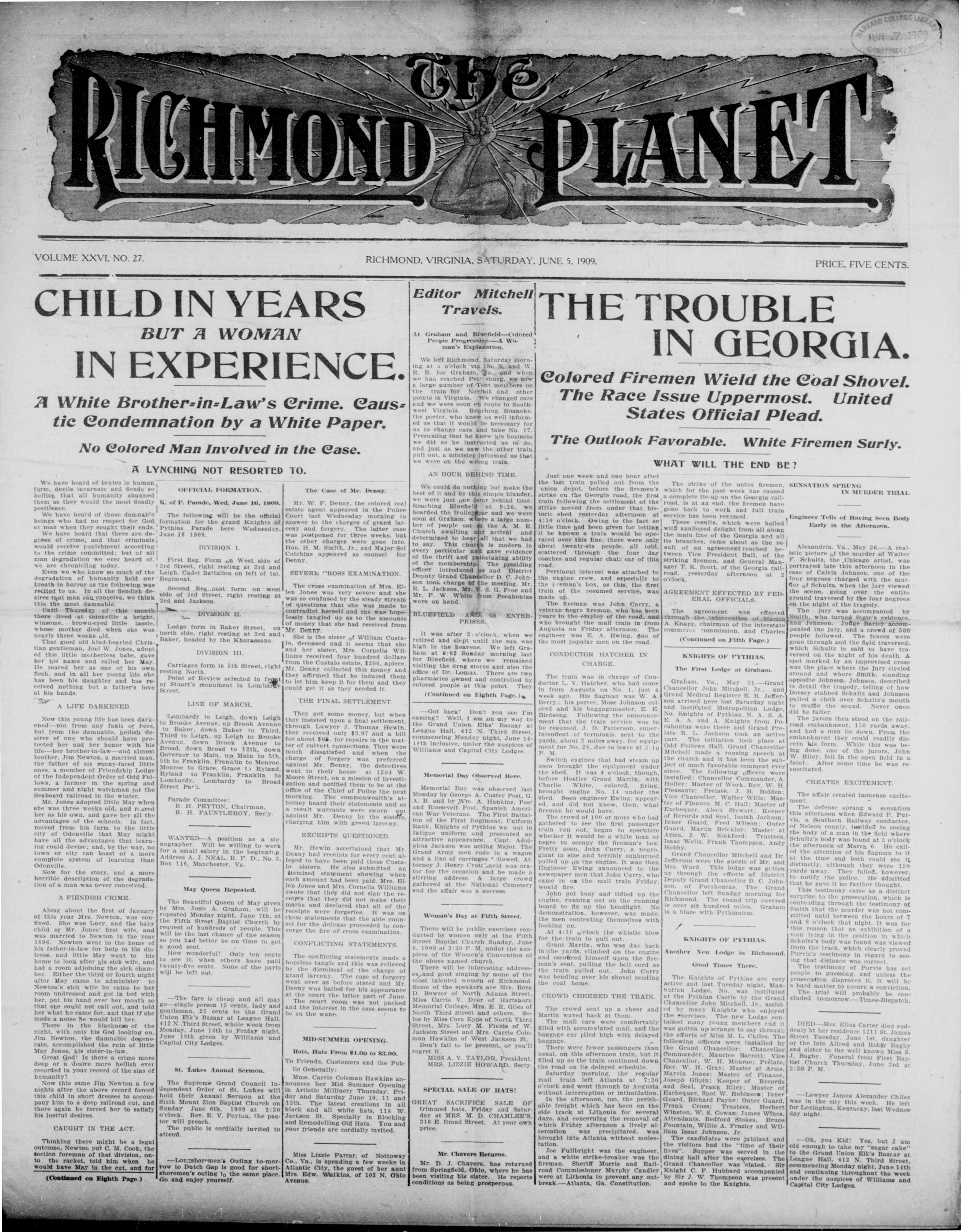
CHILD IN YEARS BUT A WOMAN IN EXPERIENCE.
A White Brother-in-Law's Crime. Caustic Condemnation by a White Paper. No Colored Man Involved in the Case.
A LYNCHING NOT RESORTED TO.
VOLUME XXVI, NO. 27.
CHILD
B
IN E
A White Brot
tic Condem
No Colore
A LY
We have heard of brutes in human
form, devils incarnate and fiends so
hellish that all humanity shunned
them as they would the most deadly
pestilence.
We have heard of those damnable beings who had no respect for God or man when they sought their ends. We have heard that there are degrees of crime, and that criminals would receive punishment according to the crime committed; but of all man degradation we ever heard of, we are chronicling today.
Even we who know so much of the degradation of humanity held our breath in horror as the following was recited to us. In all the flendish desires that man can conceive, we think this the most damnable.
Until Thursday of this month there lived at Odenville a bright, winsome, brown-eyed little lassie, whose mother died when she was nearly three weeks old.
That good old kind-hearted Christian gentleman, Joel W. Jones, adopt ed this little mother babe, gave her his name and called her May. He reared her as one of his own flesh, and in all her young life she has been his daughter and has received nothing but a father's love at his hands.
A LIFE DARKENED
Now this young life has been darkened—not from any fault of Fers, but from the damnable, heilish desires of one who should have protected her and her honor with his life—her brother-in-law—and almost brother, Jim Newton, a married man, the father of six sunny-faced little ones, a member of Friendship Lodge of the Independent Order of Odd Fellows, a farmer in the spring and summer and night watchman for the Seaboard railroad in the winter.
Mr. Jones adopted little May when she was three weeks old, and reared her as his own, and gave her all the advantages of the schools. In fact, moved from his farm to the little city of Odenville that May might have all the advantages that learning could devise; and, by the way, no town or city can boast of a more complete system of learning than Odenville.
Now for the story, and a more horrible description of the degradation of a man was never conceived.
A FIENDISH CRIME
Along about the first of January of this year Mrs. Newton, was confined. She was Lucy, and the baby child or Mr. Jones' first wife, and was married to Newton in the year 1896. Newton went to the home of his father-in-law for help in his distress, and little May went to his home to look after his sick wife, and had a room adjoining the sick chamber. Either the third or fourth night after May came to administer to Newton's sick wife he came to her room undressed and got in bed with her, put his hand over her mouth so that she could not call out, and told her what he came for, and that if she made a noise he would kill her.
There in the blackness of the night, with only his God looking on, Jim Newton, the damnable degenerate, accomplished the ruin of little May Jones, his sister-in-law.
Great God! Is there a crime more deep or a desire more hellish ever recorded in your record of the sins of humanity?
Now this same Jim Newton a few nights after the above record forced this child in short dresses to accompany him to a deep railroad cut, and there again he forced her to satisfy his lustful desires.
CAUGHT IN THE ACT
Thinking there might be a legal outcome, Newton put C. M. Cook, the section foreman of that division, onto the racket, told him when he would have May in the cut, and for
(Continued on Eighth Page.)
OFFICIAL FORMATION.
The following will be the official formation for the grand Knights of Pythias Parade here Wednesday, June 16 1909.
DIVISION 1.
First Reg. Form on West side of 3rd Street, right resting at 3rd and Leigh. Cadet Battalion on left of 1st. Regiment.
Second Regiment form on west side of 3rd Street, right resting at 3rd and Jackson.
Lodge form in Baker Street, on north side, right resting at 3rd and Baker, headed by the Khorassans
DIVISION III
Carriages form in 5th Street, right resting North. Point of Review selected in from of Stuart's monument in Lombard Street.
LINE OF MARCH
Lombardy to Leigh, down Leigh to Brooke Avenue, up Brook Avenue to Baker, down Baker to Third, Third to Leigh, up Leigh to Brooke Avenue, down Brook Avenue to Broad, down Broad to 12th, down Governor to Main, up Main to 5th, 5th to Franklin, Franklin to Monroe, Monroe to Grace, Grace to Ryland, Ryland to Franklin, Franklin to Lombardy, Lombardy to Broad Street Park.
Parade Committee:
B. H. PEYTON, Chairman,
R. H. FAUNTLERO, Secy.
WANTED—A position as a steenographer. Will be willing to work for a small salary in the beginning Address A. J. NEAL, R. F. D., No. 3 Box 116, Manchester, Va.
May Queen Repeated
The Beautiful Queen of May given by Mrs. Josie A. Graham, will be repeated Monday night, June 7th, at the Fifth Street Baptist Church by request of hundreds of people. This will be the last chance of the season so you had better be on time to get a good seat. How wonderful! Only ten cents to see it, when others have paid twenty-five cents. None of the parts will be left out.
The fare is cheap and all may go single person 15 cents, lady and gentleman, 25 cents to the Grand Union Elk's Bazaar at League Hall, 412 N. Third Street, whole week from Monday, June 14th to Friday night. June 18th given by Williams and Capital City Lodges.
St. Lukes Annual Sermon.
The Supreme Grand Council Independent Order of St. Lukes will hold their Annual Sermon at the Sixth Mount Zion Baptist Church on Sunday June 6th, 1909 at 3:30 o'clock. Rev. R. V. Peyton, the pastor will preach. The public is cordially invited to attend.
—Longshoremen's Outing to-morrow to Dutch Gap is good for shortshoremen's outing to the same place. Go and enjoy yourself.
RICHMOND, VIRGINIA, SATURDAY, JUNE 5, 1909.
The Case of Mr. Denny.
Mr. W. F. Denny, the colored real estate agent appeared in the Police Court last Wednesday morning to answer to the charges of grand larceny and forgery. The latter case was postponed for three weeks, but the other charges were gone into. Hon. H. M. Smith, Jr., and Major Sol Cutchins appeared as counsel for Denny.
SEVERE CROSS EXAMINATION
The cross examination of Mrs. Ellen Jones was very severe and she was so confused by the steady stream of questions that she was made to contradict herself and she was hopelessly tangled up as to the amounts of money that she had received from Mr. Denny.
She is the sister of William Custalo, deceased and it seems that she and her sister, Mrs. Cornelia Williams received four hundred dollars from the Custalo estate, $200, apiece. Mr. Denny collected this money and they affirmed that he induced them to let him keep it for them and they could get it as they needed it.
THE FINAL SETTLEMENT
They got some money, but when they insisted upon a final settlement, through Lawyer J. Thomas Hewin, they received only $3.97 and a bill for about $65, for repairs in the matter of culvert connections. They were much dissatisfied and when the charge of forgery was preferred against Mr. Denny, the detectives went to their house at 1204 W. Moore Street, on a mission of investigation and notified them to be at the office of the Chief of Police the next morning. The commonwealth's attorney heard their statements and as a result warrants were sworn out against Mr. Denny by the sisters, charging him with grand larceny.
RECEIPTS QUESTIONED
Mr. Hewin ascertained that Mr. Denny had receipts for every cent alleged to have been paid the Custalo sisters. He also submitted an itemized statement showing when each amount had been paid. Mrs. Elen Jones and Mrs. Cornelia Williams swore that they did not sign the receipts that they did not make their marks and declared that all of the receipts were forgeries. It was on these statements that the able counsel for the defense proceeded to converge the fire of cross examination.
CONFLICTING STATEMENTS
The conflicting statements made a hopeless tangle and this was relieved by the dismissal of the charge of grand larceny. The case of forgery went over as before stated and Mr. Denny was bailed for his appearance at the court the latter part of June. The court room was not packed and the interest in the case seems to be on the wane.
MID-SUMMER OPENING
Hats, Hats From $1.00 to $3.00.
To Friends, Customers and the Public Generally:
Mme, Carrie Coleman Hawkins announces her Mid Summer Opening in Artistic Millinery Thursday, Friday and Saturday June 10, 11 and 12th. The latest creations in all black and all white hats, 118 W. Jackson St. Specialty in Blocking and Remodelling Old Hats. You and your friends are cordially invited.
Miss Lizzie Farrar, of Nottoway Co., Va., is spending a few weeks in Atlantic City, the guest of her aunt Mrs. Edw. Watkins, of 103 N. Ohio Avenue.
Editor Mitchell Travels.
At Graham and Bluefield—Colored People Progressive—A Woman's Explanation.
We left Richmond, Saturday morning at a o'clock via the N, and W. R. R. for Graham, S.A., and when we had reached Petrusburg, we saw a large number of Tent members on the train for Nortkoll and other points in Virginia. We changed cars and we were soon en route to Southwest Virginia. Reaching Roanoke, the porter, who knew us well informed us that it would be necessary for us to change cars and take No. 17. Presuming that he knew his business we did as he instructed us to do, and just as we saw the other train pull out, a minister informed us that we were on the wrong train.
AN HOUR BEHIND TIME.
We could do nothing but make the best of it and by this simple blunder, we were just one hour behind time. Reaching Bluefield at 9:20, we boarded the trolley car and we were soon at Graham, where a large number of people sat in the A. M. E. Church awaiting our arrival and determined to hear all that we had to say. This church is modern in every particular and gave evidence of the thrift and painstaking ability of the membership. The presiding officer introduced us and District Deputy Grand Chancellor D. C. Johnson took charge of the meeting. Mr. R. L. Jackson, Mr. U. S. G. Free and Mr. P. W. White from Pocahontas were on hand.
BLUEFIELD AND IS ENTER
PRISES.
It was after 2 o'clock, when we retired and slept until the sun was high in the heavens. We left Graham at 8:02 Sunday morning last for Bluefield, where we remained visiting the drug stores and also the office of Dr. Lomax. There are two pharmacies owned and controlled by colored people at this point. They
(Continued on Eighth Page.)
—Got back! Don't you see I'm caming? Well, I am on my way to the Grand Union Elks' Bazaar at League Hall, 412 N. Third Street, commencing Monday night, June 14-18th inclusive, under the auspices of Williams and Capital City Lodges.
---
Memorial Day Observed Here
Memorial Day was observed last Monday by George A. Custer Post, G.A. B. and by Wm. A. Hankins, Post and Roosevelt Post, Spanish American War Veterans. The First Battalion of the First Regiment, Uniform Rank, Knights of Pythias was out in fatigue uniform and presented an attractive appearance. Capt. Adolphus Jackson was acting Major. The Grand Army men rode in a wagon and a line of carriages followed. Attorney J. Henry Crutchinield was orator for the occasion and he made a stirring address. A large crowd gathered at the National Cemetery and the affair was a success.
Woman's Day at Fifth Street
There will be public exercises conducted by women only at the Fifth Street Baptist Church Sunday, June 6. 1909 at 3:30 P. M. under the auspices of the Women's Convention of the above named church.
There will be interesting addresses and good singing by some of the most talented women of Richmond. Some of the speakers are Mrs. Rosa D. Bowser of North Adams Street, Miss Carrie V. Dyer of Hartstorm Memorial College, Mrs. E. R. Giles of North Third Street and others. Solos by Miss Cora Epps of North Third Street, Mrs. Lucy M. Fields of W. Jackson Street and Mrs. Carrie Coleman Hawkins of West Jackson St. Don't fail to be present, or you'll regret it.
MISS A. V. TAYLOR, President.
MRS. LIZZIE HOWARD. Secy.
SPECIAL SALE OF HATS?
GREAT SACRIFICE SALE OF trimmed hats. Friday and Satur day at MRS. M. D. CHAMLEE'S. 316 E. Broad Street. At your own price.
Mr. Chavers Returns.
Mr. D. J. Chavers, has returned from Springfield, Ohio, where he has been visiting his sister. He reports conditions as being prosperous.
THE TROUBLE IN GEORGIA.
Colored Firemen Wield the Coal Shovel. The Race Issue Uppermost. United States Official Plead.
The Outlook Favorable. White Firemen Surly.
Just one week and one hour after the last train pulled out from the union depot, before the firemen's strike on the Georgia road, the first train following the settlement of the strike moved from under that historic shed yesterday afternoon at 4:10 o'clock. Owing to the fact so little time had been given for letting it be known a train would be operated over this line, there were only about twenty-six people, all told, scattered through the four day coaches and regular chair car of this road.
Pertinent interest was attached to the engine crew, and especially to the fireman's box, as this, the first train of the resumed service, was made up.
The fireman was John Curry, a veteran negro fireman, who has been years in the employ of the road, and who brought the mail train in from Augusta on Friday afternoon. The engineer was E. A. Ewing, one of the most popular men on the road.
CONDUCTOR HATCHER IN CHARGE.
The train was in charge of Conductor L. V. Hatcher, who had come in from Augusta on No. 1, just a week ago. His flagman was W. A. Berry; his porter, Mose Johnson colored and his baggagemaster, E. E. Birdsong. Following the announcement that the train service was to be resumed, J. D. Patterson, superintendent of terminals, sent to the yards, about 3 miles away, for equipment for No. 28, due to leave at 3:10 P. M.
Switch engines that had steam up soon brought the equipment under the shed. It was 4 o'clock, though, before Hostler Grand Martin, with Charlie White, colored, firing, brought engine No. 14 under the shed. Soon engineer Ewing, appeared, and did not know, then, what fireman he would have.
The crowd of 100 or more who had gathered to see the first passenger train run out, began to speculate whether it would be a white man or negro to occupy the fireman's box. Pretty soon, John Curry, a negro, giant in size and terribly sunburned pulled up on the engine. It was then Engineer Ewing announced to the newspaper men that John Curry, who came in on the mall train Friday, would fire.
John got busy and tidied up the engine, running out on the running board to fix up the headlight. No demonstration, however, was made, the men contenting themselves with looking on.
At 4:10 o'clock the whistle blew for the train to pull out.
Grant Martin, who was due back in the yards, climbed on the engine and escorted himself upon the fireman's seat, pulling the bell cord as the train pulled out. John Curry was bending over hfs shovel sending the coal home.
CROWD CHEERED THE TRAIN
The crowd sent up a cheer and Martin waved back at them.
The mail cars were comfortably filled with accumulated mail, and the baggage car piled high with delayed baggage.
There were fewer passengers than usual, on this afternoon train, but it filled up as the train continued down the road on its delayed schedule.
Saturday morning, the regular mail train left Atlanta at 7:30 o'clock and went through to Augusta without interruption or intimidation.
In the afternoon, too, the perishable freight which has been on the side track at Lithonia for several days, and concerning the removal of which Friday afternoon a lively altercation was precipitated, was brought into Atlanta without molestation.
Joe Fullbright was the engineer, and a white strike-breaker was the fireman. Sheriff Morris and Railroad Commissioner Murphy Candler were at Lithonia to prevent any outbreak—Atlanta, Ga. Constitution.
WHAT WILL THE END BE?
The strike of the union firemen, which for the past week has caused a complete tie-up on the Georgia railroad, is at an end, the firemen have gone back to work and full train service has been resumed.
These results, which were hailed with analloyed delight from all along the main line of the Georgia and all its branches, came about as the result of an agreement reached between Vice President Ball, of the striking firemen, and General Manager T. K. Scott, of the Georgia railroad, yesterday afternoon at 2 o'clock.
AGREEMENT EFFECTED BY FEDERAL OFFICIALS.
The agreement was effected through the intervention of Martin A. Knapp, chairman of the interstate commerce commission, and Charles
(Continued on Fifth Page.)
KNIGHTS OF PYTHIAS.
The First Lodge at Graham
Graham, Va., May 31.—Grand Chancellor John Mitchell, Jr., and Grand Medical Register E. R. Jefferson arrived here last Saturday night and instituted Metropolitan Lodge, No. Knights of Pythias, N. A. S. A. E. A. A. and A. Knights from Pocahontas were there and Grand Prelate R. L. Jackson took an active part. The initiation took place at Odd Fellows Hall. Grand Chancellor Mitchell made a rousing speech at the church and it has been the subject of much favorable comment ever since. The following officers were installed: Chancellor Commander, A. Holley; Work of Work, Rev. W. H. Pleasants; Prelate, J. B. Bolden; Vice Chancellor, Walter Wills; Master of Finance, M. C. Hall; Master of Exchequer, Aleck Stewart; Keeper of Records and Seal, Isiah Jackson; Inner Guard, Fred Wilson; Outer Guard, Martin Brickley; Master at Arms, J. W. Sinkford; Trustees, Isaac Wells, Frank Thompson, Andy Hobby.
Grand Chancellor Mitchell and Dr. Jefferson were the guests of Mr. and Mrs. Ward. This lodge was gotten up through the efforts of District Deputy Grand Chancellor D. C. Johnson, of Pocahontas. The Grand Chancellor left Sunday morning for Richmond. The round trip covered is over six hundred miles. Graham is a blaze with Pythianism.
KNIGHTS OF PYTHIAS.
Another New Lodge in Richmond
Good Times There.
The Knights of Pythias are very active and last Tuesday night, Manhattan Lodge, No. was instituted at the Pythian Castle by the Grand Chancellor John Mitchell, Jr., assisted by many Knights who enjoyed the exercises. The new Lodge contained many young members and it was gotten up strange to say through the efforts of Miss M. L. Chiles. The following officers were installed by the Grand Chancellor: Chancellor Commander, Maurice Barrett; Vice Chancellor, W. H. Monroe; Prélate, Rev. W. H. Gray; Master at Arms, Marvin Jones; Master of Finance, Joseph Gilpin; Keeper of Records and Seal, Frank Riley; Master of Exchequer, Spot W. Robinson; Inner Guard, Richard Payne; Outer Guard, Frank Cross; Trustees, Herbert Winston, W. S. Cowan, James Winess, Attendants, Bedford Stokes, Bruce Fountain, Willie A. Frazier and William Isaac Johnson, Jr.
The candidates were jubilant and the visitors had the "time of their lives". Supper was served in the dining hall after the exercises. The Grand Chancellor was elated. Sir Knight C. F. Hubbard accompanied by Sir J. W. Thompson was present and spoke to the Knights.
PRICE, FIVE CENTS.
LE
ORGIA.
The Coal Shovel.
Post. United
Head.
Firemen Surly.
?
Engineer Tells of Having Seen Body Early in the Afternoon.
Alexandria, Va., May 26.—A realistic picture of the murder of Walter F. Schultz, the Chicago artist, was portrayed late this afternoon in the case of Calvin Johnson, one of the four negroes charged with the murder of Schultz, when the jury viewed the scene, going over the entire ground traversed by the four negroes on the night of the tragedy.
The jury was accompanied by Smith, who turned State's evidence, and Johnson. Judge Barley accompanied the jury, and a crowd of 500 people followed. The fences were gone through and the field traversed, which Schultz is said to have traversed on the night of his death. A spot marked by an improvised cross was the place where the jury circled around and where Smith, standing opposite Johnson, Johnson, described in detail the tragedy, telling of how Dorsey stabbed Schultz and Johnson pulled a cloth over Schultz's mouth to muffle the sound. Never once did he falter.
The jurors then stood on the railroad embankment, 150 yards away, and had a man lie down. From the embankment they could readily discern his form. While this was being done, one of the jurors, John W. Riley, fell in the open field in a faint. After some time he was resuscitated.
CREATES EXCITEMENT
The affair created immense excitement.
The defense sprang a sensation this afternoon when Edward P. Purvis, a Southern Railway conductor, of Nelson county, testified to seeing the body of a man in the field where Schultz's body was found at 3 o'clock the afternoon of March 6. He called the attention of his flagman to it at the time and both could see it distinctly, although they were 150 yards away. They failed, however, to notify the police. He admitted that he gave it no further thought.
This testimony came as a distinct surprise to the prosecution, which is contending through the testimony of Smith that the murder was not committed until between the hours of 7 and 8 o'clock that night. It was for this reason that an exhibition of a man lying in the position in which Schultz's body was found was viewed from the track, which clearly proved Purvis's testimony in regard to seeing that distance was correct.
The testimony of Purvis has set people to guessing, and unless the prosecution disproves it, it will be a hard matter to secure a conviction.
The trial will probably be concluded to-morrow—Times-Dispatch
DIED—Mrs. Eliza Carter died suddenly at her residence 1211 St. James Street Tuesday, June 1st, daughter of the late Alfred and Biddy Bagby and sister to the well known Miss S. J. Bagby. Funeral from First Baptist Church Thursday, June 3rd at 3:30 P. M.
—Lawyer James Alexander Chiles was in the city this week. He left for Lexington, Kentucky, last Wednes day night.
—Oh, you Kid! Yes, but I am old enough to take my "sugar cake" to the Grand Union Elk's Bazzar at League Hall, 412 N. Third Street, commencing Monday night, June 14th and continuing throughout the week under the auspices of Williams and Capital City Lodges.
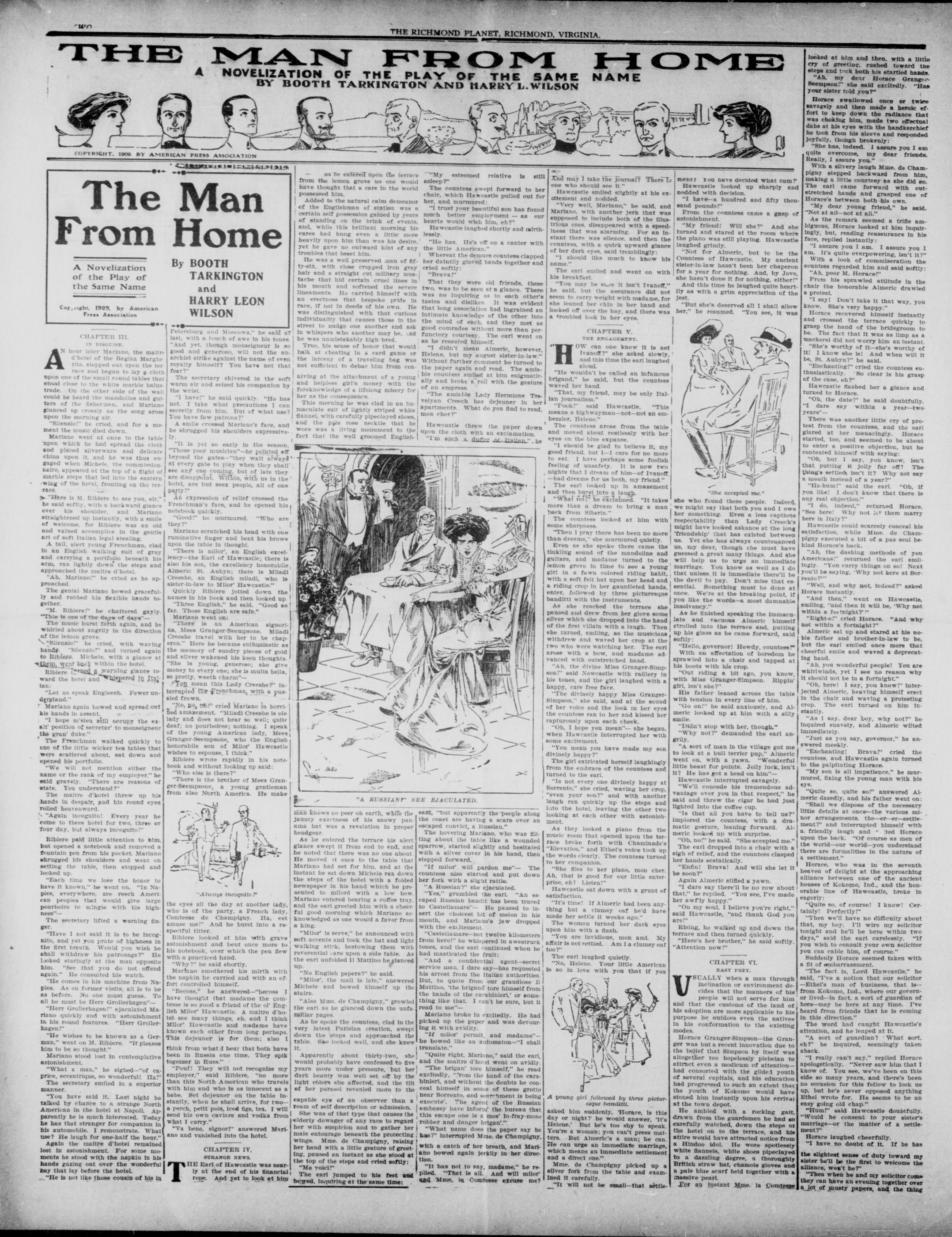
THE MAN FROM HOME A NOVELIZATION OF THE PLAY OF THE SAME NAME BY BOOTH TARKINGTON AND HARRY L. WILSON
COPYRIGHT. 1909. BY AMERICAN PRESS ASSOCIATION
COPYRIGHT. 1909. BY AMERICAN PRESS ASSOCIATION
The Man From Home
A Novelization of the Play of the Same Name
Copyright, 1909, by American Press Association
CHAPTER III.
IN DISGUISE.
An hour later Mariano, the maltre'd hotel of the Regina Margherita, stepped out upon the terrace and began to lay a cloth upon one of the small round tables that stood close to the white marble balustrade. On the other side of the wall could be heard the mandolins and guitars of the fishermen, and Mariano glanced up crossly as the song arose upon the morning air.
"Silenzio!" he cried, and for a moment the music died down.
Mariano went at once to the table upon which he had spread the cloth and placed silverware and delicate china upon it, and he was thus engaged when Michele, the commissionaire, appeared at the top of a flight of marble steps that led into the eastern wing of the hotel, fronting on the terrace.
"Here is M. Ribiere to see you, sir," he said softly, with a backward glance over his shoulder, and Mariano straightened up instantly, with a smile of welcome. for Ribiere was an old and valued accomplice in the gentle art of soft Italian legal stealing. A tall, alert young Frenchman, clad in an English walking suit of gray and carrying a portfolio beneath his arm, ran lightly down the steps and approached the maître d'hotel. "Ah, Mariano!" he cried as he approached. The genial Mariano bowed gracefully and rubbed his flexible hands together. "M. Ribiere!" he chattered gayly. "This is one of the days of days"—The music burst forth again, and he whirled about angrily in the direction of the lemon grove. "Silenzio!" he cried, with waving hands. "Silenzio" and turned again to Ribiere. Michele, with a glance at them, went back within the hotel.
Ribiere earned a warning glance toward the hotel and whispered in Italian:
"Let us speak Engleesh. Fewer understand."
Mariano again bowed and spread out his hands in assent.
"I hope m'isleu still occupy the exalt position of secretar' to monselgeur the gran' duke."
The Frenchman walked quickly to one of the little wicker tea tables that were scattered about, sat down and opened his portfolio.
"We will not mention either the name or the rank of my employer," he said gravely. "There are reasons of state. You understand?"
The maitre d'hôtel threw up his hands in despair, and his round eyes rolled heavenward.
"Again incognito! Every year he come to thees hotel for two, three or four day, but always incognito."
Hibiere paid little attention to him, but opened a notebook and removed a fountain pen from his pocket. Mariano shrugged his shoulders and went on setting the table, then stopped and looked up.
"Each time we lose the honor to have it known," he went on. "In Naples, everywhere, are reech American peoples that would give large pourboire to mingle with his highness"—
The secretary lifted a warning finger.
"Have I not said it is to be incognito, and yet you prate of highness in the first breath. Would you wish he shall withdraw his patronage?" He looked staringly at the man opposite him. "See that you do not offend again." He consulted his watch.
"He comes in in his machine from Naples. As on former visits, all is to be as before. No one must guess. To all he must be Herr Grollierhagen"—
"Herr Grollerhagen!" ejaculated Mariano quickly and with astonishment in his round features. "Herr Grollerhagen!"
"He wishes to be known as a German," went on M. Ribiere. "It pleases him to be so thought."
Mariano stood lost in contemplative astonishment.
"What a man," he sighed—"of caprice, eccentrique, so wonderful! Ha!" The secretary smiled in a superior manner.
"You have said it. Last night he talked by chance to a strange North American in the hotel at Napoli. Apparently he is much interested. Today he has that stranger for companion in his automobile. I remonstrate. What use? He laugh for one-half the hour." Again the maître d'hotel remained lost in astonishment. For some moments he stood with the napkin in his hands gazing out over the wonderful bay that lay before the hotel.
"He is not like those cousin of his in
By BOOTH
TARKINGTON
and
HARRY LEON
WILSON
Petersburg and Moscow," he said at last, with a touch of awe in his tones. "And yet, though monseigneur is so good and generoso, will not the anarchist strike against the name of even royalty himself? You have not that fear?"
The secretary shivered in the soft warm air and seized his companion by the wrist.
"I have!" he said quickly. "He has not. I take what precautions I can secretly from him. But of what use? You have few patrons?"
A smile crossed Mariano's face, and he shrugged his shoulders expressively.
"It is yet so early in the season. "Those poor musician"—he pointed off beyond the gates—"they wait always at every gate to play when they shall see any one coming, but of late they are disappoint. Within, with us in the hotel, are but sexe people, all of one party!"
An expression of relief crossed the Frenchman's face, and he opened his notebook quickly.
"Good!" he murmured. "Who are they?"
Mariano scratched his head with one ruminative finger and bent his brows upon the table in thought.
"There is milior", an English excellency—the Earl of Hawcastle; there is also his son, the excellency honorable Almeric St. Aubyn; there is Miladi Creshe, an English miladi, who is sister-in-law to Milior Hawcastle.
Quickly Ribiere jotted down the names in his book and then looked up.
"Three English", he said. "Good so far. Those English are safe."
"There is an American signor-
nna, Mees Granger-Seempse. Miliad
Creshe travel with her to be chap-
erone." Here he became enthusiastic as
the memory of sundry pieces of gold
and silver wakened his keen thoughts.
"She is young, generoso; she give
money to every one; she is multa bella,
so pretty, weeth charm"—
"You mean this Lady Creshe?" inter-
rupted the frenchman, with a puzzled frown.
"No, no, no!" cried Mariano in horri-
ried amazement. "Miliad Creshe is ole
lady and does not hear so well; quite
dear; no pourboires; nothing. I speak
of the young American lady, Mees
Granger-Seempse, who the English
honorable son of Milor' Hawcastle
wishes to espouse, I think."
Ribiere wrote rapidly in his not-
ebook and without looking up said:
"Who else is there?"
"There is the brother of Mees Granger-Seempse, a young gentleman
from also North America. He make
"Always incognito!"
the eyes all the day at another lady, who is of the party, a French lady, Comtesse de Champigny. Ha, eet amuse me!" And he burst into a respectful titter.
Ribiere looked at him with grave astonishment and bent once more to his notebook, over which the pen flew with a practiced hand.
Way? he said shortly.
Marhano smothered his mirth with the napkin he carried and with an effort controlled himself.
"Beccoss," he answered—"beccoss I have thought that madame the comtese is so good a friend of the 'o' English Milor' Hawcastle. A maitre d'hotel see many things, eh and I think Milor' Hawcastle and madame have known each other from long perhaps. This dejeuner is for them; also I think from what I hear that both have been in Russia one time. They spik togezer in Russ."
"Pouf! They will not recognize my employer," said Ribiere, "no more than this North American who travels with him and who is as innocent as a babe. Set dejeuner on the table instantly, when he shall arrive, for two—a perch, petit pois, iceel figs, tea. I will send his own caviare and vodka from what I carry."
"Va bene, signor!" answered Marlano and vanished into the hotel.
THE Earl of Hawcastle was nearly at the end of his financial rope. And yet to look at him
THE RICHMOND PLANET, RICHMOND, VIRGINIA
as he entered upon the terrace from the lemon grove no one would have thought that a care in the world possessed him.
Added to the natural calm demeanor of the Englishman of station was a certain self possession gained by years of standing on the brink of events, and, while this brilliant morning his cares had hung even a little more heavily upon him than was his desire, yet he gave outward hint of any troubles that beset him.
He was a well preserved man of fifty-six, with close cropped iron gray hair and a straight cut military mustache that hid certain cruel lines in his mouth and softened the severe lineaments. He carried himself with an erectness that bespoke pride in race, if not in deeds of his own. He was distinguished with that curious individuality that causes those in the street to nudge one another and ask in whispers who another may be, and he was unmistakable high bred
True, his sense of honor that would balk at cheating in a card game or the larceny of a traveling bag was not sufficient to debar him from conviving at the attachment of a young and helpless girl's money with the foreknowledge of a lifelong misery for her as the consequence.
This morning he was clad in an immaculate suit of lightly striped white flannel, with carefully pliplayed shoes, and the pale rose necklace that he wore was a living monument to the fact that the well groomed English-
S. E.
L.
"A RUSSIAN" SHE EJACULATED
man knows no peer on earth, while the jaunty exactness of his snowy panama hat was a revelation in proper headgear.
As he entered the terrace his alert glance swept it from end to end, and he noted that there was no one about. He moved it once to the table that Marliano had set for him, and at the instant he sat down Michele ran down the steps of the hotel with a folded newspaper in his hand which he presented to milford with a low bow. Marliano entered bearing a coffee tray, and the earl greeted him with a cheerful good morning which Marliano acknowledged as one would a favor from a king.
"Miller' is serve," he announced with soft accents and took the hat and light walking stick, bestowing them with reverential care upon a side table. As the earl unfolded II Mattino he glanced up.
"No English papers?" he said.
"Milor', the mail is late," answered Michele and bowed himself up the stairs.
"Also Mme. de Champigny," growled the earl as he glanced down the unfamiliar pages.
As he spoke the countess, clad in the very latest Parisian creation, swept down the steps and approached the table. She looked well, and she knew it.
Apparently about thirty-two, she would probably have confessed to five years more under pressure, but her dark beauty was well set off by the light colors she affected, and the tilt of her parasol revealed more to the
capable eye of an observer than a ream of self description or admission. She was of that type that causes the elderly dowager of any race to regard her with suspicion and to gather her male entourage beneath the protecting wings. Mme. de Champigny, raising her hand with a little gesture of greeting, paused an instant as she stood at the top of the steps and cried softly: "Me voici!" The earl jumped to his feet and bowed, inquiring at the same time:
"My esteemed relative is still asleep?"
The countess swept forward to her chair, which Hawcastle pulled out for her, and murmured:
"I trust your beautiful son has found much better employment — as our hearts would wish him, eh?"
Hawcastle laughed shortly and merrilessly.
"He has. He's off on a canter with the little American."
Wherecat the demure countess clapped her daintily gloved hands together and cried softly:
"Brava!"
That they were old friends, these two, was to be seen at a glance. There was no inquiring as to each other's tastes and dislikes. It was evident that long association had ingrained an intimate knowledge of the other into the mind of each, and they met as good comrades without more than perfunctory courtesy. The earl went on as he resealed himself.
"I didn't mean Almeric, however, Helene, but my august sister-in-law." Without further comment he turned to the paper again and read. The amiable countess smiled at him enigmatically and broke a roll with the gesture of an empress.
"The amiable Lady Hermione Trevelyan Creech has dejeuner in her apartments. What do you find to read, mon cher?"
Hawcastle threw the paper down upon the cloth with an exclamation.
"I'm such a duffer at Italian." he
115
sand, "But apparently the people along the coast are having a scare over an escaped convict, a Russian."
The hovering Mariano, who was flitting about the table like a wounded sparrow, started slightly and hesitated with a silver cover in his hand, then stepped forward.
"If milior' will pardon me"— The countess also started and put down her fork with a slight rattle.
"A Russian?'" she ejaculated.
"Yes," grumbled the earl. "An escaped Russian bandit has been traced to Castellamare"— He paused to insert the choicest bit of melon in his mouth, and Mariano's jaw dropped with the excitement.
"Castellamare—not twelve kilometers from here" he whispered in awestruck tones, and the earl continued when he had masticated the fruit:
"And a confidential agent—secret service man, I dare say—has requested his arrest from the Italian authorities. But, to quote from our grandose Il Mattino, 'the brigand tore himself from the hands of the carabinieri,' or something like that. I can't be sure, but it read to me"—Mariano broke in excitedly. He had picked up the paper and was devouring it with avidity.
"If miler' permit, and madame"—he bowed like an automaton—"I shall translate."
"Quite right, Mariano," said the earl, and the maître'd hotel went on avidly.
"The brigan' tore himself," he read excitedly, "from the hand of the carabinieri, and without the doubts he conceal himself in some of these grotto near Sorrento, and searchment is being execute." The agent of the Russian embassy have inform' the bureau that this escape one is a mos' in-fray-mose robber and danger brigan."
"What name does the paper say he has?" interrupted Mme. de Champigny, with a catch of her breath, and Mariano bowed again jerkily in her direction.
"It has not to say, madame," he replied. "That is all. And will millor' and Mme. la Comtesse excuse me?
And may I take the journal? There is one who should see it."
Hawcastle smiled slightly at his excitement and nodded.
"Very well, Mariano," he said, and Mariano, with another jerk that was supposed to include both of the illustrious ones, disappeared with a speediness that was alarming. For an instant there was silence, and then the countess, with a quick upward glance of her dark eyes, said tremblingly:
"I should like much to know his name."
The earl smiled and went on with his breakfast.
"You may be sure it isn't Ivanoff," he said, but the assurance did not seem to carry weight with madness, for she leaned her chin in her hand and looked off over the bay, and there was a troubled look in her eyes.
HOW can one know it is not Ivanoff?" she asked slowly, and this time the earl laughed aloud.
"He wouldn't be called an infamous brigand," he said, but the countess wavered her hand.
"That, my friend, may be only Italian journalism."
"Pooch," said Hawcastle. "This means a highwayman—not—not an embezzler, Helene."
The countess arose from the table and moved about restlessly with her eyes on the blue expanse.
"I should be glad to believe it, my good friend, but I—I care for no more to eat. I have perhaps some foolish feeling of unsafety. It is now two nights that I dream of him—of Ivanoff—bad dreams for us both, my friend."
The earl looked up in amazement and then burst into a laugh.
"What hot!" he exclaimed. "It takes more than a dream to bring a man back from Siberia."
The countess looked at him with some sharpness.
"Then I pray there has been no more than dreams," she murmured quietly.
Even as she spoke there came the tinkling sound of the mandolins and guitars, and madame turned to the lemon grove in time to see a young girl in a fawn colored riding habit, with a soft felt hat upon her head and a riding crop in her gauntlet hands, enter, followed by three picturesque banditti with the instruments.
As she reached the terrace she pansed and drew from her glove some silver which she dropped into the hand of the first villain with a laugh. Then she turned, smiling, as the musicians withdrew and waved her crop at the two who were watching her. The earl arose with a bow, and madame advanced with outstretched hand.
"Ah, the divine Miss Granger-Simpson!" said Newcastle with raillery in his tones, and the girl laughed with a happy, care free face.
"The divinely happy Miss Granger-Simpson," she said, and at the sound of her voice and the look in her eyes the countess ran to her and kissed her rapturously upon each cheek.
"Oh, I hope you mean"—she began, when Hawcastle interrupted her with some excitement.
"You mean you have made my son divinely happy?" The girl extricated herself laughingly from the embrace of the countess and turned to the earl.
"Is not every one divinely happy at Sorrento," she cried, waving her crop, "even your son?" and with another laugh ran quickly up the steps and into the hotel, leaving the other two looking at each other with astonishment.
As they looked a piano from the music room that opened upon the terrace broke forth with Chaminade's "Elevation," and Ethel's voice took up the words clearly. The countess turned to her companion.
"She files to her piano, mon cher,
Ah, that is good for our little enterprise,
eh? Listen!"
Hawcastle sat down with a grunt of satisfaction.
"It's time! If Almeric had been anything but a clumsy oaf he'd have made her settle it weeks ago."
The woman turned her dark eyes upon him with a flash.
"You are invidious, mon ami. My affair is not settled. Am I a clumsy oaf too?"
The earl laughed quietly.
"No, Helene. Your little American is so in love with you that if you
A young girl followed by three picture esque banditti.
asked him suddenly, 'Horace, is this day or night? he would answer, 'It's Helene.' But he's too shy to speak. You're a woman; you can't press matters. But Almerle's a man; he can. He can urge an immediate marriage, which means an immediate settlement and a direct one." Mme. de Champigny picked up a silver fork from the table and examined it carefully. "It will not be small—that settle
ment? You have decided what sum?
Hawcastle looked up sharply and nodded with decision.
"I have—a hundred and fifty thousand pounds!"
From the countess came a gasp of astonishment.
"My friend! Will she?" And she turned and stared at the room where the plano was still playing. Hawcastle laughed grimly.
"Not for Almeric, but to be the Countess of Hawcastle. My ancient sister-in-law hasn't been her chaperon for a year for nothing. And, by Jove, she hasn't done it for nothing, either!"
And this time he laughed quite heartily as with a grim appreciation of the jest.
"But she's deserved all I shall allow her," he resumed. "You see, it was
"She accepted me."
she who found these people. Indeed, we might say that both you and I owe her something. Even a less captious respectability than Lady Creech's might have looked askance at the long 'friendship' that has existed between us. Yet she has always countenanced us, my dear, though she must have guessed a great many things. And she will help us to urge an immediate marriage. You know as well as I do that unless, it is immediate there'll be the devil to pay. Don't miss that essential. Something must be done at once. We're at the breaking point, if you like the words—a most damnable insolvency."
As he finished speaking the immaculate and vacuous Almeric himself strolled into the terrace and, putting up his glass as he came forward, said softly:
"Hello, governor! Howdy, countess!"
With an affection of boredom he sprawled into a chair and tapped at his boots with his crop.
"Out riding a bit ago, you know, with Miss Granger-Simpson. Rippin' girl, isn't she?" His father leaned across the table with tension in every line of him. "Go on!" he said anxiously, and Almeric looked up at him with a silly smile. "Didn't stop with her, though." "Why not?" demanded the earl angry. "A sort of man in the village got me to look at a bull terrier pup," Almeric went on, with a yawn. "Wonderful little beast for points. Jolly luck, isn't it? He has got a head on him"— Hawcaste interrupted savagely. "We'll concede his tremendous advantage over you in that respect," he said and threw the cigar he had just lighted into the coffee cup. "Is that all you have to tell us?" implored the countess, with a dramatic gesture, leaning forward. Almeric looked up with surprise.
"Oh, no!" he said. "She accepted me." The earl dropped into a chair with a sigh of relief, and the countess clasped her hands ecstatically. "Enfin! Brava! And will she let it be soon?" Again Almeric stifled a yawn. "I dare say there'll be no row about that," he replied. "You see, I've made her awfully happy." "On my soul, I believe you're right," said Hawcastle, "and thank God you are." Rising, he walked up and down the terrace and then turned quickly. "Here's her brother," he said softly. "Attention now!"
CHAPTER VI
EASY PREY.
SUALLY when a man through inclination or environment decides that the manners of his people will not serve for him and that the customs of the land of his adoption are more applicable to his purpose he outdoes even the natives in his conformation to the existing modes. Horace Granger-Simpson—the Granger was but a recent innovation due to the belief that Simpson by itself was altogether too hopelessly plebeian to attract even a modicum of attention—had consorted with the gilded youth of several capitals, and his education had progressed to such an extent that the youth of Kokomo would have stoned him instantly upon his arrival at the town depot.
He ambled with a rocking gatt, drawn from the guardsmen he had so carefully watched, down the steps or the hotel on to the terrace, and his attire would have attracted notice from a Hindoo idol. He wore spotlessly white fannels, white shoes pipeplayed to a dazzling degree, a thoroughly British straw hat, chamois gloves and a pale blue scarf held together with a massive pearl. For an instant Mme. la Comtesse
looked at him and then, with a little cry of greeting, rushed toward the steps and took both his startled hands. "Ah, my dear Horace Grange Seempson" she said excitedly. "Has your sister told you?"
Horace swallowed once or twice savagely and then made a heroe effort to keep down the radiance that was choking him, made two effectual dabs at his eyes with the handkerchief he took from his sleeve and responded joyfully, though brokenly:
"She has, indeed. I assure you I am quite overcome, my dear friends. Really, I assure you."
With a silvery laugh Mme. de Champigny stepped backward from him, making a little courtesy as she did so. The earl came forward with out-stretched hands and grasped one of Horace's between both his own.
"My dear young friend," he said. "Not at all—not at all."
As the remark seemed a trifle ambiguous, Horace looked at him inquiringly, but, reading reassurance in his face, replied instantly:
"I assure you I am. I assure you I am. It's quite overpowering, isn't it?" With a look of commiseration the countess regarded him and said softly:
"Ah, poor M. Horace!"
From his sprawled attitude in the chair the honorable Almeric drawed a protest.
"I say! Don't take it that way, you know. She's very happy."
Horace recovered himself instantly and crossed the terrace quickly to grasp the hand of the bridegroom to be. The fact that it was as limp as a mackerel did not worry him an instant.
"She's worthy of it—she's worthy of it! I know she is! And when will it be, St. Aubyn?" be said.
"Enchanting!" cried the countess enthusiastically. "So clear is his grasp of the case, eh?"
Hawcastle finshed her a glance and turned to Horace.
"Oh, the date?" he said doubtfully.
"I dare say within a year—two years"—
There was another little cry of protest from the countess, and the earl glared at her menacingly. Horace started, too, and seemed to be about to enter a positive objection, but he contented himself with saying:
"Oh, but I say, you know, isn't that putting it jolly far off? The thing's settled isn't it? Why not say a mouth instead of a year?"
"Ha-hum!" said the earl. "Oh, if you like! I don't know that there is any real objection."
"I do, indeed," returned Horace.
"See here! Why not let them marry here in Italy?"
Hawcastle could scarcely conceal his satisfaction, while Mme. de Champigny executed a bit of a pas seul behind Horace's back.
"Ah, the dashing methods of you Americans!" returned the earl smilingly. "You carry things on so! Next you'll be saying, 'Why not here at Sorrento?'"
"Well, and why not, indeed?" asked Horace instantly.
"And then," went on Hawcastle, smiling, "and then it will be, 'Why not within a fortnight?'"
"Right-o!" cried Horace. "And why not within a fortnight?"
Almeric sat up and stared at his noble father and brother-in-law to be, but the earl smiled once more that cheerful smile and waved a deprecating hand.
"Ah, you wonderful people! You are whirlwinds, yet I see no reason why it should not be in a fortnight."
"Oh, here! I say, you know!" interjected Almeric, heaving himself erect in the chair and waving a protesting crop. The earl turned on him instantly.
"As I say, dear boy, why not?" he inquired suavely, and Almeric wilted immediately.
"Just as you say, governor," he answered meekly.
"Enchanting! Braval" cried the countess, and Hawcastle again turned to the palpitating Horace.
"My son is all impatience," he murmured, fixing the young man with his eye.
"Quite so, quite so!" answered Almeric dazedly, and his father went on:
"Shall we dispose of the necessary little details at once—the various minor arrangements, the er-er settlement?" and interrupted himself with a friendly laugh and mixed Horace upon the back. "Of course as men of the world—our world—you understand there are formalities in the nature of a settlement."
Horace, who was in the seventh heaven of delight at the approaching alliance between one of the ancient houses of Kokomo, Ind., and the honorable line of Hawcastle, broke in eagerly:
"Quite so, of course! I know! Certainly! Perfectly!"
"Then we'll have no difficulty about that, my boy. I'll wire my solicitor tonight and he'll be here within two days," said the earl carelessly. "If you wish to consult your own solicitor you can cable him, of course."
Suddenly Horace seemed taken with a fit of embarrassment.
"The fact is, Lord Hawcastle," he said, "I've a notion that my solicitor—Ethel's man of business, that is—from Kokomo, Ind., where our governor—in fact, a sort of guardian of hers—may be here at any time. I've heard from friends that he is coming in this direction."
The word had caught Hawcastle's attention, and he leaped at it.
"A sort of guardian? What sort, eh?" he inquired, seemingly taken aback.
"I really can't say," replied Horace apologetically. "Never saw him that I know of. You see, we've been on this side so many years, and there's been no occasion for this fellow to look us up, but he's never opposed anything Ethel wrote for. He seems to be an easy going old chap."
"Hum!" said Hawcastle doubtfully. "Would he consent to your sister's marriage—or the matter of a settlement?"
Horace laughed cheerfully.
"I have no doubt of it. If he has the slightest sense of duty toward my sister he'll be the first to welcome the alliance, won't he?"
"Then when he and my solicitor come they can have an evening together over a lot of musty papers, and the thing
THE PLANET
SATURDAY. . . . . . JUNE 5, 1909
will be done. Again, my boy, I welcome you to our family. God bless you!"
He wrung Horace's hand again and turned away as if to hide his emotion, but really to wink at the countess.
"I'm overpowered, you know—really overpowered, you know," stammered Horace, fanning himself desperately with his hat.
"Come, Almeric," said the earl, and as the youthful heir to his house arose languidly he sidied close to the countess and whispered in her ear:
"Let him know it's a hundred and fifty thousand."
Then he and Almeric went up the steps into the hotel, leaving Horace and the countess gazing at each other delightedly.
She crossed over to him impulsively and, taking both his hands again, said:
"My friend, I am happy for you."
"Think of it!" said Horace joyously.
"In a fortnight at the most dear old Ethel will be the Hon. Mrs. St. Aubyn, future Countess of Hawcastle!"
"Yes," replied the countess, withdrawing her hands and picking up her parasol, "and there is but the little arrangement of the settlement between your advocate and Lord Hawcastle's. But you Americans—you laugh at such things. You are big, so big, like your country!"
Horace followed her across the terrace to the wall.
"Ah, believe me, dear countess," he said, "the great world—your world, countess—has thoroughly alienated me."
The countess turned her shapely head and looked at him admiringly and with a touch of irony at the surprise she was about to give him.
"Ah, you retain one quality. You are careless, you are free," and she laid her right hand upon his arm, and Horace thrilled at the intimate touch.
"Well," he laughed, "perhaps in those things I am American, but in others I fancy I should be thought something else, shouldn't I?"
She laughed openly at him now, but earnestly withal, and said:
"You are a deobarman of the world, and yet you are still American in that you are abominally rich. The settlement—such matter as that, over which a Frenchman, an Italian, might hesitate—you laugh. Such matter as £150,000—you set it aside, you laugh. You say, 'Oh, yes; take it!'"
For a moment she feared that Horace would fall over the low parapet, so white did his face become and then so flushed, but the boy was game all through. The generations of simple Indiana stock came to his rescue, and he steeled himself with an effort and replied quietly:
"A hundred and fifty thousand pounds! Why, that's seven hundred and fifty thous—I say, countess, she couldn't use the money to better advantage!"
There was real admiration in the Frenchwoman's glance this time, for she had lost none of the little byplay, and she admired the courage of the youngster. So she said: "My friend, how wise you are!" As she spoke she turned in time to see Ethel come down the steps of the hotel with a book beneath her arm and ran to her, clasping her in her arms and kissing her.
[TO BE CONTINUED.]
Cane May Pier Smashed
The ocean pier in front of Cape May, N. J., was almost totally demolished in sight of hundreds of people, who lined the boardwalk and beach strand.
The barge Robert Campbell, belonging to the Breakwater Construction company, of New York, loaded with 210 tons of stone for the Cape May harbor entrance, being built by the government, broke away from her moorings and before the strong northeast wind and high running tide was driven along the beach for a distance of two miles until it struck the pier.
Piling after piling was battered down by the action of the wind and wave surging the barge. The damage will amount to about $25,000.
The opera house on the pier was nearly the first part of it to drop into the surf.
Fast Mail Train Robbed
Masked bandits held up and robbed Union Pacific train No. 2, known as the Overland Limited, five miles west of Omaha, Neb. Seven registered mail pouches were taken, believed to have contained a large amount of money. The robbers evidently got on the train at some town farther west. The hold-up was pulled off in a deep cut along the recently constructed Lane cut-off. The robbers climbed over the tender and forced the engineer to stop his train and then proceeded to the mail car. The clerks were forced to open the door and hand out a number of pouches of registered mail. Having secured the bags, the robbers hurried away in a southerly direction and permitted the train to proceed. The passengers were not molested, and as soon as the robbers had departed the train proceeded to this city.
Jack Johnson, the big colored heavyweight champion, failed to win over Jack O'Brien, the Philadelphia light-heavyweight, in a six round bout between the two in Philadelphia. The fight was even, and the consensus of opinion was that it should have been a draw, had a decision been permissible. O'Brien's marvelously fast footwork and his superior blocking saved him from damage in several close
mixes, and three times he was forced to his knees by the great strength and weight of Johnson in the clinches. It was a fast fight, O'Brien doing most of the leading. Johnson was slow on his feet, and appeared not to be in the best condition.
Will Electrocute Paralyzed Man
An unusual scene was witnessed at the state prison at Trenton, N. J., when Richard Donegan, who is to be electrocuted the week of July 5, was carried into the death house. He was unable to walk because of paralysis. Donegan was in his bare feet when trying to escape after killing Joseph Summerfield, of Cumberland county, and the thorny vines through which he traversed cut his feet badly. Blood poison set in and then paralysis. He will have to be carried to the electric chair like a child.
Shot at White Cloth; Killed a Bride.
Arthur Merritt, ten years old, while walking along the river bank at Flint, Mich., with a rifle, saw a white cloth fluttering in the bushes on the opposite side of the stream, and fired at it. Mrs. Lizzie Atkinson, a bride of a few months, received the bullet in her forehead and died in a few minutes. Mrs. Atkinson was out walking along the river with her husband, and it was her handkerchief, with which she was wiping dust from her eyes, that caught the eye of the boy with the rifle.
Found Strange Reptiles.
Creatures resembling frogs, but unlike them in that they are whitish in color and have no eyes, were discovered in a sandstone bluff three miles west of Denver, Colo., by a gardener. As he was digging he uncovered a number of cells, inside of which were soft, mush-appearing balls. When they were rolled out they proved to be living reptiles, presumably of another age.
Found Guilty of Killing His Mother.
Gullity of murder in the second degree was the verdict returned by the jury in Erle, Pa., before which Delmar Young was tried on the charge of murdering his mother. Young showed no signs of distress when he heard the verdict, his manner being as cool as at an time during the trial. It is understood that his attorneys will ask for a new trial.
Sam Langford, the colored heavyweight, of Boston, knocked out Ian Hague, the heavyweight champion of England, in the fourth round at the National Sporting club in London. The fight, which was for a purse of $9000 and the championship, was scheduled to go twenty rounds.
Baby Incubator Kills Child.
A baby incubator proved fatal to the two-months-old infant of Richard De Spain, a young inventor of Long Beach, Cal. Soon after the baby had been placed in the incubator a cork blew out of a hot water bottle and the baby was scalded to death.
Filipinos Want Their Freedom. With but slight variation from its action upon final adjournment of the session of 1908, the Philippine general assembly, in the closing hour of its session, adopted a second resolution declaring in faov of the independence of the islands.
Guilty of Double Murder
Richard Donogan, of Philadelphia, was convicted at Bridgeton, N. J., of the murder of Joseph Somerfield and Mrs. Madge Kinkle at Bivalve. He was sentenced by Justice Trenchard to be electrocuted during the week of July 5.
Searchlight Scared Negress to Death, Adeline Hawkins, a negress, was frightened to dedath by the powerful searchlight of the battleship Mississippi as she passed on her way up the river to Natchez. Miss. "It is the judgment light!" she cried in terror and fell dead.
HERO FUND FOR FRANCE
Andrew Carnegie Gives $1,000,000 to Establish It.
Paris, May 26.—Andrew Carnegie, of New York, has arranged to give $1,000,000 for the establishment of a "Hero Fund" in France under practically the same conditions as govern similar funds in the United States, England and Scotland.
Rave Sentenced to Quit Smoke
Boys Sentenced to Quit Smoking.
Scranton, Pa., May 26.—Ten Carbon-dale boys, charged with breaking into John W. Altken's home, the Rookery store, Hoban's bottling works and of robbing a butcher wagon of a money bag, were sentenced by Judge Staples, of Monroe county, who is here this week assisting in criminal court, to cut out cigarettes and keep better hours. A stiff reprimand accompanied the rather unusual sentence.
Price of Meat Raised by Trust.
Omaha, Neb., May 26.—Prices on fresh meats are to be advanced at once. Fresh beef has been advanced from 2½ to 4 cents per pound, making the price now 10 cents per pound for the entire carcasses. Mutton advanced correspondingly, but fresh pork remained stationary.
A Quintette of Babies
The wife of Fay Irish, who resides in Thorp, Clark county, Wis., has given birth to five babies, three girls and two boys. All are alive and well. There are now ten children in the family. The other five were born separately, and are all living.
Catcher Hit by Bat: Killed
Arthur Burroughs, nine years old, while catching in a base ball game at Central Falls, R. I., was killed when the hat which Earle Paine swung to hit the ball struck young Burronghs over the heart. The boy died instantly.
Pardoned by Governor Swanson.
Norfolk, Va., May 26.—E. L. Dashell, the young Portsmouth real estate agent, whose alleged forgeries to deeds and other similar transactions amounting to many thousands of dollars, resulted in his being sentenced to four years, has been pardoned by Governor Swanson conditionally upon good behavior.
THE RICHMOND PLANET, RICHMOND, VIRGINIA
JOHN MITCHELL STRIKES BACK
Flays Manufacturers' President For Speech on Labor.
SAY THEY ADVOCATE VIOLENCE
Labor Leader Declares Manufacturers' Association Prate About Law and Order and Advocate Anarchy and Suggest the Cannon to Disperse Workingmen.
New York, May 26.—The recent arraignment of organized labor made here in the course of his speech of acceptance by John Kirby, of Dayton, O., the newly elected president of the National Association of Manufacturers, is made the subject of a condemnatory article by John Mitchell, former president of the United Mine Workers of America, published in the current issue of the National Civic Federation Review.
Mr. Mitchell quotes Mr. Kirby as saying that he had been elected to the presidency of the National Association of Manufacturers, not on account of his ability or on account of his national reputation, but because the members of the association knew where he stood on the labor question. From this parallel Mr. Mitchell deduces that "the only truthful and sane declaration made by the newly chosen spokesman of the National Association of Manufacturers is that in which he says: 'I have not been elected as your president on account of my ability.'"
"Paradoxical as it may appear," concludes Mr. Mitchell, "the representatives of this employers' association in one breath decry and denounce what they term 'class divisions' and 'class hatreds,' and in the next breath malign and berate their fellow citizens who are workingmen, and all other groups in society in sympathy with the legitimate purposes and high ideals of the labor movement. They claim and proclaim the right and necessity of organization among employers, yet deny to workingmen the right of organization and combination. They prate about law and order, yet advocate violence and anarchy; they suggest the use of the cannon as a means of dispersing the workingmen; they malign and traduce the great majority of the empoyers of labor who refuse to join them in carrying forward their unholy and American designs to destroy the organized labor movement; and to cap the climax of their inconsistency they impugn the motives and question the intelligence of the religious, educational and philanthropic institutions of our country simply because these institutions have opened their doors to the organized labor movement and have laisted respectively to the claims made in behalf of the workingmen and women whose brain and brawn have contributed in no small degree to the commercial, intellectual and moral supremacy of the nation.
"How much better would it be for themselves, how much more would it contribute to the honor and glory of our common country, if these gentlemen of the National Association of Manufacturers would examine with open minds and intelligent discernment the real purpose, policy and philosophy of the American labor movement."
STAGE-STRUCK DOG
FOLLOWS CIRCUS
Bull Terrier, $50 Pet, Leaves His Happy Home.
Indianapolis, Ind., May 26.—William Wocher paid $50 for a bull terrier at a New York kennel several weeks ago, and last week, while a dog and pony show was parading the streets Wocher couldn't keep his dog at home. He went to the show grounds several times, but the dog could hardly be dragged home, so infatuated was he with dog-show life.
Sunday the show left the city and Wocher's dog disappeared at the same time. Telegrams sent to Kankakee, Ill, brought information that Wocher's dog was with the show, that all attempts to drive him away had failed, but that he would be shipped back to his master.
Condemn Immigration Law
Columbus, O., May 26.—The Brotherhood of Railway Trainmen passed resolutions condemning the present immigration laws and calling on the president and congress to pass suitable laws that will exclude from the United States illiterate and other undesirable classes.
Indiana County Votes Dry
Bloomington, Ind., May 26—Monroe county voted dry in a local option election by a majority of 500. Bloomington, the seat of Indiana university, showed a majority of 27 for the wets.
Snow In South Dakota.
Deadwood, S. D., May 26.—Following a heavy rain for two days, snow began falling iz the northern Black hills. At Portland snow is three inches deep.
Offers Princeton $500,000
Princeton university, at Princeton,
N. J. has just received an offer of a
gift of $600,000 for the proposed graduate
college. The donor is William
Cooper Gamble, '83, of Cincinnati.
Dr. J. M. Barkley Elected Moderator.
Dr. James M. Barkley, of Detroit,
was elected moderator of the Presbyterian
general assembly, receiving $623
votes, against 222 votes for Dr. Edgar P. Hill, of Chicago.
Cumberland Elects Moderator.
Rev. J. T. Barbes, of Dawson Springs, Ky., was elected moderator of the Cumberland Presbyterian assembly.
Bars Aids to Beauty.
New York, May 26.—The misses attending the annex of the Washington Irving high school are exceedingly wroth over the edict of Miss Rachel Bergamini, the principal, forbidding them to powder their noses or decorate their countenances with beauty spots.
Two Killed in Four-Cornered Duel. Charlotte, N. C., May 26.—Arthur and Andy Franklin were shot to death in Laurel township, a remote section of Madison county, in a four cornered duel, in which the Franklin were arrayed against the Tweed brothers.
Mr. Cleveland's Sister Dead
Hartford, Conn., May 26—Mrs. Anna Cleveland Hastings, widow of Rev. Dr. E. P. Hastings, and sister of former President Cleveland, died here, aged seventy-nine years.
CHARGES GRAFT IN CATTLE
Vice President of Board of Agriculture Assails Veterinary Inspectors. York, Pa., May 26.—The recent investigation in Pennsylvania of the epidemic of foot and mouth disease among cattle was declared a carnival of graft by J. A. Herr, vice president of the state board of agriculture, at a meeting of that organization here. Mr. Herr charged that some of the inspectors were incompetent, said indulged in dissipation and Sunday orgles, and asserted that infected stock was shipped into Clinton county and mixed with healthy herds, which were condemned and the state paid more for the cattle than they were worth.
AIMS AT DOG; HITS WCMAN
Policeman Shoots Three Holes In the
Owner of Doomed Animal
Washington, Pa., May 26.—Efforts to send an unlicensed dog to the happy hunting grounds at Fayette City resulted in Mrs. William Blakely, the dog's owner, being shot three times by Policeman George Eppman. Mrs. Blakely wanted the dog killed, and was assisting the officer. As he discharged his weapon the woman stepped in the line of fire and was shot through the leg, the breast and the back. Her condition is serious. The dog, unharmed, ran away.
PRESIDENT TAFT
AT GETTYSBURG
Will Be Orator at Dedication of Monument.
Gettysburg, Pa., May 26.—Arrangements have been completed for the dedication on the battlefield here on Monday afternoon of the monument erected by congress to commemorate the services of the regular army of the United States in the Gettysburg fighting of June and July, 1863. President Taft will be the central figure in the ceremonies and will deliver the oration. Miss Helen H. Taft, the president's daughter, will unveil the monument. Secretary of War Dickinson will deliver an address and will transfer the monument to the Gettysburg National Park commission. The memorial will be accepted by Lieutenant Colonel John P. Nicholson, chairman of the commission.
Following the placing of laurel wreaths at the base of the monument by the oldest regimental or battery commander in the Gettysburg campaign attending the dedication, President Taft will review the troops on the field. The monument is a beautiful shaft eighty-five feet high, surrounded at the base by a broad granite terrace and stands on Hancock avenue, a short distance south of the high water mark of the battle of Gettysburg.
NEW HOUR OF 40 MINUTES
A Daylight Saving Bill Introduced in the House at Washington. Washington, May 26. A daylight saving bill has been introduced by Representative Peters, of Massachusetts. The measure provides for "four April small hours" and "four September long hours." The plan is to shorten the hour between 2 and 3 o'clock on the morning of each of the first four Sundays in April to forty minutes and to make the hour between 2 and 3 o'clock in the morning of each of the first four Sundays in September consist of eighty minutes. The measure provides the arrangement of time shall be known as universal time, and shall not affect Greenwich time as used for the purpose of astronomy and navigation.
DRAGGING RIVER FOR MAN
Woman Declared She Saw Missing Relative Along the Susquehanna. Harrisburg, Pa., May 28—Samuel E. Stimling, aged forty-five years, who has been missing from his home in Steelton since Thursday last, is being searched for in the Susquehanna river as the result of a dream. A day after he disappeared a relative, Mrs. Cyrus Lyter, dreamed that she had seen him along the river. It turned out that he had been seen there by several people. Stimling formerly lived in Johnstown.
CONDENSED NEWS ITEMS.
A divorce has been granted by Judge Van Nostrand to Menn Sing, a Chinese, from Lee Shen Lena Sing, to
whom he was married in Oakland, Cal., last July. While testifying in court in a damage case, Dr. R. Bruce Burns, a prominent Philadelphia physician, was stricken with paralysis and removed to a hospital in a critical condition. The survivors of the famous "fighting Fifteenth Pennsylvania cavalry" will erect a tablet in memory of the late General William J. Palmer, of Colorado Springs, in a prominent place in Palmer hall. Colorado college.
Friday. May 21.
Plans were completed for the unveiling at Hodgenville, Ky., May 31, of the Abraham Lincoln memorial statue. Charles E. Barber, a member of the Aero Club of America, died in his home at Warwick, N. Y., of injuries sustained when his automobile was struck by a locomotive. Pennsylvania State Forestry Commissioner Robert S. Conklin announced that the 8700 acres of forest land bought in Westmoreland and Somerset counties had been constituted a state reserve, the first to be established on the Ohio river watershed.
Saturday, May 22.
Clarence Herbert Freeman, former national checker champion, died at Providence, R. I.
Catholic laymen of Denver, Colo., are preparing to send a petition to the pope asking for the removal of Bishop Matz, of the Catholic diocese of Colorado.
In the presence of their little daughter, Eugene Peebles, a young iron moulder, apparently insane, killed his wife at Norfolk, Va., in a boarding house kept by the victim's twin sister.
Armed with a small base ball bat, Miss Clara Anderson, a servant in the household of L. S. Schwabacher, vice president of a wholesale hardware company at Seattle, Wash., attacked a burglar in the family residence, knocking from his hands jewelry said to be worth $2000 and driving the thief from the house.
Monday. May 24.
T. G. Bush, formerly cartoonist for the New York World, died at his winter home at Camden, S. C.
The Florida house voted a $5000 appropriation for a silver service for the battleship Florida, now under construction.
Thieves entered the shoe store of Samuel Goldberg, at Vineland, N. J., and carried away 160 pairs of shoes, $31 in cash and a check for $150.
A stone found in Wisconsin, bearing Runic characters and the date 1362, was made the basis of a claim that Norsemen discovered America earlier than Columbus.
Wells Post, G. A. R., of Columbus, O., has adopted resolutions condemning the erection of a monument to Captain Henry Wirz, former commander of Andersonville prison.
Tuesday, May 25.
President Taft sent to the senate the nomination of Colonel Richard T. Yeatman, of the Eleventh infantry, to be a brigadier general. In closing their convention at Boston, the Order of Railway Conductors chose Jacksonville, Fla., as the place for the next biennial convention. Three lives were lost in a collision between the steamer Western States and the tug Princeton in the harbor on the United States life saving station at Buffalo, N. Y. After a trip of 3000 miles, without a cent in their pockets, Arthur Crane, aged seven years, and Joe Crosby, aged nine years, both of Saginaw, Mich., arrived at Toledo, O.
Wednesday, May 26.
Five children were fatally burned during commencement exercises in a private school at Central City, Ky.
George A. Dayton, of Boonton, N.J. committed suicide in the Central hotel at Boston by inhaling illuminating gas.
Lovett Davis, a negro, charged with attempting to criminally assault a sixteen-year-old white girl, was lynched at Pine Bluff, Ark.
Mrs. Lizzie York Case, a well known writer of verse and prose for newspapers and magazines, died at her home near Baltimore, Md., aged twenty-two years.
President Taft issued an executive order directing that when holidays fall on Sunday, all government employees entitled to a holiday shall be granted leave on the Monday following.
PRODUCE QUOTATIONS
The Latest Closing Prices For Produce
and Live Stock.
PHILADELPHIA — FLOUR firm;
winter low grades, $5 @ 5:25; winter
clear, $5.50 @ 5:90; city mills, fancy,
$6.80@7.
RYE FLOUR firm, at $4.85@5 per
bbl wheat;
WHAT firm; No. 2 red, western,
$1.45@1.47.
CORN quiet; No. 2 yellow, local.
83@831/2c.
OATS firm; No. 2 white, clipped,
65@65%c; lower grades, 63%c.
HAY firm; timothy, large bales, per ton, $16.50.
POULTRY: Live steady; hens, 16½¹¹@17c; old roosters, 11c. Dressed steady; choice fowls, 16½¹¹; old roosters, 13c.
BUTTER firm; extra creamy, 28c. BUTTER fond; selected, 28¹¹@26c. nearby, 23¹¹¹weed, 28¹¹¹
POTATOES steady; old, per bushel, 75@18c; new, per barrel, $2.75@4.
Live Stock Markets.
PITTSBURG (Union Stock Yards)—
CATTLE active and higher; choice,
$6.90@7.15; prime, $6.75@7.
SHEEF steady and higher; prime
weathers, $6.10@6.20; culls and com-
mon, $2.50@4; lambs, 7@8.50; veal
calves, $7.50@7.75.
HOGS lower; prime heavies, $6.75;
mediums, $7.45@7.50; heavy Yorkers,
$7.40@7.45; light Yorkers, $7.05@7.15;
plga, $8.50@6.90; roughs, $8@6.60.
11:00 P. *go* and St. Louis Pulhans.
8:15 P. *A.Daily.* Ch. *ville.* exc. Scon. C. *Forge*.
8:15 P. *Week days.* Local to Gordonsville.
8:15 P. *L'Durg.* L'bury, Lexington. C. *Forge*.
8:15 P. *A.Daily.* Ch. *ville.* exc. Scon. C. *Forge*.
TRAINS ARRIVE RICHMOND.
Local from East -8:45 A. M. 8:18 P. M.
Through from East -11:45 A. M. 7 P. M.
Local from West -8:30 A. M. 7:45 P. M.
Through -30 A. M. and 8:45 P. M.
Through -50 A. M. and 8:50 P. M.
*Daily Excelsior Sunday.*
LINCOLN
HAIR POMADE
MAKES
KINKY
HAIR
SOFT
REMOVES
DANDRUFF
KEEPS
HAIR
FROM
BREAING
OFF
LINCOLN
HAIR POMADE
KEEPS
SCALP
FRESH
CLEAN AND
WHOLE-
SOME
MAKES
HAIR
GROW
LONG AND
LUXURIOUS
WHICH WAY WOULD YOU RATHER HAVE YOUR HAIR-SOFT AND
LONG SO THAT YOU CAN PUT IT UP IN THE LATEST STYLE
OR SHORT AND KINKY
A WOMAN'S JUST PRIDE IS HER
HAIR. TO STRAIGHTEN OUT THAT KINKY, CURLY HAIR, PUTTING IT IN THE MOST PERFECT CONDITION TO BE COMBED INTO ANY SHAPE JUST TRY A BOTTLE OF LINCOLN HAIR POMADE.
There is no other preparation on earth to equal Lincoln Hair Pomade in producing soft, beautiful hair. Lincoln Hair Pomade is a natural hair cleanser—a natural promoter of growth and naturally reduces the hair to a straight and combable condition; but also supplies the air with a silky sheen and gloss. No matter how rough or heavy your hair is now, no matter how hard or curly it is, Lincoln Hair Pomade will give you hair that can well be the envy of Lincoln Hair Pomade is the only highly recommended preparation for this.
It is Lincoln Hair Pomade you want, so refuse weak and inferior substitutes. Do not take anything that is claimed to be just a pomade.
MANUFACTURED BY
Agents Wanted Everywhere. Write for particulars. If your dealer does not keep it, send 20 cents in stamps or silver to THE LIN. COLN POMADE CO.. Department B, Norfolk, Va. and we will send you a bottle by return mail.
The Hawkins-Price Co. Hair Growers and Restorers.
(TRADE MARK REGISTERED.)
Carries a full line of natural human hair-braids, bangs pompoudres and the latest styles in black, brown, gray and mixed gray. Those desired pieces to match the hair must be very sure in stating explici-
cate colors desired. It is always safe to wear a small sample of hair if possible, so that we may be in a position to match it correctly.
PRICES-For Braids, (Natural Hair) $2.50 to $5.00. For All-Hair Braids, (Natural Hair) $2.00 to $5.00.
For Front Pieces. (Natural
This Preparation has been proved to be
fork to-day delighted with the results.
We unrally place it in a sphere all of its own,
a speak of it, reassure us of its satisfactory re-
ceiving throughout this and other States and also en-
colored people in this immediate commen-
dance. In order to the best effect, please pre-
pare HAWKINS-PRICE HAIR GROWER AND RE-
print in the photographs of those giving
the preparation and are to-day among the man-
agers. Our preparation correspondence of
the enable. Our preparation and印 would not hesitate to put in print. We will just here remind the public of national patent rights on our hair preparation
turn responsible for home use. It will positively remove Dandan
on Clean Temples or Bald Heads, where he
the Face Beautifier makes the use of
harmonious Salpice, 22 and 50 cents and 2 is
imposed on all out of city orders. Money or
Express Money Order. Address all commen-
dance. HAWKINS-PRICE
'Phone 4601. Correspondence St
This Preparation has provol to be a fortune to many of the unfortunate, who are to-day delighted with its wonderful results. The merits of this great hair preparation naturally fall all of its own, and the glowing terms in which our patrons speak of it, measure us of its quality. We can well boast of a large patrocynage throughout this and other States and also enjoy the commendation of the very best white and colored people in this immediate community. We do not convince the most skeptical readers of the merits and results of the HAWKINS-PRICE COMPANY, will turn from time to time produce in print the photographs of those giving us permission to use them in preparation and are to-day among the many bearing witness of the genuine qualities. We do not desire the correspondence of those expecting a miracle or anything unreasonable. We are to-day pure and pure compound, the ingredients of which, we would not hesitate to put in print.
We will just here remind the public that the United States Government has placed nation's patent rights on our hair preparation by which it is protected, and we are in turn responsible to the GROWTH AWK. Carefully honest methods and square dealings. It will positively remove Dandruff. We will restore Hair on Clean Temples or Bald Heads, where here Roots are not Dead. Price 38 per box.
The Face Beautifier makes the use of powder entirely unreliable and is perfectly harmed by 25 and 50 cents and $1.00 per bottle. A charge of ten cents extra is imposed on all outpatients by Post Office Money Order, or Express Money Order.
HAWKINS-PRICE COMPANY,
Phone 4601.
616 N. 1st St., Richmond, Va.
Correspondence Strictly Confidential.
RAILROADS.
N. & W. NORFOLK & WESTERN
ONLY ALL RAIL LINE TO NOREOLE
Schedule in Effect April 11, 1900.
Leave Byrd Street Station, Richmond Daily:
For Norfolk-9:00 A. M. 3:00 P. M. and 6:00
For Lynchburg and the West-9:00 A. M. 12:10
P. M. 9:06 P. M.
ARRIVE RICHMOND.
From Norfolk-11:45 A. M. 6:50 P. M.
From the West-7:00 A. M. 2:06 P. M. 8:15
P. M.
Pullman, Parlor and Sleeping Cars. Cafe Dining Cars.
B. W. BEYLL,
Gen. Pass. Agent.
C. H. BOSLEY,
District Pass. Agent.
ATLANTIC COAST LINE
TRAINS LEAVE RICHMOND DAILY.
Florida and South: 8:15 A. M. and 7:23
P. M.
For Norfolk: 9:00 A. M., $:00 P. M. and 6
P. M.
For N. and W. Ry., West: 9:00 A. M., 12:10
and 12:30 A. M.
For Petersburg: 9:00 A. M., 12:10 A. M., 12:30
P. M., 6 P. M., 9:06 P. M., 7:25 and 11:15 P. M.
For Goldsboro and Fayetteville: **3:30 P. M.**
Trains arrive Richmond only: 5:10, 7:00 A. M.
Trains depart Richmond: **7:10 P. M.**
2:06, 6:50, 8:00 and 8:15 P. M.
**except** Sunday. ****Sunday Only.
The Sunday and departures and connec-
tions not guaranteed.
SEABOARD
RICHMOND DAILY.
9:10 A. M.-Local to Norlina, Raleigh, Charlotte, Wilmington.
12:25 P. M.-Steeple and coaches, Atlanta, Savannah, Jacksonville and Florida polls.
10:55 P. M.-Steeple and coaches, Savannah, Jacksonville, Atlanta, Birmingham and Memphis.
NORTHBOUND TRAINS SCHEDULED TO ARRIVE RICHMOND DAILY.
5:30 A. M., 5:30 P. M., 5:45 P. M.
JOHN H. HARRIS
Rain Hair) $1.00 to $1.50.
fortune to many of the unfortunates, who are
the merits of this great hair preparation nat-
ural or pet-loving terms in which our patrons
uits. We can well boast of a large patronage
joy the commendation of the very best white
units.
real readers of the merits and results of
the STORER, we will from time to time produce
a permission to do so, who have used our
any bearing witness of the genuine qualities,
hope expecting a miracle or anything unreac-
compound, the ingredients of which, we
that the United States Government has placed
on by which it is protected, and we are in
inst methods and tools, the Scalp of all Impurities, Restore Hair
Roots are not Dead. Price, 35 cents per box.
powder entirely unsearched and is perfectly
A charge of ten cents extra
can be sent to Post Office Money Order,
inquiries to
ICE COMPANY,
616 N. 1st St., Richmond, Va.
Strictly Confidential.
Southern Ry
N. B.-Following schedule figures published only as information and are not guaranteed:
6:30 A. M.-Daily-Local for Charlotte.
11:00 A. M.-Daily-Limited-Buffet Broiler to Atlanta, Georgia.
11:00 A. M.-Daily-Limited-Memphis, Memphis, Chattanooga, and all the South.
Through coach for Chase City, Oxford, Durham.
6:00 P.-Ex.-Sunday-Keysville Local.
12:30 A. M.-Daily-Limited Pullman read 9:30 P. M. for all the South.
WILLOW VALLEY.
4:30 P. M.-Ex.-Sunday-To West Point-connecting for Baltimore Monday, Wednesday and Friday.
2:15 P. M.-Monday, Wednesday and Friday—
Local to West Point.
4:30 A. M.-Local to West Point.
TRAINS ARRIVE RICHMOND
From the South: 7:00 A. M.; 9:30 P. M., daily
(Express).
8:15 A. M., Ex. Sunday: 9:30 P. M., daily
(Local).
(Local).
From West Point: 9:20 A. M., daily; 10:45 A.
M., Wednesday and Friday; 10:45 P. M., except
Sunday.
JURGEN'S SON
Before making your purchase you would do well to call at the most reliable furniture house in the city and see the fine line of
REFRIGERATORS,
MATTINGS,
OIL-CLOTHS
And in fact everything that is needed in house furnishings.
RUGS AND
CARPETS
Our goods are the best for the price and the price is very low.
C. G. JURGEN'S SON.
ADAMS AND BROAD STREETS.
—Mr. Joseph Evans, our agent at Pittsburg, Pa. desires all his customers whose subscriptions for the company are past dna to call, and settle at once.
Subscribe to The PLANET.
THREE
KEEPS
SCALP
FRESH
CLEAN AND
WHOLE-
SOME
MAKES
HAIR
GROW
LONG AND
LUXURIOUS
A. B. C. D. E. F. G. H. I. J. K. L. M. N. O. P. Q. R. S. T. U. V. W. X. Y. Z.
TRAINS LEAVE RICHMOND
S. E. BURGESS, D. P. A.
920 E. Main St., Phone 455
FOUR
THE PLANET
Published every Saturday by JOHN MITCHELL
JR., at 811 N. Fourth Street, Richmond, Va.
JOHN MITCHELL, JR., - EDITOR
All communications intended for publication
should be sent so as to reach us by Wednesday.
TERMS IN ADVANCE.
One Copy, eight year, - - - - - $1.50
One Copy, eight months, - - - - - 1.00
One Copy, four months, - - - - - 5.00
One Copy, three months, - - - - - 5.50
One Copy, one month, - - - - - 4.00
ADVERTISING RATES
For one inch, one insertion. $ 50
For one inch each insertion. 40
For two inches, three months. 6 00
For two inches, six months. 10 00
For two inches, nine months. 14 00
For two inches, twelve months. 20 00
Marriage and Funeral Notices, one inch. 10
Standing and Transient Notices per line. 19
POSTAGE STAMPS OF A HIGHER DENOMINATION THAN TWO CENTS NOT RECEIVED ON SUBSCRIPTIONS.
THE PLANET is issued weekly. The subscription price is $1.50 per year in advance. There are four ways by which money can be sent by mail at our risk—In a Post Office Money Order, in a Post Office or an Express Money Order, and when none of these can be procured, in a Registered Letter.
MONEY ORDERS—You can buy a Money Order at your Post Office, payable at the Richmond Post Office, and you will be responsible for its late arrival.
EXPRESS MONEY ORDERS can be obtained at the American Express, the United States Express, Wells Fargo and Co.'s Express Company. We will be responsible for money sent by any of these companies.
The Express Money Order is a safe and convenient
REGISTERED LETTER—If a Money Order, Post Office or an Express Office is not within your reach, your Postmaster will Register the address of your payment for ten cents. Then, if the Letter is lost, you can be traced. You can send money in this manner at our risk.
We cannot be responsible for money sent in letter to another other than ours for the ways mentioned above. If you send your money in any other way, you must do it at your own risk.
RENEWALS, ETC. If you do not want THE PLANET continued for another year after your subscription has run out, you then notify us by Postal Code to discontinue it. The courts have decided that subscribers to newspapers who do not receive a paper discontinued at the expiration of time have the liable force for the payment of the subscription up to date when they ord r the paper discontinued.
COMMUNICATIONS—When writing to us to renew your subscription or to discontinue your order, you should give your name and address in full otherwise we cannot find your name on our database.
LARGE OF ADDRESS—In order to change the address of a subscriber, we must be sent the former as well as the present address.
Entered at the Post Office at Richmond, Va.
as second class matter.
SATURDAY.....JUNE 5, 1909.
We received an invitation to the
commencement exercises of Living-
stone College. May 20-26, 1909.
---
We have received an invitation to the commencement exercises of the Agricultural and Mechanical College at Normal, Alabama, May 29-31, 1909.
---
We have received "Needs of the South" by Rev. Sutton E. Griggs, a most interesting pamphlet by this popular author. It may be obtained by addressing the Orion Publishing Co., at Nashville, Tenn.
---
We have received a most interesting pamphlet on Boley, Oklahoma the largest exclusively Negro town it is claimed in the United States. When it comes to booming, we confess that the business men of that thriving community are ahead at the business. Mr. T. M. Haynes is the founder. Boley has business houses, a bank, a newspaper, a telephone exchange, a hotel, several churches and many professional men. We have perused the pamphlet with interest and see nothing but success ahead for these enterprising citizens.
THE CONTEMPT CASES.
By a mandate of the Supreme Court of the United States, Sheriff Joseph F. Shipp and Deputy Sheriff Jeremiah Gibson of Chattanooga, Tennessee and four others.—Henry Padget, Luther Williams, Nick Nolan and William Mays were brought before the bar of that tribunal for sentence upon having been adjudged guilty of contempt of court in permitting the lynching of Edward Johnson, colored. March 19, 1906.
The result was anything but complimentary to that learned assembly of jurists for a stay was granted even before sentence had been pronounced upon the men who had already been adjudged guilty of contempt. The result makes the attitude of the court the subject of merriment rather than one of serious consideration. It shows too that the court can be influenced by public clamor.
When it is observed that a Democratic Chief Justice led in the demand for the pun'sment of the sympathizers with the lynchers, it may as well be understood that conditions are changing. It may as well be understood now that the sentence, if such a one is ever meted will be more in name than in sub-
---
stance. We are glad that the issue has been presented, if for no other reason than to demonstrate that the oppression and the injuring of the colored people will result in the oppression and the injuring of white men as well.
THE GEORGIA SETTLEMENT
The result of the conference relative to the strike on the Georgia Railroad has resulted in a partial victory for both sides as inconsistent as this statement may seem. Colored firemen are still stoking the engines, but their cases have been so disposed of that the indications are that they will finally be eliminated from the railroads of the Southland, even as they are now barred from the railroads in the Northern State. The only answer that an intelligent progressive colored man can give to this peculiar condition of affairs is that colored people must own and operate their own railroads.
It should not be forgotten that colored labor constitutes the safety and security of capital in the South to the extent of reducing the strike evil to a minimum. Colored men, if left alone never precipitate a strike and they are as "true as steel" to their employers. A Southern white man can control the Negro labor that he employs as against all comers and these colored men will face any danger and endure any hardship in order to serve the white men for whom he labors.
This reeling of loyalty on the part of the colored laborer is reciprocated by the employing white men, and when a white labor union or its officers demand that he discharge from service a colored man., with whom he was reined and to deny recognition in the field of his legitimate endeavor, the common rights that should be vouchsafed the humblest citizen, the fighting blood of the "F. F. V. is at once in evidence and he fights to the death, so to speak rather than give over to the lower element of whites, who see no further than the immediate benefits accruing from the pay envelope.
Still all of this is being made to give way in the face of race prejudice and whether colored men will continue to fire the mighty monsters on the Southern rails remains to be seen. They are there now and we hope that they will continue in the service for years to come.
PRESIDENT TAFT AND HIGHER EDUCATION
---
President Taft delivered an able address to the graduates of Howard University, Wednesday, May 26th and said many things which we approve. Still we observed that he was in something of an embarrassing predicament when he began discussing the kind of education essential to the advancement of the colored people of this country. He tried to do the "tight rope act" so to speak and he met with signal success. Here is his language:
"This institution here is the partial repayment of a debt—only partial—to a race to which a government and the people of the United States are eternally indebted. They brought that race into this country against its will. They are planted here irretrievably. They first put it in bondage and then they kept it in the ignorance that that bondage seemed to make necessary under the system then in vogue. Then they freed it and put upon it the responsibility of citizenship. Now, some sort of obligation follows that chain of facts with reference to the people who are responsible for what government did. The obligation would be clearer, or rather the method of its discharge would be easier, were it not for our constitutional system, which throws generally upon the States the burden of education and leaves to the general government only certain limited jurisdiction with respect to the people.
This is a plain statement of a fact.
He continued:
"However, in so far as the District of Columbia is concerned, and the establishment of institutions of learning in this District, we are free from any embarrassment with respect to the carrying out of the obligation, and it is fitting that the government of the United States should assume the obligation of the establishment and maintenance of a first-class university for the education of colored men. I am far from saying—and I wish to put into this caveat in advance, in order not to be met by an argument which has weight, but has not weight when improperly used—that the colored race to-day, all of them, would be better off if they all had university education.
"I think they would be in a very bad way if they had, because they would not know how to use it, and they would not find means or using it. No race would be better off if they were all educated as university men. The great body of the colored race, as the great body of the white race, must depend for their livelihood upon their manual labor, skilled or unskilled, or upon some occupation which requires less education than that which is conferred by a university, and if it is too widely extended the effect of it is to put a lot of men into life who do not find occupations which are suited to their taste, and to make them unhappy
THE RICHMOND PLANET, RICHMOND, WIRGINIA
and really not fit for the life which is before them.
He went far, but he came back and this is the language he used in doing so:
"On the other hand, that admission is far from a concession that it is not necessary for the success of the colored race that there be among them leaders of that race fitted by university education for that leadership. There is not any likelihood, with deference to persons who occupy a different position, that, either in the generosity of the general government or in the generosity of individuals who found colored colleges and universities, there is to be much of an opportunity given as is likely to lead too many colored men to acquire university education as compared with the number of colored men that there are in the community, and especially south of Mason and Dixon's line.
"The opportunity that there is for educated colored men to aid their race in the struggle before them for economic success and the maintenance of themselves as worthy and valuable members of the community, the opportunity that there is for university men among colored men to assist in that movement. I say, is very great, indeed.
Here then was an effort on the part of President Taft to harmonize his position upon the industrial education proposition with that of the higher education of the Negroes. Still he succeeded very well in his effort and yet all along his utterances lack that ringing quality of great statesmanship that has been so much in evidence in the cases of many Presidents who have gone on before.
He should know that the question of higher education adjusts itself. The drone or the middle man will not aspire to secure it and should he do so, a trial will land him below the belt line where he belongs. Statistics will show that only a very small per cent. of the pupils attending school ever go to the high or normal schools. There is no reason on then to worry about this matter and still less even to discuss it.
President Taft said:
"I am delighted to think, because I have been in the South a good deal of late, and have studied some of the conditions there, that they are getting better and better for the negro race in certain respects that are not published to the world, but that really affect very much the conditions of those who live there. In all the growing communities of the South, I mean where there is a touch of the modern, and a touch of progress, and a touch of civilization—the white men of progress are beginning to appreciate the advantage of having a class like the colored men that they have there. They are anxious that they have an industrial education.
Yes, conditions are improving, but it is the result of the Negro's wisdom and the white man's judgment. He continued:
"They are anxious that they should make their way and show their usefulness in the community. The truth is that the greatest hope that the negro has, because he lives chiefly in the South, is the friendship and the sympathy of the white men with whom he lives in that neighborhood. I know it is not the habit to think so, but it is growing, and one of the things that misleads us most is the desperate, the extreme statements of white men from the South on the subject, but really they don't mean what they say. They are the last people that want to be taken literally. They have a theory that it may give them sometimes a little boost politically to talk in extremes and superlatives, but I have heard expressions from leading negroes in various cities that confirm my judgment that the situation is growing better and better.
This is no new logic, but a fact known by all observant men who reside in this section. In speaking of the Negro in a condemnatory way, there are thousands of white men who are much like some women, they don't mean what they say.
President Taft said
"I remember hearing Rev. Dr. Walker, that negro who went abroad and preached in Spurgeon's pulpit and was worthy to preach in that pulpit, express his friendship for the white people of Augusta, where I spent five or six weeks, and express his view of the proposition that the negro race should be moved to some other country than this. He said they were mighty well satisfied to live in Augusta until they went to glory, and that they did not want to go anywhere else until they did go to glory. That is the same sentiment I found in Charlotte and in Petersburg.
Dr. C. T. Walker was right in his conclusions.
The distinguished orator continued:
"Now, the fact is that the progress of the race is outlining itself with great clearness, to me at least, in making itself a useful part of the community where it is, so that it shall not only awaken an altruistic spirit, or spirit of humanity, but, what is a good deal better to tie to, shall awaken the economic spirit of those with whom you live and who value your services as members of the community and know how much you add to its success by being there, and being valuable members of that community in accumulation, in your providence, and in making the homes that are made in a successful community of negroes in the South. "It seems to me that the future is in the hands of the race itself. I do not mean to say that cruelties are not to exist in the future and
injustices, and a great many reasons why complaints should be made against the inhumanity of man, but I do mean to say that there never has been a time in the history of the negro race when the future offered such a basis for belief in your success as a race, and for the belief that you have it in your hands to make that success, as it is to-day.
"Everything that I can do in the executive in the way of helping along this university I expect to do. I expect to do it because I believe it is a debt of the people of the United States; it is an obligation of the government of the United States, and it is money constitutionally applied to that which shall work out in the end the solution of one of the great problems that God has put upon the people of the United States."
President Taft is discovering much that we have known all the time. If he will be kind enough to bring in his resolution and stiffen his backbone while living up to the principles of his convictions, we believe that he will do much to avoid many embarrassing predicaments during his present administration. Somehow, the people of this country in large numbers believe him to be an apologist,—a man who is willing to tolerate evil that may come. Let us hope that we are mistaken and that in the end he may prove himself equal to the occasion and demonstrate to the world that he is one of the most patriotic statesmen, who has ever resided in the White House.
Appreciation.
McNab treated the family to a fantasia on the bagpipes and when he had concluded he looked around with honest pride, and remarked: "Ehmon, but that's vera deetecteul!" "Is it?" said the O'Flaherty, "Be jabers. Ol wish it had been impossible"—Royal Magazine.
Gathering Ammunition
"What makes you think our new congressman is going to be so successful as a speechmaker?" said one constituent.
"Because," answered the other, "whenever he hears a story that strikes him as funny he goes into the hall and makes a note of it in his memorandum book" — Washington Star.
Uncle Sam's Colins.
They say they're inarticulate— In fact, extremely rank.
But never mind, they'll always find A welcome at the back.
—Washington Star.
HORSE AND HORSE.
J
Ted—Why is that man laughing?
Ned—Because he bought a horse cheap.
Ted—And what is the other one chuckling over?
Ned—He sold the horse—Phila delphia Telegraph.
Railroad Rules
"You trod upon my train." said she,
"Which stung me like a thistle."
I answered: "Mamat, don't blame me,
I didn't hear you whistle."
In Smart Life
"You say you have known that dashing woman all her life?"
"Yes."
"What is her name?"
"Can't say, I don't pretend to keep track of her divorces."—Washington Star.
Sounged Like It
Society Beille—The man I accept must be an experienced man of the world. In other words, he must have been through the mill. Sutor—Through the mill? Great Scott, you must be looking for a prize fighter.—Chicago Daily News.
Michael Next
"One of the historians advances the theory that Horace's poems were written as advertisements for a wine merchant." "Yes, and I'll bet that Michel Angola was an agent for some marble quarry." —Chicago Record-Herald.
Quits Right
Little Boy—Mamma, the cat has eaten that seed I gave to the canary bird this morning.
Mamma—Cats don't eat bird seed. You must be mistaken.
Little Boy—No, ma. It was in the bird.—Royal Magazine.
Civilization.
Missionary—You claim to be civilized, and yet I find you torturing your captives.
Native—Pardon, but we do not call this torturing, now. We are merely hazing him—Cleveland Leader.
Most of It
Lodger—Here's a nice breakfast to ask a friend to. Did you lay the table, Mary?
Mary—Yes, sir. All but the eggs, sir.—Royal Magazine.
O. OF C. Attention.
P. P. XLV.
Richmond, Va., May 4, 1909.
To the District Deputy Grand Worthy Counsellors, Past Worthy Counsellors, Worthy Counsellors and Officers and Members of Subordinate Courts:
Whereas at the last annual session of the Grand Lodge, Knights of Pythias or Virginia, the time of meeting was changed to the third Tuesday in June, and Richmond, Va. was selected as the place, and the Grand Court is required to meet at the time and place of the aforesaid Grand Lodge. I hereby proclaim that the next meeting of the Grand Court will be held June 15, 16, 17 and 18, 1909 at the place above specified.
The Twelfth Annual Session will convene at the Fifth Street Baptist Church, Tuesday, June 15, 1909 at 10 A. M. All Grand Representatives will forward their credentials through the Registers of Deeds of their respective Courts, duly signed and sealed to Miss M. L. Chiles, Grand Worthy Register of Deeds, No. 114 W. Leigh Street, Richmond, Va. One copy will be retained by the Grand Representative and be brought to the session at Richmond. Blanks for this purpose may be obtained from the Grand Worthy Register of Deeds.
Courts that have not paid their semi-annual taxes for December 31st, 1908 and their Endowment Taxes for June 30th, 1909 and their Pythian Temple Taxes will not be eligible for membership upon the floor of the Grand Court. All Grand Representatives, who have not received the Grand Court Degree must pay $1.50 in order to receive the same. Only Past Worthy Counselors are entitled to be Grand Representatives. Courts must pay the fee for the Grand Representatives, that they send who have not received the Grand Court Degree. The Grand Court will convene Tuesday, June 15, 1909, at 10 A. M. at the Fifth Street Baptist Church, on Fifth Street opposite Jackson Street.
The grand parade will take place Wednesday, June 16, 1909 at 1:30 P. M. and will form at the Pythian Castle, No. 727 N. Third Street. The competitive drill will take place on the same day at 4 P. M. at the Broad Street base-ball park. The Uniform rank will camp on the grounds of the Virginia Union University and the following prizes have been offered: first prize, best drilled Company, $25.00; second prize, $15.00; third prize, $10.00; to the Company having the most men in camp, $25.00 to the Company that gets in camp first, $10.00; to the one that remains in camp longest, $15.00. A Pythian Bazaar will be conducted during the entire week at the Pythian Castle, No. 727 N. Third Street and music will be in attendance. Arrangements are being made to have entertainments at the St. John, The Baptist Hall Grounds, on First Street, between Jackson and Duval Streets and the Grand Banquet will be held there on Thursday night, June 17, 1909.
The public meeting will be held Tuesday night, 8 P. M. at the Fifth Street Baptist Church. For all information concerning board and lodging and assignment to places, address Mrs. Josie A. Graham, Chairman, No. 108 E. Leigh Street, Richmond, Va. Grand Representative will find it to their advantage to send in their names now and assignments will be made in advance. They can go direct to their stopping places upon reaching the city. Wagons and carriages will be at the depots to meet Grand Representatives and visitors. Subordinate Court members can attend the sessions of the Grand Court. The rate for board and lodging will be $1.00 per day.
Courts that have not subscribed or paid anything on the stock of the Pythian Calanthe Industrial Association are urgently advised to do so at once to this office. The names of specifications for the building at Lynchburg and money is needed to begin work. The Calanthe Relief Fund collection should be forwarded ta once to this office. The names of those who contributed last year will be found in the Minutes or last session. The names of all Courts contributing will be read out during the session of the Grand Court. There is peace and there is harmony throughout the Grand Jurisdiction and the work is progressing in a way and manner that is entirely satisfactory to the sisterhood. Given under our hands and the seal of the Grand Court of Virginia, in the City of Richmond, this fourth day of May, nineteen hundred and nine. JOHN MITCHELL, JR.
Grand Worthy Counsellor.
(MISS) M. L. CHILES,
Grand Worthy Register of Deeds
$100.00 Endowment Paid
Richmond, Va., June 2, 1909.
This is to certify that I have received from John Mitchell, Jr.,
Grand Worthy Counsellor of the
Grand Court of Virginia, Order of
Calanthe ($100.00) One Hundred
Dollars in payment of the death-
claim of Sister Hester Ross who was
a member of North Star Court, No.
73, of Richmond, Va.
Signed: W. I. JOHNSON.
Assignee.
Witness:
ANNIE TAYLOR, D. D. G. W. C.
DYSPEPTIC PHILOSOPHY.
Wisdom always knows when to quit.
He who takes things on faith gets many a jelt.
A little push will generally outlast a strong pull.
Many a man is offensive, even when he is on the defensive.
Marriage is a contract, but there are lots of contract jumpers.
The trouble with the upstart is that he never feels downcast.
If you would be popular, give more applause and less advice.
Most young fellows who are dead in love manage to come to life again.
A man must marry before he can fully realize how many faults he has.
Tell a woman you can read her like a book, and she immediately gets red.
The bad boy who goes fishing on Sunday deserves to be caught. So do the fish.
A woman saves money for a rainy day in order that she may buy silk stockings.
Even when we have no music in us some people will try to play on our sympathies.
WHY HIS ADVERTISING DID NOT PAY.
He adopted the policy of running down his competitors.
He did not know that a fatal reaction always follows deception.
He did not make his advertisements interesting, attractive, or convincing.
He did not follow up his advertisements until he got the ear of the public.
He never learned that many a good customer has been lost by a careless letter.
His advertisements "pulled": but the effect was lost in bad handling afterwards; in careless, inefficient correspondence.
He was conscious of the superiority of what he had to sell, but did not know how to bring it to the attention of others effectively.
He did not know that a brief, graphic description, in a few short, pungent, telling sentences that will attract and hold the attention, is more effective than a whole page of fine print, written In a loose-jointed, hap hazard way—Success Magazine.
SUNFLOWER PHILOSOPHY
There is no picture equal to the tintype, if you are satisfied with a likeness.
Titles are greatly overworked. An Atchison man is known as "Professor" because he is a professor of religion.
This is the test of real tact: For a woman to move from a city to a country town and behave in such a way that she is never accused of putting on alrs.
It is a mighty short time from the day a man is coaxed by a girl to come to her party till after he has married her and she expects him to stay away when she gives one.
You can hear funnier things on guests than any other people in the world. And when visitors get home, they tell some terrible things about their host and hostess. It seems that no people are such good friends that they can afford to visit each other.
A man who dips into politics occasionally may be compared to a man who engages in a poker game occasionally; he is liable to run into a professional and be worsted. The safe rule is to keep out of politics and poker.—Atchison (Kan.) Globe.
FOR BUSINESS SUCCESS.
Determination can be coined into dollars!
Without it failure is foreordained.
The young man who wins is the one who starts out with a set purpose.
"They conquer who believe they can," says the old proverb.
The shears with which Andrew Carnegie clips his coupons were bought with hard toil and business aptitude.
"I am going to win," was Marshall Field's motto.
Too many of our young men nowadays want to start at the top.
Those who, through mistaken favoritism, get a start near the top, generally slide down.
Those who work up from the bottom stick.
The duke of Argyle had every one of his sons learn a trade.
"Make yourself necessary, young man, and your success is certain," was one of Josh Billing's philosophies.
Early Strawberries
"What nice, large strawberries!" said the lady.
"Yes, ma'am: aren't they beauties?" replied the dealer.
"And are they just the same on the bottom of the basket as on the top?"
"Oh, yes, ma'am, one dollar a quart, just the same."
RECEIPT THAT CURES WEAK MEN--FREE.
Send Name and Address To-day You Can Have It Free and Be Strong and Vigorous.
I have in my possession a prescription for nervous debility, lack of vigor, weakened manhood, failing memory and lame back, brought on by excesses, unnatural drains or the follies of youth, that has cured so many worn and nervous men right in their own homes—without any additional help or medicine—that I think every man who wishes to regain his many power and virility, quickly and quietly, should have a copy. So, I have determined to send a copy of the prescription, free of charge, in a plain, ordinary sealed envelope, to any man who will write me for it. This p description comes from a physician who has made a special study of men, and I am convinced it is the surest-acting combination for the cure of deficient manhood and vigor-failure ever put together.
I think I owe it to my fellow man to send them a copy in confidence, so that any man, anywhere who is weak and discouraged with repeated failures may stop drugging himself with harmful patent medicines, secure what, I believe, is the quickest-acting, restorative, upbuilding, SPOT-TOUCHING remedy ever devised, and so, cure himself at home quietly and quickly. Just drop me a line like this: Dr. A. E. Robinson, 3895 Luck Bldg., Detroit, Mich., and I will send you a copy of this splendid receipt, in a plain, ordinary sealed envelope, free of charge.
TWO HELD FOR MURDER
Wife of Victim and Former Boarder Under Arrest.
Wilkes-Barre, Pa., June 2—At the conclusion of a coroner's inquest to investigate the death of Anthony Daniels, whose charred remains were found in the ruins of a fire which destroyed his home near here two weeks ago, the county detective had warrants issued for the arrest of the wife of the deceased and Andred Olshefski, who formerly boarded at the Daniels home, charging them with murder.
Testimony was to the effect that before his death Daniels had often quarreled with his wife, and it was also shown that Olshefski about one month ago gave him a severe beating. The allegation being made is that Olshefski and the woman murdered the latter's husband and then set fire to the house to cover up their crime.
BRING IN WRONG VERDICT
Jury Sent Back For Second Guess by Pottsville Judge.
Pottsville, Pa., June 2—In a suit over valuable timber land on the borders of Schuylkill and Lebanon counties, which has been on trial for several weeks, the jury returned a vordict for the plaintiff for $14.75.
Judge Brumm sent the jury back because the suit was not for damages, but to determine the ownership of the land. An hour later a vordict for the defends was delivered.
DYING MAN CONFESSES
Admite Deliberate Murder After Servi-
ming Manslaughter Term.
Tamaqua, Pa. June 2.—Mike Gabor, of Coaldale, who served six years in prison, being convicted of manslaughter for causing the death of Peter Story seven years ago, died as the result of a mine accident at No. 10 colliery.
Before dying Gabor said he did not want to pass away with a lie on his lips, and he then confessed that the slaying of Story had been deliberate, entitling him to a first degree verdict had the facts been known.
SHOT DEAD IN QUARREL
Neighbors' Dispute at Nicholson, Pa.
Ends in Murder.
Scranton, pa., June 2.—At Nicholson,
near here, Harry Sprague shot
and killed Thomas Greenwood, the
killing being the outcome of a neighbor's quarrel. Sprague went into his
house, picked up a shotgun and came
out and shot Greenwood before he was
able to get away.
Earthquake Orphans Quests Guests.
Rome, June 2.—On the invitation of
Queen Helena, 300 children who were
made orphans by the earthquake in
Sicily and Calabria, attended a garden
party in honor of the eighth birthday
of Princess Yolande.
Two Downed While Fishing
South Yarmouth, Mass., June 2. — While Edward L. Garcelon, a retired real estate broker of Boston, was fishing with William Kenney, Jr., of this village, and a boy, Geoge O'Brien, Jr., their boat was upset by a squall and the two men were drowned. The boy was saved.
Madrid, June 2. — King Alfonso,
while playing polo, fell from his horse.
He suffered a severe sprain of the
ankle.
Supreme Court Adjourns.
Washington, June 2.—The supreme
court of the United States closed its
present term and adjourned until the
second Monday in October.
1909 JUNE 1909
SUN MON TUE WED THU FR SAT
1 2 3 4 5
6 7 8 9 10 11 12
13 14 15 16 17 18 19
20 21 22 23 24 25 26
27 28 29 30
HEY PLANET
SATURDAY.....JUNE 5, 1909.
Emphatic Statement From Major Cumming.
Augusta, Ga., May 21.—(Special)
The following statement to the public was today given out by Major Joseph B. Cumming, general counsel of the Georgia railroad:
"To the Public: An assertion, however absurd, repeated and reiterated, if uncontradicted, will in the end, by the mere force of reiteration, get itself believed.
"The assertion in mind as this sentence is written is in substance that Mr. Scott, as general manager of the Georgia railroad, is seeking to establish negrb supremacy over white men or at least negro equality with white men in certain departments of the Georgia railroad work. This is the war cry of the foreign gentleman who is directing the strike of the Georgia railroad white firemen under the slogan, 'White supremacy.' This is a white man's country, and such rallying cries he has managed to delude and excite a number of misinformed and thoughtless young men at various places on the Georgia railroad who would not indulge in acts of lawlessness if they were not misled by a false appeal to race feeling.
"It is very difficult to believe that the party raising this cry and shouting it more and more vociferously as the days go on, honestly believes that he is proclaiming a truth. If he can persuade himself or the truth of this charge, he is hardly the kind of person to be entrusted with power and discretion over the vital interests of worthy and well-meaning citizens of Georgia.
THE MAIN DIFFERENCE
"What is the central fact in the differences which have arisen between white firemen of the Georgia railroad and the general manager of that railroad? The Georgia railroad employs some negro firemen, so does every southern railroad. These negro firemen can never be promoted from that position to the higher position of engineer; under no conceivable condition is he eligible to that position.
"There are 'runs' of different degrees or desirableness. These 'runs' are distributed to all firemen, white and negro alike, according to seniority, if the seniority in the negro is coupled with efficiency and faithfulness. This is the sum and limit of the favor shown the negro firemen, and this is the ostensible reason of the white firemen's strike.
SATUS OF WHITE FIREMEN
"Now what is the status of a white fireman on the Georgia railroad? In the first place he receives, however short his experience, wages 30 per cent more than the most experienced and efficient negro fireman. But the white fireman is a fireman at all only that he may eventually become an engineer. This any white fireman may be and no negro fireman possibly can be. No negro fireman blocks the way to any white fireman's goal of ambition, the position of engineer. Every negro fireman must stand aside while the white fireman passes on to the position to which the white fireman alone may aspire.
"What more striking and emphatic exhibition of 'white supremacy could there be than the relative position of a white and negro fireman on the Georgia railroad?"
MR. SCOTT A SOUTHERNER
"They charge that Mr. Scott is trying to establish 'negro supremacy' or 'negro equality.' In the operation or the Georgia railroad this stands out in still more conspicuous absurdity when it is borne in mind that he is not a foreigner; that he was born in the south when negro slavery existed here; that he has lived always at the south and has had from very early days knowledge of the railroads of the south.
THE POLICY PURSUED.
"But the fact which goes far beyond any words in negating the assertions of Mr. Ball and the firemen is that Mr. Scott's policy has always been to keep an ample supply of white firemen in the service in order to create out of them engineers as he prefers to 'make' engineers out of white firemen who gain their experience on the Georgia railroad.
"There was a time, and not so very long ago, either, when the majority of the engineers on the Georgia railroad, and many in the south generally, preferred negro firemen to white firemen, because it curtailed the supply of material out of which to make engineers, thereby increasing the possible competition of those who were already engineers.
SOME OTHER REASON
"Indeed so preposterous is the charge that every reasonable mind is forced to the conclusion that it is not the real reason of the strike. There must be some other reason, which as yet is held back. Let that reason, whatever it may be, whether the beginning of a movement to drive the negro out of railroad work altogether or some other reason, be put forward honestly and openly, and this absurd clamor about 'negro supremacy' be dropped.
JOS. B. CUMMING."
CHANGE OF VENUE
IN MURDER CASES
Suspects in "Northeast" Tragedy Will be Tried in Prince Edward County
Powhatan C., Va., May 26. Court opened at 10 o'clock this morning. In the case of Charles and Emanuel Brown, accused of complicity in the Skipwith-Johnson murder at "Northeast," the Commonwealth's attorney stated that he did not have evidence sufficient to go into trial at this term of court, and moved for a continuance. This motion the counsel for the prisoners opposed on the ground that since February, when the first arrests were made, the Commonwealth had had ample time to gather all the evidence possible, and that if the cases were dismissed now the negroes could be reindicted if more evidence should be discovered implicating them.
The court stated that the Constitution guaranteed to the accused a speedy trial, and the statute required that they be tried at the same term in which they were indicted if practicable. The judge did not think that he ought to restrain these men of their liberty longer, and that they should be tried now unless the Commonwealth's attorney could convince him that he had the prospect of discovering important evidence. Thereupon the Commonwealth's attorney asked leave to enter a noille prosequi in the cases of Charles and Emmanuel Brown. Ollie Ross, Monie Johnson and of Anna Taylor, which the judge allowed.
The Commonwealth's Attorney stated that he wished to try Nannie Taylor, but that he and Harry Smith, her counsel, had agreed to let it go over to the next term. The judge stated that under the circumstances he thought he had better change the venue in the latter case and in the cases of Fleming, Stephney and Robert Johnson, the boys who turned State's evidence, to Prince Edward county, where they will all be tried June 15. This will in all probability end the Skipwith and Johnson murder cases.
Nannie Taylor, wife of Isham Taylor, was brought here to-day from Richmond in custody of Deputy Sheriff Michaux. She appeared to be ill, and the court requested the jail physician to see her. Later in the afternoon she was recognized to appear in Prince Edward Court June 5, at 10 o'clock in the sum of $500. William Booker, William Cooper and Joseph Fisher, all colored, went her bail.
Judge Hundley's address to the grand jury yesterday, in which he commented on certain newspaper publications as was follows: "Dear Judge,
The Trouble in Georgia. (Continued From First Page.)
The Trouble in Georgia. (Continued From First Page.)
P. Neill, United States commissioner of labor. The federal officials succeeded in bringing the warring elements together, and where others have failed in efforts to restore peace, have brought about a tentative settlement, which it is declared is satisfactory to all parties, pending final arbitration by a board to be named under the Erdman act. Commissioner Knapp reached Atlanta from Washington at 10 o'clock yesterday morning, and in a little more than three hours his mission had been accomplished. Commissioner Neill had been here several days inquiring into the situation.
NOTICE OF SETTLEMENT GIVEN TO PUBLIC.
The following notice to the public was issued by Commissioner Knapp and Neill immediately after the agreement was reached:
"To the Public: An amicable adjustment of the differences between the Georgia railroad and its employees who have been on strike has been reached on a basis entirely satisfactory to both sides.
"The strike has been called off and complete train service is to be resumed immediately.
MARTIN A. KNAPP,
"CHARLES P. NEILL."
SITUATION ON APRIL 10 TO BE RESTORED ON ROAD.
It is understood that under the agreement reached, the Georgia railroad, so far as its relations with its firemen are concerned, goes back to April 10, the day when an order was issued displacing ten white firemen in the Atlanta yards, which, it is said, was the original cause of the trouble. These ten men go back as regulars and the negroes who supplanted them are put out. Previous to April 10 there were no negro yard firemen.
However, the regular negro firemen on the road are not displaced, and the first passenger train that went out of Atlanta under the agreement carried John Curry, a negro fireman. Matters are to stay as they were prior to April 10 until a finding is reached by the arbitration board, to be named under the Erdman act. For this board each side can name either one, two or three men. It has been customary for each side to name one man. The representatives of the parties at issue choose an umpire, and if they are unable to agree one is named by the interstate commerce commission, after which the board takes testimony and makes up its findings. Nothing has been done as yet toward selecting the personnel of the board to act in this case.
STATE INTERVENTION WAS NOT
ATTEMPTED.
Governor Smith was asked by The Constitution, after the announcement of the settlement, if he desired to make a statement to give the public, but his answer was that he had nothing to say. During the morning there were continued rumors that the governor still had state in-
THE RICHMOND PLANET, RICHMOND, VIRGINIA
tervention in mind, and it was known that he was for several hours in consultation with Attorney General Hart. Nothing was given out, however, as to what the governor had in mind, and the settlement of the issue through the federal officials, of course, made it unnecessary for him to proceed further.
USE OF FEDERAL TROOPS MIGHT HAVE BEEN MADE
Chairman Knapp, it is declared, told Vice President Ball, of the firemen's brotherhood, that if something was not done by Saturday afternoon, the matter would be thrown into the federal courts.
This would have been done by an injunction to prevent interference with the trains of the road, and had these injunctions not have been obeyed, the only means of enforcing them would have been to call on federal troops. In view of the danger or having federal troops brought into the state, it is said that Governor Smith brought pressure to bear on Vice President Ball. As the governor had refused to order state troops to protect the railroad, General Manager Scott, of the Georgia, was appealing for federal protection and had a settlement not been reached, a very ugly situation would have been likely to ensue in a few hours.
Atlanta, Ga. Constitution
STRIKERS TELL WHY THEY QUIT
Mass Meeting Held at Baptist Tabernacle.
At a mass meeting of the striking Georgia railroad firemen and their sympathizers, held last night at the Baptist tabernacle, a number of speakers, among them more than one of the city's best-known labor men, set before those present the facts pertaining to the present strike, giving the firemen's reasons for striking, and making plain the exact demands made upon the officials of the Georgia road. The crowd almost filled the large building, and the enthusiasm was almost unbounded.
Practically without exception the speeches dealt with white supremacy, and the menance to the southern working man—the precedent, which they expressed the belief that the Georgia road is attempting to establish, will prove to be if the effort of the road is successful. That the negro is not and never can become an efficient trainman, more than one speaker asserted, while all were loud in their condemnation of what they classed the attempts of the Georgia road to enforce economic equality between the races.
HIS CAUSE WAS REASONABLE.
Following a prayer with which the meeting was opened, H. O. Teat, president of the local lodge of the Brotherhood of Firemen and Enginemen, made a talk outlining the object of the meeting and giving a short history of the disagreement between the road and the striking employees. Certain wrongs have been done the firemen, he stated and by their votes to strike the firemen repudiated the action of the road officials in refusing to right those wrongs. As a representative of his organization, he stated he went first to Governor Smith, to the Atlanta Chamber of Commerce to Mayor Maddox and to the Atlanta Federation of Trades, to Hon. Lon Livingston and lastly to President Lee, of the Farmers' Union. By all of these men, he stated, he was told that his cause was not only just, but that the demands of him and his organization were reasonable in the extreme.
Vice President Ball, of the Brotherhood of Locomotive Firemen and Enginemen, was the next speaker. He detailed at some length the installation of negroes on certain engines of the Georgia road several years ago, and showed how, from that day on, the tendency has been to have a greater and greater number of them employed, thus displacing more and more white men. He spoke with considerable feeling of the action of the officials of the Georgia road, and expressed his entire willingness to have the matter taken up and acted upon by a board or arbitrators, calling attention to the fact Mr. Scott, of the road, showed no such inclination to have the matter judged by disinterested parties.
DECEIVING WHITE MEN
He said the company, through a private detective agency, had deceived white men in the north, bringing them to Atlanta with the idea that they were to replace negroes. These men, or a portion of them at least, he said, had refused the places when they learned the true facts. He closed by denying emphatically a statement credited to him by afternoon papers of the city, which quoted him as saying that he intended calling a general strike on all southern roads.
Attorney H. L. Dixon, general counsel for the brotherhood, who spoke next, dealt with the objects of the brotherhood and the unfitness of the negro for service on railway trains. It is the policy of the brotherhood, he stated, to teach its members to be sober, honest and efficient. "I know of no more beneficent institution," he said. He then went on to say that there is no place on a train for a negro. He has neither the intelligence nor the industry necessary to make him an efficient trainman, he declared.
The object of the Georgia railroad, he asserted, in employing negroes to take the place of white men is that the stockholders may be paid dividends on stock watered to more than three times its value, but expressed it as an opinion coming from him, himself a southerner, that never below the Ohio river is a negro to be placed upon an equal footing with the white socially or industrially.
F. A. Pigeon, one of the men brought to Atlanta by a private detective agency, followed Mr. Dixon. He stated that he and his companions were deceived by false statements made to them. They believed, he said, that they were to take the places of negro firemen who had voluntarily quit work. On reaching
Atlanta, he said, they were conducted to the Empire Hotel and there absolutely forbidden and prevented from communication with any one likely to acquaint them with conditions as they really exist. When they learned the truth, however, six of them forced their way from the hotel, and he expressed the belief that others will follow their example this morning.
BURGESS BELIEVES FIGHT WON
Assistant Grand Chief Burgess, of the Brotherhood of Locomotive Engineers, made a short but most interesting talk. He stated that the members of his organization have not changed their position in the least. They respect their contracts, but expect other contracting parties to do likewise. He advised the striking firemen to live up to the rules of their organization and to the laws of the state. "Within twenty-four hours," he said, "I believe you will have won the fight."
Mr. Puckett, of the Railway Trainmen, made a fiery talk, bringing down the house when he enthusiastically declared that he hoped the strike has so effectually tied up traffic on the Georgia road that the officials cannot move a car even with a crowbar.
Jerome Jones, of the Atlanta Federation of Trades, made the point that it was the standard of living as established by the firemen that the railroad is attacking. The question of negro seniority is one of small importance, he declared, in comparison with the more momentous one of whether or not the standard of living is to be reduced. He attributed to the men who have gone out on the strike as great courage as that displayed by other southerners during the civil war.
HOOPER ALEXANDER TALKS
Representative Hooper Alexander spoke of the charter of the road as a contract with the state, and said that the state should see to it that this contract is carried out. He said that he had high regard for both the character and ability of Mr. Scott, but said that that gentleman overstepped the bounds of propriety in addressing Governor Smith in terms of reprimand. In closing he said that were he not certain that the governor has done everything compatible with his duty relative to the present strike, he would himself make an attempt to have him impeached at the next session of the legislature.
The last talk of the evening was that of Hon. J. L. Mayson, who gave it as his opinion that were the negroes to win out in the present fight the total displacement of the white working man would eventually follow in the south. And this, in his opinion, would mean a final disappearance of the south as it is today. The meeting was brought to a close by those present standing and singing "Praise God From Whom All Blessing Flow."—Atlanta, Ga., Constitution.
While the terms of settlement in the Georgia Railway strike have not been officially announced, the reports indicate that the strikers have won practically everything they contended for. Negro firemen at terminal stations and those recently substituted for white firemen will be dismissed. White men are to have preference for promotion over black men, and while certain negroes who have long been employed by the road are to retain their places, no others, apparently, are to be admitted to the service. The net result of this arrangement, if properly understood, will be the final outing of negroes from the locomotives of the Georgia Railroad. Other railroads may be expected to follow suit whenever the white firemen care to press the point and still another path of earning a decent and honest living will be closed to the negro. Moreover, if it is fair and wise to eject negroes from their jobs as firemen, it is fair and wise to eject them from any other jobs to which white men may happen to take a fancy.
But is it fair and wise to deny these negroes the right to stoke engines for a living? We think it is neither. It must be borne in mind that this was not, properly and strictly speaking, a race question at all. The white engineers did not in the least object to personal association with negro firemen in the cabs. They had been doing this for many years without the slightest objection. There would have been no objection now, except for the fact that there were a good many more men who wanted to be firemen than there were firemen's positions. Thus the issue was economic rather than racial, and the wide enlistment of race prejudice in a seems to have been due either to ignorance or to a deliberate endeavor to bolster up a case. We are told that 90 per cent. of the people of Georgia backed up every demand of the strikers. But we regard this rather as proof or how easily Southern people are still stamped at the cry of "nigger" than as showing Georgia's almost unanimous belief that negroes can only hold jobs on suffurance and must always forfeit them on demand.
The South owes the negro the chance to earn a living. That may be the maximum of what the South owes him, but it appears to us certainly the minimum. That is why it does not seem fair that these negroes doing their work efficiently and without friction, should lose their places merely because they are negroes. Nor does such a policy seem any wiser than it is fair. It is not the industrious negro, holding a steady place at good pay and in close contact with the white man, who is the notorious and brutal criminal. It is the negro loafer, drinking and idling about the street corners who is the menace of Southern communities. Steady work is the negro's salvation, and about the best cure known for the "problem." Every step which blocks the negro's path to an honest livelihood is distinctly a step in the wrong direction. — Times-Dispatch.
THE CONFERENCE IN NEW YORK
Colored People Considered.—Interesting Discussion.
A national conference on the status of the negro opened in the Assembly Hall of the Charities Building yesterday morning with what had been intended to be a discussion, but which arranged itself into a series of addresses with the title of "Science and Prejudice" as applied to the subject matter of the conference. The speakers were Dr. William Hayes Ward, who presided; Prof. Burt G. Wilder or Cornell University and Profs. Livingston Ferd, E. R. A. Seligman and John Dewey of Columbia. The burden of the themes of all was greater opportunity for the negro and a recognition of his possibilities of equality with the white man.
"The purpose of this gathering," said Dr. Ward, "is that justice be done to man, whether negro or whatever his color. The political majority of the South are perhaps honest if not Christian in their attitude toward the negro. They believe that the negro is something less than man partly a brute and they wish to keep him in virtual serfdom."
DR. WARD'S OPINION
Dr. Ward laid this attitude to the still potent influence of the book, "Types of Man," which circulated widely before the civil war, and while now forgotten yet lived in the influences it had set in motion.
Prof. Wilder had surrounded himself with brains—actual but pickled and the platform with charts to demonstrate that the nigro's brain had not been shown to be inferior to the white man's structurally. He didn't say much about it organically. With dead matter Prof. Wilder gave a lively touch to the session as he picked up some brain matter and exclaimed: "Here is the half of the brain of my dear friend, one of my chums. Prof. James Edward Oliver, the great Cornell mathematician. Barring fire and earthquake it is immortal. It will last as long as this world shall endure, because it has been treated with alcohol, which he never touched while he was alive. It attests Dr. Holmes's apostrophe to alcohol as the substance which destroyed men's viscera while they lived but conferred immortality on those paris after they were dead."
THREE SKULLS
Prof. Wilder said that he had been astonished once when reading "Lady Baltimore" upon seeing one of the illustrations which depicted a presumably intelligent white man talking with a curio dealer, who showed him three skulls and asked him to note the differences between them, telling him that one was that of a white man, one a negro's and one a chimpanzee's. The white man had said that he saw the difference between that of the white man and and the others, but that the other two looked to him alike.
"A more monstrous perversion of facts I do not remember to have seen," said the professor, "and I wrote to Owen Wister to ask him where he obtained the information upon which that statement was founded. Apparently he did not know me from Adam—or from Ham—and he replied through his secretary that the information might be obtained from any anatomical museums. I wrote him that I had been studying in anatomical museums and studying brains for fifty years without having found that there was any such information accepted among scientific men, and suggested that there were museums in Philadelphia, quite handy, where he might ascertain what was known on the subject.
"Well, Mr. Wister never made a public retraction of this monstrous misstatement, but when his serial story was published in book form he made a sort of correction to the effect that such slight differences as there were between the Caucasian and the African skulls were with the African in the direction or the ape. I say to you that it is not possible to distinguish between the brain of a black man and that of a white man and I defy any person to make such a distinction with certainty. I am talking now of male negroes and male whites, all of the North America of the present day."
Prof. Wilder then picked up the brain of another of his friends, the mathematician and philosopher, Chaucey Wright, and showed that it was more like the brain of a mullato which he possessed than like the customary brain or the white man. And that mullato had been an illiterate. That same mullato had the thinnest skull in the professor's collection, "while the thickest skull I have," said he, "is that of a white man and he was a doctor. He ought to have been a football rush." And the professor held up the thin and the thick skulls.
DR. DU BOIS SPEAKS TOO.
At the afternoon session Mrs. Cilia Parker Wooley, founder of the Frederick Douglas Center at Chicago, presided, and the other speakers were Prof. W. E. B. Du Bois of, Atlanta University and William L. Bukley, principal of Public School 80 of this city. The subject was the industrial status of the negro. After the reading of the papers there was a 'session behind closed doors. Mrs. Wooley said in her address:
It is not the negro who is at stake in this controversy, deep and widespread as are his wrongs. It is the white man, the white man's civilization, the white man's republic.
We are in less danger today from the crass barbarities of the Tillmans, the Dixons and the Vardamans than from the superfined and highly intellectualized utterances of certain distinguished scholars.
When the venerable leader of our most distinguished seat of learning founded on Pilgrim faith and love of liberty speaks with unqualified condemnation of race unions of every kind and degree, even between separate families of the same race household, as the English and the
Scandinavian, we are in truth grieved and discouraged.
THE GUILTY MAN.
If race mixture, particularly the mixture of black and white, is of such injurious effect, let us address our arguments and appeals, our warnings and rebukes to the guilty party—the white man of the South and of the North.
Prof. DuBois paid his respects to the Carnegie Library as it exists in the South. He said among other things:
In all public benefits like schools and parks and gatherings and institutions negroes are regularly taxed for what they cannot enjoy. I am taxed for the Carnegie Public Library at Atlanta, where I cannot enter to draw my own books. The negroes of Memphis are taxed for public parks where they cannot sit down
Witness the sturge of the white locomotive firemen in Georgia today. Negro firemen get from 50 cents to $1 a day less than the white firemen, have to do menial work and cannot become engineers. They can, however, by good service and behavior be promoted to the best runs by the rule of seniority. Even this the white firemen now object to and say in a manifesto. The white people of this State refuse to accept negro equality. This is worse than that." The other day the white automobile drivers of Atlanta made a frantic appeal in the papers for persons to stop hiring black drivers. The black drivers replied, "We have had fewer accidents than you and get less wages," but the whites simply said, "This ought to be a white man's job."
At the evening session in Cooper Union Judge Wendell Phillips Stafford of the Supreme Court of the District of Columbia presided. He said among other things:
"As a member of the white race I say that our race will deserve any calamity the presence of the black race may bring. We brought it here by theft and force." John E. Milholland, speaking of the letters of Thomas Wentworth Higginson, Seth Low and Francis Lynde Stetson published on Sunday in opposition to the scheme of this conference, said that he knew of no such letters of regret since those in the Bible from the people who wanted to excuse themselves from accepting a certain invitation.
"One of those letters I want to get especially before your minds," said he, "that from Mr. Low, a man from whom, on really violent questions, I have never heard an opinion that wasn't so ultral conservative that it always reminded me of the story of the man renowned for his safe and cautious conduct on all occasions of whom it was said that he could do a double shuffle on the base drum at a Quaker meeting and never disturb the peace and repose of the gathering for a moment."
Jenkins Lloyd Jones of Chicago said that the crop of mullatos in the South was steadily maintained and that the white man should be made to respect the white blood of which he boasted wherever he found it. He referred scathingly to black blood diluted with 90 per cent of the rich white blood of Kentucky chivalry.
Among the other speakers were Prof. John Spencer Bassett of Smith College, late of Trinity College, North Carolina, and Prof. Du Bois of Atlanta.
—What you cryin' 'bout, aint I wid you? Den come on and let's go to the Grand Union Elk's Bazaar, at League Hall, 412 N. Third Street for the whole week, beginning Monday night, June 14th and ending Friday night, June 18th under the direction of Williams and Capital City Lodges.
One Way Out.
Stanzer—I'd like to know how to get
this poem published. I've sent it to a
dosen editors, but it's of no use.
Carper—You might put it in an
envelope, leave it on your table, and
then commit suicide. All the papers
would have it next day—Royal Maga-
azine.
Acquisitive.
"I understand that you never touched a dollar that didn't belong to you."
"I won't go as far as that," answered Mr. Dustin Stax; "although I will admit that if I touched a dollar it was mighty apt to belong to me."—Washington Star.
Hopeful
"What became of that theatrical company you started to back a while ago?" "Hush! Don't make a noise. I haven't heard from it for nearly a week and I have hopes that it may be lost in a Montana snowdrift."—Chicago Record. Herald.
Muddy
"Do you regard Bliggs as a man of great depth?"
"No," answered Miss Cayenne. "His conversation is hard to follow. But his is one of the natures that avoid seeming shallow by being opaque."—Washington Star.
Obviously
Teacher (to class in geography)—If I should dig a hole through the earth, where would I come out?
Small Boy—Out of the hole—Royal Magazine.
Justice O'Halloran—Have you any children, Mrs. Kelly? Mrs. Kelly—I bov two living an'wn married.—Royal Magazine.
Their Favorites
He—What is your favorite game?
She—Quall on toast. And yours?
He—Eagles on $20 gold pieces.—
Chicago Daily News.
In Distress.
"Lend me five, will you, old man?"
"Sorry, but I'm sending out C. Q. D.
messages myself."—Detroit Free Press.
K.OFP. Attention!
P. P. XLV.
Richmond, Va., May 4, 1909.
To the District Grand Chancellors, Past Chancellors, Chancellor Commanders and to the Officers and Members of Subordinate Lodges:
Whereas, at the last annual session, Article II, Section 2 of the Constitution and Laws of the Grand Lodge of Virginia was changed so as to provide for the holding of our annual sessions commencing on the third Tuesday in June, and the city of Richmond, having been accepted as the place, therefore, by the power vested in me, I hereby proclaim that the next session will be held in Richmond, Virginia, Tuesday, Wednesday, Thursday, and Friday, June 15, 16, 17, and 18, 1909.
All Grand Representatives, who have not already done so will forward their credentials to Col. T. M. Crump, Grand Keeper of Records and Seal. 511 N. 3rd Street, through the K. of R. and S. of their respective Lodges. They will keep one copy of the credentials in their possession and bring the same to the Grand Lodge. The same will be signed and sealed by the officers of the subordinate lodges of which they are members. Blanks for this purpose may be obtained from the Grand Keeper of Records and Seal. Lodges that have not paid their semi-annual taxes for December 31st, 1908 and their Endowment Tax for June 30th, 1909 and their Pythian Temple Taxes will not be eligible to representation upon the floor of the Grand Lodge.
All Grand Representatives, who have not received the Grand Lodge Degree must pay the sum of $2.00 in order to receive the same. Only Past Chancellors are entitled to be Grand Representatives. Lodges must pay the fee for the Grand Representatives that they send, who have not received the Grand Lodge Degree. All members should come prepared to take the Degree of the Improved Order of the Knights of Khorassan. The charge for this degree is $10.00, but it will be conferred at the Grand Lodge Session for $2.50. All members should be provided with fez caps, which will be furnished at $1.00 each. Send this amount to the Secretary, O. M. Steward. 2818 P. Street, Richmond, Va.
The Grand Lodge will convene Tuesday, June 15, 1909 at 9 A. M. at the Fifth Street Baptist Church, Fifth Street opposite Jackson Street. The grand parade will take place Wednesday, June 16, 1909, at 1:30 P. M., starting from the Pythian Castle, 727 N. Third Street. The prize drill will take place at the Broad Street Baseball Park, Wednesday, June 16, 1909 at 4 P. M. The First Prize for the best drilled Company will be $25.00; Second Prize, $15.00; Third Prize, $10.00.
To the Company having the most men in camp, $25.00 will be awarded; to the one that gets into camp first, $10.00 will be awarded; to the one that remains in camp longest, $15.00 will be awarded. The large and magnificent grounds of the Virginia Union University have been secured. Tents will be pitched there in ample time for the visitors. A Pythian Bazaar will be conducted during the entire week at the Pythian Castle, 727 N. Third Street, and music will be in attendance. Arrangements are being made to have entertainments at the St. John the Baptist Hall grounds, First Street, between Jackson and Duval Streets, where the Grand Banquet will be held Thursday night, June 17, 1909. The Public meeting will be held Tuesday night, 8 P. M. at the Fifth Street Baptist Church.
For all information concerning board and lodging and assignment to places, address Mrs. Josie A. Graham, Chairman, 108 E. Leigh Street, Richmond, Va. Grand Representatives will find it to their advantage to send their names in now and the assignments will be made and the names and addresses of the homes selected will be sent in advance and thus much trouble will be avoided. Persons can then go direct to their stopping places. Wagons and carriages will be at the depots. The rate for board and lodging will be $1.00 per day.
Companies that are going into camg and will take part in the parade will notify Adjutant B. H. Peyton, Chairman of Committee on parade, 613 N. Second Street, Richmond, Va. Lodges that have not subscribed or paid anything in the Stock Department of the Pythian Calanthe Industrial Association are urgently advised to do so at once. We have the plans and specifications for the building at Lynchburg and money is needed to begin work. The Pythian Relief Fund collection should be forwarded to this office. Blanks are provided for this purpose. The names of those who have contributed will be found in the Minutes of the last session. The names of all the Lodges centributing will be read out during the session of the Grand Lodge.
The work of the organization is such as to inspire hope and bring satisfaction to every true and loyal Pythian. Harmony and not strife is the watchword. The past year has been one of gratifying success and great prosperity. We have increased the number of Lodges and added to the membership.
Given under my hand and the seal of the Grand Lodge of Virginia, in the city of Richmond, this fourth day of May, nineteen hundred and nine
JOHN MITCHELL, JR. Grand Chancellor.
WANTED—A Pharmacist wanted at once good position for right person. For particulars apply to PANEL BROS. Augusta and Prospect Streets, Staunton, Va.
THE YELLOW
THE POWER OF
THE TONGUE
Sunday School Lesson for June 6, 1900
Specially Arranged for This Paper
LESSON TEXT.-James 3:12 Memory verses 8-10.
GOLDEN TEXT - Whoso keepeth his mouth and his tongue, keepeth his soul from troubles. - Prov. 21:22.
TIME - It is believed the epistle was written between A. D. 40 and 90.
PLACE - Believed to be at Jerusalem.
Suggestion and Practical Thought.
Philosophers have striven to discover what faculty most clearly separates man from the brute; as, that man is the only animal that laughs, or the only animal that cooks, or the only animal that stands upright. Most thinkers, however, agree that the power of speech, with all that has grown out of it, is the clearest and most important distinction of mankind, and the surest indication of the superiority that God has conferred upon the human race. The passage we are to study is one of the finest in the Bible, and is the crown of all writings upon the subject.
Vs. 1, 2a. Why did James urge his readers not to be many masters (teachers, as in "schoolmasters")? I. Because the young church met that danger continually (see Acts 15:24; I Cor. 1:12; 14:26; Gal. 2:12). In the Jewish church the function of the rabbi was jealously guarded, but the liberty of prophesying (teaching) in Christianity was liable to become license. And "the more the idea prevailed that faith, without corresponding obedience, was all that is needful, the more men would eagerly press forward to teach."—Alford. This thought joins our present lesson with the last
To illustrate perfect speech, to what James compare the tongue? To a horse's bit or bridle, which, though small, turns and governs the whole body of the great animal; and, similarly, to a ship's helm or rudder, which, though so small in comparison with the great ship, and so weak in comparison with the fierce winds, yet turns the ship, in the face of the winds, whithersoever the governor (R. V. "steersman") listeth (R. V. "willeth"). Even so (like the bridle and the rudder) the tongue is a little member, and boasteth great things, "vaunts great words, which bring about great acts of mischief."—Alford. What is the point of the comparison? The power of the tongue in the guidance and direction of life—our own lives and those of others. And "we are never to forget that the 'tongue' includes the 'pen'."—Deems
What is the next comparison used by James? "The tongue—that world of of iniquity—is a fire, sprung from the fires of Gebenna. It is a little fire, to the eye; but a little fire can kindle a great forest. So the tongue can ruin the whole body—nay, the whole life, in its revolving course from the cradle to the grave." The tongue is called a world of iniquity because "all kinds of evil that are in the world are exhibited there in miniature."—Barnes.
What is the point of this comparison? It pictures the destructive power of the tongue, as the first two comparisons pictured the tongue's gulding power. Little words, mere puffs of air, are insignificant as small sparks; but as the flame and smoke may spread everywhere, so the harmful effect of evil speech may penetrate all life.
What is James' next comparison of the tongue? To an untamed beast; all other living things have been mastered by mankind—the four divisions of animals, according to James' rough zoology, namely, quadrupeds, birds, reptiles and fishes. But the tongue is an exception. No man can tame it; only God, who made it, can keep it under control. "It is an unruly (reastless) evil, full of deadly poison," and so to be classed with the animals most hated and feared, the serpents.
What is the point of this comparison? As the first emphasized the guiding power of the tongue and the second its destructive power, so this comparison emphasizes its unrestrained power.
If the tongue cannot be tamed, are we to blame for our ungoverned speech? Yes, as James himself says (v. 10). "These things ought not to be." "If we be truly Christ's, though reviled' by the unruly tongues of others, we shall, like him, 'revile not again' (1 Peter 2.23). And as the whole body is the Lord's to be sanctified to him (1 Cor. 6:19, 20), so particularly must the tongue be kept from 'evil-speaking, lying and slandering', and used rightly for the service of God. Thus may we offer the calves of our lips' (Hos. 14:2), more acceptable than the blood of victims slain on a thousand altars."—Ellicott.
Why does James drop comparisons when he comes to his last point? Because there are no comparisons in nature to man's inconsistency in speech—only contrasts. The constancy of nature was as well known in James' day as in ours. But the tongue is sadly different! "Out of the same mouth proceeded blessing and cursing!"
What is the point of this contrast?
Evil speech has been pictured as (1)
influential, (2) destructive, (3) uncontrollable, and now finally as (4) unnatural. Men . . . are made after the
similitude of God. "The nature of man
is to adore God, and to love what is
Godlike in man. Evil speech contradicts your nature and your destiny; to speak ill of others makes you a monster in God's world; get the habit of slander, and then there is not a stream which bubbles from the heart of nature, there is not a tree that silently brings forth its genial fruit in its appointed season, which does not rebuke
IDEAS FOR GARNISH
IDEAS FOR GARNISH
TASTEFUL TRIMMING OF PLAT
TERS IMPORTANT.
Some New Ideas That Have Met with Popular Approval-Floating Island a Delicate Dessert and Universally Liked.
The tasteful trimming of platters of meat gives style to a dinner. The
to a dinner. The usual garnishes of parsley and lemon are very well, and one may buy little tin horns to make ornamental borders of potatoes and rose tubes. Press hot seasoned pota-
usual garnishes of parsley and lemon are very well, and one may buy little tin horns to make ornamental borders of potatoes and rose tubes. Press hot seasoned pota- toes through a rose tube on to a buttered tin, brush with egg yolk and delicately brown in a hot oven.
Floating island with lady fingers is a delicate dessert that everyone likes. Its flavor depends on the taste of the housekeeper—almonds, orange or lemon being equally popular. Soak one ounce of gelatine and the thin yellow rind of two lemons in one pint of cold water for an hour. Take out the rind, add one breakfast cupful of white sugar and the juice of three lemons. Stir over the fire until the sugar and gelatine are thoroughly dissolved, then pour the mixture into a bowl and let it stand until it begins to get firm. Beat the whites of two large fresh eggs to a stiff snow, then add them to the gelatine, beating the whole until it is quite firm and "rocky" in appearance. Pile it unevenly in the center of a glass dish, put cocoanut macarons or fresh lady fingers around the base, and pour around it a cold rich yellow boiled custard.
Melt three tablespoonfuls of butter in a hot saucepan and cook it till it is a dark brown; break into it carefully four eggs or more; do not let them break; baste them with the butter as they cook, and when done put in half a teaspoonful of vinegar, salt and pepper, and a teaspoonful of chopped parsley.
The big white onions are now in the market. They are good stewed, baked or fried, and a novel way is to stuff them. The Dellineator recipe says: "Take two large onions and remove the outside skin carefully and neatly; cut the root and the stalk end even. Take all the center out of the onions except three or four of the outer coats, taking care not to make a hole at the bottom; if a hole is acidently made, it must be filled up with the bit that came out. Put four tablespoonfuls of chopped cooked meat into a bowl, add half a cupful of grated bread, one teaspoonful of flour, two tablespoonfuls of milk, and salt and pepper to taste. Fill the two onions with this stuffing and put on the lids. Place them in a small saucepan, pour in a cupful of stock or water, and stew the onions gently for one hour. Serve on a hot dish, with the gravy poured 'round them."
Shepherd's Pie
One quart of small thin pieces of cold boiled or roast beef. Season with salt and pepper, put into a buttered earthen dish and pour over it this sauce, two scant tablespoons flour. Stir together till brown. Add one pint hot water, stir and boil three minutes. Spread over the top the following mixture: Eight good-sized potatoes, boiled and mashed, one cup boiling milk, one tablespoon butter, salt and pepper to taste. Bake 30 minutes. I added chopped onion to the meat, but some might not care for that.
Pigeon Pie
Short crust, light and flaky. Butter a pudding dish, place crust around sides and edge. Place a tender piece of steak, seasoned with salt and pepper, at bottom of dish. Place birds feet up, with butter, salt and pepper inside each. Sprinkle over them their chopped livers and parsley. Small pieces of ham on each bird; add half pint good gravy and add gizzards; cover with crust, cutting holes in center for feet. Brush over with egg or lard. Bake one and a half hours.
Potato Ball
Mash some floury potatoes quite smooth, season with pepper and salt, add fresh butter until sufficiently moist, but not too much so; make into balls, roll them in vermicelli crumbled or bread crumbs; in the latter case they may be brushed with the yolk of egg; fry them a nice brown. Serve them on a napkin or round a dish of mashed potatoes which has not been molded.
Baked Veal Cutlet
Butter a baking pan, and pour into it a cupful of cold water. Lay in this a thick slice of veal cutlet. Spread over this a dressing made of two cupfuls of bread crumbs, a chopped onion, a beaten egg, and salt, pepper and melted butter. Cover the baking pan, bake for 30 minutes and then remove the cover and brown.
Squash Pie.
Two cups of 'boiled, drained and mashed squash, put through potato ricer is best; two beaten eggs, one cup of milk, one cup of sugar. Stir together until blended. Put in plate covered with crust, grate nutmeg on top, bake on floor of moderate oven until firm.
Pie Crust.
If a little baking powder is sifted with the flour of which pie crust is made it will be more healthful and require less shortening.
— Subtire to The PLANET
THE RICHMOND PLANET, RICHMOND, VIRGINIA
SAVE THE POTATO WATER.
Much of Most Nutritious Part of Vegetable is in it.
The water in which pared potatoes have been boiled should never be wasted, as it contains much of the most nutritious part of the potato, but it is usually thrown away, except when used for bread. To make a delicious, wholesome gravy when milk is scarce lift out the potatoes carefully with a fork, setting the dish in the oven to dry the potatoes and keep them warm. Thicken the potato water with flour and season with salt and butter. For a savory, nourishing soup, mash a few potatoes and put them back into the water in which they were boiled, season with onion, celery salt, or the water in which celery tops have been boiled, and add cream or milk and butter. This is one of the most palatable and economical soups that can be made. If the soup is not wanted immediately the potato water can be saved for the next meal or until the next day, or the soup can be made at once, as it is equally good warmed up for a lateral meal.
Baked Oysters
For every 25 oysters take two tablespoonfuls of cream, the yolks of two eggs, one tablespoonful of butter, one tablespoonful of flour, one teaspoonful of chopped parsley, one teaspoonful of salt and red pepper to taste. Drain the oysters. Strain the liquor. Return the liquor to the fire, add the butter and flour rubbed together until smooth, and stir until it thickens. Beat the yolks of the eggs light, add the cream, and add to the oyster liquor with chopped oysters. Stir over the fire for a minute only. Season and fill the greased shells with the mixture. Either oyster, ordinary scallop or silver shells may be used. Cover the top with fine bread crumbs, and brown in a quick oven.
Potato Chocolate Cake
Do not be afraid to try this cake because it sounds queer. It is delicious and will keep indefinitely. Two-thirds of a cup of butter, two cups of granulated sugar, one cup of mashed potatoes, hot, one-half cup of sweet milk, two cups of flour, four eggs, two teaspoons baking powder, heaping, one-half cake of unsweetened chocolate, one-half teaspoon each of cloves and cinnamon, one cup of chopped walnut meats. Mix sugar and butter to a cream. Add eggs and milk, then potato mashed smooth and hot; also chocolate which has been allowed to dissolve over the teakettle. Flour, baking powder, spice and nuts. Bake in a moderate oven.
Bran Muffins
For the more substantial side of the tea table a new biscuit is the bran muffin which is a nonfattening and very delectable edible that must be eaten slowly and masticated thoroughly. To make these muffins take two cups of fine bran, one cup of flour, one and one-half cup of sour milk, one-quarter of a cup of butter, three tablespoonfuls of molasses and one teaspoonful of soda. Mix the dry ingredients and then add the molasses mixed with the sour milk (crummed), and beat vigorously. Bake thoroughly in small tin rings in a slow oven. Serve hot, buttering them first before bringing them to the table.
Time Savers in the Kitchen
If you will bend the point of your paring knife you will find it much easier to remove eyes from potatoes, pineapples, etc.
If the handle of the spoon used for basting meats and fowls be bent close to the bowl of the spoon it will "dip up" easily.
Run stale pieces of bread through food chopper to clean it after grinding meat, raisins, etc.
Economical Doughnuts
Beat an egg very light with a cup of sugar, add a cup of milk, not stirring this in, then put in quickly a half a grated nutmeg, a half teaspoonful of baking powder sifted with enough flour to make a dough that can be rolled out. Boil in deep fat to which a little salt has been added. This last precaution will keep the doughnuts from absorbing the grease.
Salted Peanuts.
Shell and take the skin from freshly roasted peanuts. In a baking pan melt butter, stir the peanuts into this until well coated, then roast, stirring often, until light brown. Draw the pan to the door of the oven for two minutes, then turn the nuts into a colander and shake hard to dislodge superfinous salt. Spread on a large platter to get dry and crisp.
Make Your Oleo.
Melt one pound of beef tallow and strain through a sieve. Mix with one pound of good butter and put on the stove again to melt together. Pour in bowl. For frying beefsteak, potatoes, in fact, anything. Reaches twice as far as one pound of butter and has lard beat a mile.
Try Cake with Toothpicks
In a convenient spot in the kitchen keep a box of new wood toothpicks for use in testing bread and cake when baking. The old way of using a broom straw is, to say the least, unsanitary.
To Keep the Iron Handle Cool.
In making iron holders slip a little piece of asbestos between the outside and the filling. This will absolutely prevent burning through the holder, and the holder will last twice as long.
-Dellineator.
To Clean Aluminum Ware
Use sour milk to clean aluminum ware and it will be as bright as new.
"Is a thing I can scarcely believe. When you are away I grow fonder of
Why, then I am out of my mind!
—Cleveland Leader
only absolutely necessary rega-
apply at the main office.
The Court
Is the Female Department of the
thirty persons to organize a co-
Fidelity, exercise Harmony and
an endowment and burial bene-
dues. The only expense for a
rosette, costing 25 cents for f.
THE BANDS OF CALA-
stitute a feature and persons of
circle. The expense is nomin-
$1.00 to $1.50 sick dues and do
lour or court or Band in you.
For all information concern-
membership in the lodges and
A RIDER AGENT IN EACH TOWN
and di strict to ride and exhibit
or full particulars and special affe-
cions. Our agents everywhere are
until you receive and approve of your bicycle. We ship
and drive in craft grade bicycles for the bicycle,
and TRIAL drive in craft grade bicycles for the bicycle and
farnish the highest grade bicycles it is possible to make
a small profit above actual factory cost. You save for
by buying direct and save the manufac-
ture from anyone.
DO NOT BUY a bicycle or a bicycle from anyone.
We sell the highest grade bicycles for less money.
save our catalogues and learn our unheard of factory
cars offers.
NISHED when you receive our beautiful catalogue and
super our super model at the wonderfully
this year. We sell the highest grade bicycles for less money.
We are satisfied with $1.00 profit above factory cost.
you can not our bicycles under our own name plate at
dealer.
We do not regularly handle second hand bicycles, but
trade by our Chicago retail stores. These we clear out
for BID. Decrease bargains hastened free.
retired roster chains and pedals, parts, repairs and
half the usual retail prices.
PUNCTURE-PROOF $8.00
RES A SAMPLE PAIR
TO INTRODUCE, ONLY
JOHN M.
Is the thirty Fideli an ene
NO MONEY REQUIREMENT for full particulars and special offer at once.
You receive and approve your bicycle at a shop to anyone, anywhere in the U.S. with a valid U.S. driver during which time you may ride the bicycle and put it to any test you wish. If you are then wished to keep the bicycle ship it back to us at our expense and you will not be out of one wash.
FACTORY PRICES it is possible to make at one small profit above actual cost for middlemen's profits by buying direct of us and have the manufacturer's guarantee. We will ship it back to you at any price until you receive our catalogues and learn our unhallowed offers to rider agents.
YOU WILL BE ASTONISHED study our super models at the wonderfully low prices we can afford. We are satisfied with the greatest bicycles for less money than any other factory.
BICYCLE ALERS, you can sell our bicycles under your own name plate at double order. Orderers.
SECUND HAND BICYCLES. We do not regularly handle second hand bicycles, but unless you have a number from us to $10, Chicago retail stores. These we clear out prematurely and price ranging from $ to $10.
COASTER-BRAKES single wheels, imported roiler chains and pedals, parts repair and
COASTER-BRAKES, single wheels, imported roller
equipment of all kinds at half the price
$ 8 50 HEDGETHORN PUNCT
SELF-HEALING TIRES
The regular retail price of these tires is
$3.90 per pair, but to introduce we will
1
a special quality of rubber, which never becomes
worn, and the small punctures at outlining
the air to escape. We have been from satisfied
customers stating that their tires have been pumped
with a special rubber, and that they have an
ordinary tire, the puncture resisting qualities being given
by our customers. This is specially prepared fabric on the
side of the tire, which is used for advertising purposes we are making a special factory price.
speed same day letter is received. We ship C. O. D. on examined and found them strictly as represented. If (thereby making the price $4.65 per pair) if you buy them at our price, you will not be returned at OUR expense if for any reason they are actually reliable and money sent to us as safe as in a will find that they will ride easier, run faster, do other things. Poor tires are at risk. When you want a bicycle you will give us your order, hence this remarkable tire offer. By any kind at any price until you send for pair of old Fulton Proof tires or approval of our tire for write our big Tire and Sundry Catalogue which lies at about half the usual prices. We THINK ON BUYING a bicycle from anyone until you know the new and wonderful learn everything. Write it NOW.
EMPANY, CHICAGO, ILL
the rider of only $4.00 per pair. All orders shipped same day letter is received. We ship C. O. D. on a Monday until you have examined and found them strictly as per your order. We will allow a cash discount on orders of only $4.00 per pair you send FULL CASH WITH ORDER and enclose this advertisement. You must also send us an order as the tires may be returned at OUR expense if for any reason we are not satisfactory on examination. We are perfectly reliable and money sent to us is as safe as in a bank. If you order a pair of these tires, you will find that they will ride easier, run faster, and have better traction than tires you have ever used or seen at any price. We know that you will be so well pleased with our service that we give us your order. We want you to send us a trial order at once, hence this remarkable tire offer.
approval. You do not pay a cent until you ship same day
approval. You will allow a cash discount of 5 per cent (thereby
many of us will receive a 5% discount) and enclose this a
sending us an order as the tires may be returned not
satisfactory on examination. We are perfectly reliable
sandwash. You order a pair of these tires, you will find it
wonder better than the stock, but write it today. I do
know that you will be so well pleased that when you want
we want you to send us a trial order at once, hence this re-
minder. If you need TIRES Hedgehog Puncture
the special introductory price quoted above; or write for our
describes and quotes all makes and kinds of tires at about
DO NOT WAIT or a pair of tires from anyone a
offers we are making. It only costs a postal to learn every-
J. L. MEAD CYCLE COMPANY
IF YOU NEED TIRES don't buy any kind at any price until you send for a pair of
the special introductory price quoted above; or write for our big Tire and Sunny Catalogue which
describes and quotes all makes and kinds of tires at about half the usual prices.
DO NOT WAIT DO NOT OF BUYING a bicycle
but write us a postal address.
J. L. MEAD CYCLE COMPANY. CHICAGO. ILL
Good Car Service to all Points of City.
A. Hayes
OFFICE AND WARE-ROOMS,
727 North Second Street
RESIDENCE, 725 N. 2nd St.
First-class hack. And Caskets or
all descriptions. I have a spare
room for bodies when the family
have not a suitable place. All coun-
try orders are given special attent
ion. Your special attention is call
ed to the new style Oak Caskets.
Call and see me and you shall be
waited on individually.
Phone: 2778
JOHN M.
Higgins,
CHOICE GROCERIES,
WINES, LIQUORS
and CIGARS.
PURE GOODS, FULL VALUE FOR
THE MONEY.
1610 East Franklin Street.
[Near Old Market.]
Richmond. Virginia.
double co
RECORD
unusually have
promptly at pe
sell you a sample pair for $20 (with order $4.55).
NO MORE TROUBLE FROM PUNCTUBES
NAILS, Tacks or Glass will not let the
seller have enough thousand pairs sold last year.
Over two hundred pairs are available.
DESCRIPTION: Made in all sizes. It is lively
and easy riding, very durable and lined inside will
IT IS TO SMILE.
In walking through a train, a smile always relieves the tension of the moment—even if it is the train of your hostess' best dinner gown.
A smile is frequently used to conceal a vacuum. If it is a broad smile, however, it defeats its purpose.
If your newly married friends insist upon your holding the baby, grab the infant firmly by the back of the neck and smile. The parents will remove the child at once.
If your dinner partner is talking over your head, smile. He will probably grow uncomfortable immediately and change the subject.
If your rival appears to be cutting you out of the only girl, smile. This will rouse her suspicions at once, and she will devote the rest of her time trying to find out who "that girl" is.
A smile is a handy thing to have round, even when it is as broad as it is long. It may square a long-standing grievance. — Barbara Blair, in Puck.
PARENTHETICALLY SPEAKING
"I will ask you, Mr. Yipaley," said the attorney for the defense, "where this alleged transaction took place." "In Joe Perrine's grocery store," an
"In Joe Perrine's grocery store," answered the witness.
"How do you happen to know?"
"I was there."
"Just so. You were there. What were you doing there?"
"O. I was just sitting around the stove, kind o' loafing, you know." "You were merely sitting around the stove, were you?" "Yes, sir." "You are sure of that?" "Yes, sir." "That is as true as anything you have testified in this case, is it?" "Yes, sir." "Now, then, Mr. Yipsley," thundered the attorney, rising to his feet, leaning forward, and shaking a long forefinger in the face of the witness, "will you be good enough to tell this jury how a man can sit around a stove?" "Gentlemen," said the imperturbable Mr. Yipsley, turning to the jury, "an ordinary man might not be able to do it; but if you think I can't sit around a stove, or anything else that ain't more'n three feet wide gentlemen,
Knights of Pythias,
This organization is one of the most powerful in the country and its progress has been phenominal. The Grand Lodge of Virginia has jurisdiction over all of the cities and counties in this state. Thirty males are required to organize a new lodge. The benefits paid constitute one of its strongest features, but the principles are greater than anything else. Founded on Friendship, based on Charity and established on Benevolence, the respectable, upright people of the state will find it an order worthy of their heartiest support.
It pays an endowment and burial benefit of of $200.00 for all ages. It pays $4.00 per week sick dues. The badge costing 75 cents each is the only absolutely necessary regalia. For information concerning the organization of lodges apply at the main office.
The Courts of Calanthe
Is the Female Department of the Order. It requires a membership of thirty persons to organize a court. Its members are pledged to exhibit Fidelity, exercise Harmony and prove Love one for the other. It pays an endowment and burial benefit of $150.00. It pays $3.00 per week sick dues. The only expense for regalia is the cost of the badge, 50 cents and a rosette, costing 25 cents for funeral occasions.
THE BANDS OF CALANTHE or Children's Department also constitutes a feature and persons cannot do better than to enter the little ones into this mystic circle. The expense is nominal and the benefits all that could be expected. It pays from $1.00 to $1.50 sick dues and death benefits of from $30.00 to $40.00. If you have no Pythian Lodge or Court or Band in your neighborhood, orgrniz one.
For all information concerning special rates of membership in the lodges and courts, address
KNIGHTS OF PYTHIASTA
1823
Notice the thick rubber tread "A" and puncture strip "B" and "D," also rim strip "F" to prevent rim cutting. This tire will outlast any other maneuver. ELASTIC and EASY RIDING
Just take a look at these bowlegs of mine."—Chicago Tribune.
SUSPICIOUS.
She—I'm going to get you your supper to nightly myself, dear! What would you like?
He—H'm! O, some of the cold roast of yesterday, my dear, and some pickles!—Meggendorf Blaetter.
Nobody in Particular
He wrote in praise of the simple life;
He was just adored by him;
He married his friend and named his mind.
And now he lives the other kind,
Because he can afford it.
Magic Stick.
When boiling something which boils over easily, place a stick of wood across the top of the vessel, and it simply can't boll over; try it and see. Exceptionally large vessels, use two sticks.
To Cream Butter
Put butter in a bowl and work with a wooden spoon until the butter is of a soft creamy consistency. Should buttermilk exude, it should be poured off.
N. A., S. A., E. A., A. AND A.
organization is one of the most power-
has been phenomenal. The Grand
over all of the cities and counties in
led to organize a new lodge. The
largest features, but the principles
based on Friendship, based on Char-
the respectable, upright people of
their heartiest support.
An endowment and burial benefit o-
per week sick dues. The badge
valla. For information concerning
hurts of Calant
the Order. It requires a mem-
bler court. Its members are pledged
and prove Love one for the other.
feit of $150.00. It pays $3.00 per
regalia is the cost of the badge, 50
funeral occasions.
ANTHE or Children's Department
cannot do better than to enter the
real and the benefits all that could
death benefits of from $30.00 to $4
our neighborhood, orgrniz one.
using the Children's Department ad
Mrs. ANNA TA
120 W. H.
cerning special rates of
JOHN
courts, address
THE ECONOMY,
303-5 North Third St
FINE
TAILORING
CLEANING, DYEING ANI
REPAIRING
CHITMAN M. WHITE,
PROPRIETOR.
BOARDING & LODGING
Rates Reasonable. All the Comforts
of Home
Orders received by letter or telegraph
MRS. BOOKER LEFTWICH.
PROPRIETRESS,
816 N. 2nd St., Richmond, Va
BLACKWELL & BRO.
ONE OF THE LEADING PAINTERS
Practical House and Sign Painters.
Graining and General Contractors.
.....ALL WORK GUARANTEED .....
Cards, Letters or Orders.
.Give us a trial, you will never regret 15.....
Address, 608 St. Peter Street,
RICHMOND, VA.
.Phone 5688.
Nelson.s Hair Dressing can be bought at Jennings and Brown Drug Store, Pittsburg, Pa.
Endive Salad.
Prepare endive by removing the outside green leaves, and form a nest of the bleached centers; cut fine a little of the endive, a little white celery, also apple, and blanched almonds, put on ice to get crisp. Serve by putting on a little French dressing first, then mayonnaise. This is, I think, an original sai and we are fond of it.
Baked Quince.
Rub the fur from the quinces, core them and stuff the centers with sugar, as you would apples. Put these in a baking pan with a little water and bake until tender. If they dry on top, baste and cover with a pan. Serve with a sauce of cream flavored with brandy, vanilla or wine.
To Clean Chamols Gloves
Place a few drops of olive oil in soft, tepid water; make a lather from any kind of good toilet soap and wash chamois gloves in this. Inseize in water with a little more oil being careful to have the water tepid. This makes chamois soft and pliable and keeps gloves looking fresh and new.
Noodle Scramble
Take a half a pound of home-made noodles, boil about 15 minutes in salt water, then strain off water, put them in a hot skillet with a good-sized piece of butter, mixing same thoroughly; then add three or four eggs and scramble all together until eggs are cooked.
Coffee Beanish Cream
One and one-half cups hot coffee,
one-half cup milk, one tablespoon
granulated gelatine, two-thirds cup
sugar, pinch of salt, yolks of two eggs.
Cook like a soft custard. When a little
cool add the beaten whites of the
eggs and one-half teaspoon of vanilla.
To Scald Milk
Put milk in the top of a double boiler, having water boiling in the under part. Cover and let stand on top of range until the milk has a bead-like appearance around the edge.
Serviceable Dust Clothes
Most efficient and serviceable dust clothes may be made from stockings that are no longer mendable by splitting and sewing together.
the
membership of
d to exhibit
er. It pays
her week sick
50 cents and
ment also con-
ne little ones into this mystic
d be expected. It pays from
$40.00. If you have noPythian
address,
TAYLOR, W. M.,
Hill St., Richmond, Va.
N MITCHELL, JR.,
311 N. 4th St., Richmond, V.
STRAUS' SPECIAL
Old Yacht Club,
PURE WHISKEY
Will Satisfy the lover of the right
kin of stimulant. Special prices.
We have all grades of good liquors.
Cigars and Tobacco. Call and see
us.
ISAAC STRAUS & CO.,
422 E. Broad St.,
Richmond, Virginia.
H F Jonathan
FISH, OYSTERS AND
PRODUCE.
120 N. 17TH ST., RICHMOND, VA.
ALL ORDERS WILL RECEIVE
PROMPT ATTENTION.
Long Distance 'Phone, 752.
SCHOOL SHOES.
Capitol Shoe & Supply Company,
No. 210 East Broad Street.
A complete stock of Boys,' Misses,' Men's, Ladies,' & Children's Shoes.
ALL THE LATEST STYLES.
DR. P. B. RAMSEY,
DENTIST,
115 East Leigh St.
'PHONE, 816.
60 YEARS' EXPERIENCE
PATENTS
TRADE MARKS
DESIGNS
COPYRIGHTS & C.
Anyone sending a sketch and description may
quickly ascertain our opinion free whether an
applicant has a patent, a license, a communica-
tionses-otherly conditional, HARDBOOK sent free. Oldest agency for securing patents
patent issues. Larry Nunn & Co. receive
special notice, without charges in the
Scientific American.
A handsomely illustrated weekly. Largest cir-
culation of any scientific journal. A year for
months. $4. Sold by all newadvertisers.
MUNN & Co. 661 Broadway, New York
Branch Office, 65 F St., Washington, D.C.
Let the PLANET do your Job-work
S. W. ROBINSON
NO. 23 NORTH 18TH ST.
DEALER IN
FINE WINES, LIQUORS,
CIGARS, &c.
All Stock Sold as Guaranteed.
PROMPT ATTENTION.
Your patronage is respectfully solicited.
METAL CHEET
COPPERMAGNATE SENT TO JAIL
In Contempt For Not Producing Company's Books in Court.
A DIRECTOR ALSO INVOLVED
Both Men Are Alleged to Have Permitted the Spiriting Away of Books Under Subpoena In the Case Against F. Augustus Heinz.
New York, June 2.—George Baglin, vice president of the United Copper company, was taken to the Tombs prison, and must remain there, under an order of Judge Lacombe, of the United States district court, until the missing books of the company, which contain the evidence upon which the federal district attorney seeks to convict F. Augustus Heinz, are produced. A similar punishment also hangs over Sanford Robinson, a prominent director of the company. Both men are alleged to have permitted the spiriting away of the books that were under subpoena. Baglin testified before the grand jury that he had overheard Robinson and one of the Heinz brothers conspiring to remove the books and had interposed no objection.
"Nothing remains for me to do but to commit you for contempt," said Judge Lacombe after hearing Baglin's admission. "You had no right to stand idly by while men were plotting the removal of books wanted in a grand jury investigation. An officer or an employee cannot so act with impunity." Baglin was visibly affected by the sentence of the court. He was allowed to communicate with his wife and lawyer, and then he was led to the Tombs.
Robinson's case was next taken up by the court. It was shown that he had refused to testify before the grand jury regarding his alleged conversation with one of the Heinze brothers, maintaining that both he and Heinze were attorneys for the company and that therefore their conversation was privileged.
Judge Lacombe declined to accept this plea. "Members of the bar," he said, "who choose to become officers or directors of companies and who are accused as directors of conspiring to violate the law, cannot evade the challenge by claiming to be members of the bar. If the minutes of the grand jury show that the situation is as I now understand it to be, I shall certainly commit Robinson for contempt."
$12,000 IS PAID FOR JERSEY BULL
Viola Golden Jolly is Bought By Missouri Doctor.
Coopersburg, Pa. June 2—Bulls are valuable in this part of the state, as one has just been sold for $12,000. Viola Golden Jolly, the name of this high priced bull, was sold at the annual Memorial day auction of imported Jersey cattle by T. S. Cooper, on his famous Linden Grove farm. The buyer was Dr. C. E. Still, of Kirksville, Mo. Spirited bidding preceded the sale. Buyers from all parts of the country attended, as the farm is noted for its Jerseys.
WOMAN ROBBED OF $20.000
Took Cash to Seattle to Invest, But Thieves Got It.
Seattle, Wash., June 2.—Mrs. George Shea, of Duluth, Minn., who is visiting her sister at Alki Point, a suburg of Seattle, reported to the police that she had been robbed of $20,000 in currency. Mrs. Shea intended to invest the money in property here.
Nearly Cut in Half by Engine.
Philadelphia, June 2.—Michael Sterzack, aged thirty-two years, was killed and almost cut in half by an engine on the Philadelphia & Reading railway while he was attempting to cross the tracks at Spring Garden street station.
His brother John, aged twenty-one years, was struck by the side of the engine, but was not seriously injured.
Killed Himself by Accident
Bloomsburg, Pa., June 2. — While George Brink and a companion, George Parks, were lying in bed at the home of the former in Benton township, Brink took a revolver from under his pillow and while examining it the weapon was accidentally discharged, the bullet entering his heart and causing death in two minutes.
Wages Advanced 10 Per Cent
Pittsburg, June 2.—Several thousand employees of the Republic Iron and Steel company received an advance of 10 per cent in their wages, effective at once.
HONOR FOR MEN OF GETTYSBURG
Memorials of States to Their Fallen Soldiers Receive Formal Addition by the Nation — Daughter of President Unveils the Shaft — Veterans and Army Men In Large Numbers on Historic Pennsylvania Ground.
Standing near the spot at Gettysburg, Pa., where Lincoln declared that the men who perished at Gettysburg had not died in vain, his successor in office, William H. Taft, dedicated a monument to the men of the regular army who died that the nation might live.
The monument at Gettysburg, which was unveiled by Miss Helen Taft, the daughter of the president, is the first to be erected to the memory of the Gettysburg martyrs of the regular or
THE OBLIQUES
GETTYSBURG MONUMENT. ganization. Practically all of the states whose sons fought in the battle erected monuments to them on the field which marked the "high tide of the rebellion" long ago. Congress waited forty years to honor the men who represented all the north without distinction of state.
The matter of the dedication of the monument has been in the keeping of the war department, and one of the speakers at the dedication was Secretary of War Dickinson. A special committee consisting of Assistant Secretary Oliver, Lieutenant General John C. Bates, retired; General J. F. Bell, chief of staff, and Colonel Nicholson, representing the Gettysburg national park commission, has had charge of the monument.
The inscriptions on the four sides of the monument give details of the losses of the regular artillery, cavalry and infantry in the battle and declare that it was "erected by the congress to commemorate the services of that portion of the Army of the Potomac composed of cavalry, artillery, infantry and engineers of the regular army of the United States in the Gettysburg campaign, June-July, 1863." The monument is a beautiful shaft eighty-five feet high, surrounded at the base by a broad granite terrace. It stands a short distance south of high water mark of the battle.
---
Seattle Fair Opens on Time
Open on Time.
The Alaska-Yukon-Pacific exposition at Seattle, Wash., is now open. President Taft pressed the button in the White House which set the machinery in motion, using for the purpose a key formed of Alaska nuggets. As the wheels in the various buildings began whirring and the latest of the world's fairs was declared officially opened one feature that excited the enthusiastic comment of the great crowds present was that the management had lived up to its motto of "the show that will be on time." Not only were the buildings completed and the grounds covered with grass and flowers, as though they had been planted for years, but every exhibit was in place. It is the first time any exposition has actually opened on the opening day, and the departure has proved most welcome to the visiting thousands.
The far eastern countries bordering on the Pacific, including the Philippines and Hawaii, have the most elaborate exhibits at Seattle that they have ever attempted anywhere. Here it is possible to find out what these countries need as well as what they produce. Japan perhaps more than any other eastern nation has grasped the commercial importance of the exposition, and its official representation has been carried out on a comprehensive scale.
Fisticuffs In the Senate
Senator Bailey, of Texas, and W. S. Manning, the representative of the New York Times at the senate press gallery, exchanged blows in the senate as a result of a conversation they had in reference to an article that had been printed by the New York newspaper questioning the sincerity of the senator in his course on the income tax. Neither of the participants was injured, as they were separated by Senator Clapp, Porto Rican Commissioner Larrinaga, a number of senate employees and several newspaper corerspondents.
Illinois Deadlock Broken
Congressman William Lorimer, of Chicago, is the junior United States senator from Illinois. He was elected to that office on the ninety-fifth ballot in the joint assembly by a coalition of 53 Democratic and 55 Re-
THE RICHMOND PLANET, RICHMOND, VIRGINIA
public votes, to fill the vacancy from Illinois, which has existed in the senate since the term of Albert J. Hopkins, Republican primary candidate for re-election, expired on March 4. With votes to spare, the representative of the Sixth district of Illinois broke the senatorial deadlock, which has existed in the Forty-sixth general assembly of Illinois since last January.
Boy Kille Hie Stepfather
Crazed with anger because he had been whipped, Carroll Pierce, about sixteen years old, shot and killed his stepfather, Park Willard, at Knoville, near Frederick, Md. When his stepfather, who was also his uncle, fell mortally wounded, the boy put down the shotgun with which he had done the shooting and, going to Crampton's hotel, asked for Deputy Sheriff Emory Nelson, to whom he surrendered, telling him what he had done.
Mob Shot Man In Cell
Thomas Barrett, a cattleman, who was recently convicted of murdering Alexander Sears, was shot to death in his cell in the county jail at Abilene, Tex., by a mob, which first made formal demand on the sheriff to render the prisoner. The officer refused and the mob then tried to batter down the doors. Falling, they opened fire on the prisoner, who was cowering in a cell in view of all.
Tornado Kills Thirty In Texas
A tornado wrecked Zephyr, a village in Brown county, Tex., killing over thirty persons, seriously wounding fifty and hurting a score of others. Extreme darkness made the catastrophe awful. Nearly fifty houses were demolished. Lightning struck a lumber yard and started a fire which destroyed an entire business block.
Killed Brother at Play.
While they were playing at their home at Reliance, near Winchester, Va., Alvin and Reggie Jeakins, seven and five years of age, found an old gun. "Run, or I'll shoot," Alvin shouted playfully to his younger brother. Reggie stood his ground and received the entire contents of the old blunderbuss in his abdomen. He died a few hours later.
Engineer Stops Train; Saves Child.
While a westbound fast freight on the New York Central railroad was going through Medina, N. Y., at the rate of thirty-five miles an hour, Engineer Flannigan saw a little child sitting between the rails. Flannigan threw on the emergency brakes and brought the train to a standstill ten feet from the child.
Mob Lynches Murderer's Brother.
Citizens of Portland, Ark., lynched Joseph Blakely, a colored man, the brother of Sam Blakely, who shot and killed Deputy Sheriff Cain. Unable to catch the alleged murderer of Cain, the mob lynched the brother, after he declared that he intended to "get" Bud Harper, who had killed a dog belonging to the Blakely brothers.
Read of Sentence; Goes to Serve Term
James Pritchett, of Camden county, Mo., read an item in a newspaper in Oklahoma saying that the Missouri supreme court had affirmed the verdict finding him guilty of murder in Pulaski county two years ago. He has arrived at the state penitentiary at Jefferson City, and said he was ready to begin his ten-year term.
Director North Resigns.
E. N. D. North, director of the census, has handed his resignation to President Taft, and it was accepted. E. Dana Durand, deputy commissioner of corporations, has been named to succeed him. North's resignation is a direct result of his recent controversy with Secretary of Commerce and Labor Nagel.
Night Riders Destroy Tobacco. A band of masked night riders went to the farm of Dennis Washburn, in Harrison county, near Lexington, Ky., destroyed his tobacco beds and left a note ordering him to plant the ground to corn. A year ago Washburn was taken from his home by night riders and beaten with whips until he was unconscious.
Killed by Pitched Ball.
Alfred Vollmer, seventeen wears of age, of Ecorse, a suburb of Detroit, Mich., while playing in a game between teams representing Sunday schools in that village, was struck over the heart by a pitched ball and died almost instantly.
Negro Convicted of Murder.
Calvin Johnson, a negro, was convicted of murder in the first degree at Alexandra, Va., for the killing of Walter F. Shultz, the Chicago artist, on March 5 last.
Canada Mills Close; Wheat Too High.
Owing to the continued high price of wheat all the smaller flour mills in western Canada have shut down and the larger mills have decided to run on short time.
Jefferson Davis Memorial
The 101st anniversary of the birth of Jefferson Davis will be the occasion of the dedication of a memorial park at Fairview, Ky., his birthplace.
BOLT FROM CLEAR SKY FATAL
Negro and Mule Were Killed While Plowing.
Anderson, S. C., June 2.—A bolt of lightning from an apparently cloudless sky killed Jim Byrd, a negro play hand on the plantation of J. A. Clinkscales, sout of Anderson. The mule the negro was working also was killed. Sam Clinkscales, the young son of J. A. Clinkscales, who was plowing 200 yards away, was knocked down and badly stunned. His mule was also knocked down by the bolt.
New Record For Cash Wheat
St. Louis, Mo., June 2.—Cash wheat again established a new high record here, No. 2 red reaching $1.62. Records for fifty years back fall to reveal so high a price.
WOULD BRING PENN'S BODY HERE
Congressman Palmer Plans to Disinter Remains.
The Remains of the Founder of Pennsylvania Repose In a Practically Abandoned Cemetery in England and Is Not Appropriately Marked.
Washington, June 2. — Representative A. Mitchell Palmer, of Pennsylvania, who is one of the six members of the house of representatives affiliated with the Friends, is planning a movement to have the United States bring the coffin containing all that is mortal of William Penn to this country and have it interred on the banks of the Delaware.
The suggestion was made to Mr. Palmer recently by a constituent, who is a Friend, and who believes that the time is now opportune for such action. The body of Penn now repossens in a practically abandoned cemetery in Buckinghamshire, England, and considering his distinguished career, is not appropriately marked.
Mr. Palmer contemplates going about the business in a practical way and intends to submit the proposition to the president and ascertain his views, and, if it is possible, get the support of Mr. Taft. It is also his purpose to enlist the aid of Secretary Knox in the movement. The removal of Penn's body will have as a precedent the action taken by this government in disinterring the body of John Paul Jones from a cemetery in Paris and its reburial at Annapolis. The movement is regarded as opportunity at this time in view of the fact that the Friends have a larger representation in congress at this session than they have had in half a century or more. Among those affiliated with them are A. Mitchell Palmer, William S. Greist and Thomas B. Butler, of Pennsylvania; William H. Heald, of Delaware; William O. Barnard, of Indiana, and William W. Cocks, of New York.
CUPID BOWLED OVER BY PRESIDENT TAFT
Midshipmen Cannot Marry as Soon as They Graduate.
Washington, June 2. — President Taft approved a change in the naval regulations recommended by Secretary Meyer, by which midshipmen are prohibited from marrying until the completion of the prescribed six years' course of training.
Permission of the secretary of the navy has been sought by a number of midshipmen who desired to be allowed to marry after their graduation from the naval academy and by others while they are on their two years' tour of instruction at sea. The naval academy regulations forbid any midshipman from marrying while at the academy, but do not apply to midshipmen who have graduated and are serving at sea. No order existed in the United States naval regulations preventing the midshipmen from marrying and the change in these regulations provides an absolute prohibition.
THE PHILADELPHIA TROLLEY STRIKE
Philadelphia, June 2.—The first ordinary business day since the beginning of the street car men's strike here last Saturday morning closed with conditions practically unchanged. The Traction company notified its men that those who had been discharged for striking on Saturday would be taken back if they reported for work at once. Men who had been discharged for trifling offenses in the past were also welcomed back. By the aid of the recruits hired in this and other cities the company was enabled to run 700 of its $300 cars.
The first disturbance in the central part of the city occurred when men employed in erecting a high building in Chestnut street and Thirteenth showered nails and other missiles on a passing car. No arrests were made, but the police notified the builders that a repetition of the occurrence would result in all work on the building being stopped until after the close of the strike. As on previous days, there was little disorder and those arrested were held upon very trivial charges.
The mayor extended the time which saloons are allowed to remain open from 6 a. m. until 8 p. m.
The Business Men's association presented to Mayor Reyburn an appeal for arbitration to settle the strike. The mayor declared he does not favor arbitration, and said: "If order is preserved and the cars are running that is all that is necessary."
Labor leaders are planning a monster demonstration for Thursday, when they contemplate a parade of the 86,000 members of the Building Trades Council of Philadelphia. The members of the textile trades, numbering 40,000 men more, are also expected to join in the demonstration.
CONDENSED NEWS ITEMS.
Thursday. May 27.
Senator Beveridge introduced an amendment to the tariff bill, the purpose of which is to prohibit tobacco manufacturers or dealers from using the coupon or premium system to stimulate sales.
Secretary of War Dickinson will attend the graduation exercises at the United States military academy at West Point and make the presentation of the diplomas to the members of the graduating class on June 11.
Forced by the order of his physician to resign the office of police magistrate at East St. Louis, Ill., and to obtain employment where he could enjoy pure air and outdoor exercise, Thomas Stanton has started to work as a street sweeper.
Friday, May 28.
Mistaking her for a burglar, George W. Thompson shot and killed his wife at his home in Indianapolis, Ind. The president sent to the senate the nomination of Captain Herbert Winslow, of the navy, to be a rear admiral. Mrs. Edmund Bush, who was employed as an operative in a silk mall at Paterson, N. J., committed suicide by drinking carbolic acid, because her husband left her. Robert F. Scott, formerly a mining engineer, was sentenced in Chicago to three years' imprisonment at Fort Leavenworth on conviction of having made plates for the coining of money of the Argentine Republic.
Saturday. May 29.
Breaking of Lake dam in Sallisbury, Md., sends an immense flood through town, causing much damage along the streets and in the harbor. In a saloon quarrel at Oakland, Cal., about payment for a drink, Dominick Clmella, a bootblack, stabbed J. C. Burlisson, a carpenter, eleven times with a pocketknife. Isaac N. Leeds, for thirty years station agent of the Philadelphia & Reading railway at Steelton, and one of the best known railroad men in the county, died at Harrisburg, Pa. Four men, with drawn revolvers and in true western style, held up about thirty women and men in Fishman's restaurant at 444 Seventh avenue, New York, and robbed them of all the money they had.
Monday. May 31.
The bones of 157 soldiers, troops of General Zachary Taylor, found among the old earthworks at Isabell, Tex., were buried in the National cemetery at Fort Brown.
For the first time since his graduation from the naval academy in 1881, Vice Admiral Uriu, of the Japanese navy, visited his American alma mater, the United States naval academy at Annapolis, Md.
Big loaves of bread, selling rapidly at 25 cents each, aroused the suspicion of Sheriff Hughy in Cherokee, Okla, and led to his arresting a local baker, following an investigation, which showed that each loaf contained a small bottle of whisky.
Tuesday, June 1.
All lumber mills in western Canada advanced prices 50 cents a thousand on common pine.
By the premature explosion of a cannon, Henry Mahan, aged seventy years, a former soldier, was killed at St. Marys, near Wapakoneta, O.
Starr Hoyt Nichols, a broker of New York, committed suicide by taking chloroform in his apartments at the Royal Hawaiian hotel in Honolulu.
Charles F. Jack, well known tackle on the Colorado college football team a few years ago, died in Denver, Colo., from the effects of injuries received in the Thanksgiving day game in 1906.
Wednesday, June 2.
Jesse Fletcher, a wealthy business man of Indianapolis, Ind., committed suicide at Turtle lake, near Alpena, Mich.
Battling Nelson has been matched to fight Ad Wolgast for ten rounds before the Pacific Athletic club at Los Angeles, Cal., on July 11.
A. D. Oliver, a bank president in Climax, Ga., was arrested, accused of a remarkable series of swindles by which the victims lost $250,000.
Charles Werkheiser, a veteran of the Civil War, who was a bugler for General Judson Kipatrick's cavalry, was overcome by heat at Riegelsville, near Easton, Pa., and died a few minutes later.
Worrall F. Mountain, of East Orange, N. J., was appointed by Governor Fort judge of the district court of East Orange, to succeed Franklin Fort, Jr., a son of the governor, who sometimes ago resigned.
PROBUCE QUOTATIONS
The Latest Closing Prices For Produce
and Live Stock.
PHILADELPHIA — FLOUR firm;
winter low grades, $5 @ 5.25; winter
clear, $5.65@6; city mills, fancy, $7@
7.25.
RYE FLOUR firm, at $4.85@5 per
barrel.
WHEAT firm; No. 2 red, western.
$1.46@1.48
CORN quiet; No. 2 yellow, local.
$8@83\%c.
OATS firm; No. 2 white, clipped;
65@65%c; lower grades, 63%c
65@65%2c; lower grades, 63½c;
timothy, large bales, per
ton, $1,650.
POULTRY: Live steady; hens, 16c; old roosters, 11c. Dressed steady; choice fowls, 16½c; old roosters, 13c BUTTTER firm; extra creamy, 28c EGGS steady; selected, 25 @ 26c, nearby, 23½c; western, 23½c POTATOES steady; old, per bushel, 75@82c; new, per barrel, $2.75@4.
Live Stock Markets.
PITTSBURG (Union Stock Yards)—
choice, choice,
6.80@72,
Prime, $5.00@75,
Prime, $5.00@75,
SHEEP steady; prime wethers, $@
@6.15; culls and common, $2.60@4;
lambs, $4@7.75; calve calves, $@8.25
HOGS bigger; prime heavies, $7.60@6.75;
mediums, $7.50@7.55; heavy
Yorkers, $7.45@7.50; light Yorkers,
$7.10@7.15; pligs, $6.80@6.90; roughs,
$@6.60.
Two Canoeists Drowned.
Pittsburgh, June 2.—John Speidle, twenty-one years old, and Harry Anderson, seventeen years old, were drowned at McKeesport, a suburb, when the waves of a passing steamer upset the canoe in which they were enjoying an outing. Anderson lost his life trying to save his companion. Speidle was to have been married in a few weeks.
Everything Everything
IN FURNITURE AND
FURNITURE SPECIALTIES
FLOOR COVERINGS
SYDNOR & HUNDLEY, INC.
Leaders.
709 711 713 EAST BROAD STREET.
Funeral Director, Embalmer and Liveryman.
All orders promptly filled at short notice by telegraph or telephone. Halls rented for meetings and nice entertainments.
Plenty of room with all necessary conveniences. Large picnic or band wagons for hire at reasonable rates and nothing but first-class, carriages, buggies, etc. Keep constantly on hand fine funeral supplies.
---
MEALS at All Hours—Hot or Cold. Board by Day, Week or Month. SOFT DRINKS.
---
W. I. JOHNSON,
Funeral Director and Embalmer,
Office & Warerooms, 207 N. Foushee St. Cor. Broad.
HACKS FOR HIRE.
Orders by Telephone or Telegraph filled. Weddings,
Suppers and Entertainments promptly attended.
Telephone, 686. Residence in Building.
USE SALT TO CLEAN SPOONS.
Will Take Off Any Stain and Leave the Silver Bright.
Careful women have in some cases had their silver egg spoons dipped in gold so that the stains from eggs will not have to be fought against.
They do not realize that a single application of fine table salt on a wet cloth will take off any stain and leave the silver entirely bright. After this it should be washed in warm water and pure soap.
Many women leave silver spoons in preserves from one meal to another, remarking that the articles are silver and the fruit sold will not ruin them. But do they stop to think what the silver will do to the fruit? There is a chemical process between the fruit acid and metal which makes the fruit unit for use. This is even more so where the genuine silver is not used. Lard will turn a spoon green in a few days in hot weather, yet often a silver spoon will be left in the lard can.
The Home.
Old jelly gets insipid. It can be made like new by heating. Add a little water and sugar. Cutting onions, turnips and carrots across the fiber makes them more tender when cooked. A faint scent of violets is imparted to handkerchiefs by adding a small piece of orris root to the water in which they are boiled. Finger marks on doors can easily be rubbed off with a piece of clean flannel dipped in paraffin. Afterward wipe over with a clean cloth wrung out of hot water to take away the smell.
Obstinate grease spots can be removed by placing them in bengine, placing them on a double pad of blotting paper and, after laying another pad of the same over the top, pressing with a moderately hot iron.
To soften hard water, put one ounce of quicklime into four gallons and a half of water. Stir it thoroughly and allow it to settle. Then pour off the clear solution, which will be enough to add to four barrels of hard water.
Southern Horns.
Scald one pint of milk; add two tablespoons of melted butter; when
SEVEN
fukewarm add one yeast cake, dissolved, two tablespoons of sugar and enough flour to make a soft dough; knead lightly, put back in the bowl; stand aside for three hours, or until light; roll out; cut into cubes; stand aside to rise in a greased pan for one hour; bake in a quick oven for about 15 minutes. Five minutes before they are done draw them from the oven, brush them with a glaze made by heating a tablespoon each of sugar and milk and the white of an egg. Dust them quickly with chopped almonds. Return to the oven to brown. These are excellent.
Roll Potatoes.
A new and easy way to make. Slice the usual way. Let remain in cold water one hour, then spread a couple of newspapers on the table with a cloth on top, then place rows of drained potatoes on this, cover with a cloth and newspaper, roll back and forth with a rolling pin. You will be surprised to find how quickly they will be done. A great improvement on the old way of salting a few at a time in the hands. As soon as the first ones are rolled they can be moved aside and the cloth filled, and so on till you are ready to try as usual.
Caramel Hunts
A caramel hunt will delight the children.
It is conducted exactly like the time-honored peanut hunt.
Cornucopias, bags or baskets are provided for each little guest, and 15 minutes are allotted to find the hidden goodies.
The caramels are all wrapped in waxed paper, then in silver and gold foll, so as to look pretty.
No prize is offered, but each child keeps the result of his explorations.
To Brush Floors.
A good way to brush painted or stained floors is to pin a piece of flannel or some cotton goods around lower part of broom, letting it extend a little beyond. I find this arrangement easier to handle and more satisfactory than a floor brush, as the corners of the rooms are better reached.
Puff Cake.
Three eggs well beaten; one half cup butter, rounding; one and one half cups light brown sugar, three cups salt flour, three level teaspoons baking powder, one teaspoon lemon extract; makes a tin pan cake or two leaves. Keeps the fruit cake.
THE PLANET
Child in Years But a Woman in Experience.
him to come and catch them; and Cook, the contemptible hound, thinking that all virgins 'ooked good to him, consented to this damnable excuse and prepared himself with a shotgun and went to the cut at the hour appointed by Newton and, of course, caught the two—little May and her brother-in-law Newton. There in that cut, the highway of travel, both of these things forced this girl to submit to the desires of their lustful passions, and both threatened little May's life if she ever breathed a word of what had happened in that cut. Now, Mr. C. M. Cook's wife a few weeks ago had to go, or did go, to visit friends near Atlanta, Ga., taking her children with her, leaving her home in the care of her husband, and to this home little May Jones says that he (Cook) forced her to go three times and there debauched her to his full.
A TOUCHING APPEAL
In the name of Him who died on Mount Calvary, how could a man do this thing? Debauche and forever ruin a little sixteen-year-old girl! God will have to reverse the order of society if she is ever reinstated among her own gender.
These two infernal reprobates had a special signal whistle that this girl was told if she did not answer they would shoot her through the window. At one time, and not many weeks ago, these two men had a big time at the house of Cook. A negro by the name of Young Jackson was there with his banjo, and whiskey was there a plenty, with fruits and coca-cola for the girl, and there these two degenerates satisfied their desires as they willed.
The negro banjo picker was in the employ of Cook, and when approached said:
A COLORED MAN'S EXPLANATION
"Boss, you knows I use a colored man, and has a family, an' dat I can't talk. I knows dat dere is somehit' going on dat ain't right, but you know, boss, dat I can't tell you nothing."
Then again May was assured by Newton that if anything got wrong with her he would take her either to Atlanta or Birmingham, and no one would be the wiser.
Now, Newton, so the girl states to us, debauched her at least once a week since the first week in January of this year, and Cook three or four times, and that they always had their gun, and threatened her life if she did not accede to their desires, and swore that if she ever gave them away that they would not only kill her, but the whole of her father's family.
These facts were told us by little May Jones in person in our office on Thursday, May 20, 1909, and we know that all the facts, horrible as they are, are absolutely true.
We want to see the color of the man's eyes that could have sat in our office and listened to the tale of this slip of a girl and not had a profound pity for this child, who is yet in short dresses.
With tears in her eyes she told us of the horrible doings of this brother-in-law, and for the fear of death, not only for herself, but her adopted father and his family, she had io accede to his calls.
A child, who is not the woman one usually finds in girls of her age; who really cannot understand the great wrong done her! Great God! It was enough to sear the heart of Satan!
BROUGHT BY CITIZEN
One of the best citizens of Odenville brought Miss Jones to our office and heard her recital, and stands behind us ready to swear that May made this statement to us, and asked us for the sake of the girl to let the citizens of her home know that she is not the sinner.
The young girl is now at the rescue home of the Salvation Army, brought there by a friend of both her and her father; because the people of her section look upon her as one not fitted for good people to look upon.
Now somewhere in the year 29 A.D. that great teacher Jesus Christ began telling the people of their sins and the recipe thereof. He taught them that as they would have others live, live so themselves, and that no one was guiltless. We are taught that in the great beyond there is a book in which all of our sins are recorded, both the good and the bad, by an accountant that makes no mistakes.
We are also told by Him that he that is guiltless should cast the first stone on the guilty, and to forgive those who trespass against you if you would have your own trespasses forgiven.
This friend who brought little May Jones to Birmingham told us that he did so for the reason that the people of Gdenville held her as one of the disreputable class and a person that should not be associated with.
Now in the name of Him who died that all might see the kingdom, is this the Christianity that He taught and died for? Is this the doctrine
that the Christ who died on Calvary gave His people? Is this the religion He used when He raised Lazarus from the dead and when He forgave the penitent harlot? If it is, then ye citizens of Odenville, you have not the right to condemn this little girl raised in your midst. If it is not His religion, then why do you condemn her? Why do you place upon her young shoulders a stigma that all her future cannot remove? Why do you cast her from your homes and say depart ye, and be damned throughout all eternity? Why do you do it, we ask? It is because her puny strength was not sufficient to overcome the brutal force of this damnable brother-in-law? Are you going to take this Jim Newton into your homes and wine and dine him as a saint, while you condemn his victim? We ask you, are you going to do it?
FORGIVE THE GIRL
Don't you think, you people of Odenville and you professed followers of Christ, that it would be better to forgive this little girl and point her to the cross and to the life beyond? Don't you know that if one of your daughters was forced as this child was, you would get down on your knees and thank God if the people forgave her? Don't you think that you would sit more comfortably in your pew in your church if your heart was clear of any condemnation of this forsaken girl? Don't you think that those who knew her in her early childhood are better able to bring her back to the fold of God than strangers? Don't you think that the angels of heaven will shout applause for those who help to save this motherless girl?—Birmingham. Alabama Register.
Editor Mitchell Travels.
(Continued From First Page.)
are kept up to the standard of ex-
cellencies so noticeable in white
drug stores. We want in to see N.
L. Edwards and found him preparing
for the day's responsibilities
DR. EDWARDS PROGRESS
We learned that he is adding to his worldly possessions by purchasing property. It was 9:20 when we left Bluefield for Richmond, and as we sat gazing out of the window at the beautiful scenery, a colored woman approached the smiling Dr. Jefferson and wanted to know if his name was Mr. Bailey as she was under the impression that she had seen him before. Dr. Jefferson mildly protested, but the brown skin female found that it was not a question of names with her. She wanted to talk with him regardless of names or professions.
THE MAN WITH THE AXE
She whispered something in his ear and while he smiled broadly he gave a negative nod of the head and then she proceeded to talk. "I have been in the little jail at Williamson," she said and I am leaving the State now. Our look of surprise was followed by an explanation. "My husband has been dead six years, and I lived at Williamson. I got in a fight with a man and he came at me with an axe. He struck me here. You can see the bruise there," she said, as she displayed a mark on her head and a bruise on the finger. I struck him with a rock. Yes, laid him out. He got up and then got out a warrant for me. They bailed me out. I stayed in the little jail thirty days. It is terrible in there. They give you out meal for breakfast and beans twice a day. They are not half cooked and they are so hard that you can shoot marbles with them. I didn't eat them the whole time I was there. Friends brought me something to eat.
THE LITTLE AND THE BIG
JAUS.
You see they have a little jail or station house and a big jail. I didn't want to go to the big jail, so I left there. I ran away. My case comes up tomorrow morning. A woman has no rights at Williamson. A man can beat a woman and yet when they have the case up the man always goes free and the woman is punished. She continued to tell about the trial and tribulations of a woman in West Virginia or rather that part of it within the boundaries of Williamson. Dr. E. R. Jefferson had in the meantime left for some reason to seek the quietude, of the smoking compartment and he left this wanton companion leaning over the plush seat telling us her troubles. We thought he had only retired for the time being, but "he never came back and the "dear creature" that had singled him out for her affection was there" on our hands and we did not get rid of her until the train blowed for her station and the conductor tapped her on the shoulder and reminded her that the "getting off" place had been reached.
A CRIPPLE'S PREDICAMENT
Even then she called to us to enquire if she had a newspaper belonging to us. We told her, yes, but that she might keep it and we too then went into the smoking compartment to find Dr. Jefferson enjoying himself with a "Havana" while an amused smile was on his countenance as he realized that he "had put one on the General." A man sat in the cushioned seat unable to walk. He had suffered from an attack of spinal meningitis and he told of his troubles. He had been working in the mines and he lived at Roanoke. He was a married man, going home in a condition that was truly pittable.
THOSE CROOKED FEET
He had been sick many months and he said that with the exception of his back downward, he was as well as ever. He took off his sock and showed us his feet drawn downward so far as the toes were concerned. Dr. Jefferson made some
THE KIT OND PLANET, RICHMOND, VIRGINIA
enquires and he told him that he thought that only electrical applications would do him any good. He recommended him to Dr. I. D. Burrell of Roanoke. Reaching Roanoke, a good-looking lady came aboard and the crippled exclaimed. "There is my sister now." She embraced him and he waited until they lifted him from the train as tenderly as a babe and carried him no doubt to that quiet home where faithful women would no doubt nurse him to the end of his days.
A CROWD OF GOOD TIMERS.
Here we met the porter who had
elegantly blundered when we were
going West. He made excuses and
and we forgive him, feeling that
we would forgive, even as we hoped
to be forgiven. After we left Lynch-
burg, the visiting crowd of colored
people came aboard and from their
own talk, they liked the designation
of "niggers". They talked and talked
and in the midst of the jargon
of one of them who seemed to have
found "cheer me up" in this dry
country, in response to the question
of, "what's the matter?" he said,
"Oh, it's nothing but a crooked nigger
broken loose."
THE BLIND TIGERS AND THEIR VICTIMS.
A few more stations and the car was again emptied to be filled by others of a similar type and character. Yet, all of them were good natured and with the exception of the boisterous conduct, well-behaved. When it is considered that the "speak easies" and the "blind-tigers", where they sell the decoction known as whiskey and which liquid is said to be fiery enough to make a rabbit that drinks it fight a bull dog, nothing more need to be said for white men control the trade and make the profits on this nefarious business.
We later met Rev. C. B. W. Gordon, the tall divine from Petersburg, then we saw Rev. W. Y. Browder and then Rev. G. B. Howard also was among those journeying to Petersburg. We had to change cars at Petersburg and we were soon in the Byrd Street Station where Dr. Jefferson's handsome runabout was in waiting and we were soon at our door after a most pleasant trip to South-west Virginia.
—Say, you, what-name! Have you heard the latest? No, man, tell me the news. Well, the whole of Richmond is talking about the Grand Union Elk's Bazaar at League Hall, 412 N. Third Street to be given a whole week—Monday night, June 14th and ending Friday night, June 18th, under the direction of Wflillams and Capital City Lodges.
it's no use grooming. Fork up
that fifty cents and go to Dutch
bar.
Phone 1883 or go to
D. MARRONI & CO.,
604 E. Broad Street,
For Fruits, Confections, Sodas, Ice
Cream. Special Ice Cream Or-
ders for Sundays, $1.00 Per
Gallon.
—Mr. Stanard R. Williams of Atlantic City, N. J. is in the city. He came to be in attendance at the Bradford —Williams nuptials.
Millions of Colored People and Their Situation
Editor of The PLANET:
Will you allow this great question to come before your many readers and true to say that this same question has waited for the answer for thousands of years?
For what cause have the millions of colored people suffered shame in the eyes of the world? Have they toled hard as the people of other races to make life's struggle a success? Have they not been and are a factor in the world's progress? Have they not offered up their lives for the good of other people? Have they not been true to responsible charges? To these questions the answer is, Yes.
Well, if this is so what is the cause of the millions being denied their rights before the laws of our courts? Have not all these thousands of years with this name of Negro been the only factor that has caused the light of every good deed done by these millions to go out as nothing before law? With this answer, he or she are only Negroes.
The millions of colored people have long ago known that in everything they do or say that just as long as the name of Negro is at the top that they would receive very little of the respect. The same is true today. And why must millions unborn be burdened with shame is too hard ever to find an answer. And while it is true that there are people in all races who feel that the name of Negro is a down-right insult and will not allow their children to use it because of the respect they have for the millions who have done the most and get less respect.
If the wise thinking people of the millions would take a stand for higher respect the name of Negro would die out and respectable people would have a fair show before law. Thousands of years with much talk and nothing done to bring these millions before other people as right to be respected has proved to be a failure everywhere with the name of Negro. Therefore the truth will bring these millions in the front just as soon as the world learns the name of a colored man or a colored woman. The leaders of these millions must be very hard hearted if they believe that humiliation is not just as keenly felt by one people as by another. Now if good deeds had the right of way there would not be any cause to write against the name of Negro, but the slang has killed the chances of millions of faithful people." What is your answer?
AN ENQUIRER
N. WINSTON,
Special Attention to Family Trade, Picnics, Excursions, Sunday Schools, Lawn Parties, Etc. Furnished on Short Notice.
Choice Pound and Wedding Cakes furnished to Order. Foreign and Domestic FRUITS AND DELICACIES.
N. WINSTON,
537 Brook Ave., Richmond, Va.
'Phone, 2253.
STY IN SHIPP CASE.
Sentence Suspended on Motion of Defendants' Counsel.
Absolutely without precedent in the history of the United States Supreme Court was the proceeding yesterday, at noon when former Sheriff J. F. Shipp, or Chattanooga, Tenn., and five others stood before the bar for sentence, having been adjudged guilty of contempt by that tribunal. On motion of their attorneys, sentence was suspended and 30 days given in which the defendants can file a petition for a rehearing. The case will not come up until the October term of the court.
So great was the interest in the proceedings that the room was crowded long before the time set for the opening of court. Those in the gathering included a number of representatives and senators attracted by the unusual nature of the scene which was about to be enacted. Several senators were later unable to obtain admission because there was not space left inside the chamber for any more spectators.
The prisoners, who, in addition to the former sheriff, include Henry Padgett, Luther Williams, Nick Nolan "Jerry" Gibson, and William Mays, were brought in by United States Marshall Dunlap, of the Eastern Tennessee district, and took seats reserved for them in the rear of the room. A few minutes later the justices fled out and took their seats. All were present, except Justice Moody, who is suffering from rheumatism.
SUMMONED TO THE BAR
Chief Justice Fuller summoned the defendants before the court, and they all arose and stood directly in front of the bench. It was a most impressive moment, and the courtroom was extremely quiet, every one present apparently feeling the solleness of the occasion.
Solicitor General Bowers moved that sentence be imposed. Attorneys Chamlee, Clift, and Shepherd, representing the defendants, then moved in turn that a 30-day stay be allowed to permit of the preparation and the filing of a petition for a re-bearing.
Attorney Chamlee stated that the attorneys had not received the full opinions in the case until yesterday morning, and that they had not had sufficient time to examine them. He urged this as a reason for the allowance of a stay. He created some little amusement by stating that his client Williams would be seriously handicapped if sentence were imposed at once, because of what he declared to be "the coming drought down in Tennessee." His client, Mr. Chamlee, said, is in the liquor business, and as his place is shortly to be closed up by the law he would like "to have a little time in which to prepare for that event." Even the justices smiled at this argument
MOTION IS GRANTED
Justice Fuller remarked that while there were no rules guiding the practice in such a case, it would seem as if a motion for the granting of a rehearing should be made after the imposition of sentence, solicitor General Bowers objected to the granting of such a motion, contending that it would only work delay. The justices retired for consultation, and upon their return, a few minutes later, the chief justice announced that it had been decided to permit the filing of a petition for a rehearing. 30 days to be allowed, sentence to be suspended in the interim. The prisoners were remanded in the care of Marshall Dunlap.
Discussing the case yesterday after the adjournment of court, Judge Chamlee said: "We are delighted beyond expression with the action of the court in giving us a rehearing. It was a great victory, and one which reflects great credit upon the counsel with whom I am associated. Judge Shepherd and Cliff.
WILL AT ONCE GO HOME
"I expect we shall return **Chattanooga** immediately. We will at once begin getting our petition in shape, and will make all possible endeavors to have the conviction endidevors to have the conviction set aside, and will, I think, win.
"In these cases, you understand, I am appearing especially for Mr. Williams, though acting in concert with Judges Shepherd and Clift. I have been engaged in the case since Williams was first brought before a court, and I cannot understand how he was ever convicted. Many character witnesses 'estified for him, and it was proved that he has a very good character. So far as the direct proof is concerned, it has never been testified that Williams took part in the lynching.
"The leading witnesses against him were A. J. Ware and a negro named Lyons. Neither of these witnesses stated positively that Williams was on the bridge at the time the
negro Johnson was lynched. Mr. Ware said he thought he saw him, but would not make an affidavit that he did. As far as the negro, Lyons, is concerned, the record shows that he stated that he 'never said that Williams was a member of the lynching party.'
$150.00 Endowment Paid
Kittrell, N. C., May 24, 1909. This is to certify that I have received from John Mitchell, Jr., Grand Chancellor of the Grand Lodge of Virginia, Knights of Pythias, N. A., S. A., E. A., A. and A. ($150.00) One Hundred and Fifty Dollars in payment of the death-claim of Brother George W. Blacknell, who was a member of Conaway Lodge, No. 25, of Norfolk Virginia.
Signed: MILLIE BLACKNALL
Beneficiary.
Witness:
R. L. BLACKNALL.
Fun! Fun! Fun!
The Celebrated Armstrongs, America's Foremost Colored Magicians will appear for the last time in this city at the True Reformers' Hall, Second Street, Monday night, June 7, 1909 in one of the most replete magical programs extant. See Lillie B. Armstrong, the greatest colored lady mind reader in the world. Hear Miss Olivia Wilson and others with their latest songs. There will be three prizes offered for the highest number of tickets sold. For the highest number over one hundred, $5.00 in gold: the highest number over seventy-five, $3.00, and the highest number over fifty, $2.00. This being his last appearance for the season in this city, he will give one of his most complete programs. General admission, 15 cents, reserved seats, 25 cents. Doors opened at 7:30 o'clock sharp. Come early and see the whole show.
There will be a Special Matinee
for Children Monday, June 7, 1909
at 3:30 o'clock. Admission 10 cents
The Manassas Summer Normal School for Colored Teachers at Manassas, Va.
Will hold its Second Session from June 28 to July 29, closing in time for the State Examinations which are held July 29, 30 and 31. Manassas at the foot of the Blue Ridge Mountains is a delightful place to spend four weeks in study and recreation. The faculty is made up of experts from the best schools and colleges, and the course of study embraces the studies required for a first grade certificate. The tuition fee is $1.50 and the charge for board is $10.00 for the session. Applications should be sent to LESLIE PINCKNEY HILL, Conductor.
MRS. JOSIE A. GRAHAM
Virginia's Most Successful Hair Culturist.
...PARLORS.....
108 E. Leigh St., - Richmond,
'Phone, 1034.
The largest and most up-to-date Hair Dressing Parlors in Richmond. The very best preparations that can be made for the hair, scalp, face and skin.
Graham's Superior Scalp Food for growing hair on bald heads and bare temples 25cts. per jar. By mail. 35cts.
Graham's Superior Orange Flower Skin Fo. for developing and beautifying the skin, 25cts a jar. By mail. 35cts.
Graham's Superior Velvet Liquid Powder for giving the face a beautiful fair color, 25 cents a bottle. By mail. 35cts.
Graham's Vegetable Hair Dye the best on market giving a rich natural color, $1.00 per bottle. By mail. $1.25.
Mrs. Graham makes a specialty of massaging and beautifying ladies faces for parties and public gatherings. 25 cents.
Mrs. Graham scampoos the head and puts it in a healthy condition. 25 cents.
All ladies who attend parties and other social gatherings should take their finger nails manicured and made beautiful, 25 cents. Graham's preparations set at sight. Graham's living in other estates and town make good money by selling their preparations Write for terms to Mrs. E. A. Graham, No. 108 E. Leigh-St., Riesmond, Va.
W. R. ASHBURNE, D. D., A. ASHBURNE, A. B., J. ASHBURN, JR., A. R.
Splendid Opportunity for Agents. Large Profits Allowed. Send $2 for Three Sample Shirts. Be quick before some one else will be the first to represent a Negro Factory in your Community. The Only Real Negro Manufacturers in Virginia. Shirts Made to Order. Helping to Solve the Negro Problem. Workmanship Guaranteed. Capacity, 50 to 100 Dozen Shirts Per Day...25 to 30 Workmen Employed Under Experienced Managers. Office and Factory
Is Your Hair Beautiful
Nelson's Hair Dressing is put up in handsome four-ounce square tin boxes like the fady holds in her hand. Drugstates and agents everywhere sell it at 25 cents a box. If you can't get it, send us 30 cents and we will mail you a full size box postpaid. Go and buy it now, or sit right down and write us. Address NELSON MANUFACTURING CO., Richmond, Va. Live Agents Wanted. Write Quick for Terms.
JAMES TOWN, TERCENTENNIAL EXPOSITION, MCNVII
COMMEMORATING
THE FIRST
PERMASENT-SELTLEMENT
OF ENGLISH-SPEAKING
PEOPLE IN AMERICA
AWARDED TO
GEORGE O. BROWN
Fine Photographs. True to Life. High-class Service. Latest
Improvements in Photographic Out-door Work Executed. Reasonable Estimates and Prompt Service...Pictures Enlarged from Old Negatives or Photographs.
Away from the heat and dust of the city, down the James on the beautiful steamer Pocahontas, Sunday, June 6, 1909. Steamer will leave wharf promptly at 4 o'clock. Fare, adults, 50 cents; children, half price.
Straighten Your Hair
Dear SIRS: I have used only one bottle of your pomade and now I would not be without it, for it makes my hair soft and straight and also helps with drying. Mrs. W. F. WALKER, Sts. I- Harvard, Tenn.
(Formerly known as Ozonized Ox Marrow)
Fifty years of success has proved its merits. The hair is soft, glossy and curly-hair straight, born, born, kinky or curly-hair straight, soft and glossy and easy to comb, and arrange far from the head. Removes and prevents dandruff, invigorates the scalp, stops the hair from falling out or breaking, and is mild and vigor. Absolutely harmless—used with mild results even on the youngest children. Delicately named, its use is a pleasure, as the redness of remission has its own appeal. Ford's Hair Pomade has imitators. Don't buy anything else alleged to be "just as good." Ford's Hair Pomade is worth $10. Pomade—it will pay you. Look for this name
If your drugstores cannot supply you with the
gummie, we will send you
- $ . 50
- Three bottles
- 1. 40
- Six bottles, small
- 2. 50
We pay postage and express charges to all polls
in U.S.A. When ordering postal or Express
shipped promptly on receipt of price, Address
The Ozonized Ox Marrow Co.,
133 East Kintle St.
Chicago, Ill.
OMADE is made only in Chicago
by the above firm.
When in need of a good, live and up-to-date newspaper subscribe to the Richmond PLANET. $1.50 per year in advance.
W. R. ASHBURNE, D. D., A. ASHB
THE ASHB
Manufc
1418 Lombard St., Philadelphia.
Finely Equipped. All Modern Improvements. Restaurant and
Cafe. First-Class .Meals
Served. European
Style.
Strangers Can be Accommodated.
Write for further information.
L. A. HUGHES, Proprietor.
Colored Skin Made Lighter
For centuries the scientific men have been trying to make dark skin lighter colored, not by artificial whitening, but in a natural way. At last the CHEMICAL WONDER CO. of New York has discovered "COMPLEXION WONDER, which does bring a lighter natural color every time it is applied. The effect is not artificial. The lighter coloring is natural. The effect on the colored countenance is magical. The CHEMICAL WONDER CO. is the best friend the dark race ever had. It has preparations for kinky hair which exactly suit colored people. The WONDER COMB magnetic metallic, helps to straighten hair. It costs only fifty cents and will last a life-time.
The pomade called WONDER UNCURL keeps hair straight and pliable. The WONDER COMB and WONDER UNCURL when used together, will make any kinky hair dress well. If the hair is too short, use WONDER HAIR-GROW. This is a liquid fertilizer for the scalp. Just as fertilizers in the corn field make the corn stalks grow, so this liquid fertilizes the scalp and makes the hair grow longer. M. B. BERGER & CO., 2 Rector St., New York will send any of these WONDERS for fifty cents or all of them for $2.00 delivery free. Send post-office order or money. Information book free. If you desire to improve your appearance we will cheerfully write you without charge and promise that our WONDERS will help to advance colored people socially and commercially. Agents Wanted.
ASHBURNE, A. B., J. ASHBURN, JR., A. B.
HBURN BROS.,
Manufacturers of
IRTS.
Agents. Large Profits Allowed. Send $2 for
quick before some one else will be the first to
buy your Community.
Facturers in Virginia. Shirts Made to Order.
No Problem. Workmanship Guaranteed.
Zen Shirts Per Day...25 to 30 Workmen
Under Experienced Managers.
LIN, VA. S. S. Phone 105—P. O. Box 102.
Fair Beautiful
Soft, Silky and Long?
Does it comb easily without breaking?
Is it straight?
Does it smooth out nicely?
Can you do it up in any of the charm-
ing styles, so it will stay, and
make you proud of it?
Is it long and full of life?
If you cannot say YES to all of the
above questions, then you need
Nelson's
Hair Dressing
NELSON'S HAIR DRESSING is the finest hair
pomade on the earth for colored people.
It makes our hair grow fast it makes stubborn, kinky and
tangled hair as soft as a sweet milk. It makes healthy,
it keeps it from splitting or breaking off. It makes it rich
and gives it that charm so longed for by all true ladies.
Nelson's Hair Dressing and you'll never have dandruff. You will keep clean. The roots of your hair will have the necessary hair dresser. You will be delighted with its delicate perfume. Dressing is put up in handsome four-ounce square tin boxes, like the lady holds in her hand. Druggists and box. If you can't get it, send us 30 cents and we will mail you it now, or sit right down and write us. Address ACTURING CO., Richmond, Va. Ed. Write Quick for Terms. PICTURE 1716 19TH LONG THE MAGIC SHAMPOO