Richmond Planet
Saturday, June 12, 1909
Richmond, Virginia
Page text (machine-generated)
THE RICHMOND PLANET
Annapolis Negres Will Test Grandfather Clause.
Annapolis, Md., June 7.—Today the Democrats of Annapolis began the enforcement of the law passed by the last legislature, which authorized this municipality to register only such voters as met one of the following three required qualifications: He must be a naturalized citizen, possess property assessed $500, or have a grandfather who voted or could have voted prior to 1868. The law was designated to freeze out 700 negroes and make the city Democratic. It was made stringent because the farmers were confident the national courts could not interfere with a State law, the provisions of which applied only to city elections. The Republican leaders, however, after consulting counsel, decided that United States courts had jurisdiction, and quietly proceeded to plan a course of procedure by which the question could be brought before a national tribunal. The lawyers in the case are former Attorney General Bonaparte, Edgar H. Gans, and Edwin Baetje.
LAWYERS PREPARE PROTEST
Messrs. Gans and Baetjer, themselves Democrats, advised that a colored man turned down by the registers should submit a protest which they prepared, and which after reciting the qualifications, with none of which he could comply, sets forth that he is a lawful male descendant of a person who could have voted prior to 1868, but for his race, color, or previous condition of servitude, and whose right to vote was now denied on this account and none other. The protest claims that the law is null and void by reason of the fifteenth amendment and section 2004 of the Revised Statutes of the United States, which prohibits the drawing of the color line at any election in any territorial subdivision, any local law to the contrary notwithstanding. A copy was subsequently sworn to before a notary public, and will be used in a suit against the election registers before the supreme court. Coming on the eve of the election, at which a disfranchise amendment, applying to the whole State, is to be voted on, this action has caused a sensation.
ONLY SEVENTEEN WERE
COLORED.
Out of 512 who registered today, only 17 were colored. The full registration in Annapolis under the former law is 2,100, and of these nearly 800 were colored. Of the 17 colored men who voted, all but two qualified under the property provision, the two being T. Arrington Thompson, a colored lawyer and ex-alderman, and his son, who came in under the "grandfather clause." Thompson's mother was a native of St. Croix, in the Danish West Indies, and a naturalized citizen of the United States. A colored preacher applied for registration on the ground that his grandfather was, white and a voter. He was refused on the ground that his descent was not "lawful," as qualified in the act.
—What you cryln' 'bout, aint I wid you? Den come on and let's go to the Grand Union Elk's Bazaar, at League Hall, 412 N. Third Street for the whole week, beginning Monday night, June 14th and ending Friday night, June 18th under the direction of Williams and Capital City Lodges.
RAMSEY—MILLER
The marriage of Miss Essie G. Miller to Dr. J. Mercer G. Ramsey, will be solemnized in the First Presbyterian Church, Thursday, June 24th, 1909, at 8 o'clock A. M. Reception Thursday, July 1st, at 104 E. Leigh Street, from 8:30 to 11 P. M. Friends invited. No cards.
Spirited Bidding.
The double tenement on the North-east corner of Second and Clay streets, was offered for sale last Tuesday at 6 P. M. The bidding was spirited. The corner house when offered separately went as high $5,500, but when both were put up, they were taken in after a bid of $9,600. We learned that the owner wishes about $12,000 for the property.
WANTED—A position as a stenographer. Will be willing to work for a small salary in the beginning. Address A. J. NEAL, R. F. D., No. 3, Box 116, Manchester, Va.
WILLIAMS—BRADFORD.
A Church Marriage.
The marriage or Miss Edith Louise Williams to Mr. D. J. Bradford, was solemnized at Ebenezer Baptist Church. Wednesday, June 2nd, at seven o'clock P. M.
Mrs. Susan Williams and son, mother and brother of the bride preceded the attendents.
ATTENDANTS ENTER.
The attendants entered in the following order: Rev. A. D. Daly, Mr. J. L. Bagley, Mr. W. D. Jones, Miss Lizzie White, Mr. E. T. Sully, Mr. Noah Bradford, Mr. W. P. Epps, Miss Lillie Ballard, Mr. N. W. Bouldin, Mr. R. H. Fauntleroy, Mr. W. A. Randolph, Miss Luec P. Williams, Mr. C. R. Conley, Mr. Wm. White. The gentlemen wore evening dress suits with steel gray gloves, and ties to match. The ladies were beautifully attired in Messalines and two in white Net over silk, and each carrying a bunch of white carnations.
Following these came Miss Lula Webb, the maid of honor, who was also beautifully attired in white messaline.
The bride and groom enter at this point, Mr. R. H. Thurston, entered with the groom; both wearing evening dress suits with white vests and ties and white kid gloves.
Little Erma, the four year old daughter of Mr. and Mrs. Wm. J. Hopkins, came next bearing the wedding ring on a silver tray. Then entered the bride, leaning on the arm of her elder brother, Mr. Standard R. Williams, who also wore the evening dress suit with white vest and tie and white kid gloves.
The bride was beautifully gowned in cream striped satin, with princess lace and chiffon with panels of hand embroidered duchess satin. She carried a most beautiful bunch of bridal roses.
Dr. W. H. Stokes performed the marriage ceremony, and Rev. S. P. Robinson offered prayer. The reception after the marriage was very largely attended as well as the reception Sunday evening. The presents received were numerous and costly. Mr. and Mrs. D. J. Bradford are living at 1018 St. John St.
NEGRO WINS BIG ESTATE.
White Man Ousted by Order of Court
Estate Valued at $25,000.
New Orleans, May 31.—Frank Walker, a white man who had been named as legatee of a $25,000 estate by Virginia R. Davis, a mulatto woman, was today dispossessed by a decision of the Civil District Court, which upheld a contest of the will made by George Campbell, a Nashville Negro, who is a natural son of the woman.
The court handing down the decision condemned Walker in terms exceedingly severe and emphasized the fact that his association with the Negro woman was in violation of the state law, adding: "And the public policy of the Southern civilization, the integrity of the white race in the South, demands the enforcement of the law."
Judge Allen, formerly of the Supreme Court of Tennessee, and who recently prosecuted the night rider cases, came down to prosecute the contest on behalf of Campbell.—Arkansas Gazette.
Much Money Raised
The lodges of Knights of Pythias and Courts of Calanthe have already raised over $650.06, for the entertainment of the Grand Lodge and the Grand Court next week. The delegation from this State and their friends will go to the Supreme Lodge session at Kansas City in a special Pullman car.
Pastor Dixon Gone
Rev. W. T. Dixon, familiarly known as Pastor Dixon died June 3, 1909 at his residence in Brooklyn. His funeral took place from the Concord Baptist Church of Christ last Saturday at 2 P. M. He was one of the best known Baptist Divines in this country and his host of friends feel keenly the disaster that has come to them and the Baptist world by his transfer to the heavenly portals that his longing eyes have sought so long. His family has our sympathy and the words of consolation that he has so aptly spoken time and again to other strick end families are now applicable to his own.
Peace to his ashes, for there is rest for his soul.
—Got back! Don't you see I'm coming? Weil, I am on my way to the Grand Union Elks' Bazaar at League Hall, 412 N. Third Street, commencing Monday night, June 14-18th inclusive, under the auspices of Williams and Capital City Lodges.
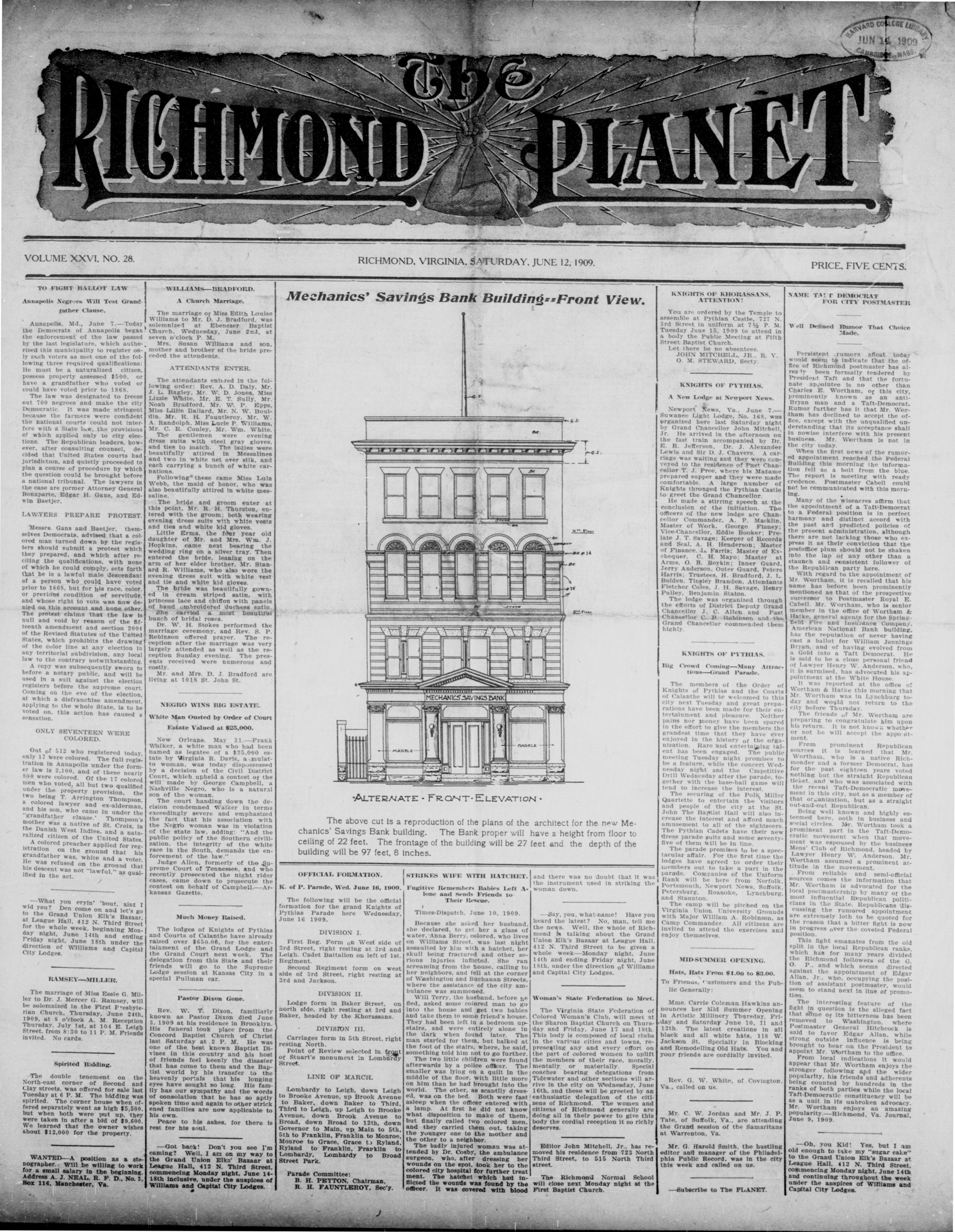
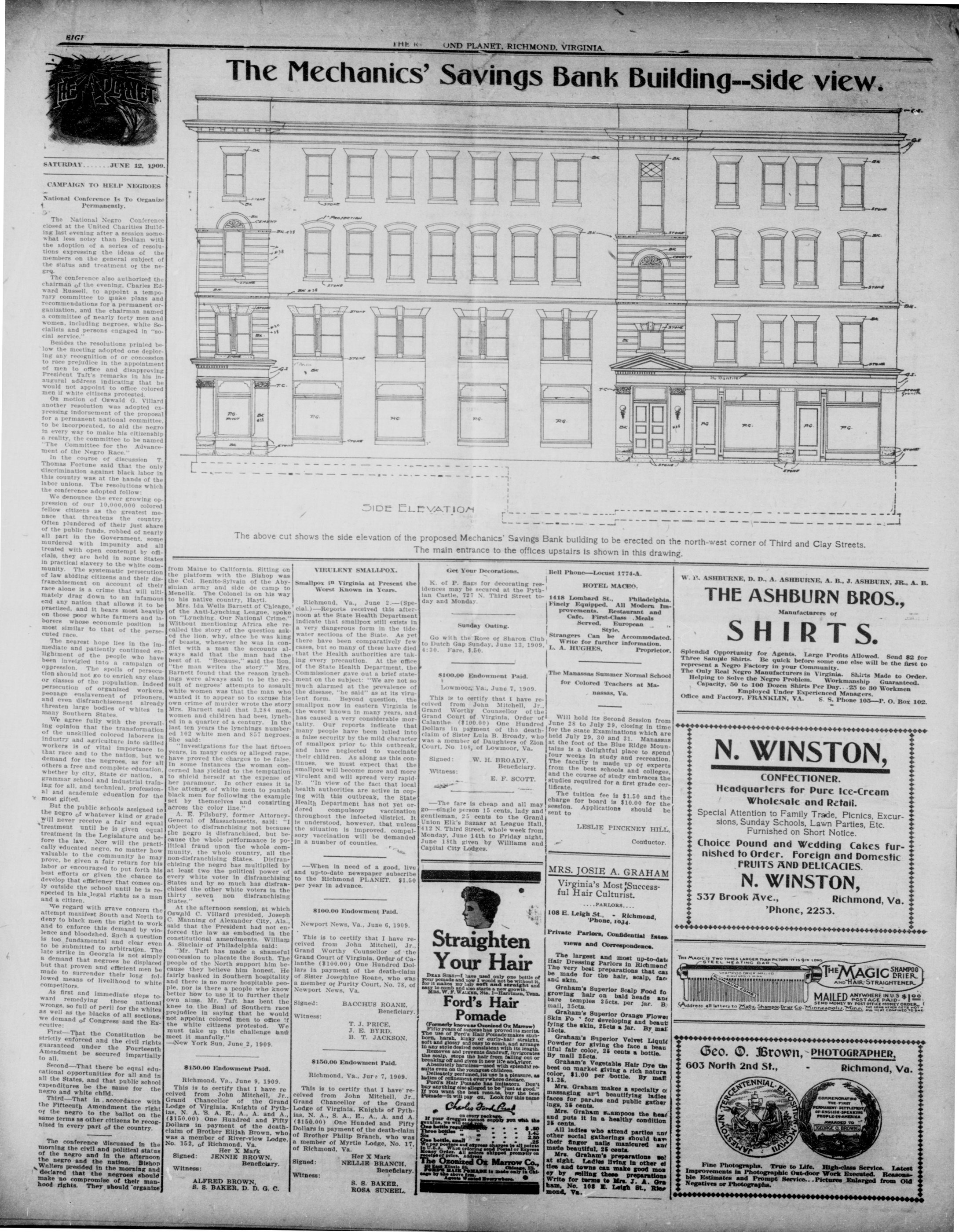
Mechanics' Savings Bank Building==Front View.
MECHANICS SAVINGS BANK
MARBLE
MARBLE
ALTERNATE·FRONT·ELEVATION·
The above cut is a reproduction of the plans of the architect for the new Mechanics' Savings Bank building. The Bank proper will have a height from floor to ceiling of 22 feet. The frontage of the building will be 27 feet and the depth of the building will be 97 feet. 8 inches.
OFFICIAL FORMATION
K. of P. Parade, Wed. June 16, 1909.
The following will be the official formation for the grand Knights of Pythias Parade here Wednesday. June 16, 1909.
DIVISION I
First Reg. Form $ _{0} $ n west side of 3rd Street, right resting at 3rd and Leigh. Cadet Battalion on left of 1st. Regiment.
Second Regiment form on west side of 3rd Street, right resting at 3rd and Jackson.
DIVISION II
Lodge form in Baker Street, on north side, right resting at 3rd and Baker, headed by the Khorassans.
DIVISION III.
Carriages form in 5th Street, right resting North. Point of Review selected in front of Stuart's monument in Lombardy Street.
Lombardy to Leigh, down Leigh to Brooke Avenue, up Brook Avenue to Baker, down Baker to Third, Third to Leigh, up Leigh to Brooke Avenue, down Brook Avenue to Broad, down Broad to 12th, down Governor to Main, up Main to 5th, fifth to Franklin, Franklin to Monroe, Monroe to Grace, Grace to Ryland, Ryland to Franklin, Franklin to Lombardy. Lombardy to Broad Street Park.
Parade Committee:
B. H. PEYTON, Chairman,
R. H. FAUNTLEROY, Sec'y.
STRIKES WIFE WITH HATCHET
Fugitive Remembers Babies Left Alone and Sends Friends to Their Rescue.
Times-Dispatch, June 10, 1909.
Because she asked her husband, she declared, to get her a glass of water, Anna Berry, colored, who lives on Williams Street, was last night assaulted by him with a hatchet, her skull been fractured and other serious injuries inflicted. She ran screaming from the house, calling to her neighbors, and fell at the corner of Washington and Buchanan Streets, where the assistance of the city ambulance was summoned.
Will Terry, the husband, before he fled, asked some colored man to go into the house and get two babies and take them to some friend's house. They had been left in a bedroom upstairs, and were entirely alone in the dark when found later. The man starfed for them, but balked at the foot of the stairs, where, he said, something told him not to go further.
The two little children were found afterwards by a police officer. The smaller was lying on a quilt in the middle of the floor, with little more on him than he had brought into the world. The other, as scantily dressed, was on the bed. Both were fast asleep when the officer entered with a lamp. At first he did not know what disposition to make of them, but finally called two colored men, and they carried them out, taking the younger one to the mother and the other to a neighbor.
The badly injured woman was attended by Dr. Cosby, the ambulance surgeon, who, after dressing her wounds on the spot, took her to the colored city hospital for further treatment. The hatchet which had inflicted the wounds was found by the officer. It was covered with blood
and there was no doubt that it was the instrument used in striking the woman down.
—Say, you, what-name! Have you heard the latest? No, man, tell me the news. Well, the whole of Richmond is talking about the Grand Union Elk's Bazaar at League Hall, 412 N. Third Street to be given a whole week—Monday night, June 14th and ending Friday night, June 18th, under the direction of Williams and Capital City Lodges.
Woman's State Federation to Meet.
The Virginia State Federation of Colored Woman's Club, will meet at the Sharon Baptist Church on Thursday and Friday, June 17 and 18th. This body is composed of local clubs in the various cities and towns, representing any and every effort on the part of colored women to uplift the members of their race, morally, mentally or materially. Special coaches bearing detegations from Tidewater and other sections will arrive in the city on Wednesday, June 16th, and these will be greeted by an enthusiastic delegation of the citizens of Richmond. The women and citizens of Richmond generally are doing all in their power to give this body the cordial reception it so richly deserves.
Editor John Mitchell, Jr., has removed his residence from 723 North Third Street, to 515 North Third street.
The Richmond Normal School will close next Monday night at the First Baptist Church.
KNIGHTS OF KHORASSANS,
ATTENTION!
You are ordered by the Temple to assemble at Pythian Castle, 727 N. 3rd Street in uniform at $1\frac{1}{2}$ P. M. Tuesday June 15, 1909 to attend in a body the Public Meeting at Fifth Street Baptist Church. Let there be no absentees. JOHN MITCHELL, JR., R. V. O. M. STEWARD, Secy.
KNIGHTS OF PYTHIAS
A New Lodge at Newport News.
Newport, News, Va., June 7.—Suwannee Light Lodge, No. 168, was organized here last Saturday night by Grand Chancellor John Mitchell, Jr. He arrived in the afternoon on the fast train accompanied by Dr. E. R. Jefferson, Dr. J. Alexander Lewis and Sir D. J. Chavers. A carriage was waiting and they were conveyed to the residence of Past Chancellor T. J. Pree, where his Madame prepared supper and they were made comfortable. A large number of Knights thronged the Pythian Castle to greet the Grand Chancellor. He made a stirring speech at the conclusion of the initiation. The officers of the new lodge are Chancellor Commander, A. P. Macklin, Master of Work, George Finney; Vice-Chancellor, Eddie Booker; Prelate J. T. Savage; Keeper of Records and Seal, A. H. Henderson; Master of Finance, L. Farris; Master of Exchequer, C. H. Mayo; Master at Arms, O. B. Boykin; Inner Guard, Jerry Anderson, Outer Guard, Peters Berlis; Trustees, H. Bradford, J. L. Boldt, Tingle Brandon, Attendants Fletcher Coles, J. H. Savage, Henry Pulley, Benjamin Staton. The lodge was organized through the efforts of District Deputy Grand Chancellor J. C. Allen and Past Chancellor C. H. Robinson and the Grand Chancellor commended them highly.
KNIGHTS OF PYTHIAS.
Big Crowd Coming—Many Attractions—Grand Parade.
The members of the Order of Knights of Pythias and the Courts of Calanthe will be welcomed to this city next Tuesday and great preparations have been made for their entertainment and pleasure. Neither pains nor money have been spared in the effort to give the members the grandest time that they have ever enjoyed in the history of the organization. Rare and entertaining talent has been engaged. The public meeting Tuesday night promises to be a feature, while the concert Wednesday night and the Competitive Drill Wednesday after the parade, together with the base-ball game will tend to increase the interest.
The securing of the Polk Miller Quartette to entertain the visitors and people of the city at the St. John The Baptist Hall will also increase the interest and afford much amusement to all of the sightseers. The Pythian Cadets have their new dress parade suits and some seventy-five of them will be in line. The parade promises to be a spectacular affair. For the first time the lodges have agreed to order their members out to take a part in the parade. Companies of the Uniform Rank will be here from Norfolk, Portsmouth, Newport News, Suffolk, Petersburg, Roanoke, Lynchburg, and Staunton. The camp will be pitched on the Virginia Union University Grounds with Major William A. Robinson, as Camp Commander. All citizens are invited to attend the exercises and enjoy themselves.
MID-SUMMER OPENING
Hats, Hats From $1.00 to $3.00.
To Friends, Customers and the Public Generally:
Mme. Carrie Coleman Hawkins announces her Mid Summer Opening in Artistic Millinery Thursday, Friday and Saturday June 10, 11 and 12th. The latest creations in all black and all white hats, 118 W. Jackson St. Specialty in Blocking and Remodelling Old Hats. You and your friends are cordially invited.
Rev. G. W. White, of Covington Va., called on us.
Mr. C. W. Jordan and Mr. J. P. Tate, of Suffolk, Va., are attending the Grand session of the Samaritans at Warrenton, Va.
Mr. G. Harold Smith, the hustling editor and manager of the Philadelphia Public Record, was in the city this week and called on us.
—Subscribe to The PLANET
NAME TAST DEMOCRAT
FOR CITY POSTMASTER
Well Defined Rumor That Choice Made.
Persistent rumors affloat today would seem to indicate that the office of Richmond postmaster has already been formally tendered by President Taft and that the fortune appointee is no other than Charles E. Wortham, or this city, prominently known as an anti-Bryan man and a Taft-Democrat, Rumor further has it that Mr. Wortham has declined to accept the office, except with the unqualified understanding that its acceptance shall in nowise interfere with his present business. Mr. Wortham is not in the city today.
When the first news of the rumored appointment reached the Federal Building this morning the information fell as a boit from the blue. The report is meeting with ready credence. Postmaster Cabell could not be communicated with this morning.
Many of the wisecares affirm that the appointment of a Taft-Democrat to a Federal position is in perfect harmony and distinct accord with the past and predicted policies of the present administration, although there are not lacking those who express it as their conviction that the postoffice plum should not be shaken into the lap of any other than a staunch and consistent follower of the Republican party here.
With regard to the appointment of W. Wortham, it is recalled that his name has before been prominently mentioned as that of the prospective successor to Postmaster Royal E. Cabell. Mr. Wortham, who is senior member in the office of Wortham & Hatke, general agents for the Springfield Fire and Insurance Company, American National Bank building, has the reputation of never having cast a ballot for William Jennings Bryan, and of having evolved from a Gold into a Taft Democrat. He is said to be a close personal friend of Lawyer Henry W. Anderson, who, it is surmised, has advocated his appointment at the White House. It was reported at the office of Wortham & Hatke this morning that Mr. Wortham was in Lynchburg today and would not return to the city before Thursday. The friends of Mr. Wortham are preparing to congratulate him upon his return. It is not known whether or not he will accept the appointment. From prominent Republican sources it is learned that Mr. Wortham, who is a native Richmond and a former Democrat, has for the past eighteen years voted nothing but the straight Republican ticket, and who was associated with the recent Taft-Democratic movement in this city, not as a member of that organization, but as a straight out-and-out Republican.
Being well known and highly esteemed here, ooth in business and social circles. Mr. Worthham took a prominent part in the Taft-Democratic movement when that movement was espoused by the business Mens' Club of Richmond, headed by Lawyer Henry W. Anderson, Mr. Worthham assumed a prominent attitude in the movement. From reliable and semi-official sources comes the information that Mr. Worthham is advocated for the local postmastership by many of the most influential Republican politicians in the State. Republicans discussing the rumored appointment are extremely loth to be quoted for the reason that a bitter fight is now in progress over the coveted Federal position.
This fight emanates from the old split in the local Republican ranks, which has for many years divided the Richmond followers of the G. O. P., and which seems directed against the appointment of Edgar Allan, Jr., who, occupying the position of assistant postmaster, would seem to stand next in line of promotion.
The interesting feature of the fight in question is the alleged fact that some or its bitterness has been removed to Washington, where Postmaster General Hitchock is said to favor Edgar Allan, while strong outside influence is being brought to bear on the President to appoint Mr. Worthham to the office.
From local indications it would appear that Mr. Wortham enjoys the stronger following and the wider popularity, his friends and adherents being counted by hundreds in the ranks of both parties while the local Taft-Democratic constituency will be as a unit in its unbroken advocacy. Mr. Wortham enjoys an amazing popularity.—Richmond, Va. Journal, June 9, 1909.
—Oh, you Kid! Yes, but I am old enough to take my "sugar cake" to the Grand Union Elk's Bazaar at League Hall, 412 N. Third Street, commencing Monday night, June 14th and continuing throughout the week under the auspices of Williams and Capital City Lodges.
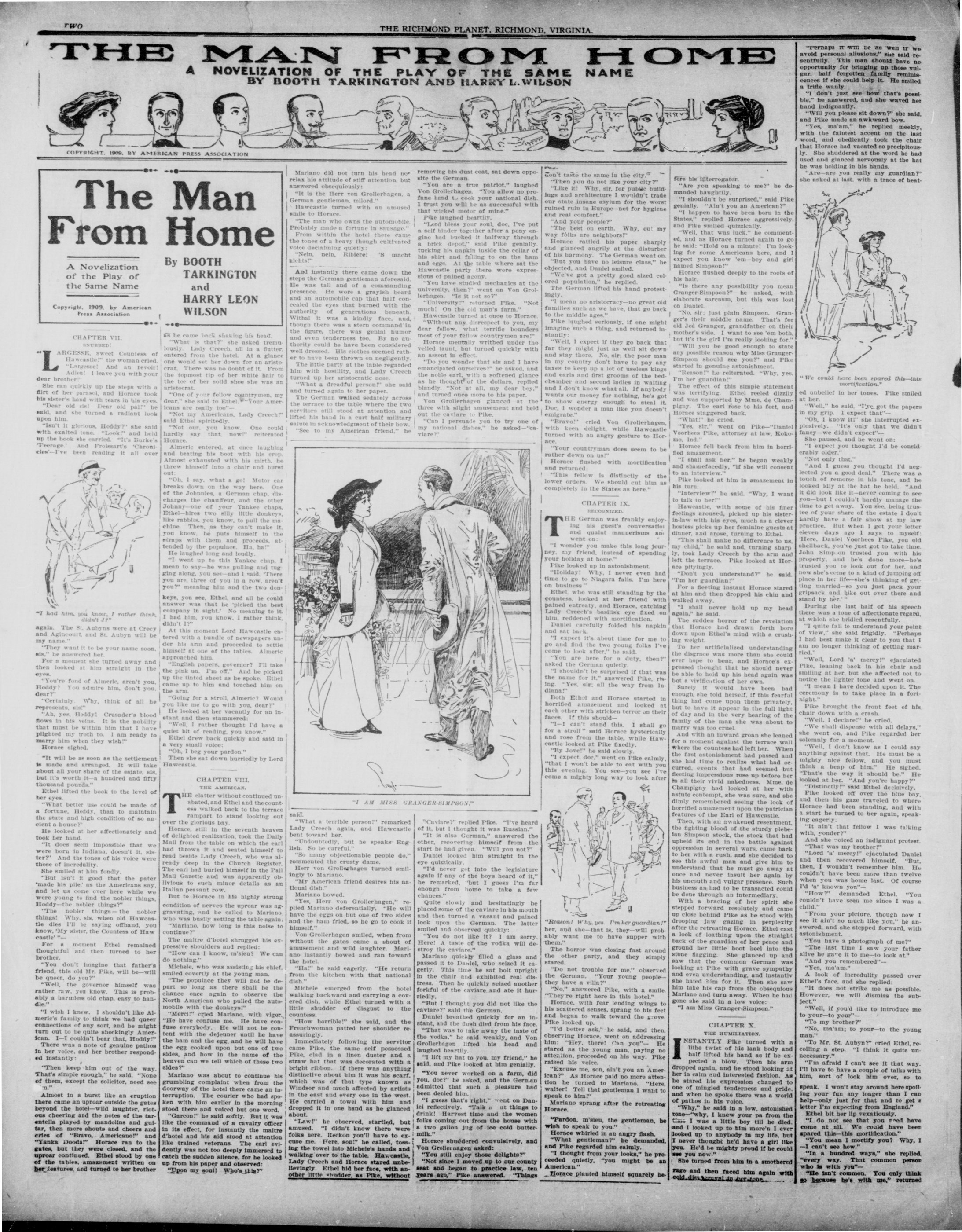
THE MAN FROM HOME A NOVELIZATION OF THE PLAY OF THE SAME NAME BY BOOTH TARKINGTON AND HARRY L. WILSON
COPYRIGHT 1909 BY AMERICAN CHRISTIAN MUSEUM
COPYRIGHT. 1909. BY AMERICAN PRESS ASSOCIATION
The Man From Home
A Novelization of the Play of the Same Name
Copyright, 1909, by American Press Association
CHAPTER VII.
SNUBBED!
"L ARGESSE, sweet Countess of Hawcastle" the woman cried.
"Largesse! And au revoir! Adlie! I leave you with your dear brother!"
She ran quickly up the steps with a flirt of her parasol, and Horace took his sister's hand with tears in his eyes.
"Dear old sis! Dear old pal!" he said, and she turned a radiant look upon him.
"Isn't it glorious, Hoddy?" she said with exalted tone. "Look!" and held up the book she carried. "It's Burke's 'Teerage.' And Froissart's 'Chronicles'-I've been reading it all over
"I had him, you know, I rather think
didn't it?"
again. The St. Aubyns were at Crecy and Agincourt, and St. Aubyn will be my name."
"They want it to be your name soon, sis," he answered her.
For a moment she turned away and then looked at him straight in the eyes.
"You're fond of Almeric, aren't you. Hoddy? You admire him, don't you, dear."
"Certainly. Why, think of all he represents, sis!"
"Ah, yes. Hoddy! Crusader's blood flows in his veins. It is the nobility that must be within him that I have plighted my troth to. I am ready to marry him when they wish!"
Horace sighed.
"It will be as soon as the settlement is made and arranged. It will take about all your share of the estate, sis, but it's worth it—a hundred and fifty thousand pounds."
Ethel lifted the book to the level of her eyes.
"What better use could be made of a fortune, Hoddy, than to maintain the state and high condition of so ancient a house?"
He looked at her affectionately and took her hand.
"It does seem impossible that we were born in Indiana, doesn't it, sister?" And the tones of his voice were those of incredulity.
She smiled at him fondly.
"But isn't it good that the pater made his pile, as the Americans say, and let us come over here while we were young to find the nobler things, Hoddy—the nobler things?"
"The nobler things—the nobler things! Why, sis, when old Hawcastle dies I'll be saying offhand, you know, My sister, the Countess of Haw castle'"—
For a moment Ethel remained thoughtful and then turned to her brother.
"You don't imagine that father's friend, this old Mr. Pike, will be—will be queer, do you?"
"Well, the governor himself was rather raw, you know. This is probably a harmless old chap, easy to handle."
"I wish I knew. I shouldn't like Almerie's family to think we had queer connections of any sort, and he might turn out to be quite shockingly American. I—I couldn't bear that, Hoddy!"
There was a note of genuine pathos in her voice, and her brother responded instantly:
"Then keep him out of the way. That's simple enough," he said. "None of them, except the solicitor, need see n."
Almost in a burst like an eruption there came an uproar outside the gates beyond the hotel—wild laughter, riotous cheering and the notes of the tarentella played by mandolins and guitar, then more shouts and cheers and cries of "Bravo, Americano" and "Yanka Dooda" Horace ran to the gates, but they were closed, and the uproar continued. Ethel stood by one of the tables, amazement written on her features, and turned to her brother
By BOOTH
TARKINGTON
and
HARRY LEON
WILSON
as he came back shaking his head.
"What is that?" she asked tremulously. Lady Creech, all in a flutter, entered from the hotel. At a glance one would set her down for an aristocrat. There was no doubt of it. From the topmost tip of her white hair to the toe of her solid shoe she was an aristocrat.
"One of your fellow countrymen, my dear," she said to Ethel. "Your Americans are really too"—
"Not my Americans, Lady Creech!" said Ethel spiritedly.
"Not our, you know. One could hardly say that, now!" reiterated Horace.
Almeric entered, at once laughing and beating his boot with his crop. Almost exhausted with his mirth, he threw himself into a chair and burst out:
"Oh. I say, what a go! Motor car breaks down on the way here. One of the Johnnies, a German chap, discharges the chauffeur, and the other Johnny—one of your Yankee chaps, Ethel—hires silly little donkeys, like rabbits, you know, to pull the machine. Then, as they can't make it, you know, he puts himself in the snaps with them and proceeds, attended by the populace. Ha, ha!" He laughed long and loudly.
"I went up to this Yankee chap, I mean to say—he was pulling and tugging along, you see—and I said, 'There you are, three of you in a row, aren't you?' meaning him and the two donkeys, you see. Ethel, and all he could answer was that he 'picked the best company in sight.' No meaning to it. I had him, you know, I rather think, didn't I?"
At this moment Lord Hawcastle entered with a bundle of newspapers under his arm and proceeded to settle himself at one of the tables. Almeric approached him.
"English papers, governor? I'll take the pink un. I'm off." And he picked up the tinted sheet as he spoke. Ethel came up to him and touched him on the arm.
"Going for a stroll, Almeric? Would you like me to go with you, dear?" He looked at her vacantly for an instant and then stammered:
"Well, I rather thought I'd have a quiet bit of reading, you know."
Ethel drew back quickly and said in a very small voice:
"Oh, I beg your pardon."
Then she sat down hurriedly by Lord Hawcastle.
CHAPTER VIII
THE clatter without continued unabated, and Ethel and the countless walked back to the terrace rampart to stand looking out over the glorious bay.
Horace, still in the seventh heaven of delighted realization, took the Daily Mall from the table on which the earl had thrown it and seated himself to read beside Lady Creech, who was already deep in the Church Register. The earl had buried himself in the Pull Mall Gazette and was apparently oblivious to such minor details as an Italian peasant row.
But to Horace in his highly strung condition of nerves the uprora was agravatting, and he called to Mariano, who was busily setting the table again:
"Mariano, how long is this noise to continue?"
The maltre d'hotel shrugged his expressive shoulders and replied:
"How can I know, m'sien? We can do nothing."
Michele, who was assisting his chief, smiled covertly at the young man.
"The populace they will not be depart so long as there shall be the chance once again to observe the North American who pulled the automobile with the donkeys!"
"Mercel!" cried Mariano, with vigor.
"He have confuse me. He have confuse everybody. He will not be content with the dejeuner until he have the ham and the egg, and he will have the egg cooked upon but one of two sides, and how in the name of the heaven can we tell which of these two sides?"
Mariano was about to continue his grumbling complaint when from the doorway of the hotel there came an interruption. The courier who had spoken with him earlier in the morning stood there and voiced but one word.
"Garcon!" he said softly. But it was like the command of a cavalry officer in its effect, for instantly the matre d'hotel and his aid stood at attention like trained veterans. The earl evidently was not too deeply immersed to catch the sudden silence, for he looked up from his paper and observed:
"Upon my soul! Who's this?"
THE RICHMOND PLANET, RICHMOND, VIRGINIA
Mariano did not turn his head nor relax his attitude of stiff attention, but answered obsequiously:
"It is the Herr von Grollerbagen, a German gentleman, milord."
Hawcastle turned with an amused smile to Horace.
"The man who owns the automobile. Probably made a fortune in sausage."
From within the hotel there came the tones of a heavy though cultivated voice declaiming quietly:
"Neln, nein, Riblere! 'S macht nichts'"
And instantly there came down the steps the German gentleman aforesaid. He was tall and of a commanding presence. He wore a grayish beard and an automobile cap that half concealed the eyes that burned with the authority of generations beneath. Withal it was a kindly face, and, though there was a stern command in the figure, there was genial humor and even tenderness too. By no authority could he have been considered well dressed. His clothes seemed rather to have been thrown on negligently. The little party at the table regarded him with hostility, and Lady Creech turned up her aristocratic nose. "What a dreadful person!" she said and turned again to her paper. The German walked sedately across the terrace to the table where the two servitors still stood at attention and lifted his hand in a curt half military salute in acknowledgment of their brow. "See to my American friend," he
L.
C. W.
"I AM MISS GRANGER-SIMPSON."
"What a terrible person!" remarked Lady Creech again, and Hawcastle bent toward her.
"Undoubtedly, but he speaks English. So he careful."
"So many objectionable people do," commented the crusty dame.
Herr von Grollerhagen turned smilingly to Mariano.
"My American friend desires his national dish."
Mariano bowed.
"Yes, Herr von Grollerhagen," replied Mariano deferentially. "He will have the eggs on but one of two sides and the ham fried, so he go to cook it himself."
Von Grollerhagen smiled, when from without the gates came a shout of amusement and wild laughter. Mariano instantly bowed and ran toward the hotel.
"Ha!" he said eagerly. "He return from the kitchen with that national dish."
Michele emerged from the hotel walking backward and carrying a covered dish, while Ethel turned with a little shudder of disgust to the countess.
"How horrible!" she said, and the Frenchwoman patted her shoulder reassuringly.
Immediately following the servitor came Pike, the same self possessed Pike, clad in a linen duster and a straw hat that was decorated with a bright ribbon. If there was anything distinctive about him it was his scarf, which was of that type known as Windsor and much affected by artists in the east and every one in the west.
He carried a towel with him and dropped it in one hand as he glanced about.
"Lew!" he observed, startled, but amused. "I didn't know there were folks here. Reckon you'll have to excuse me. Here, son!" he called, tossing the towel into Michele's hands and walking over to the table. Hawcastle, Lady Creech and Horace stared unbelievingly. Ethel bid her face, with another little shudder, as Pike, without
said.
Mariano bowed.
removing his dust coat, sat down opposite the German.
"You are a true patriot," laughed Von Grollerhagen. "You allow no profane hand t., cook your national dish. I trust you will be as successful with that wicked motor of mine."
Pike laughed heartily.
"Lord bless your soul, doc, I've put a self binder together after a pony engine had bucked it halfway through a brick depot," said Pike genially, tucking his napkin inside the collar of his shirt and falling to on the ham and eggs. At the table where sat the Hawcaste party there were expressions of pained agony.
"You have studied mechanics at the university, then?" went on Von Grollerhagen. "Is it not so?"
"University!" returned Pike. "Not much! On the old man's farm."
Hawcaste turned at once to Horace. "Without any disrespect to you, my dear fellow, what terrific bounders most of your fellow countrymen are."
Horace mentally writhed under the veiled taunt, but turned quickly with an assent in effect.
"Do you wonder that sis and I have emancipated ourselves?" he asked, and the noble earl, with a softened glance as he thought of the dollars, repiled blandly. "Not at all, my dear boy," and turned once more to his paper.
Von Groellerbagen glanced at the three with slight amusement and held out the caviare to Pike.
"Can I persuade you to try one of my national dishes," he asked—"caviare?"
A man in a long coat holding a hat.
"Caviare?" replied Pike. "I've heard of it, but I thought it was Russian." "It is also German," answered the other, recovering himself from the start he had given. "Will you not?" Daniel looked him straight in the eye quizzically. "I'd never get into the legislature again if any of the boys heard of it," he remarked, "but I guess I'm far enough from home to take a few chances." Quite slowly and hesitatingly he placed some of the caviare in his mouth and then turned a vacant and pained look upon the German. The latter smiled and observed quickly: "You do not like it? I am sorry. Here! A taste of the vodka will destroy the caviare."
Mariano quickly filled a glass and passed it to Daniel, who seized it eagerly. This time he sat bolt upright in the chair and exhibited real distress. Then he quickly seized another forkful of the caviare and ate it hurriedly.
"But I thought you did not like the caviare?" said the German.
Daniel breathed quickly for an instant, and the fushd died from his face.
"That was to take away the taste of the vodka." he said weakly, and Von Grollerhagen lifted his head and laughed heartily.
"I lift my hat to you, my friend," he said, and Pike looked at him genially.
"You never worked on a farm, did you, doc?" he asked, and the German admitted that such a pleasure had been denied him.
"I guess that's right," went on Daniel reflectively. "Talk a nut things to drink! Harvest time and the women folks coming out from the house with a two gallon jug of ice cold butter milk."
Horace shuddered convulsively, and Von Grole nagen asked:
"You still enjoy those delights?"
"Not since I moved up to our county seat and began to practice law, ten years ago." Pike answered. "Things
Don't taste the same in the city."
"Then you do not like your city?"
"Like it! Why, sr, for public buildings and architecture I wouldn't trade our state insane asylum for the worst ruined ruin in Europe—not for hygiene and real comfort."
"And your people?"
"The best on earth. Why, out my way folks are neighbors."
Horace rattled his paper sharply and glanced angrily at the disturber of his harmony. The German went on.
"But you have no leisure class," he
"But you have no leisure class," he objected, and Daniel smiled.
"We've got a pretty good sized colored population," he replied.
The German lifted his hand protestingly.
"I mean no aristocracy—no great old families such as we have, that go back to the middle ages."
Pike laughed seriously, if one might imagine such a thing, and returned instantly:
"Well, I expect if they go back that far they might just as well sit down and stay there. No, sir; the poor man in my country don't have to pay any taxes to keep up a lot of useless kings and earls and first grooms of the bedchamber and second ladies in waiting and I don't know what all. If anybody wants our money for nothing, he's got to show energy enough to steal it. Doc, I wonder a man like you doesn't emigrate."
"Bravo!" cried Von Grollerhagen, with keen delight, when Hawcastle turned with an angry gesture to Horace.
"Your countryman does seem to be rather down on us!" Horace fushed with mortification and returned: "This fellow is distinctly of the lower orders. We should cut him as completely in the States as here."
THE German was frankly enjoy-
ing his guest's conversation
and quaint mannerisms and
went on:
"I wonder you make this long jour-
ney, my friend, instead of spending
your holiday at home."
Pike looked up in astonishment.
Fike looked up in astonishment.
"Holiday! Why, I never even had time to go to Niagara falls. I'm here on business."
Ethel, who was still standing by the countess, looked at her friend with pained entreaty, and Horace, catching Lady Creech's basilisk eye fixed on him, reddened with mortification.
Daniel carefully folded his napkin and sat back.
"I expect it's about time for me to go and find the two young folks I've come to look after," he said.
"You are here for a duty, then?" asked the German quietly.
"I shouldn't be surprised if that was the name for it," answered Pike, rising. "Yes, sir; all the way from Indiana."
Both Ethel and Horace started in horrified amazement and looked at each other with stricken terror on their faces. If this should—
"I-I can't stand this. I shall go for a stroll" said Horace hysterically and rose from the table, while Haw-castle looked at Pike fixedly.
"By Jove!" he said slowly.
"I expect, doe," went on Pike calmly.
"that I won't be able to eat with you this evening. You see--you see I've come a mighty long way to look after
"Reason! Why, yes. I'm her guardian!" her, and she—that is, they—will probably want me to have supper with them."
The horror was closing fast around the other party, and they simply stared.
"Do not trouble for me," observed the German. "Your young people—they have a villa?"
"No," answered Pike, with a smile. "They're right here in this hotel." Horace, with fear lending wings to his scattered senses, sprang to his feet and began to walk toward the grove. Pike looked up.
"I'd better ask," he said, and then, observing Horace, went on addressing him: "Hey, there! Can you?" He stared as the young man, paying no attention, proceeded on his way. Pike raised his voice.
"Excuse me, son, ain't you an American?" As Horace paid no more attention he turned to Mariano. "Here, waiter! Tell that gentleman I want to speak to him!"
Mariano sprang after the retreating Horace.
"Pardon, m'sieu, the gentleman, he wish to speak to you."
Horace whirled in an angry flash.
"What gentleman?" he demanded, and Pike regarded him calmly.
"I thought from your looks," he proceeded quietly, "you might be an American."
Horace planted himself squarely be-
fore his litterrogator.
"Are you speaking to me?" be demanded haughtily.
"I shouldn't be surprised," said Pike genially. "Ain't you an American?"
genially. "Ain't you an American?"
"I happen to have been born in the States," replied Horace aggressively, and Pike smiled quizzically.
"Well, that was luck," he commented, and as Horace turned again to go he said: "Hold on a minute! I'm looking for some Americans here, and I expect you know 'em-boy and girl named Simpson!"
Horace flushed deeply to the roots of his hair.
"Is there any possibility you mean Granger-Simpson?" he asked, with elaborate sarcasm, but this was lost on Daniel.
"No, sir: just plain Simpson. Granger's their middle name. That's for old Jed Granger, grandfather on their mother's side. I want to see 'em both, but it's the girl I'm really looking for."
"Will you be good enough to state any possible reason why Miss Granger-Simpson should see you?" and Pike started in genuine astonishment.
"Reason!" he reiterated. "Why, yes. I'm her guardian!"
The effect of this simple statement was terrifying. Ethel reeled dizzily and was supported by Mme. de Champigny. The earl rose to his feet, and Horace staggered back.
"What!" he cried.
"Yes, sir." went on Pike—"Daniel Voorhees Pike, attorney at law, Kokomo, Ind."
Horace fell back from him in horrified amazement.
"I shall ask her," he began weakly and shamefacedly, "if she will consent to an interview."
Pike looked at him in amazement in his turn.
"Interview!" he said. "Why, I want to talk to her!"
Hawcastle, with some of his finer feelings aroused, picked up his sister-in-law with his eyes, much as a clever hostess picks up her feminine guests at dinner, and arose, turning to Ethel.
"This shall make no difference to us, my child," he said and, turning sharply, took Lady Creech by the arm and left the terrace. Pike looked at Horace pityingly.
"Don't you understand?" he said. "I'm her guardian."
For a fleeting instant Horace stared at him and then dropped his chin and walked away.
"I shall never hold up my head again," he said.
The sudden horror of the revelation that Horace had drawn forth bore down upon Ethel's mind with a crushing weight.
To her artificialized understanding the disgrace was more than she could ever hope to bear, and Horace's expressed thought that he should never be able to hold up his head again was but a vivification of her own.
Surely it would have been bad enough, she told herself, if this fearful thing had come upon them privately, but to have it appear in the full light of day and in the very hearing of the family of the man she was about to marry was too cruel. And with an inward groan she leaned for a moment against the terrace wall where the countess had left her. When the first astonishment had passed and she had time to realize what had occurred, events that had seemed but fleeting impressions rose up before her in all their vivid nakedness. Mine, de Champigny had looked at her with astute contempt, she was sure, and she dimly remembered seeing the look of horrified amazement upon the patrician features of the Earl of Hawcastle.
Then, with an awakened resentment, the fighting blood of the sturdy plebeian Simpson stock, the stock that had upheld its end in the battle against oppression in several wars, came back to her with a rush, and she decided to see this awful man and give him to understand that he must go away at once and never insult her again by his uncouth and vulgar presence. Such business as had to be transacted could be done through an intermediary.
With a bracing of her spirit she stepped forward resolutely and came up close behind Pike as he stood with drooping jaw gazing in perplexity after the retreating Horace. Ethel cast a look of loathing upon the straight back of the guardian of her peace and ground her little boot heel into the stone flagging. She glanced up and saw that the common German was looking at Pike with grave sympathy and even understanding, and instantly she hated him for it. Then she saw him take his cap from the obsequious Mariano and turn away. When he had gone she said in a low voice:
CHAPTER X
THE HUMILIATION
INSTANTLY Pike turned with a lithe twist of his lank body and half lifted his hand as if he expected a blow. Then his arm dropped again, and he stood looking at her in calm and interested fashion. As he stared his expression changed to one of mingled tenderness and pride, and when he spoke there was a world of pathos in his voice.
"Why," he said in a low, astonished tone—"why, I knew your pa from the time I was a little boy till he dled, and I looked up to him more'n I ever looked up to anybody in my life, but I never thought he'd have a girl like you. He'd be mighty proud if he could see you now."
She turned from him in a smothered rage and then faced him again with cold disgraceful in her tone.
"Permaps it will be as well if we avoid personal allusions," she said resentfully. This man should have no opportunity for bringing up those vulgar, half forgotten family reminiscences if she could help it. He smiled a trifle wanly.
"I don't just see how that's possible," he answered, and she waved her hand indignantly.
"Will you please sit down?" she said, and Pike made an awkward bow.
"Yes, ma'm," he replied meekly, with the faintest accent on the last word, and obediently took the chain that Horace had vacated so precipitously. She shuddered at the word he had used and glanced nervously at the hat he was holding in his hands.
"Are—are you really my guardian?" she asked at last, with a trace of heat.
A
"We could have been spared this—this mortification."
"We could have been spared this—this mortification."
ed unbelief in her tones. Pike smiled at her.
"Well," he said, "I've got the papers in my grip. I expect that"—
"Oh, I know it!" she interrupted explosively. "It's only that we didn't fancy—we didn't expect"—
She paused, and he went on:
"I expect you thought I'd be consid- erably older."
"Not only that."
"And I guess you thought I'd neglected you a good deal." There was a touch of remorse in his tone, and he looked idly at the hat he held. "And it did look like it—never coming to see you—but I couldn't hardly manage the time to get away. You see, being trustee of your share of the estate I don't hardly have a fair show at my law practice. But when I got your letter eleven days ago I says to myself: 'Here, Daniel Voorhees Pike, you old shellback, you've just got to take time. John Simp. trusted you with his property, and he's done more—he's trusted you to look out for her, and now she's come to a kind of jumping off place in her life—she's thinking of getting married—so you just pack your gripsack and hike out over there and stand by her.'"
During the last half of his speech there was a tone of affectionate regard, at which she bridled resentfully.
"I quite fail to understand your point of view," she said frigidly. "Perhaps I had best make it clear to you that I am no longer thinking of getting married."
"Well, Lord 'a' mercy!" ejaculated Pike, leaning back in his chair and smiling at her, but she affected not to notice the lighter tone and went on.
"I mean I have decided upon it. The ceremony is to take place in a fortnight."
Pike brought the front feet of his chair down with a crash.
"Well, I declare!" he cried.
"We shall dispense with all delays," she went on, and Pike regarded her solemnly for a moment.
"Well, I don't know as I could say anything against that. He must be a mighty nice fellow, and you must think a heap of him." He sighed.
"That's the way it should be." He looked at her. "And you're happy?"
"Distinctly!" said Ethel decisively. Pike looked off over the blue bay, and then his gaze traveled to where Horace had been standing, and with a start he turned to her again, speaking eagerly:
"It ain't that fellow I was talking with, yonder?"
And she voiced an indignant protest.
"That was my brother!"
"Lord 'a' mercy!" ejaculated Daniel and then recovered himself. "But, then, I wouldn't remember him. He couldn't have been more than twelve when you was home last. Of course I'd 'a' known you"—
"How?" demanded Ethel. "You couldn't have seen me since I was a child."
"From your picture, though now I see it ain't so much like you," he answered, and she stepped forward, with astonishment.
"You have a photograph of me?"
"The last time I saw your father alive he gave it to me—to look at."
"And you remembered"—
"Yes, ma'am."
A look of incredulity passed over Ethel's face, and she replied:
"It does not strike me as possible. However, we will dismiss the subject."
"Well, if you'd like to introduce me to your—to your"—
"To my brother?"
"No, ma'am; to your—to the young man."
"To Mr. St. Aubyn?" cried Ethel, recolling a step. "I think it quite unnecessary."
"I'm afraid I can't see it that way. I'll have to have a couple of talks with him, sort of look him over, so to speak. I won't stay around here spelling your fun any longer than I can help—only just for that and to get a letter I'm expecting from England." Ethel bit her lip vexationally. "I do not see that you need have come at all. We could have been spared this—this mortification." "You mean I mortify you? Why, I—I can't see how." "In a hundred ways," she replied, "every way. That common person who is with you"— "He isn't common. You only think so because he's with me," returned
SATURDAY... JUNE 12, 1909.
Daniel sadly, looking down.
"Who is he?" demanded Ethel sharply.
"He told me his name, but I can't remember it. I call him 'doc.'"
"It doesn't matter. What does matter is that you needn't have come. You could have written your consent."
"No, ma'am, not - without seeing the young man," answered Pike resolutely.
"And you could have arranged the settlement in the same way," went on Ethel unheedingly.
"Settlement! You seem to have set-tled it pretty well without me," returned Pike smiling.
"You don't understand," said Ethel impatiently. "An alliance of this sort always entails a certain settlement." She paused. "Please listen. If you were at all a man of the world I should not have to explain that in marrying into a noble house I bring my dot, my dowry"—
"Money, you mean?" asked Pike, puzzled.
"Yes, if you choose to put it that way."
"You mean you want to put aside something of your own to buy a lot and start housekeeping"—
"No," she flared. "I mean a settlement upon Mr. St. Aubyn directly."
"You mean you want to give it to him?"
"If that's the only way to make you understand—yes!" she flashed.
"How much do you want to give him?" asked Pike thoughtfully.
"A hundred and fifty thousand pounds," said Ethel desperately.
Pike whistled.
"Seven hundred and fifty thousand dollars!"
"Precisely that!" said Ethel.
Precisely that, said Bueh.
"Well, he has made you care for him," said Daniel. "I guess he must be the prince of the world! He must be a great man. I expect you're right about me not meeting him. I probably wouldn't stack up very high alongside a man that's big enough for you to think so much of as you do him. Why, I'd have to squeeze every bit of property your pa left you."
"Is it your property?" she flared at him.
"I've worked pretty hard to take care of it for you," he answered gently, and instantly she regretted the sharp speech.
"Forgive me," she pleaded. "It was unworthy of me—unworthy of the higher and nobler things that Life calls me to live up to—that I shall live up to. The money means nothing to me. I'm not thinking of that. It is a necessary form."
Pike looked at her keenly.
"Have you talked with Mr. St. Aubyn about this settlement—this present you want to make to him?" he asked.
"Not with him."
"I thought not," he went on amusedly. "You'll see. He wouldn't take it if I'd let you give it to him. A fine man like that wants to make his own way. Mighty few men like to have fun poked at them about living on their wives' money."
"Oh, I can't make you understand!" cried Ethel despairingly. "A settlement isn't a gift."
"Then how'd you happen to decide that just a hundred and fifty thousand
1
"The police are chasing a bally convict chap under the cliff."
pounds was what you wanted to give him?" he demanded.
"It was Mr. St. Aubyn's father who fixed the amount," replied Ethel desperately.
"His father! What's he got to do with it?"
"He is the Earl of Hawcastle, the head of the ancient house."
"And he asks you for your property—asks you for it in so many words?"
"Yes, as a settlement."
"And your young man knows it?"
"I tell you, Mr. Pike, I have not discussed it with Mr. St. Aubyn."
Pike laughed.
"I reckon not," he said amusedly.
"Well, str. do you know what's the first thing Mr. St. Aubyn will do when he hears his father made such a proposition? He'll take the old man out in the back lot and give him a thrashing he won't forget to the day of his death."
She was about to answer when from a distance came the roll of drums and then the sound of a bugle. The sounds came from afar off, as if below the cliff.
They both stopped to listen. Then
the servants came running, with Mariano at their head. They rushed to the wall and leaned over, all excitement Mariano turned to can, to them over his shoulder:
"The bandit of Russia! The soldiers think he is hidden in a grotto under these cliffs!"
As he spoke Almeric ran down the steps with a shotgun in his hand and made for the steps leading down the face of the cliff. Pike turned to Ethel.
"I saw that fellow on the road here. What's he meant for?"
Ethel turned angrily from the lawyer and called sharply to her fance:
"Almeric!"
St. Aubyn turned and stopped.
"Hello!" he said.
"I wish to present my guardian to you," and turned to Pike as Almeric approached. "This is Mr. St. Aubyn," she said steadily.
Almeric stared at Pike through his monocle and laughed.
"Why, it's the donkey man, isn't it? How very odd! You'll have to see the governor and our solicitor about that settlement, though. I've some important business here. The police are chasing a bally convict chap under the cliff yonder, so you'll have to excuse me. You know there's nothing like a little convict shooting to break the blooming monotony—what?"
He turned and rushed off down the stairway. Like turned to look after him in mute astonishment and then turned to Ethel. She refused to meet his glance, and the hot blood rose to her face as she felt his scrutiny.
She tapped nervously with her foot, and the astonishment grew in Daniel's face. He looked from her to where Almeric had disappeared and back to her again. Then he took a step forward as if to speak and stopped. Finally the dawning horror in his face took concrete form, and he spoke.
"That!" he groaned. "Seven hundred and fifty thousand dollars for! that! Say, how much do they charge for a real man over here anyway?"
But she was unable to meet his eye. Turning quickly, with her cheeks flaming with shame and anger, she rushed into the hotel and left him standing speechless on the spot.
[TO BE CONTINUED.]
WOULD PRACTICE BY CONTRACT
Wage Earners Would Get Medical Attention at Small Cost.
DOCTORS DENOUNCE GRAFTING
Divialon of Money Between Family Physicians and Specialists Warmly Scored In Medical Convention—Advocate Somnolent Method to Cure Dope Habit.
Eminent physicians advocated "contract practice" by physicians before the American Academy of Medicine at their closing meeting in Atlantic City, N. J., as a solution for the problem of securing proper medical attention for the wage earners at small cost.
The plan presented favors 'small monthly payments by the clients of the contract physician, who is expected to attend them in case of illness without extra charge. Dr. L. Benedict, of Buffalo, claimed that under the present system the poor, unable to pay doctors' bills, often delay calling a physician until the disease is beyond easy cure. He claimed that the contract plan would also secure the doctor against loss by unpaid bills and guarantee the young physician a living income. Dr. Woods Hutchinson, of New York, was another advocate of the new plan, which was discussed by Dr. Charles J. Sheedon, who called contract practice "insurance against doctors' bills."
Payment of commissions by specialists to general practitioners who call them in for operations or advice was characterized as "graft, pure and simple," by Dr. E. Gard Edwards, of La Junta, Colo. The matter of fee splitting formed the subject of Dr. Edwards' address, and he lay medical men who, he claimed, are making a regular practice of dividing the high fees demanded by the specialists. Dr. Edwards also condemned the action of many specialists who perform operations and then leave their patients under the care of the local practitioner, who "receives the blame if they die and none of the credit if they live." Dr. H. I. Partes, of Eatontown, N. J., favored "health clubs" for weekly study of hygiene and sanitation. In an address before the American Society for the Study of Alcohol and Narcotics, Dr. C. J. Douglas, of Dorchester, Mass., declared in favor of the somnolent method of curing the morphine habit which he insisted, is becoming a world-wide menace. Dr. Douglas advocated the giving of harmless sedative drugs until the morphine victim has lost the craving and effects of the drug.
Philadelphia Ridea Again.
"The strike has been settled. The men will receive 22 cents an hour, and ten hours will constitute a day's work." This statement, emanating from C. O. Pratt, chairman of the executive committee of the Amalgamated Association of Street Railway employees, the leader of the Philadelphia striking motormen and conductors, followed by the deportation of the 450 strike-breakers who came here from New York, ends the strike of the employees of the Philadelphia Rapid Transit company.
After being in session nearly all day the men agreed to accept 22 cents an hour. The old "swing system" has been abolished; ten hours will constitute a day's work; all employees will be permitted to purchase their uniforms in the open market; all future
THE RICHMOND PLANET. RICHMOND. VIRGINIA
differences are to be adjusted between the company and a grievance committee chosen by the employees. If, after an investigation by the city controller of the books of the company, it can be shown that more than 22 cents an hour can be paid without crippling the finances of the Rapid Transit company, the men will insist upon a further advance in wages.
Polish Miner Brutally Slain.
Peter Rodobskie, a Polish miner, living in a settlement of his countrymen in West Scranton, Pa., was found slain upon the tracks of the Lackawanna railroad by a track-walker. Rodobskie left his home on Saturday evening after drawing his pay and was not seen again by his wife and family until his body was discovered. Rodobskie's killing was a most brutal crime. His skull was fractured, he had two knife wounds on the right side of his face, and he was shot through the kidneys. A part of one of his suspenders was found twisted around his neck, so that strangulation would have resulted in a short time, while a beam of heavy oak was let fall on him from a height, the man's breast being literally caved in. He had also a knife wound on the right hand. The county detective is of the opinion that the man was running away when the shot was fired, and that the other in jurles were inflicted after he fell from the bullet wound.
---
Woman Terribly Injured by Dog. Mrs. John Turpin, of Upland, near Chester, Pa., engaged in a desperate encounter with a large Newfoundland dog, and the terrible lacerations in flicted by the brute's fangs are liable to cause her death. The experience so affected her nerves that she has not been rational for several hours. Mrs. Turpin was calling upon Mrs. Joseph Glenn, a next door neighbor, when the dog, which is owned by the Glenns, attacked her. The animal threw her down upon the porch, grabbed her by the hair of her head and dragged her around the yard, paying no attention to the vigorous beating administered him by Mrs. Glenn with a club. Great pieces of flesh were chewed out of Mrs. Turpin's face and arms, and she was unconscious when finally rescued by Policeman Joseph W. Price, who shot the dog.
Wharf Caves In; Eleven Drowned. Four women, five men and two children lost their lives by drowning when the excursion steamer Margaret made a fastening at Mandeville, La., on the north coast of Lake Pontchartrain, twenty-five miles from New Orleans. The wharf gave way and about seventy-five people were thrown into the waters of the lake.
Cut Out Tongue of Horse.
Officers of the Society for the Prevention of Cruelty to Animals are investigating a case of flendish cruelty to a horse. Leonard Ott, farmer living near Harmony, N. J., found in his barn a horse he had just purchased for $250 lying dead in his stall. The animal's tongue had been cut out and the tendona of the hind legs slashed. Ott says he has no idea as to who could have committed the deed.
Wheat Sells For $1.35 in Texas.
Reports received at Forth Worth from the wheat growing belt of north Texas show that the first of this season's wheat in the United States is being contracted for at $1.35 and upward.
In some instances farmers are obtaining contracts that will give them any advance that may occur in the market at the time the wheat has been threshed.
Millers are eagerly buying the crop at the prevailing quotations.
Girl Blinded by Lightning
While she was sitting with her back to a window awaiting her turn to enter the gold medal oratorical contest at the Vincennes (Ind.) university. Miss Ola Wilson Yates, a member of the graduating class, was blinded by a flash of lightning. She remained blind an hour. On regaining her sight she insisted on going into the contest. She spoke for five minutes and became blind again. She was led off the stage by President Ellis.
Thought Boy's Club Lightning Stroke. When she was accidentally struck on the head by a base ball bat in the hands of a seven-year-old boy, Mrs. Charles Bergold, of Bloomsburg, Pa., was rendered unconscious and remained in that state for several hours. The accident occurred while a heavy thunderstorm was in progress, and upon regaining consciousness Mrs. Bergold thought that she had been struck by lightning.
Banks Are Prosperous
During the current fiscal year the national banks of the United States have received in individual deposits a total sum of $4,826,060,384, which is more than a billion and a half dollars in excess of the entire outstanding money supply of the United States. The year which will close with the present month has been one of exceptional prosperity for national banks.
Drink Cost Him $100.
It cost J. H. Clark $100 to treat a friend to a drink of whisky at Montrose. Colo. Extracting a whisky flask from his pistol pocket, he presented it to the friend on a street corner, was immediately arrested and fined $100. This is the first conviction under the prohibition regulation adopted in many Colorado towns at the April elections.
Took Cries For Help as a Joke.
Frank Gilbert, fourteen years of age, of Harrisburg, Pa., was drowned before the eyes of his comrades in Swatara creek, because his companions thought that he was only joking when he cried for help. The boy had been seized with cramps, and until he went down the third time his companions gave him oal. When they plunged in he was beyond help.
John D. Got Checks Mixed.
John D. Rockefeller paid a water
bill for $15 in the village of East Cleveland. O., where his Forest Hill home is located, with a check for $76,573.14. The check was mailed from New York and evidently the envelopes became mixed. The village clerk after recovering mailed the big check back.
Disfigured Sister For Wanting to Wed
Enraged when he was told that his twenty-year-old sister Bessie was to be married, William H. Blessing, thirty years of age, attacked the girl in their home in New Orleans. La. with a hatchet inflicting several aerial wounds. He then threw acid in her eyes and mouth. The girl may recover, but will be disfigured for life.
Maniac Blow Up Home
While he was in a fit of insanity at Marquam, near Oregon City, Ore. Bert Garrett placed a charge of dynamite under the kitchen of his house. The house was destroyed, and Garrett, his wife and daughter, aged five, were killed.
Women to Wear Toads.
Real toads for hatpins promise to displace metallized roses and other ornaments. A manufacturing firm at Waukegan ill., has accepted an order from Chicago miliary jobbing houses for 50,000 metallized toads.
SQUEEZED BY ELEPHANTS
Trainer Nearly Crushed to Death In Car at Wilkes-Barre. Wilkes-Barre, Pa., June 9.—Charles Mills, of Meusfield, Minn., an elephant trainer with the Barnum & Bailey circus, was seriously injured here. Mills was taking the elephants from the cars in the Pennsylvania railroad yards for the purpose of preparing them for the parade. In lining them up one of the elephants became restless and began to crowd the others. Mills was finally squeezed against the side of a car, and when help reached him he fell almost, lifeless to the ground. He was hurried to the Mercy hospital, where it was found he was injured internally and had his shoulder broken.
FOUNDED 1800 LIBRARIES
Carnegie Says His Donations Aggregate $51,996,963.
New York, June 9—Andrew Carnegie has founded 1800 public libraries, representing donations aggregating $51,596,963, according to his own statement in the current number of Collier's Weekly. Up to Dec. 31, 1908 the philanthropist says he erected in the United States 959 library buildings with branches at a cost of $34,870,745 England and Wales came second in the list, with 329 buildings and fifty nine branches, at a cost of $7,859,550.
HATTERS' STRIKE ENDS AT LAST
Manufacturers and Union Reach an Agreement.
Danbury, Conn., June 9.—The strike that has closed twenty-two hat factories in this city, Bethel and New Milford for the past five months has practically ended. It was announced that an agreement had been reached between about fifteen of the manufacturing concerns and the national executive and advisory boards of the United Hatters of North America upon a plan of settlement.
The terms of settlement include an agreement on the part of the manufacturer to withdraw from the National Association of Hat Manufacturers, which can be done on ninety days notice. At present the members of the national association are under bonds of $25,000 not to use the union label of the United Hatters.
According to the terms of the agreement the union employees are to return to work as individuals for ninety days in the factories entering into the settlement and after the withdrawal of the manufacturers from their national association becomes effective all matters in dispute in the local factories will be arbitrated and the use of the union label will be resumed.
FIVE COUPLES ELOPED
Joined In Marriage With Single Ceremony at Bristol, Tenn.
Bristol, Tenn., June 9.—Rev. Alfred H. Burroughs, of this city, with a single ceremony, joined in marriage five young counties, who had eloped to Bristol from points in Virginia. The five bridges, each attired in white, had left their respective homes ostensibly to attend commencement at Emory and Henry college here. All arrived on the same train.
This ceremony brings Rev. Burroughs' record up to nearly 3000 couples, and he claims the world's record for marriages.
A 15-YEAR-OLD FORGER
Boy Cashed Check For $600 to Play the Races.
Covington, Ky., June 9—Harry L. Logan, aged fifteen years, of New York, is in the Covington juvenile jail waiting to be taken back to New York to answer a charge of forging a check for $600 on S. F. Sullivan, a Broadway banker. Most of the money, he declares, was spent in playing the races at Latonia, and when arrested the lad's only possession was a 32-caliber revolver.
GIFT OF $375,000 TO COLLEGE
Syracuse University Has Received That Amount From John D. Archbold. Syracuse, N. Y., June 9. — At the meeting of the board of trustees of Syracuse university Chancellor James R. Day announced that John D. Archbold had given $300,000 to cancel the mortgage on the property and that during the year he had given an additional $75,000.
SUGAR SUIT IS SETTLED
Pennsylvania Co.'s Case Against Trust Ends Abruptly.
$4,000,000 TO BE PAID
Suit For $30,000,000 Was Settled Out of Court After Being on Trial For Two Weeks—How the Trust Closed an Independent Plant.
New York, June 9.—The $30,000,000 suit of the Pennsylvania Sugar Refining company against the American Sugar Refining company, the so-called trust, was settled out of court. The case had been on trial for two weeks in the United States district court. The terms of the settlement were not made public.
Following the announcement in court of the settlement, it was rumored in financial circles that $4,000,000 was the amount paid by the trust. The suit was one of those familiar yet complicated legal moves instituted every now and then by a smaller concern against an alleged monopoly, charging in effect that it had been driven out of business. In this case witnesses testified that Adolph Segal, of Philadelphia, controlling power of the Pennsylvania Sugar Refining company, borrowed from Gustav A. Kisel $1,250,000, for which he gave as security 26,000 shares of the Pennsylvania Sugar Refining company, together with a voting trust certificate for the same, which was to run until the repayment of the loan.
With the power thus conferred upon him, Kissel, it was alleged, installed himself and three of his clerks as directors of the independent sugar company and, having control of the board of directors, he passed a remarkable resolution which declared that the then almost completed refinery, which is said to be one of the most economical ever built, should not be opened or operated until further order of the board.
That resolution, the plaintiff contended, was drafted by John E. Parsons, acting as counsel for the sugar trust, for whom it showed Gustav A. Kissel, the lender, also was an agent. Messrs. Kissel, Parsons and the three clerks of the former, Twig, Robinson and Werner, were made co-defendants with the American Sugar Refining company upon the conspiracy charge, but on motion of a lawyer appearing specifically in behalf of the three clerks, the complaint against them was dismissed.
The settlement must be ratified by the court that appointed George H. Earle, Jr., receiver of the Pennsylvania Sugar Refining company.
DESPERATE FIGHT FOR A CIGARETTE
Two Men Battled With Cleavers For Possession of It.
Chicago, June 9.—Two men fought with meat cleavers for the possession of a cigarette, and Gustavus Vlockas, twenty-seven years old, is in a hospital with several cuts in the head, and John Arahontis, twenty-six years old, is under arrest. Vlockas had one cigarette, and in a dispute over which one should smoke it Arahontis seized a meat cleaver and started after Vlockas. The owner of the cigarette selzed a similar weapon. When the police arrived Arahontis was taking the cigarette out of the prostrate Vlockas' pocket, but the cigarette was found to be crushed beyond usefulness.
MAY UPSET DIVORCE
Grace R. Guggenheim Must Satisfy the Chicago Court.
Chicago, June 9.—Charges that a decree of divorce obtained by Grace R. Guggenheim in 1901 from William Guggenheim, head of the so-called smelter trust, was obtained through fraud and collusion, were made here and a rule 'sued on the principals to show cause why the decree should not be set aside.
Boy Killed by His Own Rifle
Atlantic City, June 9. — John Gorrie, eleven years old, of 23 South Georgia avenue, was killed by the accidental discharge of a 22-caliber rifle which he was carrying. The butt of the gun struck against the kitchen sink and the rifle was discharged, the bullet penetrating the heart.
Diphtheria Closes Taft School.
Watertown, Conn., June 9. — Taft school was closed for the school year owing to the reappearance in the school of diphtheria, which was epidemic recently, Knight Cowles, of Chicago, has been taken ill with the malady.
C. & O.
9:00 A. (Fast daily trains to Old Point, |
and
4:00 P. (Newport News and Nortolk.
7:40 A. Daily. Local to Keewnt News.
5:00 P. Daily. Local to Old Point.
2:00 P. (Daily. Louisville, Cincinnati, Chico
11:00 P. (go and St. Louis Pullmans.
8:00 A. Daily. Ch'ville, exc. Sun. O. Forge.
6:00 A. Daily. Louisville, Cincinnati.
A. Daily. L'burg, Lexington. O. Forge.
6:15 P. Week days. To Lynchburg.
TRAINS ARRIVE RICHMOND.
Local from East- 8:45 A. M. 8:15 P. M.
Through from East- 11:45 A. M. 7 P. M.
Local from West- 8:30 A. M. 7:45 P. M.
Local from East- 8:30 A. M. 7:45 P. M.
Jones River Line- 8:58 A. M. 6:50 P. M.
*Date Exceed Daily*
LINCOLN
HAIR POMADE
MAKES
KINKY
HAIR
SOFT
REMOVES
DANDRUFF
KEEPS
HAIR
FROM
BREADED
OFF
LINCOLN
HAIR POMADE
KEEPS
SCALP
FRESH
CLEAN AND
WHOLE-
SOME
MAKES
HAIR
GROW
LONG AND
LUXURIOUS
WHICH WAY WOULD YOU RATHER HAVE YOUR HAIR—SOFT AND
LONG, SO THAT YOU CAN PUT IT UP IN THE LATEST STYLE
OR SHORT AND KINKY
A WOMAN'S JUST PRIDE IS HER
HAIR. TO STRAIGHTEN OUT THAT KINKY, CURLY HAIR, PUTTING IT IN THE MOST PERFECT CONDITION TO BE COMBED INTO ANY SHAPE JUST TRT £4 BOTTLE OF LINCOLN HAIR POMADE.
MANUFACTURED BY
The Lincoln Pomade Co
NORFOLK, VA., U. S. A.
Agents Wanted Everywhere. Write for particulars. If your dealer does not keep it, send 20 cents in stamps or silver to THE LINCOLN POMADE CO. Department B, Norfolk, Va. and we will send you a bottle by return mail.
The Hawkins-Price Co. hair Growers and Restorers.
Carries a full line of natural human hair-braids, bangs pompardous and the latest styles in front pieces—all colors—black, brown, gray and mixed gray. Those desired pieces to match the hair must be designed to fit in stating explicitly the colors desired. It is always safe to send a small sample of hair if possible, so that we may be in a position to match it correctly.
Prices: Braids, (natural hair) $2.50; All-round Pompardous, (nautral hair) $4.00; Front Pieces (nautral). This Preparation has proved to be a fortune to many of to-day delighted with its work and the merits of this urally place it in a sphere all of its own, and the ability to speak of it, reassure us of its satisfactory results. We can well throughout this and other States and also enjoy the commends and colored people in this immediate community.
In order to continue our educational readers of the HAWKINS-PRICE HAIR GROWER AND RESTORE, we will in print the photographs of those giving us permission to our preparation and are to-day among the many bearing witness. We do not desire the correspondence of those expecting an onable. Our preparation is the original and pure compound, the would not hesitate to put in print.
We will just here remind the public that the United States patent rights on our hair preparation by which it turn responsible to the government, honest methods and so it will positively remove Dandruff. Curve the brow on Clean Temples or Bald Heads, where hee Roots are not Dead. The Face Beautifier makes the use of powder entirely us hairpiece, Soft Piece, 25 and 50 cents and $1.00 per bottle. It is imposed on all out of city orders. Money may be sent by Express Money Order. Address all communications to HAWKINS-PRICE COMPANY.
Phone 4601. 616 N. 1st. Correspondence Strictly Considered.
This Preparation has proved to be a fortune to many of the unfortunate, who are to-day delighted with its wonderful results. The merits of this great hair preparation naturally delineate it, the glowing terms in which our patrons speak of it, reassure us of its satisfactory results, and the importance of a large patronage throughout this and other States and also enjoy the commendation of the very best white and colored people in this immediate community. We have also made a literal解读 of the merits and results of the HAWKINS-PRICE HAIR GROWER AND WESTERN WEAR, we will from time to time produce in print the photographs of those giving us permission to do so, preparation and are to-day among the many bearing witness of the genuine qualities. Our preparation is the correspondence of those expecting a miracle or anything unreasonable. Our preparation is the pure compound, the ingredients of which, we would not hesitate to put in print.
We will just here remind the public that the United Government has placed nation patent rights on our hair preparation by which it is protected, and we are in turn responsible for the methods and square dealings. It will positively remove Dandruff, Cure Routine, Restore Hair on Clean Temples or Bald Heads, where hee Roots are not dead. Price, $3 per box. The Face Beautifier uses of the powder entirely unnceary and is perfectly harmed by its excessive amounts and $1.00 per bottle. A charge of ten cents extra is imposed on all out of city purchases by Post Office Money Order, or Express Money Order. Address all communications to
HAWKINS-PRICE COMPANY.
Phone 4601. 616 N. 1st St., Richmond, Va.
Correspondence Strictly Confidential.
RAILROADS.
RAILROADS.
Richmond, Fredericksbig & Potomac R. R.
TO AND FROM WASHINGTON AND BEYOND.
Leave Richmond
*5.20 A.M. Byrd St. Sta.
*5.40 A.M. Elba Station Sta.
*8.25 A.M. Byrd St. Sta.
*12.01 P.M. Elba Station
*14.00 P.M. Byrd St. Sta.
*14.50 P.M. Elba Station.
*15.15 P.M. Elba Station
*8.20 P.M. Elba Station
ASHLAND ACCOMMODATIONS - WEEKDAYS.
Leave Elba Station - 7.30 A.M. 1.45 P.M. 6.30 P.M.
Arrive Elba Station - 6.40 A.M. 10.40 A.M. 6.30 P.M
*Daily, † Weekdays. † Sundays only.
All train times from Byrd Street Station atop at
Elba. Time of departure does not guaranteed.
Read the signs.
N & W. NORFOLK & WESTERN
ONLY ALL RAIL LINE TO NORFOLK.
Schedule in Effect April 11, 1999.
Leave Byrd Street Station, Richmond City
For Norfolk - 0:00 A.M. 3:00 P. M. and 6:00
P. M.
For Lynchburg and the West—9:00 A. M., 12:10
P. M., 9:00 A. M.
ARRIVE RICHMOND
From Norfolk-11:45 A. M. 6:50 P. M.
From the West-7:00 A. M. 2:00 P. M. 8:15
P. M.
Pulman M. and Sleeping Cars. Cafe Din-
ing Cars.
ing Cars
W. J. BRYLIL
N. J. GENEK
District Agent.
Genic Park Agent.
ATLANTIC COAST LINE
TRAINS LEAVE RICHMOND MAIL.
For Florida and South: 8:15 A. M. and 7:25
P. M.
For Norfolk: 9:00 A. M. 8:00 P. M. and 6 P.
For N. and W. Ry. West: 9:00 A. M. 12:10
and 9:05 P. M.
For Petersburg: 9:00 A. M. 12:10 *3:30
P. M. For Goldboro and Fayetteville: *2:30 P. M.
Trains arrive Richmond daily: 5:10, 7:00 A. M.
*8:30 11:45 A. M. *10:45 A. M. *12:30 P. M.
*Except Sunday. **Sunday Only.
Time of arrival and departures and con-
nections not guaranteed.
S. CAMPBELL D. A. M.
SEABOARD
AIR LINE RAILWAY
SOUTHBOUND TRAIN SCHEDULED TO LEAVE
RICHMOND DAILY.
9:16 A. M.-L. Leroyville, Raleigh, Charlotte, Wilmington
12:35 P. M.-Sleepers and coaches, Atlanta, Savannah, Jacksonville and Florida point. 10:55 P. X.-Sleepers and coaches Savannah, Jacksonville, Atlanta, Birmingham and Memphis.
NORTHBOUND TRAINS SCHEDULED TO AR
RECOMMEND DAILY
6:30 P.M.
P. M.
6
implements (nautral hair), $2.50.
fortune to many of the unfortunate, who are
Made of hair, the hair preparation nat-
ure and the glowing termis in our patrons
alts. We can well boast of a large patronage
to the commendation of the very best white
unity.
Readers of the merits and results of the
STORE, we will from time to time produce
a permission to do so, who have used our
bearing witness of the genuine qualities.
Those expecting a miracle or anything unreas-
ure compound, the ingredients of which, we
on the United States Government has placed
on by which it is protected, and we are in
met methods and square dealings.
We the Scalp of all Impurities, Restore Hair
Price, 35 cents per box.
powder entirely unprocessed is perfectly
0.00 per bottle. A charge of ten cents extra
can be sent by Post Office Money Order,
inquiries to
ICE COMPANY,
610 N. 1st St., Richmond, Va.
Secretly Confidential.
Southern Ry
TRAINS LEAVE RICHMOND
E. FERGUMDON.
N. B—Following school. Figures published only as information and are not mounted:
6:20 A. M. M—Daily-Local for Charlotte.
11:00 A. M. D—Daily-Limited-Brother Billet to Atlanta and Birmingham, New Orleans, Memphis, Chattanooga, and all the South. Through coach for Chase City, Oxford, Philadelphia.
6:00 P. M. Ex. Sunday—Kewalle Land.
12:30 A. M.-Ex. Sunday—Keysville Local.
12:40 A. M.-Ex. Limited Pullman read 9:30
P. M. for all to watch
YORK RIVER LINE.
14:30 P. M.-Ex. West-Toast Point—connecting for Baltimore Monday, Wednesday
and Friday.
2.15 P. M.—Monday, Wednesday and Friday—
Local to West Point.
4.30 A. M.—Tuesday—Local to West Point.
TRAINS ARRIVE RICHMOND.
From the South: 7:00 A. M. 9:30 P. M., daily
(Express).
8:00 A. M., Ex. Sunday: 4:10 P. M., daily
(Local).
From West Point: 9:20 A. M., daily: 10:45 A.
tuesday and Friday: 5:45 P. M., except
Sunday.
JURGEN'S SON
JURGEN'S SON
Before making your purchase you would do well to call at the most reliable furniture house in the city and see the fine line of
REFRIGERATORS,
MATTINGS,
OIL-CLOTHS
And in fact everything that is needed in house furnishings.
RUGS AND
CARPETS
Of every description; also the latest designs in ROCKERS and special CHAIRS.
Our goods are the best for the price and the price is very low.
C. G. JURGEN'S SON,
ADAMS AND BROAD STREETS.
—Mr. Joseph Evans, our agent at Pittsburg, Pa. desires all his customers whose subscriptions for the Richmond PLANET are past due to call and settle at once.
—Subscribe to The PLANET.
THREE
[Name]
S. E. BURGESS, D. P. A.
920 E. Main St., 'Phone 455
THE PLANET
Published every Saturday by JOHN MITCHELL,
JR., at 511 N. Fourth Street, Richmond, Va.
JOHN MITCHELL, JR., - EDITOR.
All communications intended for publication
should be sent so as to reach us by Wednesday.
TERMS IN ADVANCE
RENEWALS, ETC.-H you do not want THE PLANET continued for another year after your subscription has run out, you then notify us by formal Card to discontinue it. The courts have decided that subscribers to newspapers do not order their paper discontinued at the expiration of time for which it has been paid are hold liable for the payment of the subscription up to date when they ord'r the paper discontinued.
COMMUNICATIONS—When writing to us to renew your subscription or to discontinue your paper, you should give your name and address in full otherwise we cannot find your name on our books.
CHANGE OF ADDRESS—In order to change the address of a subscriber, we must be sent the former as well as the present address.
Entered at the Post Office at Richmond, Va. as second class matter.
SATURDAY ... JUNE 12, 1909.
Lynching seems to be coming popular in some sections of the country again.
Some people have a good time with smiles today, and a hard time with frowns tomorrow.
____0____
Now, some white folks want Register Vernon's job, but it will not be from any lack of effort on his part if he should lose it.
Colored people are not worrying now as much as they used to do. They are working so hard that they do not have the time to worry.
President Taft is cutting down expenses. He had this to do, or else bankrupt the government before he was half way through with his administration.
People who are most extravagant are usually the most vehement in declaring what they could and would do if they had more money at their disposal.
O
A college education is valuable for leaders and an industrial education is essential to those who prefer the low lands of material progress
---
A person who runs away from trouble usually runs into some other trouble worse than that which he is endeavoring to avoid.
0
Some people substitute mourning and prayer for labor and as a result, God permits them to starve to death in order that they may come to Him.
Complaining is a necessary evil at times, but when it enters into ones make up to the exclusion of praise, it becomes a serious handicap to the person who had attained the habit..
It seems that a Taft Republican and a Taft Democrat are not on an equal footing in Washington. At least, as far as the South is concerned. The former has a rough voyage in a search for office and the latter has smooth sailing, when on a similar mission.
Colored people are certainly increasing their worldly possessions If you have any doubt about it, look around you.
The colored people of Maryland, with the aid of many white folks, have decided to appeal to the United States Supreme Court in the suffrage cases. It is good to have hope and we wish them success, but we confess that we fear that some of them will die of old age before they see a culmination of their hopes at the hands of that tribunal. We hope though, we are mistaken.
PRESIDENT TAFT'S NEW POLICY
The Washington D. C. Post, in its issue of the 5th inst. publishes the following interesting bit of information:
A movement is afoot to have the President make a change in the office of register of the Treasury. It is said a delegation of Southern Republicans and Democrats will call upon the President in a few days and petition him to name a white man for the position now held by William T. Vernon, colored, appointed by President Roosevelt. Mr. Vernon has been almost a daily caller at the White House in the last two weeks. Coincident with the report of the movement was the conversation of the President and Booker T. Washington Thursday at the White House. President Taft made it known in the conversation with Dr. Washington that he intended wiping out sectional lines all over the country, both in the so-called "solid South" and the North. It is not the intention of the President to confine merely to Southern States which might be brought into the Republican column his policy of appointing to the office only such men as have the thorough respect and confidence of the communities in which they live and in which they hold offices.
This is the logical outcome of the very positive declarations made by President Taft in his inaugural address. It was this fact that led us to condemn it and to take a position which would place the thoughtful conservative colored citizens of the country in the proper light before the world. Race prejudice exists by what it feeds upon. To yield up one principle in the interest of harmony is to give up all others for the same reason. Colored men must contend for vital principles and submit only when forced so to do and then only under protest.
The injustice involved in this attitude of President William H. Taft should be evident even to a blind man. He is endeavoring to make peace when he is really stirring up discord. No great question is ever settled until it is settled right. In endeavoring to please the Negro-hating contingent of the South-land, he is shocking the moral sentiment of the North and it will be heard from sooner or later. No injustice done to the colored citizen can fail to react upon the white citizen.
That Register W. T. Vernon, realizes the seriousness of the situation, is apparent if we are to judge by his frequent visits to the White House of the nation. As strange as it may seem to some people, we are not among those who believe that Dr. Booker T. Washington has gone so far as to approve the removal of a colored man of Mr. Vernon's type and calibre from the office he now occupies. If any one has any such evidence, we should be glad to have it furnished to the colored people of the country. It may be seen now too the far-reaching effect of President Taft's action in unofficially notifying Dr. Crum that he would not be re-appointed by him.
This was "first blood" for the Negro-haters and they have been very active ever since. The Post says further:
A prominent Southern Republican said last night that Mr. Taft would make greater headway in his efforts to wipe out sectionalism by dropping all negroes appointed to offices in which Southern white men work. This Republican added that the President would gain a strong following in the South if he would appoint a white man to the position of register of the Treasury.
Conditions in the Southern States formed the subject of the conversation between the President and Dr. Washington. Mr. Taft took the occasion to make known to Dr. Washington some ideas he had formed in regard to Southern political and industrial problems involving the negro.
In the course of the conversation the President indicated that in his opinion the training of negroes in industrial pursuits was having the effect of obtaining for such negroes a greater degree or respect from the best element of the white population. The President spoke also of his desire to do all that was possible during his administration to eradicate sectional feeling and erase prejudices that had developed between the South and the North.
The President made it known that he has determined to give a thorough trial to his policy of bringing about a better feeling in the South toward the Republican administration in Washington and toward the Northern and Western States, which form the backbone of Republican strength.
This seems to us though to be a
THE RICHMOND PLANET, RICHMOND, VIRGINIA
semi-official announcement that colored Republican office-holders in Washington must give way to the sentiment alleged to be now existing in this section of the country, and go to the rear. Whether or not, he has been encouraged so to do by some of the disappointed Negro leaders themselves remains to be seen. For our part, we are of the opinion that if this is true the distinguished occupant is making the mistake of his life. We expect to oppose him upon such an issue and while we have been a rock-ribbed Republican all of our life, we expect to carry on the campaign against such a policy to the end of the chapter on earth and if God will permit of it, we expect to continue the warfare against it in heaven.
"GEORGIA AND THE SOUTH."
The New York Sun, in its issue of the 7th inst., seems to understand fully the situation relative to the issues involved in the employment of colored firemen on the Georgia railroad and says:
It is perfectly well understood in Georgia, and for that matter throughout the Southern States, but does not seem to have dawned as yet upon the consciousness of the outer world, that all that are best among the whites favor the idea of the negro firemen, and all that are most shifftless and irresponsible and insensate are on the other side.
This is the statement of a fact that is plainly evident to anyone who has taken the time to investigate the subject. It continues:
The negro stands today very much where he stood when a slave before the civil war. His friends and sympathizers then were of the class to which his owners belonged. His friends and sympathizers today are the descendants of those owners and their social congeners, whereby we mean the great mass of the cultivated together with the land holders and the taxpayers. The negro's enemies "before the war" were the Crackers, the sand hillers and the wool hatters who were treated as less important than a well fed slave negro and resented it accordingly. His enemies today are the descendants of those ancient antagonists. In the emotions and proclivities of the South there has been no change of importance in three hundred years. The same old hatred and resentments survive, the same vendettas keep to their stolid and relentless paths. The antebellum "Cracker," shivering against his rickety fence, surveyed the pampered driver of the planter's coach and turned yellower than ever in his slow moving rancor. The "Cracker" of the present time hates the progeny of the former slave with all the ancient passion.
This is the "gospel truth". This position is emphasized by the Sun's emphatic comment. Here it is:
There is nothing else in it. Not more than one in ten of the mobs that have beset the Georgia railroad stations wants to work or would know how to do it if he had the chance. They want to banish the negro from his occupation, and the railway companies may go hang for all they care.
Now, this is rather a blunt way of stating the case, but it is certainly the unvarnished truth. The Sun is equally as fortunate in its language when it says:
On the other side are the preferences and sympathies of the substantial and responsible elements of the population. They are restrained in the matter of their demonstrations by a sense of accountability to society, but their feeling is deep seated earnest, traditional, and in emergency available. It is idle, of course to try to explain these problems to Northern people who have neither the time nor the inclination to examine them. The academic class inspects the educated negro as a new and interesting specimen, while others have no leisure to waste upon him; but the great mass of negro artisans, mechanics, &c., are native to the South. Under the changed conditions induced by the civil war they retain the respect and the good will of the sons and grand sons of their former masters. They occupy the places once occupied by their progenitors under slavery, and are environed by the same affection and solitude; but the mob talks nowadays and the gentry hold their tongues. The reason is that Hoke Smith, the mob leader, is Governor, and Joseph Brown, the friend of law and order, still awaits inauguration. The struggle is gathering. It will spread beyond Georgia, and the end of it no man may prophesy.
It is surprising that the above editorial remarks are not from the pen of a southerner of the old school or one of his off-spring. When the writer says, "The mob talks nowdays and the gentry hold their tongues," he has stated the situation in a nutshell. But a few more Georgia Railroad strikes, where southern white men are managing the railroads and northern white men are financing them, and there will be an awakening of all parts of the country to the value of the industrious, thrifty Negroes in contrast to the worthlessness of the trifling, loafing white men. When we note the injustice being visited upon us and the rifts in the cloud of oppression as indicated by the language used in the editorial columns of such a represen-
tative northern news-paper as the New York Sun, we feel like exclaiming in the words of McKinley: "It's God's way; His will be done, not ours."
A LYNCHING IN FLORIDA
The action of a mob in Florida seems to emphasize the fact that the strong arm of the law is not terrifying in that State. No description as to the barbarous nature of the crime could equal the report of the facts sent out from the scene of the crime. Here it is:
Tallahassee, Fla., June 6.—Dangling from a limb in the county jail yard, and within sight of the dome of Florida's capitol, the lifeless body of Maik Morris, colored, greeted the people of this city this morning. Already condemned to death for the murder of William Langston, late sheriff of this county, this negro would have, within a few weeks, paid the penalty of his crime with his life at the hands of the law. A mob of not more than fifteen men decreed otherwise, however, and at 3 o'clock this morning Morris was dragged from his cell in the jail and strung to the limb of a tree within the jail enclosure. As if to add emphasis to their lawlessness, the masked band emptied a round of cartridges into the lifeless-body of the negro and rode away without the slightest molestation.
Sherif Houston was in Georgia, and when the lynchers arrived at the jail they brought the jailer to the door with the ruse that they had a prisoner, overpowered him, took his keys, secured the negro Morris, locked the jailer in Morris's cell, and soon accomplished their work.
This then is a recital of the story and here follow the facts, which go to prove that these murderers killed a lunatic.
Lately Morris had been acting strangely, and it is believed fear that the negro would attempt to escape the gallows through feigned insanity prompted the act of the mob, which this morning took the law into its own hands to avenge the death of Sherif Langston.
Langston was killed by the negro Morris in March last while the sheriff was attempting to arrest him for a crime committed in Georgia. There was considerable excitement following the killing of the officer, and for three days posses with bloodhounds scoured the turpentine woods and swamps in search of Morris, lynching being recognized as inevitable in case of capture at that time. He was later captured in Georgia and taken to Jacksonville for safe-keeping until the date of his trial here. Morris pleaded guilty to the murder charge, receiving the death sentence, and Governor Gilchrist named an early date for his execution, since when there had been no intimation of lynching.
The coroner's inquest today failed to develop any clew as to the identity of the men composing the mob.
It is plainly evident that there was absolutely no excuse for his lynching. He had been captured, tried and speedily convicted and the time of his execution had been fixed at the earliest possible moment.
The coroner's jury proceeds to demonstrate that no effort will be made to punish the murderers for it declares that there is no clew to the identity of the men composing the mob. This brings to mind the oft repeated question. What right has a sheriff or a jailer to disarm a man, place him helpless in a jail, if the one or the other does not propose to defend him against lawless parties? It also brings to mind another question. It is best for a Negro charged with a heinous crime to submit to arrest when he knows that he will be confined in a jail where he will not be afforded adequate protection? It is better to die fighting like a brave man than to submit to execution like a cur-dog? We have more than once had this proposition presented and it seems to us that the proper way to check this species of lawlessness is to meet the lynchers and murderers face to face and die fighting with a gun in our hands. White men have won admiration and courted fame by just such a course and some colored men would profit much by following their example. Lynch-law must go!
PRESIDENT TAFT AND THE LILY WHITES.
We are of the opinion that colored people will get their eyes wide open after a while. The following extract from the Washington D. C. Post of Thursday, 3d inst, explains itself:
The President continues to keep up his winning streak at golf. Yesterday afternoon in a match on the links of the Chevy Chase Club the President defeated his brother Charles.
President Taft again showed that his sympathies are with the faction of the Republican party in the South known as the "Lily Whites," by nominating Louis P. Bryant, of Louisiana, to be surveyor of customs in the district of New Orleans. Bryant was indorsed by Pearl Wight, leader of the "Lily Whites," after a conference a few days ago with the President. The regular Republicans in Louisiana, under the leadership of the State chairman, indorsed another candidate.
He is adopting one policy in the
South-land and another in the Northland and the colored man is being treated like an indian. He is in the government, but not of it. Perhaps it may all turn out for the best, but the average Republican citizen who can observe these actions with equanimity is a wonder and should be sent to the National Museum as a curiosity.
It is a strange kind of Republicanism that can sacrifice principles for expediency. It always has been a failure in the long run and it always will be. Still, it will not be without its lessons and those colored political leaders, who could not see and who sacrificed vital racial principles for temporary financial supremacy will be the ones who will suffer most. President Taft can continue to enjoy himself at golf, but he is making many a heart ache in breasts that have stood the storm for the party and have faced death for a cause that they loved so well.
Colored men, take your eyes from Washington and centre such hopes as yet remain upon the Executive Mansions in the several Southern States. The Democratic Party has as a rule selected southern gentlemen to occupy these residences and it may be that we shall not appeal to them in vain.
A NEGRO HATER LOOSE.
We are not surprised that a mossback, bourbon Democratic state senator would try to cripple an educational institution. It is not to be wondered at, but that a number of conservative Democratic senators should be swept off their feet by argument based alone on race prejudice is surprising. Here is the way Senator Cone is quoted:
Tallahassee, Fla., June 4.—The spirit which prompted the senate late last night to strike out a $25,000 appropriation from the funds allotted the Negro Agricultural and Mechanical College of this state, was voiced by the speech of Senator Cone.
"Take these brass buttons and chevrons away from these negro boys and make them plow the fields. Think of it, men, negroes wearing uniforms and walking around the streets of our capital city. Patent leather shoes, red neckties, brass buttons and chevrons are breeding in the breast of every negro the ambition to be a Booker Washington and eat at some white man's table. It is not right to appropriate $o them all of this money to be used in that way. Why, they even have tennis courts out there.
"Let make them wear homepun shirts, jeans breeches, and get in the fields and plow. We will cut this appropriation down and say to our State board of control. 'You take these uniforms from these negroes or we will ask the governor to remove you.' "We have got to stop them or we will have trouble with them pretty soon."
If the white men of the South will not educate the Negroes, then the white men of the North will do it and in their own way and according to their own manner and methods. Presiden Taft would do well to sit up and take notice. This is one of the first replies to his new policy in the South-land and there will be many more of the same kind before he is many years older.
AN OLD STORY
This life is an old, old story,
Told o'er and o'er again.
The sum of man's poor glory,
The heartache and the pain;
The profitless turnrolling,
The never-ending strife.
The years of bitter toiling,
The fond ambitions, rife.
For the victor and the defeated
For the coward and the brave!
Making It Unanimous.
Rev. Anna Shaw was discussing playfully her contention—raised at Mrs. Clarence Mackay's house—that man, not woman, was too emotional to vote.
"Why," said the learned lady, "take all these extraordinary jury stories. They show the most intense emotionalism. And yet they have nothing to do with women.
"For instance, there's the story of the tin can murder. The jury remained out 34 hours. Then it filed back into the courtroom, very stale and ill humored.
"Gentlemen, what is your verdict?" said the judge.
"Wail," said the foreman, '11 on us is for hangin', judge, yer honor; but the twelfth man sticks out for acquittal, and there ain't no arguin' with him. He's a low down, no 'count rooster, anyways, and so we've decided to make our verdict unanimous by hangin' 'em both."
Odd Dishes.
Green peppers stuffed with macaroni, mixed with white sauce and grated cheese.
Canned cherries put into orange skins, mixed with oil and vinegar, with mayonnaise and nuts on top.
Laving by Rainy Day Cash
"How long do you expect to remain president of this country?" said the Mororous official.
"I don't know," answered the South American leader. "It depends more or less on how good business is."—Washington Star.
TRAILERS.
In life you'll find
A certain kind
Whose forte is imitating;
You'll recognize.
With half-shut eyes,
'Tis but the truth I'm stating.
The thoughts they think,
The stuff they drink,
The styles of clothes they're wearing
The books they read,
The rules they heed,
The ways to take an airing;
The words they say,
The price they pay—
All, all are patterned after
Another's rule
Himself as blind,—
A worthy cause for laughter!
Coming Down Easy
Inquiries after the welfare of Patrick Conroy were answered by his devoted friend, Terence Dolan, who was at the Conroys in the double capacity of nurse and cook. "No, he's not dangerous hurt at all," was Mr. Dolan's reply to a solemnly whispered question at the door. "We heard he had a bad fall, and was all broke to pieces," whispered the neighbor. "Tis a big story you've heard," said Mr. Dolan in his cheerful roar. "Thrue, he fell off'n the roof o' the Brady stables, where he was shinglin', am' he broke his lift leg, knocked out a couple o' teeth an' broke his collar bone. "Mind ye, if he'd have fell clear to the ground, it might have hurt him bad, but shure there was a big pile of shintes and lumber that broke his fall."—Youth's Companion.
Perfidy Properly Punished
"Is it true, Mildred?" asked the sweet-faced, soft-voiced matron, caressing her beautiful daughter's golden brown hair. "that Lillian Garlinghorn tried to supplain you in the esteem of Lleut. Ketchley?"
"She made a stab at it," yawned Miss Mildred. "I wasn't particularly crushed on the loot, but when I got wise to the fact that Lil Garlinghorn was trying to cut in I thought I'd just show her that I had her beaten to a cold storage omelet, and I did it."
Social Paradox.
"It's impossible for me to dress on $5,000 a year."
"Well, my love, you must wear less."
"Don't be silly! You know perfectly well that the less I wear the more it costs."—Judge.
Mrs. Numuther—I don't like it. Everybody says baby looks like his father. Visitor—Well, I wouldn't worry, dear. It doesn't so much matter in a boy, you know.
Do You?
Be true to yourself.
Good advice, I declare;
There are some who will cheat
When they play solitaire.
Harry—By Jove, I hear that Willie
Wigg has resigned from the volunteer
fire department. Was the work too
strenuous for the dear boy?
Harold—No, but Willie found out
that the red shirt didn't harmonize
with his white tennis shoes and when
they told him to wear boots he
resigned.
The Coming Heroine
Jack—Oh, there is a great love match in this novel.
Eva—The same old thing, I suppose?
He loves the ground she walks on!
Jack—No; he loves the air she files in.
This is an up-to-date novel, and she is an airship girl.
Bad Place.
"What happened to you in dat laundry, pard?" asked the tall tramp in the brimless hat.
"I got mine," answered his pal, of the ties. "First dey collared me, den dey cuffed me, en den dey took de starch out of me."
No Strengthening There
Father (proudly)—I tell you, this football and college athletics are making a strong man out of our boy. Mother (sighing)—I don't notice that he's strong enough yet to bring up a bucket of coal without everybody's noticing the effort.
A Good Start
"I'm sure my daughter is going to make a great singer some day." "Is that so?" "Yes; she's always quarreling with her mother who tells me it is absolutely impossible to manage her."
Shopping Instinct
give him an answer?"
"I can't make up my mind whether
I would like him when I got him
home."—Brooklyn Life.
No Chance for an Argument
"Do you know, sir," said the man in the clerical garb, "that this world will be a miserable place until all intoxicating beverages are done away with?"
"I sure do," replied the man with the crimson beak, "and I'm holding my end of the good work up by doing away with a liberal portion of it every day."
RECEIPT THAT CURES WEAK MEN-FREE.
RECEIPT THAT CURES WEAK MEN-FREE.
Send Name and Address To day-- You Can Have It Free and Be Strong and Vigorous.
I have in my possession a prescription for nervous debility, lack of vigor, weakened manhood, failing memory and lame back, brought on by excesses, unnatural drains or the follies of youth, that has cured so many worn and nervous men right in their own homes—without any additional help or medicine—that I think every man who wishes to regain his many power and virility, quickly and quietly, should have a copy. So, I have determined to send a copy of the prescription, free of charge, in a plain, ordinary sealed envelope, to any man who will write me for it.
This p prescription comes from a physician who has made a special study of men, and I am convinced it is the surest-acting combination for the cure of deficient manhood and vigor-failure ever put together.
I think I owe it to my fellow man to send them a copy in confidence, so that any man, anywhere who is weak and discouraged with repeated failures may stop drugging himself with harmful patent medicines, secure what. I believe, is the quickest-acting, restorative, upbuilding, SPOTTOUCHING remedy ever devised, and so, cure himself at home quietly and quickly. Just drop me a line like this: Dr. A. E. Robinson, 3895 Luck Bldg., Detroit, Mich., and I will send you a copy of this splendid receipt, in a plain, ordinary sealed envelope, free of charge.
A LINE OF TALK
Two telephone girls were talking over the wire one afternoon. The subject of the conversation was a lawn party, which was to take place the next day. Both were discussing what they should wear, and after five minutes had come to no decision.
In the midst of this important conversation a masculine voice interrupted, asking humbly what number he had. The lack of reply did not squelch the inquirer, for he asked again for the number.
One of the girls became indignant and scornfully asked:
"What line do you think you are on, anyhow?"
"Well," said the man, "I am not sure, but judging from what I have heard I should say I was on a clothesline."
TOO NARROW.
Ellen—Are you going abroad this spring?
Ernest—My means are too narrow to be broad.
None Whatever.
With baseball men and pugilists,
Now all the rage.
What chance have people who can act
Upon the stage?
The Young Father
The caller was admiring the baby. "Isn't he a little darling!" she exclaimed. "But babies are so much trouble! Still, we have to be patient with them. We were a good deal of bother ourselves when we were babies. And then the discipline is good for us. We learn to be—"
"Well, that's exactly the trouble with this baby, ma'am," interrupted the young father. "I'm not getting any discipline. He's nearly a year old, and I've never had to walk the floor with him at night."
A Dreadful Agony
The hypothetical question had just been asked, and the prisoner fell forward in a faint. All was confusion in the courtroom.
"What is the matter with the prisoner?" demanded the judge, hammering his desk madly.
"Nothing, your honor," groaned the unhappy man, as he came to. "I was only thinking how long I should have to serve if my sentence was as long as that."-Harper's Weekly.
Sure.
"Funny sign on that building."
"What is it? I haven't got my glasses."
"Orphans' Court."
"Well, haven't they got as much right to as anybody else?"
"Not guilty, judge. I thought I was, but I've been talkin' to my lawyer, an" he's convinced me that I ain't."
Just Like a M2~
Mrs. A.—Aren't men awful?
Mrs. Z.—What now, my dear?
Mrs. A.—Why, when I showed
George my beautiful mushroom hat
he said it looked like a toadstool.
Good Shooting.
Officer (to recruit who has missed every shot)-Good heavens, man, where are your shots, going?
Recruit (tearfully)-I don't know, sir, they left here all right--Punch
HEATLUNGE
WALTERS ELECTED PRESIDENT
Columbus, Ohio, May 28, 1909.—The second annual meeting of the National Negro American Political League, which name has been changed to National Independent Political League, met here Wednesday morning at the Dunbar theatre, owned by a colored man named after the poet Dunbar, 1287 Mt. Vernon avenue, and held executive sessions on Wednesday and Thursday. Public meetings were held each night, the speakers being Dr. J. A. Robbins, W. Monroe Trotter, Boston; Francis H. Warren, Detroit; J. M. Summers, Vernon; Geo. W. Johnson, Cleveland, and Gov. Harmon of Ohio, Wednesday night, and W. F. S. Cook of Maryland, son of Captain Cook, trusted lieutenant of John Brown, and with him executed; Jason Brown son of John Brown, the martyr; Ex-Gov. Campbell of Ohio, abstitionist and Democrat, and T. H. A. Moore of Johnstown, Pa. who read the address to the country, this meeting being a celebration of the fifteenth anniversary of John Brown's death.
A full set of officers were elected, with Bishop Alexander Walters as president, and an address which condemned President Taft for his Southern policy, styling him the "presidential apostle of disfranchisement and the color line in executive appointments; demanding of congress reduction of representation under the fourteenth amendment, urging that lynching be put under federal jurisdiction, commending Justice Harlan and Ex-Senator Foraker and the malligned "carpet-bag" statesman advocating agitation and the independent organized use of the ballot to colored Americans to stop the new slavery in industry, civil life, political rights and judicial procedure, ending with an appeal to all Americans to rise and put an end to the color line iniquity.
The officers of the convention were Chairman, William Monroe Trotter, of Boston, Editor of the Guardian; Recording Secretary, Dr. J. L. Johnson, Greenville, Ohio; Sergeant-at-arms, Dallas Cooper of Cleveland.
Jason Brown, who was the guest of the convention, joined the league and paid his dues for two years in advance. His expenses to Columbus were donated by Boston white friends of freedom. A women's auxiliary association was voted and a bureau for labor statistics. The officers elected, address to the country and story of the convention are best told in the following news reports of the white press of Columbus. The National Negro-American League in Convention composed of 30 delegates, representing 10 states with proxies representing 11 other states, yesterday adopted an appeal to the country which attacks President Taft's policy in the making of federal appointments in the South, elected officers and rendered an interesting program last evening.
These officers were elected: President, Bishop Alexander Walters, New York; 1st Vice President, Geo. W. Johnson, Cleveland; 2nd Vice President, Bishop H. M. Turner, Atlanta; 3rd Vice President, Rev. Byron Gunner, Hillburn, N. Y.; 4th vice president, E. T. Morris, Cambridge, Mass; 5th Vice President, George C. Ross, Denver; 6th Vice President, W. A. Hawkins, Baltimore; Recording Secretary, W. C. Payne, Alexandria, Va. Asst. Recording Secretary, T. H. A. M. Anderson, Stowntown, Pa.; Corresponding Secretary, M. Trotter, Boston; Financial Secretary, Rev. L. G. Jordan, Louisville; Treasurer, Rev. A. H. Grimke, Washingtons Negean; at-Arms, J. E. Churchman, Negean N. J.; National Organizer, Bishop J. M. Waldron, Washington; Assistant Organizer, Rev. A. W. Adams, Norwich, Conn.
Executive Committee: Bishop Walters; Rev. G. R. W. Raller, Maryland; Dr. J. B. Stubbs, Delaware; Francis H. Warren, Michigan; J. M. Summers, Xenia; E. W. Moore, Pennsylvania; W. H. Scott, Massachusetts; Dr. J. L. Johnson, Greenville; J. H. Wiley, Rhode Island; S. L. Carruthers, Washington; C. E. Bentley, Illinois; J. R. Clifford, West Virginia; Granville Martin, New York; Dr. O. W. Waller, New York; S. P. Hood, New Jersey; A. E. Manning, Indiana.
Address to Country, Issued by the National Independent Political League at its 2nd Annual Meeting in Columbus, Ohio, May 26-27, 1909.
The National Negro American League in its second annual Convention assembled, send greetings to all losers of justice and believers in political rectitude according to the nation's laws.
Since our last Convention held in the city or Philadelphia, a President of the United States has been elected, and has defined and entered upon a policy of retrogression on the great principles of political equality vouchsafed to all American citizens by the nation's fundamental law. And we find ourselves in the midst of the political crisis there announced. The League has no apologies to offer, because of its advice then given $t_0$ defeat William Howard Taft for President. His inaugural in its reference to the Negro was essentially an invitation to all greedy and prejudiced white men to get busy and make it appear that there was strenuous opposition to any proposed Negro appointment in every community in the nation, and thus give the President an excuse for Negro repudiation in making political appointment.
And further, it was a tacit justification of the adoption of new constitution in Southern States designed avowedly for the purpose of eliminating the Negro voter from the electorate of those states, and which square with the national constitution neither in letter nor in spirit as demanded by the national platform of
the Republican Party upon which the President was elected.
But the President did not apparently mean his professions of wishing the welfare of the Negro race, for in practice we find him appointing men, including democrats, with antebellum tendencies to high posts of honor and power (including the recent U. S. judgement in North Carolina) in the south, and who are known antagonists to Negro advancement.
But the evil influence of President Taft's lily-white Negro policy did not /stop with political re-action. It brought the Negro fresh troubles in industrial life.
Labor unions in the south, membership which is denied to Negroes have become bold to announce they want the latter expelled from employment they have enjoyed for generations, solely because of their color and the state of Georgia is now in the throes of industrial strife which had its inception in President Taft's inaugural address.
The executive yielding to a withering color prejudice is being reflected throughout the nation by acts against Negroes perpetrated by all classes from the lowest plebian to the highest courts in the South. Lynchings are now of almost daily occurrence. Officers of the peace are everywhere aggressive against Negroes. Lower courts are severe in their sentences, and the supreme court of New York has just declared that a Negro cannot be injured in their feelings and feelings to the same extent as a white person, a general agitation against the industrial freedom, civil and political equality of the Colored people seems to have been inaugurated
We repudiate the doctrine that Negroes are political children, but even if that were true, it may be said that our political infancy is no more pronounced than is the infancy of the prejudiced southern white man, relating to political honesty, civic virtue or moral rectitude, and the one should not be disfranchised or denied equal rights at the behest of the other. We therefore unqualifiedly denounce the executive colorline policy of President Taft, and from this presedential apostle of color franchisement we demand that he so change his policies regarding Negro-Americans to square with the Chicago Republican Platform, which demands the enforcement in both letter and spirit of the 14th and 15th Amendments to the national constitution. We further demand that congress reduce the representation in the national Legislature, according to the letter of the 14th amendment in all states which have eliminated any portion of their male citizens from their electorates. We further demand that the Congress take such steps and adopt laws that are necessary to remove jurisdiction in lynching cases from the courts of those states found incompetent to protect the lives and property of persons accused of crime, and put them under federal control.
We are deeply grateful to all the nation's great Patriots who gave their lives for human liberty. And we glory in the memory of such men as Thom. Jefferson, Abraham Lincoln, John Brown, Charles Sumner, Wendell Phillips, Wm. Lloyd Garrison, Fred Douglas, Thaddeus Stevens and a host of other compatriots who first created the sentiment for human freedom that resulted in the civil war, prosecuted that war to a successful culmination and abolished human slavery and finally elevated all residents of this nation to a common citizenship which was fully denied on the only our great Declaration of the United States, all the conditions obtaining especially in the south at the time freemen were disfranchised
We deplore and condemn the oft repeated statement, first by scrupulous southern politicians and later by republican administration officials that the conferring of the franchise upon the freeman in 1870 was a mistake, and we aver and maintain that but for this brave and noble act, the 14th and 15th amendments to the national constitution would never have been ratified, nor would the mon strous "black laws" that disgraced southern statute books immediately after the war, which effectually re-enslaved the freeman, been repealed. We further condemn the practice of referring to those eminent patrons who went into the south after the war, leaving behind them homes, friends and in many instances profitable business and occupation, to assist in reconstructing the southern states and in educating the mountains of ignorance among both black and white, as grafting carpethaggers. There never was a more glorious example of self-sacrifice and earnest, honest effort to assist a stricken people than that exercised by such men that included Gen. O. O. Howard, Clar仕hur as F. P. Powell and thousands of their kind. We tend our congratulations and thanks to those eminent statesmen and jurists like Mr. Justice Harlan and former Senator Foraker, who are still battling for right and justice, ask all lovers of civic virtue and honest government, to be active in support of their kind in their respective communities.
Colored Americans everywhere should become absolutely independent in their political affiliations. Work and vote, not for parties, but for men possessing known qualifications for fair political dealings. Both men and measures who aim to defeat the purposes of the National Constitution should be fought by the race as the new constitution aiming at disfranchisement in Maryland is being fought, and the fight against such should not cease until their defeat is secured. For this purpose older men should organize in every community for their own protection and the good of their own protection.
We commend the active work of independent Colored votes in the last National campaign, for while they did not succeed in defeating the Republican candidate they opposed, they did accomplish much good and engendered a better feeling for Negro voters among Democratic officials. This was especially evident by the attitude of Henry Watterson in his great newspaper, The Courier Journal, was further emphasized by the support of congressmen Hobson, Snyder, Cochran, Cox, Denver and other democrats for the famous Foraker Brownville measure reinstating the Colored soldiers.
We warn all Colored Americans that agitation, public exposure and many condemnation are indispenable to do away with slavery, inequal-
THE RICHMOND PLANET. RICHMOND. VIRGINIA
ity and injustice; and that those who would deceive us by claiming salvation will come by self improvement in silence, will be the first when we are undone to declare our submission has proven our inferiority, and that we deserve our fate.
We call upon the conscience and latent sense of justice of all Christian and patriotic Americans to open their eyes to the enormity of the denial of industrial, judicial, civil and political freedom on the line of color existing in this republic today 50 years after the martyrdom or the sainted John Brown, and to exert their utmost influence and power wipe out this sin against a race, and menace and disgrace to our common country.
Signed.—F. H. Warren, Mich; T. H. A. Moore, Penn.; W. Monroe Trotter, Mass.; W. C. Payne, Va.; J. M. Summers, Ohio; W. F. S. Cook, Maryland; P. F. Williams, Miss.; Committee.
The convention closed with a session in memory of this, the fiftieth anniversary of the execution of Captain John Brown. Jason Brown of Akron, 86 years old, with snow-white hair and beard, stood on the stage of the Dunbar theatre by the side of W. F. S. Cook of Baltimore, son of Captain Edwin Cook, one of Brown's lieutenants who was hanged at Harper's Ferry and Ex-Governor Campbell, the three leading the Negro delegates in singing the old refrain:
"The stars of heaven are looking kindly down
On the grave of old John Brown."
Jason Brown apologized for not speaking at length because of an impediment in his speech. He said he inherited from his grandfather, a farmer who lived near Hudson, N. Y. A man stopped him on the road and asked him how far it was to Hudson Grandfather struggled to speak and finally got out: "Go on, you'll get there before I can tell you."
Mr. Cook developed an historical address describing the famous raid of Brown and his men.
W. M. Trotter of Boston, chairman of the convention; Dr. J. L. Johnson, Secretary, and Dr. J. A. Robbins, Chairman of the local committee of arrangements, made impassioned appeals for Negro independence in politics.
Ex-Governor Campbell, who spoke highly of the work done in the Bryan campaign by Dr. Robbins, ridiculed the Harris Republican club, which had hired a band to play in frout of the theatre convention hall in an attempt to keep the crowd outside.
"What is wrong with anybody, white or black, in organizing to insure the rights guaranteed him by the constitution of the United States?" he asked. "Who is it that wants to hire a band and drum the town of Columbus to keep somebody from getting his rights? It must be some one who thought he carried the colored vote of Columbus in his vest pocket."
TAFT'S POLICY TOWARD SOUTH
He Desires To Eradicate all Sectional Feeling.
Washington, June 3.—Conditions in the Southern States formed the subject of an interesting conversation in the President's office today between President Taft and Dr. Booker T. Washington of Tuskegee, Ala., the negro educator. Mr. Taft made known to Dr. Washington some ideas he had formed in regard to Southern political and industrial problems involving the negro. He indicated that in his opinion the training of negroes in industrial pursuits was having the effect of obtaining for such negroes a greater degree of respect from the best element of the white population. Dr. Washington said that the President was entirely correct. The President spoke also of his desire to do all that it was possible for him to do during his administration to eradicate sectional feeling that had developed between the South and the North.
Incidental to the conversation between President Taft and Dr. Washington it became known that the President has determined to give a thorough trial to his policy of bringing about a better feeling in the South toward the Republican Administration in Washington and toward the Northern and Western States which form the backbone of Republican strength. It is not the intention of the President to confine merely to Southern States which might be brought into the Republican column his policy of appointing to office only such men as have the thorough respect and confidence of the communities in which they live and in which they would hold office. He intends to be guided by similar considerations in making appointments in States which are hidebound in their adherence to the Democratic party and would not go into the Republican column except through the performance of some unexpected political miracle. In other words, the President's policy of appointing men to Federal positions in the South who will be satisfactory to a great majority of the best citizens without regard to party affiliations is to be applied to the entire South, to Mississippi, which is overwhelmingly Democratic, as well as to North Carolina and Kentucky, which have shown signs of a desire to march in the Republican ranks.
Yesterday the President sent to the Senate the nomination of Louis P. Bryant of Louisiana to be Surveyor of Customs in the District of New Orleans. Mr. Bryant is a white man and affiliated with the "Lily White" faction of the Republican party in his State, of which Pearl Wight, Republican national committeeman for Louisiana, is the leader. It was mainly on the indorsement of Mr. Wight that the President nominated Mr. Bryant.
In selecting Mr. Bryant the President intended to emphasize and extend his policy of making appointments to Federal offices in the South that would be satisfactory to the communities in which the appointees would be commissioned to serve. There was no thought in the President's mind when he sent Mr. Bryant's nomination to the Senate that Louisiana could be won over into the Republican column by repeat-
ed appointments of this character. But the President did intend to show that he would not continue to Southern States that might be classed as doubtful appointments which might have a tendency to bring recruits from the Democratic ranks into the Republican party and thus lay the foundation for a reversal of political conditions in Southern States now strongly Democratic.
The appointment of Mr. Bryant and other appointments which the President will make of Southern men will be in line with the sentiments he expressed in a speech he delivered in Charlotte, N. C., on May 20. In that speech he made these significant statements:
It is true that political divisions have continued in such a way as at sometimes to seem to perpetuate the lines as far as we can and to see so of the war, but even these lines are rapidly disappearing, and it is the duty of all of us with respect to political partnership to wipe out those lines as far as we can and to see so far as we may that in each State the tolerance of opinion shall continue until there shall be respectable parties on both sides of the line, because it is essential to have a good opposition to have a good government.
Now if there is anything I can do in my administration to make that feeling of union more close I shall do it. * * * I think now that we are at a point where there is to be political revolution in the South. I never had such a dream, but I believe we are on the eve of such a condition in the South that there shall be complete tolerance of opinion and that there shall grow into respectable power an opposition in each State which shall tend to the betrayment of the government as it exists in the State, which shall give us occasionally, as you have already given us in North Carolina, a Republican in a crowd of Democrats, in order that we may have represented in the Congress at Washington your views without regard, to some past issue, without regard to the ghost of an issue that really ought not to influence you in enforcing those particular economic views that you really entertain.
MOORE SCHOOL
Roll of Honor
7 A Grade—Raphael Bryant, Lubertha Chiles.
6 B Grade—Henry Reid, Harvey Miles, William Banks, Clara Hill.
6 A Grade—Alberta Henley, Lilian Scott, Ollie Mosby, Golden Houston.
5 B Grade—Subbeal Anderson, Robert Lewis, Jerdonia Johnson.
5 A Grade, No. 1—Ary Britt.
5 A Grade, No. 2—Gracie Scott.
4 B Grade—Harry Howard, Reginald Jackson, Rosetta Mines, Richard Winston, Andrew Walker.
4 A Grade—Annie Cox, Douglas Woolfolk, Richard Johnson.
4 A Grade, No. 2—Leonard Carter, Charles Belle, Mozelle Hicks, Elmo Jackson.
2 B Grade, No 1—Edna Anderson, Georgie Anderson, Louise Jackson, Alma Johnson, Mildred Johnson, Gertrude Robinson, Emma Wingfield.
3 B Grade, No 2—Carrie Aycooke, George Lomax.
3 A Grade, No 1—Waymouth Tupponse.
3 A Grade, No. 2—Marie Clark.
3 A Grade, No. 2—Marie Clark.
2 B Grade—Joseph Coppedge, Willie Harris, David Hill, Cora Carter, Hamilton Goolsby.
2 A Grade—Arthur Randolph, Floyd Booker, Angus Wood, Myrtle Priddy, Linwood Mosley, Junius White.
1 B Grade—Inez Green, Bernetta Hatcher, Esther Johnson, Eugertha Raz, Adole Shelton, Leonard Brown, Cornelius Harris, Ernest Hill, Samuel Mosby, John Nash, Joseph Winston.
1 A Grade—Ashley Anderson, Sarah Chandler, Annie Hicks, Sarah Johnson, Louise Lewis, Wilhemia Patterson, Emogene Smith, Marion Smith, Mabel Taylor, Lacreta Wells, Letcher Salle, Herbert Toles, Harry Poindexter.
SHORT HEALTH TALKS
How to Prevent Typhoid.
During the next few weeks many people in Virginia will develop typhoid fever. All of these people will have to undergo a long M illness and about one in ten will die as a result of the disease. The summer epidemics of the disease usually begin to appear about the first of July, showing that the germs are taken into the system about this time.
While some cases of typhoid will develop in a climate like that of Virginia, in spite of all preventive measures, yet a large majority of the cases can be prevented by the observance of a few simple precautions, to prevent the disease, the real causes must be understood. In plain terms no person can contract typhoid fever unless he swallows in some manner some or the excrement of a person who has or has had the disease.
or milk that has been contaminated with the germs from a typhoid case, but the excrement may be carried to the food, or even directly to the mouth on the feet of files that have fed upon it. Sometimes the disease is contracted by eating raw fruit or vegetables that have been soiled with the germs, or oysters that have come from polluted waters. Those who nurse cases of typhoid often contract the disease by carrying the germs into the mouth on the finger, which they have failed to wash after waiting on the patient.
The two danger points in the country are the well and the dry closet. If these are safeguarded the danger is rendered much less formidable. Information regarding these points is contained in the publications of the State Health Department at Richmond and will be sent to any one asking for them free of charge.
Subscribe to The PLANET
O. OF C. Attention.
P. P. XLV
To the District Deputy Grand Worthy Counsellors, Past Worthy Counsellors, Worthy Counsellors and Officers and Members of Subordinate Courts:
Whereas at the last annual session of the Grand Lodge, Knights of Pythias of Virginia, the time of meeting was changed to the third Tuesday in June, and Richmond, Va. was selected as the place, and the Grand Court is required to meet at the time and place of the aforesaid Grand Lodge. I hereby proclaim that the next meeting of the Grand Court will be held June 15, 16, 17 and 18, 1909 at the place above specified.
The Twelfth Annual Session will convene at the Fifth Street Baptist Church. Tuesday, June 15, 1909 at 10 A. M. All Grand Representatives will fqward their credentials through the Registers of Deeds of their respective Courts, duly signed and sealed to Miss M. L. Chiles, Grand Worthy Register of Deeds, No. 114 W. Leigh Street, Richmond, Va. One copy will be retained by the Grand Representative and be brought to the session at Richmond. Blanks for this purpose may be obtained from the Grand Worthy Register of Deeds.
Courts that have not paid their semi-annual taxes for December 31st, 1908 and their Endowment Taxes for June 30th, 1909 and their Pythian Temple Taxes will not be eligible for membership upon the floor of the Grand Court. All Grand Representatives, who have not received the Grand Court Degree must pay $1.50 in order to receive the same. Only Past Worthy Counselors are entitled to be Grand Representatives. Courts must pay the fee for the Grand Representatives, that they send who have not received the Grand Court Degree. The Grand Court will convene Tuesday, June 15, 1908, at 10 A. M. at the Fifth Street Baptist Church, on Fifth Street opposite Jackson Street.
The grand parade will take place Wednesday, June 16, 1909 at 1:30 P. M. and will form at the Pythian Castle, No. 727 N. Third Street. The competitive drill will take place on the same day at 4 P. M. at the Broad Street base-ball park. The Uniform rank will camp on the grounds of the Virginia Union University and the following prizes have been offered: first prize, best drilled Company, $25.00; second prize, $15.00; third prize, $10.00; to the Company having the most men in camp, $25.00 to the Company that gets in camp first, $10.00; to the one that remains in camp longest, $15.00. A Pythian Bazaar will be conducted during the entire week at the Pythian Castle, No. 727 N. Third Street and music will be in attendance. Arrangements are being made to have entertainments at the St. John, The Baptist Hall Grounds, on First Street, between Jackson and Duval Streets and the Grand Banquet will be held there on Thursday night, June 17, 1909.
The public meeting will be held Tuesday night, 8 P. M. at the Fifth Street Baptist Church. For all information concerning board and lodging and assignment to places, address Mrs. Josie A. Graham, Chairman, No. 108 E. Leigh Street, Richmond, Va. Grand Representative will find it to their advantage to send in their names now and assignments will be made in advance. They can go direct to their stopping places upon reaching the city. Wagons and carriages will be at the depots to meet Grand Representatives and visitors. Subordinate Court members can attend the sessions of the Grand Court. The rate for board and lodging will be $1.60 per day.
Courts that have not subscribed or paid anything on the stock of the Pythian Calanthe Industrial Association are urgently advised to do so at once to this office. The names of specifications for the building at Lynchburg and money is needed to begin work. The Calanthe Relief Fund collection should be forwarded ta once to this office. The names of those who contributed last year will be found in the Minutes of last session. The names of all Courts contributing will be read out during the session of the Grand Court. There is peace and there is harmony throughout the Grand Jurisdiction and the work is progressing in a way and manner that is entirely satisfactory to the sisterhood. Given under our hands and the seal of the Grand Court of Virginia, in the City of Richmond, this fourth day of May, nineteen hundred and nine.
JOHN MITCHELL, JR.,
Grand Worthy Worthy Counselor.
(MISSE) M. L. CHILES,
Grand Worthy Register of. Deeds
This is to certify that I have received from John Mitchell, Jr.
Grand Worthy Counsellor of the Grand Court or Virginia, Order of Calanthe ($100.00) One Hundred Dollars in payment of the death-claim of Sister Richetta Grammer, who was a member of Queen Victoria Court,
No. 115, of Gee, Virginia.
Signed: ALEXANDER GRAMER,
Beneficary.
---
Wanted to Celebrate.
He—How is your alimony?
She—It isn't large enough.
"It's not?"
"Well, it's large enough to support me comfortably, but it isn't large enough to allow me to celebrate the day I got my separation in the way I'd like to."
Time to Run.
"Ah, yes," murmured Miss Screecher, after the first selection at the musicle. "I have had some exciting experiences. Coming over from the other side a terrible storm arose and I had to sing to quiet the immigrants. You should have seen the heavy sea running." And the big rude man in the pink neckleck rolled another cigarette and gazed out of the window. "I don't blame the sea for running," he said gruffly.
Real Brave.
The speaking suffragette was at white heat.
. "There are no cowards in our ranks!" she shouted in a penetrating voice. "Every day you pass our brave sisters on the streets."
"They must be brave to wear the style of hats they do!" shouted the little man on the last bench, and the next moment he was running for his life.
Bad Precedent
Hubby—But why do you insist that our daughter should marry old Gold-bug, when she hates the very sight of him? You married for love, didn't you?" Wife—Yes, but that's no reason why I should stand by and see our daughter make the same mistake.
He Killed Them All
"How is that young physician, who recently came to board with you, getting along?" "Pretty poorly. At first he had only his friends for patients." "And now?" "And now he has no more friends."
Another Theory
"I have seen illuminations on Mars which I am sure were efforts to communicate with us," said the scientist. "Nonsense," answered the practical person; "what you saw was probably a national celebration with street illuminations and fireworks."
Po' Chile!
Sister Smoot—Po' little Claudie Shinpaw is an angel now.
Brother Dinger—Yas'm. He ett plzed fipaper and floor—Puck.
In the Home
No man is a hero to his valet and no woman can put on airs with her cook.
Expecting Too Much
Expecting Too Much.
Ella—I'll be there bright and early.
Stella—Be there early, anyway, and
I won't ask the other thing—Judge.
Saved by Waking Up.
She—Dear, my new hat is a dream!
He—Thank heaven. I set the
alarm clock!
Where He Was Great.
"He's a great thinker, isn't he?"
"Yes. He thinks he knows it all."
$150.00 Endowment Paid.
Richmond, Va., June 10, 1909.
This is to certify that I have received from John Mitchell, Jr.
Grand Cancellor of the Grand Lodge of Virginia, Knights of Pythias, N. A. S., E. A., and A. ($150.00) One Hundred and Fifty Dollars in payment of the death-claim of Brother Jackson Fleming, who was a member of Richmond Lodge, No. 1, of Richmond, Va.
Signed—Ellen Fleming.
Administratrix.
By W. F. Denny.
Witnesses:
C. W. Washington.
S. S. Baker, D. D. G. C.
Colored Skin Made Lighter
For centuries the scientific men have been trying to make dark skin lighter colored, not by artificial whitening, but in a natural way. At last the CHEMICAL WONDER CO. of New York has discovered "COMPLEXION WONDER, which does bring a lighter natural color every time it is applied. The effect is not artificial. The lighter coloring is natural. The effect on the colored countenance is magical. The CHEMICAL WONDER CO. is the best friend the dark race ever had. It has preparations for kinky hair which exactly suit colored people. The WONDER COMB magnetic metallic, helps to straighten hair. It costs only fifty cents and will last a life-time.
The pomade called WONDER UNCURL keeps hair straight and pliable. The WONDER COMB and WONDER UNCURL when used together, will make any kinky hair dress well. If the hair is too short, use WONDER HAIR-GROW. This is a liquid fertilizer for the scalp. Just as fertilizers in the corn field make the corn stalks grow, so this liquid fertilizes the scalp and makes the hair grow longer.
M. B. BERGER & CO., 2 Rector St., New York will send any of these WONDERS for fifty cents or all of them for $2.00 delivery free. Send post-office order or money. Information book free. If you desire to improve your appearance we will cheerfully write you without charge and promise that our WONDERS will help to advance colored people socially and commercially. Agents Wanted.
Richmond, Va., May 4, 1909.
$100.00 Endowment Paid
Gee P. O., June 5. 1909
MARTHA HARRIS,
Deputy
LUCY HARRIS,
MARY HARRISON:
FIVE
K.OF P. Attention!
P. P. XLV.
Richmond, Va., May 4, 1909.
To the District Grand Chancellors, Past Chancellors, Chancellor Commanders and to the Officers and Members of Subordinate Lodges:
Whereas, at the last annual session, Article II, Section 2 of the Constitution and Laws of the Grand Lodge of Virginia was changed so as to provide for the holding of our annual sessions commencing on the third Tuesday in June, and the city of Richmond, having been accepted as the place, therefore, by the power vested in me, I hereby proclaim that the next session will be held in Richmond, Virginia, Tuesday, Wednesday, Thursday, and Friday, June 15, 16, 17, and 18, 1909.
All Grand Representatives, who have not already done so will forward their credentials to Col. T. M. Crump, Grand Keeper of Records and Seal, 511 N. 3rd Street, through the K. of R. and S. of their respective Lodges. They will keep one copy of the credentials in their possession and bring the same to the Grand Lodge. The same will be signed and sealed by the officers of the subordinate lodges of which they are members. Blanks for this purpose may be obtained from the Grand Keeper of Records and Seal. Lodges that have not paid their semi-annual taxes for December 31st, 1908 and their Endowment Tax for June 30th, 1909 and their Pythian Temple Taxes will not be eligible to representation upon the floor of the Grand Lodge.
All Grand Representatives, who have not received the Grand Lodge Degree must pay the sum of $2.00 in order to receive the same. Only Past Chancellors are entitled to be Grand Representatives. Lodges must pay the fee for the Grand Representatives that they send; who have not received the Grand Lodge Degree. All members should come prepared to take the Degree of the Improved Order of the Knights of Khorassan. The charge for this degree is $10.00, but it will be conferred at the Grand Lodge Session for $2.50. All members should be provided with fez caps, which will be furnished at $1.00 each. Send this amount to the Secretary, O. M. Steward, 2818 P Street, Richmond, Va.
The Grand Lodge will convene
Tuesday, June 15, 1909 at 9 A. M.
at the Fifth Street Baptist Church,
Fifth Street opposite Jackson Street.
The grand parade will take place
Wednesday, June 16, 1909, at 1:30
P. M., starting from the Pythian
Castle, 727 N. Third Street. The prize
drill will take place at the Browni
Street Baseball Park, Wednesday,
June 16, 1909 at 4 P. M. The First
Prize for the best drilled Company
will be $25.00; Second Prize, $15.00;
Third Prize, $10.00.
To the Company having the most men in camp, $25.00 will be awarded; to the one that gets into camp first, $10.00 will be awarded; to the one that remains in camp longest, $15.00 will be awarded. The large and magnificent grounds of the Virginia Union University have been secured. Tents will be pitched there in ample time for the visitors. A Pythian Bazaar will be conducted during the entire week at the Pythian Castle, 727 N. Third Street, and music will be in attendance. Arrangements are being made to have entertainments at the St. John the Baptist Hall grounds, First Street, between Jackson and Duval Streets, where the Grand Banquet will be held Thursday night, June 17, 1909. The Public meeting will be held Tuesday night, 8 P. M. at the Fifth Street Baptist Church.
For all information concerning board and lodging and assignment to places, address Mrs. Josie A. Graham, Chairman, 108 E. Leigh Street, Richmond, Va. Grand Representatives will find it to their advantage to send their names in now and the assignments will be made and the names and addresses of the homes selected will be sent in advance and thus much trouble will be avoided. Persons can then go direct to their stopping places. Wagons and carriages will be at the depots. The rate for board and lodging will be $1.00 per day.
Companies that are going into camp and will take part in the parade will notify Adjutant B. H. Peyton, Chairman of Committee on parade, 613 N. Second Street, Richmond, Va. Lodges that have not subscribed or paid anything in the Stock Department of the Pythian Calanthe Industrial Association are urgently advised to do so at once. We have the plans and specifications for the building at Lynchburg and money is needed to begin work. The Pythian Rellof Fund collection should be forwarded to this office. Blanks are provided for this purpose. The names of those who have contributed will be found in the Minutes of the last session. The names of all the Lodges contributing will be read out during the session of the Grand Lodge.
The work of the organization is such as to inspire hope and bring satisfaction to every true and loyal Pythian. Harmony and not strife is the watchword. The one of gratifying success and great prosperity. We have increased the number of Lodges and added to the membership.
Given under my hand and the seal of the Grand Lodge of Virginia, in the city of Richmond, this fourth day of May, nineteen hundred and nine
Grand Keeper of Records and Seal.
WANTED—A Pharmacist wanted at once good position for right person. For particulars apply to PANEL BROS. Augusta and Prospect Streets, Staunton, Va.
SIX
THE PLANET
SATURDAY.....JUNE 12. 1909
HEROES OF FAITH
Sunday School Lesson for June 13, 1909
Specially Arranged for This Paper
LESSON TEXT—Hebrews 11:1-40. Memory verses 24, 25.
GOLDEN TEXT—"Faith is the substance of things hoped for, the evidence of things not seen—Heb. 11:1.
Suggestion and Practical Thought.
Subject: What Faith Has Done for others and Can Do for Us.
What Faith Is.—Vs. 1-3. How does the writer define faith? "Faith is the substance of things hoped for, the evidence of things not seen." Faith is not hope, but underlies hope and renders hope confident. Faith is not the vision of mysteries, but that proof of them in heart and life which assures us of them without any sight of them.
How does the writer illustrate this faith? "By it the elders (not all men of ancient time, but those of special renown called 'elders') obtained a good report" (R. V., "had witness borne to them," i.e. in the Scripture). This verse sums up the long and splendid catalogue that follows.
What is the first example of faith? That of Abel the righteous (so called three times out of the four mentions of him in the New Testament; see Matt. 23:35; 1 John 3:12). His faith in God led to obedience, and thus he offered the kind of sacrifice which God approved and accepted, perhaps by fire from heaven.
What is the second example of faith? The patriarch Enoch, who "walked with God" (the Septuagint, used here, has it "was well pleasing to God"); "and he was not; for God took him." This proves his faith, for no one can go to God without faith in him.
What is the third example of faith? Noah, whose faith in God's warnings of the coming deluge led him to build the ark. "Noah is the first to receive in Scripture the name 'righteous' (Gen. 6:9; see also Ezek. 14:14, 20; Pet. 2:5). This righteousness is looked on as an inheritance, received by all who manifest the faith."—Ellicott.
What is the fourth example of faith? The glorious example of "faithful—faithfilled—Abraham." who proved his faith by leaving his native land, his friends, his home, at the command of God, and going he knew not whither, living in tents in the promised land, and not even owning a foot of it except a place to bury his dead wife.
How does the writer sum up the lessons of these great lives? By pointing to the contrast between the earthly lot of the patriarchs and the expectations which their faith led them to cherish.
Abraham's Great Test of Faith.—Vs. 17-19. What is the point of the writer's next illustration? The value of tests of faith. Think how many eager hopes were centered upon young Isaac, what long waiting was rewarded by him, what glorious promises had their fruit in him. In Isaac should his (Abraham's) seed be called (Gen. 21:12); that is, Isaac and his descendants were to be counted especially as Abraham's seed, inheriting the promises made to him. And now his loving father has offered Isaac up (R. V. margin)—for Abraham's sublimation to God's will is so entire that the sacrifice is as good as completed and the lad as good as dead; so that, when the ram was substituted (Gen. 22:13) for the boy, Abraham may truly be said to have received his son back again from the grave.
How Faith Gives Clear Vision.—Vs. 20-22. What is the point of the next three illustrations, those of Isaac, Jacob and Joseph? In each case, the clear vision of the future that faith gives.
Moses' Great Venture of Faith.—Vs. 23-31. How many conspicuous instances of faith does the writer note in connection with the exodus from Egypt and conquest of Canaan? Seven in all—not because seven is "the perfect number," nor because there were not more than seven, but because (v. 32) time failed him to recount others, such as the victory at Rephidim, the healing wrought by the brazen serpent, the report of the two faithful spies. These seven are:
The preservation of Moses by his parents; the choice made by Moses when he slew the Egyptian (Ex. 2:11, 12), which was a virtual renunciation of the royal court and "the treasures of Egypt," and an assumption of the cause of the enslaved nation of "the reproach of Christ;" the forsaking of Egypt by Moses; the celebration of the first passover; the passage of the Red sea; the fall of Jericho, which was the result of the people's faith, tested severely by the seven days of persistent obedience in almost total inaction; the preservation of Rahab, who alone of the people of Jericho had faith to believe in the destiny of the Israelites, though all Jericho had the same knowledge that she had of what the Lord had done for his people (Josh. 2:10).
Heaven's Honor. Roll—Vs. 32-40.
How does the writer close his examples of faith? He instances the faith of Gideon, of Barak, of Samson, of David and of Samuel, with other notable examples.
What is "the conclusion of the whole
matter?" It is in the first verses of the next chapter: "Wherefore seeing we also are compassed about with so great a cloud of witnesses, let us lay aside every weight, and -the sin which doth so easily beset us, and let us run with patience the race that is set before us, looking unto Jesus the author and finisher of our faith."
RAM'S HORN PHILOSOPHY
The profane man is everywhere the devil goes.
No tears are ever shed for the chick that dies in the shell.
The man who is willing to be carried might as well have no legs.
The devil can't pick the lock that guards the treasures of the righteous.
If every man lived in the right way, no boy would live in the wrong way.
The man who is waiting to do a big lot of good all at once will never do any.
The sinner on the avenue is just as much a sinner as the sinner in the slums.
Some people spend so much time in counting the milleposts they miss all the scenery.
When the snail makes a mile it is a mile just the same as when made by the automobile.
There is blessing in being rich, and strong and gifted, but there is more in being none of these and yet doing better than they.
The man who pays his debts and lets booze alone is helping to bring the world to the place where the lion and the lamb will lie down together.
The man who looks to the Lord for his daily bread will not be found sawing off the end of his yardstick to make it easier for the dollars to find his pocket—Indianapolis News.
CYNICISMS
When money talks it is always sure of an audience.
It isn't the knocker who gains admission to our confidence.
Silence isn't always golden. Sometimes it is an admission of guilt.
Tell a married man he doesn't look it and he will be terribly flattered.
About the easiest thing in the world for some people to make is a break.
Even in fishing for husbands it is generally the big ones that get away.
To be considered eccentric, all a woman has to do is to prefer comfort to style.
The clinging nature is often illustrated by the way a man hangs on to his money.
The world gets a lot more pleasure out of calling a bluff than recognizing the real thing.
Most things are governed by the law of supply and demand, but the crop of fools isn't one of them.
There are men who never bow to the inevitable because they don't recognize it when they see it.
Just because fools / and children speak the truth is no reason why they should monopolize the conversation.
HERALD BLASTS
You cannot have the ideal life apart from living for ideals.
Christ is never lifted above men by being separated from them.
It is a good thing to undo packages of truth before you fling them at folks.
The church as an end in itself is death; as a tool, is life and salvation.
The man who makes you think of heaven will need no ticket at the gate.
The sickly saints are those who never work their religion out of their systems.
The man who is afraid of hurting the devil's feelings has some of the feelings in his heart.
Often that which we regard as a terminus in life turns out to be but a station on God's highway.
There are many hugging the delusion that a little public charity will cover a lot of private theft.
It is always easier to prescribe purging by fire for others than it is to endure a little plain washing of ourselves.—Ram's Horn.
SNARLS OF A CYNIC
Next to the man who sells a poem, the editor who has the option of rejection is the happiest man on earth.
Any man who wants to be president ought to be encouraged by what mamma told him when he was a boy.
Women have this excuse for their pet weakness: But for curiosity Columbus would never have discovered America.
The man in the forty-second story office would not have been there but for the man that dug away down for the foundations.
The race to success is a great game of leapfrog, and the winner is the man who doesn't lose time making a back for others.
Subscribe to The PLANET
---
THE RICHMOND PLANET, RICHMOND, VIRGINIA
REPUTATION AS AN ASSET.
A good reputation is a man's best trademark.
Reputation is not what a man thinks of himself, but what others think of him.
A man's estimate of himself isn't apt to pass current.
Most men would put the value far too high.
Some few would put it too low.
Generally the estimate is in inverse ratio to the value.
An unprejudiced public may be trusted to strike a just level.
When it is announced that a new miracle-working device has been invented the world is skeptical.
If it is stated that Edison is the inventor, skepticism is changed to faith.
In the reputation of the Wizard of Menlo the public puts its trust.
N. P. Willis, who is scarcely remembered by a succeeding generation, considered himself the greatest American poet.
That was Willis' estimate.
Bryant, Longfellow and Holmes set themselves upon no pedestal, but their reputations were and are secure.
They rest upon the estimate of the public.
We can build, but we cannot dictate a reputation.
POINTED PARAGRAPHS
A miserly father maketh an extravagant son.
Blessed are they who expect little, for they usually get it.
A man seldom gets very angry when he has only himself to blame.
It is sometimes better to try and fail than never to have tried at all.
Ever notice how things that are none of your business will interest you?
Any man may acquire a will of his own by hiring a lawyer to write it for him.
When a widow tells a man he is "different," that's his cue to sit up and take notice.
Unless you have a reputation as a
fighter you can't afford to pose as a
peacemaker.
It's awfully hard for a man to look
sad when his wife is making preparations
to spend a month in the country.
Do your work a little better than
the other fellow and some morning
you'll wake up and find yourself his
boss.
Just about the time a man succeeds
in accumulating all the money he
wants, the alarm clock gets busy and
wakes him up.—Chicago Daily News.
CIRCLES.
Politicians are seldom what they scream.
The too tender heart is the world's pin cushion.
A friend in need is a friend—we usually shun.
What is success? Only failure with a fresh coat of paint.
An American is never so energetic as when he tries to be idle.
Tell the world you are tired of life and the world is tired of you.
What you call temper in your wife you call temperament in yourself.
A man is never so utterly unoriginal as when he is lovemaking or praying.
Put a beggar on horseback—and he'll ride to the first place where he can sell the horse.
It isn't the cynic who takes the worst view of everything. There is the amateur photographer.
GRIM PHILOSOPHY.
A good shape is simply a matter of form.
A bird in the hand is only half as good as one on the platter.
The next best thing to knowing how to do it, is knowing how not to do it.
Lots of firms could get along better with less system and more gumption.
The best cure for ingrowing grouchliness is plenty of hard work.
The crooked bank cashier certainly believes in taking the thing that is nearest his hand.
When a man asserts that luck was against him—well, let him have that consolation.
The world could struggle along with out geniuses, but it would be in a bad way without workers.
Cream Salad Dressing
Heat to a boil five tablespoons of good vinegar, one teaspoon salt and half a teaspoon of white pepper. Beat well the yolks of five eggs and over them pour the hot vinegar. Put all over the fire and stir constantly till the mixture thickens, when you add two tablespoons butter. Set away carefully covered. When used, thin with good cream and season to taste.
only absolutely necessary regu-
apply at the main office.
The Court
Is the Female Department of the
thirty persons to organize a co-
fidelity, exercise Harmony and
an endowment and burial bene-
dues. The only expense for re-
a rosette, costing 25 cents for f.
THE BANDS OF CALA-
situtes a feature and persons of
circle. The expense is nomin-
$1.00 to $1.50 sick dues and do
Lodge or Court or Band in you.
For all information concern-
membership in the lodges and ex-
hibit
ARRIDER AGENT IN EACH TOWN
and district ride and exhibit
until you receive and approve your bicycle. We ship
a cost deposit in advance, prepay freight, and
TELEMAK on a cost deposit in advance, prepay freight, and
to us at our expense and you will not be out one cent.
not perfectly satisfied or do not wish
one small profit above actual factory cost. You save by
buying direct of us and have the manufacturer's guar-
ment. We study our superb models at the wonderfully
this year. We sell the highest grade bicycles we
are satisfied with. We profit above factory
you can sell our bicycles under your own name plate at.
We do not regularly handle second hand bicycles, but
trade by our Chicago retail stores. These we clear out
bargain lists mailed free, roller chains, pedals, parts, repairs and
half the usual retail prices.
PUNCTURE-PROOF $ 80
RES A SAMPLE PAIR
TO INTRODUCE, ONLY
Phone, 2778.
JOHN M.
NO MONEY REQUIRED unless you participate and special offer at once. We ship to anyone, anywhere in the U. S. without a cost in advance, perpay fee and, if you wish, during which time you may ride the bicycle and to keep it to any test you wish. If you wish to keep the bicycle ship it back to it on our expense and you will not be out one cent. FACTORY PRICES at one point on the highest grade bicycles it is possible to make to $5, middling's profits by buying direct of us and the manufacturer's guarantee at any point on a bicycle or a pair of tires from anyone at any time until you receive our catalogue and our unharred of factory prices and memorable special offers to rider agents.
YOU WILL BE ASTONISHED when you receive our beautiful catalogue and we can make you this year. We sell low prices we can make you this year. We sell the highest grade bicycles for less than $200. BICYCLE DEALERS, you can sell our bicycles at $20 profit above factory cost. We double SECOND HAND BICYCLES. We do not regularly handle second hand bicycles, but use them in trade in by our Chicago retail stores. These we clear out promptly at priced unguess from $50. We supply single wheels, imported roller chains and pedals, parts and repair
COASTER-BRAKES, single wheels, imported roller
equipment of all kinds at half the usual
$ 50 HEDGETHORN PUNCT
SELF-HEALING TIRES
The regular retail price of these tires is
$ 10 but to introduce we will
sell a sample pair for $ 10.
CARBON STEEL
1/2" X 1/2" X 1/2"
1/2" X 1/2" X 1/2"
porous and which closes up small punctures without allowing the air to escape. We have hundreds of letters from satisfied customers stating that their tires have only been pumped upon or twice in a whole season. They weigh no more than an ordinary tire, the puncture resisting qualities being given by several layers of thin, specially prepared fabric on the tread. The regular price of these tires is $50 per pair, but for advertising purposes we are making a special factory price to
used same day letter is received. We ship C. O. D. on examined and found them strictly as advertisements. If thereby making the price $4.55 per pair if you buy a bike, you have to return it at OUR expense if for any reason they are really reliable and money sent to us is as safe as in a find that they will ride easier, run faster, wear less than a proof of time, write it you have ever seen or on any price, then you want a bicycle you will give us your order, hence this remarkable tire offer. Any kind at any price until you send for a pair of bicycles for our big Tire and Sundry Catalogue which es at about half the usual prices. Or any kind of BUYING a bicycle on anyone until you know the new and wonderful learn everything. Write it NOW.
EMPANY, CHICAGO, ILL.
the number of our 94,000 per pair. All orders shipped same day letter is received. We ship C. O. D. on a Monday and maintained and found them strictly as required. We will allow a cash discount of 5 per cent (the amount to be sent) and send FULL CASH WITH ORDER and enclose this advertisement. You run no risk in sending us an order as the tires may be returned at OUR expense if for any reason they are not satisfactory on examination. We are perfectly reliable and money sent to us is as safe as in a tire that they will ride easier, run faster, wear better, last longer and look finer than any tire you may own. I know that you will be so well pleased that when you want a bicycle you will give your order. We want you to send us a trial order at once, hence this remarkable tire offer.
approval. You do not pay a cent until you have examined a
We will allow a cash discount of 5 per cent (thereby mend
the HUDDER and enclose this amo
sending us an order at the time may be gratuit
not satisfactory on examination. We are perfectly reliable
bank. If you order a pair of these tires, you will find
wear better, last longer and look finer than any tire you have
know that you will be so well pleased that we could
We want you to send us a trial order at once, hence this rem
IF YOU NEED TIRES don't buy any kind of
the special introductory price quoted about this
describes and quotes all makes and kinds of tires at about
DO NOT WAIT but write us a postal today. DO
or a pair of tires from anyone to
offers we are making. It only costs a postal to learn every
J. L. MEAD CYCLE COMPANY
IF YOU NEED TIRES don't buy any kind at any price until you send a pair of a
the special introductory price quoted above, or write for our big Tire and Sundry Catalogue which
describes and quotes all makes and kinds of tires at about half the usual prices.
DO NOT WAIT a writer writes a pair of tires from anyone until you know the new and wonderful
---
John Vaughan.
315-317 N. 18th St., Richmond, Va.
First Class Lunch Room. Meals at
All Hours. Furnished Rooms.
Good Car Service to all Points of City.
A. Hayes
A. Hayes
OFFICE AND WARE-ROOMS,
727 North Second Street
RESIDENCE, 725 N. 2nd St.
First-class Hacks and Caskets of
all descriptions. I have a spare
room for bodies when the family
have not a suitable place. All
country orders are given special attention.
Your special attention is called
to the new style Oak Caskets
Call and see me and you shall be
waited on individually.
'PbCne. 2778.
JOHN M.
Higgins,
Dealer in CHOICE GROCERIES, WINES, LIQUORS and CIGARS. PURE GOODS. FULL VALUE FOR THE MONEY. 1610 East Franklin Street. [Near Old Market.] Richmond
Virginia.
double o
SECOND
unlikely to
promptly at pa
COASTER-BRAKES
$ 80
SELF
The regular
NO MORE TROUBLE FROM PUNCTURES
NAILS, Tucks or Glass will not let the air out. Sixty thousand pairs sold last year.
Over two hundred thousand pairs now in use.
DESCRIPTION: Made in all sizes. It lively and riding, durable and lined insidewidely.
DISHES OF CHICKEN
SOME EXCELLENT WAYS OF PRE
PARING THEM.
Serve Jellied Is a Favorite with Many Housewives—Patties Made of the Meat Well Minced — Delicious Pot Pie.
Jellied Chicken.—Boll a fowl until it will slip easily from the bones; let
from the bones; let
the water be re-
duced to about
one pint in boil-
ing; plick the
meat from the
bones in good-
sized pieces, tak-
ing out all
gristle, fat and
bones; place in a
the water be reduced to about one pint in boiling; pick the meat from the bones in good-sized pieces, taking out all gristle, fat and bones; place in a wet mold; skim the fat from the Liquor; a little butter, pepper, and salt to taste, and one-half ounce of gelatin. When this dissolves pour it hot over the chicken. The liquor must be seasoned pretty highly, for the chicken absorbs.
Chicken Patties.--Mince chicken that has been previously roasted or boiled and season well; stir into this a sauce made of half a pint of milk, into which while boiling a teaspoonful of cornstarch has been added to thicken; season with butter, about a teaspoonful, and salt and pepper to taste. Have ready small patty pans lined with a good puff paste. Bake the crust in a brisk oven; then fill the pans and set in the oven a few minutes to brown slightly.
Chicken Pot Pie.—Skin and cut the fowls into joints, and put the neck, legs and backbones in a stew pan, with a little water, an onion, a bunch of savory herbs, and a blade of mace; let these stew for an hour, and when done, strain off the liquor. This is for gravy. Put a layer of fowl at the bottom of a pie dish, then a layer of ham, then one of force meat and hard boiled eggs cut in rings; between the layers put a seasoning of pounded mace, nutmeg, pepper and salt. Pour in about half a pint of water, border the edge of dish with pie crust, put
Knights of Pythias,
This organization is one of the most powerful in the country and its progress has been phenomenal. The Grand Lodge of Virginia has jurisdiction over all of the cities and counties in this state. Thirty males are required to organize a new lodge. The benefits paid constitute one of its strongest features, but the principles are greater than anything else. Founded on Friendship, based on Charity and established on Benevolence, the respectable, upright people of the state will find it an order worthy of their heartiest support.
It pays an endowment and burial benefit of of $200.00 for all ages. It pays $4.00 per week sick dues. The badge costing 75 cents each is the only absolutely necessary regalia. For information concerning the organization of lodges apply at the main office.
The Courts of Calanthe
Is the Female Department of the Order. It requires a membership of thirty persons to organize a court. Its members are pledged to exhibit Fidelity, exercise Harmony and prove Love one for the other. It pays an endowment and burial benefit of $150.00. It pays $3.00 per week sick dues. The only expense for regalia is the cost of the badge, 50 cents and a rosette, costing 25 cents for funeral occasions.
THE BANDS OF CALANTHE or Children's Department also constitutes a feature and persons cannot do better than to enter the little ones into this mystic circle. The expense is nominal and the benefits all that could be expected. It pays from $1.00 to $1.50 sick dues and death benefits of from $30.00 to $40.00. If you have no Pythian Lodge or Court or Band in your neighborhood, orgrniz one.
For all information concerning the Children's Department address
For all information concerning special rates of membership in the lodges and courts, address
KNIGHTS OF PYTHIAKS
E 2 B
1828
Notice the thick rubber tread
"A" and puncture strips "B"'
and "D", also rim strip "H"
to prevent rim eutting. It
should almost any other
make-SOFT, LAST1C0
and EASY RIDING.
on the cover, ornament the top and glaze it by brushing over it the yolk of an egg. Bake for about an hour and a half, and, when done, pour in at the top the gravy made from the bones.
Dressing.—Rub the yolks of two hard boiled eggs to a smooth paste, with a dessertspoonful of salad oil, or melted butter; add to it two teaspoonfuls of made mustard and a small teaspoonful of fine white sugar, and put to it gradually (stirring it in), a large cup of strong vinegar. Make a wreath of the most delicate leaves of the celery around the edge of the dish, between it and the chicken; pour the dressing over the chicken when ready to serve; if the dressing is poured over too soon it will discolor the celery. White lettuce heads may be used for the nest instead of celery.
In Vain
Friend (at a French play)—Why did you applaud so vigorously when that comedian made his speech before the curtain?
Spriggins (confidently)—So that folks would think I understood French. What did he say?
Friend—He said the remainder of his part must be taken by an understudy, as his mother was dying—Royal Magazine.
IF YOU HAVE FAILED TO-DAY
If you have failed to-day
Be brave in your defeat;
Sit not in deep dismay,
But guard your faltering feet
Lest they shall lead you where
All hope is gone.
To-morrow may be fair,
Still journey on.
If you have failed to-day,
It was not God's intent
That you should have your way.
Were victory meant
So soon to be for you.
The crown would rest upon
Your love shall not the rue.
Still journey on.
If you have failed to-day,
Wall not nor mourn.
Slink not in shame away.
New hope is born
Out of the darkest gloom.
Your armor day.
In mire and roses bloom.
Still journey on.
—Detroit Free Press.
N. A., S. A., E. A., A. AND A.
organization is one of the most powerful has been phenominal. The Grand jury over all of the cities and counties is needed to organize a new lodge. The largest features, but the principles handed on Friendship, based on Charity, the respectable, upright people of their heartiest support. An endowment and burial benefit of 90 per week sick dues. The badge of regalia. For information concerning courts of Calantia at the Order. It requires a member court. Its members are pledged and prove Love one for the other. Benefit of $150.00. It pays $3.00 per regalia is the cost of the badge, 500 funeral occasions. ANTHE or Children's Department cannot do better than to enter the final and the benefits all that could death benefits of from $30.00 to $40our neighborhood, orgriziz one. Using the Children's Department ad
Mrs. ANNA TAYLOR, W. M. 120 W. Hill St., Richmond
mering special rates of
d courts, address 311 N. 4th St.,
303-5 North Third St
FINE
CLEANING, DVEING ANI.
REPAIRING
CHITMAN M. WHITE,
PROPRIETOR.
BOARDING & LODGING
Rates Reasonable. All the Comforts
of Home
Orders received by letter or telegraph
MRS. BOOKER LEFTWICH.
PROPRIETRESS,
816 N. 2nd St.
Richmond, Va.
BLACKWELL & BRO.
ONE OF THE LEADING PAINTERS
Practical House and Sign Painters
Graining and General Contractors.
.....ALL WORK GUARANTEED.....
Cards, Letters or Orders.
.Give us a trial, you will never regret it....
Address, 608 St. Peter Street,
RICHMOND, VA.
'Phone 5688.
Nelson.s Hair Dressing can be bought at Jennings and Brown Drug Store, Pittsburg, Pa.
The Barber—Will you have your hair singed?
The Victim—Why should I?
The Barber—It'll make it grow better.
The Victim—Yes, and then you get to cut it oftener. Comb it dry, please, and hurry up!
"Why, I see you have sent little WiFi for beer for the first time, and that you have given him two jugs to carry. Why did you do this?" "I did it so that with one in each hand he could keep his balance better."
"Do you know Gobsa Golde?" said L'Oignon.
"Quite well," replied Tete de Veau.
"What sort of a chap is he?"
"Perfectly honest and reliable since his retirement from business."
Good Neighbors.
"Have you good neighbors where you live?"
"I should say I have. One of them owns a naphtha launch and the other one an automobile. They entertain me all summer long."
Modern Methods.
Maid—The baby is hungry, madam; what shall we give him.
Modern Mother—If there is no condensed milk and no wheat tablets, you can use my cold cream.—Judge.
To Be Avoided.
"What date would you favor for inauguration?"
"Any," answered the disappointed office seeker, "except April 1."
"A bribe is an insult. And yet many people have not spirit enough to re-sent it."
"Oh, very few have the fortitude to suffer in silence, I s'pose."
THE ECONOMY
Easy to Carry.
Modern Morals
Good Neighbors.
Modern Methods
To Be Avoided.
The Way of It.
"No. They just pocket it."
cent also con-
he little ones into this mystic
Id be expected. It pays from
$40.00. If you have noPythian
address,
STRAUS' SPECIAL
Old Yacht Club,
PURE WHISKEY
Will Satisfy the lover of the right
kin of stimulant. Special prices.
We have all grades of good liquors,
Cigars and Tobacco. Call and see
us.
ISAAC STRAUS & CO.,
422 E. Broad St.
H F Jonathan FISH, OYSTERS AND PRODUCE.
120 N. 17TH ST., RICHMOND, VA.
ALL ORDERS WILL RECEIVE
PROMPT ATTENTION.
Long Distance 'Phone, 752.
SCHOOL SHOES.
Capitol Shoe & Supply Company,
No. 210 East Broad Street.
A complete stock of Boys,' Misses,' Men's, Ladies,' & Children's Shoes.
ALL THE LATEST STYLES.
DR. P. B. RAMSEY,
DENTIST,
115 East Leigh St.
'PHONE, 816.
---
60 YEARS' EXPERIENCE
PATENTS
COPYRIGHT A.C.
Anyone sending a sketch and description may quickly ascertain our opinion free whether an inviting or payable patent. Patents strictly confidential. HANDBOOK on patent sent free. Oldest agency for securing patents. Patents taken, through Munn & Co. receive special notice, without charge, in the
Scientific American.
A handsomely illustrated weekly. Largest circulation of patented works. New York year; four months. $L. Sold by all newsletters.
MUNN & Co. 36 Broadway. New York
Branch Office, 625 F. St. Washington, D.C.
Let the PLANET do your Job-work
S. W. ROBINSON.
NO. 23 NORTH 18TH ST.
FINE WINES, LIQUORS,
CIGARS, &c.
All Stock Sold as Guaranteed.
PROMPT ATTENTION.
Your patronage is respectfully solicited.
```markdown
```
Virginia.
THE JOURNEY
SATURDAY.....JUNE 12, 1909
BLACK HAND LEADERS JAILED
Postal Inspectors Make Arrests in Three Ohio Towns.
RAIDED THEIR HEADQUARTERS
Evidence Secured by Detectives Show
That Hundreds of Business Men In
All Parts of Ohio Had Been Paying
Tribute to the Gang.
Cincinnati, June 9.-United States
postoffice诉事 from Cincinnati
believe they have discovered the
headquarters of the Black Hand in
this country at Marion, O. This belief
is based on documentary evidence
found when Sam Lima, of Marion, O.;
Antonio Vicario, of Columbus, O., and
A. Marlis, of Dennison, O., were arreed.
Inspector Oldfield states that when
the whole story is known the country
will be astounded.
The arrests were made simultaneously in the three towns after a search of six months for the men who sent threatening letters to John Amilcon, a fruit dealer of Columbus, O. demanding that $15,000 be paid in Pittsburg. The handwriting in the letters to Amilcon is identical with that in the letters received by Antonio Rizzo, a fruit dealer of Cincinnati, who died suddenly several weeks ago after refusing to obey the demand of a Black Hand letter to pay $1000 or forfeit his life. He died after eating a banana given him by a stranger.
A dispatch from Marion states that Joseph Rizzo was also arrested in that city. The postoffice inspectors say they have discovered evidence showing that Marion is the headquarters of all of the Black Hand societies of the country, and they allege that Samuel Limia is the head of the organization. The contents of the safe in the Rizzo store bear them out in this assertion, they say. They say they found that hundreds of business men in all parts of the state had been paying tribute to the gang.
Acting in harmony with the government officers, the Pittsburgh police recently entered the Black Hand headquarters there and made twenty-one arrests.
The men arrested were charged with attempting to extort under the federal statutes. The Black Hand gang recently ordered Fred Clancioi, a Cincinnati fruit dealer, to give up $10,000 on penalty of death for himself and family if he refused
Cianciolo gave no thought to the letters, and a few nights later a dynamite bomb was exploded in the doorway of his home. No one was injured, but an adjoining saloon was wrecked.
BURGLARS CARRY OFF
A BAND STAND
Structure 15 Feet Square Disappears From Park.
Jersey City, N. J., June 9. — The palm for pure, unalloyed and unadulterated "nerve" will have to be awarded to the merry band of burgling and house-breaking individuals who descended upon Mary Benson park, in the Italian quarter of Jersey City, and carried off the band stand which for many years had constituted its chief ornament.
The deliberateness with which the work of demolition and later of transportation by truck was accomplished entirely disarmed suspicion, and the stand had disappeared several hours before the authorities could bring themselves to a realization of what had happened.
The structure was fifteen feet square, with an ornate balustrade, steps and ornamental metal roof.
HONEYMOON IN CELL
Woman Locked Up In Her Wedding Garments.
Findlay, O., June 9—Mrs. Pearl Wislock was arrested just after her marriage to Clarence Wislock, and, clad in her wedding garments, she spent the night in a police station cell. The bridegroom was permitted to share the cell with her. The bride was charged with perjury. She was prosecuting witness in an assault case, recently tried. She testified that last April she was married in Toronto, Ont. This, it is claimed, was found to be false.
Sleepy Burglar Gets Five Years
Norristown, Pa., June 9.—Charles Codden, the burglar, who was found asleep in the residence of Howard Yarnall, was sentenced to five years in the eastern penitentiary. He admitted breaking into the house. After he had secured money and jewelry a Morris chair looked so inviting that he sat down and fell asleep.
—Subscribe to The PLANET.
CONDENSED NEWS ITEMS
```markdown
```
Thursday, June 8.
The Florida state senate passed the Roberson bill, providing life imprisonment for kidnappers.
Harold Flammer, of Princeton, a student, was fanded and paid $200 in the police court in Trenton, N. J., for reckless driving of an automobile.
Bridget Tarly, a cook, who died in New York, at the age of seventy years, bequeathed her entire fortune of $30,000 to James E. Johnson, her negro assistant.
Vice President James S. Sherman has rented the Thuman cottage at NeAh-Ta-Wanta, on Grand Traverse bay, Mich., and will, it is said, spend the summer there with his family.
GRAND OPENING BAZAARS!!
Friday. June 4.
Jefferson Davis' birthday and Confederate Memorial day were celebrated jointly throughout the south on Thursday.
A. E. Miller, a leading farmer and banker of Lafayette, Ind., was found dead beneath his overturned automobile in a ditch near his home.
COMMENCING MONDAY NIGHT, JUNE 14TH, CONTINUING THROUGH THURSDAY NIGHT WITH SPECIAL ATTRAC TIONS EACH NIGHT AND FINE MUSIC BY PROGRESS ORCHESTRA OF CHURCH-HILL. FINE OPENING PROGRAM MONDAY NIGHT ON A TENTED FIELD WITH POLK MILLER QUARTETTE, THE MOST NOTED SINGERS OF THE SOUTH, WHO WILL SERVE FOR THE WEEK. ADMISSION TEN CENTS
The Lincoln Memorial association's executive committee at Cincinnati, O., accepted a gift of $100,000 from Mrs. Frederick H. Alms for the erection of a Lincoln memorial which will cost $250,000.
The Newport News Shipbuilding and Dry Dock company announced the closing of a contract with the Southern Pacific company for the construction of four passenger and freight steamers, the contract aggregating $3,000,000.
Saturday, June 5.
Colonel Jacob Dachrodt, a well known veteran and politician, died at Easton, Pa., at the age of eighty-two years.
TUESDAY MORNING at Fifth Street Baptist Church, the Opening Session of the Grand Lodge, K. of P. and the Grand Court, Order of Calanthe of Va. will take place. Welcome Address, DR. W. F. GRAHAM, Pastor 5th St. Bapt. Ch. Response on Behalf of Grand Lodge, Vice-Chancellor, H. L. JACKSON. TUESDAY NIGHT, at Fifth Street Baptist Church, PUBLIC MEETING. FREE! Everybody Invited to be There.
Ambassador Bryce, of Great Britain, who is leaving for a summer vacation abroad, called upon President Taft to say farewell.
Engineer John Smith and Fireman Reynolds were killed at Saginaw, Mich., when a Pere Marquette railway engine ran into a washout and tipped over, burrying them underneath.
During a small riot at the Fort Pitt Coal company's plant at Bellatre, O., Lucergo Tallitl shot and instantly killed Mike Baggo and Andy Petro and seriously wounded another man.
Monday, June 7.
The department of agriculture of Pennsylvania reports an attendance of 1,500,000 at the county fairs for 1908.
John Fritz, the iron master, presented to Lehigh university at South Bethlehem, Pa., a thoroughly equipped modern engineering laboratory. The French ambassador formally presented to the city of San Francisco a medal expressive of the admiration of his nation for that city's enterprise in recovering from the earthquake and fire disaster.
Tuesday, June 8.
Ambassador Takahira, of Japan, will deliver the baccalaureate address at the graduating exercises of the University of Illinois at Champaign. Milton Jackson, formerly president of the Miller Lock company, of Philadelphia, died suddenly in Shanghai, China, while on a tour of the world. A deceptive counterfeit $10 national bank note bearing the portrait of William McKinley has been discovered, and the secret service is endeavoring to trace its origin. Insane from brooding over a lawsuit, Edward Sands, a former inmate of the county infirmary at Columbus, O., shot and wounded Jacob Zettler, a grocer, and after causing a brief reign of terror, shot himself through the head.
Wednesday, June 9.
Up to May 31 last there were received by the postoffice department a total of 59,741 petitions for rural free delivery mail service, 16,884 of which were adversely reported upon.
Delegate Vickersham, of Alaska, in a bill introduced in the house, proposes the establishment of a territorial form of government for that territory, with the capital at Juneau.
Mrs. W. F. Dixon, Mrs. J. H. Dungan, Miss Merle Dungan and Miss Julia Dungan were drowned at Knight's Landing, Cal., when their automobile toppled into the Sacramento river.
Lieutenant Commander H. M. Caldwell, who was an aide to Admiral Dewey and stood by his side on the bridge of the flagship Olympic during the battle of Manila, has resigned from the navy.
PRODUCE QUOTATIONS.
The Latest Closing Prices For Produce
and Live Stock.
PHILADELPHIA — FLOUR firm;
winter low grades, $5 @ 5.25; winter
clear, $.75@6.25; city mills, fancy,
$7@7.25.
RYE FLOUR firm, at $4.85@5 per
barrel.
WHEAT steady; No. 2 red, western,
$1.47@1.49.
CORN quiet; No. 2 yellow, local
83½@84e.
OATS firm; No. 2 white, clipped.
65@68%c; lower grades, 63%c.
HAY firm; timothy, large bales, per
top, $17.
POULTRY: Live steady; hens, 15
@ 15%@; old roosters, 10%@. Dressed
steady; choice fowls, 17%; old roosters
, 13%.
HOTTER firm; extra creamery, 28%
EGGS steady; selected, 25 @ 28%;
nearby, 23%; western, 23%.
POTATOES steady; old, per bushel,
75 @ 80%; new, per barrel, $2.75@4.
Live Stock Markets
PITTBUGBU (Union Stock Yards)
CATTLE higher; choice, $7@7.25;
prensh $7@6.90; lams $7@7.25;
SHEEP call; lams steady; prime wethers, $5.10@6.25; culls and common, $2.25@6.00; lams, $3.50@6.50; veal calves, $7.50@8.00;
OGS steady; prime heavies, $7.85@7.90; lams $7.85@7.90; Yorkers, $7.56@7.50; light Yorkers, $7.40; pigs, $7@7.15; roughs, $6@6.80.
Murder Trial Lasted Four Hours.
New Brunswick, N. J., June 9.
George Voz, a young Hungarian, was tried for the murder of his wife on May 17, convicted and sentenced to death. The trial lasted but four hours, and the jury was out less than half an hour.
Subscribe to The PLANET
Everything Everything
IN FURNITURE AND
FURNITURE SPECIALTIES
FLOOR COVERINGS
SYDNOR & HUNDLEY, INC.
Leaders.
709 711 713 EAST BROAD STREET.
Phone, 577. Richmond, Va
A. D. PRICE,
Funeral Director, Embalmer and Liveryman.
All orders promptly filled at short notice by telegraph or telephone. Halls rented for meetings and nice entertainments. Plenty of room with all necessary conveniences. Large picnic or band wagons for hire at reasonable rates and nothing but first-class, carriages, buggies, etc. Keep constantly on hand fine funeral supplies.
No. 212 East Leigh Street.
(Residence Next Door.)
OPEN ALL DAY AND NIGHT.—Man on Duty All Night.
---
MEALS at All Hours—Hot or Cold. Board by Day, Week or Month. SOFT DRINKS.
---
W. I. JOHNSON, Funeral Director and Embalmer, Office & Warerooms, 207 N. Foushee St. Cor. Broad. HACKS FOR HIRE. Orders by Telephone or Telegraph filled. Weddings, Suppers and Entertainments promptly attended. Telephone, 686. Residence in Building.
THE RICHMOND PLANET. RICHMOND. VIRGINIA
THE OLD SUBSCRIBER.
The editor of the Drearyhurst Argus looked up.
One of his old subscribers had just entered the office.
"How are you, Mr. Hartwell?" he said.
"What can I do for you this morning?"
Pythian Gala Week June 14,15,16,17 and 18th.
"I reckon my subscription has just about expired, hasn't it?" asked Farmer Hartwell.
"I believe it has."
"Well, I guess I'd better set it ahead another year."
"There's no hurry about it., you know."
"I know it, but I can just as well do it now as any other time. We have to take the paper, you know. My wife says—"
at 727 N. 3d St., Pythian Castle and
Here the old subscriber paused and smiled jocosely.
"Your wife says she can't get along without it. I suppose. It just fits—"
St. John The Baptist Hall, N. 1st St
without it, I suppose. It just bites—"Not at all, sir," interrupted the old subscriber, with a frown. "It doesn't fit her pantry shelves. She says it's our duty to take the paper to help you along."
A
PROGRAM.
Scripture Reading.
Prayer.
Music,
Congregation.
Duet,
Mrs. Maggie Maclin Smith, Miss Gertrude Brown.
Recitation,
REV. D. W. DAVIS.
Solo,
MADAME FANNIE PAYNE CLARKE.
"The Pythian Outlook for 1909," HON. JOHN MITCHELL, JR.,
G. W. C. and G. C.
Solo,
MR. THOMAS M. CRUMP, G. K. of R. and S.
Quartette,
Mrs. Marion Morris, Mrs. Carrie Coleman Hawkins,
Mr. Eugene Griffis, Mr. Walter Scott, Mrs. Olivia Bolden Pianist.
Music,
Polk Miller Quartette.
Collection—Benediction
Cherieful Smith—Ever notice anything remarkable about carpets?
Browne—No; how d'you mean?
Smith—They are bought by the yard and worn by the foot!
Anatomical.
The pugilists throughout the land
With conversation vex us;
They overwork the larynx and
Conserve the solar plexus.
WEDNESDAY EVENING-There will be a COMPETITIVE DRILL and BASEBALL GAME at the Broad Street Baseball Park. The Athletics of Manchester will cross bats with the Independents of Richmond. Admission to the Park, Ten Cents.
WEDNESDAY NIGHT—GRAND PYTHIAN CONCERT at Fifth Street Baptist Church at 8 P.M. Fine Music; Polk Miller's Quartette, besides Richmond's most noted Songsters and everybody knows when Rev. Davis tells of Uncle Ned's Family there is no end of mirth and pleasure!
Opening Chorus, Richmond Operatic Musical Association,
Mr. Thos. H. Wyatt, Leader.
Selection, MISS JEANETTE MITCHELL.
Solo, MADAME CARRIE HAWKINS.
Recitation, MISS ALICE SMITH.
Solo, MADAME MILDRED CROSS.
"Uncle Ned and His Sons and Daughters," REV. D. W. DAVIS.
Solo, MADAME F. P. CLARKE.
Quartette, Mrs. Marion Morris, Mrs. Carrie Coleman Hawkins,
Mr. Eugene Griffis, Mr. Walter Scott, Mrs. Olivia Bolden Pianist.
Polk Miller Quartette.
THURSDAY NIGHT—GRAND PYTHIAN BANQUET, arranged to accommodate 1000 people at once will take place on St. John the Baptist Grounds, North First Street, under Mammouth Tent, lighted by electricity and decorated in Pythian Colors. This BANQUET will be served to the Officers and Delegates of the Grand Lodge and Grand Court and to all friends who wish to participate. The Progress Orchestra and Polk Miller Quartette will entertain the people while they satisfy their appetites with the delicacies of the season. ADMISSION TICKETS, FIFTY CENTS.
THE PYTHIAN CADETS will drill at both halls. JAPANESE MAY POLE TWIST will be another feature of the Pythian Bazaars. THE BANDS OF CALANTHE will entertain the People Wednesday night at 727 N. Third St. ANIMAL DANCES (that is, people wearing certain animal heads) will be indulged in from 9:30 to 10 at Castle Hall and 10 to 10:30 at St. John the Baptist Hall every night.
A PRIZE TO THE BEST ANIMAL DANCER EACH NIGHT. SPECIAL PRIZES.
Two Dollars and Fifty Cents to Every Lady or Gentleman who brings in over 100 votes or $10.00. Votes, Ten Cents Each. Contest Open to Outsiders as Well as Members of the Order. ENROLL YOUR NAME AND ENTER EARLY! ALL WIN IN THIS RACE!
```markdown
```
SEVEN
What Killed the Cat?
What Rihed the Cat
Little Davey Sloan is forever asking questions.
“You'd better keep still, or something will happen to you,” his tired mother finally told him one night.
“Curiosity once killed a cat, you know.”
Davey was so impressed with this that he kept silent for three minutes. Then: “Say, mother, what was it the cat wanted to know?”—Everybody's.
Not Aesthetic.
"A new theory states that the solar plexus and not the heart is the seat of affection."
"I can't subscribe to such a theory."
"No?"
"How would you like to receive a valentine covered all over with diagrams of the solar plexus?"
LONG VS. SHORT REACH.
Jim Monk—I hope Teddy attends to old Uncle Orang when he comes here!
Harry Hippo—What's the old graft-er been up to now?
Jim Monk—Why, I sold him an armful of cane for in armful of plantains, and he measured the cane himself and hired the crocodile to measure the plantain for me.
Persist of Interview
"And what are your opinions concerning the tariff?"
"I must decline to be interviewed," answered Senator Sorghum.
"But you will make speeches on the subject."
"Of course. But I can handle a speech so that people will wonder what I am getting at; you would insist on letting them know precisely what I mean."
The Mechanics' Savings Bank Building--side view.
SIDE ELEVATION
BIGT
THE PLANET
CAMPAIGN TO HELP NEGROES
National Conference Is To Organize Permanently.
The National Negro Conference closed at the United Charities Building last evening after a session somewhat less noisy than Bedlam with the adoption of a series of resolutions expressing the ideas of the members on the general subject of the status and treatment of the negro.
The conference also authorized the chairman of the evening, Charles Edward Russell, to appoint a temporary committee to make plans and recommendations for a permanent organization, and the chairman named a committee of nearly forty men and women, including negroes, white Socialists and persons engaged in "social service."
Besides the resolutions printed below the meeting adopted one deploring any recognition of or concession to race prejudice in the appointment of men to office and disapproving President Taft's remarks in his inaugural address indicating that he would not appoint to office colored men if white citizens protested. On motion of Oswald G. Villard another resolution was adopted expressing indorsement of the proposal for a permanent national committee, to be incorporated, to aid the negro in every way to make his citizenship a reality, the committee to be named "The Committee for the Advancement of the Negro Race."
In the course of discussion T. Thomas Fortune said that the only discrimination against black labor in this country was at the hands of the labor unions. The resolutions which the conference adopted follow:
We denounce the ever growing oppression of our 10,000,000 colored fellow citizens as the greatest menace that threatens the country. Often plundered of their just share of the public funds, robbed of nearly all part in the Government, some murdered with impunity and all treated with open contempt by officials, they are held in some States in practical slavery to the white community. The systematic persecution of law abiding citizens and their disfranchisement on account of their race alone is a crime that will ultimately drag down to an infamous end any nation that allows it to be practised, and it bears most heavily on those poor white farmers and laborers whose economic position is most similar to that of the persecuted race.
The nearest hope lies in the immediate and patiently continued enlightenment of the people who have been invigilated into a campaign of oppression. The spoils of persecution should not go to enrich any class or classes of the population. Indeed persecution of organized workers, peonage enslavement of prisoners, and even distranchisement already threaten large bodies of whites in many Southern States.
We agree fully with the prevailing opinion that the transformation of the unskilled colored laborers in industry and agriculture into skilled workers is of vital importance to that race and to the nation, but we demand for the negroes, as for all others a free and complete education, whether by city, State or nation, a grammar school and industrial training for all, and technical, professional and academic education for the most gifted.
But the public schools assigned to the negro of whatever kind or grade will never receive a fair and equal treatment until he is given equal treatment in the Legislature and before the law. Nor will the practically educated negro, no matter how valuable to the community he may prove, be given a fair return for his labor or encouraged to put forth his best efforts or given the chance to develop that efficiency that comes only outside the school until he is respected in his legal rights as a man and a citizen.
We regard with grave concern the attempt manifest South and North to deny to black men the right to work and to enforce this demand by violence and bloodshed. Such a question is too fundamental and clear even to be submitted to arbitration. The late strike in Georgia is not simply a demand that negroes be displaced but that proven and efficient men be made to surrender their long followed means of livelihood to white competitors.
As first and immediate steps toward remedying these national wrongs, so full of peril for the whites as well as the blacks of all sections, we demand of Congress and the Executive:
First—That the Constitution be strictly enforced and the civil rights guaranteed under the Fourteenth Amendment be secured impartially to all.
Second—That there be equal educational opportunities for all and in all the States, and that public school expenditures be the same for the negro and white child.
Third—That in accordance with the Fifteenth Amendment the right of the negro to the ballot on the same terms as other citizens be recognized in every part of the country.
The conference discussed in the morning the civil and political status of the negro and in the afternoon the negro and the nation. Bishop Walters presided in the morning and declared that the negroes should make no compromise of their manhood rights. They should "organize
from Maine to California. Sitting on the platform with the Bishop was the Col. Benito-Sylvain of the Abyssinian army and side de camp to Menelik. The Colonel is on his way to his native country, HaytI.
Mrs. Ida Wells Barnett of Chicago, of the Anti-Lynching League, spoke on "Lynching. Our National Crime." Without mentioning Africa she recalled the story of the question asked the lion, why, since he was king of beasts, whenever he was in conflict with a man the accounts always said that the man had the best of it. "Because," said the lion, "the man writes the story." Mrs. Barnett found that the reason lynchings were always said to be the result of negroes' attempts to assault white men as that the man who wanted it to appear wrote to excuse his own crime of murder so wrote the story. Mrs. Barnett said that 3,284 women and children had been lynched in a quarter of a century. In the last ten years the lynchings numbered 102 white men and 857 negroes. She said:
"Investigations for the last fifteen years, in many cases or alleged rape, have proved the charges to be false. In some instances the woman concerned has yielded to the temptation to shield herself at the expense of her paramour. In other cases it is the attempt of white men to punish black men for following the example set by themselves and consirring across the color line."
A. E. Pilsbury, former Attorney-General of Massachusetts, said: "I object to disfranchising not because the negro is disfranchised, but because the whole performance is political fraud upon the whole community, the whole country, all the non-disfranchising States. Disfranchising the negro has multiplied by at least two the political power of every white voter in disfranchising States and by so much has disfranchised the other white voters in the thirty seven non disfranchising States."
At the afternoon session, at which Oswald C. Villard presided, Joseph C. Manning of Alexander City, Ala., said that the President had not enforced the law as embodied in the constitutional amendments. William A. Sinclair of Philadelphia said: "Mr. Taft has made a shameful concession to placate the South. The people of the North support him because they believe him honest. He fairly basked in Southern hospitality and there is no more hospitable people, nor is there a people who know better how to use it to further their own aims. Mr. Taft has bent the knee to the Baal of Southern race prejudice in saying that he would not appoint colored men to office if the white citizens protested. We must take up this challenge and meet it manfully."—New York Sun, June 2, 1909.
$150.00 Endowment Paid.
Richmond. Va. June 9, 1909. This is to certify that I have received from John Mitchell, Jr. Grand Chancellor of the Grand Lodge of Virginia. Knights of Pythias, N. A. S. A. E., A., A. and A. ($150.00) One Hundred and Fifty Dollars in payment of the deathclaim of Brother Elijah Brown, who was a member of River-view Lodge. No. 152, of Richmond. Va.
ALFRED BROWN,
S. S. BAKER, D. D. G. C.
THE R O ND PLANET, RICHMOND, VIRGINIA
VIRULENT SMALLPOX.
Smallpox in Virginia at Present the Worst Known in Years.
Richmond, Va., June 2.—(Special.)—Reports this afternoon at the State Health Department indicate that smallpox still exists in a very dangerous form in the tidewater sections of the State. As yet there have been comparatively few cases, but so many of these have died that the Health authorities are taking every precaution. At the office of the State Health Department, the Commissioner gave out a brief statement on the subject: "We are not so much alarmed at the prevalence of the disease, "he said" as at its virulent form. Beyond question, the smallpox now in eastern Virginia is the worst known in many years, and has caused a very considerable mortality. Our reports indicate that many people have been lulled into a false security by the mild character of smallpox prior to this outbreak, and have neglected to vaccinate their children. As along as this continues, we must expect that the smallpox will become more and more virulent and will spread very rapidly. "In view of the fact that local health authorities are active in coping with this outbreak, the State Health Department has not yet ordered compulsory vaccination throughout the infected district. It is understood, however, that unless the situation is improved, compulsory vaccination will be demanded in a number of counties.
—When in need of a good, live and up-to-date newspaper subscribe to the Richmond PLANET. $1.50 per year in advance.
$100.00 Endowment Paid
Newport News, Va., June 6, 1909.
This is to certify that I have received from John Mitchell, Jr.,
Grand Worthy Counselor of the Grand Court of Virginia, Order of Calanthe ($100.00) One Hundred Dollars in payment of the death-claim of Sister Josephine Roane, who was a member of Purity Court, No. 78, of Newport News, Va.
Signed: BACCHUS ROANE,
Beneficiary.
Witness:
T. J. PRICE,
J. E. BYRD,
B. T. JACKSON,
$150.00 Endowment Paid.
Richmond, Va., Jura 7, 1909.
This is to certify that I have received from John Mitchell, Jr. Grand Chancellor of the Grand Lodge of Virginia, Knights of Pythias, N. A., S. A., E., A., A. and A. ($150.00) One Hundred and Fifty Dollars in payment of the death-claim of Brother Philip Branch, who was a member of Myrtle Lodge, No. 17, of Richmond, Va.
S. S. BAKER,
ROSA SUNEEL.
Get Your Decorations.
K. of P. flags for decorating residences may be secured at the Pythian Castle, 727 N. Third Street today and Monday.
Sunday Outing.
Go with the Rose of Sharon Club to Dutch Gap Sunday, June 13, 1909: 4:30, Fare, $.50.
$100.00 Endowment Paid.
Lowmoor, Va., June 7, 1909.
This is to certify that I have received from John Mitchell, Jr.,
Grand Worthy Counselor of the
Grand Court of Virginia, Order of
Calanthe ($100.00) One Hundred
Dollars in payment of the death-
claim of Sister Lula B. Broady, who
was a member of Daughters of Zion
Court, No 108, of Lowmoor, Va.
Signed: W. H. BROADY,
Beneficiary.
Witness: E. F. SCOTT.
—The fare is cheap and all may go—single person 15 cents, lady and
gentleman, 25 cents to the Grand
Union Elk's Bazaar at League Hall,
412 N. Third Street, whole week from
Monday, June 14th to Friday night,
June 18th given by Williams and
Capital City Lodges.
Straighten Your Hair
Dear Sirs--I have used only one bottle of your pomade and says I could not be without it, for it makes my hair soft and straight and easy to comb and also starts a new growth.
Mrs. W. F. WALKER, Sts. 1—Harriman, Tenn.
Ford's Hair Pomade
(Formerly known as Ozonized Ox Marrow)
Fifty years of success has proved its merits. The use of Ford Hair Ponnade makes stubborn, harsh, kinky and curial strength soft and glossy and easy to comb, and arrange in any style desired consistent with its length. Remedies and prevents dandruff, invigorates theலை, and are used to have from falling out or breaking off and gives it new life as a playground.
Absolutely harmless—used with splendid re-snits even on the youngest children.
Believed, it perfused, it uses is a pleasure, as ladies of reinnټمنهs everywhere decsile.
Ford's Hair Ponnade has imitated. Don't buy anything else alleged to be "just as good." If you want the best results, buy the best Ponnade—it will pay out. Look for this name
Charles Jonson
If your drug sales cannot supply you wish the genuine, we will find a new one.
One bottle required: $0.50
Three bottles: $1.40
One bottle, small: $2.50
We pay postage and express charges to all postage in U.S.A. When ordering and Postal or Express in U.S.A. When ordering and 下机 are required.
The Ozonized Ox Marrow Co.,
The East Kinzale St.
POURNE MAIR POMADE is made only in Chicago by the D.D.
Aguirre Wanted Everywhere.
THE ASHBURN BROS. Manufacturers of SHIRTS.
Splendid Opportunity for Agents. Large Profits Allowed. Send $2 for Three Sample Shirts. Be quick before some one else will be the first to represent a Negro Factory in your Community. The Only Real Negro May Feature.
The Manassas Summer Normal School for Colored Teachers at Ma-
Mineral Works in Virginia. Shirts Made to Order
Helping to Solve the Negro Problem. Workmanship Guaranteed.
Capacity, 50 to 100 Dozen Shirts Per Day...25 to 30 Workmen
Employed Under Experienced Managers.
Office and Factory
Will hold its Second Session from June 28 to July 29, closing in time for the State Examinations which are held July 29, 30 and 31. Manassas at the foot of the Blue Ridge Mountains is a delightful place to spend four weeks in study and recreation. The faculty is made up of experts from the best schools and colleges, and the course of study embraces the studies required for a first grade certificate.
N. WINSTON,
The tuition fee is $1.50 and the
charge for board is $10.00 for the
session. Applications should be
sent to
Special Attention to Family Trade, Plenics, Excursions, Sunday Schools, Lawn Parties, Etc. Furnished on Short Notice.
LESLIE PINCKNEY HILL
Conductor.
Choice Pound and Wedding Cakes furnished to Order. Foreign and Domestic FRUITS AND DELICACIES.
MRS. JOSIE A. GRAHAM
Virginia's Most Successful Hair Culturist
537 Brook Ave., Richmond, Va. 'Phone, 2253.
108 E. Leigh St., Richmond,
'Phone, 1034.
views and Correspondence.
The largest and most up-to-date Hair Dressing Parlors in Richmond The very best preparations that can be made for the hair, scalp, face and skin.
THE MAGIC IS TWO TIMES LARGER THAN PICTURE. IT IS 9TH LONG
STEEL NEATING BAR
SHAMPOO DRIER MP. 10
SHAMPOO DRIER MP. 10
ALUMINUM COME
THE MAGIC SHAMPOO DRIER
AND HAIR-STRAIGHTENER
MAILED ANYWHERE IN U.S. $10
POSTAGE, PAID
SEND MONEY BY POST OFFICE MONEY ORDER
Address all letters to Magic Shampoo Drier Co. Minnesota, Minn.
Graham's Superior Scalp Food for
growing hair on bald heads and
bare temples 25cts. per jar. By
mail. 35cts.
Graham's Superior Orange Flower
Skin Fo ' for developing and beauti-
fying the skin. 25cts a jar. By mail
35cts.
Graham's Superior Velvet Liquid
Powder for giving the face a bea-
tiful fair color. 25 cents a bottle.
By mail 35cts.
Graham's Vegetable Hair Dye the
best on market giving a rich natura-
color. $1.00 per bottle. By mail
$1.25.
JAMESSTOWN TERCENTENNIAL EXPOSITION MCMVII
COMMEMORATING
THE FIRST
PERMANENT SETTLEMENT
OF ENGLISH-SPEAKING
PROPRIETY IN MORRISON
AWARDED TO
GEORGE O. BROWN
Mrs. Graham makes a specialty of
massaging arml beautifulifying ladies
faces for parties and public gather-
ings, 35 cents.
Mrs. Graham empoys the head
and puts it in a healthy condition
25 cents.
All ladies who attend parties and
other social gatherings should have
their finger nails manicured and
made beautiful, 25 cents.
Mrs. Graham's preparations soot
at sight. Ladies living in other et-
ties and towns can make good more
by selling these preparations
Write for terms to Mrs. J. A. G.
Graham, No. 108 E. Leigh St., Rise
mond, Va.
Fine Photographs. True to Life. High-class Service. Latest Improvements in Photographic Out-door Work Executed. Reasonable Estimates and Prompt Service...Pictures Enlarged from Old Negatives or Photographs.