Richmond Planet
Saturday, June 26, 1909
Richmond, Virginia
Page text (machine-generated)
THE RICHMOND PLANET
VOLUME XXVI, NO. 30.
RICHMOND, VIRGINIA, SATURDAY, JUNE 26, 1909.
PRICE, FIVE CENTS
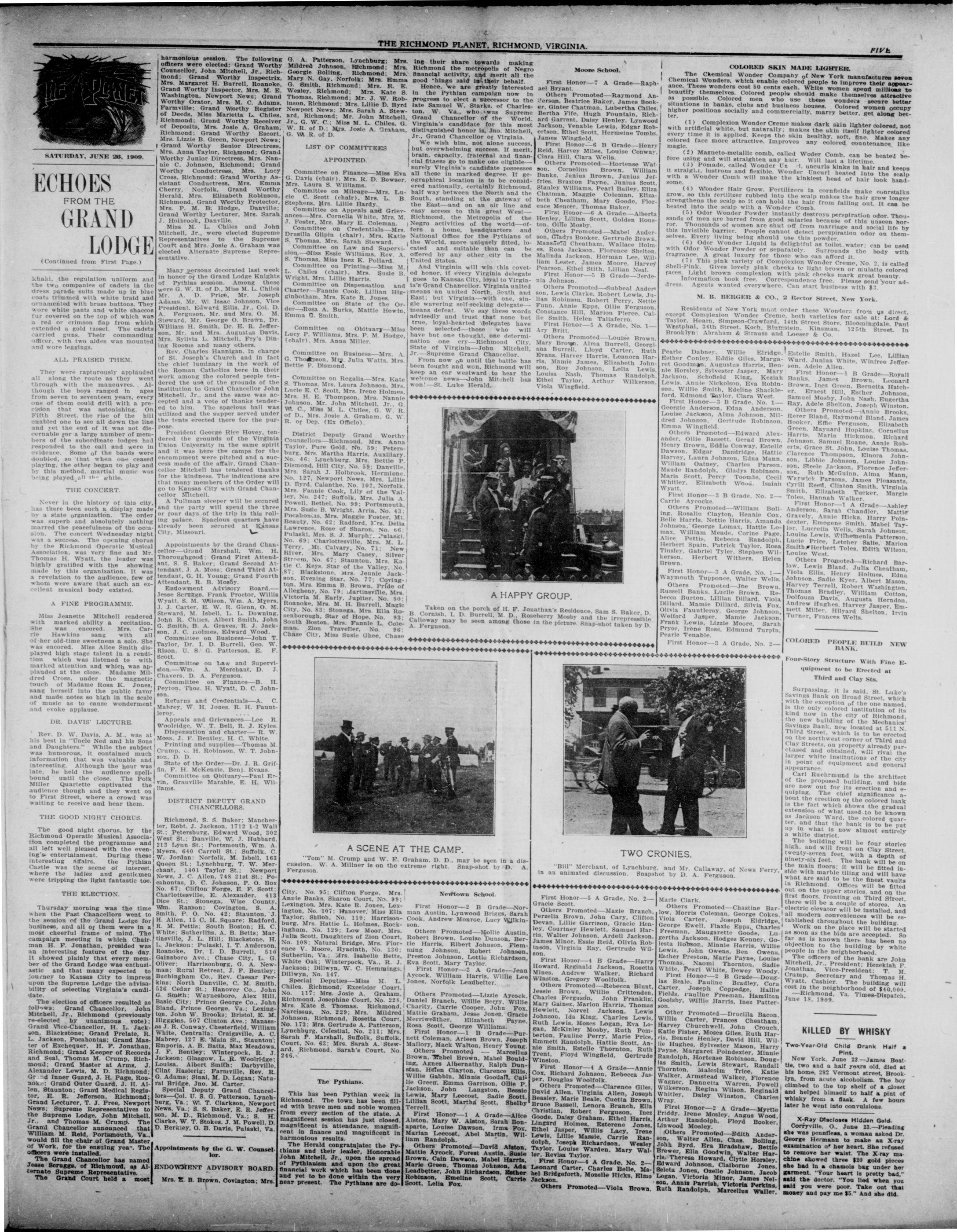
ECHOES FROM THE GRAND LODGE
KNIGHTS OF PYTHIAS HIGHLY COMMEND-ED
List of Appointments by the Grand Chancellor—Scenes at the Camp--Order Excellent.
White People Loud in Words of Commendation.
The public meeting of the Knights of Pythias, Tuesday night, June 15, 1909, was a grand affair. Grand Chancellor John Mitchell, Jr., presided. The scriptures were read by Rev. W. T. Johnson, D. D., and prayer was offered by Rev. W. F. Graham, D. D., pastor of the Fifth Street Baptist Church. The spacious edifice was crowded to the doors. The Fifth Street Baptist Church choir, under the leadership of Mr. A. McCoy, sang admirably well.
The recitation by Rev. D. W. Davis, A. M., was indeed a gem and it created unbounded amusement. His humorous allusions commanded instant favor and the retirement of the speaker was followed by vociferous applause. Dr. Q. W. Moon rendered a solo with a power and with a pathos that also greatly pleased the audience.
Mrs. Marion Morris, Mrs. Carrie Coleman Hawkins, sang well and greatly pleased the audience. Mr. Eugene Griffis, Mr. Walter Scott also took part and Mrs. Olivia Bolden presided at the plano with an ease and with that grace that has always won favor.
COL. CRUMP SANG.
The solo by Col. Thomas M. Crump was fine, and he acquitted himself in a manner that occasioned much favorable comment. Despite his arduous duties, he was in fine form.
A surprise was sprung when Miss Eva Graham, the accomplished daughter of Rev. W. F. Graham, D. D., who has been attending Howard University rendered a musical selection by request. She displayed a charming familiarity with the keys of the piano, and at the conclusion was rapturously applauded.
THE POLK MILLER QUARTETTE
Grand Chancellor John Mitchell, Jr., presided throughout the exercises and instead of delivering an expected address contented himself with making humorous allusions as he introduced those who had kindly consented to appear upon the programme.
When the Polk Miller Quartette was introduced, there was prolonged applause and as the members of it sang, there was a commotion among the listeners. The old time melodies awakened memories of the past and caused an enthusiastic outburst of applause, as those who had listened clamored for more of the same kind. They would not be denied and again the soft melodies of the singers floated away out over the audience and then died upon the air.
CALLED BACK AGAIN
They returned once more and then sought refuge in flight for the quartette was scheduled to appear on First Street, where amusements were also in evidence. The benediction was announced and then all filed out voicing naught, but praise for the entertainers and the entertainment committee.
THE PARADE REVIEWED
We have previously described the parade, but it is but fitting to describe the scene at the Broad Street Baseball Park, on Wednesday afternoon. Brigadier General John Mitchell, Jr., and his staff and Col. Thomas M. Crump and his staff had turned their horses aside in front of Richmond College, on Franklin Street, and for the first time the commanding officer realized the magnitude of the undertaking and the magnificene of the phalanx of which he formed a part. Company after company and band after band passed before him. Hurrying to the Broad Street Baseball Park, a remarkable sight met his gaze.
A MOVING PICTURE SCENE.
A photographer with a moving
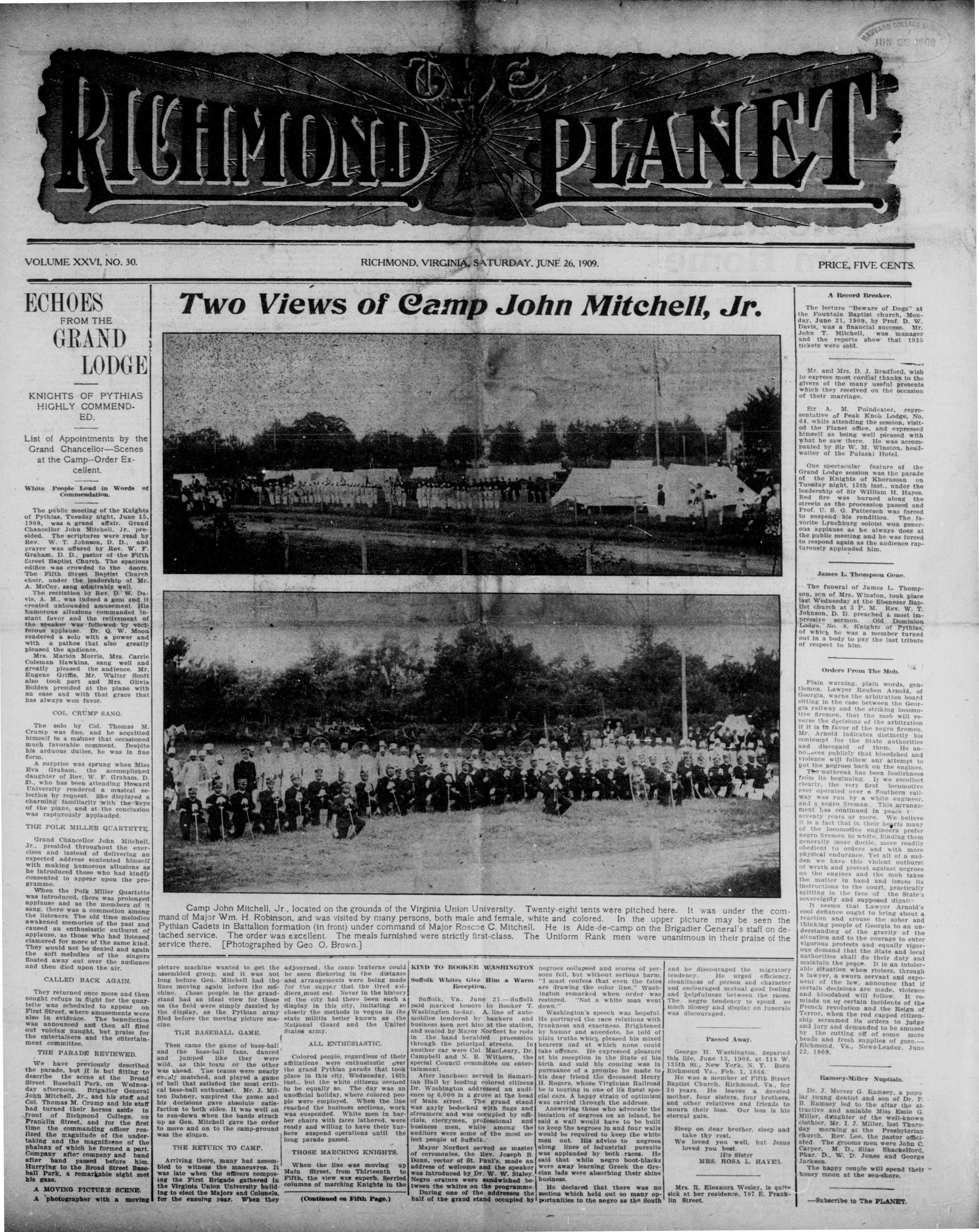
Two Views of Camp John Mitchell, Jr.
THE MILITARY CAMP
Camp John Mitchell, Jr., located on the grounds of the Virginia Union University. Twenty-eight tents were pitched here. It was under the command of Major Wm. H. Robinson, and was visited by many persons, both male and female, white and colored. In the upper picture may be seen the Pythian Cadets in Battalion formation (in front) under command of Major Roscoe C. Mitchell. He is Aide-de-camp on the Brigadier General's staff on detached service. The order was excellent. The meals furnished were strictly first-class. The Uniform Rank men were unanimous in their praise of the service there. [Photographed by Geo O. Brown.]
Camp John Mitchell, Jr., located on the grounds of the Virginia Union University. Twenty-eight tents were pitched here. It was under the command of Major Wm. H. Robinson, and was visited by many persons, both male and female, white and colored. In the upper picture may be seen the Pythian Cadets in Battalion formation (in front) under command of Major Roscoe C. Mitchell. He is Aide-de-camp on the Brigadier General's staff on detached service. The order was excellent. The meals furnished were strictly first-class. The Uniform Rank men were unanimous in their praise of the service there. [Photographed by Geo O. Brown.]
picture machine wanted to get the assembled group, and it was not long before Gen. Mitchell had the lines moving again before the machine. Those people in the grandstand had an ideal view for those on the field were simply dazzled by the display, as the Pythian army filed before the moving picture machine.
TLE BASEBALL GAME.
Then came the game of base-ball and the base-ball fans, danced and jumped like they were wild, as this team or the other was ahead. The teams were nearly evally matched, and played a game of ball that satisfied the most critical base-ball enthusiast. Mr. J. Milton Dabney, umpired the game and his decisions gave absolute satisfaction to both sides. It was well on to sun-down when the bands struck up as Gen. Mitchell gave the order to move and on to the camp-ground was the slogan.
THE RETURN TO CAMP.
Arriving there, many had assembled to witness the maneuvers. It was late when the officers composing the First Brigade gathered in the Virginia Union University building to elect the Majors and Colonels, for the ensuing year. When they
adjourned, the camp lanterns could be seen flickering in the distance and arrangements were being made for the supper that the tired soldiers must eat. Never in the history of the city had there been such a display in this city, imitating so closely the methods in vogue in the state militia better known as the National Guard and the United States army.
ALL ENTHUSIASTIC.
Colored people, regardless of their affiliations were enthusiastic over the grand Pythian parade that took place in this city, Wednesday, 16th inst., but the white citizens seemed to be equally so. The day was an unofficial holiday, where colored people were employed. When the line reached the business sections, work was suspended. White men in barber chairs with faces lathered, were ready and willing to have their barbers suspend operations until the long parade passed.
THOSE MARCHING KNIGHTS.
When the line was moving up Main Street, from Thirteenth to Fifth, the view was superb. Serried columns of marching Knights in the
(Continued on Fifth Page.)
KIND TO BOOKER WASHINGTON
Suffolk Whites Give Him a Warm Reception.
Suffolk, Va., June 21.—Suffolk paid marked honors to Booker T. Washington to-day. A line of automobiles tendered by bankers and business men met him at the station, and seated by Mayor Norfleet he rode in the band heralded procession through the principal streets. In another car were Col. MacLeary, Dr. Campbell and N. R. Witers, the special Council committee on entertainment.
After luncheon served in Samaritan Hall by leading colored citizens Dr. Washington addressed an audience or 6,000 in a grove at the head of Main street. The grand stand was gayly bedecked with flags and streamers, and was occupied by officials, clergymen, professional and business men, while among the auditors were some of the most select people of Suffolk.
Mayor Norfleet served as master of ceremonies, the Rev. Joseph B. Dunn, rector of St. Paul's, made an address of welcome and the speaker was introduced by Dr. W. W. Staley. Negro orators were sandwiched between the whites on the programme.
During one of the addresses the
During one of the addresses the half of the grand stand occupied by
negroes collapsed and scores of persons fell, but without serious harm. "I must confess that even the fates are drawing the color line." Washington remarked when order was restored. "Not a white man went down."
Washington's speech was hopeful. He portrayed the race relations with frankness and exactness. Brightened by humor and anecdote, he told of plain truths which pleased his mixed hearers and at which none could take offence. He expressed pleasure at his reception in the State of his birth and said his coming was in pursuance of a promise he made to his dear friend the deceased Henry H. Rogers, whose Virginian Railroad he is touring in one of its finest special cars. A happy strain of optimism was carried through the address.
Answering those who advocate the isolation of negroes on an island, he said a wall would have to be built to keep the negroes in and four walls would be required to keep the white men out. His advice to negroes along lines of industrial pursuits was applauded by both races. He said that while negro boot-blacks were away learning Greek the Grecian lads were absorbing their shine business.
He declared that there was no section which held out so many opportunities to the negro as the South
and he discouraged the migratory tendency. He urged efficiency, cleanliness of person and character and encouraged mutual good feelings and helpfulness between the races. The negro tendency to spend so much money and display on funerals was discouraged.
Passed Away
George H. Washington, departed this life, June 13, 1909, at 118 W. 135th St., New York, N. Y. Born Richmond Va., Feb. 1, 1866. He was a member of Fifth Street Baptist Church, Richmond, Va., for 20 years. He leaves a devoted mother, four sisters, four brothers, and other relatives and friends to mourn their loss. Our loss is his eternal gain.
Sleep on dear brother, sleep and take thy rest.
We loved you well, but Jesus
loved you best.
His Sister
MRS. ROSA L. HAYES.
Mrs. R. Eleanora Wesley, is quite sick at her residence, 707 E. Franklin Street.
PRICE, FIVE CENTS
A Record Breaker.
The lecture "Beware of Dogs" at the Fountain Baptist church, Monday, June 21, 1909, by Prof. D. W. Davis, was a financial success. Mr. John T. Mitchell, was manager and the reports show that 1035 tickets were sold.
Mr. and Mrs. D. J. Bradford, wish to express most cordial thanks to the givers of the many useful presents which they received on the occasion of their marriage.
Sir A. M. Poindexter, representative of Peak Knob Lodge, No. 64, while attending the session, visited the Planet office, and expressed himself as being well pleased with what he saw there. He was accompanied by Sir W. M. Winston, head-waiter of the Pulaski Hotel.
One spectacular feature of the Grand Lodge session was the parade of the Knights of Khorassan on Tuesday night, 15th inst., under the leadership of Sir William H. Hayes. Red fire was burned along the streets as the procession passed and Prof. U. S. G. Patterson was forced to suspend his rendition. The favorite Lynchbush soloist won generous applause as he always does at the public meeting and he was forced to respond again as the audience rapturously applauded him.
James L. Thompson Gone.
The funeral of James L. Thompson, son of Mrs. Winston, took place last Wednesday at the Ebenerer Baptist church at 3 P. M. Rev. W. T. Johnson, D. D. preached a most impressive sermon. Old Dominion Lodge, No. 8, Knights of Pythias, of which he was a member turned out in a body to pay the last tribute of respect to him.
Orders From The Mob
Plain warning, plain words, gentlemen. Lawyer Reuben Arnold, of Georgia, warns the arbitration board sitting in the case between the Georgia railway and the striking locomotive firemen, that the mob will reverse the decisions of the arbitration if it is in favor of the negro firemen. Mr. Arnold indicates distinctly his contempt for the State authorities and disregard of them. He announces publicly that bloodshed and violence will follow any attempt to put the negroes back on the engines. The outbreak has been foolishness from its beginning. If we recollect clearly, the very first locomotive ever operated over a Southern railway was run by a white engineer, and a negro fireman. This arrangement has continued in peace t
seventy years or more. We believe it is a fact that in their hearts many of the locomotive engineers prefer negro firemen to write, finding them generally more docile, more readily obedient to orders and with more physical endurance. Yet all of a sudden we have this violent outburst of wrath and protest against negroes on the engines and the mob takes the matter in hand and issues its instructions to the court, practically spitting in the face of the State's sovereignty and supposed dignity. It seems that Lawyer Arnold's cool defiance ought to bring about a reaction and arouse the sober and thinking people of Georgia to an understanding of the gravity of the situation and to the courage to enter vigorous protests and equally vigorous demand that the State and local authorities shall do their duty and maintain the peace. It is an intolerable situation when rioters, through a lawyer, a sworn servant and exponent of the law, announce that if certain decisions are made, violence and bloodshed will follow. It reminds us or certain incidents of the French revolution and the Reign of Terror, when the red capped citizenship screamed its orders to judge and jury and demanded to be amused by the cutting off of some more heads and fresh supplies of gore.—Richmond, Va., News-Leader, June 22, 1969.
Ramsey-Miller Nuptials
Dr. J. Mercer G. Ramsey, a popular young dentist and son of Dr. P. B. Ramsey led to the altar the attractive and amiable Miss Essie G. Miller, daughter of the well-known clothier, Mr. I. J. Miller, last Thursday morning at the Presbyterian church. Rev. Lee, the pastor officiated. The grooms men were John C. Carper, M. D. , Silas ShackelHord, Phar, D. , W. D. Jones and George Jackson. The happy couple will spend their honey moon at the sea-shore.
—Subscribe to The PLANET.
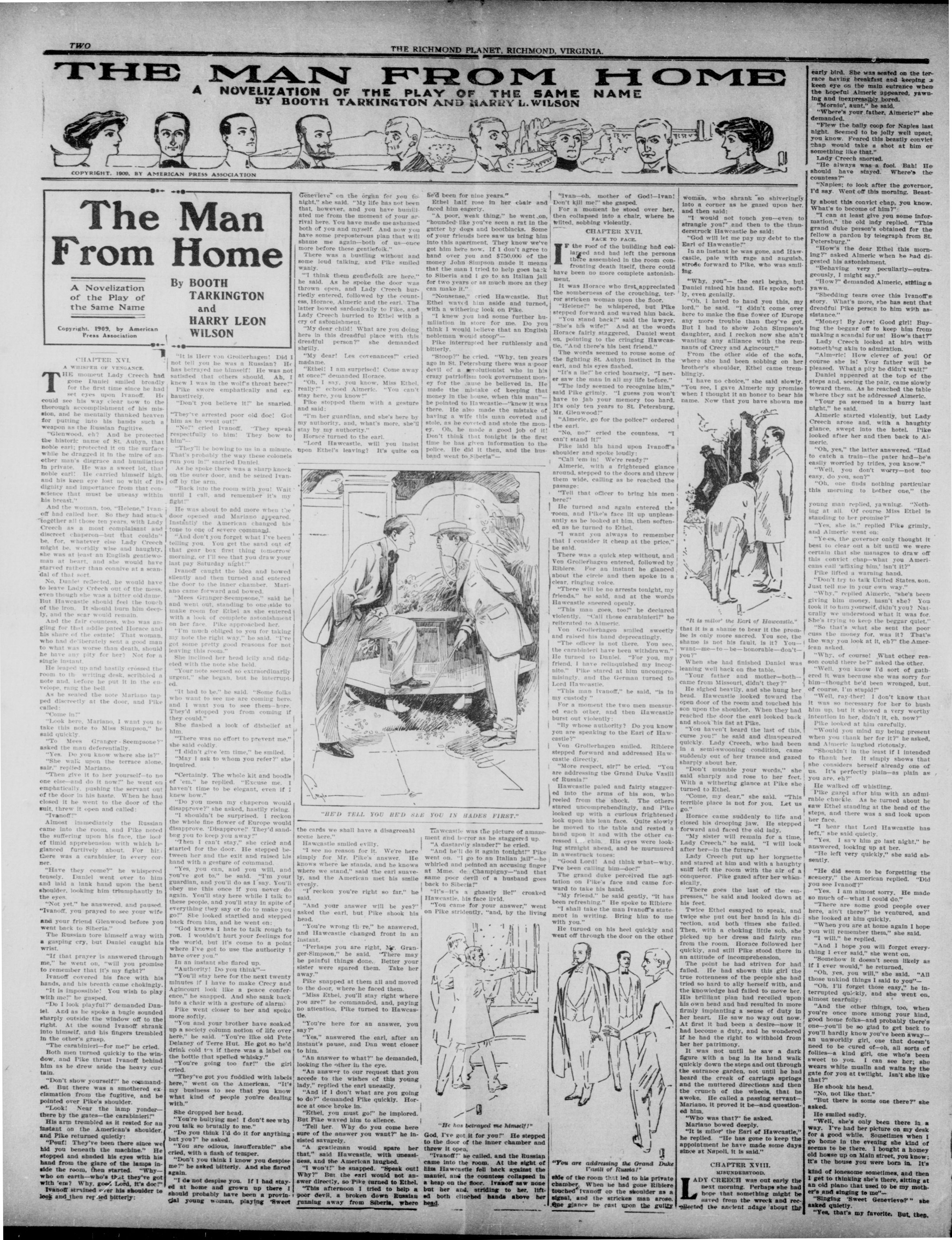
THE MAN FROM HOME A NOVELIZATION OF THE PLAY OF THE SAME NAME BY BOOTH TARKINGTON AND HARRY L. WILSON
COPYRIGHT 1909 BY AMERICAN PRINT CORPORATION
The Man From Home
A Novelization of the Play of the Same Name
Copyright, 1909, by American Press Association
CHAPTER XVI.
A WHISPER OF VENGANCE.
THE moment Lady Creech had gone Daniel smiled broadly for the first time since he had set eyes upon Ivanoff. He could see his way clear now to the thorough accomplishment of his mission, and he mentally thanked heaven for putting into his hands such a weapon as the Russian fugitive.
"Glenwood, eh? And he protected the historic name of St. Aubyn, that noble earl; protected it on the surface while he dragged it in the mire of another man's disgrace and humiliation in private. He was a sweet lot, that noble earl! He carried himself high, and his keen eye lost no whit of its dignity and importance from that conscience that must be uneasy within his breast."
And the woman, too, "Helene," Ivanoff had called her. So they had stuck together all those ten years, with Lady Creech as a most complaisant and discreet chaperon—but that couldn't be, for, whatever else Lady Creech might be, worldly wise and haughty, she was at least an English gentlewoman at heart, and she would have starved rather than countive at a scandal of that sort.
No, Daniel reflected, he would have to leave Lady Creech out of the mess, even though she was a bitter old dame. But Hawenastle should feel the touch of the iron. It should burn him deeply, and the scar would remain.
And the fair countess, who was angling for that addle pated Horace and his share of the estate! That woman, who had deliberately sent a good man to what was worse than death, should he have any pity for her? Not for a single instant.
He leaped up and hastily crossed the room to th' writing desk, scribbled a note and, before he put it in the envelope, ring the bell.
As he seated the note Mariano tapped discreetly at the door, and Pike called:
"Come in!"
"Look here, Mariano, I want you to take this note to Miss Simpson," he said quickly.
"To Mees Granger - Seempsone?" asked the man deferentially.
"Yes. Do you know where she is?"
"She walk upon the terrace alone, sair." replied Mariano.
"Then give it to her yourself—to no one else—and do it now!" he went on emphatically, pushing the servant out of the door in his haste. When he had closed it he went to the door of the suit, threw it open and called:
"Ivanoff!"
Almost immediately the Russian came into the room, and Pike noted the suffering upon his face, the look of timid apprehension with which he glanced furtively about. For him, there was a carabiner in every corner.
"Have they come?" he whispered tensely. Daniel went over to him and laid a lank hand upon the bent shoulder, looking him triumphantly in the eyes.
"Not yet," he answered, and paused. "Ivanoff, you prayed to see your wife and your friend Glenwood before you went back to Siberia."
The Russian tore himself away with a gasping cry, but Daniel caught his wrist.
"If that prayer is answered through me," he went on, "will you promise to remember that it's my fight?"
Ivanoff covered his face with his hands, and his breath came chokingly. "It is impossible! You wish to play with me!" he gasped. "Do I look playful?" demanded Daniel. And as he spoke a bugle sounded sharply outside the window off to the right. At the sound Ivanoff shrank into himself, and his fingers trembled in the other's grasp. "The carabinieri—for me!" he cried. Both men turned quickly to the window, and Pike thrust Ivanoff behind him as he drew aside the heavy curtain. "Don't show yourself!" he commanded. But there was a smothered exclamation from the fugitive, and he pointed over Pike's shoulder. "Look! Near the lamp yonder—there by the gates—the carabinieri!" His arm trembled as it rested for an instant on the American's shoulder, and Pike returned quietly:
"Pouf! They've been there since we hid you beneath the machine." He stopped and shaded his eyes with his hand from the glare of the lamps inside the room, then started. "Why—who on earth—who's that they've got with 'em? Why, goof, Lord, it's doc!" Ivanoff strained over his shoulder to look and then reaped bitterly:
"It is Herr von Grolterhagen! Did I not tell you he was a Russian? He has betrayed me himself! He was not satisfied that others should. Ah, I knew I was in the wolf's throat here!" Pike swore emphatically and exhaustively.
"Don't you believe it!" he snarled.
"They've arrested poor old doc! Got him as he went out!"
"No!" cried Ivanoff. "They speak respectfully to him! They bow to him"—
"They'll be bowing to us in a minute. That's probably the way these colonels run you in!" snarled Daniel.
As he spoke there was a sharp knock on the outer door, and he seized Ivanoff by the arm.
"Back into the room with you! Wait until I call, and remember it's my fight!"
He was about to add more when the door opened and Mariano appeared. Instantly the American changed his tone to one of severe command.
"And don't you forget what I've been telling you. You get the sand out of that gear box first thing tomorrow morning, or I'll see that you draw your last pay Saturday night."
Ivanoff caught the idea and bowed silently and then turned and entered the door to the inner chamber. Mariano came forward and bowed.
"Mees Granger-Seempone," said he and went out, standing to one side to make room for Ethel as she entered with a book of complete astonishment on her face. Pike approached her.
"I'm much obliged to you for taking my note the right way," he said. "I've got some pretty good reasons for not leaving this room."
She inclined her head icily and fidgeted with the note she held.
"Your note seemed so extraordinarily urgent," she began, but he interrupted.
"It had to be," he said. "Some folks who want to see me are coming here. and I want to see them—here. They'd stopped you from coming if they could."
She fhashed a look of disbelief at him.
"There was no effort to prevent me," she said coldly.
"I didn't give 'em time," he smiled.
"May I ask to whom you refer?" she inquired.
"Certainly. The whole kit and boodle of 'em," he replied. "Excuse me. I haven't time to be elegant, even if I knew how."
"Do you mean my chaperon would disapprove?" she asked, hastily rising.
"I shouldn't be surprised. I reckon the whole fine flower of Europe would disapprove. 'Disapprove!' They'd sand-big you to keep you away."
"Then I can't stay," she cried and started for the door. He stepped between her and the exit and raised his hand with a gesture of command.
"Yes, you can, and you will, and you've got to." he said. "I'm your guardian, and you'll do as I say. You'll obey me this once if you never do again. You'll stay here while I talk to these people, and you'll stay in spite of everything they say or do to make you go!" She looked startled and stepped back from him, and he went on:
"God knows I hate to talk rough to you. I wouldn't hurt your feelings for the world, but it's come to a point where I've got to use the authority I have over you."
In an instant she flared up.
"Authority! Do you think"—
"You'll stay here for the next twenty minutes if I have to make Crecy and Agincourt look like a peace conference," he snapped. And she sank back into a chair with a gesture of alarm. Pike went closer to her and spoke more softly.
"You and your brother have soaked up a society column notion of life over here," he said. "You're like old Pete Delaney of Terre Hut. He got so he'd drink cold tea if there was a label on the bottle that spelled whisky."
"You're going too far!" the girl cried.
"They've got you fuddled with labels here," went on the American. "It's my business to see that you know what kind of people you're dealing with."
She dropped her head.
"You're bullying me! I don't see why you talk so brutally to me."
"Do you think I'd do it for anything but you?" he asked.
"You are odious, insufferable!" she cried, with a fash of temper.
"Don't you think I know you despise me?" he asked bitterly. And she fared again.
"I do not despise you. If I had stayed at home and grown up there I should probably have been a provincial young woman, playing 'Sweet
THE RICHMOND PLANET, RICHMOND, VIRGINIA
P. G.
"HE'D TELL YOU HE'D SEE YOU IN HADES FIRST."
"Genevieve" on the organ for you tonight," she said. "My life has not been that, however, and you have humiliated me from the moment of your arrival here. You have made me ashamed both of you and myself. And now you have some preposterous plan that will shame me again—both of us—more before these gentlefolk."
There was a bustling without and some loud talking, and Pike smiled wanily.
"I think them gentlefolk are here," he said. As he spoke the door was thrown open, and Lady Creech hurriedly entered, followed by the countess, Horace, Almeric and the earl. The letter bowed sardonically to Pike, and Lady Creech hurried to Ethel with a cry of astonishment.
"My dear child! What are you doing here in this dreadful place with this dreadful person?" she demanded shrilly.
"My dear! Les covenances!" cried madame.
"Ethel! I am surprised! Come away at once!" denounced Horace.
"Oh, I say, you know, Miss Ethel, really!" echoed Almeric. "You can't stay here, you know."
Pike stopped them with a gesture and said:
"I'm her guardian, and she's here by my authority, and, what's more, she'll stay by my authority."
Horace turned to the earl.
"Lord Hawcastle, will you insist upon Ethel's leaving? It's quite on
"HE'D TELL YOU HE'D SA
the cards we shall have a disagreeable scene here."
Hawcastle smiled evily.
"I see no reason for it. We're here simply for Mr. Pike's answer. He knows where he stands, and he knows where we stand," said the earl suave-ly, and the American met his smile evenly.
"I reckon you're right so far," he said.
"And your answer will be yes?" asked the earl, but Pike shook his head.
"You're wrong there," he answered, and Hawcastle changed front in an instant.
"Perhaps you are right, Mr. Granger-Simpson," he said. "There may be painful things done. Better your sister were spared them. Take her away."
Pike snapped at them all and moved to the door, where he faced them.
"Miss Ethel, you'll stay right where you are!" he commanded, and, paying no attention, Pike turned to Hawcastle.
"You're here for an answer, you say?"
"Yes," answered the earl, after an instant's pause, and Dan went closer to him.
"An answer to what?" he demanded, looking the other in the eye.
"An answer to our request that you accede to the wishes of this young lady," replied the earl uneasily.
"And if I don't what are you going to do?" demanded Pike quickly. Horace at once broke in.
"Ethel, you must go!" he implored. But Pike waved him to silence.
"Tell her. Why do you come here sure of the answer you want?" he insisted savagely.
"A gentleman would spare her that," said Hawcastle, with uneasiness, and the American laughed.
"I won't!" he snapped. "Speak out Why?" But the earl would not answer directly, so Pike burned to Ethel. "This afternoon I tried to help a poor devil, a broken down Russian running away from Siberia, where
he'd been for nine years."
Ethel half rose in her chair and faced him eagerly.
"A poor, weak thing," he went on,
"hounded like you've seen a rat in the gutter by dogs and bootbacks. Some of your friends here saw us bring him into this apartment. They know we've got him here now. If I don't agree to hand over you and $750,000 of the money John Simpson made it means that the man I tried to help goes back to Siberia and I go to an Italian jail for two years or as much more as they can make it."
"Nonsense," cried Hawcastle. But Ethel waved him aside and turned, with a withering look on Pike.
"I knew you had some further humiliation in store for me. Do you think I would believe that an English nobleman would stoop"—
Pike interrupted her ruthlessly and bitterly.
"Stoop?!" he cried. "Why, ten years ago in St. Petersburg there was a poor devil of a revolutionist who in his crazy patriotism took government money for the cause he believed in. He made the mistake of keeping that money in the house, when this man"—he pointed to Hawcastle—"knew it was there. He also made the mistake of having a wife this man coveted and stole, as he coveted and stole the money. Oh, he made a good job of it! Don't think that tonight is the first time he has given information to the police. He did it then, and the husband went to Siberia"—
E YOU IN HADES FIRST."
Hawcastle was the picture of amazement and horror as he staggered up. "A dastardly slander!" he哭ed. "And he'll do it again tonight!" Pike went on. "I go to an Italian jail"—he whirled and pointed an accusing finger at Mme. de Champigny—"and that same poor devil of a husband goes back to Siberia." "It's- it's a ghastly lie!" croaked Hawcastle, his face livid. "You came for your answer" went on Pike stridently. "and, by the living
1
"He has betrayed me himself!"
God, I've got it for you!" He stepped to the door of the inner chamber and threw it open.
"Ivanoff" he called, and the Russian came into the room. At the sight of him Hawcastle fell back against the mantel, and the countess collapsed in a heap on the floor. Ivanoff saw none but her and, striding to her, lifted both clinched hands above her head.
"Ivan—oh, mother of God!—Ivan! Don't kill me!" she gasped. For a moment he stood over her, then collapsed into a chair, where he wilted, sobbing violently.
F the roof of the building had collared and had left the persons there assembled in the room con-
fronting death itself, there could have been no more complete astonishment.
It was Horace who first appreciated the somberness of the crouching, terror stricken woman upon the floor.
"Helene!" he whispered, but Pike stepped forward and waved him back.
"You stand back!" said the lawyer.
"She's his wife!" And at the words Horace fairly staggered. Daniel went on, pointing to the cringing Hawcastle.
"And there's his best friend."
The words seemed to rouse some of the fighting St. Aubyn instinct in the earl, and his eyes flashed.
"It's a lie!" he cried hoarsely.
"I never saw the man in all my life before."
The lady seemed to recognize him," said Pike grimly. "I guess you won't have to jab your memory too hard. It's only ten years to St. Petersburg, Mr. Glenwood." "Almeric, go for the police!" ordered the earl. "No, no!" cried the countess. "I can't stand it." Pike laid his hand upon Ivanoff's shoulder and spoke loudly: "Call em in! We're ready!" Almeric, with a frightened glance around, stepped to the doors and threw them wide, calling as he reached the passage: "Tell that officer to bring his men here!" He turned and again entered the room, and Pike's face lit up unpleasantly as he looked at him, then softened as he turned to Ethel. "I want you always to remember that I consider it cheap at the price," he said.
There was a quick step without, and Von Groellerhagen entered, followed by Ribiere. For an instant he glanced about the circle and then spoke in a clear, ringing voice.
"There will be no arrests tonight, my friends," he said, and at the words Hawcastle sneered openly.
"This man goes, too!" he declared violently, "Call those carabiner!!" he referrated to Almeric.
Von Groellerhagen smiled sweetly and raised his hand deprecatingly.
"The officer is not there. You see, the carabiner! have been withdrawn." He turned to Daniel. "For you, my friend, I have relinquished my incomprisingly, and the German turned to Lord Hawcastle.
"This man Ivanoff," he said, "is in my custody."
For a moment the two men measured each other, and then Hawcastle burst out violently:
"By whose authority? Do you know you are speaking to the Earl of Haw-castle?"
Von Grollterhagen smiled. Ribiere stepped forward and addressed Haw-castle directly.
"More respect, sir!" he cried. "You are addressing the Grand Duke Vasill of Russia!"
Haw-castle paled and fairly staggered into the arms of his son, who reeled from the shock. The others stared uncomprehendingly, and Pike looked up with a curious frightened look upon his lean face. Quite slowly he moved to the table and rested a hand upon it and with the other caressed i. chin. His eyes were looking straight ahead, and be murmured in awestruck tones:
"Good Lord! And think what—why, I've been calling him—doc!"
The grand duke perceived the agitation on Pike's face and came forward to take his hand.
"My friend," he said gently, "it has been refreshing." He spoke to Ribiere "I shall take the man Ivanoff's statement in writing. Bring him to me with you." He turned on his heel quickly and went off through the door on the other
I
"You are addressing the Grand Duke Vasilii of Russia!"
side of the room that led to his private chamber. When he had gone Riblere touched ivanoff on the shoulder as a signal, and the stricken man arose. One glance he cast upon the guilty
woman, who shrank so shiveringly into a corner as he gazed upon her, and then said: "I would not touch you—even to strangle you!" and then to the thunderstruck Hawcaste he said:
In an instant he was gone, and Haw-castle, pale with rage and anguish, stroke forward to Pike, who was smiling.
"Why, you"— the earl began, but Daniel raised his hand. He spoke softly, even genially.
"Oh, I hated to hand you this, my lord," he said. "I didn't come over here to make the fine flower of Europe any more trouble than they've got. But I had to show John Simpson's daughter, and I reckon now she ain't wanting all alliance with the remnants of Crecy and Agincourt."
From the other side of the sofa, where she had been sobbing on her brother's shoulder, Ethel came trembling.
"I have no choice," she said slowly. "You see, I gave Almeric my promise when I thought it an honor to bear his name. Now that you have shown me
A
"It is milior' the Earl of Hawcastle." that it is a shame to bear it the promise is only more sacred. You see, the shame is not his fault, is it? You—want me—to be—be honorable—don't you? When she had finished Daniel was leaning well back on the table. "Your father and mother—both—came from Missouri, didn't they?"
He sighed heavily, and she hung her head. Hawcastle looked toward the open door of the room and touched his son upon the shoulder. When they had reached the door the earl looked back and shook his fist at Pike.
"You haven't heard the last of this, curse you!" he said and disappeared quickly. Lady Creech, who had been in a semi-swooning condition, came suddenly out of her trance and gazed sharply about her.
"Don't mumble your words," she said sharply and rose to her feet. With a withering glance at Pike she turned to Ethel.
"Come, my dear," she said. "This terrible place is not for you. Let us go."
Horace came suddenly to life and closed his drooping jaw. He stepped forward and faced the old lady.
"My sister will remain for a time, Lady Creech," he said. "I will look after her—in the future."
Lady Creech put up her lorgnette and stared at him and with a haughty sniff left the room with the air of a conqueror. Pike gazed after her whimically.
"There goes the last of the empresses," he said and looked down at his feet.
Twice Ethel essayed to speak, and twice she put out her hand in his direction, and both times she failed. Then, with a choking little sob, she picked up her dress and fairly ran from the room. Horace followed her quickly, and still Pike stood there in an attitude of incomprehension.
The point he had striven for had failed. He had shown this girl the true rottenness of the people she had tried so hard to ally herself with, and the knowledge had failed to move her. His brilliant plan had recoubled in his own head and had resulted in more firmly implanting a sense of duty in her heart. He saw no way out now. At first it had been a desire—now it had become a duty, and he wondered if he had the right to withhold from her her parrimony.
It was not until he saw a dark figure with a bag in its hand walk quickly down the steps and out through the entrance garden, not until he had heard the creak of carriage springs and the muttered directions and then the crunch of the wheels, that he awoke. He called a passing servant—Mariano, it proved it be—and questioned him.
"Who was that?" he asked. Mariano bowed deeply.
"It is miller" the Earl of Hawcastle,
he replied. "He has gone to keep the
appointment he have made some days
since at Napoli, it is said."
CHAPTER XVIII.
MISUNDERSTOOD.
LADY CREECH was out early the next morning. Perhaps she had hope that something might be saved from the wreck and re-collected the ancient adage about the
early bird. She was seated on the terrace having breakfast and keeping a keen eye on the main entrance when the hopeful Almeric appeared, yawning and inexpressibly bored.
"Mornin', aunt," he said.
"Where's your father, Almeric?" she demanded.
"Flew the bally coop for Naples last night. Seemed to be jolly well upset, you know. Feared this beastly convict chap would take a shot at him or something like that."
Lady Creech snorted.
"He always was a fool. Bah! He should have stayed. Where's the countess?"
ly about this convict chap, you know. What's to become of him? "I can at least give you some information," the old lady replied. "This grand duke person's obtained for the fellow a pardon by telegraph from St. Petersburg." "How's the dear Ethel this morning?" asked Almeric when he had digested his astonishment. "Behaving very peculiarly—outrageously, I might say." "How?" demanded Almeric, stifling a yawn. "Shedding tears over this Ivanoff's story. What's more, she has sent that dreadful Pike person to him with assistance." "Money! By Jove! Good girl! Buying the begarg off to keep him from making a scandal for us! How's that?" Lady Creech looked at him with something skim to admira
"Almeric! How clever of youl Of course she is! Your father will be pleased. What a pity he didn't wait!"
Daniel appeared at the top of the steps and, seeing the pair, came slowly toward them. As he reached the table where they sat he addressed Almeric.
"Your pa seemed in a hurry last night," he said.
Almeric started violently, but Lady Creech arose and, with a baughty glance, swept into the hotel. Pike looked after her and then back to Almeric.
"Oh, yes," the latter answered. "Had to catch a train—the pater hd—he's easily worried by trifles, you know."
"Well, you don't worry—not too easy, do you, son?"
"Oh, one finds nothing particular this morning to bother one," the young man replied, yawning. "Nothing at all. Of course Miss Ethel is standing to her promise?"
"Yes, she is," replied Pike grimly, and Almeric went on:
"Ye-es, the governor only thought it best to clear out a bit until we were certain that she manages to draw off this convict chap—what you Americans call 'affixing him,' isn't it?"
Pike lifted a warning hand.
"Don't try to talk United States, son. Just tell me in your own way."
"So that's what she sent the poor cuss the money for, was it? That's the way you look at it, eh?" the American asked.
"Why, of course! What other reason could there be?" asked the other.
"Well, you know I'd sort of gathered it was because she was sorry for him—thought he'd been wrong, but, of course, I'm stupid!"
"Well, ray-ther! I don't know that it was so necessary for her to hush him up, but it showed a very worthy intention in her, didn't it, eh, now?"
Pike looked at him carefully.
"Would you mind my being present when you thank her for it?" he asked, and Almerie laughed riotously.
"Shouldn't in the least if I intended to thank her. It simply shows that she considers herself already one of us. It's perfectly plain—as plain as you are, eh?"
He walked off whistling.
Plike gazed after him with an admirable chuckle. As he turned about he saw Ethel standing at the head of the steps, and there was a sad look upon her face.
"I hear that Lord Hawcastle has left," she said quietly.
"Yes. I saw him go last night," he answered, looking up at her.
"He left very quickly," she said absently.
"He did seem to be forgetting the scenery," the American replied. "Did you see Ivanoff?"
"Yes. I am almost sorry. He made so much of—what I could do."
"There are some good people over here, ain't there?" he ventured, and she looked at him quickly.
"When you are at home again I hope you will remember them," she said.
"I will," he replied.
"And I hope you will forget everything I ever said," she went on.
"Oh, yes, you will," she said. "All those unkind things I said to vox."
things I said to you —
"Oh. I'll forget those easy," he interrupted quickly, and she went on, almost tearfully:
"And the other things, too, when you're once more among your kind, good home folks—and probably there's one—you'll be so glad to get back to you'll hardly know you've been away—an unworldly girl, one that doesn't need to be cured of—oh, all sorts of follies—a kind girl, one who's been sweet to you. I can see her; she wears white muslin and wafts by the gate for you at twilight. Isn't she like that?"
He shook his head.
"No, not like that."
"But there is some one there?" she asked.
He smiled sadly.
"Well, she's only been there in a way. I've had her picture on my desk for a good while. Sometimes when I go home in the evening she kind of seems to be there. I bought a homey old house up on Main street, you know; it's the house you were born in. It's kind of lonesome sometimes, and then I get to thinking she's there, sitting at an old piano that used to be my mother's and singing to me"—
"Singing 'Sweet Genevieve?' she asked quietly.
"Yes, that's my favorite. But then
THE PLANET
SATURDAY, JUNE 26, 1909.
I come to and I find it ain't so. No voice comes to me, and I find there ain't nobody but me"—
"You'll find her some day," she put in quickly. "I shall think of you often with her listening to her voice in the
A
"You'll find her some day."
twilight. And I shall be far away, keeping the promise that I have made and living out—my destiny."
"What destiny?" he asked gravely.
"I am bound to Almeric by his misfortune. He has to bear a name that is disgraced, and it is my duty to help him bear it—to help him make it honorable again, to inspire him in the
R.
C.
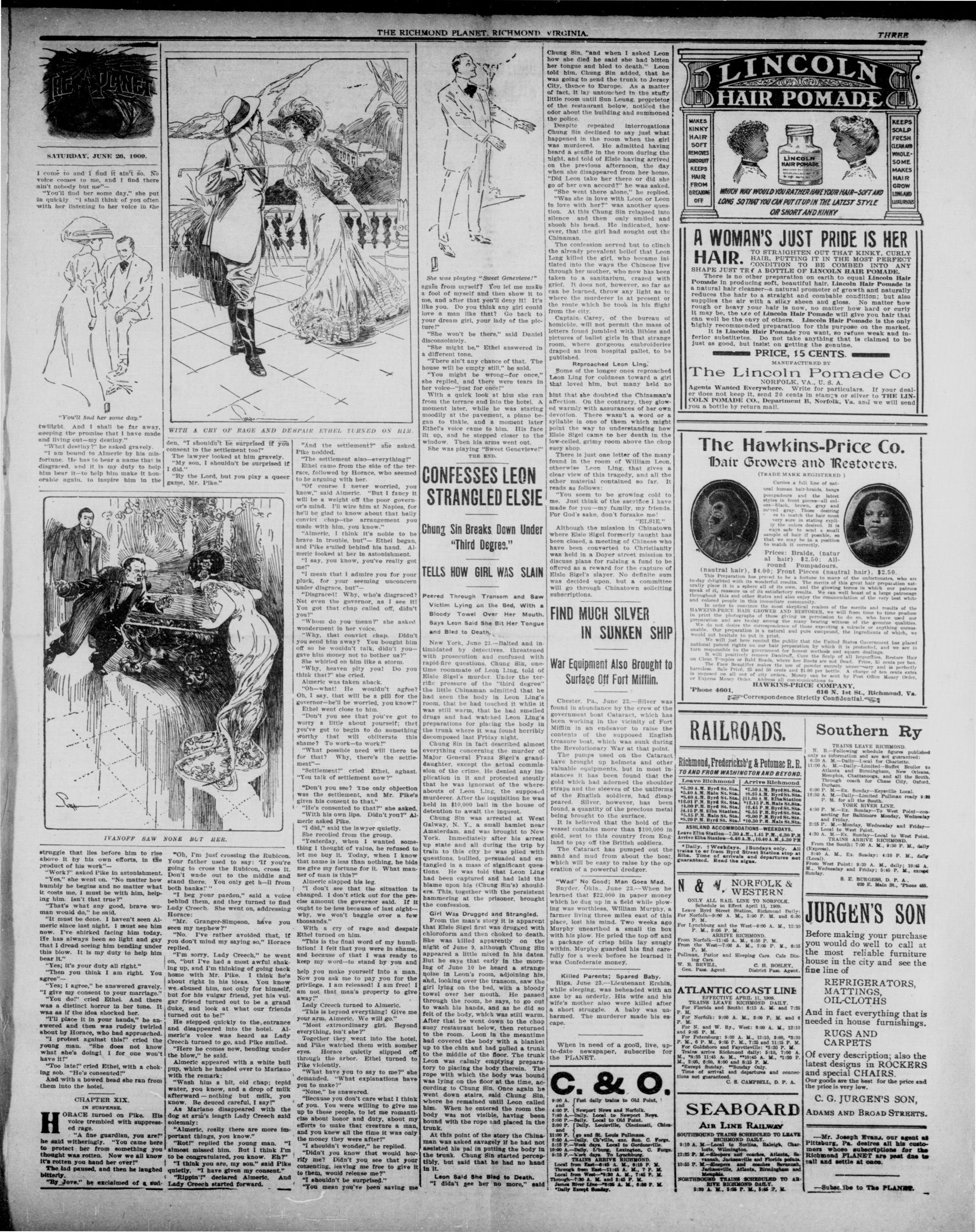
IVANOFF SAW NONE BUT HER.
struggle that lies before him to rise above it by his own efforts, in the product of his work”—
“Work?” asked Pike in astonishment,
“Yes,” went on. “No matter how humbly he begins and no matter what it costs me, I must be with him, helping him. Isn’t that true?”
“That’s what any good, brave woman would do,” he said.
“It must be done. I haven’t seen Almeric since last night. I must see him now. I’ve shirked facing him today. He has always been so light and gay that I dread seeing him bending under this blow. It is my duty to help him bear it.”
“Yes; it’s your duty all right.”
“Then you think I am right. You agree”—
“Yes; I agree,” he answered gravely.
“I give my consent to your marriage.”
“你 do!” cried Ethel. And there was a distinct horror in her tone. It was as if the idea shocked her.
"I'll place it in your hands," he answered and then was rudely twirled about by Horace, who had approached.
"I protest against this!" cried the young man. "She does not know what she's doing! I for one won't have it."
"Too late!" cried Ethel, with a choking sob. "He's consented."
And with a bowed head she ran from them into the hotel.
CHAPTER XIX IN SUSPENSE.
HORACE turned on Pike. His voice trembled with suppressed rage.
"A fine guardian, you are!" he said witheringly. "You came here to protect her from something you thought was rotten. Now we all know it's rotten you hand her over!"
The lad paused, and then he laughed bitterly.
"By Jove," he exclaimed of a sud-
C.
den. "I shouldn't be surprised if you consent to the settlement tool!" The lawyer looked at him gravely. "My son, I shouldn't be surprised if I did." "By the Lord, but you play a queer game, Mr. Pike."
"And the settlement?" she asked Pike nodded. "The settlement also—everything!" Ethel came from the side of the terrace, followed by Horace, who seemed to be arguing with her.
"Oh, I'm just crossing the Rubicon. Your father used to say: 'If you're going to cross the Rubicon, cross it. Don't wade up to the middle and stand there. You only get h—ll from both banks!'"
"I beg your pardon," said a voice behind them, and they turned to find Lady Creech. She went on, addressing Horace:
"Mr. Granger-Simpson, have you seen my nephew?"
"No. I've rather avoided that, if you don't mind my saying so." Horace replied.
"I sorry, Lady Creech," he went on, "but I've had a most awful shaking up, and I'm thinking of going back home with Mr. Pike. I think he's about right in his ideas. You know we abused him, not only for himself, but for his vulgar friend, yet his vulgar friend turned out to be a grand duke, and look at what our friends turned out to be!"
He stepped quickly to the, entrance and disappeared into the hotel. Almerie's voice was heard as Lady Creech turned to go, and Pike smiled. "Here he comes now, bending under the blow," he said. Almerie appeared with a white bull pup, which he handed over to Mariano with the remark:
As Marlano disappeared with the dog at arm's length Lady Creech said solemnly:
"Almeric, really there are more important things, you know."
"Rot!" replied the young man. "I almost missed him. But I think I'm to be congratulated, you know. Eh?"
"I think you are, my son." said Pike quietly. "I have given my consent."
"Rippin!" declared Almeric. And Lady Creech started forward.
THE RICHMOND PLANET. RICHMOND VIRGINIA
"And the settlement?" she asked. Pike nodded.
"The settlement also—everything!"
Ethel came from the side of the terrace, followed by Horace, who seemed to be arguing with her.
"Of course I never worried, you know," said Almeric. "But I fancy it will be a weight off the poor governor's mind. I'll wire him at Naples, for he'll be glad to know about that bally convict chap—the arrangement you made with him, you know."
"Almeric, I think it's noble to be brave in trouble, but"—Ethel began, and Pike smiled behind his hand. Almeric looked at her in astonishment.
"I say, you know, you've really got me"
"I mean that I admire you for your pluck, for your seeming unconcern under disgrace, but"—
"Disgraced! Why, who's disgraced? Not even the governor, as I see it! You got that chap called off, didn't you?"
"Whom do you mean?" she asked
wonderment in her voice.
"Why, that convict chap. Didn't
you send him away? You bought him
off so he wouldn't talk, didn't you-
gave him money not to bother us?"
She whirled on him like a storm.
"Why, heaven pity you! Do you
think that?" she cried.
Almeric was taken aback.
"Oh—what! He wouldn't agree? Oh, I say, that will be a pill for the governor—he'll be worried, you know!"
Ethel went close to him.
"Don't you see that you've got to worry a little about yourself; that you've got to begin to do something worthy that will obliterate this shame? To work—to work!"
"What possible need will there be for that? Why, there's the settlement!"
"Settlement!" cried Ethel, aghast.
"You talk of settlement now?"
"Don't you see? The only objection was the settlement, and Mr. Pike's given his consent to that."
"He's consented to that?" she asked.
"With his own lips. Didn't you?" Almeric asked Pike.
"I did," said the lawyer quietly.
She recoiled from the group.
"Testerday, when I wanted something I thought of value, he refused to let me buy it. Today, when I know that name is less than nothing, he bids me give my fortune for it. What manner of man is this?" Almeric slapped his leg.
Mimerie skipped his leg.
"I don't see that the situation is changed. I don't stick out for the precise amount the governor said. If it ought to be less because of last night—why, we won't haggle over a few thousands."
With a cry of rage and despair Ethel turned on him.
"This is the final word of my humiliation! I felt that you were in shame, and because of that I was ready to keep my word—to stand by you and help you make yourself into a man. Now you ask me to pay you for the privilege. I am released! I am free! I am not that man's property to give away."
Lady Creech turned to Almeric.
"This is beyond everything! Give me your arm. Almeric. We will go."
"Most extraordinary girl. Beyond everything, isn't she?"
Together they went into the hotel, and Pike watched them with somber eyes. Horace quietly slipped off through the arbor. Ethel turned to Pike violently.
"What have you to say to me?" she demanded. "What explanations have you to make?"
"None," he answered.
"Because you don't care what I think of you. You were willing to give me up to these people, to let me romantically about honor and duty, about my efforts to make that creature a man, and you knew all the time it was only the money they were after!"
"I shouldn't wonder," he replied.
"Didn't you know that would horrify me? Didn't you see that your consenting, leaving me free to give it to them, would release me?"
"I shouldn't be surprised."
"You mean you've been saving me
I
She was playing "Sweet Genevieve!" again from myself? You let me make a fool of myself and then show it to me, and after that you'll deny it! It's like you. Do you think any girl could love a man like that? Go back to your dream girl, your lady of the picture."
"She won't be there," said Daniel disconciolately.
"She might be," Ethel answered in a different tone.
"There isn't any chance of that. The house will be empty still," he said.
"You might be wrong—for once," she replied, and there were tears in her voice—"just for once."
With a quick look at him she ran from the terrace and into the hotel. A moment later, while he was staring moodily at the pavement, a piano began to tinkle, and a moment later Ethel's voice came to him. His face lit up, and he stepped closer to the window. Then his arms went out.
She was playing "Sweet Genevieve!"
CONFESSES LEON STRANGLED ELSIE
Chung Sin Breaks Down Under "Third Degrees."
TELLS HOW GIRL WAS SLAIN
Peered Through Transom and Saw Victim Lying on the Bed, With a Bloody Towel Over Her Mouth. Says Leon Tail She Bit Her Tongue and Bled to Death.
New York, June 23—Balted and intimidated by detectives, threatened with prosecution and confused with rapid-fire questions, Chung Sin, one-time roommate of Leon Ling, told of Elsie Sigel's murder. Under the terrific pressure of the "third degree" the little Chinaman admitted that he had seen the body in Leon Ling's room, that he had touched it while it was still warm, that he had smelled drugs and had watched Leon Ling's preparations for placing the body in the trunk where it was found horribly decomposed last Friday night.
Chung Sin in fact described almost everything concerning the murder of Major General Franz Sigel's granddaughter, except the actual commission of the crime. He denied any implication in it and protested stoutly that he was ignorant of the whereabouts of Leon Ling, the supposed murderer. After the inquisition he was held in $10,000 bail in the house of detention to await the inquest.
Chung Sin was arrested at West Galway, N. Y., a small hamlet near Amsterdam, and was brought to New York. Immediately after his arrest up state and all during the trip by train to this city he was plied with questions, bullied, persuaded and entangled in a mass of significant questions. He was told that Leon Ling had been captured and had laid the blame upon his (Chung Sin's) shoulders. This, together with the persistent hammering at the prisoner, brought the confession.
Girl Was Drugged and Strangled.
From the man's story it is apparent that Elsie Sigel first was drugged with chloroform and then choked to death. She was killed apparently on the night of June 9, although Chung Sin appeared a little mixed in his dates. But he says that early in the morning of June 10 he heard a strange noise in Leon's room, adjoining his, and, looking over the transom, saw the girl lying on the bed, with a bloody towel over her mouth. He passed through the room, he says, to go out to wash his hands, and as he did so felt of the body, which was still warm. After that he went down to the chop suet restaurant below, then returned to the room. Leon in the meantime had covered the body with a blanket up to the chin and had pulled a trunk to the middle of the floor. The trunk Leon was calmly emptying preparatory to placing the body therein. The rope with which the body was bound was lying on the floor at the time, according to Chung Sin. Once again he went down stairs, said Chung Sin, where he remained until Leon called him. When he entered the room the body was not visible, having been bound with the rope and placed in the trunk.
At this point of the story the Chinaman was asked savagely if he had not assisted his pal in putting the body in the trunk. Chung Sin started perceptibly, but said that he had no hand in it.
Leon Said She Blied to Death.
"I didn't see her no more," said
Chung Sin. "and when I asked Leon how she died he said she had bitten her tongue and bled to death." Leon told him, Chung Sin added, that he was going to send the trunk to Jersey City, thence to Europe. As a matter of fact, it lay untouched in the stuffy little room until Sun Leung, proprietor of the restaurant below, noticed the odor about the building and summoned the police.
Despite repeated interrogations Chung Sin declined to say just what happened in the room when the girl was murdered. He admitted having heard a scuffle in the room during the night, and told of Elsie having arrived on the previous afternoon, the day when she disappeared from her home. "Did Leon take her there or did she go of her accord?" he was asked.
She weet there alone, he replied. "Was she in love with Leon or Leon in love with her?" was another question. At this Chung Sin relapsed into silence and then only smiled and shook his head. He indicated, however, that the girl had sought out the Chinaman. The confession served but to clinch the already prevalent belief that Leon Ling killed the girl, who became initiated into the ways the Chinese live through her mother, who now has been taken to a sanitarium, crazed with grief. It does not, however, so far as can be learned, throw any light as to where the murderer is at present or the route which he took in his flight from the city.
Captain Carey, of the bureau of homicide, will not permit the mass of letters found jumbled with Bibles and pictures of ballet girls in that strange room, where gorgeous embroideries draped an iron hospital pallet, to be published.
Some of the longer ones reproached Leon Ling for coldness toward a girl that loved him, but many held no hint that she doubted the Chinaman's affection. On the contrary, they glowed warmly with assurances of her own devotion. There wasn't a word or a syllable in one of them which might point the way to understanding how Elsie Sigel came to her death in the low-ceiled, grimy room above the chop suey shop.
There is just one letter of the many found in the room of William Leon, otherwise Leon Ling, that gives a clear view of this tragedy, and all the other material contained so far. It reads as follows:
"You seem to be growing cold to me. Just think of the sacrifice I have made for you—my family, my friends. For God's sake, don't forsake me!"
Although the mission in Chinatown where Elsie Sigel formerly taught has been closed, a meeting of Chinese who have been converted to Christianity was held in a Doyer street mission to discuss plans for raising a fund to be offered as a reward for the capture of Elsie Sigel's slayer. No definite sum was decided upon. but a committee will go through Chinatown soliciting subscriptions.
FIND MUCH SILVER IN SUNKEN SHIP
FIND MUCH SILVER IN SUNKEN SHIP
War Equipment Also Brought to Surface Off Fort Mifflin.
Chester, Pa., June 23.—Silver was found in abundance by the crew of the government boat Cataract, which has been working in the vicinity of Fort Mifflin in an endeavor to raise the contents of the supposed English treasure boat, which was sunk during the Revolutionary War at that point. The pumps used on the Cataract have brought up helmets and other valuable equipments, but in most instances it has been found that the gold which had adorned the shoulder straps and the sleeves of the uniforms of the English soldiers, had disappeared. Silver, however, has been found, a quantity of the precious metal being brought to the surface.
It is believed that the hold of the vessel contains more than $100,000 in gold, sent to this country from England to pay off the British soldiers. The Cataract has pumped out the sand and mud from about the boat, which will be easy to raise by the operation of a powerful dredger.
"Wad" No Good; Man Goes Mad.
Snyder, Ökla., June 23—When he learned that $22,000 in paper money which he dug up in a field while plowing was worthless, William Murphy, a farmer living three miles east of this place, lost his mind. Two weeks ago Murphy unearthed a small tin box with his plow. He pried the top off and a package of crisp bills lay snugly within. Murphy guarded his find carefully for a week before he learned it was Confederate money.
Killed Parents; Spared Baby.
Riga, June 23—Lieutenant Ershin, while sleeping, was beheaded with an axe by an orderly. His wife and his wife's mother also were killed after a short struggle. A baby was unharmed. The murderer made his escape.
When in need of a good, live, up-to-date newspaper, subscribe for the PLANET. C. & O.
9:0 A. *Fast daily trains to Old Point,*
and
4:0 P. *Newport News and Norfolk.*
1:0 A. *Daily. Local to Newport News.*
2:0 P. *Daily. Old Point, Ohio.*
2:0 P. *Daily. Louisville, Cincinnati, Chica*
and
11:0 P. *go and St. Louis Pullman.*
1:0 A. *Daily. D'ville, exc. Sun. C. Forge.*
10:0 A. *Daily. L'burg, Lexington. C. Forge.*
15:1 P. *Week days. To Lynchburg.*
TRAINS ARRIVE RICHMOND.
Local from East-8:45 A. M. 6:15 P. M.
Through from East-11:45 A. M. 7 P. M.
Local from West-8:45 A. M. 7:45 P. M.
Local from East-9:30 A. M. 7:45 P. M.
James River Line-8:35 A. M. 6:50 P. M.
*Daily Exceed Sunday.*
LINCOLN
HAIR POMADE
MAKES
KINKY
HAIR
SOFT
REMOVES
DANDRUFT
KEEPS
HAIR
FROM
BREAKING
OFF
LINCOLN
HAIR POMADE
KEEPS
SCALP
FRESH
CLEAN AND
WHOLE-
SOME
MAKES
HAIR
GROW
LONG AND
LUXURIOUS
WHICH WAY WOULD YOU RATHER HAVE YOUR HAIR-SOFT AND
LONG SO THAT YOU CAN PUT IT UP IN THE LATEST STYLE
OR SHORT AND KINNY
A WOMAN'S JUST PRIDE IS HER
HAIR. TO STRAIGHTEN OUT THAT KINKY, CURLY
HAIR, PUTTING IT IN THE MOST PERFECT
CONDITION TO BE COMBED INTO ANY
SHAPE JUST TRE C A BOTTLE OF LINCOLN HAIR POMADE.
There is no other preparation on earth to equal Lincoln Hair Pomade in producing soft, beautiful hair. Lincoln Hair Pomade is a natural hair cleanser-a natural promoter of growth and naturally reduces the hair to a straight and combable condition; but also supplies the air with a silky sheen and gloss. No matter how rough or heavy your hair is now, no matter how hard or curly it may be, the use of Lincoln Hair Pomade will give you hair that can well be the envy of others. Lincoln Hair Pomade is the only highly recommended preparation for this purpose on the market.
It is Lincoln Hair Pomade you want, so refuse weak and inferior substitutes. Do not take anything that is claimed to be just as good, but insist on getting the genuine.
Agents Wanted Everywhere. Write for particulars. If your dealer does not keep it, send 20 cents in stamps or silver to THE LIN-COLN POMADE CO., Department B, Norfolk, Va, and we will send you a bottle by return mail.
The Hawkins-Price Co. Hair Growers and Restorers.
(TRADE MARK REGISTERED)
Carries a full line of natural human hair-braids, bangs pompadeaux and the latest styles in front pieces, all colors—black, brown, gray and mixed gray. Those desiring es to match the hair must very sure in stating expli- cious colors desired. It is ways safe to tailor a small sample of hair if possible, so that we may be in a position to match it correctly.
Prices: Braids, (natur al hair) $2.50; All- round Pompadeaux.
(nautral hair), $4.00; Front Hair
This Preparation has proved to be a t-o-day delighted with its wonderful results. urable place it in a sphere all of its own, a speak of a residue to no in patio space throughout this and other States and also en- colored people in this immediate comm in order to convince the most skeptic HAWKINS-PRIS HAWKINS-PRIS in print the photographs of those giving preparation and are to-day among the man. We do not desire the correspondence of the on our preparation is a natural and i would not hesitate to renew ANE We will just here remind the public of national patent rights on our hair preparation turn responsible to the government for home on Clean Temples or Bald Houses where the Face Beautifier makes the use of a hairless, Sale Prick, 25 and 50 cents and it is imposed on all of our city orders. Mon or Expe- lence Money Order, Address, all countries
HAWKINS-PRIS
'Phone 4601, Correspondence S
(nautral hair), $4.00; Front Pieces (nautral hair), $2.50.
This Preparation has proved to be a fortune to many of the unfortunate, who are today delighted with its wonderful results. The merits of this great hair preparation naturally place it in a sphere all of its own, and the glowing terms in which our patrons speak about it are satisfactory results. We can well boast of a large patronage throughout this and other States, and the commendation of the very best white and colored people in this immediate community.
In order to convince the most skeptical readers of the merits and results of the HAWKINS-PRICE HAIR GROWER AND RESTOREER, we will from time to time produce in our shop those giving us permission to do so, who have used our preparation and are today among the many who are delighting in the genuine qualities. We do not desire the correspondence of those expecting to do anything unreasonable. Our preparation is a natural and pure compound, the ingredients of which, we would not hesitate to put in print. The public that the United States Government has placed national patent rights in preparation by which it is protected, and we are in turn responsible to the government for honest methods of selling.
It will positively remove Dandruff, Cure the Scalp of all Impurities, Restore Hair on Clean Tremples or Bald Heads, where hee Roots are not Dead. Price, $3 per box. Our dealer makes the use of powder entirely unnecessary and is perfectly harmless. Sale Price. A charge of ten cents extra is imposed on all out of city orders. Money can be billed by Post Office Money Order, or Express Money Order. Address all communications to
HAWKINS-PRICE COMPANY,
'Phone 4601,
616 N. 1st St., Richmond, Va.
RAILROADS.
RAILROADS.
Richmond, Fredericksb'g & Potomac R. R.
TO AND FROM WASHINGTON AND MACY
Leave Richmond
*5.40 A.M. Main St. Sta.
*8.40 A.M. Byrd St. Sta.
*10.00 A.M. Elba Station
*14.00 P.M. Elba Station
*14.50 P.M. Elba Station
*15.50 P.M. Main St. Sta.
*8.20 P.M. Byrd St. Sta.
Arrive Richmond
*7.50 A.M. Byrd St. Sta.
*8.25 A.M. Byrd St. Sta.
*11.05 A.M. Elba Station
*11.15 P.M. Main St. Sta.
*12.00 P.M. Elba Station
*16.55 P.M. Byrd St. Sta.
*9.00 P.M. Byrd St. Sta.
*10.30 P.M. Main St. Sta.
ASHLAND ACCOMMODATIONS—WEEKDAYS.
Leave Elba Station—7.30 A.M. 6.30 P.M.
Arrive Elba Station—6.40 A.M. 10.40 A.M. 3.00 P.M
*Daily. ※ Weekdays. ※ Sundays only.
All times from Byrd Street Station stop at Elba. Time of arrival and departures not guaranteed. Read the sign.
N & V. NORFOLK & WESTERN
ONLY ALL RAIL LINE TO NORFOLK.
Schedule in Effect April 11, 1908.
Leave Byrd Street Station, Richmond Downtown.
For Norfolk - 0:00 A. M. 3:00 P. M. and 6:00
P. M.
For Lynchburg and the West—9:00 A. M., 12:10
P. M., 9:06 P. M.
From Norfolk—11:45 A. M., 6:00 P. M.
From the West—7:00 A. M., 2:06 P. M., 8:15
P. M.
Pullman, Parlor and Sleeping Cars. Cafe Din-
W. B. BEVILLE. G. H. BOSLEY.
Gen. Pass. Agent. District Pass. Agent.
ATLANTIC COAST LINE
TRAINS LEAVE RICHMOND MAIL
For Florida and South: 815 A. M. and 7:2
P. M.
For Norfolk: 9:00 A. M., 8:00 P. M. and 6
P. M.
For N. and W. Ry., West: 9:00 A. M., 12:10
11:40 A. M.
For Petersburg: 9:00 A. M., 12:10 A. M., *2:00*
P. M. 6 P. M. 9:00 P. M. 7:25 and 11:15 P. M.
For Goldsboro and Fayetteville: *2:30* P. M.
Trains arrive Richmond daily: 5:10 7:00 A. M.
*8:35* 11:45 A. M. **10:45** A. M. *1:20* P. M.
2:00 6:50 8:00 and 8:15 P. M.
*Except Sunday.* **Sunday Only.**
Time of arrival and departures and connections
not guaranteed.
C. S. CAMPBELL, D. P. A.
SEABOARD
AIR LINE RAILWAY
SOUTHBOUND TRAINS SCHEDULED TO LEAVE
RICHMOND DAILY.
9:10 A. M.—Local to Norlina, Raleigh, Charlotte, Wilmington.
12:25 P. M.-Siepersa and coaches, Atlanta, Savannah, Jacksonville and Florida pots. 10:55 P. Siepersa and coaches, Saranac, Jacksonville, Atlanta, Birmingham and Memphis.
NORTHBOUND TRAINING SCHEDULED TO AR
RIVE RICHMOND DAILY
5:29
T. M.
1
pieces (natural hair), $2.50.
treatment of the unfortunate, who are
the merits of this great hair preparation nat-
ture and the glowing terms in which our patrons
ults. We can well boast of a large patronage
欢 the donation of the very best white hair
realers of the merits and results of the
STOREER, we will from time to time produce
is permission to do so, who have used our
y bearing witness of the genuine qualities.
lose expecting a miracle or anything unreuse
compound, the ingredients of which, we
that the United States Government has placed
on by which it is protected, and we are in
inst methods and square dealings.
are all full Impurities. Restore Hair
Roots are not dead. Merits box, powder
enough unnecessary and is perfectly
1.00 per bottle. A charge of ten cents extra
can be sent by Post Office Money Order,
UNICE COMPANY.
010 N. 1st St., Richmond, Va.
rictly Confidential.
Southern Ry
TRAINS LEAVE RICHMOND.
N. B.-Following schedule figures published
only as information and are not guaranteed:
6:20 A. M.-Daily-Local for Charlotte.
11:00 A. M.-Daily-Limited-Buffet Broiler to
M. for all the South.
M. Memphis, Birmingham, New Orleans,
Memphis, Chattanooga, and all the South.
Through coach for Chase City, Oxford,
Durham.
6:00 P. M.-Ex. Sunday-Keysville Local.
12:00 A. M.-Daily-Limited Pullman read 9:00
P. M. for all the South.
WEST BROOK LINE.
4:30 P. M.-Ex. Sunday-To West Point-connecting
for Baltimore Monday, Wednesday
and Friday.
2:15 P. M. — Monday, Wednesday and Friday—
Local to West Point.
4:30 A. M. — Sunday—Local to West Point.
TRAINS RICHIOMD.
From the South 7:00 A. M. 9:30 P. M., daily
(Express).
A. M. Ex. Sunday: 4:10 P. M., daily
(Local).
From West Point: 9:20 A. M., daily: 10:45 A.
M. and Wednesday and Friday: 5:45 P. M., except
Sunday.
JURGEN'S SON
JURGEN'S SON
Before making your purchase you would do well to call at the most reliable furniture house in the city and see the fine line of
REFRIGERATORS,
MATTINGS,
OIL-CLOTHS
And in fact everything that is needed in house furnishings.
RUGS AND
CARPETS
Of every description; also the latest designs in ROCKERS and special CHAIRS.
Our goods are the best for the price and the price is very low.
C. G. JURGEN'S SON.
ADAMS AND BROAD STREETS.
—Mr. Joseph Evans, our agent at Pittsburg, Pa. desires all his customers whose subscriptions for the Richmond PLANET are past due to call and settle at once.
—Subscribe to The PLANE.
THREE
A. B. C. D. E. F. G. H. I. J. K. L. M. N. O. P. Q. R. S. T. U. V. W. X. Y. Z.
S. E. BURGESS, D. P. A.
920 E. Main ST., Phone 455
FOUR
THE PLANET
Published every Saturday by JOHN MITCHELL,
JR., at 311 N. Fourth Street, Richmond, Va.
JOHN MITCHELL, JR., - EDITOR.
All communications intended for publication
should be sent so as to reach us by Wednesday.
TERMS IN ADVANCE.
One Copy, eight years, - - - - $1.50
One Copy, eight months, - - - - 1.00
One Copy, four months, - - - - 5.50
One Copy, three months, - - - - 4.50
Six Months, - - - - 40
ADVERTISING RATES.
For one inch, one insertion.....$ .50
For one inch each subsequent insertion.....40
For two inches, three months.....6.00
For two inches, six months.....10.00
For two inches, nine months.....14.00
For two inches, twelve months.....29.00
Marriage and Funeral Notices, one inch.....50
Standing and Transient Notices per line.....10
POSTAGE STAMPS OF A HIGHER DENOMINA-
POSTAGE STAMPS OF A HIGHER DENOMINATION THAN THE MONEY RECEIVED ON SUBSCRIPTION
THE PLANET is issued weekly. The subscription price is $1.50 per year in advance.
There are four ways by which money can be sent by mail at our risk—In a Post Office Money Order, by Bank Check or Draft, or an Express Money Order, and when none of these can be requested, you can send MONEY ORDERS—You can buy a Money Order at your Post Office, payable at the Richmond Post Office and we will be responsible for its delivery. EXPRESS MONEY ORDERS can be obtained at any office of the American Express Co., the United States Express Co., and the Wells's Fargo and Co. Express Company. We will be responsible for the delivery of these companies. The Express Money Order is a safe and convenient way for forwarding money. REGISTERED LETTER—If a Money Order, Post Office or an Express Letter within the United States Express Company will Register, you will wish to send us on payment of ten cents. Then, if the Letter is lost or stolen, it can be traced. You can send money in this way. You can send money to the Express Company. We cannot be responsible for money sent in letters in any other way than one of the four ways mentioned above. If you send your money in any other way, you must do it at your own
RENEWALS, ETC.-If you do not want THE PLANET continued for another year after your subscription has run out, you then notify us by Postal Card to discontinue it. The courts have a rule that subscribers to newspapers who do not order their paper discontinued at the expiration of time for which it has been paid are held liable for the payment of the subscription up to date when they ord r the paper discontinued.
COMMUNICATIONS—When writing to us to renew your subscription or to discontinue your paper, you should give your name and address otherwise we cannot find your name on our books.
CHANGE OF ADDRESS—In order to change the address of a subscriber, we must be sent the former as well as the present address.
Entered at the Post Office at Richmond, Va. as second class matter.
We have received an invitation to the Hampton Negro Conference to be held July 14 and 15, 1909. The programme is interesting and all persons expecting to attend should notify the management before July 4, 1909.
---
We return thanks for an invitation to the commencement exercises of the Nurse Training School of the Frederick Douglass Memorial Hospital, June 17, 1909, Philadelphia Pa.
---
Colored folks can rest easy, for the many embarrassing questions now being presented to the nation are settling themselves.
We are being misrepresented and slandered, but it seems to us that a race of people who have passed through a similar experience for two hundred and fifty years should be able to stand it.
---
Money is not to be expected from colored folks, who are "up" in the world. Those who are in the humbler walks of life are the ones who practice self-denial, pay their debts most promptly and support race enterprises.
A man without money is like an axle without grease. It will last for awhile, but it makes much noise, endures much suffering and will give out after a while
The colored race needs men of wealth, as well as men of prominence.
A race of people, whose leaders go around among the well-to-do white people with their hats in their hands cannot command the esteem and the respect that is due it. Independence means independence in finance as well as in' religion. A race of beggars has always invited contempt.
We have been trying to induce our people to continue to be industrious and to abun the idlers. Now the Georgia white firemen are making an attack upon the colored firemen, because they are ready and
Suffering is a part of this life's aff
fictions.
Some folks complain from morning until night and then they complain because they are not happy.
"THE TROUBLE IN GEORGIA."
The contest now going on before the Georgia Railroad Arbitration Commission is interesting to say the least. It indicates that the race issue has been injected into the controversy by the striking white firemen for the purpose of unduly prejudicing public opinion directly and indirectly prejudicing the Commissioners themselves. To show the inconsistency of the position of those misguided people, we quote as follows:
"We are going to insist upon the arbitrators taking into consideration the state of public opinion in the strike. I do not mean by that, that the arbitrators are to be influenced in their decision by this state of public opinion."
These were the words of Attorney Reuben Arnold, in commenting upon the situation. He seemed to realize the impropriety of his utterances and the damaging nature of his assertions for his modifying words are glaringly inconsistent with the previous ones.
We have called attention to the fact that the fundamental principles involved in the questions at issue affect vitally every southern corporation. Strikes have been the exception, in the Southern States rather than the rule.
Colored men have always been the allies of the better class of white men of the South-land. They have obeyed their orders and they have remanded faithful to them even until death.
We shall watch with interest the result of this contention. Should the decree go forth that colored men shall not hold menial positions in the sunny land, then the avenues will be opened up in other directions and the progress of the colored people may be delayed, but not hindered. We shall go onward and when we reach the top, we shall look down upon our traducers and maligners with that sympathy and amusement that came to the colored people of this country, during some of their best days.
0
"THE INFLAMED GEORGIA MIND."
The New York Sun, in its issue of the 23d inst, speaks plainly and it seems to understand the questions at issue thoroughly, when under the captain of "The Inflamed Georgia Mind" it says:
It will be recalled that when the striking unionist on the Georgia railroad won their victory it was decided to submit certain questions to a so-called board of arbitration in order that the powerlessness, the weakness and humiliation of the State and Federal Governments should not be too odiously presented. This board is going through the form of taking testimony now, and it has been addressed by a lawyer for the firemen's union in this wise:
"This commission will have to take into consideration the state of public mind in so far as it affects the safety of passengers or the safety of other employees of this railroad. We propose to prove that the people of this State are so bitterly inflamed against the negro firemen that were you going to restore them to their positions or were the railroad under your decision to put them on the engines again, there would be violence and bloodshed, and that the lives of neither employee nor passenger would be safe. We will bring here the Mayors of the cities and others who have investigated and who know. They will tell you that the people of the State will not stand for the negro in the cab, and that if you try to force him there, there will be trouble."
The extent of the antagonism to negro firemen entertained by the people of the country covered by the lines of the railroad company may be judged by two significant facts. At present negro firemen are running on the engines without the slightest sign of opposition or will from the people. When the United States begged humbly, as a favor, that mall cars be allowed to run at the height of the strike, those cars were sent out with negroes in the engine cabs and not a hand was raised against them after the union had given the word that they should not be molested. If these facts were not sufficient to indicate the truth about the "anti-negro" uprising, this conversation between a member of the arbitration commission and the lawyer for the strikers would furnish a clue to the real situation:
"Are any negroes running now?" inquired Mr. Hardwick.
"Yes," said Arnold, "but only pending a decision by this commission; and to get even this concession Vice-President Kelly had to go down the line and explain to the people that the restoration of the negro was only temporary."
The "uprising" of the whites against the negro firemen is a scarecrow, a man of straw. The strike originated in the desire of the union to control the road. It was called to force the railroad company to accept union supremacy. The race issue was injected to cover the real purpose. The disorder has been controlled and exploited from the be-
THE RICHMOND PLANET, RICHMOND, VIRGINIA
ginning by the union leaders, and in watching the development of this campaign it will be well to bear these facts constantly in mind.
It is indeed "a man of straw" set up for the purpose of deceiving the public and the Board of Arbitration. This effort to intimidate the Board itself is a pitiful display of the desperation or the men in charge of the movement to enable the labor union to control the railroads of the Southland. It seems to us that the end is already in sight and that this most mischievous attempt to profit by the arousing of the lowest racial prejudices will fall.
ANOTHER LYNCHING.
William Carroker, colored was lynched at Talbotton, Georgia, June 22, 1909, by a mob of white men. He was charged with killing a white man, named William Leonard. No resistance was offered and no efforts have been made to punish the lynchers. When Carroker submitted to arrest in a law-abiding manner, he signed his own death-warrant, so to speak. With all of the efforts of the press and the pulpit, the reign of Judge Lynch is checked, but not eliminated.
The proper course to pursue is to make such actions on the part of the mob risky and attended with danger to life and limb. Then the females, the controlling influences in the white home as much so as in the colored one will assert themselves and see to it that the blot upon our civilization is wiped out forever.
BANDIT ROBS
BANK IN DAYTIME
Calmly Holds Up Cashier and
Escapes With $8100.
LOST IN CROWD ON STREET
Police Reached Bank Five Minutes Later, But Robber Had Disappeared. Hold-Up Was the Most Daring In Texas In Recent Years.
Fort Worth, Tex., June 23.—In true frontier style a highwayman, described as genteel in appearance, robbed the branch banking house of the Waggoner Bank and Trust company in the heart of Fort Worth of $8100 in currency and escaped.
The robbery was the most daring attempted in Texas in years. Cashier Walter E. King was alone in the bank after closing time, balancing the business of the day, when a man walked in. As the man approached the window of the cashier's desk King looked into the barrel of a revolver.
"Make a move or a noise of any kind and I'll kill you." was the greeting Mr. King received.
The cashier compiled and, seizing the roll of bills, the man backed out of the door, covering King with the revolver. King ran to a telephone as he saw the man walking down the street and mingling with the crowds with an air of unconcern.
The police reached the scene five minutes later, but the robber had disappeared. At the time of the robbery several hundred persons were near the building, and many noted the arrival at the bank and the departure of the man, but his manner was so bland that he did not arouse suspicion. Several persons declare that he climbed into a waiting automobile after walking several blocks, but the police place little crouch in this assertion, and it is believed he is still in Fort Worth. Searching parties are out in force. An interurban car which left Fort Worth shortly after the robbery for Dallas was overtaken by officers in an automobile, but this plausible means of escape had not been utilized.
The loss to the Waggoner bank is covered by insurance. The bank, however, offered a reward of $1000.
BLACK HAND SIGNAL STOPS MURDER TRIAL
Star Witness, Fearing Death, Refuses to Testify.
Chicago, June 23.—The trial of Joseph Bertucci, an alleged Black Hand murderer, came to a sudden halt in court when an Italian entered the room, waved a handkerchief at Bruno Nardi, star witness for the state, who had taken the stand to tell of the murder.
After waving the handkerchief the signaling Italian fled, and detectives could not find him. Nardi refused to answer any more questions, saying he would be killed if he testified against Bertucci. The same fear was expressed by Nardi's wife, also a material witness, and the prosecutor was forced to adjourn the trial.
Had Sunstroke on Wife's Grave
Had Sunstroke on Wife's Grave.
Chambersburg, Pa., June 23.—Martu Eyer, aged seventy-three years, a veteran of the Confederate army, was found lying across the grave of his wife in Cedar Grove cemetery dead.
He had been cutting the grass and the physicians said that a sunstroke had caused death.
ADMITS SHE KILLED HUSBAND
York County, Pa., Woman Implicates Lover in Murder.
STRYCHNINE IN HIS COFFEE
Mrs. Minnie Tracey Tells Police William Brown Gave Her the Poison to Kill Her Husband—Also Suspected of Poisoning Brown's Wife a Year Ago.
Mrs. Minnie Tracey, the Lower Chanceford woman, who, with her brother-in-law, William R. Brown, is confined in the York county, Pa., jail, charged with the murder of her husband, Joshua Tracey, whose mysterious death occurred Monday, June 14, has confessed that she knowingly and with willful intent administered poison to her husband. She Implicates Brown, declaring that he introduced the poison into a vessel containing coffee.
The woman's written statement, now in possession of the police, is in substance to the effect that Brown procured the strychnine; that he concealed himself in the woods until he had an opportunity to enter the house unseen by his prospective victim; that he dropped the poison into a coffee pot on the stove; that she witnessed his act, after which she administered the poisoned coffee, mixed with whisky, to her husband, and then instructed her daughter to empty the coffee pot of its contents, rinse the vessel and make fresh coffee.
There must have been an overdose of the poison put in the coffee, for if threw Tracey into violent convulsions, which caused him to tear the flesh from his breast and to die in great agony. It was this violence that aroused the suspicions of the neighborhood.
The police, in co-operation with the Lancaster, Pa., authorities, learned that the pois n—10 cents worth of strychnine—was purchased for Brown by his brother, John A. Brown, at Lancaster, which city William Brown visited last Thursday, Brown, in requesting his brother to make the purchase, said he wanted it to kill rats.
That the faithless wife and her lover had planned the murder days, or even weeks ahead, seems certain.
A startling development in the case is the possibility that Brown and Mrs. Tracey may be made to answer for yet another murder. About a year ago Brown's wife, a sister of Tracey, died suddenly a few weeks after the birth of a child, and while being nursed by Mrs. Tracey. At the time the death was viewed as mysterious, and there is now talk of having this body exhumed and an examination for traces of poison made.
Say Speculation Steadies Prices
Say speculation Steadies Prices.
The report of the committee appointed by Governor Hughes, of New York, to investigate speculation in securities and commodities and the organizations used in dealings therein has been made public. The New York Stock, the Consolidated Stock, the Cotton, the Produce, the Coffee, the Mercantile and the Metal Exchanges and the curb market was thoroughly investigated and recommendations looking to improvement of existing conditions were made at length by the committee.
The most drastic finding is that affecting the Mercantile and Metal Exchanges, as follows: "Under present conditions, we are of the opinion that the Mercantile and Metal Exchanges do actual harm to producers and consumers, and that their charters should be repealed."
Concerning speculation in general, the committee declares that it may be wholly legitimate, pure gambling, or something partaking of the qualities of both, that in some form it is a necessary incident of productive operations; that it tends to steady prices and that for the merchant or manufacturer the speculator performs a service which has the effect of insurance.
Mother and Child Stabbed In Bed.
One of the most brutal crimes ever perpetrated in Schuylkill county was committed at the home of Mrs. Kate Ferenze, at Coaldale, near Pottsville, Pa., She and her seven-year-old daughter were stabbed, beaten and left to die. An infant child, which lay between them, apparently was not awakened by the assault, although its face and hands were covered with the blood of the mother and sister.
Mrs. Ferenze kept a boarding house and had ten men living there. They slept upstairs, while she and her two daughters slept on the first floor. One of the boarders was awakened by groans. With the assistance of another boarded he broke in the door and there found the mother and daughter lying unconscious on the bed. Both had their faces beaten into an unrecognizable condition, while the mother had forty stab wounds on her head and body. The daughter had been stabbed about a dozen times. Not a scratch was found on the baby.
Mrs. Ferenze and the little girl were removed to the Miners' hospital at Fountain Springs. When they regained consciousness they refused to say who assaulted them.
Newly Wedded Pair Found Dead.
Albert Munro and his wife, a bride and groom of a week, were found
dead in their bed chamber in Williamsport, Pa. On a dresser was a partially filled box of chocolates. There was nothing to indicate violence. They were in their night clothes and the gas was burning brightly, indicating that they had been overcome before getting into bed. The woman's body was on the floor, and the man was leaning forward across the bed. The couple were married at All-
Saints Episcopal church on the evening of June 10, and had just returned from their wedding tour.
After a thorough investigation Detective Vernes gives it as his theory that Mrs. Munro died suddenly from heart failure, and that the shock superinduced a similar fatal attack on the young husband.
Electric Care Crash: Ten Dead
Electric Cara Crash; Ten Dead.
Ten persons were killed and forty injured in a wreck on the Chicago, Lake Shore & South Bend railroad in Potter county, Ind., near South Bend, when two of the big electric cars collided head-on. According to General Manager H. U. Wallace, the wreck was due to a disobedience of orders by Motorman George A. Reed, of the eastbound car, who was killed. The eastbound car was going fifty miles an hour to make up lost time. When the crash occurred the eastbound car was telescoped and almost demolished. In this train were all of the killed and most of the injured, passengers on the westbound train escaping with bruises.
Calhoun Jury Disagrees.
Terminating in a disagreement of the jury, with ten men determined on an acquittal and two resolved on conviction, the trial in San Francisco for bribery of President Patrick Calhoun, of the United Railroads, ended. Five months and a week had passed since the wealthy street railroad owner, a descendant of Patrick Henry, made his first appearance in court to answer to the charge of offering a briege of $4000 to a supervisor to obtain an overhead trolley for his corporation. The typewritten record of the case totals 4,250,000.
Robbed In Senate Gallery
A satchel containing $150, patent papers on a clothes washer and valuable letters was stolen from the visitors' gallery of the senate in Washington. William F. Masters, of Sterling, Mass., and Jamestown, N. Y., the owner of the satchel, had left it in care of the doekeeper while he took a seat to listen to the debate on the tariff bill. When he looked for his satchel it was gone.
Schaeffer Guilty of Murder
The jury in the case of George N. Schaeffer, on trial at Allentown, Pa., accused of the murder of Leapold Ermann, brought in a verdict of guilty in the first degree. The dismembered body of Ermann, who was a jewelry salesman of Philadelphia, was found under the floor of Schaeffer's brooder house, Schwenkaville, and the evidence against the prisoner was purely circumstantial.
Three Boys Drowned.
Plunging unexpectedly under water fifteen feet deep, three boys, Lewis Dale, aged eleven years; Leo Gallagher, aged thirteen years, and Roy Gallagher, aged eleven years, were drowned in the Bear Run creek at New Castle, Pa. The boys were wading and suddenly slipped into a hole caused by recent dredging. The bodies were recovered.
Morse Out on $125,000 Ball
Charles W. Morse, the millionaire banker, who was convicted of violating the national banking laws, and sentenced to fifteen years in jail, was, after a three months fight by his counsel, admitted to bail in New York in the sum of $125,000. This is said to be the largest bail bond ever exacted by a court in that city.
Chinaman Fatally Shot In Fight
During a fight between Chinamen in a laundry at Tenth and Locust streets, Philadelphia, Lee Kee, forty-one years old, the proprietor, shot and probably fatally wounded Lee Sing, fifty-four years old, his assistant. What caused the quarrel is unknown.
Train Rights Itself
The Baltimore & Ohio passenger train from St. Louis to New York was thrown from the track near Grafton, W. Va., by a washout. The train ran on the ties for a hundred yards, struck a switch and was thrown back on the track uninfured.
Coloring of Stocking Kills Woman.
Mrs. Phoebe Clayton, of Freehold, N. J. a widow, thirty years old, is dead at Long Branch of blood poisoning caused by dye in her stocking. Her leg was broken in an accident, and some of the dye got into a wound. The amputation of her right leg failed to save her.
Disinherited: Killa Himself
Because his mother provided in her will that he should be disinherited if he refused to return to the Amish style of dress, which calls for hooks and eyes instead of buttons on clothing, Levi Yoder killed himself in his home near Massillon, O.
Child Eats Laurel Leaves and Dies.
Eating laurel leaves during a few moments which she strayed from her mother's side, Annie Sabo, three years old, of Harwood, near Hazleton, Pa., died of poisoning.
Japanese Knight Templar Dead.
Seitaro Takeda, the only Japanese Knight Templar in the world, is dead. He became a Mason at Bochester, N. Y., in 1901, and was a member of Monto commandery.
Capital Punishment In Germany. Although little is heard outside Prussia of capital punishment within the kingdom, the law is by no means a dead letter. In seven years there have been ninety-eight executions, ten of the condemned being women. Silesia heads the list, with twenty-one executions, followed by Brandenburg, Posen and Rhineland. No executions take place in Berlin, the condemned being taken to the prison at Ploetzeensee, in Brandenburg, where they have a standing guillotine.—London Globe.
Mad Monkey Terrorizes Town
Greenwich, Coun., June 23.—Despite the intense heat all Greenwich slept with closed windows and doors, because a monkey, said to have been bitten by a rabid dog, is lurking about.
CONDENSED NEWS ITEMS.
Thursday, June 17.
George Roether, a gardener, aged sixty-two years, hung himself in the Berks county jail at Reading, Pa.
Dana Estes, head of the publishing firm of Dana Estes Company, died suddenly at his home in Brookline, Mass.
Governor Hadley, of Wisconsin, has signed a bill prohibiting the marriage of Caucasians with Chinese, Japanese and other Asiatics.
Henry Kinnes, twenty-four years of age, of Balkimore, was drowned at Beach Oswego, N. Y., by the overturning of a boat in which he was sailing with a party of friends.
Friday, June 18.
Unable to locate his relatives, Bender Furnis, thirty-five years old, who arrived in Pittsburg from Austria on Tuesday night, committed suicide by cutting his throat.
Cigarette smoking by the enlisted men of the United States navy should be discouraged as much as possible, in the opinion of Rear Admiral Seaton Schroeder, commander-in-chief of the Atlantic battleship fleet.
Ida M. Wynne, second daughter of Robert J. Wynne, the American consul general in London, was married in London to Hugh Ronald French, a first lieutenant in the Seventh Dragoon Guard, one of the crack regiments of the British army.
Saturday, June 19.
William Lorimer, of Illinois, took the oath of office and became a United States senator on Friday.
The Alaska building at the exposition at Seattle opened its gold exhibit with a display of $400,000 of dust, nuggets and bars.
After killing a woman named Emma Raymord in the red light district of Macon, Ga., Patrolman Oscar Abel turned the revolver upon himself and blew out his own brains.
Dan Tso Ac, a seventeen-year-old Navajo Indian boy, pleaded guilty at Salt Lake City, Utah, in the United States district court to the charge of murdering four of his relatives several months ago at Aneath, in a remote part of the state, and was sentenced to ten years' imprisonment.
Monday, June 21.
Fire caused the death of ten men and sixty horses in the board of trade livery stable at Duluth, Minn. The Elk Mountain cotton mill, at Asheville, N. C., capitalized at $225,000, was placed in the hands of a receiver. Mrs. Mary Montjar Van Dyke, aged 102 years, one of the oldest women in western Pennsylvania, died at the home of her daughter, Mrs. Peter Ghost, of Clintonville, as the result of internal injuries sustained by a fall. Because her husband, George Hipplefi an electrical engineer, was electrocuted on an electric light pole in Pottsville, Pa. his widow, Mrs. Catharine Hipple, brought suit for $20,000 against the Edison Electric company.
Tuesday, June 22
Major James M. Hadley, father of Governor Herbert S. Hadley, of Missouri, died of apoplexy at his home in Desota, Kan.
Old age and despondency caused George Kraus, eighty-three years old, of Pittsburg, to commit suicide by taking paris green.
Judge Emmet Field, of the first division, circuit court in Louisville, Ky., was stricken with apoplexy as he was about to open court and died in a few minutes.
While despondent from illness, Frank M. Campbell, manager of the Philadelphia branch of the Jones & Laughlin Steel company, of Pittsburg, shot and killed himself at Nanwert, O.
Wednesday. June 23.
Dr. H. B. Hoover, of Susquehanna university, Sellinsgrove, Pa., was elected president of Carthage (Ill.) college. The buildings of the Laurel Cut Glass company, at Jermyn, near Scratch, Pa., were destroyed by fire, along with much finished stock, entailing a loss of $80,000. Clyde Gow, a former Methodist preacher, was sentenced to serve four years in the penitentiary at Mexico, Mo., as an accessory in the death of Miss Elizabeth Gleason. Charles Ulary, said to be the son of a wealthy undertaker of New York, shot and slightly injured Beatrice Kelley, eighteen years old, at Erte, Pa., and then committed suicide by shooting himself through the head.
PRODUCE QUOTATIONS
The Latest Closing Prices For Produce
and Live Stock.
PHILADELPHIA — FLOUR weak;
winter low grades, $5 @ 8.25; winter
clear, $.75@8.25; city mills, fancy,
$7@7.25.
RYE FLOUR firm, at $4.85@5 per barrel.
WHEAT firm; No. 2 red, western.
$1.42@1.44.
CORN firm; No. 2 yellow, local.
82%@83c.
CATS quiet; No. 2 white, clipped,
64½@65c; lower grades, 63c.
HAY firm; timothy, large bales, per
ton, $17.50.
POULTRY: Live steady; hens, 15
@15½c; old roosters, 10½c. Dressed
steady; choice fowls, 15½c; old rooster
BUTTER firm; extra creamy, 27c.
EGGS stready; selected, 24 @ 25c;
nearby, 22c; western, 22c.
POTATOES steady; new, per bar:
$1.50@2.75.
Live Stock Markets
PITTSBURG (Union Stock Yards)—
CITTLE, $10.90; choice, $10.75;
prime, $5.90; $6.00; $9.00.
SHEEP firm; prime wethers. $5.20
@5.40; culls and common. $2@3;
spring lambs. $5@8.50; veal calves.
$7.50% of US strong on all grades except
plugs; prime heavies. $8.30% of
midums. $8.15% of heavy Yorkers. $
8.10; light Yorkers. $7.49 to 7.70;
plugs. $7.15 to 7.25; roughs. $8.7.
GETS $15,000 HEART BALM
Jury Awards New York Woman Heavy
Damage Against Philadelphia
Damages Against Philadelphia.
New York, June 23.-Cora Sinclair, who sued Samuel S. Laird, Jr., son of a Philadelphia millionaire, for $50,000 for breach of promise, was awarded a verdict of $15,000 by a jury in Justice Amend's part of the supreme
RECEIPT THAT CURES WEAK MEN-FREE.
Send Name and Address To-day
you Can Have It Free and Be
Strong and Vigorous.
I have in my possession a prescription for nervous mobility, lack of vigor, weakened manhood, falling memory and lame back, brought on by excesses, unnatural drains or the follies of youth, that has cured so many worn and nervous men right in their own homes—without any additional help or medicine—that I think every man should try to be physically power and virility, quickly and quietly, should have a copy. So, I have determined to send a copy of the prescription, free of charge, in a plain, ordinary sealed envelope, to any man who will write me for it.
This p prescription comes from a physician who has made a special study of men, and I am convinced it is the surest-acting combination for the cure of deficient manhood and vigor-failure ever put together.
I think I owe it to my fellow man to send them a copy in confidence, so that any man, anywhere who is weak and discouraged with repeated failures may stop drugging himself with harmful patent medicines, secure what, I believe, is the quickest acting, restorative, upbuilding, SPOTTOUCHING remedy ever devised, and so, cure himself at home quietly and quickly. Just drop me a line like this: Dr. A. E. Robinson, 3895 Luck Bldg., Detroit, Mich., and I will send you a copy of this splendid receipt, in a plain, ordinary sealed envelope, free of charge.
court.
Nathan Burkan, in behalf of Laird,
said he would appeal after Justice
Amend had denied his application to
set aside the verdict.
LIGHTNING HITS SIX
Two Boys at Hazleton May Die; Others Recover.
Hazleton, Pa., June 23.—Lightning struck six boys here on a porch where they had taken refuge from the rain during a short but severe electrical storm. Two of the boys, Joseph Sabo and John Hock, may die. They have not yet regained consciousness. The others were rendered unconscious, but have recovered and are believed to be out of danger. The bolt tore the shoes from the feet of the boys.
TAFT'S MESSAGE TO CONGRESS
THINKS IT WOULD BENEFIT THEM
The Attorney General Will Draft the Amendment to the Tariff Bill and a Resolution to Submit to the States an Amendment to Constitution to Give Congress Power to Tax Incomes.
Washington, June 15. — President Taft sent to congress a message urging the passage of an amendment to the tariff bill imposing a tax of 2 per cent upon the undistributed net earnings of corporations, and the adoption of a resolution submitting to the several states an amendment to the constitution giving to congress the power to impose a tax on incomes.
In order that there shall be no question that the two propositions to be recommended have the support of the administration, Attorney General Wickersham, according to present plans, will draft both the amendment and the resolution. It is expected that the corporation tax amendment when introduced will be referred to the committee on finance and that the resolution submitting the question of amending the constitution will go to the committee on judiciary.
Believes It Would Benefit Corporations Not only is the president favorable to an amendment providing for a tax upon the net earnings of corporations, because of the added revenue it would produce, but much more so on account of the fact that he believes it would bring about a helpful and healthy degree of publicity relative to the affairs of the corporations of the country. This, he believes, would be a reform which would produce great satisfaction to the people at large and at the same time give the business corporations a standing which otherwise it would be impossible for them to attain. This benefit to the corporations it is urged would arise from the fact that it would in a way stamp upon them the approval of the national government.
It is understood to be the president's opinion that a provision for the imposition of such a tax can be framed on the basis of the internal revenue law, giving the government full power to investigate the books of corporations for the purpose of determining their earnings. He also believes that such a provision could be drawn so as to be held by the supreme court to be constitutional.
CANOE UPSET; GIRL DROWNS
Two Others Clung to Overturned Craft Until Rescued.
Philadelphia, June 23.—Helen Nordgren, aged twenty years, was drowned as a result of a canoeing accident in Wissahickon creek at Valley Green.
Two other young women, Lydia Moffitt and Anna Oldson, were with Miss Nordgren in the canoe when it overturned. They saved themselves by clinging to the overturned craft until they were rescued by members of an automobile party who witnessed their predicament while passing along the nearby road.
THE PLANET
SATURDAY, JUNE 26, 1909.
ECHOES FROM THE GRAND LODGE
(Continued from First Page.)
khaki, the regulation uniform and the two companies of cadets in the dress parade suits made up in blue coats trimmed with white braid and ornamented with brass buttons. They wore white pants and white shaccos fur covered on the top of which was a red or crimson flap from which extended a gold tassel. The cadets carried guns. Their commanding officer, with two aides was mounted and wore leggings.
ALL PRAISED THEM
They were rapturously applauded all along the route as they went through with the maneuvers. Although the boys ranged in ages from seven to seventeen years, every one of them could drill with a precision that was astonishing. On Fifth Street, the rise of the hill enabled one to see all down the line and yet the end of it was not discernable for a large number of members of the subordinate lodges had responded to the call and were in evidence. Some of the bands were doubled, so that when one ceased playing, the other began to play and by this method, martial music was being played all the while.
THE CONCERT.
Never in the history of this city has there been such a display made by a state organization. The order was superb and absolutely nothing marred the peacefulness of the occasion. The concert Wednesday night was a success. The opening chorus by the Richmond Operatic Musical Association, was very fine and Mr. Thomas H. Wyatt, the leader was highly gratified with the showing made by this organization. It was a revelation to the audience, few of whom were aware that such an excellent musical body existed.
A FINE PROGRAMME
Miss Jeanette Mitchell rendered with marked ability a recitation. She was enceded. Mrs. Carrie Hawkins sang with all of her old-time sweetness a solo. She was enceded. Miss Alice Smith displayed high stage talent in a rendition which was listened to with marked attention and which was applauded at the close. Madame Mildred Cross, under the magnetic touch of Madame Rosa K. Jones, sang herself into the public favor and made notes so high in the scale of music as to cause wonderment and evoke applause.
DR. DAVIS' LECTURE
Rev. D. W. Davis, A. M., was at his best in "Uncle Ned and his Sons and Daughters." While the subject was humorous, it contained much information that was valuable and interesting. Although the hour was late, he held the audience spell-bound until the close. The Polk Miller Quartette captivated the audience though and they went on to First Street, where a crowd was waiting to receive and hear them.
THE GOOD NIGHT CHORUS
The good night chorus, by the Richmond Operatic Musical Association completed the programme and all left well pleased with the evening's entertainment. During these interesting affairs, the Pythian Castle was the scene of interest, where the ladies and gentlemen were tripping the light fantastic toe
THE ELECTION
Thursday morning was the time when the Past Chancellors went to the session of the Grand Lodge for business, and all of them were in a most cheerful frame of mind. The campaign meeting in which Chairman H. F. Jonathan, presided was an interesting feature of the day. It showed plainly that every member of the Grand Lodge was enthusiastic and that many expected to journey to Kansas City to impress upon the Supreme Lodge the advisability of selecting Virginia's candidate.
The election of officers resulted as follows: Grand Chancellor, John Mitchell, Jr., Richmond (previously re-elected by unanimous vote): Grand Vice-Chancellor, H. L. Jackson, Blackstone; Grand Prelate, R. L. Jackson, Pocahontas; Grand Master of Exchequer, H. F. Jonathan, Richmond; Grand Keeper of Records and Seal, Thomas M. Crump, Richmond; Grand Master at Arms, J. Alexander Lewis, M. D. Richmond; Grand Inner Guard, J. H. Page, Roanoke; Grand Outer Guard, J. H. Alen, Staunton; Grand Medical Register, E. R. Jefferson, Richmond; Grand Lecturer, T. J. Pree, Newport News; Supreme Representatives to the Supreme Lodge, John Mitchell, Jr., and Thomas M. Crump. The Grand Chancellor announced that William M. Reld, Portsmouth, Va., would fill the chair of Grand Master of Work, for the ensuing year. The officers were installed.
The Grand Chancellor has named Jesse Scruggs, of Richmond, as Alternate Supreme Representative. The Grand Court held a most
Miss M. L. Chiles and John Mitchell, Jr., were elected Supreme Representatives to the Supreme Court and Mrs. Josie A. Graham was elected Alternate Supreme Representative.
Many persons decorated last week in honor of the Grand Lodge Knights of Pythias session. Among these were G. W. R. of D., Miss M. L. Chiles Mr. A. D. Price, Mr. Joseph Adams, Mr. W. Isaac Johnson, Vice President, Edward Ellis, Jr., Col D. A. Ferguson, Mr. and Mrs. O. M. Steward, Mr. George O. Brown, Dr. William H. Smith, Dr. E. R. Jefferson, Mr. and Mrs. Augustus Davis, Mrs. Sylvia L. Mitchell, Fry's Dining Rooms and many others.
Rev. Charles Hannigan, in charge of St. Joseph's Church and in fact the chief luminary in the work of the Roman Catholics here in their work among the colored people tendered the use of the grounds of the institution to Grand Chancellor John Mitchell, Jr., and the same was accepted and a vote of thanks tendered to him. The spacious hall was utilized and the supper served under the tents erected there for the purpose.
President George Rice Hovey, tendered the grounds of the Virginia Union University in the same spirit and it was here the camps for the encampment were pitched and a success made of the affair, Grand Chancellor Mitchell has tendered thanks for the kindness. The indications are that many members of the Order will go to Kansas City with Grand Chancellor Mitchell.
A Pullman sleeper will be secured and the party will spend the three or four days of the trip in this rolling palace. Spacious quarters have already been secured at Kansas City, Missouri.
Appointments by the Grand Chancellor—Grand Marshall, Wm. H. Thoroughgood; Grand First Attendant, S. S. Baker; Grand Second Attendant, J. A. Moss; Grand Third Attendant, G. H. Young; Grand Fourth Attendant, R. B. Mossy.
Endowment Advisory Board.—Jesse Scruggs, Frank Proctor, Willis Wyatt, S. M. Wilson, Wm. A. Myers, J. J. Carter, E. W. R. Glenn, O. M. Steward, M. Isbell, L. L. Downing, John R. Chies, Albert Smith, John G. Smith, B. A. Graves, R. J. Jackson, J. C. I. colmès, Edward Wood.
Committee on Business—John T. Taylor, Dr. I. D. Burrell, Geo. W. Rison, U. S./ G. Patterson, E. F. Scott.
Committee on Law and Supervision—Wm. A. Merchant, D. J. Chavers, D. A. Ferguson.
Committee on Finance—B. H. Peyton, Thos. H. Wyatt, D. C. Johnson.
Returns and Credentials—A. C. Mabrey, W. H. Jones, R. H. Fauntleroy.
Appeals and Grievances—Lee R. Woolridge, W. T. Bell, R. J. Kyles.
Dispensation and charter—R. W. Moss, J. F. Bentley, H. C. White.
Printing and supplies—Thomas M. Crump, c. H. Robinson, W. T. Johnson, D. D.
State of the Order—Dr. J. R. Griffin, F. H. McKenzie, Benj. Evans.
Committee on Qbituary—Paul Ervin, Granville Marable, E. H. Williams.
DISTRICT DEPUTY GRAND
CHANCELORS
Richmond, S. S. Baker; Manchester, Rob. J. Jackson; 1712 1-2 Wall St.; Petersburg, Edward Wood, 302 West St.; Danville, W. J. Hubbard; 213 Lynn St.; Portsmouth, Wm. A. Myers, 460 Carroll St.; Suffolk, C. W. Jordan; Norfolk, M. Isbell, 163 Queen St.; Lynchburg, T. W. Merchant; 1401 Taylor St.; Newport News, J. C. Allen; 748 121 St.; Poachontas, D. C. Johnson, P. O. Box 05; Clitton Forge, E. F. Scott; Charlottesville, E. Alexander, 413 Dice St.; Stonega, Wise County, Wm. Ranson; Covington, S. A. Smith, P. O. No. 42; Staunton, J. H. Allen, 15 C. H. Square; Radford, R. M. Pettis; Sutherlins, H. C. White; Sutherlins, A. B. Betts; Martinville, J. L. Hill; Blackstone, H. L. Jackson; Pulaski I. T. Anderson, Roanoke, Dr. I. D. Burrell, 510 Galnoble巷; Chase City, L. G. Oliver; Harrisonburg, G. A. Newman; Rural Retreat, J. F. Bentley; Buchingham Co., Rev. Caesar Perkins; North Danville, C. M. Smith, 526 Cedar St.; Hanover Co., John G. Smith; Waynesboro, Alex Hill, Basic City; Prince George Co., John Bland, Prince George, Va.; Lexington, John W. Brooks; Bristol, E. M. Higgins, 507 Clinton Ave.; Manassas J. R. Conway, Chesterfield, William White, Centralia, Craigsville, A. C. Mabrey, 127 E. 'Main St.; Staunton, Emporia, A. B. Batts, Max Meadows, J. F. Bentley; Winterpock, R. J. Jackson; Glasgow, L. R. Woolridge; Louisa, Albert Smith; Darbyville, Clint Haslerig; Farmville, Rev. R. G. Adams; Sinal, M. D. Logan; Natural Bridge, Jno. M. Carter.
Special Deputy Grand Chancellors—Col. U. S. G. Patterson, Lynchburg, Va.; W. T. Clarkson, Newport News, Va.; S. S. Baker, E. R. Jefferson, M. D., Richmond, Va.; S. H. Clarke, W. T. Stokes, J. M. Powell, D. B. Berkley, O. B. Davis, Pulaski, Va.
Appointments by the G. W. Counsel lor.
ENDOWMENT ADVISORY BOARD
Mrs. E. B. Brown, Covington; Mrs.
THE RICHMOND PLANET, RICHMOND, VIRGINIA
First Honor—3 A Grade, No. 2—
THE FIELD
"Tom" M. Crump and W. F. Graham, D. D., may be seen in a discussion. W. A. Millner is on the extreme right. Snap-shot by D. A. Ferguson.
---
G. A. Patterson, Lynchburg; Mrs. Mildreal Johnson, Richmond; Mrs. Georgie Bolling, Richmond; Mrs. Mary N. Gay, Norfolk; Mrs. Emma G. Smith, Richmond; Mrs. R. E. Wesley, Richmond; Mrs. Kate S. Thomas, Richmond; Mr. J. W. Robinson, Richmond; Mrs. Lillie D. Byrd Newport News; Mrs. Sarah A. Steward, Richmond; Mr. John Mitchell, Jr., G. W. C.; Miss M. L. Chiles, G. W. R. of D.; Mrs. Josie A. Graham, G. W. R. of D.
LIST OF COMMITTEES
Committee on Finance—Miss Eva G. Davis (chair), Mrs. K. D. Bowser, Mrs. Laura S. Williams.
Committee on Mileage—Mrs. Lucie C. Scott (chair), Mrs. L. B. Stephens, Mrs. Lillie Hardy.
Committee on Appeals and Grievances—Mrs. Cornellia White, Mrs. M. J. Foster, Mrs. Mary E. Coleman.
Committee on Credentials—Mrs. Drusilla Glipin (chair), Mrs. Katie S. Thomas, Mrs. Sarah Steward.
Committee on Law and Supervision—Miss Essie Williams, Rev. A. S. Thomas, Miss Inez K. Pollard.
Committee on Printing—Miss M. L. Chiles (chair), Mrs. Susie B. Wright, Mrs. Lillie Harris.
Committee on Dispensation and Charter—Fannie Cook, Lillian Higginbotham, Mrs. Kate R. Jones.
Committee on State of the Order—Rosa A. Burks, Mattie Hewin, Emima G. Smith.
Committee on Obituary—Miss Lucy P. Williams, Mrs. P. M. Hodge, (chair), Mrs. Anna Miller.
Committee on Business—Mrs. A. G. Thompson, Mrs. Julia Watts, Mrs. Bettie P. Dismond.
Committee on Regalia—Mrs. Kate S. Thomas, Mrs. Laura Johnson, Mrs. Lucie E. C. Scott, Mrs. Irene Holmes, Mrs. H. E. Thompson, Mrs. Nangle Johnson, Mr. John Mitchell, Jr., G. W. C., Miss M. L. Chiles, G. W. R. of D., Mrs. Josie A. Graham, G. W. R. or Dep. (Ex Officio).
District Deputy Grand Worthy Counsellors—Richmond, Mrs. Anna Taylor, Pure Gold, No. 59; Petersburg, Mrs. Martha Harris, Auxillary. No. 46; Lynchburg, Mrs. Bettie P. Dismond, Hill City, No. 59; Danville, Mrs. Sarah J. Brobrook, Hermione. No. 127, Newport News, Mrs. Lillie D. Byrd, Calanthe, No. 102, Norfolk, Mrs. Fannie Cook, Lilly of the Valley, No. 247; Suffolk, Mrs. Julia A. Powell, Bethel, No. 99; Portsmouth, Mrs. Susie B. Wright, Arria, No. 43; Pocahonas, Mrs. Maggie Foster, Mt. Beauty, No. 62; Radford, Mrs. Della Lawrence, Rose of Sharon, No. 66; Pulaski, Mrs. S. J. Murphy, Pulsasci, No. 69; Charlottesville, Mrs. M. L. Terry, Mt. Calvary, No. 71; New River, Mrs. Mary Casey, Silver Stream, No. 67; Staunton, Mrs. Katie C. Keys, Star of the Valley, No. 87; Blackstone, Mrs. Jennie Jackson, Evening Star, No. 77; Covington, Mrs. Emma B. Brown, Pride of Allegheny, No. 79; Martinsville, Mrs. Victoria M. Early, Jupiter, No. 80; Roanoke, Mrs. M. H. Burrell, Magic City, No. 83; Stonega, Mrs. Ella Rosenborough, Star of Hope, No. 23; Boston, Mrs. Fannie L. Coleman, Zion Traveller, No. 96; Chase City, Miss Susie Ghee, Chase
A SCENE AT
"Tom" M. Crump and W. F. G. cusslon. W. A. Millner is on the ex Ferguson.
City, No. 95; Clifton Forge, Mrs.
Annie Banks, Sharon Court, No. 99;
Lexington, Mrs. Kate R. Jones, Lexington, No. 107; Hanover, Missella Taylor, Shiloh, No. 110; Harrisonburg, Mrs. Hattie L. Holmes, Rockingham, No. 129; Low Moor, Mrs.
Julia Scott, Daughters of Zion Court, No. 108; Natural Bridge, Mrs. Florence V. Moore, Hyacinth, No. 130; Sutherlin, Va.; Mrs. Isabelle Betts, White Oak; Winterpock, Va., R. J.
Jackson; Dillwyn, W. C. Hemmings, Dillwyn, No. 147.
Special Deputies—Miss M. L. Chiles, Richmond, Excelsior Court, No. 117; Mrs. Josie A. Graham, Richmond, Josephine Court, No. 228, Mrs. Kate S. Thomas, Richmond, Narcissus, No. 229; Mrs. Mildred Johnson, Richmond, Rosetta Court, No. 173; Mrs. Gertrude A. Patterson, Lynchburg, Celestial, No. 211; Mrs. Sarah P. Marshall, Suffolk, Suffolk, Court, No. 63; Mrs. Sarah A. Steward, Richmond, Sarah's Court, No. 246.
The Pythians.
This has been Pythian week in Richmond. The town has been filled with brave men and noble women from every section of the state. A magnificent session has just closed, magnificent in attendance, magnificent in finance and magnificent in harmonious results.
The Herald congratulates the Pythians and their leader, Honorable John Mitchell, Jr., upon the spread of Pythianism and upon the great financial work which has been done and yet to be done within the very near present. The Pythians are do-
ing their share towards making Richmond the metropolis of Negro financial activity, and merit all the good 'hings said in their behalf. Hence, we are greatly interested in the Pythian campaign now in progress to elect a successor to the late Samuel W. Starks, of Charleson, W. Va., who was Supreme and Chancellor of the World. Virginia's most distinguished honor is Jno Mitchell, Jr. Grand Chancellor or Virginian.
We wish him, not alone success, but overwhelming success. If merit, brain, capacity, fraternal and financial fitness go to make one eligible—surely Virginia's candidate possesses all these in marked degree. If geographical location is to be considered nationally, certainly Richmond, half way between the North and the South, standing at the gateway of the East—and on an air line and easy access to this great West—Richmond, the Metropolis of the Negro activities of the world—offers a home, headquarters and National Office for the Pythians of the World, more uniquely fitted, located and suitable than can be offered by any other city in the United States.
And Virginia will win this coveted honor, if every Virginia delegate goes to Kansas City, loyal to Virginia's Grand Chancellor. Virginia united means an united North, South and East; but Virginia—with one, single wavering self-seeking delegate—means defeat. We say these words advisedly and trust that none but true, loyal-hearted delegates have been selected—those who will have but one thought, one determination one cry—Richmond City, State of Virginia—John Mitchell, Jr.—Supreme Grand Chancellor. From now on until the battle has been fought and won, Richmond will keep an ear westward to hear the welcome news—John Mitchell has won!—St. Luke Herald.
...
THE FEDERAL CONFERENCE
A HAPPY GROUP
Taken on the porch of H. F. Jou
B. Cornish, L. D. Burrell, M. D., Ros
Calloway may be seen among those
A. Ferguson.
THE CAMP.
Graham, D. D., may be seen in a dis-
extreme right. Snap-shot by D. A.
Taken on the porch of H. F. Jonathan's Residence, Sam S. Baker, D. B. Cornish, L. D. Burrell, M. D., Roseberry Mosby and the irrepressible Calloway may be seen among those in the picture. Snap-shot taken by D. A. Ferguson.
First Honor—2 B Grade—Norman Austin, Lynwood Briggs, Sarah Cook, Andrew Monroe, Lucy Wilkinson.
Others Promoted—Mollie Austin, Robert Brown, Louise Dunson, Bertie Harris, Elbert Johnson, Flemming Johnson, Robert Johnson, Preston Johnson, Lottie Richardson, Eva Scott, Mary Taylor.
First Honor—2 A Grade—Jean Aycock, William Harris, Willie Lee Jones, Norfolk Leadbetter.
Others Promoted—Lizzie Aycock, Daniel Branch, Wille Berry, Willie Charity, Carrie Cooper, John Fox, Mattie Graham, Jesse Jones, Gracie Merrifield, Elizabeth Payne, Rosa Scott, George Williams.
First Honor—1 B Grade—Purnett Coleman, Arlen Brown, Joseph Mallory, Mark Walker.
Mark Watson, Henry Young.
Others Promoted — Marcellus Brown, Mabel Brown, Mabel Boulding, Agnes Albernathy, Ralph Dunstan, Helen Clayton, Clarence Ellis, Willie Gabbin, Minnis Goodall, Calie Green, Emma Garrison, Ollie P. Jackson, John Langston, Bessie Lewis, Mary Leecost, Sadie Scott, Lillian Scott, Martha Scott, Shelby Terrell.
First Honor—1 A Grade—Alice Alston, Mary W. Alston, Sarah Bonaparte, Louise Dawson, Irma Fox, Marian Leecost, Abel Martin, William Randolph.
Others Promoted—David Alston, Mattie Aycock, Forest Austin, Susie Brown, Cain Dawson, Mabel Harris, Marie Green, Thomas Johnson, Ada Leadberry, John Richardson, Esther Robinson, Emeline Scott, Carrie Scott, Lelia Fox
---
Newtown School
First Honor—7 A Grade—Raphael Bryant.
Others Promoted—Raymond Anderson, Beatrice Baker, James Booker, Ginter Chatman, Luberta Chiles, Bertha Fife, Hugh Fountain, Richard Garrant, Daisy Henley, Lynwood Jackson, Venable Lewis, Edgar Robertson, Ethel Scott, Hermine Tombs, James Wingfield.
First Honor—6 B Grade—Henry Reid, Harvey Miles, Louise Conway, Clara Hill, Clara Wells.
Others Promoted—Hortense Watson, Cornelius Brown, William Banks, Junius Brown, Junius Jeffries, Braxton Payne, Junius Scott, Stanley Williams, Pearl Bailey, Eliza Chatman, Maggie Coleman, Elizabeth Cheatham, Mary Goode, Florence Mencer, Thomas Baker.
First Honor—6 A Grade—Alberta Henley, Lillian Scott, Golden Houston, Ollie Mosby.
Others Promoted —Mabel Anderson, Gladys Booker, Gertrude Brown, Mansfield Cheatham, Wallace Holmes, Rosa Jackson, Florence Shelton, Malinda Jackson, Herman Lee, William Lester, James Moore, Harvey Pearson, Ethel Stith, Lillian Neal.
First Honor —5 B Grade —Jeremiah Johnson.
Others Promoted —Subbeal Anderson, Lewis Clarke, Robert Lewis, Julian Robinson, Robert Perry, Nettie Funn, Annie Epps, Ollie Ferguson, Constance Hill, Marion Pierce, Calle Smith, Helen Taliaferro.
First Honor —5 A Grade, No. 1 —Ary Britt.
Others Promoted —Louise Brown, Mary Brown, Alma Burrell, Georgiana Burrell, Lloyd Carter, Ruth Evans, Harvey Harris, Leanora Harris, Mamie James, Elizabeth Johnson, Roy Johnson, Lella Lewis, Louisa Nash, Thomas Randolph, Ethel Taylor, Arthur Wilkerson, Viola Wingfield.
Y GROUP.
Jonathan's Residence, Sam S. Baker, D. Roseberry Mosby and the irrepressible man in the picture. Snap-shot taken by D.
TWO CRONIES.
"Bill" Merchant, of Lynchburg, and Mr. C. in an animated discussion. Snapshot by D. A.
"Bill" Merchant, of Lynchburg, and Mr. Callaway, of News Ferry, in an animated discussion. Snapshot by D. A. Fereguson.
First Honor—5 A Grade, No. 2—Gracie Scott.
Others Promoted—Mazie Branch, Perzelia Brown, John Cary, Clifton Devan, Lillie Garrison, Gracie Henley, Courtney Hewlett, Samuel Harris, Walter Johnson, Ardell Jackson, James Minor, Essie Reid, Olivia Robinson, Virginia Ray, Gertrude Wilson.
First Honor—4 B Grade—Harry Howard, Reginald Jackson, Rosetta Mines, Andrew Walker, Richard Winston, Gregory Woolfolk.
Others Promoted—Rebecca Blunt, Jessie Brown, Willie Crittenden, Charles Ferguson, John Franklin; Mary Gaines, Marion Harris, Thomas Hewlett, Norvel Jackson, Lewis Johnson, Ida King, Charles Lewis, Ruth Lewis, Moses Logan, Eva Logan, McKinley Mosby, Ruth Pemberton, Pauline Perry, Marie Price, Emmett Randolph, Hattie Scott, Annie Smith, Estelle Thornton, Trent, Floyd Wingfield, Gertrude Winston.
First Honor—4 A Grade—Annie Cox, Richard Johnson, Rebecca Jasper, Douglas Woolfolk.
Others Promoted—Clarence Giles, David Allen, Virginia Allen, Joseph Bensley, Marie Beale, Cuetta Brown, Bruce Bassell, Lenora Branch, Ella Christian, Robert Ferguson, Inez Goode, Daisy Graham, Ethel Harris, Lingard Holmes, Esterene Jones, Ethel Jasper, Willis Lacy, Irene Lewis, Lillie Mille Carrie, Carrie Randolph, Joseph Richardson, Wesley Taylor, Louise Warden, Mary Waller, Revissa Taylor.
First Honor—4 A Grade, No. 2—Leonard Carter, Charles Belle, Mabel Bridgeforth, Mozelle Hicks, Elmo Jackson.
Others Promoted—Viola Brown.
The Chemical Wonder Comp.
Chemical Wonders, which enable
ance. These wonders cost 50 cents
beautify themselves. Colored people
as possible. Colored men who
situations in banks, clubs and bus
higher positions socially and com-
ter.
(1) Complexion Wonder Creme
with artificial white, but naturally
every time it is applied. Keeps the
colored face more attractive. Impa-
magic.
(2) Magneto-metallic comb, con-
fore using and will straighten any
sands.
(3) Pomade, called Wonder U
it straight, lustrous and flexible. W
with a Wonder Comb will make it
some.
(4) Wonder Hair Grow. Fertil
grow, so this fertilizer rubbed into
strengthens the scalp so it can hold
heated into the scalp with a Wonder
(5) Odor Wonder Powder instru-
sands of men are barred from good
ror. Thousands of women are shu-
selfs invisible barrier. People can
selves. Every living being should
(6) Odor Wonder Liquid is o
with Odor Wonder Powder or sepa-
fragrance. A great luxury for the
(7) This pink variety of Comp.
Shell-Pink. Gives lovely pink che
aces. Light brown complexion w
information book free. Corre-
dress. Agents wanted everywhere.
M. B. BERGER & CO.,
Residents of New York must o
except Complexion Wonder Creme
Taylor, Hearn, Simpson-Crawford,
Westphal, 36th Street, Koch, Blum
Brooklyn: Abraham & Strauss and
The Chemical Wonder Company of New York manufactures seven Chemical Wonders, which enable colored people to improve their appearance. These wonders cost 50 cents each. White women spend millions to beautify themselves. Colored people should make themselves attractive as possible. Colored men who use these wonders secure better situations in banks, clubs and business houses. Colored women occupy higher positions socially and commercially, marry better, get along better.
(1) Complexion Wonder Creme makes dark skin lighter colored, not with artificial white, but naturally; makes the skin itself lighter colored every time it is applied. Keeps the skin healthy, soft, fine. Makes any colored face more attractive. Improves any colored countenance, like magic.
(2) Magneto-metallic comb, called Wonder Comb, can be heated before use and will straighten any hair. Will last a lifetime.
(3) Pomade, called Wonder Uni. uncurls kinks in hair and keeps it straight, lustrous and flexible. Wonder Uncurl heated into the scalp with a Wonder Comb will make the kinkiest head of hair look handsome.
(4) Wonder Hair Grow. Fertilizers in cornfields make conrastals grow, so this fertilizer rubbed into the scalp makes the hair grow longer strengthens the scalp so it can hold the hair from falling out. It can be heated into the scalp with a Wonder Comb.
(5) Odor Wonder Powder instantly destroys perspiration odor. Thousands of men are barred from good salaries because of this unseen horror. Thousands of women are shut off from marriage and social life by this invisible barrier. People cannot detect perspiration odor on themselves. Every living being should use this powder.
(6) Odor Wonder Liquid is delightful as toilet water; can be used with Odor Wonder Powder or separately. Surrounds the body with fragrance. A great luxury for those who can afford it.
(7) This pink variety of Complexion Wonder Cream, No. 2, is called Shell Pink. It gives lovely pink cheeks to light brown or mulatto colored Shell Pink. Light brown flesh with pink cheeks mark great beauty. Information book free. Correspondence to send your address. Agents wanted everywhere. Can start business with.
Residents of New York must order these Wonders from us direct, exeec. Complexion Wonder Creme, both varieties for sale at: Lord & Taylor, 36th Street, Street Store, Bloomingdale, Paul Westphal, 36th Street, Koch, Blumstein, 125th Street. In Brooklyn: Abraham & Strauss and Looser & Co.
---
Pearle, Dabney, Willie Elridge, Esther Conley, Eddie Giles, Margaret Goodman, Augustus Harris, Bennie Horsley, Sylvester Jasper, Mary Jackson, Schofield King, Keziah Lewis, Anne Nickelson, Eva Robinson, Willie Smith, Edeline Shackleford, Edmond Taylor, Clara West.
First Honor—3 B Grade, No. 1—Georgie Anderson, Edna Anderson, Louise Jackson, Alma Johnson, Mildred Johnson, Gertrude Robinson, Emma Wingfield.
Others Promoted—Edward Alexander, Ollie Bassett, Gerad Brown, Henry Brown, Eddie Conway, Estelle Dawson, Edgar Dandridge, Hattie Harvey, Laura Johnson, Edna Mann, William Oatney, Charles Parson, Maude Randolph, Gladys Robinson, Maria Scott, Percy Toombs, Cecil Whitley, Elizabeth Wood, Isaiah Wyatt.
First Honor—3 B Grade, No. 2—Carrie Aycocke.
Others Promoted—William Bolling, Rosalie Clayton, Hennie Cox, Belle Harris, Nettie Harris, Amanda Johnson, George Lomax, Hattie Lomax, William Meade, Corine Page, Alice Pettis, Rebecca Randolph, Herbert Spain, Patrick Taylor, Rosa Tinsley, Gabriel Tyler, Stephen Wilkerson, Herbert Withers, Helen Brown.
First Honor—3 A Grade, No. 1—Waymouth Tupponce, Walter Wells.
Others Promoted—Joe Brown, Russell Banks, Lucile Brown, Rebecca Burton, Lillian Dillard, Vilia Dillard, Mamie Dillard, Silvia Fox, Olivia Faunterley, George Johnson, Welford Jasper, Mamie Jackson, Frank Lewis, Lizzie Moore, Sarah Pryor, Irène Ross, Edmund Turpin, Pearle Venable.
First Honor—3 A Grade, No. 2—
RONIES.
g, and Mr. Callaway, of News Ferry, shot by D. A. Ferguson.
THE FEDERAL NATIONAL HISTORY MUSEUM
Marie Clark.
Others Promoted—Chastine Barlow, Morris Coleman, George Cokes, Viola Carter, Joseph Eldridge, George Ewell, Flaxie Epps, Charles Freeman, Maugarette Goode, Lugertha Jackson, Hodges Kenney, Golesta Hobson, Minnie Harris, Willie Lewis, John Owens, Ben Owens, Esther Preston, Marie Payne, Louise Thomas, Naomi Thornton, Sadie White, Pearl White, Dewey Woody.
First Honor—2 B Grade—Douglas Beale, Pauline Bradley, Carter, Joseph Coppedge, Hallie Fields, raaline Freeman, Hamilton Goolsby, Willie Harris, Inez Patterson.
Other Promoted—Drucilla Bacon, Willie Carter, Frances Cheatham, Harvey Churchwell, John Crouch, Katie Fisher, Moses Giles, Ruth Harris, Bennie Henley, David Hill, Willie Hughes, Sylvester Mason, Harry Payne, Margaret Poindexter, Minnie Randolph, Hortense Robinson, Douglas Smith, Lewis Stewart, Randall Thornton, Malcolm Trice, Katie Walker, Armstead Walker, Florence Wagner, Dannetta Warren, Powell Wilkerson, Regina Wilson, Reginald Whitley, Daisy Winston, Charles Wray.
First Honor—2 A Grade—Myrtle Priddy, Irene Mosley, Angus Wood, Arthur Randolph, Floyd Booker, Linwood Mosley.
Others Promoted - Edith Anderson, Walter Allen, Chas. Bolling, John Byrd, Era Bradshaw, Bettie Brewer, Ella Goodwin, Walter Harris, Theresa Howard, Clytie Horsley, Edward Johnson, Claiborne Jones, Seleta Jones, Ozelle Johnson, Jacob Logan, Victoria Minor, James Nelson, Annis Parrish, Victoria Perkins, Ruth Randolph, Marcellus Waller.
Moore School.
COLORED SKIN MADE LIGHTER
M. B. BERGER & CO., 2 Rector Street, New York
company of New York manufactures seven colored people to improve their appearance. White women spend millions to塑 should make themselves attractive to use these women secure better business houses. Colored women occupy commercially, marry better, get along better. Some makes dark skin lighter colored, now; makes the skin itself lighter colored in skin healthy, soft, fine. Makes any proves any colored countenance like called Woder Comb, can be heated be hair. Will last a lifetime. In 1, uncurl kinks in hair and keeps Wonder Uncurl heated into the scalp the kinkiest head of hair look hand-tillizers in cornfields make constralks to the scalp makes the hair grow longer and the hair from falling out. It can be boder Comb. Instantly destroys perspiration odor. Thought salaries because of this unseen horst off from marriage and social life by not detect perspiration odor on them-use this powder. delightful as toilet water; can be usedrarately. Surrounds the body withose who can afford it. explexion Wonder Creme, No. 2, is called beeks to light brown or mulatto colored with pink cheeks mark great beauty. respondence free. Please send your ad-. Can start business with $3.
2 Rector Street, New York.
order these Wonders from us direct, use both varieties for sale at: Lord & 14th Street Store. Bloomingdale, Paulinstein, Kinsman, 125th Street. Ind Loeser & Co.
Estelle Smith, Hazel Lee, Lillian Ward, Junius White, Wintree Jefferson, Adole Allen.
First Honor—1 B Grade—Royall Banks, James Brown, Leonard Brown, Inez Green, Bernetta Hatcher, Ernest Hill, Esther Johnson, Samuel Mosby, John Nash, Eugertha Ray, Adele Shelton, Joseph Winston, Others Promoted—Annie Brooks, Rerer Bland, Raymond Bland, James Booker, Effie Ferguson, Elizabeth Green, Maynard Hopkins, Cornelius Harris, Maria Hickmon, Richard Johnson, Samuel Roane, Annie Roberts, Grace St. John, Louise Thomas, Clarence Thompson, Elnora Johnson, Libbie Johnson, Louise Johnson, Steele Jackson, Florence Jefferson, Ruth McGuinn, Alma Mann, Warwick Parsons, James Pleasants, Cyrill Reed, Clinton Smith, Virginia Smith, Elizabeth Tucker, Margie Toles, Hannah Walker.
First Honor—1 A Grade—Ashley Anderson, Sarah Chandler, Mattie Gravely, Annie Hicks, Harry Polindexter, Emogene Smith, Mabel Taylor, Lucretia Wells, Sarah Johnson, Louise Lewis, Wilhemenia Patterson, Lucie Price, Letcher Salie, Marion Smith, Herbert Toles, Edith Wilson, Louise West.
Others Promoted—Richard Barlow, Lewis Bland, Julia Cheatham, Viola Ellis, Henry Holmes, Edna Johnson, Sadie Kyer, Albert Mason, Harvey Terrell, Robert Washington, Thomas Bradley, William Cotton, Dolofousa Davis, Augusta Herndon, Andrew Hughes, Harvey Jasper, Emnett Miller, Hilyard Shelton, Irvin Turner, Frances Wells.
COLORED PEOPLE BUILD NEW BANK.
Four-Story Structure With Fine Equipment to be Erected at Third and Clay Sts.
Surpassing, it is said, St. Luke's Savings Bank on Broad Street, which with the exception of the one named, is the only colored institution of its kind now in the city of Richmond, the new building of the Mechanics' Savings Bank, now located at 511 N. Third Street, which is to be erected on the northwest corner of Third and Clay Streets, on property already purchased and obtained, will rival the larger white institutions of the city in point of equipment and general appearance.
Carl Ruechmund is the architect of the proposed building, and bids are now out for its erection and equipping. The chief significance about the erection of the colored bank is the fact which shows the gradual extension of what used to be known as Jackson Ward, the colored quarter, and that the bank is to be put up in what is now almost entirely a white district. The building will be four stories high, and will front on Clay Street, twenty-six feet, with a depth of ninety-six feet. The bank will be on the main floors; it will be fitted inside with marble tiling and will have what are said to be the finest vaults in Richmond. Offices will be fitted out on the upper stories, and on the first floors, fronting on Third Street, there will be a couple of stores. An electric elevator will be installed, and all modern conveniences will be established throughout the building.
Work on the place will be started as soon as the bids are accepted. So far as is known there has been no objection to the building by white people in the neighborhood The officers of the bank are John Mitchell, Jr. President: Hezekiah F. Jonathan, Vice-President; T. M. Crump, Secretary and Thomas H. Wyatt, Cashier. The building will cost in the neighborhood of $40,000. —Richmond, Va., Tinywood
—Richmond, Va. Times-Dispatch.
June 18, 1909.
KILLED BY WHISKY
Two-Year-Old Child Drank Half a Pint.
New York, June 23—James Beattie, two and a half years old, died at his home, 282 Vermont street, Brooklyn, from acute alcoholism. The boy climbed to the top shelf of a closet and helped himself to half a pint of whisky from a flask. A few hours later he went into convulsions.
X-Ray Discloses Hidden Gold.
Corryville, O., June 23—Pleading she was penniless, a woman asked Dr. George Hermann to make an X-ray examination of her heart. She refused to remove her waist. The X-ray machine showed three $20 gold pieces she had in a chamois bag under her garment. "Your heart is pretty bad," said the doctor. "You lied when you said you were poor. Take out that money and pay me $5." And she did.
FIVE
THE PLANET
SATURDAY, JUNE 26, 1909.
TEMPERANCE
LESSON
Sunday School Lesson for June 27, 1909
Specially Arranged for This Paper
LESSON TEXT--Romans 12:8-14 Memory verses, S. 10.
GOLDEN TEXT — "Put ye ene the Lord
Jesus Christ." — Romans 13:14
TIME—Probably written early in the year of A. D. 58.
PLACE-- The epistle was written at Cincinnati, where Paul's audience visit there suggested.
Suggestion and Practical Thought.
Subject: "Temperance Involved in the Law of Love"
Introduction—Who wrote the Epistle to the Romans? It is one of the undoubted letters of Paul, "the most Pauline" of all the writings which bear Paul's name, fundamental among our materials for a Pauline theology."—Hastings's Bible Dictionary
The All-Inclusive Debt of LOVE—Vs. 8-10. How does Paul rank the duty of loving? He places it before all other duties. He has been urging (Rom. 13: 7) the scrupulous payment of all debts, and repeats the command: "Owe no man any thing." Of course this does not forbid borrowing, but requires the payment of all debts when they are due. There is, however, one debt so vast that it never can be paid in full: "to love one another." Love sums up the whole law and perfect love would make a perfect man. It is obvious that if we love our neighbor, we shall not kill him, or steal from him, or bear false witness against him, or covet his good things, or work ill to our neighbor in any other way.
The Temperance Application.—It would be hard to name an "ill to a neighbor" that is not fostered by intemperance. "We suffer more year by year from intemperance than from war, pestilence and famine combined—those three great scourges of the human family."—Glaidstone.
A Warning from Approaching Death.—Vs. 11, 12. With what argument did Paul urge the law of love? That the end of the world was at hand, the close of the present order of things. "And that" there is good reason for you to do, namely, keep the law of love, because you know the critical "time" in which you live. This is a reference to the Parousia, or second coming of Christ, which Paul and the other apostles seem to have believed to be close at hand.
What conclusion did Paul draw from the nearness of Christ's coming? That it was "high time to awake out of sleep; for their salvation was nearer than when they believe" (aorist tense, came to believe, became Christians.) "The words are as an alarm, or morning watchbell, awakening a Christian to his day's work."—Archbishop Leighton.
What are the temperance applications of this thought? Intemperance dulls the physical sense, blears the eyes, renders the touch less sensitive, the hearing less acute, the brain less active. It dulls the moral nature. Drinking men soon lose the nice sense of right and wrong. Conscience becomes shuggish. The will becomes flabby. "Wake up! Wake up!" let every Christian cry to the intemperate.
A Pure Life and How to Live It.—Vs. 13, 14. How does Paul sum up these rules of life? "Let us walk (that is, live) honestly as in the day, when men can see us. The reference is to the exteriors of life, but Paul was the last man to forget that "out of the heart are the issues of life." He is still speaking in parable, and to the end of the chapter he uses outer railment as a symbol of inner character. In order to live becoming what must we avoid? "Rioting (R. V. "revelling") and drunkenness, chambering (unlawful intercourse) and wantonness, strife and envying (R. V. "jealousy").
That is negative; positively, in order to live becomingly, what must we do? "Put on (as a garment, continuing the metaphor) the Lord Jesus Christ, and make not provision for the flesh, to fulfill the lusts thereof." "Flesh in the moral sense: the depraved nature." -Prof. M. R. Vincent. We are to plan for physical needs, but not for sensual gratifications.
What are the modern temperance applications of this rule of life? There would be no saloons if men "put on the Lord Jesus Christ." Who can can imagine him as entering those dens of iniquity, unless to rescue his brothers from the snare? Every saloon is a "provision for the flesh," inciting to all abominable passions—quarreling, profanity, brutality, murders, indecent speech, plots, licentiousness.
Gov. Hanly of Indiana, writing in the Christian Endeavor World of December 26, 1807, says: "That alcoholism shortens life, and that abstainers have a distinctly greater longevity than non-abstainers is convincingly demonstrated by actuarial experience. The testimony of certain English life insurance companies, based upon many years of experience, establishes the fact that the longevity of abstainers is at least 25 per cent. greater than that of non-abstainers.
"Six per cent. of all accidents, 25 per cent. of all suicides, 70 per cent. of all crimes involving physical violence, and 50 per cent. of all those in which lust is the dominant factor can be traced to the excessive use of intoxicants. The lord chief justice of
England recently declared that, "if sifted, nine-tenths of the crime of England and Wales could be traced to drink.
"Alcohol is essentially a poison to the brain and nerves. Its continued use means individual inefficiency, drink-cursed progeny, national deterioration, and racial decadence."
TO IRON WHITE UNDERSKIRT.
Directions That Will Result in Perfect Success if They Are Implicitly Followed.
To iron a white underskirt, begin at the strings and waistband, then take the bottom of the skirt. Iron all round on the right side with a very hot iron, then iron the first frill. This frill will probably have sewed work or lace; in either case it must be nicely ironed on the wrong side.
Probably above the frill there will be tucks or hems; they must next be ironed over the wrong side, afterward on the right; rub the iron the way of the hem.
If there is a second frill the cloth under the frill is ironed at the same time as the hem or tucks and the frill again ironed on the wrong side. Put skirtboard into the skirt and place each end of the board on a table, thus allowing the skirt to hang over the board. It can thus be easily ironed and nicely finished. Afterward fold it lengthwise and hang up to air. When folded, let the band be turned down twice and the bottom of the skirt be outside.
If the skirt is of fine muslin with lace frills or fine frills, it ought to be starched with ordinary hot water starch, then hung up to dry. When nearly dry sprinkle with water and roll up tightly for a few hours till it all becomes equally damp; then iron as directed above.
If possible, the clothes should be toasted and turned in front of a good, lasting fire, if not, they should be hung up in a warm room. On warm, sunny days this airing may be done out of doors, care being taken that the clothes are brought in before the dew begins to fall. If the process of airing clothes is neglected it may cause serious results, even endanger lives.
FOR THE BEST FRYING FAT.
Mixture Is Better Than the Pure Lard
—Beef Suet Has a Distinct
Value.
The best frying fat is not pure lard,
but lard mixed with half its weight of
clarified drippings, beef, veal or chicken.
Of course they should have no
vegetable flavor and no smoked meat
drippings. Beef suet may be
purchased and tried out and mixed with
lard. It is not good to use by itself,
because it is more liable to soak into
the food that is being cooked. To clarify
choice drippings, soak 24 hours in cold water, changing twice, then cut
and melt in water or milk and water,
allowing one-half a cup of milk to
every pound of fat.
Fat should always be kept in tinfoar, never in earthen. Agate is not good for fat cooking. When you have finished the daily frying strain the hot fat to remove all crumbs and sediment. Though thermometers are made to test the temperature of the fat when frying, there are two tests used by cooks that are practical. One of them consists in heating the fat until a blue smoke commences to rise from the center, then drop in a piece of stale bread, which should brown in a moment. A piece of potato may be used in place of the bread. A frying basket, in which foods can be lifted from the fat, shaken and drained, is a great convenience to any one who does much deep fat frying. When taking up fried articles lay for a moment on a cheesecloth square or clean brown paper to absorb the superfluous fat.
Cooking Instructions.
Never grease your pie plate or tin. There should be enough hard in your pie crust to prevent it from sticking to the plate. By mixing a two-quart pail of flour and lard for pie crust on a day when you have not much to do, baking day is made easier. Also when you want to make one pie in a hurry it saves time and labor to add only water and roll out the crust. If one has a large family or bakes many pies it would be all right to mix larger quantifies. In warm weather it is best to mix about what would be used in a week or ten days.
Chocolate Apple Custard
Stew apple quarters until clear, but do not let them cook to pieces, and line a pudding dish about two-thirds full. In another bowl mix one cup of hot milk, four whole eggs, two tablespoons of grated chocolate and about two tablespoons of sugar. Flavor the apple sauce with lemon and the custard with vanilla. Pour the custard slowly over the apple sauce, put the pudding dish in a pan of water and bake in moderate oven until the custard is done. Serve with whipped cream. This makes a delicious dessert for six or eight people.
Too Good to Be True.
"You know my son who went out west and disappeared? Weel, we board great—almost incredible—news about him."
"Congratulations. Made a fortune?"
"No, but a fellow that happened to run across him said he was working."
Smashing Records.
Mrs. A—Yes, it was a great sale. Why, the auctioneer knocked down over a hundred pieces of rare china in an hour.
Mrs. Z—Gracious! He almost equaled the record of our maid.—Chicago News.
A 'Dublin' Comment.
Nolan—A quare chap is Cassity; its hinself pretends to be a temperate man, an 'old' goat he spends ninth of his earnin' in rum.
—Subscribe to The PLANET.
THE RICHMOND PLANET. RICHMOND. VIRGINIA
LIVE STOCK
Larkspur Poisoning One of Serious Problems Western Rancher Has to Face.
Larkspur in my neighborhood here on the Laramie plains does not seem to be disastrous to either sheep or horse raising interests but proves a serious menace to cattle interests every spring until all the plants have finished flowering. Cattle seem particularly fond of the weed as it is almost the first new green forage of the season and while the loss from this cause in native cattle is frequently negligible it is apt to lead to the death of entire herds that are shipped in from other regions where the weed is not abundant, says R. E. Cox, in Denver Field and Farm. Larkspur seems to flourish best in sandy soil or on flats in preference to the hills. Whenever possible keep the cattle on the hills and away from sandy pastures until after the weed has blossomed. Cattle poisoned by larkspur blont rapidly, become unable to remain on their feet and unless attended to promptly are soon beyond aid.
In mild cases clipping an ear so that the blood flows freely is frequently all the action necessary for a cure. In more aggravated cases raise the animal's tail and cut the vein on the underside near its roots. When convenient a small handful of baking soda or saleratus thrown into the animal's throat and a half pint of vinegar poured in while holding the head up causes enough fermentation to relieve the gaseous pressure upon the stomach.
In extreme cases the trocar and canula seems to be the only remedy but it should be used only as a last resort save in the hands of an experienced person. A well vouched for prescription for either larkspur or death canas cases is the following: Thirty grains of potassium permanganate and 30 grains of aluminium sulphate dissolved in a quart of water. It is a mistake to presume that alkali water is the cause of death in cases of this kind. The reason for this presumption is due in large degree to the fact that whenever animals are poisoned from various weeds they immediately strike out for water and are found after death lying adjacent to water holes, springs and accessible streams. The danger however was done with the eating of the poison plants and the journey to water is only the natural impulse of the afflicted animals when they feel their temperature rising.
YOUNG EWES DISOWN LAMBS
Where Maternal Instinct Is Not Fully Developed Mothers Disavow Their Offspring.
It sometimes happens, especially with young ewes, that the maternal instinct is not developed, and they not only refuse to own their lamb but often manifest reurgence toward it.
THE SHEEP
Lamb Disowned.
Then is the time for the shepherd to cultivate the virtue of patience.
The ewe and lamb should be shut up together in a small pen, out of sight of the flock. She will at first have to be held for the lamb to suck, but as the little fellow grows stronger he will usually help himself, if the ewe is driven into a corner.
Sometimes when there is trouble at birth and the lamb has to be taken away the ewe will walk off and pay no attention to it, but confinement with it a few days usually solves the difficulty. About the most hopeless case is where one of a pair of twins is disowned. A remedy is to shut the ewe up with her disowned lamb and only let the favorite in long enough to get the necessary nourishment.
Bog Spavin and Thoroughnie
The combination of bog spavin and thoroughpin in a horse is a serious defect. It seldom causes permanent lameness, but the blemish, which is difficult if not impossible to remove, is unsightly and a great damage to the value of the animal. The actual cautery (firing and blistering) and repeated blistering, with one part of the blinioide of mercury mixed with eight parts of vaseline, are popular remedies for the treatment of the disease. If, however, the patient is not lame, let well enough alone. The uncertainty of removing the blemish has been so well demonstrated by practical experience that it does not pay to try the experiment.
Beef Broth
To make a small quantity of beef broth in a hurry take one pound of finely chopped lean beef, place it in a saucepan and add one pint of cold water. Let stand half an hour. Then place the saucepan on the fire and bring the contents slowly to the boil. Boll briskly for five minutes, reduce the heat and cook 20 minutes. Strain, season, and serve hot.
Phone. 2778.
JOHN M.
Higgins,
Dealer in
NO MONEY REQUIRED until you receive and approve of your bicycle. We ship to anyone, anywhere in the U.S. without a cent deposit in advance, prepay freight, and allow TEN DAYS' FREE TRIAL, during which time you may ride the bicycle and put it to any test you wish. If you are then not perfectly satisfied or do not wish to keep the bicycle ship it back to us at our expense and you will not be out one cent.
FACTORY PRICES We furnish the highest grade bicycles it is possible to make to $25 middlemen's profits by buying direct above actual factory cost. You save $100 to $25 middlemen's profits by buying direct of us and have the manufacturer's guarantee behind your bicycle. DO NOT BUY a bicycle or a pair of tires from anyone at any price until you receive our catalogues and learn our unheard of factory prices and remarkable special offers to rider agents.
TOUILL BE ASTONISHED when you receive our beautiful catalogue and low price we can make you this year. We sell the highest grade bicycles for less money are satisfied with $4.00 profit above factory cost, BICYCLE DEALERS, you can hire bicycles under your own name plate at or prices. Orders filled the day received.
second hand BICYCLES. We do not regularly handle second hand bicycles, but usually have a number on hand taken in trade by our Chicago retail stores. These we clear out promptly at prices ranging from $3 to $8 or $10. Descriptive bargain lists mailed free. COASTER-BRAKES. single wheels, imported roller chains and pedals, parts, repairs and
COASTER-BRAKES, single wheels, imported roller
equipment of all kinds at half the usual
$ 50 HEDGETHORN PUNCH
SELF-HEALING TIRES
The regular retail price of these tires is
$ 5.90 per pair, but in introduces we will
sell you a special pair for $ 8.00 with order # $ 45.5.
NARCO THOMSON RECORD
1914-1915
NARCO THOMSON
1914-1915
porous and which closes up small punctures without allowing their rise to escape. We have hundreds of letters from satisfiers of our tire collection, their tires have only been pumped up once or twice in the past, and our tires are prepared fabric on the tread. The regular price of these tires is $125,000, advertising purposes we are making a special factory price to sell.
died same day letter is received. We ship C.O.D. on
examined and found them strictly as represented.
it thereby making the price $4.55 per pair if you
are buying a bicycle. If you are buying a bicycle
returned at OUE expense if for any reason they are
reliably and money sent to us as safe as in a
sale. And that they will ride easier, run faster,
tire you if ever used or seen at any vicious
when you want a bicycle you will give your order.
this remarkable tire offer.
any kind at any price until you send for a pair of
wheels for a proper proof of approval and trial at
write for our big Tire and Sundry Catalogue which
is at about half the usual prices.
today. DO NOT THINK OF BUYING a bicycle
on anyone until you know the new and wonderful
learn everything. Write it NOW.
EMPANY, CHICAGO, ILL.
you do not need a pair. All orders shipped same day letter is received. We ship C.O.D. on approval. You do not need a pair. We are examined and found them strictly as approval. We will allow a cash discount of 5 per pair and give you a pair per payment. We send FULL CASH WITH ORDER and enclose this advertisement. You run risk sending us an order as the tires may be returned at OUR expense if any reason they are not satisfactory on examination. We are perfectly reliable and money sent to us is as safe as in a car. We are not satisfied with the tires that they will ride easier, run faster, wear better, last longer and look finer than any tire you have at any price. We know that you will be so well pleased that when you want a bicycle you give us your order. We want you to send us a trial order at once, hence this remarkable tire offer.
approval. You do not pay a cent until you have examined it. We will allow a cash discount of 5 per cent thereby making FILA, CASH WAY and CASH OFF an option for sending us an order as the tires may be returned at 6 not satisfactory on examination. We are perfectly reliable. If you order a pair of tires you want better than last model make look finer than last you know that you will be so well pleased that when you want we want you to send us a trial order at once, hence this rent. We will make all the price quoted to, or write for our descriptions and quotes all make and kinds of tires at about 6. NEED TIRES Hedgethorn Puncture the special interior price quoted to, or write for our descriptions and quotes all make and kinds of tires at about 6. DO NOT WAIT but write us a postal today. DO NOT WAIT or a pair of tires from anyone offers we are making. It only costs a postal to learn every J. L. MEAD CYCLE COMPANY
IF YOU NEED TIRES
Buy any kind at any price until you send for a pair of
the special introductory price quoted above; or write for our big Tire and Sundry Catalogue which
describes and quotes all makes and kinds of tires at about half the usual prices.
DO NOT WAIT
Buy a pair of tires from anyone until you know the new and wonderful
J. L. MEAD CYCLE COMPANY, CHICAGO, ILL
---
---
John Vaughan,
315-317 N. 18th St., Richmond, Va.
First Class Lunch Room. Meals at
All Hours. Furnished Rooms,
Day or by the Week. Low-
est Rates.
Good Car Service to all Points of City.
A. Hayes
A. Hayes
OFFICE AND WARE-ROOMS,
727 North Second Street
RESIDENCE, 725 N. 2nd St.
First-class hacker and Caskets or
all descriptions. I have a spare
room for bodies when the family
have not a suitable place. All coun-
try orders are given special attent
ion. Your special attention is call
ed to the new style Oak Caskets
Call and see me and you shall be
waited on individually.
Phone: 2778.
JOHN M.
CHOICE GROCERIES,
WINES, LIQUORS
and CIGARS.
PURE GOODS, FULL VALUE FOR
THE MONEY.
1610 East Franklin Street.
[Near Old Market.]
donby
SECON
usually have
NO MORE TROUBLE FROM PUNCTURES
NAILS, Tacks or Glass will not let the air out. Sixty thousand pairs sold last year. Over two hundred thousand pairs now in use.
DESCRIPTION: Made in all sizes. It is lively and easyruing, very durable and lined inside with
glass.
CLASSICS RETOLD
A recent examination held by the department of regents of the state of New York has brought forth the following composition on the poem "Evangeline," which is taken verbatim from the answer papers of students: Evangeline—Gabriel was Evangeline's feller. Evangeline was always chasing after him. When she got left behind on the shores of Arcadie she begun chasing as soon as she could. She chased him over mountains and valleys, but she never got catched up with him. At last when she was thin and old, she found him laying in a poor house with a fever. She just had a minute's time before he died to lie his head on her bosom and say: "Good-by, Gabriel, I done my best."—Lippincott's.
THE PRICE OF SUCCESS.
The world with envious eyes beholds
The luster of his fame.
And lesser mortals wish that they
Might bear his honored name.
The world has never guessed the truth.
The crowd will never know.
What bitter price ambition paid
To make so brave a show.
What matter laurel on the brow
And glory's sounding part,
If pale Remorse is standing by
And ashes fill the heart?
Conscientious Bill
"Bill had charge of the animal tent," said the old circus man, "and among his pets was a leopard, the only one we had with the show, and quite enough, too," says a London publication. "This leopard gave Bill more trouble than all the rest of the menagerie put together. It was certainly an ugly brute. "Well, one day, when we were showing in the Midlands, I had come up to London to arrange about some advance business. I was eating my dinner in the hotel when a telegram was handed to me. It was from Bill, and said: "The leopard has escaped. Prowling about town. What shall I do? " "That was just like Bill. He had to have explicit directions, even in an emergency like this. He didn't want to make a mistake. " I immediately wired back to Bill:
Knights of Pythias,
This organization is one of the most powerful in the country and its progress has been phenominal. The Grand Lodge of Virginia has jurisdiction over all of the cities and counties in this state. Thirty males are required to organize a new lodge. The benefits paid constitute one of its strongest features, but the principles are greater than anything else. Founded on Friendship, based on Charity and established on Benevolence, the respectable, upright people of the state will find it an order worthy of their heartiest support.
It pays an endowment and burial benefit of of $200.00 for all ages. It pays $4.00 per week sick dues. The badge costing 75 cents each is the only absolutely necessary regalla. For information concerning the organization of lodges apply at the main office.
The Courts of Calanthe
The Courts of Calanthe
Is the Female Department of the Order. It requires a membership of thirty persons to organize a court. Its members are pledged to exhibit Fidelity, exercise Harmony and prove Love one for the other. It pays an endowment and burial benefit of $150.00. It pays $300 per week sick dues. The only expense for regalia is the cost of the badge, 50 cents and a rosette, costing 25 cents for funeral occasions.
THE BANDS OF CALANTHE or Children's Department also constitutes a feature and persons cannot do better than to enter the little ones into this mystic circle. The expense is nominal and the benefits all that could be expected. It pays from $1.00 to $1.50 sick dues and death benefits of from $30.00 to $40.00. If you have no Pythian Lodge or Court or Band in your neighborhood, orgrniz one.
For all information concerning the Children's Department address.
For all information concerning special rates of membership in the lodges and courts, address
KNICHES OF PYTHIAST
F.C.B.
1830
Notice the thick rubber tread
"A" and puncture strips "B"
and "D," also rim strip "H"
to prevent rim cutting. This
material makes any other
make- SOFT, ELASTIC and
EASY RIDING.
'Shoot him on the spot.' I didn't think any more about it until a couple of hours later, when I received another telegram from conscientious, careful Bill, asking, 'Which spot?'
Case of Chew
"Whah's det oney bull pup yo' owned, Mistah Simpson?" asked the neighbor with the bucket and white-wash brush.
"Huh!" grunted Mistah Simpson. "Dat dawg got so vicious Ah traded him off foh a plug ob tobacco."
"Gosh, dat was a queer trade, wasn't et, Mistah Simpson?"
"Not et all, sah. Ah knew ef Ah kept det dawg he'd chew me, so Ah thought Ab'd trade him off foh a plug ob tobacco en do sum chewing mah-self."
NOT A CONFIDENCE GAME.
Foxy Rooster—Corn, eh? Well, you'll have to offer it to me with both hands.
Bishop Bests a Boor
Usually it is the churchman who gets the last word. One night a load person who sat at a dinner with the bishop of Massachusetts kept making stupid jokes and at each one laughed uproaringly. Entirely unacquainted with the churchman, he finally said: "I have three sons—fine lads—all in business. I always said if I had a stupid son I'd make a parson out of him." When he had finished his discordant laugh, the bishop said, with a quiet smile: "Your father though different of you."
N. A., S. A., E. A., A. AND A.
organization is one of the most powerful has been phenomenal. The Grand Dame over all of the cities and counties in need to organize a new lodge. The longest features, but the principles founded on Friendship, based on Charity, the respectable, upright people of their heartiest support. An endowment and burial benefit of per week sick dues. The badge of Gallia. For information concerning hurts of Calantia in the Order. It requires a memorial court. Its members are pledged and prove Love one for the other. Benefit of $150.00. It pays $300 per regalia is the cost of the badge, 500 funeral occasions. ANTHE or Children's Department cannot do better than to enter the final and the benefits all that could death benefits of from $30.00 to $40 our neighborhood, orgriz one. ing the Children's Department ad
Mrs. ANNA TAYLOR, W. M.
THE ECONOMY,
303-5 North Third St
FINE
TAILORING
CLEANING, DYEING AND
REPAIRING
CHITMAN M. WHITE,
PROPRIETOR.
BOARDING & LODGING
Rates Reasonable. All the Comforts
of Home
Orders received by letter or telegraph
MRS. BOOKER LEFTWICH.
PROPRIETRESS
816 N. 2nd St., Richmond, Va
BLACKWELL & BRO
ONE OF THE LEADING PAINTERS
Practical House and Sign Painters.
Graining and General Contractors.
.....ALL WORK GUARANTEED.....
Cards, Letters or Orders.
.Give us a trial, you will never regret it....
Address, 608 St. Peter Street,
RICHMOND. VA.
'Phone 5688.
Nelson's Hair Dressing can be
bought in hairings and Brown Drug
Store, Pittsburgh.
Fry half a dozen medium sized onions in olive oil or butter to a golden brown. Add a quart of boiling water and salt and cook, half an hour. Season with celery salt and paprika. When ready to serve stir in gradually the well-beaten yolks of two eggs. Put pieces of stale bread which have been dried in the oven into the soup plates. Pour over the soup, sprinkle thickly with grated Parmesan cheese on the top of the bread and a dash of paprika. This rule was given by a French peasant and is a meal in itself with a simple salad.
Red Cabbage with Apples
Take a head of cabbage, about two pounds, cut it fine, wash, and let drain. Then have a saucepan with $1\frac{1}{2}$ tablespoons of hot lard, drop in the cabbage, and let it stew for three quarters of an hour, adding a little water and salt. Then pare about four large apples, cut them in fourths, and put them on the cabbage, and boll until apples are done, when you stir, add about one and one-half tablespoons vinegar, and a little sugar. This will make a nice dish to serve with any pot roast.
"Then how do you know he's asleep?"
"I heard him doing it. He's sleeping out loud."
Chop rare cold roast beef very fine, taking care to use only the lean portions of the meat. Sprinkle with salt, pepper and a saltspoonful of horseradish. Mix and make into sandwiches with thinly sliced graham bread. These may be eaten by persons of delicate digestion, and are both appetizing and nourishing.
Don't Use Feather Duster
Don't dust your furniture with a feather duster, it only spreads the dust more than ever throughout the house and causes the necessity for laundering the curtains oftener.
THE ECONOMY.
Onion Bouillon.
Sleeping Sound
"Annie, where is your pound."
"He's upstairs, asleep."
"Were you upstairs, dear?"
"No, ma."
Beef Sandwiches
ment also con-
ture little ones into this mystic
ld be expected. It pays from
$40.00. If you have noPythian
address.
STRAUS' SPECIAL
Old Yacht Club,
PURE WHISKEY
Will Satisfy the lover of the rights
kin of stimulant. Special prices.
We have all grades of good liquors.
Cigars and Tobacco. Call and see us.
ISAAC STRAUS & CO.,
422 E. Broad St.,
Richmond, Virginia.
H F Jonathan
FISH, OYSTERS AND
PRODUCE.
120 N. 17TH ST., RICHMOND, VA.
ALL ORDERS WILL RECEIVE
PROMPT ATTENTION.
Long Distance 'Phone, 752.
SCHOOL SHOES.
Capitol Shoe & Supply Company,
No. 210 East Broad Street.
A complete stock of Boys,' Misses,' Men's, Ladies,' & Children's Shoes.
ALL THE LATEST STYLES.
DR. P. B. RAMSEY,
DENTIST,
115 East Leigh St.
PHONE, 816.
60 YEARS' EXPERIENCE
PATENTS
TRADE MARKS
DESIGNS
COPYRIGHTS & CO.
Anyone sending a sketch and description may quickly assert our opinion free whether an invention is properly patented. Comprehensive strictly bounded. HANDBOOK on patenting and free. Most money for patenting patents. Patents taken through Munn & Co. provides special notice, without charge, in the Scientific American.
A handsomely illustrated weekly. Largest circulation of any scientific journal. Terms. $3 a year for months. $L. Sold by all new dealers.
MUNN & Co. 3818roadway, New York
Branch Office, CS F St., Washington, D.C.
Let the PLANET do your Job-work
S. W. ROBINSON.
NO. 23 NORTH 18TH ST
FINE WINES, LIQUORS CIGARS, &c. All Stock Sold as Guaranteed. PROMPT ATTENTION. Your patronage is respectfully solicited.
```markdown
```
HE PLANET
SATURDAY, JUNE 20, 1909.
POULTRY AND BEES
Simple, Cheap and Convenient Fixtures and Coops Will Enable Them to Increase Flock.
On almost every farm the children are expected to do more or less of the work incidental to the raising and care of the poultry, and on almost every farm where there are intelligent and willing children the number of fowls kept could be very profitably increased, if a sufficient number of simple, cheap, and convenient coops and fixtures were provided to enable the children to employ their time and labor to advantage, says a writer in Rural New Yorker. Our family, through parts of two generations, has kept nothing but Barred Plymouth Rock fowls, and though the flock is now 32 years old, we have never been so situated as to make it desirable to keep large numbers. Last season we determined to begin the development of the flock to the limit of profit on a farm of 95 acres, of which one half is woodland, and on which the available force consists of four girls from six to 12 years of age, a boy of five, and a baby girl of three.. The writer gives some morning and evening assistance.
We had on March 1 a stock on hand of about 40 hens. We kept our hens
A Tri-Setting Nest.
laying and bought setters from the neighbors, purchasing all told between 40 and 50 broody hens. Our first hatch was on April 18, and the last on September 9. During this long season we set a total of 1,870 eggs, and took from the nests a total of 1,110 chicks which actually went into the coops with the hens. The losses of eggs due to infertility, breakage, desertion of nests, spoiling, and inability of chicks to throw off the shell, are all included in the difference of 560 between eggs set and chicks in the coops. Of these chicks we could account on November 1 for about 70 per cent of all which were taken from the nests. These have reached the age of usefulness, or are still with the hens and thriving. The secret lies chiefly in the coops and fixtures provided, and especially in the arrangements for sitting hens.
A HOUSE BUILT FOR BEES.
Schoolmaster in German Village Makes Most Remarkable Beehives in World.
In the garden of a schoolmaster who lives in a little German town stand the most remarkable beehives in the
A Strange Home for Bees.
world, says the Christian Herald. One of these, that representing a villa, is shown in the picture. Other hives are in the form of a castle, a sentry, an inn, a windmill, a lion, a bear, and an elephant. The villa, in particular, which the owner calls "Honey Villa," is built with the greatest care, and can boast such signs of human habitation as window-curtains. Two and sometimes three swarms of bees live in it.
Eleven Eggs Enough for Setting
Eggs Eggs enough for Setting.
In setting hens early, when the nights are cold, it is a big mistake to give too large a clutch of eggs. In fact, it will pay, no matter what season of the year the hen is set, says the Rural World, to never give her more than eleven eggs at a time. It will be easier for her to handle them, and she can give them better warmth. By starting two hens with eleven eggs each, they can be tested on the sixth day, and the fertile eggs given to the
Whispering Smith
that great frontiersman, enemy of the desperadoes who preyed upon the railroads, and the most talked-of man of his time in the west, will make his debut to our readers in a short time.
is the leading character and title of a stirring story by Frank H. Spearman of the hardships and trials of railroad building in the west in the early days. Watch for the opening chapter.
deals with a double love affair, which becomes apparent in the first few chapters of the story, with the bandits of the western country, and the struggles of a great railroad system against these desperadoes.
READ THE OPENING INSTALLMENT. When you finish the last chapter you will admit that it is the BEST STORY YOU EVER READ.
Will Appear on Page 2 Next Week.
one hen, when the other can be reset if desired. Later on in the season, when the weather grows more mild, it is a good idea to start three hens at a time, and then test out the infertile eggs, dividing the good ones among the two hens and resetting the third.
TRAP NEST FROM ORANGE BOX
Useful Contrivance for Breeders Who Desire to Secure Certain Eggs.
The accompanying illustration represents a trap nest constructed by the students in the poultry course at the Pennsylvania State college.
It is made out of an orange box. The picture shows the top removed so that the construction may be more easily understood. All that is required to make these trap nests is a frame and tilt as shown in the figure.
```markdown
```
A Trap Nest.
The tilt is balanced. On the hen entering the nest at the rear of the box her back touches the tilt, which drops forward and confines her tilt released. This trap nest gives good satisfaction and can be made very cheaply.
When one is anxious to build up a certain strain of birds, either for egg production, special, fancy or exhibition stock, the trap nest. If looked after, will show what hens lay and which hens lay certain eggs, thus enabling the breeder to know exactly what he is doing. They require considerable time in the way of keeping records and releasing hens after laying.
AGE OF EGGS FOR HATCHING.
Those Kept for a Week or Two Are Not Too O d, But Take Longer Time to Hatch.
While we admit that eggs for hatching should be as fresh as possible, we believe people are unnecessarily afraid of setting eggs that have been kept a week or two, asserts Wallace's Farmer. There are times when it is desirable to set the eggs of one hen only. This would mean that the first egg would he about two weeks old before the last one was laid. The old hen who steals her nest and, as the poultry writers so often tell us, brings off a chick for every egg, undoubtedly is two weeks in laying her litter of eggs. We would rather wait two weeks to set a hen than to set her on
THE RICHMOND PLANET, RICHMOND, VIRGINIA
one-day-old eggs under wrong conditions. We have hatched sturdy chicks that have lived from eggs that were three weeks old. Usually such eggs take a few hours longer to hatch than does a strictly fresh egg. If we were not sure of our setting hens, if we could not get the incubator regulated properly or if we were expecting to set hens and the weather turnal stormy, we would keep the eggs until all the conditions for incubation were favorable.
Our experience is that eggs two weeks old, seep away from the air to prevent drying out and in a temperature of about 50 degrees, will hatch as well as fresh eggs. Eggs three weeks old will hatch fairly well, no difference being noticed from fresh eggs until after the twelfth day, when the older eggs show more dead germs. Eggs for hatching should be handled carefully, not rudely jolted and turned. For one week no turning is required. After that time turning carefully once a day is sufficient. Stand them on the air cell end and take the same care in protecting them from drying out that you would take of a loaf of bread.
Poultry Terms Defined
The following are some useful poultry definitions:
A cockrel is a male bird less than a year old.
A cock is a male bird over a year old.
A pullet is a female bird less than a year old.
A hen is a female bird over a year old.
A yearling is generally one counted as having laid 12 months.
A setting of eggs is 13, although many poultrymen have increased it to 15.
A broiler is a bird weighing two pounds or less and from six to 12 weeks old.
A spring chicken is a young bird weighing over two pounds.
A capon is the male bird deprived of its generative organs for the purpose of improving the weight and delicacy of its carcass.
A stewing chicken weighs about three pounds.
A roaster weighs four or more pounds.
A poult is a turkey in its first year.
A poularde is a pullet deprived of the power of producing eggs, with the object of great size.
A trio is a male and two females.
A breeding-pen is generally made up of from six to 14 females and a male.
The male chick is called a cock, the male goose a gander, the male duck a drake, and the male turkey a tom.
Operate Incubator Scientifically
It is not necessary to operate an incubator this way or that way, just because someone says that is the right way; but handle it in the way that gets the best results. The whole thing is still in the experimental stage, but good work is being done by scientific methods, and we hope some time to get the perfect incubator.
Subscribe to The PLANET
In Frozen Dog.
"That young feller ain't long for this world," opined Pien Pete. "He looks healthy enough." "He is. But he wants to play the bad man, and nature never intended him for the part."
A Fine Eater
"What do you think your boy will be when he grows up?" "Well, judging from his present appetite, I should say that nothing short of the presidency of the United States will satisfy him."
One of Them.
"Who are you?" asked the tropical bird, stepping up to the new comer. "I'm the ultimate consumer," answered the English sparrow, looking sharply around for kitchen refuse.
In 1915.
Mrs. De Crimp (day after election)
—Where did you get the new hat?
Round Shoulders.
Round shoulders are easily cured in young people. You must make a radical change in your sleeping position. In fact, you should really learn to sleep without any pillow at all. During every moment of the day bear your infirmity in mind. Stand straight and look up, not down. Look people in the eyes as you walk. Acquire the habit of holding the head up. Walking about your room for half an hour each day with a book balanced on your head will help you to stand straight.
The Toilet Table
Nothing gives quicker relief to a burn than a poulice of scraped raw potato.
Sugar is said to contain 25 per cent. more nourishment than anything else that can be purchased in the way of food except wheat flour and corn.
The pumice stone has been found valuable in the removal of superfluous hair from the face or arms, but it should be used only after the parts have been moistened with peroxide of hydrogen and ammonia, then gently rubbed with the soaked pumice. Rub the pumice over a cake of pure castile soap before starting the work. This keeps the hair off, yet is no assurance it will not grow, for it is almost impossible to kill hair roots, even with electricity, the best-known means, which is not always reliable and is extremely painful.
FROM COLD MUTTON COLORS IN FAVOR
MANY EXCELLENT DISHES MAY BE PREPARED.
Mistake That Is Too Frequently Made in Cooking Hash-Grilled or Deviled It May Suit Tastes cf Many.
Very few people enjoy cold mutton unless it is served during hot
during not weather, but daintily prepared salad, and even then a frequent repetition be connotious, and the time comes when the bone is so much in evidence
weather with a daltonly prepared salad, and even then a frequent repetition be-comes monotonous, and the time comes when the bone is so much in evidence that re-cooking the remainder becomes necessary, in order to prevent it being wasted.
The most common method of reheating cold mutton is in the form of a hash, but in very few cases is it successfully made, for most people make the mistake of putting the cold meat into hot gravy and allowing it to boil. The cold meat should be put into cold gravy, and should be kept under bolling point, until just before serving it is brought to the boll for one minute, so as to cook the flour with which it is thickened. There are many other ways of recooking cold mutton which would give variety, and prevent its palloring on the appetite.
The value of the bones must not be overlooked. The meat should be cut off very closely from them, and they should be placed in cold water and then boiled for several hours to make a supply of stock, useful as a foundation for soup or in the manufacture of dainty dishes from the remains of the meat. Fat which seems in excess should be trimmed off and melted down to form drippings, but a large mass of cold fat such as is found at the edge of a shoulder of mutton should be chopped and used as auet in the making of boiling puddings.
The simplest and quickest method of recooking mutton is by grilling it, but for this purpose only the largest, and most suitable pieces should be employed. The meat should be brushed over with salad oil, sprinkled with pepper and salt, and grilled for a few minutes on both sides over a clear fire, which should be sprinkled with a little salt to make it burn clearer. If the pieces are brushed with oil and dipped in curry powder before they are grilled, they can be served as deviled mutton, and in this form they make a delicious dish.
Curried mutton is also excellent, for although fresh meat makes the best curry, one made from cold meat is not to be despised if it is carefully made. Peei and core two medium sized apples and cut them small, and peel and slice two onions. Fry the apple and onion in an ounce of dripping, but do not let them burn. Mix a heaped teaspoonful of curry powder and a tablespoonful of flour into a smooth paste with half a pint of cold stock. Pour it slowly into the frying pan, and stir it until it boils and thickens. Pass the curry mixture through a wire sleeve, add pepper and salt to taste, and when it is cool add about one and one-half pound of neat pieces of cold mutton. Allow the mutton to get heated very slowly, and when it is almost at the boiling point serve it in a border of rice which has been boiled so that the grains are distinct.
Scrambled Eggs and Clams
Rinse and drain two dozen goods-sized clams and chop them fine. Beat together three eggs, add to them three tablespoonfuls of clam juice. Heat one tablespoonful of butter in a frying pan, turn in the clams and shake and turn occasionally until nice and brown. Pour in the eggs, add seasoning to taste and stir until the mixture is a soft scramble, then pour over hot buttered toast.
Egg Surprises.
Required: Half a pound of sausage meat, three eggs, egg and bread-crumbs, deep frying fat, chopped parsley, and made mustard.
Boll the eggs hard and remove the shells. Divide the sausage meat into six portions, add chopped parsley to each and some made mustard, and roll each one out separately in flour. Then roll half an egg in each.
To Clean Silver Quickly
Place two quarts of potato peelings and one quart of water in an iron frying pan or spider, cover and boil ten minutes; then drop in as many silver spoons, knives and forks as the water will cover; continue the boiling and in less than ten minutes they will look like new. Remove the silver, wash in usual manner, rubbing well with dry, soft towel.
Red Pepper Sandwich
Take one-half pound American cheese and small can red peppers, "Pimentos Morrones." Put cheese peppers through meat grinder. Then add enough mayonnaise dressing so it will be thin enough to spread. Cut thin slices of bread, butter, and use filling as above.
Trials of Society Man in Colorado.
Al. Morgan had to walk about a mile and a half last Saturday night. He was on his way to the Strassburg dance with a four-horse load of young people when he ran into a fence post that dislocated a wheel and broke the tongue out of his wagon. They finished the trip on foot and had a good time at the dance. A. Terwillinger took a wagon up from Byers Sunday morning for Mr. Morgan to deliver his calico back where he got them—Deer Trail News.
The Reason.
"I think the millinery designers must have been hard up when they devised all these apple and peach and grape trimmings."
"The trimmings were the fruit of desperation."
Everything Everything
IN FURNITURE AND
FURNITURE SPECIALTIES
FLOOR COVERINGS
SYDNOR & HUNDLEY, INC.
Leaders.
709 711 713 EAST BROAD STREET.
Funeral Director, Embalmer and Liveryman. All orders promptly filled at short notice by telegraph or telephone. Halls rented for meetings and nice entertainments. Plenty of room with all necessary conveniences. Large picnic or band wagons for hire at reasonable rates and nothing but first-class, carriages, buggies, etc. Keep constantly on hand fine funeral supplies.
---
MEALS at All Hours—Hot or Cold. Board by Day, Week or Month. SOFT DRINKS.
---
W. I. JOHNSON,
Funeral Director and Embalmer,
Office & Warerooms, 207 N. Foushee St. Cor. Broad.
HACKS FOR HIRE.
Orders by Telephone or Telegraph filled. Weddings,
Suppers and Entertainments promptly attended.
Telephone, 686. Residence in Building.
EUROPEAN IDEA FOR HANDKER-
CHIEFS ACCEPTED.
All Shades, Simple and Pronounced,
Are In Vogue—Madera Embroidery in White Admired
Because of Its Simplicity.
There is a perfect craze for colored handkerchiefs in Paris, and America has accepted it. They are seen in myrtle green, in purples from catawba to a delicate violet, and in all shades of old rose.
The colors are used and blended in many ways, such as the plain handkerchiefs in blues, pink and green, finished with a white hem and ornamented with white embroidery. Then there are the white handkerchiefs ornamented with colored bars. Some have small colored hemstitching with small colored designs, others have wide colored borders and colored designs.
The handkerchiefs are smaller than they have been for several seasons. There are the small glove handkerchiefs designed for the glove or coat pocket, and the larger ones for dresser use. Offered in the two sizes are the white ones finished with a fine border in delicate pink, blue, green, etc., and the colored ones in the same shades, finished with a white border.
More elaborate are the colored ones trimmed with white hemstitched borders with a shamrock bow knot, fleur de lis, or butterfly appliqued in white. Though these are exquisitely dainty of design they are had as low as 50 cents.
Another pretty pattern is made of white linen finished in colored hemstitching, while others are hemstitched and hand embroidered in the same color.
Some have the wreath or spray of flowers only in one corner, while in others it is worked all around. The cost depends on the quantity of hand embroidery, ranging from $1.25 up.
Less expensive are the shamrock linen ones ornamented with colored bars and dots and small floral designs, offered in all the popular shades. Although colors are all fashionable, white handkerchiefs still are used for most dressy occasions, and the assortment is large and attractive. Most fashionable are the white linen with the madeira embroidery, admired because of their simplicity. Some have
SEVEN
the embroidery worked all around,
while others have only the eyelet edge
and the embroidery in one corner.
These range from 75 cents to $2.50,
according to the size and the amount
of hand work used.
Less new but nevertheless popular
are the white linen with swiss ones
hand embroidered and hemstitched.
Some of these patterns are small,
such as a small wreath, while others
are worked in a half dozen stitches in
the finest of hand made linen.
Lace on handkerchiefs is far less
popular than on many other things.
An exception is the fine, simple American lace used to trim some of the finest ones.
Well Informed
The Stranger—Do the people who live across the road from you, 'Rastus, keep chickens?
'Rastus—Dey keeps some of 'em, sah—Christian Advocate.
Punishment Enough.
"The alligator swallowed him."
"An' did they kill the gator?"
"No; they thought that swallerin' him was punishment enough!"
Bakshmi
Grandpa—Would Earlie like to come into the garden and play circus with grandpa?
Earlie—Weller—I'm rather busy just now, grandpa. Couldn't you go and play by yourself?
A Farewell.
Breezes, snocos, nip and grip.
Snores and blows that parch.
Ill and coil and quinine pill.
What's that?
BIG FI
THE PLANET
SATURDAY, JUNE 26, 1909.
Mr. Watkins' Reply.
Fort Sheridan, Ill., June 21, 1909.
Editor John Mitchell, Jr.,
Sir:
Permit me to say a word in answer to Mr. R. H. Ball, in the last issue of the Planet.
Mr. Ball, apparently, is offended by the name Negro. He sees in this name a dark obscuring cloud through which we, as a race, are groping, with no chance to ever reach the light of a worthy recognition.
Now, with all respects to Mr. Ball's wounded pride, it seems to me that his complaint is unwarranted by facts.
It is our portion to be, in a physical sense, the black race. We are taught that our present name is an English derivative from the Latin word "niger," which signifies "that which is black." In the light of this consideration it is befitting that we should be known as Negroes. It is plain that we are inseparable from this name. Now, what is in a name? The quality that has been put into it. The significance of a name is the quality that it represents. Instead of misusing any effort to tear down the name of Negro, let us set our wills to the task of building it up. Here is the real work for each of us, and I am sure that in this we shall never find time or have cause to complain of a handicapping name. I am afraid that Mr. Ball is misusing much valuable time in this thing that does not really matter after all. In this connection, I beg leave to repulse two selections that you have already published before for me in your paper:
THE INNER NEGRO
Beneath the physical import that marks,
The Negro characteristically, the sparks.
Of true essentials—conscience, soul and mind—
Encase the inner being. Thus enshrined. With touch of Psychic force and thoroughly strip.
perting storm,
Of interposing obstacles, wherein
Is found the end desirable to win
A recognition in the standard scale
Of quality, where naught can ever
fall.
Save that which shows deficiency in
worth.
And nothing known of any race or
birth.
What boots it if some other race
may claim.
Superiority in boasting name?
Vain-glorious pigmies with their
mimic chime.
Cannot affect the ceaseless wheel of
time;
But with-set strength expands its
fettered girth.
In forging rights of meritorious
worth.
The engine's polish does not prove at all.
The moving force within is great or small.
THE HAND OF ETHIOPIA.
Thou worthy member of thy mother race,
Thou "shalt stretch forth" unto thy Maker. Let
Thy touch show glory in its every trace,
And In His promise may thy hopes be set.
Yea, cities at thy fingers' tips shalt rise
In beauty's architectural dreamy bliss.
Each tear of past and all the heavy sighs
Shalt smilingly embrace thee with a kiss.
Science shalt pleasingly unfold its wing.
And come to warm its breast
against thy palm;
And Art shalt offer for thy touch
the string.
Of every beauty—peace, serene
and calm.
Yea, earth shalt yield its plenty to
thy will.
That thrills electric flashes to
thy flight.
And honor shalt attend thy way
until
The token of the shadow shalt
be light.
The letters N-E-G-R-O spell and
mean just what we ourselves make
it. It is for us to make this name a
badge of honor that it may never be
a bane of shame. Let us honor the
Negro that it may in turn honor us.
Yours Very Truly,
LUCIAN B. WATKINS.
Y. M. C. A. Notes
The Y. M. C. A. Conference was well attended last Friday night. Our GenT. Secty., Rev. S. C. Burrell gave instructions in parliamentary law. Much good was accomplished.
A successful meeting was held in the city jail last Sunday morning. Chairman Julian Taylor reported three conversions.
The inmates of the City Home were helped last Sunday. Many requested prayer.
Mr. J. Milton Daly, formerly of this city, but now of Chicago, Ill., addressed the boys last Sunday. Our brother was at one time the Secretary of the boys' work. Master Linwood Smith read a helpful paper to the boys.
Mr. Julian Taylor was at his best last Sunday. His subject was, "The Ever Present Friend." Our president was with us and gave us much encouragement.
Boys' meeting Sunday 4 P. M. Papers are being prepared for this meeting.
Mr. E. H. Allen will conduct the Men's meeting Sunday 5:30 P. M. Mr. C. E. White will speak. The meeting will be held in the rooms. All men are welcome. Mr. J. M. Daly will sing a special solo.
Watch for the date of the hot air song service.
Continue the prayer for the Y. M
C. A.
5 Bands in Line.
MANCHESTER BAND'S FIRST ANNIVERSARY.
A Band From Petersburg Here—Crowds of People Thurcaged the Streets--Major Threats Leads. Rev. Davis' Sermon.
Manchester, Va., June 22, '09. Last Sunday was a day long to be remembered in the "City Across the Jeems." Never before had its population seen such a gorgeous display of musical talent. Hull Street was a veritable mass of humanity and there was music in the air.
The occasion was the First Anniversary of the Union Band of Manchester. Headed by Major Milton Threats, mounted upon a fine steed, followed by the National Band of Petersburg. White Rose Band of Richmond, Rose of Sharon Band of Richmond and the Municipal Band of Richmond. The Love and Union Club and the Silver Star Club were out in great numbers and the Union Band brought up the rear in great style with no instruments. The line of march was from Cunningham's Hall, up Hull Street to Cowardin Avenue, out Cowardin Avenue to Bainbridge Street, up Bainbridge to 22nd St., out 22d St. to Hull and thence to the Second Baptist Church, where they listened to the following programme:
Singing, Chorus; Prayer, Mr. Abraham Watkins; Letter, Pastor; Music, Choir; Remarks by Ex-President Joseph Wooldridge; Solo, Mr. Abraham Watkins; Essay, Miss Lena Moone; Collection, Rev. Luther Green; Anniversary Sermon, Rev. Dr. D. W. Davis; Selection by Rose of Sharon Band; Benediction; Master of Ceremonies, John R. Cogbill. The programme was well rendered and each participant gained new laurels.
The sermon by Rev. Dr. Davis was one of the finest he ever preached and it was the unantimous opinion that his knowledge of music and his powerful delivery could not have been excelled.
The exercises concluded about 5: 30 P. M. and the five bands proceeded out 22nd St. to Hull, down Hull to 19th, out 19th to Decatur, down Decatur to 7th, out 7th to Hull, up Hull to the Hall, where refreshments were served and speeches made by the following gentlemen: Messrs. Roscoe Penn and James White of National Band: Thomas Day, Rose of Sharon; Prof. Nelson Harris, Geo. Jackson, Moses Johnson, J. T. Thompson, Charles Armstead, Municipal; Capt. Charles Stewart, White Rose; Wm. Friend, Sharon Band; Milton Threats, Abraham Watkins and many others.
All praise is given the National Band of Petersburg for having come 22 miles to participate in the grand affair.
After the innerman had been well pleased all circled and played "Auld lang syne" with Mr. Nelson Harris as leader. Standing in the centre was Mr. Richard Baker, who made the closing remarks and Capt. Cunningham offered a fervent prayer. Thus ended one or the most spectacular musical displays ever seen on the south side of the James.
—There will be a Grand Lawn Party given on the grounds of the Second Baptist Church next week for the benefit of the Union Band of Manchester. Miss Alberta Jenkins is president of the club.
Obitnary.
Petersburg, Va., June 14, 1909.
Mr. Albert Stokes, departed this life at the residence of his nephew, Branch Stokes, 234 Cross Street. He was a faithful member of Mt. Pool Baptist Church, Dinwiddie County, for a number of years. Mr. Stokes was years of age, and during his declining years had made his home in Petersburg with the above relative. Two sons J. H. Stokes, of Richmond, Va., Wm. Stokes, of Stanford Conn., and a number of relatives and friends are left to mourn their loss. The funeral was conducted from the house by Rev. Ell Tartt, or Harrison Street Baptist Church. Undertaker J. W. Wilkerson, officiating. *bearers:* Buffer Claiborne, Wm. Mattox, Fisher Gilliam, Zachary Branch. The remains were laid to rest in Blanford Cemetery.
$100.00 Endowment Paid
Roanoke, Va., 1909.
This is to certify that I have received from John Mitchell, Jr., Grand Worthy Counsellor of the Grand Court of Virginia, Order of Calanthe ($100.00). One Hundred Dollars in payment of the deathclaim of Sister Mollie Jeffries, who was a member of Magic City Court. No. 83, of Roanoke, Va.
Witness:
J. H. Page.
Lucy Addison.
ROAD PREFERRED
IGNORANT BLACKS
Georgia Firemen Declare Negroes Were Incompetent, but Enjoyed Favor of Officials.
Atlanta, Ga., June 22.—Witnesses for the firemen before the Georgia Railroad. Arbitrations commission this afternoon testified that the company did not require its firemen to carry either watches or time cards, did not expect them to read orders, and did not compel them to pass examinations until they were promoted to the post of engineer.
Vice-President Ball said some engineers wanted colored firemen because the negro would be his servant, and because the employment of the black created a scarcity of competent engineers.
Vice-President Kelly declared in favor of strict examinations and the elimination of incompetent men. He said that when it was published that the strikers were holding up the mails, he went to the railway officials and offered white firemen free to take the main trains out, but offer was refused, and attempts were made to operate the trains with negroes.
CHARGE DISCRIMINATION
Fireman T. A. Campbell told how white firemen were suspended for trivial violation of rules, while the blacks broke rules at will and were never punished. E. P. Hartley, an engineer on the Central of Georgia, testified that negroes were incompetent and a menace to the lives of trainmen and passengers when in the cab. He created a laugh when, in answer to a question about the likelihood of a negro fireman going to 'sleep' and passing a signal, he replied: "Lord, man, a nigger is worse than a 'possum when it comes to going to sleep." Fireman J. C. H. Wink swore that the Georgia Railroad now employs about 95 per cent. negroes on passenger runs.
E. A. Ball, one of the brotherhood's vice-presidents, was the first witness called. He began a recital of the fireman's side of the case. Hardly had he begun when Major Cummings, for the road, objected on the ground that the witness was arguing and repeating hearsey testimony as to the requirements of firemen on other roads.
READY WITH THE GOODS
Quickly Ball reached into a big sail-case and began to pull out armful after arm!" books.
"These are not nearay," he remarked. "These are the rule books of every big railroad in North America. They show that the big roads do require intelligent, capable men as firemen."
Ball was permitted to conclude his statement, when Cummings asked that it be stricken from the record. The board decided to let it stand for what it was worth. When this argument was ended, Ball said:
"Gentlemen, there were three reasons why we called off the strike. The first was that Commissioner Neill assured us that the arbitrators would throw down the bar and permit us to introduce any testimony or any statements we desired. The second was that he agreed, in case the two arbitrators were unable to select a third, he would submit to us six names from which the third man would be chosen, and we could object to any man on that list. The third reason was that we knew Federal interference would be a great loss to the railroad and the public. If we thought that there would be any attempt to limit the scope of the inquiry we would never have called the strike off."
REFUSE TO RECEIVE PETITION
As Ball concluded he offered a petition signed by 200 names from Lithonia, asking the arbitrators not to put the negro in the cab. The board declined to receive the petition.
The gist of Ball's testimony, under Attorney Arnold's questions, was that the Georgia Railroad hired negroes because they were cheaper; did not make them pass examinations, and threatened to put them in still more responsible positions.
People of Georgia Will Not Submit to Restoration of Negro Firemen.
Atlanta, Ga., June 21.—In his statement of the striking firemen's side of the controversy with the Georgia Railroad before the arbitration committee this afternoon. Attorney Reuben Arnold declared: "We are going to insist upon the arbitrators taking into consideration the state of public opinion in this strike. I do not mean by that, that the arbitrators are to be influenced in their decision by this state of public opinion. But I do say that this commission will have to take into consideration the state of the public mind in so far as it affects the safety of passengers or the safety of other employees of this railroad.
"We propose to prove that the people of this State are so bitterly inflamed against the negro firemen that were you gentlemen to restore them to their position, or were the railroad, under your decision, to put them on the engines again, there would be violence and bloodshed, and the lives of neither employ nor passenger would be safe.
"We will bring here the mayors of cities and others who have investigated and who know. They will tell you that the people of the State will not stand for the negroes in the cab, and that if you try to force them there, there will be trouble."
DOING TEMPORARY DUTY
"Are any negroes running now?" inquired Arbitrator Hardwik
"Yes," said Arnold, "but only pending a decision by their commission, and to get even this concession, Vice-President Kelly had to go down the line and explain to the people that the restoration of the negro was only temporary."
The arbitrators were evidently impressed by this statement of Mr.
ND PLANET, RICHMOND, VIRGINIA
fact that the negro is deprived of his constitutional political rights in all the cotton states except Texas. He has "aspirations. He has heard of Douglas, and he has met Washington. If he would enter a learned profession, such as law or physic, his only chance to succeed and become eminent is to seek his fortune at the North, and some of them have been remarkably successful in that section.
It is a generally accepted fact that there is a "race problem" in this country. At present it is concentrated at the South. Why not distribute it, that the burden may be borne by the entire country? It will then become easy to manage and the responsibility will attach to all alike.
It would be for the good of both races if 3,000,000 Southern negroes were transplanted to the North and 6,000,000 Northern whites take up their abode at the South.
Time and Place To Get a Home.
Time is Now! The place is Tuskegee, Macon County, Ala.
Every man who is at the head of a family, or plans to have a family should buy a home, either a lot in a village or a farm. Colored people can find no better place in which to permanently settle than in Macon County, Ala., in which the Tuskegee Institute is located.
In the first place, the white people in Macon County are among the finest and fairest in the world. No racial friction exists, justice is meted to black and whites alike.
In the second place, there are ten thousand acres of farming land in Macon County, which can be bought for cash or on easy terms.
Third. If persons do not wish to buy, but wish to move into the County and rent, and work by the day, they can easily arrange to do this.
Fourth, Aside from the land scattered in other sections of Macon County, there are fourteen hundred acres of land in small tracts for sale within sight of the Normal school.
Fifth, The public schools for colored people in Macon County are the best, in our opinion, in the South.
Sixth, Aside from the Tuskegee Normal Industrial Institute, the town schools, as well as the country schools throughout the county are in session from eight to nine months every year. These schools are taught in first-class buildings, nicely celled or plastered, and white-washed or painted on the outside, and nothing but the best teachers are employed.
Seventh, The churches in Macon County are among the best in the South, and the ministers are improving every year.
If you wish to buy a lot, a farm, or logate in this county on any terms for any purpose, please call and see or correspond with Clinton J. Calloway, Real Estate Agent, Tuskegee Institute, Ala.
Miss M. J. Penn, of Lynchburg,
Mrs. Fannie F. Debbess called
on us.
Southern Railway announced reduced fare tickets from all points on sale July 2nd, 3rd, 4th and 5th limited to return until July 8th 1909, account Fourth of July. Tickets good on Regular Trains. Excellent Schedules. For full information, fares etc., apply nearest Ticket Agent or write, S. E. BURGES, D. P. A., 920 East Main St., Richmond, Va.
A Quiet Lover! Whispering Smith
MRS. JOSIE A. GRAHAM
Virginia's Most Successful Hair Culturist.
... PARLORS.....
108 E. Leigh St., - Richmond,
Phone, 1034.
Private Parlors, Confidential Info
The largest and most up-to-date Hair Dressing Parlors in Richmond. The very best preparations that can be made for the hair, scalp, face and skin.
Graham's Superior Scalp Food for groving hair on bald heads and bare temples 25cts. per jar. By mail. 25cts.
Graham's Superior Orange Flower Skin Fo' for developing and beautifying the skin, 25cts a jar. By mail 35cts.
Graham's Superior Velvet Liquid Powder for giving the face a beautiful fair color, 25 cents a bottle. By mail 35cts.
Graham's Vegetable Hair Dye the best on market giving a rich natural color, $1.00 per bottle. By mail $1.25.
Mrs. Graham makes a specialty of massaging and beautifying ladies faces for parties and public gatherings. 35 cents.
Mrs. Graham empaquois the head and puts it in a healthy condition 25 cents.
All ladies who attend parties and other social gatherings should have their finger nails manicured and made beautiful, 25 cents.
Mrs. Graham's preparations sell at sight. Ladies living in other cities and towns can make good monies by selling these preparations Write for terms to Mrs. J. A. Graham, No. 108 E. Leigh St., Rieson Mount. Vs.
Arnold. The attorney made it at the end of his summing-up of the demands of the firemen. These demands number six. The absolute discharge of all negro firemen. Firemen must have three years' experience before being promoted to engineers.
Passenger, through freight and other desirable runs must not be blocked by non-promotable men (negroes.)
No firemen shall be required to flag crossings or throw switches at crossing, thus leaving the engine with only one man at most dangerous points.
Mr. Arnold's argument was that the races will not mix; that the negro, made a fireman and never being made an engineer, gets the best run because he becomes the senior of white firemen, who cannot pass him because he is non-promotable; that to be a good engineer a fireman must know the runs, and he cannot know them unless he gets a chance to fire on them.
The commission adjourned after
```markdown
```
LIEUT. B. H. PEYTON.
Adjutant of First Battalion, First Regiment, "Secretary" to the Camp Commander and Chairman of Committee on Parade.
Mr. Arnold concluded until 10 o'clock tomorrow morning, when the firemen will begin their testimony. About 100 subpoenas were issued to-night for service in this and other towns on the Georgia Railroad. The commission will meet after tomorrow at 9 o'clock, and sit until 5:30 o'clock each afternoon.
BARROW MADE UMPIRE
Ex-Secretary Herbert and Representative Hardwick, the two arbitrators selected by the Georgia Railroad and the striking firemen, reached here last night, and when Chancellor David C. Barrow arrived this morning they proceeded to the United States courtroom. When told that the law forbade their occupancy of Federal property without permission, they telegraphed for the permit, and adjourned to the Piedmont Hotel, where they organized and began their labors.
Chancellor Barrow was formally made umpire, but at his request Mr. Herbert presided.
At the suggestion of Mr. Herbert, it was agreed that counsel on both sides should make an opening statement of what they expected to prove, the firemen being considered the plaintiffs.
"We have decided," said Mr. Herbert, "that we will not enforce all the technical rules of evidence, but we do not want any irrelevant or hearsay evidence."
"And we do not want any evidence of what public opinion on the case is," said Counsel Cummins for the railroad. We will fight the introduction of such testimony." "And we propose to offer it." retorted Arnold, and the announcement was elaborated at the afternoon session, when he made his formal statement.
The "Problem."
The warnings of prophets, and the teachings of sages are futile before inexorable circumstances. Prof. Booker Washington beseeches the members of his race in the United States to fix themselves to the South and there planters, artisans, business men, and capitalists; but his voice is unheeded and the ambitious young colored man persists in going North, where political liberty, so far as the ballot counts, is maintained. In a discussion or this circumstance the New Orleans Pleasure reolest
The negroes cannot be kept from swarming into the Northern States, and the census of 1910 is going to show a vast movement of Southern negroes northward. They are going constantly, not in great hordes and multitudes, but in quiet, unceasing migrations. That such a movement has set in operation a southward flow of whites is one of the most noticeable facts of the day in the Southern States, and possibly nowhere do these immigrants appear in greater numbers than in Louisiana and Texas. But the two counter-movements are occurring everywhere in the South.
And why should the negro confine himself to one section? Should he do so if would be a confession of a hopeless inferiority that nailed him to the soft, a perpetual peasant class.
There is no concealment of the
Via. Southern Railway.
NEXT WEEK, PAGE 2.
PARLORS
The well is a necessity on many farms in Virginia, but it may be a very serious menace to health unless it is properly protected. A great deal of typhoid fever is spread by water, and much of it by well-water. As water at a reasonable distance below the surface, is seldom contaminated except through the mouths of wells, the chief duty of the farmer is to prevent seepage into the well from its mouth and from the surrounding soil.
The precautions for a sanitary farm-well are comparatively few and inexpensive. The location of the well is a matter of prime importance: It should always be situated above the level of the surrounding ground, and so placed that rains cannot wash trash or other waste into it. Furthermore, the well should be beaded up with brick or stone, laid in cement, and with the wall projecting about two feet above the level of the ground. The top of the well should be made water-proof, to prevent any contamination from the surface. In addition, the wise farmer will gain much if he will lay concrete from the edge of the wall for several feet around the well. This will practically prevent any drippings into the well from the surrounding soil. A pump, fitting closely into the well, is preferable to a chain and bucket, as the latter may become filthy from contact with the hands. Where stock is watered at the well, a pipe or water-proof trough should be run for them some distance from the well, inasmuch as animals should not be allowed to stand about the well. Cleanliness in the surroundings of the well is of the very first importance.
S-S-S-H Whispering Smith
1418 Lombard St., Philadelphia.
Finely Equipped. All Modern Improvements. Restaurant and
Cafe. First-Class .Meals
Served. European
Style.
Strangers Can be Accommodated.
Write for further information.
L. A. HUGHES, Proprietor.
W. R. ASHBURNE, D. D., A. ASHB
THE ASHB
Manuf
A. ASHBURNE, A. B.
ASHBURNE
Manufacturers of
SHIRT
For Agents. Large Price
quick before some
day in your Community.
Manufacturers in Virginia.
Negro Problem. Won
Dozen Shirts Per Day
and Under Experienced
NBLIN, VA. S. S.
Furful how
I'm Carry
Beautifies the
dream that whitens t
and other facial blen
s say its the best f
jar to-day. Price t
price, silver or two
PARMACY, 1201 R S.
WINST
CONFECTIONER
orders for Puree
wholesale and Re
to Family Trade
y Schools, Lawn
finished on Short N
and Wedding
Order. Foreign
LIBS AND DELICA
WINST
THE ASHBURN BROS., Manufacturers of SHIRTS.
Splendid Opportunity for Agents. Large Profits Allowed. Send $2 for Three Sample Shirts. Be quick before some one else will be the first to represent a Negro Factory in your Community. The Only Real Negro Manufacturer in Illinois.
Timely Meet Negro Manufacturers in Virginia. Shirts Made to Order.
Helping to Solve the Negro Problem. Workmanship Guaranteed.
Capacity, 50 to 100 Dozen Shirts Per Day...25 to 30 Workmen
Employed Under Experienced Managers.
Officer, Staff, and Volunteer.
Cream Cardozo
Brightens and Beautifies the Complexion. An exquisite toilet cream that whitens the skin, removes pimples, blackheads, ringworms, and other facial blemishes without harming the most delicate skin. Ladies say its the best face bleach and skin cream they ever used. Order a jar to-day. Price fifty (50) cents. Mailed anywhere on receipt of price, silver or two cent samps. Prepared only at CARDOZO'S PHARMACY, 1201 R Street, Washington D.C.
Special Attention to Family Trade, Picnics, Excursions, Sunday Schools, Lawn Parties, Etc. Furnished on Short Notice. Choice Pound and Wedding Cakes furnished to Order. Foreign and Domestic FRUITS AND DELICACIES
'Phone, 2253.
Brown, PHOTO
St.,
NATIONAL EXPOSITION - MCMAHON
COMMITTEE
THE
PERMANENT
OF ENGLISH
PEOPLAGE
AWARD
GEORGE H.
Geo. O. Brown, PHOTOGRAPHER,
603 North 2nd St., Richmond, Va.
TERCENTENNIAL EXPOSITION MCMVII
COMMEMORATING THE PERMANENT SETTLERITY OF ENGLISH-SPEAKING PEOPLE IN AMERICA
AWARDED TO GEORGE O. BROWN
Fine Photographs. True to Life. High-class Service. Latest Improvements in Photographic Out-door Work Executed. Reasonable Estimates and Prompt Service...Pictures Enlarged from Old Negatives or Photographs.
No. 7. The Farm Well.
NEXT WEEK, PAGE 2.
Bell Phone—Locust 1774-A.
HOTEL MACEO.
Straighten Your Hair
DEAN SURA--I have used only one bottle of your pomade and now I would not be without it, for it makes my hair soft and straight and easy to comb and also starts a new growth.
MISS. W. A. WALKER, Stn. J. Hartman, Tenn.
Ford's Hair Pomade
(Formerly known as Ozized Ox Marrow)
Fifty years of success has proved its merits. Fifty years of love has created a sturdyborn, harah, kinky or curly-hair stubble, soft and glossy and easy to comb, and arrange in any style desired consistent with its length. It is a great dress for children, used with splendid results even on the younger girls. Delicately perfumed, its use is a pleasure, as ladies of refinement everywhere declare. Don't buy anything else alleged to be good. If you want the best results, buy the best Pomade-15 will pay on. Look for this name
Charles Ford Pike
on every package.
If your dringing supplies pen with the genuine, we will send you.
One bottle regular for .99 .50
Three bottles .99 .25
Six .99
One bottle, small .25
In U.S.A. When ordering Seal or all points in Ozized Order, all orders shipped prominently on The Ozonized Ox Marrow Co., 12 East Kinstle St. OH, FERPH HAIR POMADE is made only in Chicago by the manufacturer.
Agents Wanted Everywhere.
The Manassas Summer Normal School
for Colored Teachers at Manassas, Va.
Will hold its Second Session from
June 28 to July 29, closing in time
for the State Examinations which are
held July 29, 30 and 31. Manassas
at the foot of the Blue Ridge Mountains
is a delightful place to spend
four weeks in study and recreation.
The faculty is made up of experts
from the best schools and colleges,
and the course of study embraces the
studies required for a first grade certificate.
The tuition fee is $1.50 and the
charge for board is $10.00 for the
session. Applications should be sent to
LESLIE PINCKNEY HILL,
Conductor.