Richmond Planet
Saturday, July 3, 1909
Richmond, Virginia
Page text (machine-generated)
THE RICHMOND PLANET
VOLUME XXVI, NO. 31.
From the Rocky Mountains to the Sea.
From the Rocky Mountains to the Sea.
A Five Thousand Mile Tour by Kelly, Miller, Howard University, Washington<sup>10</sup>, D. C.
I have just completed an itinerary through the middle tier of states reaching from the Atlantic Ocean to the Rocky Mountains. The territory covered embraces Maryland, Pennsylvania, West Virginia, Ohio, Kentucky, Indiana and Illinois, Missouri, Iowa, Kansas and Nebraska, Colorado and Wyoming, making a zone two states deep, two hundred miles in latitude and two thousand to the main. It had previously been my good fortune to visit all sections of the United States north and south where colored people are found in considerable numbers and to make observations and receive impressions or the racial situation. My recent itinerary was purposely planned in order to study certain peculiarities of the critical zone of states forming the border region between the north and the south.
GRATITUDE EXPRESSER.
I want to take this opportunity to express my gratitude to the people everywhere for the hospitable reception and generous appreciation all along the line. The message which I had to deliver was everywhere received by the people gladly.
Immediately upon the closing of Howard University, on the 26th of May, I entered upon this tour with several objects in view. In the first place, I had received a number of invitations to deliver commencement addresses and lectures before schools and colleges and other organizations. I was able to accept only such of these invitations as could be arranged into a smooth and regular itinerary within the region covered. My stated engagements were in Kansas City, Kans., Kansas City, Mo., Quindaro, Kans., Lawrence, Kans., Topeka, Kans., Denver, Colorado Springs, and Pueblo, Colorado, Des Moines, Iowa, Chicago, Ill., St. Louis, Mo., Indianapolis, Ind., Cincinnati, Ohio, and Baltimore, Md. The necessary limits of this article will not permit me to give in detail my impression of the several communities visited. The reader must therefore be content with a more general view covering the entire zone. I had previously visited different cities within this section and previous observation and reflection serve to confirm and strengthen recent impressions.
HOWARD UNIVERSITY
In the second place, my object was to call attention of the people to the significance and importance of Howard University as a national institution for the higher and professional education of colored youth. I found graduates and former pupils of Howard University in every city who were filling the higher stations as ministers of the Gospel, physicians, dentists, pharmacists, lawyers, editors, school teachers and workers for the general uplift of the people. The world at large has but a faint idea of the wide-spread influence and power of this institution. It is only when one travels all over the United States as I have had the good fortune to do, and meets with the men and women who stand in the high places of authority and leadership, and notes that a large proportion of the outstanding leaders of the race are products of Howard University that he gains an adequate conception of this institution as a great National Negro University. It is the purpose of the University to focus the loyalty and enthusiastic of her three thousand graduates and fifteen thousand sometime pupils about their alma mater and to utilize their potentiality and power in developing and fostering the greater university that is to be. I held various conferences with these graduates and organized local Alumni Associations in cities where they did not already exist. I found undying loyalty and enthusiasm everywhere and the eagerness to respond to the rallying cry of "Dear old Howard".
GENERAL OBSERVATIONS
In the third place, my object was to make general observation upon racial conditions as is my universal custom. The educator is apt to look first into educational conditions and, in this regard, the zone, under study furnishes a most interesting situation. In the southern tier of states including Maryland, West Virginia, Kentucky, and Missouri, there are separate schools for the two races. In other portions of the upper tier of states, the schools are partially mixed and partially separate and still in other portions they are wholly mixed. By observing the operation of this three-fold arrangement, one has
a peculiar opportunity of determining the value to Negroes of mixed and separate schools. Here, as elsewhere, the careful investigator will not be too hasty in reaching sweeping generalization. I find that the sentiment of the people is divided on this policy, the general drift of judgment being to the effect that mixed schools in communities where sentiment is such as to give the Negro the full advantage and inspiration which the school should afford, are desirable. But, wherever the Negro constitutes a considerable fraction of the whole community, public sentiment, unfortunately, is such that the colored child misses the requisite inspiration and incentive. It is a notable fact that wherever separate high schools exist, although the standards of admission are uniform and invariable, there are three or four times as many Negro boys and
Cohabitation With Negro Women.
The indictment of Sheriff Green of Brookhaven, Mississippi, for unlawful cohabitation with a Negro woman is an advance step taken by the best white people in Mississippi. There are no respectable, intelligent, self-respecting white people who approve of this illicit living together of white men with Negro wenchens, and yet this sort of thing is being done nearly everywhere. The Negro look with contempt on such a life, but he is powerless to prevent it. When white men will descend so low as to support Negro prostitutes, and bring on social equality between the races, it is time for the righteous indignation of the best white people to be aroused, and the self-respecting Negro to protest against such cesspool of corruption.
There is not a community in the South where the masses of white peo ple approve of such a degraded life. They realize that the Negro feels that his race is humiliated and degraded where such immorality and forced social equality exist. In some places where Negro ministers have protested against such cohabitation, they have been brutally treated and forced to leave the countrq.
This, however, is not the sentiment of the leading white people only the surface element that have lost their standing among their own people.
Let there be a rigid enforcement of the law and where such exists let the Negro wench as well as her paramour, suffer the extreme penalty of the law. We appeal to the Christian men and women of the white race to help us protect the virtue of our daughters. The Negro woman must do something to protect her own virtue. They should prefer death rather than submit to the conveniences of white men or black men. Any woman who wants to retain her virtue can do so and she will be protected by public sentiment in her immediate community. We have never yet seen a community where white men have refused to protect virtue womanhood, be it white or black.
The woman who wants to live a virtuous life will find encouragement protection by the best white men and the best white women of every community.—Christian Index
PHILLIPS—NELSON
Mrs. Matilda Nelson will be ma-
ried to Mr. J. D. Phillips at 5 'clock
P. M. , July 7th, 1909 at the resi-
dence of Mr. S. J. Glipin, 1009 St
Peter Street, Richmond, Va.
Friends are invited. No cards.
—Mrs. Nannie Williams of Danville, Va. is on a visit to friends here.
—Mrs. R. E. Wesley is ill at her residence, 707 E. Franklin St.
Prof. Eugene Kinckle Jones, is in the city. He is a teacher in the High School, at Louisville, Kentucky.
Mr. and Mrs. D. C. Johnson, of Pocahontas, and Miss Inez K. Pollard, of Covington, Va., called on us.
Sir E. W. R. Glenn, is District Deputy Grand Chancellor, at Ashland, Va.
Mrs. James A. Chiles, has returned to Lexington, Kentucky, after spending many months in this city.
Miss Lizzie G. Yancey, is attending the Teachers' Institute at Hampton, Va.
Prof. J. A. C. Chandler, is now Superintendent of the Richmond Public Schools.
Mr. and Mrs. W. B. F. Thompson, are erecting a handsome residence on Leigh St., opposite Adams.
RICHMOND, VIRGINIA, SATURDAY, JULY 3, 1909.
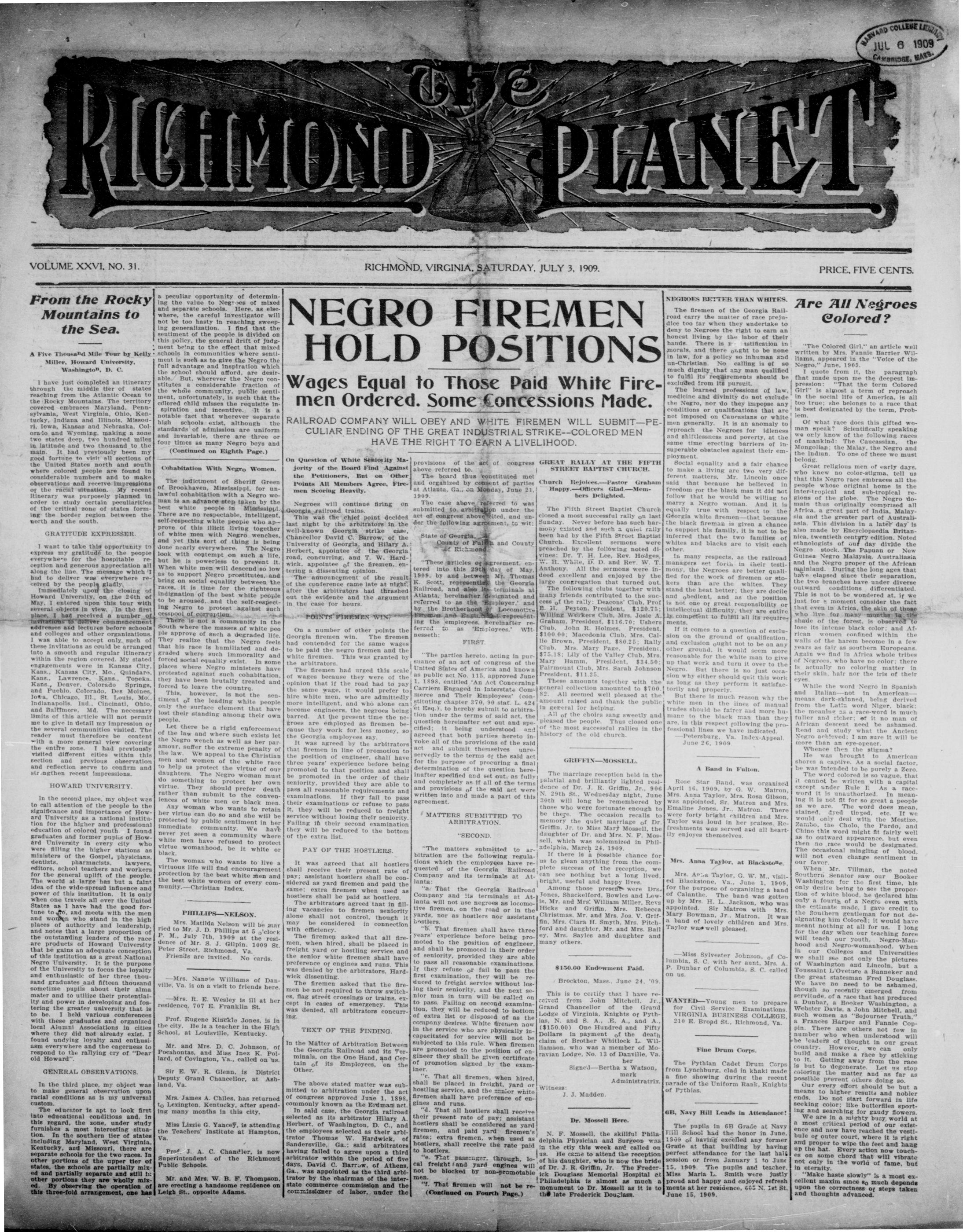
NEGRO FIREMEN HOLD POSITIONS
Wages Equal to Those Paid White Firemen Ordered. Some Concessions Made.
RAILROAD COMPANY WILL OBEY AND WHITE FIREMEN WILL SUBMIT—PECULIAR ENDING OF THE GREAT INDUSTRIAL STRIKE--COLORED MEN HAVE THE RIGHT TO EARN A LIVELIHOOD.
On Question of White Seniority Majority of the Board Find Against the Petitioners, But on Other Points All Members Agree, Firemen Scoring Heavily.
Negroes will continue firing on Georgia railroad trains.
This was the chief point decided last night by the arbitrators in the well-known Georgia strike case, Chancellor David C. Barrow, of the University of Georgia, and Hilary A. Herbert, appointee of the Georgia road, concurring, and T. W. Hardwick, appointee of the firemen, entering a dissenting opinion.
The announcement of the result of the conference came late at night, after the arbitrators had thrashed out the evidence and the argument in the case for hours.
provisions of the act of congress above referred to.
The board thus constituted met and organized by consent of parties at Atlanta, Ga., on Monday, June 21, 1909.
The case above referred to was submitted to arbitration under the act of congress above cited, and under the following agreement, to wit:
State of Georgia, County of Fulton and County of Richmond.
"These articles or agreement, entered into this 29th day of May, 1909, by and between Mr. Thomas K. Scott, representing the Georgia Railroad, and also its terminals at Atlanta, hereinatter designated and referred to as the 'Employer,' and
GREAT RALLY AT THE FIFTH STREET BAPTIST CHURCH.
Church Rejoices.—Pastor Graham Happy.—Officers Glad.—Members Delighted.
The Fifth Street Baptist Church closed a most successful rally on last Sunday. Never before has such harmony existed and such a quiet rally been had by the Fifth Street Baptist Church. Excellent sermons were preached by the following noted divines: Dr. T. H. Lee, Rev. Hodges, W. H. White, D. D. and Rev. W. T. Anthony. All the sermons were indeed excellent and enjoyed by the large congregation that turned out.
The following clubs together with many friends contributed to the success of the rally: Deacons' Club, Pro
POINTS FIREMEN WIN.
On a number of other points the Georgia firemen win. The firemen had contended for the same wages to be paid the negro firemen and the white firemen. This was granted by the arbitrators.
The firemen had urged this scale of wages because they were of the opinion that if the road had to pay the same wage, it would prefer to hire white men, who are admittedly more intelligent, and who alone can become engineers, the negroes being barred. At the present time the negroes are employed as firemen because they work for less money, so the Georgia employees say.
It was agreed by the arbitrators that firemen in line of promotion to the position of engineer, shall have three years' experience before being promoted to that position and shall be promoted in the order of their seniority, provided they are able to pass all reasonable requirements and examinations. If they fail to pass their examinations or refuse to pass it, they will be reduced to freight service without losing their seniority. Failing if their second examination they will be reduced to the bottom of the extra list.
PAY OF THE HOSTLERS
It was agreed that all hostlers shall receive their present rate of pay; assistant hostlers shall be considered as yard firemen and paid the same; extra firemen when used as hostlers shall be paid as hostlers.
The arbitrators agreed that in filling vacancies to firemen seniority alone shall not control, though it may be considered in connection with efficiency.
The firemen asked that all firemen, when hired, shall be placed in freight yard or hostling service and the senior white firemen shall have preference or engines and runs. This was denied by the arbitrators, Hardwick dissenting.
The firemen asked that the firemen be not required to throw switches, flag street crossings or trains, except in cases of emergency. This was denied, all arbitrators concurring.
TEXT OF THE FINDING
In the Matter of Arbitration Between the Georgia Railroad and its Terminals, on the One Hand, and Certain of its Employees, on the Other.
The above stated matter was submitted to arbitration under the act of congress approved June 1, 1898, commonly known as the Erdman act. In said case, the Georgia railroad selected as its arbitrator Hilary A. Herbert, of Washington, D. C., and the employees selected as their arbitrator Thomas W. Hardwick, of Sandersville, Ga.; said arbitrators having failed to agree upon a third arbitrator within the period of five days, David C. Barrow, of Athens, Ga., was appointed as the third arbitrator by the chairman of the interstate commerce commission and the commissioner of labor, under the
provisions of the act of congress above referred to.
The board thus constituted met and organized by consent of parties at Atlanta, Ga., on Monday, June 21, 1909.
The case above referred to was submitted to arbitration under the act of congress above cited, and under the following agreement, to wit:
"These articles or agreement, entered into this 29th day of May, 1909, by and between Mr. Thomas K. Scott, representing the Georgia Railroad, and also its terminals at Atlanta, hereafter designated and referred to as the 'Employer,' and by the Brotherhood of Locomotive Fireman and Engine—representing the employees, hereafter referred to as 'Employees,' Witness:
FIRST
"The parties hereto, acting in pursuance of an act of congress of the United States of America and known as public act No. 115, approved June 1, 1898, entitled 'An Act Concerning Carriers Engaged in Interstate Commerce and Their Employees' (constituting chapter 370, 90 stat. L. 424 et Esq.), to hereby submit to arbitration under the terms of said act, the question hereinafter set out and specified; it being understood and agreed that both parties hereto invoke all of the provisions of the said act and submit themselves unreservedly to the terms of the said act for the purpose of procuring a final determination of the question hereinafter specified and set out, as fully and completely as if all of the terms and provisions of the said act were written into and made a part of this agreement.
MATTERS SUBMITTED TO ARBITRATION.
"SECOND.
"The matters submitted to arbitration are the following regulations which the employees have requested of the Georgia Railroad Company and its terminals at Atlanta:
"a. That the Georgia Railroad Company and its terminals at Atlanta will not use negroes as locomotive firemen, on the road or in the yards, nor as hostlers nor assistant hostlers.
"b. That firemen shall have three years' experience before being promoted to the position of engineer, and shall be promoted in their order of seniority, provided they are able to pass all reasonable examinations. If they refuse or fail to pass the first examination, they will be reduced to freight service without losing their seniority, and the next senior man in turn will be called on to pass. Failing on second examination, they will be reduced to bottom of extra list or disposed of as the company desires. White firemen now in the service who are physically incapacitated for service will not be subjected to this rule. When firemen are promoted to the position of engineer they shall be given certificate of promotion signed by the examiner.
"c. That all firemen, when hired, shall be placed in freight, yard or hostling service, and the senior white firemen shall have preference of engines and runs.
"d. That all hostlers shall receive their present rate of pay; assistant hostlers shall be considered as yard firemen, and paid yard firemen's rates; extra firemen, when used as hostlers, shall receive the rate paid to hostlers.
"e. That passenger, through, local freight and engine engines will not be blocked by non-promotable men.
"f. That firemen will not be re- (Continued on Fourth Page.)
GREAT RALLY AT THE FIFTH STREET BAPTIST CHURCH.
Church Rejoices.—Pastor Graham
Happy.—Officers Glad.—Members Delighted.
The Fifth Street Baptist Church closed a most successful rally on last Sunday. Never before has such harmony existed and such a quiet rally been had by the Fifth Street Baptist Church. Excellent sermons were preached by the following noted divines: Dr. T. H. Lee, Rev. Hodges, W. H. White, D. D. and Rev. W. T. Anthony. All the sermons were indeed excellent and enjoyed by the large congregation that turned out.
The following clubs together with many friends contributed to the success of the rally: Deacons' Club, Prof B. H. Peyton, President, $120.75; Willing Workers Club, Mrs. Josie A. Graham, President, $116.70; Usher's Club, John R. Holmes, President, $100.00; Macedonia Club, Mrs. Calle Brown, President, $80.25; Rally Club, Mrs. Mary Page, President, $75.18; Lily of the Valley Club, Mrs. Mary Hamm, President, $34.50; Fairmount Club, Mrs. Sarah Johnson President, $11.25.
These amounts together with the general collection amounted to $700.82. All seemed well pleased at the amount raised and thank the public in general for helping.
All of the choirs sang sweetly and pleased the people. Thus closed one of the most successful rallies in the history of the old church.
GRIFFIN—MOSSELL
The marriage reception held in the palatial and brilliantly lighted residence of Dr. J. R. Griffin, Jr., 906 N. 29th St., Wednesday night, June 30th will long be remembered by those who were fortunate enough to be there. The occasion recalls to memory the quiet marriage of Dr. Griffin, Jr. to Miss Mary Mossell, the daughter of Dr. and Mrs. N. F. Mossell, which was solemnized in Philadelphia, March 24, 1909.
If there is a possible chance for us to glean anything from the complete success of the reception, we can see nothing but a long lived, bright, useful and happy lives.
Among those present were Drs. Jones, Shackelford, Bowles and Lewis, Mr. and Mrs. William Miller, Revs Hicks and Griffin, Mrs. Rebecca Christmas, Mr. and Mrs. Jos. V. Griffin, Mrs. Clara H. Smyth, Mrs. Pitchford and daughter, Mr. and Mrs. Bailey, Mrs. Sayles and daughter and many others.
$150.00 Endowment Paid.
Brockton, Mass., June 24, '09.
This is to certify that I have received from John Mitchell, Jr. Grand Chancellor of the Grand Lodge of Virginia, Knights of Pythias, N. and S. A., E. A., and A. ($150.00) One Hundred and Fifty Dollars in payment of the death claim of Brother Whitlock L. Williamson, who was a member of Moravian Lodge, No. 13 of Danville, Va. her
Signed—Bertha x Watson, mark
Administratrix
Dr. Mossell Here.
N. F. Mossell, the skillful Philadelphia Physician and Surgeon was in the city this week and called on us. He came to attend the reception of his daughter, who is now the bridge of Dr. J. R. Griffin, Jr. The Frederick Douglass Memorial Hospital at Philadelphia is almost as much a monument to Dr. Mossell as it is to the late Frederick Douglass.
NEGROES BETTER THAN WHITES.
The firemen of the Georgia Railroad carry the matter of race prejudice too far when they undertake to deny to Negroes the right to earn an honest living by the labor of their hands. There is no institution in morals, and there ought to be none in law, for a policy so inhuman and un-Christian. No calling is of so much dignity that any man qualified to fulfil its requirements should be excluded from its pursuit.
The learned professions of law, medicine and divinity do not exclude the Negro, nor do they impose any conditions or qualifications that are not imposed on Caucasians or white men generally. It is an anomaly to reproach the Negroes for idleness and shiftlessness and poverty, at the same time erecting barriers of superable obstacles against their employment.
Social equality and a fair chance to make a living are two very different matters. Mr. Lincoln once said that because he believed in freedom or the black man it did not follow that he would be willing to marry a Negro woman. And it is equally true with respect to the Georgia white firemen—that because the black fireman is given a chance to support his family, it is not to be inferred that the two families of whites and blacks are to visit each other.
In many respects, as the railroad managers set forth in their testimony, the Negroes are better qualified for the work of firemen or stokers than are the whites. They stand the heat better; they are docile and bedient, and as the position is not one or great responsibility or intellectual difficulty, they are entirely competent to fulfill all its requirements.
If it comes to a question of exclusion on the ground of qualification, and exclusion ought not to be on any other ground, it would seem more reasonable for the white man to give up that work and turn it over to the Negro. But there is no just occasion why either should quit this work as long as they perform it satisfactorily and properly.
But there is much reason why the white men in the lines of manual trades should be fairer and more humane to the black man than they are, in this respect following the professional lines we have indicated.
—Petersburg, Va. Index-Appeal. June 26, 1809.
A Band in Fulton
Rose Star Band, was organized April 16, 1909, by G. W. Matron, Mrs. Anna Taylor, Mrs. Rosa Gibson, was appointed, Sr. Matron and Mrs. Emaline Jones, Jr., Matron. There were forty bright children and Mrs. Taylor was loud in her praises. Refreshments was served and all heartily enjoys themselves.
Mrs. Anna Taylor, at Blackstone
Mrs. Anne Taylor, G. W. M., visited Blackstone, Va., June 1, 1909, for the purpose of organizing a band of Calanthe. The band was gotten up by Mrs. H. L. Jackson, who was appointed. Sir Matron with Mrs. Mary Bowman, Jr., Matron. It was a band of lovely children and Mrs. Taylor was well pleased.
—Miss Sylvester Johnson, of Columbia, S. C. with her aunt, Mrs. A. P. Dunbar of Columbia, S. C. called on us.
WANTED--Young men to prepare for Civil Service Examinations VIRGINIA BUSINESS COLLEGE 210 E. Broad St. Richmond, Va.
Fine Drum Corps
The Pythian Cadet Drum Corps from Lynchburg, clad in khaki made a fine showing during the recent parade of the Uniform Rank, Knights of Pythias.
6B, Navy Hill Leads in Attendance
The pupils in 6B Grade at Navy
Ellin School had the honor in June,
1909 of having excelled any former
Grade at that building by having
perfect attendance for the last half
session or from January 1 to June
15, 1909. The pupils and teacher,
Miss Maria L. Smith were justly
proud and happy and enjoyed refresh
ments at her residence, 605 N. 1st St.
June 15, 1909.
PRICE, FIVE CENTS.
Are All Negroes Colored?
"The Colored Girl," an article well written by Mrs. Fannie Barrier Williams, appeared in the "Voice of the Negro," June, 1905.
I quote from it, the paragraph that made upon me the deepest impression: "That the term Colored Girl" is almost a term of reproach in the social life of America, is all too true; she belongs to a race that is best designated by the term, Problem.
Of what race does this gifted woman speak? Scientifically speaking we only know of the following races of mankind: The Caucasian, the Mongolian; the Malay, the Negro and the Indian. To one of these we must belong.
Great religious men of early days, who knew no color-stigma, tell us that this Negro race embraces all the people whose original home is the inter-tropical and sub-tropical regions of the globe. The Negro domain thus originally comprised all Africa, a great part of India, Malaysia and the greater part of Australasia. This division in a later day is also made by Encyclopaedia Britannica, twentieth century edition. Noted ethnologists of our day divide the Negro stock. The Papuan or New Guinea Negro Malaysia, Australasia and the Negro proper of the African mainland. During the long ages that have elapsed since their separation, the two branches have under diverse outward conditions differentiated. This is not to be wondered at, if we just for a moment consider the fact that even in Africa, the skin of those who live for many months in the shade of the forest, is observed to lose its intense black color; and African women confined within the walls of the harem become in a few years as fair as southern Europeans. Again we find in Africa whole tribes of Negroes, who have no color; there is actually no coloring matter in their skin, hair nor the iris of their eyes.
While the word Negro in Spanish and Italian—not in American—means dark-skinned, being derived from the Latin word Niger, black; the meaning as a race-word is much fuller and richer; of it no man of African descent need be ashamed. Read and study what the Ancient Negro achieved; I am sure it will be more than an eye-opener. Whence then the stigma?
He was brought to American shores a captive. As a social factor, he was intended to be purely a Zero. The word colored is so vague, that it cannot be written with a capital except under Rule II. As a race-word it is unauthorized. In meaning it is not fit for so great a people as we are. The word does mean, stained, dyed tinged, etc. If we would only deal with the Mestizo, Zambo, the Cholo, the Pardo, and Chino this word might fit fairly well as to outward appearance, but even then no race would be designated. The occasional mingling of blood, will not even change sentiment in our favor.
When Mr. Tillman, the noted Southern Senator saw our Booker Washington for the first time, his only desire being to see the proportion of white blood, he declared him only a fourth of a Negro even with the estimate made. I gave credit to the Southern gentleman for not designating him Colored; it would have meant nothing at all for us. I long for the day when our teaching force will teach our youth. Negro-Manhood and Negro-womanhood. When in our Colleges and Universities we shall see not only the pictures of Washington and Lincoln, but a Toussaint L'Oveture a Banneker and the great statesman Fred Douglass. We have no need to be ashamed, though so recently emerged from servitude, of a race that has produced a Dunbar, a Booker Washington, a Webster Davis, a John Mitchell, and such women as "Sojourner Truth," a Frances Harper and Fannie Coppin. There are others not few in number who when understood will be leaders of thought in our great country. However, we can only build and make a race by sticking to it. Getting away from the race is but to degenerate. Let us stop coloring the matter and as far as possible prevent others doing so.
Our every effort should be but a means to higher results and nobler ends. Do not start forward in life seeking color; like butterflies sporting and searching for more.
We are in a mighty busy world at a most critical period of our existence and now have reached the vestibule or outer court, where it is right and proper to wipe the feet and hang up the hat. Every action now touches on some chord that will vibrate not only in the world of fame, but in eternity.
"Make haste slowly" is a most excellent maxim since $s_0$ much depends upon the correctness of steps taken and thoughts advanced.
TWO
CHAPTER I
The Wrecking Boss.
News of the wreck at Smoky Creek reached Medicine Bend from Point of Rocks at five o'clock. Sinclair, in person, was overseeing the making up of his wrecking train, and the yard, usually quiet at that hour of the morning, was alive with the hurry of men and engines. In the trainmaster's room of the weather-beaten headquarters building nicknamed by railroad men "The Wickup," early comers—sleepy-faced, keen-eyed trainmen—loomed on the tables and in chairs discussing the reports from Point of Rocks, and among them crew-callers and messengers moved in and out. Two minutes after they had their orders and were pulling out of the upper yard, with right of way over everything to Point of Rocks.
The wreck had occurred just west of the creek. A fast east-bound freight train, double-headed, had left the track on the long curve around the hill, and when the wrecking train backed through Ten Shed cut the sun streamed over the heaps of jammed and twisted cars strung all the way from the point of the curve to the foot of Smoky hill. The crew of the train that lay in the ditch walked slowly up the track to where the wreckers had pulled up and the freight conductor asked for Sinclair. Men rigging the derrick pointed to the hind car. The conductor, swinging up the caboose steps, made his way inside among the men that were passing out tools. The air within was bluish-thick with tobacco smoke, but through the haze the freightman saw facing him, in the far corner of the den-like interior, a man seated behind an old dining-car table, finishing his breakfast; one gilpme was enough to identify the dark beard of Sinclair, foreman of the bridges and boss of the wrecking gang.
Beside him stood a steaming coffee tank, and in his right hand he held an enormous tin cup that he was about to raise to his mouth when he saw the freight conductor. With a laugh, Sinclair threw up his left hand and beckoned him over. Then he shook his hair just a little, tossed back his head, opened an unusual mouth, drained the cup at a gulp, and cursing the freightman fraternally, exclaimed: "How many cars have you ditched this time?" The trainman, a sober-faced fellow, answered, dryly: "I all had." "Running too fast, eh?" glared Sinclair. With the box cars piled 40 feet high on the track, the conductor was too old a hand to begin a controversy. "Our time's fast," was all he said.
Sinclair rose and exclaimed: "Come on!" And the two, leaving the car, started up the track. The wrecking boss paid no attention to his companion as they forged ahead, but where the train had hit the curve he scanned the track as he would a blue print. "They'll have your scalp for this," he declared, abruptly. "I reckon they will." "What's your name?"
"Stevens."
"Looks like all day for you, doesn't it? No matter; I guess I can help you out."
Where the merchandise cars lay, below the switch, the train crew knew that a tramp had been caught. At intervals they heard groans under the wreckage, which was piled high there. Sinclair stopped at the derrick, and the freight conductor went on to where his brakeman had enlisted two of Sinclair's giants to help get out the tramp. A brake beam had crushed the man's legs, and the pallor of his face showed that he was hurt internally, but he was conscious and moaned softly. The nen had started to carry him to the way cer when Sinclair came up, asked what they were doing, and ordered them back to the treck. They hastily laid the tramp down. "But he wants water," protested a brakeman who was walking behind, carrying his arm in a sling.
"Water!" bawled Sinclair. "Have my men got nothing to do but carry a tramp to water? Get ahead there and help unload those refrigerators. He'll find water fast enough. Let the damned hobo crawl down to the creek after it."
The tramp was too far gone for resentment; he had fainted when they laid him down, and his half-glassed eyes, staring at the sky, gave no evidence that he heard anything.
The sun rose hot, for in the Red desert sky there is rarely a cloud. Sinclair took the little hill nearest the switch to bellow his orders from, running down among the men whenever necessary to help carry them out. Within 30 minutes, though apparently no impression had been made on the great heaps of wrenched and splintered equipment. Sinclair had the job in hand.
The freight conductor, Stevens, afraid of no man, had come up to speak to Sinclair, and Sinclair, with a smile, laid a cordial hand on his shoulders. "Stevens, it's all right. I'll get you out of this. Come here." He led the conductor down the track where they had walked in the morning. He pointed to flange-marks on the ties. "See there—there's where the first wheels left the track, and they left on the inside of the curve; a thin flange under the first refrigerator broke. I've got the wheel itself back there for evidence. They can't talk fast running against that. Damn a private car line, anyway! Give me a cigar—haven't got any? Great guns, man, there's a case of Key Wests open up ahead; go fill your pockets
WHISPERING SMITH
BY FRANK H. SPEARMAN.
ILLUSTRATIONS BY ANDRE BOWLES
COPYRIGHT BY CHRIS SCRIBNER'S SONS
And your grip. Don't be bashful; you've got friends on the division, if you are Irish, eh?" "Sure, only I don't smoke," said Stevens, with diplomacy. "Well, you drink, don't you? There's a barrel of brandy open at the switch." The brandy cask stood up-ended near the water butt, and the men dipped out of both with cups. They were working now half naked at the wreck. The sun hung in a cloudless sky, the air was still, and along the right of way huge wrecking fires added to the scorching heat. Ten feet from the water butt lay a flattened
C. W. D.
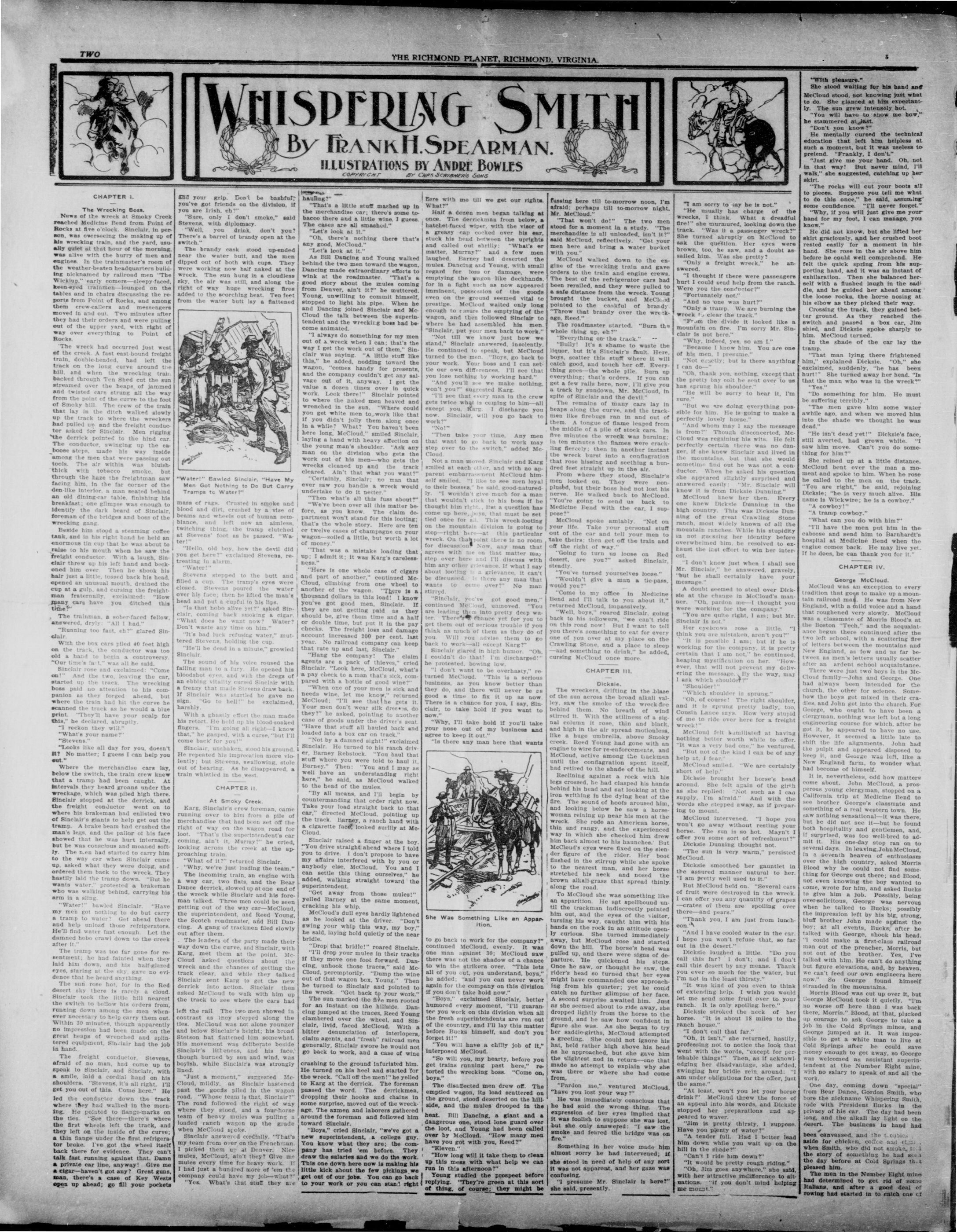
"Water!" Bawled Sinclair, "Have My Men Got Nothing to Do But Carry Tramps to Water?"
mass of rags. Crusted in smoke and blood and dirt, crushed by a vise of beams and wheels out of human semblance, and left now an aimless, twitching thing, the tramp clutched at Stevens' foot as he passed. "Water!"
"Hello, old boy, how the devil did you get here?" exclaimed Stevens, retreating in alarm.
"Water!"
Stevens stepped to the butt and filled a cup. The tramp's eyes were closed. Stevens poured the water over his face; then he lifted the man's head and put a cupful to his lips.
"Is that hobo alive yet?" asked Sinclair, coming back smoking a cigar. "What does he want now? Water? Don't waste any time on him."
"It's bad luck refusing water," muttered Stevens, holding the cup.
"He'll be dead in a minute," growled Sinclair.
The sound of his voice roused the falling man to a fury. He opened his bloodshot eyes, and with the dregs of an ebbing vitality cursed Sinclair with a frenzy that made Stevens draw back. If Sinclair was startled he gave no sign. "Go to hell!" he excalmed, harshly.
With a ghastly effort the man made his retort. He held up his blood-soaked fingers. "I'm going all right—I know that," he gasped, with a curse, "but I'll come back for you!"
Sinclair, unshaken, stood his ground. He repeated his imprecation more violently; but Stevens, swallowing, stole out of hearing. As he disappeared, a train whistled in the west.
CHAPTER II
At Smoky Creek
Karg, Sinclair's crew foreman, came running over to him from a pile of merchandise that had been set off the right of way on the wagon road for loot. "That's the superintendent's car coming, ain't it, Murray?" he cried, looking across the creek at the approaching train. "What of it?" returned Sinclair. "Why, we're just loading the team."
The incoming train, an engine with a way car, two flats, and the Bear Dance derrick, slowed up at one end of the wreck while Sinclair and his foreman talked. Three men could be seen getting out of the way car—McCloud, the superintendent, and Reed Young, the Scotch roadmaster, and Bill Dancing. A gang of trackmen filed slowly out after them.
The leaders of the party made their way down the curve, and Sinclair, with Karg, met them at the point. McCloud asked questions about the wreck and the chances of getting the track clear, and while they talked Sinclair sent Karg to get the new derrick into action. Sinclair then asked McCloud to walk with him up the track to see where the cars had
left the rail. The two men showed in contrast as they stepped along the fites. McCloud was not alone younger and below Sinclair's height; his broad Stetson hat flattened him somewhat. His movement was deliberate beside Sinclair's Liteness, and his face, though burned by sun and wind, was boyish, while Sinclair's was strongly illued.
"Just a moment," suggested McCloud, mildly, as Sinclair hastened past the goods piled in the wagon road. "Whose team is that, Sinclair?" The road followed the right of way where they stood, and a four-horse team of heavy mules was pulling a loaded ranch wagon up the grade when McCloud spoke.
Sinclair answered cordially. "That's my team from over on the Frenchman. I picked them up at Denver. Nice mules, McCloud, isn't they? Give me mules every time for heavy work. If I had just a hundred more of 'em the company could have my job—what?" "Yes. What's that, sir?"
"Yes. What's that stuff they are
THE RICHMOND PLANET, RICHMOND, VIRGINIA
hauling?"
"That's a little stuff mashed up in the merchandise car; there's some to bacco there and a little wine. I guess. The cases are all smashed."
"Let's look at it."
"Oh, there's nothing there that's any good, McCloud."
"Let's look at it."
As Bill Dancing and Young walked behind the two men toward the wagon, Dancing made extraordinary efforts to wink at the roadmaster. "That's a good story about the mules coming from Denver, ain't it?" he muttered. Young, unwilling to commit himself, stopped to light his pipe. When he and Dancing joined Sinclair and McCloud the talk between the superintendent and the wrecking boss had become animated.
"I always do something for my men out of a wreck when I can; that's the way I get the work out of them." Sinclair was saying. "A little stuff like this," he added, nodding toward the wagon, "comes handy for presents, and the company couldn't get any salvage out of it, anyway. I get the value a dozen times over in quick work. Look there!" Sinclair pointed to where the naked men heaved and wrenched in the sun. "Where could you get white men to work like that if you didn't jolly them along once in a while? What? You haven't been here long, McCloud," smiled Sinclair, laying a hand with heavy affection on the young man's shoulder. "Ask any man on the division who gets the work out of his men—who gets the wrecks cleaned up and the track cleared. Ain't that what you want?" "Certainly, Sinclair; no man that ever saw you handle a wreck would undertake to do it petter."
"Then what's all this fuss about?" "We've been over all this matter before, as you know. The claim department won't stand for this looting; that's the whole story. Here are ten or twelve cases of champagne on your wagon—soiled a little, but worth a lot of money."
"That was a mistake loading that up; I admit it; it was Karg's carelessness."
"Here is one whole case of cigars and part of another," continued McCloud, climbing from one wheel to another of the wagon. "There is a thousand dollars in this load! I know you've got good men, Sinclair. If they are not getting paid as they should be, give them time and a half or double time, but put it in the pay checks. The freight loss and damage account increased 200 per cent. last year. No railroad company can keep that rate up and last, Sinclair."
"Hang the company! The claim agents are a pack of thieves," cried Sinclair. "Look here, McCloud, what's a pay check to a man that's sick, compared with a bottle of good wine?" "When one of your men is sick and needs wine, let me know" returned McCloud; "I'll see that the gets it. Your men don't wear silk dres...as, do they?" he asked, pointing to another case of goods under the driver's seat. "Have that stuff all hauled back and loaded into a box car on track." "Not by a damned sight!" exclaimed Sinclair. He turned to his ranch driver, Barney Rebstock. "You haul that stuff where you were told to haul it, Barney." Then: "You and I may as well have an understanding right here," he said, as McCloud walked to the head of the mules.
"By all means, and I'll begin by countermanding that order right now. Take your load straight back to that car," directed McCloud, pointing up the track. Barney, a ranch hand with a cigarette face, looked surly at McCloud.
Sinclair raised a finger at the boy. "You drive straight ahead where I told you to drive. I don't propose to have my affairs interfered with by you or anybody else, McCloud. You and I can settle this thing ourselves," he added, walking straight toward the superintendent.
"Get away from those mules!" yelled Barney at the same moment, cracking his whip.
McCloud's dull eyes hardly lightened as he looked at the driver. "Don't swing your whip this way, my boy," he said, laying hold quietly of the near bridle.
"Drop that bridle!" roared Sinclair, "Till your mules in their tracks if they move one foot forward. Dancing, unhook those traces," said McCloud, peremptorly. "Dump the wine out of that wagon box. Young." Then he turned to Sinclair and pointed to the wreck. "Get back to your work." The sun marked the five men rooted for an instant on the hillside. Dancing jumped at the traces, Reed Young clambered over the wheel, and Sinclair, livid, faced McCloud. With a bitter denunciation of interlopers, claim agents, and "fresh" railroad men generally, Sinclair swore he would not go back to work, and a case of wine
crashing to the ground infurited him. He turned on his heel and started for the wreck. "Call off the men!" he yelled to Karg at the derrick. The foreman passed the word. The derrickman, dropping their hooks and chains in some surprise, moved out of the wreckage. The axmen and laborers gathered around the foreman and followed him toward Sinclair.
"Boys," cried Sinclair, "we've got a new superintendent, a college guy. You know what they are; the company has tried 'em before. They draw the salaries and we do the work. This one down here now is making his little kick about the few pickings we get out of our jobs. You can go back to your work or you can stand right
Here with me till we get our rights. What?" Half a dozen men began talking at once. The derrickman from below, a hatchet-faced wiper, with the visor of a greasy cap cooked over his ear, stuck his head between the uprights and called out shrilly: "What's er matter, Murray?" and a few men laughed. Barney had deserted the mules. Dancing and Young, with small regard for loss or damage, were emptying the wagon like deckhands, for in a fight such as now appeared imminent, possession of the goods even on the ground seemed vital to prestige. McCloud waited only long enough to assure the emptying of the wagon, and then followed Sinclair to where he had assembled his men. "Sinclair, put your men back to work."
"Not till we know just how we stand." Sinclair answered, insolently. He continued to speak, but McCloud turned to the men. "Boys, go back to your work. Your boss and I can settle our own differences. I'll see that you lose nothing by working hard."
"And you'll see we make nothing, won't you?" suggested Karg.
"I'll see that every man in the crew gets twice what is coming to him—all except you, Karg. I discharge you now. Sinclair, will you go back to work?"
"No!"
"Then take your time. Any men that want to go back to work may step over to the switch," added McCloud.
Not a man moved. Sinclair and Karg smiled at each other, and with no apparent embarrassment McCloud himself smiled. "I like to see men loyal to their bosses," he said, good-naturedly. "I wouldn't give much for a man that wouldn't stick to his boss if he thought him right." But a question has come up here, boys, that must be set tied once for all. This wreck looting on the mountain division is going to stop-right here—at this particular wreck. On that point there is no room for discussion. Now, any man that agrees with me on that matter may step over here and I'll discuss with him any other grievance. If what I say about looting is a grievance, it can't be discussed. Is there any man that wants to come over?" No man stirred.
"Sinclair, you've got good men," continued McCloud, unmoved. "You are leading them into pretty deep water. There's chance yet for you to get them out of serious trouble if you think as much of them as they do of you. Will you advise them to go back to work—all except Karg?" Sinclair glared in high humor. "Oh, I couldn't do that! I'm discharged!" he protested, bowing low.
"I don't want to be overhasty," returned McCloud. "This is a serious business, as you know better than they do, and there will never be as good a time to fix it up as now. There is a chance for you, I say, Sinclair, to take hold if you want to now."
"Why, I'll take hold if you'll take your nose out of my business and agree to keep it out."
"Is there any man here that wants
A man and a woman on horseback are working on a bridge. The man is holding a tool and the woman is carrying a bag. In the background, there are other workers and a mountainous landscape.
She Wae Something Like an Apparition.
to go back to work for the company?" continued McCloud, evenly. It was one man against 30; McCloud saw there was not the shadow of a chance to win the grikkers over. "This lets all of you out, you understand, boys," he added; "and you can never work again for the company on this division if you don't take hold now."
"Boys," exclaimed Sinclair, better humored every moment. "I'll guarantee you work on this division when all the fresh superintendents are run out of the country, and I'll lay this matter before Bucks himself, and don't you forget it!"
"You will have a chilly job of it," interposed McCloud.
"So will you, my hearty, before you get trains running past here," retorted the wrecking boss. "Come on, boys."
The disaffected men drew off. The emptied wagon, its load scattered on the ground, stood deserted on the hillside, and the mules drooped in the heat. Bill Dancing, a giant and a dangerous one, stood lone guard over the loot, and Young had been called over by McCloud. "How many men have you got with you, Reed?" "Eleven." "How long will it take them to clean up this mess with what help we can run in this afternoon?" Young studied the prospect before replying. "They're green at this sort of thing, of course; they might be
fussing here till to-morrow noon, I'm afraid; perhaps till to-morrow night, Mr. McCloud."
"That won't do!" The two men stood for a moment in a study. "The merchandise is all unloaded, isn't it?" said McCloud, reflectively. "Get your men here and bring a water bucket with you."
McCloud walked down to the engine of the wrecking train and gave orders to the train and engine crews. The best of the refrigerator cars had been rerailed, and they were pulled to a safe distance from the wreck. Young brought the bucket, and McCloud pointed to the caskful of brandy. "Throw that brandy over the wreckage, Reed."
The roadmaster started. "Burn the whole thing up, eh?"
Everything on the track.
"Bully! It's a shame to waste the liquor, but it's Sinclair's fault. Here, boys, scatter this stuff where it will catch good, and touch her off. Everything goes—the whole pile. Burn up everything; that's orders. If you can get a few rails here, now, I will give you a track by sundown, Mr. McCloud, in spite of Sinclair and the devil."
The remains of many cars lay in heaps along the curve, and the trackmen like firebugs ran in and out of them. A tongue of flame leaped from the middle of a pile of stock cars. In five minutes the wreck was burning; in ten minutes the flames were crackling fiercely; then in another instant the wreck burst into a conflagration that rose hissing and seething a hundred feet straight up in the air.
From where they stood, Sinclair's men looked on. They were nonplusb, but their boss had not lost his nerve. He walked back to McCloud. "You're going to send us back to Medicine Bend with the car, I suppose?" McCloud spoke ambiably. "Not on your life. Take your personal stuff out of the car and tell your men to take theirs; then get off the train and off the right of way." "Going to turn us loose on Red desert, are you?" asked Sinclair, steadily. "You've turned yourselves loose." "Wouldn't give a man a tie-pass, would you?" "Come to my office in Medicine Bend and I'll talk to you about it," returned McCloud, impassively.
"Well, boys," roared Sinclair, going back to his followers, "we can't ride on this road now! But I want to tell you there's something to eat for every one of you over at my place on the Crawling Stone, and a place to sleep—and something to drink," he added, cursing McCloud once more.
CHAPTER III.
Dicksie.
The wreckers, drifting in the blaze of the sun across the broad alkali valley, saw the smoke of the wreck-fire behind them. No breath of wind stirred it. With the stillness of a signal column it rose, thin and black, and high in the air spread motionless, like a huge umbrella, above Smoky creek. Reed Young had gone with an engine to wire for re-enforcements, and McCloud, active among the trackmen until the confagration spent itself, had retired to the shade of the bill.
Recclining against a rock with his legs crossed, he had clasped his hands behind his head and sat looking at the iron writhing in the dying heat of the fire. The sound of hoofs aroused him, and looking below he saw a horsewoman reining up near his men at the wreck. She rode an American horse, thin and rangy, and the experienced way in which she checked him drew him back almost to his haunches. But McCloud's eyes were fixed on the slender figure of the rider. Her boot flashed in the stirrup while she spoke to the nearest man, and her horse stretched his neck and nosed the brown alkali-grass that spread thinly along the road.
To McCloud she was something like an apparition. He sat spellbound until the trackman indiscretely pointed him out, and the eyes of the visitor, turning his way, caught him with his hands on the rock in an attitude openly curious. She turned immediately away, but McCloud rose and started down the hill. The horse's head was pulled up, and there were signs of departure. He quickened his steps. Once he saw, or thought he saw, the rider's head so commanded that her eyes might have commanded one approaching from his quarter; yet he could catch no further glimpse of her face. A second surprise awaited him. Just as she seemed about to ride away, she dropped lightly from the horse to the ground, and he saw how confident in figure she was. As she began to try her saddle-girths, McCloud attempted a greeting. She could not ignore his hat, held rather high above his head as he approached, but she gave him the slightest nod in return—one that made no attempt to explain why she was there or where she had come from.
"Pardon me," ventured McCloud,
"have you lost your way?"
He was immediately conscious that
he had said the wrong thing. The
expression of her eyes implied that
it was foolish to suppose she was lost,
but she only answered: "I saw the
smoke and feared the bridge was on
fire."
Something in her voice made him
almost sorry he had intervened; if
she stood in need of help of any sort
it was not apparent, and her gaze was
confusing.
"I presume Mr. Sinclair is here?"
she said, presently.
A CROSSING
"I am sorry to say he is not."
"He usually has charge of the wrecks, I think. What a dreadful fire!" she murmured, looking down the track "Was it a passenger wreck?" She turned abruptly on McCloud to ask the question. Her eyes were brown, too, he saw, and a doubt assailed him. Was she pretty? "Only a freight wreck," he answered. "I thought if there were passengers hurt I could send help from the ranch. Were you the conductor?"
"Fortunately not."
"And no one was hurt?"
"Only a tramp. We are burning the wreck to clear the track."
"From the divide it locked like a mountain on fire. I'm sorry Mr. Sinclair is not here."
"Why, indeed, yes, so am I."
"Because I know him. You are one of his men, I presume."
"Not exactly; but is there anything I can do—"
"Oh, thank you, nothing, except that the pretty bay coil he sent over to us has sprung his shoulder."
"He will be sorry to hear it, I'm sure."
"But we are doing everything possible for him. He is going to make a perfectly lovely horse."
"And whom may I say the message is from?" Though disconcerted, McCloud was regaining his wits. He felt perfectly certain there was no danger, if she knew Sinclair and lived in the mountains, but that she would sometime find out he was not a conductor. When he asked his question she appeared slightly surprised and answered easily: "Mr. Sinclair will know it is from Dickle Dunning." McCloud knew her then. Every one knew Dickle Dunning in the high country. This was Dickle Dunning of the great Crawling Stone ranch, most widely known of all the mountain ranches. While his stupidity in not guessing her identity before overwhelmed him, he resolved to exhaust the just effort to win her interest.
"I don't know just when I shall see Mr. Sinclair," he answered, gravely, "but he shall certainly have your message."
A doubt seemed to steal over Dick-sie at the change in McCloud's manner. "Oh, pardon me—I thought you were working for the company." "You are quite right, I am; but Mr. Stuart."
"You are quite right, I am; but Mr. Stuclair is not." Her eyebrows rose a little. "I think you are mistaken, aren't you?" "It is possible I am; but if he is working for the company, it is pretty certain that I am not," he continued, heaping mystification on her. "However, that will not prevent my delivering the message. By the way, may I ask which shoulder?"
"Shoulder!"
"Which shoulder is sprung."
"Oh, of course! The right shoulder, and it is sprung pretty badly, too, Cousin Lance says. How very stupid of me to ride over here for a freight wreck!"
McCloud felt humiliated at having nothing better worth while to offer. "It was a very bad one," he ventured. "But not of the kind I can be of any help at, I fear."
McCloud smiled. "We are certainly short of help."
Dickies brought her horse's head around. She felt again of the girth as she replied: "Not such as I can supply, I'm afraid." And with the words she stepped away, as if preparing to mount.
McCloud intervened. "I hope you won't go away without resting your horse. The sun is so hot. Mayn't I offer you some sort of refreshment?"
Dickies Dunning thought not.
"The sun is very warm," persisted McCloud.
Dickie smoothed her gauntlet in the assured manner natural to her. "I am pretty well used to it."
But McCloud held on. "Several cars of fruit were destroyed in the wreck. I can offer you any quantity of grapes—crates of them are spoiling over there—and pears."
"Thank you, I am just from lunch-eon."
"And I have cooled water in the car. I hope you won't refuse that, so far out in the desert."
Dickie laughed a little. "Do you call this far? I don't; and I don't call this desert by any means. Thank you ever so much for the water, but I'm not in the least thirsty."
"It was kind of you even to think of extending help. I wish you would let me send some fruit over to your ranch. It is only spoiling here."
Dickiele stroked the neck of her horse. "It is about 18 miles to the ranch house." "I don't call that far."
"Oh, it isn't," she returned, hastily, professing not to notice the look that went with the words, "except for perishable things!" Then, as if acknowledging her disadvantage, she added, swinging her bride rein around: "I am under obligations for the offer, just the same."
"At least, won't you let your horse drink?" McCloud threw the force of an appeal into his words, and Dicke stopped her preparations and appeared to waver.
"Jim is pretty thirsty, I suppose. Have you plenty of water?"
"A tender full. Had I better lead him down while you wait up on the hill in the shade?"
"Can't I ride him down?"
"It would be pretty rough riding." "Oh, Jim goes anywhere," she said, with her attractive indifference to situations. "If you don't mind helping me mount."
She stood waiting for his hand and McCloud stood, not knowing just what to do. She glanced at him expectantly. The sun grew intensely hot. "You will have to show me how," he stammered at just. "Don't you know?" He mentally cursed the technical education that left him heipless at such a moment, but it was useless to pretend. "Frankly, I don't." "Just give me your hand. Oh, not in that way! But never mind, I'll walk" she suggested, catching up her skirt. "The rocks will cut your boots all to pieces. Suppose you tell me what to do this once," he said, assuming some confidence. "I'll never forget." "Why, if you will just give me your hand for my foot, I can manage, you know."
He did not know, but she lifted her skirt graciously, and her crushed boot rested easily for a moment in his hand. She rose in the air above him before he could well comprehend. He felt the quick spring from his supporting hand, and it was an instant of exhilaration. Then she balanced herself with a flushed laugh in the saddle, and he guided her ahead among the loose rocks, the horse nosing at his elbow as they picked their way. Crossing the track, they gained better ground. As they reached the switch and passed a box car, Jim shied, and Dickie斯 spoke sharply to him. McCloud turned. In the shade of the car lay the tramp.
"That man lying there frightened him," explained Dickie斯. "Oh," she exclaimed, suddenly, "he has been hurt." She turned away her head. "Is that the man who was in the wreck?" "Yes."
"Do something for him. He must be suffering terribly."
"The men gave him some water awhile ago, and when we moved him into the shade we thought he was dead."
"He isn't dead yet!" Dickie's face, still averted, had grown white. "I saw him move. Can't you do something for him?"
She reined up at a little distance. McCloud bent over the man a moment and spoke to him. When he rose he called to the men on the track. "You are right," he said, rejoining Dickie; "he is very much alive. His name is Wickire; he is a cowboy."
"A cowboy!"
"A tramp cowboy."
"What can you do with him?"
"I'll have the men put him in the caboose and send him to Barnhardt's hospital at Medicine Bend when the engine comes back. He may live yet. If he does, he can thank you for it."
CHAPTER IV.
George McCloud
McCloud was an exception to every tradition that goes to make up a mountain railroad man. He was from New England, with a mild voice and a hand that roughened very slowly. McCloud was a classmate of Morris Blood's at the Boston "Tech," and the acquaintance begun there continued after the two left school, with a scattering fire of letters between the mountains and New England, as few and as far between as men's letters usually scatter after an ardent school acquaintance.
There were just two boys in the McCloud family—John and George. One had always been intended for the church, the other for science. Somehow the boys got mixed in their cradles, and John got into the church. For George, who ought to have been a clergyman, nothing was left but a long engineering course for which, after he got it, he appeared to have no use. However, it seemed a little late to shift the life alignments. John had the pulpit and appeared disposed to keep it, and George was left, like a New England farm, to wonder what had become of himself.
It is, nevertheless, odd how matters come about. John McCloud, a prosperous young clergyman, stopped on a California trip at Medicine Bend to see brother George's classmate and something of a real western town. He saw nothing sensational—it was there, but he did not see it—but he found both hospitality and gentlemen, and, if surprised, was too well-bred to admit it. His one-day stop ran on to several days. In leaving, John McCloud, in a seventh heaven of enthusiasm over the high country, asked Morris Blood why he could not find something for George out there; and Blood, not even knowing the boy wanted to come, wrote for him, and asked Bucks to give him a job. Possibly, being over-solicitous, George was nervous when he talked to Bucks; possibly the impression left by his big, strong, bluff brother John made against the boy; at all events, Bucks, after he talked with George, shook his head. "I could make a first-class railroad man out of the preacher, Morris, but not out of the brother. Yes, I've talked with him. He can't do anything but figure elevations, and, by heaven, we can't feed our own engineers here now." So George found himself stranded in the mountains.
Morris Blood was cut up over it, but George McCloud took it quietly. "I'm no worse off here than I was back there, Morris." Blood, at that, plucked up courage to ask George to take a job in the Cold Springs mines, and George jumped at it. It was impossible to get a white man to live at Cold Springs after he could save money enough to get away, so George was welcomed as assistant superintendent at the Number Eight mine, with no salary to speak of and all the work.
One day, coming down "special" from Bear Dance, Gordon Smith, who bore the nickname Whispering Smith, rode with President Bucks in the privacy of his car. The day had been long, and the alkali lay light on the desert. The business in hand had
been canvassed, and the t. coubis
aside for chicken, coffee and clam,
when Smith, who did not smoke, told
the story of something he had seen
the day before at Cold Springs that
pleased him.
The men in the Number Eight mine
had determined to get rid of some
Italians, and after a good deal of
rowing had started in to catch one of
FLEETLAND
Them and hang him. They had chosen a time when McCloud, the assistant superintendent of the mine, was down with mountain fever. It was he who had put the Italians into the mine. He had already defended them from injury, and would be likely. It was known, to do so again if he were able. On this day a mob had been chasing the dagos, and had at length captured one. They were running him down the street to a telegraph pole when the assistant superintendent appeared in scant attire and stopped them. Taking advantage of the momentary confusion, he hustled their victim into the only place of refuge at hand, a billiard hall. The mob rushed the hall. In the farthest corner the unlucky Italian, bleeding like a bullock and insane with fright, knelt, clinging to McCloud's shaky knees. In trying to make the back door the two had been cut off, and the sick boss had got into a corner behind a pool table to make his stand. In his pocket he had a pistol, knowing that to use it meant death to him as well as to the wretch he was trying to save. Fifty men were yelling in the room. They had rope, hatchets, a sprinkling of guns, and whiskey enough to burn the town, and in the corner behind a pool table stood the mining boss with mountain fever, the dago and a broken billiard cue.
Bucks took the cigar from his mouth, leaned forward in his chair, and stretched his heavy chin out of his neck as if the situation now promised a story. The leader, Smith continued, was the mine blacksmith, a strapping Welshman, from whom McCloud had taken the Italian in the street. The blacksmith had a revolver, and was crazy with liquor. McCloud singled him out in the crowd, pointed a finger at him, got the attention of the men, and lashed him across the table with his tongue until the blacksmith opened fire on him with his revolver. McCloud all the while shaking his finger at him and abusing him like a pickpocket. "The crowd couldn't believe its eyes," Gordon Smith concluded, "and McCloud was pushing for the blacksmith with his cue, when Kennedy and I squirmed through to the front and relieved the tension. McCloud wasn't hit."
"What is that mining man's name?" asked Bucks, reaching for a message clip.
"McCloud."
"First name?" continued Bucks, mechanically.
"George."
Bucks looked at his companion in surprise. Then he spoke, and a feeling of self-abasement was reflected in his words. "George McCloud," he echoed. "Did you say George? Why, I must know that man. I turned him down once for a job. He looked so peaceable I thought he was too soft for us." The president laid down his cigar with a gesture of disgust. "And yet there really are people along this line that think I'm clever. I haven't judgment enough to operate a trolley car. It's a shame to take the money they give me for running this system, Gordon. Hanged if I didn't think that
Roman Dudley
"I'm Coming to Medicine Bend, Super-intentional!"
fellow was too soft." He called the flagman over. "Tell Whitmyer we will stay at Cold Springs to night."
"I thought you were going through to Medicine Bend," suggested Smith as the trainman disappeared.
"McCloud," repeated Bucks, taking up his cigar and throwing back his head in a cloud of smoke.
"Yes," assented his companion; "but I am going through to Medicine Bend, Mr. Bucks."
"Do."
"How am I to do it?"
"Take the car and send it back toorrow on Number Three."
"Thank you, if you won't need it tonight."
"I sha'n't. I am going to stay at Cold Springs to night and hunt up McCloud."
"But that man is in bed in a very bad way; you can't see him. He is going to die."
"No, he isn't. I am going to hunt him up and have him taken care of."
Ten weeks later McCloud was sent from Medicine Bend up on the Short Line as trainmaster, and on the Short Line he learned railroading.
"That's how I came here," said George McCloud to Farrell Kennedy a long time afterward, at Medicine Bend. "I had shriveled and starved three years out there in the desert. I lived with those cattle underground till I had forgotten my own people, my own name, my own face—and Bucks came along one day with Whissoering Smith and dragged me out of
my cousin. They had it ordeen, and it being a small size and 'onhandy', the undertaker said, I paid for it and told him to store it for me. Well, do you think I ever could forget either of those men. Farrell?"
In all the group of young men then on the mountain division, obscure and unknown at the time, but destined within a few years to be scattered far and wide as constructionists with records made in the rebuilding operations through the Rocky mountains, none was less likely to attract attention than McCloud. Bucks, who, indeed, could hardly be reckoned so much of the company as its head, was a man of commanding proportions physically. Like Glover, Bucks was a giant in stature, and the two men, when together, could nowhere escape notice; they looked, in a word, their part, fitted to cope with the tremendous undertakings that had fallen to their lot. Callahan, the chessplayer on the Overland lines, the man who could hold large combinations of traffic movement constantly in his head and by intuition reach the result of a given problem before other men could work it out, was, like Morris Blood, the master of tonnage, of middle age. But McCloud, when he went to the mountain division, in youthfulness of features was boyish, and when he left he was still a boy, bronzed, but young of face in spite of a lifetime's pressure and worry crowded into three years. He himself counted this physical make-up as a disadvantage. "It has embroiled me in no end of trouble, because I couldn't convince men I was in earnest until I made good in some hard way," he complained once to Whispering Smith. "I never could acquire even a successful habit of swearing, so I had to learn to fight."
When, one day in Boney street in Medicine Bend, he threw open the door of Marion Sinclair's shop, flung his hat sailing along the show case with his war cry, and called to her in the back rooms, she thought he had merely run in to say he was in town.
"How do you do? What do you think? You're going to have an old boarder back," he cried. "I'm coming to Medicine Bend, superintendent of the division!"
"Mr. McCloud!" Marion Sinclair clapped her hands and dropped into a chair. "Have they made you superintendent already?"
"Well, I like that! Do you want them to wait till I'm gray-headed?"
Marion threw her hands to her own head. "Oh, don't say anything about gray hairs. My head won't bear inspection. But I can't get over this promotion coming so soon—this whole big division! Well, I congratulate you very sincerely—"
"Oh, but that isn't it! I suppose anybody will congratulate me. But where am I to board? Have you a cook? You know how I went from bad to worse after you left Cold Springs. May I have my meals here with you as I used to there?" They laughed as they bantered. Marlon Sinclair wore gold spectacles, but they did not hide the delightful good-nature in her eyes. On the third finger of her slender left hand she wore, too, a gold band that explained the gray in her hair at 26.
This was the wife of Murray Sinclair, whom he had brought to the mountains from her far-away Wisconsin home. Within a year he had broken her heart so far as it lay in him to do it, but he could not break her charm nor her spirit. She was too proud to go back, when forced to leave him, and had set about earning her own living in the country to which she had come as a bride. She put on spectacles, she mutilated her heavy brown hair and to escape notice and secure the obscurity that she craved, her name, Marion, became, over the door of her millinery shop and in her business, only "M. Sinclair."
Cold Springs, where Sinclair had first brought her when he had headquarters there as foreman of bridges, had proved a hopeless place for the millinery business—at least, in the way that Marlon ran it. She could, however, cook extraordinarily well, and, with the aid of a servant-maid, could always provide for a boarder or two—perhaps a railroad man or a mine superintendent to whom she could serve meals, and who, like all mountain men, were more than generous in their accounting with women. Among these standbys of hers was McCloud. McCloud had always been her friend, and when she left Cold Springs and moved to Medicine Bend to set up her little shop in Boney street near Fort, she had lost him. Yet, somehow, to compensate Marlon for other cruel things in the mountains, Providence seemed to raise up a new friend for her wherever she went. In Medicine Bend she did not know a soul, but almost the first customer that walked into her shop—and she was a customer worth while—was Dickie Dunning of the Crawling Stone.
CHAPTER V.
The Crawling Stone
The valley of Crawling Stone river marked for more than a decade the dead line between the overland route of the white man and the last country of the Sloux. It was long after the building of the first line before even an engineer's reconnaissance was made in the Crawling Stone country. Then, within ten years, three surveys were made, two on the north side of the river and one on the south side, by interests seeking a coast outlet. Three reports made in this way gave varying estimates of the expense of putting line up the valley, but the three coincided in this, that the cost would be prohibitive. Engineers of reputa-
tion had in this respect agreed, but Glover, who looked after such work for Bucks, remained unconvinced, and before McCloud was put into the operating department on the Short Lane he was asked by Glover to run a preliminary up Crawling Stone valley. Before the date of his report the conclusions reached by other engineers had stood unchallenged. The valley was not unknown to McCloud. His first year in the mountains, in which, fitted as thoroughly as he could fit himself for his profession, he had come west and found himself unable to get work, had been
THE RICHMOND PLANET. RICHMOND. VIRGINIA
stent hunting, fishing, and wandering, often cold and often hungry, in the upper Crawling Stone country. The valley in itself offers to a constructionist no insuperable obstacles; the difficulty is presented in the canyon where the river bursts through the Elbow mountains. South of this canyon, McCloud, one day on a hunting trip, found himself with two Indians pocketed in the rough country, and was planning how to escape passing a night away from camp when his companions led him past a vertical wall of rock 1,000 feet high, split into a narrow defile down which they rode, as it broadened out, for miles. They emerged upon an open country that led without a break into the valley of the Crawling Stone below the canyon. Afterward, when he had become a railroad man, McCloud, sitting at a campfire with Glover and Morris Blood, heard them discussing the coveted and impossible line up the valley. He had been taken into the circle of constructionists and was told of the earlier reports against the line. He thought he knew something about the Elbow mountains, and disputed the findings, offering in two days' ride to take the men before him to the pass called by the Indians the Box, and to take them through it. Glover called it a find, and a big one, and though more immediate matters in the strategy of territorial control then came before him, the preliminary was ordered and McCloud's findings were approved. McCloud himself was soon afterward engrossed in the problems of operating the mountain division; but the dream of his life was to build the Crawling Stone line with a maximum grade of eight-tenths through the Box.
The prettiest stretch of Crawling Stone valley lies within 20 miles of Medicine Bend. There it lies widest, and has the pick of water and grass between Medicine Bend and the Mission mountains. Cattlemen went into the Crawling Stone country before the Indians had wholly left it. The first house in the valley was the Stone ranch, built by Richard Dunning, and it still stands overlooking the town of Dunning at the junction of the Frenchman creek and the Crawling Stone. The Frenchman is fed by unfalling springs, and when by summer sun and wind every smaller stream in the middle basin has been licked dry, the Frenchman runs cold and swift between its russet hills. Richard Dunning, being on the border of the Indian country, built for his ranchhouse a rambling stone fortress. He had chosen, it afterward proved, the choice spot in the valley, and he stocked it with cattle when yearlings could be picked up in Medicine Bend at ten dollars a head. He got together a great body of valley land when it could be had for the asking, and became the rich man of the Long Range.
The Dunnings were Kentuckians. Richard was a bridge engineer and builder, and under Brodie built some of the first bridges on the mountain division, notably the great wooden bridge at Smoky creek. Richard brought out his nephew, Lance Dunning. He taught Lance bridge-building, and Murray Sinclair, who began as a cowboy on the Stone ranch, learned bridge-building from Richard Dunning. The Dunnings both came west, though at different times, as young men and unmarried, and as far as western women were concerned, might always have remained so. But a Kentucky cousin, Betty, one of the Fairfield Dunnings, related to Richard within the sixth or eighth degree, came to the mountains for her health. Betty's mother had brought Richard up as a boy, and Betty, when he left Fairfield, was a baby. But Dick—as they knew him at home—and the mother wrote back and forth, and he persuaded her to send Betty out for a trip, promising he would send her back in a year a well woman.
Betty came with only her colored maid, old Puss Dunning, who had taken her from the nurse's arms when she was born and taken care of her ever since. The two—the tall Kentucky girl and the bent mammy—arrived at the Stone ranch one day in June, and Richard, dona then with bridges and looking after his ranch interests, had already fallen violently in love with Betty. She was delicate, but, if those in Medicine Bend who remembered her said true, a lovely creature. Remaining in the mountains was the last thing Betty had ever thought of, but no one, man or woman, could withstand Dick Dunning. She fell quite in love with him the first time she set eyes on him in Medicine Bend, for he was very handsome in the saddle, and Betty was fairly wild about horses. So Dick Dunning wooed a fond mistress and married her and buried her, and all within hardly more than a year.
But in that year they were very happy, never two happier, and when she slept away her suffering she left him, as a legacy, a tiny baby girl. Puss brought the mite of a creature in its swaddling clothes to the sick mother —very, very sick then—and poor Betty turned her dark eyes on it, kissed it, looked at her husband and whispered "Dicklese," and died. Dicklese had been Betty's pet name for her mountain lover, so the father said the child's name should be Dicklese and nothing else; and his heart broke and soon he died. Nothing else, storm or flood, death or disaster, had ever moved Dick Dunning; then a single blow killed him. He rode once in a while over the ranch, a great tract by that time of 20,000 acres, all in one body, all under fence, up and down both sides of the big river, in part irrigated, swarming with cattle—none of it stirred Dick! and with little Dicklese in his arms he slept away his suffering.
So Dickiex was left, as her mother had been, to Puss, while Lance looked after the ranch, swore at the price of cattle, and played cards at Medicine Bend. At ten, Dickiex, as thoroughly spolled as a pet baby could be by a fool mammy, a fond cousin, and a galaxy of devoted cowboys, was sent, in spite of crying and flinging, to a far-away convent—her father had planned everything—where in many years she learned that there were other things in the world besides cattle and mountains and sunshine and tall, broad-hunted horsemen to swing from their stirrups and pick her hat from
the ground—just to see little Dicksie laugh—when they swooped past the house to the corrals. When she came back from Kentucky, her grandmother dead and her schooldays finished, all the land she could see in the valley was hers, and all the living creatures in the fields. It seemed perfectly natural, because since childhood even the distant mountains and their snows had been Dicksie's.
(To Be Continued.)
RAM'S HORN BROWN.
A man on the fence has no moral weight.
Where hard work kills one, worry kills a doze.
A civil tongue is a better protection than a revolver.
Even Solomon with all his wisdom made some mistakes.
To-day is the time to do. To-morrow is the fool's seedtime.
The man who knows nothing is about the fast to find it out.
What we can do to-day depends upon what we have already done.
You can't make a dyspeptic believe that the millennium will ever come.
To judge of anything simply by what you can see is to judge wrong.
Nobody ever thinks much of the man who has a poor opinion of himself.
The man who gives as much as he ought to never gives as much as he wants to.
You can tell a good deal about human nature by charging ten cents at the door.
The devil can do almost anything with the man who loves money and hates work.
In going to meet the bridegroom the foolish virgins were probably at the head of the procession.
Hunting for a needle in a haystack is nothing to the way in which a man of golden character is sought until he is found.
The man who does not seek first the kingdom of God and his righteousness, will never find anything else that will do him much good.
PEOPLE AND THINGS.
If you must abuse some one, abuse your enemies. A good many people abuse their friends, and call it "criticism."
In August, when an ice man is busy making money we wonder if he has any sympathy with other people who are experiencing very dull times.
It is important for the young to keep clean, but much more important for the old, who look like last year's duds even when looking their best.
Every morning a man thinks of how much he will accomplish that day. Every night, at supper, he abuses himself for accomplishing so little.
Many eclipses are noticed in the records of all ages. Astronomers can determine accurately when eclipses must have occurred, and the eclipse records are proving valuable to historical students as a means of determining the dates of important events. From these studies P. H. Cowell has found evidence that our year has decreased within historical times.
THE GENTLE CYNIC
Nothing is so universally imitated as success.
It is perhaps better to give yourself away than be sold.
Only a fool will strive for success by the skyrocket route.
The youth with narrow shoulders might dress in broadcloth.
Any fellow who has tried it will tell you that it's no lark to be a jail bird.
Two heads are better than one except in the matter of keeping a secret.
Many a fellow puts up a bold front with nothing more than a fancy waistcoat.
It seems quite natural that a pull will get a man to the top quicker than a push.
Have you ever noticed that all the men who go to rest cures are married men?
THE NEW COMMANDMENTS
THE NEW COMMANDMENTS.
1. Thou shalt love thy life and live it.
2. Thou shalt love the truth and say it.
3. Thou shalt love mankind and be it.
4. Thou shalt love to know and learn it.
5. Thou shalt love to learn and spread it.
6. Thou shalt love liberty and get it.
7. Thou shalt love health and have it.
8. Thou shalt love justice and demand it.
9. Thou shalt love nature and study it.
---
A DAINTY AFTERNOON LUNCH.
Salad, Sandwiches, Fruit and Dessert
That Will Satisfy the Most
Exacting.
PimientaSalad—Onecan of shrimps,
equal amountof celery, one dill pickle,
cut all in small cubes, add salt and
pepper to taste, then mix with mayonnaise.
Open can of pimentoes,
stuff each pimento with salad and lay
on lettuce leaves garnished with lemon
and parsley.
Tasty Sandwich—Rub to paste two
cups chopped olives, ripe or green,
two hard boiled eggs, teaspoonful
Worcesterahire sauce, drop of tobacco,
salt and pepper to taste and
enough mayonnaise to make smooth.
Spread between thin slices of bread.
Orange Baskets—Scoop out inside of six oranges, squeeze juice from pulp, put on stove and when boiling add three tablespoonfuls sugar, yolks of three eggs and tablespoonful cornstarch. Stir for about five minutes. Whip whites of eggs, add about half to custard and fill orange basket; put remainder of whites on top of oranges. Bake 15 minutes. Serve hot or cold. Make handles of citron.
Nut Wafers—Beat three eggs, add one and a half cups sugar, three-fourths cup of flour, one tablespoonful of salt, two cups of coarsely chopped walnuts. Spread thin as possible on greased pans and bake quickly. When nearly cold cut in squares.
SAVES STRAIN ON THE KNEES
Long Mop, with Handy Clasp, a Real Godsend to the Modern Housewife.
Most women have found the mop handle, with the handy clasp, a general utility tool.
There is a great deal of unnecessary bending of the knees to the household gods. It is a painful attitude, and the work that can be done just as well in a standing posture should never be done in a kneeling one. One's knees were never meant for such a purpose, and they are not slow in reminding us of this fact when prolonged kneeling is resorted to.
The mop handle can be well made use of in the work of going over the wainscoting or waxed floors. A damp sponge inserted in the clasp at the end of the mop handle is just as efficacious as the damp cloth. A rubber sponge would be even better than an ordinary one, but these are rather expensive articles to use for such a purpose.
You know that little ten cent broom that the small girl member of the family amuses herself with? Buy another one for her own use and take hers for sweeping around the stove. It is much easier to handle than a long broom for such a purpose.
Tailored Shirt: Waist
A simple way to make a tailored shirt-waist at home is to first secure a perfectly plain pattern. For fronts take $1\frac{1}{2}$ yards of goods, make a fly $1\frac{1}{2}$ inches wide, three inches in thickness, of goods of the entire length of fronts, so when the waist is buttoned buttonholes and buttons will be on center of fly, or the front plait, as some might call it. Tuck goods from center plait to armholes, according to taste and bust measure. Lay pattern on center plait and cut out. I always cut a cambric pattern and fit correctly allowing it to just meet in front so in cutting you can lay edge of pattern on center of front plait.
Like the Brook
The clock struck two, and Mr. Cawdle turned wearily upon his pill low.
"How liquid your voice is, my dear," he interrupted.
Mrs. Cawdle, struck with amazement, paused in her harangue.
"It never," he sighed, "dries up."
"It never," he sighed, "dries up."
No Room for Argument.
"Yes," said the young wife, proudly,
"father always gives something expensive when he makes presents."
"So I discovered when he gave you away," rejoined the young husband.
And with a large, open-faced sigh he continued to audit the monthly bills of his alleged better half.
The Exception
She—Since we have been married you have allowed me almost nothing. I tell you I won't bear it; I shall go back to mother. He—I should be glad to allow you that.
No Back Door Wireless
He—You don't seem to know so much of our new neighbor's movements as you generally do, my dear. —No; she doesn't keep a hired girl.
Contraries.
Friend—This new writer has a certain kind of rude strength.
Publisher—Then how does he expect to succeed in polite literature?
Don't Sell Them
The man who sells the heifer calves from his best cows is depriving himself of good dairy cows in the time to come when dairy cows will be in greater demand at higher prices than at present.
When in need of a good, live, up-to-date newspaper, subscribe for the PLANET. C. & O.
11:00 P. *go and St. Louis Fulmans*.
11:00 A. *Daily. Ch. ville, exc. Sun. C. Forge*.
11:00 A. *Daily. Gordonsville*.
11:00 A. *Daily. L'burg. Laconia*.
11:00 P. *Week days. L.C. Lyonge*.
TRAINS ARRIVE RICHMOND
Local from East -8:45 A.M. M. 8:75 P.M.
Through from East -11:45 A.M. M. 7 P.M.
Local from West -8:30 A.M. M. 7:45 P.M.
Local from East -8:30 A.M. M. 7:45 P.M.
James River Line -8:35 A.M. M. 6:50 P.M.
*Daily Except Sunday.*
LINCOLN
HAIR POMADE
MAKES
KINKY
HAIR
SOFT
REMOVES
DANDRUFF
KEEPS
HAIR
FROM
BREAKING
OFF
UNCOLL
HAIR POMADE
KEEPS
SCALP
FRESH
CLEAN AND
WHOLE-
SOME
MAKES
HAIR
GROW
LONG AND
LUXURIOUS
WHICH WAY WOULD YOU RATHER HAVE YOUR HAIR-SOFT AND
LONG SO THAT YOU CAN PUT IT UP IN THE LATEST STYLE
OR SHORT AND KINKY
A WOMAN'S JUST PRIDE IS HER
HAIR. TO STRAIGHTEN OUT THAT KINKY, CURLY HAIR, PUTTING IT IN THE MOST PERFECT CONDITION TO BE COMBED INTO ANY SHAPE JUST TRY A BOTTLE OF LINCOLN HAIR POMADE.
There is no other preparation on earth to equal Lincoln Hair Pomade in producing soft, beautiful hair. Lincoln Hair Pomade is a natural hair cleanser—a natural promoter of growth and naturally reduces the hair to a straight and combable condition; but also helps the air with a silky sheen and gloss. No matter how rough or heavy your hair is now, no matter how hard or curly it may be, the use of Lincoln Hair Pomade will give you hair that can well be the envy of others. Lincoln Hair Pomade is the only highly recommended preparation for this purpose on the market.
It is Lincoln Hair Pomade you want, so reuse weak and inferior substitutes. Do not take anything that is claimed to be just as good, but insist on getting the genuine.
PRICE, 15 CENTS.
MANUFACTURED BY
The Lincoln Pom
NORFOLK, VA., U. S. A.
Agents Wanted Everywhere. Write for partic
er does not keep it, send 20 cents in stamps o
COLN POMADE CO., Department B, Norfolk,
you a bottle by return mail.
The Hawkins-Pr
hair Growers and Re
Agents Wanted Everywhere. Write for particulars. If your dealer does not keep it, send 20 cents in stamps, or silver to THE LINCOLN POMADE CO., Department B, Norfolk, Va, and we will send you a bottle to return mail.
The Hawkins-Price Co. Hair Growers and Restorers.
(TRADE MARK REGISTERED.)
Carries a full line of natural human hair-braids, bangs pompousours and the latest styles in black, brown, gray and mixed gray. Those deiring es to match the hair must very sure in stating explically the colors desired. It is easy to find in the sample of hair if possible, so that we may be in a position to match it correctly.
Prices: Braids, (natur al hair) $2.50; All-round Pompousours
(nautral hair), $4.00; Front Pieces (nautral
This Preparation has proved to be a fortune to many o
to-day delighted with its wonderful results. The merits of this
unruly place it in a sphere all of its own, and the glowing to
speak of. It enures us of its satisfactory results. We can
throughout this and other States and ally empower the commu
and colored people in this immediate community.
In order to convince the most skeptical readers of the
HAWKINS-PRICE COMPANY and RESTORER, we will
print the photographs of our and restorers in it. We will
preparation and are to-day among the many bearing witness
and are to-day among the many bearing witness
We do not desire the correspondence of those expecting a
Our preparation is a natural and pure compound, the
would not hesitate.
We will just here remind the public that the United St
national patent rights on our hair preparation by which it
turn responsible to the government for honest methods and a
on Clean Temples or Bald Heads, where he likely
The Face Beautifier makes the use of powder entirely
harmful. Sale Price, 25 and 50 cents and $1.00 per bottle.
is imposed on all out of city orders. Money can be sent b
or Express Money Order. Address communications to
HAWKINS-PRICE COMPANY
Phone 4601
610 N. 11
Co. condence Strictly Confide
(nautral hair), $4.00; Front Pieces (nautral hair), $2.50.
Pieces (nautral hair), $2.50.
Fortune to many of the unfortunate, who are
The merits of this great hair preparation and
the glowing terms in which our patrons
ults. We can well boast of a large patronage
欢赏 the compliment of the very best white
local readers of the merits and results of the
STORER, we will from time to time produce
as permission to do so, who have used our
y bearing witness of the genuine qualities
those expecting a miracle or anything unreasonable compound, the ingredients of which, we
what the United States Government has placed
by which it is protected, and we are in
stocks and square dealings.
are the all Important Restore Hair
Roots are not Dead. Price, 35 per box,
powder entirely unnecessary and, is perfectly
1.00 per bottle. A charge of ten cents extra
ey can be sent by Post Office Money Order,
UNION COMPANY,
616 N. 1st St., Richmond, Va.
Strictly Confidential.
prove to be a fortune to many of the unfortunate, who are to-day delighted with its wonderful and great hair preparation naturally place it in a sphere of its own, and the following few reasons it must us of its satisfactory results. We can well boast of a large patronage through that society, and the commendation of the very best white and colored people in this immediate community.
In order to convince the most skeptical readers of the merits and results of the HAWKINS PRICE HAIR GROWER AND RESTORER, we will from time to time produce in print the pictures those giving us permission to do so, who have used our preparation and are to-day among the greatest of the genuine qualities. We do not desire the correspondence of those expecting a miracle of anything unreasonable. Our preparation is a natural and pure compound, the ingredients of which, we would not hesitate to put in print. We must have written in the public that the United States Government has placed national patent rights on our hair preparation by which it is protected, and we are in turn responsible to the government for honest methods. It will positively remove Dandruff, Cure the Scalp of all Impurities, Restore Hair on Chapped Caps or Bald Heads, where hee Roots are not Dead. Price, 35 cents per box. The Fashion Company makes the use of powder entirely unnecessary and, is perfectly harmless. Sale Price, 25 cents per bottle. A charge of ten cents extra is imposed on all out of city orders. Money can be sent by Post Office Money Order, or Express Money Order, Address all communications to:
HAWKINS-PRICE COMPANY,
616 N. 1st St., Richmond, Va.
Phone 4601.
**TRAINS LEAVE RICHMOND.**
N. B. **FOLLOWING schedule figures published only as information and are not guaranteed:** 6:20 A. M.-Daily-Limited-Charter. 11:00 A. M.-Daily-Limited-Buffet courier to Atlanta and Birmingham, New Orleans, Memphis, Chattanooga, and all the South. Through coach for Chase City, Oxford, Durham.
6:00 P. B. for Sackville.
12:30 A. M—Daily—Limited. William ready 0:30
P. M. for all the South.
YORK RIVER LINE.
4:30 P. M. E.
Sunday—To West Point—con-
necting for Baltimore Monday, Wednesday
and Friday.
8:15
2:15 P. M.-Monday, Wednesday and Friday-
Local to West Point.
4:30 A.M. Local to West Point.
TRAINS ARRIVE RICHMOND.
From the South: 7:00 A.M. M; 9:30 P.M., daily
(Express).
4:45 A.M. Ex. Sunday: 4:10 P.M., daily
(Local).
From West Point: 9:20 A.M. daily; 10:45 A.M.
M., Wednesday and Friday; 5:45 P.M. ex.
JURGEN'S SON
Before making your purchase you would do well to call at the most reliable furniture house in the city and see the fine line of
And in fact everything that is needed in house furnishings.
Of every description; also the latest designs in ROCKERS and special CHAIRS. Our goods are the best for the price and the price is very low.
C. G. JURGEN'S SON.
ADAMS AND BROAD STREETS.
AIR LINE RAILWAY
SOUTHBOUND TRANS SCHEDULED TO LEAVE
RICHMOND DAILY.
9:10 A. M.-Local to Norlina, Raleigh, Char-
lotte, Wilmington.
Mr. Jose
Pittsburg, Pa
mera, whose
—Mr. Joseph Evans, our agent at Pittsburg, Pa. desires all his customers whose subscriptions for the Richmond PLANET are past due to call and settle at once.
—Subscribe to The PLANET.
---
---
P
'Phone 4601
RAILROADS.
RAILROADS.
Richmond, Fredericksb'g & Potomac R. R.
TO AND FROM WASHINGTON AND BEYOND.
Leave Richmond
*5.20 A.M. Byrd St. Sta.
*8.40 A.M. Byrd St. Sta.
*8.40 A.M. Byrd St. Sta.
*12.01 P.M. Byrd St. Sta.
*14.00 P.M. Byrd St. Sta.
*14.00 P.M. Byrd St. Sta.
*5.15 P.M. Main Station.
*5.15 P.M. Main Station.
*8.20 P.M. Byrd St. Sta.
*10.30 P.M. Main Station.
ASHLAND ACCOMMODATIONS—WEEKDAYS.
Leave Elba Station - 7.30 A.M. 1.45 P.M. 1.45 P.M.
Arrive Elba Station - 6.40 A.M. 10.40 A.M. 5.30 PM
*Daily. *Weekdays. *Sundays only.
All trains to or from Byrd Street Station stop at Elba. Time of arrivals and departures not guaranteed. Read the signs.
N. & W. NORFOLK & WESTERN
ONLY ALL RAIL LINE TO NORFOLK.
Schedule is Effect April 11, 1909.
Leave By Train to Richmond 1:00am.
For Norfolk-9:00 A. M., 3:00 P. M. and 6:00
P. M.
For Brunswick and the West-9:00 A. M., 12:10
P. M., 9:06 P. M.
RICHVIEW. RICHVIEW.
From Norfolk-11:45 A. M., 6:50 P. M.
From the West-7:00 A. M., 2:06 P. M., 8:15
P. M.
Pullman, Parlor and Sleeping. Cara. Cafe Din-
ing Cara.
C. H. BOSLEY,
District Pama. Agent
ATLANTIC COAST LINE
A. ARMSTRONG, ARMSTRONG, ARMSTRONG,
TRAINS LEAVE IN MEMORY OF MAILY.
For Florida and South: 8115 A. M. and 7232
P. M.
For Norfolk: 9:00 A. M, 3:00 P. M. and 6
P. M.
For N. and W. Ry., West: 9:00 A. M., 12:10 and 9:00 P. M.
For Petersburg: 9:00 A. M., 12:10, 3:00, *8:50*
P. M., 6. P. M., 9:06, M. T., 7:25 and 11:15 P. M.
For Goldbobar and Fayetteville: *3:30 P. M.
Trains arrive Richmond daily: 5:10, 7:00 A. M.
Trains arrive Richmond daily: 5:10, 7:00 A. M.
*1:20 P. M.
2:06, 6:50, 8:00 and 10:45 P. M.
*Except Sunday. **Sunday Only.
Time of arrival and departures and con-
nections not guaranteed.
SEABOARD
12:25 P. M.-Sleepers and coaches, Atlanta, P. M.amman, Jacksonville and Florida points. 10:55 P. M.-Sleepers and coaches, Savannah, Jacksonville, Atlanta, Birmingham and Memphis. NORTHBOUND MANSIONS SCHEDULED TO ARRIVE FOR HIGHWAY 18. 6:30 A. M. 8:29 P. M. 4:14 P. M.
THRRE
KEEPS
SCALP
FRESH
CLEAN
WHOLE-
SOME
MAKES
HAIR
GROW
LONG
LUXURIOUS
[Name]
Southern Ry
S. E. BURGESS, D. P. A., 920 E. Main St., "Phone 456
REFRIGERATORS,
MATTINGS,
OIL-CLOTHS
RUGS AND CARPETS
FOUR
THE PLANET
Published every Saturday by JOHN MITCHELL,
JR., at 311 N. Fourth Street, Richmond, Va.
JOHN MITCHELL, JR. - EDITOR.
All communications intended for publication
should be sent so as to reach us by Wednesday.
TERMS IN ADVANCE.
ADVERTISING RATES.
For one inch, one insertion..... $ .50
For one inch each subsequent insertion..... 40
For two inches, three months..... 6.00
For two inches, six months..... 10.00
For two inches, twelve months..... 14.00
For two inches, twelve months..... 20.00
Marriage and Funeral Notices, one inch..... 50
Standing and Transient Notices per line..... 70
POSTAGE STAMPS OF A HIGHER DENOMINATION THAN TWO CENTS NOT RECEIVED ON SUBSCRIPTIONS
THE PLANET is issued weekly. The subscription price is $1.50 per year in advance. There are four ways by which money can be sent by mail at our risk—In a Post Office Money Binder, by Bank Check or Draft, or an Express Post Office Binder. Of these can be procured, in a Registered Letter.
MONEY ORDERS.-You can buy a Money Order at your Post Office, payable to the Richmond Post Office and we will be responsible for its late payment.
EXPRESS MONEY ORDERS can be obtained at any office of the American Express Co., the United States Express Co., and the Wells Fargo and Co.'s Express Company. We will be responsible for your payment of the Express Money Order is a safe and convenient way for forwarding money.
REGISTERED LETTER.-If a Money Order, Post Office or an email address is within your email, your Postmaster will Register the letter you wish to send us on payment of the cents. Then, if the Letter is lost or stolen, it can be traced. You can send money in this manner. We cannot be responsible for money sent in letters in any other way than one of the four ways mentioned above. If you send your money in any other way, you must do it at your own expense.
RENEWALS, ETC.-If you do not want THE PLANET continued for another year after your subscription has run out, you then notify us by Postal Card to discontinue your subscription to the newspaper, who do not order their paper discontinued at the expiration of time for which it has been paid are held liable for the payment of the subscription up to date when they ord r the paper discount.
COMMUNICATIONS—When writing to us to renew your subscription or to discontinue your paper, you should give your name and address in full otherwise we cannot find your name on our books.
CHANGE OF ADDRESS—In order to change the address of a subscriber, we must be sent the former as well as the present address.
Entered at the Post Office at Richmond, Va. as second class matter.
SATURDAY.....JULY 3, 1909.
We return thanks for an invitation to attend the Home Coming Reception of the Grand Generalissimo B. G. Fitzgerald, June 24th, at Atlantic City, N. J. in Fitzgerald's Auditorium.
_____0_____
We have received a copy of the very able address delivered at the Commencement Exercises of Alcorn College, May 19, 1909 upon the Essential Elements of Life by Rev. Robert T. Brown, A. M., D. D., B. D. and we are of the opinion that the orator demonstrated conclusively his right to use all of the titles appended to his name. The address is of a high order.
2
A FIGHT TO THE BEATH.
"Oh, shame to men! devil to devil damn'd.
Firm concord holds, men only disagree Of creatures rational."—Milton.
The store centre of the lynching mania seems to have shifted to Georgia. As a result colored men accused of crime are becoming desperate. We have been much impressed by the newspaper stories concerning Robert Jenkins, colored of Johnson county, Georgia and it may be well to reproduce the press dispatches in order that our readers, both white and colored of an impartial frame of mind may be able to base their conclusions upon the same premises as those which have caused the writer to express the culminating opinion
Here is the first telegraph report:
Dublin, Ga., June 22—Early this morning just after the day's work had begun George Howell, a farmer living one mile from Scott, and just across the Laurens line in Johnson county, was shot and instantly killed Mrs. Howell was seriously, if not fatally injured, and a son was fired at by a Negro named Robert Jenkins. The shooting occurred in Howell's field, the weapon used being a pistol. Howell was struck in the head, neck and breast, four shots being fired at him. Mrs. Howell was wounded in the neck. The boy was not hit. Howell was in a few moments after being shot, but Mrs. Howell is still living, though little hope is entertained for her recovery.
The cause of the shooting was a difficulty with the Negro on account of his quitting his job and refusing to pay Howell a debt.
After his desperate deed Jenkins escaped. A large crowd of white men soon gathered in the community and officers at Wrightsville and Dublin were telephoned for. The party left this city about 10 o'clock. Feeling in the neighborhood of Scott
was intense and there is little likelihood that the Negro if captured, will ever be brought to trial. At 4 o'clock this afternoon it was learned that the posse had located Jenkins in a swamp a few miles from the Howell home and dogs had been put on the trail.
The tragedy is shocking and every one will regret that reason did not prevail instead of passion. But what are the facts? Jenkins quit work. He had a right so to do as a freeman. Mr. Howell wanted him to keep at work and he attempted to force him to keep at work. This was what he did not have a right to do. He attempted to make Jenkins pay a debt, although he knew that the courts of Johnson county were there for that very purpose. He took the law in his own hands and in this he was met more than halfway by the infuriated colored man. As a result two families are in mourning, one white and the other colored. Was "the game worth the candle?" Hundreds of white men became desperate and they proceeded to join in "the Negro hunt." Jenkins wisely took to the swamp, where capture could be delayed and where the blood hounds were useless in the man-hunt. Should they meet, the colored man with a knife could settle accounts quickly with the animal. Viewed from any stand-point, it would seem that the white farmer was glaringly at fault, while the colored man was not at all wise. Still, it may have been a case where the servant is always in debt and the task-master demanded that he should remain with him as long as the unpaid balance remained. He determined to do and die, to kill and be killed to end the misery on earth with a hope of joy in Heaven.
He had killed a white man and possibly a white female. He knew that the stake was his portion, and that the odor of burned flesh and horrid tortures awaited him. He hurried on to the place provided by nature. His grave might be there, but it had no nerrors for him. It may be that the people of this country, who are impartial and who can sympathize with the helpless: it may be that they can swap places with that lone, but desperate Negro in Georgia and form some idea as to his undone condition.
Jenkins was slated for lynching. He was marked for slaughter and the following press dispatches emphasizes that fact:
"Savannah, Ga., June 28.—Wanted in Washington county for shooting a white man named Mullins about a year ago. Willie Hall, colored, was captured here last night by Patrolman WI. Stewart and was afterwards identified as tallying with the detail description of the Negro, Robert Jenkins, who shot Mr. and Mrs. George Howell at their home near Dublin last Tuesday. Two employees of the Central of Georgia railway identified the Negro.
"If he is the same man, a large lynching party and the sheriffs of Laurens and Johnson counties are now searching for him. He has been taken to Sandersville, but the officials of Laurens and Johnson will be given a chance to positively identify him and he will be turned over to them for the higher crime of murder. If he is wanted.
"The Washington county shooting is not so well remembered, but the shooting of the Howells is fresh in the minds of the public. Last Tuesday Mr. Howell discharged the Negro Jenkins. He thought no more of it until the Negro returned and commenced firing. Mr. Howell was killed outright. Mrs. Howell was seriously wounded, but the shot at their son missed him. Hall put up a savage fight here, and Patrolman Stewart was almost forced to shoot him. When searched there were two loaded revolvers in his
Is the Lovers in his pocket.
"If Hall is the Negro Jenkins, he will hardly be taken back to either Laurens or Johnson county, as a determined mob has been formed to lynch him as soon as he is caught. The Negro is known as a desperate character."
It will be seen quickly and readily the accounts of the tragedy shifted. Both were sent out by white correspondents. Jenkins seemed to have understood the situation thoroughly. It has been alleged that Negroes aid other Negroes to escape and that they do not apprehend and aid in the capture of criminals of their own race. Let us see. Here is the telegraphic report. Read it for yourselves:
"Adrian. Ga., June 29. —Fighting in a swamp with a cheap, small callibre pistol, Kobert Jenkins, a Negro accused of murder, to-day held at bay a sheriff's posse until he had wounded two of them, and then exclaiming, "Lord, have mercy on my soul!" dropped dead, riddled by rifle and pistol balls.
"Jenkins last week shot and killed George K. Howell, a farmer, and wounded Mrs. Howell. He was tracked to the swamp early to-day. The wounded possemen were not seriously hurt. They are W. S. Clements, who was shot in the foot, and Y. L. Hall, who was struke in the thigh by a pistol ball. Both live at Adrian. Practically every man in the posse sent lead into Jenkins' body.
"Mrs. Howell, though her case is regarded as almost hopeless, has surprised the attending physicians by her vitality.
"It is stated that Jenkins was dis-
THE RICHMOND PLANET, RICHMOND, VIRGINIA
covered as the result of his efforts to obtain food from the home of a Negro who refused to aid him, and who sounded the alarm as soon as the murderer left the house.
"The wife of Jenkins is in the cell here, and considerable excitement has been caused by the assertion that she planned a double murder, and ordered her husband to 'shoot Mrs. Howell first.' The Negro's first shot struck Mrs. Howell."
Here then is the account of the last stand of this desperate colored man. You ask us, if we admire his courage? We answer in the affirmative. You ask us if he died in the proper manner? We answer in the affirmative. We feel like we would give a fortune to have his tragic end emblazoned upon the records of the brave men of the Southland, white and black. He faced heavy odds. He stood off a company of soldiers, single handed so to speak and while armed only with a cheap pistol, Search the records of desperate white men and show us one instance that will excel the intrepid bravery displayed by this lone Georgia Negro.
It should prove to be an inspiration to all who are alive to stand up like men and die when they cannot help it. Sheriff's posses and lynching mobs were after him, for the one to get him for the law was to hand him over to the other for the nameless torture. Jenkins died with a prayer upon his lips and even as the dying thief upon the cross was promised life eternal by the Divine Master so it may be that the spirit of brave, fighting Robert Jenkins may be singing paeans in the spirit land.
Colored men should be docile, law abiding and kindly disposed towards white people. They should practice Godly conduct and display good manners, but above all, when they are forced to the wall in a contest of this kind, they should die fighting just as Robert Jenkins died and win the respect of those white men, whom they left behind.
We know that it would not be safe for colored people in Johnson county to do otherwise than condemn Robert Jenkins and it may be that he Is to blame, but to our mind, he has done more to check lynching than one hundred leaders and five hundred newspapers could have done
The way to check lynching is to make a dangerous undertaking for those white folks participating in it. Robert Jenkins is gone, but his action in that swamp while defending his own life will constitute a luminous chapter in the history of the colored folks of Johnson county, Ga. "Peace to his ashes; rest for his soul."
"Thus am I doubly arm'd; my death and life,
My bane and antidote, are both before me.
This in a moment brings me to an end!
But this informs me I shall never die.
The soul, secure in her existence, smiles
At the drawn dagger, and defies its point.
The stars shall fade away, the sun himself
Grow dim with age, and nature sink in years.
But thou shalt flourish in immortal youth
Unhurt amid'st the war of elements,
The wreck of matter, and the crash of worlds."—Addison.
THE GEORGIA FIREMEN
We have carefully considered the award of the Board of Arbitration in the strike of the white Georgia firemen against the Georgia Railroad Company. We fail to see anything, but a satisfactory ending of this great struggle and a complete vindication of the railroad in its position that it had a right to employ colored firemen upon any or all of its lines.
There are some people, noticeably the strikers themselves, who profess to rejoice at the decision of the Board that colored men, who do the same work are entitled to the same pay as white firemen. In speaking of this decision Vice-President Ball of the white firemen is quoted as saying that Negro firemen were hired simply because they could be secured for less money.
He claims that the decision of the Board will result in the elimination of the colored man as a fireman for the reason that when white men can secure better white labor for the same money, the white labor will secure the preference. This rule will hold good too when applied to the colored men. There is no more reliable or better laborer in the world than may be found among the colored men of the Southland, who belong to the industrial brigade.
When the colored man is a loafer, he loafs "good and plenty," but when he works, there is no laborer in the world that can surpass him. There are two classes and types of colored people. One is the industrious class and the other is the loa-fing class.
The former class has a hearty contempt for the latter. Mr. Ball seemed to have left out of the equation.
the fact that the employment of colored labor is in the most instances based upon the faithfulness of the colored laborers and on their indisposition to strike or to cause trouble. In this instance, it seems that an imported labor official from Canada was the leading spirit in drawing the color line and in stirring up strife of a kind and character that would retard the growth of the goodly feeling between the races for many years
When colored men are accorded industrial equality as has been done in this case, they are thrown upon their own resources, and they are given an opportunity to either exceed the work of their white competitors or go to the wall. We welcome all such opportunities and we are gratified to know that merit will be the test and not race prejudice in the coming struggle for continued employment as firemen upon the railroads of the Southland.
We see no cause though for gloating over the result. These Negro-haters will come again, and it be behooves every colored man to renew his efforts to demonstrate to our white friends in this section of the South that we appreciate their sympathy and welcome their support and that their faith in us has not been misplaced and that in all future controversies, whether with labor or with the mob, we shall line up with them as against all comers.
0
A PREACHER WHIPPED AND MURDERED.
President Taft was much pleased with his reception in Georgia and this state seemed to have done most in settling his policy relative to the colored men of the South-land. The following telegraphic report comes from white sources, unfavorable to the colored people and we presume that the same can be regarded as authentic. Here is what it says:
"Talbotton, Ga., June 24.—After being taken from his house Saturday by a posse, the body of a blind Negro preacher was found near here yesterday in a creek. The preacher, whose name has not been learned, had made speeches which angered the whites in his neighborhood, and public indignation against him was further infamed by the fact that he had been seen at the home of the Negro, William Carroker, who was lynched Tuesday night. Carroker shot and killed William Leonard, a white man, Saturday, while a posse of whites was searching for the preacher with the intention of warning him away from the community. The preacher is said to have urged Negroes not to work for whites, and to have sufficient influence to keep many of the Negroes away from their regular employment on white men's farms. The posse is said to have whipped the preacher, but it is claimed that they did no other violence to him, and that his death was accidental, due to falling from a bridge.
Here then is a tale of horror that rivals the cruelties of the Middle Ages. Colored people, although free must work for the whites, whether they will or not. A blind preacher, who is alleged to have used his tongue is whipped and then turnedadrift to stumble blindly into a creek and file like a dog, away from fire-ends and like an out cast in the community, although he had committed $n_0$ crime for which he could be legally punished by the strong arm of the law. White men who would be guilty of such atrocities are human hyenas.
They should be hunted down and punished. It goes to $o_1$ show though the kind and character of the white men with whom the better class of white southerners have to deal. These are the Negro-hating, blood-thirsty contingent and this case gives an insight into the desperate fight or Robert Jenkins, referred to in another column and who died "with his boots on." No one will ever know the sufferings of this blind preacher, whose cries for mercy brought no relief and who wandered away in the darkness of the night upon an unknown road to find death and relief in a creek, unplotted and unaided by his heartless murderers.
Is there a man with pity? Let him exercise it. Is there a man with sympathy? Let him express it. We fancy that we can hear the reverberations of this good man's prayers as he told his troubles to Daniel's God and called for help from his congregation who knew not where he was and who could not afford to him the aid and help that he desired.
Sometime and somehow there will be an end to all of this. It cannot last forever and we must assist in bringing about the change. Colored men in the South must be brave and sell their lives as dearly as possible when the end comes. There are certain classes of white men down here, who fear only death and injury. The law is a dead letter with them. We must realize that we are living in a land that is as lawless in some sections as was the Far West fifty years ago. Cowardice will not do colored men and the ready rife must be called
---
into service and the handy shot-gun must be kept in evidence. Death is but falling asleep. We must know this and we must rob it of its terrors, if we wish to benefit the people with whom we are identified. In all cases of this kind die fighting and leave a record for intrepidity and bravery that will bring respect from the better class of white people, fear from the lynchers and admiration from every citizen of color in the world.
When this is done, the light of God's approval may be expected and the hope for the future nerve us on to the other world.
Negro Firemen Hold Positions.
Negro Firemen Hold Positions.
(Continued From First Page.)
quired to throw switches, flag street crossings or trains, except in case of emergency.
"In the event the board of arbitration in its award shall not grant the first proposition, concerning the employment of negroes as locomotive firemen, it may award whether or not there shall be fixed percentage beyond which the party of the first part shall not employ negroes as firemen, either on the road or in its yards, including its terminals at Atlanta; and whatever award the Board of Arbitration may make as to the employment or non-employment of negro firemen, or as to restrictions in the percentage of negroes to be employed, shall also apply to hostlers' helpers.
THE TEN HOSTLERS CARED FOR
"And in the event that said Board of Arbitration shall award that negro firemen may be employed on the Georgia Railroad or in its terminals at Atlanta, said award will not be used by the employer to displace or reduce in pay any one of the ten white individuals who were displaced and have been restored, in accordance with the terms of this agreement; but that these particular individuals shall be allowed to hold their positions as hostlers, helpers until they are promoted or for any reason leave their present positions.
"The said board of arbitration may award all, or none, or any part, or any modification, of any of the above lettered six propositions submitted for its arbitration.
"THIRD
"In consideration of the foregoing the employer will at once restore to their former positions and standing on the roster, without prejudice of any character, all employees of the Georgia Railroad Company of its terminals at Atlanta, who went on strike May 17, 1909, or who were dismissed from service previous to or since that time on account of causes connected with the strike or leading up thereto; this provision including the restoration to their former positions and pay the ten white hostlers' helpers in the terminals at Atlanta who were displaced from their positions by negroes.
"FOURTH
"The employer hereby appoints Hon. Hilary A. Herbert to act as a member of the board of arbitration under this agreement, and under the aforementioned act of congress; and the employees hereby appoint Hon. Thomas W. Hardwick to act as a member of the board of arbitration under this agreement, and under the aforementioned act of congress. The two arbitrators so appointed shall meet at the office of the interstate commerce commission at Washington on June 14, 1909, and shall, if possible, agree on a third commissioner of arbitration; and in the event of their failure to name such third commissioner of arbitration within five days after June 14, 1909, the third arbitrator shall be named by the chairman of the interstate commerce commission and the commissioner of labor of the United States, acting jointly. The board of arbitration, when constituted as herein provided, shall meet in Washington, D. C., for preliminary organization within ten days after the date of the appointment of the third arbitrator as herein provided, and shall hold hearings openly for taking testimony and hearing arguments. All hearings at which witnesses are summoned to give testimony, and at which arguments are made, shall be held in the city of Augusta, or the city of Atlanta. Ga., in both. Both parties hereto shall be entitled to five days' notice in writing of any hearing or hearings had by the said board. The said board may adjourn from time to time, as it may deem proper, providing not more than five days be consulted by each side in submitting evidence and hearing arguments. A majority of the said board shall be competent to make a valid and binding award. The decision of the said board shall be in writing, and shall be filed with the clerk of the circuit court of the United States for the northern district of Georgia within thirty days from the date of the appointment of the third arbitrator.
"FIFTH
"Pending the said arbitration, the status existing immediately prior to the dispute shall not be changed, provided that no employee shall be compelled to render personal service without his consent.
"SIXTH
"All documentary testimony introduced before the said board shall be carefully preserved and filed. Original documents may be withdrawn by consent and copies thereof filed in lieu thereof. All oral tests:
mony introduced before the said board shall be reported in question and answer form by a competent stenographer, whose notes, when transcribed in the form of a report, together with the award and all papers relating to the hearing, certified under the hands of the arbitrators, and which shall have the force and effect of a bill of exceptions, shall be filed in the office of the clerk or the United States circuit court for the northern district of Georgia, at Atlanta.
"The award of the arbitrators, or a majority thereof, when so filed with the clerk of the said court shall be final and conclusive upon both parties hereto, unless set aside for errors of law apparent on the record.
"SEVENTH
"The respective parties to the said award, when made, will each faithfully execute same; and the same award may be specifically enforced in equity $s_0$ far as the powers of a court of equity will permit, provided that no injunction or other legal process shall be issued which shall compel the performance by any laborer against his will of a contract for personal labor or service.
"EIGHTH
"Employees dissatisfied with the said award shall not by reason of such dissatisfaction, quit the service of the said employer before the expiration of three months from and after the making of such award without giving thirty days' notice in writing of their intention to quit; nor shall the said employer dissatisfied with such award dismiss any employee or employees on account of such dissatisfaction before the expiration of three months from and after the making of such award without giving thirty days' notice of intention so to discharge
"NINTH
"During the pendency of arbitration any employee or employees parties hereto except for inefficiency, violation of law or neglect of duty, nor shall the employees order, unite in, aid or abet any strike against the employer, nor during a period of three months after said award shall the said employer discharge any such employees for the causes aforesaid without giving thirty days' written notice of an intent to so discharge; nor shall any of said employees parties hereto during a like peo'd quit the service of said employer without just cause without giving to said employer thirty days' written notice of an intent so to do; nor shall said employees order, counsel or advise otherwise; provided that nothing herein contained shall be construed to prevent the said employer from reducing the number of its employees whenever in its judgment business necessities require such reduction.
"TENTH
"The said award, when made as aforesaid, shall continue in force between the parties hereto, for a period of one year after the same shall go into practical operation, and no new arbitration upon the same subjects between the parties hereto shall be had until the expiration of said one year, unless the said award shall be set aside for errors of law apparent on the record in the manner provided by the aforementioned act of congress.
"ELEVENTH
"This agreement is executed in three parts; one part of which shall be forthwith transmitted to the chairman of the interstate commerce commission at Washington, D. C., with the request that the same be filed in the office of the said commission and that notice in writing be served upon the two arbitrators hereinbefore named, officially notifying them of their appointment, and that the time and place for the first meeting has been fixed at the offices of the interstate commerce commission at Washington.
"Executed in triplicate, each having the full force and effect of an original, the day and year first above written.
"(Signed) GEORGIA RAILROAD AND ITS TERMINALS, by Thomas K. Scott, General Manager."
"BROTHERHOOD OF LOCOMOTIVE FIREMEN AND ENGINE-MEN, by E. A. Ball, Second Vice President, G. A. Bell, Local Chairman, Thomas A. Campbell, General Chairman.
"Signed and acknowledged in my presence by Thomas K. Scott.
(Seal) Richmond County, Ga.
"Signed and acknowledged in my
presence by E. A. Ball, G. A. Ball
and Thomas A. Campbell.
"JAMES E. FOGARTY,
"Notary Public.
(Seal) "Fulton County, Ga."
The case came on to be heard at the time and place aforesaid, and under the agreement aforesaid, and evidence therein was offered by the parties thereto, which said evidence is identified and fled herewith as a part of the record in this case. The submission hereinbefore referred to contained the following provision, among others: "The said board of arbitration may award any, or none, or any part, or any modification of the above six lettered propositions submitted for its arbitration."
Bearing in mind the above provision, after fully hearing and considering all of the evidence and argument submitted in said case, the arbitrators so chosen and selected do hereby make the following award: (a) The Georgia Railroad when using negroes as locomotive firemen on the road or in the yards, or as hostlers, or as hostlers' helpers, shall pay them the same wages as white men in similar positions. Concurring: H. A. Horstford, D. G.
Concurring: H. A. Herbert, D. C.
In so far as the above finding permits the continued employment of negro firemen by the Georgia Railroad, I dissent therefrom, because I believe from the evidence that such employment is a menace to the safety of the traveling public. In so far as such finding requires that when negroes are so employed they shall receive wages equal to those paid white men, I concur therein, believing that such requirement, by removing the principal incentive for their employment, will result in the speedy elimination of this, cheaper labor, and a consequent improvement of the service.
T. W. Hardwick.
(b) Firemen in the line or promotion to the position of engineer shall have three years' experience before being promoted $ _{0} $ the position of engineer; and shall be promoted in the order of their seniority; provided they are able to pass all reasonable requirements and examinations. If they refuse or fail to pass the first examination, they will be reduced to freight service without losing their seniority, and the next senior man in turn will be called on to pass. Failing on the second examination, they will be reduced to bottom of extra list, or disposed of as the company desires. Firemen now in the service who are physically incapacitated for service will not be subject to this rule. When firemen are promoted to the position of engineer, they shall be given certificate of promotion, signed by the examiner. Concurring—H. A. Herberf, D. C. Barrow, T. W. Hardwick.
(c) We find against the proposition embraced in submission (c).
Concurring—D. C. Barrow, H. A. Herbert.
Dissenting—T. W. Hardwick.
(d) That all hostlers shall receive their present rate of pay; assistant hostlers shall be considered as yard firemen, and paid yard firemen's rates; extra firemen, when used as hostlers, shall receive the rate paid to hostlers.
Concurring—H. A. Herbert, D. C. Barrow, T. W. Hardwick.
(e) We find for the proposition embraced in submission (e), in the following form:
"In assigning vacancies to firemen, seniority alone shall not control, though it may be considered in connection with the efficiency, and with the necessity, where it exists, of giving experience to candidates for promotion to the position of engineer."
Concurring—H. A. Herbert, D. C.
Barrow, T. W. Hardwick.
(f) We find against the proposition
embraced in submission (f).
Concurring—H. A. Herbert, D. C.
Barrow, T. W. Hardwick.
In the testimony whereof, the
undersigned have hereunto affixed their
hands, as evidence of the fact that
they have agreed to the award as
above recited, and with the dissents
thereto herein noted.
Atlanta, Georgia, June 26, 1909.
—Atlanta, Ga., Constitution
What's in McClures
Portrait of William Archer, Frontis-
piece; author of "Black and White
in the South."
Outposts of Empire. A Story. Illus-
rations by Wladisław T. Benda; Eleanor Stuart.
Gettysburg: A Boy's Experience of
the Battle. Albertus McCreary. Illus-
rations by Rollin Kirby.
What We Know About Cancer.
Burton J. Hendrick. Illustrated
with photographs.
Lillie. A Story by Harris Merton
Lyon. Illustrations by W. Glackens.
The Story of a Reformer's Wife.
Mrs. Fremont Older. Illustrated
with photographs.
The Little Harmonizer of His
Threefold Nature. A Story. Illus-
rations by Rollin Kirby. Marion
Hamilton Carter.
A Midland Twilight. A Poem by
Edith Wyatt.
Brutality. A Story by Lincoln
Colcord. Illustrations by Arthur S.
Covey.
Cleveland's. Venezuela Message. Illustrated with photographs. Geo. F. Parker. Black and White in the South, William Archer. "If I Have Kept My Heart Sweet." A Poem by Mildred McNeal-Sweeney. Editorial, Quitman Kohnke, M. D. A Defense of the New Orleans Health Authorities.
The Long Sought Has Been Found
Rev. F. H. Cook, D. D. of Natchez. Miss. has found a fluid that will ex-terminate the Boll Woovil without injury to the cotton. All hail this great man. Any further information write to him at the above address.
INSECT BITES FATAL
Drugs Given to Relieve Suffering
Causes Death.
Greenfield, Ind., June 30.—Burleigh Hill died of chigoe bites and drugs administered to relieve his sufferings. With his wife, Hill spent Sunday in a grove, and Tuesday suffered all day with chigoes, the suffering becoming unbearable toward evening. Drugs were given to him, and the man went into convulsions and died. Chigoe is an insect of the flea family.
Mistook Poison For Ginger.
Fredericksburg, Va., June 30.—Andrew J. Ball, of Wesma, Lancaster county, through mistake, took swallow of carolic acid, which he thought was Jamaica ginger, and died from the effects in a few hours.
THE PLANET
SATURDAY... JULY 3, 1909.
THE DECLARATION OF INDEPENDENCE
By JEROME SPRAGUE
BUT, Bobbie, you're English and can't be expected to feel as I do about the Fourth of July," Felicia protested.
"I know that you've agreed to love me in spite of that," he retorted.
"I know it," she admitted, "and I intend to go on loving you if you don't turn out to be a dreadful tyrant like your fathers before you."
"Don't judge me by my ancestors," he laughed. "They weren't half as jolly as I am."
"You are nice, Bobbie," she agreed.
"Then go with me today and cut the stupid picnic."
Her eyes were fixed longingly on the gorgeous red motor that was hobnob-
A
"I'd love to," she confessed.
"Please e," he begged, with all his heart in his eyes.
And because it hurt her she said "No" very peremptorily, and he turned away with a frown.
"When you see me again you'll know it," he said savagely.
GAZED AFTER HIM. KNOW it," he said savagely.
It was fung out with the frank rudeness of a little boy, and for a moment Felicia stared haughtily. Then she laughed.
"Oh, Bobble," she emphasized, "you are so funny when you're angry!"
But Bobble, with one last look at her, strode down the path.
And Felicia, gazing after him blankly, scarcely heard the voice at her side.
"My dear, you needn't have stayed at home on our account."
"Oh, Aunt Marcia," said Felicia, coming out of her daze—"oh, did you hear"—
"Yes, and I'm afraid you've made him very angry, Felicia."
Felicia dropped a light kiss on the little lady's forehead.
"Honey, child," she cooed, "it's the spirit of my ancestors."
"But if you had an engagement with him"—
"It wasn't any more of an engagement," Felicia stated, "than I had with you and the childress. It is his fault if he has a bad time of it. I asked him to go with us."
"Of course it couldn't be expected," said Aunt Marcia, "that he would enjoy our little Fourth of July picnic."
"He ought to like the things I like," Felicia insisted.
"Yes," said Aunt Marcia vaguely, "I should think he'd want to be where you are."
"Well, evidently he doesn't," said her elice grimly.
At the picnic Felicia was as gay as usual, and in her pale pink linen with a shady hat she looked like a rose, so that the people craned their necks to get a view of the pretty girl who had lived among them until, four years ago, she had gone to the city to cultivate her voice and had come back engaged to a titled Englishman.
After luncheon Raymond Andrews asked her to take a walk with him. Felicia had known Raymond since her little girl days, and she couldn't remember the time when he had not been in love with her.
They sauntered through the grove and came out at last upon a bluff that overlooked the lake. In front of them was a flat gray rock, and back of the rock was a tangle of vines which screened them from the road that skirted the bluff, and hidden behind the vines was a motor car at rest, with a disconsoiate young man lounging in the front seat.
"So you are going to be married," Raymond said as Felicia perched herself on the gray rock, where she sat poised like a pink butterfly right in front of the screen of green.
Felicia shook her head mournfully. "I'm not sure," she said.
"Everybody says it's settled."
"Everybody doesn't know."
Felicia responded. "Bobble and I have quarreled."
Behind the vines the young man in the motor car listened with all his
Felicia shook her head mournfully. "I'm not sure," she said. "Everybody says it's settled."
"Everybody doesn't know." Felicia responded. "Bobbie and I have quarreled." Behind the vines the young man in the motor car listened with all his ears.
"HAVE YOU COME
BACK TO HELP
US CELEBRATE?"
"HAVE YOU COME
BACK TO HELP
US CELEBRATE?"
"He's a brute," BACK TO HELP Raymond said. "US CELEBRATE?"
"He isn't a brute." Felicia flashed, to the extreme edification of the young man in the motor. "He's perfectly lovely."
"His title is lovely," with withering sarcasm.
Felicia laughed.
"Oh, Raymond," she explained, "I didn't even know that he had a title when I said I'd marry him."
"But you quarreled."
"It was my fault," Felicia confessed.
V
Powder hot, shell and shot —
This is the biggest day we've got!
Room, room, room!
Cannon loud, louder crowd—
This is the day of which
we're proud!
Boom, boom, boom!
---
The green screen behind them stirred.
"Yes, it was my fault." Felicia continued, "but of course I couldn't let him know it—not on the Fourth of July. No American could give in to an Englishman on the Fourth of July could she?"
"You'll have to give in to him all your life," said Raymond sulkily.
"Well, perhaps," Felicia admitted dreamily, "but I rather think I shall like it, Raymond."
And now the vines behind her were agitated so violently that she turned and met squarely the adoring gaze of the man in the motor!
Felicia did not hesitate. Without a thought of the shock to Raymond she reached out to the man who was peering at her over the vine screen. "Oh, Bobble!" she said. "Have you come back to help us celebrate?"
"I haven't exactly left the country yet," he returned, rather sheepishly. Then they all rode back to the picnic ground in the big red car. A gray haired man was reading from a formidable looking manuscript. "Listen, Bobble," whispered Felicia as they approached the platform "Uncle is reading the document which overthrew the schemes of your awful forefathers." "Very well," he returned serenely. "Let us hear the real Declaration of Independence."
FOURTH FOR ALL NATIONS
Copyright, 1909, by American Press Association.
I love mankind in every clime
And long for all men's good,
I thrill to hear the call sublime
Of human brotherhood.
For we must love one country best
Era we can best love all.
The heart for universal things
Still prizes what is near;
A song of native land it sings,
Yet holds all nations dear;
The man whose country is the world
To seek it need not roam;
For he will find its flag unfurled
Above the roofs of home.
It is not bounds and shore and sea
That mark a nation's scope,
But all the dear past's memory
And all the future's hope.
My country has a goal divine,
To link all lands as one.
Till freedom shall be achieved.
Till freedom shall as widely shine
As does the kindly sun.
With sound and flame give glad ac-
claim
The Fourth of each July.
For thus the knell of tyranny
Most surely we can ring
Till all lands know equality
And earth contains no king.
God's kingdom on the earth moves on;
His chosen land is here
To spread the light of freedom's dawn
O'er nations far and near.
I prize all climes, but am most blest
In that which gave me birth.
The Rural Fourth
The people who live in the country and in the smaller towns enter into the spirit of the day because of what the day means. The people of the city get away from town because it means rest. The city people are the ones who are always talking and arguing for the saner Fourth. It means much to the city where human life and property are at stake. A noiseless Fourth in the small town would not come under the classification of sane. Taken as a whole, the country is probably as glad when the day is over as it is glad to see it dawn. This may not be the sort of spirit that the fathers mapped out for the Fourth of July, but it is the sort that is abroad in the present age.
Oakland, Cal., June 30. — General George B. Cosby, sixty-nine years old, a native of Kentucky, one of the few surviving brigadiers of the Confederate army, committed suicide by inhaling gas.
THE RICHMOND PLANET, RICHMOND, VIRGINIA
THE DAY WE CELEBRATE BY ROBERTUS LOVE
Glorious land, great and grand—
This is the day we've got the sand!
Whang, whang, whang!
Powder and ball, patriots all—
This is the day we've got the gall!
bang, ba
which
om!
Sno
Th
FOURTH OF JULY FOR CITY FOLKS.
The Fourth of July is not for the city except as a get-away day. When did you ever hear of a special rate excursion to the city to attend a Fourth of July celebration? The people of the country do not want to come into the city, and the people who live in the city do not want to stay at home. With the rising of the sun the flags are a-flutter, and perhaps somewhere in the back streets there are the infernal bang-bang of the firecracker and the fierce report of the torpedo. But the masses are crowding the cars, sur face, elevated and subterranean, rushing for the trains and scurrying for the steamers at the plers, provided the city is not inland, and autos are already far away. In fact, a big percentage of the city population generally gets out the day before.
The night of the Fourth is more patriotic than the day. Many who have remained indoors all day assemble on the stoops to witness the miniature illuminations and rocket displays of somebody who has taken it upon himself to amuse the people in the block. There are real patriots in every section of the city who wait for the night of what the orators call the natal day. Illuminated balloons chase each other across the sky. These have become noticeable features of the Fourth in the city. Who sends them up? City patriots.
Fortunately the passing of the Fourth in the city is as sudden, if not more so, than the dawn. By 10 o'clock the noise is over. Trains bearing the returning crowds are back in the great sheds long before that hour, and those who have been out of town are glad to scurry to shelter and get rest.
HOW FRANCE TAKES
HER INDEPENDENCE
The French Fourth of July is really the 14th, for it was on July 14, 1789, just thirteen years and ten days after the birthday of American liberty, that the Bastille fell, carrying with it the ancient monarchy and opening the way for the great republic of today.
```markdown
```
WONDER
"WONDER WHERE THE NOISE IS!"
g, bang!
Smoke
gift
This is
we
St
Almost as nearly identical as the dates of the French and American holidays are their modes of celebration. Early in the morning of the 14th of July every Frenchman exercises his ingenuity to ornament his windows with venetian lanterns and little flags. When the salvos of artillery announce the morning and the bells are ringing in all the church towers of all France, when the marines of every warship on the seacoast fire the great guns, French men and women are chanting in city, town and country "Domine, salvam fac republicum." In city, town and village the trumpeters sound the day in the open squares, and the sunlight of July in France shines upon a population enthusiastic, eager and excited. Each hour has its new ceremony or diversion. Each shows, from first to last, how solidly settled the republic is in the hearts of all these Frenchmen.
For days each year before the date for the great fete arrives Paris is given over to the decorations. Always the very leaders of design and artistic decoration, the French excel themselves and the world on this day.
On the morning of the 14th flags burst from every window of every building literally as leaves upon the branches of the trees-flags of every nation, from every corner of the earth. No city is more thoroughly cosmopolitan than is Paris. A.W. FERRIN.
Deserted Wife Awarded Estate.
Scranton, Pa. June 10—By a court decree in Youngstown, O. Mrs. Sarah D. Arnold, of West Stcrump, is the legal widow of the late A. A. Arnold, and entitled to his estate, estimated at $50,000. Arnold left here about ten years ago with Annie Dingman. The latter, however, says she and Arnold were legally married. They had three children, and she sought to get the estate left by Arnold. The matter was contested by Mrs. Sarah D. Arnold on the ground that there was no divorce.
Government Calls For $25,000,000.
Washington, June 30—A call on national depositary banks for a return to the treasury of government funds aggregating approximately $25,000,000 was made by Secretary of the Treasury MacVeagh. Of this amount $9,000,000 have been called for July 15 and $16,000,000 for August 15.
```markdown
```
---
K
Flash and fizz, slash and sizz—
This is the onliest day there is!
Pop, pop, pop!
Smoke adrift, freedom's gift—
This is the day the roofs we lift!
Stop, stop, STOP!
FOURTH OF JULY IN FAR GUAM
By GEORGE H. PICARD
[Copyright, 1900, by American Press Association.]
WHEN the United States government took formal possession of its insular appanage of Guam one of its
first official acts was to make an inventory of the leftover colonial impediment of the departed Castilians. According to the report of the officer who was detailed to attend to the matter—an incorrigible wag, as it happened—the only articles of any moment left behind by the ousted dons consisted of 365 annual and ablebodied holidays.
The first American governor of the islet, an efficient officer of the United
islet, an efficient States navy, was a reformer. With the holiday per se the gallant captain had no quarrel. But he made up his mind to reform the calendar. With that end in view and wishing to proceed cautiously, he sought the advice of one of the excellent Spanish missionaries who were still ministering to the spiritual needs of the Aplans.
R
The missionary A BOUSING SALVO admitted that the FROM THE CREUISER matter could be overdone, but explained that the Guamese temperament required stimulation. That gave the governor his cue. Without further preliminary he began to descent feelingly upon the improved method of disposing of an overplus of enthusiasm which prevailed in America. The process, he explained, consisted in storing away vast quantities of explosive energy to be drawn upon whenever the occasion was actually worthy of special effort.
"Christmas, senor gobernador?" the Spanishlared suggested mildly.
"Most certainly. Christmas by all means, but more especially the Fourth of July," the governor agreed.
A shadowy smile passed quickly over the missionary's ascetic face, and then he shook his head sadly.
"Fothojuly, fothojuly, excelencia, I know him not," he said.
"You shail make its acquaintance, and so shail every man, woman and child on this blessed island!" declared the governor, with resolution in his tone. "Why, man alive, it's the greatest day of them all! There isn't a youngster in the whole United States of America that couldn't give you people points on how to celebrate. The glorious day is due in about a week—a week from Saturday. My men will teach you how to celebrate. They'll paint Guam red." The peace loving missionary shivered slightly. Visions of Guam incarnadine floated before his eyes. Then a great light illuminated his darkness. "Pardon, senor gobernador," he said; "it is the great holy day of the Americans. Since we are now of the Americans it must also be of us. It is the feast of the translation of St. Martin, but perhaps it matters little; there are multitudes of saints remaining. Excelencia, we of Guam accept the holy day of the Americans."
Although this was not precisely what *he doughty official had intended, he let it go at that for the present. It occurred to him, of course, that instead of making a beginning at the weeding out process he had added another to the already overstocked calendar of the festival loving Guamese. Then and there he resolved that the American national holiday should be made so distinctive that it should thereafter head the list. The first American Fourth of July in Guam should be a revelation to Uncle Sam's new quasitizens; no mere tropical merrymaking, with flower wreaths and guitar thrumming and churchgoing as the features, but a genuine outburst of Yankee enthusiasm.
COLORED SKIN MADE LIGHTER.
Many of New York manufactures seven colored people to improve their appearance. White women spend millions to should make themselves attractive use these wonders secure better success houses. Colored women occupy especially, marry better, get along better. makes dark skin lighter colored, not makes the skin itself lighter colored skin healthy, soft, fine. Makes any moves any colored countenance like called Wonder Comb, can be heated beaig. Will last a lifetime. 1. uncurls kinks in hair and keeps wonder Uncurl heated into the scalp the kinklest head of hair look hand-dilizers in cornfields make constrals the scalp makes the hair grow longer the hair from falling out. It can be beer Comb.antly destroys perspiration odor. Thousalaries because of this unseen horrortoff from marriage and social life by not detect perspiration odor on themuse this powder. lightful as toilet water; can be used drastically. Surrounds the body with use who can afford it. Lexion Wonder Creme, No. 2, is called looks to light brown or mulatto colored with pink cheeks mark great beauty. dependence free. Please send your ad-Can start business with $3. Sample stipaid.
2 Rector Street, New York.
The Chemical Wonder Company of New York manufactures seven Chemical. Wonders, which enable colored people to improve their appearance. These wonders cost 50 cents each. White women spend millions to beautify themselves. Colored people should make themselves attractive as possible. Colored men who use these wonders secure better situations in banks, clubs and business houses. Colored women occupy higher positions socially and commercially, marry better, get along better.
(1) Complexion Wonder Creme makes dark skin lighter colored, not with artificial white, but naturally; makes the skin itself lighter colored every time it is applied. Keeps the skin healthy, soft, fine. Makes any colored face more attractive. Improves any colored countenance like magic.
(2) Magneto-metallic comb, called Woder Comb, can be heated before using and will straighten any hair. Will last a lifetime.
(3) Pomade, called Wonder Unl, uncurls kinks in hair and keeps it straight, lustrous and flexible. Wonder Uncurl heated into the scalp with a Wonder Comb will make the kinkiest head of hair look handsome.
(4) Wonder Hair Grow. Fertilizers in cornfields make constrals grow, so this fertilizer rubbed into the scalp makes the hair grow longer strengthens the scalp so it can hold the hair from falling out. It can be heated into the scalp with a Wonder Comb.
(5) Odor Powder Powder instantly destroys perspiration odor. Thousands of men are barred from good salaries because of this unseen horror. Thousands of women are shut off from marriage and social life by this invisible barrier. People cannot detect perspiration odor on themselves. Every living being should use this powder.
(6) Odor Wonder Liquid is delightful as toilet water; can be used with Odor Wonder Powder or separately. Surrounds the body with fragrance. A great luxury for those who can afford it.
Information book free. Correspondence free. Please send your ad-
rems. Agents wanted everywhere. Can start business with $3. Sample
Complexion Wonder. Ten Cents Postpaid.
M. B. BERGER & CO., 2 Rector Street, New York.
showed in her stubborn fight for freedom. And Australasia, touched by it, has the most enlightened and progressive governments in the world. Truly the Declaration of Independence has done its work, and the story is only half told. It will not be completed until there is a world republic and liberty comes to dwell among men forever. A. C. SQUIERS.
Worse Than George III.
When I took oor the fatal list,
So sad and so abolot.
It almost seemed July the Fourth.
Is worse than George the Third!
NEW CLUE TO LEON LING
Police Bearch North Jersey Towns For Elise Sigel's Slayer.
New York, June 30.—Leon Ling wanted for the murder of Elise Sigel, will be under arrest before the close of another day, if any credence can be placed in the latest police information.
The Chinaman has been seen in Hackensack and Passaic within the last forty-eight hours, and a small army of detectives, commanded by In-
PETER
spector McCafferty has formed a dragnet in all outlying New Jersey towns that will make escape almost impossible.
This information—the most definite of any since the young Chinaman dropped out of sight, June 10—was brought to police headquarters by members of his own race who are anxious to the cumulative reward of $2000 offered for his arrest. Quan Wick Nam, the old interpreter, whose services have already been of inestimable value, appeared after a mysterious absence of two days.
JACK BLACKBURN GETS FIFTEEN YEARS Colored Pugilist Pleads Guilty to Murder Charge.
Philadelphia, June 30.—Jack Blackburn, the colored lightweight pugilist, who was on trial, charged with the murder of Alonzo Polk, another colored man, last January, changed his plea to one of guilty. He was sentenced to fifteen years' imprisonment. His sentence dates from his commitment last January, and with good behavior he can secure his freedom in a little more than eight years.
Polk's wife and Maud Pillson, a white woman who lived with Blackburn, were having an altercation when the two men arrived home in a cab. Polk interfered, and Blackburn, it is claimed, drew a revolver and fired several shots, fatally wounding Polk and hitting Mrs. Polk in the back. She recovered.
Bolt Smashes "Rat;" Woman Unhurt
Scranton, Pa., June 30.—Mrs. Sarah
Hughes, while walking along the
street experienced a sudden blinding
flash, a heavy dull sensation and a
sense of bewilderment. When she had
taken mental and physical inventory
she found that aside from a badly
smashed "rat" worn to bolster up her
pompadour she was unhurt. A light-
ning bolt had struck the much-abused
animal and had reduced it to a useless corpse.
Mayor Busse Operated Upon.
Chicago, June 30.—Mayor Fred A.
Busse was operated upon for appendicitis in a hospital. He was taken suddenly ill in his office. His condition indicates that the operation was successful.
It was indeed a red letter day for the inhabitants of faraway Guam. At daybreak a rousing salvo from the cruiser in the harbor struck terror to the hearts of the waking natives, who thought only of the dreaded trembler de tierra. Simultaneously the marines at the government quarters began a fire of musketry, the steam whistle of the warship contributed its hoarse discord, the church bells clanged as
they had never clanged before, and the drums and fifes of the garrison added to the patroltic tumult. The Americans had taken pains to provide themselves with an abundance of the explosive agencies which alone make the Fourth what it should be, and there was little cessation in the glorious din throughout that
THAT GLORIOUS DAY
sunny and ever to be remembered day. The generous and politic governor feasted the principal men of the island and their families, and no one was suffered to go hungry or unhappy. It won the Guanese forever and made them converts to the gracious festival which had been so auspiciously added to their calendar.
NFLUENCE OF THE DECLARATION.
While we celebrate on the 4th of each July the adoption of the Declaration of Independence, we perhaps do not reflect on the stupendous influence of that document on the world as a whole. It is safe to say that no political paper in all history has had so universal or radical an effect. Not only did its promulgation mark the beginning of the life of our own nation and not only was it the mother of the emancipation proclamation, but its advent started the wave of democracy and liberty now seen in every nation on the earth. Surely Americans have a right to be proud of a document that has literally inaugurated a new era of humanity.
Although it would hardly be within the truth to say that the Declaration of Independence had wrought all the marvelous political changes that have swept the world since July 4, 1776, it would be entirely within the truth to state that it has been the greatest single influence and therefore has the right to be considered the symbol of all the forces that have wrought these changes. And what a transformation it has been! Then liberty was nowhere. Now it is everywhere. Then England had sunk to well nigh her lowest stage of despotism, France was misgoverned and hopeless, Germany was a conglomeration of Inchoate states, the Latin nations were in feudal bondage, Russia had scarcely emerged from sembarbarism, all of Asia was as she had been for thousands of years, Africa and Australia were unknown, and both North and South America were covered with fringes of colonies and vast savage interiors. Today every land beneath the sun has been touched by the new life, the new aspiration, the new freedom.
France was the first to respond to the call and with her own revolution drove the democratic wedge fashioned in America far into the heart of Europe. England, the very nation against which the American Revolution had been waged, was the next to be moved toward liberty by the new example, her two defences by this country shocking her into sanity and her own thinkers forcing her to adopt reform bills, to take up a liberal colonial policy and to bring about a real revolution, although a peaceable one. Germany, too, heard the call, is yet hearing it and is moving to meet it. Italy shook off the thraldom of centuries, united her states and joined the ranks of the progressive nations. One after another the states of Europe either became republics or constitutional monarchies. Even Russia could not escape the universal wave of democracy. Last of all Turkey faces toward the sunrise and steps into the ranks of freedom. Poor Spain has tried several times to adopt republicanism, but the reactionary forces have been too strong and have held her till all of her colonies and most of her ancient glory have been swept away.
Following the example of the United States, all the Americas threw off the foreign yoke and became republics. Japan felt the new impulse, which is now also awakening China and India. South Africa experienced it, as she
AC YERNET
SATURDAY.....JULY 3, 1909
Paul's Second Missionary Journey
Sunday School Lesson for July 4, 1909
Specially Arranged for This Paper
LESSON TEXT.—Acts 15:36-15:15. Memory verses 9, 10.
GOLDEN TEXT.—"Come over into Macedonia and help us."—Acts 16:3.
Suggestion and Practical Thought.
Paul's Second Great Missionary Campaign. The Patriotism of Missions.
Planning for the Second Missionary Campaign.—Acts 15:36-39. The lesson for to-day connects with the eighth lesson of our last quarter, which describes the epoch making gathering at Jerusalem to settle the disputed questions concerning the reception of the Gentiles into the church with the Jews.
New Work in Old Fields.—Acts 15:40. 16:1-10. Barnabas and Mark went to Cyprus where the family of Barnabas belonged (Acts 4:36), and where he went with Paul on the first missionary journey (Acts 13:4-12).
Paul started on his journey alone, but was joined by Silas at Lystra, as we learn from the pronouns "he" in vs. 1,3, but "they" in v. 4 and thereafter. At Lystra Paul also found a young man named Timothy to be his associate and helper in place of Mark. He was converted as the result of Paul's labors on his first journey (1 Tim. 1:2).
Journeyings Through Asia Minor—In his former journey Paul went by sea. In this one he went by land. Wending his way northward from Antioch, he crossed through the "Cilician Gates" a long defile in the range of mountains which separated Syria from Cilicia. Gradually turning to the left around the Gulf of Issus he went in a southwest direction till he came to his native city and home at Tarsus.
What Paul and Silas Did on This Tour.—They confirmed the churches (Acts 15:41), making them strong, establishing them on a firmer basis. One means of doing this was by delivering to them the decrees lately ordained at Jerusalem concerning the Gentle Christians (v. 4). One result was a large increase of membership (v. 5).
"Were come to Mysia," the province in which the port Troas was situated. "Assayed," were planning, attempting, "to go into Bithynia," on the north, in which are modern mission stations south of the Black sea. "But the Spirit suffered them not." Every way but the one the Spirit wanted to go was hedged in; and thus they learned the right way.
The Macedonian Call.—"And a vision appeared to Paul in the night" (v. 9), in order to guide him in the right way. The vision was of "a man of Macedonia," so recognized by his dress or by his words.
"Come over into Macedonia, and help us." Paul had heard before the call to missionary work; now he hears the call to the place of work.
The Beginnings of Christianity in Europe.—Vs. 11-15. The four missionaries immediately sail "from Troas" in "a straight course." 60 miles to the island of "Samothracia," the first day. "The next day" they sailed 75 miles "to Neapolls" (New City, Naples), the seaport of Philippi. "Thence" ten miles, by land or by the river, "to Philippi." Lydia, the First European Christian.—13. "And on the Sabbath" Note how Paul spent his Sabbaths. "Went out of the city," there probably being no synagogue in the city, "by a river side where prayer was wont to be made." "A modern parallel, until quite recently, was the Protestant place of worship at Rome, which was compelled to be outside the city, beyond the Porta del Popolo." "And spake unto the woman which resorted thither."
The first of his converts was a noted "woman named Lydia" (v. 14), a merchant, a dealer in purple-dyed fabrics and garments made in Thyatira, one of the seven cities of Asia to which messages in revelation were sent. She and her family became members of the church by baptism, and she entertained the missionaries in her own home. Such guests are a blessing to any home, not "angels unawares" but by invitation. It may be said of Paul, "Wherever he met a stranger, there he left a friend." Missions and Patriotism—It being the Fourth of July, when every American boy is boiling over with some expression of the spirit of patriotism, it may be well to remind him that giving to missions, working for missions, and consecrating himself to missions are among the most patriotic acts he can perform. For every feeling is strengthened and developed by being put into action.
These words of Dr. Nehemiah Boynton are striking and true: "Ours is a country of prairies and muscle and Rocky mountains," said Walt Whitman. But Sidney Lanier, the poet, in a burst of fine indignation, turned and said to Whitman: "Whitman, you cannot make a republic out of muscle and prairies and Rocky mountains. Republics are made of spirit."
Aye, "Republics are made of spirit," and if ours is to be indeed a Christian republic it must be made of a Christian spirit, and only one spirit can save us, and that is the Spirit of our Lord and Savious Jesus Christ. You cannot save America simply through
your pulpits or the churches which you build. You must have also the Sunday school. And we must add that the Sunday school must be filled with the spirit of missions, which is also the spirit of patriotism. For as patriotism means self-sacrifice so does the support of missions call for the practice of self-denial.
IN SKIMP DESIGNS
IN SKIMP DESIGNS
DRAPERIES THIS SEASON ARE DE- CIDEDLY SCANT.
Lend Themselves Most Effectively to Shades of Tan—Soft Colors the
The choicest cuts for elegant gowns lean largely to empire effects. With these charming draperies—for the delightfully ekimp designs are scarcely more than coverings for graceful figures—pale tints accommodate themselves. Tones in tan, ranging from a brown to a salmon tinge, are displayed by a number of frocks. The grays, though lighter, are still suggestive of the smoke tint worn in
C
Gown Suited for Infinite Variation. the winter, and the gamuts in violet and green include too many shades to be counted. Indeed, it looks as if every color, and every change of which it is capable, will be worn, though a species of sage is a specially smart green, and plum color and amethyst intrude among the violets. Black and definite white, though seen, stand behind color. Fashion's window presents the look of an esthetic rainbow. Which means that, though colors rule, they are never strident. Over all is flung a gentle dimness, as if brilliant hues were veiled with a misty gray or stuffs had wept themselves pale somehow. In truth, all of Dame Fashion's moods lean to the sentimental this season. It is a pleasing quality and one always suited to elegant and fair womanhood.
The material of a gown is biased entirely by the model chosen. All empire effects call for textures soft in finish, the silks, satins and cloths used hanging with the limp suppleness of chiffon. A high satiny gloss is a luxurious feature of many of these materials, and with such rich textures go handsome laces and bead passementeries of a superb sort.
On the bobice of a sage green empire dress, which showed the inevitable lace gulimp and undersleeves, was a passementerie which imitated the raised bunches and foliage of small white grapes. The dress itself of chiffon over a silp of sage green messaline.
A very beautiful gown, which may be made of cloth, velling or of any of the numerous soft silks on the market, is shown in the illustration. The model for this was in one of the shades of old blue, with trimmings of soutache braid and silk fringe and a chemisette of net in a matching color overlaid with gold. The blouse is made over a smoothly fitting lining, and the high-waisted skirt can be cut in either two or three pieces, as it is made without a front seam. Many departures from the original suggestions are possible. For instance, the chemisette could be of white lace, and instead of the gold which overlays it, a passementerie could be used, or else the lace left to show.
If the chemisette is of whole lace, with any color for the rest of the gown, there could be bodice touches of coral, bright green or chinese blue, which is a highly decorative tint for trimming.
But as to the gold. Bullion granitures, when the quantity is restrained, are very much in vogue, and there is scarcely a dressy French frock whose corsage, at least, does not show the glint of gilt. A necktie made of gold braid, finished with a tassel of gilt threads and beads, trims the throat of many a beautiful French gown.
Carrot Centernpiece
A pretty centerpiece can be had by taking three or four small carrots and placing them in rather a deep saucer and covering with earth. Place them in the same position as when grown. They will soon start growing, and the foliage will rival a fern in beauty, and is lots easier to care for.
Shirred Satin Togues
Many of the new toques will be made of soft liberty satin to match shoes, parasol, etc. The satin will be shirred.
- Subscribe to The PLANET
THE RICHMOND PLANET. RICHMOND. VIRGINIA
BEAUTIFUL THINGS IN CHINA
One of the Prettiest is an Idea That Comes to Us Direct from Holland.
The woman does not exist who has not at one time or another been interested in beautiful or unique china. The home-maker collects it until it amounts to a fad. The bachelor girl of to-day is never without her tea things. She either has them ready for use on a table or if she is more careful they are kept in a cabinet or closet with a near-by table ready to spread at a moment's notice. There is a dainty delft china service on the market, bringing with it a custom from Holland. It is a hot-milk set in blue and white, and the three pieces stand on a small delft walter. There is a straight, tall pitcher, the shape of our chocolate pot, and two tall cups with handles much the shape of our glass tumblers for iced tea. The outfit seems to necessitate the little Dutch mald with her quaint white bonnet and cloimen.
The invalid has not been forgotten—and let us hope she never may be; for her bedside table there is a china waiter made just large enough to hold the pitcher, the candlestick and the match box. They are all the same kind of dainty colored china, and so necessary, yet so easy to forget. They seem almost to have been suggested by one who had been frequently forgotten in these small essentials. This waiter and its contents would be a welcome addition to the ordinary guest room.
NOVEL IDEA FOR PIPE RACK
Cut in Shape of Horseshoe and Fashioned to Resemble the Real Article.
Our sketch represents a pipe rack in somewhat novel form, made in wood about half an inch in thickness, and cut out in the shape of a horse-shoe. In place of nails, seven small brass rings are screwed into the wood, and little rings similar to those used for hanging up small pictures will answer the purpose. An-eighth ring, screwed into the edge of the wood, at the top, serves to hang the rack upon the wall, and to finish it, the wood may be either painted or stained.
A rack on the same lines can be made by using a piece of very stout
```markdown
```
cardboard, cut out in the shape of a shoe, for the foundation, and then covered with art linen and edged all round with cord. Small key rings can be sewn on in the place of the brass rings, and will quite well serve to hold the pipes in their places, while the shoe can be suspended from the wall by a ring of the same kind sewn on at the top.
For the Baby.
Every baby arrives at the age when it can pull itself up in its crib, and then begins the mother's anxiety. Even provided the crib is of such a height at the ends and sides that the baby cannot fall out, there is the probability of its jumping up and down and bumping its little face against the side rod of the crib. There may be had a very attractive light blue or pink quilted satin to cut into four pieces for the sides and ends of the crib. They should be bound and tied to the crib with satin ribbons to match, two inches wide.
When cutting allow sufficient length to roll the quilted satin over the top rod, and when tying it on fasten it to the upright metal rods of the crib with the bows on the outside.
The binding will be a more perfect job if it is stitched on the one side by machine and hemmed over on to the other side by hand.
Silver Deposit Wear
Several years ago a piece of silver deposit was almost as highly prized as a bit of cloisonne. There has been a fad for this ware of late, however, and many of the pieces are to be had for a mere song, in such numbers are the articles manufactured. Silver deposit shows a graceful cut-out pattern of sterling silver applied on glass, and the value of the piece, depends of course on the delicacy and richness of the silver pattern. In addition to the vases, decanters and other articles which have always been beautiful in this ware, there are pretty trifles now for the dresser and desk, and one even sees cigarette and match cases showing patterns of the silver deposit on gun metal.
Use for Old Tablecloth.
A red table cloth that is too faded to be used on the table makes a good crumb cloth. Starch stiff, iron perfectly smooth, taking care to pull the edges straight and even. Pin it to the carpet instead of tacking it, as then it will not be so much trouble to take it up. It will keep clean a long time, and even if you can afford a handsome cloth it is convenient to use this when the other is up to be cleaned.
Brown Sugar Cookies
One cup brown sugar, one cup butter (or part beef drippings), creamed together, one egg, one tablespoon milk, two cups pastry flour, one scant teaspoon baking powder. Keep on ice over night and in the morning they can be rolled as thin as a wafer. Cut with a doughnut or cocky cutter and watch carefully while baking, as they scorch easily.
JOHN M. Higgins, Dealer in Is the thirty Fideli an end dues. a roset TH stitute
WANTED—A RIDER
sample Latest Model "Ranger" bicycle to make money fast. Write for full participles in your sales letters to anyone, anywhere in the U.S. without a allow TEN DAYS' FREE TRIAL do you keep the bicycle ship it back to us at our e FACTORY PRICES We furnish the bikers to fast middleness's profits by be- dinnen behind your bicycle. DO IT ALL on our prices and remarkable special offers to YOU WILL BE ASTONISHED when low prices we can make you this year. We deal on double our prices. You can sell our prices. Ordered forms the day received we do not do not usually have a number on hand taken in read promptly at prices ranging from $3 to $8 or $10. COASTER-BRAKES, single wheels, imported roller equipment of all kinds at half the price
$50 HEDGETHORN PUNCT SELF-HEALING TIRES
The regular retail price of these tires is
NO MONEY REQUIRED until you receive and approve of your bicycle. We ship to anyone, anywhere in the U.S. without a cent deposit in advance, prebay freight, and allow TEN DAYS FREE TRIAL, during which time you may ride the bicycle and put it to any test you wish. If you are then not perfectly satisfied or do not wish to keep the bicycle ship it back to us at our expense and you will not be out one cent.
FACTORY PRICES We furnish the highest grade bicycles it is possible to make at one small profit above actual factory cost. You save $10 to $25 middlemen's profits by being directed of us and have the manufacturer's guarantee behind your bicycle. DO NOT BUY a bicycle or a pair of tires from anyone at any price until you receive our catalogues and learn our unheard of factory prices and remarkable special offers to rider agents.
YOU WILL BE ASTONISHED when you receive our beautiful catalogue and few new we can make you this year. We sell the highest grade bicycles for less money. You are satisfied with $4.00 profit above factory cost. BICYCLE DEALERS, you are satisfied with bicycles under your own name plate at our prices. Orders filled the day received.
COASTER-BRAKES
do not regularly handle second hand bicycles, but
unlikely have a number of hand taken in reeds.
single wheels imported, chain driven, baggage laden mail
single wheels imported, chain driven, baggage laden mail
UNITED FURNISHING CO., INC.
1200 W. 2ND ST.
BROOKLYN, NY 10021
a special quality of rubber, which never becomes porous and which closes up small punctures without allowance. The rubber is also used in customers stating that their tires haven’t been punctured uponce or twice in a whole season. They weigh no more than an ordinary tire, the puncture resisting qualities being given by several layers of tph, specially prepared fabric on the surface of the tire. The advertising purposes are making a special factory price to the rider of only 4.80 per pair. All orders shipped same day.
good same day letter is received. We ship C. O. D. 00
examined and found them strictly as represented.
(thereby making the price $4.55 per pair) if you
have a bicycle that is properly proofed on approval and trial
returned at OUR expense if for any reason they are
actually reliable and money sent to us is as safe as a will
find that they will ride easier, run faster,
then you want a bicycle you will give your order.
then this remarkable tire offer.
or any kind at any price until you send for a pair of
bicycles that are properly proofed on approval and trial
write for our Big Tire and Sundry Catalogue which
at about half the usual prices.
come you always on BUYING a bicycle
on anyone until you know the new and wonderful
learn everything. Write it NOW.
EMPANY, CHICAGO, ILL.
the rider of only $4.80 per pair. All orders shipped same day letter is received. We ship C. O. D. on approval. You do not pay a cent until you have examined and found them strictly as representatives. We will send you a copy of the order and represent it on our behalf. You send FULL CASH WITH ORDER and enclose this advertisement. You run no risk in sending us an order as the tires may be returned at OUR expense if for any reason they are not satisfactory on examination. We are perfectly reliable and money sent to us is as safe as it is faster, we are reliable, we will ride easier, run faster, wear better, last longer and look finer than any tire you have. We know that you will be well pleased that when you want a bicycle you will give us your order. We want you to send us a trial order at once, hence this remarkable tire offer.
approval. You do not pay a cent until you have examined a
approval. You must have a certificate showing that
you send FULL CASH WITH ORDER and enclose
sending us an order as the tires may be returned at O
not satisfactory on examination. We are perfectly reliable
bank. If you order a pair of these tires, you will
wear better, last longer and look finer than any tire you
have know that you will be so well pleased that when you want
to buy a tire you will not need to buy any kind of
IF YOU NEED TIRES Hedgethorn Puncture
the special introductory price quotes are available or write for our
describes and quotes all makes and kinds of tires at about 10
DO NOT WAIT but write us a postal today. DO
offers we are making. It only costs a postal to learn every
J. L. MEAD CYCLE COMPANY
IF YOU NEED TIRES
buy any kind at any price until you send for a pair of
the special introductory price quoted above; or write for our big Tire and Sundry Catalogue which
describes and quotes all makes and models to buy. DO NOT THINK OF BUYING a bicycle
or a pair of tires from anyone until you know the new and wonderful
cars we are buying.
---
---
First Class Lunch Room. Meals at All Hours. Furnished Rooms, Day or by the Week. Lowest Rates. Good Car Service to all Points of City.
A. Hayes
OFFICE AND WARE-ROOMS,
727 North Second Street
RESIDENCE, 725 N. 2nd St.
First-class hacks and Caskets of
all descriptions. I have a spare
room for bodies when the family
have not a suitable place. All coun-
try orders are given special attention.
Your special attention is called
to the new style Oak Caskets
Call and see me and you shall be
waited on individually.
Phone: 2778.
CHOICE GROCERIES,
WINES, LIQUORS
and CIGARS.
PURE GOODS, FULL VALUE FOR
THE MONEY.
1610 East Franklin Street.
[Near Old Market.]
Richmond. Virginia.
Sell your aisle furniture for $4.50 (with order $4.50).
NO MORE TROUBLE FROM PUNCTURES
NAILS, Tweaks or Glass will not let the
door open. You can order it now.
Over two hundred thousand pairs now in
DESCRIPTION: Made in all sizes. It is lively
and easy riding, very durable and lined inside will
be a great addition to your home.
WHERE THE FAMILY IS SMALL
Excellent Method of Preparing Hot Bread to Be Used in Small Quantities.
The recipes for hot bread in the popular cook books are for large quantities, and an attempt to divide them usually results in failure, as it throws the ingredients out of their proper proportion. Doubtless there are readers of this page whose families consist of two or so, who will appreciate the following thoroughly tested recipes for small quantities:
Corn Muffins—Mix one cup of corn meal, one tablespoon flour, half teaspoonful salt and scant half teaspoonful soda together; add yolk of one egg and three-fourths cup of sour milk and beat hard; add beaten white of egg and cook in well greased gem pans. This makes six muffins.
Biscuit—One cup flour, one teaspoon baking powder, half teaspoonful salt, dessertspoonful lard and butter mixed. Mix with sweet milk to make soft dough. This makes eight biscuits.
Wheat Muffins—One egg, three-fourths cup of milk, one tablespoonful sugar, half teaspoon salt, one teaspoonful baking powder sifted with enough flour to make stiff batter. This makes six muffins.
One cup flour, half teaspoonful salt, one heaping tablespoonful lard, mixed with a fork, and enough ice water added to hold paste together makes crust for one pie.
The Home.
Apples cored for baking are delicious filled with orange marmalade and a little butter and sugar.
To freshen blue serge, sponge it with blue water. Afterward hang the garment in the air to dry.
When beating eggs observe that there is no grease on the whisk, as it will prevent the eggs from frothing.
Try a little lemon and salt mixed the next time a price mark sticks to the bottom of china dishes or bric-a-brac.
Chestnuts have considerable food
Knights of Pythias,
This organization is one of the most powerful in the country and its progress has been phenominal. The Grand Lodge of Virginia has jurisdiction over all of the cities and counties in this state. Thirty males are required to organize a new lodge. The benefits paid constitute one of its strongest features, but the principles are greater than anything else. Founded on Friendship, based on Charity and established on Benevolence, the respectable, upright people of the state will find it an order worthy of their heartiest support.
It pays an endowment and burial benefit of of $200.00 for all ages. It pays $4.00 per week sick dues. The badge costing 75 cents each is the only absolutely necessary regalia. For information concerning the organization of lodges apply at the main office.
The Courts of Calanthe
The Courts of Calanthe
Is the Female Department of the Order. It requires a membership of thirty persons to organize a court. Its members are pledged to exhibit Fidelity, exercise Harmony and prove Love one for the other. It pays an endowment and burial benefit of $150.00. It pays $3.00 per week sick dues. The only expense for regalia is the cost of the badge, 50 cents and a rosette, costing 25 cents for funeral occasions.
THE BANDS OF CALANTHE or Children's Department also constitutes a feature and persons cannot do better than to enter the little ones into this mystic circle. The expense is nominal and the benefits all that could be expected. It pays from $1.00 to $1.50 sick dues and death benefits of from $30.00 to $40.00. If you have noPythian Lodge or Court or Band in your neighborhood, orgniz one.
For all information concerning the Children's Department address.
For all information concerning special rates of membership in the lodges and courts, address
KNIGHTS OF PYTHIA'S
F.C.B.
Notice the thick rubber tread
"A" and puncture strip "B"
and "D." also rim strip "H"
to prevent rim cutting. This
may be any other
make- SOFT, ELASTO
and EASY RIDING.
value. The boiled and mashed pulp may be used as one would use meat or vegetables, even croquettes being made of it.
When making a flour paste to apply to wall paper always add some dissolved alum. The alum not only makes the starch hold better, but it will kill any insects in the walls.
To skim grease from soup in a hurry, use square sheets of clean tissue paper on the surface of the soup. Lay them on one at a time, lift off lightly and every bit of fat comes off.
Dutch Apple Pudding
One plut flour, one teaspoon cream of tartar, one half teaspoon soda, one half teaspoon salt, one egg, one cup milk, two tablespoons butter, four large apples. Mix salt, soda and cream of tartar with flour and sift three times. Rub in butter in flour, beat egg light, add milk, pour on flour and mix quickly and thoroughly. Spread the dough about half inch deep in a buttered pan. Have the apples pared and cut into eighths. Stick into the dough in rows, sprinkle with two tablespoons sugar. Bake in a hot oven 25 minutes and eat with sugar and cream or plain sauce and see if you don't say it is fine.
Sardine Crusts
Have some oblong slices of bread a quarter of an inch thick, and a little wider and a little longer than a sardine. Meanwhile free the sardines from the oil and skins and lay them with a broad knife on a buttered, flat dish. Dust them with paprika, salt, chopped capers and minced parsley, and set into the oven. Then drop the slices of bread into frying fat to brown and crisp. Have the bread fried at just the time the sardines are thoroughly heated, and lay the sardines on the bread to serve. Have very hot when serving. Just a coating of tomato purée, having it hot, on the toast will for many improve the flavor of these crusts.
Rich Rice Loaf
Half pound of ground rice, half pound of caster sugar, four eggs. Beat the eggs well together, then add sugar and rice. Beat them all together for 20 minutes. Bake in a moderate oven 40 minutes. Been tried with unfailing success by sender.
N. A., S. A., E. A., A. AND A.
organization is one of the most powerful has been phenominal. The Grand Dame over all of the cities and counties in need to organize a new lodge. The longest features, but the principles ended on Friendship, based on Charity, the respectable, upright people of their heartiest support. An endowment and burial benefit of per week sick dues. The badge of regalia. For information concerning hurts of Calantia in the Order. It requires a member court. Its members are pledged and prove Love one for the other. Benefit of $150.00. It pays $3.00 per regalia is the cost of the badge, 500 funeral occasions. ANTHE or Children's Department cannot do better than to enter the final and the benefits all that could death benefits of from $30.00 to $40 your neighborhood, orgruiz one. Using the Children's Department ad
is the most powerful in the col-
onial. The Grand Lodge of Virgina
and counties in this state.
New lodge. The benefits paid
in the principles are greater
than, based on Charity and estab-
lished people of the state will
report.
burial benefit of of $200.00 for
pies. The badge costing 75 cen-
tration concerning the organiza-
tion requires a membership of
are pledged to exhibit
for the other. It pays
pays $3.00 per week sick
of the badge, 50 cents and
men's Department also con-
pan to enter the little ones int
s all that could be expected.
from $30.00 to $40.00. If you b
orgniz one.
Department address,
Mrs. ANNA TAYLOR, W. M. 120 W. Hill St., Richm
erning special rates of
d courts, address 311 N. 4th St.,
IY.
North Third St
STRAUSS
Old Yac
PURE W
303-5 North Third St
FINE
TAILORING
CLEANING. DYEING ANI
REFAIRING
CHITMAN M. WHITE,
PROPRIETOR.
BOARDING & LODGING
Rates Reasonable. All the Comforts
of Home
Orders received by letter or telegraph
MRS. BOOKER LEFTWICH.
PROFRIEFTRESS
816 N. 2nd St., Richmond, Va
BLACKWELL & BRO.
ONE OF THE LEADING PAINTERS
Practical House and Sign Painters.
Graining and General Contractors.
.....ALL WORK GUARANTEED.....
Cards, Letters or Orders.
...Give us a trial, you will never regret it....
Address, 608 St. Peter Street,
RICHMOND. VA.
Phone 5688.
Nelson.s Hair Dressing can be bought at Jennings and Brown Drug Store, Pittsburg, Pa.
Restores Soiled Candles
If the colored candies used for guest tables and other festive occasions become soiled before they are consumed, they can be nicely washed with a soft brush, white soap and warm water.
Potato Cocoanut Candy
Take two baked potatoes, mash fine while hot, and stir in one pound confectioners' sugar. To this add enough grated cocoatnut to stiffen and flavor if desired. Drop with spoon on plate to harden.
To Clean Furniture.
Take tepid water and castile soap, wash furniture and rinse well; then take a piece of old silk and rub until it shines. You can make it look like new.
Easy Fumigation.
Dried lemon peel sprinkled over coals will destroy any disagreeable odor about the house.
Half pound of flour, quarter of a pound of lard or butter, quarter of a pound of sugar, one teaspoonful of baking powder, one egg, and a little milk. Mix together flour, sugar and baking powder; rub in lard or butter, beat egg, and mix all with a little milk. Line kasin with jam. Steam two or three hours.
To Blanche Almondé
Drop the nut meats into boiling water, then skim out and drop into cold water. The skins can then be rubbed off easily.
Creamy Sauce.
Cream one-quarter cup of butter, add three-quarters cup of powdered sugar slowly then two tablespoons of milk and three-quarters teaspoon of lemon flavoring. Set over hot water long enough to soften, but not melt the butter, take up, beat hard and serve.
Cold-Water Cookies.
Two cups sugar, one cup butter, one cup cold water, one-half teaspoon soda, one teaspoon cream tartar, flour to roll.
THE ECONOMY
Lister Pudding.
Creamy Sauce.
Cold-Water Cookies
ment also con-
he the little ones into this mystic
uld be expected. It pays from
$40.00. If you have noPythian
address,
STRAUS' SPECIAL
Old Yacht Club,
PURE WHISKEY
Will Satisfy the lever of the right
kin of stimulant. Special prices.
We have all grades of good liquors,
Cigars and Tobacco. Call and see
us.
ISAAC STRAUS & CO.,
422 E. Broad St.,
Richmond, Virginia.
H F Jonathan
FISH, OYSTERS AND PRODUCE.
114 N. 17th St., RICHMOND, VA.
ALL ORDERS WILL RECEIVE
PROMPT ATTENTION.
Long Distance 'Phone, 752.
SCHOOL SHOES.
Capitol Shoe & Supply
Company.
No. 210 East Broad Street. A complete stock of Boys,' Misses,' Men's, Ladies,' & Children's Shoes. ALL THE LATEST STYLES.
DR. P. B. RAMSEY,
DENTIST,
115 East Leigh St.
'PHONE, 816.
---
60 YEARS' EXPERIENCE
PATENTS
TRADE MARKS DESIGNS
COPYRIGHT & C.
Anyone sending a sketch and description may qualify as proof of our opinion free whether an invention is probable, communicat-
tions strictly confidential, HANDBROOK or Patent sent free. Obtent agency for securing patents.
Lewis Laken through Munn & Co. receive special notice, without charge, in the
Scientific American.
A handwritten illustrated weekly. Largest circulation of any scientific journal. Torns, 64
year; four months, £1. Sold by all dealers.
MUNN & Co. 361 Broadway, New York
Branch Office, 65 F St., Washington, D.C.
Let the PLANET do your Job-work
NO. 23 NORTH 18TH ST.
FINE WINES, LIQUORS CIGARS, &c. All Stock Sold as Guaranteed. PROMPT ATTENTION. Your patronage is respectfully solicited.
```markdown
```
THE FANER
SATURDAY.....JULY 3, 1909.
THE DAIRY
COST OF KEEPING A COW.
The Results Obtained by One Man Who Kept a Record.
The expense of keeping a cow is the cost of labor and feed. As a rule the labor is not included, but 1 think that is the most serious question, declares C. O. Carlson, in Dairy Record. When we hire help to milk and care for the cow, we pay good wages, and even at that, it is hard to secure a man that will do the work satisfactorily. It costs to do the milking, whether the hired man or anyone else does it, as a cow that gives milk during ten months out of a year must be milked 600 times. This will take about ten minutes each time, or a total of 100 hours.
The stable must be cleaned during the stabling season and that season should be about eight months. This will take about four minutes a day, or 16 hours a year. Feeding the cow hay, silage and grain will take about seven minutes a day, or 26 hours a year. To water the cow will take about five hours a year. Separating and caring for the cream, 14 hours; hauling cream to creamyery, five hours. This will make a total of 166 hours per year.
Now what does that labor cost us when we hire a man? If we want a good one we must pay him $25 or $30 a month, together with board, lodging and washing. It will amount to about 15 cents an hour, and 166 hours at this price per hour would be $24.90. But when there is help enough in the family to do the most of this work, one does not consider their time worth as much. Of course, these figures may vary in some instances, as in some places it is much more convenient and it may not take as much time to care for the cow, but I consider that it costs about $25 to keep a cow, and this covers the roughage, etc. Farmers that have no silage will necessarily have to feed corn fodder, and of this, together with the hay, a cow will need four tons during the winter. Hay at four dollars a ton and silage at two dollars a ton. The roughage will amount to $14, including pasture. The grain at last year's price will amount to about $21. If a good cow is given good care, together with the above feed, she will produce about 6,000 pounds of milk and 240 pounds of fat. Figure this at 25 cents and it will be $60 for the fat; 5,000 pounds of skim milk at 20 cents will be $10. Total income, $70; labor, $25; feed, $25; net profit, $10.
Now figuring on the profits from a cow that is cheaply kept—$15 worth of feed, and the cost will still be $20 and the labor $25, which will bring a total of $45. The best she could possibly do would be 3,500 pounds of milk, 140 pounds of fat, which would bring a total of $41, or a net loss of four dollars directly and more indirectly. Why do we have so many unsatisfied dairymen? I do not think there is any profit for a man who does not give his cows good care as she figures upon it.
MAKE IT BRIGHT
Has Your Stable Enough Windows to Let Sunlight In.
Once more we raise the question:
Has your stable enough sunlight?
Make a row of windows as high as the ceiling of your cow stable, occupying at least one third of the space. You do not need a carpenter to do that; you can do it yourself. You can make the windows small, one pane of sash 12x24 or 13x26 inches, and have them so that they will slide backward if necessary, and over that space in the summer time you can put netting or even cheese cloth, which will let in the air and keep out the files, affording you a comfortable place to milk the cows in the hot weather. If we cannot induce you to go to the expense of making sash, make the openings anyhow and cover them over with duck this winter. That will let in the sunlight and at the same time help provide ventilation. Get the sunlight into your stables anyhow, if you want to ward off tuberculosis, have healthy cows and healthy calves, and get the worth of your feed.
DAIRY NOTES.
Plenty of sunlight in the cow stable means healthy animals. It is best to raise your own dairy cows if you can possibly do so. Then you know what you have. It requires grain as well as roughness to produce butter fat, and butter fat at present prices is what pays. Oil meal contains 32 per cent. protein, consequently it is good for milch cows, but should not be fed too liberally. A quart of milk, by actual chemical analysis, is said to possess as much nutritive value as a pound of beefsteak. Milk at a stated hour both morning and evening and keep everything about the stable and the dairy clean and fresh. You should not only know how much each cow produces, but how much it costs to do the producing.
POSSIBLE COW YIELDS.
How It Is Possible to Increase the Butter Fat in Milk.
We wish we could get our readers to realize that it is quite possible, in ways that we have already frequently pointed out, to bring the average yield of butter fat per head from 150 pounds per cow, which is about what it is now, up to 380 pounds and over, declares Wallaces' Farmer. We know of nothing better to do than to publish reliable returns from different herds, showing what has actually been accomplished.
Some one may ask: How were these cows fed? In winter a mixture of wheat, bran, corn meal, distillers' grains in the proportion of three, four and three parts, with as much hay and silage as they would eat up clean. In summer they ran on pasture and when corn was short were fed new green corn and corn silage.
The Georgia experiment station has, in connection with the dairy division of the United States department of agriculture, been keeping records of four dairy herds, including 79 cows, together with the various feeds and rations which have been fed to them. The best cow produced in one year 9,257 pounds of milk containing 544.39 pounds of butter; the poorest cow 1,589 pounds of milk containing 88.02 pounds of butter. The poorest herd produced an average of 3,653 pounds of milk per cow containing 221.36 pounds of butter; the best herd an average of 4,873 pounds of milk per cow, containing 319.02 pounds of butter. This is, in this test in the state of Georgia, the poorest herd averaged about 50 per cent. more butter fat per cow than the average cow in the northern states, so far as we can ascertain.
Northern farmers who are only getting about 150 pounds of butter fat per cow in a year ought to be ashamed of themselves. No man ought to milk cows that will not give 200 pounds of butter fat per year. No man ought to be willing to continue in the business with less than 250 pounds average. No man ought to be satisfied with less than 300 pounds. When he reaches that point he will want 350 pounds; but like the man who wants to grow 60 bushels of corn to the acre, he will have to work hard for the additional pounds or bushels.
AUTOMATIC BARN DOOR LATCH.
Will Work Either on Sliding or Swinging Doors.
I have found the barn door latch shown in the accompanying illustration very satisfactory on either sliding or swinging doors, as it fastens securely with one move of the lever, both the
Safety Barn Door Latch.
top and the bottom of the door, writes a farmer in Prairie Farmer. A and A are two pieces of $1x1$ a little over half the height of the door in length, and are fastened to the lever B with bolts. B is made two feet long, with a pin in one end which works in a slot cut in the door as shown at C. D and D are pieces which are fastened to the door bats at the top and bottom, with grooves in which work the two levers A and A. E is a block one inch thick which acts as a lock on the lever and will always securely fasten the door.
Wet Feed or Dry?
A man who has two or three extra dairy cows and who buys all the good feed they can possibly eat because it pays him to do so, has been experimenting with the feeding of alfalfa meal as a slop. He has discovered that such practice spoils good feed. The theory that the saliva and gastric juices of the stomach should be diluted with water in the feed is a mistake. It is no longer considered advisable or necessary to wet bran before feeding and it is absurd to make a paste of alfalfa meal. It would also be our preference to permit the cow to grind the alfalfa.
A liberal banking of sheds on the north side will prove a boon to the cows when the cold weather comes.
They Do in a Way.
"Do Englishmen appreciate a joke?"
"Well, the average Englishman seems to have a fine opinion of himself."
Headquarters.
"An inbecile professor was arrested the other day in an eastern city." "From the University of Chicago."
THE RICHMOND PLANET, RICHMOND, VIRGINIA
FOR SUMMER WEAR
SIMPLE LIGHT WEIGHT PRINCESS
COSTUME.
In Linen, Pongee or Wool—Diagonal
Straps the Chief Form of Linen
—Sleeves of the Easy
Fitting Kind.
For a linen, pongee or light weight
woolen costume a charming model is
shown. The gown is a princess with
skirt of round length and perfectly
plain save for the deep V-shaped gulmp
of sheer linen braided with soutache
in an open scroll pattern. The sleeves
are also of the sheer linen braided and
are long, extending over the hand in a
pointed mousquetaire effect.
The coat of this costume is trimmed
with diagonal straps of linen set on
A
Linen Coat Suit.
down the fronts so as to make a series of points where the coat fronts meet. These linen straps or bands are braided with soutache, which is set on diagonally. At the end of each strap there is a fairly large linen covered button.
The trimming does not extend below the waist line, although the coat is quite long. It will be noticed that in front this costume has the normal waist line, although at the sides it is short waisted. The line then slopes up until at the back the coat is quite short-waisted.
Perfectly flat at the top, the sleeves of this coat are of the easy fitting kind, but still adhere closely to the lines of the arm. They are quite short, showing a considerable portion of the sleeve of the gown extending beyond them.
SUN'S GOOD EFFECT ON HAIR
Points Worth Remembering for Those Desirous of Soft and Luxurient Tresses.
Unless special precautions are taken hair is as apt to fall badly in spring as in autumn. The scalp feels the overheating of winter headgear and the general system being run down also affects it badly.
Try the effect of ventilation and sunning. If possible let the hair down and sit in a sunny window for half an hour, at least, each day. If the windows can be opened all the better. Frequently run the fingers through the hair and lift it out to its full length to let the air circulate freely through it.
If you have grown carless about massaging, begin systematic movements for a month or six weeks. One well-known hair specialist declares that better results are to be had by rubbing the head periodically for a month or six weeks at a time and then stopping for several weeks.
An excellent movement to loosen the scalp and make it flexible, also tone up the blood vessels, is to clasp the hands flatly on the top of the head and move them back and forth on the scalp in a line parallel with the shoulders.
A Bandanna Kimono
Even negliges are falling in line with the fad for bright colors. Dainty pinks and baby blues are yielding to gay oriental shades with bold embroideries in gilt and silver threads. The inexpensive cotton handkerchiefs, called bandannas, make attractive kimono sacques for summer wear, and many of these gay little negleges are being fashioned for Easter gifts. Five of the handkerchiefs are needed, one for the back, two for the fronts and two more to form the sleeve portions. The point which hangs over the arm may be turned back and the sleeve tacked together under the arm; and, of course, the upper points of the kerchiefs which form the fronts and back will be turned down slightly to make a finish at the neck and to afford a neck opening. Bright red and yellow bandannas make effective sacques, and the cool navy-blue sort with white-dotted borders are liked also.
A French Yoke
A recent French yoke, planned to eliminate the lower collar line, was so cut that collar and yoke were one piece of firm tulle, with tiny hand tuckles in perpendicularly around the collar, and radiating from there down into the yoke, where they gradually sloped out into the plain material.
Yes, the hero of the novel she was read, committed suicide in the last chapter.
"Some of the brightest people in the country read my poems."
"Yes, editors are very bright people generally."
TO BEAUTIFY THE EYEBROWS
Should Be Brushed Often. Though This Feature of the Toilet is Too Often Neglected.
Though the average woman rarely brushes her eyebrows, or gives them any attention beyond washing and wiping, when cleansing the face, most of them expect the lines above the eyes to be as shapely and glossy in texture as if daily care was administered.
To beautify the eyebrows, brush them often, drawing the brush always in the direction in which the hair grows. This means a straight line just beyond the center of the eye, and then a downward droop, like a bird's wing. The perfectly-shaped brow is indeed quite like a swallow's wing, the line long and sweeping, the hair short and thick without being coarse.
Every night the eyebrows should be massaged, never drawing the fingers in a direction opposite to that in which the hair grows. Stroking them is done with the finger tips, the motion being strong, to induce quickened circulation, but not to wear off the hair. If a tonic is required a few drops of oil of cajeput may be rubbed in during the massage. Red vaselline is another excellent tonic, and one ounce, combined with one-half a dram of tincture of cantharides and seven drops each of oils of lavender and rosewater, is one of the best that can be used. It should be put on at night, but a little may be rubbed over in the morning before going out. Any great quantity at that time, however, will give a greasy and unpleasant appearance.
When one remembers that the effect of excessive use of water on hair is drying, it will be readily understood that the brows are constantly being exhausted of their natural, nourishing oils, and it is for this reason that emolients must be applied. A mixture of ten grains of red vaseline to ten centigrams of boric acid is a simple tonic that can be put on at any time. The brush required to bring about best results is shaped not unlike that for the teeth, but the bristles must be fine and soft, the order of those used for baby's head. Indeed, a brush that baby has outgrown is admirably suited to the brows.
FOR WEAR WITH ANY SKIRT
Smart Jacket That Can be Made Available in Many Kinds of Material.
This smart jacket might be made in material to match the skirt, or just as a useful slip-on jacket to wear with
O
any skirt. It is tight-fitting, and has wrapped seams and cut-away fronts. Velvet is used to face the collar, revers and cuffs. Hat of straw to match color of coat, trimmed with a crown of spotted silk and ribbon. Materials required: One and three-quarters yards 46 inches wide, one yard velvet, four yards lining.
Troublesome Coiffure.
Nobody has time in these days of hair cushions, puffs, coils and switches to arrange the hair before breakfast as it is to stay all day; yet nobody not blessed with abundant natural tresses likes to face her family looking like a shorn lamb. One woman with scanty locks has solved the problem in this happy way; The hair is lightly shaken and brushed, and is then tossed loosely back in a full, all around pompadour, the ends being tied with a bit of ribbon at the crown of the head. Time is not taken to braid and pin the ends, and the ugly knob or coli is wisely eschewed. The long hair is quickly rolled over a small rat no longer than a finger, and the puff thus formed is pinched lightly to the hair in lengthwise position. Such a hairdressing will look neat and attractive through a whole morning's work about the house.
The Puritan Collar
The Puritan collar, so much in evidence during the summer, is still holding its own. Perhaps no prettier form of it has been seen than the Irish lace ones.
There are also many who appear on the street with them on the coldest winter day. While their hands are in the depths of enormous muffs their throats are left entirely exposed. Putting aside the question of health, this habit is quite out of place, for no one can be comfortable under such conditions, and the old adage should be remembered, that anything that is not comfortable is not in good taste.
Drought
A friend writes from Livingston, Ala., that an old negro down there broke a spirit level and drank the alcohol bead. It must be very "dry" in, Livingston.
"He has gone to Africa to study the sleeping sickness." "Why didn't he go to Philadelphia?"
POINTED PARAGRAPHS.
A magnetic speaker is naturally a drawing card.
Men who know themselves are often suspicious of others.
A woman's heartbreaks are almost as bad as a man's indigestion.
The less said about the age of women and canned goods the better.
He isn't a progressive magician who is always up to his old tricks.
Any man becomes an ideal husband the day his wife becomes a widow.
For reasons unnecessary to mention, some people never have brain fag.
A woman isn't necessarily smart because she says things that make others smart.
Any man may be justified in blowing his own horn, but not in going on a toot.
If a man tells a woman she's all the world to him, she can forgive him for wanting the earth.
Many a man has been caught at his own game by people who let him think he was fooling them.
Money may make the mare go, but it falls down when it attempts to start a stubborn mule down the pike.
The girl who is wise never gives a young man a lock of her hair. She may decide to change the color of it later.
When a man treats his wife with more consideration than usual she begins to wonder if he isn't trying to square himself.—Chicago News.
SIMPLE SOLUTIONS.
Asters plus fashion equal chrysanthemums.
American moneyocracy plus English aristocracy equals competition in the marriage market.
A check book plus a bank deposit equals a fine opportunity for pen and ink practice in underwriting.
A "best girl" plus forced flowers, minus a surplus of idle funds, equals a squeeze in the financial market.
Bulging moving vans plus grind organs in the side streets, plus the Giants' homecoming, equal signs of spring.
A town apartment plus a hostile janitor, multiplied by neighbors' children, plus overhead phonographs, equals a suburban experiment.
A debutante plus Lent, minus dinners, minus dances, equals Lakewood, multiplied by cozy corners, divided by masculinity, plus flirtation opportunities
ON THE SIDE LINES
The rolling stone gathers no boss.
Black sheep are the hardest to fleece.
Those who get in on the ground floor often land in the basement.
Usually the men who make the least noise become howling successes.
The easiest way to solve the servant girl problem is to be your own slave.
Honesty is the best policy, but most of us don't care to pay its premiums.
There would be fewer shipwrecks on the sea of matrimony if there were more rocks there.
Those who never lift an oar expect waves of prosperity to carry them through the sea of life.
Fashion would hit the nail on the head if it would decree the question mark figure for enigmatic woman.
EPIGRAMS
Tell not all you hear, but hear all you tell.
Memory is a high heaven or a faithless hell.
Advice may be too expensive a gift even for putocrats.
For the language of the still, small voice most of us require an interpreter.
To a spinster naught is so discouraging as to told there are no marriages in heaven.
To laugh and cry we use the same set of muscles. It all depends upon who pulls the string—Lippincott's.
PUCKERINGS.
A woman in a little town should be very sure of her character before she ventures to look well in the latest styles.
The woman with ineradicable hips has at least the satisfaction of knowing, that were it not for such as she, the present styles would confer real distinction to nobody.—Puck.
"That comes from her gems of thought."
The Natural Tendency.
"It always struck me that poor Alfred led a sort of vegetable life."
"Well, you know he was a regular beat."
Everything Everything
IN FURNITURE AND
FURNITURE SPECIALTIES
FLOOR COVERINGS
SYDNOR & HUNDLEY, INC.
Leaders.
709 711 713 EAST BROAD STREET.
Funeral Director, Embalmer and Liveryman. All orders promptly filled at short notice by telegraph or telephone. Halls rented for meetings and nice entertainments. Plenty of room with all necessary conveniences. Large picnic or band wagons for hire at reasonable rates and nothing but first-class, carriages, buggies, etc. Keep constantly on hand fine funeral supplies.
---
MEALS at All Hours—Hot or Cold. Board by Day, Week or Month. SOFT DRINKS.
POLITE ATTENTION.... GIVE ME A CALL
Mme. SYLVIA L. MITCHELL, Proprietress.
W. I. JOHNSON,
Funeral Director and Embalmer,
Office & Warerooms, 207 N. Foushee St. Cor. Broad.
HACKS FOR HIRE.
Orders by Telephone or Telegraph filled. Weddings,
Suppers and Entertainments promptly attended.
Telephone, 686. Residence in Building.
FOR THE LUNCHEON
SOME GOOD METHODS OF DECOR
ATING THE TABLE.
Pretty Arrangements Add So Much to the Enjoyment of the Meal—"Rainbow" Scheme Is One of the Best.
Violet Luncheon—In the center of the table stand a large cut glass bowl on a violet embroidered centerpiece. Fill this bowl with smilax and pink carnations. In the center of the bowl place a tall green glass vase and make it secure by passing four
on a violet embroidered centerpiece. Fill this bowl with smilax and pink carnations. In the center of the bowl place a tall glass vase and make it secure by passing four lengths of ribbon across the top of it and fasten the ends on the edge of the centerpiece with little bows. In the green vase place eight bunches of violets. From each bouquet run violet baby ribbon, ending in a little bow at each plate. This will make a number of ribbons resembling a May pole. After the luncheon each guest may unfasten the little bow at her place and draw a bunch of violets. The ribbons passing over the top of the vase will hold it firmly in place.
Buttercups. It must be remembered that this flower closes at night and is therefore not suited for evening decorations. In the center of the table arrange a circle of rock ferns and in the circle thus made place an inverted round pudding dish. Surround it with a large wreath of buttercups. Place the wreath so that half of each fern leaf will project beyond the buttercups. On the pudding dish, the slides of which are hidden by the buttercup wreath, place a fern dish full of growing ferns, and almost hidden among them a green glass vase filled with buttercups. The same idea may be carried out in daisies.
Pansies.—A pretty and original way to decorate the table with pansies is to place in the center of the table upon a glass salver a glass fruit bowl. Fill the fruit bowl and salver with white cornmeal well soaked in cold water, and in this insert the pansy stems. They should be placed as thickly as possible. Around the outer edge arrange a border of maidenhair fern. An oblong dish arranged in similar manner should be placed at
SEVEN
each end of the table.
Rainbow Luncheon.—A pretty way to serve refreshments to a number of people is to have a "rainbow" luncheon. Have as many tables as there are colors in the rainbow. The center table may be white. For the decorations use as many of the spring flowers as are obtainable. Colored candles will help to carry out the idea. The menu should be arranged to correspond in color.
Jonquils and Narcissuses.—A beautiful centerpiece for a luncheon is a large floral ball. The frame may be made of a piece of poultry netting bent into the rough outlines of a ball. Place a shallow bowl inside the netting before it is fastened up. When the framework is set on the table the bowl may be filled with water and the stalks of the jonquils and narcissuses may be stuck in until the netting is entirely hidden by the flowers.
Currled Pork.
Half a pound of cold cooked pork, chopped finely, one shallot, one heaping tablespoonful butter, one egg, one tablespoonful curry powder, one teaspoonful of flour, one teaspoonful salt one teaspoonful of lemon, one cupful of milk, one tablespoonful of chopped coconut, one egg and one dessert spoonful chopped parsley.
Chop the shallot finely and fry it in the butter for a few minutes, then add all the other ingredients and cook for five minutes. Grease a pudding dish, pour in mixture and bake in a moderate oven till just brown. Serve with plain boiled rice.
Tongue and Egg Salad
Cut cold tongue in thin slices, then cut again into pieces about one inch square. Arrange a layer of tongue on fresh lettuce leaves and on the tongue place a layer of hard-bolled eggs sliced thin, then another layer of tongue, and cover all with a good mayonnaise. Decorate the dish with slices of cold beets and parsley.
He Comes! Whispering Smith
THE PLANET
SATURDAY...JULY 3, 1909
FROM THE ROCKY
MOUNTAINS TO THE SEA
(Continued from First Page.)
girls in proportion who undertake the secondary stage of education as in cases of mixed schools. Here again rash dogmatism should be avoided and a wise educational adjustment of the races must be left to a just and prudent local sentiment.
AMPLE EDUCATIONAL FACILITIES.
Throughout this entire zone, with the possible exception of a single state, the Negro has ample educational facilities. In Kentucky and Missouri the Negro schools are notable for their excellence. There are a number of Negro public High Schools in this belt which are equipped and maintained up to the standard regulated secondary institutions, Baltimore, Washington. St. Louis, and Kansas City have Negro High Schools which are well-known for their high standards and efficiency of work. St. Louis has under erection a Colored High School whose building and equipment will cost between three and four hundred thousand dollars. This will be the largest and best equipped building for the education of Negroes to be found anywhere in the United States.
MANY SIMILAR INSTITUTIONS
In the lower states, there are several institutions for the higher education of the Negro—some supported by private philanthropy and others by the several states. Through the state of Kansas where public schools, generally speaking, are separate in the grades, but mixed in high schools, the state supports two educational institutions for Negroes, one at Quindaro and the other at Topeka. Hon. W. T. Vernon, Registrar of the treasury, is President of the Western University at Quindaro. This school has one of the most picturesque situations of any institution of the United States. It sets upon a knoll in the midst of a 130-acre tract overlooking the silvery stream of the beautiful Missouri River with the wooded mountain side as a background in the dim distance. Prof. William R. Carter is in charge of the school at Topeka and is pushing the work forward with energy and vim that portend great things in the future.
MIXED SCHOOLS.
In those states and parts of states where the schools are mixed, the Negro child has opened to him all of the educational facilities provided for the more favored class. Throughout this entire region, the educational situation is a marked contrast with that of the farther south where the school system is so meagre and imperfect as to be entitled to that designation only by courtesy of language.
Politically, the Negroes in these states enjoy free and unhampered privilege of the franchise. If restriction of the right of suffrage has been suggested in West Virginia and threatened in Maryland, it has not as yet been put into execution. Maryland and Kentncky alone have separate car laws for local travel. I find, however, that in all cases the Negro has to maintain a ceaseless effort and eternal vigilance to safeguard the civil privileges, which, it is sad to relate, are everywhere being extracted and confined to narrower and narrower limits. There is little enthusiasm upon current political issues. The general attitude toward the present administration is one of complacent expectancy. There is a large exercise of political faith which, like its spiritual prototype, is the evidence of things not seen and the substance of things hoped for. Everyone is impressed with the kindly, genial, generous, personal disposition of President Taft, but, when his attitude toward the vital rights of the race is broached with hope and fear struggling for the ascendency, the universal response is "It does not yet appear what it shall be". Negro politicians are singing in concerted chorus the old familiar song:
"Behold a stranger at the door,
He gently knocks; he knocked
before;
Has waited long, is waiting still,
You treat no other friend so
fill".
NEGRO WORKMEN THERE
Economically, the Negro workman finds himself confronted with the inexorable law of Anglo-Saxon competition which may be expressed in the motto: "Where there is work enough and to spare, the black man may have what there is to spare, but the white workman must receive first choice." The sceptre of the hotel and the barber shop have already passed from the Negro race. Negro workmen are found, however, in the packing houses and smelting works which employ them in large numbers. There is also a tendency to organize and develop independent business enterprises and one sees everywhere neat and orderly Negro barber shops, restaurants, drug stores and groceries. These are most encouraging indications, for the same kind of calculation, orderliness and business shrewdness here demanded will lead to success when applied to other lines of commodities.
The easterner is surprised at the number of costly and beautifully appointed homes which the Negroes
are acruing throughout the west. This stretch of country under discussion is essentially a farming region and yet the Negro population is found mainly in the cities. They do not as a general thing engage in farm activities either as laborers or as independent proprietors. Eastern Kansas forms something of an exception to this general rule. I learn that there were over three hundred farms in this section owned and operated by Negroes, the majority of the proprietors being under thirty years of age. It was my good fortune to meet with two young Negro college graduates who are enthusiastically devoted to farming activities. One of these is the son of the famous Kansas Black Potatoe. King who operates something like four thousand acres and who, I believe, is the largest potatoe grower in the state of Kansas. He has under construction on his farm a residence at a cost of $17,000.
NO UNUSUAL CRIMINAL DISPOSITION.
The Negro shows no unusual criminal disposition except a reckless few, who like the outlaws of any race, belong to a hardened criminal and anti-social element. The upper class of Negroes, composed of the ministers, doctors, lawyers, editors, and business men, are keenly alive to the needs of the race and are exerting a wholesome influence upon their general betterment and uplift. One meets with nothing of that spirit or supercilious aloofness from the general mass of the people who are working together in the common cause.
After such a tour as this, one feels able to unravel the tangled web of the Race Question and to reveal its inner spirit and meaning. In the first place, one is convinced that education of whatever kind or character is not of itself the solution of the Race problem; else the problem could be solved in this section where the Negro has all of the educational opportunities applicable to the most favored members of the human race. Education is essential but not adequate. If every Negro or the United States carried in his knap-sack a Harvard Diploma with a Tuskegee certificate added, we should still view the race problem.
POLITICAL RIGHTS NOT ALL
In the second place, political rights, necessary as they are for any race or class in a Democratic republic, do not afford the desired solution: otherwise the problem would be solved in all the northwestern states where the Negro votes as freely as any other man. If every Negro in Mississippi, exercised the untrammeled right of suffrage as they do in Kansas, there would still be a grievous residue of the race problem. This problem prevails throughout the entire United States, where the Negro is intelligent as where he is ignorant where he is distranchised as when he has political freedom; where he is thrifty as where he is indolent; where is is virtuous as where he is vicious. Political rights, education, industry and virtue are human values and have their own reward. They constitute essential factors in the race problem which however, is broader and deeper and more profound than any one of them, or than all of them put together. The equation of the race problem is greater than any or its factors. The Rev. Mr. Quincy Ewing in a notable article in the March number of the Atlantic Monthly, has told us that the heart of the race problem consists in the attitude of the white race toward the Negro. If the white man's disposition towards the Negro constitutes the essence of the race problem, the quintessence of the problem is the Negro's attitude towards himself.
THE PRINCIPLES DEMANDED
Race loyalty and union built upon political rights, education, character, thrift and good will, constituted the burden of the message which I had to deliver. I firmly believe that the Negro will ultimately become one in hope, aspiration, and destiny with the great body of the American people, but as a condition precedent he must become one with himself.
SHORT HEALTH TALKS
Number 8...Summer Vacations
When the hot weather comes, many persons in towns and cities think they must drop their work and go to some other locality for a vacation. In some cases, such a change is a necessity; in others, it is merely a question of personal inclination; and in still others, it is really harmful to leave home. In any case, the summer visitor should be very careful in choosing the place for his vacation and equally careful in the way he spends it. As a general rule, a person should seek a change of altitude in taking his summer vacation. The man from Tidewater will often be more benefited by a trip to the mountains than by a visit to the seashore, and vice versa.
Much more important, however, is the choice of a place. Many people hurry away to a resort of some sort, without inquiring about conditions at the place to which they are going. This frequently results in a long stay at a place where there are none of the conveniences to which city people are accustomed, and none of the securities of the city for health. When you are thinking of visiting any summer resort, never make any arrangements until you are satisfied that the water and milk are good, that there is no typhoid fever in the immediate neighborhood and that the sewage at the resort is disposed of in a satisfactory manner. If you cannot be satisfied on these points, do not hesitate to go somewhere else. A few pointed inquiries on these matters will save the visitor much risk of sickness and will result, in the end, in a marked improvement in the sanitary arrangements at summer resorts.
—Subscribe to The PLANET
THE FOREST PLANET. RICHMOND. VIRGINIA
[Picture of a woman with dark hair and a white dress].
[Name not provided]
MURDERED OVER TEN CENT WAGER.
Eddie Evans Shot and Killed by James Nicholas in Colored Poolroom.
Following a quarrel yesterday afternoon over a game of pool in a colored poolroom at 800 West Broad Street, James Nicholas shot Eddie Evans just over the heart, causing his death an hour later, and then escaped, his head bleeding, it is stated, from a wound inflicted by a cue stick in the hands of his victim. As the quarrel began at the end of the first game, so eyewitnesses declare, Nicholas walked up to Evans and placing his revolver against his chest fired the fatal shot. Evans fell to the ground and, under cover of the exegetement, Nicholas got out of the back way and made his escape down a side street. Two officers who were called to the scene summoned the ambulance, and the dying man was taken by Dr. Davis of the city ambulance corps, to the City Hospital, where he died an hour later.
He recovered a short while after a hypodermic injection, but soon relapsed into unconsciousness, and the story of his murder could not be gained from his lips.
HAD ROW OVER TEN CENTS.
Some of the witnesses stated that
MRS. EMM.
G. W. Assistant Conductre
Evans owed Nicholas a 10-cent bet on the game just finished, and that as the balls were about to be racked for a second game Evans started to leave. "Hold on here," Nicholas is said to have exclaimed, "you've got plenty of money, and let's have another game." But Evans wanted to stop, and refused to pay the wager. Then William H. Pollard is alleged to have passed Nicholas a revolver from behind a cigar box. The latter walked up to Evans, and fired the shot without warning. Others declare that he fired in self-defense, after he had been struck over the head by Evans with a cue. A broken cue stick, which was not first seen by the officers, was afterwards found, and was taken as part of the evidence. Pollard was arrested on a charge of aiding and abetting in the murder, and was locked up in the Second Police Station.
The police have their doubts about the cue stick, for as they did not find it at first, they believe that it was broken purposely afterwards to show that it had been used against Nicholas.
The murderer came here about five years ago from Washington, and the Washington authorities were asked to arrest him if he returned to that city.
Coroner Taylor will hold an inquest over the body at 4 o'clock this afternoon.
—Times-Dispatch, June 29, 1909.
Rev. C. H. Phillips, D. D. to be Re membered.
Beaver Dam, Va., May 15, '09.
Our beloved Pastor, Rev. C. H.
Phillips, D. D. has served us conti-
uously for 25 years, and in appreciation of his faithful services, we have decided in a regular church meeting to make this Twenty-fifth Anniversary a Red Letter Day in the history of our church and in the life of our dear Pastor. While we love him for his Christian character, deep sympathy, wonderful gifts and faithful ministry, we realize that the whole country has received the benefits of his marvelous gifts as a strong New Testament Evangelist. Thousands of souls, North, East, South and West have been brought to the light of the gospel through his earnest efforts, churches have been spiritually revived and families to rejoice. He has brought comfort and joy to thousands of homes, and we feel that these churches and individuals feel with us that they would like to express their gratitude in a tangible way and therefore we feel constrained to give them this opportunity.
On the third Sunday in July, 18th, the Twenty-fifth Anniversary occasion, we propose to celebrate the momentous event at our church by presenting Dr. Phillips, a Quarto Centennial Purse and we want to make it as large an offering as possible.
We have appointed a committee from our church to have charge of this celebration and some citizens of Richmond where our pastor resides, have been added to this committee.
We cordially invite churches and
individuals where our pastor has labored to aid us in this cause by sending a contribution to this end, to the Treasurer, Thomas H. Wyatt, Cashier Mechanics' Savings Bank, 511 N. Third Street, by July 10th if possible.
Our pastor is not as young as he has been and this substantial aid will be of material benefit to one who has spent his life in the Great Work of bringing men to Christ. Any amount large or small will be gratefully received and acknowledgement made through a printed list to be mailed to each subscriber when the occasion is over. Now dear friends, let us show our love and esteem and make an earnest rally that shall gladden the heart of this valiant warrior for Christ. UNION BAPTIST CHURCH, Deacons William Holiday, Alexander Marshall, Isaac Jones, Sisters A. M. Robinson, Lizzie Anderson Winston and Robert Taylor. D. Webster Davis, A. M., D. D., Second Baptist Church, Manchester; Mrs. Maggie L. Walker, President of St. Luke Penny Savings Bank; W. P. Burrell, Grand Secretary, U. O. True Reformers; A. D. Price, Funeral Director, G. W. Berkley, Jr.
Send all contributions and communications to Thomas H. Wyatt, Secty.-Treasurer, 511 N. 3rd Street, Richmond, Va.
You Will Like Him!
Whispering Smith
This Week, Page Two.
Long Island Bay Terrace.
Building Lots 100x100 near River head, Long Island, County Seat of Suffolk on Main Line Long Island R. R., Penna. System, Overliving Great Peconic Bay, in the Village of Flanders, Long Island's Most Exclusive Summer Colony in Millionaire Section of Long Island.
$225.00 per lot cash or installments $15.00 down, $7.00 monthly, 10 per cent. discount for cash.
These Lots are High and Dry and in a Direct Line of the Penna. R. R. Tunnel. Improvements. I Have Just a Few Lots Left. Please Send Money by Register and Oblige.
WM. H. LUCKADOE,
1759 3rd Ave., New York, N. Y.
STATEMENT OF THE FINANCIAL
CONDITION OF
The Mechanics' Savings. Bank of Richmond, located at Richmond, in the County of Henrico, State of Virginia at the close of business, January 23, 1909, made to the State Corporation Commission.
RESOURCES.
Loans and Discounts.....$17835.21
Overdrafts.
Secured, $1169.16, Unse
cured, $43.08 1212.24
Bonds, Securities, etc. own
ed, including premium
on same 2630.06
Other real estate owned. 98265.13
Furniture and Fixtures. 2160.62
Exchanges and Checks for
next day's clearings. 2576.74
Due from National Banks 14722.96
Paper Currency. 385.00
Fractional paper currency,
nickels and cents. 117.00
Gold coin 5.00
Silver coin 294.25
All other items of Resour-
ces 3603.78
Total. $143807.93
Capital stock paid in . . . $2562.00.00
Surplus fund . . . 6250.00.00
Dividends unpaid . . . 317.91
Individual deposits subject
to check . . . 32222.33
Time certificates of deposit 78397.69
Total . . . $143807.93
I. Thomas H. Wyatt, do solemnly
swear that the above is a true statement
of the financial condition of
the Mechanics Savings Bank of Rich
mond, located at Richmond, in the
County of Henrico, State of Virginia,
at the close of business on the 23d
day of June, 1999 to the best of my
knowledge and belief.
THOS. H. WYATT, Cashier,
Correct—Attest:
JOHN MITCHELL, JR.
J. J. CARTER.
D. J. CHAVERS.
Sworn to and subscribed before me by Thos. H. Watt, Cashier, this 29th day of June, 1909.
J. THOS. HEWIN, Notary Public.
My commission expires Aug. 18, 1920.
Low Rates Account Fourth of July Via. Southern Railway.
Southern Railway announced reduced fare tickets from all points on sale July 2nd, 3rd, 4th and 5th limited to return until July 8th 1909, account Fourth of July. Tickets good on Regular Trains. Excellent Schedules. For full information, fares etc., apply nearest Ticket Agent or write, S. E. BURGESS, D.P. A., 920 East Main St., Richmond, Va.
MRS. JOSIE A. GRAHAM
Virginia's Most Successful Hair Culturist.
...PARLORS....
108 E. Leigh St., - Richmond,
'Phone, 1034.
Private Parlors, Confidential Inter-
views and Correspondence.
The largest and most up-to-date
Hair Dressing Parlors in Richmond
The very best preparations that can
be made for the hair, scalp, face
and skin.
Graham's Superior Scalp Food for
growing hair on bald heads and
bare temples 25cts. per jar. B
mail, 35cts.
Graham's Superior Orange Flowers
Skin Fo' for developing and beauti-
fying the skin, 25cts a jar. By mail
35cts.
Graham's Superior Velvet Liquid
Powder for giving the face a bea-
tiful fair color, 25 cents a bottle.
By mail 35cts.
Graham's Vegetable Hair Dye the best on market giving a rich naturals color, $1.00 per bottle. By maf i.1.25.
Mrs. Graham makes a specialty of massaging an oil beautifying ladies faces for parures and public gatherings, 35 cents.
Mrs. Graham skampoos the beard and puts it in a healthy condition 25 cents.
All ladies who attend parties and other social gatherings should have their finger nails manicured and made beautiful, 25 cents.
Mrs. Graham's preparations sell at sight. Ladies living in other cities and towns can make good more by selling these preparations Write for terms to Mrs. J. A. Graham, No. 108 E. Leigh St, Riesemond, Va.
THE ASHBURN BROS., Manufacturers of SHIRTS.
Splendid Opportunity for Agents. Large Profits Allowed. Send $2 for Three-Sample Shirts. Be quick before some one else will be the first to represent a Negro Factory in your Community. The Only Negro Mayforth.
Negro Manufacturers in Virginia. Shirts Made to Order.
Helping to Solve the Negro Problem. Workmanship Guaranteed.
Capacity, 50 to 100 Dozen Shirts Per Day...25 to 30 Workmen
Employed Under Experienced Managers.
Office and Factory.
Cream Cardozo
Brightens and Beautifies the Complexion.
An exquisite toilet cream that whitens the skin, removes pimples, blackheads, ringworms, and other facial blemishes without harming the most delicate skin. Ladies say its the best face bleach and skin cream they ever used. Order a jar to-day. Price fifty (50) cents. Mailed anywhere on receipt of price, silver or two cent samps. Prepared only at CARDOZO'S PHARMACY, 1201 R Street. Washington D. C.
N. WINSTON,
Special Attention to Family Trade, Picnics, Excursions, Sunday Schools, Lawn Parties, Etc. Furnished on Short Notice. Choice Pound and Wedding Cakes furnished to Order. Foreign and Domestic FRUITS AND DELICACIES.
537 Brook Ave., Richmond, Va.
'Phone, 2253.
603 North 2nd St., Richmond, Va.
JAMESSTOWN TERCENTENNIAL EXPOSITION MCMVII
COMMEMORATING THE FIRST PERMANENT SEPTTLEMENT OF POPULAR BREAKING PEOPLE IN AMERICA
AWARDED TO GEORGE O. BROWN
Fine Photographs. True to Life. High-class Service. Latest Improvements in Photographic Out-door Work Executed. Reasonable Estimates and Prompt Service...Pictures Enlarged from Old Negatives or Photographs.
Time and Place To Get a Home.
Time is Now! The place is Tuskegee, Macon County, Ala.
Every man who is at the head of a family, or plans to have a family should buy a home, either a lot in a village or a farm. Colored people can find no better place in which to permanently settle than in Macon County, Ala., in which the Tuskegee Institute is located.
In the first place, the white people in Macon County are among the finest and fairest in the world. No racial friction exists, justice is meted to black and whites alike.
In the second place, there are ten thousand acres of farming land in Macon County, which can be bought for cash or on easy terms.
Third. If persons do not wish to buy, but wish to move into the County and rent, and work by the day, they can easily arrange to do this.
Fourth. Aside from the land scattered in other sections of Macon County, there are fourteen hundred acres of land in small tracts for sale within sight of the Normal school.
Fifth. The public schools for colored people in Macon County are the best, in or, opinion, in the South.
Sixth. Aside from the Tuskegee Normal Industrial Institute, the town schools, as well as the country schools throughout the county are in session from eight to nine months every year. These schools are taught in first-class buildings, nicely celled or plastered, and white-washed or painted on the outside, and nothing but the best teachers are employed.
Seventh. The churches in Macon County are among the best in the South, and the ministers are improving every year.
If you wish to buy a lot, a farm, or locate in this county on any terms for any purpose, please call and see or correspond with Clinton J. Calloway. Real Estate Agent, Tuskegee Institute, Ala.
Bell Phone—Locust 1774:A
1418 Lombard St., Philadelphia.
Finely Equipped. All Modern Improvements. Restaurant and
Cafe. First-Class Meals
Served. European
Style.
Strangers Can be Accommodated.
Write for further information.
L. A. HUGHES, Proprietor.
W. R. ASHBURNE, D. D., A. ASHBU
THE ASHB
Manufa
(Formerly known as Ononized Ox Marrew)
Fifty years of success has proved its merits. The use of Ford's Hair Pomade makes stubborn, harsh, kinky or curly-hair straight, soft and glossy and easy to comb, and arrange in any style desired consistent with its length.
Removes and prevents dandruff, invigorates the scalp, stops the hair from falling out or breaking off and gives it new life and vigor.
Absolutely harmless—used with splendid results even on the youngest children.
Delicately perfumed, its use is a pleasure, as ladies of refinement everywhere declare.
Ford's Hair Pomade has imitators. Don't buy anything else alleged to be "just as good." If you want the best results, buy the best Pomade—it will pay out. Look for this name.
on every package.
If your drugrist cannot supply pot with the genuine, we will send you
One bottle regular must be $1.50
Three bottles $1.40
Six $2.50
One bottle, small $2.25
We pay postage and express charges to all points in U.S.A. When ordering send Postal or Express Money Order. All orders shipped promptly on receipt of price. Address
The Ozonized Ox Marrow Co.,
15 East Kinnie Rd. Chicago, IL
FORIP'S MAIR FOMADE is made only in Chicago by the above firm.
Agents Wanted Everywhere
Will hold its Second Session from June 28 to July 29, closing in time for the State Examinations which are held July 29, 30 and 31. Manassas at the foot of the Blue Ridge Mountains is a delightful place to spend four weeks in study and recreation. The faculty is made up of experts from the best schools and colleges, and the course of study embraces the studies required for a first grade certificate.
The tuition fee is $1.50 and the charge for board is $10.00 for the session. Applications should be sent to
LESLIE PINCKNEY HILL,
Conductor.
URNE, A. B., J. ASHBURN, JR., A. B.
Conductor