Richmond Planet
Saturday, July 10, 1909
Richmond, Virginia
Page text (machine-generated)
THE RICHMOND PLANET
"If You Ever Return, God Have Mercy on You."
A WARNING SAID TO HAVE BEEN SENT BISHOP E. W. LAMPTON IN CINCINNATI.
VOLUME XXVI. NO. 32.
"If You Even
God Have Me
A WARNING SAID TO HA
E. W. LAMPTON
Wilberforce, O., June 22.—The Bishop's Council of the A. M. E. Church has just closed one of the most important sessions of its history. As the General Conference Commission was in session during the closing exercises of Wilberforce University, a great number of ministers from every State of the Union, Canada and South America were present. All the members of the commission were present except Bishop Flipper, and all the Bishops presiding over districts in the United States were at the meeting of the Council except Bishops Salter and Flipper.
During the meeting of the General Conference Commission, while Bishop E. W. Lampton, of Greenville Miss, was ardently advocating the next session of the General Conference to be held in the Central South the following excerpt from the Cincinnati Enquirer was handed to him:
"WARNING
"From Angry Whites, Who Resented a Rebuke Dealt Out to a 'Hello' Girl, Prompts Popular Negro Bishop to Flee From His Mississippi Home to Cincinnati.
(Speclad Dispatch to the Enquirer.) "Greenville, Miss., June 14. Threatened with lynching because he rebuked a 'telephone operator for not prefixing the handle 'Miss' to his daughter's name when summoned for a call, Bishop E. W. Lampton of
SHORT HEALTH TALKS.
No. 9.—Fighting the Mosquito.
The fly and the mosquito have conflicting claims as the most obnoxious pest of the summer. While the former may claim to be a greater menace to health in that he carries the germs of more diseases, the latter has his special claims. The mosquito is very difficult to get out of the house when once he enters; he can cause a maximum of an anyance and inconvenience during the night hours; and he is the agent for spreading malaria, which annually afflicts thousands in the State. There are some hundreds of forms of mosquitoes. Some of them are perfectly harmless so far as carrying disease is concerned. Other forms, not less unsuspicious looking, can spread malaria broadcast. The layman can scarcely detect the anopheles, or malaria mosquito, from the culex, or harmless mosquito. The only sure method of ridding any home of mosquitoes is to prevent their breeding. Inasmuch as they seldom fly more than a few hundred feet from their breeding place, they can readily be killed off by destroying all breeding places. Mosquitoes never hatch except in standing water, hence if all standing water is drained off, they will be killed.
It sometimes happens that the breeding places of mosquitoes cannot be altogether removed. In such a case, the pest-ridden man has another resource, not less efficacious. If he will take a watering pot, fill it with kerosene oil and pour the contents lightly over the standing water, he can prevent the breathing of young mosquitoes and thereby kill them off. A quart of kerosene, lightly sprayed, will effectually cover the surface of a small pond.
It must be remembered that running water is not a breeding place for mosquitoes and that they cannot hatch until they have been in water for at least ten days. But it is equally true that they can hatch and breed by thousands in a very small amount of water. They may hatch, to be sure, in a stagnant pond, but they can hatch just as well and almost as numerously in a rain barrel or a flower pot. A tin-can left near the house and filled by the rain may be the lurking place of the breeders. The only safe course is to examine thoroughly the surroundings of your house and destroy or oil every pool or standing water, great and small.
All aboard to the Beach with First Baptist Church Sunday School, Tuesday, July, 20, 1909.
Mr. Charles H. Gibson of Tuskegee Institute was in the city this week. He had visited New York.
the African M. E. Church, the most prominent Negro or Mississippi, has fled from his home, here with his family.
"If you ever return, God have mercy on you," is the warning sent to him to Cincinnati, his supposed place of refuge. Alarmed at the threats of the hot-headed element of the community to precipitate a riot, the business men and other responsible citizens held a mass-meeting last night to take steps to prevent violence.
Bishop Lampton took exceptions when an operator addressed his daughter as 'Gertrude' white announcing a long distance call for her Saturday night. At a mass meeting of white citizens it was at first decided to 'lynch Lampton' because he was becoming too important for the comfort of the whites. Cooler counsel finally prevailed and the only action taken was to drive him from town. The conservative citizens guarantee Lampton protection should he wish to return."
He paused for a few minutes and said: "This is dated June 14th. I left my home 10:30 A. M. Saturday June 12th in company with Doctors E. Wittenberg, J. J. Morant, Prof. W. D. Gary and my daughter, P. G. Lampton, leaving Memphis en route to this place. I have no knowledge of a mob or mob violence as contained herein. I fear my people in the South are being misrepresented as well as myself."
SANATORIUM NOW READY TO
OPEN.
Dr. Parker to Take Charge.—State Treatment of Tuberculosis to Begin July 15.
Richmond, Va. July 5, 1909—(Special)—The State Department of Health to-day announced that arrangements have been completed for the opening of the Catawba Sanatorium for the treatment of tuberculosis on July 15. The Sanatorium located at the old Roanoke Red Sulphur Springs, in Roanoke County is practically complete, and Dr. A. W. Freeman, Assistant Commissioner of Health, who has had the work in charge, has returned to Richmond.
It is also announced that Dr. Truman A. Parker of Richmond has been invited to assume temporary charge of the Sanatorium and to open the plant to patients. Dr. Parker has had much experience in the treatment of tuberculosis, and consented to remain for a month at Catawba to see that arrangements were complete for carrying on the successful treatment before a permanent superintendent is chosen. The Board expects, by the time Dr. Parker returns to Richmond to secure a permanent superintendent for the Hospital.
The new Sanatorium was authorized by an appropriation of the last legislature and is intended to give the latest and most improved treatment of consumption. Although there are more than 100 applicants for admission to the Sanatorium, only 30 patients can be received at first. This number will be increased from time to time, as the facilities are enlarged.
Dr. Parker will leave the city in the course of a few days to take up his temporary duties at Catawha
WASHINGTON — Departed this life suddenly, June 13, 1909, at 6:30 A. M., at his residence 118 W. 135th St., New York City, Geo. H. Washington, Jr., the beloved husband of Mrs. Lula Haskins Washington, who was for many years a teacher in the public schools of Richmond.
The funeral services were conducted at St. Marks' M. E. Church, Wednesday, June 16th, the Rev. Mr. Brooks, pastor, officiating.
He leaves a devoted wife and a host of friends to mourn their loss.
He was a worthy member of Golden Fluce Lodge Odd Fellows, No. 7887, the Marine Benevolent Association of N. Y., and the Men's Protective Union, No. 1, each of which furnished pallbearers. The floral designs were many and costly.
I am going to join The First Church Sunday School outing. Are you?
RICHMOND, VIRGINIA, SATURDAY, JULY 10, 1909.
Boycotting the Negro.
In Georgia, as elsewhere in the South, the cheap and shallow demagogue when all other ammunition is exhausted, and he has no new pretext with which to implore a following, falls back on abuse of the negro. A measure has been introduced in the legislature of that State intended to execute the will and obey the demands of the mobs along the line of the Georgia railway and to nullify the action of the board of arbitration to which the dispute between the white firemen and the railway company was referred. Virtually it requires all railway companies operating in Gerogia to employ white firemen. Mr. Hoke Smith, when he retired recently from the governorship, at the request of the large majority of his fellow citizens, used a large part of his farewell message in attacking the negro.
Georgia, we believe, has a law to punish severely anybody who attempts to induce negro laborers to leave the State. Yet white mobs are permitted to use firearms and bludgeons to drive from the State the best and most progressive of the negro labor, the governor serenely looks on while the work is done and the legislature practically endorses it and gives to the mandate of the mob the form and force of law. Farmers bemoan the lack of labor and managers of saw-mills and other industrial enterprises complain of the inefficiency and worthlessness of negro labor. Yet as soon as the negro begins to develop some ambition and by his industry and strength fits himself to earn fairly good wages he is pounded on the head with a club, perforated with buck-shot or chased out of the district with a noose over his head. Is it possible to find anywhere a clearer instance of folly and inconsistency?
And right here at home in Virginia, in James City county, we have foolishness just as bad and wild. The people along a free delivery route there are taking down their boxes and refusing to receive their mail because the carrier is a negro, apparently a thoroughly respectable and unusually intelligent man. He won his place in a competitive examination over eleven other applicants, nine of them white. In the cities, our mail is brought to us and delivered at our doors by respectable polite and accommodating egro postmen. Our food is handed to us at the table by negroes after having been cooked by negroes; and the real Virginian enjoys nothing else quite so much as a corn pone with a thick brown crust bearing on its upper side the prints of the fingers of the negro woman, who kneeded the dough, shaped the loaf and baked it. Yet these James City people, some of them, we are told, settlers from the North and West, cannot accept their mail because a negro carrier has brought it from the postoffice and put it in the box. Probably two-thirds of the natives there have been accustomed all their lives to having negro farm hands go to the postoffice, get their mail and fetch it home to them.
We dislike to see respectable Virginia people act foolishly. Let our James City constituents consider their own position and realize how illogical and futile it is. They simply are cutting off their noses to spite their faces. They cannot bulldoze the United States government. The government will not be crippled by their refusal to receive their mail, and is not likely to change its own rule of appointments or to disregard the results of open examinations to enable them to show their dislike of a negro. We have in this country a good many thousand rural free delivery routes and the abolition of one in James City county, Va., will not cause any disturbing jar at Washington. If the reported boycott of the negro carrier succeeds the net result will be that the route will be abolished and the people whom the government tried to oblige will go back to the old way of toiling over some six to twelve miles of road, usually bad, once or twice a week, instead or having their mail left at their doors daily. Could anything be more preposterous? We thought Virginia was 1rd of all this anti-negro agitation and feeling when the excuse for it was removed by the removal of the negro from politics. Let us hope that the split reported in James City is merely local, due to some strictly local cause and that the rest of the State will consider it only to laugh at it.—Richmond, Va., News-Leader, July 2, 1909.
—Mrs. Elizabeth Davis, formerly of this city, but now of Brooklyn, N. Y., accompanied by her daughter, Miss Lillian G., visited our office this week.
CURRENT SPORTING GOSSIP.
Ketchel-Papke Fight Is Widely Discussed.
The Ketchel-Papke fight, which went twenty rounds at Colma, on Monday with the referee's decision favoring the middleweight champion was the sole topic among sporting men yesterday. As the mill took place more then 3,000 miles from here it was compulsory to accept the various conflicting reports for what they were worth. While it is said that many of the spectators cried "Robbery!" when the referee, Billy Roche, decided. in Ketchel's favor, there are statements from some of the best judges of pugilism who were at the ringside to the effect that Ketchel was entitled to the verdict. Referee Roche in explaining his ruling after the mill said:
"Ketchel was the aggressor at all times. He also landed the cleaner and harder punches and scored only knockdown, in the tenth round, when nearly everybody seemed to think that Papke had slipped to the floor out or a clinch. There is absolutely no question that Ketchel was justly entitled to the decision."
Dr. F. N. Jacobs, house physician at Trinity Hospital, San Francisco, after examining Ketchel's hands said yesterday:
"The fracture of the right hand presumably occurred in the early rounds of the right and caused a swelling of the surrounding tissues, which resulted in a rupture of the flesh and skin and produced bleeding of the veins. I also find a distocation of the left thumb." The statement bears out the one made by Ketchel that he broke his right hand in the seventh round and that he continued to use it now and then until the twelfth round, when it became useless. With both hands injured, as proved by Dr. Jacob's examination, sporting men said yesterday that it was easy to understand why Ketchel did not score a knockout. Ketchel's view of the fight is also significant.
"Luck was against me," he said yesterday, "because a broken hand prevented me from putting. Papke away when I had him going in the eleventh round. I beat him all the way up to that point, and I'm sure I could have stopped him inside of the limit if I could have used my right. It was injured in the seventh round, when I hit Papke on top of the head when he was covering up in his own corner. But I didn't realize that my hand was broken for some time after. At the end of the eleventh round I told Britt that we had lost the $2,500 we had bet that Papke would not go twelve rounds. I knew that I would have to fight the rest of the way with one hand. Later I knocked out my left thumb, which made it doubly hard for me to inflict punishment toward the end of the fight. I won the decision all right, but am naturally sore because I did not score a knockout. Papke did a lot of holding in the clinches when he was in trouble, but he never hurt me with his blows. I will fight him again at any time and will agree to a finish confess."
"I was robbed in the most cold blooded style," said Papke. "Ketchel was champion and this fellow Roche, knowing that he was a big favorite in the betting, didn't have nerve enought to decide against him. A draw would have been bad enough, but to give the fight to Ketchel, was simply a case of highway robbery. I have challenged Ketchel to another mill and if he accepts I will beat him sure. But Roche will not be the referee, you can bet!"
Papke's friends on the coast had Roche on the griddle for fair yesterday. They said the referee was in the employ of Promoter Coffroth and that he was ordered to decide in Ketchel's favor so that the Ketchel-Johnson fight would be pulled off at Colma next October according to schedule; also that the "right money" placed on Ketchel cut an important figure. The total receipts were $23,200 of which Ketchel received $10,441, Papke $3,480 and Coffroth $9,279.
Those who saw Ketchel knock Jack O'Brien out twice were disappointed by the Michigan Lion's showing. But they were inclined to the belief that Ketchel could not have done his best; in fact, they said it was possible that he had gone stale because of continuous training without a letup for nearly four months. It was also their opinion that Ketchel should take a long rest, get out of the middleweight class permanently and take on flesh in order to get ready for Johnson in the fall
Ketchel, they said, did not fight Papke the way he tackled O'Brien. He did not hustle in his assault at the outset of the mill, probably because he did not care to take chances with Papke's terrific punches. They could not understand why Papke stayed the limit until they learned that Ketchel had injured his hands.
As a matter of fact, Ketchel complained of hurting his right hand in a trial bout with Bob Armstrong several days age, which if true may have been the cause of the handicap he received during the fight. His failure to stop Papke, however, is generally regarded as a setback which may lessen the interest in Ketchel's battle with Johnson. As a veteran ring follower put it:
"If Ketchel could not stop Papke, a man of his own size and weight, what chance has he to knock out Johnson, who is three inches taller and will weigh probably thirty pounds more?"
Ketchel has called off his ten round bout with Jim Flynn at Los Angeles on July 14, as Britt has decided to take him to the mountains for a rest. But there is just a chance that Ketchel will agree to fight Sam Langford on Labor Day at Ely, New. Promoters in that town have offered $25,000 for the mill and Britt is said to be ready to accept if the offer is increased to $30,000. It can be said that if necessary Langford will agree to fight Ketchel at Ely or any other place for money or marbles. When Jack Johnson learned the result of the Ketchel-Papke bout he grinned and said:
"I hope Mistah Ketchel's hands will be all right when he meets me in October. I don't want him to make any excuses after I've polished him off. He's a nice young man, but I'll have to stop him!"
Coffroth may offer a purse for Langford and Papke, but he is said to be anxious to keep Ketchel out of the ring until the Johnson mill. Langford, who will fight Kublak, rounds at the Fairmount A. C. on Friday night and will meet "Klondyke," a negro, in a six round bout at Pittsburg next Tuesday night, says that after the latter mill he will make a bee line for the Coast, ready to fight all comers.
Sr C. H. Green, of Newport News, Va., called on us.
To Buckroe Beach, Tuesday, July 20, 1909.
—Mrs. R. Eleanora Wesley, who has been extremely ill, is improving.
The Indianapolis Freeman published an excellent account and made a fine display of the new sanitarium established by J. H. Ward, M. D., who is one of the most skillful surgeons in this country. He is a young man, who pursues his course under independent auspices and who seems to have won favor with all who admire pluck and commend energy.
In Memoriam
KEMP—In loving remembrance of my sister, Carrie B. Kemp, who died July 9, 1908.
We loved her, yes, we loved her.
But Angels loved her more.
And they have sweetly called her.
To yonder shining shore.
The golden gates were opened.
A gentle voice said "come!"
And with farewells unspoken
She calmly entered home.
Her Devoted Sister,
S. ALICE K. BURRELL.
ANNUAL OUTING
Come go with us on our Annual Outing! To Buckroe Beach, Tuesday, July 20th, 1909, under auspices of First Baptist Church Sunday School and Board of Ushers. Refreshments on train in abundance. Special arrangements have been made for the provision of ladies without escorts. Also no palms have been spared to make things pleasant for children without parents. Special attractions for the day will be Bathing, Crabbing, Foot Races and Boating. A Steam Launch has been secured to take passengers to Sewell's Point, Willoughby Split and Cape Henry. Fare, round trip: Adults, $1.00. Children under 12 years, 50 Cents. Train leaves old C. & O. Station, 16th and Broad Streets at 9 o'clock; returning leaves Buckroe Beach at 8 o'clock Sharp. W. T. Johnson, Pastor; W. T. White, Supt.; Jas. H. Morton, Sect.; R. T. Hill, Treas.; H. G. Carter, Chairman.
VOICE
FROM
AFRICA
Cape Mount, Liberia, May 8, '09, My Dear Dr. Jordan:
I am worrying a little this A. M. as I have one boy with a cut arm, another sick and myself a little sick, with no medicine here even if I had the money to buy it.
This place is not only hard for Christianity, but for the ordinary supplies of daily life. The merchants import only the articles that suit the native trade, as a rule. To find such needs as buttons, needles, pins, cotton, slates, pencils, copybooks, charts and garden seeds, etc. is out of the question. There is no money here. The government cannot pay her officers, and hence, no money is current. The policy of these foreign merchants is to get all that they can for as near nothing as possible.
There is so much of that bad gin imported upon those poor blind people, with the consent of the government, yea with the pleasure of the government, because of the heavy duty, that God cannot see His way and chance to bless Liberia. These foreign merchants, combine with the politicians, and Legislators have, by these whole-sale influxes of rum and gin driven all the home merchants, who are Christians, out of trade. The poor weak heathen go wild after the rum and gin.
They pass a home merchant who offers him a dollar for his trade and takes fifty cents where he can get the rum or gin. When God in His word promised woe to the man who gives his brother the bottle. He meant nations as well; as they are not only composed of men, but are under the same moral laws. I am asking God in my prayers, if the great temperance wave, now passing over the world is to leave poor Liberia buried in ship loads of the vilest alcohol the world ever knew.
It is a hard and continued fight here with rum, Mohammedanism, Sabbath-breaking and superstitious idolatry. These have a firm hold upon these old people and the united sentiment of the church and mission forces here is, that we must secure the children of the Bush people and train them up in the way they should go. The evolution may be slow, but this is what God told us to do. In the heathen land, we should no more depend wholly upon the preaching of the Gospel to the old Ephraims for good results, than we do in Christendom. Our schools for heathen boys in our mission stations correspond to the Sunday Schools in Christian churches.
I will not speak of how much more we need them. If you could have only heard your boys this morning singing, "We Praise Thee O God, for the Gift of Thy Love." "We are Little Travellers," "What a Friend We Have in Jesus," "Dare to be a Daniel," you would have said, "American boys can do no better." But it required hard work, as two-thirds of them never saw a civilized person until they saw me.
I never miss my preaching appointments except for sickness; but if my teacher is sick or absent, I will remain to look after and teach my dear little boys. They answer to good training. They are as much worth saving as our own sons. This training work is sweet to me. All know the Lord's Prayer and in using it so much sweetness and new lights have come to me. You said in our Mission Herald that "He prays not who mentions not the Kingdom of God." How true; for the kingdoms of this world are not only not ours, but are diametrically opposed to the Kingdom of Grace.
Tell the dear brethren and sisters to not tire in clothing, feeding, teaching ing and in short, civilizing these poor little benighted boys, who are so willing to learn, once you get them started. You must remember that they have never heard of Jesus until you sent them the message through your missions here. Their fathers and mothers have not as yet heard of your loving Saviour. O, how inspiring it is to hear them saying the Lord's Prayer every morning in concert before leaving their Hall! One of them leads in the prayer and another leads in the song. When the bell rings for them to get up to say their prayer, I get up and bow in my room—our prayers going up together. Angels have no better employment than you have kindly given to me. But you will get the reward; for, "How can they preach except they be sent?"
Now, God bless you, all your a-
PRICE. FIVE CENTS
gents and loving contributors, is my
never-ceasing prayer.
Yours truly,
H. N. BOUEY.
Mr. Carter Has an Opinion Too
To the Editor of The PLANET,
Dear Sir:
Your Correspondent, Mr. R. H.
Ball at Lawrence, Mass. seems to be
discontented, if not insulted because
The PLANET and other journals of
the Negro people employ the term
Negro instead of Colored people
when speaking or writing concerning
the African race. The writer
would much prefer the term Negro
than the designation "Colored
people." There is no harm in the term
Negro or Negroes when a capital
instead of a little n is employed.
THINKS MR. BALL MISTAKEN
Mr. Ball is therefore mistaken when he thinks that the term Negro has been or is now an obstacle in the path of the Negro's progress. It is no more to say Negro as a racial designation than to say English, German, French, Japanese or Chinese. The only difference is that the majority of the white American people will insist on using the little, instead of the Capital N when it is necessary for them to write or refer to the Negro race.
THE ONLY TERM INSULTING
The only term that seems to be insulting to the black people is the name "nigger or niggers". Your Correspondent says that he has been for over 20 years begging the Negro Editors to stop using the name of Negro.—but he will continue to beg for many years to come and yet the term of Negro will be employed by both Anglo-Saxon and African writers.
TWO LEADING AUTHORITIES
In the early part of 1996, Dr. Bowen of Atlanta University and the brilliant Mr. T. Thomas Fortune a leading writer of the Negro race, had a debate on this same question. Dr. Bowen favored the term Negro, while Mr. Fortune preferred the term Afro-American. Our friend, Mr. Ball is again mistaken when he says that the name of Negro is all that is wanted to turn the race down. Mr. Booker T. Washington never uses any other term, yet his success in getting money to carry on his great educational work is a wonder to many Anglo-Saxons as well as the Negro people.
MANY OTHERS FAVOR IT.
Many of the Negro Editors and Authors favor the adoption of the term Negro as a racial designation. The term Afro-American would be more pleasing to those who object to the name of Negro, but the term Afro-American is a long one and not so handy in writing as the term Negro.
It is against the black skin, not the racial term that the white man holds his prejudice and our friend therefore, need not fear that the term Negro will in any way retard the progress of the black people.
ROBERT W. CARTER
Magnolia, Mass., June 30, '09
the labor union disposition toward the Negroes in Georgia is a disgrace to that State and to the cause or labor unionism. It is carrying race prejudice entirely too far when a man is denied, on account of his color, the right to earn an honest living for himself and family. Every consideration of humanity, of justice and of public policy protests against an exercise of power and a perversion of right so truculent and despotic.
The Negro has been, and is, too often a just object of reproach for idleness, laziness and immorality. But when he is willing and eager to work, and is prohibited by superior influence and power from doing so, censure does not justly lie against him, but against those who interpose to make him idle, lazy and worthless.
The most enlightened public opinion favors the education of the Negro. Why? Theoretically, to make him a better citizen. Is he made a better citizen by denying him the right to labor and compelling him to become a loafer? The question furnishes its own answer, and is too absurd for serious consideration.
—Petersburg, Va. Index-Appeal.
—Mrs. Carrie G. Kelley and children of Atlanta, Ga. and Miss Elnora Rutherford of Tennille, Ga. are visiting their sister, Mrs. W. F. Denny, 610 N. 3rd Street.
SYNOPSIS.
CHAPTER I - M- Murray Sinclair and his gang of wreckers were called out to clear the railroad tracks at Smoky Creek. The gang of wreckers superintendent, caught Sinclair and his men in the act of looting the wrecked train. Sinclair pleaded innocence, declaration of guilt, and treatment for the men. McCloud discharged the whole outfit and ordered the wrecked train. HI - McCloud became acquainted with Dicklee Dunning, a girl of the west, who came to look at the wreck. She gave him a message for Sinclair. Gordon Smith told President Buckle of the railroad, of McCloud's brave fight against a gang of crazed miners and that was the appointment to his high office. McCloud arranged to board at the boarding house of Mrs. Sinclair, the ex-forman's deserted daughter. V - Dicklee Dunning was the daughter of the late Richard Dunning, who had died of a broken heart shortly after her marriage. Occurred after one year of married life.
CHAPTER VI.
In Marion's Shop
In Boney street, Medicine Bend, stands an early-day row of one-story buildings; they once made up a prosperous block, which has long since fallen into the decay of paintless days. There is in Boney street a livery stable, a second-hand store, a laundry, a bakery, a moribund grocery, and a bicycle shop, and at the time of this story there was also Marion Sinclair's millinery shop; but the better class of Medicine Bend business, such as the gambling houses, saloons, pawnbooks, restaurants, barber shops, and those sensitive, clean-shaven, and alert establishments known as "gents" stores," had deserted Boney street for many years. Bats fly in the dark of Boney street while Front street at the same hour is a blaze of electricity and frontier hilarity. The millinery store stood next to the corner of Fort street. The lot lay in an "L," and at the rear of the store the first owner had built a small connecting cottage to live in. This faced on Fort street, so that Marion had her shop and living rooms communicating, and yet apart. The store building is still pointed out as the former shop of Marion Sinclair, where George McCloud boarded when the Crawling Stone line was built, where Whispering Smith might often have been seen, where Sinclair himself was last seen alive in Medicine Bend, where Dicklea Dunning's horse dragged her senseless one wild mountain night, and where, indeed, for a time the affairs of the whole mountain division seemed to tangle in very hard knots.
In her dining room, which connected through a curtained door with the shop, McCloud sat one day alone eating his dinner. Marion was in front serving a customer. McCloud heard voices in the shop, but gave no heed till a man waisted through the curtained doorway and he saw Murray Sinclair standing before him. A stormy interview with Cailahan and Blood at the Wicklup had taken place just a week before, and McCloud after what Sinclair had then threatened, though not prepared, felt as he saw him that anything might occur. McCloud being in possession of the little room, however, the initiative fell on Sinclair, who, looking his best, snatched his hat from his head and bowed ironically. "My mistake," he said blandly.
"Come right in," returned McCloud, not knowing whether Marion had a possible hand in her husband's unexpected appearance. "Do you want to see me?"
"I don't," smiled Sinclair, "and to be perfectly frank," he added with studied consideration, "I wish to God I never had seen you. Well—you've thrown me, McCloud."
"You've thrown yourself, haven't you, Murray?"
"From your point of view, of course. But, McCloud, this is a small country for two points of view. Do you want to get out of it, or do you want me to?"
"The country suits me. Sinclair."
"The country suits me, Sinclair." "No man that has ever played me dirt can stay here while I stay." Sinclair, with a hand on the portiere, was moving from the doorway into the room. McCloud in a leisurely way rose, though with a slightly flushed face, and at that juncture Marlon ran into the room and spoke abruptly. "Here is the silk, Mr. Sinclair." "she exclaimed, handing to him a package she had not finished wrapping. "I meant you to wait in the other room." "It was an accidental intrusion," returned Sinclair, maintaining his irony. "I have apologized, and Mr. McCloud and I understand one another better than ever." "Please say to Miss Dunning," continued Marlon, nervous and insistent, "that the band for her riding-hat hasn't come yet, but it should be here to-morrow."
As she spoke McCloud leaned across the table, resolved to take advantage of the opening, if it cost him his life. "And by the way, Mr. Sinclair, Miss Dunning wished me to say to you that the lovely bay colt you sent her had sprung his shoulder badly, the hind shoulder, I think, but they are doing everything possible for it and they think it will make a great horse." Sinclair's snort at the information was a marvel of indecision. Was he being made fun of? Should he draw and end it? But Marlon faced him resolutely as he stood, and talking in the most business like way she backed him out of the room and to the shop door. Balked of his opportunity, he retreated stubbornly but with the utmost politeness, and left with a grin, lashing his tail, so to speak.
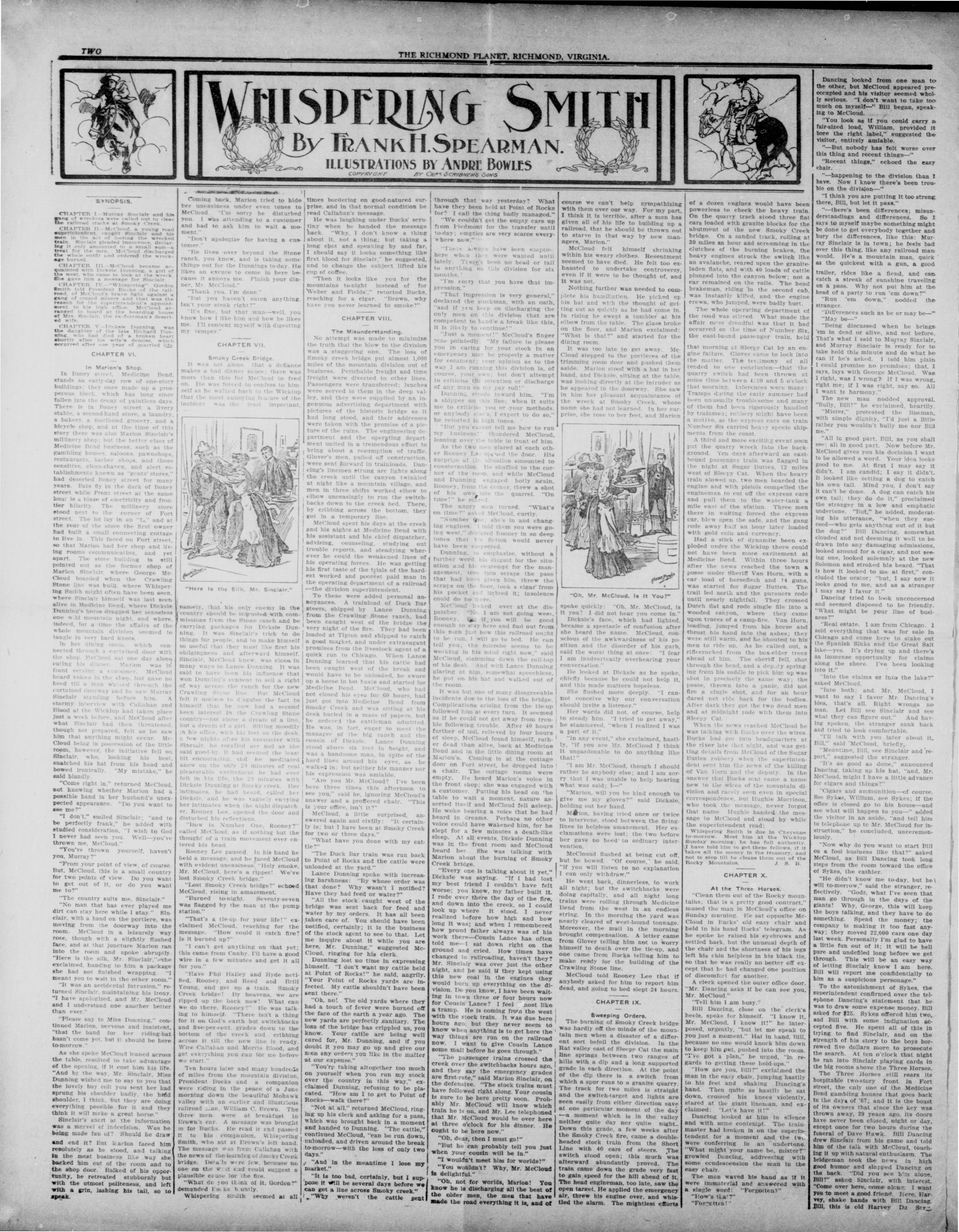
WHISPERING SMITH
BY FRANK H. SPEARMAN.
ILLUSTRATIONS BY ANDRE BOWLES
COPYRIGHT BY CHRIS SCRIBNER'S SONS
Coming back, Marion tried to hide her uneasiness under even tones to McCloud. "I'm sorry he disturbed you. I was attending to a customer and had to ask him to wait a moment."
"Don't apologize for having a customer."
"He lives over beyond the Stone ranch, you know, and is taking some things out for the Dunnings to-day. He likes an excuse to come in here because it annoys me. Finish your dinner, Mr. McCloud."
"Thank you, I'm done."
"But you haven't eaten anything. Isn't your steak right?"
"It's fine, but that man—well, you know how I like him and how he likes me. I'll content myself with digesting my temper."
CHAPTER VII.
Smoky Creek Bridge
It was not alone that a defiance makes a bad dinner sauce; there was more than this for McCloud to feed on. He was forced to confess to him self as he walked back to the Wickup that the most annoying feature of the incident was the least important.
"Here Is the Silk, Mr. Sinclair."
namely, that his only enemy in the country should be ingrusted with commissions from the Stone ranch and be carrying packages for Dickle Dunning. It was Sinclair's trick to do things for people, and to make himself so useful that they must like first his obligениям and afterward himself. Sinclair, McClound knew, was close in many ways to Lance Dunning. It was said to have been his influence that won Dunning's consent to sell a right of way across the ranch for the new Crawling Stone line. But McCloud felt it useless to dsignue the fact to himself that he now had a second keen interest in the Crawling Stone country—not none a dream of a line, but a dream of a girl. Sitting moodily in his office, with his feet on the desk, a few nights after his encounter with Sinclair, he recalled her nod as she said good by. It had seemed the least bit encouraged, and he meditated anew on the only 20 minutes of real pleasurable excitement he had ever felt in his life, the 20 minutes with Dickle Dunning at Smoky creek. Her intimates, he had heard, called her Dickle, and he was vaguely envying her intimates when the night dispatch, Rooney Lee, opened the door and disturbed his reflections.
"How is Number One, Rooney?" called McCloud, as if nothing but the thought of a train movement ever entered his head.
Rooney Lee paused. In his hand he held a message, and he faced McCloud with evident uneasiness. "Holy smoke, Mr. McCloud, here's a ripper! We've lost Smoky Creek bridge."
"Lost Smoky Creek bridge?" echoed McCloud, rising in amazement.
"Burned to-night. Seventy-seven was flagged by the man at the pump station."
"That's a tie-up for your life!" exclaimed McCloud, reaching for the message. "How could it catch fire? Is it burned up?"
"I can't get anything on that yet; this came from Canby. I'll have a good wire in a few minutes and get it all for you."
"Have Phil Hailey and Hyde notified, Rooney, and Reed and Brill Young, and get up a train. Smoky Creek bridge! By heavens, we are ripped up the back now! What can we do there, Rooney?" He was talking to himself. "There isn't a thing for it on God's earth but switchbacks and five-per-cent, grades down to the bottom of the creek and cribbing across it till the new line is ready. Wire Callahan and Morris Blood, and get everything you can for me before we start."
Ten hours later and many hundreds of miles from the mountain division, President Bucks and a companion were riding in the peace of a Jude morning down the beautiful Mohawk valley with an earlier and illustrious railroad man, William C. Brown. The three men were at breakfast in Brown's ear. A message was brought in for Bucks. He read it end passed it to his companion, Whispering Smith, who sat at Brown's left hand. The message was from Callahan with the news of the burning of Smoky Creek bridge. Details were few, because no one on the west end could suggest a plausible cause for the fire.
"What do you think of it, Gordon?" demanded Bucks buntly. Whispering smiled.
Whispering Smith seemed at all
THE RICHMOND FLANET, RICHMOND, VIRGINIA
times bordering on good-natured surprise, and in that normal condition he read Callahan's message.
He was laughing under Bucks' scrutiny when he handed the message back. "Why, I don't know a thing about it, not a thing; but taking a long shot and speaking by and far, I should say it looks something like first blood for Sinclair," he suggested, and to change the subject lifted his cup of coffee.
"Then it looks like you for the mountains to-night instead of for Weber and Fields," retorted Bucks, reaching for a cigar. "Brown, why have you never learned to smoke?"
CHAPTER VIII.
The Misunderstanding
The Misunderstanding.
No attempt was made to minimize the truth that the blow to the division was a staggering one. The loss of Smoky creek bridge put almost 1,000 miles of the mountain division out of business. Perishable freight and time freight were diverted to other lines. Passengers were transferred; lunches were served to them in the deep valley, and they were supplied by an ingenious advertising department with pictures of the historic bridge as it had long stood, and their addresses were taken with the promise of a picture of the ruins. The engineering department and the operating department united in a tremendous effort to bring about a resumption of traffic. Glover's men, pulled off construction, were sent forward in trainloads. Dancing's linemen strung are lights along the creek until the canyon twinkled at night like a mountain village, and men in three shifts worked elbow to elbow unceasingly to run the switchbacks down to the creek bed. There, by cribbing across the bottom, they got in a temporary line.
McCloud spent his days at the creek and his nights at Medicine Bend with his assistant and his chief dispatcher, advising, counseling, studying out trouble reports, and steading wherever he could the weakened lines of his operating forces. He was getting his first taste of the trials of the hardest worked and poorest paid man in the operating department of a railroad—the division superintendent.
To these were added personal annoyances. A trainload of Duck Bar steers, shipped by Lance Dunning from the Crawling Stone ranch, had been caught west of the bridge the very night of the fire. They had been loaded at Tipton and shipped to catch a good market, and under extravagant promises from the livestock agent of a quick run to Chicago. When Lance Dunning learned that his cattle had been caught west of the break and would have to be unloaded, he swore a horse in hot haste and started for Medicine Bend. McCloud, who had not closed his eyes for 60 hours, had just got into Medicine Bend from Smoky Creek and was sitting at his desk buried in a mass of papers, but he ordered the cattleman admitted. He was, in fact, eager to meet the manager of the big ranch and the cousin of Dickie. Lance Dunning stood above six feet in height, and was a handsome man, in spite of the hard lines around his eyes, as he walked in; but neither his manner nor his expression was amiable.
"Are you Mr. McCloud? I've been here three times this afternoon to see you," said he, ignoring McCloud's answer and a proffered chair. "This is your office, isn't it?" McCloud, a little surprised, answered again and civily: "It certainly is; but I have been at Smoky Creek for two or three days." "What have you done with my cattle?" "The Duck Bar train was run back to Point of Rocks and the cattle were unloaded at the yard." Lance Dunning spoke with increasing harshness: "By whose order was that done? Why wasn't I notified? Have they had feed or water?"
"All the stock caught west of the bridge was sent back for feed and water by my orders. It has all been taken care of. You should have been notified, certainly; it is the business of the stock agent to see to that. Let me inquire about it while you are here, Mr. Dunning," suggested McCloud, ringing for his clerk. Dunning lost no time in expressing himself. "I don't want my cattle held at Point of Rocks!" he said, angrily. "Your Point of Rocks yards are infected. My cattle shouldn't have been sent there." "Oh, no! The old yards where they had a touch of fever were burned off the face of the earth a year ago. The new yards are perfectly sanitary. The loss of the bridge has crippled us, you know. Your cattle are being well cared for, Mr. Dunning, and if you doubt it you may go up and give our men any orders you like in the matter at our expense."
"You're taking altogether too much on yourself when you run my stock over the country in this way," exclaimed Dunning, refusing to be placated. "How am I to get to Point of Rocks—walk there?"
"Not at all," returned McCloud, ringing up his clerk and asking for a pass, which was brought back in a moment and handed to Dunning. "The cattle," continued McCloud, "can be run down, unloaded, and driven around the break to-morrow—with the loss of only two days."
"And in the meantime I lose my market."
"It is too bad, certainly, but I suppose it will be several days before we can get a line across Smoky creek."
"Why weren't the cattle sent
through that way yesterday? What have they been held at Point of Rocks for? I call the thing badly managed." "We couldn't get the empty cars up from Hedmont for the transfer until to-day; empties are very scarce everywhere now." "There always have been empties here when they were wanted until lately. There been no head or tail to anything on this division for six months." "I'm sorry that you have that impression." "That impression is very general," declared the stockman, with an oath, "and if you keep on discharging the only men on this division that are competent to handle a break like this, it is likely to continue!"
"Just a moment!" McCloud's finger rose pointily. "My failure to please you in caring for your stock in an emergency may be properly a matter for comment; your opinion as to the way I am running this division is, of course, your own; but don't attempt to criticise the retention or discharge of any man on my pay roll!"
Dunning strode toward him. "I'm a shipper on this line; when it suits me to criticise you or your methods, or anybody else's, I expect to do so," he retorted in high tones.
"But you cannot tell me how to run my business!" thundered McCloud, leaning over the table in front of him.
As the two men glared at each other Rooney Lee opened the door. His surprise at the situation amounted to consternation. He shuffled to the corner of the room, and while McCloud and Dunning engaged hotly again, Rooney, from the corner, threw a shot of his own into the quarrel. "On time!" he roared.
The angry men turned. "What's on time?" asked McCloud, curtly. "Number one; she's in and changing engines. I told them you were going west," declared Booney in so deep tones that his fiction would never have been suspected. Dunning, to emphasize, without a further word, his disgust for the situation and his contempt for the management, tore into scraps the pass that had been given him, threw the scraps on the floor, took a cigar from his pocket and lighed it; insolence could do no more.
McCloud looked over at the dispatcher. "No. I am not going west, Rooney. But if you will be good enough to stay here and find out from this man just how this railroad ought to be run, I will go to bed. He can tell you, the microbe seems to be working in his mind right now," said McCloud, slamming down the roll-top of his desk. And with Lance Dunning glaring at him, somewhat speechless, he put on his hat and walked out of the room.
It was but one of many disagreeable incidents due to the loss of the bridge. Complications arising from the tie-up followed him at every turn. It seemed as if he could not get away from trouble following trouble. After 40 hours further of toll, relieved by four hours of sleep, McCloud found himself, rather dead than alive, back at Medicine Bend and in the little dining room at Marion's. Coming in at the cottage door on Fort street, he dropped into a chair. The cottage rooms were empty. He heard Marion's voice in the front shop; she was engaged with a customer. Putting his head on the table to wait a moment, nature assorted itself and McCloud fell asleep. He woke hearing a voice that he had heard in dreams. Perhaps no other voice could have wakened him, for he slept for a few minutes a death-like sleep. At all events, Dickse Dunning was in the front room and McCloud heard her. She was talking with Marion about the burning of Smoky Creek bridge.
"Every one is talking about it yet," Dicklea was saying. "If I had lost my best friend I couldn't have felt worse; you know, my father built it. I rode over there the day of the fire, and down into the creek, so I could look up where it stood. I never realized before how high and how long it was; and when I remembered how proud father always was of his work there—Cousin Lance has often told me—I sat down right on the ground and cried. How times have changed in railroading, haven't they? Mr. Sinclair was over just the other night, and he said if they kept using this new coal in the engines they would burn up everything on the division. Do you know, I have been waiting in town three or four hours now for Cousin Lance? I feel 'nostel like a tramp. He is coming from the west with the stock train. It was due here hours ago, but they never seem to know when anything is to get here the way things are run on the railroad now. I want to give Cousin Lance some mail before he goes through."
"The passenger trains crossed the creek over the switchbacks hours ago, and they say the emergency grades are first-rate," said Marion Sinclair, on the defensive. "The stock trains must have followed right along. Your cousin is sure to be here pretty soon. Probably Mr. McCloud will know which train he is on, and Mr. Lee telephoned that Mr. McCloud would be over here at three o'clock for his dinner. He ought to be here now."
"Oh, dear, then I must go!" "But he can probably tell you just when your cousin will be in."
"I wouldn't meet him for worlds!" "You wouldn't? Why, Mr. McCloud is delightful."
"Oh, not for worlds, Marion! You know he is discharging all the best of the older men, the men that have made the road everything it is, and of
course we can't help sympathizing with them over our way. For my part, I think it is terrible, after a man has given all of his life to building up a railroad, that he should be thrown out to starve in that way by new managers, Marion."
McCloud felt himself shrinking within his weary clothes. Resentment seemed to have died. He felt too exhausted to undertake controversy, even if it were to be thought of, and it was not.
Nothing further was needed to complete his humiliation. He picked up his hat and with the thought of getting out as quietly as he had come in, in rising he swept a tumbler at his elbow from the table. The glass broke on the floor, and Marion exclaimed: "What is that?" and started for the dining room.
It was too late to get away. MeiCloud stepped to the portieres of the trimming room door and pushed them aside. Marion stood with a hat in her hand, and Dickie sited at the table, was looking directly at the intruder as he appeared in the doorway. She saw in him her pleasant acquaintance of the wreck at Smoky Creek, whose name she had not learned. In her surprise, she rose to her feet, and Marion
"Oh, Mr. McCloud, Is It You?"
spoke quickly: "Oh, Mr. McCloud, is it you? I did not hear you come in."
it you? I did not hear you come in."
Dickie's face, which had lighted, became a spectacle of confusion after she heard the name. McCloud, conscious of the awkwardness of his position and the disorder of his garb, said the worst thing at once: "I fear I am inadvertently overhearing your conversation."
He looked at Dickie as he spoke, chiefly because he could not help it, and this made matters hopeless.
She flushed more deeply. "I cannot conceive why our conversation should invite a listener."
Her words did not, of course, help to steady him. "I tried to get away," he stammered, "when I realized I was a part of it."
"In any event," she exclaimed, hastily, "if you are my. McCloud I think it unpardonable to do anything like that!"
"I am Mr. McCloud, though I should rather be anybody else; and I am sorry that I was unable to help hearing what was said; I—"
"Marion, will you be kind enough to give me my gloves?" said Dickse, holding out her hand.
Marion, having tried once or twice to intervene, stood between the firing-lines in helpless amazement. Her exclamations were lost; the two before her gave no heed to ordinary intervention.
McCloudu flushed at being cut off, but he bowed. "Of course," he said, "if you will listen to no explanation I can only withdraw."
He went back, dinnerless, to work all night; but the switchbacks were doing capitally, and all night long trains were rolling through Medicine Bend from the west in an endless string. In the morning the yard was nearly cleared of west-bound tonnage. Moreover, the mail in the morning brought compensation. A letter came from Glover telling him not to worry himself to death over the tie-up, and one came from Bucks telling him to make ready for the building of the Crawling Stone line.
McCloud told Rooney Lee that if anybody asked for him to report him dead, and going to bed silent 24 hours.
CHAPTER IX.
Sweeping Orders.
The burning of Smoky Creek bridge was hardly off the minds of the mountain men when a disaster of a different sort befell the division. In the Rat valley cast of Sleepy Cat the main line springs between two ranges of hills with a dip and a long supported grade in each direction. At the point of the dip there is a switch from which a spur runs to a granite quarry. The track for two miles is straight and the switch-target and lights are seen easily from either direction save at one particular moment of the day.
—a moment which is in the valley neither quite day nor quite night. Down this grade, a few weeks after the Smoky Creek fire, came a double-headed stock train from the Short Line with 40 cars of steers. The switch stood open; this much was afterward abundantly proved. The train came down the grade very fast to gain speed for the hill ahead of it. The head engineer, too late, saw the open target. He applied the emergency air, threw his engine over, and whistled the alarm. The mightiest efforts
C
of a dozen engines would have been powerless to check the heavy train. On the quarry track stood three flat cars loaded with granite blocks for the abutment of the new Smoky Creek bridge. On a sanded track, rolling at 20 miles an hour and screaming in the clutches of the burning brakes, the heavy engines struck the switch like an avalanche, reared upon the granite flats, and with 40 loads of cattle plunged into the canyon below; not a car remained on the rails. The head brakeman, riding in the second cab, was instantly killed, and the engine crews, who jumped, were badly hurt. The whole operating department of the road was stirred. What made the affair more dreadful that it had occurred on the time of Number Six, the east-bound passenger train, held
that morning at Sleepy Cat by an engine failure. Glover came to look into the matter. The testimony of all tended to one conclusion—that the quarry switch had been thrown at some time between 4:30 and 5 o'clock that morning. Inferences were many: Tramps during the early summer had been unusually troublesome and many of them had been rigorously handled by trainmen; robbery might have been a motive, as the express cars on train Number Six carried heavy specie shipments from the coast.
A third and more exciting event soon put the quarry wreck into the background. Ten days afterward an east-bound passenger train was flagged in the night at Sugar Buttes, 12 miles west of Sleepy Cat. When the heavy train slowed up, two men boarded the engine and with pistols compelled the engineer to cut off the express cars and pull them to the water-tank a mile east of the station. Three men there in waiting forced the express car, blew open the safe, and the gang rode away half an hour later loaded with gold coin and currency.
Had a stick of dynamite been exploded under the Wickipu there could not have been more excitement at Medicine Bend. Within three hours after the news reached the town a posse under Sheriff Van Horn, with a car load of horseflesh and 14 guns, was started for Sugar Buttes. The trail led north and the pursuers rode until nearly nightfall. They crossed Dutch flat and rode single file into a wooded canyon, where they came upon traces of a camp-fire. Van Horn, leading, jumped from his horse and thrust his hand into the ashes; they were still warm, and he shouted to his men to ride up. As he called out, a riflecracked from the box-elder trees ahead of him. The sheriff fell, shot through the head, and a deputy springing from his saddle to pick him up was shot in precisely the same way; the posse, thrown into a panic, did not fire a single shot, and for an hour dared not ride back for the bodies. After dark they got the two dead men and at midnight rode with them into Sleepy Cat.
When the news reached McCloud he was talking with Bucks over the wires. Bucks had got into headquarters at the river late that night, and was getting details from McCloud of the Sugar Butts robbery when the superintendent sent him the news of the killing of Van Horn and the deputy. In the answer that Bucks sent came a name new to the wires of the mountain division and rarely seen even in special correspondence, but Hughie Morrison, who took the message, never forgot that name. Hughie handed the message to McCloud and stood by while the superintendent read:
Whispering Smith is due in Cheyenne to-morrow. Meet him at the Wicklup Sunday morning; he has full authority. I have told him to get these fellows, if it meets the promise in the treasury, or to not stop till he cleans them out of the Rocky Mountains. J. S. H.
CHAPTER X.
At the Three Horses
"Clean them out of the Rocky mountains; that is a pretty good contract," mused the man in McCloud's office on Sunday morning. He sat opposite McCloud in Fucks' old easy chair and held in his hand Bucks' telegram. As he spoke he raised his eyebrows and settled back, but the unusual depth of the chair and the shortness of his legs left his chin helpless in his black tie, so that he was really no better off except that he had changed one position of discomfort for another. A clerk opened the outer office door. "Mr. Dancing asks if he can see you, Mr. McCloud." "Tell him I am busy."
Tell him I am busy.
Bill Dancing, close on the clerk's heels, spoke for himself. "I know it, Mr. McCloud, I know it!" he interposed, urgently, "but let me speak to you just a moment." Hat in hand, Bill, because no one would knock him down to keep him put, pushed into the room. "I've got a plan," he urged, "in regards to getting these hold-ups."
"How are you, Bill?" exclaimed the man in the easy chair, jumping hastily to his feet and shaking Dancing's hand. Then quite as hastily he sat down, crossed his knees violently, stared at the giant lineman, and exclaimed: "Let's have it."
Dancing looked at him in silence and with some contempt. The trainmaster had broken in on the superintendent for a moment and the two were conferring in an undertone. "What might your name be, mister?" growled Dancing, addressing with some cndescension the man in the easy chair.
The man waved his hand as if it were immaterial and answered with a single word: "Forgotten!" "How's tia:?"
Dancing looked from one man to the other, but McCloud appeared preoccupied and his visitor seemed wholly serious. "I don't want to take too much on myself—" Bill began, speaking to McCloud.
"You look as if you could carry a fair-sized load, William, provided it bore the right label," suggested the visitor, entirely amable.
"But nobody has felt worse over this thing and recent things—"
"Recent things," echoed the easy chair.
"—happening to the division than I have. Now I know there's been trouble on the division—"
"I think you are putting it too strong; there, Bill, but let it pass."
“—there's been differences; misunderstandings and differences. So I says to myself maybe something might be done to get everybody together and bury the differences, like this: Murray Sinclair is in town; he feels bad over this thing, like any railroad man would. He's a mountain man, quick as the quickest with a gun, a good trailer, rides like a fiend, and can catch a streak of sunshine traveling on a pass. Why not put him at the head of a party to run 'em down?"
"Run 'em down," nodded the stranger.
"Differences such as be or may be—"
"May be—"
"Being discussed when he brings 'em in dead or alive, and not before. That's what I said to Murray Sinclair, and Murray Sinclair is ready for to take hold this minute and do what he can if he's asked. I told him plain I could promise no promises; that, I says, lays with George McCloud. Was I right, was I wrong? If I was wrong, right me; if I was right, say so. All I want is harmony."
The new man nodded approval.
"Bully, Bill!" he exclaimed, heartily.
"Mister," protested the lineman, with simple dignity. "I'd just a little rather you wouldn't bully me nor Bill me."
"All in good part, Bill, as you shall see; all in good part. Now before Mr. McCloud gives you his decision I want to be allowed a word. Your idea looks good to me. At first I may say it didn't. I am candid; I say it didn't. It looked like setting a dog to catch his own tail. Mind you, I don't say it can't be done. A dog can catch his own tail; they do it," proclaimed the stranger in a low and emphatic undertone. "But," he added, moderating his utterance, "when they succeed—who gets anything out of it but the dog?" Bill Dancing, somewhat clouded and not deeming it well to be drawn into any damaging admissions, looked around for a cigar, and not seeing one, looked solemnly at the new Solomon and stroked his beard. "That is how it looked to me at first," concluded the orator; "but, I say now it looks good to me, and as a stranger I may say I favor it."
Dancing tried to look unconcerned and seemed disposed to be friendly. "What might be your line of business?"
"Real estate. I am from Chicago. I sold everything that was for sale in Chicago and came here to stake out the Spanish Sinks and the Great Salt lake—yes. It's drying up and there's an immense opportunity for claims along the shore. I've been looking into it."
"Into the claims or into the lake?" asked McCloud.
"Into both; and. Mr. McCloud, I want to say I favor Mr. Dancing's idea, that's all. Right wrongs no man. Let Bill see Sinclair and see what they can figure out." And having spoken, the stranger sank back and tried to look comfortable.
"I'll talk with you later about it."
"I'll talk with you later about it, Bill," said McCloud, briefly.
"Meantime, Bill, see Sinclair and report," suggested the stranger.
"It's as good as done," announced Dancing, taking up his hat, "and, Mr. McCloud, might I have a little advance for cigars and things?"
"Cigars and ammunition—of course. See Sykes, William, see Sykes; if the office is closed go to his house—and see what will happen to you—" added the visitor in an aside, "and tell him to telephone up to Mr. McCloud for instruction," he concluded, unceremoniously.
"Now why do you want to start Bill on a fool business like that?" asked McCloud, as Bill Dancing took long steps from the room toward the office of Sykes, the cashier.
"He didn't know me to day, but he will to-morrow," said the stranger, reflectively. "Gods, what I've seen that man go through in the days of the giants! Why, George, this will keep the boys talking, and they have to do something. Spend the money; the company is making it too fast anyway; they moved 22,000 cars one day last week. Personally I'm glad to have a little fun out of it; it will be hell pure and undefiled long before we get through. This will be an easy way of letting Sinclair know I am here. Bill will report me confidently to him as a suspicious personage."
To the astonishment of Sykes, the superintendent confirmed over the telephone Dancing's statement that he was to draw some expense money. Bill asked for $25. Sykes offered him two, and Bill with some indignation accepted five. He spent all of this in trying to find Sinclair, and on the strength of his story to the boys borrowed five dollars more to prosecute the search. At ten o'clock that night he ran into Sinclair playing cards in the big rooms above the Three Horses.
The Three Horses still rears its hospitable two-story front in Fort street, the only one of the Medicine Bend gambling houses that goes back to the days of '67; and it is the boast of its owners that since the key was thrown away, 39 years ago, its doors have never been closed, night or day, except once for two hours during the funeral of Dave Hawk. Bill Dancing drew Sinclair from his game and told him of the talk with McCloud, touching it up with natural enthusiasm. The bridgeman took the news in high good humor and slapped Dancing on the back. "Did you see him alone, Bill?" asked Sinclair, with interest. "Come over here, come along. I want you to meet a good friend. Here, Harvey, shake hands with Bill Dancing, Bill, this is old Harvey Da Serg.
THE YEARNET
SATURDAY.....JULY 10, 1909.
meanest man in the mountains to his enemies and the whitest to his friends —eh. Harvey?"
Harvey seemed uncommunicative. Studying his hand, he asked in a sour way whether it was a jackpot, and upon being told that it was not, pushed forward some chips and looked stupidly up—though Harvey was by no means stupid. "Proud to know you, sir," said BILL, bending frankly as he put out his hand. "Proud to know any friend of Murray Simlair's. What might be your business?"
Again Du Sang appeared abstracted. He looked up at the giant lineman, who, in spite of his own size and strength, could have crushed him between his fingers, and hitched his chair a little, but got no further toward an answer and paid no attention whatever to Bill's extended hand.
"Cow business, Bill," interposed Sinclair. "Where? Why, up near the park, Bill, up near the park, Bill is an old friend of mine, Harvey. Shake hands with George Seagrue, Bill, and you know Henry Karg—and old Stormy Gorman—well, I guess you know him, too," exclaimed Sinclair, introducing the other players. "Look here a minute, Harvey."
Harvey, much against his inclination, was drawn from the table and retired with Sinclair and Dancing to an empty corner, where Dancing told his story again. At the conclusion of it Harvey rather snorted. Sinclair asked questions. "Was anybody else there when you saw McCloud, Bill?" "One man," answered Bill, impressively.
"Who?"
"A stranger to me."
"A stranger? What did he look like?"
"Slender man and kind of odd talking, with a sandy mustache."
"Hear his name?"
"He told me his name, but it's skipped me. I declare. He's kind of dark-completed like."
"Stranger, eh?" mused Du Sang; his eyes were wandering over the room.
"Slender man," repeated Bill, "but I didn't take much notice of him. Sald he was in the real estate business."
"In the real estate business? And did he sit there while you talked this over with the college guy?" muttered Du Sang.
"He is all right, boys, and he said you'd know his name if I could speak it," declared Bill.
"Look anything like that man standing with his hands in his pockets over there by the wheel?" asked Du Sang, turning his back carefully on a new-comer as he made the suggestion.
"Where—there? No! Yes, hold on,
that's the man there now! Hold on,
now!" urged Bill, struggling with the
excitement of ten hours and ten dollars
in one day. "His name sounded
like Fogarty."
As Dancing spoke, Sinclair's eyes
riveted on the new face at the other
"Fogarty, Hell!" He Exclaimed.
side of the gambling room. "Fogarty, hell!" he exclaimed, starting. "Stand right still, Du Sang; don't look around. That man is Whispering Smith."
CHAPTER XI.
Parley.
It was recalled one evening not long ago at the Wicklup that the affair with Stiaclair had all taken place within a period of two years, and that practically all of the actors in the event had been together and in friendly relation on a Thanksgiving day at the Dunning ranch not go very long before the trouble began. Dickse Dunning was away at school at the time, and Lance Dunning was celebrating with a riding and shooting fest and a barbecue. The whole country had been invited. Bucks was in the mountains on an inspection trip, and Bill Dancing drove him with a party of railroad men over from Medicine Bend. The mountain men for 150 miles around were out. Gene and Bob Johnson, from Oroville and the Peace river, had come with their friends. From Williams Cache there was not only a big delegation—more of one than was really desirable
—but it was led by old John Rebstock himself. When the invitation is general, lines cannot be too closely drawn. Not only was Lance Dunning something of a sport himself, but on the Long Range it is part of a stockman's creed to be on good terms with his neighbors. At a Thanksgiving day barbecue not even a mountain sheriff would ask questions, and Ed Banks, though present, respected the holiday truce. Cowboys rode that day in the roping contest who were from Mission creek and from Two Feather river. Among the railroad people were George McCloud, Anderson, the assis-
tant superintendent, Farrell Kennedy, chief of the special service, and his right-hand man, Bob Scott. In especial, Sinclair's presence at the barbecue was recalled. He had some cronies with him from among his up-country following, and was introducing his new bridge foreman, Karg, afterward known as Flat Nose, and George Seagrue, the Montana cowboy. Sinclair fraternized that day with the Williams Cache men, and it was remarked even then that though a railroad man he appeared somewhat outside the railroad circle. When the shooting matches were announced a brown-eyed railroad man was asked to enter. He had been out of the mountains for some time and was a comparative stranger in the gathering, but the Williams Cache men had not forgotten him; Rebstock, especially, wanted to see him shoot. While much of the time out of the mountains on railroad business, he was known to be closely in Bucks' counsels, and as to the mountains themselves, he was reputed to know them better than Bucks or Glover himself knew them. This was Whispering Smith; but, beyond a low-voiced greeting or an expression of surprise at meeting an old acquaintance, he avoided talk. When urged to shoot he resisted all persuasion and backed up his refusal by showing a bruise on his trigger finger. He declined even to act as judge in the contest, suggesting the sheriff, Ed Banks, for that office.
McCloud did not meet the host, Lance Dunning, that day nor since the day of the barbecue had Du Sang or Sinclair seen Whispering Smith until the night Du Sang spotted him near the wheel in the Three Horses. Du Sang at once drew out of his game and left the room. Sinclair in the meantime had undertaken a quarrelsome interview with Whispering Smith.
"I supposed you knew I was here," said Smith to him, amiably. "Of course I don't travel in a private car or carry a billboard on my back, but I haven't been hiding."
"The last time we talked," returned Sinclair, measuring words carefully, "you were going to stay out of the mountains."
"I should have been glad to, Murray. Affairs are in such shape on the division now that somebody had to come, so they sent for me."
The two men were sitting at a table. Whispering Smith was cutting and leisurely mixing a pack of cards.
"Well, so far as I'm concerned, I'm out of it," Sinclair went on after a pause, "but, however that may be, if you're back here looking for trouble there's no reason, I guess, why you can't find it."
"That's not it. It I'm not here looking for trouble; I'm here to fix this thing up. What do you want?" "Not a thing."
"I'm willing to do anything fair and right," declared Whispering Smith, raising his voice a little above the hum of the rooms.
"Fair and right is an old song."
"And a good one to sing in this country just now. I'll do anything I can to adjust any grievance, Murray. What do you want?"
Sinclair, for a moment was silent, and his answer made plain his unwillingness to speak at all. "There never would have been a grievance if I'd been treated like a white man." His eyes burned sulenly. "I've been treated like a dog." "That is not it." "That is it," declared Sinclair, savagely, "and they'll find it it." "Murray, I want to say only this—only this to make things clear. Bucks feels that he's been treated worse than a dog." "Then let him put me back where I belong." "It's a little late for that, Murray; a little late," said Smith, gently. "Shouldn't you rather take good money and get off the division? Mind you, I say good money, Murray—and peace." Sinclair answered without the slightest hesitation: "Not while that man McCloud is here." Whispering Smith smiled. "I've got no authority to kill McCloud."
"There are plenty of men in the mountains that don't need any."
"But let's start fair," urged Whispering Smith, softly. He leaned forward with one finger extended in confidence. "Don't let us have any misunderstanding on the start. Let McCloud alone. If he is killed—now I'm speaking fair and open and making no threats, but I know how it will come out—there will be nothing but killing here for six months. We will make just that memorandum on McCloud. Now about the main question. Every sensible man in the world wants something."
"I know men that have been going a long time without what they wanted."
Smith flushed and nodded. "You needn't have said that, but no matter. Every sensible man wants something. Murray. This is a big country. There's a World's Fair running somewhere all the time in it. Why not travel a little? What do you want?"
"Just exactly the two things, and, by heavens! the only two, I can't manage. Come once more and I'll meet you."
"No!" Sinclair rose to his feet. "No—damn your money! This is my home. The high country is my country; it's where my friends are."
"It's filled with your friends; I know that. But don't put your trust in your friends. They will stay by you, I know; but once in a long while there will be a false friend, Murray, one that will sell you—remember that."
"I stay."
Whispering Smith looked up in admiration. "I know you're game. It isn't necessary for me to say that to you. But think of the fight you are going into against this company. You can worry them; you've done it. But a bronco might as well try to buck a locomotive as for one man or six or 600 to win out in the way you are playing."
"I will look out for my friends; others." Sinclair hitched his belt and paused, but Whispering Smith, cutting and running the cards, gave no heed. His eyes were fixed on the green cloth under his fingers. "Others" repeated
THE RICHMOND PLANET, RICHMOND, VIRGINIA
Sinclair.
"Others?" echoed Whispering Smith, good-naturedly.
"May look out for themselves."
"Of course, of course! Well, if this is the end of it, I'm sorry."
"You will be sorry if you mix in a quarrel that is none of yours."
"Why, Murray, I never had a quarrel with a man in my life."
"You are pretty smooth, but you can't drive me out of this country. I know how well you'd like to do it; and, take notice, there's one trail you can't cross even if you stay here. I suppose you understand that."
Smith felt his heart leap. He sat in his chair turning the pack slowly, but with only one hand now; the other hand was free. Sinclair eyed him sidewise. Smith moistened his lips and when he replied spoke slowly: "There is no need of dragging any allusion to her into it. For that matter, I told Bucks he should have sent any man but me. If I'm in the way, Sinclair, if my presence here is all that stands in the way, I'll go back and stay back as before, and send any one else you like or Bucks likes. Are you willing to say that I stand in the way of a settlement?" Sinclair sat down and put his hands on the table. "No; your matter and mine is another affair. All I want between you and me is fair and right."
Whispering Smith's eyes were on the cards. "You've always had it."
"Then keep away from her."
"Don't tell me what to do."
"Then don't tell me."
"I'm not telling you. You will do as you please; so will I. I left here because Marion asked me to. I am here now because I have been sent here. It is in the course of my business. I have my living to earn and my friends to protect. Don't dictate to me, because it would be of no use."
"Well, you know now how to get into trouble."
"Every one knows that; few know how to keep out."
"You can't lay your finger on me at any turn of the road."
"Not if you behave yourself."
"And you can't bully me."
"Surely not. No hard feelings, Murray. I came for a friendly talk, and if it's all the same to you I'll watch this wheel awhile and then go over to the Wicklup. I leave first—that's understood, I hope—and if your pinkeyed friend is waiting outside tell him there is nothing doing, will you, Murray? Who is the albino, by the way? You don't know him? I think I do. Fort City, if I remember. Well, goodnight, Murray."
It was after 12 o'clock and the room had filled up. Roulette balls were dropping, and above the faro table the extra lights were on. The dealers, fresh from supper, were putting things in order for the long trick.
At the Wicklup Whispering Smith found McCloud in the office signing letters. "I can do nothing with him." said Smith, drawing down a window-shade before he seated himself to detail his talk with Sinclair. "He wants a fight."
McCloud put down his pen. "If I am the disturber it would be better for me to get out." "That would be hauling down the flag across the whole division. It is too late for that. If he didn't center the fight on you he would center it somewhere else. The whole question is, who is going to run this division, Sinclair and his gang or the company? and it is as easy to meet them on one point as another. I know of no way of making this kind of an affair pleasant. I am going to do some
"Then Keep Away from Her!"
riding, as I told you. Kennedy is working up through the Deep Creek country, and has three men with him. I shall ride toward the Cache and meet him somewhere near South Mission pass."
"Gordon, would it do any good to ask a few questions?"
"Ask as many as you like, my dear boy, but don't be disappointed if I can't answer them. I can look wise, but I don't know anything. You know what we are up against. This fellow has grown a tiger among the wolves, and he has turned the pack loose on us. One thing I ask you to do. Don't expose yourself at night. Your life isn't worth a coupling-pln if you do."
McCloud raised his hand. "Take care of yourself! If you are murdered in this fight I shall know I got you in and that I am to blame."
"And suppose you were?" Smith had risen from his chair. He had few manners, and recalling the man the few times I have seen him, the only impression he has left on me is that of quiet and gentleness. "Suppose you were?" He was resting one arm on top of McCloud's desk. "What of it? You have done for me up here what I couldn't do, George. You have been kind to Marlon when she hadn't a friend near. You have stood between him and her when I couldn't be hee to do it, and when she didn't want me to—helped her when I hadn't the privilege of doing it." McCloud put up his hand in protest, but it was unheeded. "How many times it has been in my heart to kill that man. She knows it; she prays it may never happen. That is why she stays here and
nas kept me out of the mountains.
She says they would talk about her if
I lived in the same town, and I have
stayed away." He threw himself back
into the chair. "It's going beyond
both of us now. I've kept the promise
I made to her to-day to do all in my
power to settle this thing without
bloodshed. It will not be settled in
that way. George."
as he stares Sugar bucks.
"It it, his gang was there. The quick get-away, the short turn on Van Horn, killing (two men to rattle the posse—it all bears Sinclair's earmarks. He has gone too far. He has piled up plunder till he is reckless. He is crazy with greed and insane with revenge. He thinks he can gallop over this division and scare Buckts till he gets down on his knees to him. Buckts will never do it. I know him, and I tell you Buckts will never do it. He is like that man in Washington; he will fight it to the death. He would fight Sinclair if he had to come up here and meet him single-handed, but he will never have to do it. He put you here, George, to round that man up. This is the price for your advancement, and you must pay it."
"It is all right for me to pay it, but I don't want you to pay it. Will you have a care for yourself, Gordon?"
"You need never ask me to be careful," Smith went on. "That is my business. I asked you to watch your window shades at night, and when I came in just now I found one up. It is you who are likely to forget, and in this kind of a game a man never forgets but once. I'll lie down on the Lincoln lounge, George." "Get into the bed." "No; I like the lounge, and I'm off early."
In the private room of the superintendent, provided as a sleeping apartment in the old headquarters building many years before hotel facilities reached Medicine Bend, stood the only curio the Wicklup possessed—the Lincoln lounge. When the car that carried the remains of Abraham Lincoln from Washington to Springfield was dismantled, the Wicklup fell heir to one piece of its elaborate furnishings, the lounge, and the lounge still remains as an early-day relic. Whispering Smith walked into the bedroom and disposed himself in an incredibly short time. "I've borrowed one of your pillows, George," he called out, presently.
"Take both."
"One's enough. I hope," he went on, rolling himself like a hen on the double blanket, "the horse Kennedy has left me will be all right; he got three from Bill Dancing, Bill Dancing," he snorted, driving his nose into the pillow as if in final memorandum for the night, "he will get himself killed if he fools around Sinclair too much now."
McCloud, under a light shaded above his desk, opened a roll of blue-prints. He was going to follow a construction gang up the Crawling Stone in the morning and wanted to look over the surveys. Whispering Smith, breathing regularly, lay not far away. It was late when McCloud put away his maps, entered the inner room and looked at his friend.
He lay like a boy asleep. On the chair beside his head he had placed his old-fashioned hunting-case watch, as big as an alarm clock, the kind a railroad man would wind up with a spike-mail. Beside the watch he had laid his huge revolver in its worn leather scabbard. Breathing peacefully, he lay quite at his companion's mercy, and McCloud, looking down on this man who never made a mistake, never forgot a danger, and never took an unnecessary chance, thought of what between men confidence may sometimes mean. He sat a moment with folded arms on the side of his bed, studying the tired face, defenseless in the slumber of fatigue. he turned out the light and lay down, he wondered whether, somewhere in the valley of the great river to which he took to take his men in the morning, he should encounter the slight and reckless horsewoman who had blazed so in anger when he stood before her at Marion's. He had struggled against her charm too long. She had become, how or when he could not tell, not alone a pretty woman but a fascinating one—the creature of his constant thought. Already she meant more to him than all else in the world. He well knew that if called on to choose between Dickse and all else he could only choose her. But as he drew together the curtains of thought and sleep stole in upon him, he was resolved first to have Dickse; to have all else if he could, but, in any case, Dickse Dunning. When he awoke day was breaking in the mountains. The huge silver watch, the low-volved man and the formtfable six-shooter had disappeared. It was time to get up, and Marion Sinclair had promised an early breakfast.
(To Be Continued.)
CONDENSED NEWS ITEMS.
CONDENSED NEWS ITEMS.
Thursday, June 24.
President Taft has been mustered in as an honorary member of the local camp of the Regular Army and Navy Union.
Mrs. Grover Cleveland, with her daughters, Esther and Marlon, and her son, Richard, are at their summer home in Tamworth, N. H.
Foes of the liquor traffic in Chicago hope to have 100,000 persons in line in the temperance and law enforcement parade on September 25.
According to an official statement given out by the Louisiana game commission, 5500 deer were killed in that state during the season just closed.
The degree of doctor of laws was conferred by the trustees of Washington and Jefferson college at Washington, Pa., on former Judge James Gay Gordon, of Philadelphia.
Friday, June 25.
Captain Abraham E. Culver, of the United States navy, died suddenly in Washington, aged fifty-three years.
Following a trivial quarrel at Waco,
Tux., George Cohen, nine years old, secured a target rifle and killed Maggie
Farrell, eight years his senior.
Joseph Bertucci, an alleged Black
Hand slayer, was found guilty by a
jury in Chicago and was sentenced to
twenty years in the penitentiary.
Firm in the belief that she was to
die soon. Mrs. Mary Moore, of Salina,
Kan, wrote her obituary notice a few
days ago and Thursday she died.
Saturday, June 26.
Mrs. Albert Pulitzer, wife of the well known New York journalist, died suddenly. Fifteen masked men took Albert Reese, a negro, who assaulted a white woman, from jail at Cuthbert, Ga., and hanged him. A resolution was adopted by the Washington legislature inviting President Taft to attend the First National Conservation Congress, to be held in Seattle, Aug. 26. After spending twenty-five years in Japan serving as teachers, Miss Iaabella Graham Prince, aged eighty, and Miss Mary Gray Prince, aged seventy-six, arrived in Seattle, Wash., enroute to their old home in Portland, Ma.
Monday, June 28.
The No Name Hat company, employing 400 hands, decided to move its plant from Orange, N. J., to Philadelphia.
Five explosions of nitro-glycerine at Wheeling Junction, O., ruined steel girders valued at $30,000, which were intended for a non-union operation.
Stock raisers got a judgment for $57,000 against the Traders' Live Stock Exchange in Kansas City in a suit under the Sherman ant-trust law. The Society of Naval Architects, in session at Detroit, refused to admit Noah to the rolls of honorary members, on the ground that he was a gamekeeper, not a boat builder.
Charles Clark, the boy leaper who escaped from the almshouse near Camden, N. J., was a prisoner at the house of correction at Philadelphia from June 19 to Saturday, having been sentenced for vagrancy.
Tuesday, June 29.
Two negroes were killed and five others were wounded at a stone quarry near Ripley, Okla., in a quarrel over a crap game.
J. Frank Hawkins, of East Orange, N. J., formerly editor of the New Jersey Standard, was killed at Newark by falling under a train from which he was alighting.
Permission has been granted by the United States to the Fifth regiment of Canadian artillery, armed and equipped, to enter this country July 1 for the purpose of attending the Seattle exposition.
Wednesday, June 30.
Former President Charles W. Elliot, of Harvard university, has been elected president emeritus of the institution.
A bid of $95,000 was reported made for a seat on the New York Stock Exchange, equal to the record price, established in 1906 and 1905.
Middlebury (Vt.) college conferred the degree of doctor of laws upon Governor John Franklin Fort, of New Jersey, and Governor George H. Prouty, of Vermont.
New York aldermen passed an ordinance prohibiting peddlers or salesmen from crying their wares on the streets, but through political influence "Paddy's Market," on Ninth avenue, is excented.
PRODUCE QUOTATIONS.
The Latest Closing Prices For Produce
and Live Stock.
PHILADELPHIA — FLOUR quiet;
winter low grades, $5 @ 8.25; winter
clear, $5.75 @ 6.25; city mills, fancy.
$1 @ 7.25.
CORN steady; No. 2 yellow, local 80½ @81c.
OATS quiet; No. 2 white, clipped.
62½ @63c.; lower grades, 62c.
HAY firm; timothy, large bales, per
ton, $17.50.
POULTRY: Live steady; hens, 15½
@16c.; old roosters, 10½c. Dressed
steady; choice fowls, 16c.; old roost
ers, 11c.
BUTTER firm; extra creamy, 27c.
EGGS steady; selected, 24 @ 16c;
ROOSTERS western, 22c.
POTATOES steady; new, per bar
11½c 22.5
Live Stock Markets
PITTBURG (Union Stock Yards)—
CATTLE lower; choice, $6.90@7.15;
prime, $5.90@6.80.
SHEEP lower; prime wethers, $5@
5.15 culls and common, $2.50@3;
spring lambs, $5.75; 7.75; veal calves,
$7.50@8.
HOGS higher; prime heavies, $8.30
@8.35; mediums, $8.10@8; heavy
Yorkers, $8.10; light Yorkers, $7.50
@7.75; pigs, $7.15@7.25; roughs, $7.
BRANDENBURG IS ACQUITTED
Then Arrested on Charge of Kidnapping His Stepson.
New York, June 30.—Broughton Brandenburg was acquitted on the charge of grand larceny growing out of the sale to the New York Times of an article purporting to have been signed by Grover Cleveland.
He was at once arrested on a charge of kidnapping his stepson, James Shepard Cabanne in St. Louis.
Murderer Hanged.
Emporium, Pa., June 30.—Joseph Pagano, convicted of the murder of John Kibe, whom he shot on November 26 last year, was hanged in the county jail here.
When in need of a good, live, up-to-date newspaper, subscribe for the PLANET.
C. & O.
9:00 A. [Fast daily trains to Old Point, | and
4:00 P. [Newport News and Norfolk.
7:40 A. Daily. Local to Newport News.
8:00 P. Daily. Local to Old Point.
9:00 P. [Daily. Louisville, Cincinnati, Chico-
11:00 P. [go and St. Louis Fullmans.
8:00 A. Daily. Ch'ville, exc. Sun. C. Forge.
11:00 P. Week days. L. Larke to Cortezville.
8:00 A. Daily. L'Burg. Lexington. C. Forge.
11:00 P. Week days. To Lynchburg.
**TRAINS ARRIVE RICHMOND**
Local from East -8:46 A.M. 8:15 P.M.
Through from East -11:45 A.M. 7: P.M.
Local from West -8:30 A.M. 7:45 P.M.
Local from West -8:30 A.M. 7:45 P.M.
James River Line -9:15 A.M. 8:90 P.M.
*Daily Excursion Sunday.*
LINCOLN
HAIR POMADE
MAKES
KINKY
HAIR
SOFT
REMOVES
DANDRUFF
KEEPS
HAIR
FROM
BREAKING
OFF
LINCOLN
HAIR POMADE
WHICH WAY WOULD YOU RATHER HAVE YOUR HAIR-SOFT AND
LONG SO THAT YOU CAN PUT IT UP IN THE LATEST STYLE
OR SHORT AND KINKY
KEEPS
SCALP
FRESH
CLEAN AND
WHOLE-
SOME
MAKES
HAIR
GROW
LONG AND
LUXURIOUS
A WOMAN'S JUST PRIDE IS HER
HAIR.
TO STRAIGHTEN OUT THAT KINKY, CURLY HAIR, PUTTING IT IN THE MOST PERFECT CONDITION TO BE COMBED INTO ANY SHAPE JUST TRF A BOTTLE OF LINCOLN HAIR POMADE.
There is no other preparation on earth to equal Lincoln Hair Pomade in producing soft, beautiful hair. Lincoln Hair Pomade is a natural hair cleanser—a natural promoter of growth and naturally reduces the hair to a straight and combable condition; but also supplies the air with a silky sheen and gloss. No matter how rough or heavy your hair is now, no matter how hard or curly it may be, the life of Lincoln Hair Pomade will give you hair that can well be the envy of others.
Lincoln Hair Pomade is the only highly recommended preparation for this purpose on the market.
It is Lincoln Hair Pomade you want, so refuse weak and inferior substitutes. Do not take anything that is claimed to be just as good, but insist on getting the genuine.
PRICE, 15 CENTS.
MANUFACTURED BY
Agents Wanted Everywhere. Write for particulars. If your dealer does not keep it, send 20 cents in stamps or silver to THE LINCOLN POMADE CO. Department B, Norfolk, Va. and we will send you a bottle by return mail.
The Hawkins-Price Co. Hair Growers and Restorers.
(TRADE MARK REGISTERED.)
Carefully a full line of natural human hair-braids, bangs pompoudres and the latest styles in front pumphous hair colors—black, brown, gray and mixed gray. Those desiring to match the hair must very sure in stating explically colors desired. It is easy to say so in a small sample of hair if possible, so that we may be in a position to match it correctly.
Prices: Braids, (natur al hair) $2.50; All-round Pompoudres
round P.
(nautral hair), $4.00, Front P.
This Preparation has proved to be a
to-day delighted with its work and a
urally place it in a sphere all of its own,
speak of it, measure us of its satisfactory
rethought this and other States and also
colour and apply to thalmism this country.
In order to convince the most comm
HAWKINS-PRICE HAIR GROWER AND RI
in print the photographs of those giving
preparation and application to the use
We do not desire the correspondence of
enable. Our preparation is a natural law
would be hesitate to put in print.
We will publish the public
national patent rights on our hair preparation
turn responsible to the government for home
will positively remove Dandruff. On
Cash Towel Heads, where he
The Face Beautifier offers
Sale Price, 25 and 60 cents and
is imposed on all of our city orders. Moth
or Express Money Order. Address all comm
HAWKINS-PRICE
Phone 4601. Correspondence S
(nautral hair), $4.00; Front Pieces (nautral hair), $2.50.
This Preparation has proved to be a fortune to many of the unfortunate, who are to-day delighted with its wonderful results. The merits of this great hair preparation naturally include a sphere all of its own, and the glowing terms in which our patrons speak of it, require many very results. We can well boast of a large patronage throughout this and other States and also a commendation of the very best white and colored people in this immediate community.
order to convince the most skeptical readers of the merits and results of the HAWKINS-PRICE COMPANY, HAWKINS GIRL HAIR GROWER AND RESTORER, we will from time to time produce in print the photocopies of the many giving us permission to do so, who have used our preparation and are to-day among the best witness of the genuine qualities. We do not desire the correspondence of those who are unreasonable. Our preparation is a natural and pure compound, the ingressions of which, we would hesitate to put in print.
We will publicly public that the United States Government has placed national patent rights on our hair preparation by which it is protected, and we are in turn responsible to the government for honest methods to secure dealings. We will positively remove Dandruff. Cure the Scalp of all Hair Hair on Crown Temples or Bald Heads, where hee Roots are not Dead. Price, 25 cents per box. The Crown Temples or Bald Heads, the use of powder entirely unnecessary and is perfectly harmless. Sale Price, 25 and 50 cents per bottle. A charge of ten cents extra is imposed on all of our city orders. Money can be sent by Post Office Money Order, or Express Money Order. Address all communications to:
HAWKINS-PRICE COMPANY,
'Phone 4601. 616 N 1st St., Richmond, Va.
RAILROADS.
Leave Richmond
*5.20 A.M. Main St. Sta.
*5.40 A.M. Main St. Sta.
*8.40 A.M. Main St. Sta.
*12.01 P.M. Byrd St. Sta.
*12.01 P.M. Byrd St. Sta.
*14.15 P.M. Ela Station
*5.15 P.M. Main St. Sta.
*8.20 P.M. Byrd St. Sta.
Arrive Richmond
*7.50 A.M. Byrd St. Sta.
*8.25 A.M. Byrd St. Sta.
*11.05 A.M. Ela Station
*12.15 P.M. Main St. Sta.
*12.15 P.M. Main St. Sta.
*16.55 P.M. Ela Station
*9.00 P.M. Byrd St. Sta.
*10.30 P.M. Main St. Sta.
ASHLAND ACCOMMODATIONS - WEEKDAYS.
Leave Kla Station - 7.30 A.M. 1.45 P.M. 6.30 P.M.
Arrive Kla Station - 6.40 A.M. 10.40 A.M. 5.50 P.M.
* Daily. † Weekdays. ‡ Sundays only. All
times. From Byrd Street Station stop at
Kla. Time. From Byrd Street departures
not guaranteed. Read the signs.
N & W. NORFOLK & WESTERN.
ONLY ALL, RAIL LINE TO NORFOLK.
Rail Line to Norfolk. Richmond. Daily.
Leave Byrd Street Station. Richmond. Daily.
For Norfolk—9:00 A. M. 3:00 P. M. and 6:00
P. M.
For Lakeshurst and the West—9:00 A. M. 12:10
P. M. 9:05 P. M.
ARRIVE RICHMOND.
From Norfolk—11:45 A. M. 6:50 P. M.
From the West—7:00 A. M. 2:05 P. M. 8:15
P. M.
Pullman, Parlor and Sleeping Cave. Cafe Dining.
W. B. HREVILL.
Gen. Pass. Agent.
G. H. BOSLEY.
District. Agent.
ATLANTIC COAST LINE
TRAINS LEAVE RICHMOND DAILY.
For Florida and South: 8:15 A. M. and 7:25
P. M.
For Norfolk: 9:00 A. M. 3:00 P. M. and 6
P. M.
For N. and W. Ry., West: 9:00 A. M. 12:10
and 9:05 P. M.
For Petersburg: 9:00 A. M. 12:10, 3:00, *2:00
P. M. 6 P. M. 9:05 P. M. 7:25 and 11:15 P. M.
For Goldboro and Fayetteville: *3:00 P. M.
For Richmond daily: 5:15, 7:00 A. M.
*8:35 11:45 P. M. *1:10 P. M.
2:00, 6:50, 8:00 and 15:15 P. M.
*Except Sunday. **Sunday Only.
The departure and departures and con-
nections not guaranteed.
SEABOARD
SOUTHBOUND TRAINS SCHEDULED TO LEAVE
RICHMOND, DAKY.
9:10 A. M.-Local to Norlans, Raleigh, Charlotte, Wilmington.
18:25 P. M. - Sleepsper and coaches, Atlanta, Savannah, Jacksonville and Florida points.
10:55 P. M. - Sleepsper and coaches, Bavannah, Jacksonville, Atlanta, Brunelgham and Memphis.
NORTHBOUND TRAINS SCHEDULED TO ARRIVE RICHMOND DAILY.
5:30 A. M., 5:35 P. M., 5:45 P. M.
P
Pieces (nautical hair), $2.50.
Fortune to many of the unfortunate, who are
The merits of this great hair preparation nat-
and the glowing terms in which our patrons
mults. We can well boast of a large patronage
by thecommendation of the very best white
upholstery readers of the merits and results of the
STORER, we will from time to time produce
us permission to do so, who have used our
my bearing witness of the genuine qualities.
those expecting a miracle or anything unreuse-
pound, the ingredients of which, we
that the United States Government has placed
by which it is protected, and we are in
set methods and square dealings.
The All Impurities, Restore Hair
Hairs are not boxed, and cents per box.
powder entirely爽爽 and is perfectly
1.00 per bottle. A charge of ten cents extra
can be sent by Post Office Money Order.
ICE COMPANY,
616 N. 1st St., Richmond, Va.
Strictly Confidential.
Southern Ry
TRAINS LEAVE RICHMOND
N. B--Following schedule figures published only as information and are not guaranteed:
6:00 A. M. M--Daily-Local for Chattanooga
11:00 A. M. M--Daily-Limited-Broiler to Atlanta and Birmingham, New Orleans, Memphis, Chattanooga, and all the South. Through coach for Chase City, Oxford, Durham.
6:00 P. P. Sunderland for Chattanooga
2:15 P. M. — Monday, Wednesday and Friday —
Good to West Point.
4:30 A. M. — Monday, Wednesday — Local to West
Point.
TRAINS ARRIVE RICHMOND
From the South: 7:00 A. M. 9:30 P. M. daily
(Express)
JURGEN'S SON
Before making your purchase you would do well to call at the most reliable furniture house in the city and see the fine line of
REFRIGERATORS,
MATTINGS,
OIL-CLOTHS
And in fact everything that is needed in house furnishings.
RUGS AND
CARPETS
Of every description; also the latest designs in ROCKERS and special CHAIRS.
Our goods are the best for the price and the price is very low.
C. G. JURGEN'S SON.
ADAMS AND BROAD STREETS
—Mr. Joseph Evans, our agent at Pittsburgh, Pa. desires all his custom descriptions for the Richmond PLANEER past dna to call and settle at once.
—Subscribe to The PLANET.
THREE
[Name]
S. E. BURGESS, D. P. A.
920 E. Main E. Phone 456
FOUR
THE PLANET
Published every Saturday by JOHN MITCHELL,
JR., at 211 N. Fourth Street, Richmond, Va.
JOHN MITCHELL, JR., - EDITOR.
All communications intended for publication
should be sent so as to reach us by Wednesday.
TERMS IN ADVANCE
ADVERTISING RATES.
For one inch, one insertion $ .50
For one inch each subsequent insertion .40
For two inches, three months $ 6.60
For two inches, six months $ 10.00
For two inches, nine months $ 14.00
For two inches, twelve months $ 20.00
Marriage and Funeral Notices, one inch .50
Standing and Transient Notices per line .10
POSTAGE STAMPS OF A HIGHER DENOMINATION THAN TWO CENTS NOT RECEIVED ON SUBSCRIPTIONS.
THE PLAN is issued weekly. The subscription box is A4 size. The address is:
There are four ways by which money can be sent by mail at our risk-In a Post Office Money Order, by bank Check or Draft, or an Express Money Order, either none of these can be sent by mail or a Requirement. MONEY ORDERS—You can buy a Money Order at your Post Office, payable at the Richmond Post Office and we will be responsible for its delivery. EXPRESS MONEY ORDERS can be obtained at any office of the American Express Co., the United States Express Co., and the Wells & Co.'s Express Company. We will be responsible for the delivery of the Express Money Order. The Express Money Order is a safe and convenient way for forwarding money.
REGISTERED LETTER.—If a Money Order, Post Office or an Express Company is not written by you, you can send us your letter you wish to send us on payment of ten cents. Then, if the Letter is lost or stolen, it can be traced. You can send money in this manner. You can send us on payment of ten cents. We cannot be responsible for money sent in letters in any other way than one of the four ways mentioned above. If you send your money in any other way, you must do it at your own
RENEWALS, ETC.—If you do not want THE PLANET continued for another year after your subscription has run out, you then notify us by Postal Card to discontinue it. The course have decided that subscribers to newspapers who do not order their paper discontinued at the expiration of time for which it has been paid are held liable for the payment of the subscription up to date when they ordn'd the paper discontinued.
COMMUNICATIONS—When writing to us to renew your subscription or to discontinue your paper, you should give your name and address herein, we cannot find your name on our books.
CHANGE OF ADDRESS—In order to change the address of a subscriber, we must be sent the former as well as the present address.
Entered at the Post Office at Richmond, Va. as second class matter.
SATURDAY...JULY 10, 1909.
Colored folks may not reach Heaven, but they deserve to get there.
Not being satisfied with dealing with the Negroes of this country, the National Government is now looking after those of Africa.
Friendship between the better class of white people and the better class of colored people will do much to improve existing conditions.
When we note the strenuous efforts now being made by the better class of colored people to improve their educational, financial and industrial conditions, we are so overjoyed that we well-nigh forget the damage being inflicted upon us by the dissolute worthless elements of our own people who prey upon our prosperity and who damage our reputations.
Mr. William Archer advocates the establishment of a Negro State, and displays exasperating conditions in the Southland in his article in the July number of McClure's Magazine. It reminds us very much of the white man, who upon visiting his Negro tenant round the man and his wife vigorously belaboring one another. He "pitched in" to help the woman and he was badly beaten by both of them.
White folks and colored ones fuss, but they have a way of understanding and defending each other. If you do not believe it, read the Georgia railroad's defense of the Negro firemen.
PRESIDENT TAFT AGAINST US
President William H. Taft has seen fit to nominate Mr. William R. Leaken (white) as Collector of Customs for the district of Savannah, Georgia. This was done July 3, 1909. This position was held for many years by Hon. John H. Deveaux, colored. With white men holding over 90 percent, of the government positions., which come through the Presidential appointing power, this distinguished Ohioan is now going at a lively clip with the expressed intention and purpose of eliminating every colored man, who holds prominent official positions below the Mason and Dixon line. President Taft trains with and is the acknowledged leader of a party.
which for half a century engrafted in its platform the doctrine of the equality of all men before the law and the condemnation of all discriminations of whatever kind and character based upon race, color or previous condition of servitude. Still he discriminates against members of the Republican Party to the complete satisfaction of the Negrohating contingent of the Democratic and Republican Parties. It looks to "a man up a tree" that the average citizen of color should have had enough of Mr. Taft and his policies by this time.
Those American citizens of color, who have been disposed to apologize for him should not only "sit up and take notice," but nourishment as well. A few more political jabs like this will end the political life of the average Afro-American politician. The independent contingent of our race should be in the limelight just now and all of them should be sublimely happy in the fulfillment of their political prophecies. The liberal Democrats down here are, at the worst, of the kind and type of the distinguished occupant of the White House and we cannot see that it is any more to our interest to support the one than to support the other. We wish some of those Ohio colored men, who stood sponsors for Hon. William H. Taft in the recent campaign would come to the front and explain the peculiar change of front now going on at the national capital.
The way things are going, we shall soon be in the position of "Job's turkey-hen," which is said to have had but one feather in its tail. If offices may be compared with feathers and the colored race with the turkey-hen, we shall soon be in the same predicament, if President Taft continues to hold office.
We can even now see the grasping Southern politicians reaching after the last feather, being content to let the turkey-hen, or the hen-turkey wander throughout the land, the sport of the public and the target of every Negro-hating citizen, who chooses to hurl a brick at the "laughing-stock of the century."
We must take action now and call a halt or we shall be in a condition, where outside help will be impossible and our own help useless in the face of conditions that will soon confront us. A few or our folks may see wisdom in President Taft's actions, but to our eye-sight, we see a studied attempt to lower all of us to the level of "hewers of wood and drawers of water." If we get down and stay down, we prove conclusively that we never deserved to be up. We should let the gentleman in the White House know that we feel keenly his insult and we suffer greatly from his discriminations. He can continue the pace, but it shall be without our encouragement and without our support.
A time will come when a change will be demanded and when that time comes, it will be a foolish American citizen of color, who will not remember past injuries and who will not vote to wipe out past insults.
PRESIDENT TAFT AND THE CEN SUS.
Colored men are barred from appointive positions in the Southland due to the mandates of the Southern oligarchy and the cordial approval of President William H. Taft. Now comes another wall and more agitation. Here is a specimen of it:
Washington, July 4.—Concerned about what they suppose to be the possibility that negroes may be sent into the homes of white residents of the south as enumerators to gather information for the thirteenth decennial federal census, democratic members of congress will urge President Taft to give instructions that only white enumerators shall be employed in districts south of the "Mason's and Dixon's line." Representatives of the southern states in congress say that they have little hope of preventing the employment of negroes, unless the president interferes.
This is about as arrogant a proposition as any that we have ever heard offered. Still, these Negro-haters have been led to believe that the President of the United States will listen to such appeals and disregard the plain provisions of the civil service rules. Colored men do not have to be sent into the homes of the white residents of the South for they are there already as butlers, coachmen, laborers and servants of every kind and description.
Reports of the experience of the Virginia delegation in seeking a portion of the census patronage from that state have disturbed the southern representatives. Senator Martin and Representatives Hay, of Virginia it is said, were informed by Director Durand that the recommendations of the republican referees in the southern states would govern, whenever possible, in the designation of supervisors of the census. The supervisors will select enumerators, and it is desired by southern congressmen that they shall be instructed not to employ negroes, except for sections where none but negroes reside.
As passed by the house the census
THE RICHMOND PLANET, RICHMOND, VIRGINIA
bill provided that the enumerators should be appointed by the president. The usual requirement that the appolautations should be contingent upon the advice and consent of the senate was absent. An amendment was adopted in the senate supplying this deficiency.
Then follows the following statement:
When the bill was considered in conference the president is reported to have told some of the members that if the senate provision were eliminated, he would see to it himself that a satisfactory class of supervisors and enumerators would be employed. Senator Taliaferro then called at the White House and says he understood the president as giving him the same assurances. The Florida senator then voted in conference to strike out the provision requiring that the appointments should be confirmed by the senate; but in spite of the fact that a majority of the confeeers of the senate, which originated the amendment, voted to strike out the provision, the house confeeers and a minority of the senate confeeers declined to a abandon it.
Democratic senators assert that it was their understanding that census enumerators in the southern states should be apportioned between the Republican and Democratic parties.
This then is a plain statement. It indicates that the President of the United States is in full accord and sympathy with the senseless agitation now going on against the Negroes of this section of the country.
The report says further:
They say it is not the loss of this patronage that disturbs them, but the fear that the Republican referees will "pay political debts" through the appointment of negroes. Thus far in the administration of President Taft all of the Republican patronage referees in the southern states have been white, but that condition has not always existed. It is asserted also that some of these referees are largely under obligations to negro leaders for the prominent positions they hold in Republican councils.
All of these conditions tend to occasion concern in the south. The fact that admission to the home cannot be denied to enumerators, white or black, who hold government commissions to gather statistics, serves to aggravate the situation. If it for this reason that the minority in congress has decided to appeal to the President.
We shall note with much interest the result of this appeal. Did President Taft make the promises that he is alleged to have made? Did he decide to recognize the discrimination on account of race and color within the scope and limits of the Civil Service Department of the government? This information will be interesting to the tens of thousands of colored voters in the Northern and Western States. In the meantime, we shall see what we shall see
A Long One. Too.
If women ever got the vogue
Which now they hope to gain.
Some day the White House may be swept
By a presidential train.
Liked the Treatment
A slater who was engaged upon the roof of a house in Glasgow fell from the ladder and lay in an unconscious state upon the pavement. One of the pedestrians in the street who rushed to the ald of the poor man chanced to have a flask of spirits in his pocket, and to revive him began to pour a little down his throat.
"Canny, mon, canny," said a man looking on, "or you'll choke him."
The "unconscious" slater opened his eyes and said quietly: "Pour away," mon, pour awa; 've doin fine.'
Didn't Want Her
"What a charming woman!"
"Yes."
"Dq you know her?"
"Yes."
"Will you introduce me?"
"Sure."
"If she is as sweet as she appears
I shall endeavor to make her my
wife."
"I cannot permit you to do that."
"Want her for yourself."
Nautical Learning
Little Mermaid—I have read of the origin of the papa shad, but can't find how the mamma shad was created.
Mamma Mermaid—She was fashioned from a rib of the papa shad.
Little Mermaid—Gee whiz! I'll bet he never missed it.
Tight-Rolled
"I got onto a car yesterday that was crowded by women in tube gowns."
"Must have looked funny."
Must have looked funny.
"It did; it looked like a package of cigarettes."
There Are Many Reasons.
Jimms—Why are you moving, this spring?
Bimms—We couldn't afford new clothes, and my wife refuses to wear her last year's things in the same neighborhood.
Quite the Thing.
He—I must say, dear, that the women's styles this year are linguistically appropriate.
She—What on earth do you mean?
He—Why aren't the dominant fusions empire gowns?
"That's where I was finished."
"Abroad?"
"Yes; at Monte Carlo."
HIGH TARIFF ON FANCY SMOKES
Duty on High Priced Cigars Raised From $3 to $6.
BILL NOW ON HOME STRETGH
Senators and Representatives Look For Adjournment In Week Beginning July 19—Tobacco Tax the Only Amendment Not Adopted.
Washington, July 7. — Completing the tariff bill in the committee of the whole, that measure was reported to the senate, so that legislation providing for customs duties is now regarded as on the home stretch. Most of the senators and representatives now look for adjournment in the week beginning July 19.
Senators generally desiring to obtain a reprint of the bill as amended before further considering it, the senate adjourned to afford senators an opportunity to look over it before taking further action. The adjournment was taken with the understanding that when the body reconvenes all sections of the bill that senators do not desire to reserve for further amendment shall be agreed to en bloc.
The senate then will consider the tobacco tax, the only amendment not adopted in the committee of the whole. When that is disposed of senators will offer and votes will be taken on numerous amendments they have reserved to be acted upon when the bill, in a parliamentary sense, shall be in the senate.
As reported by the senate committee on finance the bill retains the existing rate of $3 a thousand on cigars weighing more than three pounds a thousand, with a proviso increasing the tax on high grade cigars. This proviso fixes a tax of $6 a thousand when the wholesale price is between $75 and $110.
Where the price is more than $110 the tax is fixed at $9 a thousand. On cigars weighing three pounds or less a thousand the house rate of $1 is reduced to 75 cents a thousand, an increase of 21 cents over the existing rate.
The rate on cigarettes weighing more than three pounds a thousand, the house rate of $3 is retained, but on those weighing not more than three pounds the house rate is reduced from $1.56 to $1.25 a thousand, which still leaves an increase over the existing law. The house provision classifying rolls of tobacco wrapped in tobacco as cigars and those wrapped in paper or other substances than tobacco as cigarettes is retained.
Bars Use of Premiums.
The tax on snuff is fixed at 8 cents a pound. The tax on chewing and smoking tobacco is also made 8 cents a pound, and this rate is made to cover fine cut, cavendish plug or twist, cut or granulated tobacco of every description. The existing rate on snuff and smoking tobacco is 6 cents. The use of coupons or any form of premium slips in packages of tobacco is prohibited by a new section of the bill. This section is considered to be broad enough to prohibit all forms of trade stimulants through the promise of gifts, and will apply to retail sales of cigars from boxes as well as to the placing of certificates in packages. The laws governing the sizes of packages of cigars are re-enacted. Additional sizes of packages of smoking tobacco are permitted by the senate amendment. It is provided that the new taxes shall not take effect until July 1, 1910.
SCRATCH CAUSES DEATH
Bainbridge Merchant Dies In Great Agony from Lockjaw.
Lancaster, Pa., July 7.—Abram D. Hess, a prominent merchant of Bainbridge, died from lockjaw, as the direct result of a small scratch on the nose sustained a week ago. Hess jumped over a wire fence inclosing one of his properties and he fell, a sharp barb inflicting an apparently trivial wound.
SHOT FLEEING NEGRO
Alleged Forger Fatally Wounded By Oklahoma Bank Official.
Oklahoma City, Okla., July 7—Earl J. Litterte, assistant cashier of the Security National bank here, shot and fatally wounded A. G. Hudson, a negro, on Broadway, in the business district. The negro had been charged with forgery and fled from the bank with Litterte after him.
Many Jews Massacred
Lemberg, Austria Hungary, July 7.—The Lemberg newspapersreport risings in Bessarabia, southwestern Russia. Mobs have attacked the landlords and Jews, 100 of whom have been killed.
Looking For Arm to Graft on Man.
Billings, Mont., July 7.—Doctors of this place are looking for a man with an arm to spare, dying man preferred. They intend to graft the arm on J. G. Williamson, whose arm was cut off by a train.
Stepped in Front of Train; Killed.
Bethlehem, Pa., July 7.—In trying to get out of the way of a train, Edward Evans, twelve years old, of Freemanburgh, stepped in front of another train and was cut to pieces.
GIRL BURNED TO DEATH
Spark From Left-Over Fire Cracken
Ignites Her Dress.
Pottsville, Pa., July 7. -While helping friends shoot off what remainer of Monday's fireworks, Mary Doyle of Tucker Hill, was burned to death. A spark from one of the fire cracker caught her dress, which flamed up in stantly. The girl breathed the flames
KILLED WIFE'S LOVER
Husband Returned Home Unexpect edly and Surprised Pair.
court and Surprized Park.
Pottsville, Pa., July 7—Setting a trap for his wife and her suspected lover, Michael Moosic, of Mora, returned home unexpectedly and found her in the arms of Charles Matkunas Moosic drew a pistol and shot Matkunas through the abdomen, resulting in his death in a half hour. Moosic is sixty years of age and his victim forty-five. He gave himself up, and says he shot because Matkunas broke up his home.
NECK BROKEN. WALKS HOME
Farmer Reaches House After Fall In Barn, But Soon Dies.
Lancaster, Pa., July 7.—With his neck broken, Aaron Kreider, a farmer of near Terre Hill, walked, unassisted from his barn to the house, his death following shortly after.
He was working on the overheat of his barn when he slipped on a loot and fell to the ground, a distance of twenty-six feet.
MISSION WORKER LIKES CHINAMAN
Says It Was Her Fault That Celestial Caressed Her.
Pittsburg, July 7. — Sarah Crew, seventeen years old, a teacher in one of the Chinese Sunday schools here, was sent to the House of the Good Shepherd, where she will be held as a witness to appear against Lee Fulk, a dive-keeper, and her Sunday school pupil, in whose dive she was arrested. She refused to testify against Fulk who is charged with a serious crime, declaring she liked him better than any other man she knew and that he were found caressing her, it was her fault and not his.
Great pressure has been brought upon the police to give up the crusade for fear they will entangle well-known families.
Lillian Ray, another of the youthful teachers, refused to give up teaching "until after her Chinaman had given her the bracelet he had promised her."
WOMAN MOTORIST KILLED
Two Others Injured In Wild Dash Down Wilkes-Barre Mountain.
Wilkes-Barre, Pa., July 7. — One woman dead, another perhaps fatally injured and two others slightly hurt is the result of a wild dash of an auto mobile down Wilkes-Barre mountain. The dead woman is Mrs. James Hughes, of this city. Miss Laura Cannon, a member of the Luzerne county bar, was probably fatally injured James Hughes, the husband of the dead woman, and the chauffeur were slightly hurt.
The machinery of the automobile be came disabled as the automobile was descending a steep grade. Losing control of the machine, the driver was unable to stop its wild flight, and I dashed down the mountain until I struck a sharp curve and plunged in to a high embankment.
AUTO DASHED TO PIECES
Four Occupants Were Injured When Motor Turned Turtle.
Stroudsburg, Pa., July 7.—Speeding down a steep grade, an automobile owned by J. Jackson, of Philadelphia turned turtle, ejecting its four occupants. H. C. Jones, of Conshohocken the chauffeur, was severely injured and Harry Springer and George Alberger, of Wilmington, Del., and Frank Long, of Buck Hill, were re rendered unconscious. The car made two complete turns and was dashed to pieces.
SICK MAN FOUND WITH THROAT CUT
Indicates With Fingers That Two Men Attacked Him.
Wilkes-Barre, Pa. July 7. — Frank Gustitius, of this city, is dying at a hospital. His throat was cut as he lay helpless upon his bed, weak after a recent attack of pneumonia. He is not able to talk, but indicates by his fingers that two men attacked him and cut his throat. At his boarding house the people say they know nothing about the case. Several have been arrested and held as witnesses.
47 PATRIOTS KILLED
More Than Two Thousand Injured In July Fourth Celebration.
Chicago, July 7.—Returns from over the country show 47 dead and 2423 injured in sane and insane Independence day celebrations. Chicago took a long step forward in the sane observance of the day, with a result that only one person was killed and forty-nine injured.
Last year's record was 56 killed, a reduction of nine. The list of injured shows an increase. Last year is war 1899. The increase of more than 500 this year is due to the two days' celebration.
There was also an increase in the fire losses, the total reported being $724,575, as against $257,960 in 1908.
She Stabs Cop With a Hat Ple.
Pittsburg, July 7—Policeman Harry Bands, of Duquesne, was stabbed fatally with a hat pin while taking Bertha Hood to the workhouse. The stabbing occurred on a street car. When Bands attempted to take his prisoner off the car she jerked a pin from her hat and stabbed him in the stomach.
RUSTY BELIGS WERE ON VIEW
The President and Prominent Visitors Were Shown Through Historic Ruins, Which Is Now In Course of Reconstruction.
Bluff Point, N. Y., July 7.—With the arrival of President Taft, of Ambassador Jusserand, of France; of Ambassador Bryce, of Great Britain; Secretary of War Dickinson and Vice Admiral Uriu, of Japan, the celebration of the 300th anniversary of the discovery of Lake Champlain, which had been confined during the past two days to the states of New York and Vermont, took on an international scope and a world wide interest.
For Ambassadors Jusserand and Bryce and President Alistair all committed their respective countries to policies of peace and, in the shadow of an old fortress which had witnessed some of the bloodiest battles in all history, they expressed the hope that never again would the peace among the great nations of the world be interrupted by a war.
Shown Through "Old Ti."
The president and the ambassadors and the members of their staffs were shown through the historic ruins of "Old Ti." as the natives call the stronghold, which is now in course of restoration. There was historic interest in the old place, allike for the representatives of Great Britain, of France and the United States, for the rocky promontory was held in turn by the French, the English and the American revolutionists. Some of the old cannon were in place and hundreds of rusty relics were on view. Some of these were reminders of the days of Indian conflicts, others were links in history leading back to the bloody fights of Montcalm, Abercrombie and Amherst, to the famous takin' of the place by a band of eighty-three American colonists under Genre Ethan Allen, and to naval battle which helped to make famous the waters of the lake discovered three centuries ago by Samuel Champlain. Below the fort, on the placid waters of the lake and set among a flotilla of modern naval vessels of the smaller classes, was a reproduction of Champlain's little caravel, the Don De Dieu.
CONDENSED NEWS ITEMS.
Thursday, July 1.
Five men of the torpedoboat Hull were badly scalded by the bursting of a boiler tube at San Francisco.
Charles Brenselser, a well known to bacconist and one of the wealthiest men of Reading, Pa., died, aged eighty-one years.
The pope confirmed the election of Rev. Edmund Michael Dunne, chancellor of the archdiocese of Chicago, to be bishop of Peoria in succession to Rt. Rev. John L. Spalding, ree ed.
In the presence of a number of young persons at a lawn social at Grundy Center, Ia., Laurie Rogers aged eighteen, was instantly killed when he attempted to turn on an electric current to illuminate the place.
Friday, July 2.
Policeman Henry Sandkle was killed in Chicago by a burglar he was attempting to arrest. George W. Reik, of Maryland, was appointed private secretary to Postmaster General Hitchcock. Rev. Parry Thomas, formerly pastor of the "Little Church Around the Corner" in New York, died in Pueblo, Colo., in a sanitarium. About 2000 employees at the bureau of engraving and printing at Washington were shifted from the monthly pay roll to the per diem basis. The wages of the $500 men and boys employed in the plant of the Maryland Steel company at Sparrows Point, Md., were increased 10 per cent, thus restoring the scale in effect prior to April 1 last.
Saturday. July 3.
While worrying over debts Mrs. Mary Erckins committed suicide at Harrisburg, Pa., by shooting herself through the heart.
With a razor Daniel McNichols, of Yonkers, N. Y., killed his wife Alice and then inflicted a probably fatal wound on himself.
Martha Gray King, of Ulster, Pa., a grandniece of former President of the United States James K. Polk, was married at Binghamton, N. Y., to Charles Scott Miller.
Judge Kinkead, of the common pleas court at Columbus, O., fined Nelson Cannon, former agent of the Trinidad Paving company, of Cleveland, $500 on a plea of guilty of bribing members of the board of public service in the paving scandal.
Tuesday, July 6.
From the shock of breaking an arm, ninety-year-old Mrs. Christina Ritchie dled near Washington, Pa.
One white man and three negroes were drowned when a skiff capsized in a squall at Hickman, N. Y.
Through mistaking a carolic acid bottle for one containing whisky, L. D. O'Kelley, a policeman, of Ballabury, N. C., is dead.
For sending threatening letters to Rudolph Spreckels, Benjamin W. Sou, of San Francisco, was sentenced to four years in the penitentiary.
Because she insisted on going to a moving picture show, Edward Bailey, of New Orleans, fatally shot his step-daughter, Doris Sweeney, aged sixteen years.
Wednesday, July 7.
Emily Morgan, colored, probably the oldest resident of Georgia, is dead at Columbus, at the age of 117 years. Lieutenant Commander William K. Gise, executive officer of the gunboat
Annapolis, station ship at the naval station at Tutuilla, Samoa, died at that place.
By the collapse of a bridge over a swollen stream near Maryville, Mo., Charles Daniels and John Brewer, two farmer boys, with their team, were drowned.
Benjamin Simcox, seventy-seven years old, a veteran of the Crimean war, and who claimed to have taken part in the famous charge at Bala-klava, died at Lexington, Ky.
PRODUCE QUOTATIONS
The Latest Closing Prices For Produce
and Live Stock.
PHILADELPHIA — FLOUR quiet;
winter low grades, $5 @ 5.25; winter
clear, $5.75@6.25; city mills, fancy,
$7 @ 7.25.
RYE FLOUR steady, at $4.70@4.80 per barrel.
WHEAT quiet; No. 2 red, western,
$1.42@1.44.
CORN quiet; No. 2 white, local, 80½
@81c.
OATS quiet; No. 2 white, clipped.
58@58.cp; lower grades, 57½c.
HAY firm; timothy, large bales, per
ton, $17.50.
POULTRY: Live steady, hens, 16@
16½c; old roosters, 10½c; Dressed
steady; choice fowls, 16c; old roosters,
11c.
BUTTER steady; extra creamery,
27½c per lb.
EGGS steady; selected, 26 @ 27c; nearby, 23c; western, 23c.
POTATOES steady; new, per barrel, $1@2.
Live Stock Markets
PITTSBURG (Unlon Stock Yards)—
CATTLE s.eady; choice, $8.50;7.10;
prime $8.50;6.80;
prime wethers $5;@
5.10; culls and common, $1.50;3;
spring lambs, $5;7.75; veal calves,
$8;8.50.
HOGS active and higher; prime
heavies, $8.50;8.55; mediums, $8.35;@
8.55; primes, $8.30;8.35; Light
Yorkers, $7.15;@ plays, $7.40;7.60;
roughs, $6.50;7.15.
1909 JULY 1909
SUN MON TUE WED THU FRI SAT
1 2 3
4 5 6 7 8 9 10
11 12 13 14 15 16 17
18 19 20 21 22 23 24
25 26 27 28 29 30 31
Thrust Head Through Glass to Kiss
In her anxiety to kiss her husband
farewell at the Charleroi station, near
Pittsburg, Pa., Mrs. Marle Antonio,
of California, neglected to take the
car window into account and thrust
her head through the glass. She was
severely gashed on the neck and is
not expected to survive.
Growing So Rapidly, Boy Is Dying.
Plqua, O., July 7. Already six feet
nine inches tall. Leonard Gerrell,
a seventeen-year-old boy of this place,
is growing so rapidly he is dying, his
case baffling scientists. The boy's body
is not able to keep up with his growth
in height, his limbs being no larger
around than those of a small child.
Congressman Cushman Is Dead
Congressman Cushman is Dead.
New York, July 7.—Francis W.
Cushman, representative in congress
from Tacoma, Wash., died in Roosevelt hospital from pneumonia. Congressman Cushman underwent an operation a short time ago and pneumonia resulted.
Boy Shoots Little Girl
Amesbury, Mass., July 7. Because little Ellen Coffin, eight years old, asked his mother to buy one of the tickets which she was selling for a juvenile entertainment, eleven-year-old George E. Lucy took his father's rife and shot the child through the head causing injuries which will probably prove fatal.
Taft's Landlord Dies
Boston, Mass., July 7.—Robert D Evans, the landlord of President Tat and his next door neighbor in Beverly and a director in a large number of mining companies, died at the Massa chusets Homeopathic hospital of injuries received by being thrown from his horse.
Drowned Trying to Save Friend
Baltimore. July 7.—At Rock Creek a nearby resort. John Johnson was drowned while attempting to save from drowning his friend. Harry Brandt, who had ventured into water too deep for him, and who was also drowned.
Murderer Executed
Auburn, N. Y., July 7.—Gutseppe Sanducci, who murdered Joseph Dordano, an Italian detective, at Belfast, December 21, 1807, was put to death in the electric chair in Auburn prison
A Literal Command
Beat it! Beat it!" cried the masterful wife to her meek and obedient husband.
But he did not mean him to. She was referring to the carpet hanging on the line.
Why. Mary!
"Now, remember, Mary," the teacher said just before the school exercises, "if you forget some of the words when you are singing your song, don't stop. Keep right on. Say tum-tum-tummy-tum or some thing like that, and the words will come back to you, and nobody will know the difference. Now don't forget."
On exhibition day little Mary (What's in a name?) edified her audience with something like this:
" . . . and she wears a wreath of roses
Around her tummy-tum-tum."
—Everybody's.
Our Education
"Well, Johnny, and what did you study in school to-day?"
"We had psychology."
"Well, well! Spell it for me."
"O Gee! Our class hasn't got as far as spelling yet. That comes next term."
THE PLANET
SATURDAY.....JULY 10. 1999
SIX DIE IN BURNING HOUSE
Confederate Veteran and Five Children Perish.
ONLY FOUR PERSONS ESCAPE
Occupants of the House Were Asleep
When Flames Were Discovered, and
It Was Impossible to Save Them.
Their Bodies Were Burned to a
Crisp.
As the result of a mysterious fire
which totally destroyed the home of
S. E. Hamlett, at South Boston, Va.
five of their children and H. A.
Strange, seventy-four years of age,
were burned to death, and another
child, aged four years, was seriously
injured. Mr. and Mrs. Hamlett escaped unhurt.
The dead are: H. A. Strange, Vernie
Hamlett, aged fourteen years; Beatrice
Hamlett, aged seven years; Violet
Hamlett, aged six years; Cecil
Hamlett, aged three years, and Henry
Hamlett, aged eighteen months.
The fire was discovered by neigh-
bors. The occupants of the house were
asleep, and the building was almost
completely enveloped in flames. The
roof was almost ready to fall in when
Hamlett and his wife were aroused.
They were on the north side of the
house, and their four-year-old child
was in the same room. They crawled
out of the window on the front porch
and dropped the child to the ground.
Both of the child's arms were broken
by the fall. The baby was also slightly
burned and its face lacerated. Mr.
and Mrs. Hamlett reached the ground
in safety.
When the fire was discovered it was impossible to save any of the older children or Mr. Strange. Mr. Strange was a Confederate veteran of Hallifax county and came to South Boston to attend the Fourth of July celebration. The building collapsed and fell a few minutes after Hamlett and his wife escaped. The victims' bodies were burned to a crisp. When they were recovered from the debris they were merely an unrecognizable mass of bones.
Wright Aero Damaged In Fall
Resembling a giant bird swooping down upon its prey, the Wright aeroplane, after the motor which propels it had come suddenly to a standstill, glided gracefully to earth after having made two successful flights. The machine was on its way around the Fort Myer drill grounds at Washington for the ninth time in its second flight when the motor stopped, sixty feet above the earth and exactly in the same place where the propeller blade broke last September which resulted in the fatal accident that terminated the trials at that time. In gliding to the earth the machine hit a tree and was swerved around with such force that the skids were broken and the right wing badly ripped. Mr. Wright was not hurt.
Killed by Cannon Cracker.
victory by Cannon Cracker.
The unenable distinction of having made the most notable sacrifice to patriotism by reason of the Independence day celebration for the year of 1909 will probably fall to Louisville, Ky., through the death at Seymour, Ind. of Arthur Granville Langham, former president of the Provident Life insurance society. Mr. Langham never recovered from the effects of having had his right hand shattered by the explosion of a cannon cracker. A cannon cracker throws lighted upon the lawn failed to explode, and Mr. Langham took it into his hand and relighted it. The cracker burst in his grasp, mangling the hand frightfully. He was operated on at once, but never regained consciousness.
Tennessee la "Dry."
Bells in the church and the town clock steeples in Memphis, Tenn., on tolling the midnight hour marked the passing of saloons in Tennessee, for at that hour the Holladay state-wide prohibition law went into effect. This law makes it illegal to sell alcoholic beverages within four miles of any school house in the state. Only two oases are left in all Tennessee. Both are within twelve miles of Memphis, near the Mississippi state line. The nearest school house is six miles from both of these points, but steps have already been taken by white ribboners to have the county board of education erect a school house within the distance prescribed by the Holladay bill, so that there will be no mecca in the entire state for thirsty pilgrims.
Filipino Outlaws Annihilated.
In a desperate fight near Patisan, on Joio island, in the Philippines, Jiklir, the famous Moro outlaw chief, was killed and his entire band extirminated by detachments of regulars and constabulary under Captain George L. Byram, of the Sixth United States cavalry, operating in conjunction with a naval fortilla of the mosquito fleet under Lieutenant Commander Signor. The American loss was one private killed and three officers and twenty enlisted men and one sailor wounded.
Bursting Cannon Kills Three. During a celebration in Reservoir
park, at Camden, N. J., a cannon exploded, a piece of which killed Mrs. Emma Hebel, aged twenty-five years, and her six-weeks-old infant in her arms. Both of their skulls were crushed. Charles Nulian, seventeen years old, had the top of his head torn off and died in a hospital. The cannon was in charge of George Houser, aged nineteen years. He was badly injured about the body and had one arm badly mangled. The killed and injured except Houser were outside of the ropes at the time of the accident. The celebration was being given under the auspices of the various patriotic societies of the city.
Friend of Boy Killed Policeman.
While on his way to the magistrate's office at Frederick, Md., with Frank Cahill, fifteen years of age, Policeman William Orrison, Jr., of Brunswick, was intercepted by friends of the lad and dealt a terrific blow on the side of his head with his club and killed.
Young Cahill, it is alleged, had been stealing rides on a merry-go-round in the park, when the officer was called to arrest him. He succeeded in catching the boy, and started with him for the magistrate's office. When opposite the Cahill home he was surrounded by a dozen people, among them an elder sister of the lad.
Without warning Orrison's club was jerked from his hand, and in an instant he was dealt a terrific blow on the side of his head. As he fell unconscious to the ground the crowd dispersed. Orrison died without regaining consciousness, the force of the blow mashing in his skull. Joseph Wood, aged twenty-four years, was arrested and charged with having killed Orrison.
Ketchel Outpoints Panks
Stanley Ketchel, of Michigan, is still the middle-weight champion of the world. In a desperate, gruelling battle, during which the champion was constantly on the aggressive, he was awarded the decision over Billy Papke, of Illinois, in San Francisco, at the end of the twentieth round, the scheduled number. Ketchel claimed to have broken his right hand in the sixth round, and this assertion subsequently was verified. His left thumb also was dislocated. The decision of the referee was greeted with a mixture of cheers and hoots.
Killed by Train's Suction.
While he was standing close by the tracks of the Baltimore & Ohio railroad at Hagerstown, Md., watching a passenger train pass, six-year-old Ralph King was unable to withstand the suction produced by a rapidly moving train and was drawn against the rear coach. The lad's skull was crushed and death ensued in less than an hour.
Family Portraits Buried With Her.
At her dying request the oil portraits of her father, mother, brother, two sisters and herself were buried with Miss Sarah E. Maurice, aged ninety-three years, in Mount Olivet cemetery at Maspeth, L. I. She was the last of the old Maurice family, famous years ago on Long Island and in New York city. The pictures were about all left of a once large fortune.
Aeronaut Falls 200 Feet
"Hurry up, doctor; I have another ascension to make soon." said H. W. Palmer, of Oneonta, N. Y., to a hospital physician in Philadelphia after having been severely injured in a 200-foot fall from a defective parachute. His right leg was broken and he was cut about the head, besides being hard internally. Physicians say he will recover.
Zeppelin to Try to Reach North Pole. According to the Lokal Anzelger of Berlin, Germany, Count Zeppelin intends to make an effort to reach the North Pole in his airship. The plan embraces a thorough exploration of the polar regions by means of a Zeppelin airship before undertaking to reach the pole.
Sleeping Child Killed by Reaper. While driving his harvester through his field, near Ural, Okla., John Nichols, a well to do farmer, ran over his little daughter, killing her instantly. The child had walked into the wheat and fallen asleep. Not until the father had driven twice around the field did he discover the child's body.
Easton Man Convicted of Murder. A special dispatch received at Easton, Pa., from Reno, Nev., tells of the conviction of murder in the first degree of Charles C. Petty, formerly of this city. In March last Petty shot his wife at Sparks, Nev., because he was jealous of her.
Coloring of Stocking Kills Woman.
Mrs. Phoebe Clayton, of Freehold,
N. J., a widow, thirty years old, is dead
at Long Branch of blood poisoning
caused by dye in her stocking. Her
leg was broken in an accident, and
some of the dye got into a wound.
The amputation of her right leg failed
to save her.
United States Deficit $89,811,156
The treasury department shows the government receipts for the fiscal year ended June 30 has been $604,432,846. The disbursements aggregated $694,244,002, making a deficit for the year of $89,811,156.
No Night Saloons In Omaha
The 263 saloons in Omaha, Neb., unanimously obeyed the daylight closing law. With the passing of the night saloon the "free lunch" was also dispensed with.
Alligator Crushes Woman's Arm.
"Princess Silvt," an alligator trainer, said to be an American, was attacked by a Florida alligator in the presence of a big crowd at Luna park in Paris. Her right arm is crushed.
Noted Woman Lawyer Dead
Philadelphia, June 30.—Mrs. Carrie Burnham Kilgore, the first woman to be admitted to practice law in Pennsylvania, died in Swarthmore. She was a familiar figure in Philadelphia courts, and had a large practice.
THE RICHMOND PLANET, RICHMOND, VIRGINIA
ALDRICH ASSAILS INCOME TAX
LIVELY DEBATE IN THE SENATE
Rhode Island Senator Declares He Favors the Corporation Tax as a Means of Defeating the Income Tax. Bailey Charges Aldrich With Presenting a Subterfuge.
Washington, June 30.—The income tax and the proposed tax on corporations formed the subject of a lively debate in the senate, Senator Aldrich, in reply to questions, admitting that he favored the tax on corporations as a means of defeating the income tax. This admission, coming from the chairman of the committee on finance, stirred up the Democarts.
Senator Clay, of Georgia, started the trouble. He paid his respects to the chairman of the committee on finance, recalling that at the beginning of the session Mr. Aldrich had told the senate and the country that the tariff bill he was then reporting would raise sufficient revenues to sustain the government. If Mr. Aldrich's statement was true, and still holds true now, Mr. Clay wanted to be informed whether Senator Aldrich would not consent to again turning to a revision of the tariff in order to reduce revenues from that source which, it was admitted, would now be yielded by the tax on corporations. In the course of debate Senator Aldrich made the startling statement that the proposal of an income tax was intended as a rebuke to the supreme court of the United States. He declared emphatically that the Bailey incomes tax amendment was held to be unconstitutional by the most thoughtful people. "Not the most thoughtful people," exclaimed Senator Bailey, "but the least thoughtful."
Another statement made by Senator Aldrich attracted attention. The tax on corporations was proposed as a temporary measure, he said. It would raise revenues to most deficiencies that were generally admitted would exist for the next few years. "The tax act may then be repealed when it has served its purpose," he said.
The Democratic senators kept driving it home that Senator Aldrich had admitted that he favored the new tax merely as a means of defeating the income tax measure.
"Then this proposition about income before the senate is a subterfuga," said Mr. Bailey.
"It is not a subterfuge," returned Mr. Aldrich.
"If it is not a subterfuge in view of the statement of the senator from Rhode Island that he favored it as a means of side-tracking the income tax then I need a new dictionary," retorted Senator Bailey.
[ TRIES NEW AEROPLANE
Wrights Get New Machine In the Air After Three Unsuccessful Efforts. Washington, June 30. After making three unsuccessful efforts to get his new aeroplane into the air, Orville Wright made a short flight, encircling the Port Meyer aerodrome. Lack of power, due to a loose spark control, was finally determined upon by the two Wrights as the cause for the refusal of the machine to fly for more than a few hundred feet beyond the end of the starting roll.
TRIED TO WRECK PAY TRAIN
Boy Placed Spikes on Track Near Frackville, Pa.
Pottsville, Pa., June 30.—Charged with attempting to wreck the Philadelphia & Reading railway pay train between Frackville and Wetherill junction, Harold Gunnery, aged fourteen years, was held in heavy ball here. It is alleged the boy placed two spikes on the track, but they were split by another train.
Farmer Killed Mowing Grass
While Herbert B. Loose, twenty-four years of age, a farmer of near Hamburg, Pa., was mowing grass with a machine, his horses ran away. His arms and body were so badly lacerated that he bleed to death.
Bull Fighter Killed
Alfredo Sanchez, a bull fighter, was killed at the bull ring in Mexico City, Mex., by a bull that knocked Sanchez down and hooked one horn into his body, penetrating a lung.
Pin Prick Causes Death.
Picking up a little child playing in the street on his way home from his work at Pottsville, Pa., James Wentzell, aged thirty-eight years, a Philadelphia & Reading fireman, living in a suburb of this place, pricked a finger of his left hand on a stickpin in her dress. Blood poisoning resulted. Surgeons could not allay the poison's progress and death resulted.
Motor Cyclist Killed.
While he was returning from Atlantic City on a motor cycle, Fred Selter, aged twenty years, of Vineland, N. J., collided with an Atlantic City express train near Mays Landing, N. J., and was instantly killed. His body was picked up by the crew of another train and removed to an undertaker's at Mays Landing.
Murdered While Kneeling In Prayer
Moderate Priced Flat.
Two Family Apartments and Two Suits—Cost In Concrete About $8,000.
Copyright, 1909, by the Thompson Architectural Company, Rochester, N. Y.
PERSPECTIVE VIEW—FROM A PHOTOGRAPH
FIRST FLOOR PLAN. SECOND FLOOR PLAN. THIRD FLOOR PLAN.
This design for a commodious apartment house is adapted to a narrow lot, the entire width, including bay, being but twenty-seven feet. The building has been constructed of concrete blocks at a cost of about $7,000, exclusive of heating apparatus. The whole front, including veranda, may be colored brown sandstone and the side and rear walls left in the natural gray of the blocks, giving a pleasing variety to the perspective. The rooms are all of good size and well laid out. The third floor plan shown divides this story into two suits of two rooms each and three detached rooms for renting separately, but this floor can be arranged as a family flat similar to the second. If rented to several tenants the top floor would naturally be controlled by the occupants of the second floor.
THE THOMPSON ARCHITECTURAL COMPANY
Popular Type of Bungalow.
of Construction at About $1,750.
Copyright, 1909, by Glenn I. Saxton, Minneapolis, Minn.
PERSPECTIVE VIEW—FROM A PHOTOGRAPH
Copyright, 1909, by Glenn L. Saxton, Minneapolis, Minn.
PERSPECTIVE VIEW—FROM A PHOTOGRAPH
TABLE
PANTRY
CLO.
BED ROOM
11-0 XT-6
KITCHEN
11-6 XT-6
BATH
DINING ROOM
13-6 XT-6
BED ROOM
13-0 XT-6
CLO.
BEAT
KOAT
CLO.
PIAZZA
LIVING ROOM
14-0 XT-0
FLOOR PLAN
galow for use all the year round and
literally snowed in. The plan here pres-
space inclosed and provides accommodation
is a large basement provided for under
four feet and the length thirty-eight
bays. Ceiling nine feet in the clear.
fir. The floor and ceiling of the plu-
exclusive of plumbing and heating fir
for about $1,750.
Different.
gallow for use all the year round and taken solid comfort with half the house literally snowed in. The plan here presented makes the best possible use of the space inclosed and provides accommodations for a good sized family. There is a large basement provided for under the rear portion. The width is twenty-four feet and the length thirty-eight feet, which includes the side and front bays. Ceiling nine feet in the clear. Inside finish throughout of Washington fir. The floor and ceiling of the plaza to be No. 1 clear Washington fir. Exclusive of plumbing and heating fixtures this bugalong can be constructed for about $1,750. GLENN L. SAXTON Architect.
"Do you mean to tell me that you could consciously go on the witness stand and swear that you had never tried to deceive your wife?"
"That is not what I said; I said I had never deceived her."
Asking Too Much.
"Why don't those two old sea captains you are so fond of, get some
Different
Saxton, Minneapolis, Minn.
FROM A PHOTOGRAPH.
The one story bungalow is the pure type in the section of the country where this kind of structure was first adopted. In other sections, however, particularly in the north, the addition of perhaps a story or half story often robs the name of its original significance. A dwelling house which contains two stories or even a story and a half, fitted and finished throughout for living purposes, is never spoken of as a bungalow by people familiar with the original type, no matter what the general outline may be. To dwellers in towns and cities who have grown accustomed to life in an upstairs flat the bungalow, where all of the living rooms are close to the ground, seems more desirable than the two story or even the story and a half dwelling, with the inevitable and back torturing stairs to be ascended scores of times each day. All in all the bungalow holds out the promise of luxury in living even though its nearness to the ground and to nature and freedom from architectural pretense suggest a home of simplicity. Even in cold latitudes people have arranged their bunken solid comfort with half the housed makes the best possible use of theations for a good sized family. There the rear portion. The width is twenty-eet, which includes the side and front inside finish throughout of Washington izza to be No. 1 clear Washington fir.ures this bungalow can be constructed GLENN L. SAXTON, Architect.
Fresh stories instead of telling the same old tales?"
"My dear, you should not expect anything fresh from old salts."
Fine Acting.
"That man would be a star if he would go on the stage."
"What makes you think he can act?"
"He's a married man and yet he acts happy."
COLORED SKIN MADE LIGHTER.
The Chemical Wonder Compound Chemical Wonders, which enableance. These wonders cost 50 cents to beautify themselves. Colored people as possible. Colored men who sit situations in banks, clubs and bush higher positions socially and commer.
(1) Complexion Wonder Creme with artificial white, but naturally; every time it is applied. Keeps the colored face more attractive. Impromagic.
(2) Magneto-metallic comb, can fore using and will straighten any U it straight, lustrous and flexible. W with a Wonder Comb will make some.
(4) Wonder Hair Grow. Fertil grow, so this fertilizer rubbed into strengthens the scalp so it can hold heated into the scalp with a Wonder U. Odor Wonder Powder instants of men are barred from good or. Thousands of women are shut this invisible barrier. People can selves. Every living being should be with Odor Wonder Powder or sepa fragrance. A great luxury for the
(7) This pink variety of Comp Shell-Pink. Gives lovely pink che caces. Light brown complexion w Information book cover. Agents wanted everywhere. Complexion Wonder. Ten Cents Po.
M. B. BERGER & CO.
BLACKMAIL WAS CAUSE OF MURDER
Jury Renders Compromise Verdict in Woodill Crime.
KNNEW OF HER PAST LIFE
The Chemical Wonder Company of New York manufactures seven Chemical Wonders, which enable colored people to improve their appearance. These wonders cost 50 cents each. White women spend millions to beautify themselves. Colored people should make themselves attractive as possible. Colored men who use these wonders secure better situations in banks, clubs and business houses. Colored women occupy higher positions socially and commercially, marry better, get along better.
(1) Complexion Wonder Creme makes dark skin lighter colored, not with artificial white, but naturally; makes the skin itself lighter colored every time it is applied. Keeps the skin healthy, soft, fine. Makes any colored face more attractive. Improves any colored countenance like magic.
(2) Magneto-metallic comb, called Wonder Comb, can be heated before using and will straighten any hair. Will last a lifetime.
(3) Pomade, called Wonder Unl. uncurls kinks in hair and keeps it straight, lustrous and flexible. Wonder Uncurl heated into the scalp with a Wonder Comb will make the kinkiest head of hair look handsome.
(4) Wonder Hair Grow. Fertilizers in cornfields make constrats grow, so this fertilizer rubbed into the scalp makes the hair grow longer strengthens the scalp so it can hold the hair from falling out. It can be heated into the scalp with a Wonder Comb.
(5) Odor Wonder Powder instantly destroys perspiration odor. Thousands of men are barred from good salaries because of this unseen horror. Thousands of women are shut off from marriage and social life by this invisible barrier. People cannot detect perspiration odor on themselves. Every living being should use this powder.
(6) Odor Wonder Liquid is delightful as toilet water; can be used with Odor Wonder Powder or separately. Surrounds the body with fragrance. A great luxury for those who can afford it.
(7) This pink variety of Complexion Wonder Creme, No. 2, is called Shell-Pink. Gives lovely pink cheeks to light brown or mulatto colored races. Light brown complexion with pink cheeks mark great beauty. Information book free. Correspondence free. Please send your address. Agents wanted everywhere. Can start business with $3. Sample Complexion Wonder, Ten Cents Postpaid.
M. B. BERGER & CO., 2 Rector Street, New York.
Authorities Believe That Mrs. Woodill Threatened to Expose Eastman, and In Fear of Serving a Prison Term He Killed Her.
With the compromise verdict of the coroner's jury at St. Michaels, Md., that Robert E. Eastman either killed her or was an accessory to the murder of Edith May Woodill, and the declaration of State's Attorney Taylor that he was through with the case, the strange dual tragedy which has for nearly a week focussed the eyes of the entire country upon this little out of the way hamlet of Maryland's famous eastern shore became a closed incident.
Four of the twelve jurors who listened to the testimony at the reopened inquest refused to sign the verdict until the words "or accessory to the crime" were added to the draft which, approved by the majority, bluntly accused Eastman of the murder. None of the four dissenting jurymen would say that any other person than Eastman was responsible for the girl's death. They merely wished to protest, they said, against the manner in which the inquiry was conducted, declaring that much available evidence was not adduced.
There was no evidence to show that anyone but Eastman and his victim were in the bungalow.
And the final theory of the authorities is this:
That Eastman was in need of money; that he probably had been getting money from Mrs. Woodill for some time; that he undoubtedly knew something of her past life, and that he had been blackmailing her; that he attempted to continue this practice and that the woman rebelled, intimating that she, too, had found out certain things about Eastman, and that if driven to it would expose him.
Eastman's dread of serving a term in the penitentiary is well known. His wife has said that he told her he would rather commit suicide than be confined in prison. The pawning of the jewelry the authorities set down to the desire of Eastman to get away. When cornered the man decided that his race had been run and that he had better make an end to it all. As to why Mrs. Woodill went to the bungalow there was no evidence.
A letter found upon Eastman's body, addressed to Miss Vinnie Bradcome in New York, gave Eastman's ill-austained excuse for the crime. It was a rambling account of how he had been out in a launch with a party of men and women, all of whom had been drinking to excess with the exception of himself and Mrs. Woodill; of how one of the women in a fit of jealous frenzy had attacked Mrs. Woodill with a wine bottle and killed her; how the remainder of the party had taken to flight, leaving him to dispose of the body, and how as a means of escape from all of his troubles the writer had decided to end his life. Eastman asked Miss Bradcome to hurry to Maryland to take charge of his body and his property. Miss Bradcome is Eastman's wife. They were married in 1908, and lived together only a week.
Israel Durham Dies Suddenly
Israel W. Durham, Pennsylvania state senator from the Second Philadelphia district and former Republican leader of Philadelphia, died at his cottage, 211 Pacific avenue, Atlantic City. Death was due to Bright's disease. The end came in an uraemia convulsion, and it is thought that Mr. Durham's death was indirectly due to the intense heat, of which he had complained recently. Shortly after talking over the telephone with friends in Philadelphia Mr. Durham uttered a low moan, his face paled and he tried to stagger to his feet. In an instant Mrs. Johnson, his sister, was at his side. She put her arms around her brother and cried out to him to speak. Durham fried to say something, but his frame shook, with what Dr. Waltier A. Hickman.
any of New York manufactures seven colored people to improve their appearance. White women spend millions to be should make themselves attractive use these wonders secure better dress houses. Colored women occupy specially, marry better, get along bet-ween makes dark skin lighter colored, not makes the skin itself lighter colored skin healthy, soft, fine. Makes any loves any colored countenance like filled Woder Comb, can be heated beair. Will last a lifetime. In 1. uncurls kinks in hair and keeps wonder Uncurl heated into the scalp the kinkiest head of hair look hand-distizers in cornfields make corrstalks the scalp makes the hair grow longer the hair from falling out. It can be beer Comb,antly destroys perspiration odor. Thoussalaries because of this unseen horror from marriage and social life by not detect perspiration odor on themuse this powder. lightful as toilet water; can be used drately. Surrounds the body with see who can afford it. Lexion Wonder Creme, No. 2, is called keks to light brown or mulatto colored with pink cheeks mark great beauty. dependence free. Please send your ad-Can start business with $3. Sample stpaid.
2 Rector Street, New York.
who was summoned several moments later, said was a uraemic convulsion. With his sister supporting him, Senator Durham died without uttering a single word.
Mr. Durham was fifty-four years old and a bachelor. He was born in Philadelphia.
Hanged Self Before Helpless Husband
Deprived of the use of his limbs by paralysis, John Bennett was compelled to witness in helpless terror the deliberate suicide of his wife in Chicago. Unable to move a finger, he was able to shout, but none heard his cries.
Mrs. Bennett calmly placed a chair under a gas jet near her invalid husband's bed, and to the fixture tied a rope. Unheeding her husband's frantic screams, she affixed the noose and kicked the chair under her feet. There she hung until life was extinct, her husband at last exhausted by his cries, dumbly following with his eyes the slow turning of her form as the rope twisted and untwisted. This motion had ceased, as on the first neighbor happened in and discovered the tragedy.
Seventeen Dead In Mine Blast.
As the result of an explosion of gas in mine No. 4 of the Lackawanna Coal and Coke company at Wehrun, Pa., near Pittsburg, seventeen miners were killed and sixteen were injured. With the exception of one those killed were foreigners. With few exceptions those injured were Americans. was stated all would probably recover.
Superintendent A. M. Johnson stated that while the mine has always been regarded as non-gaseous the explosion was due to the ignition of a pocket of gas by the open lamp of a miner.
The mine has only been operating two days each week. Tuesday and Friday. Those in the mine had entered the shaft for their daily allowance of coal for family use.
Mrs. Gould Gets Her Decree
After a trial which lasted nearly three weeks in New York, Mrs. Katherine Clemmons Gould has obtained a legal separation from her husband, Howard Gould, third son of the late Jay Gould, by a decision of Justice Dowling in the supreme court. With the exception of alimony, her victory was complete, but in this phase of the case the court decided that $36,000 a year was sufficient, although in her suit Mrs. Gould asked for $250,000. She had been receiving $25,000 a year from Mr. Gould, so that the amount fixed by the court is but a slight increase compared with the amount sued for.
Patrick Grant, aged thirty-five years, was murdered on the outskirts of Mahanoy City, Pa., while on his way home from work. His pay, which he received at the mines, is missing. Two stab wounds in the back of his head and a fractured skull told the story of his tragic death.
Miners passing that way saw Grant lying on the ground helpless and bleeding to death. He was hurried to the Ashland hospital, but died on the train before reaching there. Several men have been arrested by the police on suspicion.
Pillow Smothers Baby.
Smothered to death between two pillows was the fate of Louise, the twelve-months-old baby of Herman Cunningham, of Danville, Va. The mother placed the sleeping child in a bed while she attended to her usual household duties. The baby was sleeping between two pillows, across which was suspended a mosquito net. Mrs. Cunningham returned to the room an hour later and was horrified to find that one of the pillows, which had been elevated, had toppled over and that the baby was dead.
Big Snake Killed by Train
The biggest snake ever seen in the vicinity of Williamsport, Pa., outside of a *age* was cut into three pieces by a train at Utceter. It was of the black species. The pieces were placed end to end and the snake measured 14 feet, 7 inches. One day last week trackmen saw the reptile going through a hay field, its head raised two feet above the grass.
Coloring of Stocking Kills Woman
Coloring of stocking Kills Woman.
Mrs. Phoebe Clayton, of Freehold,
N. J., a widow, thirty years old, in dead
at the reach of blood poisoning
by dye of blood poisoning.
Her leg was broken in an accident,
some of the dye got into a wound.
The amputation of her right leg failed
to save her.
SIX
THE PLANET
The Philippian Jailer
Sunday School Lesson for July 11, 1909
Specially Arranged for This Paper
LESSON TEXT.—Acts 16:16-40. Memory verses, 29-31.
GOLDEN TEXT.—"Believe on the Lord Jesus Christ, and thou shalt be saved, and thy house."—Acts 16:31.
TIME.—About A. D. 50, 51. The same period as our last lesson.
PLACE.—At Philippi in Macedonia.
Suggestion and Practical Thought.
I. The Story of the Frenzied Girl. Her Mental and Physical Trouble. Paul's Faith. Her Deliverance. Vs. 16-18. The missionaries frequently went from Lydia's house within the city to the place of prayer beyond the walls by the river side. On several occasions they met in the streets "a damsel possessed with a spirit of divination." This girl gave forth strange utterances and mystical cries in her frenzied condition, which her masters interpreted as they wished.
"Cried, saying, These men are the servants of the most high God," etc. She seems to have been impelled to tell the truth, as some demoniacs were in Christ's time.
"But Paul, being grieved said to the spirit" as distinct from its victim. "To come out of her," and go away from her, not to return. "And he came out the same hour."
II. The Missionaries Thrust Into Prison; Their Faith; Their Dellivery—Vs. 19-26. The masters, having lost their source of gain, like the makers of silver shrines in Ephesus, stirred up a mob in the city and dragged Paul and Silas before the magistrates. The charge presented was that of throwing the city into confusion and anarchy by trying to convert the Romans to a new religion
The clothes of Paul and Silas were torn off and the men were "tied up to the triangles, and beaten with the flogging sticks" upon the naked body (see 2 Cor. 11: 15; 1 Thes. 2; 2), till their backs were torn by the merciless blows. Why did they not escape by means of their Roman citizenship, as they did the next morning? Probably the clamor of the mob gave them no opportunity to be heard, and if they protested, their protests would be disregarded by the excited people. Then all mangleled and bleeding as they were they were thrust into the inner prison and their feet placed in the stocks.
Songs in the Night.—25. "Paul and Silas prayed and sang praises."
"And the prisoners heard them." This was the beginning of the furtherance of the gospel through the suffering of the missionaries.
26. "And suddenly there was a great earthquake." This was the Lord's answer to prayer, whether it came by miracle, or was timed by special providence. "All the doors were opened, and every one's bands were loosed." Either by the action of the earthquake, or by the same supernatural power which produced the earthquake.
III. The Conversion of the Jailer, Deliverance from Sin and Death. Through the Faith of the Jailer.—Vs. 27-34. "The keeper . . . would have killed himself" because by Roman law he was responsible for the safety of the prisoners, and he would avoid by suicide the disgrace of an execution.
28. "Paul cried . . . we are all here." Thus saving the jailer's life, for there was no longer a reason for his committing suicide.
29. "Called for a light." The Greek is plural, lights, torches or lamps. "Fell down before Paul and Silas."
30. "Brought them out." of the inner prison, into the open court, or into his own house. What was the jailer's motive in asking, "What must I do to be saved?" The motive was a consciousness of sin, of danger, of need, and of the goodness produced in Paul and Silas by their religion.
31. "Belleve on the Lord Jesus Christ, and thou shalt be saved." Saved from sin, from its punishment, and to holiness and heaven. "And thy house." By leading his family to the same faith.
IV. The Missionaries Released and Sent on Their Way.—Vs. 35-40. The next morning the magistrate, learning what had taken place, sent officers to quietly release Paul and Silas, as the easiest way to save trouble. But Paul knew a better way, and stood upon his rights, quite as much for the good of the young church as for himself. "They have beaten us openly, uncondemned," without trial, and legal decision that they were guilty according to Roman law. "Being Romans," and exempt from stripes and torture. "Let them come themselves and fetch us out."
38. "They feared, when they heard," etc. The crime was regarded as treason, and those who committed it were liable to degradation from office, confiscation of property, and perhaps death. As the result, the magistrates apologized, and requested them to leave the city, which they did with dignity, and for the peace and good of the infant Philippian church.
Had they remained, there might arise useless opposition; while by leaving Luke with the church (as we learn from the change of pronouns "we" to "they"), there was a peaceful but large growth of the Christian community. From a comparison with
what follows it appears that Timothy went with Paul and Silas.
"Two words of Jesus in this lesson can mean everything to every one of us," Follow Me. What will your answer be to day? He calls you now. Will you follow him trustfully into danger, into safety, into glorious service?
THE DAIRY
GROW YOUR OWN DAIRY FEED
Home Grown Alfalfa and Cow Pea Hay Are Found to Be Valuable by Tennessee Dairymen.
(Copyright, 1998)
Too many dairy farmers are running to the mills and feed stores for supplies for their dairy cows. They know they need concentrates, but do not study the problem of feeding to a conclusion. Down in Tennessee they raise a great deal of cow pea hay and think much of it. Northern farmers might raise more to advantage. They are also beginning to know what alfalfa is down there, and they are feeding it largely in many sections of the state.
The Tennessee experiment station has helped the farmers immensely by experimenting with the different feeds for dairy and beef cattle. The investigators find that the cost of milk can be greatly reduced by replacing a part of the concentrates in the daily ration of the cow with some roughness rich in protein, such as alfalfa or cow pea hay.
It is an advantage to feed a dry roughness, which is intended to replace a part of the concentrates in a ration, with silage, because of its succulent and palatable nature.
A ton of alfalfa or cow pea hay may be produced at a cost of from $3.00 to $5.00, whereas wheat bran costs from $20 to $25. From two or three tons of cow pea hay and from three to five tons of alfalfa can be obtained from an acre of land; hence there is a great advantage in the utilization of these roughnesses in the place of wheat bran.
Alfalfa and cow pea hay cannot be substituted to the best advantage for cottonseed meal, as this foodstuff is so very rich in protein that a larger bulk must be consumed than the capacity of the average cow will permit. The substitution of a roughness rich in protein for an expensive concentrate will enable the dairyman to make milk and butter at a less cost and will thus solve one of his most serious problems. In substituting alfalfa hay for wheat bran it will be best to allow one and one-half pounds of alfalfa to each pound of wheat bran, and the results are likely to prove more satisfactory if the alfalfa is fed in a finely chopped condition.
These tests indicate that with alfalfa hay at $10 a ton and wheat bran at $20 the saving effected by substituting alfalfa for wheat bran would be $2.00 for every 100 pounds of butter and 19.8 cents for every 100 pounds of milk. The farmer could thus afford to sell his milk for 19.8 cents a hundred less than he now receives and his butter for about 22 cents, as compared with 25 cents a pound. These experiments show why alfalfa has been frequently used as a basis of manufactured foodstuffs, and indicate that the farmer who can grow it makes a mistake in purchasing artificial stuffs of which it forms the basis.
When alfalfa was fed under the most favorable conditions a gallon of milk was obtained for 5.7 cents and a pound of butter for 10¼ cents. When cow pea hay was fed the lowest cost of a gallon of milk was 5.2 cents and of a pound of butter 9.4 cents. In localities where peas have grown well it can be utilized to replace wheat bran, and in sections where alfalfa can be grown this crop can be substituted for cow pea hay with satisfaction.
PROFIT IN MAKING BUTTER
If High Grade Can Be Made at Home with a Good Market It Pays Well.
There is good profit in making butter at home, if you can make a high grade product and have a good market for it. The creamyery pays you only for an exact pound of butter fat, with two or three pounds of milk thrown in for nothing. Churning the cream at home, you save the cost of churning which the creamyery charges for; you gain about 16 per cent. in weight of the butter; and you gain the buttermilk. These combined gains amount to about 25 per cent, or one pound in every four. In other words, you make about 25 cents on every dollar's worth of butter, if you make as good butter as the creamyery product.
By the use of the hand separator it is possible to make the highest grade of butter at home, provided the cream is properly handled and churned. By the use of the separator you are not only able to make a higher grade of butter and sell it for a higher price, but you will be able to extract more cream from the milk and hence make more butter. Also, the warm sweet skim milk will have a higher food value either for human use or for animal feeding. If you keep more than three or four cows, by all means buy a separator. It will soon pay for itself.
Hints for the Dairy
Here are a few bints as to how a dairyman can improve his milk. Use plenty of sawdust. Clip the flanks. Avoid feeding directly before milking. Use small top pails. Milk with clean, dry hands. Cool the milk quickly and keep it cold. There are only three requirements for good milk, simply healthy cows, cleanliness and cold.
—Subscribe to The PLANET.
THE RICHMOND PLANET, RICHMOND, VIRGINIA
STOPS COW MILKING HERSEL.
Contrivance Arranged That Will Save to Dairyman Many Pounds of Butter and Much Milk.
The following instructions are given in answer to an inquiry regarding a device to prevent a cow from sucking herself:
"Securing two lengths of small cord, also six pieces of round, light wood about 12 inches long and $1\frac{1}{2}$ inches in diameter, I bored $ \frac{5}{8} $ inch holes at each end of the sticks, then having tied a knot at one end of the rope, I threaded on the sticks. Not having shorter pieces of wood, I bored through the
```markdown
```
center likewise to thread between the longer sticks. I knotted the cord on either side of the sticks, then throwing the same across the cow's neck (having regulated the knots and sticks to suit the small of the neck and also the shoulder). I tied the ends of the cords around the first knot. The accompanying illustration shows the result. This device prevents the cow from reaching her flanks and in my case has stopped the falling and will save quite a few pounds of butter."
WATER STOCK IN TWO FIELDS
One Can Be Constructed Without Making Trouble or Interfering on Either Side.
This cut shows a concrete trough so arranged that the stock in two separate fields can obtain water from the same place without interfering or
Concrete Water Trough.
making trouble. Such a trough may be built with a solid base or set on blocks. The common size in use is 8 feet long, 2 feet wide at top and $1\frac{1}{2}$ feet deep, all inside measurements.
GOLDEN RULE IN BREEDING
By Careful Study Breeder Will Have No Trouble In Producing Like from Like.
"Like produces like" is the golden rule and summary of the science of breeding, says the American Cultivator. It must be remembered that the resemblance is decided not only by the immediate parents, but by the grandparents and the great grandparents, etc., all being connected like the links in a chain, or rather like the twigs of a tree to the main branch. Hence the qualities of the family must extend through several generations, better a dozen generations, to appear with fair certainty in the offspring. When a characteristic has once struck into the organization of a line of stock it remains with great persistence, even when mated with unlike individuals, as, for instance, the broad belt of the Dutch cattle, which is nearly always impressed upon a cross of that breed; or the peculiar build and disposition of the Morgan horse which persists in spite of many removes from the pure Morgan stock. These propent families are usually established and fixed by considerable inbreeding at the start, which is the readiest way of uniting individuals possessing similar good qualities. Then, by careful selection and outbreeding, the qualities once fixed have been maintained. By taking into account the influence of the remote, as well as the direct ancestors, the breeder will have no great trouble in producing like from like with regularity.
How Much Feed for Milking Cows.
For milking cows it is not desirable that more than five or six pounds of cottonseed meal per day should be fed. If this, in connection with the roughage she is getting, does not furnish the proper nutrients in amounts and proportions, other grain should be added. The cow giving but a small quantity of milk per day, say about a gallon, can be properly fed on cottonseed as the only grain if it is fed with some good roughage as prairie hay. With roughage like alfalfa it could be used as the sole grain ration for a cow giving two or three gallons per day.
Coloring Butter
There is no moral wrong in coloring winter butter judiciously. Almost anyone would prefer to eat butter that pleases the eye as well as the palate. A strain of Jersey or Guernsey blood in your cows will help you out on the coloring.
A Man's Opinion.
"What do you think of the present day styles?"
"I think they're all right. They enable a poor girl to look just as ridiculous as a rich girl."
Limitations.
"A conscience is a persistent thing."
"Yes; I can fool some of myself all
of the time, and all of myself some
of the time, but that ends it."
only absolutely necessary regu-
apply at the main office.
The Court
Is the Female Department of the
thirty persons to organize a co-
fidence, exercise Harmony and
an endowment and burial bene-
dues. The only expense for re-
a rosette, costing 25 cents for f.
THE BANDS OF CALA-
stitute a feature and persons of
circle. The expense is nomin-
ing $1.00 to $1.50 sick dues and do
Lodge or Court or Band in you.
For all information concern-
membership in the lodges and
A RIDER AGENT IN EACH TOWN
and district to rent and exhibit
are our full personnel and financial co-
stitute a cent deposit in advance, prophy freight, and
E TRIAL. We have a cent deposit in advance, prophy freight, and
E TRIAL. We have a cent deposit in advance, prophy freight, and
For all information concern-
membership in the lodges and
WHISSED when you receive our beautiful catalogue and
study our superb models at the wonderfully
this year. We have the highest grade bicycles. We are satisfied
we can sell our bicycles under your own name plate at.
We do not regularly handle second hand bicycles, but
trade by our Chicago retail stores. These we clear out,
trade by our Chicago retail stores. These we clear out,
trade by our Chicago retail stores. These we clear out,
half the usual retail prices.
PUNCTURE-PROOF $ 80
RES A SAMPLE PAIR
TO INTRODUCE, ONLY
JOHN M. Is the thirty
Fideli
an ene
NO MONEY BEQUIRES
simply you receive and approve of your bicycle. We ship
to anyone, anywhere in the U. S. warehouse for free freight and
purchase. We are not at all during which time you may ride the bicycle
and put it to any test you wish. If you are at least 18 years old and do not wish to
keep the bicycle it back to us at our expense and you will not do not wish to
FACTORY PRICES
We formulate high quality bicycles it is possible to make
$15 middlerange's profits by buying direct of ur and have the manufacturer's guaranty
at any price until you receive our catalogues and/or a pair of thres from anyone
offers to rider agents.
YOU WILL BE ASTONISHED
our beautiful catalogue and
low prices we can manufacture. We study our super models at the wonderfully
than any other factory.
We are satisfied with $15 profit above
BICYCLE DEALERS, you can sell our bicycles under your own name plate at
double
SECOND HAND BICYCLES. We do not regularly handle double hand bicycles, but we
promote at prices ranging from $3 to $8 or $10 to our Chicago retail stores. These we clear out
single wheels, imported roller chains and pedals, repairs and
COASTER-BRAKES
COASTER-BRAKES, single wheels, imported roller
equipment of all kinds at half the usual
$ 1 5.0 HEDGETHORN PUNCT
SELF-HEALING TIRES
PRODUCT NO. PT208-3
PRODUCT NO. TIME CO.
PRODUCT NO. TIME CO.
and easily riding, very durable and lined inside with
porous and which closes up small punctures without allowing
the air to escape. We have hundreds of letters from satisfied
customers staining that their tires have been pumped up
porewise twice in a whole season. They weigh no more than
10 pounds, and they are made of durable, but also
by several layers of thin, specially prepared fabric on the
tread. The regular price of these tires is $5 per pair, but for
advertising purposes we are making a special factory price
of $10 per pair.
good same day letter is received. We ship C.O.D. on
examined and found them strictly as advertisement.
I hereby making the price $4.65 per pair if you
close this advertisement. You run no risk in
selling it at OUR price if you. Sunday reason they
are strictly reliable and money sent to us is as safe as in a
will find that they will ride easier, run faster,
you have you ever used or seen at any price. We
will give you a free cycle if Sunday reason you give us your order.
this remarkable tire offer.
any kind at any price until you send for a pair of
nurnure puncture tires on approval and trial at
written for you at Catalogue which
at about half the usual prices.
I today. DO NOT THINK OF BUYING a bicycle
again until you know the new and wonderful
learn everything. Write it NOW.
EMPANY, CHICAGO, IL
the rider of only $8.50 per pair. All orders shipped same day letter is received. We ship C. O. D. on approval. You do not pay a cent until you have examined and found them strictly as appropriate. You will receive the price of $8.55 per pair if you send FULL CASH WITH ORDER and enclose this advertisement. You will receive sending us an order as the tires may be returned at OUR expense if for any reason they are not satisfactory on examination. We are perfectly reliable and money sent to us is safe as in a bank. If you order a pair of these tires, you will find that they will ride faster, run faster, and have better traction than any price. We know that you will be so well pleased that when you want a bicycle you will give us your order. We want you to send us a trial order at once, hence this remarkable tire offer.
approval. You do not pay a cent until you have examined a
will allow a cash discount of 5 per cent thereby making
a better deal. You can pay cash for the tires and send us an order as the tires may be returned at 0
not satisfactory on examination. We are perfectly reliable
bank. If you order a pair of tires you will find it
know that you will be so well pleased that when you want
we want you to send us a trial order at once, hence this rent
IF YOU NEED TIRES Hedonium Puncture
the special introductory price quoted or; write for our
describes and quotes all makes and kinds of tires at about
DO NOT WAIT or a pair of tires from anyone a
offers we are making. It only costs a postal to learn every
J. L. MEAD CYCLE COMPANY
IF YOU NEED TIRES don't buy any kind at any price until you send for a pair of the special introductory price quoted above, write a letter to the Catalogue which describes and quotes all makes and kinds of tires at about half the usual prices.
DO NOT WAIT or a pair of tires from anyone until you know the new and wonderful
---
---
Good Car Service to all Points of City.
A. Hayes
A. Hayes
OFFICE AND WARE-ROOMS,
727 North Second Street
RESIDENCE, 725 N. 2nd St.
First-class Hacks and Caskets of
all descriptions. I have a spare
room for bodies when the family
have not a suitable place. All coun-
try orders are given special attent
ion. Your special attention is call-
ed to the new style Oak Caskets
Call and see me and you shall be
waited on individually.
'Phrone, 2773'
JOHN M.
Higgins,
Dealer in
CHOICE GROCERIES,
WINES, LIQUORS
and CIGARS.
PURE GOODS, FULL VALUE FOR
THE MONEY.
1610 East Franklin Street.
[Near Old Market.]
Richmond. Virginia.
double to
SECOND
usually have
The regular retail price of these tires is $240 per pair, but to introduce we will sell your own tires for $400 (including $50).
NO MORE TROUBLE FROM PUNCTURES
NAILS, Tacks or Glass will not let the tire
break. Over two hundred thousand pairs now in use.
TOUCH BUTTONS.
What is your weakest point?
Accomplish every hour, and your achievements will make history.
If you were an employer, would you be glad to employ your present self?
Even punctuality may sometimes be purchased at the dear price of a flustered mentality.
Ask yourself what sort of business would it be if every man in it were just like yourself?
A theme for a book: The ethical obligation and the commercial value of being well-dressed.
Tact is a mixture of sympathy, common sense, and forethought, with a little dash of makebelieve.
Nothing dulls the keen edge of life quicker than the spirit of "what's the use?" To appreciate the use of little things sharpens every thought.
Set a mark for yourself. It's an old story, but try it. It has been said over and over because men have found that it works—Collier's Weekly.
ONE-SENTENCE PHILOSOPHY.
Diligence is the mother of good fortune.—Cervantes.
Where an opinion is general it is usually correct.—Jane Austen.
Industry is a loadstone to draw all good things.—Robert Burton.
Truthfulness is at the foundation of all personal excellence.—Smiles.
The counsel you would have another keep keep first thyself.—Proverb.
Only let us give heed that we are ripening in all goodness as the swift days pass.—Queen Louisa of Prussia.
If a man would hasten toward the
Knights of Pythias,
This organization is one of the most powerful in the country and its progress has been phenomenal. The Grand Lodge of Virginia has jurisdiction over all of the cities and counties in this state. Thirty males are required to organize a new lodge. The benefits paid constitute one of its strongest features, but the principles are greater than anything else. Founded on Friendship, based on Charity and established on Benevolence, the respectable, upright people of the state will find it an order worthy of their heartiest support.
It pays an endowment and burial benefit of of $200.00 for all ages. It pays $4.00 per week sick dues. The badge costing 75 cents each is the
The Courts of Calanthe
The Courts of Calanthe
Is the Female Department of the Order. It requires a membership of thirty persons to organize a court. Its members are pledged to exhibit Fidelity, exercise Harmony and prove Love one for the other. It pays an endowment and burial benefit of $150.00. It pays $3.00 per week sick dues. The only expense for regalia is the cost of the badge, 50 cents and a rosette, costing 25 cents for funeral occasions.
THE BANDS OF CALANTHE or Children's Department also constitutes a feature and persons cannot do better than to enter the little ones into this mystic circle. The expense is nominal and the benefits all that could be expected. It pays from $1.00 to $1.50 sick dues and death benefits of from $30.00 to $40.00. If you have no Pythian Lodge or Court or Band in your neighborhood, orgriz one.
For all information concerning the Children's Department address
For all information concerning special rates of membership in the lodges and courts, address
KNIGHTS OF PYTHAS
GB
ICB
Notice the thick rubber tread "A" and puncture strips "B" and "D," also rim strip "H" to prevent rim cutting. This tire will outlast any other tire. LASTIC and EASY RIDING.
good, he should keep his thoughts away from the evil.—East India Saying.
There is no man so friendless but what he can find a friend sincere enough to tell him disagreeable truths.—Bulwer Lytton.
I have had many things in my hands and lost them all, but whatever I have been able to place in God's hands I still possess.—Martin Luther.
PAVEMENT PHILOSOPHY.
High steppers are in danger of losing lots of time.
When real spring steps in it also gets into the step.
Don't be as slow as molasses, nor quite as quick as powder.
Two things you should never borrow—money or trouble; especially trouble.
Because there's no fool like an old fool doesn't excuse the young fool any.
What if life is a gind, isn't grinding for the purpose of sharpening things?
Let a little grass grow under your feet lest it too soon grow over your grave.
Straws show which way the current runs. They also show which way the wind blows.
BAD LUCK
It is unlucky to be kicked on the head by a chestnut horse on a Friday.
It is unlucky when traveling by rail to be alone in the carriage with a homicidal maniac.
If, at dinner, you upset the claret three times it is a sign that you will not be asked again.
When picking up a lucky horseshoe take care not to be run over. It is
N. A., S. A., E. A., A. AND A.
organization is one of the most power-
has been phenomenal. The Grand
over all of the cities and counties is
in need to organize a new lodge. The
longest features, but the principles
standed on Friendship, based on Cha-
the respectable, upright people of
their heartiest support.
An endowment and burial benefit o-
per week sick dues. The badge
galla. For information concerning
hurts of Calant
in the Order. It requires a mem-
bour court. Its memoers are pledged
and prove Love one for the other.
debt of $150.00. It pays $300 per
regalia is the cost of the badge, 500
funeral occasions.
ANTHE or Children's Department
cannot do better than to enter the
final and the benefits all that could
death benefits of from $30.00 to $4
our neighborhood, orgrniz one.
Using the Children's Department ad
Mrs. ANNA TAYLOR, W. M.,
120 W. Hill St., Richmond
perning special rates of
courts, address
311 N. 4th St.
303-5 North Third St
FINE
TAILORING
CLEANING, DYEING AND
REPAIRING
CHITMAN M. WHITE,
PROPRIETOR.
BOARDING & LODGING
Rates Reasonable. All the Comforts
Orders received by letter or telegraph
MRS. BOOKER LEFTWICH.
PROPRIETRESS,
S16 N. 2nd St., Richmond, Va
BLACKWELL & BRO
ONE OF THE LEADING PAINTERS
Practical House and Sign Painters,
Graining and General Contractors.
.....ALL WORK GUARANTEED.....
Cards, Letters or Orders.
...Give us a trial, you will never regret it.
Address, 608 St. Peter Street,
RICHMOND. VA.
'Phone 5688.
Nelson.s Hair Dressing can be bought at Jennings and Brown Drug Store, Pittsburg, Pa.
better to go without the horseshoe.
It is unlucky to be the thirteenth guest at a dinner table which is laid for 12 only. The proper course is to wait for an invitation.
If, on your welding day, the clergyman forgets to ask you for his fee you may consider yourself very lucky indeed.—Punch.
CLEOPATRA'S CODE.
Try to combine both love and respect.
According to what the man is, so must you humor him.
Do not in trying to escape from the trite become paradoxical.
Do not read books alone, but also men—and chiefly yourself.
Never show your own cards. Let the other player lead, then follow suit.
Some men are in love with themselves, and in that at least they have no rivals.
"While you're treating life as if it were a game of cards," writes a correspondent, on blue Irish linen note paper, "remember that Gabriel holds the last trump."
We seem to remember having heard something about this before, but we'll run it anyhow.
ever by clear across the continent?"
"No, their planes are so wide that they could not possibly get through the tunnels."
"Of course; I never thought of that."
It'll Kill Him.
"Give a man enough rope, and he'll hang himself," quoted Jigsby.
"I beg your pardon," sighed Biggaby. "If you give a man enough of the rope you're handing me as cigars, he won't even have to hang himself."
THE ECONOMY
Sent In.
Of Course
It'll Kill Him
ment also con-
the little ones into this mystic
uld be expected. It pays from
$40.00. If you have noPythian
address,
STRAUS' SPECIAL
Old Yacht Club,
PURE WHISKEY
Will Satisfy the lever of the right
kin of stimulant. Special prices.
We have all grades of good liquors,
Oligars and Tobacco. Call and see
us.
ISAAC STRAUS & CO.,
422 E. Broad St.
H F Jonathan
FISH, OYSTERS AND
PRODUCE.
114 N. 17th St., RICHMOND, VA.
ALL ORDERS WILL RECEIVE
PROMPT ATTENTION.
Long Distance 'Phone, 752.
SCHOOL SHOES.
Capitol Shoe & Supply Company,
No. 210 East Broad Street.
A complete stock of Boys,' Misses,' Men's, Ladies,' & Children's Shoes.
ALL THE LATEST STYLES.
DR. P. B. RAMSEY,
DENTIST,
115 East Leigh St.
'PHONE, 816.
60 YEARS' EXPERIENCE
PATENTS
TRADE MARKS
DESIGNS
Copyright & Co.
Anyone sending a sketch and description may purchase an ournip free whether an invention is patented or not. Patents are strictly confidential. HANDBOOK on Patents sent free. Oldest agency or securing patent. Patents taken through Munn & Co. receive special notice, without charge, in the Scientific American.
A handwritten illustrated yearly. Jarrest circulation of any scientific journal. Tearstruck four months. $1. Sold by all newspapers.
MUNN & Co. 361 Broadway, New York
Branch Office. 025 F St., Washington, D.C.
Let the PLANET do your Job-work
S. W. ROBINSON
NO. 23 NORTH 18TH ST.
FINE WINES, LIQUORS, CIGARS, &c.
All Stock Sold as Guaranteed.
PROMPT ATTENTION.
Your patronage is respectfully solicited.
```markdown
```
Virginia.
DEALER IN
MEAT PLANET
SATURDAY.....JULY 10, 1909.
TYPHOID MARY WANTS LIBERTY
ISOLATED FOR TWO YEARS
Experts Say She Is the Most Remarkable of the Fever Bacilli Carriers In Country and Will Have to Remain a Prisoner All Her Life Unless Court Frees Her.
New York, June 30.—After being kept a prisoner in quarantine on North Brother island for two years, though not committed by a court, Mary Mullon, a cook, was produced before Supreme Court Justice Gleicher on a writ of habeas corpus in the hope of regaining her liberty.
The woman, who is known to the health department as Typhoid Mary, declared through her lawyer that she was illegally deprived of her liberty.
In opposing her application the health department alleged that Mary had become a menace to every person with whom she came in contact, as, while herself immune, she had the power of communicating typhoid fever to others, involuntarily, however.
The cook stated that she had been treated on North Brother Island like a leper and had been compelled to occupy a house by herself, her only companion being a dog.
Dr. William H. Parks, of the health department, says that Mary is one of more than two score persons in this country who are known as typhus bacillus carriers and that her case is the most remarkable of all.
The germs are supposed to lodge in the gall bladder and to be carried from there by the bile. Meanwhile new germs are taking the place of those that are carried away.
The expert declares that every effort has been made to cure Mary, who is a remarkably healthy looking woman, but according to Dr. Parks, without avail. He believes that, unless the court orders otherwise, she will have to remain on North Brother island all her life.
MRS. TUCKER DIVORCED
General Logan's Daughter Secures Decree on Grounds of Desertion.
Chicago, June 30.—Mary Elizabeth (Dolly Logan) Tucker obtained a divorce from Colonel William F. Tucker.
A. E.
MRS. MARY LOGAN TUCKER. U. S. A., retired, on grounds of desertion. Almitym was settled privately. Colonel Tucker did not contest. Mrs. Tucker was permitted to resume her malden name. The only witnesses were Mrs. Tucker and her mother, widow of General John A. Logan.
CUT IN HALF BY TRAIN
Reading Brakeman Meets Horrible Death at Cressona.
Pottsville, Pa., June 30.—James Faust, a Philadelphia & Reading railway brakeman at Cressona, was literally cut in half when he attempted to cross over a moving freight train. He fell between the first car, and the locomotive and the wheels of the car passed over his body.
Whisky Kills Five-Year-Old Boy.
Reading, Pa., June 30.—While his mother thought he was playing in the yard, five-year-old Matthew Amorosa, son of Dennis Amorosa, of this city, explored the contents of a closet, in which he found a bottle of whisky. The little fellow drank the liquor and in a short time became ill. He opened a window in the rear of the house and fell out, landing on his head and fracturing his skull. He died before a hospital was reached.
To Exclude Negro Firemen by Law.
Atlanta, Ga., June 30.—A bill to exclude negroes from employment as firemen and trainmen in this state is being prepared by a committee representing the firemen and train of the Georgia railroad. The bill will be presented to the Georgia legislature, now in session.
THE RICHMOND PLANET, RICHMOND, VIRGINIA
THE MEN WHO HOLD THE REINS OF GOVERNMENT.
(TO BE CONTINUED NEXT WEEK.)
WILLIAM HOWARD TAFT
[Image of a man in a suit with a tie, facing slightly to the right. The background is plain white. The man's face is clearly visible, with a mustache and a serious expression. The image is black and white. There are no visible texts or markings.]]
President of the United States PHILANDER CHASE KNOX
M.
Secretary of State E. J. BABCOCK
M. H.
Secretary to the Secretary of State
Everything Everything
IN FURNITURE AND
FURNITURE SPECIALTIES
FLOOR COVERINGS
SYDNOR & HUNDLEY, INC.
Leaders.
709 711 713 EAST BROAD STREET.
Funeral Director, Embalmer and Liveryman. All orders promptly filled at short notice by telegraph or telephone. Halls rented for meetings and nice entertainments. Plenty of room with all necessary conveniences. Large picnic or band wagons for hire at reasonable rates and nothing but first-class, carriages, buggies, etc. Keep constantly on hand fine funeral supplies.
MEALS at All Hours—Hot or Cold. Board by Day, Week or Month. SOFT DRINKS.
W. I. JOHNSON,
Funeral Director and Embalmer,
Office & Warerooms, 207 N. Foushee St. Cor. Broad.
HACKS FOR HIRE.
Orders by Telephone or Telegraph filled. Weddings,
Suppers and Entertainments promptly attended.
Telephone, 686. Residence in Building.
"It is odd how his friends treat a man when he gets in hot water with the police."
"How do they treat him?"
"They bail him out with cold cash."
COME AGAIN.
There is no cause to doubt it,
The evidence is plain
In mercury and in feeling
become again;
Felks may frosts be predicting,
But really they don't chime
When the pressure we have with us
The good chime
JAMES SCHOOLCRAFT SHERMAN
W. H.
But many things are coming
With the season most dislike.
Which things we gladly welcome.
That make with us a great strike,
Such as pretensions,
Dollar shows had for a dime,
Trolley rides, suburban picnics,
With the good old summer time.
Then the belle of all the yeartime,
Soft of cheek and gold of curl.
All fluffs and ruffs and frivels.
Is the charming summer girl,
And the moolight strolls of lovers.
That with joy bells rapturous chime-
Oh, these things are coming.
In the good old summer time!
Pat (referring to invalid wife)—
Shure, and she's awful bad, doctor; I
believe she's get—
Doctor (interrupting)—My dear man, she's got suffusion of the clavicle in the lachrymosial gland of the glenoid fossa²
Howdy?
Jellana Louise Emma Marie
Willenhulm, and
What do you think of Holland, and
How do you feel to-day?
M. B.
Everything
M.
by Clinehead, Washington, D.C.
Secretary to Secretary of the Treasury
SEVEN
A Winner.
I'd like to say,
Too late,
All hall the court!
Girl graduate!
The Wretch
"I saw Mrs. Jinx out buggy riding with a strange man yesterday."
"You did? I always had my doubts of that woman! I wonder who the man was?"
"Jinx; you told me no longer than yesterday that Jinx was certainly a strange man."
Some Charge.
"Roocevelt has got his nerve, all right."
"Nerve nothing."
"Were you ever charged by a rhinoceros?"
"No, but I've been charged by the gas company."
"Indeed! Let me see some when you have it written."
"I'm not going to write any, you goose! This is a book store; I am going in to buy some."
"It's the fault o' Nature. I was born with a bunch of darned expensive tastes, and without enough brains, to keep up with 'em."
"My husband wrote a poem roasting the new bee hive hats."
"But I see you wear one of them yourself?"
"Yes, I bought it with the money he got for the poem."
Accurate, Dut Misleading.
"How could you, with your morbid love of truth, tell the relative you did not want to travel with you, that you would not take the 10:30 train?"
"It was strictly true. The 10:30 train will take me."
Coming Events.
Bwano Tumbo, in addition to killing a huge bull rhinoceros, has captured alive an entirely new animal, which "looks like a cross between a giraffe and a zebra." Watch for the zebraffe in the next circus.
A New Reading.
"He is a man of steel."
"I hope that means well tempered."
Everything
RIGHT
THE PLANET
HOUSE COLLAPSED,
WOMAN ESCAPING
Home of Mrs. Henry Range Crumbled
In While Husband Was in
Hospital.
Richmond, Va., July 6, 1909.—With a crash and roar that could be heard two blocks away, the southern wall of the house at 162 North Seventh Street, occupied by J. G. Range, crumbled down into a pile of ruin soon after 1 o'clock yesterday after afternoon, and, even before the dust had cleared away and workers in the neighborhood were still afraid to go near the tumbled building. Mrs. Range was seen on the swinging end of her bedroom floor, clutching wildly at a bed which threatened momentarily to topple over. Unable to move the bed, she rushed about gathering up clothes and furniture, and crying bitterly because her house had tumbled down about her ears, but never for a moment, it seemed, giving a thought to her own life.
WHOLE SIDE BREAKS AWAY
Henry Gary, a boarder, was in the basement when the crash came. Both he and Mrs. Range escaped unhurt, though fully a third of the house had fallen down. Mr. Range, who had been ill in Memorial Hospital, had been dismissed yesterday morning, but had been forced to return, and was away from home at the time of the accident.
After the fall the whole of half the house was left bare to the sky, and presented an indescribable scene of ruin and confusion. Beds and mattresses, furniture and clothing were mingled with the bricks and mortar, and some of the articles were still pending in mudair.
The cause of the fall seems to have been the fact that the house which had formerly adjoined on the southern end had been torn down, and that the workmen had approached too close in their excavation and thus undermined the wall. Contractor or Pollard has this work in charge. Old houses have been torn down for a quarter of the block to make away for several stores which are to be erected on the corner of Seventh and Franklin Streets.
The house is owned by Charles Fellows, who, Mrs. Range stated, had asked her to move several days ago, because he intended tearing down the building and putting up another in its place. She said that she had attempted vainly to get another house to rent, and had been to several places, but had not been able to get a place that would suit her. She had asked for more time, but in the meanwhile the work next to her home was proceeding every day, and it was becoming more and more dangerous for her to live there.
TOOK DANGEROUS CHANCE
W. H. Brown, a colored contractor, who has charge of the excavation nearer to the corner noticed yesterday morning that the wall was apt to be undermined at any minute, and at 11 o'clock he warned Mrs. Range that it would be safer for her to move out. But she insisted on staying, and the crash came a few hours later. She was upstairs at the time. She became immediately hysterical, and persisted in running about the dangling floors to recover her household effects, notwithstanding the warning of several men and laborers. Two officers tried to persuade her to come out of the building, but she refused, and they helped her to get some of her belongings into a place of safety until it became too dangerous for them to work more. Finally Captain Epps reached the place, and when he asked her to go out she locked her door in his face, saying that she wouldn't move until she was ready. She was finally persuaded to come out, and an officer was set to guard the building and her furniture.
The damage to Mrs. Range's property is estimated at between $300 and $500. The damage to the house will amount to nothing, as the owner had already decided to pull it down. It was said that he had been offered $40,000 for this house and another one higher up on Seventh Street, but had refused.
OBJECT TO NEGRO PRINCIPAL
School Teachers of 125 Object to the Assignment of Mr. Bulkley
Opposition is said to have developed among the teachers of Public School 125 in Wooster street, between Houston and Bleecker streets, to the transfer to that school by the Board of Education of Principal William L. Bulkley from Public School 80, at 225 West Forty-first street. Mr. Bulkley is classified by race as a negro, although it is said that he is nearly white in appearance. He has been a public school principal in New York, for several years and also has had charge of a night school. He is known as a sturdy advocate of industrial training.
Up to two months ago the principal of School 125 was W. J. Henwood. He was transferred to a school in The Bronx owing to the death of a principal. A male teacher named Fox in the Wooster street school was made acting principal. He did not receive an appointment as
principal and the announcement was made last week that a negro principal had been named. Later it became known that it was merely a transfer. The news circulated rapidly and the teachers got together to talk it over. According to one of them, Mr. Fox told those who were dissatisfied that they had the right always to apply for a transfer, and it was said that about twenty of them have done so. There are about forty teachers in the school, which is known as a part time school.
Mr. Bulkley visited the school just before it closed and looked it over. He made it plain that he wanted his school kept in the best sanitary condition and he expressed a feeling of good will for all of the teachers. The school is on the edge of the wholesale dry goods district and also near the former negro settlement of the lower West Side, but it is said that there are less than fifty negro children in the school. Most of the pupils are of Italian parent-age.
Mr. Bulkley sailed for Europe on Wednesday for his annual vacation.—New York Sun.
CONDITION OF
The Nickel Savings Bank, located at Richmond in the County of Henrico, State of Virginia, at the close of business June 23, 1909, made to the State Corporation Commission.
RESOURCES
Loans and Discounts. ..... $6978.55
Overdrafts, secured ..... 750.00
Other real estate owned ..... 13540.00
Furniture and fixtures ..... 1780.00
Exchanges and checks for
next day's clearings ..... 45.34
Due from National Banks. ..... 971.14
Paper currency ..... 2995.00
Fractional paper currency,
nickels and cents ..... 288.62
Gold coin ..... 510.00
Silver coin ..... 263.00
LIABILITIES
Capital stock paid in ..... $8900.00
Surplus fund ..... 1660.35
Individual deposits subject
to check ..... 15420.76
Demand certificates of de-
posit ..... 2140.54
Total ..... $28121.65
I. R. F. Tancil, President, do solemnly swear that the above is a true
statement of the financial condition
of the Nickel Savings Bank, located
at Richmond, in the County of Henrico,
State of Virginia, at the close
of business on the 23d day of June,
1903, to the best of my knowledge
and belief.
R. F. TANCIL, President
Correct—Attest:
BENJAMIN SMITH.
R. J. BASS.
WM. H. GAINES.
State of Virginia, City of Richmond,
S sworn to and subscribed before me
by R. F. Tancil, this 3rd day of
July, 1969.
GEO. W. LEWIS, Notary Public
My commission expires Feb. 19, '10
Mr. Denny Goes to the Grand Jury
The case of Mr. W. F. Denny, the colored real estate agent, charged with forging a guardianship certificate was called in the Police Court last Thursday, July 8, and after a thorough examination of the evidence, the accused was sent on to the grand jury. Mr. Denny is represented by H. M. Smith, Jr., Esq. Sol. Cutchins, Esq. and Attorney Hooper.
Old Base Ball Fan Speaks
The Independent Base Ball Club takes this method of informing all Captains and Managers of ball teams throughout the State that they are ready and willing to issue and accept all challenges under the following conditions: First come, first served; willing to play on percentage basis home or abroad.
It is a custom for the home team to secure the park or grounds, do all the necessary advertising and prepare a comfortable place for the visiting teams' accommodation. Every lover of clean, clip baseball should witness at least one game played by this particular team. The great exhibition game played between the Independents of Richmond and Athletics of Manchester, June 16, 1909 proved to be a record-breaker. Over 6000 visitors and loyal faas saw these two teams struggle for supremacy and resulting in the following score:
independents — 0 0 0 0 0 0 2 0 x — 2
Athletics — 0 0 0 0 1 0 0 0 — 1
The game did more to revive the spirit of our fans than one hundred heretofore played and for this reason they are demanding support from our colored people so they can continue to have a team the community will not be ashamed. Let us strive not only to make the game a financial success but a source of pleasure to those who participate in them.
Squabbling, threatening the umpire, fans rushing on the diamond during the game is a few of a hundred embarrassing features that characterize the majority of our games must be stopped. The Independent team is not only joining to convince the public and they deserve all the credit that can be bestowed upon them as ball players but want to set an example on or off the diamond which will be credible to the whole race as a ball team.
Address all communications to C. D. Griffis, 224 S. Second St., Richmond, Va. BOR
—Subscribe to The PLANET.
THE K OND PLANET, RICHMOND, VIRGINIA
HORTICULTURE
RABBIT AS AN ORCHARD PEST
Because of Their Great Abundance Little Animal's Destroy Much Grain and Vegetable Matter.
The American farmer encounters many obstacles in the practice of his calling. In addition to innumerable insect enemies and plant diseases which assail his crops at every stage of growth, he has to contend against great numbers of destructive rodents. Pocket gophers, woodchucks, prairie dogs, ground squirrels, rats, mice and rabbits levy a heavy toll upon the products of field, garden and orchard. No annual losses due to rodent pests in the United States are available, but as early as 1861 a writer in the American Agriculturist estimated that rats alone caused losses of $10,000,000 a year in the country.
Because of their wide distribution and great abundance, rabbits hold a prominent place among rodent pests
Apple Tree Injured by Rabbits.
They are larger than rats and mice, and almost as prolific, and under some circumstances inflict upon crops and trees damages greater even than those caused by field mice. Rabbit feeds upon nearly all growing crops, but the damage to small grains is usually so slight as to pass unnoticed. Wheat and rye afford abundant pasture for rabbits during open winters, and this without apparent effect upon the yield of grain. Rabbit eat very little mature grain, except corn in winter, and this is but seldom damaged as long as green herbage can be obtained.
Clover and alfalfa are favorite foods with all our rabbits, and these crops are badly damaged by them. In the west alfalfa is the principal forage crop over considerable areas, growing often amid arid surroundings. It is green throughout the greater part of the year, and thus furnishes a rich succulent and attractive food for the cottontail and jack rabbits. Where an alfalfa patch is isolated, like a small oasis in a desert, rabbits sometimes keep it pastured down, so that little if any forage can be cut. Besides eating the plants the animals keep well-worn paths beaten through the fields. On open western ranges, ordinarily the rich native grasses, though often of sparse growth, furnish ample food for rabbits, and when the animals are numerous the amount of pasture available for stock is considerably reduced. In the west and southwest the rabbits are destructive to watermelons and cantaloupes, eating the young plants as well as the fruit.
Rabbits are fond of nearly all garden vegetables, but are particularly partial to peas and cabbages, eating the plants at all stages of growth, especially when small. They often invade market gardens and truck
Apple Tree Injured by Mice.
patches near towns and do much damage. Formerly, when there were few restrictions on the hunting of rabbits, boys and dogs usually kept down the numbers of the animals so that they interfered but little with market gardening. With the very short open season for rabbit sheeting now provided in some states and a constantly growing tendency everywhere to "post" lands against trespassers, damages by the animals have become more serious.
Plant Some Millet
Millet should be sown before July 1. One of the most serious mistakes in the raising of millet is to allow it to get too ripe.
YOUR OWN PEACH ORCHARD
A Possibility Nearly Everywhere If Soil Needs of Trees Are Studied
Studied.
There are scores of communities in which half of the residents grow their own peaches and the other half buy or lament the fact that they can't grow peaches.
Peaches are in a way fitful, yet the chances are that many of those who bewail their location might have as many as their neighbors by exercising a little care.
The majority of the little orchards are natural fruit. Whether it pays to depend upon this with budded trees now so cheap is a question worth considering; but it certainly pays much better than to do without fruit.
It was once thought that only sandy soil would grow peaches. They have succeeded nicely on stiff clay if well enriched and cultivated. A sandy or clayey loam is preferable, and must not be too highly fertilized, as the peach is naturally a quick-growing tree.
A hillside, naturally well drained, is a favored location for peach trees. The frost does not strike them so readily as on lower ground. But beware of too sunny exposures, or else the first warm days will coax out the buds, to be blasted by frost.
As peach trees develop and mature rapidly, they are correspondingly short lived, and the owner of a good orchard to-day must plant new trees for a few years hence. It is a constant succession of growth and decay. No more satisfactory field can be chosen for investigation a la Burbank, and it is along a 'be which is sure to prove profitable, though no world-reowned variety may be evolved. If peach growing is an experiment, it is perhaps wise to restrict it mainly to seedlings. Should it prove a success in your orchard, you will want to add some nursery stock, which is, save in some stray instances, of better quality. For market purposes named fruit only is salable, and the surplus, even though small, will balance up on the sugar used in home consumption. This alone is outweigh an item.
In selecting nursery trees, choice should be in a measure made according to the time of ripening. A doubtful location a smaller proportion of the very early and very late is preferable.
Choose freestones for the main crop. The yellow fleshed varieties are the best sellers, and as a rule the best for canning. Early Crawford is one of the best early varieties. Elbera stands high in the list for the main crop.
It is easy to put the pits of some choice fruit into a bag and let them freeze, thus helping the germs to break forth, and then plant in some suitable place, a seedling bearing fruit in a very few years.
Seedlings differ from the parent, but as a rule the finer the peach selected for seed the better the quality of the seedling.
FLOAT FOR ORCHARD BRUSH.
Convenient Rack for Removing Rubbish and All Light Material Left by Pruning.
A drag for removing orchard brush or other light material can be made after the design shown in the accompanying illustration. Frames are made of the dimensions indicated in the
A Brush Rack.
cut, and securely fastened together as shown. Another frame, not shown in the cut, similar to E, is hinged to the rear of the base frame at A and B and swings back flat while the load is being put on the float. A rope which passes from C along the board to D and from thence up to F secures the load after the end piece has been raised. The load can be drawn by the team and when it is desired to uhloh simply unloose the rope and let down the rear end and drive on—C. J. Williams.
Don't have the soil too rich in nitrogen. Your plants will run to vines rather than to flowers.
Don't use too fresh manure. The finer and more broken the better. Spade it in well.
Don't forget to mulch the rows in hot dry weather. This will greatly prolong bloom.
Don't sow sweet peas two seasons in succession in the same place. Results will never be so good. Sow some of the Giant flowering type.
Don't let the plants run to seed. It will soon exhaust your flowers.
Don't be afraid of picking. Daily attention in this respect is necessary to big blossoms and plenty of them.
to big broccoli and plenty of them.
Don't plant in the shade. If possible
the rows should run north and south
to get both morning and afternoon
sum.
Don't forget to mix plenty of fine
manure with soil that is clayey to
prevent baking.
Don't water in dribbles. Use enough
to soak the soil, then stop watering
until the earth begins to look dry.
"A devil; me brudder's goin' to gift me a job in a print shop."
The "String" System.
"Why do you speak of him as a successful philanthropist?"
"Because he can make a dollar's worth of philanthropy get a hundred dollars' worth of advertising."
"A man would have been tempted to guzzle."
Maybe.
Fame is such a fleeting thing—
Greatness makes a slight stir;
Maybe some day folks will ask
Who the deuce the Wrights were!
Fever and Chills.
"He speaketh of the warmth of his affection," said the sentimental young woman.
"Does he?" responded Miss Cayenne.
"Yes. And then he says I cast a chill over his existence."
"Are you sure it is love he is describing and not malaria?"
"Well, dear?"
"You are driving me desperate with your proposals of marriage! I declare, if you don't stop asking me to marry you I'll do it!"
A Reason Why
"It is a shame that pretty young artist doesn't marry. She'll never get along, trying to paint pictures."
"She says she is wedded to her art."
"All the more reason why she should husband her resources."
Long Island Bay Terrace.
Building Lots 100x100 near River head, Long Island, County Seat of Suffolk on Main Line Long Island R. R., Penna, System, Overliving Great Peconic Bay, in the Village of Flanders, Long Island's Most Exclusive Summer Colony in Millionaire Section of Long Island.
$225.00 per lot cash or installations $15.00 down, $7.00 monthly, 10 per cent, discount for cash.
These Lots are High and Dry and in a Direct Line of the Penna, R. R. Tunnel. Improvements. I Have Just a Few Lots Left. Please Send Money by Register and Oblige.
WM. H. LUCKADOE,
1759 3rd Ave., New York, N. Y.
MRS. JOSIE A. GRAHAM
Virginia's Most Successful Hair Culturist.
.....PARLORS.....
108 E. Leigh St. - Richmond,
Phone, 1034.
Private Parlors, Confidential Interviews and Correspondence.
The largest and most up-to-date Hair Dressing Parlors in Richmond. The very best preparations that can be made for the hair, scalp, face and skin.
Graham's Superior Scalp Food for growing hair on bald heads and bare temples 25cts. per jar in moth 35cts.
Graham's Superior Orange Flower Skin For for developing and beautifying the skin, 25cts a jar. By mast 35cts.
Graham's Superior Velvet Liquor Powder for giving the face a beautiful fair color, 25 cents a bottle. By mail 35cts.
Graham's Vegetable Hair Dye the best on market giving a rich natural color, $1.00 per bottle. By mail $1.25.
Mrs. Graham makes a specialty of massaging and beautifying ladies faces for parries and public gatherings, 35 cents.
Mrs. Graham shampoos the head and puts it in a healthy condition 25 cents.
All ladies who attend parties and other social gatherings should have their finger nails manicured and made beautiful, 25 cents.
Mrs. Graham's preparations set at sight. Ladies living in other cities and towns can make good money by selling these preparation Write for terms to Mrs. J. A. Graham. No. 108 E. Leigh St., Riemond, Va.
Straighten Your Hair
DEAR SIBS: I have used only one bottle of your pomade and now I would not be without it, for it makes my hair soft, smooth straight and easy to comb and also starts a new growth. Miss W. W.air, sister of Mrs. W. W.air.
*Formerly known as Ozionkid Ox Marrow* (formerly known as Ozionkid Marrow merisic). The use of Ford's Hair Pomade makes born, harn, kinky or curly-hair straight, combed, and so comb, and arrange in any style desired consist of removable Removes and prevents dandruff, invigorates the scum, stops the hair from falling out or breaking, and makes the skin vigorier. Absolutely harmless—used with pediatric results even on the youngest children. A pleasure, as ladies of refinement everywhere are fond of Ford's Hair Pomade has imitators. Don't buy anything else alleged to be "just as good." Ford's Hair Pomade will pay on. Look for this name
If your druggists cannot supply you with the genuine, we will send you
One bottle regular size for $0.50
Three bottles
Six
One bottle, small $0.50
We pay postage and express charge to all points in U.S.A. When ordering and Postal or Express Money Order, all orders shipped promptly on receipt of price. Address
The Ozonized Ox Marrow Co.,
55 East Kinole St.
Fossipos HAIE POMADE is made only in Chi-
cago by the above firm.
Agents Wanted Everywhere
Strangers Can be Accommodated.
Write for further information.
L. A. HUGHES,
Proprietor.
Low Rates Account Fourth of July, Via, Southern Railway.
Southern Railway announced reduced fare tickets from all points, on sale July 2nd, 3rd, 4th and 5th, limited to return until July 8th, 1909, account Fourth of July. Tickets good on Regular Trains. Excellent Schedules. For full information, fares etc, apply nearest Ticket Agent or write, S. E. BURGESS, D. P. A., 920 East Main St., Richmond, Va.
INGTON'S
Shape Arbor.
IT CREAM PARLOR IN THE
HAVE YOU SEEN IT?
Best ICE CREAM, wholesale and
tes to Churches, Lodges, Etc. We
regardless of color. Everything in the
Y LINE at ELKINGTON'S, succes-
E. Broad St. Phone, Madison-5247.
Every Day and Sundays
THE MAGIC SHAMPOO
DRIER
AND HAIR-STRAIGHTENER.
ELKING
Grape
THE PRETTIEST CITY. HAVE
We also serve the best ICE
retail. Special prices to Ch
serve all comers, regardless
CONFECTIONERY LINE
sor to C. Maia, 14 E. Broad
We Deliver Every
THE MAGIC IS TWO THINGS LARGER THAN PETITE ITS
ALUMNUM DRILL MACHINE
LADIES LOOK!
Every lily hair! I Magic driver straighten the
beating bar which ions the hair, is alone, put into the
The Aluminum Comb is easily detached from
ed the comb goes back into place and is held in
The Magic Heater is also suitable for cur
hand bag. Magic Shower Drier $10. Magic
Write for literature today.
ELKINGTON
Grape Arbor.
RETTIEST CREAM PARLOR IN
CITY. HAVE YOU SEEN IT?
serve the best ICE CREAM, whole
Special prices to Churches, Lodges, B
comers, regardless of color. Everythi
CTIONERY LINE at ELKINGTON'S
Maia, 14 E. Broad St. Phone, Madis
We Deliver Every Day and Sundays
TIMES LARGER THAN PICTURE 17:15 9TH LONG
HEATING BAR
THE MAGIC
AND HAIR-STR
ELKINGTON'S Grape Arbor.
THE PRETTIEST CREAM PARLOR IN THE CITY. HAVE YOU SEEN IT? We also serve the best ICE CREAM, wholesale and retail. Special prices to Churches, Lodges, Etc. We serve all comers, regardless of color. Everything in the CONFECTIONERY LINE at ELKINGTON'S, successor to C. Maia, 14 E. Broad St. Phone, Madison-5247
Every lady can have a beautiful and luxuriant head of hair if she uses a MAGIC. After a shampoo or bath the Magic dries the hair, removing the dandruff, and it will straighten the curliest head of hair.
injure the hair, because the comb is never heated. The steel heat bar which irons the hair, is put into the flame of the alcohol or gas heater. The Aluminum Comb is easily broken.
W. R. ASHBURNE, D. D., A. ASHBU
THE ASHB
Manufa
BURNE, D. D., A. ASHBURNE, A. B., J. ASHBURNE THE ASHBURN BRO
A. ASHBURNE, A. B., J. ASHBURN, JR., A. B.
THE ASHBURN BROS..
SHIRTS.
Splendid Opportunity for Agents.
Three Sample Shirts. Be quick by
represent a Negro Factory in your C
The Only Real Negro Manufacturers
Helping to Solve the Negro Problem
Capacity, 50 to 100 Dozen Shirts
Employed Under E
Office and Factory, FRANKLIN, VA
Opportunity for Agents. Large Profits Allowed. Use Shirts. Be quick before some one else will Negro Factory in your Community. Negro Manufacturers in Virginia. Shirts M Solve the Negro Problem. Workmanship 50 to 100 Dozen Shirts Per Day...25 to 30 Employed Under Experienced Managers. Factory, FRANKLIN, VA. S. S. Phone 105-
Agents. Large Profits Allowed. Send $2 for quick before some one else will be the first to in your Community. Infacturers in Virginia. Shirts Made to Ordergro Problem. Workmanship Guaranteed. Dozen Shirts Per Day...25 to 30 Workmen Under Experienced Managers. KLIN, VA. S. S. Phone 105—P. O. Box 102.
Splendid Opportunity for Agents. Large Profits Allowed. Send $2 for Three Sample Shirts. Be quick before some one else will be the first to represent a Negro Factory in your Community. The Only Real Negro Manufacturers in Virginia. Shirts Made to Order. Helping to Solve the Negro Problem. Workmanship Guaranteed. Capacity, 50 to 100 Dozen Shirts Per Day...25 to 30 Workmen Employed Under Experienced Managers.
Its wonderful how
Cream Cardozo
Brightens and Beautifies the Complexion. An exquisite toilet cream that whitens the skin, removes pimples, blackheads, ringworms, and other facial blemishes without harming the most delicate skin. Ladies say its the best face bleach and skin cream they ever used. Order a jar to-day. Price fifty (50) cents. Mailed anywhere on receipt of price, silver or two cent samps. Prepared only at CARDOZO'S PHARMACY, 1201 R Street, Washington, D. C.
N. WINSTON,
CONFECTIONER.
Headquarters for Pure Ice-Cream
Wholesale and Retail.
Special Attention to Family Trade, Picnics, Excursions, Sunday Schools, Lawn Parties, Etc.
Furnished on Short Notice.
Choice Pound and Wedding Cakes furnished to Order. Foreign and Domestic FRUITS AND DELICACIES.
N. WINSTON,
537 Brook Ave., Richmond, Va.
'Phone, 2253.
JAMESSTOWN TER CENTENNIAL EXPOSITION. MCANVIL
COMMEMORATING THE FIRST PERMANENT SPEAKING OF ENGLISH-SPEAKING PEOPLE IN AMERICA
AWARDED TO
GEORGE O. BROWN
Fine Photographs. True to Life. High-class Service. Latest Improvements in Photographic Out-door Work Executed. Reasonable Estimates and Prompt Service...Pictures Enlarged from Old Negatives or Photographs.
Will hold its Second Session from June 28 to July 29, closing in time for the State Examinations which are held July 29, 30 and 31. Manassas at the foot of the Blue Ridge Mountains is a delightful place to spend four weeks in study and recreation. The faculty is made up of experts from the best schools and colleges, and the course of study embraces the studies required for a first grade certificate. The tuition fee is $1.50 and the charge for board is $10.00 for the session. Applications should be sent to
LESLIE PINCKNEY HILL
MAILED ANYWHERE IN U.S. $100
POSTAGE PAID
SEE MONEY ON LINK
Minneapolis, Minnesota.
Manufacturers of
Conductor.