Richmond Planet
Saturday, July 17, 1909
Richmond, Virginia

Page text (machine-generated)
The RICHMOND PLANET
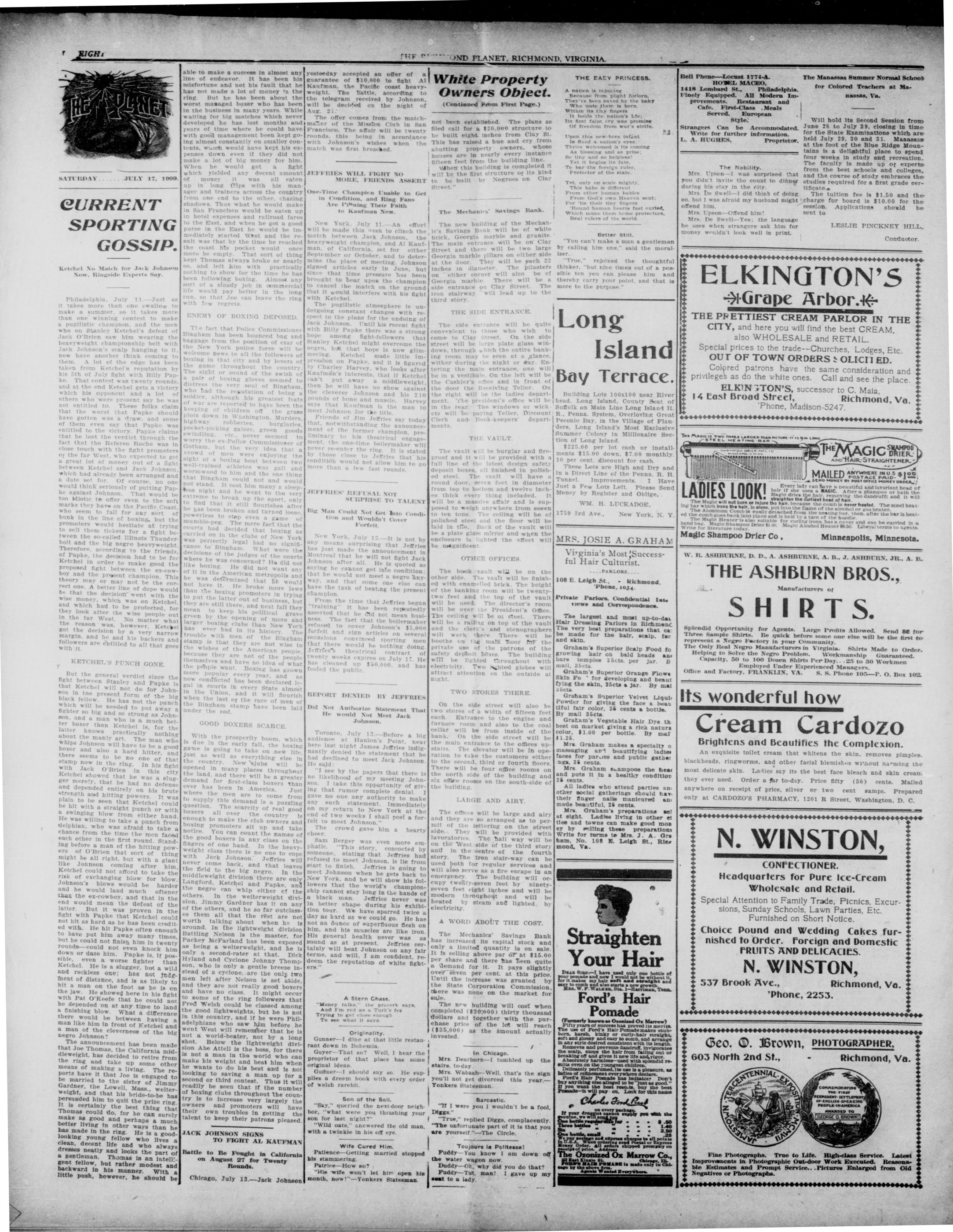
WHITE PROPERTY OWNERS OBJECT.
Attempt to Prevent the Erection of the New Bank Building.
A FULL ACCOUNT OF THE TROUBLE--BUILDING INSPECTOR BECK WAITS ON THE STREET COMMITTEE--A COPY OF THE PETITION.
VOLUME XXVI, NO. 33.
WHIT
Attempt
the
A FULL ACCOUNT OF
Quite a commotion has been caused by the proposal to erect a banking and office building on the northwest corner of Third and Clay Streets. The following extract from the news columns of the Richmond, Va. Times Dispatch of July 9, 1909 will explain itself:
Plans were filed yesterday in the office of the Building Inspector for a four-story brick bank and office building for the Mechanics' Savings Bank, John Mitchell, Jr., colored, president to be erected at the northwest corner of Third and Clay Streets.
Already a vigorous protest is coming from the neighborhood, all or the householders on this block up to this time being white, the block being one of the best of the residence section of Clay Street, and there is much complaint at the effort to build a colored bank building in that quarter. Property owners along the block are already considering applying for the establishment of a building line which would prevent the erection of the building out to the street, making it conform to the line of present houses. The plans filed call for a four-story brick building to come out flush to the street line, both on Clay, and Third Streets, the structure to cost $20,000.
Last year when negotiations were pending for a sale of the old Quaker Church, west of First Street on Clay to a colored congregation citizens and property owners of the neighborhood held a meeting of protest, and the negotiations were called off for the time.
The colored section back of Clay Street has long been conjected and limited by the ravine on the north, and has no other means of growth than to the south. Already colored churches and other buildings have pushed out on Leigh Street until the City School Board has determined to abandon Leigh Street School at First and Leigh, as a white school and use the building for the colored normal school.
The proposed bank building, however, if erected, will be the first building of a business character and the first occupied by colored people on that section of Clay Street.
VISITED BUILDING INSPECTOR
Seeing this John Mitchell, Jr., President of the Mechanics' Savings Bank went down to the City Hall and visited Building Inspector Beck, who informed him that he had not had time to look over the plans which had been filed in the office by Contractor D. J. Farrar, but that he would as soon as he could conveniently do so, but he was very busy.
NOTIFIED BY THE CLERK
He stated that he had been notified by the Clerk of the Committee on Streets that an application had been filed before the Committee for the establishment of a building line on the block on which the Mechanics' Savings Bank proposed to build. He had a discretionary time limit of ten days, which in all cases of this kind he deemed it advisable to take and he would for that reason decline to issue the building permit, although he saw no objection to the building and as the law now stands, he felt that he could not refuse to grant it.
WOULD WAIT FOR THE COMMITTEE.
He would wait until after the 16th when the Street Committee would consider the application of two-thirds of the owners of property in that block. Mr. Mitchell went to Mayor D. C. Richardson, City Engineer Charles E. Bolling and Chief of the Fire Department, Mr. W. H. Joynes. He called to see the City Attorney. After satisfactory conferences with all of them, he later called on the Clerk of the Street Committee in order to see the application for a
building line as filed. Here is a copy of it:
TO THE HONORABLE COMMITTEE ON STREETS OF THE CITY OF RICHMOND:
The undersigned, owners of more than two-thirds of the property abutting on the north side of Clay Street between Second Street, and Third Street, the exact location and extent of which property will fully appear on the plan on file in the City Engineer's Office, a blue print copy of which is bereto attached, hereby request you, in pursuance of an ordinance approved December 7, 1908, entitled "An ordinance to require the Committee on Streets to establish a building line on such squares of the City on which the owners of two-thirds of the property abutting thereon shall request the establishment of the same and to prohibit the granting of a permit by the Building Inspector for the construction of any building, nearer the street line than the line as established," to establish a building line on the north side of Clay Street, between Second Street and Third Street so that the same may not be less than five (5) nor more than thirty (30) feet from street line, and certify the fact or the establishment of the said line to the Building Inspector of the City of Richmond as required by said ordinance.
COULDN'T DO IT
It will be seen then that as the Mechanics' Bank owns a lot 31 feet by 100 feet and the building line calls for 15 feet, 6 inches that this would make it impossible for the Contractor of the Bank to erect a structure 97 feet long thereon. Three out or the five of the applicants had either directly or indirectly endeavored to sell their property at an unusual high price to the Mechanics' Savings Bank
WANTED TEN DAYS
Mr. Mitchell was informed that if the Building Inspector declined to grant the permit an appeal could be taken to the Board of Public Safety, but such an appeal could not be taken until after the Building Inspector had declined to issue the permit and he would not decline to issue it until the expiration of his ten days of discretionary power had expired and then the Committee on Streets would be expected to act upon the petition of the property owners and pass the same, when he would decline to issue it because it provided for the erection of a building to the street line.
AN UNCONSTITUTIONAL ORDINANCE.
Across the street, on the northeast corner, the Schaaf property was
RICHMOND, VIRGINIA, SATURDAY, JULY 17, 1909.
up to the street line. The contest then would be in the Street Committee. It was ascertained too that a building line could not be lawfully established where no provisions for one were not contained in the deed. This then was the status of the case, and this the proposition presented. Repeated visits to Mr. Beck brought forth the information that he had not examined the plans. Finally on last Tuesday, John Mitchell, Jr. went down to the Building Inspector's office and notified him that he expected to file another supplementary application for a building permit.
WOULD RESPECT THEIR WISHES
As the white property owners wanted the building line observed and he desired to respect their wishes, he would make application for the erection of the building on Adams and Clay Streets. He owned individually 58 feet of ground there, running back 139 feet. As it was on the north-west corner, no changes barring the street elevation need be made. He could respect the building line and instead of building fifteen feet, six inches from the street line, he could build thirty feet back and still have plenty of room for the building. The bank would then be across the street from the white Methodist Church and on the site of the St. Paul's Church Home, which Mr. Mitchell purchased about six months ago.
DR. JEFFERSON'S HOSPITAL
Dr. Jefferson had applied to him for a site for a private sanitarium (Negro Hospital) and had informed him that the present building on 3rd and Clay Streets would answer his purposes. This seemed to have caused lively interest even in the office of the Building Inspector, who was free to say that he could not see any reason for objecting to the erection of a banking building on Third and Clay Streets.
"Plans for Negro Bank Held Up By Inspector.
The plans filed with Building Inspector Beck for a Bank and Office Building at the corner of Third and Clay Streets for the Mechanics' Savings Bank, a Negro institution, of which John Mitchell, Jr. is president will be held up by the Building Inspector pending the action of the Street Committee in establishing a building line on Clay Street, between Second and Third. The petition of the property owners will be considered by the committee on the 16th of this month.
Under an opinion of the City Attorney, the Building Inspector must withhold approval of plans where the building line is in dispute, or has (Continued on Eighth Page.)
All aboard to the Beach with First Baptist Church Sunday School, Tuesday, July, 20, 1909.
WANTED—A WET NURSE. ADDRESS 200 Fourth Avenue, Chestnut Hill, 'Phone Madison 2787-8
$150.00 Endowment Paid
Richmond, Va., July 9, 1909.
This is to certify that I have received from John Mitchell Jr.
Grand Chancellor of the Grand
Lodge of Virginia, Knights of Pythias, N. A., S. A., E., A. A. and A.
($150.00) One Hundred and Fifty
Dollars in payment of the death
claim of Brother George S. Boone
who was a member of Invincible
Lodge, No. 65, of Richmond, Va.
Signed: R. EMMETT JONES.
Administrator.
Witness:
B. P. Vaudervall,
S. S. Baker, D. D. G. C.
Question of Bank Or Sanitarium.
It is probable that the building which was to have been constructed for the Mechanics' Savings Bank, of which John Mitchell, explored editor of the Planet, is president, and which was to occupy the site at the northwest corner of Third and Clay Streets, will not be put up at that point, but that instead, the house, as it now stands, will be inverted into a private sanitarium for colored patients, the sanitarium to be conducted by Dr. Jefferson, a negro physician.
When asked to the correctness of this report Mitchell said:
"Yes, I am considering this alternative proposition. The holding up of my plans is according to my idea a mere subterfuge in order to keep us from building the bank at this corner, notwithstanding the fact that the house on the northeast corner of Third and Clay Streets, now occupied by Dr. Hardy, the dentist, is open to the same objection raised against our building—that is fronting right on the street line. If the hospital is placed at this point we will build the bank at the corner of Adams and Clay on the site new occupied by the St. Paul's Church Home. I own this property and it is plenty deep to accommodate the building we want to put up, even if we go back to the building line already established."
The white residents of this section are bitterly opposed to the bank building, and it is likely that their protests will be more strenuous when they hear of the alternative proposition. — Richmond Evening Journal, July 14, 1909.
Nearly Eight Hundred to be Installed
The officers of the lodges of Knights of Pythias and the courts of Calanthe will be installed at the Ebenezer Baptist Church next Tuesday night at 8:30 o'clock. Grand Chancellor John Mitchell, Jr., assisted by District Deputy Grand Chancellor S. S. Baker and District Deputy Grand Worthy Counsellor Anna Taylor will install over seven hundred officers of the courts and lodges. The members of the Order are invited to be present. The Grand Chancellor will also deliver an address on the present outlook.
Rev. H. H. Jones, returned missionary from West Coast of Africa, called on us. He has been attending the Hering Medical College, at Chicago, and he is now on a lecturing tour. He spent four years and two months during his stay there and two months last summer. He is a ready speaker and impresses one as knowing what he is talking about.
Do You Know Him?
Wanted, the present address of Rev. John A. Harris, who at one time resided at Westfield, N. J. He has also lived at Williamsburg, Va. and other places. Any information concerning him will be gladly received by FREDERICK S. TAGGART, Westfield, N. J.
A FINE SESSION
The North Carolina Inter-Denominational Sunday School and Educational Convention Meets.
Durham, N. C., July 10.—This city was a scene of christian activity this week caused by the Seventh Annual session of the North Carolina Inter-Denominational Sunday
(Continued on Fifth Page.)
The Tidewater Sunday School Convention
MANY DELEGATES PRESENTHARMONIOUS SESSION.
With about 150 delegates and a great concourse visitors, the Tidewater Sunday School Convention opened in an institute capacity Wednesday evening, July 7, 1909. In the Bute Street Baptist Church, Norfolk, Va., of which Rev. R. H. Bolling, D. D. LL. D., is the honored pastor. Prof. James S. Lee, principal of the Public Schools of Newport News, Va., and president of the Convention presided. In his opening address he enunciated the principles of the Convention, as being those of self-help, self reliance, and substantial development of the Baptist cause and racial enterprises, he endorsed the work of the Virginia Seminary and College at Lynchburg, which is the only distinctive school fostered by Colored Baptists in the State.
There were many noted divines and Sunday School workers in attendance, among whom we note Drs. R. H. Bolling, L. W. C. Metz, W. A. Taylor, T. H. Shorts, James H. Smith, W. R. Ashburn, Rev. C. C. Scott, C. E. Jones, T. J. Jones, L. D. Lively, T. H. Ashby, T. H. Burnam, J. G. StClair Drake, R. H. Green, R. H. Harrison, E. W. Page Profs. J. S. Lee, A. J. Sykes, R. L Briggs, Messrs. A. N. Lewis, J. H Randall, J. W. Flits, J. R. Gould, A. E. Drake, F. L. Douglass, Jno. H Robinson, J. R. Davenport, Madams J. S. Lee, Lillian Hoffman, B. F. Fox C. E. Jones, J. J. Jones, Eva B. McLaurin, Misses B. V. Talaferro, M. B. Randolph, Lula Norton, Mrs. S. A. Smith, and a great many more young people prominent in Sunday School and B. Y. P. U. work in the Tide-water District.
The special features of the Institute, was a paper read by Mr. A. N. Lewis, of Matthews, Va. Subject, Our Mission, in which he reiterated the opening address of the President. A duett by Mrs. Mary A. Minkins and Miss Mabel B. Randolph, of Hampton, and a Recitation by Miss Julia Jones, of Newport News. Also an address by Madam D. I. Haden of Franklin, Va., who has established an Industrial School, she was donated $10.00 for Her work.
Thursday morning found many new arrivals, and promptly at 9 o'clock, Pres. Lee, called the Convention to order in its Ninth Annual session, the welcome address was fittingly delivered by the Scholarly Dr. Bolling, and the response was given by the coming pulpit orator of Virginia, Rev. C. C. Scott. The Annual sermon was preached by Rev. R. H. Green, of Graften, York, Va. and was highly edifying and logical, showed profound study and great preparation, the remainder of the morning session was given over to reading letters appointing on committees, and the collection of finance. The following officers were elected just before the close of the afternoon session: Prof. J. S. Lee, Newport News, President; Rev. James H Smith, Newport News, First Vice President; Prof. R. L. Biggs, Gloucester, Second Vice President; Prof. A. J. J. Sykes, Norfolk, Secretary; Miss B. V. Talafero, Newport News. Asst. Secretary; Hon. Jno. H. Robinson, Hampton, Cor. Secretary; Deacon Samuel Churchill, Norfolk, Treasurer; Mr. Chas. F. McLaurin, Hampton, Statistical Secretary.
The Convention raised for Missions $334.00, and admitted five new Sunday Schools. The banner this year went to Gloucester Co. Special reports were made from the following Committees, Temperance, Home and Foreign Missions, Condolence, Sunday Schools, Church polity, Christian Education and other questions of vital importance to the church and Sunday School workers. There were many noted addresses made during the Convention, among which were sermons by Dr. W. A. Taylor, of Newport News and Dr. R. H. Bolding. Dr. Taylor preached an eloquent as well as a soul-stirring one, which was perhaps the greatest effort during the convention. Dr. Bolling's sermon was up to his usual standard and was enjoyed very much. Others were papers by Miss Sarah Brinkley, Miss Julia Jones, Mrs. L. V. Knight, Mrs. Mary L. Huff, Miss Sarah Hodges and Mrs. L. E. Hoffman. All were well prepared and showed that the writers had given special study to conditions. President Lee's annual address was one that deals with every phase of the Sunday School work, in Virginia, and the Missionary work of
the church. He is thoroughly imbued with the spirit and principles of the Convention over which he presides, and when in the chair, presides with dignity, and impartial fairness to all members alike. The Convention showed its loyalty to him by electing him for the tenth time as its executive officer.
Many distinguished visitors attended the Convention, among whom were Rev. A. A. Graham, Dr. Morse, Jno. H. Grey, Rev. G. C. Taylor, Rev. Summervill, Mr. E. C. Brown, Prof. D. C. Jaccox, Rev. Graham, and Summervill made notable addresses.
The First Baptist Sunday School (Bute Street) tended the delegates a delightful social on Friday from 6 till 8 P. M., which was highly enjoyed by all present.
The First Baptist Church, in which the Convention is held is the leading church in the city of Norfolk and is perhaps the most beautiful church office within the borders of the state, and perhaps in the United States. It has a perfect church organization and its auxiliaries are in the fore rank of any in the church, Dr. R. n. Bolling, its pastor, is the most distinguished Baptist preacher in the State, being President of the State Convention.
The Convention closed Friday at 12 P. M., having finished one of its most successful sessions.
CHAS. F. McLAURIN,
Official Reporter.
FALLS TWENTY FEET
R. H. Ferguson, Colored, Another Victim at the New High School.
R. H. Ferguson, colored, of 1967 Beverly Street, fell twenty feet from a scaffold at the new High School Building, Ninth and Marshall streets, yesterday morning, and was rendered unconscious. He suffered bruises over his body, and his right ear was nearly torn off. Dr. Davis, of the city ambulance, was called. He treated the man, sewed on his ear, and then took him home. It was stated that the fall was due to dizziness.—Times-Dispatch, July 10, 1909.
LOST—AN ALLIGATOR SKIN COIN purse. A liberal reward will be paid for its return to THE PLANET OFFICE, 311 N. Fourth Street.
Y. M. C. A. Notes
Last Friday evening was a live hour with the members of the work. The social committee gave the men a very pleasant time.
The inmates of the city home enjoyed the meetings last Sunday.
The work in the city jail, last Sunday was a great help to the prisoners.
The papers by the boys last Sunday were good.
The open meeting was conducted by Chairman E. H. Allen. The men took an active part.
On time men Sunday ready for hard work and the other man.
Meeting for boys Sunday 4 P. M. at the Y. M. C. A. Building.
Mr. Bernard L. Allen will address the men Sunday 5:30 P. M. at the Y. M. C. A. building. Tell every man with whom you meet. Live singing. Bring the other man.
The voluntary rally is on a hum. Every man is getting busy. The captains are having special meetings.
Do not stop praying for the Y. M. C. A.
The Fourth of July was enjoyed by the boys and men on the lawn of the Y. M. C. A. The croquet game was played with much intrepid
Negro National Business League
Delegates and visitors to the tenth annual session or this organization to be held in this city August 18-20 who wish the committee on accommodations to provide for their entertainment during the session, will please notify the undersigned, so that assignments may be made before they leave their homes.
WM. H. STEWARD, Sec. of Com.,
621 S. Bighth Street,
Louisville, Ky.
To Buckroe Beach, Tuesday, July 20, 1909.
PRICE. FIVE CENTS
Mr. and Mrs. Peyton Seay Celebrate Wedding Anniversary.
On Monday Night, July 12, 1909, there was a scene of much brilliance in the direction of Ruth's Hall. There were many cheerful faces to join in the celebration of the Sixteenth Wedding Anniversary of Mr. and Mrs. Peyton Seay.
Order of exercises began by reading of Third Epistle of John by Rev. James Holmes; muscle and singing by Miss Annie V. Taylor of Richmond; prayer offered by Rev. L. J. Morris; address suitable to the occasion was intelligently delivered by Rev. James Holmes of West Wood; Master Willie Holmes rendered a splendid solo; Mr. Matthew Doyle also rendered a beautiful solo.
Among the guests were the mother Mrs. M. Randolph and brother, Mr. Edward Randolph of Richmond, Va.; Mr. Alfred Seay of Amelia Co., Va.; Mrs. I. Dammals of Richmond; Mrs. Peter Thompson and son, Mr. Harry Thompson; Messrs. James Walker and William Dean; Mrs. Thomas Trice and many other prominent citizens of Richmond in the person of Mr. and Mrs. Johnson of 18 E. Leigh Street. Mr. Johnson addressed the couple and audience with a brief remarks of encouragement. The couple was also presented many handsome and useful presents.
Dragged Back to Gallows
Nashville, Ga., July 9.—That the hangman's noose is a bangkesome and merciless mode of execution was clearly demonstrated here to-day, when Marshal Lewis, colored, was led back upon the crudely constructed gallows, begging for water and blood flowing from his mouth, after Sheriff Avera had sprung the trap and the body had dropped six feet.
he dropped six feet. The second attempt proved unsuccessful in breaking the condemned man's neck, death resulting in fifteen minutes from strangering.
not strangulation.
Lewis shot and killed Clifford Rutherford, assistant postmaster at Lennox, Ga. on April 12. He confessed his guilt. By publishing a sketch of his life he earned sufficient money to pay for the transportation of his body to his home at Oakfield, Ga. He was above the average of his race in intelligence.
The few spectators who witnessed the spectacle were visibly affected by the gruesome scene. The drop of six feet stretched the cotton rope so that the man's feet touched the earth. He was cut down, and with the aid of one man, mounted the scaffold a second time. He talked coherently.
Visitors Here.
President Jas. H. Dudley, of the A. and M. College at Greensboro, N. C., and J. E. Dellinger of the same city were last Wednesday enroute to the Negro Conference at Hampton. They enjoyed a drive around the city and expressed themselves as well-pleased with all that they saw here.
Mrs. Callie D. Brown has been quite sick, but is improving.
I am going to join The First Church Sunday School outing. Are you?
Mr. Richard Carter is quite ill at his residence. He has been ailing for some time.
Mrs. Thomas H. Wyatt is visiting her relatives in Culpeper county.
Mr. and Mrs. Benjamin Jackson are now the proud possessors of a horse and buggy.
ANNUAL OUTING?
Come go with us on our Annual Outing! To Buckroe Beach. Tuesday, July 20th, 1909, under auspices of First Baptist Church Sunday School and Board of Ushers. Refreshments on train in abundance. Special arrangements have been made for the provision of ladies without escorts. Also no pains have been spared to make things pleasant for children without parents.
Special attractions for the day will be Bathing, Crabbing, Foot Races and Boating. A Steam Launch has been secured to take passengers to Sewell's Point, Willoughby Split and Cape Henry.
Fare, round trip: Adults, $1.00.
Children under 12 years, 50 Cents.
Train leaves old C. & O. Station,
16th and Broad Streets at 9 o'clock;
returning leaves Buckroe Beach at 8 o'clock Sharp.
W. T. Johnson, Pastor; W. T. White, Supt.; Jas. H. Morton, Sect.; R. T. Hill, Treas.; H. G. Carter, Chairman.
the stranger.
Fragments of the breakfast-table talk of the morning came back to Dickle's mind. The railroad graders were in the valley below the ranch, and she had heard her cousin say a good deal on a point she cared little about, as to where the railroad should cross the Stone ranch. Approaching the fork of the two roads toward which she and the cowboys were riding, she checked her horse in the shade of a cottonwood tree, and as the party rode up the draw she saw the horseman under surveillance. It was George McCloud.
Unluckily, as she caught a glimpse of him she was conscious that he was looking at her. She bent forward to hide a momentary confusion, spoke briskly to her horse, and rode out of sight. At Marion's she had carefully avoided him. Her precipitancy at their last meeting had seemed, on reflection, unfortunate. She felt that she must have appeared to him shockingly rude, and there was in her recalling of the scene an unconfessed impression that she had been to blame. Often when Marion spoke of him, which she did without the slightest reserve and with no reference as to whether Dickie's mind to bring up the subject of the disagreeable scene, hoping that Marion would suggest a way for making some kind of unembarrassing amends. But such opportunities had slipped away unimproved, and here, their bluff neighbor Sinclair never referred to other than as the college guy, being brought apparently as a prisoner to the Stone ranch.
Busied with her thoughts, Dickie rode slowly along the upper trails until a long detour brought her around the corrals and in at the back of the house. Throwing her lines to the ground, she alighted and through the back porch door made her way unobserved to her room. From the office across the big hall she heard men's voices in dispute, and she slipped into the dining room, where she could hear and might see without being seen. The office was filled with cowboys. Lance Dunning, standing with a cigar in his hand and one leg thrown over a corner of the table, was facing McCloud, who stood before him with his hand on a chair. Lance was speaking as Dickie looked into the room, and in curt tones: "My men were acting under my orders."
"You have no right to give such orders," McCloud said, distinctly, "nor to detain me, nor to obstruct our free passage along the right of way you have agreed to convey to us under our survey."
"Damn your survey! I never had a plat of any such survey. I don't recognize any such survey. And if your right-of-way men had ever said a word about crossing the creek above the flume I never would have given you a right of way at all."
"There were never but two lines run below the creek; after you raised objection I ran them both, and both were above the flume."
"Well, you can't put a grade there. I and some of my neighbors are going to dam up that basin, and the irrigation laws will protect our rights."
"I certainly can't put a grade in below the flume, and you refuse to talk about our crossing above it."
"I certainly do."
"Why not let us cross where we are, and run a new level for your ditch that will put the flume higher up?"
"You will have to cross below the flume where it stands, or you won't cross the ranch at all."
McCloud was silent for a moment. "I am using a supported grade there for eight miles to get over the hill within a three-tenths limit. I can't drop back there. We might as well not build at all if we can't hold our grade, whereas it would be very simple to run a new line for your ditch, and my engineers will do it for you without a dollar of expense to you, Mr. Dunning."
Lance Dunning waved his hand as an ultimatum. "Cross where I tell you to cross, or keep off the Stone ranch. Is that English?"
"It certainly is. But in matter of fact we must cross on the survey agreed on in the contract for a right-of-way deed."
"I don't recognize any contract obtained under false representations."
"Do you accuse me of false representations."
Lance Dunning flipped the ash from his cigar. "Who are you?"
"I am just a plain, every-day civil engineer, but you must not talk false representations in any contract drawn under my hand."
"I am talking facts. Whispering Smith may have rigged the joker—I don't know. Whoever rigged it, it has been rigged all right."
"Any charge against Whispering Smith is a charge against me. He is not here to defend himself, but he needs no defense. You have charged me already with misleading surveys. I was telephoned for this morning to come over to see why you had held up our work, and your men cover me with rifles while I am riding on a public road."
"You have been warned, or your men have, to keep off this ranch. Your man Stevens cut our wires this morning—"
"As he had a perfect right to do on our right of way."
"If you think so, stranger, go ahead again!"
"Oh, no! We won't have civil war
—not right away, at least. And if you
and your men have threatened and
browbenten me enough for to-day.
TWO
SYNOPSIS.
CHAPTER I - Murray Sinclair and his gang of wreckers were called out to clear the railroad tracks at Smoky Creek. The railroad tracks were closed, and read superintendent, caught Sinclair and his men in the act of looting the wrecked train. Sinclair pleaded innocence, declared he was a victim of the treat for the men. McCloud discharged the whole outfit and ordered the wrecked train. HIL - McCloud became acquainted with Dickie Dunning, a girl of the west, who came to look at the wreck she gave him a message for Sinclair. McCloud was sent to Smith told President Bunks of the railroad, cf McCloud's brave fight against a gang of craved miners and that was the reason for his broken heart. He went to his high office. McCloud arranged to board at the boarding house Sinclair, the ex-foreman's deserted wife.
CHAPTER II - Dickie Dunning was the daughter of the late Richard Dunn. Sinclair's son and a fight between him shortly after his wife's death occurred after one year of married life.
CHAPTER III - Sinclair visited Marton Sinclair's shop and a fight between him and Sinclair.
CHAPTER IV - Smoky Cheek bridge was mysteriously burned. McCloud prepared to face the situation. President notified Smith that he had work ahead.
CHAPTER VIII - McCloud worked for days and finally got the division running. He was overheard Dickie criticising his methods to Marion Sinclair.
CHAPTER IX - A stock train was wrecked by an open switch. Liam a senger train was held up and the express car robbed. Two men of a posse pursuing McCloud was notified that Whispering Smith was to hunt the desperadoes.
CHAPTER X - Bill Dancing a road rage stranger, apparently with authority, told stranger, apparently with authority, told the stranger was 'Whispering Smith.
CHAPTER XI - Smith approached Sinclair. He tried to buy him off, but failed. He recalled McCloud that his life was in danger.
CHAPTER XII.
The Quarrel.
The beginning of the Crawling Stone line marked the first determined effort under President Bucks, while undertaking the reconstruction of the system for through traffic, to develop the rich local territory, tributary to the mountain division. New policies in construction dated from the same period. Glover, with an enormous capital staked for the new undertakings, gave orders to push the building every month in the year, and for the first time in mountain railroad building winter was to be ignored. The older mountain men met the innovation as they met any departure from their traditions, with curiosity and distrust. On the other hand, the new and younger blood took hold with confidence, and when Glover called, "Yo, heave ho!" at headquarters, they bent themselves clear across the system for a hard pull together.
McCloud, realizing the operating on the shoulders of his assistant Anderson, devoted himself wholly to forwarding the construction plans, and his first clash over winter road-building in the Rockies came with his own right-hand man, Mears. McCloud put in a switch below Piedmont, opened a material yard and began track laying toward the lower Crawling Stone valley, when Mears said it was time to stop work till spring. When McCloud told him he wanted track across the divide and into the lower valley by spring, Mears threw up his hands. But there was metal in the old man, and he was for orders all the time. He kept up a running fire of protests and forebodings about the danger of exposing men during the winter season, but stuck to his post.
Spring found the construction of the valley line well advanced, and the grades nearing the lands of the Dunning ranch. Right-of-way men had been working for months with Lance Dunning on the line and McCloud had been called frequently into consultation to adjust the surveys to objections raised by Dickies's cousin to the crossing of the ranch lands. Even when the proceedings had been closed, a strong current of discontent set from the managing head of the Stone ranch. Rumors of Lance Dunning's dissatisfaction often reached the railroad people. Vague talk of an extensive irrigation scheme planned by Sinclair for the Crawling Stone valley crept into the newspapers, and it was generally understood that Lance Dunning had expressed himself favorably to the enterprise.
Dickies sieve gave slight heed to matters as weighty as these. She spent much of her time on horseback, with Jim under the saddle; and in Medicine Bend, where she rode with frequency, Marion's shop became her favorite abiding place. Dickies ordered hats until Marion's conscience rose and she practically refused to supply any more. But, the spirited controversy on this point, as on many others—Dickies's haughtiness and Marion's restraint, quite unmoved by any show of displeasure—ended always in drawing the two closer to each other.
One March afternoon, coming home from Medicine Bend, she saw at some distance before her a party of men on horseback. She was riding a trail leading from the pass road that followed the hills, and the party was coming up the bridge road from the lower ranch. Dickie's had good eyes, and something unusual in the riding of the men was soon apparent to her. Losing and regaining sight of them at different turns in the trail, she made out, as she rode among the trees, that they were cowboys of her own ranch, and riding, under evident excitement, about a strange horseman. She recognized in the escort Stormy Gorman, the ferocious foreman of the ranch, and Denison and Jim Baugh, two of the most reckless of the men. These three carried rifles slung across theirommels, and in front of them rode
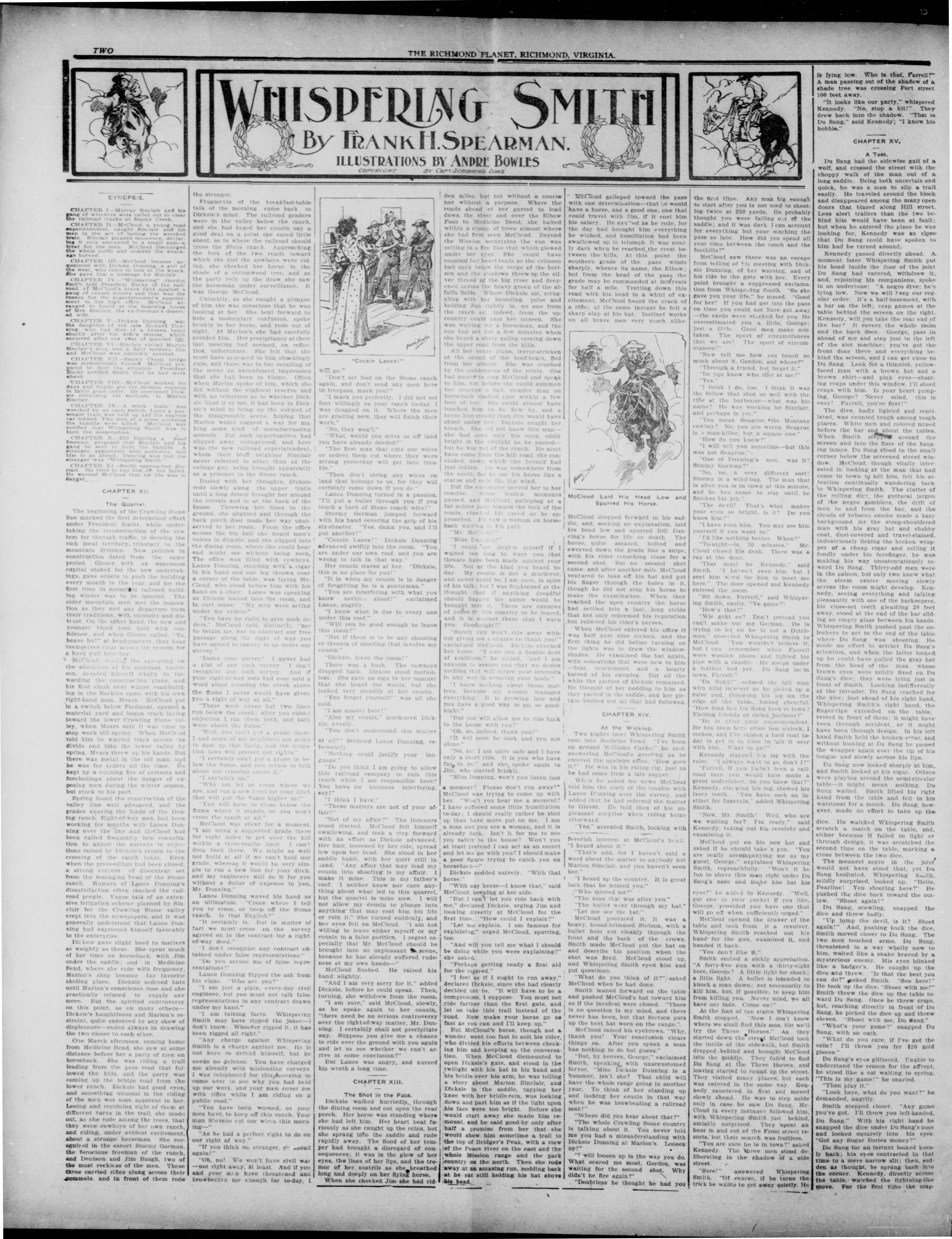
WHISPERING SMITH BY FRANK H. SPEARMAN. ILLUSTRATIONS BY ANDRE BOWLES COPYRIGHT BY CHAPS SCRIBNER'S SONS
THE RICHMOND PLANET, RICHMOND, VIRGIN1A
"Cousin Lance!"
will go."
"Don't set foot on the Stone ranch again, and don't send any men here to trespass, mark you!"
"I mark you perfectly. I did not set foot willingly on your ranch to-day. I was dragged on it. Where the men are grading now, they will finish their work."
"No, they won't."
"What, would you drive us off land you have already deeded?"
"The first man that cuts our wires or orders them cut where they were strung yesterday will get into trouble."
"Then don't string any wires on land that belongs to us, for they will certainly come down if you do."
Lance Dunning turned in a passion. "I'll put a bullet through you if you touch a barb of Stone ranch wire!"
Stormy Gorman jumped forward with his hand covering the grip of his six-shooter. "Yes, damn you, and I'll put another!"
"Cousin Lance!" Dickisle Dunning advanced swiftly into the room. "You are under our own roof, and you are wrong to talk in that way." Her cousin stared at her. "Dickisle, this is no place for you!"
"It is when my cousin is in danger of forgetting he is a gentleman."
"You are interfering with what you know nothing about!" exclaimed Lance, angrily.
"I know what is due to every one under this roof."
"Will you be good enough to leave this room?"
"Not if there is to be any shooting or threats of shooting that involve my cousin."
"Dickle, leave the room!"
There was a rush. The cowboys dropped back. Dickle stood motionless. She gave no sign in her manner that she heard the words, but she looked very steadily at her cousin.
"You forget yourself!" was all she said.
"I am master here!"
"Also my cousin," murmured Dickle, evenly.
"You don't understand this matter at all!" declared Lance Dunning, vehemently.
"Nothing could justify your language."
"Do you think I am going to allow this railroad company to ruin this ranch while I am responsible here? You have no business interfering, say!"
"I think I have."
"The these matters are not of your affair!"
"Not of my affair?" The listeners stood riveted. McCloud felt himself swallowing, and took a step forward with an effort as Dickale advanced. Her hair, loosened by her ride, spread low upon her head. She stood in her saddle habit, with her quirt still in hand. "Any affair that may lead my cousin into shooting is my affair. I make it mine. This is my father's roof. I neither know nor care anything about what led to this quarrel, but the quarrel is mine now. I will not allow my cousin to plunge into anything that may cost him his life or ruin it." She turned suddenly, and her eyes fell on McCloud. "I am not willing to leave either myself or my cousin in a false position. I regret especially that Mr. McCloud should be brought into so unpleasant scene, because he has already suffered rudeness at my own hands—"
McCloud flushed. He raised his hand slightly.
"And I am very sorry for it," added Dicksiie, before he could speak. Then, turning, she withdrew from the room.
"I am sure," said McCloud, slowly, as he spoke again to her cousin, "there need be no serious controversy over the right-of-way matter, Mr. Dunning. I certainly shall not precipitate any. Suppose you give me a chance to ride over the ground with you again and let us see whether we can't arrive at some conclusion?"
But Lance was angry, and nursed his wrath a long time.
CHAPTER XIII.
The Shot in the Pass.
Dickie's walked hurriedly through the dining room and out upon the rear porch. Her horse was standing where she had left him. Her heart beat furiously as she caught up the reins, but she sprang into the saddle and rode rapidly away. The flood of her temper had brought a disregard of consequences; it was in the glow of her eyes, the lines of her lips, and the tremor of her nostrils as she breathed long and deeply on her flying horse.
When she checked Jim she had rid
den miles, but not without a course nor without a purpose. Where the roads ahead of her parted to lead down the river and over the Elbow Pass to Medicine Bend, she halted within a clump of trees almost where she had first seen McCloud. Beyond the Mission mountains the sun was setting in a fire like that which glowed under her eyes. She could have counted her heart beats as the crimson ball sark below the verge of the horizon and the shadows threw up the silver thread of the big river and deepened across the heavy green of the alfalfa fields. Where Dickseis sat, struggling with her bounding pulse and holding Jim tightly in, no one from the ranch or, indeed, from the up-country could pass her unseen. She was waiting for a horseman, and the sun had set but a few minutes when she heard a sharp gallop coming down the upper road from the hills.
All her brave plans, terror-streaked at the sound of the hoof-beats, fled from her utterly. She was stummed by the suddenness of the crisis. She had meant to stop McCloud and speak to him, but before she could summon her censure a tall slender man on horseback dashed past within a few feet of her. She could almost have touched him as he flew by, and a horse less steady than Jim would have shied under her. Dickiek caught her breath. She did not know this man—she had seen only his eyes, oddly bright in the twilight as he passed—but he was not of the ranch. He must have come from the hill road, she concluded, down which she herself had just ridden. He was somewhere from the north, for he sat his horse like a statue and rode like the wind.
But the encounter served her to her resolve. Some leaden moments passed, and McCloud, galloping at a far milder pace toward the fork of the roads, cheeked his speed as he approached. He saw a woman on horseback waiting in his path.
"Mr. McCloud!"
"Miss Dapping!"
"I could 'not forgive myself if I waited too long to warn you that threats have been made against your life. Not of the kind you heard today. My cousin is not a murderer, and never could be, I am sure, in spite of his talk; but I was frightened at the thought that if anything dreadful should happen his name would be brought into it. There are enemies of yours in this country to be feared, and it is against these that I warn you. Goodnight!"
"Surely you won't ride away without giving me a chance to thank you!" exclaimed McCloud. Dickie checked her horse. "I owe you a double debt of gratitude," he added, "and I am anxious to assure you that we desire nothing that will injure your interests in any way in crossing your lands."
"I know nothing about those matters, because my cousin manages everything. It is growing late and you have a good way to go, so good-night."
"But you will allow me to ride back to the house with you?" "Oh, no, indeed, thank you!" "It will soon be dark and you are alone."
"No, no! I am quite safe and I have only a short ride. It is you who have far to go," and she spoke again to Jim, who started briskly.
a moment? Please don't run away!" McCloud was trying to come up with her. "Won't you hear me a moment? I have suffered some little humiliation to-day; I should really rather be shot up than have more put on me. I am a man and you are a woman, and it is already dark. Isn't it for me to see you safely to the house? Won't you at least pretend I can act as an escort and let me go with you? I should make a poor figure trying to catch you on horseback—"
Dickiess nodded naively. "With that horse."
"With any horse—I know that," said McCloud, keeping at her side.
"But I can't let you ride back with me," declared Dickiess, urging Jim and looking directly at McCloud for the first time. "How could I explain?"
"Let me explain. I am famous for explaining," urged McCloud, spurring, too.
"And will you tell me what I should be doing while you were explaining?" she asked.
"Perhaps getting ready a first aid for the injured."
"I feel as if I ought to run away," declared Dickisle, since she had clearly decided not to. "It will have to be a compromise, I suppose. You must not ride farther than the first gate, and let us take this trail instead of the road. Now make your horse go as fast as you can and I'll keep up."
But McCloud's horse, though not a wonder, went too fast to suit his rider, who divided his efforts between checking him and keeping up the conversation. When McCloud dismounted to open Dickie's gate, and stood in the twilight with his hat in his hand and his bride over his arm, he was telling a story about Marion Sinclair, and Dickie in the saddle, tapping her knee with her bride-rein, was looking down and past him as if the light upon his face were too bright. Before she would start away she made him remount, and he said good-by only after half a promise from her that she would show him sometime a trail to the top of Bridger's Peak, with a view of the Peace river on the east and the whole Mission range and the park country on the north. Then she rode away at an amazing run, nodding back at he sat still holding his hat above his head.
McCloud galloped toward the pass with one determination—that he would have a horse, and a good one, one that could travel with him, if it cost him his salary. He excused as he rode, for the day had brought him everything he wished, and humiliation had been swallowed up in triumph. It was nearly dark when he reached the crest between the hills. At this point the southern grade of the pass winds sharply, whence its name, the Elbow; but from the head of the pass the grade may be commanded at intervals for half a mile. Trotting down this road with his head in a whirl of excitement, McCloud heard the crack of a rifle; at the same instant he felt a sharp slap at his hat. Instinct works on all brave men very much alike.
McCloud Laid His Head Low and Spurred His Horse
McCloud dropped forward in his saddle, and, seeking no explanation, laid his head low and spurred Bill Dancing's horse for life or death. The horse, quite amazed, bolted and swerved down the grade like a snipe, with his rider crouching close for a second shot. But no second shot came, and after another mile McCloud ventured to take off his hat and put his finger through the holes in it, though he did not stop his horse to make the examination. When they reached the open country the horse had settled into a fast, long stride that not only redeemed his reputation but relieved his rider's nerves.
When McCloud entered his office it was half past nine o'clock, and the first thing he did before turning on the lights was to draw the window-shades. He examined the hat again, with sensations that were new to him—fear, resentment, and a hearty hatred of his enemies. But all the while the picture of Dickisle remained. He thought of her nodding to him as they parted in the saddle, and her picture blotted out all that had followed.
CHAPTER XIV.
At the Wickjun
Two nights later Whispering Smith rode into Medicine Bend. "I've been up around Williams Cache," he said, answering McCloud's greeting as he entered the upstairs office. "How goes it?" He was in his riding rig, just as he had come from a late supper. When he asked for news McCloud told him the story of the trouble with Lance Dunning over the survey, and added that he had referred the matter to Glover. He told him of his unpleasant surprise when riding home afterward.
"Yes," assented Smith, looking with feverish interest at McCloud's head; "I heard about it."
"That's odd, for I haven't said a word about the matter to anybody but Marlon Sinclair, and you haven't seen her."
"I heard up the country. It is great luck that he missed you."
"Who missed me?"
"The man that was after you."
"The bullet went through my hat."
"Let me see the hat."
McCloud produced it. It was a heavy, broad-brimmed Stetson, with a bullet hole cut cleanly through the front and the back of the crown. Smith made McCloud put the hat on and describe his position when the shot was fired. McCloud stood up, and Whispering Smith eyed him and put questions.
"What do you think of it?"/ asked McCloud when he had done.
Smith leaned forward on the table and pushed McCloud's hat toward him as if the incident were closed. "There is no question in my mind, and there never has been, but that Stetson puts up the best hat worn on the range."
McCloud raised his eyebrows. "Why, thank you! Your conclusion clears things so. After you speak a man has nothing to do but guess."
"But, by heaven, George," exclaimed Smith, speaking with unacustomed fervor. "Miss Dickiex Dunning is a bummer, isn't she? That child will have the whole range going in another year. To think of her standing up and lashing her cousin in that way when he was browbeating a railroad man!"
"Where did you hear about that?"
"The whole Crawling Stone country is talking about it. You never told me you had a misunderstanding with Dickiex Dunning at Marion's. Loosen up!"
"I will loosen up in the way you do. What scared me most, Gordon, was waiting for the second shot. Why didn't he fire again?"
"Doubtless he thought he had you
COLLEGE OF ARTS
WESTERN ARTS
COLLEGE OF ARTS
WESTERN ARTS
the first time. Any man big enough to start after you is not used to shooting twice at 250 yards. He probably thought you were falling out of the saddle; and it was dark. I can account for everything but your reaching the pass so late. How did you spend all your time between the ranch and the foothills?" McCloud saw there was no escape from telling of his meeting with Dickle Dunning, of her warning, and of his ride to the gate with her. Every point brought a suppressed exclamation from Whispsing Smith. "So she gave you your life," he mused. "Good for her! If you had got into the pass on time you could not have got away—the cards were stacked for you. He overestimated you a little, George; just a little. Good man make mistakes. The sport of circumstances that we are! The sport of circumstances!" "Now tell me how you heard so much about it, Gordon, and where?"
"Do you know who shot at me?"
"Yes."
"I think I do, too. I think it was the fellow that shot so well with the rifle at the barbecue—what was his name? He was working for Sinclair, and perhaps is yet."
"You mean Seague,*the Montana cowboy? No, you are wrong. Seague is a man-killer, but a square one."
"How do you know?"
"I will tell you sometime—but this was not Seague."
"One of Dunning's men, was it? Stormy Gorman?"
"No, no, a very different sort! Stormy is a wind-bag. The man that is after you is in town at this minute, and he has come to stay until he finishes his job."
"The devil! That's what makes your eyes so bright, is it? Do you know him?"
"I have seen him. You may see him yourself if you want to."
"To-night—in 30 minutes." McCloud closed his desk. There was a rap at the door.
"That must be Kennedy," said Smith. "I haven't seen him, but I sent him word for him to meet me here." The door opened and Kennedy entered the room.
"Sit down, Farrell," said Whispering Smith, easily. "Ve gates?"
"How's that?"
"Wie geht es? Don't pretend you can't make out my German. He is trying to let on he is not a Dutchman," observed Whispering Smith to McCloud. "You wouldn't believe it, but I can remember when Farrell wore wooden shoes and lighted his pipe with a candle. He sleeps under a feather bed yet. Du Sang is in town, Farrell."
"Du Sang!" echoed the tall man with mild interest as he picked up a ruler and, throwing his leg on the edge of the table, booked cheerful. "How long has Du Sang been in town? Visiting friends or doing business?" "He is after your superintendent. He has been here since four o'clock. I reckon, and I've ridden a hard road today to get in in time to talk it over with him. Want to go?" Kennedy slapped his leg with the ruler. "I always want to go don't I?" "Farrell, if you hadn't been a railroad man you would have made a great undertaker, do you know that?" Kennedy, slapping his leg, showed his ivory teeth. "You have such an instinct for funerals," added Whispering Smith. "Now, Mr. Smith! Well, who are we waiting for? I'm ready," said Kennedy, taking out his revolver and examining it.
McCloud put on his new hat and asked if he should take a gun. "You are really accompanying me as my guest, George," explained Whispering Smith, reproachfully. "Won't it be fun to shove this man right under Du Sang's nose and make him bat his eyes?" he added to Kennedy. "Well, put one in your pocket if you like, George, provided you have one that will go off when sufficiently urged." McCloud opened the drawer of the table and took from it a revolver. Whispering Smith reached out his hand for the gun, examined it, and handed it back. "You don't like it."
Smith smiled a sickly approbation.
"A forty-five gun with a thirty-eight bore, George?" A little light for shock; a little light. A bullet is intended to knock a man down; not necessarily to kill him, but, if possible, to keep him from killing you. Never mind, we all have our fads. Come on!"
At the foot of the stairs Whispering Smith stopped. "Now I don't know where we shall find this man, but we'll try the Three Horses." As they started down the street McCloud took the inside of the sidewalk, but Smith dropped behind and brought McCloud into the middle. They failed to find Du Sang at the Three Horses, and leaving started to round up the street. They visited many places, but each was entered in the same way. Kennedy santered in first and moved slowly ahead. He was to step aside only in case he saw Du Sang. McCloud in every instance followed him, with Whispering Smith just behind, amiably surprised. They spent an hour in and out of the Front street resorts, but their search was fruitless. "You are sure he is in town?" asked Kennedy. The three men stood deliberating in the shadow of a side street.
"Sure!" answered Whispering Smith. "Of course, if he turns the trick he wants to get away quietly. He
is flying low. Who is that, Farrell? "A man passing out of the shadow of a shade tree was crossing Fort street 100 feet away.
"It looks like our party," whispered Kennedy. "No, stop a bit!" They drew back into the shadow. "That is Du Sang," said Kennedy; "I know his hobble."
CHAPTER XV.
A Test.
Du Sang had the sidewise gait of a wolf, and crossed the street with the choppy walk of the man out of a long saddle. Being both uncertain and quick, he was a man to slip a trail easily. He traveled around the block and disappeared among the many open doors that blazed along Hill street. Less alert trailers than the two behind him would have been at fault; but when he entered the place he was looking for, Kennedy was so close that Du Sang could have spoken to him had he turned around.
Kennedy passed directly ahead. A moment later Whispering Smith put his head inside the door of the joint Du Sang had entered, withdrew it, and, rejoining his companions, spoke in an undertone: "A negro dive; he's lying low. Now we will keep our regular order. It's a half-basement, with a bar on the left; crap games at the table behind the screen on the right. Kennedy, will you take the rear end of the bar? It covers the whole room and the back door. George, pass in ahead of me and step just to the left of the slot machine; you've got the front door there and everything behind the screen, and I can get close to Du Sang. Look for a thinnish, yellow-faced man with a brown hat and a brown shirt—and pink eyes—shooting craps under this window. I'll shoot craps with him. Is your heart pumping, George? Never mind, this is easy! Farrell, you're first!"
The dive, badly lighted and ventilated, was counted tough among tough places. White men and colored mixed before the bar and about the tables. When Smith stepped around the screen and into the flare of the hanging lamps, Du Sang stood in the small corner below the screened street window. McCloud, though vitally interested in looking at the man that had come to town to kill him, felt his attention continually wandering back to Whisper Smith. The clatter of the rolling dice, the guttural jargon of the negro gamblers, the drift of men to and from the bar, and the clouds of tobacco smoke made a hazy background for the stoop-shouldered man with his gray hat and shabby coat, dust-covered and travel-stained. Industriously liking the broken wrapper of a cheap cigar and rolling it fondly his way unrestraintedly toward Du Sang. Thirty-odd men were in the galoo, but only two knew what the storm center moving slowly across the room might develop. Kennedy, seeing everything and talking pleasantly with one of the barkeepers, his close-set teeth gleaming 20 feet away, stood at the end of the bar sliding an empty glass between his hands. Whisper Smith pushed past the onlookers to get to the end of the table where Du Sang was shooting. He made no effort to attract Du Sang's attention, and when the latter looked up he could have pulled the gray hat from the head of the man whose brown eyes were mildly fixed on Du Sang's dice; they were lying just in front of Smith. Looking indifferently at the intruder, Du Sang reached for the dice; just ahead of his right hand, Whisper Smith's right hand, the finger-tips extended on the table, rested in front of them; it might have been through accident, or it might have been through design. In his left hand Smith held the broken cizer, and without looking at Du Sang he passed the wrapper again over the tip of his tongue and slowly across his lips.
Du Sang now looked sharply at him, and Smith looked at his cigar. Others were playing around the semi-circular table—it might mean nothing. Du Sang waited. Smith lifted his right hand from the table and felt in his waistcoat for a match. Du Sang, however, made no effort to take up the dice. He watched Whispering Smith scratch a match on the table, and, either because it failed to light or through design, it was scratched the second time on the table, marking a cross between the two dice.
The meanest negro in the joint would not have stood that, yet Du Sang hesitated. Whispering Smith, mildly surprised, looked up. "Hello, Pearline! You shooting here?" He pushed the dice back toward the outlaw. "Shoot again!" Du Sang, scowling, snapped the dice and threw badly.
"Up jump the devil, is it? Shoot again!" And, pushing back the dice, Smith moved closer to Du Sang. The two men touched arms. Du Sang, threatened in a way wholly new to him, waited like a snake braved by a mysterious enemy. His eyes blinked like a badger's. He caught up the dice and threw. "Is that the best you can do?" asked Smith. "See here!" He took up the dice. "Shoot with me!" Smith threw the dice up the table toward Du Sang. Once he threw craps, but, reaching directly in front of Du Sang, he picked the dice up and threw eleven. "Shoot with me, Du sang." "What's your game?" snapped Du Sang, with an oath. "What do you care, if I've got the coin? I'll throw you for $20 gold pieces." Du Sang's eyes glittered. Unable to understand the reason for the affront, he stood like a cat waiting to spring. "This is my game!" he snarled.
"Then play it."
"Look here, what do you want?" he demanded, angrily.
Smith stepped closer. "Any game you've got. I'll throw you left-handed, Du Sang." With his right hand he snapped the dice under Du Sang's nose and looked squarely into his eyes. "Got any Sugar Buttes money?"
Du Sang for an instant looked keenly back; his eyes contracted in that time to a mere narrow slit; then, sudden as thought, he sprang back into the corner. Kennedy, directly across the table, watched the lightning-like move. For the first time the crap
THE PLANET
dealer looked impatiently up.
It was a showdown. No one watching the two men under the window breathed for a moment. Whispering Smith, motionless, only watched the half-closed eyes. "You can't shoot craps," he said, coldly. "What can you shoot, Pearline? You can't stop a man on horseback."
Du Sang knew he must try for a quick kill or make a retreat. He took in the field at a glance. Kennedy's teeth gleamed only ten feet away, and with his right hand half
M. B. B.
"Take Your Hand from Your Gun, You Albino!"
under his coat lapel he foyed with his watch-chain. McCloud had moved in from the slot machine and stood at the point of the table, looking at Du Sang and laughing at him. Whispering Smith threw off all pretense.
"Take your hand away from your gun, you albino! I'll blow your head off left-handed if you pull! Will you get out of this town to night? If you can't drop a man in the saddle at 250 yards, what do you think you'd look like after a break with me? Go back to the whelp that hired you, and tell him when he wants a friend of mine to send a man that can shoot. If you are within 20 miles of Medicine Bend at daylight I will rope you like a fat cow and drag you down Front street!"
Du Sang, with burning eyes, shrank narrower and smaller into his corner, ready to shoot if he had to, but not liking the chances. No man in Williams Cache could or shoot with Du Sang, but no man in the mountains had ever drawn successfully against the man that faced him.
Whispering Smith saw that he would not draw. He taunted him again in low tones, and, backing away, spoke laughingly to McCloud. While Kennedy covered the corner, Smith backed to the door and waited for the two to join him. They halted a moment at the door, then they backed slowly up the steps and out into the street.
There was no talk till they reached the Wickuptie office. "Now, will some of you tell me who Du Sang is?" asked McCloud, after Kennedy and Whispering Smith with banter and laughing had gone over the scene.
Kennedy picked up the ruler. "The wickedest, cruelest man in the bunch—and the best shot."
"Where is your hat, George—the one he put the bullet through?" asked Whispering Smith, Himp in the big chair. "Burn it up; he thinks he missed you. Burn it up now. Never let him find out what a close call you had. Du Sang! Yes, he is cold blooded as a wild-cat and cruel as a soft bullet. Du Sang would shoot a dying man, George, just to keep him squirming in the dirt. Did you ever see such eyes in a human being, set like that and blinking so in the light! It's bad enough to watch a man when you can see his eyes. Here's hoping we're done with him!"
CHAPTER XVI.
New Plans
Caliahan crushed the tobacco under his thumb in the palm of his right hand. "So I am sorry to add," he concluded to McCloud, "that you are now out of a job." The two men were facing each other across the table in McCloud's office. "Personally, I am not sorry to say it, either," added Caliahan, slowly filling the bowl of his pipe.
McCloud said nothing to the point, as there seemed to be nothing to say until he had heard more. "I never knew before that you were left handed," he returned, evasively.
"It's a lucky thing, because it won't do for a freight-traffic man, nowadays, to let his right hand know what his left hand does," observed Calahan, feeling for a match. "I am the only left-handed man in the traffic department, but the man that handles the rebates, Jimmie Black, is cross-eyed. Bucks offered to send him to Chicago to have Bryson straighten his eyes, but Jimmie thinks it is better to have them as they are for the present, so he can look at a thing in two different ways—one for the interstate commerce commission and one for himself. You haven't heard, then?" continued Calahan, returning to his riddle about McCloud's job. "Why, Lance Dunning has gone into the United States court and got an injunction against us on the Crawling Stone line—tied up u tighter than zero. No more construction there for a year at least. Dunning comes in for himself and for a cousin who is his ward, and three or four little ranchers have filed bills—so it's up to the lawyers for 80 per cent, of the gate re-
celests and peace. Personally, I'm glad of it. It gives you a chance to look after this operating for a year yourself. We are going to be swamped with freight traffic this year, and I want it moved through the mountains like checkers for the next six months. You know what I mean, George."
To McCloud the news came, in spite of himself, as a blow. The results he had attained in building through the lower valley had given him a name among the engineers of the whole line. The splendid showing of the winter construction, on which he had depended to enable him to finish the whole work within the year, was by this news brought to naught. Those of the railroad men who said he could not deliver a completed line within the year could never be answered now. And there was some slight bitterness in the reflection that the very stumbling-block to hold him back, to rob him of his chance for a reputation with men like Glover and Bucks, should be the lands of Dicksie Dunning.
He made no complaint. On the division he took hold with new energy and bent his faculties on the operating problems. At Marion's he saw Dickiex at intervals, and only to fall more hopelessly under her spell each time. She could be serious and she could be volatile and she could be something between which he could never quite make out. She could be serious with him when he was serious, and totally irresponsible the next minute with Marion. On the other hand, when McCloud attempted to be flippant, Dickiex could be confusingly grave. Once when he was bantering with her at Marion she tried to say something about her regret that complications over the right of way should have arisen; but McCloud made light of it, and waved the matter aside as if he were a cavalier. Dickiex did not like it, but it was only that he was afraid she would realize he was a mere railroad superintendent with hopes of a record for promotion quite blasted. And as if this obstacle to a greater reputation were not enough, a wilter enemy threatened in the spring to leave only shreds and patches of what he had already earned.
The Crawling Stone river is said to embody, historically, all of the decels known to mountain streams. Below the Box Canyon it plows through a great bed of yielding silt, its own deposit between the two imposing lines of bluffs that resist its wanderings from side to side of the wide valley. This fertile soil makes up the rich lands that are the envy of less fortunate regions in the Great Basin; but the Crawling Stone is not a river to give quiet title to one acre of its own making. The toil of its centuries spreads beautifully green under the June skies, and the unsuspecting settler, lulled into security by many years of the river's repose, settles on its level bench land and lays out his long lines of possession; but the Sloux will tell you in their own talk that this man is but a tenant at will; that in another time and at another place the stranger will inherit his fields; and that the Crawling Stone always comes back for its own.
The winter had been an unusual one even in a land of winters. The season's fall of snow had not been above an average, but it had fallen in the spring and had been followed by excessively low temperatures throughout the mountains. June came again, but a strange June. The first rise of the Crawling Stone had not moved out the winter frost, and the stream lay bound from bank to bank, and for hundreds of miles, under three feet of ice. When June opened, backward and cold, there had been no spring. Heavy frosts lasting until the middle of the month gave sudden way to summer heat, and the Indians on the uppervalley reservation began moving back into the hills. Then came the rise. Creek after creek in the higher mountains, ice-bound for six months, burst without warning into flood. Soft winds struck with the sun and stripped the mountain walls of their snow. Rains
set in on the desert, and far in the high northwest the Crawling Stone lifting its four-foot cap of ice like a bed of feathers began rolling it end over end down the valley. In the Box, 40 feet of water struck the canyon wall and ice-floes were hurled like torpedoes against the granite spurs; the Crawling Stone was starting after its own.
When the river rose, the earlier talk of Dunning's men had been that the Crawling Stone would put an end to the railroad pretensions by washing the 250 miles of track back to the Peace river, where it had started. This much in the beginning was easy to predict; but the railroad men had turned out in force to fight for their holdings, and while the ranchers were laughing, the river was flowing over the bench lands in the upper valley.
CHAPTER XVII.
The Crawling Stone Rise
So sudden was the onset of the river that the trained riders of the big ranch were taken completely aback, and hundreds of head of Dunning cattle were swept away before they could be removed to points of safety. Fresh alarms came with every hour of the day and night, and the telephones up and down the valley rang incessantly with appeals from neighbor to neighbor. Lance Dunning, calling out the reserves of his vocabulary, swore tremendously and directed the operations against the river. These seemed, indeed, to consist mainly of hard riding and hard language on the part of everybody. Murray Sinclair, although he had sold his ranch on the Crawling Stone and was concentrating his holdings on the Frenchman, was everywhere in evidence. He was the first at a point of danger and the last to ride away from the slipping acres where the muddy flood undercut; but no defiance seemed to disturb the Crawling Stone, which kept alarmingly at work.
Above the alfalfa lands on the long bench north of the house the river, in changing its course many years earlier, had left a depression known as Mud lake. It had become separated from the main channel of the Crawling Stone by a high, narrow barrier in the
THE RICHMOND PLANET, RICHMOND, VIRGINIA
form of a bench deposited by the receding waters of some earlier flood, and added to by sandstorms sweeping among the willows that overspread it. Without an effective head or definite system of work the efforts of the men at the Stone ranch were of no more consequence than if they had spent their time in waving blankets at the river. Twenty men riding in together to tell Lance Dunning that the river was washing out the tree claims above Mud lake made no perceptible difference in the event. Dickle, though an inexperienced girl, saw with helpless clearness the futility of it all.
Terror seized Dickle. She telephoned in her distress for Marion, begging her to come up before they should all be swept away; and Marion, turning the shop over to Katie Dancing, got into the ranch-wagon that Dickle had sent and started for the Crawling Stone.
At noon Marion arrived. The ranchhouse was deserted, and the men were all at the river. Puss stuck her head out of the kitchen window, and Dickie ran out and threw herself into Marion's arms. Late news from the front had been the worst; the cutting above Mud lake had weakened the last barrier that held off the river, and every available man was fighting the current at that point.
Marion heard it all while eating a luncheon. Dicksié, beset with anxiety, could not stay in the house. The man that had driven Marion over, saddled horses in the afternoon and the two women rode up above Mud lake, now become through rainfall and seepage from the river a long, shallow lagoon. For an hour they watched the shoveling and carrying of sand-bags, and rode toward the river to the very edge of the disappearing willows, where the bank was melting away before the undercut of the resistless current. They rode away with a common feeling—a conviction that the fight was a losing one, and that another day would see the ruin complete.
"Dicksié, exclaimed Marion—they were riding to the house as she spoke—"I'll tell you what we can do!" She hesitated a moment. "I will tell you what we can do! Are you plucky?" Dicksié looked at Marion pathetically.
"If you are plucky enough to do it, we can keep the river off yet. I have an idea. I will go, but you must come along."
"Marlon, what do you mean? Don't you think I would go anywhere to save the ranch? I should like to know where you dare go in this country that I dare not!"
"Then ride with me over to the railroad camp by the new bridge. We will ask Mr. McCloud to bring some of his men over. He can stop the river; he knows how."
"Dicksie caught her breath. "Oh, Marlon! that would do no good, even I could do it. Why, the railroad has been all swept away in the lower valley."
"How do you know?"
"So every one says."
"Who is every one?"
"Cousin Lance, Mr. Sinclair—all the men. I heard that a week ago."
"Dickie's, don't believe it. You don't know these railroad men. They understand this kind of thing; cattlemen, you know, don't. If you will go with me we can get help. I feel just as sure that those men can control the river as I do that I am looking at you—that is, if anybody can. The question is do you want to make the effort?" They talked until they left the horses and entered the house. When they sat down, Dickie put her hands to her face. "Oh, I wish you had said nothing about it! How can I go to him and ask for help now—after Cousin Lance has gone into court about the line and everything? And of course my name is in it all."
"Dickie, don't raise specters that have nothing to do with the case. If we go to him and ask him for help he will give it to us if he can; if he can't, what harm is done? He has been up and down the river for three weeks, and he has an army of men camped over by the bridge. I know that, because Mr. Smith rode in from there a few days ago."
"What, Whispering Smith? Oh, if he is there I would not go for worlds!"
"Pray, why not!"
"Why, he is such an awful man!"
"That is absurd, Dickie."
Dickie looked grave. "Marion, no man in this part of the country has a good word to say for Whispering Smith."
"Perhaps you have forgotten, Dick-sie, that you live in a very rough part of the country," returned Marion, coolly. "No man that he has ever hunted down would have anything pleasant to say about him; nor would the friends of such a man be likely to say a good word of him. There are many on the range, Dick-sie, that have no respect for life or law or anything else, and they naturally hate a man like Whispering Smith—"
"I know. He killed a man named Williams a few years ago, while you were at school—one of the worst men that ever infested this country. Williams Cache is named after that man; he made the most beautiful spot in all these mountains a nest of thieves and murderers. But did you know that Williams shot down Gordon Smith's only brother, a trainmaster, in cold blood in front of the Wickuplain Medicine Bend? No, you never heard that in this part of the country, did you? They had a cow-thief for sheriff then, and no officer in Medicine Bend would go after the murderer. He rode in and out of town as if he owned it, and no one dared say a word, and, mind you, Gordon Smith's brother had never seen the man in his life until he walked up and shot him dead. Oh, this was a peaceful country a few years ago! Gordon Smith was right-of-way man in the mountains then. He buried his brother, and asked the officers what they were going to do about getting the murderer. They laughed at him. He made no protest, except to ask for a deputy United States marshal's commission. When he got it he started for Williams Cache after Williams in a backboard—think of it, Dickisle—and didn't they laugh at him! He did not even know the trail, a imagine rider 200 miles in a b
Board to arrest a man in the mountains! He was gone six weeks, and came back with Williams' body strapped to the backboard behind him. He never told the story; all he said when he handed in his commission and went back to his work was that the man was killed in a fair fight. Hate him! No wonder they hate him—the Williams Cache gang and all their friends on the range! Your cousin thinks it policy to placate that element, hoping that they won't steal your cattle if you are friendly with them. I know nothing about that, but I do know something about Whispering Smith. It will be a bad day for Williams Cache when they start him up again. But what has that to do with your trouble? He will not eat you up if you go to the camp, Dicksite. You are just raising bogles."
They had moved to the front porch and Marion was sitting in the rocking chair. Dickie stole with her back against one of the pillars and looked at her. As Marion finished Dickie stalled and, with her hand on her forehead, looked in wretchedness of mind out on the valley. As far, in many directions, as the eye could reach the waters spread yellow in the flood of sunshine across the lowlands. There was a moment of silence. Dickie turned her back on the alarming sight. "Marion, I can't do it!" "Oh, yes, you can if you want to, Dickie!" Dickie locked at her with tearless eyes. "It is only a question of being plucky enough," insisted Marion.
"Pluck has nothing to do with it!" exclaimed Bickleau, in fiery tones. "I should like to know why you are always talking about my not having courage! This isn't a question of courage. How can I go to a man that I talked to as I talked to him in your house and ask for help? How can I go to him after my cousin has threatened to kill him, and gone into court to prevent his coming on our land? Shouldn't I look beautiful asking help from him?" Marton rocked with perfect composure. "No, dear, you would not look beautiful asking help, but you would look sensible. It is so easy to be beautiful and so hard to be sensible."
"You are just as horrid as you can be, Marton Sinclair!"
"I know that, too, dear. All I wanted to say is that you would look very sensible just now in asking help from Mr. McCloud."
"I don't care—I won't do it. I will never do it, not if every foot of the ranch tumbles into the river. I hope it will! Nobody cares anything about me. I have no friends but thieves and outlaws."
"Dickles!!" Marlon rose.
"That is what you said."
"I did not. I am your friend. How dare you call me names?" demanded Marlon, taking the petulant girl in her arms.
"Don't you think I care anything about you? There are people in this country that you have never seen who know you and love you almost as much as I do. Don't let any silly pride prevent your being sensible dear." Dickles burst into tears. Marlon drew her over to the settee, and she had her cry out. When It was over they changed the subject. Dickles went to her room. It was a long time before she came down again, but Marlon rocked in patience; she was resolved to let Dickles fight it out herself.
When Dickale came down, Marion stood at the foot of the stairs. The young mistress of Crawling Stone ranch descended step by step very slowly. "Marion," she said, simply, "I will go with you."
(To Be Continued.)
THE DREMEN
"Hoe der Bremen!" is the cry,
From the people ringing.
To the German visitor
Friendly message bringing.
Hall of the trumpets port,
Burden of our dity.
As all join in its refrain:
"Welcome to our city."
In the nations that have sent
Brain and brawn to ours,
Putting strong heart veins,
Building up our powers.
Few before the Fatherland
Make a better showing.
Few deserve in better need
Thanks of our owing.
So we greet this friendship's mark
With a friend's returning;
Ever for a closer bond
Twixt our people yearning
If o'er seas we had no signs,
More would be the pity.
Say we three times three;
"Welcome to our city."
SUSPICIOUS
Mrs. Simling—I hope you came out of that horse trade with a clear conscience?
Si Simling—Yes; but it kind o' worries me. My conscience is so unusually clear that I can't help feelin' I must 'a' got the wust o' the trade."
Enough Said
"What sort of fellow is he?" "He lays his right index finger against his cheek to have his picture taken."
Another Star
Student of Astronomy—I have discovered a new star, professor. Professor—What's she playing in, my boy?—Harvard Lampoon.
CURRENT VERSE.
CURRENT VERSE.
Those art a cloak too heavy to be borne,
Glittering with tears, and gay with
lief—
(For seddom —seddom art thou stained and
torn.
Showing a tattered lining, and the bare
Brushed body of thy wearer; you art
To look at, O thou garment of our pride!
A net of colors, thou doat catch the wise;
He lies aside his wisdom for thy sake . . .
And Beauty hides her loveliness in thee . . .
And after . . . when men know the master;
Of thy great weight of splendor, and would shake;
Thee swiftly from their shoulders, cast aside;
The burden of thy jeweled bands that break;
Their very hearts . . . often it is too late;
They fear that foes will meet them and deride;
When they are stripped of all their golden state;
But some are brave . . . but some among us dare
Cry against thy torment and be free!
And I would rather a gay beggar be.
Than that they clanking pomp should cover me.
O Care! *
—Olive Douglas, in Acadamey.
An Old Book's Quest
An Old Book's Quest.
Timestaind' and ragged, old and worn.
I come to you, my friend, and ask
a cozie spot in some warm nook
Of your dear home! where night and
morn
You go to rest from care or task,
And seek real comfort in a book.
Here may you find in heart of me,
The silent comradeship you crave
Instinct with life, though qualitd of
phrase,
And fill'd with cheery sympathy—
The cheer that will depression save,
And herald be of happy days—
And should your hand but rest on me,
In recognition of my worth;
Or should your smiling eyes alight
On some odd antique fantasy,
I shall be glad that I'm on earth
And have outlived decay and blight.
Deny me not a haven, friend!
Scorn not my rusty dress and look!
Remember, I have been quite true;
Such friendship should not have an end—
Should live—as does this old, old book,
That claims a place and home with you.
Only a Little While
Only a little while since first we met,
And soon the sea, with many a weary
life,
Shall seer us forever, Sweet . . . and
yet
Will it be very easy to forget?—
Only a little while.
Only a little while that I may claim
The whole soul's breath of you without
denial,
And see, your eyes grow golden with a
flame
That is not love, yet hath no other
name—
Only a little while!
Only a little while to use my art
So that some day you may look back and smile
Out of a joy wherein I have no part
On that old self of yours that filled
my heart—
Only a little while!
—Bruno Hooker, in the Forum.
The Closing Door.
Why will you look the garden door
That long swing wide for me?
I seek to enter in no more.
But do not turn the key.
I only ask to stand outside
And through the doorway see
That roses, as of old, abide
Where once you walked with me.
To see the happy filles grow—
Ah! happy once were we—
And watch the joyous hawthorns blow
Upon our trying-tree.
So do not lock the door that is
The gate of heaven to me;
But leave a little space for bliss,
Myself at all.
O, I'm not myself at all, Molly dear
Molly, dear.
I'm not myself at all.
Nothin' carin, nothin' known, 'tis after
you.
Faith, your shadow 'tis I'm growing',
Molly, dear,
Since a change 'o'r me there-came, sure
you might change your name—
And 'twould just come to the same, Molly
dear,
'twould just come to the same;
For if you and I were one, all confusion
would be gone.
And 'twould simplify the matter en-
tirely:
And 'twould save us so much bother when
we'd both be one another—
So listen now to reason, Molly Brierly,
O, I'm not myself in the all
—Samuel Lover.
After the Singer is Dead.
Bright is the ring of words
Wright is the right man rings them.
Fair is the ring of songs
When the singer sings them.
Still they are carolled and said—
On wings they are carried—
After the singer is dead
And the maker buried.
Low as the singer lies
In the field of heather
Songs of his fashion bring
The swains together
And dust them in red
With the sunset embers
The lover liners and sings.
And the maid remembers.
Appreciation.
They look upon the flowers fair
Which smile to welcome spring;
They note the birds which cleave the air
With graceful, glossy wing.
He knows she is not like the rest
And waits to hear the words
She'll speak with fine poetic zest
Of blossoms and of birds.
She muses on the landscape gay,
And soon the words fall pat
In purling accents: "Would not they
Look lovely on a hard day"
Washington Star
When in need of a good, live, up-
to-date newspaper, subscribe for
the PLANET.
C. & O.
9:00 A. [Fast daily trains to Old Point, |
4:00 P. [Newport News and Norfolk.
7:40 A. [Local to Newport News.
5:00 P. [Daily. Local to Old Point.
2:00 P. [Daily. Louisville, Ocindati, Chica
11:00 P. [go and St. Louis Pullmans.
8:00 A. [Daily. Ocille, ex. Sun. O. Forge.
5:00 A. [Weekly. Lafay, Gordonville.
10:00 A. [Daily. L'burg. Lexington. O. Forge
5:15 P. Week days. To Lynchburg.
**TRAINS ARRIVE RICCIMOND.**
Local from East: 8:45 A. M.; 8:15 P. M.
Through from East: 11:45 A. M.; 7 P. M.
Through from West: 11:45 A. M.; 7 P. M.
Through: 7:30 A. M. and 8:45 P. M.
James River Line: 8:38 A. M.; 6:50 P. M.
*Daily Excuse Sunday.*
LINCOLN
HAIR POMADE
MAKES
KINKY
HAIR
SOFT
REMOVES
DANDRUFT
KEEPS
HAIR
FROM
BREAKING
OFF
LINCOLN
HAIR POMADE
KEEPS
SCALP
FRESH
CLEAN AND
WHOLE-
SOME
MAKES
HAIR
GROW
LONG AND
LUXURIOUS
WHICH WAY WOULD YOU RATHER HAVE YOUR HAIR—SOFT AND
LONG SO THAT YOU CAN PUT IT UP IN THE LATEST STYLE
OR SHORT AND SKY
A WOMAN'S JUST PRIDE IS HER
HAIR. TO STRAIGHTEN OUT THAT KINKY, CURLY HAIR, PUTTING IT IN THE MOST PERFECT CONDITION TO BE COMBED INTO ANY SHAPE JUST TRT A BOTTLE OF LINCOLN HAIR POWDER.
There is no other preparation on earth to equal Lincoln Hair Pomade in producing soft, beautiful hair. Lincoln Hair Pomade is a natural hair cleanser—a natural promoter of growth and naturally reduces the hair to a straight and combable condition; but also supplies the air with a silky sheen and gloss. No matter how you enjoy your hair is now, no matter how hard or curly it may be, the Lincoln Hair Pomade will give you hair that can well be the envy of others. Lincoln Hair Pomade is the only highly recommended preparation for this.
It is Lincoln Hair Pomade you want, so refuse weak and inferior substitutes. Do not take anything that is claimed to be just as good, but insist on getting the genuine
The Lincoln Pomade Co.
NORFOLK, V.A., U. S. A.
Agents Wanted Everywhere. Write for particulars. If your dealer does not keep it, send 20 cents in stamps or silver to THE LINCOLN POMADE Co. Department B, Norfolk, Va. and will send you a bottle by return mail.
The Hawkins-Price Co. Hair Growers and Restorers.
(TRADE MARK REGISTERED.)
Carries a line of natural human hair-braids, bangs ponytails and the latest style in black, brown, gray and mixed gray. Those desiring to match the hair must very sure in stating explically colors desired. It is safe to use a small sample of hair if possible so that we may in a position to match it correctly.
Prices: Braids, (natur al hair) $2.50; All round Ponponadys.
(nautral hair), $4.00; Front Row
This Preparation has delighted us with its wonderful result, naturally place it in a sphere all of its own, speak of it, measure us of its satisfactory result throughout this and other States and also colored other States and also in order to convince the most skeptic HAWKINS-PRICE HAIR GROWER AND PRINT in print theographs of those giving preparation and the tools we do not desire the correspondence of it onable. Our preparation is a natural and would not statute to put in print.
We will welcome to put in print national patent rights on our hair preparation turn responsible to the government for house on Clean Temples and Dandruff. On Clean Temples the Face Beautifier makes the use of harmless. Sale Price, 25 and 50 cents and it is imposed on all of city order. Money or Express Money Order. Address all comm.
HAWKINS-PRICE
Phone 4601. Correspondence St.
(nautral hair), $4.00; Front Pieces (nautral hair), $2.50.
This Preparation has proved to be a fortune to many of the unfortunate, who are to-day delighted with its wonderful results. The merits of this great hair preparation naturally lie in a sphere all of its own, and the glowing terns in which our patrons speak of it, resonate with the story results. We can well boast of a large patronage throughout this and other States and, in commendation of the very best white and colored people in this immediate community.
order to convince the most skeptical readers of the merits and results of the HAWKIN-KINS-PRICE COMPANY,
'Phone 4601. 616 N. 1st St., Richmond, Va.
Correspondence Strictly Informative.
We will not desire the correspondence of those giving us permission to do so, who have used our preparation and are to-day among the most witness of the genuine qualities.
We do not desire the correspondence of those intractable or anything unreasonable. Our preparation is a natural and pure compound, the ingredients of which, we would hesitate to put in print.
We will publicize that the United States Government has placed national patent rights on our hair preparation by which we are protected, and we are in turn responsible to the government for honest methods and safe dealings.
We will positively remove Dandruff, Cure the Scalp of all Impurity, Restore Hair on Cinnamon Temples or Bald Heads, where hee Roots are not Dead. Price, 35 cents per box.
We will provide a powder entirely unnecessary and is perfectly harmless. Sale Price, 25 and 60 cents per box.
A charge of ten cents extra is imposed on all of our city orders. Money can be sent by Post Office Money Order, or Express Money Order. Address all communications to:
HAWKIN-KINS-PRICE COMPANY,
'Phone 4601. 616 N. 1st St., Richmond, Va.
Correspondence Strictly Informative.
RAILROADS.
RAILROADS.
Richmond, Fredericksb'g & Potomac R. R.
TO AND FROM WASHINGTON AND BEYOND.
Leave Richmond Arrive Richmond
*5.20 A.M. Byrd St. Sta.
*5.40 A.M. Main St. Sta.
*5.40 A.M. Main St. Sta.
*11.50 P.M. Byrd St. Sta.
*4.00 P.M. Byrd St. Sta.
*4.15 P.M. Elba Station.
*5.15 P.M. Main St. Sta.
*8.20 P.M. Elba Station.
*7.50 A.M. Byrd St. Sta.
*8.25 A.M. Byrd St. Sta.
*11.05 A.M. Elba Station.
*11.05 A.M. Elba Station.
*12.45 P.M. Main St. Sta.
*6.55 P.M. Byrd St. Sta.
*9.00 P.M. Byrd St. Sta.
*10.30 P.M. Main St. Sta.
ASHLAND ACCOMMODATIONS—WEEKDAYS.
Leave Elba Station - 7:30 A.M., 1:45 A.M., 6:30 P.M.
Arrive Elba Station - 6:40 A.M., 10:40 A.M., 5:30 P.M.
*Daily. *Weekdays. *Sundays only. *All days to or from Byrd Street Station stop at Elba Station. Departures not guaranteed. Read the sign.
N. & W NORFOLK & WESTERN
ONLY ALL RAIL LINE TO NORFOLK
Schedule in Effect April 11, 1909.
Leave Byrd Street Station, Richmond Daily.
For Norfolk-9:00 A. M, 3:00 P. M. and 6:00
P. M.
For Lynchburg and the West-9:00 A. M., 12:10
P. M., 12:30 A. M.
ARRIVE RICHMOND.
From Norfolk-11:45 A. M., 6:50 P. M.
From the West-7:00 A. M., 8:00 P. M., 8:15
P. M.
Pullman, Parlor and Sleeping Cars. Cafe Din ing Cars.
W. B. BEVILL
Gen. Pass. Agent.
C. H. BOSLEY
District Pass. Agent.
ATLANTIC COAST LINE
TRAINS LRAVE RIGHTMOND DAILY.
Florida and South: 815. A. M. and 7.23.
P. M.
For Norfolk: 9:00 A. M., 3:00 P. M. and 6
P. M.
For N. and W. Ry., West: 9:00 A. M., 12:10
and 9:00 P. M.
For Petersburg: 9:00 A. M., 12:10, 5:00; *$2.30 M. P., 6. P., 9:06 A. M., 7:25 and 11:15 P. M.
For Goldabaro and Fayetteville: *$2.30 P. M.
Trains arrive Richmond daily: 5:10, 7:00 A. M., 11:45 A. M., *$10:45 A. M., *11:20 P. M.
M., 12:00 A. M., 12:10 P. M.
*Except Sunday, *$2.00 Only.
Time of arrival and departures and connections not guaranteed.
SEABOARD
AIR LINE RAILWAY
SOUTHEROUND TRANS SCHEDULED TO LEAVE
RICHMOND DAILY.
9:10 A. M.-Local to Norfolk, Raleigh, Charlottetown, Wilmington.
12:25 P. M.-Sleepers and coaches, Atlanta, Savannah, Knoxville and Florida poles.
10:55 P. M.-Sleepers, Jacksonville, Atlanta, Birmingham and Memphis.
NORTHBOUND TRANS SCHEDULED TO ARRIVE
RICHMOND DAILY.
5:30 A. M.-4:05 P. M.-4:05 P. M.
MAKES
KINKY
HAIR
SOFT
REMOVES
DANDRUFF
KEEP$
HAIR
FROM
BREAKING
OFF
C
pleces (nautical hair), $2.50.
fortune to many of the unfortunate, who are
The merits of this great hair preparation nat-
and the glowing terms in which our patrons
will. We can well boast of a large patronage
copy the commendation of the very best white
real readers of the merits and results of the
THE WILL we will from time to time produce
as permission to have used our
ay bearing witness of the genuine qualities
hose expecting a miracle or anything unre-
sure compound, the ingredients of which, we
that the United States Government has placed
on by which it is protected, and we are in
square dealings.
are the Scalp of the square Hair Roots are not Deal. Price, $3 cents per box.
powder entirely unnecessary and is perfectly
1.00 per bottle. A charge of ten cents extra
can be sent by Post Office Money Order,
munications to
ICE COMPANY,
6116 N. 1st St., Richmond, Va.
pricitly Confidential.
Southern Ry
TRAINS LEAVE RICHMOND.
N. R.-Following schedule figures published only information and are not guaranteed:
6:20 A. M.-Daily-Local for Charlotte.
10:45 A. M.-M. Daily-Buset Broiler to Atlanta and Birmingham, West Nahom, Memphis, Chattanooga, and all the South. Through coach for Chase City, Oxford, Durham.
6:00 P. M.-Ex. Sunday-Keysville Local.
11:45 P. M.-Daily-Limited Pullman ready 9:30 P. M. for all the South.
YORE RIVER LINE.
4:30 P. M.-Ex. Sunday-To West Point-connecting for Baltimore Monday, Wednesday and Friday.
9:15 P. M.-Monday, Wednesday and Friday-Local to West Point.
4:30 P. M.-Ex. Sunday-To West Point.
4:30 P. M.-INS ARRIVE RICHMOND.
From the South: 7:00 A. M., 9:30 P. M., early (South). 8:40 A. M., Ex. Sunday: 4:10 P. M., daily (Local).
From West Point: 9:30 A. M., daily: 10:45 A. M., Wednesday and Friday: 5:45 P. M., except Sunday.
JURGEN'S SON
Before making your purchase you would do well to call at the most reliable furniture house in the city and see the fine line of REFRIGERATORS, MATTINGS, OIL-CLOTHS And in fact everything that is needed in house furnishings
RUGS AND CARPETS
Of every description; also the latest designs in ROCKERS and special CHAIRS.
Our goods are the best for the price and the price is very low.
C. G. JURGEN'S SON,
ADAMS AND BROAD STREETS.
—Mr. Joseph Evans, our agent at Pittsburg, Pa. deserves all his custom descriptions for the Richmond PLANBAS, past due to call and settle at ops.
—Subscribe to The PLANET.
THREE
KEEPS
SCALP
FRESH
CLEAN AND
WHOLE-
SOME
MAKES
MAIR
GROW
LONG AND
LUXURIOUS
8. E. BURGESS, D. P. A., 920 E. Main St. Thous. 455
FOUR
THE YEAR
Published every Saturday by JOHN MITCHELL,
JR., at 311 N. Fourth Street, Richmond, Va.
JOHN MITCHELL, JR., - EDITOR.
All communications intended for publication
should be sent so as to reach us by Wednesday.
TERMS IN ADVANCE.
One Copy, one year, $1.50
One Copy, eight months, 1.00
One Copy, six months, $0.80
One Copy, four months, $0.50
One Copy, three months, $0.40
Single Copy, $0.00
ADVERTISING RATES.
For one inch, one insertion. $0.40
For one inch each subsequent insertion. $0.60
For two inches, three months. $0.60
For two inches, six months. $0.60
For two inches, nine months. $14.00
For two inches, twelve months. $20.00
Marriage and Funeral Notices, one inch. $5.00
Standing and Transient Notices per line. $1.00
POSTAGE STAMPS OF A HIGHER DENOMINATION THAN TWO CENTS NOT RECEIVED ON SUBSCRIPTIONS.
THE PLANET is issued weekly. The subscription price is $1.50 per year in advance. The book will be sent by mail at our risk—in a Post Office Money Pender, by Bank Check or Draft, or an Express Money Order, and when none of the. can be procured, in a Registered Letter.
MONEY ORDEERS—You can buy a Money Order at your Post Office, payable at the Rich on Post Office and we will be responsible for its loss and cost.
EXPRESS MONEY ORDERS can be obtained at any office of the American Express Co., the United States Express Co. and the United States Bargain Seller, for forwarding money for a reasonable price, or for money sent by any of these companies. The Express Money Order is a safe and convenient for forwarding money. If a Money Order, Post Office or an Express Office is cut within your reach, your Postmaster will Register the Letter you wish to send on payment of ten cents. But if the Letter is lost or stolen, you can send money in this manner at our risk. We cannot be responsible for money sent. In letters in any other way than one of the four cents, but if the Letter is lost or stolen, you can send money in any other way, you must do it at your own risk. NEWSALKS, ETC.-If you do not want THE PLANET continued for another year after your subscription has run out, you then notify us by Post Card to discontinue it. The courts have decided that subscribers to newspaper who do not pay the subscription of time for which it has been paid are held liable for the payment of the subscription up to date when they cill r the paper discontinuation. COMMUNICATIONS.-When writing to us to renew your subscription or to discontinue your paper, you should give your name and address in full otherwise we cannot find your name on
CHANGE OF ADDRESS—In order to change the address of a subscriber, we must be sent the former as well as the present address.
Entered at the Post Office at Richmond, Va. as second class matter.
Some of us are largely responsible for our own troubles.
We cannot spend all we make and then have all that we want.
Church service is all right, but home godliness is much better.
Colored men should be extra polite. It makes friends and less enemies.
Marrying is a divine institution but a large percentage of the people make it a devilish one.
Colored folks who seem to pray most have the hardest time to live up to the praying ideas and the practice of true religion.
Some people condemn whiskey, but we have heard some mighty fine prayers made upon the inspiration of it.
The more some white folks take away from the Negroes, the more some white folks want to take away from them.
Education is mighty good, but common-sense is much better and when the two are put together the possessor is irresistible.
People who think that only women can quarrel have perhaps never heard a truly quarrelsome man on the job.
It is no use to grumble about the troubles in this world. It is a world of trouble and of trials and of tribulations.
We belong to that class of people who believe in looking upon the bright side of all propositions. We feel better afterwards and we can get on better during the months to come.
We are doing the best that we can to get along and yet there are some white folks who keep on throwing brick-bats at us.
Colored folks have been travelling the road to heaven for more than one hundred years and it is not one whit less rugged than it was when we first began the journey.
Some people insist upon following out their erroneous ideas and living up to their erroneous notions and then wonder why their neighbors have success and they can only voice failures.
We have more than once wondered why the good white people tolerate the grasping tendencies of some of their people, who never know when to cease the persecution of one of the kindiest races of people upon the face of the globe.
The ill-bred, criminal, loafing elements amongst us have done more to injure the race than any other handicap which we have noted. The time has come, when we must do all in our power to reform the criminal classes of our race and to aid in preventing the rising generation from being criminals.
---
JACK JOHNSON STILL SUPREME
Jack Johnson, the colored heavyweight champion of the world is causing much uneasiness among the white sporting fraternity and many plans are under way for his undoing. It was thought that Stanley Ketchel, who succeeded in defeating Jack O'Brien in a six round go would be of a kind and calibre to defeat the colored man, but his poor showing in California against Papke has caused the fight promoters to turn from him in disgust.
James J. Jeffries was supposed to be the logical competitor of the black champion, but the outlook for the fight is not of the brightest kind and character and it now looks as though the white ex-champion and his friends are not at all sure that he can defeat the champion of the world.
The following extract explains itself:
"But the general verdict since the fight between Ketchel and Papke is that Ketchel will not do for Johnson in the present form of the big black fellow. He has not the punch which will be needed to put away a fighter so big and so strong as Johnson and a man who is a much better boxer than Ketchel is, for the latter knows practically nothing about the manly art. The man who whips Johnson will have to be a good boxer, and also a hard hitter, and there seems to be no one of that stamp now in the ring."
This will be interesting reading to the lovers of the sport among our people and it would indicate that all of the efforts to disparage Jack Johnson will fall in the light of the facts which force themselves through the labryinth or race prejudice which is already visible to the public
---
PRESIDENT TAFT AND THE CIVIL SERVICE.
It is announced that a vacancy occurred in the Weather Bureau at Mobile, Alabama, and the Civil Service Board certified the name of the highest applicant, who proved to be a colored man. Orders came from Washington to transfer him and this was immediately carried out.
We have before us a telegraphic report, which will be of interest to the colored people throughout the country, indicating as it does that color and not merit will be considered in the appointments now to be made under the Civil Service rules.
This is a step further backward than has ever been taken by any President, not excepting the Democratic one, since the close of the Civil War. Here is the extract:
"Washington, D. C., July 13.—At the meeting to-day President Taft, Secretary Nagel, and Postmaster General Hitchcock conferred at length on the appointment of census enumerators. Although no definite announcement was made afterwards, it was learned that there will be few, if any, Negro appointments, and that many Democrats may be given positions.
"The President declared he would follow the same course in making census appointments that he has in other appointments. This means that where there are Republicans of standing they will be given places, but in cases where there are no suitable applicants among the Republicans, Democrats will be chosen.
"President Taft does not propose to build a political machine on census appointments, but he does not wish to injure the existing Republican organizations in the South, it being his desire to foster them, and therefore the census appointments will be made with care.
It will be seen then that where
THE RICHMOND PLANET. RICHMOND. VIRGINIA
there are not suitable Republicans to be appointed, Democrats will be given the jobs. This means that colored men will not be considered as Republicans. If the citizens of color in the doubtful Northern States can stand this kind of racial discrimination in the South, then they must prepare themselves for similar treatment in the North. We have striven to show and we believe that we have made out our case to the extent of convincing every conservative man, woman and child that the present administration has an antipathy to the "brother in black," and that it is losing no time or opportunity to emphasize this antipathy.
If Dr. Booker T. Washington, the acknowledged leader of the colored race can explain this attitude of President Taft, it seems to us to be about the time for him to "get on to the job."
We hope that the distinguished President of the United States is not laboring under the impression that he is pleasing any considerable number of the colored people of this country or indeed any portion of them.
Senator Root has plainly stated that rights vouchsafed to the several states and which rights are not being exercised by them will revert to the national government and it may be well to state that this is as true of the rights of citizenship as it is of the rights of states. When it comes to choosing between liberal-minded Democrats and quasi Republicans in the Southland, it seems to us to be the part of wisdom to choose the former.
We have been a Republican all of our lives and we have never bolted the nominees on the Republican ticket when regularly nominated, but we do feel that our party fealty is being subjected to such a severe test that it will require but little more pressure to cause us to "wash our hands" of the whole business.
Any colored man who vouched for President Taft and his policies should now be at the "mourner's bench" atoning for his political sins. If he is the best material that the Party can give to a long-suffering people, then "May the good Lord deliver us."
---
A WONDER IN THE SOUTHLAND
Strange things are happening now and then in parts of the Southland. Here is a telegraphic report which will prove interesting reading especially as it comes from the State of North Carolina:
"Salisbury, N. C., July 11.—After evading the officers for nearly a year, George Hall, a Randolph county man, wanted in Rowan for complicity in a lynching in which three Gillespie Negroes were swung to one tree two years ago for murdering five members of the family of Isaac Lyerly, near Salisbury, was captured in Spartansburg, and will be brought back by way of Salisbury to the State prison. Hall escaped from the penitentiary last year and a reward will be paid for his capture. He will finish a term of three years for his connection with the lynching.
If this is a fact and we have no doubt, but what it is, then we should score one for the officials of that State. It was noticeable that he escaped and we thought that this would be the last of it, but it seems that Hall misunderstood the kind of men with whom he had to deal. The experience that he has obtained will prove valuable no doubt to some people who have not been required to undergo this kind of punishment.
ANOTHER ANTI-NEGRO DECISION
George W. Griffin, a colored Pullman Car Porter, brought suit against Daniel M. Brady, white for false arrest. Brady charged Griffin with stealing twenty dollars which he missed on a sleeping car. A white jury brought in a verdict of ($2,100) two thousand, one hundred dollars for the colored porter and Trial Justice Dagro set aside the verdict because Griffin would not accept three hundred dollars in lieu of the amount given him by the jury.
He did this, he said for the reason that a Negro would not suffer as much as a white man from injury of this kind. Such a decision rendered in New York was in the nature of a surprise and something of a wonder. Now the appellate division of the Supreme Court has sustained the decision of Trial Justice Dagro in setting aside the verdict and has remanded the case back to the court for a new trial, but in its ruling has stated that it is not to be taken as an approval or the declaration of the trial judge.
This is a distinction without a difference. Trial Justice Dagro stated his reasons for setting aside the verdict and attempted to force a compromise. The appellate division of the Supreme Court sustains him and then virtually announces that it does not approve of the main ground on which the verdict was set aside. It seems to our mind that this is an attempt to break down a povertystricken Pullman Car Porter. If this endless chain business is to be con-
tinued, the cost of the case will amount to more than the profit.
It shows the state of the judiciary in this country under the influence of the Taft policy at Washington. If the Temples of Justice are to be polluted and the impartial jurists are to be discounted by such specimens of judges or justices as are now in evidence in New York, then we had better pursue the policy of staying out of courts and accepting unconditionally such treatment as may be unjustly accorded to us.
It is evident that we are now on the "rough side of the mountain," so far as our legal and civil rights are concerned, yet we are progressing along other lines and it is evident that are many years have passed, we shall have advanced so far morally, religiously and financially that the combined strength in all of these channels will be sufficient to ensure our success along the political highways, which are now closed to our travel.
NEVER GOT STARTED.
Mr Morse having bought a new bicycle of the most improved pattern presented his old one to Dennis Halloran, who did errands and odd jobs for the neighborhood. "You'll find the wheel useful when you're in a burry, Dennis," he said.
The young Irishman was loud in his thanks, but regarded the wheel doubtfully.
"I mistrust 'twill be a long while befoor I can ride it,' he said.
"Why, have you ever tried?" asked Mr. Morse.
"I have," said Dennis, gloomily. "A friend lime me the loan o' his whiles he was having the moomps. 'Twas tree weeks I had it, an' what wid practicing night an' morning. I never got so I could balance mesilf standing still, let alone riding on it"—Youth's Companion.
Dressed for the Part
"What subject have you taken for your address at the Civic club?"
"Woman's moral obligations as a citizen."
"What a lovely subject. And what are you going to wear?"
"That new gown I brought home with me from Paris. And just think: I had it so cleverly packed with my old clothes that the customs house inspector never discovered it was there."
Now Is the Time
"Is it true," writes a correspondent who is afraid of taking cold, "that newspapers will keep you warmer than any other fabric?" Yes, indeed. We know some newspapers that keep us hot most of the time. Enclose stamps for further information.
Well Protected
"But aren't these slumming trips dangerous?"
"No, ma'am, not particularly so."
"But do we meet desperate characters?"
"Yessum."
"Then what protection will I have?"
"Your face an' my club, ma'am."
He (frightful bore)—Now, can I fetch you anything nice?
She (sweetly)—Oh, thank you so much. I wish you would fetch me that tall, dark man I danced with before you and I had the last.
Strange
"Something wrong with this news-
paper story."
"How now."
"It doesn't refer to a party of girl
travelers as a 'bevy of beauties.'"
Appraising It.
"I want into a bank this morning to change my mind," said young Lightwit, with a large smile.
"Indeed!" rejoined Miss Caustique.
"You got five pennies, I suppose?"
Not Always the Racket
"It ain't the noise that counts in this world," said the janitor philosopher; "a pointy-noine dollar motorcycle can make more noise than a $5,000 automobile, beded!"
Accidental.
"What caused his death?"
"He was slightly unbalanced."
"Did he die in a madhouse?"
"No; he fell off a trapeze."
The Question.
Why hide your light under a bushel when a pint measure will answer the purpose?—Judge.
Where Rhyme and Reason Fall.
When a woman loves a man
He's a fool
If he huges to woo her;
And the rule
Is to be quite constant to her
If he can!
When a woman jilts a man
He's a fool
If he carries to about her;
For the rule
Is just to do without her—
But he can't!
—La Touche Hancock.
THE DROUGHT IS RUINING CROPS
Vegetation is Parched and Wells and Rivers Drying Up.
NO RELIEF IS IN SIGHT
Farmers In Some Sections Are Hauling Water, While In New York State Mills Operated by Water Power Have Been Compelled to Close.
New York, July 14—New York city and the territory for 100 miles around it is in the grip of a serious drought, according to detailed reports made to the local weather bureau. Throughout this territory, which includes rich farming and truck raising land in southeastern New York, northeastern Pennsylvania and eastern Connecticut, there has been no rain since the middle of June, and as a result vegetation is parched, wells and rivers are drying up, and roads are almost impassable because of the dust. The situation is considered unusually grave by the farmers, whose potatoes, berries and small produce at this eason of the year usually yield them tens of thousands of dollars.
Meanwhile the danger is aggravated by the outbreak of forest fires, which are burning in several places to the north and south of New York city. In eastern Pennsylvania the Schuylkill river has broken the low water record for forty years, while in New York state many of the mills along the Hudson which operate by water power have been compelled to close down. The weather bureau reports that there are no signs of immediate relief for the drought stricken area.
Farmers Sprinkle Corn.
Lebanon, Pa. July 14.—Some of the farmers of this section are getting the better of the prolonged drought by pumping water from the streams that are still running through long lines of hose and sprinkling their corn fields, in an effort to save them from total destruction. This method of fighting the dry spell is not as practicable as it might be, but it works out well, especially in the smaller fields and those lying near a creek or even a rivulet. Gasoline engines are used, and in several instances old worn lengths of hose have been purchased from small boroughs for the purpose. Crops are burning up in Lebanon and Lancaster counties, where the drought has been prolonged for a month.
Farmers Hauling Water
Reading, Pa., July 14.—The drought of the past three weeks remains unbroken. In many sections of Berks county wells and clisterns have run dry and farmers are compelled to haul water from a distance to water their cattle, while others take their stock to the nearest stream.
Streams Are Very Low.
Carlisle, Pa., July 14.—The drought in this section has been unbroken for more than three weeks. The young grass is entirely gone, and the loss in potatoes and corn is serious. All the streams are very low.
Water Famine Threatened.
Shenandoah, Pa., July 14. — Unless rain soon falls Shenandoah people may be put on a short water schedule in the near future. Neither the borough water works supply nor that of the water company was increased sufficiently, although the warning of last year's famine was an emphatic one.
Drought Is Unbroken.
Lancaster, Pa. July 14—The drought in this region remains unbroken. The last rainfall was about seventeen days ago, and there has been no precipitation whatever since.
SOAP ON "MAD" DOG'S MOUTH
Two Children Hurt In Panic Caused By Bad Boys' Prank.
Washington, Pa. July 14.—East Washington boys lathered a dog's mouth with soapsuds and then chased the canine through the streets, shouting "mad dog!" Panic ensued among pedestrians. In a scramble to find places of safety from the supposedly rabid dog two children were injured, being trampled upon.
Boy Sleeps Himself to Death
Pottaville, Pa., July 14—Harry R. Scholl, the Philadelphia boy who strangely went to sleep last Friday while on a visit to the family of Patrick Moran, at Mt. Laffee, near her died. He literally slept himself to death, despite every known means to arouse him, having been asleep ninety-one continuous hours.
More Wages For Eight Hundred Men.
Lebanon, Pa., July 14—The Lackawanna Iron & Steel company announced that, beginning July 16, the wage scale in effect before April 1, when a decrease of 10 per cent was made, will be resumed. Eight hundred men will be effected.
Lewis Leah Artist Dr
Concord, N. H., July 14~Lewis Loeb, of New York, a well known artist and illustrator, died at his summer home in Canterbury. He was born in Cleveland, O. forty-two years ago.
Five Heat Deaths in Philadelphia. Philadelphia, July 14—A resumption of the hot spell experienced in this city a fortnight ago caused five deaths here. Four of the victims were children, Mrs. Sarah Linton, seventy years old, being the only adult. Several prostrations were reported. The maximum temperature was 90 degrees and the highest humidity 79.
CONDENSED NEWS ITEMS.
Thursday, July 8.
Following a long established custom, the senate voted six months' salary to the widow of its late chaplain, Rev. Dr. Edward Everett Hale.
Colonel Atilla Cox, president of the Louisville, Henderson & St. Louis and a director of the Louisville & Nashville railroad, and a widely known financier, died at Louisville, Ky., after a long illness.
Anna Spangler, the four-year-old daughter of a wealthy farmer of Sun Prairie, near Madison, Wis., who was thought to have been kidnapped by two men in an automobile, was found three miles from home, unhurt.
Friday, July 9
Jim Wiggins, colored, was executed at Vienna, Ga., for the murder of his wife in 1905.
Stanley Ketchel and Sam Langford will fight to a finish in Ely, Nev., on Labor day, Sept. 6, for the middle-weight championship of the world and a purse of $25,000.
Held fast by his foot, which was caught in the temporary tracks in Chicago. Joseph Andrews, a workingman, was run down and killed by a State street surface car.
Ira W. Lamunyon, aged eighty-two, said to be the only surviving member of the mass convention in Jackson, Mich., on July 6, 1854, at which the Republican party was organized, died in Denver, Colo.
Saturday. July 10.
Philip Miller, of Toronto, dropped dead at a dance at the Detroit (Mich.) Boat club.
Major J. W. Long, U. S. A., retired, was run down at Washington by an automobile and died three hours later at the Emergency hospital.
Following a dispute over some collections, E. R. Shields was shot and killed by Joe Stevens on one of the main streets of Wilmington, N. C.
Rev. Father Thomas Dowling, assistant rector of the Sacred Heart Catholic church in Norfolk, Va., was drowned at Cape Henry while bathing
Monday, July 12.
Restoration of the check-off has averted a strike of $2,000 minera in the Kansas soft coal fields. A bill is proposed in Georgia to compel Confederate veterans to pay $200 tax for selling "near beer," they being now exempt. Near Middleburg, Pa., Abraham Baer tried to rouse his young wife to prepare breakfast and found she had died during the night. His foot catching in the reins while he was getting out of his buggy at Ringtown, Pa., Benjamin Long fell headlong to the ground and was killed. In a fight over a white woman, the widow of a negro, at Easton, Pa., Henry Walker, colored, shot and seriously wounded John Good, also colored.
Tuesday. July 13.
Miss Mary Morgan, oldest daughter of the late Senator Morgan, of Alabama, died at Lenoir, N. C.
Roasted to a crisp, the body of R. H. Snuder, a woodsman, was found in a coke oven at Tyler, near Brookville, Pa.
Andrew Strobel, of South Bethlehem, Pa., ventured into deep water while bathing in the canal and was drowned.
Charles Houpt, fifteen years old, died in Pittsburgh, begging the first victim of tetanus, resulting from an injury received during the Fourth of July celebration.
Wednesday, July 14.
Miss Mamie Davey, of Chicago, and Clarence Hunt, living near Sturgis, Mich., were drowned in Klinger lake under mysterious circumstances. Lloyd Griscom, former United States ambassador to Italy, was a passenger on the Kaiser Wilhelm der Grosse, which arrived in New York from Bremen. William E. Corey, president of the United States Steel corporation, and Mrs. Corey returned from Europe on the steamer Kaiser Wilhelm der Grosse. Harry Charles, of Herrville, Pa., a private in the United States army morpdnance detachment stationed at Sandy Hook barracks, committed suicide by cutting his throat with a razor.
PRODUCE QUOTATIONS
The Latest Closing Prices For Produce
and Live Stock.
PHILADELPHIA — FLOUR firm;
winter low grades, $5 @ 5.25; wint-
clear, $5.75@6.25; city mills, fanc,
$7 @ 7.25.
RYE FLOUR steady, at $4.70@4.80
per barrel.
WHEAT firm; new, No. 2 red,
$11.8
CORN firm; No. 2 white, local, 82
@82½c.
OATS firm; No. 2 white, clipped,
60@61c; lower grades, 68½c.
ton; timothy, large bales, per
ton, $17.50
POULTRY: Live steady; hens, 16½
@17c.; old roosters, 10½c. Dressed
steady; choice fowls, 16c.; old roosters,
11½c.
BUTTER steady; extra creamery,
28c. per lb.
Live Stock Markets
PITTSBURG (Union Stock Yards)—
CATTLE lower; choice, $6.60@6.85;
prime, $6.25@6.50.
SHEEF higher; lambs, steady;
prime, $6.25@10.00@5.25; culls and
common, $1.50@8; lambs, $8@8; veal
calves, $8.50@9.
HOGS higher; prime heavies, $8.45;
mediums, $1.30; heavy Yorkers,
$8.25;@8.25; light Yorkers, $7.85;@8.95;
plugs, $7.30;@7.45; roughs, $6;@7.25;
Fighting Vivisection
Atlantic City, July 14.—A petition aimed against the vivisection institution endowed by John D. Rockefeller near New Brunswick is being prepared here by the American Anti-Vivisection society, which has opened an exhibit on one of the pliers. The legislatures of New York and Pennsylvania also will be asked to prohibit vivisection.
RECEIPT THAT CURES WEAK MEN-FREE.
RECEIPT THAT CURES WEAK MEN-FREE.
Send Name and Address To-day—
on Can Have It Free and Be
Strong and Vigorous.
I have in my possession a prescription for nervous debility, lack of vigor, weakened manhood, falling memory and lame back, brought on by excesses, unnatural drains or the follies of youth, that has cured so many worn and nervous men right in their own homes—without any additional help or medicine—that I may man who wishes to restrain his manly power and virility, quickly and quietly, should have a copy. So, I have determined to send a copy of the prescription, free of charge, in a plain, ordinary sealed envelope, to any man who will write me for it.
This p prescription comes from a physician who has made a special study of men, and I am convinced it is the surest-acting combination for the cure of deficient manhood and vigor-failure ever put together.
I think I owe it to my fellow man to send them a copy in confidence, so that any man, anywhere who is weak and discouraged with repeated failures may stop drugging himself with harmful patent medicines, secure what, I believe, is the quickest acting, restorative, upbuilding, SPOT-TOUCHING remedy ever devised, and so, cure himself at home quietly and quickly. Just drop me a line like this: Dr. A. E. Robinson, 3895 Luck Bldg., Detroit, Mich., and I will send you a copy of this splendid receipt, in a plain, ordinary sealed envelope, free of charge.
EVELYN THAW STANDS BY HARRY
WOULDN'T ANSWER QUESTIONS
Attempt to Make Her Admit Thaw
Had Threatened to Kill Her Falls.
Feared Going to Jail For Contempt.
Says Husband Is Not Paying Her Anything.
White Plains, N. Y., July 14.—Evelyn Nesbit Thaw, as pretty as ever, petulent and school-girlish, and dressed in the familiar blue which she affected so much during the trial of her husband, Harry K. Traw, for the murder of Stanford White, was on the stand for more than an hour before Justice Mills in the supreme court, subpoenaed by the state in its fight to keep Thaw in the asylum for the criminal insane at Matteawan.
And though called by the state in an endeavor to prove Harry Traw irrational, what Roger Clarke, the deputy attorney general, drew from her lips created rather a favorable impression for her husband.
Refused to Answer Questions
Refused to Answer Questions.
Upon the ultimate outcome of Breyn Thaw's testimony the state's fight largely rests. Mr. Clarke tried hard to get her to admit that Thaw had threatened her life when she visited him on one occasion after his commitment to Matteawan, but, turning appealingly to the court, she repeatedly refused to answer his questions, and after a clash between counsel, Justice Mills ruled that he would hold the conversation in which the threat was supposed to have been made a confidential one between husband and wife, and therefore privileged until the state presented proof to show that Daniel O'Reilly, the New York lawyer, who was present at the time, was not then acting as counsel for both Mr. and Mrs. Thaw. This, Deputy Attorney General Clarke promised to do, and Mrs. Thaw was excused after identifying a number of papers in her husband's handwriting.
At one time when the fencing over the admissibility of the questions asked Mrs. Thaw was under discussion she turned to Justice Mills and said: "Will I be in contempt if I don't answer? I cannot afford to go to jail, and as my husband is not now paying anything to me, I have not money enough to hire counsel?" Thaw watched his wife intently while she was on the witness stand, but did not appear to be perturbed by her presence.
Favorable Testimony For Thaw.
Perhaps the most favorable bit of testimony for Thaw was that of Frank Toomey, his bodyguard for five or six months at Matteawan. He said that Thaw had exhibited no irrational tendencies during that time.
The state's representatives announced that they had retained Dr. Austin Flint and Dr. Charles B. MacDonald, who, with Dr. Amos B. Baker, of Mateawan, will make up the state's tric of allenists along lines agreed upon by counsel. Thaw's counsel had not decided what allenists to call. It was agreed that the state's allenists are to be permitted to make a physical examination of Thaw in the White Plains jail. The mental examination to test his sanity is to be co conducted in open court by the lawyers propied by the experts.
ORDERS 2000 FREIGHT CARS
Chesapeake & Ohio Railroad Has Bought 3500 Since January 1. Richmond, Va., July 1.—The Chesapeake & Ohio railway has placed an order for 2000 freight cars with the American Car and Foundry company, the Standard Steel Car company and the Pressed Steel Car company of Pittsburg. On Saturday an order for 1000 steel hopper bottom cars was given to the American Car and Foundry company of Charles on making a total of 3500 ordered since January 1.
THE PLANET
SATURDAY... JULY 17, 1909
Law and Equity Court Awards Him
$1,000. Voluntarily Offered
by Mrs. Buek.
Richmond, Va., July 14.—Lewellen Nance, Deputy City Sergeant and City Jailer, was awarded yesterday in the Law and Equity Court the $1,000 reward offered by Mrs. Sue Williams Buek for the return of several thousand dollars worth of jewelry, which was stolen from her while she was en route from New York to Richmond some time ago. The check was deposited by Mrs. Buek soon after the recovery of her jewelry, but because of the suit filed by Mr. Nance, who claimed the whole amount, no distribution could be made of it until the matter had been settled by a jury in the Law and Equity Court. The suit was a friendly one, though the Police Department, after Mr. Nance had filed his claim, dropped out of the case and practically decided not to ask for a cent.
HOY GOT CONFESSION
As a matter of undisputed fact, Mr. Nance obtained a confession from Sam Tucker, the negro who was arrested and who afterwards admitted the crime, through Sonny Hoy, a well-known negro spotter, who was placed in an adjoining cell for that purpose. Jailer Nance, after discovering where the jewelry had been hidden, conveyed the information to the Police Department, and a detective was sent to Tucker's house, where, underneath the doorstep, the jewel case was found. Mrs. Buck was in the office of the Chief of Police at the time, and within ten minutes after the jewelry was exhibited to her.
Sam Tucker was arrested first on suspicion, but the police afterwards gathered enough evidence to satisfy them. Tucker was a porter on the Pullman car on which Mrs. Buek was traveling. After his confession he was tried and convicted and sentenced to a year in jail. But on the intervention of the Police Department he was pardoned by Governor Swanson, after serving four months. At the time of his arrest he was pointed out to a detective by John Cris and John Brown, negro spotters, who were also claimants for part of the reward. They get nothing. Railroad detectives were also claimants, on the ground that they helped to work up the case.
Mrs. Buek's only interest in the matter was to have the reward go to the proper person. Except for the suit, the check would have been dividend long ago.
Lawyers for the opposing side made a motion to set aside the verdict, which was overruled, and the court then allowed thirty days in which to file a bill of exceptions.
—Times-Dispatch
A FINE SESSION
(Continued From First Page.)
School and educational convention. Among the prominent divines and educators from various states, also capitalists, attending the sessions were Hon. John C. Dancy, Rt. Rev George W. Clinton, Gen. Julian S. Carr, Col. James H. Young and Prof. Atkins, Educational Secretary of the A. M. E. Z. Church. The convention convened at St. Joseph's A. M. E. Church, Dr. J. E. Jackson, pastor, 6-9th. Col. Young president of this body presided and Prof. H. E. Hagens filled the office of secretary. On behalf of the city, the welcome address was made by Mr. W. A. Griswold, Mayor of the city, who in part said:
"I know of no city in our state where the colored people are more respectable or more prosperous than at Durham. I am sure were you to send out a committee from this body with instructions to investigate and report back the number of colored people who own their homes or other valuable property, even the best informed of Durham's leading colored people would be perfectly astonished at the progress in that direction, that is being made by your race in this city. It is my opinion that the percentage of colored people owning property in Durham is greater than any other city of our size in the state. The white people of the country and city of Durham have dealt fairly with the colored people; they have given their children, both in the country and city, as good schools as they have the white, and have done it willingly.
"As to the race question in Durham it has been my observation that the races get on amicably with little or no friction, each respecting one another's rights, it being the rarest occasion that one hears of any friction between the races. I believe it is the destre of every good citizen, white and colored, that these conditions continue, and they will continue so long as we concede that which is due one from the other." The Mayor received liberal aplaus for his words of advice and encouragement to the convention. Other welcome addresses were made by Rev. J. E. Jackson, D. D., Mr. Eugene Weaver, Dr. A. M. Moore, the oldest Afro-American physician in the state and Dr. George W. Adams, a scholar and cashier of the Farmers and Mechanics bank, of this city. The response to the welcome address was made by Hon. John C. Dancy, who with his eloquence back-
led by logic often during his speech brought forth an unstinted applause from the audience. He made a strong plea for the National Religious Training School and Chautauqua that would give the race, in a large measure, an intelligent ministry and missionaries and teachers of Sunday Schools a training that would give them the proper equilibrium—one that would give the Afro-American folks the well rounded characters that would be great and potent factors in reaching the unreached and lifting up those that they have the occasion to administer to daily or one day in the week, and he congratulated, Dr. James E. Shepard, for being the founder of this institution that will be to the race what Winona Lake and Northfield Bible Schools are to the white race. He paid a glowing tribute to Gan. Carr, who was greatly interested in the school having subscribed hundreds of dollars to the building fund, and accepted the office of Treasurer of the Trustee Board of the Schools.
The eloquent address of Bishop Clinton, was philosophical and practical. The addresses by Dr. Shepard and Hon. N. B. Broughton were highly instructive. The convention did effective work and the round table talks on subjects led by Dr. J. E. Shepard will undoubtedly raise the present standard of the Sunday Schools of the State.
The joint choirs of the city and the best vocalist in the state gave the delegates and citizens a rare musical treat. The local Negro Business League gave the delegates a trolley outing over the city and gave them a reception upon the spacious lawn of Mr. R. B. Fitzgerald, the wealthiest Afro-American in the two Carolinas.
The convention enamiously endorsed the efforts of Dr. James E. Shepard for promoting a religious institution, the only one in the race, for the Afro-American people. The following officers were elected for the ensuing year: President, Col. James H. Young; vice-presidents, Prof. G. W. Pearson, Dr. A. G. Davis, A. J. Griffin, Dr. J. B. Dudley, Zack Alexander; recording secretary, Miss Annie Hayes; general field secretary, H. E. Hagans; treasurer, Dr. James E. Shepard. The following superintendents were elected: Elementary work, Miss Elizabeth J. Jones, normal work, Miss Sadie Washington; temperance work, Mrs. Josie Taylor; department, Dr. Jas. A. Bruce; home department, Miss Julia Amey. The convention will convene next year at Newbern, N. C.
GEO. E. KING
BRYAN APPEALS TO TAFT
Wants People to Vote on Popular Election For Senators.
Lincoln, Neb., July 14—William J. Bryan addressed a letter to President Taft, asking him to allow the people to vote on popular election of senators. Mr. Bryan says:
"President Taft—Now that the states are going to vote on the ratification of the amendment specifically authorizing an income tax, why not give them a chance to vote on an amendment providing for the election of United States senators by popular vote?
"In your speech of acceptance you said that you were personally inclined to favor such a change in the constitution.
"Would this not be an opportune time to present the subject to congress? Two constitutional amendments, one authorizing income tax and the other providing for the popular election of senators, would make your administration memorable, and I pledge you whatever assistance I can render in securing the ratification of these amendments. With great respect, I am, yours truly."
WOLGAST BEATS NELSON
Apparently Had Champion Thoroughly
Whipped at End of Fight
Wrapped at End of Fight.
Los Angeles, Cal., July 14.—"Battling" Nelson had decidedly the worst of a ten-round fight with Ad. Wolgast, of Milwaukee. The fight was fast and furious from the tap of the gong in the first round. Wolgast met Nelson's rushes with body blows and swings to the face. In the last round Wolgast smothered him with rights and lefts and hammered his stomach. They were fighting in the center of the ring at the end of the round.
The law does not permit a decision, but Wolgast apparently had Nelson thoroughly whipped at the end of the tenth round.
KILLS STEPFATHER WITH AN AXE
Raleigh, N. C., July 14.—The second of two of the most distressing killings by children scarcely in their teens is reported from the back woods of Johnston county. Joseph Pulley, an elderly farmer, residing three miles from the town of Selma, was killed by his stepdaughter, Marla. The girl, who is not yet twelve years old, struck him on the head with an axe while he was asleep. The girl says that her stepfather had treated her cruelly for years, and threatened to "beat her to death," when he awoke. He never awoke to carry out the threat. The officers say that Pulley has been married three times, and that the child who killed him is the illegitimate daughter of his second wife, who is dead. The coroner's jury has partly exonerated the girl, although she has been committed to jail for trial.
Less than a week ago, in the same part of the same county, a boy of twelve years, murdered his father
THE RICHMOND PLANET, RICHMOND, VIRGINIA
while the father was chastising his mother, the latter having called upon the boy for help.
TRAP 2 ALLEGED MURDERERS
Used "Bob White" Call to Capture
Youths Charged With Murder
Reading, Pa. July 14. After a desperate struggle, local and state police, by a ruse, captured Richard Barnes and George Stadman, charged with murder on Neversink mountain.
The two youths are accused of kicking an old junk man, Charles Franke, to death two weeks ago. They fled to Chicago, but returned, hiding in the mountains, getting in communication with relatives, who furnished them with food and were to provide them with money to get to Panama.
The officer approached, whistling "Bob White," the signal used by relatives when visiting the fugitives. A desperate struggle ensued before the pair was overpowered.
Governor Johnson III
Minneapolis, Minn., July 14.—Governor John A. Johnson is ill at his apartments in the Aberdeen hotel and all his engagements for the week have been cancelled. Governor Johnson has undergone three operations for appendicitis and intestinal troubles, and his present indisposition is due to a recurrence of his old troubles.
Another Case of Lockjaw
Lebanon. Pa., July 14—James Praughley, a prominent real estate broker of Lancaster. Pa. was sent to the general hospital, suffering with a critical case of tetanus which developed at Mount Gretna. His affliction is due to an injury received on July 5 while celebrating Independence Day.
Baron de Rothschild a Suisse
Vienna, July 14—Baron Oskar de Rothschild, second son of Baron Albert de Rothschild, committed suicide by firing a bullet into his head. The motives for his action are not known.
Boy, Hurt July 5, Dies of Lockjaw, Easton, Pa., July 14—Earnest Neyhart, fourteen years old, died at Buttsville, N. J., near here, of lockjaw, the result of a blank cartridge wound sustained on the fifth of July.
Coloring of Stocking Kills Woman
Coloring of Stocking Kills Woman.
Mrs. Phoebe Clayton, of Freehold,
N. J., a widow, thirty years old, is dead
at Long Branch of blood poisoning
caused by dye in her stocking. Her
leg was broken in an accident, and
some of the dye got into a wound.
The amputation of her right leg failed
to save her.
Dies From Picked Pimple.
An electrician named Edmonds, at Pottsville, Pa., who allowed a friend to squeeze open a pimple last week, died from the result. The wound became infected and blood poisoning spread all about his head and neck and even under his scalp.
Old Pair Burned to Death
Thomas Gerrity, ninety years old, and his wife, Cynthia, who was past eighty, who lived on the outskirts of the village of Patchogue, L. L. were burned to death. It is believed they were victims of robbery and incendiarism.
Bonus For Mine Workers
Statistician Noill, of Washington, has notified the anthracite coal operators and mine workers that, according to the price of coal at tidewater, the mine workers' wages would be 1 per cent above the basis for the month of July.
Father and Son Drowned
John Bouvier, forty-two years of age, and his son, Joseph, twenty years old, were drowned in Mahoning creek, near Punxsutawney, Pa., when the father went to the rescue of his son, who was seized with cramps while swimming. The bodies were recovered.
Fatally Stricken In Church
Former State Senator James M. Shakespeare, a prominent Republican, was stricken with apoplexy in the Red Clay M. E. church, near Marshallton, Del, where he was attending services. He died soon after in the parsonage.
Paid $80,000 For Brood Mare
The sensational price of $20,000 was paid at Tattersalls in Newmarket, England, for the brood mare Flair, the property of the late Sir Daniel Cooper.
Fright Causes Loss of Speech
Traverse City, Mich., July 14.—Nearly crushed between a sightseeing auto and a touring car. Mise Rhoda Rottenbury, two-five years old, was so frightened her vocal chords were paralyzed. Doctors do not believe she will ever be able to speak again.
Lighting the Fire
A fire broke out one night in one of the smaller towns of Massachusetts, whereupon its newly-equipped fire department, composed of volunteers, was called on to show what it could do.
Only one lantern could be found, the smoke was pouring out of the building, and the night was dark. Finally a small tongue of fire appeared and a cheer went up as the firemen turned the hose in that direction.
At this moment the captain cried out: "Look out what you're doin' there! Keep that water off that! It's the only light we've got to put out the fire by."—Lippincott's.
Revised Version
Simplex—Miss Cashleigh proposed to me three times during the last month of leap year, but I couldn't make up my mind to accept her.
Hammerton—What is she worth?
Simplex—Nearly half a million.
Hammerton—Well, all that I've got to say is that a fool and another fool's money are hard to unite.
True to Training
Fred to Training.
Generous Lady—Here, my little boy.
I know you are hungry for a box of these animal crackers.
Boy—Much obliged, lady, but my folks in vegetarians.—Judge.
Attractive Six Room House.
Copyright, 1909, by Thomas L. West, Seattle, Wash.
PERSPECTIVE VIEW
ERSPECTIVE VIEW-FROM A PHOTOGRAPH
THE HOME OF THE MAYOR
PERSPECTIVE VIEW-FROM A PHOTOGRAPH
DINING ROOM
KITCHEN
LIVING ROOM
MALL
BEACH
FIRST FLOOR PLAN
This design has been built from its an attractive home. The exterior is planned, and for a house built on single wide and easy stairway leads from the basement is reached by a passageway main stairs. Access from the hall to arched opening; to the kitchen and door the middle passageway already mentions separated by sliding doors. The living two high windows on each side of the novel feature of the dining room. Seven five closets and a large bathroom which is finished white and kitchen natural, 32 feet. Full basement with condo shingled. First story ceiling nine feet basement seven feet. Hot water be $3,200.
Two Families
Every Foot of Space Utility For Above
Copyright, 1909, by the Thompson A
PERSPECTIVE VIEW
FIRST FLOOR PLAN. SECOND FLOOR
For a two family house the design among them economy of arrangement under the roof. Each family has a seating and separate entrance to the cellar, on the second floor belong with the first by a central stairway and hall which also the bathroom, dining room and the second floor and the entire third floor in arrangement and convenience to reach 85 by 45 feet, exclusive of veranda, blocks in natural gray the cost complex.
THE THOMPSON
In has been built from in different sections of Seaside home. The exterior and interior arrangement for a house built on simple lines it has a charm on the stairway leads from the main hall to the second reached by a passageway between the hall and kitchen. Access from the hall to the living room is through to the kitchen and dining room through doors, passageway already mentioned. Living room and dining doors. The living room has three windows on each side of the mantel. A beamed ceiling of the dining room. Second floor contains three bedrooms and a large bathroom with a linen closet adjoining the kitchen natural, the remainder in stained glass basement with concrete walls. Exterior wall is first story ceiling nine feet, second story eight feet. Hot water heating. Cost to erect as of THOMAS L. WEST.
Two Family Concrete
Spot of Space Utilized — Can Be Used For About $5,000.
1909, by the Thompson Architectural Company.
PERSPECTIVE VIEW—FROM A PHOTOGRAPH.
FLOOR PLAN. SECOND FLOOR PLAN. THIRD FLOOR.
A family house the design here shown has many economy of arrangement, which utilizes every Each family has a separate front veranda and entrance to the cellar, which is also exclusive. Floor belong with the first floor apartment. The stairway and hall which connect below with a room, dining room and reception hall. The main and the entire third floor combined form an apart and convenience to many single family house exclusive of veranda, but including bays. But actual gray the cost complete will be about $5,000.
THE THOMPSON ARCHITECTURAL
This design has been built from in different sections of Seattle and makes an attractive home. The exterior and interior arrangement is carefully planned, and for a house built on simple lines it has a charm all its own. A wide and easy stairway leads from the main hall to the second story. The basement is reached by a passageway between the hall and kitchen under the main stairs. Access from the hall to the living room is through a columned arched opening; to the kitchen and dining room through doors opening from the middle passageway already mentioned. Living room and dining room are separated by sliding doors. The living room has three windows in front and two high windows on each side of the mantel. A beamed ceiling forms a novel feature of the dining room. Second floor contains three large chambers, five closets and a large bathroom with a linen closet adjoining. Bathroom is finished white and kitchen natural, the remainder in stained fir. Size 26 by 32 feet. Full basement with concrete walls. Exterior sided and roof shingled. First story ceiling nine feet, second story eight feet six inches, basement seven feet. Hot water heating. Cost to erect as described about $3,200. THOMAS L. WEST. Architect.
Two Family Concrete.
Copyright, 1909, by the Thompson Architectural Company, Rochester, N. Y.
PERSPECTIVE VIEW—FROM A PHOTOGRAPH.
KITCHEN PORT
9'0" X 10'
BEDROOM
8'6" X 10'
DINING ROOM
10'6" X 14'6'
EXCEPTION
BALL
10'X 10'
PARLOR
10'6" X 14'6'
VERANDA
BEDROOM
10'0" X 12'0"
BEDROOM
9'0" X 10'6"
KITCHEN
10'X 10'6'
DINING ROOM
10'6" X 14'0'
SITTING
ROOM
10'0" X 12'0"
PARLOR
14'0" X 14'6'
Bed Pantry
9'0" X 15'0'
Bed Pantry
9'0" X 15'0'
Bed Pantry
11'0" X 14'0'
FIRST FLOOR PLAN. SECOND FLOOR PLAN. THIRD FLOOR PLAN.
For a two family house the design here shown has many advantages, among them economy of arrangement, which utilizes every foot of space under the roof. Each family has a separate front veranda and main entrance and separate entrance to the cellar, which is also exclusive. The bedrooms on the second floor belong with the first floor apartment. They are reached by a central stairway and hall which connect below with a third bedroom; also the bathroom, dining room and reception hall. The main part of the second floor and the entire third floor combined form an apartment similar in arrangement and convenience to many single family houses. Size about 85 by 45 feet, exclusive of veranda, but including bays. Built of cement blocks in natural gray the cost complete will be about $5,000.
THE THOMPSON ARCHITECTURAL COMPANY
Rounder—Did you notice the dead heats out at the racetrack to day?
Sportwood—No, I was too busy looking out for the dead beats.
Asked and Answered.
Little Willie—Say, pa, what is a kleptomaniac?
Pa-A kleptomasei, my son, is a
thief selcon worth less than $100,000.
FROM A PHOTOGRAPH.
CHAMBER
12' X 10' X 8'
DATH
10' X 10' X 8'
MALL
10' X 10' X 8'
CHAMBER
12' X 10' X 8'
CHAMBER
12' X 10' X 8'
SECOND FLOOR PLAN.
different sections of Seattle and makes and interior arrangement is carefully made. Single lines it has a charm all its own. A main hall to the second story. The between the hall and kitchen under the living room is through a columned dining room through doors opening from the. Living room and dining room are the room has three windows in front and the mantel. A beamed ceiling forms a and floor contains three large chambers, with a linen closet adjoining. Bathroom the remainder in stained fir. Size 26 by 46 feet. Exterior sided and roof, second story eight feet six inches. Cost to erect as described about THOMAS L. WEST, Architect.
My Concrete.
Alized — Can Be Constructed but $5.000.
Architectural Company, Rochester, N. Y.
FROM A PHOTOGRAPH.
FLOOR PLAN. THIRD FLOOR PLAN.
In here shown has many advantages, which utilizes every foot of space, orate front veranda and main entrance which is also exclusive. The bedrooms first floor apartment. They are reached connect below with a third bedroom; reception hall. The main part of the combined form an apartment similar any single family houses. Size about but including bays. Built of cement we will be about $5.000.
ON ARCHITECTURAL COMPANY.
Safe Bet.
"I think they'll marry. She is his first love."
"That doesn't mean anything."
"Well, he is her last chance."
Matching His Feelings.
"Bagsby is very chesty since he started to buy a new house."
"Yes, so much so that he insisted on getting one with a swell front."
COLORED SKIN MADE LIGHTER.
The Chemical Wonder Compound Chemical Wonders, which enable chance. These wonders cost 50 cents to beautify themselves. Colored people as possible. Colored men who situations in banks, clubs and bush higher positions socially and commer.
(1) Complexion Wonder Creme with artificial white, but naturally; every time it is applied. Keeps the colored face more attractive. Impulse magic.
(2) Magneto-metallic comb, can fore using and will straighten any wounds. Pomade, called Wonder U it straight, lustrous and flexible. Wipe with a Wonder Comb will make it some.
(4) Wonder Hair Grow. Fertil grow, so this fertilizer rubbed into strengthens the scalp so it can hold heated into the scalp with a Wonder.
(5) Odor Wonder Powder instants of men are barred from good or. Thousands of women are shut this invisible barrier. People can selves. Every living being should be with Odor Wonder Powder or sepa fragrance. A great luxury for the.
(7) This pink variety of Complell-Pink. Gives lovely pink cheeks. Light brown complexion with Information book free. Corr dress. Agents wanted everywhere. Complexion Wonder, Ten Cents P.
M. B. BERGER & CO.
JOHN D. GIVES
$10,000,000
Oil King Increases Donation to General Education Board.
The Chemical Wonder Company of New York manufactures seven Chemical Wonders, which enable colored people to improve their appearance. These wonders cost 50 cents each. White women spend millions to beautify themselves. Colored people should make themselves attractive as possible. Colored men who use these wonders secure better situations in banks, clubs and business houses. Colored women occupy higher positions socially and commercially, marry better, get along better.
(1) Complexion Wonder Creme makes dark skin lighter colored, not with artificial white, but naturally; makes the skin itself lighter colored every time it is applied. Keeps the skin healthy, soft, fine. Makes any colored face more attractive. Improves any colored countenance like magic.
(2) Magneto-metallic comb, called Wonder Comb, can be heated before using and will straighten any hair. Will last a lifetime.
(3) Pomade, called Wonder Unn. uncurls kinks in hair and keeps it straight, lustrous and flexible. Wonder Uncurl heated into the scalp with a Wonder Comb will make the kinkiest head of hair look handsome.
(4) Wonder Hair Grow. Fertilizers in cornfields make constralks grow, so this fertilizer rubbed into the scalp makes the hair grow longer strengthens the scalp so it can hold the hair from falling out. It can be heated into the scalp with a Wonder Comb.
(5) Odor Wonder Powder instantly destroys perspiration odor. Thousands of men are barred from good salaries because of this unseen horror. Thousands of women are shut off from marriage and social life by this invisible barrier. People cannot detect perspiration odor on themselves. Every living being should use this powder.
Odor Wonder Liquid is delightful as toilet water; can be used with Odor Wonder Powder or separately. Surrounds the body with fragrance. A great addition to canned liquids.
(7) This pink variety of Complexion Wonder Creme, No. 2, is called Shell-Pink. Gives lovely pink cheeks to light brown or mulatto colored races. Light brown complexion with pink cheeks mark great beauty. Information book free. Correspondence free. Please send your address. Agents wanted everywhere. Can start business with $3. Sample Complexion Wonder, Ten Cents Postpaid.
M. B. BERGER & CO., 2 Rector Street, New York.
TOTAL IS NOW $52,000,000
He Also Released the Board From the Obligation to Hold In Perpetuity the Funds, and If In the Future the Purpose of the Foundation Becomes Remote the Principal May Be Distributed.
John D. Rockefeller has increased his donations to the General Education Board by an additional gift of $10,000,000, and also released the board from the obligation to hold in perpetuity the funds contributed by him. The gift, announced by Frederick T. Gates, the chairman of the board, brings Mr. Rockefeller's donations to the general education board to $52,000,000. It was contributed, according to the statement made by Chairman Gates, because the income of the present fund available to appropriation had been exhausted and a larger income to meet educational needs of great importance had become necessary.
Mr. Rockefeller's action in empowering the board and its successors to distribute the principal of funds contributed by him upon the affirmative vote of two-thirds of the members was sald to have been taken in consideration of the possibility, now remote, that at some future time the object and purpose of the Rockefeller foundation might become obsolete. Under the original conditions imposed, the fund would have had to continue in petetuity, irrespective of whether a public demand for its continuance existed or not.
Since the receipt of its foundation for higher education in 1905 the general education board has subscribed to the colleges of this country $3,937,500. The colleges to which these subscriptions have been made are to raise supplemental sums amounting to $14,937,500. When these agreements have been completed, the total addition to collegiate endowment in this country, through the agency of the board and the friends of the colleges, will be $17,975,000.
Simon Newcomb, Astronomer, Dead.
Professor Simon Newcomb, the famous astronomer, died at his home in Washington at the age of seventy-four years.
Professor Newcomb is survived by his wife and three daughters, Dr. Anita Newcomb McGee, of Washington; Mrs. Francis Wilson, of New York, and Mrs. Edward Whitney, of New York.
Probably the most noted American astronomical mathematician since the days of Benjamin Franklin, Professor Newcomb was recognized at the time of his death as one of the world's greatest scientists. Since his retirement from the navy in 1897, where he had served as a professor of mathematics since 1861, he had devoted himself both to pure and popular science. At the time of his death he was either an honorary or corresponding member of every scientific, astronomical or mathematical society of the first rank in the world.
Woman Killed by Robbery
Two shoeless men, one of whom is wounded in the arm and thigh by bullets, are held by the New York police, charged with the murder of Mrs. Sophia Staber, wife of George Staber, a New York importer of paper, in whose residence, at Flatbush, L. L, there occurred a battle with burglaries, in which Mrs. Staber met death. The men admitted that they were implicated in the burglary, but at first denied any part in the murder. They say they are Carlo Giro, born in Trieste, Austria, and "John Smith." The latter was the one wounded. He was operated upon and was told that he might not live and urged to tell the whole truth. He admitted, the police say, that it was a bullet from his pistol, discharged in a struggle with Mrs. Staber's son, George, that killed her.
Grewsome Scene at Georgia Hanging. With blood streaming from his
Many of New York manufactures seven colored people to improve their appearance. White women spend millions to be should make themselves attractive use these wonders secure butteriness houses. Colored women occupy especially, marry better, get along bethe makes dark skin lighter colored, not makes the skin itself lighter colored skin healthy, soft, fine. Makes any moves any colored countenance like filled Woder Comb, can be heated behair. Will last a lifetime. 1. uncurls kinks in hair and keeps onder Uncurl heated into the scalp the klinkiest head of hair look hand-dilizers in cornfields make conrstalks the scalp makes the hair grow longer the hair from falling out. It can be be Mer Comb.antly destroys perspiration odor. Thous salaries because of this unseen hor-off from marriage and social life by not detect perspiration odor on them-use this powder. lightful as toilet water; can be used grately. Surrounds the body with use who can afford it. Lexion Wonder Creme, No. 2. is calledeks to light brown or mulatto colored with pink cheeks mark great beauty. espondence free. Please send your ad-Can start business with $2. Sample stpaid.
2 Rector Street, New York.
mouth and begging piteously for water. Marshall Lewis, colored, was led back to the scaffold to be hanged a second time at Nashville, Ga., after the sherrif had made a bungling job of the first attempt to execute him.
The drop of six feet stretched the cotton rope so that the man's feet touched the earth. He was cut down, and with the aid of one man mounted the scaffold a second time talking coherently.
The second attempt proved unsuccessful in breaking the condemned man's neck, death resulting in fifteen minutes from strangulation.
Lewis shot and killed Clifford Rutherford, assistant postmaster at Lenox, Ga., April 13. He confessed his guilt.
Husband Returns After 21 Years
Auburn Returns After 21 Years.
After absenting himself from his wife and family for twenty-one years, John Taggart, formerly Rev. John Taggart, a minister of the Methodist Protestant church, and a moderata Enoch Arden, turned up at the home of his wife. Hiemlock township, near Bloomsburg, Pa., only to find that she had been married for many years to another man, and that her second husband, John VanHorn, was now in the county jail serving a sentence following his conviction of a crime in which Taggart's own son was the prosecutor and which implicated VanHorn's own daughter.
Baby Mangled In Reaper.
Caught in the knives of his father's reaper, the three-year-old son of Charles Hafer, of Klapperthal, near Reading, Pa., was terribly mangled. The baby left the house unnoticed and wandered into the harvest field, where he was hidden from view by the reaper. His right arm was nearly severed and he was seriously cut on the legs and left arm. The screams of the child attracted the father, who was in charge of the reaper, and he extricated the child from the machine.
Income Tax Up to the States
It is now up to the legislatures of the several states to say whether there shall be an income tax amendment to the constitution of the United States. By the decisive vote of 317 to 14 more than the necessary two-thirds, the house passed the senate joint resolution providing for the submission of the question to the states. The negative votes were all cast by Republicans. No amendment having been made to the resolution, it now goes to the president for his signature.
White Girl Shoots Negro Lover
Mary Leppin, a pretty Irish girl, twenty years of age, walked up behind Joseph Thompson, a West Indian negro youth, in a downtown apartment house in New York, where he ran the elevator, and shattered his spine with a bullet. She fired four shots, three of which lodged in the negro's body. The girl, who became hysterical after the shooting, said that she did it because Thompson had ceased to care for her. The negro will die.
"Petrol" Butter Is Brown.
The first roll of petroleum butter, the Standard Oil's latest product, is to be turned out at the Wood River refinery, near Alton, Ill. The machinery for the factory has been shipped. The new product will be known as "patrol butter." It is said to be of the same consistency as lactate butter, but brown in color. It does not become rancid with age.
Family Portraits Buried With Her. At her dying request the oil portraits of her father, mother, brother, two sisters and herself were buried with Miss Sarah E. Maurice, aged ninety-three years, in Mount Olivet cemetery at Maspeth, L. I. She was the last of the old Maurice family, famous years ago on Long Island and in New York city. The pictures were about all left of a once large fortune.
Asks $964,962 Damages.
Samuel Weaver, of Paint township, Somerset county, Pa., has filed suit against the Berwind-White Coal Mining company, asking damages in the sum of $964,962.84 for the alleged mining of the C Prime seam of coal under a portion of his farm, instead of the B, or Miller seam, which he had sold to the company.
Roasted to Death by Steam
An explosion of a steam pipe in the colliery of the Clear Spring Coal company at Pittston, Pa.. killed George Underwood and probably fatally injured James Williams. Both men were working on the pipe and were enveloped in escaping steam. Underwood was roasted to death and Williams was almost totally scalded.
FIVE
1
SIX
THE PLANET
SATURDAY.....JULY 17, 1909.
Paul's Second Journey Continued
Sunday School Lesson for July 18, 1909
Specially Arranged for This Paper
LESSON TEXT—Acta 11:1-15. Memory verse 11.
GOLDEN TEXT—"The word I have have I had in mine heart, that I might not sin and abuse me."—Pea 19:11.
TIME—Paul was at Thessalonica five or six months, December, A. D. 50, to May, 51, and in Berea from May, A. D. 51 to June, 1911.
PLACE: at Thessalonica, 100 miles west of Philipp, now called Salonica, the largest city of Macedonia, in Roumella, Turkey.
Suggestion and Practical Thought,
Teaching the Scriptures at Thessalonica—Vs. 1-9. When Paul, Silas and Timothy were driven from Philippi they traveled southwest along the great military road which leads to Rome. At the end of thirty-three miles they reached Amphipolis, and thirty miles further along they came to Apollonia. As neither city was of much importance the three missionaries continued their journey on to Thessalonica, thirty-seven miles distant, on the gulf of Salonica in Macedonia.
Here was a Jewish synagogue, and an easy opening for preaching the gospel. They remained in the synagogue for three weeks until finally driven away by the Jews. Then they took up their headquarters with Jonas, just outside of the synagogue circle. Here Paul formed the nucleus of a large and flourishing church, chiefly composed of Gentiles, and, although he supported himself in part by working with his own hands, yet he remained long enough to receive help twice from Phyllipi.
Paul had four methods of teaching the Bible to the people. First, he "reasoned with them out of the Scriptures," basing his reasoning on true facts, which they accepted. Second, he unfolded the truths of the Scriptures, and pointed out things they had not noticed, or applications which they had not understood. Paul was to them like the expert who points out to the poor farmer the rich mines of gold and silver beneath the surface. Third, he compared the scripture with scripture and with facts. Especially did he show that Christ had suffered. This description was one of the greatest difficulties in the Jewish mind. It seemed impossible that the victorious king, who was to reign forever, the Wonderful, the Counselor, Everlasting Father, the Prince of Peace, whose kingdom was an everlasting kingdom, including all nations, could be an humble teacher who died on the cross. But Paul showed them that only by suffering could Christ save from sin, and that by his having risen again from the dead, Jesus is a living and glorious king. Fourth, by living the Gospel so that they could interpret its meaning by what he was and did.
As a result of his labors in Thessalonica some Jews believed, and consorted with Paul and Silas. The Greeks gathered in great multitudes, who were looking and hoping for a religious life.
The assault on Paul, Silas and Timothy was instigated by the "Jews which believed not" and were moved by jealousy or envy, because they were declining and the Christians were growing. The Jews used the rabble, vile fellows, as their instruments, and turning them into a wild mob they "assaulted the house of Jason," with whom the missionaries were lodging. The missionaries were not at home, but the mob dragged Jason and certain Christians before the rulers, shouting. "These that have turned the world upside down are coming hither also."
The charge against the missionaries was treason, for saying that there is another king, one Jesus. The same charge was made against Jesus before Pilate.
They were bound over to keep the peace by a sum of money, or property, which Jason and other Christians must forfeit if the missionaries were again the occasion of another riot. Hence Paul and Silas were immediately sent away secretly by night. They went to Berea.
Berea was inland about fifty miles southwest of Thessalonica. Cicero, in his oration against Piso, says that, unable to face the complaint at Thessalonica, Piso fled to Berea. So Paul may have gone to Berea on account of its seclusion. As usual they went to the synagogue where they were introduced by their escort of Christian Jews who left them at this point.
The missionaries remained at Bernea for several weeks until another popular disturbance, stirred up by their Thessalonian enemies. Paul was secretly and hastily sent to Athens, while Silas and Timothy were to follow later.
The most important book in the world for study and reading is the Bible. It gives the largest, fullest, widest education. It educates all the faculties of the soul. It trains for the best life in this world, and for immortal life.
Home reading and study of the Bible daily is the most important means of becoming acquainted with its truths. The chief cause of the ignorance of the Bible, so often charged to the account of the Sunday school, lies in the neglect of Bible reading at
home, the decadence of family prayers and family instruction. The Sunday school, especially where the International Lessons are used, is a great aid and inspiration to home study. The whole family read, study, and discuss the subjects together. No other scheme can accomplish this end so well.
NEW PILLOW COVERS
NEW PILLOW COVERS
LATEST MATERIAL CLOSELY RE
SEMBLES LEATHER.
Burlap Tops Are Embroidered and Finished with Fringe—Pretty Flowered Lawns and Scotch Ginghams with Ruffles.
The girl who wishes to render the verandas of the summer cottage attractive should take time by the forelock and make up an assortment of pillow covers. One of the most serviceable tops is of a new material which closely resembles leather and comes in red, blue, green and leather shades made up plainly and fringed with imitation leather fringe.
Burlap covers are embroidered with flower, foliage and bird designs, or with water and rural scenes, and are finished with fringe made by fraying the edges of the face and the back and the back of the pillow ton.
Lingerie pillows are of muslin all over embroidery, of batiste banded and frilled with embroidery and of dotted and sprayed swiss. Any of the flowered lawis are pretty if finished with wide ruffles, and so are the Scotch ginghams striped in two tones of one color. Some of them have a broken tartan plaid border that makes an effective ruffle. Scotch madras in two tone or solid colors furnishes a serviceable and smart looking pillow top, and there are most attractive plain French linens in such shades as wistaria, catawba, champagne, Van Dyke brown and old rose. Ecru scrim is an excellent material for a porch pillow cover, and is charming when decorated with Dallation embroidery in oriental color combinations with embroidery silk. Cream colored scrim is used to carry the Brenta embroidered, which are done without a pattern, as is also the German cross stitch known as serial work.
For the Doeblinger work, done on colored monks' cloth, the eight-fold Germantown yarn is used to develop art nouveau or oriental patterns.
UNDERWEAR MUST BE SNUG.
Each Piece Should Be Hipless and Without Gathers to Give Slim Effect.
Unless a woman is of extraordinary slimness every garment she dons must go towards simulating this look. Each piece underlying the willowy picture—corsets and petticoats—must be as nearly as possible hipless, without gathers and void of fullness. In fact, for extremists there are some delightful absurdities in secret garments, these so closely hugging the figure that they are scarcely more than a second skin.
Freakish names are frequently given to some narrow freaks which are really drawers in substance and divided skirts in effect. These are redeemed from utter hideousness with leg falls of deep ribbon-trimmed kiltings; and since they cover tights of silk or fine gauze, they may with decency be the only excuse for a petticoat. Chemises are made mostly in princess form, fitting the figure most carefully, and being low enough also to do away with the need of an extra skirt.
In fact, fashion's one cry in regard to underwear is, "Wear as little as possible." It may not be entirely modest in the opinion of many women, nevertheless the visible movement of the limbs is necessary to give cachet to the beautiful clinging skirts of the hour. Folds seem carven on the marble beneath. The empire dress is the drapery for more "Winged Victories" and other Greek statues of surpassing loveliness.
New Embroidery Stiletto
A man in New Jersey has earned the gratitude of all women who do embroidery by designing an embroidery stiletto which will punch any size holes in a fabric. By any size, of course, is meant any of the sizes used in that sort of work. The device consists of a small rod, tapering into a sharp point and equipped with a handle. Along this rod runs a gauge device held in position by a screw. The nearer this gauge is to the point of the stiletto, the smaller the hole made and, conversely, when it is run back toward the handle, the circumference of the holes may be increased to that of the rod itself. It can thus be made to pierce any size holes, from small eyelets to comparatively large circles. Heretofore, unless a woman had an assortment of stilettoes of various sizes, and few had such a variety, only one size hole could be made in a fabric with any degree of accuracy, and neat, graduated circles were found only in bought designs.
Quaint Little Clock
An odd little clock is in the form of a crystal ball suspended by a leather strap to the top of a stirrup iron. The iron, which is really of silver or gunmetal, stands on the desk or dresser on the metal base on which the foot rests when one rides, and the clock swings from its tiny leather strap. This would make an ideal gift for the girl who rides and drives and loves horses.
The Care of Shoes.
When shoes are removed take a moment to put them on the trees and they will keep their shape twice as long. Watch the heels that they do not run over. Nothing looks more careless than boots run over at the heels. It also fatigues one to walk in them.
—Subscribe to The PLANET
THE RICHMOND PLANET, RICHMOND, VIRGINIA
SMART AND USEFUL DRESS
Pretty Garment In Gray Cloth or
Serge Suitable for General
Wear.
This is one of the smartest designs
of the season for a really useful
dress. Our model is in silver birch
gray cloth, but the design might be
M.
equally well carried out in fine serge; in navy it would be very useful for general wear.
The plastron at front is ornamented with buttons in sets of two; silk braid trims the foot at the sides and back.
The slaves have a wrapped seam up outside of arm, and are ornamented with buttons, braid trims the bodice below the small round yoke, which is of tucked net, with high collar of the same.
Cheap and Pretty Articles That Will Make the Summer Residence Attractive.
If one has the means to furnish a cottage it is quite an easy matter to make an attractive showing, but often one must curtail expenses, and at such times it is best to know just what to purchase to have the cheapest and best articles for the money. There are any number of cheap woven rugs, some in good colors—not lasting, perhaps, but good enough for the cheap cottage. Indian print curtains look very attractive in the cottage, and this material comes in colors that can be used to match other furnishings. The cheapest of light wood furniture must be selected. It is called light mission furniture, because of the square standards, but, in reality, it is merely the cheapest of stained pine, etc. Carpets can be made of denim. It is necessary to stretch this tightly upon the floor. Moss-filled cushions can be made of denim, filled with moss. The cheapest and prettiest of dishes should be included, and a good grade is picked up in the five and ten-cent stores.
In a bungalow home made last summer the interior of the house was nothing but cheap boards, stained a medium shade of green, the curtains were cream cheesecloth and the rugs and carpets the very cheapest of jute. The rooms were given a homey aspect with flowers, books and magazines, but there was not one expensive article in the place, yet inhabited by persons of considerable wealth.
Washing a Corset.
Who doesn't hate a soiled corset? And isn't it remarkable how soon a five-dollar corset shows signs of wear, and how it does hurt to discard it. But who ever washed a corset and felt satisfied with the result? Harper's Bazar, advising a correspondent on this matter, says: Unless corsets are made of rust-proof material, it is rather a risky thing to wash them. If they are, the best way is to wash them in hot water into which you have put a tablespoonful of borax and one of household ammonia. Allow them to soak for some little time—say, a half hour—then take a fresh nail brush and rub them hard with it. After that they should be rinsed in several waters, and finally hung out to dry in the sunlight. This last is quite necessary in order to have them white. With new lacings the corsets will look very nice. They may be a little stiff when you first put them on, but they come into shape again.
Washable Ruching
Washable ruching may be made at home, and is likely to wear better than the kind sold in the stores.
Take two widths of footing of the sort used formerly for edging hand-korchiefs. Baste the opposite edges together, leaving a quarter inch difference at the top, and gather into tiny plaits on a narrow hand.
This may be done by hand, or more easily, on a machine ruffler.
After washing, starch slightly, iron, and pinch up into little plaits.
This is not inordinately expensive and comes into constant use for lace edges, ruffles down the front of shirtwaists, etc., and it certainly gives one a trimmer, more tailor-made appearance.
IMAGINATION.
Imagination supplies the silver lining to many a dark cloud.
Yet a determined effort is being made to discourage the cultivation of this faculty.
This opposition was born of an idea that a monstrous moral evil was in-
OBSERVATION
Is the Female Department of the thirty persons to organize a court Fidelity, exercise Harmony and an endowment and burial benefits dues. The only expense for rea rosette, costing 25 cents for fun.
THE BANDS OF CALAMITES stitutes a feature and person circle. The expense is nominal $1.00 to $1.50 sick dues and deed Lodge or Court or Band in your area. For all information concern membership in the lodges and our RIDER AGENT IN EACH TOWN and district to ride and exhibit our bicycle furnished by us. Give agents everywhere are or full particulars and special offer for your bicycle. We ship S. without a cent deposit in advance, proper freight, and are not full particulars and special offer for your bicycle. If you are then, the best time you can afford to make your small profit above actual cost. You save $20 to buy a bicycle and have the manufacturer's warranty. We will the highest grade bicycles for last name. We are satisfied with $1.00 profit above cost. We can sell our bicycles under your own name plate at the do not buy a bicycle and have the manufacturer's warranty. We will the highest grade bicycles for last name. We are satisfied with $1.00 profit above cost. We can sell our bicycles under your own name plate at the do not regularly handle second hand bicycles, but trade by our Chicago retail stores. These we clear out before selling. We do not require roller chains and pedals, parts, repairs and help with the retail prices.
PUNCTURE-PROOF $80 PRES A SAMPLE PAIR TO INTRODUCE, ONLY
Phone, 2778.
JOHN M.
Higgins,
Dealer In
Is the thirty Fidelit an end dues. a rosette THE stitutes.
making money fast. Write for full particularity and special offer at once.
We will receive your receipt and approval before freight. We ship to anyone, anywhere in the U. S. with delivery expedited, freight freight, and allow a FREE TRIAL during which time you may ride the bicycle and to any test you will wish then not perfectly satisfied our wish to keep the bicycle ship it back to us at our own cost.
FACTORY PRICES We furnish the highest grade bicycles it is possible to make to $50 middleren's profits by buying direct from above actual factory cost. We save $50 to $50 middleren's profits by buying direct from above actual factory cost antes behind your bicycle. DO NOT BUY a bicycle or a pair of tires from anyone or a middleman. We uncover our unheard of factory prizes and remarkable special offer to rider agents.
YOU WILL BE ASTONISHED when you receive our beautiful catalogue and low prices we can make you this year. We sell the highest grade bicycles for less money. BICYCLE DEALERS. We are satisfied with $100 profit above factory cost. You can sell your bike you receive. You can also get a second hand BICYCLES. We do not regularly handle second hand bicycles, but usually have a number on hand taken in trade by our Chicago retail stores. These we clear out and sell to other retailers. single wheels, imported roller chains and pedals, parts, repairs and maintenance.
COASTER-BRAKES, single wheels, imported roller
equipment of all kinds at half the usual
$ 50 HEDGETHORN PUNCT
SELF-HEALING TIRES A TO
The regular retail price of these tires is $5.00 per pair, but to introduce we will
sell them at $4.99 per pair.
N.Y.C. 107724
107724
107724
and easyriding, very durable and lined inside with a special quilt which closes up, since never beaten. The quilt which closes up, since never beaten, allows the air to escape. We have hundreds of letters from satisfied customers stating that their tires have only been pumped with special quilt, and that the ordinary tire, the puncture resisting qualities being given by several layers of thin, specially prepared fabric on the tread. The regular price of these tires is $9.90 pair, but for each pair, the puncture resisting qualities are given by the rider of only $8.90 pair. All orders shipped same day.
good same day letter is received. We ship C.O.D. on examined and found them strictly as represented. If thereby making the price $4.55 per pair if you buy a bicycle in a better quality you will run to a returned at our OUR expense if for any reason they are actually reliable and money sent to us is as safe as in a will find that they will ride easier, run faster, be less expensive and seen at any price. When you want a bicycle you will give us your order. once this remarkable tire offer. We will pay you for you send for a pair of our Furniture-Proof tires on approval and trial at write for our big Tire and Sundry Catalogue which es at about half the usual prices. We do NOT THINK OF BUYING a bicycle on anyone until you know the new and wonderful learn everything. Write it NOW.
MPANY, CHICAGO, ILL.
the rider of only $4.80 per pair. All orders shipped same day letter is received. We ship C.O.D. on approval. You do not pay a cent until you have examined and found them strictly as represented. We will allow a cash discount of 5 per cent (thereby making the price $4.55 per pair) if you send FULL CASH WITH ORDER and enclose this advertisement. You run no risk in sending us an order as the tires may be returned at OUR expense if for any reason they are not satisfactory on examination. We are perfectly reliable and money sent to us is as safe as in a bank. If you order a pair of these tires, you will find that they will ride easier, run faster, wear better, last longer and look finer than any tire you have ever used or seen at any price. We know that you will be so well pleased that when you want a bicycle you will give us your order. We want you to send us a trial order at once. Hence this remarkable tire offer.
approval. You do not pay a cent until you have examined a
will allow a cash discount of 5 per cent thereby more
selling. TAKE WALK, ORDER THE
sending us an order as the fires may be returned at O
not satisfactory on examination. We are perfectly reliable
bank. If you order a pair of these tires you
wear better, last longer and look finer than any tire you
know that you will be so well pleased that when you want
We want you to send us a trial order at once, hence this rent
IF YOU NEED TIRES Honeye or write for our
describes and quotes all make and kinds of tires about
DO NOT WAIT but write us a postal day. DO
or a pair of tires from anyone a
offers we are making. It only costs a postal to learn every
J. L. MEAD CYCLE COMPANY
IF YOU NEED TIRES don't buy any kind at any price until you send for a pair of
dioderm戈特森 Functures-Puncture tires on approval and trial at the
special introductory price quoted above. The Bodycraft Catalogue which
describes and quotes all makes and kinds of tires at about half the usual prices.
DO NOT WAIT but write us a postal today. DO NOT THINK OF BUYING a bicycle
Good Car Service to all Points of City.
A. Hayes
A. Hayes
OFFICE AND WARE-ROOMS,
727 North Second Street
RESIDENCE, 725 N. 2nd St.
First-class Hacks and Caskets or
all descriptions. I have a spars
room for bodies when the family
have not a suitable place. All coun-
try orders are given special attent
tion. Your special attention is call
ed to the new style Oak Caskets
Call and see me and you shall be
waited on individually.
'Phone: 2778.
JOHN M.
CHOICE GROCERIES,
WINES, LIQUORS
and CIGARS.
PURE GOODS, FULL VALUE FOR
THE MONEY.
1610 East Franklin Street.
[Near Old Market.]
Virginia
double or
SECOND
usually have
prominent rear
NO MORE TROUBLE FROM PUNCTURES
NAILS, Tasks, or Glass will not let the air out. Sixty thousand pairs sold last year. Over two hundred thousand pairs now in use.
volved in the idea of Santa Claus.
It has been held that when the child discovers that St. Nick is a fiction it also discovers that its parents are liars.
The hypothesis is far-fetched.
To rob childhood of its Santa Claus would be a crime!
Life in later years becomes a pretty cold-blooded reality and childhood should not be pauperized.
The routine of life is naturally prosy, its imagination—its fancies and its fiction—lend color and beauty to an otherwise dull and monotonous canvas.
Take from us the joys and comforts that are the joint heirs of our imagination and you rob us of our art, our music, our literature and our religion.
Art would lose most of its inspiration were it purely imitative.
The great Madonnas are the supreme triumphs of imaginative art.
Eliminate the imaginative from our music and all the masterpieces that have glorified the world would die into the nerveless wallings of an aeolian monotone.
The imaginations of Shakespeare and Fielding, Scott and Thackeray, Dickens, Irving and De Maupassant have introduced us to many of our most interesting associates, our most companionable friends.—John K. Le Baron.
FOR THE AMBITIOUS BOY.
Efficiency is gilt-edged security.
What is worth doing is worth doing well.
In working hours, think of nothing but your work. In leisure hours, forget it.
Don't think too much of your own methods. Watch other people's ways and learn from them.
knights of Pythias,
This organization is one of the most powerful in the country and its progress has been phenominal. The Grand Lodge of Virginia has jurisdiction over all of the cities and counties in this state. Thirty males are required to organize a new lodge. The benefits paid constitute one of its strongest features, but the principles are greater than anything else. Founded on Friendship, based on Charity and established on Benevolence, the respectable, upright people of the state will find it an order worthy of their heartiest support.
It pays an endowment and burial benefit of of $200.00 for all ages. It pays $4.00 per week sick dues. The badge costing 75 cents, each is the
The Courts of Calanthe
The Courts of Calanthe
Is the Female Department of the Order. It requires a membership of thirty persons to organize a court. Its members are pledged to exhibit Fidelity, exercise Harmony and prove Love one for the other. It pays an endowment and burial benefit of $150.00. It pays $3.00 per week sick dues. The only expense for regalia is the cost of the badge, 50 cents and a rosette, costing 25 cents for funeral occasions.
THE BANDS OF CALANTHE or Children's Department also con-
THE BANDS OF CALANTHE or Children's Department also constitutes a feature and persons cannot do better than to enter the little ones into this mystic circle. The expense is nominal and the benefits all that could be expected. It pays from $1.00 to $1.50 sick dues and death benefits of from $30.00 to $40.00. If you have no Pythian Lodge or Court or Band in your neighborhood, orgniz. one.
For all information concerning the Children's Department address
For all information concerning special rates of membership in the lodges and courts, address
KNIGHTS OF PYTHIAKS.
EAST EAST E.C.B.
Notice the thick rubber tread
"A" and puncture strips "B"
"H" and "D." also rim strip "H"
to prevent trim cutting. This
outlast any other
make-NO ALLSTIC and
EASY RIDING.
Don't be afraid to stop late to make up arrears of work, even if you get no extra pay for it. Willingness is a huge asset.
Be cheerful. It's much better to see a fellow doing his work brightly than plowing through it with a grumble and a scowl. And you'll do it better, too.
Keep your eyes open. Learn the job of the man above you, so that when he's away you can do it for him. That's the best way to convince your employer of your ability.
Don't consider anybody's work beneath you. Your employer won't mind licking stamps, if necessary—neither should you. And if it isn't necessary you won't be asked to do it.
Make sure. If you are given instructions, make a note of them, if necessary; remember them if you can. But make sure you understand them perfectly. Get a te-phone message repeated to you again and again if necessary, until you are certain you have it right.
EVE'S EPIGRAMS
Love, like money, is sweetest when it isn't too sweet.
The reason the average woman loves the theater is that things sometimes happen in a show.
The book of the average woman's life is just about as absorbing as the preface to a cook book.
Love is never dead and buried so long as jealousy keeps on her hat ready to go to the funeral.
I can't say truthfully that I care particularly for my candid friend, except on the days she is in a complimentary mood.
There may be the sameness about life that some people complain of, but to a lot of us it looks beautifully different every day.
The old time religion doesn't begin to make its appeal until we happen to meet some of our friends who have
N. A., S. A., E. A., A. AND A.
organization is one of the most powerful has been phenominal. The Grand
er all of the cities and counties is
used to organize a new lodge. The
largest features, but the principles
sued on Friendship, based on Cha-
the respectable, upright people of
their heartiest support.
an endowment and burial benefit o
per week sick dues. The badge
galla. For information concerning
curts of Calant
of the Order. It requires a mem-
court. Its members are pledged to
and prove Love one for the other.
benefit of $150.00. It pays $3.00 per
mregalia is the cost of the badge, 50
funeral occasions.
ANTHE or Children's Department
cannot do better than to enter the
final and the benefits all that could
death benefits of from $30.00 to $4
our neighborhood, orgniz one.
using the Children's Department a
Mrs. ANNA TAYLOR, W. M.,
THE ECONOMY,
303-5 North Third St
FINE
TAILORING
CLEANING, DYEING AND
REPAIRING
CHITMAN M. WHITE,
PROPRIETOR.
BOARDING & LODGING
Rates Reasonable. All the Comforts
of Home
Orders received by letter or telegraph
MRS. BOOKER LEFTWICH.
PROPRIETRESS,
816 N. 2nd St., Richmond, Va
BLACKWELL & BRO
ONE OF THE LEADING PAINTERS
Practical House and Sign Painters.
Graining and General Contractors.
.....ALL WORK GUARANTED.....
Cards, Letters or Orders.
...Give us a trial, you will never regret it...
Address, 608 St. Peter Street,
RICHMOND. VA.
'Phone 5688.
Nelson's Hair Dressing can be bought at Jennings and Brown Drug Store, Pittsburg, Pa.
embraced the new fashioned ones.
A pessimist is a man who would rather be right than be happy.
Remorse is what we think other people ought to feel for their sins.
The man who lends his influence to the church naturally keeps Lent.
The more female relatives a married man has the less chance he has of naming the first baby.
The only reason some men have for being convinced they will never die with their boots on is that they wear shoes — Philadelphia Record.
The girl whose hair will not curl naturally, can save herself many a bout with hot tongs by wetting the hair thoroughly with equal parts of green soap and water. This should be carefully rinsed off with fresh water. While the hair is still damp it can be fluffed by running the fingers through it or by tying narrow ribbons tightly around the head, as a fillet is worn, and combing up the hair between. Unless the hair has a tendency to olliness, the green soap mixture should not be used too often, as it is drying in its effects.
Beauty is only skin deep, but few look beneath the skin.
If the drunkard only could see himself as others see him!
If you want your friends to keep an eye on you, run a bill with them.
The road to wealth is like trying to climb a high mountain—many attempt it, but few reach the top.
If we could see ourselves as others see us, we should probably have to enlarge the cemeteries—The Sunday Magazine.
THE ECONOMY.
QUAKERISMS.
For Fluffy Hair.
THOUGHTLETS.
ment also con-
the little ones into this mystic
ld be expected. It pays from
$40.00. If you have no Pythian
address,
STRAUS' SPECIAL
Old Yacht Club,
PURE WHISKEY
Will Satisfy the lover of the right
kin of stimulant. Special prices.
We have all grades of good liquors,
Cigars and Tobacco. Call and see us.
ISAAC STRAUS & CO.,
422 E. Broad St.,
Richmond, Virginia
H F Jonathan
FISH, OYSTERS AND
PRODUCE.
114 N. 17th St., RICHMOND, VA.
ALL ORDERS WILL RECEIVE
PROMPT ATTENTION.
Long Distance 'Phone, 752.
SCHOOL SHOES.
Capitol Shoe & Supply Company,
No. 210 East Broad Street.
A complete stock of Boys,' Misses,' Men's, Ladies,' & Children's Shoes.
ALL THE LATEST STYLES.
DR. P. B. RAMSEY,
DENTIST,
115 East Leigh St.
'PHONE, 816.
```markdown
```
60 YEARS' EXPERIENCE
PATENTS
TRADE MARKS
DESIGNS
COPYRIGHT & C.
Anyone sending a sketch and description may quickly ascertain our opinion free whether an invention is probably patentable, an announcement strictly confidential, a NANDBOOK on non-free gift. Oldest agency for securing patent, Patent Laden through Union & Co. receive special notice, without charge, in the
Scientific American.
A handsome illustrated weekly, largest circulation of any scientific journal. Ten years, four months. $1. Sold by all new dealers.
MUNI & Co. 3618roadway, New York
Branch Office, 625 F. St. Washington, D.C.
Let the PLANET do your Job-work
S. W. ROBINSON
NO. 23 NORTH 18TH ST.
FINE WINES, LIQUORS CIGARS, &c. All Stock Sold as Guaranteed. PROMPT ATTENTION Your patronage is respectfully solicited.
```markdown
```
Virginia
THE PLANET
NEW COATS COLLARLESS.
Necks of Latest Models Trimmed with Flat Pieces of Velvet, Satin or Silk.
The new coats are from 34 to 36 inches long, are semi-fitting and finished with long sleeves. The very latest comers are collarless, even in severely tailored styles, and the necks are trimmed with flat pieces of velvet, satin or silk about two inches wide.
This is either strapped in with the goods or with braid a little less than an inch wide and black in tone.
Some of the models are in the conventional single-breasted. Another kind has a large square tab, taking the front edge over to the left, almost double-breasted at the bust only. The tab is trimmed with a handsome button.
Sleeves long, but only normal. In fact, extremes are absent entirely from all the new models.
The favored material is serge and this includes a variety of weaves, such as cheviot, herringbone and the finer serges.
Thus early there is no one color more pronounced than another. The new suits are made up in grays, greens, browns and navy blue. Black, of course. A few mixtures, mostly in grays and browns, with a trimming of bone buttons carrying out the varied shades of the cloth are strappings of the material.
If early fashions are significant then we shall wear long, colored redingotes of linen or silk cashmere or lansdowne over thin white skirts for the afternoon.
These are made up for the southern resorts and they are an imitation of the new Riviera styles.
The skirts is of transparent white linen or batiste or soft messaline. The fabrics of coat and skirt are not alike in texture, but they must be alike in dressiness. Linen cannot go with messaline, and so on.
It is a new trick to fasten the coat with a scarf of black or colored satin run through wide ornamental buttonholes and tied a little above the waist line with a flat bow and long, thin ends.
KITCHEN RACK FOR LIDS
Bright Woman Devires One of Wire Stretched Across the Pots and Pans Shelf.
The tidy housekeeper finds the many lids of pots, pans and kettles needed in the kitchen a problem to arrange with any degree of order and neatness.
They cannot be hung up, many of them, owing to the shape, will not lie in a pile, and they are woofely unhandy in the dresser drawers.
A bright woman to whom the lids were as the hosts of the evening has now solved the question in a way both easy and inexpensive.
She got a length of strong wire, stretched it across the pots and pans shelf by means of a couple of nails, and on this the lids accompanying all the cooking utensils are neatly arranged. The wire supports them perfectly, and the even row of shiny tin things is by no means unornamental in addition to its hardness.
HAT OF PERIWINKLE STRAW
THE HAT
With soft-pleated frills of muslin in the same shade. Black satin lining.
With Little Dutch Collars.
The Dutch collars, which will be comfortable and cool, if not universally becoming, will be much worn this year, especially by young women. Fine French lingerie blouses, with round or square Dutch neck finish, are among the smart things and they will doubtless be popular with those to whom they are becoming.
Unfortunately, they will also be popular with many to whom they are not becoming, and already the type of woman or girl first to pick up a mode like this is going to extremes in the matter of leaving the throat free, wearing the collars and walsts far lower than the mode prescribes. If only there were a way to protect admirable models from being burlesque!
Ubiquitous.
Dr. Griffin—I must say that the world is very ungrateful towards our profession. How seldom one sees a public memorial erected to a doctor! Mrs. Golightly—How seldom? Oh, doctor, think of our cemetery!—Royal Magazine.
THE MEN WHO HOLD THE REINS OF GOVERNMENT.
(TO BE CONTINUED NEXT WEEK.)
JACOB M. DICKINSON
M. B.
1914
Copyright, 1898, by Moffett Studios, Chicago
Secretary of the Navy
CHARLES NAGEL
Copyright, 1999, by Moffett Studio, Chicago
Secretary of Commerce and Labor
THE RICHMOND PLANET, RICHMOND, VIRGINIA
WILLIAM R. PEDIGO
M.
Photograph by Clinedinest, Washington, D. C
Secretary to the Secretary of War
CHARLES E. TAYLOR
COPYRIGHT
THE MEMORIAL
Secretary to Secretary of Commerce and Labor
Everything Everything
IN FURNITURE AND
FURNITURE SPECIALTIES
FLOOR COVERINGS
SYDNOR & HUNDLEY, INC.
Leaders.
709 711 713 EAST BROAD STREET.
Funeral Director, Embalmer and Liveryman. All orders promptly filled at short notice by telegraph or telephone. Halls rented for meetings and nice entertainments. Plenty of room with all necessary conveniences. Large picnic or band wagons for hire at reasonable rates and nothing but first-class, carriages, buggies, etc. Keep constantly on hand fine funeral supplies.
MEALS at All Hours—Hot or Cold. Board by Day, Week or Month. SOFT DRINKS.
---
W. I. JOHNSON,
Funeral Director and Embalmer,
Office & Warerooms, 207 N. Foushee St. Cor. Broad.
HACKS FOR HIRE.
Orders by Telephone or Telegraph filled. Weddings,
Suppers and Entertainments promptly attended.
Telephone, 686. Residence in Building.
SENTENCE SERMONS.
Following a fad is a short cut to felly.
Half a mind to is equal to a whole mind not to.
The glory of love is that it never knows its own cost.
Shifting the blame for sin does not uproot its sowing.
No man can feed his soul who is starving his servants.
Only a clothes rack will let dignity stand in the way of duty.
It takes a tremendous lot of religion to convert a man's pocket.
The straight truth would often save a lot of crooked traveling.
So many people get so close to the facts that they cannot see the truth.
Nothing costs less than encouragement and few things are worth more.
The people who know all about the mind of God are not always of a good mind.
It takes more than manicuring to make hands clean for heavenly inspection.
If our justice were only more even our generosity would be a good deal less strained.
The best way to wait on heaven for bread is to work for your bread in a heavenly spirit.
Some men seem to think that the only way to handle straight truth is to make a dagger of it.—Chicago Tribune.
CHEERFUL COMMENTS.
The tired city man can soon resort.
The first mosquito came in with the first straw hat.
One of the signs of the times is ever-present: Keep Off.
He may not have had a raise of salary, he may just be looking for aeroplanes.
SEVEN
The man who has a full set of Dickens likes to have you refer to his library.
The call of the wild is loud, but when wild answers wild the noise is something more than talking tariff.
The simple life idea received a severe jolt a few days ago when a Newton man was arrested for sleeping in a natural cave.
"Anyway," murmured the summer girl, "I can, without criticism, be hugged to my heart's content in the arms of dear old ocean."
PENSIVE PONDERINGS.
Nowadays most of the rungs in the ladder of fame are composed of press agents.
A lot of men are just like automobiles. The slower they are going the more noise they are making.
Ambition is also the stuff that political schemes, theatrical screams and baseball teams are made of.
Many men who start toward success never get there because they stop on the road to accept too many congratulations.
If some of these 100-year-old people were to be interviewed, it would be found that they are afraid to die because there is an obituary poetess in their town—Literary Magazine of the Pittsburgh Dispatch.
PEN POINTS.
The ballet girl trust is a tights' squeeze.
Married life does not amount to much until it reaches pa.
A youngster describes heathens as "folks who don't fight over religion."
From the flower language: "If you wish for heartsease never look to Mary-gold."
When lawbreakers become lawmakers they will naturally make laws that are easy.
A new shade of yellow is called paradise. They who have complexions that do not go well with yellow will steer clear of paradise.
Everything
EIGHT
THE PLANET
CURRENT SPORTING GOSSIP.
Ketchel No Match for Jack Johnson Now, Ringside Experts Say.
Philadelphia, July 11—Just as it takes more than one swallow to make a summer, so it takes more than one winning contest to make a pugilistic champion, and the men who on Stanley Ketchel's defeat of Jack O'Brien saw him wearing the heavyweight championship belt with Jack Johnson's scalp hanging to it now have another think coming to them. A lot of the edge has been taken from Ketchel's reputation by his 5th of July fight with Billy Pake. That contest was twenty rounds, and at the end Ketchel gets a victory which his opponent and a lot of others who were present say he was not entitled to. These folks claim that the worst that Papke should have gotten was a draw, and some of them even say that Papke was entitled to the victory. Papke claims that he lost the verdict through the fact that the Referee Roche was in close touch with the promoters of the far West, who expected to get a great lot of money out of a fight between Ketchel and Jack Johnson, which had already been arranged and a date set for. Of course, no one would think seriously of putting Papke against Johnson. That would be too illiotic to offer to even to the soft marks they have on the Pacific Coast, who seem to fall for any sort of bunk in the line of boxing, but the promoters would hesitate at trying to sell them tickets for a fight between the so-called Illinois Thunderbolt and the big negro heavyweight. Therefore, according to the friends, of Papke, the decision had to be for Ketchel in order to make good the proposed fight between the ex-cowboy and the present champion. This theory may or may not be the correct one. A better line of dope be that the decision went with the wise money, which was on Ketchel, and which had to be protected, for they look after the wise people out in the far West. No matter what the reason was, however, Ketchel got the decision by a very narrow margin, and he and his backers and followers are entitled to all that goes with it.
KETCHEL'S PUNCH GONE
But the general verdict since the fight between Stanley and Papke is that Ketchel will not do for Johnson in the present form of the big black fellow. He has not the punch which will be needed to put away a fighter so big and so strong as Johnson, and a man who is a much better boxer than Ketchel is, for the latter knows practically nothing about the manly art. The man who whips Johnson will have to be a good boxer and also a hard hitter, and there seems to be no one of that stamp now in the ring. In his fight with Jack O'Brien in this city Ketchel showed that he was a slugger merely, that he had no defense and depended entirely on his brute strength and hitting powers. It was plain to be seen that Ketchel could be hit with a straight punch or with a swinging blow from either hand. He was willing to take a punch from delphian, who was afraid to take a chance from the time the men faced each other in the first round. Standing before a man of the hitting powers of O'Brien that sort of thing might be all right, but with a giant like Johnson coming after him. Ketchel could not afford to take the risk of exchanging blow for blow. Johnson's blows would be harder and he would land much offender than the ex-cowboy, and that in the end would mean the defeat of the latter. But it was proven in the fight with Papke that Ketchel could not hit as hard as he has been credited with. He hit Papke often enough to have put him away many times, but he could not finish him in twenty rounds—could not even knock him down or daze him. Papke is, if possible, a worse fighter than Ketchel. He is a slugger, but a wild and reckless one; has not judgment of distance, and is as likely to hit a man on the foot as he is on the jaw. He showed here in his fight with Pat O'Keeef that he could not be depended on at any time to land a finishing blow. What a difference there would be between having a man like him in front of Ketchel and a man of the cleverness of the big negro Johnson?
The announcement has been made that Joe Thomas, the California middleweight, has decided to retire from the ring and to retire up some other means of making a living. The reports have it that Joe is engaged to be married to the sister of Jimmy Gardner, the Lowell, Mass., welterweight, and that his bride-to-be has persuaded him to quit the prize ring. It is certainly the best thing that Thomas could do, for he can surely make as good and perhaps a much better living in other ways than he has made in the ring. He is a good-looking young fellow who lives a clean, decent life and who always dresses neatly and looks the part of a gentleman. Thomas is an intelligent fellow, but rather modest and backward in his manner. With a little push, however, he should be
able to make a success in almost any line of endeavor. It has been his misfortune and not his fault that he has not made a lot of money in the ring. But he has been about the worst managed boxer who has been in the business in many years. While waiting for big matches which never developed he has lost months and years of time where he could have with good management been kept going almost constantly on smaller contents, watch would have kept his expenses down even if they did not make a lot of big money for him. When he would get a fight which yielded any decent amount of money it was all eaten up in long trips with his manager and trainers across the country from one end to the other, chasing shadows. Thus what he would make in San Francisco would be eaten up in hotel expenses and railroad fares to the East, and when he got a good purse in the East he would be immediately started West and the result was that by the time he reached the coast his pocket would once be empty. That sort of thing kept Thomas always broke or nearly so, and left him with practically nothing to show for the time he has been following boxing. Almost any sort of a steady job in commercial life would pay better in the long run, so that Joe can leave the ring with few regrets.
ENEMY OF BOXING DEPOSED
The fact that Police Commissioner Bingham has been bounced bag and baggage from the position of czar of the New York police force will be welcome news to all the followers of boxing in that city and by lovers of the game throughout the country. The sight or sound of the swish of a pair of boxing gloves seemed to distress the very soul of Bingham, who had the reputation of being a soldier, although his greatest feats of war are reported to have been the keeping of children off the grass plots down in Washington. Murders, highway robberies, burglaries, pocket-picketing galore, green goods swindling, etc., never seemed to worry the Police Commissioner of Gotham, but the very idea that a crowd of men were enjoying the sight of a boxing bout between two well-trained athletes was gall and wormwood to him and the one thing that Bingham could not and would not stand. It cost him many a sleepy night and he went to the very extreme to break up the sport, only to find that it still flourishes after he has been broken and turned loose, powerless to step even a game of mumble-peg. The mere fact that the courts had decided that boxing as carried on in the clubs of New York was perfectly legal had no significance to Bingham. What were the decisions of the judges of the courts where he was concerned? He did not like boxing. He did not want any of it in the American metropolis and he was determined that he would not have it. He broke more laws than the boxing promoters in trying to put the latter out of business, but they are still there, and next fall they mean to keep his political grave green by the opening of more and larger boxing clubs than New York has ever had in its history. The trouble with men of the Bingham stamp is that they are not wise to the wishes of the American people, because they are not of the people themselves and have no idea of what the people want. Boxing has grown more popular every year, and as now conducted has been declared legal in courts in every State almost in the Union, and it will flourish when the last or the race of men of the Bingham stamp have been laid under the sod.
GOOD BOXERS SCARCE
With the prosperity boom, which is due in the early fall, the boxing game is going to take on new life, just as well as everything else in the country. New clubs will be opened in many places throughout the land, and there will be a greater demand for first-class boxers than ever has been in America. Just where the men are to come from to supply this demand is a puzzling question. The scarcity of real good boxers all over the country is enough to make the club owners and boxing promoters sit up and take notice. You can count the names of the good boxers in any class on the fingers of one hand. In the heavyweight class there is no one to cope with Jack Johnson. Jeffries will never come back, and that leaves the field to the big negro. In the middleweight division there are only Langford, Ketchel and Papke, and the negro can whip either of the others. In the welterweight division, Jimmy Gardner has it on any of the others, and he so far outclasses them all that the rest are not worth talking about when he is around. In the lightweight division Battling Nelson is the master, for Packey McFarland has been exposed as being a welterweight, and he is only a second-rate at that. Dick Hyland and Cronite Johnny Thompson, who is only a gentle breeze instead of a cyclone, are the only two men left after Nelson is set aside, and they are not really good boxers and have no class. It might occur to some of the ring followers that Fred Welsh could be classed among the good lightweights, but he is not in this country, and if he were Philadelphiaians who saw him before he went West will remember that he is not a world-beater, not by a long shot. Below the lightweight division Abe Attell is the boss, for there is not a man in the world who can make his weight and beat him when he wants to do his best and is not looking to saving a man up for a second or third contest. Thus it will readily be seen that if the number of boxing clubs throughout the country is to increase very largely the owners and promoters will have their own troubles in getting the talent to keep their patrons pleased.
JACK JOHNSON SIGNS
TO FIGHT AL KAUFMAN
Battle to Be Fought in California on August 27 for Twenty Rounds.
Chicago, July 13.—Jack Johnson
yesterday accepted an offer of a guarantee of $10,000 to fight Al Kaufman, the Pacific coast heavyweight. The battle, according to the telegram received by Johnson, will be decided on the night of Aug. 27.
The offer comes from the matchmaker of the Mission Club in San Francisco. The affair will be twenty rounds, this being in accordance with Johnson's wishes when the match was first broached.
JEFFRIES WILL FIGHT NO
MORE, FRIENDS ASSERT
One-Time Champion Unable to Get in Condition, and Ring Fans Are Pining Their Faith to Kaufman Now.
New York, July 11.—An effort will be made this week to clinch the match between Jack Johnson, the heavyweight champion, and Al Kauffman, of California, set for either September or October, and to determine the place of meeting. Johnson signed articles early in June, but since that time pressure has been brought to bear upon the champion to cancel the match on the ground that it would interfere with his fight with Ketchel.
The pugilistic atmosphere is undergoing constant changes with respect to the plans for the undoing of Jack Johnson. Until his recent fight with Billy Papke there was a strong hope among fight-followers that Stanley Ketchel might overcome the negro, but that hope is now glimmering. Ketchel made little impression on Papke, and it is figured by Charley Harvey, who looks after Kaufman's interests, that if Ketchel can't put away a middleweight, then he will have no show against the cleverer Johnson and his 210 pounds of bone and muscle. Harvey says that Kaufman is the man to meet Johnson for the title.
Friends of Jim Jeffries say today that, notwithstanding the announcement of the former champion, preliminary to his theatrical engagement, the one-time bollermaker will never be the ring. It is stated by those close to Jeffries that his condition would not allow him to go more than a few fast moves.
JEFFRIES' REFUSAL NOT
SURPRISE TO TALENT
Big Man Could Not Get Into Condition and Wouldn't Cover Forfeit
New York, July 13.—It is not by any means surprising that Jeffries has just made the announcement in Montreal that he will not fight Jack Johnson after all. He is info quoted as saying he cannot get info condition: that he would not meet a negro anyway, and that some one else can have the task of beating the present champion.
From the time that Jeffries began "training" it has been repeatedly asserted that he did not mean business. The fact that the boldermaker refused to cover Johnson's $5,000 forfeit and sign articles on several occasions convinced sporting men that there would be nothing doing. Jeffries's theatrical contract of twenty weeks expires on July 17. He has cleaned up $50,000, and has fooled the public.
REPORT DENIED BY JEFFRIES
Did Not Authorize Statement That
He would Not Meet Jack
Johnson.
Toronto, July 13.—Before a big
audience at Hanlon's Point, near
here last night James Jeffries indig-
nantly denied the statement that he
had declined to meet Jack Johnson.
He said:
"I see by the papers that there is
no likelihood of my meeting
Johnson. I take this opportunity of giv-
ing that rumor complete denial. I
gave no one any authority to make
any such statement. Immediately
on my return to New York at the
end of two weeks I shall post a for-
feit to meet Johnson."
The crowd gave him a hearty
cheer.
Sam Berger was even more emphatic. "This story, concocted by someone, stating that Jeffries had refused to meet Johnson, is lie from start to finish. Jeffries is going to meet Johnson when he gets back to New York, and he will show his followers that the world's championship cannot stay long in the hands of a black man. Jeffries never was in better shape during his exhibition tour. We have sparred twice a day as hard as we could go. He has not an ounce of superfluous flesh on him, and his muscles are like iron. His general health never was as sound as at present. Jeffries certainly will beat Johnson on any fair terms, and will. I am confident, redeem the reputation of white fighters."
A Stern Chase.
"Money talks," the proverb says.
And I'm red as a Turk's fez
Trying to get close enough
To see what it says.
Originality.
Gunner—I dine at that little restaurant down in Bohemia.
Guyer—That so? Well, I hear the proprietor of that place has some original ideas.
Gunner—I should say so. He supplies a dreem book with every order of welsh rarebit.
Originality.
Son of the Soil
"Say," queried the next-door neighbor, "what were you thrashing your son for last night?" "Wild oats," answered the old man, with a twinkle in his off eye.
Wife Cured Him.
"His wife won't let him open his month, now!"—Yonkers Statesman.
OND PLANET, RICHMOND, VIRGINIA
White Property Owners Object.
White Property Owners Object.
(Continued From First Page.)
not been established. The plans as filed call for a $20,000 structure to be built eight inches from Clay St. This has raised a hue and cry from abutting property owners, whose houses are in nearly every instance fifteen feet from the building line. When this building is completed it will be the first structure or its kind to be built by Negroes on Clay Street."
The Mechanics' Savings Bank.
The new building of the Mechanic's Savings Bank will be of white brick, Georgia marble and granite. The main entrance will be on Clay Street and there will be two large Georgia marble pillars on either side at the door. They will be each 22 inches in diameter. The pillars on either corner will also be of Georgia marble. There will be a side entrance on Clay Street. The iron stairway will lead up to the third story.
THE SIDE ENTRANCE.
The side entrance will be quite convenient to those who wish to come to Clay Street. On the side street will be large plate glass windows, through which the entire banking room may be seen at a glance, wither during the night or day. Entering the main entrance, one will be in a vestibule. On the left will be the Cashier's office and in front of the door the Receiving Teller. On the right will be the ladies department. The president's office will be in the rear. The windows or wickets will be paying Teller, Discount Clerk and Book-keepers' departments.
THE VAULT
The vault will be burglar and fireproof and it will be provided with a full line of the latest design safety deposit boxes, all finished in polished steel. The vault will have a round door, seven feet in diameter from top to bottom and twelve inches thick every thing included. It will be a massive affair and is supposed to weigh anywhere from seven to ten tons. The ceiling will be of polished steel and the floor will be laid in tile. Back of the vault will be a plate glass mirror and when the enclosure is lighted the effect will be magnificent.
OTHER OFFICES
The book vault will be on the other side. The vault will be finished with enamelled brick. The height of the banking room will be twenty-two feet and the top of the vault will be used. The director's room will be over the President's Office. The ceiling will be of steel. There will be a railing on top of the vault and the clerk's and stenographers will work there. There will be booths on the main floor for the private use of the patrons of the safety deposit boxes. The building will be lighted throughout with electricity. Two lighted globes will attract attention on the outside at night.
TWO STORES THERE
On the side street will also be two stores of a width of fifteen feet each. Entrance to the engine and furnace room and also to the coal cellar will be from inside of the bank. On the side street will be the main entrance to the offices upstairs. The elevator will be in operation to take the customers either to the second, third or fourth floors. There will be four office rooms on the north side of the building and six office rooms on the south-side of the building.
LARGE AND AIRY
The offices will be large and airy and they are so arranged as to permit of the lettering on the street side. They will be provided with laboratories. The hall way will be on the West side of the third story and in the centre of the fourth story. The iron stair-way can be used both for regular services and will also serve as a fire escape in an emergency. The building will occupy twenty-seven feet by ninety-seven feet eight inches and will be modern throughout and will be heated by steam and lighted by electricity.
A WORD ABOUT THE COST
The Mechanics' Savings Bank has increased its capital stock and only a limited quantity is on sale. It is selling above par or at $15.00 per share and there has been quite a demand for it. It pays slightly over seven per cent. at this price. Until the increase was granted by the State Corporation Commission, there was none on the market for sale.
The new building will cost when completed ($30,000) thirty thousand dollars and together with the purchase price of the lot will reach ($25,000) as the amount actually invested.
Mrs. Dearborn—I tumbled up the stairs, to-day.
Mrs. Wabash—Well, that's the sign you'll not get divorced this year.—Yonkers Statesman.
"True," replied Diggs, complacently. "The unfortunate part of it is that you are yourself."—The Circle.
Duddy—Oh, why did you do that?
Fuddy—Tut, man! I gave up my
sent to a lady.
THE BABY PRINCESS.
A nation is rejoicing
Because from plight forlorn,
They've been saved by the baby
Who unto them is born.
Witnesses yet, they hold
It holds the nation's life;
Its first faint cry was promise
Of freedom from war's strife.
Upon this new-born infant
Is fixed a nation's eyes;
Three welcome its is coming
As blessing and as prize;
So tiny and so helpless!
Yet it begins its fate.
To bar the foreign ruler,
Protector of the state.
Yet, only on scale might,
This babe is different
From other human babies
From God's own Heaven sent;
For future generations
"Round human hearts fast curled,
Which make them home protectors,
Real rulers of the world.
Better Still.
"You can't make a man a gentleman by calling him one," said the moralizer.
"True," rejoined the thoughtful thinker, "but nine times out of a possible ten you can please him and thereby carry your point, and that is more to the purpose."
Long Island Bay Terrace.
Building Lots 100x100 near River head, Long Island, County Seat of Suffolk on Main Line Long Island R. R. Penna, System, Overloving Great Peconic Bay, in the Village of Flanders, Long Island's Most Exclusive Summer Colony in Millionaire Section of Long Island.
$225.00 per lot cash or installments $15.00 down, $7.00 monthly, 10 per cent, discount for cash.
These Lots are High and Dry and in a Direct Line of the Penna, R. R. Tunnel. Improvements. I Have Just a Few Lots Left. Please Send Money by Register and Oblige.
1759 3rd Ave., New York, N. Y.
MRS. JOSIE A. GRAHAM
Virginia's Most Successful Hair Culturist.
.....PARLORS.....
108 E. Leigh St., - Richmond,
Phone, 1034.
Private Parlors, Confidential Iaste views and Correspondence.
The largest and most up-to-date Hair Dressing Parlors in Richmond. The very best preparations that can be made for the hair, scalp, face and skin.
Graham's Superior Hair Food for growing hair on bald heads and bare temples 25cts. per jar. By mail. 35cts.
Graham's Superior Orange Flowers Skin Fo. for developing and beautifying the skin, 25cts a jar. By mail 35cts.
Graham's Superior Velvet Liquid Powder for giving the face a beautiful fair color, 25 cents a bottle. By mail 35cts.
Graham's Vegetable Hair Dye the best on market giving a rich naturals color, $1.00 per bottle. By mail $1.26.
Mrs. Graham makes a specialty of massaging and beautifying ladder faces for parues and public gatherings. 35 cents.
Mrs. Graham scampoos the head and puts it in a healthy condition 25 cents.
All ladies who attend parties and other social gatherings should take their finger nails manicured and made beautiful, 25 cents.
Mrs. Graham's preparations sell at St. Ladies living in other cities and towns to make good money by selling their preparations Write for terms to Mrs. J. A. Graham, No. 108 E. Leigh St., Riemond, Va.
Straighten Your Hair
DEAR SIRS:-I have used only one bottle of your pomade and now I would not be without it. But it makes my hair more shaggy and easy to comb and also starts a new growth.
MRS. W. F. WALKER, Sts. I- Harriman, Tenn.
Ford's Hair Pomade
(Formerly known as Ozonized Ox Marrow)
Fifty years of success has proved its merits. The use of Ford's Hair Pomade makes stubborn, harshly, smally, curly-fair straight soft and glossy and easy to comb, and arrange in any style desired consistent with its length. Removes and prevents dandruff, invigorates the ship, stops the hair from falling out or breaking up, and gives it no life and rigor.
Absolutely harmless—used with splendid results even on the youngest children.
Delicately perfumed, its use is a pleasure, as before the other way where declare.
Ford's Hair Pomade
Don't buy anything else alleged to be "just as good." If you want the best results, buy the best Pomade—it will pay on. Look for this name
Charles Jonson
If your drug⁴ cannot supply you with the sunrise, we will send you
One bottle regulars for $50
Three bottles for $1.40
Six bottles for $2.50
One bottle, small $0.25
We pay postage and express charges to all policy members. When ordering send Postal or Express Postage to any other postage�. Address:
The Ozonized Ox Marrow Co., US East Kinoie, St.
Chicago, Ill.
FORMS HAIR FROMADE is made only in Chicago by the above firm.
---
ELKINGTON'S Grape Arbor.
THE PRETTIEST CREAM PARLOR IN THE CITY, and here you will find the best CREAM, also WHOLESALE and RETAIL. Special prices to the trade--Churches, Lodges, Etc. OUT OF TOWN ORDERS OLICIIED. Colored patrons have the same consideration and privileges as do the white ones. Call and see the place. ELKINGTON'S, successor to C. Mala, 14 East Broad Street, Richmond, Va. Phone, Madison-5247.
LADIES LOOK! Every lady can have a beautiful and luxurian head of hair if she uses a MAGIC. After a shampoo or bath the Magic dries the hair, removing the dandruff; and it will straighten the curliest head of hair.
Splendid Opportunity for Agents. Large Profits Allowed. Send $2 for Three Sample Shirts. Be quick before some one else will be the first to represent a Negro Factory in your Community. The Only Real Negro Manufacturers in Virginia. Shirts for $2.
Managers in Virginia. Shirts Made to Order.
Helping to Solve the Negro Problem. Workmanship Guaranteed.
Capacity, 50 to 100 Dozen Shirts Per Day...25 to 30 Workmen
Employer Under Experienced Managers.
Office and Factory. EIRMID
Its wonderful how
Cream Cardozo
Brightens and Beautifies the Complexion.
An exquisite toilet cream that whitens the skin, removes pimples, blackheads, ringworms, and other facial blemishes without harming the most delicate skin. Ladies say its the best face bleach and skin cream they ever used. Order a far to-day. Price fifty (50) cents. Mailed anywhere on receipt of price, silver or two cent samps. Prepared only at CARDOZO'S PHARMACY, 1201 R Street, Washington, D. C.
N. WINSTON,
CONFECTIONER.
Headquarters for Pure Ice-Cream
Wholesale and Retail.
Special Attention to Family Trade, Picnics, Excursions, Sunday Schools, Lawn Parties, Etc.
Furnished on Short Notice.
Choice Pound and Wedding Cakes furnished to Order. Foreign and Domestic FRUITS AND DELICACIES.
N. WINSTON,
537 Brook Ave., Richmond, Va.
'Phone, 2253.
JAMESTOWN TERCENTENNIAL EXPOSITION. MCIVII
COMMEMORATING THE FIRST PERMANENT-SETTLEMENT ON ENGLISH-SPANISH PEOPLE IN AMERICA
AWARDED TO
GEORGE O. BROWN
Fine Photographs. True to Life. High-class Service. Latest Improvements in Photographic Out-door Work Executed. Reasonable Estimates and Prompt Service...Pictures Enlarged from Old Negatives or Photographs.
Bell Phone—Locust 1774-A.
HOBEL MACEO.
1418 Lombard St., Philadelphia.
Finely Equipped. All Modern Improvements. Restaurant and
Cafe. First-Class .Meals
Served. European
Style'.
Strangers Can be Accommodated.
Write for further information.
L. A. HUGHES, Proprietor.
The Nobility.
Mrs. Upson—I was surprised that you didn't invite the count to dinner during his stay in the city.
Mrs. De Swell—I did think of doing so, but I was afraid my husband might offend him.
Mrs. Upson—Offend him!
Mrs. De Swell—Yes; the language he uses when strangers ask him for money wouldn't look well in print.
The Manassas Summer Normal School for Colored Teachers at Manassas, Va.
Will hold its Second Session from June 28 to July 29, closing in time for the State Examinations which are held July 29, 30 and 31. Manassas at the foot of the Blue Ridge Mountains is a delightful place to spend four weeks in study and recreation. The faculty is made up of experts from the best schools and colleges, and the course of study embraces the studies required for a first grade certificate. The tuition fee is $1.50 and the charge for board is $10.00 for the session. Applications should be sent to
LESLIE PINCKNEY HILL
GITON'S
Arbor.
RAM PARLOR IN THE
will find the best CREAM,
WLE and RETAIL.
Churches, Lodges, Etc.
ORDERS OLICITED.
in the same consideration and
es. Call and see the place.
successor to C. Maia,
Richmond, Va.
dison-5247.
THE MAGIC SWAMPOO DRIER:
AND HAIR: STRAIGHTENER.
MAILED ANYWHERE IN U.S.
POSTAGE PAID.
SEND MONEY BY POST OFFICE MONEY ORDER.
You can have a beautiful and luxurious head of
uses a MAGIC waler a shampoo or bath the
removing the dandruff and it will
curlest head of hair.
use the comb is never heated. The steel heat
flame of the alcohol or gas heater.
in the neating bar. Then after the bar is heat-
a turn of the handle.
irons has a cover and can be carried in a
Alcohol Heater 800. Liberal terms to agents.
Conductor.
Minneapolis, Minnesota. BURNE, A. B., J. ASHBURN, JR., A. B. URN BROS., ctracturers of