Richmond Planet
Saturday, July 24, 1909
Richmond, Virginia
Page text (machine-generated)
THE RICHMOND PLANET
PERMIT IS ISSUED
Building Inspector Beck Could Wait No Longer.
NO LAWFUL OBJECTION TO THE ERECTION OF THE NEW BANK BUILDING THE MEETING OF THE STREET COMMITTEE. STRENUOUS OBJECTIONS—EX-ALDERMAN JOHN MITCHELL, JR., SPOKESMAN FOR THE MECHANICS' SAVINGS BANK.
VOLUME XXVI, NO. 34.
PERM
Building
Could V
NO LAWFUL OBJECTION
THE MEET
STRENUOUS OBJECTION
MAN FO
The Committee on Streets at its meeting Friday night, July 16, 1909 tabled the application of the property owners for the establishment of a building line on Clay Street, between Second and Third Streets. This was not done though until after a spirited contest on the part of Mr. Redford and his associates. The vote was 10 to 1 in favor of tabling the ordinance.
LONG TO BE REMEMBERED
The scene leading up to this will long be remembered not only by the members of the Street Committee but by the citizens who witnessed the contest. The Board of Directors had authorized the appointment of a committee to appear before the Committee on Streets and Mr. H. F. Jonathan, Mr. D. J. Chavers and Dr. P. B. Ramsey appeared in conjunction with President John Mitchell, Jr.
VACATED THE CHAIR
Chairman William H. Adams occupied the chair but later vacated it for Hon John J. Lynch of Jefferson Ward. John Mitchell, Jr. was invited to state the basis of the opposition to the establishment of a building line. He stated that the Mechanics' Savings Bank had purchased the building and lot on the northwest corner or Third and Clay Streets. It was occupied by white tenants. The Bank had outgrown its present quarters and had decided to build on this lot, which was 31 feet wide and 100 feet long.
THAT BUILDING LINE
Plans had been drawn for a building to occupy a space of 27 feet by 97 feet. The white property owners had made efforts to sell their property to the Bank at exhobitant prices. Falling in this, they had attempted to have a building line established, which would deny to the Bank the use of 15 feet, 6 inches of the front of this lot. This would make it impossible to erect the proposed structure. The contractor was ready to proceed and was now held up by this unreasonable demand.
VISITED THE OFFICE
As evidence of the truth of his contention, Mr. Mitchell stated that he had that day visited the office of the Commissioner or Revenue and obtained the assessed valuation of all of the property owned by those white people on that square. Of the five names signed to the application for the establishment of a building line four of them had either directly or indirectly made an effort to sell their property to him. He declared that the present opposition to the erection of a thirty thousand dollar bank and office building was nothing more or less than a real estate deal.
ASSESSED VALUATIONS
The Redford property on the corner of Second and Clay Streets was assessed at ($13,500) thirteen thousand and five hundred dollars for the two houses on Clay Street and the two houses on Second Street. The owner had offered it for twenty thousand dollars and wanted twelve thousand dollars for the two old houses fronting on Clay Street.
WANTED DOUBLE
Mrs. E. K. Turner, whose old semidetached house adjoined the Bank's property and whose name was signed to the application has an assessed valuation or ($3,485) three thousand four hundred and eighty-five dollars and had offered it to the Bank's representative for seven thousand dollars and the present price now asked was six thousand dollars.
WRONG NAME SIGNED
Mr. A. G. Franklin had signed the application but the property, which was assessed at only ($3,485) three thousand, four hundred and eighty-
five dollars appeared upon the land and Clay Streets; the house on the books in the name of Julia L. Frank- S. W. corner of Eighth and Clay lin. He had offered to sell it for Streets; the houses on the N. W. five thousand, five hundred dollars, corner and the S. W. corner of 10th This statement created something of and Clay Streets. a commission
COULDN'T BE REDUCED
Chairman Lynch enquired if the building could not be reduced in length. President Mitchell replied that it had taken six months to prepare the present plans and to change them now would require a corresponding delay. "Gentlemen," he exclaimed. "I own personally 58 feet by 138 feet on the northwest corner of Adams and Clay Sts. It is on the same corner of the street as is the property on the corner of Third and Clay Streets. We can build there without any material disarrangement of our plans, the only thing being necessary is that we would have to recrange the street elevation.
HAD ANOTHER SITE
"The property to which I refer is the old St. Paul's Church Home, just across from the white Clay Street Methodist Church. We cannot put a 97 foot building on an 85 foot lot, but I can put a 97 foot building on a 139 foot lot. We can accommodate the white property owners of the neighborhood in the matter of a building line for we can drop back 30 feet instead of 15 feet if they desire and still have room to spare. But, exclaimed the speaker, "we do not want to go there."
ENGAGED IN BUSINESS
He told of his retirement from politics and of his engaging in business and he entreated the liberal-minded white men not to block the progress of the better class of colored people by any restrictive legislation of this character. In glowing language he pictured the beauties of Lee District and Ginter Park, where the white property owners had removed and he now insisted that the colored people should be accorded liberal recognition.
OWNED OTHER PROPERTY
He stated that the Mechanics' Savings Bank also owned E. E. Clay St. "If," he declared, "the mere possession of property on this street had increased real-estate values as he had shown, 100 percent, then the erection of a banking building to cost over twenty thousand dollars and a vault to cost from eight to ten thousand dollars should increase values five hundred percent.
BUT THREE GROUNDS
He announced that the opposition to the erection of a building of this kind could be based in law upon only three grounds, that it was detrimental to public morals, that it was a public nuisance and that it was dangerous to public safety. The building did not come within of these prohibitions. Mr. Mitchell announced that he was ready to answer any and all questions which might be propounded.
OTHER HOUSES ON STREET LINE
He stated that the night preceding he had walked down to 10th street on Clay Street and he found the following property on the street line: all four corners of Brook Avenue and Clay Streets, the Clay Street Methodist Church on the N. E. corner of Adams and Clay: the house on the N. E. Corner of Third and Clay, now occupied by Dr. Hardy and owned by Mr. Schaaf and right opposite from where it was proposed to erect this bank and office building; the old Grimmell homestead on Clay Street between Third and Fourth Streets; the house on the N. W. corner of Fifth and Clay Streets; all houses on the four corners of Sixth and Clay Streets; the houses on the N. W. corner and the S. W. corner on Seventh
RICHMOND, VIRGINIA, SATURDAY, JULY 24, 1909.
A STIRRING APPEAL
Mr. Mitchell concluded with a stirring appeal to the committee asserting that the colored people under the aid and guidance of the white people of this community were the most progressive of any in the United States. The Chairman called for the property-owners and Mr. Redford appeared and declared that the erection of this building would damage property in the neighborhood. He bluntly stated that the application for the establishment of a-building line was made for the purpose of preventing the erection of the building. The Bank should be made to buy the property. He was asked if he had offered his property for sale to the Bank. He stated that he had.
WANTED TO STOP THE WORK
In reply to queries he admitted that the opposition rested wholly and solely upon the desire to sell and upon the damage that would accrue to the property by the erection of a building for Negroes in the vicinity.
"Mr. Redford." said Mr. Lynch. "which will injure your property most, the erection of the banking building occupied only in the day, or the renting of this property to Negro tenants?"
HAD THE RIGHT TO DO IT
Mr. Redford replied that the Bank had the right to place Negroes in the property, and it would damage the property more than the Bank, but he was opposed to the banking and office building being erected on that corner. The law required that when owners of two-thirds of the property applied for a building line the street committee must establish it.
MORE ABOUT THAT SIGNATURE
The Chairman asked about the signature of Mr. A. G. Franklin. His son came forward and stated that he had signed his father's name with his permission.
"Have you the power of attorney to sign your father's name?" was the question. He said he did not have it, but his father permitted him to sign his name. "You cannot lawfully do that," was the reply. It so happened that the property was in the name of Julia L. Franklin on the land books and not even in the name of his father, A. G. Franklin.
· MR. GUNST'S REMARKS
Alderman Marx Gunst, who is a tenant in the property of the Redford's at 2nd and Clay Streets vigorously advocated the establishment of the building line. He appealed to the Street Committee to protect the property of the white people in that square. He had served on the Fire Committee with Mr. Mitchell, when he was a member of the Board of Aldermen, and his record with reference to colored people was well known, and as evidence he cited the building of the new Colored Almshouse, but he was opposed to the erection of this building.
TO LAY ON THE TABLE
The most interesting phase of the subject developed when one of the members made a motion to lay the application on the table until the next meeting. It was then that Alderman Gunst again protested. Chairman Wm. H. Adams took the floor and declared that he believed that the colored people should be encouraged in their efforts to become useful citizens. They had to live some where and it was no more than right that they should be permitted to do business. (Continued on Fifth Page.)
INSTALLATION EXERCISES.
the Ebenezer Baptist Church.
The officers of 32 Lodges of Knights of Pythias, N. A., S. A., E. A., A. and A. and 34 Courts of the Order of Calanthe were installed last Tuesday night, 20th inst. at the Bhenezer Baptist Church by Grand Chancellor John Mitchell, 3F, who is also Grand Worthy Councillor of the Grand Court.
The rostrum had been tastefully decorated by the Committee of Arrangements. Pythian colors were used in the drapery and cut flowers added to the beauty of the scene. A large emblem of the Order was displayed and on one side was a large life-like portrait of Grand Chancellor Mitchell.
ON THE ROSTRUM.
On the lower rostrum sat District Deputy Grand Chancellor S. S. Baker, Deputy Grand Worthy T. Counselor Anna Taylor, Col. T. M. Crump, G. K. of R. and S.; Dr. J. A. Lewis, Grand Master at Arms and Sir John T. Taylor, Familiar times were sung. The Scriptures Here read and prayer was offered by Sir O. M. Steward.
It was 9:20 P. M. when Grand Chancellor John Mitchell, Jr. marched up the centre aisle, preceded by Grand Master at Arms J. Alexander Lewis.
THE MARCH DOWN THE AISLE
Then came Col. T. M. Crump, G. k. of R. and S.; Sir E. W. R. Glenn, Sir Albert Smith, Sir B. H. Peyton, Miss M. L. Chiles, G. W. R. of D.; Mrs. Nannie Johnson, Mrs. Josie A. Graham and Mrs. Lucy Cross. The installation ceremony was proceeded with and responses to the demands of the Grand Chancellor and Grand Worthy Counsellor were made by Sir S. S. Baker and Mrs. Anna Taylor.
IMPRESSIVE CEREMONIES
The installation ceremonies were interesting and at their conclusion, the Chancellor Commanders and the Worthy Counsellors filed upon the platform to secure the pass words and the keys thereto. Grand Chancellor Mitchell delivered instructions to the newly installed officers and made an eloquent address to the members of the order. The benediction was announced by Rev. Wm. Pryor. The committee of arrangements consisted of Miss M. L. Chiles, Mrs. Anna Taylor, Mrs. Lucy A. Cross, Capt. Willis Wylly, Col. E. W. R. Glenn, Mrs. Mildred Johnson, Sir O. M. Steward, Capt. John G. Smith. They were compliment by the Grand Chancellor.
Tuskegee's Library of Best Type.
Mr. Andrew Carnegie recently published over his own signature an interesting article in Collier's Weekly describing the various types of libraries which he has given throughout the world. While he has given thousands of library buildings, he published only nine photographs of those buildings as indicating the best types. Among the nine there was the photograph of the library building at the Tuskegee Institute. The architect of this building was Mr. R. R. Taylor, Instructor in Architecture at Tuskegee.
Ate Fly Paper and Died
The infant child of Mr. and Mrs. John C. Ballou, of 504 E. Baker Street, got hold of some fly paper last Wednesday night and at the sweet sticky paste with which it is coated. It became violently ill and the ambulance doctor responded. He left the child supposedly out of danger and it was so stated in the daily paper, but as a matter of fact, it was a corpse Thursday morning. The poisoned paper acted quickly.
Swam Across the River
First singing a poem of glory and then offering up a prayer for sinful souls, Mrs. E. M. Taylor of 16 South Walnut Street, Wednesday afternoon, in a crazed of religious enthusiasm, swam across the Canal and the James River, opposite Haxall's; reached the opposite side after twice stinking, and once gaining a rock in her extremity, reached Forest Hill Park, and was then brought back in the automobile of L. J. Smith, who learning that she wanted to go to Petersburg, saw that home was the best place to bring her.
Mrs. Taylor is now lodged in the City Jail, under a charge of being a person of unsound mind. She has once before been so adjudged—January 31—but she seemed to become better, and she was never sent to an asylum.
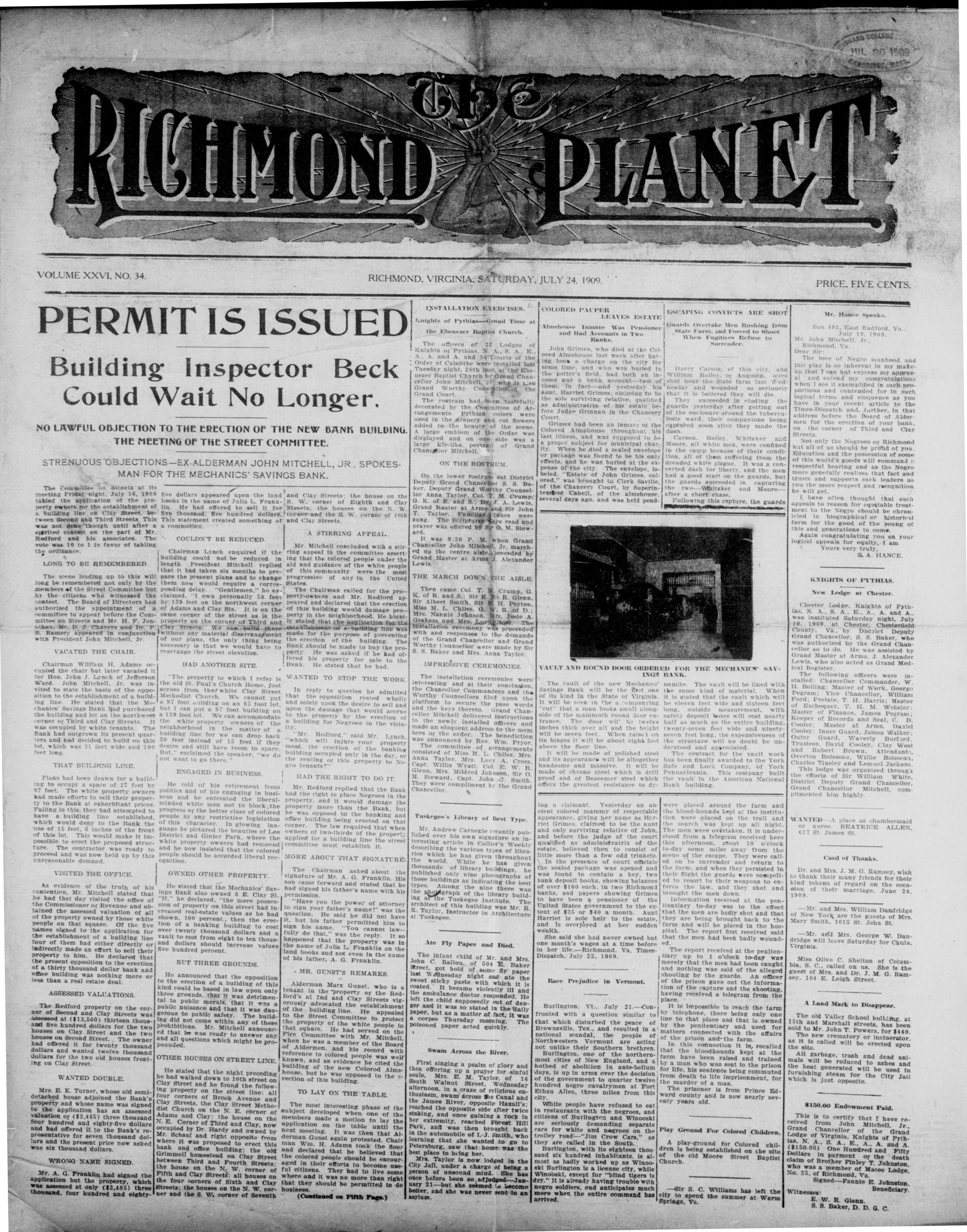
VAULT AND ROUND DOOR ORDERED FOR THE MECHANICS' SAVINGS BANK.
Almshouse Inmate Was Pensioner
and Had Accounts in Two Pensions
John Grimes, who died at the Colored Almshouse last week after having been a charge on the city for some time, and who was buried in the potter's field, had both an income and a bank account—two of them; in fact—and yesterday his aunt, Harriet Grimes, claiming to be the sole surviving relative, qualified as administratrix of his estate before Judge Grinnan in the Chancery Court.
Grimes had been an inmate of the Colored Almshouse throughout his last illness, and was supposed to be a proper subject for municipal charity. When he died a sealed envelope or package was found to be his only effects, and he was buried at the expense of the city. The envelope, labeled, "Estate of John Grimes, colored," was brought to Clerk Saville, of the Chancery Court, by Superintendent Cabell, of the almshouse, several days ago, and was held tend-
VAULT AND ROUND DOOR ORDERINGS
The vault of the new Mechanica' Savings Bank will be the first one of its kind In the State of Virginia. It will be seen in the accompanying "cut" that a man looks small alongside of the mammoth round door entrance. The door will be twelve inches thick over all and the height will be seven feet. When raised on its hinges it will be about eight feet above the floor line.
It will be made of polished steel and its appearance will be altogether handsome and massive. It will be made of chrome steel which is drill proof and of Bessemer steel which offers the greatest resistance to dying a claimant. Yesterday an ancient colored mammy of respectable appearance, giving her name as Harriet Grimes, claimed to be the aunt and only surviving relative of John, and before the judge of the court qualified as administratrix of the estate, believed then to consist of little more than a few odd trinkets. In the presence of court officials the sealed package was opened and was found to contain a key, two bank deposit books, showing balances of over $100 each, in two Richmond banks, and papers showing Grimes to have been a pensioner of the United States government to the extent of $35 or $40 a month. Aunt Harriet is sole heir to the estate, and is overjoyed at her sudden wealth.
She said she had never owned but one month's wages at a time before in her life—Richmond, Va, TimesDispatch. July 22, 1909.
Race Prejudice in Vermont
Burlington, Vt., July 21.—Confronted with a question similar to that which disturbed the peace of Brownsville, Tex., and resulted in a national scandal, the people of Northwestern Vermont are acting not unlike their Southern brethren. Burlington, one of the northernmost cities of New England, and a hotbed of abolition in ante-bellum days, is up in arms over the decision of the government to quarter twelve hundred negro cavalrymen at Fort Ethan Allen, three miles from this city.
White people have refused to eat in restaurants with the negroes, and citizens of Burlington and Winooski are seriously demanding separate cars for white and negroes on the trolley road—"Jim Crow Cars," as they are called in the South.
Burlington, with its eighteen thousand six hundred inhabitants, is almost as badly worked up as Winooski Burlington is a license city, while Winooski, except for "blind tigers is dry." It is already having trouble with negro soldiers, and anticipates much more when the entire command has arrived.
ESCAPING CONVICTS ARE SHOT
Guards Overtake Men Rushing from State Farm, and Forced to Shoot When Fugitives Refuse to
Harry Carson, of this city, and William Bailey, or Augusta, were shot near the State farm last Wednesday and wounded so seriously that it is believed they will die.
They succeeded in eluding the guards yesterday after getting out of the enclosure around the tuberculosis ward, their companions being captured soon after they made the dash.
Carson, Bailey, Whitaker and Moore, all white men, were confined in the camp because of their condition, all of them suffering from the dreaded white plague. It was a concerted dash for liberty, and the men had a good start on the guards, but the guards succeeded in capturing the two—Whitaker and Moore—after a short chase.
Following this capture, the guards
RED FOR THE MECHANICS' SAV- BANK.
namite. The vault will be lined with the same kind of material. When it is stated that the vault which will be eleven feet wide and sixteen feet long, outside measurement, with safety deposit boxes will cost nearly half as much as the entire building, twenty-seven feet wide and ninety-seven feet long, the expensiveness of the structure will no doubt be understood and appreciated.
The contract for the vault work has been finally awarded to the York Safe and Lock Company, of York Pennsylvania. This company built the vault in the American National Bank building.
were placed around the farm and the blood-hounds kept at the institution were-placed on the trail and the search was kept up all night. The men were overtaken, it is understood from a telegram received here this afternoon, about 10 o'clock to-day some miles away from the scene of the escape. They were called on to surrender and return to the farm, and when they persisted in their flight the guards were compelled to resort to their weapons to enforce the law, and they shot and brought the men down.
Information received at the penitentiary to-day was to the effect that the men are badly shot and that they are being brought back to the farm and will be placed in the hospital. The report first received said that the men had been badly wounded.
The report received at the penitentiary up to 1 o'clock to-day was merely that the men had been caught and nothing was said of the alleged shooting by the guards. An officer of the prison gave out the information of the capture and the shooting, having received a telegram from the place.
It is impossible to reach the farm by telephone, there being only one line to that place and that is owned by the penitentiary and used for matters connected with the affairs of the prison and the farm.
In this connection it is, recalled that the bloodhounds kept at the farm have been raised and trained by a man who was sent to the prison for life, his sentence being commuted from death to life imprisonment, for the murder of a man.
The prisoner is from Prince Edward county and is now nearly seventy years old.
Play Ground For Colored Children
A play-ground for Colored children is being established on the site of the old Moore Street Baptist Church.
—Sir S. C. Williams has left the city to spend the summer at Warm Springs, Va.
Mr. Hance Speaks.
Box 491, East Radford, Va.
July 19, 1909.
The love of Negro manhood and fair play is so inherent in my makeup that I can but express my approval and extend my congratulations when I see it exemplified in such proportions and contended for in such logical terms and eloquence as you have in your recent article to the Times-Dispatch and, further, in that address before the Board of Aldermen for the erection of your bank, on the corner of Third and Clay Streets.
Not only the Negroes or Richmond but all of us should be proud of you. Education and the possession of some of this world's goods will command a respectful hearing and as the Negro more generally realizes that fact and trusts and supports such leaders as you the more respect and recognition he will get.
I have often thought that such appeals to reason for equitable treatment to the Negro should be chronicled in biographical or historical form for the good of the young of this and generations to come.
Again congratulating you on your logical appeals for equity, I am
KNIGHTS OF PYTHIAS
New Lodge at Chester
Chester Lodge, Knights of Pythias, N. A., S. A., E., A., A. and A., was instituted Saturday night, July 10, 1909, at Chester, Chesterfield County, Va., by District Deputy Grand Chancellor, S. S. Baker, who was authorized by the Grand Chancellor so to do. He was assisted by Grand Master at Arms, J. Alexander Lewis, who also acted as Grand Medical Register.
The following officers were installed: Chancellor Commander, W. H. Bolling; Master of Work, George Pegram; Vice Chancellor, William Ford; Prelate, T. H. Harris; Master of Exchequer, T. H. M. Webster; Master of Finance, James Pegram; Keeper of Records and Seal, C. D. Cooler; Master at Arms, Daniel Cooley; Inner Guard, James Walker; Outer Guard, Waverley Burford; Trustees, David Cooley, Clay West and Robert Brown; Attendants; Overton Boisseau, Willie Boisseau, Charles Tinsley and Lemuel Jackson.
This lodge was organized through the efforts of Sir William White, District Deputy Grand Chancellor, Grand Chancellor Mitchell, complimented him highly.
WANTED A place as chambermaid
of a nurse BEATRICE ALLEN,
617 JURY ST.
Card of Thanks
Dr. and Mrs. J. M. G. Ramsey, wish to thank their many friends for their kind tokens of regard on the occasion of their marriage, June 24, 1909.
—Mr. and Mrs. William Dandridge of New York are the guests of Mrs. Mary Smith, 1013 St. John St.
—Mr. and Mrs. George W. Dandridge will leave Saturday for Chula, Virginia.
Miss Olive C. Shelton of Columbia, S. C., called on us. She is the guest of Mrs. and Dr. J. M. G. Ramsey, 104 E. Leigh Street.
A Land Mark to Disappear
The old Valley School building, at 15th and Marshall streets, has been sold to Mr. John T. Powers, for $440. The new crematory or incinerator, as it is called will be erected upon the site. All garbage, trash and dead animals will be reduced to ashes and the heat generated will be used in furnishing steam for the City Jail which is just opposite.
$150.00 Endowment Paid
This is to certify that I have received from John Mitchell, Jr.,
Grand Chancellor of the Grand
Lodge of Virginia, Knights of Pythias,
N. A., S. A., E., A., A. and A.
($150.00) One Hundred and Fifty
Dollars in payment or the death
claim of Brother Finley T. Johnston,
who was a member of Maceo Lodge,
No. 35, of Richmond, Va.
Signed—Fannie E. Johnston,
Beneficiary.
Witnesses:
E. W. R. Glenn.
S. S. Baker, D. D. G. C.
T
SYNOPSIS.
CHAPTER I - Murray Sinclair and his gang of wreckers were called out to clear tracks at Smoky Creek.
CHAPTER II - Smoky Creek and read superintendent, caught Sinclair and his men in the act of looting the wrecked car, had a惊喜 innocence declaring it on amount of treat for the men. McCloud discharged the whole outfit and ordered the wrecked car.
CHAPTER III - McCloud became acquainted with Dickie Sinclair, a girl of the west, who came to look at the wrecked car. He a message for Sinclair.
CHAPTER IV - Smith told President Buck of the railroad, of McCloud's brave fight against a gang of crazed miners and that was the result of an effort to his high office. McCloud arranged to board at the boarding house Sinclair, the ex-foreman's deserted wife.
CHAPTER V - Dickie Sinclair was the daughter of the late Richard Dunn, who shop and a fight between him and his wife, which occurred after his wife's demise, which occurred after one year of married life.
CHAPTER VI - Sinclair visited Marton shingle shop and a fight between him and his wife, which occurred after one year of married life.
CHAPTER VII - Smoky Cheek bridge was mysteriously burned. McCloud prepared to face the situation. President Smith notified Smith that he had work ahead.
CHAPTER VIII - McCloud worked for days and finally got the division running in the first game of overheard Dickie's criticising his method to Marlon Sinclair.
CHAPTER IX - A stock train was worked by an open switch. Train was a senger train was held up and the express car robbed. Two men of a posse pursued the senger train was notified that Whispering Smith was not hunt the desperadoes.
CHAPTER X - Bill Dancing a road runner was sent to hunt Sinclair and his gang be sent to hunt bandits. Stranger, apparently with authority, told the stranger was Whispering Smith.
CHAPTER XI - Smith approached Sinclair. He tried to buy him off, but failed. McCloud that his life was in danger.
CHAPTER XVIII.
At the Dike.
Marion caught her closely to her heart. "I knew you would go if I got you angry, dear. But you are so slow to anger. Mr. McCloud is just the same way. Mr. Smith says when he does get angry he can do anything. He is very like you in so many ways." Dickie was wishing her once. "It's
Dicklews was wiping her eyes. "Is he. Marion?" Well, what shall I wear?"
"Just your riding-clothes, dear, and a smile. He won't know what you have en. It is you he will want to see. But I've been thinking of something else. What will your Cousin Lance say? Suppose he should object?"
"Object! I should like to see him object after losing the fight himself." Marlon laughed. "Well, do you think you can find the way down there for us?"
"I can find any way anywhere within 100 miles of here."
On the 20th of June McCloud did have something of an army of men in the Crawling Stone valley. Of these, 250 were in the vicinity of the bridge, the abutments and piers of which were being put in just below the Dunning ranch. Near at hand Bill Dancing, with a big gang, had been for some time watching the ice and dynamiting the jams. McCloud brought in more men as the river continued to rise. The danger line on the gauges was at length submerged, and for three days the main-line construction camps had been robbed of men to guard the soft grades above and below the bridge. The new track up and down the valley had become a highway of escape from the flood, and the track patrols were met at every curve by cattle, horses, deer, wolves and coyotes fleeing from the waste of waters that spread over the bottoms.
Through the Dunning ranch the Crawling Stone river makes a far bend across the valley to the north and east. The extraordinary volume of water now pouring through the Box canyon exposed 10,000 acres of the ranch to the caprice of the river, and if at the point of its tremendous sweep to the north it should cut back into its old channel the change would wipe the entire body of ranch alfalfa lands off the face of the valley. With the heat of the lengthening June days a vast steam rose from the chill waters of the river, marking in ominous windings the channel of the main stream through a yellow sea which, ignoring the usual landmarks of trees and dunes, flanked the current broadly on either side. Late in the afternoon of the day that Dickle with Marlon sought McCloud, a storm drifted down the Topah Topah hills, and heavy showers broke across the valley.
At nightfall the rain had passed and the mist lifted from the river. Above the bluces rolling patches of cloud obscured the face of the moon, but the distant thunder had ceased, and at midnight the valley near the bridge lay in a stillness broken only by the hoarse calls of the patrols and far-off megaphones. From the bridge camp, which lay on high ground near the grade, the distant lamps of the trackwalkers could be seen moving dimly.
Before the campfire in front of McCloud's tent a group of men, smoking and talking, sat or lay sprawled on tarpaulins, drying themselves after the long day. Among them were the weather-beaten remnants of the old guard of the mountain workers, men who had fought the Spider Water with Glover. Bill Dancing, huge, lumbering, awkward as a bear and as shifty, was talking, because with no apparent effort he could talk all night, and was a valuable man at keeping the camp awake. Bill Dancing talked and, after Sinclair's name had been dropped from the roll, ate and drank more than any two men on the division. A little apart, McCloud lay on a leather caboose cushion trying to get a nap.
The man sent to the bridge had
WHISPERING: SMITH
BY TRANK H. SPEARMAN.
ILLUSTRATIONS BY ANDRE BOWLES
COPYRIGHT BY CHRIS SCRIBHERS SONS
turned back, and behind his lantern Dancing heard the tread of horses. He stood at one side of the camp-fire while the visitors rode up; they were women. Dancing stood dumb as they advanced into the firelight. The one ahead spoke: "Mr. Dancing, don't you know me?" As she stopped her horse the light of the fire struck her face. "Why, Miss Sinclair!"
"Yes, and Miss Dunning is with me," returned Marion. Bill staggered. "This is an awful place to get to; we have been nearly drowned, and we want to see Mr. McCloud."
McCloud, roused by Marion's voice, came forward. "You were asleep," said she as he greeted her. "I am so sorry we have disturbed you!" She looked careworn and a little forlorn, yet but a little considering the struggle she and Dickie had made to reach the camp.
Light blazed from the camp-fire, where Dickie stood talking with Dancing about horses.
"They are in desperate straits up at the ranch." Marion went on, when McCloud had assured her of her welcome. "I don't see how they can save it. The river is starting to flow into the old channel and there's a big pond right in the alfalfa fields." "It will play the dance with things if it gets through there," mused McCloud. "I wonder how the river is? I've been asleep. O Bill!" he called to Dancing, "what water have you got?" "Twenty-eight six just now, sir. She's a rising very, very slow, Mr. McCloud."
"So I am responsible for this invasion," continued Marion, calmly. "I've been up with Dickies at the ranch; she sent for me. Just think of it—no woman but old Puss within ten miles of the poor child! And they have been trying everywhere to get bags, and you have all the bags, and the men have been buzzing around over there for a week like bumblebees and doing just about as much good. She and I talked it all over this afternoon, and I told her I was coming over here to see you, and we started out together—and merciful goodness, such a time as we have had!"
"But you started out together; where did you leave her?"
"There she stands the other side of the fire. O Dickiesl!"
"Why did you not tell me she was here?" exclaimed McCloud.
Dickiesl came into the light as he hastened over. If she was uncertain in manner, he was not. He met her, laughing just enough to relieve the tension of which both for an instant were conscious. She gave him her hand when he put his out, though he felt that it trembled a little. "Such a ride as you have had!" Why did you not send me word? I would have come to you!" he exclaimed, throwing reproach into the words.
Dickiesl raised her eyes. "I wanted to ask you whether you would sell us some grain sacks, Mr. McCloud, to use at the river. If you could spare them."
"Sacks?" Why, of course, all you
"But How Did You Ever Get Here?"
want! But how did you ever get here?
In all this water, and two lone women! You have been in danger tonight. Indeed you have—don't tell me! And you are both wet; I know it. Your feet must be wet. Come to the fire. O Bill!" he called to Dancing, "what's the matter with your wood? Let us have a fire, won't you?—one worth while; and build another in front of my tent. I can't believe you have ridden here all the way from the ranch, two of you alone!" exclaimed McCloud, hastening boxes up to the fire for seats.
Marlon laughed. "Dicksi can go anywhere! I couldn't have ridden from the house to the barns alone."
"Then tell me how you could do it?" demanded McCloud, devouring Dicksi with his eyes.
Dicksi looked at the fire. "I know all the roads pretty well. We did get lost once," she confessed in a low voice, "but we got out again."
"The roads are all under water, though."
"What time is it, please?"
McCloud looked at his watch. "Two minutes past 12."
Dickleis started. "Past 12? Oh, this is dreadful! We must start right back, Marion. I had no idea we had been five hours coming five miles."
McCloud looked at her, as if still unable to comprehend what she had accomplished in crossing the flooded bottoms. Her eyes fell back to the
THE RICHMOND PLANET, RICHMOND, VIRGINIA
fire. "What a blaze!" she mumured as the driftwood snapped and roared. "It's fine for to-night, isn't it?" "I know you both must have been in the water," he insisted, leaning forward in front of Dickiex to feel Marlon's skirt. "I'm not wet!" declared Marlon, drawing back. "Nonsense, you are wet as a rat! Tell me," he asked, looking at Dickiex, "about your trouble up at the bend. I know something about it. Are the men there to-night? Given up, have they? Too bad! Do open your jackets and try to dry yourselves, both of you, and I'll take a look at the river." "Suppose—I only say suppose—you first take a look at me." The voice came from behind the group at the fire, and the three turned together. "By heaven, Gordon Smith!" exclaimed McCloud. "Where did you come from?"
Whispering Smith stood in the gloom in patience. "Where do I look as if I had come from? Why don't you ask me whether I wet? And won't you introduce me—but this is Miss Dickie-sie Dunning, I am sure."
Marlon with laughter hastened the introduction.
"And you are wet, of course," said McCloud, feeling Smith's shoulder.
"No, only soaked. I have fallen into the river two or three times, and the last time a big rhinoceros of yours down the grade, a section foreman named Klein, was obliging enough to pull me out. Oh, no! I was not looking for you," he ran on, answering McCloud's question; "not when he pulled me out. I was just looking for a farm or a ladder or something. Klein, for a man named Small, is the biggest Dutchman I ever saw. 'Tell me, Klein,' I asked, after he had quit dragging me out—he's a Hanoverian
—'where did you get your pull?' And how about your height? Did your grandfather serve as a grenadier under old Frederick William and was he kidnapped? Bill, don't feed my horse for a while. And Klein tried to light a cigar I had just taken from my pocket and given him—fancy! the Germans are a remarkable people—and sat down to tell me his history, when some friend down the line began bawling through a megaphone, and all that poor Klein had time to say was that he had had no supper, nor dinner, nor yet breakfast, and would be obliged for some by the boat he forwarded me in." And, in closing, Whispering Smith looked cheerfully around at Marlon, at McCloud, and last, and longest of all at Dickisse Dunning.
"Did you come from across the river?" asked Dickisle, adjusting her wet skirt meekly over her knees.
"You are soaking wet," observed Whispering Smith. "Across the river?" he echoed. "Well, hardly my dear Miss Dunning! Every bridge is out down the valley except the railroad bridge and there are a few things I don't tackle; one is the Crawling Stone on a toar. No, this was across a little break in this man McCloud's track. I came, to be frank, from the Dunning ranch to look up two women who rode away from there at seven o'clock to night, and I want to say that they gave me the ride of my life," and Whispering Smith looked all around the circle and back again and smiled.
Dickiesle spoke in amazement. "How did you know we rode away? You were not at the ranch when we left." "Oh, don't ask him!" cried Marion. "He knows everything," explained McCloud.
Whispering Smith turned to Dicklea. "I was interested in knowing that they got safely to their destination—whatever it might be, which was none of my business. I happened to see a man that had seen them start, that was all. You don't understand? Well, if you want it in plain English, I made it my business to see a man who made it his business to see them. It's all very simple, but these people like to make a mystery of it. Good women are scarcer than riches, and more to be prized than fine gold—in my judgment—so I rode after them." Marion put her hand for a moment on his coat sleeve; he looked at Dicklea with another laugh and spoke to her because he dared not look toward Marion. "Going back to night, do you say? You never are?" Dicklea answered quite in earnest: "Oh, but we are. We must!"
"Why did you come, then? It's taken half the night to get here, and will take a night and a half at least to get back."
"We came to ask Mr. McCloud for some grain sacks—you know, they have nothing to work with at the ranch," said Marion; "and he said we might have some and we are to send for them in the morning."
"I see. But we may as well talk plainly." Smith looked at Dicksee. "You are brave and as game as a girl can be, I know, or you couldn't have done this. Sacks full of sand, with the boys at the ranch to handle them, would do no more good to-morrow at the bend than bladders. The river is flowing into Squaw lake above there now. A hundred men that know the game might check things yet if they're there by daylight. Nobody else, and nothing else on God's earth can."
There was silence before the fire.
McCloud broke it: "I can put the 100 men there at daylight, Gordon, if Miss Dunning and her cousin want them," said McCloud.
Marlon sprang to her feet. "Oh, will you do that, Mr. McCloud?"
McCloud looked at Dickie. "If they are wanted."
Dickies tried to look at the fire. "We have hardly deserved help from Mr. McCloud at the ranch," she said at last.
He put out his hand. "I must object. The first wreck I ever had on this division Miss Dunning rode 20 miles to offer help. 'Nin't that true? Why. I would walk 100 miles to return the offer to her. Perhaps your cousin would object, he suggested, turning to Dickies; 'but no. I think we can manage that. Now what are we going to do? You two can't go back tonight, that is certain."
"We must."
"Then you will have to go in boats," said Whispering Smith.
"But the hill road."
"There is five feet of water across it in half a dozen places. I swam my horse through, so I ought to know."
"It is all back-water, of course, Miss Dunning," explained McCloud. "Not dangerous."
"But moist," suggested Whispering Smith, "especially in the dark."
McCloud looked at Marion. "Then let's be sensible," he said. "You and Miss Dunnink can have my tent."
"Is this where you stay?" asked Dicksie.
"Four of us sleep in the cots, when we can, and an indefinite number lie on the ground when it rains."
"Which is your bed?"
"I usually sleep there." He pointed to the one on the right.
"I thought so. It has the blanket folded back so neatly, just as if there were sheets under it. I'll bet there aren't any."
"Do you think this is a summer resort? Knisely, my assistant, sleeps there, but of course we are never both in bed at the same time; he's down the river to night. It's a sort of continuous performance, you know." McCloud looked at Dicksie. "Take off your coat, won't you, please?"
Whispering Smith was trying to drag a chest from the foot of the cot, and Marion stood watching. "What are you trying to do?"
"Get this over to the table for a seat."
"Silly man! why don't you move the table?"
Dicklese was taking off her coat. "How inviting it all is!" she smiled. "And this is where you stay?"
"When he rains," answered McCloud. "Let me have your hat, too."
"My half is a sight, I know. We rode over rocks and up gullies into the brush—"
"And through lakes—oh, I know! I can't conceive how you ever got here at all. Your hair is all right. This is camp, anyway. But if you want a glass you can have one. Knisely is a great swell; he's just from school, and has no end of things. I'll rob his bag."
"Don't disturb Mr. Knisely's bag for the world!"
"But you are not taking off your hat. You seem to have something on your mind." "Help me to get it off my mind, will you, please?"
"If you will let me."
"Tell me how to thank you for your generosity. I came all the way over here to night to ask you for just the help you have offered, and I could not—it stuck in my throat. But that wasn't what was on my mind. Tell me what you thought when I acted so dreadfully at Marlon's."
"I didn't deserve anything better after placing myself in such a fool position. Why don't you ask me what I thought the day you acted so beautifully at Crawling Stone ranch? I thought that the finest thing I ever saw."
"You were not to blame at Marlon's."
"I seemed to be, which is just as bad. I am going to start the 'phones going. It's up to me to make good, you know, in about four hours with a lot of men and material. Aren't you going to take off your hat?—and your gloves are soaking wet."
A voice called the superintendent's name through the tent door. "Mr. McCloud?"
"What is it, Bill?"
"Twenty-eight and nine-tenths on the gauge, sir."
McCloud looked at his companions. "I told you so. Up three-tenths. Thank you, Bill. I'll be with you in a minute. Tell Cherry to come and take away the supper things, will you? That is about all the water we shall get tonight. I think. It's all we want." added McCloud, glancing at his watch. "I'm going to take a look at the river. We shall be quiet now around here until half-past three, and if you, Marlon, and Miss Dunning will take the tent, you can have two hours' rest before we start. Bill Dancing will guard you against intrusion, and if you want ice water ring twice."
CHAPTER XIX.
A Talk with Whispering Smith.
When Whispering Smith had followed McCloud from the tent, Dickie turned to Marion and caught her hand.
"Is this the terrible man I have heard about?" she murmured. "And I thought him ferocious! But is he as pittless as they say, Marion?"
Marion laughed—a troubled little laugh of surprise and sadness. "Dear, he isn't pittless at all. He has unpleasant things to do, and does them. He is the man on whom the railroad relies to repress the lawlessness that breaks out in the mountains at times and interferes with the operating of the road. It frightens people away, and prevents others from coming in to settle. Railroads want law and
order. Robbery and murders don't make business for railroads. They depend on settlers for developing a country, don't you know; otherwise they would have no traffic, not to speak of wanting their trains and men let alone. When Mr. Bucks undertook to open up this country to settlers, he needed a man of patience and endurance and with courage and
"Alone in the Rain?"
skill in dealing with lawless men, and no man has ever succeeded so well as this terrible man you have heard about. He is terrible, my dear, to lawless men, not to any one else. He is terrible in resource and in daring, but not in anything else I know of, and I knew him when he was a boy and wore a pink worsted scarf when he went skating.
"I should like to have seen that scarf," said Dickie, reflectively. She rose and looked around the tent. In a few minutes she made Marion lie down on one of the cots. Then she walked to the front of the tent, opened the flap, and looked out.
Whispering Smith was sitting before the fire. Rain was falling, but Dickie put on her close-fitting black coat, raised the door-flap, and walked noiselessly from the tent and up behind him. "Alone in the rain?" she asked.
She had expected to see him star at her voice, but he did not, though he rose and turned around. "Not now," he answered as he offered her his box with a smile. "Are you taking your hat off for me in the rain? Put it on again!" she insisted with a little tone of command, and she was conscious of gratification when he chewed amiably. "I won't take your box unless you can find another!" she said. "Oh, you have another! I came out to tell you what a dreadful man I thought you were, and to apologize." "Never mind apologizing. Lots of people think worse than that of me and don't apologize. I'm sorry I have no shelter to offer you, except to sit on this side and take the rain." "Why should you take the rain for me?"
"You are a woman."
"But a stranger to you."
"Only in a way."
Dickie gazed for a moment at the fire. "You won't think me abrupt, will you?" she said, turning to him, "but, as truly as I live, I cannot account for you, Mr. Smith. I guess at the ranch we don't know what goes on in the world. Everything I see of you contradicts everything I have heard of you."
"You haven't seen much of me yet, you know, and you may have heard much better accounts of me than I deserve. Still, it isn't surprising you can't account for me; in fact, it would be surprising if you could. Nobody pretends to do that. You must not be shocked if I can't even account for myself. Do you know what a derelict is? A ship that has been abandoned but never wholly sinks."
"Please don't make fun of me! How did you happen to come into the mountains? I do want to understand things better."
"Why, you are in real earnest, aren't you? But I am not making fun of you. Do you know President Buck's? No? Too bad! He's a very handsome old bachelor. And he is one of those men who get all sorts of men to do all sorts of things for them. You know, building and operating railroads in this part of the country is no joke. The mountains are filled with men that don't care for God, man, or the devil. Sometimes they furnish their own ammunition to fight with and don't bother the railroad for years; at such times the railroad leaves them alone. For my part, I never quarrel with a man that doesn't quarrel with the road. Then comes a time when they get after us, shooting our men or robbing our agents or stopping our trains. Of course we have to get busy then. A few years ago they worried Buck's till they nearly turned his hair gray. At that unfortunate time I happened into his office with a letter of introduction from his closest Chicago friend, Willis Howard, prince of good men, the man that made the Palmer house famous—yes. Now I had come out here, Miss Dunning—I almost said Miss Dickie, because I hear it so much—"
"I should be greatly set up to hear you call me Dickie. And I have wondered a thousand times about your name. Dare I ask—why do they call you Whispering Smith? You don't whisper."
He laughed with abundance of good-
A
humor. "That is a ridiculous accident, and it all came about when I lived in Chicago. Do you know anything about the internal climate there? Well, in Chicago I used to lose my voice whenever I caught a cold—sometimes for weeks together. So they began calling me Whispering Smith, and I've never been able to shake the name. Odd, isn't it? But I came out to go into the real estate business. I was looking for some gold-bearing farm lands where I could raise quartz, don't you know, and such things—yes. I don't mind telling you this, though I wouldn't tell it to everybody—" "Certainly not," assented Dickie, drawing her skirt around to sit in closer confidence. "I wanted to get rich quick," murmured Whispering Smith, confidentially. "Almost criminal, wasn't it?" "I wanted to have evening clothes." "Yes."
"And for once in my life two pairs of suspenders—a modest ambition, but a gawning one. Would you believe it? Before I left Bucks' office he had hired me for a railroad man. When he asked me what I could do, and I admitted a little experience in handling real estate, he brought his fist down on the table and "more I should be his right-of-way man."
"How about the mining?"
Whispering Smith waved his hand in something of the proud manner in which Bucks could wave his presidential hand. "My business, Bucks said, need not interfere with that, not in the least; he said that I could do all the mining I wanted to, and I have done all the mining I wanted to. But here is the singular thing that happened: I opened up my office and had nothing to do; they didn't seem to want any right of way just then. I kept getting my check every month, and wasn't doing a hand's turn but riding over the country and shooting rabbits. But, Lord, I love this country! Did you know I used to be a cowboy in the mountains years ago? Indeed I did. I know it almost as well as you do. I mined more or less in the meantime. Occasionally I would go to Bucks—you say you don't know him?—too bad!—and tell him, candidly I wasn't doing a thing to earn my salary. At such times he would only ask me how I liked the job," and Whispering Smith's heavy eyebrows rose in mild surprise at the recollection. "One day when I was talking with him he handed me a telegram from the desert saying that a night operator at a lonely station had been shot and a switch misplaced and a train nearly wrecked. He asked me what I thought of it. I discovered that the poor fellow had shot himself, and in the end we had to put him in the insane asylum to save him from the penitentiary—but that was where my trouble began.
"It ended in my having to organize the special service on the whole road to look after a thousand and one things that nobody else had—well, let us say time or inclination to look after: Fraud and theft and violence and all that sort of disagreeable thing. Then one day the cat crawled out of the bag. What do you think? That man who is now president of this road has somewhere seen a highly-colored story about me in a magazine, a ten-cent magazine, you know. He had spotted me the first time I walked into his office, and told me a long time afterward it was just like seeing a man walk out of a book, and that he had hard work to keep from falling on my neck. He knew what he wanted me for; it was just this thing. I left Chicago to get away from it, and this is the result. It is not all that kind of thing, oh, no! When they want to cross a reservation I have a winter in Washington with our attorneys and dine with old friends in the White House, and the next winter I may be on snowshoes chasing a band of rustlers. I swore long ago I would do no more of it—that I couldn't and wouldn't. But it is Bucks. I can't go back on him. He is amiable and I am soft. He says he is going to have a crown and harp for me some day, but I fancy—that is, I have an intimation—that there will be a red-hot protest at the bar of heaven," he lowered his tone, "from a certain unmentionable quarter when I undertake to put the vestments on. By the way, I hear you are interested in chickens. Oh, yes, I've heard a lot about you! Bob Johnson, over at Oroville, has some pretty bantams I want to tell you about."
Whether he talked railroad or chickens, it was all one; Dickie sat spellbound; and when he announced it was half past three o'clock and time to rouse Marion she was amazed.
Dawn showed in the east. The men eating breakfast in tents were to be sent on a work-train up a piece of Y-track that led as near as they could be taken to where they were needed.
The train had pulled out when Dickie, Marion, McCloud and Whispering Smith took horses to get across to the hills and through to the ranch-house.
CHAPTER XX
At the River.
They found the ranchhouse as Marlon and Dickleie had left it, deserted. Puss told them every one was at the river. McCloud did not approve Dickleie's plan of going down to see her cousin first. "Why not let me ride down and manage it without bringing you into it at all?" he suggested. "It can be done." And after further discussion it was so arranged.
McCloud and Smith had been joined by Dancing on horseback, and they made their way around Squaw lake and across the fields. The fog was rolling up from the willows at the bend. Men were chopping in the brush, and McCloud and his companion soon met Lance Dunning riding up the narrow strip of sand that held the river off the ranch.
McCloud greeted Dunning, regardless of his amazement, as if he had parted from him the day before. "How are you making it over here?" he asked. "We are in pretty good shape at the moment down below, and I thought I would ride over to see if we could do anything for you. This is what you call pretty fair water for this part of the valley, isn't it?"
Lance swallowed his astonishment.
"This isn't water, McCloud; this is hell." He took off his hat and wiped his forehead. "Well, I call this white, anyway, and no mistake—I do, indeed, sir! This is Whispering Smith, isn't it? Glad to see you at Crawling Stone, sir." Which served not only to surprise but to please Whispering Smith.
"Some of my men were free," continued McCloud; "I switched some mattresses and sacks around the Y. thinking they might come in play here for you at the bend. They are at your service if you think you need them."
"Need them!" Lance swore fiercely and from the bottom of his heart He was glad to get help from any quarter and made no bones about it. Moreover, McCloud lessened the embarrassment by explaining that he had a personal interest in holding the channel where it ran, lest a change above might threaten the approaches already built to the bridge; and Whisperling Smith, who would have been on terms with the catfish if he had been flung into the middle of the Crawling Stone, contributed at once, like a re-enforced spring, to the case of the situation. Lance again took off his hat and wiped the sweat of anxiety from his dripping forehead. "Whatever differences of opinion I may have with your company. I have no lack of esteem personally. McCloud, for you, sir, by heaven! How many men did you bring?"
"And whatever wheels you Crawling Stone ranchers may have in your heads on the subject of irrigation," returned McCloud, evenly. "I have no lack of esteem personally, Mr. Dunning, for you. I brought 100."
"Do you want to take charge here? I'm frank, sir; you understand this game and I don't."
"Suppose we look the situation over; meantime, all our supplies have to be brought across from the Y. What should you think, Mr. Dunning, of putting all the teams you can at that end of the work?"
"Every man that can be spared from the river shall go at it. Come over here and look at our work and judge for yourself."
They rode to where the forces assembled by Lance were throwing up embankments and riprapping. There was hurried running to and fro, a violent dragging about of willows, and a good deal of shouting.
Dunning, with some excitement, watched McCloud's face to note the effect of the activity on him, but McCloud's expression, naturally reserved, reflected nothing of his views on the subject. Dunning waved his hand at the lively scene. "They've been at it all night. How many would you take away, sir?" "You might take them all away, as far as the river is concerned," said McCloud, after a moment.
"They are not doing anything, are they, but running around in a circle?" And those fellows over there might as well be making mud pies as riprapping at that point. What we need there is a mattress and sandbags—and plenty of them. Bill," directed McCloud in an even tone of business as he turned to Dancing, "see how quick you can get your gangs over here with what sacks they can carry and walk fast. If you will put your men on horses, Mr. Dunning, they can help like everything. That bank won't last a great while the way the river is getting under it now." Dancing wheele' like an elephant on his bronco and clattered away through the mud. Lance Dunning, recovering from his surprise, started his men back for the wagons, and McCloud, dismounting, walked with him to the water's edge to plan the fight for what was left of the strip in front of the alfalfa fields.
When Whispering Smith got back to the house he was in good humor. He joined Dickiesie and Marlon in the dining room, where they were drinking coffee. Afterward Dickiesie ordered horses saddled and the three rode to the river. Up and down the bank as far as they could see in the misty rain, men were moving slowly about—more men, it seemed to Dickiesie, than she had ever seen together in her life. The confusion and the noise had disappeared. No one appeared to hurry, but every one had something to do, and, from the gangs who with sledges were sinking "dead-men" among the trees to hold the cables of the mattress that was about to be sunk, and the Jaws who were diligently preparing to float and load it, to the men that were filling and wheeling the sandbags, no one appeared excited. McCloud joined the visitors for a few moments, and then went back to where Dancing and his men on lifelines were guiding the mattress to its resting place. In spite of the gloom of the rain, which Whispering Smith said was breaking, Dickiesie rode back to the house in much better spirits with her two guests; and when they came from luncheon the sun, as Smith had predicted, was shining.
"Oh, come out!" cried Dickiele, at the door. Marion had a letter to write and went upstairs, but Whispering Smith followed Dickiele. "Does everything you say come true?" she demanded as she stood in the sunshine.
She was demure with light-heartedness and he looked at her approvingly. "I hope nothing I may say ever will come true unless it makes you happy," he answered, lightly. "It would be a shame if it did anything else."
She pointed two accusing fingers at him. "Do you know what you prom-
THE PLANET
SATURDAY.....JUNE 24, 1909
already! You said you would tell me
why my leghorns are eating their
feathers off."
"Let me talk with them."
"Just what I should like. Come on!"
said Dicksi, leading the way to the
chicken-yard. "I want you to see
Marc Jardin
Dickieie Ordered Horses Saddled and Rode to the River.
my bantams, too. I have three of the dearest little things. One is setting. They are over the way. Come see them first. And, oh, you must see my new game chickens. Truly, you never saw anything as handsome as Caesar—he's the rooster; and I have six pullets. Caesar is perfectly superb."
When the two reached the chicken house Dickieie examined the nest where she was setting the bantam hen. "This miserable hen will not set," she explained in despair. "See here, Mr. Smith, she has left her nest again and is scratching around on the ground. Isn't it a shame? I've tied a cord around her leg so she couldn't run away, and she is hobbling around like a scrub pony."
"Perhaps the eggs are too warm," suggested her companion. "I have had great success in cases like this with powdered ice—not using too much, of course; just shave the ice gently, and rub it over the eggs one at a time; it will often result in refreshing the attention of the hen."
Dickie's looked grave. "Aren't you ashamed to make fun of me?"
Whispering Smith seemed taken aback. "It is really serious business?" "Of course."
"Very good. Let me watch this hen for a few minutes and diagnose her. You go on to your other chickens. I'll stay here and think."
Dicklese went down through the yards. When she came back, Whispering Smith was sitting on a cracker box watching the bantam. The chicken was making desperate efforts to get off Dicklese's cord and join its companions in the runway. Smith was wying the bantam critically when Dicklese rejoined him. "Do you usually," he asked, looking suddenly up, "have success in setting roosters?" "Now you are having fun with me again." "No, by heaven! I am not." "Have you diagnosed the case?" "I have, and I have diagnosed it as a case of mistaken identity."
"And misapplied energy, Miss Dickle, you have tied up the wrong bird. This is not a bantam hen at all; this is a bantam rooster. Now that is my judgment. Compare him with the others. Notice how much darker his plumage is—it's the rooster," declared Whispering Smith, wiping the perplexity from his brow. "Don't feel bad, not at all. Cut him loose, Miss Dickle—don't hesitate; do it on my responsibility. Now let's look at the cannibal leghorns—and great Caesar."
CHAPTER XXI.
Between Girlhood and Womanhood.
About nine o'clock that night Puss ushered McCloud in from the river. Dicksle came running downstairs to meet him. "Your cousin insisted I should come up to the house for some supper," said McCloud, dryly. "I could have taken camp fare with the men. Gordon stayed there with him."
Dicksle held his hat in her hand, and her eyes were bright in the firelight. Puss must have thought the two made a handsome couple, for she lingered, as she started for the kitchen, to look back.
"Puss," exclaimed her mistress, "fry a chicken right away! A big one, Puss! Mr. McCloud is very hungry, I know. And be quick, do! Oh, how is the river, Mr. McCloud?"
"Behaving like a lamb. It hasn't fallen much, but the pressure seems to be off the bank, if you know what that means?"
"You must be a magician! Things changed the minute you came!" "The last doctor usually gets credit for the cure, you know." "Oh, I know all about that. Don't you want to freshen up? Should you mind coming right to my room? Marilyn is in hers," explained Dickse, "and I am never sure of Cousin Lance's—he has so many boots." When she had disposed of McCloud she flew to the kitchen. Puss was starting after a chicken. "Take a lantern, Puss!" whispered Dickse, vehemently. "No, indeed; dis nigger don' need no lantern fo' chickens, Miss Dickse." "But get a good one, Pass, and make haste, do! Mr. McCloud must be starved! Where is the baking pow-
der? I'll get the blacula started if
der. 'I'll get the biscuits started.'
Puss turned fiercely. "Now look a heah, yo' can't make biscuits! 'Yo' jes' go se' down wif dat young gen'm'n. Jes' lemme lone, ef yo' please! Dis ain't de first' time I killed chickens, Miss Dickle, an' made biscuits. Jes' clair out an' se' down! Place fr young ladies is in de parlor! Ol' Puss can cook supper fr one man yet—ef she has to" 'Oh, yes, Puss, certainly, I know, of course; only, get a nice chicken!" and with the parting admonition Dickle, smoothing her hair wildly, hastened back to the living room.
But the harm was done. Puss, more excited than her mistress, lost her head when she got to the chicken-yard, and with sufficiently bad results. When Dickiele ran out a few moments afterward for a glass of water for McCloud, Puss was calmly wiping her hands, and in the sink lay the quivering form of young Caesar. Dickiele caught her favorite up by the legs and suppressed a cry. There could be no mistake. She cast a burning look on Puss. It would do no good to storm now. Dickiele only wring her hands and returned to McCloud.
He rose in the happiest mood. He could not see what a torment Dickiesle was in, and took the water without asking himself why it trembled in her hand. Her restrained manner did not worry him, for he felt that his fight at the river was won, and the prospect of fried chicken composed him. Even the long hour before Puss, calm and inviting in a white cap and apron, appeared to announce supper, passed like a dream. When Dickiesle rose to lead the way to the dining room, McCloud walked on air; the high color about her eyes intoxicated him. Not till half the fried chicken, with many compliments from McCloud, had disappeared, and the plate had gone out for the second dozen biscuits did he notice Dickiesle's abstraction.
"I'm sure you need worry no longer ab ut the water," he observed, reassuringly. "I think the worst of the danger is past."
Dickie's looked at the tablecloth with wide-open eyes. "I feel sure that it is. I am no longer worrying about that."
"It's nothing I can do or leave undone, is it?" asked McCloud, laughing a little as he implied in his tone that she must be worrying about something.
Dickie made a gesture of alarm. "Oh, no, no; nothing!"
"It's a pretty good plan not to worry about anything."
"Do you think so?"
"Why, we all thought so last night. Heavens!" McCloud drew back in his chair. "I never offered you a piece of chicken! What have I been thinking of?"
"Oh, I wouldn't eat it anyway!" cried Dickie.
"You wouldn't? It is delicious. Do have a plate and a wing at least."
"Really, I could not bear to think of it," she said, pathetically.
He spoke lower. "Something is troubling you. I have no right to a confidence, I know," he added, taking a biscuit.
Her eyes fell to the floor. "It is nothing. Pray, don't mind me. May I fill your cup?" she asked, looking up. "I am afraid I worry too much over what has happened and can't be helped. Do you never do that?"
McCloud, laughing wretchedly, tore Caesar's last leg from his body. "No, indeed. I never worry over what can't he helped."
They left the dining room. Marlon came down. But they had hardly seated themselves before the living room fire when a messenger arrived with word that McCloud was wanted at the river. His chagrin at being dragged away was so apparent that Marlon and Dickis sympathized with him and laughed at him. "I never worry about what can't be helped," Dickis murmured.
He looked at Marion. "That's a shot at me. You don't want to go down, do you?" he asked, ironically, looking from one to the other.
"Why, of course, I'll go down," responded Dicksiie, promptly. "Marion caught cold last night, I guess, so you will excuse her. I know. I will be back in an hour, Marion, and you can toast your cold while I'm gone."
"But you mustn't go alone!" protested McCloud.
Dicksiie lifted her chin the least bit. "I shall be going with you, shall I not? And if the messenger has gone back I shall have to guide you. You never could find your way alone."
"But I can go," interposed Marion, rising.
"Not at all; you can not go!" announced Dickie. "I can protect both Mr. McCloud and myself. If he should arrive down there under the wing of two women he would never hear the last of it. I am mistress here still, I think; and I shan't be leaving home, you know, to make the trip!" McCloud looked at Marion. "I never worry over what can't be helped—though it is dollars to cents that those fellows don't need me down there any more than a cat needs two tails. And how will you get back?" he asked, turning to Dickie.
"I will ride back!" returned Dickie, loftily. "But you may, if you like, help me get my horse up."
"Are you sure you can find your way back?" persisted McCloud.
Dickleis looked at him in surprise, "Find my way back?" she echoed, softly, "I could not lose it. I can ride over any part of this country at noon or at midnight, asleep or awake, with a saddle or without, with a bridle or without, with a trail or without. I've ridden every horse that has ever come on the Crawling Stone ranch. I could ride when I was three years old. Find my way back."
The messenger had gone when the two rode from the house. The sky was heavily overcast, and the wind blew such a gale from the south and west that one could hardly hear what the other said. McCloud could not have ridden from the house to the barn in the utter darkness, but his horse followed Dickleis's. She halted frequently on the trail for him to come up with her, and after they had crossed the alfalfa fields McCloud did not care whether they ever found the
THE RICHMOND PLANET, RICHMOND, VIRGINIA
path again or not. "It's great, isn't it?" he exclaimed, coming up to her after opening a gate in the dark. "Where are you?" "This way," laughed Dickie. "Look out for the trail here. Give me your hand and let your horse have his head. If he slips, drop off quick on this side." McCloud caught her hand. They rode for a moment in silence, the horses stepping cautiously. "All right now," said Dickie; "you may let go." But McCloud kept his horse up close and clung to the warm hand. "The camp is just around the hill," murmured Dickie, trying to pull away. "But of course if you would like to ride in holding my hand you may!" "No," said McCloud, "of course not—not for worlds! But, Miss Dickie, couldn't we ride back to the house and ride around the other way into camp? I think the other way into the camp—say, around by the railroad bridge—would be prettier don't you?"
For answer she touched Jim lightly with her lines and his spring released her hand very effectively. As she did so the trail turned, and the camp-fire, whipped in the high wind, blazed before them.
Whispering Smith and Lance Dunning were sitting together as the two galloped up. Smith helped Dickie slie to alight. She was conscious of her color and her eyes were now unduly bright. Moreover, Whispering Smith's glance rested so calmly on both McCloud's face and her own that Dickie felt as if he saw quite through her and knew everything that had happened since they left the house.
Lance was talking to McCloud. "Don't abuse the wind," McCloud was saying. "It's our best friend to night, Mr. Dunning. It is blowing the water off shore. Where is the trouble?" For answer Dunning led McCloud off toward the bend, and Dickie was left alone with Whispering Smith.
He made a seat for her on the windward side of the big fire. When she had seated herself she looked up in great contentment to ask if he was not going to sit down beside her. The brown coat, the high black hat, and the big eyes of Whispering Smith had already become a part of her mental store. She saw that he seemed pre-occupied, and sought to draw him out of his abstraction.
"I am so glad you and Mr. McCloud are getting acquainted with Cousin Lance," she said. "And do you mind my giving you a confidence, Mr. Smith? Lance has been so unreasonable about this matter of the railroad's coming up the valley and powowing so much with lawyers and ranchers that he has been forgetting about everything at home. He is so much older than I am that he ought to be the sensible one of the family, don't you think so? It frightens me to have him losing at cards and drinking. I am afraid he will get into some shooting affair. I don't understand what has come over him, and I worry about it. I believe you could influence him if you knew him."
"What makes you think that?" asked Whispering Smith, but his eyes were on the fire.
"Because these men he spends his time with in town—the men who fight and shoot so much—are afraid of you. Don't laugh at me. I know it is quite true in spite of their talk. I was afraid of you myself until—"
"Until—"
"But I think it is because I don't understand things that I am so afraid. I am not naturally a coward. I'm sure I could not be afraid of you if I understood things better. And there is Marion. She puzzles me. She will never speak of her husband—I don't know why. And I don't know why Mr. McCloud is so hard on Mr. Sinclair—Mr. Sinclair seems so kind and good-natured."
Whispering Smith looked from the fire into. Dickie's eyes. "What should you say if I gave you a confidence?"
She opened her heart to his searching gaze. "Would you trust me with a confidence?"
He answered without hesitation. "You shall see. Now, I have many things I can't talk about, you understand. But if I had to give you a secret this instant that carried my life, I shouldn't fear to do it—so much for trusting you. Only this, too, as to what I say: Don't ever quote me or let it appear that you any more than know me. Can you manage that? Really? Very good; you will understand why in a minute. The man that is stirring up all this trouble with your Cousin 'Lance and in this whole country is your kind and good-natured neighbor, Mr. Sinclair. I am prejudiced against him; let us admit that on the start, and remember it in estimating what I say. But Sinclair is the man who has turned your cousin's head, as well as made things in other ways unpleasant for several of us. Sinclair—I tell you so you will understand everything, more than your cousin, Mr. McCloud, or Marion Sinclair understand—Sinclair is a train-wrecker and a murderer. That makes you breathe harder, doesn't it? but it is so. Sinclair is fairly educated and highly intelligent, capable in every way, daring to the limit, and, in a way, fascinating; it is no wonder he has a following. But his following is divided into two classes: The men that know all the secrets, and the men that don't—men like Rebstock and Du Sang, and men like your cousin and a hundred or so sports in Medicine Bend, who see only the glamour of Sinclair's pace. Your cousin sympathizes with Sinclair when he doesn't actually side with him. All this has helped to turn Sinclair's head, and this is exactly the situation you and McCloud and I and a lot of others are up against. They don't know all this, but I know it, and now you know it. Let me tell you something that comes close to home. You have a cowboy on the ranch named Karg—he is called Flat Nose. Karg was a railroad man. He is a cattle-thief, a train-robber, a murderer, and a spy. I should not tell you this if you were not game to the last drop of your blood. But I think I know you better than you know yourself, though you never saw me until last night. Karg is Sinclair's spy at your ranch, and you must never gel it or know it; but he is there to keep your cousin's sympathy with Sinclair.
clair, and to lure your cousin his way. And Karg will try to kill George McCloud every time he sets foot on this ranch, remember that."
"Then Mr. McCloud ought not to be here. I don't want him to stay if he is in danger!" exclaimed Dickisse.
"But I do want him to come here as if it mattered nothing, and I shall try to take care of him. I have a man among your own men, a cowboy named Wickwire, who will be watching Karg, and who is just as quick, and Karg, not knowing he was watched, would be taken unawares. If Wickwire goes elsewhere to work some one else will take his place here. Karg is not on the ranch now; he is up north, hunting up some of your steers that were run off last month by his own crones. Now do you think I am giving you confidence?"
She looked at him steadily. "If I can only deserve it all." In the distance she heard the calling of the man at the river borne on the wind. The shock of what had been told her, the strangeness of the night and of the scene, left her calm. Fear had given way to responsibility and Dickste seemed to know herself.
"You have nothing whatever to do to deserve it but keep your own counsel. But listen a moment longer—for this is what I have been leading up to," he said. "Marion will get a message toorrow, a message from Sinclair, asking her to come to see him at his ranch-house before she goes back. I don't know what he wants—but she is his wife. He has treated her infamously; that is why she will not live with him and does not speak of him. But you know how strange a woman is—or perhaps you don't; she doesn't always cease to care for a man when she ceases to trust him. I am not in Marion's confidence. Miss Dickie. She is an older man's wife. I cannot tell how she feels toward him; I know she is notided to reclaim
him from his deviltry. She may try
again, that is, she may, for one reason
or another, go to him as he asks. I
could not interfere, if I would. I
have no right to if I could, and I will
not. Now this is what I'm trying to
get up the courage to ask you. Should
you dare to go with her to Sinclair's
ranch if she decides to go to him?"
"Certainly I should dare."
"After all you know?"
"After all I know—why not."
"Then in case she does go and you go with her, you will know nothing whatever about anything, of course, unless you get the story from her. What I fear is that which possibly may come of their interview. He may try to kill her—don't be frightened. He will not succeed if you can only make sure he doesn't lead her away on horseback from the ranch-house or get her alone in a room. She has few friends. I respect and honor her because she and I grew up as children together in the same little town in Wisconsin. I knew her folks, all of them, and I've promised them—you know—to have a kind of care of her." "I think I know."
He looked self-conscious even at her tone of understanding. "I need not try to deceive you; your instinct would be poor if it did not tell you more than I ought to. He came along and turned her head. You need fear nothing for yourself in going with her, and nothing for her if you can cover
Pierre D'André
"Yonder They Come!"
Just those two points—can you remember? Not to let her go away with him on horseback, and not to leave her where she will be alone with him in the house?
"I can and will. I think as much of Marion as you do. I am proud to be able to do something for you. How little I have known you! I thought you were everything I didn't want to know."
"it's nothing," he returned, easily, "except that Sinclair has stirred up your cousin and the ranchers as well as the Williams Cache gang, and that makes talk about me. I have to do what I can to make this a peaceable country to live in. The railroad wants decent people here and doesn't want the other kind, and it falls on me, unfortunately, to keep the other kind moving. I don't like it, but we can none of us do quite what we please in making a living. Let me tell you this"—he turned to fix his eyes seriously on hers: "Believe anything you hear of me except that I have ever taken human life willingly or save in discharge of my duty. But this kind of work makes my own life an uncertainty, as you can see. I do almost literally carry my life in my hand, for if my hand is not quicker every time than a man's eye, I am done for then and there."
"It is dreadful to think of."
"Not exactly that, but it is something I can't afford to forget."
"What would become of the lives of the friends you protect if you were killed?"
"You say you care for Marion Sinclair. I should like to think if anything should happen to me you wouldn't forget her?"
"I never will."
He smiled. "Then I put her in charge of the man closest to me, George McCloud, and the woman she thinks the most of in the world—except her mother. What is this, are they back? Yonder they come."
"We found nothing serious," McCloud said, answering their questions as he approached with Lance Dunning. "The current is really swinging away, but the bank is caving in where it was undermined last night." He stopped before Dickie斯. "I am trying to get your cousin to go to the house and to go bed. I am going to stay all night, but there is no necessity for his staying."
"Dann it, McCloud, it's not right," protested Lance, taking off his hat and wiping his forehead. "You need the sleep more than I do. I say he is the one to go to bed to night," continued Lance, putting it up to Whispering Smith. "And I insist, by the Almighty, that you two take him back to the house with you now!"
Whispering Smith raised his hand. "If this is merely a family quarrel about who shall go to bed, let us compromise. You two stay up all night and let me go to bed."
"It seems to be a family characteristic of the Dunnings to have their own way," ventured McCloud, after some further dispute. "If you will have it so, Mr. Dunning, you may stand watch to-night and I will go to the house."
Riding back with McCloud, Dicksie and Whispering Smith discussed the flood. McCloud disclaimed credit for the improvement in the situation. "If the current had held against us as it did yesterday, nothing I could have done would have turned it." he said.
"Honesty is the best policy, of course," observed Whispering Smith. "I like to see a modest man—and you want to remind him of all this when he sends in his bill," he suggested, speaking to Dicksele in the dark. "But, he added, turning to McCloud, "admitting that you are right, don't take the trouble to advertise your view of it around here. It would be only decent strategy for us in the valley just now to take a little of the credit just to the wind."
(To Be Continued.)
The Spirit of the Law.
Judge-You are charged with being the leader of an organized band of pickpockets!
Prisoner—Well, yerll have to impose a fine on the corporation den, yer know; yer can't punish me personally!—Puck.
Pessimistic
Wife (during shower)—The roof is leaking again. You should send for a tinner.
Husband—Oh, what's the use? I don't suppose he could make it any worse.
GETTING EXPERIENCE.
Maid—We haven't a bit of bread in th' house, mum! Mrs. Nuwed—Oh! Then we'll make some toast, Katy.
In the Spring.
I'll tell you what I'd like to do, to-day.
If only bosses would accommodate:
I'd like to quit this job and go away.
And let the link stand, and the paper
weight!
Lived Happy Ever After.
"Yes, my friend. I was about to
marry the countess when I suddenly
learned that she spent more than 50,
000 marks a year on her dressmaker."
"Then what did you do?"
"Wby, I married the dressmaker."
-Meggendorfer Blaetter.
Real Pessimist
"What are you crying about?" asked the kind old lady.
"Nuttin'," sobbed the small boy.
"Then why should you cry?"
"I—I'm crying because der ain't nuttin' to cry about—boohoo!"
Rights of Man.
"Every man has a right to his own opinions," remarked the moralizer. "Yes," rejoined the demoralizer, with a sigh both broad and long, "and if he is a married man he has a right to keep them under cover."
Eclipsed
Gunner—That old chap Ajax defied the Lightning.
Guyer—He's a back number these days. Look at Castro. He defies the whole world.
Facts in the Case
"No. That's just a pleasanty of the jokesmiths. As a matter of fact hemp is too expensive to put in the cheaper brands of cigars."
When in need of a good, live, up-to-date newspaper, subscribe for the PLANET.
C. & O.
9:00 A. [Fast daily trains to Old Point.]
and
11. P. {Newport News and Norfolk.
12. A. Dally. Local to Newport News.
13. P. — Dally. Local to Old Point.
14. P. {Daily. Louisville, Ocinnatton, Chico
15. I. P. {go and St. Louis Follinsna.
16. A. Dally. Ch'ville, exc. Sum. C. Forgue.
17. A. Dally. Louisville, Dawsonville.
18. A. Dally. L'burg. Lexington. C. Forgue.
19. P. Week day. To Lynchburg.
TRAINS ARIRE RICHMOND.
Local from East—8:45 A. M. 8:25 P. M.
Through from East—11:45 A. M. 7 P. M.
Local from West—8:30 A. M. 7:45 P. M.
Local from West—8:30 A. M. 7:45 P. M.
James River Elmo—A. M. 6:50 P. M.
*Daily Excursion Sunday*
LINCOLN
HAIR POMADE
MAKES
KINKY
HAIR
SOFT
REMOVES
DANDRUFF
KEEPS
HAIR
FROM
BREAKING
OFF
LINCOLN
HAIR POMADE
KEEPS
SCALP
FRESH
CLEAN AND
WHOLE-
SOME
MAKES
HAIR
GROW
LONG AND
LUXURIOUS
WHICH WAY WOULD YOU RATHER HAVE YOUR HAIR--SOFT AND
LONG SO THAT YOU CAN PUT IT UP IN THE LATEST STYLE
OR SHORT AND KINKY
A WOMAN'S JUST PRIDE IS HER
HAIR. TO STRAIGHTEN OUT THAT KINKY, CURLY HAIR, PUTTING IT IN THE MOST PERFECT CONDITION TO BE COMBED INTO ANY SHAPE JUST TRF A BOTTLE OF LINCOLN HAIR POMADE.
There is no other preparation on earth to equal Lincoln Hair Pomade in producing soft, beautiful hair. Lincoln Hair Pomade is a natural hair cleanser—a natural promoter of growth and naturally reduces the hair to a straight and combable condition; but also lifeshes the air with a silky sheen and gloss. No matter how rough or dry your hair is now, no matter how hard or curly it may be, the Lincoln Hair Pomade will give you hair that can well be the envy of others. Lincoln Hair Pomade is the only highly recommended preparation for this.
It is Lincoln Hair Pomade you want, so refuse weak and inferior substitutes. Do not take anything that is claimed to be just as good, but insist on getting the genuine
Agents Wanted Everywhere. Write for particulars. If your dealer does not keep it, send 20 cents in stamps or silver to THE LINCOLN POMADE CO., Department B, Norfolk, Va. and we will send you a bottle to return mail.
The Hawkins-Price Co. Hair Growers and Restorers.
(TRADE MARK REGISTERED.)
Carry a full line of natural human hair-braids, bangs pompoudons and the latest styles in brown, black, brown, gray and mixed gray. Those desired ties to match the hair must very sure in stating explicity colors desired. It is ways safe to sample a small sample of hair if possible to that we may be in a position to match it correctly.
Prices: Braids, (natur al hair) $2.50; All round Pompoudons
round P.
(nautral hair) $4.00. Front
This Preparation has been put to be a
to-day delighted with its useful re-
mally place it in a sphere all of its own,
speak of it, reassure us of its satisfactory
throughout this and other States and also
colored and pegged in the municipal
In order to convince the most adept
HAWKINS-PRICE HAIR GROWER AND BRI
in print the descriptors of those giving
preparation and preparation.
We do not desire the correspondence of
onable. Our preparation is a natural and
would not harm to put in print.
We will please the public, national patent rights on our hair preparation
turn responsible to the government for home
will positively remove Dandruff, C
on Clean Temples India have been
The Face Beautifier makes the
of harmless. Sale Price, 25 and 50 cents and
is imposed on all out of city orders. Mon
or Express Money Order. Address all comm
Phone 4601. Correspondence S
HAWKINS-PRICE
(nautral hair), $4.00; Front Pieces (nautral hair), $2.50. This Preparation has proved to be a fortune to many of the unfortunate who are too-day delighted with its wonderful results. The merits of this great hair preparation naturally in a sphere all of its own, and the glowing terms in which our patrons speak of it, remain the factory results. We can well boast of a large patronage throughout this and other States and a commendation of the very best white and coloured people in this immediate community.
In order to convince the most skeptical readers of the merits and results of the HAWKINS-PRICE HAIR GROWER AND RESTORER, we will from time to time produce in print a collection of those giving us permission to do so, who have used our preparation and are also aware of the bear witness of the genuine qualities. We do not desire the correspondence of those giving a miracle or anything unreasonable. Our preparation is a natural and pure compound, the ingredients of which, we would not hesitate to put in print.
We will remind the public that the United States Government has placed national patent rights on the Bald Head, by which it is protected, and we are in turn responsible to the government for house repairs.
We will positively remove Dandruff, Cure the Scalp of all Impurities, Restore Hair on Crested Temples or Bald Heads, where bee Roots are not Dead. Powder entirely unnecessary and is perfectly harmless. Sale Price, 25 and 60 cents and 80 per nootle. A charge of ten cents extra is imposed on all out of city orders. Money can be sent by Post Office Money Order, or Express Money Order. Address all communications to:
HAWKINS-PRICE COMPANY,
Phone 4601,
616 N. 1st St., Richmond, Va.
RAILROADS.
N. & W. NORFOLK & WESTERN
ONLY ALL RAIL LINE TO NORFOLK.
Schedule in Effect April 11, 1905.
Leave Byrd Street Station, Richmond Daily:
For Norfolk - 9:00 A.M. M, 8:00 P.M. M and 6:00 P.M.
For Lynchburg and the West - 9:00 A.M. M, 12:10 P.M. M, 9:00 P.M.
AND MIDDLE RICHMOND.
From Norfolk - 11:45 A.M. M, 6:60 P.M.
From the West - 7:00 A.M. M, 2:00 P.M. M, 8:15 P.M.
Pullman Harbor and Sleeping Cars. Cafe Dining Cars.
W. B. BRYVILL.
Gen. Pass. Agent.
District Pass. Agent.
ATLANTIC COAST LINE
EXECUTIVE APPLAINT
**TRAINS LEAVE RICHMOND DAILY.**
For Florida and South: 8:15 A.M. and 7:20
P.M.
For Norfolk: 9:00 A.M. M, 8:00 P.M. and 6
P.M.
For N. and W. Ry., West: 9:00 A.M., 12:10
and 9:05 P.M.
For Petersburg: 8:00 A.M. 12:10, 9:05 P.M. 7:25 and 11:15 P.M.
For Goldberg: 9:05 P.M. 7:25 and 11:15 P.M.
Trains arrive Richmond daily: 5:10, 7:00
P.M. *8:25 11:45 A.M. *10:45 A.M. *12:10 P.M.
P.M. *8:00 and 9:15 P.M.
*Except Sundays and holidays.
Time of arrival and departures and connec-
tions not guaranteed.
SEABOARD
SOUTHBOUND TRAINS SCHEDULED TO LEAVE
RICHMOND DAILY.
9:16 A. M.-Local to Northia, Raleigh, Char
lott, Wilmington.
12:25 P. M. - flepers and coaches, Atlanta, S. p. vanm. Jacksonville and Florida points.
10:55 P. M. - flepers and coaches Savannah, Jacksonville, Atlanta, Birmingham and Memphis.
BETHEOUND TRAINS BOUNDED TO ARE
REMOND DAILY.
5:30 A.M.
A
Pieces (nailst hair). $2.50.
fortune to many of the unfortunate, who are
The merits of this great hair cut and
the glowing terms in which our patrons
suits. We can well boast of a large patronage
y允赏 the enjoyment of the very best white
local readers of the merits and results of the
BESTORER, we will from time to time produce
us permission to do so, who have used our
any bearing witness of the genuine qualities,
those expecting a miracle or anything unreuse-
pound, the ingredients of which, we
that the United States Government has placed
by which it is protected, and we are in
set methods and square dealings.
Are we in Immunities, Restore Hair
Roots are not Dead, Powder is not
powder entirely unarmy and is perfectly
$1.00 per bottle. A charge of ten cents extra
ey can be sent by Post Office Money Order,
unions to
ICE COMPANY,
616 N. 1st St., Richmond, Va.
strictly Confidential.
Southern Ry
INNS LEAVE RICHMOND.
N. B.-Follow schedule figures published only as information are not guaranteed:
6:20 A. M.-Daily-Local. Not available to Atlanta and Birmingham, New Orleans, Memphis, Chattanooga, and all the South. Through coach for Chase City, Oxford. 6:00 P. M.-Er. Sunday.
8:00 P. M.—Ex. Sunday—Keysville Local.
11:45 P. M.—Daily—Limited, Dull
# All American Fullman ready 9:30
P. M. for M. to the
YORK RIVER LINE.
4:30 P. M. to Sunday - To West Point - con-
necting for Baltimore Monday, Wednesday
and Friday.
9:15 P. M.
2:15 P. M. — Monday, Wednesday and Friday —
West Point
4:30 A. M. — Monday — Local to West Point.
TRAINS ARRIVE RICHMOND
From the South: 7:00 A. M. 9:30 P. M., daily
(Express)
8:40 A. M. Ex. Sunday: 4:10 P. M., daily
(Local)
From West Point: 9:30 A. M., daily: 10:45 A.
M. Wednesday and Friday: 5:45 P. M., except
Sunday.
JURGEN'S SON
Before making your purchase you would do well to call at the most reliable furniture house in the city and see the fine line of
REFRIGERATORS,
MATTINGS,
OIL-CLOTHS
And in fact everything that is needed in house furnishings.
RUGS AND
CARPETS
Of every description; also the latest designs in ROCKERS and special CHAIRS.
Our goods are the best for the price and the price is very low.
C. G. JURGEN'S SON
ADAMS AND BROAD STREETS
—Mr. Joseph Evans, our agent at Pittsburg, Pa. desires all his customers whose subscriptions for the Richmond PLANET are past due to call and settle at once.
Subscribe to The PLANET
THREE
P
8. E. BURGESS, D. P. A., 920 E. Main St., Phone 444
THE PLANET
Published every Saturday by JOHN MITCHELL,
JR., at 311 N. Fourth Street, Richmond, Va.
JOHN MITCHELL, JR., - EDITOR.
All communications intended for publication
should be sent so as to reach us by Wednesday.
TERMS IN ADVANCE.
One Copy, one year, $1.50
One Copy, eight months, 1.00
One Copy, six months, .20
One Copy, four months, .00
One Copy, three months, .40
Single Copy, .05
ADVERTISING RATES.
For one inch, one insertion.....$50
For one inch each subsequent insertion.....$0
For two inches, three months.....6.50
For two inches, six months.....10.00
For two inches, nine months.....14.00
For two inches, twelve months.....20.00
Marriage and Funeral Notices, one inch.....50
Standing and Transient Notices per line.....10
POSTAGE STAMPS OF A HIGHER DENOMINATION THAN TWO CENTS NOT RECEIVED ON SUBSCRIPTIONS.
THE PLANET is issued weekly. The subscription price is $1.50 per year in advance.
tion price is $1.50 per year in advance.
There are four ways by which money can be sent by mail at our risk.—In a Post Office Money Order, by Bank Check or Draft, or an Express, and when none of these can be purchased, in a Registered Letter.
MONEY ORDERS.—You can buy a Money Order at your Post Office, payable at the Richmond Post Office and we will be responsible for its late arrival.
EXPRESS MONEY ORDERS can be obtained at any office of the American Express Co., the United States Express Co., and the Well's Fargo and Co's Express Company. We will be responsible for money sent by any of these companies. The Express Money Order is safe and convenient in the way for forwarding money.
REGISTERED LETTER.—If a Money Order Post Office or an Express Office is not within your reach, your Postmaster will Register the Letter you wish to send us on payment of ten cents. Then, if the Letter is lost or stolen, it can be traced. You can send money in this manner at our risk.
We cannot be responsible for money sent in letters in any other way than one of the four ways mentioned above. If you send your money in any other way, you must do it at your own risk.
RENEWALS, ETC.-If you do not want THE PLANET continued for another year after your subscription has run out, you then notify us by e-mail and we will send you a decided that subscribers to newspapers who do not order their paper discontinued at the expiration of time for which it has been paid are held liable for the payment of the subscription date when they oed r the paper discontinued.
COMMUNICATIONS.-When writing to us to renew your subscription or to discontinue your paper, you should give your name and address to us; otherwise we cannot find your name on our books.
CHANGE OF ADDRESS—In order to change the address of a subscriber, we must be sent the former as well as the present address.
Entered at the Post Office at Richmond, Va.
as second class matter.
SATURDAY.....JUNE 24, 1909.
People, who eat most should work most, but it is usually the other way.
We used to pray a great deal more than we do now and at times we got on much better.
The Democrats of the state seem to be having a hot time of it, all to themselves.
The government is again setting the example of borrowing money Still the nation is said to be wealthy
Colored folks have less patience with some of their own people than some of the white folks have with them.
4 man who believes himself inferior to anybody else is usually just as inferior as he believes himself to be. If he is not at one time he will be so at some other time.
Colored men who engage in business must learn to compete in prices with their white competitors or they must go to the wall. This is an age of competition.
Persons who go around all of the time with a chip on their shoulder will always be in trouble for they will find one ready and willing to knock it off.
If we can teach our children self respect and impress upon them the necessity of respecting others, both white and black, we shall have done much to relieve the tension in existing conditions.
We are doing our best to get on well with some of these white folks down here, but some of them make us mighty tired and make us feel like giving up our religion for just a little while and get to down-right "cussing."
It is unfortunate that the Negro question has been injected into a campaign in which the Negro "cuts no figure." Our people are practically out of politics, being humiliated
and discarded by both of the political parties.
A demand is now being made in Texas that colored railway mail clerks shall be limited exclusively to certain runs and not be permitted to ply their calling in the alleged white districts. This is the logical result of the President Taft policy of segregation. The evil effects are being seen now and will be felt for a long time to come.
The gap between the better class of white people and the better class of colored people is not widening. The friction between the worst elements of both races though seems to be increasing and this may bring on unpleasant results. The good sense though of the upper classes of both races will be in evidence and serious consequences or results will be avoided.
THE SITE FOR THE BANK.
We regretted much that we were forced as the representatives of the Mechanics' Savings Bank into a controversy with some of the white property-owners on Clay Street. If we could have avoided it, the issue would not have been the subject of controversy. It may be though that it was for the best as it brought out new facts with which some people have not been acquainted.
We knew that we had the right of the case, but it was to have the liberal minded members of the Committee on Streets and the city officials to see it in that light that our efforts were devoted. We are free to say that the treatment accorded us by that Committee on Friday night, 16th inst., was on a par with that accorded us in the cities of the North and West and we felt that a brighter and better day was dawning for that class of colored people, who are faithfully and persistently making an effort to improve their condition and to make better the surroundings in which they live.
The time has passed for friction between the better classes of the races. Any one who would stir up needless strife certainly has not the best interests of this community at heart. We shall erect the Mechanics' Savings Bank on the northwest corner of Third and Clay Streets, not with any spirit of resentment or with any of that feeling of exultation at the success that we have achieved.
THE SCANDAL AT THE NAYAR
ACADEMY.
The tragic death of Lieutenant James N. Sutton, U. S. M. C., of Portland, Oregon, at the Naval Academy, Annapolis, Maryland, in 1907, and the investigation now given in to establish the fact that he did not commit suicide as was alleged, but that he was deliberately murdered in a drunken brail goes far to show that the allegations some years ago that a colored cadet cut his own ears and brutally maltreated himself, was also a carefully concocted story by his associates, who should have acted better.
The facts now being disclosed will tend to improve conditions at both of these institutions. We view them as a kind of retribution showing that you cannot practice injustice in a Negro's case without having it react again in some white man's case. That Lieutenant Sutton should have deliberately killed himself hardly seems plausible, unless he had become doped with whiskey and crazed with wine. It would be well to ascertain whether or not these statements are correct and in this way other sons of American citizens may be spared a similar disgrace and saved from a worst fate.
CAN PROTECT THEM.
That white sheriffs can save Negro prisoners in their charge was demonstrated last Wednesday. The following telegraphic report explains itself:
Atlanta, Ga., July 21.—The bravery of Sheriff McKinney and three deputies, who, with drawn revolvers, faced a mob of 1,000 angry men today, saved the life of Will Webb, a negro, charged with criminal assault. Webb has just been identified by Mrs. Exie Brown as the man who attacked her yesterday. He had not yet left Mrs. Brown's residence, after the identification, when armed men and boys, many of whom for two days had been ranging through the woods in search of him, determined on a lynching and surrounded the house.
The four officers drew their revolvers, and, with a rush, charged through the mob and leaped into a big automobile which they had in waiting. They drove quickly out of danger and rushed the negro to Atlanta, where he was placed in the tower prison for safe keeping.
Now here is a case where a brave sheriff with three assistants held a mob of one thousand persons at bay. They believed that these men would
THE RICHMOND PLANET, RICHMOND, WIRGINIA
shoot to kill. The cowering colored man Will Webb, was not in the equa- tion. The laws of Georgia were on trial and the sworn obligation of a conscientious officer of the law was being considered. Sheriff McKinney was as much in favor of the prompt punishment of the guilty culprit as any one else. He will execute him, if the law so de- crees, but until the court acts, this prisoner must be shielded and protected just as though he had committed no crime.
This too is the feeling and the attitude of colored people throughout the country. Any colored man who looks upon a respectable white female in any other way than that of respect is an enemy not only to his own interests, but a fire-brand, for the destruction of the fondest hopes and best desires of the race with which he is identified.
Colored men have absolutely no excuse for wanting white women. They have from the whitest to the blackest on their side of the line, and between the extremes are the best colors of the rainbow. Their amiability and other excellent qualities often make white men of even esteem and standing look with hungry eyes.
It behooves us then to stay with our own and insist that the white men of the nation shall pursue a similar course or action. If Will Webb is guilty he will suffer the death penalty, and the indications are that he will go the way of all the earth, if he is not guilty. The female in question has spoken and her word will prove to be all powerful in Georgia. We have no sympathy for any colored man who would criminally assault a white woman. He should prepare for hell when he starts about doing it and arrange to go there by the rope or the electric chair route immediately when he has decided upon his course of actions. Lynch law must go!
SENTIMENT CHANGING.
It is becoming evident to even the most prejudiced that a radical change is taking place in this stage with reference to the better class of colored people. So-called Republican white men are having a more pronounced antipathy towards them and thousands of liberal minded Democrats are beginning to look upon the industrious, law abiding colored brethren with favor.
On the other hand, thinking, self-respecting colored men who have been moss covered, unchangeable Republicans are "sitting up and are taking notice". They are learning to favor industrial Democrats of the most liberal type and when the political test comes are sure to support them in there desire for any kind of preferment. These thoughts were emphasized by the following article which appeared in the news columns of life Richmond, Va., Times-Dispatch:
Hardly a day passes toward the end of the struggle that does not bring forth some new development in the gubernatorial situation. The latest is the discussion of the probable effect of the speech of Judge Mann at Timberville on Tuesday, if which he attacked Mr. Tucker for the latter's connection with the Ogden Educational Movement in the State. This matter was widely talked of about the hotel lobbies last night, the consensus of opinion seeming to be that the Nottoway candidate had played a bad card by introducing this as a reason why Mr. Tucker should not be Governor. There is no question of the popularity of the Ogden Movement throughout the South, among those who have the cause of public education really at heart. Men are saying that because the colored race is sharing in these contributions made for education in the South is no reason that the movement should be scorned by a candidate for office, or that one heretofore associated with the movement should be for that reason debarred from election to the governorship of Virginia. It is further pointed out that this State, out of its own funds, contributes to the education of negroes, as is the case all over the country.
A prominent Democratic educator, who is known to have had Mann leanings up to this time, if, indeed, he was not for the Nottoway candidate, made an interesting statement on the subject last night.
"I am firmly of opinion," said he, "that Judge Mann's Timberville speech, in which he is reported to have criticised Mr. Tucker for his connection with the Ogden Movement, on the ground that Booker T. Washington was also interested in the work, will lose the judge 5,000 votes in the primary. If these reported declarations of Judge Mann mean anything, they mean that if he should be elected Governor, he would use his influence to prevent the State from getting the 30,000 a year that is now being given from the Ogden fund to assist in the education of the children of the State. "It means more," he continued. "It means that Judge Mann has cast a reflection upon Dr. Alderman, of the University of Virginia; President Denny, of the Washington and Lee University; Superintendent of Public Instruction, Joseph D. Eggleston, Jr., Dr. Barringer, of the Virginia Polytechnic Institute; Dr. S. C. Mitchell, and many other men of prominence in educational matters in Virginia and the South, who are understood to be in hearty sympathy with the movement, and whose Democracy has never been questioned."
It was not only educators who were talking this way about the mat-
ter last night, but laymen as a rule seemed to share the same opinion. Even strong advocates of Judge Mann did not seem to think this latest fury attack on Mr. Tucker's record in the matter of education would bring the Nottonway candidate any great number of additional votes, though many or them are of opinion that it will do him no harm.
It will be seen that these thoughtful white people realize that in the educating of the Negroes, the educators are benefiting primarily the commonwealth. An ignorant, degraded, criminal electorate is a menace to the community in which it exists. The statesman, who does not know this is hardly of the kind and calibre to grace the gubernatorial chair of this commonwealth.
We did not intend to take any side in the contest now being waged by the Democratic candidates. As a rule, the "timber" selected for this high order has been of the best material. We shall watch the result of the contest however believing that in the end the vital interests of the humble "brother in black" will not be materially affected.
Passed Away
Alex Robinson, the beloved husband of Mattie F. Robinson, died at his late residence, 505 W. Twelfth Street, Manchester, Va., on July 8, 1909, at 10:30 A. M.
He leaves a mother-in-law, Lucy A. Hawkins, one sister and a host of friends to mourn their loss.
Bood bye Alex, hope to meet you again some sweet day.
His Wife.
MATTIE F. ROBINSON.
Brown Grove Baptist Church Near Ashland, Va., has a Great Time.
July 18, 1909.
Rev. John R. West, pastor of Brown-grove Baptist Church, celebrated his third anniversary as pastor of the above church. The reports showed that a great work had been done in three years. Fifty-seven had been added to the church and much money raised.
The church house remodeled and beautified with stained glass windows at a cost of about ($500.00) five hundred dollars.
Rev. Dr. R. V. Peyton, pastor of Sixth Mount Zion, Richmond, Va., preached an eloquent sermon to the delight of a large congregation. Dr. Peyton also presented Rev. West pastor, with fat purses from Sisters Bowe, Coleman, and Coleman Jackson, and Miss Pearl Lewis from friends in Richmond, Va. Among them were several white friends, Miss Lewis is a former public school teacher at this place.
Fine addresses were made by Rev. J. R. West, S. E. Flenn, Rev. H. Randolph, W. L. Taylor, Jr., and Bro. W. H. Cartter, Richmond, Va. One of the most appetizing dinners that we have enjoyed for a long time was served to all, a splendid affair. Pastor, church and people generally showed up well. Rev West, is greatly respected and much loved by his church and people generally. W. H. C.
Much Impressed With The Planet.
Hempatead, Texas, July 14, '09.
Mr. John Mitchell, Jr.
Dear Editor:
Permit me to say I am very much impressed with your paper.
I've been reading it for more than a year. I don't know of any other that impresses me any more than The PLANET.
Respectfully
Respectfully,
(MRS.) FANNIE WALKER
Hempstead, Tex.
Prefers the Name Ethiopian Race.
To the Editor of The PLANET.
Dear Sir:
I am of the same opinion as Mr. Ball. I think the name Negro to the black race is very insulting. I have always detected it from an early age and always shall. The name Negro should be abandoned. You see it was only given to the black man and woman in the days of yore when they were so ignorant they couldn't be called anything else but Negroes, but in this day we are enlightened and call ourselves intelligent men, and women, or in other words ladies and gentlemen. The Bible is called the oldest book that is and it is also God's word, so you wise men and ministers of the gospel who preach Jesus Christ of Nazareth and you good Bible readers please tell me the chapter and verse that you find the name Negro in.
Solomon was a man that God loved so the Bible tells us and we read that Solomon says although black, but comely, but we don't see that he said I am a black Negro. I think it would be properly done if our own race could wear their given name, Ethiopian Race.
Riddled With Bullets.
Eastman, Ga., July 20.—King Green, a colored man was lynched and his body was riddled with bullets at Gumbranch this morning. While four miles out from Eastman the Misses Nicholson, daughters of Sam Nicholson, a prominent citizen, were met in the road by the Negro, who held their horse and told them to get out. The young women whipped up the animal, but the colored man held on until frightened by their screams. After a run of several hours Green was captured. The sheriff and his deputies were met at Gum Swamp by a posse of 175 men, who strung the man to a sapling. After this the crowd quietly dispersed.
PAYNE FIGHTS FALL OF THE TARIFF BOSSES FRENCH CABINET
DEMANDSDOWNWARD REVISION WILD EXCITEMENT IN CHAMBER
Mr. Payne Declares He Will Not Sign a Report Merely Because a Majority of House Conferences Agree to It Alleged to Have Said Committee Is Packed.
Washington, July 21.—The tariff bill was hoisted above the bickering of congressional conferences and transferred bodily from the capitol to the White House. Deadlocked because of the attitude of Representative Payne, who apparently has become obsessed with the growing conviction that he is in the minority, the conferences abandoned the usual afternoon session. Senator Aldrich and Speaker Cannon repaired to the White House post-haste to consult with President Taft, literally taking the tariff bill with them.
From a creditable source it was learned that a crisis was reached when an effort was made to vote on lumber. Mr. Payne protested and argued that such a move would be unfair to the president, as this was one of the subjects practically submitted to him for adjustment, providing he could get enough votes in the two houses to adopt compromise rates. "If we cannot agree let's settle the question by voting on the question." Mr. Fordney is reported to have suggested. It is reported also that Mr. Aldrich acquiesced in that proposal.
Conference Committee Packed
Mr. Payne is said to have complained to some of his friends that the conference committee had been "packed" with high protectionista. When Mr. Fordney, who had been placed on the conference committee regardless of the fact that he is the junior Republican member, said "Let's vote." Mr. Payne protested with a ve hemence that startled his associates. Some one said that the majority should rule. That remark, it is declared came from one of the senate members of the conference, and it incensed Mr. Payne still more.
Mr. Payne told Mr. Aldrich that he could vote the senate members of the conference if he chose, but that he could not vote the house members so easily. Full of wrath, he told his house colleagues that it was their duty to stand up for the house bill and to yield only after every possible effort had been made to win. He intimated that some of the house conferees had been to ready to agree to increases made by the senate. Unless the house members intend to stand by the house bill there is no use in trying to vote on these matters, he said.
As a parting shot Mr. Payne is reported to have said that he would not sign a conference report merely because a majority of the house Republic can conferees had agreed to it. With his coat tails furled about him, Mr. Payne stalked angrily from the room.
It is declared by Mr. Payne's friends that his unswerving attitude on the low rates in the house bill is dictated solely by a desire to see President Taft successful in his contention for a downward revision of the tariff.
POLICEMAN AND THIEF SHOT
Officer Fought Platel Duel With Freight Car Robber. Norristown, Pa., July 21.—In a pistol toul duel near Mageetown, H. G. Meser, of Phoenixville, a special police man on the Pennsylvania railroad, was shot three times by a man he had discovered robbing a freight car before he could draw his own revolver. Lying wounded on the ground, the policeman managed to fire five shots, all of which hit his assailant. The latter in his eforts to escape crawled under a freight car, which passed over him, amputating both his legs and crushing his hand. His body was found on the tracks some distance away and was identified as Lorenzo Luzio, of Bridgeport. Messer was hit in the side breast and leg. He was removed to a hospital, where it is stated that he has a chance to recover.
Bees Swarm on Tied Cow's Head.
Mount Joy, Pa., July 21.—Selecting
the head of a cow as the place to land
a large colony of bees swarmed on the
farm of Samuel Sap, of Mount Joy
township. Although the cow was tied
to a stake, she resented the familiarity
to the best of her ability, but was all
most stung to death. The bees were
driven away with burning paper.
Italians Welcome Mrs. Roosevelt.
Rome, July 21. — Mrs. Theodore
Roosevelt and her three children still
remain with Mrs. Roosevelt's siter
Miss Carow, at the latter's villa at
Porto Maurizio. The visitors show a
great interest in the amusements of
the residents and have been warmly
welcomed by the people.
Brown Moths Invade Williamsport.
Williamsport, Pa., July 21. - This city was invaded by countless millions of little brown moths. They swarmed in hordes around the arc lights, and at the postoffice were so thick that they had to be swept off the steps.
Ambassador Thompson Robbed.
Ambassador Thompson, the United States representative in Mexico, was robbed of $13,000 while absent from his post by a trusted employee.
G. R. Crane Minister to China.
President Taft has decided to apoint Charles R. Crane, of the manufacturing firm of Crane & Co., of Chicago, as minister to China.
After a Bitter Exchange Between Premier Clemenceau and Ex-Minister of Foreign Affairs Delcasse the Government Was Beaten By a Vote of 212 to 176
Paris, July 21.—The Clemenceau cabinet fell suddenly under dramatic circumstances at the conclusion of a violent debate over the naval scandals, extending over several days. M. Delcasse, chairman of the investigating commission, led the attack upon the naval administration.
Premier Clemenceau, who always has been an adversary of M. Delcasse, smarting under the criticisms, and doubtless overconfident of a majority, taunted the ex-minister of foreign affairs, who was thrown overboard by the Rouvrier ministry at the dictation of Germany during the crisis of 1905 with having led France to humiliation at Algeciras. The spectre of that chapter of France's foreign history, in which Delcasse was sacrificed, was a fatal error. Instantly was an uprora of dissent from both sides of the chamber. Delcasse dung back the taunt in Clemenceau's face with bitter words, declaring, amid cheers, that France had gone to Algeciras in the interest of peace.
M. Clemenceau, now evidently in a rage, shouted: "Your policy, as foreign minister, led us to the greatest humiliation France has experienced in twenty years."
Another storm of hostile crises arose several deputies crying: "It is an outrage to say that." But the premier tried to assume his old cynical air, "Oh, no false indignation, pray you," he exclaimed. "You brought us to the verge of a war without military preparation."
Again the tumult was redoubled, "Yes," he shouted above the roar, "the whole world knew that the ministers of war and the navy, when the question was put to them, replied that France was not ready. I have not humiliated France; Delcasse has done that."
Amid the wildest excitement the vote was taken, and when it was announced that the government had been beaten, 212 to 176. Clemenceau clapped his hat on his head, stalked out of the chamber, followed by the other ministers.
M. Clemenceau went immediately to the Elysee palace and told the story to President Fallieres, who seemed stupefied at the incident which caused the fall of the cabinet, but he accepted the resignation of the premier and his ministers.
Tragedy Followed Attempt to Dig Unexploded Dynamite.
Easton, Pa., July 21—Seven laborers employed on the construction of the Delaware, Lackawanna and Western railroad's cut-off at Vall, N. J., were killed by an explosion of dynamite. One of them, who was trying to dig out a large charge of dynamite that had failed to explode, was literally blown to pieces when his pick struck the explosive. Eight of his companions who were working in the deep cut were unable to escape the tons of earth and rock that were started by the shock and were buried more than fifteen feet deep. Rescuers managed to dig four of them out, but two of them were dead and the others are so badly injured that their recovery is regarded as impossible.
Four others are still buried under the mass of rocks and earth. The men are all foreigners employed by Rider Curtis & Hill. They were known only by numbers.
GRIEF CAUSED DEATH
Man Drope Dead at Funeral Services of Friend.
Minersville, Pa., July 21.—While the services were in progress at the funeral of Henry Hammer here, George H. Yeager, of Orwigsburg, a lifelong friend of the deceased, dropped dead. He had been apparently in the best of health. His death is attributed to heart trouble, superinduced by grief.
Buried In Asphalt
Los Angeles, July 21.—Buried almost up to his nose in a barrel of liquid asphalt, Salvador Talamantes, a laborer, was found almost suffocated. It required four men to get him out. Talamantes fell into the barrel while crossing a railroad trestle.
Sixteen Killed in Prusiaan Mine. Langendreer, Prussia, July 21.—Sixteen miners were killed by an explosion of fire damp in a mine at Mans field. Many others were taken out unconscious.
STRIKE-BREAKERS IN JAIL
They, With Special Policemen, Are Charged With Igniting Blot
Charged with melting Riot.
New Castle, Pa., July 21—An attempt to conduct 125 alleged strikebreakers through the city, on their way to the tin mills, caused a riot, during which one man was seriously injured and scores of others beaten and bruised. As a result of the dis-
RECEIPT THAT CURES WEAK MEN-FREE.
Send Name and Address Today
you Can Have It Free and Be
Strong and Vigorous.
I have in my possession a prescription for nervous debility, lack of vigor, weakened manhood, falling memory and lame back, brought on by excesses, unnatural drains or the follies of youth, that has curred so many worn and nervous men that in their own homes they may any additional help or medicine—that I think every man who wishes to regain his many power and virility, quickly and safely, should have a copy. So, I have determined to send a copy of the prescription, free of charge, in a plain, ordinary sealed envelope, to any man who will write me for it.
This p prescription comes from a physician who has made a special study of men, and I am convinced it is the surest-acting combination for the cure of deficient manhood and vigor-failure ever put together.
I think I owe it to my fellow man to send them a copy in confidence, so that any man, anywhere who is weak and discouraged with repeated failures may stop drugging himself with harmful patent medicines, secure what, I believe, is the quickest-acting, restorative, upbuilding, SPOTTOUCHING remedy ever devised, and so cure himself at home quietly and quickly. Just drop me a line like this: Dr. A. E. Robinson, 3885 Luck Bldg., Detroit, Mich., and will send you a copy of this splendid receipt, in a plain, ordinary sealed envelope, free of charge.
furbance Harry Ringer and James Warren are in jail, charged with attempting to incite riot. They are leaders among the new employees, and marched down the street shouting defiance at the strikers. The entire party, accompanied by seven special policemen, were attacked by crowds on the sidewalks. Eight of the alleged strike-breakers and all of the special policemen were arrested by city police. No strikers were arrested. Searched at the station, the prisoners were said to be armed with knives and revolvers.
WEST CRYING FOR MEN
Wanted Badly By Farmers to Harvest the Crop.
Washington, July 21.—A cry for help to harvest the crops comes from the west to the department of commerce and labor.
Fifty thousand men are wanted, and wanted badly, by the farmers out there, according to Representative Stevens, of Minnesota.
Mr. Stevens says the west is literally begging for help to gather the big wheat and other crops.
WRIGHT BREAKS
AMERICAN RECORDS
Aeroplane Makes Flight of One
Hour and Twenty Minutes.
Washington, July 21.—Establishing
a new record for aviation in America.
Orrville Wright, in the Wright aeroplane at Fort Myer, made a spectacul
lar flight of one hour, 20 minutes and
45 seconds duration.
The longest previous flight was of
seventy-four minutes, made by Mr.
Wright at Fort Myer last fall.
During the entire flight the machine was under perfect control, but several times appeared to the spectators to be on the point of diving downward. Several thousand people were given an exhibition which included the most daring feats of aviation yet accomplished, and at its conclusion a mighty cheer went up from the throng in recognition of the splendid achievement.
The machine travelled a distance of about seventy miles. it was estimated by Mr. Wright, and at one time during the flight the height attained, between 260 and 280 feet, exceeded the highest point ever reached by a heavier than air machine on this continent. The most wonderful part of the flight was the execution of three complete "figur eights," which required careful maneuvering in directing the machine.
TAFT'S CHINESE POLICY WINS
American Bankers to Participate in
Hankow Railway Loan.
Washington, D. C., July 21.—Official
advices received at the state department
from Peking contain positive assurances that the matter of the participation of American bankers in the Hankow railway loan will be arranged to the entire satisfaction of this government.
The amount of the Chinese loan will be increased in order to give the United States equal participation without reducing the original allotment to Great Britain, France and Germany.
Argentine Orders Minister to Leave.
Buenos Ayres, July 21.—The Argentine government has sent his passports to the Bolivian minister here, ordering him to leave Buenos Ayres within twenty-four hours. The government has also telegraphed Senor Fonseca Argentine minister to Bolivia, to leave La Paz immediately.
Funeral Mass For Pope Leo XIII.
Rome, July 21.—Tuesday was the sixth anniversary of the death of Pope Leo XIII, and a funeral mass was read at the sacred college in the presence of Pope Plus and high dignitaries or the church.
Girl Killed by Soldier She Jilted.
Fort Leavenworth, Kan., July 21.—Because she had jilted him, Private Charles C. Neal, of the Thirteenth in infantry, shot and killed Minnie Schar beno, twen v-three years of age, a French maid employed in the home of Captain Charley N. Murphy.
THE PLANET
SATURDAY... JUNE 24, 1909.
Permit IS Issued.
(Continued From First Page.)
A SIGNIFICANT QUESTION
"Mr. Mitchell has told you that he owns property on Clay Street. What if he should put Negroes into all of the houses owned by himself and his institution? He tells you that he owns the old St. Paul Church Home on Adams and Clay Streets, next to the white Clay Street Methodist Church. He has a perfect right to put Negroes there and you can't stop him. He will put the Bank there if you do not permit him to put it at Third and Clay Streets and then you will have a house there with Negro tenants at Third and Clay Sts.
THE ORDINANCE MANDATORY
"While the law is mandatory and we must establish a building line if owners of two-thirds of the property in that block demand it, I, for one, would be in favor of rejecting the application if it were in my power. I believe that it will do harm to establish it now and I hope that the motion to lay on the table will prevail.
MR. FERGUSON'S POSITION
Mr. Redford also stated that he was surprised that there was any discussion of the subject. He thought all he had to do was to apply for the establishing of the building line and it would be granted at once.
Mr. Ferguson stated that he was opposed to persons building out to the street-line on general principles but since he had seen that the building occupied by Dr. Hardy on the corner just opposite was built to the street-line, he could see no objection to it in this case. He wanted to be fair in the matter.
Mr. Whittet spoke along the same lines. Mr. Lynch then stated the question and the motion to lay on the table was carried, only Mr. Gunst voting in the negative. He called for division and Clerk J. Taylor Stratton proceeded to call the roll. The vote stood 10 to lay on the table and 1 against. This ended the matter.
THE PERMIT ISSUED
Saturday, 17th inst., was the last day that Building Inspector Beck had in which to grant the permit. "I have given the Committee on Streets time in which to act. I see no objection to the plans and specifications and I shall issue the permit," he said. Mr. Mitchell took it and came out of the office with Contractor D. J. Farrar.
It may be well to review the beginning of this agitation. It dated back about two years ago when it was rumored that the congregation of the New Baptist Church was making an effort to secure the Quaker Church on Clay Street, between St. James and First Streets.
A WORD ABOUT THE LEAGUE
An organization of Clay St. property owners was formed for the purpose or preventing the threatened encroachment. The deal was declared off and the Quaker Church is as yet unsold.
President John Mitchell, Jr. had negotiated for the purchase of property on Clay Street and a prominent white real estate firm received the following letter:
"Richmond, Va., May 3, 1907
"Messrs.
Dear Sirs:
We have been informed that your firm, as agents, recently contracted to sell a piece of real estate near the corner of Clay and Third Streets, this city, to a colored person and that the sale failed of consummation because of the refusal of the owner of the property to convey it to a Negro.
As Executive Committee of the Citizens Protective League, we write to ask that you will inform us as to the facts in the case, in order that no injustice may be done you in the report of the matter which we are required to make to the League.
Respectfully yours,
HARVEY WILSON.
' J. T. WILSON.
N. V. COLEMAN.
E. BOTTIGHEIMER."
The firm in question threatened all parties with suits if their business was interfered with or if a system of boycotting was resorted to and the matter ended. Mr. Mitchell had paid a cash forfeit of twenty-five dollars to bind the bargain, but he did not deem it advisable to enforce a compliance with the contract. Nevertheless, a year later the Mechanics' Savings Bank came into possession of this same property. In addition to this the building at 6 E. Clay Street was purchased. Nine thousand, five hundred dollars were invested in these two pieces of real estate.
The following unsigned letter received last Tuesday will explain itself:
"Richmond, Va., July 29, '09. John Mitchell, Esq., Dear Sir:
I notice in a daily paper that your application at Third and Clay.
has been granted over the opposition that appeared against it.
I write to suggest if it would not be good policy to defer to the opposition now that your petition has been granted and place your bank on a line with the dwellings on street.
The space in front could be an ornamental plat,—thus advertising your bank and show a magnanimous spirit, in the location, to your opposing neighbors.
I wish to say I in no way opposed your petition. Am interested in a general way in the location and I write in the spirit of comity between those interested, at the suggestion of no one.
Very truly, &c."
The suggestions made do not seem to be in accord with the facts. We did not fall back to the building line proposed because we could not do so. We did not have the ground. Our lot is 100 feet. Our building is 97 feet. Mr. Redford evidently knew this for in his address before the Committee on Streets, and as spokesman for the dissatisfied property owners, he boldly declared that the application to establish the building line was made for the purpose of preventing the erection of the building at all. Still, we offered to fall back fifteen feet or thirty feet by erecting the bank on the northwest corner of Clay and Adams Sts., but the white residents were not willing for the Bank to do this. Mr. Mitchell and the Mechanics Savings Bank have invested sixteen thousand dollars in Clay Street property and when the present structure shall have been completed the amount expended will exceed forty-six thousand dollars.
CONDENSED NEWS ITEMS.
Thursday, July 15.
John Goode, eighty years of age, statesman, lawyer and soldier, died at Norfolk, Va., following a stroke of paralysis suffered several weeks ago.
Escapeing from his stall, a mule belonging to Banko Rick, of Bethel, Pa., travelled sixteen miles over strange roads to his former home in one night.
One million dollars of free advertising for a campaign against tuberculosis was voted by the Joint convention of the National Bill Posters and the Southeastern Bill Posters at Atlanta, Ga.
Upon conviction by court martial for passing bogus checks and falling to pay his debts, Major Charles J. T. Clarke, Twenty-sixth infantry, has been dismissed from the army, according to an announcement at the war department.
Friday. July 16.
Thomas Swangler, an expert fisherman, fell into the Delaware river at Bristol, Pa., and was drowned. Claude Tator, twelve years old, of Rhinebeck, N. Y., died at Vassar hospital, Poughkeepsie, of tetanus, as the result of burns received on July 4. Benjamin Wilmot Haggard, for the past three years disburring officer of the United States house of representatives, died in Algona, Ia., of tuberculosis. State Senator Oscar C. Bayles was shot and killed by David K. Smith at Monroeville, Ala., as a result of Bayles efforts to obtain a pardon for Isaac and Jesse Shirley, who are serving terms for the killing of Jim Smith, a brother of David. Saturday, July 17. Myrtle Cross, eighteen years old, was acquitted at Cripple Creek, Colo. on the charge of having murdered her sweetheart, John Phillips.
Reports from points in northern Ohio show that an estimated loss of $100,000 was caused by a storm that swept over that section on Friday. Three men were killed and two injured in a head-on collision between southbound passenger train No. 12 and northbound train No. 26 on the Chicago & Eastern Illinois railroad at Royal, Ill.
Jennie Smith, a young white woman from New York, was sentenced to the city stockade at Macon, Ga., having been arrested in a room with Miles Reid, a negro waiter, who was sent to the chain gang.
Monday, July 19.
A Chicago woman, about to be committed to an asylum, killed herself and her two sops.
Two sisters were drowned at Port Huron, Mich., one trying to save the other from death.
The Diehl-Schilling furniture plant near Easton, Pa., was destroyed by fire, entailing a loss of $30,000, partly insured.
Secretary of War Dickinson has ordered the commissary general of the army not to purchase any goods from trusts or combinations in restraint of trade.
George P. Richardson, facing trial for larceny and temporarily in an insane asylum, applied to the courts in Boston not to release him, alleging he is still insane.
Tuesday, July 20.
Residents of Catawissa, Pa., unable to withstand the blinding clouds of dust, sprinkled a number of the streets with oil.
Matthew Gill, a retired iron merchant, shot and killed himself at his home at Radnor, near Philadelphia, while despondent from illness.
An omnibus bill authorizing the construction of bridges across various navigable waters of the United States was passer by the house of representatives.
Samuel S. Spelman, whose wife is a millinery store proprietor in Cleveland, killed himself by inhaling gas at St. Louis because he did not have money to give to a grandchild.
Wednesday, July 21.
John W. O'Hara, American consul to Santos, Brazil, has resigned because of ill health.
A sufferer for some time from heart disease, Miss Ida Gray, nineteen years old, dropped dead on the street in Philadelphia.
Baillie P. Waggener celebrated his sixty-second birthday by entertaining 10,000 children of Atchison, Kam, and Atchison county at Forest park.
Joseph H. Norris, of Guthrie, Okla., who in 1908 was chairman of the Republican state central committee of Oklahoma, was appointed Indian inspector for the department of the interior, to succeed Z. Lewis Dalby, re-
THE RICHMOND PLANET. RICHMOND. VIRGINIA
PRODUCE QUOTATIONS
The Latest Closing Prices For Produce
and Live Stock.
PHILADELPHIA — FLOUR quiet;
winter low grades, $4.25@4.75; winter
clear, $4.90@5.25; city mills, fancy,
$6.75@6.90.
PHILADELPHIA quiet; per barrel,
$4.65@4.75.
WHEAT steady; new, No. 2 red,
$1.20.
CORN steady; No. 2 white, local.
75%@80c;
farm; No. 2 white clipped,
57%@58c; lower grades, 56%c.
HAY firm; timothy, large bales, per
ton, $17.10.
POULTRY: Live steady; hens, 18;
@16%18%; old roosters, 11c. Dressed
steady; choice fowls, 17c.; old roosters,
12c.
BUTTER firm; extra creamery.
28@29c. per lb.
EGGS steady; selected. 26 @ 28c.
nearby. 23%c.; western. 23%c.
nearby, 23%c, western, 23%c,
steady; new, per bar
, 90c @ $2
Live Stock Markets
BURG (Union Stock Yards)
CATTLE
$1.85 per choice, $5.50 at 65%
BURG $1.85 at 64.0
```bash
SHEEP lower, prime wethers. $@
$@, common common $@
3 lambs. $@ 7 yeal $@ 3 lambs.
```
HOGS lower; prime heavies. $8.50
mediums. $8.30@8.35; heavy Yorkers.
$8.25@8.30; light Yorkers. $8.15@8.20
pligs. $9.90@10.80; roughs. $6.50@7.50
Two Men Fall 650 Feet
Scranton, Pa. July 21. — Charles Lewis and John Hall, blacksmiths, fell 650 feet to the bottom of the Storrs No. 3 colliery here. They were repairing a sheave wheel on top of the breaker when the scaffold on which they worked collapsed. The bodies of both were crushed to pulp. Both men were married and leave families.
Saw the First Steamboat.
James Samuel died at Vineland, N. J., at the age of ninety-eight years and twenty-six days. He saw the first steamboat, helped build the first railway carriage and saw the first rail road track of any note laid. He was a native of London, and came to America as a boy.
Roosevelt Gets a Big Hinna
Theodore Roosevelt, who is at present hunting on the south shore of Lake Nalvasha, from the ranch of Captain Richard Attenborough, in South Africa, succeeded in bringing down a big hippopotamus. The animal is estimated to weight three tons.
COLLEGE GRADUATE. SEVERAL years experience teaching, wishes position in Normal or College, or Principal of grammar school Best references furnished. Address INSTRUCTOR, care of the Planet. 2-t
Mrs. R. Eleanora Wesley, continues to improve.
$150.00 Endowment Paid
Norfolk, Va., July 15, 1909.
This is to certify that I have received from John Mitchell, Jr.
Grand Chancellor of the Grand
Lodge of Virginia, Knights of Pythias, N. A., S. A., E., A., A. and A. ($150.00) One Hundred and Fifty Dollars in payment of the death
claim of Brother William H. Bowden, who was a member of Friendship
Lodge, No. 3, of Norfolk, Va.
Her Mark,
Signed: GEORGIANNA BOWDEN,
Beneficiary.
Witness:
Geo. W. Davenport, C. C.,
William T. Capps,
M. Isbell, D. G. C.
Mob Went Back With Same Rope
Paducah, Ky., July 20—A mob took Albert Lawson, the colored man who shot Sheriff R. M. Compton at Paris, Tenn., Sunday, from the Paris jail tonight and hanged him to a mulberry tree, a few yards from the prison.
An attempt was made early this afternoon to lynch the man. He was carried to the courthouse yard, where a rope was placed around his neck, but while the prisoner pleaded, more conservative men and the county officials appeared on the scene and begged the mob to allow the law to take its course. Thereupon Lawson was again locked up.
Later Sheriff Compton issued a poster over his own signature, requesting the people to let the law take its course, stating that he was much better.
To-night a large mob, with the rope used earlier in the afternoon, went to the little prison, battered down the door, and lynched Lawson. The man was captured early to-day under a colored man's house in Paris He had had but one meal since the shooting.
Man Hunt in Georgia
Vinnings Station, Ga., July 20.—Automobiles and bloodhounds started to-day in pursuit of a man who criminally assaulted Miss Exy Brown near here this morning. The automobiles were filled with a posse of excited and heavily armed men determined to lynch the colored man if they caught him.
News reached here late this afternoon that a man answering the description of the assailant of Mrs. Brown has been captured near Concord.
Notwithstanding this news, the search continued unabated. The colored man arrested at Concord will not be brought for identification before to-morrow. There is doubt as to his being the right man. Mrs. Brown, who was attacked in the back yard of her home, is suffering considerably from the shock, but her condition late to-night is not considered critical.
Subscribe to THE PLANET.
---
A Comfortable Cottage.
PERSPECTIVE VIEW—FROM A PHOTOGRAPH.
PANTROOM ENTRY
KITCHEN
11'0" X 9'6"
DINING ROOM
10'6" X 13'6"
DOWN
LIP
SEAT
LIVING ROOM
13'6" X 13'6"
RECEPTION ROOM
PIAZZA
FIRST FLOOR PLAN.
CHAMBER
12'0" X 10'0"
CLO
BATH
CLO
HALL
CHAMBER
11'0" X 12'0"
LINEN
CLO
CHAMBER
15'0" X 11'6"
SECOND FLOOR PLAN.
If invention is the child of necessity it is also the handmold of economy, and the unpretentious yet homelike cottage here presented is designed especially to provide a complete dwelling for a family of average size and restricted capital. Every foot of space is utilized to advantage, and, as will be seen in the floor plans, all the rooms are comfortable in size as well as conveniently related one to the other. This last feature can be claimed especially for the main floor, where there are no angles to turn when going from room to room and no unlighted nooks or corners. The rooms on the second floor all open convenient to the landing, and the guest chamber is by itself, taking up the whole front of the house. The wide porch stands open to sunshine and breezes and in the milder season is really an additional room. Inclosed in winter with wide sash it would make a sun parlor if given southern exposure. The width of the structure as planned is twenty-three feet and the length twenty-eight feet six inches, including porch, which is formed by the overhang of the second story. The first story rises nine feet clear and the second story eight feet. The finish throughout may be Washington fir, and the cost will not be much above $2,500, exclusive of heating and plumbing fixtures. The cost would be reduced somewhat by finishing the second story in pine.
Cozy One Story House Has Been Built From Many Times Well Constructed For About $
A Cozy One Story House.
Plan That Has Been Built From Many Times—House Can Be Well Constructed For About $1,800. Copyright, 1809, by Thomas L. West, Seattle, Wash.
PERSPECTIVE VIEW-
ERSPECTIVE VIEW—FROM A PHOTOGRAPH
PERSPECTIVE VIEW—FROM A PHOTOGRAPH.
CHAMBER
10'6" X 12'0"
KITCHEN
10'0" X 12'6"
PALL
CATHEDRAL
DINING ROOM
14'0" X 14'6"
CHAMBER
10'6" X 12'0"
PALL
416 X 290
ROOM
610
LIVING ROOM
11'0" X 13'0"
CLASS
FLOOR PLAN
"Be sure and keep inside the libel laws," said the city editor to the cub reporter.
The cub's first obituary notice read as follows:
"The alleged corpse of Mr. John Smith, asserted by friends to have lived at 113 West Jones street, was said to have been buried at Greenhill cemetery yesterday."
---
GLENN L. SAXTON, Architect.
Story House.
From Many Times—House
ted For About $1,800.
FROM A PHOTOGRAPH.
The original plan for this well arranged, cozy and convenient home, all on one floor and having the outline of a bungalow, has been built from many times in different towns and states. The architect's estimates of cost for construction includes plastered walls, double flooring, gas and electric light fixtures and porcelain plumbing. Foundation walls of cement, but without basement, as everything is provided for in the main floor. Cedar siding and cedar shingles. The wide and deep bay of the dining room, with side windows at an angle gives a view in three directions. The bedchambers are well lighted from without, have large closets and plenty of free wall space. Kitchen is of suitable size for a small house and is conveniently located. Size 26 by 42 feet; ceiling nine feet. Stained wood makes a desirable finish for the whole interior except the bathroom, which should be white enamel. Has been built complete as described for about $1,900.
THOMAS L. WEST. Architect
"I wonder why the waiters in this lunch room speak of dry toast as 'brown stone'?"
"Wait until you try to eat some of it and you will find out."
Of Course.
"Light goes faster than sound."
"Then it must travel to beat thunder."
COLORED SKIN MADE LIGHTER
The Chemical Wonder Comp
Chemical Wonders, which enable con-
ance. These wonders cost 50 cents be-
autify themselves. Colored people
as possible. Colored men who do
situations in banks, clubs and bus-
hier positions socially and commer-
t.
(1) Complexion Wonder Crem
with artificial white, but naturally;
every time it is applied. Keeps the
colored face more attractive. Impr
magic.
(2) Magneto-metallic comb, cal-
fere using and will straighten any
scalp it straight, lustrous and flexible. We
with a Wonder Comb will make the
some.
(3) Wonder Hair Grow. Fertiliz
grow, so this fertilizer rubbed into
strengthens the scalp so it can hold
heated into the scalp with a Wonder
(5) Odor Wonder Powder from good
sand of men are barred from good
ror. Thousands of women are shu-
tle this invisible barrier. People can
selves. Every living being should
with Odor Wonder Powder or sepa-
fragrance. A great luxury for the
(7) This pink variety of Comp
Shell-Pink. Gives lovely pink che
aces. Light brown complexion with
Information book free. Corre
dress. Agents wanted everywhere.
Complexion Wonder, Ten Cents Po
M. B. BERGER & CO.
The Chemical Wonder Company of New York manufactures seven Chemical Wonders, which enable colored people to improve their appearance. These wonders cost 50 cents each. White women spend millions to beautify themselves. Colored people should make themselves attractive as possible. Colored men who use these wonders secure better situations in banks, clubs and business houses. Colored women occupy higher positions socially and commercially, marry better, get along better.
(1) Complexion Wonder Creme makes dark skin lighter colored, not with artificial white, but naturally; makes the skin itself lighter colored every time it is applied. Keeps the skin healthy, soft, fine. Makes any colored face more attractive. Improves any colored countenance like magic.
(2) Magneto-metallic comb, called Wonder Comb, can be heated before using and will strengthen any hair. Will last a lifetime.
(3) Pomade, called Wonder Un. uncurls kinks in hair and keeps it straight, lustrous and flexible. Wonder Uncurl heated into the scalp with a Wonder Comb will make the kinkiest head of hair look handsome.
(4) Wonder Hair Grow. Fertilizers in cornfields make cornstalks grow, so this fertilizer rubbed into the scalp makes the hair grow longer strengthens the scalp so it can hold the hair from falling out. It can be heated into the scalp with a Wonder Comb.
(5) Odor Wonder Powder instantly destroys perspiration odor. Thousands of men are barred from good salaries because of this unseen horror. Thousands of women are shut off from marriage and social life by this invisible barrier. People cannot detect perspiration odor on themselves. Every living being should use this powder.
(6) Odor Wonder Liquid is delightful as toilet water; can be used with Odor Wonder Powder or separately. Surrounds the body with fragrance. A great luxury for those who can afford it.
(7) This pink variety of Complexion Wonder Creme, No. 2, is called Shell-Pink. Gives lovely pink cheeks to light brown or mulatto colored faces. Light brown complexion with pink cheeks mark great beauty.
Information book free. Correspondence free. Please send your address. Agents wanted everywhere. Can start business with $3. Sample Complexion Wonder, Ten Cents Postpaid.
M. B. BERGER & CO., 2 Rector Street, New York.
DON CARLOS OF
BOURBON IS DEAD
Pretender to the Spanish Throne Passes Away.
HAD BEEN ILL LONG TIME
Don Carlos, Who Claimed to Be King Under the Law of Succession, Led the Four-Year War, Which Ended in 1876, When He and His Defenders Fled to France.
Don Carlos of Bourbon, the pretender to the Spanish throne, died at Varese, in Lombardy, Italy. He had been ill a long time, suffering from apoplexy, with the accompanying paralysis.
Don Carlos, duke of Madrid, who claimed under the special law of succession established by Philip V. to be the legitimate king of Spain by
0
5
the title of Charles VII. was born at Laybach, Austria, March 30, 1848. His father, Don Juan, was the brother of Don Carlos, Charles VII., known as the Count De Montemollin, in support of whose claims the Carlist rishings of 1848, 1855 and 1860 were organized.
As Charles VI. died in 1861 without children, his rights devolved upon his brother, Don Juan, who had married the Archduchess Maria Teresa of Austria. Their son, Don Carlos, married on February 4, 1867. Margaret de Bourbon. In October, 1868. Don Juan abdicated in favor of his son, whose standard was raised in the north of Spain in 1872 by some of his partisans. Don Carlos himself, after addressing a proclamation to the inhabitants of Catalonia, Aragon and Valentia, calling upon them to take up arms in his cause, made his entry into Spain July 15, 1873, announcing that he came for the purpose of saving the country. Then followed the "four years' war," which ended in January, 1876, when Tolosa, the last stronghold of the Carlists, fell and its defenders sought refuge in French territory. In the meantime the republic came to an end, and the eldest son of ex-Queen Isabella returned to Spain as Alfonso XII.
Alfonso XII. died in 1885, and the fight for the succession now raged between Maria Christina of Austria, the widow of the late king, and Don Carlos. The posthumous birth of the present king in 1886, however, kindled in the nation a feeling of loyalty which has continued to exist up to the present time.
Moving Picture Fiend Killis Girl.
Acting out a scene in a moving picture show which showed western "hold-ups," ten-year-old Joseph Kane shot and killed Frances Lord, a four year-old girl, living in West Burlington, N. J.
Kane obtained an old musket loaded with buckshot from his father's home, and paraded the streets, in company with another boy in the neighborhood. Thomas Ocas, who is also ten years old. The boys went about ordering all the children they met to throw up their hands.
Coming to the home of Thomas Lord, the father of the little girl, they found the child playing in the street. "Hold up your hands or I'll shoot you dead!" demanded the Kane boy.
company of New York manufactures seven colored people to improve their appearance. White women spend millions to be should make themselves attractive use these wonders secure betterness houses. Colored women occupy seriously, marry better, get along better. he makes dark skin lighter colored, not makes the skin itself lighter colored skin healthy, soft, fine. Makes any owes any colored countenance like called Woder Comb, can be heated behair. Will last a lifetime. n. 1. uncurl kinks in hair and keeps onder Uncurl heated into the scalp the kinkiest head of hair look handilizers in cornfields make conrstalks the scalp makes the hair grow longer the hair from falling out. It can be ber Comb.antly destroys perspiration odor. Thous salaries because of this unseen horoff from marriage and social life by not detect perspiration odor on themuse this powder. delightful as toilet water; can be used grately. Surrounds the body with use who can afford it. lexion Wonder Creme, No. 2. is calledeks to light brown or mulatto colored with pink cheeks mark great beauty. espondence free. Please send your ad-Can start business with $3. Sample estpaid.
2 Rector Street, New York.
The little girl did not realize the import of the command and did not comply. Kane then raised the heavy weapon and shot her through the head at close range, nearly blowing the top of her head off. She died in a half hour.
Uncle Sam Has Farms For Sale
With the opening of the mail by James W. Witten, government superintendent of land opening in Coeur d'Aline, Idaho, the first step has been taken in the throwing open to white-settlement of more than 700,000 acres of agricultural and grazing lands in the northwest.
The government offers to settlers three Indian reservations—that of the Coeur d'Alene Indians in northern Idaho, that of the Spokanes in Washington and that of the Flatheads in Montana. Registration began Thursday and will continue until Aug. 5. All who desire to register for these lands must go in person to the registration points at Kailispell or Missoula, Mont. to register for Coeur d'Alene lands and to Spokane to register for Spo-
kane lands. Applications by mail will be received only at Coeur d'Aleine, where Judge Witten will conduct the lottery for the choice of lands beginning on the morning of Aug. 9. Applications, which may be sworn to before a notary public, must be sent to Judge Witten by ordinary mail not by registered mail, and the envelopes must bear no distinguishing marks, such as return cards or addresses of senders.
Soldiers and sailors of the Civil War, Spanish war and Philippine insurrection or their widows or children may register through agents. This means that the veterans or their heirs do not have to come to the northwest to register.
About 3750 farms will be opened for settlement. For several months the land office has been receiving from 800 to 1000 letters a day from prospective settlers inquiring as to the conditions governing the lottery. Only 2000 or 4000 people can hope to receive the prizes.
Messenger Driven From Car by Bees.
Willard Smith, a United States Express company messenger, on the Lehigh Valley railroad, was driven from his car and had to seek refuge and protection in the mail car of a train while en route to Wilkes-Barre, Pa. by a swarm of bees that had made their escape from a hive in the car frightfully stinging him. His eyes and exposed portions of his body were badly swollen. The bees were being shipped to Lodl, N. 12 and the breaking of a slat on the hive allowed them to escape. When the train reached Wilkes-Barre several express company employees were also badly stung while making an effort to drive them from the car. The car finally had to be switched from the train, and Baggage Master Stout, an old bee handler, soon freed the car of the frisky honey-makers.
Six Killed as Building Falls
In one of the busiest business sections of Philadelphia and at a time when thousands of pedestrians were passing to and fro along bounding thoroughfares, the five-story brick building at the corner of Eleventh and Market streets, which was being reconstructed for the United Gas Im provement company, collapsed with a terrific roar, burying or pinning beneath the ruins thirty-two people six of whom are dead, one fatally injured and twenty-three more or less seriously injured.
The two lower floors had been torn out and the three upper floors were shored up by heavy timber. Steel girders were bracing the shoring. It is supposed that by moving one of the girders the entire structure was loosened.
At a meeting of the Democratic congressional campaign committee the following officers were elected:
Chairman, James T. Lloyd, Missouri
First vice chairman, W. E. Finley, South Carolina.
Second vice chairman, A. Mitchell Palmer, Pennsylvania.
Secretary, Lincoln Dixon, Indiana.
Sergeant-at-Arms, J. J. Sinnot, Virginia.
Ten Drowned as Sloop Capsizes
Ten persons were drowned, two of them little girls, when the excursion sloop Roxana, carrying twenty-two passengers, was capsized by a sudder squall in lower New York bay.
Bishop Shanley Found Dead
Bishop John Shanley, of the Romar Catholic diocese of North Dakota, was found dead in his room in the episcopal residence at Fargo, N. D. He died of apoplexy.
FIVE
THE PLANET
Paul Chief Missionary at Athens
Sunday School Lesson for July 25, 1909
Specially Arranged for This Paper
LESSON TEXT—Acts 17:56-54. Memory verse 29
GOLDEN TEXT—"God is a spirit; and that worship him must worship him in spirit." TIME—A. D. 51
PLACE—Athens, the capital of Greece and one of the most renowned and influential cities in the history of the world.
Suggestion and Practical Thought.
1. Athens in St. Paul's day. Driven from Berea, as we learned in our last lesson, Paul came to Athens in Greece. As he walked from the Piraeus, where he landed, along the new road to the city, he saw raised at intervals altars to the unknown gods.
As the city of Athens came into his view his soul must have been filled with the deepest emotions. He had seen Jerusalem, the most influential city in the world for religion, he longed to go to Rome, which stood above all others in power, in law, in imperial sway, the capital of the world; but now he was to gaze upon the city which then stood and still stands enthroned above all others for intellectual supremacy, for literature, art, architecture and philosophy.
2. Paul Begins his Work in Athens. —Vs 16:21 "While Paul waited" for Silas and Timothy to come from Bera before proceeding farther, or beginning special work in a new and peculiar field, "his spirit was stigged in him," urged on as with a sharp good to give the Gospel to a "city wholly given to idolatry." His work was with four classes of persons. The Jews, devout persons, epicurean philosophers and stoics. These met Paul in debate.
3. Paul's Address Before the University of Athens.—Vs. 22:31. The Athenians were proud of their city and could be called by no higher title.
A Wisely Chosen Text. 23. "As I passed by" along the streets and avenues of the city, "and beheld your devotions," not acts of worship, but objects of worship—idols, altars, temples, "I found an altar with this inscription," to the unknown god or an unknown god.
1. God the Creator of Heaven and Earth. 24. Not an idol to be seen and handled, not a being in human shape, not shut up to dwell "in temples made with hands."
2. His worship therefore must be spiritual. 25. "Neither is worshiped with men's hands," presenting to idols costly offerings, and food and drink. God wants not help, but love.
3. One God and All Men Brethren. 26. "Made of one blood," all races, kinds, and degrees are from God, and therefore are brethren.
4. His Desire Is That All Should Find Him. 27. "If haply they might feel after him and find him."
5. For We Are His Children. 28.
"For in him we live, and move, and have our being." This is true both of our natural and of our spiritual life.
6. Therefore God Is a Spirit. 29.
Therefore "we ought not to think that the Godhead is like unto gold," etc.
The human soul with its vast powers must have an author and father greater than itself, of the nature of spirit, but infinitely greater than our spirits.
7. If God Is Our Father We Should Be Children Worthy of Him. 30. "The times of this ignorance God winked at," overlooked, did not punish with the severity that falls upon wilful sin against light and knowledge. "But now." Since Christ has come with new light, new motives, a new message from God. "Commandeth all men everywhere to repent." To turn from their sins, and live as children of a holy God should live.
8. New Motives. 31. (1) God "will judge the world in righteousness." Every decision will be right, correct, loving. God will judge men according to character and life, the test being whether they have done right or wrong; not their wealth or position or rank or genius. (2) The great motives were embodied in Jesus Christ "whom he hath ordained" to be the Saviour of men, the test of obedience, the way and the truth and the life. (3) "Hath given assurance," that he, Jesus, is the judge, the Saviour, the everliving King. "In that he hath raised him from the dead."
It is probable that Paul's address was cut short here before he had finished what he wished to say.
4. The Effects Produced by Paul's Address. — Vs. 32-34. 1. 32 "Some mocked." The teaching seemed absurd to them.
2. Some refused to decide "We will hear thee again." Like Felix, they would wait for a more convenient season. They could endure almost any strange theories, but when it came to giving up their sins, and to a change of life, they rebelled.
3. A few accepted the truth, repented, and became disciples of Jesus. 34. "Dionysius the Areopagite," that is a member of the learned council before whom Paul had preached. Damaris.
The resurrection of Jesus proved that he was the Son of God, and was living, though unseen; that there is life beyond the grave.
Thus the duty to repent was enforced by new motives, of fear, of love of hope; by new light on conduct on
the judgment, on God, on Heaven, on
the future; by new helps and opportu-
nities, through Christ's love, and
teachings, and atonement, and example,
and the Holy Spirit; by new
proofs, through the resurrection of
Christ, and the assurance it gave tha-
he was the son of God, and that there
is immortal life.
ROAD AND
FARM
IMPROVEMENT
BIG TENNESSEE FARM BARN
Plans for Large Structure Intended for Paulist Fathers; Useful on Smaller Farms.
This barn was planned for the large farm of the Paulist Fathers and is 40x 120 feet. It has an eight-foot basement, has seven horse stalls, three box stalls, 18 cow stalls, open stable for young cattle and a large sheep stable.
A cistern is constructed under one approach and a root cellar under the other, while two silos are placed between the approaches.
The barn has two driveways on the
House Stable
19499
Bread
Fond Alley
Dairy
Milk
Dairy
Milk
Cow Stable
Walter
19529
Fond Alley
Silage barn break
Cow Stable
Walk
19539
Young Gattle
30159
Fond Alley
8234
Sheep Stable
24490
Plan for Big Barn.
main floor and three double ways for hay and grain.
When this barn is built on a farm of 1,400 acres, there are many smaller farms that could be much benefited by a barn this size. The day has long since gone by when progressive farmers can get along without good barns in which to store the provender of harvest time and give farm animals protection from the cold storms of winter.
CULTIVATING THE CORN CROP
Should Receive Attention as Soon as It Gets Just Above the Ground.
Do not wait for the corn to get much above the ground before beginning cultivation. A harrow put on just before the plant appears above the surface or immediately afterward kills millions of weeds and prepares the soil for the tender plant when it comes through.
Then the weeders and cultivators should be kept going from this time until the corn is too big to be cultivated with safety. If the season is dry more cultivation is necessary, because it has been demonstrated that the average rainfall is not sufficient to grow a full crop of corn without keeping the moisture under the surface, and the importance of thorough cultivation in dry seasons is therefore apparent.
The first cultivation may be deep, but after cultivations should be shallow. The old-fashioned plow ripping along between rows four or five inches deep, tearing and cutting off the roots, has destroyed millions of bushels of corn in times gone by. Most farmers know better now, but there may be yet some unenlightened man, and to him this warning applies.
When the corn plant is three or four feet high the fibrous roots extend from one row to another and form a mat from three to five inches under the surface. When six to eight feet high these roots have formed a complete connection between the rows, and it can easily be understood that a cultivator set five or six inches deep will tear this mat apart and thus greatly injure the growing plant.
Care of Cultivator Steels
Take fine brick dust, mix with a little water, and scrub the rust spots, using a stiff brush. After the bad spots are well moistened, mix one-half pint of sulphuric acid in one quart of water; mix well, then apply with brush. Moisten the rust spots. When dry, polish with brick dust or fine sand. One or at most two applications will remove most, if not all, the rust. All steel implements and small hand tools should be treated in the same way. It is a pleasure to work with a clean, polished implement. More and a much better quality of work can be done with a clean tool.
Long Rows Save Labor
An exchange well illustrates the importance of long rows by telling of a western farmer who had plowed land 100 rods wide and a half mile long. He made three fields, each 32 rods wide and 160 rods long. When planted in corn he found that his man could cultivate it the long way of the row in three days, while, if going the other way, there was four days' work. Just one day extra was spent in turning around at the end three times as often.
—Subscribe to The PLANET
THE RICHMOND PLANET. RICHMOND. VIRGINIA
HINTS FROM THE HIRED MAN
Good Hustling Farm Hand Tells of Qualities Necessary to Make Himself Valuable.
An Illinois man taught me how to raise and care sorghum. He puts in two bushels of seed to the acre with a wheat drill. This gives a uniform growth; the plant is small, and the yield is about as heavy as from a thinner seedling.
I never worked on a farm until I was 18 years old. I had always worked in a beef-packing plant in a large city, and I suppose that is where I formed a habit of hustling, which has stuck to me ever since. 'When I commenced farming I used to listen for the sound of the whistle at dinner time, but I soon learned that in the busy seasons a man cannot put in too many hours. Some of the boys in my neighborhood told me it was a mistake to do any more than I really had to to hold my job, but I take notice that I am now getting $25 per month and my board and washing all the year round, while the other fellows get about $18 and are laid off during the winter.
Farm help is becoming scarcer every year, but I think the farmer himself is largely to blame. Too many farmers regard the hired man as a beast of burden, and give him about the same treatment that they do their mules. How can a farmer expect to keep a good man if he only pays him $20 per month, makes him sleep in a hot loft in the house or in the haymow, expects him to work 15 hours a day seven days in the week during the summer and fires him in the fall? I notice that the farmer who keeps his hired man all the year round and treats him with the consideration that is due him generally makes money and seldom kicks about the scarcity of labor.
The farmer who leads and does not drive is the man who gets the most work and the best service out of the hired man.
The hired man who does not keep himself neat and clean has no right to expect to sit at the family table.
Soap is cheap and the well is usually handy.
HOW TO MAKE CHEAP ROLLER
A Good One Can Be Made Econom-
ically from Cast-Off Farm
Machinery.
The frame of the roller is made of
4x4 inch scantling. The brace extending from frame to tongue is made from an old wagon tire. The drums are 3/4 feet in length and are made of old mower wheels on which are bolted 2x4 scantlings. An iron shaft extends the entire length of the two drums and is made stationary in the frame. The drums revolve on the
A Home-Made Roller.
shaft. The box above the drums and in front of the seat is for extra weight when the weight of the roller is not sufficient to crush the clods.
The seat is an old mower seat bolted on rear end of the tongue so the weight of the driver will balance tongue and take weight off the neck of team.—John S. Pierce.
FOR BETTER DIRT ROADS.
With a sandy soil and a subsol of clay or clay and gravel plow deep so as to raise and mix the clay with the surface soil and sand.
The combination forms a sand-clay road at a trifling expense.
If the road be entirely of sand a mistake will be made if it is plowed, unless clay can be added.
Such plowing would merely deepen the sand, and at the same time break up the small amount of hard surface material which may be formed.
If the subsol is clay and the surface scant in sand or gravel, plowing should not be resorted to, as it would result in a clay surface rather than one of sand or gravel.
A road foreman must know not only what to plow and what not to plow, but how and when to plow. If the road is of the kind which according to the above instructions should be plowed over its whole width the best method is to run the first furrow in the middle of the road and work out the sides, thus forming a crown. Results from such plowing are the greatest in the spring or early summer. In ditches a plow can be used to good advantage, but should be followed by a scraper or grader. To make wide, deep ditches nothing better than the ordinary drag scraper has yet been devised. For hauls under 100 feet or in making "fills" it is especially serviceable.
Soil Moisture.
Soil moisture determinations were made on plowed and unplowed soil at the Delaware experiment station. On an average for the season the unplowed land contained 3.7 per cent. less moisture than the plowed soil. During the autumn and winter months the subsoll of the plowed portion contained on an average 3.7 per cent more moisture than the unplowed portion.
Much Worse.
"It must be bad to be married to a woman who talks in her sleep."
"Not so bad as it is to be married to a woman and talk in your sleep yourself."
Interested.
"Sir, I want to tell you about the greatest fraud of the age."
"What's the matter? Did somebody steal second?"
only absolutely necessary rega-
apply at the main office.
The Court
Is the Female Department of the
thirty persons to organize a cow
Fidelity, exercise Harmony and
an endowment and burial benefi-
dues. The only expense for re-
a rosette, costing 25 cents for fiv-
THE BANDS OF CALA-
stitutes a feature and persons o-
circle. The expense is nomine-
$1.00 to $1.50 sick dues and de-
Lodge or Court or Band in you.
For all information concerni-
For all information concern
membership in the lodges and
ARIDER AGENT IN EAST TOWN
and district to ride and exhibit
a bicycle furnished by us. Our arenas everywhere are or full particulars and special offer at once.
Until you receive and approve of your bicycle, a ship or TRAIL during which time you may ride the bicycle and
to you are then not perfectly satisfied or do not wish to
furnish the highest grade bicycles it is possible to make
by buying direct of us and have the manufacturer
receive our catalogue and advance property fees.
all offers to rider agents.
WHEN you receive our beautiful catalogue and
this year we sell the highest grade bicycles for less money
We are assigned with your profit above factory cost.
you can sell our bicycles under our plan.
We do not regularly handle second hand bicycles, but trade by our Chicago retail stores. These we clear out of
and roller chains and pedals, parts, repairs and half the retail price.
PUNCTURE-PROOF $80
RES A SAMPLE PAIR
TO INTRODUCE, ONLY
JOHN M. Higgins, Dealer in Is the thirty Fidelit an end dues. a roset TH stitute
NO MONEY REQUIRED and particulary and special offer at once.
NO MONEY REQUIRED and particulary and special offer at once.
We ship to anyone, anywhere in the U. S. without a conditional payment, prehyphine freight, and put it to any test you wish. If you are in the U. S. during which time you may ride the bicycle and put it to any test you wish, you must wish to keep the bicycle ship it back to us at our expense and you will not be out one more day.
FACTORY PRICES We furnish the highest grade bicycles it is possible to make to $25 middlemen's profits by buying direct of us and have the manufacturer's guarantee. We sell bicycles at $25 bicycle or a pair of tires from anyone at any time you receive our catalog of our unheard of factory prices and remarkable special offers to rider agents.
YOU WILL BE ASTONISHED when you receive our beautiful catalogue and less prices we can make you this year. We sell the highest quality bicycles for tenancy and factory. We are satisfied with $5.00 profit above factory cost. BICYCLE DEALERS we can sell your bicycles under your own name plate at double our prices. Orders filled the day receive. BICYCLES. We do not regularly handle second hand bicycles, but usually have a number of handbikes in trade by the day. We clear out promptly at prices ranging from $8 to $8.10. Describes bikes listed free. COASTER-BRAKES single wheels, imported roller chains and pedals, parts, repair and equipment of all kinds at half the usual retail price.
$ 50 HEDGETHORN PUNCTURE-PROOF $ 480
SELF-HEALING TIRES A SAMPLE PAIR TO INTRODUCE, ONLY
The regular retail price of these tires is $5.50 per mile. We provide a well-suited service for your needs.
```markdown
```
and easy riding, very durable and lined inside with a special quality of rubber, which never becomes bumpy. We have hundreds of letters from satisfied customers stating that their hives have been pumped with a special rubber, and that they are on an ordinary tire, the puncture resisting qualities being given by several layers of thin, specially prepared fabric on the hive. The rubber used in advertising purposes are making a special factory price for the rider of only $8 per pair. All orders shipped same da
padded same day letter is received. We ship C. O. D. on examined and found them atriply as represented. (either by making the price $4.85 per pair if you are returned at OUR expense if for any reason they are rectly reliable and money sent to us is as safe as in a wrist and that they will ride easier, run faster, write you a note or seen at any price. We when you want a bicycle you will give us your order, hence this remarkable tire offer. We will send you send you for a pair of Puncture-Proof tires on approval and trial at write for our big Tire and Sundry Catalog which sees at about the half the price. We come on anyone until you know the wonderful learn everything. Write it NOW.
MPANY, CHICAGO, IL
approval. You do not pay a cent until you have examined and found them strictly as represented. We will allow a cash discount of 5 per cent (thereby making the price $4.55 per pair if you pay us $1.00 per pair) and a 10% discount if you send us an order as the tires may be returned at OUR expense if for any reason they are not satisfactory on examination. We are perfectly reliable and money sent to us is as in sale as in price. We will always wear better, last longer and look finer than any tire you have ever used or seen at any price. We want you to send us a trial order at once, hence this remarkable offer will give us your order.
We will allow a cash discount of 5 per cent (thereby m
send FULL CASH WITH ORDER and enclose this m
sending us an order as the tires may be returned at G
oal satisfaction onamination. We are perfectly dis
bank. If you order a pair of these tires, you will find
a wear better, last longer and look finer than any tire you ha
know that you will be so well pleased that when you wan
We want you to send us a pair of tires that don't buy any kind
IF YOU NEED TIRES Hedgethorn Punctu
the special introductory price quoted above onwards
describes and quotes all makes and kinds of tires at about
DO NOT WAIT but write us a postal today. DO
offers we are making. It only costs a postal from anyone
J. L. MEAD CYCLE COMPANY
IF YOU NEED TIRES don't buy any kind at any price until you send for a pair of the special introductory price quoted above on approval and fruit that describes and quotes all makes and kinds of tires at about half the usual prices. DO NOT WAIT but write us a postal today. DO NOT THINK BUYING a bicycle is worth the money.
Chandelier in Yellow with Gilt Decorations. single The
---
First Class Lunch Room. Meals at All Hours. Furnished Rooms. Day or by the Week. Lowest Rates. Good Car Service to all Points of City.
A. Hayes
OFFICE AND WARE-ROOMS,
727 North Second Street
RESIDENCE, 725 N. 2nd St.
First-class Hacks and Caskets of
all descriptions. I have a spare
room for bodies when the family
have not a suitable place. All coun-
try orders are given special attent-
ion. Your special attention is call-
ed to the new style Oak Caskets
Call and see me and you shall be
salted on individually.
Phone: 2773.
JOHN M.
CHOICE GROCERIES,
WINES, LIQUORS
and CIGARS.
PURE GOODS, FULL VALUE FOR
THE MONEY.
1610 East Franklin Street.
[Near Old Market.]
double or
RECON
usually have
proximity to
NO MORE TROUBLE FROM PUNCTURES
NAILS, Tacks or Glass will not let the
air out. Sixty thousand pairs sold last year.
Over two hundred thousand pairs now in use.
YELLOW LIGHT BEST
IT MAKES THE LIVING ROOM
SEEM COZY.
How the Glaring Blaze of Incandescent Lamps in the Home May Be Toned Down with Tinted Shades.
The indefinable thing that we call atmosphere in a house, cottage or apartment depends to a large extent on the lighting of the place. Under the glaring blaze of incandescent lights streaming from above, the coolest place in the world becomes bleak or garish looking, while with shaded lamps, low lights or candles the most modest dwelling takes on an indescribable charm.
The matter of lighting seldom impresses women as more necessary to their appearance even than dresses and complexions. The wrong light in one's sitting room extinguishes any
T
Knights of Pythias,
This organization is one of the most powerful in the country and its progress has been phenominal. The Grand Lodge of Virginia has jurisdiction over all of the cities and counties in this state. Thirty males are required to organize a new lodge. The benefits paid constitute one of its strongest features, but the principles are greater than anything else. Founded on Friendship, based on Charity and established on Benevolence, the respectable, upright people of the state will find it an order worthy of their heartiest support.
It pays an endowment and burial benefit of of $200.00 for all ages. It pays $4.00 per week sick dues. The badge costing 75 cents each is the only absolutely necessary regalia. For information concerning the organization of lodges apply at the main office.
The Courts of Calanthe
Is the Female Department of the Order. It requires a membership of thirty persons to organize a court. Its members are pledged to exhibit Fidelity, exercise Harmony and prove Love one for the other. It pays an endowment and burial benefit of $150.00. It pays $3.00 per week sick dues. The only expense for regalia is the cost of the badge, 50 cents and a rosette, costing 25 cents for funeral occasions. THE BANDS OF CALANTHE or Children's Department con-
stitutes a feature and persons cannot do better than to enter the little ones into this mystic circle. The expense is nominal and the benefits all that could be expected. It pays from $1.00 to $1.50 sick dues and death benefits of from $30.00 to $40.00. If you have no Pythian Lodge or Court or Band in your neighborhood, orgniz one.
For all information concerning the Children's Department address
For all information concerning special rates of membership in the lodges and courts, address
KNIGHTS OF PYTHIA'S
F.C.B.
Notions the thick rubber tread
"A" and puncture strips "B"
and "D." also rim strip "E"
to prevent rim cutting. This
will outlast any other
maker with the LAST10
and EASY KIDING.
claims to good looks one may believe one's self to have, while, on the contrary, with the right sort of light faces and frocks appear at their best. The most flattering light comes from electric lights placed in rows in the cornice of a high wall. This, however, is only possible to the extremely rich. Yellow is an excellent color for a strong light. It softens and at the same time intensifies it, and a yellow shade can be veiled in different colors until just the right degree of illumination is reached. The chandelier illustrated here combines yellow with gilt. The shades are of stiff yellow paper with gilt garlands and fringe of yellow beads.
Japanese lamp shades made of rice paper can be tinted any color that harmonizes with the furnishing of the room or can be covered with silk cretonne or any material desirable. A good effect is obtained by taking two thicknesses of silk, a darker color for the outside and a light color for reflecting the light inside of the shade.
SUMMER MOURNING WEAR.
Thin Fabrics Used to Make It More Comfortable in the Hot Months.
Everything possible is being done these days to make mourning as light in weight and comfortable in wear as can be during the summer season.
The fact that thin fabrics are fashionable instead of the weighty ones of the past is of the greatest aid in this respect.
Some of the bordered materials are beautiful, not the least useful among them being the black ones.
Crepe de soie, cashmere de soie, voile and surah silk are fashionable fabrics for mourning gowns. They are trimmed with jet of the dull and brilliant kinds, with filo floss silk traceries and with net bands covered with braiding.
A mourning suit for walking comprises a dress of black cashmere desole, with a coat of black ottoman silk, bordered with stitched bands of the cashmere and finished with a single strand of dull jet beads. The draped veil, once more fashion-
N. A., S. A., E. A., A. AND A.
organization is one of the most power-
has been phenomenal. The Grand
over all of the cities and counties is
led to organize a new lodge. The
longest features, but the principles
sended on Friendship, based on Cha-
the respectable, upright people of
their heartiest support.
An endowment and burial benefit
to per week sick dues. The badge
galla. For information concerning
curts of Calant
of the Order. It requires a mem-
buret. Its members are pledged
and prove Love one for the other.
Benefit of $150.00. It pays $3.00 per
regalia is the cost of the badge, 50
funeral occasions.
ANTHE or Children's Department
cannot do better than to enter the
final and the benefits all that could
death benefits of from $30.00 to $4
our neighborhood, orgrniz one.
aing the Children's Department a
Mrs. ANNA TAYLOR, W. M.
THE ECONOMY,
303—5 North Third St
FINE
TAILORING
CLEANING, DYEING AND
REPAIRING
CHITMAN M. WHITE,
PROPRIETOR.
BOARDING & LODGING
Rates Reasonable. All the Comforts
of Home
orders received by letter or telegraph
MRS. BOOKER LEFTWICH.
PROPRIETRESS.
116 N. 2nd St. Richmond, Va.
BLACKWELL & BRO.
ONE OF THE LEADING PAINTERS
Tractical House and Sign Painters,
Graining and General Contractors.
....ALL WORK GUARANTED.....
Cards, Letters or Orders.
.Give us a trial, you will never regret it....
Address, 608 St. Peter Streets,
RICHMOND. VA.
.Phone 5688.
Nelson's Hair Dressing can be
bought and Brown Drug
Store, Pittsburgh, Pa.
able, is of net in a rather wide mesh, edged with narrow gofferings of taffeta, or with silk fringe ruched with silk.
Every washwoman knows the nuisance of hanging out a large family's handkerchiefs, collars, finger-bowl dolllies and other small articles. To pin them to the line takes time and patience. One old colored woman has hit on a plan of drying that saves her many minutes. She had her mistress make her a long, shallow bag of strong, white mosquito netting, with a drawstring at the top and tapes sewed as the corners and at intervals of three or four inches between.
When the smaller articles were ready for hanging on the line they were laid carefully in the bag, the string drawn up so they would not blow out and the bag pinned to the line by the tapes for the sun and air to filter through the open meshes of the net.
Pretty Slip Covers.
Slip coverings for the furniture are especially pretty this year. They come in the figured cretonnes and cost no more than the dull linen ones which have been used for so long.
Miss Hix—I always knew my brother would make his way to the front. Mrs. Dix—And has he? Mrs. Hix—Yes. He started in as a conductor and now he's a motorman.
---
THE ECONOMY
ent 200 cont
he little ones into this mystic
ld be expected. It pays from
$40.00. If you have noPythian
address,
STRAUS' SPECIAL
Old Yacht Club,
PURE WHISKEY
Will Satisfy the lover of the right
kin of stimulant. Special prices.
We have all grades of good liquors,
Cigars and Tobacco. Call and see
us.
ISAAC STRAUS & CO.,
422 E. Broad St.,
Richmond, Virginia.
H F Jonathan
FISH, OYSTERS AND
PRODUCE.
114 N. 17th St., RICHMOND, VA.
ALL ORDERS WILL RECEIVE
PROMPT ATTENTION.
Long Distance Phone, 752.
SCHOOL SHOES.
Capitol Shoe & Supply Company,
No. 210 East Broad Street.
A complete stock of Boys,' Misses,' Men's, Ladies,' & Children's Shoes.
ALL THE LATEST STYLES.
DR. P. B. RAMSEY,
DENTIST,
115 East Leigh St.
'PHONE, 816.
```markdown
```
60 YEARS' EXPERIENCE
PATENTS
TRADE MARKS
DESIGNS
COPYRIGHTS & C.
Anyone sending a sketch and description may quickly ascertain one opinion free whether an invitation of a sympathetic friend. COMMUNICATION strictly confidential. HANDBOOK of Patents sent free. Oldest agency for securing patents. Business based through Munn & Co. receive special notice, without charge, in the
Scientific American.
A handsomely illustrated weekly. Largest circulation of a sympathetic friend. This year, four months. $1. Sold by all new subscribers.
MUNN & Co. 361 Broadway, New York
Branch Office, 635 F St., Washington, D.C.
Let the PLANET do your Job-work
S. W. ROBINSON.
NO. 23 NORTH 18TH ST.
DEALER IN
FINE WINES, LIQUORS,
CIGARS, &c.
All Stock Sold as Guaranteed.
PROMPT ATTENTION.
Your patronage is respectfully solicited.
```markdown
```
Everything Everything
IN FURNITURE AND
FURNITURE SPECIALTIES
FLOOR COVERINGS
SYDNOR & HUNDLEY, INC.
Leaders.
709 711 713 EAST BROAD STREET.
Funeral Director, Embalmer and Liveryman. All orders promptly filled at short notice by telegraph or telephone. Halls rented for meetings and nice entertainments. Plenty of room with all necessary conveniences. Large picnic or band wagons for hire at reasonable rates and nothing but first-class, carriages, buggies, etc. Keep constantly on hand fine funeral supplies.
MEALS at All Hours—Hot or Cold. Board by Day, Week or Month. SOFT DRINKS.
W. I. JOHNSON,
Funeral Director and Embalmer,
Office & Warerooms, 207 N. Foushee St. Cor. Broad.
HACKS FOR HIRE.
Orders by Telephone or Telegraph filled. Weddings,
Suppers and Entertainments promptly attended.
Telephone, 686. Residence in Building.
HEARTPLANET
THE MEN WHO HOLD THE REINS OF GOVERNMENT.
452
SATURDAY.....JUNE 24, 1909.
HATPINS BIG AND BRIGHT.
Beautiful Imported and Domestic Designs to Suit the Gay Summer Headgear.
The summer hats, with their large assortment of gay colors, have brought forth many new hatpins of French and American make. Many of these are noteworthy because of their size and bright colors.
The rhinestones and manufactured pearls are the most popular among the imported hat pins. They are all the rage in Paris as well as in this country. The favorite designs are the spike and club, which are to be had at $1.50 up, according to their size. They also are made in the balls, the half balls and the rhinestone clusters, with a topaz or amethyst center. Even more unusual are the pear-shaped set with amethyst or topaz. The latest Parisian novelty is the Navette, a lozenge shape set with a pink denilite. These pins are intended to be worn in pairs, and four constitute none too many with a large hat.
These imported hatpins are exquisitely lovely. The better ones, though, are exact copies of the fresh water pearls. Some of these are plain except for the pearl ornament, while others are a revival of the beautiful hatpins worn by Marie Antoinette. The pearls are surrounded with small garlands made of flowers and leaves. The flowers are set with imitation rubies sapphires and emeralds.
It was predicted some months ago that jet had such a vogue that it would be cast off this spring. Though jet is less fashionable as a trimming, jet jewelry is certainly in demand. Cabochon jets and hatpins are considered a large part of the trimming for black and dark hats this season. The large round balls are extremely popular. Some are plain and in the full finish, but the polished and cut jet balls are preferred.
Copyright, 1909, by Koffat Studio, Chicago.
Attorney-General of the United States
JAMES WILSON
The fine cut jets are continually growing in popularity, especially in hats made of fine straw and horsehair. These are made both in balls and in butterflies. Older women seem to show a preference for the gummetal pins. This metal has such vogue in Paris that there are several shops that carry only this kind of jewelry. The assortment is large, but the favorite designs are the large balls, the cubes and the twists.
FOR THE BIRTHDAY CAKE.
Convenient Candle Boards That Save Much Trouble and Keep Grease from Iceing.
The mother who has many birthday parties to give should by all means invest in a candle board. It is a much more convenient and more pleasant way to trim a cake than to stick candle holders into it, with the danger of grease mingling with the iceing.
These boards can be bought, but if you have cake pans of a certain size it is wiser to have them made. They should be circular and big enough for the cake to slip down easily between the rows of candles on the outside.
The outer rim of the board is filled with small holes, into which can be screwed as many tiny candle holders as are needed. Often these boards are made of burnt wood with an appropriate motto burnt into it as "Many happy returns of the day." "Another year, another leaf, is turned within that volume brief."
If one does not wish to go to the expense of a decorated board, any carpenter will make you a large circle of white pine or any other wood, which can be finished with a white shellac, or can be given a coat or two of white paint, covered with white enamel so that it can be easily scrubbed.
10
```markdown
```
Jabot of net. Collar of fine linen with insertion and narrow edging.
Bronze Kid in New Forms.
Bronze kid, bitherto familiar only as a material for slippers or low shoes, is now being made up into all kinds of feminine belongings for which leather is used. Some smart and unusual handbags are shown in this form of kid, also belts, purses and card cases of various shapes and sizes.
Copyright, 1998, by Hodgett Studio, Chicago.
Postmaster-General of the United States
THE RICHMOND PLANET, RICHMOND, VIRGINIA
HALL CAINE'S PORTRAIT.
Clyde Fitch, the noted playwright, was praising the reporter of the past. "He has merged now," said Mr. Fitch, "into the playwright, the novelist, or the leader writer. We don't have reporters like him now. Their power is too soon recognized. They rise too fast. And hence the news columns suffer." Mr. Fitch took down one of his scrapbooks.
RICHARD A. BALLINGER
"Here is a sample of the way reporters used to write. It's very good and amusing," he said. "It's a description of Hall Cause. Listen.
"When he removed his slouch hat he showed long hair brushed back a la Pompadour. It has the shade of maple sugar, and it is getting thin on the top. He had an enormous collar, with a turndown flap three inches deep. He could wear a collar at least five sizes smaller without choking. His white necklace was tied so carelessly that the knot part of it hung two or three inches south of the collar button."
AN EYE TO FUTURE BUSINESS.
Minister—Who was that fellow talking to you so earnestly in front of the church to-day?
Sexton—He offered me $10 to pass around his business cards to all the bridegrooms who are to be married here this month.
The Usual Program.
A zipp. a whiting. a cloud of dust
M.
M.
Copyright, 1991, by Hoffett Studio, Chicago.
Private Secretary to the President
SEVEN
And past you the joy-rider's hurtle;
And then you call an ambulance,
An auto has turned turtle.
Same Shade.
"Seems to be a college over there on the hill."
"So it is."
"I wonder what the college colors are?"
"There is only one color—black."
"I don't understand."
"All the students at that college used to be pickaninnies."
Quite Simple.
"How are Grayce and Maude getting along now?"
"Admirably. They haven't quarreled for a week."
"How does that happen?"
"Well, you see, Grayce is out of town."
THE REASON WHY.
"John, why did you buy this book for Willie? I've read it through and it is pure nonsense. It isn't worth wasting one's time over."
"I bought it for Willie, my dear—not for you. That's the reason I was so careful about its being pure nonsense."
I nexcusable.
Some must work and some must play.
But this I note:
There is no reason that I know
Why some must rock the boat.
An Even Break.
"Can I offer you a little friendly advice?"
"If you'll take a little in return."
Here negotiations ceased.
THE PLANET
BISHOP LAMPTONS
APOLOGY ACCEPTED
For the benefit of the many friends of the Bishop, we reproduce the following clipping from the Boston Guardian:
Greenville, Miss. Saturday.—The communications given below, which fully explain themselves, have been accepted as a satisfactory settlement of the Bishop Lampton matter:
"Rev. Stephenson Archer, Greenville, Miss.
'My Dear Sir—Referring to your conversation at the depot in Greenville the morning I left, in which you advised me of the report that I had insulted or offended one of the young lady telephone operators, or friends of hers, I beg to say that I utterly disclaim having said or done anything intended to offend or insult the young lady or any of her friends, and sincerely regret if I used any expression which would bear such construction, and if so I cheerfully withdraw it and apologize for it.
"I have never asked or stood for social recognition or equality. You have known me for a quarter of a century, know what my life has been and can bear me out in this. My home has always been in your community. I hope to spend the remainder of my life there. I believe that the south is the best place for my people, and I would feel that I was false to them and lacking in my duty as a Christian if I ever said or did anything to bring about race friction, or cause bad feeling among the white people toward my race.
"I earnestly request that you represent the matter in the right light to the community.
"Respectfully,
"E. W. LAMPTON."
"To the Public:
"We are glad to be able to say that the foregoing communication is satisfactory to those interested and the spirit and tone of it is such as to remove any hostility which may have existed to the return of E. W. Lampton to Greenville.
"STEVENSON ARCHER,
"J. D. SMYTHE,
"W. K. GILDART,
"Committee."
Bishop F. W. Lampton and His
Troubles in Mississippi.
We have been besieged with inquiries as to the real status of the episode in which the press dispatches reported that Bishop Lampton, of Greenville, Miss., was forced to escape with his daughter, from Greenville, to save his life and that of his daughter, which were threatened by mob violence. The reports differed materially, so much so that a fair conclusion was hard to be reached by any one who was disposed to be just in expressions.
Personal interviews with the Bishop himself failed to make the matter perfectly clear. One can infer from what the Bishop said that something similar to that reported in the dispatches did occur, but judging from the words used in his apology to the people of Greenville his remarks were wrongly interpreted and that the attack was really groundless. In consideration of this explanation, it now seems that the matter has been amicably settled between Bishop Lampton and the white people of Greenville, Miss.
Many unpleasant articles have been published by both white and colored writers concerning this case and of such nature as will not do any good on either side. There are people, both white and black, who are on the alert for something to turn up from which to stir race prejudice. This class of people is dangerous and bear watching. Such advice as has been published in some of both white, and colored papers, is too heinous for the eyes of civilized people to behold. Such people are breeders of anarchy and feeders to anarchists. They are not friends to Christianity, nor to that God who gives them being.
It now develops that the Greenville-Bishop Lampton trouble was wholly the result of misunderstanding magnified. Some of our exchanges have charged Bishop Lampton with prevarication in his interview. At first glance it does appear as if his statements were contradictory. His conversation with Rev. Stephenson Archer in Greenville shows that he, Bishop Lampton, knew about the unpleasant feelings existing before leaving home, but it does not show that Bishop Lampton had any knowledge of the indignation meeting held nor the result thereof, and when the press dispatches were published the reported conditions were so different from what the Bishop understood that he had nothing to say but that he knew nothing about the formation of a mob to do him violence, and other things published which took place after he left.
Taking all things into consideration. Bishop Lampton has done the right thing in his explanation and apology. And the white people of Greenville have done the right thing in accepting the same.
God help the two races whose general prosperity is identical and whose homes He has made this country, to live in peace, the agents for the expansion of race prejudice notwithstanding.—Columbus, Ga., Christian Recorder.
TWO IN JAIL ON
ROBBERY CHARGE
Vaughan and Epps Arrested for Holding Up Men and Women at Lakeside.
On charge of holding up A. W. Folkes, Eugene F. Davis and Misses May Hudgens and Helen Ratowsky, who were with them at Lakeside last Tuesday night, E. L. Vaughan, of 1232 Dance Street, and Marion Holt Epps, of the Broad Street Road, are in the Henrico county jail awaiting trial for highway robbery. Vaughan was arrested late Wednesday night by Deputy Sheriff Traylor and Constable Burch while waiting for the young men to redeem jewelry taken from the women the night before. He had a gold necklace valued at $30 in his pocket. Epps was arrested yesterday afternoon. When searched he had a ring, the value of which as named in the warrant was $25. This was all they got. Both men made free confessions as soon as they were arrested, and seemed inclined to place themselves on the mercy of the court rather than employ a lawyer to defend them.
There are different accounts of the affair, with the suggestion that Vaughan and Epps, who admitted that they were somewhat under the influence of whiskey, were trying to play a practical joke, and that they had returned Wednesday night to deliver the jewels when arrested. The park management does not maintain police protection at Lakeside at night, except on dance occasions; nor does it invite night crowds for the reason that the grounds are not lighted. There is a watchman, however, who lives on the premises.—Trees-Dispach, July 16, 1909
FOREMAN HIT DRIVER
Deaner Struck Negro With Whip staff Because He Didn't Move On.
C. P. Deaner, a foreman for I. J. Smith & Co., employed at the excavation on Jefferson and Broad Streets, was arrested yesterday evening on complaint of Alfred Henley, a colored driver, who claimed that he had been hit over the eye by the foreman without cause. Deaner was arrested and placed in the Second Police Station, and later bailed by Judge Witt in the sum of $500 for his appearance at the Police Court this morning.
When he appeared in the police station shortly after having been attended by Dr. Collier, of the ambulance, Henley claimed that he had done nothing to warrant the attack. Mr. Deaner and other white men employed on the works said that he was ordered to remove dirt and clear the runway from the steam-shovel, but refused to do so, thereby delaying the work. Mr. Deaner came down to see what the matter was, and as the negro refused to move on with his team, he struck him over the head with a whipstaff. The lick was severe enough to make a long cut over his eye, which had to be dressed by the ambulance surgeon. — Times-Dispatch, July 16, 1909.
NEGRO, FORMER BOSS
IN POWHATAN, IS DEAD
Edward Scott Defied General Mahone and Was Forced Out of Politics.
Dr. Edward D. Scott, colored, is dead in Washington from paralysis. Dr. Scott was born in leichmond fifty-two years ago. He went North, and by working in summer at seaside resorts he was able to support himself in school in the winter months. He entered Harvard and graduated from that university in 1882.
After graduation he returned to Richmond and was soon thereafter elected a teacher in the public schools of Powhatan county. In Powhatan he was elected republican county superintendent over Dr. Hening, the county superintendent of schools. Immediately after defeating Dr. Hening he was summoned to Petersburg to a conference with General Mahone. He went, with the result that General Mahone gave him to understand that he must either give up the chairmanship or resign his position as teacher. Scott refused to do either. Within a week after the conference he was dismissed as a teacher.
Scott remained in the county and announced himself a candidate for the house of delegates in opposition to the regular republican and democratic nominees. At the election he split the negro vote and Powhatan, which had always been republican, returned a democrat to the house of delegates.
Scott returned to Richmond, and was appointed a teacher in Baker school. Later he accepted the chair of ancient languages at the Virginia Normal and Collegiate Institute. In 1891 he entered the medical department of Howard University, from which he graduated in 1895, and immediately began the practice of his profession, in which he was quite successful.
ONLY GAME OF GRAFT
Much Indignation Over Black Mail Case at Lakeside Park.
Great indignation and very general comment is expressed on all sides today over the alleged daring and outrageous holdup perpetrated by E. L. Vaughan, of 1323 Dance Street, and Marion Holt Epps, of the Broad Street Road, each of whom is being held at the Henrico county jail and each of whom will be brought to trial before Magistrate James T. Lewis tomorrow morning. The alleged case of holdup and threatened blackmail occurred at Lakeside Park last Tuesday night, the Misses May Huddins and Helen Ratowsky, of Baltimore, and Messrs
A. W. Folkes and Eugene F. Davis, of this city, being the victims: An account of the incident appeared in the afternoon papers yesterday.
A flood or light is thought to have been shed on the case today, however, by the intimation that the two prisoners at Henrio have on previous occasions masqueraded as county police officers, near Lakeside, approaching innocent pleasure seekers recreating in the park with the threat of placing them under arrest. This, it is said, was done with the sole object of extorting a bribe from the escort in order to shield and prevent the name of the lady in the case from being exposed to possible scandal. Such action on the part of the accused mutilated no less against the reputations of their victims than against that of the Henrico county constabulary, the latter of whom are very indignant over the alleged proceedings of Vaughan and Epps.
Mr. Eugene F. Davis, who accompanied one of the young ladies at the time of the unpleasantness at Lakeside Park last Tuesday evening, said to a representative of The Richmond Journal today that the two men, Vaughan and Epps, represented themselves as police officers when they effected their holdup game at the park.
"At first," said Mr. Davis, "we could not understand their object. We had been guilty of no indiscretion of boisterous conduct, and could not guess the meaning of their threat. One of the men turned back his coat and displayed a badge of some character, saying that he was a county constable and invested with the authority of the law. He then said that he would place the entire party under arrest for improper behavior unless we were prepared to 'come across with the cash.'
Mr. Davis explained that the conduct of the two men, Vaughan and Epps, was excessively objectionable, and that they each flourished heavy sticks, with which they were armed. He said that both he and Mr. Folkes were unarmed and taken completely unawares, and that their lady companions were greatly frightened at the compartment and general manner of the fake police officers.
Mr. Davis was afraid that the newspaper reports of yesterday might be misinterpreted by the reading public to the possible prejudice of the characters of the young ladies in question, each of which is a stranger in Richmond. He explained that this was not only the desire of the two Henrico county prisoners, but the threat under which the men hoped to obtain "hush money." He was of the opinion that men who would rob women under a threat of blackmail could hardly be accepted as competent witnesses when their own liberty and freedom were at stake.
It is rumored today that testimony will be introduced when the case against Vaughan and Epps reaches the upper court to the effect that they have each made a practice of holding up innocent victims in the county parks. It is said that it will be proven that last Tuesday's escapade is not the only one in which the two prisoners have figured. One of the men held for trial is married. The following has been received by the Richmond Evening Journal from Baltimore:
"Miss May Hudgins was an operator in the St. Paul exchange until several weeks ago, when she was sent to Richmond to help institute a double board service. She has been employed by the company about two years. She lives at Irvington.
"Miss Helen Ratowski was employed at the Mount Vernon exchange, and is very popular. She lives at 532 Hanover Street with her parents"—Richmond Evening Journal, July 16, 1909.
Permit Granted Colored Bank.
Building Inspector Beck yesterday issued a permit to John Mitchell, Jr. colored, President of the Mechanics Savings Bank, to erect a four-story stone and brick building to be used as a bank, at the northwest corner of Third and Clay Streets, to cost $20,000. D. J. Farrar, colored, is named as the general contractor. The application for the erection of a bank on that corner was the subject of a vigorous protest to the Street Committee on Friday night from a number of the white property owners on the block, who in the effort to stop construction applied for the establishment of a building line fifteen feet back from the street. It developed in the discussion that one of the signers of the petition was not the property-owner of record, and after some debate as to the relative advantages and disadvantages of having a colored banking institution running flush out to the street, or having the two houses now on the lot rented to colored people, the committee tabled the request for a building line until the next meeting.
Since Inspector Beck under the building code, must act within ten days on all applications for permits, either approving or rejecting them, and since the plans, drawn by a white architect, were in conformity with the code, Inspector Beck had no option yesterday but to issue the permit.
John Mitchell, Jr., President of the bank informed the committee that he owned a number of other houses on Clay Street, all rented so far to white tenants, two of them just opposite the Clay Street Methodist Church, intimating that he could put the bank on that lot if the building line ordinance stopped him at Third and Clay Streets.
—Richmond, Va. Times-Dispatch.
5th St. Baptist Sunday School Picnic
The Fifth Street Baptist Sunday School will give its Annual Picnic to Fulton Park, Tuesday, July 27, 1909. The public in general is invited to spend a day of pleasure with us at this beautiful park. Cars leave 29th and P Streets at 9:00 A. M. Admission to the Park, Five cents. B. H. PEYTON, Supt. R. C. MITCHELL, Secv.
ND PLANET, RICHMOND, VIRGINIA
The Eleventh Annual Session of the National Medical Association will be Held August 24-26, 1909 in Boston.
The Doctors of New England insure the members of the N. M. A. of the hearty New England welcome which is awaiting them on their arrival in Boston August 24-26, 1909. Never in the history of the N. M. A. have the people in any section shown greater interest in the coming of the society than have the people of Boston and New England. The committee of arrangements has been extremely fortunate in securing the co-operation of aslarge Citizens' Committee and a still larger Ladies' Auxiliary to help arrange the necessary details for the conduct of the session, and to extend to all a cordial welcome.
Including the medical profession in New England and the laity, there are actively engaged in arranging this meeting over a thousand men and women. The wives of physicians, representative women and the younger ladies of New England are generously contributing their services in arranging for the convention. The necessary funds are being freely contributed by the medical profession and public spirited citizens. There is uniform cooperation of the profession and public, who are striving to make the arrangements worthy of the great National Association in Boston.
Arrangements are being made for operations and clinics in some of the well equipped hospitals—the Massachusetts General Hospital, the oldest of all, the Boston City Hospital, where, after the clinics luncheon will be served, complimentary to the visiting doctors, the Plymouth Hospital, the Blossom St. Children's Hospital, the Boston Dispensary and the St. Monica's Consumptive Hospital.
The Harvard Medical School and the Tufts Medical School, with their well-equipped pathological laboratories, will be thrown open for inspection and edification. Boston offers much from a historical point of view. The history of the state began with the sacrifice of a physician at the Battle of Bunker Hill. It is here ether was first publicly demonstrated and a monument now stands in the Public Gardens to mark that event. It is the home of Longfellow, Lowell, Oliver Wendell Holmes, Thos. Waltworth Higginson, William Lloyd Garrison, Charles Sumner, Wendell Phillips, Crispus Attucks, Robert Gould Shaw and a host of others whose lives have made American history and literature.
Boston and its vicinity are rich in educational institutions. Here are found the New England Conservatory of Music, Harvard College, the Boston Public Library, Trinity Church of Phillips Brooks fame, and the homes of most of the leading intellectual and cultured impulses of America. In short, Boston is the Athens of the Western Hemisphere. Among the places of historic interest in and around Boston must be mentioned Faneuil Hall, "The Cradle of American Liberty." Paul Revere's House, the old South Church, Bunker Hill Monument, Robert Gould Shaw monument, the State House and many others equally significant and interesting. The citizens of New England are looking forward with much pleasure to the coming.
taking of their visitors.
The entertainment committee has spared no pains to make the occasion an enjoyable one. One of the most spacious and beautiful halls has been secured for the "Ball and Banquet." The Ladies' Auxiliary has planned a reception to the visiting doctors and wives. Bass Point, a beautiful picnic ground, has been secured for an outing during the Friday in convention week. Many other social features are all well arranged.
MITCHELL S PLEA FOR COLORED RACE.
Bank President Protests Against Building Line to Prevent Erection of Structure.
A large delegation of citizens appeared before the Street Committee last night to ask for the establishment of a building line on Clay Street between Second and Third, with a view of preventing the erection of the proposed new building of the Mechanics Savings Bank, colored, plans for which have been filed with Inspector Beck, and which it is proposed to build out flush to the street line at the northwest corner of Third and Clay Street.
A petition asking for the establishment of a building line fifteen feet six inches back from the street line was presented, signed by owners of 199 feet on the block, the total being 260 feet.
Former Alderman John Mitchell, Jr., colored, now President of the Mechanics Savings Bank, appeared for that institution, explaining that a white architect had drawn the plans; that the building was to cost $20,000, with a vault to $10,000 more; that the building would be an ornament to the neighborhood, and the business quiet and unobjectionable. Mitchell said he owned the lot, 31 by 100 feet, now occupied by two old residences, both rented to white people.
RENTS TO WHITE PEOPLE
While making no threat, he showed the committee that he held the upper hand of the situation, merely mentioning that he personally owned fifty-eight feet at the corner of Adams and Clay Streets, just opposite the Clay Street Methodist Church; that he owned the houses 214 East Clay and 16 East Clay, all rented to white people, but intimating that he could find colored tenants who would pay as good rent, and that it was only his consideration for white property owners in the neighborhood which had so far prevented his renting any of this property to Negroes. He made quite an eloquent appeal for fairness to the Negroes, saying that the city was enlarging the white section by pushing Lee District further to the west, but was handicapping the growth of the best sort of colored people. He alluded to the time when he had himself been in
the Board of Aldermen from Jackson Ward, and to his service on the Street Committee with several of the present members.
As for the bank, he said it would add $25,000 to the taxable values of Clay Street, and that on nearly every block on that street there were houses coming out to the street line.
He said he had been North, into New England and into the far West, and he had found the colored people of Richmond the best colored people of any city in the country, and in many respects ahead of any city, attributing this to the fact that they had found that they had no better friends than the white people of Richmond.
Alderman Gunst, who had been alluded to as being on the Street Committee with Mitchell, and who lives on the block on which it is proposed to erect the bank, argued against allowing a building to come out on the street line, saying that it would depreciate property.
Mr. Adams took the side of the bank and argued for delay in establishing the building line, asking whether it would not depreciate the property more than the erection of the bank to have the two houses occupied by people of the colored race.
Mr. Redford was spokesman for
Long Island Bay Terrace.
Building Lots 100x100 near River head, Long Island, County Seat of Suffolk on Main Line Long Island I. R. Penna. System, Overloving Great Peconic Bay, in the Village of Flanders, Long Island's Most Exclusive Summer Colony in Millionaire Section of Long Island.
$225.00 per lot cash or installments $15.00 down. $7.00 monthly. 10 per cent. discount for cash.
These Lots are High and Dry and in a Direct Line of the Penna. R. R. Tunnel. Improvements. I Have Just a Few Lots Left. Please Send Money by Register and Oblige.
WM. H. LUCKADOE.
1759 3rd Ave., New York, N. Y.
MRS. JOSIE A. GRAHAM
Virginia's Most Successful Hair Culturist.
...PARLORS....
108 E. Leigh St. - kichmond,
Phone, 1034.
Private Parlors. Confidential Interviews and Correspondence.
The largest and most up-to-date hair Dressing Parlors in Richmond
The very best preparations that can be made for the hair, scalp, face and skin.
Graham's Superior Scalp Food for growing hair on bald heads and pure tresses 25cts. per jar. By mall, 35cts.
Graham's Superior Orange Flower Skin Fo' for developing and beautifying the skin, 25cts a jar. By mall, 35cts.
Graham's Superior Velvet Liquid Powder for giving the face a beautiful fair color, 25 cents a bottle. By mall, 35cts.
Graham's Vegetable Hair Dye the best on market giving a rich natural color, $1.00 per bottle. By mall, $1.25.
Mrs. Graham makes a specialty of massaging and beautifying ladies faces for parries and public gatherings, 35 cents.
Mrs. Graham shampoos the head and puts it in a healthy condition, 25 cents.
All ladies who attend parties and
other social gatherings should have
their finger nails manicured and
made beautiful, 25 cents.
Mrs. Graham's preparations sell
malt. Ladies living in other oth-
ties and toilets can make good money
by selling their preparations.
Write for terms to Mrs. J. A. G.
Graham. No. 108 E. Leigh St., Riter
mond, Va.
Straighten
Your Hair
DEAR SIRS—I have used only one bottle of
your pomade and now I would not be without it.
I make my hair soft and straight and
easy to comb and also keeps it growth.
MRS. W. F. WALKER, Sta. I. HARTMAN, Tenn.
Ford's Hair
Pomade
(Formerly known as Ozonized Ox Marrow)
Prices of success has proved its merits. The use of Ozonized Ox Marrow. The use of Ozonized Ox Marrow. born, kinky or curly-hair straight, soft and glossy and easy to comb, and arrange in a neat fashion with its length. Removes and prevents dandruff. The scalp, stops the hair from falling out or browning, gives it new life and vigor. Absolutely gives it new life and splendid results even on the youngest children. Delicately perfumed, its use is a pleasure, as lacey and everywhere declared. Do not buy anything else alleged to be "just as good." If you want the best ream, it, the best Pomade, it will pay you. Look for this name on every package.
If your drapes cannot supply you with the one bottle regular for you. $ .50 One bottle regular for you. $ .14 Three bottles. $ .25 One bottle, small. Wear postage and express charges to all post offices ordering used Postal or Express Money Order. All shipped promptly on receipt of price. Address
The Ozonized Ox Marrow Co.
Ozonized Ox Marrow Co.
Ozonized Ox Marrow Co.
PURE HAIR FOMADE is made only in Chicago by the above firm.
Agents Wanted Everywhere.
```markdown
```
NO ACTION TAKEN
ELKINGTON'S Grape Arbor.
THE PRETTIEST CREAM PARLOR IN THE CITY, and here you will find the best CREAM. also WHOLESALE and RETAIL.
LADIES LOOK! Every lady can have a beautiful and luxurious head of hair if she uses MAIR. After a shampoo or bath the Magic dries the hair, removing the dandruff; and it will straighten the curliest head of hair.
The fire will not burn or injure the hair, because the comb is never heated. The steel heat-bar bar is white, put into a plastic, put into the flame of the alcohol or gas heater. The Aluminum Comb is white, put into the flame of the alcohol or gas heater. The Aluminum Comb is white, put into the flame of the alcohol or gas heater.
after the oat is heated, the comb goes back into place and is held by a turn of the handle.
Magic Heater is also suitable for curling irons, has a cover and can be carried in a hand bag.
Drier H 00. Magic Alcohol Heater $0.50. Liberal terms to agents.
Write for literature today.
Magic Shampoo Drier Co.
THE ASHBURN BROS. Manufacturers of SHIRTS.
Splendid Opportunity for Agents. Large Profits Allowed. Send $2 for Three Sample Shirts. Be quick before some one else will be the first to represent a Negro Factory in your Community.
The Only Real Negro Manufacturer in the World.
PRESENTLY KNOWN Negro Manufacturers in Virginia. Shirts Made to Order.
Helping to Solve the Negro Problem. Workmanship Guaranteed.
Capacity, 50 to 100 Dozen Shirts Per Day...25 to 30 Workmen
Employed Under Experienced Managers.
Its wonderful how
Cream Cardozo
Brightens and Beautifies the Complexion.
An exquisite toilet cream that whitens the skin, removes pimples, blackheads, ringworms, and other facial blemishes without harming the most delicate skin. Ladies say its the best face bleach and skin cream they ever used. Order a jar to-day. Price fifty (50) cents. Mailed anywhere on receipt of price, silver or two cent samps. Prepared only at CARDOZO'S PHARMACY, 1201 R Street. Washington, D. C.
N. WINSTON,
CONFECTIONER.
Headquarters for Pure Ice-Cream
Wholesale and Retail.
Special Attention to Family Trade, Picnics, Excursions, Sunday Schools, Lawn Parties, Etc.
Furnished on Short Notice.
Choice Pound and Wedding Cakes furnished to Order. Foreign and Domestic FRUITS AND DELICACIES.
N. WINSTON,
537 Brook Ave., Richmond, Va.
'Phone, 2253.
JAMESTOWN TER CENTENNIAL EXPOSITION MCGILL
COMMEMORATING THE FIRST PERSONAL EXPOSITION OF NIGELLES-SPEAKING PROPLEE IN AMERICA
AWARDED TO
GEORGE O BROWN
Fine Photographs. True to Life. High-class Service. Latest Improvements in Photographic Out-door Work Executed. Reasonable Estimates and Prompt Service...Pictures Enlarged from Old Negatives or Photographs.
the property owners of the neighborhood. He said they could not object to the renting of the houses to colored people; the protest was against the breaking or the building line, although he admitted it was already broken by one house on the block. The request for the establishment of the building line was tabled until the next meeting to inquire into certain points involved. Mr. Gunst being the only negative on the motion for delay.
Bell Phone—Locust 1774-A.
HOTEL MACEO.
1418-Lombard St., Philadelphia.
Finely Equipped. All Modern Improvements. Restaurant and Cafe. First-Class. Meals Served. European Style.
Strangers Can be Accommodated.
Write for further information.
L. A. HUGHES, Proprietor.
Will hold its Second Session from June 28 to July 29, closing in time for the State Examinations which are held July 29, 30 and 31. Manassas at the foot of the Blue Ridge Mountains is a delightful place to spend four weeks in study and recreation. The faculty is made up of experts from the best schools and colleges, and the course of study embraces the studies required for a first grade certificate. The tuition fee is $1.50 and the charge for board is $10.00 for the session. Applications should be sent to
LESLIE PINCKNEY HILL.
GTON'S
Arbor.
REAM PARLOR IN THE
will find the best CREAM,
MILE and RETAIL.
Churches, Lodges, Etc.
ORDERS: OLICITED.
the same consideration and
es. Call and see the place.
successor to C. Maia.
Richmond, Va.
Adison-5247.
IN LONG
THE MAGIC SHAMPOO DRIER
AND HAIR: STRAIGHTENER.
MAILED ANYWHERE IN U.S.
POSTAGE PAID.
SEND MONEY BY POST OFFICE MONEY ORDER.
body can have a beautiful and luxuriant head of
a shampoo or a hairer or a bath heater
the hair, removing the dandruff and it will
corollest head of hair.
use the comb is never heated. The steel heat-
flame of the alcohol or gas heater.
on the heating bar, then, after the bar is hea-
turn a turn of the handle.
irons has a cover and can be carried in a
alcohol Heater 80.80. Liberal terms to agents.
Conductor.
Minneapolis, Minnesota.
BURNE, A. B., J. ASHBURN, JR., A. B.
BURN BROS.,
acturers of