Richmond Planet
Saturday, July 31, 1909
Richmond, Virginia
Page text (machine-generated)
THE RICHMOND PLANET
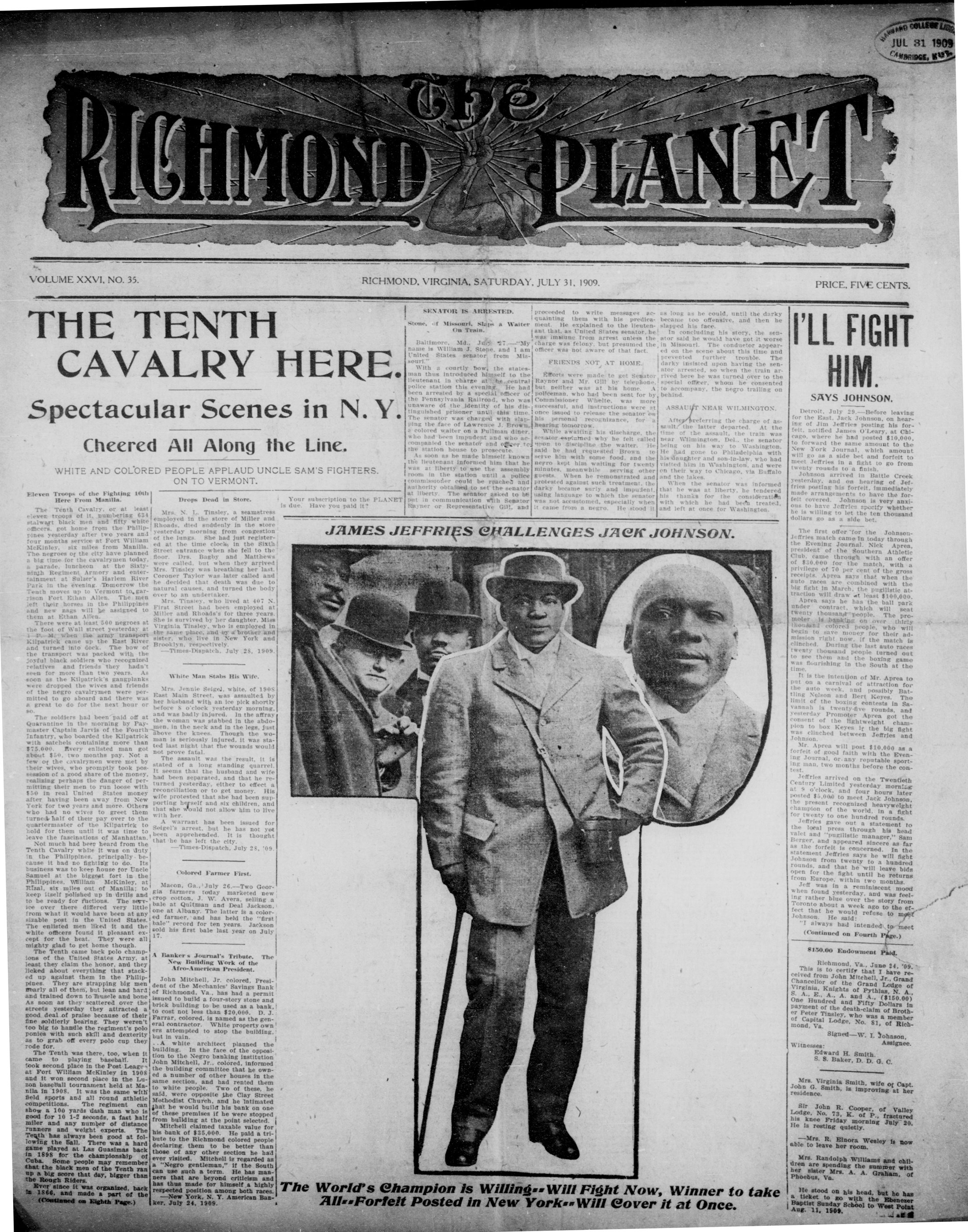
THE TENTH CAVALRY HERE. Spectacular Scenes in N. Y. Cheered All Along the Line.
WHITE AND COLORED PEOPLE APPLAUD UNCLE SAM'S FIGHTERS. ON TO VERMONT.
VOLUME XXVI, NO. 35.
THE T
CAVA
Spectacu
Cheeree
WHITE AND COLORE
Eleven Troops of the Fighting 10th
Here From Manilla.
The Tenth Cavalry, or at least eleven troops of it, numbering 634 stalwart black men and fifty white officers, got home from the Philippines yesterday after two years and four months service at Fort William McKinley, six miles from Manilla. The negroes or the city have planned a big time for the cavalrymen today, a parade, luncheon at the Sixthnight Regiment Armory and entertainment at Sulzer's Harlem River Park in the evening. Tomorrow the Tenth moves up to Vermont to garrison Fort Ethan Allen. The men left their horses in the Philippines and new nags will be assigned to them at Ethan Allen. There were at least 500 negroes at the foot of Wall street yesterday at I.P.M. when the army transport Kilpatrick came up the East River and turned into dock. The bow of the transport was packed with the joyful black soldiers who recognized relatives and friends they hadn't seen for more than two years. As soon as the Kilpatrick's gangplanks were dropped the wives and friends of the negro cavalrymen were permitted to go aboard and there was a great to do for the next hour or so.
The soldiers had been paid off at Quarantine in the morning by Paymaster Captain Jarvis of the Fourth Infantry, who boarded the Kilpatrick with satchels containing more than $75,000. Every enlisted man got about $50, two months pay. Not a few or the cavalrymen were met by their wives, who promptly took possession of a good share of the money, realizing perhaps the danger of permitting their men to run loose with $50 in real United States money after having been away from New York for two years and more. Others who had no wives to greet them turned half of their pay over to the quartermaster of the Kilpatrick to hold for them until it was time to leave the fascinations of Manhattan. Not much had beer heard from the Tenth Cavalry while it was on duty in the Philippines, principally because it had no fighting to do. Its business was to keep house for Uncle Samuel at the biggest fort in the Philippines, William McKinley, at Rizal, six miles out of Manilla; to keep itself polished up in drills and to be ready for fouctions. The service over there differed very little from what it would have been at any sizable post in the United States. The enlisted men liked it and the white officers found it pleasant except for the heat. They were all mighty slad to get home though.
The Tenth came back polo champions of the United States Army, at least they claim the honor, and they licked about everything that stacked up against them in the Philippines. They are strapping big men nearly all of them, but lean and hard and trained down to muscle and bone. As soon as they scattered over the streets yesterday they attracted a good deal of praise because of their fine soldierly bearing. They weren't too big to handle the regiment's polo ponies with such skill and dexterity as to grab off every polo cup they rode for.
The Tenth was there, too, when it came to playing baseball. It took second place in the Post League at Fort William McKinley in 1908 and it won second place in the Luzon baseball tournament held at Manila in 1908. It was the same with field sports and all round athletic competitions. The regiment can show a 100 yards dash man who is good for 10 1-2 seconds, a fast half miller and any number of distance runners and weight experts. The Tenth has always been good at following the fall. There was a hard game played at Las Guasmas back in 1898 for the championship of Cuba. Some people may remember that the black men of the Tenth ran up a big score that day, bigger than the Rough Riders.
Ever since it was organized, back in 1866, and made a part of the (Continued on Eighth Page.)
Drops Dead in Store.
Mrs. N. L. Tinsley, a seamstress employed in the store of Miller and Rhoads, died suddenly in the store yesterday morning from congestion of the lungs. She had just registered at the time clock, in the Sixth Street entrance when she fell to the floor. Drs. Bagby and Matthews were called, but when they arrived Mrs. Tinsley was breathing her last. Coroner Taylor was later called and he decided that death was due to natural causes, and turned the body over to an undertaker.
Mrs. Tinsley, who lived at 407 N. First Street had been employed at Miller and Rhoads's for three years. She is survived by her daughter, Miss Virginia Tinsley, who is employed in the same place, and by a brother and sister, who live in New York and Brooklyn, respectively.
—Times-Dispatch July 28, 1909.
White Man Stabs His Wife.
Mrs. Jennie Seigel, white, of 1908 East Main Street, was assaulted by her husband with an ice pick shortly before 8 o'clock yesterday morning, and was badly injured. In the affray the woman was stabbed in the abdomen, in the neck and in the legs, just above the knees. Though the woman is seriously injured, it was stated last night that the wounds would not prove fatal.
The assault was the result, it is stated of a long standing quarrel. It seems that the husband and wife had been separated, and that he returned yesterday, either to effect a reconciliation or to get money. His wife protested that she had been supporting herself and six children, and that she would not allow him to live with her.
A warrant has been issued for Seigel's arrest, but he has not yet been apprehended. It is thought that he has left the city.
—Times-Dispatch, July 28, '09.
Colored Farmer First.
Macon, Ga., July 26.—Two Georgia farmers today marketed new crop cotton, J. W. Avera, selling a bale at Quitman and Deal Jackson, one at Albany. The latter is a colored farmer, and has held the "first bale" record for ten years. Jackson sold his first bale last year on July 17.
A Banker's Journal's Tribute. The New Building Work of the Afro-American President.
John Mitchell, Jr. colored, President of the Mechanics' Savings Bank of Richmond, Va., has had a permit issued to build a four-story stone and brick building to be used as a bank, to cost not less than $20,000. D. J. Farrar, colored, is named as the general contractor. White property owners attempted to stop the building, but in vain.
.A white architect planned the building. In the face of the opposition to the Negro banking institution John Mitchell, Jr., colored, informed the building committee that he owned a number of other houses in the same section, and had rented them to white people. Two of these, he said, were opposite the Clay Street Methodist Church, and he intimated that he would build his bank on one of these premises if he were stopped from building at the point selected.
Mitchell claimed taxable value for his bank of $35,000. He pald a tribute to the Richmond colored people declaring them to be better than those of any other section he had ever visited. Mitchell is regarded as a "Negro gentleman," if the South can use such a term. He has manners that are beyond criticism and has thus made for himself a highly respected position among both races.
—New York, N. Y. American Banker, July 24, 1909.
RICHMOND, VIRGINIA, SATURDAY, JULY 31, 1909.
THE MASTER OF THE MUSIC
The World's Champion is Willing Will Fight Now, Winner to take All-Forfeit Posted in New York Will Cover it at Once.
Your subscription to the PLANET is due. Have you paid it?
SENATOR IS ARRESTED.
Stone, of Missouri, Slips a Walter On Train.
Baltimore, Md., Jun. 27.—"My name is William J. Stone, and I am United States senator from Missouri."
With a courtly bow, the statesman thus introduced himself to the lieutenant in charge at the central police station this evening. He had been arrested by a special officer of the Pennsylvania Railroad, who was unaware of the identity of his distinguished prisoner until this time. The senator was charged with slapping the face of Lawrence J. Brown, a colored waiter on a Pullman diner, who had been impudent and who accompanied the senator and officer to the station house to prosecute. As soon as he made himself known the lieutenant informed him that he was at liberty to use the assembly room in the station until a police commissioner could be reached and authority obtained to set the senator at liberty. The senator asked to be put in communication with Senator Rayner or Representative Gill, and
proceeded to write messages acquainting them with his predicament. He explained to the lieutenant that, as United States senator, he was immune from arrest unless the charge was felony, but presumed the officer was not aware of that fact.
FRIENDS NOT AT HOME.
Efforts were made to get Senator Raynor and Mr. Gill by telephone, but neither was at his home. A policeman, who had been sent for by Commissioner Whelte, was more successful, and instructions were at once issued to release the senator on his personal recognition, for a hearing tomorrow.
While awaiting his discharge, the senator explained why he felt called upon to discipline the waiter. He said he had requested Brown to serve him with some food, and the negro kept him waiting for twenty minutes, meanwhile serving other guests. When he demonstrated and protested against such treatment, the darky became surly and impudent, using language to which the senator was not accustomed, especially when it came from a negro. He stood it
as long as he could, until the darky became too offensive, and then he slapped his face.
In concluding his story, the senator said he would have got it worse in Missouri. The conductor appeared on the scene about this time and prevented further trouble. The darky insisted upon having the senator arrested, so when the train arrived here he was turned over to the special officer, whom he consented to accompany, the negro trailing on behind.
ASSAULT NEAR WILMINGTON.
After preferring the charge of assault, the latter departed. At the time of the assault, the train was near Wilmington. Del., the senator being on his way to Washington. He had gone to Philadelphia with his daughter and son-in-law, who had visited him in Washington, and were on their way to Chicago, via Buffalo and the lakes.
When the senator was informed that he was at liberty, he tendered his thanks for the consideration with which he had been treated, and left at once for Washington.
PRICE, FIVE CENTS.
I'LL FIGHT HIM.
SAYS JOHNSON.
Detroit, July 29.—Before leaving for the East, Jack Johnson, on hearing of Jim Jeffries posting his forfeit, notified James O'Leary, at Chicago, where he had posted $10,000, to forward the same amount to the New York Journal, which amount will go as a side bet and forfeit to meet Jeffries in a fight to go from twenty rounds to a finish.
Johnson arrived in Battle Creek yesterday, and on hearing of Jeffries posting his forfeit, immediately made arrangements to have the forfeit covered. Johnson is very anxious to have Jeffries specify whether he is willing to let the ten thousand dollars go as a side bet.
The first offer for the Johnson-Jeffries match came in today through the Evening Journal. Nick Aprea, president of the Southern Athletic Club, came through with an offer of $30,000 for the match, with a privilege of 70 per cent of the gross receipts. Aprea says that when the auto races are combined with the big fight in March, the pugilistic attraction will draw at least $100,000.
Aprea says he has the ball park under contract, which will seat twenty thousand people. The promoter is banking on over thirty thousand colored people, who will begin to save money for their admission right now, if the match is clinched. During the last auto race twenty thousand people turned out to see them and the boxing game was flourishing in the South at the time.
It is the intention of Mr. Aprea to put on a carnival of attraction for the auto week, and possibly Battling Nelson and Bert Keyes. The limit of the boxing contests in Savannah is twenty-five rounds, and yesterday Promoter Aprea got the consent of the lightweight champion to box Keyes in the big fight was clinched between Jeffries and Johnson.
Mr. Aprea will post $10,000 as a forfeit of good faith with the Evening Journal, or any reputable sporting man, two months before the contest.
Jeffries arrived on the Twentieth Century Limited yesterday morning at 9 o'clock, and four hours later posted $5,000 to meet Jack Johnson, the present recognized heavyweight champion of the world, in a fight for twenty to one hundred rounds.
rounds. Jeffries gave out a statement to the local press through his head valet and "pugilistic manager." Sam Berger, and appeared sincere as far as the forfeit is concerned. In the statement Jeffries says he will fight Johnson from twenty to a hundred rounds, and that he will leave bids open for the fight until he returns from Europe, within two months. Jeff was in a reminiscent mood when found yesterday, and was feeling rather blue over the story from Toronto about a week ago to the effect that he would refuse to meet Johnson. He said:
$150.00 Endowment
Richmond, Va., June 24, '09.
This is to certify that I have received from John Mitchell, Jr., Grand Chancellor of the Grand Lodge of Virginia, Knights of Pythias, N. A., S. A., E. A., A. and A., ($150.00)
One Hundred and Fifty Dollars in payment of the death-claim of Brother Peter Tinsley, who was a member of Capital Lodge, No. 81, of Richmond, Va.
Signed—W. I. Johnson,
Assignee.
Witnesses:
Edward H. Smith.
S. S. Baker, D. D. G. C.
Mrs. Virginia Smith, wife of Capt. John G. Smith, is improving at her residence.
Sir John R. Cooper, of Valley Lodge, No. 73, K. of P., fractured his knee Friday morning July 20. He is resting quietly.
—Mrs. R. Elnora Wesley is now able to leave her room.
Mrs. Randolph Williams and children are spending the summer with her sister Mrs. A. A. Graham, of Phoebus, Va.
He stood on his head, but he has a ticket to go with the Ebenezer Baptist Sunday School to West Point Aug. 11, 1909.
SYNOPSIS.
CHAPTER I. - Murray Sinclair and his gang of wreckers were called out to clear the railroad tracks at Smoky Creek. CHAPTER II. - Sinclair superintendent, caught Sinclair and his men in the act of looting the wrecked train, had led innocence, declaring it only amused him. CHAPTER III. - Treat for the men. McCloud discharged the whole outfit and ordered the wrecked train. CHAPTER III. - McCloud became acquainted with Dicklea Dunning, a girl of the west, who came to look at the wreck. He sent him message for Sinclair. CHAPTER IV. - Dicklea Dunning smith told President Bucks of the railroad, of McCloud's brave fight against a gang of crazen miners and that was the reason for his message to his high office. McCloud arranged to board at the boarding house in Sinclair, the ex-farmer's deserted wife. CHAPTER V. - Dicklea Dunning was daughter of the late Richard Dunning, who was shortly after his wife's death, which occurred after one year of married life. CHAPTER VI. - Sinclair visited Marion and was a fight between him and McCloud was
CHAPTER VII.-Smoky Cheek bridge was mysteriously burned. McCloud prepares to face the situation. President Bucks notified Smith that he had work ahead.
CHAPTER VIII.-McCloud worked for days and finally got the division running in fairly good order. He overheard Dick in asking his methods, to Marion Linclair.
CHAPTER IX.-A stock train was wrecked by an open switch. Later a passenger car robbed. Two men of a pose purruring the bandits were killed. McCloud was notified that Whispering Smith was to be arrested.
CHAPTER XI.-Dancing a road man, proposed that Sinclair and his gang be sent to hunt the bandits. A stranger, apparently with authority, told the stranger that he would hold the stranger was "Whispering Smith."
CHAPTER XII.-XSmith approached Sinclair. He tried to buy him off, but failed. He warned McCloud that his life was in danger.
CHAPTER XII.-McCloud was carried forcibly into Lance Dunning's presence. Dunning refused the railroad a right-of-way, he had already signed for. Dick interfered to prevent a shooting affray.
CHAPTER XII- Dickie's met McCloud on a lonely trail to warn him his life was in danger. On his way home a shot brought him back. He had reported that Du Sang, one of Sinclair's gang, had been assigned to kill McCloud. He and Smith saw Du Sang. Whispering Smith reported that Smith was issuing Sinclair's taunted Du Sang and took a duet out of Medicine Bend or suffer. Du Sang seemed to succumb to the bluff. CHAPTER XVI- McCloud's big construction job was taken from him because he was too ill. Dunning by the United States court. A flood supplied further railroad operations. CHAPTER XVII- Reset by flood Dickie marched to visit her. Marlon proposed to take the food from McCloud. At first Dickie refused Then she agreed. CHAPTER XIII- Arriving at the camp they learned Smith had followed Dickie. They were sure of their safe journey. McCloud offered the aid of 16 men and equipment.
CHAPTER XIX.-Smith told Dickste the story of his railroad career.
CHAPTER XX.-Lance Dunning readily accepted the aid of McCloud's men who made much progress. Smith entertained Dickle. He accepted XXI.-McCloud succeeded in halting the flood. He accepted Dunning's hospitality.
CHAPTER XXII.
The Man on the Frenchman
Sinclair's place on the Frenchman backed up on a sharp rise against the foothills of the Bridger range, and the ranch buildings were strung along the creek. The ranchhouse stood on ground high enough to command the country for miles up and down the valley.
Only two roads lead from Medicine Bend and the south into the Frenchman country; one a wagon road following Smoky creek and running through Dale canyon; the other a pack road, known as the Gridley trail, crossing the Topah Topah hills and making a short cut from the Dunning ranch on the Crawling Stone to the Frenchman. The entire valley is, in fact, so difficult of access, save by the long and roundabout wagon road, that the sight of a complete outfit of buildings such as that put up by Sinclair always came as a surprise to the traveler, who, reaching the crest of the hills, looked suddenly down 1,000 feet on his well-ordered sheds and barns and corrals.
Over the Griddley trail from the Crawling Stone Marion and Dickiee Dunning rode early in the morning the day after McCloud and his men left the Stone ranch with their work done. The trail is a good three hours long, and they reached Sinclair's place at about ten o'clock. He was waiting for Marion—she had sent word she should come—and he came out of the front door into the sunshine with a smile of welcome when he saw Dickiee with her. Dickiee, long an admirer of Sinclair's, as women usually were, had recast somewhat violently her opinions of him. She faced him now with a criminal consciousness that she knew too much. The weight of the dreadful secret weighed on her, and her responsibility in the issue of the day ahead did not help to make her greeting an easy one. One thing only was fixed in her mind and reflected in the tension of her lips and her eyes: The resolve to keep at every cost the promise she had given. For Dickiee had fallen under the spell of a man even more compelling than Sinclair, and felt strangely bounden to what she had said.
Sinclair, however, had spirit enough to smooth quite away every embarrassment. "Bachelor's quarters," he explained roughly and pleasantly, as he led the two women toward the house. "Cowmen make poor housekeepers, but you must feel at home." And when Dickiex, looking at his Indian rugs on the floors, the walls, and the couches, said she thought he had little to apologize for. Sinclair looked gratified and took off his hat again. "Just a moment," he said, standing at the side of the door. "I've never been able to get Marion over here before, go it happens that a woman's foot has
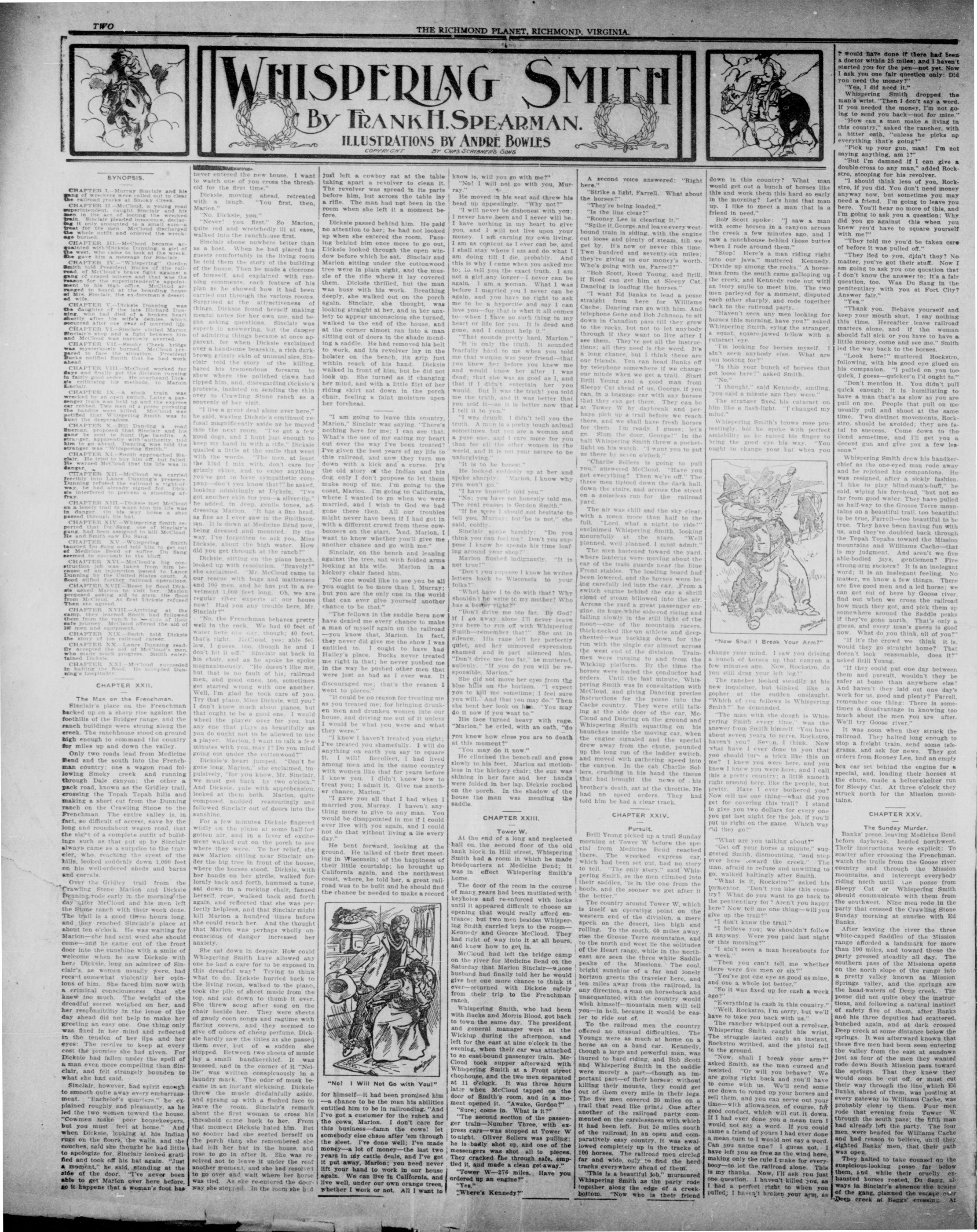
WHISPERING SMITH
By FRANK H. SPEARMAN.
ILLUSTRATIONS BY ANDRE BOWLES
COPYRIGHT BY CHRIS SCRIBMERS SONS
never entered the new house. I want to watch one of you cross the threshold for the first time."
Dicklesie, moving ahead, retreated with a laugh. "You first, then, Marion."
"No, Dicklesie, you."
"Never! you first." So Marion, quite red and wretchedly ill at ease, walked into the ranchhouse first.
Sinclair shone nowhere better than as a host. When he had placed his guests comfortably in the living room he told them the story of the building of the house. Then he made a clecrone of himself, and explained with running comments, each feature of his plan as he showed how it had been carried out through the various rooms. Surprised at the attractiveness of things, Dicksis found herself making mental notes for her own use, and began asking questions. Sinclair was superb in answering, but the danger of admiring things became at once apparent, for when Dicksis exclaimed over a handsome beckarskin, a rich dark-brown grizzly skin of unusual size, Sinclair told the story of the killing, bared his tremendous forearm to show where the polished claws had ripped him, and, disregarding Dicksis's protests, insisted on sending the skin over to Crawling Stone ranch as a souvenir of her visit.
"I live a great deal alone over here," he said, waving Dickisie's continued refusal magnificently aside as he moved into the next room. "I've got a few good dogs, and I hunt just enough to keep my hand in with a ride." Dickisie qualified a little at the smile that went with the words. "The men, at least the kind I mix with, don't care for grizzly skins, and to enjoy anything you've got to have sympathetic company—don't you know that?" he asked, looking admiringly at Dickisie. "I've got another skin for you—a silver-tip," he added, in deep, gentle tones, addressing Marion. "It has a fine head, as fine as I ever saw in the Smithsonian. It is down at Medicine Bend now, being dressed and mounted. By the way, I've forgotten to ask you. Miss Dickisie, about the high water. How did you get through at the ranch?"
Dickie, sitting on the piano bench, looked up with resolution. "Bravely!" she exclaimed. "Mr. McCloud came to our rescue with bags and inattresses and 100 men, and he has put in a retreatment 1,000 feet long. Oh, we are regular river experts at our house now! Had you any trouble here, Mr. Sinclair?"
"No, the Frenchman behaves pretty well in the rock. We had 40 feet of water here one day, though; 40 feet, that's right. McCloud, yes; able fellow, I guess, though he and I don't hit it off." Sinclair sat back in his chair, and as he spoke he spoke magnanimously. "He doesn't like me, but that is no fault of his; railroad men, and good ones, too, sometimes get started wrong with one another. Well, I'm glad he took care of you. Try that plano, Miss Dickle, will you? I don't know much about planes, but that ought to be a good one. I would wheel the player over for you, but any one that plays as beautifully as you do ought not to be allowed to use a player. Marion, I want to talk a few minutes with you, may I? Do you mind going out under the cottonwood?"
Dickie's heart jumped. "Don't be gone long. Marion," she exclaimed, impulsively, "for you know, Mr. Sinclair, we must get back by two o'clock." And Dickie, pale with apprehension, looked at them both. Marion, quite composed, nodded reassuringly and followed Sinclair out of doors into the sunshine.
For a few minutes Dickie's fingered wildly on the piano at some half forgotten air, and in a fever of excitement walked out on the porch to see where they were. To her relief, she saw Marion sitting near Sinclair under the big tree in front of the house, where the horses stood. Dickie, with her hands on her girdle, walked forlornly back and forth, hummed a tune, sat down in a rocking chair, fanned herself, rose, walked back and forth again, and reflected that she was perfectly helpless, and that Sinclair might kill Marion a hundred times before she could reach her. And the thought that Marion was perhaps wholly unconscious of danger increased her anxiety.
She sat down in despair. How could Whispering Smith have allowed any one he had a care for to be exposed in this dreadful way? Trying to think what to do. Dickie hurried back to the living room, walked to the plano, took the pile of sheet music from the top, and sat down to thumb it over. She threw song after song on the chair beside her. They were sheets of gaudy coon songs and rastime with flaring covers, and they seemed to give off odors of cheap perfume. Dickie hardly saw the titles as she passed them over, but of a sudden she stopped. Between two sheets of music lay a small handkerchief. It was mussed, and in the corner of it "Nellie" was written conspicuously in a laundry mark. The odor of musk became in an instant sickening. Dickie threw the music disdainfully aside, and sprang up with a flushed face to leave the room. Sinchair's remark about the first woman to cross his threshold came back to her. From that moment Dickie hated him. But no sooner had she seated herself on the porch than she remembered she had left her hat in the house and rose to go in after it. She was resolved not to leave under the roof another moment, and she had resolved to go over and wait where her horse was tied. As she re-entered the doorway she step bad. In the room she had
THE RICHMOND PLANET, RICHMOND, VIRGINIA
just left a cowboy sat at the table taking apart a revolver to clean it. The revolver was spread in its parts before him, but across the table lay a rifle. The man had not been in the room when she left it a moment before.
Dickies passed behind him. He paid no attention to her; he had not looked up when she entered the room. Passing behind him once more to go out, Dickies looked through the open window before which he sat. Sinclair and Marion sitting under the cottonwood tree were in plain sight, and the muzzle of the rifle where it lay covered them. Dickies thrilled, but the man was busy with his work. Breathing deeply, she walked out on the porch again. Sinclair, she thought, was looking straight at her, and in her anxiety to appear unconscious she turned, walked to the end of the house, and at the corner almost ran into a man sitting out of doors in the shade mending a saddle. He had removed his belt to work, and his revolver lay in the holster on the bench, its grip just within reach of his hand. Dickies walked in front of him, but he did not look up. She turned as if changing her mind, and with a little flirt of her riding skirt sat down in the porch chair, feeling a faint moisture upon her forehead.
"I am going to leave this country, Marion." Sinclair was saying. "There's nothing here for me; I can see that. What's the use of my eating my heart out over the way I've been treated? I've given the best years of my life to this railroad, and now they turn me down with a kick and a curse. It's the old story of the Indian and his dog, only I don't propose to let them make soup of me. I'm going to the coast, Marion. I'm going to California, where I wanted to go when we were married, and I wish to God we had gone there then. All our troubles might never have been if I had got in with a different crowd from these cowboozers on the start. And, Marion, I want to know whether you'll give me another chance and go with me." Sinclair, on the bench and leaning against the tree, sat with folded arms looking at his wife. Marion in a hickory chair faced him.
"No one would like to see you be all you ought to be more than I. Murray; but you are the only one in the world that can ever give yourself another chance to be that."
"The fellows in the saddle here now have denied me every chance to make a man of myself again on the railroad—you know that, Marion. In fact, they never did give me the show I was entitled to. I ought to have had Halley's place. Bucks never treated me right in that; he never pushed me in the way he pushed other men that were just as bad as I ever was. It discouraged me; that's the reason I went to pieces."
"It could be no reason for treating me as you treated me; for bringing drunken men and drunken women into our house, and driving me out of it unless I would be what you were and what they were."
"I know I haven't treated you right; I've treated you shamefully. I will do anything on earth you say to square it. I will! Recollect, I had lived among men and in the same country with women like that for years before I knew you. I didn't know how to treat you; I admit it. Give me another chance, Marion."
"I gave you all that I had when I married you, Murray. I haven't anything more to give to any man. You would be disappointed in me if I could ever live with you again, and I could not do that without living a lie every day."
He bent forward, looking at the ground. He talked of their first meeting in Wisconsin; of the happiness of their little courtship; he brought up California again, and the northwest coast, where he told her, a great railroad was to be built and he should find the chance he needed to make a record
Henry James
"No! I Will Not Go with You!" for himself—it had been promised him—a chance to be the man his abilities entitled him to be in railroading. "And I've got a customer for the ranch and the cows, Marion. I don't care for this business—damn the cows! let somebody else chase after 'em through the sleet. I've done well; I've made money—a lot of money—the last two years in my cattle deals, and I've got it put away, Marion; you need never lift your hand to work in our house again. We can live in California, and live well, under our own orange trees, whether I work or not. All I want to
know is, will you go with me?"
"No! I will not go with you, Murray."
He moved in his seat and threw his head up appealingly. "Why not?"
"I will never be dishonest with you; I never have been and I never will be. I have nothing in my heart to give you, and I will not live upon your money. I am earning my own living. I am as content as I ever can be, and I shall stay where I am and do what I am doing till I die, probably. And this is why I came when you asked me to; to tell you the exact truth. I am not a girl any longer—I never can be again. I am a woman. What I was before I married you I never can be again, and you have no right to ask me to be a hypocrite and say I can love you—for that is what it all comes to—when I have no such thing in my heart or life for you. It is dead and gone, and I cannot help it."
"That sounds pretty hard, Marion." "It is only the truth. It sounded fearfully hard to me when you told me that woman was your friend—that you knew her before you knew me and would know her after I was dead; that she was as good as I, and that if I didn't entertain her you would. But it was the truth! you told me the truth, and it was better that you told it—as it is better now that I tell it to you."
"I was drunk. I didn't tell you the truth. A man is a pretty tough animal sometimes, but you are a woman and a pure one, and I care more for you than for all the other women in the world, and it is not your nature to be unforgiving."
"It is to be honest."
He looked suddenly up at her and spoke sharply: "Marion, I know why you won't go."
"I have honestly told you."
"No; you have not honestly told me. The real reason is Gordon Smith."
"I the Pearl, is Golden Smith.
"If he were I should not hesitate to tell you. Murray: but he is not," she said, coldly.
Sinclair spoke harshly: "Do you think you can fool me? Don't you suppose I know he spends his time loafing around your shop?"
Marion flushed indignantly. "It is not true!"
"Don't you suppose I know he writes letters back to Wisconsin to your folks?"
"What have I to do with that? Why shouldn't he write to my mother? Who has a better right?"
"Don't drive me too far. By God! If I go away alone I'll never leave you here to run off with Whispering Smith—remember that!" She sat in silence. His rage left her perfectly quiet, and her unmoved expression shamed and in part silenced him. "Don't drive me too far," he muttered, sullenly. "If you do you will be responsible, Marion."
She did not move her eyes from the blue hills on the horizon. "I expect you to kill me sometime; I feel sure you will. And that you may do." Then she bent her look on him. "You may do it now if you want to."
His face turned heavy with rage. "Marion," he cried, with an oath, "do you know how close you can to death
you know how close you are to death
at this moment?
"You'll be it now."
He clinched the bench-rail and rose slowly to his feet. Marion sat motionless in the hickory chair; the sun was shining in her face and her hands were folded in her lap. Dickie rocked on the porch. In the shadow of the house the man was mending the saddle.
CHAPTER XXIII
Tower W.
At the end of a long and neglected hall on the second floor of the old bank block in Hill street, Whispering Smith had a room in which he made headquarters at Medicine Bend; it was in effect Whispering Smith's home.
The door of the room in the course of many years had been mutilated with keyholes and re-enforced with locks until it appeared difficult to choose an opening that would really afford entrance; but two men besides Whispering Smith carried keys to the room—Kennedy and George McCloud. They had right of way into it at all hours, and knew how to get in.
McCloud had left the bridge camp on the river for Medicine Bend on the Saturday that Marion Sinclair—a wife husband had finally told her he would give her one more chance to think it over—returned with Dickie safely from their trip to the Frenchman ranch.
Whispering Smith, who had been with Bucks and Morris Blood, got back to town the same day. The president and general manager were at the Wicklup during the afternoon, and left for the east at nine o'clock in the evening, when their car was attached to an east-bound passenger train. McCloud took supper afterward with Whispering Smith at a Front street chophouse, and the two men separated at 11 o'clock. It was three hours later when McCloud tapped on the door of Smith's room, and in a moment opened it. "Awake, Gordon?" "Sure; come in. What is it?" "The second section of the passenger train—Number Three, with express cars—was stopped at Tower W to night. Oliver Sollers was pulling; he is badly shot up, and one of the messengers was shot all to pieces. They cracked the through safe, emptied it, and made a clean get-away."
"Tower W—276 miles. Have you ordered up an engine?" "Yes." "Where's Kennedy?"
A second voice answered: "Right here."
"Strike a light, Farrell. What about the horses?"
"They're being loaded."
"Is the line clear?"
"Rooney Lee is clearing it."
"Spike it, George, and leave every west-bound train in sliding, with the engine cut loose and plenty of steam, till we get by. It's now or never this time. Two hundred and seventy-six miles; they're giving us our money's worth. Who's going with us, Farrell?"
"Bob Scott, Reed Young, and Brill. If Reed can get him at Sleepy Cat, Dancing is loading the horses."
"I want Ed Banks to lead a posse straight from here for Williams Cache; Dancing can go with him. And telephone Gene and Bob Johnson to sit down in Canadian pass till they grow to the rocks, but not to let anybody through if they want to live after I see them. They've got all the instructions; all they need is the word. It's a long chance, but I think these are our friends. You can head Banks off by telephone somewhere if we change our minds when we get a trail. Start Brill Young and a good man from Sleepy Cat ahead of us. George, if you can, in a baggage car with any horses that they can get there. They can be at Tower W by daybreak and perhaps pick up a trail before we reach there, and we shall have fresh horses for them. I'm ready, I guess; let's go. The door, George!" In the hall Whispering Smith threw a pocket-light on his watch. "I want you to put us there by seven o'clock."
"Charlie Sollers is going to pull you," answered McCloud. "Have you got everything? Then we're off." The three men tiptod down the dark hall, down the stairs, and across the street on a noiseless run for the railroad yard. The air was chill and the sky clear, with a moon more than half to the full. "Lord, what a night to ride!" exclaimed Whispering Smith, looking mountfully at the stars. "Well planned, well planned. I must admit."
The men hastened toward the yard, where lanterns were moving about the car of the train guards near the Blue Front stables. The loading board had been lowered, and the horses were being carefully led into the car. From a switch engine behind the car a shrill cloud of steam billowed into the air. Across the yard a great passenger engine, its huge white side-rod rising and falling slowly in the still light of the moon—one of the mountain racers, thick-necked like an athlete and deep-chested—was backing down for the run with the single car almost across the west end of the division. Trainmen were running to and from the Wicklup platform. By the time the horses were loaded the conductor had orders. Until the last minute, Whispering Smith was in consultation with McCloud, and giving Dancing precise instructions for the posse into the Cache country. They were still talking at the side door of the car, McCloud and Dancing on the ground and Whispering Smith squatting on his haunches inside the moving car, when the engine signaled and the special drew away from the chute, pounded up the long run of the ladder switch, and moved with gathering speed into the canyon. In the cab Charlie Sollers, crushing in his hand the tissue that had brought the news of his brother's death, sat at the throttle. He had no speed orders. They had told him he had a clear track.
CHAPTER XXIV.
Pursuit.
Brill Young picked up a trail Sunday morning at Tower W before the special from Medicine Bend reached there. The wrecked express car, which had been set out, had no story to tell. "The only story," said Whispering Smith, as the men climbed into their saddles, "is in the one from the hoofs, and the sooner we get after it the better."
The country around Tower W, which is itself an operating point on the western end of the division, a mere speck on the desert, lies high and rolling. To the south, 60 miles away, rise the Grosse Terre mountains, and to the north and west lie the solitudes of the Heart range, while in the northeast are seen the three white Saddle peaks of the Missions. The cool, bright sunshine of a far and lonely horizon greets the traveler here, and ten miles away from the railroad, in any direction, a man on horseback and unacquainted with the country would wish himself—mountain men will tell you—in hell, because it would be easier to ride out of.
To the railroad men the country offered no unusual difficulties. The Youngs were as much at home on a horse as on a hand car. Kennedy, though a large and powerful man, was injured to hard riding, and Bob Scott and Whispering Smith in the saddle were merely a part—though an important part—of their horses; without killing their mounts, they could get out of them every mile in their legs. The five men covered 20 miles on a trail that read like prints. One after another of the railroad party commented on the carelessness with which it had been left. But 20 miles south of the railroad, in an open and comparatively easy country, it was swallowed completely up in the tracks of 100 horses. The railroad men circled far and wide, only to find the herd tracks everywhere ahead of them.
"This is a beautiful job" murmured Whispering Smith as the party rode together along the edge of a creek bottom. "Now who is their friend
A
down in this country? What man would get out a bunch of horses like this and work them this hard so early in the morning? Let's hunt that man up. I like to meet a man that is a friend in need."
Bolt Scott spoke: "I saw a man with some horses in a canyon across the creek a few minutes ago, and I saw a ranchhouse behind those buttes when I rode around them."
"Stop! Here's a man riding right into our jaws." muttered Kennedy. "Divide up among the rocks." A horseman from the south came galloping up the creek, and Kennedy rode out with an ivory smile to meet him. The two men parleyed for a moment, disputed each other sharply, and rode together back to the railroad party.
"Haven't seen any men looking for horses this morning, have you?" asked Whispering Smith, eying the stranger, a squat, square-jawed fellow with a cataract eye.
"I'm looking for horses myself. I ain't seen anybody else. What are you looking for?"
"Is this your bunch of horses that got loose here?" asked Smith.
"No."
"I thought," said Kennedy, smiling, "you said a minute ago they were."
The stranger fixed his cataract on him like a flash-light. "I changed my mind."
Whispering Smith's brows rose protestingly, but he spoke with perfect amiability as he raised his finger to bring the good eye his way. "You ought to change your hat when you
FRANCIS BURKE
"Now Shall I Break Your Arm?" change your mind. I saw you driving a bunch of horses up that canyon a few minutes ago. Now, Rockstro, do you still drag your left leg?" The rancher looked steadily at his new inquisitor, but blinked like a gopher at the sudden onslaught. "Which of you fellows is Whispering Smith?" he demanded.
"The man with the dough is Whispering Smith every time." was the answer from Smith himself. "You have about seven years to serve. Rockstro, haven't you? Seven. I think. Now what have I ever done to you that you should hurry a trick like this on me? I knew you were here, and you knew I knew you were here, and I call this a pretty country; a little smooth right around here, like the people, but pretty. Have I ever bothered you? Now call me one thing—what did you get for covering this trail? I stand to give you two dollars for every one you got last night for the job, if you'll put us right on the game. Which way did they go?
"What are you talking about?"
"Get off your horse a minute," suggested Smith, dismounting, "and step over here toward the creek." The man, afraid to refuse and unwilling to go, walked haltingly after Smith.
"What is it, Rockstro?" asked his porteror. "Don't you like this country? What do you want to go back to the penitentiary for? Aren't you happy here? Now tell me one thing—will you give up the trail?" "I don't know the trail."
"I believe you; we shouldn't follow it anyway. Were you paid last night or this morning?"
"I can't seen a man hereabouts for a week."
"Then you can't tell me whether there were five men or six?"
"You've got one eye as good as mine, and one a whole lot better."
"So it was fixed up for cash a week ago?"
"Everything is cash in this country."
"Well, Rockstro, I'm sorry, but well have to take you back with us."
The rancher whipped out a revolver. Whispering Smith caught his wrist. The struggle lasted only an instant. Rockstro writhed, and the pistol fell to the ground.
"Now, shall I break your arm?" asked Smith, as the man cursed and resisted. "Or will you behave? We are going right back and you'll have to come with us. We'll send some one down to round up your horses and sell them, and you can serve out your time—with allowances, of course, for good conduct, which will cut it down. If I had ever done you a mean turn I would not say a word. If you could name a friend of yours I had ever done a mean turn to I would not say a word. Can you name one? I guess not. I have left you as free as the wind here, making only the rule I make for every boy—to let the railroad alone. This is my thanks. Now, I'll ask you just one question. I haven't killed you, as I had a perfect right to when you pulled; I haven't broken your arm, as
I would have done if there had been a doctor within 25 miles; and I haven't started you for the pen—not yet. Now I ask you one fair question only: Did you need the money?"
"Yes, I did need it."
Whispering Smith dropped the man's wrist. "Then I don't say a word. If you needed the money, I'm not going to send you back—not for mine."
"How can a man make a living in this country," asked the rancher, with a bitter oath, "unless he pleks up everything that's going?"
"Pick up your gun, man! I'm not saying anything, am 1?"
"But I'm damned if I can give a double-cross to any man," added Rockstro, stooping for his revolver.
"I should think less of you, Rockstro, if you did. You don't need money anyway now, but sometime you may need a friend. I'm going to leave you here. You'll hear no more of this, and I'm going to ask you a question: Why did you go against this when you knew you'd have to square yourself with me."
"They told me you'd be taken care of before it was pulled off."
"They lied to you, djn't they? No matter, you've got their stuff. Now I am going to ask you one question that I don't know the answer to; it's a fair question, too. Was Du Sang in the penitentiary with you at Fort City? Answer fair."
"Yes."
"Thank you. Behave yourself and keep your mouth shut. I say nothing this time. Hereafter leave railroad matters alone, and if the woman should fall sick or you have to have a little money, come and see me." Smith led the way back to the horses.
"Look here!" muttered Rockstro, following, with his good eye glued on his companion. "I pulled on you too quick, I guess—quicker'n I ought to." "Don't mention it. You didn't pull quick enough; it is humiliating to have a man that's as slow as you are pull on me. People that pull on me usually pull and shoot at the same time. Two distinct movements, Rockstro, should be avoided; they are fatal to success. Come down to the Bend sometime, and I'll get you a decent gun and give you a few lessons."
Whispering Smith drew his handkerchief as the one-eyed man rode away and he rejoined his companions. He was resigned, after a sleek fashion. "I like to play bilind-man's-buff," he said, wiping his forehead, "but not so far from good water. They have pulled us half-way to the Grosse Terre mountains on a beautiful trail, too beautiful to be true, Farrell—too beautiful to be true. They have been having fun with us, and they've doubled back through the Topah Topah toward the Mission mountains and Williams Cache—that is my judgment. And aren't we five able-bodied jays, gentlemen? Five strong-arm suckers? It is an inelegante word; it is an inelegante feeling. No matter, we know a few things. There are five good men and a led horse; we can get out of here by Goose river. find out when we cross the railroad how much they got, and pick them up somewhere around the Saddle peaks if they've gone north. That's only a guess, and every man's guess is good now. What do you think, all of you?"
"If it's the crowd we think it is, would they go straight home? That doesn't look reasonable, does it?" asked Brill Young.
"If they could put one day between them and pursuit, wouldn't they be safer at home than anywhere else? And haven't they laid out one day's work for us, good and plenty? Farrell, remember one thing: There is sometimes a disadvantage in knowing too much about the men you are after. We'll try Goose river."
It was noon when they struck the railroad. They halted long enough to stop a freight train, send some telegrams, and ask for news. They got orders from Rooney Lee, had an empty box car set behind the engine for a special, and, loading their horses at the chute, made a helterskelter run for Sleepy Cat. At three o'clock they struck north for the Mission mountains.
CHAPTER XXV
Banks' posse, leaving Medicine Bend before daybreak, headed northwest. Their instructions were explicit: To scatter after crossing the Frenchman, watch the trails from the Goose river country and through the Mission mountains, and intercept everybody riding north until the posse from Sleepy Cat or Whispering Smith should communicate with them from the southwest. Nine men rode in the party that crossed the Crawling Stone Sunday morning at sunrise with Ed Banks.
After leaving the river the three white-capped Saddles of the Mission range afforded a landmark for more than 100 miles, and toward these the party pressed steadily all day. The southern pass of the Missions opens on the north slope of the range into a pretty valley known as Mission Springs valley, and the springs are the head-waters of Deep creek. The posse did not quite obey the instructions, and following a natural instinct of safety five of them, after Banks and his three deputies had scattered, bunched again, and at dark crossed Deep creek at some distance below the springs. It was afterward known that these five men had been entering the valley from the east at sundown just as four of the men they wanted rode down South Mission pass toward the springs. That they knew they would soon be cut off, or must cut their way through the line, which Ed Banks, ahead of them, was posting at every gateway to Williams Cache, was probably clear to them. Four men rode that evening from Tower W through the south pass; the fifth man had already left the party. The four men were headed for Williams Cache and had reason to believe, until they sighted Banks' men, that their path was open.
They halted to take counsel on the suspicious-looking posse far below them, and while their cruelly exhausted horses rested, Du Dang, always in Sinclair's absence the brains of the gang, planned the escape over Deep creek at Baggs' crossing. At
THE PLANET
dusk they divided; two men lurking in the brush along the creek rode as close as they could, unobserved, toward the crossing, while Du Sang and the cowboy Karg, known as Flat Nose, rode down to Baggs' ranch at the foot of the pass.
At that point Dan Baggs, an old locomotive engineer, had taken a homestead, got together a little bunch of cattle, and was living alone with his son, a boy of ten years. It was a hard country and too close to Williams Cache for comfort, but Dan got on with everybody because the toughest man in the Cache country could get a meal, a feed for his horse, and a place to sleep at Baggs', without charge, when he needed it.
Ed Banks, by hard riding, got to the crossing at five o'clock, and told Baggs of the hold-up and the shooting of Oliver Sollers. The news stirred the old engineer, and his excitement threw him off his guard. Banks rode straight on for the middle pass, leaving word that two of his men would be along within half an hour to watch the pass and the ranch crossing, and asked Baggs to put up some kind of a fight for the crossing until more of the posse came up—at the least, to make sure that nobody got any fresh horses.
The boy was cooking supper in the kitchen, and Baggs had done his milking and gone back to the corral, when two men rode around the corner of the barn and asked if they could get something to eat. Poor Baggs sold his life in six words: "Why, yes; be you Banks' men?"
Du Sang answered: "No; we're from Sheriff Coon's office at Oroville, looking up a bunch of Duck Bar steers that's been run somewhere up Deep creek. Can we stay here all night?" They "dismounted and disarmed Bags" suspicions, though the condition of their horses might have warned him had he had his senses. The unfortunate man had probably fixed it in his mind that a ride from Tower W to Deep creek in 16 hours was a physical impossibility.
"Stay here? Sure! I want you to stay," said Bags, bluffy. "Looks to me like I seen you down at Crawling Stone, ain't I?" he asked of Karg.
Karg was lighting a cigarette "I used to mark at the Dunning ranch" he answered; throwing away his match.
"That's hit. Good! The boy's cooking supper. Step up to the kitchen and tell him to cut ham for four more." "Four?"
"Two of Ed Banks' men will be here by sx o'clock. Heard about the hold-up? They stopped Number Three at Tower W last night and shot Ollie Sollers, as white a boy as ever pulled a throttle. Boys, a man that'll kill a locomotive engineer is worse an Indian, I'd help skin him."
"The hell you would!" cried Du Sang. "Well, don't you want to start in on me? I killed Sollers. Look at me; ain't I handsome? What you going to do about it?"
Before Baggs could think Du Sang was shooting him down. It was wanton. Du Sang stood in no need of the butchery; the escape could have been made without it. His victim had pulled an engine throttle too long to show the white feather, but he was dying by the time he had dragged a revolver from his pocket. Du Sang did the killing alone. At least, Flat Nose, who alone saw all of the murder, afterward maintained that he did not draw because he had no occasion to, and that Baggs was dead before he. Karg
had finished his cigarette. With his right arm broken and two bullets through his chest, Baggs fell on his face. That, however, did not check his murderer. Rising to his knees, Baggs begged for his life. "For God's sake! I'm helpless, gentlemen. I'm helpless. Don't kill me like a dog!" But Du Sung, emptying his pistol, threw his rifle to his shoulder and sent bullet after bullet crashing through the shapeless form writhing and twitching before him until he had beaten it in the dust soft and flat and stil.
Banks' men came up within an hour to find the ranchhouse deserted. They saw a lantern in the yard below, and near the corral gate they found the little boy in the darkness, screening beside his father's body. The sheriff's men carried the old engineer to the house; others of the posse crossed the creek during the evening, and at 11 o'clock Whispering Smith rode down from the south pass to find that four of the men they were after had taken fresh horses, after killing Baggs, and passed safely through the cordon Banks had drawn around the pass and along Deep creek. Bill Dancing, who had ridden with Banks' men, was at the house when Whispering Smith arrived. He found some supper in the kitchen, and the tired man and the giant ate together.
Whispering Smith was too experienced a campainer to complain. His party had struck a trail 50 miles north of Sleepy Cat and followed it to the Missions. He knew now who he was after, and knew that they were bottled up in the Cache for the night. The sheriff's men were sleeping on the floor of the living room when Smith came in from the kitchen. He sat down before the fire. At intervals sobs came from the bedroom where the body lay, and after listening a moment, Whispering Smith got stiffly up, and, tippecing to still the fingle of his spurs, took the candle from the table, pushed aside the curtain, and entered the bedroom.
The little boy was lying on his face, with his arm around his father's neck, talking to him. Whispering Smith bent a moment over the bed, and, setting
J. M. B.
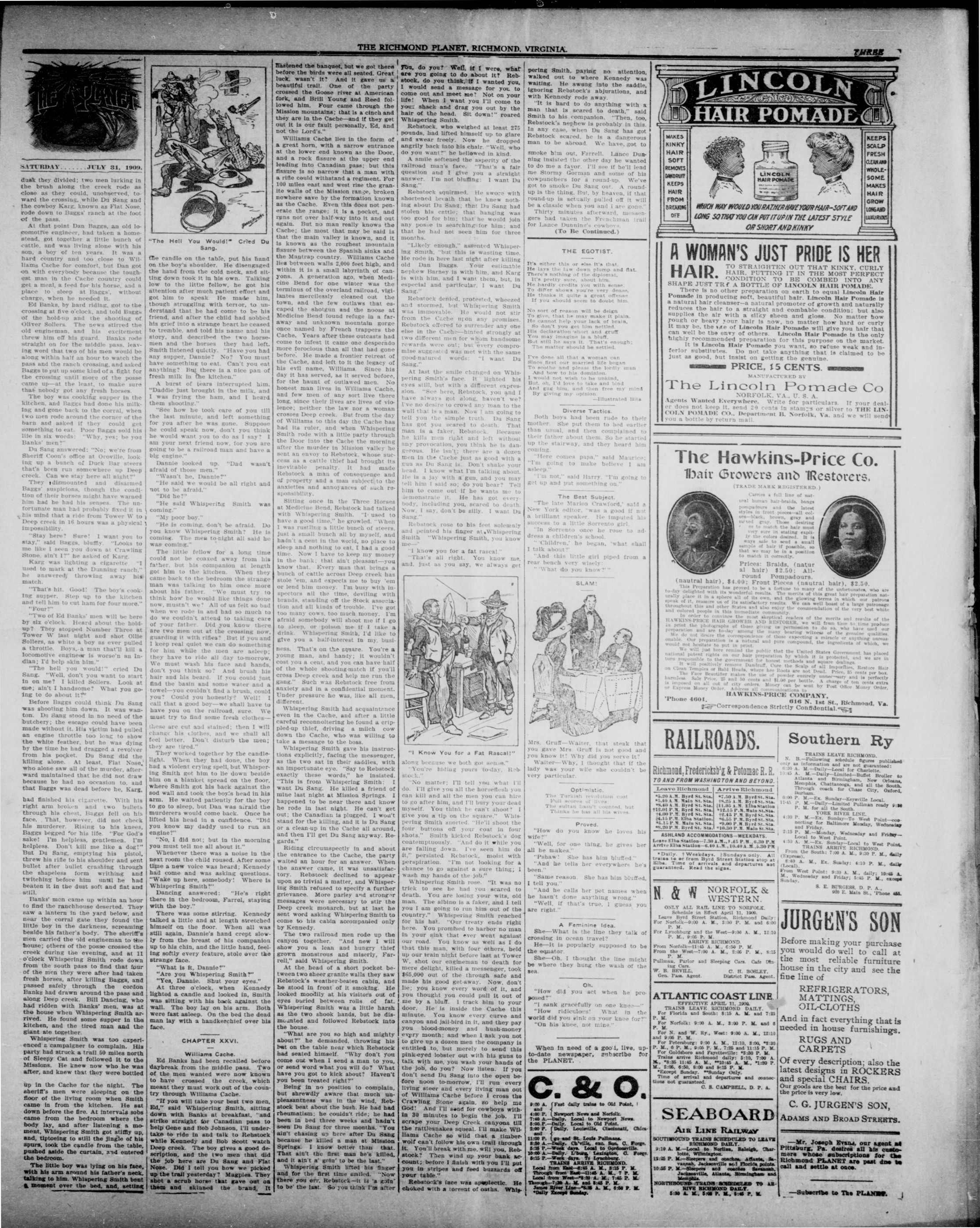
"The Hell You Would!" Cried Du Sang.
The candle on the table, put his hand on the boy's shoulder. He disengaged the hand from the cold neck, and sitting down took it in his own. Talking low to the little fellow, he got his attention after much patient effort and got him to speak. He made him, though struggling with terror, to understand that he had come to be his friend, and after the child had sobbed his grief into a strange heart he ceased to tremble, and told his name and his story, and described the two horsemen and the horses they had left. Smith listened quietly. "Have you had any supper, Dannie? No? You must have something to eat. Can't you eat anything? But there is a nice pan of fresh milk in the kitchen."
A burst of tears interrupted him. "Daddle just brought in the milk, and I was frying the ham, and I heard them shooting."
"See how he took care of you till the last minute, and left something for you after he was gone. Suppose he could speak now, don't you think he would want you to do as I say? I am your next friend now, for you are going to be a railroad man and have a big engine." Dainie looked up. "Dad wasn't afraid of those men."
"Wasn't he, Dannie?"
"He said we would be all right and not to be afraid."
"Did he?"
"He said Whispering Smith was coming."
"My poor boy."
"He is coming, don't be afraid. Do you know Whispering Smith? He is coming. The men to-night all said he was coming."
The little fellow for a long time could not be coaxed away from his father, but his companion at length got him to the kitchen. When they came back to the bedroom the strange man was talking to him once more about his father. "We must try to think how he would like things done now, mustn't we? All of us felt so bad when we rode in and had so much to do we couldn't attend to taking care of your father. Did you know there are two men out at the crossing now, guarding it with rides? But if you and I keep real quiet we can do something for him while the men are asleep; they have to ride all day to-morrow. We must wash his face and hands, don't you think so? And brush his hair and his beard. If you could just find the basin and some water and a towel—you couldn't find a brush, could you? Could you honestly? Well! I call that a good boy—we shall have to have you on the railroad, sure. We must try to find some fresh clothes—these are cut and stained; then I will change his clothes, and we shall all feel better. Don't disturb the men; they are tired."
They worked together by the candlelight. When they had done, the boy had a violent crying spell, but Whispering Smith got him to lie down beside him on a blanket spread on the floor, where Smith got his back against the sod wall and took the boy's head in his arm. He waited patiently for the boy to go to sleep, but Dan was airraid the murderers would come back. Once he lifted his head in a confidence. "Did you know my daddy used to run an engine?" "No, I did not; but in the morning you must tell me all about it." Whenever there was a noise in the next room the child roused. After some time a new voice was heard; Kennedy had come and was asking questions. "Wake up here, somebody! Where is Whispering Smith?" Dancing answered: "He's right there in the bedroom, Farrel, staying with the boy."
There was some stirring. Kennedy talked a little and at length stretched himself on the floor. When all was still again, Dannie's hand crept slowly from the breast of his companion up to his chin, and the little hand, feeling softly every feature, stole over the strange face.
"What is it, Dannie?"
"Are you Whispering Smith?"
"Yes, Dannie. Shut your eyes."
At three o'clock, when Kennedy lighted a candle and looked in, Smith was sitting with his back against the wall. The boy lay on his arm. Both were fast asleep. On the bed the dead man lay with a handkerchief over his face.
CHAPTER XXVI.
Williams Cache.
Ed Banks had been recalled before daybreak from the middle pass. Two of the men wanted were now known to have crossed the creek, which meant they must work out of the country through Williams Cache.
"If you will take your best two men, Ed," said Whispering Smith, sitting down with Banks at breakfast, "and strike straight for Canadian pass to help Gene and Bob Johnson, I'll undertake to ride in and talk to Rebstock while Kennedy and Bob Scott watch Deep creek. The boy gives a good description, and the two men that did the job here are Du Sang and Flat Nose. Did I tell you how we picked up the trail yesterday?" Maggies. They shot a scrub horse that gave out on them and skinned the brand, It
THE RICHMOND PLANET. RICHMOND. VIRGINIA
Eastened the banquet, but we got there before the birds were all seated. Great luck, wasn't it? And it gave us a beautiful trail. One of the party crossed the Goose river at American fork, and Brill Young and Reed followed him. Four came through the Mission mountains; that is a cinch and they are in the Cache—and if they get out it is our fault personally, Ed, and not the Lord."
Williams Cache lies in the form of a great horn, with a narrow entrance at the lower end known as the Door, and a rock fissure at the upper end leading into Canadian pass; but this fissure is so narrow that a man with a rifle could withstand a regiment. For 100 miles east and west rise the granite walls of the Mission range, broken nowhere save by the formation known as the Cache. Even this does not penetrate the range; it is a pocket, and runs not over halfway into it and out again. But no man really knows the Cache; the most that may be said is that the main valley is known, and it is known as the roughest mountain fissure between the Spanish sinks and the Mantrap country. Williams Cache lies between walls 2,000 feet high, and within it is a small labyrinth of canyons. A generation ago, when Medicine Bend for one winter was the terminus of the overland railroad, vigilantes mercilessly cleaned out the town, and the few outlaws that escaped the shotgun and the noose at Medicine Bend found refuge in a faraway and unknown mountain gorge once named by French trappers the Cache. Years after these outcasts had come to infest it came one desperate more ferocious than all that had gone before. He made a frontier retreat of the Cache, and left to it the legacy of his evil name, Williams. Since his day it has served, as it served before, for the haunt of outlawed men. No honest man lives in Williams Cache, and few men of any sort live there long, since their lives are lives of violence; neither the law nor a woman crosses Deep creek. But from the day of Williams to this day the Cache has had its ruler, and when Whispering Smith rode with a little party through the Door into the Cache the morning after the murder in Mission valley he sent an envoy to Rebstock, whose success as a cattle thief had brought its inevitable penalty. It had made Rebstock a man of consequence and of property and a man subject to the anxieties and annoyances of such responsibility.
Sitting once in the Three Horses at Medicine Bend, Rebstock had talked with Whispering Smith. "I used to have a good time," he growled. "When I was rustling a little bunch of steers, just a small bunch all by myself, and hadn't a cent in the world, no place to sleep and nothing to eat, I had a good time. Now I have to keep my money in the bank; that ain't pleasant—you know that. Every man that brings a bunch of cattle across Deep creek has stole 'em, and expects me to buy 'em or lend him money. I'm busy with inspectors all the time, devilling with brands, standing off the Stock association and all kinds of trouble. I've got too many cows, too much money. I'm afraid somebody will shoot me if I go to sleep, or poison me if I take a drink. Whispering Smith, I'd like to give you a half-interest in my busi-
ness. That's on the square. You're a young man, and handy; it wouldn't cost you a cent, and you can have half of the whole shooting-match if you'll cross Deep creek and help me run the gang." Such was Rebstock free from anxiety and in a confidential moment. Under pressure he was, like all men, different.
Whispering Smith had acquaintence even in the Cache, and after a little careful reconnollering he found a crippled-up thief, driving a milch cow down the Cache, who was willing to take a message to the boss.
Whispering Smith gave his instructions explicitly, facing the messenger, as the two sat in their saddles, with an importunate eye. "Say to Rebstock exactly these words," he insisted. "This is from Whispering Smith: I want Du Sang. He killed a friend of mine last night at Mission Springs. I happened to be near there and know he rode in last night. He can't get out; the Canadian is plugged. I won't stand for the killing, and it is Du Sang or a clean-up in the Cache all around, and then I'll get Du Sang anyway. Regards."
Riding circumspectly in and about the entrance to the Cache, the party waited an hour for an answer. When the answer came, it was unsatisfactory. Rebstock declined to appear upon so trivial a matter, and Whispering Smith refused to specify a further grievance. More parley and strong messages were necessary to stir the Deep creek monarch, but at last he sent word asking Whispering Smith to come to his cabin accompanied only by Kennedy.
The two railroad men rode up the canyon together. "And now I will show you a lean and hungry thief grown monstrous and miserly, Farrell" said Whispering Smith.
At the head of a short pocket between two sheer granite walls they saw Rebstock's weather-beaten cabin, and he stood in front of it smoking. He looked moodily at his visitors out of eyes buried between rolls of fat. Whispering Smith was a little harsh as the two shook hands, but he dismounted and followed Rebstock into the house.
"What are you so high and mighty about?" he demanded, throwing his bat on the table near which Rebstock had seated himself. "Why don't you come out when I send a man to you, or send word what you will do? What have you got to kick about? Haven't you been treated right?"
Being in no position to complain, but shrewdly aware that much unpleasantness was in the wind. Rebstock beat about the bush. He had had rheumatism; he couldn't ride; he had been in bed three weeks and hadn't seen Du Sang for three months. "You ain't chasing up here after Du Sang because he killed a man at Mission Springs. I know better than that. That ain't the first man he's killed, and it ain't a 'goin' to be the last." Whispering Smith lifted his finger and for the first time smiled. "Now there you env. Rebstock—it is a 'goin' to be the last. So you think I'm after
You, do you? Well, if I were, what are you going to do about it? Rebstock, do you think, if I wanted you, I would send a message for you to come out and meet me? Not on your life! When I want you I'll come to your shack and drag you out by the hair of the head. Sit down!" roared Whispering Smith. Rebstock, who weighed at least 275 pounds, had lifted himself up to glare and swear freely. Now he dropped angrily back into his chair. "Well, who do you want?" he bellowed in kind. A smile softened the asperity of the railroad man's face. "That's a fair question and I give you a straight answer. I'm not bluffing; I want Du Sang."
Rebstock squirmed. He swore with shortened breath that he knew nothing about Du Sang; that Du Sang had stolen his cattle; that hanging was too good for him; that he would join any posse in searching for him; and that he had not seen him for three months.
"Likely enough," assented Whispering Smith, "but this is wasting time. He rode in here last night after killing old Dan Baggs. Your estimable nephew Barney is with him, and Karg is with him, and I want them, but, in especial and particular, I want Du Sang."
Rebstock denied, protested, wheezed and stormed, but Whispering Smith was immovable. He would not stir from the Cache upon any promises. Rebstock offered to surrender any one else in the Cache—hinted strongly at two different men for whom handsome rewards were out; but every compromise suggested was met with the same good-natured words: "I want Du Sang."
At last the smile changed on Whispering Smith's face. It lighted his eyes still, but with a different expression. "See here, Rebstock, you and I have always got along, haven't we? I've no desire to crowd any man to the wall that is a man. Now I am going to tell you the simple truth. Du Sang has got you scared to death. That man is a faker, Rebstock. Because he kills men right and left without any provocation, you think he is dangerous. He isn't; there are a dozen men in the Cache just as good with a gun as Du Sang is. Don't shake your head. I know what I'm talking about. He is a jay with a gun, and you may tell him I said so; do you hear? Tell him to come out if he wants me to demonstrate it. He has got everybody, including you, scared to death. Now, I say, don't be silly. I want Du Sang."
Rebstock rose to his feet solemnly and pointed his finger ata Whispering Smith "Whispering Smith, you know me—" "I know you for a fat rascal." "That's all right. You know me and, just as you say, we always get
M. B.
"I Know You for a Fat Rascal!" along because we both got sense.
"You're hiding yours to-day, Rebstock."
"No matter; I'll tell you what I do. I'll give you all the horseflesh you can kill and all the men you can hire to go after him, and I bury your dead myself. You think he can't shoot? I give you a tip on the square." Whispering Smith snorted. "He'll shoot the four buttons off your coat in four shots." Smith kicked Rebstock's dog contemptuously. "And do it while you are falling down. I've seen him do it," persisted Rebstock, moist with perspiration. "I'm not looking for a chance to go against a sure thing; I wash my hands of the job."
Whispering Smith rose. "It was no trick to see he had you scared to death. You are losing your wits, old man. The albino is a faker, and I tell you I am going to run him out of the country." Whispering Smith reached for his hat. "Our treaty ends right here. You promised to harbor no man in your sink that ever went against our road. You know as well as I do that this man, with four others, held up our train night before last at Tower W, shot our engineman to death for mere delight, killed a messenger, took $65,000 out of the through safe and made his good get-away. Now, don't lie; you know every word of it, and you thought you could pull it out of me by a bluff. I track him to your door. He is inside the Cache this minute. You know every curve and canyon and jail-bird in it, and they pay you blood-money and hush-money every month; and when I ask you not to give up a dozen men the company is entitled to, but merely to send this pink-eyed lobster out with his guns to talk with me, you wash your hands of the job, do you? Now listen. If you don't send Du Sang into the open before noon to-morrow, I'll run every living steer and every living man out of Williams Cache before I cross the Crawling Stone again, so help me God! And I'll send for cowboys within 30 minutes to begin the job. I'll scrape your Deep Creek canyons till the rattlesnakes squeal. I will make Williams Cache so wild that a timber-wolf can't follow his own trail through it. You'll break with me, will you, Rebstock? Then wind up your bank account; before I finish with you I'll put you in stripes and feed buzzards off your table."
Rebstock's face was appolicite. He
choked with a torrent of oaths. Wha-
poring Smith, paying no attention, walked out to where Kennedy was waiting. He swung into the saddle, ignoring Rebstock's abjurations, and with Kennedy rode away.
"It is hard to do anything with a man that is scared to death," said Smith to his companion. "Then, too, Rebstock's nephew is probably in this. In any case, when Du Sang has got Rebstock scared, he is a dangerous man to be abroad. We have got to smoke him out, Forrell. Lance Dunning insisted the other day he wanted to do me a favor. I'll see if he'll lend me Stormy Gorman and some of his cowpunchers for a round-up. We've got to smoke Du Sang out. A round-up is the thing. But, by heaven, if that round-up is actually pulled off it will be a classie when you and I are gone."
Thirty minutes afterward, messengers had taken the Frenchman trail for Lance Dunning's cowboys.
THE EGOTIST
It's either this or else it's that.
He lays the law down plump and flat.
There's nothing of the diplomat.
It's pretty sure, about him.
He lays it down with sense.
To differ shows you very dense.
He thinks it quite a great offense
If you should seem to doubt him.
No sort of reason will be deign
To give that reason made it plain.
He cannot help your lack of brain,
So don't you get him nettled.
His declaration short and gruff
You may imagine is a bluff.
But still he says it. That's enough;
The matter should be settled.
I've done all that a woman can
Since first our married life began
To soothe and please the lordly man
And how to his dominion.
If we want to be unkind,
But, oh, I'd love to ask and bind
And gag him, and then free my mind
By giving my opinion.
Diverse Tactics
Both boys had been rude to their mother. She put them to bed earlier than usual, and then complained to their father about them. So he started up the stairway, and they heard him coming.
"Here comes papa," said Maurice; "I'm going to make believe I am asleep."
"I'm not," said Harry. "I'm going to get up and put something on."
The Best Subject
"The late Marion Crawford," said a New York editor, "was a good if not a brilliant speaker. He impaired his success to a little Sorrento girl. "In Sorrento once he rose to address a children's school.
"Children," he began, "what shall I talk about?"
"And this little girl piped from a rear bench very wisely:
"What do you know?"
SLAM!
Mrs. Gruff—Walter, that steak that you gave Mrs. Gruff is not good and you know it! Why did you serve it?
Walter—Why, I thought that if the lady was your wife she couldn't be very particular.
Optimistic.
The Turkish revolution cost
Full scores of lives.
The sultan hasn't counted, but
Thinks he has all his wives.
Proved.
"How do you know he loves his wife?"
"Well, for one thing, he gives her all he makes."
"Pshaw! She has him bluffed."
"And he tells her everywhere he's been."
"Same reason. She has him bluffed, I tell you."
"And he calls her pet names when he hasn't done anything wrong."
"Well, if that's true, I guess you are right."
A. Feminine Idea
She—What is the line they talk of crossing in ocean travel?
He—It is popularly supposed to be the equator.
She—Oh. I thought the line might be where they hung the wash of the sea.
"How did you act when he proposed?"
"I sank gracefully on one knee—"
"How ridiculous! What in the world did you sink on your knee for?"
"On his knee, not mine."
When in need of a good i, live, up-to-date newspaper, subscribe for the PLANET.
C. & O.
9:00 A. (Fast daily trains to Old Point, and A.
4:00 P. (Newport News and Norfolk.
7:40 A.-Daily. Local to Newport News.
5:00 P.-Daily. Local to Old Foat.
2:00 P. (Daily. Louisville, Glacascini, Chica and
11:00 P. (go and St. Louis Palimna.
8:50 A.-Daily. Chville, exo. Sun. G. Forge.
5:15 P.-Week days. Local to Gordonville.
10:00 A.-Daily. L'burn. Lexington. G. Forge.
5:15 P.-Week days. To Lynchburg.
TRAINS ARRIVE RICHMOND.
Local from East—8:45 A. M. 8:15 P. M.
Through from East—11:45 A. M. 7 P. M.
Through from East—14:45 A. M. 7:45 P. M.
Through from East—17:45 A. M. 7:45 P.
Train from 7:45 A. M. 8:45 P. M.
James River Line—8:38 A. M. 6:50 P. M.
*Daily Excursion Sunday.
LINCOLN
HAIR POMADE
MAKES
KINKY
HAIR
SOFT
REMOVES
DANDRUFF
KEEPS
HAIR
FROM
BREAKING
OFF
LINCOLN
HAIR POMADE
KEEPS
SCALP
FRESH
CLEAN AND
WHOLE-
SOME
MAKES
HAIR
GROW
LONG AND
LUXURIOUS
WHICH WAY WOULD YOU RATHER HAVE YOUR HAIR-SOFT AND
LONG SO THAT YOU CAN PUT IT UP IN THE LATEST STYLE
OR SHORT AND KINKY
A WOMAN'S JUST PRIDE IS HER
MANUFACTURED BY
lincoln Pom
NORFOLK, VA., U.S.A.
Agents Wanted Everywhere. Write for particulars. If your dealer does not keep it, send 20 stamps or silver to THE LIN-COLN POMADE CO. Department B. Norfolk, Va. and we will send you a bottle by return mail.
Agents Wanted Everywhere. Writer does not keep it. send 20 cents COLN POMADE CO.. Department you a bottle by return mail.
The Hawkii
Hair Growers
The Hawkins-Price Co. Hair Growers and Restorers.
(TRADE MARK REGISTERED.)
Carries a full line of natural human hair-braids, bangs pompoudres and the most stylish styles in front peplumed cuticles—black, brown, gray and naved gray. Those desired es to match the hair must very sure in stating explicitly all hair desired. It is easy to hide in a full sample of hair if possible, so that we may be in a position to match it correctly.
Prices: Braids, (natur al hair) $2.50; All-round Pompoudres.
(nautical hair), $4.00; Front B
This Preparation has been proved to be a
to-day delighted with its wonderful results.
unally place it in a sphere all of its own,
and use of its satisfactory resi-
throughout this and other areas and
colored people in this immediate com-
In order to convince the most akcept-
HAWKINS-PRICE HAIR GROWER AND RE-
in print the photographs of those giving
preparation to the man among the ma-
We do not desire the corroboration of
onable. Our preparation is a natural and
would not hesitate to put in print.
We will just here remind the public to
national right on our hair preparation
turn responsibility.
It will positively remove Dandruff.
On Clean Temples or Rald Heads, where here
The Face Beautifier makes the use of
hairless. Sale Price, 25 and 50 cents and it
is important on all out of city order. Money
or Express Money Order.
HAWKINS-PRICE
(naural hair), $4.00; Front Pieces (naural hair), $2.50.
This Preparation has proved to be a fortune to many of the unfortunate, who are to-day treated HAIR of wonderful results. The merits of this great hair preparation naturally place it in a spacious room, be glowing terms in which our patrons speak of it, reassure us of its satisfactory results. We can well boast of a large patronage throughout this and other States and also enjoy the commendation of the very best white and colored people in this immediate community.
We will convince the most skeptical readers of the merits and results of the HAWKINS-PRICE HAIR and RESTORER. we will from time to time produce in the photographs of those given by us who have used our preparation and are to-day among the many bearing witness of the merits of our preparation and are to-day among the many bearing witness of the merits of our preparation is a natural and pure compound, the ingredients of which, we would not hesitate to send to the United States Government has placed national patent rights on our hair preparation by which it is protected, and we are in turn responsible to the government for honest methods and square dealings.
We will positively remove Dandruff, Care the Scalp of all Impurities, Restore Hair on Clean Hairs where bee Roots are not Dead. Price, 25 cents per box. The Face Beautifier restores the genuinely unnear- sary and is perfectly harmless. Sale Price, 25 and 50 cents and $1.00 per box. A charge of ten cents extra is imposed on all out of city orders. Money can be sent by Post Office Money Order, or Express Money Order. Address all communications to:
HAWKINS-PRICE COMPANY,
616 N. 1st St., Richmond, Va.
*Phone 4601.*
*Correspondence Confidential.*
RAILROADS.
Richmond, Fredericksb'g & Potomac R. R.
TO AND FROM WASHINGTON AND BEYOND.
Leave Richmond
*5.20 A.M. Main St. Sta.
*5.40 A.M. Main St. Sta.
*8.40 A.M. Main St. Sta.
*8.40 A.M. Main St. Sta.
*7.00 P.M. Main St. Sta.
*7.00 P.M. Main St. Sta.
*4.00 P.M. Main St. Sta.
*4.15 P.M. Elba Station.
*6.15 P.M. Main St. Sta.
*6.15 P.M. Main St. Sta.
*8.20 P.M. Main St. Sta.
ASHLAND ACCOMMODATIONS - WEEKDAYS.
Leave Elba Station - 7.00 P.M. - 1.45 P.M. - 6.30 P.M.
Arrive Elba Station - 6.40 P.M. - 10.40 P.M. - 6.30 P.M.
*Daily. *Weekdays.§ Sundays only. All
trains. Time of arrival and departures not
guaranteed. Read the signs.
N & W NORFOLK & WESTERN.
ONLY ALL RAIL LINE TO NORFOLK.
Schedule in Effect April 11, 1900.
Leave Byrd Street Station, Richmond Daily.
For Norfolk—9:00 A. M., 3:00 P. M. and 6:00
P. M.
For Lynnburg and the West—9:00 A. M., 12:10
P. M., 9:05 P. M.
ARRIVE RICHMOND.
From Norfolk—11:45 A. M., 6:50 P. M.
From the West—7:00 A. M., 2:06 P. M., 8:15
P. M.
Pullman, Parkor and Sleeping Cars. Cafe Dining Cars.
W. B. BEVILL.
Gen. Pass. Agent.
District Pass. Agent.
ATLANTIC COAST LINE
TRAINS LEAVE RICHMOND DAILY.
For Florida and South: 8:15 A. M. and 7:23
P. M.
For Norfolk: 9:00 A. M., 3:00 P. M. and 6
P. M.
For N. and W. Ry. West: 9:00 A.M. M, 12:10
and 12:30 P.M.
For Petersburg: 9:00 A.M. M, 12:10, 9:20
*P.M. M, 6 P.M. M, 9:00 P.M. M, 7:25 and 11:15 P.M.
For Goldbore and Fayetteville: *S:30 P.M.
Train and Richmond daily: 5:10, 7:00 A.M.
*S:8:15 and 8:30 P.M. *S:120 P.M.
*S:20, 6:50, 8:00 and 8:15 P.M.
*Except Sunday. **Sunday Only.
There are departures and concessions not guaranteed.
SEABOARD
SOUTHBOUND TRAINS SCHEDULED TO LEAVE
RICHMOND DAILY.
9:10 A. M.-L.-L.-or Florin, Raleigh,
Charlotte, Wilmington.
12:25 P. M.-Sleepers and coaches, Atlanta,
Savannah, Jacksonville ac-1 Florida points.
10:55 P. M.-Sleepers and coaches Savannah,
Jacksonville, Atlanta, Birmingham and
Memphis.
NORTHBOUND TRAINS SCHEDULED TO ARE
RIVE HIGHROUND DAILY.
5:30
MAKES
KINKY
HAIR
SOFT
REMOVES
DANDRUFF
KEEPS
HAIR
FROM
BREAKING
OFF
C.
'Phone 4601
N & W
ite for particulars. If your deal-
in stamps or silver to THE LIN-
B. Norfolk, Va. and we will send
deices (nautral hair), $2.50.
待 to many of the unfortunate, who are
the merits of this great hair preparation nat-
ural and the glowing terms in which our patrons
we can well boast of a large patronage
joy the commendation of the very best white
unity.
real leaders of the merits and results of the
PRODUCT we will from time to time produce
is permitted to do so, have and use our
bearing witness of the genuine qualities,
most expecting a miracle or anything unre-
sure compound, the ingredients of which, we
est the United States Government has placed
on by which it is protected, and we are in
which and square dealings.
The products are not Dead. Price, $2 cents per box,
foots are not Dead. Price, $2 cents per box,
powder entirely unnecessary and is perfectly
0.00 per bottle. A charge of ten cents extra
can be sent by Post Office Money Order,
inquiries to
ICE COMPANY,
616 N. 1st St., Richmond, Va.
directly Confidential.
Southern Ry
TRAINS LEAVE RICHMOND
E RICHMOND.
N. B.-Following fellowship, published only as information and are not guaranteed:
6:20 A. M.-Daily-Local for Charlotte.
10:45 A. M.-Daily-Limited-Broiler to Atlanta andingham, New Orleans, Memphis, Chattanooga and the South. Through coach for Chase City, Oxford, bourham.
8:00 A. M.-Ex. Sunday-Kayville City.
10:45 P. M.-Daily-Limited Pullman ready 9:00 P. M. for all the South.
YORK RIVER LINE.
4:30 P. M.-Sunday-To West Point-connecting for Baltimore Monday, Wednesday and Friday.
Friday
2:15 P. M. Monday, Wednesday and Friday
— Local to West Point
4:30 A. M. —Ex. Sunday—Local to West Point
TRAINS ARRIVE RICHMOND.
From the South: 7:00 A. M., 9:30 P. M., daily
(Express).
4:30 A. M., Ex. Sunday: 4:10 P. M., daily
(Local).
From West Point: 9:30 A. M., daily; 10:45 A.
M. Wednesday and Friday; 6:45 P. M. except
Sunday.
JURGEN'S SON
Before making your purchase you would do well to call at the most reliable furniture house in the city and see the fine line of REFRIGERATORS, MATTINGS, OIL-CLOTHS And in fact everything that is needed in house furnishings.
Of every description; also the latest designs in ROCKERS and special CHAIRS.
Our goods are the best for the price and the price is very low.
C. G. JURGEN'S SON,
ADAMS AND BROAD STREETS.
—Mr. Joseph Evans, our agent at Pittsburg, Pa. desires all his customers whose subscriptions for the Richmond PLANET are past due to call and settle at once.
—Subscribe to The PLANET.
THREE
KEEPS
SCALP
FRESH
CLEAN AND
WHOLE-
SOME
MAKES
HAIR
GROW
LONG AND
LUXURIOUS
MARY MAY
S. E. BURGESS, D. P. A.
920 E. Main ST., 'Phone 455
THE SYLNET
TERMS IN ADVANCE
One Copy, one year... $1.50
One Copy, eight months... $1.00
One Copy, six months... $0.80
One Copy, four months... $0.50
One Copy, three months... $0.40
Single Copy... $0.00
ADVERTISING RATES.
For one inch, one insertion... $0.50
For one inch each subsequent insertion... $0.40
For two inches, three months... $0.50
For two inches, six months... $0.40
For two inches, nine months... $0.30
For two inches, twelve months... $0.20
Marriage and Funeral Notices, one inch... $0.50
Standing and Transient Notices per line... $0.10
POSTAGE STAMPS OF A HIGHER DENOMINATION THAN TWO CENTS NOT RECEIVED ON SUBSCRIPTIONS.
THE PLANET is issued weekly. The subscription price is $1.50 per year in advance. There are four ways by which money can be sold by all the risk-in a Post Office Money Fider, by Bank Check or Draft, or an Express Money Order, and when none of these can be procured, in a Registered Letter.
MONEY ORDERS—You can buy a Money Order at your Post Office, payable at the Richmond Post Office and we will be responsible for its later arrival.
EXPRESS MONEY ORDERS can be obtained at any office of the American Express Co., the United States Express Co., and the Well's Fargo and Co's Express Company.
For money and not of these companies. The Express Money Order is a safe and convenient way for forwarding money.
REGISTERED LETTER—If a Money Order, Post Office or an Express Office is not waiting for the order you will still be in your own order. Then, if to send us on payment of taxes to the Post Office is lost or stolen, it can be traced. You can send money in this manner at our risk.
We cannot be responsible for money sent in later days when you may have one of the first four ways mentioned above. If you send your money in any other way, you must do it at your own risk.
RENEWALS, ETC.—If you do not want THE POST, you can be sent to another post if your your subscription has run out you then notify us by Postal Card to discontinue it. The courts have decided that subscribers to newspapers who do not order their paper discontinued at the expiration of time for which it has been paid are innumerable for the payment of the subscription up to date when they order the paper discontinued.
COMMUNICATIONS.—When writing to us to renew your subscription or to discontinue your paper you should give your name and address full otherwise we cannot find your name on our books.
CHANGE OF ADDRESS—In order to change the address of a mailerist, we must be sent the form.
THAT REPUBLICAN CONVENTION
There is a great change in the political conditions in this state. The Republican State Convention has been in session this week at Newport News, Va., and the reports state that there are but six colored men in evidence there as delegates. This does not mean that they are not in the party, but that the manipulations of the party managers as per orders from the White House at Washington and the chairman of the organization in this state have been carried out. It is an answer to the "color-line" cry of the democracy and it is intended to encompass the defeat of that organization by calling to the Republican colors, all of the Democratic "sore-heads" in this portion of the political universe.
Advantage is also to be taken of the disruption now imminent in the Democratic party, should either Judge Mann or Mr. Tucker succeed in capturing the nomination for the governorship. It is evident though that the Republican Party of the state is lacking in the right kind or material to hold office and the Democratic Party is as yet in possession of the best men. Those citizens who are approving or the Taft policies are not office-seekers and are not disposed to be office-holders. The situation is embarrassing and the indications are that parties are changing and that the name has little or no significance in the equation.
The Republican Party as now constituted in this state is about as much opposed to the colored man as a citizen and a voter as the Democratic Party and only the restraining hand at Washington prevents the leaders from so declaring themselves. This cannot be safely done for fear of the result in the doubtful states of the North and West. We have not felt disposed to take any particular interest in the convention at Newport News. The feeling there towards the colored man is unfriendly, if we are to judge by the pace set at the last one held at Lynchburg
No Democratic chairman ever permitted more unkind things to be said concerning the faithful colored men than did the presiding officer of that convention. We can bide our time though, for the opportunity for which we have long waited will soon be at hand. We shall be able to weigh and judge men and not look at them through the eye-glasses of their party affiliations. We shall read the platform carefully and it may not be out of place to state that it would be about as impossible to have a plank inserted therein in favor of a free ballot and a fair count for all men, regardless of race, color or previous condition of servitude or one pledging the party
to the principles of human rights as it would be for "a camel to go through the eye of a needle." Colored men need not lose hope though for right principles are eternal and wrong flourishes only for a little while.
SENATOR STONE'S PREDICAMENT
We have read with regret the account of the action of Senator William J. Stone, of Missouri, in striking a waiter on the Pullman dining car, because he did not serve him promptly and was chargeable with an indiscretion in the use of language towards a passenger, who seemed to be under the impression that a servant on a dining car was there to be abused and maltreated as much so as to render service.
Our first conclusion was that the distinguished Missourian had lingered too long at his wine, but then we were disposed to be charitable enough to presume that he did not indulge in intoxicants, but had frequently given away to displays of temper to those whom he employed. In the altercation, he got the better of the encounter from a stand-point of the rules of the prize ring, but we are of the opinion that he "lost out" when viewed from any angle of propriety.
The work of castigating servants was not assigned to any member of the aristocratic families of the South-land. It was the work of the slave-drivers and white men of the lowest type in this section of our country. A Virginia gentleman would not lower himself to the level of a menial by contending with him and for this reason he left the work to those white men, who were considered as being but slightly elevated above the level of the slave whom they castigated.
But here we have a United States Senator placing himself upon the same level with an impertinent dining car waiter as he chooses to designate him and later we see him riding in a calaboose upon a basis of equality with this same dining car waiter, who now appears as his accuser. Still later we note that he is in ordinary prisoners' dock, while the dining car waiter is viewing his predicament in the court-room of Police Magistrate Eugene Grannan, of the Central District of Baltimore, Maryland, with grim satisfaction. What more punishment was needed in this case? What more humiliation for a United States Senator could be devised than this?
If Lawrence G. Brown, the colored waiter was still vindictive, then he must have had a heart of stone. Still, Senator Stone should have been fined for the assault. The waiter had shown a coolness that was commendable, for the United States Senator William J. Stone had violated the law that he had been commissioned to uphold, here was an humble waiter, who had appealed to the law and who had done nothing to violate the law. Here was a case of education and refinement and legal ability against the humber traits of the colored citizen. It is true that the law officer refused protection in violation of his oat of office, but it all the more accentuated the differences existing in this country in the administration of justice. We are of the opinion that the Pullman car waiter had the better of the controversy. It was worth a thousand dollars to put a United States Senator in this predicament and we are of the opinion that the satisfaction given every colored servant in the United States will certainly equal this amount. Looking at it from another view-point, it was an effort on the part of a Negro-hater to show up the Negro-servant class as impudent and unworthy of employment by any first class corporation. For this reason, we regret that the affair was brought to public notice. We cannot afford to make these issues where they can be avoided. We are now at a critical period of our existence and only a pretense of insubordination on our part is needed, in order for it to be used to our detriment.
We hope that colored men everywhere will adopt the French style of politeness and carry their wounded feelings in their vest pocket, to be looked at but not to be used on public occasions. Be polite and obliging and while "cussing" a passenger on the inside of one's anatomy, show him a smiling countenance and throw at him diplomatic words on the outside. We are yet wondering what this Pullman dining car porter was doing when Senator Stone was pummelling him.
His humility under trying circumstances was surprising and his wisdom in getting out that warrant above all criticism. It would be well for Lawrence G. Brown to get a life-size portrait of Senator William J. Stone and suspend it in his parlor with this inscription underneath: "This is the portrait of United States Senator William J. Stone, who decended from his seat in the United States Senate, rode in a calaboose, and sat in the prisoner's dock as a felon for assaulting me. Peace to his ashes; rest for his soul."
THE RICHMOND PLANET. RICHMOND. VIRGINIA.
I'll Fight Him.
this colored man from the time I landed in the East. I always knew that I could get into proper condition for another fight, and it took only a month's time to tell me this. I feel stronger and bigger than ever and when I meet Johnson in the ring I will be in fit condition to put up a better battle than I have ever shown the public before.
"When I first arrived in the East starting my theatrical engagements I weighed 260 pounds, and since then I have reduced to 223. I am now going to Europe for a month's trip, and possibly a little longer, to visit my wife's folks and take a rest at the watering places. When I return I will go to Harbin Springs, in California, where I trained for my last fight with Monroe, and there I will tramp the mountains and hunt, getting my wind in proper shape for the battle. That is all I need. The superfousless flesh is not in evidence, and I will work only to get my wind in perfect condition.
"My five months' work on the road has worked wonders for me, and from the time I started I have led the simple life.
"The club offering the best inducement, as I have stated, will get the match. Johnson has been talking a lot through the press and declaring that he feared that I would never meet him in the ring. I have come through now, and it is up to him to cover my forfeit.
"I have posted $5,000, and when the match is made I will post $5,000 more, which Johnson must cover to make the $10,000 side bet. This bet must go or there will be no fight. He has been hounding me since he beat Tommy Burns in Australia, and there has never been any question in my mind that I could not get in condition for another contest. I waited my time, and it has arrived. He must fight now or show his true colors.
"If Johnson posts his forfeit it will be transferred to some reputable sporting man, preferably John T. Clark, of San Francisco, when the final articles are signed. My manager Sam Berger, will remain here to accept bids for the match, and when I return from Europe, possibly the first week in September, I will go to Harbin Springs to prepare for the contest."
Jeffries stripped for the benefit of the newspaper men who visited him at the Hotel Albany, and he looked to be in proper condition to work out for a hard contest. His muscles were hard and trained, and as he said, his strength is all there, too. Jeffries will do light work at a local gymnasium while in New York to keep the stiffness out of his system, and he will continue to do so on the trip abroad. Berger will accompany him to the Coast to train him for the contest when the final articles have been signed.
These are the conditions unde which Jeffries posted his money: New York City, July 28, 1909.
After decisively convincing myself that it is easily possible for me to defend my title as champion of the world, in as good a condition as ever before in my life, I am today posting my forfeit to meet the claimant of the title, Jack Johnson.
In reference to those who have been skeptical about my intention of meeting Johnson, I wish to say that when first called from retirement I said that I would never agree to oppose anybody in the prize ring until I was convinced that I could regain my former physical condition. After being absolutely satisfied of some, I stated I would post my forfeit at the expiration of my theatrical contract. My theatrical contract having expired, I am posting my money, sincerely hoping that Johnson is as anxious for the match as he has made it appear and that he will be as ready to live up to his public statements as I am.
CONDITIONS OF FORFEIT
First—James J. Jeffries hereby posts the sum of five thousand dollars $5,000) as an evidence of good faith and a forfeit to bind the following:
Second—He agrees to defend his title as champion of the world against Jack Johnson in a boxing contest.
Third—Contest to be held before the club offering the largest purse and best situated to promote the contest.
Fourth—Duration of bout to be anywhere from twenty to one hundred rounds.
Fifth—With the signing of final articles, Jeffries will post an additional five thousand dollars $5,000), which Johnson) must cover, and he must agree that the ten thousand dollars ($10,000) will operate as a side bet on the result of the contest.
Sixth—Final stakeholder,
after signing the articles, to be
some reputable sporting man,
preferably John T. Clarke, of
San Francisco.
Seventh—Sam Berger, manager
of James J. Jeffries, will remain
in America and receive
bids for the contest.
Signed:
JAMES J. JEFFRIES,
SAM BERGER, Manager
"JEFF" POSTS FORFEIT
Puts Up $5,000 to Bind Match With
Johnson.
New York, July 28.—Actual steps looking to a fight between James J. Jeffries and Jack Johnson for the heavyweight championship of the world were taken today, when Jeffries, on his arrival from the West, posted $5,000 as a forfeit to bind a match with the negro pugilist for a fight or anywhere from twenty to a hundred rounds. Jeffries insists that the fight shall be held before the club offering the largest purse, and that when the articles are signed an additional forfeit of $5,000
shall be posted. The whole sum of $20,000 is to go to the winner of the mill.
Jeffries will leave for a short European trip in a few days. He will visit the springs at Carisbad in Bohemia and will do a little preliminary training there. He plans to be ready to fight within five months.
"There is absolutely notting the matter with me in any way," he said after posting the forfeit, and to prove his assertion, he gave his chest a mighty thump that could have easily bowled over the ring of inquiring newspaper men. Jeffries said that he hoped the fight would be held in this country. He thought that a few days at Carisbad and a little trip on the continent would be beneficial.
JEFFRIES' STATEMENT
On posting his forfeit, Jeffries issued the following statement:
"After decisively convincing myself that it is easily possible for me to defend my title as champion of the world, in as good condition as ever before in my life, I am today posting my forfeit to meet the claimant of the title, Jack Johnson.
"In reference to those who have been skeptical about my intention of meeting Johnson, I wish to say that when first called from retirement I said that I would never agree to oppose anybody in the prize ring until I was convinced that I could gain my former physical condition. After being absolutely satisfied of the same, I stated I would post my forfeit at the expiration of my theatrical contract.
"My theatrical contract having expired, I am posting my money, sincerely hoping that Johnson is as anxious for the march as he has made it appear, and that he will be as ready to live up to his public statements as I am."
____
WHAT JOHNSON SAYS
Jackson, Mich., July 28. "I'll leave Chicago Monday night for New York and cover that forfeit," said Jack Johnson, the colored champion pugilist of the world, this evening when shown a dispatch to the effect that Jeffries had posted a forfeit in New York or $5,000 to fight Johnson and again place the honor of championship among the white race.
Johnson said he was not surprised to hear that Jeffries had posted the forfeit. "I expected he would do something of the kind," said Johnson. "as a sort of bluff and to make good his statement that he would fight me.
"I will be ready to fight almost any time. I think I am in condition now to clean up on Jeffries within fifteen rounds."
Johnson said he preferred to meet Jeffries in San Francisco. "That is the best place in the country," he said.
Johnson reached this city by automobile late this afternoon en route to Detroit. The machine was ditched about 10 miles west of here, but no one was injured. Johnson spent the night here, and will proceed to Detroit tomorrow morning.
J. H. LEWIS ASSIGNS.
Last of Big Colored Merchants in Boston Gives Up First Floor Store.—Was Running at a Loss.
At last after 35 years comes the passing of colored men running custom tailoring business or any large mercantile business in the business centre of Boston proper on the street floor in the assignment of J. H. Lewis, the custom tailor, who has moved from his big store at 408 Washington street, sold out everything in stock and fixtures. He is now with Gates and Mulligan, his cutters formerly, at 3454 Washington street, second floor, front, on a salary it is said, for the good will of the business, while his faithful son, J. H. Lewis, Jr. will go into business with Mr. Murphy, another cutter for his father formerly, on Washington St., corner of School street, second floor front. The future intentions of J. H. Lewis, Sr., are not yet fixed.
The event is one of sad concern to colored Bostonians since Mr. Lewis had had a long and wonderfully successful career on Washington street for over 30 years. He began in 1872 at the corner of Oak street and Oak place with a capital of 93 cents, having worked and stolen his way North. In six months he moved to 12 Oak street, two years later he was on Washington street, corner of Oak, where he finally had Mr. T. S. Calvin as partner and whenever he got a boom by original styles and cuts for dressy men which took especially with the Irish element, whom he held ever after.
Selling out to Mr. Calvin, he moved after five years more to 417 Washington street, where he remained 20 years, and rose to one of the leading custom tailors of Boston with a business at one time or $150,000, a force of 30 at the store and hundreds at his work room in another building. Remodelling of the building and a new lessee forced him to move, temporarily, to 601 Washington street, and then to 408 Washington, an immense store with a rental of $10,000 a year. For two years he has been running behind and since old age and poor health bothered him he decided to go it on a smaller scale.
Mr. John Peake, brother of his first wife, and son, J. H. Lewis, Jr., finished with him. He has another son, Stanley, youngest child, Mr. Lewis's business averaged $100,000 per year.
Mr. Lewis was born about 65 years ago near Enfield, North Carolina, where he owns a large plantation, rented out in farms, his half-brothers living on it. He married Miss Daisy Peake of Hampton, Va., about 32 years ago. She died in 1902, leaving the two boys and one daughter, now Mrs. Charles E. Richardson. Mr. Lewis first owned a house at 35 Buckingham street, then for years the house he had at 523 Columbus Avenue. About five years ago he married Miss Dora Cole of Philadelphia, the couple having an apartment with Mrs. Joseph Lee at 528 Columbus Avenue.—Boston, Mass, American.
SHE SAYS THAW WHIPPED GIRLS
Lodging House Keeper Gives Sensational Testimony.
WHIP EXHIBITED IN COURT
Mrs. Susan Merrill Declares Thaw
Lured More Than 200 Girls to His
Room and Lashed Their Bare Bodies.
Says He Paid Them $25,000 "to
Keep Them From Bothering His
Wife and Mother."
White Plains, N. Y., July 28.—Harry
K. Thaw sat in the supreme court here
and heard a woman's testimony that
made his palid face flush. He saw a
pearl-handed dog whip exhibited, and
he heard the witness swear that she
had seen him wield it on the bare
flesh of young girls. The prisoner's
wife, Evelyn Nesbit Thaw, heard most
of the testimony, which was of such a
nature that Justice Mills preceded its
presentation with the warning that
"no woman should stay in the court
room unless she is willing to hear
everything."
The witness was Mrs. Susan Merrell, a buxom, pink-checked woman of about thirty-five years, and she opened a new chapter in the life of Stanford White's slayer. She told of alleged acts of his between 1902 and 1905, when he was a young bachelor about New York before the tragedy on the Madison Square Roof Garden that resulted in his being placed in the state asylum for the criminal insane, from which he is now trying to escape by proving himself sane.
Paid Girl $25,000.
Her testimony was in marked contrast to that of two alienists who went on the stand and gave Thaw a clean bill of health, declaring that in their opinion he was sane. Summarized, her testimony was that during the three years named she kept in succession two New York lodgings houses, where Thaw rented rooms under assumed names and to which he brought at various times more than 200 girls. After Thaw's imprisonment, she said, she paid these women at least $25,000 as the price of their silence and "to keep them from bothering Thaw's wife or his mother." One of them, who, she said, passed as Thaw's wife, received $7000. The money came from Harry Thaw.
Says He Lured Girls to His Room.
After telling of Thaw's engaging the rooms, the bearing of the evidence upon the question of the prisoner's mental condition became apparent. For at this point the mysteries package which was brought to court by Clifford W. Hartridge. Thaw's former counsel, was unwrapped and a pearl-handed whip, about three feet long, was brought into view. With this before the eyes of the court and spectators, the woman related a series of stories about finding Thaw on several occasions lashing the girls upon their bare arms and bodies. Thaw, she said, had posed as a theatrical agent and had lured the girls to his rooms with promises of engagements. When she demonstrated with him, she testified, his excuse was that the girls "werent smart enough and couldn't fill their positions and deserved a beating." She testified further that Thaw had frequently behaved in a violent manner in her presence and that she considered his acts irrational.
Thaw's Lawyer Attacks Witness.
District Attorney Jerome had full charge of the case, and it was he who brought out the damaging testimony, Mrs. Merrill's testimony was stopped when Mr. Jerome intimated that it might injure innocent persons. Under cross-examination by Charles Morschauser, counsel for Thaw, the witness was attacked fiercely. He succeeded in bringing out the fact that she had been recently arrested on a charge of perjury after an unsuccessful suit to recover $100,000 from a man.
The woman emphatically denied that she kept any of the money that passed from Thaw through her hands.
"Then why did you stand for all this from Mr. Thaw?" asked Mr. Morschauser.
"Oh, I felt sorry for him," was her answer.
Evelyn Nesbit Thaw slipped quietly into court ciring the proceedings, but did not testify. She smiled at Thaw several times, but he paid no attention to her.
JEFF DAVIS NEAR DEATH
Bullet in Courtroom Tragedy Just Misses U. S. Senator.
Little Rock, Ark., July 28.—Nathaniel Parker Willis, owner of a liquor cure establishment in Indianapolis, Ind., was shot and instantly killed in the circuit court room here. His murderer is W. Y. Ellis, a resident of Pine Bluff.
The bullet, which entered the heart of the victim, just missed striking United States Senator Jeff Davis, who was appearing as counsel in the case on trial. The shooting resulted in a quarrel over the custody of the child of Willis and his divorced wife, Ellis having married the former Mrs. Willis.
Miss Morgan Makes Balloon Trip.
Nancy, France, July 28.—Miss Morgan, daughter of J. Pierpont Morgan, of New York, made a trip aboard the dirigible balloon Ville De Nancy.
Tatt at Moving Picture Show.
President Tatt attended a special performance at one of the moving picture theaters in Washington to witness the pictures made of him during his trip to Petersburg, Va., in May last.
No Trading Stamps in Georgia.
The Georgia senate passed the house bill, making illegal the giving of trading stamps in Georgia.
WRIGHT MAKES NEW RECORD
Stays In Air One Hour and Twelve
Minutes With Passengers
Minutes With Passenger.
Washington, July 28. The world's aeroplane record for two men, as to both time and distance, was broken in a beautiful flight of one hour, twelve minutes and forty seconds—upwards of fifty miles and at a speed averaging about forty miles an hour, by Orville Wright at Fort Myer, with Lieutenant Frank P. Lahm, of the army signal corps, as passenger. The former record was made last year by his brother, Wilour, joint inventor with him of the machine in which both achievements were performed, at Le Mans, France. That flight was one hour, nine minutes and thirty-one seconds.
The cheering which heralded the setting of a new mark in the conquest of the air was led by President Taft in person, who had sat, an intensely interested spectator, throughout the flight, and who insisted at its conclusion upon personally congratulating the brothers upon their success. This success was all-important to the two Wrights, in that it completed the first of two crucial tests of their machine imposed upon them by the United States government—the so-called "endurance test," which required them to remain one hour continuously in the air with one passenger.
LATHAM FALLS INTO SEA
French Aviator Within Two Miles of Dover When Accident Happened
Dover When Accident Happened.
Dover, Eng. July 28—Hubert Latham's second attempt to fly across the English Channel ended disastrously. Almost in the moment of victory his monoplane fluttered down into the sea two miles beyond the admiralty pler, like a bird with a broken wing. Thousands of persons crowding the water front saw the fall, and for nearly an hour they were kept in suspense, not knowing whether the daring aeronaut had met death or again had been rescued from the water.
A flock of large and small craft raced to the scene of the disaster and a pinnace from the British battleship Russell picked up the unlucky flyer and put him on board the French torpedo boat destroyer Escopette. After a surgeon had attended to his injuries the destroyer brought Latham ashore and he was taken to the Lord Warden hotel. His face was bandaged and bleeding and his nose was broken. The machine, badly wrecked, was holstered from the boat to the dock.
U. S. STEEL DIVIDEND RATE IS ADVANCED
Net Earnings For the Quarter Increase Nearly $7,000,000.
New York, July 28.—Common stock of the United States Steel corporation was placed upon a 3 per cent per annum basis by the action of the directors in declaring a quarterly dividend of three-fourths of 1 per cent. The regular quarterly dividend of 1% per cent was also authorized on the preferred stock. The latter dividend is unchanged, but the rate on the common stock is increased one-fourth of 1 per cent over the previous quarter. The net earnings for the quarter were $23,323,395, as compared with $16,352,990 for the corresponding quarter of 1908, an increase of $6,969,405. The surplus for the quarter was $5,894,244, as compared with $195,595 for the corresponding quarter last year, an increase of $5,698,649. The unfulfilled orders June 30 were 4,057,939 tons, an increase of 744,063 tons, as compared with the same quarter last year.
HEN SCRATCHES UP $11.000
Gems Stolen in April Found Under Porch Where Thief Buried Them.
Asbury Park, N. J. July 28.—The return of nearly $11,000 worth of jewelry, stolen last April from his home in Lakewood, is the cause of great rejoicing on the part of William M. Skinner. Charles Goldstein found the gems under the front porch of Skinner's residence.
The scratching of an industrious hen under the porch disclosed the jewels. In the process of scratching a piece of jewelry was turned up and the attention of Goldstein was attracted to the spot. His investigations were well rewarded, for the entire lot taken in April soon was brought forth from the ground. Goldstein returned it to the owner.
It is thought that the thief was afraid to attempt the sale of the jewelry for fear of apprehension and hid the loot under the Skinner porch.
Excessive Swimming Kills Boy
Stroudsburg, Pa., July 28.—As a result of excessive swimming. Mulford Simonson, sixteen years old, of Mont Clair, N. J., who has been spending the summer at Paradise inn. Paradise Valley, was stricken with brain fever and died.
Two Found Dead on Tracks
The bodies of John Welch, a coal operator, and John Rogers, a miner, were found beside the Chesapeake & Ohio railroad tracks near Kayford, W. Va. Welch's skull was crushed and Rogers' body was cut to pieces. Welch had several hundred dollars, but only $7 was found on the body...
$100,000 Fire at Long Branch
Fire swept across the southern part of Long Branch's, N. J., business section and did $100,000 damage. Starting in a livery stable near Second avenue, the flames spread rapidly to the frame structures on both sides, destroying a dozen buildings.
Zachary Taylor's Daughter Dead
Zachary Taylor's Daughter Dead.
Mrs. Elizabeth Taylor Dandridge,
daughter of President Zachary Taylor,
and a former mistress of the White
House, died at Winchester. Vs., after
a brief illness, aged eighty-five years.
RECEIPT THAT CURES WEAK MEN--FREE.
Send Name and Address To-day
ou Can Have It Free and Be
Strong and Vigorous.
I have in my possession a prescription for nervous debility, lack of vigor, weakened manhood, falling memory and lame back, brought on by excesses, unnatural drains or the follies of youth, that has cured so many worn and nervous men right in their own homes—without any additional help or medicine—that I think every man who wishes to regain his manly power and virility, quickly and quietly, should have a copy. So, I have determined to send a copy of the prescription, free of charge, in a plain, ordinary sealed envelope, to any man who will write me for it.
This prescription comes from a physician who has made a special study of men, and I am convinced it is the surest-acting combination for the cure of deficient manhood and vigor-failure ever put together.
I think I owe it to my fellow man to send them a copy in confidence, so that any man, anywhere who is weak and discouraged with repeated failures may stop drugging himself with harmful patent medicines, secure what. I believe, is the quickest-accting, restorative, upbuilding, SPOTTOUCHING rameny ever devised, and so, cure himself at home quietly and quickly. Just drop me a line like this: Dr. A. E. Robinson, 3895 Luck Bldg., Detroit, Mich., and I will send you a copy of this splendid receipt, in a plain, ordinary sealed envelope, free of charge.
AGREEMENT ON TARIFF BILL
Hides on Free List and Leather Duties to Be Lowered.
TAFT WINS ALL HE ASKS
Senate Rates on Lumber, Coal, Iron
Ore and Print Paper to Stand.
Rates on Gloves and Hosiery Increased—The Lumber Schedule.
Washington, July 28.—The conferees have at last agreed upon a new tariff bill.
President Taft has won practically all he contended for in the way of free raw material and reduced rates of duties.
From the best information obtainable it appears that the house and President Taft have won the battle for free hides and oil and increased rates on gloves and hosiery, in return for a surrender to the senate on lumber, coal, iron ore and print paper. The rates on these schedules, as they have been tentatively arranged pending the acceptance by both houses of the program for a reduction in the duties on manufactures of leather below the rates fixed by the house, are as follows:
The Disputed Schedules.
Oil: free; bilge: free
Coal, 45 cents a ton; print paper, $3.50 a ton; iron ore, 15 cents a ton.
Lumber, rough, $1.50 a thousand feet; one side finished, $2; two sides finished, $2.25; three sides finished, which may include tonguing and grooving, $2.64½; four sides finished, $3.
Gloves, $4 per dozen pairs, not exceeding 14 inches in length, which is the standard length. Exceeding 14 inches, 35 cents per dozen is added for each inch. This rate does not apply to the Schmaschen, or cheap glove, on which the senate rate of $1.25 per dozen pairs is retained. The latter rate is a reduction from the Dingley rates, but the house rates accepted on the higher grades of gloves represent heavy increases over existing rates.
Hosiery, valued at $1 or less per dozen pairs, 70 cents, as against the senate and existing rate of 50 cents. On values up to $2 the rate is slightly in excess of existing duties and a shading below the rates fixed by the house. On the highest grades the senate and house rates were identical.
Conferees Sworn to Secrecy.
Although new oaths of secrecy were taken by every member of the conference committee, it is well understood that the foregoing rates represent the understanding that has been reached on all of the subjects which engaged executive attention during the last few weeks. As the house passed the bill coal was made dutiful at 67 cents a ton, with slack at the same rate, but reciprocal provision had the effect of putting coal on the free list. The senate contended for a duty on coal, and a compromise on 45 cents a ton was accepted in lieu of the house rate and the free reciprocal arrangement. Slack was made dutiful at 15 cents a ton. The house put iron ore on the free list and the senate fixed the rate at 25 cents a ton, but the confeerees have agreed to accept a rate of 15 cents.
The House Program.
In the house the program has been mapped out for the disposition of the report. As a lower rate of duty on leather goods has been agreed to than is in the house or senate bills, a rule will be brought in with the report providing that no point of order shall be against this schedule. This will give it proper parliamentary status and prevent debate or the opening up of other schedules to similar amendments. There is no doubt of a sufficient majority in the house for the adoption of the report.
Balloons Collide 2000 Feet In Air.
During the course of a balloon race at Newton, Ill., Clarence Duncan and Roy Eastman, both of Vincennes, collided in the air. They had just cut loose from their balloons, which probably saved their lives, as they were about 2000 feet above the earth. Eastman's leg was badly crushed.
THE YLANG
SATURDAY JULY 31, 1999
STONE'S ACT JUSTIFIED
Magistrate Dismisses Negro's Case Against Senator.
Baltimore, Md., July 28—Declaring that in the circumstances the assault was justifiable, Police Magistrate Lugene Grannan, of the Central district, this afternoon dismissed the charge against Senator William J. Stone, or Missouri, of having assaulted Lawrence G. Brown, a wafer, on a Peansylvania Railroad train. Justice Grannan said:
"Senator Stone, I have traveled a great deal in my time. I can fully appreciate the treatment that you received at the hands of Brown, whom it has been shown, was discourteous in the extreme. I feel that you had sufficient provocation, and that you were absolutely justified in reprimanding and striking Brown. I dismiss you."
The crowd applauded until the magistrate rapped sharply with his zavel for order.
Senator Stone was surrounded by congratulating friends, among them being Murray Vandiver, the treasurer of Maryland, and others prominent politically here, as he left the station house, in which he had spent a most uncomfortable hour or two last night.
ORIGIN OF THE CASE
The case which brought to the bar of the Central station perhaps its most distinguished prisoner grew out of an incident of the trip yesterday of Senator Stone from Philadelphia to Washington, and which was interrupted at Union station, this city, last night, when a policeman or the Pennsylvania Railroad entered his car and, placing him under arrest, sent him to the station house in the patrol wagon, accompanied by Brown, who charged the senator with having assaulted him.
Senator Stone was met at the train on his arrival from Washington today by Col. Arthur Foster, son-in-law of United States Senator Smith, who piloted him to police court and acted as his counsel. The Missouri senator and his counsel took their places in the ordinary prisoners' dock when the case was called. The complainant and his witnesses were immediately opposite. As the magistrate was about to proceed, Col. Charles H. Carter, counsel for the Pennsylvania Railroad, who also represents the Pullman company, stepped forward and stated the railroad and the Pullman company desired the case withdrawn.
"The alleged assault occurred on our property, and I we do not care to have the charge pressed."
Turning to Brown, the magistrate asked:
"You are the complainant. Do you want to withdraw the charge?"
"No, sir. I do not," replied Brown very emphatically.
"Very well, then; state your case, ordered the justice.
SHOCKED THE WAITER
In a dramatic manner Brown proceeded to narrate his grievance. He said in substance that the senator had ordered eggs and chops, and that there were other orders given him about the same time. By mistake, the eggs, which were ready before the chops, had been served to another guest. As he returned to the buffet, Brown said the patron accosted him and used very abusive language to him in connection with the order, saying: "I was shocked at what he said. 'Deed I was. Then he struck men right in my mouth.' "Did you say anything?" asked the magistrate. "I tried to beg his pardon," said Brown, "but he did not give me a chance. He declared he would have me discharged." James Owens, the negro in charge of the buffet, corroborated this statement.
Brown told of the matter to the Pullman conductor, who asked him what he wanted to do about it, and a telegram to Union Station ordering the senator's arrest resulted. William B. Martin, the Pullman conductor, testified that the senator when he spoke to him about the assault, threatened to have "the whole bunch fired." He said the trouble occurred near Elkton, and in this he was confirmed by the other two witnesses. At this point Col. Foster raised the point that a senator could be arrested on only three charges—treason, felony, and a breach of peace. He contended that the assault did not constitute a breach of the peace. He contended that the asprincipalms were disturbed.
Justice Grannan said he had given this matter much thought, but, in his judgment, any assault or disturbance was a breach of the peace. Senator Stone here interrupted to say he acquiesced in the decision, although not certain that it was correct. He had not had an opportunity to examine the law.
Senator Stone then gave his version of the episode on the train. The senator said he had given Brown an order for some luncheon, and also for a drink. The latter was not brought as he had requested, and he sent Brown back to correct his mistake. Still the order was not properly filled, and Brown when reprimanded was impudent. The senator's order for luncheon, he said, he found on investigation waited in the kitchen after all the other guests had been served and had finished eating.
"The fellow put in an appearance," said the senator, "and I uttered remarks calculated to make him sit up and take notice. I was angry at being made to wait so long, and when I reprimanded the waiter he
told me to wait my turn and then I would be served. I saw the food was cocktail and getting cold. "You black dog," I said, "you are trying to show your recruitment!" "Then he reached over and slapped him in the face."
Following the testimony of Sena tor Stone Magistrate Grannan delivered the decision quoted above.
SENATOR BACK IN WASHINGTON
Senator William J. Stone returned last evening from Baltimore where he went to answer a charge of assault preferred by Lawrence J. Brown, a negro porter, in the employ of the Pullman Company. Speaking of the hearing, which resulted in the dismissal of the charge against him, the senator said:
"I only got to the courtroom just before the case was called and had no chance to talk to my counsel, Col. Foster. Nevertheless, he said he was ready to go on and they started to give their testimony. Brown and the "nigger" cook testified, and then they called the Pullman conductor. His name is W. B. Martin. Their stories sounded as if they were pretty well rehearsed. Mark me, the assault took place before I reached Wilmington coming south on train No. 7, which left Philadelphia at 5:25 p. m. and yet the Pullman conductor and the "niggers" said it occurred right close to the line, and mentioned Elkton. Md., as the place. Wouldn't that jar you?" Senator Stone then told of the raising, by Col. Foster, or the question of immunity, and that he had waived the plea later, and taken the stand.
TELLS OF THE HEARING
"Being duly sworn," he said. "I testified, detailing the circumstances and the well-defined difference between the statements of the witnesses for the prosecution and myself as regards the exact locality of the place where the assault occurred. They stated it happened in Maryland. I said it happened in Delaware. After the testimony was in, the judge, without passing on the question of jurisdiction or the weight of the evidence or the credibility of the witnesses, proceeded to say that he was something of a traveler himself, and in the course of his meanderings he had run up against some things similar to the one I had encountered, and that he had some decided opinions of his own on the subject, and thereupon with becoming and commendable dignity and propriety he turned to me and said: 'Senator, you are discharged. I think you did right.'
"I took advantage of his decision, shook his hand, and also the hands of several hundred-spectators who had witnessed the interesting vaudeville. I really believe some of the spectators were so pleased that their applause called for an encore, but I had enough. When I left the courtroom I entered an auto with some friends, took a ride to cool out, and caught the 5 o'clock train for Wilmington, and here I am without the stain of conviction resting heavily upon my shoulders."
The senator, in addition, told The Post reporter that he thought he had a splendid action for damages, for the reason that he was discharged by the justice of the peace, who declared the arrest unwarranted: that, he had undergone the humiliation of arrest and a ride in a patrol wagon with a negro. Further, that, the action of the railroad official in the courtroom absolved him from any blame in the matter. As far as the police of the city of Baltimore are concerned, he has nothing but praise.
Car Jumps Main Street Switch and Runs Into Crowd, Knocking Miss. Mary Miller Down.
---
Richmond, Va., July 24.—By the splitting of a switch by the rear truck, car No. 832, of the Virginia Passenger and Power Company, was derailed shortly before 7 o'clock yesterday morning at Fourteenth and Main Streets, and Mrs. Mary Miller, of 1114 West Cary Street, was knocked down, and one of her arms fractured between the elbow and the wrist, and others were less seriously injured.
The car had stopped on the west side of the crossing to allow the passengers to get off for the Southern Railway Depot, whence they were to take the train for a picnic at West Point. Most of the passengers were walking between the car and the curbing when the motorman started ahead again. The car had moved only a few feet when the rear truck split the switch, jumped the rails, and swerved round almost at right angles to the forward part of the car. The motorman, J. P. Pritchard, did not know of the accident until he felt the shock. An ice wagon and a pole stopped the car, and the motorman then shut off the power.
The car swung squarely into the crowd, and a number of persons were knocked down. Mrs. Miller was carried in a semi-conscious condition into Branch Allen's store, whence she was later taken to the Virginia Hospital. Others who were slightly hurt are Miss Pearl Hutchinson, of 1610 West Cary Street; Mary King, colored, of 310 North Third Street, cut by flying glass; Paul Oaly, colored, of 109 Governor Street, thrown from his ice wagon, and William Christian, colored, of 618 North Elliott Street.
The accident, said an officer of the company, is one of that kind which can never be accounted for or explained. The chief engineer examined the switch and found it to be in good condition, and the head foreman at the repair shops examined the car, which was also found to be sound.
Mrs. Miller is said to be resting comfortably and none of the others was hurt to any extent. The car was replaced on the track and was continued in service.—Times-Dispatch.
THE RICHMOND PLANET. RICHMOND. VIRGINIA
MOUNTED OFFICER CHARGEI WITH IMPROPER CONDUCT WHILE ON DUTY.
Officer Toot Escaped With Fine.
Charged with conduct unbecoming an officer, Mounted Policeman Melvin M. Moody, of the First District, was dismissed from the force last night by official action of the Board of Police Commissioners, and Mounted Officer William A. Toot, who had been implicated in the same charge, was acquitted, but was fined $25 for neglect of duty and not properly patrolling his beat on the night in which Moody committed the discretion for which he was discharged.
Officer Moody was dismissed from the force on the gravest charge which has been brought before the board for many years. Though, of course, the board meeting was executive, it was stated afterwards that the evidence against him was conclusive, and even some of his own numerous witnesses gave in testimony which, though it was otherwise intended, was damaging.
CHARGE FULLY SUSTAINED
It was proved beyond doubt, as far as the board is concerned, that Moody had been guilty or improper conduct, and proof against him was continually amassed by every witness who appeared.
But it was also proved that Officer Toot, who accompanied Moody on the night the offense was committed, was not implicated; that his only offense was to sit down and eat some crabs which the two had bought. For this neglect of duty he was fined. Twenty-odd witnesses were summoned last night, some by Moody and some by his accusers. Both the accused officers were present in the board meeting, and both heard the evidence brought against them, Moody asked many questions, but Toot was for the most part silent. Among the witnesses were three Negroes. Others were police officers and citizens.
The taking of the testimony was concluded about midnight, and then Officer Toot was called in to hear the verdict. It required but a few minutes for him, and then Moody was called in. It required a shorter time in which to inform him of the verdict which had been found. It is perhaps, significant that every member of the police force seems to be satisfied with the judgment against Moody, for the disgrace incurred by him seemed to reflect on the whole department, and they appeared glai of his dismissal.
CALLED IT SPITE WORK
Moody, in referring to the matter afterwards stated that his dismissal was owing to the personal spite of Officer Toot and said that the department was against him. His statement was not,however, borne out by the testimony. —Times-Dispatch, July 28.
SHORT HEALTH TALKS
No. 11 Good and Bad Milk
The value of cow's milk as a human food depends entirely upon its quality and condition when used. Milk from diseased cows, milk drawn in an unclean manner, or milk left standing too long after it is drawn is unfit for human use. If given to babies, such milk may act as a powerful poison. On the other hand, clean, pure and fresh milk is the best artificial food for infants and a most nourishing drink for all persons.
No person in the city should use any milk unless he is familiar with conditions at the dairy or farm from which the milk comes, or unless the dairy is regulated by a competent health officer. If the stables used for the cows are kept clean and free from disease, if the milkers use clean vessels and milk with clean hands, and if the milk is cooled as soon as it is drawn, it can be used with safety. But if any of these conditions are violated, the milk should not be drunk by any one. Equally as much depends upon the manner in which the milk is cared for after it reaches the home as upon the conditions of the milking.
Very frequently good milk is allowed to spoil after it reaches the home. Where milk is delivered to the home, it should be placed at once in a covered clean vessel, and should be placed upon ice without delay. The best way is to have a special bottle, easily cleaned, into which the milk is poured and in which it is kept until used. As soon as the bottle is emptied, it should be thoroughly rinsed and scaled and then sunned.
In cases where a cow is kept on the premises, every precaution should be taken to keep the stable clean. Scrubulous cleanliness in milking and in all the vessels used is the only safe policy. The importance of cooling the milk in the dairy and keeping it cool in the home cannot be overestimated.
MANY HONORS FOR
OLD BLACK MAMMY
Her Casket Borne to Grave by Leading White Citizens of City.
Weldon, N. C., July 23.—Perhaps the most remarkable funeral ever held in North Carolina was that of yesterday afternoon over the remains of "Aunt Mary" Kersey, a colored woman of seventy years, who committed suicide by hanging herself with a rope. Known to all the people of Weldon as "Aunt Mary," she had been a nurse and "black mammy" in the family of Dr. I. E. Green for thirty years, and in all that time she had never spent a night from beneath that roof. In all of her seventy years she had never associated with people of her race, and she came from a proud family of free negroes before the war. The remaining of "Aunt Mary"
The remains of "Aunt Mary"
were laid to rest in the Green square in Cedarwood Cemetery. The following acted as pallbearers:
Hon. W. W. Wiggins, Mayor of Weldon; J. A. House, sheriff of Halifax county; Hon. Wilbur E. Danel, one of the leading lawyers of the State and for a dozen years district attorney for the Second District; S. M. Gary, clerk of the alifax Superior Court; A. E. Wilson, manager of Senator Cameron's fine estate here, and son of a former chairman of the North Carolina Corporation Commission; W. L. Stainback, traveling salesman, of Norfolk, Va.; Rev. H. H. Phelps, of Grace Episcopal Church. Rev. P. N. Stainback conducted the funeral at the grave.
A few negroes attended the funeral, but took no part in the service. The long procession was composed of the very best people in two counties. There was a profusion of flowers. "Aunt Lucy" was honored in death as perhaps no member of her race ever has been honored in the history of the State—Times-Dispatch.
Mr. Wilson Speaks.
Elberon, N. J., July 28, 1909.
Editor Mitchell, Jr.
Your editorial July 17, 1909, on "The ill bred criminal, loafing elements amongst us" is such a sharp appeal to the common sense of the people, that none should overlook the same nor under rate its importance. Your suggestion of reform for the criminal classes of our Race and of aid in preventing the rising generation from being criminals, is certainly worthy of the best thoughts, the greatest effort and the most effective aid of which the intelligent and united strength of the people is capable of. Such is indeed the greatness of the subject. That it is to be very much regretted, that you gave so little expression on the subject in your Editorial, and did not out line the plan of reform as you see to be needed for the work of reform and the aid in preventing the rising generation, from being criminals, some plan indeed of which the good meaning people might gladly and willingly turn to and endeavor to work out once they understand and become interested, one great blame and short coming of the people for lack of activity and keen interest in suggested reforms. May Justice be excused merely on account of a lack of knowledge as to the proper beginning and the managing of reform work. I fully agree with you that the work of reform in this matter should begin in this matter. But I absolutely do not agree that the ill-bred criminal class of the present generation can be reformed in a satisfying measure to cure the evils complained of, and I will here assert my conviction in the matter and say that the reward of the very best efforts of the present generation can only be realized in the next and succeeding generations. I take the stand and hold the view that the remedy for the evils complained of may be found only in Pre-Natalism because the evil is positively strictly of Pre-Natal origin, and that means that we have got to start a generation ahead in any work of reform of nature, where we wish to accomplish a change either for good or for bad. This simply means that the people regardless of Race or class, must add another line to their Educational list and educate thoroughly in Pre-Natalism. That done they will be prepared to fight any and all Pre-Natal ills and evils entering the human system. Without such education any and all work of reform along those lines may be of about as much effective as would be the results if just so much labor and effort would be spent in trying to turn the flow of the ocean to an up stream instead of allowing it to go on in its own natural downstream course undisturbed and without molestation, for it may be found in the end that the Ocean will have won the fight against whatever restraint thrown up in its way and natural course, and just so also will the end be in reform work done in a fight against Pre-Natal evils.
I entertain the view, that all Natural evils complained of in the human system have a Pre-Natal beginning and that any positive cure for such evils must likewise have a like beginning. The remedy is in touch with all prospective parents, and it is the duty of the parents of the present generation to train and educate the prospective parents properly in Pre-Natalism in the surest and only positive way to overcome in the future generations; the evils complained of in the world.
We must come to understand clearly that the cause of the evils complained of against the criminal classes amongst us as amongst all of human kind, may be traced to the birth of those classes through Pre-Natal knowledge, and the simple fact is that those classes are not born right. Do not live right, and will not die right, inspire too of so much reform effort spent in their behalf. This conclusion applies to the classes complained of amongst all human kind alike the same. Whose entire life is predominated by their Pre-Natal characteristics.
Effective reforms at best are only productive of good among such of the classes complained of, who has not sufficient strength or will and force of character, to hold out against the influences of others possessed with Pre-Naial strength of will and force of character either of good or bad, all such weak ones may become good or made bad alternately by the minute, by the hour, by the day, or by the week, month or year, just according as the influences dictate.
I shall expect to read a more extended Editorial of yours on the subject to the end that something will be done by the people to reform the criminal and ill-bred classes and to prevent the rising generation from being criminals in accord with your warning Eeditorial, to the betterment indeed of all bad classes of all mankind.
J. D. WILSON,
Elberon, N. J.
July 26, 1809.
Subscribe to THE PLANET.
CONDENSED NEWS ITEMS.
Robbers blew open the safe in the State bank, of Tulare, S. D., and escaped with $1900.
After having cut his wife's throat with a razor in their room in a hotel at Hartford, Conn. William Arnold killed himself by shooting in the back of the head.
James O. Troup, attorney for the Standard Oil company in northwestern Ohio, and a prominent member of the Ohio bar, died at his home at Bowling Green, O.
Without firing a shot, a rob took Albert Lawson, a negro, who shot Sheriff R. M. Compton, from the Paris, Ky., jail and hanged him to a mulberry tree a few yards from the jail.
Friday, July 23
A receiver was appointed for the Lancaster Silver Plate company, at Lancaster, Pa. Assets, $49,713.13, and liabilities $34,901.33.
The comptroller of the currency announced the selection of South Omaha, Neb., as a reserve city for the deposit of government funds.
Official announcement was made at the Erie railroad general office in New York that the board of directors had passed resolutions restoring salaries of officers and employees which were reduced some time ago.
Knocking out the wrong prop under a cupola at the Pennsylvania's South Altoona, Pa., foundries, Ludwie Achactz was caught under a shower of molten metal and burned from head to foot, dying a few hours later.
Saturday. July 24.
President Taft has added Columbus, Ga., to the list of places he will visit on his trip in the fall.
Fred G. Jenkins, receiving and paying teller of the Farmers' National bank at Cynthiana, Ky., and a prominent Baptist, shot and killed himself.
John Davis, road overseer of Floyd county, was killed at Rome, Ga., by Micajah Landrum, a sixty-year-old farmer, in a pistol duel, the result of a feud of years.
Mrs. J. M. Holloway, her sister, Mrs. George Myers, and two of the former's daughters, aged three and five years, were killed at Columbus, Miss., when a Mobile & Ohio freight train backed into a carriage in which they were crossing the road.
Monday. July 26.
James Crichton, captain of the steamship Tuscany, committed suicide as the vessel, under a pilot, entered New York harbor.
Edward Ludruff, fourteen years old, of Winsted, Conn., accidentally killed his sister, sixteen years old, as she was watching him clean and load a rifle.
Frederick W. Moore, an exporter of hoslery in New York, sued for separation from his wife on the ground of cruelty, inasmuch, he avers, that she insisted that her father and mother should live with them.
An automobile containing Ole Erickson, president of the State bank of Escanaba, Mich., his wife and brother-in-law were struck by a Northwestern passenger train at Birch creek, and all three were instantly killed.
Tuesday, July 27.
A concentrated attack on the recent revival of prize fighting in Butte Mont., has been made by the ministers. Miss Josie Pomfret, one of the claimants to the $17,000,000 Pomfret estate in England, died in the county poor farm in Independence, Kan. Dr. Albert M. Curry, of Brooklyn, was stricken, with heart failure while bathing at Atlantic City and died before he could be taken to a hospital. Rev. William R. Huntington, aged seventy-one years, rector of Grace Episcopal church, New York city, died at Nahant, Mass., after a lingering illness caused by intestinal trouble.
Wednesday, July 28.
Dilla Killebrew, colored, aged one hundred and sixteen years, probably the oldest person in Tennessee, died at her home near Needmore. Fire destroyed the Peterboro Lumber company's mills and the storehouse of Florence & Co., at Peterboro. Ont., entailing a loss of $125,000. Any woman in Georgia who rides astride will become a felon if the bill introduced in the house by Representative Wright, of Stewart county, becomes a law. Robert Wilson, one of the four negroes under arrest at Elkton, Md., for the murder of Railroad Detective Harry H. Boon, confessed and exonerated the three other negroes.
PRODUCE QUOTATIONS
The Latest Closing Prices For Produce
and Live Stock.
PHILADELPHIA — FLOUR quiet;
winter low grades, $4.25@4.75; winter
clear, $4.90@5.25; city mills, fancy,
$6.75@6.90.
POULTRY: Live steady; hens, 16c;
old roosters, 11c. Dressed steady;
choice fowls, 17c; old roosters, 12c.
BUTTER firm; extra creamy
30g lb.
EGGS steady; selected, 26@28c.
nearby, 24c; western, 24c.
POTATOES steady; new, per bar
rel, 75c@$1.75.
Live Stock Markets
PITTSBURG (Union Stock Yards)—
choice, choice, $50.05 at 67.5%
Crimson, $15.00 at 64.0%
Crimson, $15.00 at 64.0%
SHEEP steady; lambs lower; prima
wethers, $5.10@5.25; calls and com-
mon, $1.50@3; lambs, $4.50@7; veal
calves, $8.50@9.
HOGS lower; prime heavies, $8.45@
8.50; mediums, $8.35; heavy Yorkers,
$8.25@8.30; light Yorkers, $8.05@8.15;
plugs, $7.75@8; roughs, $6.50@7.50.
Fired at Stepfather: Killed Mother
Fired at Stepfather; Killed Mother.
While seated at the dinner table at Macon, Ga., Adolphus Daniels shot and killed his mother, Rachel Broughton, and also fatally wounded his stepfather, Major Broughton. All are negroes. It is said Broughton had been abusing the boy's mother. The boy fired on his stepfather, one of the belts accidentally striking his mother, inflicting a mortal wound.
COLORED SKIN MADE LIGHTER
The Chemical Wonder Company Chemical Wonders, which enableance. These wonders cost 50 cents and beautify themselves. Colored people as possible. Colored men who situations in banks, clubs and bush higher positions socially and commer.
(1) Complexion Wonder Creme with artificial white, but naturally; every time it is applied. Keeps the colored face more attractive. Imprmagic.
(2) Magneto-metallic comb, called using and will straighten any wrist.
(3) Pomade, called Wonder Uit straight, lustrous and flexible. We with a Wonder Comb will make some.
(4) Wonder Hair Grow. Fertil grow, so this fertilizer rubbed into strengthens the scalp so it can hold heated into the scalp with a Wonder.
(5) Odor Wonder Powder instants of men are barred from good ror. Thousands of women are shut this invisible barrier. People can selves. Every living being should do with Odor Wonder Powder or sepa fragrance. A great luxury for the.
(6) Odor Wonder Liquid is d with Odor Wonder Powder or sepa fragrance. A great luxury for the.
(7) This pink variety of Comp Shell-Pink. Gives lovely pink cheaces. Light brown complexion wi information book free. Corre dress. Agents wanted everywhere. Complexion Wonder, Ten Cents Po
M. B. BERGER & CO.,
AVIATOR SAILS OVER CHANNEL
Louis Bleriot Accomplies Feat in a Monoplane.
WINS PRIZE OF $5000
The Chemical Wonder Company of New York manufactures seven Chemical Wonders, which enable colored people to improve their appearance. These wonders cost 50 cents each. White women spend millions to beautify themselves. Colored people should make themselves attractive as possible. Colored men who use these wonders secure better situations in banks, clubs and business houses. Colored women occupy higher positions socially and commercially, marry better, get along better.
(1) Complexion Wonder Creme makes dark skin lighter colored, not with artificial white, but naturally; makes the skin itself lighter colored every time it is applied. Keeps the skin healthy, soft, fine. Makes any colored face more attractive. Improves any colored countenance like magic.
(2) Magneto-metallic comb, called Wonder Comb, can be heated before using and will straighten any hair. Will last a lifetime.
(3) Pomade, called Wonder Uni. uncurls knits in hair and keeps it straight, lustrous and flexible. Wonder Uncurl heated into the scalp with a Wonder Comb will make the kinkiest head of hair look handsome.
(4) Wonder Hair Grow. Fertilizers in cornfields make cornstalks grow, so this fertilizer rubbed into the scalp makes the hair grow longer strengthens the scalp so it can hold the hair from falling out. It can be heated into the scalp with a Wonder Comb.
(5) Odor Wonder Powder instantly destroys perspiration odor. Thousands of men are barred from good salaries because of this unseen horror. Thousands of women are shut off from marriage and social life by this invisible barrier. People cannot detect perspiration odor on themselves. Every living being should use this powder.
(7) This pink variety of Complexion Wonder Creme, No. 2, is called Shell-Pink. Gives lovely pink cheeks to light brown or mulatto colored faces. Light brown complexion with pink cheeks mark great beauty. Information book free. Correspondence free. Please send your address. Agents wanted everywhere. Can start business with $3. Sample Complexion Wonder, Ten Cents Postpaid.
M. B. BERGER & CO., 2 Rector Street, New York.
Airship Travelled About Twenty-one Miles In Twenty-three Minutes and Landed at Dover—Spectator Says It Resembled Gigantic Hawk as It Approached English Coast.
The sleeping seaport of Dover, England, experienced the keenest thrill known there in a generation when at sunrise Sunday morning a white-winged, bird-like machine, with loudly humming motor, swept out from the haze obscuring the sea toward the distant French coast and, circling twice above the high, chalky cliffs of Dover, alighted on English soil. A calm Frenchman, Louis Bleriot, descended from the saddle, limping on a bandaged foot, which had been burned on his previous overland flight. Immediately two compatriots, who had been waving a big tri-color flas as a signal for the landing place, fell upon him enthusiastically, embracing him, shouting and pounding him on the back. They, with a few soldiers and others who happened by chance to be on the scene, were the only persons to witness the finish of a most remarkable feat.
Travelled at High Speed
Bleriot left Les Baraques, three miles from Calais, on one of the smallest monoplanes ever used. He crossed the Channel in a little less than half an hour, twice as swiftly as the fastest mall boat. His speed averaged more than forty-five miles an hour; sometimes it approximated sixty miles. He kept about 250 feet above the sea level, and for ten minutes, while about mid-channel, was out of sight of both coasts and the French torpedo destroyer, which followed him, with his wife and friends on board. The distance is about twenty-one miles. Bleriot was in the air, twenty-three minutes. An eye-witness of the landing thus describes it:
"Very early in the morning a wireless message was received from Calais that Blerlot intended to make the flight. Then in quick succession came the news that he had left land, that he was flying high and was fast making Dover. It was expected that he would land west of Dover, but from the direction taken it was soon evident that he would alight to the eastward. Only a few minutes after the wireless announcing the start, the laconic message, 'out of sight,' was received at Dover. Hardly had this been transcribed when the keen-eyed coast guard, scanning the sea with his telescope, shouted that Blerlot was with in sight.
Looked Like Giant Hawk
"Hastening to the cliff east of the bay, I was fortunate enough to arrive just a moment before the airship, which was flying fast, like a gigantic hawk. The craft approached the cliff growing larger every instant. The noise of the engines was audible in a moment, so swiftly did it come Bleriot swooped overhead, glancing from right to left, and then turned his with consummate ease and made the ground in the meadow. It circled with consummate east and made the landing gracefully, but even though it touched the land lightly it was slightly damaged."
By his achievement Bleriot won the prize of $500 offered by the London Daily Mail for the first flight across the English Channel, and stole a march on his rivals, Hubert Latham and the Count de Lambert, both of whom had hoped to make the attempt.
Eliot Predicts New Religion
Charles W. Eliot, president emeritus of Harvard, in an address before the Harvard summer school of theology at Cambridge, Mass., prophesied the advent of a new religion.
"It will not be bound by dogma or creed," he said. "Its workings will be simple, but its field of action limitless. Its discipline will be the training in the development of co-operative good will. It will attack all forms of evil. There will be no supernatural element. It will place no reliance on anything but the laws of nature. Prevention will
Many of New York manufactures seven colored people to improve their appearance. White women spend millions to should make themselves attractive use these wonders secure better dresses houses. Colored women occupy specially, marry better, get along better makes dark skin lighter colored, not makes the skin itself lighter colored skin healthy, soft, fine. Makes any loves any colored countenance like Wonder Comb, can be heated beair. Will last a lifetime. 1. uncurl kinks in hair and keeps Wonder Uncurl heated into the scalp the kinkiest head of hair look hand-dilizers in cornfields make constralks the scalp makes the hair grow longer the hair from falling out. It can be beair Comb. Destroys perspiration odor. Thousalaries because of this unseen horrort from marriage and social life by not detect perspiration odor on themase this powder. Lightful as toilet water; can be used rately. Surrounds the body with use who can afford it. Lexion Wonder Creme, No. 2, is called kinks to light brown or mulatto colored with pink cheeks mark great beauty. Dependence free. Please send your ad-Can start business with $3. Sample stpaid.
2 Rector Street, New York.
be the watchword and a skilled surgeon one of its members."
The coming religion, he thought, will be based on the two great commandments, the love of God and the service of fellow men.
"The new religion," he said, "will not be based upon authority; the future generation is to be led, not driven. In the new religion there will be no per sonification of natural objects; there will be no defiication of remarkable human beings.
"The new religion will not teach that character can be changed quickly. It will not deal chiefly with sorrow and death, but with joy and life.
"God will be so immanent that no intermediary will be needed. Its priests will strive to improve social and industrial conditions. The new religion will not attempt to reconcile people to present ills by the promise of future compensation."
House Not Ready to Refuse Gifts.
The session of the house of representatives was enlivened when Mr. Randell, of Texas, wanted the speaker to appoint a judicial committee to consider bills prohibiting members of congress and court officers from accepting gifts or employment from corporations, trusts or persons interested in legislation.
Mr. Randell declared that the opponents of such legislation had not only succeeded in preventing the passage of a law of that character, but even suppressed discussion of such measures on the floor of the house.
"Looking the facts squarely in the face," he said, "the conclusion forced upon us causes a blush to mantle the cheek of every patriot and self-respecting man."
No man, he said, could serve two master. It was, he contended, "a pitiful but uncontrovertible fact," that the disinterested and faithful servants of the people are helpless "in the present contest against the organized plunderers of the nation's wealth." He declared that the beneficiaries of special interests "entrenched in power and firmly combined with the dominant political party" openly derided the American people and brutally demanded the pound of flesh. Should the committee be appointed, he said, there could be passed a law that would "sever the connection of the servants of the people from the interests that now control us."
The resolution was voted down.
Money Gone: Bank Closed
Money Gone; Bank Closed.
The First National bank, of Tipton, Ind., is closed, and its assistant cashier, Noah R. Marker, is gone, taling with him between $50,000 and $60,000, all the cash that was in the bank's vaults at the close of business Saturday. Marker left a note on the desk of his brother, William Marker, cashier of the bank, saying that he had gone forever and that he had taken "enough money to pay his expenses." The fact that he had emptied the cash box was not known until the time lock gave admittance to the vault.
Two Men Blown to Atom
Fifty pounds of dynamite exploded in the quarry of Vest Brothers, in the northeastern section of Frederick, Md., killing Oliver D. Vest, one of the firm, and John Furnace, a negro laborer, and slightly injuring Grant Chambers, another negro laborer. The bodies of the men killed were torn to fragments and scattered in all directions. The premature explosion of a blast in a hole beside which the box of dynamite was lying caused the accident.
Lost Leg Doing Family Wash
Through an effort to do the family washing with the aid of a gasoline engine, Elwood Hershey, a farmer of Burrowstown, near Lancaster, Pa., lost a leg. The belt slipped off the pulley and, catching Hershey by the leg, threw him against the flywheel. His leg was broken in two places. Hershey was brought to the Lancaster hospital, where the limb was amputated.
Pushed Boy Into Water
After many hours of dragging by the police the body of six-year-old James Cryne was found in the canal at Trenton, N. J. Charged with having pushed the little fellow into the water and then left him to drown, seven boys, each about twelve years of age, have been arrested. The boy had been missing from his home since July 16.
Gave Birth to Five
Mrs. Thomas Renwick, thirty-five years of age, of Newark, N. J., who is already the mother of three children, gave birth to five infants, four living and perfectly formed, though very weak, the fifth malformed and dead. None lived more than fifteen minutes. Twins are said to run in her mother's family.
FIVE
SIX
THE PLANET
SATURDAY.....JULY 31, 1909
Close of Paul's
Second Journey
Sunday School Lesson for August 1, 1909
Specially Arranged for This Paper
LESSON TEXT:—Acts 15:1-22. Memory
verses 9, 10.
GOLDEN TEXT: "In the world ye
shall have tribulation; but be of good
cheer; I have overcome the world."—John
1909
TIME.—From late A. D. 51 to early 85. Paul was at Corinth a year and six months.
PLACE.—Corinth, the political capital of Greece, the metropolis of commerce.
Suggestion and Practical Thought.
1. Corinth, the Vanity Fair of the Roman empire. Corinth, the center of government, commerce and business, as Athens was of learning, literature and art, was situated on the lsthmus which joins the great divisions of Greece. It attracted people from all over the world on account of its delightful climate. It contained a population of 400,000 of the most heterogeneous nature possible; a population of Greek adventurers and Roman bourgeois, with a tainting of Phoenicians—a mass of Jews, ex-soldiers, philosophers, merchants, sailors, freedmen, slaves, tradespeople, hucksters, and agents of every form of vice—a colony without aristocracy, without tradition, without well-established citizens. Hence it suffered from democratic license and turbulence.
2. Paul's Labs Among the Corinthian Jews—Vs. 2.6. 1. His Opportunity. This great city with its worldliness, and absorption in pleasure, its vigorous and varied life, its infinite needs, gave Paul a great opportunity. And yet the difficulties were so immense, the obstacles so insurmountable that it is no wonder that Paul came to them feeling his weakness, and in fear and trembling (1 Co. 2.3) and needed the vision of cheer (v. 9). 2. His Four Friends.—Paul had a strong, social nature and felt the value of friends. He "found a certain Jew." Paul always began with the Jews, as the best possible opening for his work. He was a tentmaker named Aquila, a man of some wealth, "born in Pontus" but doing business in Rome. His wife was named Priscilla, and is supposed to have been a Gentile.
5. In addition to these friends, Silas and Timotheus came from Macedonia. They had been left at Berea, when Paul was compelled to leave (Acts 17: 13-15). Timothy had been sent to Thessalonica (1 Theses: 3, 6), and from Philippians 4:15 we judge that he had visited Philippi also. Paul's friends heart was cheered by their presence.
The Circumstance in Which Paul Worked.—1. He earned his own living by working at his trade. He was thus a living sermon, as it was Jewish law that every boy be taught a trade of some kind for his support.
2. He attended (v. 4) "the synagogue every Sabbath and reasoned with the Jews" and Greek proselytes, determined to know nothing among them save Jesus Christ and him crucified (1 Cor. 2:2).
4. He met bitter opposition from his countrymen. (v. 6) "They opposed themselves." The intensity and success of Paul's labors kindled an intensity of opposition. The result was that the Jews (v. 66) "opposed themselves, and blasphemed." That was a sign that the Gospel was becoming a power in the community.
III. Paul's Work Among the Corinthian Gentiles—Vs. 7-22. Paul's Preaching Place was in the house of a man named (v. 7) "Justus, one that worshiped God," a Gentile believer in the one true God, but not a Jew, "whose house joined hard to the synagogue." Here would be a perpetual invitation to the Jews, while at the same time the Gentiles would feel welcome to go there.
During this period Paul wrote his two letters to the Thessalonians.
Renewed Opposition. This was both natural and providential. It was time for Paul to go on with his wider mission which no one could carry on as well as he. But his work seemed so necessary where he was, and his vision had bidden him to stay, how long he did not know, that it was necessary that some unmistakable guidance should make his duty clear and plain.
18. After continuing for some time longer at his work, Paul went to Cenchrea, the port of Corinth, where he made a vow and then sailed for Cesarea, stopping at Ephesus on his way. Thence he went up to Jerusalem where only the vow could be consumed. Moreover he wished to be at the great feast of the Jews, probably the Passover. (v. 21.)
The Vow. The shaving of the head indicates a vow of separation like that of the Nazirite prescribed in Numbers 6, in a later modified form. The man under the Nazirite vow was to drink no wine or strong drink, and to let no razor pass over his head or face. The hair was shorn at the beginning and end of the period, so as to present that grown in the interval. At the end of the time during which the vow lasted, his hair was shaven.
As Rendall suggests. Paul may have wished to show that although he had broken with the synagogue at Corinth, yet he was a true Jew and a faithful disciple of Moses, by paying homage to the law and submitting to its rules. This would also be shown
by his attendance at the Passover.
Thus closes the second missionary journey.
Make a brief review of these years:
1. By the map, tracing out the course of Paul's travels. 2. By cities and countries. 3. By person. 4. By events. 5. By a summary of the results in the process of Christianity.
MAKES HOT RELISH
CURRY ADDS TO PIQUANCY OF
VARIOUS DISHES.
Chicken and Veal Are Particularly Adapted for This Form of Seasoning—Curried Eggs for Luncheon or Sunday Tea.
Curry, the Cinghalese sauce or relish whose making is one of the mysteries of the orient, is the foundation, or at least leit motif, of all sorts of "curried" dishes, more particularly chicken and veal, by means of which the hostess or
terles of the ori-ent, is the founda-ation, or at least leit motif, of all sorts of "curried" dishes, more particularly chicken and veal, by means of which the hostess or housewife can curry favor with her dinner-guests. Onions, garlic, pepper, turmeric, ground cocoanut and fermented milk are only a few of the simples which enter into the composition of this hot Hindoo condiment—which, like most so-called national dishes, including our own American mincepie, owed its original invention to some accident, famine or emergency. It comes in powder form.
The average table-d'hote idea of curry is a watery chicken stew with a little curry-powder thrown into it at the last moment. The real thing is quite different.
Almost any flesh food can be curried to the queen's taste, but chicken is the most popular. For this dish procure a good-sized stewing fowl; also, if desired, a couple of pounds of veal cutlet. Skin the fowl and cut the meat in pieces. Slice an onion and fry in butter, to which a table-spoonful of curry powder has been added. Then put in the meat, pour in some water, cover the kettle, and let simmer by the hour over a slow fire. It may be well to reinforce the curry flavor by adding another spoonful of powder, as the boiling proceeds. Keep it irrigated, so as not to burn or scorch. Just before serving put on a blanket of "thickening" made with either flour or cornstarch.
Rice is boiled in the eastern fashion as follows: Throw half a cupful of rice into a large kettle two-thirds full of salted boiling water; leave it to boil 20 minutes, strain through a colander, then steam five minutes over a tea kettle, until the separate kernels are light and dry. Rice, thus prepared, accompanies all curries. The curry should be placed in the center of a large platter, with the rice piled around it as a border. Cut narrow stripes of sweet red Spanish peppers and place in crosses on the rice as a garnish. Green peppers also can be used to enhance the color scheme. Serve also a dish of grated young cocoanut, a dish of chutney, some Madras pickles and possibly a scoop of guava jelly. Bombay duck (which is no duck at all, but a small dried fish), is another Hindooostanee hot relish, which doubtless would be more popular with occidentals if it did not smell to heaven when warmed up in the oven.
In making beef curry the round is used, the process being the same as with chicken, except that a not-too-tart apple or two may be utilized for the thickening, being stewed with the meat after it has been boiling three hours.
An artful luncheon or Sunday tea dish is made by currying eggs. Make a white sauce, to which has been added a tablespoonful of curry powder, and pour it over hard-boiled eggs cut in quarter sections.
Almost all shellfish, too, can be curried in a way to make the most savory gastronomie eat out of your hand.
Cream Tartar Biscuits
One quart of flour, sifted; two cups of milk, butter size of an egg, two even teaspoons of cream tartar, one even teaspoon of soda; put butter in flour and mix until it disappears, then cream of tartar, then soda mixed in a little milk; stir and then take out and knead slightly, then cut with biscuit cutter.
Coffee Cream.
One and one-half cupulps of hot coffee, one-half cupulp of cream or milk, one tablespoonful of granulated gelatin, two-thirds cupulp of sugar, pinch of salt, yolks of two eggs. Cook like a soft custard. When cool add the beaten whites of the eggs and one-half teaspoonful of vanilla.
Hot Wheat Gems
Beat two eggs in a dish, with one half teaspoonful of salt, one teaspoonful of sugar, one pint of milk, two cups of flour and one teaspoonful melted butter, three teaspoonfuls of baking powder. Beat all together well and place in muffin pans and bake 20 minutes in a hot oven.
Small Side Dishes
Small side dishes, once so numerous, are now used for nothing save, perhaps, a thin apple or rhubarb sauce. Rarely more than two vegetables are served with the meat course.
Fruit Icing.
A nice filling for any kind of layer cake is one-half cupful of raspberry or strawberry saunce, one cupful of sugar, and the white of one egg, all put in a pan at once and beaten until light.
Excellent Iron Rest
A fire brick is an excellent iron rest.
It will help to retain the heat in the
flatiron much more than the ordinary
metal iron stand.
- Subscribe to The PLANET
THE RICHMOND PLANET, RICHMOND, VIRGINIA
VALUE OF REMNANT:
VALUE OF REMNANT:
PRETTY BITS THAT COMPLETE
THE WARDROBE.
Black Satin, Silk and Taffeta for Belts and Sashes—Gulimpes Made of Net and Fancy Lace
Scraps.
No matter how carefully a season's wardrobe has been prepared, there is always something which is lacking at the last moment. This may be a single trifling thing which a rush to the shops will at once supply, but quite as often it is some supplementary article found absolutely necessary to make a garment becoming.
For the lack of this dressy girdle, or more becoming glumpe, or dainty lace edge collar, the effect of the dress is nil. The oversight must be remedied nine times out of ten, with home sewing, and then, if the sewer has been wise in her generation and bought the pretty remnants which are needed some time or other in every sewing household for just such touches, the labor is diminished by half. For it is far easier to shape a pretty thing from generous lengths of material on hand than it is to make it from a skimpy guessed-at quantity.
As black is so generally becoming I would advise all gatherers of fixing remnants to consider lengths of rich black satin, silk or taffeta. Unm
1
bered and most begaying belts, saashes and scarfs on colored dresses are in black, and the sharp contrast is far richer than when the costume is all in one color. But the black note is scant—just the belt and sash alone, or the bias cravat which ties at the throat and is finished with gold or black tassels.
For the indispensable guimpe which so many summer dresses need, the pretty scraps of net and fancy lace which are sold so cheaply everywhere are found most useful when on hand, as well as any thin white material out of which collars, cuffs and jabots may be turned. In fact, if one keeps her wits—for the remnant fever is a species of disease when carried too far—the daintiest flummeries can be turned out at home for less than half the cost of the same thing in the shop. Besides there will be a great deal more individuality if the sewer has taste of her own, and paints her work, as you might say, with the roses of her own heart.
A charming bodice decoration is displayed in our illustration. The upper fixing is made of cashmere with soutache braid as trimming, and is laced with black velvet ribbons, while the lower gariture is of satin, richly embroidered, and its sash portions of soft messaline silk. Less than three-eighths of a yard of cashmere in the usual width would be needed for the first fixing and the bordering shoulder straps and lacing demand only $6\frac{1}{2}$ yards of ribbon.
Little Dutch collars are now popular and pretty for young girls. Any scrap of linen would make each design, and if the sewer is gifted in needlework the trifle may become a thing of exquisite daintiness.
A little imported pongee frock seen showed one of these neat neck tiexings in the gown material, with needle work of bright scarlet. Another dress—a charming little conceit in soft gray silk—had the collar and jabot of deep yellow batiste, finished with narrow quillings of pure white footing. Both gowns showed what wit and taste could do with a little variation of the conventional thing.
Fashion is a word to obey when it concerns the important features of a get-up, such as the lines of a costume or the shape of a hat, for here marked departures from prevailing styles effect a look of eccentricity. But when it comes to the little thing, home sewers who have taste and ample time may do wonders with a garment and employ all the pretty odds and ends accumulated this long while.
These sensible women, and those who direct the greatest makers themselves, are really the best-dressed in the world of women. They make a point of not following the moods of fashion, which turn every street corner, and set the pace for a number of their own ideas.
So if you are quite certain of your taste—this is essential—go ahead with the summer fixings, and turn out something nobody has ever seen.
Eight Imminent
"Sir, I'm a struggling poet."
"You'll have to struggle sure enough if you don't get out of here!"
As a rule.
"Pa, what is the high sign?"
"The price mark on a woman's hat."
JOHN M. Higgins, Dealer in Is the thirty Fidelit an end dues. a roset TH stitutes.
NOT ALONE IN THE U.S., without a cent deposit in advance, prepaid freight, and allow TEN DAYS' FREE TRIAL during which time you may ride the bicycle and put it to any test you wish. If you are there, not perfectly satisfied or do not wish to keep the bicycle ship it back to us at our expense and you will not be out one cent.
FACTORY PRICES We furnish the highest grade bicycles it is possible to make at one small profit above actual factory cost. You save $10 to $15 middlemen's profits by buying direct or us and have the manufacturer's guarantee behind your bicycle. DO NOT BUY a bicycle or a pair of tires from anyone at any price until you receive our catalogues and learn our unheard of factory prices and remarkable special offers to rider agents.
YOU WILL BE ASTONISHED when you receive our beautiful catalogue and special promotions. We can make you this year. We sell the highest grade bicycles for less money. We are astounded by your profit above factory cost. BICYCLE DEALERS, you can sell bicycles you receive. We also sell second hand bicycles, double second hand bicycles. We regularly handle second hand bicycles, but usually have a number on hand taken in trade by our Chicago retail stores. These we clear out and sell to our customers. Single wheels, imported chains and pedals, parts, repair and maintenance.
COASTER-BRAKES, single wheels, imported roller
equipment of all kinds at half the usual
$ 50 HEDGETHORN PUNCT
SELF-HEALING TIRES A
10
The regular retail price of these tires is
$5.92 per unit, but to introduce we will
use a special price.
MEDOC TRAX
M1500
CYLINDER
1200 PSI
1000 RPM
1000 CAL
1000 FT
and easy riding, very durable and lined inside with a special quality of rubber, which never becomes soft. We have hundreds of letters from satisfied customers stating that their tires have only been pumped up once towing in a whole season. They weigh no more than 100 pounds and are made by several layers of foam, specially prepared fabric on the tread. The regular price of these tires is $5 per pair, but for advertising purposes we are making a special factory price to sell.
padded same day letter is received. We ship C. O. D. on examined and found them strictly as represented. I thereby making the price $4.55 per pail if you enclose the advertisement. You run no cost if you have an expense if for any reason they are reliable and money sent to us is as safe as in a will find that they will ride easier, run faster, you have already paid for it at any price. We when you want a bicycle you will give your order, this remarkable tire offer. any kind at any price you will send for a pair of you have already paid for on approval and trial at write for our big tire and Sundry Catalogue which esist about half the usual prices. BUYING a bicycle from anyone until you know the new and wonderful learn everything. Write it NOW.
MPANY, CHICAGO, ILL.
the rider of only $80 per pair. All orders shipped same day letter is received. We ship C. O. D. on you. You will receive a cash discount of 5 per cent (thereby making the price $4.50 per pair) if you will allow a cash discount of 5 per cent (thereby making the price $4.50 per pair) when you send us an order as the tires may be returned at 61K expense if for an reason they are not satisfactory on examination. We are perfectly reliable and money sent to us is as safe as in a bank. If you order a pair of those tires, you will find that they will ride easier, run faster, and have better traction. We are very pleased that when you want a bicycle you will give us your order, know that you will be so well pleased that when you want a bicycle you will give us your order.
approval. You do not pay a cent until you have examined a card. We will allow a cash discount of 5 per cent (otherwise money will still CASH WITH OURS) and sending us an order as the tires may be returned at O not satisfactory on examination. We are perfectly reliable bank. If you order a pair of tires for a friend, you can finer look for a tire you know that you will be so well pleased that when you want. We want you to send us a trial order at once, hence this rent. If you need tires last summer, write us a note. We will send you to send us a trial order at once, hence this rent. IF YOU NEED TIRES Hedgethorn Puncture the special introductory price quoted above; or write for our describes and quotes all makes and kinds of tires at about $10 DO NOT WAIT or write us a note. We offer you are making. It only costs a postal to learn every J. L. MEAD CYCLE COMPANY
IF YOU NEED TIRES don't buy any kind at any price until you send for a pair of the special introductory price quoted on appraisal and that describes and quotes all makes and kinds of tires at about half the usual prices.
DO NOT WAIT or a pair of tires from anyone until you know the new and wonderful
J. L. MEAD CYCLE COMPANY. CHICAGO, ILL
First Class Lunch Room. Meals at All Hours. Furnished Rooms. Day or by the Week. Lowest Rates. Good Car Service to all Points of City.
A. Hayes
A. Hayes
OFFICE AND WARE-ROOMS,
727 North Second Street
RESIDENCE, 725 N. 2nd St.
First-class Hacks and Caskets of
all descriptions. I have a spare
room for bodies when the family
have not a suitable place. All
country orders are given special attention. Your special attention is called
to the new style Oak Caskets.
Call and see me and you shall be
waited on individually.
'Phone: 1778.
CHOICE GROCERIES,
WINES, LIQUORS
and CIGARS.
PURE GOODS, FULL VALUE FOR
THE MONEY.
1610 East Franklin Street.
[Near Old Market.]
Richmond, Virginia.
double or
SECOND
usually have
NO MORE TROUBLE FROM PUNCTURES
NAILS, Tacks or Glass will not let the air out. Sixty thousand pairs sold last year. Over two hundred thousand pairs now in use.
SECRET OF GOOD PIE CRUST.
Given the Right Ingredients, the Rest Depends on Proper Use of the Rolling Pin.
The second secret of good pie crust lies in the proper use of the rolling pin. Always work from you, not that there is any superstition about it, but because there will be less danger of breaking the thin sections that inclose the air. Do not roll, but lift the rolling pin and drop it in a vigorous patting motion, beginning on the part next to the worker and going forward and sidewise to keep the dough in an oblong shape. As soon as the dough is one-quarter of an inch thick fold it lengthwise with one-third under and one-third over the middle third. Turn half way round and fold in thirds in the same way. Now put out thin again. Fold and pat out form five to seven times to make paste very light, stopping to chill it if it grows in the least bit soft and greasy. Each folding makes numerous layers that inclose air. After the last patting out roll the paste up like a jelly roll, cut a thin slice from the end and pat out round to fit a plate, handling as little as possible. Plan to have as few trimmings as possible and keep them separate, or at least never use them for top crusts. The old saying that it is a poor pie that will not grease its own plate is entirely true, for there is no need of preparing a plate for its crust.
TRY THESE SODA BISCUITS.
Properly Made. They Will Be Found a Pleasant Change from Ordinary Buttered Cakes.
A pleasant change from ordinary buttered cakes. Required: One pound of flour (barley), four ounces of butter, one level teaspoonful of salt, one level teaspoonful of baking soda, and about three-quarters of a pint of sour milk.
Sieve the flour, salt and baking powder three times to insure thorough mixing and freedom from lumps. Rub in the butter lightly.
Thickly flour the pastry-board and grease the baking-tina very slightly.
Stir enough milk into the flour, etc., to form a very soft dough, only just
Knights of Pythias,
This organization is one of the most powerful in the country and its progress has been phenominal. The Grand Lodge of Virginia has jurisdiction over all of the cities and counties in this state. Thirty males are required to organize a new lodge. The benefits paid constitute one of its strongest features, but the principles are greater than anything else. Founded on Friendship, based on Charity and established on Benevolence, the respectable, upright people of the state will find it an order worthy of their heartiest support.
It pays an endowment and burial benefit of of $200.00 for all ages. It pays $4.00 per week sick dues. The badge costing 75 cents each is the only absolutely necessary regalia. For information concerning the organization of lodges apply at the main office.
The Courts of Calanthe
The Courts of Calanthe
Is the Female Department of the Order. It requires a membership of thirty persons to organize a court. Its members are pledged to exhibit Fidelity, exercise Harmony and prove Love one for the other. It pays an endowment and burial benefit of $150.00. It pays $3.00 per week sick dues. The only expense for regalia is the cost of the badge, 50 cents and a rosette, costing 25 cents for funeral occasions.
THE BANDS OF CALANTHE or Children's Department also constitutes a feature and persons cannot do better than to enter the little ones into this mystic circle. The expense is nominal and the benefits all that could be expected. It pays from $1.00 to $1.50 sick dues and death benefits of from $30.00 to $40.00. If you have no Pythian Lodge or Court or Band in your neighborhood, orgniz. one.
For all information concerning the Children's Department address.
For all information concerning special rates of membership in the lodges and courts, address
KNIGHTS OF PYTHIA'S
FC 65
Notice the thick rubber tread "A" and puncture strips "B" and "D," also rim strip "H" to prevent rim cutting. This tire will outlast any other material. LASTIC and EASY RIDING.
stiff enough to handle. Turn the dough on to the board, and turn and cut it about with a knife until the surface is well floured.
Touch it as little as possible with your hands. Press, not roll it out, with a floured rollingpin, to about half an inch thickness.
Stamp it out into rounds the size of the top of a glass. Arrange these on the tins, and bake immediately in a hot oven for about eight to twelve minutes.
Serve hot, split, and buttered, or cold. If there is not any sour milk, a level teaspoonful of cream of tartar must be added, and sweet milk substituted.
Apricot Cake.
One fourth cake of chocolate grated, one-half cupful of milk, yolk of one egg. Cook together until thick. Allow this to cool, then add one large tablespoonful of melted butter, one cupful of sugar, one-half cupful of milk, one teaspoonful of vanilla, one and one-half cupfuls of flour and one scant teaspoonful of baking soda; put the soda in the flour. Bake in layer cake pans. Spread each layer thickly with well seasoned, sifted, stewed apricots, and then over the top spread a meringue made of the well beaten white of an egg, to which two tablespoonfuls of sugar have been added.
Peas In Pastry Cups
Take three-fourths cup of flour, a teaspoon of sugar, one-half teaspoonful of salt, a cup of milk, one well-beaten egg and a teaspoonful of olive oil. Whip the batter with an egg beater until perfectly smooth, dip in the hot rosette iron and fry in deep hot fat.
Have the peas well cooked and drain them, then season with salt, pepper and butter. Do not fill the pastry rosettes until ready to serve. Serve with olives and squares of sharp cheese.
Savory Mutton with Carrots
Boll a lean piece of mutton and, after skimming, add salt and three or four large carrots, cut in small cubes. When done remove the meat and brown in the oven. Cream part of the carrots for a side dish and leave the rest in the liquor, which makes
N. A., S. A., E. A., A. AND A.
organization is one of the most powerful has been phenominal. The Grand over all of the cities and counties in order to organize a new lodge. The longest features, but the principles based on Friendship, based on Charity, the respectable, upright people of their heartiest support. An endowment and burial benefit of per week sick dues. The badge of galla. For information concerning courts of Calantia.
in the Order. It requires a memorial court. Its members are pledged and prove Love one for the other. Benefit of $150.00. It pays $3.00 per regalia is the cost of the badge, 50 funeral occasions.
ANTHE or Children's Department cannot do better than to enter the final and the benefits all that could death benefits of from $30.00 to $40our neighborhood, orgriz one. During the Children's Department as Mrs. ANNA TA 120 W. H. morning special rates of JOHN courts, address 33
THE ECONOMY
303-5 North Third St
FINE
TAILORING
CLEANING, DYEING AND
REPAIRING
CHITMAN M. WHITE,
PROPRIETOR.
BOARDING & LODGING
Rates Reasonable. All the Comforts
of Home
Orders received by letter or telegraph
MRS. BOOKER LEFTWICH.
PROPRIETRESS,
816 N. 2nd St.,
Richmond, Va
BLACKWELL & BRO
ONE OF THE LEADING PAINTERS
Practical House and Sign Painters
Graining and General Contractors.
...ALL WORK GUARANTEED.....
Cards, Letters or Orders.
...Give us a trial, you will never regret it....
Address, 608 St. Peter Street,
RICHMOND. VA.
Phone 5688.
Nelson.s Hair Dressing can be bought at Jennings and Brown Drug Store, Pittsburg, Pa.
delicate soup. If preferred, a little cream may be added to the soup, with butter and flour for thickening. Season to taste. The carrots take away the strong taste of the mutton.
Sweetbread Salad.
Prepare sweetbreads as for sweetbread steaks, and when cold cut into small pieces. Have half the amount of cucumbers cut in the same way and mix all with a mayonnaise which has been reduced with half its bulk of whipped cream. When thoroughly blended heat lightly into nests of tender lettuce leaves, fleck lightly with paprika and serve with crisp cheese wafers.
Princess Cabbage
Boil one head of cabbage 15 minutes. Drain, set aside to cool. Chop cabbage fine, add three spoonfuls of cream, one of butter, two beaten eggs, pepper and salt. Mix all well together and bake until brown in buttered dish. Serve hot.
Floor Wax.
Shave a five-cent cake of beeswax fine and add one quart of gasoline. Let stand over night and it will be ready for use. The best and cheapest wax ever used.
A Compromise
"How can we have any fireworks on the Fourth of July when they are planning to make it a quiet celebration?" "Couldn't we use noiseless powder in them?"
Careless.
"Her hair is always so gracefully careless in appearance; why don't you wear your hair that way?"
"It takes three hours to give it that careless look."
Folly of Pessimism.
He—I suppose if I kissed you, you would never speak to me again.
She—Why do you always look on the dark side of things?
"Yes; I rather think they were theater wings."
MINT
nt also con-
e little ones into this mystic
be expected. It pays from
40.00. If you have noPythian
address,
TAYLOR, W. M.,
Hill St., Richmond, Va.
MITCHELL, JR.,
II N. 4th St., Richmond, Va.
STRAUS' SPECIAL
Old Yacht Club,
PURE WHISKEY
Will Satisfy the lover of the right kin of stimulant. Special prices. We have all grades of good liquors. Cigars and Tobacco. Call and see us. ISAAC STRAUS & CO., 422 E. Broad St..
H F Jonathan
FISH, OYSTERS AND
PRODUCE.
114 N. 17th St., RICHMOND, VA.
ALL ORDERS WILL RECEIVE
PROMPT ATTENTION.
Long Distance 'Phone, 752.
SCHOOL SHOES.
Capitol Shoe & Supply Company,
No. 210 East Broad Street.
A complete stock of Boys,' Misses,' Men's, Ladies,' & Children's Shoes.
ALL THE LATEST STYLES.
DR. P. B. RAMSEY,
DENTIST,
115 East Leigh St.
'PHONE, 816.
---
60 YEARS' EXPERIENCE
PATENTS
TRADE MARKS DESIGN
COPYRIGHTS & C.
Anyone sending a sketch and description may quickly ascertain our opinion free whether an intricate or secretive, HANDBOOK or communicated strictly confidential. HANDBOOK free. Oldest agency for securing patents. Joint taken by Avenue, Munn & Co. receive special notice, without charge, in the
Scientific American.
A handsomely illustrated weekly. Largest circulation of any sewing journal. Time period: 2 years; four months. $1. Sold by all new dealers.
MUNN & Co. 361 Broadway, New York
Branch Office, 625 F St., Washington, D.C.
Let the PLANET do your job-work
S. W. ROBINSON.
NO. 23 NORTH 18TH ST.
FINE WINES, LIQUORS CIGARS, &c.
All Stock Sold as Guaranteed.
PROMPT ATTENTION.
Your patronage is respectfully solicited.
THE PLANET
SATURDAY...JULY 31, 1909.
MAKES A NOVEL PINCUSHION.
Little Contrivance in the Form of an Owl! May Be Constructed from Remnants.
Quaint notions for pincushions are always welcome, and the little owl pincushion which is the subject of our sketch is not difficult to make.
The base consists of an oval piece of cardboard covered on both sides with any odd remnant of material. The upper part of the cushion is cut out in two pieces of gray silk, well
Owl
stuffed with cotton wool and sewn together at the sides. The eyes, beak and claws are made of thick cloth of the brightest possible yellow, and in the center of the circular piece which represents the eyes, two large black beads are sewn.
The pincushion should measure about four and one-half inches in height, when complete, and the base at the widest part, should be about three inches across. A few stitches in silk on the sides and back to indicate feathers, will add to the appearance of this quaint little cushion.
ALL DULL AND DARK COLORS
Prospects Are That Present Vogue
Will Remain with Us for Some
Years.
The faded, washed-out dyes continue
to be modish. In fact, nothing else is
seen.
All the new frocks appear old from
a color point of view and every woman
an looks alike as to figure. She is
long and lanky, no hips, no shoulders
and there must be absolutely no
shape to anything she wears.
The new dyes seem to take better
in homespuns, serges, etc. The bright
er dyes are seen in cashmere de sole
satin mervelleux, etc.
The latter stuffs are much prettier
because more vivid; yet by the side
of the rusty shades they appear ab-
solutely loud.
There is no doubt that an epoch of dark or dull colors is here to remain perhaps some years. It began early in the autumn, when black and black trimmings were all the rage. It has been continued, though in diller results.
There is no life whatever about the dark tones and the lighter ones are faded and hard, yet quite attractive
METHOD OF FITTING GUIMPE
One Mother Has Solved Problem in Way That Appears to Be Eminently Satisfactory.
Most mothers know the difficulty of making a guimpe fit on a restless child. Even when apparently well cut and fitted it will rise in an ugly fashion with each movement of the child.
One mother has solved this difficulty in a way that may not be known to others. She cuts her small daughter's guimpe to the waistline or as long as her underwaist, and finishes the edge with a row of buttons.
To the buttons can be fastened the drawers and petticoats. Not only does the weight keep the guimpe frock from "riding," but it is much more comfortable on warm days not to have the three thicknesses of underwaist, guimpe and frock.
The gulpe need be made of fine material only as far as it shows beyond the yoke of frock. Below it a muslin, nainook or any other material used, for underclothing can be substituted.
Summer Blouses.
Soft, cool blouses of China or Japanese silk are very popular for summer wear. Besides being comfortable, their great advantage is that they launder beautifully. The white silk blouses with a fine color stripe are pretty with a ponge or tussore suit the color of the stripe. One smart-looking blouse was made with inch-wide plaits back and front, and was stitched on the edges and finished simply with flat pearl buttons. A daly blouse of lavender and white stripe was made with graduated tucks formed into a yoke effect in front, in which the lavender effect predominated. A light, fluffy look is given by the employment of a plaited frill down the front. Where the blouses have not attachable collars they are worn with embroidered linen ones, finished with dainty lace jabots.
To Taper the Fingers
Most women in trying to make their fingers more taper will stroke them from the base to the tip. A well-
known manicure has said that the process should be reversed. Clasp the tip of each finger between the thumb and first finger of opposite hand, and stroke firmly but gently backward from the tip as when working on a glove.
KEEP COLOR FRESH
SIMPLE SOLUTION OF A PROB
LEM IN LAUNDERING.
If Directions Given Below Are Properly Followed Garments Will Be Prettier After Their Bath Than When First New.
It is a problem which troubles the housewife during the summer, especially with children's dresses which need much laundering, how to keep them fresh in color. It is a very simple matter, especially with pink, which is so popular and so easily faded. Get a roll of dark red crepe paper. After the dress is washed dip it into rinse water made red by soaking a piece of paper a foot square, strain carefully to remove the pulp using some of the water to color the starch also. The result is so beautiful that many gowns are prettier after the bath than they were in their first freshness. For lavender, blue and other colors the paper of a deep shade which corresponds to the color wanted may be used in the same manner.
To Wash Prints.
Set the colors if possible before washing. Soaking for an hour in salt water is good for black, blue and green. Where there are several colors the salt water soaking prevents the colors from running together. Wash the lightest colors first; do not rub soap on prints. Avoid much rubbing, squeeze and knead; rinse well; wring thoroughly and dry quickly. If the fabric is to be slightly starched dip at once into the starch as the colors are apt to run if they lie wet. If the fabric is to be stiff, dry first, then starch and dry again. If a black and white gingham has dried in streaks, soak the garment in cold water for several hours, rubbing the stained parts well, wring dry and hang in the shade to dry in a windy place to dry quickly.
NELLIE MAXWELL
COMING CHANGE IN SLEEVES
Parisian Modes Forecast Return to the Fuller Styles Popular Some Seasons Ago.
There is an increasing demand, we are told, for fuller sleeves in Paris. The full or gathered sleeve has occasioned almost as much uproar in its demand for recognition as the lowered waist line and the fuller skirt. The woman on this side of the water who would give a decided answer on these mooted points is brave indeed to the point of foolhardiness.
So many contradictory sleeve announcements have drifted in that the gathered sleeve should be regarded as a reality only when seen. It really is in evidence in Paris on the foulard gown. It appears as a concession to the warm weather, the fashion expert explains, and the apology that accompanies this new arrival is necessary in lieu of a late statement: "The close sleeve alone maintains its own and changes not." A further explanation is proffered to the effect that this sleeve came necessarily with the unexpected gathers of the foulard skirt.
Frequently the cap and wristband are of the foulard and the full portion or middle of the sleeve is net, the shade of the gown, lined with white chiffon or white net.
The Toilet Table
All children should wear long stockings. For infants they may be knitted wool, for older children woven, as usual.
To soften and perfume the bathing water mix together four ounces of alcohol, one-half ounce of ammonia and one dram of oil of lavender. A few drops of this mixture will be sufficient for a bowlful of water.
With regard to sleep, every business woman should take from seven to eight hours, more if she feels the necessity for it. Sleep clears the complexion as few other things will do, it fills out the hollows and smooths away the wrinkles and sends a woman fresh to her labors.
Women who want to darken the hair may help nature a little with sage tea applications, says a writer. As a general thing, however, a woman whose hair turns gray looks better with her locks as nature made them, but it would be hard to convince her of the fact, and so she might try, as her grandmother did, what virtue lies in sage tea.
Independent Dressing
To prove that there is great independence in dressing note the difference in the styles of the costumes worn at afternoon weddings.
In close proximity to a silk gown with long train will be one of tailored cloth, and who will say which is most appreciated?
England's Milk Consumption.
It is estimated that England annually consumes the milk of 5,000,000 cows
THE RICHMOND PLANET, RICHMOND, VIRGINIA
ALL IS IN COOKING
PROPER PREPARATION AND SERVING OF VEGETABLES.
Simple Methods Generally the Best— Soaking in Cold Water a Requisite with Many—Much Good Often in Blanching.
Now that the markets are offering a wide variety of fresh vegetables, it
arkets are offering fresh vegetables, it is a good time for the housewife to see to it that she is preparing her vegetables with the least waste as well as cooking them in the most delicious ways.
is a good time for the housewife to see to it that she is preparing her vegetables with the least waste, as well as cooking them in the most delicious ways.
The simpler the methods of cooking and serving, to begin with, the better. All green vegetables, roots and tubers, should be made firm and crisp, when wilted, by soaking in very cold water. This may take any length of time, from the five or ten minutes required by new lettuce to the three or four hours necessary for potatoes.
Those vegetables that form heads, like cabbage, should be soaked head downward in salted water, to which a tablespoonful of vinegar has perhaps been added, and the insects that may abide between the leaves will crawl out. Practically all vegetables should be put on in boiling water, and should be kept boiling until they are done. Peas and beans, cauliflower and asparagus, must not be cooked violently enough to break the skin, while cabbage, celery and spinach should be subjected to a rapid boiling. By the term boiling we mean to include steaming, as the results are very similar.
Where vegetables have not been gathered quite young and tender, a pinch of baking soda added to the water in which they are cooked improves them in both tenderness and color. Of course there should always be an opening between lid and pot for the steam to pass off, or the vegetables will turn out soggy. Then, too, they should always be taken out of the water as soon as they begin to lose their firmness.
Blanching removes the acid taste of so much of our "garden stuff." Besides, it makes it possible for the cook to prepare her meal some hours ahead of time. Simply drop the vegetables into rapidly boiling water in which a tablespoonful of salt has been dissolved for every quart. Continue the rapid boiling until the vegetable is nearly done, then drain and set aside.
Salt and butter are a sufficient flavoring for most vegetables, the proportion being two and a half teaspoonfuls of melted butter to every quart. Savory drippings may be substituted, especially when a "bouquet" of onion, savory, thyme and pepper are added. Pork and chicken fat make the best drippings. Care should be taken never to scorch them when rendering out. Potatoes, rice and other highly starchy foods improve with long continued baking—other vegetables become too strongly flavored. Indeed, overcooking of any sort will make non-starchy vegetables less digestible, and even potatoes should be pricked to let out certain gases that occur upon long-continued heating.
Needle Case.
Provide a strip of ribbon, three inches wide and twelve long; line with cashmere or fine flannel; and stiffen with an interlining of canvas or crinoline. Finish the edges with a pretty fancy stitch to conceal the seam. Then thread, double 11 needles with different colors of thread, silk and darning, run them in the cashmere side with long, even stitches, the whole length of the case. Fold and tie with ribbon. When needed a needle can be drawn out all ready for use.
Strawberry Salad.
Lay crisp lettuce leaves on salad plate, on these spread handful ripe berries. Take sufficient quantity of sour cream (almost tablespoonful to each plate), beat until smooth, add a dash of paprika, salt, and lemon juice, and place on berries. Serve with hot salted wafers. Some like a little ground walnut meat added to cream.
To Clean Glassware
By immersing for a day in sour milk, glass crockery or enamel ware articles may be perfectly cleaned of stains or limey accumulations from hard water. This is much better than scouring, as the surface is not injured in any way, and every part can be reached.
Dried Currant Pie
One cup dried currants, one cup cold water, one cup sugar, one teaspoon of cornstarch. Put the currants and water on to cook until currants are tender; add sugar; as soon as sugar is dissolved add cornstarch stirred smooth in a little cold water, and cook until clear.
Banana Fluff
Put enough banana through a ricer to fill one cup, add two tablespoons of sugar, juice of half a small lemon and one-half cup of cream whipped stiff. Beat all together and serve very cold with sponge cake, or as a layer cake filling.
Mock Baked Apple
One pint of stoned and chopped prunes, beaten whites of three eggs, one-half cup of flour. Bake in buttered pudding dish 25 minutes. Serve with sugar and cream.
The Millennium
If people would be true to themselves, and to each other, instead of to superstition, what a blessing it would be—Aitchison (Kan.) Globe.
Sees Best Ahead
When you see a woman coming from the station, looking perfectly content you may know what has happened; her company has gone home
GOOD WAY TO COCK MUTTON.
Some Time Needed for Grilling. But the Results Are All That Can Be Desired.
Three pounds back ribs of mutton, one and a half pounds of tomatoes, one tablespoon butter, one tablespoonful flour, one tablespoonful of Worcestershire sauce.
Cut the mutton into chops, and cut a round from each. Beat them flat with a knife dipped in water. Melt the butter in a frying pan, when hot fry the rounds in it for five minutes on each side. Arrange the rounds in a circle on a hot dish. Stir into the pan the flour, and a half a pint of water and stir the mixture until boiling; season with salt, pepper and the sauce, cook gently for two minutes, then pour this mixture through a strainer over the rounds.
Pour some boiling water over the tomatoes, remove the skins and place them between two plates in the oven for ten minutes to warm through, place them in the centers of the rounds, and serve very hot.
Fried Stuffed Eggs
Fried stuffed eggs make a delicious luncheon dish. Roll the eggs for 12 minutes and then drop them into cold water and remove the shells without breaking the whites. Cut the eggs in two through the middle, take out the yolks, and mix them with minced ham and chicken, or any savory meat on hand. Season to taste, add with salt and pepper the uncooked yolk of an egg, a few bread crumbs, and a little butter. Minced parsley and a soup of onion juice add to their flavor. Then put the eggs together again, pressing the sides tight; they should not be filled so full as to prevent this, and roll the eggs first in the white of egg and then in bread crumbs, repeating the process if the surface is not well covered. Fry in a basket in deep fat and serve with tomato sauce and celery or parsley as a garnish.
The Home.
Either a little kerosene or a bit of soap will stop the squeaking of the door hinge.
To keep lettuce over night, put it in a cheesecloth bag and place on the ice or in a cold cellar.
Radishes and cucumbers should lie in ice cold water for at least an hour before being sent to the table.
Cold water, a tablespoonful of ammonia and soap will remove machine grease when other means would not answer on account of colors running.
To kill cockroaches put a mixture of flour and plaster of paris in places infested by cockroaches. The creatures will eat it greedily. The plaster of paris "sets" after they have eaten it and kills them.
Panes of glass may be easily removed by applying soft soap to the putty which holds them. Leave the soap on for a few hours before attempting to remove the putty, which, however hard it may be, will rarely fall to soften under the treatment.
Gluten Sandwiches
These excellent and appetizing morsels are made of gluten bread, lettuce and mayonnaise. They are digestible, easily made, and most suitable for young persons. Cut the bread in thin slices, and lay on each slice one or two delicate lettuce leaves. Cover this with mayonnaise which has been made with a fork and is seasoned only with olive oil, red pepper and lemon. Another slice of the bread covers this, and the sandwiches are most ornamental when cut in V-shaped pieces. Mayonnaise rubbed with a fork is more tender than that made with the usual machine or egg beater.
Peach Snowdrift.
Drain a can of peaches; take a teacupful of sugar and a cup and one-half of the peach juice; boil until the sirup is clear and rich. Drop the peaches in and let them cook a short time, not long enough to break them; lay them in a glass dish and pour over them the snowdrift made by boiling one pint milk and one-half cupful sugar and two tablespoonfuls corn starch until thick and smooth; beat the whites of three eggs to a stiff froth, sweeten and add one teaspoonful vanilla. Arrange on snowdrift and garnish with halved walnuts or canned cherries.
Enamel Platters.
Enamel platters, with handy handles, are now made to hold several dishes of food in the range to keep them warm and are carried to the table. They can be purchased in large or small size. They are also convenient for carrying warm foods to an invalid. Like all new kitchen articles, they are made attractive looking.
To Restore Discolored Enamel
Dissolve the contents of one small box of chloride of lime and one small package of baking soda in a tubful of water. Let your enamelware stand in same over night, thorughly rinse and dry. It will look like new.
Improving Celery
Celery cleaned and soaked for an hour or two in cold water, with which two or three tablespoonfuls of lemon juice have been mixed, will improve the celery which is to be served as a vegetable saal.
Tar Paper for Chests
A lining of tar paper is excellent for chests or boxes for summer. It is cheaper than cedar as a lining and equally good as a moth preventive.
By Glimpses Only.
We get our knowledge of perfect love by glimpses and in fragment chiefly—the rarest only among us knowing what it is to worship and caress, reverence and cherish, divide our bread and mingle our thoughts at one and the same time, under inspiration of the same object. Fineest aromas will so often leave the fruits to which they are native and cling elsewhere, leaving the fruit empty
of' all but its coarser structure?—
George Ellot.
Old and New Drama.
Elizabethan dramatists and Shakespeare, instead of looking out for the meanest samples of humanity for their principal characters, selected, or imagined the strongest. Instead of depressing humanity by showing it what a pitiful thing it is, they tried to inspire and encourage it by showing what a fine and grand thing it might be. The dramatists of the time were men of life, energy and action.
The Weight Man's Woes
"I wouldn't mind this business," acknowledged the man who guesses the weights of people, "if it wasn't for the automobile coats the women wear to hide their figures—how are you to guess a weight unless you see the figure?—and if the crowd didn't nearly die laughing whenever I happen to guess wrong. A lot of them seem to stand around waiting to see me guess wrong, then chortle like fiends."
Old Salt Codfish Going.
The good old salt codfish is a dish that is going out. We used to get real salt codfish when we bought them hard as a board and with their skins on. Now we get salt "cod" in paper boxes, neatly labeled, of course, but which sometimes tastes like pollock, haddock, or dogfish.—New York Press.
Loyal to His Kirk
At an hotel in Glasgow, Scotland, a gentleman finding that the person who acted as a waiter could not give him certain information which he wanted put the question, "Do you belong to the establishment?" To which the waiter replied, "No, sir, I belong to the Free kirk."
Historical Amendment
A western school journal is responsible for the story that a youthful pupil in the history class wrote the following statement: "The American war of independence took place because the colonies refused to submit to taxation without temptation." Woman and Her Apparel. To a woman, even the prospect of new and pretty apparel is positively invigorating, the selection is another most bracing proceeding, while the actual wearing of the clothes completes a certain cure for depression.
The Philosopher of Folly
"There are a lot of men," says the Philosopher of Folly, "who would never be recognized as fools if they didn't fall in love and give themselves away."
Unaccountable Otherwise
A traveler who has recently returned from Japan alleges that he saw a really pretty Japanese woman while he was there. We suspect that he had been drinking when he met her.
A Woman's Reason
A woman can have so many different reasons for loving a man she wants to love that it doesn't make any difference whether they are real or not—New York Press.
Always Happens.
"It is hard for a man to be talkative when company comes," remarks a married philosopher, "without giving away a lot of things that his wife didn't want told."
Music of Various Nations
In the phonograph archives of the Vienna Academy of Science a collection of music and speech of many races and tribes in distant lands is gradually being formed. The most recent additions have been brought from Natal, and include selections of speech, song and music from Zulus, Nadi, Swazi, Matabele, Baca and other races.
The Parachute.
The inventor of the parachute is unknown. In 1785 an Englishman named Blanchard constructed a parachute, in which he descended eight years later, but with such rapidity that he came near being killed. The first person who successfully descended from a balloon in a parachute was Andre Jaques Garnerin in 1797.
June as Wedding Month
The popularity of June as a wedding month may be traced to the fact that, game and fish being plentiful in summer, it was then that our progenitors naturally turned their thoughts to affairs matrimonial, exactly as a young man of to-day waits for an increase of salary before plunging into marriage.
Contrast in Students.
What a contrast there is between the luxury of the life of the richest man at Harvard and the poverty of the student President Lowell told about, who paid five cents for his dinner by buying decaying bananas, from which he cut out portions that were fit to eat.—Boston Globe.
So Near and Yet So Far
Johnny, aged eight, likes high-flow words, but as accuracy is not to be expected in one of his years, he often mispronounces and misapplies them. The other day he came home with this announcement: "Mamma, I just saw a gentleman standing on the corner sunk in profane thought."
Early Soporifics.
Heatho, a Chinese physician, who lived in the third century, gave his patients a preparation of hemp, whereby they were rendered insensible during surgical operations. The soporific effects of mandrake are mentioned by Shakespeare.
The Superiority
The superiority of man to nature is continually illustrated. Nature needs an immense quantity of quills to make a goose with, but a man can make a goose of himself with one.—Christian Register.
Everything Everything
IN FURNITURE AND
FURNITURE SPECIALTIES
FLOOR COVERINGS
SYDNOR & HUNDLEY, INC.
Leaders.
709 711 713 EAST BROAD STREET.
Funeral Director, Embalmer and Liveryman. All orders promptly filled at short notice by telegraph or telephone. Hallis rented for meetings and nice entertainments. Plenty of room with all necessary conveniences. Large picnic or band wagons for hire at reasonable rates and nothing but first-class, carriages, buggies, etc. Keep constantly on hand fine funeral supplies.
```markdown
```
MEALS at All Hours—Hot or Cold. Board by Day, Week or Month. SOFT DRINKS.
---
W. I. JOHNSON,
Funeral Director and Embalmer,
Office & Warerooms, 207 N. Foushee St. Cor. Broad.
HACKS FOR HIRE.
Orders by Telephone or Telegraph filled. Weddings,
Suppers and Entertainments promptly attended.
Telephone, 686. Residence in Building.
Every One
Every woman believes that if she should die right after her husband has scolded her the coroner would find her heart covered with black and blue spots.—Achison Globe.
Castor Oil for Plants
If a couple of tablespoonfuls of castor oil are put near the roots of an asparagus house fern it will cause the fern to send up new stems or branches sooner.
French National Workshops
Workshops were established by the provisional government of France in the revolution of 1848 to give work to the unemployed and called "atellers nationaux."
Must Do It.
When a man takes his wife to the theater he thinks it's up to him to go out between the acts and telephone home to learn if the house is still there.
Early Education
One of the things daughter learns long before her a, b, c is that mother had a chance to marry better.—St. Louis Republic.
To Banish Bats
Chloride of lime is infallible; it should be put down the rat-holes and spread about wherever they are likely to appear.
Sense in This Prescription.
The prescription, "do not open your mouth until you know exactly what you want to say," will cure a lot of things besides stuttering.
Wilt Not Need to Be Gone Long.
It never is necessary for a man who starts forth in search of trouble to carry his lunch along.
Pretty Sure
The man who bumps his face on the sidewalk is pretty sure to find it a concrete proposition.
Plausible Explanation
We probably love the old songs best because every one is singing the new ones.
Ovid: I see and approve the better course, but I follow the worse.
SEVEN
Origin of Bridal Customs
Origin of Bridal Customs.
As the wedding guests now gather together at house and church, so once did the bride's tribe gather together to rescue their stolen daughter. As now the wedding supper is prepared, so once did they sit down together in peace and amity after marriage by capture had given way to marriage by purchase, to the feast prepared by the bridegroom to propitiate his father-in-law.
From the Servants' Table
Van Antler—"I think we are sure of a good dinner to-night. You know my new English butler does the entire catering for the household." Grubb—"Can you rely on him to—" Van Antler—"Not always, but this evening I requested him to send us up something from the kitchen table."—Puck.
"Pulling" or "Pushing."
The action of a horse hitched to a wagon is generally regarded as pulling. This is an old catch-question, often answered by disputants, with the argument that since the animal pushes against the breast-piece of the harness, or the collar, his action is therefore pushing.
Scientific Achievement
"Do you approve of chemicals and other foreign substances in food?" "Certainly," answered the imaginative scientist. "I am now engaged in experiments by which a cure for dyspepsia can be introduced into every ple."—Washington Star.
Condemnation of Envy
Envy is almost the only vice that is practical at all times and in every place, the only passion that can never quiet the want for irritation; its effects, therefore, are everywhere discoverable, and its attempts always to be dreaded—Dr. Johnson.
Advice to Girls
"Be helpers of men," said the president of Vassar to the girl graduates. That will be well enough after they get the men. In the meantime they might help mother.—Kansas City Journal.
Would Interest the Bishop
While the bishop of Stepney was walking in London the other day a newsboy came along crying, "Winner, winner!" Then, seeing the clergy man, he at once altered his cry to "Dreadful fire at Jerusalem."
THE PLANET
THe Tenth Cavalry Here
(Continued From First Page.)
regular establishment the Tenth has been there or thereabout when trouble was afoot. From 1867 to 1869 it fought with Cheyennes, the Arapahoes and the Comanches in Kansas, Colorado, and the Indian Territory. From 1869 to 1881 it was ridden up and down the Mist. Further, helping keep order in the Southwest and licking Kickapoos and Comanches to keep itself fit. It won a name for itself in the Apache war and during the troubles in Texas, New Mexico and Arizona. The Tenth did strike duty in 1894 and kept pretty quiet after that until the Spanish-American War came along.
Few people, perhaps, have forgotten how the black soldiers swept up San Juan Hill and drove the Spaniards out of the trenches or how they stood fast before it came time to change under a hail of Mauser butlets that were making some white soldiermen pretty shaky. They were praised by Shafter and Baldwin and Roosevelt. It was years later that a Governor of Wyoming wrote to a Secretary of War about them.
"The Tenth Cavalry is a credit to the country and their band is one of the best."
The regiment brought back with them the body of Col. Jacob A. Augur, who commanded the Tenth when it went out to the East. Col. Augur died in Manila on April 18, about a month before the regiment sailed for home. His body will be taken to Washington and buried in the Arlington Cemetery. There were sixty-three bodies on the Kilpatrick, all of which will be shipped to Washington for interment in the national cemetery. They were the remains of soldiers who had died while the regiment was serving in the Phillippines. Many or the bodies had been buried for months, but were exhumed to be sent home.
Lieut.-Col. H. G. Gale has been in command of the regiment and he brought it home yesterday. Actual command was vested in Col. Cunliffe H. Murray of the Fourth Cavalry, who gave way later to Col. Levi P. Hunt, now on duty in Washington. Col. Hunt will retire on August 7, and will be succeeded by Lieut.-Col. Thaddeus' W. Jones, Third Cavalry, now acting as chief of cavalry in Washington. The Tenth has two negro officers, Lieut. Benjamin O. Davis and Chaplain William T. Anderson, Lieut. Davis did not go to Manilla with the regiment, having been assigned to duty at Wiberforce University, Wilberforce, Ohio, as professor of military science and tactics. He will rejoin the regiment in September at Ethan Allen. Chaplain Anderson came home ahead of the command because of ill health and was ordered to Washington to undergo examination for retirement.
Save for a southwest monson, which ponded the Kilpatrick between Aden and Colombo, the transport had a pleasant, comfortable voyage. She left Menila on May 15 with 807 persons aboard, $34 negro troops, the white officers and the families of the officers. The Tenth is a much married regiment so far as the officers are concerned and there were upward of a hundred women, wives and sisters of the officers, that returned with the officers. The Kilpatrick stopped at Singapore, Colombo, Aden, Port Said, Alexandria, Maltra, and Gibraltar for two or three days usually at each important port. This gave the officers and their women folk a chance to make cross-country trips and spend enjoyable time sightseeing ashore. From Port Said, for instance, about all of the regiment, officers and men, went to Alexandria by rail and plucked up the ship when she arrived at the Fortune.
The life aboard the transport crossing the Atlantic was much what it had been in garrison, a little gayer, perhaps. There were band concerts every afternoon and evening, dancing every night, much bridge whist in the officers' quarters and perhaps the rattle of ivory cubes forward among the soldiers. There are any number of fine natural singers among the cavalrymen and there was hardly a night when quartets of the enlisted men were not heard.
Officers and men wore when they came ashore the regular service khaki broad brimmed felt hats that they had used in the Philippines. Instead of the old fashioned ugly leggings the cavalrymen wore puttees made of one length of woolen cloth spiralled tightly around the lower leg from ankle to knee. The United States Army borrowed that device from the British army, which found the wound wool puttee much more serviceable in all kinds of climate than leggins. The negro soldiers looked very neat and trim in their khaki blousers and trousers. Some attention had been paid to the fit of the garments. When the cavalrymen left the Kilpatrick in squads of threees and fours, heading uptown to visit friends or see the sights, they got a lot of favorable comment from persons in the streets. They looked like soldiers.
The negroes of New York have planned to make this a day that the Tenth. Cavalry will remember. One troop will miss the celebration. Troop M did not go to the Philippines. It was stationed at Fort Riley, Kansas. A deputation of negro citizens met the Tenth when the Kilpatrick got
in yesterday afternoon and arranged the details of the celebration.
the details of the celebration.
At 11 o'clock this morning the regiment will start from the transport and march up Wall street, Broadway and Park row to the City Hall to be reviewed by Acting Mayor McGowan. After the review, with a mounted police escort, they will march up Broadway, Waverly place and Fifth avenue as far as Fifty-eighth street, west through Fifty-eighth street to Eighth avenue, down the avenue to Twenty-sixth street and across town in Twenty-sixth street to the Sixty-ninth Regiment Armory at Lexington avenue, where they will be received by a committee in charge of Frank Wheedon and Capt. Harvey A. Thompson. Gen. Leonard Wood will be present at the armory reception, which will begin about 1 o'clock. There will be singing by the troops and some speech-making and the troops will then march back to the transport. At night the reception committee has secured Sulzer's Harlem River Park and the troops will go up there as individuals to a vaudeville concert to be allowed by dancing an a general good time.—New York Sun, July 26, 1909.
THE TENTH PARADES AFOOT.
Up Through the Town With a Pickin' drum Corps.
If Ladybug and Brigham Young and the rest of the trained cavalry horses that the Tenth left behind when it came away from the Philippines had been in town yesterday the colored troopers would have had the time of their lives. But when you take a cavalryman who is in the habit of saddling his mount every time he wants to cross the company street and soften him with seventy-one days on a transport and then turn him loose to march over eight miles or so of asphalt, you needn't wonder if that cavalryman finds the first chair in sight at the end of the march and doesn't limp away from it until some thing makes a noise like a trolley-car.
"Yes, sub!" exclaimed Trooper Rastus Lincoln Washington Jones, as he stretched his legs in front of him up at the Sixty-ninth Regiment Armory yesterday afternoon, "we suittenly did hate 'o to leave dem dar hosses wuss n' all de islands together. Why, dat Ladybug, she knew which way to go to beh'd de sojers done hear de bugle. Dis yheah machinh's all right for doughbows—dat's what we calls infantrymen—but g! "me a moss if g'ah got to machh!" Yes sub!"
Notwithstanding their distaste for personal locomotion, yesterday was a day that the Tenth won't forget, and the Tenth is a regiment that has plenty of days to remember. New York seemed to be making up its mind whether the Negro makes a good soldier, and the troopers knew it. New York decided that he does and the troopers knew that too. And you are mistaken if you think for a moment that they didn't like the sensation of having the principal calcium aimed their way. It was what they had been waiting for.
The transport Kilpatrick, lying at the foot of Wall street, emptied 600 troopers or thereabout with fifty white officers into the street at a few minutes after 11 o'clock. Wall street woke up to the fact that something queer was taking place when the music of the Tenth's band percolated through the offices. Flags were fished out of somewhere and hung from the windows. When they didn't have flags to wave the brokers draped a few yards of ticker tape from the cornices and made up for the shortage of display by the volume of sound. When the head of the line wheeled into Broadway with two more bands of local Negro organizations downtown traffic stopped and hurrahed.
On the steps of City Hall stood Mayor McClellan and President McGowan of the Board of Altermen. Mr. McGowan had made all the arrangements for handling the official freedom to the Tenth while the Mayor was away, so Mr. McClellan occupied a modest position behind one of the pillars, leaving Mr. McGowan to act as Municipal host. Both of them raised their hats when Troop F went by with the colors.
Up through Broadway the column went to Waverly Place, then through to Fifth Avenue. When the long avenue opened up ahead of them the troopers settled down to their stride. Inspector Boettler rode in a runabout at the head of the line with a sergeant and five or six mounted men to brush teamsters and automobiles out of the way. Then came open carriages with the colored committees, waving their hats in all directions. Half a dozen assistant marshals headed by Capt. Harry A. Thompson, U. S. V., very impressive in a white linen uniform, did their best to restrain the sportive tendencies of an equa. number of very heartened mounts. There wasn't much for the marshals to do except to restrain their nags and stick out their chests.
Then came the Commodore Oliver H. Perry Garrison, Army and Navy Union. No. 76, with a gold fringe and tassels. After that was a colored band with the sliding trombones much in evidence pouring out a great quantity of ta-da-de-da music. Next in line were about twenty pickaninies from the Nashville reformatory. They have a whole brass band down in the school where unruly picks are made docile) but this was only the drum corps, which happened to be in town after touring a lot of summer schools.
They took the whole thing so seriously as they trudged along with their bowed little legs giving at the knees at every step, and their long sleeved gray coats with swallowtails hanging down so straight over their white duck knickerbockers, making them look like pouter pigeons, that everybody laughed and cheered when they passed. Without any warning they would face about and then turn forward again. It was estimated that they walked exactly twice the distance that the other paraders did. Lleut-Col. G. H. C. Gale, headed the Tenth, mounted. Scattered along the line on horseback were Majors M. D. Read, H. C. Grierson and George H. Sands. Then came the regiment composed of Troops K. I. L, G. E, H. F, B. C and D. There were big strapping Negroes among them, of course, for physical strength
is what has made the Tenth famons. But the big fellows were not alone by any means. Short and tall, black and brown, clean shaven—heads included—men with long droopy mustaches, fat and thin—every kind of a man that you could find if you picked out 600 colored brethren—were there. But all had a trim appearance that marked them for Regulars.
Along Fifth Avenue the landscape had assumed a dusky hue. On the steps of houses boarded up for the summer the welcomers congregated chiefly, though there wasn't breathing space along the curb line or on any piles of boards where repairing was going on. Old white-baired gold spectacled mammies shiffless no accounts, laughing girls and wide eyed children mingled everywhere.
The parade went up as far as Fifty eighth, across to Broadway, swept around the Circle and headed down Eighth Avenue. It was there that the Tenth came into its own. Further back the crowd had been more interested than enthusiastic. But in the forties on Eighth avenue the onlookers didn't feel the restraining influence of skyscrapers and brownstone fronts. It was "Hi, there Mistah Soldiah!" and "Oh, you tar baby! on every hand." The heat began to tell. A few dropped back to fill places of honor in the express wagons that were there for stragglers. Waterbogs dusted up and down the line. Iced watermelon on the corners was going high.
Cutting through Twenty-sixth St. the troopers got to the armory of the Sixty-ninth, at the corner of Lexington avenue. One trooper declared that sixty miles was a moderate guess at the length of the march. Inside the galleries were filled with wives and gals of the soldier men. There were half a dozen Filipino women among the wives. The only mascots that the regiment brought back were three Americano-Filipino children belonging to Mrs. Private King.
The troopers stacked their arms on the slippery floor and broke ranks. Downstairs mess was ready, and they didn't lose any time in getting after it. Then you would see a sturdy trooper in the centre of a group of admiring friends, telling about the wonders of the tropics. The afternoon slipped past with a band supplying rastime and classifier music from the centre of the floor, and then J. Frank Wheatton, a colored attorney called for order in his capacity as chairman of the executive committee. Mr. McGowan arrived about that time and he said a lot of fine things to the soldiers.
"You have raised your race higher in the estimation of the United States than it has ever been before," he said "You have done more to destroy the prejudice against your people than any other agency."
He added that if the people near Fort Ethan Allen, Vt., whither they will start this morning, didn't treat them right they could be sure of a hearty reception in this city.
After Mr. McGowan spoke the Rev. Dr. Reverdy C. Ranson and J. Douglas Wetmore for Manhattan, Dr. W. L Hunter and George C. Wibecan for Brooklyn, and A. B. Cosey for New Jersey. Major-General Leonard Wood was expected but he didn't get there.
Last night there was a big time up at Sulzer's Harlem River Park, where a vaudeville show and lots of entertainment were provided for the home owners. This morning they are going to to catch a 7:30 train for Vermont, but at the last reports last going to try to catch a 7:30 train for at the earliest.
COLLEGE GRADUATE. SEVERAL years experience teaching, wishes position in Normal or College, or Principal of grammar school Best references furnished. Address INSTRUCTOR, care of the Planet. 2-t.
It's hot here and the work is tiresome. That's why they are all going to West Point with the Ebenezer Baptist Sunday School August 11, 1969.
THAT BUILDING LINE
Another Effort Fails—A Peculiar
Condition.
The Committee on Streets of the Richmond, Va., had a long session last Wednesday night. Mr. Redford appeared before the committee to advocate the establishment of a building-line on Clay Street, between Second and Third Streets. He became somewhat excited and finally criticised the Street Committee. President John Mitchell, Jr., did not appear before the committee. No action was taken in the matter and no street line has been established.
IN NO-WISE CONCERNED
Mr. Mitchell states that he is in no wise concerned about the matter. He has gotten the permit to build from Building Inspector Beck and on last Monday he had the Contractor lay the corner of the building up to the street-line and thus perfected his permit and established his right to build and he employed Attorney S. S. P. Patterson to represent the Mechanics' Savings Bank in any and all litigation that may arise and so he is taking no further action in the premises.
WILL REDUCE VALUE.
Mr. Mitchell has notified the property owners or their representatives that if a building line is established, it will reduce the selling value of the property just that much for the reason that the Mechanics' Savings Bank will not purchase property that has fifteen feet of its front rendered useless by the establishment of the line noted. This has had a tendency to cause even the most enthusiastic advocates of the building line "to sit up and take notice."
Mr. J. E. Cole is visiting Shelby. I. C.
OND PLANET, RICHMOND, VIRGINIA.
Report That Jeffries Wants An Impossible Guarantee.
Jim Jeffries says he will arrive here on Wednesday and post a forfeit to bind a match with Jack Johnson. He says further that he will be ready to fight in five months after signing articles, which in his opinion will make good his promises to the sporting public. But as The Sun already has pointed out; the posting of a forfeit means nothing. It does not guarantee a meeting in the ring unless articles stipulating all conditions are signed and sealed.
Sporting men heard yesterday that when Jeffries posts his money he may name impossible terms. It was said that the boilermaker intended to make it plain that he would not step inside of the ropes unless he received a tremendous guarantee in cash. In fact, according to a story prevalent, Jeff would not sign articles unless he received an ironclad agreement from the promoters of the proposed mill that he could draw down $100,000, win, lose or draw, the money to be placed in the hands of a responsible stakeholder before the beginning of the battle. According to this report, which came from Minneapolis, where Jeff's theatrical contract terminated last Saturday night, the boilermaker said that Johnson would have to make the best terms possible for himself or refuse to fight. In fact Johnson, so the story went, should be glad to get a crack at Jeffries for nothing, with the prospect of winning undying fame in the event of success.
If Jeffries names such extraordinary conditions sporting men will jump at the conclusion that he doesn't want to fight, and that he has adopted this method in order to wriggle out of his present awkward predicament. In the first place it is said that no promoter, however, well fixed, would offer a $100,000 guarantee to Jeffries, for the reason that Johnson would not agree to take part in a mill unless he received at least half that amount. Fight promoters are business men as a rule and are looking for profits. The offer of a $50,000 purse to be cut up on a winner's and loser's basis, it is declared would entail possible loss when outside expenses had been taken into consideration.
Hugh D. McIntosh, who conducted the Burns-Johnson fight in Australia, stands ready to hang up a $50,000 puffer, while it is confidently believed that James Coffroth, the Colma promoter, will make a similar offer if a match seems probable. But it is not thought anybody else would be ready to outbid these men. As the heavyweight titleholder Johnson cannot be ignored in his demands. He allowed Burns to take a $30,000 guarantee and drew down a paltry $5,000 for himself after the battle in Sydney last December. But Burns was the champion then and had a right to dictate terms. According to ring precedent therefore Johnson hardly will consent to dictation from Jeffries.
The necro says he will fight the boilermaker for $10,000 a side and the largest purse offered, the money to be cut in accordance with an agreement to be made later on. But his friends have insisted all along that Johnson would not agree to take the short end. If Jeffries really wants to fight the negro therefore ring followers declare that he will refrain from making impossible conditions, that he will agree to battle for $10,000 a side and the largest purse available, also that he will insist on a "winner take all" clause in the articles of agreement. Such terms, it is maintained, would bring the negro to the scratch and would disclose the latter's true intention.
Many followers of pugilism have held the opinion for many weeks that Jeffries does not want to fight again, that he has been forced into a ticklish position by his manager, Sam Berger, and that when the time comes to make a match with Johnson he will squirm out of the tangle the best way he can. If therefore Jeffries demands an impossible guarantee that will bring a strong protest from Johnson and will fall to attract the attention of promoters, these fight follows will sure nod their heads and say, "We told you so."
Jeffries may be sincere after all and if he proves that he is an army of friends will encourage him in his attempt to win back the championship. But if he quibbles over terms sporting men say that only one deduction can be made—that Jeffries has been fooling the public and at the same time swelling his bank account in accordance with the questionable advice offered by Berger and others.
The rematching of Ketchel and Papke for a forty-five round bout at Colma on September 9, which looks to be a certainty, means the Promoter Coffroth is anxious to have Ketchel establish himself as the most formidable opponent for Jack Johnson, with whom the Michigan Lion is matched to fight on October 12. If Ketchel will climb on the water wagon without further delay and begin the hardest kind of training it is thought that he will dispose of Papke in summary fashion. Otherwise Papke will beat him out of a rare chance to win fame and fortune in the event of a victory over Johnson.
With Ketchel and Papke signed to meet again the former will have no chance to settle his differences with Sam Langford, who recently refused to fight at Ely, Nev., but accepted the Fairmount A. C.'s terms for a ten round bout with the erratic middleweight champion. Langford has been turned down by Papke, so that he is now anxious to hook up with either Sailor Barke or Willie Lewis. Nobody believes that Lewis wants any part of Langford's game, but it is said that Burke will take a chance if the Boston slugger will agree to weigh 158 pounds six hours before ring time. Jack McAuliffe's Marathon Club of Brooklyn, by the way, may resume operations at Coney Island in an open air arena, in which event Langford and Burke may be an attraction.—New York Sun, July 26, 1909.
Don't stand there yawning. Go with the Ehenee Baptist Sunday School to West Point. August 11. 1909.
$150.00 Endowment Paid.
Richmond, Va., July 23, '08.
This is to certify that I have received from John Mitchell, Jr., Grand Chancellor of the Grand Lodge of Virginia. Knights of Pythias, N. A. S. A. E. A. A. and A. ($150.00)
One Hundred and Fifty Dollars in payment of the death-claim of Brother Lawton Wilder, who was a member of Ben Hur Lodge, No. 96, of Richmond, Va.
Subscribe to THE PLANET
Bell Phone—Locust 1774-A.
HOTEL MACEO.
1418 Lombard St., Philadelphia.
Finely Equipped. All Modern Improvements, Restaurant and Cafe. First-Class. Meals Served. European Style.
Strangers Can be Accommodated.
Write for further information.
L. A. HUGHES, Proprietor.
Long Island Bay Terrace.
Building Lots 100x100 near River head, Long Island, County Seat of Suffolk on Main Line Long Island R. R. Penna. System, Overloving Great Peconic Bay, in the Village of Flanders, Long Island's Most Exclusive Summer Colony in Millionaire Section of Long Island.
$225.00 per lot cash or installments $15.00 down. $7.00 monthly. 10 per cent. discount for cash.
These Lots are High and Dry and in a Direct Line of the Penna. R. R. Tunnel. Improvements. I Have Just a Few Lots Left. Please Send Money by Register and Ohio
1758 Srd Ave., New York, N. Y.
MRS. JOSIE A. GRAHAM
Virginia's Most Successful Hair Culturist.
...PARLORS.
108 E. Leigh St., - Richmond,
Phone, 1034.
Private Parlors, Confidential In-
views and Correspondence.
The largest and most up-to-date
Hair Dressing Parlors in Richmond
The very best preparations that can
be made for the hair, scalp, face
and skin.
Graham's Superior Scalp Food for
growing hair on bald heads and
bare temples 25cts, per jar. By
bail, 35cts.
Graham's Superior Orange Flowa
Skin Fo' for developing and beaut-
fying the skin, 25cts a jar. By mail
35cts.
Graham's Superior Velvet Liqui
Powder for giving the face a bea-
tiful fair color, 25 cents a bottle.
By mail 35cts.
Graham's Vegetable Hair Dye the best on market giving a rich natural color, $1.00 per bottle. By mail $1.25.
Mrs. Graham makes a specialty of massaging and beautifying ladies faces for parries and public gatherings, 35 cents.
Mrs. Graham skampoos the head and puts it in a healthy condition 25 cents.
All ladies who attend parties and other social gatherings should have their finger nails manicured and made beautiful, 25 cents.
Mrs. Graham's preparations sell at sight. Ladies living in other cities and towns can make good money by selling these preparations Write for terms to Mrs. J. A. Graham, No. 108 E. Leigh St., Rice mond, Va.
Straighten
Your Hair
DEAR SIRS:—I have used only one bottle of
your pomade and now I would not be without it,
for it makes my hair more shiny and
easy to comb and also starks a new growth.
MRS. W. P. WALKER, Sta. I—Harriman, Tenn.
Ford's Hair
Pomade
(Formerly known as Ozonized Ox Marrow) Fifty years of success has proved its merits. The use of Fovell's hair Pomade makes stubborn, harsh, a kinky and early small straight soft and glossy and easy to comb, and strange in any style desired consistent with its length.
Removes and prevents hair from falling out or breaking off and gives it new life and vigor.
Absolutely harmless—used with splendid results even on the youngest children.
Initially performed, its use is a pleasure, as ladies are now where decile.
Ford's Hair Pomade has been at least.
Don't buy anything else alleged to be just as good. If you want the best reenta, buy the best Pomade—it will pay on. Look for this name
Chantos Ford Real
On every package you wish the
One bottle regular size for $5.50
Three bottles $1.40
One bottle, small $2.50
We pay postage and express charges to all points in U.S.A. When ordering and Postal or Express Order Only, we will ship the most current price of price. Address:
The Ozonized Ox Marrow Co., US East Kinoite St.
Chelsea, IN.
FORD'S HAIR PROMADE is made only in Oklago by the F.D.P.
---
George W. Dandridge
S. S. Baker, D. D. G. C.
ROOF GARDEN
SOMETHING NEW.
W. I. JOHNSON'S NEW HALL & ROOF GARDEN,
713 Brook Ave., below Duval St.
The coolest place in the city for an evening of real pleasure. Nothing like it in the city. Opens Monday,
August 2, 1909 from 8 to 12 P. M. and continuing during the season. Matinee Mondays,
Wednesdays and Fridays from 6 to 8
P. M. Good Music Furnished.
Refreshments Served.
ADMISSION, 10 Cents.
The Garden will be open on Sundays from 4 to
10 P. M. Sacred music. Refreshments served.
BILLY SMITH & JAMES M. FRASIER, Managers.
Telephone, Madison-4287.
ELKINGTON'S Grape Arbor.
ELKINGTON'S Grape Arbor.
THE PRETTIEST CREAM PARLOR IN THE CITY, and here you will find the best CREAM, also WHOLESALE and RETAIL. Special prices to the trade--Churches, Lodges, Etc. OUT OF TOWN ORDERS SOLICITED. Colored patrons have the same consideration and privileges as do the white ones. Call and see the place. ELKINGTON'S, successor to C. Maia, 14 East Broad Street, Richmond, Va. Phone, Madison-5247.
bar which irons the comb to injure the comb because the comb is never heated. The steel heat-bar which irons the comb to injure the comb because the comb is never heated. The Aluminum Comb is easily detached from the noeing bar, and the comb is heated by a heat-bar which irons the comb to injure the comb because the comb is never heated. The Magic Heater is also suitable for use by a turn of the handle. The Magic Heater is also suitable for use by a turn of the handle. The Magic Shampoo Bid $1.00. Magic Alcohol Heater $0.50. Liberal terms to agents. Write for Ilexa.
W. R. ASHBURNE, D. D., A. ASHBURNE, A. B., J. ASHBURN, JR. A. B.
THE ASHBURN BROS..
Splendid Opportunity for Agents. Large Profits Allowed. Send $2 for
Three Sample Shirts. Be quick before some one else will be the first to
represent a Negro Factory in your Community.
The Only Real Negro Manufacturers in Virginia. Shirts Made to Order.
Helping to Solve the Negro Problem. Workmanship Guaranteed.
Capacity, 50 to 100 Dozen Shirts Per Day...25 to 30 Workmen
Employed Under Experienced Managers.
Office and Factory. FRANKLIN MANUFACTURING
Its wonderful how
Cream Cardozo
Brightens and Beautifies the Complexion.
An exquisite toilet cream that whitens the skin, removes pimples, blackheads, ringworms, and other facial blemishes without harming the most delicate skin. Ladies say its the best face bleach and skin cream they ever used. Order a jar to-day. Price fifty (50) cents. Malled anywhere on receipt of price, silver or two cent samps. Prepared only at CARDOZO'S PHARMACY, 1201 R Street, Washington, D. C.
Special Attention to Family Trade, Picnics, Excursions, Sunday Schools, Lawn Parties, Etc. Furnished on Short Notice. Choice Pound and Wedding Cakes furnished to Order. Foreign and Domestic FRUITS AND DELICACIES.
Geo. O. Brown, PHOTOGRAPHER,
603 North 2nd St., Richmond, Va.
COMMEMORATING
THE FIRST
PERMANENT SETTLEMENT
OF ENGLISH-SPEAKING
PEOPLK-IN-AMERICA
AWARDED TO
GEORGE O. BROWN
Fine Photographs. True to Life. High-class Service. Latest
Improvements in Photographic Out-door Work Executed. Reasonable
Estimates and Prompt Service...Pictures Enlarged from Old
Negatives or Photographs.
Magic Shampoo Drier Co.
MAILED ANYWHERE IN U.S. $10
POSTAGE PAYMENT
SEND MONEY BY POST OFFICE MONEY ORDER.
Every lady can have a beautiful and luxurious head of hair if she uses a MAGIC after a shampoo or bath the Magie dries the hair, removing the dandruff, and it will straighten the curliest head of hair the hair, because the comb is never heated. The steel heat-pet into the flame of the alcohol or gas heater, detached from the heating bar, then, after the bar is heat-and is held by a turn of the handle for curling irons, has a cover and can be carried in a 100 Magic Alcohol Heater $5.50. Liberal terms to agents.
Co., Minneapolis, Minnesota.
A. ASHBURNE, A. B., J. ASHBURN, JR., A. B.
SHBURN BROS.,
A. ASHBURNE, A. B., J. ASHBURN, JR., A. B. SHBURN BROS., Manufacturers of