Richmond Planet
Saturday, August 14, 1909
Richmond, Virginia
Page text (machine-generated)
THE RICHMOND PLANET
JOHNSON DIDN'T SHOW
Jeffries Sails Without Having Inter view With Texan.
New York, Aug. 5.—James J. Jeffries sailed for Europe this morning on the steamship George Washington without waiting to have a personal interview with Jack Johnson. Neither did Jeffries show an inclination to be in a hurry about signing articles. He declared that he would leave everything to his manager, Sam Berger, who has absolute power to arrange every detail with the big negro.
"I will not throw a single obstacle in the way of this proposed fight," said Jeff before the big liner sailed. "I have posted my money simply to show I mean business. Johnson has also posted $5,000, declaring that he wants to fight me, but, of course, that doesn't make the match. Lintend to be perfectly fair with Johnson. I am naturally anxious to make all the money I can, and I want to have a $10,000 side bet as well as the lion's share of the purse if I win, but you can say that if Johnson cannot raise $10,000 to wager on himself. I will agree to fight him for the purse, and I'll agree to set aside a loser's end that will be ample to cover this fellow's expenses. But I am going to fight just the same, and I am going to beat Johnson quickly. He has talked enough, and I am going to bottle him up forever—that is, if he can be dragged into the ring with me.
JOHNSON IS OVERRATED
"Really, Johnson is an overrated fighter. He is flatfooted and has but one kind of blow—a right-hand upper-cut delivered as his opponent comes into a half clinch, and at that he is not a hard bitter. I never intended to return to the ring, but there has been so much talk about a negro holding the world's championship title that I have been forced to train again.
"As I have given my word that I will meet this black man. I am not going to renge. I shall go to Carlsbad for about five weeks, and will return here in the fall. Then I will begin training in dead earnest. I am as hard as nails now, and there is nothing the matter with my wind, in spite of statements to the contrary, and when I am ready to enter the ring I'll be exactly on edge.
"When I come back I hope Berger will have articles of agreement ready for my signature. Berger has been commissioned by me to accept the best offer for the fight, and by that I mean an offer by a promoter who can pull off the unfair without interference. I will agree to a 20-round bout if Johnson asks for that limit, or I will go a longer route, even to a finish. It looks to me as if California is the best place for the mill, for a 45-round bout can be held there, and I think a $50,000 purse is possible."
"What if Ketchel should beat Johnson in October; would you still want to fight?" Jeffries was asked.
WOULD QUIT THE GAME
"Ketchel? Oh, I don't believe he is big enough to beat the negro. But if he should put Johnson away, I'd quit the game forever. There'd be no use in fighting a dead one, and as Ketchel is a fine young fellow, also a great fighter, he'd be fully able to defend the honor of the white race. Johnson, however, will hold Ketchel off and just chop him to pieces. The coon is taller and nearly 50 pounds heavier than Stanley, which is a terrible handicap for the young white man to overcome. That is why I am going to get fit and settle this controversy once and for all; that is, if Johnson will agree to fight."
Johnson who was in Toronto Wednesday night, was not on hand to see Jeff. It was said that Texas Jack was on his way here in his automobile, and that he would have a talk with Berger in the course of a day or two.
Negro Accidentally Kills Wife
South Hill, Va., August 8.—Sam Walker, a highly respected colored man, accidentally shot and killed his wife this morning. They had been married only two months. The woman was sitting in the door. Walter went to the mantel and took a revolver in his hands and began "booling" with it. Suddenly there was a report, and his wife fell dead with a bullet hole through her heart.
FOR SALE—First class bar, dining room, Grotto, 14 bed rooms. Property can be leased from two to three years. Rent $800, per year, tenant pays water rent and sewerage, license is good until July 15, 1910, lighted with electricity, electric bells, steam heat, and on one of the best corners in the city. Receipts average $35, per day, all the year round. For information address, E. RANKIN, 1908 Arctic Avenue, Atlantic City, N. J.
SHOOTS THREE MEN
IN FIGHT FOR GUN
James Alvis Quarrels in Moschett's Store, and Returns Armed.
Fired, according to his own admission, with three corn whiskies, James Alvis, a white man of family, early last Tuesday night shot three people when they grappled with him in an attempt to take away his gun, the injured people being Louis Moschetti, proprietor of a store at Washington and Ashland Streets; James Bland, Edward Martin and a colored man named Bland. None of them was seriously injured, for the shot were small, and the victims were struck when the shot ricocheted from the sidewalk, to which the gun was pointed when it exploded in the hands of Alvis.
QUARRELED IN BAR
Alvis had become engaged in a quarrel in Moschetti's store earlier in the day, and he left enraged to go home and get his gun. He returned shortly after 8 o'clock, and Mr. Moschetti, who had been watching, saw him coming. Alvis had a double-barrel shotgun in his hands, and he looked dangerous. As soon as he entered the store, Mr. Moschetti sprang on him, and, after a sharp struggle, managed, with the aid of others, to force him out on the sidewalk. There they grappled with him, every man fighting for his life, for Alvis evidently meant to kill. In the melee the gun exploded, and the shot struck the sidewalk, rebounding into the faces and arms of the four men. It was fortunate that the shot were small, or the injuries might have been more serious. Two shot took effect in Mr. Moschetti's arm, and the others took effect in the faces of the three other men. But the wounds were only skin-deep, and the shot were easily picked out.
EXCITEMENT INTENSE
Excitement in the neighborhood was intense during the course of the struggle, and some one telephoned to the Second Station that a white man had run amuck and was shooting up the town. Mounted Officers Smallwood, Flournoy and Krouse went to the scene in a sweeping gallop. When they arrived, Alvis had been disarmed, and was being held by several men. They took him in charge and sent him off to the Second Police Station, where the man was locked up on a felony warrant. He seemed to have sobered up when he got into the station house and stated to the officers that he did not remember the quarrel and the consequent shooting. He admitted, however, that he had been drinking heavily.
Mr. Moschetti seemed to think lightly of the affair, and he will probably not press the charges. As none of the men was seriously hurt, the ambulance was not summoned.
Color Rally at the Fifth Street Baptist Church.
All are invited to the Fifth Street Sunday School next Sunday morning at 9:30; it being the color rally of the school; the red led by Miss Estelle Ward, blue led by Miss Lucy Williams and white led by Mr. C. K. Royster. An excellent programme has been prepared and all will enjoy it that attend. The school is rallying to raise educational Missionary money for the convention that meets in Danville' next week. At 3:00 P. M. the B. Y. P. U. will give an excellent programme for the benefit of the Convention rally. The following programme will be rendered: Devotional exercises, Solo by Miss Louisa Scott, Select Reading, Miss Rosa B. Johnson, Solo Mr. Joseph Matthews, Paper, B. Y. P. U. work by Mrs. Lizzle Brown Howard, Solo Miss Beatrice Jonathan, Address by Rev. Dr. W. F. Graham, Solo by Little Miss Ottie B. Graham, Recitation, Little Miss Rubie Peyton, Solo Miss Virgie B. Jackson, Music by quartette, Collection, Silver offering, Benediction. All are invited.
Mr. James H. Terrell. Dead.
Mr. James H. Terrell, of 1301 St. John Street, who for thirty-five years was in the employment of R. L. Christian & Co., died on Friday, July 30, 1909, at 11 P. M.
He was a member of Royal Lodge K. of P. and of Hannibal Council, St. Lukes. His funeral took place at Ebenezer Baptist Church on Monday, August 2nd, at 3 P. M. Rev. W. H. Stokes preached the funeral sermon, assisted by Rev. W. H. White Rev. S. C. Burrell and Rev. Archer Smith. Mr. Terrell was for a number of years treasurer of Royal Lodge. He leaves a widow and one daughter.
Your subscription to the PLANET is due. Have you paid it?
The Baptist Sunday School Convention of Virginia, Meets Next Week in Danville—Dr. Graham Urges Full Attendance.
Editor of Richmond PLANET
EDUAR OF Richmond FLANET.
As much as our young people will meet in Danville on the 18th in Sunday School Convention, it seems proper to me, as one of the old pastors of the state, to say a word of encouragement. This convention is a strong, large, representative set of young people, representing the Sunday Schools working in connection with the Virginia Baptist State Convention and the National Baptist Convention. It is also a strong supporter of the National Baptist Publishing house and Virginia Theological Seminary and College. Many of the strongest men of the state are expected to meet with the young folks this year and lend a helping hand of encouragement. Men like Drs. R. H. Bowling, G. B. Howard, W. R. Brown, James H. Burks, T. H. White, W. W. Gaines, W. A. Taylor, E. Tartt, Bernard Tyrrell, L. W. R. Johnson, W. R. Ashburn, T. J. Jones, C. E. Jones, M. H. Payne, W. T. Anthony, C. E. Miller, W. D. Woods, Nelson Jordan and a host of others are expected to be present. We ought to attend this year in large numbers, because our young folks are deeply interested in our educational work at Lynchburg. All eyes are turned toward Dr. J. R. L. Diggs, our new president. Let us go up at the call of President Lee from every part of the state and show our colors like valiant men.
Richmond and vicinity will be represented from: Fifth Street Baptist Church, Mt. Vernon Baptist Church; Manchester will be represented from the Second Baptist Church and Zion. Let the Sunday School workers throughout the state bestir themselves, let them remember that the elders of the churches are with them to make their convention one of the greatest in the land. Respectfully, W. F. GRAHAM.
BAUGHAN AND EPPS
FINED FOR ROBBERY
Lakeside Case Settled Yesterday
After an 1-Day Session
of
Richmond, Va., Aug. 7.—After a trial that lasted from early in the morning until after 9 o'clock last night, Marion Holt Epps and Everett Baughan were fined in the Henrico county Circuit Court yesterday. The former got $100 and the latter $50 on the charge of highway robbery, alleged to have been committed at Lakeside Park, July 13. From the time that the young men were called for trial until the jury returned the verdict the room was packed with spectators, most of whom expected at least a penitentiary term.
The men were tried on indictments charging them with holding up and robbing A. W. Folkes and Eugene F. Davis, in company with Miss Helen Retowsky and Miss May Hudgins, of Baltimore, and taking from the women jewelry to the value of $150. Both Banghan and Epps pleaded "not guilty" to the charge. No evidence was brought to show that the couples had done anything improper. Folkes testified that they first went to a soda fortnail on the north side of the lake. They found this closed and decided to return to the city by way of the Richmond and Chesapeake Bay Railway. Arriving at the station, they found that the car was not due, so they took a seat on the grass. It was then, according to him, that the men came to them and arrested them for being in so conspicuous a position. The women gave up their jewelry, which the men agreed to take after some talk
NEW CURE FOR DIABETES
Atropine Salts Proves Successful in Long Baffling Disease.
After a series of experiments in the clinics of Mount Sinal Hospital in this city carried on for the last two years and a half by Dr. J. Rudisch, of the visiting star, he has just made a preliminary report on the use of atropine in diabetes. He considers it a cure for that widespread disease, which is attacking more and more New Yorkers every year in these "strenuous life" days. Atropine is the active principle of belladonna or deadly nightshade. it has never before been tried in kidney troubles, though it was well known that it was chiefly eliminated by the kidneys and therefore exerted a pronounced effect on those organs. The experiments in Mount Sinal have taken in all classes of diabetic victims from 9 to 70 years or age. The atropine was administered in the form of the methyl-bromide and the sulphate atropine salts, in other words. The atropine showed two effects: It reduced the amount of sugar er-
creted, and it increased the power of the patient to eat carbohydrate foods. That is to say the patient got a greater tolerance for the forbidden fats and starches. The sulphate acted quicker, but is much more costly in price. In one case as much as three grains daily was given over a short period with no other effect than the characteristic dryness of the throat which belladonna always causes. In no instance was an atropine habit required, nor were there any deleterious effects on the general health, even in prolonged administration.
A Shock to Justice.
Richmond, Va., Aug. 9.—The Circuit Court of Henrico county ended its July term with what appears to be a peculiarly flagrant miscarriage of justice. Two young men were on trial for an offense which might, conceivably, have been construed in two ways, but no more than two. One of the men was caught with a necklace, or the money with which its owner had "redeemed" it, on his person. Perhaps his crime was highway robbery. Perhaps it was blackmail. It is impossible to see how it could have been anything else. Robbery, we believe, was selected as the formal charge against the two. The astonishing punishment allotted to them by the Henrico jury was a fine of $100 and $50 respectively. Such a punishment is such a crime is simply a farce. Of robbery the statutory law says:
If any person commit a robbery in any other mode (i.e. than by violence or threats of violence) or by any other means, he shall be confined in the penitentiary not less than five nor more than ten years. Of blackmail or extortion the law says:
If any person threaten injury to the character, person or property of another person or accuse him of any offense and thereby extort money, he shall be confined in the penitentiary not less than three nor more than five years, or in the discretion of the jury be confined in jail, not exceeding one year and fined not exceeding $1,000.
Under which of these laws were the two young men allowed to slip off with fines or $100 and $50? If the loophole was in the "not exceeding $1,000" of the last quotation, what became of the minimum but mandatory jail sentence? Or was their offense somehow transformed into something much milder than either robbery or blackmail? Nobody can doubt how a guilty negro would have fared in such a case. He would have been considered lucky to get off with a long penitentiary term. We cannot have one law for black men and another for white men without bringing all law into disrespect and contempt. To impose a $100 fine for robbery or blackmail is simply to license those criminal activities. Between them, the Commonwealth's attorney and the jury have contrived to permit a decision which shocks the community's sense of justice and severely shakes confidence in the efficacy of the jury system.—Times-Dispatch
French Army Wants Afro-Americans
Paris, Aug. 7. — Afro-American can find an open field for military honors in France, for Colonel Mangin proposes a French negro army of 200,000 men, and invites those in America to come and join.
"I say, let the Afro-American or his comrades anywhere else who are suffering from neglect or inhuman distinctions come to France and join our colored army." says Colonel Mangin.
"Here he will find a welcome, an adequate living, a field for his peculiar abilities and great chances for the future.
"In France, where we make no differences, social or otherwise, because of the color of the skin." Colonel Mangin adds, "the negro always has developed rapidly. If he has a special love for show and a melodramatic desire to figure amid moving surroundings no blame attaches to him. That is merely one of the qualities of his race, marking him as we are marked by other peculiarities."
Colonel Mangin says his experience has convinced him the colored man makes an excellent soldier, his staying qualities and loyalty being at least equal to those of the whites, while his courage never has been questioned. He adds that the American Civil War proved this over and over again.
Plans for the new Ministry of War include the formation of this big French army, drawn mostly on the conscription system from the French West African colonies, but including about 16,000 negroes already under arms and 4,000 or 5,000 forming a colonial militia without regular army standing.
COLORED MEN APPEAL
Ask President Taft to Change Policy Toward Negro.
Declaring that it is not "platitudes and professions of sympathy that colored Americans and the republic need at this crisis, but loyalty to true American principles and enforcement of the laws," the National Independent Political Club, describing its headquarters as being in New York has sent, under date of August 2, a letter to President Taft appealing to him "for a change of his policy as announced, and thus far demonstrated.
The appeal is signed by the members of the executive committee, as follows: Bishop Alexander Walters, New York; William F. Scott, Woburn, Mass.; L. G. Jordan, Louisville Ky.; J. H. Wiley, Providence, R. I. A. W. Adams, Norwich, Conn.; Byron Gunner, Hilburn, N. Y., J. M. Waldrun, Washington, D. C.; Granville Martin, New York; S. L. Carrothers, Washington, D. C.; W. Monroe Trotter, Boston.
LETTER TO THE PRESIDENT
The letter to the President proceeds as follows:
"In your inaugural address, you say 'The objects of the thirteenth and Fourteenth amendments have been secured. In view of the clause of the latter, requiring reduction of congressional representation in proportion of adult males are barred from voting, and since the disfranchisement in the South of nineteenth of the adult colored males is a notorious fact, how does the present full congressional quota of these States square with your statement?"
"You say that 'While the fifteenth amendment has not been observed in the South, it ought to be observed. Was it not your duty as President of the United States, sworn to uphold the Federal law, to say the fifteenth amendment must be enforced, and that you would enforce it?"
POLICY "A BANEFUL STAR"
"Among the colored people your policy is regarded as the most baneful stab that ever came from the hand of a chief executive. It has caused the body of the country's colored population to bleed with disappointment.
"The effect of your policy upon the South over whites has been even more serious. The South accepts your policy as a high vindication of all its unjust dealings with the colored citizens of the country. Hence they feel emboldened to propagate their prejudices and unjust treatment of the colored people, even in the sections where the two races have hitherto lived together in comparative peace, and whatever progress was being made toward an amicable solution of the burning race problem has received a most serious setback and all its difficulties greatly increased, thus making the evil of your policy national in its scope."
—Washington, D. C. Post.
Supreme Lodge Delegation
The Supreme Representatives together with the Past Chancellors of the Grand Lodge of Virginia will leave here next Thursday in a special Pullman, 11 o'clock for Kansas City. They go to present the name of John Mitchell, Jr., as Supreme Chancellor to fill the vacancy caused by the death of Samuel W. Starks of West Virginia.
Sir S. W. Green, of Louisiana, who is Grand Chancellor of that state is acting Supreme Chancellor and has been endorsed by his state for that position. Other candidates are Grand Chancellor C. D. Creswill, of Georgia, Sir J. L. V. Washington, of Kentucky.
The Virginia Delegation has leased quarters at Wood's Hotel, Kansas City. A stop of one day will be made at St. Louis and all members are expecting to arrive in Kansas City, Sunday morning.
Those slated to go are John Mitchell, Jr., Thomas M. Crump, E. R. Jefferson, H. F. Jonathan, S. Baker, D. J. Chavers, John R. Chiles, Dr. J. Alexander Lewis, Thomas H. Wyatt, Willis Wyatt, B. H. Peyton, John G. Smith, A. W. Fowlkes, Lee T. Hudson, D. R. Hill, B. A. Graves, D. A. Ferguson, R. C. Mitchell, W. Henry Jones, Isalah Love, Jesse Scruggs, Wm. M. Reid, T. J. Pree, A. C. Mabrey, G. F. Callaway, I. D. Burrell.
The party will return to Richmond, August 31st.
Dr. Merriweather's Venture.
Dr. J. E. Merriweather will build an attractive new residence at 820 N. Second Street. His sister, Mrs. N. J. Wynn has purchased the one story structure and the same is being removed to a vacant lot on
the east side of Third Street, between Duval and Baker Streets by Mr. Thomas A. Liggins, the well-known contractor, Dr. Merriweather is not at all disturbed and he continues to reside in his moving house. He retires one night at the corner of Second and Duval Streets, and the next night at Third and Duval Streets.
SERVANT GIRL SETS
FIRE TO RESIDENCE Jennie Bristoe Breaks Down in Magistrate's Hearing and Confesses Crime.
G. W. Scott, a special agent of the State Insurance Commissioner, returned to the city last Monday night from Hanover county, having traced the source of what is believed to be one of the most heinous crimes ever committed in that locality, and having secured the confession of Jennie Bristoe, a young colored woman, who acknowledged setting fire to the home of H. Carter Redd, located about one mile from Beaver Dam Station. The family is one of the most prominent in that section.
The girl was tried before a magistrate's court yesterday morning and was remanded to the Hanover jail to await trial at the September term of the Circuit Court. She broke down during the hearing, and had to be carried from the courtroom, Mr. Redd's home, which was one of the handsomest in the county, was burned Monday afternoon, July 25, while Mr. Redd was away, and his wife and two children were asleep in the house. The charge against the girl is incendiarism, and the penalty may be either death in the electric chair or life imprisonment.
WIFE DISCOVERED FIRE
Mrs. Redd was awakened by the smell of smoke, and discovered the fire on the kitchen stairway and in a closet. Conflicting statements made by the girl, and other facts in the case, led to her being suspected, and Mr. Redd reported the case to the Commissioner of Insurance, who acted promptly by sending Mr. Scott to the scene. The loss was complete, nothing being saved except a few chairs and a kitchen stove. The property was insured in the Virginia State Insurance Company for $5,000, but this will not cover the loss. Mr. Redd yesterday gave the following statement of the case to a reporter for The Times-Disatch:
MR. REDD'S ACCOUNT
"On Sunday, July 25, Mrs. Redd and the children went over to my father's home, but I was poorly and stayed at home. While sitting in my office, I heard the hirel girl Jennie Bristoe, come in at the back door and go upstairs to her room and in a few minutes come down barefooted. She evidently thought we had both gone away and forgot to lock the back door, as Mrs. Redd left the key hanging outside when she left.
"I heard the girl opening and shutting the drawers to an old secretary in the hall, and I got up and went noiselessly to the hall door just in time to see the girl turn and go into my wife's room. I heard her opening and shutting the bureau drawers, and creeping to the door of the room I saw her go carefully through them. I ordered her out.
ORDERED THE GIRL AWAY
"She went to her room, packed her clothes and came down and sat on the back steps. Mrs. Redd came a few minutes later, and upon being told what had happened, ordered the girl to go home. She left with her bundles. The next morning I left on the early train, about 6 o'clock. The girl arrived a little while afterward, and walked into the house. She told Mrs. Redd that her mother had whipped her and sent her back to stay until she could come herself later in the day. About 2 o'clock the fire was discovered.
NO FIRE IN HOUSE
"There was no fire in the stove, the house was built fireproof, and I never allowed any matches to be about the place except safety matches. These facts led me to put the case in the hands of the commissioner. Mr. Scott worked up the case thoroughly, and the confession at the magistrate's trial was the result." - Times-Dispatch
Notice.
Examination for Superintendent of Nurses for Richmond Hospital will be held Tuesday, Sept. 7, 1909, at 406 East Baker Street, Richmond, Va. All applications must be filed with the Secretary by Sept. 1, 1909.
Signed: DR. M. B. JONES,
Surgeon in Chief.
DR. D. A. FERGUSON,
Secretary.
PERSONALS AND BRIEES
Subscribe to The PLANET.
Rev. W. N. Morton, of Bridgeport, Conn., called on us.
Mr. J. Lee Penn, of Bristol, Va., has been on a visit to friends here.
Mrs. P. B. Ramsey is spending the summer at Norfolk and Buckroe Beach, Va.
Miss M. L. Chiles, has returned from her outing at Buckroe Beach and Old Point.
Sir George H. Whealton and Sir Henry P. Copes, of New Church, Va., called on us.
Col. Archer Drew, passed through the city last week en route to Detroit, Mich., to attend the session of the Elks.
Miss Slocum, of Providence, R. I., visited our office in company with Mrs. B. L. Jackson and Miss Ophelia Ladd, of this city.
Prof. Wm. D. White, of Washington, D. C., chairman of board of James River Industrial School, passed through the city this week.
Sir W. W. Manns, Keeper of Records and Seal of Moravian Lodge, No. 13, died in Danville, Va., August 5, 1809. He was well known in Pythian circles.
Mrs. M. B. Culloway, formerly of Richmond, now of New York, is in the city visiting her mother. Mrs. Page Tinsley 819 N. Third Street, and will be glad to see her friends.
Mrs. Ella Jackson, of 1300 Moore Street, left the city last Monday to visit her two sons, Messrs. L. M. and C. L. Jackson, of Atlantic City, N. J. She will also visit her son Mr. J. Jackson, at Brooklyn, N. Y.
Mr. and Mrs. Wm. Johnson and Mr. John Rose, of Lynchburg, Va., were the guests of Mr. and Mrs. Willis Daly, of 1605 Bainbridge Street, Manchester, Va., last week.
Mr. and Mrs. John H. Jones, of 200 W. 21st Street, Manchester, Va., will leave the city to-night (Saturday) for New York to spend ten days. We wish them a pleasant trip. While there, they will be the guests of Mr. and Mrs. Mary A. Helps.
Mr. and Mrs. William Dandridge, of New York, N. Y., are at home again after a pleasant trip to his home in Richmond, Va., with his niece. They also visited friends in Amelia and Hanover counties, and were much pleased with the trip.
Mrs. Gertrude A. Patterson, one of the most popular teachers of the Virginia Theo. Seminary and College at Lynchburg, Va., is attending the summer school at Columbia University, New York City. She is taking a special course in pedagogy and school management.
Presented a Handsome Parasol.
The ladies of Planet Auxiliary, K. of P., No. 1, on last Friday night, presented their President Mrs. Lucy Cross, a handsome silk parasol. Mrs. Cross extends to the ladies her sincere thanks for this token of regard.
National Baptist Sunday School Union at Zion Baptist Church, Manchester, Va.
The regular monthly meeting of the National Baptist Sunday School Union, was held on last Sunday, August 8th, at Zion Baptist Church, Rev. W. T. Anthony, pastor. It was indeed a grand union and all present enjoyed an excellent programme. President B. H. Peyton called the meeting to order at 3:30 P. M. Devotional exercises by Brother D. B. Glenn. Welcome address on the part of the church and Sunday School by assistant Supt. D. Hamilton. This was responded to on the part of the union in a well chosen address by Hon. J. Henry Crutchfield, and well did he enunciate the principles of the union. Mt. Vernon, Fifth Street and Zion Baptist Churches were well represented on the programme in the way of solos, duets, speeches and the like. A special address, "A good Sunday School" was delivered by Mr. R. H. Fauntleroy. The Sunday School choir of Zion Church received many compliments for their excellent rendition. Next union will be held at the Fifth Street Baptist Church the second Sunday in October.
—Send in your subscription for
The PLANET. Only $1.50 per year
in advance.
SANTA MARIA
SYNOPSIS.
CHAPTER I. M--Murray Sinclair and his gang of wreckers were called out to clear the airtrail trucks at Smoky Creek. CHAPTER II. McCloud road superintendent, caught Sinclair and his men in the act of looting the wrecked Sinclair pleaded innocence, declaring it on the road that he treated for the men. McCloud discharged the whole outfit and ordered the wrecked of Smith told President Buck's of the railroad, of McCloud's brave fight against a gang of craved miners and that was the moment to his high office. McCloud arranged to board at the boarding house Sinclair, the ex-foreman's deserter wife. CHAPTER V. D--Dicksele Dunning was the daughter of the late Richard Dunn, shortly after his wife's demise, which occurred after one year of married life.
CHAPTER VL - Stunclair visits Marion
Stunclair's shop on Blumville, blm
Stunclair's shop on narrowly averts
CHAPTER VII - Smoky Cheek bridge was mysteriously burned. McCloud prepares to face the vulture. President Bucks notified Smith that he had work ahead.
CHAPTER VIII - McCloud worked for days and finally got the division running in the game. He criticised his methods, to Marion Luncarl.
CHAPTER IX - A stock train was wrecked by an open switch. Later a senger train was held up and the express car robbed. Two men of a posse pursued the senger train. McCloud was notified that Whispering Smith was to hunt the desperadoes.
CHAPTER X - Bill Dancing a road lineman, proposed that Simulac and his senger train handles, stranger, apparently with authority, told him to go ahead. Dancing told the stranger that Smith was in danger.
CHAPTER XI - Smith approached Simulac. He tried to buy him off, but failed. He warned McCloud that his life was in danger.
CHAPTER XII - McCloud was carried ferociously into Lance Dunning's presence. Dunning refused the railroad a right-of-way, he find already signed for. Dunning interfered to prevent a shooting affray.
CHAPTER XIII - Dickie slept at McCloud on a lonely trail to warn him his life was in danger. He found a home a shot passed through his hat.
CHAPTER XIV - Whispering Smith reported that Du Sang, one of Sinclair's gangs, was sitting in McCloud, jailed and Smith was sitting. McCloud, CHAPTER XV - Whispering Smith taunted Du Sang and told him to get our of Medicine Bond or suffer. Du Sang construction job was taken from him because of an injunction issued to Lance Dunning by the United States court. A roadway construction job was built by the Dickle asked Marion to visit her. Marion proposed asking aid to stoke the flood from McCloud. At first Dickle refused to help. CHAPTER XVIII - Arriving at the camp, they learned Smith had followed them from the ranch to be sure of their safe journey. McCloud offered the aid of laborers. CHAPTER XIX - Smith told Dickle the story of his railroad career.
CHAPTER XX- Lance Dunning readily accepted the aid of McCloud's men, who made much progress. Smith entered the bandits' camp. McCloud succeeded in halting the flock. He accepted Dunning's hospitality.
CHAPTER XXI- McCloud succeeded in halting the flock. He accepted Dunning's hospitality.
CHAPTER XXII- Dickiesle and Marion wished Sinclair at his ransom. He tried to persuade Sinclair to give wife to return to him. She refused$^2$.
CHAPTER XXIII- A train was held up and robbed, the bandits escaping. Smith and McCloud started in pursuit.
CHAPTER XXIV- They hit the wrong trail, right themselves and again started pursuit.
CHAPTER XXV- At Baggs ranch Duang killed old Baggs. Whispering Smith befriended his ten-year-old son. He was to Williams Cache. Smith was certain the bandits were there. He importuned Rebstock, "king of the cache", to give up Duang. Rebstock refused. Smith declared he could out the whole gang, including Rebstock.
CHAPTER XXVII- Smith came upon the bandits, Duang Sang among them. Single-handed he routed them all. He set in place one of the other two being hopefully wounded.
CHAPTER XXVIII.—Do Sang died of his wounds. The party started for home.
CHAPTER XXIX. — Medicine Bend heard the news of the capture. McCloud lined match with Dickie's progressed favorably.
CHAPTER XXX. —Smith returned to Medicine Bend. He expressed the belief that Dickie and McCloud had become friends.
CHAPTER XXI. —Marion again refused to live with Sinclair.
CHAPTER XXXII- Smith reported to President Bucks. In attempting to serve a warrant on Sinclair, Sheriff Banks was the duty was then assigned to Smith.
CHAPTER XXXIII.
Dutv.
The stiff of the town over the shooting of Banks seemed to Marion, in her distress, to point an accusing finger at her. The distrace of what she had felt herself powerless to prevent now weighed on her mind, and she asked herself whether, after all, the responsibility of this murder was not upon her. Even putting aside this painful doubt, she bore the name of the man who had savagely defied accountability and now, it seemed to her, was dragging her with him through the slough of blood and dishonor into which he had plunged.
The wretched thought would return that had she listened to him, had she consented to go away, this outbreak might have been prevented. And what horror might not another day bring—what lives still closer to her life be taken? For herself she cared less; but she knew that Sinclair, now that he had begun, would not stop. In whichever way her thoughts turned, wretchedness was upon them, and the day went in one of those despairing and indecisive battles that each one within his own heart must fight at times with heaviness and doubt.
McCloud called her over the telephone in the afternoon to say that he was going west on the evening train and would not be over for supper. She wished he could have come, for her loneliness began to be insupportable.
Toward sunset she put on her hat and started for the post-office. In the meantime, Dickie, at home, had called McCloud up and told him she
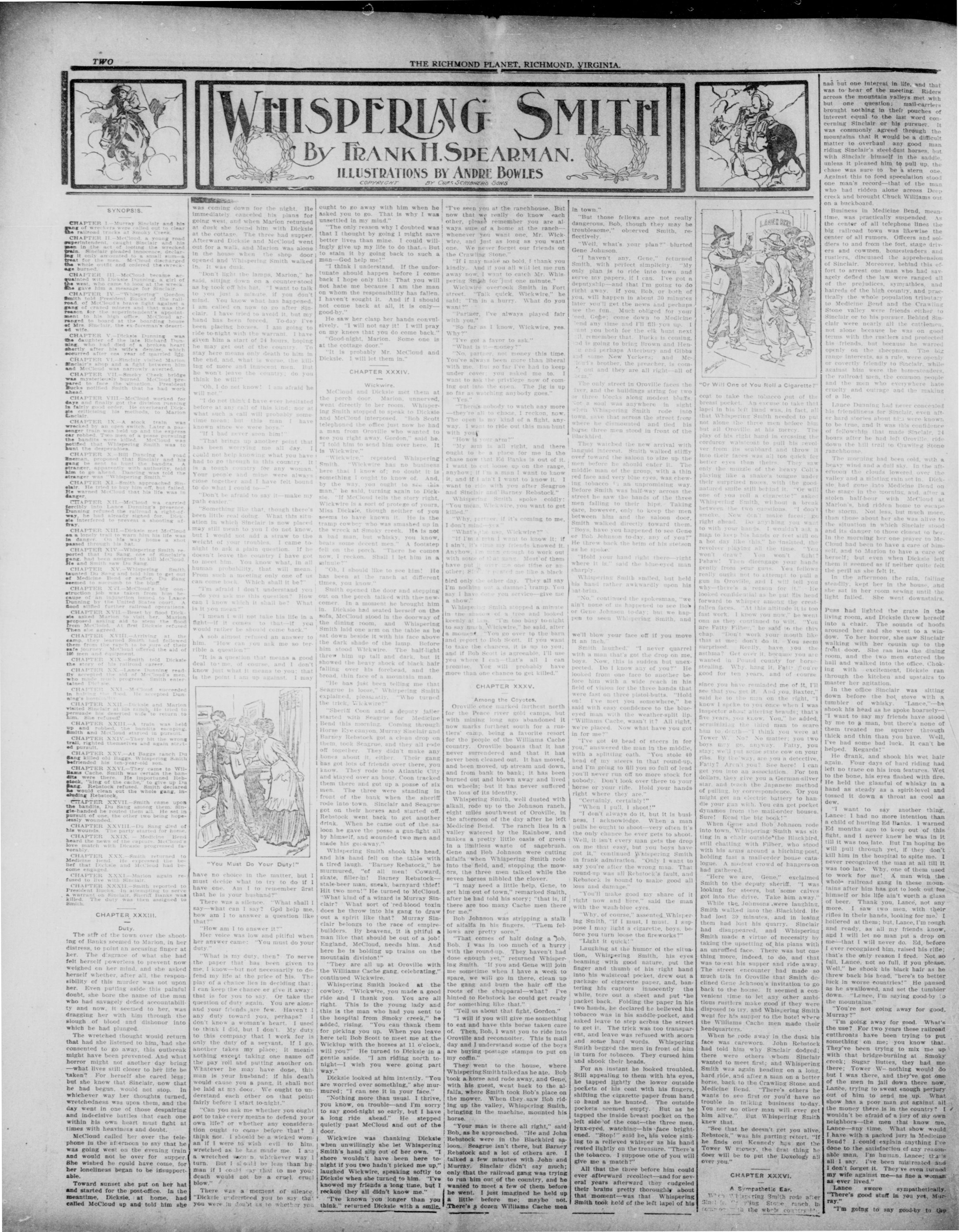
WHISPERING SMITH BY FRANK H. SPEARMAN. ILLUSTRATIONS BY ANDRE BOWLES
was coming down for the night. He immediately canceled his plans for going west, and when Marion returned at dusk she found him with Dicklea at the cottage. The three had supper. Afterward Dicklea and McCloud went out for a walk, and Marion was alone in the house when the shop door opened and Whispering Smith walked in. It was dusk.
"Don't light the lamps, Marion," he said, sitting down on a counter-stool as he took off his hat. "I want to talk to you just a minute. If you don't mind. You know what has happened. I am called on now to go after Sinclair. I have tried to avoid it, but my hand has been forced. To-day I've been placing horses. I am going to ride to night with the warrant. I have given him a start of 24 hours, hopping he may get out of the country. To stay here means only death to him in the end, and, what is worse, the killing of more and innocent men. But he won't leave the country; do you think he will?" "Oh. I do not know! I am afraid he will not." "I do not think I have ever hesitated before at any call of this kind; nor at what such a call will probably sometime mean; but this man I have known since we were boys."
"If I had never seen him!"
"That brings up another point that has been worrying me all day. I could not help knowing what you have had to go through in this country. It is a tough country for any woman. Your people and mine were always close together and I have felt bound to do what I could to—"
"Don't be afraid to say it—make my path easier."
"Something like that, though there's been little real doing. What this situation in which Sinclair is now placed may still mean to you I do not know, but I would not add a straw to the weight of your troubles. I came tonight to ask a plain question. If he doesn't leave the country I have got to meet him. You know what, in all human probability, that will mean. From such a meeting only one of us can come back. Which shall it be?"
"I'm afraid I don't understand you—do you ask me this question? How can I know which it shall be? What is it you mean?"
"I mean I will not take his life in a fight—if it comes to that—if you would rather he should come back."
A sob almost refused an answer to him. "How can you ask me so terrible a question?"
"It is a question that means a good deal to me, of course, and I don't know just what it means to you; that is the point I am against. I may
M. H. H.
"You Must Do Your Duty!"
have no choice in the matter, but I must decide what to try to do if I have one. Am I to remember first that he is your husband?
There was a silence. "What shall I say—what can I say? Gpd help me, how am I to answer a question like that?"
"How am I to answer it?"
Her voice was low and pitiful when her answer came: "You must do your duty."
"What is my duty, then? To serve the paper that has been given to me, I know—but not necessarily to defend my life at the price of his. The play of a chance lies in deciding that; I can keep the chance or give it away; that is for you to say. Or take the question of duty again. You are alone and your friends are few. Haven't I any duty toward you, perhaps? I don't know a woman's heart. I used to think I did, but I don't. My duty to this company that I work for is only the duty of a servant. If I go, another takes my place; it means nothing except taking one name off the pay roll and putting another on. Whatever he may have done, this man is your husband; if his death would cause you a pang, it shall not be laid at my door. We ought to understand each other on that point fairly before I start to-night."
"Can you ask me whether you ought not to take every means to defend your own life? or whether any consideration ought to come before that? I think not. I should be a wicked woman if I were to wish evil to him, wretched as he has made me. I am a wretched man a whichever way I turn. But I should be less than human if I could say that to me your death would not be a cruel, crush blow."
There was a moment of silence. "Dickiele understood you to say that you were in doubt as to whether you
THE RICHMOND PLANET, RICHMOND, VIRGINIA
ought to go away with him when he asked you to go. That is why I was unsettled in my mind."
"The only reason why I doubted was that I thought by going I might save better lives than mine. I could willingly give up my life to do that. But to stain it by going back to such a man—God help me!"
"I think I understand. If the fortunate should happen before I come back I hope only this: That you will not hate me because I am the man on whom the responsibility has fallen. I haven't sought it. And if I should not come back at all, it is only—good-by."
He saw her clasp her hands convulsively. "I will not say it! I will pray on my knees that you do come back."
"Good-night, Marion. Some one is at the cottage door."
"It is probably Mr. McCloud and Dickis. I will let them in."
CHAPTER XXXIV.
Wickwire
McCloud and Dickles met them at the porch door. Marion, unnerved, went directly to her room. Whispering Smith stopped to speak to Dickles and McCloud interposed. "Bob Scott telephoned the office just now he had a man from Oroville who wanted to see you right away, Gordon," said he. "I told him to send him over here. It is Wickwire."
"Wickwire," repeated Whispering Smith. "Wickwire has no business here that I know of; no doubt it is something I ought to know of. And, by the way, you ought to see this man," he said, turning again to Dickie-sie. "If McCloud tells the story right, Wickwire is a sort of protege of yours, Miss Dickie, though neither of you seems to have known it. He is the tramp cowboy who was smashed up in the wreck at Smoky creek. He is not a bad man, but whisky, you know, beats some decent men." A footstep fell on the porch. "There he comes now, I reckon. Shall I let him in a minute?" "Oh, I should like to see him! He has been at the ranch at different times, you know."
Smith opened the door and stepping out on the porch talked with the new comer. In a moment he brought him in. Dickie stood herself on the sofa, McCloud stood in the doorway of the dining room, and Whispering Smith laid one arm on the table as he sat down beside it with his face above the dark shade of the lamp. Before him stood Wickwire. The half-fight threw him up tall and dark, but it showed the heavy shock of black hair falling over his forehead, and the broad, thin face of a mountain man. "He has just been telling me that Seagrine is loose." Whispering Smith explained, pleasantly. "Who turned the trick, Wickwire."
"Sherif Coon and a deputy jaller started with Seagrine for Medicine Bend this morning. Coming through Horse Eye canyon, Murray Sinclair and Barney Rebstock got a clean drop on them, took Seagrine, and they all roff together. They didn't make any bones about it either. Their gang has got lots of friends over there, you know. They rode into Atlantic City and stayed over an hour. Coon tracked them there and got up a posse of six men. The three were standing in front of the bank when the sherif rode into town. Sinclair and Seagrine got on their horses and started off. Rebstock went back to get another drink. When he came out of the saihoon he gave the posse a gun-fight all by himself, and wounded two men and made his go-away."
Whispering Smith shook his head, and his hand fell on the table with a tired laugh. "Barney Rebstock," he murmured, "of all men! Coward, skate, filler-in! Barney Rebstock—stale-bee man, sneak, barnyard thief! Hit two men!" He turned to McCloud. "What kind of a wizard is Murray Sinclair? What sort of red-blood toxin does he throw into his gang to draw out a spirit like that? Murray Sinclair belongs to the race of empire-builders. By heavens, it is pitiful a man like that should be out of a job! England, McCloud, needs him. And here he is holding up trains on the mountain division!" "They are all up at Oroville with the Williams Cache gang, celebrating," continued Wickwire.
Whispering Smith looked at the cowboy. "Wickwire, you made a good ride and I thank you. You are all right. This is the young lady and this is the man who had you sent to the hospital from Smoky creek," he added, rising. "You can thank them for picking you up. When you leave here tell Bob Scott to meet me at the Wicklup with the horses at 11 o'clock, will you?" He turned to Dicksie in a gentle aside. "I am riding north to night—I wish you were going part way."
Dicksie looked at him intently. "You are worried over something," she murmured; "I can see it in your face."
"Nothing more than usual. I thrive, you know, on trouble—and I'm sorry to say good-night so early, but I have a long ride ahead." He stepped quietly past McCloud and out of the door.
Wickwire was thanking Dickie when unwillingly she let Whispering Smith's hand silp out of her own. "I shore wouldn't have been here tonight if you two hadn't picked me up" laughed Wickwire, speaking softly to Dickie when she turned to him. "I've known my friends a long time, but I reckon they all didn't know me." "I've known you longer than you think" returned Dickie with a smile.
"I've seen you at the ranchhouse. But now that we really do know each other, please remember you are always sure of a home at the ranch—whenever you want one, Mr. Wickwire, and just as long as you want one, we never forget our friends on the Crawling Stone."
"If I may make so bold, I thank you kindly. And if you all will let me run away now, I want to catch Mr. Whispering Smith for just one minute."
Wickwire overtook Smith in Fort street. "Talk quick, Wickwire," he said. "I'm in a hurry. What do you want?"
"Partner, I've always played fair with you."
"So far as I know, Wickwire, yes. Why?"
"I've got a favor to ask."
"What is it—money?"
"No, partner, not money this time. You've always been more than liberal with me. But so far I've had to keep under cover; you asked me to. I want to ask the privilege now of coming out into the open. The jig is up so far as watching anybody goes."
"Yes."
"There is nobody to watch any more—they're all to chase, I reckon, now. The open is my kind of a fight, any way. I want to ride out this man-hunt with you."
"How is your arm?"
"My arm is all right, and there ought to be a place for me in the chase now that Ed Baskins is out of it. I want to cut loose up on the range, anyhow; if I'm a man I want to know it, and if I ain't I want to know it. I want to ride with you after Seagrue and Sinclair and Barney Rebstock."
"Whispering Smith spoke coldly; "You mean, Wickwire, you want to get killed."
"Why, partner, if it's coming to me,
I don't mind—ya."
"What's the use Wickwire?"
WHAT DO YOU WANT?
"If I'm a man I want to know it; if I ain't, it's time my friends knew it. Anyhow, I'm man enough to work out with some of that man. Most of them have put it over me one time or another; She's put me like a black bird only the other day. They all say I isn't nothing out a damn tramp. You say I have done you service—give me a show."
Whispering Smith stopped a minute in the shadow of a tree and looked keenly at him. "I'm too busy to night to say much. Wickwire," he said, after a moment "You go over to the barn and report to Bob Scott. If you want to take the chances, it is up to you; and if Bob Scott is agreeable, I'll use you where I can—that's all I can promise. You will probably have more than one chance to get killed."
CHAPTER XXXV.
Among the Coyotes
Oroville once marked farthest north for the Peace river gold camps, but with mining long ago abandoned it now marks furthest south for a rushters' camp, being a favorite resort for the people of the Williams Cache country. Oroville boasts that it has never surrendered and that it has never been cleaned out. It has moved, and been moved, up stream and down, and from bank to bank; it has been burned out and blown away and lived on wheels; but it has never suffered the loss of its identity.
Whispering Smith, well dusted with alkali, rode up to the Johnson ranch, eight miles southwest of Oroville, in the afternoon of the day after he left Medicine Bend. The ranch lies in a valley watered by the Rainbow, and makes a pretty little oasis of green in a limitless waste of sagebrush. Gene and Bob Johnson were cutting alfalfa when Whispering Smith rode into the field, and, stopping the mowers, the three men talked while the seven horses nibbled the clover. "I may need a little help, Gene, to get him out of town," remarked Smith, after he had told his story; "that is, if there are too many Cache men for me." Bob Johnson was stripping a stalk of alfalfa in his fingers. "Them fellows are pretty sore."
"That comes of half doing a Job, Bob. I was in too much of a hurry with the round-up. They haven't had dose enough yet," returned Whispering Smith. "If you and Gene will join me sometime when I have a week to spare, we will go in there, clean up the gang and burn the hair off the roots of the chapparal—what? I've hinted to Rebstock he could get ready for something like that." "Tell us about that fight, Gordon."
"I will if you will give me something to eat and have this horse taken care of. Then, Bob, I want you to ride into Oroville and reconnoiter. This is mall day and I understand some of the boys are buying postage stamps to put on my coffin."
They went to the house, where Whispering Smith talked as he ate. Bob took a horse and rode away, and Gene, with his guest, went back to the alfalfa, where Smith took Bob's place on the mower. When they saw Bob riding up the valley, Whispering Smith, bringing in the machine, mounted his horse.
"Your man is there all right," said Bob, as he approached. "He and John Rebstock were in the Blackbird saloon. Seagrue isn't there, but Barney Rebstock and a lot of others are. I talked a few minutes with John and Murray. Sinclair didn't say much; only that the railroad gang was trying to run him out of the country, and he wanted to meet a few of them before he went. I just imagined he held up a little before me; maybe not. There's a dozen Williams Cache me
In town."
"But those fellows are not really dangerous, Bob, though they may be troublesome," observed Smith, reflectively.
"Well, what's your plan?" blurted Gene Johnson.
"I haven't any, Gene," returned Smith, with perfect simplicity. "My only plan is to ride into town and serve my papers, if I can. I've got a deputyship—and that I'm going to do right away. If you, Bob, or both of you, will happen in about 30 minutes later you'll get the news and perhaps see the fun. Much obliged for your feed, Goge; come down to Medicine lend any time and I'll fill you up. I want you both for the elk hunt next ill remember that. Bucks is coming, and is going to bring Brown and Henna and perhaps Atterbury and Glbbs and some New Yorkers; and McLord's brother, the preacher, is come out and they are all right—all of them."
The only street in Oroville faces the river, and the buildings string for two or three blocks along modest bluffs. Not a soul was anywhere in sight when Whispering Smith rode into town, save that across the street from where he dismounted and tied his horse three men stood in front of the Blackbird.
They watched the new arrival with languid interest. Smith walked stiffly over toward the saloon to size up the men before he should enter it. The middle man of the group, with a thin red face and very blue eyes, was chewing tobacco 6; an unpromising way. Before Smith was half-way across the street he saw the hands of the three men falling to their hips. Taking care, however, only to keep the men between him and the saloon door, Smith walked directly toward them. "Boys, have you happened to see Gene or Bob Johnson to day, any of you?" He threw back the brim of his stetson as he smoke.
"Hold your hand right there—right where it is." said the blue-eyed man sharply.
Whispering Smith smiled, but held his hand rather awkwardly upon his jat-brim.
"No," continued the spokesman, "we ain't none of us happened to see Bob or Gene Johnson to-day; but we happen to seen Whispering Smith, and we'll blow your face off if you move it an inch."
Smith laughed. "I never quarrel with a man that's got the drop on me, boys. Now, this is sudden but unexpected. Do I know any of you?" He looked from one face to another before him with a wide reach in his field of vision for the three hands that were fast on three pistol-butts. "Hold on! I've met you somewhere," he said with easy confidence to the blue-eyed man with the weather-split lip. "Williams Cache, wasn't it? All right, we're placed. Now what have you got in for me?" "I've got 40 head of steers in for you," answered the man in the middle, with a splitting oath. "You stole 40 head of my steers in that round-up, and I'm going to fill you so full of lead you'll never run off no more stock for nobody. Don't look over there to your horse or your rifle. Hold your hands right where they are." "Certainly, certainly!" "When I pull, I shoot!"
"I don't always do it, but it is business, I acknowledge. When a man pulls he ought to shoot—very often it's the only chance he ever gets to shoot. Well, it isn't every man gets the drop on me that easy, but you boys have got it," continued Whispering Smith in frank admiration. "Only I want to say you're after the wrong man. That round-up was all Rebstock's fault, and Rebstock is bound to make good all loss and damage."
"You'll make good my share of it right now and here," said the man with the wash-blue eyes.
"Why, of course," assented Whispering Smith, "if I must, I must. I suppose I may light a cigarette, boys, before you turn loose the fireworks?"
Laughing at the humor of the situation, Whispering Smith, his eyes beaming with good nature, put the finger and thumb of his right hand into his waistcoat pocket, drew out a package of cigarette paper, and, bantering his captors innocently the while, tore out a sheet and put the packet back. Folding the paper in his two hands, he declared he believed his tobacco was in his saddle-pocket, and asked leave to step acrobat the street to get it. The trick was too transparent, and leave was refused with scorn and some hard words. Whispering Smith begged the men in front of him in turn for tobacco. They cursed him and shook their heads.
For an instant he looked troubled. Still appealing to them with his eyes, he tapped lightly the lower outside pockets of his coat with his fingers, shifting the cigarette paper from hand to hand as he hunted. The outside pockets seemed empty. But as he tapped the inside breast pocket on the left side of the coat—the three men, lynx-eyed, watching—his face brightened. "Stop!" said he, his voice sinking to a relieved whisper as his hand rested lightly on the treasure. "There's the tobacco. I suppose one of you will give me a match?" All that the three before him could ever afterward recollect—and for several years afterward they cudged their brains pretty thoroughly about that moment—was that Whispering Smith took hold of the left lapel of his
A
L. ARIER BEER
WINE
"Or Will One of You Roll a Cigarette?"
coat to take the tobacco out of the breast pocket. An excuse to take the lapel in his left hand was, in fact, all that Whispering Smith needed to put not alone the three men before him but all Oroville at his mercy. The play of his right hand in crossing the corduroy waistcoat to pull his revolver from its scabband and throw it into their faces was all too quick for better eyes than theirs. They saw only the muzzle of the heavy Colt's playing like a snake's tongue under their surprised noses, with the good natured smile still behind it. "Or will one of you roll a cigarette?" asked Whispering Smith, without a break between the two questions. "I don't smoke. Now don't make faces; go right ahead. Do anything you want to with your hands. I wouldn't ask a man to keep his hands or foot still on a hot day like this; he insisted, the revolver playing all the time. "You won't draw? You won't fight? Pshaw! Then disengage your hands gently from your guns. You fellows really ought not to attempt to pull a gun in Oroville, and I will tell you why—there's a reason for it." He looked confidential as he put his head forward to whisper among the crest-fallen faces. "At this altitude it is too fast work. I know you now," he went on as they continued to wilt. "You are Fatty Fibre," he said to the thin chap. "Don't work your mouth like that at me; don't do it. You seem surprised. Really, have you the asthma? Get over it, because you are wanted in Pound county for bore-stealing. Why, hang it, Fatty? You're good for ten years, and of course
since you have reminded me of it, I'll see that you get it. And you. Youuck, said he to the man on the right, "I know I spoke to you once when I was inspector about altering brands; that's five years, you know. You," he added, scrutinizing the third man to scare him to death—I think you were at Tower W. No? No matter; you two boys may go, anyway. Fatty, you stay; we'll put some state cow on your ribs. By the way, are you a detective, Fatty? Aren't you? See here! I can get you into an association. For ten dollars, they give you a German-silver star, and teach the Japanese method of pulling, by correspondence. Or you might get an electric battery to handle your gan with. You can get pocket dynames from the mail-order houses. Sure! Read the big book!
When Gene and Bob Johnson rode into town, Whispering Smith was sitting in a chair outside* the Blackbird, still chatting with Fiber, who stood with his arms around a bitching post, holding tast a mail-order house catalogue. A modest crowd of hangers-on had gathered.
"Here we are, Gene," exclaimed Smith to the deputy sheriff. "I was looking for steers, but some calves got into the drive. Take him away."
While the Johnsons were laughing, Smith walked into the Blackbird. He had lost 30 minutes, and in losing them had lost his quarry. Sinclair had disappeared, and Whispering Smith made a virtue of necessity by taking the upsetting of his plans with an unruffled face. There was but one thing more, indeed, to do, and that was to eat his supper and ride away. The street encounter had made so much talk in Groville that Smith declined Gene Johnson's invitation to go back to the house. It seemed a convenient time to let any other ambitious rustlers make good if they were disposed to try, and Whispering Smith went for his supper to the hotel where the Williams Cache men made their headquarters.
When he rode away in the dusk his face was careworn. John Rebstock had told him why Sinclair dodged; there were others whom Sinclair wanted to meet first; and Whispering Smith was again heading on a long, hard ride, and after a man on a better horse, back to the Crawling Stone and Medicine Bend. "There's others he wants to see first or you'd have no trouble in talking business to day. You nor no other man will ever get him alive." But Whispering Smith knew that.
"See that he doesn't get you alive, Rebstock" was his parting retort. "If he finds out Kennedy has got the Tower W money, the first thing he does will be to put the Doxology all over you."
CHAPTER XXXVII
A Sympathetic Ear
A Sympathetic Ear.
When Washing Smith rode after
Simul, Driving Stone ranch, in
room with the wheel country.
nad but one interest in life, and that was to hear of the meeting. Riders across the mountain valleys met with but one question: mail-carriers brought nothing in their pouches of interest equal to the last word concerning Sinclair or his pursuer. It was commonly agreed through the mountains that it would be a difficult matter to overhaul any good man riding Sinclair's steel-dust horses, but with Sinclair himself in the saddle, unless it pleased him to pull up, the chase was sure to be a stern one. Against this to feed speculation stood one man's record—that of the man who had ridden alone across Deep creek and brought Chuck Williams out on a buckboard.
Business in Medicine Bend, meantime, was practically suspended. As the center of all telephone lines the big railroad town was likewise the center of all rumors. Officers and soldiers to and from the fort, stage drivers and cowmen, homesteaders and rustlers, discussed the apprehension of Sinclair. Moreover, behind this effort to arrest one man who had savagely defied the law were ranged all of the prejudices, sympathes, and hatreds of the high country, and practically the whole population tributary to Medicine Bend and the Crawling Stone valley were friends either to Sinclair or to his pursuer. Behind Sinclair were nearly all the cattlemen, not alone because he was on good terms with the rustlers and protected his friends, but because he warred openly on the sheepmen. The big range interests, as a rule, were openly or covertly friendly to Sinclair, while against him were the homesteaders, the railroad men, the common people and the men who everywhere hate cruelty and outrage and the making of a lie.
Lance Dunning had never concealed his friendship for Sinclair, even after hard stories about him were known, to be true, and it was this confidence of fellowship that made Sinclair, 24 hours after he had left Oroville, ride down the hill trail to Crawling Stone ranchhouse.
The morning had been cold, with a heavy wind and a dull sky. In the afternoon the clouds lowered over the valley and a misting rain set in. Dickie sie had gone into Medicine Bond on the stage in the morning, and, after a stolen half hour with McCloud at Marlon's, had ridden home to escape the storm. Not less, but much more, than those about her she was alive to the situation in which Sinclair stood and its danger to those closest to her. In the morning her one prayer to McCloud had been to have a care of himself, and to Marlon to have a care of herself; but even when Dickie sie left them it seemed as if neither quite felt the peril as she felt it.
In the afternoon the rain, falling steadily, kept her in the house, and she sat in her room sewing until the light failed. She went downstairs.
Puss had lighted the grate in the living room, and Dickles threw herself into a chair. The sounds of hoofs aroused her and she went to a window. To her horror, she saw Snailclaw walking with her cousin up to the front door. She ran into the dining room, and the two men entered the hall and walked into the office. Choking with excitement, Dickles ran through the kitchen and upstairs to master her agitation.
In the office Sinclair was sitting down before the hot, stove with a tumbler of whisky, "Lance,"—he shook his head as he spoke hoarsely—"I want to say my friends have stood by me to a man, but there's none of them treated me squirer through thick and thin than you have. Well, I've had some bad luck. It can't be helped. Regards!" He drank, and shook his wet hair again. Four days of hard riding had left no trace on his iron features. Wet to the bone, his eyes flashed with fire. He held the glassful of whisky in a hand as steady as a spirit-level and tossed it down a throat as cool as dew.
"I want to say another thing, Lance: I had no more intention than a child of hurting Ed Banks. I warned Ed months ago to keep out of this fight, and I never knew he was in it till it was too late. But I'm hoping he will pull through yet, if they don't kill him in the hospital to spite me. I never recognized the man at all till it was too late. Why, one of them used to work for me! A man with the whole railroad gang in these mountains after him has got to look out for himself or his life lain't worth a glass of beer. Thank you, Lance, not any more. I saw two men, with their rifles in their hands, looking for me! I hollered at them; but, Lance, I'm rough and ready, as all my friends know, and I will let no man put a drop on me—that I will never do. Ed, before I ever recognized him, raised his rifle; that's the only reason I fired. Not so full, Lance, not so full, if you please. Well," he shook his black hair as he threw back his head, "here's to better luck in worse countries!" He paused as he swallowed, and set the tumbler down. "Lance, I'm saying good-by so the mountains."
"You're not going away for good. Murray?"
"I'm going away for good. What's the use? For two years these railroad cthroathes have been trying to put something on me; you know that. They've been trying to mix me up with that bridge-burning at Smoky creek; Sugar Buttes, they had me there; Tower W—nothing would do but I was there, and they've got one of the men in jail down there now, Lance, trying to sweat enough perjury out of him to send me up. What show has a poor man got against all the money there is in the country? I wouldn't be afraid of a jury of my own neighbors—the men that know me, Lance—any time. What show would I have with a packed jury in Medicine Bend? I could explain anything I've done to the satisfaction of any reasonable man. I'm human, Lance; that's all I say. I've been mistreated and I don't forget it. They've even turned my wife against me—as fine a woman as ever lived."
Lance swore sympathetically. "There's good stuff in you yet. Murray." "I'm going to say good-by to the
THE PLANET
SATURDAY...AUGUST 14, 1909
mountains," Sinclair went on, grimly,
"but I'm going to Medicine Bend tonight
and tell the man that has
hounded me what I think of him before I leave. I'm going to give my wife a chance to do what is right and go with me. She's been poisoned against me—I know that; but if she does what's fair and square there'll be to trouble—no trouble at all. All I want, Lance, is a square deal. What?"
Dickie's with her pulses throbbing at fever-heat heard the words. She stood halfway down the stairs, trembling as she listened. Anger, hatred, the spirit of vengeance, choked in her throat at the sinister words. She longed to stride into the room and confront the murderer and call down retribution on his head. It was no fear of him that restrained her, for the Crawling Stone girl never knew fear. She would have confronted him and denounced him, but produce checked her angry impulse. She knew what he meant to do—to ride into Medicine Bend under cover of the storm, murder the two he hated, and escape in the night; and she resolved he should never succeed. If she could only get to the telephone! But the telephone was in the room where he sat. He was saying good-by. Her cousin was trying to dissuade him from riding out into the storm, but he was soing. The door opened; the men went out on the porch, and it closed. Dickie, lightly as a shadow, ran into the office and began ringing Medicine Bend on the telephone.
CHAPTER XXXVII
Dicksie's Ride.
When Lance Dunning entered the room ten minutes later Dickie stood at the telephone; but the ten minutes of that interval had made quite another creature of his cousin. The wires were down and no one from any quarter gave a response to her frantic rinsing. Through the receiver she could hear only the sweep of the rain and the harsh crackle of the wind. Sometimes praying, sometimes fainting and sometimes despairing, she stood clinging to the instrument, ringing and pounding upon it like one frenzied. Lance looked at her in amazement. "Why, God a'mighty, Dickie, what's the matter?"
He called twice to her before she turned, and her words almost stunned him: "Why did you not detain Sinclair here to night? Why did you not arrest him?"
Lance's somber roaked heavily to
one side of his face, and one end of his mustache running up much higher on the other, did not begin to express his astonishment. "Arrest him! Arrest Sinclair! Dickle, are you crazy? Why the devil should I arrest Sinclair! Do you suppose I am going to mix up in a fight like this? Do you think I want to get killed? The level-headed man in this country, just at present, is the man who can keep out of trouble, and the man who succeeds, let me tell you, has got more than plenty to do."
Lance, getting no answer but a fierce, searching gaze from Dickle's wild eyes, laid his hand on a chair, lighted a cigar, and sat down before the fire. Dickle dropped the telephone receiver, put her hand to her girdle, and looked at him. When she spoke her tone was stinging. "You know that man is going to Medicine Bend to kill his wife!"
Lance took the cigar from his mouth and returned her look. "I know no such thing," he growled, curtly.
"And to kill George McCloud, if he can."
He stared without reply.
"You heard him say so," persisted Dicksi, vehemently.
Lance crossed his legs and threw back the brim of his hat. "McCloud is nobody's fool. He will look out for himself."
"These fiendish wires to Medicine Bend are down. Why hasn't this line been repaired?" she cried, wringing her hands. "There is no way to give warning to any one that he is coming, and you have let him go!"
Lance whirled in his chair. "Damnation! Could I keep him from going?"
"You did not want to; you are keeping out of trouble. What do you care whom he kills to night!"
"You've gone crazy, Dickie. Your imagination has upset your reason. Whether he kills anybody to-night or not, it's too late now to make a row about it," exclaimed Lance, throwing his cigar angrily away. "He won't kill us."
"And you expect me to sit by and fold my hands while that wretch sheds more blood, do you?"
"It can't be helped."
"I say it can be helped! I can help it—I will help it—as you could have done if you had wanted to. I will ride to Medicine Bend to-night and help it."
Lance jumped to his feet, with a string of oaths. "Well, this is the limit!" He pointed his finger at her. "Dickie Dunning, you won't stir out of this house to-night."
Her face hardened. "How dare you speak in that way to me? Who are you, that you order me what to do, where to stay? Am I your cowboy, to be defiled with your curses?"
He looked at her in amazement. She was only 18; he would still face her down. "T'll tell you who I am, I am master here, and you will do as I tell you. You will ride to Medicine Bend to-night, will you?" He struck the table with his clinched fist. "Do you hear me? I say, by God, not a horse shall leave this ranch in this storm to-night to go anywhere for
anybody or with anybody!"
"Then I say to you this ranch is my ranch, and these horses are my horses! From this hour forth I will order them to go and come when and where I please!" She stopped toward him.
"Henceforward I am mistress here. Do you hear me? Henceforward I give orders in Crawling Stone house, and every one under this roof takes orders from me!"
"Dickles, what do you mean? For God's sake, you're not going to try to ride—"
She swept from the room. What happened afterward she could never recall. Who got Jim for her or whether she got the horse up herself, what was said to her in low, kindly words of warning by the man at Jim's neck when she sprang into the saddle, who the man was, she could not have told All she felt at last was that she was free and out under the black sky, with the rain beating her burning face and her horse leaping fearfully into the wind.
No man could have kept the trail to the pass that night. The horse took it as if the path flashed in sunshine, and awing into the familiar stride that had carried her so many times over the 20 miles ahead of them. The storm driving into Dicksie's face cooled her. Every moment she recollected herself better, and before her mind all the aspects of her venture ranged themselves. She had set herself to a race, and against her rode the hardest rider in the mountains. She had set herself to what few men on the range would have dared and what no other woman on the range could do. A gust drove into her face. They were already at the head of the pass, and the horse, with level ground underfoot, was falling into the long reach; but the wind was colder.
Dickieis lowered her head and gave Jim the rein. She realized how wet she was; her feet and her knees were wet. She had no protection but her skirt, though$^4$ the meaner趾 on all her countless acres would not have braved a mile on such a night without leather and fur. The great lapels of her riding-jacket, reversed, were buttoned tight across her shoulders, and the double fold of fur lay warm and dry against her heart and lungs; but her hands were cold, and her skirt dragged leaden and cold from her waist, and water soaked in upon her chilled feet.
She became conscious of how fast she was going. Instinct, made keen by thousands of saddle miles, told Dickieis of her terrific pace. She was riding faster than she would have dared go at noonday and without thought or fear of accident. In spite of the sliding and the plunging down the long hill, the storm and the darkness brought no thought of fear for
herseft; her only fear was for those ahead. In supreme moments a horse, like a man when human efforts become superhuman, puts the lesser dangers out of reckoning, and the faculties, set on a single purpose, though strained to the breaking-point, never break. Low in her saddle, Dickieis tried to reckon how far they had come and how much lay ahead. She could feel her skirt stiffening about her knees, and the rain beating at her face was sharper; she knew the sleet as it stung her cheeks, and knew what ne was coming—the snow.
There was no need to urge Jim. He had the rein and Dickiek bent down to speak to him, as she often spoke when they were alone on the road, when Jim, bolting, almost threw her. Recovering instantly, she knew they were no longer alone. She rose alert in her seat. Her straining eyes could see nothing. Was there a sound in the wind? She held her breath to listen, but before she could apprehend Jim leaped violently ahead. Dickiek screamed in an agony of terror. She knew then that she had passed another rider, and so close she might have touched him.
Fear froze her to the saddle; it lent wings to her horse. The speed became wild. Dickiek knit herself to her
Joseph D.
Dickie Gave Jim the Rein.
dumb companion and a prayer choked in her throat. She crouched lest a bullet tear her from her horse; but through the darkness no bullet came, only the sleet, stinging her face, stiffening her gloves, freezing her hair, chilling her limbs, and weighting her like lead on her struggling horse. She knew not even Sinclair could overtake her now—that no living man could lay a hand on her bridle-rein—and she pulled Jim in down the winding hills to save him for the long flat. When they struck it they had but four miles to go.
Across the flat the wind drove in fury. Reflection, thought and reason were beginning to leave her. She was crying to herself quietly as she used to cry when she lost herself, a mere child, riding among the hills. She was praying meaningless words. Snow purred softly on her cheeks. The cold was soothing her senses. Unable at last to keep her seat on the horse, she stopped him slipped stiffly to the ground, and, struggling through the wind as she held fast to the bridle and the horn, half walked and half ran to start the blood through her benumbed veins. She struggled until she could drag her mired feet no farther, and tried to draw herself back into the
THE RICHMOND PLANET, RICHMOND, VIRGINIA
saddle. It was almost beyond her. She sobbed and screamed at her helplessness. At last she managed to climb flounderingly back into her seat, and, bending her stiffened arms to Jim's neck, she moaned and cried to him. When again she could hold her seat no longer, she fell to the horse's side, dragged herself along in the frozen slush, and, screaming with the pain of her freezing hands, drew her self up into the saddle.
She knew that she dare not venture this again—that if she did so she could never remount. She felt now that she should never live to reach Medicine Bend. She rode on and on and on—would it never end? Then came a sound like the beating of great drums in her cars. It was the crash of Jim's hoofs on the river bridge, and she was in Medicine Bend.
A horse, galloping low and heavily slud through the snow from Fort street into Boney, and, where it had so often stopped before, dashed up on the sidewalk in front of the little shop. The shock was too much for his unconscious rider, and, shot headlong from her saddle, Dickle was fums bruised and senseless against Marion's door. (To Be Continued.)
BEST FOR SUMMER
BEST FOR SUMMER
DIETETIC VALUE OF RHUBARB
TOO OFTEN OVERLOOKED.
Plant Has Ideal Qualities for Toning Up the System and Keeping It in Condition—Some Methods of
Cooking.
During the hot months of summer we must eschew the frequent use of meats and heavy made dishes if we wish to be in condition to bear the heat.
At this time the appetite craves cooling vegetables and fruits which the wise provision of nature so bountifully supplies. Juicy fruits and vegetables supply the salts, water and organic acids which are so valuable in toning up the system, cooling and thinning the blood.
Rhubarb, or pieplant, is so common that we are apt to slight and forget its value. Now it is at its best and cheapest. The acid contained in the plant is most agreeable and acts as a laxative. Such qualities make it wholesome both for food and medicine. The root is extremely bitter, when dried it is a valuable drug and used in many medicines.
Rhubarb combined with pikeapple in cooking gives variety when fresh or sealed for winter use.
A tried and successful method of canning rhubarb uncooked is to fill the can with the plant cut in one-inch pieces. Pack in a jar and put under the cold water faucet, let the water run into the jar until the plant is well chilled and all the air bubbles expelled; then, with the water overflowing the can, screw on the top.
When preparing rhubarb for sauce, if the peeling or skin is left on, the rosy pink coloring which lies in it will tint the sauce. Later in the season, when the peeling becomes stringy, this cannot be done. As a conservé, combined with oranges and lemons, it is a great favorite.
Rhubarb Conserve.—Take three and one-half pounds of rhubarb, cut in half-inch lengths, cook with two pounds of sugar for half an hour, add the juice of three lemons, and the grated rind of one. Cook another pound of blanched and chopped almonds. Put in glasses for winter use. Orange and Rhubarb Marmalade.—Remove the peel in quarters from eight oranges. Cook the peel until soft in enough boiling water to cover. When tender drain and remove the white part by scraping with a spoon. Cut the rind in strips, using a pair of scissors or a very sharp pennkite. Divide the oranges in sections, removing the seeds and membrane. Add to the orange pulp five pounds of rhubarb cut in one-inch pieces. Boil half an hour, then add four pounds of sugar and the rind, simmer slowly for two hours. Turn into glass and when cool cover with melted paraffine.
NELLIE MAXWELL
Split Pea Roast
Soak six slices of stale bread in cold water; while soaking chop in chopping bowl four medium-sized cold potatoes and one small onion; add to this one level teaspoonful of ground sage, a pinch of pepper and salt to taste. Mix with this the soaked bread (after pressing it dry), then add one cup of strained tomato. When thoroughly mixed stir in one egg and four cups of split peas that have been cooked tender. If too soft, add cracker crumbs and bake in a well greased bread pan one hour in a moderate oven. Garnish with parsley and serve with sauce made of one pint of strained tomato, flavored with half a teaspoonful of onion juice, boil and thicken with cornstarch to the consistency of cream, salt to taste. The sauce to be cold when served.
To Make Onion Juice
I have often been deferred from using onion juice in salad, meat loaf etc., because of the length of time it took to secure, it, and the danger of getting it in the eyes. But since the following discovery it has been an easy matter: Cut a thick slice off of one end of an onion, but do not peel, as the skin helps to protect the eyes and fingers. Hold the onion on the table with one hand and scrape the cut side gently with a teaspoon until the required quantity of juice is secured, emptying the spoon as it fills. A teaspoonful or two is usually all that is necessary to secure the required flavor in any dish to which it is added.—Housekeeper.
Yellow Tomato Salad
Here is a very blithe dish for the outdoor tea, for, artistically arranged, the golden vegetables are as pretty as a bouquet. Choose the small, bright egg tomatoes, scall, peel carefully, chill and arrange in a pointed pyramid on tender lettuce leaves on a vel
low or green dish. Pour over them French dressing or add a pat of mayonnaise when serving each plate.
Short Notice Dessert
Beat two eggs together until light; add slowly one cup of brown sugar, beating all the while, then add a pinch of salt. Mix into this two tablespoonfuls of flour and also one cupful of walnuts chopped fine. Drop by spoonfuls into greased tins and bake until brown in a moderately hot oven.
Butternut Bread
Take 1½ quarts of flour; to this add one cupful of your bread sponge in the morning. Mix this with two pints of lukewarm milk and add the chopped meats of the butternuts. Set in a warm place to raise; then knead it into loaves and bake in an even oven.
ART IN MAKING GOOD BREAD
Skill Not Easily Acquired but It Is Indispensable to Young Housekeeper.
One of the first duties of the young wife is to learn how to make good biscuits, bread and muffins. With the secret of breadmaking, her breakfasts will be robbed of their terrors, for she can learn to cook meat, eggs and potatoes in a short time, though breadmaking is more perplexing. On cold days it is advisable to use warm water or milk when making biscuits, for cold water has a tendency to harden the dough, and it is more difficult to handle, and biscuit dough should be soft.
Pie dough is improved with cold ingredients, but biscuits must be warm. Remember that as soon as a liquid touches the baking powder it begins its chemical action on the flour. The little air cells swell and burst, making the dough light. Roll the dough instantly, cut all the biscuits and place in the pans. If all can not be baked at once they will rise in the pans and can be baked later. But if the dough is not rolled and cut the air cells eventually die, the bread when rolled afterwards is deed and lifeless and the biscuits are tough and do not rise.
In making muffins, remember that eggs well beaten are absolutely necessary, and that the flour must be beaten until there are no lumps. This makes muffins light-grained and not course. All griddle cakes are improved when well-beaten eggs are used and the batter is beaten until smooth and free from flour lumps.
EASY TO KEEP DINNER HOT.
Method Also Prevents "Drying Up," According to Correspondent of Harper's Bazar.
Not long ago I saw a mother take off enough dinner for another member of the family who had been detained, says a writer in Harper's Bazar. With another plate to cover it, it was put in the oven to "keep warm," but in reality to dry up. I mentioned to her my way of keeping dinner for the late-comer, and she was" so grateful for the suggestion that I thought some of the readers of Harper's Bazar would like to know also I have found "Houseman's Problems" of great benefit to me, and wish to lend a hand.
A saucepan filled nearly full of boiling water is put on the stove, and a dinner plate containing the vegetables is placed over it; a pan covered over the plate will keep in the steam. For hours the dinner may be kept steaming hot and palatable.
For Hasty Luncheons.
Cherry Crusts—Take rounds of bread, toast and butter them, and spread with rich cherry preserves. Set in the oven to heat and serve with or without cream.
Celery and Pimento Salad—Shred the celery fine, in long pieces, and lay in a dish, on lettuce if you can get it; cover with chopped canned pimentos and French dressing; serve ice cold.
Cabbage and Pimento Salad—Shred the cabbage; add a cup of English walnuts and a small cup of mayonnaise; put into a dish and cover with chopped pimentos.
Apple Pie and Melted Cheese—Bake a pie crust in the bottom and on the side of the pie tin; fill with apple quarters stewed till tender, and return to the oven, putting a little cinnamon and sugar on the top.
Use a Rocker at the Sewing Machines.
At this time of the year when we are spending long hours at the machine, trying to finish our summer sewing, it is well to know that if you will sit in an armless rocker while using the machine you will be able to sew for hours at a time without the aches which generally accompany such machine work. The rocker gives to and relieves the body of the motion while running. Of course it is necessary to put a cushion on the chair so you will be higher, but even with hand sewing many backaches will be avoided by using a low chair—House-keeper.
Potatoes and Peppers
Peel enough Irish potatoes to make a good quart after they have been cut in small pieces or in the form of dice; after removing the seeds from two green peppers, wash them well and cut into rings; put them and the diced potatoes into a steewan and cover with boiling water. After cooking for 18 minutes pour off the water and sprinkle with flour, salt and pepper. Turn into a baking dish, cover with cream or milk, dot with butter and cook in a hot oven until nicely browned. Then serve at once.
Spanish Pickle.
One and a half dozen large cucumbers put in brine three or four days, two large heads of cabbage, two dozen small onions, ten green peppers; chop all fine; salt well and let stand over night; wash and drain well and put in a kettle with two ounces white mustard seed, one ounce celery seed, one ounce turmeric, $1\frac{1}{2}$ pounds dry ground mustard, $1\frac{1}{2}$ pounds brown sugar; cover with vinegar and boll till well heated; bottle airtight.
FACT AND FANCY.
Radishes hail from China.
The bagpipe originated in Babylon.
The jolly dog's wife usually lives in a kennel.
The Monte Carlo Casino was built 59 years ago.
Greek infantrymen are trained in stone-throwing.
In smart society everything but the outside may be shabby.
Corsets are forbidden in German factories during working hours.
The cobra's venom will kill plants as quickly as men or animals.
No wonder gamblers frequent all the liners—gulls are so thick at sea.
Love may be blind, but he finds instinctively the darkest nook on beach and pier.
The Coreans remove dandruff with sandpaper. The redskin had an even more efficient method.
If tombstones told the truth, heaven would be crowded and the other place would long since have shut down.
When Shakespeare wrote the world did not contain as many English speaking people as New York now numbers.
Tis better to have loved and lost than never to have loved at all. This thought was first voiced, it is believed, by a jeweler, a florist, or a confectioner.
RAM'S HORN BROWN
Life is a serious thing to the man who takes it seriously.
Abundant light transforms all ugliness into beauty.
The young man who has no fixed purpose will soon be "fixed."
To begin with a great purpose is the first step toward a great career.
Some people would be dumb if they couldn't talk about themselves.
This world cannot do much for the man who has all his treasure here.
No man is strong who cannot say no to himself whenever it should be said.
A good appetite and a robust digestion are a very present help in some kinds of trouble.
Methuselah died the year of the flood, and it may have been the weather that killed him.
The man who is praying for the Lord to come will be doing something to help make the devil go.
Some people spend so much time in thinking about the thorns of life that they miss all the roses.
If the Bible emphasizes one thing above another it is the importance of having plenty of backbone.
It won't take a very long prayer to bring fire from heaven when the broken down altars are first built up.
You can depend upon this, that no matter what else the devil may do, he can never separate a child of God from the love of Christ.
JUST SMILE.
I wouldn't frown for a crown.
I'd rather be a Billiken than a Buddha.
Laugh once an hour and you'll never need any pepsin.
No one ever accused Master Cupid of being a tragelian.
You laugh naturally; you have to set your face for a frown.
Everybody likes a joke; no one goes around telling blank verse.
No man ever laughed when he was premeditating a foul crime.
When you look me in the face and smile I know you haven't got a gun up your sleeve.
Smile, even if it hurts your face; some people have to be cruel to be kind to themselves - Richard Carle.
BITS OF SCIENCE.
London's newest fire boat can pump
900 tons of water an hour.
The average cost of railroad mile-
age throughout the world is $76,000.
If paint be strained before using it
will cover more surface and wear better.
When in need of a good, live, up-to-date newspaper, subscribe for the PLANET.
C. & O.
9:00 A. [Fast daily trains to Old Point, ] and
8:00 P. [Newport News and Norfolk.
7:00 A.—Daily. Local to Newport News.
6:00 P.—Daily. Local to Old Point.
5:00 P. [Daily. Louisville, Cladmati, Chicoa
and
11:00 P. [go and St. Louis Fullmast.
8:00 A.—Daily. Ch'ville, exc. Sun. C. Forge.
11:00 P. [Daily. Louisville, Lail to Caddenville.
8:00 A.—Daily. L'burg, Lexington. C. Forge.
10:15 P.—Week days. To Lynchburg.
TRAINS ARRIVE RICHMOND.
Local from East-845 A. M., 8:35 P. M.
Through from East-8145 A. M., 7 P. M.
Local from West-830 A. M., 7:45 P. M.
Through from M. and 5:45 P. M.
Through from Blow River L. and 3:35 A. M., 0:50 P. M.
*Daily Arrival*
LINCOLN
HAIR POMADE
MAKES
KINKY
HAIR
SOFT
REMOVES
DANDRUFT
KEEPS
HAIR
FROM
BREAKING
OFF
LINCOLN
HAIR POMADE
KEEPS
SCALP
FRESH
CLEAN AND
WHOLE-
SOME
MAKES
HAIR
GROW
LONG AND
LUXURIOUS
WHICH WAY WOULD YOU RATHER HAVE YOUR HAIR—SOFT AND
LONG, SO THAT YOU CAN PUT IT UP IN THE LATEST STYLE
OR SHORT AND KINKY
A WOMAN'S JUST PRIDE IS HER
HAIR. TO STRAIGHTEN OUT THAT KINKY, CURLY HAIR, PUTTING IT IN THE MOST PERFECT CONDITION TO BE COMBED INTO ANY SHAPE JUST TRY A BOTTLE OF LINCOLN HAIR POMADE
There is no other preparation on earth to equal Lincoln Hair Pomade in producing soft, beautiful hair. Lincoln Hair Pomade is a natural hair cleanser—a natural promoter of growth and naturally reduces the hair to a straight and combable condition; but also supplies the air with a silky sheen and gloss. No matter how you dry your hair is now, no matter how hard or curly it may be, the only Lincoln Hair Pomade will give you hair that can well be the envy of Lincoln Hair Pomade is the only highly recommended preparation.
It is Lincoln Hair Pomade you want, so refuse weak and inferior substitutes. Do not take anything that is claimed to be just as good, but insist on getting the genuine
The Lincoln Pomade Co.
NORFOLK, VA., U. S.A.
Agents Wanted Everywhere. Write for particulars. If your dealer does not keep it, send 20 cents in stamps or silver to THE LINCOLN POMADE CO. Department B, Norfolk, Va. and we will send you a bottle to return mail.
The Hawkins-Price Co. Hair Growers and Restorers.
(TRADE MARK REGISTERED.)
Carries a full line of natural human hair-braids, bangs pampoules and the latest styles in front pieces—all coloured and mixed gray. These greys and mixed gray to match the hair must very sure in stating explicitly the colors desired. It is easy to send a small sample of hair in a position, so that we may be in a position to match it correctly.
Prices: Briques (natus
Prices: Braids, (natur al hair) $2.50; All-room Pormadours.
(nautral hair). $4.99 Front
This Preparation has proved to be a day delighted with its wonderful results. urally place it in a sphere all of its own, it reassures it, reassures us of its satisfactory re- throughout, and also our colored and colored people in this immensely important in order to convince the most skeptical HAWKSHORE HAIR GROWER AND RI print the picture of the growing preparation and are to-day among our We do not desire the correspondence of our Our preparation is a natural and would not need to be on Clean Temples or Bald Head. We will just here remind the public national patent rights on our hair preparation turn responsible to the government for honour will have Dandruff. On Clean Temples or Bald Head. The Face Beautifier makes the use of harm-free, Sale Price, 25 and 50 cents and is imposed on all orders. Mon or Express Money Order.
(nautral hair), $4.00; Front Pieces (nautral hair), $2.50.
This Preparation has proved to be a fortune to many of the unfortunate, who are to-day fitted with its wonderful results. The merits of this great hair preparation naturally place it in all of its own, and the glowing terms in which our patrons speak of it, reassure us of its many results. We can well boast of a large patronage throughout this and other States and always commendation of the very best white and colored people in this immediate community.
order to convince the most skeptical readers of the merits and results of the HAWKEN'S HAIR GROWER AND RESTORER, we will from time to time produce in print the photographs of those giving us permission to do so, who have used our preparation and are the many bearing witness of the genuine qualities. We do not desire the correspondence of those expecting a miracle or anything unreasonable. Our preparation is a natural and pure compound, the ingredients of which, we would not hesitate to put in print.
We will just here remind the public that the United States Government has placed national patent rights on our hair preparation by which it is protected, and we are in turn rewarded to the government for honest methods and square dealings.
It will pay you the Dandruff, Cure the Scalp of all Impurities, Restore Hair on Clean Temples or Hair Balm. There be Roots not Dead. Price, 35 cents per box.
The Face Beautifier makes the powder entirely unnecessary and is perfectly harmless. Sale Price, 25 and 50 cents and 10 per bottle. A charge of ten cents extra is imposed on all out of city orders. Money can be sent by Post Office Money Order, or Express Money Order. Address all communications to
HAWKINS-PRICE COMPANY,
616 N. 1st St., Richmond, Va.
01.
Correspondence Strictly Confidential.
RAILROADS.
RAILROADS.
Richmond, Fredericksb'g & Potomac R. R.
TO AND FROM WASHINGTON AND BEYOND
Leave Richmond
*5.20 A.M. Byrd St. Nta.
*5.40 A.M. Byrd St. Nta.
*6.50 A.M. Byrd St. Nta.
*12.01 P.M. Byrd St. Nta.
*14.00 P.M. Byrd St. Nta.
*15.00 P.M. Main Station.
*6.55 P.M. Byrd St. Nta.
*6.55 P.M. Main Station.
*8.20 P.M. Main Station.
ASHLAND ACCOMMODATIONS—WEEKDAYS.
Leave Ebla Station - 6.40 A.M. - 10.40 A.M. - 6.30 P.M.
* Daily. ※ Weekdays. ※ Sundays only. All
trains to or from Byrd Street Station atop
Ebla Station departures not guaranteed. Read the sign.
ONLY ALL RAIL LINE TO NORFOLK.
Schedule in Effect April 11, 1909.
Leave Byrd Street Station, Richmond一日.
For Norfolk M. 8:00 P. M. and 6:00
P. M.
For Lynchburg and the West-9:00 A. M. 12:10
P. M. and 9:05 P. M.
ARRIVE RICHMOND.
From Norfolk-11:45 A. M. 6:50 P. M.
From the West-7:00 A. M. 2:05 P. M. 8:15
P. M.
Pullman, Parlor and Sleeping Cars. Cafe Dining Cars.
W. B. REVILL. C. H. BOSLEY.
Gen. Pass. Agent. District Pass. Agent.
ATLANTIC COAST LINE
TRAINS LEAVE RIGHMOND DAILY.
F. Florida and South: 815 A. M. and 7;21
F. M.
For. Norfolk: 9:00 A. M., 8:00 P. M. and 0
P. M.
For N. and W. Ry., West: 9:00 A. M., 12:10
and 9:05 P. M.
For Petersburg: 9:00 A. M., 12:10, 5:00 *8:30 P.
M, 6 P. M, 9:00 P. M, 7:50 and 11:15 P. M.
Traits arrive Richmond daily: 5:00, 7:00 A. M,
*8:35 11:45 A. M, **10:45 A. M, *1:20
P. M, 2:06, 6:50, 3:00 and 8:15 P. M.
Except Sunday, *Sunday Only*
Time of arrival and departures and con-
nections guaranteed.
C. S. CAMPBELL, D. P. A.
SEABOARD
AIR LINE RAILWAY
SOUTHBOUND TRAINS SCHEDULED TO LEAVE
RICHMOND DAILY.
9:10 A. M.—Local to Norlina, Raleigh, Charle-
tine, Washington.
12:35 P. M.—Sleepers, coaches, Atlanta, Savanah,
Jacksonville and Florida points.
10:36 P. M.—Sleepers and coaches Savanah,
Jacksonville, Atlanta, Birmingham and
Memphis.
NORTHBOUND TRAINS SCHEDULED TO ARIVE
RICHMOND DAILY.
5:30 A. M.—F. M. 5:30 A. M.
C
Pieces (nautral hair), $2.50.
fortune to many of the unfortunate, who are
the merits of this great hair preparation nat-
al and the glowing terms in which our patrons
suits. We can well boast of a large patronage
communication of the very best white unity.
local readers of the merits and results of the
STORER, we will from time to time produce
us to do so, who have used our
any burying items or unpleasant nuisances,
those expecting a miracle or anything more
pure compound, the ingredients of which, we
that the United States Government has placed
ion by which it is protected, and we are in
methods and square dealings.
are the Scalp of all impurities, Restore Hair
Kits, $1.00 per price, 35 cents per box.
powder entirely untreated, is perfectly
$1.00 per bottle. A charge of ten cents
can be sent by Post Office Money Order.
Southern Ry
TRAINS LEAVE RICHMOND.
N. B.-Following schedule figures published
only as information and are not guaranteed:
6:20 M. Daily-Local for Charlotte.
10:45 A. M. Daily-Buffet Broiler to
Atlanta and Birmingham-Oklahoma
Oklahoma, Memphis, Chattanooga, and all the South.
Through coach for Chase City, Oxford,
Durham.
6:00 D. M. Ex.-Sunday-Keysville Local.
11:45 A. M. Daily-Limited Palmman ready 9:30
P. M. for all the South.
YORK RIVER LINE.
4:30 P. M. Ex.-Sunday-To West Point-connecting
for Baltimore Monday, Wednesday
and Friday.
2:15 P. M. Weekend, Wednesdays and Fridays-
Local to West Point.
4:30 A. M. Ex.-Sunday-To West Point.
TRAINS ARRIVE RICHMOND.
From the South: 7:00 A. M. 9:30 P. M. (daily
(Express).
8:40 A. M. Ex. Sunday. 4:10 P. M. (daily
(Local).
From West Point: 9:20 A. M. daily; 10:45 A.
M. Weekend and Friday; 5:45 P. M. excuse
(Sunday).
JURGEN'S SON
JURGEN'S SON
Before making your purchase you would do well to call at the most reliable furniture house in the city and see the fine line of REFRIGERATORS, MATTINGS, OIL-CLOTHS And in fact everything that is needed in house furnishings
RUGS AND CARPETS
Of every description; also the latest designs in ROCKERS and special CHAIRS.
Our goods are the best for the price and the price is very low.
C. G. JURGEN'S SON,
ADAMS AND BROAD STREETS.
—Mr. Joseph Evans, our agent at Pittsburg, Pa. desires all his customers whose subscriptions for the Richmond PLANET are past due to call and settle at once.
—Subscribe to The PLANES.
THREE
KEEPS
SCALP
FRESH
CLEAN
WHOLE-
SOME
MAKES
HAIR
GROW
LONGAND
LUXURIOUS
P
S. E. BURGESS, D. P. A.
920 E. Main, St. 'Phones 455
FOUR
THE SPIRIT
All communications intended for publication should be sent so as to reach us by Wednesday.
TERMS IN ADVANCE
ADVERTISING RATES.
For one inch, one insertion . . . $ .50
For one inch each subsequent insertion . . . $ .50
For two inches, three months . . . $ .40
For two inches, six months . . . $ .10
For two inches, twelve months . . . $ .20
Marriage and Funeral Notices, one inch . . . $ .10
Standing and Transient Notices per line . . . $ .10
POSTAGE STAMPS OF A HIGHER DENOMINATION THAN TWO CENTS NOT RECEIVED ON SUBSCRIPTIONS.
THE PLANET is issued weekly. The subscription price is $1.50 per year in advance. There are four ways by which money can be procured: a Post Office Order, by Bank check or Draft, or an Express Money Order, and when none of these can be procured, in a Registered Letter.
MONEY ORDERS—You can buy a Money Order at a Post Office or the Richmond Office and we will be responsible for its late arrival.
EXPRESS MONEY ORDERS can be obtained at the Office of the American Express Co., the United States Express Co., and the Wells & Co.'s Express Company. We will be responsible for money sent by any of these companies. The Express Money Order is a safe and convenient.
REGISTERED LETTER.—If a Money Order, Post Office or an Express Office is not within your reach, your Postmaster will Register the address on the register and send it to the office. Then, if the Letter is lost or stolen, it can be traced. You can send money in this manner and cannot be responsible for money sent. In letters in any other way than one of the four ways mentioned above. If you send your money in any other way, you must do it at your own expense.
RENEWALS, ETC. If you do not want THE PLANET continued for another year after your subscription has run out, you then notify us by e-mail and we will send you a new one. We decided that subscribers to newspapers who do not order their paper discontinued at the expiration of time for which it has been paid are up to date when they order r the paper discontinued.
COMMUNICATIONS.—When writing to us to request your subscription we to discuss paper, you should give your name and address in full otherwise we cannot find your name on our books.
OFF OF ADDRESS.—In order to change the address of a subscriber, we must be sent the former as well as the present address.
Entered at the Post Office at Richmond, Va. as second class matter.
SATURDAY...AUGUST 14, 1909
We have received an invitation to attend the Golden, Pearl and Crystal Anniversary given in honor of Rt. Rev. J. W. Alstork, D. D., LL. D. at Montgomery, Alabama, Sept. 1 to 3d, 1909. It promises to be an elaborate affair.
We received an interesting pamphlet entitled "An Economic Study for Socialists and their Critics" by Lincoln Braden. It may be obtained from him at Carbon, California. It is interesting from cover to cover. Price, ten cents.
---
We have received the catalogue of the Industrial Institute for the Deaf, Blind and Orphans of the colored race at Taft, Oklahoma. Mr. S. Douglass Russell is superintendent and under his management the institution is prowessing.
We have received "Self-help in Education" by R. R. Wright, Jr. It is an interesting pamphlet, brimfull of statistical information and is a useful hand-book to all who wish to be advised upon this all important subject. It may be obtained from "The Committee of Twelve," "Cheyney, Pa."
We have received the circular of information for the first annual session of the National Training School for Women and Girls at Lincoln Heights Washington, D. C. It was established by the Woman's Auxiliary and the National Baptist Convention and deserves success. Its purposes and management are all right. What is needed now, is the money in sufficient quantities to operate the institution. The circular shows a girl attired in a white dress that cost $1.30 and a hat that cost $1.00. Married men could save money if they could get this kind of operating information to their families.
THAT OPEN LETTER
The National Independent Political League has issued an open letter to President William H. Taft. It is dated August 3, 1909, and it has been spread broad-cast through-out the United States by the press agencies and the northern newspapers. It may as well be said that this address was addressed to President Taft, merely as a matter of form. The primary purpose was to attract
public attention to his alleged disregard of the rights of the "man and brother", and his disposition to recognize the onerous discriminations now practiced against the citizens of color all over this broad land of ours.
Viewed in this light, it will accomplish its purpose. So far as causing the distinguished occupant of the white house to swerve one iota from his pronounced policy, it will be a dismal failure. But on the other hand, if the white public sentiment of the North could be aroused to the extent of looking at these questions through the National Independent, Political Leagues spectacles, then a change would be heralded by the President in a few months.
But who are signing this open letter? Let us see: Bishop Alexander Walters, New York, chairman; William H. Scott, Woburn, Mass.; L. G Jordan, Louisville, Ky.; J. H. Wiley Providence, R. I.; A. W. Adams Norwich, Conn.; Byron Gunner, Hillburn, N. Y.; J. Milton Waldron Washington, D. C.; Granville Martin New York; S. L. Corrothers, Washington, D. C.; W. Monroe Trotter Boston, Mass.; Secretary.
These are gentlemen of educational ability, influence, and political power, but they supported Hon. William J. Bryan for the presidency, certainly many of them, if not all of them. Their open letter will accordingly have a tendency to ruffle the feelings of the Chief Executive rather than smooth them with a view to accomplishing results. But to the ordinary citizen, their utterances will attract attention and lead to at least a partial consideration. The gentlemen say:
In your inaugural address you say that "The objects of the thirteenth and fourteenth amendments have been secured. In view of the clause of the latter requiring reduction of congressional representation in proportion as adult males are barred from voting and since the disfranchisement of nine-tenths or the Colored males in the South is a notorious fact, how does the present full congressional quota of those states square with your statement? You say that "while the fifteenth amendment is not observed in the South, it ought to be observed." Was it not your duty as President of the United States, sworn to uphold the Federal law, to say the fifteenth amendment must be obeyed in the South and that you would enforce it?
This question answers itself. President Taft is a jurist. He has served upon the bench. He knows that this is a polite and diplomatic way of telling him that he has violated his oath or office, both in letter and spirit.
They say further:
You say "The movement to enforce Negro suffrage against the prevailing sentiment of the South has proved a failure." Would it not be more in accord with the facts to say that the failure was on the part of the Federal Government under Republican Administrations to put forth any effort to enforce the Negroes' right to vote under the Constitution?
It would be more in accord with facts to say this very thing, but in order to be absolutely fair, these gentlemen should have included the Democratic Administration in this same condemnation. Both parties are guilty gentlemen. Both are in collusion to do all that you charge and they are doing it.
They say further:
You say further that "The fifteenth amendment will never be repealed." If, as you say, it is not observed, is it not for all practical purposes and protection already repealed?
Of course it is, but still, it is much better upon the statute books than off of them, for it is liable to have a sudden resurrection whenever the conscience of the nation is accused to the heinousness of the offense in disregarding it.
In view of the progress of the Colored people in the last 50 years which you say "is marvelous" would it not be more just in you to have demanded for him that equality before the law and exercise of suffrage vouchsafed by the 14th and 15th amendments, rather than, as you did, to encourage the nullifiers?
Of course it would have been more just and President Taft knows it, but just now he is the creature of expediency and commercialism. He has not the time to worry about human rights. They ask:
Why, as the nation's President, speak of the appointment of Colored citizens to office as "an encouragement and appreciation of their progress" father than the right of citizenship?
This is one question that President Taft must answer himself, if it is to be answered. These gentlemen are good on asking questions and at the same time answering them. Just read this one:
You say, finally that the chief executive in appointing Colored men to office should consider whether the consequent hostility of the white men in the South will not do the Colored race more harm than the appointment will do them good. Is
THE RICHMOND PLANET, RICHMOND, WIRGINIA
that not equivalent to declaring against a President's appointing Colored men where white men object, and, therefore, a drawing of the Color line? Is not this a violation of the genius and spirit of the Federal Constitution?
After arguing this question, the gentlemen conclude as follows:
The effect of your policy upon the Southern whites has been even more serious. The white South accepts your policy as a high vindication of all its unjust dealings with the Colored citizens of the country. Hence they feel emboldened to propagate their prejudice and unjust treatment of the Colored people even in the section where the two races have hitherto lived together in comparative peace, and whatever progress was being made towards an amicable solution of the burning race problem has received a most serious setback and its difficulties increased, thus making the evils of your policy national in scope.
We, therefore, appeal to you for a change of your policy as announced and thus far demonstrated. It is not plattitudes and professions of friendship the Colored people and the republic need at this crisis, Mr. President, but loyalty to true American principles and enforcement of the laws.
It may be that all of this newspaper discussion will not produce any tangible result. Still it will make the distinguished statesman feel rather uncomfortable when he is not playing golf and it may tend to give him an idea that every Negro in the United States is not enthusiastic over his policy or greatly in love with his performances. In the meantime, elections will take place some time in the future in some of the doubtful northern states and there are many white and colored citizens who have an independent way of thinking and voting and whose actions in this respect will no doubt be affected by many of the things that these bold, fearless, patriotic colored men have been unkind enough to say.
HER LITTLE SCHEME.
There was a hen
She saw them at her slyly winking,
And so began to do some thinking.
She knew that she
Could earn no corn
And fricassee
Might soon adorn.
But boldly she the problem tackled;
When others layed, she loudly cackled.
Her little scheme
Worked well, indeed.
Her courage deme
Her worth her feed.
About the yard she waxes fatter
And still escapes the dreaded platter.
The Kind it Was.
"So poor Banks' firm had to suspend payment on account of his wife's gambling at bridge parties."
"So they say."
"What kind of game could she have played?"
"To judge from the result to her husband it must have been a kind of suspension bridge."
A Kindred Chord
He (loftly)—I cannot sympathize with the troubles these parents want to confide to us, as the only children I have are those of my brain.
She (gullelessly)—But, my dear professor, that ought to make you appreciate the trials of those parents who have idiots in their families.
Incredible.
"I have just heard a remarkable story concerning a college graduate."
"Tell it to me."
"The day after he got his diploma he took off his colored hat band, put on a suit of civilized clothes and is now successfully holding down a job that pays him more than $10 a week."
A Natural Result
"I don't know, but he left him all broken up."
"Why?"
"He could not pull himself together again."
MAIDS.
Maids, maids, maids,
Tis very hard to say
If what each one doth most allure,
If every one has a way
Of smiling nines and darting looks
That keep a fellow guessing.
And eyes sometimes on mischief bent
And little hands for pressing.
Maids, maids, maids,
I've talked with drooping fellows
Who swore their hearts were all a-blaze
And Love was at the bellows.
And O the gloomy looks they wore,
Disconsolately blinking!
And some were roaming 'neath the stars
And some were madly drinking.
Maids, maids, maids,
No use to ask for pity;
The homely ones try hard to please,
But never those who're pretty.
No wonder beauty's tyrannous—
The explanation's simple.
The bards唱 as they'd split their
throats;
And why?-To praise a dimpie!
Troubles in the Show
Showman—I don't know as we can give any kind of a show this afternoon.
Assistant—What's the matter?
Showman—That fresh kid's been in the cage of the man-eating lion, having a romp, and the critter is as playful as a kitten; the farmer we rented the sacred cow of India from says the money ain't payin' him for the loss of his milk route, and the wild man of Borneo says he's got to have a day off to register and see the police parade.
Appropriate Destiny
"So your play around a marathon race has been accepted. What are they going to do with it?" "Put it on for a run."
"Your husband's death was very sudden."
"Yes." "Yes, sudden, but not unexpected. He was one of those 'Is it hot enough for you?' flends and I always felt that something would happen when the humidity was great."
Obliging
"Thickly is an obliging sort of chap."
"How so?"
"Whenever he tells one of his funny stories he pokes you in the ribs so you can laugh."
"Here is an old news item."
"What is it about?"
"A man named Cork was drowned yesterday."
VIRGINIA:
In the Circuit Court of Henrico
County, August 3, 1909.
Emma Hawkins. Plaintiff.
vs. In Chancery.
William Hawkins Defendant.
The object of this suit is to obtain a divorce a Vinculo Matrimoni, by the plaintiff against the defendant; and an affidavit having been made and filed, that due diligence has been used by, and on behalf of the plaintiff to ascertain in what county or corporation the defendant, William Hawkins is without effect, and that the plaintiff does not know his whereabouts; it is ordered that he appear here within fifteen days after the due publication of this order to do whatever is necessary to protect his interest herein.
A copy—Teste:
SAMUEL P. WADDILL,
Clerk.
3. Henry Crutchfield, p. q.
William Hawkins; You'll take notice that I shall on the 23rd day of September, 1909, at the office of Philip H. B. Shield, room numbered 60, Chamber of Commerce building, situated south-west corner of Ninth and Main Streets, in the city of Richmond, Virginia, between the hours of 9 o'clock A. M. and 6 o'clock P. M. of that day, proceed to take the depositions or witnesses to be read as evidence in my behalf in a certain suit in Chancery depending in the Circuit Court for the County of Henrico, wherein you are defendant and I am plaintiff, and if, for any cause the taking of said depositions be not commenced on that day, or if, commenced be not concluded on that day, the taking of the same will be adjourned and continued from day to day, or from time to time, at the same place and between the same hours, until the same shall be concluded.
Respectfully,
EMMA HAWKINS,
By Counsel
J. Henry Crutchfield, p. q.
Office 1211 1-2 E. Broad St.
Richmond, Va.
PROF. D. D. BRUCE, M. D..
Strange. Wonderful, but True are the awe stricken tests given by The Great Australian Medium.
PROF. D. D. BRUCE, M. D. the only living Apostle of Science of the Mysteries.
$5000 in Gold to any one in the World to compete with him. Possessing more power than any four mediums combined.
No card, trance or hand humbug.
Greatest Hindoo Medium in the World.
SO GREAT IS HIS POWER that he can tell you while in a Clairawaut state, all you wish to know with out a word being spoken. Come, alt. ye unbelievers, soffers and jeers: bring all your skepticism with you—he will open your eyes to the private chamber mystery. Come all ye broken hearted wives, all with low spirits and let him lift the burden from your aching and jealous heart. He challenges the World to compete with him in causing a speedy marriage with the one you love; uniting the separated and bring back the lost one. Traces lost or stolen goods. Unearths hidden treasures. Removes evil influences Crosses, Spells, Ill Luck, cures tricks and Conjurations, gives Luck and Success in all you undertake. Cures the Tobacco and Liquor Habits. Allows the Captive to be set Free.
He is the only one that will give a Written Guarantee to complete your business or refund your money. Are you slick? Do you know what the trouble is with you? Come and Consult Nature's Doctor. Rheumatism, Insomnia, Hysteria and all Diseases cured. Points given on Horse Racing and all Games of Chance.
No matter what all you, come and see this wonderful man. Reader have you noticed that some people have a hard time to get along, no matter how they toll, while others have success? Many, wealthy men and women owe their success to this wonderful man.
He will tell you whom you will marry. Will you be happy? He will tell you who your friends and enemies are. Can you tell? Don't take a leap in the dark, but be advised by this wonderful man. Greatest Prophet in existence.
He always Succeeds when others fail. This is the chance of a life time. Don't let it pass you.
Office hours: 9 A. M. to 9:30 P. M.
Sunday: 2:30 to 7:30 P. M.
N. B.—Our consultation Fee is 50 cents. Sittings, $1.00. All letters containing $1.00 will be answered in full.
MAIN OFFICE:
510 S. 8th Street, Philadelphia, Pa.
TARIFF BILL IS NOW A LAW
MR. TAFT ISSUES STATEMENT
Declares the Bill is Not Perfect By Any Means, Nor a "Complete Compliance With Promises Made," But is, Nevertheless, a Sincere Effort to Make a Downward Revision.
The tariff has been revised and the extraordinary session of congress has been brought to a close.
The conference report of the bill was agreed to by the senate by a vote of 47 to 31, and soon afterwards the concurrent resolution, making certain changes in the leather schedule, was adopted by both houses.
Seven Republican senators voted against the bill. They were Messrs. Bristow, Clapp, Cummins, Dolliver, LaFollette, Beveridge and Nelson.
Just as the hands of the gold clock in the president's room reached six minutes past five, the Payne tariff bill, as the measure will be known, was laid before the president. He picked up a pen supplied by Chatrman Payne, of the house ways and means committee, and which had been used by both the vice president and the speaker in signing the bill, and attached his signature. After writing "William H. Taft," the president added, "signed five minutes after 5 o'clock, August 5, 1909. W. H. T." President Taft gave out a statement embodying his views of the new tariff act, which he designates officially as the "Payne bill," in accordance with past custom of giving first recognition to the framer of the measure in the house of representatives.
The president declares that while the bill is not perfect by any means, nor "a compliance with promises made, 'strictly interpreted,' it is, nevertheless, a sincere effort on the part of the party to make a downward revision and to comply with the promises of the platform.
Cannon Disciplines Inaugents
Cannon Disciplines Insurgents.
Speaker Cannon announced the appointment of the committees for the Sixty-first congress. The "insurgents against the house rules" are disciplined, and in a number of instances ranking members have not been given the chairmanship of their committees. Representatives Fowler (N. J.), Gardner (Mags.), and Cooper, (Wis.), three of the "rules insurgents," who held chairmanships in the last session of congress, have lost their committees. Representative Vreeland (N. Y.), succeeds Mr. Fowler as head of the committee on banking and currency, and Representative Rodenberg (Ill.), succeeds Mr. Gardner as chairman of the committee on industrial arts and expositions. Mr. Cooper was replaced by Representative Olmsted (Pa.). Representative Davidson (Wis.) is retained as head of the committees on railways and canals. These members participated in the fight on the rules at the beginning of the present session, and thus incurred the speaker's displeasure.
Although Representative Wanger (Pa.) was the ranking member of the last committee on Interstate and foreign commerce, Representative Mann (Ill.) who has been most active on that committee, succeeds to the chairmanship.
Representative Gardner (N. J.) also was the ranking member of his committee (postoffice and post roads), but Representative Weeks (Mass.) has received the chairmanship of that important committee.
The ways and means committee and the committees on accounts, mileage and rules were organized earlier in the session.
Girl Murdered In Cemetery
That Anna Schumacher, the seventeen-year-old girl, whose body was found crudely buried in Holy Sepulchre cemetery at Rochester, N. Y., was choked and beaten to death after being criminally assaulted, is the conclusion based on the autopsy held by the coroner, but many of the circumstances of the crime, even to the exact place where it was committed, can still be only guessed. Although the authorities believe they have a clue to the murderer, namely a broken spade found near the scene of the deed, who is guilty of the crime is a matter of the vague speculation.
The autopsy emphasized the brutality of the crime. The body was in a pititable condition — the head, face, chest, arms and hands were covered with bruises and scratches; the bone that supports the tongue, the hyoid, was fractured, when the assailant choked his victim; the body was covered with blood, and the hair was full of dirt and leaves, indicating that the body was dragged some distance, probably by the feet. Part of the clothing had been removed. It would seem that the girl, who was of vigorous physique, made a desperate struggle to save her honor and her life.
The young woman left her home on Saturday morning to place flowers in the family memery, which is that of the Catholic church, and when she did not return at night her family became greatly alarmed. A search was instituted, which was kept up until the finding of her body by two officers.
The spot where the body was found was well chosen for concealment. It is back of an old ice house in the cemetery property and is surrounded by wild undergrowth and trees.
Burglar Sheet in Pistol Duel.
Alfred Kninard, a notorious character of Perry county, lies seriously wound-
ed in the Harrisburg, Pa. hospital as the result of a desperate battle in a small mountain settlement north of Harrisburg, where he attempted to rob the store of Lewis Myers. Holding up the entire hamlet at the point of his revolver, Kinard entered the store, but was interrupted by Oscar Heisler, who procured a revolver and opened fire on the desperado. Kinard fell after a half dozen shots had been exchanged, but was up and away into the thick underbrush before his pursuers could capture him. He was badly wounded in the left thigh, but managed to hide himself until the chase had been abandoned and then crawled over the mountain and through the woods to the home of his brother, Amos Kinard, several miles distant in Cumberland county.
Blooding and almost unconscious when he reached there, he begged his brother to take him in and hide him. The brother did take him in, but immediately sent for an officer. There is a reward of $75 for the arrest of Kinard, and the brother will get the money. Kinard was hurried to the Harrisburg hospital, where he is expected to die of loss of blood. For years he has been noted for his daring lawlessness and is wanted for assaulting officers of the law, for burglary and horse stealing. Heretofore he has always managed to get away by hiding in the mountains.
Man and Wife Eight Duel
After locking their two children in a bedroom and fastening all the doors of their flat in Chicago, Antonio Spizirri and his wife, Anna, went into the darkened parlor, where they tried to kill each other. The woman was shot twice and stabbed twice with a stillette, and died before the police arrived. The husband was shot twice also and he may die. A revolver and a knife were found near the sofa on which the woman lay dead, and another revolver was found beside the husband's body. The disordered room indicated a terrible struggle. Spizirri turned on his side as the police, called by neighbors, broke into the room with a sledgehammer, and tore a letter which was on the floor by his side into bits before the police could stop him. This letter, when translated from the Italian, may solve the mystery. It is thought that Spizirri was jealous of his wife.
Threatens to Blow Up R R R
Threatens to Blow Up P. R. R. "This is a declaration of war. My life is openly staked on the result, for I am prepared to meet you at any time and place you may name. The weapons I shall use are dynamite and other high explosives." Thus wrote Abram C. Eby mayor and referee in bankruptcy, of Burkeville, Va., to the "President of the Pennsylvania railroad, Philadelphia," on July 23d, naming $45,000 the ransom for the safety of the railroad, its steamships and the travelling public and other wise threatening the Pennsylvania railroad. Following a carefully laid plot of the federal postal detectives, Eby was arrested in Philadelphia while in company of Oswald J. DeRousse, chief clerk to President McCrea, who acted for the latter in inveighing Mayor Eby to this city. He was given a hearing before United States Commissioner Craig and held in $10,000 bail for court.
Kitchener a Field Marshal
Lord Kittchen, commander of the British forces in India, has been appointed to succeed the Duke of Connaught as inspector general of the Mediterranean forces, which post the duke recently resigned on the ground of "the ineffective nature of the work and the useless expense to the nation involved therein." Lord Kittchen will take the rank of field marshal.
"Ra ' Saved Girl's Life.
A "rat" in her hair saved the life of Bertha Dolina, a young woman of Roanoke, Va., who shot herself in the head with an attempt at suicide. When the physicians at the hospital pulled the hair from the wound the bullet came out with the mass of false ornament. The woman will recover.
New Director of Mint.
President Taft sent to the United States senate the nomination of A. Platt Andrew, of Massachusetts, to be director of the mint. The nomination is to succeed Frank Willing Leach, who resigned some time ago to become president of the People's Water company, of Oakland, Cal.
One of Brigham Young's Widows Dead
One of the four surviving widows of Brigham Young is dead at Salt Lake City. She was Maanah K. J. C. T. Young, and was eighty-eight years of age. She was married to Young at Nauvoo, Ill., before the westward pilgrimage of the Mormons. She had no children.
Bob Burdette's Spine Affected
Robert J. Burdette, who is seriously ill at Los Angeles, Cal., because of an injury to the spine, which he sustained in a fall last March, was placed in a plaster cast. His spinal cord has become affected.
Throat Cut Trying to Enter Room.
Edwin Matthews, a negro night porter at a Gainesville, Ga., hotel, had his throat cut by Mrs. Mamie Lawson because he entered her room through a window.
TWO NUNS LEAP TO DEATH
Trapped on Railroad Trestle By Train,
They Jump Into Rails.
Montreal, Que, Aug, 11.—Two nuns, walking from Montreal convent to pay a visit to Fark Laval, were overtaken by a train on a bridge a short distance from the city. Terror-stricken, they leaped to the rapids, forty feet below, and were drowned.
Millionaire's Wife • Suicide
Keystone, W. Va., Aug. 17, Mra. Genevieve Ramsey, aged twenty-three years, wife of K. L. Ramsey, said to be a millionaire coal operator at Williamson, W. Va., committed suicide in the pariors of the Keystone inn here by fireing a bullet through her left temple Domestic troubles was the cause
Send Name and Address Today—You Can Have It Free and Be Strong and Vigorous.
I have in my possession a prescription for nervous debility, lack of vigor, weakened manhood, falling memory and lame back, brought on by excesses, unnatural drains, or the follies of youth, that has cured so many worn and nervous men right in their own homes—without any additional help or medicine—that I think every man who wishes to regain his manly power and virility, quickly and quietly, should have a copy. So I have determined to send a copy of the prescription free of charge, in a plain, ordinary sealed envelope to any man who will write me for it.
This prescription comes from a physician who has made a study of men and I am convinced it is the surest acting combination for the cure of deficient manhood and vigor failure ever put together.
I think I owe it to my fellow man to send them a copy in confidence so that any man anywhere who is weak and discouraged with repeated failures may stop drugging himself with harmful patent medicines, secure what I believe is the quickest-acting restorative, upbuilding, SPOTTOUCHING remedy ever devised, and so cure himself at home quietly and quickly. Just drop me a line like this: Dr. A. E. Robinson, 3895 Luck Building, Detroit, Mich., and I will send you a copy of this splendid recipe in a plain ordinary envelope free of charge. A great many doctors would charge $3.00 to $5.00 for merely writing out a prescription like this—but I send it entirely free.
Stuck
"He said she was the rose of his heart."
"Very poetic. How did the romance end?"
Teacher—Thirty-three eggs at 59 cents per dozen is what?
Bill—Outrageous, I call it.
Widow's Wiles.
A little widow,
Now and then.
Will hypnotize
A dozen men.
"I suppose," remarked the stranger within the gates, "the people of this village are quite intelligent?"
"That's what," replied the native.
"Why, a number of the residents often pass whole evenings together without playing euchre or bridge whist."
"Devote the time to literature and conversation, I presume?" said the stranger.
"No," answered the native, "they play dominoes and match pennles."
Man at Work
"What is the meaning of the old adage about sawing wood and saying nothing?" asked the fair maid.
"It means that there is a man on the job," replied the home-grown philosopher.
"And why not a woman?" queried the f. m.
"Impossible," answered the local philosophy dispenser. "If a woman had to saw the wood the world would certainly hear about it."
"Well, I'm certainly glad to be at home again," said the man who had been away for three weeks.
"Are you really, dear?" queried his wife.
"That's what," he rejoined. £Why, even your angel cake tastes heavenly to me."
Meteorological
Little Willie—Say, pa, doesn't it get colder when the thermometer falls?
Pa—Yes, my son.
Little Willie—Well, ours has fallen.
Pa—How far?
Little Willie—About five feet—and when it struck the porch floor it broke.
Will it come to this?
Alicia—I understand the man who married Celeste is wealthy.
Felicia—Wealthy! Why, he's so sympathy with prohibition."
How he can afford not to own an automobile.
A Poor Memory.
"Have you forgotten that you owe me seven dollars?"
"Dear, dear, I had forgotten. My memory is miserable—but wasn't it only $6.39?"—Filigende Bissetter.
Editor's Advice
Editor's Advice.
"You waste too much paper," said the editor.
"But how can I economize?" asked the writer.
"By writing on both sides of the paper."
"But you will not accept articles when they are written on both sides of the sheet?"
"No, I know it; but you'd save paper, just the same."—Yonkers Statesman.
SIX
THE PLANET
Paul's Third Missionary Journey
Sunday School Lesson for August 15, 1909
Specially Arranged for This Paper
LESSON TEXT—Acts 18:22-19:22. Memory verses 19-20.
GOLDEN TEXT—The name of the Lord Jesus was magnified—Acts 19:17.
TIME—Paul began his third journey perhaps 53, and it hased three years, 53-56, or 57.
PLACE—Paul ended his second journey by going to Jerusalem, and thence to Antioch. From there he went through Asia Minor, ending at Ephesus, the capital of the Roman province of Asia.
Suggestion and Practical Thought
How Paul Built Up the Religious Life of Ephesus.
Paul Enters Upon His Missionary Journey, and Strengthens the Older Churches—Acts 18:22-23. When Paul had completed his second missionary journey he went up to Jerusalem to pay his respects to the mother church there, and doubtless, as at other times, he told the wondrous story of the work of God in bringing many Gentiles into the kingdom. Here he would remain long enough to complete his vow, the apostle to the Gentiles in loving accord with the mother church.
Then he went down to the home church which had sent him forth. Here he was always welcome. Here he told the story of his missionary adventures, and the fruits of his labors. This is probably the last time Paul was able to visit Antioch. It is probable that while here Paul wrote the Epistle to the Galatins, on receiving the report of Timothy concerning the churches in that region, and not long afterward he himself went through the region of Galatia and Phrygia in order, strengthening the churches, for there was great need. (Gal. 1:6-12; 3:1:5; 5:1-12-15)
Ephesus, which Paul made his headquarters for nearly three years of missionary work, was not only the capital of the province, but was the city of the greatest importance in all Asia Minor, and principal emporium of trade in the east.
Paul Finds an Undeveloped Church of Ephesus, and Brings Them Into the Fulness of the Gospel Light—Acts 18:24—19:7. The Eloquent Apollos, When Paul left Corinth at the close of his second journey, his friends Aquila and Priscilla went with him as far as Ephesus. Before Paul uttered upon his longer work at Ephesus there came a Christian Jew of great eloquence (v. 25) "knowing only the baptism of John; the gospel of repentance and forgiveness, and Christian morals, and of Jesus who proclaimed the kingdom of heaven at hand, and worked many miracles of love, and died on the cross, the story which was told in the earlier gospels.
These things Priscilla and Aquila expounded to him. Then he went to Greece (v. 27) and "helped them much which had believed through grace" Of this Paul once speaks in his letter to Corinth. "I planted, Apollos watered God gave the increase." (1 Cor. 3:6)
Paul's Preaching and Teaching,—Vs. 8-10. First. In the Jewish synagogue. Three months. To Jews. As usual, Paul began with the Jews who were best prepared to receive the Gospel. "And spake boldly." It required no little courage to take the unpopular side, which had so often brought him into trouble. Second. In the school of Tyrannus. Two years. To Gentiles. "Disputing," discouraging, arguing, "daily" and not merely on the Sabbath, "in the school of one Tyrannus." Nothing is known positively about this man. "Continued . . . two years," in addition to the three months in the synagogue. "All they which dwelt in Asia," the Roman province of Asia, of which Ephesus was the capital "Heard the word." Paul had with him a number of helpers, as Timothy, Erastus, Titus, etc.
Two Kinds of Testimonials to the Power and Value of the Gospel—Vs. 11-22. In addition to the holy conduct and noble spirit exhibited in the ordinary daily life there were two outward and visible testimonies to the truth and power of the Gospel. First. Miracles of healing and help. "God wrought special miracles." "By the hands of" the instrumentality of "Paul." In Ephesus, the center of magic and witchcraft, special power was given Paul to work miracles that conquered them in their own stronghold. He actually did what the sorcerers pretended to do.
Self-denial for the Cause of Christ. Doing right at great cost. "Many that believed came, and confessed" that they had been using magical practices, but now, realizing that they were wrong, "shewed their deeds" by publicly confessing and renouncing all such heathen practices, by which doubtless they had been making money.
"Many of them," referring to those who had been magicians previous to their conversion, "which used curious arts," such as magic, incantations, sleight of hand, charms, secret knowledge of chemistry, hypnotism, jugglery, and everything by which they had deceived the people.
These men and women were in the habit of carrying about on their persons as charms or amulets to shield them from danger and from harm, or to procure them good fortune in their undertakings. We read how Croesus, when on his funeral pile, repeated
these "Ephesian spells."
Light from the Orient.—In the Vienna museum are some very old manuscripts, called the Fayum manuscripts, some of them dated 1,200 years B. C. discovered a few years ago in Egypt. Among them are large quantities of magical writings, with the Hebrew formulae.
HORTICULTURE
COMBAT THE CODLING MOTH.
Greatest Enemy of the Apple and Must Be Fought Constantly to Stop Ravages.
The codling moth will get your apples if you don't look out. This is the greatest enemy of the apple and must be fought constantly to prevent its ravages. This moth is rarely seen, because it flies at night and during the day remains motionless or hides under the bark almost invisible.
Its front wings have the appearance of brown watered silk crossed by numerous lines of gray and brown scales something like the plumage of a bird. On each front wing is a large dark
The Codling Moth.
brown spot marked with streaks of bronze or gold.
The moths begin to lay their eggs at once. The egg upon a leaf or fruit looks like a small white blister about the size of a pin head. They hatch in about five to 10 days. As soon as the young worm crawls from the egg it begins to feed upon the foliage or the young apples. Upon reaching the nearest apples about three-fourths of the worms enter them at the blossom end. The rest of the worms enter the fruit through the side. The worms often hollow out the seeds, their work being indicated by the well-known excreta thrown out at the clayx, showing the worminess of the apple.
In about a month it eats its way
An Apple Railroaded.
out through the side of the apple and seeks a place in which to form a cocoon.
The way to kill the apple worm is to spray with arsenate of lead, paris green and bordeaux mixture just after the blossoms drop and again a week later.
Woodpeckers and nuthatches destroy millions of the apple worms by digging them out from under the bark of the trees in winter. Thoroughly scraping the bark with a sharp hoe so as to destroy the larva is a great aid in keeping this insect under control.
Horticulture Notes
Reserve for family use all the fruit needed; it adds to the health and comfort of all.
Contrary to expectation, the peach trees are loaded with fruit; therefore thinning is in order to secure fine specimens.
The unusual growth of trees due to so much wet weather causes blight when hot weather comes on and should be looked after.
A new idea has been put forth by an eastern fruit grower, which is that mulching is far better than cultivation by stirring the soil, for all fruits.
An acre planted in apple trees of good kinds will pay far better than will an acre in corn, after they begin bearing and will increase in value yearly.
A good cover crop for the orchard in the fall can be had by disking in buckwheat. This will add fertility, keep down the weeds and furnish some pastureage for hogs.
Fertilizing Orchards.
For fertilizing the orchard leguminous plants have great value. The details of their growth, cultivation and utility should be studied, that we may learn how and when to use the different varieties to best advantage. Their roots penetrate deep into the soil, making it more porous and decompose more or less of the hardest substances with which they come in contact. The roots also support bacteria which has the power to change the free nitrogen of the air into plant food. The thick epidermis of the leaves prevents rapid evaporation from their surface. The heavy foliage shades the ground, checking the loss of moisture by the direct action of the sun and wind, at the same time keeping the temperature of the soil at a lower point through the hot months than if clean cultivation is used.
Black Knot on Plum
Black knot on the plum is gaining a dangerous hold. Don't be too busy to look after this infectious disease. Cut out and burn all affected parts. Top grafted trees need looking after that water sprouts do not exhaust the graft.
—Subscribe to The PLANET
THE RICHMOND PLANET, RICHMOND, VIRGINIA
TOOLS FOR EFFECTIVE SPRAY
Implements That Can Be Used and Bring About the Desired Results in the Orchard.
It is not so important when we spray for San Jose scale as that we spray the orchard when the wind is from one direction and again when the wind is blowing the opposite way. Then every part of the tree will be covered with the material.
9°
9°
15°
A good barrel pump with two leads of hose is best, and a pump where the lever works over and back rather than up and down. Use an extension rod with an eighth bend, so you can get all around the tree without moving. Two large or several small nozzles should be used on the end of the rod to throw a dense, fine spray. Have at least 30 feet of hose and if two leads, one 25 feet and the other 40 feet, so you can get the nozzle where you want to put the spray. The Misty, Jr., nozzle will throw more spray than two old-style Vermorel, and will not clog. An ordinary gas pipe gives as good results as a bamboo extension rod and is much cheaper. Aluminum is too brittle. Cut it in three-foot sections and use two for a six-foot and three for a nine-foot rod.
The attachment is preferable to the U, for the latter throws the spray from the nozzles to nearly horizontal. Use not over two nozzles for spraying a dormant tree, but four or five for a tree in foliage. A conical tin strainer with brass wire 36 meshes to the inch supported over one fourth-inch mesh wire is best and quickest for straining.
FOR FIGHTING THE CURCULIO
Cheapest and Quickest Way of Destroying This Destructive Little Orchard Pest.
The quickest and most economical method of fighting the curculio, where there are only a few thees, is to place a sheet under each tree early in the morning, as soon as the insects appear, and jar the trunk; when they fall gather and burn, says the Baltimore American. This should be done twice a week for two or three weeks, when most, if not all of them, can be caught before the fruit is injured. The plum, the damson, and the apricot are the fruits most injured. Slugs that attack the pear and other trees may be killed by dusting the leaves, when damp, with fresh airslaked lime. Apple trees should be sprayed early in the spring when buds commence to form; after the blossoms fall, when fruit is one-third grown and when half grown. The Bordeaux and paris green solution is the best remedy. These solutions may be had already prepared at the agricultural stores.
Treatment for Sweeney
My father was an Illinois farmer. On two occasions I saw him effectually cure sweeny, says a writer in Wallace's Farmer. In the barnyard he built a fire of chips, in which he placed an old ax. Then he would thoroughly bathe the lame shoulder of the horse in lard or meat drippings and when the ax was almost red-hot he would hold it very close to the shoulder and thoroughly heat the lard into the flesh. The horse had to be held firmly by some one, for at first he would shy about considerably; but after he learned that the treatment was for his benefit he would take to it very kindly. During treatment he was given the freedom of the barnyard, and when again worked no loose or slouchy collar was allowed on him. Two or three weeks' (every day) treatment effected a cure.
Propagating Grape Vines
The best way to increase grape vines for a home vineyard is to make simple cuttings in the fall after the leaves have dropped. This may be done when the parent vine is pruned for the winter, the pruning of well-developed wood being cut in lengths so as to include two buds, one at the base of the cutting, the other just below the top. The cuttings are then to be bundled with their butts together and buried erect below the reach of frost, in a well drained, sandy or loamy soil. When spring opens they are to be set in drills six or eight inches apart in the drill and cultivated like such crops as beets and peas. The vines may be trained to stakes or trellises, but this is not necessary, as they are to be removed in the fall or the following spring and set in the vineyard.
Plant Apple Trees.
The question is being asked in some of the farm papers, "Will it pay the farmer to plant apple trees?" Yes, why not? One thing is pretty certain, if he does not grow them the family will do without apples, for he won't buy them.
Cultivation of Plants
The lessons learned from last year's drought should not be forgotten, for indications are that it will be repeated this season. Therefore cultivation of plants or mulching must be done.
Cultivator in Orchard
In cultivation a good disk is an excellent implement to use in the orchard, much better than a plow. It does not destroy roots as a plow does and it kills weeds and loosens the surface.
Some wives' idea of economy is to chew the same old rag over and over again.
It costs a rich man less to get a son-in-law than anything else in his house.
The man who admits that he does not know anything about it is usually pretty well informed.
The Court
Is the Female Department of the thirty persons to organize a court Fidelity, exercise Harmony and an endowment and burial benefits. The only expense for rea rosette, costing 25 cents for fun.
THE BANDS OF CALAMITES a feature and persons circle. The expense is nominal $1.00 to $1.50 sick dues and des Lodge or Court or Band in your For all information concerning membership in the lodges and
RIDER AGENT IN EACH TOWN and district to ride and exhibit a full participation and special offer until you receive and approve of your bicycle. Wear $5 without a cent deposit in advance, prepay freight, and do notBUY until you receive and approve of your bicycle. We ask that you may ride the bicycle and VIALAL during time you may ride the bicycle for all information concerning membership in the lodges and our
WISHED when you receive our beautiful catalogue and study our superb models at the wonderfully this year. We ask that you purchase bicycles for less money We are satisfied with $1.00. Descriptive bargains and learn our unheard ofactory receive our catalogues and learn our unheard ofactory offer to Hitter acquires.
We do not regularly handle second hand bicycles, but trade by our Chicago retail stores. These we clear out and fitted roller chains and pedals, parts, repairs and half the usual retail prices.
PUNCTURE-PROOF $8.00
RES A SAMPLE PAIR
TO INTRODUCE, ONLY
JOHN M. Is the thirty Fidelii an end
NO MONEY REQUIRED until you receive and approve of your bicycle. We ship to anyone, anywhere in the U.S. without a cent deposit in advance, prepay freight, and allow TEN DAYS' FREE TRIAL, during which time you may ride the bicycle and put it to any test you wish. If you are the, not perfectly satisfied or do not wish to keep the bicycle ship it back to us at our expense and you will not be out one cent.
FACTORY PRICES We furnish the highest grade bicycles it is possible to make at one small profit above actual factory cost. You save $10 to $25 middlemen's profits by buying direct of us and have the manufacturer's guarantee behind your bicycle. DO NOT BUY a bicycle or a pair of tires from anyone at any price until you receive our catalogues and learn our unheard of factory prices and remarkable special offers to rider agents.
YOU WILL BE ASTONISHED when you receive our beautiful catalogue and when you receive our latest brochure. We can make you this year. We sell the highest grade bicycles for less money. BICYCLE DEALERS, you are astonished if you buy a bicycle for less than $200. We sell $50 prelace above factory cost. DOUBLE SECOND HAND BICYCLES. We do not regularly hand second hand bicycles, but usually have a number on hand taken in trade by our Chicago retail stores. These we clear out and sell to other dealers. We import single wheels, imported roller chains and pedals, parts, repair and maintenance.
COASTER-BRAKES, single wheels, imported roller
equipment of all kinds at half the usual
$ 50 HEDGETHORN PUNCT
SELF-HEALING TIRES
The regular retail price of these tires is
sally, but to introduce we will
sally, wamake tires.
$ 50 HEDGETHORN PUNCTURE-PROOF
SELF-HEALING TIRES A SAMPLE PAIR
TO INTRODUCE, ONLY
MADE IN THAILA BY FISCHER
CONTINENTAL
MILFORD
FLORIDA
1930
porous and which closes up small punctures without allowing the air to escape. We have hundreds of letters from satisfied customers stating that their tires have only been pumped with a special fluid. We also have an ordinary tire, the puncture resisting qualities being given by several layers of thin, specially prepared fabric on the surface. For advertising purposes we are making a special factory price to sell.
padded same day letter is received. We ship C. O. D. on a examined and found them strictly as represented. It (thereby making the price $4.65 per pair) if you refuse this advertisement. You run no risk in wiring at O'Klug Tire and for any reason they are reliable and money sent to us is as safe as in a u will find that they will ride easier, run faster, we tire you have ever used or seen at any price. We charge a mileage tire and Sunday reason will give us your order, hence this remarkable tire offer. If any kind at any price until you send for a pair of corn Puncture-Proof tires on approval and trial at O'Klug Tire and for any reason Catalogue which is at about half the usual prices. All today. DO NOT THINK OF BUYING a bicycle from anyone until you know the new and wonderful team everything. Write it NOW.
EMPANY, CHICAGO, ILL.
the rider of only $4.80 per pair. All orders shipped same day letter is received. We ship C. O. D. on approval. You do not pay a cent until you have examined and found them strictly as required. We will allow a cash discount of $5 per cent thereby making the price $4.55 per pair if you have examined and found them strictly as required. If you send us an order as the tires may be returned at OUR expense if for any reason they are not satisfactory on examination. We are perfectly reliable and money sent to us is as safe as in a bank. If you order a pair of these tires, you will find that they will ride easier, run faster, wear better, last longer and look finer than any tire you have ever used or seen at any price. We recommend that you examine our tires carefully and give us your order. We want you to send us a trial order at once, this remarkable tire offer.
approval. You do not pay a cent until you have examined this card. We will allow a cash discount of 5 per cent (thereby making us more likely to enclose this card, sending us an order as the tires may be not satisfactory on examination. We are perfectly reliable bank. If you order a pair of tires, you will find one. If you order a pair of finer tires, you will know that you will be so well pleased that when you want we want you to send us a trial order at once, hence this remission. IF YOU NEED TIRES Hedonium Puncture the special introductory price quoted above; or write for our description and quizzes all makes and kinds of tires at about the same price. DO NOT WAIT but write us a postal today. DO NOT offer we are making. It only costs a postal to learn every detail. J. L. MEAD CYCLE COMPANY
IF YOU NEED TIRES don't buy any kind at any price until you send for a pair of
the special introductory price quote already on the tires on apples.
The special introductory price catalog which
describes and quotes all makes and kinds of tires at about half the usual prices.
DO NOT WAIT but write us a postal today. DO NOT TIME OUT BUYING a bicycle
to know how to buy the new and wonderful
---
```markdown
```
315-317 N. 18th St. Richmond, Va.
First Class Lunch Room. Meals at
All Hours. Furnished Rooms,
Day or by the Week. Low-
est Rates.
Good Car Service to all Points of City.
A. Hayes
A. Hayes
OFFICE AND WARE-ROOMS,
727 North Second Street
RESIDENCE, 725 N. 2nd St.
First-class Hacke and Caskets or
all descriptions. I have a spare
room for bodies when the family
have not a suitable place. All coun-
try orders are given special attent
ion. Your special attention is call
ed to the new style Oak Caskets.
Call and see me and you shall be
waited on individually.
Phone: 2776.
JOHN M.
Higgins,
Dealer in
CHOICE GROCERIES,
WINES, LIQUORS
and CIGARS.
PURE GOODS, FULL VALUE FOR
THE MONEY.
1610 East Franklin Street.
[Near Old Market.]
double
SECOND
usually have
NO MORE TROUBLE FROM PUNCTURES
NAILS, Tocks or Glass will not let the air out. Sixty thousand pairs sold last year.
Over two hundred thousand pairs now in use.
DESCRIPTION: Made in all sizes. It is lively and easy riding, very durable and inside wide
SUNDAY THOUGHTS.
Good manners adorn good motives.
It's faith in luck that makes the loafer.
Nothing is saved that is withheld in selfishness.
No life is hopeless so long as it gives others happiness.
Truth is always too big to be bounded by one man's vision.
Nothing can make up for the losses that come from self love.
A good deal of religious fog is due to evaporated enthusiasm.
The sorrows of earth cannot be cured by sighing for heaven.
Being forearmed may be the best kind of faith in the right fight.
Of all promises the worst to break are the ones we make ourselves.
A man may cover up his sins, but he cannot escape from the sinner.
A great man never has time to wait for an audience and he never needs to.
He who carries his idol before him usually blames it for leading him astray.
Let your religion make good and you will not need to worry about making others good.
When a man is waiting on the Lord he is most likely to be working for some of his children.
Too many put their hands to their heads when they want to know whether their hearts are soft.
NAILS AND TACKS.
Remember when you were a kid and were stuck on that little blonde girl with the pale but pretty face?
And how you used to sneak out walking with her after school and at
Knights of Pythias,
This organization is one of the most powerful in the country and its progress has been phenominal. The Grand Lodge of Virginia has jurisdiction over all of the cities and counties in this state. Thirty males are required to organize a new lodge. The benefits paid constitute one of its strongest features, but the principles are greater than anything else. Founded on Friendship, based on Charity and established on Benevolence, the respectable, upright people of the state will find it an order worthy of their heartiest support.
It pays an endowment and burial benefit of of $200.00 for all ages. It pays $4.00 per week sick dues. The badge costing 75 cents each is the only absolutely necessary regalla. For information concerning the organization of lodges apply at the main office.
The Courts of Calanthe
The Courts of Calanthe
Is the Female Department of the Order. It requires a membership of thirty persons to organize a court. Its members are pledged to exhibit Fidelity, exercise Harmony and prove Love one for the other. It pays an endowment and burial benefit of $150.00. It pays $300 per week sick dues. The only expense for regalia is the cost of the badge, 50 cents and a rosette, costing 25 cents for funeral occasions. THE BANDS OF CALANTHE or Children's Department also con-
situtes a feature and persons cannot do better than to enter the little ones into this mystic circle. The expense is nominal and the benefits all that could be expected. It pays from $1.00 to $1.50 sick dues and death benefits of from $30.00 to $40.00. If you have no Pythian Lodge or Court or Band in your neighborhood, orgniz one.
For all information concerning the Children's Department address.
For all information concerning special rates of membership in the lodges and courts, address
KNIGHTS OF PYTHIAST
F.C.B.
Notice the thick rubber tread "A" and puncture strips "B" and "D," also rim strip "H" to preventrim cutting. This tire will outlast any other tire. ALSTIO and EASY RIDING.
night when your mother thought you were playing ball with the boy in the back lot?
And how she struggled when you kissed her for the first time and said she'd never speak to you again, and how that last remark worried you when you sneaked into bed and recalled it?
And how when you had to stay home nights, you wanted to be alone so you could think of her, and how when Saturday night came around you would dream of meeting her at church the next morning?
And how nervous you used to be when you'd walk past her house purposely just to get a peek at her, and how pretty she used to look when she went out walking with her mother?
And how you met her ten years later and she was big and fat and carried a squawking kid and her hair was kind of mussy and she looked like the dickens?
Isn't it awful how the good things in life melt away so quickly?—Milwaukee Evening Wisconsin.
CHEERFUL COMMENT
Who ever heard of a bride neither vivacious, dalty or charming?
Burning money in any form has never seemed sane or safe to some people.
A literary certainty is that Adam's diary couldn't have been one of six best sellers.
When Harvard puts her oar in nowadays the innocent bystander sits up and takes notice.
Can you imagine any one going to the country for rest and quiet with a phonograph attachment?
Nothing but a tie-up in the freights can now put the watermelon out of the reach of the ultimate consumer.
You don't notice any of the tired feeling about the fellow headed for
N. A.. S. A.. E. A.. A. AND A.
organization is one of the most powerful has been phenominal. The Grand over all of the cities and counties is used to organize a new lodge. The largest features, but the principles standed on Friendship, based on Charity the respectable, upright people of their heartiest support. An endowment and burial benefit of $0 per week sick dues. The badge, galla. For information concerning surts of Calanty in the Order. It requires a memorial court. Its members are pledged and prove Love one for the other. Benefit of $150.00. It pays $3.00 per regalia is the cost of the badge, 50 funeral occasions. ANTHE or Children's Department cannot do better than to enter the final and the benefits all that could death benefits of from $30.00 to $4our neighborhood, orgniz one. Aing the Children's Department a
at the most powerful in the co-
tal. The Grand Lodge of Virg
and counties in this state.
new lodge. The benefits paid
the principles are greater to
based on Charity and estab-
right people of the state will
port.
burial benefit of of $200.00 for
s. The badge costing 75 cen-
tion concerning the organiza-
tion.
Calanthe
requires a membership of
are pledged to exhibit
for the other. It pays
pays $3.00 per week sick
of the badge, 50 cents and
men's Department also con-
an to enter the little ones int
all that could be expected.
from $30.00 to $40.00. If you b
orgniz one.
Department address.
Mrs. ANNA TAYLOR, W. M. 120 W. Hill St., Richmond
Emering special rates of
d courts, address 311 N. 4th St.,
MY,
North Third St
STRAUSS
Old Yac
PURE W
303-5 North Third St
FINE
TAILORING
CLEANING, DYEING AND
REPAIRING
CHITMAN M. WHITE,
PROPRIETOR.
BOARDING & LODGING
Rates Reasonable. All the Comforts
of Home
Orders received by letter or telegraph
MRS. BOOKER LEFTWICH.
PROPRIETRESS.
816 N. 2nd St. Richmond, Va.
BLACKWELL & BRO
ONE OF THE LEADING PAINTERS
Practical House and Sign Painters
Graining and General Contractors.
.....ALL WORK GUARANTEED .....
Cards, Letters or Orders.
.Give us a trial, you will never regret it .....
Address, 608 St. Peter Street,
RICHMOND. VA.
Phone 5688.
Nelson's Hair Dressing can be
song's paintings and Brown Drug
Store, Fittsburgh.
the North station with two suit cases and a fishpole.
That Mexican gentleman who spent $100,000 on a year's vacation set an example hard to follow, but most of us will do the best we can along the same lines.
A "peach" was probably the original apple of discord.
Naturally, the woman with a good get-up, holds her head high.
"How much," began the lady to Baxter in temporary charge of the coal yard; "how much is stove coal now?" "That depends," said Baxter, with whom language is often a vehicle of confusion. "A la carte, it's seven an' a half. Cul-de-sac, it'll cost you 50 cents entry." -Youth's Companion.
On the Road to Fame
"I don't know what to do with this poem," said the discouraged wooer of the muse. "Even the magazine editors pronounce is slush."
"Old man, you're in luck," repiled the horse reporter. "Have it set to music and start it down the pike as a popular song."
Mrs. Stubbs (reading)—Yes, John, it states here that Abdul Hamid was exiled with 12 wives.
Mr. Stubbs—With 12 wives? Poor old chap! They are determined that he shall not have any peace anywhere he goes.
"Home," remarked the newly married man, "is the dearest place on earth."
"Then why don't you give up housekeeping and board?" rejoined the bachelor.
---
THE ECONOMY
SNAPSHOTS.
Trade Terms.
It Can Catch Up.
More Punishment
ment also con-
he little ones into this mystic
ld be expected. It pays from
$40.00. If you have noPythian
address.
STRAUS' SPECIAL
Old Yacht Club,
PURE WHISKEY
Will Satisfy the lever of the rights
kin of stimulant. Special prices.
We have all grades of good liquors,
Cigars and Tobacco. Call and see us.
Richmond, Virginia
H F Jonathan
FISH, OYSTERS AND
PRODUCE.
114 N. 17th St., RICHMOND, VA.
ALL ORDERS WILL RECEIVE
PROMPT ATTENTION.
Long Distance 'Phone. 752
SCHOOL SHOES.
Capitol Shoe & Supply Company,
No. 210 East Broad Street.
A complete stock of Boys,' Misses,' Men's, Ladies,' & Children's Shoes.
"Are nally, dear!" queried his wife.
"That's what," he rejoined. "Why, even your angel cake tastes heavenly to me."
PHONE: 816.
60 YEARS' EXPERIENCE
PATENTS
TRADE MARKS DESIGNS
COPYRIGHTS & C.
Anyone sending a sketch and description may quickly ascertain our opinion free whether an intrusion is privately received or communicated strictly confidential. SNAPBOOK on patents sent free. Oldest agency for securing patents. Internet taken through Mann & Co. receive special notices.
A handsomely illustrated weekly. Largest
evaluation or any scientific journal. Torta, $3 a
month. MUNN & Co. $36 broadway. New York
Branch Office. F S F St. Washington, I.
Let the PLANET do your Job-work
S. W. ROBINSON
NO. 23 NORTH 18TH ST.
DEALER IN
FINE WINES, LIQUORS,
CIGARS, &c.
All Stock Sold as Guaranteed.
PROMPT ATTENTION.
Your patronage is respectfully solicised.
```markdown
```
HE PLANET
SATURDAY...AUGUST 14, 1909.
THE DAIRY
SEPTIC TANK FOR CREAMERY
Construction of Cistern or Basin for Carrying Off Sewage Without Any Bad Odor.
The following is a brief description of the construction and use of the septic tank, and the statements as to its advantages over the open drainage are made by those who advocate its use, says a writer in Hoard's Dairyman.
The outline of the septic tank is shown in the accompanying drawing and the different departments are designated by letter.
The tank is located in the ground and well protected from frost by a covering of earth or other material, and may be built of brick, stone or cement with capacity sufficient to hold all of one day's waste in the first division. C.
In creamery work there is usually a large amount of water, that has been used for rinsing vessels, cooling cream, etc., that contains but a small amount of impurity and such water may be allowed to run away without going through the tank, only the impure water being treated.
The cut shows the drain and trap, E, coming from the creamery, L. The
A Septic Tank.
pipe contains a trap to prevent any offensive gas passing up from the drain to the creamery.
The waste flows into C, where a rapid fermentation is immediately set up with formation of a large amount of offensive gas. In consequence, the tank must be tight and supplied with an air pipe, M, sufficiently long to rise above the roof of the creamy and carry away all offensive odors. The section of the tank, C, is divided by a partition, F, coming to within a foot of the water line. This forms a chamber that will catch and hold the greater part of the solid matter that comes to the tank until it is decomposed and washed away in a soluble form. When the second day's waste flows into the tank, the partially decomposed sewage passes into B through the pipe, G, where the purification is completed by further fermentation. The discharge pipe, G, draws the liquid from the middle portion, thus leaving the sediment at the bottom, and the floating matter in C for further action.
The drain, K, also acts in like manner, drawing off only the clear waste from the middle of section B. The outside end of the drain should be lower than the end in the tank so as to act as a syphon and flush the drain tiles, into which the waste water is led. If possible, the waste should be discharged into a sixinch drain the laid underground, and sufficiently long to carry the waste away from the creamery.
Dor Bit Beast and Caused
Danish Creamery for Water Tanks to Set for Moderating
There is quite an agitation among the Danish creamy men to encourage the milk producers to have water tanks made through which the water used for the stock is ground, in which the cans of milk are cooling.
This old American scheme is no doubt a great improvement over letting the cans take care of themselves, but it would seem that, white one is about it, it would be as well to secure one of the many excellent tubular or other milk coolers whereby the milk is cooled virtually instantaneously to within two or three degrees of the water used.
If the water pump is set going, be it by hand or power, when milking is commenced, a far better result is obtained than when the cans are set in a tank, where the cooling is much slower, even if the milk is stirred occasionally, which is but seldom done.
Of course it is desirable to have a tank with cold water in which, to place the cans when cooled, but as the pump has to be used anyhow this requires but little extra work.
Selling Butter and Cream.
The advantages of selling cream or butter over that of selling while milk are that the skimmed milk and buttermilk can be used for feed on the farm, the work does not demand such exacting care and hours, and the finished product can be marketer at wider intervals with very much less weight to handle. At the present high price of hogs, the skimmed milk and buttermilk are very valuable feeds for pigs.
Skimmed milk for this purpose is worth almost as much as it paid in some places for the whole milk. The hand separator on the farm makes it possible to secure more butter and to get greater value for the separated milk.
WATER CONTENT IN BUTTER.
Moisture in Butter in Excess of 16
Per Cent. Makes It Liable to
Special Tax.
The dairy school of the University of Wisconsin is constantly receiving inquiries similar to the following and the problem outlined is of such general interest as to make this question and reply worthy of publication:
"Is not the water content of butter and the moisture content the same thing? Is it against the law to sell butter that has more than 16 per cent, of moisture in it? I have seen in a paper that some butter makers have sold butter containing 19 per cent, moisture as extras. I had a buttermaker take my place for two weeks and when I came home he had made butter containing 21 per cent. of moisture and the company which bought it sent it back, saying that it was against the law to sell it. What would be the best way to work this butter
so as to make it salable?" F. J. G. Dane county, Wis.
In answering the above query Prof. E. W. Harrington says that the per cent. of water and the per cent. of moisture in butter are the same thing. Some persons use the first term and others the second. The present law states that butter containing over 16 per cent. water must pay a tax of 10 cents per pound, since it is classified as adulterated. It is quite necessary that butter makers be absolutely sure that the butter they are making does not exceed the 16 per cent. limit.
I know of no way in which you can be sure of the water content of the butter made at your factory unless you test it from day to day. The Irish butter test has been suggested for this purpose. I think you need have no fear of exceeding the 16 percent. limit if you will wash the granules of butter with cold water at about 50 degrees F., allowing the butter to stand in this water until the granules become hard and firm. Then after draining off the water, wash and allow the butter to stand in the churn some time until it drains rather dry. Sprinkle the salt over this and give it the usual amount of working. Excessive moisture is held in butter that is soft and not thoroughly drained.
GREAT MILK AND BUTTER COW
Esther Piebe De Kol 2d, Minnesota's Champion Holstein, Comes From Long Line of Ancestors.
Esther Piebe De Kol 2d, a Holstein cow, is considered as Minnesota's greatest milk and butter cow. She has a record of 108.9 pounds milk in one day, 747 pounds in seven days and 3,885 pounds in 30 days; 4.46 pounds butter in one day, 29.43 pounds in seven days and 114.92 in 30 days, says
Esther Piebe De Kol 2d.
Hoards. She was sired by Homestead Jr. De Kol, sire of Grace Fayne 2nd's Homestead, and is six years old.
This cow is another splendid example as to what can be accomplished by breeding high record animals together. Esther Piebe De Kol 2d comes from a long line of ancestors that have been noted for their ability at the pail. In studying the breeding of most high producing cows, it will be found that they come from talented dairy animals. It shows conclusively that blood will tell.
Milk by Machines.
The milk was drawn with a milking machine, and as fast as it was milked it was passed over a cooler and collected in a large tank, from which it was taken to the dairy in eight-quart cans and bottled with the aid of a bottle filler. The samples shown were taken from our bottling table and were the same as the rest of the milk sold. The cream shown was taken from the night's milk, separated while warm, put up in half pint jars and cooled under water.
Water and Shade.
Provide plenty of cool water and cool shade for the producing cows, since any abnormal conditions reduce the vitality and producing power of the animals. Water is necessary for making milk and for keeping the cows cool.
If woman had to drop a nickel in the slot every time she looked at the mirror the slot machine business would beat a street car line.
THE RICHMOND PLANET, RICHMOND, VIRGINIA
OUR NEXT STORY. Paid In Full
From Eugene Walter's Play That Has
Stirred This Country.
ILLUSTRATED BY PARKER
A Great Moral Forcibly Presented
What a patient and self sacrificing young wife endured for love, is made vividly real in this wonderful story. An intensely absorbing tale that causes the reader to imagine himself living the part of a character in this word drama of action and life.
Commences Week of 28th on Page 2.
FIRE SALE PICKLES.
A pickle factory burned down in our neighborhood a few weeks ago, and yesterday the women folks visited the ruins. The neighbor's wife borrowed our baby buggy and soon returned with the following:
Eighteen bottles of tomato catsup (slightly damaged).
Ten quarts of mustard pickles (still hot.
Twenty-four quarts of sweet gherkins.
Twelve jars of crabapple jell.
Nineteen cans of Early June peas (slightly smoked, but still in the cans).
For this outlay she expended $2.05, notwithstanding the fact that her husband doesn't eat pickles. This is the biggest bargain the Fourteenth avenue colony has had to talk about in years.
In the meantime invitations are being sent out to all friends to come up and help eat our fire-sale pickles.
He—I hear that your husband left you very well fixed?
She—Yes; I should say he did. He left me his money with the provision that, if I married within five years, it was to go to a hospital.
Exceptional Manners
Exceptional Manners
There was a fisherman polite
Whose manners were so fine.
Whene'er he fish
He'd drop him, first e. l.og.
There was a woman living in a country town who never called in a
doctor if she could help it, but was forever trying to get free advice by devious means.
One day, suffering from a slight cold, she waylaid a gruff middle-aged medico of the old school, and, after a preliminary conversation, asked tentatively:
"By the way, doctor, what do you do when you have a cough?"
He looked her straight in the face for a minute, and then answered, without moving a muscle:
A Mistake.
"You made a mistake," said the housewife to the employment agent. "I asked you for a competent maid." "I sent you a competent one," replied the agent. "No, you sent an impudent one," was the reply. "I thought you must have misunderstood me."
Must Be Written.
They call it the unwritten law.
But then I doubt it.
Please read it it seems
We're forced to read about it.
Different Lions.
Percy—Yes, I passed last summer in the mountains and the dear girl made a lion of me.
Prudence—How funny! You must have been a mountain lion.
Percy—Yes, and this year I shall pass the summer by the sea and I'm sure they'll make a lion of me again.
Prudence—Gracious! Then you'll be a sea lion!
Larger or Smaller?
"Remember," said the friend, "that the eyes of posterity will be on you." "Yes," answered Senator Sorghum, "and I am wondering whether future generations will look at me through the big or the little end of the telescope."
Gunner--There goes a sweet couple
—Mr. and Mrs. Candy.
Guyer-Well! Well! And who is the little fellow?
Gunner—Oh, he's the Candy kid.
As She Is Spoke
American (to hack driver)—Etes-vous alliance?
Hack Driver—Malheuresment, madémoissele! J'ai une femme et sept enfants!—Lippincott's.
GOOD REASON.
She was a diminutive thing, carrying book and slate, and it was a cold, blizzard day, and the kind-hearted lady looking from the window saw that she was crying bitterly.
So the kind lady went out to the sidewalk and accosted her: "What are you crying for, you poor little dear? Are you most frozen?"
"No, am'am; me ain't—boo-hoo—told. Me's cyn'in' cause me's fald me det to school too early."
Slow.
It has been at least a week
Since he acquired three lion pelts;
We're patient, but it's nearly time
Old Sure. Shot at something else.
Citing an Example
Great men often rise from small beginnings," remarked the moralizer. "That's right," rejoined the demoralizer. "Take our 300-pound president for example. He was once a lit tle baby."
More Plausible.
Tjarks—The moon is dead.
Bjenks—Yes, and they say it came out of the Pacific ocean.
Tjarks—H'm! Why don't they say it came out of the Dead sea?
Hanging Fire.
"I hear that Comeup's inquiries about his ancestors have been suspended. I wonder why." "I guess because he found some of the ancestors suspended, too."
Everything Everything
IN FURNITURE AND
FURNITURE SPECIALTIES
FLOOR COVERINGS
SYDNOR & HUNDLEY, INC.
Leaders.
709 711 713 EAST BROAD STREET.
Funeral Director, Embalmer and Liveryman.
All orders promptly filled at short notice by telegraph or telephone. Halls rented for meetings and nice entertainments. Plenty of room with all necessary conveniences. Large picnic or band wagons for hire at reasonable rates and nothing but first-class, carriages, buggies, etc. Keep constantly on hand fine funeral supplies.
No. 212 East Leigh Street.
(Residence Next Door.)
OPEN ALL DAY AND NIGHT.—Man on Duty All Night.
---
MEALS at All Hours—Hot or Cold. Board by Day, Week or Month. SOFT DRINKS.
POLITE ATTENTION.... GIVE ME A CALL
Mme. SYLVIA L. MITCHELL, Proprietress.
W. I. JOHNSON,
Funeral Director and Embalmer,
Office & Warerooms, 207 N. Foushee St. Cor. Broad.
HACKS FOR HIRE.
Orders by Telephone or Telegraph filled. Weddings,
Suppers and Entertainments promptly attended.
Telephone, 686. Residence in Building.
WANTED A TOOTHBRUSH.
Uncle Daniel Dewberry wandered around the big department store idly watching the scintillating colors of the electric fountain.
"Well, sir," said the clerk, suavely, "what can I do for you?"
"I want a toothbrush," began Uncle Daniel, and then, before he could say any more, the clerk was tumbling down boxes like circus tents at a one-night stand.
"Yes, sir. You want the latest Parisian inurportation with the removable handle?"
"No, bub: I—"
"Ah, I see. You want the Japanese special. Antiseptic bristles—"
"No: I—"
"Ah, how stupid of me! You want a toothbrush for the madam—"
"Will you please—"
"Oh, for the baby, eh? Well, here's a peach. The 'Baby Grand.' We—"
Uncle Daniel brought his horny fist down on the counter.
"Young man," he thundered, "let me say a word." I want a toothbrush for our old cow. These pasteurized, hygienic, antiseptic dairies are using them and we want to be up to date, too, be gossy!
And then the clerk collapsed.
She—I believe I saw Capt. Carpoozer on the Leas this morning.
He—Don't think so. I heard he's just left for India.
She—I think it was he. He was going into the bar of the Waldorf.
He—Aw—er—well p'haps you're right.
The Melodrama.
"I sing to drive dull care away," Said the heroine, and for fun.
SEVBN
The villain blissed. "It's a fucky thing
Dull care knows how to run."
Sure to Take Notice.
Gunner—What do you think of the
proposition to signal Mars with mirrors?
Guyer—I'm not sure about Mars,
but I bet Venus would take notice.
Gunner—Why so?
Guyer—Because Venus is the fem-
nine planet, you know.
He Was Fortunate
Meeker—My wife walked all over my collar this morning.
Bleeker—That's too bad. You have my sympathy, old man.
Meeker—Oh, it might have been worse. Fortunately I didn't have the collar on at the time.
HOW, INDEED?
"Do you love your papa?" asked the minister.
"Yes, sir," replied Willie.
"And do you obey him?"
"Yes, sir."
"And now comes the most important question of all. Do you honor him?"
"How can I if he is the kind of a man ma tells him he is every little while?"
"They say it is a mystery why when young Luckit went to call on the millionaire's daughter, the door was shut in his face"
"Oh, no mystery at all. In fact, that closed door incident is an open secret."
French Salad.
Drain the liquor from half a can of peas, add one pint of finely-cut celery, one cupful of blanched and broken English walnut meats, and one cupful of tart oranges cut into small pieces. Toss together lightly, garnish with tender white celery leaves and mayonnaise. Set in a cool place until wanted.
Everything
THE PLANET
CONDENSED NEWS ITEMS.
CONDENSED NEWS ITEMS.
Thursday, August 8.
The will of the late Don Carlos, pretender to the throne of Spain, leaves to the pope works of art and money to a total of $2,000,000.
S. V. McDonald, a farmer living near Chickasha, Okla., during a fit of insanity shot and killed his wife's brother, J. A. Thompson, and Mrs. Thompson and then shot himself.
Justice Mills, in the supreme court at White Plains, N. Y., affirmed a verdict of $22,500 in the case of Warren Palmer against the New York Central railroad for damages for injuries received about a year and a half ago, whose wagon was struck by a train.
Friday, August 6
A $ 50,000,000 steel plant will be established in Mexico City within the coming year by French and American capitalists.
A. Liautard, head of the American Veterinary hospital. New York, has been made a chevalier of the Legion of Honor in Paris.
Ole P. Holton was arrested "on information" at Moose Jaw, Sask., charged with stealing $5000 from various savings banks in Norway.
Herman Bell, thirty years old, shot and killed Sarah Bell, his twenty-year-old niece, at Chicago, and later confessed to the police that notwithstanding the fact that he is married and the father of a family, he had secretly loved the girl for the past six years.
Saturday, August 7.
Miguel Antonio Caro, a former president of Colombia, and well known as an author, died in Bogota.
Lightning struck Charles Klitzmiller's home at Marion, O., and ignited the bedclothing in the crib of a sleeping baby, who was not even awakened.
Gold bricks weighing 2400 pounds and worth more than half a million dollars were received at the government assay office at Seattle, Wash. coming through the mail from Fairbanks, Alaska, via Vancouver, B. C.
To commemorate the valor of both Union and Confederate soldiers at the battle of Gettysburg a monument to cost approximately $150,000 will be erected on the old battlefield by a Chicago business man, C. H. McConnell.
Monday. August 9.
The new battleship South Carolina will be officially tried out Aug. 24 off the Maine coast.
Struck by a runaway horse at Leavenworth, Kan., J. Miles Moore, one of the city's founders, was killed instantly.
Trying to catch a chicken, Dorothy Wilson, aged one year, of Altoona, Pa., fell from her high chair on her head and may die.
Lightning at New Richmond, Wis. killed every other one of six horses standing side by side, three of them not being touched.
Mrs. Flora Newton Brown, of New York city, and Miss Doris MacHol, of New Haven, were drowned while bathing in Lake Waramauga, at New Presston, Conn.
Tuesday, August 10.
Edgar R. Stackhouse, of Philadelphia, while on a visit to relatives at Ekton, Md., dropped dead from heart trouble.
Secretary Nagel, of the department of commerce and labor, has accepted an invitation to address the Nationa Negro Business league at Louisville Ky., on Aug. 18.
A Missouri Pacific passenger train northbound was derailed in South Leavenworth, Kan., the locomotive was torn to pieces and all the cars left the track, but no one was injured. Lightning struck the Liberty Bell mine at Telluride, Colo., and indirectly killed three miners, who were over come by the smoke that filled the lower levels of the mine after the lightning had set fire to the building at the mine's mouth.
Wednesday, August 11.
Robert Womack, famous as the discoverer of Cripple Creek, died at Colorado Springs. Colo., aged sixty-six years, after a lingering illness.
Richard Golden, the actor, died suddenly on board the houseboat Stroller in Gravesend bay, N. Y., where he was the guest of John Newton Porter.
Receipts reported Tuesday from the operation of the new tariff law amounted to $930,944, as against the receipts under the Dingley law for the same day last year amounting to $678,578.
Manning C. Palmer, former president of the American Exchange National bank of Syracuse, N. Y., was discharged from Auburn prison on a pardon granted to him by President Taft.
PRODUCE QUOTATIONS.
The Latest Closing Prices For Produce
and Live Stock.
PHILADELPHIA — FLOUR weak;
winter low grades. $4.25@4.75; winter
$4.85@5; city mills, fancy. $6.50
@6.75.
RYE FLOUR quiet; • per barrel
$1.45@1.45.
WHAT steady; new, No. 2 red
$1.05@1.06.
CORN quiet; No. 2 yellow, local
76% by 77c
OATS quiet; No. 2 white, clipped
45%@ 50%c; lower grades, 45%c;
POULTRY: Live steady; hens, 15%c;
@16c; old roosters @11c; Dress
ed steady; choice towels, 17%c; old roos
tens
BUTTER TERM: extra creamery, 29c
EGGS candy; seeded, 27 @ 29c.
nearby 27; w turn 25c
ROTATOS candy; new her
POTATOES neatly news per bar
rel 750 £4.75
Live Stock Markets.
PRINTS
(Title Side Yard)—
CATFL.
$ 50 @ 675;
SHEEP higher; lambs strong; prime heavies, $5.10@.525; culls and common, $1.50@; lams, $4.50@.750; veal calves, $8@.850.
HOGS lower; prime heavies, $8.30@.835; mediums, $8.20@.825; heavy Yorkers, $8.10@.815; pigs, $7.90@; roughs, $5.56@.725.
Statues of Washington and Lee.
Washington, Aug. 11.—Bronze statues of George Washington and Robert E. Lee, Virginia's contribution to the nation's "hall of fame," were placed in statuary hall at the capitol. Formal ceremonies attending the unveiling will take place at some time yet to be determined.
Pleasure Resort Burned; Woman Dead
Toronto. Ont. Aug. 11.—An unidentified young woman was burned to death, another was severely burned and property damage of $500,000 was caused by a fire that swept through Hanlan's island, a pleasure resort, two miles across the bay from Toronto.
Develops Rabies From Old Dog Bitter
Johnstown, Pa., Aug. 11—Growling
and snapping like a dog, William
Flickinger, a young man of Boswell
Somerset county, twenty-one years of
age, is strapped to a board at the
home of his parents, suffering from an
attack of hydrophobia which developed
suddenly. Flickinger was bitten on
the right hand by a dog four or five
years ago. It is said he paid no attention to his injury. He will be sent to Pittsburgh for treatment at the Pasteur institute.
Dead at Age of 111
Binghamton, Aug. 11.—Mrs. Sarah Casterline, believed to have been the oldest person in the state, is dead at the Tioga county poorhouse, aged 111
HOLD OF 'CONJURE' MAN
Missouri Negroes Pay High for H44
Charms,
When arrested on a charge of burglary a few weeks ago, George Christian, an Alabama negro, from the mining camp at Ardmore, was asked if he wanted a lawyer. He told Sheriff Hall he knew a man who could do a great deal more for him than a lawyer if he could borrow a dollar. The sheriff risked the money, George then had the sheriff write a note explanatory of his situation, and sent it along with a dollar to Blue Jacket. Blue Jacket is a 'conjure' man, who lives at Moberly, but has an extensive practice among the negroes who work in the Macon county coal mines. In answer to George's note and money Blue Jacket sent a small sack, with directions to hang it over the center of the cell door.
George followed instructions, and one day this week the prosecuting attorney, without knowing of the charm's existence, changed the charge from burglary to petit larceny. George is now trying to borrow another dollar from the sheriff so as to get a charm which will reduce the offense a notch more. Blue Jacket is a product of the slave days. He is about 75, tall and wiry. He has been in the conjuring business so long that he forgot when he started at it. Darkles with trouble on hand pay him large fees.
One day this spring a Macon negro who doubted the fidelity of his wife telegraphed Blue Jacket to come over and remove the baleful influence. Blue Jacket came promptly, as he always does, and after sniffing about the yard told his client that in a board buried in the yard was an old rusty nail which kept a house vine from growin; that in order to relieve the domestic turmoil it would be necessary to find and remove that nail, and that it would cost—after a great deal of calculation—$29.60.
FOUND THE RUSTY NAIL
The distressed client produced the money and Blue Jacket pulled out a bottle and attached a fishing line. Then he went about the yard, holding the thing up and talking a queer lingo. Presently the bottle began to oscillate, and Blue Jacket asked for a spade. In a few minutes he found an old board near the wall, and sure enough there was a rusty nail in it, which had been touching the roots of the house vine.
It looked like a gilt-edge conjuring job, and the client would have been entirely satisfied had not his wife eloped that night with the man of whom he was jealous. The prosecuting attorney was appealed to the next day for a warrant against Blue Jacket, but he told the troubled husband that, according to his own story, Blue Jacket only agreed to find a board with a rusty nail in it, and he had done it.
Blue Jacket was once commissioned to find out who was stealing coal from a colored Baptist church in Macon county. Inside of twelve hours he had a confession from a janitor. It was looked upon as a remarkable case for a while, and then somebody found how it was done.
Blue Jacket went at the job in a common-sense way. He examined the church coal bin and saw steps leading from it to the janitor's home, and alongside the footprints were small particles of coal which had sifted through the leaky bucket.
"It is remarkable how strong a hold the 'conjure' man has upon some of the negroes, particularly in the South," remarked the Rev. A. F. Jenkins, who was formerly pastor of the African Methodist Episcopal Church at Keota, another mining town of McCon county. One of the most noted of whom I recall just now was known as 'Doctor' George Jones.
"He practiced all through Mississippi, Alabama, and Louisiana. A 'conjure' man with a reputation gets calls from a wider territory than most physicians. And he charges just what he wants and generally gets his money down before he turns a peg. Once he turns a trick which gives him standing it is mighty hard to discredit him.
"I was in charge of the church
THE KING OND PLANET. RICHMOND. VIRGINIA.
at Vicksburg when I first had the pleasure of meeting the renowned 'Doctor' Jones. He was about 50 years of age, but over 100 in impressiveness and dignity. From somewhere he had collected a lot of big words with which he paralyzed his clients.
THREATENED WITH WITCHES
"I begged my people to let him alone. He sent word if I didn't quit interfering with his business he would set the witenes on me. When I heard of that threat I resolved to give him a chance. One day, when some of my members were talking with me 'Doctor' Jones came along, walking very stately down the street. "Doctor," said I, 'I've just been telling these people you were a humbug and that I wasn't afraid of all the witches you could turn loose. Now, if you've got any about, you any where, I wish you'd call 'em up. I won't run.'
The people about me moved away from danger, and I could see they were shocked at my foolhardiness. But the 'conjure' man was too adroit. "Brother Jenkins," he said, in a pitying tone, 'I have the greatest ambiguity for you, I really has. You will be given a while for acceleration, and if you don't submit to the tergiversation of the spheroids you will be struck dead—next year.'
"At the dreadful malediction the brothers shuddered and looked appealingly at me. I saw they firmly believed it was directly due to Doctor Jones' magnanimity that the witches didn't come sailing down on their broomsticks instantly and bear me away. The incident strengthened the humbug's influence with them.
"The woman with whom I boarded there, a Mrs. Hopkins, was very religious, but she harmonized her creed with a sublime belief in the conjure man. She was unlucky.
"Mrs. Hopkins' pet calf died without any apparent reason. One of her children was injured by a railroad train, and her barn turned turtle in a windstorm. At the end of these adversities came the 'conjure man—tall, pompous, and all powerful. He was a rock in a weary land, an oasis' in the desert, a lighthouse to the shiwrecked sailors.
"For 30 hard earned dollars Mrs. Hopkins secured an amulet to dam the torrent of misfortune that seemed set against her house. Dellightedly she showed me her bargain. Of course I had to give her my opinion about the quack, but she regarded me as only a mere human unable to appreciate the gift of miracles.
1T COST HER $30.
"While I was holding her treasure she was suddenly called out of the room and I had the opportunity to open the little sack and discover its contents. The idea occurred that there was a chance to destroy her faith in the humbuck doctor. Opening the sack, I found that my devout landlady had paid $30 for a tiny splinter of birchwood and a slice of raw Irish potato. I put them in my pocket and substituted for them some small pieces of wood and little wads of white paper. With characteristic cunning the conjure man had cautioned her against examining the contents of the sack, on peril or ending the charm's potency.
"Mrs. Hopkins was supremely contented for three days. Nobody had been sick, the chickens and stock had thrived and she had made an excellent trade of some town lots. It was all I could do to keep from telling her of my little trick, but I thought I would wait until the week was up, so the development could be more convincing.
"But trouble came with the last of the week. The old cow's foot got caught in a cattle guard, and the lightning express did the rest. Tearfully Mrs. Hopkins sought out the conjure man and loaded him with reproaches. I went along to aid in the denunciation.
"The old humbug didn't quail. He adjusted his goggles and solemnly examined the little sack.
"Sho' you have transported this heath emblematic on the left side, Sister Hopkins?" he said.
"She was sho' she had lived up to the letter of the instructions.
"You didn't let the devil tech it?"
"With equal emphasis she declared that the devil hadn't been around her place since her husband died.
"Hit's might enervating,' he said, in perplexity.
"Then he took his knife and opened the sack. Such a horrified look you never saw as when he found my little sticks and paper wads. It was clear as noon-day what had killed the cow; the wonder was that Mrs. Hopkins was alive to tell the story.
TURNED THE TABLES
"I could see the old quack's eyes light up in righteous indignation as he began to read her a scathing lecture. Then I butted in and took the blame. I told him my charm was as good as his and that he had swindled the lady and ought to be arrested.
"I ignoring me, he told my bereaved landlady that in the sack was a powerful herb, gathered from a round island in midocean, and that in order to be sure or its efficiency it was obtained during the "ellipses" of the sun.
"I told her it was nothing but a piece of Irish potato stolen from some white man's patch during the dark of the moon, but I was a discredited prophet, and my standing with the landlady would have been better had I kept still.
"The 'conjure' man said he would replenish the sack with its all potent charm for $5, adding that the regular market price was $30, but as she had been a victim of 'putter-faction', he made
"She was very grateful to him. I offered her the stuff I had taken out of the sack, but she spurned it as adding ridicule to injury.
"There was no further disturbance in her house, and I knew that she attributed it solely to the rare herb that was plucked in 'the ellipses of the sun.'"
Subscribe to THE PLANET
Graham, Va., Aug. 7, 1909.
To The PLANET:
Courts of Calanthe enter Graham. D. C. Johnson and Floyd Ross, arrived in Graham at 7:30 P. M., a large crowd of ladies was waiting at the station to meet them. So as to find out whether G. W. C. John Mitchell, Jr., of Richmond, Va., and his staff would reach Graham to do this work. The crowd of ladies was greatly surprised and much disappointed to learn for a fact that the G. W. C. would not be present. D. C. Johnson, act. G. W. C., Floyd Ross, act. G. W. Inspectrix, Mrs. Cornella Ward, act. G. W. Inspector, Mrs. Missouri Price, act. G. W. O., Mrs. Maggie Foster, G. W. Escort, Mrs. Della Tinsley, W. G. C. Mr. Nelson Tinsley, G. W. P. proceeded with the initiation which was completed in one hour and forty minutes and the following officers were installed.
OFFICERS.
W. Inspector, Alice Pleasant, W. C. F. A. Holley, W. Ins. Barbara J. Hall, J. D. Sallie Boyd, S. D. Dettie Butler, W. Orator, Agnes Holley, R. of Deeds, Eva Pointer, R. of Accounts, Nettle Holley, R. of Deposits Mary Anthony, Escort, Pearl Hogens, Conductress, Susie Palmer, Asst. Conductress Daisy Moore, Herald, H. Anna Ricghardson, Protector, W. L. Moore.
TRUSTEES
Six months, Nettie Tompkins, twelve months, Amanda Thompson, eighteen months, Mattie Pointer, name of court, Excelsior.
This promises to be one of the finest courts in the south-west. It is composed of thirty-four ladies and two gentlemen. All of whom express themselves as being well pleased after initiation was completed.
This court was worked up by Mrs. Della Tinsley, who is a member of the West Virginia jurisdiction, under the instruction of D. C. Johnson, who is well known in the south-west district by his work.
The Negro As a Comfort
Most Southern people will sympathize with the feeling indicated by a correspondent of the News-Leader, writing from a North Carolina town, who said that he wanted negroes around himself and his home, that he preferred them to white servants, that they are among the greatest pleasures and comforts of his life. Therefore, he opposes strongly the idea of separation of the races. It is hard for Southern people to accustom themselves to white servants of any nation or kind. The average Southern white man visiting at the North and attended by the most thoroughly trained, efficient, quick, noiseless and polite, white waiters, finds himself longing for the good natured, blundering, sometime awkward and inefficient but affectionate and solicitous negro with a sincere interest in them.
Unquestionably the negro is a comfort, but he is becoming a luxury unattainable except to the rich and well-to-do. More and more every year he is passing beyond the reach of those in moderate circumstances. In the country the negro as a family or body servant has disappeared almost entirely and as a farm laborer he is disappearing fast. We cannot give high school and college diplomas and hope to retain them as comforts for ourselves. The efficient, respectful negro servant in the cities is a rare and much enviid prize, usually monopolized, by the oldest or the wealthiest families. The masses of the white people live in flats or demand homes with modern appliances and conveniences, use the public laundries and do their own work because they must. From present indications ten years hence a good negro servant of either sex in a family will be like an automobile, the outward sign of a considerable surplus income.
We cannot continue to hold people as servants and farm laborers while we teach them to read books, to develop ambitions and aspirations. The thriftier and the more intelligent the negroes become the more they will grow away from the white man, the less dependent they will be on him, the more surely they will cease to become the white man's attendant and faithful, humble friend and become his rival. We must look facts in the face and think for the future. What will be left to us for the general servant class after a while will be the dregs of the race, the stupid, incompetent, slovenly and immoral. The really faithful, comfortable, useful servants will be for the select few; and as the negro ceases to be a necessity, a pleasure and a comfort to the average white man, so the feeling against him of the average white man will harden. —News-Leader.
Wilburn Hazelgrove Takes Poison Then Goes to Funeral Director's Place.
After having attempted suicide by taking two ounces of laudanum last Tuesday night, Wilburn Hazelgrove, of 703 North Avenue, Barton Heights walked from Lewis's drugstore, 4 E. Broad Street, to Billey's undertaking establishment, 360 East Marshall Street, and there, almost in the doorway, fell to the ground. Assistants at the stable saw him fall, and immediately ran to his sld. When they noticed his stupefied condition, some one telephoned for the city ambulance, and Dr. Collier responded. Heroic treatment was resorted to at once, and then Hazelgrove was hurried to the City Hospital, where he was walked up and down and beaten, as is usual with such cases, for half the night. At 2 o'clock Tuesday morning hopes were held out for his recovery, though the doctors had been forced to go through a hard siege so as to assure themselves.
Hazelgrove bought the opiate in Lewis's drugstore, and it is sun-
posed that he drank it as soon as he got on the outside of the store.
he got on the outside of the store. Then he made a beeline for the undertaking establishment, presumably to save the expense of funeral transportation. He was exhausted and drowsy from the effects of the drug when he arrived, and sat down on a dry goods box. But he was too far gone to maintain his position, and fell, the fall arousing people at the stables. Hazelgrove had lately been working in a machine shop in Baltimore. He is young and unmarried. The physician attempted to get from him the cause for his act, but the drugged man refused to talk, other than to say that he had no sweetheart, intending to convey the impression that it was not marital disagreements which had driven him to this last resort.
Bell Phone—Locust 1774-A.
HOTEL MACEO.
1418 Lombard St. Philadelphia.
Finely Equipped. All Modern Improvements. Restaurant and Cafe. First-Class Meals Served. European Style.
Strangers Can be Accommodated.
Write for further information.
L. A. HUGHES, Proprietor.
Long Island Bay Terrace.
Building Lots 100x100 near River head, Long Island, County Seat of Suffolk on Main Line Long Island R. R., Penna, System, Overliving Great Peconic Bay, in the Village of Flanders, Long Island's Most Exclusive Summer Colony in Millionaire Section of Long Island.
$225.00 per lot cash or installments $15.00 down. $7.00 monthly, 10 per cent, discount for cash.
These Lots are High and Dry and in a Direct Line of the Penna, R. R. Tunnel. Improvements. I Have Just a Few Lots Left. Please Send Money by Register and Oblige
1759 3rd Ave., New York, N. Y.
MRS. JOSIE A. GRAHAM
Virginia's Most 'Successful Hair Culturist.
...PARLORS.....
108 E. Leigh St., - Richmond,
'Phone, 1034.
Private Parlors, Confidential Interviews and Correspondence
The largest and most up-to-date Hair Dressing Parlors in Richmond. The very best preparations that can be made for the hair, scalp, face and skin.
Graham's Superior Scalp Food for growing hair on bald heads and bare temples 25cts. per jar. By mall, 35cts.
Graham's Superior Orange Flower Skin Fo. for developing and beautifying the skin, 25cts a jar. By mall 35cts.
Graham's Superior Velvet Liquor Powder for giving the face a beautiful fair color, 25 cents a bottle. By mall 35cts.
Graham's Vegetable Hair Dye the best on market giving a rich natural color, $1.00 per bottle. By mall $1.25.
Mrs. Graham makes a specialty of massaging and beautifying ladies faces for parties and public gatherings, 35 cents.
Mrs. Graham soaps the head and puts it in a healthy condition 25 cents.
All ladies who attend parties and other social gatherings should have their finger nails manicured and made beautiful, 25 cents.
Mrs. Graham's preparations sell at sight. Ladies living in other cities and towns can make good money by selling their preparations.
Write for terms to Mrs. J. A. Graham, No. 108 E. Leigh St., Rileymond, Va.
Straighten Your Hair
DEAR SIRS--I have used only one bottle of your pomade and now I would not be without it. It makes my hair soft, smart straight and for it makes my hair look easy to comb and also starts a new growth.
MRS. W.F. WALKER, Sta. I-Hartman, Tenn.
Ford's Hair Pomade
(Formerly known as Ozonized Ox Marrow)
The skin of horses proved its merits. The use of Ford's Hairbrush. born, born, kinky or curly-hair straight, soft and glossy and easy to comb, and arrange in a neat manner for length. Removes and prevents dandruff, and the scalp, stops the hair from falling out or
Ford's Hair. Pomade has imitators. Don't buy anything else alleged to be "just as good." If you want the best results, buy the best Pomade—it will pay ou. Look for this name.
Charles Ford Co., Ltd.
on every package
If your drugists cannot supply you with the results, we will send you
One bottle regarding your
Three bottles
Six
One bottle, small
We pay postage and express charges to all points in U.S.A. When ordering and Postal or Express Money Order. All orders shipped promptly on receipt of price. Address
The Ozonized Ox Marrow Co.,
12 East Kinsle St.
FORGE HAIR FRADE is made only in Chi-
cago by the above firm.
Agents Wanted Everywhere.
By PROF. KELLY MILLER, Howard University Washington, D. C.
For the Higher Education of Young Women.
For the Best. For Catalogues or Information, address
LYMAN B. TEFFT, President.
LADIES LOOK! Every lady can have a beautiful and luxurious bath or hair if she uses a MAGIC. After a shampoo or bath the Magic dries the hair, removing the dandruff; and it will brighten the curliest head of hair. The Magic will not burn or injure the hair, the steel heating bar which irons the hair, is alone, put into the flame of the alcohol or gas heater. The Aluminum Comb is easily detached from the heating bar, then, after the炉 is heated the Aluminum Comb is easily detached and is held by a turn of the handle. The Magic Heater is also available and can be carried in a hand bar. Magic Shampoo Drier $1.00. Magic Alcohol Heater $2.00. Liberal agents to agents.
W. R. ASHBURNE, D. D., A. ASHBURNE, A. B., J. ASHBURN, JR., A. B.
THE ASHBURN BROS. Manufacturers of SHIRTS.
Splendid Opportunity for Agents. Large Profits Allowed. Send $2 for Three Sample Shirts. Be quick before some one else will be the first to represent a Negro Factory in your Community. The Only Real Negro Manufacturers in Virginia. Shirts Made to Order. Helping to Solve the Negro Problem. Workmanship Guaranteed. Capacity, 50 to 100 Dozen Shirts Per Day...25 to 30 Workmen Employed Under Experienced Managers.
Its wonderful how
Cream Cardozo
Brightens and Beautifies the Complexion. An exquisite toilet cream that whitens the skin, removes pimples, blackheads, ringworms, and other facial blemishes without harming the most delicate skin. Ladies say its the best face bleach and skin cream they ever used. Order a jar to-day. Price fifty (50) cents. Mailed anywhere on receipt of price, silver or two cent samps. Prepared only at CARDOZO'S PHARMACY, 1201 R Street, Washington, D. C.
N. WINSTON,
CONFECTIONER.
Headquarters for Pure Ice-Cream
Wholesale and Retail.
Special Attention to Family Trade, Picnics, Excursions, Sunday Schools, Lawn Parties, Etc.
Furnished on Short Notice.
Choice Pound and Wedding Cakes furnished to Order. Foreign and Domestic FRUITS AND DELICACIES.
N. WINSTON,
537 Brook Ave., Richmond, Va.
'Phone, 2253.
COMMEMORATING THE FIRST PERSONAL SPEAKING OF ENGLISH-SPEAKING PEOPLE IN AMERICA
AWARDED TO
GEORGE O. BROWN
Fine Photographs. True to Life. High-class Service. Latest Improvements in Photographic Out-door Work Executed. Reasonable Estimates and Prompt Service...Pictures Enlarged from Old Negatives or Photographs.
Rev. Dr. A. E. Edwards is reported to have resigned the pastorate of the New Baptist Church. In a conversation with him last Thursday, he stated that he would in all probability give up his charge, but that the matter would not be definitely settled until tomorrow. The New Baptist Church was organized under his leadership and the congregation is having plans drawn for the new building on the corner of Fourth and Duval Streets
—Send in your subscription for
The PLANET. Only $1.50 per year
in advance.
CNE KIND OF A HUSBAND
Lady Arthur Pogat, at a dinner in New York, said of the "appalling American divorce habit"—for that is the shape which our divorce question takes in her eyes;
"And deceit—petty deceit, grave deceit—that is another frequent cause of divorce.
"Too many husbands are like the one who said, as his servant helped him on with his overcoat:
"James, if my wife asks you where I am, tell her I've gone to the opera."
"The man bowed.
"Yes, sir; very good, sir." And he added imperturbably "And where are you really going, sir, in case any of your friends should call or ring you up?"
JUSTMENT,"
MILLER, Howard University,
Boston, D. C.
and conservative, concise.
Price, $2.00.
EVERY TOWN where
L. Liberal commission.
Address, AUTHOR.
Memorial
Richmond, Va.
ation of Young Women.
uses or Information, address
FFT, President.
THE MAGIC SHAMPOO DRIER
AND HAIR-STRAIGHTENER.
MAILED ANYWHERE IN U.S. POSTAGE PAID.
SEND MONEY BY POST OFFICE MONEY ORDER.
You can have a beautiful and luxurious head of
uses a MAGO. After a shampoo or bath the
hair, removing the dandruff; and it will
curl最 head of hair.
use the comb is never heated. The steel heat-
flame of the alcohol or gas heater.
the heating bar. then, after the bar is heat-
a turn of the handle.
irons, has a cover and can be carried in a
alcohol Heater $9.50. Liberal terms to agents.
Minneapolis, Minnesota. BURNE, A. B., J. ASHBURN, JR., A. B. BURN BROS., Acturers of DTS