Richmond Planet
Saturday, August 28, 1909
Richmond, Virginia
Page text (machine-generated)
The RICHMOND PLANET
The Imprisoned Soul.
With aspirations beating 'gainst the bars
That centuries have fashioned, forged and wrought
With vampire's deadly breaths of morbid thought.
The will that yearns companion with the stars
Falls faint and weak, its sweetest dream of Mars
Fades with a hopeless breath, achieving naught
To compensate for any blessing sought—
Save just an effort 'gainst unyielding spars.
The song that it would waft through-out the years
Re-echoes from a calloused world and falls
Within its cell, a sigh too deep for tears.
The prayer that it would raise above the walls.
As signal for the help of kind release.
Trembles in silence, waiting--waiting peace.
LUCIAN B. WATKINS.
Y. M. C. A. Notes.
The social committee of the Y. M. C. A. was quite busy last Friday evening at the building. A very large number of men was out and had a high time. This social was a record breaker. Short speeches were made by the men. The Y. M. C. A. Quartette made its first appearance under the directions of Mr. Douglas Edwards, Jr. After the social the men went fishing. A man was among them who needed the light.
The committee on the jail work was more than paid last Sunday. Three prisoners were won for Christ.
The work in the city home for last Sunday made a lasting impression upon the inmates.
The boys' meeting last Sunday was extremely interesting. All took an active part.
Prof. J. H. Rhorer gave the men an address from the shoulder. Subject: "A Sure Foundation." The men were greatly helped.
Men be on time Sunday ready for hard work and the other man.
A special meeting for boys Sunday 4 P. M. at the Y. M. C. A. building.
Capt. John L. Ballard will address the men Sunday 5:30 P. M. at the Y. M. C. A. building. Arrest the other man for this meeting. Watch for the quartette.
Dr. G. B. Howard will come from Petersburg Sunday, September 5th to address the men of Richmond 3:30 P. M. at the True Reformers' Hall. Subject: "A Square Deal." Special music. Come and bring the other man. Do not forget the voluntary rally. Everybody is busy.
Watch for the date of the opening of the Y. M. C. A. night school.
The season for the Y. M. C. A. work is almost here. Watch for the date.
It's interesting. It's just out. It commences this week on Page 2. Read it, "Paid in Full."
In The Garden Of Paradise
Is the title of our entirely new non-sectarian copy righted book embracing the World and Man's creation. Showing possibilities of seeming impossible things convincing without a doubt that the fruit alluded to in Genesis, 2-16 the ripe and 17 the green. That the curse of the World is winter. Caln was the first indifferent colored man, and many other startling eye opening Biblical mysteries disclosed. Colored paper cover. This and next month 10 cents (silver) per copy post paid. Wrap coin in paper write plainly and address only, PRUNTY CO., P. O. Box, 424, Atlantic City, N. J.
Grand Rally.
Hanover Co., Va., Aug. 25.—The Rock Hill Baptist Church has just ended a great rally. The Pastor Rev. Samuel Allen was made happy, the deacons rejoiced and the congregation shouted. Rev. William Brown preached a wonderful sermon. The clubs reported as follows: Mrs. Maggie Mosby's Club, No. 1. $63.67; Brother George Taylor's Club, No. 2. $90.14; Mrs. Gudy Jordan's Club, No. 4. $52.66; Mrs. Gaines' Club, No. 5. $43.32; total collection $16.85. Total collection $266.58. Deacon Addison Robinson was Master of Cere-
Va. Baptist S. S. and B. Y. P. U. Conventions.
Danville, Va., Aug. 20.—In the beautiful Hill City of Danville, with three hundred or more sunday school and B. Y. P. U., workers present, Prof. James S. Lee, the honored president of the Va. Baptist State Sunday School Convention sounded the gavel in High Street Baptist Church Dr. W. T. Hall, pastor and Dr. A. L. Winslow, Supt. of School, calling the Sunday School Convention to order in its ninth annual session.
This was perhaps the most notable gathering of Christian and educational workers, for a long time within the borders of Old Dominion.
Among those present more prominent in the work as Baptists we noted: Doctors J. R. L. Diggs, President, Virginia Seminary, W. F. Graham, T. H. Shorts, R. H. Bowling, W. T. Hall, A. A. Galvin, J. H. Burke, T. H. White, W. A. Taylor, W. R. Ashburn.
Revs. M. H. Payne, G. A. McSullivan, A. H. Wynn, J. P. Hubbard, G. St. Clair Drake, Richard Ashe, T. J. Jones, C. E. Jones and hundreds of young Christian workers.
The session opened with devotionals, after which Pro. James S. Lee declared the Convention opened.
In his opening address, Prof. Lee congratulated the delegates on their presence. In an organization which stood for the highest development of the social status of the race moral and intellectual. He stated that regarding Va. Seminary and College he stood just where he had been for years. He had in an humble way been doing all he could for the development of the best possible type of men and women and believed that if supported, the final consummation of the work of Virginia Seminary would be to this end.
Dr. A. L. Winslow, Supt. of High Street Sunday School, introduced his Hon. Mayor Harry Wooding, who delivered the city's welcome to the visitors.
The Mayor said he had always encouraged the colored people wherever he found them making honest effort for self-improvement, and that he remembered and loved his "black mammy" almost as much as he did his own mother he was therefore happy to welcome such a band of Christian workers and assured the delegates that he would gladly render them any assistance within his power during their stay.
Miss O. V. Clarke, a cultured and refined young lady of Danville, delivered a pleasing welcome on the part of the church and Sunday School.
The scholarly Dr. A. A. Galvin, spoke for the city ministry Miss Alma France, charmed the convention with a sweet solo.
Prof. B. H. Peyton, of Richmond responded to the welcome, for the convention, he used as a subject, "Work," and proved that through this the problems of the race would be taken care of. Dr. R. H. Bowling, Pres. of the Va. Baptist State Convention responded to Mayor Wooding's address. The Dr. spoke from the subject "Man," his argument was convincing and logical from start to finish and dealt with every phase of the Mission work in the State, and the educational work of Virginia Seminary and College. The Choral Society led by Mr. Cole, rendered sweet music. The Convention as a whole was the best in its history, and raised more money.
In the afternoon, Pres. W. R. Ashburn called the State B. Y. P. U. Convention to order, welcome addresses were delivered by Dr. W. T. Hall, Miss Allen and Miss Essie G. Grasty, the response was made by Prof. W. E. Davis, of Roanoke, Miss O. St. Clair Williams, rendered an instrumental solo.
President J. R. L. Diggs, made two strong addresses in which he told of the achievements of the Virginia Seminary in the past and what it is doing at present and what might be hoped for in the future.
Dr. Diggs spoke of the state of the colored teachers and deployed the fact that many taught on what was termed a "Negro Certificate," or an emergency certificate and urged a more thorough training in one of three schools in the state for higher education, namely the Union University, Hartshorn and the Virginia Seminary and College. These three said the Prof. could alone be recognized as schools looking toward the higher development of the people.
He urged the purchase of land, but called attention to the fact that no colored school taught surveying, and therefore he urged that this point in the education of colored boys be neglected no longer.
He took up the question of co-education of boys and girls and proved to his hearers that the methods of training at Virginia Seminary at Lynchburg were the most satisfactory in existence.
President James S. Lee's annual address, was a masterpiece, being full of thought and argument, it was well received and left a lasting impression on the minds of the delo-
RICHMOND, VIRGINIA, SATURDAY, AUGUST 28, 1909.
gates and showed him to be the right man in the right place. The conventions raised over seven hundred dollars of which about four hundred went to Virginia Seminary and College. Prof. James S. Lee was elected President of the State Sunday School Convention, with Dr. A. L. Winslow as Secretary, Mr. Trent, Corresponding Secretary and Mr. M. R. Smith, Treasurer. Dr. W. R. Ashburn, was elected President of the B. Y. P. U. Convention with Chas. F. McLaurin, as Vice Chairman of Executive Board, Prof. R. H. Fauntleroy, Secretary Mr. G. W. Giddings, Corresponding Secretary, Rev. R. Ashe, Treasurer.
CHAS. F. McLAURIN.
Official Reporter
Mr. Byrd's Birthday
Mr. Tom Byrd, was born in Stafford County, Va. eight miles from Fredericksburg, August 5, 1847, 62 years ago. He belonged to Wm. Irvin, of Stafford County, and was sold to Richmond to Mr. Andrew Elllett in 1862.
He is a familiar character upon the streets of Richmond and has won many friends both white and colored by his quaint ways and jocular bearing.
Secretary Jordan's Notes
We are hoping every pastor who comes to Columbus, O., Sept. 15th, will bring an offering for Foreign Missions.
Rev. Dr. W. H. Shephard, a missionary of the Southern Presbyterian Board with a white worker of the same Board, has been arrested for libel against the Belgian Government. They exposed the cruelties of the government soldiers; they told how they cut off the hands and feet of innocent children because their parents could not gather their task of rubber. Let us pray that the gospel light may be turned on the many wrongs done the oppressed people of Africa.
A letter from Sister Murff of Capetown, So. Africa, read as follows: "Dear Brother Jordan: I am writing you to thank Sister Terrell for the $4.28. It is such a blessing to us to have those at home remember us. God bless her and all others.
Dear Brother, I cannot state to you our future. We are at sea. I write to tell you of the critical condition of husband's health. A few days ago, he baptized 18 persons and this Sunday was to have been a day of rejoicing with us by putting many precious souls under the water, but it has been turned into a day of sorrow. On Friday night at 12 o'clock—husband was taken suddenly slick unto death with hemorrhages of the lungs, and it was late Saturday evening before we could get the blood stopped. I am so bewildered I don't know what to do. Pray for us. Pray continually.
The need of money and sympathy from us, is about to murder another missionary. Pray for sister Murff and all our neglected workers. How much have you given for their support since September 1st, 1908? If five cents worth or table salt would have stopped our brother's hemorrhages, thousands of Baptists would have given it. Do you love our Lord? Do you want Him known among all nations? Then, help our missionaries. Send at least, $1.00 for their support in obedience to your Lord's last command.
Yours In His Name,
L. G. JORDAN,
Louisville, Ky.
Mr. Jordan's Serious Injury Inter-
feres with Capt. Crump's Trish.
Just as the Virginia delegation of K. of P. was about to leave for Kansas City, Thursday night Aug. 19, Capt. Thos. M. Crump wrote a phone message calling him to Mr. B. L. Jordan's residence. On arriving there he found Mr. Jordan in a serious condition, having been struck back of his right ear with a brick by Edw. T. Plageman, a white boy, as he and his family were passing Munford and Marshall Streets.
Examination for Superintendent of Nurses for Richmond Hospital will be held Tuesday, Sept. 7, 1909, at 406 East Baker Street, Richmond, Va. All applications must be filed with the Secretary by Sept. 1, 1909.
Signed: DR. M. B. JONES,
Surgeon In Chief.
DR. D. A. FERGUSON,
Secretary
SUPREME LODGE MEETS
15th Bi-centennial Session—Enthusiastic Gathering—Virginia Delegation in Evidence.
Kansas City, Mo., Aug. 23. —The Supreme Lodge, Knights of Pythias, N. A., S. A., E. A., A., and A. will begin its preliminary exercises this morning. John Mitchell Jr. of Virginia, is far ahead in the contest for the Supreme Chancellorship. It begins to look as though "its all over, but the shouting." State after state is wheeling into line in support of Virginia's chieftain. Mr. Mitchell's campaign has been admirably managed.
ASSISTANTS ACTIVE
His chief assistant is Sir A. W. Lloyd, Grand Cancellor, of Missouri, who is absolutely "at home in a contest of this kind. Gen. B. J. Collier, of Pennsylvania, may be seen anywhere where lending assistance while A. W. Fite, of Tennessee is tireless. As for the members of the Virginia delegation, they are tireless and they have gone so far as to orate Mitchell buttons on even the females that they meet upon the street cars.
Col. Thomas M. Crump, has not arrived, but Director General E. R. Jefferson is in charge. Chairman H. F. Jonathan, has been particularly active. The camp is no marvel of cleanliness and activity, being under the control of Major-General R. R. Jackson. It occupies several blocks. The tents have been raised and the discipline is superb.
ENJOYING THEMSELVES.
The Virginia delegation is located at Wood's hotel which has been chartered for their benefit. These men are all independent and the members are spending their money freely, and enjoying themselves.
Those who are here are John Mitchell, Jr., E. R. Jefferson, H. F. Jonathan, Jesse Scruggs, D. J. Chavers, Wm. M. Reid, Geo. W. Rison, S. S. Baker, B. A. Graves, D. R. Hill, U. S. G. Patterson, W. Henry Jones, B. H. Peyton, D. A. Ferguson, Isaiah Love, Willis Wyatt, Thomas H. Wyatt, Roscoe C. Mitchell, John R. Chiles, John G. Smith, T. J. Pree, A. C. Mabrey, John T. Taylor, Lee T. Hudson.
J. H. Wilson, of Ohio, Gen. James Campbell, Rudolph Green, of West Virginia, H. L. Jones, of New York, are also quartered with the Virginia delegation.
DELEGATION JUBILANT
We left Richmond via special Pullman tourist car and never did a more enthusiastic party board a C. & O. train. The Pullman tourist mess-car was in the station and upon orders of Mr. W. O. Warthen, the well-known C. & O. District Passenger Agent, special privileges were granted and the friends of the members of the delegation were permitted to go aboard of the special mess-car and inspect the same.
EXCELLENT MANAGEMENT
Mr. Isaiah Love was chef and Sir Knight W. Henry Jones, under the management of Col. D. A. Ferguson, had charge of the dining department. It was a late hour when the delegation retired. Rev. H. L. Jones of New York, came aboard at Gordonville, and was assigned to a berth while Sir Knight A. C. Mabrey was taken aboard at Charlottesville. Miss M. L. @hiles was placed in the regular sleeping car ahead of the regular party, but came aboard to secure meals.
We have never seen a dining department more admirably managed. Fish, lamb chops, steak, watermelon, and in fact everything that a man could wish was furnished. It was a late hour when all had retired. It was early Friday morning when the work of awakening was begun. Sam Baker and George W. Rison began the work.
OTHERS JOIN THE PARTY
At Charleston, Gen James Campbell was found on the passenger car in company with Sir Rudolph Green. He was invited into the special Pullman and he proved to be a interesting proposition to all aboard. His quaint manner, reinforced by common monsieurens won for him much favor. Reaching Cincinnati, Sir James H. Wilson, Past Grand Chancellor and Supreme Representative came aboard. Sir A. J. Riggs sent a letter of regret.
Killed Suddenly.
George Carroll, colored, of 2 Mitchell street, was killed by a Sea-board Air Line passenger train about 10:30 P. M. August 18th, between St. Peter and St. Paul streets. Trainmen saw the body lying along the side of the track and notified the authorities. Coroner
Taylor was summoned and viewed the body and decided it was an accidental death and the body was removed to an undertaker's and prepared for burial. He was 32 years old.
PERSONALS AND BRIEFES
Mr. T. D. Jackson, of Enfield King William County, Va., called on us.
"Paid in Full" starts this week on Page 2. Don't fail to read the opening chapters.
Mr. A. V. Brown, of Lynchburg, Va., and Mr. Oscar Satterfield, of Worth, West Virginia, were delegates to the St. Luke grand session.
Mrs. Nellie J. Phillips, of Derby, Connecticut, Mrs. Martha Anderson, of Ansonia, Conn. and Mrs. Mary A. Curtis, of Ansonia Conn. in company with Mrs. George Scott, called on us.
Mr. and Mrs. Wm. Thrower, of Baltimore, Md., after a pleasant stay in this city have returned home.
Miss Coralease A. Norrrell left for Atlantic City, N. J., where she will be the guest of her sister, Mrs. Bernansenia Trueheart.
Miss Kate C. Watkins left last Saturday morning for Atlantic City, N. J., visiting relatives and friends.
Miss Susie A. Monroe, of St. Paul Street, left the city Tuesday morning in company with Miss Blanche Turner, the daughter of Rev. Robert Turner, to spend their vacation in Powhatan County, Va.
Mr. and Mrs. John H. Jones, returned to their home in Manchester, Va., last Monday night after a pleasant stay in Brooklyn, N. Y., the guest of Mr. and Mrs. John Helps, of 501 Lafayette Avenue.
See Page 2 for our new serial story and commence reading "Paid in Full" right now.
Mr. Edward O. Johnson and Rev. S. Alonzo Morgan, of Gordonsville, Va., were visitors to our office this week.
Mrs. Ruth Stokes the widow of Col. Henry Stokes, has gone to spend some time with her sister Mrs. Tealie M. Fleming, of Powhatan Co., Va.
Miss Mabel Arie Moseley, a charming society girl of Norfolk, who is the guest of Mr. and Mrs. Ryland Cephas, 1302 East Marshall Street, will leave for her home in a few days.
Miss Moseley is a graduate of the Norfolk Mission College, and exceptionally popular in social circles of her home city.
It is rumored she is to become the bride of Mr. William Conley Moseley, formerly of Norfolk, but now of Richmond, in the Fall.
You will like it, we know you will. "Paid in Full" this week on Page 2.
Mrs. Mary S. Robinson, in company with her daughter and little Josephine Spain, has returned to the city after spending several weeks at Brownsville, Va.
Mr. B. W. Brown, of Littleton, N. C., has been appointed by the noted Panacea Springs Company to ship water to colored people in all parts of the country. Price of water $2.75 per crate. People are visiting this spring from all parts of the world, Chicago and others cities.
Mr. Silas Easterling, of Bennettville, S. C., spent a week with his daughter Mrs. Alice C. Brown, of Littleton, N. C. He made quite a number of friends while here and quite a number express their regrets of his short stay. Mr. Easterling seemed greatly pleased with his trip. He visited many of the churches, and the power of God seemed to direct him in all of his movements and speaking.
Miss M. E. Slocum, of Providence, R. I., has spent her first trip South in Richmond, Va., visiting Mrs. W. V. Jackson. She left Monday, Aug. 23, 1909, for 'Boston, Mass., to attend the Medical Convention.
Notice.
The 1909 issue of the "Southern Aid Messenger" is about ready for the press, reliable parties wishing reservation of space may secure same by applying for it at once, as there will be no solicitors of ads. for this issue. Terms and rates will be mailed to all out-of-town inquiries. Remember, this magazine will be beautifully illustrated, and for a general free distribution—None ever sold—Your ad. will reach hundred of thousands. Address, Adv. Dept. Southern Aid Society, 527 N. Second Street, Richmond, Va. 447-800-2222
CHARGED WITH PEONAGE
Rich Georgia Planter Alleged Have Kidnapped and Held Negroes.
Atlanta, Aug. 22.—James A. Smith, a rich planter, ex-State Senator and once candidate for Governor of Georgia, is accused of employing agents to kidnap negroes and carry them to Smith's plantation in Oglethorpe county and there hold them in peonage. The charges against Smith developed when Simon Rouse, one of his alleged agents was arrested in Atlanta accused of kidnapping and held under $1,000 bond.
Sensational testimony was introduced to the effect that negroes were on the Smith farm for indefinite periods without pay and that they were treated in the same manner as convicts. Many blacks who had been on the farm were present and said that when they made any effort to leave they were whipped unmercifully and put in chains.
Julius Rucker, who ran away from the farm some time ago, was handcuffed here and forced to return there by Rouse, according to the evidence.
Becky Rucker, an old negro woman, the mother of Julius Rucker, testified that she was on the farm for fourteen years and received no pay for her services. Pearl Lee said that she was left on the farm several years ago by her mother and that she was whipped three times a day until she was 21 years of age. She said that many other negroes swore they had been kid-napped and held as peons on Smith's farm.
James A. Smith is one of the original convict lessees and made his great fortune by working prisoners.
New York Sun
Will Soon End Powhatan Case
The seemingly interminable case growing out of the murder of Mrs. Mary Skipwith and Walter Johnson in Powhatan county last February, seems to be nearing a welcome end. Nannie Taylor, wife of Isham Taylor, one of the five men electrocuted, will be tried, beginning September 15th, and when her case has been concluded, the three young negroes who turned State's evidence, Fleming Johnson, Robert Taylor and Stephenary Johnson, will be sentenced. These last three will throw themselves upon the mercy of the court and get about five years each. It isn't likely, unless new evidence has been discovered against Nannie Taylor since the trials at the Powhatan Courthouse, that the woman can be convicted. It does not seem that the known testimony would do anything more, at the worst, than give her a short term in prison. The trials will be held at Farmville, where the three young negroes are in jail. The woman is out on ball, and is in Richmond. There are now no other prisoners. It is said that she will be defended by Harry M. Smith, though Mr. Smith is now in Mexico and it cannot be positively said whether or not he will reach here by the time the case is called.
L. O. Wendenburg, Commonwealth's Attorney Milton Bonifant, of Powhatan county, and Commonwealth's Attorney Asa Watkins, of Prince Edward county, will prosecute.
The case of the woman promises to be interesting.—Richmond Evening Journal. Aug. 21, 1909.
Flashed Bogus Checks and Took To His Heels.
Members of the police force are looking for a colored man who attempted yesterday morning to pass a forged check on the Grand Fountain Bank. The paper bore the signature of A. Hayes, and was drawn for the sum of $60. Hayes, the colored undertaker, said that he did not sign the check. When it was presented to the cashier he was doubtful and began to question the colored man, who ran after the first few questions were fired at him. He was caught by an employ of the bank, but got away after a scuffle. He has not been seen since — Times-Dispatch, Aug. 24, 1969.
FOR RENT—Two beautiful office rooms in Southern Ald. Society's new modern office building, located right in center of Negro business section. The rate is low and includes gas, electricity, water, steam, gas, junior service and other modern sanitary arrangements. These rooms adjoin and can be on-site for information about the building.
Second Street Richmond
100 North Avenue
212-250-8000
Subscribe to the PLANET
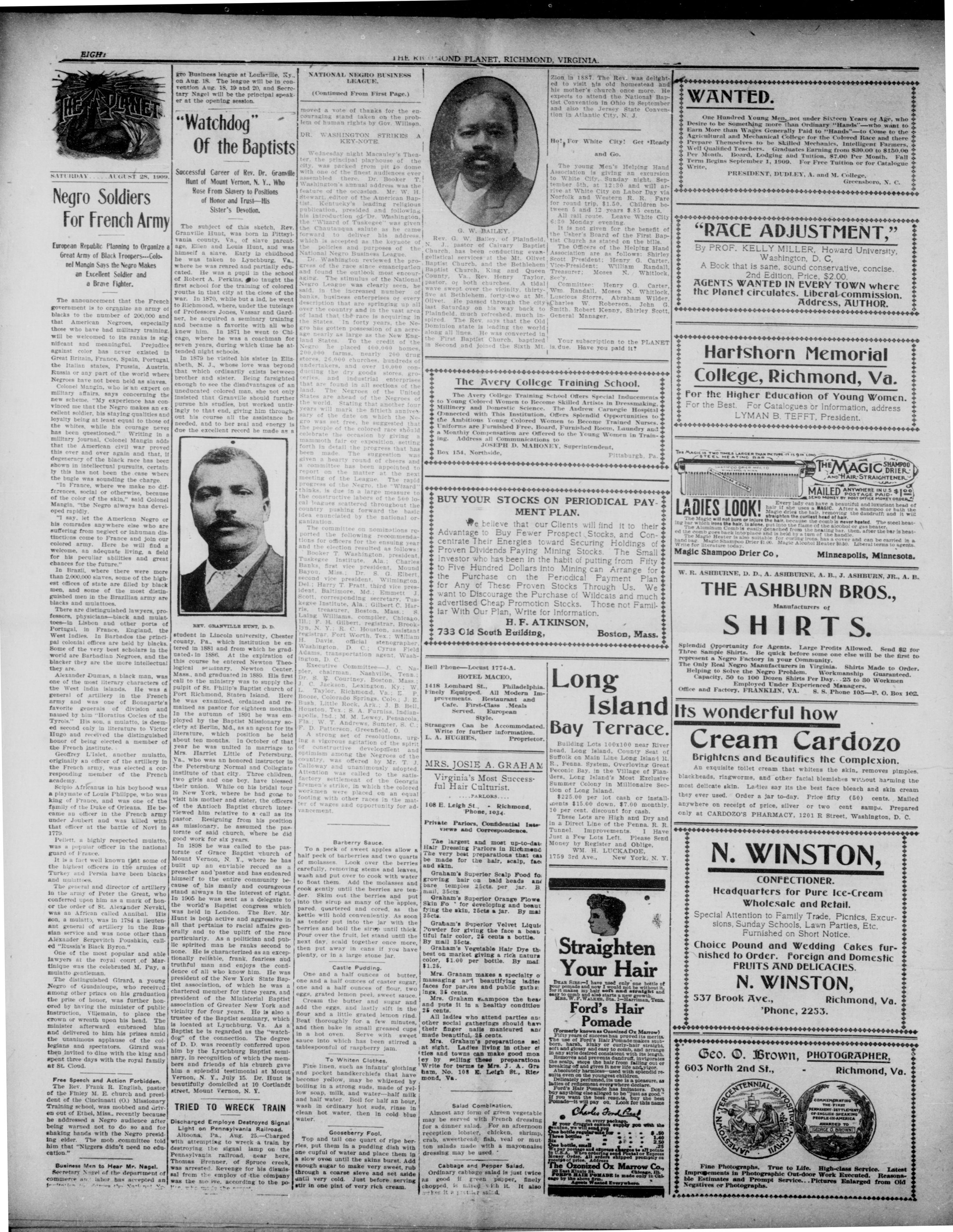
NATIONAL NEGRO BUSINESS LEAGUE.
Special by Thompson's National News Bureau. Louisville, Ky., August 21.—All things considered, the tenth annual session of the National Negro Business League, held here this week was the largest, finest and most profitable of the series, which began in Boston in 1900.
GOVERNOR WILLSON BIDS CONVENTION WELCOME.
The principal feature of the opening day's proceedings was the addresses of welcome on the part of the people of Louisville and the State of Kentucky.
David L. Knight, president of the local Negro Business League, called the first session to order on schedule time Wednesday morning in the auditorium of the Chestnut Street, C. M. E. Church, sald to be the largest church edifice owned by colored people in the State. After a few well-chosen remarks, indicating the cordial sentiments of the community toward the National League, Mr. Knight presented the Hon. Augustus E. Wilson, Governor of Kentucky, who delivered a highly felicitous address of welcome on behalf of the State. Gov. Willison's remarks were pitched on broad lines, and his declaration against the practice of special pleading for the Negro or any other class of citizens—urging that every American be placed on his merits as a man and given a fair and square deal, aroused the convention to demonstrations of approval that constantly interrupted the eminent speaker. Attention was called to the fact that this was the first occasion where the League had been honored with the actual presence of a governor of a State at the meetings held in the various sections of the country. At the conclusion of Gov. Willison's eloquent address, George L. Knox, publisher of the Indianapolis Freeman, endorsed the broad-guaged sentiments expressed, lauded his own State of Indiana for its loyalty to the right in protecting former Governor Taylor, of Kentucky, and
(Continued on Eighth Page.)
CURRENT SPORTING GOSSIP
Johnson and Kaufman Will Fight On September 9th.
Jack Johnson has signed articles to fight ten rounds with Al Kaufman on September 9th at Colma, Cal. The men have agreed that if both are on their feet at the end of the last round there will be no decision by the referee. Edward Smith. Promoter Coffroth has bagged the match after much bickering and believes that the fight will draw big money. Kaufman was willing to fight forty-five rounds, but Johnson demurred. The big negro, who has been travelling at top speed not only in his automobile but also in other ways, refused to meet Kaufman even in a twenty round bout, giving as a reason that he could not get into proper condition for such a mill. But as Johnson is said to be "broke" and as Coffroth held out alluring inducements, the colored champion finally proposed a ten round, no decision affair, which was anything but pleasing to Kaufman. Referee Smith, a well-known Oakland sporting man, says that if either man appears to be stalling or faking he will declare the bout "no contest" and Coffroth will withdraw the purse.
Kaufman is no longer under the management of William Delaney. He has been out of the ring ever since he failed to stop Tony Ross in ten rounds at the Fairmount A.C. several months ago. But as Johnson also found it impossible to hit Ross away in six rounds at Pittsburg later on the criticism levelled at Kaufman soon died out. Kaufman and Johnson are well matched physically. Each stands 6 feet 12-2-2 inches and tips their beam, when at 205 pounds. Kaufman is slow and awkward, but it is a terrific hitter with either hand and easily outclasses Johnson in this respect. The proxio, however, possesses the greater amount of science and experience, and for that reason it is already predicted that no serious damage will be inflicted in the coming bout unless one of the men should happen to hand or chance blow.
morn preparing for the milk though
Johnson wills and audibly* music
music strides the way of conditioning
himself for the fight with Katebola
on October 12. The colored champion says he will not let up in his training between snow and that date and intends to be on the same team shown by him when he whipped Katebola in Australia, last December. Katebola is more than six years younger than Johnson and physical development is fond with him since he has been defeated only once, when he OBrien put him away in seven rounds four years ago. Katebola was a movie then, but he has helplessly so unbelievably officer
PAID IN FULL
Novelized From Eugene Walter's Great Play
That "Paid In Full" is a story of absorbing interest has been proved by its phenomenal success in dramatic form. For two seasons there has been no diminution in the drawing power of this vital piece of realism. In its present form it is not less engrossing. The features which made it so powerful as a play are not less potent in the serial. It is the same keen exposition of human motives put into the simplest forms of expression. There is no waste of material, no attempt to moralize, no break in the continuity. The three men who are the central figures in the story stand out in admirable distinctness from the very first, and the one woman whose splendid rectitude illuminates it all lives from the moment of her appearance. Although it is certain to produce frequent thrills, the story is neither melodramatic nor sensational. Its power lies in its humanness.
CHAPTER I
"N: I'll not give 'em a raise of 3 cents an hour nor of a cent an hour; nary a raise, understand. And I don't want you to come here thinking you can buldoze me, because you'll find mighty quick you're mistaken. If any man thinks he can do that I want to see him."
The words, uttered in a wrathful bellow, came through the closed door of the president's room and were heard by every employee and visitor in the main office of the Latin-American Steamship company, which occupied an entire floor of a big building in Bowling Green, New York city.
Some of the employees smiled and passed the remark that the boss "had 'em bad" that day, but the smiles were of the sickly, apprehensive order, for the fact that he was in excrable humor was perfectly well known to each and all, having been impressed upon them very forcibly at intervals from the minute the great man had made his appearance with his unvarying punctuality as the clock struck 9 a. m. Others scowled and kept their reflections to themselves.
The voices of the other parties to the conversation were not audible to the listeners, but that of the president, with its all penetrating roar, burst forth again:
"I don't give a tin whistle what you or your unions do, understand. Let 'em strike; strike and be d—d. But you tell 'em this from me—that any man who's fool enough to throw up his job does so for good and all. He'll never work again for the Latin-ian can Steenmish company in this or any other port. I'll take care of that. I'll show 'em who and what I am if they don't know."
The door opened, and two white faced, intimidated men emerged, cap in hand. They were rough looking men, evidently laborers inured to the hardest kind of work. They shuffled quickly past the neatly dressed clerks and did not breathe freely until they found themselves in the cross streams of hurrying passersby on the street. There, as they mopped their brows and looked around for a saloon, something of the arrogant insolence with which they had demanded audience of the head of the company and which had been speedily cowed out of them by that formidable and choleric personage returned to them.
Meanwhile at the open door of the room in which they had been through the ordeal of their interview Captain Amos Williams, president and general manager of the line, glared after his departing visitors and round the office. There was dead silence, and every employee, from the highest to the office boys, impudent and impressible there, as everywhere else, save when Captain Williams was nigh, became deeply engrossed in his work.
"Call up Mr. Smith and tell him I want to see him at once," he growled to no one in particular. Then he reentered his room and slammed the door.
In a few minutes, however, his bell rang, and a boy responded to it with an alacrity not customary in any other office in all New York.
"Tell Mr. Brooks to come here," was the order he received.
The boy harried out and approached one of the men behind the brass lattice screens.
"Mr. Brooks, the captain wants you," he announced.
Mr. Brooks did not reply, but he got down leisurely and with bad grace from his stool and moved with equal deliberation to the president's room.
"Brooks, has Fernandez & Co., that Pernambuco firm, been heard from yet?" demanded his employer.
"Check came today," was the leconic reply.
"Full amount?"
"Yes, four thousand eight hundred and seventy-five."
"All right That's all."
Brooks went out, closing the door behind him, and returned to his desk. He was in a bad temper himself and made no effort to conceal it, for a sullen scowl marred his handsome and usually genial face. Not only was Joseph Brooks handsome, but a rather distinguished looking young fellow.
J. B.
EUGENE WALTER,
Author of "Paid In Full" and "The
Easiest Way"
whose clothes saf well and becomingly
upon him, albeit they were somewhat
shiny from wear and from ironing by
inexperient hands at home. And if his
collar and cuffs also were just a trifle
the worse for wear at least they were
immaculately clean.
"Cheer up!" admonished one of his
fellow clerks, noticing his ill humor.
Brooks' moods were never taken seriously,
for with him fits of despondency alternated with a contagious cordiality and an optimism that knew no limit. Of late, however, his spells of gloominess had become wearisomely frequent, and usually they were accompanied by a nervous irritability.
"Cheer up?" he answered, with some heat. "I don't see any reason for cheering up, and I don't feel like cheering up. Did you hear how the brute received those delegates of the Longshoremen's union because they asked him to add a little to their starvation pay to help them keep skin and bone together? Why shouldn't he raise them? Why shouldn't he raise all of us? He's reckening with money, doesn't know what to do with it, yet what does he do but grind us down-grind and grind and grind-grind us as a grain of wheat is ground to powder between the millstones-grind us with his heel, squeezing from us the very sap of brain and life that he may add to his pile?
The clerks near him had listened to this outburst with amused surprise.
"Well," said the man who had addressed him before. "I haven't noticed"
A BAR SERVICE
you sweating blood to any extent under the grinding process."
"Jenkins, you're a—a camel," retorted Brooks. "For a wisp of hay you'd let yourself be loaded till the last straw broke your back, and then you'd lick the hand that crushed you."
"Sure," said Jenkins enthusiastically. "Anybody can load meup that wants to."
"And I'll back his liquid capacity to equal that of any camel," chinned in another clerk, while every one within earshot grinned.
"Oh, you can laugh," grumbled Brooks, "but it doesn't alter the truth of what I say. It's men like him that have made our society today what it is, a soulless, heartless, oppressive civilization in which Croesuses walk roughshod over the men who are down and thrust their deeper into the slough with one foot as they climb higher and higher to the power that the possession of inconceivable wealth carries with it."
"Twas ever thus!" sighed Jenkins.
"But there is yet hope. Our Joseph hath received a call to uplift the downtrod."
"How did he get it? What is his record?" went on Brooks, ignoring the interruption. "Why, he started out as a sealer or a south Pacific trader, which in those days was the same as being a pirate, and you know and I know that his name was a terror to sailmen from San Francisco to Australia. He made his first money by bullying and ill treating other men and killing them, too, on occasion. It's a matter of common knowledge. And he's been a buccaneer ever since. Didn't he bunko and sandbag my father-in-law out of control of this company? And what has he done since then but let the brutal tyrant over everybody connected with it, beating
THE RICHMOND PLANET, RICHMOND VIRGINIA
Copyright, 1908, by G.W. Dillingham Co.
us down to the lowest wage a man can exist on that he may add to his dirty heap, running this office with fist, boot and rope end as though it were his lawless ship and we were his groveling Lascar crew. I hope the longshoremen do strike! They would be doing humanity a service if they'd fill him full of bullets."
"There's a lot of truth in what Brooks says," assented a youthful clerk in low tones, looking around cautiously as he did so.
"Well, after all, I don't see that you've got such a fierce kick coming," observed Jenkins to the disgruntled orator.
"You don't, eh?" sneered Brooks.
"You think $20 a week is big pay for an accountant and collector who's handled half the money of the line for five years, eh?"
"No; I mean that you are at least solid with the boss and sure of your job, which is more than anybody else here is, and that you stand to become an officer high up in the company one of these days. Williams is a friend of your family, isn't he? You yourself have boasted often that he visits you and your wife."
"That's just it. The swine takes advantage of his relations with my wife's people to keep me down and rub it in. Other people get their salary raised, but I don't. Do you call that a square deal?"
"It hardly seems so, but perhaps there's a reason. He may have some object that will appear in due course, and you'll go up several numbers at one swoop. In the meantime" continued Jenkins, lowering his voice "I wouldn't let on like you have this afternoon if I were you, Joe. It can't do any good and might do you a deal of harm. You don't know who might hear you, and the boss somehow knows everything that goes on in the office." "I don't care," affirmed Brooks sulkily. "I'd just as 'lief tell him to his face what I think of him, and by gum, I will one of these days, darn him!" "All right," laughed Jenkins. "I hope I'll be around at the time so that I can perform for you the last sad rite of gathering up your scattered remains. Ah, here's Jimmy Smith!"
CHAPTER II
JAMES SMITH, superintendent of the Latin-American Steamship company's docks, had arrived in response to the president's summons, conveyed to him by the telephone. Smith, known to his familiars as Jimsy, was a tall, gaunt, angular man, bearing all over him the stamp of westerner. He was, in fact, from Colorado, where he began his active career by engaging in mining. Scant success attended his efforts in this direction, however, and after working with the dogged determination that was one of his traits until even his patience was exhausted he finally entered the employ of the steamship company in whose service he had risen to his present position, with headquarters in New York.
There was something about Smith that caused men, and women also, for that matter, to take to him on sight. The unbounded good nature, big heartedness and unselfishness beaming in his blue eyes and in his whimsical smile were written in every line of his clean shaven face. Another thing that made him remarked by all who came in contact with him was his absolute imperturbability. In all his thirty-seven years of existence he never had been known to "get a move on," not even when a premature blast in a mine had sent the diggers helter skelter for safety and carried death and suffering to many. Smith had walked tranquilly away amid the rain of rock and earth until it was all over. Then he had returned and organized the work of rescue, his placidity causing the others instinctively to look to him for direction. Nor was his speech more hurried than were his movements. He spoke but little, and then his words came in a quiet, even distinct drawl. But he "got there" as quickly as most men, and a good deal quicker than some whose nerves were highly strung and with whom rapidity of action was as necessary as breathing, for he was possessed of keen powers of observation and common sense, an earnestness of purpose that gave his utterances weight and an integrity
as unshakable as the rock of Gibraltar. As a fitting, almost necessary, complement of such a nature he was endowed with a sense of humor that added not a little to the attraction he exercised for those who knew him sufficiently well to be able to appreciate his qualities of heart and mind.
He took a calm, all embracing survey of the office as he entered, looked over to Brooks' desk and saluted him with a cordial motion of the hand and instructed a boy to notify Captain Williams of his arrival. He was ushered immediately into the chief's presence. That worthy, who, like his superintendent, was clean shaven, was seated at his desk in his shirt sleeves, and the whole room, despite the wide open windows, was thick from the smoke from an old blackened corncob pipe at which he was puffing vigorously. He was a burly man, and the short, thick neck, the broad shoulders, the powerful, big jointed fingers and the muscles that stood out in bunches on the hairy arms disclosed by his rolled up shirt sleeves denoted that he possessed unusual physical strength. An ugly man to get into an argument with was Williams, one who, it needed no mind reader to judge, would be capable of following the word with a blow that would crush an ordinary opponent
For years, as Brooks had infiltrated, he had led the roughest life a man can lead, hammering by sheer brute strength a way to wealth by ways in which scruple had counted for nothing at all and expediency for a good deal, and his entrance upon a higher plane of civilization had not imparted much polish to his appearance, habits or speech, which were those of the old time sailing ship mariner, although of late years he had striven to conform more closely to the examples of refinement he witnessed in the only polite society he cared for, which was that of the family of his dead friend, Stanley Harris, who was general manager of the Latin-American line when he obtained control of it. He had a way of glaring at a person from under his bushy eyebrows with a scrutiny that seemed to read through and up and down him and made btm most fll at ease under it.
He made his decisions promptly, authoritatively, after the manner of a man accustomed to command and to be obeyed without question, and he never changed them, at least in his business and administrative dealings. Add to all this a voice like a foghorn, the effect of which, when he raised it, was, as he knew full well, to make his subordinates quake and to intimidate others who had to do with him, and it will be realized that he lived up fully to his reputation of being a hard man.
For his quiet, unmovable and thoroughly capable dock superintendent he entertained a certain respect. He knew from experience that the man was not the least bit afraid or even disturbed by his bullying manner and his bellowing and that his glare, always squarely met, had no more effect upon him than it would have upon the bronze statue of Washington which stands sentinel on the steps of the subtreasury in Wall street.
Smith lowered himself slowly and easily into a big armchair beside the president's desk.
"Two delegates from the Longshoremen's union were here just now," announced the captain. "They say the freight handlers are going to strike."
"Ya-as?" said Smith interrogatively. "Yes. What do you know about it?" "Nothing, except that they came to me with a demand for higher pay for the men. I referred them to you."
"Well, I didn't leave 'em any loophole for doubt as to my position in the matter."
"You turned them down?" "Turned 'em down! Of course. What do you think? Suppose I handed 'em a raise on a silver platter and bowed 'em out of the door?" "I don't suppose anything about it. I'm asking for information."
"Them two blatherskites came swaggering and blustering in here and said every last one of the men would quit tomorrow morning at 11 o'clock unless they got 3 cents more an hour. They wasn't swaggering when they went out of here. I tell you. I pretty soon took the starch out of 'em."
A faint smile flitted over the superintendent's face, but he ventured no remark.
"I told 'em." Williams went on, "that I wouldn't give 'em a cent a century more and to strike and be d—d. I also told 'em that any man who did go out would never get another job with this company, and, by Sam, he won't!"
The captain's voice had risen to a roar, and he brought his fist down on the desk with such force that pens and pencils went flying in all directions and the ink splashed from the wells in their solid crystal stand.
"Them labor agitators ain't got no notion of the fitness of things. They ain't got a grasp on economic conditions for a cent. They got to do something to live without working, so every once in awhile they go to the men as parm 'em to be walking delegates, gives 'em some gib talk about their rights and advises 'em to strike for more money. Do they look around and try to find out whether an advance is warranted by the conditions? Nary a look. Do any of the men they hand out their advice to try to find out? Not on your life! They go ahead like a lot of sheep and strike and starve and blame the result on capital."
Smith nodded.
"If they carry out their threat and quit," continued the captain, "you will clear all the strikers from the docks. throw 'em off if necessary, knock their silly blocks off, but tell them as wants to work that full protection will be given. I'll arrange with police headquarters to have a sufficient force of bluecats on hand to guard our property and will also notify our docks at other ports to be prepared. You will fix up accommodations for the strike breakers in the sheds here until the trouble is over and make arrangements to bring men from the inland cities. In this matter you need spare no expense. Understand?" "I guess so," replied the superintendent.
"Then it's up to you."
"Anything else you want to see me about?"
"Not now. You can get in touch with me any time you want me. You know about where I'm to be found." Smith drew in his long legs, raised himself from the chair and took up his hat to go.
"See here, Smith," said the captain, his voice rising gradually to its fearsome bellow, "it's nigh on to twoscore years since I took my first vessel, the Sally Moran, out of Frisco as master and owner, bound for the south sea islands to trade, and I've commanded my own ship every minute since and held my own against all sorts of lubbers as would have done me and done for me if they could. And do you think I'm going to be dictated to by any white livered gas bag of a crawling delegate who comes here holding a knife to my throat by threatening a turnout without giving me a chance to meet it if I don't give in to his demands on the spot? No, sir, not by an all fired sight! No, sir, not in a thousand years! I own this outfit from keel to main peak, and if I can' run it my own way I'll scuttle it and go down with it. Understand? And if any man's looking for a fight with me he'll find me quick enough, and I'll break him, no matter who or what
A
"Yes, sir, by Sam, sir, like this!"
He is, yes, sir, by Sam, sir, like this!
Seizing a thick ruler on the desk, he snapped it without apparent effort, and as he sat glaring there with his disheveled hair, his pugnacious, massive underjaw protruding and his big fists tightly clinched on the broken wood, causing the muscles of his arms to bulge like knots on a gnarled tree, he presented the embodiment of might and ferocity.
"I don't know but what you're right, Cap'n Williams," drawn the superintendent with his unchangeable匀animity. "Anyhow, you sure are entitled to do what you like with your own."
He went out and on his way to the office exit stopped at Brook's desk
"Well, how's things, boy?" he inquired with an interest so kindly that one might have thought there was nothing else in the world with which his mind was occupied and never could have suspected that there lay before him for immediate solution the problem of preparing for a great strike that threatened to tie up the business of one of the most important steamship lines in the country, with ramifications extending from Boston all around the coast of South America to San Francisco.
"Oh, so, so," answered Brooks. "By the bye, I'd be awful glad if you'd come up to supper tonight. Emma was saying only this morning that we hadn't seen anything of you for a week."
"That's so. I've got to square myself with Emma, though it hasn't been my fault altogether."
"Then we'll expect you to supper?" "I can't promise, because I've a deal to do between now and this evening, but I'll come if I can."
"So long, Jimsy."
"So long."
And Smith sauntered out to attend to one of the greatest emergencies he had ever been called upon to meet in his life.
CHAPTER III
H E was a skillful architect indeed who first devised the bandbox apartment houses so
If there were any flats in Harlem of smaller dimensions than the one of four rooms occupied by Mr. and Mrs. Joseph Brooks the most experienced and persistent hunter after a place in which to lodge his family with relative economy and some semblance of comfort would have had the time of his or her life finding it. And if other flats there were more luxuriously fitted up, as easily might have been—if fact, certainly must have been—the case, at least there was none, whatever its size, that was kept cleaner or neater in which more effective use of available material had been made than that over whil' Mrs. Emma Brooks presided as mistress and facto-tum.
And Mrs. Brooks herself—how she graced it, altogether unconsciously! As the elder of two daughters of Stanley Harris, who, while not rich, had been well to do, she had been brought up in the comfort of a good home and had enjoyed the advantage of an education at a private seminary. Her father, whose constant companion she had been and whose sense of democracy in the matter of association she had inherited, had adored her, and when she had given her heart to Joseph Brooks, electing him from among numerous suitors, including James Smith, he gave his consent to their union against his own judgment and in face of the strenuous opposition of his wife, esteeming the girl's happiness superior to all other considerations.
Brooks, who had been in the employ of the Latin-American Steamship company for one year and had been brought into relations with the family by virtue of his selection as secretary to her father, the general manager, had no means whatever of his own, and his salary, then $60 a month, was a desperately small income on which to begin housekeeping for a girl reared as she had been. But her father helped them, and the young couple counted upon his influence to procure the advancement of his son-in-law to a more remunerative post.
Unfortunately for them, however, Mr. Harris had died a few weeks after their wedding, and they found themselves down upon their own resources. Mrs. Harris, a selfish, shallow, unfeeling woman with social pretensions, who regarded her daughter's marriage with the young clerk as a mesalliance and Brooks himself with disdain, left them to shift for themselves and with her other daughter, Beth, who was seven years younger than Emma and shared her mother's views, as she imitated her haughtiness, settled down to the enjoyment of
The modest fortune her husband had left her and the indulgence of the ostentation she loved, but which during Mr. Harris' lifetime she had never been able to gratify to the top of her bent. She did not for this, however, withdraw altogether from association with Emma and Brooks and continued on more or less amicable terms with them. Now and then she condescended to call upon them with Beth, but her visits, as a rule, were a good deal of a trial to the young couple, for she regarded Brooks' failure to get on in the steamship company as a vindication of her opinion as to his ability and the jadiciousness of their marriage and was prone to condone with her daughter, assume an exasperating I-told-you-so attitude and lament what might have been.
During the four years of their married life Brooks' salary had been raised only $20 a month, although in addition to his work as accountant, to which he had been assigned after Mr. Harris' death, that of collector had been thrust upon him. It had been a hard, bitter experience for pretty little Mrs. Brooks, this unacustomed drudgery of housework, this continuous scouring of greasy pots and pans and washing of dishes, which she loathed; this deprivation of comforts and luxuries that she had known all her life; this privation of many personal things considered indispensable by the dainty woman; this necessity of perpetual rigid economizing, which barely sufficed to make both ends meet. She deprived herself of much needed clothing, to say nothing of finery, that Joe might go properly clad to his office, but she never for that reason descended to slovenelliness, never "let herself go," as so many women in their own households make the mistake of doing, and never had she allowed one word of complaint, one indication of regret, to escape her. She had married Joe for love, for better or for worse, and resigned herself bravely and cheerfully to the consequences, however hard to bear, hoping for the better times that were so long in coming and encouraging her husband to fight on and win.
Joe, for his part, lacked his wife's grit and energy, and constant disappointment had undermined his fortitude. He loved Emma. He hardly could have done otherwise, though calculation had entered largely into his courting of her. Chivalrously, while the sweet bliss of their early married life held him in its spell, he had done as much of the heavier work of the menage as he could to spare her when time and opportunity afforded, but very naturally he had soon tired of this—where is the man who does not?—and by degrees had left as much of it as he could to her, except when his moods of optimism and affectionate solicitude impelled him to go to her assistance. At such times he wanted to do it all.
On the evening following his outburst at the office he was still resentful and "down in the mouth" when he let himself into his little flat, and the smiles of his wife as she raised her rosebud lips to receive his kiss of greeting failed to dispel his gloom.
"You seem out of sorts tonight, dear," she said solicitously. "Anything go wrong at the office?"
"Nothing in particular. I'm tired and hungry after slaving all day in this awful heat, that's all."
"Never mind, supper's all ready, so sit down and tuck in."
"What did you get?"
"Chops and potatoes."
Joe turned up his nose, but took his seat at table and began to ent. He answered his wife's questions in monogynables. His thoughts, it was plain, were not on his meal or Emma's conversation, and, seeing that he was preoccupied and troubled, she ceased to try to engage his attention.
* "I paid the gas bill today," he vouch-safed at length, "Ninety cents more than last month."
"Ninety cents more!" she commented with concern. "I'm sure we didn't use half as much. And we owe the butcher four-sixty."
"Every month it costs more to lye. I don't know what we are going to do, I am sure."
"I'm sorry, Joe. Goodness knows I try to be as economical as I can."
"I know, but it's all wrong. It's all wrong that you should be spooling your hands with those beastly greasy pans. They weren't meant for such work. I wish we could afford a hired girl."
"So do I, but we can't, so what's the use of wishing? Didn't you get the raise you asked Captain Williams for?" she inquired.
He hung his head and lapsed into gloomy silence. She dropped the morsel she was raising to her mouth and rose from the table, filled with dismay, her appetite completely gone. Tears of disappointment followed the realization of what the failure of their plans meant, for neither had doubted that his request would be compiled with, and she had built many castles in the air on the strength of it. A few dollars more a week added to their distressingly small income would have meant much to them. But, gazing at her husband slitting there utterly dejected and crushed, her heart went out to him in pity and love, and she moved over to his chair and put her arm consolingly round his neck.
"Never mind, Joe, boy," she urged; "don't look so solemn. We're no worse off than we were before, and you'll win out some day."
She placed her hand under his chin and raised his head to kiss him. He saw that she was smiling at him encouragingly through her tears, but refused to be comforted. "I made out the payroll today," he said. "Three other men in the office who also asked for a raise last month got it; so old Smith." "What, Jimmy?" she asked.
"I said Smith. There's only one Smith in the office," he replied some what surlyly.
"Well, I'm glad for Jimsy's sake he got what he wanted."
"I think he told Williams to come across with more money or he'd quit."
"How much did he ask for?"
"Eighteen hundred."
"Eighteen hundred? My gracious isn't that fine?"
"It means that he'll be getting near ly $5,000 a year now. Great for him isn't it?" "Yes, indeed it is."
Yes indeed it is.
"I saw Jimsy today. Asked him to come to supper. He said he would if he could."
"I wonder why he didn't?"
Her husband did not answer immediately. When he did he burst out savagely:
"Suppose he thought we couldn't afford it. Two don't eat as much as three."
"Why, Joe, how absurd!" she laughed, beginning to gather up the supper plates. "Jimmy knows it's pot luck."
"That's the trouble. Jimmy knows-your mother knows—Williams knows—everybody knows, and they're always talking about how you've got to work and slave because you married me and all that sort of stuff."
"Jinsy doesn't."
"Well, he thinks it, and your mother's always rubbing it in, harping on the same old string—that I ain't worthy of you, that it's a shame the way you have to work and slave, that I don't seem to get along at all and that you"—
"Oh, don't mind mother; you know her."
"She never did want us to marry."
"But dear old dad did, and he was the one I wanted to please—after you, Joe, of course. Mother is just a bit peculiar. I'm sure she doesn't understand me much, and I'm equally sure that I don't understand her, so we won't bother about her. Just sweep up a bit, will you, you, I wash the dishes!" Jinsy may drop in by and by."
Brooks went into the kitchen, donned an apron from force of habit instilled into him by his wife, ever careful of his clothes, and reappeared with a carpet broom and a dust cloth. He was laboring under excitement, as was manifest by the reckless manner in which he used the broom. Finally, with an expression of determination, he said in a firm voice: "Emma, you know it will be six months or a year before I get another chance at a raise—unless, of course, I quit and get a job somewhere else. I was thinking that perhaps you're tired and want to call it off." "Call what off?" "Why, everything—the whole business. I mean our marriage," he said desperately. Her eyes opened wide with incredulous astonishment. "You mean separation?"
"That's exactly what I mean."
"What for—because I'm tired?"
"Something like that."
"What an idea! You must have the blues badly to talk such nonsense as that. Don't you think it would be as well to wait until I complain?"
"You have complained."
"No—at least I can't remember."
"Not in words, but"—
"But what?"
"Look here," he said impatiently.
"don't you suppose I have eyes? Don't you suppose I have feelings? I've seen—I know that you're sick of this drudgery and all the rest—sick of it and sorry. There's Smith with his five thousand—he wanted you first. You could have"—
She interrupted him sharply, her face fushing.
"Joe!"
"Well, I think"—
"That's enough of that!"
"Oh, well," he declared sullenly, turning away and dropping into a chair. "I didn't mean"—She followed him and placed her hand on his shoulder. "Joe, I married you because I loved you," she said gently, "and for nothing else in the world. There wasn't any influence except that, and that overcame all the rest—mother and all of them." "I know all about that." "There has been a little hard luck"—"There has been a precious sight too much of it." "I know you haven't been treated right, but bad luck and ups and downs are what a woman ought to expect when she marries. She has to take the bad as well as the good, and she ought to know enough to accept the one as cheerfully as the other when the bad is nobody's fault. That is
KARL
"Joe, I married you because I loved you."
what I think, and that is what I have tried to do. But there are some things"
"She paused, reluctant to carry her thoughts further into words.
"What? You may as well say all you've got to say while you're about it" he snapped.
"It's just this," she went on. "Never refer to Jimmy in the way you did. I married you, Joe. Please try and leave unsaid things that might make me regret it."
He ventured no further remark and lapsed into his gloomy reflections. Emma put her arm around his neck and snuggled her face against his.
"Poor old boy" she murmured. "That setback we got today when we had it fixed up was enough to make
THE PLANET
SATURDAY.....AUGUST 28, 1909
feel sore and glum. Never mind; cheer up. You know what Jimsy says, "Hard luck can give you an awful battle, but if you're on the square you can hand it a knockout punch some time." It was no use, however. Joe's sulkiness had sunk in; his temper was vicious, deep and ingrowing, a temper such as she had never suspected in him, and all her petting, all her loving coaxing, could not wean him from it. She pressed her cheek more closely to his and fondled him, but he jerked away from her embrace, and sullen sought another chair. As he did so the bell rang from downstairs. "Til bet that's Jimsy now," he muttered. Much hurt, but disguising her feelings, Emma hurried into the kitchen and pressed the button that opened the entrance door of the house.
*(To Be Continued.)*
Ideal College For Negro Youth
Virginia Seminary at Lynchburg Has the Most Extensive Elective Course of Any School of Its Class in the South. New Building to Be Erected For Young Women.
Virginia seminary and college at Lynchburg, Va., was organized by Afro-Americans in 1887 for the education of the young men and women of the race. Among its early promoters was the Rev. P. F. Morris, who made many sacrifices for its success. The school started without either money or property, but by the thrift and economy of its directors and the hearty support which it has received from the race it now has six and one-half acres of land and buildings valued at $70,000. Gregory W. Hayes, late president of the college, was one of its greatest benefactors. The faculty
J. H.
PRESIDENT J. R. L. DIGGS. is composed of well trained men and women who are doing creditable work in their sphere. There were 300 students in attendance during the past year, and a much larger number is expected the coming session. The courses of study are modern and of a very high grade. The work is so arranged that by means of systematic lectures and text book work a very thorough training is given to all students. The required work for the bachelor's degree is quite the equal of the requirement of any northern college.
The faculty is very positive in its opposition to the loose and careless way in which degrees are conferred by southern and some northern colleges. The teachers have voted to do away with all honorary A. B., A. M. and Ph. D degrees, though only the A. M. degree has been conferred in the past as an honorary degree in a few rare cases. The board of trustees has voted to require a thesis even for the degrees in divinity, though it is hoped that but few of these even will be granted. Virginia seminary and college urges all Negro schools through their presidents, faculties and boards to join hands and put a stop to the shameful prostitution to which learned degrees have been subjected by some of the schools. The thing puts a discount on Negro education everywhere and gives the propaganda for industrial education as the sole and only need of the race, all the power it has with some honest and conscientious people. Both kinds of education are necessary.
At the commencement this year twenty-two finished the literary courses and eight theological courses.
The women of the Baptist educational convention have undertaken to erect a $25,000 building for young women. This is a noble undertaking. They voted $300 as a nest egg and decided to raise by personal work, subscriptions, parlor entertainments and the like $2,000 by June, 1910. Young women of good reputation without regard to denomination are welcome.
The new women's building will be named the Mrs. B. F. Fox building and will thus be a worthy tribute to one of the finest types of character in all America. Contributions for this work may be sent to Mrs. B. F.
Fox, Salem, Va.;
Rev. W. F. Graham,
Richmond, Va.
or to the
president, J. R. L.
Diggs, Lyneburg, Va.
If the friends of education will help us the building will be ready for use by May, 1911.
JOHN H. BROWN
The ideals of the school are very high. It has
REV. W. F. GRAHAM, very high. It has the most extensive elective course of any Negro college south of Pennsylvania. This seems a strange statement, but if strange at all it is strange to those who have not examined the matter for themselves. This refers to the literary work alone, and it is correct.
The regular session will begin Oct. 1 next and close June 1, 1910. The school is a distinct example of self help on the part of the Negro people. For twenty years they have raised from $7,000 to $12,000 annually for the support of this work. They have built up an institution whose increased usefulness and power merit a larger support.
SABBATH SCHOOL MISSIONARY
Excellent Work of a Young North Carolinian in the Uplift Movement.
There is a great tidal wave of sympathetic helpfulness which has given new manhood in the south among Afro-Americans. The environments of millions of Afro-Americans in the south have caused a number of young men who have the physical strength, consistent training and moral stamina to work for the uplift of a large number of the Afro-American folk whose feet are fettered by ignorance. The church among people of color, especially in North Carolina, is somewhat becoming institutional and is working to redeem the people out of their woe and want. The Sabbath schools of the various churches in the south are rapidly becoming a sympathetic social movement that will eventually become a glory of this age. In the eastern section of North Carolina there is a young man who is an ardent disciple of the new spirit that demands forbearance and mutual sympathy and the identifying of oneself with those who are hedged in by ignorance and sin. This young man is Professor William H. Jackson of Newbern, N. C., a native of South Carolina. He is a graduate of Brainerd institute, Chester, S. C., and Lincoln university and specialized at Lake Geneva, Wls., and Chicago. During the years of 1902-3 he was instructor of Latin, algebra and music at McClelland academy, Newman, Ga. Imbued with a spirit of higher helpfulness, he enlisted in the Sabbath school forward movement and is doing excellent work as Sabbath school missionary in the Cape Fear presbytery of the state of North Carolina.
GOOD CHEER FOR THE AGED
Thoughtful Clubwomen Brighten Lives
At Old, Folks' Home.
The reception which was tendered the inmates of the Home For Aged Afro-Americans in Brooklyn, N. Y., by the members and friends of the Victoria Earle Mathews club recently was a very pleasant affair. Much credit is due Mrs. M. J. Zeno, who suggested the idea to the club of making such a visit to cheer the old folks in the home and let them know that, although shut in by age and general debility, they were not forgotten. Mrs. Annie Johnson, the retiring president of the club, has done a creditable work and is held in high esteem by the members. Aside from singing, those who took part in the program were Mrs. M. E. J. Parker, Mr. Pierre Zeno and Mrs. Annie Johnson. A paper entitled "What Music Is to the Soul," by Miss R. F. Martin, sparkled with bright thoughts and happy illustrations. Mrs. M. C. Lawton delivered a helpful address on "Silent Influences."
the exercises the the beautiful dining room, where an excellent collation was served by the ladies of the club, and all had a most pleasant social afternoon. The home, a splendid two story brick building, with all modern improvements, is located on the corner of Kingston avenue and Douglass street, on a
At the close of the exercises the guests repaired to the beautiful dining room, where an excellent collation was served by the ladies of the club, and all had a most pleasant social afternoon. The home, a splendid two story brick building, with all modern improvements, is located on the corner of Kingston avenue and Doug-
MISS R. F. MARTIN.
very beautiful and excellently kept plot of ground. At present the garden is in a most flourishing condition, containing all of the vegetables of the season. Beautiful flowers, potted plants and trailing vines delight the eye. The rooms are light, alary and cheerful, and everywhere the spirit of contentment and satisfaction pervades. The matron, Mrs. Letitia C. Partridge, is a woman of charming personality and exceptional congeniality. The inmates are all attached to her. For many years the King's Daughters' Circle of Willing Workers has been a substantial benefactress to this worthy institution. At present there are twenty-seven inmates in the home, four of whom are men. The following are the officers of the Victoria Earle Mathws club: Mrs. Sylvia Carter, president; Mrs. E. E. Kelley, vice president; Mrs. Cordelia Harris, corresponding secretary; Mrs. M. E. Hardy, treasurer; Mrs. Matilda Hazel, chaplain; Mrs. Roberta Lawrence, chairman of committee on entertainment; Mrs. M. J. Zeno, adviser.
DESERVING PROMOTIONS.
Administration Gradually Recognizing Worth of Afro-American Employees. It looks as if the shaking of the political plum tree had begun at Washington and that a few of the many deserving Afro-Americans in the departments are being recognized. John T. Howe of the treasury and Ernest R. Gaither of the internal revenue office have been advanced from $500 to $720 per annum, and Shelby J. Davidson.
THE RICHMOND PLANET, RICHMOND, VIRGINIA
who has had charge of the tabulating machines in the office of the auditor for the postoffice department, goes from $1,400 to $1,600 per annum. Willis B. Mitchell of the government printing office is promoted to $840, and Mrs. Martha Trammell, from the register of the treasury's office, goes to the sixth auditor's office as a money order assorter at $600.
Trouble Ahead In Maryland
The new law in Maryland which aims to disfranchise all Afro-Americans of voting age is destined to work havoc in the political ballwicks of that state. Three prominent Afro-Americans, one a practicing lawyer at Annapolis, have begun suit to test their right to vote, and there are scores of others who will do likewise.
Target Work Of Uncle Sam's Big Ships
THESE are the days when Father Neptune is nursing a severe headache and the mermaids have gone abroad to take the rest cures, for Uncle Sam's giant battleships of the north Atlantic fleet are out at sea, thirty miles off the Virginia capes, where for some time they will practice drilling and target practice. The cost of this work is one of the heavy items that go to make up that huge naval budget that is often a cause of annoyance to those who fail to see the need of a big navy, but the officials take the position that no amount of money, no matter how great, is wasted if it results in giving the navy's marksmans the skill that wins battles. Without this certainty the whole establishment is rendered useless.
One day on a battleship during target practice is enough to bring home to the layman an appalling idea of what a modern naval battle must be. All being in preparation, the ship steams around past the target into the range. The first guns fired are generally the smaller ones, the Colts automatic and one pounders. Two of these can fire at once—that is, each trip across the range, a distance of 1,900 yards. The Colts are very dangerous guns and fire 250 shots per minute. The smaller guns of the main battery, four, five and six inch, are next fired. It is among this class of guns that all the competition and enthusiasm are worked up, for they are the more numerous and the records necessarily harder to break. When the six inch open up every one knows target practice is being held and gets interested.
For noise and heat the six inch are about the worst in the navy, for they are the largest guns out of a turret. The crews have no protection from the muzzle of the gun unless the gun port is very small leading into the gun deck, but they are not small. The crew must face all the jar and rush of heat as best they can. A spar deck gun is altogether unprotected, and the only refuge for the crew is to get as near as possible to the breech. All stuff their ears with cotton, for the report would break the eardrum were it exposed. The eight and twelve inch guns are next fired under the same conditions as the five and six inch. There is not so much team work necessary in manipulating these since most every-
JUST AFTER A GOOD SHOT.
thing is done by mechanical power. The ammunition is put upon a car by the men in the handling room under the turret; it is raised by an electric hoist and rammed into the breech of the gun by an electric hammer. All that the members of the crew do is turn small levers, somewhat as a motorman on a street car. Of course the two pointers must keep the two guns on the target. One attends to the elevating, the other the training. The plug must be opened as quickly as possible with the large operating lever, which is about the most difficult task in the turret. This does not mean that there is no skill required in effective work with these guns, for there is a great deal required. The percentage of hits made is much less than with the smaller guns, owing to the incumbrance of the details. The crew is usually composed of men of mechanical skill.
The firing of the big guns jars the ship a great deal and does some damage to small furnishings if precaution is not exercised. The concussion is tremendous. Were it not for the thickness of the turret walls no man could stand close enough to the gun to sight and fire it. As it is, the close little rat trap of a turret resounds and trembles in a frightful manner. To those within the whole earth is in an uproar. They feel secure, however, from every danger except a flareback. This is a lingering flame in the tube of the gun which leaps out at the breech when the plug is opened. A flareback sometimes ignites the fresh powder charge coming up on the hoist, blows everything in the turret to pieces and bursts
In an address to the officers of the battleship fleet upon its return from its world girdling cruise Roosevelt strongly recommended practice with the big guns in stormy weather, and their efficiency while the ships are rolling heavily will be given a thorough tryout before the combined squadrons again return to port.
EQUINE HEADWEAR
Of Course the 1909 Styles Include the Peach Basket Variety. The number of horses prostrated in hot weather reaches well into the thousands every year, and in many cases the animals might have been saved had their owners or drivers been careful. When horses first began wearing hats it was considered something of a joke, but it is now well known that they are a great protection on a hot day. In fact, the So-
NATIVY AND INEXPENSIVE
cties For the Prevention of Cruelty to Animals claim that horses wearing one of these brain protectors is never prostrated. This year the styles of equine headgear are almost as numerous as those affected by milady, and even one of the new peach basket variety has been seen on a big Percheron or Clydesdale, but greatly reduced in size, of course. Probably the most popular
SOME DRIVERS PREFER A SPONGE ONLY.
horse bonnet today is the panama, and it is the kind chosen by many owners and drivers because the crown is high and permits the circulation of air over the top of the head of the animal. Others on the market are the Boston, the Gainsborough, the New York, the "Merry Widow" and the Philadelphia, and no expense is spared by the manufacturers in keeping up to date on the fashions in horse millinery.
YANKEES VERSUS JAPS.
An American College Baseball Team
Will Play a Nine in Japan
Will Play a Nine in Japan.
Much interest is being manifested in the trip to Tokyo, Japan, of the baseball team of the University of Wisconsin, where the Americans will engage in a series of ten games with the team of Kelo college, one of the leading educational institutions in the Land of the Rising Sun. The Yankee team has in its possession a letter from President Taft, addressed to the United States ambassador at Tokyo, in which the president expresses his approval of the trip and asks that our
GROUP OF KELO COLLEGE PLAYERS.
representative tender every courtesy
possible to the college boys from the
Badger State.
The members of the team represent twelve Wisconsin cities. Dr. Charles McCarthy, Ph. D., '01, of the state legislative reference library, will be the official representative of the university on the trip. Genkwan Sibata of Toyama, who won special honors in political economy at the university last June, will be the business manager, and Edwin C. Jones, '07, Portage, will be the official reporter.
Loved Her Lots
"I don't blame Miss Rockland for cutting you," said Miss Pepprey. "Your interest in her was purely mercenary." "Not at all," replied Mr. Forchen-Hunt. "I love her lots more than she gives me credit for." "You're mismeten. She gives you full credit for the amount of your love for her lots."—Philadelphia Press.
Hollyhocks
The hollyhock resembles a tall modest maiden. The air of aloofness and aristocratic sufficiency vells beauty and charm. Friends have told me of fragrant hollyhocks, but I have yet to meet one, while knowing full well that with a generous supply of honey and nectar there should be perfume hidden deep in the heart of the flower.
Measuring Brains.
The cephalic index of old Athenians was a wee, wee bit better than ours. Cephalic index means volume of brain. It is found by filling a skull with peas and then measuring them. Ancient Athenians have a few peas on us. The Greeks never lusted bloodshed like the Romans and some of us modern.—New York Post.
Too True.
A four-year-old child at once delighted his quick-witted parents and touched a deep truth in his unexpected rendition of the hymn line written: "Love is meek and thinks no wrong." "Love is weak and things go wrong," the piping treble invariably shrilled.
Good:By to His Money
Prof. Stone—"To the geologist a thousand years or so are not counted as any time at all." Man in the Audience—"Great Scott! And to think I made a temporary loan of ten dollars to a -man who holds such ylews."
Buzzed Both of Them
Magistrate—You say you are innocent. How do you explain the fact that you were found near the scene of the robbery with the stolen property in your hands?" Prisoner—"That's what's puzzlin' me, too, yer worship." —Stray Stories.
Comment by Bachelor Cynic
"Don't propose to a girl until you have known her for a year," says a woman philosopher. Merit of this advice probably lies in the fact that a man who waits that long is in no danger of being married—Exchange.
Her Discovery.
A fair maid from the city saw a queer thing on a tree; she said: "Oh, ain't it pretty? Whatever can it be?" With a parasol she poked it—to her beauty's ruination, for alas it proved to be a hornet's habitation.
Has - Steady Job
"I think a loafer is about as bad as an ordinary hobo." "And I think he's worse. A loafer moves around a little, but a loafer stays in the same town and works the same woman for his handouts"—Cleveland Leader.
Rehearsals Well Attended
"In your amateur theatricals do they really kiss in the love-making scenes?" "In the public performances of course not! What would people think! Only at the rehearsals!"—Boston Globe.
"Botheracious."
"De fact dat kickin' don' accomplish much," said Uncle Eben. "is proved by de climate. Folks has been Sudin' fault wif it ever since I kin remember, an' it jes' as botheracious as ever."
Wise Plan.
"Learnin' by experience is convin-
in'," said Uncle Eben. "But as is de
case wif toadstools an' mushrooms,
it's mosly de wizes' plan to be satisfied
wif hearsay evidence."
Thought It Was Raining.
"Some men," said Uncle Eben,
"can't lay by a little money for a rainy day without bein' fooled by de fust sprinklin' cart dit turns de corner."
USELESS ADVICE
"I would advise you," said the doctor, "to avoid drinking coffee."
"I do," replied the patient.
"I do," replied the patient. "I board."
Different Grades.
Feminine tempers may note,
Are like cigars, my child;
Some are medium, some are strong—
And some are very mild.
"Everybody thinks that Amelia is such a sweet girl, and I can't see it."
"You can't? Why, man, her father made a big fortune in the sugar busi-
ness."
When in need of a good, live, up-to-date newspaper, subscribe for the PLANET.
9:00 A. [Fast daily trains to Old Point,]
and
9:00 P. [Newport News and Norfolk.
7:00 A. [Daily. Local to Newport. News.
8:00 P. [Daily. Local to Old Point.
2:00 P. [Daily. Louisville, Cincinnati, Chica
and
2:00 P. [go and St. Louis Pullman.
8:00 A. [Daily. Ch'ville, sxc. Sun, G. Forge.
6:15 P. [Week days. Local to Gordonville.
8:15 P. [Daily. L'Burg. Lexington, G. Forge
6:15 P. [Week days. To Lynchburg.
Local from East.-8:45 A. M. 8:15 P. M.
Through from East.-11:45 A. M. 7 P. M.
Local from West.-8:30 A. M. 7:45 P. M.
Through-7:30 A. M. and 8:45 P. M.
Jamison Beach Lakes 8:30 A. M. 6:50 P. Daily
*Daily Express Sunday.*
LINCOLN
HAIR POMADE
MAKES
KINKY
HAIR
SOFT
REMOVES
DAMDRUFT
KEEPS
HAIR
FROM
BREAKING
OFF
LINCOLN
HAIR POMADE
KEEPS
SCALP
FRESH
CLEAN AND
WHOLE-
SOME
MAKES
HAIR
GROW
LONG AND
LUXURIOUS
WHICH WAY WOULD YOU RATHER HAVE YOUR HAIR-SOFT AND
LONG SO THAT YOU CAN PUT IT UP IN THE LATEST STYLE
OR SHORT AND KINKY
A WOMAN'S JUST PRIDE IS HER
HAIR. TO STRAIGHTEN OUT THAT KINKY, CURLY HAIR, PUTTING IT IN THE MOST PERFECT CONDITION TO BE COMBED INTO ANY SHAPE JUST TRACE A BOTTLE OF LINCOLN HAIR TOWARD
SHAPE JUST TRI A BOTTLE OF LINCOLN HAIR POMADE.
There is no other preparation on earth to equal Lincoln Hair Pomade in producing soft, beautiful hair. Lincoln Hair Pomade is a natural hair cleanser—a natural promoter of growth and naturally reduces the hair to a straight and combable condition; but also supplies the air with a silky sheen and gloss. No matter how rough or heavy your hair is now, no matter how hard or curly it may be, the use of Lincoln Hair Pomade will give you hair that can well be the envy of others. Lincoln Hair Pomade is the only highly recommended preparation for this purpose on the market.
It is Lincoln Hair Pomade you want, so refuse weak and inferior substitutes. Do not take anything that is claimed to be just as good, but insist on getting the genuine.
The Lincoln Pomade Co.
NORFOLK, VA.. U. S. A.
Agents Wanted Everywhere. Write for particulars. If your dealer does not keep it. send 20 cents in stamps or silver to THE LINCOLN POMADE CO. Department B. Norfolk, Va. and we will send you a bottle by return mail.
The Hawkins-Price Co. Hair Growers and Restorers.
(TRADE MARK REGISTERED.)
Carries a full line of natural human hair-braids, bangs pompadours and the latest styles in black, brown, gray and mixed gray. Those desired es to match the hair must very size in stating expli vive colors desired. It is ways of coloring all sample of hair if possible, so that we may be in a position to match it correctly.
Prices: Braids, (natural al hair) $2.50; All round Pompadours
(nautral hair), $4.00; Front E
This preparation has been proved to be a
unally place it in a sphere all of its own, a
speak of a consummation of its nationality
throughout this and other States and a
colored people in this immediate commu-
nity.
In order to once the most aksome
HAWKINS PRE-HAWKINS preparation in print the photographs of those giving
preparation and are to-day among the manu-
We do not device the correspondence of a natural and p-
would not hesitate to remove the manu-
We will just here remind the public the
national patient rights on our hair prepara-
turn responsible to the government for home
in interest of all of city orders. Money
on Clean Temples or Bald Heals where he is.
The Face Beautifier makes the use of
hairless. Sale Price, $25 and $9 cents and $1
is interested all out of city orders. Money
or Express Money Order.
HAWKINS-PRE
Phone 4601
Correspondence St
(nautral hair), $4.00; Front Pieces (nautral hair), $2.50.
This Preparation has proved to be a fortune to many of the unfortunate, who are to-day delighted with its wonderful results. The merits of this great hair preparation naturally arise from the splendour all of its own, and the glowing terms in which our patrons speak of it, reassure us of its history results. We can well boast of a large patrouille throughout this and other States and of the commendation of the very best white and colored people in this immediate community.
In order to convince the most skeptical readers of the merits and results of the HAWKINS PRICE COMPANY AND RESTORER, we will from time to time produce in print the photographs of our permission to do so, who have used our preparation and are to-day among the many genuine qualities. We do not desire the correspondence of those expecting a miracle or anything unreasonable. Our preparation is a natural and pure compound, the ingredients of which, we would like to put print.
We will hasten here to public that the United States Government has placed national patient rights on our hair preparation by which it is permitted, and we are in turn responsible to the government for honest methods and square dealing. We will positively remove Dandruff. Cure the Scalp of all Impurities, Restore Hair on Clean Tissue. Heals where hoe Roots are not Dead. Price, $3 per box. The Face Beautician Heals where hoe Roots are not Dead. A charge of ten cents extra is imposed on all out of city orders. Money can be sent by Post Office Money Order, or Express Money Order. Address all communications to
HAWKINS-PRICE COMPANY,
616 N. 1st St., Richmond, Va.
Phone 4601.
Correspondence Strictly Confidential.
RAILROADS.
ASHLAND ACCOMMODATIONS - WEEKDAYS.
Leave Elba Station - 7.30 A.M. 1.45 P.M. 6.30 P.M.
Arrive Elba Station - 6.40 A.M. 10.40 A.M. 6.30 P.M
* Daily, † Weekdays, ‡ Sundays only. All trains to or from Byrd Street Station stop at Elba. Time of arrivals and departures not guaranteed. Read the signs.
ONLY ALL RAIL LINE TO NORFOLK.
ONLY ALL RAIL LINE TO NORFOLK.
Schedule in Effect April 11, 1999.
Leave Hard Street Station, Richmond Dow-
land. For Norfolk - 4:00 A. M., 3:00 P. M. and 6:00
P. M.
For Lynchburg and the West - 9:00 A. M., 12:10
P. M., 9:00 P. M.
AIRDRIE RICHMOND.
From Norfolk - 11:45 A. M., 6:50 P. M.
From the West - 7:00 A. M., 2:55 P. M., 8:15
P. M.
Pullman, Parlor and Sleeping Car. Cafe Din-
W. B. BEVILL.
C. H. BOSLEY,
Gen. Pass. Agent.
District Pass. Agent.
ATLANTIC COAST LINE
TRAINS LEAVE RICHMOND DAILY.
For Florida and South: 8:15 A. M. and 7:25
P. M.
For Norfolk: 9:00 A. M., 8:00 P. M. and 6
P. M.
For N. and W. Rp., West: 9:00 A. M., 12:10
and 9:06 P. M.
For Petersburg: 9:00 A. M., 12:10 9:30
P. M.; 9:06 P. M., 9:30 P. M.
For Goldbore and Fayetteville: 9:30 P. M.
Trains arrive Richmond daily: 5:10, 7:00 A.
M., *8:35 11:45 A. M., **10:45 A. M., *1:30
P. M., 2:06, 6:50, 8:00 and 8:15 P. M.
*Except Sunday, *Sunday Only.
Time of arrival and departures and con-
nections not guaranteed.
C. S. CAMPBELL, D. P. A.
SEABOARD
SOUTHROUND TRAINS SCHEDULED TO LEAVE
RICHMOND DAILY.
9:10 A. M—Local to Norlina, Raleigh, Char-
lottle, Montgomery
12:25 P. M—Sleepers and coaches, Atlanta, Ava-
smanah, Jacksonville and Florida polite.
10:56 P. M—Sleepers and coaches Savannah,
Pittsburgh, Atlanta, Birmingham and Memphis.
NORTHBOUND TRAINS SCHEDULED TO AR
5:00 PM
RIO DE JANEIRO 5:00 PM
MADRID 5:00 PM
MAKES
KINKY
HAIR
SOFT
REMOVES
DANDRUFF
KEEPS
HAIR
FROM
BREAKING
OFF
1930
deces (nautral hair), $2.50.
运来 to many of the unfortunate, who are the merits of this great hair preparation nati-
dled and the glowing terms in which our patrons sit. We can well boast of a large patronage
by the commenalation of the very best white unity.
realers of the merits and results of the
the MERITS from time to time produce
is permission to do this in hair and use
bearing witness of the gonine qualities.
oest expecting a miracle or anything unre-
sure compound, the ingredients of which, we
at the United States Government has placed
on by which it is protected, and we are in
it methods and square dealings.
Hair Boots are not Dead. Price, 35 cents per box.
Boots entirely unnear- and is perfectly
0.00 per bottle. A charge of ten cents extra
can be sent by Post Office Money Order,
INCE COMPANY,
616 N. 1st St., Richmond, Va.
Directly Confidential.
Southern Ry
TRAINS LEAVE RICHMOND.
N. B.-Follow schedule figures published only as information and are not guaranteed:
6:20 A. M.-Daily-Local for Charlotte.
10:42 A. M.-Daily-Limited-Buffet Broiler to Atlanta and Birmingham, New Orleans, Monmouth, Chattanooga, and all the South. Through coach for Chase City, Oxford, Durham.
6:00 P. M.-Ex. Sunday-Keysville Local.
11:45 P. M.-Limited-Pullman read 9:48 P. M. for all the South. FOR THE HUWE LINE.
4:20 P. M.-Ex. Sunday-To West Point-connecating for Baltimore Monday, Wednesday and Friday.
2:15 P. M. — Monday, Wednesday and Friday —
4:30 A. M. — Sunday, Local to West Point
TRAINS ARRIVE RICHMOND
From the South: 7:00 A. M. 9:30 P. M. daily
(Empire)
8:40 A. M., Ex. Sunday: 4:10 P. M., daily
(Local).
From West Point: 9:30 A. M. daily. 10:45 A.
M. Wednesday and Friday: 10:45 P. M. excep
tion.
JURGEN'S SON
Before making your purchase you would do well to call at the most reliable furniture house in the city and see the fine line of
REFRIGERATORS,
MATTINGS,
OIL-CLOTHS
And in fact everything that is needed in house furnishings.
RUGS AND
CARPETS
Of every description; also the latest designs in ROCKERS and special CHAIRS.
Our goods are the best for the price and the price is very low.
C. G. JURGEN'S SON.
ADAMS AND BROAD STREETS
—Mr. Joseph Evans, our agent at Pittsburgh, Pa. desires all his customers whose subscriptions for the company are past due to call and settle at 999.
—Subscribe to The PLANET
THREE
KEEPS
SCALP
FRESH
CLEAN AND
WHOLE-
SOME
MAKES
MAIR
GROW
LONG AND
LUXURIOUS
MARY CATHERINE
S. E. BURGESS, D. P. A.,
920 E. Main St., 'Phone 444
1
FOUR
THE PLANET
Published every Saturday by JOHN MITCHELL,
JR., at Sill N. Fourth Street, Richmon., Va.
JOHN MITCHELL, JR., - EDITOR.
All communications intended for publication
should be sent so as to reach us by Wednesday.
TERMS IN ADVANCE
ADVERTISING RATES
For one inch, one insertion.....50
For one inch each subsequent insertion.....40
For two inches, three months.....6.00
For two inches, six months.....10.00
For two inches, twelve months.....14.00
For two inches, twelve months.....20.00
Marriage and Funeral Notices, one inch.....10
Standing and Transient Notices per line.....10
POSTAGE STAMPS OF A HIGHER DENOMINATION THAN TWO CENTS NOT RECEIVED ON SUBSCRIPTIONS.
THE PLANET is issued weekly. The subscription price is $1.50 per year in advance.
There are four ways by which money can be received: by Bank Check or Draft, or an Express Money Order, and when none of these can be procured, in a Registered Letter.
MONEY ORDERS You can buy a Money Order at a Bank Check or Draft, or an Express Money Order, and when none of these can be procured, in a Registered Letter.
EXPRESS MONEY ORDERS can be obtained at the American Express Co., the United States Express Co., and the Wells Fargo and Co.'s Express Company. We will be responsible for money sent by any of these companies.
The Express Money Order is a safe and covert.
REGISTERED LETTER.—If a Money Order, Post Office or an Express Office is not within your reach, your Postmaster will Register the letter you wish to send to you. Then, if the Letter is lost or stolen, it can be traced. You can send money in this manner at our risk.
We cannot be responsible for money sent in letters in any other way than one four twenty-five cents. If your money in any other way, you must do it at your own risk.
RENEWALS, ETC.—If you do not want THE PLANET continued for another year after your money is returned, you must do the Postal Card to discontinue it. The courts have decided that subscribers to newspapers who do not order their paper discontinued at the expiration of time for which it has been paid are held liable for the payment of the subscription date when they ord r the paper discontinued.
COMMUNICATIONS.—When writing to us to renew your subscription or to discontinue your paper, you should give your name and address in full otherwise we cannot find your name on
CHANGE OF ADDRESS—In order to change the address of a subscriber, we must send the farmer as well as the present address.
Entered at the Post Office at Richmond, Va.
as second class matter.
SATURDAY...AUGUST 28, 1909
LYNCHED FOR BRINGING SUIT
---
One of the most revolting lynchings that has taken place in recent years is told in the following:
Monroe, La., August 15.—News was received here today of the lynching of a negro near Doss, in Morehouse parish, on Thursday night. The negro was hanged from a tree by the roadside near his home, and his body was riddled with bullets. Considerable ill feeling is said to have been entertained against the negro because he brought suit against a white man who had killed a cow belonging to him.
Certainly Louisiana is seeking notoriety. If a colored man is to be lynched for bringing suit against a white man. It seems now that a colored man is to be punished for
and he lost his life. It may be that he brought the suit upon the advice of some friendly white man, who took no pains to protect him. It is unfortunate that as he had to die that he did not decide to take some one of the mob with him. This is the only way now to check this species of lawlessness in some sections. He could have used one barrel of his shot gun for his would be murderers and the other barrel for himself.
Instant death would have been preferable to the assony that in such cases is visited upon colored men in some sections of the Southland. The better class of white people have no sympathy for these kind of white men and will sympathize with conservative colored men who take steps to protect themselves against this species of lawlessness.
al tith quintuity for ni bna
agnidianum - semed ni bebasn
The Atlanta Ga. Constitution, in
its issue of the 19th inst. says:
of the unjust imprisonment of
Decaring that the only practical way
to attain progress in the solu-
tion of the human problem
lies in the employment of methods
that reach the individual in agre-
Judge Samuel B. Adams, of Savan-
naly Delivery of the city recently
a strong address on general phases
of the subject, upon the occasion of
a rally in behalf of the Morris
Brown college of Atlanta
would be apt to display itself in our attitude toward the negro as a human being for whose material and spiritual salvation the dominant race was to a controlling degree responsible:
A fundamental aspect emphasized by Judge Adams, as follows, was to the effect that even ignoring the philanthropic element and the matter of moral obligation, the dictates of self-interest should impel the white man to observe fairness in his dealings with the negro:
If I were wholly indifferent to the fate of the negroes and solely concerned with that of the white race, I would, on selfish as well as on higher grounds, oppose every form of injustice to the negro race. The reflex action of injustice is essentially deteriorating. It lowers the race, or man, guilty of injustice retards real advancement, and secures and merits the condemnation of the enlightened public sentiment of the world. He is no real friend of either race who, as a demagogue, anxious for votes, exploits the negro and feeds a race prejudice, who denies him his rights, or who shuts the "door of hope" in his face. He is no real friend of either race who tries to make the negro believe that all white men are his enemies and his oppressors, that he possesses virtues which he does not have, or that there is any hope for his real advancement save on lines of virtue, sobriety, intelligence and thrift.
The speaker concluded his address with the statement that it was difficult to be patient with the southerner who befogged the problem by holding up the negro as incapable of progress in the mass. It is only by comparing the forlorn status of the negro when first brought to this country with his advancement, as a racial unit today, that Judge Adams believes we can truly measure his possibilities for ultimate development.
The leaven is working. White men are becoming to realize that the according to the Negro his political and legal rights is the only proper safe-guard for the security of the Republic. We would rather support an honest, fearless, straight-forward white man in this section a thousand times, regardless of his political affiliations than to be led blindly by party ties to support a "political trimmer" for office, who makes promises to the ear, only to be broken to the hope. The outlook is not so dark as some people would paint it. The dark clouds have their silver linings and in reading these utterances of Judge Adams, we think we see streaks of gold here and there.
As between Président Taft and ex-President Roosevelt, we prefer to accept Judge Adams of Savannah, Georgia.
NEGRO-HATERS TIRELESS
The Richmond, Va., News-Leader publishes an admirable comment in its issue of the 19th inst. upon the action of the Georgia legislature and secret societies. But then, we had better let the article speak for itself. Here it is:
In Georgia the legislature at its recent session enacted a law regarding secret societies. The purpose of it is to prevent negroes from forming or maintaining secret societies bearing the same names as those organized by white people. Naturally, the negroes protest most vigorously and as most of them who belong to the secret orders are of the best and most intelligent and well-to-do of their race their protest commands attention.
It is very doubtful whether the new law will endure test in the courts. It is hard to understand how men whose rights under the law are equal to those of all others can be forbidden to call their organizations by any names they like. However that may be, the situation illustrates one of the many perplexities and annoying incidents of the race problem. The white Masons, Odd-Fellows, Knights of Pythias, Elks and other important secret societies find colored men organized in societies bearing the same names, possibly with the same rituals, work and purposes. Yet the color line forbids fraternity or recognition by the white societies of the colored. For instance, it is possible that at the North colored men have been admitted regularly into these orders and thoroughly informed of all their inner work, their signs, grips and passwords, and yet no white man would think of calling on a colored man as a brother and fellow member.
If the Georgia law is held good probably it will be adopted in other Southern States, as white men control the legislatures in all of them. Yet white the law may compel the colored orders to make some slight changes in their mines it cannot reach into the lodge rooms and force them to change ritual, form or obligation and in the Southern States white members of such orders will continue to be annoyed by the knowledge that they have forced upon them identity, sand sometimes in their sacred matters with people who will hold no fellow ship or association.
We have not been able to understand how any of this kind of persecution can stand the test of the courts. Those colored people are separate and distinct. They do not make any of the business of the white societies and secret orders for they are involved in the field of obeying monies impossibly atropine progress in the secrections. Secret orders that are good for white men are good for colored men. The colored people are imitative. The monies imposed that they have
THE RICHMOND PLANET, RICHMOND, VIRGINIA.
been prone to imitate the bad traits in the white people and not enough attention to imitating the good ones. If the white people wish to sell the colored people their works, they should say so and the price will be paid. If they wish to put them out of business to the point of confiscating their property, then they will find that they have "reckoned without their host". Colored men will employ the ablest legal talent in the country to contest the ground and to meet the issue. Backed by their own financial resources and the sympathy and support of the better class of white people, who always favor any elevating means of benefiting the colored people, favorable decisions will be handed down by southern judges. These legal opinions will astound many white men in the North and they will begin to realize that all of the old line southerners have not died out and that some of the blood and the spirit of the F. F. V.'s of this section may be found in those who control the judicial departments of the government in many of the southern states.
Terms in Use by Old-Time Carvers.
At the banquets of the eighteenth century the man who carved needed to know words as well as the use of knives. Venison he "broached," the pheasant he "allayed," the rabbit and woodcock he "unlaced" and the crab he "tamed." Dismembering a swan was "lifting" him and the crane under his knife was being "displayed." The peacock was "disfigured."
Try the Laughter Cure
If laughter is good for the bodily well being it is equally good for mental health. We are beginning to realize this Anxiety, fear, worry are deadly enemies to the mind. Fight against them and against every influence that tends toward mental depression as you would fight against a temptation to dishonesty.
The Reai Reason
She: "Only think Frau Hubmein threw a flatiron at her husband's head because he accidentally sat down on her new hat! I couldn't do a thing like that!" He: "No, you love me too much, don't you?" She: "Yes, and, bestes, I haven't any new hat!" - Megcendorfer Blaetter
Swearing.
The real truth is that in a vast majority of cases swearing is simply a vainglorious practice, through which the blasphemer hopes to give weight and authority to his statements. Or it may indicate the weakness of unbridled passion—Indianapolis Star.
Satisfactorily Defined.
Little Willie—Say, pa, what is a hypocrite? "Pa—A hypocrite, my son,/is a man who publicly thanks Providence for his success, then gets mad every time anybody insinulates that he isn't mainly responsible for it himself."—Stray Stories.
Quite Perceptible
Actor (pompously)—"If you engage me, sir, you get an artist. All my family who were on the stage had a great deal of finish about their work." Manager (significantly)—"I don't doubt it. I can see yours now."
"Barber Shop Factory."
Inspector Legarde of city signs and billboards discovered yesterday a most peculiar sign on Calle de las Artes. The sign reads: "Barber Shop Factory, Owned by the Same House" — Mexican Herald.
Enjoyed His Work
The late Charles A. Dana was as busy in old age as when a young man. He was at his desk up to his last illness. "How can you stand the infernal grind?" he was asked. "Grind!" he exclaimed, "I have nothing but fun."
Daily Thought.
A man is only happy when he believes himself to be so, in whatever way the proposition is turned, and no man believes himself so happy but what he might be happler.—F. Marion Crawford.
Turn Obstacles to Stepping Stones.
The block of granite which was an obstacle in the pathway of the weak becomes a stepping stone in the path way of the strong—Thomas Carlyle.
Slow to Anger
Hotel Keeper—"Has the American gentleman made any remarks about his bill yet?" Walter—"Not yet. He is looking for some in his dictionary."—Pele Mele.
Shoes Like Rams' Horns.
In the reign of William Rufus of England, in the eleventh century, a great "swell," "Robert the Horned," used shoes with sharp points, stuffed with tow and twisted like rams' horns.
Gets More Than He Expected.
"De man who is lookin' soh trouble," said Uncle Eben, "generally finds it But he mos' always doesn't' manage to meet up wif de particular kind he felt competent to manage."
Of Mutual Assistance
On Mutual Assistance,
I get a message tell me to
reindicate you to get something when we
work on town?" "I believe I did."
"What was it?" — Judge.
X.1070564
KK Checkmated
"So you didn't take any part in the campaign, 'Uncle Silas?' "Naw, Jim Higgins, like a school teacher, and Eb Miller, the navy's gobbled up 'Uv Poppin' and 'Hunlin Pluribus' right at the start, with them two non-derpring 'Gore' and 'nobody in town' know, any more than the rest of us fellers no longer take, say, within for the public press at all again."—Puck.
HARRIMAN BACK STEAMERS CRASH FROM EUROPE AND 200 DROWN
FINANCIERS MARKED TIME ONLY FEW PASSENGERS SAVED
Extraordinary Home Coming of Railroad Builder.
Turned Their Faces Seaward For Glimpses of Man Whose Illness Furnished Much Material For Stock Market Rumors—Is Feeble and Gaunt—Talks Freely to Reporters.
New York, Aug. 25—Edward Harriman, genius of finance, leader of men and master builder of railroads, came back to the United States while the financial world stood on its tiptoes in anxiety and expectancy. He came back as he left on June 1 last—a slack, tired man, seeking health. Surrounded by his family and physicians at his magnificent, though uncompleted, summer home at Arden on the Hudson, he has begun the after cure after the baths and dieting he underwent at Bad Gastin. How long he will remain in seclusion; how long it will be before he resumes the active direction of his vast railroad interests, depends solely upon his health. He arrived, feeble, face gaunt and voice weak. "And I have come home," he said, "for a cure and not for work."
Many great Americans have returned to their country's shores under extraordinary circumstances, but never has there been a more remarkable homecoming of a private citizen than E. H. Harriman's. Great stock market operators paused as his ship drew near, the stock market itself marked time, and the financial world turned its eyes seaward eager for a glimpse of the face of the man whose illness abroad has furnished much material for stock market rumors.
Talked Freely to Reporters.
Mr. Harriman talked freely to newspapermen. He discussed things trivial and pertinent, and spoke lightly of the trying ordeals which physicians had prescribed for him abroad.
Turning to railroad matters, one of the first questions asked concerned his reported option on a controlling interest in New York Central stock, an option which would give him, with his other railroads, an unbroken line of steel cast and west from coasts to coasts.
"That is an easy one," said the financier, "but I would not tell you if I had. I expect to find more officeholders than stockholders now." he said
M.
EDWARD H. HARRIMAN.
"There are more new laws, and they never seem to displace the old ones. New laws means new officeholders to administer them."
"Do you refer to the corporation tax?" he was asked.
"Yes—and some interstate laws," was the reply. Legislation seemed to arouse his interest greatly, and warming to his subject, he threw aside, caution, rose from his pillow and sat up on the couch.
"Three years ago I was called a speculator," he said. "That was when Union Pacific was placed on a 10 per cent dividend basis. I had a hard time convincing my associates to realize that we were building, not better than we knew, but quicker than we knew."
"Do you mean to put the surplus earnings into the roads rather than to turn them over to the stockholders?" he was asked.
"Yes, that's about it," he said. "That is my plan—construction and development, and I guess the public and the press are convinced now that I am not a speculator."
Mr. Harriman would not say just what new undertakings he proposed. "But," said he, "it is in my mind to open up new territory and to build new tributary lines. This means new settlements and more people."
This attitude he emphasized all through his talk of railroad matters, leaving the inference that he contemplated improvements rather than increased dividends. In this connection the action of the directors of the Union Pacific and Southern Pacific roads is significant. Both met, but declared only the regular dividends.
Harrisonburg Va. Voter Wet
Ranokole, Va. Aug. 25—in local option election Harrisonburg, Va. retained the saloons by a majority of 43 out of a total vote of 714. The campaign was very exciting, but was quietly conducted.
Smoked Himself to Death.
Pottsville, Pa., Aug. 25—Believing that he could with safety smoke a dozen packages of cigarettes, Michael Sculler, of 310 West Railroad street, tried the experiment for several days. He was found dead in bed. The deputy coroner, O. J. Carlin, who investigated, found heart failure from excessive smoking the cause of death.
Argentine Excursion Boat Goes Down at Montevideo.
Was Crowded With Women and Children Bound For a Festival—Majority of Survivors Are Men—Scores of Bodies Recovered.
Montevideo, Aug. 25—In a driving rainstorm the Argentine excursion steamer Colombia and the North German Lloyd steamer Schlesien collided at the entrance of Montevideo harbor. The Colombia was entering port and the Schlesien was outward bound for Bremen. The Colombia's bow was crushed in and she sank almost immediately. Between 150 and 200 persons were killed or drowned.
The Colombia carried about 200 passengers and a crew of forty-eight men. Most of the passengers were asleep, and nanic followed the crash. Almost immediately small boats put out to the sinking steamer, but the work of rescue was rendered very difficult by the high sea. About seventy persons were brought ashore. Most of the dead are women and children. A majority of the survivors are men.
The Colombia was carrying excursionists from Buenos Ayres to a festival at Montevideo.
The Schlesien, which was only slightly damaged, has been detained here by the port authorities. Her commander attributes the collision to the wind and the high seas, which made both steamers almost unmanageable. The channel is now partially obstructed by the wreck of the Colombia. Most of the survivors of that vessel were taken from the masts, and many of them were injured.
While great numbers of women and children were drowned, almost every one of the ship's complement was saved. Scores of bodies have been recovered and are now lying the custom house, but many of them have not been identified.
BOYS PLAYING INDIAN BURN LAD AT STAKE
Put Out Fire When He Screams and Lock Him in Shed.
Selinsgrove, Pa., Aug. 25 — Cruelly tortured by a band of boys playing Indians, thirteen-year-old Paul Kepner is a nervous wreck at the home of his parents in Millersburg. Kepner says a dozen boys captured him and, binding his feet and hands, dragged him to a telegraph pole. There they laced him to the upright. One of the lads then packed newspapers around Kepner's feet and another applied a lighted match.
Their victim's screams so frightened the tormentors that they stamped out the flames and released Kepner, only to lock him in a coal shed. Then they continued their "war dance" around the imprisoned youth.
Finally Kepner succeeded in getting a pitchfork, and with it forced his way to freedom.
ROOSEVELT TROPHIES HERE
Nine Barrels and Huge Box Received at Smithsonian Institute. Washington, Aug. 25.—A big express wagon loaded with nine black barrels and one huge box, containing trophies of the Roosevelt hunting expedition in the jungles of Africa, arrived at the Smithsonian institution. More will follow. To the horror of Secretary Richard Rathbun of the institution, the packages were marked with the initials "T. R.," placed there with white plaint and large enough to be seen a city block away.
Girl's Mad Plunge
Pursued by detectives, who had seen her in the act of stealing from the counters. Helen Webster, a young woman, rushed to the third-story window of a Philadelphia department store and leaped out over the sill. Hundreds of shoppers saw the woman's form hurling through the air, and several fainted as she grunted an awning and bounded to the street. The girl was taken to the Jefferson hospital, where her condition was said to be critical, her skull having been fractured. At the hospital in an interval of consciousness, she declared she was not "Miss Webster" but "Mrs. Jones." The police believe the first name given to be correct.
Wollman Algebra
Wellman Airship is Wrecked.
Walter Wellman's second attempt to sail over the North Pole in a balloon failed. The giant dirigible balloon America, in which Mr. Wellman and his party of three persons set out from Spitzbergen upon their perilous flight met with a mishap after it had proceeded about thirty-two miles from the starting point. Mr. Wellman and his party succeeded in making a landing without injury to any member and returned to this point on board the steamer Fram, which also towed in the disabled balloon.
Holding on to Their Jobs.
H. D. Alexander, an Afro-American, is the oldest letter carrier in point of service in the postoffice at Chattanooga, Tenn., having served continuously since 1884. There are also two Afro-American clerks and seven other letter carriers.
United Consortia
What the canon cannot do is to give a certificate of approval for the public, and unless the public approves his license is of no value at all. On the other hand, he can deprive the public of the opportunity to approve, and in that power he is not a protection, but a menace and a bar to managers.—London Stage.
Intellectual Competition
Where intellectual vitality is pervasive, intellectual rivalry is natural and inevitable. To induce intellectual competition among college men and to make real mental eminence a ground of coveted distinction, would be a superfluous task if the college were discharging its legitimate functions.—New York Evening Post.
Laugh and Banish Sorrow.
Shakespeare says: "A light heart lives long." If sorrow is weighing heavily and pressing you down, make an effort to shake it off. Try laughing and you will find it will tremble at the sound and finally disappear, for sorrow and laughter have no affinity; the one hates the other.
Note.
A correspondent who sends us some unavailable verse explains that he is a successful author, but a "mere literary back." He's too modest. No mere hack could murder things the way he does. He's a literary automobile—Exchange.
Free Will in the Nursery
The nursery that, is just a little strict as well as tender is the happiest. A child who gets every single things he wants the moment he deemns it is robbed of his fair measure of delight. Things withheld are the things valued—London Lady.
Some Criticism
"I'm glad my children are all boys," said the mother of seven young hopefuls, "Because why?" queried the privileged friend. "Because none of them is doomed to grow up and marry a man like their dad," she answered with a sigh.
Offense Unpardonable
If any woman were to hang a man for stealing her picture, although it were in gold, it would be a new case in law; but if he carried off the setting and left the portrait I would not answer for his safety —Colton.
Innocent
By fooling with the hammer of a gun a little dog shot its master the other day. To give the incident an even more human touch it may be added that the dog didn't know the gun was loaded.
The Grace of Good Food
Henry Ward Boecher once said: “A man must ask leave of his stomach to be a happy man. Good digestion, you are good-natured; bad digestion, you are morose. Half the grace that's going is nothing but food.”
A New Home Industry
An Atchison man, whose wife and seven daughters have bad teeth, has put in a chair and hereafter will do his own dentistry evenings.—Atchison Globe.
Something Very Like It.
"It is impossible to take something from nothing," quoted the Wise Guy. "Well, you come pretty close to it when you take the conceit out of some people," added the Simple Mug.
The Right Spirit
One of the most praiseworthy optimists we have ever known was a near-sighted deaf man who was thankful that he had ears around which he was able to hook his spectacles.
Mean.
About the meanest thing one woman can say of another woman's appearance is that she looks as if she had dressed while running to a fire.—Chicago News.
One Thing to His Credit
"The feller who burns his candle at both ends hez this to his credit: he is helpin' to make the candle bizniz good."
The Flea.
A California scientist has discovered that the native flea does not see. The creature does not need to see. How curious are the triumphs of the blind!
Sneezing Superstitions
Theocritus stated that a bridgroom who sneezed was sure to be happy and lucky, while Catullus declared it a good omen if two lovers sneezed.
Losing and Giving
To give and to lose is nothing, but to lose and to give still is the part of a great mind.—Seneca.
Supported by Illusion
The soul has illusions as the bird has wings; it is supported by them.— Hugo.
Best Prayer
The best prayer at the beginning of a day is that we may not lose its moments.
Nature's Order
Maeterlinck: Not a single day is trivial.
Beginning at Home
Latin proverb: Self is the first object of charity.
Health Broad
Take two pints of lukowarm water, three tablespoonfuls of olive oil, three tablespoonfuls of molasses, two teaspoonfuls of salt, one-nail teaspoonful of chopped walnuts, two yeast cakes dissolved in a cup of warm water with three teaspoonfuls of sugar, three cupfuls of white flour, two quarts unsifted graham flour, being careful to add the flour slowly, so as not to get in too much. Let rise until light, then
$3.50 RECIPE CURES WEAK
MEN—FREE
Send Name and Address Today
You Can Have It Free and Be
Strong and Vigorous.
I have in my possession a prescription for nervous debility, lack of vigor, weakened manhood, failing memory and lame back, brought on by excesses, unnatural drains, or the follies of youth, that has cured so many worn and nervous men right in their own homes—without any additional help or medicine—that I think every man who wishes to regain his manly power and virility, quickly and quietly, should have a copy. So I have determined to send a copy of the prescription free of charge, in a plain, ordinary sealed envelope to any man who will write me for it.
This prescription comes from a physician who has made a special study of men and I am convinced it is the surest acting combination for the cure of deficient manhood and vigor failure ever put together.
I think I owe it to my fellow man to send them a copy in confidence so that any man anywhere who is weak and discouraged with repeated failures may stop drugging himself with harmful patent medicines, secure what I believe is the quickest-acting restorative, upbuilding, SPOT-TOUCHING remedy ever devised, and so cure himself at home quietly and quickly. Just drop me a line like this: Dr. A. E. Robinson, 3895 Luck Building, Detroit, Mich., and I will send you a copy of this splendid recipe in a plain ordinary envelope free of charge. A great many doctors would charge $3.00 to $5.00 for merely writing out a prescription like this—but I send it entirely free.
Eadh it down, let rise again, mold in three loaves, let rise, and bake in moderate heated oven three quarters of an hour, being careful not to have the oven too hot, as graham burns much easier than white flour.
Marzipan Biscuits
Required: Almond paste, apricot jam, icing, a few pistachio nuts.
jam, being, a few pistachio nuts.
Make the almond paste the same as for raspberry fingers, but roll it out rather thinner. In the place of raspberry jam spread a little sieved apricot jam. Stamp it into neat rounds, ice, and decorate them with a few shreds of pistachio nuts.
Sugar for Lemonade
In making lemonade, it will be found to be an economy of time and sugar if a stirup is made of the sugar and part of the water. If the sugar is put in the pitcher with the lemon juice and water, only a part of it dissolves. The rest is usually thrown away after the lemonade is gone.
Harlequin Gun.
In the bottom of sheerbats cups put a layer of marshmallows cut in small pieces, then a layer of coarsely chopped walnuts, and then fill with pineapple cut in dice. Place on top a generous spoonful of whipped cream and a maraschino cherry.
Ginger Snaps.
One cupful of sugar, two cupfuls of molasses, one heaping cupful of lard. Let these ingredients boil together, then add one teaspoonful of soda and one teaspoonful of ginger. Mix while warm and roll thin.
Keeping Cream Sweet
If you are doubtful about your cream keeping sweet heat it to almost boiling, put in tightly corked glass bottles, and set on the ice to cool. In this way it will not sour nearly so soon.
Health of Mind and Body
To constantly live in that attitude where you positively expect better and better health, is to train all the elements of your system to produce better health. And, in addition, this attitude is conducive to normal and wholesome conditions, both in mind and body.-Scrap Book.
Plants That Earnish Dyes
Expert dyers can secure more than sixty shades of red from the root of the Persian madder paint; indigo furnishes nearly 40 varieties of blue; while the shell of the pomegranate yields nearly 40 shades of yellow.
All Wants Supplied
"Have you ever," asked the spokeswoman of the club delegation, "thought of the uplift movement for your employees?" "Oh, yes, ma'am," replied the ustasnae proprietor of the big business house. "We've got very good elevators."
Education Capital and Interest.
Education is a capital to a poor man and an interest to a rich man.—Horace Mann.
An Apt Simile
Some men have a career like a golf ball. They are helped out of one hole only to get into another.—Lippincott's.
German Proverb
A good occupation is better than a golden girdle.
Spanish Proverb.
Give orders and do no more, and nothing will be done.
Clung All Night to Overturned Boat.
Utica, N. Y., Aug. 25—After clinging all night to their overturned sailboat and shouting for help at intervals during nineteen hours of helpless drifting, Edward Carney, of Ilion, N. Y., and John Smith, of Galveston, Tex., were rescued from Onelda lake by Edward Hubbard, who came upon them while out rowing.
Claima He Was Assaulted; Shot Two.
Mount Carmel, Pa., Aug. 25—Felix Kessler gave himself up to the authorities, after having shot Mrs. Jacob Tyson in the body and also shattering her husband's leg with a bullet after they had, he alleges, viciously assaulted him on a mountain road near Artistes on account of a personal spite.
THE PLANET
SATURDAY. . . . AUGUST 28. 1909
LESSON TEXT—1 Cor. 13:1-11. Memory verse 8.
GOLDEN TEXT—"And now abideth faith, hope, love, these three; but the greatest of the three is 1 Cor. 13:1-11.
TIME—The First Epistle to the Corinthians was written from Ephesus in the spring of A. D. 57.
Suggestion and Practical Thought.
1. Love Completes All Virtues, and Makes Perfect All the Good Things of Life.—Vs. 1-3. First, Eloquence, unhspired by real love, not seeking the highest good of the hearer, is but "sounding brass, or a tinkling cymbol;" mere noise without harmony, without meaning, without the soul of music. This is true even if we had the gift of tongues bestowed by the Holy Spirit at Pentecost.
2. Knowledge is powerless to build up character and the Christian life, unless it is guided and filled with love.
Third. Faith. 2. "And though I have all faith, so that I could remove mountains," as promised in Matt. 17:20; 21:21, the mightiest and most enduring faith. One may have the most strenuous faith in the facts and doctrines of Christianity, without the heart, faith that moves and touches the heart, faith that knows but does not obey. "And have not charity." He does not assert that one can have these things without love, but says if he could: "I am nothing." A moral cipher, without any moral or significance, weighed in the balance and found wanting.
Fourth. Almsgiving. 3. "And though I bestow all my goods to feed the poor." As the Pharisees gave alms and Ananias sold his property from unworthy motives, without love; while Harnabas and many others sold theirs from love, and Jesus bade the rich young man do the same, as an expression of love and faith.
Fifth. Martydom. "And though I give my body to be burned." From unworthy motives, from pride, for a desire for honor or glory. There are persecuted upon whom Jesus pronounces his highest blessing (Matt. 5:10-12), but they are persecuted "for righteousness' sake." Yet even of these things, when done without love, it must be said, "it profeth me nothing." There is no virtue in it to be rewarded. It does not improve the character nor aid the cause.
II. The Spectrum of Love. The Qualities Which Are Combined in Perfect Love.—Vs. 4-7. The absolute importance of love, as an essential part of all virtues and actions, has been shown in the first three verses.
Our next duty is to learn what love is. Like life, love cannot be defined, but it can be described and recognized by what it does, by its fruits, by the expression of its qualities. It is like life. The greatest scientists cannot tell what it is in its essence, but only describe it by qualities and results. First Ingredient, Patience 4. "Charity (love) suffereth long." Is patient with the faults and provocations of others, never weary of "well doing." Second Ingredient, Kindness. "And is kind." Kindness is love working, love in action, doing "as many kind things" to as many people as possible. Third Ingredient. Generosity. "Charity enviieth not." Selfishness, the opposite of love, is the soil in which evy grows.
Fourth Ingredient Humility "Charity vaunteth not itself." does not sound the praises of its own deeds, nor proclaim its virtues with a trumpet. "Is not puffed up." With self-conceit, as a soap bubble, large in size, but mostly wind.
Fifth Ingredient. Courtesy. 5. "Doth not behave itself unseemly." Almost all unseemly conduct flows from pride and selfishness.
Sixth Ingredient. Unselfishness. "Seeketh not her own." Is not looking out for self first of all. It seeks to give more than to receive.
Seventh Ingredient. Good Temper. "Is not easily provoked." It does not lose its temper. The peculiarity of all temper is that it is the vice of the virtuous. It is often the one bloc on an otherwise noble character. No form of vice is more base; not worldliness, not greed of gold; not drunkenness itself, does more to un-Christianize society than evil temper.
Eighth Ingredient. Guilelessness.
"Thinketh no evil." Love puts the best construction upon the acts of others, instead of the worst, as many do.
Ninth Ingredient. Sincerity. 6.
"Rejoiceth not in iniquity." Is not glad when others sin, hates to report the weaknesses and faults of others, refuses to seem good by depreciating others. "Rejoiceth in the truth." Better as R. V., "rejoiceth with the truth." is in sympathy with all that is true, rejoiceth whenever it can find a virtue or good deed in others, joys in the triumph of virtue.
It "beareth all things." The Greek means to protect, as a shield protects a soldier.
Or the sides of a ship protect it against the inrush of the "multitudinous seas," or wall and battlements bear all attacks of an invading army. It "believeeth all things;" has perfect confidence in God as the God of love. Its very nature is to hope. "Enrudreth all things." Goes on beak
Ibg. believing, and hoping to the end.
The Immortal Three—V. 13. "And now," in conclusion, "abideth faith, hope, charity." These three graces, faith, hope, love—remain imperishable and immortal. "But the greatest of these is charity." Love. I. It is greatest in its nature.
WEAR OWN TRESSES
WEAR OWN TRESSES
RETURN TO SIMPLIFIED FORM OF
DRESSING THE HAIR
Women of Fashion Are Discarding
Rats and Puffs—Good Appearance Depends Largely on the Care Bestowed.
What can be prettier or more alluring than the simplified way of wearing the hair recently adopted by women of fashion?
Rats and puffs, scented or otherwise, have been entirely discarded, and the woman appears with her hair parted neatly in the middle and drawn loosely back to form a chignon, where a few false curls may be interpolated.
It is a subject for congratulation that we again see in its natural setting the lovely brow of the American woman.
To wear all sorts of bejeweled combs and hair ornaments is, however, still "correct," and now is just the time to search grandmother's old, horsehair trunk for the jewelry of her
Avoid strong soaps, alkali such as soda and ammonia, hair tonics of which you are not sure, and too much hot water. These all dry up natural oil and make the hair harsh, dry and given to falling.
Depend on regular brushing of the hair rather than on tonics. Ten minutes' stiff brushing twice a day will do wonders for thinning hair.
Keep the hair absolutely clean. This may be assisted by a dry shampoo if a wet one cannot be given frequently.
For a dry shampoo powder the hair and scalp well and brush until every particle of powder is gone.
Hair should always be thoroughly dried, as the mingling of water with natural oil causes fermentation, which means dandruff and falling locks.
Give the hair plenty of light and air, but do not expose it to the hot rays of the sun for long at a time. It bleaches the hair and often blisters the scalp, drying up the natural oil. So long as the scalp moves freely over the skull there is hope for the bald head.
Be particular not to use the brushes and combs of another, and see that you do not use your own when in an insanitary condition. One reason for the baldness of men is due to their carelessness in this respect.
Do not burn your hair, twist it into tortuous knots, strain it back from the temples or wear it always in the same coil.
COAT SETS IN STRIPED LINEN
Decorated in Manner Described, They Are One of the Best Looking of Garments.
Among the best looking coat sets are the new ones of striped linen, finished with a button-holed edge and worked with pin or coin dots in the heart of each scallop.
Select a fine pin-striped linen with a white ground and the color stripe to match the suit with which it is to be worn. The collars can be cut in any desired shape, but the plain rounding lines, widest at the back and narrowing to a point in front, are best for striped materials.
Cut the collar with a seam at the middle of the back, as this gives the stripes a better bliss.
The scallop and dot may either be worked in white or in the color of stripe. Pad both scallop and dot with chain stitch, using soft darning cotton. Button-hole the former and do the dots in satin stitch.
On the band of collar and the cuffs, which should round sharply at each corner, work buttonholes to fasten to buttons on sleeve and inside neck of coat. On the proper adjustment of these buttons depends the fit of the coat set, and too much trouble can not be taken to get them at just the right spots. Plain coat sets such as these are better style than those of intricate embroidery and fancy shapes.
The Toilet Table
If you wish to scent the false pompadour, lay it in the rose jar or on top of it and cover for several hours.
Buttermilk is excellent for the complexion and may be used daily, washing with it, letting it dry on, and then rinsing in warm, but not hot, water.
Bread is fattening, but for most persons it seems an indispensable article of diet. Its amount can, however, be limited, and it should be toasted. Fats are less harmful than sugar and starch, and may be allowed in moderation in form of butter and salad oil.
The unpleasant odor arising from the hair in summer is due to improper ventilation. The false hair now largely wore is very heating, causing free perspiration and unless frequently aired and shampooed the hair becomes sticky, unmanageable and unpleasantly odorous. Gentle massage is soothing, it stimulates the oil glands, and is best done at night before retiring.
—Subscribe to The PLANET
THE RICHMOND PLANET, RICHMOND, VIRGINIA
FOR THE LAST SHORT SKIRT.
Costume Designed to Be Worn by Girl of from 14 to 16 Years of Age.
Quite a pale blue linen is used to make up this dress; the skirt has a slight fulness at the waist, and is trimmed near the foot by a shaped piece of darker blue linen, headed by a strap of the plain linen trimmed with covered buttons. Two small
DRESS
tucks are made on each shoulder,
stitched down a few inches back and
front; the yoke of coarse fillet net is
surrounded by a shaped piece of the
darker linen to match the skirt; the
over-sleeve is trimmed in the same
way, while the under ones have sets
of tucks all the why down.
Hat of straw, trimmed with a cluster
of flowers and ribbon bows.
Materials required: Six yards light
and 1½ yards darker blue linen 36
inches wide, one-half yard net, about
six dozen buttons.
LONG NECK CHAINS POPULAR.
Can Be Made as Expensive as You Please, Though Cheap and Pretty Ones Are Plentiful.
There are few these days who are without the long neck chain of consulate days. The stones, the enamel and the metal may be hand wrought and exceedingly expensive, or they are made up of paste stones, colored crystals and silver gilt.
They should not be massive and heavy. This kind may be worn in a short chain that drops just below the base of the neck, but the empire chain is dainty and slenderly made.
A fine gold one is exceedingly good looking finished with a pendant at the end. It should not be worn without one. An empire jewelry is the proper pendant or a pair of jeweled gold lorgnettes.
The shops offer pretty chains of finely-cut colored crystals of imitation coral, of fresh-water pearls and of brilliant stones that look like aquamarines. It is quite usual to suspend the muff by an empire chain. Black enamel on silver is a favorite choice for dark furs, and silver ones are used for the light furs.
Guest's Room
If unable to elaborately furnish a guest's room, then make it attractive with inexpensive articles. To-day one can buy beautiful rag rugs which have groundworks of white. Use them on the floor and paint the woodwork white. Have white-striped curtains hung from white rods and dress the bed in white. The inexpensive imitation bird's-eye maple, being light, would be pretty in a room of this description. Make the cushions of denim and hang a few pretty pictures on the walls. Dark prints with gray backgrounds and wooden frames would be neat. Provide a dresser than has a large glass, or a table with a very large mirror hung over it. If you like drapery, you can put a couch bed in the room and drape it with lavender cotton crepe. The drapery can also be used for making a portiere. Do not crowd the room. Remember Christmas cards, shells, souvenirs and all such trash no longer find a place in any room.
Brightening Faded Frocks.
Some one may have a pink cotton or linen dress all good, but badly faded. If so, put a piece of Turkey red cheesecloth in water and boil till the color is right. The desired shade may be obtained by dipping a little of the dress. It will dry a bit fighter than when wet, and will leave an even color all over. One-eighth of a yard is more than enough for a dress. Navy blue cheesecloth may be used in the same manner to freshen the color of a light blue dress.
Lace Buttons Serviceable
Use white lace buttons on thin dresses and blouses. The eyes cannot break, there are no shanks to pull out and, above everything else, they cannot be wrung off in the clothes wringer. The last trouble perplexes the average housewife, who must always replace buttons after the return of the week's washing. These buttons are not new on the market by any means, but they are not as universally used as they should be.
Not Risking a Quarrel.
Heilress—Tell me truly, Arthur, is it your love or your reason prompts you to marry me? Arthur—Just as you like, dearest.
And the smile of a good woman will do a man more good than a dozen handed to him by a bartender.—Chicago News.
315-317 N. 18th St., Richmond, Va. First, Class Lunch Room. Meals at All Hours. Furnished Rooms. Day or by the Week. Lowest Rates.
only absolutely necessary rega-
apply at the main office.
The Court
Is the Female Department of the
thirty persons to organize a cou-
fidelity, exercise Harmony and
an endowment and burial bene-
dues. The only expense for re-
a rosette, costing 25 cents for fur
THE BANDS OF CALA-
stitute a feature and persons
circle. The expense is nomina-
$1.00 to $1.50 sick dues and de-
Lodge or Court or Band in you.
For all information concern-
membership in the lodges and
ARIDER AGENT IN EACH TOWN
and district to ride and exhibit
a bicycle furnished by us. Our agents everywhere are
full particular and special offer for your bicycle. We ship
without a card deposit in advance, perp-
sure and TRIAL. We will match which you may purchase the bicycle.
We are then, not perfectly satisfied or not to wish to
turn our expense and you will not be one cent.
to make the small profit above actual factory cost. You save $20
and have the manufacturer's guar-
do NOT BUY a bicycle for your team month.
We will the highest bicycles for your team.
When you receive our beautiful catalogue and
study our super models at the museum this
year. We will match which you may purchase the bicycle.
We are satisfied with $0.00 profit above factory cost.
you can sell our bicycles under your own name plate at
We do not regularly handle second hand bicycles, but
trade with our Chicago retail stores. These we clear out
and sell our bicycles at a fair price. We have a ted roller chains and pedals, parts repairs and half the usual retail prices.
PUNCTURE-PROOF $ 80
RES A SAMPLE PAIR
TO INTRODUCE, ONLY
Phone. 2778
JOHN M.
Higgins,
Dealer In
NO MONEY REQUIRED until you receive and approve of your bicycle. We ship to amounts, anywhere in the U. S. without a cent deposit in advance, advance freight, and put it to any test you wish. During which time you may ride the bicycle and put it to any test you wish. If you are in the U. S. expense and you will not be one cent, the bicycle ship it back to us at our expense and you will not be one cent.
YOU WILL BE ASTONISHED when you receive our beautiful catalogue and
low price we can make you this year. We sell the highest grade bicycles for test
factory. We are assisted with $1.00 profit above factory cost.
BICYCLE DEALERS, you can sell our bicycles under your own name plate at
double price. Orders filled the day received.
WONDERFUL work in do not regularly handle second hand bicycles, but
usually have a number on hand taken from the shop. Promptly out
promptly at prices ranging from $3 to $8 or $10. Descriptive bargain lists mined free.
COASTER-BRAKES, single wheels, imported roder chains and pedals, parts, repair and
equipment of all kinds at half the annual retail price.
$ 50 HEDGETHORN PUNCTURE-PROOF $ 80
SELF-HEALING TIRES A SAMPLE PAIR
TO INTRODUCE, ONLY
$ 8 50 HEDGETHORN PUNCTURE-PROOF $ 4 80
SELF-HEALING TIRES A SAMPLE PAIR
TO INTRODUCE, ONLY
CENTRAL POWER
CENTRAL POWER
a special quality of rubber, which never becomes porous and which closes up small punctures without allowing the air to escape. We have hundreds of letters from satisfied customers stating that their tires have only been pumped up once or twice in a whole season. They weigh no more than 100 pounds and are made from a variety of by several layers of thin, specially prepared fabric on the tread. The regular price of these tires is $5 per pair, but for advertising purposes we are making a special price to price
padded same day letter is received. We ship C. O. D. on
examined and found them strictly as represented.
It thereby making the price $4.55 per pair if you
want a bicycle. We will not be open at any price.
returned at OUR expense if for any reason they are
actually reliable and money sent to us is as safe as in a
will find that they will ride easier, run faster,
when you want a bicycle you will give us your order,
this remarkable tire offer.
Any kind at any price until you send for a pair of
anyone who needs us to approve and trial a
for our big Tire and Sundry Catalogue which
is at about half the usual price.
It today. DO NOT THINK OR BUYING a bicycle
until you know the new and wonderful
learn everything. Write it NOW.
EMPANY, CHICAGO, ILL.
HE'S WITH AGAIN.
the order of only 5 per pair per day, you will ship same day letter is received. We ship O. O. D. on the order of only 5 per pair per day until the order is cancelled. We will allow a cash discount of 5 per cent (thereby making the price $4.55 per pair) if you will send us an order as the prices may be returned at OLK expense if for any reason they are not satisfactory on examination. We are perfectly reliable and money sent to us is as safe as in a car. We will send you a new car within 24 hours if you are in a new car wear better, last longer and look finer than any tire you have ever used or seen at any price. We know that you will be so well pleased that when you want a bicycle you will give us your order.
approval. You do not pay a cent until you have examined it.
We will allow a cash discount of 5 per cent (thereby m
sure we will pay the ORDER and enclose this a
sending us an order as the order may be returned. 100
not satisfactory on examination. We are perfectly re-
liable bank. If you order a pair of these tires, you will find it
would be better than a pair of tires you know that you will be so well pleased that when you want.
We want you to send us a trial order at once, hence this rem
IF YOU NEED TIRES don't buy any kind of tires
the special introductory price quoted above, or write for our
describes and quotes all makes and kinds of tires at about it
DO NOT WAIT or a pair of tires from anyone we
offer we are making. It only costs a postal to learn every
IF YOU NEED TIRES don't buy any kind at any price until you send for a pair of the special introductory price quoted on appraisal. TIRES on appraisal describe and quotes all makes and kinds of tires at about half the usual prices. DO NOT WAIT but write us a postal day. DO NOT TIRES BUYING a bicycle DO NOT WAIT know the best and professional
Fruits of a Rival.
"I wouldn't give a fig for you!"
Said the madden at the gate;
And the young man found her words
were true.
She had another date.
To Be Sure.
"A writer declares that mothers-in-
law are greatly maligned."
"Of course they are, but a joke-
smith has to make a living somehow."
No Intelligent Information.
"Life is full of daily paradoxes."
"Like what, for example?"
"Going to an intelligence office to
find out how to get a cook."
In a Jiffy.
"What if the poets of this country
should strike?"
"They'd strike out."
John Vaughan,
Good Car Service to all Points of City.
A. Hayes
A. Hayes
OFFICE AND WARE-ROOMS,
727 North Second Street
RESIDENCE, 725 N. 2nd St.
First-class hacks and Caskets or
all descriptions. I have a spair
room for bodies when the faffili
have not a suitable place. All coun-
try orders are given special attent
tion. Your special attention is call
ed to the new style Oak Caskets
Call and see me and you shall be
waited on individually.
'Phone: 2778
Dealer in
CHOICE GROCERIES,
WINES, LIQUORS
and CIGARS.
PURE GOODS, FULL VALUE FOR
THE MONEY.
1610 East Franklin Street.
[Near Old Market.]
Richmond Virginia.
double or
SECOND
usually have
regular retail price of these tires is $35.99.
Sell your sample pair for $35.99 with order # $35.
NO MORE TROUBLE FROM PUNCTURES
NAILS, Tacks or Glass will not let the air out.
Sixty thousand pairs sold last year.
DESCRIPTION: Made in all sizes. It is likely
DRUGS IS DRUGS.
The writer took a doctor's prescription to the drug store to have it filled. In some way this piece of paper became torn in half, so that when the patron handed the druggist the first piece that public servant at once measured out the ammonia salt it called for and placed the small vial before his customer.
"How much?" asked the patron.
"Ten cents."
"Oh, beg pardon!" said the purchaser, at this juncture finding the remainder of the prescription in his pocket. "This piece says to add enough water to the other to make four ounces."
"Very well." rejoined the apothecary, dumping the contents of the small vial into a four-ounce bottle and adding the required water. "There you are, sir; 40 cents more, please."
"What! Ten cents for the ammonia and 40 cents for the
"Exactly. The doctor's name written after the water makes it a prescription, and we put up no prescriptions under 50 cents." —Judge
HER MOODS
A woman is a thing, they say,
Of moods. To be explicative-
She points out to a man the way
To go—and that's INDICATIVE.
At first she does it gently, just
To save a scene compunctive-
Says that he "may," not that he "must."
And that's her mood SUBJUNCTIVE.
If he demurs, does she give way?
Nay, never for a minute! I've
Known her to work for many a day
To win. And that's INFINITIVE.
But if suggestion, patience, tact
Fall, she becomes declarative.
She orders—and you'd better act
Good, when her mood's IMPERATIVE!
His Bad Break.
"Will you love me when I am old?" she whispered. "Didn't I tell you that I love you now?" he responded. And she didn't speak to him again for a whole week.
There are lots of good points about many a man we wouldn't suspect if he didn't tell us about them — New York Times.
knights of Pythias,
This organization is one of the most powerful in the country and its progress has been phenomenal. The Grand Lodge of Virginia has jurisdiction over all of the cities and counties in this state. Thirty males are required to organize a new lodge. The benefits paid constitute one of its strongest features, but the principles are greater than anything else. Founded on Friendship, based on Charity and established on Benevolence, the respectable, upright people of the state will find it an order worthy of their heartiest support.
It pays an endowment and burial benefit of of $200.00 for all ages. It pays $4.00 per week sick dues. The badge costing 75 cents each is the only absolutely necessary regalia. For information concerning the organization of lodges apply at the main office.
The Courts of Calanthe
Is the Female Department of the Order. It requires a membership of thirty persons to organize a court. Its members are pledged to exhibit Fidelity, exercise Harmony and prove Love one for the other. It pays an endowment and burial benefit of $150.00. It pays $3.00 per week sick dues. The only expense for regalia is the cost of the badge 50 cents and a rosette, costing 25 cents for funeral occasions.
THE BANDS OF CALANTHE or Children's Department also constitutes a feature and persons cannot do better than to enter the little ones into this mystic circle. The expense is nominal and the benefits all that could be expected. It pays from $1.00 to $1.50 sick dues and death benefits of from $30.00 to $40.00. If you have no Pythian Lodge or Court or Band in your neighborhood, orgniz one.
For all information concerning special rates of membership in the lodges and courts, address
KNIGHTS OF PYTHIAST
F.C.B.
Notice the thick rubber tread "A" and "puncture strips "E" and "D," also rim strip "H" to prevent rim cutting. This way we outlast any other machine-SOFT MASTIC and EASY RIDING.
"Didn't I hear you complaining a little while ago about the way the cold weather was hanging on?"
"I dunno. Whew, but it's hot! Confound it, I wish we could ever have a good old-fashioned winter again."
"Going to an intelligence office to find out how to get a cook."
In a Jiffy.
To Credit's Discredit
Business will have its perodical reverses so long as a man who couldn't pay cash for a wheelbarrow is able to buy an automobile on credit.
N. A., S. A., E. A., A. AND A.
organization is one of the most powerful has been phenominal. The Grand over all of the cities and counties is intended to organize a new lodge. The longest features, but the principles ended on Friendship, based on Charity the respectable, upright people of their heartiest support. An endowment and burial benefit of per week sick dues. The badge, galla. For information concerning courts of Calanty in the Order. It requires a memorial court. Its members are pledged and prove Love one for the other. Benefit of $150.00. It pays $3.00 per regalia is the cost of the badge, 50 funeral occasions. ANTHE or Children's Department cannot do better than to enter the final and the benefits all that could death benefits of from $30.00 to $4our neighborhood, orgniz one. Using the Children's Department a
THE ECONOMY,
303-5 North Third St
FINE
TAILORING
CLEANING, DYEING AND
REPAIRING
CHITMAN M. WHITE,
PROPRIETOR.
STRAUSS
Old Yacc
PURE W
Will Satisfy the
kin of stimulant
We have all grad
Cigars and Tobacco.
ISAAC STR
422 E. 1
BOARDING & LODGING
Rates Reasonable. All the Comforts
of Home
Orders received by letter or telegraph
MRS. BOOKER LEFTWICH.
PROPRIETRESS
816 N. 2nd St. Richmond, Va
BLACKWELL & BRO.
ONE OF THE LEADING PAINTERS
Practical House and Sign Painter,
Graining and General Contractors.
...ALL WORK GUARANTEED.....
Cards, Letters or Orders.
Give us a trial, you will never regret it.
Address, 608 St. Peter Street,
RICHMOND, VA.
'Phone 5688.
—Nelson's Hair Dressing can be
bought at Jennings and Brown Drug
Store, Pittsburgh, Pa.
A Full Comprehension.
"My dear, I had a corking good time last night with the boys."
time last night with the boys."
"Indeed? From the way you came home I should have thought it an uncorking good time you had with the boys."
After Escaping from Death So Long.
"The news columns often contain some strange anomalies."
"What's the matter now?"
"A man who was a baseball umpire for ten years has just been killed by an automobile."
QUITE DIFFERENT.
Howe—You must have seen this play before, haven't you? Wise—Yes; but it didn't look the same; the woman in front of me had a different kind of hat.
A Good Forgetter.
"The secret of happiness lies in learning to forget," remarked the near-philosopher.
"Weil, you ought to be happy," answered his friend.
"Is your father a commuter, little boy?"
"I guess he is, sir. I heard 'em say his sentence had been commuted."
THE ECONOMY
ment also con-
he little ones into this mystie
d be expected. It pays from
$40.00. If you have noPythian
address.
STRAUS' SPECIAL
Old Yacht Club.
PURE WHISKEY
Will Satisfy the lover of the rights kin of stimulant. Special prices. We have all grades of good liquors. Cigars and Tobacco. Call and see us. ISAAC STRAUS & CO., 422 E. Broad St., Richmond, Virginia. H F Jonathan FISH, OYSTERS AND PRODUCE.
114 N. 17th St., RICHMOND, VA.
ALL ORDERS WILL RECEIVE
PROMPT ATTENTION.
Long Distance: Phone: 758-
SCHOOL SHOES.
SCHOOL SHOES.
Capitol Shoe & Supply Company,
No. 210 East Broad Street.
A complete stock of Boys,' Misses,' Men's,' Ladies,' & Children's Shoes.
ALL THE LATEST STYLES.
DR. P. B. RAMSEY,
DENTIST,
115 East Leigh St.
'PHONE, 816.
60 YEARS' EXPERIENCE
PATENTS
TRADE MARKS
DESIGNS
COPYRIGHTS & C.
Anyone sending a skeletal and doubtful that may quickly ascertain one opinion free whether or not for purchase, a patent, communication seriously incident to HANDBUK Patents sent free. Oldest agency for securing patent. Patent taken through tm. Co. receive special notice, without charge, in the
Scientific American.
A handsomely illustrated weekly. Largest circulation of any scientific journal. Terms: $3 a month for purchase. $200. All new customers
MUNN & Co 361Broadway, New York
Branch Office, 625 F St., Washington, D.C.
Let the PLANET do your Job-work
S. W. ROBINSON.
NO. 23 NORTH 18TH ST.
FINE WINES, LIQUORS CIGARS, &c. All Stock Sold as Guaranteed. PROMPT ATTENTION Your patronage is respectfully solicited
```markdown
```
Virginia
THE PLANET
MAKE FARM HOMES TASTEFUL
Practical Suggestions for Beautifying Country Residences in Any Locality.
Farming differs from every other sort of business in this, that the farm is not merely a factory and a place of business, but it is the home of the family, writes Prof. F. A. Waugh, of the Massachusetts Agricultural College, in Orange Judd Farmer. The importance of the farm as the home establishment is much greater than its importance as a place of business; and this makes it imperative that the place should be supplied with every available comfort and made attractive with every sort of beauty which substantial good taste can suggest.
The ordinary schemes of landscape gardening are not very suitable to the common farm. This is largely because the ambitious landscape gardeners do not sufficiently consider the use of the farm as a factory and a place of business. The best that can be done in most cases is for the farmer, his wife and other advisers, to develop the grounds to the best of their own judgment and in the light of actual requirements. A few suggestions from the standpoint of a landscape
BACK YARD
ROUSE
PORCH
ENCLOSED
GARDEN
PUBLIC ROAD
Suggestions for a Farmyard.
gardener, who is at the same time himself a farmer, may be of some assistance in this direction.
Simplicity is the keynote of good taste in everything. Therefore, let the design of the farm grounds be very simple. Do not try anything elaborate. Do not make the place look citified.
Have a good lawn. Nothing is more tasteful and satisfactory than good, clean, green grass. Even if the lawn is not very large and not eloctrately graded, it will still be the most attactive part of the place. Have a few good trees. Nothing is more attractive about a farmhouse, with the possible exception of lawn grass, than large, dignified, noble trees.
For shrubs and other ornamental plants, use native species. The common native shrubs and plants are among the best of all ornamental materials.
If flower beds are desired, put them at the side or rear of the house, preferably in connection with the vegetable garden. Flower beds are usually a nuisance on the front lawn, and nearly always inappropriate about a farmyard.
Keep the front yard separate from the back yard. Everyone will readily remember a great many farms where this simple injunction is highly disregarded. It is not unusual to find a milk wagon or a chicken coop or hay rack left in the front yard of a farmhouse. Such things do not belong there.
Have some space about the house so arranged that it can be used for living and playing. We do not live out of doors as much, in this country as we ought to. This statement applies even to farm families. A suitably built open porch, paved court, or clean grass plat, makes a delightful place for serving meals. Very often it is pleasanter to eat out of doors than in the house; and if definite plans are made, this is much easier than might be supposed. There should also be room in the garden for playing croquet, a secluded and shady spot where one can sit down to read or sew; and if the women of the house wish to give a party on the lawn, there should be every opportunity for it.
Keep the place clean and tidy. This is final evidence of good taste and an absolutely necessary condition in every circumstance.
Value of Manure.
Keep hauling manure out on the land as fast as it is made. It is of as much value to put it on the plowed ground as it is to plow it under. Harrowed well into the surface, it not only furnishes ready plant food, but serves as a mulch for holding moisture in dry weather. It may be scattered on corn ground to advantage all through the corn growing season as long as the wagon can be hauled down the corn rows. Cultivation will spread it and mix it with the soil and rains will dissolve out the richness and carry into the roots of the corn.
First Study the Subject
Spenser: Exhaustive observation is an element of every great achievement.
And Be Liberal in its Use.
Every man should keep a fair-sized cemetery in which to bury the faults of his friends.—Henry Ward Beecher.
Listen Rather Than Speak.
Arabian proverb: He that speaks sows, but he that bears roses.
HOW TO MAKE A WAGON JACK
Illustration and Directions for Constructing One That Will Be Useful to Any Farmer.
The base for this wagon jack is 12 feet long, being made of a piece of plank. The standards are 22 inches long, fastened to a 2x4, which is mortised into the plank between the standards. The handle is about four feet long. A piece of ¼-inch rod is bent so as to loop over the notches cut in the lever. When the handle is holding a load this loop drops into one of the notches and holds it firm. The handle will be found satisfactory if made of a strong six-inch board.
HANDY BERRY-PICKING CRATE
Two Baskets, Each Containing Four Quart Boxes, Can Be Made from Five-Gallon Oil Can.
Two picking baskets, each holding four quart boxes and having space in the center for culls, can be made from one of the square five-gallon oil cans in which coal oil is sold.
Cut the can in two through the center, lengthwise, punch a hole at each side
cans in which coal oil is sold. Cut the can in two through the center, lengthwise, punch a hole at each side and put in a wire for a handle. After the four quart boxes are placed in the corners considerable space is left in the center into which all small, inferior berries can be put, thus grading the fruit as picked. After the boxes are lifted out the small fruit is quickly poured into some receptacle provided for it, for use in making jam or to be sold as seconds.
SWEEP FOR HAULING IN HAY.
One Can Be Made of a Few Pieces of Lumber That Will Carry a Large Load to Stack.
Use one piece 4x4 lumber 12 feet long and six pieces of 2x4. 7 feet long
or these 2x4 pieces should be sharpened at one end so as to slide through the hay. They are fitted into pieces sawed into the piece of 4x4 about three-fourths inch deep and 18 inches apart, and there securely bolted. The pieces of 2x4 should be fastened to the 4x4 about 5 feet from the pointed ends. The other 2x4 should be nailed on behind as indicated. The ends of the piece of 4x4 may be rounded off so as to hold a rope without slipping off. A large load may be brought to the stack in this way, saving much time and labor.
CULTURE OF THE CABBAGE.
Should Be Planted on New Ground to Avoid Maggot Pest; How to Set Out.
Although it does not follow that planting on new ground will secure exemption from cabbage maggot attack, yet such is the tendency, and hence it will be well to plant or sow this crop as far as possible from any field infested the previous season. The adult files do not travel far under normal conditions, and if they find shelter near their place of hatching are likely to hang around that place, and they will accept any substitute wild plant rather than fly to distant points hunting for cultivated plants.
The farther the plants are grown from previously infested areas the more apt they will be to remain free from attack, as a rule, and yet even in new ground, especially near a woods or in a sheltered situation, they sometimes become more or less infested. It is probable that in such cases there are wild cruciferous plants in the neighborhood in which the insects have been breeding or sheltered in which the flies have hibernated, and it further emphasizes that no matter where the crop is grown a close watch should be kept for the insect, and when once noted active measures should be begun at once. Likewise, avoid planting such crops on ground infested the previous season and follow such infested plots with some other cruciferous plants.
When cabbage and cauliflower plants are set out the soil should be tightly pressed around the stem of the plant at the surface, and the soil itself should be pressed down smooth, flat and firmly. The newly hatched maggot is feeble, and if it fails to get under cover promptly it is killed by the sun or falls victim to some of the prowling predatory insects continually on the lookout for food. On heavy soils this in itself affords a large measure of protection, and plants on such soils are not so much attacked. On lighter sandy soils it will be less useful, but will add to the difficulties of the maggot in establishing himself.
Make Permanent Improvements
Every farmer should aim at permanent improvements. There is no structural or building material equal to concrete for plasticity, beauty and durability. Furthermore, it is exceedingly cheap, considering its lasting qualities. There is no end to the useful things for which it may be used. Haul sand and gravel every spare day you can, and during spare time of late summer and fall buy good cement and build something that, like the pyramids, will stand for all time.
Value of Sympathy
No man imparteth his joy to his friend but he joyeth the more, and no man imparteth his grief to his friend but he grieveth the less. — Lord Bacon.
Moves an Amendment
There is a saying that it is impossible to please everybody. It should be changed; it is really impossible to please everybody.
THE RICHMOND PLANET, RICHMOND, VIRGINIA
The World Of Books
RECENTLY Rider Haggard had the experience of giving his daughter in marriage to Major Cheyne of the British army. In a silk hat and other attire that is conventional for matrimonial occasions Mr. Haggard looked to be quite a young man, although he is now fifty-three years of age. It is probably as the author of "She" that he has gained his greatest fame, and in speak of his early work recently he said:
"My entrance into literature was purely an accident. Even after my return from Africa I had no idea of entering the profession. I went to Africa as secretary to one of the governors. I was in the country at the time of the war and left disgusted at the outcome. While in Africa I made a close study of the habits of the natives and the country generally. In consequence when I returned to England I was in a position to describe what I had seen and heard. These materials, with a sufficient amount of romance blended with them, are made use of in my tales of African life.
"As I have already stated, my entrance into literature was due to chance. While practicing at the bar I conceived the idea of writing a work on politics. This, my maiden effort, proving successful, I was induced to
1900
RIDER HAGGARD AND DATUGHTER.
write romances. "Dawn" was my first effort. Then followed other romances, including 'She.'
It is said of Mr. Haggard that he was once in a farmhouse which was occupied by some Boers, who began discussing a plot against the British, and he knew that if they discovered he was English they would probably shoot him on the spot as a spy. He was debating how he could get rid of them before they made the discovery when one of them lit his pipe and threw the match, still burning, to the floor. Haggard leaped up and stamped it out.
"Why do you do that?" asked the leader of the Boers.
"Because the British keep all their dynamite under this floor," he replied. In two minutes there wasn't a Boer left on the premises.
William Dean Howells, who recently sailed for Europe in search of health, is one of the most kindly and modest of men. When approached by the struggling author or the reporter he
does not play the grantee, but rather indulges in pleasant reminiscence. A writer asked him recently what particular bit of praise had inspired him the most, and he said:
A. H. B.
"It was just a chance remark made in an out of W. D. HOWELLS. the way place when I thought myself an out of the way and very much hidden person. It was years ago, when life was harder than it is now. I was in a Canadian hotel, roaming about the place, not knowing what to do. So I went to the desk and conned the names on the register. Another man with a friend evidently felt the same way I did, for they peeped over my shoulder. One said to the other:
"Say, I guess this place is all right; Howells is here!
"This was the first time I had ever heard myself spoken of by strangers. It gave me a peculiar kind of encouragement, different from any sort of sensation I have felt since."
Ford Madox Hueffer's new book, "The Half Moon," comes at a time when it is especially fitting that the life of the discoverer of the Hudson should be revived. Hendrick Hudson was first of all a navigator and had little patience with the spirit of greed and conquest that characterized his age. In the words attributed to him in the novel, "But we do set our names upon the hills that are more lasting than brass and upon broad rivers that shall flow when all libraries be burned."
Egotistical, brooking no interference, possessing an almost uncanny ability to read men, equally ready to break up mutinies and play with his pet
mice, the glamour of romance will always envelop his name. The date of the story is in the early years of the reign of King James I. The scene of action for the English portion of the story is in the town of Rye, one of the clique ports, which had till then their own laws, rights and nobility, quite apart from those of the rest of England, and for the rest of the book the action takes place on board the Half Moon, the ship in
What Authors Are Doing
which Hendrick Hudson first came to the island of Manhattan. It is, however, in no sense a colonial novel.
George Bernard Shaw, the author, playwright and wit, who is to spend several months in America, generally manages to keep his wits about him on all occasions. When his play "The Arms and the Man" was first produced in London there were loud calls for the author, and Mr. Shaw went before the curtain. As he did so one derisive voice from a displeased playgoer in the gallery smote his ears, and, pausing, he looked in the direction whence it came.
"Yes, I quite agree with your opinion," said Mr. Shaw, addressing the person who had uttered the catcall, "but what can two of us do against a houseful?"
Except for what Richard Harding Davis has done in that direction, the novelists of the time seem not to have paid much attention to South America in selecting their characters and in the weaving of their plots. At any rate, there is a rich field of material for romances there which has not yet been worked for all it is worth. With the growing interest in that part of the continent it might seem that the romancers of the United States would cast their eyes that way. One who has done so is Lawrence Ditto Young, whose story "The Climbing Doom" published by the G. W. Dillingham Company. New York is a romance rather out of the ordinary. The action is partly in South America and partly in the United States. The plot is certainly ingenious and turns on an episode supposed to have happened during the later career of the Spanish conqueror Pizarro. Some American adventurers stumble upon a city far up in the Andes where lives descendants of the ancient Incas and their people, ruled by Queen Zarra, whose genealogical tree goes back to the union between Pizarro and an Inca princess.
These people have scarcely changed since Pizarro's time, according to the story, because access to their city and
LAURENCE D. YOUNG.
egress from it are barred by the character of the surrounding country. The only entrance to it is through a pass held by a tribe of gigantic ants, "the climbing doom," which overwhelm travelers and whose blits is death. The pass is strewn with the bleaching bones of those who have attempted its passage. The Americans of the story were able to get by these insects with the loss of only one of their number through the scientific lore of one of the expedition who was delighted on arriving at the Inca city to find such a wealth of material before him for ethnological and historic research. The queen marries one of the adventurers a big fellow from Ohio, and after some years the Yankees make their escape from captivity in the remote and ancient city through a series of weird happenings, the king by marriage carrying off his baby daughter. What happens when this daughter grows to womanhood forms another part of the romance.
The plot is certainly ingenious, and the adventures of the Americans are diverting. The author dedicates his story to his mother, Julia Ditto Young of Buffalo, poet and essayist, and it is interesting to learn that he began work upon it as he lay upon a sick bed, condemned, as it was thought, to die.
"To die with nothing accomplished," said he as he heard the verdict of the physicians, "is out of the question. I will write a book." His convalescence followed, and "The Climbing Doom" was the fulfillment of his promise.
Explained.
"Why must we settle so much money on our titled son-in-law?" asked Mr. Cumrox. "Men never understand those things." answered his wife. "His ancestral pride positively demands that he be removed from danger of humiliation by looking like a poor relation." —Washington Star.
Saw Bad Luck In Sneeze
Saw Bad Luck in Sneeze.
In the olden days if a man sneezed while dressing he went back to bed again before completing his toilet, and the captain of a vessel would delay his voyage if one of his sailors sneezed while weighing anchor.
Savings Against Woman.
The land where women are freest is also the land where they are most respected. Instinctively we discredit all the anti-woman proverbs. Having discredited them, let us bury them and forget them forever.
Definitions of Drinking.
A cup of water to the thirsty, a foamy tumbler to the near-thirsty, and champagne for the never-thirsty are the three plain definitions of drinking.
FOR LAUNDRY WORK
METHODS BY WHICH STAINS MAY BE REMOVED.
Discolorations from Different Sources
Require Varied Treatment—
Texture of Material Is Also
to Be Considered.
---
All stalps are best removed immediately when possible as they are more difficult to dislodge if allowed to dry
difficult to dislodge if allowed to dry. Milk and meat stains should be washed out with warm water, but fruit, tea, chocolate and coffee are removed with boiling water. Place the stained linen over a bowl and pour boiling water on the stain, holding the teakettle high enough to let the water fall with some force on the stain. Old tea stains will sometimes yield to boiling water if they are first saturated with glycerine. When stains have been overlooked until dry and set by soap suds in washing, they often require special treatment.
Sulphur fumes are an effective bleaching agent. Take an old plate and a tin funnel, place them where the air will carry away the fumes from the person working on the stain, wet the stain with cold water, put it over the small end of the funnel, which is turned down over the sulphur burning with a small coal on the plate. Keep wetting the stain and the fumes which rise will bleach the spot from the linen. Wash and rinse well. Fruit stains can often be removed from the hands by the use of fumes from a lighted match.
To remove iron rust, saturate the spots with lemon juice and salt and lay in the sun, repeat when dry or until spot is removed.
Grass stains may be removed by rubbing with excesses, then wash as usual. On unwashable material, wet the spot with alcohol and rub toward the center with a white cloth.
Peach stains are the most obstinate to remove. Acid or jarelle water are frequently the only means of removing them if allowed to become fixed. Ammonia should be applied after using any acid and then the fabric should be well washed and rinsed. To remove paint on flour sacks, rub well with soft soap, then put to soak in warm suds. The next day wash and boil.
Blood stains should be softened in cold water, then soaked in warm suds. To prepare jarelle water, put into a granite-ware sancepan one half a pound of sal. soda, two ounces of chloride of lime, pour over this one quart of boiling water and allow to dissolve. When the water has dissolved all it will, pour the clear water off, bottle and set away for a stain remover and a bleacher. Add more hot water to the remaining part and bottle in the same way. In using jarelle water, place the stained portion of the goods over the bottom of a platter and apply the jarelle water with a brush or swab. Rinse quickly in clear water, then in ammonia. If the stain has not disappeared, treat in the same manner again, being careful to use the ammonia that the fabric may not be injured.
NELLIE MAXWELL
Bake Fish in Paper
The following method does away with "fishy" dishes and disagreeable odors. Clean and wash the fish thoroughly, salt, pepper and flour it inside and out sparingly; then roll in manila paper at least three times. Pinch the ends of the paper together, then fold back and pin securely to prevent the escape of the juices. Bake in a moderate oven and allow 15 minutes more than if baking uncovered. When ready to serve remove the paper, to which the skin will adhere, and place the delicious, juicy meat upon a platter. Garnish as desired.
An Economy.
It is a genuine economy to purchase laundry soap in large quantities and put it away to harden. One gets it for less per bar, of course, and the soap that has been allowed to harden lasts a great deal longer. If it has been purchased in long bars it should be cut into sizes convenient for use, before it is put away. High shelves are excellent places for ripening soap, and one housewife always stores hers on the attic stairway.
Kerosene for Porcelain
Ammonia is an excellent cleanser for porcelain, but when dirt or grease seems to demand an extra agent, use kerosene It will do the work as thoroughly as a sand soap and will not mar the porcelain. Apply the kerosene with an oil cloth, rub thoroughly and then wash in warm soapsuds.
Sponge Cake.
Place upon the stove one-half cup milk, one tablespoon butter. Beat two eggs together with one cup sugar, stir in one cup flour, one teaspoon of baking powder, then add hot milk and butter, one teaspoon of vanilla. Beat thoroughly. This makes a fine grained cake and is inexpensive.
Pickled Cherries
Seven pounds of cherries, four pounds of sugar, one pint of vinegar, one ounce whole cinnamon, half an ounce of cloves. Cook all together slowly half an hour. Cool and put in jars for use.
Loaves for Sandwiches
Half fill baking powder cans with bread dough and let rise until nearly level. Bake as any bread, and you will have neat, round slices, with no crust, suitable for lunch boxes, parties or picnics.
VEGETABLES AT THEIR BEST
Perhaps No Other Article of Food
Can Be More Easily Spoiled
by Poor Cooking.
To have good, fresh vegetables is
a happiness; but to know how to
cook them is a fine art. The lack of
knowledge in this behalf is lamentable.
Vegetables should not be overcooked.
Everything Everything
IN FURNITURE AND
FURNITURE SPECIALTIES
FLOOR COVERINGS
SYDNOR & HUNDLEY, INC.
Leaders.
709 711 713 EAST BROAD STREET.
Funeral Director, Embalmer and Liveryman. All orders promptly filled at short notice by telegraph or telephone. Halls rented for meetings and nice entertainments. Plenty of room with all necessary conveniences. Large picnic or band wagons for hire at reasonable rates and nothing but first-class, carriages, buggies, etc. Keep constantly on hand fine funeral supplies.
---
MEALS at All Hours—Hot or Cold. Board by Day, Week or Month. SOFT DRINKS.
POLITE ATTENTION.... GIVE ME A CALL
Mme. SYLVIA L. MITCHELL, Proprietress.
W. I. JOHNSON, Funeral Director and Embalmer, Office & Warerooms, 207 N. Foushee St. Cor. Broad. HACKS FOR HIRE. Orders by Telephone or Telegraph filled. Weddings, Suppers and Entertainments promptly attended. Telephone, 686. Residence in Building.
to be at their best. To be properly enjoyed, vegetables should be eaten when quite young and before they have attained gigantic growth. Young and green vegetables should never be cooked in a tinned saucepan, as this will inevitably spoil the color; but if they are cooked uncovered, with plenty of boiling water, there should be no difficulty about this.
In sating the water, from one half ounce to one ounce of salt should be allowed to the gallon of water, and in case of peas and green vegetables one third this amount of sugar should be added, as this draws out the flavor.
In cooking cabbages and greens, etc., the more water there is the less will be. the more disagreeable odc.; inseparable in most people's minds with the cooking of greens, whilst another remedy against this is to put a piece of bread tied up in a muslin bag and boil it with the cabbage, removing it at the end of 15 minutes and burn it. When the cabbage is cooked unless the water is to be used as a foundation for vegetable soups, it should be poured away at once. Then, again, all vegetables that have a bitter flavor, such as turnip tops, endive, cabbage or dandelion, should be first blanched. To do this, put the vegetables on in cold water, bring this absolutely to the boil, then pour off and cover the vegetables with fresh, absolutely boiling water. Or, if preferred, when half cooked the water may be strained off the vegetables. All root vegetables when young merely repulse to be well scrubbed, and then rinsed in clean water.
MEANS SAVING IN KITCHEN.
Zinc Table, Once Used, Will Ever Afterward Be Locked Upon as Necessity.
The housekeeper who has once known the convenience of a zinc table with a ledge around it in her kitchen, will never again be without one, even if she must improvise it.
Such tables can be bought at comparatively small cost. Some of them have an under shelf, also zinc covered, and where hot pans or dishes can be stood until one has time to wash them.
Any wooden kitchen table with strong legs can be covered by a tinner with a sheet of zinc for about two dollars. The metal fits the top of the table and is turned up all around in an inch-high ledge.
Such a table saves many times its cost, in preventing breaking, keeping water from "stopping" on the floor and being easily cleaned.
SEVEN
Envious.
"There are times when I envy my hair," remarked the man who had failed in 17 different business enterprises.
"Because why?" queried his wife.
"Because it is coming out on top," explained he of the many failures.
His Sunday Dad.
The father of a little boy in Anniston is a railroad man and doesn't get a chance to spend much time at home except on Sunday. Not long ago, when he was paying one of his periodic visits to his family his little 2-year-old son gave him an affectionate pat and said, "My dear old Sunday dad."
Poet—The editor returned that poem.
Artist—Never mind, you had your revenge.
Poet—In what way?
Artist—He had to read it.
Stalled.
He lies beneath his auto car
Upon his back.
Small accidents do often mar
Fine art, slack.
"According to the author she is al-
ways tossing her head."
Sounds Alike.
Baggs—By the way, the B. & O.
strike to-day
Waggs—Be no strike to-day.
Baggs—That's what I said.
Everything
EIGHT
HEY PLANET
SATURDAY... AUGUST 28, 1909
Negro Soldiers For French Army
European Republic Planning to Organize a Great Army of Black Troopers---Colonel Mangin Says the Negro Makes an Excellent Soldier and a Brave Fighter.
The announcement that the French government is to organize an army of blacks to the number of 200,000 and that American Negroes, especially those who have had military training, will be welcomed to its ranks is significant and meaningful. Prejudice against color has never existed in Great Britain, France, Spain, Portugal, the Italian states, Prussia, Austria, Russia or any part of the world where Negroes have not been held as slaves.
Colonel Mangin, who is an expert on military affairs, says concerning the new scheme. "My experience has convinced me that the Negro makes an excellent soldier, his staying qualities and loyalty being at least equal to those of the whites, while his courage never has been questioned." Writing in a military journal, Colonel Mangin adds that the American civil war proved this over and over again and that, if degeneracy of the black race has been shown in intellectual pursuits, certainly this has not been the case where the bugle was sounding the charge. "In France, where we make no differences, social or otherwise, because of the color of the skin," said Colonel Mangin, "the Negro always has developed rapidly.
"I say, let the American Negro or his comrades anywhere else who are suffering from neglect or inhuman distinctions come to France and join our colored army. Here he will find a welcome, an adequate living, a field for his peculiar abilities and great chances for the future."
In Brazil, where there were more than 2,000,000 slaves, some of the highest offices of state are filled by black men, and some of the most distinguished men in the Brazilian army are blacks and mulattoes.
There are distinguished lawyers, professors, physicians—black and mulattoes—in Lisbon and other ports of Portugal, in France, England, the West Indies. In Barbados the principal colonial offices are held by blacks. Some of the very best scholars in the world are Barbadian Negroes, and the blacker they are the more intellectual they are.
Alexander Dumas, a black man, was one of the most literary characters of the West India islands. He was a general of artillery in the French army and was one of Bonaparte's favorite generals of division and named by him "Horatius Cocles of the Tyroils." His son, a mulatto, is deemed second only in literature to Victor Hugo and received the distinguished honor of being elected a member of the French institute.
Geoffrey L'Islet, another mulatto, originally an officer of the artillery in the French army, was elected a corresponding member of the French academy.
Sciopo Africanus in his boyhood was a playmate of Louis Philippe, who was king of France, and was one of the family of the Duke of Orleans. He became an officer in the French army under Joubert and was killed with that officer at the battle of Novi in 1779.
Pellett, a highly respected mulatto was a popular officer in the national guard of France. It is a fact well known that some of the highest officers in the armies of Turkey and Persia have been blacks and mulattoes. The general and director of artillery in the army of Peter the Great, who conferred upon him as a mark of honor the order of St. Alexander Nevski, was an African called Annibal. His son, a mulatto, was in 17S4 a lieutenant general of artillery in the Russian service and was none other than Alexander Sergevitch Poushkin, called "Russia's Black Byron." One of the most popular and able lawyers at the royal court of Martinique was the celebrated M. Pay, a mulatto gentleman.
The distinguished Girard, a young Negro of Guadalupe, who received among other prizes on his graduation the prize of honor, was further honored by having the minister of public instruction, Villemain, to place the crown or wreath upon his head. The minister afterward embraced him and delivered to him his prizes amid the unanimous applause of the collegians and spectators. Girard was then invited to dine with the king and spent three days with the royal family at St. Cloud.
Free Speech and Action Forbidden.
The Rev. Frank R. English, pastor of the Finley M. E. church and president of the Cincinnati (O.) Missionary Training school, was mobbed and driven out of Ethel, Miss., recently because he addressed a Negro audience after being warned not to do so and for shaking hands with the Negro presiding elder. The mob committee told him that "Niggers didn't need no education."
Business Men to Hear Mr. Nagel.
Secretary Nagel of the department of commerce and labor has accepted an invitation to the National Nagel
gro Business league at Louisville, Ky. on Aug. 18. The league will be in convention Aug. 18, 19 and 20, and Secretary Nagel will be the principal speaker at the opening session.
"Watchdog Of the Baptists
Successful Career of Rev. Dr. Granville Hunt of Mount Vernon, N. Y., Who Rose From Slavery to Positions of Honor and Trust—His Sister's Devotion.
The subject of this sketch, Rev. Granville Hunt, was born in Pittsburgh county, Va., of slave parentage, Ellen and Louis Hunt, and was himself a slave. Early in childhood he was taken to Lynchburg, Va., where he was reared and partially educated. He was a pupil in the school of Robert A. Perkins, who taught the first school for the training of colored youths in that city at the close of the war. In 1870, while but a lad, he went to Richmond, where, under the tutelage of Professors Jones, Vassar and Gardner, he acquired a seminary training and became a favorite with all who knew him. In 1871 he went to Chicago, where he was a coachman for seven years, during which time he attended night schools.
In 1879 he visited his sister in Elizabeth, N. J., whose love was beyond that which ordinarily exists between brother and sister. Being farsighted enough to see the disadvantages of an uneducated colored man, she not only insisted that Granville should further pursue his studies, but worked untiringly to that end, giving him throughout his course all the assistance he needed, and to her zeal and energy is due the excellent record he made as a
A. E.
REV. GRANVILLE HUNT. D. D.
student in Lincoln university, Chester county, Pa., which institution he entered in 1881 and from which he graduated. in 1886. At the expiration of this course he entered Newton Theological seminary, Newton Center, Mass., and graduated in 1889. His first call to the ministry was to supply the pulpit of St. Philip's Baptist church of Port Richmond, Staten Island. Here he was examined, ordained and remained as pastor for eighteen months. In the autumn of 1891 he was employed by the Baptist Missionary society at Berlin, Md., as an agent for its literature, which position he held about ten months. In October of that year he was united in marriage to Mrs. Harriet Little of Petersburg, Va., who was an honored instructor in the Petersburg Normal and Collegiate institute of that city. Three children, two girls and one boy, have blessed their union. While on his bridal tour in New York, where he had gone to visit his mother and sister, the officers of the Antioch Baptist church interviewed him relative to a call as its pastor. Resigning from his position as missionary, he assumed the pastorate of said church, where he did good work for six years.
In 1898 he was called to the pastorate of Grace Baptist church of Mount Vernon, N. Y., where he has built up an enviable record as a preacher and pastor and has endured himself to the entire community because of his manly and courageous stand always in the interest of right. In 1905 he was sent as a delegate to the world's Baptist congress which was held in London. The Rev. Mr. Hunt is both active and aggressive in all that pertains to racial affairs generally and to the uplift of the race particularly. As a politician and public spirited man he ranks second to none. He is characterized as an exceptionally reliable, frank, fearless and truthful man and enjoys the confidence of all who know him. He was president of the New York State Baptist association, of which he was a chartered member for three years, and president of the Ministerial Baptist association of Greater New York and vicinity for four years. He is also a trustee of the Baptist seminary, which is located at Lynchburg, Va. As a Baptist he is regarded as the "watchdog" of the connection. The degree of D. D. was recently conferred upon him by the Lynchburg Baptist seminary, in recognition of which the members and friends of his church gave him a splendid testimonial at Mount Vernon, N. Y. July 15. Dr. Hunt is beautifully domiciled at 10 Cortlandt street, Mount Vernon, N. Y.
TRIED TO WRECK TRAIN
Discharged Employee Destroyed Signal
Light on Pennsylvania Railroad
Light on Pennsylvania Railroad.
Altoona, Pa., Aug. 25. -Charged with attempting to wreck a train by destroying the signal lamp on the Pennsylvania railroad, near here,
Thomas Brenner, of Spruce creek,
was arrested. Revenge for his dismissal from the employ of the company was the moive, according to the police, who made the arrest.
THE RICHMOND PLANET, RICHMOND, VIRGINIA
NATIONAL NEGRO BUSINESS LEAGUE.
(Continued From First Page.)
moved a vote of thanks for the encouragement stand taken on the problem of human rights by Gov. Willson.
DR. WASHINGTON STRIKES A KEY-NOTE.
Wednesday night Macauley's Theater, the principal playhouse of the city, was packed from pit to dome with one of the finest audiences ever assembled there. Dr. Booker T. Washington's annual address was the feature of the occasion. Mr. W. H. Stewart, editor of the American Baptist, Kentucky's leading religious publication, presided and following his introduction of Dr. Washington, the "Wizard of Tuskegee" was given the Chautauqua salute as he came forward to deliver his address, which is accepted as the keynote of the policies and purposes of the National Negro Business League.
Dr. Washington reviewed the progress of the race since emancipation and found the outlook most encouraging. The stimulus of the National Negro League was clearly seen, he said, in the increased number of banks, business enterprises or every description that are springing up all over the country and in the vast area of land that the race is acquiring in the States. In forty years, the Negro has gotten possession of an acreage nearly as large as the New England States. To the credit of the Negro he placed 400,000 homes, 200,000 farms, nearly 200 drug stores, 26,000 churches, hundreds of undertakers, and over 10,000 conducting the dry goods stores, groceries, and industrial enterprises that are found in all sections of the land. The Negroes of the United States are ahead of the Negroes of the world. Stating that another four years will mark the fiftieth anniversary of the date on which the Negro was set free, he suggested that the people of the colored race should celebrate the occasion by giving a mammoth fair or exposition, setting forth in detail the progress that has been made. The suggestion was given a hearty round of cheers and a committee has been appointed to report on the matter at the next meeting of the League. The rapid progress of the Negro, the "Wizard" thinks, is due in a large measure to the constructive labors of the 500 local leagues scattered throughout the country pushing forward the basic idea enunciated by the national organization.
The committee on nominations reported the following recommendations for officers for the ensuing year and the election resulted as follows: Booker T. Washington, president; Tuskegee Institute, Ala.; Charles Banks, first vice president, Mound Bayou, Miss.; Dr. S. G. Elbert, second vice president, Wilmington, Del.; Harry T. Pratt, third vice president, Baltimore, Md.; Emmett J. Scott, corresponding secretary, Tuskegee Institute, Ala.; Gilbert C. Harris, treasurer, Boston, Mass.; S. Laing Williams, compiler, Chicago, Ill.; F. H. Gilbert, registrar, Brooklyn, N. Y.; R. C. Houston, assistant registrar, Fort Worth, Tex.; William H. Davis, official stenographer, Washington, D. C.; Cyrus Field Adams, transportation agent, Washington, D. C.
Executive Committee—J. C. Napler, chairman, Nashville, Tenn. Dr. S. E. Courtney, Boston, Mass. J. C. Jackson, Lexington, Ky.; W. L. Taylor, Richmond, Va.; E. P. Boze, Colorado Springs, Colo.; J. E. Bush, Little Rock, Ark.; J. B. Bell, Houston, Tex.; S. A. Furniss, Indianapolis, Ind.; M. M. Lewey, Pensacola, Fla.; W. T. Andrews, Sumter, S. C.; F. D. Patterson, Greenfield, O.
A strong set of resolutions, urging a vigorous agitation of the spirit of constructive development and optimism among the Negroes of the country, was offered by Mr. T. J. Calloway and unanimously adopted. Attention was called to the satisfactory settlement of the Georgia firemen's strike, in which the colored workmen were placed on an equal footing with other races in the matter of wages and opportunity for advancement.
Barberry Sauce
To a peck of sweet apples allow a half peck of barberries and two quartes of molasses. Look over the berries carefully, removing stems and leaves, wash and put over to cook with water to float them. Add the molasses and cook gently until the berries are tender. Skim out the berries and put into the sirup as many of the apples, pared, quartered and cored, as the kettle will hold conveniently. As soon as tender put into the jar with the berries and boil the sirup until thick. Pour over the fruit, let stand until the next day, scald together once more, then put away in cans if you have plenty, or in a large stone jar.
Castle Pudding.
One and a half ounces of butter, one and a half ounces of caster sugar, one and a half ounces of flour, two eggs, grated lemon peel, sweet sauce. Cream the butter and sugar and add the eggs, and lastly sift in the flour and a little grated lemon rind. Beat thoroughly for a few minutes, and then bake in small greased cups in a hot oven. Serve with sweet sauce into which has been stirred a tablespoonful of raspberry jam.
To Whiten Clothes
Fine linen, such as infants' clothing and pocket handkerchiefs that have become yellow, may be whitened by boiling in a strong suds, made of yellow soap, milk, and water—half milk and half water. Boil for half an hour, wash in ordinary hot suds, rinse in clean hot water, then in cold blue water.
Gooseberry Fool.
Top and tail one quart of ripe berries, put them in a pudding dish with one cupful of water and place them in a slow oven until the skins burst. Add enough sugar to make very sweet, rub through a coarse steve and set aside until very cold. Just before serving stir in one pint of very rich cream.
* The Avery College Training School Offers Special Inducements to Young Colored Women to Become Skilled Artists in Dressmaking, Millinery and Domestic Science. The Andrew Carnegie Hospital Connected with This Institution, Offers Splendid Opportunities to the Ambitious Young Colored Women to Become Trained Nurses. Uniforms are Furnished Free, Board, Furnished Room, Laundry and a Monthly Compensation are Offered to the Young Women in Training. Address all Communications to (021) 691-3888. Supervision:
---
BUY YOUR STOCKS ON PERIODICAL PAYMENT PLAN.
We believe that our Clients will find it to their Advantage to Buy Fewer Prospect, Stocks, and Concentrate Their Energies toward Securing Holdings of Proven Dividends Paying Mining Stocks. The Small Investor who has been in the habit of putting from Fifty to Five Hundred Dollars into Mining can Arrange for the Purchase on the Periodical Payment Plan for Any of These Proven Stocks Through Us. We want to Discourage the Purchase of Wildcats and much advertised Cheap Promotion Stocks. Those not Familiar With Our Plan, Write for Information.
[Name]
Rev. G. W. Bailey, of Plainfield, N. J., pastor of Calvary Baptist Church, has been conducting evangelical services at the Mt. Olivet Baptist Church, and the Bethlehem Baptist Church, King and Queen County, Va., Rev. Henry Taylor, pastor, of both churches. A tidal wave swept over the vicinity, thirty-five at Bethlehem, forty-two at Mt. Olivet. He passed through the city last Saturday on his way back to Plainfield, much refreshed, much inspired. The Rev. says that the Old Dominion state is leading the world along all lines. He was converted in the First Baptist Church, baptized in Second and joined the Sixth Mt.
The Avery College Training to Young Colored Women to Become Millinery and Domestic Science. Connected with This Institution, the Ambitious Young Colored W Uniforms are Furnished Free, Board a Monthly Compensation are Offering. Address all Communications JOSEPH D. MAHON Box 154, Northside.
BUY YOUR STOCKS ON MENT
We believe that our Advantage to Buy Fewer Centrate Their Energies to Proven Dividends Paying to Investor who has been in the to Five Hundred Dollars in the Purchase on the for Any of These Proven want to Discourage the Pur advertised Cheap Promotionlar With Our Plan, Write for H. F. AT
733 Old South Building,
Bell Phone—Locust 1774-A.
HOTEL MACEO,
1418 Lombard St., Philadelphia.
Finely Equipped. All Modern Improvements. Restaurant and Cafe. First-Class .Meals Served. European Style.
Strangers Can be Accommodated.
Write for further information.
L. A. HUGHES, Proprietor.
MRS. JOSIE A. GRAHAM
Virginia's Most Successful Hair Culturist.
. . PARLORS.
108 E. Leigh St., Richmond,
Phone, 1034.
Private Parlors, Confidential Inter-
views and Correspondence.
The largest and most up-to-date
Hair Dressing Parlors in Richmond
The very best preparations that can
be made for the hair, scalp, face
and skin.
Graham's Superior Scalp Food for
growing hair on bald heads and
bare temples 25cts. per jar. B.
mail, 35cts.
Graham's Superior Orange Flower
Skin Fo. for developing and beaut-
fying the skin, 25cts a jar. By mail
35cts.
Graham's Superior Velvet Liquid
Powder for giving the face a bea-
tiful fair color, 25 cents a bottle.
By mail 35cts.
Graham's Vegetable Hair Dye the best on market giving a rich natural color, $1.00 per bottle. By mail, $1.25.
Mrs. Granam makes a specialty of massaging and beautifying ladies faces for parties and public gatherings, 35 cents.
Mrs. Graham shampoos the head and puts it in a healthy condition 25 cents.
All ladies who attend parties and other social gatherings should have their finger nails manicured and made beautiful, 25 cents.
Mrs. Graham's preparations sell at sight. Ladies living in other cities and towns can make good money by selling these preparations Write for terms to Mrs. J. A. Granam, No. 108 E. Leigh St., Riesemond, Va.
Salad Combination.
Almost any form of green vegetable may be served with French dressing for a dinner salad. For an afternoon reception lobster, chicken, shrimp, crab, sweetbread, fish, veal or mutton salads made with a mayonnaise dressing may be used.
Cabbage and Pepper Salad
Ordinary cabbage salad is just twice as good if green pepper, finely chopped, is mixed with it. It also serves it a tasty salad.
Zion in 1887. The Rev. was delighted to visit his old homestead and his mother's church once more. He expects to attend the National Baptist Convention in Ohio in September and also the Jersey State Convention in Atlantic City, N. J.
Ho! For White City! Get Ready
The young Men's Helping Hand Association is giving an excursion to White City, Sunday night, September 5th, at 12:30 and will arrive at White City on Labor Day via Norfolk and Western R. R. Fare for round trip, $1.50. Children between 5 and 12 years $8.50. All call route. Leave White City 6:30 Monday evening.
The Officers of the Helping Hand Association are as follows: Shirley Scott President; Henry G. Carter Vice-President; William Randall Treasurer; Moses N. Whitlock Secy. Committee: Henry G. Carter Wm. Randall, Moses N. Whitlock Luscious Storrs, Abraham Wilder Charles W. Roberson, John G. Smith, Robert Kenny, Shirley Scott, General Manager.
Your subscription to the PLANET is due. Have you paid it?
The Training School.
School Offers Special Inducements
Some Skilled Artists in Dressmaking.
The Andrew Carnegie Hospital
Offers Splendid Opportunities to
Women to Become Trained Nurses.
Ward, Furnished Room, Laundry and
Bed to the Young Women in Trains
to
NEY, Superintendent,
Pittsburgh, Pa.
ON PERIODICAL PAY-
PLAN.
For Clients will find it to their
Prospect Stocks, and Con-
ward Securing Holdings of
Mining Stocks. The Small
habit of putting from Fifty
to Mining can Arrange for
Periodical Payment Plan
Stocks Through Us. We
purchase of Wildcats and much
in Stocks. Those not Familiar
Information.
KINSON,
Boston, Mass.
Long Island Bay Terrace.
Building Lots 100x100 near River head, Long Island, County Seat of Suffolk on Main Line Long Island II. R., Penna. System, Overloving Great Peconic Bay, in the Village of Flanders, Long Island's Most Exclusive Summer Colony in Millionaire Section of Long Island.
$225.00 per lot cash or installments $15.00 down, $7.00 monthly, 10 per cent. discount for cash.
These Lots are High and Dry and in a Direct Line of the Penna. R. R. Tunnel. Improvements. I Have Just a Few Lots Left. Please Send Money by Register and Oblige, WM. H. LUCKADOE,
1759 3rd Ave., New York, N. Y.
Straighten
Your Hair
Dear Sister, I have used only one bottle of your pomade and now I would not be without it for it makes my hair soft and straight and easy to comb and also starts a new growth.
(Formerly known as Ozonized Ox Marrow)
The success has proved its merits.
The use of Ford's Hair pomade born, born, binky or curly-hair straight, soft and glossy and easy to comb, and arrange in the hair. Removes and prevents dandruff, invigorates the scalp, stops the hair from falling out or breaking, new life and yigor. Absolutely harmless—new life and yigor results even on the youngest children.
Delicately perfumed, its use is a pleasure, as Ford's Hair pomade has imitators. Don't buy anything else alleged to be "just as good." Ford's Hair pomade has the best Fomade 12 will pay on. Look for it.
on every package.
If your dragon calls and supplies you with the
cureine, we will send you
$ 8.50
Three bottles
$ 1.40
Six
$ 2.50
Oak bottle, small
25
Waxy postage and express charges to all points
On behalf of Kingston, when ordering send Postal or Express
Money Order, we will shipped promptly on
receipt of price. Address
The Ozonized Ox Marrow Co.,
Chicago, IL
PURPLE BALM POMADE is made only in Chicago
by the above firm.
Agents Wanted Everywhere.
One Hundred Young Men, not under Sixteen Years of Age, who Desire to be Something more than Ordinary "Hands"—who want to Earn More than Wages Generally Paid to "Hands"—to Come to the Agricultural and Mechanical College for the Colored Race and there Prepare Themselves to be Skilled Mechanics, Intelligent Farmers, Well Qualified Teachers. Graduates Earning from $30.00 to $150.00 Per Month. Board, Lodging and Tuition, $7.00 Per Month. Fall Term Begins September 1, 1909. For Free Tuition or for Catalogue Write.
"RACE ADJUSTMENT."
By PROF. KELLY MILLER, Howard University, Washington, D. C.
AGENTS WANTED IN EVERY TOWN where the Planet circulates. Liberal commission. Address. AUTHOR
For the Higher Education of Young Women. For the Best. For Catalogues or Information, address LYMAN B. TEFFT, President.
MAILED ANYWHERE IN U.S. POSTAGE PAID. SEND MONEY BY POST OFFICE MONEY ORDER.
LADIES LOOK!
Every lady can have a beautiful and luxurious head of hair if she goes to a bar. After a shampoo or bath the Magic dries the hair, removing the dandruff; and it will straighten the curliest head of hair.
The Magic will not burn or injure the hair, because the comb is never heated. The steel heating bar which irons the hair, is alone put into the flame of the alcohol or gas heater.
The Aluminum Comb is easily detached from the heating bar, then, after the bar is heated the comb goes back into place and is held by a turn of the handle.
The Magic Heater is also suitable for curling irons, has a cover and can be carried in a hand bag. Magic Shampoo Drier $1.00. Magic Alcohol Heater $0.50. Liberal terms to agents.
Write for literature today.
Magic Shampoo Drier Co., Minneapolis, Minnesota.
W. R. ASHBURNE, D. D., A. ASHBURNE, A. B., J. ASHBURN, JR., A. B
THE ASHBURN BROS.,
A. ASHBURNE, A. B., J. ASHBURN, JR., A. B. SHBURN BROS.,
W. R. ASHBURNE, D. D., A. ASHBURNE, A. B., J. ASHBURN, JR., A. R.
Manufacturers of
SHIRTS.
Splendid Opportunity for Agents. Large Profits Allowed. Send $2 for Three Sample Shirts. Be quick before some one else will be the first to represent a Negro Factory in your Community.
The Only Real Negro Manufacturer in Nebraska. Send $2 for
The Only Real Negro Manufacturers in Virginia. Shirts Made to Order.
Helping to Solve the Negro Problem. Workmanship Guaranteed.
Capacity, 50 to 100 Dozen Shirts Per Day...25 to 30 Workmen
Employed Under Experienced Managers.
Its wonderful how
Cream Cardozo
Brightens and Beautifies the Complexion. An exquisite toilet cream that whitens the skin, removes pimples, blackheads, ringworms, and other facial blemishes without harming the most delicate skin. Ladies say its the best face bleach and skin cream they ever used. Order a jar to-day. Price fifty (50) cents. Mailed anywhere on receipt of price, silver or two cent samps. Prepared only at CARDOZO'S PHARMACY, 1201 R Street, Washington, D. C.
N. WINSTON,
Headquarters for Pure Ice-Cream Wholesale and Retail. Special Attention to Family Trade, Picnics, Excursions, Sunday Schools, Lawn Parties, Etc. Furnished on Short Notice. Choice Pound and Wedding Cakes furnished to Order. Foreign and Domestic FRUITS AND DELICACIES.
537 Brook Ave., Richmond, Va. 'Phone, 2253.
COMMEMORATING
THE FIRST
PERMANENT SITTLEMENT
OF AMERICA IN AMERICA
PEOPLE IN AMERICA
AWARDED TO
GEORGE O. BROWN
Fine Photographs. True to Life. High-class Service. Latest
Improvements in Photographic Out-door Work Executed. Reasonable Estimates and Prompt Service... Pictures Enlarged from Old
Negatives or Photographs.