Richmond Planet
Saturday, September 4, 1909
Richmond, Virginia
Page text (machine-generated)
THE RICHMOND PLANET
VOLUME XXVI. NO. 40.
PYTHIAN TEMPLE
TAX ABOLISHED.
The Meeting of the Supreme Lodge Full Attendance—Grand Parade. Next Session in Indianapolis.
Kansas City, Mo., Aug. 28.—The Fifteenth biennial session of the Supreme Lodge of Knights of Pythias of North and South America, Europe Asia, Africa and Australia, which has been in session here during the week, has closed one of the most successful meetings ever held in the history of that body, and the people were loud in their praise of the gallant Knights, the members of the Supreme Court, of Calanthe, and the encampment of the Pythian army, the Uniform rank, came in for part of the praise.
Several thousand people in the city from all parts of the country brought forth many favorable expressions touching their conduct, the men were gentlemen in every particular. The large number who visited Camp Carruthers to witness the drills, dress parades and other military maneuvers were highly elated over the results of their visits.
The Supreme Court of Calanthe, while subordinate to some extent to the Supreme Lodge attracted large attention, because it was presided over by Hon. John W. Strauther, of Greenville, Miss. Strauther was appointed to fill the position of vice Supreme Chancellor in 1908 at the death of the Supreme Chancellor. S. W. Starks. Hence many were anxious to see him preside.
Five thousand people listened to the bend contest Tuesday night at Convention hall, and took part in the prominade which followed. The contest between three great negro bands in this part of the country was something new, and will be remembered for years to come. There were to be eight bands in the contest, but when the smaller bands heard the music from the big bands at once needed they could not measure up to them and withdrew from the contest.
The game, was called at 10 o'clock and the Eighth Regiment band, of Chicago, took the first inning under the direction of William E. Berry, and the rendition of "Il Trovatore," by the 35 musicians almost shook the steel girders of the big hall. It is said that the strong applauses which followed came straight from the hearts of a music loving people. The second selection was the "Flower of Italy," a waltz. St. Louis band was second at the bat, and it concluded the Overture from William Tell, "Heart Throbs" and then came a selection from Desdune Band, of Omaha. During the rendition of his first selection, many of the auditors went to sleep, but when it was announced by the chairman of the local Committee Nelson C. Crews that the next selection would be "Missouri Maze" the audience began to gaze. The leader, himself, started the "Maze" on a cornet, and before he had finished the first bar every one in the audience was cheering. It was rag, strictly rag and seemed to reach the heart and feet of all present, and it was then the verdict of the audience that the Omaha band had carried off the first prize, but the judges who weighed the music and were not moved by feeling rendered the first prize to the Eighth of Chicago, second to Omaha, and third to St. Louis.
The feature of the session Wednesday was the biennial address of Supreme Chancellor Green, which was replete in information concerning the Knights. He found many good things to say about the order and its conditions, covering his administration from the death or Supreme Chancellor Starks, April 1908, to the present. It was shown that the finances had been well guarded by the new Supreme Chancellor, and an effort to follow the policy of Col. Starks was shown. There were many questions asked at the conclusion of the address. Rev. E. B. Topp, of Mississippi presided during the delivery of the address. To turn from the business of the Supreme Lodge and pay tribute to the fallen hero, S. W. Starks, was the sad part of the meeting. This was done Wednesday night at Allen Chapel, A. M. E. church. The rostrum was appropriately draped. Supreme Chancellor Green presided. The speakers were Dr. E. E. Underwood, of Frankfort, Ky.; Mrs. C. K. Robinson, St. Louis, Mo.; Dr. C. M. Wade, Hot Springs, Ark.; and the eulogy was delivered by Col. Roscoe C. Simmons, Grand Chancellor from New York. It was a masterly effort. Thursday after the report or the officers, and the finance committee the Supreme Lodge went into the election of officers. The following officers were elected: S. W. Green, New Orleans, La., Supreme Chancellor; John W. Strather, Greenville
Miss., Supreme Vice Chancellor; C. K. Robinson, St. Louis, Mo., Supreme Keeper of Records and Seal; J. H. Young, Phe Bluff, Supreme Master of Exchequer; A. H. Newton, Camden, Supreme Prelate; S. D. Miller, Paris, Ky., Supreme Master at Arms; Geo. A. Watty, Baltimore; Md. Supreme Inner Guard; Dennis Taylor, Jacksonville, Fla., Supreme Outer Guard; Dr. J. H. Ward, Supreme Medical Registrar; R. R. Jackson, Chicago, Ill. Major General, S. A. T. Watkins, Chicago, Ill. Supreme Attorney; Temple and Sanitarium Commissioners, Dr. C. M. Wade Arkansas; Dr. E. E. Underwood, Kentucky; J. M. Hazelow, West Virginia; Dr. A. M. Prince, Texas; A. L. Libby, Missouri, W. J. I. Reed, Indiana; C. D. Creswell, Ga.; with S. W. Green, Louisiana, John W. Stranther, Mississippi and C. K. Robinson, Missouri, ex-officio members. E. D. Green, of Chicago, is secretary of the commission.
THE SUPREME COURT
No time in the history of the court were there as many visitors, from all parts of the country, and the sessions were interesting from opening to the closing session, when the women led by Mrs. M. E. Moore sang, "God Be With You 'Till We Meet Again." This proved to be one of the most interesting sessions ever held, and the new Supreme Worthy Counsellor Hon. John W. Strauther made his way to the hearts of all the members and when the committee from the Supreme Court bore greetings to the Grand Supreme Lodge, they expressed thanks to that body for sending Mr. Strauther. He proved to be a master of the situation, and demonstrated his ability as a presiding officer, one well posted on conditions and showed that he was a leader, possessing that magnetism which draws men and women to him.
It was Sir Strauthers first time to preside over the Supreme Court, hence much interest was manifested in him and his work. Many were anxious to see him preside, and to see what there was in him. His words of wisdom and advice were accepted, and his good humor accepted by the delegates.
The Supreme Court got down to business, and a committee on credentials reported which was discussed at length. The representatives from Mississippi had a protest entered against their being seated. The committee on credentials referred the matter to the committee on appeals. This decision was set aside and then ordered to report on the credentials.
The following morning the committee reported seating the Mississippi.
The sessions of the Supreme Court were harmonious, and the business dispatched with rapidity. The following officers were elected: J. W. Strauther, Greenville, Miss. Supreme Worthy Counselor; Mrs. R. L. Barnes, Savannah, Ga. Supreme Inspector; Mrs. C. Allen, Shreveport, La. Senior Inspector; Mrs. M. B. Reed, Jacksonville, Fla. Junior Inspector; Mrs. M. J. Hazelwood, Charleston, W. Va. Supreme Orator; Mrs. C. L. Proctor, Birmingham Ala. Supreme Escort; Miss M. L. Chiles, Richmond, Va. Conductor; Mrs. M. S. Johnenburger, Fort Smith Ark. Assistant Conductor; Mrs. C. A. Curl, Chicago, Supreme Register of Deeds; Mrs. A. D. Keys, Greenville, Texas, Receiver of Deposits; Mrs. Bertha Reed, Indianapolis, Herald; J. S. Fielding, Protector; Mrs. A. E. Loverette, Cincinnati, Ohio, Lecturer; Dr. A. M. Prince, Sherman, Texas, Medical Registrar. The crowning point was reached Friday night at the Convention hall, when Major General Jackson, and his army of 3,000 men were reviewed by 15,000 who also witnessed an exhibition drill between select companies. On this occasion music was furnished by the Eighth Regiment Band of Illinois. This was the favorite during the entire encampment, and many compliments were paid the leader W. E. Berry.
When Chairman, N. C. Crews, of the local committees announced the time was on for the drill, the band played the "Missouri Maze" which had been made famous during the contest by the band from Omaha. Then followed the drills. Each company was at its best. Class "A" which consisted of regulation drill, the prizes were awarded as follows: Palestine Company B, Cincinnati, O., first prize; Enterprise Co., A, Columbus, Ohio, second; Palestine Company, Hot Springs, third. Class "B" was the fancy exhibition drill. The first prize was won by the Pride of Frankfort, Frankfort, Ky. This company styled the "Kentucky Jockets." When they entered the arena it was seen that they were the favorite of the crowd. Wild cheering greeted the jockeys, and was kept up during entire drill. The second prize was won by Palestine Co. B, Cincinnati, O.; third prize was won by Company D Frankfort, Ky. The next was the drill under Class "C" sword, the first prize was won
RICHMOND, VIRGINIA, SATURDAY, SEPTEMBER 4, 1909.
by Elite Company, 5, Pittsburg, second prize by Palestine Company, 2, Hot Springs, Ark.
Class "C" was the regulation drill by companies who had never won a first prize. First prize was won by Banner Co., No. 3 of Chicago, Ill., second prize by Little Rock Co. A, and the third prize by Troupe A. St. Louis, Mo.
Class "D" was the battalion drill, the first prize was carried off by First Battalion, Second Regiment, St. Louis, Mo., second prize by Second Battalion, Second Regiment, Chicago The first prize in the cadet drill was carried off by St. Louis, and the prize for the shortest sergeant was carried off by John Guainea, of Banner Company, No. 3, Chicago, Ill.
Saturday was spent by the Supreme Lodge and the Supreme Court in Legislation. It was the busy day, and with the close of the day, ended the Fifteenth biennial session, and the crowd left on the evening trains resolved to meet next year in 1911, in Indianapolis, Ind.
CHAS. STEWART
KNIGHTS OF PYTHIAS
Pythian Temple Tax Abolished.
The Virginia delegation to the Supreme Lodge, Knights of Pythias, N. A., S. A., E., A., A., and A., returned home jubilant over the repeal of the Pythian Temple tax. This tax was abolished by practically a two-thirds vote. This was the result of six years agitation by Grand Chancellor Mitchell and the Supreme Representatives from this state. No blow could have been more severe to the administration's forces, as this was the issue upon which the fight for supremacy was based in the Supreme Lodge.
Drowned in the Dock
While walking along the edge of the dock at the foot of Twenty-second Street Monday afternoon at 3:30 o'clock, Belt Willington, a colored boy seven years of age, fell into the water and was drowned before help could reach him. The child, with several companions, was playing near the dock when he stepped upon the wall and fell in. None of the other boys could swim, but they ran as quickly as possible for some one to rescue him. Several men hurried to the place, but he had sunk for the last time before they reached the dock. The boy lived at 2222 East Main Street. "Snowball," the prize negro boatman of the dock, and several expert swimmers spent the rest of the afternoon dragging the dock with grappling irons. The body was recovered Monday night.
* False Report
Miss Mabel Arle Moseley, who is visiting Mr. and Mrs. Ryland Cephas, 1302 E. Marshall Street, takes this opportunity to say that there is not a rumor that she is to become the bride of Mr. Wm. Conley Moseley, formerly of Norfolk, but now of Richmond, in the Fall. She, at present, is not to become the bride of any one. The report is false from beginning to end.
Successful Revival
Rev. D. M. Miller, of Bolling, Va. has just closed a most successful revival at Thesalonia Baptist Church and Arvonia and Liberty Chapel. He was assisted by Dr. H. Johnson and Dr. A. C. Jones. There were 79 conversions.
Returns Thanks
Richmond, Va., Sept. 1, 1909
I take this means of expressing my heartfelt thanks to all who we liberally contributed for the beautiful bouquet of flowers and handsome purse, presented me on last Friday evening by Miss Martha Willis and Mesdames Sarah Botts and Hattie J. Eaton. They truly brought rays of sunshine and gladness. Thanking you again for your kindly expressions,
I am Yours Truly,
H. BELLE FITZHUGH,
1104 St. James Street.
WESTRAY—JACKSON
Mr. and Mrs. Baxter F. Jackson, announce the marriage of their daughter Hazel D. to Mr. J. M. Westray, September 1, 1909, at their residence. Reception Thursday, September 9, 1909, from 8 to 12 at 103 East Leigh Street. No cards. Friends invited.
McCLURE'S MAGAZINE
Contents For September, 1909.
Lleutenant Shackcitor and His Little Son, Frontispieces.
Farthest South, Lleutenant Shackleton. Illustrated with photographs.
Gaelic Song. A Poem, Edith B. Spaulding.
The Parler Back Heme, Eugene Wood. Illustrations by Horace Taylor.
The Martyrdom Lottery. A Story, Perceval Gibbon. Illustrations by Walter Jack Duncan.
Brooklyn Bridge. A Poem, Florence Wilkinson. Drawing by Frederie Dorr Steele.
An Englishman's Impressions of American Rule in Cuba. Sir Henry Johnson. Illustrate1 with photographs.
The Miracle. A Poem, Anita Fitch. James Galbraith. Able-bodied Seaman. A Story. John Fleming Wilson. Illustrations by George Harding.
The Prayer of the Weak. A Poem.
The Prayer of the Weak. A Poem
Margaret Steele Anderson.
The Best Way to Prevent Industrial
Warfare. Charles W. Ellot.
Provencal Legand. A Poem, Willa
Silbert Cather.
The Kerosene Spring. A Story. Kenneth Brown, Illustrations by Albert Levering.
Beer and the City Liquor Problem. George Kibbe Turner. Illustrated with photographs.
A Question of Salvage A Story. George Allan England. Illustrations by J. A. Cahill.
The Efficiency of English Courts, Jesse Macy.
Buffalo Mountain Tunnel. A Story. Arthur K. Akers. Illustrations by F. B. Masters.
MR. B. L. JORDAN ASSAULTED
An Account of the Outrage. His Condition Improved.
Mr. B. L. Jordan. Ass't Secretary-Manager, of the "Southern Aid Society, of Virginia, Inc." was dangerously wounded Thursday night, August 19th, by Edw. T. Plagemann, a white youth. Mr. Jordan was taking his family to Monroe Park thinking that the fresh air and rest would benefit his wife, who was valuing from a severe spell of illness, when his two girls, who were several yards in front of their parents, passed a crowd or white boys at the corner of Munford and Marshall Streets, one of the boys slapped the older girl, when Mr. Jordan spoke to him about interfering with his children he showed sight at once and began to draw some concealed weapon from his hip pocket, but before he could use same Plagemann who had left the crowd and secured a brick returned and struck Mr. Jordan a severe blow behind his right ear at close range inflicting a wound two inches long and three fourths of an inch deep. Mr. Jordan was rendered unconscious by the blow, the screams of his wife and children brought a crowd of the white residents and the police from the station at the next corner who rendered all the assistance possible. Dr. M. B. Jones his family physician was called and responded promptly and took Mr. Jordan to his residence where he dressed the wound taking five stitches in same. Plagemann was arrested in a short while after the assault as the white residents were so disgusted with his cowardly attack on Mr. Jordan that they gave the Police his name and address in a few minutes after he left the scene of his crime. He was bailed to appear in court September 3rd, but as Mr. Jordan's condition will not permit him to leave his bed, the case will more than apt be further postponed.
Children's Party
The home of Mr. and Mrs. Geo. W. Dandridge was a scene of beauty last Saturday afternoon. The occasion being a social given in honor of Miss Lucile Dandridge, of New Orleans. The little ones enjoyed themselves by a musical after which all kinds or games were played after which refreshments were served. Those present were: Nathaniel Baker, of Philadelphia Pa. Miss Ellen Spence, of Norfolk, Va., Miss Gladys Booker, Miss Bertha Jackson, Miss Frances Dawson, Miss Mary Waller, Miss Florence Gardner, Miss Julia Jefferson, Miss Estella Dawson, Miss Jeannette Smith, Miss Evelyn Barrett, Miss Ruth Matthews, of Washington, D. C.
Wanted—A good all round printer. Permanent position and good pay to the right person. State experience and wages expected. Address Manager, The Reformer Publishing Co., Box 190, Durham, N. C.
Citizens Devoence Crutchfield's
Stand in Gain Graft Scandal.
Richmond, Va., Aug. 30. — Among city officials approached yesterday there was almost universal condensation of the result of the trial of Jim Robinson, the negro driver employed by Alvey Bros., who was given ninety days in jail in Police Court Saturday morning for his part in the short weighing of cats delivered at the city stables, by weighing in 190 pounds of cobblestones to the lead, a practice admitted to have been continued for more than a year past, while at the same time the court flatly refused to entertain charges against those who evidently profited by the transaction, and who were accused by Robinson of having hatched and suggested the scheme, giving him drinks and small sums of money to carry out his part.
GOING TO HIGHER COURT
Some Councilmen went so far as to allude to the trial as a rank miscarriage of justice, and to say that there should be prompt and effective action by the Council and by the higher courts to mete out justice to those who have been defrauding the city, whoever they may be, and to secure either a pardon or a commutation of sentence for the negro who has so palpably been made the scapegoat and to whose sentence of ninety days his own lawyer consented without protest, although he had been told before court that as far as the negro was concerned, both the city and the Police Department would consider the ends of justice fully met by a $5 fine, the real effort being to get at the projectors and beneficiaries of the graft rather than to dump all the blame on an ignorant negro, who was a mere tool in the hands of more intelligent men.
NEGRO GOT NO GRAIN
That the negro was convicted and sentenced to jail term for stealing graffiti when no grain was stolen; that although he was charge with a conspiracy to defraud the city, the court refused the request of the Commonwealth's Attorney for a warrant to bring into court the party with whom the negro admitted he had conspired; that Edward Alvey, who brought the first charge, and sword out the first warrant against the negro, was not summoned to court and not called on to testify; that the charge of conspiring to defraud the city, made on the police blotter, was changed before the case came to trial; that the negro was convicted solely on his own statement made to the detectives, while the court announced from the bench that it would not consider the negro's evidence against his employer, however, the circumstantial evidence seemed to point, and who, as far as the record has developed up to this time, seems to have been the sole gainer by the transaction—these were among the arguments advanced everywhere yesterday for a new and impartial trial, when the negro may tell his own story in open court, without the intervention of Police Court lawyers, and where the circumstances surrounding the case may be weighed by a jury or responsible men, and not be decided on hand on a mere theory unsupported by any evidence, as was the admitted case on Saturday.
CRUTCHFIELD'S THEORY
For Justice Crutchfield announced from the bench that it was his theory of the case that, after weighing in the cobblestones, it was the practice of the driver to go back to the car and get another 190 pounds, to make up the weight, and to dispose of that grain to his own profit. Commonwealth's Attorney Folkes protested that this was a mere theory, without evidence to sustain it, and somewhat lacking in probability, but the Police Justice announced that this was his view of the case, and that his mind was made up, and on this account he would not issue a warrant, however strongly the evidence might point in one direction.
The Council Committee on Streets meets to-night, and spice times are expected. From the first report of the matter, the committee has shown no desire to gloss over any part of the transaction, Chairman Adams announcing flatly that there would be no whitewash, whatever the consequences. This was the spirit of the report of the subcommittee on stables, composed of Alderman Powers and Councilman Lynch, which committee heard Edward Alvey's statement in regard to the transaction, and which recommended that his bill be held up pending further inquiry.
It was the spirit of the resolution offered by Alderman Gurst, and adopted by the Board or Aldermen, giving the Street Committee authority to investigate every phase of the transaction, with power to summon witnesses, examine them on oath, and compel the production
of books and papers. The Common Council will be called to meet Wednesday night to concur in this resolution.
In the Street Committee the only satisfaction expressed is that so far it has not been shown that any person in the employ of the city either knew of, or profited by, the graft in grain. That the stable committee will recommend a new system of buying and weighing supplies is a foregone conclusion, while great emphasis has been given to the movement to have a city purchasing agent for the buying of all city supplies.
CAN GET NO JUSTICE THERE
At police headquarters yesterday it was frankly admitted that it was useless to attempt further proceedings before Justice Crutchfield. The Police Department has repeatedly complained of the methods of Justice Crutchfield's court, and the turning of a court or justice into a place of bufoonery, his failure to enforce the ordinance for keeping loafers out of the courtroom. On one occasion the Police Board took formal action protesting against the treatment accorded police officers who appeared as witnesses in the magistrate's court, the board stating that the men were frequently insulted and ridiculed, to the demoralization of the force.
At detective headquarters it was frankly said that it was no use to secure a warrant for Mr. Alvey since the Police Justice had said in advance that he would not hear direct testimony against him.
On the night Robinson was brought back from Powhatan county where he had fled, according to his own account at the instance of Alvey, he made a complete confession at the First Police Station to Detective-Captain McMahon in the presence of Detective-Sergeants Wiltshire and Bailey. Mr. Bailey wrote down the statement, which was read to Robinson, and which he signed as correct. That statement is ready for the consideration of the Street Committee, should it sit as a court for the trial of the case, or for the grand jury in the event Judge Witt determines to impanel that body and so take further proceedings out of
(Continued on Fourth Page.)
THE MECHANICS
SAVINGS BANK BUILDING
Purchased the Lot Adjoining—A
Finished the Strings—Pulling
the Old Strings
The work of demolishing the old building on the north-west corner of Third and Clay Streets to make room for the new four-story banking and office building has actually begun. Contractor D. J. Farrar placed a force of men there last Thursday morning and the indications are that the work will be well under way by October 1st. The Mechanics' Savings Bank, through its President John Mitchell, Jr., has purchased the house and lot adjoining at a cost of ($5,000.) five thousand dollars.
SIXTY FOUR FEET FRONTAGE
NOW.
It has a frontage of 33 feet and a depth of one hundred and fifty feet. This dwelling will not be disturbed. This gives the bank a frontage of sixty-four feet on Clay Street. The new building will have a frontage of only twenty-seven feet. It will be electrically lighted throughout and the Otis elevator will carry visitors and tenants to the roof. In the summer will be arranged a roof garden for private use. Palms and ferns will be among the attractions and electric globes will be placed at eight feet intervals all around the roof.
Got the Building.
John Mitchell, of the Richmond PLANET, has succeeded in having a permit issued for the erection of his bank building. He had a strenuous time, but there were no reasons why the permit should not have been issued, beyond the one—the same "grand old reason" of race. But" it is useless to rehearse the particulars since the mere suggestion is sufficient. Mr. Mitchell gets his building, and is to be congratulated that he did succeed.—Indianapolis, Ind., Freeman.
Our Supreme Court Representative
Miss M. L. Chiles, the Supreme Representative to the Supreme Court from Virginia, was the honor ed guest or the Virginia delegation to and from Kansas City, Mo. Although her berth was in the regular Pullman she enjoyed her meals with the gallant Virginian Sir Knights. At Kansas City she was pleasantly
PRICE, FIVE CENTS
located at the palatial residence of Prof. J. Silas Harris, 1611 Forest Ave., with the Ohio delegation. She attended the Memorial exercises, the reception to the ladies at Lyric hall by the Inter-State-Dames, the competitive drill and ball at Convention hall Friday night. She won many compliments for the able and fearless manner in which she represented her state and the rules were suspended and she was unanimously re-elected Supreme Worthy Conductress for the next two years.
Example To His Race
The career of John Mitchell, one of the prominent men in attendance at the national gathering of negro Pythians in Kansas City this week, should serve as an example and inspiration to all the people of his race and should go far toward proving the ability of the negro to rise when given reasonable opportunities, Mr. Mitchell is not one of those negroes who deem it necessary, in order to rise and to avail themselves of an opportunity, to force impossible and vexations social distinctions in his favor. He never sued a "white" hotel manager for being refused accommodations, for the simple reason that he never forced himself where he knew he would be unwelcome. Nor was his residence ever dynamited because it was in a "white" district.
Mr. Mitchell has probably done as much for the advancement of the negro race as any other member thereof, with the exception of Booker T. Washington. He is the president of the Mechanics' bank of Richmond, Va., an institution with a capital of $100,000 and deposits of more than ten times that amount. This bank was one of the financial butwarks of the panic of 1907 and helped materially to save the credit of the other banks. President Mitchell is the only negro who was ever a member of the National Bankers' Association, and for eight years he has been a member of the city council of Richmond. He is worth not far from a quarter of a million dollars, and his bank owns many valuable buildings which are leased to whites.
Such a career, brought to its present climax in the capital of the late Confederacy, shows that the unfortunate race prejudice which goes to such regrettable lengths at times does not operate against individual members of the negro race who prove themselves able to rise above obstacles. One concrete example like this is worth all the sermonizing and sociological homilies printed in a decade. So long as one negro can attain to Mr. Mitchell's degree of success there is room for encouragement to other members of his race.—Kansas City, Mo. Journal, August 27, 1909.
Mr. U. S. G. Froe, of Pocohontas Va., visited Richmond last week.
Mrs. Harriet E. Thompson, of 104 W. Jackson Street, is on a visit to Atlantic City, N. J., and other Northern cities.
After three weeks prolonged stay at Jennings Ordinary and Burkville, Va., Mrs. R. Eleanora Wesley has returned to the city much improved.
Mr. John Bland, of Prince County, Va., was in town and called on us.
Mr. Fortune Randolph, of Centerville, Louisiana, is visiting his Brother M. Banks Randolph, of Richmond, Va.
Mr. John Clinton, of Philadelphia, Pa., is the guest of Mrs. Martha Fields Boyd, 903 St. John Street.
—Mr. James A. Manson, of New York City, was the guest of Mr. and Mrs. R. T. Cogbill of 1017 Hull St., Manchester, last week.
—Miss Alberta Jenkins has returned to her home in Manchester after spending a pleasant stay in Danville, Va. While there she was royally entertained by Prof. G. W. Woody and Mr. U. S. Cunningham.
The Frankest and the Bravest
Editor John Mitchell of the Richmond (Va.) PLANET seems to be the frankest and bravest Afro-American journalist who made the mistake of supporting Candidate Taft last Fall. He has the courage to express his convictions even if in so doing he publicly acknowledge having made a great mistake. He is a greater man, in at least this one respect, than "Brownsville" Roosevelt. It takes a great deal more courage to do what he has done, than it does to make such a mistake.—The Gazette, Cleveland, Ohio
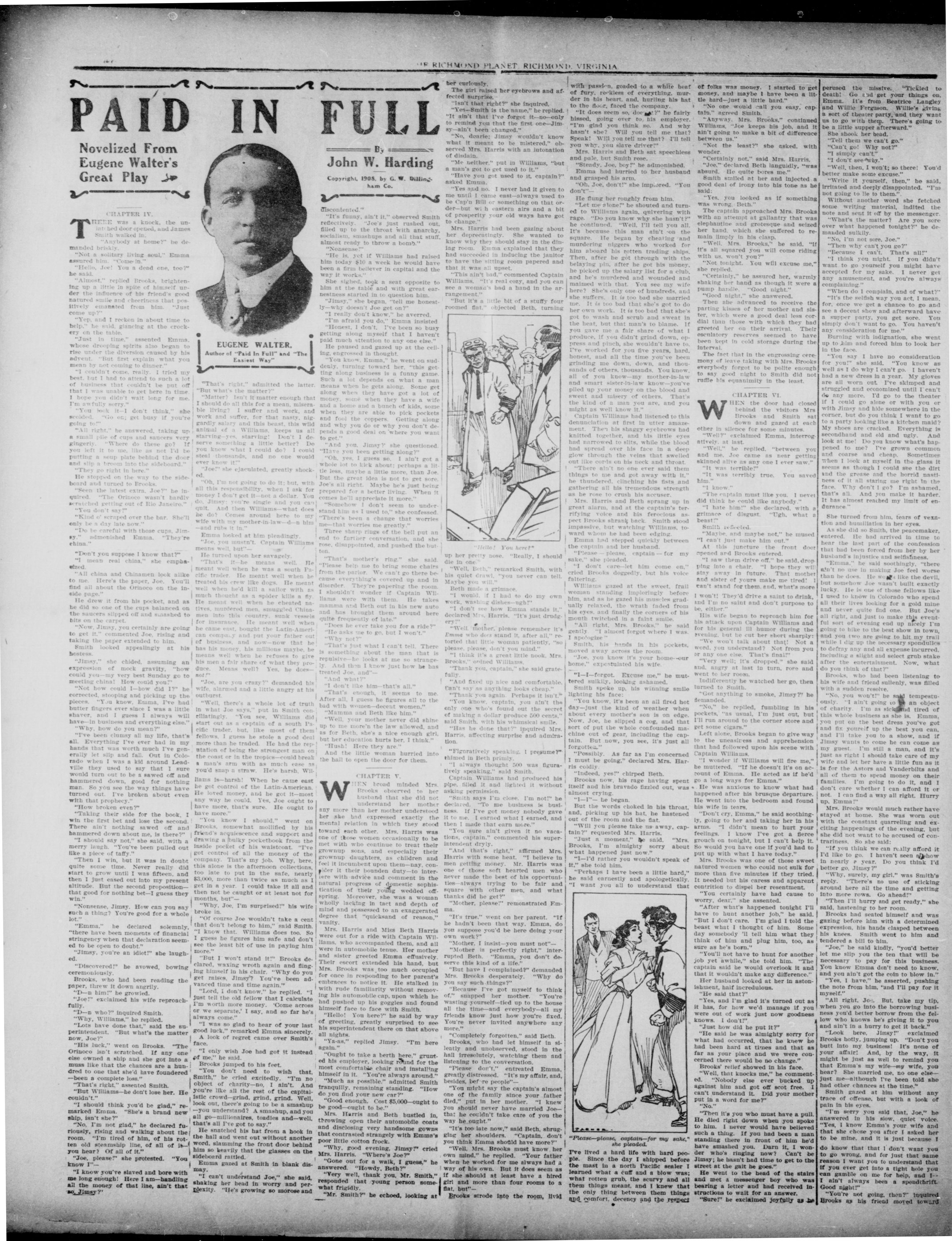
PAID IN FULL
Novelized From Eugene Walter's Great Play
CHAPTER IV.
THERE was a knock, the unlatched door opened, and James Smith walked in.
"Anybody at home?" he demanded briskly.
"Not a solitary living soul," Emma assured him. "Come in."
"Hello, Joe! You a dead one, too?" he said.
"Almost," replied Brooks, brightening up a little in spite of himself under the influence of his friend's good natured smile and cheeriness that positively emanated from him. "Just come up?"
"Yep, and I reckon in about time to help," he said, glancing at the crockery on the table.
"Just in time," assented Emma, whose drooping spirits also began to rise under the diversion caused by his advent. "But first explain what you mean by not coming to dinner."
"I couldn't come, really. I tried my best, but I had to attend to such a lot of business that couldn't be put off that I was unable to get here in time. I hope you didn't wait long for me. I'm awfully sorry."
"You book it—I don't think," she scolded. "Go on; get busy if you're going to."
"All right," he answered, taking up a small pile of cups and saucers very gingerly. "Where do these go? If you left it to me, like as not I'd be putting a soup plate behind the door and slip a broom into the sideboard."
"They go right in here."
He stopped on the way to the sideboard and turned to Brooks.
"Seen the latest extra, Joe?" he inquired. "The Orinoco wasn't hardly scratched getting out of Rio Janeiro."
"You don't say!"
"Kind o' scraped over the bar. She'll only be a day late now."
"Do be careful with those cups, Jimmy." admonished Emma. "They're ching."
"Don't you suppose I know that?"
"I mean real china," she emphasized.
"All china and Chinamen look alike to me. Here's the paper, Joe. You'll find all about the Orinoco on the inside page."
He drew it from his pocket, and as he did so one of the cups balanced on the saucers slipped off and sinashed to bits on the carpet.
"Now, Jimsy, you certainly are going to get it," commented Joe, rising and taking the paper extended to him.
Smith looked appealingly at his hostess.
"Jimsy," she chided, assuming an expression of mock gravity, "how could you—my very best Sunday go to meeting china! How could you!"
"Not how could I—how did I?" he corrected, stooping and picking up the pieces. "You know, Enma, I've had butter fingers ever since I was a little shaver, and I guess I always will have—in business and everything else." "Why, how do you mean?"
"I've been clumsy all my life, that's all. Everything I've ever had in my hands that was worth much I've generally let slip and fall. In Colorado when I was a kid around Leadville they used to say that I sure would turn out to be a sawed off and hammered down, good for nothing man. So you see the way things have turned out. I've broken about even with that prophecy."
"How broken even?"
"Taking their side for the book, I win the first bet and lose the second. There ain't nothing sawed off and hammered down about me, is there?"
"I should say not," she said, with a merry laugh. "You've been pulled out like a piece of taffy."
"Then I win, but it was in doubt quite some time. Never really did start to grow until I was fifteen, and then I just eased out into my present altitude. But the second proposition—that good for nothing bet—I guess they win."
"Nonsense, Jimmy. How can you say such a thing? You're good for a whole lot."
"Emma," he declared solemnly, "there have been moments of financial stringency when that declaration seemed to be open to doubt."
"Jimmy, you're an idiot!" she laughed.
"Discovered!" he avowed, bowing ceremoniously.
Brooks, who had been reading the paper, threw it down angrily.
"D—n him!" he growled.
"Joe!" exclaimed his wife reproachfully.
"D—n who?" inquired Smith.
"Lots have done that," said the superintendent. "But what's the matter now, Joe?"
"His luck," went on Brooks. "The Orinoco isn't scratched. If any one else owned a ship and she got into a muss like that the chances are a hundred to one that she'd have foundered—been a complete loss."
"That's right," assented Smith.
"But Williams—he don't lose her. He couldn't."
"I should think you'd be glad," remarked Emma. "She's a brand new ship, isn't she?"
"No, I'm not glad," he declared furiously, rising and walking about the room. "I'm tired of him, of his rotten old steamship line, of all of is—you hear? Of all of it."
"Joe, please!" she protested. "You know I—"
"I know you've slaved and bore with me long enough! Here I am—handling all the money of that line, ain't that so, Jimsy?"
J. B.
"That's right," admitted the latter
"But what's the matter?"
"Matter? Isn't it matter enough that
I should do all this for a mean, miserable
bleeding? I suffer and work, and
work and suffer, for that nasty, nig-
gardly salary and this beast, this wild
animal of a Williams, keeps us all
starving-yes, starving! Don't I deserve something a little better? Do
you know what I could do? I could steal thousands, and no one would
ever know it."
"Joe!" she ejaculated, greatly shocked.
"Oh, I'm not going to do it; but, with
all this responsibility, when I ask for
money I don't get it—not a dollar. You
do, Jimmy; you're single and you can
quit. And then Williams—what does
he do? Comes around here to my
wife with my mother-in-law—d—n blim
—and rubs it in."
Emma looked at him pleadingly.
"Joe, you mustn't. Captain Williams
means well, but"—
"Well, there's a whole lot of truth in what Joe says," put in Smith convincingly. "You see, Williams did start out as a captain of a south Pacific trader, but, like most of them fehlows, I guess he stole a good deal more than he traded. He had the reputation of being the strongest man on the coast or in the tropics—could break a man's arm with as much ease as you'd snap a straw. He's harsh. Williams is—harsh! When he came east he got control of the Latin-American. He loved money, and he got it—most any way he could. Yes, Joe ought to have more, that's sure. He ought to have more."
"You know I should," went on Brooks, somewhat mollified by his friend's acquiescence and support and drawing a buoyant pocket book from the inside pocket of his waistcoat. "I've got control of all the money of the company. That's my job. Why, here, this alone is the afternoon collections, too late to put in the safe, nearly $3,000, more than twice as much as I get in a year. I could take it all and then not be caught or at least not for months, but"—
"Why, Joe, I'm surprised!" his wife broke in.
"Of course Joe wouldn't take a cent that don't belong to him," said Smith. "I know that. Williams does too. So I guess he figures him safe and don't see the least bit of use in paying him more."
"But I won't stand it!" Brooks declared, waxing wroth again and flinging himself in his chair. "Why do you get raises, Jimsy? You've been advanced time and time again."
"Lord, I don't know," he replied. "I just tell the old fellow that I calculate I'm worth more money. 'Come across or we separate,' I say, and so far he's always come."
"I was so glad to hear of your last good luck," remarked Emma sincerely. A look of regret came over Smith's face.
"I only wish Joe had got it instead of me," he said.
Brooks jumped to his feet.
"You don't need to wish that, Smith," he cried excitedly. "I'm no object of charity—no, I ain't. And you're all the rest of the capitalistic crowd—grind, grind, grind. Well, look out, there's going to be a smashup—you understand? A smashup, and you all go—millionaires, toadles and—well, that's all I've got to say."
He snatched his hat from a hook in the hall and went out without another word, slamming the front door behind him so heavily that the glasses on the sideboard rattled.
Emma gazed at Smith in blank dismay.
"I can't understand Joe," she said, shaking her head in worry and perplexity. "He's growing so morose and
1F RICHMOND PLANET, RICHMOND, VIRGINIA
John W. Harding
Copyright, 1908, by G. W. Dillingham Co.
Discontented."
"It's funny, ain't it" observed Smith reflectively. "Joe's just rushed out, filled up to the throat with anarchy, socialism, smushups and all that stuff almost ready to throw a bomb."
"Nonsense."
"He is, yet if Williams had raised him today $10 a week he would have been a firm believer in capital and the way it works."
She sighed, took a seat opposite to him at the table and with great earnestness started in to question him.
"Jimsy," she began, "tell me honestly—why doesn't Joe get on?"
"I really don't know," he averred.
"I'm afraid you do." Emina insisted.
arried you do. Emma missed
"Honest, I don't. I've been so busy
getting along myself that I haven't
paid much attention to any one else."
He paused and gazed up at the ceiling, engrossed in thought.
"You know, Emma, he went on suddenly, turning toward her, "this getting along business is a funny game. Such a lot depends on what a man means when he gets along. Some get along when they have got a lot of money, some when they have a wife and a home and a bunch of kids, some when they are able to pick pockets and fool the coppers. Getting along and why you do or why you don't depends a good deal on where you want to get."
"And you, Jimmy?" she questioned.
"Have you been getting along?"
"Oh, yes, I guess so. I ain't got a whole lot to kick about; perhaps a little less, maybe a little more, than Joe. But the great idea is not to get sore. Joe's all right. Maybe he's just being prepared for a better living. When it comes hell appreciate it more."
"Somehow I don't seem to understand him as I used to," she confessed.
"There's been a change that worries me—that worries me greatly."
Three sharp rings of the bell put an end to further conversation, and she rose, disappointed, and pushed the button.
"That's mother's ring," she said.
"Please help me to bring some chairs from the parlor. We can't go there because everything's covered up and in disorder. They're papering the room. I shouldn't wonder if Captain Williams were with them. He takes mamma and Beth out in his new auto and has brought them around here quite frequently of late."
"Does he ever take you for a ride?"
"He asks me to go, but I won't."
"Why not?"
"That's just what I can't tell. There is something about the man that is repulsive—he looks at me so strangely. And then I know just how he has treated Joe, and—"
"And what?"
"I don't like him—that's all."
"That's enough, it seems to me. After all, I guess he figures all to the bad with women—decent women."
"Mamma and Beth like him."
"Well, your mother never did shine up to me more'n the law allowed, and as for Beth, she's a nice enough girl, but her education hurts her, I think."
"Hush! Here they are."
And the little woman hurried into the hall to open the door for them.
CHAPTER V
W
HEN broad minded Mrs. Brooks observed to her husband that she did not understand her mother any more than her mother understood her she had expressed exactly the mental relation in which they stood toward each other. Mrs. Harris was one of those women occasionally to be met with who continue to treat their grownup sons, and especially their grownup daughters, as children and feel it incumbent upon them—nay, consider it their bounden duty—to intere with advice and comment in the natural progress of domestic sophistication of their young wedded offspring. Moreover, she was a woman wholly lacking in tact and depth of mind and possessed to an exaggerated degree that "quicksand of reason," vanity.
Mrs. Harris and Miss Beth Harris were out for a ride with Captain Williams, who accompanied them, and all were in automobile tenue. Her mother and sister greeted Emma effusively. Their escort extended his hand, but Mrs. Brooks was too much occupied for once in responding to her parent's embraces to notice it. He stalked in with rude familiarity without removing his automobile cap, upon which he had pushed up his goggles and found himself face to face with Smith.
"Hello. You here?" he said by way of greeting, greatly surprised to see his superintendent there on that above all nights.
"Ya-as," replied Jimsy. "Tm here again."
"Ought to take a berth here," grunted his employer, looking round for the most comfortable chair and installing himself in it. "You're always around."
"Much as possible," admitted Smith tranquilly, remaining standing. "How do you find your new car?"
"Good enough. Cost $5,000—ought to be good—ought to be."
Mrs. Harris and Beth bustled in, throwing open their automobile coats and disclosing very handsome gowns that contrasted strangely with Emma's poor little cotton frock.
"Why, good evening, Jimmy?" cried Mrs. Harris. "Where's Joe?"
"Gone out for a walk, I guess," he answered. "Howdy, Beth?" "Very well, thank you, Mr. Smith." responded that young person somewhat frigidly. "Mr. Smith?" he echoed, looking at
her curiously.
The girl raised her eyebrows and af-
fected surprise.
"isn't that right?" she inquired.
"Yes-Smith is the name," he replied, "It ain't that I've forgotten it—no—only to remind you that the first one—Jimsy—ain't been changed."
"No, dearie; Jimsy wouldn't know what it meant to be mistered," observed Mrs. Harris with an intonation of disdain.
"Me neither," put in Williams, "but a man's got to get used to it."
"Have you got used to it, captain?" asked Emma.
"Yes and no. I never had it given to me until I came east—always used to be Cap'n Bill or something on that order—but with eastern airs and a bit of prosperity your old ways have got to change."
Mrs. Harris had been gazing about her deprecatingly. She wanted to know why they should stay in the dining room. Emma explained that they had succeeded in inducing the janitor to have the sitting room papered and that it was all upset.
"This ain't bad," commented Captain Williams. "It's real cozy, and you can see a woman's bad a hand in the arrangement."
"But it's a little bit of a stuffy four roomed flat," objected Beth, tiring
A man in a long coat and hat walks down a street, carrying a bag. He is followed by a group of men in similar attire.
"Hello! You here!"
up her pretty nose. "Really, I should die in one."
"Well, Beth," remarked Smith, with his quiet drawl, "you never can tell. Maybe you will."
Beth made a grimace.
"I would, if I had to do my own work, washing dishes—ugh!"
"I don't see how Emma stands it," declared Mrs. Harris. "It's just drudgery."
"Well, mother, please remember it's Emma who does stand it, after all," retorted that little woman patiently, "so please, please, don't you mind."
"I think it's a great little nook, Mrs. Brooks," owed Williams.
"Thank you, captain," she said gratefully.
"And fixed up nice and comfortable. Can't say as anything looks cheap."
"Has he done that?" inquired Mrs. Harris, affecting surprise and admiration.
"Figuratively speaking. I presume?" thimed in Beth primly.
"I always thought 500 was figuratively speaking." said Smith.
Captain Williams had produced his pipe, filled it and lighted it without asking permission.
"Smith says I'm close. I'm not!" he declared. "To me business is business. If I've got money nobody gave it to me. I earned what I earned, and then I made that earn more."
"You sure ain't given it no vacations, captain," commented his superintendent dryly.
"And that's right," affirmed Mrs. Harris with some heat. "I believe in men getting money. Mr. Harris was one of those soft hearted men who never made the best of his opportunities—always trying to be fair and square with other men, and what thanks did he get?"
"Mother, please!" remonstrated Emma.
"It's true." went on her parent. "If he hadn't been that way, Emma, do you suppose you'd be here doing your own work?"
"Mother, I insist—you must not"—"Mother is perfectly right," interrupted Beth. "Emma, you don't deserve this kind of a life."
"But have I complained?" demanded Mrs. Brooks desperately. "Why do you say such things?"
"Because I've got myself to think of," snapped her mother. "You're wasting yourself—died up to the house all the time—and everybody—all my friends know just how you're fixed. You're never invited anywhere any more."
"Completely forgotten," said Beth. Brooks, who had let himself in silently and unobserved, stood in the hall irresolutely, watching them and listening to the conversation.
"Please don't," entreated Emma, greatly distressed. "It's my affair, and, besides, bef re people"—
"You might say the captain's almost one of the family since your father died," put in her mother. "I knew you should never have married Joe—that he couldn't take care of you the way he ought."
"It's too late now," said Beth, shrugging her shoulders. "Captain, don't you think Emma should have more?" "Well, Mrs. Brooks must know her own mind," he replied. "Your father when he worked for me always had a way of his own. But it does seem as if she should at least have a hired girl and more than four rooms to a flat, but"—
Brooks strode into the room, livid
with passion, cailed to a white heat of fury, re-less of everything, murder in his heart, and, hurling his hat to the door, faced the company.
"It does seem so, doc," he fairly hissed, going over to his employer. "I'm gud you think so. And why hasn't she? Will you tell me that? Speak. Will you tell me that? I'll tell you why, you slave driver."
Mrs. Harris and Beth sat speechless and pale, but Smith rose.
"Steady, Joe, boy!" he admonished. Emma had hurried to her husband and grasped his arm.
"Oh, Joe, don't!" she impaired. "You don't."
"Let me alone!" he shouted and turned to Williams again, quivering with rage. "Do you know why she hasn't?" he continued. "Well, I'll tell you all. It's because this man ain't on the square. He began by cheating and murdering niggers who worked for him aboard his rotten trading ships. Then, after he got through with the belaying pin, after he got his money, he picked up the salary list for a club, and he's murdered and wounded and malned with that. You see my wife here? She's only one of hundreds, and she suffers. It is too bad she married me. It is too bad that she's got to do her own work. It is too bad that she's got to wash and scrub and sweat in the heat, but that man's to blame. If you gave me a fair share of what I produce, if you didn't grind down, oppress and pinch, she wouldn't have to. I've worked for you five years, hard, honest, and all the time you've been grinding me down, down, and thousands of others, thousands. You know, all of you know—my mother-in-law and smart sister-in-law know—you've piled up your money on the blood and sweat and misery of others. That's the kind of a man you are, and you might as well know it."
Captain Williams had listened to this denunciation at first in utter amazement. Then his shaggy eyebrows had knitted together, and his little eyes had narrowed to slits, while the blood had spread over his face in a deep glow through the veins that swelled out like cords on his neck and throat. "There ain't no one ever said them things to me and got away with it," he thundered, clinching his fists and gathering all his tremendous strength as he rose to crush his accuser.
Mrs. Harris and Beth sprang up in great alarm, and at the captain's terrifying voice and his ferocious aspect Brooks shrank back. Smith stood impassive, but watching Williams, toward whom he had been edging.
Erna had stepped quietly between
Emma had stepped quickly between the captain and her husband.
"Please—please, captain—for my sake," she pleaded.
"I don't care—let him come on," cried Brooks doggedly, but his voice faltering.
Williams gazed at the sweet, frail woman standing imploringly before him, and as he gazed his muscles gradually relaxed, the wrath faded from his eyes, and finally the corners of his mouth twitched in a faint smile.
"All right, Mrs. Brooks," he said gently "I almost forgot where I was. I apologize."
Smith, his hands in his pockets, moved away across the room.
"Joe, you know it's your home—our home," expostulated his wife.
"I—I—forgot. Excuse me," he muttered silently, looking ashamed.
Smith spoke up, his winning smile lighting his face;
"You know, it's been an all fired hot day—just the kind of weather when about every mother's son is on edge. Now, Joe, he slipped a cog, and that sort of put the whole confounded machine out of gear, including the captain. But now, you see, it's just all forgotten."
"Possibly. As far as I'm concerned I must be going," declared Mrs. Harris coldly.
"Indeed, yes!" chirped Beth. Brooks now, his rage having spent itself and his bravado fizzled out, was almost crying.
"I—I—" he began.
But the words choked in his throat, and, picking up his hat, he hastened out of the room and the flat.
"Will you please take us away, captain?" requested Mrs. Harris.
"Just a moment," he said. "Mrs. Brooks, I'm almighty sorry about what happened just now."
"I—I'd rather you wouldn't speak of it," she told him.
"Perhaps I have been a little hard," he said earnestly and apologetically.
ZARUER.
"Please—please, captain—for my sake," she pleaded.
"Please—please, captain—for my sake," she pleaded.
I've lived a hard life with hard people. Since the day I shipped before the mast in a north Pacific sealer I learned what a cuff and a blow was; what rotten grub, the scurvy and all them things meant, and I knew that the only thing between them things and comfort, decency and the respect
of folks was money. I started to get money, and maybe I have been a little hard—just a little hard."
"No one would call you easy, captain," agreed Smith.
"Anyway, Mrs. Brooks," continued Williams. "Joe keeps his job, and it ain't going to make a bit of difference between us."
"Not the least?" she asked, with wonder.
"Certainly not," said Mrs. Harris.
"Joe," declared Beth languidly, "was absurd. He quite bores me."
Smith smiled at her and injected a good deal of irony into his tone as he said:
"Yes, you looked as if something was wrong, Beth."
The captain approached Mrs. Brooks with an attempt at gallantry that was elephantine and grotesque and seized her hand, which she suffered to remain limply in his clasp.
"Well, Mrs. Brooks," he said, "if it's all squared you will come riding with us, won't you?"
"Not tonight. You will excuse me," she replied.
"Certainly," he assured her, warmly shaking her hand as though it were a pump handle. "Good night."
"Good night," she answered.
Then she advanced to receive the parting kisses of her mother and sister, which were a good deal less cordial than those with which they had greeted her on their arrival. Their osculatory reserves seemed to have been kept in cold storage during the interval.
The fact that in the engrossing ceremony of leave taking with Mrs. Brooks everybody forgot to be polite enough to say good night to Smith did not ruffle his equanimity in the least.
CHAPTER VI
W
W HEN the door had closed behind the visitors Mrs Brooks and Smith sat down and gazed at each other in silence for some minutes. "Well?" exclaimed Emma, interrogatively, at last. "Well," he replied, "between you and me, Joe came as near getting skinned alive as any one I ever saw." "It was terrible!" "It was terribly true. You saved him." "I know." "The captain must like you. I never did think he could like anybody." "I hate him!" she declared, with a grimace of disgust. "Ugh, what a beast!"
Smith reflected. "Maybe, and maybe not," he mused. "I can't just make him out." At this juncture the front door opened and Brooks entered. "I saw them drive off," he said, dropping into a chair. "I hope they will stay away in future. That mother and sister of yours me tired! I can't stand for them, and, what's more I won't! They'd drive a saint to drink, and I'm no saint and don't purpose to be, either." His wife began to reproach him for his attack upon Captain Williams and for his general ill humor during the evening, but he cut her short sharply: "We won't talk about that! Not a word, you understand? Not from you or any one else. That's final!" "Very well; it's dropped," she said and, angry at last in turn, rose and went to her room. Indifferently he watched her go, then turned to Smith.
"Got anything to smoke, Jlmsy?" he demanded.
Left alone, Brooks began to give way to the uneasiness and apprehension that had followed upon his scene with Captain Williams.
"I wonder if Williams will fire me," he muttered. "If he doesn't it's on account of Emma. He acted as if he'd go a long way for Emma."
He was anxious to know what had happened after his brusque departure. He went into the bedroom and found his wife in tears.
"Don't cry, Emma," he said soothingly, going to her and taking her in his arms. "I didn't mean to hurt your feelings. I know I've got a fierce grouch on tonight, but I can't help it. So would you have one if you'd had to put up with what I have today."
Mrs. Brooks was one of those sweet natured women who could not sulk for more than five minutes if they tried. It needed but his caress and apparent contrition to dispel her resentment.
"You certainly have had cause to worry, dear," she assented.
"After what's happened tonight I'll have to hunt another job," he said. "But I don't care. I'm glad I told the beast what I thought of him. Some day somebody I'll tell him what they think of him and plug him, too, as sure as he's born."
"You'll not have to hunt for another job yet awhile," she told him. "The captain said he would overlook it and that it wouldn't make any difference."
Her husband looked at her in astonishment, half incredulous.
"He said that?"
"Yes, and I'm glad it's turned out as it has, for how we'd manage if you were out of work just now goodness knows. I don't"
"Just how did he put it?"
"He said he was almighty sorry for what had occurred, that he knew he had been hard at times and that as far as your place and we were concerned there would be no change."
Brooks' relief showed in his face.
"Well, that knocks me," he commented.
"Nobody else ever bucked up against him and got off scot free. I can't understand it. Did your mother put in a word for me?"
"No."
"Then it's you who must have a pull. He died right down when you spoke to him. I never would have believed such a thing. If you had been a man standing there in front of him he'd have smashed you. Darn it, I wonder who's ringing now? Can't be Jimsy; he hasn't had time to get to the street at the gait he goes."
He went to the head of the stairs and met a messenger boy who was bearing a letter and had received instructions to wait for an answer.
"Sure!" he exclaimed joyfully as he
perused the missive. "Tickled to death! Go and get your things on, Emma. It's from Beatrice Langley and Willie Ferguson. Willie's giving a sort of theater party, and they want us to go with them. There's going to be a little supper afterward."
She shook her head.
"Tell them we can go." "Can't go! Why not?" "I simply can't." "I don't see why."
"Well, then, I won't; so there! You'd better make some excuse."
"Write it yourself, then," he said, irritated and deeply disappointed. "I'm not going to lie to them."
Without another word she fetched some writing material, indicted the note and sent it off by the messenger. "What's the matter? Are you sore over what happened tonight?" he demanded sulkily.
"No, I'm not sore, Joe." "Then why can't you go?" "Because I can't. That's all!"
"I think you might. If you didn't want to go yourself you might have accepted for my sake. I never get any amusement, and you're always complaining."
"When do I complain, and of what?"
"It's the selfish way you act, I mean, for once, we get a chance to go and see a decent show and afterward have a supper party, you get sore. You simply don't want to go. You haven't any consideration for me."
Burning with indignation, she went up to him and forced him to look her in the face.
"You say I have no consideration for you!" she said. "You know as well as I do why I can't go. I haven't a new dress in a year. My gloves are all worn out. I've skimped and struggled and economized until I can't do any more. I'd go to the theater if I could go alone or with you or with Jimsy and hide somewhere in the corner, but do you think I want to go to a party looking like a kitchen maid? My shoes are cracked. Everything is secondhand and old and ugly. And look at me! Do you know what's happened to me? I've grown common and coarse and cheap. Sometimes when I look at myself in the glass it seems as though I could see the dirt and the grease and the horrid nastiness of it all staring me right in the face. Why don't go? I'm ashamed, that's all. And you make it harder. It has almost reached my limit of endurance."
She turned from him, fears of exertion and humiliation in her eyes.
As she did so Smith, the peacemaker, entered. He had arrived in time to hear the last part of the confession that had been forced from her by her husband's injustice and selfsiness. "Emma," he said soothingly, "there can't no use in making Joe feel worse than he does. He was like the devil, but somehow Joe wasn't built exactly lucky. He is one of those fellows like I used to know in Colorado who spend all their lives looking for a gold mine and never quite find one. But Joe's all right, and just to make this eventful sort of evening end up nicely I'm going to hike to the best show in town, and you two are going to hit my trail while I dig up the necessary spondilles to defray any and all expense incurred, including a slight and select grub stake after the entertainment. Now, what do you think of that?" Brooks, who had been listening to his wife and friend sullenly, was filled with a sudden resolve.
"No, you won't!" he said tempestuously. "I ain't going to be an object of charity. I'm as slick and tired of this whole business as she is. Emma, you put on the best dress you've got and fix youself up the best you can, and I'll take you to a show, and if Jimmy wants to come he can come as my guest. I'm still a man, and it's just as right I should take care of my wife and let her have a little fun as it is for the Astors and Vanderbilts and all of them to spend money on their families. I'm going to do it, and I don't care whether I can afford it or not. I can find a way all right. Hurry up, Emma!"
Mrs. Brooks would much rather have stayed at home. She was worn out with the constant quarreling and exciting happenings of the evening, but she did not want to be accused of contrariness. So she said:
"If you think we can really afford it I'd like to go. I haven't seen any show in nearly a year. Do you think I'd better go, Jimmy?"
"Why, surely, my girl." was Smith's reply. "There's no use of sticking around here all the time and getting into more rows. Go ahead!"
"Then I'll hurry and get ready," she said, hastening to her room.
Brooks had seated himself and was gazing before him with a determined expression, his hands clasped between his knees. Smith went to him and tendered a bill to him.
"Joe," he said kindly, "you'd better let me slip you the ten that will be necessary to pay for this business. You know Emma don't need to know, and you ain't got the coin to blow in." "Yes, I have," he asserted, pushing the note from him, "and I'll pay for it myself."
"All right, Joe. But, take my tip, when you go into the borrowing business you'd better borrow from the fellow who knows he's giving it to you and isn't in a hurry to get it back."
"Look here, Jimsy!" exclaimed Brooks hotly, jumping up. "Don't you butt into my business! It's none of your affair! And, by the way, it might be just as well to remind you that Emma's my wife—my wife, you hear! She married me, no one else—just me—although I've been told she had other chances at the time."
Smith gazed at him without any trace of offense, but with a look of pain in his eyes.
"I'm sorry you said that, Joe," he answered in his slow, quiet voice. "Yes, I know Emma's your wife and that she chose you after I asked her to be mine, and it is just because I
do know that that I don't want you to go wrong, and for just that same reason I want you to understand that if you ever get into a tight hole you can gamble on me for help, and I-- I ain't always been a spendthrift. Good night!"
"You're not going, then?" inquired Brooks as his friend moved toward
THE PLANET
Saturday.....September 4, 1909.
the hall, but there was nothing in the tone of the query designed to encourage the great hearted fellow to accompany them.
"No; you two had better go together," he replied as he passed out.
When he had gone Brooks drew quickly from the inside pocket of his waistcoat the pocketbook containing the collections in checks and bills that he had not had time to turn in to the company, extracted a bill of $10 and returned the wad to its hiding place. Emma emerged from the bedroom with her hat and jacket on.
FORREST
"I'm sorry you said that, Joe."
"Why, where's Jimmy?" she asked.
"He went home. He said he guessed he'd better not come, as he wanted to get up early, or something or other, lied Brooks.
"I wonder why he changed his mind so suddenly." she said.
It was 9 o'clock when they found themselves in the street, and Brooks decided on a vaudeville show as being the only possible place of entertainment they could go to at that hour. It had been so long since they had permitted themselves the extravagance of a night out that Mrs. Brooks enjoyed the change to the full. Watching the actors and laughing at their jokes and antics, she forgot for the time her worries, and the painful impression of the early evening was completely dispelled. As the performance progressed Brooks also underwent a change of mood, and by the time the curtain fell he had softened to something of his old self and was tense and attentive.
When they found themselves outside again she was for going straight home "No," he said gaily, squeezing her arm that she had passed under his and patting her hand affectionately; "we are out for a good time for once, and we're going to have it."
She demurred feebly, wanting to go but feeling that scruple on the ground of expense which, from the necessity of exercising strict and unrelenting economy, entered into all her house hold expenditures, but he brushes aside her cautious calculations, and soon they were seated in a restaurant of quite imposing aspect, and he was ordering broiled lobsters and wine with the air of a man to whom money was no object. He was in rare high spirits and gallant with a tenderness he had not manifested toward her in many a moon. He chattered and chattered, and his animation communicated ed itself to her, so that her eyes sparkled, her pretty face was wreathed in happy smiles, and she returned his glances of love and admiration as in the happy days of their early married life, when they were all in all to each other and there was none so handsome and so noble minded as he in all the world.
CHAPTER VII
SOMETHING untoward was hapening or impending at the extensive piers and docks of the Latin-American Steamship company on South street, Manhattan. This had been evident from an early hour for when as whistle sounding time aproached the workmen trooped toward the docks and warehouses to begin their daily toll they found groups of policemen stationed about the aproaches to the Latin-American line's property. On the faces of the met who entered its gates was an expression of expectancy and determination.
The earliest man to arrive saw the tall, gaunt form of Mr. Smith, the superintendent, standing at the door of the office building. He had been working hard while they slept, but there was no evidence of his all night labor upon his cheerful visage, nor was any sign of anxiety or of the knowledge that any unusual situation had arisen discernible in his phlegmatic demeanor. He appeared to be enjoying the morning air and his cigar without a care in the world. His presence there at that hour was the only indication that he expected trouble. He had not allowed one police man to remain within the gates. Hardly a man passed in but saluted him verbally or with a touch of the hat and not a salute was given without being acted wielded. To some he reigned with a genial smile and a
"Hello, Tom!" or "Howdy, Elli!"
When they had started their work which was to be stopped completely at 10 o'clock, he vanished upstairs, not was he seen again until the hands of the clock approached that hour and the strike leaders began to go among the restless men. Then he sauntered out, ordered work stopped, and mounting a crate of merchandise, assemble the men about him.
"You boys." he said in his slow, dis tinct voice, "have made up your minds to quit at 10 o'clock because some body told you you ought to be getting more pay and a raise was refused Well, this is a free country, and every man's right to sell his labor where he likes and at what price he likes is guaranteed him by the constitution If you want to walk out of here you are free to do so, but if you take my advice"—
"See here," interrupted one of the leaders roughly, pushing to the front. "we ain't askin' no advice from you nor no one else. What we want is money. Do we do that raise or don't we? If we do, all right; if we don't we quit here and now, and that's all there is to it."
A murmur of approval greeted this ultimatum.
"No." answered the superintendent. "I ain't going to leave you in doubt about it for a minute. You don't get it."
"Then shut up!" ordered the man. "We ain't goin' to lose our time listenin' to no cheap talk. We've voted to quit and all talk is off."
"All right," retorted Smith. "Consider you've all quit. Now, that being the case, you have heaps of time on your hands and are likely to have for an indefinite period unless you have provided jobs for yourselves in anticipation of this. I've got something I'd like to say to you. Those who don't want to hear me don't have to. As I said, this is a free country." "Go ahead, Jimmy!" cried a voice in the crowd. "You're all right! You've always given us a square deal." "I hope so," he replied, "and one square deal deserves another."
Some of the men turned away, but others voiced the view that a hearing ought to be given to the superintendent since he wished to speak to them, and, seeing that their fellows remained, the others soon returned.
"I haven't got a lot to say, and I'm no preacher," he continued. "What I want to give you is not a lecture on what you've got to do—that's your business—but an explanation in your interest. I want to tell you things other people haven't told you and that you evidently don't know. Please let me get through, then you do as you like. I don't have to tell you that the rate of pay is governed, like everything else, by the law of supply and demand. What is the situation today? We have had rush work for several weeks, and the docks here and all along the water front are choked up with freight. But back of this, although you may not know it, the rail-
FABRICE
"I put it up to you, and you've made good."
roads everywhere are laying off freight cars, mills are laying off men, and signs point to a serious slump in business all over the country, which will reach here soon. The indications are that in the natural course of things during the coming winter there won't be work for more than half of you and that you'll need badly all the spare coin you can save now. Yet you chose this very time to demand an increase from the company and give it eighteen hours' notice, including twelve nonworking hours, in which to think it over. I don't call that a square deal, whatever you may think about it. Now, the country towns are full of men anxious to get jobs, and the company, notwithstanding the short notice, is fully prepared for a strike. In that shed yonder are 3,000 cots, put there during last night, and provision has been made to feed 3,000 men for several days. Captain Williams'—
An outburst of curses and yells greeted this mention of the president's name, with cries of "We know Williams!" "Captain Williams," went on the superintendent calmly, "says that any man who goes out on strike now will never enter the employ of the line again in this or any other port. And I'll see personally to it that he doesn't. This man here said a strike had been decided on, but anybody who wants to stay and work instead of making a fool of himself by quitting will be taken care of, I will promise that. That's all. It's up to you." Amid dead silence he got down from the crate and returned to his office. The men remained assembled for consultation, and in the crowd were many doubtful faces. It was clear that Smith's calm, drawn harangue
THE RICHMOND PLANET, RICHMOND, VIRGINIA
had made a profound impression. Just as in private life he attracted the warmest friendships, so in business, to which he gave strict and intelligent attention, he earned the respect of all with whom he had to deal.
The strike leader mounted the crate and, amid the applause of the hot headed and discontented, delivered himself of a fierce denunciation of the company as a greedy, grasping, oppressive corporation and of its dock superintendent as a "flour flusher" and a dispenser of "con" talk, meaning thereby of words intended to deceive. But there were too many who knew that Smith was neither.
"For my part," one of the laborers said, "I've got a wife and six kids, the eldest of which is nine. I move that we take another vote on this here strike."
The motion was adopted with acclamation. The result of the ballot was overwhelmingly in favor of remaining at work.
While delegates appointed to inform the superintendent that there would be no turnout were waiting upon him in his office, the other men passed the shed indicated by Smith, pushed open the door and gazed in, while others crowded up behind them. Arranged all around the vast space were neat, white cots, and in the center were long tables and benches.
"Say," remarked one of the men, "Jimsy Smith ain't no bluff, is he? For a slow speakin' and movin' man he's the liveliest buster I ever seen."
Half an hour later Smith once more lowered himself into the chair beside the president's desk.
"Well," said Captain Williams gruffly, "I understand the strike's off."
"Yep," was the reply.
"How did you do it?"
"Told 'em the truth."
The captain regarded him from under his bushy eyebrows, brought together in his usual trown.
"I guess you don't often lie, Smith."
"Not more than I have to."
"What preparations had you made for trouble?"
"Three thousand hired army cots in No. 2 shed, with tables and benches. Then there's these."
He laid before the president a number of bids for supplying rations three times a day to from 500 to 3,000 men and telegrams from various towns worded something to this effect:
On terms offered can ship 200 men within forty-eight hours.
Williams read each paper carefully.
"A strike at this time would have meant heavy loss to the line," he observed.
Smith nodded.
Then the captain gave utterance to the highest compliment he had ever made to a man in his life.
"It put it up to you," he said. "and you've made good. I guessed it was likely you would. Have a cigar."
CHAPTER VIII
ALTHOUGH Captain Williams had assured Mrs. Brooks that he would bear them no grudge because of her husband's attack upon him, he did not return again to the little flat, and it was some time before Mrs. Harris and Beth favored them with another visit. But this did not trouble the young couple a bit, Commencing on that night when he had insisted on taking his wife to a place of amusement, Joe's conduct toward her had undergone a complete change. Instead of returning home depressed and irritable he was nearly always in good humor and affectionately considerate. They needed no other company than their own and occasionally Jimsys's.
The happy transformation had been brought about by an unexpected bit of luck. As Joe explained it to his delighted wife, in his capacity of collector he had become very friendly with the manager of a concern which transacted business with the steamship company, and this gentleman had offered him $10 a week to render, when required, certain little services in the matter of collections, which he was able to do without interfering to any extent with the duties the Latin-American line paid him for performing. It was just the amount of the advance he had asked for and which Captain Williams had refused to give him, and it represented the difference between very painful sparing and comparative ease. And that was not all. One thing leading to another, Joe was enabled now and then to earn an extra $5 or $10 from other sources.
With this prosperous turn in his affairs the self confidence and assurance that long had abandoned him under his repeated disappointments and failure to make headway returned. Morose sinueness gave way to vim and energy. His old optimism had revived in most extravagant form. He began to be interested in the price of real estate and automobiles.
His wife, with the sobering recollection of the gulf between talk and achievement, of desire and possession, was careful to build no hopes upon these fabrics of vision, though she was too wise to seek to restrain the ardor of his imagination. She did, however, take with gratitude what the gods had given, pending the bestowal of possibly greater favors. The substantial addition to their means enabled her to hire a woman who (when she felt like it) did the dirtier work of the household that had been such a tax upon her. Little toilet necessities and accessories made their appearance. Brooks, when he had made an extra good week, insisted on lavishing his additional earnings upon her. New and suitable clothing restored her self respect and the pleasure that every woman feels or should feel in making herself attractive.
Mrs. Harris and Beth could not fall to notice the change, and it had a gradual but marked effect on their attitude toward Brooks, which became more civil and cordial. Emma declined to gratify their inquisitiveness beyond admitting that Joe was "getting on." To all leading questions she returned evasive answers, one reason being that deep resentment rankled in the heart of her husband for the lofty disdain under which he had suffered for so long and that he objected em-
phatically to the revelation of their private affairs to anybody, even to Jimsy. Besides, as he had pointed out, it would not be to their interest for the intelligence that he was doing outside work to reach Captain Williams' ears. He would either be dropped or so much would be given to him to do that there would be no time in which to devote his energies so lucratively elsewhere. The force of this could not fall to be seen by Mrs. Brooks, and, thus placed on her guard, she was all discretion.
Soon Joe was doing so well that they decided to take a larger fat and engage a regular servant.
Another piece of luck came to Joe, so unlooked for, in form so amazingly substantial, that it almost made Emma crazy with joy.
Looking out of the window about supper time and wishing that her husband would come, she noticed a cab drive up to the door and, to her surprise, saw her husband leap out of it. He bounded up the stairs two at a time, breathless with excitement, and emptied from his pockets on to the table a heap of notes and gold. Then he seized hold of her and forcefully waltzed her around the room. Finally he sat her, painting and bewildered, in a chair and pushed the money toward her.
"There, little woman," he gasped,
"that's for you, all of it—every penny of it! You know that three days ago when Jimmy started on that trip of inspection to our South American ports of call Williams went too and that they are to be gone for two or three months. Well, I'll give you a million chances and you'll never come near guessing the decent thing Williams did. He recognized my services to the company at last by promoting me to head a new exchange and collection department with a salary of $300 a month, the raise to date from six months back. Here's the six months' back pay-$1,800."
It was Emma's turn to get up and waltz when she had recovered some what from her astonishment.
They decided at her suggestion to celebrate their good fortune forthwith by a banquet royal for two at one of the fashionable restaurants. Hastily she dunned her prettiest costume, and they set out. Never had she been so vivacious, never more charming.
"Now," she said joyfully, "you'll be able to get a dress suit, and I can have a piano."
The lack of a piano always had been cause for keen regret.
Then she began to consider how they might live more comfortably than they had been doing. Joe proposed that they should avoid the housekeeping and servant problems altogether by living in an apartment hotel. He thought this would be within their means if they furnished the apartment themselves. He did not think it would cost more than living in a flat. Emma fell in with this view with eager enthusiasm.
Investigation proved the plan a little more expensive than they had bargained for, but they had what appeared to Emma to be a fabulous sum of money on hand, and they found an apartment which so pleased them in a hotel where the arrangements appeared to be satisfactory that they decided to take it.
Then Emma, with a light heart and a full purse—which, however, did not remain long in its bulging condition—experienced for the first time the unalloyed felicity of shopping to her heart's content, and the tangible result of her peregrinations was a charmingly furnished nest, conspicuous among the objects in which was her coveted piano.
CHAPTER IX.
AT the end of the first month passed in their new home Mrs. Brooks' joy in the sudden and great change in her husband's fortunes in the steamship company remained undiminished. Her mother, Mrs. Harris, had come to look upon him with great respect and to be rather proud of her son-in-law, who had belied her dire prognostications and upset all her firmly rooted ideas and convictions by rising in the world.
As to Brooks himself, the exuberance of his optimism had worn off considerably. He did not share to any extent in the light heartedness of his wife, who diffused happiness and rippled it in joyous music on the piano and in songs that had smoothed out the creases of care on her father's brow when she sang to him in the days of her girlhood. He had become more and more thoughtful, with lapses at unexpected times into absentmindedness. Moreover, of late, symptoms of his former ill humor and nervous irritability had reappeared.
"Goodness, Emma, one would hardly know you!" exclaimed Beth to her one evening after dinner, to which Mrs. Brooks had invited her mother and sister. "Your dress is a dream, and at table you were positively radiant."
She had followed Emma into her bedroom and was gazing in admiration at her sparkling eyes and her cheeks rosy with health.
"I am happy," admitted Emma, putting her arm around her affectionately.
"Do you know, dearie, I'm just beginning to know who and what you are?"
Highly amused at the girl's patronizing manner and not at all inclined to take her seriously. Emma looked at her with assumed gravity.
"How's that, little sister?" she inquired.
"Please don't call me 'little sister,'" objected Beth. "You're always making fun of me."
"My dear Beth, it is you who are always making fun of yourself," Emma told her.
"Indeed I'm not!"
"Why not laugh and play and just be a girl—a real tomboy?" After all, that's the thing. You are only eighteen, while I have reached years of discretion. I'm twenty-five, you know, and awfully staid and wise in consequence."
"You weren't a tomboy."
"Oh, yes, I was until I fell in love. You were a wee bit of a little maid then, and after I fell in love I became a silly little goose like all girls in love, and then"—
"You married Joe."
"Yes," said Emma seriously, "and that's why I want you to have such a good time now, while you can. Of course I hope you not have the hard pull that Joe and I have had—1 mean when you are married—but one never can tell."
"Never mind the past now, Emma. Think how happy you are."
"I know, it is good to be living once again, but the best of it all is that Joe has succeeded. Even mother admits it. Think of it."
"She even likes him," confided Beth.
"My dear, you know that mother likes most any one who has healthy indications of a bank account."
"Emma," chided the girl, "you ought to be ashamed!"
"I'm not," laughed her sister. "I'm too contented. I don't think that I shall ever forget the night, nearly seven weeks ago, when Joe came home with the good news, his salary more than tripped and six months' back pay."
"Joe never thought Captain Williams would do it for him."
"No, nor I. And the way it was done! You know the captain and Jimmy had been gone three days before Joe knew the good news."
"When are they coming back? Not for a month anyway."
"Joe says he doesn't know."
"Isn't it funny that with all his luck he doesn't seem contented?"
Emma became grave,
"He's worried, poor dear, and I can't
make it out," she said. "Perhaps he's
so anxious to succeed in his new position."
In the parlor Mrs. Harris sat fanning herself, for it was a very warm day. She was dressed in a gown of summer finery that would have been more suitable to her had she been, say, fifteen years younger, and she
TARSSAN
"I can't understand how a man can de liberately steal."
"I can't understand how a man can deliberately steal."
was engaged in her usual pleasant occupation of criticizing—or "knocking," as Joe called it.
Brooks was in dinner coat and bore other external evidences of his prosperity, which, however, was being purchased at considerable physical cost, for he had become thinner and was pale and huggard. The worry his new position occasioned him was plain to be seen, and he was in an exercisably mild mood and as nervous as the proverbial cat.
"As I was saying to Joe," observed Mrs. Harris, turning to Emma and Beth, "for a hotel of this character the coffee is not what it might be. It's terribly bitter. Otherwise I liked the dinner. Yes, on the whole, I liked the dinner. But If I were you, Joe, I'd complain about your waiter."
"What's the matter with him?" asked Emma.
"That waiter suits me, and I haven't heard Emma kicking." cut in Joe.
But Mrs. Harris was not to be supressed by any snubbing from him.
"Still," she persisted, "I think for the money you are paying here"—
"For the money I am paying here," he retorted. "I am satisfied. It seems to me that that is all there is to it."
"Mother, dear, please don't find fault," urged Emma. "It is all so much better than it has been. I think you should be happy to see things as they are."
"So much better than Emma's had for so long," chimed in Beth.
Brooks sowled at her and, gathering up some more papers from the table, retreated with them to his chair and began to peruse them rather feverishly.
"I never read the papers any more," declared Mrs Harris. "All they have are scandal, murders and men who steal money from their firms. My—I don't know what the world is coming to."
"Wasn't it terrible about that man yesterday walking out of the bank with a small fortune?" said Beth.
"I can't understand how a man can deliberately steal," sniffed her mother, "especially when there isn't a chance on earth of getting away."
"He's the man who gave all the money to some woman, isn't he? Emma wanted to know.
"Yes. He'll have plenty of time to think it over. The penitentiary isn't a bit too good for men like him."
"I felt so sorry for his wife, poor woman," remarked Beth. "She'll have to stand most of the trouble."
Brooks jumped up impatiently, biting his nails with annoyance.
"Where's the rest of this paper?" he demanded "I want the part with the racing chart. It's marked 'Past Performances'"
"Oh, I know—what Jimsy calls the dope sheet," said Emma. "There it is."
Mrs. Harris looked horrified.
"Joe, you certainly aren't interested in races—horse races?" she interrogated.
"Yes, I am" he snapped. "I don't play 'em, but I like to look 'em over.
What of it?"
"They're awful." declared Beth.
"That's exactly why most men steal money."
"Well, dearie, Joe isn't stealing money or playing races, so don't get worried," commented Emma, a little testily. Mrs Harris persisted.
"Captain Williams says that the race track ruins more young men and"—
Her son-in-law had been waxing more and more exasperated.
"For heaven's sake," he broke out angrily, wiping the perspiration from his face, "can't you find something better to talk about than ruined men, thieves and fellows who go wrong?"
"Why, Joe, what's the matter?" inquired his wife, gazing at him in astonishment.
He turned his wan face toward her, and there was a look as of entreaty and apology in his eyes, under which the dark circles appeared to have deepened, as he replied:
"I'm tired and nervous. I think I'll walk down the street."
"Oh, but you've got to take us to the theater," Beth told him. "Mother hasn't seen the play at the Renaisance, and you can't get seats—not a single one—even from speculators. I promised to take her."
"Where do I come in?"
Mrs. Harris answered for her:
"You just take us; call for us after the show and put us on a car."
"We simply can't miss this chance, can we, mamma?" said Beth. "You will take us and come for us, won't you, Joe?"
"Oh, I suppose so," he acquiesced, a little weary.
At that moment the telephone bell rang, and Emma answered it.
"Yes, right up," she instructed the operator and, hanging up the receiver, turned with an eager smile.
"I've got a surprise for you," she said.
"Guess who's calling? Some one who wasn't expected for a month."
"Jimmy," cried Beth.
"Jimmy Smith, straight back from Guatemala."
Joe's eyes widened, and the little color in it faded from his face. He was very much startled by this unexpected visit, but kept sufficient control over himself not to make the fact too apparent.
"Is Captain Williams with him?" inquired Mrs Harris.
"I don't know," answered Emma.
"I wonder what brings him back? He wasn't expected for a month or six weeks."
"I suppose the captain's with him," surmised Beth.
Her mother expressed the hope that he was.
"So do I," said Emma. "I want to thank him for Joe's raise."
"You'll do nothing of the kind!" ex ploded Brooks furiously. "I want you all to understand here and now that my business is my business. I don't want it discussed with either Smith or Williams. What I've got I've got, and it is nobody's affair but mine. Now, if any of you have got anything to say about me or what I do, say it to me or shut up."
"Joe, how can you?" reproached his wife, taken completely aback by this savage and uncalled for display of anger.
"Well, I declared!" ejaculated Mra Harris, bridling up. "I've never been talked to so in all my life and"—
The doorbell rang, and she subsided, sinking back in her chair and fanning her red face vigorously.
Mrs. Brooks opened the door, and Jimsy stood revealed with his winsome smile, his face tanned brown by the sun of the tropics.
"Welcome home, little stranger!" exclaimed Emma heartily.
"Hello, Emma! How are you?" he said, taking her outstretched hand.
"Ladies, I salute you. The prodigal has returned from the distant land of chill con carol and fat ladies wearing mantillas to receive his overdose of American grub."
"Look at him! He's as brown as an Indian!" laughed Beth, giving him a cordial handshake.
"Where's Captain Williams?" asked Mrs. Harris.
"All in due time, when I spin my yarn," drew Jimsy.
He went over to Brooks and shook hands with him
"Glad to see you, Joe," he said.
"Thank you, Jimsy. Same to you. You look immense."
"I'm better than that. Now, if you folks will sit down I'll tell you the story of my wonderful adventures, lying only when necessary to protect my unsullied reputation. How is that, Beth, 'unsullied reputation? Pretty good, eh?'
"But Captain Williams and the story?" urged Emma.
"What I want to know," observed her mother, "is, Did the captain come with you?"
"So do I," said Brooks, with hardly concealed anxiety.
"Well, you know it took me two months to do all this, and you can't expect me to tell this story as if it was a journey in the subway."
"Jimsy, you're exasperating," remonstrated Emma.
"I was saying— Say, Emma, you look all right in that dress," he broke off, contemplating her with admiration. She stamped her foot imperiously.
"Never mind me. Talk!"
"And please say something," added Beth.
"Stung!" he laughed. "Thank you, Beth! Well, you know cap and I were going to make a trip at every port of call the Latin-American company has, but when we got to Guatemala we found out that a couple of those dons down there, being out of jobs, had concluded to pass the time away by pulling off one of their monthly revolutions and, among other things, were getting very gay with our property."
"You mean war?" demanded Beth, deeply interested.
"Not according to Hoyle. This game was just for conversation. Anyway, things looked a little bad, so we stayed there until one of the dons threatened to put us in jail and burn up our warehouses. We were delayed a couple of weeks, and one morning the army of forty-two generals and three privates saw the United States cruiser
THREE
Brooklyn steam into port all painted up, with a lot of pearish bluejackets on board, looking for trouble. So they postponed their change of government indefinitely. We had been delayed so long by them fellows”—
“Jimsy,” objected Beth. “Don’t call them ‘them fellows.’”
“No?”
“No. Say ‘those fellows.’”
“Well, Beth. I’ve known those greasers down there for fourteen years as ‘them fellows’ and if I called them anything else I’m afraid I’d have to be introduced again.”
“But Captain Williams?” insisted Mrs. Harris.
“Where, yes is he?” said Brooks.
"Well, we decided to come home. Captain left on the steamer by the way of New Orleans, and a couple of days later I came direct to New York."
"Then he is here?" said Mrs. Harris in a tone of gratification.
"I suppose he is, unless he was shipwrecked on the way."
"But you haven't told us anything about the war," Beth reminded him. "Was it exciting?"
"Well, as the only things that were shot of were several hundred mouths and as I'm a bad hand at repeating conversations I will have to leave the details to your imaginations."
"I consider that a most uninteresting story," pouted Beth. "and, besides, you're keeping us from the theater."
"All going?" queried Smith.
"No, just Beth and me," explained Mrs. Harris. "Enema and Joe have seen the play, and we've got the last two seats."
Emma accompanied her mother and sister to her bedroom to help them don their hats.
When the door had closed upon them Smith's attitude changed entirely. The smile vanished from his face, and he went over to Brooks and placed both hands on his shoulders.
"Joe, you're found out," he announced.
"How found out?" demanded Brooks, jumping up and facing him, very white.
"The money you've taken."
"If you say I've taken money, you're a harf" retorted Brooks, with an attempt at fierce indignation. But the words came falteringly between his blue, parched lips.
"Joe, Joe," rebukeh his friend sternly, "this isn't no time to four flush with me. I'm your friend, and you need one now, boy. Besides, there's Emma to think of."
"I don't know what you mean," he protested in a choking voice.
"That story of a revolution was a lie," explained Smith. "Williams has been home three days. He has had the books looked over at night. He seemed to know what you were doing from the time you took the first dollar. I've reason to think he went away simply to give you a free rein and get even with you for what you said to him that night at the flat. Joe, we've got to pull together now, and you've got to be on the square with me."
Brooks sank limply into a chair and covered his face with his hands.
"What shall I do?" he moaned.
"Sit tight and saw wood."
"But they'll send me to jail, won't they?"
"You took that chance. Joe, boy. But we will have to fight and fight hard to get you out of it. You can't run away. You're watched," interrupted his friend. "Detectives are downstairs, and if you make a false
PACCA
"I'm your friend, and you need one now, boy."
move they'll nab you and spoil every chance."
"Jimsy, I'm done; I know I'm done!" he almost whimpered, plunged again into the bottomest depth of despair.
"Keep your nerve. What have you told Emma?"
"She doesn't know."
"Of course she doesn't. I mean, where did you say you got all the money?"
"I told her my salary was raised, and some back pay"—
"I'm on. Now brace up. You look all in. Here come the ladies."
"They are ready, Joe," announced Mrs. Brooks.
"Come on my boy, and take the family to the show," ordered Mrs. Harris.
"I'm ready," he replied, pulling himself together with great effort. "Jimmy, wait till I come back."
Emma and Smith accompanied them to the elevator.
"Hurry back, Joe," was Emma's injunction to her husband as the car disappeared from view.
(To Be Continued.)
Egg/Phosphate.
Break a whole egg in a glass and add two tablespoons of any fruit sirup preferred. Fill with feed bottled soda water and mix thoroughly in an egg shaker until light and foamy. Pour into a glass and add a dash of phosphate. Grate nutmeg lightly over the ton.
THE PLANET
Published every Saturday by JOHN MITCHELL,
JR., at 311 N. Fourth Street, Richmond, Va.
JOHN MITCHELL, JR., - EDITOR.
All communications intended for publication
should be sent so as to reach us by Wednesday.
TERMS IN ADVANCE
One Copy, one year, - - - - - $1.50
One Copy, eight months, - - - - - 1.00
One Copy, six months, - - - - - .80
One Copy, four months, - - - - - .50
One Copy, three months, - - - - - .40
Single Copy, - - - - - .00
ADVERTISING RATES
For one inch, one insertion . . . $ . 50
For one inch each subsequent insertion . . . 40
For two inches, three months . . . 10.00
For two inches, six months . . . 14.00
For two inches, twelve months . . . 20.00
Marriage and Funeral Notices, one inch . . . 10
Standing and Transient Notices per line . . . 10
POSTAGE STAMPS OF A HIGHER DENOMINATION THAN TWO CENTS NOT RECEIVED ON SUBSCRIPTIONS.
THE PLANET is issued weekly. The subscrip
tion price is $1.50 per year in advance.
There are four ways by which money can be sent by mail at our risk.—In a Post Office Money Order, by Bank Check or Draft, or an Express Money Order. Any other, none of these can be secured, a Registered Letter.
MONEY ORDERS—You can buy a Money Order at you: Post Office, payable at the Richmond Post Office and we will be responsible for its late arrival.
EXPRESS MONEY ORDERS can be obtained at any office of the American Express Co., the United States Express Co., and the Well's Fargo and Co's Express Company. We will be responsible for money sent by any of these companies. The Express Money Order is a safe and convenient way for forwarding money.
REGISTERED LETTER—If a Money Order, Post Office or an Express Office is not within your reach, your Postmaster will Register the Letter you wish to send us on payment of test cents. Then, if the Letter is lost or stolen, it can be traced. You can send money in this manner at our risk.
We cannot be responsible for money sent in letters in any other way than one of the four ways mentioned above. If you send your money to any other way, you must do it at your own risk.
NEWWALKS, ETC.—If you do not want THE PLANET continued for another year after your subscription has run out, you then notify us by email Card to Accounts. If the courts have decided that subscribers to newspapers who do not order their paper discontinued at the expiration of time for which it has been paid are held liable for the payment of the subscription up to date when they order the paper discontinued.
COMMUNICATIONS—When writing to us to renew your subscription or to discontinue your paper, you should give your name and address to otherwise we cannot find your name on our books.
CHANGE OF ADDRESS—In order to change the address of a subscriber, we must be sent the former as well as the present address.
Entered at the Post Office at Richmond, Va. as second class matter.
Saturday . . . September 4, 1909.
We sometimes wonder if this will continue to be an age of looseness and corruption.
Married men like club-houses just as much as single ones and we sometimes think, a little bit better.
It is no use to carry around a sour face. Smiles tend to beautify the countenance and make everybody feel happy.
Colored people have always been experts at the praying business while the white folks have always been experts at the money making business.
Mr. Edgar Allan, Jr., is now Postmaster of Richmond. We are of the opinion that it will take ten derricks and an unusual amount of steam power to oust him from the job when his present term expires.
We went to Kansas City a poor man and according to the Kansas City daily newspapers, we awoke worth from a quarter to a half million dollars. When we reached Richmond, we were poor again.
THAT HEINOUS CRIME IN GEORGIA.
Governor Brown of Georgia, has just refused to grant an application for the commutation of the sentence of William H. Mitchell, a wealthy white man from twelve months in the chain-gang to a fine. The convicted man is a resident of Thomasville, Georgia. In view of the charges against colored men and the allegation that they are the only ones disposed to commit the unmentionable crime, this case will be of special interest to all who will care to take the care to consider it.
Miss Lucile Linton, white was a relative of the wife of William H. Mitchell. The accused and convicted man conceived the idea of enticing her to a lonely cabin in the woods, out of hearing of passing countrymen and there criminally assault her. He bought disguises and after securing a buggy, robed himself as a Negro woman and sent word to Miss Linton that she was wanted by a neighbor. She got in the buggy with him and as he drove away from the road-way, she became
alarmed. He endeavored to detain her, but her screams brought a response and he was frightened off, but not until after she had made a desperate struggle.
He was tried in the Thomas Superior Court, Judge Roane presiding and all of the facts brought out established the fact that he had purchased the disguises, had blackened his face and had made an attempted criminal assault upon the lady in question. A jury found him guilty. Mitchell is forty-five years or age and has a wife and several beautiful daughters. A plea of temporary insanity failed and the verdict was sustained by the Supreme Court of Georgia.
After one of the most spectacular flights ever made before the Prison Commission of Georgia, that body recommended to the Governor that the sentence be commuted to one year on the State Form at Milledgeville, Georgia. The Governor, however, decided to be guided by the recommendation and in his official document denying the application and refusing to grant any consideration whatever, among other things he said:
"Should the clementy asked for in the present case be extended, there is grave danger that it would bear fruits of sorrow in every section of our State. It would set an example pernicious beyond compare, an example embodying a daily menace to Georgia's womanhood. It would say that we have one law for the rich, another for the poor; one law for the highly-educated, another for those 'so poor to enjoy the privileges and immunities consequent upon education; one law for the classes, another for the masses."
There can not be any just criticism of the Governor's action. The punishment originally meted was grossly inadequate to punish the crime of which the convicted man was admittedly guilty. He was really deserving of a more severe penalty than would have been an illiterate Negro. He was wealthy. He had been educated in one of the best colleges in this country. He carefully planned the outrage and he was cognizant of the helmousness of his action. Moreover, he attempted to injure one of the kindlest races of people on the face of the globe, by creating the impression that one of the members of that race had been guilty of such a helmous outrage.
This emphasizes the fact that many colored men are lynched for crimes committed by white men with blackened faces. Under the prevailing customs and practices in the South-land, Mitchell should have been hanged and thus one more brute should have been transferred to the other world. Truth is mighty and will prevail and gradually the injustice of our treatment in this section of the country is becoming apparent to all the world.
OTHERS GUILTY.
We have read with much interest the facts in the case of Jim Robinson, the colored driver for Edward Alvey. This driver was convicted in the Police Court last Saturday morning on petit larceny and given ninety days in jail. It seems that his employer had secured the contract to furnish the city of Richmond with grain and that all of the wagon loads were paid for by weight. The driver was caught with a load of cobble-stones in addition to the grain, when the wagon or cart was weighed.
He was arrested and the result announced was the result. It was further ascertained that the driver could not have profited by the weighing of the grain in this manner and that only his employer was benefited. It was not proven or even alleged that he took grain off the wagon and sold it and substituted these rocks therefor. White citizens became interested in the matter and the detective bureau became equally interested. As a result, other counsel was secured for the colored man and an appeal taken in the case. The matter will be aired in the Hustings Court.
In the meantime, the colored man, has told all of the facts in the case and it becomes a question as to the scope of a servant's responsibility in carrying out the orders of the man, who employs him. If Mr. Alvey told him to put rocks or cobblestones in that wagon, what was he to do, but to obey him? There must have been a motive in his doing this and the motive was not to secure financial reward for himself. This much is conceded.
It may be well understood though that all of this agitation is not taking place in the behalf or the Negro or on account of any other Negroes. It means that there is a split, deep and wide in the Democratic Party in this city. The friction is on the increase and every opportunity is now being taken to discredit the actions of the other side. In the meantime, colored people will necessarily profit by the manifestations of temper. We must be careful though not to become unduly active in either camp, but "saw wood and say nothing."
THE RICHMOND PLANET, RICHMOND, VIRGINIA
Jim Robinson is now out on an appeal and before the contest is over there will be revelations which will tend to injure many people and to show that the poor Negro is as yet being used as a cats-paw for the financial advancement of many white people in this city.
WHY JONES PAID.
He Preferred to Buy the Supper Rather
Than Do Wife's Bidding.
THREE friends who had been spending the evening at their
spending the evening at their club agreed that the one who did not do the first thing his wife told him when he got home should pay for an oyster supper. Smith in trying to find the matches trod on the cat. "That's right," said the wife, waking up. "Kill the poor cat and, have done with it." "Well," thought Smith, "I'll have to do it or pay." So he killed the family pet. Brown, in the dark, stumbled against the piano. "Why don't you break the piano?" demanded his wife. Brown at once broke the piano. When Jones got home he stumbled on the top step of the staircase. "Go on," said his wife—"tumble downstairs and break your neck." "Not me," answered Jones. "I'll pay for the supper first."—Illustrated Bits
The Legislative Epidemic
"Dis yer legislatur' business is what you might call epidemic," said Brother Dickey—"goes de rounds an' sometimes sweeps thoo a whole family 'fo it gits thoo wid 'um. For generations an' generations white folks has been legislath—here, dar an' every whar. It runs in de blood, an' dey kin no mo' he'p it than 1 kin he'p beim righteous or a 'possum kin he'p feelim 'simmons we'n dey ripe an' ready for him."
"Any of them ever make a mark?' he was asked.
"Oh, yes, suh. One er 'um got mad an' thowed an ink bottle at somebody but outside or dat I never did hear tell dat any er 'um did much cuttin up."-Atlanta Constitution.
A Dismal Thought
"Just think of it. When you're out in an airship there never will be any thank-you-ma'ams to make the gisqueal and grab hold of you for protection." -Chicago Record-Herald.
Natural History
A certain father who is fond of putting his boys through natural history examinations is often surprised by their mental agility. He recently asked them to tell him "what animals is satisfied with the least nourishment."
"The moth" one of them shouted confidently. "It eats nothing but holes."—New York Journal.
He Approves
Friend—Why do you encourage these woman suffrage meetings? Surely, you don't approve of them?
Husband—Approve? With all my heart! I can come home as late as a like now without finding my wife at home to ask questions—Fllegende Blatter.
True Loyalty.
"You should stand up for the rail road that is doing so much to develop your suburb."
"Well," answered Mr. Crosslots "come to think of it. I never get a seat. I stand up for it at least three hours a day."—Washington Star
Modified Baseball
"Do you think baseball will ever get a foothold in England?"
"They play it some."
"As strenuously as we do?"
"Well, no. They serve tea between innings, I understand."—Kansas City Journal.
Heard at the South Station.
"Hold on a minute. I want to get Anybody's for May."
"What do you want a back number for?"
"Back number nothing! May's my wife."—Boston Transcript.
The Advance Guard.
VIEW OF THE
OFFICE
Station Master-Porter-Clerk (to prospective passenger who is waiting on a branch line station for a train that is much overdue)—She'll be gettin' near now, sir. 'Ere's the engine driver's little dog a-comin' down the line.—Sketch.
Wants Hes Hand Too
"And that young man kissed you on the lips? Why didn't you offer him your hand?" said the father. "Oh, I didn't have to, papa," said the girl. "He's going to ask you for that." -New York Telegram.
What Did He Mean?
The Major-I saved that rose you gave me last week. Miss Antique, for, though it is withered, it still reminds me of you.
Miss Antique-Sir!-Christian Work and Evangelist.
SIRES AND SONS.
One of the witnesses at an inquest at Poplar, England, was named John North East West.
Mr. Andrew Carnegie began life as a bobbin boy in a linen factory at a wage of 5 shillings sterling a week.
Prince von Bulow, the late imperial chancellor of Germany, was offered some years ago £1,200 a year to join the staff of the London Times.
Senator Benjamin F. Shively of Indiana has the distinction of being the only Democrat in the senate from the section north of Mason and Dixon's line and east of the Mississippi river.
Ex-Ambassador Joseph H. Choate is a strong believer in the knee as a device for disciplining a wayward youngster. "I believe that a good man's knee has been the turning point in many a man's life," he said in an address recently.
H. B. Claflin, the founder of the great chain of stores that still bears his name, started humbly in a dry goods store in New York, while his son, John Claflin, now head of the H. B. Claflin company, began as a clerk in his father's store.
One of the generous givers to the Metropolitan Museum of Art in New York is George A. Hearn, who has given an endowment of $151,000 to buy works by American artists, besides presenting before 1906 nearly thirty paintings and adding in the purchase of fifty-seven pictures.
The Writers.
It is said that when King Edward VII, offered Barrie a title recently he replied, "I have no use for such things."
Edwin Lefvre, who, besides having written much fiction, of which, perhaps, the best known is his collection of "Wall Street Stories," has long been the financial editor of a New York daily, has entirely given up his work in this field.
Those who know Robert Grant, the author, wonder when he can find time to write novels, for Mr. Grant, or, rather, Judge Grant, is a very busy man. Besides a large law practice he has been judge of the probate court and of the court of insolvency for Suffolk county, Mass., since 1803 and water commissioner for Boston for the last five years.
Law Points.
The liability as an insurer of a common carrier undertaking to transport live stock is held in Summerlin versus Seaboard Air Line R. Co. (Fla.), 47 So. 557, 10 L. R. A. (N. S.), 191, not to extend to any damage resulting from the nature, disposition or viciousness of the animal.
An assignee of a bill of lading as collateral security for a draft upon the consignee of property represented by it, which he discounts, in Haughton versus Nelson (N.C.), 62 S. E. 625, 18 L. R. A. (N. S.), 1221, not to be liable for breach of warranty by the consignee in the sale of the property.
Sporting Notes
Dorando Miller, the New York A. C. crack single sculler, says this is his last year to row.
A golfer in Cincinnati who had accidentally driven his ball behind and within six feet of a tail shelter house lofted the ball over the building in one stroke by the nibble and, landing it on the green, won the game.
Joe Martina is something of a baseball thrower, his performance of 138 yards, 2 feet and 2 inches at New Orleans recently being a world's record. Larry Twittchell in 1888 made the former best record of 135-2-3 yards.
Science Siftings.
In the Edinburgh museum there is a magnet which weighs but three and one-half grains, yet it can lift 445 times its weight.
Experiments have shown that Hertzian waves will pass through stone walls more than three feet thick, but will be stopped by tin sheets no thicker than cigarette paper.
Roentgen rays are now used to help the diagnosis of tuberculous disease. Tuberculin indicates the presence of the disease in the system, but to find its location the X rays are needed.
Art of Writing.
James Russell Lowell said the art of writing poetry consists "in knowing what to leave in the ink pot."
When asked how he wrote his poetry James Whitcomb Riley said, "Mostly with the rubber end of the pencil."
When Henry Ward Beecher was once criticised for incorrect grammar he replied, "When the English language gets in my way it doesn't stand a chance."
British Briefs.
The English mint was erected in the year 1810.
Edward III. instituted the Order of the Garter.
A cabinet minister's full dress suit costs about £120.
Omnibus proprietors in London assert that they carry 20,000,000 passengers a year.
Over 200,000 seamen, of whom 128,000 are British and the remainder Lascars and foreigners, are employed in British merchant vessels.
Why He Was Single
Sr John Tenniel, the famous English cartoonist, was once asked why he had never married. "Well," he replied, "if I had married a girl she would always have wanted to be going about all over the place, and that would not have suited me, while, on the other hand, if I had married an elderly lady she would have worn a shawl, and that I could not have stood."
DAMES AND DAUGHTERS.
Ellen Terry was only eight years old when she made her first appearance on the stage.
Mrs. Honora Tully, a native of Cavan, Ireland, now on a visit to Brooklyn, is 104 years old and eats lobster and keeps house.
The Grand Prix de Rome, founded by the Institute of France in 1803, has been awarded to Mlle. Lucienne Henvelmans. Men have usually been recipients of this award. The holder has four years' residence at the Villa Medici, Rome.
Miss Nellie H. Philbrick, for eighteen years chief clerk in the Middlesex probate court at East Cambridge, Mass., has been made third assistant probate register. She is the first woman to occupy the place, and her appointment comes as the result of a recently enacted law allowing women to fill such offices.
Miss Laura A. Hecox, who for twenty-seven years has tended the light of the Santa Cruz lighthouse, recently returned to her post from the last of the six vacations she has taken during that period. Since 1881 she has had absolute charge of the light, and in all that time it has never gone out during the night.
German Gleanings
Berlin supports about 1,500 practicing dentists.
Germany has built a motorcar armed with a quick firing gun, specially adapted for use against alarms.
Among the curiosities at a recent culinary exposition in Germany were baskets and imitations of mushrooms, almonds and various other things fashioned out of potatoes.
The sightseeing automobile is now being used in Berlin, but it is there called the "cheese cart," because the vehicles are owned by H. W. Kaese, and kaese is the German word for cheese.
A census of cripples has been made in Germany with the aid of medical men, police and schoolteachers. The number of cripples registered was 71,783, making 1.48 in each thousand inhabitants.
The Royal Box.
King Leopold has announced that he will place the modern paintings in the royal gallery on sale next November. In view of the precarious health of King Menelik of Abyssinia full powers of regency have been granted to Ras Tesama, the guardian of Prince Lldj Jeassau, his presumptive to the throne.
Princess Louise Victoria, the only daughter of the German emperor, has never been kept in the seclusion that has been the lot of some princesses, but has visited endless theaters and concert halls, always in fashionable attire, and has driven her own pony cart in the Thiergarten and ridden there ever since she was a little girl.
Science Siftings
Pure tungsten is hard enough to scratch glass.
The earth's atmosphere, according to some authorities, varies in depth from 120 to 200 miles.
Life of only the "very lowest order" exists on Mars, if life exists there at all, according to Professor Simon Newcomb.
The eighth satellite of Jupiter, discovered at the Greenwich observatory in January of last year, proves remarkable not only for being so far from the planet, but also for its very eccentric orbit, its distance from Jupiter varying from about 10,000,000 to 20,000,000 miles.
Tales of Cities.
A recent directory census gives Milwaukee 370,246 inhabitants. The census of 1900 gave the city 285,315 inhabitants.
Ten years ago the St. Paul buildings, at Ann street and Broadway, was the tallest in New York and its 308 feet of altitude, was looked on with wonder. Now it attracts no particular attention.
Butte, Mont., is said to be the only city in the country which has at the same time a free park for the children and a street railway that provides free transportation to the park for them.
Things Theatrical
Doris Keane has been engaged for the cast of "Arsene Lupin."
Mrs. Thomas Whiffen is to be a member of Kyrie Bellew's company this season.
E. E. Kidder's new play for Marguerite Clark is called "The Golden Garter."
Sam Bernard is to star in a new play by Hartley Manners, which is named tentatively "The Magician."
Louise Gunning will continue her tour in "Marcelie" this season. Jess Dandy will be in the company.
Sandwiches.
Minced dates make an agreeable sandwich filling. Sometimes minced raisins and figs are added to them.
To make olive sandwiches, chop fine one-half pint bottle of olives and mix with a generous quantity of mayonnaise. Spread generously on thin slices of fresh bread.
Sardine sandwiches are made by rubbing the contents of one box of sardines to paste and mixing with two hard boiled eggs chopped fine. Spread evenly on triangles of bread.
The British Grouser.
It is the proud privilege of every Englishman to grumble. The term "to grouse" has been especially designed for this purpose. In the army they grouse from morning till night. In the navy the pastime of grousing absorbs all the spare hours. The society idler tops all by grousing in the most astounding fashion whenever and wherever opportunity offers.—London Town and Country.
Indian ink
Indian ink is made from burnt cam phor.
Storks of Egypt
Were it not for the multitude of storks that throng Egypt every winter there would be no living in some parts of the country, for after every inundation frogs appear in devastating swarms.
Cholera.
No race is safe from cholera. It is deadliest to negroes.
Conch Shells.
A conch shell with its spirals twisting to the right instead of to the left is said to be worth its weight in gold. A shell of this kind sold in Calcutta for £4,000.
The Tongue.
There are "blind spots" on the tongue which are insensible to certain flavors.
The Carnation
In its original state the carnation was a five petal flower about one inch in diameter, in color a light pink, though it was sometimes seen in a mauve shade. The carnation of the present day is the product of careful hybridization, as a result of which the size of the flower not only has increased to a marked degree, but it has been filled with petals, something like a hundred being seen in a single choice specimen.
French Coast Line
The water boundaries of France are as follows: Mediterranean sea coast 395 miles; North sea, strait of Dover and English channel, 572 miles; Atlantic ocean, 584 miles.
Scotland's Emblem
The Danes made it a rule never to attack an enemy by night, on account of its cowardice, but upon one occasion they broke this rule. On they crept, barefooted, noiselessly and unobserved, when one of them stepped on a thistle, which made him cry out in pain. Alarmed by the cry, the Scotch fell upon the party and defeated them with fearful slaughter. Ever since the thistle has been adopted as the emblem of Scotland.
Nickel Steel
At high temperatures the breaking strength of nickel steel is higher than that of welded iron, and this applies in a still greater degree to the elastic limit.
Mandarin.
Mandarin is not, as is generally supposed, a Chinese word, but one given by the Portuguese colonists at Macao to the officials of the Flowery Kingdom. It is from the verb "mandar" (to command). There are nine ranks of the mandarius, distinguished by the buttons in their caps—first, ruby; second, coral; third, sapphire; fourth, an opaque blue stone; fifth, crystal; sixth, an opaque white shell; seventh, wrought gold; eighth, plain gold; ninth, silver.
Potato Crop.
The potato crop of the world is roughly 5,000,000,000 bushels a year. Most of it is raised in Europe.
Bees.
Bees were unknown to the Indians, but they were brought over from England only a few years after the landing of the pilgrim fathers. It was more than two centuries after the first white invasion of New England, however, before modern beekeeping began. The industry of the present day dates from the invention of the movable frame hive by Langstreth in 1852.
Playing Cards In Moscow
In Moscow playing cards are sold only by the municipal government, and the vast income derived from that source is applied toward the maintenance of orphan asylums.
Long Lived Fish
Fishes, especially the larger species, live a very long time. According to Bacon, eels live fifty years. Carp have been known to exist at least 150 years, while dolphins, sturgeons and sharks live more than a century and attain a huge size.
Hard Graves.
Before a grave can be dug in the churchyard of Llanbadoc, in south Wales, the rock has to be blasted away.
Pecan Culture
Pecan nuts are grown successfully in several states, but mainly in those states south of parallel 40. Forty feet is generally the distance apart of the trees. If the triangular method of planting is adopted forty trees can be grown to the acre. Pecan trees may bear a few nuts at an early age, but paying crops cannot be expected under ten years and full crops under twenty. The annual yield of a tree in full bearing has been variously reported at from one to twenty bushels.
The Zuyder Zee.
The Zuyder Zee was formed by an inroad of the sea, which broke down the protecting sand dunes.
The Cylinder Printing Press
In 1814 Frederick Koenig invented the cylinder press in London. It was used here first in 1827. Koenig invented it to the order of Walter of the London Times, the world's great newspaper in those days.
Philippine Forests
The forests of the Philippine Islands cover an area of about 40,000,000 acres. The island of Mindanao, with an area of some 20,000,000 acres, has immense tracts of almost unbroken forests.
Hollyhocks
The hollyhock resembles a tall, modest malen. The air of aloofness and aristocratic sufficiency vells beauty and charm. Friends have told me of fragrant hollyhocks, but I have yet to meet one, while knowing full well that with a generous supply of honey and nectar there should be perfume hldde deep in the heart of the flower.—Chicago Post.
---
$3.50 RECTIPE CURES WEAK
MEN-FREE
Send Name and Address Today
You Can Have It Free and Be
Strong and Vigorous.
I have in my possession a prescription for nervous debility, lack of vigor, weakened manhood, falling memory and lame back, brought on by excesses, unnatural drains, or the follies of youth, that has cured so many worn and nervous men right in their own homes—without any additional help or medicine—that I think every man who wishes to regain his manly power and virility, quickly and quietly, should have a copy. So I have determined to send a copy of the prescription free of charge, in a plain, ordinary sealed envelope to any man who will write me for it.
This prescription comes from a physician who has made a special study or men and I am convinced it is the surest acting combination for the cure of deficient manhood and vigor failure ever put together.
I think I owe it to my fellow man to send them a copy in confidence so that any man anywhere who is weak and discouraged with repeated failures may stop dragging himself with harmful patent medicines, secure what I believe is the quickest-acting restorative, upbuilding, SPOT-TOUCHING remedy ever devised, and so cure himself at home quietly and quickly. Just drop me a line like this: Dr. A. E. Robinson, 3895 Luck Building, Detroit, Mich., and I will send you a copy of this splendid recipe in a plain ordinary envelope free of charge. A great many doctors would charge $3.00 to $5.00 for merely writing out a prescription like this—but I send it entirely free.
(Continued From First Page.)
the hands of Justice Crutchfield.
WILL GET ANOTHER LAWYER.
Other officials are feticent in discussing the case, though all admit a dissatisfaction with the present status, and a belief that there will be prompt developments in the direction of the real offenders.
Already there is a movement on foot to raise a fund to employ a new lawyer for the negro, believed to be the scapegoat. His counsel, H. C. Glenn, at the trial on Saturday took the ground that his client's confession to the detective precluded his taking an appeal and apparently he made little effort to secure his release on the ground that he had turned State's evidence. Should his view that an appeal and jury trial is not permissible be sustained, responsible Richmond citizens said yesterday that they would go before the Governor with a request for a pardon or commutation of the sentence delivered by a magistrate who condemns one party to a conspiracy and refuses to consider evidence against any others.
ASK JUDGE WITT TO ACT
The Street Committee to night will have before it a resolution which has been prepared by Chairman Adams, requesting Judge Witt to summon a special grand jury, and it is probable that this course will be adopted, independent of a councilmanic inquiry, which may come later. Members of the committee feel that the negro, while turning State's evidence, has been made to bear the whole blame, and that by the action of the Police Court he will come before the grand jury discredited as a criminal, serving a sentence in jail, rather than as one member of a conspiracy to defraud, who, caught in the act, tells the whole story, shielding no one.
Offended Her
"Ah," sighed the enraptured swain, holding her illy white hand and looking up at the refugient orb of night, "see yonder moon! And think how often it has looked down upon a scene like this and listened to soft words such as these." "Sir!" she excalimed, jerking her hand away. "I want you to understand that I was not in earnest with all the others."—Chicago Post.
Priscilla's Curl
'Twas small, it's true, but very fair,
a dainty, cleaning, silky, scent.
the bushes, but very fair,
A dainty, gleaming, silky garment
Which some blest wandering breath of air
Brushed o'er my cheek, and then and
there,
With cheeks aglow and thoughts awhirl,
I wondered if I'd really dare—
Priscilla's curl!
I wondered, too, if she would care
And, wondering, leaned above her chair,
Pressed to my lips the wisp of hair.
She rose and left me standing there
With cheeks aglow and thoughts awhirl,
For in my hand remained
Priscilla's curl!
—Lippincott's Magazine
Too Much Prosperity
Here is a story of the meeting of two farmers recently. One asked the other how crops were in his neighborhood.
"Well, crops are pretty good—in fact, the best I've ever seen at this season—but I'll tell you what's a fact, old man—if crops keep on at this rate the land is going to be sapped so we won't make a thing for five year to come!" -Atlanta Constitution.
The Lost Dream
I searched through all the garden close,
I questioned evy budded rose,
Asked of each buzzing bumblebee,
Plead with the silver willow tree.
But where it vanished none could say—
The dream that I lost yesterday—
When he saw me in the eyes,
Love showed it me within the eyes!
—Charlotte Becker in Puck.
His Wife.
Taper-I'd like a two weeks' absence to attend the wedding of a very dear friend.
Mr. Gingham-It must be a very dear friend, indeed, to make you want that much time. Who is it?
Taper-Well, sir, after the ceremony
Taper—Well, sir, after the ceremony she will be my wife—Vogne
THE YEAR
Saturday.....September 4, 1909.
BOWSER THE SHARP.
Nobody Can Work a "Con Game' on Him.
ACCUSES MAN OF SWINDLING
Takes Him to Station House For
Selling Mrs. Bowser Breastpin Hoe
Thought Brass—Told to Go Home
and Lose Sharpeness.
By M. QUAD
[Copyright]
1909, by Associated Literary Press.]
M $ ^{E} $
"Lady, I am out of work and my wife is ill, and I want to sell you this article to raise a little money."
"But you should go to a pawnbroker," was the reply.
"He will only loan on it, and that not half its value. I want money for medicines and food."
"The pln may be brass for all I know," said Mrs. Bowser after looking at it.
said Mrs. Bowser after looking at it. "Lady, I pledge you my word that it's solid gold. It was a wedding present to my wife. It's worth $10, but you may have it for three." "It may have been stolen." "I ask you if I look like a thief? I'll give you my name and address and you can find out that things are as I tell you. Take it for $2, for I must have money. The doctor has left a prescription that I must have filled." Mrs. Bowser had heard so much about fakers that she was afraid, and yet she had to admit that the man looked what he claimed to be. After a brief mental struggle she handed over the money and said she would keep the pin simply as security. When the man had departed it struck her to take the pin along and ask a jewel.
A man in a suit and hat stands in front of a door, pointing at a woman in a long dress who is standing on the other side of the door.
"I WANT MONEY FOR MEDICINES AND FOOD."
er to value it. This she did and was more than surprised when it was handed back to her with the remark:
"Yes, it's solid gold and probably cost $10. I will give you three for it for old gold."
There wasn't any doubt as to what Mr. Bowser would say when he came home to dinner and was told of the incident. He had repeatedly warned Mrs. Bowser about such transactions. When he arrived and got seated at the dinner table she innocently asked:
"Do men ever go around with brass jewelry trying to sell it for gold?"
"Do they!" he exclaimed as he looked up. "Well, I should remark that they did! It's a regular business with lots of them."
"And what stories do they tell?"
"Oh, they generally get off something about a stek wife or starving children. It's what the police call the sympathy dodge."
"And not one of them is honest?"
"Not a living one. The whole gang ought to be in prison."
"But there must be cases where families are hard up," persisted Mrs. Bowser.
"All nonsense. If any of the fellows call here you don't want to be taken in by any of their stories. How does it happen that you are asking me all about this matter all of a sudden?"
"Why—why, I just happened to think of it, you see."
He Wants Particulars.
Mr. Bowser leaned back and looked at her for half a minute and then with a "Humph!" went on with his meal and asked no more questions. It was not until they reached the sitting room that he said:
"Now, madam, tell me all about it. You have had a confidence game worked on you today, and I want the particulars."
"But he talked like an honest man."
"Oh, certainly. He made you believe black was white."
"And is wife is ill."
"The usual tale. What did he have to sell?"
"This gold breastpin. He said it was worth $5 or $6, and he let me have it for two."
"For two! For two!" exclaimed Mr. Bowser as he reached for it. "You gave him $2 for this piece of brass!"
"Isn't it gold?"
"Gold nothing! It's pure and undultered brass, and is worth abon-
10 cents. By George, but you must have softening of the brain! Taken in and done for as slick as grease."
"I-I thought it was gold."
"And you think the moon is made of green cheese. He said it was gold, of course, but you needn't have been niny enough to believe it. Two big dollars for 10 cents' worth of brass! Don't talk any more about my buying chickens."
"I wish you would take it to a jeweler and see what he says," observed Mrs. Bowser after a moment.
"What! Don't you believe what I've said?"
"But he seemed so honest. I can't somehow believe he stood and looked me in the eye and fled to me. And the pin seems like gold to me."
"Taken in and done for by a game that wouldn't fool a baby, and yet you hate to admit it." he laughed. "Why, woman, I was on to that game before I was out of knickerbockers. It's one of a dozen well known con games." "And weren't you ever fooled?" "Me taken in—me, Bowser? Not on your life. I have never come within forty rods of it. Gold? Why a chile could smell the brass. And he said he had a sick wife—ha! ha! ha!" "If a jeweler says it's brass"— "How can he say anything else? Why don't you own up that you've been played? Yes, I'll take it over and I'll also tell him what a keen-witted wife I have. Gold! A sick wife!"
Makes an Arrest.
Mr. Bowser had headed for a jewelry store when a pedestrian stopped and accosted him with:
"Mister, here's a diamond ring belonging to my wife. There's two small diamonds, and the ring cost $40. I'll take $20 for it."
"Um, um. Maybe you are the man that sold my wife a breastpin for $2 today."
"I sold one to a lady somewhere around here. She was very kind to help me out, but I must have more money."
"You are just the chap I want to see. Take a walk with me."
"I will."
"It was a gold breastpin, was it?"
"For sure."
"And this is a diamond ring?"
"It is, sir."
Mr. Bowser walked the man into a police station and up to the desk and said to the sergeant:
"Officer, here is a man I want to give in charge. He's a swindler."
"Arent you mistaken?" asked the officer. "I have known the man two or three years. He's a hard worker and out of luck. He was asking me to buy a breastplast this fortnoon." "But he sold it to my wife, and it's brass. The diamonds in his ring are only glass." The sergeant sent for a jeweler across the street, and when the man had made his examination and report, Mr. Bowser stood with open mouth and might have remained an hour longer had he not been told: "Better run home, now, and try to lose some of your sharpness on the way." "Well?" asked Mrs. Bowser, as he arrived. "Fools and jackasses, the whole pack of 'em," he replied as he sat down with a grunt. And that's all she got out of him.
More Nonsense.
"I wish," she complained, "that you wouldn't talk so much nonsense to me."
"I didn't know that I talked non sense to you."
"You're always telling me about yourself and what you have been doing."—Chicago Record-Herald.
An Ordeal.
"Father," said little Rollo, "what is an expert witness?"
"In many cases, my son, an expert witness is a man who is willing, for a consideration, to go on the stand and let the lawyers give him the third degree."-Washington Star.
True to Principle.
"Why don't you want the singer who was so highly recommended for your concert?"
"Because, sir, her advertisements said she had such liquid tones, and this is a dry town, sir."—Baltimore American.
Noncommittal
"Would you like a cheap hammock or a good strong one?" asked the salesman.
"A capable salesman could tell by the buyer's appearance," she answered haughtily.-Cleveland Leader.
A Georgia Text.
It's a pretty hard matter to run the world we're in, and yet there are folks that think they are competent to give the angels instructions in the art of flying.—Atlanta Constitution.
Mixed Housekeeping
"Can your daughter who is just mar rled make good bread?" "She doesn't have to. Her husband' got the dough."-Baltimore American
Quite Appropriate
Tippler—What do the coinmakers employed in the mint drink?
Nibbler—Mint julep, I suppose."—Brooklyn Eagle.
A Widespread Hopes.
I've never crossed the wide blue sea.
No touring car is mine.
I have to figure carefully
I'll be among the leading men
And live in independence when
I sell my miling stock.
I have to labor, wet or dry.
I always want to care:
I always am compelled to buy
The cheapest things to wear.
But some day I will cease to sigh,
And I will travel far;
In the future.
CLOJDBURST AT RAWHIDE
Six Persons Missing, 500 Homeless and 165 Buildings Destroyed.
Remo, Nov. Sept. 1.-The mining
THE RICHMOND PLANET. RICHMOND. VIRGINIA
camp of Rawhide, one hundred miles from here, was swept by a cloudburst, a wall of water said to have been 12 feet in height rushing through the streets. Six women and children are reported to be missing, 500 persons are homeless and 165 buildings have been destroyed.
Offers $100,000 For Big Eight
Jack Munroe, the former heavyweight prize fighter, and now mayor of Elk City, Ont., telegraphed to Robert Edgren, a local sporting writer of New York, that the Elk City Athletic club had offered a purse of $100,000 for the Jeffries-Johnson fight, to take place in Canada one year from date. Munroe does not state the exact location of the battleground, but says it is less than thirty-six hours from Chicago, New York and other eastern cities.
York, Pa., Prosecutor Found Dead.
District Attorney William L. Ammon, of York, Pa., died in his stable under circumstances which indicated suicide, but the physicians who examined the body declared that death was caused by heart disease. An official examination of his accounts with the Standard Building and Loan association, made by request of the state banking department, reveals a shortage existing over a period of fifteen years. The shortage is said to be $40,000.
Ball Player Killed by Lightning.
In full view of 1000 people, William Bedford, of Cairo, Ill., negro second baseman of the Cuban Giants base ball team, was instantly killed by lightning while practicing before the game with the Atlantic City team at Inlet park. The bolt struck the ground close to the player, and ran through the spikes in his shoes into his body. Although dead when picked up, Bedford's body carries no burns or other marks of the lightning.
TRENTON MURDER MYSTERY
Man Found Dead In Street and Four Persons Arrested.
Trenton, N. J., Sept. 1—Thomas Walters was found dead in a street, presumably murdered. Mrs. Elizabeth Keeler, her son and daughter and Lincoln Lovett, who boarded with the Keelers, were arrested as witnesses.
In Walters' head was a bullet wound. Mrs. Keeler is said to have admitted to the police that Walters, while at her house, charged her with having robbed him, and that he drew a revolver and tried to shoot her. The son and daughter told similar stories.
SON MURDERS FATHER
Shoots Parent For Demonstrating Against His Misbehavior. Wheeling. W. Va., Sept. 1.—Returning home from church with his wife, Robert Brown, of Simmons, W. Va., found his son, with a companion, in he parlor playing the piano and raising a disturbance. The father remonstrated and ordered them from the house. The son, it is charged, caught up a gun and shot his father dead. He was captured.
SEVEN ORPHANS DIE
IN FIRE: 743 SAVED
In Bed and at Prayer When Flames Broke Out.
New York, Sept. 1.—Seven little children, inmates of St. Malachy's Home for Children at Rockaway park, L. I., were suffocated in a fire which destroyed a portion of the home.
There were 750 children in the institution, which is conducted by the sisters of St. Joseph of Brooklyn. Most of them marched out of the buildings in good order when the fire alarm was sounded, and it was supposed that all had escaped, until the little bodies were found in the smouldering ruins.
Nearly all of those burned to death were under five years of age. The fire was discovered in the laundry. Three hundred and fifty small children were in their cots on the third and fourth floors, and some of the older children were attending evening prayers in the chapel.
As the alarm sounded the older children marched from the chapel to the boardwalk along the beach, and the nuns and attendants rushed to the work of carrying the little children from their cots in the floors above.
NEW YORK MAYOR ACCUSED
Borough President Color Declares McCillian Has Squandered Money.
New York, Sept. 1.—Charges against Mayor McCillian, filled with Governor Hughes by Bird S. Color, president of the borough of Brooklyn, were made public. Mr. Coler alleges that Mayor McCillian has squandered money in the investigations ordered by his commissioner of accounts, and that these investigations have been aimed solely at his political opponents for political purposes and not for the general good of the city government.
In the investigation of the office of the president of the borough of Brooklyn, Coler charges McCillian misplace funds of New York city to the extent $t nearly $100,000.
RECEIVED THE ROOSEVELTS
French President Entertains Ex-President's Wife and Daughter
Rambouillet, France, Sept. 1.—The president of France and Mme. Fallier-lies received Mrs. Theodore Roosevelt and Miss Ethel Roosevelt at his chateau. The party came from Paris in an automobile, Ambassador and Mrs. White being included in the number. Tea was served, after which, escorted by the president, Mrs. Roosevelt and her daughter viewed the historic treasures of the chateau and strolled about the grounds until time to return to Paris.
THE EASIEST WAY.
Mr. Gilberry Wanted a Coat of Tan as Quickly as Possible.
M. GILBERRY was strolling up and down the dusty road in
the broiling sun, clad only in a short kneeed bathing suit. The native drew up before him curiously, looking bim over carefully.
"Want a lift, mister?"
"No. thank you."
"It's quite a way to the shade, pardner—better jump in!"
"No, thanks."
"This sun 'll peel you, stranger, if you don't get out of it."
"I hope so," crossing his arms complacently over his breast.
The native studied Mr. Gilberry for a moment. "If it ain't pryin' into your affairs too much I'd like to know what you are paradin' around in this killin' sun dressed like that for?"
"To save time," answered Mr. Gilberry, critically examining a red arm.
The native regarded Mr. Gilberry profoundly, sadly shook his head, tapped his forehead significantly and clucked to his horse. The sun bad done it, of course.
Which shows that the best of us may be mistaken and that conclusive evidence is only an empty phrase, for Mr. Gilberry could spare only two days to go to the seashore.-Puck.
Not What He Expected
Uncle Boffin was being almost worried to death by the persistent attention of a local life insurance agent, and when the fellow called upon him for about the thousandth time he suddenly wheeled around in his chair and demanded:
"Is your life insured?"
"Of course, sir!"
"In case of your death who benefits?"
"My wife, sir."
"Him! Send your wife to me."
Rather puzzled, the agent withdrew, but being a man who did not stick at trifles, he persuaded his wife to call on uncle.
"Mrs. Jones," remarked the old swell when the lady called, "I understand your husband's life is insured?"
"That is so, Mr. Boffin."
"And that you would be entitled to claim in the event of his death?"
"Certainly, Mr. Boffin."
"Then, madam, if you can prevail upon your husband to visit me once more—only once, mind—I'll see you don't have long to wait for your money. That's all. Good morning." The insurance agent didn't call again—Half Holiday.
The Last Night He Called
They had been sitting in the lighted parlor with the chaperon when he leaed over and whispered:
"Go on, dear!"
"I am going to propose"—
"Gracious! This is so sudden."
"Going to propose that we go out on the dark porch and see if we can sight Mars. You know that planet is interesting these days."
An- right there and then she insinuated hat he could get his hat and cane. bicago News.
Where Extremes Meet.
"Skip the gutter, mister, or you'll get your cuffs muddy!"—Browning's Magazine.
No Idle Boast.
Clancy—Flannery likes folks to know now that he's wan if the min higher up in the palace department.
Casey—Arrah, what illivated him?
Clancy—A horse! He's bin applanted a mumber iv the thraffic squad—Cincinnati Commercial Tribune.
The Place For Him
First Manager-Why did you advise that fellow to go into a stock company? He is no actor.
Second Manager-Can't act a bit more than a cow. That's the reason I told him to go to a stock company.-Detroit Free Press.
Gatering to His Taste
"Did you divide your bonbons with your little brother, Mollie?"
"Yes, ma. I ate the candy and gave him the mottoes. You know he is awfully fond of reading."—Baltimore American.
Reflected Glory
"I think that Mrs. De Blink acts awfully uppish."
"Well, why shouldn't she? Her daughter has just ascended Mount Blanc."—Cleveland Plain Dealer.
Sorry She Spoke.
sheepish when you proposed to me.
Benham—Then I was a nature faker,
because I wasn't a sheep, but a donkey!
—Chicago News.
Why?
"In Vienna the organ grinders play only between noon and sunset."
"Why do you say 'only'?"—Chicago Record-Herald.
Unprejudiced.
Mike McGinnis was being examined for jury duty in a murder trial. "Mr. McGinnis," asked the judge "have you formed or expressed an opinion as to the guilt or innocence of the prisoner at the bar?" "No, sir," replied Mike. "Have you any conscientious scruples against capital punishment?" "Not in this case, your bpnor," Mike replied. -Success Magazine.
C. & O.
9:00 A. (Fast daily trains to Old Point,
and
4:00 P. (Newport News and Nortolk.
7:40 A. Daily. Local to Newport News.
5:40 P. Daily. Local to Old Point.
2:00 P. (Daily. Louisville, Cincinnati, Chica
and
11:00 P. go and St. Louis Pullmans.
8:50 A. Daily. Ch'ville, exc. Sun. C. Forge.
5:15 P. Week days. Local to Gottonville.
10:50 A. Daily. L'burg, Lexington, C. Forge.
5:15 P. Daily. L'burg, Lexington
TRAINS ARRIVE RIGHMOND.
Local from East-8:45 A. M., 8:15 P. M.
Through from East-11:45 A. M., 7 P. M.
Through from West-8:30 A. M., 7:45 P. M.
Through-7:30 A. M. and 8:45 P. M.
Arned River line-8:35 A. M., 6:50 P. M.
*Daily Except Sunday.*
VIRGINIA:
In the Circuit Court of Henrico
County, August 3, 1909.
Emima Hawkins vs. William Hawkins Defendant.
The object of this suit is to obtain a divorce a Vinculo Matrimoni, by the plaintiff against the defendant; and an affidavit having been made and filed, that due diligence has been used by, and on behalf of the plaintiff to ascertain in what county or corporation the defendant, William Hawkins is without effect, and that the plaintiff does not know his whereabouts; it is ordered that he appear here within fifteen days after the due publication of this order to do whatever is necessary to protect his interest herein.
A copy—Teste:
SAMUEL P. WADDILL
J. Henry Crutchfield, p. q.
William Hawkins: You'll take notice that I shall on the 23rd day of September, 1909, at the office of Philip B. Shield, room numbered 60. Chamber of Commerce building, situated south-west corner of Ninth and Main Streets, in the city of Richmond, Virginia, between the hours of 9 o'clock A. M. and 6 o'clock P. M. of that day, proceed to take the depositions or witnesses to be read as evidence in my behalf in a certain suit in Chancery depending in the Circuit Court for the County of Henrico, wherein you are defendant and I am plaintiff, and if, for any cause the taking of said depositions be not commenced on that day, or if, commenced be not concluded on that day, the taking of the same will be adjourned and continued from day to day, or from time to time, at the same place and between the same hours, until the same shall be concluded.
EMMA HAWKINS,
By Counsel
J. Henry Crutchfield, p. q..
Office 1211 1-2 E. Broad St.
Richmond, Va.
PROF. D. D. BRUCE, M. D..
Strange, Wonderful, but True are the awe stricken tests given by The Great Australian Medium.
PROF. D. D. BRUCE, M. D.
the only living Apostle of Science of the Mysteries.
$5000 in Gold to any one in the World to compete with him. Possessing more power than any four mediums combined.
No card, trance or hand humbug. Greatest Hindoo Medium in the World.
SO GREAT IS HIS POWER that he can tell you while in a Clairvoyant state, all you wish to know with out a word being spoken. Come, all ye unbelievers, soffers and jeers, bring all your skepticism with you—he will open your eyes to the private chamber mystery. Come all ye broken hearted wives, all with low spirits and let him lift the burden from your aching and jealous heart. He challenges the World to compete with him in causing a speedy marriage with the one you love; uniting the separated and bring back the lost one. Traces lost or stolen goods. Unearths hidden treasures. Removes evil influences Crosses, Spells, Ill Luck, cures tricks and Conjurations, gives Luck and Success in all you undertake. Cures the Tobacco and Liquor Habits. Allows the Captive to he set Free.
He is the only one that will give a Written Guarantee to complete your business or refund your money. Are you sick? Do you know what the trouble is with you? Come and Consult Nature's Doctor. Rheumatism, Insomnia, Hysteria and all Diseases cured. Points given on Horse Racing and all Games of Chance.
No matter what ails you, come and see this wonderful man. Reader have you noticed that some people have a hard time to get along, no matter how they toil, while others have success? Many wealthy men and women owe their success to this wonderful man.
He will tell you whom you will marry. Will you be happy? He will tell you who your friends and enemies are. Can you tell? Don't take a leap in the dark, but be advised by this wonderful man. Greatest Prophet in existence.
He always Succeeds when others fail. This is the chance of a life time. Don't let it pass you.
Office hours: 9 A.M. to 9:30 P.M.
Sunday: 2:30 to 7:30 P.M.
N. B. Our consultation Fee is 50 cents. Sittings, $1.00. All letters containing $1.00 will be answered in full.
MAIN OFFICE:
510 S. 9th Street, Philadelphia, Pa.
When in need of a good, live, up-to-date newspaper, subscribe for the PLANET.
COLORED SKIN MADE LIGHTER.
The Chemical Wonder Companion Chemical Wonders, which enableance. These wonders cost 50 cents each, beautify themselves. Colored peoples as possible. Colored men who situations in banks, clubs and higher positions socially and commercial.
(1) Complexion Wonder Cremes with artificial white, but naturally; every time it is applied. Keeps the colored face more attractive, Impro magic.
(2) Magneto-metallic comb, called fore using and will straighten any N.
(3) Pomade, called Wonder Uit it straight, lustrous and flexible. Wow with a Wonder Comb will make the some.
(4) Wonder Hair Grow. Fertil grow, so this fertilizer rubbed into strengthens the scalp so it can hold it heated into the scalp with a Wonder.
(5) Odor Wonder Powder instants of men are barred from good ror. Thousands of women are shut this invisible barrier. People cannot selves. Every living being should u
(6) Odor Wonder Liquid is do with Odor Wonder Powder or sepa fragrance. A great luxury for those.
(7) This pink variety of Comp Shell-Pink. Gives lovely pink cheeks. Light brown complexion with Information book free. Corre dress. Agents wanted everywhere. Complexion Wonder, Ten Cents Post.
M. B. BERGER & CO.
The Chemical Wonder Company of New York manufactures seven Chemical Wonders, which enable colored people to improve their appearance. These wonders cost 50 cents each. White women spend millions to beautify themselves. Colored people should make themselves attractive as possible. Colored men who use these wonders secure better situations in banks, clubs and business houses. Colored women occupy higher positions socially and commercially, marry better, get along better.
(1) Complexion Wonder Creme makes dark skin lighter colored, not with artificial white, but naturally; makes the skin itself lighter colored every time it is applied. Keeps the skin healthy, soft, fine. Makes any colored face more attractive. Improves any colored countenance like magic.
(2) Magneto-metallic comb, called Wonder Comb, can be heated before using and will straighten any hair. Will last a lifetime.
(3) Pomade, called Wonder Un. uncurls kinks in hair and keeps it straight, lustrous and flexible. Wonder Uncurl heated into the scalp with a Wonder Comb will make the kinklest head of hair look handsome.
(4) Wonder Hair Grow. Fertilizers in cornfields make constralks grow, so this fertilizer rubbed into the scalp makes the hair grow longer strengthens the scalp so it can hold the hair from falling out. It can be heated into the scalp with a Wonder Comb.
(5) Odor Wonder Powder instantly destroys perspiration odor. Thousands of men are barred from good salaries because of this unseen horror. Thousands of women are shut off from marriage and social life by this invisible barrier. People cannot detect perspiration odor on themselves. Every living being should use this powder.
(6) Odor Wonder Liquid is delightful as toilet water; can be used with Wonder Powder or separately. Surrounds the body with fragrance.
Information book free. Correspondence free. Please send your address. Agents wanted everywhere. Can start business with $3. Sample Complexion Wonder, Ten Cents Postpaid.
M. B. BERGER & CO., 2 Rector Street, New York.
1200 PERISH IN MEXICAN FLOOD
Deluge of Rain Sends River Over Monterey.
DAMAGE IS $i2,000,000
The Flood Swept Everything Before It, and Hardly a Vestige Is Left of the 5000 Huts in Its Path—15,000 Persons Homeless—Many Families Swept to Death From Roofs of Their Homes.
Twelve hundred persons drowned, 15,000 homeless and property damaged to the extent of $12,000,000 is the result of a flood which struck Monterey, Mex. Over four hundred bodies have been recovered.
The flood waters of the Santa Catarina river continues on their rapid course, and to add to the horror of the situation rain commenced to fall and caused untold suffering to the thousands of homeless persons who had congregated on the various plazas.
The destructive flood, due to the continued fall of rain for the past ninety-six hours, swept everything before it, and hardly a vestige is left of what was a few days ago a conglomeration of small huts swarming with families belonging to the poorer classes. The number of dead, which cannot be accurately estimated, for days, is placed at 1200.
Many families were swept to death with hardly a chance for their lives. With the on-rush of the waters, pendemonium reigned, and as the victims were swept from their homes on the tops of which many had sought shelter, never anticipating that the water would reach an unprecedented height, pitiful appeals for assistance could be heard by those on higher ground, but aid of any kind was impossible. The scene was indescribable. All through the flooded district groups could be seen huddled on the tops of two-story buildings, entirely surrounded by a tumultuous, seething mass of water. One by one, these houses disappeared with their human freight.
Already many bodies have been recovered, but it is impossible to state the exact number. A semi-reliable authority says the police records show that 400 bodies had been recovered. Scores of other bodies are believed to be still lodged at various points along the stream, and it may be weeks before they are recovered. Pitiful scenes are reported among the women and children. Many women have been separated from their husbands; mothers from their children, without knowledge of the whereabouts of one another. Little effort to recover the bodies of the drowned has yet been made, the chief thing done under the chaotic conditions prevailing being providing of shelter and food for the living.
Four Young Girls Meet Violent Deaths
Four young girls met violent deaths
at Camden, N. J. Two were drowned
while wading in the Delaware river
and two others were killed by a train
on the West Jersey & Seashore railroad.
Florence Lyons, aged eight years,
and Annie Bulber, aged fifteen years,
were wading with a number of companions in the Delaware river near the yards of the New York Shipbuilding company, when Florence stepped into a sluice where the water was above her head. Annie hurried to her assistance and also got into deep water. Neither of the girls could swim, and both drowned before assistance could reach them.
Violet Schvicki, aged twelve years, and Jessie Knowalski, aged eleven years, were flying a kite near their home, when it became entangled in the iron work of the elevated railroad tracks of the West Jersey & Seashore railroad. They climbed the embankment, and were trying to entangle the kite, when they were struck by the locomotive of an express train and hurled to the street below.
Curtiss Wins Honors at Rheims. The international cup of aviation, also known as the Gordon Bonnett trophy, was won at Rheims, France, by Glenn H. Curtiss, the American aviator, in the fastest aerial journey of twenty kilometres (12.42 miles) ever accomplished by man. His time, 15 minutes 50 3-5 seconds, was only 5 3-5
Many of New York manufactures seven colored people to improve their appearance. White women spend millions to should make themselves attractive use these wonders secure better use these wonders secure better access houses. Colored women occupy specially, marry better, get along better makes dark skin lighter colored, not makes the skin itself lighter colored skin healthy, soft, fine. Makes anyoves any colored countenance like Wonder Comb, can be heated bea- will last a lifetime. uncurls kinks in hair and keeps Wonder Uncurl heated into the scalp the kinklest head of hair look hand-izers in cornfields make constalks the scalp makes the hair grow longer the hair from falling out. It can be her Comb.ently destroys perspiration odor. Thoussalaries because of this unseen hor- off from marriage and social life by not detect perspiration odor on themase this powder. lightful as toilet water; can be used rather. Surrounds the body with use who can afford it. Desion Wonder Creme, No. 2. is called kinks to light brown or mulatto colored with pink cheeks mark great beauty. Dependence free. Please send your ad- Can start business with $2. Sample uppaid. Rector Street, New York.
seconds faster than that made by Hleriot over the same course. The other two pilots who represented France, Latham and Lefebvre, finished respectively in 17 minutes 32 seconds and 20 minutes 47.3 seconds. Henry Farman, the English aviator, in a ship built of his own design, broke the world's reco for duration and distance in a heavier than air machine and won the -Grand Prix de Champagne—the endurance contest—by a remarkable flight recorded as 180 kilometres, 111.77 miles, in 3 hours, 4 minutes and 56 2 seconds. He actually covered 118.06 miles. A few minutes after 7 in the evening, under the rules, the timekeepers could not keep a record.
Zeppelin Airship Arrives at Berlin.
The airship Zeppelin II, with Count Zeppelin at the helm, arrived safely at Berlin Sunday afternoon. The voyage from Friedrichshafen was marked by an accident to the airship which caused a considerable delay at Bitterfeld. At that point Count Zeppelin met the craft and was greeted by the crown prince, representing the emperor. The emperor himself witnessed the arrival of the airship here.
Two monarchs of the air, Count Zeppelin and Orville Wright, foremost exponents of distinct systems of aerial navigation, met at Berlin for the first time. They were introduced by the monarch of the German empire.
Double Lynching In Georgia.
Following the shooting and burning of Ben Clark, an escaped negro convict, by a posse, and the killing of James Durden, a prominent planner, of Soperton, Ga., who was a member of the posse, in the fight with Clark, John Sweeney, another negro, who had harbored Clark, was taken from a passenger train near Tarrytown and hanged by the posse. Four other members of the posse were wounded in the battle with Clark and one. Sheriff James Lester, of Montgomery county, probably will die.
The posse found Clark, an escaped convict, in Sweeny's house. The wife of Sweeny was at home, but Sweeny was absent. The sheriff called on Clark to surrender. For answer he received a 44-calibre bullet fired from a rapid-fire gun. Durden was shot and other members of the posse fell before the torrent of lead dealt out by the nogro. He continued to fire until his ammunition was exhausted. He was then overpowered and his body riddled with bullets. He wore a steel breastplate that turned Winchester bullets. A pile of logs was covered with crude turpentine and the body was placed upon them and cremated. In the excitement the woman escaped.
Friends of Benzoate Win
After a sharp and protracted debate the resolution endorsing the findings of the so-called "Remsen board," which declared benzoate of soda to be not harmful when used as a preservative, was adopted by the convention of the Association of State and National Food and Dairy Departments at Denver, Colo., by a vote of 57 to 42.
The opposing forces were the government chemical experts, including members of the Remsen referee board, who contended that benzoate was harmless, and some of the two hundred state food commissioners and agriculturalists delegated to the convention.
Bear Carries off Baby; Attacks Father
James Doolittle, a homesteader near Nyack, Mont., was probably fatally injured in rescuing his four-year-old daughter from a grizzly bear which had picked her up and taken her some 200 yards away.
Doolittle, hearing the child scream, gave chase on horsesback. The horse threw Doolittle, breaking his leg, when the grizzly turned and clawed him in a frightful manner, almost disemboweling him and chewing both legs and arms almost to a pulp. Aside from a few scratches, the baby was uninjured.
Made Whisky From Prunes In Prison. Eight guards at the western Pennsylvania penitentiary in Pittsburgh have been dismissed. It is alleged, because they have failed to detect some of the prisoners who are said to have been making whisky in the big prison. According to one of the discharged guards, other employees at the penitentiary are implicated. The whisky was made from prune juice, yeast and sugar.
Killed In Fist Fight.
Hiram Oakes, a retired merchant of Des Moines, Ia., was killed at Columbus junction in a flat fight with Charles Brown, of Fredonia. The men quarreled over financial matters.
FIVE
---
THE PLANET
LESSON TEXT.—Acts 20:2-28. Memory verses 31, 52.
GOLDEN TEXT.—"I can do all things through Christ which strengthenseth me." Paul 5:12.
TIME.—Paul left Ephesus late in A. D. 56. December, 58. January and February, 57. at Corinth. He reached Miletus and conferred with the Ephesian elders the last of April. Paul after leaving Ephesus, went through Macedonia to Corinth, and returned by the same route to Philippi, Troas and Miletus.
Suggestion and Practical Thought.
A Pastor's Wise Counsels Redeemed by example.
1. Paul's Journeyings Among the European Churches—Vs. 1-6. We learn from 2 Cor. 1:8-10, written not a great while after Paul left Ephesus, that he left that city because his life was in danger if he remained, and he could no longer do his work there. He was in depressed frame of mind from ill-health. From Ephesus he took a trading vessel to Troas on his way to Philippi. Here a door was opened, but he was restless because Titus failed to met him there with news from the church at Corinth. (2 Cor. 2:12; 7:5, 6; 8:16)
Paul took another vessel to Philippi, where he was joined by Titus, and later to Berea and Thessalonica, where Timothy joined them, and they joined in addressing the second letter to the Corinthians. In the autumn he went to Greece and spent three months there, chiefly in Corinth, where he had much to do amid sickness and afflictions on every side, 'fightings without and fears within' (2 Cor. 4: 7-11; 7:5; 6) in caring for the churches (2 Cor. 11:28) and correcting wrong conduct (2 Cor. 12:20, 21; 13:1, 2). It was four or five years since he had left them, after a stay of a year and a half.
During all this time collections were taken up in the various churches on this tour for Paul to carry to the poor disciples at Jerusalem, according to his promise seven years before (Gal. 2:10). Seven delegates had been appointed to accompany Paul, but a plot of the Jews determined him to change his plans and, instead of going by water, he, together with five delegates from Europe, went by land to Troas, where two delegates from Troas joined him.
2. Paul's Experience at Tronas—Vs. 6
12. Paul and his company remained a week at Tros, a seaport on the Aegean sea. They reached Tros five days after the Passover. Paul, on the evening of the Lord's day, held a preaching service and holy communion in an upper chamber. As Paul was to sail the next morning the service lasted till midnight. A young man was sitting in the latticed window of the third story. The place was crowded and hot, the hour was late, and the young man was weary, so that he was overpowered by sleep and fell down three stories to the ground and was taken up for dead. Paul immediately went down by the outside stairs common in Oriental houses, and fell on him, embracing him, as Elijah in the case of the son of the widow of Zarephath (1 Kings 17:21), and Elisha, in that of the Shunamnite's son. Doubtless Paul prayed as earnestly as those prophets, "and the close contact, the clasp of warm affection gave new intensity to the prayer of faith." His prayer was answered, and the young man was restored. The incident revealed the love, the faith and the power of Paul and the religion he represented.
3. Paul's Review of His Life at Ephesus—Vs. 13-27.
Luke. The change of pronouns to "we" in v. 13 shows that Luke had now joined the party, and he continues with them till they reached Jerusalem (Acts 21:17).
On the fourth day they reached Miletus, beyond Ephesus. The vessel was detained here for an uncertain length of time and Paul sent for the Ephesian elders to come to Miletus and meet him, for it would not be safe for him not to be ready to embark at short notice.
Paul Meets the Elders of Ephesus. Luke was probably present at the meeting, so that he was able to report what Paul said.
Those present knew that he was speaking the truth. What he had done and taught was an example for them to follow and an inspiration to faithfulness.
1. He did his work (v. 19) "with all humility of mind." He was not self-seeking; he was ready to do the humblest service for the humblest person. He worked with his hands, although brought up in the midst of wealth and learning. Pa set Christ forward and kept himself in the background.
2. Amid great difficulties. "With many tears," not for himself, but for others. And this (v. 31) "night and day with tears," expressing the intensity of sympathy and desire for their good. (V. 19) "And temptations." Trials of his temper, of his patience, through persecutions and bitter hostility of those he came to help.
3. Vv. 20, 27. "I have not shunned to declare unto you all the counsel of God." All that God had revealed to him concerning salvation, whether men were willing to receive it or not. They hated to be told of their sins, and that they could not be saved unless they regented and forsock their sins. "I kept
back nothing that was profitable unto you."
4 Paul used both of the two great methods of bringing men to Christ—by masses and by individuals. Every wise preacher and Sunday school teacher teaches both "publicly and from house to house."
Significance Of the Cummins Revolt
F Senator Albert Baird Cummins of Iowa, former governor of the Hawkeye State and father of the
"Iowa idea," is to have his way, the insurgent movement against the Payne tariff bill is not to die with the passage of that measure. Rather it is to be extended to the entire country, is to be injected into every Republican convention where it has any show of success and is to be fought out on the floor of the national convention in 1912. The issue as framed by Cummins is not exactly on the tariff, but rather on the broader and more fundamental principle of carrying out platform pledges. So far as the tariff is concerned, the Iowa senator will be satisfied with a commission of experts and a revision on individual schedules as occasion seems to demand. He makes it plain that he stands on the protective tariff principle, that he supports President Taft and that he makes his fight within the Republican party, but he wants it understood that henceforth and forever a party promise means a party performance. On that issue he has planned a three years' campaign and has gone so far as to announce his own possible candidacy for the presidency.
The declaration has added force and significance because of the character of the man making it and the enthusiastic reception given him by the people on his return to Iowa. Cunnins fought the railroads and the former leadership of his party in Iowa and beat them in three successive campaigns for the governorship, defeated them again when elected senator, favored for years the removal of the tariff on trust made goods and opposed the Payne-Aldrich tariff bill to the end, voting against it as framed by the senate and again as it issued
J. B.
from the, conference committee, and now hius carried the war to the country with the announcement that quarter will neither be asked nor given. Such a declaration from such a man insures a finish fight.
On the mere issue of carrying out platform pledges there can be, of course, no successful opposition to the Cummins program. But that is merely the academic statement of the case. The issue really involved is the implied charge that the present leaders of congress did disregard platform pledges by passing the Payne-Aldrich bill and therefore should be retired. There is the crux of the matter, and so the whole thing hinges not so much on a question of principle as on a question of fact in the application of a principle.
On this issue Cummins is fairly sure to have the backing of the entire insurgent group in both houses and of a considerable portion of public sentiment on the outside. Even those insurgents who voted for the bill on final passage did so with mental reservations and on the general issue are liable to join with their former companion in arms and to continue the fight on "Aldrichism," as standpatium has come to be called. In the senate there were six besides Cummins who voted against the Payne bill on final passage—Beveridge of Indiana, Nelson and Clapp of Minnesota, La Follette of Wisconsin, Dolliver of Iowa and Bristow of Kansas. In addition to these were Brown and Burkett of Nebraska. Crawford of South Dakota and Borah of Idaho, who had been in insurrection all the time, but who finally voted for the bill in response to the appeal of President Taft.
Of this group La Follette has generally been regarded as the leader. Since the advent of Cummins in the senate, however, the Iowa man has gradually forged to the front, and now his action in issuing his defiance to the powers that be will doubtless make him the popular figure among those who espouse the new idea. He is a man of striking and handsome appearance, an effective speaker of wide culture and thorough command of facts and a man whom friend and foe alike regard as being unswerving and incorruptible.
J. A. EDGERTON.
Beneath Her.
"Did Marlery marry for love?"
"Oh, no. She is too well bred for that."—New York Life.
Subscribe to The PLANET
THE RICHMOND PLANET, RICHMOND, VIRGINIA
THE LINCOLN COINS.
Designer of New Pieces and His Contemporary With Sculptor M. W.
troversy With Secretary MacVeigh.
The letters "C Q D" which have been seen so much in print must for a time give way to "V. D. B." Not that the latter have anything to do with steamship disasters or wireless telegraphy, however. They are the initials of Victor D. Brenner, the designer of the new Lincoln pennies, whose controversy with Secretary MacVeigh over the coins is attracting so much attention.
If you have secured one of the new Lincoln pieces you have probably no
M.
VICTOR D. BRENNER
ticed the letters "V. D. B" on them.
You thought this was all right, of course, as long as you could get full value for your money, but the head of Uncle Sam's treasury is of a different opinion. After 27,000,000 were struck off recently he decided that only the initial "B" should appear on the penny. Mr. Brenner, however, insists that his three initials "V. D. B" show on every Lincoln coin issued and says he will take the matter up to President Taft if necessary.
Whatever the outcome, the fact remains that the new pieces are in great demand and have been sold on the streets in various cities for many times their value. The face of the penny, besides the Lincoln profile, has the word "Liberty" and the date, while on the reverse side are the mottoes "In God We Trust" and "E Pluribus Unum," surrounded by two curved feathers. These pennies eventually will replace the Indian head pennies altogether, as no more of the latter will be coined.
SAN FRANCISCO'S PRIZE
Amundsen's Famous Vessel to Lie In Golden Gate Park.
The placing recently in Golden Gate park, San Francisco, of the steamer Gjoa has received interest in Captain Roald Amundsen and the famous little vessel on which he sailed through the northwest passage. Born in Christiana, a Norwegian of the Norwegians, Captain Amundsen first came prominently before the public as a member of the antarctic expedition of the Belgian, which vessel in 1979 cruised in the south polar seas under M. Gerlach. Returning from this expedition, he conceived the idea of an arctic exploration, the object of which would be the discovery of the northwest passage and the location of the magnetic pole. Amundsen told his friends Nansen, the explorer, and Professors Schmidt and Neumann of Germany his hopes and laid before them in detail the
THE GJOA.
plans which, if followed, he felt convinced would solve two of the three greatest of arctic problems. These friends, thoroughly believing in Amundsen, realized at once the merit of his arguments and unhesitatingly indorsed his scheme. Accordingly the Gjon, a single masted slop of forty-seven tons, was designed and constructed to weather the roughest of arctic storms and seas, and on June 1, 1003, she sailed away from Christianity harbor on her long voyage to the frozen north, and after suffering great hardships Amundsen gained undying fame by being the first to sail a vessel completely through the northwest passage. Recently the famous little vessel was beached near the Cliff House, San Francisco, and moved on rollers to a pond in Golden Gate park, where it will commemorate its own and Amundsen's deeds, having been presented to the city by the Danish citizens.
An Important Decision
By a recent decision of the civil district court of New Orleans Frank Walker, a white man, has been disposed of an estate valued at $25,000, of which he was a legatee under the will of Mrs. Virginia R. Davis, an Afro-American woman. The will was contested by George Campbell of Nashville, Tenn., who was a son of Mrs. Davis.
Phone. 2778
JOHN M.
Higgins,
Dealer in
NO MONEY REQUIRED for all particiular and special offer at once.
We ship to anyone, anywhere in the U. S. without further advance, except freight and gait it to any test you wish. If you have a MAIL, during which time you may ride the bicycle and gait it to the bicycle back it to us at our expense and you will not wish to keep the bicycle ship it to us at our expense and the highest grade bicycles it is possible to make to $25 middlesmen's profits by buying direct of us and have the manufacturer's礼 for any price at our small bicycle or a pair of tires from anyone at any price until you receive our catalogue of factory prices and remarkable special offers to rider agents.
YOU WILL BE ASTONISHED when you receive our beautiful catalogue and special offers. We can make you this year. We sell the highest grade bicycles for you. BICYCLE DEALERS, you are satisfied. We also produce bicycles above factory cost. DOUBLE SECOND HAND BICYCLES. We do not regularly handle second hand bicycles, but use number on hand taken in trade by our Chicago retail stores. These we clear out promptly at prices we can afford. Single wheels, imported chain racks and pedals, parts and repairs. COASTER-BRAKES
COASTER-BRAKES, single wheels, imported roller
equipment of all kinds at half the price
$ 50 HEDGETHORN PUNCH
SELF-HEALING TIRES
and easy riding, very durable and lineed inside with a special quality of rubber, which never becomes soft. We have hundreds of letters allowing the tires to escape. We have hundreds of letters satisfied customers stating that their tires have been pumped up once twice in a whole season. They weigh no more than 100 pounds and are made from rubber by several layers of thin, specially prepared fabric on the tread. The regular price of these tires is $5 per pair, but for larger tires, the price is $10 per pair. The rider of only $5 per pair. All orders shipped from
the roster of only $480 per pair. All orders shipped same day letter is received. We ship C. O. D. on a business day until you have examined and found them strictly as represented. We will allow a cash amount per pair per person. We send FULL CASH WITH ORDER and enclose this advertisement. You run risk of sending an order as the tires may be returned at OUR expense if any reason they are not satisfactory on examination. We are perfectly reliable and money sent to us is as safe as in a bank. If you order a pair of these tires, you will find that they will ride easier, run faster, and have ever used or seen at any price. We know that you will be so well pleased that when you request your order, we want you to send us a trial order at once, hence this remarkable tire offer.
approval. You do not pay a cent until you have examined it. We will allow a cash discount of a per cent (thereby more cash) full. CASH WITH ORDER. You will send us an order as the tires may be returned at G. not satisfactory on examination. We are perfectly reliable bank. If you order a pair of these, you will wear better, last longer and look finer than any tire you have know that you will be so well pleased that when you want to buy, you don't need to don't buy any tires. IF YOU NEED TIRES Reddethorn Puncture the special introductory price quoted a book write for our describes and quotes all makes and kinds of tires at about DO NOT WAIT but write us a postal day. DO or a pair of tires from anyone offers we are making. I only coda a postal to learn every J. L. MEAD CYCLE COMPANY
IF YOU NEED TIRES don't buy any kind at any price until you send for a pair of diehard leather-framed structures--the special introductory price quoted above. Buy the Sunded Catalogue which describes and quotes all makes and kinds of tires at about half the usual prices.
DO NOT WAIT or a pair of tires from anyone until you know the new and wonderful
J. L. MEAD CYCLE COMPANY. CHICAGO, ILL.
---
John Vaughan,
315-317 N. 18th St.. Richmond, Va.
First Class Lunch Room. Meals at
All Hours. Furnished Rooms.
Day or by the Week. Low-
est Rates.
Good Car Service to all Points of City.
A. Hayes
A. Hayes
OFFICE AND WARE-ROOMS,
727 North Second Street
RESIDENCE, 725 N. 2nd St.
First-class Hacks and Caskets or
all descriptions. I have a spare
room for bodies when the family
have not a suitable place. All coun-
try try owners are given special attent
tion. Your special attention is call
ed to the new style Oak Caskets.
Call and see me and you shall be
waited no individually.
Phone: 2778
JOHN M.
CHOICE GROCERIES,
WINES, LIQUORS
and CIGARS.
PURE GOODS, FULL VALUE FOR
THE MONEY.
1610 East Franklin Street.
[Near Old Market.]
double to
SECOND
usually have
prominent
The regular retail price of these tires is $9.50 per pair, but to introduce we will only supply parts for $10.00 each ($3.50).
NO MORE TROUBLE FROM PUNCTURES
NAILS, Tacks or Glass will not let the tire wear out. Over two hundred thousand pairs now in use.
GOOD SMALL CAKES
PECULIARLY ADAPTED TO THE SUMMER SEASON.
Light and Toothsome Dainties Suitable Allike for Morning, Noon and Night—Some Recipes, Both New and Old.
Summer is eminently the small cake season. The popular refreshments for morning porch parties, afternoon receptions and teas, or evening affairs in the fruit punch, ice water, or ice cream, the cup of tea, chocolate, lemonade or coffee, with its accompanying little cake or wafer. The seedcakes and sand cookies of grandmother's day, the cunning little pastry tarts filled with every known fruit jam or jelly, the little sweet sandwiches of bread and marmalade or scented butter, or the sandwiches which speak of the garden, or the nasturtium, lettuce and cress, are so easily made and so delicious that no hostess need wrinkle her fair brows over what to serve in summer.
In cake baking the wise cook is she who has her own successful white cake mixture and uses that, adding variety in the way of flavorings, fillings and icings. Here are given some small cakes which find favor with German housewives:
Cookies—One cupful of white sugar, one-half cup butter, one egg, two tablespoonfuls of sweet milk, two teaspoonfuls baking powder, a little grated lemon rind; sufficient flour to roll thin. Bake in a quick oven.
Almond Cookies — Three-fourths pound butter, two cupfuls of sugar, one-fourth pound almonds, yolks of two eggs, hard boiled, three fresh eggs, one lemon, one small glass of brandy, one heaping teaspoonful baking powder and flour enough to roll
Ginger Snaps—One cupful of sugar, two cups of molasses, one heaping cupful of lard. Let these ingredients boll together, then add one teaspoonful of soda and one teaspoonful of ginger. Mix while warm and roll thin.
Macaroons—Soak one half pound of
Knights of Pythias,
This organization is one of the most powerful in the country and its progress has been phenomenal. The Grand Lodge of Virginia has jurisdiction over all of the cities and counties in this state. Thirty males are required to organize a new lodge. The benefits paid constitute one of its strongest features, but the principles are greater than anything else. Founded on Friendship, based on Charity and established on Benevolence, the respectable, upright people of the state will find it an order worthy of their heartiest support.
It pays an endowment and burial benefit of of $200.00 for all ages. It pays $4.00 per week sick dues. The badge costing 75 cents each is the only absolutely necessary regalia. For information concerning the organization of lodges apply at the main office.
The Courts of Calanthe
The Courts of Calanthe
Is the Female Department of the Order. It requires a membership of thirty persons to organize a court. Its members are pledged to exhibit Fidelity, exercise Harmony and prove Love one for the other. It pays an endowment and burial benefit of $150.00. It pays $300 per week sick dues. The only expense for regalia is the cost of the badge, 50 cents and a rosette, costing 25 cents for funeral occasions.
THE BANDS OF CALANTHE or Children's Department also constitutes a feature and persons cannot do better than to enter the little ones into this mystic circle. The expense is nominal and the benefits all that could be expected. It pays from $1.00 to $1.50 sick dues and death benefits of from $30.00 to $40.00. If you have no Pythian Lodge or Court or Band in your neighborhood, orgrizniz one.
For all information concerning special rates of membership in the lodges and courts, address
KNICHES OF PYTHIAAS
ECB
only absolutely necessary regu-
apply at the main office.
The Court
Is the Female Department of the
thirty persons to organize a co-
Fidelity, exercise Harmony and
an endowment and burial bene-
dues. The only expense for a
rosette, costing 25 cents for f.
THE BANDS OF CALA-
stitutes a feature and persons o-
circle. The expense is nouni-
$1.00 to $1.50 sick dues and do-
Lodge or Court in Band in you.
For all information concern
For all information con-
membership in the lodges and
ARIDER AGENT IN EACH TOWN
new bicycle furnished by us. Our agents everywhere are
familiar with our offer of advice. We ship
and贮存 a cent deposit in advance, prepay freight, and
TELL you that you may ride your bicycle. If you are then, not perfectly satisfied or do not wish to us at our expense and you will not be out one cent.
If you are then, not perfectly satisfied or do not wish to us at our expense and you will not be out one cent.
If you are then, not perfectly satisfied or do not wish to us at our expense and you will not be out one cent.
If you are then, not perfectly satisfied or do not wish to us at our expense and you will not be out one cent.
HISEA when you receive our beautiful catalogue and
stud our superb models at the wonderfully
we sell the highest price in the world. We are the highest grade buyer in above prices. We can sell our bicycles under your own name plate at.
We do not regularly handle second hand bicycles, but trade by our Chicago retail stores. These we clear out and
descriptive bargains mail mailed, red roller chairs, special parts, repairs and half the usual retail prices.
PUNCTURE-PROOF $ 80
RES A SAMPLE PAIR
TO INTRODUCE, ONLY
without allow-
sion from satis-
ten pumped
or more than
being given
fabric on the
pair, but for
Notice the thick rubber tread
"C" and puncture strips "H"
and "D," also rim strip "H"
to prevent rim cutting. This
tire will outlast any other
make-SOFT, ELASTIC and
EASY RIDING.
padded same day letter is received. We ship C. O. D. on examined and found them strictly as represented, if thereby making the price $4.55 per pair if you ride this advertisement. You can run no more than two miles for any reason you are really reliable and money sent to us is as safe as in a will find that they will ride easier, run faster, write you that every exercise at any price. We then you want a bicycle you will give us your order, since this remarkable tire offer.
Any kind at any price until you send for a pair of bicycles you will give us a tandem tire for our big Tire and Sundry Catalogue which is at about half the usual prices.
On anyone until you know the new and wonderful learn everything. Write it NOW.
MPANY, CHICAGO, ILL
almonds in boiling water until the skins rub off easily, wipe dry, pound fine and mix with a teaspoonful of extract of roses. Beat whites of three eggs to a stiff froth, stir in gradually one-half pound powdered sugar and the almonds. Drop in small cakes on buttered tins, sift sugar over them and bake in a slow oven.
Cocanut Kisses—Six ounces grated cocanut, three ounces powdered sugar, one ounce flour, three egg whites beaten to a stiff froth; vanilla to taste. Bake on paper.
Cinnamon Stars—Six egg whites beaten stiff; one pound powdered sugar, one pound grated almonds with skins, one tablespoonful cinnamon. Roll thin, cut in shape of stars and bake in slow oven.
A Tea Table Confection—Grind nuts, figs and seeded dates together, work in enough powdered sugar to make the mixture roll; roll in one-fourth inch slices and cut in fancy shapes with cutter or sharp knife. Sprinkle with sugar.
Candled Orange Peel—Take the peel from 12 thick-skinned oranges, cut in thin strips, put in salt water over night, and boil in fresh water until almost transparent; dissolve one-half teaspoonful powdered alum in water enough to cover the peel and let stand two hours. Make a stirup of four pounds of sugar, three cupfuls of water and juice of two oranges; boll until it ropes; put the peel in this and boil one-half hour. Place in sleeve and shake until nearly dry; sprinkle with granulated sugar and spread on a cloth.
A Useful Employe
"Talking of the classical drama," groaned a theatrical manager, "I wish we could resurrect old Charon, the ferryman of the • Styx, for a door-keeper."
"Why Charon?"
"Because he could collect money from deadheads."
In No Hurry to Learn
Young Sister-What, you can't ride a bicycle yet, and Jack has been teaching you for three weeks? Elder Sister-Yes, but he hasn't proposed yet. Chips.
N. A.. S. A.. E. A.. A. AND A.
organization is one of the most power
has been phenominal. The Grand
over all of the cities and counties
is needed to organize a new lodge. The
largest features, but the principles
sanded on Friendship, based on Cha-
the respectable, upright people of
their heartiest support.
An endowment and burial benefit o
per week sick dues. The badge
galla. For information concerning
hurts of Calant
in the Order. It requires a mem-
buret. Its members are pledged
and prove Love one for the other.
debt of $150.00. It pays $3.00 per
regalia is the cost of the badge, 50
funeral occasions.
ANTHE or Children's Department
cannot do better than to enter the
real and the benefits all that could
death benefits of from $30.00 to $4
our neighborhood, orgriz one.
ing the Children's Department ad
is the most powerful in the col-
cal. The Grand Lodge of Virgina and counties in this state. New lodge. The benefits paid to the principles are greater than, based on Charity and establ- bright people of the state will support. Burial benefit of of $200.00 for. The badge costing 75 cents. the badge costing 75 cents.ation concerning the organiza-
Calanthe
requires a membership of are pledged to exhibit for the other. It pays pays $300 per week sick of the badge, 50 cents and men's Department also con- can to enter the little ones intents all that could be expected. from $30.00 to $40.00. If you b orgrinize one. Department address.
Mrs. ANNA TAYLOR, W. M.
THE ECONOMY,
303-5 North Third St
FINE
TAILORING
CLEANING, DYEING AND
REPAIRING
CHITMAN M. WHITE,
PROPRIETOR.
NY.
With Third St
STRAUST
Old Yacc
PURE W
ING
E. WHITE.
ATOR.
ISAAC STR
422 E. H
Richmond,
BOARDING & LODGING Rates Reasonable. All the Comforts
Orders received by letter or telegraph
MRS. BOOKER LEFTWICH.
PROPRIETNERS.
816 N. 2nd St.
Richmond, V.
BLACKWELL & BRO
ONE OF THE LEADING PAINTERS
Practical House and Sign Painter.
Graining and General Contractors.
.....ALL WORK GUARANTEED.....
Cards, Letters or Orders.
...Give us a trial, you will never regret it...
Address, 608 St. Peter Street,
RIC HMOND. VA.
'Phone 5688.
Nelson's Hair Dressing can be
bought with manis and Brown Drug
Store, Pittsburgh.
Rub together three tablespoons of flour and one of butter and stir into a half pint of rich milk. Add a teaspoonful of finely chopped parsley and a quarter teaspoonful of grated onion. Boil until it thickens, then stir in two cuppils of cold cooked fish and let the mixture boil up again. Season with salt and pepper and set aside. When cold roll into croquettes, dip in beaten egg and breadcrumbs and fry in hot fat. Serve with peas, crass or fresh string beans, garnished with slices of hard-boiled eggs.
Boil two cupfuls of rice which has been previously washed in several waters. In the water drop a clove or a tiny piece of garlic. Fry three or four peeled and sliced tomatoes in a tablespoonful of butter. Add them to the rice with the yolk of one egg, two saltspoonfuls of salt and half a cupful of grated cheese. This dish may be served alone as a single course or as a vegetable with meat.
What? Begging again? Didn't I just give you a home-made pie this morning?
Yes, lady. But I just dropped around ter ask if you had a few indi-gestion tablets you could spare!
Your patronage is re
Fish Croquettes
Italian Rice
ment also con-
ne the little ones into this mystic
did be expected. It pays from
$40.00. If you have no Pythian
address.
STRAUS' SPECIAL
Old Yacht Club,
PURE WHISKEY
Will Satisfy the lover of the right
kin of stimulant. Special prices.
We have all grades of good liquors,
Cigars and Tobacco. Call and see us.
ISAAC STRAUS & CO.,
422 E. Broad St.,
Richmond, Virginia.
H F Jonathan
FISH, OYSTERS AND PRODUCE.
114 N. 17th St., RICHMOND, VA.
ALL ORDERS WILL RECEIVE
PROMPT ATTENTION.
Long Distance 'Phone, 752.
SCHOOL SHOES.
Capitol Shoe & Supply
Company.
No. 210 East Broad Street.
A complete stock of Boys,' Misses,' Men's, Ladies,' & Children's Shoes.
ALL THE LATEST STYLES.
DR. P. B. RAMSEY,
DENTIST,
115 East Leigh St.
'PHONE, St6.
60 YEARS
EXPERIENCE
PATENTS
COPPONIUM & C.
Anyone sending a sketch and description may
certainly gain our opinion free whether an
invention is properly patented, or
scribes strictly confidential. HANDBOOK in Pat-
teness free. Obtent agency for securing patents.
Patents taken through Munn & Co. receive
special notice, without charges, in the
Scientific American.
A handsome weekly, largest circulation
of any scientific journal, every year; four months, £1. Sold by all new publishers.
MUNN & Co. 3618 broadway, New York
Branch O'Connell, 625 F. Washington, D. C.
Let the PLANET do your Job-work
NO. 23 NORTH 18TH ST.
FINE WINES, LIQUORS,
CIGARS, &c.
All Stock Sold as Guaranteed.
PROMPT ATTENTION.
Your patronage is respectfully solicited.
```markdown
```
THE PLANET
Saturday.....Sept 1 ber 4. 1909
INDUSTRY OF DR. SHAW
Mary Potter School at Oxford, N. C. the Result of His Efforts.
During the days of slavery Granville county held more slaves than any other county in the state of North Carolina. Oxford, the county seat and the commercial center of Granville county, is known throughout the states for its institutions of learning for white people. The Afro-American population did not have the advantages of suitable schools. Their condition, however, was such that it was imperative that ample school facilities should be provided for them. Nineteen years ago Dr. George C.
DR. G. C. SHAW.
Shaw came into the community to do missionary work among our people. His preparation at Lincoln university, Pennsylvania, where he graduated with honors, made it possible for him to greatly advance their moral and intellectual condition.
Dr. Shaw's ability to do material work is proved by the fine Presbyterian churches, he has built since he has begun his work in this field. He has also given to the race by his uniting efforts a school that is quietly diffusing new life in the community. In a picturesque section of the town of Oxford, upon a healthy site, is the Mary Potter Memorial school, of which he is founder. Dr. Shaw's sincerity and devotion to the uplift of our people attracted the attention of the late Mrs. B. F. Potter of Scheencetady, N. Y., who used her influence as well as her money for the success of the school which was named in her honor. She was particularly interested in the work of the freedmen's board among Afro-Americans, and her true devotion to the uplift of the race is felt and appreciated by the thousands of people.
Mary Potter Memorial school is under the direct control of the freedmen's board. The students are given a practical English training which prepares them for the freshman class of the best universities. A farm of seventy acres is connected with the school, where the students are taught the art and science of agriculture. Owing to the fact that a number of students desire to learn trades, money is being raised to erect what will be known as "Auburn shops." No woman is prepared for her life's work who has not been taught sewing and do-
MARY POTTER SCHOOL
mestic work. Regardless of the high literary attainments of a young woman in this school, she is not allowed to graduate until she has made at least an ordinary dress. The religious training that the student body receives has an encouraging effect upon the life of the community. The women of the synod of New York donated the Helen A. Wells Building of Domestic Science as a testimonial of their ardent love of the work and for Miss Helen A. Wells.
STRONG BAPTIST SOCIETY.
Mount Bethel Association Will Soon Hold Annual Session at Washington. Great preparations are being made for the entertainment of delegates and visitors to the thirty-third annual session of the Mount Bethel Baptist association, which will be held with the Second Baptist church of Washington from Aug. 24 to 26, inclusive. Dr. W. Bishop Johnson, pastor of the church, is one of the ablest pulpit orators and scholars among Negro Baptists in the United States. The association is composed of churches of the denomination in Maryland, Virginia and the District of Columbia. It maintains an industrial school and an old folks' home in Virginia and does a large home and foreign mission work.
THE DESTINY OF LIBERIA.
Young Republic Wants to Make its Own Way, Aided by America. Liberian newspapers which arrived in the United States a few days ago
give accounts of the reception accorded to the American commission sent out by the state department. The Liberian one cent stamps affixed to the bundles containing these newspapers should make a subtle appeal to a Republican administration. The center design is an elephant swaying his way across a tropical background. The figure of the elephant stands out boldly and plainly. His ears seem a trifle large and his legs somewhat attenuated to persons accustomed to the domestic drawings of the emblem of the G. O. P.
The Liberian Register in a recent issue contains what seems to be a semiofficial statement intended primarily for the eyes of the American commissioners, who were at Monrovia at the time it was printed. It sets forth in terms how the United States can help Liberia. That is what the American commissioners went to Liberia to discover.
"It is remarkable what a profound impression the coming of the American commissioners has made upon the people of Liberia. There are many people in Liberia who come from America, and the vast majority of those who did not come from America are descendants of the original stock. Their hearts beat warm toward the mother country. Every day as they look out upon the formidable scouting cruisers lying at anchor in the barbor you can hear such expressions as, 'Ah, that looks like old times—the days of our fathers, when the United States government showed an interest in us. I am glad I've lived to see it.' It is evident that they mean it and are depending upon the United States to find a way to assist them in effort to help themselves.
"This does not signify that they expect anything given them—not at all. Liberia wants to make her own way, but she realizes that the United States is a republic, a strong one, an independent one, while she, though a republic also, is not only young, but sadly in need of that assistance which only a republic like America can give. The United States is responsible for her birth and very largely for her form of government, and, while we do not assert that she is obligated to come to our assistance, we do declare that it is most natural for Liberia to expect it."
MISSIONARY WORKERS MEET
Touching Letters From Coworkers In Africa Read at Annual Session.
The annual meeting of the Women's Home and Foreign Mission society of the African M. E. Zion church, which was held in Mother Zion church, New York, week ending Aug. 21, was a great success. Much interest was manifested in the report of the corresponding secretary, Mrs. A. W. Blackwell of Philadelphia, who reviewed the work of the general and local societies and offered many suggestions. The report included letters from missionaries in Africa, in which it was stated that one of the Christianized workers on the west coast of Africa had given a daughter of fourteen years to the cause of missions. She is to be sent to America for Christian education for the purpose of working among her own people in Africa.
In response to an appeal by the women of the society and the corresponding secretary Miss Sarah J. Janifer, secretary of the society and one of the most enthusiastic mission workers, a teacher in the public schools of Washington, offered herself for the cause of missions. Miss Janifer, realizing the need of trained missionary workers, will willingly give up her salary of nearly $100 monthly to labor in the cause on the west coast of Africa.
The report of Mrs. M. E. Harris, treasurer, showed that the receipts for the year were $1,652.99. The expenditures were $901.14, leaving a balance of $761.85.
Both the corresponding secretary and the treasurer, Mrs. Blackwell and Mrs. Harris, were tendered a unanimous vote of thanks after commendatory speeches by Bishop Alexander Walters and Miss Eliza Gardiner of Boston.
Mrs C. D. McNell of Greenville, Miss, made a stirring address and was given a substantial sum by the society for her school of philanthropy in the south. Miss McNell made a plea for the thousands of little boys and girls of our race who are given about three months of schooling annually.
The officers are Mrs. K. P. Hood, president; Mrs. M. E. Washington, vice president; Mrs. T. H. Lomax, vice president; Mrs. M. E. Harris, treasurer; Miss J. J. Janifer, A. M., recording secretary; Mrs. A. W Blackwell, correspondent secretary; Mrs G. W. Clinton, general superintendent, and Miss V. Richardson, secretary of the Young Women's Missionary society.
John Brown's Fort as College Library. There is encouragement for brainy men in the Niagara movement in the fact that while they are in annual meeting at Sea island the citizens of Harpers Ferry will be busily engaged in moving the old John Brown fort from the Murphy farm to the campus at Storer college, where it will be reerected and used by the college as a library and museum.
Skin of Elephant Shot by Roosevelt. Nairobi, British East Africa, Sept. 1. —Edmund Heller, a naturalist with the Roosevelt expedition, has preserved entire the skin of an elephant shot by Mr. Roosevelt. The tusks of this animal weigh eighty pounds each. All the part are well.
Big Michigan Apple Yield.
Traverse City, Mich., Sept. 1. Reports from the orchards indicate a record-breaking apple crop in Grand Traverse and Leelanau counties. It is estimated that in Grand Traverse county the crop will reach 400,000 barrels
Puddlers Get a Raise.
Pottstown, Pa. Sept. 1.—The puddlers and their helpers at the lower mill of the Glasgow Iron company were surprised by the announcement that the price of pudding had been advanced 25 cents per ton. This makes a price of $4 per ton for pudding.
THE RICHMOND PLANET. RICHMOND. VIRGINIA
LONE MAN HOLDS UP A TRAIN
Stops Pennsy Express,Terrorizes Crew and Robs Safe.
Placed Dynamite Cap on Rails In Lonely Spot Near Lewistown, Pa., and Compels Messenger to Throw Out Bags of Coin, After Shooting Conductor in the Hand—Escaped With About $100.
Lewistown, Pa., Sept. 1.—One of the most audacious and startling hold-ups of a railroad train in the east for years took place on the eastern slope of the Allegheny mountains, when a lone highwayman stopped a Pennsylvania railroad express train with a dynamite cartridge, and nt the point of a revolver compelled the crew to carry thousands of dollars in coin and bullon from the express car to a spot in the wilderness. When the conductor of the train attempted to interfere with the robbers' plans he was shot in the hand, and the bold bandit succeeded in making good his escape.
Mistook Lincoln Pennies For Gold.
In the darkness, however, the robber mistook a bag containing 10,000 new Lincoln pennies for gold coin, and staggered away with it, leaving the real gold bullion to be recovered by the railroaders.
When the news of the robber reached the railroad and express company officials they were deeply concerned at its boldness, and immediately ordered every available detective from the east and west to the scene in an effort to capture the audacious bandit. Bloodhounds were also put on his track, but with no immediate success.
Superintendent Preston and other officials of the middle division of the Pennsylvania railroad have established headquarters at the signal tower near the scene in order to make as thorough investigation of the crime as possible. The general superintendent and general manager of the Adams Express company are on the ground to assist in directing the search.
The looted train was made up of an engine, three express cars and two sleeping coaches filled with passengers. It was running through Lewistown narrows, a wild and lonely mountain gorge, through which flows the Juniata river, when suddenly a dynamite cap exploded, and the engine driver brought the train to a standstill. When he looked out to see what the trouble was he was confronted by a masked figure, holding a revolver in either hand.
Forced Crew to Carry Loot.
“Are there any mail cars on this train?” demanded the highwayman. “No,” was the reply of the startled engineer. The engine crew was then forced at the point of the gun to accompany the robber to the first express car, where the messenger was looking out to discover the cause of the sudden stopping of the train. A revolver was pointed at the messengers' head, and threatening to blow up the car with dynamite, the robber forced the messengers of the two express cars and engine crow to carry all the gold and bullion stacked in the first car to the side of the tracks. Conductor L. R. Poffenberger, of Harrisburg, Pa., who came up while this work was being accomplished, was ordered back by the bandit, who empied one of his revolvers at him, one of the shots penetrating his hand and the other grazing his body.
Burton Pound Beside Track
Despite the appearance of three passengers, who had been awakened by the shooting, the robber calmly ordered the crew back on the train and compelled them to steam away, leaving the bullion beside the track. It was recovered later by a posse sent on a special train. It was reported that, in addition to the missing pennies, several thousand dollars in currency was missing, but the express company officials refuse to announce the exact amount of their loss.
No clew to the robber's identity has yet been discovered. He is described as being about five feet eight inches in height, and was dressed in dark clothing and wore a slouch hat pulled well down over his eyes. When the train was leaving he called out. "Goodbye and good luck. I hope to see you again."
Agent Hamaker, of this place, sent a safe to the scene of the robbery to receive the six bags of pennies on which the seals had not been broken, but which had been cut open with a sharp knife to ascertain the contents and abandoned by the robber in disgust.
Homes of 200 Miners Bus
Wilkes-Barre, Pa., Sept. 1.—Ten double blocks owned by the West End Coal company, at Lee, a mining village near, here, were completely destroyed by fire. They were occupied by 200 miners in the employ of the company, all of whom were homeless until shelter could be obtained for them. The origin was a defective flue.
Hold Up Cashier and Rob Bank.
Mineola, Ia., Sept. 1.—Two masked men, armed with pistols, held up Cashier F. H. Nipp, of the Mills County German bank, here, and escaped with $1508 in cash.
Five Hundred Pound Woman Dies.
New York, Sept. 1. Elephantiasis was a contributory cause of the death of Mrs. Theresa Habets, wife of a restaurant keeper, who died in a hospital here. She weighed 560 pounds, and it will be necessary to construct a special casket for her body. Until three year ago the woman was of ordinary size. She was thirty-eight years old.
LINCOLN
HAIR POMADE
MAKES
KINKY
HAIR
SOFT
REMOVES
DANDRUFF
KEEPS
HAIR
FROM
BREAKING
OFF
LINCOLN
HAIR POMADE
KEEPS
SCALP
FRESH
CLEAN AND
WHOLE-
SOME
MAKES
HAIR
GROW
LONG AND
LUXURIOUS
WHICH WAY WOULD YOU RATHER HAVE YOUR HAIR-SOFT AND
LONG SO THAT YOU CAN PUT IT UP IN THE LATEST STYLE
OR SHORT AND KINKY
A WOMAN'S JUST PRIDE IS HER
HAIR. TO STRAIGHTEN OUT THAT KINKY, CURLY
HAIR. PUTTING IT IN THE MOST PERFECT
CONDITION TO BE COMBED INTO ANY
SHAPE JUST TRY A BOTTLE OF LINCOLN HAIR POMADE.
There is no other preparation on earth to equal Lincoln Hair Pomade in producing soft, beautiful hair. Lincoln Hair Pomade is a natural hair cleanser—a natural promoter of growth and naturally reduces the hair to a straight and combable condition; but also supplies the air with a silky sheen and gloss. No matter how rough or heavy your hair is now, no matter how hard or curly it may be, the life of Lincoln Hair Pomade will give you hair that can well be the envy of others. Lincoln Hair Pomade is the only highly recommended preparation for this purpose on the market.
It is Lincoln Hair Pomade you want, so refuse weak and inferior substitutes. Do not take anything that is claimed to be just as good, but insist on getting the results.
The Lincoln Pomade Co
NORFOLK, VA., U. S. A.
Agents Wanted Everywhere. Write for particulars. If your dealer does not keep it, send 20 cents in stamps or silver to THE LIN-COLN POMADE CO., Department B. Norfolk, Va. and we will send you a bottle by return mail.
The Hawkins-Price Co. Hair Growers and Restorers.
(TRADE MARK REGISTERED)
Carries a full line of natural human hair-braids, bangs pompoudres and the latest styles in the hair colors—black, brown, gray and mixed gray. Those desired es to match the hair must very sure in stating explicity colors desired. It is ways safe to use a small sample of hair if possible, so that we may be in a position to match it correctly.
Prices: Braids, (natur al hair) $2.50; All round Pompoudres.
round P.
(nautral hair), $4.00; Front P.
This Preparation has proved to be a to-day delighted with its wonderful results. Urally place it in a sphere where a speak of it, reassure us of its satisfactory throughout this and other States and also en and colored people in this immediate community. We also ask that Hawkins-Price Hair GROWER AND HAWKINS-Price Hair GROWER and HAWKINS-Price Hair GROWER in print the photographs of those giving preparation and are to-day among the man. We do not declare the correspondence of enable Our Preparation natural and we would not hesitate to put in print.
We will just here remind the public of national patent rights on our hair preparation turn responsible to the government for booze will be made with windruff. On clean Temples or Bald Hair.
The Face Beautifier makes the use of harbous. Sale Price, 25 and 50 cents and is imposed on all of city orders. Mon or Express Money Order. All commons
(nautral hair), $4.00; Front Pieces (nautral hair), $2.50.
This Preparation has proved to be a fortune to many of the people who are today delighted with it's wonderful results. The merits of this great hair preparation naturefully, as if they are the best of the best of the best of the best of the best of it, to measure the following terms in which our patron throughout this and other States and also enjoy the new can well boast of a large patronage and colored people in this immediate community.
In order to come from the most skeptical readers of the merits and results of the HAWKINS-PRICE HAIR GROWER AND RESTORER, we will from time to time produce the first of the photographs of those giving us some good, who have, used our preparation and are today among the many bearing witness of the genuine qualities we do not use the correspondence of those expecting a miracle or anything unreasonable. Our preparation is the original and pure compound, the ingredients of which, we would not hesitate to put in print.
We will just have remind the public that the United States Government has placed the national stage right on our hair preparation by which it is protected, and we are in turn responsible for the government's best methods and square dealings.
It will positively remove Dandruff Corest the other of our purities. Restore Hair on Clean Temples or Bald Heads, where hee Roots are not Dead. Press the cures per box.
Salts are� heautier makes the use of powder entirely unnec-wary and is perfectly hardnessed. So much of the time is used to get the 1,000 by bottle. A charge of ten cents extra is imposed on all out of city orders. More than one percent by Post Office Money Order. Address all communications to:
HAWKINS-PRICE COMPANY
Phone 4601.
616 N. 1st St., Richmond, Va.
RAILROADS.
TO AND FROM WASHINGTON G AND BEYOND
Leave Richmond
*5.30 A.M. Byrd St. Nta.
*5.40 A.M. Main St. Nta.
*8.40 A.M. Byrd St. Nta.
*8.40 P.M. Byrd St. Nta.
*4.00 P.M. Byrd St. Nta.
*4.15 P.M. Elba Station.
*5.15 P.M. Main St. Nta.
*8.20 P.M. Byrd St. Nta.
Arrive Richmond
*7.50 A.M. Byrd St. Nta.
*8.25 A.M. Byrd St. Nta.
*11.05 A.M. Elba Station.
*12.15 P.M. Main St. Nta.
*6.55 P.M. Byrd St. Nta.
*9.00 P.M. Byrd St. Nta.
*10.30 P.M. Main St. Nta.
ASHLAND ACCOMMODATIONS—WEEKDAYS.
Leave Elba Station - 7.30 A.M. 1.45 A.M. 6.30 P.M.
Arrive Elba Station - 6.40 A.M. 10.40 A.M. 5.50 P.M.
*Daily. *Weekdays. *Sundays only. All
arrivals or from Ebyd Street Station stop at
Elba. Departures departures not
guaranteed. Read the signs.
N. & W. NORFOLK & WESTERN.
ONLY ALL RAIL LINE TO NORFOLK.
Schedule in Effect April 11, 1909.
Leave Byrd Street Station, Richmond Daily.
For Norfolk — 9:00 A. M. 3:00 P. M. and 6:00
P. M.
For Lynchburg and the West — 9:00 A. M. 12:10
P. M. 9:05 P. M.
ARRIVE RICHMOND.
From Norfolk — 11:45 A. M. 6:50 P. M.
From the West — 7:00 A. M. 2:05 P. M. 8:15
P. M.
ATLANTIC COAST LINE
TRANS LEAVE RIGHTMIDDY DAILY.
For Florida and South: 8:12B A. M. and 7:25
P. M.
For Norfolk: 9:00 A. M., 8:00 P. M. and 6
P. M.
For N. and W. Ry., West: 9:00 A. M., 12:10
and 9:05 P. M.
For Petersburg: 9:00 A. M., 12:10, 8:00, *3:00
P. M.
For Goldbore and Fayetteville: 8:35, 8:35,
Trains arrive Richmond daily: 5:10, 7:00 A. M.
, *8:38 11:45 A. M., **10:45 A. M., *1:20 P. M.
, 2:05, 6:50, 8:00 and 8:15 P. M.
*Except Sunday, *Sunday Only.
Time of arrival and departures and con-
nections not guaranteed.
C. S. CAMPBELL, D. P. A.
SEABOARD
AIR LINE RAILWAY
SOUTHBOUND TRAINS SCHEDULED TO LEAVE
RICHMOND DAILY.
9:10 A. M.—Local to Norlina, Raleigh,
Charlotte, Wilmington.
12:25 P. M.—Sleepers and coaches, Atlanta,
Southern, Jacksonville, Palm Beach,
10:55 P. M.—Sleepers and coaches, Savannah,
Jacksonville, Atlanta, Birmingham and
Memphis.
NORTHBOUND TRAINS SCHEDULED TO ARIVE
RICHMOND DAILY.
5:80 A. M. 5:05 P. M. 4:54 P. M.
1910
'Phone 4601
Deices (nautural hair) $2.50.
fortune to many of the unfortunate, who are
The merits of this great hair preparation nat-
and the glowing terms in which our patrons
will be. We can well boast of a large patronage
joy the commendation of the very best white
unity.
real readers of the merits and results of the
Merits of the United States Government has placed
on by which it is protected, and we are in
the woods and square dealings.
Are the roots of the Restore Hair
Roots are not Dead. Price, $3 cents per box,
powder entirely unnecessary and is perfectly
$1.00 per bottle. A charge of ten cents extra
be sent by Post Office Money Order,
unications to
ICE COMPANY,
616 N. 1st St., Richmond, Va.
Strictly Confidential.
Southern Ry
Southern Ry
N. B.-Follow-up schedule figures published only as information Monday or Tuesday; not guaranteed:
6:20 A. M.-Daily-Local for Charlotte.
10:45 A. M.-Daily-Limited-Buffer Broiler to Atlanta, Baskett-Hingham, Okeana, Memphis, Chattanooga, all the South. Through coach for Chase City, Oxford, Durham.
6:00 P. M.-Ex. Sunday-Kewville Local.
11:45 P. M.-Limited Pullman ready 9:00 P. M. for all the South.
NORW RIVER RINE.
P. M.-Ex. Sunday-To West Point—connecting for Baltimore Monday, Wednesday and Friday.
2:15 P. M.-Monday, Wednesday and Friday-
Local to West Point.
4:20 P. M.-Local to West Point
TRAINS ARRIVE RICHMOND
From the South: 7:00 A. M. 9:30 P. M., daily
(Adress).
4:20 A. M. Ex. Sunday: 4:10 P. M., daily
(Local).
From West Point: 9:30 A. M., daily: 10:45 A.
Wednesday and Friday: 5:45 P. M., excess
Sun.
JURGEN'S SON
JURGEN'S SON
Before making your purchase you would do well to call at the most reliable furniture house in the city and see the fine line of REFRIGERATORS, MATTINGS, OIL-CLOTHS And in fact everything that is needed in house furnishings
RUGS AND CARPETS
Of every description; also the latest designs in ROCKERS and special CHAIRS. Our goods are the best for the price and the price is very low. C. G. JURGEN'S SON, ADAMS AND BROAD STREETS.
—Mr. Joseph Evans, our agent at Pittsburg, Pa. desires all his customers whose subscriptions for the Richmend PLANET are past due to call and settle at once.
—Subscribe to The PLANET.
KEEPS
SCALP
FRESH
CLEAN AND
WHOLE-
SOME
MAKES
HAIR
GROW
LONG AND
LUXURIOUS
[Name]
S. E. BURGESS, D. P. A., 920 E. Main St., 'Phone 448
Everything Everything
IN FURNITURE AND
FURNITURE SPECIALTIES
FLOOR COVERINGS
SYDNOR & HUNDLEY, INC.
Leaders.
709 711 713 EAST BROAD STREET.
All orders promptly filled at short notice by telegraph or telephone. Halls rented for meetings and nice entertainments. Plenty of room with all necessary conveniences. Large picnic or band wagons for hire at reasonable rates and nothing but first-class, carriages, buggies, etc. Keep constantly on hand fine funeral supplies.
No. 212 East Leigh Street.
(Residence Next Door.)
---
MEALS at All Hours—Hot or Cold. Board by Day, Week or Month. SOFT DRINKS.
---
W. I. JOHNSON,
Funeral Director and Embalmer,
Office & Warerooms, 207 N. Foushee St. Cor. Broad.
HACKS FOR HIRE.
Orders by Telephone or Telegraph filled. Weddings,
Suppers and Entertainments promptly attended.
Telephone, 686. Residence in Building.
GOOD ALL THE YEAR ROUND.
Delicious Beverage Has Ginger for a Foundation—Mint. May Be Added If Desired.
Here is a delicious beverage which may be made and used at all seasons of the year, and it is easy to make. Put two chilledspoonsfuls of the best ground ginger into a piece of cheese-cloth, place this in an agate sauce-pan; pour it two quarts of cold water, bring to a boil, and simmer gently three minutes; add one pound of granulated sugar, stir until thoroughly dissolved; next put in the strained juice of four lemons; stand aside until cool, put it in a pitcher or jar, then place it in the refrigerator. Serve cold.
In the summer, when serving time comes, put cracked lee in glasses to the depth of an inch, then fill them up with the mixture. For those who enjoy the flavor of mint, a bruised sprig is an acceptable addition, with a chip of the yellow rind of a lemon, or a chip of orange peel. Serve with sweet wafers. In winter, after shopping, or upon a cold night, this is exceedingly comforting, especially if beaten to the boiling point and sipped.
IRON ON RIGHT SIDE ONLY.
Proper Way to Fix Up Tablecloths—Easy Method of Preserving the Fringes.
Tablecloths are ironed on the right side only. They should be folded down the center, with the right side out, then each selvedge turned back toward the center fold on either side. The cloth should be pulled by two persons till the ends meet evenly, and then, if possible, mangled.
To iron a tablecloth, lay it flat on the table in its folds, and iron in this way, taking care to iron between each fold, and passing with the iron over each side of the cloth. This must be continued until the cloth is quite dry. When a tablecloth is taken off a table after use it should always be folded into the same folds.
If tray cloths have fringes, shake the fringe out against the edge of the table before ironing, and then comb it out. Iron the linen center on both sides until it is dry, and then dry the fringe with the iron. Small cloths should have as few folds in them as possible.
SEVEN
The Home.
It is said that a teaspoonful of salt and one of pulverized soap added to every two cupfuls of starch will give a fine glaze to the starched clothes. When pressing dark linen frocks it is just as well to cover the board for the time with a piece of dark material, and thus avoid pressing white lint into the material.
The most convenient and cheapest of all disinfectants to use in the cellar is quicklime. It may be placed in dishes, in bins or cupboards, or scattered loose in dark, damp corners.
Save all tissue paper, whether torn or not. It is useful for cleaning mirrors, plate glass and table glassware. Spoons can be cleaned with dry tissue paper that has been dipped in whiting.
Rhubarb is sometimes stewed with raisins or with prunes. One housewife's favorite way of making this dish is to add to a quart of stewed and sweetened rhubarb half a pound of stewed but unsweetened prunes. Boil a moment or two and cool. Serve cold.
Among the latest novelties for finger bowls at a children's party are Japanese water flowers. These should be thrown in the water as the bowls are placed in front of the guests. The bits of painted wood of any apparent form or shape gradually unfold and expand into flowers or other quaint conceals.
Of Frankness.
Nobody calls attention to the advisability of frankness when his views coincide with another person's—E. F. Benson, "The Climber."
His Experience.
Peckem, who had loved and won
Once let this sentence fall:
"Tis better to have loved and lost
Than never to have lost at all."
How It Struck Him.
Madge--Manning says it's wrong for a man to kiss a girl he's not engaged to.
Jack--Good heavens! She wouldn't have a fellow engaged to every girl he kisses."
Chief Clerk—Here comes the lady who wrote those articles on "How I live regularly on six dollars a week." Satan—Put her over there with the other Bars—Lincolncott's.
THE YLANDER
Saturday.....September 4, 1909
JUSTICE MOODY SERIOUSLY ILL
Removed in AmbulanceFrom R. R. Station to His Home.
APPEARED TO BE HELPLESS
Although His Ailment Has Been Promounced Rheumatism, Physicians Believe It to Be More Serious—Was In Sanitarium In New York State. Haverhill. Mass., Sept. 1.—With many precautions for secrecy, Associate Justice William H. Moody, of the United-States supreme court, was removed in a police ambulance from the
J. B.
JUSTICE MOODY.
Bradford railroad station to his home here. It is understood that his condition is serious. He appeared to be helpless during the transfer from the train to the ambulance.
Although Justice Moody's alliment was announced as a case of rheumatism and gout, local physicians who have known him for years, believe it to be more serious.
Justice Moody came here, it is understood, from a sanitarium in New York state, where he has been for several weeks from a short stay at Hot Springs. Ark. No intimation of his indisposition had been received here previously.
BALLOON CONSUMPTION CURE
Up-In-the-Air Treatment Most Successful, Declare Experts.
Ottawa, Sept. 1.—Israel Kenney, of Paris, Ont., has invented a balloon system for the treatment of tuberculosis. It consists of a main balloon, which is suspended half a mile above the earth by a cable and an auxiliary balloon running up the cable to take patients and doctors up and down.
It is not yet quite in shape, but he says the general idea is feasible. German doctors, he says, have declared that "up in the air" treatment is the most successful method of curing tuberculosis.
CHILD BURNED TO CRISP
Played at Stove and Her Clothing Be came Ignited.
Lancaster Pa. Sept. 1.—Elsie Eisenberger, the sixyear-old daughter of George Eisenberger, of Millway, was burped to a crisp. During the temporary absence of the mother, the child played at the stove and her clothing became ignited. When she ran from the kitchen to her mother in the yard she was ablaze from head to foot.
Probe "Odorless Drunks"
Nashville, Tenn., Sept. 1.—For two months the police have been combating the "odorless drunk." Men are carried into the station house every day drunk with something that leaves no odor on the breath. When they are questioned as to what they have been drinking, they almost invariably say, "beerette," but beeteeer is not considered an intoxicant. The "odorless drunks" are usually without bottles in their pockets.
CONDENSED NEWS ITEMS
Thursday, August 26.
President Taft has commuted the sentence of Charles F. Mine, serving five years in the penitentiary at Columbus, O., for counterfeiting.
Four men were seriously injured and heavy damage caused when the roof of the round house of the Pennsylvania railroad in Pittsburg collapsed.
George W. Drinkwater, of Jersey City, second engineer, was instantly killed and three other men were fatally injured by the explosion of a feed pipe on the tugboat Bee in the East river.
Colonel William D. "Shaw, railroad man and originator of "Hello Bill," the Ekl logo at lodge conventions, died at his home in Cincinnati, aged seventy years.
Friday, August 27.
Water in the streams in the northern section of York county. Pa., is lower than it has been in thirty-five
George Ruttledge found a pearl in the Wabash river at Mount Vernon. Ill., weighing forty-six grains, which he sold for $2500.
Rev. Robert Gamble, aged eighty years, of Bridgeton, York county, Pa., a well known Presbyterian minister died in the hospital at Columbia from a stroke of paralysis.
Firing a single charge of buckshot at two supposed chicken thieves, Charles Hartshorn Sr., at Newark, O. Instantly killed his nephew, John Weakley and William Trace.
Saturday, August 28.
The Manitoba Grain Growers' association estimates the wheat yield of western Canada at 107,000,000 bushels. Professor E. B. Bierman, aged seventy years, former president of Lebanon Valley college at Annville and one o.f the founders of that institution, died suddenly at his Annville (Pa.) home. Charles W. Fairbanks, former vice president of the United States, and Rear Admiral G. B. Harber, U. S. N., were received in separate audience by the prince regent in the Forbidden City in Pekin, China. By the explosion of an ingot mould filled with molten steel at the Maryland Steel works, at Sparrows Point, Md., Thomas Smith, colored, was killed and three or four others, all negroes, were badly injured.
Monday August 30
Rev. J. C. Hartzell, Methodist Episcopal bishop in Africa, arrived in New York from Europe.
An explosion of powder in a zinc mine at Neck City, Mo., killed two and fatally injured one.
General rains in Kansas have greatly benefitted the corn crop which had been set back by hot winds.
Premature discharge of a cannon at a farmers' picnic at Esconabia, Mich. killed one gunner and seriously injured another.
As a result of going in swimming too soon after recovering from an attack of typhoid fever, Lee Hildebrand, aged thirteen, of York, Pa., died from the exposure.
Tuesday, August 31.
Mr. and Mrs. Charles A. Coppersmith, of Newton, were killed near Newton, Ia., when their motor carrolled down a thirty-foot embankment. Made frantic when his shopmates taunted him because he was deaf, Alfred Sido, a graduate of Heidelberg, committed suicide by hanging himself at Waterbury, Conn.
Edward Kumberl and Eric Heinemann were drowned in the Tittahawasse river at Saginaw, Mich., by the capsizing of a rowboat in which they were being towed by a launch.
Deputy Sheriff J. W. Sykes, of Norfolk, Va., died as the result of wounds inflicted by one of three negro highwaymen who had been placed under arrest by him and two special officers in south Norfolk.
Wednesday, September 1.
Five weeks drought in Kansas was broken by a two-inch rain.
Diamonds valued at $12,000 were toslen from Mrs. Adolph Hirsch at the Vendome hotel in Chicago, and there is no clue to the thief.
Engineer W. D. White was killed and ten passengers hurt when a passenger train and work train on the Northern Pacific collided near Detroit, Mich.
The employees of the Southern railway's big shops at Spencer, N. C., have been placed on a nine-hour working day basis instead of eight as heretofore.
While resisting an attack made upon him at Canal Dover, O., John Mace, a railway watchman, shot and instantly killed an unidentified Italian and set two other Italians to flight.
PRODUCE QUOTATIONS
The Latest Closing Prices For Produce
and Live Stock.
PHILADELHIA — FLOUR quiet;
winter low grades, $4.10@4.40; winter
clear, $4.50@4.75; city mills, fancy,
$6.40@6.75.
RYE FLOUR steady; per barrel
$4.25@4.50.
WHEAT firm; new, No. 2 red, west
ern. $1.01@1.02.
CORN quiet. No. 2 yellow, local.
79 @ 79½ c.
OATS quiet. No. 2 white, new, 43@
43½ c; lower grades, 42c.
POULTRY: Live steady, hens, 15%@
16c; old roosters, 10½@11c. Dress
ed steady, choice fowls, 17@18c; old
roosters! Fruit; extra creamy, 31c.
PITTER Fruit; extra creamy, 31c.
EGGS fruit; selected, 28@30c; near,
by 26c; western, 26c.
POTATOES steady; new, per barrel.
75c @ $1.75.
Live Stock Markets
PITTSBURG (Union Stock Yards)—CATTLE steady; choice, 6.50;
SHEEP steady; lams lower; prime wethers, $4.65@4.85; culls and common, $1.50@8; lams, $4@7.25; veal calves, $8.50@9.50.
Heavy meaves, $4.40@8.45 medium, $3.85@8.45; heavy Yorkers, $8.30@8.35; light Yorkers, $8.15@8.26; pigs, $7.80@8; roughs, $6.50@7.25.
Was Cook For Roosevelt
Montclair, N. J., Sept. 1—Hester Campbell, a famous Scotch cook, who was employed for many years in the family of former President Roosevelt, died here, at the age of ninety-six.
1909 SEPTEMBER 1909
SUN MON TUE WED THU FRI SAT
1 2 3 4
5 6 7 8 9 10 11
12 13 14 15 16 17 18
19 20 21 22 23 24 25
26 27 28 29 30
Hamburg Belle defeated Uhlan in two straight heats in their match race at North Randall, near Cleveland, O., and also set a new world's record for a trotting race and for the fastest two heats ever trotted.
The new record for a mile is 2.011%, and was made in the first heat of the race. The former record of 2.031% was held by Cresceus.
Sweet Marie formerly held the record for the fastest two heats trotted, having made miles in 2.042% and 2.032%. Hamburg Belle's time is 2.011% and 2.011%.
THE RIC OND PLANET, RICHMOND, VIRGINIA
Y. M. C. A. Notes.
The membership meeting of the Y. M. C. A. was an excellent one last Friday evening. The members are ready for the season. Hard work and the other man is the watchword.
Chairman Robert Chandler conducted the meetings in the city home last Sunday. Much good was accomplished.
The jail committee made a very good report for last Sunday from the city jail. Three prisoners gave themselves to Jesus Christ. No boys were found in there.
Prof. J. H. Rhorer gave the boys a very timely address last Sunday. Subject: "The Rough Stone." Master Richard Ballard read a special paper. Gen. Secty. S. C. Burrell made some very encouraging remarks. The storm did not discourage the boys.
Capt. John L. Ballard was at his best last Sunday. The men were glad to have him address them. Subject: "The Weakness, of Strong Men." Dr. D. Webster Davis surprised the men with some very helpful thoughts. The men are always glad to hear the Doctor. The Y. M. C. A. Quartette sang with much spirit.
On time, men, Sunday, hard work and the other man.
The boys will have special papers for their meeting Sunday 4 P. M. at the Y. M. C. A. building. Boys be on time.
Now the row is on Sunday 3:30 P. M. at the True Reformers' Hall by the companies for the voluntary rally. Dr. G. B. Howard, of Petersburg will come over to help settle the trouble. The Dr. will deliver a special address to the men. Subject: "A Square Deal." No man should fall to hear the Doctor. Free for all men. Bring the other man. Live singing. Come full men and you will be well paid.
The Y. M. C. A. night school will open Monday September 27th, 5 P. M. at the Y. M. C. A. building.
The class for the explanation on the Sunday School Lesson will open Saturday September 25th, 5 P. M. at the Y. M. C. A. building.
We have secured teachers who have their heart and soul in the work.
Watch for the opening of the season.
The Y. M. C. A. lecture course will open with a trip to Japan.
Notice.
The 1909 issue of the "Southern Aid Messenger" is about ready for the press, reliable parties wishing reservation of space may secure same by applying for it at once, as there will be no solicitors of ads, for this issue. Terms and rates will be mailed to all out-of-town inquiries. Remember, this magazine will be beautifully illustrated, and for a general free distribution—None ever sold—Your ad. will reach hundred of thouands. Address, Adv. Dept. Southern Aid Society, 527 N. Second Street, Richmond, Va. 4- t
In The Garden Of Paradise
Is the title of our entirely new non-sectarian copy righted book embracing the World and Man's creation. Showing possibilities of seeming impossible things convincing without a doubt that the fruit alluded to in Genesis, 2-16 the ripe and 17 the green. That the curse of the World is winter. Cain was the first indifferent colored man, and many other startling eye opening Biblical mysteries disclosed. Colored paper cover. This and next month 10 cents/(silver) per copy post paid. Wrap coin in paper write plainly and address only. PRUNTY CO., P. O. Box, 424, Atlantic City, N. J.
Notice.
Examination for Superintendent of Nurses for Richmond Hospital will be held Tuesday, Sept. 7, 1969, at 406 East Baker Street, Richmond, Va. All applications must be filed with the Secretary by Sept. 1, 1969.
Signed: DR. M. B. JONES,
Surgeon in Chief.
DR. D. A. FERGUSON,
Ho! For White City! Get Ready and Go.
The young Men's Helping Hand Association is giving an excursion to White City, Sunday night, September 5th, at 12:30 and will arrive at White City on Labor Day via Norfolk and Western R. R. Fare for round trip, $1.50. Children between 5 and 12 years $8.50 cents. All rail route. Leave White City 6:30 Monday evening.
It is not given for the benefit of the Usher's Board of the First Baptist Church as stated on the bills.
The Officers of the Helping Hand Association are as follows: Shirley Scott President; Henry G. Carter, Vice-President; William Randall, Treasurer; Moses N. Whitlock, Secy.
Committee: Henry G. Carter
Wm. Randall, Moses N. Whitlock
Luscious Storrs, Abraham Wilder
Charles W. Roberson, John G.
Smith, Robert Kenny, Shirley Scott,
General Manager.
FOR RENT—Two beautiful office rooms in Southern Ald Society's new modern office building, located right in center of Negro business section. The rate is low and includes gas, electricity, water, steam heat, janitor service and other modern sanitary arrangements. These two rooms adjoin and can be "en suite." For information apply at the building, 527 N. Second Street, Richmond, Va.
The Avery College Training School.
The Avery College Training School Offers Special Inducements to young Colored Women to Become skilled Artists in Dressmaking, Millinery and Domestic Science. The Andrew Carnegie Hospital Connected with This Institution. Offers Splendid Opportunities to the Ambitions Young Colored Women to Become Trained Nurses. Uniforms are Furnished Free, Board, Furnished Room, Laundry and a Monthly Compensation are Offered to the Young Women in Training. Address all Communications to
---
Howard University,
Washington, D. C.
Located in the Capitol of the Nation. Advantages unsurpassed. Campus of twenty acres. Modern, scientific and general equipment. Plant worth over one million dollars. Faculty of one hundred. 1205 students last year. Unusual opportunities for self-support.
THE COLLEGE OF ARTS AND SCIENCES
Devoted to liberal studies. Courses in English, Mathematics, Latin, Greek, French, German, Physics, Chemistry, Biology, History, Philosophy and the social Sciences such as are given in the best approved colleges. Address Kelly Miller Dean.
Courses in English, Mathe-
ch, German, Physics, Chemistry,
and the social Sciences such as
ed colleges. Address Kelly Miller.
Facilities for preparation of teachers.
Psychology, Pedagogy, Education,
Pedagogical courses leading to Pd.
courses in Normal Training, Music,
Sciences. Graduates helped to po-
Moore, A. M. Ph. D., Dean.
Courses of four years each. High
Address George J. Cummings, A.
Stenography, Commercial Law,
Business and English High School
George W. Cook, A. M., Dean.
APPLIED SCIENCES
Courses. Six instructors. Offers two
mechanical and Civil Engineering.
NAL SCHOOLS.
Five professors. Board and
S. Shorter English. courses. Ada
a great University. Students' Aid.
C Clark, D. D., Dean.
Medical, Dental and Pharmaceutical
Colleges.
Modern laboratories and equip-
pected with new Freedmen's Hos-
collars. Clinical facilities not sur-
spective College, twelve professors.
professors. Post-Graduate School
W. C. McNeill, Secretary, 901 R.
Courses of three years, giving thorough
practice of law. Occupies own
House. Address Benjamin F.
5th St., N. W.
Devoted to liberal studies. Courses in English, Mathematics, Latin, Greek, French, German, Physics, Chemistry, Biology, History, Philosophy and the social Sciences such as are given in the best approved colleges. Address Kelly Miller, Dean.
THE TEACHERS' COLLEGE
Affords special opportunities for preparation of teachers. Regular college courses in Psychology, Pedagogy, Education, etc., with degree of A. B.; Pedagogical courses leading to Pd. B. degree. High grade courses in Normal Training, Music, Manual Aris and Domestic Sciences. Graduates helped to positions. Address Lewis B. Moore, A. M. Ph. D., Dean.
Affords special opportunities for preparation of teachers. Regular college courses in Psychology, Pedagogy, Education, etc., with degree of A. B.; Pedagogical courses leading to Pd. B. degree. High grade courses in Normal Training, Music, Manual Arts and Domestic Sciences. Graduates helped to positions. Address Lewis B. Moore, A. M. Ph. D., Dean.
THE ACADEMY
Faculty of ten. Three courses of four years each. High grade preparatory school. Address George J. Cummings, A. M. Dean.
THE COMMERCIAL COLLEGE
Courses in Book-keeping. Stenography, Commercial Law, History, Cities, etc. Gives Business and English High School education combined. Address George W. Cook, A. M., Dean.
SCHOOL OF MANUAL ARTS AND APPLIED SCIENCES
Furnishes thorough courses. Six instructors. Offers two years limited courses in Mechanical and Civil Engineering.
PROFESSIONAL SCHOOLS.
Courses in Book-keeping. Stenography. Commercial Law. History, Cities, etc. Gives Business and English High School education combined. Address George W. Cook, A. M., Dean.
SCHOOL OF MANUAL ARTS AND APPLIED SCIENCES
Furnishes thorough courses. Six instructors. Offers two years limited courses in Mechanical and Civil Engineering.
PROFESSIONAL SCHOOLS
Interdenominational. Five professors thorough courses of study. Shorter E. advantage of connection with a great University. Low expenses. Address Isaac Clark, D. D.
THE SCHOOL OF MEDICINE: Medical, Dental College
Over forty professors. Modern laborament. Large building connected with mital, costing half million dollars. Clinic passed in America. Pharmaceutic College. Dental College, twenty-three professors. and Polyclinic. Address Dr. W. C. McNeil St., N. W.
THE SCHOOL OF LAW
Faculty of eight. Courses of three yeare knowledge of theory and practice of its building opposite the Court House. Ado Leighton, LL. B., Dean, 420 5th St., N. W.
Interdenominational. Five professors. Board and thorough courses of study. Shorter English, courses. Advantage of connection with a great University. Students' Aid. Low expenses. Address Isaac Clark, D. D., Dean.
THE SCHOOL OF MEDICINE: Medical, Dental and Pharmacetic Colleges.
Over forty professors. Modern laboratories and equipment. Large building connected with new Freedmen's Hospital, costing half million dollars. Clinical facilities not surpassed in America. Pharmacetic College, twelve professors. Dental College, twenty-three professors. Post-Graduate School and Polyclinic. Address Dr. W. C. McNelll, Secretary, 901 R St., N. W.
THE SCHOOL OF LAW:
Faculty of eight. Courses of three years, giving thorough knowledge of theory and practice of law. Occupies own building opposite the Court House. Address Benjamin F. Leighton, L.L. B., Dean, 420 5th St., N. W.
Long Island Bay Terrace.
Building Lots 100x100 near River head. Long Island. County Seat of Suffolk on Main Line Long Island II R., Penna. System, Overliving Great Peconic Bay, in the Village of Flanders. Long Island's Most Exclusive Summer Colony in Millionaire Section of Long Island.
Signed:
SUSIE D. RICHARDSON.
GEORGE C. RICHARDSON, JR.
Beneficiaries.
Suffok on M.
R., Penna, S.
Peconic Bay.
Jers. Long.
Summer Col.
Witness:
$225.00 per lot cash or install
ments $15.00 down, $7.00 monthly,
10 per cent. discount for cash.
These Lots are High and Dry and
in a Direct Line of the Penna, R. R.
Tunnel. Improvements. I Have
Just a Few Lots Left. Please Send
Money by Register and Oblige.
WM. H. LUCKADOE,
1759 3rd Ave., New York, N. Y.
—Mrs. Elizabeth Davis, after a pleasant visit to her daughter, Miss Lillian Davis, has returned to Haddon Heights, N. J.
—Send in your subscription for The PLANET. Only $1.50 per year in advance.
Straighten Your Hair
DEAR SIRS--I have used only one bottle of your pomade and now I would not be without it, for it makes my hair soft and straight and easy to comb and also keeps a new growth.
MRS. W. F. WALKER, St. I. HARVINAGE, Tenn.
(formerly known as Ozonized Ox Marrow)
The use of Fords Hair Pomade makes stub-
the use of Fords Hair Pomade makes stub-
soft hair, tinky or hair straight.
In any style desired consolid with its length.
In any style desired consolid with its length.
In any style desired consolid with its length.
the scalp, stops the dandruff, invigorates
breaking off and gives it new life and vigor.
Absolutely harmless—used with splendid results even on the youngest children. For example, a pleasure, as ladies of refinement everywhere deal, Ford's Hair Pomade has imitators. Don't buy anything else alleged to be "just as good." Pomade will work. Pomade—it will pay you. Look for this name
on every package.
If your drugstore supply you with the
cureine, we will send yop
One bottle regular size for
$.50
Three bottles
$x
$x
2.50
One bottle, small
.25
We may postage and express charges to all polls in U.S.A. When ordering send Postal or Express
receipt of poles. Adhere.
All orders shipped promptly on
receipt of poles.
The Ozonized Ox Marrow Co.,
133 East Kinstle St.
Chicago, Ill.
FEDP HAIR POMADE is made only in Chi-
cago by the above firm.
Argentine Wanted Everywhere.
THE TEACHERS' COLLEGE
THE ACADEMY
THE COMMERCIAL COLLEGE
THE SCHOOL OF THEOLOGY
$150.00 Endowment Paid.
Norfolk, Va., August 21, 1909.
This is to certify that we have received from John Mitchell, Jr.
Grand Chancellor of the Grand Lodge or Virginia. Knights of
Pythias, N. A., S. A., E., A., A. and
A.. ($150.00) One Hundred and
Fifty Dollars in payment of the death-claim of Brother George R.
Richardson, who was a member of
Friendship Lodge, No. 3, of Norfolk, Va.
H. M. Perkins, P. C., Geo. W. Davenport, C. C., D. J. Roberts, K. of R. and S. M. Isbell, D. D. G. C.
Bell Phone—Locust 1774-A.
HOTEL MACEO.
1418 Lombard St. Philadelphia.
Finely Equipped. All Modern Improvements. Restaurant and
Cafe. First-Class Meals
Served. European
Style.
Strangers Can be Accommodated.
Write for further information.
L. A. HUGHES. Proprietor.
MRS. JOSIE A. GRAHAM
Virginia's Most Successful
Hair Culturist.
....PARLORS.....
108 E. Leigh St., - Richmond,
Phone, 1034.
Private Parlors, Confidential Inter-
views and Correspondence.
The largest and most up-to-date
Hair Dressing Parlors in Richmond
The very best preparations that can
be made for the hair, scalp, face
and skin.
Graham's Superior Scalp Food fo,
growing hair on bald heads and
bare temples 25cts. per jar. B.
mail, 35cts.
Graham's Superior Orange Flowe.
Skin Fo' for developing and beauti-
fying the skin, 25cts a jar. By mail
35cts.
Graham's Superior Velvet Liquee
Powder for giving the face a bea-
tiful fair color, 25 cents a bottle.
By mail 35cts.
Graham's Vegetable Hair Dye the best on market giving a rich natural color, $1.00 per bottle. By mail $1.25.
Mrs. Granam makes a specialty of massaging and beautifying ladies faces for parties and public gatherings, 25 cents.
Mrs. Graham smampoos the head and puts it in a healthy condition 25 cents.
All ladies who attend parties and other social gatherings should have their finger nails manicured and made beautiful, 25 cents.
Mrs. Graham's preparations set at sight. Ladies living in other cities and towns can make good money by selling these preparations Write for terms to Mrs. J. A. Graham, No. 10$ E. Leigh St., Riesmond, Va.
Charles Ford Print
One Hundred Young Men, not under Sixteen Years of Age, who
Desire to be Something more than Ordinary "Hands"—who want to
Earn More than Wages Generally Paid to "Hands"—to Come to the
Agricultural and Mechanical College for the Colored Race and there
Prepare Themselves to be Skilled Mechanics, Intelligent Farmers,
Well Qualified Teachers. Graduates Earning from $30.00 to $150.00
Per Month. Board, Lodging and Tuition, $7.00 Per Month. Fall
Term Begins September 1, 1909. For Free Tuition or for Catalogue
Write,
---
"RACE ADJUSTMENT."
By PROF. KELLY MILLER, Howard University. Washington, D. C.
AGENTS WANTED IN EVERY TOWN where the Planet circulates. Liberal commission. Address, AUTHOR.
Hartshorn Memorial College, Richmond, Va.
For the Higher Education of Young Women For the Best. For Catalogues or Information, address LYMAN B. TEFFT, President.
use the comb is never heated. The steel heating bar which irons the hair, is alone, put into the flame of the alcohol or gas heater.
The Aluminum Comb is easily detached from the heating bar, then, after the bar is heated the comb goes back into place and is held by a turn of the handle.
The Magic Heater is also suitable for curing irons, has a cover and can be carried in a hand bag. Magic Shampoo Drier $1.00. Magic Alcohol Heater $0.50. Liberal terms to agents. Write for literature today.
Magic Shampoo Drier Co., Minneapolis, Minnesota.
W. R. ASHBURNE, D. D., A. ASHBURNE, A. B., J. ASHBURN, JR., A. B.
THE ASHBURN BROS.,
Manufacturers of
BURNE, D. D., A. ASHBURNE, A. B., J. ASHBURNE THE ASHBURN BRO
THE ASHBURN BROS.,
SHIRTS.
Splendid Opportunity for Agents. Large Profits Allowed. Send $2 for Three Sample Shirts. Be quick before some one else will be the first to represent a Negro Factory in your Community. The Only Real Negro Manufacturers in Virginia. Shirts Made to Order. Helping to Solve the Negro Problem. Workmanship Guaranteed. Capacity, 50 to 100 Dozen Shirts Per Day...25 to 30 Workmen Employed Under Experienced Managers. Office and Factors
Its wonderful how
Cream Cardozo
Brightens and Beautifies the Complexion.
An exquisite toilet cream that whitens the skin, removes pimples, blackheads, ringworms, and other facial blemishes without harming the most delicate skin. Ladies say its the best face bleach and skin cream they ever used. Order a jar to-day. Price fifty (50) cents. Mailed anywhere on receipt of price, silver or two cent samps. Prepared only at CARDOZO'S PHARMACY, 1201 R Street, Washington, D. C.
N. WINSTON,
Headquarters for Pure Ice-Cream Wholesale and Retail. Special Attention to Family Trade, Picnics, Excursions, Sunday Schools, Lawn Parties, Etc. Furnished on Short Notice. Choice Pound and Wedding Cakes furnished to Order. Foreign and Domestic FRUITS AND DELICACIES.
537 Brook Ave., Richmond, Va. 'Phone, 2253.
603 North 2nd St., Richmond, Va.
JAMESTOWN TER CENTENNIAL EXPOSITION. MCNVII
COMMEMORATING THE FIRST PERMANENT SETTLEMENT OF WEBGLISH-SLAVISH PEOPLE IN AMERICA
AWARDED TO GEORGE O BROWN
Fine Photographs. True to Life. High-class Service. Latest Improvements in Photographic Out-door Work Executed. Reasonable Estimates and Prompt Service...Pictures Enlarged from Old Negatives or Photographs.
MAILED ANYWHERE NUS $100
POSTAGE PAID.
SEE MONEY BY POST OFFICE MONEY ORDER
Every lady can have a beautiful and luxurious head of hair. After a shampoo or bath the Magic dries the hair, removing the dandruff, and it will straighten the curliest head of hair.
Co., Minneapolis, Minnesota.
A. ASHBURNE, A. B., J. ASHBURN, JR., A. F.
SHBURN BROS.,
Manufacturers of