Richmond Planet
Saturday, September 11, 1909
Richmond, Virginia
Page text (machine-generated)
THE RICHMOND PLANET
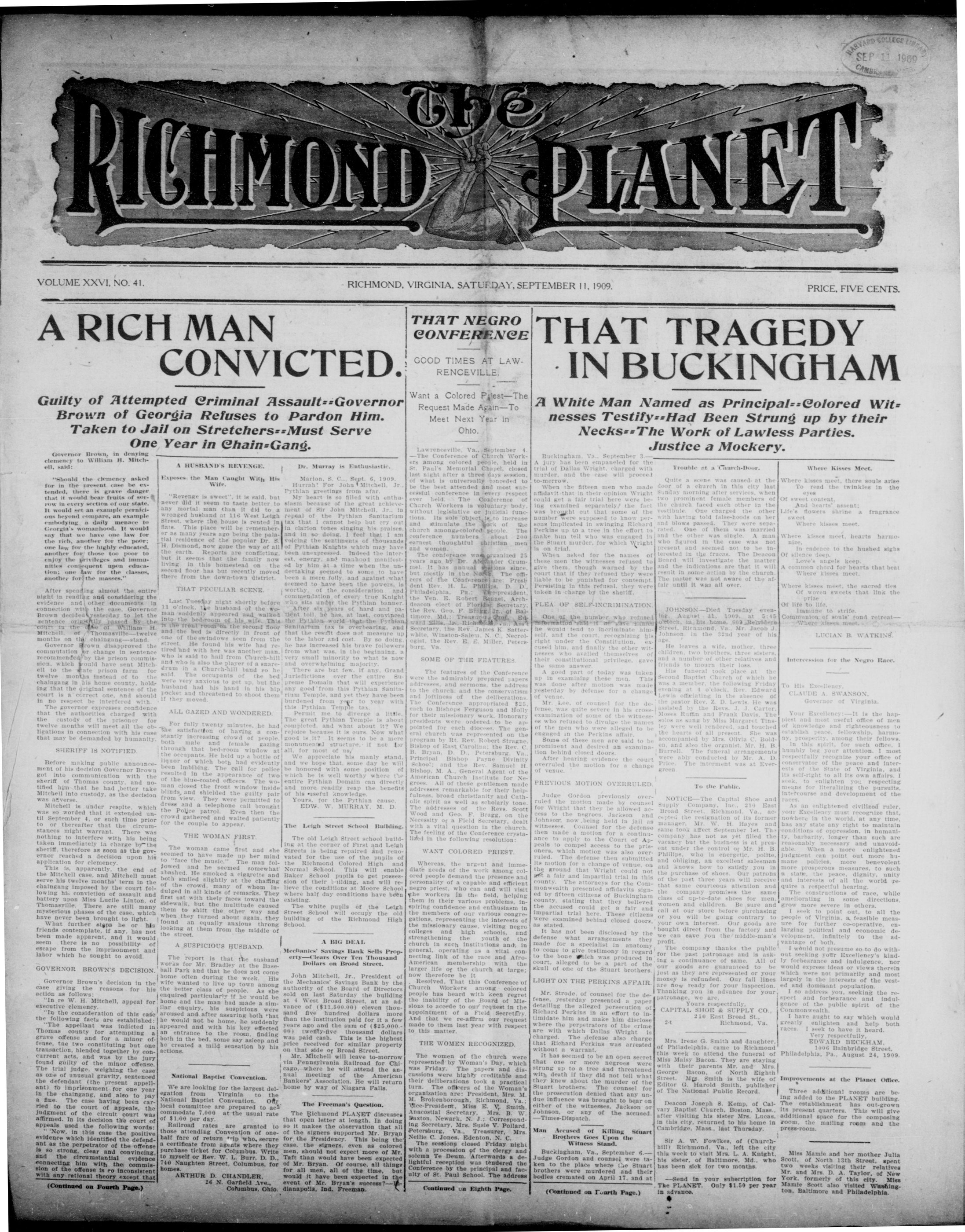
A RICH MAN CONVICTED.
Guilty of Attempted Criminal Assault==Governor Brown of Georgia Refuses to Pardon Him. Taken to Jail on Stretchers==Must Serve One Year in Chain=Gang.
VOLUME XXVI, NO. 41.
A RICH
Guilty of Attempt
Brown of Geo
Taken to Jail
One
Governor Brown, in denying
clemency to William H. Mitchell, said:
"Should the clemency asked for in the present case be extended, there is grave danger that it would bear fruits of sorrow in every section of our state. It would set an example pernicious beyond compare, an example embodying a daily menace to Georgia's womanhood. It would say that we have one law for the rich, another for the poor; one law for the highly educated, another for those too poor to enjoy the privileges and immunities consequent upon education; one law for the classes, another for the masses."
After spending almost the entire night in reading and considering the evidence and other documents in connection with the case, Governor Brown decided yesterday to let the sentence originally passed by the court in the case of William H. Mitchell, of Thomasville—twelve months on the chaining—stand.
Governor Brown disapproved the commutation or change in sentence recommended by the prison commission, which would have sent Mitchell to the state prison farm for twelve months instead of to the chaining in his home county, holding that the original sentence of the court is a correct one, and should in no respect be interfered with.
The governor expresses confidence that the authorities charged with the custody of the prisoner for twelve months will meet all the obligations in connection with his case that may be demanded by humanity.
SHERIFF IS NOTIFIED
Before making public announcement of his decision Governor Brown got into communication with the sheriff of Thomas county, and notified him that he had better take Mitchell into custody, as the decision was adverse.
Mitchell is under respite, which was so worded that it extended until September 4, or such time prior to or thereafter that the circumstances might warrant. There was nothing to interfere with his being taken immediately in charge by the sheriff, therefore as soon as the governor reached a decision upon his application for clemency.
This is, apparently, the end of the Mitchell case, and Mitchell must serve his twelve months' term in the chaining imposed by the court following his conviction of assault and battery upon Miss Lucile Linton, of Thomasville. There are still many mysterious phases of the case, which have never been brought to light.
What further signs he or his friends contemplate, if any, has not been made apparent, and it would seem there is no possibility of escape from the imprisonment and labor which he sought to avoid.
GOVERNOR BROWN'S DECISION
Governor Brown's decision in the case giving the reasons for his action as follows:
"In re W. H. Mitchell, appeal for executive clemency.
"In the consideration of this case the following facts are established:
"The appellant was indicted in Thomas county for attempting a grave offense and for a minor offense, the two constituting but one transaction, blended together by concurrent acts, and was by the jury found guilty of the minor offense. The trial judge, weighing the case as one of unusual gravity, sentenced the defendant (the present appellant) to imprisonment for one year in the chaining, and also to pay a fine. The case having been carried to the court of appeals, the judgment of the circuit court was affirmed. In its decision the court of appeals used the following words:
"Now, in this case the positive evidence which identified the defendant as the perpetrator of the offense is so strong, clear and convincing, and the circumstantial evidence connecting him with the commission of the offense is so inconsistent with any rational theory except that
(Continued on Fourth Pane.)
A HUSBAND'S REVENGE.
Exposes the Man Caught With His Wife.
"Revenge is sweet", it is said, but never did it seem to taste better to any mortal man than it did to a wronged husband at 116 West Leigh Street, where the house is rented in flats. This place will be remember- as many years ago being the palatial residence of the popular Dr. S. H. Dismond, now gone the way of all the earth. Reports are conflicting, but it seems that the family now living in this homestead on the second floor has but recently moved there from the down-town district.
THAT PECULIAR SCENE
Last Tuesday night shortly before 11 o'clock, the husband of the woman suddenly appeared and walked into the bed-room of his wife. This is the fright room on the second floor and the bed is directly in front of one of the swindows seen from the street. He found his wife had retired and with her was another man, who is said to hail from Church-hill and who is also the player of a snare-drum in a Church-hill band so he said. The occupants of the bed were very anxious to get up, but the husband had his hand in his hip pocket and threatened to shoot them if they moved.
ALL GAZED AND WONDERED
For fully twenty minutes, he had the satisfaction of having a constantly increasing crowd of people, both male and female gazing through that bed-room window at the occupants. He held up a bottle of liquor of which both had evidently been imbibing. The call for police resulted in the appearance of two of the blue-coated officers. The woman closed the front window inside blinds, and shielded the guilty pair from view. They were permitted to dress and a telephone call brought the Police patrol. Even then the crowd gathered and waited patiently for the couple to appear.
THE WOMAN FIRST.
The woman came first and she seemed to have made up her mind to "face the music." The man followed and he seemed somewhat abashed. He smoked a cigarette and both smiled slightly at the chaffing of the crowd, many of whom indulged in all kinds of remarks. They first sat with their faces toward the crowd, but the multitude caused them to shift the other way and when they turned about again, they found an equally anxious throng looking at them from the middle of the street.
A_SUSPICIOUS HUSBAND
The report is that the susband works for Mr. Bradley at the Baseball Park and that he does not come home often during the week. His wife wanted to live up town among the better class of people. As she enquired particularly if he would no home and the man had made a similar enquiry, his suspicions were aroused and after assuring both that he would not be home, he suddenly appeared and with his key effected an entrance to the room, finding both in the bed, some say asleep and he created a mild sensation by his actions.
National Baptist Convention.
We are looking for the largest delegation from Virginia to the National Baptist Convention. Our local committee are prepared to accommodate 7,000 at the usual rate of $1.00 per day.
Railroad rates are granted to those attending Convention of one-half fare of return *trip who, secure a certificate from agents where they purchase ticket for Columbus. Write to myself or Rev. W. L. Burr, D. D., 740 Naughten Street, Columbus, for homes.
ARTHUR D. CHANDLER,
26 N. Garfield Ave.
Columbus, Ohio
RICHMOND, VIRGINIA, SATURDAY, SEPTEMBER 11, 1909.
Dr. Murray is Enthusiastic.
Marlon, S. C., Sept. 6, 1909. Hurrah! For John Mitchell, Jr., Pythian greetings from afar.
My heart is so filled with enthusiasm because of the great achievement of Sir John Mitchell, Jr., in repeal of the Pythian Sanitarium tax that I cannot help but cry out in clarion tones singing his praises, and in so doing, I feel that I am voicing the sentiments of thousands of Pythian Knights which may have been unexpressed. Indeed the interest, energy, and manhood manifested by him at a time when the undertaking seemed to some to have been a mere folly, and against what seemed to have been the powers, is worthy, of the consideration and commendation of every true Knight who sits under the Pythian banner.
After six years of hard and patient toll, he has, at last, convinced the Pythian world that the Pythian Sanitarium tax is overbearing, and that the result does not measure up to the labor and cost. By so doing, he has increased his brave followers from what was, in the beginning, a very small minority to what is now and overwhelming majority.
There are but few, if any, Grand Jurisdictions over the entire Supreme Domain that will experience any good from this Pythian Sanitarium Temple, and yet they have been burdened from year to year with this Pythian Temple tax.
Permit me to diverge a little. The great Pythian Temple is about completed, and what about it? We rejoice because it is ours. Now what good is it? It seems to be a more monumental structure; if not for all, for most of us. We appreciate his manly stands, and we hope that, some day he will be honored with some position of which he is well worthy where the entire Pythian Domain can directly and more readily reap the benefits of his useful knowledge. Yours, for the Pythian cause. EDW. W. MURRAY, M. D.
The Leigh Street School Building
The old Leigh Street school building at the corner of First and Leigh Streets is being repaired and renovated for the use of the pupils of the Richmond Colored High and Normal School. This will enable Baker School pupils to get possession of their building, and will relieve the conditions at Moore School where half day conditions have been existing. The white pupils of the Leigh Street School will occupy the old building of the Richmond High School.
A BIG DEAL
Mechanics' Savings Bank Sells Property—Clears Over Ten Thousand Dollars on Broad Street.
John Mitchell, Jr., President of the Mechanics' Savings Bank by the authority of the Board of Directors sold on last Saturday the building at 4 West Broad Street, at an advance of ($11,500.00) eleven thousand five hundred dollars more than the institution paid for it a few years ago and the sum of ($25,000.-00) twenty-five thousand dollars was paid cash. This is the highest price received for similar property on that side or Broad Street.
Mr. Mitchell will leave to-morrow via Pennsylvania Railroad for Chicago, where he will attend the annual meeting of the American Bankers' Association. He will return home by way of Niagara Falls.
The Freeman's Question.
The Richmond PLANET discusses that open letter at length. In doing so it makes the observation that all of the signers supported Mr. Bryan for the Presidency. This being the case, the signers, even as colored men, should not expect more of Mr. Taft than would have been expected of Mr. Bryan. Of course, all things for all men, all of the time, but would it have been expected in the event of Mr. Bryan's success?—Indianapolis, Ind. Freeman.
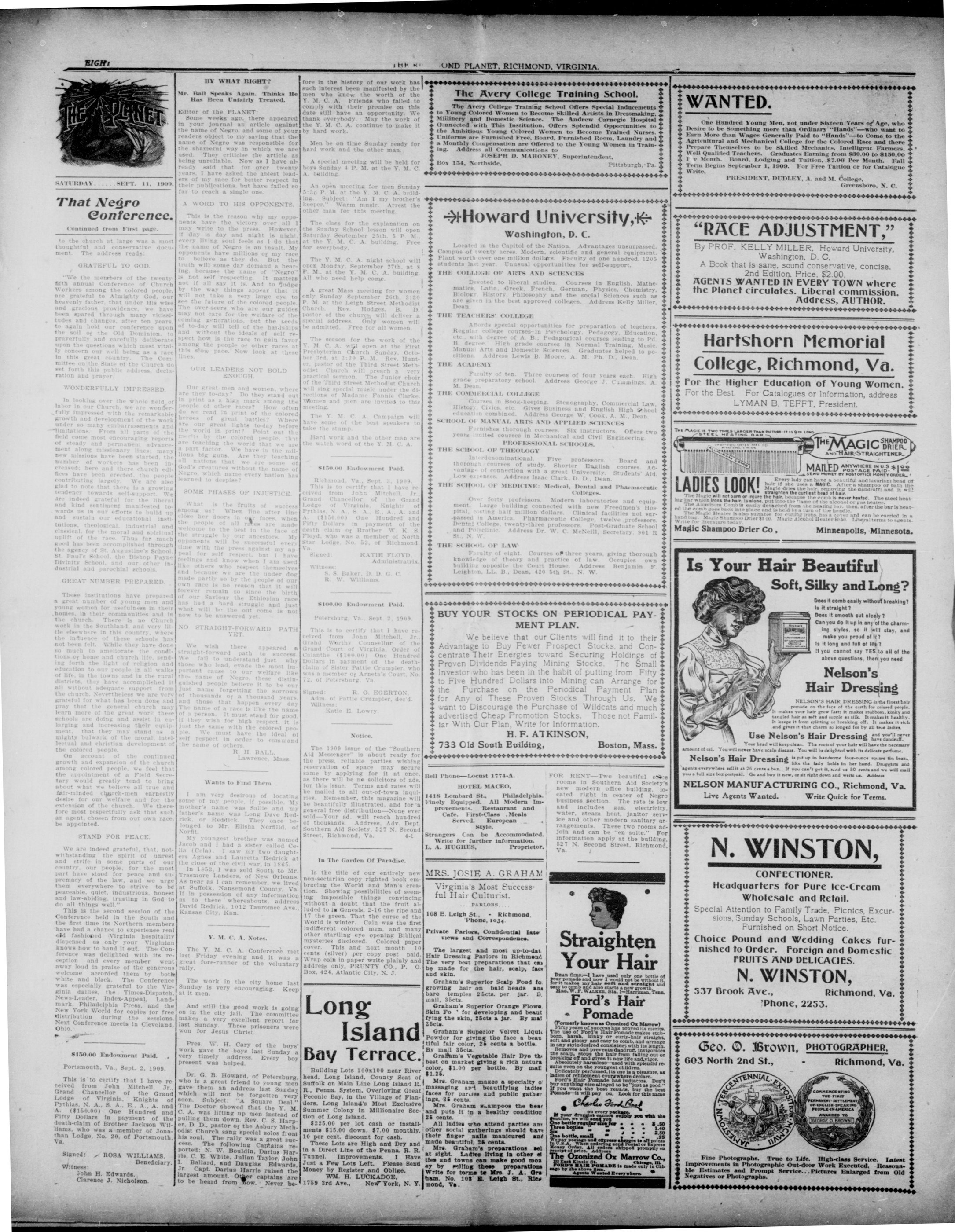
THAT NEGRO CONFERENCE
GOOD TIMES AT LAW-
RENCEVILLE.
Want a Colored Priest—The
Request Made Again—To
Meet Next Year in
Ohio.
Lawrenceville, Va., September 4.
—The Conference of Church Workers
among colored people, held in
St. Paul's Memorial Chapel, closed
last night after a three days session,
of what is universally conceded to
be the best attended and most successful conference in every respect
ever held. The Conference of
Church Workers is voluntary body,
without legislative or judicial functions. Its sole object is to increase
and stimulate the work of the
church among colored people. The
conference numbers about 200
earnest thoughtful christian men
and women.
The conference was organized 25 years ago by Dr. Alexander Crummel. It has annual sessions since, but mostly in the Nov. 5. The officers of the Conference are: President Rev. H. L. Phillips, D. D., Philadelphia, Pa.; The president, the Ven. E. Robert Barnet, Archdeacon elect of Florida Secretary, the Rev. Geo. F. Briggs, Jr. of Baltimore. Md.; Treasurer Prof. Edward Ellis, Rich. M. Asa. Asa Secretary, the Rev. James K. Satterwhite, Winston-Salem, N. C., Necrologist, the Rev. E. E. Miller, Petersburg, Va.
SOME OF THE FEATURES
The features of the Conference were the admirably prepared papers addresses, and sermons, the address to the church, and the conservatism and loftiness of the deliberations. The Conference appropriated $25, each to Bishops Ferguson and Holly for their missionary work. Honorary presidents were ordered to be appointed for each diocese. The general church was represented on the program by Rt. Rev. Robert Stragane, Bishop of East Carolina; the Rev. C. B. Bryan, D. D., Petersburg, Va. Principal Bishop Payne Divinity School; and the Rev. Samuel H. Bishop, M. A., General Agent of the American Church Institute for Negroes. All of these gentlemen made addresses remarkable for their helpfulness, broad Christianity and Catholic spirit as well as scholarly tone. The addresses of the Revs. Scott Wood and Geo. F. Bragg, on the necessity of a Field Secretary, dealt with a vital question in the church. The feeling of the Conference crystallized in the following resolution:
WANT COLORED PRIEST
Whereas, the urgent and immediate needs of the work among colored people demand the presence and personality of a capable and efficient negro priest, who can and will visit the workers in the field, helping them in their various problems, inspiring confidence and enthusiasm in the members of our various congregations, representing the interests of the missionary cause, visiting negro colleges and high schools, and strengthening the youth of the church in such institutions and, in general, operating as a vital connecting link of the race and Afro-American membership with the larger life or the church at large; now therefore be it
Resolved, That this Conference of Church Workers among colored people has heard with keen regret the inability of the Board of Missions to accede to our request in the appointment of a Field Secretary. And that we re-affirm our request made to them last year with respect to this matter.
THE WOMEN RECOGNIZED
The women of the church were represented by Woman's Day, which was Friday. The papers and discussions were highly creditable and their deliberations took a practical turn. The officers of the Woman's organization are: President, Mrs. M. M. Brokenborough, Richmond, Va.; Vice-President, Miss E. V. Smith, Anacostal Secretary, Mrs. B. W. Baxton, Newark, N. J.; Corresponding Secretary, Mrs. Susie V. Pollard, Petersburg, Va., Treasurer, Mrs. Nellie C. Jones, Edenton, N. C. The sessions closed Friday night with a procession of the clergy and solemn Te Deum. Afterwards a delightful reception was tendered the Conference by the principal and faculty of St. Paul School. The address
Continued on Eighth Page.
THAT TRAGEDY IN BUCKINGHAM
A White Man Named as Principal==Colored Witnesses Testify==Had Been Strung up by their Necks==The Work of Lawless Parties.
Buckingham, Va., September 3.—A jury has been empaired for the trial of Dallas Wright, charged with murder, and the case will proceed to-morrow.
When the fifteen men who made affidavit that in their opinion Wright could get a fair trial here were being examined separately/ the fact was brought out that some of the number were supposed to know persons implicated in swinging Richard Perkins up to a tree in the effort to make him tell who was engaged in the Stuart murder, for which Wright is on trial.
When asked for the names of these men the witnesses refused to give them, though warned by the court that if they refused they were liable to be punished for contempt. Persisting in this refusal, they were taken in charge by the sheriff.
PLEA OF SELF-INCRIMINATION
One of the number who refused information said if he gave himself he would tend to incriminate himself, and the court, recognizing his right under the Constitution, excused him, and finally the other witnesses who availed themselves of their constitutional privilege, gave the same answer.
A good part of today was taken up in examining these men. This was done after motion was made yesterday by defense for a change of venue.
Mr. Lee, of counsel for the defense, was quite severe in his cross-examination of some of the witnesses who refused to divulge the names of the men who were alleged to be engaged in the Perkins affair.
Some of these men are said to be prominent and desired an examination behind closed doors.
After hearing evidence the court overruled the motion for a change of venue.
PREVIOUS MOTION OVERRULED
Judge Gordon previously overruled the motion made by counsel for Wright that they be allowed access to the negroes, Jackson and Johnson, now, being held in jail as witnesses. Counsel for the defense then made a motion for a continuance to apply to the Court of Appeals to compel access to the prisoners, which motion was also overruled. The defense then submitted its motion for a change of venue, on the ground that Wright could not get a fair and impartial trial in this county. The attorneys for the Commonwealth presented affidavits signed by fifteen citizens of Buckingham county, stating that they believed the accused could get a fair and impartial trial here. These citizens were examined behind closed doors, as stated.
It has not been disclosed by the defense what arrangements they made for a specialist in anatomy to come to give testimony in regard to the bone which was produced in court, alleged to be a part of the skull of one of the Stuart brothers
LIGHT ON THE PERKINS AFFAIR
Mr. Strode, of counsel for the defense, yesterday presented a paper detailing the alleged persecution of Richard Perkins in an effort to intimidate him and make him disclose where the perpetrators of the crime are with which Dallas Wright is charged. The defense also charge that Richard Perkins was arrested without a warrant. It has seemed to be an open secret that one or more negroes were strung up to a tree and threatened with death if they did not tell what they knew about the murder of the Stuart brothers. The counsel for the prosecution denied that any undue influence was brought to bear on either of the witnesses, Jackson or Johnson, or any of the accused.
—Times-Dispatch.
Man Accused of Killing Stuart Brothers Goes Upon the Witness Stand
Buckingham, Va., September 6.— Judge Gordon and counsel were taken to the place where the Stuart brothers were murdered and their bodies cremated on April 17, and at
(Continued on Fourth Page.)
Trouble et a Church-Door.
Quite a scene was caused at the door of a church in this city last Sunday morning after services, when two prominent female members of the church faced each other in the vestibule. One charged the other with having told false-hoods on her and blows passed. They were separated. One of them was married and the other was single. A man who figured in the case was not present and seemed not to be interested in the fracas. The Deacon Board will investigate the matter and the indications are that it will result in some action by the church. The pastor was not aware of the affair until it was all over.
JOHNSON—Died Tuesday evening, August 31, 1909, at 5:45 o'clock, in his home, 509 Belford Street, Richmond, Va., Mr. Jacob J. Johnson, in the 32nd year of his age.
He leaves a wife, mother, three children, two brothers, three sisters, and a number of other relatives and friends to mourn their loss.
His funeral took place at the Second Baptist Church of which he was a member, the following Friday evening at 4 o'clock, Rev. Edward Lewis officiating in the absence of the pastor Rev. Z. D. Lewis. He was assisted by the Revs. J. J. Carter, Moses Ruffin and Frank Davis. The solos as song by Miss Margaret Tinsley were well rendered, and touched the hearts of all present. He was accompanied by Mrs. Olivia C. Been, and also the organist, Mr. H. B. Burrell. The funeral arrangements were ably conducted by Mr. A. D. Price. The interment was at Evergreen
To the Public.
NOTICE—The Capital Shoe and Supply Company, Inc., 210 East Broad Street, Richmond, Va., accepted the resignation of its former manager, Mr. W. H. Hayes and same took effect September 1st. The company has not as yet filled the vacancy but the business is at present under the control or Mr. H. B. Phillips, who is energetic, polite, and obliging, an excellent salesman and knows how to satisfy you in the purchase of shoes. Our patrons of the past three years will receive that same courteous attention and the company promises the same class of up-to-date shoes for men, women and children. Be sure and call at our store before purchasing or you will be going contrary to your own interest. Our goods are bought direct from the factory and we can save you the middle-man's profit.
The company thanks the public for the past patronage and is asking a continuance of same. All of our goods are guaranteed to be just as they are represented or your money is refunded. Our fall lines are now ready for your inspection. Thanking you in advance for your patronage, we are.
Yours respectfully,
CAPITAL SHOE & SUPPLY CO.,
210 East Broad St.,
2-6
Richmond, Va.
Mrs. Irene G. Smith and daughter, of Philadelphia, came to Richmond this week to attend the funeral of Miss Maisy Bacon. They are staying with their parents Mr. and Mrs. George Bacon, of North Eighth Street. Mrs. Smith is the wife of Editor G. Harold Smith, publisher of The National Public Record.
Deacon Joseph S. Kemp, of Calvary Baptist Church, Boston, Mass., after visiting his sister Mrs. Lucas, in this city, returned to his home in Cambridge, Mass., last Thursday.
Sir A. W. Fowlkes, of (Churchhill) Richmond, Va., left the city this week to visit Mrs. L. A. Knight, his sister, of Baltimore, Md., who has been sick for two months.
—Send in your subscription for The PLANET. Only $1.50 per year in advance.
EDY
GHAM
al--Colored Wit-
ing up by their
less Parties.
y.
Where Kisses Meet.
Where kisses meet, there souls arise
To read the twinkles in the
eyes
Where kisses meet.
Where kisses meet, hearts harmonize.
In cadence to the hushed sighs
Of silence deep.
Love's angels keep.
A common chord for hearts that beat
Where kisses meet.
Where kisses meet, the sacred ties
Of woven sweets that link the prize
Of life to life.
Immune to strife.
Communion of souls' fond retreat—
Where kisses meet.
LUCIAN B. WATKINS
Intercession for the Negro Race.
To His Excellency,
CLAUDE A. SWANSON.
Governor of Virginia.
Your Excellency:—It is the happiest and most useful office of men of knowledge and righteousness to establish peace, fellowship, harmony, prosperity, among their fellows. In this spirit, for such office, I humbly beg your attention. I most respectfully recognize your office of conservator of the peace and interests of the State of Virginia, and its self-right to all its own affairs. I seek to enlighten you respecting means for literalizing the pursuits, intercourse and development of the races.
As an enlightened civilized ruler, your Excellency must recognize that, nowhere in the world, at any time, has any state any right to maintain conditions of oppression, in humanity, barbarity, longer than such are reasonably necessary and unavoidable. When a more enlightened judgment can point out more human policies, more benevolent more prosperous measures, to such a state, the peace, dignity, unity and interests of all the world require a respectful hearing.
The constructions of race, while ameliorating in some directions, grow more severe in others.
I seek to point out, to all the people of Virginia, a feasible measure for further co-operative, enlarging political and economic development, infinitely to the advantage of both.
I would not presume so to do without seeking your Excellency's kindly forbearance and indulgence, nor would express ideas or views therein which were not primarily and most largely in the interests of the vested and dominant population.
I so address you, seeking the respect and forbearance and indulgence of the public spirit of the Commonwealth.
I have aught to say which would greatly enlighten and help both races. I seek to have it heard.
Very respectfully,
EDWARD BECKHAM,
1006 Balmbridge Street,
Philadelphia, Pa., August 24, 1909.
Improvements at the Planet Office.
Three additional rooms are being added to the PLANET building. The establishment has out-grown its present quarters. This will give additional space for the composing room, the mailing room and the press-room.
Miss Mamie and her mother Julia Scott, of North 13th Street, spent two weeks visiting their relatives Mr. and Mrs. D. A. Taylor, of New York, formerly of this city. Miss Mamie Scott also visited Washington, Baltimore and Philadelphia.
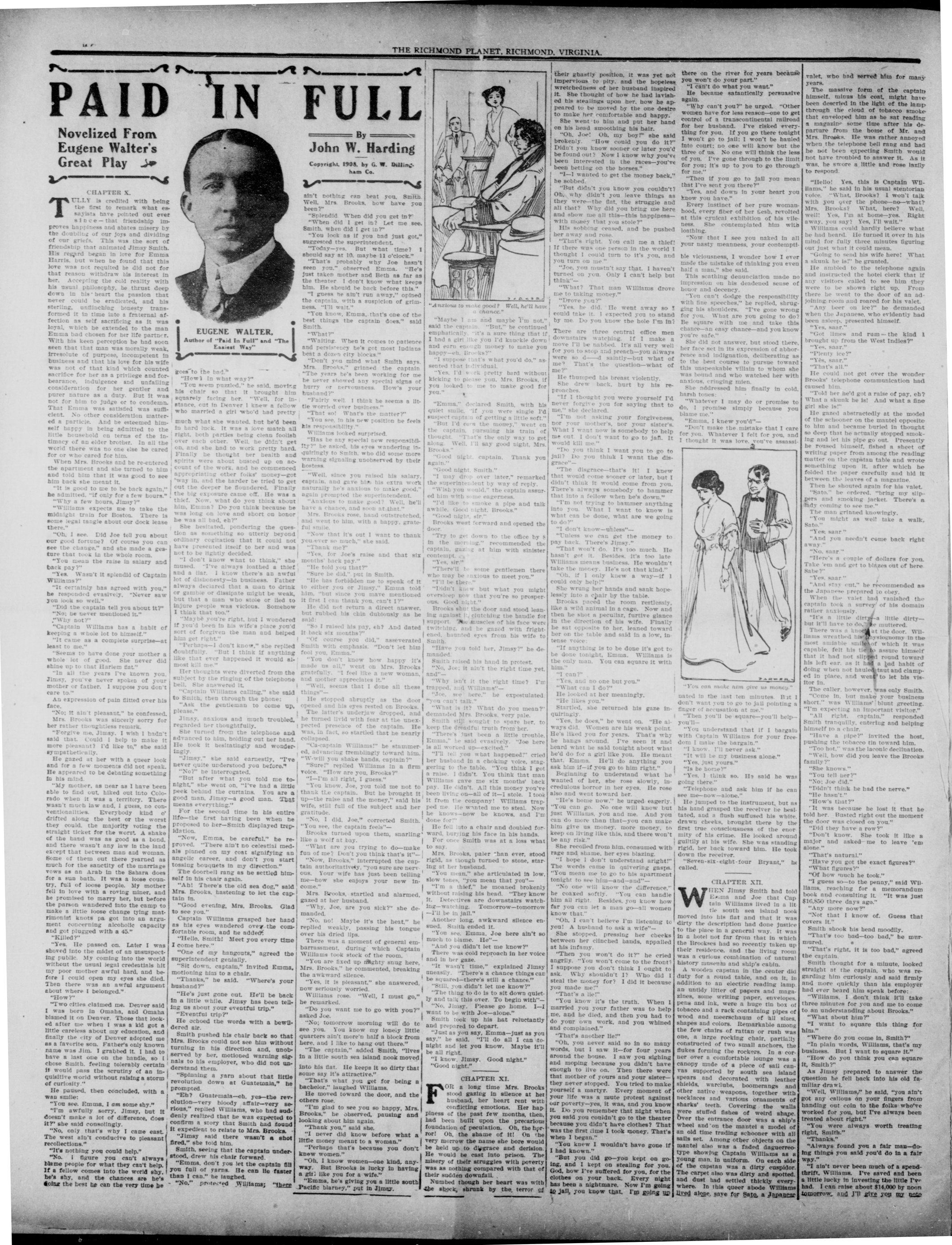
PAID IN FULL
Novelized From Eugene Walter's Great Play
CHAPTER X.
ULLY is credited with being the first to remark what essayists have pointed out ever
the first to remark what essayists have pointed out ever since—that friendship improves happiness and abates misery by the doubling of our joys and dividing of our griefs. This was the sort of friendship that animated Jimsy Smith. His regard began in love for Emma Harris, but when he found that this love was not required he did not for that reason withdraw his interest in her. Accepting the cold reality with his usual philosophy, he thrust deep down in his heart the passion that never could be eradicated, and his sterling, unfinishing honesty transformed it in time into a fraternal affection as self sacrificing as it was loyal, which he extended to the man Emma had chosen for her life partner. With his keen perception he had soon seen that that man was morally weak, irresolute of purpose, incompetent in business and that his love for his wife was not of that kind which counted sacrifice for her as a privilege and forbearance, indulgence and unfailing consideration for her gentler and purer nature as a duty. But it was not for him to judge or to condemn. That Emma was satisfied was sufficient. No other consideration mattered a particle. And he esteemed himself happy in being admitted to the little household on terms of the intimacy of an elder brother. In all the world there was no one else be cared for or who cared for him.
When Mrs. Brooks and he re-entered the apartment and she turned to him and told him that it was good to see him back she meant it.
"It is good to me to be back again," he admitted. "If only for a few hours."
"Why a few hours, Jimsy?"
"Williams expects me to take the midnight train for Boston. There is some legal tangle about our dock lease there."
"Oh, I see. Did Joe tell you about our good fortune? Of course you can see the change," and she made a gesture that took in the whole room.
"You mean the raise in salary and back pay?"
"Yes. Wasn't it splendid of Captain Williams?"
"It certainly has agreed with you," he responded evasively. "Never saw you look so well."
"Did the captain tell you about it?"
"No; he never mentioned it."
"Why not?"
"Captain Williams has a habit of keeping a whole lot to himself."
"It came as a complete surprise—at least to me."
"Seems to have done your mother a whole lot of good. She never did shine up to that Harlem flat."
"In all the years I've known you, Jimmy, you've never spoken of your mother or father. I suppose you don't care to."
An expression of pain flitted over his face.
"No; it ain't pleasant," he confessed, Mrs. Brooks was sincerely sorry for her rather thoughtless remark.
"Forgive me, Jimmy. I wish I hadn't said that. Could I help to make it more pleasant? I'd like to," she said sympathetically.
He gazed at her with a queer look and for a few moments did not speak. He appeared to be debating something in his mind.
"My mother, as near as I have been able to find out, hiked out into Colorado when it was a territory. There wasn't much law and, I guess, no conventionalities. Everybody kind of drifted along the best or the worst they could, the majority voting the straight ticket for the worst. A shake of the hand was as good as a bond, and there wasn't any law in the land except that between man and woman. Some of them out there yearned as much for the sanctity of the marriage vows as an Arab in the Sahara does for a sun bath. It was a loose country, full of loose people. My mother fell in love with a roving miner, and he promised to marry her, but before the parson wandered into the camp to make a little loose change tying matrimonium knots pa got into an argument concerning alcoholic capacity and got plugged with a 45."
"Yes. He passed on. Later I was shoved into the midst of an unsuspecting public. My coming into the world without the usual legal credentials hit my poor mother awful hard, and before I could open my eyes she died. Then there was an awful argument about where I belonged."
"How?"
"Two cities claimed me. Denver said I was born in Omaha, and Omaha blamed it on Denver. Those that looked after me when I was a kid got a little careless about my education, and finally the city of Denver adopted me as a favorite son. Father's only known name was Jim. I grabbed it. I had to have a last one on the handle, so I chose Smith, feeling tolerably certain it would pass the scrutiny of an inquisitive world without raising a storm of curiosity."
He paused, then concluded, with a wan smile:
"I'm awfully sorry, Jimmy, but it doesn't make a lot of difference, does it?" she said consolingly.
"No, only that's why I came east. The west isn't conducive to pleasant recollections."
"It's nothing you could help."
"No. I figure you can't always blame people for what they can't help. If a fellow comes into the world shy, he's shy, and the chances are he's going the best he can the very time he
J. B.
goes to the bad."
"How's in what way?"
"You seem puzzled," he said, moving his chair so that it brought him squarely facing her. "Well, for instance, out in Denver I knew a fellow who married a girl who'd had pretty much what she wanted, but he'd been in hard luck. It was a love match all right, both parties being clean foolish over each other. Well, he didn't get on, and she had to work pretty hard. Finally he thought her health and spirits were about busted up on account of the work, and he commenced appropriating other folks' money—got 'way in, and the harder he tried to get out the deeper he floundered. Finally the big exposure came off. He was a thief. Now, what do you think about him, Emma? Do you think because he was long on love and short on honor he was all bad, eh?"
She hesitated, pondering the question as something so utterly beyond ordinary cognition that it could not have presented itself to her and was not to be lightly decided.
"I don't know what to think," she mused. "I've always loathed a thief and a flat. I know there's an awful lot of dishonesty—in business. Father always declared that a man to drink or gamble or dissipate might be weak, but that a man who stole or lied to injure people was vicious. Somehow I think that too."
"Maybe you're right, but I wondered if you'd been in his wife's place you'd sort of forgiven the man and helped him get right."
"Perhaps—I don't know," she replied doubtfully. "But I think if anything like that ever happened it would almost kill me."
Her thoughts were diverted from the subject by the ringing of the telephone bell. She answered it.
"Captain Williams calling"; she said to Smith, then through the phone;
She turned from the telephone and advanced to him, holding out her hand. He took it hesitatingly and wonderingly.
"Jimsy." she said earnestly. "I've never quite understood you before." "No!" he interrogated.
"But after what you told me tonight," she went on. "I've had a little peek behind the curtains. You are a good man, Jimsy—a good man. That means everything."
For the second time in his entire life—the first having been when he proposed to her-Smith displayed trepidation.
"Now, Emma, be careful." he reproved. "There ain't no celestial medals pinned on my coat signifying an angelic career, and don't you start tossing bouquets in my direction."
The doorbell rang as he settled himself in his chair again.
"Ah! There's the old sea dog," said Mrs. Brooks, hastening to let the captain in.
"Good evening, Mrs. Brooks. Glad to see you."
Captain Williams grasped her hand as his eyes wandered over the comfortable room, and he added:
"Hello, Smith! Meet you every time I come here."
"One of my hangouts," agreed the superintendent genially.
"Thanks," he said. "Where's your husband?"
"He's just gone out. He'll be back in a little while. Jimys has been telling us about your eventful trip."
"Eventful trip?"
He schooled the words with a bewildered air.
Smith pushed his chair back so that Mrs. Brooks could not see him without turning in his direction and, unobserved by her, motioned warning signals to his employer, who did not understand them.
"Spinning a yarn about that little revolution down at Guatemala," he prompted.
"Eh? Guatemala—oh, yes—the revolution—very bloody affair—very serious," replied Williams, who had suddenly realized that he was expected to confirm a story that Smith had found it expedient to relate to Mrs. Brooks.
"Jimys said there wasn't a shot fired," she told him.
Smith, seeing that the captain understood, drew his chair forward.
- "No." protested Williams; "there
THE RICHMOND PLANET, RICHMOND, VIRGINIA
John W. Harding
Copyright, 1908, by G. W. Dillingham Co.
ain't nothing can beat you. Smith
Well, Mrs. Brooks, how have you
been?
"Splendid. When did you get in?"
"When did I get in? Let me see.
Smith, when did I get in?"
"You look as if you had just got,
suggested the superintendent.
"Today—yes. But what time? I
should say at 10, maybe 11 o'clock."
"That's probably why Joe hasn't seen you," observed Emma. "He's just taken mother and Beth as far as the theater. I don't know what keeps blim. He should be back before this." "I guess he ain't run away," opined the captain, with a suspicion of grimness. "I'll wait."
"What?"
"Waiting. When it comes to patience and persistence he's got most Indians beat a dozen city blocks."
"Don't you mind what Smith says. Mrs. Brooks." grinned the captain.
"The years he's been working for me he never showed any special signs of hurry or nervousness. How's your husband?"
"Fairly well. I think he seems a little worried over business."
"That so! What's the matter?"
"You see, in his new position he feels his responsibility."
Williams looked surprised.
"Has he any special new responsibility? he asked, his eyes wandering inquiringly to Smith, who did some more warning signaling unobserved by their hostess.
"Well, since you raised his salary, captain, and gave him his extra work naturally he's anxious to make good," again prompted the superintendent.
"Anxious to make good? Well, he'll have a chance, and soon at that."
Mrs. Brooks rose, hand outstretched, and went to him, with a happy, grateful smile.
"Now that it's out I want to thank you ever so much," she said.
"Thank me?"
"Yes, for Joe's raise and that six months' back pay."
"He told you that?"
"Sure he did," put in Smith.
"He has forbidden me to speak of it to either you or Jimsy." Emma told him, "but since you mave mentioned it first I can thank you, can't I?"
He did not return a direct answer,
but rubbed his chin dubiously as he
stated, "So I raised his pay, eh? And dated
it back six months."
"You don't know how happy it's made us all," went on Mrs. Brooks gratefully. "I feel like a new woman, and mother appreciates it."
"Well, seems that I done all these things"—
He stopped abruptly as the door opened and his eyes rested on Brooks. The latter's underjaw dropped, and he turned livid with fear at the unexpected presence of the captain. He was, in fact, so startled that he nearly collapsed.
"Ca-captain Williams!" he stammered, advancing tremblingly toward him. "W-will you shake hands, captain?"
"Sure!" replied Williams in a firm voice. "How are you, Brooks?"
"I—I'm all right, I guess."
"You know, Joe, you told me not to thank the captain. But he brought it up—the raise and the money," said his wife, still full of the subject and her gratitude.
"No, I did, Joe," corrected Smith. "You see, the captain feels"—
"What are you trying to do--make fun of you? Don't you think that's it"--
run of me? Don't you think that's it?"—"Now, Brooks," interrupted the captain authoritatively, "you sure are nervous. Your wife has just been telling me—how she enjoys your new income." Mrs. Brooks, startled and alarmed, gazed at her husband. "Why, Joe, are you sick?" she demanded. "No, no! Maybe it's the heat," he replied weakly, passing his tongue over his dried lips. There was a moment of general embarrassment, during which Captain Williams took stock of the room.
"Yes, it is pleasant." she answered, now seriously worried.
Williams rose. "Well, I must go," he remarked.
"Do you want me to go with you?" asked Joe.
"No; tomorrow morning will do to see you. You know my lonely little quarters aren't more'n half a block from here, and I like to hang out there."
"The captain," added Smith, "lives in a little south sea island nook moved into his flat. He keeps it so dirty that some say it's attractive."
"I'm glad to see you so happy, Mrs. Brooks," he observed, pausing and looking about him again.
"Thank you," said she.
"I never did know before what a little money meant to a woman."
"Perhaps that's because you don't knew women."
"Oh, I know women—one kind, anyway. But Brooks is lucky in having a girl like you for a wife."
"Emma, he's giving you a little south Pacific blarney," put in Jimsy.
J. D. G. R.
"Anxious to make good! Well, he'll have a chance."
"Maybe I am and maybe I'm not," said the captain. "But," he continued emphatically, "it's a sure thing that if I had a girl like you I'd knuckle down and earn enough money to make you happy—eh. Brooks?"
"I suppose that's what you'd do," assented that individual.
"Yes, I work pretty hard without kicking to please you. Mrs. Brooks, if you looked to me to make good for you."
"Emma," declared Smith, with his quiet smile, "if you were single I'd suspect captain of getting a little soft."
"But I'd earn the money," went on the captain, pursuing his train of thought. "That's the only way to get along. Well, I'll say good night, Mrs. Brooks."
"Good night, captain. Thank you again."
"Good night, Smith."
"I may drop over later," remarked the superintendent by way of reply.
"Wish you would," the captain assured him with some eagerness.
"I'd like to smoke a pipe and talk awhile. Good night. Brooks."
"Good night, sir."
Brooks went forward and opened the door.
"Try to get down to the office by 8 in the morning," recommended the captain, gazing at him with sinister contempt.
"Yes, sir."
"There'll be some gentlemen there who may be anxious to meet you."
"I'll be there."
"Didn't know but what you might oversleep now that you're so prosperous. Good night."
Brooks shut the door and stood leaning against it, clutching the handle for support. The muscles of his face were twitching, and he gazed with frightened, haunted eyes from his wife to Smith.
"Have you told her, Jimsy?" he demanded.
Smith raised his hand in protest.
"No, Joe; it ain't the right time yet, and"
"Why isn't it the right time? I'm trapped and Williams"—
"What is it? What do you mean?" demanded Mrs. Brooks, very pale. Smith still sought to spare her, to keep the dreadful truth from her. "There's just been a little trouble, Emma," he said evasively. "Joe here is all worked up—excited."
"I tell you what happened!" cried her husband in a choking voice, staggering to the table. "You think I got a raise. I didn't. You think that man Williams gave me six months' back pay. He didn't. All this money you've been living on—all of it—I stole. I took it from the company! Williams trapped me. He wanted me to steal. Now he knows—now he knows, and I'm done for"
He fell into a chair and doubled forward, burying his face in his hands. For once Smith was at a loss what to say.
Mrs. Brooks, paler than ever, stood rigid, as though turned to stone, staring at her husband.
"You mean," she articulated in low, slow tones, "you mean that you—
"I'm a thief," he moaned brokenly without raising his head. "They know it. Detectives are downstairs watching—watching. Tomorrow—tomorrow—I'll be in jail."
Another long, awkward silence ensued. Smith ended it.
"You see, Emma, Joe here ain't so much to blame. He."—
"And you didn't let me know?"
There was cold reproach in her voice and in her gaze.
"It was not time," explained Jihmsy uneasily. "There's a chance things can be squared—there's still a chance."
"Still, you didn't let me know?"
"The thing to do is to sit down quietly and talk this over. To begin with"—
"No, Jihmsy. Please go home. I—I want to be with Joe—alone."
Smith took up his hat reluctantly and prepared to depart.
"I know. Jimsy. Good night."
"Good night."
CHAPTER XL
FOR a long time Mrs. Brooks stood gazing in silence at her husband, her heart rent with conflicting emotions. Her happiness of the past few months, then, had been built upon the precarious foundation of peculation. Oh, the horror! Oh, the shame of it! On the very morrow the name she bore would be held up to disgrace and derision. He would be cast into prison. The misery of their struggles with poverty was as nothing compared with that of their sudden downfall. Numbed though her heart was with the shock, shrunk by the terror of
their ghastly position, it was yet not impervious to pity, and the hopeless wretchedness of her husband inspired it. She thought of how he had lavished his stealings upon her, how he appeared to be moved by the one desire to make her comfortable and happy.
She went to him and put her hand on his head smoothing his hair.
"Oh Joe! Oh, my boy!" she said brokenly. "How could you do it?" Didn't you know sooner or later you'd be found out? Now I know why you've been interested in the races—you've been betting on the horses."
"I—I wanted to get the money back," he sobbed.
"But didn't you know you couldn't? Oh, why didn't you leave things as they were—the flat, the struggle and all that? Why did you bring me here and show me all this—this happiness—with money that you stole?"
His sobbing ceased, and he pushed her away and rose.
"That's right. You call me a thief. If there was one person in the world I thought I could turn to it's you, and you turn on me."
"Joe, you mustn't say that. I haven't turned on you. Only I can't help but think—"
"What? That man Williams drove me to taking money."
"Drove you?"
"Yes, he did. He went away so I could take it. I expected you to stand by me. Do you know the hole I'm in?"
There are three central office men downstairs watching. If I make a move I'll be nabbed. It's all very well for you to stop and preach—you always were so d—d saintly—but what of me? That's the question—what of me?
He thumped his breast violently. She drew back, hurt by his reproaches.
"If I thought you were yourself I'd never forgive you for saying that to me," she declared.
"I'm not asking your forgiveness, nor your mother's, nor your sister's. What I want now is somebody to help me out. I don't want to go to jaff. It would kill me."
"Do you think I want you to go to jaff? Do you think I want the disgrace"—
"The disgrace—that's it! I knew that would come sooner or later, but I didn't think it would come from you. There's always somebody to hammer that into a fellow when he's down."
"I'm not trying to hammer anything into you. What I want to know is what can be done, what are we going to do?
"I don't know—uhless"—
"Unless we can get the money to pay back. There's Jimsy."
That won't do. It's too much. He hasn't got it. Besides, it's too late Williams means business. He wouldn't take the money. He's not that kind."
"Oh, if I only knew a way—if I
She wring her hands and sank hopelessly into a chair by the table.
Brooks paced the room restlessly, like a wild animal in a cage. Now and then he shot a peculiar, furtive glance in the direction of his wife. Finally he sat opposite to her, leaned toward her on the table and said in a low, intense voice:
"If anything is to be done it's got to be done tonight, Emma. Williams is the only man. You can square it with him."
"I can?"
"Yes, and no one but you."
Startled, she returned his gaze inquiringly.
"Yes, he does," he went on. "He always did. Women are his weak point. He's liked you for years. That's why he hangs around. I've seen it and heard what he said tonight about what he'd do for a girl like you. He meant that. Emma. He'll do anything you ask him if—if you go to him right."
Beginning to understand what he wanted of her, she rose slowly, incredulous horror in her eyes. He rose also and went toward her.
"He's home now," he urged eagerly.
"You can go. No one will know but just Williams, you and me. And you can do more than that—you can make him give us money, more money, to keep on living like this, and there won't be any risk."
"I hope I don't understand aight!"
The words came in quivering gasps.
"You mean me to go to his apartment tonight to see him—and—and"—
"No one will know the difference," he coaxed softly. "You can handle him all right. Besides, you know how far you can let a man go—all women know that."
She stopped, pressing her cheeks between her clinched hands, appalled at his infamy.
"Then you won't do it?" he cried angrily. "You won't come to the front! I suppose you don't think I ought to ask. Why shouldn't I? Who did I steal the money for? I did it because you made me!"
"That's a lie."
"You know it's the truth. When I married you your father was to help me, and he died, and then you had to do your own work, and you whined and complained."
"Oh, you never said so in so many words, but I saw it—for four years around the house. I saw you sighing and moping because you didn't have enough to live on. Then there were that mother of yours and your sister—they never stopped. You tried to make yourself a martyr. Every moment of your life was a mute protest against our poverty—yes, it was, and you know it. Do you remember that night when you said you couldn't go to the theater because you didn't have clothes? That was the first time I took money. That's when I began."
"You knew I wouldn't have gone if I had known."
"But you did go—you kept on going, and I kept on stealing for you. God, how I've suffered for you, for the clothes on your back. Every night has been a nightmare. Now I'm going to jail, you know that. I'm going up
there on the river for years because you won't do your part."
"I can't do what you want."
He became satutantly persuasive again.
"Why can't you?" he urged. "Other women have for less reason—one to get control of a transcontinental railroad for her husband. I've risked everything for you. If you go there tonight I won't go to jail; I won't be hauled into court; no one will know but the three of us. No one will think the less of you. I've gone through to the limit for you; it's up to you to go through for me."
"Then if you go to jail you mean that I've sent you there?"
"Yes, and down in your heart you know you have."
Every instinct of her pure womanhood, every fiber of her flesh, revolted at this cynical exhibition of his vileness. She contemplated him with loathing.
"Now that I see you naked in all your nasty meanness, your contemptible viciousness, I wonder how I ever made the mistake of thinking you even half a man," she said.
This scathing denunciation made no impression on his deadened sense of honor and decency.
"You can't dodge the responsibility with fine speeches," he replied, shrugging his shoulders. "I've gone wrong for you. What are you going to do? Be square with me and take this chance—an easy chance—and you know you're safe."
She did not answer, but stood there, her face set in its expression of abhorrence and indignation, deliberating as to the best course to pursue toward this unspeakable villain to whom she was bound and who watched her with anxious, cringing mien.
She addressed him finally in cold, harsh tones:
"Whatever I may do or promise to do, I promise simply because you blame me."
"Emma. I knew you'd"—
"Don't make the mistake that I care for you. Whatever I felt for you, and I thought it was love, you've assassi-
FARWELL
"You can make him give us money." nated in the last ten minutes. But I don't want you to go to jail pointing a finger of accusation at me." "Then you'll be square—you'll help—you'll—" "You understand that if I bargain with Captain Williams for your freedom I make the bargain." "I know. I'll never ask." "It will be my business alone." "Yes, just yours." "Is he home?" "Yes. I think so. He said he was going there." "Telephone and ask him if he can see me—now—alone." He jumped to the instrument, but as his hand grasped the receiver he hesitated, and a flush suffused his white, drawn cheeks, brought there by the first true consciousness of the enormity of his crime. He looked around guiltily at his wife. She was standing rigid, her back toward him. He took down the receiver.
"Seven-six-eight-four Bryant," he called.
CHAPTER XII
WHEN Jimsy Smith had told Eima and Joe that Captain Williams lived in a little the south sea island nook moved into his flat and that it was dirty the description had done justice to the place in a general way. It was in a hotel not far from that in which the Brookses had so recently taken up their residence, and the living room was a curious combination of natural history museum and ship's cabin.
A wooden capstan in the center did duty for a round table, and on it, in addition to an electric reading lamp, an untidy litter of papers and magazines, some writing paper, envelopes, pens and ink, were a huge tin box of tobacco and a rack containing pipes of wood and meerschaum of all sizes, shapes and colors. Remarkable among the few chairs of rattan or rush was one, a large rocking chair, partially constructed of two small anchors, the flukes forming the rockers. In a corner over a comfortable lounge was a canopy made of a piece of sail canvas supported by south sea island spears and decorated with leather shields, warclubs, boomerangs and other native weapons, together with necklaces and various ornaments of sharks' teeth. Covering the walls were stuffed fishes of weird shape. Over the entrance door was a ship's wheel and 'on the mantel a model of an old time trading schooner with all sails set. Among other objects on the mantel also was a faded daurocreotype showing Captain Williams as a young man in uniform. On each side of the capstan was a dirty cuspidor. The carpet also was dirty and spotted, and dust had settled thickly everywhere. In this queer abode Williams lived alone, save for Sato, a Japanese
valet, who had served him for many years.
The massive form of the captain himself, minus his coat, might have been described in the light of the lamp through the cloud of tobacco smoke that enveloped him as he sat reading a magazine some time after his departure from the home of Mr. and Mrs. Brooks. He was rather annoyed when the telephone bell rang and had he not been expecting Smith would not have troubled to answer it. As it was, he swore a little and rose lazily to respond.
"Hello! Yes, this is Captain Williams," he said in his usual stentorian voice. "What, Brooks? I won't talk with you over the phone—no—what? Mrs. Brooks? What, here? Well, well! Yes, I'm at home—yes. Right away, you say? Yes, I'll wait."
Williams could hardly believe what he had heard. He turned it over in his mind for fully three minutes figuring out just what it could mean.
"Going to send his wife here! What a skunk he is!" he grunted.
He ambled to the telephone again and instructed the hotel clerk that if any visitors called to see him they were to be shown right up. From there he went to the door of an adjoining room and roared for his valet.
"Any beer on ice?" he demanded when the Japanese, who evidently had been asleep, presented himself.
"Yes, saar."
"Got times and rum—the kind I brought up from the West Indies?"
"Yes, saar."
"Plenty ice?"
"Yes, saar."
"That's all."
He could not get over the wonder Brooks' telephone communication had caused him.
"Told he he'd got a raise of pay, ch? What a skunk he is! And what a fine girl she is."
He gazed abstractedly at the model of the schooner on the mantel opposite to him and became buried in thought so deep that he actually stopped smoking and let his pipe go out. Presently he roused himself, fished a sheet of writing paper from among the reading matter on the capstan table and wrote something upon it, after which he folded the paper carefully and hid it between the leaves of a magazine.
Then he shouted again for his valet. "Sato," he ordered, "bring my slippers and smoking jacket. There's a lady coming to see me."
The man grinned knowingly.
"You might as well take a walk, Sato."
"Yes, saar."
"And you needn't come back right away."
"No. saar "
"Here's a couple of dollars for you
Take 'em and get to blazes out of here
Sabe?"
"Yes saar."
"And stay cut," he recommended as the Japanese prepared to obey.
When the valet had vanished the captain took a survey of his domain rather anxiously.
"It's a little dirty—a little dirty—but I'll have to do." he muttered.
There was a knock at the door. Williams wreathed his physiognomy in the most amiable smile of which it was capable, felt his tie to assure himself that it had not slipped round toward his left ear, as it had a bad habit of doing when not hauled taut and clamped in place, and went' to let his visitor in.
The caller, however, was only Smith.
"Come in, but make your business short." was Williams' blunt greeting.
"I'm expecting an important visitor."
"Have a pipe?" invited the host,
pushing the tobacco tin toward him.
"Too hot," was the laconic declination.
"Well, how did you leave the Brooks
family?"
"She knows."
"You tell her?"
"No; Joe did."
"Didn't think he had the nerve."
"He hasn't."
"How's that?"
"It was because he lost it that he told her. Busted right out the moment the door was closed on you."
"Did they have a row?"
"Don't know. She took it like a major and asked—me to leave 'em alone."
"That's natural."
"Have you got the exact figures?"
"What figures?"
"Of how much he took."
"I guess so—to the penny," said Williams, reaching for a memorandum book and consulting it. "It was just $16,850 three days ago."
"Any more now?"
"Not that I know of. Guess that covers it."
Smith shook his head moodly.
"That's too bad—too bad," he murmured.
"That's right, it is too bad," agreed the captain.
Smith thought for a minute, looked straight at the captain, who was regarding him curiously and said firmly and more quickly than his employer had ever heard him speak before:
"Williams, I don't think it'll take three minutes for you and me to come to an understanding about Brooks."
"What about him?"
"I want to square this thing for him."
"Where do you come in, Smith?"
"In plain words, Williams, that's my business. But I want to square it."
"How do you think you can square it, Smith?"
As Jimsy prepared to answer the question he fell back into his old familiar drawl.
"Well, Williams," he said, "you ain't got any callous on your fingers from handing out coin to the folks who've worked for you, but I've always been treated about right."
"You were always worth treating right, Smith."
"Thanks."
"Always found you a fair man—doing things you said you'd in a fair way."
"I ain't never been much of a spend-thrift, Williams. I've saved and been a little lucky in investing the little I've had. I can raise about $14,000 by noon tomorrow, and I'll give you my note."
THE PLANET
SATURDAY.....SEPT. 11, 1909.
For the rest, with security—I mean collateral."
"So it ain't none of my business why you do this?"
"Exactly."
"Smith, I don't think you can square this little matter for Brooks."
"Don't think my note's good, eh?"
"Tain't that. You couldn't square this, Smith. if you had a million right in your clothes this minute."
"Why not?"
"To tell the truth, I'm going to open negotiations with another party."
"That so?"
"Mrs. Brooks."
"How?"
"She's coming up here to see me soon. Maybe she and me can come to some mutually pleasant arrangement that will keep Brooks out of jail."
"When is she coming?"
The captain puffed at his pipe and scrutinized Smith's face closely as he replied:
"Expect her any moment."
"How do you know?"
"Telephoned."
If Williams expected to see any sign in his visitor of the utter amazement, the profound consternation, the imparting of this information caused, he was doomed to disappointment. Smith remained as unreadable as the sphinx. But it was sixty seconds before he spoke.
"I suppose that's a hint for me to be on my way?" he interrogated.
"That's about the meaning I meant to convey," admitted the captain, without circumlocution.
Jim rose slowly, took his hat and went toward the door. Before he reached it he turned.
"Williams," he said, "you know I've known Emmu—Mrs. Brooks—ever since she was in short clothes and used to come down to the office to go home with her dad."
"So I've heard."
"She's always been able to look into my face with them big blue eyes and smile. Some time—some day—if I get back—I'm going to make it my business to see her."
"All right."
"And if she shouldn't happen to look up into my face and smile I'm going to find you, Williams, and I'm coming heeled."
The captain puffed his pipe placidly.
"What style 'heels might you be wearing now, Smith?' he inquired, with great deliberation.
"Well," answered the always deliberate Jimmy, "if you should consult the particular shoemaker who furnishes them he'd describe that heel as of 45 caliber."
"Good night, Smith," said the captain dryly.
Smith did not reply.
Williams gated in the direction of the door after his superintendent had closed it. There was an enigmatical smile on his face. It slowly died away, and his pugnacious underjaw protruded ominously. Reaching round to his hip pocket, he brought out a re
TARKER
detective that he needs us or $ earlier.
volver. It was a formidable looking weapon, with a long barrel. He broke the breach, examined the cartridges and replaced it in his pocket.
"Darned if he wouldn't do it, too," he muttered.
CHAPTER XIII
REMORSE may be the least active of all the moral senses. Still, there is no heart absolutely without it. No sooner had his wife passed from his view than it became active in Brooks, having been fired by the flicker of shame that the full realization of his villainy had provoked as he took down the receiver of the telephone to call Captain Williams.
In forcing Emma to deliver herself into the heads of his employer he had not actually believed that it would be necessary for her to make the supreme sacrifice. "You can handle him all right," he had told her. "You know how far you can let a man go—all women know that." But he had been willing to take the chance that this sacrifice would be exacted, and, knowing only too well the brutal sensuousness of Williams, his noforious de
pravity and that he had cast what he had taken to be longing eyes on Emma he now had no doubt whatever that it would be. The captain was not the man to give anything for nothing, to part with money without receiving full value. With his great physical strength and his will that overbore and wore down all opposition, how would the gentle, submissive nature of Emma be able to hold out against him? Reduced to helplessness by his all dominating power, with the alternative of compliance or their ruin held out to her, she would have to submit. Brooks pictured the scene as though it were being enacted before him, and he went hot and cold, and a sweat of agony broke out all over him.
He uttered aloud the protest wring from his writhing soul by his half resuscitated manhood. He clutched his throat, struck himself in the mouth with such violence that his teeth cut his underlip and the blood dyed his chin, selzed his hat and dashed wildly for the door. Fear met him there and held up a restraining finger. Downstairs were the three central office detectives. On the morrow, in a few hours, at the office where he had worked for five years, these men, at the behest of his employer, would place their hands on his arms, and he would be under arrest. He saw himself being led out, handcuffed, under the mocking eyes of his fellow clerks and the customers.
He closed the door again and turned from it, cowardice at his heels, whispering sophistic prudence, counseling the poltroon's discretion, throwing specious soops to his conscience. Something had to be done. No other course than that he had taken had been possible under the circumstances. Between him and state prison stood Emma. She alone on earth could save him, if salvation were possible. Punishment and immunity at that moment perhaps held the balance even. The giving or withholding of a kiss would turn the scales either way. The giving of it would brand him with that particular stamp of infamy which when recognized by men caused them to draw away with rising gorge and spurn the bearer. But none would know of the sacrifice—no one save the victim, Williams and himself. Other women had done as much as pressing emergencies to save their husbands from public dishonor. Some had bargained their favors to insure office or advancement for husbands or sons, some for dress and jewels their husbands could not give them. He himself would never seek to know just what had passed between his wife and the captain. He was free to assume that he had worried unnecessarily; that nothing of what he felt certain was happening had occurred, to surmise that it had not been necessary for Emma to resort to complete surrender. What he did not know could not trouble him. Anyhow, it was too late now. The die had been cast. The chief thing—may, the one thing—he had to fear was that her mission might be unsuccessful; that she could not purchase his freedom at any price whatsoever.
The possibility of this twisted his selfish heart with anguish again. Oh, why had he got himself into this trouble?
When geared to desperation and recklessness he had taken the first $10 from the money he had collected he had no idea of not returning it—somehow. It had brought a good deal of pleasure to Emma and himself, lightened their hard penury with a gleam of brightness. But $10 then had been a lot of money. It had not been possible to replace it at once. It was far easier to fix his accounts so that the sum would not be missed. He had yielded to the temptation and had so fixed them.
Jenkins, his fellow employee in the office, was a follower of horse racing in his small way. Now and then he risked a dollar or two in a nearby pool room, and sometimes he won. A few days after Brooks had falsified the books to cover up his deficit of $10 Jenkins had confided to his office cronies that he had a tip of which he felt so sure that he was prepared to pawn his last shoestring to back it. Many others had decided to take a chance, and, having no money of his own, Brooks had taken an advance on his salary out of his collections and followed their example. The odds they had obtained were 6 to 1, and the horse had won. Out of his winsnings Brooks had replaced the money he had helped himself to.
The pool room and the availability of the company's money had offered to him a great opportunity to win what he could not earn, and, encouraged by his first success, he had taken advantage of it. He had begun by making a study of racing and risking small sums. Luck had been with him, and he had won time and time again. He had wanted his wife to share his good fortune, but had not dared to tell her how he had obtained the money, so he had invented the story of outside work. His run of luck had continued, however, until it had become phenomenal, and this it was that had caused his extravagant optimism. He had wagered larger and larger sums until his winnings had represented a secret bank account of $3,000. It was one day when he had "plunged" and won a thousand dollars that he had conceived the fiction of his promotion with reward of back pay.
Soon after their installation in their more expensive quarters, however, a series of reverses had come. His luck had deserted him. First his bank account went; then he had drawn on the collections in his efforts to retrieve his losses. He had plunged and lost, plunged and won, plunged again and lost. It had not been long before his "borrowings" had reached such a terrifying amount that he had realized that discovery was inevitable unless he could replace the money within brief delay. He had clung to the depairing hope that by wagering heavily he could win enough during Williams' absence to hide his pillering and postpone examination. While this could be deferred there was hope. Now he knew that his cunning, re-
THE RICHMOND PLANET, RICHMOND VIRGINIA
lentless employer had been watching his gradually tottering progress on the tight rope of dishonesty and, preparing a trap to catch him in, had chosen his own time to spring it.
At the thought of this Brooks worked himself into a perfect frenzy of fury. He raged up and down the room, cursing Williams, and hurled a cushion to the floor and ground it with his foot as though it were his enemy's hated face.
"You have cheated me out of a living, you fiend!" he almost howled.
"And now you have taken my wife!"
The sound of his own voice startled and calmed him, and he peeped out in the corridor apprehensively, for fear any one might by chance have been nigh and heard him. He was exhausted by the violence of his paroxysm. His breath came quickly in gasps, and he stood with staring eyes and heaving bosom until the nervous reaction set in. Then he staggered to the sofa, threw himself upon it and burst into tears.
The lachrymose effusion was of brief duration, and it was succeeded by deep dejection. He sat up and glanced at his watch. It was 11 o'clock. One after another he got all the papers and magazines there were, only to throw them impatiently to the floor. It was impossible for him to read them.
Emma had been gone a long time. What was detaining her—what, except—
His face began to twitch. He rose, lit a cigarette, took two puffs at it and put it down.
After all, the chief thing was that she should be successful.
He filled a glass with water that a bellboy had brought up leed for his mother-in-law and drained it at a draft. Then he picked up the newspaper nearest to him and tried to read again, but it was useless. He threw it down.
What if Williams had refused to be persuaded?
The suspense was becoming unendurable. A look of determination came into his face, and he went to the telephone, but as his hand touched it he changed his mind, walked back to the table and lit another cigarette. Then he went to the window and stared out at the opposite houses with unseeing eyes. Presently his hand sought his watch pocket. The timepiece it drew out marked ten minutes past 11. He held it to his ear. It was tickling steadily.
Only ten minutes since he had looked at it before! Impossible! Fully an hour had elapsed. The watch must have stopped in the interim. Impatient, he went to the telephone and asked for the right time. The hotel clerk replied that it was just ten minutes past 11. On his way to the table to get another cigarette he happened to catch sight of himself in the mirror over the mantelpiece. The thin, haggard, ashen visage he saw there frightened him. He laughed nervously.
As he did so the door behind him opened. Starting so violently that he let fall the box of cigarettes, he turned. Mrs. Harris, in high dudgeon, walked in, followed by Beth.
(To Be Continued.)
Faith
"Pa, what is sublime faith?" "When a man who weighs 250 pounds sits down beside a lady whose weight is 235 pounds and the hammock in which they are seated is held up by a rope a quarter of an inch thick, it seems to me that they give an exhibition of sublime faith that would hardly need an explanation."
Feminine Wisdom
Said He—There are a few things that a woman doesn't know about herself.
Said She—Yes, and those are the very things her dearest "friend" takes pleasure in telling her.
JUNGLE DISCIPLINE.
Mother Ostrich—Children, my curling iron is missing. Confess now! Which one of you swallowed it?
Misunderstanding.
The horseman told the farmer,
"Grass to my steed, I pray."
But yelled: "No, no!" when the farmer
Who was deaf, kept asking: "Hey?"
As She Interpreted It
The young woman was entertaining a gentleman caller in the parlor. Her little brother was also present. "Sis," he queried, looking up from his book, "what is the 'rule of three'? "Three is a crowd, dear," replied his sister. "Now run along and play."
Future Invitations
Cogger—Howdy, old man? When you are down my way in your automobile drop in some time.
Hardwood—Oh, I travel in an aeroplane these days.
Cogger—That so? Well, drop out sometime.
His Excuse
Kind Lady—But, my poor man, why do you like to scrap so much?
The Tramp—I can't help it, mum. You see, I was born in Philadelphia and raised on dat town's famous dish of scrape.
"I see where a St. Louis woman wants a divorce from her husband because he wouldn't let her sit in his lap."
"Foolish woman! Does she think she married a Morris chair?"
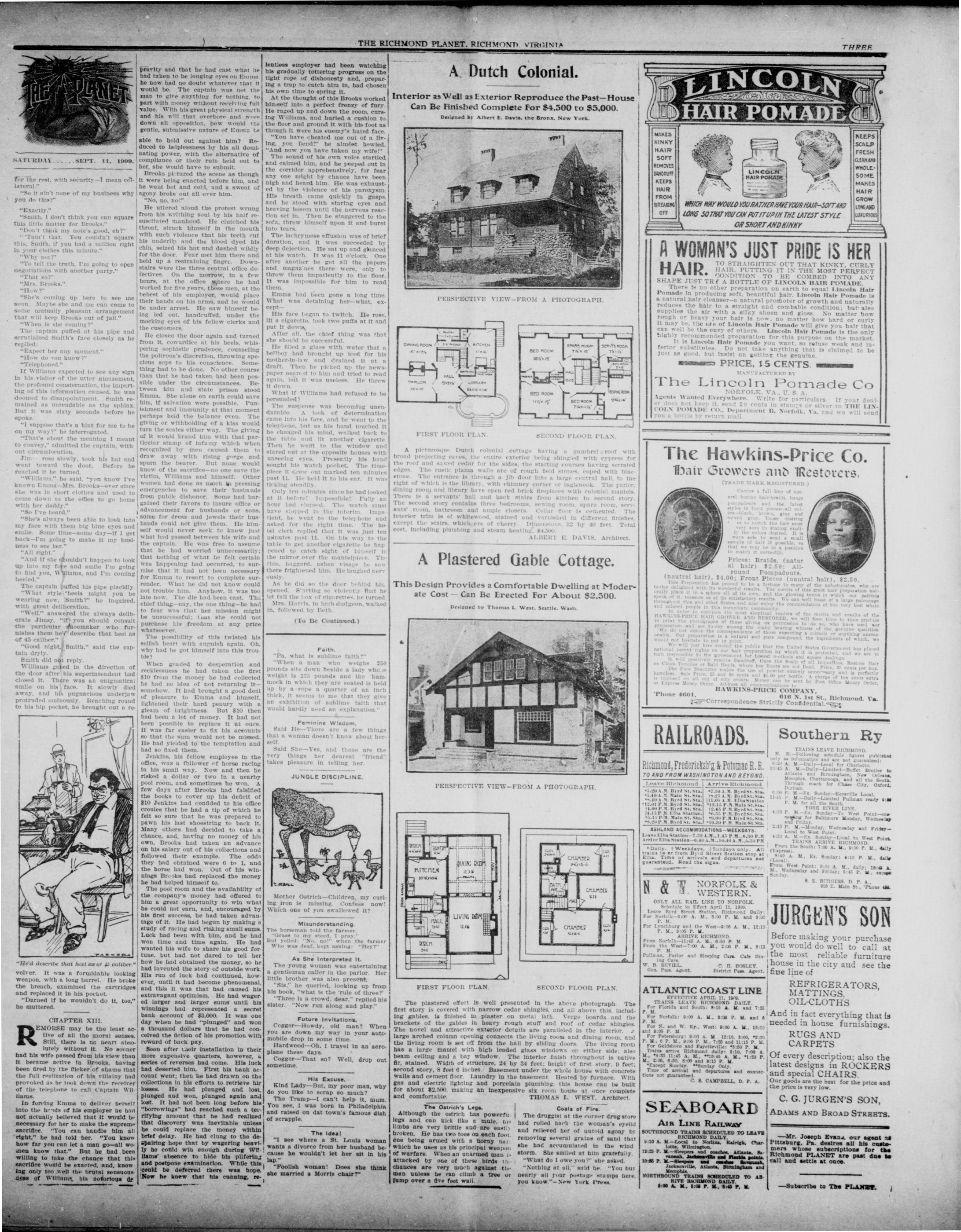
A Dutch Colonial.
Interior as Well as Exterior
Can Be Finished Comple
Designed by Albert E. Da
PERSPECTIVE VIEW
Well as Exterior Reproduce the
finished Complete For $4,500 to
designed by Albert E. Davis, the Bronx, New Y
ERSPECTIVE VIEW—FROM A PHOTO
Interior as Well as Exterior Reproduce the Past—House
Can Be Finished Complete For $4,500 to $5,000.
Designed by Albert E. Davis, the Bronx, New York.
PERSPECTIVE VIEW—FROM A PHOTOGRAPH.
DINING ROOM
15' x 17'6
BALCONY
3'6' PASSAGE
KITCHEN
11' x 16'
DARLOR
13' x 15'
HALL
9X21'6
LIBRARY
84'11" x 14'
FIRST FLOOR PLAN.
A picturesque Dutch colonial c
broad projecting eaves, the entire ex
the roof and sawed cedar for the sid
edges. The rustic plaza walls are
stone. The entrance is through a jil
right of which is the library, with ch
chining room and library have open re
There is a servants' hall and back.
The second story contains three bed
ants' room, bathroom and ample cl
interior trim is of whitewood, stained
except the stairs, which are of cher
cost, including plumbing and steam h
A Plastered
This Design Provides a Com
ate Cost — Can Be Ere
ouse Dutch colonial cottage having a gable eaves, the entire exterior being shingled, and cedar for the sides, the starting course, the plaza walls are of rough field stones,ance is through a jib door into a large of the library, with chimney corner or ingle library have open red brick fireplaces with witts' hall and back stairs from kitcheny contains three bedrooms, sewing room, bedroom and ample closets. Collar floor is of whitewood, stained and varnished inns, which are of cherry. Dimensions, 32'2" clumbing and steam heating, $4,500.
A picturesque Dutch colonial cottage having a gambrel roof with broad projecting eaves, the entire exterior being shingled with cypress for the roof and sawn cedar for the sides, the starting courses having serrated edges. The rustic plaza walls are of rough field stones, coped with bluestone. The entrance is through a jib door into a large central hall, to the right of which is the library, with chimney corner or inglenook. The parlor, dining room and library have open red brick fireplaces with colonial mantels. There is a servants' hall and back stairs from kitchen to second story. The second story contains three bedrooms, sewing room, spare room, servants' room, bathroom and ample closets. Cellar floor is cemented. The interior trim is of whitewood, stained and varnished in different finishes, except the stairs, which are of cherry. Dimensions, 32 by 40 feet. Total cost, including plumbing and steam heating, $4,500.
ALBERT E. DAVIS, Architect.
A Plastered Gable Cottage.
This Design Provides a Comfortable Dwelling at Moderate Cost — Can Be Erected For About $2,500.
A Plastered Gable Cottage.
This Design Provides a Comfortable Dwelling at Moderate Cost - Can Be Erected For About $2,500. Designed by Thomas L. West, Seattle, Wash.
PERSPECTIVE VIEW-
RSPECTIVE VIEW-FROM A PHOTOGR
PERSPECTIVE VIEW-FROM A PHOTOGRAPH.
BEDROOM
10'4" x 10'4"
BATHROOM
10'4" x 10'4"
KITCHEN
10'4" x 10'4"
DINING ROOM
12'1" x 12'1"
MALL
10'10"
LIVING ROOM
12'1" x 12'1"
BEDROOM
10'4" x 10'4"
FIRST FLOOR PLAN.
The plastered effect is well pres
first story is covered with narrow cee
gables, is finished in plaster or
brackets of the gables in heavy roo
The novel and attractive exterior de
large arched column opening connects
the living room is set off from the l
has a large mantel with high leade
beam ceiling and a bay window. T
fir, stained. Width of structure, 24
second story, 8 feet 6 inches. Basem
walls and cement floor. Laundry in the
gas and electric lighting and porcel
for about $2,500, making an inexper
and comfortable.
The Ostrich's Legs.
and effect is well presented in the above
covered with narrow cedar shingles, and all
finished in plaster on metal lath. Verge
gables in heavy rough stuff and roof
attractive exterior details are paralleled in
unopening connects the living room and
is set off from the hall by sliding doors.
entral with high leaded glass windows on
and a bay window. The interior finish the
width of structure, 24 by 34 feet; height of
feet 6 inches. Basement under the whole h
t floor. Laundry in the basement. Heated
lighting and porcelain plumbing, this h
making an inexpensive six room house.
The plastered effect is well presented in the above photograph. The first story is covered with narrow cedar shingles, and all above this, including gables, is finished in plaster on metal lath. Verge boards and the brackets of the gables in heavy rough stuff and roof of cedar shingles. The novel and attractive exterior details are paralleled in the interior. A large arched column opening connects the living room and dining room, and the living room is set off from the hall by sliding doors. The living room has a large mantel with high leaded glass windows on either side; also beam ceiling and a bay window. The interior finish throughout is native, fir, stained. Width of structure, 24 by 4 feet; height of first story, 9 feet; second story, 8 feet 6 inches. Basement under the whole house with concrete walls and cement floor. Laundry in the basement. Heated by furnace. With gas and electric lighting and porcelain plumbing, this house can be built for about $2,500, making an inexpensive six room house at once complete and comfortable.
THOMAS L. WEST. Architect.
Although the ostrich has powerful legs and can kick like a mule, his limbs are very brittle and are easily broken. He has two toes on each foot, one being armed with a horny nail which he uses as his principal weapon of warfare. When an unarmed man is attacked by one of these birds the chances are very much against the man unless he can climb a tree or jump over a five foot wall.
---
Reproduce the Past—House
ate For $4,500 to $5,000.
is, the Bronx, New York.
-FROM A PHOTOGRAPH.
BED ROOM
12'6" x 15'
MERCHANT
BED ROOM
11'6" x 15'
SPARE ROOM
7'16" x 12'
SERVICES ROOM
7'11" x 12'
MALL
GARDEN
BED ROOM
7'16" x 11'6"
SENIING ROOM
9'14" x 14'
SECOND FLOOR PLAN.
cottage having a gambrel roof with interior being shingled with cypress fors, the starting courses having serrated if rough field stones, coped with blue-door into a large central hall, to the sunny corner or inglenook. The parlor, brick fireplaces with colonial mantels, stairs from kitchen to second story, rooms, sewing room, spare room, servets. Cellar floor is cemented. The and varnished in different finishes, yr. Dimensions, 32 by 40 feet. Total heating, $4,500.
ALBERT E. DAVIS, Architect.
Dable Cottage.
Portable Dwelling at Moderated For About $2,500.
FROM A PHOTOGRAPH.
CLOS
34,36
CHAMDER
9,43,15,6
CLOS
43,7
LUNGE
BATH
DATA
MATR
CHAMDER
10,38
MATR
CHAMDER
12,34
CLOS
40
CLOS
40
SECOND FLOOR PLAN.
rented in the above photograph. The ear shingles, and all above this, include a metal lath. Verge boards and the high stuff and roof of cedar shingles.ails are paralleled in the interior.ails in the living room and dining room, and all by sliding doors. The living room glass windows on either side; also the interior finish throughout is native 34 feet; height of first story. 9 feet; at under the whole house with concrete basement. Heated by furnace. With in plumbing, this house can be built five six room house at once complete
THOMAS L. WEST, Architect.
The druggist at the corner drug store had rolled back the woman's eyelid and relieved her of untold agony by removing several grains of sand that she had accumulated in the wind storm. She smiled at him gratefully. "What do I owe you?" she asked. "Nothing at all," said he. "You buy nearly all your postage stamps here, you know"-New York Press.
Coals of Fire.
LINCOLN
HAIR POMADE
MAKES
KINKY
HAIR
SOFT
REMOVES
DANDRUFF
KEEPS
HAIR
FROM
BREAKING
OFF
LINCOLN
HAIR POMADE
KEEPS
SCALP
FRESH
CLEAN AND
WHOLE-
SOME
MAKES
HAIR
GROW
LONG AND
LUXURIOUS
WHICH WAY WOULD YOU RATHER HAVE YOUR HAIR-SOFT AND
LONG SO THAT YOU CAN PUT IT UP IN THE LATEST STYLE
OR SHORT AND KINKY
A WOMAN'S JUST PRIDE IS HER
HAIR. TO STRAIGHTEN OUT THAT KINKY, CURLY HAIR, PUTTING IT IN THE MOST PERFECT CONDITION TO BE COMBED INTO ANY SHAPE JUST TRF A BOTTLE OF LINCOLN HAIR FOMADE.
There is no other preparation on earth to equal Lincoln Hair Pomade in producing soft, beautiful hair. Lincoln Hair Pomade is a natural hair cleanser—a natural promoter of growth and naturally reduces the hair to a straight and combable condition; but also lifesaves the air with a silky sheen and gloss. No matter how rough the hair is, hair is now, no matter how hard or curly it may be, the use of Lincoln Hair Pomade will give you hair that can well be the envy of others. Lincoln Hair Pomade is the only highly recommended preparation for this purpose.
It is Lincoln Hair Pomade you want, so refuse weak and inferior substitutes. Do not take anything that is claimed to be just as good, but insist on getting the genuine.
The Lincoln Pomade Co
NORFOLK, VA., U. S. A.
Agents Wanted Everywhere. Write for particulars. If your dealer does not keep it, send 20 cents in stamps or silver to THE LINCOLN POMADE CO., Department B, Norfolk, Va. and we will send you a bottle by return mail.
The Hawkins-Price Co. Hair Growers and Restorers.
(TRADE MARK REGISTERED.)
Carries a full line of natural human hair-brands, bangs pampoules and the latest styles in black, brown, gray and mixed gray. Those desiring es to match the hair must very sure in stating exalted色彩 desired. It is ways safe to have a full sample of hair if possible, so that we may be in a position to match it correctly.
Prices: Braids, (natur al hair) $2.50; All-round Pampoules.
(nautral hair), $4.00; Front Pieces (nautral hair), $2.50
(nautical hair), $4.00; Front Bear
This Preparation has been to be a tribute delighted with its wonderful results. It usually takes a sphere all of its own, a speak of its reason, and a place throughout this and other States and also colored people in this immediate country. Hawkins PRICE will continue the most skeptical HAWKINS PRICE in print the photographs of those giving preparation and are to-day among the men we do not desire the correspondence of the Ones. Our country is a natural and it would not hesitate to print them. We will just here remind the public the national patient rights on our hair preparation turns to the government for hooing. It will positively inform us on Clean Temples or Bald Heads, where he is. The Face Beautifier makes the use of harmless hair, $25 and 50 cents and is imposed on all hair. It is express Money Order. Address all countries.
This preparation has proved to be a fortune to many of the fortunates, who are today laying the ground for results. The merits of this great hair preparation naturally place it in a sphere all of its own. Our patrons speak of it, we measure it of its satisfactory results. We can well boast of a large number of people who also enjoy the commentation of the very best white and colored people in this immediate field.
to convince the most skeptical readers of the merits and results of the HAWKINS-PRINCE RESTORET, we will from time to time produce in print the photographs of those gifts that permission to do so, who have used our preparation and are to-day among the many customers we serve. We do not desire the correspondence of those expecting a miracle or anything unmeasurable. We are a natural and pure compound, the ingredients of which, we would not hesitate to put them on our hands. We will just here remind the public that the United States Government has placed nationwide patent rights on our hair preparation by which it is protected, and we are in turn responsible for the highest methods and square dealings. We will positively remand Bandit for all impurities. Restore Hair on Clean Temples or Bald Heals, where hee Roots are not Damaged, and all impurities. The Sea Beauty Makeup uses the use of powder entirely unnecessary and is perfectly harmed by it. The Sea Beauty Makeup costs $1.00 per bottle. A charge of ten cents extra is imposed on all out of city orders. Money sent by Post Office Money Order, or Express Money Order. Address all communications to:
HAWKINS-PRICE COMPANY,
01. 616 N. 1st St., Richmond, Va.
Correspondence Strictly Confidential.
RAILROADS.
ASHLAND ACCOMMODATIONS - WEEDKAYS
Leave Elba Station - 7.30 A.M. 1.45 P.M. 6.30 P.M.
Arrive Elba Station - 6.40 A.M. 10.40 P.M. 6.30 P.M.
*Daily.* Weekdays. | Sundays only. All
arrivals from Byrd. Street Station stop at
Elba. Time. Departures do not
guaranteed. Read the signs.
N & W NORFOLK & WESTERN
ONLY ALL RAIL LINE TO NORFOLK.
Schedule is Effect April 11, 1990.
Leave Bay Area for Norfolk Daily:
For Norfolk-9:00 A. M., 3:00 P. M. and 6:00
P. M.
For Lynchburg and the West-9:00 A. M., 12:10
P. M. and 6:05 P. M.
Arrive RICHMOND.
From Norfolk-11:45 A. M., 6:50 P. M.
From the West-7:00 A. M., 2:06 P. M.
Pollman, Parlor and Sleeping Care. Cafe Dining Cars.
ATLANTIC COAST LINE
EFFECTIVE APRIL 11, 1999
TRAINS LEAVE RICHMOND DAILY.
For Florida and South: 815 A. M. and 7:25
P. M.
For Norfolk: 9:00 A. M., 5:00 P. M. and 6
P. M.
For N. and W. Ry., West: 9:00 A. M., 12:10
and 9:05 P. M.
For Petersburg: 9:00 A. M. 12:10, 3:00, *2:00*
P. M. 6, P. M. 9:06 P. M. 7:25 and 11:15 P. M.
For Goldbardo and Fayetteville: *3:30 P. M.
Trains arrive Richmond daily: 5:10, 7:00 A. M.
Trains arrive Richmond daily: 8:10 P. M.
2:06, 6:50, 8:00 and 11:5 P. M.
*Except Sunday.* **"Sunday Only."
Time of arrival and departures and concessions not guaranteed.
SEABOARD
AIR LINE RAILWAY
SOUTHBOUND TRAINS SCHEDULED TO LEAVE
RICHMOND DAILY.
9:10 A. M.-Local to Norina, Raleigh, Charlotte, Wilmington.
15:25 P. M.-Scoops and coach, Atlanta, Savannah, Jacksonville and Florida pita.
10:56 P. M.-Sleepers and coach, Savannah, Jacksonville, Atlanta, Birmingham and Memphis.
NORTHBOUND TRAINS SCHEDULED TO ARIVE RICHMOND DAILY.
5:30 A. M., 5:05 P. M., 8:45 P. M.
A
deces (naural hair), $2.50.
fortune to many of the unfortunate, who are
the merits of this great hair preparation nat-
dure and the glowing terns in which our patrons
uits. We can well boast of a large patronage
by the commendation of the very best white
unity.
readers of the merits and results of the
STORER, we will from time to time produce
and do so, who have used our
bearing witness, and who have
expecting a miracle or anything unre-
sure compound, the ingredients of which, we
at the United States Government has placed
on by which it is protected, and we are in
at methods and square dealings.
we the Scalp of all Impurities. Restore Hair
Moisture. We provide merits per box.
powder ensure unrere- sary and
1.00 per bottle. A charge of ten cents extra-
ly can be sent by Post Office Money Order.
Southern Ry
TRAINS LEAVE RICHMOND
N. B--Following schedule figures published
only as information and are not guaranteed:
6:20 A. M.-Daily-Local for Charlotte.
10:45 A. M.-Daily-Limited-Buffet Broiler to
Atlanta, Georgia, North Carolina, Oreaa,
Memphis, Chattanooga, and all the
South. Through coach for Chase City, Oxford,
Durham.
6:00 P. M.-Ex. Sunday-Knoxville Local.
11:45 P. M.-Daily-Limited Pullman ready 9:00
P. M. for all the South.
YORK RIVER LINE.
4:30 P. M.-Sunday-To West Point-connec-
ing for Baltimore Monday, Wednesday
and Friday.
2:15 P. M.-Monday, Wednesday and Friday-
connec-ing for Baltimore Monday, Wednesday
and Friday.
4:30 A. M.-Ex. Sunday-To West Point-
TRAINS ARRIVE RICHMOND
From the South: 7:00 A. M., 9:30 P. M., daily
(Express).
8:30 A. M. Ex. Sunday: 4:10 P. M., daily
(Express).
From West Point: 9:30 A. M., daily: 10:45
A. M., Wednesday and Friday: 5:45 P. M., excep-
JURGEN'S SON
Before making your purchase you would do well to call at the most reliable furniture house in the city and see the fine line of
REFRIGERATORS,
MATTINGS,
OIL-CLOTHS
And in fact everything that is needed in house furnishings.
RUGS AND
CARPETS
Of every description; also the latest designs in ROCKERS and special CHAIRS.
Our goods are the best for the price and the price is very low.
ADAMS AND BROAD STREETS.
—Mr. Joseph Evans, our agent of Pittsburg, Pa. desires all his customers whose subscriptions for the Richmond PLANET are past due to call and settle at once.
—Subscribe to The PLANET.
THREE
A. B. C. D. E. F. G. H. I. J. K. L. M. N. O. P. Q. R. S. T. U. V. W. X. Y. Z.
S. E. BURGESS. D. P. A.
920 E. Malg. St. 'Phone 445
FOUR
THE PLANET
Published every Saturday by JOHN MITCHELL,
JR., at 311 N. Fourth Street, Richmond, Va.
JOHN MITCHELL, JR., - EDITOR.
All communications intended for publication
should be sent so as to reach us by Wednesday.
TERMS IN ADVANCE.
EXPRESS MONEY ORDERS can be obtained at any office of the American Express Co., the bank of the United States, and Co.'s Express Company. We will be responsible for money sent by any of these companies. The Express Money Order is a sale and convenient way for forwarding money. The Express Money Order is a Money Order, Post Office or an Express Office is not within your reach, your Postmaster will Register the Letter you wish to send us on payment of your money. The letter way than one of these four ways mentioned above. If you send your money in any other way, you must do it at your own risk. We cannot be responsible for money sent in the manner described. If you send your money in any other way, you must do it at your own risk. BENWALMS, ETC.—If you do not want THE PLANET continued for another year after your subscription has run out, you then notify us by Post Card to discontinue it. The counts have decided that subscribers to newspapers who do not wish to receive the subscription of time for which it has been paid are held liable for the payment of the subscription up to date when they ordr the paper discontinues. COMMUNICATIONS—When writing to us to renew your subscription or to discontinue your paper, you should give your name and address in full otherwise we cannot find your name on the bank.
CHANGE OF ADDRESS—In order to change
the address of a subscriber, we must be sent the
farner as well as the present address.
Entered at the Post Office at Richmond, Va.
as second class matter.
SATURDAY . . . SEPT. 11, 1909.
Mann's Afro-American Business
Directory has been greatly improved.
It includes New York, Philadelphia,
Baltimore, Washington and Richmond.
It may be obtained from
Edward M. Mann, 2227 Fifth Ave.
New York.
The speech of Mr. J. E. Bush, at the Negro Business League, at Louisville, Kentucky, was timely and appropriate and is attracting much attention all over the country. It is deserving of careful consideration and much attention. Mr. Bush made himself thoroughly conversant with the subject he was discussing and his plea will do much to benefit the servant classes in the Southland.
A CONTEMPORARY IN TROUBLE
Our esteemed contemporary, the Augusta, Georgia Baptist, William J. White, D. D., editor announcer that it published an article March 11, 1909, sent by a man, signing himself Homer Caldwell, which article reflected upon a church pastored by Rev. R. J. Johnson. Rev. White made all amends as he thought, but he could not find the original copy, as it had been destroyed by him as his custom.
Now the Georgia Baptist and its management are facing a suit for six thousand dollars and it is being put to the expense of employing attorneys to defend the same. We sympathize with Editor White. We know all about it. We always keep our copy and we can find some of it here now that was filed in this office more than ten years ago. Some people are most unreasoning and whenever spite gets the better of their judgment, they will do anything in their power to destroy the very medium that has been established for the salvation of the race.
We have never known a suit to materially injure us in the long run, if the editor knows how to take advantage of the advertisement it will give him and his associates. A suit is a hardship in the beginning, but it may prove to be a blessing in disguise. If the Georgia Baptist man continues along the path that he has marked out as indicated in his editorial utterances, he will hardly find a jury of white men who will award at the worst more than nominal damages.
A BROTHER'S SACRIFICE
The cold-blooded brutality of the mob was never shown to a greater extent than is set forth in the fol-
lowing telegraphic dispatch, which carefully avoids details, but which gives the facts with startling accuracy:
Clark'sale, Miss, Sept. 6. —Unable to get their hands on Nathan McDaniels, a negro who is alleged to have shot and killed Policeman Walter Marshall when the officer attempted to raid a crap game here Saturday night, a mob of hundreds of citizens caught McDaniels's brother Hiram at midnight and hanged him from telegraph pole. Hiram had confessed providing a mule aiding his brother to escape.
There has been much comment upon this phase of the southern question. Liberal minded southerners will regard with shame this further demonstration or the great task that the law-abiding elements in the Southland now have before them. There was absolutely no excuse for this exhibition of savagery and it shows conclusively that missionaries are needed in this section of the country for the white man as much so as for the colored one.
We have insisted that people of this stripe must be dealt with in a positive manner. That law-abiding colored men must stand ready to defend themselves against all lawless elements and when they are forced to kill a white hood-lum, they should realize that they have neared the end of the journey of life. There is nothing to do but to continue to defend themselves and be prepared to take their own lives if need be and go "shouting home to glory."
There is too much fear of death. It is nothing more nor less than a long sleep. When lawless elements in the Southland realize that the age of desperation on the part of colored men is at hand, they will be more careful in their practices and the elimination of colored men, women and children by the "rope route" and the shot-gun method will cease for a time at least.
---
ANOTHER MURDER TRIAL
The trial of Dallas Wright, white, in Buckingham County, Va., charged with the murder of the Stuarts is in many particulars a duplicate of the Powhatan tragedy, whereby five colored men, presumedly innocent were sent to the electric chair. The difference in this case is that the principal is a white man and colored people are named as accessories. It seems though that there has been such a reign of absolute terror that the testimony of the colored witnesses will prove to be worthless. As bearing upon this phase of the subject, we quote from the columns of the Richmond, Va. Daily Times Dispatch. Its correspondent says:
When asked for the names of these men, the witnesses refused to give could get a fair trial here were being examined separately, the fact was brought out that some of the number were supposed to know the persons implicated in swinging Richard Perkins up to a tree in the effort to make him tell who was engaged in the Stuart murder for which Wright is on trial.
When asked for the names of the men, the witnesses refused to give them, though warned by the court that if they refused they were liable to be punished for contempt. Persisting in refusal, they were taken in charge by the sheriff.
This then shows the deplorable conditions existing in this section of the country. The correspondent continued:
"One of the number who refused information said if he gave names he would tend to incriminate himself, and the court recognizing his right under the Constitution excused him, and finally the other witnesses who availed themselves of their constitutional privileges, gave the same answer."
These people virtually admitted that they had choked this colored man into insensibility in order to make him give such testimony as they desired. The court virtually admitted that it was helpless in the premises. It seems to us that in cases of this kind justice is a hollow mockery. What possible value to either side can such testimony have?
These people are ready to swear to anything in order to save their own lives. As confirming this view of the situation, here is some of the testimony:
Buckingham, Va., September 4.—Young Willie Jackson proved the star witness in the trial today of Dallas Wright, charged with murder. He claimed to have seen the horrible murder of the Stuartus, and said that Wright told him that if he did not go along with the murderers they would kill him.
"I went," he continued, "and saw them kill Thomas Stuart. They found $150, of which Dallas Wright got $50, Richard Perkins $50 and Ed. Jones $50. I did not get a cent. I went home after the money was counted, and did not tell of the murder, because I was afraid Dallas Wright would kill me."
The witness said that after the murder some one threw a gallon of coal oil on the bodies and Ed. Jones started the fire.
Cross-examined by Attorney Lee, and asked if he went into the Stuart house, the witness answered: "No, I saw Bill Stuart was shot in the forehead and was dying on the bed. The money was found under a rock of the hearth."
Continuing, on cross-examination
THE RICHMOND PLANET, RICHMOND, WIRGINIA
"Richard Perkins chopped the head of one of the Stuarts off at one stroke. Ed. Jones was sitting on his feet and Dallas Wright on the middle of his body.
"I noticed spots of blood on each of the men after I had seen them cut William Stuart's head off.
In view of the disclosures, what sane man would accept this testimony against the white man at its face value. It will be passing strange, if the counsel for the defense will not turn on the Negro witnesses and make any or all of them the principals in an alleged crime which possibly none of them committed.
It is sickening to witness the miscarriages of justice now taking place throughout the Southland. We shall watch with interest the result of this trial which will no doubt tend to emphasize the fact that there is great need of a change in our criminal jurisprudence as expounded and practiced in the rural districts of this commonwealth.
That Tragedy in Buckingham
That Tragedy in Buckingham
Continued from the First page.
2:30 this afternoon court convened.
Aylett Johnson swore that Dallas Wright, Ed. Jones and Richard Perkins came to his house and told him if he did not go with them they would shoot him. He continued:
"I went with them and they made me stand at the pole bridge. When they shot I ran home. Then I came back to the Stuart house and met Wright, Jones and Perkins coming away. They told me if I ran they would kill me. They counted out the money between them.
"They all had guns, and left them on the porch. Dallas Wright had a double-barreled shotgun. I went with them because living would have done better than dying. I was afraid not to go. I was not watching to see who was coming. I was watching them to see what they were going to do with the Stuart's. "The gun sounded like it was shot inside the house. I thought they had killed two men and would kill me when they came out of the house.
SAID THEY D 'FIXED' THE
STUARTS.
"Richard Perkins told me they had fixed the Stuarts. I left and did not know the house had been set on fire. I did not know it until next morning."
Mr. Lee asked:
"Did you not say that E4. Jones told you he had fixed the Stuartss?"
"Yes, sir, but I was scared then."
The witness then told of the alleged division of the money, but said the murderers did not give him any.
He said he was at the fire the next morning, but I was afraid to tell what he knew.
"Wright." he added, "told me some time after the burning to be careful and not tell anything about the killing"
"Did you not say in the magistrate's court that you knew nothing about it?"
"Yes, sir."
"Why were you afraid when you had all the officers of the law around?"
"I did not know what they would do with me."
WRIGHT TAKES THE STAND
W. Dallas Wright was then put on the stand by the counsel in his own behalf. He said: "I was working next day. Ellis Johnson was helping, and I was at home all day, and did not go out of the sight of my house."
"Saturday night after Ellis Johnson and the cook left, there was no one left but me and my mother and my brother Clifford. I went to bed between 9 and 10 o'clock, and Clifford slept in bed with me. I did not know the Stuarts' house was burned until daybreak Sunday A. M. "I did not say there was smoke on the axe. I did not say that lead might have fallen from the floor above into the skull."
Mr. Hubbard asked: "Did you ever have any difficulty with either of the Stuarts?"
"Yes, sir; I had a few words with one of them about some money, but the difficulty was made up in a few minutes."
Clifford Wright, Dallas Wright's brother, took the stand, and said his brother, Dallas Wright, slept with him the night of the crime, and did not go out of the house that night
SAYS HE SAW MURDER
OF STUART BROTHERS
Youthful Witness at Dallas Wright
Trial in Buckingham Court
Swears One Man Was
Beheaded
Buckingham, Va., September 4.—Young Wilkie Jackson troved the star witness in the trial today of Dallas Wright. charged with murder. He claimed to have seen the horrible murder of the Stuart, and said that Wright told him, that if he did not go along with the murderers they would kill him.
"I went," he continued, "and saw them kill Thomas Stuart. They found $150., of which Dallas Wright got $50, Richard Perkins $50 and Ed Jones $50. I did not get a cent. I went home after the money was counted, and did not tell of the murder, because I was afraid Dallas Wright would kill me."
The witness said that after the murder some one threw a gallon of coal oil on the bodies and Ed. Jones started the fire.
Cross-examined by Attorney Lee, and asked if he went into the Stuart house, the witness answered: "No. I saw Bill Stuart was shot in the forehead and was dying on the
bed. The money was found under a rock of the hearth."
ONE VICTIM DECAPITATED.
Continuing, on cross-examination the witness said:
"Richard Berkins chopped the head of one of the Stuart's out at one stroke. Ed. Jones was sitting on his feet and Dallas Wright on the middle of his body.
"I noticed spots of blood on each of the men after I had seen them cut William Stuart's head off.
"Aylet Johnson came up to the house, where the murder took place and peeped through the crack. I was standing in the door while the killing was going on. They came out and counted the money by striking three matches.
"I went to Sunday school Sunday morning and I was scared. It looked like I could see folks after me. I did not tell anybody about it at Sunday school because I was
DAY GIVEN TO TESTIMONY
Today was consumed in examining witnesses for the Commonwealth. John Staffer, the first witness, stated that he knew both of the Stuarts, who were burned and one of them worked for him on the day of the crime, April 17, and that the building was burned the same date, with Thomas and William Stuart in it. He also stated that an axe was found at the house with blood stains on it.
Dallas Wright came up and stated that it might be smoke on the axe instead of blood; he also stated he saw three or four gun barrels in the place where the house was burned, and again Dallas Wright came up and said the guns had not been fired.
Attorney Lee moved at this point that other witnesses be excluded from the court-room and this was done.
Resuming, Staffer said that Thomas Stuart wore a blue coat and he found a piece of this coat at the ruins of the house.
He said he saw lead in one of the sackleets, and that Dallas Wright said the lead might have dropped from the floor above.
TELLS OF DIFFICULTY WITH
WRIGHT.
The witness also stated that Dallas Wright and one of the Stuart's had had a difficulty. Dr. Morris, a witness, was present at the coroner's inquest and found the heads of two men. He said when he got there the bodies had been pulled out of the ashes, but the skulls were still there, and fell to pieces when handled. Lead was imbedded in one skull. It apparently had been fired at close range. McKim Wright, a cousin of Dallas Wright, t-sifted that one body was found lying with the head toward the fireplace. The other body was found in the northeast corner of the house. No head was on this body. The house was burning when he got there at sunrise. It was told that the Stuart's had money and that they kept it in the house. Court adjourned until Monday morning, when the jury will be taken to the scene of the murder.
29 MEN SHOT BY ANGRY
NEGRO WHO RUNS AMUCK
Armed With Shotgun, Negro Reves Over Monroe, La., Firing at White People.
Monroe, La., August, 24. —Angered, it is believed, because two of his friends had recently been shot by police officers in this city, William S. Wade, a negro, today ran amuck on the principal business street of Monroe with a double-barreled shotgun, shooting first at every white man he saw and then firing indiscriminately at every object before him.
The fire was returned, and the negro finally fell dead with a bullet through his heart, but not before 22 men, three of them members of his own race, had been more or less seriously wounded.
THE WOUNDED
Seriously wounded:
Hugh Bigger, police officer, shot in abdomen and thigh; may die.
T. H. Grant, deputy sheriff, shot in neck and breast; may die.
Simon Marks, merchant, Tuskegee, Ala., shot in breast and face; may die.
George McCarmack, manager Ouachita Lumber Company, West Monroe, arm shattered.
Slightly wounded:
Dr. A. A Forsythe, mayor of Monroe, shot in right leg.
D. A. Breard, banker and president of North Louisiana Shingle Company, shot in face.
Ed Strong, cashier Southern Express Company, shot over right eye.
Steve Burk, telegraph operator, shot in shoulder.
Joe Thompson, chief dispatcher in Iron Mountain railroad office, shot in body.
A. A. Greenly, lumberman, shot in head.
Manuel Abromowitz, clerk, shot in face.
Albert Marx, vice president Southern Hardware Company, shot in head.
C. E. Bynum, stenographer Southern Grocery Company, shot in face.
J. L. Kendall, trainmaster Iron Mountain railroad, shot in body.
D. G. Trousdale, secretary and treasurer Southern Grocery Company, shot in body.
J. W. Merryman, agent Wells-Fargo Express Company, shot in hand.
Armand Baer, clerk. J. Baer & Co.
E. P. Davies, clerk Southern Hardware Company, shot in head.
M. Braun, blacksmith, shot in body.
Roy Fisher, messenger boy, shot in hand.
E. B. Edwards, steamboat man, shot in arm.
I. L. Haas, merchant, shot in head and breast.
Herman Aboues, merchant, shot in breast.
R. R. Ross, clerk shot in body.
Fred McGrath, clerk, shot in hand.
Three negroes shot in face and body.
Negro's Body Burned.
Wade's body was publicly burned, after it had been cut down from a pole on which it hung for half an hour or more after he was killed. It was at first reported that Wade was half crazed at the time from the effects of cocaine and cheap whiskey, but an investigation by the police this afternoon showed that when he purchased the shotgun and box of shells a few minutes before he opened fire on the first man that there was nothing unusual in his manner or behavior. Other negroes who were with him in the morning say that he had not been drinking, nor did he show any evidence of having taken cocaine.
HAD CLASHED WITH OFFICERS
Wade came to Monroe recently from Pine Bluff, Ark. He was accompanied by several other negroes, and they commenced to make trouble for the local police soon after they arrived. It was alleged that they were members of a society in Arkansas which had as its object revenge for all injuries done the black race. As a result, these negroes clashed with the police on many occasions, and twice recently they have exchanged shots with officers. It was also charged that Wade was heard to say that no white man was going to shoot him. No more attention was paid to him, however, until he started on his wild rampage. At the store where Wade bought the box of shells the clerk says that the negro asked for buckshot. He gave him birdshot by mistake. This mistake probably saved the lives of a score or more of men.
The negro, after purchasing the gun, took a position in the arcade of the Bank of Commerce, at Grant and Desiard streets, the most prominent corner in the city. His first shot was directed at J. J. Jordan, cashier of the bank, who was approaching the building. He missed Jordan, but the load struck George McCormick, who was close enough to the negro to have his arm badly shattered, in spite of the small shot. It may be necessary to amputate the arm.
The first shot brought many merchants and clerks out on the street, and the negro then began to fire in their direction. As fast as he discharged his gun he would step back into the arcade, reload, reappear and renew his fire.
SECOND MAN SHOT
The second man wounded was Deputy Sheriff Grant, who was shot before he could draw a weapon. Simon Marks, of Taskegee, Ala., came out of his brother's clothing store to see what the trouble was and received a load of shot in the breast. Patrolman Bigger, who had been attracted by the shooting, ran toward Wade and was shot down, but arose and emptied his revolver at the negro. It is believed that one of Bigger's shots took effect. The negro continued to fire into the crowd, wounding many of them, when Mayor Porsythe, Manager Edward Stannard, of the local Western Union office, and Daniel McLeod came up and returned the fire. Wade finally falling as a result of the fatal wound in the heart.
MAYOR PLEADS WITH MOB
After the body of the negro had been cut down from the pole on which it was swung, a crowd of men and boys proposed that it should be burned. It had already been dragged to a near-by square and coal oil poured over it when Mayor Forsythe went to the square and demanded that the body be turned over to the authorities. He was courteously waved aside and the torch was applied. In a few minutes nothing remained but a heap of ashes and bones.
Several hours later Tom Wilford, a negro, was shot in a lunch room near the city market house. It is not definitely known whether or not this shooting formed any sequel to the disorders earlier in the day. Nobody knew anything after the shootings except that "somebody" had shot a negro. The wound is not regarded as dangerous.
NEGRO IS SHOT
An unidentified negro was shot with two loads of bird shot in East End tonight after making the remark that "Wade did not shoot half enough of the white — —" The negro was seriously wounded, his body being filled with fine shot. At 10:30 P. M. the streets were still crowded, and there was a general feeling that trouble was not over.
Mayor Forsythe and Sheriff Parker are doing all they can to suppress any possible trouble, but it may come before morning in the shape of the destruction of several negro lodge halls in the eastern section of the city. There is a general belief that these secret societies are at the bottom of the trouble with negroes here lately, and there is an element that is insisting on their destruction.
Scalded Man Had Wife Aunt
Angered at her husband because of his repeated reference to the things "mother used to cook." Mrs. John Smock, of Mahanoy City, Pa., threw a cup of scalding tea into his face, he complained. His face was painfully scalded and he caused her arrest, but was stuck for the costs.
Balloon Lifts Boy 3000 Feet; Unhurt.
In the presence of 5000 persons who attend dte harvest jubilee at Syracuse, Ind., Quinter Heff, twelve years old, got entangled in the ropes of a balloon when it went up. At an altitude of 3000 feet the balloon began to descend, and the boy reached the ground unhurt.
Painter Killed by Fall
While painting on the roof of Dickinson hall, one of the recitation halls of Princeton (N. J.) university, Jesse Hackett, of Trenton, N. J., fell a distance of sixty feet and was instantly killed.
Rich Man Convicted.
(Continued From First Page.)
of his guilt that it would be trifling with justice to grant another trial on the alleged newly discovered test item the verdict in this case is fully supported by the evidence, is tempered by the quality of mercy, and approved by a trial judge of big heart, clear head and great experience, and this court sees no reason to disturb it.
PARDON BOARD'S ACTION
"On an appeal for executive clemency to the extent of making void that portion of the sentence which provides for a service of twelve months in the chaiangang this case was exhaustively heard by the prison commission, August 30, and sent to the executive office with the following endorcement:
"Recommend to be sent to the state farm."
"It is a matter of special note that the solicitor general of the trial court has sent to the prison commission a written communication which closes with the words:
"I cannot approve a favorable action upon the application filed."
"It is also noted that the trial judge has abstained from recommending that the appellant be saved from punishment by confinement.
"The appellant, through counsel, has asked the executive that the service of twelve months be made void, or in any event that it be not enforced at the state farm."
"It is urged that his health is quite bao; that he is a member of a family prominent and honored in Georgia; is highly educated, and that he and his household would be subjected to cruel and needless humiliation should the portion of the sentence covering imprisonment be enforced upon him. Petitions and letters signed by hundreds of people join in the above pleas, which well-nigh exhaust the springs of sympathy for his family and pity for this appellant.
"I would that the ordeal of deciding this case were not upon me. My heart bleeds for the gentle and refined family of this one whom the jury of his peers has declared guilty of the mad act which has plunged them into the slough of sorrow.
"But it was not intended that the constitution should be upheld, or the laws administered on sympathy and pity, else the vilest criminal could secure a guarantee of immunity; and it was not intended that penalties fixed after a fair trial, should be set aside by petition, for the supreme court of the United States (Smyth v. Ames) has said: 'This is a government of law, not of men.' And in the assurance to the law-abiding and in the warning to the lawless that the laws will be certainly executed, we have the warrant of peaceful intercourse and of protection to person and property.
THE SAME LAW FOR ALL
"Should the clemency asked for in the present case be extended, there is grave danger that it would bear fruits of sorrow in every section of our state. It would set an example pernicious beyond compare, an example embodying a daily menace to Georgia's womanhood. It would say that we have one law for the rich, another for the poor; one law for the highly educated, another for those too poor to enjoy the privileges and immunities consequent upon education; one law for the classes, another for the masses.
"Furthermore, while the pardoning power conferred upon the executive is practically unlimited, yet it must be held in mind that it was the manifest intent of those framing the constitution that it should be exercised in such manner as would not impair the confidence of the people in the purity of the fountains of justice, the courts or weaken the foundation upon which society is built.
"For the foregoing reasons I am forced to the conviction that the sentence originally passed by the trial judge, in Thomasville, should stand, it being readily understood that the authorities charged with the custody of the appellant for the period of twelve months will protect all the obligations demanded by humanity.
W. H. Mitchell, On Stretcher D
Taken to Jail by Sheriff,
Thomasville, Ga., September 1.—(Special.)—By an order of Governor Brown to Sheriff Singletary that William H. Mitchell be taken into custody at once, this afternoon at 4 o'clock he entered the doors of Thomas county jail. Mitchell was still very ill, and when the notice was received by him he made no protest, but accepted the situation with philosophical calm, and immediately ordered that preparations be made to take him to the jail.
Dr. McIntosh, his physician, stated that it would be dangerous to move him, and ordered that he be taken on a stretcher to jail. This was done, and accompanying him was Judge Charles P. Hansell, one of his staunchest and most devoted friends. He was met at the jail by several of his friends, including Judge S. A. Roddenberry, one of his attorneys; his sister, Mrs. Snodgrass, and Mr. Snodgrass, James A. Mitchell, Joseph Mitchell and W. M. Cooper. The trip to the jail was a severe one, and an injection was administered to him immediately upon his arrival to alleviate his physical pain. He shook hands with the sheriff, and said: "Tom, this is the first time I have been here since I came to see you long ago, when you were shot in the discharge of your official duty." He made no statement, but accepted his punishment in its incipiency with calm demeanor.
WILL SERVE SENTENCE
Relatives of Mr. Mitchell state that he will remain to serve his sentence in the jail, or if he is better on the gang or the county. He is suffering with kidney trouble, and the belief has been freely expressed
$3.50 **RECIPE CURES** WEAK
MEN-FREE
Send Name and Address Today You Can Have It Free and Be Strong and Vigorous.
I have in my possession a prescription for nervous debilitity, lack of vigor, weakened manhood, falling memory and lame back, brought on by excesses, unnatural drains, or the follies of youth, that has cured so many worn and nervous men right in their own homes—without any additional help or medicine—that I think every man who wishes to regain his manly power and virility, quickly and quietly, should have a copy. So I have determined to send a copy of the prescription free of charge, in a plain, ordinary sealed envelope to any man who will write me for it.
This prescription comes from a physician who has made a special study or men and I am convinced it is the surest acting combination for the cure of deficient manhood and vigor failure ever put together.
I think I owe it to my fellow man to send them a copy in confidence so that any man anywhere who is weak and discouraged with repeated failures may stop drugging himself with harmful patent medicines, secure what I believe is the quickest-acting restorative, upbuilding, SPOTTOUCHING remedy ever devised, and so cure himself at home quietly and quickly. Just drop me a line like this: Dr. A. E. Robinson, 3895 Luck Building, Detroit, Mich., and I will send you a copy of this splendid recipe in a plain ordinary envelope free of charge. A great many doctors would charge $3.00 to $5.00 for merely writing out a prescription like this—but I send it entirely free
that he would not be able ever to do manual labor again. This means that he will serve his time of twelve months in the fall unless in the course of events before his term expires Governor Brown sees fit to issue him a pardon. If his physical condition continues serious, as he is, and has been for three months, no doubt a request for one will be eventually made by his friends. His family are satisfied with the decision of the governor, as they prefer having him home in his present physical condition.
FROM AFRICA
Mr. Pregrino Interested. He Discusses the Name of Names—Believes Much. Time is Lost.
Cape Town South Africa.
My dear friend Mitchell.
Editor of The PLANET:
"Tis a long time since we heard directly from each other, though I believe that I can truly claim that on one side at least the uphorism is not untrue that 'Absence makes the heart grow fonder,' the stalwart and irrepressible PLANET is a regular visitor and its contents carefully studied by each member of my family, a compliment which is extended to a very few in a voluminous heap of exchanges, and the movements and progress of its vallant Editor are carefully followed and with ever increasing interest.
AN ISSUE NOTICED
Notice Brother Mitchell, by the issue of July 10th, now before me that some of the writers there are seriously engaged in the discussion as to the most appropriate name for this great race of ours, of whom some one has said that it is the only one who looked the pale face in the face and lived. Well, now, is it not a wanton waste of valuable powder to contend against the Negro? Of course, there are those who fail to measure up to the full height, girth and manhood of the flat footed Negro. Let such admit their unworthiness by advertising some other appellation. In saying this, I have no intent to offend those who prefer the polysublastic Afro-American, except to say that it is somewhat ponderous, and calculated to lack the patience of the good friend, the Congo.
AN ORIENTAL OBJECTION
I also have encountered the objector here in the person or one who undertook to advise me. This object being really an Oriental. I promptly replied by informing him that he is neither included nor so much as thought of and that only real men are meant, "and now we never speak as we pass by." But seriously, what is the objection to the good old word? The word "colored" designed as an appellation is somewhat vague. It is applicable to the Mongolian and strictly speaking to a large section of the Latin peoples. Why should not the people either pure Negroes, or of Negro desert refuse to own the best portion of themselves? Let us see to it that we do not present to the world, a laughing stock in ourselves, by devoting valuable time that can be better utilized in making "much ado about nothing."
Fraternally yours.
F. Z. S. PEREGRINO.
Stove Works Burned
The entire plant of the Priser Painter Stove company, at Reading, Pa., was destroyed by fire. The loss is about $40,000. The origin of the fire is unknown.
Enforcing Pure Food Laws.
Thirty-four prosecutions were ordered by Pennsylvania Dairy and Food Commissioner Foust for violations of the pure food laws by the sale of adulterated articles.
Killed Brother Playing "Cowboy."
Willie King, eight years old, shot and killed his brother, Francis, ten years old, in St. Louis, in their bedroom. The boys, sons of a police sergeant, were playing "cowboy."
Mrs. Roosevelt Touring France.
Mrs. Theodore Roosevelt and her children, Ethel, Quentin and Kermit, are making a tour of the province of Touraine, France.
Dr. Cook and His Trip to the Pole
M.
DR. FRED. BRICK ALBERT COOK OF BROOKLYN, WHO DISCOV.
FRED NORTH DOLE.
How His New Theory For Penetrating Frozen North Won Him Immortal Fame — Millionaire Bradley His Backer.
By FREDERICK R. TOOMBS.
WHEN the thrilling news was flashed underneath the oceans and across the conti-
nents of the world that Dr. Frederick A. Cook of Brooklyn had discovered the north pole it was notification of the greatest scientific achievement of modern times. For decade after decade daring explorers, self sacrificing scientists and steely nerved adventurers of a dozen nations have hurled themselves against the merciless ice barriers of the frozen north in attempts to discover the pole. Decade after decade the same result—failure—has been the only reward for the hardy voyagers who have made the exploits of the famed "hardy Norsemen" of old dwindle into insignificance. It is in words of death of
DR. FRED. RICK ALBERT COOK
ERED NO.
starvation, of freezing torture and blighted hopes that the story of the search for the pole has been written. And it remained for Dr. Cook in the year 1908 to achieve what had become to be considered the impossible, to accomplish what so many dauntless men had attempted, to win immortal fame by actually penetrating to the north pole.
And also be played a sensational part in a battle of giants in as pretty a story of intense rivalry between strong men as has ever been imagined by the most romantic fictionists. In short, Dr. Cook fulfilled the dearest wish of his financial backer, John It Bradley, a wealthy New Yorker, who had registered a grim determination that Commander Robert E. Pearcy should not be the first man to reach the pole. Bradley, a millionaire who has hunted and climbed mountain peaks with Dr. Cook, was confident that Peary could be beaten to the pole. Who was the man to do it? That was the question. Cook? The very man, thought Bradley—the very man to back with a million dollars in cash for such a venture.
And Cook made good.
An Account of the Trip
During the early part of Dr. Cook's trip into the unknown, where the one certainty was the shadow of death's grim specter, he met with immense herds of big game—musk oxen, bears, etc. His eleven Eskimos and 103 dogs were in prime condition as in February, 1908, from Heilberg island they began a tortuous trek over the mysterious polar sea.
Averaging from ten to fifteen miles a day of progress, week after week passed. Strictest economy in the use of provisions was practiced, of course. He discovered a large area of hitherto unknown land, seemingly many thousands of square miles in area, and reached the northernmost limit of rocky formation. From that point there stretched before him the gray expanse of the northern polar ocean, dulling to the eye, stupendous to the imagination, but treacherous as the quivering quicksands that softly and surely smother and kill.
Overpowering winds often drove the venturers into caverns or temporary ice huts. The cold was the coldest ever experienced by a white man who afterward lived. In April Dr. Cook was in latitude 85 degrees 31 minutes, longitude 86 degrees 21 minutes. No more land was to be seen. The ice pack was moving with the currents and threatened to sweep him far to the eastward. Change of direction, therefore, was frequently necessary. On, on, on into the ghastly north plodded man and beast. No more seals nor bears nor even the minute creatures of the sea were seen. Even they had succumbed to the straugling grip of the abysmal horrors of the region.
And it was in April that the orbit of the midnight sun carried its brilliant occupant over the horizon. The glitter on the green-white pack ice and the purple tinged bergs was a stimulant to the nerve worn invaders of the grim silence. The dogs began to sicken. Those that dropped dead in the stiffened harness were eagerly devoured by their mates. Thus the team of huskies became self supporting.
Secrecy Surrounded Expedition So as to Thwart His Rival, Peary. He Has Been a Lifelong Adventurer.
A temperature of more than 45 degrees below zero prevailed in spite of the rays of the midnight sun. The day came when but 100 miles of ice pack lay between Dr. Cook and the north pole—on, on, around, up, down and back again on, circumventing the shifting barriers, outwitting the frozen seas. The ice hardened as he got to within fifty miles of the pole. The all prevailing silence and sameness were telling heavily on the tempers of the men. The Eskimos quarreled and threatened to knife ove another. The pall of the hidden pole, jealous of the discovery of its long retreat, was working on the brains of its pursuers. At this time but two Eskimos accompanied him. On April 21 observations showed Dr. Cook that he was within a few hur
OF BROOKLYN, WHO DISCOV
RTH POLE.
dried feet of the pole. A few second-
more and he stood upon it, the goal of
scores of the world's bravest men-
and, planting the American flag, he
claimed for the United States over
30,000 square miles of territory—
30,000 mile section of nature's scrap
heap.
News Came From Copenhagen
The first news of Dr. Cook's discovery to reach America came from the colonial office at Copenhagen, starting that with a few Eskimos, a siedging party, Dr. Cook reached the pole on April 21, 1908. The Copenhagen authorities had obtained their information in a dispatch from Lerwick, Scotland, which also related that Dr. Cook was returning from the polar seas on the steamship Hans Egede, bound for Denmark.
Dr. Cook, who was surgeon of the first Peary arctic expedition and who is a mountain climber of wide experience, disembarked from the auxiliary schooner yacht John R. Bradley on Aug. 27 with his supplies at Eatah on Smith's sound, latitude 70 degrees north and about 750 miles from the pole. Smith's sound is at the northern extremity of Baffin bay. His idea was to winter somewhere in this general section and early in the spring cross Ellesmere Land and push onward and northward to the pole across the desolate polar sea, whence few men ever returned to tell the tale. Provisions, clothing and ammunition sufficient for two years were taken ashore from the Bradley. The adventurer's party consisted of one other white man and about a dozen Eskimos. Mrs. Cook, the explorer's wife, accompanied him as far as Eatah.
A Secret Expedition
The Cook expedition was largely a secret one. Mr. Bradley, having burning desire to have Dr. Cook out-strip Peary to the pole, insisted that no chance should be taken of letting Peary get wind of the venture. In his opinion, Peary, who was already within striking distance of Etah would hasten his own operations if he heard of Cook's plans and probably secure all the available dogs at Etah, so that Cook would be unable to start over the ice on his sledges. "For those reasons," says Mr. Bradley, "we prepared our expedition very quietly and got in on the ground floor." On his return to North Sydney from Etah on his yacht Mr. Bradley stated the situation, the chances and the plans of Cook as follows:
"From the polar sea there will be only two sturdy Eskimos and their dogs to go with Cook. From Ellesmere Land three families of huskies will go with the party, establishing three stations along the route. The idea of taking more on the jaunt across the ice fields does not meet with our approval for various reasons. "The party will leave 79 north latitude in Smith's sound and from there will cross Ellesmere Land and try to reach the pole by the polar sea. This means a journey of over 600 miles, but for various reasons, which I do not care to speak about at present. I feel convinced Dr. Cook will land the pole successfully.
"Unlike the Peary expedition, Dr. Cook has taken only two sleds, each
```markdown
```
THE RICHMOND PLANET, RICHMOND, VIRGINIA
Built with roofs, enabling the party to sleep in them while pushing forward. The sleds are equipped with lamp stoves and other contrivances. Two canvas boats also form a part of the outfit. These will be used in crossing leads, thereby saving valuable time and cutting short the journey. Dr. Cook once accompanied Peary on a pole hunting trip. He has spent considerable time in making preparations for the present expedition and goes with every known element of help." The last word received from Dr. Cook after the yacht Bradley's departure was dated "Polar sea, March 17," and announced Annootok by special Eskimo messenger. The message sent to Rudolph Francke, one of the original party, who had returned to Annootok for supplies, was as follows:
"I'll Make Desperate Attempt"
To the present we have seen nothing of Croker Land, and I am taking a straight course for the pole. The boys are doing well, and have plenty of dogs. I hope they will have my rate, I will make desperate attempt.
While I expect to get back to you by the end of May, still I wish you to be ready to go to Aponie, the island off the whalers' steamers come, by the 6th of May, if I am not back go home with the whalers.
Gather all the blue fox skins you can. These must be our money on the return you can get a few bearskins take them, and walrus tusks, but do not give too much for them.
"This Awful Cold and Wind."
I have regretted many times that you are not with us, but at the moment it seemed best to send you back, and, on the whole, you will be of more assistance than you have been and care for our things, than here in the field in this awful cold and wind. I trust you are of the same opinion.
So goodby, and for the pole! Your cordially, FREDERICK A. COOK.
Such were the last words to "the outside" of the stout hearted gambler with inexorable fate who was running 500 chances to 1 that he would lay his bones alongside those who had gone before in some darksome green ice cavein 600 miles from rescue.
After nearly two years of silence, during which only one message from him was received, the relief ship Jeanne was started northward, and it was expected that the vessel would reach Etah early in this month. His plan as agreed on was to push on to the northern point of Grant Land and from there start his dash for the pole in the winter of 1908, timing himself so as to return to his headquarters at Annoootok not later than September, 1909.
Dr. Cook's New Theory
Dr. Cook intended to put a new theory into practice in the polar regions on this trip. He intended to time his advance in such a way that his trip across the ice would fall during the winter mornths. This seems a strange time in which to reach the pole; but, radical as laymen may consider it, plots and explorers who have spent winters in the north believed that it might lead to success. Usually explorers have done their traveling during the summer and on the approach of winter have gone into winter quarters. This gave them a chance to recuperate during the cold weather for the hard work ahead when the moving ice had opened water to give them a chance to use boats. Dr. Cook entirely ignored the old customs. He started on a journey the exact antithesis of any heretofore undertaken.
His Career.
Dr. Cook was surgeon and ethnologist to the first Peary expedition in 1891 and 1892, commander of the expedition on the Zeta, a yacht, 1893; organizer and commander of the expedition on the Miranda, a steamship, in 1894; surgeon and anthropologist on the Belgian antarctic expedition of 1897-9 and surgeon to the Peary auxiliary expedition on the Erik, a steamship, 1901. He climbed Mount McKinley Sept. 16, 1906, after hair raising escapes from death and after severe exposure to the elements. Professor H. C. Parker of Columbia university, who was originally a member of the party, afterward disparaged Cook's feat and engaged in a bitter controversy with him, maintaining that Cook really reached the summit of the mountain.
Dr. Frederick Albert Cook was born at Callicoon Depot, Sullivan county N. Y., on June 10, 1865. He is the son of Dr. Theodore Albert Cook. He received his elementary education in Brooklyn and was awarded his degree of M. D. at the University of New York in 1890.
On June 10, 1902, he married Miss Mary Fidelid Hunt. He has been decorated with the Order of Leopold, Belgium; gold medal of Royal society, Belgium; silver medal, Royal George society, Belgium, and was a member of the American National and Philadelphia Geographical societies and the Kings County Medical society.
Dr. Cook is president of the Explorers' club of New York.
AVIATOR KILLED IN FALL OF AEROPLANE
E. Lefebve, Daring Frcnchman, Meets Death in Machine.
Juvisy-Sur-Orge, France, Sept. 8. E. Lefebvre, the French aviator, has been killed by a fall from his aeroplane, in which he was practicing over the aviation field here. M. Lefebvre sustained mortal injuries when the machine crashed to the ground. Ald was rendered him, but he died soon after. M. Lefebvre was a contestant at the recent aerial competitions at Rheims, and has been known for his daring performances and recklessness. During one of the Rheims races he was fined $4 for reckless flying.
Several months ago M. Lefebvre purchased a Wright aeroplane and started at once making a series of successful flights near The Hague. After his demonstrations in Holland M. Lefebvre dropped out of sight for awhile, but came back into the arena at Rheims, where he plotted a Wright machine.
Our New Shoe Repairing Dept. IS A WINNER.
We have installed the Finest Shoe Repairing Department in Virginia, and it has already jumped into great public favor. Equipped with the latest improvements, operated by Experienced Shoemakers and using only Leather of Highest Grade, we are turning out Repair Work that makes Old Shoes Equal to New—made so that a Lady or Gentleman can Wear Them with both Comfort and Pride.
Send us a trial pair and learn the advantage of First Class Modern Shoe Repairing and the Money-saving Derived from it. Remember, We Use Only "White Oak" Leather, and Guarantee Our Soles to be Durable and Pliable.
No Long Waiting! No Disappointing!
Men's Half Sole and Heel, (Regular 85c Work) 45c.
Ladies' Half Sole & Heel. (Regular 75c work) 35c.
RUBBER HEELS PUT ON NEATLY. ONLY 40c.
DON'T FAIL TO LET THE KING'S CUT-RATE SHOP DO YOUR WORK. BEST IN TOWN. PHONE, MONROE 2830
Albert Stein KING OF SHOES Fifth & Broad Sts
"Which do you like best?" said Me
mandering Mike, "de city or country?"
"Well," answered Plooding De,
closeness together of de houses.
town makes it convenient. But I like
de country because dere's just walkin'
enough to give you an appetite bet-
ween handouts."—Washington Star.
C. & O.
9:00 A. [Fast daily trains to Old Point,
and]
8:00 P. [Newport News and Norfolk.
7:40 A. [Daily. Local to Newport News.
6:00 P. [Daily. Local to Old Point.
5:00 P. [Daily. Louisville, Clacomati, Chica-
nad]
5:10 P. [go and St. Louis Pulmans.
4:50 A. [Daily. Chille, exc. Sun. C. Forge.
5:15 P. Week days. Local to Gordonville.
4:00 A. [Daily. Libby. Lexington. C. Forge.
5:15 P. Week days. To Lynchburg.
TRAINS ARRIVE RICHMOND.
Local from East-*8:45 A.M. M. 8:15 P.M.
Through from East-*11:45 A.M. M. 7 P.M.
Through from West-*13:30 A.M. 7:45 P.M.
Through from East-*10:30 A.M. 7:45 P.M.
James River Line-*8:35 A.M. M. 6:50 P.M.
*Daily Except Sunday.*
In the Circuit Court of Henrico County, August 3, 1909.
William Hawkins Defendant.
The object of this suit is to obtain a divorce a Vinculo Matrimonil, by the plaintiff against the defendant; and an affidavit having been made and filed, that due diligence has been used by and on behalf of the plaintiff to assemble in whatsoever or corporation the defendant. William Hawkins is without effect, and that the plaintiff does not know his whereabouts; it is ordered that he appear here within fifteen days after the due publication of this order to do whatever is necessary to protect his interest herein.
A copy—Teste:
SAMUEL P. WADDILL
Clerk.
J. Henry Crutchfield, p. q.
William Hawkins: You'll take notice that I shall on the 23rd day of September, 1909, at the office of Philip B. Shield, room numbered 60. Chamber of Commerce buildings situated south-west corner of Ninth and Main Streets, in the city of Richmond, Virginia, between the hours of 9 o'clock A. M. and 6 o'clock P. M. of that day, proceed to take the depositions or witnesses to be read as evidence in my behalf in a certain suit in Chancery depending in the Circuit Court for the County of Henrico, wherein you are defendant and I am plaintiff, and if, for any cause the taking of said depositions be not commenced on that day, or if, commenced be not concluded on that day, the taking of the same will be adjourned and continued from day to day, or from time to time, at the same place and between the same hours, until the same shall be concluded.
By Counsel.
J. Henry Crutchfield, p. q.
Office 1211 1-2 E. Broad St.,
Richmond, Va.
PROF. D. D. BRUCE, M. D..
Strange, Wonderful, but True are the awe stricken tests given by The Great Australian Medium.
PROF. D. D. BRUCE, M. D.
the only living Apostle of Science of the Mysteries.
$5000 in Gold to any one in the World to compete with him. Possessing more power than any four mediums combined.
No card, trance or hand humbug
Greatest Hindoo Medium in the World.
SO GREAT IS HIS POWER that he can tell you while in a Clairvoye state, all you wish to know with out a word being spoken. Come, all ye unbelievers, coffers and jeers; bring all your skepticism with you—he will open your eyes to the private chamber mystery. Come all ye broken hearted wives, all with low spirits and let him lift the burden from your aching and jealous heart. He challenges the World to compete with him in causing a speedy marriage with the one you love; uniting the separated and bring back the lost one. Traces lost or stolen goods. Unearths hidden treasures. Removes evil influences Crosses, Spells, Ill Luck, cures tricks and Conjurations, gives Luck and Success in all you undertake. Cures the Tobacco and Liquor Habits. Allows the Captive to be set Free.
He is the only one that will give a Written Guarantee to complete your business or refund your money, Are you sick? Do you know what the trouble is with you? Come and Consult Nature's Doctor. Rheumatism, Insomnia, Hysteria and all Diseases cured. Points given on Horse Racing and all Games of Chance.
No matter what alis you, come and see this wonderful man. Reader have you noticed that some people have a hard time to get along, no matter how they toil, while others have success? Many wealthy men and women owe their success to this wonderful man.
He will tell you whom you will marry. Will you be happy? He will tell you who your friends and enemies are. Can you tell? Don't take a leap in the dark, but be advised by this wonderful man. Greatest Prophet in existence.
He always Succeeds when others fail. This is the chance of a life time. Don't let it pass you.
Office hours: 9 A. M. to 9:30 P. M.
Sunday: 2:30 to 7:30 P. M.
Sunday, 2:30 to 7:30 P. M.
B. O'Neill consultation Fee is
50 cents. Sittings, $1.00. All
letters containing $1.00 will be
answered in full.
MAIN OFFICE:
510 S. 8th Street, Philadelphia, Pa
COLORED SKIN MADE LIGHTER
The Chemical Wonder Company
Chemical Wonders, which enable
ance. These wonders cost 50 cents to
beautify themselves. Colored people
as possible. Colored men who
situations in banks, clubs and busi-
higher positions socially and commer-
ter.
(1) Complexion Wonder Creme
with artificial white, but naturally
every time it is applied. Keeps the
colored face more attractive. Impa-
magic.
(2) Magneto-metallic comb, ca-
fore using and will straighten any
(3) Pomade, called Wonder U
it straight, lustrous and flexible. W
with a Wonder Comb will make it
some.
(4) Wonder Hair Grow. Fertil-
grow, so this fertilizer rubbed in
strengthens the scalp so it can hold
heated into the scalp with a Wonder
(5) Odor Wonder Powder ina-
sands of men are barred from goo-
ror. Thousands of women are shu-
this invisible barrier. People can
selves. Every living being should
(6) Odor Wonder Liquid is a
with Odor Wonder Powder or sepa-
fragrance. A great luxury for the
(7) This pink variety of Com-
Shell-Pink. Gives lovely pink che-
aces. Light brown complexion w
Information book free. Corrord
dress. Agents wanted everywhere.
Complexion Wonder, Ten Pens P.
M. B. BERGER & CO.
A Song of Dreams.
I.
The Chemical Wonder Company of New York manufactures seven Chemical Wonders, which enable colored people to improve their appearance. These wonders cost 50 cents each. White women spend millions to beautify themselves. Colored people should make themselves attractive as possible. Colored men who use these wonders secure better situations in banks, clubs and business houses. Colored women occupy higher positions socially and commercially, marry better, get along better.
(1) Complexion Wonder Creme makes dark skin lighter colored, not with artificial white, but naturally; makes the skin itself lighter colored every time it is applied. Keeps the skin healthy, soft, fine. Makes any colored face more attractive. Improves any colored countenance like magic.
(2) Magneto-metallic comb, called Wonder Comb, can be heated before using and will straighten any hair. Will last a lifetime.
(3) Pomade, called Wonder Un. 4. uncurls kinks in hair and keeps it straight, lustrous and flexible. Wonder Uncurl heated into the scalp with a Wonder Comb will make the kinkiest head of hair look handsome.
(4) Wonder Hair Grow. Fertilizers in cornfields make constralks grow, so this fertilizer rubbed into the scalp makes the hair grow longer strengthens the scalp so it can hold the hair from falling out. It can be heated into the scalp with a Wonder Comb.
(5) Odor Wonder Powder instantly destroys perspiration odor. Thousands of men are barred from good salaries because of this unseen horror. Thousands of women are shut off from marriage and social life by this invisible barrier. People cannot detect perspiration odor on themselves. Every living being should use this powder.
(6) Odor Wonder Liquid is delightful as toilet water; can be used with Odor Wonder Powder or separately. Surrounds the body with fragrance. A great luxury for those who can afford it.
This pink variety of Complexion Wonder Creme, No. 2, is called Shell-Funk. It is lovely pink cheeks to light brown or malatto colored faces. Light brown lovely pink cheeks mark great beauty.
Information book free. Correspondence free. Please send your address. Agents wanted everywhere. Can start business with $3. Sample Complexion Wonder. Ten Cents Postpaid.
M. B. BERGER & CO., 2 Rector Street, New York.
```markdown
```
In dreams I dwell with thee;
Give, then, the dream to me!
Fame and its glory-gleam
All for the dream, the dream!
Drift not, O Night, to dawn—
Sweet heart, dream on, dream on!
Darken, O Day, thy light!
Speed from dim realms. O Nigit!
Suns that in splendor stream,
All for the dream, the dream!
Never, dark Night be gone—
Sweetheart, dream on, dream on!
Love's hands unfettered—free;
Love's lips to answer me!
What do Earth's glories seem
Matched with the dream—the dream
Break not in light, O dawn!
Sweetheart, dream on, dream on!
All the world's gifts for thee—
Only the dream for me!
Only to live and seem
Thine in a dream—a dream!
Never, dark Night, be gone,
Sweetheart, dream on—dream on!
—F. L. Stanton, in the
Atlanta Constitution
NEGRO LYNCHED
BY TELFAIR MOD
Killed Mrs. Josh Vickers and Babe.
Fitzgerald, Ga., August 20 — (Special.) Reports receive M here are to the effect that Henry Taylor, a negro, accused of killing Mrs. Josh Vickers and her 5-months-old baby near Lumpkin's. Ferry, Telfair county, on Thursday, was taken from the sheriff of Wilcox county, near McRae, today and lynched.
When Mr. Vickers came from work Thursday evening his wife and baby were not at home, but thinking they were at a neighbor's he did not worry until they failed to return. He then started on a search. The entire section was aroused and a possse searched until late Thursday afternoon, when they came across first a hat, then some baby clothes, and soon the bodies were found in a small pond. The woman had been choked and the baby's skull was crushed.
Suspicion was directed to Henry Taylor, a negro who had told of seeing them go that way. When search was made for him he could not be found, but early Friday morning he was caught just inside the Ben Hill county side of the river near the ferry. He was taken in charge by the sheriff of Wilcox county, who started for the Fitzgerald jail with him. The negro is an ex-convict, having just served a chalangang sentence in this county. Later authentic reports are that a mob overtook the sheriff's party between Lumpkin's Ferry and McRae and lynched the prisoner—Atlanta, Ga. Constitution.
KUKLUX BAND ISSUES
THREAT TO DALTON MEN
Mounted Men in Long Black Robes
Ride Through Streets
Dalton, Ga., August 24.—(Special.)—Wearing long black robes and masks, a band of Kukukus, or night riders, 25 or 30 strong, robe into Dalton about 1 o'clock Tuesday morning to take the first step toward ridding the town of evil-doers, so it later transpired.
Captain A. P. Roberts saw the riders go by his house as they were entering the city, and from this it appeared they came in over the Spring Place road.
The body scattered when they reached town, and several of the members rode up to the residence of B. L. Heartsill, editor of The Argus, who lives on King street, and woke him up.
"Are you editor of the paper?" the spokesman of the party asked Mr. Heartsill. He replied that he owned The Argus. "Well, we have a message here to some people in Dalton we want you to print, and then give to the other paper."
PUBLIC WARNED
Owl Hollow, 8th month, AX.
"When in the course of events it becomes necessary for us to visit a certain section for the protection of women and children and good of society, we are ever ready to answer the call, and whatsoever we
Many of New York manufactures seven colored people to improve their appearance. White women spend millions to tie should make themselves attractive, use these wonders secure better fitness houses. Colored women occupy specially, marry better, get along better makes dark skin lighter colored, not makes the skin itself lighter colored skin healthy, soft, fine. Makes any moves any colored countenance like called Woder Comb, can be heated be hair. Will last a lifetime. in 1, uncream kinks in hair and keeps Wonder Uncream heated into the scalp the kinkiest head of hair look hand-illizers in cornfields make conrstalks the scalp makes the hair grow longer the hair from falling out. It can be Comb. beautiful destroys perspiration odor. Thou's salaries because of this unseen horrort from marriage and social life by not detect perspiration odor on them-use this powder. delightful as toilet water; can be used orately. Surrounds the body with those who can afford it. Exelion Wonder Creme, No. 2, is calledeks to light brown or mulatto colored with pink cheeks mark great beauty. respondence free. Please send your ad-Can start business with $3. Sample estpaid.
2 Rector Street, New York.
purpose that we do, WOE UNTO THE GUILTY WRETCH WHO DISOBEYS OUR ORDERS.
"There are certain evils existing in this city that has got to a BLIND TIGERS AND GAMBLERS. LEWD WOMEN. STREET LOAFERS AND VAGRANTS MUST GO. Ed Whitaker, Lum Gartrell, Jesse House and several others of their color; ALSO SEVERAL WHITE MEN who are engaged in the same business of selling whiskey, take WARNING. The appeal of women and children who have been made to suffer on account of the infernal poison you sell has been heard and by the ETERNAL, they shall not be imposed upon any more. THE GAMBLERS WE KNOW ALSO, and this is the first and last WARNING you will receive.
Some of them are married men and have families who have our sympathy and need the money that you are gambling away while you are ruining the young boys of the town. This thing has got to stop. If it does not and your doors meet in the center of house, remember you have been warned. Don't attempt violence or make any threats. If you do remember the cross beam on the foot bridge is still sound and strong. The gang or young men who loaf the streets both day and night must either go to work or leave the country. Lewd women both white and black must go. Certain young men who wear good clothes and loaf on the streets each night until midnight must either go to work or leave. Some of the gang are thieves and we have got them on our list. They must either go to work or go further away. This order to all is first and final; you must quit your cussedness or go to another country. Your day is over here.
"Done in conference at Owl Hollow and final orders given by
"TIBO TIB."
"Grand Cyclops of the K. K. K."
The document was typewritten, some sentences having been done over in red ink.
If those warned are not good in the future it appears that there will be a wholesale house cleaning in a few days.
NO VIOLENCE DONE
As stated before there was no violence done in the city, as far as is known. It seemed that the night riders took a good look around and then disbanded. It was reported that someone in Manleytown was whipped, but the report was without foundation. Some women screamed when they saw the riders in that neighborhood, and that started the rumor.
Some of the Ku Klux went to Farrar's mill and asked Cam Walker, the watchman there, where Rev, Gresham, the negro preacher lived, but Gresham was unmolested last night.
Several of them also went to the depot, and paid a friendly visit to W. M. McDonald, night operator for the Southern.
They were here all right, and looked like they meant business. —Atlanta, Ga. Constitution.
Satire of Oliver Wendell Holmes
The peculiarities which Dr. Holmes found most amusing were those which he himself shared. There is indeed an old prudential maxim to the effect that people who live in glass houses should not throw stones. This, in natural saying, takes for granted that we should all enjoy smashing our neighbors' glass if we could insure the safety of our own. Dr. Holmes was of a different disposition. His satire, like his charity, began at home. He was quite proud of the glass house in which he lived, and at the same time he enjoyed throwing stones. If he broke a window now and then it was a satisfaction to think that it was his own. No one valued more highly the intellectual characteristics of Boston, but he also saw the amusing side of the local virtues. You may have watched the prestidigitator plunge his hand into spirits of ether and then, touching a match to it, hold it aloft like a blazing torch. The quick evaporation of the ether formed a film of moisture sufficient to protect the hand from the thin flame. So Dr. Holmes' satire played round the New England conscience and did not the least harm to it.-S. M. Crothers in Atlantic.
Heavy Sentence For Joy Riders
Four prominent young men, Oliver M. Lau, Harvey Huntoon, Frank Miner and Ernest Clements, all members of well known families, of Detroit, were sentenced to $100 fine and ninety days in the house of correction for "borrowing" an automobile to take two women "joy riding."
SIX
THE PLANET
Paul's Third Journey
—Closing Scenes
Sunday School Lesson for Sept. 12, 1909
Specially Arranged for This Paper
LESSON TEXT—Acts 21:1-17. Memory
verses 13, 14.
GOLDEN TEXT—The will of the
GOLDEN TEXT-"The will of the Lord be done-"Acts 21:14.
TIME - The journey from Miletus to Jerusalem occupied about four weeks before the invasion.
PLACE—At Tyre and Cenarrea were made the principal stops, till they arrived at Jerusalem.
Suggestion and Practical Thought.
A Delightful and Instructive Journey with Paul and His Companions
ney with Paul and His Companions.
1. Homeward bound from Milletus.
-Vs. 13. In our last lesson we left Paul and his companions at Milletus where he had a long conference with the Ephesian elders. After a sad parting Paul's company embarked again on Sunday morning, May 1, for they must take the vessel when it was ready to sail.
Coos (Gk. Cos), their first port, was 40 miles south of Milletus. It is a small island off the coast of Caria in the southwest corner of Asin Minor. The next day they sailed 50 miles to "Rhodes" (V. 1), an island southeast of Cos, off the southern coast of Caria. "Thence unto Patara," near the mouth of the river Xanthus in Lycia. Here they changed vessels, passed along the shores of Cyprus, where Paul and Barnabas preached the gospel in their early days. "And landed at Tyre," the commercial emporium of Phoenicia on the northern borders of Palestine.
3. Paul's Experiences at Tyre—Vs. 3-6. Tyre was about 350 miles from Patara, and could be reached in three of four days. Tyre had been "one of the greatest and most famous cities of the ancient world." There were many Jewish associations, with Tyre. Hiram, the king of Tyre, hided Solomon in building the temple (1 Kings 9), B. C. 1000.
4. "And finding the disciples." The apostles' example may be well followed by those who go from place to place in these modern days. Instead of waiting in silent obscurity till some Christian finds them out, let them search for the disciples, and seek to do Christian work, speak to Christians, take part in meetings, go to the Sabbath school, and then many a complaint will be removed, and many a dark day among strangers will be made light.
"Tarried there seven days" while the vessel was discharging and taking in its cargo.
"Who said to Paul through the Spirit, that he should not go up to Jerusalem." There is no contradiction between this statement, also repeated at Cesarea, and St. Paul's assertion that he was going to Jerusalem under divine guidance.
The Farewell. After the seven days the people bade Paul and his companions a most affectionate farewell, accompanying him to the ship. It is interesting to note that even the children went with their parents to the ship. It reveals a new note in Paul's character, that the great man, busy with world-wide and centuries-long duties attracted the love of the children.
3. Paul's Experiences at Cesarea —Vs. 6:14. 6. "We took ship." The voyage now was nearly due south. The first day from Tyrre brought the travelers 30 miles to Ptolemais (named from Ptolemy), the ancient Accho, the modern Accho. Here they greeted the Christians, and the next day they sailed 30 or 40 miles to Cesarea (named from Cesar), the Roman capital of Judea and the official residence of its governors. Here were the headquarters of Philip, the evangelist for this region.
9. "Phillip . . . one of the seven" deacons appointed at the same time with Stephen. He is to be distinguished from Philip, the apostle.
9. Philip "had four unmarried daughters . . . which did prophesy," not in the sense of predicting future events, but of speaking the truths which God revealed to them.
10. "We tarried there many days." The Greek means rather "more days." 1. e., longer than they expected, or "several days." "From Judea a certain prophet, named Agabus." Coming lately from Jerusalem, he knew the feelings of the Jews toward Paul. 11. "He took Paul's girdle." like those used to bind the loose flowing robes worn in eastern countries. "Thus saith the Holy Ghost." Through whom the revelations to the prophets of old were given (Acts 18: 25). "So shall the Jews . . . bind." By investigating the Romans to do this act. The Jews were the real source of the persecution. 12. "Besought him not to go." Inferring that this was the intention of the prophecy.
13. "What mean ye to weep and to break mine heart?" The intense sensitiveness of St. Paul's nature shows itself in every syllable. It was with no stole' hardness that he resisted their encreatures. "For I am ready not to be bound only, but also to die." 14. "We ceased," because (1) to go on persuading was a vain labor; (2) it only added to Paul's burden, instead of saving him from it; (3) they began to realize that Paul was guided by the Spirit, and understood the message better than they. JV. "Arrival at Jerusalem." Vs. 15
17. 15. "We took up our carriages" an early English word from the verb "carry" as our modern word baggage is from "bag," or luggage from "ug." "To Jerusalem" a journey of 54 miles according to Ramsay. 16. Here they went as guests to the house of "Mason of Cyprus."
CHANGE IN FLAVORS
CHANGE IN FLAVORS
HOUSEWIFE WHO MAKES MANY
KINDS OF SHORTCAKE.
Points Out One of the Best Ways to Use the Summer Fruits and Berries—Canned Preparations in Winter.
One of the best ways to use the summer fruits and berries is in short-cakes. We use all kinds of fruits. We make individual shortcakes by the following rule: Slift one pint of flour with one-half teaspoonful of salt, two tablespoonfuls of sugar and two heaping teaspoonfuls of baking powder. Into this rub with the hands a piece of butter the size of an egg and a piece of lard the same size. Stir in milk enough to mix into a batter to roll out. Knead as little as possible on the board and roll out with as little handling as possible. Cut in rounds about four inches in diameter. We use the cover of a pound coffee tin as a cutter. Bake 20 minutes in a quick oven. This recipe makes five short-cakes.
Strawberries, raspberries, blackberries, blueberries, peaches, pineapples and bananas all make delicious short cakes. We like blueberry shortcake almost better than blueberry pie. The blueberries should be stewed a little. The pineapples should be cut up some time before using, sprinkled well with sugar and allowed to stand so that the juice will come out well. For the banana shortcake the bananas must be thoroughly mashed and well sweetened, but they should not be allowed to stand. Cream may be added to the banana shortcake, if you like it. In serving, have the shortcakes hot. Split them, butter well, put two large spoonfuls of the mashed and sweetened fruit inside and one on top. In winter we have apple and orange shortcakes. We also use canned fruit. We find this a very economical way of using fruit, one box of berries or one pineapple being enough for four short cakes.
Frenched Chicken
Dress a chicken which is too large for frying, or almost grown. Disjoint all parts, cut the breast in two, then salt and pepper and roll well in flour. Fry in hot lard (part butter is good), but add butter after chicken has begun to fry well. Cook in this way until a golden brown. The chicken will not be tender nor nearly done, but have ready a steam cooker, or old fashioned steamer, with a pan in it to hold the juice from the chicken. Then put in the chicken and cook one hour, or until tender. The grease in which the chicken was fried must be heated again, as it must be placed on the back of the stove to be ready for gravy. One large tablespoonful of flour, brown as you wish, and a bowl of sweet milk and water makes a delicious gravy. Also add the juice from the steamed chicken to the gravy while cooking. You will find this the most satisfactory way of cooking a large chicken—not an old one by any means; be certain it is young.
Recipe for Waffles
Take $1 \frac{1}{4}$ cups of flour, three teaspoons of baking powder, half a teaspoon of salt, one tablespoon of melted butter, one cup of milk, two eggs. Mix and sift all ingredients, add the milk and yolks of eggs which have been well beaten, then the whites of the eggs, which have been beaten stiff.
The waffle iron, which should fit the range, should be well heated on both sides and thoroughly greased before iron is filled. In filling put tablespoonful of mixture near the center of the iron.
Hard Times Steak
Round steak, two inches thick, scant cup of flour poured into steak on both sides. I use a porcelain plate to pound with. It takes about half an hour to pound in all the flour. Have frying pan very hot, with butter or suet, and fry steak on both sides a nice brown. Pour over steak a pint of water, cover and cook an hour. If water cocks out add more. When done it will be very tender and the gravy nicely thickened. Veal cooked in the same way is very nice.
Potato Pie
One cup butter creamed with two cups of sugar, four eggs, well beaten, one cup of milk, one cup of cold mashed potatoes, one cup chopped walnuts, three tablespoons each of different spices, half cup raisins, half cup currants, a little citron, two and a half coffee cups of flour, well mixed with two teaspoonfuls of baking powder. Cover with boiled frosting.
Tomato Rarebit
Fry about two tablespoonfuls of onion in butter size of an egg, add one quart of tomato juice. When bolling, stir in one-half pound of finely sliced cheese. When this is well mixed, add two broken eggs, salt and pepper. Let this cook until all ingredients are well mixed and the mass thickens. Serve hot on crackers or toast. This is delicious.
Currant Water
To two cupfuls of currants and one cupful red raspberries mashed add a cupful of cold water and bring to a simmer over the fire. Then strain, mix with a cupful of sirup made from sugar and water, boiled to the thread stage. Pour in three pints water and stand on the ice until cold.
To Prevent Irons from Sticking. Rub irons with a flannel soaked in kerosene oil. It will keep them free from rust and no starch will stick to them.
THE RICHMOND PLANET, RICHMOND, VIRGINIA
IS BUILT LIKE A WARDROBE
Latest Trunk on the Market a Marked Improvement Over Previous Kinds.
In recent years there has been such a marked improvement in trunks that it is now possible to travel all over the country and keep one's clothes in as good shape as if hanging in the wardrobe at home. Not so long ago, a traveler who could locate any one article in his trunk without clawing the entire contents into chaos was a man of unusual dexterity, and, at the end of a long journey, every
```markdown
```
Trunk Always Upright
thing was jammed in one corner. The combination trunk designed by a New York man is so constructed that it will always stand on one end, the top and sides having convex projections which insure this. The drawers of this trunk are so pivoted that they can be tilted to either a vertical or a horizontal position. There is a generous number of drawers and flaps, and the trunk is especially convenient for the safe carriage of women's hats. There are also hooks on which suits of clothing may be hung and kept always in an upright position.
FILLING UGLY FLOOR CRACKS
Preparation That Can Be Made at Home Will Do the Work at Little Cost.
From any hardware dealer who sells paints and the like for interior decorations you will be able to get floor cleaner and filler. If you cannot bear this expense and have an ugly floor to be treated you can have the rough boards planed and fill the wide cracks with a paste made with newspapers. Soak the papers in a tub of water until they are reduced to a pulp. This takes from one to three days. Macerate them and mix with common flour starch in which some glue is boiled. If you have a thin mixture you can add sawdust. This is a medium smooth paste which can be put into the cracks with the aid of a small trowel or steel knife. Smooth the paste as evenly as possible. In a few days it will dry. Then give the entire floor a coating of yellow ochre or ground filler. It can be purchased by the quart. It is a dull yellow when dry. When perfectly dry cover the floor with floor varnish or use paint thoroughly without the ochre. All directions can be obtained from the dealer. When boards are of different width fill the cracks and paint a cold color to hide the defects. Do not expect a rough board floor to look like one of waxed hardwood.
Gooseberry Custard
Stew one quart of ripe gooseberries in as little water as possible, when they are tender press them through a sieve, add one ounce of butter, and sufficient sugar to sweeten. Separate six eggs, beat them until very light, add the yolks to the whites and mix carefully. Put the gooseberry pulp into a small saucepan, stir until it comes to the boiling point, and then stir in carefully the beaten eggs; take it from the fire; beat rapidly for a few moments and stand away to cool. Serve in glasses. Dust each with a little nutmeg and powdered sugar.
Smothered Chicken
When the chicken is dressed ready for cooking, split it down the back and place flatly in a covered pan, dredge with salt, pepper and flour and spread with softened butter. Have only enough water in the pan to produce steam. When closely covered it soon becomes tender. Then remove cover and brown. Serve with rich cream gravy. The best way to cook a spring chicken—far superior to frying.
Tea Table for Riazza
No plaza corner is complete without the handy tea table, and there are so many pretty ones in the various willows, reeds and woods of which chairs and the other furnishings are made that it is an easy matter to find something to suit both taste and pocketbook.
Oread Pancakes
Soak pieces of stale bread in water until quite soft, drain through a sieve, then rub the bread through a colander. To a quirt add three well beaten eggs, a little salt, and milk enough to make a soft batter. Eat with jelly.
Steam Bacon
Time 20 minutes to the pound.
Scrape the outer rind or skin well,
wash the bacon, put it in a steamer
over a pot of boiling water and steam
it as long as required by weight. Serve
it with veal or fowls or alone with
greens.
To Dry Article Quickly
When it is necessary for a wet article to dry quickly wrap the article in a thick Turkish bath towel to ring. The towel absorbs most of the moisture.
Possibly
"Do you think Mrs. Gould ever bit any of her guests?"
"Probably not, but some of them may have felt as if they had been stung."
Natural Consequence.
"How was it he came to grief?"
"By being a joy rider."
Phone. 2778
JOHN M.
YOU WILL BE ASTONISHED when you receive our beautiful catalogue and
low price we can make you this year. We sell the highest grade bicycles for less money
and our history. We are satisfied with $1.00 prent above factory cost.
BICYCLE DEALER. You can sell our bicycles under your own name plate at
double our prices. Orders filled the day before. We do not regularly handle second hand bicycles, but
usually have a number on hand in trade and in retail stores. These we clear out
promptly at prices ranging from $8 to $8 or $10. Describes how we named free
COASTER-BRAKES, single wheels, imported roiler chains and pedals, parts, repair and
equipment of all kinds at half the usual retail price.
$ 8 50 HEDGETHORN PUNCTURE-PROOF
SELF-HEALING TIRES A SAMPLE PAIR
TO INTRODUCE, ONLY
The regular retail price of these tires is
$8.50 per pair, but to introduce us,
sell you a sample pair for $4.50 (whorer for $4.55).
and easyriding, very durable and lined inside with a special quality of rubber, which never becomes soft. We have hundreds of letters from satisfied customers stating that their tires have only been pumped in the first few months of use. An ordinary tire, the puncture resisting qualities being given by several layers of thin, specially prepared fabric on the tread. The regular price of these tires is $8 per pair, but for a special offer, you can get a pair for the rider of only $8 per pair. All orders shipped same day.
the rider of only $45 per pair. All orders shipped same day letter is received. We ship C. O. D. on approval. You do not pay a cash until you have examined and found them strictly as represented. We will send you a receipt for your order. You must send FULL CASH WITH ORDER and enclose this advertisement. You run no risk in sending us an order as the tires may be returned at OUR expense if for any reason they are not satisfactory on examination. We are perfectly reliable and money sent to us is as safe as in a bank. If you order a pair of these tires, you will find that they will ride easier, run faster, and have better traction than at any price. We know that you will be so well pleased that when you want a bicycle you will give your order. We want you to send us a trial order at once, hence this remarkable tire offer.
approval. You should pay a rent until you have examined
your credit card and are sure (even more) that you
send FULL CASH WITH ORDER and are sure
sending an order as the tires may be returned at O
not satisfactory on examination. We are perfectly reliable
back. If you write a pair of tires you can
wear better, last longer and look finer than any tire you
know that you will be so well pleased that when you win
we want to buy a pair of tires at about 10
IF YOU NEED TIRES Hedgethorn Punctum
the special introductory price quoted above or write for our
describes and quotes all makes and kinds of tires at
DO NOT WAIT but write us a postal day. DO
we are making. It only costs a postal to learn every
J. L. MEAD CYCLE COMPANY
IF YOU NEED TIRES don't buy any kind at any price until you send for a pair of alibaba gormthorn Puncture-Proof tires on approval and trial at the special introductory price quoted above. Buy the Factory Catalogue which describes and quotes all makes and kinds of tires at about half the usual prices. DO NOT WAIT but write us a postal today. DO NOT THINK OF BUYING a bicycle
---
First Class Lunch Room. Meals at All Hours. Farnished Rooms. Day or by the Week. Lowest Rates. Good Car Service to all Points of City.
A. Hayes
A. Hayes
OFFICE AND WARE-ROOMS,
727 North Second Street
RESIDENCE, 725 N. 2nd St.
First-class Hacks and Caskets of
all descriptions. I have a spare
room for bodies when the family
have not a suitable place. All coun-
try orders are given special attent
ion. Your special attention is called
to the new style Oak Caskets
Call and see me and you shall be
waited on individually.
Phone: 2778
JOHN M.
Higgins,
Dealer in
CHOICE, GROCERIES,
WINES, LIQUORS
and CIGARS.
PURE GOODS, FULL VALUE FOR
THE MONEY.
1610 East Franklin Street.
[Near Old Market.]
double
SECON
usually have
NO MORE TROUBLE FROM PUNCTURES
NAILS, Tacks or Glass will not let the air out. Sixty thousand pairs sold last year.
DESCRIPTION: Made in alaska, Railways
BEST OF DESSERTS
DESIGNED TO BE PREPARED AND SET AWAY.
Various Frozen Dainties to Take Turns with Fruits and Melons of the Season—Delicious French Ice Cream.
For the hot days of summer I know the mothers and little cooks will be deeply interested in cold desserts of all kinds—dishes that can be made early in the morning and set away, as well as various frozen dainties. It is well to enjoy the delicious fruits and melons in their season—and really nothing finishes off a dinner better after a close, warm day—but still we all know how to make light puddings and jellies for a change. But when the very hottest days come we all like the good things that come from the ice cream freezer.
The up-to-date freezers do their work very quickly, the great secret being to have the ice broken up in very fine pieces or crushed in a strong bag. A good rule to follow for mixing with salt is as follows: For ice cream three parts ice to one part salt. For mousse, etc, equal parts ice and salt. Then be sure to get the top of the can on tightly, and when you are ready to remove it be careful to first brush aside all ice and salt, so that not one particle can possibly get into the freezer.
A delicious French ice cream has for its foundation a custard made by beating up, first, the yolks of three eggs very light, adding a pinch of salt, one culprit sugar and two cupfuls of milk. Cook this in a double boiler until it coats the spoon, but no not allow it to boil, or it will curdle. Cool, flavor with a teaspoonful of rich vanilla, add one pint of cream and freeze.
For a rich chocolate ice cream, make as above directed, only add to the custard before cools two ounces of grated, unsweetened chocolate which has been set in a pan of hot water long enough to allow it to melt. This takes but a few minutes, however.—Boston Herald
Knights of Pythias,
This organization is one of the most powerful in the country and its progress has been phenomenal. The Grand Lodge of Virginia has jurisdiction over all of the cities and counties in this state. Thirty males are required to organize a new lodge. The benefits paid constitute one of its strongest features, but the principles are greater than anything else. Founded on Friendship, based on Charity and established on Benevolence, the respectable, upright people of the state will find it an order worthy of their heartiest support.
It pays an endowment and burial benefit of of $200.00 for all ages. It pays $4.00 per week sick dues. The badge costing 75 cents each is the only absolutely necessary regalia. For information concerning the organization of lodges apply at the main office.
The Courts of Calanthe
The Courts of Calanthe
Is the Female Department of the Order. It requires a membership of thirty persons to organize a court. Its members are pledged to exhibit Fidelity, exercise Harmony and prove Love one for the other. It pays an endowment and burial benefit of $150.00. It pays $3.00 per week sick dues. The only expense for regalia is the cost of the badge, 50 cents and a rosette, costing 25 cents for funeral occasions. THE BANDS OF CALANTHE or Children's Department also con
stitutes a feature and persons cannot do better than to enter the little ones into this mystic circle. The expense is nominal and the benefits all that could be expected. It pays from $1.00 to $1.50 sick dues and death benefits of from $30.00 to $40.00. If you have no Pythian Lodge or Court or Band in your neighborhood, orgniz one.
For all information concerning the Children's Department address
For all information concerning special rates of membership in the lodges and courts, address
KNIGHTS OF PYTHIAST
F.C.B.
about allow-
from satis-
pen pumped
more than
given
abric on the
pair, but for
Notice the thick rubber tread
"A" and puncture strip "B"
and "D", also rim strip "H"
to prevent rim cutting. This
tire will outlast any other
make-SOFT, ELASTIC and
EASY RIDING.
good same day letter is received. We ship C. O. D. on
examined and found them strictly as represented.
It thereby making the price $4.55 per pair if you
close the attachment. If you return it after
attachment at OUR expense if for any reason they are
actually reliable and money sent to us is safe as in a
w will find that they will ride easier, run a faster,
you have ever tasted or seen at any price. We
when you want a bicycle you will give us your order,
once this remarkable tire offer you send for a pair of
ourn Puncture-Proof tires on approval and trial at
write for our big Tire and Sundry Catalogue which
as at about the price of BUYING a bicycle
om anyone until you know the new and wonderful
learn everything. Write it NOW.
MPANY, CHICAGO, ILL.
The Home.
A reader who knows her own floor
filler uses old tissue paper with thick
flour paste.
No soap on window panes! Rub them with either alcohol or ammonia to make them shine.
The addition of a beaten egg to the mashed potatoes used for potato cakes will be found well worth while.
A splendid cement for china is made by mixing plaster of paris into a thick solution of gum arabic and water.
Stains and discolorations on tinware can be removed by dipping a damp cloth in common soda and rubbing briskly.
Instead of parchment for jam covers try tissue paper dipped in milk. If pressed down neatly it will require no string to tie it on.
When making plum butter leave a few seeds in the butter. They sink to the bottom of the vessel and when stirred, prevent scorching.
If the tops of young turnips are thoroughly cleaned, they can be used with the diced turnips and be boiled the same as cabbage. They make a very good dish.
Broken orris root has more of the odor of violets and is better than the powdered variety. When placed in bureau drawers it imparts a delicate fragrance to the contents.
Black Cake
Two cups of brown sugar, one-half cup of butter, three eggs, one cake of shaved chocolate (dissolved in one-half cup of very hot black coffee), one level teaspoon soda (dissolved in one-half cup of thick, sour cream or milk, two cups of flour. The sour milk makes the cake richer and the coffee improves its flavor. If you make this in layers, try a marshmallow filling, and, of course, you can use white instead of brown sugar in cake if preferred.
Rice Plum Pudding
In a double boiler cook one cup of rice with enough sweet milk to cover. When perfectly done, remove from the fire and add two ounces of sugar, or enough to make rather sweet
N. A., S. A., E. A., A. AND A.
organization is one of the most power-
has been phenominal. The Grand
over all of the cities and counties in
led to organize a new lodge. The
longest features, but the principles
sended on Friendship, based on Cha-
the respectable, upright people of
their heartiest support.
an endowment and burial benefit o
o per week sick dues. The badge
galla. For information concerning
curts of Calant
of the Order. It requires a mem-
lourt. Its members are pledged
and prove Love one for the other.
benefit of $150.00. It pays $3.00 per
regalia is the cost of the badge, 50
funeral occasions.
ANTHE or Children's Department
cannot do better than to enter the
final and the benefits all that could
death benefits of from $30.00 to $4
our neighborhood, orgniz one.
using the Children's Department ad
the most powerful in the con-
trol. The Grand Lodge of Virgina
and counties in this state.
new lodge. The benefits paid
the principles are greater than
based on Charity and estab-
right people of the state will
port.
burial benefit of of $200.00 for
s. The badge costing 75 cents
tion concerning the organiza-
tion.
Calanthe
requires a membership of
are pledged to exhibit
for the other. It pays
pays $3.00 per week sick
of the badge, 50 cents and
men's Department also con-
tan to enter the little ones intre
all that could be expected.
from $30.00 to $40.00. If you b
orgrniz one.
Department address,
Mrs. ANNA TAYLOR, W. M.
120 W. Hill St., Richm
erning special rates of
d courts, address
311 N. 4th St.,
MY,
North Third St
STRAUSS
Old Yac
PURE W
303-5 North Third St
FINE
TAILORING
CLEANING, DYEING ANI
REPAIRING
CHITMAN M. WHITE,
PROPRIETOR.
BOARDING & LODGING
Rates Reasonable. All the Comforts
of Home
Orders received by letter or telegraph
MRS. BOOKER LEFTWICH.
PROPRIETRESS
816 N. 2nd St. Richmond. V.
BLACKWELL & BRO.
ONE OF THE LEADING PAINTERS
Practical House and Sign Painters.
Graining and General Contractors.
.....ALL WORK GUARANTEED.....
Cards, Letters or Orders.
.Give us a trial, you will never regret it.
Address, 608 St. Peter Street,
RICHMOND. VA.
'Phone 5688.
Nelson's Hair Dressing can be
bought and Brown Drug
Store, Pittsburgh, Pa.
When nearly cold add one ounce of butter, three well beaten eggs and three tablespoons of sweet cream. Stir in a quantity of ripe plums, peeled and cut in pieces, and pour into a dish and bake.
Brambles.
One lemon grated whole, one cup raisins seeded and chopped fine, one half cup sugar, one egg, one tablespoon cracker dust. Bake in turnovers. A richer filling is made by chopping very fine one-quarter pounds figs, two ounces citron, one-quarter cup almonds, two ounces seeded raisins. Add one egg, well beaten, and use like above.
Wash new potatoes and rub the thin pink skin off with a rough towel or scrape off with a dull knife. Put into boiling water with three sprigs of mint to a quart of potatoes and cook until done. Drain, put into the serving dish and pour on a little melted butter.
Bacon Hint.
When frying bacon put a teaspoonful of Orleans molasses in the pan in which the bacon is fried. It will be crisp, brown and sweet.
Mary Backstoop—Did he tell you life with him would be one grand, sweet song?
Maudie Sidestreet—No; he said it would be one grand, beveled, sweet-toned, silver-coated, indestructible phonograph record—Puck.
At the Insane Asylum
"What is that man muttering to himself for and tying all those strings to his fingers?" "That is a very sad case. He is a man who moved out to the suburbs and went mad trying to remember all his daily commissions."
"Lamb is always young mutton, isn't it?" queried the sweet girl graduate.
"It is in the dictionary," replied the boarding-house bachelor, "but it often misses connection on the bill of fare."
---
THE ECONOMY
Brambles.
Mint Potatoes.
Bacon Hint.
Better Than Ever
Putting Her Wise
ment also con-
he little ones into this mystic
ld be expected. It pays from
$40.00. If you have noPythian
address,
STRAUS' SPECIAL
Old Yacht Club,
PURE WHISKEY
Will Satisfy the lover of the right
kin of stimulant. Special price.
We have all grades of good liquors,
Cigars and Tobacco. Call and see us.
ISAAC STRAUS & CO.,
422 E. Broad St.,
Richmond, Virginia.
H F Jonathan
FISH, OYSTERS AND
PRODUCE.
114 N. 17th St., RICHMOND, VA.
ALL ORDERS WILL RECEIVE
PROMPT ATTENTION.
Long Distance 'Phone, 732.
SCHOOL SHOES.
Capitol Shoe & Supply Company,
No. 210 East Broad Street.
A complete stock of Boys,' Misses,' Men's, Ladies, & Children's Shoes.
ALL THE LATEST STYLES.
DR. P. B. RAMSEY,
DENTIST,
115 East Leigh St.
'PHONE, 816.
---
60 YEARS*
EXPERIENCE
PATENTS
TRADE MARKS
DESIGN3
COPYRIGHT, A.C.
Anyone sending a sketch and description may quickly ascertain our coupon free whether an indication of any particular journal, HANDBOOK or patent sent free, oldest agency for securing patents, patent taken through MUNN & Co., receive special notice, without charge, in the
Scientific American.
A handsome illustrated weekly. Largest circulation of any journal. MUNN & Co., receive special notice, without charge, in the
MUNN & Co. 361 Broadway, New York
Branch Office, 635 F St., Washington, D.C.
Let the PLANET do your Job-work
NO. 23 NORTH 18TH ST.
FINE WINES, LIQUORS,
CIGARS, &c.
All Stock Sold as Guaranteed.
PROMPT ATTENTION.
Your patronage is respectfully solicited.
```markdown
```
THE PLANET
SATURDAY...SEPT. 11. 1909.
FARM GARDEN
Not a Difficult Matter for Farmer to Do His Own Work, After a Little Experimenting.
Concrete is rapidly taking the place of lumber for many uses upon the farm. While its first cost, in some instances, is higher, it is not only cheaper but very satisfactory when durability is considered. It is not at all a difficult matter for any farmer, after a little experimenting, to do his own concrete work and thus save a considerable part of the cost of construction. The price usually charged in this locality for making a circular tank 10 feet in diameter is $40. I have been able to build three rectangular tanks with very moderate cash outlays, writes C. C. Pervler in American Agriculturist. For several years I have been doing my own work on the farm and have made a storage tank 8x12 feet, 6 feet deep. Two stock tanks, each 7 feet square and 2 feet deep. A concrete hog waterer, a feeding floor 4x12 feet, corn crib floors each 4x8 feet, cow stable floors, walks and foundation walls.
The two most important considera-
Float Valve for Tank.
tions are clean, coarse sand or sand and gravel mixed, and thorough mixing. Earth's matter or lumps of clay are likely to cause soft, crumbly spots in the concrete and insufficient mixing will result in the same defects.
In foundation walls, walks, floors, etc., I used a mixture of one part portland cement to seven of gravel, and for tanks a mixture of one to five. When crushed rock and sand are used, mix in the same proportion, using one-half as much sand as rock
In mixing use a long box, an old wagon on box will do, and fill with three-fourths of a yard of gravel, leaving a space at one end. On top of the gravel empty, evenly, three bags of portland cement. Begin at one end and hoe down and mix until the whole mass has been moved. Then reverse and hoe back to the other end of the box. Repeat until thoroughly mixed, when it will be of uniform color.
When putting in a water system on the farm, it is advisable to build a storage tank in addition to the drinking tanks. Where considerable live stock is kept, a large amount of water is required, and as there is frequently a week or more at a time when the windmill will not run, a scarcity of water will result unless provision has been made for a reserve supply.
A very handy arrangement for drawing water from the storage tank is made by placing an inch pipe about $2\frac{1}{2}$ feet long through the forms high enough above the ground to permit a pail or tub to be placed under the outer end. The inner end should be an inch higher than the outer and project into the tank about 18 inches.
FOR PICKING WILD GRAPES
Simple Implement Made of Heavy Wire Draws Vines So Fruit Can Easily Be Reached.
A piece of heavy wire about 2½ yards long may be bent as shown in the accompanying sketch and will be found very helpful in lightening the task of picking wild grapes, with this implement the vines can be drawn down within easy reach of the picker and will save much uncomfortable stretching or the use of a step ladder.
Really the Same as the Toe or Finger Nails of Human Beings and Grows Without Cracks.
A horse's hoof is really the same thing as the toe or finger nails of human beings, or of animals having toes. The hoof grows just as a toe nail does, and more rapidly on unshod horses than on horses wearing shoes. Its growth is much faster on horses that are well groomed and well fed, upon an average of a third of an inch a month. The blind hoops grow faster than the fore hoofs. The toe of the hoof being the longest part, it takes longer for it to grow down there than at the heel. The new hoof grows without any cracks or defects in the whole, gradually working down to where it can be cut off, just as with human finger nails.
Tell Farmer by Fences
In the last century Emerson wrote somewhere that he knew what kind of a farmer a man was by observing his fences. The owner of a pasture poorly fenced, is the possessor of
much trouble. His stock insist upon disregarding property lines, and his neighbors insist upon the observance of property rights. Keep up the fences, and keep down trouble.
ICEHOUSE IN THE COUNTRY
Important Adjunct to the Up-to-Date Farm—How to Construct to Conserve Ice.
(By Prof. Oscar Erf, Ohio Agricultural college.)
In this age of advanced farming the icehouse is an important adjunct. The most economical building is the one so constructed that it will preserve the greatest amount of ice stored. Waste in an icehouse is largely caused by melting from the top sides and bottom. In a properly constructed icehouse and when the ice is properly packed and cared for no waste should take place from the inside of the pile of ice. The melting from the sides.
16' x 16' x 14'
SANJOUST
SANJOUST
TILE GRAIN
Cross Section of Icehouse.
bottom and top is caused by insuffl-
cient insulation.
To insulate to such an extent that no meltage would take place would be impracticable, but with a thorough understanding of the construction of an icehouse a minimum amount of meltage can be obtained. The waste from the bottom is generally considered to be the greatest. The amount of ice melted in the bottom of the icehouse varies from one to six feet during the year, depending upon the construction of the floor. If the icehouse is provided with an air tight floor, with the ice laid on at least 18 inches of dry sawdust, the bottom waste rarely exceeds 12 inches during the year. On the other hand, if the ice is piled in the icehouse on the bare ground without any insulation under it or any provision made for drainage the meltage frequently is six feet. The side and top meltage is not so great, but it frequently ranges from one to three feet, depending upon the insulation. The manner of insulation is shown in the cut of cross section.
CONCRETE BASE FOR POSTS
Illustration Giving a New Idea in the Construction of Fences for the Farm.
The difficulty of fastening the fencing material to cement or stone posts
makes this kind of post objectionable. Herewith is illustrated a new idea in making fence posts. This post consists of a root or bottom of the post made of cement and the main post of wood. The wood is kept up from the ground and is not liable to decay, and if it does, another can be substituted easily, says a correspondent of the Rural New Yorker. The
makes this kind of post objectionable. Herewith is illustrated a new idea in making fence posts. This post consists of a root or bottom of the post made of cement and the main post of wood. The wood is kept up from the ground and is not liable to decay, and if it does, another can be substituted easily, says a correspondent of the Rural New Yorker. The cement part is cast with a corner out, as shown, into which the wood post is placed and bolted with two bolts. When molding the concrete, run two smooth round sticks through the mold to make holes for the bolts.
GOOD WHITEWASH FOR FARM
Well-Tried Recipe Makes Durable Wash for Either Outside or Inside Work.
The following well-tried recipe, written for the Baltimore American, makes a durable wash for either inside or outside work: Take a half-bushel of best stone lime; dissolve with boiling water, using just enough water to slack the lime, and make a thick wash, then strain. Take two ounces of white glue; put the glue on the back part of stove; cover with one pint of cold water. Let it stand until glue is dissolved; add three pounds of whiting; mix this with the wash, stirring thoroughly. For inside work, put on three coats, a small portion at a time; make the strokes of the brush run parallel with the walls of the room; cross the second coat; the third coat should be put on with more care, making even, regular strokes. For fences and outside buildings apply when the boards are dry; select a clear bright day. When properly put on it makes a handsome appearance. The wash may be colored to suit the taste.
A Handy Cover.
One of the handiest things about a farm is a canvas large enough to cover a load or stack of hay. Those who still stack all hay outside need one most. But there are many other uses for one, such as covering loads of grain that cannot be unloaded before a shower, a protection for the binder on dewy nights, etc.
Winter Radishes.
Winter radishes may be sown now. There are a number of excellent varieties, but large white Spanish is one of the best. Sow in deep, rich, moist soil.
New Version
Tommy—Who was this Jack the Giant Killer, anyway?
Jimmy—Dunno, but I guess it was some pitcher named Jack, who shut the Giants out without a hit.
THE RICHMOND PLANET. RICHMOND: VIRGINIA
THE DEBATING CLUB.
The fair co-ed for speaking had
The fair co-ed for speaking had
Decided bent.
And she could always beat the lad
At argument.
He couldn't match her in debate
A little bit.
She can outargue him to-day,
The neighbors vow.
And often does, it seems, for they
Are married now.
Modern Sherlock
the modern Sherlock climbed through the window and entered the kitchen.
"His wife is away," ejaculated Sherlock, as he surveyed the room with the critical eye of Scotland Yard. "I shall find out how long she has been away."
And then Sherlock began to count the soiled dishes piled up on the shelf.
She has been away exactly 14 days," he commented.
"And how did you find that out, chief?" asked his assistant.
"Why, it's dead easy. Married men never wash their dishes when their wives are away and there are just 42 soiled plates on the shelf. That means three plates a day for 14 days."
Unusual Luck.
"So you've rented that haunted house which was on your hands so long?"
"Yes; rented it to an actor."
"Did he find out its reputation?"
"That's the very thing which decided him to take the house."
"Rather surprising!"
"He said it would be such a comfort for him to get inside of a house where the ghost walked every night."
His Finish
Visitor (at insane asylum)—And who is the poor unfortunate in the padded cell?
Attendant—Oh, he's the chap who started at the beginning of the season to keep the scores and percent ages of the various baseball associations.
AFTER THE ACCIDENT.
BETTLE
Like the Family Bible.
Now Elliot's five feet of books—
I hate to say this, but I must—
I have been there years hence.
They'll be merely five feet deep.
His Bug.
Some one with knowledge that's so vass
It strikes us as almost uncanny
Says the Wrights are from Iowa;
But Wells will matter, "Indianyyy"
Mrs. Stubbs (reminiscence)—Ah, for the good old days, John!
Mr. Stubbs—What old days, Maria?
Mrs. Stubb—Why, the days of our grandparents, when there were so many brass knockers!
Mr. Stubbs—H'm! Maria, there are plenty of knockers now and all of them seem to have an abundance of brass.
Heard on the Ocean Waves.
It was one of those modern ocean giants equipped with elevators and eight decks.
"Going up!" called the elevator boy as he started to close the door of the cage.
"No," responded the pale man with a wan smile. "Coming up." And then he moved over toward the rail.
"Rocked in the Cradle of the Deep."
"Humph! That accounts for the squalls."
"She always treats her servants as her equals."
"Come, fly with me,' he whispered low: 'Be mine, be mine while life cadurea!" "But first," she said, "I want to know What make of aeroplane is yours?"
Heard at the Minstrel Show.
Tambo—Can yo' all tell me de difference 'twixt egg an' a cabbage, Mistah Bones?
Bones—Ah shore can, Mistah Tambo, Ah ain't done bin on de stage 14 yeahs for nothin'
PEARY ALSO REACHED THE NORTH POLE
Daring American Explorer Planted Stars and Stripes at Top of the World on April 6 of This Year----Is Now Homeward Bound on the Roosevelt.
Telegrams Announcing Discovery.
"Indian Harbor, via Cape Ray, N. F.
Sept. 6.—To Associated Press, New
York:
"Stars and Stripes nailed to North
Pole.
(Signed)
"PEARY."
"Indian Harbor, via Cape Ray, N. F.
Sept. 6.—Herbert L. Bridgman, Brook
Jyn, N. Y:
"Pole reached. Roosevelt safe.
(Signed)
"PEARY."
"Indian Harbor, via Cape Ray, N. F.
Sept. 6.—To the New York Times,
New York:
"I have the pole April 6. Expect arrive
Chautauque bay Sept. 7. Secure control wire for me there and arrange expe-
dited transmission big story.
(Signed)
"PEARY."
New York, Sept. 8.—Robert E. Peary, having "nailed the Stars and Stripes to the pole," on April 6, 1909, as told in his series of messages flashed by wireless from the coast of Labrador, is figuratively lost to the world, homeward bound on his ship, the Roosevelt.
Herbert L. Bridgman, secretary of the Peary Arctic club, left for North Sydney. In addition to greetings from the Peary Arctic club, Mr. Bridgman carries this message from the Explorers club, of which Commander Peary and Dr. Cook are both members:
"The Explorers club sends you heartiest congratulations upon your triumphant attainment of the long sought goal—the North Pole."
Undeniably Yankee grit has conquered the frozen north and there has been created a coincidence such as the world will never see again. Two Americans have planted the flag of their country in the land of ice which man has sought to penetrate for four centuries; and each ignorant of the other's conquest has flashed within a period of five days a laconic message of success to the wailing world.
Cook in his first message to his countrymen was brief but non-committal; Peary was even briefer, but specific.
"Stars and Stripes nailed to the North Pole," he said. That was all but never before have so few words
THE MASTER
ROBERT E. PEARY.
conveyed to a people a greater meaning or a greater patriotic satisfaction. Five days ago, on September 1, Dr. Cook sent out from the Shetland Islands the first message of his success—a message which has aroused a storm of controversy around the world. On Monday Robert E. Peary, lost from view in the land of ice and unheard from since August, 1908, startled the world by a similar message sent from Indian Harbor, Labrador. There was no qualification; it left no doubt. It announced unequivocally that he had reached the top of the world. Thus two flags with the Stars and Stripes of the United States are floating in the ice packs, proving the courage of intrepid Americans.
With but a word from Peary the world waits breathlessly for detaile.
world waits breathlessly for details.
April 6, 1959—the date that Peary planted the flag at the pole—and April 21, 1908, the day that Dr. Cook unfurled the Stars and Stripes a year before, consequently become the cardinal dates upon which exploration of the far north will rest hereafter. Though separated by nearly a year, the same feat was accomplished by two Americans, neither of whom was aware of the movements of the other. Cook says that he found no traces of Peary in the moving ice, and according to word which was received here through Captain Robert Bartlett, of Peary's ship, the Roosevelt. Peary likewise found no signs of his predecessor. However, this phase of Peary's experiences will not be thoroughly cleared up until a statement is obtained from his own lips.
Just as Dr. Cook notified his wife, so Commander Peary took advantage of the brief stop at Indian Harbor to assure Mrs. Peary of his safety. This message, almost overlooked during a day of excitement over his achievement, reached New York from South Harpswell, Me, where Mrs. Peary has been spending the summer. It con-
failed both a touch or patios and a quaint reference to his success. "Have made good at last," says the explorer to his wife. "I have the old pole. Am well; love. Will wire again from Chateau." The message is signed simply "Bert," an abbreviation of Robert, Commander Peary's first name. Mrs. Peary sent a wife's characteristic reply, with love and a blessing and a request for him to "hurry home." By another strange coincidence in this chapter of coincidences, Mrs. Cook, too, was in South Harpswell. Me, when she received the first news of her husband's success. Both she and Mrs. Peary had gone for months without word of their husbands, but had hoped and prayed, first for their safe return, and secondly, it may be guessed, for the planting of the flag at the pole.
Cook's achievement has been questioned and he has been charged by staunch supporters of Commander Peary with conduct unethical for what they termed his following in secrecy a route which Peary had in view. Each faction now, however, has its laurels, and with animosity buried the world at large will profit therefrom.
FOUND NO TRACE OF COOK
Peary Saw Nothing to Indicate Brooklyn Iman Had Reached Pole.
St. Johns, N. F., Sept. 7 — Commander Robert E. Peary, who announced that he had discovered the North Pole on April 6 of the present year, found no trace of Dr. Frederick A. Cook, of Brooklyn, who reported to the world five days ago that he had made the same discovery in April of the preceding year. This news reached here through Captain Robert Bartlett, of the Roosevelt, Peary's ship, enroute to Chateau bay, Labrador.
Captain Bartlett telegraphed to relatives here that Peary had found nothing to indicate that Dr. Cook had reached the pole. While Peary does not expressly repudiate Dr. Cook's contention in so many words, his statement may have an important bearing upon determining the extent of Cook's explorations.
The Roosevelt was in good condition and the crew all right, wired Captain Bartlett in addition, and he reported that the schooner Jeanie, carrying supplies for the expedition, had met them off the coast of Greenland. Coming south, the Roosevelt passed Etah and Upernavik, Greenland, where Dr. Cook had preceded Peary.
COOK LECTURES
Explorer Is Also Presented With a Gold Medal.
Copenhagen, Sept. 8.—One of the most remarkable results of Commander Peary's rivalry with Dr. Cook for the discovery of the pole is that Dr. Cook's profits from the enterprise are likely to be largely increased. He received offers for his books and lectures at twice the figures previously tendered. One American, of the highest standing, cabled terms almost startling and far beyond any sum hittin' erto paid for such work. Dr. Cook is likely to accept this offer.
The controversy is beginning to wax warmer here. Commander Peary's statement is unanimously accepted as true, but there is a very large following faithful to Dr. Cook. His lecture before the Geographical society Tuesday night, however, added little to the information he had already given out with reference to his expedition, and he repeated the declaration of his intention to withhold details until the publication of his book.
The king and queen. Prince and Princess George of Greece and many of the members of the royal family, together with a large gathering of the most prominent people in Copenhagen, witnessed the presentation to Dr. Cook of a gold medal by the crown prince and listened to the explorer's lecture afterwards.
Standing in front of an immense may of the Arctic regions, which was surmounted by the Stars and Stripes, Dr Cook outlined his progress for the North Pole. In introducing the explorer, the crown prince said that his reception in Greenland and at Copenhagen showed the way the Danes apreciated his wonderful exploit. The prince then begged the honor of presenting to him the medal of the Geographical society, Dr. Cook told his story coolly and without hesitation, but most of his statements had been given out before. He cleared up the doubts about the lowest temperature-recorded, which he reiterated was 88 degrees below zero Fahrenheit. He said he had no doubt that the observations made would prove that he had been on and around the nineteeth degree.
Aviation In Cactus Center.
We have got a club in Cactus called the Conquerors of Air.
It's for boostin' aviation, so its members all declare.
It meadows and drinks and argues till it gits all overhet.
But so far as we've observed it there ain't been no flyin' yet.
They have had a play and smoker for to decorate their hall;
They have took up cash subscriptions, and they've give a fancy ball.
And as far as people know of they have played at the club.
But unless they've kept it quiet, there ain't been no flyin' yet.
They have showed us movin' pictures, and they take magic magazines.
That are full of information 'bout the latest sky machines.
But we have to hungin' hoss race when we want to place bet,
'Cause our Cactus aviators haven't aviated—Arthur Chapman in Denver Republican.
Everything Everything
IN FURNITURE AND
FURNITURE SPECIALTIES
FLOOR COVERINGS
SYDNOR & HUNDLEY, INC.
Leaders.
709 711 713 EAST BROAD STREET.
Funeral Director, Embalmer and Liveryman. All orders promptly filled at short notice by telegraph or telephone. Hallis rented for meetings and nice entertainments. Plenty of room with all necessary conveniences. Large picnic or band wagons for hire at reasonable rates and nothing but first-class, carriages, buggies, etc. Keep constantly on hand fine funeral supplies.
```markdown
```
MEALS at All Hours—Hot or Cold. Board by Day, Week or Month. SOFT DRINKS.
---
W. I. JOHNSON,
Funeral Director and Embalmer,
Office & Warerooms, 207 N. Foushee St. Cor. Broad.
HACKS FOR HIRE.
Orders by Telephone or Telegraph filled. Weddings,
Suppers and Entertainments promptly attended.
Telephone, 686. Residence in Building.
PUZZLED
Your days of son and rain,
So queerly blending smiles and tears
So laughing and pain,
Sometimes it seemed we ought to laugh,
Just when we want to cry
And sometimes when we laugh the most
We stop to heave a sigh.
Oh, life, life, life,
So strangely bitter-sweet.
Your victories the few may win,
Your tortures the few must beat.
So much is good, so much it bad,
We find it hard to say.
If you're a weary round of care,
Or just a holiday.
Nothing New
"Here is where some college professor believes that vegetables can see and hear while growing in the garden," remarked the scientific boarder.
"That so?" commented the laconic comedian boarder, as he speared a baked apple.
"Sure thing! Not only that, he believes that in ages hence they may be able to converse with one another."
"Oh, that's old."
"What's old?"
"Vegetables conversing. I've often heard Jack and the Beans-talk!"
Indefinite
"I think the statement of the press agent of those performing aviators would bear a little more detail as to why their last ascent was unsuccessful." "Why so?" "When asked about the failure he merely said the aeronauts had a falling out."
STRATECY.
The peddler paused at the door on the wayside cottage.
"Lady," he said, tipping his hat, "could I sell you a self-revolving rolling pin?"
"No!" snapped the angular woman in the blue sunbonnet, "I wouldn't take it if you gave it to me."
"How about an educated rat trap?" "Don't want it at any price."
"Well, I guess I'd better be goin' mad."
"Hold on a minute. What is that you have in the package?"
"Why, that's the Gem celebrated wrinkle remover." "Huh! Wonder you didn't ask me to buy that?" "Oh, no, ma'am. I know a lady with such an exquisite complexion as
SEVEN
You have would never need a wrinkle remover."
"Tee-hee! You men are awful. I guess I'll buy that wrinkle remover as a souvenir of a perfect gentleman, and let's see—you might give me the rat trap and the rolling pin, too."
OLD MAN WILLING.
"I asked your father's consent by telephone."
"What did he say?"
"He said, 'I don't know who you are, but it's all right.'"
One on Father:
other, then for a fairy story.
"Go out and meet," was the reply,
in slightly uneasy tone.
"Your father is the Hans Christian Andersen of this house."
"Not at all. I'm just going down to a dog show."
At the Show
"That saving of the child by the dog, and the mother's delight, is a very touching sight."
"Of course; these are all moving pictures."
Ella isn't Normal.
"I see where Ella Wheeler Wilcox is discussing The Normal Woman."
"What does she know about the normal woman?"
A Quick Spender.
"Say, that money's tainted."
"I won't keep it long enough to become infected."
Everything
EIGH:
eo eee
: "
Peau HATE:
C tiie
Ta GAC
cs Mos
AN
‘ RA
—— et
SATURDAY. .....SEPT. 11, 1900
That Negro
Conference.
“We the members of the twenty-
fifth annual Conference of Church
Workers among the colored people,
are grateful to Almighty God. our
heavenly father, that under His wise
amd gracious providence, we have
been spared through many vicissi-
tudes and changes, after ten years,
to again hold our conference upon
the soil of the Old Dominion, to
prayerfully and carefully deliberate
upon the questions which most vital-
Jy concern our well being as a race
fm this great country. The Com.
mittee on the State of the Church dc
set forth this public address, decia
ration and prayer.
WONDERFULLY IMPRESSED.
In looking over the whole field of
labor in our Church, we are wonder-
fully impressed with the remarkable
growth and development of the work
under so many embarrassments and
‘imitations. From all parts of the
field come most encouraging reports
of steady and permanent advance-
ment along missionary Ines: many
new missions have been started, the
umber of workers has been in-
creased; here and there church edi-
fices have been erected. the people
contribating iargely. We are also
glad to note that there ts 2 growing
tendency towards self-support. We
are indeed gratefal for the liberal
and kind sentiment manifested to-
wards us in ont efforts to build up
and sustain our educational insti-
tutions, theolozical, Industrial and
classical. for the moral and spiritual
uplift of the race. Thus far much
good has been accomplished through
the agency of St, Augustine's School,
St. Paul's School. the Bixhop Payne
Divinity School, and our. other in-
dustrial and parochial schools.
GREAT NUMBER PREPARED. |
‘These institutions have prepared
great number of young men and
young women for usefulness in their
homes, in their communities and in
‘the church. There Is no Church
work in the Southland, and very lit-
tle elsewhere in this country, where
the Influence of these schools has
not heen felt. Wihile they have done
wo much to ameliorate the condt-
tions.of home and church life, send-
ing forth the light of religion and
education to our people in all walks
of life, in the towns and in the rural
districts, they have accomplished {t
all without adequate support from
the church. Nevertheless we are vere
grateful for what has been done and
pray that the general church may
learn more of the great wort these
schools are doing and assist tn en-
Jarging and increasing thelr equip-
ment, that they may stand as a
mighty bulwark of the moral, intel
Tectual and christian development of
the colored people.
On account of the continued
growth and expansion of the church
among colored people, we feel that
the appointment of a Field Secre-
tary would greatly tend to bring
about what we believe all true and
fair-minded chwrch-men earnestly
desire for our welfare and for the
extension of the church. We there-
fore most respectfully ask that such
an agent, chosen from our own race,
be appointed,
STAND FOR PEACE.
We are indeed grateful, that, not-
withstanding the spirit of unrest
and strife in some parts of our
country, our people, for the most
part have stood for peace and su-
premacy of the law, and we urge
them everywhere to strive to. be
peaceable, quiet, industrious, honest
and law-abiding, trusting in God to
do all things well.”
This is the second session of the
Conference held in the South and
the first time its Northern members
‘have had a chance to experienee real
old fashioned Virginia hospitality
dispensed as only your Virginian
knows how to hand it out. The Con-
ference was delighted with its re.
ception and every member went
away loud in praise of the generous
welcome accorded them by both
white and black. The Conference
was especially grateful to the Vir-
ginia dailies, the Times-Dispatch,
News-Leader, Index-Appeal, Land:
mark, Philadelphia Press, ‘and. the
New York World for copies for free
Wistribution during the sessions.
Next Conference meets in Cleveland,
$150.00 Endowment Paid. .
Portsmouth, Va., Sept. 2, 1909.
This is“to certify that I have re
ceived from John Mitchell, Jr.
Grand Chancellor of the Grand
Lodge of Virginia, Knights o!
Pythias, N. A., 8A. E., A. A. and
A. ($150.06) One Hundred’ and
Fifty Dollars in payment of the
death-claim of Brother Jackson Wil.
ams, who was asmember of Jona-
than Lodge, No. 20, of Portsmouth,
Va.
Signed: + ROSA WILLIAMS,
Beneficiary.
Witneee: we
john H. Edwards,
_ Clarence 3. Nicholson.
BY WHAT RIGHT?
Mr. Rall Speaks Again. Thinks He
Jias Ween Uiteony ‘Tecenedl.
Editor of the PLANET:
Some weeks ago, there appeare:
in your journal an article agains
the name of Negro, and some of you
readers object to my saying that th
name of Negro was responsible fo:
the shameinul way in which we ar
used. They criticise the article ai
being unreliable. Now as I have al
ready said that for over twenty
years, I have asked the ablest lead
ers of my race for better respect it
thelr publications, bat have failed a
far to reach a single one.
A WORD TO HIS OPPONENTS.
‘This is the reason why my oppo
nents have the victory over all |
may write to the press. However
if day is day and night is night
every living soul feels as I do tha
the name of Negro ts an insult. M;
opponents have millions of my rac
to believe as they do. But th
truth will some day demand a hear
ing, because the name of “Negro:
is not self ‘respecting. It matter
not if all say it is, And to 4ndge
by the way things appear that i
will not take ® very large eye tc
see the future of the colored people
The over-seers who are our guide
may not care for the welfare of the
coming generations, but the seed:
of to-day will tell of the handship
and without the ideals of self re
spect how is the race to gain favo:
among the people of other races a
this slow pace. Now look at thes
OUR LEADERS NOT BOLD
ENOUGH.
| Our great-men and women, where
are they to-day? Do they stand out
in print as a hign mark among the
people of other races? How often
do we read In print of the colored
heroes of great battles? Where
Are our great lights today before
the world in print?) Point out the
mwelts by the colored people. thit
are teaching the world that we are
a part factor. We have in the mil-
Hons big guns. Are they teaching
all nations that we are some. of
God's creatures without the name of
Negro, which name every tation has
learned to despise?
SOME PHASES OF INJUSTICE.
What is the fruits of success
among us? When Tine after line
{ioe Ther doors tn our faces, when
the people of all ries are. made
welcome to the best in the face of
the struggle by our ancestors. My
opponents will be successful every
Hime with the press against my ap-
Peal for self respect. but I have
feelings and know when Jam need
ike others who respect themselves
and because we are the under dog
made partly so by the people of our
own race is no reason that It will
forever remain so since the birth
of our Saviour the Ethiopian race
has had a hard struggle apd just
What will be the ont come is not
now to be answered yet.
NO STRAIGHT-FORWARD PATH
YET.
We wish there appeared ¢
straight-forward path to success.
We {ail to understand just why
those who lead, evade the most im-
portant cause to our welfare Ike
the- name of Negro, these distin.
gulshed people believe it to be ous
Just name forgetting the sorrows
of thousands of a thousand years
and those that happen every da3
The name of a race is Ike the name
of @ person. It must stand for good
it they wish for bigh respect, it is
Just the same with the colored peo
ble. We must have the ideal o
self respect in order to commani
the sathe of others
R. H. BALL,
Lawrence, Mass,
X
Wants to Find Them.
I am very desirous of locating
some of iny people, if possible. My
mother's name was Sallie and my
father’s name was Long Dave Red-
tick, or Reddick. They once be-
longed to Mr. Elisha Norfilld, of
Norfit. 4
My youngest brother was named
Jacob and I had a sister called Ce-
lia (Cela). I saw my two daught-
ers Agnes and Lauretta “Redrick at
the close of the civil war, in 1865,
In 1553, I was sold South to Mr.
Trasmore Landers, of New Orleans.
As near as I can remember, we lived
at Suffolk, Nansemond County, Va.
If in possession of any information
as to there whereabouts, address
David Redrick, 1012 Tauromee Ave.
Kansas City, Kan.
¥. M. G. A. Notes,
The Y. M. C. A. Conference met
last Friday evening and. it was a
great fore-runner of the voluntary
rally
The work In the city home last
Sunday is very encouraging. Keep
at it men
And still the good work is going
on in the city jail. The committee
makes a very excellent report for
last Sunday. Three prisoners were
won for Jesus Christ,
Pres. W. H. Cary of the boys’
work gave the boys last Sunday a
very timely address. Every boy
present was helped.
Dr. G. B. Howard, of Petersburg,
who is a great friend to young men
gave them an address last Sunday
which will not be forgotten very
soon. Subject: “A Square Deal.”
The Doctor showed that the Y. M.
C. A. was lifting up men instead of
pulling them down. Rev. C. 8. Harp-
er, D. D., pastor of the Asbury Meth-
odist Church sang special solos from
his soul, | The rally was a great euc-
cess. The following Cayhains re-
Ported: N. W. Bouldin, Darius Har-
rs, C. E. White, Julian Taylor, John
1 Ballard, and Dauglas Edwards,
Jr. Capt. Darius Taised the
largest amount. captains are
to be heard from Wow. Never be-
shh wx OND PLANET, RICHMOND, VIRGINIA.
ch leet een’ manifested by the
men who the worth of the
eee
ply, ) their promise on this
Jdate still have an opportunity. We
thank everybody. May the work of
the Y¥. MC. A. continue to make it
‘by hard work.
Men be on time Sunday ready for
hard work and the other man,
A special meeting will be held for
boys Sunday 4 P. M. at the ¥. M. C.
A. building.
An optn meeting for men Sumiay
5:30 P, M. at the ¥. M. ©. A. bulld-
ing. Subject: “Am 1 my brother's
Keeper.” Warm music. Arrest the
other man for this meeting.
‘The class for the explanation on
the Sunday School lesson will open
Saturday September 25th. 5 P. M.,
at the ¥. M. C. A. bullding. Free
for everybody.
The ¥. M. C. A. night school will
open Monday, September 27th, at §
P.M. at the ¥. M. C. A. building
All who need help come.
A great Mass meeting for women
only Sunday September 26th. 3:20
P.M. at the Leigh Street Methodist
Church, Rev. Hodges. B.D.
‘pastor of the churcy will deliver a
special “address. Only” women. will
be admitted. Free for all women.
The season for the work of the
Y.M. C. A. whl open at the First
Presbyterian Church Sunday, Octo-
ber 3rd, at 3:30 P.M. Rev. Hunt-
er, pastor of the Thitd Street Meth-
odist Church will preach a very
practical sermon. The Junior choir
of the Third Street Methodist Church
Will sing special music ander the dl-
rections of Madame Fannie Clarke
Women and jen are Invited to this
meeting.
The Y. M. C. A. Campaign will
have some of the best speakers to
take the stumy
Hard work and the other man are
the watch word of the ¥. MC. A.
$150.00 Endowment Paid.
Richmond, Va., Sept. 3, 1909.
This is to certify that I have te.
ceived from Joh: Mitchell, Jr.
Grand Chancellor of the Grand
Lodge of Virginia, Knightr — of
Pythias, NA. 8. A, E., A., A. and
A. ($150.00) One Hundred and
Fifty Dollars in payment of the
death claim of Brother W. K, §.
Floyd. who was a member of North
Star Lodge, No, 52, of Richmond,
Va.
Signed: KATIE FLOYD,
Administratrix,
Witness:
S. 3. Baker, DD. G. C.
RoW. Willams,
$100.00 Endowment Paid.
Petersburg, Va., Sept. 2, 1909,
‘This is to certify that I have re
celved from John Mitchell, Jr.
Grand Worthy Counsellor of the
Grand Court of Virginia, Order of
Calanthe ($100.00) One Hundred
Dollars in payment of the death-
claim of Sister Pattie Crumpler, who
was a member of Arneta’s Court, No,
72, of Petersburg. Va.
Signed: R. O. EGERTON,
Adm. of Pattie Crumpler, dec'd.
Wiltness:
Katle E. Lowry
Notice,
The 1909 issue of the “Southern
Ald Messenger" is about ready for
the press, reliable parties wishing
reservation of space may secure
same by applying for it at once,
as there will be no solicitors of ads.
for this issue. Terms and rates will
be mailed to all out-of-town inqui-
res. Remember, this magazine will
be beautifully Mustrated, and for“a
general free distribution—None ever
sold—Your ad. will reach hundred
of thousands. Address, Adv. Dept.
Southern Ald Society, 527 N. Second
Street, Richmond, Va. at
In The Garden Of Paradise,
Is the title of our entirely new
non-sectarian copy righted book em-
bracing the World and Man's crea-
tlon. Showing possibilities of seem-
ing fmpossible things convincing
without a doubt that the fruit al-
luded to im Genesis, 2-16 the ripe and
17 the green. That the curse of the
World is winter. Cain was the first
Indifferent colored man, and many
other startling eye opening Biblical
mysteries disclosed. Colored _papet
cover. This and next month 10
cents (silver) per copy post pald,
Wrap coin in paper write plainly and
address only, PRUNTY CO., P. 0
Box, 424, Atlantic City, N. J!
Bay Terrace.
Building Lots 100x100 near River
head, Long Island, County Seat of
Suffolk on Main Line Long Island XR.
R., Penna. System, Overloving Great
Peconic Bay, in the Village of Flan-
‘ders, Long Island's Most Exclusive
Summer Colony in Millionaire Sec-
tion of Long Island.
| $225.00 per lot cash or fnstall-
ments $15.00 down, $7.00 monthly.
10 per cent. discount for cash.
These Lots are High and Dry and
{nm a Direct Line of the Penna. R. R.
Tunnel. Improvements. I Have
Just a Few Lots Left. Please Send
Money by Register and Oblige,
WM. H. LUCKADOE,
1759 3rd Ave, | New York, N. Y.
The Avery College Training School.
lege eS
; The Avery College Training School Offers Special Inducements
to Young Colored Women to Become Skilled Artists in Dressmaking,
Millinery and Domestic Science. The Andrew Carnegie Hospital
Connected with This Institution, Offers Splendid Opportunities to
‘the Ambitious Young Colored Women to Become Trained Nurses. 3
Uniforms are Furnished Free, Board, Furnished Room, Laundry and $
a Monthly Compensation are Offered to the Young Women in Train:
ing. Address all Communications to :
| JOSEPH D. MAHONEY, Superintendent, 7
Rox 154, Northside, Pittebureh,-Pa. j
: =tHoward University,
:
:
Washington, D. C.
4 Located in the Capitol of the Nation. Advantages unsurpassed.
$ Campus of twenty acres. Modern, sclentife and general equipment. %
$ Plant worth over one million doil#rs. Faculty of one hundred. 1205
® students last year. Unusual opportunities for self-support.
¢ THE COLLEGE OF ARTS AND SCIENCES
; Devoted to liberal studies. Courses im English, Mathe-
. matics, Latin, Greek, French, German, Physics, Chemistry,
3 are given in the best approved colleges. Address Kelly Miller,
THE TEACHERS: COLLEGE :
: ete., with degree of A. B.; Pedagogical courses leading to Pd. 4
; B. deeree High grade courses tn Normal Training, Music. 2
¢ THE ACADEMY 3
: Faculty of ten. Three courses of four years each. High :
Pee 3
; History. Civics. etc. Gives Business and English High @hool 4
; education combined. Address George W. Cook, A, M, Dean.
$ SCHOOL OF MANUAL ARTS AND APPLIED SCIENCES 3
7 Fornishes thorough courses. Six instructors. Offers two 4
. years ited courses in Mechanical and Civil Engineering. 4
: PROFESSIONAL SCHOOLS. 3
. THE SCHOOL OF THEOLOGY .
> Colleges. :
3 Over forty professors. Modern laboratories and equip- $
: pital sting half million dollars. Clinical facilities not eur- 4
pam) n America." Pharmaceutic College, twelve jrotesors. 4
Band Poivelinie: ‘Address Dr. W- ©. McNeilly Secretary, Sona
, 8t,, 8. W 3
: :
y Faculty of eight. Courses of three years, giving thorough 3
building opposite the Court House Address Benjamin F.
; Leighton, LL. B., Dean, 420 5th St., N. W.
ST ei a ie
SOLLEPESES EF HLSOS SEES POE LOLS SOLS EE SHES ESOS OSES ESE OO
¢ BUY YOUR STOCKS ON PERIODICAL PAY- :
$ MENT PLAN. - 3
> We believe that our Clients will find it to their 3
$ Advantage to Buy Fewer Prospect Stocks, and Con-
3 centrate Their Energies toward Securing Holdings of
$ Proven Dividends Paying Mining Stocks. The Smail $
¢ Investor who has been in the habit of putting from Fifty $
3 to Five Hundred’ Dollars into Mining can Arrange for 3
$the Purchase cn the Periodical Payment Plan$
¢ for Any of These Proven Stocks Through Us. We $
$ want to Discourage the Purchase of Wildcats and much
$ advertised Cheap Promotion Stocks. Those not Famil-
$ tar With Our Plan, Write for Information.
3 H. F. ATKINSON,
2 733 Old South Building, Boston, Mass. :
Foeeeeeeoeeerececeeeneeseeeeeeeseseee.
es ee abet
ell Phone—Locust 1774-4. FOR RENT—Two beautiful oss
seit | rooms in Southern Aid Society’
1418 Lombard St., Philadelphia.
Finely Equipped.” AM Modern Im-
provements. “Restaurant and
Cafe. First-Class . Meals
Served. European
Style.
Strangers Can be Accommodated.
Write for further information.
L. A. HUGHES, Proprietor,
MRS. JOSIE A. GRAHAM
Virginia’s Most Success:
ful Hair Culturist.
PARLORS
108 E. Leigh St, - Richmond
Phone, 1034
Private Parlors, Confidential Inte
views and Correspoadence.
The largest and most up-to-dat
Hair Dressing Parlors in Richmen¢
The very best preparations that cas
be made for the hair, scalp, tace
and ekin.
Grebam's Superior Scalp Food to.
growing hair on bald beads an
Dare temples 25cts. per jar. B.
mail, 35ets
Gradam's Superior Orange Flows.
Skin Fo * for developing and beaut
fying the skin, 25cte a jar. By ma!
Bbets.
Graham's Superior Velvet Liqui
Powder for giving the face » beau
tiful fair color, 26 cents a bottle.
By mail 36cta,
Gratfim's Vegetable Hair Dye th
dest on market giving a rich natura
color, $1.00 per bottle. By maf
$1.28.
Mrs. Granam maxes a specialty 0
massaging api beautifying ladies
faces for pares and public gathar
ings, 35 cents.
‘Mrs. Graham suampoos the hear
and puts it ‘p a healthy condition
25 cents.
‘All Indtes whe attend parties an
other soctal gatherings should bay.
thelr finger nails manicured anf
made beautiful, 26 cents,
Mrs. Graham's preparations se!
at sight. Ladies ot other ef
ties and towns can ‘good moa
ey by relling these preparations
Write for terms te Mrs. J. A. Gre
ham, No. 108 B. Leigh St., Ries
mond, Va. =
ee er Se ee ON ee ee
WANTED. ; i
One Hundred Young Men, not under Sixteen Years of Age, who *
$ Desire to be Something more than Ordinary “Hands”—who want to $
E Earn Mare than Waats Consray ald to olande’=-to Come toe $
Agricultural and Mechanical College for the Colored Race and there £
b Prepare Themselves to be Skilled Mechanics, Intelligent Farmers, $
E Well Qualified Teachers. "Graduates Earning from $80.00 to $150.00
SI rv Month. Board, Lodging and Tuition, $7.00 Per Month. Fall $
g Term Begins September 1, 1909. For Free Tuition or for Catalogue $
Write,
; PRESIDENT, DUDLEY, A. and M. College, 3
; Greensboro, N.C. $
D8 ne ye SU Ne AE AS Shine en ee =
- “SDACKE ANMICTMENT >
66 ‘ ”
; “RACE ADJUSTMENT,” 3
rn
- By PROF. KELLY MILLER, Howard University, 3
; Washington, D.C, ;
; A Book that is sane, sound conservative, concise. 3
, 2nd Edition, Price, $2.00. :
t AGENTS WANTED IN EVERY TOWN where 3
; the Planet circulates. Liberal commission. 3
; Address, AUTHOR. 3
PEOEPSPEESES SESE SESS S SO POOSESESE SESS OPSESESESESSES
poeseesensescesesessseeeneeesseeteeneeeeTeeneees
: . 3
; Hartshorn Memorial 3
; ee as 7 3
; College, Richmond, Va. :
beeen ane c eae aes
: For the Higher Education of Young Women. :
For the Best. For Catalogues or Information, address
: LYMAN B. TEFFT, President. 3
306006600bdekbbeDeneneiaes atte ea oe
OES Eaten mame om tae.
STEEL Meat inc Ram i >
* BR assay = to THEM AGIC DRIER [)
nua SE NN OZ kno HAIR: STRAIGHTENER.
i Tees RANT <
Be J Manik emer aar see
LADIES LOOK! Every lady can have a beautiful and luxuriant bead of
nostic che taane Wahe “ainate ant acura bead ot
Batis dete Weoheun seracer ts Geeta Sat i Oat
8. seedanice Se seed at ae
Tesaioeig mtn wire evar he eRe ptt The sect eat
OS ue Aiantoees Combis soci Ceiba eee jenting bor. then, after the bar Is heat
«Fee Magic Heater tenis saitatie for curiae intra hee nance and enn be carted fa a
Magic Shampoo Drier Co, Minneapolis, Minnesota.
. :
Is Your Hair Beautiful
Re. Soft, Silky and Lons?
p PAS cai Does it comb easily without breaking?
Na J EB does it smooth out nicely 7
Se , Can you do Itup in any of the charm-
Soran
ENS, =| crenata:
an SQ ee
Zany ¥ Nelson's
Mehr Hair Dressing
Seg) nite ar
J} f <enaiea hay oo waht Sot Ccgphs saat Beeepineie maakepe
Use Nelson's Hair Dressing gx."
Nelson's Hair Dressing ‘37's Mrscm, force te ae,
NELSON MANUFACTURING CO., Richmond, Va.
Live Agents Wanted. Write Quick for Terms.
FOR RENT—Two beautiful ostce
rooms in Southern Aid Society's
new modern office building, lo-
cated right in center of Negro
business section. The rate is low
and Includes gas, _ electricity,
water, steam heat, janitor serv-
ice and other modern sanitary ar-
rangements. These two rooms ad-
Join and can be “en suite." For
information apply at the building,
527 N, Second Street, Richmond,
Va. 1
= Ea ne eee Da cee ae
: N. WINSTON, |
3 : ae
= EEN SRLS SIO TARA EERE SE CSR .
= CONFECTIONER. =
= Headquarters for Pure ice-Cream = 3
3 z
+4 Wholesale and Retail. :
3 Special Attention to Family Trade, Picnics, Excur- =
3 sions, Sunday Schools, Lawn Parties, Etc 3
3 Furnished on Short Notice 3
: Choice Pound and Wedding Cakes tur-§
= nished to Order. Foreign and Domestic
= FRUITS AND DELICACIES. :
3 3
z N. WINSTON,
= 3537 Brook Ave., Richmond, Va.
3 Phone, 2253. 3
3 ;
a haa aa a ee hk
: *y
Straight
aie Hai
| Duss tag have nod ety cae bie
evoke mies Sareea
SEW Wie Re pair rn
; :
Ford’s Hair
- Pomade
(Formerly known as Oxonized Ox Marrow)
Srceeck: Reprmee Opented Ox Marron),
gee afar heeds Sate eemaaee eer
Boe esa hh ar comes ie ce
Seeing gattase season ara
acrsgioa gua cezincory todas
az seats comes cima,
ao antes sea ne warmed riers
Seiad css rears
Riese ea eoes ney Meee
ators reece ord ci
nes nares apionee
eee be pentorermere crea
yest ntay ce wognie be fers tg eo,
Fomatesit Fa ‘ou. "Lack for wis nasa
e every |
2 your ¢oupgian yoo wth the
tt ee + 8.0
| in a
Rees
me sstozs 2.
va Theta
omawe te mec eavis he
ei ;
Te en i ne ee tae ae es ee ae Ee ee ne. er
: Geo. ©. Brown, PHOTOGRAPHER,
$ GOS North 2nd St., - Richmond, Va.
: NNIAL~ ~
EE GF *%
Gee ED ee ;
2 Wy Ns. a ;
: Res [LVsea/ & ;
ig pee
Fine Photographs, ‘True to Life. High-class Service. Latest
He’ Beciates td ‘Prompt: Sardens, witooss Enlarged from Old