Richmond Planet
Saturday, September 18, 1909
Richmond, Virginia
Page text (machine-generated)
THE RICHMOND PLANET
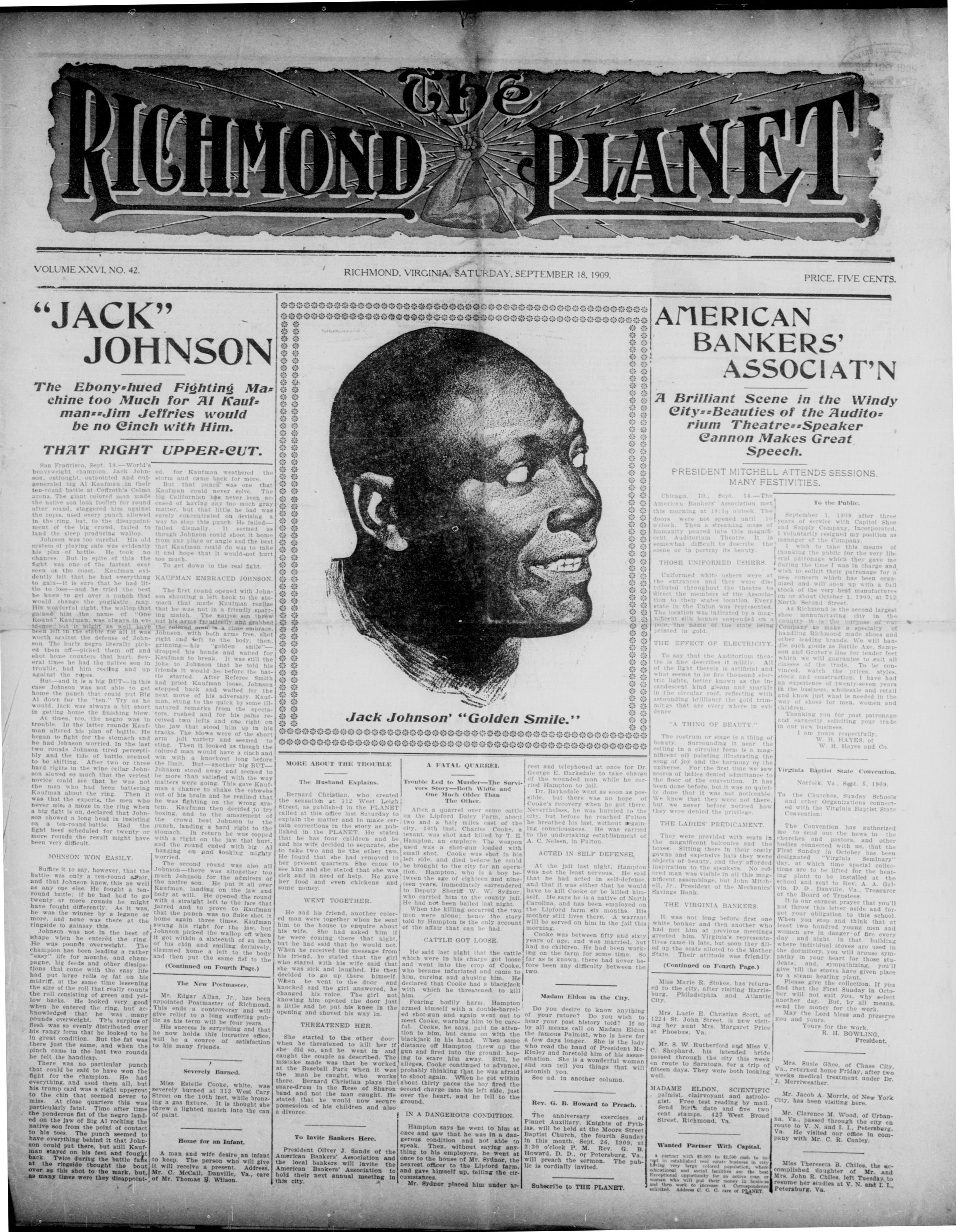
"JACK" JOHNSON
The Ebony=hued Fighting Machine too Much for Al Kaufman=Jim Jeffries would be no Cinch with Him. THAT RIGHT UPPER=OUT.
VOLUME XXVI, NO. 42.
"JACK
JOH
The Ebony=hue
chine too Much
man==Jim J
be no Cinch
THAT RIGHT
San Francisco, Sept. 10. —World's heavyweight champion, Jack Johnson, outfought, outpointed and outgeneralized Al Kaufman in their ten-round battle at Coffroth's Colma arena. The giant colored man made the native son look foolish for round after round, staggered him against the ropes, used every punch allowed in the ring, but, to the disappointment of the big crowd, failed to land the sleep producing wallop. Johnson was too careful. His old system of playing safe was evidently his plan of battle. He took no chances. But in spite of this the fight was one of the fastest ever seen on the coast. Kaufman evidently felt that he had everything to gain—it is sure that he had little to lose—and he tried the best he knew to get over a punch that would change the pugilistic map. His wonderful right, the wallop that gained him the name of "One Round Kaufman, was always in evidence but it might as well have been off in the stable for all it was to do. He defense of Johnson. The burly legro literally picked them off—he grooted them off and shot home counters that hurt. Several times he had the native son in trouble, had him reeling and up against the ropes.
But—and it is a big BUT—In this case Johnson was not able to get home the punch that could put Big Al down for the "ten." Try as he would, Jack was always a bit short in getting home the finishing blow.
At times, too, the negro was in trouble. In the latter rounds Kaufman altered his plan of battle. He began to fight for the stomach and he had Johnson worried. In the last two rounds Johnson tired perceptibly and the tide of battle seemed to be shifting. After two or three hard rights in the wine cellar Johnson slowed so much that the verlest novice could see that he was not the man who had been battering Kaufman about the ring. Then it was that the experts, the men who never miss a move in the ring when a big fight is on, declared that Johnson showed a long head in insisting on a ten-round battle. Had the fight been scheduled for twenty or more rounds the result might have been very difficult.
JOHNSON WON EASILY
Suffice it to say, however, that the battle was only a ten-round pair, and that Johnson knew, this as well as any one else. He fought a ten-round battle; if he had had to go twenty or more rounds he might have fought differently. As it was, he was the winner by a leguae or more, and none was there at the ringside to gainssay this.
Johnson was not in the best of shape when he entered the ring. He was pounds overweight. The champion has been leading a rather "easy" life for months, and champagne, big feeds and other dissipations that come with the easy life had put large rolls of fat on his midriff, at the same time lessening the size of the roll that really counts the roll consisting of green and yellow backs. He looked very good when he entered the ring, but acknowledged that he was many pounds overweight. This surplus of flesh was so evenly distributed over his rany form that he looked to be in great condition. But the fat was there just the same, and when the pinch came in the last two rounds he felt the handicap.
There was no particular punch that could be said to have won the fight for the champion. He had everything, and used them all, but his trump card was a right uppercut to the chin that seemed never to miss. At close quarters this was particularly fatal. Time after time the ponderous fist of the negro landed on the jaw of Big Al rocking the native son from the point of contact to his toes. The punch seemed to have everything behind it that Johnson could put there, but still Kaufman stayed on his feet and fought back. Twice during the battle fans at the ringside thought the bout over as this shot to the mark, but, as many times were they disappoint-
ed, for Kaufman weathered the storm, and came back for years.
But that punch was one that Kaufman could never soo. The big Californiaian has never been accused of having any too much gray matter, but that little he had was surely concentrated on devising a way to stop this punch. He failed, failed dismally. It seemed as though Johnson could shoot it home from any place or angle and the best that Kaufman could do was to take it and hope that it would-not hurt too much.
To get down to the real fight.
KAUFMAN EMBRACED JOHNSON
The first round opened with Johnson shot a left hook to the stomach that made Kaufman realize that he was not in a friendly sparring match. The native son throw out his arms firmly and grabbed the colored men in a close embrace. Johnson, with both arms free, right and left to the body, then grinning—his "golden smile" dropped his hands and waited for Kaufman to break. It was still the Joke to Johnson that he told his friends it would be before the battle started. After Referee Smith had pried Kaufman loose, Johnson stepped back and waited for the next move of his adversary. Kaufman, stung to the quick by some ill-natured remarks from the spectators, rushed and for his pains received two lefts and one right on the jaw that stood him up in his tracks. The blows were of the short arm jolt variety and seemed to sting. But—another big BUT—Johnson stood away and seemed to be more than satisfied with the way matters were going. This gave Kaufman a chance to shake the cobwebs out of his brain and he realized that he was fighting on the wrong system. Kaufman then decided to try boxing, and to the amazement of the crowd beat Johnson to the punch, landing a hard right to the stomach. In return he was coped with a right on the jaw that hurt, and the round ended with big Al hanging on and looking mighty worried.
The second round was also all Johnson—there was altogether too much Johnson for the admirers of the native son. He put it all over Kaufman, landing on the jaw and body at will. He opened the round with a straight left to the face that jarred and to prove to Kaufman that the punch was no fluke shot it home again three times. Kaufman swung his right for the jaw, but Johnson picked the wallop off when it got within a sixteenth of an inch of his chin and smiling dersively, slammed home a left to the body and then put the same fist to the
(Continued on Fourth Page.)
The New Postmaster
Mr. Edgar Allan, Jr., has been appointed Postmaster of Richmond. This ends a controversy and will give relief to a long suffering public as his term will be four years. His success is surprising and that he holds this lucrative office, will be a count of satisfaction to his many friends.
Severely Burned.
Miss Estelle Cooke, white, was severely burned at 313 West Cary Street on the 10th inst., while bronzing a gas fixture. It is thought she threw a lighted match into the can of paint.
Home for an Infant
A man and wife desire an infant to keep. The person who will give it will receive a present. Address, Mr. C. McCall, Danville, Va., care of Mr. Thomas B. Wilson
RICHMOND, VIRGINIA, SATURDAY, SEPTEMBER 18, 1909.
```markdown
```
JACKSON
```markdown
```
```markdown
```
MORE ABOUT THE TROUBLE
The Husband Explains
Bernard Christian, who created the sensation at 112 West Leigh Street, as published in the PLANET called at this office last Saturday to explain the matter and to make certain corrections in the story as published in the PLANET. He stated that he has four children and he and his wife decided to separate, she to take two and he the other two. He found that she had removed to her present quarters. She came to see him and she stated that she was sick and in need of help. He gave her food and even chickens and some money.
WENT TOGETHER
He and his friend, another colored man were together when he sent him to the house to enquire about his wife. She had asked him if he were coming there that night, but he had said that he would not. When he received the message from his friend, he stated that the girl who stayed with his wife said that she was sick and laughed. He then decided to go up there himself. When he went to the door and knocked and the girl answered, he changed his voice. The girl not knowing him opened the door just a little and he put his knee in the opening and shoved his way in.
THREATENED HER
She started to the other door when he threatened to kill her if she did so, and he went in and caught the couple as described. The mistake made was that he worked at the Baseball Park when it was the man he caught, who works there. Bernard Christian plays the snare-drum in the Rose of Sharon band and not the man caught. He stated that he would now secure possession of his children and also a divorce.
To Invite Bankers Here
President Oliver J. Sands of the American Bankers' Association and the local bankers will invite the American Bankers' Association to hold their next annual meeting in this city.
A FATAL QUARREL
Trouble Led to Murder—The Survivors Story—Both White and One Much Older Than The Other.
After a quarrel over some cattle on the Lipford Dairy Farm, about two and a half miles east of the city. 10th inst. Charles Cooke, a tenant, was shot and killed by T. E. Hampton, an employee. The weapon used was a shot-gun loaded with small shot. Cooke was shot in his left side, and despite he could be brought to the city for an operation. Hampton, who is a boy between the age of eighteen and nineteen years, immediately surrendered to Deputy Sheriff W. W. Sydnor, who carried him to the county jail. He had not been bailed last night.
When the killing occurred the two men were alone; hence the story told by Hampton is the only account of the affair that can be had.
CATTLE GOT LOOSE
He said last night that the cattle which were in his charge got loose and went into the crop of Cooke, who became infuriated and came to him, cursing and abusing him. He declared that Cooke had a blackjack with which he threatened to kill him.
Fearing bodily harm, Hampton armed himself with a double-barreled shot-gun and again went out to meet Cooke, warning him to be careful. Cooke, he says, paid no attention to him, but came on with the blackjack in his hand. When some distance off Hampton threw up the gun and fired into the ground, hoping to scare him away. Still, he alleges, Cooke continued to advance, probably thinking that he was afraid to shoot again. When he got within about thirty paces the boy fired the second charge into his left side, just over the heart, and he fell to the ground.
IN A DANGEROUS CONDITION
Hampton says he went to him at once and saw that he was in a dangerous condition and not able to speak. Then, without saying anything to his employers, he went at once to the house of Mr. Sydnor, the nearest officer to the Llipford farm, and gave himself up, telling the circumstances. Mr. Sydnor placed him under sr-
```markdown
```
rest and telephoned at once for Dr. George E. Barksdale to take charge of the wounded man while he carried Hampton to jail.
Dr. Barksdale went as soon as possible, but there was no hope of Cooke's recovery when he got there. Nevertheless, he was hurried to the city, but before he reached Fulton he breathed his last, without gaining consciousness. He was carried to the undertaking establishment of A. C. Nelsen, in Fulton.
ACTED IN SELF DEFENSE
At the jail last night, Hampton was not the least nervous. He said that he had acted in self-defense, and that it was either that he would have to kill Cooke or be killed himself. He says he is a native of North Carolina, and has been employed on the Lipford farm six months. His mother still lives there. A warrant will be served on him in the jail this morning.
Cooke was between fifty and sixty years of age, and was married, but had no children. He had been working on the farm for some time. So far as is known, there had never before been any difficulty between the two.
Madam Eldon in the City
Do you desire to know anything of your future? Do you wish to hear your past history told? If so by all means call on Madam Eldon the famous Palmist, who is here for a few days longer. She is the lady who read the hand of President McKinley and foretold him of his assassination. She is a wonderful woman and can tell you things that will astonish you. See ad. in another column.
Rev. G. B. Howard to Preach.
The anniversary exercises of Planet Auxiliary, Knights of Pythias, will be held at the Moore Street Baptist Church, the fourth Sunday in this month. Sept. 26, 1909, at 3:30 o'clock P. M. Rev. G. B. Howard, D. D., or Petersburg, Va. will preach the sermon. The public is cordially invited.
Subscribe to THE PLANET
AMERICAN BANKERS' ASSOCIAT'N
PRESIDENT MITCHELL ATTENDS SESSIONS.
MANY FESTIVITIES.
Chicago, Ill., Sept. 14.—The American Bankers' Association met this morning at 10:30 o'clock. The doors were not opened until 10 o'clock. Then a streaming mass of humanity poured into this magnificent Auditorium Theatre. It is somewhat difficult to describe the scene or to portray its beauty.
To the Public.
September 1, 1909 after years of service with Capitol and Supply Company, Incorporated I voluntarily resigned my positiv manager of the Company. I wish to take this mean thank you.
THOSE UNIFORMED USHERS
Uniformed white ushers were at the entrances and they were distributed throughout the theatre to direct the members of the Association to their states location. Every state in the Union was represented. The location was indicated by a magnificent silk banner suspended on a pole; the name of the state being printed in gold.
THE EFFECT OF ELECTRICITY
To say that the Auditorium theatre is fine describes it mildly. All of the light therein is artificial and what seems to be five thousand electric lights, better known as the incandescent kind gleam and sparkle in the circular roof, reflecting with astounding brilliance the gold trimmings that are every where in evidence.
"A THING OF BEAUTY."
The rostrum or stage is a thing of beauty. Surrounding it near the ceiling in a circular form is a magnificent oil painting illustrating the song of joy and the harmony or the universe. For the first time we saw scores of ladies denied admittance to the floor of the convention. It has been done before, but it was so quietly done that it was not noticeable. We knew that they were not there, but we never before noticed how they were denied the privilege.
THE LADIES' PREDICAMENT
They were provided with seats in the magnificent balconies and the boxes. Sitting there in their costly gowns and expensive hats they were objects of beauty, and they afforded inspiration to the speakers. No colored man was visible in all this magnificent assemblage, but John Mitchell, Jr., President of the Mechanics' Savings Bank.
THE VIRGINIA BANKERS
It was not long before first one white banker and then another who had met him at previous meetings greeted him. Virginia's representatives came in late, but soon they filled up the seats allotted to the Mother State. Their attitude was friendly.
(Continued on Fourth Page.)
Miss Marie R. Stokes, has returned to the city, after visiting Harrisburg, Philadelphia and Atlantic City.
Mrs. Lucie E. Christian Scott, of 1224 St. John Street, is now visiting her aunt Mrs. Margaret Price at Phoebus, Va.
Mr. S. W. Rutherford and Miss V. C. Shephard, his intended bride passed through the city this week en route to Saratoga, for a trip of fifteen days. They were both looking well.
MADAME ELDON, SCIENTIFIC palmist, clairvoyant and astrologist. Free test reading by mail. Send birth date and five two cent stamps. 427 West Broad Street, Richmond, Va.
Wanted Partner With Capital.
A partner with $1,000 to $2,500 cash to invest in established real estate business in city where educational and social facilities are available. Exceptional opportunity for an active cann or woman who will put their money in business or invest in increase. C correspondence solicited. Address C: 1234 Main Street, New York, NY 10001.
PRICE, FIVE CENTS.
AN
KERS'
ASSOCIAT'N
one in the Windy
s of the Audito=
tre==Speaker
makes Great
Speech.
ALL ATTENDS SESSIONS.
ACTIVITIES.
To the Public.
September 1, 1809 after three years of service with Capitol Shoe and Supply Company, Incorporated, I voluntarily resigned my position as manager of the Company. I wish to take this means of thanking the public for the very liberal patronage which they gave me during the time I was in charge and wish to solicit their patronage for a new concern which has been organized and will open up with a full stock of the very best manufactures on or about October 1, 1899, at 712 North Second Street. As Richmond is the second largest shoe manufacturing city in the country it is the purpose of our Company to make a specialty of handling Richmond made shoes and other leading brands. We will handle such goods as Battle Axe, Sampson and Grover's line for tender feet which we will guarantee to suit all classes of the trade. To be convinced, watch the prices, styles, stock and construction. I have had an experience of twenty-seven years in the business, wholesale and retail and know just what is needed in the way of shoes for men, women and children. Thanking you for past patronage and earnestly soliciting your trade in our new business. I am yours respectfully, W. H. HAYES, of W. H. HAYES and Co.
Virginia Baptist State Convention
Norfolk, Va., Sept. 5, 1909.
To the Churches, Sunday Schools and other Organizations connected with the Virginia Baptist State Convention:
The Convention has authorized me to send out the news to the churches and pastors, and other bodies connected with us, that the First Sunday in October has been designated "Virginia Seminary" day, at which time special collections are to be lifted for the heating plant to be installed at the school and sent to Rev. A. A. Galvin, D. D., Danville, Va., Treasurer of the Board of Trustees.
It is our earnest prayer that you'll not throw this letter aside and forget your obligation to this school. When you stop and think that at least two hundred young men and women are in danger of fire every day and night, in that building where individual stoves are used in the dormitory, you will arouse sympathy in your heart for those students; and, sympathizing, you'll give 'till the stoves have given place to a steam heating plant.
Please give the collection. If you find that the First Sunday in October will not suit you, why select another day. But, by all means, send the money for the work.
May the Lord bless and preserve you and yours.
Yours for the work,
R. H. BOWLING.
President.
Mrs. Susie Ghee, of Chase City, Va., returned home Friday, after two weeks medical treatment under Dr. J. Merriweather.
Mr. Jacob A. Morris, of New York City, has been visiting here.
Mr. Clarence M. Wood, of Urbanna, Va., passed through the city en route to V. N. and I. I., Petersburg, Va. He visited our office in company with Mr. C. R. Conley.
Miss Thereseta B. Chiles, the accomplished daughter of Mr. and Mrs. John R. Chiles, left Tuesday to resume her studies at V. N. and I. L. Petersburg, Va.
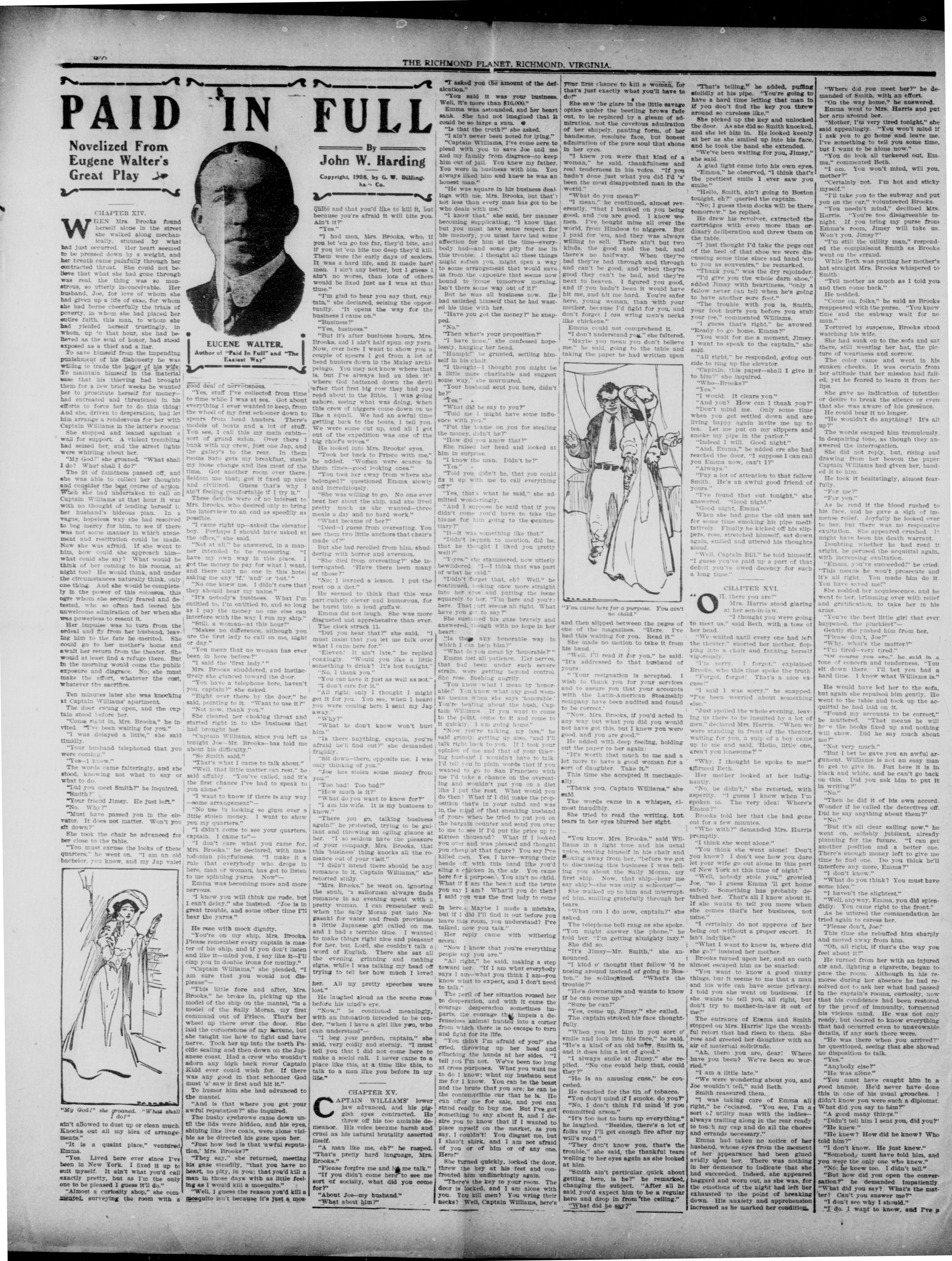
PAID IN FULL
Novelized From Eugene Walter's Great Play
CHAPTER XIV.
WHEN Mrs. Brooks found herself alone in the street she walked along mechanically, stunned by what had just occurred. Her heart seemed to be pressed down by a weight, and her breath came painfully through her contracted throat. She could not believe that what she had gone through was real, the thing was so monstrous, so utterly inconceivable. Her husband, Joe, for love of whom she had given up a life of ease, for whom she had borne cheerfully the trials of poverty, in whom she had placed her entire faith, this man, to whom she had yielded herself trustingly, in whom, up to that hour, she had believed as the soul of honor, had stood exposed as a thief and a liar.
To save himself from the impending punishment of his dishonesty he was willing to trade the honor of his wife. To maintain himself in the material ease that his thieving had brought them for a few brief weeks he wanted her to prostitute herself for money—had entreated and threatened in his efforts to force her to do this thing! And she, driven to desperation, had let him arrange a rendervous for her with Captain Williams in the latter's rooms! She stopped and leaned against a wall for support. A violent trembling had seized her, and the street lights were whirling about her.
"My God!" she groaned. "What shall I do? What shall I do?"
The fit of faintness passed off, and she was able to collect her thoughts and consider the best course of action. When she had undertaken to call on Captain Williams at that hour it was with no thought of lending herself to her husband's hideous plan. In a vague, hopeless way she had resolved to beg mercy for him, to see if there was not some manner in which atonement and restitution could be made. Now she was afraid. If she went to him, how could she approach him—what could she say? What would he think of her coming to his rooms, at night too? He would think, and under the circumstances naturally think, only one thing. And she would be completely in the power of this colossus, this ogre whom she secretly feared and detested, who so often had leered his unwelcome admiration of her when she was powerless to resent it.
Her impulse was to turn from the ordeal and fly from her husband, leaving him to the fate he merited. She could go to her mother's home and await her return from the theater. She would at least find a refuge there. But in the morning would come the public exposure and disgrace. No; she must make the effort, whatever the cost, whatever the sacrifice.
Ten minutes later she was knocking at Captain Williams' apartment. The door swung open, and the captain stood before her.
"Come right in, Mrs. Brooks," he invited. "I've been waiting for you."
"I was delayed a little," she said timidly.
"Your husband telephoned that you were coming."
"Yes-1 know."
The words came falteringly, and she stood, knowing not what to say or what to do.
"Did you meet Smith?" he inquired.
"Smith?"
"Your friend Jimmy. He just left."
"No. Why?"
"Must have passed you in the elevator. It does not matter. Won't you sit down?"
She took the chair he advanced for her close to the table.
"You must excuse the looks of these quarters." he went on. "I am an old bachelor, you know, and my Jan valet
B. A. B.
"My God!" she groaned. "What shall I do?"
"It is a quaint place," ventured Emma.
"Yes. Lived here ever since I've been in New York. I fixed it up to suit myself. It ain't what you'd call exactly pretty, but as I'm the only one to be pleased I guess it'll do."
"Almost a curiosity shop," she commented surveying the room with a
1
EUCENE WALTER,
Author of "Paid In Full" and "The
Easiest Way"
good deal of nervousness.
"Yes, stuff I've collected from time
to time while I was at sea. Got about
everything I ever wanted to keep, from
the wheel of my first schooner down to
spears from head hunters. There's
models of boats and a lot of stuff.
You see, I call this my main cabin—
sort of grand salon. Over there I
bunk with my crew, just one Jap, and
the galley's to the rear. In them
rooms Sato gets my breakfast, steals
my loose change and lies most of the
time. Got another room over there.
Seldom use that; got it fixed up nice
and civilized. Guess that's why I
ain't feeling comfortable if I try it."
These details were of no interest to Mrs. Brooks, who desired only to bring the interview to an end as speedily as possible.
"I came right up—asked the elevator boy. Perhaps I should have asked at the office," she said.
"Not at all," he answered, in a manner intended to be reassuring. "I have my own way in this place. I got the money to pay for what I want, and there ain't no one in this hotel asking me any 'if,' 'and' or 'but.'"
"No one knew me. I didn't care that they should hear my name."
"It's nobody's business. What I'm entitled to, I'm entitled to, and so long as I pay the money no one else can interfere with the way I run my ship."
"Still, a woman—at this hour."
"Makes no difference, although you are the first lady to call on me, night or day."
"You mean that no woman has ever been in here before?"
"I said the 'first lady.'"
Mrs. Brooks shuddered, and instinctively she glanced toward the door.
"Right over there by the door," he said, pointing to it. "Want to use it?" "Not now, thank you." She cleared her choking throat and started right in to the business that had brought her. "Captain Williams, since you left us tonight Joe—Mr. Brooks—has told me about his difficulty." "So Smith said." "That's what I came to talk about." "Well, that little matter can rest," he said affably. "You've called, and it's the first chance I've had to speak to you alone." "I want to know if there is any way—some arrangement." "No use in looking so glum over a little stolen money. I want to show you my quarters." "I didn't come to see your quarters, cantain. I came to"—
"I don't care what you came for, Mrs. Brooks." he declared, with mastodonian playfulness. "I make it a rule that everybody who drops in here, man or woman, has got to listen to me spinning yarns. Now"—Emma was becoming more and more nervous. "I know you will think me rude, but I can't delay," she insisted. "Joe is in great trouble, and some other time I'll hear the yarns."
He rose with mock dignity. "You're on my ship, Mrs. Brooks. Please remember every captain is master of his ship, and if you don't listen and like it—mind you, I say like it—I'll clap you in double irons for mutiny." "Captain Williams," she pleaded, "I am sure that you would not displease"—
"This little fore and after, Mrs. Brooks," he broke in, picking up the model of the ship on the mantel, "is a model of the Sally Moran, my first command out of Frisco. That's her wheel up there over the door. She laid the cornerstone of my fortune, but she taught me how to fight and have nerve. Took her up into the north Pacific sealing and down on the Japanese coast. Had a crew who wouldn't adorn any high back rover Captain Kidd ever could wish for. If there was any good in that schooner God must 'a' saw it first and hit it." To humor him she had advanced to the mantel.
"And is that where you got your awful reputation?" she inquired.
The bushy eyebrows came down until the lids were hidden, and his eyes, shining like live coals, were alone visible as he directed his gaze upon her. "Just how bad is that 'awful reputation,' Mrs. Brooks?" "They say," she returned, meeting his gaze steadily, "that you have no heart, no pity, in you; that you'd kill a man in those days with as little feeling as I would kill a mosquito." "Well, I guess the reason you'd kill a mosquito isn't because it's just a mos-
THE RICHMOND PLANET, RICHMOND, VIRGINIA
By
John W. Harding
Copyright, 1908, by G. W. Dillingham Co.
quilo and that you'd like to kill it, but because you are afraid it will bite you. Ain't it?"
"Yes."
"I had men, Mrs. Brooks, who, if you let 'em go too far, they'd bite, and if you let 'em bite too deep they'd kill. They were the early days of sealers. It was a hard life, and it made hard men. I ain't any better, but I guess I ain't no worse, than lots of others would be fixed just as I was at that time."
"I'm glad to hear you say that, captain," she declared, seizing the opportunity. "It opens the way for the business I came on."
"Business?"
"Yes, business."
"But it's after business hours, Mrs. Brooks, and I ain't half spun my yarn. Now, over here I want to show you a couple of spears I got from a lot of head hunters down in the Malay archipelago. You may not know where that is, but I've always had an idea it'where God battened down the devil after that first big row they had you read about in the Bible. I was going ashore, seeing what was doing, when this crew of niggers come down on us like a squall. We had an awful time getting back to the boats, I tell you. We were some cut up, and all I got out of the expedition was one of the big chief's wives."
He looked into Mrs. Brooks' eyes.
"Took her back to Frisco with me," he added. "Women were scarce in them times—good looking ones."
"You took her away from where she belonged?" questioned Emma slowly and incredulously.
"She was willing to go. No one ever beat her about the ship, and she lived pretty much as she wanted—three meals a day and no hard work."
"What became of her?"
"Died—I guess from overeating. You see them two little anchors that chair's made of?"
But she had recolled from him, shuddering with horror and aversion.
"She died from overeating?" she interrogated. "Have there been many of those?"
"No; I learned a lesson. I put the rest on a diet."
He seemed to think that this was particularly clever and humorous, for he burst into a loud guffaw.
Emma did not laugh. She was more disgusted and apprehensive than ever. The clock struck 11.
"Did you hear that?" she said. "I must insist that you let me talk over what I came here for."
"Eleven! It ain't late," he replied coaxingly. "Would you like a little something to drink? It's hot tonight."
"No, I thank you."
"You can have it just as well as not."
"I don't care for it."
"All right, only I thought I might get it for you. You see, when I heard you were coming here I sent my Jap away."
"Why?"
"What he don't know won't hurt him."
"Is there anything, captain, you're afraid he'll find out?" she demanded frigidly.
"Sit down—there, opposite me. I was only thinking of you."
"Joe has stolen some money from you."
"Too bad! Too bad!"
"How much is it?"
"What do you want to know for?"
"I am his wife. It is my business to know."
"There you go, talking business again!" he protested, trying to be gallant and throwing an ogling glance at her. "I so seldom have the pleasure of your company, Mrs. Brooks, that this 'business' thing knocks all the romance out of your visit."
"I didn't intend there should be any romance in it, Captain Williams," she retorted stily.
"Mrs. Brooks," he went on, ignoring the snub, "a sailorman always finds romance in an evening spent with a pretty woman. I can remember well when the Sally Moran put into Nagasaki for water and fresh provisions a little Japanese girl called on me, and I had a terrible time. I wanted to make things right nice and pleasant for her, but Lord, she couldn't talk a word of English. There she sat all the evening, grinning and making signs, while I was talking my head off trying to tell her how much I loved
He laughed aloud as the scene rose before his mind's eye.
"Now," he continued meaningly, with an intonation intended to be tender, "when I have a girl like you, who can understand"—
"I beg your pardon, captain," she said, very coldly and sternly. "I must tell you that I did not come here to make a social call. I never came to a place like this, at a time like this, to talk to a man like you before in my life."
CHAPTER XV.
CAPTAIN WILLIAMS' lower jaw advanced, and his pig-gish eyes contracted. He threw off his too amiable demeanor. His voice became harsh and cruel as his natural brutality asserted itself.
"A man like me, eh?" be rasped. "That's pretty hard language, Mrs. Brooks."
"Please forgive me and let me talk."
"If you didn't come here to see me sort of socially, what did you come for?"
"About Joe—my husband."
"What about him?"
"I asked you the amount of the defa-
calation."
Emma was astounded, and her heart sank. She had not imagined that it could be so large a sum.
"Is that the truth?" she asked.
"I ain't never been noted for lying."
"Captain Williams, I've come here to plead with you to save Joe and me and my family from disgrace—to keep him out of jail. You knew my father. You were in business with him. You always liked him and knew he was an honest man."
"He was square in his business dealings with me. Mrs. Brooks, but that' not less than every man has got to be who deals with me."
"I know that," she said, her manner becoming supplicating; "I know that, but you must have some respect for his memory, you must have had some affection for him at the time—everybody had—and some pity for me in this trouble. I thought all these things might soften you, might open a way to some arrangement that would save us from the exposure that seems now bound to come tomorrow morning. Isn't there some way out of it?" But he was all business now. He had satisfied himself that he had wasted his time with her.
"Have you got the money?" he snapped.
"No."
"Then what's your proposition?"
"I have none," she confessed hopelessly, hanging her head.
"Humph!" he settled himself in his chair.
"I thought—I thought you might be a little more charitable and suggest some way," she murmured.
"Your husband sent you here, didn't be?"
"Yes."
"What did he say to you?"
"Told me I might have some influence with you."
She raised her head and looked at him in surprise.
"I know the man. Didn't he?"
"Yes."
"Yes, that's what he said," she admitted wonderingly.
"And I suppose he said that if you didn't come you'd have to take the blame for him going to the penitentiary?"
"It—it was something like that."
"Didn't happen to mention, did he, that he thought I liked you pretty well?"
"Y-yes," she stammered, now utterly bewildered. "I—I think that was part of what he said."
"Didn't forget that, eh? Well," he continued, looking once more straight into her eyes and putting the issue squarely to her. "I'm here and you're here. That part seems all right. What have you got to say?"
She sustained his gaze bravely and answered, though with no hope in her heart:
"Is the any honorable way in which I can help him?"
"What do you mean by 'honorable?' Emma lost all patience. Her nerves that had been under such severe strain, were getting beyond control She rose, fushing angrily. "You know what I mean by 'honorable.' You know what any good woman an means when she says 'honorable.' You're beating about the bush, Captain Williams. If you want to come to the point, come to it and come to it quickly, I am going home."
"Now you're talking, my less," he said grimly, getting up also. "and I'll talk right back to you. If I took your opinion of me and that of your thieving husband I wouldn't have to talk. I'd tell you in plain words that if you wanted to go to San Francisco with me I'd take a chance on the overeating and wouldn't put you on a diet like I put the rest. What would you do then? What if I did make the proposition that's in your mind and was in the mind of that sneaking husband of yours when he tried to put you on the bargain counter and send you over to me to see if I put the price up to sixteen thousand? What if I looked you over and was pleased and thought you cheap at that figure? You say I've killed men. Yes, I have—wrung their heads off with this hand like you'd sling a chicken in the air. You came here for a purpose. You ain't no child. What if I am the beast and the brute you say I am? What'll you do then? I said you was the first lady to come
in here. Maybe I made a mistake,
but if I did I'll find it out before you
leave this room, you understand? I've
talked; now you talk."
Her reply came with withering
scorn:
"All right," he said, making a step toward her. "If I am what everybody says I am—what you think I am—you know what to expect, and I don't need to talk."
The peril of her situation roused her to desperation, and with it came the courage desperation sometimes imparts, the courage the impels a defenseless animal hunted into a corner from which there is no escape to turn and fight for its life.
"You think I'm afraid of you!" she cries, throwing up her head and clenching the hands at her sides. "I tell you I'm not. We've been too long at cross purposes. What you want me to do I know; what my husband sent me for I know. You can be the beast and the brute that you are; he can be the contemptible that he is. He can offer me for sale, and you can stand ready to buy me. But I've got something to say about it, and I desire you to know that if I wanted to place myself on the market, as you say, I couldn't. You disgust me, but I shan't shirk, and I am not afraid of you or of him or of any one. Here"
She turned quickly, locked the door, threw the key at his feet and confronted him unfinchingly again.
"There's the key to your room. The door is locked, and I am alone with you. You kill men? You wring their necks? Well, Captain Williams, here's
your first chance to kill a woman, for that's just exactly what you'll have to do."
She saw the glare in the little savage optics under the beetling brows fade out, to be replaced by a gleam of admiration, not the covetous admiration of her shapely, panting form, of her handsome, resolute face, but bonest admiration of the pure soul that shone in her eyes.
"I knew you were that kind of a woman," he said, thankfulness and real tenderness in his voice. "If you hadn't done just what you did I'd 'a been the most disappointed man in the world."
"What do you mean?"
"I mean," he continued, almost reverently, "that I banked on you being good, and you are good. I know women. I've bought mine all over the world, from Hindoos to niggers. But I paid for 'em, and they was always willing to sell. There ain't but two kinds, the good and the bad, and there's no halfway. When they're bad they're bad through and through and can't be good, and when they're good they can't be bad, and they're next to heaven. I figured you good, and if you hadn't been it would have bit me, and bit me hard. You're safer here, young woman, than with your mother, because I'd fight for you, and don't forget I can wring men's necks like chickens."
Emma could not comprehend it. "I don't understand you." she fattered. "Maybe you mean you don't believe me," he said, going to the table and taking the paper he had written upon
BARRYD
"You came here for a purpose. You ain't no child."
She made no motion to take it from his hand.
"Well, I'll read it for you," he said.
"It's addressed to that husband of yours:
"Your resignation is accepted. I wish to thank you for your services and to assure you that your accounts with the Latin-American Steamship company have been audited and found to be correct."
"Now, Mrs. Brooks, if you'd acted in any way but what you did you would not have got this, but I knew you were good, and you are good."
He added with deep feeling, holding out the paper to her again:
"It's worth that much to me and a lot more to have a good woman for a sort of daughter. Take it."
This time she accepted it mechanically.
"Thank you, Captain Williams," she said.
The words came in a whisper, almost inaudibly.
She tried to read the writing, but tears in her eyes blurred her sight.
"You know, Mrs. Brooks," said Williams in a light tone and his usual voice, seating himself in his chair and looking away from her, "before we got to discuss this business I was telling you about the Sally Moran, my first ship. Now, that ship—hear me say ship?—she was only a schooner"—She walked up to him and interrupted him, smiling gratefully through her tears.
"What can I do now, captain?" she asked.
The telephone bell rang as she spoke.
"You might answer the phone," he told her. "I'm getting almighty lazy."
She did so.
"It's Jimsy-Mr. Smith," she announced.
"I kind o' thought that fellow 'd be nosing around instead of going to Boston," he soliloquized. "What's the trouble?"
"He's downstairs and wants to know if he can come up."
"Sure he can!"
"Yes, come up, Jimsy," she called.
The captain stroked his face thoughtfully.
"When you let him in you sort o' smile and look into his face," he said.
"He's a kind of an old baby. Smith is, and it does him a lot of good."
"I always smile at Jimsy," she replied.
"No one could help that, could they?"
"He is an amusing cues," he couced.
He reached for the tin of tobacco.
"You don't mind if I smoke, do you?"
"No, I don't think I'd mind 'if you committed arson."
"It's too hot to burn up everything," he laughed. "Besides, there's a lot of folks say I'll get enough fire after my will's read."
"They don't know you, that's the trouble," she said, the thankful tears welling to her eyes again as she looked at him.
"Smith ain't particular quick about getting here, is he?" he remarked, changing the subject. "After all he said, you'd expect him to be a regular hero and drop in from 'the ceiling.'"
"What did he say?"
"That's telling," he added, puffing stolidly at his pipe. "You're going to have a hard time letting that man in if you don't find the key you throw around so careless like."
She picked up the key and unlocked the door. As she did so Smith knocked, and she let him in. He looked keenly at her as she smiled up into his face, and he took the hand she extended.
"We've been waiting for you, Jimsy," she said.
"Hello, Smith, ain't going to Boston tonight, eb?" queried the captain.
"No; I guess them docks will be there tomorrow," he replied.
He drew his revolver, extracted the cartridges with even more than ordinary deliberation and threw them on the table.
"I just thought I'd take the pegs out of the heel of that shoe we were discussing some time since and hand 'em to you as souvenirs," he remarked.
"Thank you," was the dry rejoinder.
"I'd give you the whole darn shoe," added Jimsy with heartiness, "only a fellow never can tell when he's going to have another sore foot."
"The trouble with you is, Smith, your foot hurts you before you stub your toe," commented Williams.
"I guess that's right," he avowed.
"Ready to go home, Emma?"
"You wait for me a moment, Jimsy. I want to speak to the captain," she said.
"All right," he responded, going outside to ring up the elevator.
"Captain, this paper—shall I give it to him?" she inquired.
"Who—Brooks?"
"Yes."
"I would. It clears you."
"And you? How can I thank you?"
"Don't mind me. Only some time when you get settled down and are living happy again invite me up to tea. Let me put on my slippers and smoke my pipe in the parlor."
"Indeed I will. Good night."
"And, Emma," he added ere she had reached the door. "I suppose I can call you Emma now, can't I?"
"Always."
"Pay a lot of attention to that fellow Smith. He's an awful good friend of yours."
"I've found that out tonight," she answered. "Good night."
"Good night, Emma."
When she had gone the old man sat for some time smoking his pipe meditatively. Finally he kicked off his slippers, rose, stretched himself, sat down again, smiled and uttered his thoughts aloud.
"Well, Captain Bill," he told himself,
"I guess you've paid up a part of that
deficit you've owed decency for such
a long time."
CHAPTER XVL
"Hi, there you are!"
Mrs. Harris stood glaring at her son-in-law.
"I thought you were going to meet us," said Beth, with a toss of her head.
"We waited until every one had left the theater," shorted her mother, flipping into a chair and fanning herself vigorously.
"I'm sorry. I forgot," explained Brooks, who this time spoke the truth.
"Forgot, forgot! That's a nice excuse!"
"I said I was sorry," he snapped.
"I've been worried about something else."
"Just spoiled the whole evening, leaving us there to be insulted by a lot of men." declared Mrs. Harris. "When we were standing in front of the theater, waiting for you, a snip of a boy came up to me and said. 'Hello, little one, aren't you lonesome?'"
"Why, I thought he spoke to me!" affirmed Beth.
Her mother looked at her indigently.
"No, he didn't," she retorted, with asperity. "I guess I know when I'm spoken to. The very ideal! Where's Emma?"
Brooks told her that she had gone out for a few minutes.
"Who with?" demanded Mrs. Harris promptly.
"I think she went alone."
"You think she went alone! Don't you know? I don't see how you dare let your wife go out alone in this part of New York at this time of night."
"Well, nobody stole you," growled Joe, "so I guess Emma 'll get home safely. Something has probably detained her. That's all I know about it. If she wants to tell you more when she comes that's her business, not mine."
"I certainly do not approve of her being out without a proper escort. It isn't ladylike."
"What I want to know is, where did she go?" insisted her mother.
Brooks turned upon her, and an oath almost escaped him as he snared:
"You want to know a good many things, but it seems to me that a man and his wife can have some privacy. I told you she went on business. If she wants to tell you, all right, but don't try to mother-in-law it out of me!"
The entrance of Emma and Smith stopped on Mrs. Harris' lips the wrathful retort that had risen to them. She rose and greeted her daughter with an air of maternal solicitude.
"Ah, there you are, dear! Where have you been? We've been so worried."
"I am a little late."
"We were wondering about you, and Joe wouldn't tell," said Beth.
"I was taking care of Emma all right," he declared. "You see, I'm a sort of utility man with the ladies—always trailing along in the rear ready to touch my cap and do all the chores and errands necessary."
Emma had taken no notice of her husband, whose eyes from the moment of her appearance had been glued avidly upon her. There was nothing in her demeanor to indicate that she had succeeded. Indeed, she appeared baggard and worn out, as she was, for the emotions of the night had left her exhausted to the point of breaking down. His anxiety and apprehension increased as he marked her condition.
"Where did you meet her?" he demanded of Smith, with an effort.
"On the way home," he answered.
Emma went to Mrs. Harris and put her arm around her.
"Mother, I'm very tired tonight," she said appealingly. "You won't mind if I ask you to go home and leave me. I've something to tell you some time, but I want to be alone now."
"You do look all tuckered out, Emma," commented Beth.
"I am. You won't mind, will you, mother?"
"Certainly not. I'm hot and sticky myself."
"I'll take you to the subway and put you on the car," volunteered Brooks.
"You needn't mind," declined Mrs. Harris.
"You're too disagreeable tonight. If you bring my purse from Emma's room, Jimmy will take us. Won't you, Jimmy?"
"I'm still the utility man," responded the complaisant Smith as Brooks went on the errand.
While Beth was putting her mother's hat straight Mrs. Brooks whispered to Smith:
"Tell mother as much as I told you and then come back."
He nodded.
"Come on, folks," he said as Brooks reappeared with the purse. "You know time and the subway wait for no man."
Tortured by suspense, Brooks stood watching his wife.
The color came and went in his sunken cheeks. It was certain from her attitude that her mission had failed, yet he feared to learn it from her lips.
She gave no indication of intention or desire to break the silence or even that she was aware of his presence.
He could bear it no longer.
"He wouldn't do anything? It's all up?"
The words escaped him tremulously, in despairing tone, as though they answered the interrogation.
She did not reply, but, rising and drawing from her bosom the paper Captain Williams had given her, handed it to him.
He took it hesitatingly, almost fearfully.
"For me?"
"For you?"
As he read it the blood rushed to his face, and he gave a sigh of immense relief. Joyfully he looked over to her, but there was no responsive exultation. She appeared crushed. It might have been his death warrant. Doubting whether he had read it aright, he perused the acquittal again, with increasing exultation.
"Emma, you've succeeded!" he cried. "This means he won't prosecute and it's all right. You made him do it. You have saved me!" She nodded her acquiescence, and he went to her, brimming over with relief and gratification, to take her in his arms.
"You're the best little girl that ever happened, the pluckiest!"—Gently she pushed him from her. "Please don't, Joe!" "Why, what's the matter?" "I’m tired–very tired."
"Of course you are," he said in a tone of concern and tenderness. "You sit down there. I’ll bet you had a hard time. I know what Williams is."
He would have led her to the sofa, but again she repulsed him gently. He went to the table and took up the acquittal he had laid on it.
"Found my accounts to be correct," he muttered. "That means he will be-e the books fixed up and nothing will show. Did he say much about me?"
"Not very much."
"But I bet he gave you an awful argument. Williams is not an easy man to get to give in. But here it is in black and white, and he can't go back on this. Did you ask him to put it in writing?"
"No."
"Then he did it of his own accord. Wonder if he called the detectives off. Did he say anything about them?"
"No."
"But it's all clear sailing now," he went on, selfishly jubilant, already planning for the future. "I can get another position and a better one. There's enough money left to give me time to find one. Do you think he'll interfere any more, Emma?"
"I don't know."
"What do you think? You must have some idea."
"I haven't the slightest."
As he uttered the commendation he tried again to caress her.
"Please don't, Joe."
This time she rebuffed him sharply and moved away from him.
"Oh, all night, if that's the way you feel about it."
He turned from her with an injured air and, lighting a cigarette, began to pace the room. Although in his remorse during her absence he had resolved not to ask her what had passed in the captain's rooms, curiosity, now that his confidence had been restored by the proof of immunity, tormented his vicious mind. He was not only ready, but desired to know everything that had occurred even to unavowable details, if any such there were.
"He was there when you arrived?" he questioned, seeing that she showed no disposition to talk.
"Yes."
"Anybody else?"
"He was alone."
"You must have caught him in a good humor. He'd never have done this in one of his usual grouches. I didn't know you were such a diplomat. What did you say to him?"
"A good many things."
"Didn't tell him I sent you, did you?"
"He knew."
"He knew? How did he know? Who told him?"
"I don't know. He just knew."
"Somebody, must have told him, and you were the only one who knew."
"No; he knew too. I didn't tell."
"But how did you open the conversation?" he demanded impatiently.
"What did you say? What's the matter? Can't you answer me?"
"I don't see why I should."
"I do. I want to know, and I've a
HE PLANET
SATURDAY.....SEPT. 18, 1909.
right to know."
She vouchsafed no reply.
He dropped his authoritative tone
and became persuasive.
"You say he was alone when you ar-
rived. How did he receive you?" he
coaxed.
She remained silent.
"What did he say to you? What did he do?"
Still she did not answer, but sat as though in a stupor.
"Come, Emma, don't`be contrary. Tell all that took place. You know that it is between us-- Did he ask you to kiss him?"
"I wonder what time it is," she said, with a shiver, as though she had not heard him.
"Never mind the time. What did he say when you asked him to let me off? He must have said a lot. You were gone long enough."
"Will you please tell me what time it is?"
"It is about 11:30. What of it? Why don't you tell me what happened at Williams?"
She rose, still in her stupor of wearliness.
"Goodby, Joe," she said.
"Goodby?" he echoed, amazed. "Where are you going?"
"To mother's. Jimsy's coming back for me."
"You didn't say anything to your mother while she was here about this?"
"That was for your sake. Every one doesn't need to know."
"What are you going to your mother's for? This is where you belong—your home. And what's Jimsy got to do with it?"
"I said goodbye."
"What's the reason you can't stay here?"
"You couldn't expect me to live with you after what happened tonight."
"Why not?"
There was consternation as well as anger in his voice.
"Because it is quite impossible. You ought to realize that."
"I don't see why it is impossible. Everything is all right now unless you have got some reason that makes it impossible."
"Yes. I think I've all the reason in the world to make it impossible. I think it's time for you to realize it."
(To Be Continued.)
"Good gracious, isn't that your bus-
band across the street there quarreling
with the man on the opposite
porch?" "Oh, they're not really quarreling.
They dispute that way every night.
George is a monoplanist, and Mr. Stiggins is a biplanist."—Cleveland Plain Dealer.
A Social Mistake
"Bilgins seems unpopular in his neighborhood."
"Yes." answered Miss Cayenne. "He was so anxious to make people like him that they concluded he couldn't amount to much and was trying to butt in."—Washington Star.
A Warning.
"Sir, I want to marry your daughter."
"Go slow, young man; go slow When I was your age I wanted just as badly to marry her mother"—Balti more American.
Got Tickets Mixed
Conductor (on railroad train)—This isn't the right ticket, str. Absent-minded Passenger—What's the matter with it? Conductor—This ticket calls for a diamond ring—Philadelphia Bulletin.
Cold Turndown:
Count Hickoff-See, my love, I draw ze one heart and arrow in ze white beach sand. Will you have me now?
Pretty Girl-No. count. Sand artists these days have a hard time to support themselves without supporting a wife.
-Chicago News.
Hank Stubbs Writes:
The chaps who do so the pace that kills
Now date isn't them who daily swirl
sweeps.
"This motoring game isn't what it used to be."
"Speed ordinances too carefully enforced?"
"No; but pedestrians are getting so careful."—Cleveland Leader.
An Airship Disadvantage.
If things go wrong you're at a loss
As through the clouds you roam.
You can't hitch up a farmer's hoss
And tow the old thing home.
Early Indications
Green-Why do you think your boy will become a chronic office seeker when he grows up?
Brown-Because he talks a great deal without saying anything.-Chicago News.
Curiosity.
There was a right man, and he died.
Nobody cared, so no one cried.
And, though they didn't feel bereft,
a frankly wrong man —
- Philadelphia Ledger
Those Useless Questions
"We presume so. He had nobody to spite."—Kansas City Journal.
HUNTING IN THE FAR NORTH.
Arctic Sport as Described by Nimrod John R. Bradley.
HIS JOURNEY WITH DR. COOK
How He and the Explorer Killed Polar
Bears and Walrus Near Eatah—A
Baby Walrus In a Motorboat—Eakimos as Game Protectors.
By JOHN R. BRADLEY
who paid the cost of the Cook expeditions. [By courtesy of Recreation Magazine.]
I started some years ago to shoot in all parts of the world in order to collect specimens of game, so I thought it best to begin at home, in America. I shot in Mexico, New Mexico, Arizona, the Rocky mountains and up in Alaska, then went to Africa and the Altai mountains of northern Mongolia and Siberia. Then came the trip to the arctic with Dr. Frederick A. Cook, the explorer.
If you are going up there right you must have a vessel of your own and take chances of losing it going through the ice. The insurance companies will not insure your vessel at any old price. In my case they said I was going too far north. You must take the chances of losing your life as well as your vessel, for you are navigating through waters that are not charted, over rocks not discovered and through fogs five days out of seven in the week. Then when you get the game you must get out on the ice or in a small boat.
How Eskimos Kill Bears.
The Eskimos make breeches out of bearskin, and in the winter time they must kill these bears for their clothing. The dogs run the bears down, and four or five dogs hold them up while the native lances and bleeds them to death. You can do it the same way with a gun. The dogs run your bears up, and then you shoot them. That is one way of doing it. Another way is to go out in a small boat and get out on the
S.
JOHN R. BRADLEY, HUNTER AND EXPLORER ice and chase them up. They are not as dangerous as people think they are. The polar bear, for instance, doesn't seem to charge as the grizzly bear does. The polar bear has to swim to you, seated in your boat, and I killed one of them once when I was in by pajamas. I was lying one morning in the schooner in which we were cruising, reading a book, when the man at the helm hollered out "Polar bear" "I came out on deck and saw one on the ice. I got my gun without thinking of putting on my clothes. There were two men out in a dory, all excited. I said, "Don't get excited; row up to the bear."
The bear weighed eight or nine hundred pounds and he was on a cake of ice about three or four acres square and four or five hundred yards from the vessel. As we rowed up to the bear he jumped off the ice and came toward us. Now and then he would rise partly out of the water to see what we were doing. At about seventy-five yards I hit him low in the shoulder, and he then swam to a little piece of ice. I hit him again, and he swam back to the big piece of ice. I told the men to get up closer, but they were afraid the bear would upset the boat. I said, "Row up alongside of him," and finally we got on the ice, where I killed him. Then I put a rope around him and towed him to the ship, and we yanked him up on the vessel. The dogs on the vessel were sitting there waiting until we could cut him up to get some to eat.
Harpooning the Walrus.
The most exciting sport is harpooning walrus, and this is the best sport in the arctic. They weigh between sixteen and seventeen hundred pounds, with good big ivory tusks. The natives kill them for meat for themselves and their dogs. Two go in a kayak and get close up on a bunch of walrus, generally on the ice sunning themselves. They get up to the walrus and maneuver around, setting up a piece of skin on the boat so that the animals can't see them. When they get in striking distance, at least twenty-five feet, they harpoon them. Harpoons are made of wood for the handle—driftwood, probably some hundreds of years old, which has been handed down from one generation to the other. The lances are made of ivory or cariboo horn. The line they use to tie the harpoon on to the float is of walrus hide. After they get the
harpoon in the walrus they let go the float. They have a big sealskin blown up with air, a big air bag, and they let that go, and on that is a sort of sail, a four cornered thing made of sealskin, so that it will hold the walrus back from swimming too fast. After getting the harpoon fito the walrus they back away. The animal has to get up every five minutes to breathe, and it tries to get up on the ice, and the men then throw a big
THE RICHMOND PLANET, RICHMOND, VIRGINIA
Wory lance, and they keep on dolphin that until the animal bleeds to death. I watched them one day for about two hours, getting one big walrus. I was in my motorboat at the time, and I said. "I can beat that way." cedo kill walrus quicker than the native can harpoon them." The first officer was at the wheel and Dr. Cook at the stern, and I had the whole boat, which was about thirty feet long, to myself I had a harpoon, but was going to try to kill them with a rifle. You must hit them in the head—otherwise they will go into the water—and you must kill them with a steel bullet. So we maneuvered through the ice until we saw about thirty walrus on a pan of ice about 200 feet square. I said to my first officer, "Go up on the ice." We had heard how dangerous the walrus were—that they could easily kick a plank out of the boat. The first officer was rather afraid and said, "If a walrus gets in the boat I will hit him with an ax."
I said: "They can't catch this boat. Go right around and around and I will do the rest of it." There were about thirty walrus. I killed three of them and the others charged the boat, but as we went around they could not catch us. We secured the wounded walrus, cut them up and put them in the dory. We cached the meat for Dr. Cook's expedition.
Baby Walrus In a Boat
The natives stack it up the same as wood and freeze it. I chased up a herd of females once—the males are generally together and the females are together with their young—I chased this bunch of eight or nine females. I didn't know they were females until after I had killed some of them. We got up pretty close and circled around, and as we did so I wounded some of them, among others one youngster. Then the whole bunch stood round the youngster, which weighed about 200 pounds. The mother was around this youngster, holding it up, and that gave me the chance to kill the old ones. Those in the dory began pitting the harpoons in the old ones so they would not sink. I just wounded this youngster, which could not swim. Dr. Cook and I pulled him in the launch, and it almost upset the boat—he was about five or six months old—and all at once he began to flap and set up his fins. I was sitting on him, and he threw me off. I had to hit him over the head with an ax and kill him or he would have upset the boat. The natives all laughed. They thought it was such great fun getting this live walrus in a boat. We were about eight or ten miles from the vessel, so we tied those we had killed and pulled them up on the shore, eight in all. I went out the next day and killed five in the same place. I finally killed all there were in the herd. This was about eight miles from Etah, about 7S.18 north latitude.
Then I used to go out and get arctic hares, which are really big rabbits. The natives make boots out of the sealskin and use the hares for their socks. Their underclothes consist of a shirt, for which they use auk. That is what they wear during the winter time, and Dr. Cook and all of his men wore the same. Sometimes there would be a school of walrus of one or two hundred, all together, very close to the vessel. They would come up to breathe, and I used to have a lot of fun harpooning them. We would tie them to the boat after harpooning them, and they'd give us a good ride, but they were quite liable to pull our boat over.
Dr. Cook and the Musk Ox.
The natives kill all this game with harpoons, for they have no other way, though in late years some of them have had Winchester rifles that Peary gave them. They are very curious and try to take the rifle apart to see how it is made, and then the rifles get out of commission. I left Dr. Cook fifteen rifles and plenty of ammunition, which he lent to the natives, with four or five cartridges each, and when they went out shooting they must bring in game for it, and then the rifles were taken away from them until they went out again.
There are plenty of musk oxen up in Ellesmere Land, which Dr. Cook encountered on the dash to the pole. When the natives kill these animals they freeze them and use every bit of them and pile them up for the dogs and the natives. They make caches at different points in crossing the island.
Hunting musk oxen in Ellesmere Land is not at all like hunting them in the far north of Canada. Away up there in Ellesmere they are not nearly so active and are more stupid. There is less sport in shooting them, of course, but Dr. Cook was concerned only in getting food.
The casual reader may have formed the conclusion that we did a lot of unnecessary promiscuous killing. On the contrary, we shot nothing which we did not need. There is nothing to be had for food and for making clothing in the far north but wild animals and fish. The most successful men in that part of the world are the best hunters. These primitive people, with all their low mentality, have much better ideas of game protection than the average American. And it is well, indeed, for their whole existence depends upon the fauna of that unhospitable region. Needless to say, they are all good hunters.
All Directors:
He was the wag of a merry party on the train, and when the conductor appeared he leaned back and assumed the expression of a man who owned the line.
"Ticket, sir."
The joker nodded.
"Ticket."
Then the joker spoke freezingly:
"How long have you been stationed here, my man? Don't you know me? I'm Black, director!"
But the ticket collector wasn't impressed.
"That's funny," he said. "So am I. We're all directors about here. I'll direct ye to the station master, he'll direct ye to the policeman, and he'll direct ye to the magistrate. He'll direct ye to pay the fine—unless he directs ye to jail—and then"—
But the joker directed his hand to his pocket and produced the ticket.
FROM STEREOBROOK CORPORATION
FROM STEREOGRAPH COPYRIGHT BY UNDERWOOD & UNDERWOOD
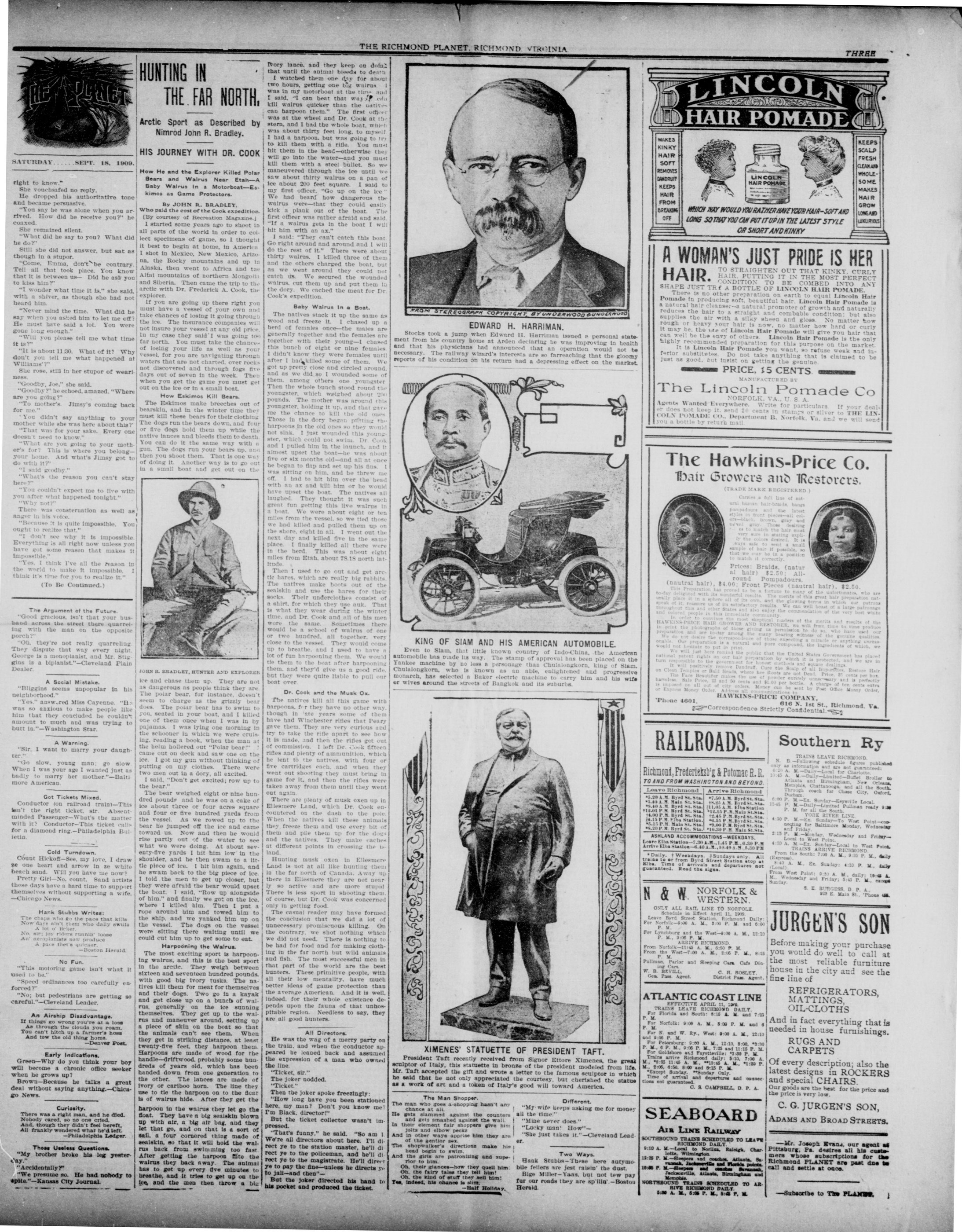
EDWARD H. HARRIMAN
Stocks took a jump when Edward H. Harriman issued a personal statement from his country home at Arden declaring he was improving in health and that his physicians had announced that an operation would not be necessary. The railway wizard's interests are so farreaching that the gloomy reports of his condition on his return had a depressing effect on the market
JUW
KING OF SIAM AND HIS AMERICAN AUTOMOBILE.
Even to Siam, that little known country of Indo-China, the American automobile has vaulted its way. The stamp of approval has been placed on the Yankee machine by no less a personage than Chuhlalongkorn, king of Siam. Chuhlalongkorn, who is known as an able, enlightened and progressive monarch, has selected a Baker electric machine to carry him and his wife or wives around the streets of Bangkok and its suburbs.
A
XIMENES' STATUETTE OF PRESIDENT TAFT.
President Taft recently received from Signor Ettore Ximenes, the great sculptor of Italy, this statuette in bronze of the president modeled from life. Mr. Taft accepted the gift and wrote a letter to the famous sculptor in which he said that he not only appreciated the courtesy, but cherished the statue as a work of art and a token of Italy's good will toward America.
LINCOLN
HAIR POMADE
MAKES
KINKY
HAIR
SOFT
REMOVES
DANDRUFF
KEEPS
HAIR
FROM
BREAKING
OFF
LINCOLN
HAIR POMADE
KEEPS
SCALP
FRESH
CLEAN AND
WHOLE-
SOME
MAKES
HAIR
GROW
LONG AND
LUXURIOUS
WHICH WAY WOULD YOU RATHER HAVE YOUR HAIR- SOFT AND
LONG. SO THAT YOU CAN PUT IT UP IN THE LATEST STYLE
OR SHORT AND KINKY
A WOMAN'S JUST PRIDE IS HER
HAIR. TO STRAIGHTEN OUT THAT KINKY, CURLY HAIR, PUTTING IT IN THE MOST PERFECT CONDITION TO BE COMBED INTO ANY SHAPE JUST TRF a BOTTLE OF LINCOLN HAIR POMADE.
Agents Wanted Everywhere. Write for particulars. If your deal
does not keep it, send 20 cents in stamps or silver to THE LIN
COLN POMADE CO., Department B, Norfolk, Va, and we will send
you a bottle by return mail.
The Hawkins-Price Co. Hair Growers and Restorers.
(TRADE MARK REGISTERED)
Caries are a full line of natural human hair-braids bangs ponytails and the latest styles in front position colors—black, brown, gray and velvet gray. Those desired are to match the hair must very sure in stating explically colors desired. It is ways to sample a sample of hair if possible, so that we may be in a position to match it correctly.
Prices: Braids, (natural hair) $2.50; All-round Poundouts.
(nautral hair), $4.00; Front P.
This Preparation has proved to be a to-day delighted with its own utility, usurally place it in a sphere all of its own, speak of it, measure us of its satisfactory reach throughout this and other States and also and continue people in this immediate community. In print we have theHAWKINS-PRICE HAIR GROWER AND BIRD in print the photographs of those giving preparation and are to-day among the man. Our preparation is the correspondence of an onable. Our preparation is the natural and would not hesitate to put in print. We will just here remind the public a national patent rights on our hair preparature turn to the government for home use. It will pay for us onable. On Clean Temples or Bald Heads, which are The Face Beautifier makes the use of harmless. Sale Price, 25 and 50 cents and is imposed on all out of city orders. Mon or Express Money Order. HAWKINS-PRICE
which has proved to be a fortune to many of the unfortunate, who are today delighted with wonderful results. The merits of this great hair preparation are natural in it a sphere of wonderful results. It will be well bear of a large patronage speak of it, reassure us of its satisfactory results. We will host a large patronage throughout this and other States and also enjoy the communication of the very best white and colorful in this immediate community.
In order to be able to handle the merits and results of the HAWKINS-PRICE HAIR GROWER AND RESTORER, we have from time to time produced in print the photographs of those giving us permission to do hair preparation. We are too among the many bearing witness of the genuine qualities. We so need to acknowledge the success of those expecting a miracle or anything unreasonable. Our preparation is a natural and pure compound, the ingredients of which, we would not hesitate to put in print.
We will just here remind the public that the United States Government has placed national pressure on our hair preparation by which it is protected, and we are in turn responsible to the government in methods and square dealings.
It will positively remove Dandruff. Cure from puffiness. Restore Hair on Clean Temples or Bald Heals, where heroe are not Dead. Products that make the use of powder entirely unnecessary and is perfectly harmless. Sale Price. Price of 80 per bottle. A charge of ten cents extra is imposed on all out of city orders. Money paid by Post Office Money Order, or Express Money Order. Address all communications to
HAWKINS-PRICE COMPANY,
'Phone 4601.
616 N. 1st St., Richmond, Va.
RAILROADS.
Richmond, Frederieksb'g & Potomac R. R.
TO AND FROM WASHINGTON AND BEYOND
Leave Richmond
*5.20 A.M. Byrd St. Sta.
*5.40 A.M. Main St. Sta.
*5.60 A.M. Byrd St. Sta.
*12:01 P.M. Byrd St. Sta.
*4:00 P.M. Byrd St. Sta.
*8:15 P.M. Ela Station.
*8:15 P.M. Ela Station.
*8:15 P.M. Ela Station.
*8:20 P.M. Byrd St. Sta.
*8:20 P.M. Byrd St. Sta.
Arrive Richmond
*7.50 A.M. Byrd St. Sta.
*8.25 A.M. Byrd St. Sta.
*11:05 A.M. Ela Station.
*12:45 P.M. Byrd St. Sta.
*0:55 P.M. Byrd St. Sta.
*0:00 P.M. Byrd St. Sta.
*Main St. Sta.
ASHRLAND ACCOMMODATIONS - WEEKDAYS.
Leave Elba Station - 7.30 A.M. 1.45 A.M. 6.30 P.M.
Arrive Elba Station - 6.40 A.M. 10.40 A.M. 8.50 P.M.
* Daily. * Weekdays. * Sundays only.
Street Station stop at Elba. Time of arrival departures not guaranteed. Read the signs.
N & W. NORFOLK & WESTERN
ONLY ALL RAIL LINE TO NORFOLE.
Schedule in Effect April 11, 1909.
Leave Bard Street Station, Richmond City.
For Norfolk—9:00 A. M., 3:00 P. M. and 6:00
P. M.
For Lynchburg and the West—9:00 A. M., 12:10
P. M., 9:00 P. M.
ARRIVE RICHMOND.
From Norfolk—11:45 A. M., 6:50 P. M.
From the West—7:00 A. M., 2:06 P. M., 8:15
P. M.
Pullman Carrier and Sleeping Cara. Cafs Din-
ing Cara.
W. B. BEVILL. C. H. BOSLEY,
Gena Pass. Agent. District Pass. Agent.
ATLANTIC COAST LINE
TRAINS LEAVE RICHMOND DAILY.
For Florida and South: 8:15 A. M. and 7:25
P. M.
For Norfolk: 9:09 A. M. 3:00 P. M. and 6
P. M.
For N. and W. Ry., West: 9:00 A. M., 12:10
and 9:06 P. M.
For Petersburg: 9:00 A. M., 12:10 9:30
P. M, 6 P. M., 9:06 P. M., 7:35 and 11:15 P. M.
For Cayey Fayetteville: 9:30 P. M.
Trains arrive Richmond: 5:10 A. M.
9:33 11:15 A. M. **10:45 A. M.** 9:120 P. M.
9:20 6:50 8:00 and 8:15 P. M.
*Except Sunday, ***Sunday Only.*
Time of arrival and departures and con-
nections not guaranteed.
C. S. CAMPBELL D. P. A.
SEABOARD
AIR LINE RAILWAY
SOUTHBOUND TRAINS SCHEDULED TO LEAVE
RICHMOND DAILY.
9:10 A. M.-Local to Norlina, Raleigh, Charlotte, Wilmington.
12:25 P. M.-Sleepers and coaches, Atlanta, Savannah, Florida points.
10:35 P. M.-Sleepers and coaches, Jacksonville, Atlanta, Birmingham and Memphis.
NORTHBOUND TRAINS SCHEDULED TO ARRIVE RICHMOND DAILY.
5:30 A. M.-2:35 P. M.-2:55 P. M.
.
'Phone 4601
Pieces (nautral hair), $2.50.
Fortune to many of the unfortunately, who are
merits of this great hair preparation mat-
and the glowing terms in which our patrons
can use. We can well boast of a large patronage
enjoy the commendation of the very best white
unity.
Real readers of the merits and results of the
STATES OF AMERICA will from time to time produce
a permission to use our any bearing witness of the genuine qualities
those expecting a miracle or anything unre-
spective compound, the ingredients of which, we
that the United States Government has placed
on by which it is protected, and we are in
situ in squares and square dealings.
Are the Sisters of the Sacred Blessed Hair
Roots are not Dead. Price, 25 cents per bait,
powder entirely unnecessary and is perfectly
right per bottle. A charge of ten cents extra
be sent by Post Office Money Order,
unications to
ICE COMPANY,
616 N. 1st St., Richmond, Va.
tritely Confidential.
Southern Ry
N. B.-Following schedule figures published only as information and are not guaranteed:
6:20 A. M.-Daily-Local for Charlotte.
10:45 A. M.-Daily-Local-Buffet Broiler to Atlanta and Birmingham, and Montana, and Memphis, Chattanooga, and all the South. Through coach for Chase City, Oxford, Duluth.
6:00 P. M.-Ex. Sunday-Keysville Local.
11:45 P. M.-Daily-Limited Pulman read 9:30 P. M. for all the South.
4:30 P. M.-Ex. Sunday-To West Point-connec-
ning for Baltimore Monday, Wednesday and Friday.
2:15 P. M.-Wednesday, Wednesday and Friday.
Local to West Point.
4:30 A. M.-Ex. Sunday-To West Point
TRAINS ARRIVE RICHMOND
From the South: 7:00 A. M.; 9:30 P. M. daily
(Express)
8:40 A. M. Ex. Sunday; 4:10 P. M. daily
(Local)
Far West Point: 9:30 A. M. daily; 10:45 A.
M. Wednesday and Friday; 5:45 P. M. except
Sunday.
JURGEN'S SON
Before making your purchase you would do well to call at the most reliable furniture house in the city and see the fine line of
REFRIGERATORS,
MATTINGS,
OIL-CLOTHS
And in fact everything that is needed in house furnishings.
RUGS AND
CARPETS
Of every description; also the latest designs in ROCKERS and special CHAIRS.
Our goods are the best for the price and the price is very low.
C. G. JURGEN'S SON.
ADAMS AND BROAD STREETS.
—Mr. Joseph Evans, our agent at Pittsburg, Pa. desires all his customers whose subscriptions for the Richmond PLANET are past due to call and settle at once.
—Subscribe to The PLANETS
THREE
A. B.
TRAINS LEAVE RICHMOND
S. E. BURGESS, D. P. A.
920 E. Main St., 'Phone 444
FOUR
THE PLANET
One Copy, one year, $1.50
One Copy, eight months, $1.00
One Copy, six months, $0.90
One Copy, four months, $0.60
One Copy, three months, $0.40
Single Copy, $0.00
ADVERTISING RATES.
For one inch, one insertion.....$50
For one inch each subsequent insertion.....$40
For two inches, three months.....$6.00
For two inches, six months.....$10.00
For two inches, nine months.....$14.00
For two inches, twelve months.....$20.00
Marriage and Funeral Notices, one inch.....$50
Standing and Transient Notices per line.....$10
POSTAGE STAMPS OF A HIGHER DENOMINATION THAN TWO CENTS NOT RECEIVED ON SUBSCRIPTIONS.
THE PLANET is issued weekly. The subscription price is $1.50 per year in advance.
clinic price is $1.50 per year in advance. There are four ways by which money can be obtained: by Bank Check or Draft, or an Express Money Order, and when none of these can be procured, in a Registered Letter. A Money Order at Post Office Office, payable at the Richmond Post Office and we will be responsible for late arrival. MONEY ORDERS can be obtained at any office of the American Express Co. the United States Express Co. and the Wells' Farc and Cite's Express Company. We will be responsible or money sent by any of these companies. A Money Order at Post Office Office will be safe and convenient way for forwarding money. REGISTERED LETTER.—If a Money Order, Post Office or an Express Company is not written by you, you will be better you wish to send us on payment of ten cents. Then, if the Letter is lost or stolen, it can be traced. You can send money in this way. We cannot be responsible for money sent in letters in any other way than one of the four ways mentioned above. If you send your money in any other way, you must do it at your own
RENEWALS, ETC.-If you do not want THE PLANET continued for another year after your subscription has run out, you then notify us by email Card to discontinue it. You decided that subscribers to newspapers who do not order their paper discontinued at the expiration of time for which it has been paid are required to discontinue it. You discontinue up to date when they order r the paper discontinued.
COMMUNICATIONS—When writing to us to renew your subscription or to discontinue your paper, you should give your name and address in full otherwise we cannot find your name on our book.
CALL FOR OF ADDRESS—In order to change the address of a subscriber, we must be sent the former as well as the present address.
Entered at the Office at Richmond, Va. as second class matter.
SATURDAY, SEPT. 18, 1909.
JACK JOHNSON'S LATEST
The sporting public is no longer doubting that Jack Johnson, the heavy-weight champion of the world is able to defend the title. His exhibition in the bout with Al Kaufman at Colma, showed that he was good at all kinds of fighting. He was admittedly not in the best condition and yet he displayed a generalship and demonstrated his ability to whip the best man in the ring today.
There can be no doubt, but what Jack Johnson will do much to call attention to the fact that the colored people of this country can "make good" if they are given the chance. Even the people, who are disposed to frown upon the prize ring as demoralizing are exhibiting a keen interest in these contests.
No ordinary man can reach the top-notch in the field of athletics without winning praise from an admiring public. We hope that he will win in his bout with Stanley Ketchel and we pray to live to see the day, when ex-Champion Jim Jeffries will have an opportunity of measuring arms with him.
---
The contest now being waged between Explorer Frederick A. Cook and his friends on the one hand and Explorer Robert E. Peary on the other is interesting to say the least. From the descriptions published by both, it would seem that they agree as to the conditions existing at the North Pole. So far as we are concerned, we do not see that any material good can come from the controversy.
We notice that the seasons are changing and that winters here are not as severe as they once were. This change is no doubt responsible for the ability of either or both of the explorers to reach the North Pole.
A TEACHER'S DEADLY AIM
From killing colored folks, the white folks of Arkansas have gone into the business of killing each other. The following telegraphic report sounds strange:
Gravette, Ark., Sept. 11.—John Butram, a pupil, was killed yesterday by his teacher, A. T. Kelly, at a school near here. Butram had caused the teachers of "Bear Hollow" school considerable trouble and had succeeded in thrashing two of them.
When Kelly took the school he went "prepared to teach." Young Butram is said to have announced that there would be no school yesterday, and Kelly insisted that the
session would continue as usual. During the discussion Butram drew a knife, whereupon Kelly shot him. Kelly surrendered.
We are of the opinion that A. T. Kelly has demonstrated his ability to get order and that if he is permitted to teach in that neighborhood marble slabs will be over the graves of the unruly pupils if he fails to get the proper order in that school-room. There are times, when even a long-suffering school-teacher will turn and rend you.
E. H. HARRIMAN SINKS TO DEATH
FAMILY WERE AT BEDSIDE
Death Came Peacefully and His Mind
Retained Its Integrity Almost to the
End—Funeral Services to Be Held
Sunday Afternoon—Estimates of His
Fortune Vary From $50,000,000 to
$100,000,000.
Edward H. Harriman, the greatest
organizer of railroads the world has
ever known, met the only lasting defeat
of his active life at the hands of
death. Secluded in his magnificent
home on Tower Hill, at Arden, N. Y.,
and surrounded by the members of
his family, physicians and nurses, he
succumbed to an intestinal disorder
after a fight against disease which will
rank for sheer grit with his remarkable struggles in the financial world.
He was sixty-one years of age. The
funeral took place on Sunday, interment being made in the Episcopal
cemetery.
Mr. Harriman died peacefully, and almost to the end his brilliant mind retained its integrity. After a relapse on Sunday he sank steadily, and on Thursday there came a relapse which marked the approach of the end. His wife, his two daughters, the Misses Mary and Carol, and his sons, Walter and Roland, who have been consonantly with him, assembled at the bedside and a carriage was hastily dispatched for Mrs. Simons, whose home is here in Arden, three miles from the Tower Hill mansion.
Driving hurriedly up the mountain side, Mrs. Simons entered the great silent house in time to be present at her brother's death. She joined the wife and children, who, with Dr. W. G. Lyle, of New York, and Orlando Harriman, a brother, and the nurses, formed a group at the bedside.
While the policy of reticence that prevailed during Mr. Harriman's illness was maintained by most of his relatives and associates after his death, Orlando Harriman, whose home is in New York, discussed the funeral arrangements briefly. He said that Mr. Harriman would be buried in the family plot in the little graveyard behind St. John's Episcopal church at Arden. He will rest beside his eldest son, Edward H. Harriman, Jr., who died twenty-two years ago, soon after the family first come to Arden. The service will be held at 3:30 on Sunday afternoon and, it is understood, will be strictly private.
Recent estimates of Mr. Harriman's personal wealth have varied all the way from $50,000,000 to $100,000,000. He was, of course, a large holder of securities of the various corporations with which he was identified including in addition to the Union Pacific and Southern Pacific systems, over a score of smaller or tributary properties, not only in this country, but in Mexico as well. Report credited him with large personal holdings in the Atchison, Topeka & Santa Fe road, Baltimore & Ohio, Delaware & Hudson, Erie, Illinois Central, New York Central and the Pacific Mall Steamship company. His holdings of Brooklyn Rapid Transit stock and bonds were very large a few years ago, and these have probably been increased in late years. He was reported to have been the largest individual stockholder in the Wells Fargo Express company, which only recently acquired a virtual monopoly of the express business in Mexico.
General Corbin Dies at Hospital
Lieutenant General Henry C. Corbin, U. S. A., retired, died in the Roosevelt hospital in New York, after an operation for a disease of the kidneys. General Corbin would have been sixty-seven years old in a few days. Mrs. Corbin and ex-Governor Myron T. Herrick, of Ohio, his personal friend, were at his bedside when death occurred.
General Corbin had been suffering for two years from the malady which ultimately resulted in his death. Accompanied by Mrs. Corbin and the general's daughter, Mrs. Usher Parsons, of Ardsley, N. Y., he went to Carlsbad for treatment on June 12 last. The waters appeared to have improved his condition after two weas stay and he returned to England, where his former trouble recurred, and he went to Paris to consult with physicians. The general's trouble developed more seriously while he was in Paris, and he determined to return to New York. He sailed on the steamer Rotterdam, which arrived here on Sunday last. The general was taken to the Hotel Martinique in this city, and Dr. Frank Erdwurm' was summoned. The physician advised that General Corbin be removed to the Roosevelt hospital, and he was taken there on Monday. The operation was performed Tuesday.
Following the operation, General Corbin revived and the work of the surgeon was regarded as a success, but later a weakness of the heart developed and death ensued a few hours later.
THE RICHMOND PLANET. RICHMOND. VIRGINIA.
TAFT FAVORS
CENTRAL BANK
Discusses Monetary Situation in Boston Speech.
The President Declares the Rhode Island Will Lecture in Many Cities on the Defects and Needs of Our Monetary System.
Boston. Sept. 15.—President Taft's first public utterance since congress adjourned was made in this city before 2000 men representing the combined business interests of Boston. The occasion was a banquet given in Mechanics' hall by the Boston Chamber of Commerce, recently formed by a merger of the Boston Merchants' association and the Associated Board of Trade with the chamber, and it marked the beginning of the president's 13,000-mile trip through the country.
The features of the president's addresses were his endorsement of the proposition to establish a central bank in connection with currency reform, his words of high praise of Senator Nelson W. Aldrich, of Rhode Island, head of the national monetary commission, and his repudiation of any attempt to start a sectional strife in the country, such as that which he attributed to Governor Johnson in "calling upon the west to organize against the east." Among the guests were cabinet members, diplomats, congressmen, clergymen and distinguished business leaders.
The President's Speech.
Speaking of the monetary situation, Mr. Taft said: "It is quite apparent from the statements of Mr. Vreeland, who is now the head of the committee on banking and currency in the house of representatives, and from the conversations of Mr. Aldrich, who is the chairman of the monetary commission and of the finance committee of the senate, that the trend of the minds of the monetary commission is toward some sort of arrangement for a central bank of issue, which shall control the reserve and exercise a power to meet and control the casual stringency which from time to time will come in the circulating medium of the country and the world.
"Mr. Aldrich states that there are two indispensable requirements in any plan to be adopted involving a central bank of issue. The one is that the control of the monetary system shall be kept free from Wall street influences, and the other that it shall not be manipulated for political purposes. These are two principles to which we can all subscribe. It is quite possible that the report of the commission of a definite conclusion may be delayed beyond the next session of congress. Meantime the members of the commission intend to institute a campaign of education in order to arouse public opinion to the necessity of a change in our monetary and banking systems, and to the advantages that will arise from placing some form of control over the money market and the reserve in the hands of an intelligent body of financiers responsible to the government.
Aldrich to Lecture on Currency Defecta "I am told that Mr. Aldrich will 'saw around the circle,' in the present fall, and will lecture in many of the cities of the middle west on the defects and needs of our monetary system. I cannot too strongly approve of this proposal. Mr. Aldrich, who is the leader of the senate, and certainly one of the ablest statesmen in financial matters in either house, has been regarded with deep suspicion by many people, especially in the west. If, with his clear-cut ideas and simple, but effective style of speaking, he makes apparent to the western people what I believe to be his earnest desire to aid the people and to crown his political career by the preparation and passage of a bill which shall give us a sound and safe monetary and banking system, it would be a long step toward removing the political obstacles to a proper solution of the question."
Mother Falls Upon Baby and It Dies
Mother Falls Upon Baby and it Dies.
Pittsburg, Sept. 15. — Kenneth C.
Lewis, seven weeks old, died from a
fracture of the skull at the home of
his parents. The injury was received
when his mother, while carrying him
downstairs, stumbled and fell upon
him. The child's head struck against
the floor and it lived but a short time.
The mother is in a critical condition
from continued hysterics.
Child Coasting is Kicked to Death.
Pittsburg, Sept. 15. — Esther Bender,
seven ears old, as coasting on a small
wagon near her home n Wilkinsburg.
The wagn ran against the hind legs of
a huckster's horse, which kicked,
crushing the skull of Esther, who died
instantly.
Snow In Colorado
Grand Junction, Colo., Sept. 15. Grain fields in the vicinity of Gunnison and Telluride are buried under a blanket of snow as a result of heavy storms.
Killed by September Sunstroke.
Bellefontaine, O. Sept. 15- Sherman Rhoades, a meat dealer of Lake View, died from the heat. He was stricken while visiting a park.
Being Drunk Saves My
Being Drunk Saves Murderer's Neck.
William Woods was found guilty of murder in the second degree at Chambersburg, Pa. While under the influence of liquor, on May 1, he killed Lewis Brown with a knife at Brown's home, on Water street, in this city. A majority of the jury wanted to convict Woods of first degree murder, but others held that he, being drunk, should not be hanged.
"Jack" Johnson
jaw. Kaufman was sent staggering against the ropes. Instead of getting after his man then and making a good job or what he had started so well, Johnson stood off and let his man come back. He still seemed to think the fight a joke and wanted to make a show of his man.
In the third round began the fireworks that made the fight the fastest seen on the Coast in years. Kaufman started with the evident intention of winning out or getting put away. With a rush he was after Johnson and the colored man met him in the exact centre of the ring. Kaufman shot his right to the stomach and his left reached the jaw. Ther was a lot or force to the right, but the left was weak. Johnson hooked his right to the jaw, shot the left to the stomach and as Kaufman came to, close quarters uppercut with the right to chin. Twice before Al could get his arms about the colored man and hang on for protection Johnson got home this right uppercut and behind each punch, these seemed to be all the power the negro had in his body. But Al did not drop. He was hurt, but able to hold and lasted the round out.
KAUFMAN ROUGHED IT
The fourth was about the same as the third round only that the fighting was more fierce. Kaufman evidently had been told that he had no chance to win unless he roughed it with the negro. And rough it he did. The round was one long hard fight—almost a rough and tumble affair. During it all Johnson showed that he was a past master at this sort of milling as well as at long range, and it was soon apparent that Kaufman's seconds had made a miss in advising their man to get in and take a chance. From this round to the ninth there was little to the battle, but Johnson. He landed when and where he pleased and in return was little damaged. Kaufman, game as a blooded dog, fought his best, but his best was not good enough to beat the big ebony-howling fighting machine he faced. He was strong all the time though and lived up to his reputation of being a long distance fighter of the highest order.
In the ninth came the change that caused amusement. Before the bell rang the fight was all Johnson. One minute after the milling had been resumed Kaufman's friends were velling like mad for their man to go in and finish the negro. He had landed twice in the stomach and so powerful were the blows that they took fifty per cent of the fight out of the champion.
For the first time in the fight Johnson lost his smile and began to look worried. He still had his cleverness and fought along, giving Kaufman more than he received, but the sting was missing in his punches and this made Kaufman wade in and fight like a demon. Time after time he reached the body, taking in exchange some smashes on the jaw that should have stopped him. But he was not in the ring to stop and he kept after the colored man like a terrier after a rat. Johnson spent all his time in blocking and countering on the chin and he was a mighty busy black until the bell ended the round.
The final round was the best of the battle in many ways. The fighting was not as curious as in some of those that preceded it, but there seemed always to be a chance for a decisive result. First Johnson would appear to have his man out, then Kaufman would come back with a punch in the middle works that would worry the champion and make him look serious. But the supreme skill of the black man was always there, and at the end he was an easy winner. The fight showed positively that even Jim Jeffries would have no cinch with Johnson. But the colored man will have to get very busy and train like a real fighter. He was not in the shape for a hard fight, and had the battle been scheduled for five more rounds he would have had a tough job in holding the advantage to the end.
Johnson was a great favorite with the experts and thousands of dollars were wagered at 10 to 4 that he would win—receive the newspaper verdict. At these odds the Kaufman admirers unbelted for their bundles and there was none of the Johnson money left at the time the men clambored through the rope. Another popular bet was that Kaufman would last ten rounds. His friends wagered at 2 to 1 on this proposition. Johnson thought this the better and he gave his manager $1,000 to speculate on the proposition.
JOHNSON A TRIFLE HEAVY
The gladiators looked the perfect athletes when they entered the ring. It is true that Johnson carried a trifle too much weight, but the excess baggage was so evenly distributed all over his rangy form that it was not noticed. The scales, though, told the story, for the champion was about 210 pounds when he tried the weight machine.
Kaufman looked to be fit to fight a dozen men. He said he could never be better, and on appearance he told the truth. As he stood in the ring he looked like a statue, perfectly proportioned, and his friends declared that he would win from Johnson on condition alone. They also boasted that the native son had his wallop—the blow that earned him the name of "One-Round" Kaufman—and that he would be able to get it home on the jaw of his giant adversary before the tenth round ended.
The appearance of the men in the ring was the signal for an outbreak of applause such as is only heard when two well-liked fighters toe the mark. Johnson was first to crawl through the ropes. He got a royal cheer, to which he replied with one of his golden smiles and many bows. The champion walked about the ring, reaching through the ropes and shaking hands with his many friends. He seemed the personification of confidence and appeared to
look upon the whole contest as the joke he has always said it would be.
CHAMPION SURE OF WINNING.
The giant colored man told the newspaper men at the ringside that he would win within six rounds. He seemed positive that Kaufman would never even get near him except when stopping rights and lefts. Finally, after a lot of persuasion, Johnson pranced over to his corner and took his chair. He was at once surrounded by his army of handlers, and the grooming for the fray began. Bob Armstrong. Young Peter Jackson, George Little, Barney Furey and Dave Mills looked after the big fellow. Shortly after the commotion aroused by the appearance of Johnson subsided, Kaufman started the whole thing over again. Flanked by Mark Shaughnessy, Jake Cordell and Luke Taylor, he pushed his way through the aisles and hopped over the ropes. He seemed as spry as a colt. He was given a much greater reception than the champion for the Californians always stick to the native son.
Soon after Kaufman entered the ring Referee Eddie Smith got the men together and told them how he would interpret the rules. There was no argument put up and the men were sent back to their corners. Then Billy Jordan, the oldest and sprest announcer at affairs pugilistic, went through theaces. He introduced Johnson as the "champion of the world." and Kaufman as the "biggest and best-loved native son."
KAUFMAN STAYS LIMIT
Johnson Outpoints Blacksmith in a Unique Mill.
San Francisco, Sept. 9.—In a contest unique in local prize fight animals Jack Johnson was credited with a "newspaper" decision over Al Kaufman at the end of ten rounds today at Coffroth's arena.
According to agreement, if both men were on their feet when ten rounds had been fought, no decision was to be given. Referee Eddie Smith, however, stated Johnson was entitled to the verdict.
Johnson employed tantalizing lefts and forceful right uppercents with such frequency that Kaufman was fairly bewildered. Early in the contest his face began to show signs of Johnson's stinging punches, and in the third round a well-directed blow started the blood flowing from Kaufman's face.
ONLY TOYED WITH KAUFMAN
Johnson appeared to be holding himself in reserve, and it took constant gibbing by the spectators and an occasional punch from the blacksmith to start him going. When he did let go he played with Kaufman as if the latter were a child. In the ninth round Kaufman found Johnson's stomach with a vicious right swing. It was Kaufman's best blow, and it made the negro more careful. The contest proved, fight experts say, that Kaufman should shun short round affairs. He appeared to gain strength as the battle progressed, while Johnson, who apparently had trained none too well, began to show signs of weakening. The fight by rounds:
THE FIGHT BY ROUNDS
First round—Johnson opened the battle with a well-placed left hook to the stomach. The men then mixed at close range. Johnson landed right and left shortarm punches to the jaw. Johnson smiled and brought right and left to the face. Kaufman looked a bit worried at this stage and sparred for half a minute. Johnson closed in, landing short-arm rights and left to the head. There was little sting in them however. Just before the round ended, Kaufman shot a right and left to the jaw, the champion only smiled. Kaufman seemed slow in comparison with the fast work of Johnson.
Second round—Johnson wrestled Kaufman against the ropes and a moment later drove a straight left to the face. He followed this with a left to the body, and then quickly whipped a left to the blacksmith's jaw. Kaufman appeared confused. They closed in and Johnson rocked Kaufman's head with a short-arm swing that carried no steam. Johnson had the better of a tame round, Johnson smiled and cracked jokes at the spectators.
Third round—They rushed in close. Johnson driving a wicked left to the jaw which he followed with a hard clout in the stomach. Johnson then uppercut twice with his right to the mouth and blood spurted from Kaufman's mouth. Johnson planted an awful right wallop on Al's bleeding face, and forced the blacksmith to stall. Johnson taunted Kaufman good naturely and varied this with two fearful jolts to the jaw. The bell rang and Al tumbled into his chair with blood flowing in a veritable stream from his mouth and nose. It was apparent that Johnson was clearly Kaufman's master and could finish him at such time as he was ready to cut loose.
Fourth round—Kaufman, after some sparring drove a hard right to the stomach. This angered the champion and he quickly beat the Californian against the ropes, planting right and left to the jaw. After some clinching Kaufman drove his right to the stomach and Johnson grinned and winked at his seconds. Both men eased up. Kaufman seldom landing. The round ended tamely and it looked as if Johnson deliberately slowed. Up to this Kaufman failed to read and had landed but two punches, both to the stomach.
Fifth round —'Keep quiet over there,' yelled Johnson at one of the newspapers photographers. The men fought to close quarters and Johnson uppercut twice with his right, lifting Kaufman's head a foot. Johnson was quickness and nimbleness personified. The champion drove right and left to the stomach and had Kaufman constantly on the defensive. Kaufman made two weak efforts to land. The fighters battled around the ring without any serious
Sixth round—Kaufman was short with a left lead and the men clinched. Johnson suddenly broke loose and sent the California almost into the press stand with a left hook to the body and a right across to the jaw. "Mix it, Al," the crowd yelled, and Al did so. But he found Johnson waiting for him and the latter showed that he was master of the situation at any style of fighting that Kaufman could bring to him. The round closed with ineffectual exchanges, Johnson having everything his own way.
Seventh round—Kaufman tried with left for the jaw, but it was so easily blocked that the crowd yelled derisively. Kaufman fought in close, but not a blow landed, the black man smothering every attempt Kaufman started the crowd into a real cheer by planting right and left to the stomach. A long clink followed, during which Johnson held back and cut loose alternately. The gong ended a featureless round. It was apparent to all that Johnson was holding himself in reserve and only opened up when the fancy took him.
Eighth round—Johnson opened with a straight left to the jaw, and as the men closed in the black swung right and left with great force to the jaw and mouth. Kaufman backed away, seldom if ever leading, despite instructions to do so from his advisers. Johnson again started the blood from Kaufman's mouth, hard right and left arm swings doing the business. As Kaufman closed in. Johnson uppercourt twice to the jaw with his left, for which he was rebuked by a hard right hook to the stomach, the best blow Kaufman had landed. Johnson kept up an incessant exchange of badimage with the crowd during the minutes' respite.
Ninth round—Kaufman forced the smile from Johnson's face by clutching him in the stomach with a pile-driving right. For a fleeing moment the black fought back a bit wildly. He quickly regained his composure and sent right and left with great force to the jaw. With the return of Johnson's smile he drove Kaufman against the ropes and landed twice with long-range lefts. The round ended with the crowd jeering Johnson and some of the spectators started to leave the arena. Tenth round—After constate, sparring Johnson hooked his right to the jaw. Kaufman came back and landed right and left to the face as they mixed it in the center of the ring. After Johnson, goaded by these punches, had shot a stiff left to the face, Kaufman landed twice on the body with lefts, then sent a hard right to the stomach and the men mixed it without damage. The crowd jeered. The round and fight ended with both men slugging ineffectively at each other.
JOHNSON BEATS KAUFMAN
Colored Champion Shows Surprising Form.
San Francisco. Sept. 9. —Heavyweight champion Jack Ackman surprised all experts this afternoon by the ease with which he defeated A.Kaufman in the ten round fight at the Mission street arena. From the first half of the first round Johnson proved himself master of Kaufman at every angle of the game, and though the plucky Californian lasted the limit this was largely due to the fact that Johnson didn't force the fighting in the early rounds, and when he tried to finish his man in the seventh and succeeding rounds he didn't have enough steam.
Johnson's most effective blows were a heavy left hook to the heart and a right upper arm, which he landed at will when coming out of clinches. Johnson didn't stand away and spar, but fought up to Kaufman and thus prevented the Californian from utilizing his great reach. Nearly every blow or Johnson reached its mark, and Kaufman's face was covered with blood after the first round. So easily did Johnson outclass Kaufman that it seemed he could have ended the fight at any stage, but Kaufman's pluck and enormous strength prevented the champion from scoring a knockout. In one of the middle rounds Johnson, with his hands stretched at his side, laughingly asked Kaufman to come and get him. In the eighth, ninth and tenth Johnson was more serious of purpose.
"Break, Kaufman, break," he called as Al held close. But Al didn't break, and with blood streaming all over his face from wicked uppercuts stayed until the last.
There is no question that Johnson was trying hard for a knockout in the final round. He followed the white boy relentlessly around the ring to cut loose some hard punches. Once in the tenth Johnson sent Kaufman against the ropes and partially through them with a volley of lefts and rights, but when Al came back the black slowed up somewhat, and at the close Kaufman was fighting his best, sending in body punches in clinches, which however, were hardly strong enough to bother Jack.
For all that every round was overwhelmingly in favor of Johnson from any point of view; it was a contest well worth watching and one that pleased the big crowd. Kaufman's inability to cope with Johnson, who was the more powerful of the two, was disappointing to his admirers, but the cleverness of the champion, the coolness with which he blocked out his work and the rarity with which he missed were amazing. In clinches and out of them he beat Kaufman as he pleased.
At long range he jabbed the white man about the face and brought blood in the first round. In clinches he showed the development of a punch which experts had claimed he couldn't use successfully against Kaufman. It was a right uppercut, and with it Johnson dealt many a blow that must have hurt.
His plan of battle in using the right uppercourt was as simple as it was effective. Coming into a clinch with his right hand pressed against his breast he would allow Kaufman to clinch with his left. Pulling back with his head Johnson would cause Kaufman to step back and then
$3.50 RECIPE CURES WEAK
MEN-FREE
Send Name and Address Today
You Can Have It Free and Be
Strong and Vigorous.
I have in my possession a prescription for nervous debility, lack of vigor, weakened manhood, failing memory and lame back, brought on by excesses, unnatural drains, or the follies of youth, that has cured so many worn and nervous men right in their own homes—without any additional help or medicine—that I think every man who wishes to regain his manly power and virility, quickly and quietly, should have a copy. So I have determined to send a copy of the prescription free of charge, in a plain, ordinary sealed envelope to any man who will write me for it.
This prescription comes from a physician who has made a special study or men and I am convinced it is the surest acting combination for the cure of deficient manhood and vigor failure ever put together.
I think I owe it to my fellow man to send them a copy in confidence so that any man anywhere who is weak and discouraged with repeated failures may stop drugging himself with harmful patent medicines, secure what I believe is the quickest-acting restorative, upbuilding, SPOT-TOUCHING remedy ever devised, and so cure himself at home quietly and quickly. Just drop me a line like this: Dr. A. E. Robinson, 3895 Luck Building, Detroit, Mich., and I will send you a copy of this splendid recipe in a plain ordinary envelope free of charge. A great many doctors would charge $3.00 to $5.00 for merely writing out a prescription like this—but I send it entirely free.
would come the uplifted right.
Referee Eddie Smith wasn't permitted to give a decision, but in his opinion to newspaper men he declared Johnson was the winner all the way.—New York Sun.
American Bankers Association.
Continued from the First page.
PRESIDENT REYNOLDS PRESIDES
President George M. Reynolds, of Chicago, was at his best and he presided with the skill of an experienced parliamentarian. There were here some of the leading financiers or the country. These wealthy gentlemen are unostentatious and quiet in their demeanor. It seems that wealth is a great settler so to speak. Vain boasting is foreign to their natures.
It has been estimated in round numbers that fifteen thousand million dollars worth of the wealth of the country is represented by this army of financiers. And yet from the quiet manner in which they trangact business one would never think it. Senator Teller occupied a seat on the stage.
SEC. FARNSWORTH'S ABILITY
Secretary Frederick E. Farnsworth, of Michigan has an able corps of assistants. So far as he is concerned he performs his duties without perceptible effort. There was one gentleman who was the cynosure of all eyes. He is a quaint commonplace looking old gentlemen, this is Hon. Joseph Cannon, speaker of the House of Representatives.
THE SPEAKER APPLAUDED
When he was introduced, the usual forms and ceremonies were forgotten by the practically unanimous hand clappings that told him how glad the wealthy men were to see and hear him. Speaker Cannon began his remarks in a voice so low that it could not be heard beyond the first five rows of seats, but he soon spoke louder and no one failed to hear his humorous, weighty and emphatic remarks.
A REMARKABLE CHARACTER
He is truly a remarkable character. He discussed the emergency currency laws, the Currency Commission, declaring that the last currency agitation had cost the whole country five hundred million dollars and that a similar experience would not be the legacy of this country for a decade at least.
A WORD ABOUT THE "KICKERS."
He paid his respects to the "kickers" and he declared that he had no idea of resigning the speakership as long as a majority of the congressmen wanted him to serve them. He spoke of the so-called bossism, ridiculed the idea of czarism and declared that no one could prevent the consideration of any given proposition or measure if the majority of the congressmen wanted it considered.
MUCH AMUSEMENT FOR THE
AUDIENCE
He created much amusement at times by his quaint illustrations. He declared that the great need of many congressmen were individual backbones. Many had substituted angles for them. During all of his discussion, the much mooted race question was not discussed, and the indications are that it will not be discussed.
GETTING READY FOR MORE
PLEASURE.
In Congress Hotel to-night, there seems to be a look of loneliness for most of the bankers and their wives are preparing for the theatres. The bankers of Chicago have bought up all of the seating capacity in four of the leading theatres for the bankers. They can secure seats there free of charge. The President of the Mechanics' Savings Bank is scheduled to attend the Studebaker Theatre, just across the street from the Auditorium Theatre.
THE MECHANICS' SAVINGS BANK
OF RICHMOND, VIRGINIA.
The Modern Burglar and Fire=proof Vault With Its Steel Lining and Burglar=proof Round=door Will Be a Wonder.
NOW OFFERS TO THE PUBLIC the facilities which it possesses for the safe-keeping of money, jewels, insurance papers, deeds, wills, stocks, bonds, and all valuables of whatever description at a reasonable cost. It holds choice real-estate, of which it will dispose on long time payments. It requests the patronage of the small depositor and the favor of the large one. Interest paid on all time deposits, remaining (60) sixty days and over.
PERSONS WHO HAVE BEEN UNEASY ABOUT THEIR DEEDS, INSURANCE PAPERS AND THE LIKE, will breathe a sigh of relief when they transfer them to the vault of the Bank, where they know that they are safe from fire and theft. There is a specimen SAFETY DEPOSIT BOX at THE MECHANICS' SAVINGS BANK, which THE CASHIER OR THE TELLER WILL show you and either will explain its workings. The stock of the MECHANICS' SAVINGS BANK is now selling above par--to be exact it
PEARY'S OWN STORY OF TRIP TO NORTH POLE
NOW OF
ities which it
money, jewels
stocks, bonds,
scription at a
It holds che
dispose on lone
the patronage
favor of the
time deposits,
over.
The Mo
Lining
PERSONS
ABOUT THEI
AND THE LI
when they tr
Bank, where
from fire and
There is
BOX at THE
which THE C
show you and
The stock
BANK is now
PEARY'S OWN
TRIP TO
```markdown
```
HowHeReachedGoal Sought For Ages.
HARDSHIPS AND DANGER
Fought Their Way Over Frozen Arctic Desert.
EXPEDITION COST ONE LIFE
[Copyrighted, 1909, by the New York Times Publishing Company.]
"Battle Harbor, Labrador, Sept. 9.—The steamer Roosevelt, bearing the North Pole expedition of the Peary Arctic club, parted company with the Erik and steamed out of Etah Ford late in the afternoon of Aug. 18, 1908, setting the usual course for Cape Sabine. The weather was dirty, with fresh southerly winds. We had on board twenty-two Eskimos men, seventeen women and ten children, 226 dogs and some forty-odd walrus."
Peary tells of the difficulty in forging his ship, the Roosevelt, through the choked channels and floe-covered bays before he reached the open polar sea, over which he was to travel to the goal by sledge. Once he was forced back and twice the Roosevelt grounded. Continuing, he says:
"Finally, on Sept. 2, we squeezed around Cape Union and made fast in a shallow niche in the ice, but after some hours we made another short run to Black Cape, and hung on to a grounded bit of ice. At last, a little after midnight of Sept. 5, we passed through extremely heavy running ice into a stream of open water, rounded Cape Rawson and passed Cape Sheridan. We steamed up to the end of it, and it appeared practicable at first to reach Porter bay, near Cape Joseph Henley. But the outlook being unsatisfactory, I went back and put the Roosevelt into the only opening in the floe, being barred close to the mouth of the Sheridan river, a little north of our position three years prior. The work of discharging the ship was commenced at once and rushed to completion. The supplies and equip-
```markdown
```
ment we sledged across ice and sea and deposited on shore. A house and workshop were built of board, covered with sails and fitted with stoves, and the ship was swug for the winter in shoal water, where she touched, bottom at low tide. This settlement on the stormy shores of the Arctic ocean was christened Hubbardville.
Hunting Parties Sent Out.
"Hunting parties were sent out on Sept. 10 and a bear was brought in on the 12th and some deer a day or two later."
Peary says many side trips were made for the purpose of exploring the land, and frequent trips with supplies were made to Cape Columbia, from which Peary intended to depart on his long run to the pole.
It was Peary's plan to send out advance parties to clear the way and establish stations. Captain Bartlett, of the Roosevelt, was in command of the first party to get away. This was on March 1 of the present year. A short time later a second division made its departure, and an hour after that Peary followed. Continuing, he says:
"The party now comprised seven members of the expedition, seventeen Eskimos, 133 dogs and nineteen sledges. One Eskimo and seven dogs had gone to pieces.
"A strong easterly wind, drifting snow, and temperature in the minus marked our departure from the camp at Cape Columbia, which I had christened Crane City. Rough ice in the first march damaged several sledges and smashed two beyond repair, the teams going back to Columbia for other sledges in reserve there.
"We camped it miles from Crane City. The easterly wind and low temperature continued. In the second march we passed the British record made by Markham in May, 1876—82.20—and were stopped by open water, which had been formed by the wind after Bartlett passed. In this march we negotiated the lead and reached Bartlett's third camp. Borup had gone back from here, but missed his way, owing to the faulting of the trail by the movement of the ice.
"Marvin came back also for more fuel and alcohol. The wind continued forming open water all about us. At the end of the fourth march we came upon Bartlett, who had been stopped by a wide lake of open water. We remained here from March 4 to 11.
"On the 14th we got free of the leads and came on decent going. While we were making camp a courier from Marvin came and informed me he was on the march in the rear. The temperature was 59 below.
THE RICHMOND PLANET. RICHMOND. VIRGINIA
THIS BANKING INSTITUTION is no longer an experiment. It is conceded to be run upon and in accordance with the most improved rules of the best banking concerns in the United States.
Its large spacious four story bank and office building is now in the course of erection and when completed will be one the most modern edifices of the kind in the Southland and will rank with the best white institutions of a similar kind and character.
is selling at ($5.00) five dollars per share above its face value and rating it on the basis of the past dividends, this stock pays seven per cent. to those who purchase now. The BOARD OF DIRECTORS has decided to place a limited amount on the market at $15.00 per share, to be exact, the block equals just ($10,000.) ten thousand dollars and application should be made for an allotment to the Cashier of the Mechanics Savings Bank at once or to some member of the Board of Directors. The first who come will be the first served.
```markdown
```
```markdown
```
Ice Begins to Move.
"On leaving this camp the expedition comprised sixteen men, twelve sledges and a hundred dogs. The next march was satisfactory as regards distance and character of going. In the latter part there were pronounced movements in the ice. Some leads were crossed, in one of which Borup and his team took a bath and we were finally stopped by an impracticable lead opening in front of us. At the end of the tenth march, latitude 85.23. Borup turned back in command of the second supporting party."
Peary here tells of overtaking Captain Bartlett, and he was again pushed forward with Henderson to do more pioneer work. Peary and Marvtn and Hansen remained behind for twenty hours. The policy now pursued was for Bartlett's crew to break the way and camp. When the Peary force came up the Bartlett camp was occupied by the newcomers, while Bartlett and Henderson made another advance. The condition of the ice was improving right along, and every day good distances were made. At one time Bartlett made twenty miles in a day.
Marvin Drowned.
Then began the breaking of former records. One observation gave 88.38, and Peary knew that he had beaten Nansen and Abruzzi. Not an accident had marred the expedition up to this point. Things were rapidly shaping themselves for the great dash, and here poor Marvin was turned back. He was to return to Cape Columbia, but he never reached it. He fell into open water and was drowned.
More Eskimos were sent with Marvin on the return trip, and Peary then found himself with nine men, seven sledges and sixty dogs. Changes in the atmospheric conditions were noted. A haze enveloped the wonderful fields of glistening ice, and it was impossible to see any distance.
Calling Roll. Preacher Dies.
Rev. Joseph Wesley Shackford died of apoplexy at Early's chapel, Lynchburg, Va. while he was calling the roll of the quarterly conference of the Methodist charge there, at which he was officiating as presiding elder.
No Death Chair; Murderer Reprieved.
William Morrison, a negro of Robeson county. North Carolina, sentenced to death by electrocution in the state prison at Raleigh, was reprieved until Oct. 15 because the electric chair and switchboard had not arrived.
Fatally Scalded In Wash Boiler
Teresa Wilson, aged three years, adopted daughter of Mrs. John Heas, fell into a boiler of hot water at the back door of her home at Altoona, Pa, and was fatally scalded.
Tom—So your engagement with May is off. I thought she dotted on you.
Dick—So she did, but her father was a powerful anti-dote.
Orders by Telephone or Telegraph filled. Weddings, Suppers and Entertainments promptly attended.
Who Will Give From One Hour at Least to One Day in Labor Free to Help Promote a Sure Plan to Deliver the Negro People From Poverty in America, Which is Now So Fast Overtaking the Race.
(Special to the True Light Army Director General.)
Dear Sir:—I understand that you have a sure plan to deliver the Negro people of America from the woeful and helpless condition which is so swiftly coming upon us as a race and that in order to get this plan to all the members of the race this year, you have called for 100,000 to 1,000,000 volunteer helpers or the race who are willing to give a day in labor or at least one hour in labor free to help the True Light Army to get this sure plan for our success to all of our people
may call on me at any time you will, and I will give you one — free in labor at my home district to help put your plan in the hands
Take notice, all dear ones in the Negro race who will unite with the united workers of the True Light army and help by giving from one hour to one day in labor free to help get our plans of delivering the Negro race from ruination in America, please fill out the above blank, and mail it to the True Light Army, 74 Highland Street, Boston, Mass.
P. S. The labor will be light and easy. Any one who can walk a mile in two hours can do the work.
Office, 74 Highland St. Boston, Mass.
Dear Sir;—I understand that you Negro people of America from the we which is so swiftly coming upon us a this plan to all the members of the race 100,000 to 1,000,000 volunteer help give a day in labor or at least one Light Army to get this sure plan for this year. Now, sir, my name is —
may call on me at any time you will free in labor at my home district to one of our people. Address me at
Take notice, all dear ones in the the united workers of the True Light one hour to one day in labor free to the Negro race from ruination in Am blank, and mail it to the True Light Mass.
P. S. The labor will be light and mile in two hours can do the work.
New York Banker Killa Himself.
John W. Castles, president of the Union Trust company of New York, a director of several other well known corporations, and who was also prominent in club and social life, committed suicide by cutting his throat with a razor in the Grand Union hotel. His body was found by his brother, Burton S. Castles, who immediately summoned a physician, but Mr. Castles was beyond ald. His body was cold, and the bloody razor with which he had taken
WE HAVE ARRANGED for a limited number of Safety Deposit Boxes. They will be rented to our patrons at the rate of ($.25) twenty-five cents per month and upwards, payable in advance annually. Two keys will alone secure entrance to one of these boxes. The bank has one and the depositor the other. Both keys must be used, one after the other; before the safety-deposit box can be opened by either the Bank Cashier or by the depositor. This is a measure of safety which must be seen only to be appreciated.
```markdown
```
```markdown
```
the Negro race who will unite with
the army and help by giving from
to help get our plans of delivering
America, please fill out the above
t Army, 74 Highland Street, Boston,
and easy. Any one who can walk a
his life lay on a table nearby. He left
no notes or instructions, and his
brother ascribed his act to a nervous
breakdown.
"Father," said little Rollo, "what is
an optimist?"
"According to my observations, son,
an optimist is a man who finds his
own affairs prosperous and tries to
persuade other people not to make a
kick and disturb conditions.—Washington Star.
---
---
OFFICERS AND BOARD OF DIRECTORS:
JOHN MITCHELL, JR., President.
H. F. JONATHAN, Vice-President.
THOMAS H. WYATT, Cashier.
John R. Chiles, John Mitchell, Jr.,
H. F. Jonathan, R. W. Whiting,
Thomas H. Wyatt, E. R. Jefferson,
D. J. Chavers, John T. Taylor,
Thomas Smith, Thomas M. Crump, Sec.,
J. J. Carter, A. D. Price,
P. B. Ramsey, H. L. Jackson, H. Powell.
Our New Shoe Repairing Dept. IS A WINNER.
We have installed the Finest Shoe Repairing Department in Virginia, and it has already jumped into great public favor. Equipped with the latest improvements, operated by Experienced Shoemakers and using only Leather of Highest Grade, we are turning out Repair Work that makes Old Shoes Equal to New—made so that a Lady or Gentleman can Wear Them with both Comfort and Pride.
Send us a trial pair and learn the advantage of First Class Modern Shoes Repairing and the Money-saving Derived from it. Remember, We Use Only "White Oak" Leather, and Guarantee Our Soles to be Durable and Pliable.
No Long Waiting!
Men's Half Sole and Heel, (Regular 85c Work) 45c.
Ladies' Half Sole & Heel, (Regular 75c work) 35c.
RUBBER HEELS PUT ON NEATLY, ONLY 40c.
DON'T FAIL TO LET THE KING'S CUT-RATE SHOP DO YOUR WORK. BEST IN TOWN. PHONE, MONROE 2830
Albert Stein KING OF SHOES Fifth & Broad Sts.
THE PLANET
QUARTERLY REVIEW
Sunday School Lesson for Sept. 19, 1909
Specially Arranged for This Paper
LESSON TEXT—Acts 15:30-31K.
GOLDEN TEXT—"So mightily grew
the word of God and prevailed."—Acts
15:23.
Subject: Travels with St. Paul by
Sea and Land.
There never was so much interest
in missions among the people of this
country as there is to-day.
About two years ago (from the date of this lesson) one of our largest steamships, filled with persons interested in Sunday schools, sailed for Rome to hold a convention there. Three years before (in 1904) another steamship was filled with delegates to a World's Sunday School convention in Jerusalem. Both these great companies stopped at mission stations, learned about the needs of the missions, and took up large contributions for them from the passengers whose interest was greatly awakened, amounting to over $30,000.
A friend of mine is sending his son and wife on a two year's tour among the Protestant missions of the world to make a thorough study of them.
All the great missionary societies are sending visiting delegates to their mission stations.
He had made one journey before we join him.
We propose to stop at each city, and recall the events, the persons, the stories and the special teachings which belong to it.
The Second Missionary Journey.—From Antioch to Asia Minor. Europe, returning through Jerusalem to Antioch again. Extending from A. D 50 to 53.—Acts 15:36—18:22
Antioch of Syria.—The first foreign missionary church; Paul, Barnabas, Silas, leading members. For the city of Antioch, see lesson IV of the second quarter. Why Paul took Silas instead of Barnabas.
Land journey. Paul alone going north through "the Cilician gates," a pass in the great mountain range. Then he turned westward.
Derbe. The city farthest east in Paul's first journey.
Lystra in Lycaonia.—Here Paul had healed a man; and was stoned (First journey.) Here Paul was joined by Silas (v. 4 "they" instead of "he" in vs. 1-3). Timothy became Paul's assistant. Iconium.—An attempted assault on Paul; church here Established in the faith. Antioch in Pisidia.—Paul's sermon. A church founded. Paul expelled (First journey.) Still by land. They passed through Galatia to which the above cities probably belonged, and through Phrygia, to the northwest to Troas, a Port on the Aegean Sea.—Paul's first visit here; the vision and Macedonian call. Here Paul, Silas and Timothy were joined by Luke (v. 10 "we" instead of "they"). Paul and Eutychus—six years later. (Lesson X.) Troas and ancient Troy. By sea to Neapolis, the port of Philippi. By land to Philippi.
Philippi.—Secular history; Lydia. The sibylline girl. Imprisonment of Paul and Silas. Paul delivered. The jailer converted. Paul released by the magistrates. The church at Philippi. A letter of Paul's to the Philippians. By land toward the south. Thessalonica. — Ancient history. Modern missionary station; a church founded. Riot by their enemies. Paul sent forward. Letter to the Thessalonians. Berea.—Bible study by the Bereans; Paul again assaulted. From Turkish empire into Greece. Athens.—The city. The philosophers; altar to the unknown God. Paul on Mars' hill. Few converts. Corinth.—The city. Paul here a year and six months; a large church. Two letters to them. Aquila, Priscilla, Silas, Timothy, Apollo, Gallio. Close of work in second journey.
The Third Missionary Journey.—From Antioch, through Asia Minor and Europe, to Jerusalem. Extending from A. D. 53 to 56 or 57.—Acts 18:23—21:17.
Asia Minor. Travel by land. Paul revisited the churches here, Derbe, Lystra, iconium and Antioch of Pisidia, as on the previous journey, till he came to Ephesus.
Ephesus.—The city. The company of disciples of John; the exorcists; burning of the books of magic; shrines of Diana; the mob; a flourishing church; the seven churches of Asia in this region; letter to the Ephesians; Paul, Timothy Erastus, Galus, Aristarchus, Demetrius, Soeva. By sea to Macedonia: Philippi, Thessalonica, Berea.
By land to Greece: Athens, Corinth, three months.
The return. By land to Philippi, By sea to Troas, Millet, down the coast, turning eastward to Tyre, Potlemares, Cesarea, Jerusalem.
Events by the way. At Miletus.
At Tyre. At Cesarea.
What impressions does this general view make upon you as to the progress of the gospel? How long since the day of Pentecost?
What impression does it make as to the character of Paul?
How does it compare with modern missions?
How does giving to missions and interest in missions broaden your character? Does giving to missions and interest in them lessen your interest in God's work right around you?
Do you give? Do you earn what you give?
FOR A WARM NIGHT
SOME APPETIZING AND SATISFY ING DISHES.
Vegetable Salad of Pleasing Appearance and Palatable—Peach Pudding or Ribbon Cake for Dessert—Sponge Cake.
Vegetable Salad.—Boll several beets (the smallest red ones you can obtain). When cold dig a round hole in the center of each (but not clear through). Place each beet on a lettuce leaf, have ready a small new cabbage, chopped fine, and thoroughly mixed with a good salad dressing; fill each beet with this and also place some around the outside on the lettuce leaves, then slice three cold hard-boiled eggs and strew over the cabbage. Add dressing, and you not only have a salad nice to look at, but very palatable.
Peach Pudding—Sift together two cupfuls of flour, two teaspoonfuls of baking powder, and one-half teaspoonful of salt. Rub into this two table-spoonfuls of butter. Beat one egg to a cream, add to this three-fourths of a cupful of milk. Mix all together, turn out on a floured board, and roll gently. Roll about a quarter of an inch thick. Lime the sides of an earthen or agate pudding dish with strip of the paste, invert a teacup in the center of the dish, and place one quart of peeled peaches around it. Sprinkle liberally with sugar and put on the top crust. Bake one-half hour in quite a hot oven. When the pudding is cut the cup will be found filled with a most delicious syrup, which you can use for the sauce.
Ribbon Cake—One cup of sugar, one-half cup of butter, two eggs, one-half cup of milk, one and one-half cups of flour, one and one-half teaspoons of baking powder and one teaspoon of lemon extract. Mix in the order given, then halve your mixture. Add to one-half the following: One cup of chopped raisins, two tablespoons of molasses, one-half teaspoon each of cinnamon, clove and allspice. Flour the fruit well. Put in greased and floured pan and bake 20 minutes. Draw gently from the oven to the apron and carefully pour the remaining white half over it. Bake until done according to the tests for any cake.
Hot Milk Sponge Cake —Beat the yolks of two eggs till lemon colored. Add gradually one cup of sugar, beating all the while, then one-half cup of hot milk, and beat. Next add one cup of flour, sifted three times with one and one-half teaspoons of baking powder, a little at a time. Lastly flavor with one-fourth teaspoon lemon extract. Bake in a moderate oven 30 minutes. It is fine for creme pâtés.
Gully Pudding
Bread and butter, stewed fruit, a teaspoonful of milk, one heaped teaspoonful of flour, one egg.
This pudding is so well known that it hardly needs describing; still, in case there should be any readers who don't know it, and for the benefit of young housekeepers, will give it again. Line a basin with slices of bread and butter, fitted neatly to together, fill with stewed fruit, put a saucer with a weight on it on the top, and leave for some hours or till next day. Make a custard with the egg, milk and flour, stirring smoothly till perfectly cooked. Sweet en and flavor, and leave till cold. Pour round the pudding.
A Tomato Entree
A delicious entree served at an informal luncheon was a tomato pie. The tomatoes are sliced and quartered, then stewed with plenty of butter, salt, pepper, paprika, a few drops of onion juice, and if the tomatoes are very sour a little sugar. When cooked pour the mixture into a baking dish and cover with a rich puff paste. Bake until a delicate brown and serve very hot. Tomatoes may be served in individual dishes with the paste covers. Care must be taken that the dish is not too shallow.
Plum Pudding.
Soak one cup of bread crumbs in two cups of boiling milk, add five tablespoons of sugar, one tablespoon of butter and five well-beaten eggs. Add some stewed and mashed plums and beat until light, then put into a buttered pudding mold, set in a pan of boiling water in the oven, cover and bake for one hour. Serve with sweetened cream.
Hot Chicken Sandwich
Remove bones from stewed chicken, put meat through food chopper and season. Put between rounds of bread (not as thick as for cold sandwich). Make a rich gravy from stock in which chicken was cooked. When ready to serve, pour hot gravy over the sandwiches and serve with mashed potatoes.
Blueberry Pudding.
One-half cup butter, one cup sugar, three eggs. Beat all together, slift two cups flour with two level teaspoons baking powder and add to the first mixture alternately with one cup milk. Stir in $ 2 \frac{1}{2} $ cups blueberries, steam three hours and eat with sauce.
French-Fried Onions
Peel onions, cut in one-fourth inch slices, and separate into rings. Dip in milk, drain and dip in flour. Fry in deep fat, drain and sprinkle with salt. Serve with steak.
Should Chill Vegetables
Radishes and cucumbers should lie in ice cold water for at least an hour before being sent to the table.
THE RICHMOND PLANET, RICHMOND, VIRGINIA
DRAINS AND CARRIES DISHES
Invention of California Man Useful for Homes, Hotels and Restaurants.
An article of twofold use in homes, hotels and restaurants is the dish carrier designed by a Californiaian. In addition to being a carrier device, this also makes a good draining rack. The device consists of a frame with rows of inclined slots, somewhat resembling a window blind, and resting at an angle upon supports. It is set on a table near where the dishes are washed, and as they are dried the plates and saucers are placed in the
Also Useful as a Drain.
openings. Or they can be placed there to drain before they are dried. When the rack is full scores of dishes can be carried with ease and safety to the cupboard at one trip, where otherwise a dozen journeys would be necessary. The effect of a stumble with this "lazy man's load" of china is horrible to contemplate, but the inventor is not expected to take clumsiness into consideration. Ordinarily careful people will find the device a time-saver.
TO SAVE LABOR IN KITCHEN
Little Things That Will Lighten Work During the Hot Days of Jelly Making.
Now that the jelly making season is at hand a few hints that will make less work for the housekeeper will not be amiss. Your jelly bag, of course, is perfectly clean to start with. After picking over and washing the fruit put it right into the bag, put the bag into a large kettle and add whatever amount of water you desire. Boil it this way a little longer than you would without the bag. This way of doing saves one the awkward task of dipping up the hot fruit into the bag and often scalding one's self in so doing. When boiled sufficiently the bag can be lifted out and set in a porcelain collender on top of the kettle to drain and left there till the next day, if necessary. This is all quickly done and one is saved the trouble of hanging the bag up to drain, for there never seems to be any place to hang it out of the way. Before this plan suggested itself to me jelly making was a much harder task, while now I do not dread it all. I would say, however, that I have not tried it for currants or berries, because those fruits do not need much water or boiling, but for green gooseberries, grapes, rhubarb or any of the larger fruits it is an excellent plan.
Chocolate Ice Cream
Serving chocolate cream with whipped cream is especially desirable for summer, as the whipped cream lightens the chocolate flavor. Melt an ounce in a quarter of a cup of hot water in which the same amount of sugar has been dissolved. Stir this over the fire until it is smooth, and add it, with a cupful of sugar and a good pinch of salt, to a quart of thin cream which has been scalded with a two-inch piece of cinnamon bark. Strain this mixture, let it cool, add a tablespoonful of vanilla extract and freeze. Pack the cream in a lemon mold and let it stand for several hours. Turn it on a large plate and surround it with fluffy whipped cream, decorated with thin slices of candied fruit.
Tomatoes Stuffed with Sardines.
Select large, ripe tomatoes of uniform size and pare them carefully with a sharp knife. Set on the ice to barden and cut out the hearts neatly, leaving the walls whole. Prepare the filling by skinning boneless sardines and laying them upon tissue paper to absorb the oil. Then scrape as you would pick codfish for "balls" and work in a little lemon juice and a dash of white pepper. Toss and work with a silver fork until smooth and fill the cavities left in the tomatoes with the mixture.
The combination of flavors is very pleasant.
Canning Corn.
Get good corn, not too ripe, cut it from the cob and scrape out the milk. Fill the jars with corn and fasten the lids on lightly. Place a wooden rack or straw in the bottom of the wash boiler to almost the tops of the jars and boil for two hours. Remove the lids and quickly fasten them again, then boil two hours more. If tin cans are used the lids must be punctured. The boiler must be well covered while the corn boils, for steam cooks more quickly than hot water. It is advisable to can a little at a time.
To Make Skirt Hang Evenly
An accurate and easy way to even off a skirt which is to be hemmed instead of faced. Before putting on the belt lay the skirt on the floor doubled at the front fold and measure the required length from waist down all around and pin together every little ways, then turn back the extra length to the pins and haste.
Care of Skim Milk.
Aim to give as much attention to the care of the skim milk as to the cream or butter. If butter is made at home the same care should be given to the buttermilk. The skim milk and buttermilk may not be directly sold for money, yet when judiciously fed to pigs, poultry and calves they may represent nearly one-half the dairy profits.
315-317 N. 18th St. Richmond, Va.
First Class Lunch Room. Meals at
All Hours. Furished Rooms.
Day or by the Week. Low-
est Rates.
only absolutely necessary rega-
apply at the main office.
The Court
Is the Female Department of the
thirty persons to organize a co-
fidelity, exercise Harmony and
an endowment and burial bene-
dues. The only expense for re-
a rosette, costing 25 cents for five
THE BANDS OF CALAIS
situtes a feature and persons on circle. The expense is nominal
$1.00 to $1.50 sick dues and de-
Lodge or Court or Band in you.
For all information concern-
ing membership in the lodges and
A RIDER AGENT IN EACH TOWN
and district to ride and exhibit
a bicycle formed by us. Our assets everywhere are
full partitions and special offer at $0.00.
We ship a cost deposit in advance, property foreclosure and
trial duty when which you do not wish to do.
If you are then, not perfectly satisfied or do not wish to
furnish the highest grade bicycle it is possible to make
me small profit above actual factory cost. You save $0.00
by buying a bicycle or a pair of tires from anyone
to us at our exhibition and have the convenience of ride.
DO NOT BUY a bicycle or a pair of tires from anyone
needed to ride agent.
NISHED when you receive our beautiful catalogue and
our superior bike you may use the bicycle and
this year. We sell the most grade bicycles for less money.
We are satisfied with $0.00 profit above factory cost,
you can sell our bicycles under your own name plate at
We do not regularly handle second hand bicycles, but
our Chicago retail stores. These we clear out
or $10. Determine bargain, last mined free.
ted roller chains and pedals, parts, repairs and
shiff the usual retail prices.
PUNCTURE-PROOF $480
RES A SAMPLE PAIR
TO INTRODUCE, ONLY
Phone, 2773.
JOHN M.
Is the thirty Fidelit an end
Is the Female Department of the Order. It requires a membership of thirty persons to organize a court. Its members are pledged to exhibit Fidelity, exercise Harmony and prove Love one for the other. It pays an endowment and burial benefit of $150.00. It pays $3.00 per week sick dues. The only expense for regalia is the cost of the badge, 50 cents and a rosette, costing 25 cents for funeral occasions.
THE BANDS OF CALANTHE or Children's Department also constitutes a feature and persons cannot do better than to enter the little ones into this mystic circle. The expense is nominal and the benefits all that could be expected. It pays from $1.00 to $1.50 sick dues and death benefits of from $30.00 to $40.00. If you have no Pythian Lodge or Court or Band in your neighborhood, orgniz one.
NO MONEY REQUIRED until you receive a customary and special offer at once. We ship to anyone, anywhere in the U.S. without a cost of advance, prepay fee, and put it to any test you wish. If you are during which time you may ride the bicycle and put it to any test you wish, you will not be out one cent. We keep the bicycle ship it back to us at our expense and you will not be out one cent.
FACTORY PRICES The highest grade bicycles it is possible to make to $25 middlesmith's profits by buying direct of us and have the manufacturer a guarantee at any time. We buy a bicycle or a pair of tires from anyone at any time until you receive our catalogue and our unhassed of factory prices and remarkable special offer to rider agents.
YOU WILL BE ASTONISHED when you receive our beautiful catalog and low prices we can make you this year. We sell the highest grade bicycles for less money. We sell the bicycles under our own name, cost two BICYCLE DEALERS, you can satirize them or double SECOND HAND BICYCLES. We do not regularly hand second hand bicycles, but use a number on hand made in trade by our Chicago retail stores. These we clear out premature or price drop bicycles, single wheels, imported roller chains and pedals, parts repairs and COASTER-BRAKES
COASTER-BRAKES, single wheels, imported roller
equipment of all kinds at half the usual
$ 50 HEDGETHORN PUNCT
SELF-HEALING TIRES A
70
MERCETHORE RECORD
CORRECTION
TIME
1000
a special quality of rubber, which never becomes porous and which closes up small punctures without allowing air to pass. The rubber is from satisfied customers stating that their tires have been pumped with a special rubber, and that the rubber is an ordinary tire, the puncture resisting quality is being given by several layers of thin, special prepared fabric on the tire. The rubber is also advertising purposes we are making a special factory price to
padded same day letter is received. We ship C. O. D. on examined and found them strictly as represented, it thereby making the price $4.55 per pair (if you buy one pair) or $5.50 per pair (if you buy two pairs) at OUR expense if for any reason it is really reliable and money sent to us is as safe as a air u will find that they will ride easier, run faster, and be more durable than any other bicycle when you want a bicycle you will give us your order, hence this remarkable tire offer. You may ask at any price you send for a pair of bicycles you have ever seen or seen at any price. We invite you big and proof tires on approval and trial at write at about half the usual prices. You may buy a bicycle from you anyone until you know a bicycle from anyone you know and learn everything. Write it NOW.
MPANY, CHICAGO, ILL.
the rider of only $80 per pair. All orders shipped same day letter is received. We ship C.O.D. H. We will allow a cash discount of $5 per cent (thereby making the price $4.50 per pair) if you pay us an order as described in the instructions. If you send us an order as the tires may be returned at OUR expense if you run an insurance that is not satisfactory on examination. We are perfectly reliable and money sent to us is as safe as a bank. If you order a pair of these tires, you will find that they will ride easier, run faster, and have better traction. We are confident that you will be so well pleased that when you want a bicycle you will give us your order, knowing that you will be so well pleased that when you want a bicycle you will give us your order.
the rider of only 4, so per pair. All orders shipped same day approval. You do not pay a cent until you have examined a copy of the order. We will allow each discount of 5 per cent if they are sent to FULL CASH WITH ORDER and enclose this a sending us an order as the tires may be returned at O not satisfactory on examination. We are perfectly reliable bank. If you order a pair of these tires, you will find to wear better, last longer and look finer than any tire you have known that you will be so well pleased that when you want. We want you to send us a trial order at once, hence this record.
IF YOU NEED TIRES
the special introductory price quoted above; or write for our describes and quotes all makes and kinds of tires at about how long the time you have been paid for the time you have been paid for the time you have been making. It only costs a postal to learn every other.
J. L. MEAD CYCLE COMPANY
IF YOU NEED TIRES don't buy any kind at any price until you send for a pair of the special introductory price quoted above. Buy Fire and Sundry Catalogue which describes and quotes all makes and kinds of tires at about half the usual prices.
DO NOT WAIT BUYING a bicycle or a pair of tires from anyone until you know the new and wonderful
J. L. MEAD CYCLE COMPANY, CHICAGO, ILL
John Vaughan,
Good Car Service to all Points of City.
A. Hayes
A. Hayes
OFFICE AND WARE-ROOMS,
727 North Second Street
RESIDENCE, 725 N. 2nd St.
First-class Hacks and Caskets of
all descriptions. I have a spare
room for bodies when the family
have not a suitable place. All country
orders are given special attention.
Your special attention is called
to the new style Oak Caskets.
Call and see me and you shall be
waited on individually.
Phone: 2773.
JOHN M.
Higgins,
Dealer in
CHOICE GROCERIES,
WINES, LIQUORS
and CIGARS.
PURE GOODS. FULL VALUE FOR
THE MONEY.
1610 East Franklin Street.
[Near Old Market.]
Richmond. Virginia.
double co
SECON
usually two
- Each pair of their lives
$5.50 per pair
- Each pair of their lives
sell you a sample pair for $4.50 with another $4.50.
- NO MORE TROUBLE FROM PUNCTURES
NAILS, Tacks or Glass will not let the air out. Sixty thousand pairs sold last year.
Over two hundred thousand pairs now in use.
SUPERIOR HOME-MADE CHURN
Found Handy Where One Cow Supplies the Family Table with Milk and Cream.
Many people living in a small town or in the suburbs of a city own one cow that supplies the family table with milk and cream, says a writer in Popular Science. Sometimes the cream will accumulate, but not in sufficient quantities to be made into butter in a large churn. A fruit jar usually takes the place of a churn and the work is
A machine for the manufacture of yarn.
Making Butter
exceedingly hard, the jar being shaken so the cream will beat against the ends in the process of butter-making. The accompanying sketch shows clearly how one boy rigged up a device having a driving wheel which is turned with a crank, and a driven wheel attached to an axle having a crank on the inner end. This crank is connected to a swinging cradle with a wire pitman of such size as to slightly bend or spring at each end of the stroke. The cradle is made with a cleat fastened to each end, between which is placed the fruit jar, partially filled with cream. The jar is wedged in between the cleats and the churning effected by turning the crank.
BUTTER MOLD FALLS APART
Sides, Held Together by Clamp, Can Be Taken Away Without Disturbing the Print.
Of especial interest to dairymen and farmers is the butter mold designed by a Colorado man, but it is also of interest to those whose acquaintance with butter is limited to meeting it on
Knights of Pythias,
This organization is one of the most powerful in the country and its progress has been phenomenal. The Grand Lodge of Virginia has jurisdiction over all of the cities and counties in this state. Thirty males are required to organize a new lodge. The benefits paid constitute one of its strongest features, but the principles are greater than anything else. Founded on Friendship, based on Charity and established on Benevolence, the respectable, upright people of the state will find it an order worthy of their heartiest support.
It pays an endowment and burial benefit of of $200.00 for all ages. It pays $4.00 per week sick dues. The badge costing 75 cents each is the only absolutely necessary regalia. For information concerning the organization of lodges apply at the main office.
The Courts of Calanthe
The Courts of Calanthe
THE BANDS OF CALANTHE or Children's Department also con-
For all information concerning the Children's Department address.
For all information concerning special rates of membership in the lodges and courts address
KNIGHTS OF PYTHIAST
F.C.B.
Notice the thick rubber tread
"A" and puncture strips "B"
and "D." also rim strip "H"
to prevent rim cutting. This
outlast any other
make-NO-LASTLYC and
EASY RIDING.
the table. The chief advantage of this mold—which is a pronounced advantage—is that the sides come apart
Clamp Holds Mold Tight.
and the butter can be taken out with ease without spoiling the form or print. The mold consists of a base portion with handle attached and raised portion to form the bottom of the mold box. The sides are made in two parts, arranged to interlock, and held in position when they are interlocked by a clamping member that swings over and holds them firmly together. In the old style butter mold it was necessary to push the print out, the sides being solid. In this form all that is required is to open the clamping device, take the sides off and the butter appears in perfect condition.
TEST OF MILKING MACHINE
Opinion of Experimenters at Tennessee Experiment Station It is Superior to Hand Method.
The latest test of the milking machine is reported by the Tennessee experiment station. It is the opinion of the experimenters that under the conditions existing at the station the milking machine was equal if not slightly superior to hand milking. With proper care the cows were milked as clean with the machine as they were by hand, and an expert
N. A., S. A., E. A., A. AND A.
organization is one of the most powerful has been phenomenal. The Grand over all of the cities and counties in order to organize a new lodge. The longest features, but the principles based on Friendship, based on Charity the respectable, upright people of their heartiest support. An endowment and burial benefit of per week sick dues. The badge of galla. For information concerning surts of Calanty in the Order. It requires a memorial court. Its members are pledged and prove Love one for the other. Benefit of $150.00. It pays $3.00 per regalia is the cost of the badge, 50 funeral occasions. ANTHE or Children's Department cannot do better than to enter the usual and the benefits all that could death benefits of from $30.00 to $4 your neighborhood, orgniz one. Using the Children's Department ad
Mrs. ANNA TAYLOR, W. M.
120 W. Hill St., Richmond
ERNING special rates of
courts, address
JOHN MITCHELL
311 N. 4th St.
THE ECONOMY,
303-5 North Third St
FINE
TAILORING
CLEANING, DYEING ANI
REPAIRING
CHITMAN M. WHITE,
PROPRIETOR
STRAUSS
Old Yacc
PURE W
Will Satisfy the
kin of stimulant
We have all grad
Oligars and Tobac
US.
ISAAC ST
422 E. I.
BOARDING & LODGING
States Reasonable. All the Comforts
of Home
orders received by letter or telegraph
MRS. BOOKER LEFTWICH.
PROPRIETRESS
16 N. 2nd St., Richmond, Va.
BLACKWELL & BRO.
VE OF THE LEADING PAINTERS
Tactical House and Sign Painters
Graining and General Contractors.
...ALL WORK GUARANTEED .....
Cards, Letters or Orders.
Give us a trial, you will never regret it...
Address, 608 St. Peter Street,
RICHMOND. VA.
'Phone 5688.
Nelson.s Hair Dressing can be
smooth, shiny and Brown. Drug
Store Pittsburgh, PA
operator could milk the cows cleaner with the machine than they could be milked by hand. There was no injury whatever to the cows if the teat cups and mouth pieces were properly adjusted, and the cows submitted to being milked by the machines as quietly as if they were being milked by hand. The machines are not difficult to keep clean, and when properly attached to they will produce a high grade of milk, but if allowed to become dirty they are a very serious source of contamination. One man running two machines will milk about as many cows as two man milking by hand. After all the station concludes that successful operation depends upon the proper fitting of operator should be above the average farm hand in intelligence and mechanical skill.
"Beat it, man, while your boots are good," snapped the slangy housewife as she reached for the watering pot. "Excuse me, mum," said Bold Ben, tipping his crownless straw hat. "Dey ain't good at all. Dat's why I thought maybe you give me a new pair."
In the Feud Zone.
"May I ask you a question?"
"Sure, stranger."
"Why is everybody in this section mixed up in a feud?"
"Well nobuddy keers to take chances on bein an innocent bystander."
C. & O.
P. (Newport News and Norfolk.
A.—Daily. Local to Newport News.
P.—Daily. Local to Old Point.
P. (Daily. Louisville, Cindmanati, Chica
P. (go and St. Louis Pullman.
A.—Daily. Ch'ville, ex. Sun. C. Forge.
A.—Daily. Local to Gordonville.
A.—Daily L'Burg. Local to C. Forge.
A.—Daily weekdays. To Lynchburg.
TRAINS ARRIVE RICHMOND.
Local from East—6:45 A.M. 8:15 P. M.
Through from East—11:45 A. M. 7 P. M.
Local from West—8:30 A. M. 7:45 P. M.
Through—18:00 A. M. and 8:45 P. M.
Through—18:00 A. M. and 8:50 P.
*Daily Arrive Sunburst.*
THE ECONOMY
Bold.
In the Feud Zone
ment also con-
the little ones into this mystic
ld be expected. It pays from
$40.00. If you have noPythian
address.
STRAUS' SPECIAL
Old Yacht Club,
PURE WHISKEY
Will Satisfy the lover of the right
kin of stimulants. Special prices.
We have all grades of good liquors,
Cigars and Tobacco. Call and see us.
ISAAC STRAUS & CO.,
422 E. Broad St.,
Richmond, Virginia.
H F Jonathan
FISH, OYSTERS AND
PRODUCE.
114 N. 17th St., RICHMOND, VA.
ALL ORDERS WILL RECEIVE
PROMPT ATTENTION.
Long Distance 'Phone, 752.
SCHOOL SHOES.
Capitol Shoe & Supply Company,
No. 210 East Broad Street.
A complete stock of Boys,' Misses,' Men's, Ladies,' & Children's Shoes.
ALL THE LATEST STYLES.
DR. P. B. RAMSEY,
DENTIST,
115 East Leigh St.
'PHONE, 816.
---
60 YEARS' EXPERIENCE
PATENTS
TRADE MARKS
DESIGNS
CORPORATE AG.
Anyone sending a sketch and description may quickly ascertain our opinion free whether an invention or any patent journal, HANDBOOK or patent document strictly confidential, HANDBOOK or patent free. Oldest agency for securing patents. Patent taken through, Nunn & Co. receive special notice, without charge, in the
Scientific American.
A handsomely illustrated weekly. Largest collection of any patent journal. Nunn & Co. receive special notice, without charge, in the
MUNN & Co. 381 Broadway, New York
Branch Office, 625 F St., Washington, D.C.
Let the PLANET do your Job-work
NO. 23 NORTH 18TH ST.
FINE WINES, LIQUORS CIGARS, &c. All Stock Sold as Guaranteed. PROMPT ATTENTION.
```markdown
```
Virginia
THE PLANET
SATURDAY.....SEPT. 18. 1909.
HORTICULTURE
HARMFUL BROWN-TAIL MOTH
In Addition to Injury It Does to the Trees It Carries Disease Germs.
There is but one generation of the brown-tail moth annually in New England. The insect winters as a tiny larva or caterpillar within a web or nest made of silk and leaves woven together tightly. The nests will vary in size usually from three to four inches in length and will contain 200 or more caterpillars.
These nests are securely attached to the tips of trees or plants on which the caterpillars were working before hibernation.
In early spring, as soon as the buds of fruit and shade trees appear, according to Howard, these one-fourth grown caterpillars emerge from their winter quarters and immediately commence feeding upon the buds and blossoms and later the foliage. The young caterpillar is of a blackish color and covered with very small hairs. The full-grown larva is about two inches long, reddish brown in color, with a broken white stripe on each side and two red dots in the back near the hind end. The body is covered with numerous tubercles bearing long barbed hairs. The tubercles along the back and sides of the abdomen are thickly covered with
The brown-tail moth; female moth above male moth below, larva or caterpillar at right, slightly enlarged.
short brown hairs in addition to the long ones.
The full-grown larva changes to a pupa within a cocoon which it previously makes with silk and leaves. These cocoons may be in groups or singly in some secluded spots or at the tips of branches of trees on which they have fed. The cocoon is so loosely made that the pupa may be seen through it.
The moths of both sexes are pure white with the exception of the abdomen, which is dark brown. The tip of the abdomen of both sexes, more pronounced in the female, bears a small tuft of brown hairs, from which the insect gets its name. The female moth has an expanse of about one and one-half inches while the male is somewhat smaller. The moths are strong fliers and are readily attracted to lights.
In addition to the severe injury that this pest will do to fruit, shade and forest trees, and the consequent cost of fighting it, there is another feature connected with its presence that is very troublesome, if not alarming, that is, danger to the health of people. The larva or caterpillar bears tiny hairs which are barbed and when the insect molts these hairs are shed with the skin. Upon drying, these skins and hairs float about in the air and are a source of constant trouble to persons living in an infested district. When the caterpillars' skins, or even loose hairs, come in contact with the skin they cause a severe irritation. A large part of the popular feeling in New England that the brown-tail moth must be exterminated is due quite as much to the prevalence and annoyance of this rash as to the loss of vegetation from the work of the caterpillar.
With this pest undoubtedly the easiest and practically the only effective means of artificial control where established is by cutting off the overwintering nests during the late fall, winter or early spring and destroying the tiny larvae within. This, of course, can be supplemented by spraying with an arsenical, mixture, when the larvae appear on the foliage in spring.
ORCHARD NOTES.
Keep the tree, like the animal, that proves itself.
It is said that alfalfa is injurious as an orchard sown crop.
If you plant your young orchard in garden crops, etc., don't fail to fertilize them.
What's the use of buxing trees if you are going to allow the horses and cows to destroy them?
Barnyard manure, cotton seed meal and acid phosphates are excellent fertilizers for Irish potatoes.
It requires some ingenuity to bring tender, young plants through their first three weeks of existence when the sun is hitting them at about 120 degrees—but it pays.
Gathering Fruit.
Fruit should be gathered with the same care that melons are plucked.
from the vines. Leave all unripe fruit to be gathered later even if this does necessitate going over the tree again. This will cause the late crop to increase in size and flavor
HOME-MADE SPRAY OUTFIT
Suitable One Can Be Put Together in One Day by Any Workman Who is Handy with Tools.
The spray pump described below cost me $11. One of standard make and not so powerful was priced at $45. Any ordinary workman who is handy with tools could put my sprayer together in a day. It has proven so valuable to me that I wish to make it known to everybody, says Charles A. Vanosele, in Scientific American. It was assembled from the following: A riding cultivator frame, pole and wheels (old scrap iron), a good coal
Section Showing Arrangement of Agitator.
oil barrel (price $1), a three-inch cylinder cost-Iron force pump ($6), a plain brass two-inch cylinder and valves ($2), a piece of good three-quarter-inch hose and a spraying nozzle ($2). Total cost $11. After putting the above material together I was able to get easily a pressure of 150 pounds per square inch, a very necessary prerequisite to apply the Bordeaux mixture with the right force.
Directions for assembling are as follows: Take the valves out of the cylinder of any castiron force pump. Replace these valves with the plain brass two-inch cylinder and valves. Cut off with a hack the two-inch cylinder to the right length to just fill the cast cylinder. Fill in the space between the cast cylinder with plaster or cement, being sure that the brass cylinder is in the exact center of the cast cylinder. Attach the plunger valve of brass cylinder to the plunger piston of the force pump, and couple
The Home-Made Sprayer Complete.
up the piston to the handle of the pump so as to get a full stroke. As only a small amount of liquid is needed in spraying, the object of this reduction of cylinder is to lessen the flow and increase the pressure. The reduction of three to two halves the flow and doubles the pressure. Mount the pump on the barrel and the barrel on the riding cultivator frame. Make an agitator as follows: In the barrel, near the bottom, on the end or head of the same, hang with a Thinge a board made of oak 1x6x2 feet to swing up and down. Connect the board with the pump plunger by a steel rod so that it will swing up and down with the stroke. The steel rod should enter the barrel through an opening made to pour in the liquid.
I use this machine to spray my hen house with lime and coal oil at the rate of 100 square feet per minute. It makes a good job at whitewashing as well and is death to bugs and microbes on my fruit trees.
PICKING OF SUMMER FRUIT
For Market and for Family Use It Should Be Gathered by Hand.
Summer fruit for market—or for family eating and cooking—should be hand-picked, put in half bushel and peek baskets, placed in a cool shed or cellar and sent to market the following day, says a writer in an exchange. Cover the baskets with light slats tightly nailed down if shipped; if sent to market in wagon, cover with canvas sheet to keep clean and cool. It will pay best to sell the fruit at station or at shipping point. The extra expense for freight, handling and commission eat up most of the profits. Our experience, as well as several of our neighbors', is to sell quickly to agent for a little less than market rates. Windfalls should be made into cider or fed to stock. It won't pay to send them to market.
Spray the Trees
Turn over a new leaf and spray the non-bearing trees this year. It was more scab than drouth that prevented fruit buds last year—the one supplemented the other. It takes grit, grace and greenbacks to do this. Trees with no fruit on them need only to be sprayed with the Bordeaux mixture, but if bag worm, tussock moth or tent caterpillar be present then add an arsenical poison.
It is said that success with apples in latitudes below Red river is a matter of variety, soil moisture and plant food only.
"The longer they are at one stand,
the more they consider it a war."
THE RICHMOND PLANET, RICHMOND, VIRGINIA
KEEPS SUET FROM THE FIRE
Improvement for the Broiling Pan Will Be Welcome by the Modern Housewife.
When broiling steak, chops or the like in a gas range, the suet that is tried out from the fatty part invariably catches fire. As a rule the fat is overheated and burns fiercely, and many efforts to put it out, when taken from the oven fail.
The accompanying illustration shows a very simple way to avoid this. In the pan used for broiling is placed a perforated false bottom, made out of black iron of any thickness. The edges are turned down, say one quar-
Double-Bottomed Broiling Pan.
ter of an inch, forming supports for the bottom. This false bottom should be nearly the same size as the pan. On large pans, of course, the bottom should be braced with strips of iron, to prevent warping from the heat. In service the suet melts, and runs down through the perforations to the bottom of the pan. No matter how hot the fire, the suet will not catch fire, as it is protected from the flames by the perforated bottom which acts like the screen of a miner's lamp. The bottom can easily be removed and cleaned and the suet in the pan be emptied out.-J. A. Bergstrom, in Scientific American.
IN SERVING SARATOGA CHIPS
Little Attention That Will Make Those Bought Taste Like Home Made —Poached Eggs.
A woman famous for her cooking said to a friend recently: "We owe it to a Scotchman that our bought Saratoga chips taste home made. He told me that his mother put hers in a corn popper and shook them over a clear fire until hot to prevent them from getting soggy or burnt as when reheated in the oven. The potatoes are slightly salted before serving.
"One of my hostesses serves with boiled eggs what she calls 'sippets'. These are pieces of day old bread cut into strips three and a half inches long, a half inch wide, and a half inch thick, and friend like cloutons in hot butter.
"The sippets are piled log cabin wise in a hollow square on a dolly covered plate, are passed with the eggs, and are a much nicer accompaniment than bread or plain toast.
"The same hostess, serves poached eggs deliciously. Instead of putting each one or a piece of toast that is usually either hard or soggy, she cuts a circle of bread a little larger than the egg when poached. This she also fries like a couton, and in addition pours hot melted butter, seasoned with chopped parsley and paprica, over the egg when served."
Gingered Apples
Use about five pounds tart apples, five pounds of light brown sugar, two lemons sliced thin and about six ounces of preserved ginger cut in thin slices. Pare, core and cut the apples into pieces about 3/4-inch. First, put the sugar in an enamel kettle with one cup cold water and let melt and skim it after bolling up, till it is clear; then put in the apples, one-half teaspoon salt, lemons and ginger, and boll till the apples look clear and yellow and rich. Put into pint or quart glass jars and seal as any preserves. This is very delicious to serve with meats and is good as a sort of relish with any meal, also good in bread and butter sandwiches. Of course any quantity of this may be made when one has plenty of apples, as it will keep good for years in properly sealed glass jars.
Grane Marmalade
Marmalade made of fox grapes is good. The grapes should be stripped from the stems and put in a wide-mouthed stone jar set in a deep pan of boiling water. Heat until the grapes begin to soften; then stir with a wooden spoon or paddle. When they are thoroughly crushed and broken, rub through a sleeve, rejecting the seeds.
Measure the pulp and to every pint allow one-half pound of sugar. Put over the fire and boil for a half hour, stirring constantly. Put in sealed jars or jelly glasses.
Corn Chowder
Into a round-bottomed iron kettle, hung over a slow fire, put two slices of salt pork minced, one minced onion; fry till brown. Add six potatoes cut in cubes and water to more than cover. Boil 20 minutes. Add one quart milk, one spoonful of salt, two shakes of pepper, one can corn. Let boil. Add eight soda crackers. Let steam five minutes. Serve. Substitute fresh corn in season. We often cook it over a gypsy fire in the back yard.
Seansongble Hint.
Where there are small children or pet animals to push against the lower half of the screen doors the screen is either torn or made to bulge. To prevent this cover the lower section of the screen with wire netting of about one-inch mesh, and replace the molding around the edges. If netting is painted the same color of the screen it is scarcely noticeable and will prolong the life of the door infinitely.
He—There seems to be fewer lights here than there were last year.
She—Ch, yes; they've improved the place a lot lately.
One Point of View.
"Is this war of Spain with Morocco what they call a 'holy war?'
"Well, the Spanish people 'em to think it is a whole 'unnecessary one"
KILLS MOTHER, THEN HIMSELF
Pottsville, Pa., Youth Hid Body in the Attic.
COVERED IT WITH QUICK LIME
Hearing the Police Approach Sweetheart's Home, Murderer Puts Bullet Into His Brain—Mother Disappeared a Week Ago.
Without waiting to be accused of the murder of his mother, George Simons put a bullet in his brains at the home of his sweetheart, Miss Viola Hartranft, at Pottsville, Pa. when he heard police officers approaching.
Previous investigation showed that Simons had killed his mother a week ago and left her body in an attic, first stopping up the cracks in the door and then screwing the door shut with five screws and marking it "paint" so nobody would touch it.
To add to the horror of the crime, Simons had covered the body of his mother with quick lime, hoping to destroy the evidence of his chastity deed
Mrs. Simons disappeared last week. Young Simons told his father that his mother had gone to visit friends at Mahanoy City. Hearing nothing of the mother, the father then went to Mahanoy City and found she had not been there. He then came back and asked Chief of Police Davies to investigate. The Simons house on North George street was searched. The door, sealed with paraffine, attracted the attention of Chief Davies and it was broken open. Mrs. Simons, who was fifty-eight years old, was found lying in the middle of the room. The body was so badly decomposed that it was difficult to tell just in what manner she was killed.
"I had no idea whatever of what was to occur," declared Chief Davies, "when we drove up and asked for young Simons at the home of his sweetheart. But as soon as he heard our voices, Simons, who was seated in an adjoining room, got up, excused himself to those present, and, going to the door, shot himself to death."
The motive for the murder is believed to be the gaining of a trifling sum with which, it is believed, Simons expected to get married. He was a civil engineer. The murderer was an only son.
Train Hits Auto: Three Dead
A five-day auto; Three Dead.
A five-day automobile trip ended most sorrowfully, when the machine occupied by William L. raul ad wife, of Temple, and Dr. and Mrs. Samuel E. Schlegel was struck while crossing the tracks of the Pennsylvania railroad at Douglassville, Pa.
Just as the auto got on the crossing the market train came along at a high rate of speed, striking the machine in the middle, and throwing it some distance down an embankment.
People rushed to the scene of the accident. They found Mr. Graul and his wife and Mrs. Schlegel dead. Dr. Schlegel lay near by, unable to move, having both legs terribly mangled.
The bell at the crossing, it is said, was ringing as the automobile approached, but the occupants apparently did not hear it.
The automobile was hurled to the side of the track, and almost simultaneously with the collision the gasoline tank exploded and the entire wreckage was a mass of flames.
The clothing of the victims caught fire, and had the bodies not been removed promptly they would have been badly burned.
---
Fishermen Killed a Big Shark.
Attacked by sharks while fishing along the Delaware bay shore near Lewes, Del. John Marshall and Walter Beach had a thrilling battle in their open boat, and only succeeded in killing the shark after it had grabbed Beach's leg.
Marshall and Beach went out fishing with seines, and noticed, after casting their nets, that there were a number of sharks in the water, and in an effort to scare them off pushed their boat into the midst of the school. Instead of being frightened, the sharks attacked the boat, and one big fellow became entangled in the nets. Hoping to save it from being torn in shreds, the two men hauled the net in, and the shark fell over the rail into the boat. It grabbed Beach by the leg, but he quickly drew a knife and cut the monster throat.
Beach happened to have on two pairs of heavy trousers, and the shark's teeth produced only a slight abrasion of the skin. The big fellow was towed on shore, where he was found to measure over five feet in length and weighed over one hundred pounds.
Pitcher Struck Out Three; Fell Dead.
After striking out three batters in one-two-three order, rescuing his team from what looked like certain defeat, John Stauffer, aged thirty-five years, of Duquesne, fell dead at Lower St. Clair borough, near Pittsburgh, while the crowd in the grand stand was going wild with enthusiasm.
The team of the Duquesne plant of the Carnegie Steel company and the nine of the Victor Athletic club, of Pittsburg, were having a vigorous contest. Neither side had scored at the end of the third inning. At the beginning of the fourth the Victor club managed to get three men on the bases, with no one out. The captain of the mill team summoned Stauffer, who was being held in reserve.
The first man that faced Stauffer was struck out in a jiffy. The second met a similar fate. The next batter was called. It was the same thing over again. The crowd went crazy with excitement.
Stauffer turned to bow to his admirers, doffing his cap. Then he clapped his hand to his left breast and
Fell over. When they got to him he was dead.
Cannibals Ate Telegraph Operator.
Advices that were received at Antwerp from the French Congo say t.at cannibalism is rampant in the Mataba and Sangha regions, where the blacks are in complete revolt. They have killed and eaten a number of factory employees, and a telegraph operator was slain at his key and devoured. Native detachments, headed by four French officers, have left for the scene to punish the cannibals.
Y. M. C. A. Prosperous.
The year book of the issued by the Young Men's Christian Association of North America shows that the organization now includes 1914 associations with 456,927 members, a gain of 10,500 in ewelve months. The association's property holdings are valued at $62,800,000 and the aggregate debt is only $7,100,000. The yearly expenses, provided for by membership fees and contributions, are more than $7,600,000.
$500,000 Fire In Pittsburgh
Five persons were injured, one seriously, and a monetary damage of $500,000 resulted by a fire which destroyed the J. A. Blank Express and Storage house in the east end district of Pittsburg. The fire, which started from crossed wires in the elevator shaft of the storage building, spread rapidly, damaging several adjoining residences and stores in the vicinity.
Lord De Clifford Killed by Auto.
Lord De Clifford was killed in an automobile accident at Bramber, England. His car was overturned when his chaiffeur tried to avoid a collision with two carts in a narrow road. Lord De Clifford's marriage to Eva Carrington, an actress, was a sensation of 1906.
He leaves an infant son, heir to one of the oldest titles in the kingdom.
Brother of Negro Murderer Lynched.
Unable to get their hands upon the negro, Nathan McDaniels, who is said to have killed Policeman Walter Marshall at Clarksdale, Miss., a mob of citizens caught McDaniel's brother Hiram and lynched him. The mob hanged him to a telegraph pole on the spot where Marshall was shot.
Vatican Buildings Damaged
A commission appointed by the pope has made an investigation, and reports that several of the vatican buildings at Rome were slightly damaged by the earthquake that was experienced in Rome on the afternoon of Aug. 11. The Sistine chapel was among those damaged.
INTENDED TO KILL FATHER
Decided to End His Own Life After
Failing in Second Murder — Had
Robbed His Parents Since He Was
Ten Years Old.
Pottsville, Pa., Sept. 8. — A lengthy
confession by George Simon in his
own handwriting, written enroute to
Birdsboro, after the failure of an
attempt to kill his father, has come to
light, clearing up the crime of the
murder of his mother. Mrs. Phoebe
Simon, and the subsequent suicide of
himself.
Young Simon says that he killed his mother by shooting her through the head in order to conceal the fact that he had been systematically robbing her and his father since he was ten years old, until they, unknown to themselves, had not a cent in the world. He further confesses that he intended to kill his father with a hatchet while he slept and then saturate the bed and the building with oil and conceal his crime by setting the house on fire.
He entered his father's room several nights after the killing of his mother, but the parent was awakened and ordered the youth from his room. He says that when this attempt failed he determined to leave his father unharmed and to instead take his own life. He went to Birdsboro to see his sweetheart, Miss Viola Hartranft, of Pottsville, who was visiting there, to bid her farewell before shooting himself. His nerve evidently failed him and he returned to Pottsville with the girl. His confession goes no further than up to the time he left the train at Birdsboro.
The message from the dead is a pathetic one, pleading for forgiveness and expressing the opinion that "when my darling learns of this it will kill her." Part of the letter, which covers twelve foolcap pages, is addressed to his father. He says that his downfall commenced when he was ten years of age and commenced to steal pennies and then nickels and dimes from his mother's purse. This led to bigger thefts until finally, at the age of thirteen, he forged his father's name to a check and drew a large sum of money. This was continued until the father's bank account was exhausted. After that the money given to him to deposit was kept by himself instead of being taken to the bank.
He kept money given to him by his father to put in a saving fund and also that of a friend of his father's, which he was supposed to deposit monthly for him. When every cent the parents owned had been squandered he decided to hide the robbery from them by taking their lives and making their home their funeral pyre.
"After the killing of my sainted mother I repented and tried to consecrate my soul to God, and it was then that I determined to spare my father's life and take my own."
It was when police officers found him at the home of his swetheart, after the finding of the decomposed body of his mother in a spare room, the door of which had been screwed shut after the body had been covered with quick-lime and disinfectant, that Simon shot himself. He had not been suspected of the murder of his mother up to that time.
PROF. D. D. BRUCE, M. D.,
Strange. Wonderful, but True are
the awe stricken tests given by The
Great Australian Medium.
PROF. D. D. BRUCE. M. D.
the only Living Apostle of Science of the Mysteries.
$5000 in Gold to any one in the World to compete with him. Possessing more power than any four mediums combined.
No card, trance or hand humbug.
Greatest Hindoo Medium in the
SO GREAT IS HIS POWER that he can tell you while in a Clairvoyant state, all you wish to know with out a word being spoken. Come, all ye unbelievers, goffers and jeers, bring all your skepticism with you—he will open your eyes to the private chamber mystery. Come all ye broken hearted wives, all with low spirits and let him lift the burden from your aching and jealous heart. He challenges the World to compete with him in causing a speedy marriage with the one you love; uniting the separated and bring back the lost one. Traces lost or stolen goods. Unearths hidden treasures. Removes evil influences Crosses, Spells, Ill Luck, cures tricks and Conjurations, gives Luck and
COLORED SKIN MADE LIGHTER.
The Chemical Wonder Comp
Chemical Wonders, which enable
beauty. These wonders cost 50 cents or
beautify themselves. Colored people
as possible. Colored men who
situations in banks, clubs and bus
higher positions socially and comm
ter. (1) Complexion Wonder Gran
The Chemical Wonder Company of New York manufactures seven Chemical Wonders, which enable colored people to improve their appearance. These wonders cost 50 cents each. White women spend millions to beautify themselves. Colored people should make themselves attractive as possible. Colored men who use these wonders secure better situations in banks, clubs and business houses. Colored women occupy higher positions socially and commercially, marry better, get along better.
(1) Complexion Wonder Creme makes dark skin lighter colored, not with artificial white, but naturally; makes the skin itself lighter colored every time it is applied. Keeps the skin healthy, soft, fine. Makes any colored face more attractive. Improves any colored countenance like magic.
(2) Magneto-metallic comb, called Wonder Comb, can be heated before, using and will straighten any hair. Will last a lifetime.
(3) Pomade, called Wonder Un. uncurls kinks in hair and keeps it straight, instrous and flexible. Wonder Uncurl heated into the scalp with a Wonder Comb will make the kinkiest head of hair look handsome.
(4) Wonder Hair Grow. Fertilizers in cornfields make conrastils grow, so this fertilizer rubbed into the scalp makes the hair grow longer strengthens the scalp so it can hold the hair from falling out. It can be heated into the scalp with a Wonder Comb.
(5) Odor Wonder Powder instantly destroys perspiration odor. Thousands of men are barred from good salaries because of this unseen horror. Thousands of women are shut off from marriage and social life by this invisible barrier. People cannot detect perspiration odor on themselves. Every living being should use this powder.
(6) Odor Wonder Liquid is delightful as toilet water; can be used with Odor Wonder Powder or separately. Surrounds the body with fragrance. A great luxury for those who can afford it.
Information book free. Correspondence free. Please send your address. Agents wanted everywhere. Can start business with $3. Sample Complexion Wonder, Ten Cents Postpaid.
M. B. BERGER & CO., 2 Rector Street, New York.
Everything Everything
IN FURNITURE AND
FURNITURE SPECIALTIES
FLOOR COVERINGS
SYDNOR & HUNDLEY, INC.
Leaders.
709 711 713 EAST BROAD STREET.
'Phone, 577. Richmond, Va
A. D. PRICE,
Funeral Director, Embalmer and Liveryman.
All orders promptly filled at short notice by telegraph or telephone. Halls rented for meetings and nice entertainments. Plenty of room with all necessary conveniences. Large picnic or band wagons for hire at reasonable rates and nothing but first-class, carriages, buggies, etc. Keep constantly on hand fine funeral supplies.
No. 212 East Leigh Street.
(Residence Next Door.)
OPEN ALL DAY AND NIGHT.—Man on Duty All Night.
MEALS at All Hours—Hot or Cold. Board by Day, Week or Month. SOFT DRINKS.
---
Success in all you undertake. Cures the Tobacco and Liquor Habits. Allows the Captive to be set Free.
He is the only one that will give a Written Guarantee to complete your business or refund your money. Are you sick? Do you know what the trouble is with you? Come and Consult Nature's Doctor.
Rheumatism, Insomnia, Hysteria and all Diseases cured. Points given on Horse Racing and all Games of Chance.
No matter what ails you, come and see this wonderful man. Reader have you noticed that some people have a hard time to get along, no matter how they toll, while others have success? Many wealthy men and women owe their success to this wonderful man.
He will tell you whom you will marry. Will you be happy? He will tell you who your friends and enemies are. Can you tell? Don't take a leap in the dark, but be advised by this wonderful man. Greatest Prophet in existence.
He always Succeeds when others fail. This is the chance of a life time. Don't let it pass you.
Office hours: 9 A. M. to 9:30 P. M. Sunday: 2:30 to 7:30 P. M. N. B.—Our consultation Fee is 50 cents. Sittings, $1.00. All letters containing $1.00 will be answered in full.
MAIN OFFICE:
510 S. 8th Street, Philadelphia, Pa
"Do my photographs resemble me closely?"
"Yes, they do. I suppose you will try another photographer?"
Hunting Scene.
"Iad a queer dream last night."
"What was it about?"
"I dreamed a bologna sausage mous chasing a Welsh rabbit."
many of New York manufactures seven colored people to improve their appearance. White women spend millions to help she make themselves attractive use these wonders secure betterness houses. Colored women occupy certainly, marry better, get along better.
SEVEN
EIGHT
THE PLANET
The Wizard of Tuskegee.
Our eyes are filled with grand Tuskegee's sight,
Where Art's adorning mystic grace is spread.
And beauty's hand has sprinkled streaming light
Of dream-born suns to nimbus Pallas' head;
But, lo, the leaven of a wizard's will
Moves in the grandeur of this sun-kissed hill.
This will was cabin-tossed and set adrift
Upon the slave-rung years of memoir'd past.
But gathered an undying strength to lift.
The heel of poverty of bitter cast.
Cold circumstances bent to make the room
Where great Tuskegee raised her noble dome.
Bedewed with Ethiopia's grateful tears,
Philantropy's bless'd smile became her sun.
Tuskegee rose a vision of the years,
Unfolded blossom of the dream begun.
Fond admiration came to take its stand
And feel the magic of this wizard hand.
The darkness of a bitter age that comes
Within the rays of bless'd Tuskegee's light.
Must lose its color to the tragic homes
Of grim departed spirits of the night.
The coffers of her treasured lot encase
The priceless gifts for all her noble race.
Yea, let Tuskegee's noble name be praised.
Yea, harp an echo to the listing soul.
And on her dome may ever we be raised
Unto the crest of many a worthy goal.
Within her beacon light we take our stand.
To rise with her upon her wizard hand.
LUCIAN B. WATKINS
Y. M. C. A. Notes.
The Y. M. C. A Conference was a warm number last Friday evening the men were all full thus things were made to hum. Keep at it men and you will beat the devil every time. Glad to see new fellows present. Come again.
Rev. William Johnson conducted the meetings in the city home last Sunday.
The jail committee is still rejoicing of the work that is being done among the prisoners. Last Sunday was a great day of success.
The boys enjoyed the special papers which were read last Sunday. The boys' meeting is a great help to the boys.
The open meeting for the men last Sunday was a record breaker. Subject: "Am I My Brother's Keeper?" Every man took an active part. The singing was a live number. Tell new men to come again. Men do not forget to do personal work. Live the life of Christ so that you will not be a coward.
On time Sunday ready for hard work and the other man. He is watching for you.
Now for the boys' rally Sunday 4 P. M. at the Y. M. C. A. building. Director John S. Powell who is particularly interested in the boy will address the boys. Watch for the success of the boys. Be on time. The companies will make their report.
A special meeting for men Sunday 5:30 P. M. at the Y. M. C. A. building. Rev. William Johnson will address the men. Subject: "Keep for the Master." Bring the other man. Be on time. 5:30 P. M.
A great mass meeting for women only Sunday September 26th. 3:30 P. M. at the Leigh Street Methodist Church. Rev. Hodges pastor of the church will address the women. Free for all women. Tell the other woman. Good music.
The class for the explanation on the Sunday School lesson will open Saturday September 25th. 5 P. M. at the Y. M. C. A. building. Free for everybody.
The Y. M. C. A. night school will open Monday September 27th. $ P. M. at the Y. M. C. A. building. Fifty cents per month in advance. Everybody who needs help is welcome.
The season for the work of the Y. M. C. A. will open Sunday October 3rd, 3:30 P. M. at the First Presbyterian Church. Rev. Hunter, pastor of the Third Street Methodist Church will preach a special sermon. The junior choir of the church will sing under the directions of Madame Fannie Payne Clarke. Women and men are invited to this meeting.
Every home is requested to have special prayers for the Y. M. C. A.
$150.00 Endowment Paid.
Portsmouth, Va., Sept. 8, 1909.
This is to certify that I have received from John Mitchell, Jr.
Grand Chancellor of the Grand
Lodge of Virginia, Knights of Pythias, N. A., S. A., E., A., A., 2nd A. ($150.00) One Hundred and Fifty Dollars in payment of the deathclaim of Brother W. H. Smith, who was a member of Pride of the East Lodge, No. 33, of Portsmouth, Va.
Witnesses:
Frank Proctor,
Archer Drew.
$100,00 Endowment Paid.
Portsmouth, Va. Sept. 6, 1909.
This is to certify that I have received from John Mitchell, Jr.
Grand Worthy Counsellor of the Grand Court of Virginia, Order of Calanthe ($100.00) One Hundred Dollars in payment of the deathclaim of Sister Eliza Cooper, who was a member of Ruth Court, No. 191 of Portsmouth, Va.
Cornellia C. Riddick,
Lavinia Brown,
James Roberts,
S. B. Wright, D. D.
$100,00 Endowment Paid.
South Boston, Va., 1909.
This is to certify that I have received from John Mitchell, Jr,
Grand Worthy Counsellor of the
Grand Court of Virginia, Order of
Calanthe ($100.00) One Hundred
Dollars in payment of the death-
claim of Sister: F. B. Ragland, who
was a member of Boston Belle Court
No. 112, of South Boston, Va.
Signed: LUCY A. RAGLAND,
Beneficiaries.
Witnesses:
Emma Jones, W. C.,
Mary Mills, W. Inx.
Fannie L. Coleman, D. D. G. W. C.
$100.00 Endowment Paid.
Newport News, Va., Sept. 3, 1909.
This is to certify that I have received from John Mitchell, Jr.
Grand Worthy Counsellor of the
Grand Court of Virginia, Order of
Calanthe ($100.00) One Hundred
Dollars in payment of the death-
claim of Sister Rosa E. Warden,
who was a member of Silver Key
Court, No. 75, of Newport News, Va.
Signed: LUTHER J. WARDEN,
Beneficiary
Witnesses:
Annie E. Webster,
Mary Susan Grant,
J. E. Byrd,
Lillie D. Byrd, D. D.
$150.00 Endowment Paid
Lynchburg, Va., Sept. 13, 1909.
This is to certify that I have received from John Mitchell, Jr.
Grand Chancellor of the Grand
Lodge of Virginia, Knights of
Pythias, N. A., S. A., E., A. A, and
A., ($150.00) One Hundred and
Fifty Dollars in payment of the
death-claim of Brother Thomas
Crawford, who was a member of
New Hope Lodge, No. 94, of Lynchburg, Va.
Signed: W. J. MERCHANT.
Administrator.
Witnesses:
A. B. Leftwich, C. C., New Hope, 94
George R. Davis, M. of F., 94
Joe Davis, New Hope, 94.
T. W. Merchant, D. D.
To the Public
NOTICE—The Capital Shoe and Supply Company, Inc., 210 East Broad Street, Richmond, Va., accepted the resignation of its former manager, Mr. W. H. Hayes and same took effect September 1st. The company has not as yet filled the vacancy but the business is at present under the control of Mr. H. B. Phillips, who is energetic, polite, and obliging, an excellent salesman and knows how to satisfy you in the purchase of shoes. Our patrons of the past three years will receive that same courteous attention and the company promises the same class of up-to-date shoes for men, women and children. Be sure and call at our store before purchasing or you will be going contrary to your own interest. Our goods are bought direct from the factory and we can save you the middle-man's profit.
The company thanks the public for the past patronage and is asking a continuance of same. All of our goods are guaranteed to be just as they are represented or your money is refunded. Our fall lines are now ready for your inspection. Thanking you in advance for your patronage, we are. Yours respectfully.
CAPITAL SHOE & SUPPLY CO.,
210 East Broad St.
2-t Richmond, Va.
In The Garden Of Paradise
Is the title of our entirely new non-sectarian copy righted book embracing the World and Man's creation. Showing possibilities of seeming impossible things convincing without a doubt that the fruit alluded to in Genesis, 2-16 the ripe and 17 the green. That the curse of the World is winter. Cain was the first indifferent colored man, and many other startling eye opening Biblical mysteries disclosed. Colored paper cover. This and next month 10 cents (silver) per copy post paid. Wrap coin in paper write plainly and address only, PRUNTY CO., P. O. Box, 424, Atlantic City, N. J.
THE KINGDOM PLANET, RICHMOND, VIRGINIA
Notice.
The 1909 issue of the "Southern Aid Messenger" is about ready for the press, reliable/parties wishing reservation of space may secure same by applying for it at once, as there will be no solicitors of ads, for this issue. Terms and rates will be mailed to all out-of-town inquiries. Remember, this magazine will be beautifully illustrated, and for a general free distribution—None ever sold—Your ad. will reach hundred of thousands. Address, Adv. Dept. Southern Aid Society, 527 N. Second Street, Richmond, Va. 4-t
Madam Eldon
YOUR FATE IS IN YOUR HAND
VENUS
The World's Greatest Clairvoyant
Palmist and Medium.
Know thy future and prospects for 1909 by consulting Mme. Eldon. Remember, that many thousands of people are under the effect, of evil influence is proven by the news in the daily papers only too often; as we read the news it is pathetic to notice the results of these evil influences and the horrible effects they have on human lives; wives desert husbands; people steal and commit all manner of crimes; business transactions that should be successful are allures; affectionate lovers separate; these and countless other tragedies that occur daily are the results of evil influences that hover around and haunt the minds of those who are unfortunately afflicted.
That there is a remedy for this trouble is one of the greatest blessings that can be obtained in life. Those who are afflicted with evil influences cannot find relief in medicines or physician's care. The body is not sick, so why treat the body for what ails the mind? For when you are under an evil influence you are in a state or mental unrest, and you worry all the time, for every thing you undertake to do is a failure.
MME. ELDON
has removed the evil influences from thousands of men and women and shown them the way to health, happiness and success. What she has done for others she can do for you. The Chance of a Lifetime. 427 West Broad St., Richmond, Va.
FOR RENT—Two beautiful office rooms in Southern Aid Society's new modern office building, located right in center of Negro business section. The rate is low and includes gas, electricity, water, steam heat, janitor service and other modern sanitary arrangements. These two rooms adjoin and can be "en suite." For information apply at the building, 527 N. Second Street, Richmond, Va.
CONDITION OF
The Mechanics' Savings Bank, located at Richmond, in the County of Henrico, State of Virginia, at the close of business, September 1, 1909, made to the State Corporation Commission.
RESOURCES.
Loans and Discounts ..... $16633.22
Overdrafts.
Overdrafts,
Secured, $1195.50, Un-
secured, $61.94 ..... 1257.44
Bonds, Securities, etc.,
owned, including premi-
um on same ..... 2630.00
Other real estate owned. 103265.13
Furniture and Fixtures. 2.160.62
Exchanges and Checks for
next day's clearings. 1075.00
Due from National Banks. 15197.58
Paper currency ..... 521.00
Fractional paper currency,
nickels and cents ..... 108.90
Gold coin ..... 55.00
Silver coin ..... 484.50
All other items of Resour-
ces ..... 3927.03
LIABILITIES
Capital stock paid in .. $25770.00
Surplus fund .. 6250.00
$25770.00
to check ..... 38959.44
Time certificates of deposit 75835.98
Total ..... $147215.42
I. Thomas H. Wyatt, do solemnly swear that the above is a true statement of the financial condition of the Mechanics Savings Bank, of Richmond, located at Richmond; in the County of Henrico, State of Virginia, at the close of business on the 1st day of September, 1969, to the best of my knowledge and belief.
THOMAS H. WYATT, Cashier.
Correct—Attest:
Sworn to and subscribed before me by Thomas H. Wyatt, Cashier, this 15th day of September, 1909.
J. THOMAS HEWIN,
Notary Public.
My commission expires April 18,
1910.
The Avery College Training School Offers Special Inducements to Young Colored Women to Become Skilled Artists in Dressmaking, Millinery and Domestic Science. The Andrew Carnegie Hospital Connected with This Institution, Offers Splendid Opportunities to the Ambitions Young Colored Women to Become Trained Nurses. Uniforms are Furnished Free, Board, Furnished Room, Laundry and a Monthly Compensation are Offered to the Young Women in Training. Address all Communications to
---
Howard University,
Washington, D. C.
Located in the Capitol of the Nation. Advantages unsurpassed Campus of twenty acres. Modern, scientific and general equipment Plant worth over one million dollars. Faculty of one hundred. 1205 students last year. Unusual opportunities for self-support.
THE COLLEGE OF ARTS AND SCIENCES
Devoted to liberal studies. Cours
matics, Latin, Greek, French, German
Biology, History, Philosophy and the s
are given in the best approved colleges.
Dean.
Courses in English, Mathe-
ch, German, Physics, Chemistry,
and the social Sciences such as
ad colleges. Address Kelly Miller,
unities for preparation of teachers,
Psychology, Pedagogy, Education,
Pedagogical courses leading to Pd.
courses in Normal Training, Music
Sciences. Graduates helped to po-
Moore, A. M. Ph. D., Dean.
courses of four years each. High
Address George J. Cummings, A.
Stenography, Commercial Law,
Business and English High School
s George W. Cook, A. M., Dean.
APPLIED SCIENCES
Courses. Six instructors. Offers two
technical and Civil Engineering.
NAL SCHOOLS.
Five professors. Board and
Shorter English courses. Ada
a great University. Students' Aid.
C Clark, D. D., Dean.
Medical, Dental and Pharmaceutical
Colleges.
Modern laboratories and equip-
fected with new Freedmen's Hos-
scolars. Clinical facilities not sur-
spective College, twelve professors.
professors. Post-Graduate School
W. C. McNeill, Secretary, 901 R
uses of three years, giving thorough
practice of law. Occupies own
House. Address Benjamin F.
5th St., N. W.
Devoted to liberal studies. Courses in English, Mathematics, Latin, Greek, French, German, Physics, Chemistry, Biology, History, Philosophy and the social Sciences such as given in the best approved colleges. Address Kelly Miller, Dean
THE TEACHERS' COLLEGE
Affords special opportunities for pr
Regular college courses in Psychology,
etc., with degree of A. B.; Pedagogical
B. degree. High grade courses in No
Manual Arts and Domestic Sciences. G
sitions. Address Lewis B. Moore, A. M
Affords special opportunities for preparation of teachers. Regular college courses in Psychology, Pedagogy, Education, etc., with degree of A. B.; 1edagogical courses leading to Pd. B. degree. High grade courses in Normal Training, Music, Manual Arts and Domestic Sciences. Gradates helped to positions. Address Lewis B. Moore, A. M. Ph. D., Dean.
THE ACADEMY
Faculty of ten. Three courses of four years each. High grade preparatory school. Address George J. Cummings, A. M. Dean.
THE COMMERCIAL COLLEGE
Courses in Book-keeping. Stenography, Commercial Law, History, Civics, etc. Gives Business and English High School education combined. Address George W. Cook, A. M., Dean.
SCHOOL OF MANUAL ARTS AND APPLIED SCIENCES
Furnishes thorough courses. Six instructors. Offers two years limited courses in Mechanical and Civil Engineering.
PROFESSIONAL SCHOOLS
Courses in Book-keeping. Stenography, Commercial Law, History, Civics, etc. Gives Business and English High School education combined. Address George W. Cook, A. M., Dean.
SCHOOL OF MANUAL ARTS AND APPLIED SCIENCES
Furnishes thorough courses. Six instructors. Offers two years limited courses in Mechanical and Civil Engineering.
PROFESSIONAL SCHOOLS.
THE SCHOOL OF THEOLOGY
Interdenominational. Five professors. Board and thorough courses of study. Shorter English courses. Advantage of connection with a great University. Students' Aid. Low expenses. Address Isaac Clark, D. D., Dean.
THE SCHOOL OF MEDICINE: Medical, Dental and Pharmaceutical Colleges.
Over forty professors. Modern laboratories and equipment. Large building connected with new Freedmen's Hospital, costing half million dollars. Clinical facilities not surpassed in America. Pharmaceutical College, twelve professors. Dental College, twenty-three professors. Post-Graduate School and Polyclinic. Address Dr. W. C. McNeill, Secretary, 301 R St., N. W.
Interdenominational. Five professors. Board and thorough courses of study. Shorter English courses. Advantage of connection with a great University. Students' Aid. Low expenses. Address Isaac Clark, D. D., Dean.
THE SCHOOL OF MEDICINE: Medical, Dental and Pharmaceutical Colleges.
Over forty professors. Modern laboratories and equipment. Large building connected with new Freedmen's Hospital, costing half million dollars. Clinical facilities not surpassed in America. Pharmaceutic College, twelve professors. Dental College, twenty-three professors. Post-Graduate School and Polych clinic. Address Dr. W. C. McNeill, Secretary, 901 R St., N. W.
THE SCHOOL OF LAW
Faculty of eight. Courses of three years, giving thorough knowledge of theory and practice of law. Occupies own building opposite the Court House. Address Benjamin F. Leighton, LL. B., Dean, 420 5th St., N. W.
Faculty of eight. Courses of three years, giving thorough knowledge of theory and practice of law. Occupies own building opposite the Court House. Address Benjamin F. Leighton, LL. B., Dean, 420 5th St. N. W.
Long Island Bay Terrace.
I am very desirous of locating some of my people, if possible. My mother's name was Sallie and my father's name was Long Dave Redrick, or Redrick. They once belonged to Mr. Ellisha Norlidh, of North. My youngest brother was named Jacob and I had a sister called Cella (Cela). I saw my two daughters Agnes and Lauretta Redrick at the close of the civil war in 1865.
Building Lots 100x100 near River head, Long Island, County Seat of Suffolk on Main Line Long Island R.I., Penna. System, Overloving Great Peconic Bay, in the Village of Flanders, Long Island's Most Exclusive Summer Colony in Millionaire Section of Long Island.
In 1852, I was sold South to Mr Trasmore Landers, of New Orleans. As near as I can remember, we lived at Suffolk, Nanssem County. Val If in possession of any information as to there whereabouts, address David Redrick, 1012 Tauromee Ave. Kansas City, Kan.
$225.00 per lot cash' or install-
ments $15.00 down. $7.00 monthly.
10 per cent. discount for cash.
These Lots are High and Dry and
in a Direct Line of the Penna. R. R.
Tunnel. Improvements. I Have
Just a Few Lots Left. Please Send
Money by Register and Oblige.
WM. H. LUCKADOE,
1759 3rd Ave., New York, N. Y.
1418 Lombard St., Philadelphia.
Finely Equipped. All Modern Improvements. Restaurant and
Cafe. First-Class. Meals.
MADAM ELDON, WORLD'S GREATEST palmist, clairvoyant and astrologist. Reveals past, present and future. Removes evil influences and family trouble. 427 West Broad Street, Richmond Va.
Strangers Can be Accommodated.
Write for further information.
L. A. HUGHES, Proprietor.
Straighten Your Hair
MRS. JOSIE A. GRAHAM
Virginia's Most Successful Hair Culturist.
... PARLORS...
108 E. Leigh St., - Richmond,
Phone, 1034.
Private Parlors, Confidential Interviews and Correspondence.
The largest and most up-to-date Hair Dressing Parlors in Richmond. The very best preparations that can be made for the hair, scalp, face and skin.
DREAM SRSRS—I have used only one bottle of your pomade and now I would not be without it, for it makes my hair soft and straight and easy to comb and also starts a new growth.
Graham's Superior Scalp Food for growing hair on bald heads and bare temples 25cts. per jar. B mail, 35cts.
Graham's Superior Orange Flower. Skin Fo. for developing and beautifying the skin, 25cts a jar. By mail 35cts.
(Formerly known *Oxenized Ox Marrow*)
Fifty years of success has proved its merits. The family of successors makes stud-born, harsh, kinky or curly-hairy soft and glossy and easy to comb, and arrange in any style desired consistent with its length. The family of successors invigorates the scalp, stops the hair from breaking off and gives it new life and wig. Absolutely harmless—uses with splendid re
Graham's Superior Velvet Liquid
Powder for giving the face a bea-
tiful fair color, 25 cents a bottle.
By mafi 25cts.
Graham's Vegetable Hair Dye that
best on market giving a rich natura-
color, $1.00 per bottle. By mafi
$1.25.
mature, as ladies of retinement everywhere declares. Ford's Hair Pomade has imitators. Don't buy anything else alleged to be "just as good." Best Pomade will be good. Best Pomade it will pay. Look. On.
Mrs. Granam makes a speciality of massaging armlight beautifying ladies faces for parties and public gatherings. 35 cents. Graham shampoos the head and puts it in a healthy condition 25 cents.
on every package.
It your druggist cannot supply you with the genuine, we will send you
One bottle regular shipper $0.50
Three bottles $1.40
Six $2.50
One bottle, small $0.25
We pay postage and express charges to all points in U.S.A. When ordering send Postal or Express Moody Order. All orders shipped promptly on receipt of price. Address
The Ozonized Ox Marrow Co.,
113 East Kiezie St.
FORD'S HAIR POMADE is made only in Chicago by the above firm.
Agents Wanted Everywhere
All ladies who attend parties and other social gatherings should have their finger nails manicured and made beautiful, 25 cents.
Mrs. Graham's preparations sell at sight. Ladies living in other cities and towns can make good money by selling these preparations. Write for terms to Mrs. J. A. Graham, No. 108 E. Leigh St., Ricsmond, Va.
---
---
THE ACADEMY
THE SCHOOL OF LAW
Wants to Find Them
Bell Phone—Locust 1774-A.
HOTEL MACEO
One Hundred Young Men, not under Sixteen Years of Age, who
Desire to be Something more than Ordinary "Hands"—who want to
Earn More than Wages Generally Paid to "Hands"—to Come to the
Agricultural and Mechanical College for the Colored Race and there
Prepare Themselves to be Skilled Mechanics, Intelligent Farmers,
Well Qualified Teachers, Graduates Earning from $30.00 to $150.00
Per Month, Board, Lodging and Tuition, $7.00 Per Month, Fall
Term Begins September 1, 1909. For Free Tuition or for Catalogue
Write,
PRESIDENT, DUDLEY, A. and M. College,
Greensboro, N. C.
By PROF. KELLY MILLER. Howard University, Washington, D. C.
A Book that is sane, sound conservative, concise.
2nd Edition. Price. $2.00.
AGENTS WANTED IN EVERY TOWN where the Planet circulates. Liberal commission.
Address. AUTHOR
For the Higher Education of Young Women.
For the Best. For Catalogues or Information, address
LYMAN B. TEFFT, President.
in place the hair, because the comb is never heated. The steel heating bar which irons the hair is, because the flame of the alcohol or gas heater. The Aluminum Comb is easily detached from the hair, after the bar is heated the comb goes back into place and by a burn of the handle. The Magic Shampoo Drier $1.00. Magic Alcohol Heater $1.00.
Is Your Hair Beautiful
N. WINSTON,
Special Attention to Family Trade, Picnics, Excursions, Sunday Schools, Lawn Parties, Etc. Furnished on Short Notice. Choice Pound and Wedding Cakes furnished to Order. Foreign and Domestic FRUITS AND DELICACIES.
537 Brook Ave., Richmond, Va. 'Phone, 2253.
603 North 2nd St., Richmond, Va.
JAMESTOWN TERCENTENNIAL EXPOSITION. MCNVII
COMMEMORATING
THE FIRST
PERMANENT SETTLEMENT
OF MIDDLE-SECOND
PEOPLE IN AMERICA
AWARDED TO
GEORGE O. BROWN
Fine Photographs. True to Life. High-class Service. Latest
Improvements in Photographic Out-door Work Executed. Reasonable Estimates and Prompt Service...Pictures Enlarged from Old
Negatives or Photographs.
Magic Shampoo Drier Co.,
Every lady can have a beautiful and luxuriant head of hair if she uses a MAGIC. After a shampoo or bath the Magic dries the hair, removing the dandruff, and it will straighten the curliest head of hair.
Minneapolis, Minnesota.