Richmond Planet
Saturday, October 9, 1909
Richmond, Virginia
Page text (machine-generated)
THE RICHMOND PLANET
THE AMERICAN BANKERS' ASSO.
The Savings Bank Section==Interesting Exercises. The Separation of Deposits==Officers Elected. A Visit to the Stock=yards.
THE KILLING OF HOGS—THE SLAUGHTERING OF CATTLE.
VOLUME XXVI, NO. 44.
THE AN
BA
The Savings Bank
The Separation
A Visi
THE KILLING OF
(Continued from last week.)
The American Bankers' Association proper adjourned until Friday, September 17th, and thus permitted the sections to meet on Wednesday and Thursday. The Trust Company Section and the Clearing House Section met in the Auditorium Hotel, Wednesday, September 15th, and the Savings's Bank Section, met Thursday, September 16th, at 10 P. M. on the sixth floor, the Banquet Hall of the Auditorium Hotel.
A PECULIAR FEATURE
We had been notified by Mr. William Hanhart, the popular and faithful secretary to be on time. It is strikingly peculiar to note the architectural arrangement of these northern and western structures. Ventilation is always provided but light is a secondary consideration. They believe in gas and electric light, the latter more than the former. Here we were in a building brilliantly lighted, the hall-ways looking like subterranean passages, brilliantly lighted, and yet we were six stories above the side walk with many more than that number above us before we could reach the roof or this spacious structure.
AT THE MEETING PLACE
Just ahead an electric sign with the words "Banquet Hall" beamed below the ceiling, while a hand with its painted index finger told us in which direction to go to find our place of meeting. We were early, and after having greeted the secretary Mr. Hanhart, of New York, and the president, Mr. John H. Johnson, of Detroit, Michigan, we took our seat to await the arrival of the other members who had tarried too long at their hotels.
The enrollment, Mr. Hanhart said was the largest in the history of the section.
THE PRESIDENT'S ADDRESS
Prayer was offered by Rev. William O. Walters, rector of Grace Episcopal Church, of Chicago. Mr. Henry S. Henschen, cashier of the State Bank of Chicago, delivered the address of welcome. President Johnson made a short but highly interesting address. He favored the proposition to have state and national banks separate its savings deposits from its general deposits and to prescribe the kind of securities in which the former can be invested, providing the same restrictions, therefore as now exist in purely savings banks.
PLAIN TALK.
He continued his remarks as follows: "It is not sufficient that we impose the plan of State or Governmental guarantee of deposits, for the deposits, for the postal bank means that just as much as the so-called guaranty. We must sympathize with the desire of the people at large to have their deposits made as safe as they can possibly be made. It is incumbent upon us, as experts to take steps to make impossible, as nearly as we can the failure or any bank-savings, State or National and we shall fall in our position unless we are able to present that which will practically accomplish the desired end, and at the same time be based on sound business principles."
THE PEOPLE'S INTEREST
"The people should be given every possible agency consistent with safety and good business principles. The savings bank man has always held that the National bank should not receive savings deposits: he said the same thing about the Express Company, and yet each seemed to flourish and be prosperous. And again, I am more than pleased to observe that the divisions are being gradually broken down, and we are fast becoming one mind, at least on the subject now directly under consideration."
THE SECRETARY'S REPORT
He was rapturously applauded at the conclusion of his remarks. Secretary William Hanbart made an
(Continued on eighth page.)
WHITE OR BLACK?
IS THE QUESTION
Children in White Schools in North Carolina Said to Be Negroes.
Raleigh, N. C., October 5.—The question of whether there is negro blood in the veins of certain children in the Method school district, this county, and, whether therefore, they shall be allowed to continue attendance in the white public schools of the district, is to be threshed out and passed upon next Monday by the Wake County School Board. The complication is peculiar. Green Blake, who grew up in the section, and has attained an advanced age, is considerably more than half white. A child was raised by his mother as his sister. However, Green Blake's mother told a number of people that the girl was a white child left with her to rear. The girl grew up and died a number of years ago, leaving grown children. These have married, and it is their children to whose attendance at the schools for the white children objection is raised. It seems that they have been attending in the past. The board is expected to hear the evidence as whether the grandmother of the children was really a sister of Green Blake. He is said to insist that she was not, and claims that her children never recognized him as an uncle. Ex-Governor Charles B. Aycoe and J. N. Holding will appear before the board as counsel to insist that the children retain the privilege of attending the school for the white children.—Times-Dispatch.
RIGHT OF TRUSTEES
TO EXCLUDE PUPILS
Is Upheld by Judge Lewis in Sparta Case.
Sparta, Ga., October 2.—(Special.)
A ruling by Judge Lewis, of the Omnigleum circuit, in a recent case in Hancock superior court, is expected to have a most important bearing on school government. In his decision Judge Lewis held that the principal and trustees of a school may exclude any pupil from a public school if the school would be benefited thereby, current report being held sufficient ground for exclusion.
The case being tried was a suit for damages brought by the father of a 11-year-old boy, who had been excluded from the school by the principal and the trustees, upon the ground that he had negro blood in his veins. No effort was made at the trial to prove the charge, the only steps taken by the defense being to show that the report was widespread and commonly accepted as true. It was claimed that the boy's mother had negro blood in her, though she was nominally of white parents, the third child in a family of eleven.
Judge Lewis held that the trustees had a right to exclude pupils for a good and sufficient reason, and in his charge to the jury instructed them that if the trustees acted honestly and for what they believed the best interests of the school, they could not be held liable, even though the truth of the report could not be proven. Judge Lewis further held that it was a question of good faith on the part of the principal and trustees, and they could not be held liable unless they acted maliciously and wantonly.
The jury was out only a short time, and came in with a verdict against the plaintiff.
$150.00 Endowment Paid
Graham, Va., October 4, 1909.
This is to certify that I have received from John Mitchell, Jr.
Grand Chancellor of the Grand Lodge of Virginia, Knights of Pythias, N. A., S. A., E., A., A., and A. ($150.00) One Hundred and Fifty Dollars in payment of the deathclaim of Brother Wilkes French who was a member of Mountain Valley Lodge, No. 103, of Georgel, Va.
Her X Mark.
D. C. Johnson, D. D. G. C., May Woolfoll, Cornelia Ward, F. A. Holley.
RICHMOND, VIRGINIA, SATURDAY, OCTOBER 9, 1909
Miss Estelle Christian Honored.
On Thursday night, September 30, at Hayes' hall, the members and friends of the Garfield Beneficial Club and the Daughters of Garfield Club presented Miss Estelle Christian with a purse. She is an active member of the Daughters and has been its secretary since its organization and has left for Washington, D. C., to take a course as trained nurse in Freedman's Hospital. The presentation address was delivered by Rev. Jas. W. Pryor.
Mrs. Nannie Logan the president was untiring in her efforts to make the affair a success. The latest delicacies of the season were served and all wended homeward very much pleased with the evening sment.
Passed Away.
BRIGGS—Victoria C. Briggs, daughter of William and Lucia, who died in Boston, Mass. September 22, 1909, was born in Richmond, Va. 1883. She was educated in the public schools of Boston, and graduated with honor from the English High School. She was a member of Calvary Baptist Church and a teacher in that Sunday-school, and at one time secretary, obedient and loving daughter and pride of her home. Her funeral was held from Calvary Church, Friday, September 24th, at 2:30 P. M. Her remains reached Richmond Saturday September 25th, and were buried Sunday 11 A. M. The active pall-bearers were: Messrs. Jno. White, W. C. Turner, J. T. Howard, Jno. Walker, C. Johnson and W. Claiborne. Floral designs were numerous and beautiful.
Wants to Find Her Father
My father, William Egester, was born in Richmond, Va., 1841 (?) and was sold to Mr. John Wither-spoon in Lawrenceburg, Ky., in 1849. His mother's name was Martha Anne Page Crump Egester. She afterwards married a Cox. Her children were named John and Chastine Cox. John Cox married a lady by the name of Polly and a child by the name of Henry was born to them.
If any one knows of the whereabouts of any of them, or can furnish any information, please write MRS. JAS. OAKLEY, 214 14th street. New Albany, Ind. 3-t
Congo Suit Decided in Minister's Favor.
Leopoldville, Belgian Congo, October 5.—Rev. W. H. Sheppard, an American missionary, was acquitted today of the charges of libel brought against him by one of the Concession companies which has a monopoly of rubber gathering in the Kasal region.
Two American missionaries, Rev. W. H. Sheppard and William Morrison, were charged with "calumnious denunciation" and the libel by the concession company referred to in the above dispatch. The suit was based on an article which appeared in the Kasal Herald. The charges against Mr. Morrison, however, were withdrawn. The company sought to recover $6,000 from Mr. Sheppard.
In substance, the charges made by the missionaries were that Congo officials levied upon the natives oppressive so-called taxes to be paid in rubber; that whole villages, including women and children, are impressed by the soldiers for gathering the rubber; that they often are compelled to travel many miles to the rubber forests and to sleep there for more than a week under unhealthy conditions; that they are cruelly punished for failure to meet the taxes imposed and that so large a proportion of their time is taken for gathering these taxes that they are unable to cultivate crops and raise food necessary for their support.
The Belgian government holds half the stock of the Kasal Company, and a majority of the company directors are Belgian authorities, so been considered as practically one by the government against the missiles.
MR. HALL'S OPINION.
Wants the Colored People to Pay Back—Advocates Support of Judge Mann and His Party.
Newport News, Va., Oct. 4, 1909.
To the Editor of The PLANET.
As a silent reader and close observer of public affairs along all lines I deem it both expedient and timely to give utterance to a few sentiments regarding the attitude our people ought to assume in the pending political campaign.
We are Republicans by nature, instinct, training and every tie that binds one to self respect and preservation of personal rights.
MUST SHOW MANHOOD
But the time has come for the Ethiopian to show at least as much manhood as his condition in life will justify.
We are treated as a distinct class of people in the body politic of this country, and as a distinct people we are compelled to act for our own welfare.
In doing so, we should think well and decide wisely in all matters pertaining to our well-being, then with the courage of our convictions step up and do the thing which conscience dictates.
HAS CUT LOOSE.
At this juncture of our political existence, as a barge is cut loose from its mooring in a raging storm at sea, and told to make the best terms possible with the surging waves, so has the administration at Washington cut loose the political annex of the colored man or this country.
And kindly advises us to make the best terms possible with the wiffe people among whom we live.
As far as possible we have always done that, but if people had to live in this world simply by making the best terms possible with each other, there would be no need of either government or courts.
THEY UNDERSTAND
There are no two people in this world that understand each other as thoroughly well as the white man and the black man of this Southland. If it were not so, there would be no getting along together.
Now, according to the advice from head-quarters, if we are to make the best terms possible with the people among whom we live, politically as well as financially; the first opportunity will present itself on the first Tuesday in November, when every qualified colored voter in the state can act upon that advice by casting his vote for Judge Mann for governor of Virginia.
POLITICALLY MURDERED
Considering the party of which Captain Kent is the head, I will not call it the Republican party. There is nothing more despicable in the course of one's life than to be stabbed in the house of his supposed friends.
The colored man has been literally murdered in the house of those in whom he confided. These same people were the first and loudest in their joy and approbation at the disfranchisement of the colored man.
The colored voter had risked his living and his life to up-hold and sustain them in office because it was thought they would at least administer the laws impartially to all.
NO APPRECIATION OF THE NEGRO.
They were given all the honors and emoluments at the political banquet table, and the colored voter made himself satisfied with a few unimportant scraps. How did they appreciate this self-abnegation and political preferment on the part of the colored man?
Their action in all their conventions both local and state, and their expressions on every occasion, and in proclaiming themselves illly whites to the exclusion of the colored element of the Republican party, make a sufficient answer to this question.
PAST PARTY PLEDGES
The Republican party has always been pledged to maintain and protect the political equality of all men before the law, this being one of the cardinal principles of the party, and a fundamental feature in the last national platform.
This being conceded, upon what basis can these men construct a illy white party and call it the Republican party?
In view of the attitude of the farmer, we assume that it is imbued with scarcely more republicanism
A PLAIN QUESTION
Is it not the duty then, of every colored man to vote for Judge Mann who is just what he pretends to be, and thus put the seal of condemnation on that hypocritical outskirt of the Republican party, that has been so perilous in its treatment of faithful friends of the past.
Aside from all personal or political feeling, when we compare the two men, and the relative influence of each, can there be a moment's doubt as to which will make the better and the most influential governor for the whole people of Virginia?
J. L. HILL
Leading Men Carry to the Grave Body of Colored Barber.
The funeral of Jackson Merryweather took place yesterday afternoon at 3 o'clock from the Shiloh Baptist church with military honors. Although Jackson Merryweather lived the greater part or his life in Scranton, he was first introduced into this city through the "underground railroad," and so far as his legal status went, he was a slave until the moment of President Lincoln's proclamation abolished slavery in the United State, and made Merryweather a free man.
The career of Jackson Merryweather was not romantic. There was little romance about slavery. Those who risked their lives in bringing slaves into the "free states" took their lives in their hands and had no other motives than the munition of the serf from the bondage of the Southern slave owner.
After the firing or the first shot upon Fort Sumter, President Lincoln issued his first call for volunteers. Among those who responded was Captain H. W. Derby, of Dunnore who raised a company in that borough and in Scranton. These volunteers enlisted for three months and were at liberty at the end of that time to return to their homes, if they thought well to do so.
SMUGGLED TO SCRANTON.
When the captain and his men reached that part of Virginia in which Merryweather was born a slave, and in which his parents lived in bondage, he in some way attached himself to Captain Derby and his men. How this came about is not exactly known. Although Merryweather told a few times of the incident to his friends. Those who could throw a light on the subject in all its details have been dead for years. At all events, Merryweather wanted to enlist, slave boy as he was in the captain's company, but he was little more than a child, a little pickananny who drifted into the camp and who amused the soldiers by his quaint talk and quainter pranks. Captain Derby became so attached to the little negro, that he determined to bring him with him to Scranton on his return home and he did so. Smuggled him along in a way now beyond recall.
Landed in Scranton, Captain Derby took care of the boy until he was able to take care of himself. In 1865, when President Lincoln made his last call 'or volunteers, Merryweather offered his services as a soldier. He was still very young, too young in fact to carry a musket, but he was mustered into a colored regiment, the Twenty-fourth Virginia volunteers.
The services over the dead veteran yesterday afternoon at the Shiloh Baptist church were very impressive. A full complement of the Eza S. Griffin post turned out and accompanied the remains in military order from the home of the deceased to the church.
—Scranton, Pa. Tribune, September 30, 1909.
SULLY—CUNNINGHAM
The marriage of Miss Louise C. Cunningham to Mr. Edward T. Sully will take place at the home of the bride, 1310 Perry St.. Manchester, Va., Thursday, October 14, 1909 at 12:30 o'clock P. M. Friends are invited.
TOO MUCH BAD WHISKEY
Son Uses Axe and Father Use
Hatchet—Both Badly Wounded.
Bowling Green, Va., October 4. As the result of too much bad whiskey, imbbed by James E. Walker and his son, Phil Walker, in Port Royal Sunday, James E. Walker lies dangerously wounded with his skull and face split open by his son Phil, who used an axe on his father, and Phil is in jail with his head split open with a hatchet, which the father used in the fight. All are colored
Wearing a radiant smile and extending a glad hand, Sheriff Thurman, of Dade county, accompanied by Gauger Charles E. Stegall, who had been placed in his custody for safe transit to Atlanta for surrender to the United States court, entered District Attorney Carter Tate's office yesterday morning. Gauger Stegall remarking:
"We are here. Carter."
The district attorney and the ganger have long been friends, both having lived in the same town for years. Sheriff Thurman and Attorney Tate had known each other for a long time, and the meeting was as cordial as was the greeting.
It did not take long for the sheriff and the ginger to explain to Colonel Tate why they did not reach the city Tuesday night when they were expecte!
"As we understand it," said the sheriff, "we were directed to be in Atlanta Wednesday morning. So when we reached Chattanooga, Tuesday afternoon, we found that we had plenty of time to take a view of that city, catch a night train and sleep our way to Atlanta and yet be in time for appearance before court.
While Judge Newman was consulting a motion touching the sale by the receiver or the Gainesville Street Railroad Company, Solicitor Tate brought the writ against Sheriff Thurman to the attention of the court, stating that the sheriff and his prisoner, Gauger Stegall, were then in court. After a short conference it was found satisfactory to the sheriff, the prisoner, the district attorney. Collector Rucker and all parties concerned to have a full and complete hearing before Judge Newman Friday morning. Bond for Gauger Stegall's appearance was fixed at $1,000, and was perfected within a few minutes. Then the parties to the controversy left the courtroom in a group, going first to the district attorney's office, where the sheriff and the gauger and the district attorney and Assistant Henley, who have known each other for years, passed a pleasant half-hour living over events in their years gone by.
As the old friends were talking a messenger came to Gauger Stegall from Collector Rucker's office, asking his presence when he found leisure to call. A few minutes later Gauger Stegall was with the collector and after the situation had been recounted, Collector Rucker informed the gauger that he had decided to transfer him from a gauger's place to that of a deputy collector. The change means quite a promotion and carries with it an increased pay.
The sheriff and the gauger left the building and passed the afternoon among friends in the city. "We will be on hand Friday morning before Judge Newman," said the sheriff, "when he indicates that he is ready to hear the case."
C. E. Cureton, owner of the distillery, it is registered as No. 3, was in the city, having come to see the result of the inquiry. Mr. Cureton is one of the leading citizens of that section of the state. He has been a member of the house of representatives and of the state senate and is recognized as a political quantity in north Georgia. He declined to discuss the differences between the state and the federal authorities further than to say that he was interested in the results, and to declare that he had nothing to conceal from the officials—this his place is open to the closest and most minute inspection.
SHERIFF THURMAN TALKS
Sherif Thurman is in Atlanta awaiting the time of his appearance before Judge Newman Friday morning, and is a guest at the Kimball. Though quiet and not in the least inclined to talk, Sherif Thurman quickly answers all questions put to him touching the case in which he now figures so prominently.
"I have been subject to Judge Fite's orders all the way through the Stegall case, and if I ever was in contempt of court, I did not know it. After serving Collector Rucker with the writ issued by Judge Fite, I returned to Trenton, where the Dade superior court was in session."
Sherif Thurman added that he contemplated returning home after delivering Stegall to the federal authorities, but that Judge Newman's order directing a hearing before him Friday morning prevented his departure from the city.
In reference to his late arrival with Stegall, Sherif Thurman expressed surprise that any doubts as to his whereabouts should have ever been entertained. He stated that he had left Trenton on Tuesday morning, and as he, did not have to appear before the federal court until Wednesday morning at 10 o'clock, he arranged a schedule that was the most convenient and comfortable to him. He said that he could have reached Atlanta earlier, but that he purposely stayed over in Chattanooga to catch the sleeper to Atlanta.
"All that talk about Stegall be
PRICE, FIVE CENTS.
ing lost from me is not so. Stegall was hever out of my control, and was always in sight of either me or my deputy."—Atlanta, Ga. Constitution, September 30, 1909.
Announcement.
The Nineteenth Annual Conference of the Colored Men's Department of Young Men's Christian Association of North America will be held in Louisville, Ky., December 2, 3, 4 and 5. The members of the Louisville Association are already making ample preparations for the entertainment of their guests, and it is confidently expected that this will be the largest Conference ever held by this department.
The International Secretaries are preparing with great care such a program as will cover the vital interests of the young manhood of the race. All are looking forward to this Conference with great expectations. Its influence will certainly be felt throughout the entire country.
MEEKINS—CROSS
Miss Maggie L. Cross, of this city, was married to Mr. M. D. Meekins, of Norfolk, Va., Wndnesday, September 29th, 1909, at the residence of Mrs. Fannie Johnston, 721 N. Third Street.
Gen. Meekins is one of the best known colored men in the state...
Mrs. A. R. Carr returned home last week from Bayonne, N. J.
Mrs. Lucia Brissis, of Boston, Mass., is now in the city at 748 N. Third street.
Mr. G. F. Calloway, of News Ferry, Va., has been attending the Hidson Fulton celebration at New York. He also visited Baltimore, Md.
—The O. S. C. Football Team is under the management of George H. Johnson and is prepared to meet all comers. Address all communications to Prof. George H. Johnson, 211 N. Fountain St.
Mrs. Maggie Chiles Gibson, of Tuskegee, Ala., who underwent a serious operation at the Memorial Hospital three weeks ago, has sufficiently recovered to be at her old home 114 W. Leigh street.
Our Hat is Lifted Too
The Richmond PLANET is easily one of our very best exchanges. John Mitchell, Jr., is editor occupies a place in the profession peculiarly his own. The Georgia Baptist man stands ready always to lift his hat to Bro Mitchell. We note from the PLANET that valuable improvements have been made to the plant and our congratulations are extended.
Governor's Chair
October 1. 1909
God declared to Prophet Jeter today the above chair, opened up by the sun at 10:30 continuing on until 2:30 finished up by 2:30 by the City Hall time.
God declares himself and stands on his good integrity before the entire world. Richmond was notified on mail time to watch the fulfilling and evidently the government on its extreme as far as the sun shines and the wind blows. Proved to earth the finest day in 4000 years. This is the four hundred year's chair.
Will open from 7:30 P. M. to 10:30 P. M. every day. The above register is given with the chair.
Suits, Hats, Shoes, Jewelry, Given
Away to every Lady, Girl, or Boy.
Send us your name we'll tell you
how a Large Bible Free to every
Sunday School, or family.
A Large Dictionary Free to every
Public School or Person. Jay
Hasel, 417 Hale Street, Pottstown,
Penn. 2-t
$100.00 Endowment Paid
Richmond, Va., Oct. 1, 1909.
This is to certify that I have received from John Mitchell, Jr.,
Grand Worthy Counsellor of the
Grand Court of Va., Order of
Calanthe ($100.00) One Hundred
Dollars in payment of the death-
claim of Sister Betsy Pollard, who
was a member of Verbena Court, No.
61. of Richmond, Va.
Signed: HENRY MORRIS.
Per W. A. KYLES.
Benedictary
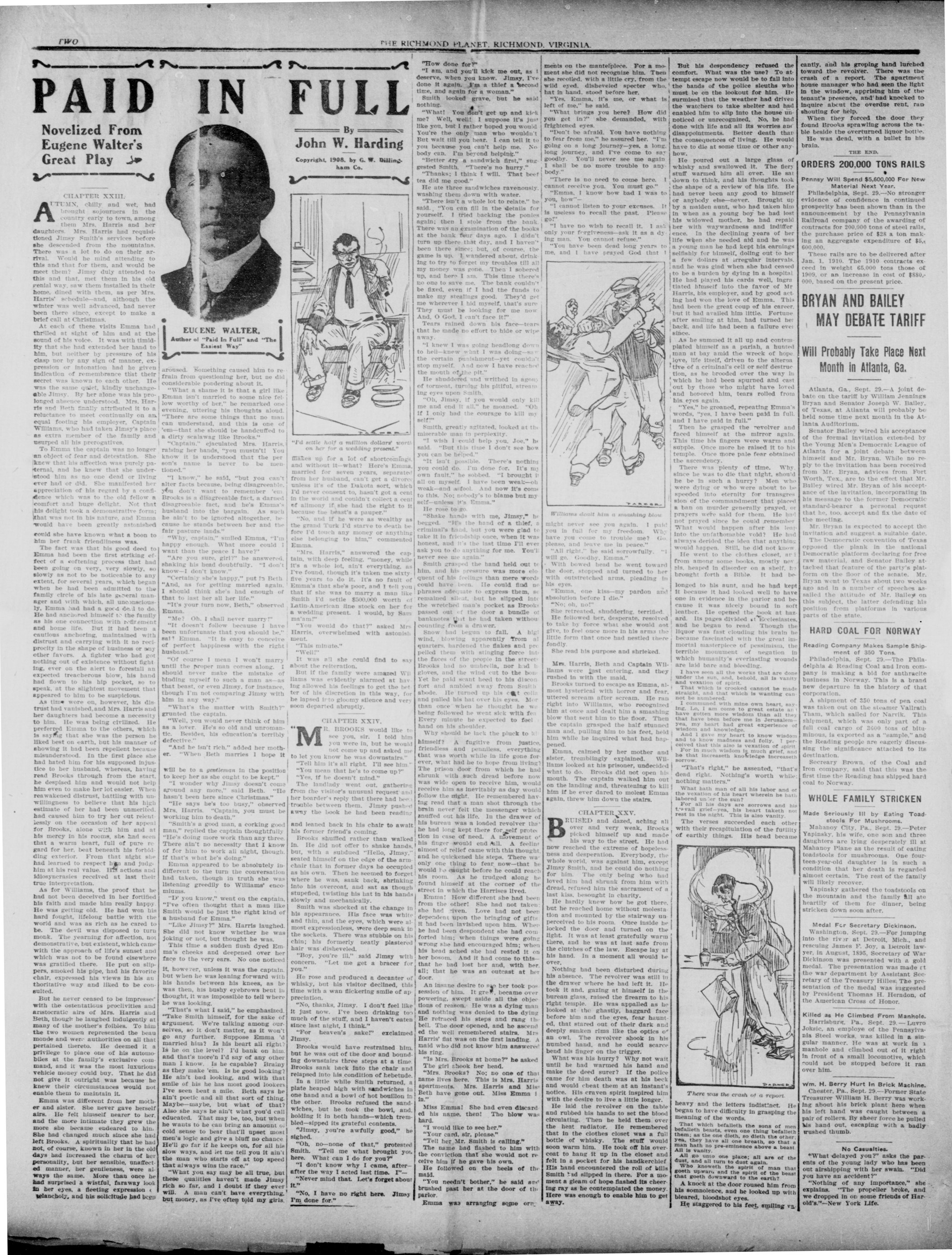
PAID IN FULL
Novelized From Eugene Walter's Great Play
CHAPTER XXIII.
AUTUMN, chilly and wet, had brought sojourners in the country early to town, among them Mrs. Harris and her daughters. Mrs. Harris had requested Jimsy Smith's services before she descended from the mountains. There was a lot to do on their arrival. Would he mind attending to this and that for them, and would be meet them? Jimsy duly attended to this and that, met them in his old genial way, saw them installed in their home, dined with them, as per Mrs. Harris' schedule—and, although the winter was well advanced, had never been there since, except to make a brief call at Christmas.
At each of these visits Emma had thrilled at sight of him and at the sound of his voice. It was with timidity that she had extended her hand to him, but neither by pressure of his clasp nor by any sign of manner, expression or intonation had he given indication of remembrance that their secret was known to each other. He was the same quiet, kindly unchangeable Jimsy. By her alone was his prolonged absence understood. Mrs. Harris and Beth finally attributed it to a reluctance to meet continually on an equal footing his employer, Captain Williams, who had taken Jimsy's place as extra member of the family and usurped all his prerogatives.
To Emma the captain was no longer an object of fear and detestation. She knew that his affection was purely paternal, and he knew that she understood him as no one dead or living ever had or did. She manifested her appreciation of his regard by a confidence which was to the old fellow a comfort and huge delight. Not that his delight took a demonstrative form; that was not in his nature, and Emma would have been greatly astonished could she have known what a boon to him her frank friendliness was
The fact was that his good deed to Emma had been the first striking effect of a cofening process that had been going on very, very slowly, so slowly as not to be noticeable to any extent, for several years, which began when he had been admitted to the family circle of his late general manager and with which, all unconsciously, Emma had had a good deal to do. He had anchored himself to the family as his one connection with retirement and home life. But it had been a cautious anchoring, maintained with distrust and carrying with it no reciprocity in the shape of business or any other favors. A fighter who had got nothing out of existence without fighting, ever on the alert to forestall an expected treacherous blow, his hand had flown to his hip pocket, so to speak, at the slightest movement that appeared to him to be suspicious.
As time wore on, however, his distrust had vanished, and Mrs. Harris and her daughters had become a necessity to him. He was being civilized. He preferred Emma to the others, which is saying that she was the person he liked best on earth, but his manner of showing it had been repellent because misunderstood. In the first place she had hated him for his supposed injustice to her husband, whereas, having read Brooks through from the start, he despised him and would not help him even to make her lot easier. When reawakened distrust, battling with unwillingness to believe that his high estimate of her had been unmerited, had caused him to try her out relentlessly on the occasion of her appeal for Brooks, alone with him and at his mercy in his rooms, she had seen that a warm heart, full of pure regard for her, beat beneath his forbidding exterior. From that night she had learned to respect him and judge him at his real value. His actions and idiosyncrasies received at last their true interpretation.
As for Williams, the proof that he had not been deceived in her fortified his faith and made him really happy. He was getting old. He had won his hard fought, lifelong battle with the world and was as rich as he cared to be. The devil was disposed to turn monk. The yearning for affection, not demonstrative, but existent, which came with the approach of life's sunset and which was not to be found elsewhere was gratified there. He put on slippers, smoked his pipe, had his favorite chair, expressed his views in his au thoritative way and liked to be consulted.
But he never ceased to be impressively with the ostentatious proclivities and aristocratic airs of Mrs. Harris and Beth, though he laughed indulgently at many of the mother's follies. To him the two women represented the beau monde and were authorities on all that pertained thereto. He deemed it a privilege to place one of his automobiles at the family's exclusive command, and it was the most luxurious vehicle money could buy. That he did not give it outright was because he knew their circumstances would not enable them to maintain it.
Emma was different from her mother and sister. She never gave herself airs. He felt himself nearer to her, and the more intimate they grew the more she became endeared to him. She had changed much since she had left Brooks. A spirituality that he had not, of course, known in her in the old days had increased the charm of her personality, but her sensible, unaffected manner, her gentleness, were always the same. More than once he had surprised a wistful, faraway look in her eyes, a fleeting expression of gelancholy, and his solicitude had been
PETER H.
aroused. Something caused him to refrain from questioning her, but he did considerable pondering about it.
"What a shame it is that a girl like Emma isn't married to some nice fellow worthy of her," he remarked one evening, uttering his thoughts aloud. "There are some things that no man can understand, and this is one of 'em—that she should be handcuffed to a dirty scalawag like Brooks."
"Captain," ejaculated Mrs. Harris, raising her hands, "you mustn't! You know it is understood that the person's name is never to be mentioned."
"I know," he said, "but you can't alter facts because, being disagreeable, you don't want to remember 'em Brooks is a disagreeable fact, a darn disagreeable fact, and he's Emma's husband into the bargain. As such he ain't to be ignored altogether, because he stands between her and the fair pasture lands."
"Why, captain," smiled Emma. "I'm happy enough. What more could I want than the peace I have?"
"Are you sure, girl?" he answered, shaking his head doubtfully. "I don't know—I don't know."
"Certainly she's happy," put in Beth. "And, as for getting married again, I should think she's had enough of that to last her all her life."
"It's your turn now, Beth," observed Emma.
"Me? Oh. I shall never marry!"
"It doesn't follow because I have been unfortunate that you should be," said Emma. "It is easy to conceive of perfect happiness with the right husband."
"Of course I mean I won't marry until the proper man comes along. I should never make the mistake of binding myself to such a man as—as that beast, or even Jimsy, for instance, though I'm not comparing Jimsy with him in any way."
"What's the matter with Smith?" grunted the captain.
"Well, you would never think of him as a lover. He's so old and unromantic. Besides, his education's terribly defective."
"And he isn't rich," added her mother. "When Beth marries I hope it will be to a gentleman in the position to keep her as she ought to be kept."
"I wonder why Jimmy doesn't come around any more," said Beth. "He hasn't been here since Christmas."
"He says he's too busy," observed Mrs. Harris. "Captain, you must be working him to death."
"Smith's a good man, a corking good man," replied the captain thoughtfully. "He's doing more work than any three. There ain't no necessity that I know of for him to work all night, though, if that's what he's doing."
Emma appeared to be absolutely indifferent to the turn the conversation had taken, though in truth she was listening greedily to Williams' encomiums.
"D you know," went on the captain,
"I've often thought that a man like Smith would be just the right kind of a husband for Emma."
"Like Jimsy?" Mrs. Harris laughed.
She did not know whether he was joking or not, but thought he was.
This time a sudden flush dyed Emma's cheeks and deepened over her face to the very ears. No one noticed it, however, unless it was the captain, but when he was leaning forward with his hands between his knees, as he was then, his bushy eyebrows bent in thought, it was impossible to tell where he was looking.
"That's what I said," he emphasized. "Take Smith himself, for the sake of argument. We're talking among ourselves, so it don't matter, as it won't go any further. Suppose Emma 'd married him? Is his heart all right? Is he on the level? I'd bank on him and that's more'n I'd say of any other man I know. Is he capable? Brainy as they make 'em. Is he good looking? He ain't bad looking, and with that smile of his he has most good lookers I've seen bent a mile. Beth says he ain't poetic and all that sort of thing. Maybe—maybe, but what of that? Also she says he ain't what you'd call educated. That may be, too, but when he wants to he can bring an amount of cold sense to bear that'll upset most men's logic and give a bluff no chance. He'll go far if he keeps on, for all his slow ways, and let me tell you it ain't the man who starts off at top speed that always wins the race."
"What you say may be all true, but these qualities haven't made Jimsy rich so far, and I doubt if they ever will. A man can't have everything, but money, as I've often told my girls.
THE RICHMOND PLANET. RICHMOND VIRGINIA
PASCAL
"I'd settle half a million dollars" word
on her for a wedding present.
"I'd settle half a million dollars' worth on her for a wedding present."
makes up for a lot of shortcomings, and without it—what? Here's Emma, married for seven years, separated from her husband, can't get a divorce unless it's of the Dakota sort, which I'd never consent to, hasn't got a cent in the world and couldn't collect a cent of allmony if she had the right to it because the beast's a pauper."
"No, and if he were as wealthy as the grand Turk I'd starve to death before I'd touch any money or anything else belonging to him," commented Emma.
"Mrs. Harris," answered the captain, with deep feeling, "money, while it's a whole lot, ain't everything, as I've found, though it's taken me sixty-five years to do it. It's no fault of Emma that she's poor, and I tell you that if she was to marry a man like Smith I'd settle $500,000 worth of Latin-American line stock on her for a wedding present. I would, by Sam ma'am."
"You would do that?" asked Mrs Harris, overwhelmed with astonishment.
"This minute."
"Well!"
It was all she could find to say about the reiteration.
But if the family were amazed Williams was evidently alarmed at having allowed his feelings to get the better of his discretion in this way, for he lapsed into gloomy silence and very soon departed abruptly.
CHAPTER XXIV
M. R. BROOKS would like to see you, sir, I told him you were in, but he would not come up and asked me to let you know he was downstairs."
"Tell him it's all right. I'll see him."
"You mean that he's to come up?"
"Yes, if he doesn't mind."
The landlady went out, gathering from the visitor's unusual request and her boarder's reply that there had been trouble between them. Jimsy pushed away the book he had been reading and leaned back in his chair to await his former friend's coming.
Brooks shuffled rather than walked in. He did not offer to shake hands, but with a subdued "Hello, Jimsy," seated himself on the edge of the arm-chair that in former days he occupied as his own. Then he seemed to forget where he was, sank back, shrinking into his overcoat, and sat as though stupefied, twisting his hat in his hands slowly and mechanically.
Smith was shocked at the change in his appearance. His face was white and thin, and the eyes, which were almost expressionless, were deep sunk in the sockets. There was stubble on his chin; his formerly neatly plastered hair was disheveled.
"Boy, you're ill," said Jimsy with concern. "Let me get a bracer for you."
He rose and produced a decanter of whisky, but his visitor declined, this time with a wan flickering smile of appreciation.
"No, thanks. Jimsy. I don't feel like it just now. I've been drinking too much of the stuff, and I haven't eaten since last night, I think."
"For heaven's sake!" exclaimed Jimsy.
Brooks would have restrained him, but he was out of the door and bounding downstairs three steps at a time. Brooks sank back into the chair and relapsed into his condition of hestude
In a little while Smith returned, a plate heaped high with sandwiches in one hand and a bowl of hot bouillon in the other. Brooks refused the sandwiches, but he took the bowl, and holding it in both hands—which trembled—sipped its grateful contents. "Jimsy, you're awfully good," he sighed.
"Oh, no—none of that," protested Smith. "Tell me what brought you here. What can I do for you?"
"I don't know why I came, after—after the way I acted last time. I"—"Never mind that. Let's forget about it."
"No, I have no right here. Jimsy I'm done for."
"How done for?"
"I am, and you'll kick me out, as it deserve, when you know. Jimsy, I've done it again. I'm a thief a second time, and again for a woman."
Smith looked grave, but he said nothing.
"What! You don't get up and kick me? Well, well! I suppose it's just like you, but I rather hoped you would. You're the only man who wouldn't But wait till you hear. I can tell it to you because you can't help me. No body can. I'm beyond helping."
"Thanks; I think I will. That beef tea did me good."
He ate three sandwiches ravenously, washing them down with water.
"There isn't a whole lot to relate," he said.
"You can fill in the details for yourself. I tried backing the ponies again; then I stole from the bank. There was an examination of the books at the bank four days ago. I didn't turn up there that day, and I haven't been there since; but, of course, the game is up. I wandered about, drinking to try to forget my troubles till all my money was gone. Then I sobered up, and here I am. This time there's no one to save me. The bank couldn't be fixed, even if I had the funds to make my stealings good. They'd get me wherever I hid myself, that's sure. They must be looking for me now And, O God, I can't face it."
Tears rained down his face—tears that he made no effort to hide or wipe away.
"I knew I was going headlong down to hell—knew what I was doing—saw the certain punishment—yet couldn't stop myself. And now I have reached the mouth of the pit."
He shuddered and writhed in agony of torment, turning his pitiful, streaming eyes upon Smith.
"Oh, Jimsy, if you would only kill me and end it all," he moaned. "Oh if I only had the courage to kill my self"
Smith, greatly agitated, looked at the miserable man in perplexity.
"I wish I could help you, Joe," he said. "But this time I don't see how you can be helped."
"It isn't possible. There's nothing you could do. I'm done for. It's my own fault," he sobbed. "I brought it all on myself. I have been weak—oh weak—and a fool. And now it's come to this. No; nobody's to blame but my self—unless it's Emma."
"Shake hands with me, Jimsy," he begged. "It's the hand of a thief, a criminal's hand, but you were glad to take it in friendship once, when it was honest, and it's the last time I'll ever ask you to do anything for me. You'll never see me again."
Smith grasped the hand held out to him, and his pressure was more eloquent of his feelings than mere could have been. He could find no phrases adequate to express them, so remained silent, but he slipped into the wretched man's pocket as Brooks passed out of the door a bundle of banknotes that he had taken without counting from a drawer.
Snow had begun to fall. A big wind, blowing apparently from all quarters, hardened the flakes and propelled them with stinging force into the faces of the people in the streets. Brooks had no umbrella, nor had his gloves, and the wind cut to the bone. Yet he paid scant heed to his disconcert and ambled away from Smith abode. He turned up his coat and pulled his hat over his eyes. More than once when he thought he was being followed he went slick with feet. Every minute he expected to feel hand on his shoulder.
Why should he lack the pluck to kill himself? A fugitive from justice, friendless and penniless, everything that was worth while in life gone forever, what had he to hope from living? The prison door from which he had shrunk with such dread before now was wide open to receive him, would receive him as inevitably as day would follow the night. He remembered having read that a man shot through the brain never felt the messenger which snuffed out his life. In the drawer of his bureau was a loaded revolver that he had long kept there for self protection in case of need. A movement of his finger would end all. A feeling of relief came with this thought and he quickened his steps. There was only one thing to fear now—that he would be caught before he could reach his room. As he trudged along he found himself at the corner of the street in which the Harrises lived.
Emma! How different she had been from the other! She had not taken she had given. Love had not been dependent upon the bringing of gifts it had been lavished upon him. When he had been despondent she had comforted him; when things were going wrong she had encouraged him; when his head ached she had rested it on her bosom. And it had come to this—that he had lost her and, with her all; that he was an outcast at her door.
An insane desire to see her took possession of him. It grew, became over powering, swept aside all the objections of reason. He was a dying man and nothing was denied to the dying He retraced his steps and rang the bell. The door opened, and he ascended the well remembered stairs. Mrs Harris' flat was on the first landing. A maid who did not know him answered his ring.
"Is Mrs. Brooks at home?" he asked. "The girl shook her head."
"Mrs. Brooks? No; no one of that name lives here. This is Mrs. Harris apartments. Mrs. Harris and Miss Beth have gone out. Miss Emma if in."
Miss Emma! She had even discarded his name, then! The blow was hard.
"I would like to see her."
"Your card, sir, please."
"Tell her Mr. Smith is calling."
in her ear, and is calling.
The name had flashed to him with the conviction that she would not receive him if he gave his own.
He followed on the heels of the maid.
"You needn't bother," he said and brushed past her at the door of the parlor.
Emma was arranging some orn
ments on the mantelpiece. For a moment she did not recognize him. Then she recoiled, with a little cry, from the wild eyed, disheveled specter who, hat in hand, stood before her.
"Yes, Emma, it's me, or what is left of me," he said.
"What brings you here? How did you get in?' she demanded, with frightened eyes.
"Don't be afraid. You have nothing to fear from me," he assured her. "I'm going on a long journey—yes, a long, long journey, and I've come to say goodbye. You'll never see me again I shall be no more trouble to anybody."
"There is no need to come here. I cannot receive you. You must go."
"Emma, I know how bad I was to you, how"—
"I cannot listen to your excuses. It is useless to recall the past. Please go!"
"I have no wish to recall it. I ask only your forgiveness—ask it as a dying man. You cannot refuse."
"You have been dead long years to me, and I have prayed God that
TARRER
Williams dealt him a smashing blow
might never see you again. I paid
you in full for my freedom. Why
have you come to trouble me? Go,
please, and leave me in peace."
"All right," he said sorrowfully. "I
will go. Goodbye, Emma."
With bowed head he went toward
the door, stopped and turned to her
with outstretched arms, pleading in
his eyes.
"Emma, one kiss—my pardon and
absolution before I die."
"No; oh, no!"
She retreated, shuddering, terrified.
He followed her, desperate, resolved
to take by force what she would not
give, to feel once more in his arms the
little form that once had nestled there
fondly.
She read his purpose and skrieked.
Mrs. Harris, Beth and Captain Williams were just entering, and they rushed in with the maid.
Brooks turned to escape as Emma, almost hysterical with horror and fear, uttered scream after scream. He ran right into Williams, who recognized him at once and dealt him a smashing blow that sent him to the floor. Then the captain grasped the half stunned man and, pulling him to his feet, held him while he inquired what had happened.
Emma, calmed by her mother and sister, tremblingly explained. Williams looked at his prisoner, undecided what to do. Brooks did not open his mouth. The captain walked him out on the landing and, threatening to kill him if he ever dared to molest Emma again, threw him down the stairs.
CHAPTER XXV.
B RUSED and dazed, aching all over and very weak, Brooks picked himself up and made his way to the street. He had now reached the extreme of hopelessness and desperation. Everybody, the whole world, was against him, except Jimsy Smith, and he could do nothing for him. The only being who had loved him had shrunk from him with dread, refused him the sacrament of a last kiss, besought in charity. He hardly knew how he got there, but he reached home without molestation and mounted by the stairway unperceived to his room. Once inside he locked the door and turned on the light. It was at least gratefully warm there, and he was at last safe from the clutches of the law. Escape lay at his hand. In a moment all would be over.
Nothing had been disturbed during his absence. The revolver was still in the drawer where he had left it. He took it and, gazing at himself in the bureau glass, raised the firearm to his right temple. He was appalled as he looked at the ghastly, haggard face before him and the eyes, fear haunted, that stared out of their dark and deeply sunken rims like the optics of an owl. The revolver shook in his numbed hand, and he could searc bend his finger on the trigger.
What was his hurry? Why not wait until he had warmed his hand and make the deed surer? If the police came for him death was at his beck and would cheat them at an instant's notice. His craven spirit inspired him with the desire to live a little longer.
He laid the revolver on the table and rubbed his hands to set the blood circulating. Then he held them over the heat radiator. He remembered that in the clothes closet was a full bottle of whisky. The stuff would soon warm him. He took off his overcoat to hang it up in the closet and felt in a pocket for his handkerchief. His hand encountered the roll of bills Smith 'tad slipped in there. For a moment a gleam of hope flashed its cheering ray as he contemplated the money. Here was enough to enable him to get away.
But his despondency refused the comfort. What was the use? To attempt escape now would be to fall into the hands of the police sleuths who must be on the lookout for him. He surmised that the weather had driven the watchers to take shelter and had enabled him to slip into the house unnoticed or unrecognized. No, he had done with life and all its worries and disappointments. Better death than the consequences of living. He would have to die at some time or other anyhow.
He poured out a large glass of whisky and swallowed it. The ferry stuff warned him all over. He sat down to think, and his thoughts took the shape of a review of his life. He had never been any good to himself or anybody else—never. Brought up by a maiden aunt, who had taken him in when as a young boy he had lost his widowed mother, he had repaid her with waywardness and indifference. In the declining years of her life when she needed aid and he was a young man he had kept his earnings selfishly for himself, doling out to her a few dollars at irregular intervals, and he was gid when she had ceased to be a burden by dying in a hospital. He had played his cards well, ingratiated himself into the favor of Mr Harris, his employer, and by good act had won the love of Emma. This had been the great coup of his career, but it had availed him little. Fortune after smiling at him, had turned her back, and life had been a failure ever since.
As he summed it all up and contemplated himself as a pariah, a hunted man at bay amid the wreck of hope love, life itself, driven to the alterna five of a criminal's cell or self destruct, as he brooded over the way in which he had been spurned and cast out by those who might have loved and honored him, tears rolled from his eyes again.
"Yes," he groaned, repeating Emma's words, "yes, I have been paid in full, and I have paid in full."
Then he grasped the revolver and faced himself at the mirror again. This time his fingers were warm and supple. Once more he raised it to his temple. Once more pale fear obtained the ascendency.
There was plenty of time. Why, since he was to die that night, should he be in such a hurry? Men who were dying or who were about to be speeded into eternity for transgressions of the commandment that placed a ban on murder generally prayed, or prayers were said for them. He had not prayed since he could remember. What would happen after his hear into the unfathomable void? He had always derided the idea that anything would happen. Still, he did not know. He went to the clothes closest, arri from among some books, mostly novels, heaped in disorder on a shelf, he brought forth a Bible. It had be
longed to his aunt, and he had kept it because it had looked well to have one in evidence in the parior and because it was nicely bound in soft leather. He opened the book at hazard. Its pages divided. Ecclesiastes, and he beguai to read. Though the liquor was fast clouding his brain he became fascinated with the great immortal masterpiece of pessimism, the terrible monument of negation in which humanity's everlasting wounds are laid bare and bleeding.
I have seen all the works that are done under the sun, and, behold, all is vanity and exation of spirit.
That which is crooked cannot be made straight, which is wanting cannot be numbered.
I communed with mine own heart, saying, Lo, I am come to great estate are have gotten more wisdom than all they that have been before me in Jerusalem—the great experience of wisdom and knowledge.
And I gave my heart to know wisdom and to know madness and folly. I perceived that this also is vexation of spirit. For in much wisdom is much grief, and he increaseseth knowledge increaseeth sorrow.
"That's right," he assented, "that's dead right. Nothing's worth while; nothing matters."
What hath man of all his labor and of the exation of his heart wherein he hath labored, he hath been sorrows. For all his days are sorrows and his t-tavl grief-yea, his heart taketh not rest in the night. This is also vanity.
The verses succeeded each other with their recapitulation of the futility of earthly things. His head became
DADMER
There was the crash of a report.
heavy and the letters indistinct. He began to have difficulty in grasping the meaning of the words.
That which befallthe sons of men bafflelet beasts, even one thing befallthem, they have all one dieh, so dieh the other; ye, they have all one breath, so that a man hath no preeminence above a beast. All is vanity.
All go unto one place; all are of the dust, and all turn to dust again.
Who knoweth the spirit of man that goeth upward and the spirit of the beast that goeth downward to the earth?
A knock at the door roused him from his somnolence, and he looked up with bleared, bloodshot eyes.
He staggered to his feet, smiling ya.
cantly, and his groping hand lurched toward the revolver. There was the crash of a report. The apartment house manager who had seen the light in the window, appraising him of the tenant's presence, and had knocked to inquire about the overdue rent, ran shouting for help.
When they forced the door they found Brooks sprawling across the table beside the overturned liquor bottle. He was dead, with a bullet in his brain.
THE END.
ORDERS 200,000 TONS RAILS
Pennsy Will Spend $5,600,000 For New Material Next Year.
Philadelphia, Sept. 29.—No stronger evidence of confidence in continued prosperity has been shown than in the announcement by the Pennsylvania Railroad company of the awarding of contracts for 200,000 tons of steel rails, the purchase price of $28 a ton making an aggregate expenditure of $5,600,000.
These rails are to be delivered after Jan. 1, 1910. The 1910 contracts exceed in weight 65,000 tons those of 1909, or an increase in cost of $889,000, based on the present price.
BRYAN AND BAILEY MAY DEBATE TARIFF
Will Probably Take Place Next Month in Atlanta, Ga.
Atlanta, Ga., Sept. 29.—A joint debate on the tariff by William Jennings Bryan and Senator Joseph W. Bailey, of Texas, at Atlanta will probably be held some time next month in the Atlanta Auditorium.
Senator Bailey wired his acceptance of the formal invitation extended by the Young Men's Democratic League of Atlanta for a joint debate between himself and Mr. Bryan. While no reply to the invitation has been received from Mr. Bryan, advices from Fort Worth, Tex., are to the effect that Mr. Bailey wired Mr. Bryan of his acceptance of the invitation, incorporating in his message to the former Democratic standard-bearer a personal request that he, too, accept and fix the date of the meeting.
Mr. Bryan is expected to accept the invitation and suggest a suitable date. The Democratic convention of Texas opposed the plank in the national Democratic platform declaring for free raw material, and Senator Bailey attacked that feature of the party's platform on the floor of the senate. Mr. Bryan went to Texas about two weeks ago and in a number of speeches assailed the attitude of Mr. Bailey on this subject, the latter defending his position from platforms in various parts of the state.
HARD COAL FOR NORWAY
Reading Company Makes Sample Shipment of 350 Tons.
Philadelphia, Sept. 29.—The Philadelphia & Reading Coal and Iron company is making a bid for anthracite business in Norway. This is a brand new departure in the history of that corporation.
A shipment of 350 tons of pea coal was taken out on the steamer Vallrath Tham, which sailed for Narvik. This shipment, which was only part of a full coal cargo of 3600 tons of bituminous, is exported as a "sample," and the Reading people are eagerly discussing the significance attached to its destination.
Secretary Brown, of the Coal and Iron company, said that this was the first time the Reading has shipped hard coal to Norway.
WHOLE FAMILY STRICKEN
Made Seriously III by Eating Toadstools For Mushrooms.
Mahanoy City, Pa., Sept. 29—Peter Yapinsky, his wife, one son and three daughters are lying desperately ill at Mahanoy Plane as the result of eating toadstools for mushrooms. One fourteen-year-old daughter is in such a condition that her death is regarded almost certain. The rest of the family will likely recover.
Yapinsky gathered the toadstools on the mountain and the family all ate heartily of them for dinner, being stricken down soon after.
Medal For Secretary Dickinson
Washington, Sept. 29.—For jumping into the river at Detroit, Mich., and rescuing James F. Joy, a Detroit lawyer, in August, 1895, Secretary of War Dickinson was presented with a gold medal. The presentation was made rd the war department by Assistant Secretary of the Treasury Hilles. The presentation of the medal was suggested by President Thomas H. Herndon, of the American Cross of Honor.
Killed as He Climbed From Manhole. Harrisburg, Pa., Sept. 29.—Luvro Joksic, an employee of the Pennsylvania Steel works, was killed in a singular manner. He was at work in a manhole and climbed out of it right in front of a small locomotive, which could not be stopped before it ran over him.
wim H. Berry Hurt In Brick Machines,
Chester, Pa., Sept. 29—Former State
Treasurer William H. Berry was working
about his brick plant here when
his left hand was caught between a
pair of rollers. By sheer force he pulled
his hand out, escaping with a badly
wushed thumb.
No Casualties.
"What delayed you?" asks the parents of the young lady who has been out airshiping with her swain. "Did you have an accident?"
"Nothing of any importance," she explains. "The propeller broke, and we dropped in on some friends of Harold's."—New York Life.
THE PLANET
SATURDAY...OCTOBER 9, 1909.
TAFT PREACHES
A SERMON
Addressed Great Audience in Mormon Temple.
AN APPEAL FOR AMITY
Asked People to Attribute the Best Rather Than the Worst Motives to Action of Others When Possible to Do So and Not to Harbor Hatred.
In the pulpit of the famous Mormon tabernacle in Salt Lake City, Utah, where four years ago Theodore Roosevelt, then president, preached a long sermon on right living and the duties of good citizenship, President Taft faced an audience which he said inspired him to try to follow in the footprints of his predecessor and deliver a preachment.
Mr. Taft did preach a sermon, text and all. The immense audience in the flag-draped edifice, the splendid musical program of operatic and patriotic selections, the enthusiastic cheering as President Taft appeared and the quick response of the audience to the points which he endeavored to impress upon his hearers, inspired him, the president declared, with higher thoughts of country and patriotism. The president's sermon was an appeal for amity between the people for attributing the best rather than the worst motives to the action of others when possible to do so and not to harbor hatred or animosity. "A soft answer turneth away wrath, but grievous words stris up anger," was the text Mr. Taft selected from the Book of Proverbs. The sermon was a homely utterance, largely made up of a relation of stories to give emphasis to the points.
Reviewed 20,000 School Children
From the tabernacle the president was driven to review about 20,000 school children. At one point along the line a thousand or more children had been arranged in a living flag, red, white and blue caps sewing to outline the national emblem. Thence the president proceeded to the Young Men's Christian Association, where he made a brief address to men. Lastly the president attended services especially arranged for him at the Unitarian church. After this unusually busy Sunday morning he left Salt Lake ior Ogden, where he enjoyed an eighteen-mile ride through Ogden Canon and made his third address of the day at Lester park. When Senator Smoot introduced the president to the audience in the Salt Lake tabernacle the cheering was so great that Mr. Taft could not begin his address for several minutes.
Ministers Criticise Taft
Several clergymen in Salt Lake City, Utah, criticised President Taft from their pulpits. The main theme of their remarks was the president's refusal to change his plans which provided for a parade and flag demonstration of children Sunday. Objection was also made to the president holding forth in the Mormon tabernacle. Rev. Louis Bowerman of the Baptist church, voiced the sentiments of many of the ministers of the city when he said: "I think the action of the president is a mistake. Of course, I believe in the policy of letting every man think for himself, but I can't see how President Taft is going to gain anything by refusing to observe the Sabbath.
"The whole proposition is the Mormons and their desire to get a boost out of the visit of the president here. Every missionary of the Mormon church throughout the world will begin to gloat over the fact that when the president of the United States visited the Utah capital he was the guest of the Morman church. I will take the matter up with the religious press of the country and have serious comment made upon the action here of the president. These publications are in New York city, Chicago, Boston and all other important big cities in the country, and they will be universal in their denunciation."
The ministers lay the blame to the Mormon influence, into which they say the preside it has fallen through Senator Reed Smoot, of Utah, apostle in the church.
Robbers Murder Entire Family
An entire family of six persons were murdered, and the bodies of all but one of the victims were burned with their home at Hurley, Buchanan county, Va. The motive was evidently robbery, the owner of the house, an aged woman known as "Aunt Betty" Justis, was generally supposed to keep a large sum of money about the place. Mrs. Justis, her son-in-law, George Meadows; his wife and their three children were the victims. Meadow's body, badly mutilated, was found lying in the yard of his destroyed home, the funeral pyre of his loved ones. Two bullet holt-s through the body and a ghastly wound in the neck, which almost severed the head from the body, gave the discoverers their first evidence of the extent of the tragedy.
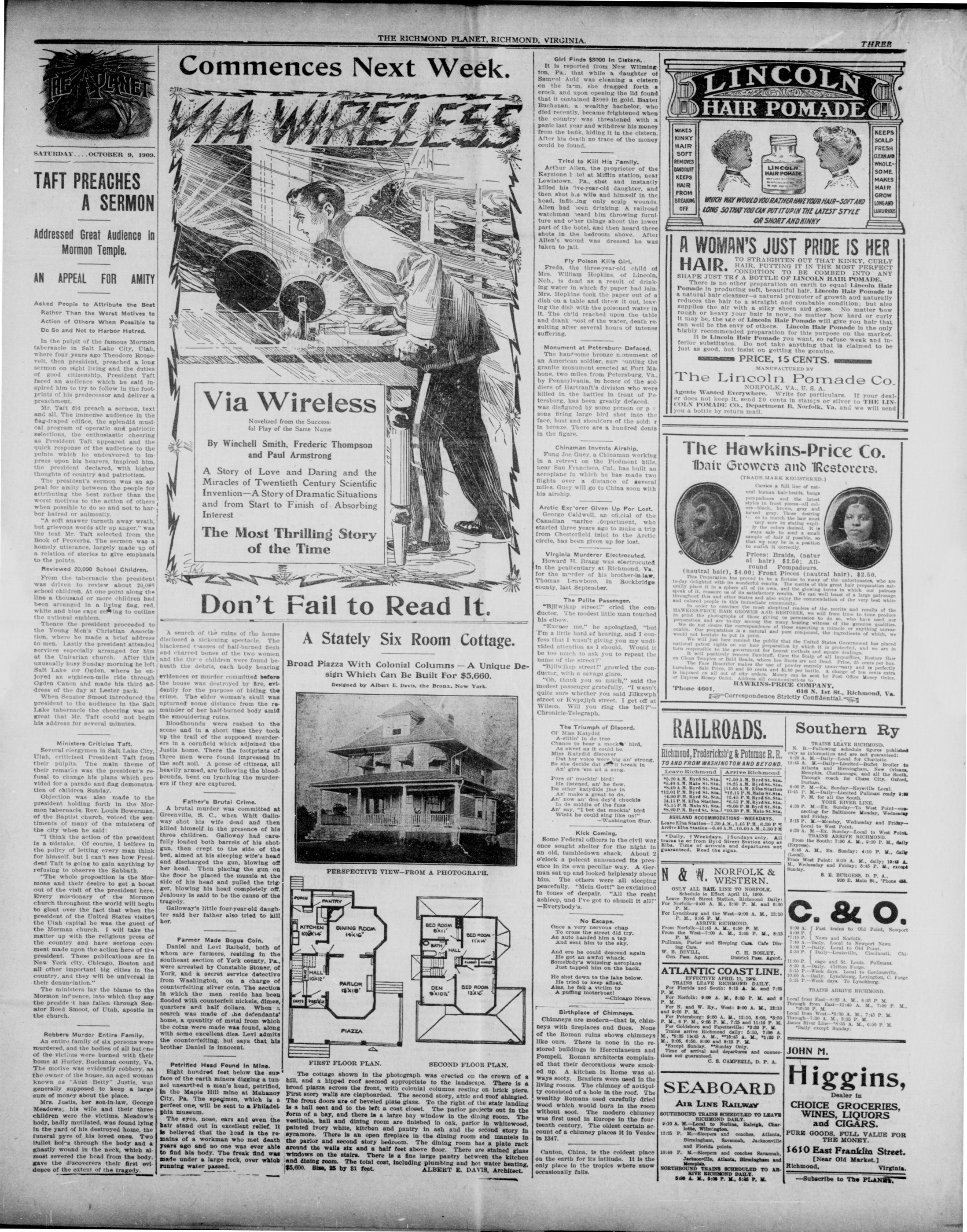
Commences Next Week.
VIA WIRELESS
Via Wireless
Novelized from the Successful Play of the Same Name
By Winchell Smith, Frederic Thompson and Paul Armstrong
A Story of Love and Daring and the Miracles of Twentieth Century Scientific Invention—A Story of Dramatic Situations and from Start to Finish of Absorbing Interest
The Most Thrilling Story of the Time
Don't Fail to Read It.
A search of the ruins of the house disclosed a sickening spectacle. The blackened masses of half-burned flesh and charred bones of the two women and the three children were found beneath the debris, each body bearing evidences or murder committed before the house was destroyed by fire, evidently for the purpose of hiding the crime. The elder woman's skull was upturned some distance from the remainder of her half-burned body amid the smouldering ruins.
Bloodhounds were rushed to the scene and in a short time they took up the trail of the supposed murders in a cornfield which adjoined the Justis home. There the footprints of three men were found impressed in the soft soil. A posse of citizens, all heavily armed, are following the bloodhounds, bent on lynching the murders if they are captured.
A brutal murder was committed at Greenville, S. C., when Whit Galloway shot his wife dead and then killed himself in the presence of his three children. Galloway had carefully loaded both barrels of his shotgun, then crept to the side of the bed, aimed at his sleeping wife's head and discharged the gun, blowing off her head. Then placing the gun on the floor he placed the muzzle at the side of his head and pulled the trigger, blowing his head completely off. Jealousy is said to be the cause of the tragedy. Galloway's little four-year-old daughter said her father also tried to kill her.
Daniel and Levi Ralbeld, both of whom are farmers, residing in the southeast section of York county, Pa., were arrested by Constable Stoner, of York, and a secret service detective from Washington, on a charge of counterfeiting silver coin. The section in which the men reside has been flooded with counterfeit nickels, dimes, quarters and half dollars. When a search was made of the defendants' home, a quantity of metal from which the coins were made was found, along with some excellent dies. Levi admits the counterfeiting, but says that his brother Daniel is innocent.
Petrified Head Found In Mine
Eight hundred feet below the surface of the earth miners digging a tunnel unearthed a man's head, petrified, in the Maple Hill mine at Mahanoy City, Pa. The specimen, which is a perfect one, will be sent to a Philadelphia museum. The eyes, nose, ears and oven the hair stand out in excellent relief. It is believed that the head is the remains of a workman who met death years ago and no one was ever able to find his body. The freak find was made under a large rock, over which running water passed.
Father's Brutal Crime
Farmer Made Bogus Coin.
Frederic Thompson
Armstrong
and Daring and the
eenth Century Scientific
of Dramatic Situations
Finish of Absorbing
Thrilling Story
Time
Fail to R
A Stately Six
Broad Piazza With Colonial
sign Which Can Be
Designed by Albert E. D
PERSPECTIVE VIEW—
A Stately Six Room Cottage.
Broad Piazza With Colonial Columns - A Unique Design Which Can Be Built For $5,660.
THE HOME OF THE MAYOR OF MIDDLEBURG
PORCH
PANTRY
KITCHEN
10'x14'
DINING ROOM
14'x16'
HALL
10'x12'
PARLOR
18'x18'
GRAFTS
FREESTYLE
PIAZZA
FIRST FLOOR PLAN.
The cottage shown in the photo hill, and a hipped roof seemed appropria broad plaza across the front, with c First story walls are clapboarded. The front doors are of beveled plate g is a hall seat and to the left a coat form of a bay, and there is a large vestibule, hall and dining room are painted ivory white, kitchen and payscamore. There is an open fireplace the parlor and second story bedroom around the walls six and a half feet windows on the stairs. There is a and dining room. The total cost is
The cottage shown in the photograph are erected on the crown of a hill, and a hipped roof seemed appropriate to the landscape. There is a broad piazza across the front, with colonial columns resting on brick piers. First story walls are clapboarded. The second story, attic and roof shingled. The front doors are of beveled plate glass. To the right of the stair landing is a hall seat and to the left a coat closet. The parlor projects out in the form of a bay, and there is a large bay window in the dining room. The vestibule, hall and dining room are finished in oak, parlor in whitewood, painted ivory white, kitchen and pantry in ash and the second story in sycamore. There is an open fireplace in the dining room and mantels in the parlor and second story bedroom. The dining room has a plate rack around the walls six and a half feet above floor. There are stained glass windows on the stairs. There is a fine large pantry between the kitchen and dining room. The total cost, including plumbing and hot water heating, $5,000. Size, 25 by 31 feet. ALBERT E. DAVIS, Architect.
THE RICHMOND PLANET, RICHMOND, VIRGINIA
Designed by Albert E. Davis, the Bronx, New York.
PERSPECTIVE VIEW-FROM A PHOTOGRAPH
BED ROOM
6X11'
BATH
HALL
CLARITY
GARAGE
DEN
9X10½'
BED ROOM
11X14'
BED ROOM
13X16'
SECOND FLOOR PLAN.
Girl Finds $5000 In Cistern.
It is reported from New Wilmington, Pa., that while a daughter of Samuel Auld was cleaning a cistern on the farm, she dragged forth a crock, and upon opening the lid found that it contained $8000 in gold. Baxter Buchanan, a wealthy bachelor, who died recently, became frightened when the country was threatened with a panic last year and withdrew his money from the bank, hiding it in the cistern. After his death no trace of the money could be found.
Tried to Kill His Family
Arthur Allen, the proprietor of the Keystone hotel at Mifflin station, near Lewistown. Pa., shot and instantly killed his five-year-old daughter, and then shot his wife and himself in the head, inflicting only scalp wounds. Allen had been drinking. A railroad watchman heard him throwing furniture and other things about the lower part of the hotel, and then heard three shots in the bedroom above. After Allen's wound was dressed he was taken to jail.
Fly Poison Kill Girl
Freda, the three-year-old child of Mrs. William Hopkins, of Lincoln, Neb., is dead as a result of drinking water in which fly paper had lain. Mrs. Hopkins took the paper out of a dish on a table and threw it out, leaving the dish with the poisoned water in it. The child reached upon the table and drank most of the water, death resulting after several hours of intense suffering.
Monument at Petersburg Defaced. The hand some bronze monument of an American soldier, surmounting the granite monument erected at Port Mahone, two miles from Petersburg, Va., by Pennsylvania, in honor of the soldiers of Hartranft's division who were killed in the battles in front of Petersburg, has been greatly defaced. was disfigured by some person or persons firing large bird shot into the face, bust and shoulders of the soldier in bronze. There are a hundred dents in the figure.
Chinaman Invents Airship.
Fung Joe Guey, a Chinaman working in a retreat on the Piedmont hills, near San Francisco, Cal., has built an aeroplane in which he has made two flights over a distance of several miles. Guey will go to China soon with his airship.
Arctic Explorer Given Up For Lost.
George Caldwell, an official of the Canadian marine department, who started three years ago to make a trip from Chesterfield inlet to the Arctic circle, has been given up for lost.
Virginia Murderer Electrocuted.
Howard H. Bragg was electrocuted in the penitentiary at Richmond, Va. for the murder of his brother-in-law, Thomas Drawboro, in Rockbridge county, last September.
The Polite Passenger.
"Bjwljkjxp street!" cried the conductor. The modest little man touched his elbow.
"Excuse me," he apologized, "but I'm a little hard of hearing, and I confess that I wasn't giving you my undivided attention as I should. Would it be too much to ask you to repeat the name of the street?"
"Bjwljkjxp street!" growled the conductor, with a savage glare.
"Oh, thank you so much," said the modest passenger gratefully. "I wasn't quite sure whether you said Jilkzwph street or Kwpzjhp street. I get off at Wilson. Will you ring the bell?"—Chronicle-Telegraph.
The Triumph of Discord.
Ol' Miss Katydid
A-sittin' in de tree
Chance to hear a mock bird,
As sweet as it could be.
Miss Katydid discover.
Dat her voice were big an' strong.
So she decide dat she'll break in
'Give' ame all a song.
Pore o' mockin' bird!
He listened, an he flew.
Do other karydids jine in
An' make a great to do.
An' draw a snookie
In middle of the fuss
An' say, "I bet dat mockin' bird
Wisht he could sing like us!"
-Washington Star
Kick Coming.
Some Federal officers in the civil war once sought shelter for the night in an old, tumbledown shack. About 2 o'clock a polecat announced its presence in its own peculiar way. A German sat up and looked helplessly about him. The others were all sleeping peacefully, "Mein Gott!" he exclaimed in tones of despair. "All the resht asleeple, and I've got to shmell it all!"—Everybody's.
No Escape.
Once a very revenge chap
To cross the street did try.
An auto handed him a tap
And sent him to the sky.
And ere he could descend again
He got an awful work.
Somebody's whizzing aeroplane
Just tapped him on the back.
He shot down to the lake below.
He put to keep afloat.
Alas, he fell victim to
A puffing motorbike.
Division of Chimneys.
Chimneys are modern—that is, chimneys with fireplaces and fues. None of the Roman ruins shows chimneys like ours. There is none in the restored buildings in Herculaneum and Pompeii. Roman architects complained that their decorations were smoked up. A kitchen in Rome was always sooty. Braziers were used in the living rooms. The chimney of antiquity consisted of a hole in the roof. The wealthy Romans used carefully dried wood which would burn in the room without soot. The modern chimney was first used in Europe in the fourteenth century. The oldest certain account of a chimney place it in Venice in 1347.
Canton, China, is the coldest place on the earth for its latitude. It is the only place in the tropics where snow occasionally falls.
LINCOLN
HAIR POMADE
MAKES
KINKY
HAIR
SOFT
REMOVES
DANDRUFF
KEEPS
HAIR
FROM
BREAKING
OFF
LINCOLN
HAIR POMADE
KEEPS
SCALP
FRESH
CLEAR AND
WHOLE-
SOME
MAKES
HAIR
GROW
LONG AND
LUXURIOUS
WHICH WAY WOULD YOU RATHER HAVE YOUR HAIR--SOFT AND
LONG SO THAT YOU CAN PUT IT UP IN THE LATEST STYLE
OR SHORT AND HINKY
A WOMAN'S JUST PRIDE IS HER
HAIR. TO STRAIGHTEN OUT THAT KINKY, CURLY
HAIR, PUTTING IT IN THE MOST PERFECT
CONDITION TO BE COMBED INTO ANY
SHAPE JUST TRUST A BOTTLE OF LINEN.
The Hawkins-Price Co. Hair Growers and Restorers.
(TRADE MARK REGISTERED.)
Carries a full line of natural human hair-braids, bangs pompouads and the latest styles in black, brown, gray and mixed gray. Those desiring it to match the hair must very sure in stating explicit colors desired. It is easy to color suits in a small sample of hair if possible, so that we may be in a position to match it correctly.
Prices: Braids, (natur al hair) $2.50; All round Pompouads
(nautal hair), $4.00; Front E
This Preparation has proved to be a
fairly place in with its wonderful results,
until delighted with it in a sphere all of its own,
a speak of it, resource to tell its nationale
throughout this and other States and also re-
colored people in this immediate commu-
lance.
I order to convince the most skekt-
HAWKINS-PRINT in print the photographs of those giving
preparation and are to-day among the man-
We do not desire the correspondence of
Our Preparation is a natural and i
would not hesitate to address all coun-
We will just here remind the public the
national patent rights on our hair preparat-
turn responsible to the government for home
It will yield beautiful HaWKINS-PR
On Clean Temples or Hald Heals, where he
The Face Beautifier makes the use of
Sale Price, all 25 and 50 cents and it is
imposed on all 25 of city orders. Money
or Express Money Order. Address all coun-
HAWKINS-PRINT
'Phone 4001.
Correspondence St
we has proved to be a fortune to many of the unfortunate, who are to-day delighted with its wonderful results. The merits of this great hair preparation naturally place it in a sphere of glowing terms in which our patrons speak of it, reassure us of its satisfactory results. We have a large patronage throughout this and other States and also enjoy the commendation of the very best white and coats people in this immediate community. The master裁员 of the merits and results of the HAWKINS-PRICE HAIR GROWER AND HAIRCOATER, we will furnish time to time produce in print the photographs of those giving us permission to do so. Preparation and are to-day among the many bearing witness of the genuine qualities. We will not hesitate to put in print. Our preparation is a natural and pure compound, the ingredients of which, we would not hesitate to put in print. We will just here remind the public that the United States Government has placed national government hair preparation by which it is protected, and we are in turn responsible to the government for hair coats and square dealings. It will positively remove Dandruff. Cure the dandruff. Restore Hair on Clean Temples or Bald Heads, where hee Roots are not Dead. Purchase per cent per bottle. A charge of ten cents extra is imposed on all out of city orders. Money sent by Post Office Money Order, or Express Money Order. Address all communications.
HAWKINS-PRICE COMPANY.
Phone 4601. 616 N. 1st St., Richmond, Va. Correspondence Strictly Confidential.
RAILROADS.
RAILROADS.
Richmond, Fredericksb'g & Potomac R. R.
TO AND FROM WASHINGTON AND BEYOND.
Leave Richmond
*5.20 M. Byrd St. Nta.
*5.40 M. Main St. Nta.
*12.01 P. Elba Station.
*12.01 P. Elba Station.
*4.00 P. Elba Station.
*4.15 P. Elba Station.
*8.20 P. Elba Station.
*8.20 P. Elba Station.
Arrive Richmond
*7.50 M. Byrd St. Nta.
*8.25 M. Byrd St. Nta.
*12.01 P. Elba Station.
*12.15 P. Main St. Nta.
*12.45 P. Byrd St. Nta.
*6.55 P. Byrd St. Nta.
*10.30 P. Main St. Nta.
ASHLAND ACCOMMODATIONS. WEENDAYS.
Leave Elba Station - 7.30 A.M. 1.45 P.M. 6.30 P.
Arrive Elba Station - 6.40 A.M. 10.40 A.M. 5.30 P.
*Daily. 4 Weekdays. 5 Sundays only. All
trains or for hire by Street Station stop at
Elba. Time of arrivals and departures not
guaranteed. Read the signs.
ONLY ALL RAIL LINE TO NORFOLL
ONLY ALL MAY LINE TO NONPOLL.
should be October E April 11, 1900.
Leave Byrd Street Station, Richmond Road.
For Norfolk-9:00 A. M., 3:00 P. M. and 6:00
P. M.
For Lynchburg and the West-9-00 A. M., 12:10
F. M., 6:00 P. M.
ARRIVE RICHMOND.
For Norfolk-11-45 A. M., 6:50 P. M.
From Lynchburg-7-00 A., 8:06 P. M., 8:15
P. M.
Pullman, Parlor and Sleeping Cars. Cafe Dining Cars.
W. B. BEVILL. C. H. BOSLEY.
Gen. Pen. Agent. District Pass. Agent.
ATLANTIC COAST LINE.
TRAINS LEAVE RICHMOND DAILY.
For Florida and South: 8158 A. M. and 7:26
P. M.
For Norfolk: 9:00 A. M., 8:00 P. M. and 6
P. M.
For N. and W. R. , West: 9:00 A. M., 12:10
and 9:06 P. M.
For Petersburg: 9:00 A. M., 12:10, 8:00; *8:30
P. M, 6 P. M, 9:06 P. M, 7:25 and 11:15 P. M.
Goldboro and Fayetteville: *8:30 P. M.
Training Richmond daily: 5:10, 7:00 P. M.
*8:35 I:14x5 P. M, *1:20 P. M.
2:06, 6:50, 8:00 and 8:15 P. M.
*Except Sunday. ***Sunday Only.
Time of arrival and departures and con-
nections not guaranteed.
C. S. CAMPBELL. D. P. A.
SEABOARD
SEABOARD
AIR LINE RAILWAY
SOUTHBOUND TRAINS SCHEDULED TO LEAVE
RICHMOND DAILY.
9:10 A. M.-Loved to Norlina, Raleigh, Charlote,
Wilmington.
12:25 P. M.-Sleepers and coaches, Atlanta,
Birmingham, Savannah, Jacksonville
and Florida points.
10:40 P. M.-Sleepers and coaches Savannah,
Jacksonville, Atlanta, Birmingham and
Memphis.
NORTHBOUND TRAINS SCHEDULED TO ARRIVE
RICHMOND DAILY.
5:30 A. M., 5:35 P. M., 5:45 P. M.
CIVILIS
deices (nautral hair), $2.50.
fortune to many of the unfortunate, who are
the merits of this great hair preparation nat-
ural and the glowing terms in which our patrons
mites. We can well boast of a large patronage
the commendation of the very best white
authentic readers of the merits and results of the
STORER, we will from time to time produce
merits of our customers. We have quality,
our bearing witness of the genuine unre-
sure compound, the ingredients of which, we
that the United States Government has placed
on by which it is protected, and we are in
inst methods and square dealings.
Storers are not Dead. Restore Hair
Roots are not Dead. Price, $25 cents per box,
powder entirely unnecessary and is perfectly
4.00 per bottle. A charge of ten cents extra
can be sent by Post Office Money Order,
immediately.
OCE COMPANY,
616 N. 1st St., Richmond, Va.
Privately Confidential.
Southern Ry
TRAINS LEAVE RICHMOND.
N. B.-following schedule figures published only as information, and are not guaranteed:
6:20 A. M.-Daily-Limited-Buffalo carrier to Atlanta and Birmingham, New Orleans, Memphis, Chattanooga, and all the South. Through coach for Chase City, Oxford, Durham.
6:00 P. M.—Ex. Sunday—Keysville Local.
11:45 P. M. Dr. Palma Littleton
11:15 P.M. - Limited Pullman ready 9:20
P. M. for Jacksonville
YORK RIVER LINE.
14:30 P. M. for Sunday - To West Point
connecting for Baltimore Monday, Wednesday
and Friday.
2:15 P. M. — Monday, Wednesday and Friday — Local to West Point.
4:30 A.M. — Monday, Tuesday — Local to West Point.
TRAINS ARRIVE RICHMOND
From the South: 7:00 A. M. 3:00 P. M., daily (Express).
4:50 A. M. Ex. Sunday: 4:10 P. M., daily (Local).
From West Point: 9:30 A. M. daily: 18:45 P. M., Wednesday and Friday: 5:45 P. M., except
C. & O.
9:00 A. { Fast trains to Old Point, Newport
4:00 P. { Daily. Local to Newport News.
7:10 P. { News and Norfolk.
7:40 A. { Daily. Local to Newport News.
P. { Daily. Local to Old Point.
8:30 P. { Daily-Louisville, Cincinnati, Chi-
11:00 P. { cage and St. Louis. Pullmans.
8:30 A. { Clifton Forge.
5:15 P. { Week days. Local to Gordonville.
5:15 P. { Lynchburg, Lexington, C. Forge
5:15 P. { Week days. To Lynchburg.
TRAINS ARRIVE RICHMOND
10:30 P. M.
Local from West—8:30 A. M., 7:45 P. M.
Through—7:30 A. M., 8:35 P. M.
James River Line—8:35 A. M., 6:50 P. M.
*Daily except Sunday.
JOHN M.
Higgins,
Dealer in
CHOICE GROCERIES,
WINES, LIQUORS
and CIGARS.
PURE GOODS, FULL VALUE FOR
THE MONEY.
1610 East Franklin Street.
[Near Old Market.]
Richmond, Virginia.
—Subscribe to The PLANET.
THREE
[Name]
S. E. BURGESS, D. P. A.
202 E. M. Alain, T. Bhone 445
THE PLANET
Published every Saturday by JOHN MITCHELL,
JR., at 811 N. Fourth Street, Richmond, Va.
JOHN MITCHELL, JR., - EDITOR.
All communications intended for publication
should be sent so as to reach us by Wednesday.
TERMS IN ADVANCE.
One Copy, one year, - - - - - $1.50
One Copy, eight months, - - - - - 1.00
One Copy, six months, - - - - - .80
One Copy, four months, - - - - - .50
One Copy, three months, - - - - - .40
Single Copy, - - - - - .05
ADVERTISING RATES.
For one inch, one insertion ..... $ .50
For one inch each subsequent insertion ..... 40
For two inches, six months ..... 6.00
For two inches, six months ..... 10.00
For two inches, nine months ..... 14.00
For two inches, twelve months ..... 20.00
For one inch, one inch ..... 50
Standing and Transient Notices per line ..... 10.00
POSTAGE STAMPS OF A HIGHER DENOMINATION THAN TWO CENTS NOT RECEIVED ON SUBSCRIPTION.
The PLANET is issued weekly. The subscription price is $150 per year in advance. There are four ways by which money can be sent by mail at our Fisk. In a Post Office Money Order, the money is ordered, and when none of these can be procured, in a Registered Letter. MONEY ORDERS—You can buy a Money Order at the Richmond Post Office and we will be responsible for its late arrival. EXPRESS MONEY ORDERS can be obtained at the American Express Co., the United States Express Co., and the Wells' Fargo and Co.'s Express Company. We will be responsible for money sent by any of these companies. The Express Money Order is a safe and convenient mailing service for money sent. REGISTERED LETTER—If a Money Order, Post Office or an Express Office is not within your reach, your Postmaster will register the money in your account. Then, if the Letter is lost or stolen, it can be traced. You can send money in this manner at our Post Office. You can be responsible for money sent. In letters in any other way than one of the four ways mentioned above. If you send your money in any other way, you must do it at your own
BENWALKS, ETC.—If you do not want THE PLANET continued for another year after your subscription has run out, you then notify us by email. Card to discontinue. The house have decided that subscribers to newspapers who do not order their paper discontinued at the expiration of time for which it has been paid are held liable for the payment of the subscription to date when they ord r the paper discontinued.
COMMUNICATIONS—When writing to us to renew your subscription or to discontinue your paper, you should give your name and address to us; otherwise we cannot find your name on our books.
CHANGE OF ADDRESS—In order to change the address of a address, we must be sent the former as well as the present address.
Entered at the Post Office at Richmond, Va. as second class matter.
SATURDAY... OCTOBER 9, 1909.
We have received the highly interesting ninth annual report of the Executive Board and Corresponding Secretary of the Woman's Convention, auxiliary to the National Baptist Convention, which report was made at Columbus, Ohio, September, 1999.
We have received a circular talking about the Order of Roebucks, Mr. W. Musgrave La Motte, S. A., 125 Ashland Place, Brooklyn, N. Y., seems to be the moving spirit. The purposes seem to be all right and the motive for the organizing sublime but as to the name, we pause for a time to take our breath. Down here, it is brown buck, yellow buck and black bucks, but if you are going to add to this roe buck, then, good Lord, deliver us!
GOV. WILLSON'S ADVICE
For twenty-five years, we have warned colored men in the Southland, that the best way to deal with the lawless mobs who defied the law and who could not be controlled by the better class of white citizens, to purchase shot-guns and repeating rifles and to sell their lives as dearly as possible in the protection of themselves and their families. Now Gov. Willison, of Kentucky after failing in his efforts to protect the independent white growers of tobacco in Kentucky, although he has repeatedly called out the state troops in an effort so to do boldly issued the following statement:
Frankfort, Ky., October 3.—"Fight the devil with his own fire" is the method that Governor Willison is advising the independent growers of tobacco in Kentucky to adopt in their struggles against the nightriders. Piles of letters are stacked in his desk, the Governor says, from people appealing to him and asking him where they must pool their tobacco, or where they will be afforded protection by the militia if they do not pool it. Organize liberty leagues and kill the nocturnal invaders is the advice that the Governor gives.
In a statement to-day Governor Wilson lighted the fire that will set the whole of the Burley and dark tobacco district afame to-morrow. He says that no man should pool his tobacco unless he wanted to, and that he will pardon any man who resorts to arms to protect his home. That civil war will follow in Tobacco Kentucky, as a result of this published statement, would not come as a surprise, for the situation is intense, and the crisis for the independents or the organization men will be reached within the next few days.
The statement given out will mean the failure of the pool, and if Gov-
ernor Willison had been directly employed by the tobacco trust he could not have rendered a more valuable service. He says in part in the statement, "You will remember that I have made public addresses to our people asking them to defend their homes, and assured them that if they did defend their homes and were careful not to make a mistake and kill any innocent person, but simply necessary defense of their lives, liberty and property, they would not need any lawyer. I have never withdrawn that proclamation. It is my most serious conviction of my duty. It was made with full knowledge of its serious character, and it is my set purpose to keep the faith under that proclamation. If men's interests in a business plan to form a combination to raise the price on their crops, which is entirely proper and wise if lawfully carried on, is so great that they will form a pool that falls into lawlessness, why should not self-respecting, free Kentuckians form a liberty and freedom pool, a thousand times more serious and earnest than any pool for money profit, and why should they not fight for their liberties when the law is behind them and the State government is with them?
This is bold language, but who will deny the justness of it? We believe he is right and we hope colored folks all over the Southland will read every word or it. The better class of white people are in favor of such a movement and it is only the lawless hoodlums, who are liable to be shot as a result of the advice, who will raise any howl over the practice of the first law of nature.
CHANGED CONDITIONS
There is much amusement here over the predicament of the "illy-white Republicans". They are furious over the appointment of Mr. Isaiah W. Fuller as Assistant Postmaster of Richmond. To add to their misery, the following announcement has been made:
The fact was brought out that Isaiah W. Fuller, who was appointed assistant postmaster of Richmond a few days ago by Postmaster Allan on the representation that Mr. Fuller had supported Taft in the Presidential election and forsworn allegiance to the Democratic party, with which he had been previously identified, is in honor bound to support the nominacy of the Democratic party in the forthcoming gubernatorial election. The poll books show that Mr. Fuller voted in the city primary of June 24, and in the State primary of August 5. The party pledge was upon each ticket. To vote with the party to which he now owes allegiance by virtue of his federal appointment it will be necessary for the assistant postmaster to repudiate his sacred pledge of allegiance to the Democratic party in the forthcoming election. The pledge forbids him to remain neutral. It imposes upon him the obligation of supporting the Democratic State ticket at the polls. It is likely that in view of the sensation disclosure a formal protest against the appointment of Mr. Fuller will be lodged with Postmaster Allan and at Washington by the Republican Club, of Richmond, which is virtually the party organization in this city. On behalf of Postmaster Allan it is stated this afternoon by his political associates that he was not cognizant of the facts brought to light to-day when he made the appointment.
We should like much to be present when President Taft receives the protest. His Secretary of War boasts or never having voted the Republican ticket and to our mind, this charge against Mr. Fuller should insure his retention in office. The men who are simon pure Democrats and who are supposed to cordially approve of some of the many policies of the President are the ones who will be first served at the political "pie-counter." Colored folks can afford to sit still and say nothing. The bitter is being bitten and the "ostraciser" is being ostracised. Glory halleluja!
Poker Finance.
Mose Coonley (a winner)—Guesse I'll cash in, boys. Abe Mokebey (also to the good)—Guesse I'll do de same. Jefferson Yallerby—Me too! Bill Bingy (the banker, a big loser)—Well, I guess yo' each done got anuddhh guess a-comln', gen'lemen! 'Qwin' to dis heah attempted an' unfailed fo' run on de bank de instertoition am now suspended an' won't resume oppyrations till de panicky feel' hab fully subsided an' de foolish depositahs continues dnoh' business as fohmhaly. And it's yonah deal, Mose Coonley!-Cincinnati Commercial Tribune.
Give Him a Show
Give Him a Show.
Oh, you high up one, you who roost
On fame's ridgepole high.
You who have got out bold old head
In fame's alluring sky.
Don't look so grouchy at the cub
Down on the lower rung!
Once you were but an amateur.
Once you were green and young.
You do not need to hold him by
His ill fit pantaloons.
You do not need to buoy him
For countless suns and moons.
Buggy to him for aye.
He's human, and he's true.
Give him a show to climb and let
Him perch beside of you.
—Boston Herald.
Not Heartless.
"He is such a cold, stern, unemotional man," we say of the gentleman who has just left us. "Is he really as heartless as he appears?" "Not at all," explains the other person. "The doctors have taken his appendix, half his liver, part of his stomach, one lung, his spleen and so much else that really about the only thing he has left is his heart."—Chicago Post.
THE RICHMOND PLANET, RICHMOND, VIRGINIA
TAFT'S GOOD-BYE TO SOLDIERS
Pays Impromptu Visit to Transport Bound to Philippines.
---
LAYS ANOTHER CORNERSTONE
The President, With Silver Trowel, Spreads Mortar and Places Big Block of Granite For New Y. M. C. A. Building In San Francisco.
San Francisco, Oct. 6. After passing the entireoonion in the cities of Oakland and Berkeley, across the bay, President Taft was welcomed to San Francisco by a throng which lined the walks in some places ten feet deep along a line of march extending over nearly three miles of the principal streets. School children of this city, Oakland and Berkeley cheered the president.
Visiting three cities and passing three-quarters of an hour on San Francisco bay, the president had a busy day. As he was crossing from the Oakland mole to San Francisco, the army transport Thomas was setting sail for the Philippines, and by the president's request the revenue cutter Golden Gate, on which he was a passenger, was drawn up alongside the big vessel, the sides of which were lined with soldiers and the families of officers.
On the bridge of the transport the Philippine constabulary band was drawn up and was playing "Hall to the Chief" as the president shouted across the water to the khaki-clad soldiers:
Makes President Homesick.
"Goodbye, boys; I wish you a pleasant voyage."
Answering cheers came back to the president. The propeller of the transport began to churn the water into foam, a rippling wave spread from the how as the vessel, gay with flags, gained headway and the president looked wistfully toward the Golden Gate.
"Does it make you feel homesick, Mr. President?" asked a member of the president's party.
"Indeed, it does," replied Mr. Taft, "and I would give anything if I were going with them."
The president never loses an opportunity while on the coast to speak a good word for the Philippines, and he always is sure of a responsive appreciation. Referring to his own experiences at Manila in one of his addresses he said:
"You never can tell what the future is going to bring about. It seemed a long way around to the White House to go out 10,000 miles into the tropics, but that is where it landed me."
The president, upon his arrival in San Francisco, was taken for a three-mile carriage ride, during which he reviewed nearly all the school children of the city.
Next the president laid the cornerstone of the new Young Men's Christian Association building and expressed again the interest he always feels in Y. M. C. A. work. Mr. Taft has what he delights to refer to as his "Y. M. C. A. speech." He has laid cornerstones for this class of buildings in Shanghai, Hong Kong, all through the United States and in many other parts of the world.
Being a Mason, Mr. Taft always works hard when he has the task of laying a cornerstone, and the ceremony was no exception to* the rule. With a silver trowel he spread mortar for fully five minutes before the big block of granite was ready to be lowered into its place.
BEAR FIGHTS FARMERS
Was Killed In Swamp After Running Battle of Mile.
Port Jervis, N. Y., Oct. 6—In a desperate encounter a big bear was killed at McKane farm, back of Shonola, Pike county, Pa., by George and Cleveland McKane, father and son. The bear was eating apples in the orchard. The elder McKane put a bullet in the beast's neck, and then a running fight was kept up for a mile to a swamp. In the swamp the beast charged the elder McKane, disarmed him and tore a sleeve from his coat. Young McKane fired a bullet into the beast's brain, killing it. The carcass weighed 400 pounds. It measured six feet.
Car Famine on Railroads
Baltimore, Oct. 6.—For the first time since the early part of 1907 the railroads entering Baltimore, especially thosehaving a large coal tonnage, are face to face with a car famine. So serious has the situation become in the mining regions of Maryland that the Baltimore & Ohio railroad began distributing coal cars on the percentage basis.
Football Player Dies of Injuries.
Pottsville, Pa., Oct. 6.—Robert Millington, the football player of the local high school eleven, who was injured in a game at Shamokin Saturday with the high school team of that place, died at the Pottsville hospital as a result.
The Peanut Crop Is Short
Petersburg, Va., Oct. 6.—The peanut crop in Virginia and North Carolina will show a big decrease in yield this year, according to reports from different sections of those two states.
High Handed
Willie—This paper says that people who pursue a high handed course ought to be punished. What kind of a course is that pa? Pa—It's the system a man plays on when he won't bet on anything less than a royal flush or four of a kind. The paper is right my son. It is just such lukewarm sports that are killing the great American game—Puck.
CONDENSED NEWS ITEMS.
Thursday. September 30.
As the outcome of a quarrel Ben Tingle was shot and killed by his brother-in-law, Lonnie Rushing, on the road near Wingate, N. C.
While demented from brooding over the death of his wife, John Champion, a pearl hunter, fired his shanty boat in the Ohio river at Paducah, Ky., after slaying his eldest son.
Joe Yax, thirteen years old, and his brother Scott, aged eleven, grandsons of Jie Bedore, a St. Clair Flats resort keeper, near Detroit, Mich., chased a floating bundle of clothing with their rowboat, and towed to shore the body of their dead mother, who died of heart disease before falling into the river.
Friday. October 1.
As the result of a hazing by four schoolmates, Albert Whitticker, of River Park, east of South Bend, Ind., is in a serious condition.
Lucius H. Bigelow, head of the music publishing firm of Bigelow & Main, New York city, died at his summer home at Ridgeline, Conn., in his seventy-second year.
Three passengers were injured and a dozen others badly shaken up when the Niagara Falls train on the New York Central collided with an east bound through freight at Wilson, N. Y.
Dr. Alfred M. Webster, general secretary of the New Era association, a life insurance organization, was lying dead on the floor in the offices of the association at Grand Rapids, Mich., with a bullet hole in his head.
Saturday, October 2.
George Washington Moore, founder of Moore and Burges Minstrels, and known in sporting circles as "Pony" Moore, died in London.
Jewelry valued at $4000 and $1000 in coin was stoked by a robber who shot and killed Gon Ping, wife of Ah Luls, a rich Chinese merchant of San Luis Obispp, Cal.
Presumably struck by a rock while leaning out of the cab window, Engineer T. Conley, of an Iron Mountain freight train, was killed while passing through a tunnel near Cricket, Ark.
The state of Oregon will collect from the estate of the late E. H. Harriman, as soon as the appraisement of his railroad property is made, approximately $500,000 as an inheritance tax.
Monday, October 4.
Run over by a fire engine responding to an alarm in Altoona, Pa., A. Del Blondo, aged nine years, dled.
Mausdale and Danyville junk dealers confessed stealing a hot-air furnace from C. C. Barger in Bloomsburg, Pa.
Charged with dynamiting the home of a steel trust official at Youngstown, O., John Bailey has been arrested at Muncie, Ind.
Alarm is caused among white neighbors by the restlessness of 3000 Cheyenne Indians on the Sheridan reservation, Wyoming.
Because she refused to marry him, Charles L. Miller, an engineer, broke into the room of Miss Phoebe Armstrong at Chicago, murdered her and then killed himself.
Tuesday, October 5.
Mrs. Etta Jarvis Shepard, wife of Seth Shepard, chief justice of the District of Columbia court of appeals, died in Washington.
Ray Lamphere, who was convicted as an accomplice of Mrs. Belle Gunness, is dying from consumption in the jail at Laporte, Ind.
Delirious from fever, following wounds received in a fight in a saloon, Policeman W. H. Irwin threw himself from a third-story window of a hospital at Detroit, Mich., and was killed.
John White, twenty years old, sentenced to four years for robbing a store at Rayville, La., now admits that he stole in order to be with his mother, Mrs. Bettie White, who two years ago murdered her husband and was sentenced to twenty years.
Wednesday, October 6.
The body of Charles B. Wahl, aged thirty-one years, missing for some days, was found in the Schuylkill river at Reading, Pa.
The Governor John Albert Johnson Memorial commission has been organized at St. Paul, Minn., to raise a fund of $25,000 to a memorial to the late Governor Johnson.
Thomas J. O'Brien, United States ambassador to Japan, sailed from San Francisco for his post in Tokyo, after s. visit to his old home in Michigan and other points in the east.
Hugh McIntosh, the flight promoter, left London for Paris to try and arrange a meeting between James J. Jeffries and Jack Johnson for the world's heavyweight championship.
Mosquito Musketry.
It sounds like artillery's slister snap.
Over the front porch, back on the stoop.
Out 'neath the trees where the sufferers
troop.
You hear it, while fervently floats through
the air
A word here and there
Quite distinct from a prayer.
The echoes come back from all points of
the floor.
Slap! Slap! Slap!
—Washington Star.
The Calf.
He was telling the young woman about his fine cows and called her attention to a calf grazing not far away. "That calf is only six weeks old," he said. "Isn't he a beauty?" "Only six weeks old," questioned the young lady in amazement, "and walking so soon?"—New York Life.
An implied Limerick
A fellow who worked in a drug house
had a brother employed in a carpet store
their staying apart
Broke each other heart,
And are long they were both in the in
Isabel—And do you never fear that he may bring suit against your milliner for damages?—New York Life.
Birds of a Feather
If you'll be my goozy!"
Said she, "I'm your Lucy!"
And so they were wed, Alex and her,
St. Louis, Republic
SHE IS SICK OF MATRIMONY
Woman With Six Husbands Pleads
Guilty to Bigamy Charge.
Kansas City, Mo., Oct. 6—Grace E. Chapman plended guilty to a charge of bigamy in Justice Miller's court at her preliminary trial here, admitting she had married six men without having obtained a divorce from any of them.
"Yes, I'm guilty," she testified. "I've had six husbands and I'm sick of matrimony. Most of the men I married were farmers. I would live with them until I got tired of them and then I'd leave. They were so tiresome."
"Were you ever divorced?"
"Not that I know of." Mrs. Chapman replied.
Mrs. Chapman was unable to farnish a bond of $2000 and was remanded to fall.
SHOT CONSTABLE
Stranger on Way to Jail Fires Way to
Preedom.
Lancaster, Pa., Oct. 6. — Constable
Andrew Keesey arrested a stranger for
selling whiskey on the street. While
holding his prisoner with the left hand
the stranger drew a revolver, and,
reaching over Keesey's shoulder, shot
him in the right breast between the
fourth and fifth ribs.
Keesey fired four shots at the stranger
as he fled up the street, but missed
him. The prisoner escaped. Keesey's
condition is serious.
PEARY'S ROOSEVELT
ON AUCTION BLOCK
Arctic Club Expects to Get Over $100,000 For Vessel.
New York, Oct. 6- Commander Robert E. Peary's ship, the Roosevelt, from which he made his dash to the North Pole, is for sale, and the members of the Peary Arctic club want to sell it to the federal government or to any man or company that wishes to use it as a whaling vessel.
The Peary Arctic club expects to sell the Roosevelt for much more than her insured value, $100,000. To build the vessel cost more than that amount, but her uses are limited. The strong blow and the protected hull designed to aid her in plowing through the ice floes will make her a useful whaling craft.
The club will receive Commander Peary's proof that he reached the pole and will provide for its publication.
The official receipt of Peary's report will probably be simultaneous with its submission to the geographical societies who are to pass upon its scientific merits.
---
Cook Records Go to Denmark First.
Copenhagen, Denmark, Oct. 6.—Professor Torp, the rector of the university here, has received the following cablegram from Dr. Cook: "The press reports are incorrect. My records will go to you first."
DELUDED MAN SWIMS RIVER
Tries to Escape Fancied Pursuit In the Susquehanna.
Harrisburg, Pa., Oct. 6.—Deluded into to the belief that he was being followed by murderous-looking negroes, Patrick J. Drain, of Houtsdale, Pa., a national organizer of the United Mine Workers of America, who was on his way to the anihracite coal mines, wadded and swam the Susquehanna river twice.
Drain had been stopping at the St. James hotel, and he lowered himself from his bedroom on the upper floor with a rope made of bedclothes. Running to the river, he crossed diagonally and landed at West Fairview, over a mile from his starting point.
Still believing that he was being pursued, he turned back and returned to Harrisburg. His behavior attracted the attention of some early risers at West Fairview, who notified the police, who found Drain in an exhausted condition and took him to jail to await the arrival of friends.
AT LEAST 30 DEAD IN MINE EXPLOSION
Sixty Men Entombed in British Columbia Colliery.
Nanaimo, B. C., Oct. 6.—Thirty lives are known to have been lost in an explosion that entombed sixty men in the extension mine of the Wellington Colliery company here.
Twenty-five of the imprisoned men were rescued, but the rapidly spreading fire prevented the rescues from completing their work. Eight bodies were recovered and the workers are making every effort to force further entrance into the two levels affected by the explosion in an effort to save any who may be living and to recover the bodies of the dead before they are consumed.
The fire is constantly gaining headway, and while it continues there is little hope of the rescuers being able to reach the imprisoned men.
Nameless, but All Right.
"What play did you see?" asked the amiable mistress of her maid, who had been taken by her best young man to the theater the evening before.
"They didn't tell the name of K." returned the maid. "It said on the out side of the theater that it was 'As You Like It,' and I did like it, but I do know its name!"—Ladies' Home Journal.
CRANE TO INSIST ON OPEN DOOR
China Won't Be Allowed to Show Commercial Preference.
TO UPHOLD HAY'S POLICY
It Is Believed Minister Was Recalled to Washington to Confer With Secretary Knox on Mining Concessions Granted to Japan In Manchuria.
Washington, Oct. 6.—At the state department there was a disposition to minimize the significance of the recall of Charles R. Crane, minister to China, just as he was about to sail from San Francisco to his post. Acting Secretary Adee declined to discuss the recall, but intimated that it was merely for the purpose of giving Mr. Crane some additional instructions.
The theory that a minister is halted 3000 miles away just as he is about to go on board a transport sailing for the Orient, and brought back to Washington merely for some routine instructions, is not readily accepted here, and the belief is general that matters of unusual importance are to be discussed by Secretary Knox with Minister Crane.
It is surmised that information has been received regarding the agreement between China and Japan relative to the latter securing some extremely valuable mining concessions in Southern Manchuria in connection with the Manchurian railroad that may make this government insist anew on the "open door." It is understood that the first reports of the treaty between those two countries were piecemeal and indefinite. It is thought that later and fuller information may have disclosed an agreement that entrenchs upon the policy announced by Secretary Hay in 1902, and agreed to by the great powers of the world.
If Japan has been granted a monopoly of mining rights in Manchuria the principle for which Mr. Hay contended and which has been reiterated by Secretaries Root and Knox, has been infringed. It is not known here that the China-Japan agreement is the cause of Minister Crane's summons to Washington, but gossip in some circles would indicate that it is.
THIS LOVER BOUND TO HAVE HIS GIRL
Boston, Oct. 6.—A curious case of determination by a lover to have his girl, and the lengths to which he dared go, was reported to the police.
John H. Burnham, aged twenty-two, chloroformed his sweetheart's mother as she slept and carried the girl off from her side. A sum of money also disappeared.
At least this is the charge brought against him by Mrs. Florence V. Higgins, with whose daughter Mildred he had been keeping company.
She told the police the girl must have given Burnham the keys to her house in the Jamaica Plains district, and so enabled him to enter it.
It is presumed she went away with him voluntarily. No trace of them has been found.
BANKER MUST SERVE TERM
John R. Walsh, Wrecker of Chicago Institution, Loses Appeal.
Chicago, Oct. 5. — John R. Walsh, convicted of misapplication of the funds of the Chicago National bank, must serve the sentence of five years' imprisonment imposed upon him by the trial jury, save in the event that the supreme court upsets the affirmation of the verdict of guilty handed down by the United States circuit court of appeals here.
Counsel for Walsh have thirty days in which to file application for a rehearing by the court of appeals. Meanwhile Walsh will be at liberty under his present bonds of $50,000.
"Good Roads or No Rural Post."
Decatur, Ill., Oct. 6. — "Good roads or no rural delivery," was the plea of Postmaster W. R. Jewell, of Danville, Ill., in an address before the first and second class postmasters of the state in convention here.
Bay State Governor's Home Burned.
Boston, Oct. 6. — The Boston residence of Governor Eben S. Draper, 150 Beacon street, in the Back Bay section of this city, was practically reduced to a shell by fire. The loss is $150,000.
1909 OCTOBER 1909
SUN MON TUE WED THU FRI SAT
1 2
3 4 5 6 7 8 9
10 11 12 13 14 15 16
17 18 19 20 21 22 23
24 25 26 27 28 29 30
31
The writing of the Chinese and Japanese is wholly different from that of other nations. It is made up of many thousand characters, which stand for whole words and for syllables instead of for letters. It is very hard to learn, and very few, even of the Chinese themselves, know all the characters. The Japanese have made some changes in them.
$3.50 RECIPE CURES WEAK
MEN-FREE
Send Name and Address Today You Can Have It Free and Be Strong and Vigorous.
I have in my possession a prescription for nervous debility, lack of vigor, weakened manhood, falling memory and lame back, brought on by excesses, unnatural drains, or the follies of youth, that has cured so many worn and nervous men right in their own homes—without any additional help or medicine—that I think every man who wishes to regain his manly power and virility, quickly and quietly, should have a copy. So I have determined to send a copy of the prescription free of charge, in a plain, ordinary sealed envelope to any man who will write me for it.
This prescription comes from a physician who has made a special study or men and I am convinced it is the surest acting combination for the cure of deficient manhood and vigor failure ever put together.
I think I owe it to my fellow man to send them a copy in confidence so that any man anywhere who is weak and discouraged with repeated failures may stop drugging himself with harmful patent medicines. secure what I believe is the quickest-acting restorative, upbuilding, SPOT-TOUCHING remedy ever devised, and so cure himself at home quietly and quickly. Just drop me a line like this: Dr. A. E. Robinson, 3895 Luck Building, Detroit, Mich., and I will send you a copy of this splendid recipe in a plain ordinary envelope free of charge. A great many doctors would charge $3.00 to $5.00 for merely writing out a prescription like this—but I send it entirely free.
LORD BERESFORD'S, WIT.
The Emerald Isle is proud of Charlie Beresford, and Charlie is proud of his native land and countrymen. "Irishmen may have their faults," he says, "but give me an Irishman—the best fellow that ever was. Could anybody tell more stories than the Irish?"
One of the best stories he ever heard was about a fellow who was very fond of shooting. He said: "The first bird I ever shot was a squirrel, and the first time I hit him I missed him altogether, and the next time I hit him I hit him in the same place, and after that I took a stone and dropped him from the tree, and he fell into the water and was shot, and that was the first bird I ever shot."
And Lord Charles is never tired of quoting the story of the Irish member of the house of commons who compared a certain whisky to a "torchlight procession trickling down his throat."—Tit-Bits.
"What makes you walk so crooked?" "A corn."
"Gee! I thought it was a rye."
No Insurance
"I understand that Wintergreen made a flasco on the platform?"
"Yes. He had too much confidence. He told me he was loaded and primed for the meeting and only needed the enkindling torch of popular favor." "Well?" "Somebody in the audience laughed and he blew up prematurely."
Helping Him Along:
Hotfoot Harry—An old schoolmate o' mine hung out his lawyer's shingle yesterday, and to-day I offered him his first case, just to help im along. Slumber Moze—Wot wos de case? Hotfoot Harry—Told 'im de world owed me a livin', and offered 'im 50 per cent to collect de debt—Bohemian.
WARNING.
WHY!- WHY!-
NOTICE OF BREACH OF PROMISE SUIT $100,000
Getting engaged to a summer girl is dangerous. She may want to take it seriously.
Young man, you have no doubt observed
That—paradox or not—
A frigid bow from a charming mald
Will make you bollig hot.
Force of Habit.
"I wonder why that publisher who wanted to invest in real estate bought the half dozen houses on the new block?"
"Possibly because he thought they had the six best cellars."
Sure to Do It
"He is such a lazy man that he took to manufacturing fans as the easiest way of making a living."
"The easiest way?"
"Sure. Isn't it certain to raise the wind?"
Looks Like an Easy Mark.
"Mark Twain says he's been flim-flammed again."
"That's what he gets for wearing a white suit around all the time."
A Human Paradox.
"Isn't that Jellaby girl dense?"
"Yes, and she's so transparent."
Scott spent a part of one summer in the country and hence was an authority on agricultural matters.
"In milking a cow," he wrote his friends, "always sit on the side farstest from the critter and nearest the soft spot in the pasture."—Success Magazine.
THE MECHANICS' SAVINGS BANK
OF RICHMOND, VIRGINIA.
The Modern Burglar and Fire=proof Vault With Its Steel Lining and Burglar=proof Round=door Will Be a Wonder.
NOW OFFERS TO THE PUBLIC the facilities which it possesses for the safe-keeping of money, jewels, insurance papers, deeds, wills, stocks, bonds, and all valuables of whatever description at a reasonable cost. It holds choice real-estate, of which it will dispose on long time payments. It requests the patronage of the small depositor and the favor of the large one. Interest paid on all time deposits, remaining (60) sixty days and over.
PERSONS WHO HAVE BEEN UNEASY ABOUT THEIR DEEDS, INSURANCE PAPERS AND THE LIKE, will breathe a sigh of relief when they transfer them to the vault of the Bank, where they know that they are safe from fire and theft. There is a specimen SAFETY DEPOSIT BOX at THE MECHANICS' SAVINGS BANK, which THE CASHIER OR THE TELLER Will show you and either will explain its workings. The stock of the MECHANICS' SAVINGS BANK is now selling above par--to be exact it
A
NOW OFF
ities which it
money, jewels,
stocks, bonds,
scription at a
It holds cho
dispose on lone
the patronage
favor of the l
time deposits,
over.
The Me
Lining
PERSONS
ABOUT THEIR
AND THE LIK
when they tra
Bank, where
from fire and t
There is
BOX at THE
which THE CA
show you and
The stock
BANK is now
```markdown
```
TAFT LAYS A CORNERSTONE
Handled Silver Trowel at Ceremony in Portland, Ore.
SUPPORTS ALL CHURCHES
President Declares That No Church That Preaches Doctrine of True Religion Will Lack His Support to Make It More Influential.
President Taft on Sunday preached another sermon. The scene changed from the Mormon tabernacle at Salt Lake City, Utah, a week ago, to the cornerstone laying of the First Universalist church in East Portland, Ore.
The president handled the silver trowel and worked hard to see that the stone was properly adjusted. His apparent earnestness in setting the stone called out great applause from the open air audience.
The president referred to his various church experiences, and in concluding said:
"No church in this country, however humble it may be, that preaches the doctrine of true religion and true morality will lack my earnest support to make it more influential whenever opportunity offers."
The president's train later left for Sacramento, Cal.
Mr. Taft had a truly religious day, which began when he attended the morning services at the First Unitarian church in Portland and listened to a sermon by Rev. W. G. Elliot, Jr. Following this service the president was the guest of honor at a luncheon tendered by Senator Bourne and which included the various state and city officials.
The line of march followed by the presidential party to East Portland was crowded and there was handclapping and cheering all along the way. After the president had been introduced at the cornerstone laying by Rev. James Corby, pastor of the church, he said:
"I don't know that any one questions the propriety of my being here and officiating on such an occasion as this or that an explanation of any sort is called for. But I want to say that I believe it to be the duty of the president of these United States to welcome and to suggest every instrument by which the morals and religion of the community may be elevated and maintained. Not long ago I officiated at the cornerstone laving of an Orthodox
Congregational church in Washington. Then I appeared in the pupil of a Jewish tabernacle at Pittsburg. But a few days ago I helped to lay the cornerstone of a Catholic institution at Helena, Mont.
"And now it is my great pleasure to assist here in laying the cornerstone of this Universalist church, which, like my own, the Unitarian church, is known as a liberal one.
"I am glad always to be present at such occasions as these, for I believe the cornerstone of modern civilization must continue to be religion and morality."
Wright Flies Up the Hudson.
An aeroplane flashed past the white dome of Grant's tomb, at New York, and then, turning gracefully in mid-air over the waters of the Hudson, shot like a falcon back to Governor's Island, ten miles away. Wilbur Wright, of Dayton, O., this placed his name in the rank with Hudson and Fulton in one of the most spectacular feats in the history of aeronautics.
Over the mass of warships, from whose decks the hoarse cheers of the sailors were borne up to him in his elevated seat, he flew for twenty miles—ten miles up and ten miles back—remaining in the air for thirty-three minutes and thirty-three seconds and alighting at the aerodrome without a mishap.
During the flight business was practically at a standstill in all that part of Manhattan from which a view of his remarkable performance was available. Harbor craft shrieked their applause, cheer after cheer swept up from the banks of the Hudson and the lower bay—for the Dayton aviator had "made good," crowning the aviation program of the Hudson-Fulton celebration with a record.
Peary Hero of Naval Parade
New York, both city and state, gave to Commander Robert E. Peary such a welcome home as few returning heroes can ever hope to receive. From the bridge of his Arctic ship Roosevelt, Commander Peary, with his wife by his side, was the most prominent feature of the sixty-mile Hudson-Fulton naval parade from New York to Newburgh. All the way, land and water vied with each other in hurling their cheers of congratulation through the air to the white little ship where on the tall military looking man smiled back his answer to their greetings. Meanwhile Captain Bartlett was kept at work so incessantly with the whistle cord answering the salutes of passing craft that Chief Engineer Wardwell called up from the engine room that he would not have steam enough to move the vessel if they didn't stop the whistle.
Girl 17 Weighs 625 Pounds.
Girl 17 Weights 625 Pounds.
Weighing 625 pounds, although only seventeen years old, Gertie May Davis, from Wayne county, W. Vn. is in Un-
THE RICHMOND PLANET, RICHMOND, VIRGINIA
THIS BANKING INSTITUTION is no longer an experiment. It is conceded to be run upon and in accordance with the most improved rules of the best banking concerns in the United States. Its large spacious four story bank and office building is now in the course of erection and when completed will be one the most modern edifices of the kind in the Southland and will rank with the best white institutions of a similar kind and character.
is selling at ($5.00) five dollars per share above its face value and rating it on the basis of the past dividends, this stock pays seven per cent. to those who purchase now. The BOARD OF DIRECTORS has decided to place a limited amount on the market at $15.00 per share, to be exact, the block equals just ($10,000.) ten thousand dollars and application should be made for an allotment to the Cashier of the Mechanics Savings Bank at once or to some member of the Board of Directors. The first who come will be the first served.
```markdown
```
```markdown
```
fontown, Pa., with her father, Joseph Davis, seventy-six years old, and who weighs 140 pounds, and is the father of twenty-five children, of whom twenty-four are alive.
Davis has been married four times. Gertie's mother is still living, and weighs 130 pounds. Gertie weighed 7 pounds at birth, 51 pounds when ten months old, and 160 pounds at the age of three years. She has gained eighty pounds in the last year.
She had a sister who weighed 720 pounds when she died at the age of sixteen years. Gertie's health has always been the best. She attends a school in the winter and travels with her father in the summer.
When asked if physicians ever gave any reason for his daughter growing so fast, Mr. Davis said: "Yes; they say it is good health."
Falls 18 Stories—Hits Spiked Fences. Falling from the eighteenth floor of a skyscraper office building near Broad and Chestnut streets, Philadelphia, Robert Bradbury met a horrible death in sight of hundreds of spectators. Mystery surrounds the cause of his fall. When he attracted the attention of spectators by his screams he was rapidly rolling through the air in the rear of the buildings on a small thoroughfare known as Watts street. When he finally landed on a spiked fence his body was literally cut into pieces. It is not known from which of two buildings, both of them more than twenty stories high, he fell.
Engineer Knocked Senseless In Cab.
Engineer Knocked Senseless In Cab.
A stone picked up by the locomotive at Rahway, N. J., knocked Engineer William Cooper senseless in his cab, and the Philadelphia express he was guiding ran at full speed for several miles before the fireman noticed that there was no one at the throttle, and, climbing into the other side of the cab, he found Cooper bleeding and senseless on the floor. The engineer was struck by the flying stone as he leaned from the window. The fireman ran the train to Rahway, where another engineer was obtained to run the train to Philadelphia.
Threw Himself Under Train.
Paul Effinger, forty years of age, a well known local character, committed suicide by throwing himself on the railroad tracks in front of a moving draft of freight cars at Altoona, Pa. It is said Effinger had been drinking and was despondent. While seated near the railroad, he remarked to a companion that he intended to put his head under the wheels when the cars were started. A moment later the cars moved, and he made his threat good before he could be prevented.
Woman Torn to Pieces by Lions.
A young woman committed suicide in Paris, France, in a frightful manner. Having had a quarrel with her lover, who is a lion tamer in a theater
W. I. JOHNSON,
Funeral Director and Embalmer,
Office & Warerooms, 207 N. Foushee St. Cor. Broad.
HACKS FOR HIRE.
Orders by Telephone or Telegraph filled. Weddings,
Suppers and Entertainments promptly attended.
Telephone, 686. Residence in Building.
In which three lions are introduced, the woman went behind the scenes and thrust her arm into the cage. The animals were wild with rage, and with a few blows of their claws to her head and breast to pieces. The woman's fearful screams and the roars of the animals caused a panic among the audience.
Bryans Wedded Twenty-five Years.
Mr. and Mrs. W. W. J. Bryan observed their twenty-fifth wedding anniversary at Fairview, near Lincoln. Neb., the house being decorated with flags and flowers and filled with messages and presents from all parts of the world. Their three children and two grandchildren were at home, and the former added in receiving the long lone of neighbors who called.
Bull Gouges Out Child's Eye.
Beatrice Reed, a seven-year-old girl of Mahanoy City, Pa., while playing in a field on her father's farm in Locust valley, was attacked by a vicious bull and her eye gouged out by the horn of the infuriated animal. Farm hands prevented further violence to the child by chasing the bull off.
Bank Robbers Get $10,000.
Two men entered the Citizens National bank at Glenwood Springs. Colo., and after holding up the two clerks, robbed the safe and escaped on horseback with $10,000. The men entered as though they were customers. While one man covered the clerks the other looted the safe and the cash drawer.
Will Give School $1700,000.
Charles M. Pratt, who is the general secretary of the Standard Oil company and president of the Pratt institute, of Brooklyn, announced that he and his sister, Mrs. E. B. Dane, would soon give to the school an endowment fund of $1,700,000.
Boy Smothered Picking Coal.
A cavity in an abandoned stripping at Beaver Brook, near Hazleton, Pa., from which Robert and John Price and
FIVE
```markdown
```
```markdown
```
WE HAVE ARRANGED for a limited number of Safety Deposit Boxes. They will be rented to our patrons at the rate of ($.25) twenty-five cents per month and upwards, payable in advance annually. Two keys will alone secure entrance to one of these boxes. The bank has one and the depositor the other. Both keys must be used, one after the other; before the safety-deposit box can be opened by either the Bank Cashier or by the depositor. This is a measure of safety which must be seen only to be appreciated.
```markdown
```
```markdown
```
OFFICERS AND BOARD OF DIRECTORS:
JOHN MITCHELL, JR., President.
H. F. JONATHAN, Vice-President.
THOMAS H. WYATT, Cashier.
John R. Chiles, John Mitchell, Jr.,
H. F. Jonathan, R. W. Whiting,
Thomas H. Wyatt, E. R. Jefferson,
D. J. Chavers, John T. Taylor,
Thomas Smith, Thomas M. Crump, Sec.,
J. J. Carter, A. D. Price.
P. B. Ramsey, H. L. Jackson, H. Dewell
Our New Shoe Repairing Dept. IS A WINNER.
We have installed the Finest Shoe Repairing Department in Virginia, and it has already jumped into great public favor. Equipped with the latest improvements, operated by Experienced Shoemakers and using only Leather of Highest Grade, we are turning out Repair Work that makes Old Shoes Equal to New-made so that a Lady or Gentleman can Wear Them with both Comfort and Pride.
William Wear, three boys, who were picking coal, collapsed and smothered Robert Price. The others were revived.
Mexico Loses $20,000,000 Crop.
Unprecedented cold weather in the valleys in the vicinity of Mexico City, Mex., has destroyed the corn crop. It is estimated that the loss will reach $20,000,000.
Send us a trial pair and learn the advantage of First Class Modern Shoe Repairing and the Money-saving Derived from it. Remember, We Use Only "White Oak" Leather, and Guarantee Our Soles to be Durable and Pliable.
Thousands Face Starvation.
Suffering of victims of the recent floods at Monterey, Mex. is acute, and unless something is done thousands must starve.
Prominent Democrat Dead.
Colonel W. R. Morrison, for many years a leader in the Democratic party and a veteran of the Mexican War, died at his home at Waterloo, Ill.
Men's Half Sole and Heel, (Regular 85c Work) 45c.
Ladies' Half Sole & Heel, (Regular 75c work) 35c.
PRODUCE QUOTATIONS.
The Latest Closing Prices For Produce
and Live Stock.
PHILADELPHIA — FLOUR firm;
winter low grades, $4.15@4.40; winter
clear, $4.50@4.75; city mills, fancy,
$6.25@6.50.
RUBBER HEELS PUT ON NEATLY, ONLY 40c.
RYE FLOUR steady; per barrel,
$4.15@4.35.
WHEAT firm; No. 2 red, western,
$1.11@1.12.
CORN quiet; No. 2 yellow, local,
71@71%c.
DON'T FAIL TO LET THE KING'S CUT-RATE SHOP DO YOUR WORK. BEST IN TOWN. 'PHONE, MONROE 2830
OATS steady; No. 2 white, 45@ 45%c; lower grades, 44c.
POULTRY: Live steady; hens, 14½
@15½%; old roosters, 12c. Dressed
steady; choice fowls, 17c.; old roost
ers, 12c.
**BERRY firm;** extra creamy, 34c
**EGGS firm;** selected, 29@31c.; near
by, 27c.; western, 27c.
**POTATOES steady, at 68@70c, pen
bushel.**
Live Stock Markets
PITTSBURG (Union Stock Yards)—
CATTLE steady; choice $6.55@$
KING OF SHOES,
Fifth & Broad Sts.
THE PLANET
SATURDAY...OCTOBER 9, 1909
WHITNEY'S STORY IN POLE WAR
Confirms Story That Cook Left Instruments With Him.
WAS PLEDGED TO SEGRECY
Says' Brooklyn Explorer Told Him He Had Reached Pole and Eskimos Did Not Say He Was Never Out of Sight of Land.
St. Johns, N. F., Sept. 29.—Harry Whitney, of New Haven, believes that Dr. Frederick A. Cook found the pole and that Commander Peary did the same. In expressing this belief Mr. Whitney said that he knows no reason for doubting Cook more than Peary.
"Dr. Cook's story," he added, "seems to me truthful and probable. Nothing else would explain his twelve months absence."
The schooner Jeanie arrived here with Mr. Whitney on board, coming from the Greenland coast by way of Indian Harbor, Labrador. Mr. Whitney feels keenly the position in which he is placed. He went north, he said, merely on a trip hiking and now finds himself in the storm center of a polar controversy. Dr. Cook left with him at Annotok several cases containing instruments and some other belongings, but so far as Mr. Whitney knew, no written records.
Speaking of Dr. Cook's detailed account of his trip to the pole, Mr. Whitney said that the explorer showed him how the western drift of the ice had landed him in a region far remote from where he expected to go, and he was unable to get back. He could not speak with authority as to whether Dr. Cook and his two Eskimos could carry on their three sledges enough food for their journey to the pole, as he himself is a novice in Arctic travel. He declared he knew nothing of the controversy beyond the vaguest details.
Whitney said Dr. Cook had complained to him of Peary's taking over of his house and stores, but declared that he had suffered no unfairness. Peary's steward, William Pritchard, was present when these statements were made; like Mr. Whitney, he was pledged to secrecy by Dr. Cook.
Peary's Instructions.
There were two houses on the Greenland shores, one at Annotok, holding Cook's stores, and another at Etah, holding Peary's stores. The three white men, Whitney, Murphy and Pritchard, sometimes occupied one and sometimes the other of these two houses. Murphy was in charge of both houses. He is not able to read or write. He had written instructions from Peary, which Whitney, at Murphy's request, read over to him from time to time.
These instructions directed Murphy to use Cook's stores first and Peary's afterwards. Murphy was told in them that he was to give Dr. Cook every help if he came along in a needy condition, and, furthermore, the instructions implied that Murphy was to organize an expedition to search for Dr. Cook, but, according to Mr. Whitney, this part of the instructions was worded very ambiguously.
When Dr. Cook and his Eskimos arrived at the house they had no sledge. Being too weary to drag it over the rough ice, they had left it twenty miles from Etah. The following day some other Eskimos went out, recovered the sledge and brought it in. On it were Dr. Cook's instruments, clothes and food.
After spending two days at Annotok, where Cook first met Whitney, Cook started for Etah. He planned originally to take two Eskimos and two sledges, but one Eskimo fell sick, and this made it necessary for him to cut down the luggage he could take with him south. He consequently asked Whitney to take charge of the instruments with which he had made his observations at the pole. Cook left no written records with Whitney that he (Whitney) was aware of.
Eskimos Did Not Say So.
Continuing, Mr. Whitney said that last month, when Peary, on board the Roosevelt, reached Etah from the north after his winter's work there, he (Whitney) informed him of Dr. Cook's arrival in April, adding that Cook had told him (Whitney) to tell Peary that Cook had gone beyond Peary's farthest north.
Peary made no comment on this, and Whitney said he was not asked any other questions by Peary. But the next day Cook's Eskimos came to Whitney and asked him what Peary's men were trying to get them to say. Peary's men had shown the Eskimos papers and maps, but the Eskimos declared they did not understand these papers.
So far as Mr. Whitney is aware, Cook's Eskimos never admitted that while with the doctor they had only progressed two "sleeps" from land.
The day the Roosevelt was leaving Etah for home Whitney informed Peary that Cook had entrusted to him certain belongings to bring home on the vessel that was coming up for Whitney, but as this ship had not ar-
rived Whitney was at a loss what to do with his property.
Peary declined to permit Dr. Cook's belongings to be brought aboard the Roosevelt, and he put Whitney on his honor net to include anything belonging to Dr. Cook in his own luggage. Whitney thereupon went ashore from the Roosevelt, separatel Dr. Cook's property from his own luggage, and with the aid of Captain Bartlett repacked Cook's property in boxes. Continuing his recital, Mr. Whitney said that when the Roosevelt left Ethel she proceeded south, and on meeting the Jeanie, Whitney transferred to this vessel.
CONDENSED NEWS ITEMS.
Thursday, September 23.
Engineer S. Perr, of Spencer, N. C., was fatally hurt six miles below Lynch burl, Va. by jumping from his engine, which had left the rails.
M. F. Ryan, of Kansas City, was elected chief of the Brotherhood of Railway Carmen of America at the convention at Atlanta, Ga.
Robert Hoe, aged seventy years, head of R. Hoe & Co., printing press manufacturers of New York, died in London after a short illness.
G. McHenry Jones, president of the West Virginia Institute for Colored Persons, one of the most prominent negro educators in the country, died at Charleston, W. Va.
Friday, September 24.
Fire destroyed the Otto Kuhne preserving and pickling works at Topeka, Kan., causing a loss of $125,000. Three women were killed and three men and a woman seriously injured when an automobile containing eight persons jumped off a trestle at Seattle, Wash.
After attempting to kill his father at La Crosse, Wis., William Schaefer, while insane, turned the revolver on himself and fired one shot, falling dead on the floor.
John M. Grice, an American mining contractor, and five Mexican miners were instantly killed by an explosion of dynamite in the Petrina mine, in the Guanajuato district at Guanajuato, Mexico.
Saturday, September 25.
Frederick L. Hinds, of Ausable Forks, near Plattsburg, N. Y., a well known Adirondack hotel man, committed suicide.
One person was burned to death, an another instantly killed and a third seriously burned, when an automobile driven by John McLendon ran off an eight foot embankment at Americus, Ga. Robbies robbed into a number of the watch houses along the Norfolk & Western railroad between Glasgow and Buena Vista, Va., and stole a number of Winchester rifles kept for the use of the watchmen.
Charles W. Blodgett, of Chicago, a traveling salesman, was killed, Albert Westerberg was fatally injured and Oscar Johnson, Ernest Christiansen and Fred Dangston were hurt when an automobile in which they were riding turned turtle at Rockford, Ill.
Monday, September 27.
The death sentence has been imposed at Sudbury, Ont., on Mrs. Annie Robinson for killing infants of her two daughters.
One man was killed and several others were seriously hurt when the Buckeye powder mill at Edwards' station, Ill., blew up.
Having failed to kill himself with chloroform, Rev, E. J. Woolard, of Tuckerman, Ark, shot himself to death at Hot Sprinkls, Ark.
Bottle manufacturers, in confab at Pittsburg, reported that the wave of local option and prohibition had badly crippled their business.
Charles J. Bell, former governor of Vermont, died suddenly of heart failure on a train in the Grand Central station in New York as he was about to leave for Boston.
Tuesday, September 28.
Eugene Swinbank, seventeen years old, died after being hit by a pitched ball in a game being played at Chicago.
Four persons were instantly killed and three others injured in a collision between a freight train and a hand car near Milwaukee, Wis.
William Davis, twenty years old, killed his father, Ell Davis, six miles south of Coshocton, O., during a quarrel between the boy's parents.
Dr. John Janvier Black, a leading physician of Delaware and known throughout the country for his writings on medical and other subjects, died at his home in New Castle, Del, after a brief illness, aged seventy-three years.
Wednesday, September 29.
The National Guard Association of the United States, selected St. Louis as the place for its convention in 1910.
Rolla B. Moodle, formerly president of the National Association of Master Plumbers, died at his home at Dayton, O., from heart trouble.
After running amuck and attacking the officers and hospital stewards of the United States hospital ship Relief at Manila, John Ransom, a fireman of the ship, was shot and killed by Civilian Mate Heinke.
A mountain feud was revived in the circuit courtroom at Hot Springs, Ark., when Will MacDaniels shot E. L. Walker in the presence of Judge Evans, while the latter was instructing the newly empanelled grand jury.
A noted example of light without heat." Said the bee. "And I, too, too fame have
A Vital Question.
Little Eugene, aged three, is the baby of the family. One night, after having had his supper and being put to bed, he propounded to his mother the question "Mamma, who got my supper for me when you was little?"—Lippincott's Magazine.
Additional Information.
Mary had a little lamb,
As you have heard before.
Later Mary passed her plate
And had a little more.
Her dinner check was ninety cents.
That's what made Mary sure.
—Detroit Tribune
THE RICHMOND PLANET, RICHMOND, VIRGINIA
The Conquest of the Pole
By Dr. FREDERICK A. COOK
Copyright, 1909, by the New York Herald Company, Registered In Canada In Accordance With Copyright Act. Copyright In Mexico Under Laws of the Republic of Mexico. All Rights Reserved
THE expedition was equipped at Gloucester, Mass. All was ready on the evening of July 3, 1907. Ashore boys were testing their fireworks for the morrow of celebration, but aboard, as our vessel, the John R. Bradley, withdrew from the pler, all was quiet. There were no visiting crowds of curiosity seakers. No tooting whistles signalized our departure.
An arctic expedition had been born without the usual public bombast. There was, indeed, no excuse for clamor. Neither the help of the government nor the contributions of private individuals had been sought. The project was quietly given life and its expenses were pled by John R. Bradley. Its destiny was shaped by the writer.
Mr. Bradley was interested in game animals of the north. I was interested in the game of the polar quest. For the time being the business concerned us only. If the venture proved successful there would be time enough to raise the banner of victory. If it failed none had the privilege of heaping upon us the unmerited abuse which usually comes to the returning polar traveler.
In a brief month all had been prepared for the peculiar mission. We had purchased a strong Gloucester fishing schooner, fitted with a motor, covered for ice, loaded down with suitable supplies for a prolonged period.
One morning the bold cliffs of Cape York were dimly outlined in the gray mist which screened the land. A storm had carried so much ice against the coast that a near approach was impossible, and continued winds kept up a sea which made it equally a difficulty to land on the ice.
In Ice Free Polar Waters
Though anxious to meet the natives at Cape York, we were forced to turn and set a course for the next village, at North Star bay. At noon the sooty clouds separated, and in the north through the narrow breaks we saw the steep slopes and warm color of crimson cliffs resting on the rising water. Darling through the air were countless guilemets, gulls, little auks and elder ducks. We were in the ice free north waters, where creatures of the sea find a marine oasis in midst of a polar desert.
This kind of coast extends poleward to the land's end. It is the abundant sea life which makes human habitation just possible here, though land animals are also important.
The people of the farthest north are crowded into a natural reservation by the Arctic ice wall of Melville bay in the south and the stupendous line of cliffs of Humboldt glacier in the north
Home of the Eskimos.
Widely scattered in small villages, the northernmost Eskimo finds here a good living. A narrow band of rocky land between the land ice and the sea offers grasses upon which feed pter兰甘, hare and caribous. Numerous cliffs and islands afford a resting place in summer for myriads of marine birds that seek the small life of the icy waters. Blue and white foxes wander everywhere, Seal, walrus, narwhal and white whale sport in the summer sun, while the bear, king of the polar wilds, roams over the sea at all times. The yacht dodged the icebergs and dangerous rocks in the fog about Cape Athol, then turned eastward to cross Wolstenholme sound.
As we neared Table mountain, which guards North Star bay, many natives came out in kayaks to meet us. Some were recognized as old friends. There was Myeh, he of many wives; Oobholah, who had executed Angougibsah, styled the villain by Gibson at Redcliffe House, and Pincota, husband of the queen, in whose family are to be found the only hybrid children of the tribe.
Later, Knud Rasmussen, a Danish writer, living as a native among the people, came aboard. With him we got better acquainted during the winter.
Late at night a visit was made to the town of Oomanool. There were seven triangular seakins tents, conveniently placed on picturesque rocks, Gathered about these in large numbers were men, women and children, shivering in the midnight chill.
They were old looking specimens of humanity. In height the men averaged but five feet two inches and the women four feet ten inches. All had broad, fat faces, heavy trunks and well rounded limbs. Their skin was slightly bronzed. Men and women had coal black hair and brown eyes. The nose was short, and the hands and feet were short, but thick. There was not much news to exchange. After we had gone over the list of marriages and deaths the luck of the chase became the topic of conversation.
It was a period of monogamy. Myah had exchanged a plurality of wives for larger team of dogs, and there was but one other man in the tribe with two wives.
Women were rather scarce. Several marriageable men were forced to foreign the advantages of married life be-
cause there were not enough wives for all. By mutual agreement several men had exchanged wives. In other cases women had chosen other partners, and the changes were made seemingly to the advantage of all, for no regrets were expressed.
There was an average of three fat, clever children for each family, the youngest, as a rule, resting in a pocket on the mother's back.
Explorer's Own Account of His Journey to the Goal --- Hunting Adventures Among the Eskimos
Dwellings of the Eskimos.
The tent had a raised platform upon which all slept. The edge of this made a seat, and on each side were placed stone lamps, in which blubber was burned, with moss as a wick. Over this was a drying rack, and there was other furniture.
On board the yacht there had been busy days of barter. Furs and ivory had been gathered in heaps in exchange for guns, knives and needles. Every seaman from cabin boy to captain had suddenly got rich in the gamble of trade for prized blue fox skins and narwhal tusks.
The Eskimos were equally elated with their end of the bargain. For a beautiful foxskin of less use to a native than a dog pelt he has secured a pocket knife that would serve him half a lifetime.
A woman had exchanged her fur pants, worth a hundred dollars, for a red pocket handkerchief, with which she would decorate her head and igloo for years to come.
The midnight tide lifted the yacht on an even keel from her makeshift dry-dock on the beach, and she was pulled
[Image of a man with a mustache and a suit].
DR. FREDERICK A. COOK.
out into the bay and anchored for a few hours. Oomawool was but one of six villages in which the tribe had divided its 250 people for the current season.
To study the people, to further encourage the game of barter and to enjoy the rare sport of yachting and hunting in man's northernmost haunts we prepared to visit as many villages as possible.
In the morning the anchor was raised, and the yacht set sail to a light wind headed for more northern villages.
Ducks were secured in abundance. Seals were given chase, but they were able to escape our craft. Nearing Saunders island a berd of walrus was seen on a pan of drift ice far ahead of the yacht.
Two with splendid tusks were obtained, and two tons of meat blubber were turned over to our Eskimo allies.
An Eskimo Widow's Story.
Among the Eskimo passengers pacing the deck was a widow, who, in tears, told us the story of her life—a story which offered a peep into the comedy and tragedy of Eskimo existence. She had arranged a den under a shelter of sealskins among the anchor chains. We had offered her a large bed, with straw in it, and a place between decks as a better nest for her brood of youngsters, but she refused, saying she preferred the open air on deck. She had come from American shores, and, as a foreign belle, her hand was sought early. At thirteen Ikwa introduced her to a wedded life not strenued with blubber. He was cruel and not always truthful.
Two girls graced their home. One was now married. When the youngest was out of her hood, Ikwa took the children and invited her to leave, saying that he had taken to wife Ahtah, a plump maid and a good seamstress.
Mance had neither advantage, but she knew something of human nature, and soon found another husband, a good deal older, but better than the first. Their life was a hard one, for Nordingwah was not a good hunter, but their home was peaceable, quiet and happy. Two children enlivened it. Both were at her side on the yacht, a boy of eight, the only deaf and dumb Eskimo in all the land, and a thin, pale weakling of three. Both had been condemned by the Eskimo law of the survival of the fittest, the first because of insufficient senses and the second because it was under three and still on its mother's back when the father passed away. They were not to participate in the strife of life. But an unusual mother loved them.
A few days before the previous winter the old father, anxious to provide warm bearskins for the prolonged night, had ventured alone far up into the mountains. His gun went off accidentally, and he never returned.
The executor of the brother of Manee's former husband was kind to her for the long night and kept famine from her door. In the summer day she had been able to keep herself, but who could provide for her for the night to come? Her only resource
was to seek the chilled heart of her former husband, and we were performing the unpleasant mission of taking her to him as wife No. 2. When we later saw ikwa he did not thank us for the trouble we had taken, but we had expected no reward. The speed of the yacht increased as the night advanced. A snow squall frosted the decks, and to escape the ice air we sought our warm berths early. At 4 o'clock in the morning the gray gloom separated and the warm sun poured forth a suitable wealth of August rays. At this time we passed the ice battered and storm swept cliff of Cape Parry. Beyond was Whale sound. On a sea of gold, strewn with ice islands of ultramarine and alabaster, whales spotted and waiurus shouted. The grampus was out early for a fight. Large flocks of little auks rushed over on hurried missions.
Entering Inglefield Gulf.
The wind was light, but the engines pulled us along at a pace just fast enough to allow us to enjoy the superb surroundings. In the afternoon we were well into Inglefield gulf, and near Ittiblu there was a strong head wind and enough ice about to engage the eye of the lookout.
We aimed here to secure Eskimo guides and with them seek caribou in Orick's bay. While the yacht was tacking for a favorable berth in the drift off Kanga the launch was lowered and we sought to interview the Eskimos of Ittiblu. There were only one woman, a few children and about a score of dogs at the place. The woman talked quickly and explained at some length that her husband and others were away on a caribou hunt, and she told us without a leading question the news of the tribe for a year.
After gasping for breath like a smothered seal, she began with news of previous years and a history of the forgotten ages. We started back for the launch, and she invited herself to the pleasure of our company to the beach.
An Eskimo Trade
We had only gone a few steps before it occurred to her that she was in need of something. Would we not give her a few boxes of matches in exchange for a narwhal tusk? We would be delighted, said Mr. Bradley, and a handful of sweets went with the bargain. Her boy brought down two ivory tusks, each eight feet in length. The two were worth $150. Had we a knife to spare? Yes, and a tinn spoon was also given just to show that we were liberal. The yacht was headed northward across inglefield gulf. It is necessary for deep sea craft to give Karnah a wide berth. There were bergs enough about to hold the water down, though an occasional sea rose with a sickening thump. The launch towed the dory, of which Manee and her children were the only occupants.
Karnah was to be her future home, and as we neared the shore we tried to locate ikwa, but there was not a man in town. Five women, fifteen children and forty-five dogs came out to meet us. The men were on a hunting campaign, and their location was not exactly known. Attaikwahw, Manee's rival, a fat, unsociable creature, stood on a useful stone, where we chose to land, and did not accommodate us with footing on the same platform.
A Thrifty Eskimo Camp.
There were five sealskin teuts pitched among the bowdlers of a glacial stream. An immense quantity of narwhal meat was placed on the rocks and stones to dry. Skins were stretched on the grass, and a general air of thrift was shown about the place. Bundles of sealskins, packages of pelts and much ivory were brought out to trade and establish friendly intercourse. We gave them sugar, tobacco and ammunition in quantities to suit their own estimate of value. The fat woman entered her tent, and we saw no more of her during our stay, for she did not venture to trade as did the others. Manee was kindly treated by the other village folk, and a pot steaming with olly meat was soon served in her honor. We were cordially invited to partake of the feast, but had a convenient excuse, just having finished a meal.
Would we not place ourselves at ease and stay for a day or two, as their husbands would soon return? We were forced to decline their hospitality, for without the harbor there was too much wind to keep the yacht waiting. Eskimos have no system of salutation except a greeting smile or a parting look of regret. We got both at the same time as we stepped into the launch and shouted goodby. Aboard, the captain was told to proceed to Cape Robertson. The wind eased, a fog came over from the inland ice and blotted out the landscape down to about a thousand feet, but under this the air was clear.
The New Way.
The chauffeur is the only man—
Here let his praise be sung—
When running down a friend or foe
Will never use his tongue.
—Pick-Me-Up.
The Proper Form of Invitation.
Mrs. Subbs—Did you invite Mr. High-
layer to call some time when he was
passing over in his airship?
Mr. Subbs—Yes, I told him to drop
in on us occasionally.—Buffalo Times.
Why is it?
Why does the barber cut your*face
And then, with fendish art,
Rub causic.ic on the selfsame place
To make it burn and smart?
—Chicago Tribune.
"No one," answered the heiless. "I bought him."—Lippincott's Magazine.
Mary at it Again.
Mary had a chicken small,
And she thought it immense
When the waiter handed her a check
For a dollar ninety cents.
Sarah Framiee
"Is he fickle about his work?"
"No; he tries every day to get out of all he can do."—Cleveland Plain Dealer.
PROF. D. D. BRUCE, M. D.,
Strange, Wonderful, but True are
the awe stricken tests given by The
Great Australian Medium.
PROF. D. D. BRUCE. M. D.
the only living Apostle of Science
of the Mysteries.
$5000 in Gold to any one in the
World to compete with him. Possessing more power than any four mediums combined.
No card, trance or hand humbug.
Greatest Hindoo Medium in the
World.
SO GREAT IS HIS POWER that he can tell you while in a Clairvaut state, all you wish to know with out a word being spoken. Come, all ye unbelievers, coffers and jeerwes; bring all your skepticism with you—he will open your eyes to the private chamber mystery. Come all ye broken hearted wives, all with low spirits and let him lift the burden from your aching and jealous heart. He challenges the World to compete with him in causing a speedy marriage with the one you love; uniting the separated and bring back the lost one. Traces lost or stolen goods. Unearths hidden treasures. Removes evil influences Crosses, Spells, Ill Luck, cures tricks and Conjurations, gives Luck and
COLORED SKIN MADE LIGHTER.
The Chemical Wonder Company of New York manufactures seven Chemical Wonders, which enable colored people to improve their appearance. These wonders cost 50 cents each. White women spend millions to beautify themselves. Colored people should make themselves attractive as possible. Colored men who use these wonders secure better situations in banks, clubs and business houses. Colored women occupy higher positions socially and commercially, marry better, get along better.
(1) Complexion Wonder Creme makes dark skin lighter colored, not with artificial white, but naturally; makes the skin itself lighter colored every time it is applied. Keeps the skin healthy, soft, fine. Makes any colored face more attractive. Improves any colored countenance like magic.
(2) Magneto-metallic comb, called Woder Comb, can be heated before using and will straighten any hair. Will last a lifetime.
(3) Pomade, called Wonder Uni 1. uncurls kinks in hair and keeps it straight, lustrous and flexible. Wonder Uncurl heated into the scalp with a Wonder Comb will make the kinkiest head of hair hand-some.
(4) Wonder Hair Grow. Fertilizers in cornfields make conrstalks grow, so this fertilizer rubbed into the scalp makes the hair grow longer strengthens the scalp so it can hold the hair from falling out. It can be heated into the scalp with a Wonder Comb.
(5) Odor Wonder Powder instantly destroys perspiration odor. Thousands of men are barred from good salaries because of this unseen horror. Thousands of women are shut off from marriage and social life by this invisible barrier. People cannot detect perspiration odor on themselves. Every living being should use this powder.
(6) Odor Wonder Liquid is delightful as toilet water; can be used with Odor Wonder Powder or separately. Surrounds the body with fragrance. A great luxury for those who can afford it.
(7) This pink variety of Complexion Wonder Creme, No. 2, is called Shell-Pink. Gives lovely pink cheeks to light brown or mulatto colored light brown complexion with pink cheeks mark great beauty.
Information book free. Correspondence free. Please send your address. Agents wanted everywhere. Can start business with $3. Sample Complexion Wonder, Ten Cents Postpaid.
M. B. BERGER & CO., 2 Rector Street, New York
Everything Everything
IN FURNITURE AND
FURNITURE SPECIALTIES
FLOOR COVERINGS
SYDNOR & HUNDLEY, INC.
Leaders.
709 711 713 EAST BROAD STREET.
'Phone, 577. Richmond, Va.
A. D. PRICE,
Funeral Director, Embalmer and Liveryman.
All orders promptly filled at short notice by telegraph or telephone. Halls rented for meetings and nice entertainments. Plenty of room with all necessary conveniences. Large picnic or band wagons for hire at reasonable rates and nothing but first-class, carriages, buggies, etc. Keep constantly on hand fine funeral supplies.
No. 212 East Leigh Street.
(Residence Next Door.)
OPEN ALL DAY AND NIGHT.—Man on Duty All Night.
MEALS at All Hours—Hot or Cold. Board by Day, Week or Month. SOFT DRINKS.
---
Success in all you undertake. Curea the Tobacco and Liquor Habits. Allows the Captive to be set Free.
He is the only one that will give a Written Guarantee to complete your business or refund your money. Are you sick? Do you know what the trouble is with you? Come and Consult Nature's Doctor.
Rheumatism, Insomnia, Hysteria and all Diseases cured. Points given on Horse Racing and all Games of Chance.
No matter what ails you, come and see this wonderful man. Reader have you noticed that some people have a hard time to get along, no matter how they toil, while others have success? Many wealthy men and women owe their success to this wonderful man.
He will tell you whom you will marry. Will you be happy? He will tell you who your friends and enemies are. Can you tell? Don't take a leap in the dark, but be advised by this wonderful man. Greatest Prophet in existence.
He always Succeeds when others fail. This is the chance of a life time. Don't let it pass you.
Office hours: 9 A. M. to 9:30 P. M.
Sunday: 2:30 to 7:30 P. M.
SUNDAY, 2:30 to 7:30 P. M.
N. B. consultation Fee is
50 cents. Sittings, $1.00. All
letters containing $1.00 will be
answered in full.
MAIN OFFICE:
510 S. 8th Street, Philadelphia, Pa.
On the Tropical Isle.
Robinson Cruso mopped his brown and grumbled about the torrid sun.
"What's the matter, old chap?"
asked a sympathetic parrot. "You have a Friday."
"Yes," growled Robinson, with a frown, "but in this hot place I'd rather have a sundae."
For in such an oven as that ice cream would have certainly been a treat.
SEVEN
EIGH
THE PLANET
SATURDAY...OCTOBER 9, 1909
Eye of the soul, thou emanating quick
From distant great desire. And fond belief
Is thy swift sight into the far beyond.
Leaven of push and pull that lures us on
To try untutored wings in skies unknown.
True substance of expectant hope, and known
Felt evidence of mystic-hushed unseen.
True spirit of infinite strength. 'gainst thee
There are no mountain huge immobile cast
For none canst stand obstruction to thy view.
Or to the will that follows thy command.
Thou hast the lone access into the heart
Of nature's beauty, where the imaged pearls
Of heaven's promised gifts, word-un-expressed.
Lie in reflections of eternal bliss.
LUCIAN B. WATKINS
The American Bankers' Assos
(Continued From First Page.)
able report. The membership September 1, 1908 was 1523. The membership September 1, 1909, was 1636, an increase of 177. The net increase was 113. The appropriation received during the past year was ($9,660) nine thousand, six hundred dollars. The expense for the past year was ($8,736.48) eight thousand, seven hundred and thirty-six dollars and forty eight cents.
OTHER ADDRESSES
The committee on postal savings banks reported that the sentiment against the establishment of such an institution was galing ground. Mr. Edward L. Robinson read a highly interesting and entertaining address on "The Department of Mercy." Mr. H. M. Zimmerman, of Michigan, read a very able paper on the segregation and safe guarding or savings deposits. The Committee on Savings Bank laws made its report. The election of officers resulted as follows: President, William R. Creer, of Cleveland, Ohio; Vice-President, Edward L. Robinson, of Baltimore; Maryland; Secretary, William Hanhart, of New York.
SLAUGHTER HOUSES
We had wandered to Wabash Avenue and Congress streets. A call attracted our attention and we found that a keen-eyed representative of the stock-yards had seen our button. 'This way to the stock yards.' We had not intended going, but the persuasiveness of the appeal caused us to reconsider and we took out one book containing the complimentary ticket and a few moments later we were being whirled towards the stock yard district. It was 1 o'clock.
THE HOG KILLING
Guides, wearing badges were there to lead the way. We chose the Armour plant. We were tagged with an artificial ham and later we received a round shaving stick in a nickeled box. The start was where the hogs were slaughtered. Suspended in the air by one leg, the butcher drove his knife in the throat of hog after hog. The uproar was deafening as they squealed and the blood poured. Ladies were slckened at the sight. Then they were shifted from that department to the scalding vat where machinery took off the hair and left the hog white and clean.
OTHER PROCESSES
They were disembowelled. The heads were cut off. The government inspectors were in evidence. Machines for automatically weighing the hogs as they passed on the rail was also there. A bad hog was tagged "To be retained." One hog was shown having tuberculosis, better known among our people as consumption. These condemned hogs are used as fertilizers it is said. The presumption is that the grease finds its way to the soap. So rapidly was the work being done that we turned to one of the guides and asked him about how long it took to kill and prepare a hog.
HOG TO PORK CHOPS
"It is just nine minutes from live hog to pork chops" he said. We then went to the beef department. The cows or beeves as they are sometimes called, are driven into a pen which has a door which lifts on one side. A man with a mall or knocks each cow in a vital spot in the head. We saw a colored man at work in this department. A report like a rifle shot was heard. We enquired the cause. Sometimes the blow on the head falls to kill and it is then that the rifle is called into service and it succeeds where the axe or hammer falls.
Subscribe to the PLANET. $1.50 a year.
MRS JE EAST
REV JE EAST
MISS M A BUCHANAN
Rev. J. E. East, born in Huntsville Alabama, converted in a meeting conducted by the late Dr. J. W. Carr in Pittsburg, Pa., baptized by the Rev. G. B. Howard, D. D. He was educated at Virginia Seminary and College largely through the influence of Rev. W. W. Brown, D. D., who has induced the Ebenezer Baptist church of which he is pastor, to contribute to the entire support of brother East.
Miss Lucinda Thomas, formerly of Chatham, Virginia, baptized in 1905 by Rev. T. M. Davis in Media, Pa., and now a member of Ebenezer Baptist Church or Pittsburg, Pa. She is a former student of Virginia Seminary and College. Dr. Brown has
$100.00 Endowment Paid
Chatham, Va., October 4, 1909.
This is to certify that I have received from John Mitchell, Jr.
Grand Worthy Counsellor of the
Grand Court of Va., Order of
Calanthe ($100.00) One Hundred
Dollars in payment of the death-
claim of Sister Louisa Whittle, who
was a member of Chatham Court.
No. 137, or Chatham, Va.
His X Mark
Signed: ABROM WHITLE.
Administrator.
Witnesses:
Missouri L. Wilson, R. of D.
L. B. Sims, W. C.
Annie B McNorton, R. C. of A.
The Two Ways.
You may drown your head, your
heart and soul,
In the cup's entrancing spell.
Or give your brain to the poppy's
role.
The dream that all is well.
That blinds your eyes to a lefty goal
and seas your ears to the knell.
That sounds your soul's farewell;
I shall cling to life with its hour of
pain
And rare wee moment of bliss.
Through its howling night of storm,
I fain,
Would await the sunbeams' kiss
'Twixt earth and cloud there's a
harp-refrain.
And I catch the chords' sweet
strain
From the strings of the fallings rain. LUCIAN B. WATKINS.
MAKING OVER WINTER FROCKS
Belts of All Kinds Are Used to Give Requisite Touch to the Bodice.
What will we do with our last winter's frocks?
There is hardly an evening or afternoon gown made last winter that has not a short waist. Of course, if we have plenty of material it is easy enough to fashion a new bodice. If we have not, the problem is to find some way of lengthening it without making the gown look patchy.
Deep belts are being used for this purpose, made pleasant bodice fashion. Fortunately the sash is in the heyday of its popularity, and it covers a multitude of difficulties.
On evening frocks, a wide girdle, studded with semi-precious stones, or jet, or tiny sparkling beads may often be used, not only to lengthen the waist line, but to give character and variety to the frock.
Black sashes with draped ends are seen on all sorts and descriptions of smart gowns.
On one the girdle was made entirely of supple jet with ends hanging down in front, on which were long tassels.
Mohair Will Wash
A mohair skirt is a mighty practical investment for the reason that it can be laundered with perfect success and does not have to be sent to a professional cleaner's when it needs to be cleaned. The home laundress who undertakes to wash a mohair skirt must remember two things. One, that white soap of good quality must be used with a little borax which is not only cleansing, but gives a certain stiffness to woolen materials.
Another thing to remember is that the use of a very hot iron is fatal to woolen goods. It may not apparently scorch it, but it will rot the threads so that the goods will crack on the first or second wearing.
Calling the Turn
"Baseball," remarked the moralizer, "is getting to be almost as bad as prize fighting and horse racing."
"How much did you lose on to-day's game?" queried the demoralizer.
succeeded in having his church pledge $2,000 to be paid in yearly installments, for the support of these young people.
Miss Mary A. Buchanan, born in Capetown, South Africa baptized by her father, the late J. I. Buchanan, at Middledrift in 1900. She has spent five years attending school in this country.
In June 1904, her father kissed her goodbye and turned her over to Secretary Jordan to bring to America and educate. This father has since fallen asleep in Jesus. She returns to see his grave and comfort a wildowed mother and do what she can for the heathen millions in Africa.
These young people will sail for Africa (D. V.) October 27, 1909
Wanted Partner With Capital.
A partner with $1,000 to $2,500 cash to invest in established real estate business in city having very large coloured population, where the client will be offered the Exceptional opportunity for an active man or woman who will put their money in business or sell their property to a solicited, Address C, C, C, care of PLANET
The Richmond PLANET can be purchased from our agent Mr. I. J Holden, 974 Ferry Avenue, Camden, N. J.
WANT$D$ — Colored men as holderson,
for riveters and preferably
their own boys, from 14 to 18
years old, as rivet heaters, by the
Newport News Shipbuilding and
Dry Dock Company, Newport
News, Va. A good chance to learn
a paying trade.
For Sale.
3 brick houses with all the modern improvements, with six living rooms outside of bath and pantry, northside Third Street between Clay and Leigh Streets, Number 510, 510 1-2, and 512. Can be bought on reasonable terms. This property is rented by good paying tenants and yields an income of $850.00 per annum which is more than 10 per cent. on the investment. Houses may be had in bulk or sold single. For further information apply to I. J. MILLER, 314 East Broad Street, (near corner Third Street wrong side.)
For Sale.
For Sale.
A fine residence 104 East Leigh Street, northside with granolithic pavement and steps. Nine rooms with all the modern improvements. Stable in the rear large enough to accommodate 3 or 4 horses. Price reasonable on easy terms. For further information apply to I. J. MILLER, 314 E. Broad Street, Richmond, Va. (Near corner Third St.)
Bell Phone—Locust 1774-A
HOTEL MACEO
1418 Lombard St., Philadelphia.
Finely Equipped. All Modern Improvements. Restaurant and
Cafe. First-Class. Meals
Served. European
Style.
Strangers Can be Accommodated.
Write for further information.
I. A. HUGHES, Proprietor
Long Island Bay Terrace
Building Lots 100x190 near River head, Long Island, County Seat of Suffolk on Main Line Long Island R. R., Penna. System, Overliving Great Peconic Bay, in the Village of Flanders, Long Island's Most Exclusive Summer Colony in Millionaire Section of Long Island.
$225.00 per lot cash or installments $15.00 down, $7.00 monthly, 10 per cent, discount for cash.
These Lots are High and Dry and in a Direct Line of the Penna, R. R. Tunnel. Improvements. I Have Just a Few Lots Left. Please Send Money by Register and Oblige.
WM. H. LUCKADDE,
1759 3rd Ave., New York, N. Y.
OND PLANET, RICHMOND, VIRGINIA
The Walk-Over Shoe
607 Broad
The Avery College Training School Offers to Young Colored Women to Become Skilled at Millinery and Domestic Science. The Andrine Connected with This Institution, Offers Splice the Ambitious Young Colored Women to Be Uniforms are Furnished Free, Board, Furnished a Monthly Compensation are Offered to the Young. Address all Communications to JOSEPH D. MAHONEY, Superintendent Box 154, Northside,
Howard University
Washington, D. C.
Located in the Capitol of the Nation. Acid Campus of twenty acres. Modern, scientific and Plant worth over one million dollars. Faculty students last year. Unusual opportunities for
The Avery College Training School.
The Avery College Training School Offers Special Inducements to Young Colored Women to Become Skilled Artists in Dressmaking, Millinery and Domestic Science. The Andrew Carnegie Hospital Connected with This Institution, Offers Splendid Opportunities to the Ambitions'Young Colored Women to Become Trained Nurses. Uniforms are Furnished Free, Board, Furnished Room, Laundry and a Monthly Compensation are Offered to the Young Women in Training. Address all Communications to
Howard University,
Located in the Capitol of the Nation. Advantages unsurpassed. Campus of twenty acres. Modern, scientific and general equipment. Plant worth over one million dollars. Faculty of one hundred. 1205 students last year. Unusual opportunities for self-support.
THE COLLEGE OF ARTS AND SCIENCES
Devoted to liberal studies. Courses in English, Mathematics, Latin, Greek, French, German, Physics, Chemistry, Biology, History, Philosophy and the social Sciences such as are given in the best approved colleges. Address Kelly Miller, Dean.
Courses in English, Mathe-
chem, German, Physics, Chemistry,
and the social Sciences such as
ad colleges. Address Kelly Miller,
unities for preparation of teachers.
Psychology, Pedagogy, Education,
Pedagogical courses leading to Pd.
courses in Normal Training, Music,
Sciences. Graduates helped to po-
Moore, A. M. Ph. D., Dean.
courses of four years each. High
Address George J. Cummings, A.
St. Stenography, Commercial law,
Business and English High School
in George W. Cook, A. M., Dean.
APPLIED SCIENCES
Courses. Six instructors. Offers two
mechanical and Civil Engineering.
CAL SCHOOLS.
Five professors. Board and
Shorter English courses. Ad-
great University. Students' Aid.
Clark, D. D., Dean.
Medical, Dental and Pharmaceutical
Colleges.
Modern laboratories and equip-
pected with new Freedmen's Hos-
siliars. Clinical facilities not sur-
spective College, twelve professors.
professors. Post-Graduate School
W. C. McNelll, Secretary, 901 R
mes of three years, giving thorough
practice of law. Occupies own
House. Address Benjamin F.
5th St., N. W.
Straighten
Your Hair
DEAR SIRS—I have used only one bottle of
your pomade and now would not be without it.
For it makes my hair soft and straight and
easy to comb and also starts a new growth.
MRS. W. F. WALKER, Sta. I-Harriman, Tenn.
Ford's Hair
• Pomade
Devoted to liberal studies. Courses in English, Mathematics, Latin, Greek, French, German, Physics, Chemistry, Biology, History, Philosophy and the social Sciences such as are given in the best approved colleges. Address Kelly Miller, Dean.
THE TEACHERS' COLLEGE
Affords special opportunities for preparation of teachers. Regular college courses in Psychology, Pedagogy, Education, etc., with degree of A. B.; Pedagogical courses leading to Pd. B. degree. High grade courses in Normal Training, Music, Manual Arts and Domestic Sciences. Graduates helped to positions. Address Lewis B. Moore, A. M. Ph. D., Dean.
Affords special opportunities for preparation of teachers. Regular college courses in Psychology, Pedagogy, Education, etc., with degree of A. B.; Pedagogical courses leading to Pd. B. degree. High grade courses in Normal Training, Music, Manual Arts and Domestic Sciences. Graduates helped to positions. Address Lewis B. Moore, A. M. Ph. D., Dean.
THE ACADEMY
Faculty of ten. Three courses of four years each. High grade preparatory school. Address George J. Cummings, A. M. Dean.
THE COMMERCIAL COLLEGE
Courses in Book-keeping. Stenography, Commercial law, History, Civics, etc. Gives Business and English High School education combined. Address George W. Cook, A. M., Dean.
SCHOOL OF MANUAL ARTS AND APPLIED SCIENCES
Furnishes thorough courses. Six instructors. Offers two years limited courses in Mechanical and Civil Engineering.
PROFESSIONAL SCHOOLS
Courses in Book-keeping. Stenography, Commercial Law History, Civics, etc. Gives Business and English High School education combined. Address George W. Cook, A. M., Dean.
SCHOOL OF MANUAL ARTS AND APPLIED SCIENCES
Furnishes thorough courses. Six instructors. Offers two years limited courses in Mechanical and Civil Engineering.
PROFESSIONAL SCHOOLS.
THE SCHOOL OF THEOLOGY
Interdenominational. Five professors. Board and thorough courses of study. Shorter English courses. Advantage of connection with a great University. Students' Aldo Low expenses. Address Isaac Clark, D. D., Dean.
THE SCHOOL OF MEDICINE: Medical, Dental and Pharmacetic Colleges.
Over forty professors. Modern laboratories and equipment. Large building connected with new Freedmen's Hospital, costing half million dollars. Clinical facilities not surpassed in America. Pharmaceutical College, twelve professors. Dental College, twenty-three professors. Post-Graduate School and Polyclinic. Address Dr. W. C. McNell, Secretary, 901 B St., N. W.
Interdenominational. Five professors. Board and thorough courses of study. Shorter English courses. Advantage of connection with a great University. Students' Aid. Low expenses. Address Isaac Clark, D. D., Dean.
THE SCHOOL OF MEDICINE: Medical, Dental and Pharmaceutical Colleges.
Over forty professors. Modern laboratories and equipment. Large building connected with new Freedmen's Hospital, costing half million dollars. Clinical facilities not surpassed in America. Pharmaceutical College, twelve professors. Dental College, twenty-three professors. Post-Graduate School and Polyclinic. Address Dr. W. C. McNelll, Secretary, 901 R St., N. W.
THE SCHOOL OF LAW
Faculty of eight. Courses of three years, giving thorough knowledge of theory and practice of law. Occupies own building opposite the Court House. Address Benjamin F. Leighton, LL. B., Dean, 420 5th St., N. W.
Faculty of eight. Courses of three years, giving thorough knowledge of theory and practice of law. Occupies own building opposite the Court House. Address Benjamin F Leighton, LL. B., Dean, 420 5th St., N. W.
(Formerly known as Ozonized Ox Marrow)
The 11 years of success has proved its merits. The children make stubs-born, harsh, kinky or curly-macules and glossy and easy to comb, and arrange in any style desired consistent with its length. The hair invigorates, invigorates the scalp, stops the hair's shedding or breaking off and gives it new life and aiger. Absolutely harmless—used with splendid remembrance of youngest children. Delicately perfumed and measure, as indices of refinement everywhere declare.
Over吗 where declare.
Ford's Hair Over吗 mitigators. don't buy anything else alleged to be harmful.
If you want the best resuts, buy the best Pomade-it will pay on. Look for this name
on every package.
If your dream comes, supply you with the
oiline, we will send you.
One bottle regular size $ .50
Three bottles $ .14
Six $ .25
One bottle, small $ .25
We pay post and express charges to U.P. point
in U.S.A. When ordering send Postal or express
company, our agents shipped promptly on
receipt of price. Addres
The Ozonized Ox Marrow Co.,
13 East Kintle St. Chicago, IL
Brookfield Area TOMADE is made only in Chicago
by the above firm.
Agents Wanted Everywhere.
TRADE MARK REEG US PRI OFF GEPE REITH COMPANY
THE TEACHERS' COLLEGE
THE ACADEMY
THE COMMERCIAL COLLEGE
THE SCHOOL OF THEOLOGY
THE SCHOOL OF LAW
MRS. JOSIE A. GRAHAM
108 E. Leigh St., - Richmond,
Phone, 1034.
Private Parsons, Confidential Inte
nce, and Commerce.
FOWS and CORRESPONDENCE.
The largest and most up-to-date Hair Dressing Parlors in Richmond. The best best preparations that can be made for the hair, scalp, face and skin.
Graham's Superior Scalp Food for growing hair on bald heads and bare temples 25cts. per jar. By mail. 35cts.
Graham's Superior Orange Flowers Skin Fo' for developing and beautifying the skin. 25cts a jar. By mail 35cts.
Graham's Superior Velvet Liquid Powder for giving the face a beautiful fair color. 25 cents a bottle. By mail 35cts.
Graham's Vegetable Hair Dye the best on market giving a rich natural color. $1.00 per bottle. By mail $1.25.
Mrs. Granam makes a specialty of massaging and beautifying ladies faces for parries and public gatherings. 35 cents.
Mrs. Graham skampoos the head and puts it in a healthy condition. 25 cents.
All ladies who attend parties and other social gatherings should have their finger nails manicured and made beautiful. 25 cents.
Mrs. Graham's preparations sell at sight. Ladies living in other cities and towns can make good money by selling these preparations Write for terms to Mrs. J. A. Graham, No. 108 E. Leigh St., Riesmond, Va.
One Hundred Young Men, not under Sixteen Years of Age, who Desire to be Something more than Ordinary "Hands"—who want to Earn More than Wages Generally Paid to "Hands"—to Come to the Agricultural and Mechanical College for the Colored Race and there Prepare Themselves to be Skilled Mechanics, Intelligent Farmers, Well Qualified Teachers. Graduates Earning from $30.00 to $150.00 Per Month. Board, Lodging and Tuition, $7.00 Per Month. Fall Term Begins September 1, 1909. For Free Tuition or for Catalogue Write,
"RACE ADJUSTMENT."
By PROF. KELLY MILLER. Howard University. Washington, D. C.
AGENTS WANTED IN EVERY TOWN where the Planet circulates. Liberal commission. Address, AUTHOR.
Hartshorn Memorial College, Richmond, Va.
For the Higher Education of Young Women For the Best. For Catalogues or Information, address LYMAN B. TEFFT, President.
The Aluminum Combs is easily detached from the heating bar, then, after the bar is heated to form a hot air-tungsten or carbon-based gas, the heat is then used to form a solid-state heat-efficient chemical barrier. The Magic Heater is also suitable for curling irons, has a cover and can be carried in a hand bag. Magic Shampoo Drier $1.00. Magic Alcohol Heater $0.50. Liberal terms to agents.
Nelson's Hair Dressing is put up in handome four-ounce square tin boxes, like the lady holds in her hand. Drugs and agents everywhere sell it at 25 cents a box. If you can't get it, send us 30 cents and we will mail you a full size box postpaid. Go and buy it now, or sit right down and write us. Address
N. WINSTON,
Headquarters for Pure Ice-Cream Wholesale and Retail. Special Attention to Family Trade, Picnics, Excursions, Sunday Schools, Lawn Parties, Etc. Furnished on Short Notice. Choice Pound and Wedding Cakes furnished to Order. Foreign and Domestic FRUITS AND DELICACIES.
537 Brook Ave., Richmond, Va. 'Phone, 2253.
JAMESSTOWN · TER CENTENNIAL · EXPOSITION · MCVVII
CORPEMEMORATING
THE FIRST
PERMANENT TEACHING
OF ENGLISH SPEAKING
PEOPLE IN AMERICA
AWARDED TO
GEORGE O. BROWN
Fine Photographs. True to Life. High-class Service. Latest
Improvements in Photographic Out-door Work Executed. Reasonable Estimates and Prompt Service...Pictures Enlarged from Old Negatives or Photographs.
WANTED.
One Hundred Young Men
Desire to be Something more
Earn More than Wages Genes
Agricultural and Mechanical
Prepare Themselves to be S
Well Qualified Teachers. Gr
Per Month. Board. Lodging.
Term Begins September 1, 189
Write,
PRESIDENT, D
"RACE AD
By PROF. KELLY M.
Wash.
A Book that is sane,
2nd Edition
AGENTS WANTED
the Planet circular
Hartshorn
College, R
For the Higher Edu
For the Best. For Cata
LYMAN B
THE MAGIC IS TWO TIMES LARGER THAN PICTURE
STEEL HEATING RAP
SHARPCO DRIES MET 10
ALUMNI COND
LADIES LOOK!
Magic Shampoo Drier Co.
Is' Your Ha
Use Ne
amount of oil. You will never have scalp
Nelson's Hair Dressi
agents everywhere sell it at 25 cents a box
you a full size box postpaid. Go and buy
NELSON MANUFACT
Live Agents Wanted.
N. WI
CONN
Headquarters
Wholes
MAILED ANYWHERE IN U.S. $1.00
POSTAGE PAID.
SEND MONEY BY POST OFFICE MONEY ORDER.
Every lady can have a beautiful and luxurious head of
hair if she uses it. Remove a shampoo or bath the
Magic dries the hair, removing the dandruff, and it will
straighten the curliest head of hair.
Co, Minneapolis, Minnesota. Hair Beautiful
Soft, Silky and Long?
Does it comb easily without breaking?
Is it straight?
Dees it smooth out nicely?
Can you do it up in any of the charm-
ing styles, so it will stay, and
make you proud of it?
Is it long and full of life?
If you cannot say YES to all of the
above questions, then you need
Nelson's
Hair Dressing
NELSON'S HAIR DRESSING is the finest hair
pomade on the face of the earth for colored people.
It makes your hair grow fast it makes stubborn, kicky and
tangled hair as soft and soaps it up. It makes it healthy.
It keeps it from splitting or breaking off. It makes it rich
and gives it that charm so longed for by all true ladies.
The Nelson's Hair Dressing and you'll never have dandruff. And will keep clean. The roots of your hair will have the necessary scalp disease. You will be delighted with its delicate perfume.
Dressing is put up in handome four-ounce square tin boxes, like the lady holds in her hand. Druggets and a box. If you can't get it, send us 30 cents and we will mail it buy it now, or sit right down and write us. Address ACTURING CO., Richmond, Va. United. Write Quick for Terms.
WINSTON,
CONFECTIONER.
Makers for Pure Ice-Cream
Wholesale and Retail.
Auto Family Trade, Picnics, Excur-
rity Schools, Lawn Parties, Etc.
Hashed on Short Notice.
and Wedding Cakes fur-
er. Foreign and Domestic
CANDES AND DELICACIES.
WINSTON,
e., Richmond, Va.
Phone, 2253.
ROWN, PHOTOGRAPHER,
CORMEMORATING
THE FIRST
PERMANENT BATTLEMENT
OF ENGLISH SPEAKING
PEOPLE-IN-AMERICA
AWARDED TO
GEORGE O. BROWN