Richmond Planet
Saturday, October 16, 1909
Richmond, Virginia
Page text (machine-generated)
THE RICHMOND PLANET
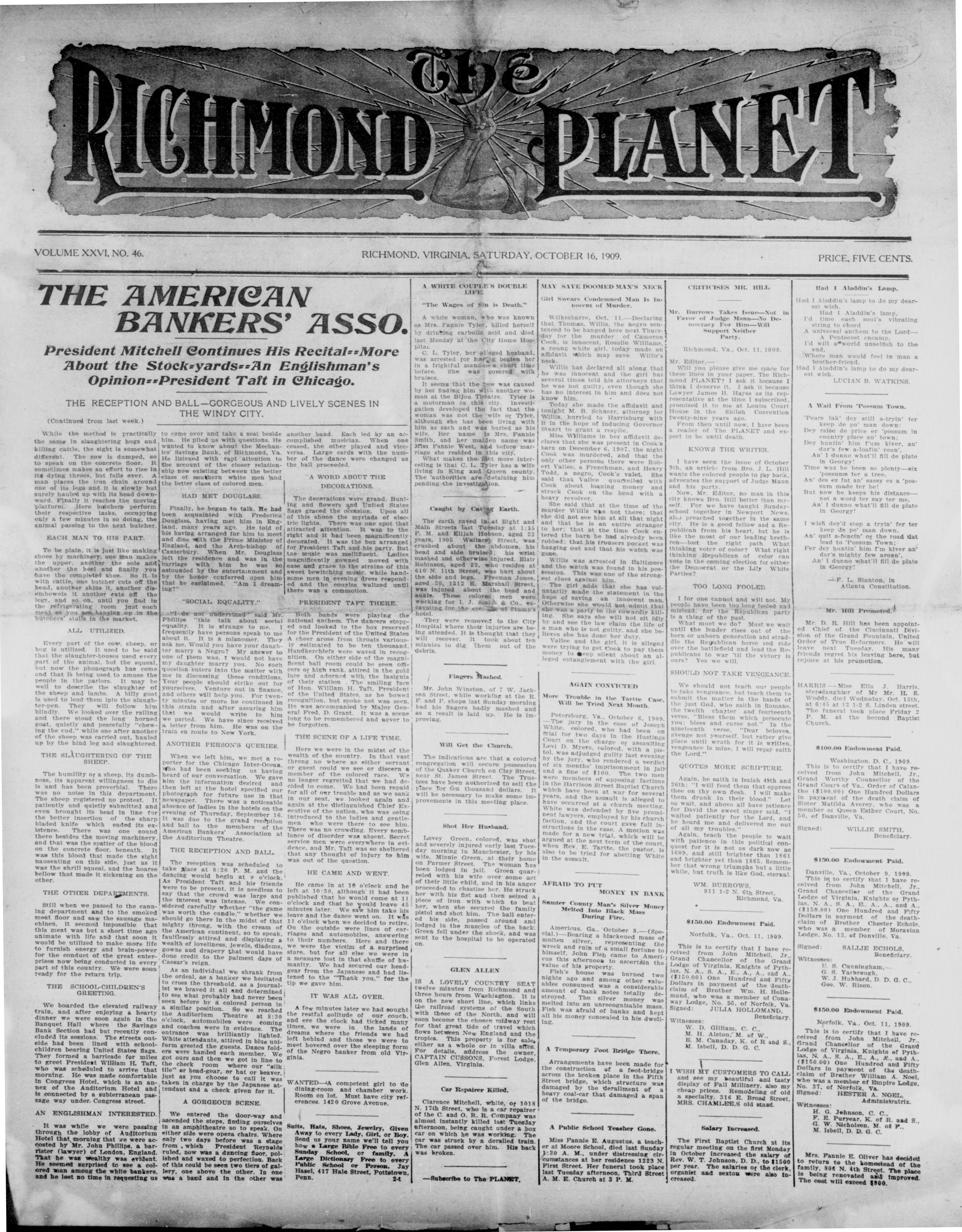
THE AMERICAN BANKERS' ASSO.
President Mitchell Continues His Recital--More About the Stock-yards--An Englishman's Opinion--President Taft in Chicago. THE RECEPTION AND BALL-GORGEOUS AND LIVELY SCENES IN THE WINDY CITY.
VOLUME XXVI, NO. 46.
THE AM
BA
President Mitch
About the S
Opinion--
THE RECEPTION A
(Continued from last week.)
While the method is practically the same in slaughtering hogs and killing cattle, the sight is somewhat different. The cow is dumped, so to speak on the concrete floor. It sometimes makes an effort to rise in its dying throes, but falls over. A man places the iron chain around one of its legs and it is slowly but surely hauled up with its head downward. Finally it reaches the moving platform. Here butchers perform their respective tasks, occupying only a few minutes in so doing, the animal passing to the next butcher.
EACH MAN TO HIS PART.
To be plain, it is just like making shoes by machinery, one man makes the upper, another the sole and another the heel and finally you have the completed shoe. So it is with cattle, one butcher cuts off the head, another skins it, another disembowels it another cuts off the legs, and so on, until you find in the refrigerating room just such meat as you see hanging up in the butchers' stalls in the market.
ALL UTILIZED
Every part of the cow, sheep, or hog is utilized. It used to be said that the slaughter-houses used every part of the animal, but the squeal, but now the phonograph has come and that is being used to amuse the people in the parlors. It may be well to describe the slaughter of the sheep and lambs. A billy goat is used to lead them into the slaughter-pen. They will follow him blindly. We looked over the rallings and there stood the long horned goat, quietly and peacefully "chewing the cud," while one after another of the sheep was carried out, hauled up by the hind leg and slaughtered.
THE SLAGHTERING OF THE
SHEEP.
The humility or a sheep, its dumness, its apparent willingness to die is and has been proverbal. There was no noise in this department. The sheep registered no protest. It patiently and quietly submitted and even brought its head in line for the better insertion of the sharp bladed knife which ended its existence. There was one sound there besides the moving machinery, and that was the spatter of the blood on the concrete floor, beneath. It was this blood that made the sight nauseating on this side, just as it was the shrill squeal, and the hoarse bellow that made it sickening on the other.
THE OTHER DEPARTMENTS
Still when we passed to the canning department and to the smoked meat floor and saw the sausage machines, it seemed impossible that this meat was but a short time ago animate with life and that soon it would be utilized to make more life to furnish energy and brain-power for the conduct of the great enterprises now being conducted in every part of this country. We were soon ready for the return trin.
THE SCHOOL-CHILDREN'S
GREETING
We boarded the elevated railway train, and after enjoying a hearty dinner we were soon again in the Banquet Hall where the Savings Bank Section had but recently concluded its sessions. The streets outside had been lined with schoolchildren bearing United States flags. They formed a barricade for miles to greet President William H. Taff, who was scheduled to arrive that morning. He was made comfortable in Congress Hotel, which is an annex of the Auditorium Hotel and is connected by a subterranean passage way under. Congress street.
AN ENGLISHMAN INTERESTED
It was while we were passing through the lobby of Auditorium Hotel that morning that we were accosted by Mr. John Phillips, a barrister (lawyer) of London, England. That he was wealthy was evident. He seemed surprised to see a colored man among the white bankers, and he lost no time in requesting us
to come over and take a seat beside him. He piled us with questions. He wanted to know about the Mechanics' Savings Bank, of Richmond, Va. He listened with rapt attention to the account of the closer relationship now existing between the better class of southern white men and the better class of colored men.
HAD MET DOUGLASS
Finally, he began to talk. He had been acquainted with Frederick Douglass, having met him in England, many years ago. He told of his having arranged for him to meet and dine with the Prime Minister of England, and the Arch-bishop of Canterbury. When Mr. Douglass left the residence and was in the carriage with him he was so astounded by the entertainment and by the honor conferred upon him that he exclaimed. "Am I dreaming?"
"SOCIAL EQUALITY."
"I do not understand" said Mr. Phillips "this talk about social equality. It is strange to me. I frequently have persons speak to me about it. It is a mismaner. They ask me. Would you have your daughter marry a Negro? My answer to one of them was. I would not have my daughter marry you. No such question enters into the matter with me in discussing these conditions. Your people should strike out for yourselves. Venture out in finance, and others will help you. For twenty minutes or more he continued in this strain and after assuring him that we would write to him we parted. We have since received a letter from him. He was on the train en route to New York.
ANOTHER PERSON'S QUERIES
When we left him, we met a reporter for the Chicago Inter-Ocean, who had been seeking us having heard of our conversation. We gave him the information desired and then left at the hotel specified our photograph for future use in that newspaper. There was a noticeable absence of ladies in the hotels on the evening of Thursday, September 16. It was due to the grand reception and ball to the members of the American Bankers' Association at the Auditorium Theatre.
THE RECEPTION AND BALL.
The reception was scheduled to take place at 8:30 P. M. and the dancing would begin at 9 o'clock. As President Taft and his friends were to be present, it is needless to say that the crowd was large and the interest was intense. We considered carefully whether "the game was worth the candle," whether we should go there in the midst of that mighty throng, with the cream of the American continent, so to speak, faultlessly attired and displaying a wealth of loveliness, jewels, diadems, gowns and drapery that would have done credit to the palest days of Caesar's reign.
As an individual we shrank from the ordeal, as a bander we hesitated to cross the threshold, as a journalist we braved it all and determined to see what probably had never been seen before by a colored person in a similar position. So we reached the Auditorium Theatre at 8:30 o'clock, automobiles were coming and coaches were in evidence. The entrance was brilliantly lighted. White attendants, attired in blue uniform greeted the guests. Dance folders were handed each member. We got ours and then we got in line to the check room where our "silk title" or head-gear, or hat or beaver, just as you choose to call it was taken in charge by the Japanese attendant and a check given for it.
A GORGEOUS SCENE
We entered the door-way and ascended the steps, finding ourselves in an amphitheatre so to speak. On either side were opera chairs. Where only two days before was a stage from, which President Reynolds ruled, now was a dancing floor, polished and waxed to perfection. Back of this could be seen two tiers of gallery, one above the other. In one was a band and in the other was
another band. Each led by an accomplished musician. When one ceased, the other played and vice versa. Large cards with the number of the dance were changed as the ball proceeded.
A WORD ABOUT THE DECORATIONS.
The decorations were grand. Bunting and flowers and United States flags graced the occasion. Upon all of this shone the myriads of electric lights. There was one spot that attracted attention. It was to the right and it had been magnificently decorated. It was the box arranged for President Taft and his party. But the music was mellifluent. Ladies magnificently gowned moved with ease and grace to the strains of this sweet bewitching music, while handsome men in evening dress responded and the couples waltzed until there was a commotion.
PRESIDENT TAFT THERE
Both bands were playing the national anthem. The dancers stopped and looked to the box reserved for the President of the United States. A cheer arose from throats variously estimated to be ten thousand. Handkerchiefs were waved in recognition. On either side of the magnificent ball room could be seen officers or high rank, attired in the gold lace and adorned with the insignia of their station. The smiling face of Hon. William H. Taft. President of the United States, as he bowed recognition, but spoke not was seen. He was accompanied by Major General Fred. D. Grant. It was a scene long to be remembered and never to be forgotten.
THE SCENE OF A LIFE TIME
Here we were in the midst of the wealth of the country. In that vast throng no where as either servant or guest could we see or discern a member of the colored race. We no longer regretted that we had decided to come. We had been repaid for all of our trouble and as we sank in our seat, we looked again and again at the distinguished Chief Executive of the nation, who was being introduced to the ladies and gentlemen who were there to see him. There was no crowding. Every semblance of disorder was absent. Secret service men were everywhere in evidence, and Mr. Taft was so sheltered that any thought of injury to him was out of the question.
HE CAME AND WENT
He came in at 10 o'clock and he left at 10:30, although it had been published that he would come at 11 o'clock and that he would leave 45 minutes later. We saw him take his leave and the dance went on. It was 11 o'clock when we decided to retire. On the outside were lines of carriages and automobiles, answering to their numbers. Here and there we were the victim of a surprised stare, but for all else we were in a measure lost in that shuffle of humanity. We had secured our headgear from the Japanese and had listened to the "Thank you," for the tip we gave him.
IT WAS ALL OVER
A few minutes later we had sought the restful solitude of our couch, and ere the clock had ticked many times, we were in the lands of dreams where the friends we had left behind and those we were to meet hovered over the sleeping form of the Negro banker from old Virginia.
WANTED -A competent girl to do dining-room and chamber work Room on lot. Must have city references. 1420 Grove Avenue.
Suits, Hats, Shoes, Jewelry, Given
Away to every Lady, Girl, or Boy.
Send us your name we'll tell you
how a Large Bible Free to every
Sunday School, or family.
A Large Dictionary Free to every
Public School or Person. Jay
Hasel, 417 Hale Street, Pottstown,
Penn. 24.
A WHITE COUPLE'S DOUBLE LIFE
"The Wages of Sin is Death."
A white woman, who was known as Mrs. Fannie Tyler, killed herself by drinking carbolic acid and died last Monday at the City Home Hospital. C. L. Tyler, her alleged husband, was arrested for having beaten her in a frightful manoeuvre a short time before. She was covered with bruises.
It seems that the new was caused by her finding him with another woman at the Bijou Theatre. Tyler is a motorman in this city. Investigation developed the fact that the woman was not the wife or Tyler, although she has been living with him as such and was buried as his wife. Her name is Mrs. Fannie Smith, and her maiden name was Miss Fannie West, and before marriage she resided in this city.
What makes the fact more interesting is that C. L. Tyler has a wife living in King and Queen county. The authorities are detaining him pending the investigation.
Caught by Caving Earth.
The earth caved in at Eight and Main Streets last Tuesday at 1:15 P. M. and Elijah Hobson, aged 23 years, 1905 Wallace, Street, was crushed about the abdomen, his head and side bruised; his wrist mashed and otherwise injured. Blair Robinson, aged 23, who resides at 610 N. 11th Street, was hurt about the side and legs. Freeman Jones, aged 30, 1812 E. Marshall Street, was injured about the head and ankle. These colored men were working for I. J. Smith & Co., excavating for the crevasse of Stump's hotel. They were removed to the City Hospital where their injuries are being attended. It is thought that they will recover. It took about ten minutes to dig them out of the debris.
Mr. John Winston, of 7 W. Jackson Street, while working at the R. F. and P. shops last Sunday morning had his fingers badly mashed and as a result is laid up. He is improving.
Will Get the Church.
The indications are that a colored congregation will secure possession of the Quaker Church on Clay Street, near St. James Street. The Trustees have been authorized to sell the place for ten thousand dollars. It will be necessary to make some improvements in this meeting place.
Shot Her Husband
Lovey Green, colored, was shot and severely injured early last Tuesday morning in Manchester, by his wife, Minnie Green, at their home on Farmer Street. The woman has been lodged in jail. Green quarreled with his wife over some act of their little child, and in his anger proceeded to chastise her. He struck her with his fist and then seized a piece of iron with which to beat her, when she secured the family pistol and shot him. The ball entered his side, passed around and lodged in the muscles of the back. Green fell under the shock, and was sent to the hospital to be operated on.
GLEN ALLEN
IS A LOVELY COUNTRY SEAT twelve minutes from Richmond and three hours from Washington. It is on the new short line, which links the railroad systems of the South with those of the North, and will soon become the chosen midway rest for that great tide of travel which flows between New England and the tropics. This property is for sale, either as a whole or in villa sites. For details, address the owner, CAPTAIN CUSSONS, Forest Lodge, Glen Allen, Virginia.
Car Repairer Killed.
Clarence Mitchell, white, of 1018 N. 17th Street, who is a car repairer of the C. and O. R. R. Company was almost instantly killed last Tuesday afternoon, being caught under a box car on which he was working. The car was struck by a derailed train. The car passed over him. His back was broken.
—Subscribe to The PLANET
---
MAY SAVE DOOMED MAN'S NECK
Girl Swears Condemned Man Is Incident of Murder.
Wilkesbarre, Oct. 11.—Declaring that Thomas, Willis, the negro sentenced to be hanged here next Thursday for the murder of Cameron Cook, is innocent, Rosalie Williams, a young white girl, today made an affidavit which may save Willie's neck.
Willis has declared all along that he was innocent and the girl has several times told his attorneys that he was not guilty, even though she has no interest in him and does not know him.
Today she made the affidavit and tonight M. B. Schnerr, attorney for Willis, hurried to Harrisburg with it in the hope of inducing Governor Stuart to grant a respite.
Miss Williams in her affidavit declares that she was present in Cook's barn on December 6, 1907, the night Cook was murdered, and that the only other persons there were Robert Valliee, a Frenchman, and Henry Todd, a negro, Cook's valet. She said that Vallee quartelled with Cook about loaning money and struck Cook on the head with a heavy revolver.
She said that at the time of the murder Willis was not there; that she did not see him at all that night and that he is an entire stranger to her; that at the time Cook entered the barn he had already been robbed; that his trousers pocket was hanging out and that his watch was gone.
Willis was arrested in Baltimore and the watch was found in his possession. This was one of the strongest clues against him.
The girl adds that she has voluntarily made the statement in the hope of saving an innocent man. Otherwise she would not admit that she was a party to the cowardly killings. She says she will not sit lily by and see the law claim the life of a man who is not guilty, and she believes she has done her duty. Vallee and the girl, it is alleged were trying to get Cook to pay them money to keep silent about an alleged entanglement with the girl.
AGAIN CONVICTED
More Trouble in the Tartte Case Will be Tried Next Mouth
Petersburg, Va., October 6, 1909.
—The jury in the case of Joseph White, colored, who had been on trial for two days in the Hustings Court on the charge or assaulting Levi D. Myers, colored, with a pistol, was adjudged guilty last evening by the jury, who rendered a verdict of six months' imprisonment in jail and a fine of $100. The two men were members of opposing factions in the Harrison Street Baptist Church which have been at war for several years, and the assault is alleged to have occurred at a church meeting. White was defended by five prominent lawyers, employed by his church faction, and the court gave full instructions in the case. A motion was made for a new trial, which will be argued at the next term of the court, when Rev. E. Tartte, the pastor, is also to be tried for abetting White in the assault.
AFRAID TO PUT
MONEY IN BANK
Sumter County Man's Silver Money Melted Into Black Mass During Fire.
Americus, Ga., October 8.—(Special.)—Bearing a blackened mass of molten silver, representing the wreck and ruin of a small fortune to himself, John Fish came to Americus this afternoon to ascertain the value of his property.
Fish's house was burned two nights ago and among other valuables consumed was a considerable amount of bank notes totally destroyed. The silver money was melted into an unrecognizable mass. Fish was afraid of banks and kept all his money concealed in his dwelling.
A Temporary Foot Bridge There
Arrangements have been made for the construction of a foot-bridge across the broken place in the Fifth Street bridge, which structure was damaged by the derailment of a heavy coal-car that damaged a span of the bridge.
A Public School Teachber Gone
Miss Fannie E. Augustus, a teacher at Moore School, died last Sunday 1:30 A. M., under distressing circumstances at her residence 1223 N. First Street. Her funeral took place last Tuesday afternoon, Third Street A. M. E. Church at 3 P. M.
CRITICISES MR. HILL
Mr. Burrows Takes Issue—Not in Favor of Judge Mann—No Democracy For Him—Will Support Neither Party
Richmond, Va., Oct. 11, 1909
Mr. Editor
Will you please give me space for these lines in your paper, The Richmond PLANET? I ask it because I think I deserve it. I ask it because Lawyer James H. Hayes as its representative at the time I subscribed, promised it to me at Louisa Court House in the Shiloh Convention twenty-nine years ago. From then until now, I have been a reader of The PLANET and expect to be until death.
KNOWS THE WRITER
I have seen the issue of October 9th, an article from Bro. J. L. Hill wants the colored people to pay back, advocates the support of Judge Mann and his party.
Now, Mr. Editor, no man in this city knows Bro. Hill better than myself. For we have taught Sunday-school together in Newport, News, also preached together in the same city. He is a good fellow and a Republican from his heart, but he is like the most of our leading brethren—lost the right path. What thinking voter of color? What right thinking Republican of color can vote in the coming election for either the Democrat or the Lily White Parties?
TOO LONG FOOLED
I for one cannot and will not. My people have been too long fooled and mislead, for the Republican party is a thing of the past.
What must we do? Must we wait until the leader rises out of the born or unborn generation and straddle the Republican horse and ride over the battlefield and lead the Republicans to war 'till the victory is ours? Yes we will.
SHOULD NOT TAKE VENGEANCE
We should not teach our people to take vengeance, but teach them to submit the matter in the hands of the just God, who saith in Romans, the twelfth chapter and fourteenth verse, "Bless them which persecute you; bless and curse not." In the nineteenth verse, "Dear beloved, avenge not yourself, but rather give place until wrath for it is written, vengeance is mine. I will repay saith the Lord."
QUOTES MORE SCRIPTURE
Again, he saith in Isaiah 49th and 26th; "I will feed them that oppress thee on thy own flesh. I will make them drunk in their blood." Let us wait, and above all have patience for David the sweet singer said, "I waited patiently for the Lord, and he heard me and delivered me out of all my troubles."
Again, teach the people to wait with patience in this political conquest for it is not as dark now as 1609, and still brighter than 1861 and brighter yet than 1865. Remember that wrong triumphs but a little while, but truth is like God, eternal.
WM. BURROWS,
911 1-2 N. 6th Street,
Richmond, Va.
$150.00 Endowment Paid
This is to certify that I have received from John Mitchell, Jr.,
Grand Chancellor of the Grand
Lodge of Virginia, Knights of Pythias,
N. A., S. A., E., A., A., and A.,
( $150.00 ) One Hundred and Fifty
Dollars in payment of the death-
claim of Brother Wm. H. Hollowand, who was a member of Conaway Lodge, No. 25, of Norfolk, Va.
Signed: JULIA HOLLOMAND,
Beneficiary.
Witnesses:
W. D. Gilliam, C. C.,
M. H. Alston, M. of W.,
E. M. Canaday, K. of R and S.,
M. Isbell, D. D. G. C.
I WISH MY CUSTOMERS TO CALL
and see my beautiful and tasty
display of Fall Millinery, also my
cheap prices. Remodeling of old
a specialty, 316 E. Broad Street,
MRS. CHAMLEE. 0 old stand
Salary Increased
The First Baptist Church at its regular meeting on the first Monday in October increased the salary of Rev. W. T. Johnson, D. D., to $1500 per year. The salaries of the clerk, organist and sexton were also increased.
PRICE, FIVE CENTS
Had I Aladdin's Lamp.
Had I Aladdin's lamp to do my dearest wish.
Had I Aladdin's lamp.
I'd time each soul's vibrating string to chord
A universal anthem to the Lord—
A Pentecost encamp.
I'd will a*world unselfish to the end.
Where man would feel in man a brother-friend.
Had I Aladdin's lamp to do my dearest wish.
LEGAN R. WAITING
A Wail From 'Possum Town
'Pears lak' dey still a-tryin' ter keep de po' man down;
Dey raise de price er 'possum in country place an' town;
Dey huntin' him f'um kiver, an' dar's few a-loafin' roun',
An' I dunno what'll fill de plate in Georgy!
Time wuz he been so plenty—six 'possums ter a tree.
An' des ez fat an' sassy ez a 'possum made ter be!
But now he keeps his distance—not a word ter say ter me,
An' I dunno what'll fill de plate in Georgy!
I wish dey'd stop a tryin' fer ter keep de po' man down.
An' quit a-fencin' or the road that lead to 'Possum Town;
Fer dey huntin' him f'm kiver an' dar's mighty few aroun',
An' I dunno what'll fill de plate in Georgy!
F. L. Stanton, in Atlanta Constitution.
Mr. Hill Promoted.
Mr. D. R. Hill has been appointed Chief of the Cincinnati Division of the Grand Fountain, United Order of True Reformers. He will leave next Tuesday. His many friends regret his leaving here, but rejoice at his promotion.
HARRIS — Miss Ella J. Harris,
stepdaughter of Mr Mr. H. S.
Waddy, died Wednesday, Oct. 13th,
at 6:45 at 13 1-2 S. Linden street.
The funeral took place Friday 2
P. M. at the Second Baptist
Church.
$100.00 Endowment Paid
Washington, D. C., 1909.
This is to certify that I have received from John Mitchell, Jr.,
Grand Worthy Counsellor of the
Grand Court of Va. Order of Calanthe ($100.00) One Hundred Dollars in payment of the death claim of
Sister Matilda Averey, who was a member of Queen Esther Court, No.
50, of Danville, Va.
Signed: WILLIE SMITH.
Beneficiary.
$150.00 Endowment Paid
Danville, Va., October 9, 1969.
This is to certify that I have received from John Mitchell, Jr.,
Grand Chancellor of the Grand
Lodge of Virginia, Knights of Pythias,
N. A., S. A., E., A., A., and A.,
($150.00) One Hundred and Fifty
Dollars in payment of the death-
claim of Brother Chester Echols,
who was a member of Moravian
Lodge, No. 13, of Danville, Va.
Witnesses:
U. S. Cunningham,
G. S. Yarbrough,
W. J. Hubbard, D. D. G. C.,
Geo. W. Rison.
$150.00 Endowment Paid.
Norfolk, Va., Oct. 11, 1909.
This is to certify that I have received from John Mitchell, Jr.,
Grand Chancellor of the Grand Lodge of Virginia, Knights of Pythias, N. A., S. A., E., A., A., and A. ($150.00) One Hundred and Fifty Dollars in payment of the death-claim of Brether William A. Noel, who was a member of Empire Lodge, No. 37, of Norfolk, Va.
Signed: HESTER A. NOEL,
Administratrix.
Witnesses:
H. G. Johnson, C. C.,
F. E. Puryear, K. of R. and S.,
G. W. Nicholson, M. of F.,
M. Isbell, D. D. G. C.
Mrs. Fannie E. Oliver has decided to return to the homestead of the family. 806 N. 4th Street. The place is being renovated and improved. The cost will exceed $800.
Cervera WA. Sat At £ weet SAN hh Ml, sMndht/zzes itm Mikes MHZ, Cu Miata. ywv wl Woy
rf a eH mA eA, L. AY Se Af. ff € ss # S “ae 4
ae = = - s = = => = = =
I wR N/E] ve] 28 //=> | SSs\Vn= (M8
; a NOE Sp AES of Oe) fe) ee ee
Pee Ze e NOVELIZED BY TOR FA Oh Sp, a wane aS - ss
oe RENN =e THOMPSON. BUCHANAN gst UC TANIN' yo 7, 7, ™ ars O
CE aes pit? Se ee = srt > 74 di A Saeed FT NCS
SS SS x ~FROM THE SUCCESSFUL PLAY. = SS RR ee EES
se eereeara deena ee ee eee ene SS copyrtat, 1008, by Frederic Thompson
ttt ett ea a Ee Ga RS ae oF PERE Tp
. | The git laughed at ble. ea Foes pee it! ment of the big plant on Pinckney’«| “That is awfully sweet of you.
| sou see, it won't stand the highest 3 ae sane Be ear 8: Pinekhee cwaa gaat donating: be man who can invent a new sus
* Nov" he asked, surprise fulness ble Sigler S000 DE Nene Shake Fie attest SOD esis sant Ace Gan areas 4
4 tee oo Van ee ment that the Du Steel we even you might be practically pe
Bem = Novelized by Thompson Buchanan From the | ceca ches ila es As Ses ace nen | se ce ara oe
By WINCHELL SMITH, FREDERIC ¢ | SS ane yet egie ith bls ia. | Hieutenant § d been detatle | ate Cneeee a4
THOMPSON and PAUL ARMSTRONG , . f mone r & N cot Sans aeae. Tae we 2 ile’ guns a good &
TwO
°c ReARainetSs
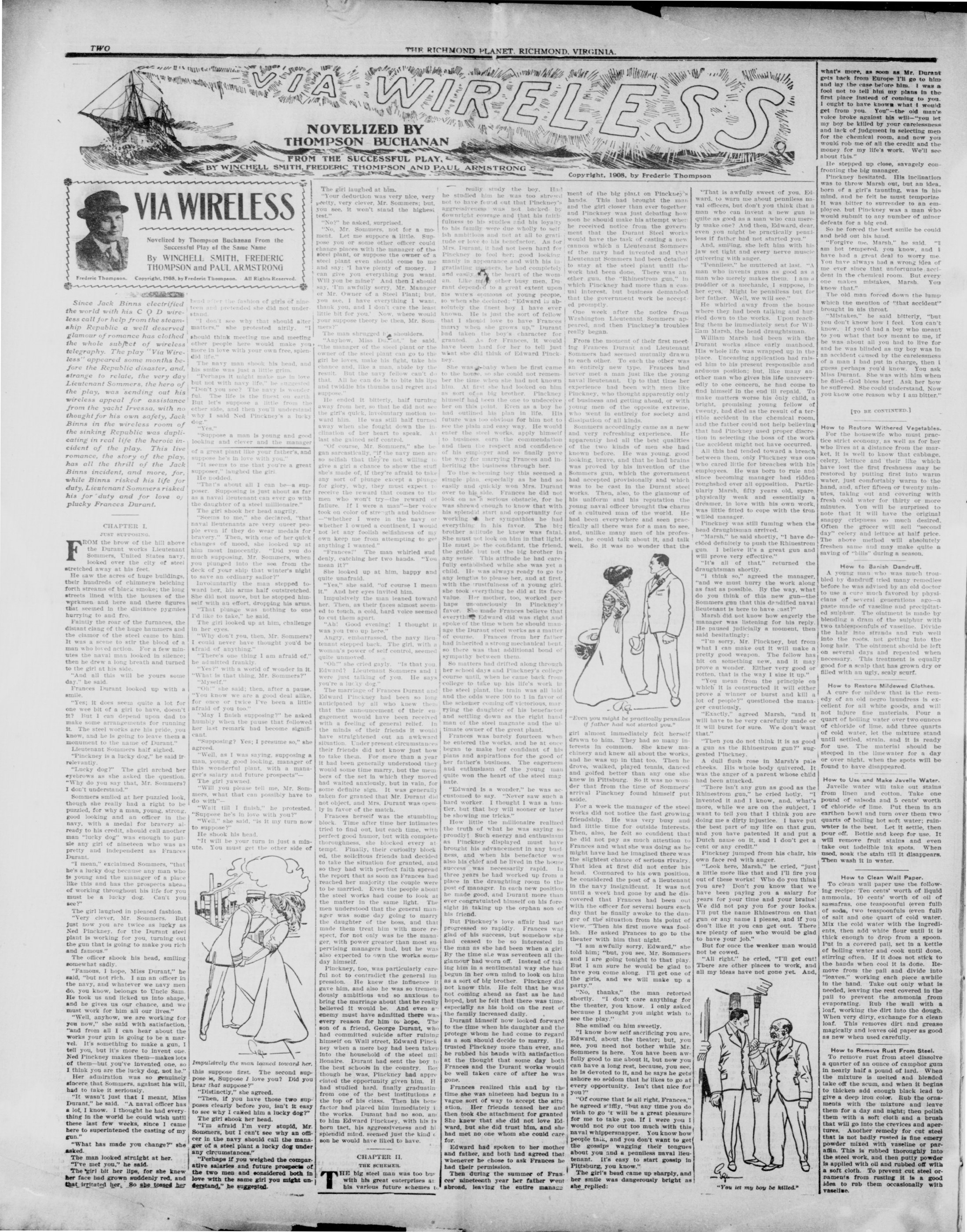
Since Jack Binns electrified
the world with his C Q D wire-
tess call for help from the steam-
ship Republic a well deserved
glamour of romance has clothed
the whole subject of wireless
telegraphy. The play “Via Wire-
less” appeared some months be-
fore the Republic disaster, and,
strange to relate, the very day
Lieutenant Sommers, the hero of
the play, was ‘sending out his
wireless appeal for assistance
from the yacht Irvessa, with no
thought for his own safety, Jack
Binns in the wireless room of
the sinking Republic was dupli-
cating in real life the heroic in-
cident of the play. This live
romance, the story of the play,
has all the thrili of the Jack
Binns incident, and more, for,
while Binns risked his life for
duty, Lieutenant Sommers risked
his for “duty and for love 0,
plucky Frances Durant.
CHAPTER I.
aus aiaebeiaiis
ROM the brow of the hill abore
the Durant works Lieutenant
Sommers, United States navy
looked over the clty of steel
stretched away at his feet
He saw the acres of huge bulldings,
thelr hundreds of chimneys belching
forth streams of blacx smoke; the long
streets lined with the houses of the
wprkmen and here and there figures
that seemed in the distance pygmles
hurrying to and fro.
Faintly the roar of the furnaces, the
Aistant clang of the huge hammers and
the clamor of the steel came to Bim.
It was a scene to stir the blood of a
man who loved action. For a few min
utes the naval man looked in silence:
then he drew a long breath and turned
to the girl at his side
“And all this will be yours some
day.” be said
Frances Durant looked up with a
amlle
“Yes; It does seem quite a lot for
one wee bit of a girl to have, doesn’t
Mt? Rut I can depend upon dad to
make some arrangements for running
Mt. The steel works are his pride, you
Know, and he fs golng to leave them a
monument to the name of Durant.”
Lieutenant Somniers half sighed.
“Pinckney 1s a lucky dog.” he sald tr
relevantis
“Lucky dog?’ The girl arched her
eyebrows as she asked the question.
“Why do you say that, Mr, Sommers?
1 don't understand.”
Sommers smiled at her puzzled look,
though she really had a right to be
puzzled, for why a man, young, strong.
good looking and an ‘officer in the
navy, with a medal for bravery a
ready to his credit, should call another
man “lucky dog” was enough to puz
tle any girl of nineteen who was as
pretty and independent as Frances
Durant
“I mean,” exclaimed Sommers, “that
he's a lucky dog because any man who
4s young and the manager of a place
ike this and has the prospects abeau
of working throughout bis life for you
must be m lucky dog. Can't you
see?"
The girl laughed in pleased fashion.
“Very clever, Mr. Sommers, But
Just now you are twice as lucky as
Ned Pinckney. for the Durant steel
plant is working for you, turning out
the gun that ts going to make you rich
and famous.”
‘The officer shook his head, smiling
somewhat sadly
“Famous, I bope, Miss Durant,” he
said, “but not rich. Tam an officer in
the navy, and whatever we navy men
do, you know, belongs to Uncle Sam.
He took us and licked us into shape,
and he gives us our chance, and we
must work for him all our lives.”
“Well, anyhow, we are working for
you now,” she said with satisfaction,
“and from all I can hear about the
‘works your gun is going to be a mar-
vel. It's something to make a gun, I
‘tell you, but it's more to Invent one.
Ned Pinckney makes them—makes lots
‘of them—but you've invented one, s0
I think you are the lucky dog, not he.”
Her admiration was so genuinely
sincere that Sommers, against his will,
had to take it seriously.
“It wasn't Just that I meant, Miss
Durant.” be said. “A naval officer has
@ lot, I know. I thought he had every.
thing in the world he could wish unti!
these last few weeks, since 1 came
here to superintened the casting of my
gun.”
“What has made you change?” she
asked.
‘The man looked straight at her.
“T've met you,” he said.
‘The ‘girl bit her lips, for she knew
‘Gat irritated her, So abe tossed her
head oer the fashion of girls of nine
teen and pretended she did not under:
etand.
“I don't see why that should alter
matters.” she protested alrily. “I
should think meeting me and meeting
other people here would make yon
more in love with your own free, splen-
did fe.”
} The mavy man shook his head, and
bis smile was Just a little grit.
“Perhaps it inight make me tn love
Dut not with navy life.” be suzcested
/“Don't you see? ‘The navy ts wonder
ful. The life is the finest on earth
But let's suppose a little from the
other side, and then you'll understand
why I sald Ned Pinckney’s a lucky
dog.”
Yes"
“Suppose a man ts young and good
looking and clever and the manager
of a great plant like your fathers, and
suppose he’s tn love with you.”
"Ht seems to me that you're @ great
supposer,” laughed the giri
He nodded,
“That's about all I can be—a sup-
poser. Supposing is just about as far
as a naval ileutenant can ever go with
the daughter of a steel millionaire.”
‘The giri shook her head angrily.
“Seems to me,” she declared, “that
naval Heutenants are very curer peo-
ple even If they do wear medals for
bravery.” ‘Then, with one of her quick
changes of mood, she looked up at
‘him most innocently. “Did you do
much supposing, Mr, Sommers, when
you plunged into the sea from the
deck of your ship that winter's night
to save an ordinary sailor?"
—lnvoluntarlly the man stepped to-
ward her, bis arms half outstretched.
She did not move, but be stopped him-
self with an effort, dropping his arms.
“That plunge was nothing to one
Td like to take.” he said.
‘The girl looked up at bim, challenge
in her eyes.
“Why don't you, then, Mr. Sommers?
T could never have thought you'd be
Afraid of anything.”
There's one thing I am afraid of,”
he admitted frankly.
“Yes ?* with a world of wonder in tt
“What fs that thing, Mr, Sommers?"
Myself.”
“Oh!” she said; then, after a pause,
“You know we are a good deal allke,
for ouce or twice I've been a Lttle
afraid of you too.”
“May I finish supposing?” he asked
humbly when the pause that followed
her last remark had become signifi
cant.
“Supposing? Yes; I presume so,” she
agreed.
“Well, as T was saying, supposing a
man, young. good looking, manager of
this wonderful plant, with a mana-
ger's salary aud future prospects”—
‘The gir! yawned.
“Will you please tell me, Mr, Som:
mers, what that can possibly have to
do with”—
“Walt til I finish," he protested.
“Suppose he's tn love with you?”
“Well.” she said, “is it my turn now
to suppose?”
He shook bis head.
“It will be your turn in Just a min.
ute. You must get the other side of
Bi Ne
NE os .
oe
as
this suppose first. The second sup-
pose ie, Suppose J love you? Did you
hear that suppose?”
“Distinctly,” she agreed.
“Then, if you have those two sup-
Poses clearly before you, isn’t it easy
to see why I caed him a lucky dog?”
‘The girl shook her head.
“I'm afraid I'm very stopid, Mr.
Sommers, but I can't see why an offi
cer in the navy should call the mana.
ger of a steel plant a lucky dog under
any circumstances.”
“Perhaps if you weighed the compar.
ative salaries and future prospects o!
the two men and eonsidered both tx
Jove with the same girl you might un
@erstand,” be suggested.
THE RICHMOND PLANET. RICHMOND, VIRGINIA.
‘The girl laughed at bim.
wtetty, very clever, Mr. Sommers; but,
you see. it won't stand the highest
test."
“No?” he asked, surprised.
“No, Mr. Sommers, not for a mo-
ment, Let me suppore a little. Sup-
Pose Fou or some other officer could
change places with the manager of the
steel plant, or suppose the owner of a
steel plant even should come to me
and say: ‘I have plenty of money. 1
can give you everything you want
Will you be mine? And then I should
say, ‘I'm awfully sorry, Mr, Manager
or Mr. Owner of a Steel Plant; but
you see, 1 have everything I want,
thank you, and I don’t care the least
Uttle bit for you,’ Now, where would
your suppose theory be then, Mr, Som:
The man shrugged hy shoulders.
“Anyhow, Miss Duftut.” he said
“the manager of the steel plant or the
owner of the steel plant can go to the
girl he loves, make his fight, take his
chance and, like a man, abide by the
result. But the nary fellow can't d
that. All he can do ts to bite his lps
and twiddle his thumbs and regret and
suppose
He ended it bitterly, balf turning
away from ber, so that be did not se
the girl's quick, involuntary motion to
ward him. He was still half turned
away when she fought down the
Hination of her heart to speak. A
last she gained self control.
“Of course, Mr. Sommers," she be
gan sarcastically, “if the nary men ar
so selfish that they're not willing
give a girl chance to show the stuf
she's made of, If they're afraid to take
any sort of plunge except a plunse
for glory, why, they must expect 1
receive the reward that comes to ths
men who won't try—the reward of
failure. If I were a man"—her voice
took on color of strength and boldnes
—"whether I were in the navy or
whether I owned a continent, I would
not let any foolish selfishness of mys
fown keep me from attempting to ge?
anything I wanted.”
“Frances!” The man whirled sud
denly, catching her two hands. “You
mean it?"
She looked up at him, happy and
quite unafraid.
“Yes,” she said, “of course I mean
it" And her eyes tnvited him,
Impulsively the man leaned toward
her. ‘Then, as their faces almost seem
ed to touch, a cold, han? voice seemed
to cut them apart.
“Ab! Good evening! I thought it
was you two up here.”
Angry. embarrassed, the navy Hew
tenant stepped back, The girl, with a
woman's power of self control, seemed
quite unmoved
“Oh! she cried gayly. “Is that you.
Edward? Lieutenant Sommers and |
were just talking of you. He says
you're a lucky dog.”
‘The marriage of Frances Durant and
Edward Pinckney had been so long
anticipated by all who knew the
that the announcement of their en
Kagement would have been received
with a feeling of general rellef. In
the minds of thelr friends it woul
have strafghtened out an awkward
situation. Under present circumstances
their friends did not know just how
to take them. For more than a year
it had been generally understood they
would some time marry, but the meni
bers of the set in which they mored
had waited anxiously, but in vain, for
some definite sign. It was generally
taken for granted that Mr, Durant dic
| not object, and Mrs. Durant was open.
ly in favor of the match.
| “Frances berself was the stumbling
block. Time after time her intimates
tried to find out, but each time, wit
perfect good humor, but with complete
thoroughness, she blocked every at
tempt. Finally, their curiosity block
ed. the solicitous friends bad decided
to take the situation for granted, anc
fo they had with perfect faith sprea¢
the report that as soon as Frances bac
reached her majority the couple wers
to be married. Even the people abou
the steel works had come to look a
the matter in the same Hight. The
men understood that the general man
ager was some day golng to marry
the daughter of the boss, and thal
made them treat him with more re
spect, for not only was he the mana
ger, with power greater than most su
pervising managers had, but he wa:
also expected to own the works som
day himself.
Pinckney, too, was particularly care
ful not to contradict the general im
pression. He knew the Influence |
gave him, and also he was so tremen
dously ambitious and so anxious t
bring the marriage about that he reall;
believed 1t would be. And even ao:
enemy must have admitted there wa.
every reason for him to hope. Th:
fon of a friend, George Durant, wh:
had committed suicide after ruinin;
himself on Wall street, Edward Pinck
ney when a mere boy bad been take
fnto the household of the steel mi
Nonaire. Durant had sent the boy t
‘the best schools In the country. To:
‘though he was, Pinckney bad appre
ciated the opportunity given him. 1H
had studied bard. finally graduatin
from one of the best institutions +
the top of bis class. Then his bene
factor had placed him immediately i
‘the works. Durant had no son. am
to him Baward Plackney. with bis ts
CHAPTER 11
THE SCURMER.
HE big steel man was too bus
I with bts great enterprises a:
bis various future schemes 1
‘BOL LO Rae F0UNS CUS that Packney
Aggressiveness was not backed. by
downrizht courage and that bis fatth
tuniten 40 bis studiea Ba Was’ Gentes
to his family were due wholly to self
Ish ambitions and tot at ail to grati
tude or love to ils benefactor, As for
Mrs. Durant, it had wot been hard for
Pinckney to foot her: good looking
manly in appearance and with bis in
gratiating wgpners. be bad completely
and wasils the heart of the wom
an. Like mg@} other busy men, Du
rant depended to a great extent upon
hiv WiTe's opinions of young people,
to when she dechired: “Edward is ab-
rolutely the nest boy I have ever
known. He Is just the sort of fellow
that I should love to have Frances
many when she grows up,” Durant
bad taken the boy's character for
granted. As for Frances, it would
have been hard for her to tell just
What sbe did think of Edward. Pinck
She wasyebaby when be first came
to the house, » she could not remem
ber the time wheu she had not known
him, At first she had looked on him
Ws sort ofsa big brother. Pinckney
himself had been the one to undeceive
her on thix point. Even a a boy he
bad outlined bis plan in life. His
future was too obvious for him not to
tee the plain and easy way, He would
enter the steel works, apply. bimself
to business, earn the commendation
and then the respect and confidence
of bis employer and so finally pave
the way for marrying Frances and in.
heriting the business through her.
To the scheming bey this seemed a
simple plan, especially as he had so
easily and quickly won Mra. Durant
over to hig site. Frances he @id not
look on ash serious obstacle, for he
was shrewd enough to know that with
his splendid start and opportunity for
working W her sympathies be had
everythings in his favor. The biz
brother aititude he knew was fatal
She must not look on Lim in that light
| He must be the confidant, the frlend,
the guide. but not the big brother in
any sense This attitude he had care-
| fully established while she was yet a
child. He was always ready to go to
| any lengtlis to please her, and at first,
with the ‘rustfuiness of @ young girl
she took everything he did at Its face
Yalue. Her mother, too, worked per
haps unconsciously in Pinckney's
eversthiS® Edward did was right and
spoke of the time when te should mau:
| age the Durant stect works asa matter
of course. Frances from her father
had inherited a strong mechanical bent.
© there wax that additional bond of
sympathy between them:
‘So matters had drifted along throush
her school days and Pincknes's college
course until, when be came back fror
{college to take up his life's work tr
the steel plant, the train was all lald
and the odds were 100 to 1 in favor of
the schemer coming off victorious, mar
Tying the daughter of his benefactor
{and settling down as the right hand
‘man of the steel magnate and the w
timate owner of the great plant.
| Frances was barely fourteen wher
The entered the works, and he at once
| besan to make her confidant cf bis
Plans and aspirations for the good of
ber father’s business, ‘The eagerness
and enthustasin of the young ma
quite won the heart of the steel maz
nate.
“Edward ts a wonder.” he was ac
customed to say. “Never saw such a
hard worker. I thought I was a hus.
tler, but that boy will sooner or later
be showing me tricks.”
How little the mullllonaire realized
the truth of what he was saying so
Proudiy! Such energy and enthusiasm
as Pinckney displayed must have
brought his advancement in any bust
Bess, and when his benefactor ws
also his chfef and he lived in the house
success Was necessarily rapid. tu
three years be had worked up from a
Place in the draughting room to the
post of manager. In cach new position
he made good, and Durant more than
ever congratulated himself on his fore
sight in taking up the orphan son of
his friend.
But Pinekney’s love affair had not
Progressed so rapidly. Frances was
glad of his success, but somehow be
had ceased to be so interested in
the man as she had been when a girl
By the time sLe was seventeen all th
glamour bad worn off. Instead of tuk
ing him in a sentimental way she hac
begun in her own mind to look on him
as a sort of big brother. Pinckney ald
not know this. He felt that he wa:
| not coming ahead as fast as be had
‘hoped, but he feit that there was time
expecially as bis hold on the rest of
| the family increased daily.
Durant himself now looked forward
| to the time when bis daughter and the
| protege whom he had come to regard
As a son should decide to marry. He
| trusted Pinckney more than ever, and
be rubbed his hands with satisfactior
Jat the thought that some day bot!
Frances and the Durant works woulk
be well taken care of after he was
gone.
Frances realized this and by th
time she was nineteen had begun in 4
Vague sort of way to accept the situ
ation, Her friends teased her ani
then took the attachment for granted
She knew that she did not love Ed
ment of the big plant on Pinckney"
hands. ‘This had brought the man
and the girl closer than ever together
and Pinckbey was Just debating how
‘soon be should make his attempt wher)
he received notice from the govern
ment that the Durant Steel works
‘would have the task of casting a new
cannon which a Lieutenant Sommers
ef the navy had invented and that
Lieutenant Sommers had been detailed
to stay at the steel plant until the
work had been done. There was an
other gua. the “Rhinestrom gun,” In
which Pinckney had more than a cas.
ual Interest. but business demanded
that the government work be accept
ed. promptly.
| One week after the notice from
Weshington Lieutenant Sommers ap-
peared, and then Pinckney’s troubles
really began.
| From the motuent of thelr frst meet
ing Frances Durant and Lieutenant
Sommers had seemed mutually drawt
to each other. To each the other wa:
an entirely new type. Frances had
never meta man just like the young
naval Heutenant. Up to that time her
experience bad been with men Like
Pinckney, who thought apparently on!3
of business and getting ahead, or witt
young mep of the opposite extreme
Who went in entirely for society and
dissipation of all kinds.
Sommers accordingly came as a new
and very refreshing experience. He
apparentiy hnd all the best qualities
of the two kinds of men she had
known before. He was young, goot
looking, brave, and that he had brains
was proved by bis invention of the
Sommers gun, which the government
had accepted provisionally and. whicl
was to be cast in the Durant stee
works. Then, also, to the glamour o:
his uniform and bis reputation the
young naval officer brought the charn
of @ cultured man of the world. He
had been everywhere and seen prac
tically all there was for a man to see
and, unlike many men of his profes
sion, he could talk about it, and talk
well. So it was no wonder that the
;
cd u of >
7
sai O
girl almost Immediately felt herself
drawn to bim. ‘They bad so many in
terests in common, She knew ma
jchinery and knew ail about the works
and he was up In that too. ‘Thea he
drove, walked, played tennis, danced
and golfed better than any one she
knew In Pittsburg. So it was no won
der that from the time of Sommers’
arrival Pinckney found himself put
aside.
For a week the manager of the steel
works did not notice the fast growing
friendship. He was very busy und
had little time for outside {nterests
‘Then, also, he felt so confident that
he did not pay as much attention to
Frances and what she was doing as he
might have had he Imagined there was
the slightest chance of serious rivalry
That idea at first did not enter, his
head. Compared to his own position
he considered the post of a Heutenant
in the navy Insignificant. It was not
until a week had gone by and he dis
covered that Frances had been out
with the officer for several hours each
day that he finally awoke to the dan:
ger of the situation from his point of
view. —Then his first move was fool
ish. “He asked Frances to go to the
theater with bim that night.
“Lam awfully sorry, Edward,” she
told him; “but, you see, Mr. Sommers
and I are going tonight to that play
But I am sure he would be glad to
have you come along. I'll get one of
the girls, and we will make up a
party.”
“No, thanks,” the man _ retorted
shortly. “I don’t care anything for
the theater, you know. 1 only asked
because I thought you might wish tw
see the play.”
She smiled on him sweetly.
“I know how self sacrificing you are,
Edward, about the theater; but, you
see, you need not bother while Mr.
Sommers is here. You have been aw:
fully good to me about it, but now you
can have a long rest, because, you see,
he is devoted to it, and he says he gets
ashore so seldom that he likes to go at
every opportunity. Isn't that nice for
you?”
“Of course that is all right, Frances,”
he agreed s'Iffty, “but any time you de
wish to go ‘t will be a great pleasure
for me to take you. If i were you !
‘would not go out too much with this
naval whippersnapper. You know bow
| people tai, and you don’t want to get
the gossips wagging thelr tongue:
about you and « peaniless naval liew
tenant. It's easy to start gossip tu
pe you know.”
The girl's bead came up sharply, and
ber smile was dangerously bright a:
ashe replied:
‘val oficers, but don’t you think that 9
man who can invent a new gun Is
quite as good as a man who can mere-
ly make one? And then, Edward, dear.
even yon might be practically penrt-
less If fathor had not started you."
And, smiting, she left him with bis
Jaw set tight and every nerve muscle
quivering with anger.
“Penniless.” he muttered at last. “A
man who itvents guns as good as a
man who merely makes them. [am 0
puddier of a mechanle, 1 suppose, 11
her eres. Might be pennitess bat for
her father, Well, we will see.”
“He whirled away from the house
where they had been talking and hur
‘tied down to the works. Upon reach
Ing them he immediately seut for Wit
Ham Marsh, the head draughtsman.
William Marsh had been with the
Durant works since early manhood.
His whole life was weapped up in the
place. Unceasing application had rals-
ed him to bis present responsible and
arduous position; but, ke many ap
other man who gives his life unresere-
edly to one concern, he had come to
find bimself In the end {il repaid. ‘To
make matters worse his duly child, a
bright, promising young fellow of
twenty, bad died as the result of a ter
tible accident in the chemical room,
‘aud the father could not help belleving
that had Pinckney used proper discre-
tion In selecting the boss of the work
tue accident might not have occurred.
| All this bad tended toward a breach
‘between them, only Pinckney was one
who cared Hitle for breaches with his
employees. He was born to rule and
since becoming manager had ridden
roughshod over all opposition. Partie:
ularly Marsh, fifty years old, spare
physically weak and essentially a
dreamer, tn love with his own work,
was little fitted to cope with the trop
“willed manager.
Pinckney was still fuming when the
head draughtsman arrived.
“Marsh,” he said shortly, “I have de-
cided definitely to push the Rhinestrom
gun 1 belleve it's a great gun and
will prove very effective.””
“Ive all of that" returned the
Graughtsman shortly.
“1 think $0," agreed the manager,
‘and we must burry the work along
a8 fast as possible. Ry the way, what
do you think of this new gun—the
Sommers gun that this dendified naval
Neutenant is bere to have cast?*
Marsh did uot know how eagerly the
manager was listening for bis reply.
He paused judicially a moment, then
said besitatingly:
“I'm sorry, Mr. Pinckney, but from
what 1 can make out ft will make a
pretty good weapon. ‘The fellow has
hit on something new, and It may
prove a wonder. Either very good. of
rotten, that i the way I size {t up.”
“You mean from the principle on
which It is constructed It will either
prove a winner or burst and kill a
Jot of people?" questioned the mana-
ger cautiously.
“Exactly.” agreed Marsh, “and it
will bave to be very carefully made or
it will burst for sure. We don't want
that”
“Then you do not think It Is as good
a gun as the Rbinestrom gun?’ sug:
gested Pinckney.
A dull flush rose in Marsh's paie
cheeks. His whole body quivered. It
was the anger of a parent whose child
had been attacked.
“There isn't any gun as good as the
Rhinestrom gun," he erled hotly. “I
invented It and’ 1 know, and, what's
more, while we are on the subject, I
want to tell sou that 1 think you are
doing me s dirty injustice. I have put
the best part of my life on that gun,
and sou bave patented it and put a
Dutch name on it, and 1 don't get a
cent or any credit.”
Pinckney jumped from bis chair, bis
own face red with anger.
“Look here, Marsh.” he cried, “Just
a little more like that and I'll fire you
out of these works! Who do you think
you are? Don't you know that we
have been paying you a salary fo
years for your time and your brains
We did not pay you for your looks
Yl put the name Rhinestrom on that
gun or any name I please, and 1f you
don't lke It you can get out. ‘There
are plenty of men who would be giad
to have your job.”
But for once the weaker man would
not be cowed.
“All right.” he erled, “Tl get cut
‘There are other places to work, and
ee ee ae ee ae Seen Do
ih
what’ more, ax soon as Mr. Durant
gets back from Europe Tl go to hiss
and lay the Se 1 was @
fool not to tell bint my plans in the
first place Instead of coming to you.
1 ought to have knowm what t would
get from you. You"—the old man's
Yolce broke against bis will—“you tet
my boy be killed by sour carelessness
and lack of Judgment in selecting men
for the chemical room, and now you
would rob me of all the credit and the
money for my life's work, We'll see
about this”
He stepped up close, savagely cov
fronting the big manager.
Pinckney hesitated. His inclination
was to throw Marsb out, but an idea.
born of a girl's taunting, was tn his
mind, and he felt he must temporize
It was bitter to surrender to an em-
‘ployee. but Pinckney was a man who
Would submit to avy number of minor
defeats for a big end
So he forced the best smile he could
and held out bis hand
“Forgive me. Marsh.” he said. “t
'am hot tempered, you know, and 1
have had a great deal to worry me
You have always had @ wrong idea of
me ever since that unfortunate acct
[dent in the chemical room. But every
foe makes mistakes, Marsh. Yoo
know that.”
The old man forced down the lump
which the mention of *that accident”™
brought In als throat.
Mistakes,” he sald bitterly, “but
you don't know how I feel, You can't
know. If you'd had a boy who meant
to you what that boy meant to me, if
he was about all you had to live for
and be was blinded as my boy was tn
an accident caused by the carelessness
of a man 1 had put tn charge, then t
Euess perhaps you'd know. You ask
Miss Durant. She was with him when
he ied—God bless her! Ask ber bow
he suffered. She could understand, Now
you kuow one reason why { am bitter.”
[ro ne contiNvED.} e
How to Restore Withered Vegetables.
For the housewife who must prac-
tice strict economy, as well as for her
who lives at a distance from the mar-
ket, it Is well to know that cabbage,
celery, lettuce and their tke which
have lost the first freshness may be
restored by putting first into warm
water, Just comfortably warm to the
hand, and, after fifteen or twenty min-
utes, taking out and covering with
fresh cold water for thirty or more
minutes, You will be surprised to
note that it will have the original
snappy crispness so much desired.
Often the grocer will sell “second
day” celery and lettuce at half price.
The above method will absolutely
freshen same and may make quite a
saving of “bills” during # season.
P Mew te Banish Dandruff.
| A 7eeas mas who was mach trou-
bled by dandruff tried many remedies
Defore he was advised by an old doctor
‘to use a cure much favored by physt
‘clans of several generations ago—a
Paste made of vaseline and precipitat-
ed suipbur. ‘The ointment is made by
blending a dram of the sulphur with
‘two tablespoonfuls of vaseline. Divide
the hair Into strands and rub well
into the roots, not getting Into the
Jong hair. ‘The olntment should be left
‘on several days and repeated when
Recessary, This treatment is equally
good for a sealp that has grown dry oF
filled with an ugly, sealy scurt.
| Sher O6 Renters MRaaned Clethes,
| A cure for mildew that is the rem-
edy of an old negro laundress ts ex-
‘cellent for all white goods, and wil!
not tnjure fine materials. Pour a
quart of boiling water over two ounces
of chloride of lime, add three quarts
of cold water, let the mixture stand
‘until settled, strain, and it ts ready
for use. The materia! should be
steeped in the limewater for a day
or over night, when the spots will be
found to bave disappeared.
How to Use and Make Javelle Water.
Javelle water will take out stains
from linen and cotton. Take one
pound of salsoda and 5 cents’ worth
Of chloride of lime. Put them in an
earthen bow! and turn over them two
quarts of boiling hot soft water; rain-
‘water fs the best. Let {t settle, then
Pour off. Bottle and keep for use. It
will remove fruit stains and even
‘take out {delfble ink spots. When
Used, soak the stain till it disappears,
‘Then wash it In water.
Steer Se teem Sil Gi
To clean wall paper use the follow-
ing recipe: Ten cents’ worth of liquid
ammonia, 10 cents’ worth of ofl of
sassafras, one teaspoonful (even full)
of soda, two teaspoonfuls (even full)
of salt and one quart of cold water.
‘Mix the cold water with the ingredi-
ents, then add white flour until it is
thick enough to drop from a spoon.
Put tn a covered pail, set in a kettle
of bolling water and cook until done,
stirring often. If it does not stick to
the hands when cool it is done. Re-
move from the pail and divide into
“loaves.” working each piece awhile
in the hand. Take out only what Is
needed, Jeaving the rest covered in the
pail to prevent the ammonia from
evaporating. Rub the wall with a
loaf, working the dirt into the dough.
When very dirty, exchange for a clean
loaf. This removes dirt and grease
magically and leaves old paper as good
as new when used carefully.
‘Hew te Remove Rust Sram Ginel,
‘To remove rust from steel dissolve
& quarter of an ounce of camphor gum
in nearly haif a pound of lard. When
the mixture is melted and blended
take off the scum, and when it begins
to thicken add enough black lead to
give a deep iron color. Rub the orna-
ments with the mixture and leave
them for a day and night; then polish
them with « soft cloth and a brush
that will go into the crevices and aper-
tures, Another remedy for cut steel
that is not badly rusted is fine emery
powder mixed with vaseline or par-
Alin, This is rubbed thoroughly into
the steel work, and then putty powder
4s applied with ofl and rubbed off with
& soft cloth. To prevent cut steel or-
Paments from rusting it tf» a good
idea to rub them occasionally with
vaselive.
THE PLANET
SATURDAY...OCTOBER 16, 1909
Scrap Book
Vain Sacrifice.
Apropos of examinations and their terrors, the secretary of the department of education of New York told at a dinner an odd story of a young African prince.
"This prince," said the secretary, "entered Yale or Harvard—I forget which—and amused himself with motorcars and bulldogs till examination time drew near. Examination time frightened the young prince horribly. He began to study, and he cabled home to the king his father:
"Examination next week. Most difficult. Impire aid of gods in my behalf."
"A few days later this reply came back from the barbarous west coast monarch:
"Rites performed. Fourteen picked youths, all sons of nobles, have been sacrificed. Omens propitious."
"Yet, would you believe it," the secretary concluded, "the young prince flunked."
One Soul.
Could any little lamp, though lifted high,
Lighten the void abysses of the sky?
Could a faint rose leaf blown into the sea
Perfume the oceans of immensity?
Could one chord sound in melody so far
That all space echoed to the farthest star?
And yet your soul amid the infinite
Makes all a fragrant harmony of light!
—Charles Buxton Going in Century.
Mother Was to Blame.
Jock and Annie were to get married, and she had conided to him that her age was twenty. After the ceremony and festivities were over they both went home and retired for the night. Annie's mother resided next door and, being up early the following morning, thought she would give the happy couple a "rap up."
On the way to their door she suddenly remembered it was Annie's birthday. Knocking loudly at the door, she hawled out:
"Come away, Annie! Get up! Ye ken ye're thirty the day."
Jock, who was to hear the voice, astonished his mother-in-law by shouting:
"For guidance' sake, get up, Annie, for we've sleepen ten years."
A. Mean Trick:
A lawyer in a London court, defending a promissory note, went to lunch, leaving his books and citations on the table in the courtroom. The opposing counsel sneaked back into the room and changed the places of all his bookmarks. In the afternoon the lawyer, taking up his books, referred the court to his authorities. His lordship noted every volume and page carefully and took the case under consideration. In rendering his opinion he said:
"I was inclined after hearing argument of counsel for defendant to nonsuit plaintiff, but I find after referring to the authorities quoted by counsel none of them bear on this case, and I am led to think that the gentleman has been wilfully trying to insult the court. He has referred me to an action of an Irishman who sued the proprietor of a monkey for damages for biting him, to a case of arson, one of burglary, two of petty larceny and three divorce cases, none of which bears on an action to recover on a promissory note. Perhaps the grossest insult to the court is referring to 'Duckworth versus Boozyman,' an action charging defendant with breach of promise. Judgment for plaintiff with costs."
The lawyer never knew what the matter was and to this day thinks the judge was out of his mind.
The Finisher
On board one of England's warships a marine who had said he was by trade a piano finisher was employed with the carpenter's crew.
One day the carpenter was sent for and asked if he could repair a hole in the veneer of the wardroom piano, which had been burnt by an officer laying down on it a lighted cigar. Of course he recommended the said marine, who was at once sent for.
Somehow, however, work did not seem to progress, and being taxed with the delay, Joe said:
"But this job is not in my line, sir."
"Not in your line?" was the reply.
"But you said you were a piano finisher."
"Yes, so I was, sir," said he, "but the very last job on the piano is the taking of it home."
The Way to Happiness.
To look fearlessly upon life; to accept the laws of nature, not with meek resignation, but as her sons, who dare to search and question; to have peace and confidence within our souls—the are the beliefs that make for happiness.—Meaterlink.
The Poet's Retort
Joaquin Miller was once overtaken by a countryman, who gave him a long ride. Tired at length of conversation, the poet took a novel from his pocket.
"What are you reading?" said the countryman.
"A novel of Bret Harte's," said Mr. Miller.
"Well, now, I don't see how an immortal being wants to be wasting his time with such stuff."
"Are you quite sure?" said the poet.
"that I am an immortal being?"
"Of course you are."
"If that is the case," responded Miller. "I don't see why I need be so very economical of my time."
THE SPORTING WORLD
THE SPORTING WORLD
Bush a Sensation.
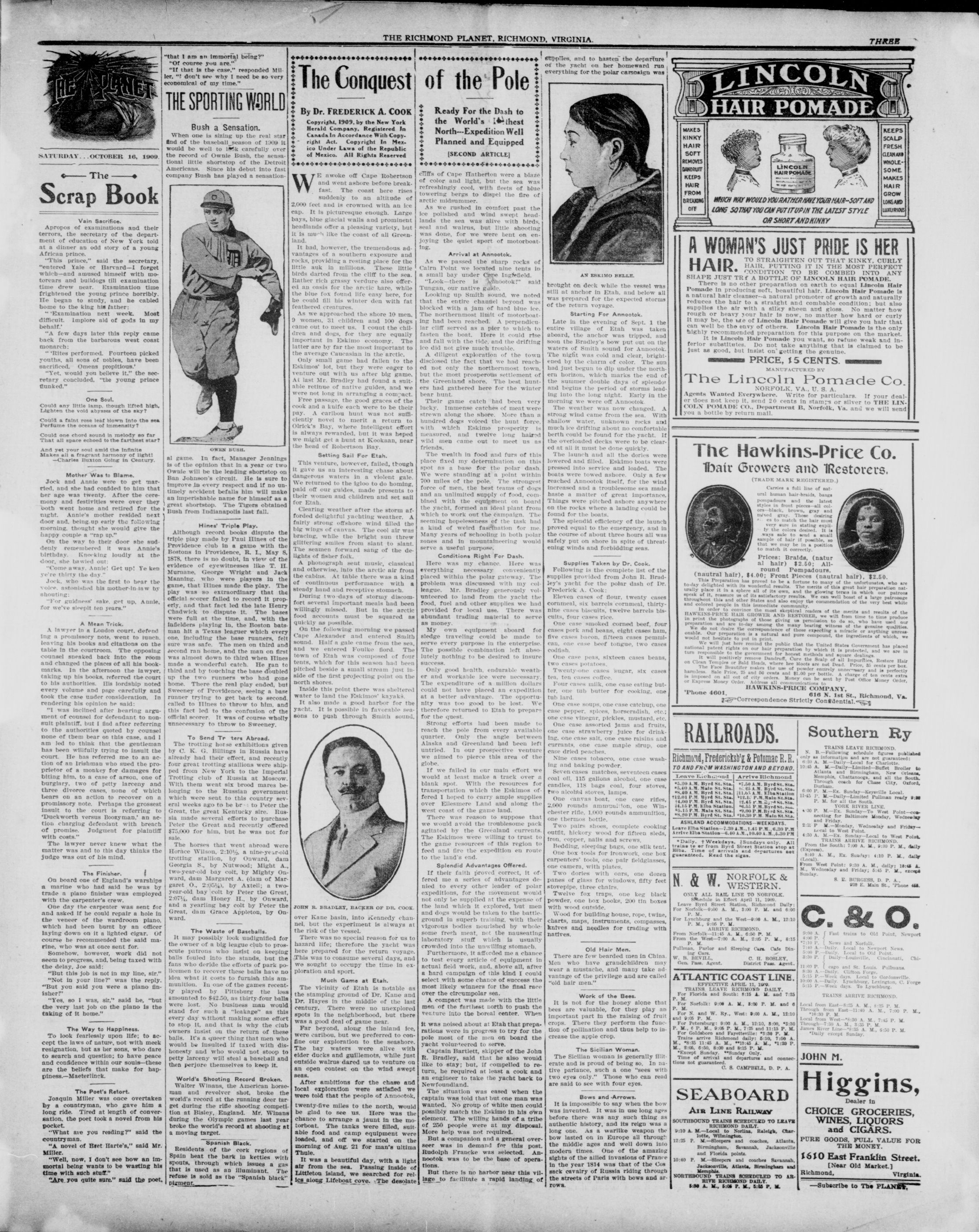
When one is sizing up the real star and of the baseball season of 1909 it would be well to look carefully over the record of Ownie Bush, the sensational little shortstop of the Detroit Americans. Since his debut into fast company Bush has played a sensation-
D
al game. In fact, Manager Jennings is of the opinion that in a year or two Ownie will be the leading shortstop on Ban Johnson's circuit. He is sure to improve in every respect and if no untimely accident befalls him will make an impermissible name for himself as a great shortstop. The Tigers obtained Bush from Indianapolis last fall.
Hines' Triple Play.
Although record books dispute the triple play made by Paul Hines of the Providence club in a game with the Bostons in Providence, R. I., May 8, 1878, there is no doubt, in view of the evidence of eyewitnesses like T. H. Murnane, George Wright and Jack Manning, who were players in the game, that Hines made the play. The play was so extraordinary that the official scorer failed to record it properly, and that fact led the late Henry Chadwick to dispute it. The bases were full at the time, and, with the infelders playing in, the Boston batsman hit a Texas leaguer which every one, including the base runners, felt sure was safe. The men on third and second ran home, and the man on first was almost down to third when Hines made a wonderful catch. He ran to third and by touching the base doubled up the two runners who had gone home. There the real play ended, but Sweeney of Providence, seeing a base runner trying to get back to second, called to Hines to throw to him, and this fact led to the confusion of the official scorer. It was of course wholly unnecessary to throw to Sweeney.
To Send Tr ters Abroad.
The trotting horse exhibitions given by C. K. G. Billings in Russia have already had their effect, and recently four great trotting stallions were shipped from New York to the Imperial Trotting club of Russia at Moscow. With them went six brood mares belonging to the Russian government which were sent to this country several weeks ago to be bred to Peter the Great, the great Kentucky sire. Russia made several efforts to purchase Peter the Great and recently offered $75,000 for him, but he was not for sale.
The horses that went abroad were Horace Wilson, $2.40\%$ a nine-year-old trotting stallion, by Onward, dam Georgia S., by Nutwood; Might A., two-year-old bay colt, by Mighty Onward, dam Margaret A. (dam of Margaret O., $2.05\%$), by Axell; a two-year-old bay colt by Peter the Great, $2.07\%$, dam Honey H., by Onward, and a yearling bay colt by Peter the Great, dam Grace Appleton, by Onward.
The Waste of Baseballs
It may possibly look undignified for the owner of a big league club to prosecute patrons who insist on keeping balls fouled into the stands, but the fans who decide the efforts of park policemen to recover these balls have no idea what it costs to furnish this ammunition. In one of the games recently played by Pittsburg the loss amounted to $42.50, as thirty-four balls were lost. No business man would stand for such a "leakage" as this every day without making some effort to stop it, and that is why the club owners insist on the return of these balls. It's a queer thing that men who would be insulted if taxed with dishonesty and who would not stoop to petty larceny will steal a baseball and then perjure themselves to keep it.
World's Shooting Record Broken.
World's Shooting Record Broken. Walter Winans, the American horseman and revolver shot, broke the world's record at the running deer target during the rite shooting competition at Bisley, England. Mr. Winans during the Olympic games last year broke the world's record at shooting at a moving target.
Spanish Black.
Residents of the cork regions of Spain heat the bark in kettles with spouts, through which issues a gas that is used as an illuminant. The refuse is sold as the "Spanish black" pigment.
THE RICHMOND PLANET, RICHMOND, VIRGINIA
The Conquest
By Dr. FREDERICK A. COOK
Copyright, 1909, by the New York Herald Company, Registered In Canada In Accordance With Copyright Act. Copyright In Mexico Under Laws of the Republic of Mexico. All Rights Reserved
WE awoke off Cape Robertson and went ashore before breakfast. The coast here rises suddenly to an altitude of 2,000 feet and is crowned with an ice cap. It is picturesque enough. Large bays, blue glacial walls and prominent headlands offer a pleasing variety, but it is much like the coast of all Greenland.
It had, however, the tremendous advantages of a southern exposure and rocks, providing a resting place for the little auk in millions. These little birds darted from the cliff to the sea. Rather rich grassy verdure also offered an oasis for the arctic hare, while the blue fox found life easy here, for he could fill his winter den with fat feathered creatures.
As we approached the shore 10 men, 9 women, 31 children and 100 dogs came out to meet us. I count the children and dogs, for they are equally important in Eskimo economy. The latter are by far the most important to the average Caucasian in the arctic.
Only small game had fallen to the Eskimos' lot, but they were eager to venture out with us after big game. At last Mr. Bradley had found a suitable retinue of native guides, and we were not long in arranging a compact. Free passage, the good graces of the cook and a knife each were to be their pay. A caribou hunt was not sufficiently novel to merit a return to Olrick's Bay, where intelligent effort is always rewarded, but it was heped we might get a bunt at Kookaan, near the head of Robertson Bay.
Setting Sail For Etah.
This venture, however, failed, though it gave us an interesting chase about dangerous waters in a violent gale. We returned to the igloo to do homing, paid off our guides, and made presents to their women and children and set sail for Etah.
Clearing weather after the storm afforded delightful yachting weather. A fairly strong offshore wind filled the big wings of canvas. The cool air was bracing, while the bright sun threw glittering smiles from slant to slant. The seamen forward sang of the delights of fisher folk.
A phonograph sent music, classical and otherwise, into the arctic air from the cabins. At table there was a kind of continuous performance with a steady hand and receptive stomach.
During two-days of stormy discomfort several important meals had been willingly missed. But in the arctic food accounts must be squared as quickly as possible.
On the following morning we passed Cape Alexander and entered Smith sound. Half a gale came from the sea, and we entered Foulke flord. The town of Etah was composed of four tents, which for this season had been pitched beside a small stream just inside of the first projecting point on the north shores.
Inside this point there was sheltered water to land the Eskimos' kayaks. It also made a good harbor for the yacht. It is possible in favorable seasons to push through Smith sound.
A. B.
JOHN R. BRADLEY, BACKER OF DR. COOK, over Kane basin, into Kennedy channel, but the experiment is always at the risk of the vessel. There was no special reason for us to hazard life; therefore the yacht was here prepared for the return voyage. This was to consume several days, and we sought to occupy the time in exploration and sport.
Much Game at Etah.
The vicinity of Etah is notable as the stamping ground of Dr. Kane and Dr. Hayes in the middle of the last century. There were no unexplored spots in the neighborhood, but there was a good deal of game near.
Far beyond, along the inland ice, were caribou, but we preferred to confine our exploration to the seashore. The bay waters were alive with elder ducks and guillemots, while just outside walrus dared us to venture on an open contest on the wind swept seas.
After ambitions for the chase and local exploration were satisfied we were told that the people of Annootok, twenty-five miles to the north, would be glad to see us. Here was the chance to arrange a jaunt in the motorboat. The tanks were filled, suitable food and camp equipment were loaded, and off we started on the morning of Aug. 21 for man's ultima Thule.
It was a beautiful day, with a light air from the sea. Passing inside of Littleton island, we searched for rels along Lifeboat cove. The desolate
```markdown
```
of the Pole
Ready For the Dash to the World's I thestest North---Expedition Well Planned and Equipped
[SECOND ARTICLE]
cliffs of Cape Hatherton were a blaze of color and light, but the sea was refreshingly cool, with feets of blue towering bergs to dispel the fire of arctic midsummer.
As we rushed in comfort past the ice polished and wind swept headlands the sea was alive with birds, seal and walrus, but little shooting was done, for we were bent on enjoying the quiet sport of motorboating.
Arrival at Annoetok.
As we passed the sharp rocks of Calrna Point we located nine tents in a small bay under Care Inglefield. "Look—there is an mootook" said Tungan, our native guide. Looking up Smith sound, we noted that the entire channel beyond was blocked with a jam of hard blue ice. The northernmost limit of motorboating had been reached. A perpendicular cliff served as a pier to which to fasten the boat. Here it could rise and fall with the tide, and the drifting ice did not give much trouble. A diligent exploration of the town disclosed the fact that we had reached not only the northernmost town, but the most prosperous settlement of the Greenland shore. The best hunters had gathered here for the winter bear hunt.
Their game catch had been very lucky. Immense catches of meat were strewn along the shore. More than a hundred dogs voiced the hunt force, with which Eskimo prosperity is measured, and twelve long hairied wild men came out to meet us as friends.
The wealth in food and furs of this place fixed my determination on this spot as a base for the polar dash. We were standing at a point within 700 miles of the pole. The strongest force of men, the best teams of dogs and an unlimited supply of food, combined with the equipment on board the yacht, formed an ideal plant from which to work out the campaign. The seeming hopelessness of the task had a kind of weird fascination for me. Many years of schooling in both polar zones and in mountaineering would serve a useful purpose.
Conditions Right For Dash:
Here was my chance. Here was everything necessary conveniently placed within the polar gateway. The problem was discussed with my colleague, Mr. Bradley generously volunteered to land from the yacht the food, fuel and other supplies we had provided for local use. There was abundant trading material to serve as money.
My own equipment aboard for sledge traveling could be made to serve every purpose in the enterprise. The possible combination left absolutely nothing to be desired to insure success.
Only good health, endurable weather and workable ice were necessary. The expenditure of a million dollars could not have placed an expedition at a better advantage. The opportunity was too good to be lost. We therefore returned to Etah to prepare for the quest.
Strong efforts had been made to reach the pole from every available quarter. Only the angle between Alaska and Greenland had been left untried. In our prospective venture we aimed to pierce this area of the globe.
If we failed in our main effort we would at least make a track over a blank spot. With the resources for transportation which the Eskimos offered I hoped to carry ample supplies over Ellesmere Land and along the west coast of the game land.
There was reason to suppose that we would avoid the troublesome pack agitated by the Greenland currents. The Eskimos were willing to trust to the game resources of this region to feed and fire the expedition en route to the land's end.
Splendid Advantages Offered
If their faith proved correct, it offered me a series of advantages denied to every other leader of polar expeditions, for the movement would not only be supplied at the expense of the land which it explored, but men and dogs would be taken to the battleground in superb training, with their vigorous bodies nourished by wholesome fresh meat, not the nauseating laboratory stuff which is usually crowded into the unwilling stomach. Furthermore, it afforded me a chance to test every article of equipment in actual field work, and, above all, after a hard campaign of this kind I could select with some chance of success the most likely winners for the final race over the circumpolar sea. A compact was made with the little men of the farthest north to push the venture into the boreal center. When
it was noised about at Ethah that preparations were in progress to try for the pole most of the men on board the yacht volunteered to serve.
Captain Bartlett, skipper of the John R. Bradley, said that he also would like to stay; but, if compelled to return, he required at least a cook and an engineer to take the yacht back to Newfoundland.
The situation was eased when the captain was told that but one man was wanted. No group of white men could possibly match the Eskimo in his own element. The willing hands of a tribe of 250 people were at my disposal. More help was not required.
But a companion and a general overseer was in demand for this post. Rudolph Francke was selected. Annootok was to be the base of operations.
But there is no harbor near this village to facilitate a rapid landing of
supplies, and to hasten the departure of the yacht on her homeward run everything for the polar campaign was
[Painting of a woman]
AN ESKIMO BELLE
brought on deck while the vessel was still at anchor in Etah, and below all was prepared for the expected storms of the return voyage.
Starting For Annotek.
Late in the evening of Sept. 1 the entire village of Etah was taken aboard, the anchor was tripped, and soon the Bradley's bow put out on the waters of Smith sound for Annootok. The night was cold and clear, brightened by the charm of color. The sun had just begun to dip under the northern horizon, which marks the end of the summer double days of splendor and begins the period of storms leading into the long night. Early in the morning we were off Annootok. The weather was now changed. A strong wind came from the sea. With shallow water, unknown rocks and much ice drifting about no comfortable berth could be found for the yacht. If the overloaded decks were to be cleared at all it must be done quickly.
The launch and all the dories were lowered and filled. Eskimo boats were pressed into service and loaded. The boats were towed ashore. Only a few reached Annootok itself, for the wind increased and a troublesome sea made haste a matter of great importance. Things were pitched ashore anywhere on the rocks where a landing could be found for the boats.
The splendid efficiency of the launch proved equal to the emergency, and in the course of about three hours all was safely put on shore in spite of threatening winds and forbidding seas.
Supplies Taken by Dr. Cook
Following is the complete list of the supplies provided from John R. Bradley's yacht for the polar dash of Dr. Frederick A. Cook:
Eleven cases of flour, twenty cases cornmeal, six barrels cornmeal, thirty-nine cases biscuits, twelve barrels biscuits, four cases rice.
One case smoked corned beef, four cases pork and beans, eight cases ham, five cases bacon, fifteen cases pemulcan, one case beef tongue, two cases codfish.
One case peas, sixteen cases beans, two cases potatoes.
Twenty-one cases sugar, six cases tea, ten cases coffee.
Four cases milk, one case eating butter, one tub butter for cooking, one tub lard.
One case soups, one case catchup, one case pepper, spices, horseradish, etc.; one case vinegar, pickles, mustard, etc.
One case assorted jams and fruits, one case strawberry juice for drinking, one case salt, one case raisins and currants, one case maple slurp, one case dried peaches.
Nine cases tobacco, one case washing and baking powder.
Seven cases matches, seventeen cases coal oil, 115 gallons alcohol, one case candles, 118 bags coal, four stoves, two alcohol stoves, lamps.
One canvas boat, one case rifles, 2,000 rounds ammunition, one Winchester rifle, 1,000 rounds ammunition, one thermos bottle.
Two pairs shoes, complete cooking outfit, hickory wood for fifteen sleds, iron, copper, nails and screws.
Bedding, sleeping bags, one silk tent.
One box tools for ironwork, one box carpenters' tools, one pair fieldglasses, one camera, with plates.
Two dorles with ours, one dozen panes of glass for windows, fifty feet stovepipe, three chairs.
Twelve fox traps, one keg black powder, one box books, 200 tn boxes with wood outside.
Wood for building house, rope, twine, charts, maps, instruments, compasses, knives and needles for trading with natives.
Old Hair Men.
There are few bearded men in China. Men who have grandchildren may wear a mustache, and many take advantage of the privilege and are called "old hair men."
Work of the Bees
It is not for the honey alone that bees are valuable, for they play an important part in the raising of fruit crops. There they perform the function of pollination and thus help to increase the apple crop.
The Sicilian Woman
The Sicilian woman is generally illiterate and is proud of being so. In native parlance, such a one "sees with two eyes only." Those who can read are said to see with four eyes.
Bows and Arrows.
It is impossible to say when the bow was invented. It was in use long ages before there was any such thing as authentic history, and its reign was a long one. As a warlike weapon the bow lasted on in Europe all through the middle ages and well down into modern times. One of the amazing sights of the allied invasions of France in the year 1814 was that of the Cossack cavalry of Russia riding through the streets of Paris with bows and arrows.
LINCOLN
HAIR POMADE
MAKES
KINKY
HAIR
SOFT
REMOVES
DANDRUFF
KEEPS
HAIR
FROM
BREAKING
OFF
LINCOLN
HAIR POMADE
KEEPS
SCALP
FRESH
CLEAN AND
WHOLE-
SOME
MAKES
HAIR
GROW
LONG AND
LUXURIOUS
WHICH WAY WOULD YOU RATHER HAVE YOUR HAIR--SOFT AND
LONG SO THAT YOU CAN PUT IT UP IN THE LATEST STYLE
OR SHORT AND KINKY
A WOMAN'S JUST PRIDE IS HER
HAIR. TO STRAIGHTEN OUT THAT KINKY, CURLY HAIR, PUTTING IT IN THE MOST PERFECT CONDITION TO BE COMBED INTO ANY SHAPE JUST TRACE A BOTTLE OF LINCOLN HAIR TOWEL.
There is no other preparation on earth to equal Lincoln Hair Pomade in producing soft, beautiful hair. Lincoln Hair Pomade is a natural hair cleanser-a natural promoter of growth and naturally reduces the hair to a straight and combable condition; but also supplies the air with a silky sheen and gloss. No matter how rough or heavy your hair is now, no matter how hard or curly it may be, the use of Lincoln Hair Pomade will give you hair that can well be the envy of others. Lincoln Hair Pomade is the only highly recommended preparation for this purpose on the market.
It is Lincoln Hair Pomade you want, so refuse weak and inferior substitutes. Do not take anything that is claimed to be just as good, but insist on getting the genuine
The Lincoln Pomade Co.
NORFOLK, VA., U. S. A.
Agents Wanted Everywhere. Write for particulars. If your dealer does not keep it, send 20 cents in stamps or silver to THE LINCOLN POMADE CO., Department B, Norfolk, Va., and will send you a bottle to return mail.
The Hawkins-Price Co. Hair Growers and Restorers.
(TRADE MARK REGISTERED.)
Carries a full line of natural human hair-braids, bangs pompadons and the latest styles in front-season all-colors, black-brown, gray and mixed gray. Those desired styles to match the hair must very sure in stating expliency colors desired. It is ways safe to sample a small sample of hair if possible, so that may be in a position to match it correctly.
Prices: Braids, (natural hair) $2.50; All-round Pompadons.
(nautical hair), $4.00; Front Piece
This Preparation has proved to be a fun
to-day delighted with its wonderful results.
unally place it in a sphere all of its own, a
speak of it. It resonates to all its native
throughout this and other States and also en-
colored people in this immediate community.
In order to convince the most skeptic
HAWKINS-PRICE
in print the photographs of those giving
the preparation and are to-day among the man.
We do not desire the correspondence of the
Our preparation is a natural and pr
would not require to address all of us.
We will just here remind the public the
national patent rights on our hair preparation
turn responsible to the government for home
care. It will also ensure Bald Hairs, where he
On Clean Temples or Bald Hairs, where he
The Face Beautifier makes the use of
hairless. Sale Price, 25 and 50 cents and $ is imposed on all out of city orders. Money or Express Money Order. Address all comm.
HAWKINS-PRICE
'Phone 4601.
Correspondence St
4:00. Front Pieces (nautral hair), $2.50.
proved to be a fortune to many of the unfortunate, who are
wonderful results. The merits of this great hair preparation nat-
al of its own, and the glowing tern in which our patrons
its satisfactory results. We can well boast of a large patronage
States and also enjoy the commendation of the very best white
immediate community.
the most skeptical readers of the merits and results of the
NESTURTOR, we will from time to time produce
of those giving us permission to have used our
among the many bearing witness of the genuine qualities
correspondence of those expecting a miracle or anything unre-
sultual and pure compound, the ingredients of which, we
in print,
mind the public that the United States Government has placed
our hair preparation by which it is protected, and we are in
move Dandruff, Cure the Scalp, and Rotate Hair
Heads, where hee Roots are not Dead, Price, 85 cents per box,
make the use of powder enriched unmarmary and is perfectly
city orders. Money can be sent by Post Office Money Order,
Address all communications to
HAWKINS-PRICE COMPANY.
616 N. 1st St., Richmond, Va.
respondence Strictly Confidential.
Preparation has proved to be a fortune to many of the unfortunate, who are to-day delicately with the wonderful results. The merits of this great hair preparation naturally place it in our inventory. The glowing tenure in which our patrons speak of it, reassure us of its satisfactory results, and the patronage throughout this and other States and also enjoy the commendation of the very best white and colored people in this immediate community. We have the privilege of the merits and results of the HAWKIN-PRICE HAIR GROWER AND BROTHER, we will often time to produce in print the photographs of those giving us permission to do what we prepare and are to-day among the many bearing witness of the genuine qualities. Our preparation is the correspondence of those expecting a miracle or anything unreasonable. Our preparation is the pure compound, the ingredients of which, we would not hesitate to put in print.
We will just here remind the public that the United States Government has placed national patent rights on our hair preparation by which it is protected, and we are in turn response to the requests of our customers and square dealings. It will positively remove Dandruff, Curse the Scalp and Restore hair on Clean Temples or Bald Heads, where hee Roots are not Dead. Price, $3 per box. The Face Beautifier uses of the powder entirely unnecessary and is perfectly harmless in all out of city or country. A charge of ten cents extra is imposed on all out of city or country payment by Post Office Money Order, or Express Money Order. Address all communications to:
HAWKIN-PRICE COMPANY,
616 N. 1st St., Richmond, Va.
Correspondence Strictly Confidential.
ASHLAND ACCOMMODATIONS—WEEKDAYS.
Leare Elba Station - 7.30 A.M. 1.45 A.M. 6.30 P.M.
Arrive Elba Station - 6.40 A.M. 10.40 A.M. 5.30 P.M
*Daily. *Weekdays. *Sundays only. All
time. From Byrd Street Station stop at
Elba. Time departures departures
un guaranteed. Read the signs.
ONLY ALL RAIL LINE TO NORFOLK.
$Module in Effect April 11, 1909.
Leave 400rd Street Station, Richmond Daily.
For Norfolk - 9:00 A. M., 3:00 P. M. and 6:00
P. M.
For Lynchburg and the West- 9:00 A. M., 12:10
P. M., 9:00 P. M.
ARRIVE RICHMOND.
From Norfolk- 11:45 A. M., 6:00 P. M.
From the West- 7:00 A. M., 2:00 P. M., 8:15
P. M.
Pullman, Parlor and Sleeping Carn. Cafe Dining
W. B. HERVIL,
Gen. Pass. Agent.
District Pug. Agent.
ATLANTIC COAST LINE.
TRAINS. LEAVE RICHMOND DAILY.
For Florida and South: 8:15 A. M. and 7:25
P. M.
For Norfolk: 9:00 A. M., 8:00 P. M. and 6
P. M.
For N. and W. Ry., West: 9:00 A. M., 12:10
and 9:05 P. M.
For Petersburg: 9:00 A. M., 12:10, 8:00; *3:30
P. M, 6 P. M., 9:05 P. M, 7:25 and 11:15 P. M.
For Goldsboro and Fayetteville: *5:30 P. M.
For Richmond and Richmond daily: 5:10, 7:00 A. M.
*8:35, 11:45 A. M., *8:35, 11:45 P. M., *1:20 P. M.
, 2:06, 6:50, 8:00 and 8:15 P. M.
*Except Sunday, *Sunday Only.
Time of arrival and departures and con-
nections not guaranteed.
C. S. CAMPBELL. D. P. A.
SEABOARD
SOUTHBOUND TRAINS SCHEDULED TO LEAVE
RICHMOND DAILY.
9:10 A. M.-Local to Norlins, Raleigh, Charlote, Wilmington.
12:25 P. M.-Sleepers and coaches, Atlanta, Birmingham, Savannah, Jacksonville and Florida points.
10:40 P. M.-Sleepers and coaches Savannah, Jacksonville, Atlanta, Birmingham and Memphis.
NORTHBOUND TRAINS SCHEDULED TO ARRIVE RICHMOND DAILY.
5:50 A. M., 5:08 P. M., 5:15 P. M.
MAKES
KINKY
HAIR
SOFT
REMOVES
DANRUFFE
KEEPS
HAIR
FROM
BREAKING
OFF
.
RAILROADS.
ONLY ALL RAIL LINE TO NORFOLK
AIR LINE RAILWAY
THREE
KEEPS
SCALP
FRESH
CLEAN AND
WHOLE-
SOME
MAKES
HAIR
GROW
LONG AND
LUXURIES
A. B. C. D. E. F. G. H. I. J. K. L. M. N. O. P. Q. R. S. T. U. V. W. X. Y. Z.
Southern Ry
TRAINS LEAVE RICHMOND
N. B.—Following schedule figures published only as information and are not guaranteed:
6:20 A. M. M—Daily-Local for Charlotte.
10:45 A. M. M—Daily-Limited-Buffet Brother to Atlanta and Birmingham New York Memphis, Chattanooga, and all the South, Through coach for Chase City, Oxford, Durham.
6:00 P. M. Ex. Sunday—Keysville Local.
10:45 P. M.—Daily-Limited Pulliam ready 9:00 P. M. for all the South.
YORK RIVER LINE.
4:30 P. M. M—Sunday—To West Point—connecting for Baltimore Monday, Wednesday and Friday.
2:11 P. M. Monday, Wednesday and Friday—Local to West Point.
4:30 A. M. M—Local to West Point, TRAINS ARRIVE RICHMOND From the South: 7:00 A. M. 9:30 P. M., daily (Express).
A. M. Ex. Sunday: 4:10 P. M., daily (Local)
From West Point: 9:30 A. M., daily: 10:45 A. M., Wednesday and Friday: 5:45 P. M., except Sunday.
S. E. BURGESS, D. P. A.
220 E. Main Street, Phone 444
C. & O.
11:00 P: [ cage and St. Louis. Pollmans.
8:30 A: Daily. Clifton Forge.
5:00 P: Week days. Locals to Gordonville.
5:00 D: Daytime. Kingston to C. Forge
5:15 P: Week days. To Lyonsville.
TRAINS ARRIVE RICHMOND
Through from East -11:40 A. M. 7:00 P. M.
7:30 P. M.
Local Forks -8:00 A. M. 7:45 P. M.
Through -7:50 A. M. 3:35 P. M.
James River Line -8:35 A. M. 6:50 P. M.
JOHN M.
Higgins,
PURE GOODS, FULL VALUE FOR
THE MONEY.
1610 East Franklin Street.
[Near Old Market.]
Richmond, Virginia.
—Subscribe to The PLANET.
THE MECHANICS' SAVINGS BANK
The Modern Burglar and Fire=proof Vault With Its Steel Lining and Burglar=proof Round=door Will Be a Wonder.
NOW OFFERS TO THE PUBLIC the facilities which it possesses for the safe-keeping of money, jewels, insurance papers, deeds, wills, stocks, bonds, and all valuables of whatever description at a reasonable cost. It holds choice real-estate, of which it will dispose on long time payments. It requests the patronage of the small depositor and the favor of the large one. Interest paid on all time deposits, remaining (60) sixty days and over.
PERSONS WHO HAVE BEEN UNEASY ABOUT THEIR DEEDS, INSURANCE PAPERS AND THE LIKE, will breathe a sigh of relief when they transfer them to the vault of the Bank, where they know that they are safe from fire and theft. There is a specimen SAFETY DEPOSIT BOX at THE MECHANICS' SAVINGS BANK, which THE CASHIER OR THE TELLER Will show you and either will explain its workings. The stock of the MECHANICS' SAVINGS BANK is now selling above par--to be exact it
Fam
NOW OFF
ities which it
money, jewels
stocks, bonds,
scription at a
It holds che
dispose on lon
the patronage
favor of the
time deposits,
over.
The M
Lining
PERSON
ABOUT THE
AND THE L
when they t
Bank, where
from fire and
There is
BOX at THE
which THE O
show you and
The stock
BANK is now
```markdown
```
```markdown
```
MORSE LOSES HIS APPEAL
Fifteen-Year Sentence For Banker Looms Near.
ONLY ONE HOPE REMAINS
Unless United States Supreme Court Grants Writ of Certioriar and Reverses Case He Must Serve His Sentence.
Unless the supreme court of the United States reverses the decision or the president of the United States interferes, Charlie W. Morse, one time "Ice King," coastwise steamship line organizer, banker and captain, will serve fifteen years at hard labor in the federal prison at Atlanta, Ga. After having been at liberty under $125, 600 bail since June 17 last, he is back in the Tombs prison, where he contemplates the decision of the United States circuit court of appeals in New York, sustaining the judgment of the lower federal court, which found him guilty in November last of violating the national banking laws.
There was soilace in the decision of the court of appeals, however, in that only ten of the fifty-three indictments on which he was convicted were sustained, and on the strength of this his counsel, Martin W. Littleton, will immediately carry the case before the United States supreme court on a writ of certiorari. To this end the United States court of appeals has granted a forty days' stay of execution, and pending a decision by the supreme court application will be made to have the prisoner again admitted to bail. Morse took the decision calmly, although he was plainly grief stricken and perhaps surprised.
Verdict Sustained by Proof.
In rendering its decision the United States court circuit of appeals said: "We fully realize the consequences to the defendant which must follow an affirmance of this judgment, and yet we cannot doubt that he was given a fair trial, and the verdict on the fourteen counts was amply sustained by the proof. No unprejudiced person can read the record without being convinced that by the defendant's procurement the bank (National Bank of North America) bought its own stock and the stock of the ice securities company, and by his procurement the entries in the bank book and in the reports of the comproller as to these transactions were so arranged as to
OF RICHMOND, VIRGINIA.
conceal the truth and to record trans actions which in reality never took place."
Farmer Slain In Cornfield.
Farmer Stain in Cornfield.
"Look, somebody has knocked down papa's scarecrow. Wait till I go over and set it up," exclaimed Miss Maude Heufnagle to a companion as the two girls were walking along a path through a cornfield on their way to church at Paris, near Washington, Pa. A moment later scream after scream from the young woman drew her companion to the spot. She found Miss Heufnagle stretched in a dead faint beside the body of her father, which the daughter had at first taken for the scarecrow.
The finding of the corpse revealed one of the most shocking and mysterious murders in the history of this section. Charles Heufnagle's body, found in the fence corner, was literally hacked to pieces by his slayers. Decomposition had already set in, and it is the belief of the officers now at work on the puzzling murder that the farmer had been dead for at least a week.
Heufnagle is known to have had large sums of money and some valuable papers in his clothing, and these are missing, indicating robbery as the motive for the crime.
Arrested While Embracing Dead Wife.
Charged with murdering his wife in a fit of jealous rage, William Fisher, fifty years of age, was arrested in Philadelphia. He was embracing the body of the dead woman when he was taken into custody in the room they had occupied. Fisher, who was a painter by trade, speaks nothing but German and refuses to make any statement.
According to other occupants of the house, he had frequent quarrels with his wife, who was about fifteen years his junior, and of whom he was insanely jealous. A shot was heard and he appeared at a neighbor's room and is alleged to have said: "Fix this thing for me. I have killed my wife and now I want to kill myself." The hammer of the revolver had failed to work after the first shot. The startled neighbor, under pretense of getting a tool to fix the revolver, went out and informed the police.
Accused of Trying to Poison Family. Charged with attempting to poison his mother-in-law, Mrs. Annie Stetzer, of Laurelton, near Mifflinburg, Pa., and her entire family by placing arsenic in medicine and flour which they used, Jacob Baughman, aged thirty-five, of Cass, W. Va., is under arrest at Lewisburg.
Baughman and his wife had a disagreement, and she returned to her mother's home in Laurelton. He followed and made an effort to effect a reconciliation. In this he was unsuco-
THE RICHMOND PLANET, RICHMOND, VIRGINIA
THIS BANKING INSTITUTION is no longer an experiment. It is conceded to be run upon and in accordance with the most improved rules of the best banking concerns in the United States. Its large spacious four story bank and office building is now in the course of erection and when completed will be one the most modern edifices of the kind in the Southland and will rank with the best white institutions of a similar kind and character.
is selling at ($5.00) five dollars per share above its face value and rating it on the basis of the past dividends, this stock pays seven per cent. to those who purchase now. The BOARD OF DIRECTORS has decided to place a limited amount on the market at $15.00 per share, to be exact, the block equals just ($10,000.) ten thousand dollars and application should be made for an allotment to the Cashier of the Mechanics Savings Bank at once or to some member of the Board of Directors. The first who come will be the first served.
```markdown
```
```markdown
```
cessful, and after another disagree ment left the house.
Shortly after his departure members of the family who partook of some medicine became violently slick. Others of the family and some neighbors who ate some bread baked with flour that was in the house during Baughman's visit also became ill with symptoms which indicated arsenical poisoning.
Negress Had Lost White Child.
Marguerite Fink, the white child rescued almost from the grave and cared for during the last four years by Mrs. Marie Fink, a negress, in Denver, Col., has been given into the custody of her mother, Mrs. Charles Backoff, of Chicago.
Mrs. Backoff arrived in Denver Sunday after learning that the child whom she had mourned as dead since the time of birth was alive and had grown into a healthy, beautiful little girl.
When Judge Lindsey, in the juvenile court, gave his decision little Marguerite screamed and begged to be allowed to stay with the colored woman. The mother is given custody of the child only as guardian and must pay the negress $500 as recompense for the baby's keep.
Woman Arrested as Common Scold. The charve of being a common scold has been made against Mrs. Susanna Suraton, of Higgins Corners, near Butler, Pa., arrested on information made by Mrs. Maria Kohler, a neighbor.
It is alleged that Mrs. Suraton utterers harsh and provoking words about her neighbors in the little town. Mrs. Kohler complains that the woman spends her time nagging, faultfinding and trouble making. A score of women, it is claimed, will appear against the alleged scold to insist that she be punished.
Salaries of Chicago Officials to Be Cut
A cut of 10 per cent in salaries of all officials and employees of Chicago, from Mayor Busse's $18,000 down to the lowliest laborer, has been agreed upon by the mayor and department heads, it was learned, for next year.
This drastic measure was made necessary by the simple fact that Chicago has not money enough to maintain the payroll at its normal level. The payroll last year approximated $15,000,000. The cut before becoming effective must be sanctioned by the city council, where a big fight against it is expected.
Took a Nap on Fresh Cement
After storing under his belt a large, sleepy jag, Harvey Jones found that it was bigger than he could conveniently carry, so he flopped down on one of the newlylaid cement sidewalks in Cashton, Wis., and went to sleep. The next monning he awoke, but failed to get up. The town marshal tried to take him to the village lockup, but failed. Finally his clothing was cut from him
and he was able once more to stand The last seen of him he was headed due south in a kerosene barrel.
Record Price For Hops.
The hop growers in central New York are obtaining almost unheard-of prices for this year's crop. While the hops a year ago at this time were bringing from 9 to 11 cents a pound, the growers are receiving this week from 32 to 33½ cents and some choice lots have brought 36 cents. Dealers say that never in their experience were the hops bought up so close at this time of the year.
Killed While Teasing Cow.
Ewing Mack was gored to death at Mobile, Ala., while teasing a cow. The man was under the influence of liquor and he persisted in teasing the animal, which turned suddenly, gored him in the abdomen and then threw the man's body twenty feet in the air. Mack was dead when he hit the ground.
Kills 750,000 Prairie Dogs.
More than 750,000 prairie dogs have been put to death by J. W. Holman of Kansas City, the officially recognized United States government pollinator of the pests in the southwestern states, during the last eight months. The government pays $1½ cents a head for killing the dogs.
Reading Flyer Kills Farmer.
Isaac Grube, a farmer, of Hellertown, near Allentown, Pa., was instantly killed and horribly mutilated when the Scranton flyer on the Reading railway struck him as he was driving over the tracks near his home. Both horses were disembowled.
Gets 27 Years For Assault.
Samuel Lyfield, a negro, who recently committed an atrocious assault upon Mrs. William Mortland, a former's wife, at Mount Laurel, near Mt. Holly, N. J., was sentenced to serve twenty-seven years in the state prison at Trenton.
Allimony For Mrs. Howard Gould.
The formal decree in favor of Mrs. Katherine Clemmons Gould, granting her a separation from Howard Gould, was filed in New York. The decree awards Mrs. Gould $3000 a month permanent alimony and $3683 costs. It was said that Mr. Gould would appeal.
Three Chinamen Executed
Three Chinamen, Min Sing, Loong Gong and Horn Woon, were electrocutated at the state prison in Charleston, Mass., for the murder of four of their countrymen in a "Tong war" in Chinatown on the night of Aug. 2, 1907.
Wife Smokes Too Much; Asks Divorce George Killer sued his wife, Minnie Killer, for divorce at Evansville, Ind., alleging she is an inveterate smoker of cigarettes and that she awakens him each morning by puffing cigarette fumes in his face.
WE HAVE ARRANGED for a limited number of Safety Deposit Boxes. They will be rented to our patrons at the rate of (S.25) twenty-five cents per month and upwards, payable in advance annually. Two keys will alone secure entrance to one of these boxes. The bank has one and the depositor the other. Both keys must be used, one after the other; before the safety-deposit box can be opened by either the Bank Cashier or by the depositor. This is a measure of safety which must be seen only to be appreciated.
```markdown
```
```markdown
```
CONDENSED NEWS ITEMS.
Walter H. Watson, of Philadelphia, has been appointed a customs inspector, with headquarters at Philadelphia. One passenger was killed and thirty-five persons were injured in a collision between trains on the Illinois Central railroad near Springfield, Ill. Wandering to a lonely spot in the woods of the government hospital for the insane at Washington, William Ohle, sixty-two years of age, veteran soldier, committed suicide. L. L. Heller, of Binghamton, president of the Sterling Motor Car company, was instantly killed when an eastbound Lehigh Valley train struck his automobile near Waverly, N. Y. Friday, October 8. Mrs. Etta Henderson, actress and playwright, died at West Long Branch, N. J. Ben H. Mowrow was arrested at Des Molines, Ia., charged with murdering his brother. Charles E. Morrow, who was shot as he lay in bed.
While taking out his shotgun to shoot pigeons, Henry Flory, a farmer, living at Archbold, near Wauseon, O., accidentally discharged the weapon and killed his wife, the mother of seven children. The W. C. T. U. of Norfolk, Va., passed a resolution requesting that no wine or other intoxicants be used in Norfolk's entertainment of President Taft on the occasion of his visit here to address the convention of the Atlantic Deep Waterways association on Nov. 19.
Saturday. October 9.
A prolonged drought throughout southwestern Kansas was broken by a rainfall of an inch and a quarter. Robert Lyon Rogers, for the past forty-two years United States commissioner for Maryland, died at Baltimore of the infirmities of age. Della Nickson, twenty-four years of age, of Blanchester, O., shot and killed herself at the tome of her father-in-law, L. Linn, where she has been for five weeks. Henry Steininger, head of a large contracting company of St. Louis, was killed, and Hugo Loewe, of East St. Louis, Ill., was seriously injured at De Soto, Mo., when their automobile overturned after a tire exploded.
Monday. October 11.
Awakening from sleep at York, Pa., and reaching over to a crib in which her twin six-months-old children lay, Mrs. George Huston found one of them dead.
While attending the funeral of a relative in Lebanon, Joseph Daly, of Chester, Pa. was attacked with appendicitis, and an operation was performed on him.
Pardoned after serving ten years of a twenty-five-year sentence for murder, John W. Neill, of Harrisburg, Ill., married his former wife, who obtained a divorce after his conviction, remarried
OFFICERS AND BOARD OF DIRECTORS:
JOHN MITCHELL, JR., President.
H. F. JONATHAN, Vice-President.
THOMAS H. WYATT, Cashier.
John R. Chiles, John Mitchell, Jr.,
H. F. Jonathan, R. W. Whiting,
Thomas H. Wyatt, E. R. Jefferson,
D. J. Chavers, John T. Taylor,
Thomas Smith, Thomas M. Crump, Sec.,
J. J. Carter, A. D. Price,
P. B. Ramsey, H. L. Jackson, H. Powell
W. I. JOHNSON,
Funeral Director and Embalmer,
Office & Warerooms, 207 N. Foushee St. Cor. Broad.
HACKS FOR HIRE.
Orders by Telephone or Telegraph filled. Weddings,
Suppers and Entertainments promptly attended.
Telephone, 686. Residence in Building.
$4.15@4.35
WHEAT steady; No. 2 red, $1.13@ 1.14.
CORN quiet; No. 2 yellow, local, 683¹@69c.
OATS steady; No. 2 white, 45¹@453¹c; lower grades, 44c.
Liv. steady; hens, 14¹@14c; old roosters, 11c. Dressed firm; choice fowls, 16c; old roosters, 12c.
BUTTER firm; extra creamery, 34c.
EGGS firm; selected, 29¹@31c; nearby, 27c; western, 27c.
POTATOES steady, at 68¹@70c, por bushel.
PITTSBURG (Union Stock Yards)—
CATTLE slow; choice, $6.55@7.
SHEEP steady; lambs lower; prime
wethers, $4.00@7.15; culls and
common, $1.50@3; lambs, $4.50@7.15; veal
calves, $9@9.25.
NSBS prime heavies, $8.10@
8.15; mediums, $8.05; heavy
Yorkers, $7.90@8; light Yorkers, $7.40@
7.65; plgs, $6.75@7.25; roughs, $6.50@
7.50.
Indianapolis, Ind., Oct. 13—Judge A. B. Anderson, of the United States court, dismissed the proceedings against Delavan Smith and Charles R. Williams, proprietors of the Indianapolis News, who were resisting removal to the District of Columbia for trial under a grand jury indictment charging them with having committed criminal libel in publishing articles alleging that there was a corrupt profit of $28,000,000 in the sale of the Panama canal to the United States.
New York, Oct. 13. — The engagement of Miss Corrine Douglass Robinson, niece of ex-President Theodore Roosevelt, to state Senator Joseph Alspo, of Hartford, Conn., was made public here. Miss Robinson is a daughter of Mr. and Mrs. Douglass Robinson, of this city.
Middletown, O., Oct. 13.—Yeggmen blew the safe in the postoffice here and secured stamps to the value of $6000, but failed to get the cash in the office.
and became a widow.
Charged with complicity in blowing up a dam that protected hundreds of Louisiana rice farms, between the owners of which and cattle men there is ill feeling, six men were bound over by the federal commissioner at Jennings, La.
Tuesday, October 12.
A. A. Booth was elected chairman of the Cunard Steamship company in London.
The Southern Iron and Steel company at Chattanooga, Tenn., filed for record in Gadsden a mortgage for $16,000,000.
Brigadier General Amos S. Kimball, U. S. A., retired, died suddenly at his residence in Washington, aged sixty-nine years.
Twelve night riders, armed with shot guns, surrounded the home of James Devon, near Shannon, Ky., and fired several volleys through the windows, but no one was hurt.
King Leopold of Belgium has decorated Walter McEwan, the American painter, with the Order of Leopold II. One of the 200-horse power boilers in the West Side power house of the Amoskeag mills at Manchester, N. H., exploded, killing one man and injuring half a dozen workmen. Four people were killed, one man was fatally injured and a score of others were less seriously hurt in a collision near Greenville, Tex., on the Missouri, Kansas & Texas railway. Using six charges of nitro-glycerine, a small band of robbers forced their way into the vault of the State bank at Lewisville, Tex., secured $6500 in money, overlooked $9000 more and made their escape.
PRODUCE QUOTATIONS.
The Latest Closing Prices For Produce
and Live Stock.
PHILADLPHIA — FLOUR firm;
winter low grades, $4.15@4.40; winter
clear, $4.50@4.75; city mills, fancy,
$5.75@6.
BYE FLOUR steady; per barrel,
```markdown
```
---
Live Stock Markets
Canal Libel Suit Dismissed
Roosevelt's Niece Engaged.
Yengmen Rob Postoffice
SIX
THE PUNYET
SATURDAY...OCTOBER 16,1909
Paul a Prisoner
—Before Felix
Sunday School Lesson for Oct. 17, 1909
Specially Arranged for This Paper
LESSON TEXT—Acts 24. Memory
verses 25, 26.
GOLDEN TEXT—"Herein do I exercise
myself, to have always a conscience void
of offense toward God, and toward men."
—Acts 26.
TIME—Spring of A. D. 57 or 58, and the
two succeeding years.
PLACE—Cenara on the Mediterranean,
the Roman capital of Judea.
Suggestion and Practical Thought.
Closing Scenes in Saint Paul's Life.
1. The Journey Toward Rome by Sea from Malta.—Vs. 11-14. In our last lesson we saw Paul and his companions ministering to the sick in Malta, and receiving many honors from the grateful inhabitants. They had lost everything in the wreck, and were in need of many things.
Early in the spring they embarked in another ship from Egypt, named the Dioscuri, or The Twin Brothers or Caster and Pollux who were the twin brothers.
The First Landing was made at Syracuse, the capital of Sicily, 80 to 100 miles sail from Malta. Here they remained three days. From Syracuse they made a wide circuit, which required frequent tacking or alteration of the ship's course on account of head winds, and "by good seamanship "were able to work up to Rhegium.
The Third Landing was at Puteoli, the seaport of Rome, though 150 miles away.
Here they remained seven days.
11. The Journey by Land, and the Reception by the Roman Christians.—Vs. 15-22. First. From Puteoli they marched 33 miles before they reached the famous Appian Way, the great military road from Rome to southern Italy.
Fifty-seven miles farther along this road they came to Appil Forum, i.e. the Market of Appius.
Here the first delegation of Roman Christians met Paul and welcomed him to the city.
Second. Three Taverns. (V. 15)
"And The three taverns," thirteen miles beyond Appil Forum, on the Appian Way, and 30 miles from Rome.
Here a second delegation met Paul and his companions.
"Whom when Paul saw, he thanked God, and took courage." The words imply that Paul had been depressed in spirit.
Paul Encouraged. When Paul was met and greeted by the Christians of Rome, his heart was lifted out of its depression.
Reception at Rome. Paul was delivered to the authorities at Rome, but (v. 16) he "was suffered (permitted) to dwell by himself" "in his own hired house" "with a soldier that kept him."
III. Paul's Life and Work at Rome. —Vs. 23-31. First. Paul's Work Through the Soldiers. The soldiers which guarded Paul were "from the imperial guard," the nower of the Roman army.
Second. His Work Among the Jews. By mutual arrangement on an appointed day the Jews came to his lodging, and Paul expounded the gospel of the kingdom, (v. 23) "persuading them concerning Jesus" out of the Scriptures acknowledged by all as true.
26. "Hearing ye shall hear, and shall not understand." They should hear the words with the outward organs of hearing, but they would not understand the real meaning and power of the words. "And seeing ye shall see, and not perceive."
27. "Their eyes have they closed." They themselves refused to hear and see, because they were unwilling to make the change in their lives which would be required. "And should be converted," "should turn round, and go back again," as God was anxious they should. "And I should heal them," of their sin and dullness and disobedience. They did not wish to be healed.
Third. His Work Among the Gentiles. 30. For "two whole years." Paul received all who came to "his own hired house."
31. "Preaching the kingdom of God," its truths revealed, its motives, its righteousness, its usefulness, its hopes, its immortal life, all of which come through the Lord Jesus Christ the everlasting Saviour, the Son of God and the Son of Man.
Fourth. Work; Epistles to the Churches. Four epistles, those to Philemon, Ephesians, Colossians, and the Philippians were probably written ten during this captivity: Titus and 1 Timothy after his release, and 2 Timothy during his second imprisonment; not long before his martyrdom.
After several years of effective labor, Paul was again apprehended, and brought a second time as a prisoner to Rome. Tradition places his imprisonment in the dungeon of the Mamertine prison. "This was the Bastille of the old world." Here Jugurtha, the African king who warred against Rome, starved to death (B. C. 104). The Acts were probably completed at this time.
IV. The Closing Years of Paul's Life. The Acts closes with the two years of Paul's imprisonment. But it is generally believed that his death was several years later. Eusebius th.
---
historian (A. D. 264-349) states the common belief of the early churches in these words: "After defending himself successfully it is currently reported that the apostle again went forth to proclaim the gospel, and afterward came to Rome a second time and was martyrred under Nero.
FOR SCHOOL WEAR
FOR SCHOOL WEAR
SEASON'S STYLES FOR MISSES SHOW GOOD SENSE.
Smart and Modish Effects May Be Done at Home with Practical Mod-
The gowns which are beginning to show themselves for autumn and winter wear for girls of high school and college age are stamped pleasantly with good sense. There are no exaggerations of cut or material to take away from the youthful simplicity required for maiden garments, and here and there one sees the lines of many a foregoing season reproduced.
The normal waist line is definitely with us once more, and so is the plaited skirt with plain front panel, which has long proven its usefulness and grace for walking purposes. Then there is the ancient coat sleeve which goes into the armhole with the barest suspicion of top gathering, and the skirt band that, after overskirts and before them, divided the jupe in two pieces. The semiprincess effects with jersey-like upper portion and plaited bottoms that these gowns display, are widely approved and exceedingly becoming to slight young figures.
There are hints that the waistband will get tighter, but so comfortably loose are gowns still at this point that one need not fear a swift return to the old wasp waist which emphasized
INN
A Smart and Practical Costume.
the size of the hips and was always unsuitable for young girls. Dresses cut-all-in-one for misses sometimes show almost a wrapper looseness, these giving an added sweetness to rounded young bodies, and showing often the simplest band trimmings.
Misses' coats follow to a great extent the same looseness, many an odd garment, or the top jacket that goes with a jumper frock, revealing almost the same cut as the brother's top coat.
It is vain to hope that the adult feminine of ultra smart taste will be guided by reason in choosing her autumn or winter hat; but let us devoutly pray that the mothers of daughters who have not reached their full growth will exercise some of their own wisdom in the matter of buying the headpiece.
Reasonableness from every point governs the frock shown in the illustration, which would make an excellent classroom dress if a good, wiry serge turned out the skirt, and a pretty flannel, introducing the skirt color, formed the waist. Both pieces are in the newest designs for such garments, and both are too simple to present any terrors to the home sewer of even average gifts.
Schoolgirl sweaters of genuine splendor are in red, pale blue, white and light gray, as usual, but the bottom line has descended until at times it almost comes to the knees. Classroom aprons that are altogether girlish and charming are sometimes made of black taffeta silk with a narrow edge of gaily-flowered ribbon. The same ribbons, running through the beadings, form the belt and strings of these deliciously feminine skirt protectors.
The Short Redingote
Evidently women quite liked the fashion of the transparent, half-length redingote that was brought out in June, for they are making it quite a feature of the midseason costumes. It is oiten in the same color as the gown, but of a different tone. Violet will be worn over a princess frock of purple; jade and linden green will be mixed; turquoise and deeper blue will be combined.
Black ones are quite smart over checked white and black frocks. White ones are attractive slipped over gowns of grass green, lobster red, or turquoise blue.
The fabric is invariably of chiffon cloth or mousseline de sole. It has no lining and is plaited or tucked.
A few of them are worn like the long Russian jacket, with a loose girdle around the waist of soft, unboned silk.
My son made four very useful bookracks from one soap box 16 inches deep, says a writer in the Boston Globe. He detached the bottom and cover, sawed the frame that was left according to the diagram(1). There were then four frames like this (2). He whittled the ends into shape (2), then sandpapered the surfaces so they were free of marks and very smooth. He next cut and flattened out tin cocoa cans, heating them in the stove till they had the appearance of iron.
He cut them in strips about an inch wide, nearly pointing or rounding the ends, and fastened them on the frames with tacks or screws thus (4). The clamp goes on the end and also underneath. He finally gouged a device on the outside of each end, and stained and oiled or varnished the whole frame. We find these articles neat, durable and very useful.
The Dripping Pan In the Oven—Just one very disagreeable experience, resulting from the boiling over of the juice of a baked blueberry pudding in my oil-range oven and its dripping down through the holes around the edge on the chimneys below, where it burned on instantly like enamel, was enough to teach me the wisdom of putting a dripping pan of the required size into the oven to heat and then placing the juicy article in dripping pan. If the juice would boil out, it ran over into the dripping pan. I find this device saves me much annoyance and labor.
TAFFETA TO COME IN AGAIN
Indications That It Will Take Former Place as Material for Petticoats.
Although dress fashions must take first place in feminine minds, the petticoat cannot be altogether neglected, for it follows in the wake of the continued evolution. Soft materials, whether silks or cottons, have become the most desired for petticoats since the sheath gown first appeared. We now, however, may expect a change. The narrowest skirts will be no longer necessary and knickers will gradually go, while indications would seem to show that the petticoat of taffeta will regain first place, although for a time no stiffness will break the line of the gown and no rustling will herald the approach.
The closely fitted petticoat of satin or chiffon taffeta, with adjustable lingerie ruffle, has come back, and it will be joyfully received. Some of the most beautifully embroidered and lace-incrusted ruffles are being shown for wear with skirts of this kind. They would hardly fall to prove attractive to even the most ardent admirer of the passe directoire.
For those who prefer petticoats of silk without lingerie trimming there are pretty ones of messaline, sun-plaited, and tretched to smoothness around waist and hips. These are in no way bulky, but they provide just the dainty frou-frou that one naturally associates with lovely, irresistible woman.
A Veil Hint.
If one wants to look ugly and slovenly, let the veil stretch and hang loose under the chin. No matter how well it is adjusted everywhere else, the appearance of a woman is ruined.
A seller of imported vellings gives this hint to overcome this difficulty. After the veil is smoothly pinned and fastened on the hat and nape of neck, first try to draw back the objectionable fullness and secure it with invisible hairpins. Should there still be a pendent, loose end under the chin, give it a little twist and turn it under. The veil holds smoothly in place, is much more becoming and does not come loose until the veil is removed. As this twisting usually comes in the same place, it does not stretch the lower edge of veil as much as one would suspect. Even though it does, a slight unevenness when the veil is off is much better than lack of trimness when worn.
If the scar is not a very deep one it may be almost banished by gentle daily friction, but no attempt should be made to treat the scar until the tone of the part is thoroughly re-established and before using friction the place should always be bathed in warm water with a bland soap. Here is a remedy which has been used with great success on light scars:
Iodine crushed small, one-eighth dram; pure olive oil, two ounces; agitate them together in a bottle until the solution is complete.
Rub into the scar once a day, making the movement in a contrary direction from the scar. Just such a movement as you would employ in getting the crease out of a piece of silk.
New Sleeveless Coats.
The new sleeveless coat is cut out generously under the arms and the sides are held together by cords instead of bands and straps.
All-over silk lace dyed the color of the costume worn with it is one of the newest.
"There is a ring around the moon to-night," remarked the young man in the porch rocker. "Do you know what that means?"
And as there was only one way out of it, the y m. went out that way—and bought the ring.
THE RICHMOND PLANET, RICHMOND, VIRGINIA.
TWO IDEAS OF REAL VALUE
Eastern Writer Describes Bookrack of Cheap Construction—Dripping Pan in the Oven.
(1)
(2)
(3)
(4)
A. Veil Hint.
Remedy for a Light Scar
New Sleeveless Coat
Caught on the Rebound
MAKING GOOD JELLY
A FEW FACTS LEARNED FROM EXPERIENCE.
Quantity of Sugar Allotted Is Perhaps
the Most Important Point—
Using the Cheaper Fruits
for Foundation.
By Jessica E. Resack
(Director Department of Domestic Science and Art, National Corn Exposition, Omaha.) Fruits are influenced by surroundings and seasons, which makes it difficult to set certain rules which will always work out successfully. Jelly that will not jell has been the experience of most housewives. It is not a new problem nor one confined to young housekeepers. Grandmothers may say they never had trouble, but they will remember shelves where "runny jelly" and "sugar gums" were kept for family use, while the jelly which was a success was "kept for company."
The formless jellies of a modern housewife would be a failure, but as grandmother never failed in anything, a like result with her would be simply "luck." In order to make up for her "luck" in jelly making, grandmother turned her attention to jams and preserves which could then, as now, be managed without difficulty.
A good jelly, in addition to taste and color, must have a good texture, must be neither gummy nor sticky, and must keep its shape when turned in a dish. Experience has taught a few facts: Too much sugar will make the jelly soft, not enough will make it tough. An insufficient amount of sugar will give better results than too much. If an over allowance of sugar is used, no amount of boiling will correct this error, but if an equal amount of juice is added and the boiling continued, a good result may be obtained.
With pure fruit juice, an equal amount of fruit and juice is a safe rule to follow, but if water has been added to extract the juice from the fruit care must be taken to cut down the amount of sugar used. In any event, it is a safe plan to boll the juice alone for half the length of time required for making the jelly, then add the sugar, which has been heated, and boll the balance of the time required. The whole time required for pure juice will be from 10 to 12 minutes and from 25 to 30 minutes for diluted juice.
As soon as the mixture forms a sheet when dropped from a cold spoon, transfer to hot glasses. Fill these completely and set in a cold place to harden. When the jelly is well set cover with hot paraffin. This will kill all germs that may have fallen upon the surface from the air and will exclude others.
Economy in jelly making is attained by using cheap fruits for the foundation and the more expensive fruits for coloring and flavoring. For instance, "apple jelly" is a good foundation. Add to this berries, plums, currants or most any fruit of which the supply is small. One little berry bush will make a long line of jelly of excellent flavor—just about as good as a pure berry jelly, when apples are used as a foundation.
This is true economy in housekeeping, and where a housewife would have only a few glasses of berry jelly, a score or more may be made by using the cheap fruits for foundations.
The Toilet Table
Ringworms disappear when painted a few times with iodine. Repeat application if required.
Bind the white of an egg over burns or scalds. It will form a coating like varnish and give instant relief.
If inflammatory rheumatism is not of long standing bathe the affected parts with sweet oil and saltpeter—an ounce of the latter to a pint of oil. It is very effective.
When giving castor oil take a small tumbler and squeeze into it a tablespoonful of orange juice; next pour in the oil, then add more juice. The oil will form a globule in the center of the juice and can be swallowed without being detected.
Vinegar has been largely used to reduce stoutness. Its power in this regard is due to acetic acid. It succeeds at the cost of the user's health. By it the blood is impoverished and anaemia is caused. The occasional use of vinegar with food does not work harm, but where there is any tendency to anaemia it should be almost excluded from the diet.
Beautiful New Silk Fabrics
Among the new materials shown especially silk woven ones, there is every shade of color under the sun. The newest are deep orange shades, wonderful in glossy, soft stains and meteor crepes. There are many khaki shades, and blue, especially the shade known as Nattier blue. Besides there are ravishing gray shades from all the tones of the delicious taupe, smoke and iron, to the faint shades of pearl and oyster. For evening are delicate greens, coral and salmon pinks, and a delightful range of mauve and heliotrope.—Paris Letter to Vogue.
Why Indeed.
"Priests do not believe in divorce, do they?"
"Why should they, they are not married?"
"Does he understand double entry bookkeeping?"
"I imagine so. He formerly worked in a bank controlled by one of our eminent speculators."
Knights of Pythias,
This organization is one of the most powerful in the country and its progress has been phenominal. The Grand Lodge of Virginia has jurisdiction over all of the cities and counties in this state. Thirty males are required to organize a new lodge. The benefits paid constitute one of its strongest features, but the principles are greater than anything else. Founded on Friendship, based on Charity and established on Benevolence, the respectable, upright people of the state will find it an order worthy of their heartiest support.
It pays an endowment and burial benefit of of $200.00 for all ages. It pays $4.00 per week sick dues. The badge costing 75 cents each is the only absolutely necessary regalia. For information concerning the organization of lodges apply at the main office.
The Courts of Calanthe
The Courts of Calanthe
Is the Female Department of the Order. It requires a membership of thirty persons to organize a court. Its members are pledged to exhibit Fidelity, exercise Harmony and prove Love one for the other. It pays an endowment and burial benefit of $150.00. It pays $3.00 per week sick dues. The only expense for regalia is the cost of the badge, 50 cents and a rosette, costing 25 cents for funeral occasions.
THE BANDS OF CALANTHE or Children's Department also constitutes a feature and persons cannot do better than to enter the little ones into this mystic circle. The expense is nominal and the benefits all that could be expected. It pays from $1.00 to $1.50 sick dues and death benefits of from $30.00 to $40.00. If you have no Pythian Lodge or Court or Band in your neighborhood, orgniz one.
For all information concerning the Children's Department address
For all information concerning special rates of membership in the lodges and courts, address
KNIGHTS OF PYTHIA'S
LONDON
F.C.B.
only absolutely necessary regu-
apply at the main office.
The Court
Is the Female Department of
thirty persons to organize a co-
Fidelity, exercise Harmony and
an endowment and burial bene-
dues. The only expense for m
a rosette, costing 25 cents for r
THE BANDS OF CALA
stitutes a feature and persons a
circle. The expense is nomin-
$1.00 to $1.50 sick dues and d
Lodge or Court or Band in you
For all information concern
For all information conce-
membership in the lodges and
IN LICHEN-GREEN CASHMERE
Smart Costume with Color Scheme
the Point of the Greatest
Importance.
Here is an extremely smart costume
in lichen-green cashmere.
The skirt is slightly trained and is
plain with the exception of a braid
at the foot.
The long jacket is tight-fitting and
is trimmed with many buttons and
THE LADY IN A COAT
silk braid; the straps and loops each side front are formed of narrow braid.
The turn-over collar is faced with white silk, and is bound with braid. A jabot of soft lace gives a smart finish to the front; the jacket is lined through with silk of the same color as the cashmere.
Hat of green straw, trimmed with swathings of tulle of a darker shade, and white wings.
Material required for the costume: Nine yards 46 inches wide, about 12 yards of braid, and 5 dozen buttons, $6\frac{1}{2}$ yards silk for lining jacket.
Ready Relief.
Baby whimpered for a drink;
Wille lilled her up with ink.
Mamma, laughing at the lad.
Fed the babe with blotting pad.
A Growing Nuisance.
The lawyer on the thirty-ninth floor of the Hightower skyscraper was busy with a brief.
Suddenly smash, crash, whirr, bang!
The office boy ran to the shattered window. The lawyer whirled about in his chair.
"What in blazes was that, Jimmie?"
The boy looked around.
"A b'loon driver's drag rope smashed the glass, sir. I couldn't quite see his number."
"Cenfound 'em! When they're not choking up chimneys and pulling off cornices they're smashing windows. Call up the sky police."
Down in Frog Hollow
"Could I have a glass of ice water?" asked the weary broom peddler as he climbed up to the editorial rooms of the Frog Hollow Enterprise. "You could not" drawled the editor as he lighted his traditional corn cob. "And why not?" "Wall, because that don't happen to be any ice water here. Last week I read that ice water stopped the circulation and I ain't running any chances."
N. A., S. A., E. A., A. AND A.
organization is one of the most powerful has been phenomenal. The Grand over all of the cities and counties in need to organize a new lodge. The longest features, but the principles based on Friendship, based on Charity, the respectable, upright people of their heartiest support. An endowment and burial benefit of per week sick dues. The badge of gallia. For information concerning hurts of Calantia at the Order. It requires a memb court. Its members are pledged and prove Love one for the other. Benefit of $150.00. It pays $3.00 per regalia is the cost of the badge, 50 funeral occasions. ANTHE or Children's Department cannot do better than to enter the final and the benefits all that could death benefits of from $30.00 to $4 our neighborhood, orgniz one. Using the Children's Department ad
Mrs. ANNA TAYLOR, W. M., 120 W. Hill St., Richmond
erning special rates of
courts, address
JOHN MITCHELL,
311 N. 4th St.,
THE ECONOMY,
303—5 North Third St
FINE
TAILORING
CLEANING, DYEING AND
REPAIRING
CHITMAN M. WHITE,
PROPRIETOR.
STRAUST
Old Yacht
PURE W
Will Satisfy the
kin of stimulant
We have all grade
Cigars and Tobacco
us.
ISAAC STR
422 E. E.
BOARDING & LODGING
Rates Reasonable. All the Comforts
of Home
Orders received by letter or telegraph
MRS. BOOKER LEFTWICH,
PROPRIETRESS,
816 N. 2nd St., Richmond, Va.
BLACKWELL & BRO.
Practical House and Sign Palaters
Graining and General Contractors.
.....ALL WORK GUARANTEED.....
Cards, Letters or Orders.
...Give us a trial, you will never regret it....
Address, 608 St. Peter Street,
RICHMOND. VA.
'Phone 5688.
JURGEN'S SON
Before making your purchase you would do well to call at the most reliable furniture house in the city and see the fine line of REFRIGERATORS, MATTINGS, OIL-CLOTHS And in fact everything that is needed in house furnishings.
Of every description; also the latest designs in ROCKERS and special CHAIRS.
Our goods are the best for the price and the price is very low.
C. G. JURGEN'S SON,
ADAMS AND BROAD STREETS.
John Vaughan,
315-317 N. 18th St., Richmond, Va.
First Class Lunch Room. Meals at
All Hours. Furnished Rooms,
Day or by the Week. Low-
est Rates.
Good Car Service to all Points of City.
A. Hayes
OFFICE AND WARE-ROOMS,
727 North Second Street
RESIDENCE, 725 N. 2nd St.
First-class Hacks and Caskets of
all descriptions. I have a spare
room for bodies when the family
have not a suitable place. All
country orders are given special attention.
Your special attention is called
to the new style Oak Caskets
Call and see me and you shall be
waited on individually.
RUGS AND CARPETS
ment also con-
the little ones into this mystic
ld be expected. It pays from
$40.00. If you have noPythian
address.
STRAUS' SPECIAL
Old Yacht Club,
PURE WHISKEY
Will Satisfy the lover of the right
kin of stimulant. Special prices.
We have all grades of good liquors,
Cigars and Tobacco. Call and see
us.
ISAAC STRAUS & CO.,
422 E. Broad St.,
H F Jonathan
FISH, OYSTERS AND
PRODUCE.
114 N. 17th St., RICHMOND, VA.
ALL ORDERS WILL RECEIVE
PROMPT ATTENTION.
Long Distance 'Phone, 752.
SCHOOL SHOES.
Capitol Shoe & Supply Company,
No. 210 East Broad Street.
A complete stock of Boys,' Misses,' Men's, Ladies,' & Children's Shoes.
ALL THE LATEST STYLES.
DR. P. B. RAMSEY,
DENTIST,
115 East Leigh St.
'PHONE, 816.
---
60 YEARS' EXPERIENCE
PATENTS
TRADE MARKS DESIGNS
COPYRIGHT & C.
Anyone sending a sketch and description may quickly ascertain our opinion free whether an invention is properly patented, communications strictly confidential, HANDBOOK safe free, Oldest agency for securing patents, Latest agency through Munn & Co. receive special notice, without charge, in the
Scientific American.
A handsomely illustrated weekly. Largest circulation of any scientific journal. Tort $4 a year; four months, $1. Sold by all newspapers.
MUNN & Co. 361 Broadway, New York
Branch Office, GS F St., Washington, D.C.
Let the PLANET do your Job-work
S. W. ROBINSON.
NO. 23 NORTH 18TH ST.
DEALER IN
FINE WINES, LIQUORS,
CIGARS, &c.
All Stock Sold as Guaranteed.
PROMPT ATTENTION.
Your patronage is respectfully solicited
```markdown
```
PEARY'S EVIDENCE AGAINST DR. COOK
Alleges Cook Did Not Reach North Pole.
PROOF OF STATEMENT.
Witnesses Quoted Are Cook's Eskimo Boys.
NATIVES LAUGH AT CLAIM.
Point Out Limit of Explorer's Journey on Carefully Prepared Map.
New York, October 12.—The following statement of Commander Robert E. Peary, which he submitted, together with the accompanying map, to the Peary Arctic Club in support of his contention that Dr. Cook did not reach the North Pole, is now made public for the first time. The statement and map have been copyrighted by the Peary Arctic Club.
(Entered according to Act of congress, in the year 1909, by the Peary Arctic Club, in the office of the Librarian of Congress, at Washington, D. C.)
INTRODUCTION BY PEARY
Some of my reasons for saying that Dr. Cook did not go to the North Pole will be understood by those who read the following statements of the two Eskimo boys who went with him, and who told me and others of my party where he did go. Several Eskimos who started with Dr. Cook from Anoratok in February, 1908, were at Eath when I arrived there in August, 1908. They told me that Dr. Cook had with him, after they left, two Eskimo boys or young men, two sledges and some twenty dogs. The boys were 1-took-a-shoo and Ah-pel-la. I had known them from their childhood. One was about eighteen and the other about nineteen years of age.
On my return from Cape Sheridan and at the very first settlement I touched (Nerke, near Cape Chalon) in August, 1900, and nine days before reaching Etah, the Eskimos told me, in a general way, where Dr. Cook had been; that he had wintered in Jones Sound and that he had told the white men at Etah that he had been a long way north, but that the boys who were with him, 1-took-a-shoo and Ah-pel-lah, said that this was not so. The Eskimos laughed at Dr. Cook's story. On reaching Etah, I talked with the Eskimos there and with the two boys and asked them to describe Dr. Cook's journey to members of my party and myself. This they did in the manner stated below.
(Signed, R. E. PEARY.
SIGNED STATEMENT OF PEARY, BARTLETT, MCMILLAN, BORUP AND HENSON, IN REGARD TO TESTIMONY OF COOK'S TWO ESKIMO BOYS.
The two Eskimo boys, I-took-a-shoo and Ah-p-e-lah, who accompanied Dr. Cook while he was away from Anoratok in 1908 and 1909, were questioned separately and independently, and were corroborated by Panikpah, the father of one of them (I-took-a-shoo), who was personally familiar with the first third and the last third of their journey, and who said that the route for the remaining third, as shown by them, was as described to him by his son after his return with Dr. Cook. Notes of their statements were taken by several of us, and no one of us has any doubt that they told the truth. Their testimony was unshaken by cross-examination, was corroborated by other men in the tribe, and was elicited neither by threats nor promises, the two boys and their father talking of their journey and their experiences in the same way that they would talk of any hunting trip.
To go more into details: One of the boys was called in, and, with a chart on the table before him, was asked to show where he had gone with Dr. Cook. This he did, pointing out with his finger on the map, but not making any marks upon it.
As he went out, the other boy came in and was asked to show where he had gone with Dr. Cook. This he did, also without making any marks, and indicated the same route and the same details as did the first boy.
When he was through, Panikpah, the father of I-took-a-shoo, a very intelligent man, who was in the party of Eskimos that came back from Dr. Cook from the northern end of Nansen's Strait, who is familiar as a hunter with the Jones Sound region, and who has been in Commander Peary's various expeditions for some fifteen years, came in and indicated the same localities and details as the two boys.
Then the first boy was brought in again, and with a pencil he traced on the map their route, members of our party writing upon the chart where, according to the boy's statement, they had killed deer, bear, some of their dogs, seal, walrus and musk-oxen. The second boy was then called in and the two went over the chart together, the second boy suggesting some changes as noted hereafter. Finally, Pankipah, the father, was again called in to verify details of the portions of the route with which he was personally familiar. The bulk of the boys' testimony was not taken by Commander Pearl nor
DR. COOK'S ROUTE ACCORDING TO COMMANDER PEARY'S OFFICIAL STATEMENT
125° 120° 115° 110° 105° 100° 95° 90° 85° 80° 75° 70° 65° 60° 55°
MAP SHOWING DR. COOK'S ACTUAL COLUMBIA ROUTE, CORRECT COPY FROM ORIGINAL BY THE TWO ESKIMOS
GRANT LAND
GRINNELL LAND
ARTHUR LAND
KANE BASIN
ELLESMERE LAND
NORWEGIAN BAY
GRINNELL FENS
CORNWALLS ISLAND
NORTH DEYON
BARROW STRAIT
LANCASTER SOUND
NORTH SOMERSET
ENTERED ACCORDING TO ACT OF CONGRESS, IN THE YEAR 1909, BY THE PEARY ARCTIC CLUB, IN THE OFFICE OF THE LIBRARIAN OF CONGRESS AT WASHINGTON.
The accompanying map is reproduced exactly from the original submitted by Commander Peary with his official statement by which he hopes to prove that Dr. Frederick A. Cook never reached the north pole. The map purports to have been traced out in the presence of the two Eskimos who were with Dr. Cook and, according to Peary, is based upon their actual statements as to Cook's entire journey. The dotted lines in the small map in the upper left hand corner is the route which Dr. Cook says he took on his journey to and from the pole after leaving Cape Thomas Hubbard. The irregular line extending northeast from Isachsen Land is the edge of the land ice, beyond which Peary declares. Dr. Cook did not venture.
In his presence, a fact that obviates any possible claim that they were awed by him. Certain questions on independent lines from the direct narrative of the Eskimo boys were suggested by Commander Peary to some of us, and were put by us to the Eskimo boys. Still later, Commander Peary asked the Eskimo boys two or three casual questions on minor points that had occurred to him. During the taking of this testimony, it developed that Dr. Cook had told these boys, as he told Mr. Whitney and Billy Pritchard, the cabin boy, that they must not tell Commander
DR. COOK
COMMANDER
125° 120° 115° 110° 100°
FULL LINE DR COOK'S
ACTUAL ROUTE
DOTTED LINE DR COOK'S
ALLEGED ROUTE
KING
CHRISTIAN
LAND
BATHURST
LAND
ENTERED ACCORDING TO ACT OF CO
THE LIBRARY
The accompanying map is reproduced
statement by which he hopes to pro-
ports to have been traced out in the
Peary, is based upon their actual stat-
upper left hand corner is the route w
Cape Thomas Hubbard. The irregular
beyond which, Peary declares, Dr. Co
Peary or any of us anything about their journey, and the boys stated Dr. Cook had threatened them if they should tell anything.
The narrative of these Eskimos is as follows:
They, with Dr. Cook, Francke and nine other Eskimos, left Anoratok, crossed Smith's Sound to Cape Sabine, slept in Commander Peary's old house in Payer Harbor, then went through Rice Struit to Buchanan Bay. After a few marches Francke and three Eskimos returned to Anoratok.
Dr. Cook, with the others, then proceeded up Flagler Bay, a branch of Buchanan Bay, and crossed Ellesmere Land through the valley pass at the head of Flagler Bay, indicated by Commander Peary in 1898, and utilized by Sverdrup in 1896, to the head of Sverdrup's "Bay Flord" on the west side of Ellesmere Land.
Their route then lay out through this flord, thence north through Sverdrup's "Heuerka Sound" and Nansen Strait.
On their way they killed musk-oxen and bear, and made caches, arriving eventually at a point on the west side of Nansen Strait (shore of Axel Helberg Land of Sverdrup), south of Cape Thomas Hubbard.
A cache was formed here and the four Eskimos did not go beyond this point. Two others, Koolootingwah and Inughto, went on one more march with Dr. Cook and the two boys, helped to build the snow igloo, then returned without sleeping.
(These two Eskimos brought back a letter from Dr. Cook to Francke, dated the 17th of March. The two men rejoined the other four men who had been left behind, and the six returned to Anoratok, arriving May 7th. This information was obtained not from the two Eskimo boys, but from the six men who returned and from Francke himself, and was known to us in the summer of 1908, when the Roosevelt first arrived at Etah. The information is inserted here as supplementary to the narrative of the two boys.)
After sleeping at the camp where the last two Eskimos turned back, Dr. Cook and the two boys went in a northerly or northwesterly direction with two sledges and twenty odd dogs, one more march, when they encountered rough ice and a lead of open wa-
```markdown
```
THE RICHMOND PLANET, RICHMOND, VIRGINIA
ter. They did not enter this rough ice,
nor cross the lead, but turned west-
ward or southwestward a short dis-
tance and returned to Helberg Land
at a point west of where they had left
the cache and where the four men had
turned back.
Here they remained four or five
sleeps, and during that time I took a
shoo went back to the cache and got
his gun which he had left there, and a
few items of supplies.
When asked why only a few supplies were taken from the cache, the boys replied that only a small amount of provisions had been used in the few days since they left the cache, and that their sledges still had all they could carry, so that they could not take more. After being informed of the boys'
E'S ROUTE ACCORD
R PEARY'S OFFICIAL
90° 100° 95° 90° 85° 80° 70°
MAP SHOWING DR.COOK'S ACTUAL CO
ROUTE. CORRECT COPY FROM
ORIGINAL BY THE TWO ESKIMOS
TROMAN
HUBBARD
AXEL
HEIBERG
LAND
NORWEGIAN
BEAR HIRE
BAY
GRINNELLE
PENNY
EVERY
JONES
SOUND
NORTH
DEY
ARROW STRAIT
LANDAST
NORTH SOMERSET
90° 85°
CONGRESS, IN THE YEAR 1905, BY THE PEARY
ARIAN OF CONGRESS AT WASHINGTON
ced exactly from the original submitted
live that Dr. Frederick A. Cook never re-
presence of the two Eskimos who wate
ments as to Cook's entire journey. The
which Dr. Cook says he took on his journe
ar line extending northeast from Isach
ook did not venture.
murative thus far, Commander Feary
suggested a series of questions to be
put to the boys in regard to this trip
from the land out and back to it.
These questions and answers were
as follows:
Did they cross many open leads or
much open water during this time?
Ans. None.
Did they make any caches out on the
ice? Ans. No.
Did they kill any bear or seal while
out on the ice north of Cape Thomas
Hubbard? Ans. No.
Did they kill or lose any of their
dogs while out on the ice? Ans. No.
With how many sledges did they
start? Ans. Two.
How many dogs did they have? Ans.
Did not remember exactly, but something over twenty.
How many sledges did they have when they got back to land? Ans.
Two.
Did they have any provisions left on their sledges when they came back to land? Ans. Yes: the sledges still had about all they could carry, so they were able to take but a few things from the cache.
From here they then went southwest along the northwest coast of Helberg Land to a point indicated on the map (Sverdrup's Cape Northwest).
From here they went west across the ice, which was level and covered with snow, offering good going, to a low island which they had seen from the shore of Helberg Land at Cape Northwest. On this island they camped for one sleep.
The size and position of this island, as drawn by the first boy, was criticised by the second boy as being too
here and too far to the west, the second boy calling the attention of the first to the fact that the position of the island was more nearly in line with the point where they had left Helberg Land (Cape Northwest) and the channel between Amund Ringnes Land and Elliet Ringnes Land.
This criticism and correction was accepted by the first boy, who started to change the position of the island, but was stopped, as Commander Peary had given instructions that no changes or erasures were to be made in the route as drawn by the Eskimos on the chart.
From this island they could see two lands beyond (Sverdrup's Elfel Ring) nies and Amund Ringes Lands)
From the island they journeyed toward the left hand one of these two lands (Amund Ringes Lands) poss!
DING TO
STATEMENT
70° 65° 60° 55°
GRINNELL LAND
KANE BASIN
BAFFIN
BAY
SOUND
ARCTIC CLUB, IN THE OFFICE OF
by Commander Peary with his official
ached the north pole. The map pur-
ure with Dr. Cook and, according to
the dotted lines in the small map in the
way to and from the pole after leaving
Land is the edge of the land ice.
a small island which they did not visit.
Arriving at the shore of Amund Ringnes Land, the Eskimos killed a deer as indicated on the chart.
The above italicised portion of the statement of the Eskimo boys covers the period of time in which Dr. Cook claims to have gone to the Pole and back, and the entire time during which he could possibly have made any attempts to go to it.
The answers of the Eskimo boys to Commander Peary's series of independent questions, showing that they killed no game, made no caches, lost no dogs, and returned to the land with loaded sledges, makes their attainment of the Pole on the trip. North of Cape Thomas Hubbard a physical and mathematical impossibility, as it would demand the subsistence of three men and over twenty dogs during a journey of ten hundred and forty geographical miles on less than two sledge loads of supplies.
If it is suggested that perhaps Dr. Cook got mixed and that he reached the Pole, or thought he did, between the time of leaving the northwest coast of Heilberg Land at Cape Northwest, and his arrival at Ringnes Land, where they killed the deer, we must then add to the date of Dr. Cook's letter of March 17th, at or near Cape Thomas Hubbard, the subsequent four or five sleeps at that point, and the number
of days required to march from Cape Thomas Hubbard to Cape Northwest (a distance of some sixty nautical miles), which would advance his date of departure from the land to at least the 25th of March, and be prepared to accept the claim that Dr Cook went from Cape Northwest (about latitude eighty and a half degrees North) to the Pole, a distance of five hundred and seventy geographical miles, in twenty-seven days.
After killing the deer they then travelled south along the east side of Ringes Land to the point indicated on the chart, where they killed another deer. They then went east across the south part of Crown Prince Gustav Sea to the south end of Helberg Land, then down through Norwegian Bay, where they secured some bears, but not until after they had killed some of their dogs, to the east side of Graham Island; then eastward to the little bay marked "Eld's Flord" on Sverdrup's chart; then southwest to Hell's Gate and Simmon's Peninsula.
Here for the first time during the entire journey, except as already noted off Cape Thomas H. Hubbard, they encountered open water. On this point the boys were clear, emphatic, and unshakable. They spent a good deal of time in this region, and finally abandoned their dogs and one sledge, took to their boat, crossed Hell's Gate to North Kent, up into Norfolk Inlet, then back along the north coast of Colin Archer Peninsula to Cape Vera, where they obtained fresh elder duck eggs. Here they cut the remaining sledge off, that is shortened it, as it was awkward to transport with the boat, and near here they killed a walrus.
The statement in regard to the fresh elder duck eggs permits the approximate determination of the date at this time as about the first of July. (This statement also serves, if indeed anything more than the inherent straight-forwardness and detail of their narrative were needed, to substantiate the accuracy and truthfulness of the boys' statement. This locality of Cape Vera is mentioned in Swerdrup's narrative as the place where during his stay in that region he obtained elder ducks' eggs.)
From Cape Vera they went on down into the southwest angle of Jones Sound, where they killed a seat; thence east along the south coast of the Sound, killing three bears at the point noted on the map, to the peninsula known as Cape Sparbo on the map, about midway on the south side of Jones Sound. Here they killed some musk-oxen and, continuing east, killed four more at the place indicated on the chart, and were finally stopped by the pack ice at the mouth of Jones Sound. From here they turned back to Cape Sparbo, where wintered and killed many musk-oxen.
After the sun returned in 1909 they started, pushing their sledge, across Jones Sound to Cape Tennyson; thence along the coast to Clarence Head (passing inside of two small islands not shown on the chart, but drawn on it by the boys), where they killed a bear; thence across the broad bight in the coast to Cadogan Flord; thence around Cape Isabella and up to Commander Peary's old house in Payer Harbor near Cape Sabine, where they found a seal cached for them by Panikpata. I-took a-shoo's father. From here they crossed Smith Sound on the ice, arriving at Anorak.
(Signed) R. E. PEARY, U. S. N.
ROBERT A. BARTLETT.
MASTER S.S. Roosevelt.
D. B. McMILLAN.
GEORGE BORUP.
MATTHEW A. HENSON.
Almighty Dollac
The expression "almighty dollar" was first made use of by Washington Irving in his sketch a "Creole Villager" (1857) "The almighty dollar that great object of universal devotion throughout our land."
The Battering Ram
The battering ram of the Romans was like the bill of a huge woodpecker, the walls of the enemy being the tree trunk. The battering ram was so called because at the end of the beam from 60 to 100 feet long, was fastened a bronze ram's head. The beam was hung on ropes in a shed and worked by from 50 to 100 men.
The Welcome Nugget
The Welcome nugget, one of the largest pieces of natural gold in the world, was taken from Bakery hill Ballarat, in 1858. It was found at a depth of 180 feet. It weighed over 2,217 ounces and was sold for $52,500.
The Penguin.
A bird that walks and swims, but does not fly, is the penguin. No nests are made by penguins, but the one egg laid at a time by the mother is carried about under her absurd wing or under her leg.
Virginia.
Captain John Smith never during his lifetime succeeded in convincing the English that Virginia was not an island. In vain he wrote home, "Virginia is no isle, as many doe imagine."
Jumps From Engine to Save Child.
Engineer Samuel King, who runs a passenger train on the Schuylkill and Lehigh branch of the Reading railway, performed a brave act that ranks him a hero and may entitle him to a Carnegie medal. Upon approaching Emerald, a small flag station, near Reading, Pa., he saw a three-year-old child on the track. The train was running thirty-five miles an hour.
King threw the brakes into the emergency, and, starting out over the footboard of the engine, climbed over the cylinder chest to the pilot, where he jumped off and grabbed the child and lifted it from the track with the pilot of the locomotive within a few feet of him.
PROF. D. D. BRUCE, M. D.,
Strange, Wonderful, but True are
the awe stricken tests given by The
Great Australian Medium.
PROF. D. D. BRUCE, M. D.
the only living Apostle of Science
of the Mysteries.
$5000 in Gold to any one in the
World to compete with him. Possessing more power than any four mediums combined.
No card, trance or hand humbug.
Greatest Hindoo Medium in the World.
SO GREAT IS HIS POWER that
he can tell you while in a Clairmoyaut state, all you wish to know with out a word being spoken. Come, all ye unbelievers, goffers and jeers, bring all your skepticism with you—he will open your eyes to the private chamber mystery. Come all ye broken hearted wives, all with low spirits and let him lift the burden from your aching and jealous heart. He challenges the World to compete with him in causing a speedy marriage with the one you love; uniting the separated and bring back the lost one. Traces lost or stolen goods. Unearths hidden treasures. Removes evil influences Crosses, Spells, Lluck, cures tricks and Conjurations, gives Luck and
COLORED SKIN MADE LIGHTER
The Chemical Wonder Company of New York manufactures seven Chemical Wonders, which enable colored people to improve their appearance. These wonders cost 50 cents each. White women spend millions to beautify themselves. Colored people should make themselves attractive as possible. Colored men who use these wonders secure better situations in banks, clubs and business houses. Colored women occupy higher positions socially and commercially, marry better, get along better.
(1) Complexion Wonder Creme makes dark skin lighter colored, not with artificial white, but naturally; makes the skin itself lighter colored every time it is applied. Keeps the skin healthy, soft, fine. Makes any colored face more attractive. Improves any colored countenance like magic.
(2) Magneto-metallic comb, called Woder Comb, can be heated before using and will straighten any hair. Will last a lifetime.
(3) Pomade, called Wonder Uncurl, uncurls kninks in hair and keeps it straight, lustrous and flexible. Wonder Uncurl heated into the scalp with a Wonder Comb will make the kinkiest head of hair look handsome.
(4) Wonder Hair Grow. Fertilizers in cornfields make cornstalks grow, so this fertilizer rubbed into the scalp makes the hair grow longer strengthens the scalp so it can hold the hair from falling out. It can be heated into the scalp with a Wonder Comb.
(5) Odor Wonder Powder instantly destroys perspiration odor. Thousands of men are barred from good salaries because of this unseen horror. Thousands of women are shut off from marriage and social life by this invisible barrier. People cannot detect perspiration odor on themselves. Every living being should use this powder.
(6) Odor Wonder Liquid is delightful as toilet water; can be used with Odor Wonder Powder or separately. Surrounds the body with fragrance. A great luxury for those who can afford it.
(7) This pink variety of Complexion Wonder Creme, No. 2, is called Shell-Pink. Gives lovely pink cheeks to light brown or maltoy colored races. Light brown complexion with pink cheeks mark great beauty.
Information book free. Correspondence free. Please send your address. Agents wanted everywhere. Can start business with $3. Sample Complexion Wonder, Ten Cents Postpaid.
M. B. BERGER & CO., 2 Rector Street, New York.
Everything Everything
IN FURNITURE AND
FURNITURE SPECIALTIES
FLOOR COVERINGS
SYDNOR & HUNDLEY, INC.
Leaders.
709 711 713 EAST BROAD STREET.
'Phone, 577. Richmond, Va
A. D. PRICE,
Funeral Director, Embalmer and Liveryman.
All orders promptly filled at short notice by telegraph or telephone. Halls rented for meetings and nice entertainments. Plenty of room with all necessary conveniences. Large picnic or band wagons for hire at reasonable rates and nothing but first-class, carriages, buggies, etc. Keep constantly on hand fine funeral supplies.
No. 212 East Leigh Street.
(Residence Next Door.)
OPEN ALL DAY AND NIGHT.—Man on Duty All Night.
Success in all you undertake. Cures the Tobacco and Liquor Habits. Allows the Captive to be set Free.
He is the only one that will give a Written Guarantee to complete your business or refund your money. Are you sick? Do you know what the trouble is with you? Come and Consult Nature's Doctor.
Rheumatism, Insomnia, Hysteria and all Diseases cured. Points given on Horse Racing and all Games of Chance.
No matter what alls you, come and see this wonderful man. Reader have you noticed that some people have a hard time to get along, no matter how they toll, while others have success? Many wealthy men and women owe their success to this wonderful man.
He will tell you whom you will marry. Will you be happy? He will tell you who your friends and enemies are. Can you tell? Don't take a leap in the dark, but be advised by this wonderful man. Greatest Prophet in existence.
He always Succeeds when others fail. This is the chance of a Life time. Day, Time, Pass you. Office hours: 9 A.M. to 5:30 P.M. Sunday: 2:30 to 7:30 P.M.
Sunday: 2:30 to 7:30 P. M.
N. B.-Our consultation Fee is
50 cents. Sittings, $1.00. All letters
containing $1.00 will be answer
ed in full.
MAIN OFFICE:
510 S. 8th Street, Philadelphia, Pa.
Girls to Wear Awnings.
The smartly dressed girl, instead of carrying an umbrella to protect her new hat, now stretches an awning over it. This contrivance she can make in soft rubberized skin, in attractive colors. It is to be hooked around the brim, and around the crown there are draw strings which shirr it up into a soft drapery effect, which, topped off with a bow, gives a very graceful effect.
SEVEN
THE PULLEY
SATURDAY...OCTOBER 16, 1909
AN HONEST GAMBLER.
The Only One, Pat Sheedey Said, That He Ever Knew.
Pat Sheedey told the story of the only "honest" gambler he ever knew. "It was up in Connecticut," said he. "He was called Deacon Brodie. He had a gambling house, and he said that any man who would cheat would steal. I was his student. The deacon used to see me practicing little villains with the cards, but he never said anything. One day a man named Lije Pembroke came along. He had just sold his onion crop, and he had money. He offered to play me seven up for $2 a game—a big stake in those days. Lije was the champion seven up player in that part of the country. I had no money to play with, so I asked the deacon if he would 'stake me.' "'Do you think you can win?' asks the deacon.
"I told him I thought I could."
"I will take a quarter interest in the game," said the deacon, handing me some money. I started away, but he called me back.
"Can you cheat him, Pat? he asked me.
"Then I'll take a half interest" said the deacon."-New York Journal.
They Raised Paices
While a prominent clergyman was traveling through Louisiana some years ago he addressed inquiries his fellow passengers with a view obtaining knowledge regarding the chards and fruit interests of the state. "Do you raise pears in Louisiana?" inquired the clergyman. "We do," responded the Louisianaian. "If we have threes or better."
Both Were Winners
A former United States senator was sitting in the Grand Pacific hotel in Chicago one evening when he was approached by an old time friend, who was engaged in a losing battle with John Barleycorn. The man took a chair alongside the senator.
"I have a tip on which I can make $4 on the open board of trade tomorrow if I can get $10 to put up," he said. "I thought you would let me have the ten."
The senator canvassed the situation quickly in his mind. Then he reached into his pocket and pulled out some money.
"There you are," he said to his friend, handing him $4.
The man took the currency and then hesitated.
"This is only $4, senator," he explained.
"I need ten."
"You said you expected to make only $4, didn't you? Well, there it is. You have made $4, and I have made $6."
And that closed the transaction.
Law of the Household
Would we codify the laws that should reign in households and whose daily transgression annoys and mortifies us and degrades our household life, we must learn to adorn every day with sacrifices. Good manners are made up of petty sacrifices. Temperance, courage, love, are made up of the same jewels. Listen to every prompting of honor- Emerson.
A Good Witness.
Canon Purcell, vicar of Fowey, beloved by every one in Cornwall, was sitting down to dinner one day when a messenger arrived in breathless haste and was shown into the dining room, where he blurted out: "Please, sir, Cap'n So-and-so is took something terrible and wants to know if you won't come at once." The good vicar, supposing that some awful accident had happened and that
"SHE DONE IT, SIR."
there was need of consolation, left his dinner and sped down to a house by the water.
In the living room sat the "Cap'n," erect, motionless, at his own tea table.
On his head reposed a mass of wet tea leaves; down his cheeks coursed rivulets of brown liquid.
He pointed to his wife: "She done it, sir. I said to myself. 'Folks I'll never believe it of her unless I can say the vicar saw it too.' So I sent for you!"
Bested on Abraham's Bosom
One morning when Abraham Lincoln was on his way from home to his office two girls ahead of him were skipping backward on the sidewalk. As they neared and were within a few feet of him one of them struck the edge of a brick and fell backward. Before she reached the ground Mr. Lincoln had caught her in his arms. Lifting her tenderly to her feet, he asked
More and more the man of means and leisure is making his home by following the seasons in their courses.
Modern enterprise, the world over, is giving constantly increased thought to the great problems of travel, until now our command of climate is almost equal to that of the swallows.
But America, like Europe, is realizing that a sudden transition between extremes of temperature is not wholesome, and pleasant passing places are being increasingly called for.
This brings into special notice that great climatic railroad route—the route of health and pleasure which unites the New England States with Florida and the tropics.
In a little while investors and promoters will be looking for a suitable midway locality for the establishment of a relay point, and when they have finished their research they will find that point to be.
Glen Allen, Virginia.
This charming spot with its improvements is now for sale with the single exception of the publishing house and its miniature surroundings.
Glen Allen is a pleasant country seat—a domain of park and forest, richly wooded vetch close to the edge of Twentieth Century activities. It is twelve minutes from Richmond; three hours from Washington, and five and a half days from London.
That Great Short Line which links the railroad systems of the North with those of the South is practically completed; and important results will follow this achievement.
Six up-to-date roads have joined forces in this work, and the bold enterprise will dominate the development of that fertile region which extends from the Atlantic coast to the Valley of the Mississippi.
The point of convergence from the entire South is Richmond; and the point of convergence from the North and West is Washington. Glen Allen is on the short link which unites these two vast systems, and Glen Allen is beyond comparison the most eligible spot on that link for a splendid development.
The place is dotted with pretty villas; and has eight or nine miles of private avenues and shady sequestered lawns. Thousands of travelers pass Glen Allen daily, many of them describing it as the Deer Park, from the berries of half-tamed deer which roam its ample grounds, and which may be seen from the car windows for a mile or more.
Glen Allen is the seat of Forest Lodge, which is a spacious mansion of a hundred rooms, furnished and equipped throughout, and situated in a beautiful Park fronting the railway station.
A full description will be mailed on request by the owner, CAPTAIN CUSSINS, Glen Allen, Virginia.
the girl her name. "Mary Tuft." she answered, blushing. "Well, Mary." said Mr. Lincoln, smiling. "when you reach home you can truthfully tell your mother you have rested on Abrham's boson."
A Lesson From Nature
I saw a delicate flower had grown up two feet high between the horses' path and the wheel track. An inch more to right or left had sealed its fate, or an inch higher, and yet it lived to flourish as much as if it had a thousand acres of untrodden space around it and never knew the danger it incurred. It did not borrow trouble nor invite an evil fate by apprehending it.—Henry D. Thoreau.
The Cubby Hole
Simeon Easygo, after living all of his sixty years on a farm, decided to take an ocean voyage. On board ship everything was very strange to him, and he found his little stateroom somewhat cramped. He obviated the lack of space, however, by stowing his trousers and shoes into a round cupboard in the side of the vessel when he was
"THAT AIN'T A CLOTHESPRESS."
preparing to go to bed. In the morning when he started to dress there were startling disclosures. Hastily summoning the steward, he exclaimed, "Steward, las' night I put my clothes in that 'ar cubby hole, an' they hain't thar now, an' I want 'em." "That ain't a clothespress," said the sympathetic steward consolingly; "that's a porthole, sir."
Judged by the Odds
Once when Lionel Brough gave his humorous entertainment at a northern lunatic asylum he spent the hour he had to wait for his train in playing one of the inmates, a harmless old gentleman, a game of billiards. Mr. Brough offered the patient 40 in 100 and was beaten easily. "If you go about giving odds like that," said the patient, "they'll put you in here with me."
The Two In White.
Kirsty McDougall, who lived in a remote highland parish, had a visit from her Edinburgh nieces, who were to spend a week or two with the old lady. She determined to show them off on Sunday at the ancient village kirk of Lochaber. The young ladies wore costumes of the purest snowy hue. At the point of his sermon the minister, in speaking of the angels of heaven, was heard to say:
"And who are those in white array?"
To the consternation of the congregation, Kirsty was heard to exclaim:
"It's ma twa nieces, sir, fra Edin-
Ways of the Chinese
British manufacturers of blacking purchase large crates of beeswax. The beeswax impeded from China is in large cubes, each done up in a written guarantee of purity and quality. Nevertheless, deep down in the middle of the crates are lumps of a substance resembling Europe. a brick, trimmed to the exact shape of a genuine packet of beeswax. In other cases cubes when unwrapped are still apparently genuine wax, but on being sliced open are found to contain a large core of shavings, dirt and general floor sweepings of a busy factory.
THE K OND PLANET. RICHMOND. VIRGINIA
$100.00 Endowment Paid
Lynchburg, Va., October 7, 1909.
This is to certify that I have received from John Mitchell, Jr.,
Grand Worthy Counsellor of the Grand Court of Virginia, Order of Calanthe ($100.00) One Hundred Dollars in payment of the death-claim of Sister S. B. Hill, who was a member of Helena Court. No. 60, of Lynchburg, Va.
Signed: LIZZIE B. HILL, Ex.
Witnesses:
W. J. Wells, R. D.
T. W. Merchant, W. C., D. D.
B. P. Dismond, D. D.
The Richmond PLANET can be purchased from our agent Mr. I. J Holden, 974 Ferry Avenue, Camden N. J.
TOO GOOD FOR THIS SPHERE
"When it comes to ideal domestic women," said the proud young author, "the heroine of my new novel is the paragon."
"That's just the kind of heroine we're looking for," replied the busy publisher.
"Yes, sir, she is a woman you don't meet every day. In the first place, she never leans out of the back windows and criticises her neighbors' Monday wash."
"She must be perfect."
"Nor does she hang over the back fence gossiping by the hour while the dinner scorches."
"Id like to meet one like her."
"When new neighbors move in she does not criticise their old furniture and wonder if they have paid for their new."
The busy publisher held up his hand.
"Stop! That could not be a woman."
"Not a woman."
"No; that would be an angel."
W.
Victim (in Turkish bath)—Great heavens, man! You are nearly rubbing the skim off me. I don't believe you ever had any experience as a rubber.
Employe—Yes, I have, sir. I used to work in a livery stable and rub down horses.
Rival Sages
rival Sages.
My praise of Plato, as I found,
Made Mrs. Tully,
She said I ought to drop around
And hear her hubby, talk.
A 81an.
"I believe our boy is a born diplomat."
"Has he shown extraordinary ability as a prevaricator?"
"Well, no, not that exactly, but he can cheat other boys in trades and make them think they are getting all the best of it."
"He was a mighty hunter, my son." "Pop, was he in Theodore Roosevelt's class?"
The Walk-Over Shoe
If Others
Can't
FIT
YOU
MOSES
MAY,
TRADE MARK REG. 052591 OFF
GEORGE AUSTIN COMPANY
607 Broad St.
Washington, D. C.
Located in the Capitol of the Campus of twenty acres. Modern Plant worth over one million dollar students last year. Unusual opp THE COLLEGE OF ARTS AND Devoted to liberal statics, Latin, Greek, Free Biology, History, Philosoph are given in the best approv Dean.
Located in the Capitol of the Nation. Advantages unsurpassed. Campus of twenty acre. Modern, scientific and general equipment. Plant worth over one million dollars. Faculty of one hundred. 1205 students last year. Unusual opportunities for self-support.
THE COLLEGE OF ARTS AND SCIENCES
Devoted to liberal studies. Courses in English, Mathematics, Latin, Greek, French, German, Physics, Chemistry, Biology, History, Philosophy and the social Sciences such as are given in the best approved colleges. Address Kelly Miller, Dean.
THE TEACHERS' COLLEGE
Affords special oppoort
Regular college courses in
etc., with degree of A. B.;
B. degree. High grade co
Manual Arts and Domestic
sitions. Address Lewis B.
Affords special opportunities for preparation of teachers. Regular college courses in Psychology, Pedagogy, Education, etc., with degree of A. B.; Pedagogical courses leading to Pd. B. degree. High grade courses in Normal Training, Music, Manual Arts and Domestic Sciences. Graduates helped to positions. Address Lewis B. Moore, A. M. Ph. D., Dean.
THE ACADEMY
Faculty of ten. Three courses of four years each. High grade preparatory school. Address George J. Cummings, A. M. Dean.
THE COMMERCIAL COLLEGE
Courses in Book-keeping. Stenography, Commercial Law, History, Civics, etc. Gives Business and English High School education combined. Address George W. Cook, A. M., Dean.
SCHOOL OF MANUAL ARTS AND APPLIED SCIENCES
Furnishes thorough courses. Six instructors. Offers two years limited courses in Mechanical and Civil Engineering.
PROFESSIONAL SCHOOLS.
Courses in Book-keeping. Stenography, Commercial Law, History, Civics, etc. Gives Business and English High School education combined. Address George W. Cook, A. M., Dean.
SCHOOL OF MANUAL ARTS AND APPLIED SCIENCES
Furnishes thorough courses. Six instructors. Offers two years limited courses in Mechanical and Civil Engineering.
PROFESSIONAL SCHOOLS.
THE SCHOOL OF THEOLOGY
Interdenominational, thorough courses of study vantage of connection with Low expenses. Address Isaac
THE SCHOOL OF MEDICINE:
Over forty professors. ment. Large building compital, costing half million w passed in America. Pharm Dental College, twenty-three and Polyclinic. Address Dr St., N. W.
THE SCHOOL OF LAW
Faculty of eight. Course knowledge of theory and building opposite the Court Leighton, LL. B., Dean, 422
Interdenominational. Five professors. Board and thorough courses of study. Shorter English courses. Advantage of connection with a great University. Students' Aid. Low expenses. Address Isaac Clark, D. D., Dean.
THE SCHOOL OF MEDICINE: Medical, Dental and Pharmaceutical Colleges.
Over forty professors. Modern laboratories and equipment. Large building connected with new Freedmen's Hospital, costing half million dollars. Clinical facilities not surpassed in America. Pharmaceutical College, twelve professors. Dental College, twenty-three professors. Post-Graduate School and Polyclinic. Address Dr. W. C. McNeill, Secretary, 901 R St., N. W.
THE SCHOOL OF LAW
Faculty of eight. Courses of three years, giving thorough knowledge of theory and practice of law. Occupies own building opposite the Court House. Address Benjamin F. Leighton, LL. B., Dean, 420 5th St. N. W.
MRS. JOSIE A. GRAHAM
Virginia's Most Successful Hair Culturist.
...PARLORS.....
108 E. Leigh St., - Richmond,
'Phone, 1034.
Private Parlors, Confidential Inter-
views and Correspondence.
The largest and most up-to-date
Hair Dressing Parlors in Richmond.
The very best preparations that can
be made for the hair, scalp, face
and skin.
Graham's Superior Scalp Foed for
growing hair on bald heads and
bare temples 25cts. per jar. By
mail, 35cts.
Graham's Superior Orange Flower
Skin Fo' for developing and beauti-
fying the skin, 25cts a jar. By ma-
lk 35cts.
Graham's Superior Velvet Liquid
Powder for giving the face a beau-
tiful fair color, 25 cents a bottle.
By mail, 35cts.
Graham's Vegetable Hair Dye the best on market giving a rich natural color, $1.00 per bottle. By mail $1.25.
Mrs. Graham makes a specialty of massaging and beautifying ladies faces for paras and public gatherings, 25 cents.
Mrs. Graham shampoos the head and puts it in a healthy condition 25 cents.
All ladies who attend parties and other social gatherings should have their finger nails manicured and made beautiful, 25 cents.
Mrs. Graham's preparations set at sight. Ladies living in other cities and towns can make good money by selling these preparations
Write for terms to Mrs. J. A. Graham, No. 108 E. Leigh St., Ries mond. Va.
Wants to Find Her Father.
My father, William Egester, was born in Richmond, Va., 1841 (?) and was sold to Mr. John Wither-spoon in Lawrenceburg, Ky., in 1849. His mother's name was Martha Anne Page Crump Egester. She afterwards married a Cex. Her children were named John and Chastine Cox. John Cox married a lady by the name of Polly and a child by the name of Henry was born to them.
If any one knows of the whereabouts of any of them, or can furnish any information, please write MRS. JAS. OAKLEY, 214 14th street, New Albany, Ind. 3-t
THE ACADEMY
NATION. Advantages unsurpassed. Scientific and general equipment. Years. Faculty of one hundred. 1205 opportunities for self-support.
SCIENCES
Courses in English, Mathech, German, Physics, Chemistry, and the social Sciences such asied colleges. Address Kelly Miller,
unities for preparation of teachers. Psychology, Pedagogy, Education, Pedagogical courses leading to Pd. Courses in Normal Training, Music, Sciences. Graduates helped to po-Moore, A. M. Ph. D., Dean.
courses of four years each. High Address George J. Cummings, A.
Stenography, Commercial Law, Business and English High School. George W. Cook, A. M., Dean.
APPLIED SCIENCES
Courses. Six instructors. Offers two mechanical and Civil Engineering.
NAL SCHOOLS.
Five professors. Board and Shorter English courses. Ada great University. Students' Ald. Clark, D. D., Dean.
Medical, Dental and Pharmaceutic Colleges.
Modern laboratories and equipped with new Freedmen's Hos-scolars. Clinical facillities not sur-aceutic College, twelve professors. Professors. Post-Graduate School W. C. McNeill, Secretary, 901 R.
Cases of three years, giving thorough practice of law. Occupies own House. Address Benjamin F. 5th St., N. W.
Ford's Hair Pomade
Fifty years of success have proved the morits of this preparation.
What is more attractive than a beautiful head of hair? It has been the ambition of women in all ages. The use of Ford's Hair Permade makes stubborn, harsh, kinky or curly hair softer, more pliable and glossy, easy to comb and arrange in any style deformity, consistent with length. The long as the Permade maintains in the hair may be obtained by one thorough application according to directions. Two to four applications a month will keep the hair in satisfactory condition, and two to four bottles, regular size, with every bottle. Directions with every bottle.
Ford's Hair Pomade
removes and prevents dandruff, invigorates the scalp and keeps it from getting harsh and irritated. It prevents the hair from failing out of the hairline and from breaking or brittling life and vigor. Absolutely harmless. Used in skincare products even on children and infants. Delicately performed, its use is a constant pleasure. A most satisfactory toilet preparation for ladies, gentlemen and children.
Don't buy anything else alleged to be "just as good"; if you want the best results buy Gne bottle, regular size, for $ .30
Three $ .14.00
Six $ .25.00
Six $ .25.00
If your drugsist or local dealer cannot supply you with the genuine, we will send you
Gne bottle, regular size, for $ .30
Three $ .14.00
Six $ .25.00
Six $ .25.00
We pay postage and express charges to all policies. U.S.A. When ordering送FONAL or Express Money Order. All orders shipped promptly on receipt of price.
Address
The Ozonized Ox Marrow Co.
118 West Kline St.
Chicago, IL.
FORD'S HAIR POMADE is made only in Chicago by the above firm.
Agents Wanted Everywhere.
Bell Phone—Locust 1774-A.
1418 Lombard St., Philadelphia.
Finely Equipped. All Modern Improvements. Restaurant and
Cafe. First-Class .Meals
Served. European
Style.
Strangers Can be Accommodated.
Write for further information.
L. A. HUGHES, Proprietor.
```markdown
```
HOTEL MACEO.
One Hundred Young Men, not under Sixteen Years of Age, who Desire to be Something more than Ordinary "Hands"—who want to Earn More than Wages Generally Paid to "Hands"—to Come to the Agricultural and Mechanical College for the Colored Race and there Prepare Themselves to be Skilled Mechanics, Intelligent Farmers, Well Qualified Teachers. Graduates Earning from $30.00 to $150.00 Per Month. Board, Lodging and Tuition, $7.00 Per Month. Fall Term Begins September 1, 1909. For Free Tuition or for Catalogue Write,
"RACE ADJUSTMENT."
By PROF. KELLY MILLER, Howard University. Washington, D. C. A Book that is sane, sound conservative, concise. 2nd Edition. Price. $2.00
For the Higher Education of Young Women. For the Best. For Catalogues or Information, address LYMAN B. TEFFT, President.
The Avery College Training School.
The Avery College Training School Offers Special Inducements to Young Colored Women to Become Skilled Artists in Dressmaking, Millinery and Domestic Science. The Andrew Carnegie Hospital Connected with This Institution, Offers Splendid Opportunities to the Ambitious Young Colored Women to Become Trained Nurses. Uniforms are Furnished Free, Board, Furnished Room, Laundry and a Monthly Compensation are Offered to the Young Women in Training. Address all Communications to JOSEPH D. MAHONEY, Superintendent, Box 154, Northside, Pittsburgh, Pa.
ful
---
Soft, Silky and Long?
N. WINSTON,
Special Attention to Family Trade, Picnics, Excursions, Sunday Schools, Lawn Parties, Etc. Furnished on Short Notice. Choice Pound and Wedding Cakes furnished to Order. Foreign and Domestic FRUITS AND DELICACIES.
537 Brook Ave., Richmond, Va. 'Phone, 2253.
JAMESSTOWN TERCENTENNIAL EXPOSITION MCNII
COMMEMORATING
THE FIRST
PERCENTENNIAL ANNIVERSARY
OF ENGLISH-SPEAKING
PEOPLE IN AMERICA
AWARDED TO
GEORGE O. BROWN
Fine Photographs. True to Life. High-class Service. Latest
Improvements in Photographic Out-door Work Executed. Reasonable Estimates and Prompt Service...Pictures Enlarged from Old
Negatives or Photographs.