Richmond Planet
Saturday, November 13, 1909
Richmond, Virginia
Page text (machine-generated)
THE RICHMOND PLANET
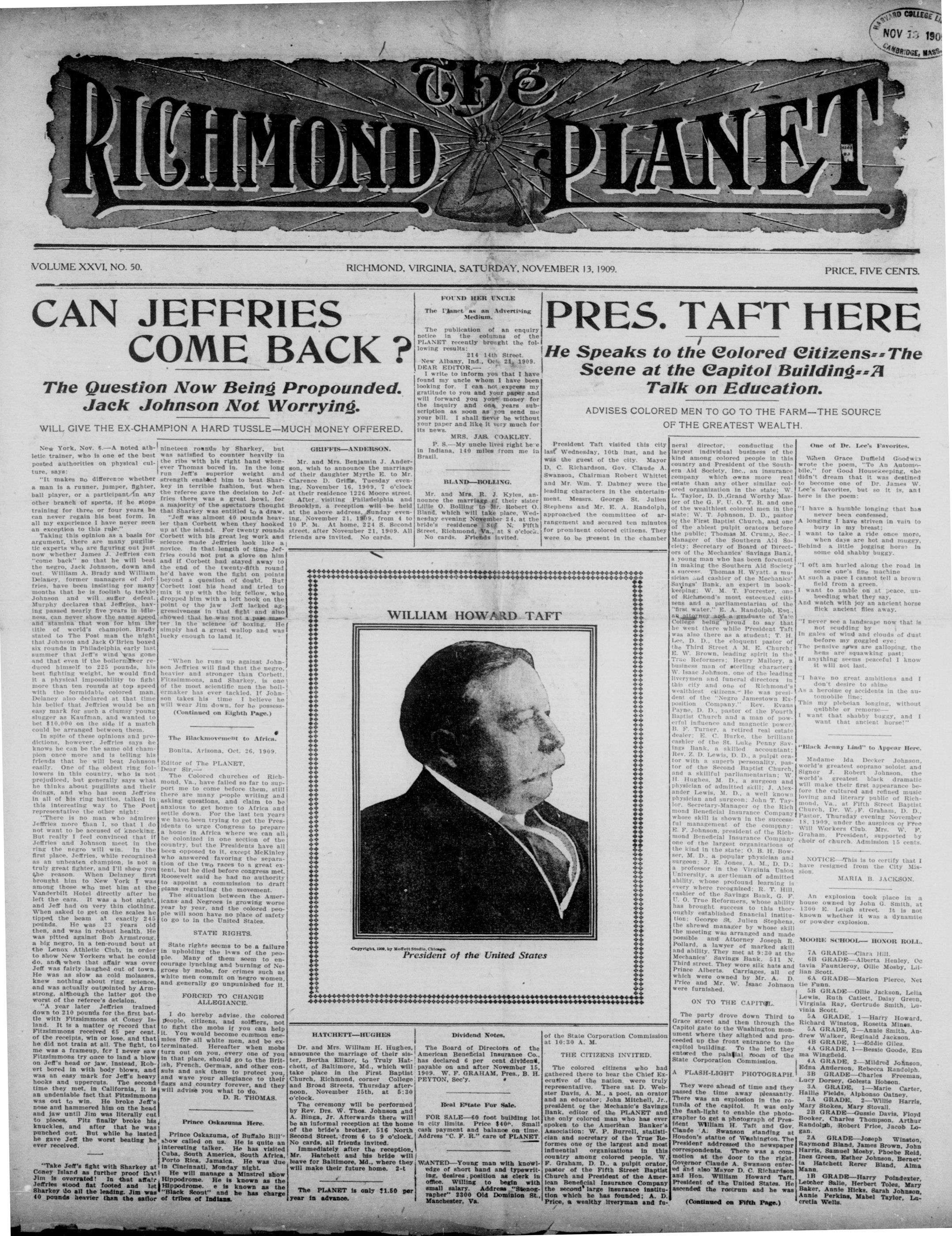
CAN JEFFRIES COME BACK?
The Question Now Being Propounded. Jack Johnson Not Worrying.
WILL GIVE THE EX-CHAMPION A HARD TUSSLE—MUCH MONEY OFFERED.
VOLUME XXVI, NO. 50.
CAN J
C
The Question
Jack Jo
WILL GIVE THE EX-CHA
New York, Nov. 5.—A noted athletic trainer, who is one of the best posted authorities on physical culture, says:
"It makes no difference whether a man is a runner, jumper, fighter, ball player, or a participant in any other branch of sports, if he stops training for three or four years he can never regain his best form. In all my experience I have never seen an exception to this rule."
Taking this opinion as a basis for argument, there are many pugilistic experts who are figuring out just now whether James J. Jeffries can "come back" so that he will beat the negro, Jack Johnson, down and out. William A. Brady and William Delaney, former managers of Jeffries, have been insisting for many months that he is foolish to tackle Johnson and will suffer defeat. Murphy declares that Jeffries, having passed nearly five years in idleness, can never show the same speed and stamina that won for him the title of world's champion. Brady stated to The Post man the night that Johnson and Jack O'Brien boxed six rounds in Philadelphia early last summer that Jeff's wind was gone and that even if the boilermaker reduced himself to 225 pounds, his best fighting weight, he would find it a physical impossibility to fight more than ten rounds at top speed with the formidable colored man. Delaney also declared at that time his belief that Jeffries would be an easy mark for such a clumsy young slugger as Kaufman, and wanted to bet $10,000 on the side if a match could be arranged between them.
"There is no man who admires Jeffries more than I, so that I do not want to be accused of knocking. But really I feel convinced that if Jeffries and Johnson meet in the ring the negro will win. In the first place, Jeffries, while recognized as an unbeaten champion, is not a truly great fighter, and I'll show you the reason. When Delaney first brought him to New York I was among those who met him at the Vanderbilt Hotel directly after he left the cars. It was a hot night, and Jeff had on very thin clothing. When asked to get on the scales he tipped the beam at exactly 245 pounds. He was 23 years old then, and was in robust health. He was pitted against Bob Armstrong, a big negro, in a ten-round bout at the Lenox Athletic Club, in order to show New Yorkers what he could do, and when that affair was over Jeff was fairly laughed out of town. He was as slow as cold molasses, knew nothing about ring science, and was actually outpointed by Armstrong, although the latter got the worst of the referee's decision.
"A year later Jeffries trained down to 210 pounds for the first battle with Fitzsimmons at Coney Island. It is a matter or record that Fitzsimmons received 65 per cent. of the receipts, win or lose, and that he did not train at all. The fight, to me was a frameup, for I never saw Fitzsimmons try once to land a blow on Jeff's head or jaw. Instead, Robert bored in with body blows, and was an easy mark for Jeff's heavy hooks and uppercuts. The second time they met, in California, it is an undeniable fact that Fitzsimmons was out to win. He broke Jeff's nose and hammered him on the head and jaw until Jim was literally cut to pieces. Fitz finally broke his knuckles, and after that he was punched out. But while he lasted he gave Jeff the worst beating he ever received.
"Take Jeff's fight with Sharkey at Coney Island as further proof that Jim is overrated!" In that affair Jeffries stood flat footed and let Sharkey do all the leading. Jim was 40 pounds heavier than the sailor
nineteen rounds by Sharkey, but was satisfied to counter heavily in the ribs with his right hand whenever Thomas bored in. In the long run Jeff's superior weight and strength enabled him to beat Sharkey in terrible fashion, but when the referee gave the decision to Jeffries there was a great howl, for a majority of the spectators thought that Sharkey was entitled to a draw. 'Jeff was almost 40 pounds heavier than Corbett when they hooked up at the island. For twenty rounds Corbett with his great leg work and science made Jeffries look like a novice. In that length of time Jeffries could not put a glove on him and if Corbett had stayed away to the end of the twenty-fifth round he'd have won the fight on points beyond a question of doubt. But Corbett lost his head and tried to mix it up with the big fellow, who dropped him with a left hook on the point or the jaw Jeff lacked aggressiveness in that fight and also showed that he was not a past master in the science of boxing. He simply had a great wallop and was lucky enough to land it.
"When he runs up against Johnson Jeffries will find that the negro, heavier and stronger than Corbett, Fitzsimmons, and Sharkey, is one of the most scientific men the boilermaker has ever tackled. If Johnson takes his time I believe he will take down for the possess- (Continued)
(Continued on Eighth Page.)
The Blackmovement to Africa.
Bonita, Arizona, Oct. 26, 1909.
Editor of The PLANET,
Dear Sir,—
The Colored churches of Richmond, Va., have failed so far to support me to come before them, still there are many people writing and asking questions, and claim to be anxious to get home to Africa and settle down. For the last ten years we have been trying to get the Presidents to urge Congress to prepare a home in Africa where we can all be colonized in one section of the country, but the Presidents have all been opposed to it, except McKinley who answered favoring the separation of the two races to a great extent, but he died before congress met. Roosevelt said he had no authority to appoint a commission to draft plans regulating the movement.
The situation between the Americans and Negroes is growing worse year by year, and the colored people will soon have no place of safety to go to in the United States.
STATE RIGHTS
State rights seems to be a failure in upholding the laws of the people. Many of them seem to encourage lynching and burning of Negroes by mobs, for crimes such as white men commit on negro women, and generally go unpunished for it.
FORCED TO CHANGE ALLEGIANCE
I do hereby advise the colored people, citizens, and soldiers, not to fight the mobs if you can help it. You would become common enemies for all white men, and be exterminated. Hereafter when mobs turn on you, every one of you in that place, should go to the British, French, German, and other consuls and ask them to protect you, and wave your allegiance to their flags and country forever, and they will advise you what to do.
D. R. THOMAS
Prince Oskazuma Here
Prince Oskazuma, of Buffalo Bill's show called on us. He is quite an interesting talker. He has visited Cuba, South America, South Africa, Porto Rica, Jamaica. He was due in Cincinnati, Monday night.
He will manage a Minstrel show Hippodrome. He is known as the Hippodrome. e is known as the "Black Scout" and he has charge of tribes of Indiang
[Picture of a man in a suit with a tie].
Copyright, 1908, by Moffett Studio, Chicago. President of the United States
GRIFFIS—ANDERSON.
Mr. and Mrs. Benjamin J. Anderson, wish to announce the marriage of their daughter Myrtle E. to Mr. Clarence D. Griffin. Tuesday evening, November 16, 1909, 7 o'clock at their residence 1226 Moore street. After, visiting Philadelphia and Brooklyn, a reception will be held at the above address, Sunday evening, November 21, 1909, from 4 to 10 P. M. At home, 224 S. Second street, after November 21, 1909. All friends are invited. No cards.
Copyright, 1908, by Moffett
HATCHETT—HUGHES
Dr. and Mrs. William H. Hughes, announce the marriage of their sister, Bertha Ellinor, to Truly Hatchett, of Baltimore, Md., which will take place in the First Baptist Church, Richmond, corner College and Broad Streets, Thursday afternoon, November 25th, at 5:30 o'clock.
The ceremony will be performed by Rev. Drs. W. Thos. Johnson and A. Binga, Jr. Afterwards there will be an informal reception at the home of the bride's brother, 516 North Second Street, from 6 to 9 o'clock. No cards, all friends invited.
Immediately after the reception, Mr. Hatchett and his bride will leave for Baltimore, Md., where they will make their future home. 2-t
The PLANET is only $1.50 per year in advance.
FOUND HER UNCLE
The Planet as an Advertising Medium.
The publication of an enquiry notice in the columns of the PLANET recently brought the following results:
214 14th Street.
New Albany, Ind., Oct. 21, 1909.
DEAR EDITOR.—
I write to inform you that I have found my uncle whom I have been looking for. I can not express my gratitude to you and your paper and will forward you your money for the inquiry and one years subscription as soon as you send me your bill. I shall never be without your paper and like it very much for its news.
MRS. JAS. COAKLEY.
P. S.—My uncle lives right here in Indiana, 140 miles from me in Brazil.
BLAND—BOLLING
Mr. and Mrs. R. J. Kyles, announce the marriage of their sister Lillie O. Bolling to Mr. Robert O. Bland, which will take place. Wednesday evening November 24, at the bride's residence 80 N. Fifth Street, Richmond, Va., at 8 o'clock No cards. Friends invited.
WILLIAM HOWARD TAKE
studio, Chicago.
President of the United State
Dividend Notes.
The Board of Directors of the American Beneficial Insurance Co. has declared 6 per cent dividend payable on and after November 15 1909. W. F. GRAHAM, Pres., B. H. PEYTON, Sec'y.
Real Estate For Sale.
FOR SALE—60 foot building lot in city limits. Price $400*. Small cash payment and balance on time. Address "C. F. R." care of PLANET
WANTED—Young man with knowledge of short hand and typewriting, desires position as clerk in office. Willing to begin with small salary. Address "Stenographer" 2300 Old Dominion St. Manchester, Va.
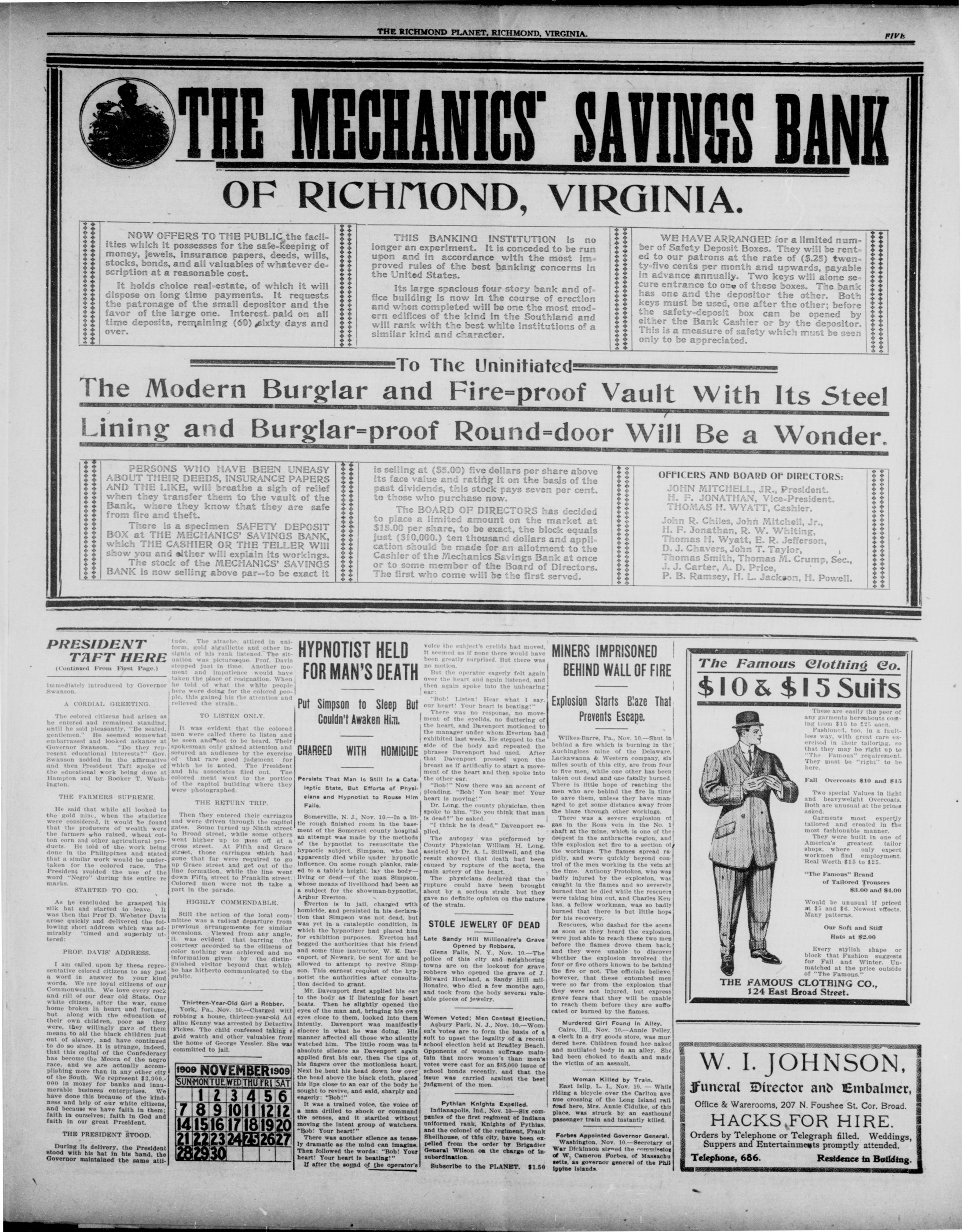
PRES. TAFT HERE
ADVISES COLORED MEN TO GO TO THE FARM—THE SOURCE OF THE GREATEST WEALTH.
President Taft visited this city last Wednesday, 10th inst, and he was the guest of the city. Mayor D. C. Richardson, Gov. Claude A. Swanson, Chairman Robert Whittet and Mr. Wm. T. Dabney were the leading characters in the entertainment. Messrs. George St. Julien Stephens and Mr. E. A. Randolph, approached the committee of arrangement and secured ten minutes for prominent colored citizens. They were to be present in the chamber
general director, conducting the largest individual business of the kind among colored people in this country and President of the Southern Aid Society, Inc., an insurance company which owns more real estate than any other similar colored organization in the state; W. L. Taylor, D. D. Grand Worthy Master of the G. F. U. O. T. R. and one of the wealthiest colored men in the state; W. T. Johnson, D. D., pastor of the First Baptist Church, and one of the ablest pulpit orators before the public; Thomas M. Crum), Sec. Manager of the Southern Aid So-
One of Dr. Lee's F
When Grace Duffield wrote the poem, "To A bile," for Good Housekeeping didn't dream that it would become one of Dr. Lee's favorites, but so here is the poem:
"I have a humble longnever been confessesa longing I have striver bury in my breast I want to take a ride when days are hot
FT
of the State Corporation Commission at 10:30 A. M.
THE CITIZENS INVITED
The colored citizens who had gathered there to hear the Chief Executive of the nation were truly representative. There sat D. Webster Davis, A. M., a poet, an orator and an educator; John Mitchell, Jr., president of the Mechanic's Savings Bank, editor of the PLANET and the only colored man who has ever spoken to the American Banker's Association; W. P. Burrell, statistician and secretary of the True Reformes one of the largest and most influential organizations in this country among colored people. W. F. Graham, D. D., a pulpit orator, pastor of the Fifth Street Baptist Church and President of the American Beneficial Insurance Company the second large insurance institution which he has founded; A. D. Price, a wealthy liveryman and fu
ON TO THE CAPITOL
The party drove down Third to Grace street and then through the Capitol gate to the Washington monument where they alighted and proceeded up the front entrance to the capitol building. To the left they entered the palatial room of the State Corporation Commission.
A FLASH-LIGHT PHOTOGRAPH
They were ahead of time and they passed the time away pleasantly. There was an explosion in the rotunda of the capitol. It was only the flash-light to enable the photographer to get a photograph of President William H. Taft and Gov. Claude A. Swanson standing at Houston's statue of Washington. The President addressed the newspaper correspondents. There was a commotion at the door to the right. Governor Claude A. Swanson entered and also Mayor D. C. Richardson and Hon. William Howard Taft. President of the United States. He ascended the rostrum and he was
(Continued on Fifth Page.)
PRICE, FIVE CENTS.
HERE
Citizens--The
building--A
on.
RM--THE SOURCE
H.
One of Dr. Lee's Favorites:
When Grace Duffield Goodwin wrote the poem, "To An Automobile," for Good Housekeeping, she didn't dream that it was destined to become one of Dr. James W. Lee's favorites, but so it is, and here is the poem:
"I have a humble longing that has never been confessed.
A longing I have striven in vain to bury in my breast;
I want to take a ride once more, when days are hot and muggy, Behind a little jogging horse in some old shabby buggy.
"I oft am hurled along the road in some one's fine machine
At such a pace I cannot tell a brown field from a green.
I want to amble on at peace, unheeding what they say,
And watch with joy an ancient horse
flick ancient files away.
"I never see a landscape now that is
not scudding by
In gales of wind and clouds of dust
before my goggled eye;
The nervous
before my goggled eye;
The pensive sows are galloping, the
hens are squawking past;
If anything seems peaceful I know
it will not last.
"I have no great ambitions and I
don't desire to shine
As a heroine or accidents in the automobile line;
This my plebeian longing, without quibble or remorse— I want that shabby buggy, and I want that ancient horse!"
"Black Jenny Lind" to Appear Here.
Madame Ida Decker Johnson, world's greatest soprano soloist and Signor J. Robert Johnson, the world's greatest black dramatic will make their first appearance before the cultured and refined music loving and literary public of Richmond, Va., at Fifth Street Baptist Church, Dr. W. F. Graham, D. D., Pastor, Thursday evening November 18, 1909, under the auspices or Free Will Workers Club. Mrs. W. F. Graham, President, supported by choir of church. Admission 15 cents.
NOTICE—This is to certify that I have resigned from the City Mission.
MARIA B. JACKSON
An explosion took place in a house owned by John G. Smith, at 1300 E. Leigh street. It is not known whether it was a dynamite or powder explosion.
MOORE SCHOOL—HONOR ROLL.
7A GRADE—Clara Hill.
6B GRADE—Alberta Henley, Octavia Fauntleroy, Ollie Mosby, Lillian Scott.
6A GRADE—Marion Pierce, Netie Funn.
5B GRADE—Ollie Jackson, Lelia Lewis, Ruth Catlett, Daisy Green, Virginia Ray, Gertrude Smith, Luvinia Scott.
5A GRADE, 1—Harry Howard, Richard Winston, Rosetta Mines.
5A GRADE, 2—Annie Smith, Andrew Walker, Reginald Jackson.
4B GRADE, 1—Eddie Giles.
4A GRADE, 1—Bessie Goode, Emma Wingfield.
4A GRADE, 2—Mildred Johnson, Edna Anderson, Rebecca Randolph.
3B GRADE—Charles Freeman, Lucy Dorsey, Golesta Hobson.
3A GRADE, 1—Marie Carter, Hallie Fields, Alphonso Ontney.
3A GRADE, 2—Willie Harris, Mary Stokes, Mary Stovall.
2B GRADE—Gussie Davis, Floyd Booker, Charles Thompson, Arthur Randolph, Robert Price, Jacob Logan.
2A GRADE—Joseph Winston, Raymond Bland, James Brown, John Harris, Samuel Mosby, Phoebe Reid, Inez Green, Esther Johnson, Bernetta Hatchett Rerer Bland, Alma Mann.
1B GRADE—Harry Poindexter, Letcher Salie, Herbert Toles, Mary Baker, Annie Hicks, Sarah Johnson, Annie Perkins, Mabel Taylor, Lucretia Wells.
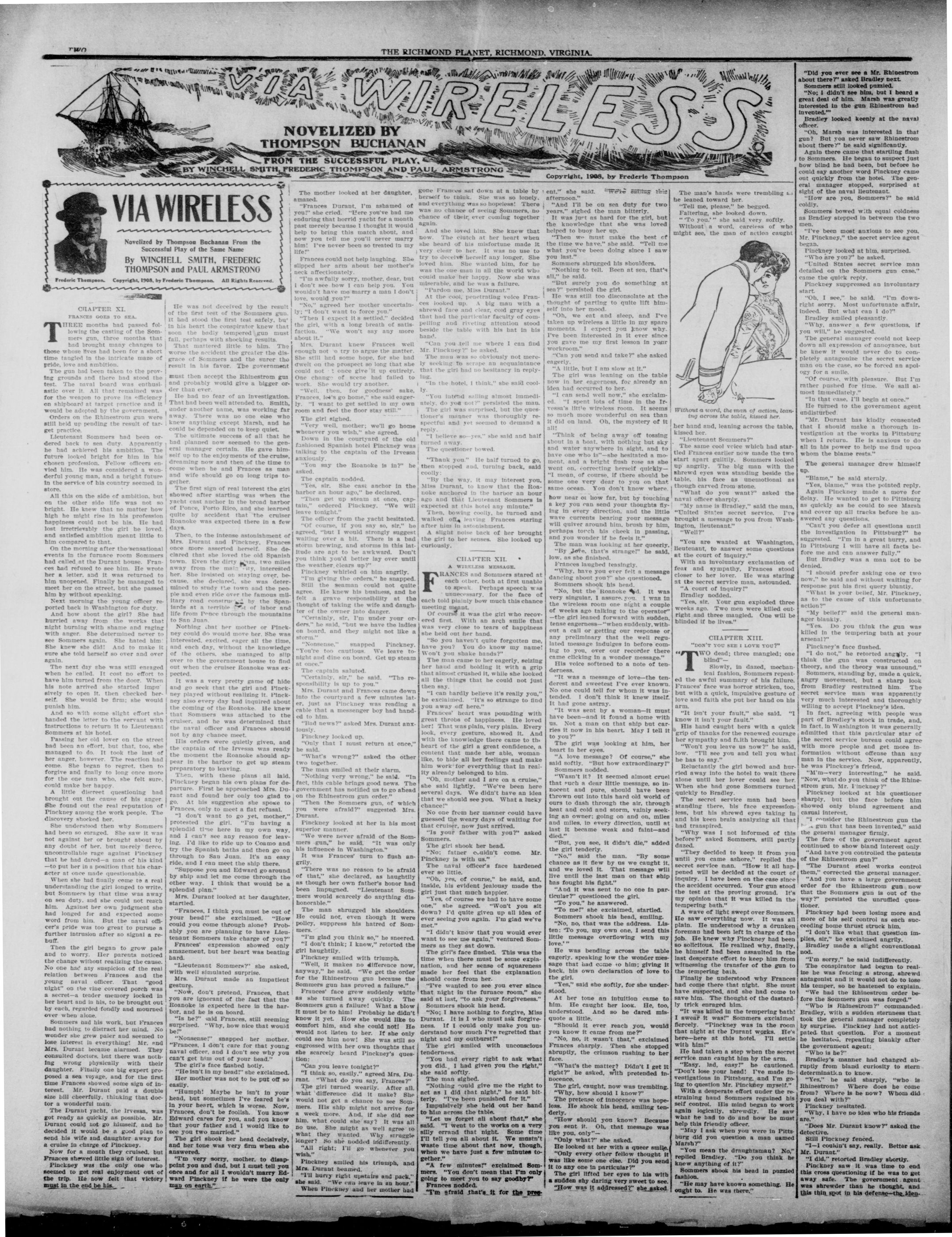
VIA WIRELESS
NOVELIZED BY
THOMPSON BUCHANAN
FROM THE SUCCESSFUL PLAY.
BY WINCHELL SMITH, FREDERIC THOMPSON AND PAUL ARMSTRONG
VIA WIRELESS
Novelized by Thompson Buchanan From the Successful Play of the Same Name
By WINCHELL SMITH, FREDERIC THOMPSON and PAUL ARMSTRONG
Frederic Thompson. Copyright, 1908, by Frederic Thompson. All Rights Reserved.
THREE months had passed following the casting of the Sommers gun, three months that had brought many changes to those whose lives had been for a short time tangled in the intricate maze of pride, love and ambition. The gun had been taken to the proving grounds and there had stood the test. The naval board was enthusiastic over it. All that remained was for the weapon to prove its efficiency on shipboard at target practice and it would be adopted by the government. Orders on the Rhinestrom gun were still held up pending the result of target practice.
Lieutenant Sommers had been ordered back to sea duty. Apparently he had achieved his ambition. The future looked bright for him in his chosen profession. Fellow officers envied him. He was considered a wonderful young man, and a bright future in the service of his country seemed in store.
All this on the side of ambition, but on the other side life was not so bright. He knew that no matter how high he might rise in his profession happiness could not be his. He had lost irretrievably the girl he loved, and satisfied ambition meant little to him compared to that.
On the morning after the sensational events in the furnace room Sommers had called at the Durant house. Frances had refused to see him. He wrote her a letter, and it was returned to him unopened. Finally he managed to meet her on the street, but she passed him by without speaking.
Next morning the young officer reported back in Washington for duty. And how about the girl? She had hurried away from the works that night burning with shame and raging with anger. She determined never to see Sommers again. She hated him: She knew she did! And to make it sure she told herself so over and over again.
The next day she was still enraged when he叫唤. It cost no effort to have him turned from the door. When his note arrived she started impu-sively to open it, then checked herself. She would be firm; she would punish him.
And so with some slight effort she handed the letter to the servant with instructions to return it to Lieutenant Sommers at his hotel.
Passing her old lover on the street had been an effort, but that, too, she managed to do. It took the last of her anger, however. The reaction had come. She began to regret, then to forgive and finally to long once more for the one man who, she felt sure, could make her happy.
A little discreet questioning had brought out the cause of his anger. She found out the real reputation of Pinckney among the work people. The discovery shocked her.
She understood then why Sommers had been so enraged. She saw it was not against her or brought about by any doubt of her, but merely fierce, uncontrollable rage against Pinckney that he had dared—a man of his kind—to put her in a position that his character at once made questionable. When she had finally come to a real understanding the girl longed to write, but Sommers by that time was away on sea duty, and she could not reach him. Against her own judgment she had longed for and expected some word from him. But the naval officer's pride was too great to pursue a further intrusion after so signal a re-buff.
Then the girl began to grow pale and to worry. Her parents noticed the change without realizing the cause. No one had any suspicion of the real relation between Frances and the young naval officer. That "good night" on the vine covered porch was a secret—a tender memory locked in her heart and in his, to be brought out by each, regarded fondly and mourned over when alone. Sommers had his work, but Frances had nothing to distract her mind. No wonder she grew paler and seemed to lose interest in everything! Mr. and Mrs. Durant became alarmed. They consulted doctors, but there was nothing wrong physically with their daughter. Finally one big expert proposed a sea voyage, and for the first time Frances showed some sign of interest. Mr. Durant paid a double size bill cheerfully, thinking that doctor a wonderful man.
The Durant yacht, the Irvessa, was got ready as quickly as possible. Mr. Durant could not go himself, and he decided it would be a good plan to send his wife and daughter away for a cruise in charge of Pinckney. Now for a month they crushed, but Frances showed little sign of interest. Pinckney was the only one who seemed to get real enjoyment out of the trip. He now felt that victory must in the end be his.
PETER H.
CHAPTER XI.
FRANCES GOES TO SEA
He was not deceived by the result of the first test of the Sommers gun. it had stood the first test safely, but' in his heart the conspirator knew that soon the badly tempered gun must fail, perhaps with shocking results. That mattered little to him. The worse the accident the greater the disgrace of Sommers and the surer the result in his favor. The government must then accept the Rhinestrom gun and probably would give a bigger order than ever. He had no fear of an investigation. That had been well attended to, Smith, under another name, was working far away. There was no one else who knew anything except Marsh, and he could be depended on to keep quiet.
The ultimate success of all that he had planned now seemed to the general manager certain. He gave himself up to the enjoyments of the cruise, dreaming now and then of the time to come when he and Frances as man and wife should go on long trips together. The first sign of real interest the girl showed after starting was when the yacht cast anchor in the broad harbor of Ponce, Porto Rico, and she learned quite by accident that the cruiser Roanoke was expected there in a few days.
Then, to the intense astonishment of Mrs. Durant and Pinckney, Frances once more asserted herself. She declared that she loved the old Spanish town. Even the dirty pawn, two miles away from the main city, interested her. She insisted on staying over, because, she declared, she was determined to study the town and the people and even ride over the famous military road constructed by the Spaniards at a terrible cost of labor and life from Ponce through the mountains to San Juan.
Nothing that her mother or Pinckney could do would move her. She was interested, excited, eager all the time, and each day, without the knowledge of the others, she managed to slip over to the government house to find out when the cruiser Rannoke was expected.
It was a very pretty game of hide and go seek that the girl and Pinckney played without realizing it. Pinckney also every day had inquired about the coming of the Roanoke. He knew that Sommers was attached to the cruiser, and he was determined that the naval officer and Frances should not by any chance meet.
His orders were quietly given, and the captain of the Irvessa was ready the moment the Roanoke should appear in the harbor to get up steam preparatory to leaving.
Then, with these plans all laid, Pinckney began his own plans for departure. First he approached Mrs. Durant and found her only too glad to go. At his suggestion she spoke to Frances, only to meet a flat refusal.
"I don't want to go yet, mother," protested the girl. "I'm having a splendid time here in my own way, and I can't see any reason for leaving. I'd like to ride up to Coamo and try the Spanish baths and then go on through to San Juan. It's an easy ride, and I can meet the ship there. "Suppose you and Edward go around by ship and let me come through the other way. I think that would be a splendid plan." Mrs. Durant looked at her daughter, startled.
"Frances, I think you must be out of your head!" she exclaimed. "How could you come through alone? Probably you are planning to have Lieutenant Sommers take charge of you?" Frances' expression showed only amazement, but her heart was beating hard.
"Lieutenant Sommers?" she asked, with well simulated surprise. Mrs. Durant made an impatient gesture.
"Now, don't pretend, Frances, that you are ignorant of the fact that the Roanoke is expected here in the harbor, and he is on board.
"Is he?" said Frances, still seeming surprised. "Why, how nice that would be."
"Nonsense!" snapped her mother.
"Frances, I don't care for that young naval officer, and I don't see why you can't get him out of your head."
The girl's face flushed hotly.
"He isn't in my head!" she exclaimed.
Her mother was not to be put off so easily.
"Humph! Maybe he isn't in your head, but sometimes I've feared he's in your heart, which is worse. Now, Frances, don't be foolish. You know Edward cares for you, and you know that your father and I would like to see you two married."
The girl shock her head decisively, and her tone was very firm when she answered.
"I'm very sorry, mother, to disappoint you and dad, but I must tell you once and for all I wouldn't marry Edward Pinckney if he were the only man on earth."
THE RICHMOND PLANET, RICHMOND, VIRGINIA.
The mother looked at her daughter, amazed.
"Frances Durant, I am ashamed of you!" she cried. "Here you've had me enduring that horrid yacht for a month past merely because I thought it would help to bring this match about, and now you tell me you'll never marry him! I've never been so treated in my life."
Frances could not help laughing. She slipped her arm about her mother's neck affectionately.
"I'm awfully sorry, mother, dear, but I don't see how I can help you. You wouldn't have me marry a man I don't love, would you?"
"No," agreed her mother uncertainly; "I don't want to force you."
"Then I expect it's settled," decided the girl, with a long breath of satisfaction. "We won't say any more about it."
Mrs. Durant knew Frances well enough not to try to argue the matter. She still had some hope, for she and dwell on the prospect so long that she could not once give it up entirely. One change of scene had failed to work. She would try another.
"Well, then, for goodness' sake, Frances, let's go home," she said eagerly. "I want to get settled in my own room and feel the floor stay still."
The girl sighed.
"Very well, mother; we'll go home whenever you wish," she agreed.
Down in the courtyard of the old fashioned Spanish hotel Pinckney was talking to the captain of the Irvessa anxiously.
"You say the Roanoke is in?" he asked.
The captain nodded.
"Yes, sir. She cast anchor in the harbor an hour ago," he declared.
"Then get up steam at once, captain," ordered Pinckney. "We will leave tonight."
The officer from the yacht hesitated.
"Of course, if you say so, sir," he agreed, "but I would strongly suggest waiting over a hit. There is a bad storm brewing, and storms in this latitude are apt to be awkward. Don't you think you'd better lay over until the weather, clears up?"
Pinckney whirled on him angrily.
"I'm giving the orders," he snapped.
Still the seaman could not quite agree. He knew his business, and he felt a grave responsibility at the thought of taking the wife and daughter of the owner into danger.
"Certainly, sir, I'm under your orders," he said, "but we have the ladies on board, and they might not like a storm."
"Nonsense," snapped Pinckney.
"You're too cautious. We leave tonight and dine on board. Get up steam at once."
The captain saluted.
"Certainly, sir," he said. "The responsibility is up to you."
Mrs. Durant and Frances came down into the courtyard a few minutes later, just as Pinkney was reading a cable that a messenger boy had handed to him.
"Bad news?" asked Mrs. Durant anxiously.
Pinkney looked up.
"Only that I must return at once," he said.
"What's wrong?" asked the other two together.
The man smiled at their alarm.
"Nothing very wrong." he said. "In fact, this cable brings good news. The government has notified us to go ahead on the Rhinestrom gun order."
"Then the Sommers gun, of which you were afraid?" suggested Mrs. Durant.
Pinkney looked at her in his most superior manner.
"We were never afraid of the Sommers gun," he said. "It was only his influence in Washington."
It was Frances' turn to flush angrily.
"There was no reason to be afraid of that," she declared, as haughtily as though her own father's honor had been impugned. "Lieutenant Sommers would scarcely do anything dishonorable."
The man shrugged his shoulders. He could not, even though it were policy, suppress his hatred of Sommers.
"I'm glad you think so," he sneered. "I don't think; I know," retorted the girl haughtily.
Pinckney smiled with triumph.
"Well, it makes no difference now, anyway," he said. "We get the order for the Rhinestrom gun because the Sommers gun has proved a failure."
Frances' face grew suddenly white as she turned away quickly. The Sommers gun a failure! What a blow it must be to him! Probabiy he didn't know it yet. How she would like to comfort him, and she could not! He would not listen to her. If she only could see him now! She was still so engrossed with her own thoughts that she scarcely heard Pinckney's question:
"Can you leave tonight?"
"I think so, easily," agreed Mrs. Durant. "What do you say, Frances?"
The girl turned wearily. After all, what difference did it make? She would not get a chance to see Sommers. His ship might not arrive for a week more. And, if she did see him, what could she say? It was all no use. She might as well agree to what they wanted. Why struggle longer? So she nodded indifferently.
"All right; I'll go whenever you wish."
Pinckney smiled his triumph, and Mrs. Durant beamed.
"I'll hurry right upstairs and pack," she said. "We can leave in an hour."
When Pinckney and her mother had
gone Frances sat down at a table by herself to think. She was so lonely, and everything was so hopeless! There was no chance of seeing Sommers, no chance of their, ever coming together again.
And she loved him. She knew that now. The clutch at her heart when she heard of his misfortune made it very clear to her. It was no use to try to deceive herself any longer. She loved him. She wanted him, for he was the one man in all the world who could make her happy. Now she was miserable, and he was a failure.
"Pardon me, Miss Durant."
At the cool, penetrating voice Frances looked up. A big man with a shrewd face and clear, cool gray eyes that had the particular faculty of compelling and riveting attention stood beside the table with his hat in his hand.
"Can you tell me where I can find Mr. Pinckney?" he asked.
The man was so obviously not merely seeking to scrape an acquaintance that the girl had no hesitancy in replying.
"In the hotel, I think," she said coolly.
"You intend sailing almost immediately, do you not?" persisted the man.
The girl was mannered, but the questioner's manner was thoroughly respectful and yet seemed to demand a reply.
"I believe so—yes," she said and half turned away.
The questioner bowed.
"Thank you." He half turned to go, then stopped and, turning back, said coolly:
A slight noise back of her brought the girl to her senses. She looked up curiously.
CHAPTER XII.
FRANCES and Sommers stared at each other, both at first unable to speak. Perhaps speech was unnecessary, for the face of each told plainly how much this chance meeting meant. Of course it was the girl who recovered first. With an arch smile that was very close to tears of happiness she held out her hand. "So you haven't quite forgotten me, have you? You do know my name! Won't you shake hands?" The man came to her eagerly, seizing her hand and holding it with a grip that almost crushed it, while she looked all the things that he could not just then say. "I can hardly believe it's really you," he exclaimed. "It's so strange to find you away off here."
Frances' heart was pounding with great throbs of happiness. He loved her! That was plain, very plain. Every look, every gesture, showed it. And with the knowledge there came to the heart of the girl a great confidence, a content that made her able, womanlike, to hide all her feelings and make him work for everything that in reality already belonged to him.
"Oh, mother and I are on a cruise," she said lightly. "We've been here several days. We didn't have an idea that we should see you. What a lucky chance!"
No one from her manner could have guessed the weary days of waiting for that cruiser, now just arrived.
"Is your father with you?" asked Sommers.
The girl shook her head.
"No: father couldn't come. Mr. Pinckney is with us."
The naval officer's face hardened ever so little.
"Oh, yes, of course," he said, and, inside, his evident jealousy made the girl just that much happier.
"Yes, of course we had to have some one," she agreed. "Won't you sit down? I'd quite given up all idea of ever seeing you again. I'm glad we've met."
"I didn't know that you would ever want to see me again," ventured Sommers as they sat down.
The girl's face flushed. This was the time when there must be some explanation, and her sense of squareness made her feel that the explanation should come from her.
"I've wanted to see you ever since that night in the furnace room," she said at last, "to ask your forgiveness."
Sommers shook his head.
"No; I have nothing to forgive, Miss Durant. It is I who must ask forgiveness. If I could only make you understand how much I've regretted that night and my outburst!" The girl smiled with unconscious tenderness.
"You had every right to ask what you did. I had given you the right," she said softly.
The man sighed.
"Nothing could give me the right to act as I did that night," he said bitterly. "I've been punished for it."
Impulsively she held out her hand to him across the table.
"Let us forget all about that," she said. "I went to the works on a very silly errand that night. Some time I'll tell you all about it. We mustn't waste time about that now, though, when we have just a few minutes toogether."
"A few minutes!" exclaimed Sommers. "You don't mean that I'm only going to meet you to say goodbye?" Frances nodded. "I'm afraid that's it for the preg-
"And I'll be on sea duty for two years" elicited the man bitterly.
years, signed the man buttery.
It was just as hard for the girl, but
the knowledge that she was loved
helped to buoy her up.
Sommers shrugged his shoulders.
"Nothing to tell. Been at seen, that's all," he said.
"But surely you do something at seen?" persisted the girl.
He was still too disconsolate at the thought of parting to qulte lift himself into her mood.
"Oh, we eat and sleep, and I've taken up wireless a little in my spare moments. I expect you know why. I've been interested in it ever since you gave me my first lesson in your workroom."
"Can you send and take?" she asked eagerly.
"A little, but I am slow at it."
The girl was leaning on the table now in her eagerness, for already an idea had occurred to her.
"I can send well now," she exclaimed. "I spent lots of time in the Irvessa's little wireless room. It seems so much more wonderful on sea than it did on land. Oh, the mystery of it all!
"Think of being away off tossing about in a boat, with nothing but sky and water anywhere in sight, and to have one who is"—she hesitated a moment, and a bright flush rose as she went on, correcting herself quickly—"I mean, of course, if there should be some one very dear to you on that same ocean. You don't know where, how near or how far, but by touching a key you can send your thoughts flying in every direction, and the little wave currents bearing your message will quiver around him, brush by him, perhaps touch his cheek in passing, and you wonder if he feels it."
The man was looking at her queerly, "By love, that's strange!" he said, low, as she finished.
Frances laughed teasingly, "Why, have you ever felt a message dancing about you?" she questioned.
Sommers shook his head.
"No, but the Roonoke did. It was very singular, I assure you. I was in the wireless room one night a couple of weeks ago talking to the operator"—the girl leaned forward with sudden, tense eagerness—"when suddenly, without a call or getting our response or any preliminary that the well regulated message indulges in before coming to you, over our recorder there came clicking in a wonder message." His voice softened to a note of tenderness.
"It was a message of love—the tenderest and sweetest I ever known. No one could tell for whom it was intended. I don't think it knew itself. It had gone astray.
"It was sent by a woman—it must have been—and it found a home with us. Not a man on that ship but carries it now in his heart. May I tell it to you?"
The girl was looking at him, her heart in her eyes.
"A love message? Of course," she said softly, "But how extraordinary!" Sommers nodded.
"Wasn't it? It seemed almost cruel that such a dear little message, so innocent and pure, should have been thrown out into this hard old world of ours to dash through the air, through heat and cold and storm, vainly seeking an owner; going on and on, miles and miles, in every direction, until at last it became weak and faint—and died."
"But, you see, it didn't die," added the girl tenderly.
"No," said the man. "By some chance as it flew by us we caught it, and we loved it. That message will live until the last man on that ship has fought his fight."
"And it was sent to no one in particular?" questioned the girl.
"To you," he answered.
"To me!" she exclaimed, startled. Sommers shook his head, smiling.
"No, no, that was the address. Listen: 'To you, my own one, I send this little message overflowing with my love.'" He was bending across the table eagerly, speaking low the wonder message that had come to him; giving it back, his own declaration of love to the girl. "Yes," said she softly, for she understood. At her tone an intuition came to him. He caught her look. He, too, understood. And so he dared misquote a little. "Should it ever reach you, would you know it came from me?"
"No, no, it wasn't that," exclaimed Frances sharply. Then she stopped abruptly, the crimson rushing to her face.
"What's the matter? Didn't I get it right?" he asked, with pretended innocence.
The girl, caught, now was trembling.
"Why, how should I know?"
The pretense of innocence was hopeless. He shook his head, smiling tenderly.
"How should you know? Because you sent it. Oh, that message was like you, only"—
"Only what?" she asked.
He looked at her with a queer smile.
"Only every other fellow thought it was like some one else. Did you send it to any one in particular?"
The girl lifted her eyes to his with a sudden shy daring very sweet to see.
"How was it addressed?" she asked.
The man's hands were trembling t. he leaned toward her.
"Tell me, please," he begged.
Faltering, she looked down.
"To you,'" she said very softly.
Without a word, careless of who might see, the man of action caught
J
Without a word, the man of action, leaning across the table, kissed her.
her hand and, leaning across the table, kissed her.
"Lieutenant Sommers?"
The same cool voice which had started Frances earlier now made the two start apart guiltily. Sommers looked up angrily. The big man with the shrewd eyes was standing beside the table, his face as unemotional as though carved from stone.
"What do you want?" asked the naval officer sharply.
"My name is Bradley," said the man, "United States secret service. I've brought a message to you from Washington, lieutenant."
"Well?"
"You are wanted at Washington, lieutenant, to answer some questions at the court of inquiry."
With an involuntary exclamation of fear and sympathy, Frances stood closer to her lover. He was staring at the secret service man, astounded. "A court of inquiry!" Bradley nodded. "Yes, sir. Your gun exploded three weeks ago. Two men were killed outright and three mangled. One will be blinded if he lives."
CHAPTER XIII.
"DON'T YOU SEE I LOVE YOU?"
"WO dead; three mangled; one blind"—
Slowly, in dazed, mechanical fashion, Sommers repeated the awful summary of his failure. Frances' face was horror stricken, too, but with a quick, impulsive gesture of love and faith she put her hand on his arm.
"It isn't your fault," she said. "I know it isn't your fault."
His hand caught hers with a quick grip of thanks for the renewed courage her sympathy and faith brought him.
"Won't you leave us now?" he said, low. "I'll see you and tell you what he has to say."
Reluctantly the girl bowed and hurried away into the hotel to wait alone until her lover could see her. When she had gone Sommers turned quickly to Bradley.
The secret service man had been standing there, his face expressionless, but his shrewd eyes taking in and his keen brain analyzing all that had transpired.
"Why was I not informed of this before?" asked Sommers, still partly dazed.
"They decided to keep it from you until you came ashore," replied the secret service man. "How it all happened will be decided at the court of inquiry. I have been on the case since the accident occurred. Your gun stood the test at the proving ground. It's my opinion that it was killed in the tempering bath."
A wave of light swept over Sommers. He saw everything now. It was all plain. He understood why a drunken foreman had been left in charge of the job. He knew why Pinckney had been so solicitous. He realized why, finally, he himself had been assaulted in the last desperate effort to keep him from witnessing the transfer of the gun to the tempering bath.
Finally he understood why Frances had come there that night. She must have suspected, and she had come to save him. The thought of the dastardly trick enraged him.
"It was killed in the tempering bath! I swear it was!" Sommers exclaimed fiercely. "Pinckney was in the room that night at the Durant works. He's here—here at this hotel. I'll settle with him!" He had taken a step when the secret service man caught him by the arm. "Easy, lad, easy!" he cautioned. "Don't lose your head! I've made investigations in Pittsburg, and I'm going to question Mr. Pinckney myself." With a desperate effort under the restraining hand Sommers regained his self control. His mind began to work again logically, shrewdly. He saw what he had to do and how he must help this friendly officer.
"May I ask when you were in Pittsburg did you question a man named Marsh?"
"You mean the draughtsman? No." replied Bradley. "Do you think he knew anything of it?" Sommers shook his head in puzzled fashion. "He may have known something. He ought to. He was there."
"Did you ever see a Mr. Rhinestrom about there?" asked Bradley next. Sommers still looked puzzled. "No; I didn't see him, but I heard a great deal of him. Marsh was greatly interested in the gun Rhinestrom had invented." Bradley looked keenly at the naval officer. "Oh, Marsh was interested in that gun? But you never saw Rhinestrom about there?" he said significantly. Again there came that startling flash to Sommers. He began to suspect just how blind he had been, before he could say another word Pinckney came out quickly from the hotel. The general manager stopped, surprised at sight of the naval lieutenant. "How are you, Sommers?" he said coldly. Sommers bowed with equal coldness as Bradley stepped in between the two men.
"I've been most anxious to see you, Mr. Pinckney," the secret service agent began.
Pinckney looked at him, surprised.
"Who are you?" he asked.
"United States secret service man detailed on the Sommers gun case," came the quick reply.
Pinckney suppressed an involuntary start.
"Oh, I see," he said. "I'm downright sorry. Most unfortunate affair, indeed. But what can I do?" Bradley smiled pleasantly.
"Why, answer a few questions, if you will," he suggested.
The general manager could not keep down all expression of annoyance, but he knew it would never do to completely antagonize the secret service man on the case, so he forced an apology for a smile.
"Of course, with pleasure. But I'm rather pushed for time. We sall almost immediately."
"In that case, I'll begin at once."
He turned to the government agent undisturbed.
"Mr. Durant has kindly consented that I should make a thorough investigation at the works in Pittsburg when I return. He is anxious to do all in his power to help me find upon whom the blame rests."
The general manager drew himself up.
"Blame," he said sternly.
"Yes, blame," was the pointed reply. Again Pinckney made a move for delay. He wanted to get to Pittsburg as quickly as he could to see Marsh and cover up all tracks before he answered any questions.
"Can't you defer all questions until the investigation in Pittsburg?" he suggested. "I'm in a great hurry, and in Pittsburg I will have all facts before me and can answer fully."
But Bradley was a man not to be denied.
"I should prefer asking one or two now," he said and without waiting for response put his first query bluntly.
"What is your belief, Mr. Pinckney, as to the cause of this unfortunate action?"
"My belief?" said the general manager blankly.
"Yes. Do you think the gun was killed in the tempering bath at your arsenal?"
Pinckney's face flushed.
"I do not," he retorted angely. "I think the gun was constructed on theory, and the theory was unsound." Sommers, standing by, made a quick, angry movement, but a sharp look from Bradley restrained him. The secret service man was apparently very much interested and thoroughly willing to accept Pinckney's idea.
In fact, agreeing with people was part of Bradley's stock in trade, and, in fact, in Washington it was generally admitted that this particular star of the secret service bureau could agree with more people and get more information without offense than any man in the service. Now, apparently, he was Pinckney's friend.
"M'm—very interesting," he said.
"Now, what do you think of the Rhinestrom gun, Mr. Pinckney?"
Pinckney looked at his questioner sharply, but the face before him showed only bland agreement and casual interest.
"I consider the Rhinestrom gun the gun that has been invented," said the general manager firmly.
The face of the government agent continued to show bland interest only.
"And have you controlled the patents of the Rhinestrom gun?"
"The Durant steel works control them," corrected the general manager. "And you have a large government order for the Rhinestrom gun now that the Sommers gun is out of the way?" persisted the unruffled questioner. Pinckney had been losing more and more of his self control as each succeeding home thrust struck him. "I don't like what that question implies, sir," he exclaimed angrily.
"I'm sorry," he said indifferently. The conspirator had begun to realize he was fencing a strong, shrewd antagonist and it would not do to lose his temper, so he hastened to explain. "We had the Rhinestrom order before the Sommers gun was forged." "Who is Rhinestrom?" commanded Bradley, with a sudden sternness that took the general manager completely by surprise. Pinckney had not anticipated that question. For a moment he hesitated, repeating blankly after the government agent: "Who is he?" Bradley's manner had changed abruptly from bland curiosity to stern determination to know. "Yes," he said sharply, "who is Rhinestrom? Where does he come from? Where is he now? Whom did you deal with?" Pinckney hesitated.
"Why, I have no idea who his friends are."
"Does Mr. Durant know?" asked the detective.
Still Plinkney fenced.
"I—I couldn't say, really. Better ask Mr. Durant."
"I did," retorted Bradley shortly.
"I did," retorted Bradley shortly. Pinckney saw it was time to end this cross questioning if he was to get away safe. The government agent was shrewder than he thought, and this thin spot in his defense—the iden-
THE YACHT
SATURDAY.....NOV. 13, 1909.
SATURDAY.....NOV. 13, 1909.
tity of Rhinestrom—seemed perilously weak. The only thing to do was to end it at once.
"I haven't time to talk to you further," he said.
Bradley made a restraining gesture.
"Just a moment more, Mr. Pinckney. Has Rhinestrom ever been at your works?"
"No, sir." returned the general manager promptly.
"Then how does Marsh know him?" demanded the government agent sternly.
It was pure bluff, but Pinckney had no idea of that, and he took the bait, book, sinker and all.
"Marsh!" he exclaimed blankly.
"Why, Marsh doesn't know him."
For the first time Bradley permitted himself a sneering smile.
"I can only go by what Marsh says," he declared. "Do you mean to tell me, Mr. Pinckney, that Marsh, the draughtsman of the Durant steel works, does not know the inventor of the Rhlnestrom gun?" Pinckney's face was brick red with anger now, but inside there was a quiver of apprehension that Marsh had talked. If so, all was up. Anyway this questioning must stop. "I'm not going to talk to you further, sir," he declared angrily. "Your manner is distasteful to me." Again there came that mocking, satirical apology. "Oh, I'm so sorry. But, Mr. Pinckney, you don't mind admitting that the man in charge of forging the Sommers gun was drunk?" Pinckney hesitated.
"I do admit that," he said, "but he did his work properly. I was theremyself to watch him. Mr. Sommers was there too."
Instantly the secret service agent turned on Sommers.
"Were you in the furnace room, Lieutenant Sommers, at the time the gun went into the bath?"
"Yes, sir," admitted the naval officer, "I was."
"Did it go in at the right temperature?"
It was Sommers' time to hesitate.
"I—I don't know," he admitted. "I didn't see it."
"You were in the furnace room," exclaimed the secret service man, "and you did not see your own gun go into the tempering bath?"
"There was a quarrel with the foreman," said Sommers hesitating.
"What were you quarreling about?" asked Bradley.
It was the one question that Somers could not answer. How could he bring Frances into it? Bradley was waiting impatiently for his reply. "I can't explain the cause of that quarrel," finally declared the naval
P.
"Who is Rhinstrom" commanded Bradley.
officer firmly, and Pinckney permitted himself his first smile of satisfaction.
After all, there was a chance of this young fool, through insane chivalry, permitting himself to overlook his only means of vindication.
Bradley was still looking at Sommers with involuntary surprise when Pinckney made his next move.
"Mr. Bradley, I want you to understand that I'm very sorry for Mr. Sommers about this whole affair. If I can be of any service to him or to you I shall be only too glad."
The secret service man was not one to be whimsical or chivalrous when he had started out to accomplish anything. Promptly he took Pinckney at his word.
"That's very good of you, sir, and you can be of the greatest service to us. Lieutenant Sommers goes to face the court of inquiry at Washington, and it is his desire and mine to reach there with as little delay as possible. No steamer salts from this port to New York for nearly a week.
"Now, the gun that made this trouble was forged at your works, and therefore, whether you wish it or not, you have a direct interest in the case. Perhaps I'm going to ask you something unusual, but it will be a great favor if you will allow Mr. Sommers and myself to sail with you on the Irvessa."
Pinckney and Sommers both stared at the secret service man in amazement. The cool audacity of the proposal took them both off their feet. Sommers was the first to recover.
"Bradley! No!" he exclaimed impetuously.
Pinckney bowed coldly.
"I'm sorry, sir," he said, "but you are asking too much. That'll be impossible."
He turned away just as Frances, tired of the waiting, re-entered the courtyard.
"Ah, Frances, you are ready?" he asked.
Without replying the girl came straight to Sommers.
"What are you going to do now?" she asked directly.
"I have been ordered to report at Washington at once to face the court of inquiry." returned the officer.
The girl smiled. There were both sadness and joy in it—sadness for his unfortunate situation, joy that they had a chance still to be together.
"We are just starting," she suggested. "Come with us on the yacht." Sommers shook his head.
"I'm sorry; I can't do that."
The girl stood looking at him, hurt and uncertain. She had not expected that rebuff. She could not understand it. Again Bradley seized the situation.
"Miss Durant, Mr. Sommers goes to Washington to endeavor to show why he should not be court martialed for neglect of duty the night his gun was forged. It's most important that he get there as soon as possible, and no ship sails from this port for a week."
Rinkenstein stared.
Mr. Bradley stepped forward aggrily.
"Mr. Bradley, your explanation is most uncalled for," he exclaimed.
Then Frances began to see. Her head came up, and her eyes lighted.
"On the contrary, Mr. Bradley. I'm very much obliged to you for your explanation," she declared haughtily.
"Would it not be possible for you and Leutenant Sommers to return with us?"
"It would be the greatest favor, Miss Durant," he said earnestly. "I had already requested it, but Mr. Pinckney objects."
"The girl turned on Pinckney haughtily."
"When Mr. Pinckney realizes that the Irvessa is 'my father's yacht' and that this gun was forged in my father's works and that it is my desire that Leutenant Sommers and Mr. Bradley sail with us at once I am sure he will have no objections to offer."
Rebuked, Pinckney bowed with ill grace.
The secret service man bowed in turn.
"Then we'll go, of course, with thanks," he said simply. "If you will excuse me I'll get ready. Lieutenant Sommers and I will be at the dock within an hour."
When Bradley and Pinckney both had gone Frances came over to where her lover was standing.
"That was wrong," she said, gently reproving. "You should have trusted me more. We must have no more misunderstandings! From now on what affects you affects me. You and I are one, but don't you see?" she paused a moment, looking up at blm, her heart in her eyes—"but don't you see I love you?"
[TO BE CONTINUED.]
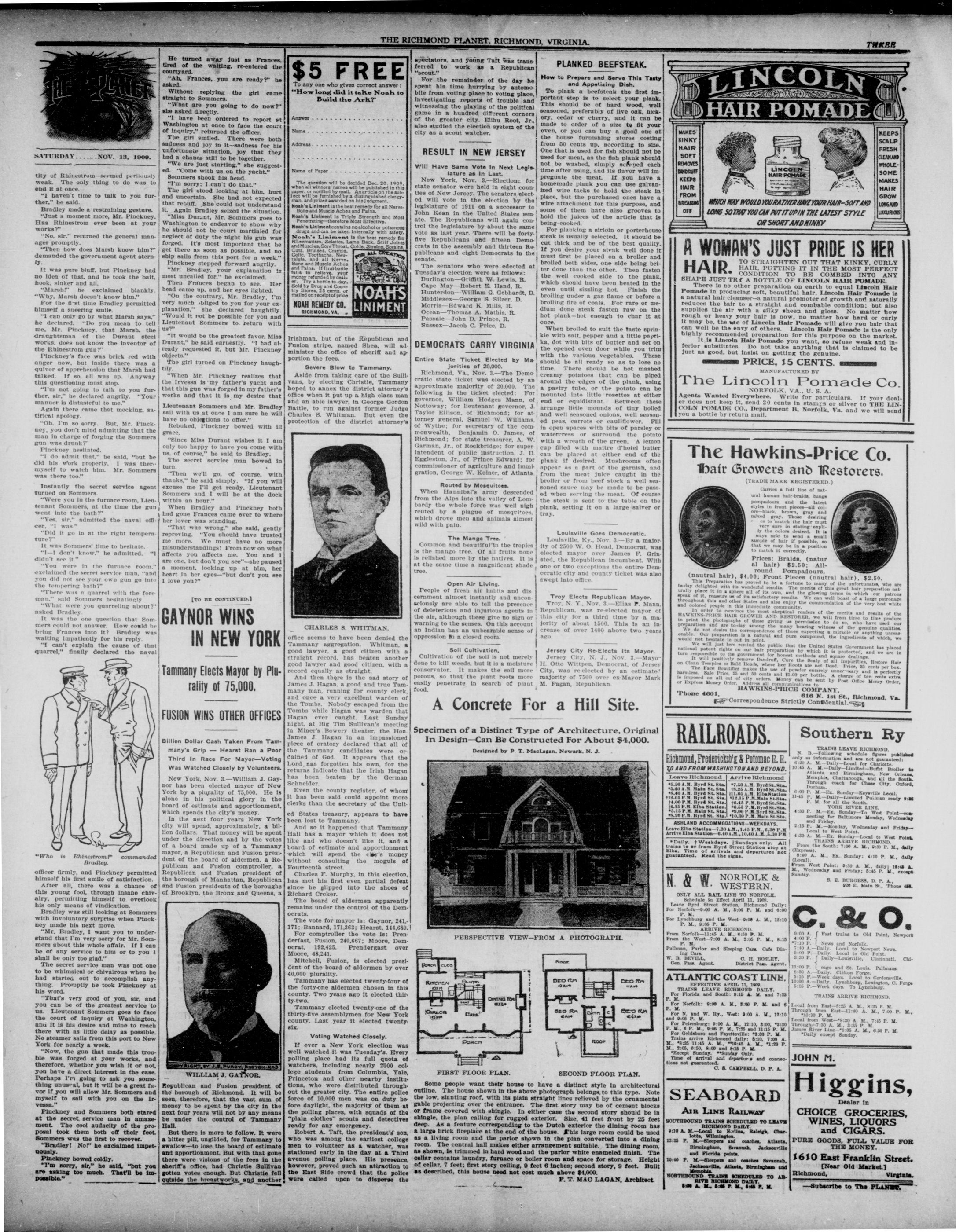
GAYNOR WINS IN NEW YORK
FUSION WINS OTHER OFFICES
Billion Dollar Cash Taken From Tammany's Grip — Hearst Ran a Poor Third In Race For Mayor—Voting Was Watched Closely by Volunteers.
New York, Nov. 3.—William J. Gaynor has been elected mayor of New York by a plurality of 75,000. He is alone in his political glory in the board of estimate and apportionment, which spends the city's money.
In the next four years New York city will spend, approximately, a billion dollars. That money will be spent under the direction and by the votes of a board made up of a Tammany mayor, a Republican and Fusion president of the board of aldermen, a Republican and Fusion comptroller, a Republican and Fusion president of the borough of Manhattan, Republican and Fusion presidents of the borough of Brooklyn, the Bronx and Queens, a
M.
WILLIAM J. GAYNOR.
Republican and Fusion president of the borough of Richmond. It will be seen, therefore, that the vast sum of money to be spent by the city in the next four years will not by any means be under the control of Tammany Hall.
But there is more to follow. It were a bitter pill, unglided, for Tammany to swallow—to lose the board of estimate and apportionment. But with that gone there were visions of the fees in the sheriff's office, had Christie Sullivan gotten votes enough. But Christie fell outside the breastworks, and another
THE RICHMOND PLANET, RICHMOND, VIRGINIA
$5 FREE
To any one who gives correct answer:
"How long did it take Noah to
Build the Ark?"
The question will be decided Dec. 20, 1909, when all winners' names will be published in this paper, or notified by mail. An article on the sub-paper will be published in the clergy-man, and prizes awarded on his judgment.
Noah's Liniment is the best remedy for all Nerve-Bone and Muscle Aches and Palms.
Noah's Liniment is Triple Strength and Most Penetrating—therefore Most Effective.
Noah's Liniment contains no alcohol or poisonous drugs and can be taken internally with safety.
Noah's Liniment is effective for Rheumatism, Selacia, Lame Back, Striffle and Muscles, Sore Throat, Cobra, Struts, Scralns.
Cuta, Brulses, Gramps.
Coolt, Toothache, Neu-
turial Pain.
Bone and Muscle Ache
and Pains. If first bottle
money refilled by dealer.
Try a bottle to-day.
Solely by Drug and Coun-
sell. Mailed on receipt of price
FOR ALL CREATION
NOAH'S
LINIMENT
MOAH REMEDY CO.
RICHMOND, VA.
Irishman, but of the Republican and Fusion stripe, named Shea, will administer the office of sheriff and apportion the fees.
Severe Blow to Tammany.
Aside from taking care of the Sullvans, by electing Christie, Tammany hoped to annex the district attorney's office when it put up a high class man and an able lawyer, in George Gordon Battle, to run against former Judge Charles S. Whitman. But even the protection of the district attorney's
M.
CHARLES S. WHITMAN.
office seems to have been denied the Tammany aggregation. Whitman, a good lawyer, a good citizen with a straight record, has beaten another good lawyer and good citizen, with a record equally as straight.
And then there is the sad story of James J. Hagan, a good and true Tammany man, running for county clerk, and once a very excellent warden of the Tombs. Nobody escaped from the Tombs while Hagan was warden that Hagan ever caught. Last Sunday night, at Big Tim Sullivan's meeting in Miner's Bowyer theater, the Hon. James J. Hagan in an impassioned piece of oratory declared that all of the Tammany candidates were ordained of God. It appears that the Lord has forgotten his own, for the returns indicate that the Irish Hagan has been beaten by the German Schneider.
Even the county register, of whom it has been said could appoint more clerks than the secretary of the United States treasury, appears to have been lost to Tammany. And so it happened that Tammany Hall has a mayor which it does not like and who doesn't like it, and a board of estimate and apportionment which will spend the city's money without consulting the moguls of Fourteenth street. Charles F. Murphy, in this election, has met his first even partial defeat since he glipped into the shoes of Richard Croker. The board of aldermen apparently remains under the control of the Democrats. The vote for mayor is: Gaynor, 241, 171; Bannard, 171,363; Hearst, 144,680. For comptroller the vote is: Prenderfast, Fusion, 240,667; Moore, Democrat, 192,425. Prendergast over Moore, 48,241.
Mitchell, Fusion, is elected president of the board of aldermen by over 40,000 plurality. Tammany has elected twenty-four of the forty-one aldermen chosen in this county. Two years ago it elected thirty-two. Tammany elected twenty-one of the thirty-five assemblymen for New York county. Last year it elected twenty-six.
Voting Watched Closely.
If ever a New York election was well watched it was Tuesday's. Every polling place had its full quota of watchers, including nearly 2000 college students from Columbia, Yale, Princeton and other nearby institutions, who were distributed throughout the greater city. The entire police force of 10,000 men was on duty before daylight, the majority of them at the polling places, with squads of the "plain clothes" scouts and detectives ready for any emergency.
Robert A. Taft, the president's son, who was among the earliest college men to volunteer as a watcher, was stationed early in the day at a Third avenue polling place. His presence, however, proved such an attraction to the East Side crowd that the police were called upon to disperse the
spectators, and young Taft was transferred to work as a Republican "scout." For the remainder of the day he spent his time hurrying by automobile from voting place to voting place, investigating reports of trouble and witnessing the playing of the political game in a hundred different corners of the greater city. Elhu Root, Jr., also studied the election system of the city as a scout watcher.
RESULT IN NEW JERSEY
Will Have Same Vote In Next Legislature as In Last.
New York, Nov. 3.—Elections for state senator were held in eight counties of New Jersey. The senators elected will vote in the election by the legislature of 1911 on a successor to John Kean in the United States senate. The Republicans will again control the legislature by about the same vote as last year. There will be forty-five Republicans and fifteen Democrats in the assembly and thirteen Republicans and eight Democrats in the senate. The senators who were elected at Tuesday's election were as follows:
Burlington—Griffith W. Lewis, R.
Cape May—Robert E. Hand, R.
Hunterdon—William G. Gebhardt, D.
Middlesex—George S. Silzer, D.
Morris—Edward K. Mills, R.
Ocean—Thomas A. Mathis, R.
Passaic—John D. Prince, R.
Sussex—Jacob C. Price, D.
DEMOCRATS CARRY VIRGINIA
Entire State Ticket Elected by Majorities of 20,000.
Richmond, Va., Nov. 3.—The Democratic state ticket was elected by an approximate majority of 20,000. The following is the ticket elected: For governor, William Hodges Mann, of Nottoway; for lieutenant governor, J. Taylor Ellison, of Richmond; for attorney general, Samuel W. Williams, of Wythe; for secretary of the commonwealth, Benjamin O. James, of Richmond; for state treasurer, A. W. Garman, Jr., of Rockbridge; for superintendent of public instruction, J. D. Eggleston, Jr., of Prince Edward; for commissioner of agriculture and immigration, George W. Kolner, of Atlanta
Routed by Mosquitoes
When Hannibal's army descended from the Alps into the valley of Lombardy the whole force was well nigh routed by a plague of mosquitoes, which drove men and animals almost wild with pain.
The Mango Tree.
Common and beautiful in the tropics is the mango tree. Of all fruits none is relished more by the natives. It is at the same time a magnificent shade tree.
Open Air Living.
People of fresh air habits and dis-
cernment almost instantly and unco-
sciously are able to tell the presence
of deleterious and injurious agents in
the air, although these give no sign or
warning to the senses. On this account
an Indian has an unbearable sense of
oppression in a closed room.
Soil Cultivation
Cultivation of the soil is not merely done to kill weeds, but it is a moisture conservator. It makes the soil more porous, so that the plant roots more easily penetrate in search of plant food.
A Concrete For
Specimen of a Distinct Type
In Design—Can Be Const
A Concrete For a Hill Site.
Specimen of a Distinct Type of Architecture, Original In Design—Can Be Constructed For About $4,000. Designed by P. T. MacLagan, Newark, N. J.
PERSPECTIVE VIEW—
THE HOME OF THE MAYOR
PERSPECTIVE VIEW—FROM A PHOTOGRAPH.
FIRST FLOOR PLAN.
SECOND FLOOR PLAN.
Some people want their house to outline. The house shown in the above the low, slanting roof, with its plain stable projecting over the entrance. The or frame covered with shingle. In it shingle, the plan calling for rugged e deep. As a feature corresponding to a large brick fireplace at the end of the as a living room and the parlor show room. The central hall makes either as shown, is trimmed in hard wood and cellar contains laundry, furnace or box of cellar, 7 feet; first story ceiling, 9 feet as described, this house need not cost
Some people want their house to have a distinct style in architectural outline. The house shown in the above photograph belongs to this type. Note the low, slanting roof, with its plain straight lines relieved by the ornamental gable projecting over the entrance. The first story may be of cement blocks or frame covered with shingle. In either case the second story should be in shingle, the plan calling for rugged exterior. Size, 41 feet front by 25 feet deep. As a feature corresponding to the Dutch exterior the dining room has a large brick fireplace at the end of the house. This large room could be used as a living room and the parlor shown in the plan converted into a dining room. The central hall makes either arrangement suitable. The dining room, as shown, is trimmed in hard wood and the parlor white enameled finish. The cellar contains laundry, furnace or boiler room and space for storage. Height of cellar, 7 feet; first story ceiling, 9 feet 6 inches; second story, 9 feet. Built as described, this house need not cost much above $4,000.
PLANKED BEEFSTEAK.
How to Prepare and Serve This Tasty and Appetizing Dish.
To plank a beefsteak the first important step is to select your plank. This should be of hard wood, well seasoned, preferably of live oak, hickory, cedar or cherry, and it can be made to order of a size to fit your oven, or you can buy a good one at the house furnishing stores costing from 50 cents up, according to size. One that is used for fish should not be used for meat, as the fish plank should not be washed, simply scrape each time after using, and its flavor will impregnate the meat. If you have a homemade plank you can use galvanized tacks to hold the steak in place, but the purchased ones have a wire attachment for this purpose, and some of them have also grooves to hold the juices of the article that is being cooked.
For planking a sriroin or porterhouse steak is usually selected. It should be cut thick and be of the best quality. If you desire your steak well done it must first be placed on a broiler and broiled both sides, one side being better done than the other. Then fasten the well cooked side to the plank, which should have been heated in the oven until sizzling hot. Finish the broiling under a gas flame or before a broiling fire of coals. For rare or medium done steak fasten raw on the hot plank—hot enough to char it at once.
When broiled to suit the taste sprinkle with salt, pepper and a little pearlka, dot with bits of butter and set on the opened oven door while you trim with the various vegetables. These should be all ready so as to lose no time. There should be hot mashed creamy potatoes that can be piped around the edges of the plank, using a pastry tube, or the potato can be mounted into little rosettes at either end or equidistant. Between these arrange little mounds of tiny boiled and well seasoned onions, well seasoned peas, carrots or cauliflower. Fill in open spaces with bits of parsley or watercress or surround the potato with a wreath of the green. A lemon cup filled with maitre d'hotel butter can be placed at either end of the plank if desired. Mushrooms often appear as a part of the garnish, and from the meat juice caught in the broiler or from beef stock a well seasoned sauce may be made to be passed when serving the meat. Of course the steak is sent to the table on the plank, setting it on a large salver or tray.
Louisville Goes Democratic
Louisville, Ky., Nov. 3.—By a majority of 2500 W. O. Head, Democrat, was elected mayor over James F. Grinsted, the Republican incumbent. With one or two exceptions the entire Democratic city and county ticket was also swept into office.
Troy Elects Republican Mayor.
Troy, N. Y., Nov. 3.—Ellias P. Mann, Republican, was re-elected mayor of this city for a third time by a majority of about 1500. This is an increase of over 1400 above two years ago.
Jersey City Re-Elects Its Mayor.
Jersey City, N. J., Nov. 3.—Mayer H. Otto Witten, Democrat, of Jersey City, was re-elected by an estimated majority of 7500 over ex-Mayor Mark M. Fagan, Republican.
or a Hill Site. of Architecture, Original Structured For About $4,000.
FROM A PHOTOGRAPH.
ROOF
BED RA
10A19
BED RA
11A19
BED RA
12A19
BED RA
13A19
ROOF
SECOND FLOOR PLAN.
I have a distinct style in architectural photograph belongs to this type. Note straight lines relieved by the ornamental the first story may be of cement blocks her case the second story should be in exterior. Size, 41 feet front by 25 feet the Dutch exterior the dining room has house. This large room could be used in the plan converted into a dining arrangement suitable. The dining room, the parlor white enameled finish. The ter room and space for storage. Height 6 inches; second story, 9 feet. Built much above $4,000.
P. T. MAC LAGAN, Architect.
LINCOLN
HAIR POMADE
MAKES
KINKY
HAIR
SOFT
REMOVES
DANDRUFT
KEEPS
HAIR
FROM
BREATHING
OFF
LINCOLN
HAIR POMADE
WHICH WAY WOULD YOU RATHER HAVE YOUR HAIR-SOFT AND
LONG SO THAT YOU CAN PUT IT UP IN THE LATEST STYLE
OR SHORT AND KINKY
KEEPS
SCALP
FRESH
CLEAN AND
WHOLE-
SOME
MAKES
HAIR
GROW
LONG AND
LUXURIOUS
A WOMAN'S JUST PRIDE IS HER
HAIR. TO STRAIGHTEN OUT THAT KINKY, CURLY HAIR, PUTTING IT IN THE MOST PERFECT CONDITION TO BE COMBED INTO ANY SHAPE JUST TRACE A BOTTLE OF LINCOLN HAIR POMADE.
There is no other preparation on earth to equal Lincoln Hair Pomade. It is in producing soft, beautiful hair. Lincoln Hair Pomade is a natural hair cleanser—a natural promoter of growth and naturally reduces the hair to a straight and combable condition; but also supplies the air with a silky sheen and gloss. No matter how rough or heavy your hair is now, no matter how hard or curly it may be, the use of Lincoln Hair Pomade will give you hair that can well be the envy of others. Lincoln Hair Pomade is the only highly recommended preparation for this purpose on the market.
It is Lincoln Hair Pomade you want, so refuse weak and inferior attributives. Do not take anything that is claimed to be just as good as the pomade.
The Lincoln Pomade Co.
NORFOLK, VA., U. S. A.
Agents Wanted Everywhere. Write for particulars. If your deal
er does not keep it, send 20 cents in stamps or silver to THE LIN
COLN POMADE CO. Department B, Norfolk, Va. and we will send
you a bottle by return mail.
The Hawkins-Price Co. Thair Growers and Restorers.
(TRADE MARK REGISTERED.)
Carries a full line of natural human hair-braids, bangs pampadours and the latest styles from pieces all colors—black, brown, day and mixed gray. Those desired es to match the hair must very sure in stating explicity the color desired. It is way safe to use all sample of hair if possible, so that we may be in a position to match it correctly.
Prices: Braids, (natur al hair) $2.50; All round Pampadours
(nautral hair), $4.00; Front B
This Preparation has prepared to be in a to-day delighted with its wonderful results, unally place it in a sphere all of its own, a speak it it requires to put its national recess throughout this and other States and also colored people in this immediate community in order to convince the most skeptic HAWKINS (SWIMMER) and REED in print the photographs of the gift preparation and are to-day among the man.
We do not desire the correspondence of the onlain. Our preparation is a natural and it would not be reasonable to give preparation and are to-day among the man.
We will just here remind the public the national patent rights on our hair preparation turn responsible to the government for home. It will be Dandruff. It will be Clean Temples or Hair Hoods. We will just remind the public the Face Beautifier makes the use of harbours. Sale Price, 25 and 50 cents and $ is imposed on all 25 of city orders. Money or Express Money Order. We are a community
HAWKINS-PRICE
Phone 4601. Correspondence Store
(nautral hair), $4.00; Front Pieces (nautral hair), $2.50.
This Preparation has proved to be a fortune to many of the unfortunate, who are ten-day delighted with its wonderful results. The merits of this great hair preparation naturally lie in a sphere all of its own, and the glowing terms in which our patrons speak of it, remain the key results. We can well boast of a large patronage throughout this and other States and the commendation of the very best white and colored people in this immediate community.
In order to convince the most skeptical readers of the merits and results of the HAWKINS-PRICE COMPANY, HAIR GROWER AND RESTORER, we will from time to time produce in print the photograph of the new us permission to do so, who have used our preparation and are to-day among the new genuine qualities. We do not desire the correspondence of those expecting a miracle, anything unreasonable. Our preparation is a natural and pure compound, the ingredients of which, we would like to put in print.
We will welcome to public that the United States Government has placed national patent rights on our hair preparation by which it is protected, and we are in turn responsible to the government for honest methods and honest dealing. We will positively remove Dandruff, Cure the Scalp of all Impurities, Restore Hair on Chameleon Temples or Bald Heads, where hee Roots are not Dead. Price, 35 cents per box. Change Price, 25 and 50 cents per box. Use of powder entirely unnecessary and is perfectly harmless. Sale Price, 25 and 50 cents per bottle. A charge of ten cents extra is imposed on all out of city orders. Money can be billed by Post Office Money Order, or Express Money Order. Address all communications to
HAWKINS-PRICE COMPANY,
616 N. 1st St., Richmond, Va.
Correspondence Strictly Confidential.
RAILROADS.
RAILROADS.
Richmond, Fredericksb/g & Potomac R. R.
TO AND FROM WASHINGTON AND BEYOND.
Leave Richmond
*5.20 A.M. Byrd St. Sta.
*5.40 A.M. Main St. Sta.
*5.40 A.M. Byrd St. Sta.
13.61 P.M. Elba Station.
4.00 P.M. Byrd St. Sta.
4.15 P.M. Elba Station.
*5.15 P.M. Main St. Sta.
*8.20 P.M. Elba Station.
Arrive Richmond
*7.50 A.M. Byrd St. Sta.
*8.25 A.M. Byrd St. Sta.
11.65 A.M. Elba Station.
12.45 P.M. Byrd St. Sta.
6.55 P.M. Byrd St. Sta.
9.00 P.M. Byrd St. Sta.
10.30 P.M. Main St. Sta.
ASHLAND ACCOMMODATIONS—WEEKDAYS.
Leave Elba Station—7.30 A.M. 1.45 P.M. 6.38 P.M.
Arrive Elba Station—6.40 A.M. 10.40 P.M. 6.50 P.M.
* Daily. * Weekdays. * Sundays only. * All
to be sent from Byrd Street Station stop at
Elba Station. * Departures do not
guaranteed. * Read the signs.
N. & W. NORFOLK & WESTERN
ONLY ALL RAIL LINE TO NORFOLE
ONLY ALL RAIL LINE TO NORFOLK.
From Norfolk - 9:00 A. M. 8:00 P. M. and 6:00
P. M.
For Lynchburg and the West-9:00 A. M. 12:10
P. M. 9:06 P. M.
ARRIVE RICHMOND.
From Norfolk-11:45 A. M. 6:50 P. M.
From the West-7:00 A. M. 2:06 P. M. 8:15
P. M.
ATLANTIC COAST LINE.
TRAINS LEAVE RICHMOND DAY
For Florida and South: 8118 A.M. and 7:53
P. M.
For Norfolk: 9:00 A. M., 3:00 P. M. and 6
P. M.
For P. M. and W. Ry., West: 9:00 A. M., 12:10
and 9:06 P. M.
For Petersburg: 9:00 A. M., 12:10, 10:06, *"2:30*
P. M. 6 P. M., 9:06 P. M. and 11:15 P. M.
*"2:30* P. M. 6 P. M., 9:06 P. M. and 11:15 P. M.
Trains arrive Richmond daily: 9:00 A. M.
*"8:35* 11:45 A. M., *"10:45* A. M., *"12:0* P. M.
*2:05*, 6:50, 8:00 and 8:15 P. M.
SEABOARD
SEABOARD
SOUTHBOUND TRANS SCHEDULED TO LEAVE
RICHMOND DAILY.
9:10 A. M.—Ickworth, Raleigh, Charlote,
Wilmington.
12:35 P. M.—Sleepers and coaches, Atlanta,
Birmingham, Savannah, Jacksonville
and Florida points.
10:40 P. M.—Sleepers and coaches Savannah,
Jacksonville, Atlanta, Birmingham and
Memphis.
NORTHBOUND TRANS SCHEDULED TO ARRIVE
RICHMOND DAILY.
6:00 A. M. 6:25 P. M. 6:55 P. M.
1827
deices (nautral hair), $2.50.
fortune to many of the unfortunate, who are
the merits of this great hair preparation nat-
d and the glowing terms in which our patrons
will. We can well boast of a large patronage
the commendation of the very best white
unity.
real readers of the merits and results of the
OCEILL, we will from time to time produce
a perfect batch of our hair products, our
bearing witness of the genuine qualities,
rose expecting a miracle or anything unre-
sure compound, the ingredients of which, we
that the United States Government has护
on by which it is protected, and we are in
metods and square dealings.
Restore Hair
Roots are not Dead. Price, $3 cents per box.
powder entirely unnecessary and is perfectly
0.00 per bottle. A charge of ten cents extra
can be sent to Post Office Money Order,
implications to
ICE COMPANY.
616 N. 1st St., Richmond, Va.
Directly Confidential.
Southern Ry
TRAINS LEAVE RICHMOND
LEAVEN RICHMOND.
N. B.-Following suburban suburbs, published only as information and are not guaranteed:
6:20 A. M.-Daily-Local for Charlotte.
10:45 A. M.-Daily-Limited-Broker Bufer to Atlanta, Georgia, Bangham, New Orleans, Memphis, Chattanooga and the Through coach for Chase City, Oxford, Durham.
6:00 P. M.-Ex. Sunday-Keysville Local.
11:45 P. M.-Daily-Limited Pouman ready 9:26 P. M. for all the South.
YORK RIVER LINE.
4:30 P. M.-Sunday-To West Point-connecting for Baltimore Monday, Wednesday and Friday.
2:15 P. M.-Monday, Wednesday and Friday-To West Point.
4:30 A. M.-Daily-Local to West Point, TRAINS ARRIVE RICHMOND.
From the South: 7:00 A. M., 9:30 P. M., daily (Barrens).
4:30 A. M. Ex. Sunday: 4:10 P. M., daily (Local).
From West Point: 9:30 A. M., daily: 10:45 A. M., Wednesday and Friday: 5:45 P. M., except
C. & O.
9:00 A. $ \int $ Fast trains to Old Point, Newport
4:00 P.
11:00 P. { cargo and St. Louis. Pullmans.
8:30 A.-Daily. Clifton Forge.
5:15 F.-Week days. Local to Gordonsville.
10:00 A.-Daily. Lynchburg, Lexington, C. Forge
5:15 F.-Week days. To Lynchburg.
TRAINS ARRIVE RICHMOND.
Local from East-8:25 A. M., 8:25 P. M.
Through from East-11:40 A. M., 7:00 P. M.,
*10:30 P. M.
Local from West-8:30 A. M., 7:45 P. M.
Through-7:30 A. M., 3:35 P. M.
James River Line-9:35 A. M., 6:50 P. M.
*Daily except Sunday.
JOHN M.
Higgins,
Dealer in
CHOICE GROCERIES,
WINES, LIQUORS
and CIGARS.
PURE GOODS, FULL VALUE FOR
THE MONEY.
1610 East Franklin Street.
[Near Old Market.]
Richmond,
Virginia.
—Subscribe to The PLANE
TWREE
A. B. C. D. E. F. G. H. I. J. K. L. M. N. O. P. Q. R. S. T. U. V. W. X. Y. Z.
S. E. BURGESS, D. P. A.
920 E. Main ST., Phone 488
FOUR
THE PLANET
TERMS IN ADVANCE.
One Copy, one year, - - - - - $1.50
One Copy, eight months, - - - - - 1.00
One Copy, six months, - - - - - .80
One Copy, four months, - - - - - .58
One Copy, three months, - - - - - .40
Single Copy, - - - - - .00
ADVERTISING RATES
For one inch, one insertion . . . $ .50
For one inch each subsequent insertion . . . 40
For two inches, three months . . . 6.00
For two inches, six months . . . 10.00
For two inches, twelve months . . . 20.00
Marriage and Funeral Notices, one inch . . . 50
Standing and Transient Notices per line . . . 70
POSTAGE STAMPS OF A HIGHER DENOMINATION THAN TWO CENTS NOT RECEIVED ON SUBSCRIPTIONS.
THE PLANET is issued weekly. The subscription price is $1.50 per year in advance.
THE PLANET is issued weekly. The subscription price is $1.50 per year in advance. There are four ways by which money can be sent by mail at our risk—In a Post Office Money Order, in a Money Order from an Exim Money Order, and when none of these can be procured, in a Registered Letter.
COMMUNICATIONS—When writing to us to
renew your subscription or to discontinue your
paper, you should give your name and address
full otherwise we cannot find your name on
our books
CHANGE OF ADDRESS—In order to change
the address of a subscriber, we must be sent the
former as well as the present address.
Entered at the Post Office at Richmond, Va
as second class matter.
SATURDAY...NOV. 13, 1909.
We have received an invitation to the Twenty-8th wedding anniversary of Dr. and Mrs. E. C. Morris, Monday, November 29, 1909, at Helena, Ark.
Attorney J. Thomas Hewin can "possess his soul in patience" and go on his way in peace. The intimation that he has in any way gone out or his way to do an unprofessional thing or conspired to injure any one innocent of wrong-doing is too absurd for a moment's notice or for an hour's consideration. This is where one's previous good record comes into the limelight and where good character is a luminous asset
In these courthouses, every known method of distortion and misrepresentation is resorted to in order to carry a point and to cloud and obscure the facts at issue. To establish the allegations, motive for the alleged improper conduct must be established. We have lived here long enough to know that the better class of law-abiding white and colored people understand the situation exactly and that they have formed their own conclusions as to the nature of the proceedings which have for the last few months confronted them.
When ministers of the gospel of known respectability and reliability are branded as liars, when they are known to be truthful men and men of character are sneered at as suspicious characters, when they are known to be honest, truthful individuals, the situation is at once explained and honest up-right attorneys of Mr. J. Thomas Hewin's calibre and character need have no fear of the deception of the public by such practices.
PRESIDENT TAFT IN RICHMOND
President William H. Taft is a gentleman of a charming personality. We have seen and heard him speak in Richmond, the capital of the late Confederacy. He advised us as colored men to "stick to the farm." From an economic and practical stand-point this was wholesome advice.
As a matter of fact, the smaller part of us is in the cities and the larger part of us on the farms. We have not as yet succeeded in properly educating the ten per cent. of our people who are seeking for a place at the top along scientific, mechanical and financial lines.
It is true as the distinguished presidential visitor stated that we need to raise the standard of industrial education among the masses
Hampton Institute under Principal H. B. Frissell and Tuskegee Institute under Principal Booker T. Washington are doing a great and grand work.
To the thousands of colored men who are aspiring to greater things, who are endeavoring to scale, the heights of fame and place the banner of well earned success upon its ramparts, there has been no note of encouragement. These men will secure the reward for their services in the financial prosperity which shall crown their successful efforts. That President Taft was here to please those who so royally entertained him was evident. That he has determined to deny to the citizen of color the right to hold representative office must be evident to the most casual observer. There is one redeeming feature about it all, and that is he has evidently made up his mind to relegate to the shades or oblivion, those old line Republicans, who for more than a quarter of a century have followed the fortunes of the party. What else can he mean when he used the following language at the City Auditorium?
"When I was in the South before the election, but when I was reasonably sure of being elevated to the office I now hold, I said that I was anxious to show Southern people that they are as much a part of the Union as any other part of the country. I have ever since endeavored to bring that out in my speeches throughout the country and in the appointment to Federal offices of men acceptable, who would not appear as the agents of an alien government, but as representatives of their own. A year has not yet elapsed, and you must give me three more years to demonstrate my sincerity.
The above words are promises for the future. If men appointed to office are to be only those acceptable and who are representatives of the Southern people, then so far as the officers are concerned, it matters little to us whether the administration at Washington is Republican or Democratic. Colored men in order to secure political office should get their applications signed by those Democrats, who have been fighting the Republican Party and Mr. Taft. We can see no ray of hope for us in the policy of President Taft, if we look at it from a political standpoint. He is dealing with these questions from a commercial standpoint and human rights are forgotten.
There will be soon new party alignments. Colored men of a new school will come upon the field of action and surprising adjustments and re-arrangements will be in evidence. The word "Republican" has but little significance as it was formerly understood, and the day of our political un-doing is at hand. We are working, let us work harder. We are learning, let us learn faster. We are increasing our revenues; let us increase them more rapidly. We are serving God, let us serve Him more faithfully. We are making friends among our white Neighbors, let us so conduct ourselves as to be able to multiply the number an hundred fold. Above all, let us turn our faces from Washington and direct our gaze upon the capitals of the several states in which we live. Selah
THE ELECTION
The result of the local elections last Tuesday, while having but slight national significance would seem to indicate that the Democratic Party as at present constituted has found practically no reason to hope for a return to power in the national government. The defeat of Tammany in New York city was very significant. It shows that had Hon. W. R. Hearst kept out of the race, the indications are that Judge Gaynor, his chief political opponent would have been defeated.
As the matter now stands the Fusion Republican organization will control the financial part of the city government and will expend one billion dollars in improvements. Should the combination remain united and not fall out over the "loaves and fishes", there is danger ahead for the Democratic organization in New York.
The result in Virginia is just as everybody expected. The Republican candidates made a fight and they lost. At the present rate of increase the Party may come into power again in this state in about twenty-five or fifty years. Still, it is best to have a minority party, if for no other purpose than to have a place of refuge for the disgruntled democrats, who are badly in need of an assylum, from which the issuance of threats may cause some embarrassment to their enemies, if not actual harm to those whom they condemn for past evil doing.
Hot Dishes
To make dinner plates and dishes hot before sending to the table dip them in very hot water instead of putting them in the oven. This takes only a little more time than putting them in the oven and is less liable to crack the china.
THE RICHMOND PLANET, RICHMOND, WIRGINIA
December 2 and Not December 29
Date for 5002 Anniversary
of Bryan, Bryan
To the Colored Citizens of the United States and their fellow countrymen—
Greeting:
Inasmuch as by some error the New England Suffrage League at its 6th Annual Session in Boston on October 4th urged the Colored people of the United States to generally celebrate the 50th anniversary of the public murder of John Brown and named the date December 29, 1909, we the undersigned officers of said League announce that the proper date is December 2, 1909.
In pursuance of the vote of the League ratified by the mass meeting at St. Paul Baptist Church on the night of October 4th, and in consonance with its spirit we issue this appeal first to all Colored Americans and also to all their fellow countrymen to assemble in public memorial meeting on December 2, next to honor the memory of this proto-martyr or freedom. We especially urge the National Independent Political League and the Niagara Movement to hold such public memorial meetings and all literary or patriotic societies to so do. We appeal to all the Colored churches of this country and to all other churches to set aside the Sunday preceding December 2nd in honor of John Brown as a day of prayer for the cause of freedom for which he laid down his life and of honor to this great crusader. We further appeal to the Colored press and to all other publications to spread this appeal broadcast before their readers.
WM. MONROE TROTTER, PRES.
77 Cornhill, Boston, Mass.
REV. W. W. RYAN. Cor. Sec'y
41 Court St., W. Newton, Mass.
WAGES VS. LIVING
Eastern Railroads May Grant Em
plowed Deposits For Eng
employees Demands For Increase.
New York, Nov. 10. — Conferences are being held here by railway officials to discuss the request of employees of the eastern railroads for higher wages. These demands are based on the high cost of living, and the consensus of opinion among railway officers is to grant an increase in pay, but as small an increase as possible. That course is considered the only alternative of upsetting the improvement being shown in gross earnings.
It was also learned that employees of western roads were preparing a higher wage scale to submit to their employers. The demand for higher wages, both in the east and west, are coming from all departments of labor.
There has been practically no change in the wages of railway employees since the autumn of 1996, when the Pennsylvania granted an increase of 10 per cent. That increase was subsequently granted by all of the roads
Grows Seedless Apples
Georgetown, Del., Nov. 10. — The first seedless apples ever grown in this part of the state were brought to town by Frank Rogers, who gathered them from his young orchard near Shortley. The yield was very small on account of the wet spring and the tenderness of the trees.
Only a Supposition.
Editor—I hear you referred to nowadays too often as a "cheap humorist." Humorist—Thank you, sr. Editor—Why thank me? Humorist—I supposed you were about to make my salary such that the taunt would be no longer just—Exchange.
---
How to Keep Silverware Bright.
Here is a good homemade liquid for keeping silver clean. It is a great help to every one who has tried it:
Make a strong alum water and skim off all the particles that will not dissolve. To this add shavings of pure white soap. Let them dissolve and bottle it. After the silver has been cleaned with whitening or any other soap or liquid that comes for that purpose rub each piece with a clean bit of cheesecloth soaked with this alum water. It adds luster and keeps the silver clean for quite some time. If it is found that any silver spoon or cup has been stained by medicine or egg, dip a cloth in sulphuric acid, rub the stained part until it disappears, then wash the piece in soap and water.
How to Soothe Tired Feet.
People who must stand at their work all day should wear very comfortable shoes with broad soles, well fitting arches, and proper heels. This is the only possible way of being comfortable under the circumstances. It is well also to wear high shoes, buttoned or laced closely around the ankles, which are apt to swell from the long strain of standing. The feet should be given a hot bath every night, as well as a morning bath, when they should be scrubbed with a stiff brush. A soothing bath for tired feet is warm water with a little baking soda or borax dissolved in it. A vigorous rub with alcohol is also good. Another soothing application is to rub the feet with a piece of lemon.
How to Easten Hair Bows
Little girls often have their hair "bobbed," and the mothers or nurses who must tie on the large bows are often perplexed as to how to fasten these large ribbons to the small wisp of hair. Here is a very good arrangement which overcomes the difficulty and at the same time preserves the ornamental bow without necessitating retying it each day. Make the large bow and sew a strip of stout baby ribbon of the same color underneath. Wind the narrow ribbon around the hair several times, tie in a tight bowknot and it will hold nicely.
$25,000,000 FOR PUBLIC BENEFIT
$35,000,000 TO RELATIVES
Fifty-five Institutions In All Parts of the United States and Five Abroad to Benefit With Large Bequests.
John Stewart Kennedy's will, which was filed in New York, disposes of an estate estimated at $60,000,000 value, of which about $25,000,000 is bequeathed for the public benefit, being distributed among various religious, education and charitable institutions. The executors of the will are the testator's wife, Emma B. Kennedy, who survives him; his nephews, William Stewart Todd and Robert Eliot Tod, and Mr. De Forest, whom the testator describes as his friend.
After quoting the estimated value of the estate at "about $60,000,000," Mr. De Forest said; "Broadly speaking, Mr. Kennedy leaves a little more than one-quarter of his entire estate to his wife, a little more than one-quarter to relatives and friends, and he gives something less than one-half to various religious, charitable, benevolent and educational institutions, about sixty in all, five of which are abroad."
Cooper Union gets $20,000; the National Academy of Design, $20,000; the University of Glasgow, "where from my infancy I resided until I came to this country," says the testator, $100,000; the Tuskegee institute (Booker T. Washington's), $100,000, and the Syrian Protestant college at Beirut, $25,000.
Seven of the country's colleges receive $100,000 each, namely: Yale Amherst, Williams, Dartmouth, Bowdoin, Hamilton and the Hampton Normal school. Ten of the educational institutions receive $50,000 each, these being Lafayette, Wellesley and Oberlin colleges, Barnard college and the Teachers' college in this city, Elmira college, Northfield seminary, the Mt. Vernon Boys' school at Gill, Mass.; Anatolia college, at Marsovon, Turkey, this latter bequest being made for the college to the American board of commissioners for foreign missions and Berea college in Kentucky. The American board of commissioners for foreign missions receives also $20,000 for the American school at Smyrna. Lake Forest university, Ill. and Central school, Danville, Ky., each receive $25,000.
"Mr. Kennedy's residuary estate," said Mr. De Forest, "is divided into sixty-four parts, of which Mrs. Kennedy receives 16. Mr. Kennedy's relatives 17, and public institutions 3. In addition to the one-sixty-fourth of his residuary estate given to Mrs. Kennedy, she receives his city residence 6 West Fifty-seventh street; his country residence at Bar Harbor, and $1,000,000 in cash.
"It is estimated that each sixty-four part of the residuary estate will have a value of approximately $750,000."
Mon, Asien, Wien, Dt
Mrs. Astor Wins Divorce Suit.
In the space of one minute by the clock and without once mentioning the names of either John Jacob Astor the millionaire social leader or of his wife, Mrs. Ava Willing Astor, Justice Mills in New York granted an interlocutory decree of divorce to the latter and signed an order sealing the papers so that the public shall know nothing of the case.
The great wealth of the litigants and the astuteness and diplomacy of the lawyers engaged on both sides combined to make the Astor divorce one of the most remarkable court proceedings ever witnessed in the state, if not in the country.
The name of the case was not called, and the procedure was so swift and mysterious as regarded the identity of the two principals that the people crowding the courtroom did not know that the divorce had been granted.
It is said that the court has ordered that Mrs. Astor is to have custody of Murrel Ava Alice Astor, her seven-year-old daughter, and Colonel Astor will take charge of Vincent, the son who is at present cruising with his father on the yacht Nourmahal in West Indian waters.
Mrs. Astor's friends say that she will probably make her home abroad after the final settlement of the divorce proceedings. The same friends say that Colonel Astor agreed to settle $10,000,000 on his wife in lieu of alimony.
Fells Cashier; Escapes With $14,165
After striking down William Dobbins, the cashier in the office of the Canadian Express company, at Niagara Falls, Ont., with a piece of iron pipe, a lone man vaulted the counter and made of with a package containing $14,165 in cash. He had a confederate, who stood outside the door, and the two disappeared down the street. All efforts on the part of the police to locate the pair have thus far been futile.
The first that was known of the robbery was when Bruce Brown, the agent in charge of the office, entered the office to get the waybills and pack age of money. He found Dobbins unconscious on the floor back of the counter, with blood flowing from a gaping wound back of his right ear.
Mr. Brown raised an alarm at once, but it was more than an hour before Dcbson was sufficiently revived to give even a meager description of the man who struck him down.
Long Rehber Gate $2000
A masked bandit, working alone,
stole $2000 in cash from the home of
Schuyler Ranier, seventy-two years
old, a wealthy farmer, residing near
Florence, N. J.
The crime has baffled the police by its desperate boldness. Although the Ranier homestead is less than a half mile from the Florence postoffice, and fronts on a much frequented public road, the robber, after locking the aged housekeeper of the farmer in her room, dynamited the big safe, which has been Ranier's bank for years, the storehouse at times for as much as $25,000 in gold.
Mrs. Jane Nickson, nearly seventy years old, and the sole occupant of the farmhouse when the masked robber entered, is in a critical condition from the shock of the struggle with the bandit.
Found Gun: Kills Brother
While going home from school at Delmar, Del, Logan and Roger, the young sons of Calvin Pollit, a well-known farmer of Loretto, found a shotgun, supposedly left by a hunter. Logan, six years old, picked up the gun and, pointing it at his brother, Roger, nine years old, pulled the trigger. The entire contents of one barrel was emptied into the lad's stomach. The little fellow then picked up the bleeding body, and after carrying it to his home, fainted from grief. Upon a doctor's arrival he pronounced Roger dead.
Thomas L. Lewis, president of the United Mine Workers of America, indicated in an interview given out at Pittsburg that the miners will make a stand for higher wages in the spring. Mr. Lewis declared that work at the mines is improving and bound to continue so. He also expressed his confidence of re-election to the presidency of the organization, explaining that about two locals have nominated him against every one that named his opponent, William Green, of Ohio.
Killed In Pennant Bush
Ray Graham, twenty years old, died from injuries which he received in a rush following the raising of a school pennant after a football game at Red Cedar park between the East High and the West High school teams of Waterloo, Iowa. In the scrimmage incident to the raising of the pennant to the flagstaff Graham sustained an injured to his right temple. He became delirious. He was the son of a widowed mother.
Raise For Coke Workers
An advance in wakes of about 15% per cent by the H. C. Frick Coke company, the fuel end of the United States Steel corporation, is booked as a Christmas gift to three thousand employees. The news has leaked out of the Pittsburgh offices in the shape of a semi-official announcement. An increase of sixteen cents on the present estimated production cost of $1.04 per ton of coke is the arrangement to be submitted.
Fairbanks Shayes His Board
Charles Warner Fairbanks, former vice president of the United States, has shaved off his whiskers. Photographs of Mr. Fairbanks taken in Japan, just received in Washington, show that he has discarded the chin heard which he wore for so long. The deed was committed after he left this country for the Orient. Mr. Fairbanks retained his moustache.
Football Causes Another Death
Football Causes Another Death.
Harry Huston, nineteen years old, is dead from heart failure as the result of over-everton during a football game at Crawfordsville, Ind. He suffered fainting spells after a scrimmage and complained of pains in the region of his heart. Other players assisted him from the gridiron. Huston succumbed a few minutes later.
Sulphur Bath Stamped Buffalo
Made furious at being dipped in a sulphur bath to kill the ticks on them, a herd of thirty-six buffalo stamped on Frank Rockefeller's ranch, near Blevdire, Kan., and are now scattered over Klowa county. Five horses were used in pursuing one bull, whose value is $1500, but he is still at large.
Old Man Caught In Fire
William Hay, seventy-five years old, who resided with his son. Edward Hay, about two miles above Reeders, Pa., met death when the house in which he slept was destroyed by fire, the aged man being caught in the flames.
Boy of Ten Sent to Prison.
Cyril St. Armand, of Turbo, Ont., ten years old, was sentenced to six years in jail for horse stealing. When eight years old he was convicted of an attempt to wreck a Canadian Pacific railway train.
Grew 227 Bushels Corn on One Acre.
J. F. Butts grew 227 bushels of corn on one acre near Raleigh, N. C., according to an official state report. This is said to break the record in this country.
New Station For Baltimore
The Pennsylvania Railroad company has decided to build a new passenger station in Baltimore, to cost about $1,000,000. The new station will be on the site of the present union terminal.
Lone Robber Loote Bank
A lone robbed held up Arthur Du Chateau, teller at the Farmers' Exchange bank at Green Bay, Wis., and escaped with about $1000.
EIGHT DIE AS BARK SINKS
Collision Between Barkentine and
Schooner Ends Fatally.
New York, Nov. 10. — Eight Ives were lost in the collision between the barkentine John S. Bennett and an unknown schooner off Block Island.
Reports of the disaster were brought here by the schooner William Jones, which picked up two Filipino sallors. Both the barkentine and the schooner sank after the collision.
The Bennett left here Friday bound for Halifax, laden with coal. Little could be learned from the Filipinos, who could not speak English. They said they had shipped here on the Bennett.
New $20,000,000 Bridge Is Weak.
New York, Nov. 10. — Signs of weak
ness are said to be appearing in the land spans of the new $20,000,000 Williamsburg bridge, opened in 1903, and it is reported that Bridge Commissioner Stevenson will ask for an ap propriation of $500,000 to strengthen it. No fears are expressed that the bridge will collapse, but traffic will be suspended temporarily.
WILL APPEAL CONTEMPT CASE
CALL TRIAL UNCONSTITUTIONAL
Council In Session at Toronto Denounce Trial Without a Jury as Deprivation of Priceless Heritage.
Toronto, Nov. 10.—If Samuel Gompers, Vice President John Mitchell and Secretary Frank Morrison, of the American Federation of Labor, eventually have to serve jail sentences for contempt of court, it will not be due to lack of support from trades unionism.
The executive council of the federation recommended to the annual convention that an appeal be taken to the United States supreme court, both in the Bucks Stowe and Range company's injunction case and in the contempt proceedings growing out of it.
That the convention will ratify the recommendation seems certain, and that the three labor leaders and their fellow officers will be re-elected for another year is predicted.
Report concerning the Gompers trial in part read: "We recommend that an appeal be taken from the decision rendered in both the original injunction as well as the contempt case growing out of it. We cannot permit these decisions to go unchallenged. They affect fundamental rights, and either the courts or congress must safeguard them.
"It should be borne in mind that in these proceedings Messrs. Gompers, Mitchell and Morrison did not have the constitutional right of trial by jury. All the circumstances in this case go to prove that conviction would not have followed if the case had been submitted on its merits to a jury of their peers. We hold that, excepting where contempt is in the presence of the court, the liberty of no citizen should be committed to the keeping of any one man, regardless of who he may be or what position he may hold; on the contrary, we hold that a citizen charged with violating an injunction the penalty of which involves imprisonment, should have the same legal right to a trial by jury that is always accorded to a person charged with violation of the criminal law. To deny the right of trial by jury is to take from the people the protection and priceless heritages which were secured by them after centuries of perseverance, struggle, sacrifice, exile and ever martyrdom.
"Whatever differences of opinion may exist among men as to any controversies between labor and capital, no good citizen of our country who treasures freedom can rest secure until trial by jury becomes so well recognized and so firmly established in our legal jurisprudence that no man will ever again attempt to deny this essential and historic right."
The council also recommended that organized labor take appropriate action looking toward the naming of suitable citizens to fill vacancies that may occur in the supreme court of the United States in the lesser federal courts.
CUT GIRL UP, HE SAYS
"Herb Doctor" Confesses Manslaughter in Revolting Crime
Taunton, Mass., Nov. 10.—While the attorney for "Professor" Frank L. Hill, the Fall River herb doctor, who pleaded guilty to an indictment of manslaughter in connection with the Tiverton suit case mystery, was making a statement in the nature of a confession, reporters in Fall River found in a spot indicated in the confession the head of the victim, which completed the dismembered body of the missing young woman, Miss Amelia St. Jean.
Hill's attorney told the court that Miss St. Jean died in Hill's office as a result of her own act, after Hill had refused to give her the surgical relief which she sought.
Terrified, the lawyer said, Hill dismembered the body and disposed of it. The torso and limbs he scattered along the Bulgarmarsh road in Tiverton, while the head was wrapped in a black skirt and thrown into the bushes near St. Patrick's cemetery in Fall River.
The maximum sentence for man slaughter in this state is twenty years' imprisonment.
CONDENSED NEWS ITEMS
Thursday, November 4.
Shots were heard in a room at Keystone, near Bluefield, W. Va., and when the door was forced the dead bodies of Connie Blackwell and a Hungarian were found.
Twenty-five people were hurt, three fatally, when a car on the University place line at Des Molines, Ia., jumped the track at the foot of Nineteenth street hill while headed down town.
John Marrooney, a negro, is under arrest at Battle Creek, Mich., on suspicion of being the man wanted in Chicago for the robbery of $5000 worth of diamonds from Mrs. A. Hirsch last August.
Friday, November 8.
The new Dreadnought North Dakota made a speed of 22.25 knots on her trial trip, making her the fastest Dreadnought battleship afloat.
Albert Koch, a merchant at Bern-
$3.50 RECIPE CURES WEAR
MEN-FREE
Send Name and Address Today
You Can Have It Free and Be
Strong and Vigorous.
I have in my possession a prescription for nervous debility, lack of vigor, weakened manhood, falling memory and lame back, brought on by excesses, unnatural drains, or the follies of youth, that has cured so many worn and nervous men right in their own homes—without any additional help or medicine—that I think every man who wishes to regain his manly power and virility, quickly and quietly, should have a copy. So I have determined to send a copy of the prescription free of charge, in a plain, ordinary sealed envelope to any man who will write me for it.
This prescription comes from a physician who has made a special study or men and I am convinced it is the surest acting combination for the cure of deficient manhood and vigor failure ever put together.
I think I owe it to my fellow man to send them a copy in confidence so that any man anywhere who is weak and discouraged with repeated failures may stop drugging himself with harmful patent medicines, secure what I believe is the quickest-acting restorative, upholding, SPOT-TOUCHING remedy ever devised, and so cure himself at home quietly and quickly. Just drop me a line like this: Dr. A. E. Robinson, $395 Luck Building, Detroit, Mich., and I will send you a copy of this splendid recipe in a plain ordinary envelope free of charge. A great many doctors would charge $3.00 to $5.00 for merely writing out a prescription like this—but I send it entirely free.
stadt, Ky., was shot and killed in his shortly after drawing $5000 from bank, and robbery was the motive. Rev. E. R. Willard, of Akron, O., the first American pastor to hold children's day services, has retired from the ministry because of ill health. Gustaf Bischof, western representative of the Nathan Manufacturing company, of New York, committed suicide at his home in Chicago by shooting.
Saturday, November 6.
Fire in the market house at Houston, Va., spread rapidly, destroying two hardware stores, one grocery, a hotel, a drug store and several cottages.
Miss Fanny Scott discovered that profanity in Millville, N. J., is expensive, when Mayor Smith fined her $7.25 for saying two swear words to Albert Reid.
Colonel A. S. Hutson was found guilty at Charleston. W. Ca., of embezzling $641 from the state of West Virginia in 1905, while holding office as assistant adjutant general.
Worthless bank "securities" with a face value of a quarter of a million dollars were sold at auction at Nashua, N. H. for $100 by Lester F. Thurber, assignee of the Security Trust company, of Nashua and Grand Forks, N. D. The purchaser was F. S. Sargent, of Grand Forks.
Monday, November 8.
Cotton mills at New Bedford, Mass., employing 17,000 employees, will curtail operations two hours per week.
Dr. C. J. Otto, who thirteen years ago purchased the Lieser farm, on the outskirts of Allentown, Pa., for $9700 has just sold it for $78,000.
Frank Petrovicz, a north Scranton, Pa., miner, fell down a seventy-foot shaft at the Manville mine, a cut on the face being the only injury.
The Cumberland Presbyterian church has begun suit against the Presbyterian church for possession of Missouri Valley college, at Marshall,
Tuesday, November 9.
The Carnegie Steel company issued official notice of its intention to build an immense finishing mill plant at Girard, Ohio, adjoining the Ohio works at Youngstown, O.
Walter Hyde, twenty-eight years of age, of Brooklyn, N. Y., an attachment of the Barnum & Bailey shows, was killed and placed on the tracks of the Southern railway near Central City park, at Macon, Ga., according to Coroner Young.
Charles W. Howell, charged with holding up the clerks in the Great Northern express office at Seattle Wash., and stealing $12,000, was identified as the bandit who boarded a Great Northern mall car at Bonner's Ferry, Idaho, on March 15, 1908, and riffed the registered mail.
Wednesday. November 10
Three trainmen were killed and thirty-five persons injured in a wreck at Kielnart's station, twenty miles north of Knoxville, Tenn.
After three minutes' deliberation the jury in the case of Waverly Wilder, a boy of sixteen years, charged with killing George Swift at Norfolk Va., rendered a verdict of acquittal.
Walter Osborn, a wealthy lumber dealer, shot and killed himself in a loft in the warehouse of the Byron W Green, Jr., Lumber company at New York, of which he is vice president.
Orders have been issued at Charleston, W. Va., that Company A, Second infantry, West Virginia National Guard, located at Gassaway, be mustered out on account of the failure of a majority of the members of the company to report as ordered last Thursday to protect the lives of two negroes suspected of implication in an assault upon Miss Alfreda Rockhold.
PRODUCE QUOTATIONS
The Latest Closing Prices For Produce
and Live Stock.
PHILADELPHIA — FLOUR quiet;
winter low grades, $4.50@4.75; winter
clear, $4.90@5.10; city mills, fancy
$6@6.25.
RYE FLOUR firm, at $4.35@4.50
per barrel.
WHEAT steady; No. 2 red, $1.12½
@1.14½
todd; No. 2 yellow, $1.20
CORN steady; No. 2 yellow, local
70@701%c.
OATS gullet, No. 2 white, 46c; low er grade, 44½c.
POULTRY: Live firm; hens. 14@
14½c; old roosters, 11c. Dressed firm; choice fowls, 15½c; old roosters, 12c
BUTTER weak; extra creamy 38½c.
EGGS steady; selected. 36 @ 38c;
nearby, 33c; western, 32c.
POTATOES steady, at 58@60c. per bushel.
THE MECHANICS' SAVINGS BANK
The Modern Burglar and Fire=proof Vault With Its Steel Lining and Burglar=proof Round=door Will Be a Wonder.
NOW OFFERS TO THE PUBLIC the facilities which it possesses for the safe-keeping of money, jewels, insurance papers, deeds, wills, stocks, bonds, and all valuables of whatever description at a reasonable cost. It holds choice real-estate, of which it will dispose on long time payments. It requests the patronage of the small depositor and the favor of the large one. Interest paid on all time deposits, remaining (60) sixty days and over.
PERSONS WHO HAVE BEEN UNEASY ABOUT THEIR DEEDS, INSURANCE PAPERS AND THE LIKE, will breathe a sigh of relief when they transfer them to the vault of the Bank, where they know that they are safe from fire and theft.
There is a specimen SAFETY DEPOSIT BOX at THE MECHANICS' SAVINGS BANK, which THE CASHIER OR THE TELLER Will show you and either will explain its workings.
The stock of the MECHANICS' SAVINGS BANK is now selling above par-to be exact it
NOW OFF
ities which it
money, jewels,
stocks, bonds,
scription at a
It holds cho
dispose on lon
the patronage
favor of the l
time deposits,
over.
The Mo
Lining
PERSONS
ABOUT THEIR
AND THE LIN
when they tr
Bank, where
from fire and
There is
BOX at THE
which THE C
show you and
The stock
BANK is now
```markdown
```
```markdown
```
PRESIDENT TAFT HERE
(Continued From First Page.)
immediately introduced by Governor Swanson.
A CORDIAL GREETING.
The colored citizens had arisen as he entered and remained standing until he said pleasantly, "Be seated, gentlemen." He seemed somewhat embarrassed and looked askance at Governor Swanson. "Do they represent educational interests?" Gov Swanson nodded in the affirmative and then President Taft spoke of the educational work being done at Hampton and by Booker T. Washington.
THE FARMERS SUPREME
He said that while all looked to the gold mine, when the statistics were considered, it would be found that the producers of wealth were the farmers who raised, wheat cotton corn and other agricultural products. He told of the work being done in the Philippines and stated that a similar work would be undertaken for the colored race. The President avoided the use of the word "Negro" during his entire re marks.
STARTED TO GO.
As he concluded he grasped his silk hat and started to leave. It was then that Prof D. Webster Davis arose quickly and delivered the following short address which was admirably "timed and superbly uttered:
PROF. DAVIS' ADDRESS
I am called upon by these representative colored citizens to say just a word in answer to your kind words. We are loyal citizens of our Commonwealth. We love every rock and rill of our dear old State. Our white citizens, after the war, came home broken in heart and fortune, but along with the education of their own children, poor as they were, they willingly gave of them means to aid the black children just out of slavery, and have continued to do so since. It is strange, indeed, that this capital of the Confederacy has become the Mecca of the negro race, and we are actually accomplishing more than in any other city of the South. We represent $3,000-000 in money for banks and innumerable business enterprises. We have done this because of the kindness and help of our white citizens, and because we have faith in them; faith in ourselves; faith in God and faith in our great President.
THE PRESIDENT STOOD.
During its delivery, the President stood with his hat in his hand, the Governor maintained the same atti-
OF RICHMOND, VIRGINIA.
tude. The attache, attired in uniform, gold alquillette and other insignia of his rank listened. The situation was picturesque. Prof. Davis stopped just in time. Another moment and impatience would have taken the place of resignation. When he told of what the white people here were doing for the colored people, this gained his the attention and relieved the strain.
TO LISTEN ONLY
It was evident that the colored men were called there to listen and be seen and not to be heard. Their spokesman only gained attention and secured an audience by the exercise of that rare good judgment for which he is noted. The President and his associates filed out. The colored men went to the portico of the capitol building where they were photographed.
THE RETURN TRIP
Then they entered their carriages and were driven through the capitol gates. Some turned up Ninth street to Broad street, while some others went higher up to pass off at a cross street. At Fifth and Grace street, those carriages which had gone that far were required to go up Grace street and get out of the line formation, while the line went down Fifth street to Franklin street. Colored men were not tb take a part in the parade.
HIGHLY COMMENDABLE
Still the action of the local committee was a radical departure from previous arrangements for similar occasions. Viewed from any angle, it was evident that barring the courtesy accorded to the citizens of color nothing was achieved and no information given by the distinguished visitor beyond that which he has hitherto communicated to the public.
Thirteen-Year-Old Girl a Robber
York, Pa., Nov. 10.—Charged with robbing a house, thirteen-year-old Adaline Kenny was arrested by Detective Fickes. The child confessed taking a gold watch and other valuables from the home of George Yessler. She was committed to jail.
1909 NOVEMBER 1909
SUN MON TUE WED THU FRI SAT
1 2 3 4 5 6
7 8 9 10 11 12 12
14 15 16 17 18 19 20
21 22 23 24 25 26 27
28 29 30
THE RICHMOND PLANET, RICHMOND, VIRGINIA
THIS BANKING INSTITUTION is no longer an experiment. It is conceded to be run upon and in accordance with the most improved rules of the best banking concerns in the United States. Its large spacious four story bank and office building is now in the course of erection and when completed will be one the most modern edifices of the kind in the Southland and will rank with the best white institutions of a similar kind and character.
is selling at ($5.00) five dollars per share above its face value and rating it on the basis of the past dividends, this stock pays seven per cent. to those who purchase now. The BOARD OF DIRECTORS has decided to place a limited amount on the market at $15.00 per share, to be exact, the block equals just ($10,000.) ten thousand dollars and application should be made for an allotment to the Cashier of the Mechanics Savings Bank at once or to some member of the Board of Directors. The first who come will be the first served.
```markdown
```
```markdown
```
HYPNOTIST HELD FOR MAN'S DEATH
Put Simpson to Sleep But Couldn't Awaken Him.
Persists That Man Is Still In a Cataleptic State, But Efforts of Physicians and Hypnotist to Rouse Him Fails.
Somerville, N. J., Nov. 10.—In a little rough finished room in the basement of the Somerset county hospital an attempt was made by the methods of the hypnotist to resuscitate the hypnotic subject, Simpson, who had apparently died while under hypnotic influence. On some rough planks, raised to a table's height, lay the body—living or dead—of the man Simpson, whose means of livelihood had been as a subject for the showman-hypnotist, Arthur Everton.
Everton is in jail, charged with homicide, and persisted in his declaration that Simpson was not dead, but was yet in a catalytic condition, in which the hypnotizer had placed him for exhibition purposes. Everton had begged the authorities that his friend and some time instructor, W. E. Davenport, of Newark, be sent for and be allowed to attempt to revive Simpson. This earnest request of the hypnotist the authorities after consultation decided to grant.
Mr. Davenport first applied his ear to the body as if listening for heart beats. Then he slightly opened the eyes of the man and, bringing his own eyes close to them, looked into them intently. Davenport was manifestly sincere in what he was doing. His manner affected all those who silently watched him. The little room was in absolute silence as Davenport again applied first his ear, then the tips of his fingers over the motionless heart. Next he bent his head down low over the head above the black cloth, placed his lips close to an ear of the body he sought to revive, and said, sharply and eagerly: "Bob!"
It was a trained voice, the voice of a man drilled to shock or command the senses, and it startled without moving the intent group of watchers. "Bob! Your heart!"
There was another silence as tenely dramatic as the mind can imagine. Then followed the words: "Bob! Your heart! Your heart is beating!"
If after the sound of the operator's
voice the subject's eyelids had moved,
it seemed as if none there would have
been greatly surprised. But there was
no motion.
But the operator eagerly felt again
over the heart and again listened, and
then again spoke into the unhearing
ear:
"Bob! Listen! Hear what I say,
our heart! Your heart is beating!"
There was no response, no movement
of the eyelids, no fluttering of
the heart, and Davenport motioned to
the manager under whom Everton had
exhibited last week. He stepped to the
side of the body and repeated the
phrases Davenport had used. After
that Davenport pressed upon the
breast as if artificially to start a movement
of the heart and then spoke into
the other ear.
"Bob!" Now there was an accent of
pleading. "Bob! You hear me! Your
heart is moving!"
Dr. Long, the county physician, then spoke to him, "Do you think that man is dead?" he asked.
"I think he is dead," Davenport replied.
The autopsy was performed by County Physician William H. Long, assisted by Dr. A. L. Stillwell, and the result showed that death had been caused by rupture of the aorta, the main artery of the heart.
The physicians declared that the rupture could have been brought about by a serious strait, but they gave no definite opinion on the nature of the strain.
STOLE JEWELRY OF DEAD
Late Sandy Hill Millionaire's Grave Opened by Robbers.
Glens Falls, N. Y., Nov. 10.—The police of this city and neighboring towns are on the lookout for grave robbers who opened the grave of J. Edward Howland, a Sandy Hill millionaire, who died a few months ago, and took from the body several valuable pieces of jewelry.
Women Voted; Men Contest Election.
Ashbury Park, N. J., Nov. 10.—Women's votes are to form the basis of a suit to upset the legality of a recent school election held at Bradley Beach. Opponents of woman suffrage maintain that more women's than men's votes were cast for an $85,000 issue of school bonds recently, and that the issue was carried against the best judgment of the men.
Pythian Knights Expelled.
Indianapolis, Ind., Nov. 10—Six companies of the first regiment of Indiana uniformed rank, Knights of Pythias, and the colonel of the regiment, Frank Shellhouse, of this city, have been expelled from the order by Brigadier General Wilson on the charge of insubordination. Subscribe to the PLANET. $1.50
WE HAVE ARRANGED for a limited number of Safety Deposit Boxes. They will be rented to our patrons at the rate of ($.25) twenty-five cents per month and upwards, payable in advance annually. Two keys will alone secure entrance to one of these boxes. The bank has one and the depositor the other. Both keys must be used, one after the other; before the safety-deposit box can be opened by either the Bank Cashier or by the depositor. This is a measure of safety which must be seen only to be appreciated.
```markdown
```
```markdown
```
MINERS IMPRISONED BEHIND WALL OF FIRE
Explosion Starts Blaze That Prevents Escape.
Wilkes-Barre, Pa., Nov. 10.—Shut in behind a fire which is burning in the Auchingloss mine of the Delaware, Lackawanna & Western company, six miles south of this city, are from four to five men, while one other has been taken out dead and one fatally burned. There is little hope of reaching the men who are behind the fire in time to save them, unless they have managed to get some distance away from the blaze through other workings.
There was a severe explosion of gas in the Ross vein in the No.1 shaft at the mine, which is one of the deepest in the anthracite region, and this explosion set fire to a section of the workings. The flames spread rapidly, and were quickly beyond control of the men working in the vein at the time. Anthony Protokos, who was badly injured by the explosion, was caught in the flames and so severely burned that he died while the rescuers were taking him out, and Charles Keu kas, a fellow workman, was so badly burned that there is but little hope for his recovery.
Rescuers, who dashed for the scene as soon as they heard the explosion, were just able to reach these two men before the flames drove them back, and they were unable to discover whether the explosion involved the four or five others known to be behind the fire or not. The officials believe, however, that these entombed men were so far from the explosion that they were not injured, but express grave fears that they will be unable to reach them before they are suffocated or burned by the flames.
Murdered Girl Found In Alley
Cairo, Ill., Nov. 10: Annie Pelley, a clerk in a dry goods store, was murdered here. Children found her naked and mutilated body in an alley. She had been choked to death and made the victim of an assault.
Woman Killed by Train
East Islip, L. L., Nov. 10. — While riding a bicycle over the Carlton avenue crossing of the Long Island railroad here, Mrs. Annie Cidulke, of this place, was struck by an eastbound passenger train and instantly killed.
Forbes Appointed Governor General.
Washington, Nov. 10. — Secretary of War Dickinson signed the commission of W. Cameron Forbes, of Massachusetts, as governor general of the Philips islands.
OFFICERS AND BOARD OF DIRECTORS:
JOHN MITCHELL, JR., President.
H. F. JONATHAN, Vice-President.
THOMAS H. WYATT, Cashier.
John R. Chiles, John Mitchell, Jr.,
H. F. Jonathan, R. W. Whiting,
Thomas H. Wyatt, E. R. Jefferson,
D. J. Chavers, John T. Taylor,
Thomas Smith, Thomas M. Crump, Sec.,
J. J. Carter, A. D. Price,
P. B. Ramsev, H. L. Jackson, H. Powell.
The Famous Clothing Co. $10 & $15 Suits
THE FAMOUS CLOTHING CO., 124 East Broad Street.
W. I. JOHNSON,
Funeral Director and Embalmer,
Office & Warerooms, 207 N. Foushee St. Cor. Broad.
HACKS FOR HIRE.
Orders by Telephone or Telegraph filled. Weddings,
Suppers and Entertainments promptly attended.
Telephone, 686. Residence in Building.
```markdown
```
```markdown
```
---
These are easily the peer of any garments hereabouts costing from $15 to $25 each. Fashioned, too, in a faultless way, with great care exercised in their tailoring, so that they may be right up to "The Famous" requirement. They must be "right" to be here.
Fall Overcoats $10 and $15
Two special Values in light and heavyweight Overcoats. Both are unusual at the prices asked.
Garments most expertly tailored and created in the most fashionable manner.
They were built in one of America's greatest tailor shops, where only expert workmen find employment. Real Worth $15 to $25.
"The Famous" Brand of Tailored Trousers $3.00 and $4.00
Would be unusual if priced at $5 and $6. Newest effects. Many patterns.
Our Soft and Stiff Hats at $2.00
Every stylish shape or block that Fashion suggests for Fall and Winter. Unmatched at the outside price of "The Famous."
SIX
THE PLANET
Paul a Prisoner
—In Rome
Sunday School Lesson for Nov. 14, 1909
Specially Arranged for This Paper
LESSON TEXT — Acts 28:11-31. Memory
verses 30, 31.
GOLDEN TEXT — "I am not ashamed
of the Gospel of Christ; for it is the power
of God unto salvation in everyone that
believed." — Rom. 1:16.
TIME.—The wreck, November, A. D. 59
or 60.
PLACE—Rome. Paul is in his own hired house under guard.
Suggestions and Practical Thoughts.
The Triple Test of Character and Deatiny.
Righteousness, Temperance, and Judgment to Come.
Applied to the Apostle Paul and to Gov. Felix.
1. How the Apostle Paul Stood the Test. The Test Applied—Vs. 1-9. In our last lesson we left Paul under guard in the governor's palace at Cesarea.
Five days later a deputation arrived from Jerusalem bearing charges against the prisoner—Anarias, the high priest who had ordered an officer to smite Paul on the mouth for declaring his innocence, the most influential of the Jewish rulers; certain elders who would confirm the charges against Paul; and an eloquent Roman lawyer named Tertulus whom they brought with them on account of his superior knowledge of Roman law and methods of court procedure, his skill as a pleader, and the fact that a Roman lawyer would have more influence, as an unblased man, in a Roman court.
The Court Scene. Felix was the judge. There were no jurors. Paul was brought into the court.
Tertullus as a skillful advocate opened his plea with a eulogium both delicate and artful. He based it on the one virtue on which the orator could truthfully hang any praise, his energy and vigor in suppressing robberies and rebellion. "He seized and sent to Rome a famous brigand called Elcazer, who had ravaged the country for nearly 20 years; he repressed the rebellion of the Egyptian impostor; and quelted a sedition which arose between the Jewish and Greek inhabitants of Cesarea."
Hence "by thee we enjoy great quietness" (v. 2) "Yet, notwithstanding, he was probably the worst governor that Judaea ever had. He had a number of the Sicaril continually in his employment; and instead of pacifying the Jews, he only fanned the spirit of sedition."
So that as a whole the ecomium was historically false, and the most exaggerated flattery, when he spoke of "the very worthy deeds, done unto this nation by thy providence."
The witnesses from Jerusalem testified "that these were so." 11. How Paul Stood the Test—As Gold Tried in the Fire.—Vs. 10-21.
The First Charge Disproved by a simple statement of facts. "He went up to Jerusalem for to worship" (v. 11). He did not do one of the things with which he was charged. The Jews began to riot, and did all the rioting that was done.
Paul's Answer to the Second Charge was that he acknowledged that he was "a ringleader of the sect of the Nazarenes," but denied that it was heresy against the Jewish religion.
1. He worshiped the same God (14), "the God of my (our) fathers," but "after the Way which they call a sect." (R. V.).
2. He believed in the Jewish law and prophets. From them he knew that Jesus was the Messiah.
The Sum of His Answer was (16) "I exercise myself." I practice these principles as an athlete trains and disciplines himself by continual practice of the art by which he hopes to win, as an art that requires practice for its perfection (compare 1 Cor. 9:27; 1 John 3:3).
III. The Test Applied to Felix—Vs. 22-25. The Decision Delayed. 22. "When Felix heard these things," both sides of the case, "having more perfect," exact, "knowledge of that way." Better "the way." He knew the character of Christians too well to believe the charges against Paul. Hence, "he deferred them," under the pretense that he wanted to hear from Lysias, the chief captain, when he would "know the uttermost of your matter."
Paul Two Years a Prisoner, but with the utmost indulgence and liberty compatible with his safe keeping.
What Was the Value of This Imprisonment in Attaining the Great Purpose of Paul's Life? 1. It was on the way to Rome, under the best circumstances.
2. It was the means of preparing him for his best work when he reached that city.
3. Paul had been in poor health, and he needed the rest under the care of Luke, the beloved physician.
Paul's Discourse. 25. An effort to persuade Felix and Drusilla to repent and become Christians.
1. He discoursed "of righteousness," the duty and privilege of a true life with all the fruits of the Spirit, the beauty of holiness, which the gospel will produce in the hearts of those who obey Jesus the Christ.
2. "Temperance," control over al
one's passions and appetites, and all the forces of the soul under the control of reason and conscience, as a horse is under the control of its rider, and obeys his grinding rein, or a ship is under control of its captain. 3. "Judgment to come" was presented with its rewards for virtue, and punishment for sin and crime.
NEW IDEAS IN TAILORMADES
Parisian Models for Autumn and Winter Months Show Changes in Fashion.
Even the most modest of us recognize the necessity of having a smart tailor-made. With this in view the writer took particular interest in some new models just sent from Paris for the autumn and winter months. They all had long coats and short skirts, but they are a great improvement on the long, straight garment one has seen for the last six months. One costume was in fine navy cloth trimmed with black silk braid about a quarter of an inch wide. The dress was princess, with three-quarter sleeves, showing bright green mousseline undersleeves. The small yoke was also green, but a black cavat and a cream ruche softened the brightness of it near the face. The skirt was short and plaited from the knees, and was trimmed with black silk braid arranged into a pattern of 18 century bows stitched flat. The long coat nearly reached the hem of the skirt, and had a trimming of the same kind, with a slightly bloused front attached, fastening at one side below the long waistline. Behind it was semi-fitting.
A winter costume of particular distinction was in burgundy-colored serge trimmed with gray ringtail. The princess robe had a guilme and poigness of gray mousseline worked with a design in gray darning wool, and the plaited skirt was trimmed with straps of the cloth stitched into flat designs, also of eighteenth century date, and a band of fur around the feet. The very long coat had a roll collar outlined in ringtail, which crossed over the chest and fastened below the waist with two enormous buttons covered with burgundy cloth, embroidered in gray wool. These two models will, without doubt, have a huge success, for they are both graceful and practical, a rare combination in fashion's fitful fancies.
SWEET LAVENDER BACK AGAIN
Revival of Old Fashion In Scent Is Certainly One of the Most Welcome.
An old fashion that deserves the revival it seems to be having is the use of lavender. "Lavender, sweet lavender," used to be carried about the streets in English towns, and is beginning to be sold again, both in London and New York.
Laid away among the folds of clothing, lavender, it is said, will keep out the moths, and how much pleasanter the scent is than the smell of moth balls! Some women make quaint little bags to put the dried lavender leaves in. The bags may be embroidered in cross stitch, in designs showing baskets filled with bright flowers, wreaths inclosing a name, a monogram or a motto, or a spray of violets.
A delightful toilet water is made of white wine vinegar and lavender flowers. Steep the lavender, handfulls of it, in the vinegar, using stone jars. Keep the jars for three days in a moderately warm place on the stove, after which strain and bottle it.
HAT OF PALE GREEN CHIP
Lined with black satin, with a wreath of arum lilies of muslin in delicate pastel shades.
New Birth Cards.
Instead of the conventional engraved cards of parents and new-born child tied with white satin ribbons, there is a novelty card that is charming.
It is the hand-painted profile of a baby's head on a long white paper slip. One little hand and the careless frill of lace around the neck is suggested in pencil.
On the white paper is written the name of the newly born and the date of its birth.
The long, narrow envelope is also hand-made and sealed with the family crest in wax or a tiny silver seal, with the family initial in the center.
The day after the great event these cards are mailed to all friends of the couple in all parts of the country.
If one must pay to have them done, the cost is not slight, but if one is clever with the brush it proves a pleasant and simple task.
Necessary Ammonia.
A bottle of household ammonia should be as invariably an adjunct to the kitchen sink and that of the waltress' pantry as the soap dish. It "kills" grease by a chemical combination with it and lends luster to silver by the same.
A Cinnamon Mouth Wash.
A healthful and refreshing mouth wash is made by boiling cinnamon bark in water and mixing it with equal parts of the purest alcohol. This is good both for the gums and teeth and makes the breath more fragrant.
THE RICHMOND PLANET, RICHMOND, VIRGINIA
WANTED.
One Hundred Young Men, not un-
Desire to be Something more than Orca
Earn More than Wages Generally Paid
Agricultural and Mechanical College for
Prepare Themselves to be Skilled Mo-
Well Qualified Teachers. Graduates E
Per Month. Board, Lodging and Tu-
term Begins September 1, 1909. For
Write,
PRESIDENT, DUDLEY, A
"RACE ADJUSTMENT
By PROF. KELLY MILLER
Washington,
A Book that is sane, sound of
2nd Edition. Pri-
AGENTS WANTED IN EVE-
the Planet circulates. Lia-
Ad
Hartshorn M.
College, Richn
For the Higher Education
For the Best. For Catalogues
LYMAN B. TEFFT
The Avery College Training School
to Young Colored Women to Become S
Millinery and Domestic Science. The
Connected with This Institution, Offer
the Ambitious Young Colored Women
Uniforms are Furnished Free, Board, B
Monthly Compensation are Offered to
ing. Address all Communications to
JOSEPH D. MAHONEY,
Box 154, Northside,
Is Your Hair B
One Hundred Young Men, not under Sixteen Years of Age, who Desire to be Something more than Ordinary "Hands"—who want to Earn More than Wages Generally Paid to "Hands"—to Come to the Agricultural and Mechanical College for the Colored Race and there Prepare Themselves to be Skilled Mechanics, Intelligent Farmers. Well Qualified Teachers. Graduates Earning from $30.00 to $150.00 Per Month. Board, Lodging and Tuition, $7.00 Per Month. Fall Term Begins September 1, 1909. For Free Tuition or for Catalogue Write.
PRESIDENT, DUDLEY, A. and M. College,
Greensboro, N. C.
"RACE ADJUSTMENT."
By PROF. KELLY MILLER, Howard University, Washington, D. C,
A Book that is sane, sound conservative, concise.
2nd Edition, Price, $2.00.
AGENTS WANTED IN EVERY TOWN where the Planet circulates. Liberal commission.
Address, AUTHOR
For the Higher Education of Young Women.
For the Best. For Catalogues or Information, address
LYMAN B. TEFFT, President.
The Avery College Training School Offers Special Inducements to Young Colored Women to Become Skilled Artists in Dressmaking, Millinery and Domestic Science. The Andrew Carnegie Hospital Connected with This Institution, Offers Splendid Opportunities to the Ambitious Young Colored Women to Become Trained Nurses. Uniforms are Furnished Free, Board, Furnished Room, Laundry and a Monthly Compensation are Offered to the Young Women in Training. Address all Communications to JOSEPH D. MAHONEY, Superintendent, Box 154, Northside, Pittsburgh, Pa.
---
Is Your Hair Beautiful
Is Your Hair Beautiful
Soft, S
NELS.
ponade
It makes your hair
tangled hair as
It keeps it from
and gives it tha
Use Nelson's
Soft, Silky and Long?
NELSON'S HAIR DRESSING is the finest hair pomade on the face of the earth for colored people. It makes your hair grow fasty it makes stubborn, kinky and tangled hair as soft and supple as silk. It makes it healthy. It keeps it from splitting or breaking off. It makes it rich and gives it that charm so longed for by all true ladies. Nelson's Hair Dressing and you'll never miss it. You will keep clean. The roots of your hair will have the necessary alp disease. You will be delighted with its delicate perfume. Dressing is put up in handmade four-ounce tint boxes, like the lady holds in her hand. Druggists and box. If you can't get it, send us 30 cents and we will mail you now, or sit right down and write us. Address ACTURING CO., Richmond, Va.
Use Nelson's Hair Dressing and you'll never have dreadfruit.
amount of oil. You will never have scalp disease. You will put up Nelson's Hair Dressing agents everywhere sell it at 25 cents a box. If you can you a full size box postpaid. Go and buy it now, or all r NELSON MANUFACTURING Live Agents Wanted. N. WINS
Nelson's Hair Dressing is put up in handsome four-ounce square tin boxes, like the lady holds in her hand. Druggists and agents everywhere sell it at 25 cents a box. If you can't get it, send us 30 cents and we will mail you a full size box postpaid. Go and buy it now, or sit right down and write us. Address
NELSON MANUFACTURING CO., Richmond, Va.
Live Agents Wanted. Write Quick for Terms.
N. WINSTON,
N. WINSTON,
CONFECTIONER.
Headquarters for Pure H
Wholesale and Ret
Special Attention to Family Trade,
sions, Sunday Schools, Lawn F
Furnished on Short No.
Choice Pound and Wedding
finished to Order. Foreign an
FRUITS AND DELICAC
N. WINSTO
537 Brook Ave.
rers for Pure Ice-Cream
Resale and Retail.
o Family Trade, Picnics, Excur-
Schools, Lawn Parties, Etc.
hed on Short Notice.
Headquarters for Pure Ice-Cream Wholesale and Retail. Special Attention to Family Trade, Picnics, Excursions, Sunday Schools, Lawn Parties, Etc. Furnished on Short Notice. Choice Pound and Wedding Cakes furnished to Order. Foreign and Domestic FRUITS AND DELICACIES.
537 Brook Ave., Richmond, Va.
'Phone, 2253.
603 North 2nd St., Richmond, Va.
JAMES TOWN TER CENTENNIAL EXPOSITION. MCVII
COMMEMORATING THE FIRST PERMANENT SITTLEMENT OF ENGLISH-PROVINCE PEOPLE OF AMERICA
AWARDED TO GEORGE O. BROWN
Fine Photographs. True to Life. High-class Service. Latest Improvements in Photographic Out-door Work Executed. Reasonable Estimates and Prompt Service...Pictures Enlarged from Old Negatives or Photographs.
Does it comb easily without breaking?
Is it straight?
Does it smooth out nicely?
Can you do it up in any of the charming styles, so it will stay, and make you proud of it?
Is it long and full of life?
If you cannot say YES to all of the above questions, then you need
Nelson's Hair Dressing
Write Quick for Terms.
Pittsburgh, Pa.
Knights of Pythias,
This organization is one of the most powerful in the country and its progress has been phenominal. The Grand Lodge of Virginia has jurisdiction over all of the cities and counties in this state. Thirty males are required to organize a new lodge. The benefits paid constitute one of its strongest features, but the principles are greater than anything else. Founded on Friendship, based on Charity and established on Benevolence, the respectable, upright people of the state will find it an order worthy of their heartiest support.
It pays an endowment and burial benefit of of $200.00 for all ages. It pays $4.00 per week sick dues. The badge costing 75 cents each is the only absolutely necessary regalia. For information concerning the organization of lodges apply at the main office.
The Courts of Calanthe
The Courts of Calanthe
Is the Female Department of the Order. It requires a membership of thirty persons to organize a court. Its members are pledged to exhibit Fidelity, exercise Harmony and prove Love one for the other. It pays an endowment and burial benefit of $150.00. It pays $3.00 per week sick dues. The only expense for regalia is the cost of the badge, 50 cents and a rosette, costing 25 cents for funeral occasions. THE BANDS OF CALANTHE or Children's Department also con-
stitutes a feature and persons cannot do better than to enter the little ones into this mystic circle. The expense is nominal and the benefits all that could be expected. It pays from $1.00 to $1.50 sick dues and death benefits of from $30.00 to $40.00. If you have no Pythian Lodge or Court or Band in your neighborhood, orgniz one.
For all information concerning the Children's Department address
For all information concerning special rates of membership in the lodges and courts, address
KNIGHTS OF PYTHIAS
EOR
1382
only absolutely necessary rega
apply at the main office.
The Court
Is the Female Department of the
thirty persons to organize a co-
Fidelity, exercise Harmony and
an endowment and burial bene-
dues. The only expense for re-
a rosette, costing 25 cents for f
THE BANDS OF CALA-
stitutes a feature and persons o
circle. The expense is nomin-
$1.00 to $1.50 sick dues and de-
Lodge or Court or Band in you.
For all information concerni
For all information concer-
membership in the lodges and
ALWAYS WINS.
Conversation heard on a train for Monte Carlo. Two travelers, unknown to each other, chatting familiarly—
"On your way to Monte Carlo, sir, that delightful and exclusive home for gamblers?"
"That is exactly where I am going?"
"And you will play just a little, I suppose?"
"I do nothing else, sir; it is my business."
"Gracious! You don't mean to say you make a business of it?"
"Yes, sir; twice a day regularly, and I never by any chance lose."
"In that case, perhaps, you will explain your system to me?"
"Certainly, with pleasure. I play the violin!"
MARKED DOWN TO $3.98.
BLOWER
NO. 398
It pleased Miss Flagg to hear tongues
wag
About her new fall bonnet,
But she was mad to find it had
The price tag still upon it.
Inconsistent.
She says she loves my children
But she must deal in chaff.
For she's invited them to go
And hear her phonograph.
Full Supply.
"Yes," said the budding young author, "I shall leave for the south tomorrow."
"What are you going to do down south?" asked the publisher.
"Why I am going to write a war story and I want to study up southern grit."
The publisher placed his hand on the young author's shoulder.
"My dear young man," he said, slowly, "you don't have to go down south to study up southern grit."
"No?"
"Of course not. Just buy a box of southern berries and you will find all the grit you are looking for."
Pat's Eye Opened.
An Irishman, more patriotic than clever, enlisted in a Dragoon regiment with the intention of becoming a gallant soldier. The fencing instructor had experienced rather a difficult job in the matter of explaining to him the various ways of using the sword.
"Now," he said, "how would you use the sword if your opponent feinted?"
"Bedad," said Pat, with gleaming eyes, "I'd just tickle him with the point to see if he was shamming!"
What's in a Name?
"Folks in the city is very queer." "How so, Uncle Hram?" "When I went to my nephew's, what lives in sich style, they gimme what they calls a course dinner, but I thought it was mighty fine."
"Anyway," she said, "your heart is in the right place."
"Well, I hope it is," he rejoined. "By the way, where did you put it?"
N. A., S. A., E. A., A. AND A.
organization is one of the most powerful has been phenominal. The Grand over all of the cities and counties is needed to organize a new lodge. The longest features, but the principles handed on Friendship, based on Charity the respectable, upright people of their heartiest support. An endowment and burial benefit of $20 per week sick dues. The badge, galla. For information concerning courts of Calanty of the Order. It requires a memorial court. Its members are pledged and prove Love one for the other. Benefit of $150.00. It pays $3.00 per regalia is the cost of the badge, 50 funeral occasions. ANTHE or Children's Department cannot do better than to enter the final and the benefits all that could death benefits of from $30.00 to $44our neighborhood, orgniz one. Using the Children's Department ad
Mrs. ANNA TAYLOR, W. M.
120 W. Hill St., Richmond
Emering special rates of
courts, address
JOHN MITCHELL
311 N. 4th St.
THE ECONOMY,
303-5 North Third St
FINE
TAILORING
CLEANING, DYEING ANI.
REPAIRING
CHITMAN M. WHITE,
PROPRIETOR.
STRAUSS
Old Yacc
PURE W
Will Satisfy the
kin of stimulant
We have all grade
Cigars and Tobac-
us.
ISAAC STR
422 E.
BOARDING & LODGING
Rates Reasonable. All the Comforts
of Home
Orders received by letter or telegraph
MRS. BOOKER LEFTWICH.
PROPRIETRESS
816 N.2nd St., Richmond, Vs
BLACKWELL & BRO.
ONE OF THE LEADING PAINTERS
Practical House and Sign Painters,
Graining and General Contractors.
.....ALL WORK GUARANTEED.....
Cards, Letters or Orders.
.Give us a trial, you will never regret it....
Address. 608 St. Peter Street,
RICHMOND, VA.
'Phone 5688.
JURGEN'S SON
Before making your purchase you would do well to call at the most reliable furniture house in the city and see the fine line of REFRIGERATORS, MATTINGS, OIL-CLOTHS And in fact everything that is needed in house furnishings.
Of every description; also the latest designs in ROCKERS and special CHAIRS
Our goods are the best for the price and the price is very low.
C. G. JURGEN'S SON,
ADAMS AND BROAD STREETS.
John Vaughan,
315-317 N. 18th St., Richmond, Va.
First Class Lunch Room. Meals at
All Hours. Furnished Rooms,
Day or by the Week. Low-
est Rates.
Good Car Service to all Points of City.
A. Hayes
OFFICE AND WARE-ROOMS,
727 North Second Street
RESIDENCE, 725 N. 2nd St.
First-class Hacks and Caskets of
all descriptions. I have a spare
room for bodies when the family
have not a suitable place. All coun-
try orders are given special atten-
tion. Your special attention is call-
ed to the new style Oak Caskets.
Call and see me and you shall be
waited on individually.
Phone, 2778.
ment also con-
he little ones into this mystic
old be expected. It pays from
$40.00. If you have noPythlan
address.
STRAUS' SPECIAL
Old Yacht Club,
PURE WHISKEY
Will Satisfy the lover of the right
kin of stimulant. Special prices.
We have all grades of good liquors,
Cigars and Tobacco. Call and see
us.
ISAAC STRAUS & CO.,
422 E. Broad St.,
Richmond, Virginia.
H F Jonathan
FISH, OYSTERS AND
PRODUCE.
114 N. 17th St., RICHMOND, VA.
ALL ORDERS WILL RECEIVE
PROMPT ATTENTION.
Long Distance 'Phone, 752.
SCHOOL SHOES.
Capitol Shoe & Supply Company,
No. 210 East Broad Street.
A complete stock of Boys,' Misses,' Men's, Ladies,' & Children's Shoes.
ALL THE LATEST STYLES.
DR. P. B. RAMSEY,
DENTIST,
115 East Leigh St.
'PHONE, 816.
60 YEARS' EXPERIENCE
PATENTS
TRADE MARKS
DESIGNS
COPYRIGHT & C.
Anyone sending a sketch and description may qualify to associate our opinion free whether an invention is probably patentable. CONTAININGS strictly confidential. HANDBOOK on Patents sent free. Oldest agency for securing patents. Patients taken Although MUNN & Co. receive special notice, without charge, in the Scientific American.
A handsome illustrated weekly. Largest circulation of any scientific journal. Ten years; four months. $1. Sold by all new dealers.
MUNN & Co. 3615roadway. New York Branch Office, CS F St., Washington, D.C.
Let the PLANET do your Job-work
S. W. ROBINSON.
NO. 23 NORTH 18TH ST.
FINE WINES, LIQUORS,
CIGARS, &c.
All Stock Sold as Guaranteed.
PROMPT ATTENTION.
Your patronage is respectfully solicited.
```markdown
```
Virginia.
The Conquest of the Pole
COPYRIGHT 1908 BY THE NEW YORK HEARLO CO. ALL RIGHTS RESERVED
ESKIMO BELLES ON THE JOHN B. BRADLEY.
By Dr. FREDERICK A. COOK
Copyright, 1909, by the New York
Herald Company. Registered In
Canada In Accordance With Copy-
right Act. Copyright In Mexico
Under Laws of the Republic of
Mexico. All Rights Reserved
EARLY in January of 1908 the
campaign opened. A few sleds
were sent to the American
shores to explore a route and
to advance supplies.
Clouds and storms made the moon-
light days dark, and therefore these
advance expeditions were only partly
successful.
On Feb. 19, 1908, the main expedition started for the pole. Eleven men,
driving 103 dogs and moving 11 heavily loaded sleds, left the Greenland
shore and pushed westward over the
troublesome ice of Smith sound to
Cape Sabine.
The gleam of the long winter night was but little relieved by a few hours of daylight, and the temperature was very low.
Eighty-three Degrees Below.
Passing through a valley between
Ellesmere Land and Grinnell Land
from the head of Flagler bay, in cross-
ing to the Pacific slopes, the temperature
fell to 83 degrees F. below zero.
In Baj fiord many musk oxen were
In Baj ford many musk oxen were secured, and, though the winter frost
ESKIMO BELLES ON T
was at its lowest, there was little wind, and with an abundance of fresh meat and also fat for fuel the life in the snow house proved fairly comfortable. The ice in Eureka and Nansen sounds proved fairly smooth, and long marches were made. With an abundance of game—musk oxen, bears and hares—we found it quite unnecessary to use the supplies taken from Greenland. Caches of food and ammunition were left along Helberg island for the return.
Willing Savage Hands.
Thus we managed to keep in game trails and in excellent fighting trim to the end of known lands. Camping In the chill of the frowning cliffs of the northernmost coast (Svartevog), we looked out over the heavy ice of the polar seas through eyes which had been hardened to the worst of polar environments.
There was at hand an abundance of supplies, with willing savage hands and a superabundance of brute force in overfed pelts, but for a greater certainty of action over the unknown regions beyond 1 resolved to reduce the force to the smallest numbers consistent with the execution of the problem in hand.
We had traveled nearly 400 miles in twenty-eight days. There remained a line of 520 miles of unknowable trouble to be overcome before our goal could be reached. For this final task we were provided with every conceivable device to ease this hard lot; but, in addition to a reduced party, I now definitely resolved to simplify the entire equipment. At Svartevog a big cache was made. In this cache fresh meat, todun, pemmican and much other food, together with all discarded articles of equipment, were left.
In the northward advance every factor of the dog train had been carefully watched and to provide a perfect working force for the final reach over the polar sea. Etukishuk and Ahwelah, two young Eskimos, each twenty years old, had been chosen as best fitted to be my sole companions in the long run of destiny. Twenty-six dogs were picked, and upon two sleds were loaded all our needs for a stay of eighty days.
All For Progress
To have increased this party would not have enabled us to carry supplies for a greater number of days. The sleds might have been loaded more heavily, but this would reduce the important progress of the first days. With the character of ice which we had before us advance stations were impossible. A large expedition and a heavy equipment seemed imprudent. We must win or lose in a prolonged effort at high pressure, and therefore absolute control and ease of adaptability to a changing environment must be assured. It is impossible to adequately control the complex human temperament of unknown men in the polar wilderness, but the two Eskimo boys could be trusted to follow to the limit of my own endeavors, and our sleds were burdened only with absolute necessities.
Cutting Down Weight.
Because of the importance of a light
Eighty-Three Degrees Below-Willing Savage Hands. Marching Over the Polar Seas
and efficient equipment much care was taken to eliminate every ounce of weight. The sleds were made of hickory, the lightest wood consistent with great endurance, but every needless fiber was gouged out. The iron shoes were ground thin, and in every way the weight of nearly everything was reduced even after leaving headquarters.
The little train, therefore, which followed me into the farther mystery was composed of two sleds, each carrying 600 pounds, drawn by 13 dogs, under the lash of an expert driver. The combined freight was as follows: Pennican, 805 pounds; musk ox tenderloin, 50 pounds; todn, 25 pounds; tea, 2 pounds; coffee, 1 pound; sugar, 25 pounds; condensed milk, 40 pounds; milk biscuits, 60 pounds; pea soup, powdered and compressed, 10 pounds; surprises, 5 pounds; petroleum, 40 pounds; wood alcohol, 2 pounds; candles, 3 pounds; matches, 1 pound.
The Camp Equipment.
The camp equipment included the
THE JOHN R. BRADLEY.
following articles: One blow fire lamp (Deuel), 3 aluminium pails, 3 aluminium cups, 3 aluminium teaspoons, 1 tablespoon, 3 tin plates, 6 pocketknives, 2 butcher knives (10 inches), 1 saw knife (13 inches), 1 long knife (15 inches), 1 rifle (Sharpe), 1 rifle (Winchester, 22), 110 cartridges, 1 hatchet, 1 Alpine ax, extra line and lashings, 3 personal bags.
The sled equipment was 2 sleds weighing 52 pounds each, 12 foot folding canvas boat, 34 pounds, 1 silk tent, 2 canvas sled covers, 2 sleeping bags (reindeer skin), floor furs, extra wood for sled repairs, screws, nails and rivets.
The instruments were as follows: Three compasses, 1 sextant, 1 artificial horizon (glass), 1 pedometer, 3 pocket chronometers, 1 watch, charts, map-making material and instruments, 3 thermometers, 1 aneroid barometer, 1 camera and films, notebooks and pencils.
The personal bags contained four extra pairs of kamikis, with fur stockings, a woolen shirt, three pairs of sealskin mittens, two pairs of fur mittens, a piece of blanket, a sealskin coat (netsha), a repair kit for mending clothing and dog harness, extra fox tails.
On the march we wore snow goggles, blue fox coats (kapitahs), birdskin shirts, woolen drawers, bearskin pants, kamikis and hareskin stockings. We fastened a band of fox tails under the knee and about the waist.
Helping the Advance
On the morning of March 18 preparations were made to divide the party. The advance must be helped over the rough ice of the pack edge, and for this purpose Koolootingwah and Inugito were selected. The other six Eskimos prepared to return. One sled was left, with the cache to insure a good vehicle for our return in case the two sleds were badly broken en route. A half gale was blowing into Naneen sound from the northwest, but this did not interfere with the starting of those home going Eskimos. With abundant game for the return they required little but ammunition to supply their wants.
When the word was given to start, the dogs were gathered and the sleds were spanned with a jump. Soon they disappeared in the rush of driving snow. The crack of the whips and the rebound of cheering voices were the last which we heard of the faithful savage supporters. They had followed not for pay, but for a real desire to be helpful, from the dark days of the ending of night to the bright nights of the coming double days, and their parting enforced a pang of loneliness.
Another Sleep Before the Start.
With a snow charged blast in our faces it was quite impossible for us to start, so we withdrew to the snow igloo, entered our bags and slept a few hours longer. At noon the horizon cleared. The wind veered to the southwest and cane with an endurable force. The dogs had been doubly fed the night before. They were not to be fed again for two days. The 1,200 pounds of freight were packed on our sleds, and quickly we slipped around deep grooves in the great policrystic floes.
THE RICHMOND PLANET, RICHMOND, VIRGINIA
Story to Commence Soon. The Lure of the Mask
G. Tyler
A story of the most alluring character in fiction. Such a woman in real life often decides the destiny of a nation. To read of her is as interesting and exciting as it would be to meet her. You will find the story fascinating from beginning to end.
By Harold MacGrath
The snow had been swept from the ice by the force of the preceding storms, and the speed attained by the dogs through even rough ice was such that it was difficult to keep far enough ahead to get a good course. The crevasses and pressure lines gave little trouble at first, but the hard irregularity of the bared ice offered a dangerous surface for the life of our sleds, passing through blue gorges among miniature mountains of sea ice. On a course slightly west of north we soon sank the bold headland which raises the northern point of Helberg island.
Camp Is Pitched.
After a run of twenty-six miles we pitched camp on a floe berg of unusual height. There were many big hummocks about, to the lee of which were great banks of hardened snow. Away from land it is always more difficult to find snow suitable for cutting building blocks, but here was an abundance conveniently placed. In the course of an hour a comfortable palace of crystal was erected, and into it we crept out of the piercing wind. The first day's march over the circumpolar sea was closed with a good record.
The dogs curled up and went to sleep without a call, as if they knew there would be no food until the morrow. My wild companions covered their faces with their convenient long hair and sank quietly into a comfortable slumber, but for me sleep was quite impossible. Letters must be written. The whole problem of our campaign must be again carefully studied and final plans must be made not only to reach our ultimate destination, but for the returning parties and for the security of the things at Annootok.
Impossible to Foretell Return.
It was difficult at this time to even guess at the probable line of our return to land. Much depended upon conditions encountered in the northward route. Though we had left caches of supplies, with the object of returning, along Nansen sound into
Cannonford and over Arthur Land. I entertained grave doubts of our ability to return this way. If the ice drifted strongly to the east we might not be given the choice of working out our own return. In that event we would be carried perhaps helplessly to Greenland and must seek a return either along the east coast or the west coast. This drift did not offer a dangerous hardship, for the musk oxen would keep us alive to the west, and to the east it seemed possible to reach Shannon island, where the Baldwin-Zlegler expedition had abandoned a large cache of supplies. It appeared not improbable also that a large land extension might offer a safe return much farther west.
Francke's Instructions.
Because of this uncertainty Francke was instructed to wait until June 5, 1908, and if we did not return he was told to place Koolootingwah in charge and go home either by the whalers or by the Danish ships to the south.
No relief which he could offer would help us, and to wait for an indefinite time alone would have inflicted a needless hardship. This and many other instructions were prepared for Koolootingwah and Inugito to take back.
In the morning the frost in crystals had been swept from the air, but there remained a humid chill which pierced to the bones. The temperature was minus 56 F. A light air came from the west, and the sun burned in a freezing blue.
After a few hours' march the ice changed in character. The extensive thick fields gave place to moderate sized floes. The floes were separated by zones of troublesome crushed ice thrown into high pressure lines, which offered serious barriers, but with the ice ax and Eskimo ingenuity we managed to make fair progress.
The second run on the polar sea was with twenty-one miles to our credit. I had expected to send the supporting party back from here, but progress had not been as good as expected. We
could hardly spare the food to feed their dogs, so they volunteered to push along another day without dog food.
Return of the Helpers.
On the next day, with increasing difficulties in some troublesome ice, we camped after making only sixteen miles. Here a small snow house was built, and from here, after disposing of a pot of steaming musk ox lions and broth, followed by a double brew of tea, our last helpers returned.
With empty sleds and hungry dogs they hoped to reach land in one long day's travel. But this would make the fourth day without food for their dogs, and in case of storm or moving ice other days of famine might easily fall to their lot. They had, however, an abundance of dogs and might sacrifice a few for the benefit of the others, as we must often do.
DRAPER RE-ELECTED
Republicans Carry Massachusetts by Reduced Plurality. Boston, Nov. 3. — The Republican state ticket was again successful at the polls, but it has been some years since the head of the ticket has been elected by so small a plurality. Returns indicate that Governor Eben F. Draper's plurality over James H. Vahey, Democrat, is less than 9000, and Lieutenant Govenor Frothingham only beat out Engene H. Foss, his Democratic opponent, by about 8000. Last year Draper defeated Vahey by 60,000. Vahey made big gains because of Draper's alleged feeling toward organized labor; the straddle of the Republican convention on the income tax amendment; the failure of congress to revise the tariff downward, and the increased cost of living. These were points that Vahey dwelt upon in his campaign, and they brought him many votes from the laboring classes.
Draper came out of the tow_s, the Republican strongholds of the state, with about 27,000 plurality, while Valey carried Boston by approximately 18,500.
MORE MONEY—RACE PROGRESS
If colored people groom themselves daintily, destroy perspiration odors, remove grease shine from the face and use our new discoveries for improving the skin and dressing the hair, they will be better received in the business world, make more money and advance faster.
The Chemical Wonder Company of New York is the best business friend colored people have. It improves their bodies as Dr. Booker T. Washington improves their minds. That company manufactures nine Chemical Wonders, which will make colored people as attractive as individual peculiarities will permit. Colored mea in New York who use these Wonders hold better situations in banks, clubs and business houses and women have better positions, marry better, get along better.
(1) Complexion Wonder Creme will light up any colored face (black or brown), every time it is used. To prove this on one trial, we send demonstration sample for 10 cents. Regular jar 50 cents postpaid.
(2) Magneto-Metallic Comb called Wonder Comb. Can be heated before using to help straighten and dress the hair. Costs 50 cents and will last a life time.
(3) Wonder Uncurl. When this pomade dressing is in the hair the kinks can be uncurled and the hair becomes flexible. When heated into the scalp and through the hair with a Wonder Comb, any stiff, knotty hair will dress well. 50 cents postpaid.
(4) Wonder Hair Grow fertilizes the scalp and makes hair grow long, just as fertilizers in the soil make corn stalks grow. 50 cents postpaid.
(5) Odor Wonder Powder instantly destroys perspiration odor. People who neglect such chemical cleansing are obnoxious. 50 cents. postpaid.
(6) Odor Wonder Liquid. This fine toilet water surrounds the body with delicate perfume. When used with Odor Wonder Powder the condition of the body becomes perfect. If you can spare 50 cents extra order this luxury. 50 cents postpaid.
(7) Wonder Foot Powder keeps the feet dainty. 50 cents postpaid.
(8) Wonder Wash. A shampoo to clean from dandruff and insure the health of the hair and scalp. 50 cents postpaid.
(9) Shell Pink Creme will give light brown girls beautiful pink cheeks without made up appearance. 50 cents postpaid.
We guarantee all these Wonders as represented. We give advice free about hair, skin and scalp. Will send book on Attractiveness free. We will prove true business friends of colored people. We wish one agent for every locality and guarantee against loss. Only $2 capital required.
Always write to M. B. BERGER & CO., 2 Rector Street, New York. We market all the Chemical Wonder Company preparations.
Everything Everything
IN FURNITURE AND
FURNITURE SPECIALTIES
FLOOR COVERINGS
SYDNOR & HUNDLEY, INC.
Leaders.
709 711 713 EAST BROAD STREET.
Funeral Director, Embalmer and Liveryman. All orders promptly filled at short notice by telegraph or telephone. Halls rented for meetings and nice entertainments. Plenty of room with all necessary conveniences. Large plonic or band wagons for hire at reasonable rates and nothing but first-class, carriages, buggies, etc. Keep constantly on hand fine funeral supplies.
---
MEALS at All Hours—Hot or Cold. Board by Day, Week or Month. SOFT DRINKS.
PROF. D. D. BRUCE, M. D.,
Strange, Wonderful, but True are the awe stricken tests given by The Great Australian Medium.
PROF. D. D. BRUCE, M. D. the only living Apostle of Science of the Mysteries.
$5000 in Gold to any one in the World to compete with him. Possessing more power than any four mediums combined.
No card, trance or hand humbug.
Greatest Hindoo Medium in the World.
SO GREAT IS HIS POWER that he can tell you while in a Clairvoyaut state, all you wish to know with out a word being spoken. Come, all ye unbelievers, scoffers and jeers; bring all your skepticism with you—he will open your eyes to the private chamber mystery. Come all ye broken hearted wives, all with low spirits and let him lift the burden from your aching and jealous heart. He challenges the World to compete with him in causing a speedy marriage with the one you
SEVEN
love; uniting the separated and bring back the lost one. Traces lost or stolen goods. Unearths hidden treasures. Removes evil influences Crosses, Spells, Ill Luck; cures tricks and Conjurations, gives Luck and Success in all you undertake. Cures the Tobacco and Liquor Habits. Allows the Captive to be set Free.
He is the only one that will give a Written Guarantee to complete your business or refund your money. Are you sick? Do you know what the trouble is with you? Come and Consult Nature's Doctor.
Rheumatism, Insomnia, Hysteria and all Diseases cured. Points given on Horse Racing and all Games of Chance.
No matter what alls you, come and see this wonderful man. Reader have you noticed that some people have a hard time to get along, no matter how they tell, while others have success? Many wealthy men and women owe their success to this wonderful man.
He will tell you whom you will marry. Will you be happy? He will tell you who your friends and enemies are. Can you tell? Don't take a leap in the dark, but be advised by this wonderful man. Greatest Prophet in existence.
He always Succeeds when others fall. This is the chance of a life time. Don't let it pass you.
Office hours: 9 A. M. to 9:30 P. M.
Sunday: 2:30 to 7:30 P. M.
N. B.—Our consultation Fee is
50 cents. Sittings, $1.00. All
letters containing $1.00 will be
answered in full.
MAIN OFFICE:
510 S. 8th Street, Philadelphia, Pa
THE PLANET
(Continued From First Page.)
on that occasion, yet he never rushed at all. He was outpointed for es a wonderful defense and is never in a hurry. As Johnson is not a rusher and wastes very few punches, how can Jeffries, with the old lack of aggressiveness, stop him quickly? I tell you that if it fight goes more than a dozen rounds Johnson will stand off and cut Jeff to pieces with his long left, and if Jeff comes boring in to close quarters the negro will knock his head off with the same terrific blow that put Ketchel out in a flash.
"Johnson is in his prime, you must remember. He has been fighting steadily ever since he became a pugilist. He may be a high liver, but he is never far out of condition. He is three years younger than Jeffries and has never been extended. Furthermore he has shown that he knows how to box and is a cracking good hitter. Jeffries, on the other hand, has been out of the ring for five years. He retired after he whipped Munroe and gave up all kinds of exercise. I saw him in Los Angeles last winter and he was as big as a house. He was taking life easy then and indulged his palate to the limit. He had a saloon where he met convivial friends and always entertained them royally. Jeff never dreamed that he would be asked to fight again, and as a matter of fact he did not want to return to the ring at all. He has been forced into the fight by public clamor and he will be taking desperate chances."
Jeffries according to associates in California, not only neglected physical exercise during his long layoff, but also drank steadily. He did not imbibe to excess, but at the same time he denied himself nothing. He did not refuse a glass of wine or a highball when invited to join his friends, neither did he refrain from treating them "on the house." Living in this manner Jeffries took on flesh, until a year ago, according to reliable information, he weighed 265 pounds. He seldom indulged in running or long-distance walks, and went for months at a time without putting on the gloves. He was hog fat and short of wind when he began "training" last March, and even his best friends did not believe that he could recover anything like his old form.
Jeffries, however, went about the task of reducing himself in the proper way. He began daily exercises gradually. He changed his method of living radically. He cut out liquor, selected his meals carefully, got into the habit of sleeping nine hours each night, and by means of limited road work and light exercise, he managed to work off the fat slowly but surely. As he sands today, Jeffries, as far as outward appearances go, looks as well trained and rugged as in the days of conquest. He says he feels strong and able to stand a hard fight. In boxing with a partner he seems to step around with the same agility that made Corbett pronounce him "the fastest man of his weight and inches in the world." He seems to be able to punch with the old power, and he certainly knows as much about ring tactics as he ever did.
But Jeffries will admit privately that his chief哭 is lack of wind. He appears to tire quickly after few vigorous rounds and puffs like a grampus. Yet he says that when real hard training begins this defect will be easily remedied. He knows that Johnson's defense will prolong the fight, and for that reason he says that he must have enough stamina to go the route with the negro. Jeff has a host of supporters who believe that he will "come back" and put Johnson away. One of them, in predicting the outcome of the mill, said recently:
"Johnson has never beaten a first class man. In Burns and Ketchel he beat a pair of midgids who are just good middleweights. When he meets Jeff he'll have a man before him in the ring who is taller and heavier, also stronger, a harder hitter, and more game. Johnson will find it impossible to throw Jeff around in the clinches and to hurt him to any great extent with his punches. Jeff on the other hand, can him hard enough to put Johnson out in tight time if he gets an opening. The boilermaker is not a fool, and if he though for an instant that he could not whip Johnson he wouldn't fight his offries has taken his own time about reducing his bulk and he intends to do a lot of hard training before he enters the ring. He doesn't think much of Johnson anyway, and is going ahead with perfect confidence. He hints worrying about his weight. He is light enough now to fight any man. But it's his wind that is bothering him. A few months in the mountains California will fix that all right, and then you'll see the same old Jeff, big and strong, with a punch that will put an end to this controversy."
TEACHER IS FINED
FOR WHIPPING GIRL
Nelson Williams, Who Chastised Colored Girl, Also Suspended.
Richmond, Girl, Nov. 11.—On recommendation of the committee on teachers and schools, which has had the matter under investigation the City School Board yesterday adopted a recommendation publicly reprimanding Nelson Williams (colored), head teacher of the Reidz-
ville public school, in Fulton, for violation of the rules of the board in having whipped Bessie May Johnson, a twelve-year-old colored girl. Coupled with the reprimand is a suspension of the teacher for half a month, without pay, which in his case is the equivalent of a fine of $47.50. A case against Williams, pending in the Police Court, will probably be dismissed. Justice Crutchfield having stated that unless it seemed necessary he would not interfere with the School Board which was prompt to take the matter up on the first complaint.
CANNOT WHIP GIRLS
The recommendation of the committee was adopted by the board unanimously. The rules of the School Board prohibit corporal punishment of girls, and of boys only in certain cases and under certain conditions, when the whipping must take place in the principal's office in the presence of a witness.
In the case under investigation while there seems to have been provocation on the part of the girl, yet the board was informed that she was whipped with a strap in the presence of other scholars, the evidence going to show that the teacher at the time was in a fit of anger. The Reidsville school is one of the smaller colored schools recently taken in from the county, and has no resident principal, the head teacher being in charge during the absence of other school officials.
—Times-Dispatch
Y. M. C. A. Notes.
The Y. M. C. A. Conference was extremely interesting last Friday evening. The class for the explanation on the Sunday-school lesson was very largely attended last Saturday. Several new members joined. This is the result of personal work. Every member of the class is asked to find another one. The class was very much delighted to know that Prof. B. F. Barclay teacher of the class had invited Prof. B. F. McWilliams to explain the lesson. We were glad to welcome him.
Reports for the jail and alms house work for last Sunday are very encouraging.
The Y. M. C. A. celebrated her Twentieth Anniversary last Sunday 3:30 P. M. at the Ebenezer Baptist Church. Coronation by the congregation., Scriptures read by Dr. W. F. Graham, prayer, Prof. B. F. McWilliams, music by the choir of the church. Pres. R. T. Hill delivered his annual address which was very pointed and encouraging. General Secty. S. C. Burrell made his report showing that the association had accomplished much good during the past year. 44 meetings for men; 45 meetings for boys; 251 meetings in jail; 84 meetings in the city home; 169 visits to the penitentiary; 721 visits to the sick; 4 public meetings for women; 282 converts; 7 sociais. The Treasurer's report showed that the citizens have manifested much interest. Cash for the year $1,645.39. Disbursement for 638.16 leaving a balance of $7.23. Dr. Thomas H. White, of Clifton Forge, preaches the annual sermon. Subscription to The Life. The Doctor preached an able sermon and will be seen in days to come. Music by the choir. The Y. M. C. A. needs $2,017.00 for this work. Subscriptions were very cheerfully given to the amount. The canvass for the amount needed is now on. The members of the association will work hard for this effort. Everybody is asked to help. You know for what the Y. M. C. A. stands. We thank everybody for helping. Prayer by Rev. C. S. Hodges, Benediction. Dr. E. H. Hunter.
Come to the explanation on the Sunday-school lesson today 5 P. M. at the Y. M. C. A. building.
Men be on time Sunday ready for hard work and the other man.
Prof. J. H. Rhorer will speak to the boys Sunday 4 P. M. at the Y. M. C. A. building.
The Y. M. C. A. will hold a mass meeting for women and men Sunday 3:30 P. M. in the Calvary Baptist Church (Fulton) the Calvary Baptist Church will preach a special sermon. The choir of the Calvary Baptist Church will sing. Be on time. All women and men are invited.
The week of prayer will be held at the Sharon Baptist Church for men beginning Monday November 15th. 7 P. M. sharp. One hour only closing 8 P. M. sharp. This will continue through the week. Men come just as you come from your work with your dinner bucket it will pay you. Every man is asked to be a committee for this week of prayer. Every home is requested to have special prayer for the Y. M. C. A. The Woman's Auxiliary of the Y. M. C. A. will give the men of the city a tea on Thanksgiving from 7 P. M. to 10 P. M. at the Y. M. C. A. building. Free for all men. Bring the other man.
How to Slip Rubber Plants
When a rubber plant has grown too large to be convenient it can be slipped and the slips planted, and they should then grow into fine, healthy plants. Some persons use earth for the slipping process, but a famous florist says that for those who live in a city or town the sponge method is better. A large sponge of the very cheapest quality can be bought and cut into small pieces, or the bits of sponge one can get as cheap as 5 and 10 cents will do equally well. Next one must get young, healthy shoots and up near the tip of the tree make an incision in the stalk, not cutting it the whole way through. The rind or skin should be intact. Then the sponge should be wet and tied over the incision. This must be kept moist constantly. In a short time little hairlike roots will be thrown out of the sponge, and when these look fairly strong the branch should be severed below the sponge and the new plant potted, sponge and all. A shady place at first and afterward a sunny one will best suit the young plants.
Mr. Collier Ill=treated.
Mr. Collier Ill=treated.
Outrageous Police Assault on Business Man.
One of the most atrocious police outrages ever perpetrated in the history of Philadelphia was committed on last Saturday night. October 30, at 1623 South street. At that number Mr. Boykin G. Collier, one of our most prominent and highly respected citizens is proprietor of a fine barber shop. Mr. Collier is also Grand Chancellor of the Knights of Pythias of the State of Pennsylvania and has his office in the second story of the same building. Saturday night Mr. Collier had been engaged with some gentlemen and about midnight he came down the side stairway to close his shop and pay his men off. The moving picture show next door was just letting out and the Halloween crowds thronged the street's pavement. Mr. Collier stopped a moment to bid the gentleman good-night, when a drunken white policeman named Stevenson, came along and roughly ordered Collier away, who replied that he was on his own premises and was in bursness there. The policeman roughly said, "Well, if you belong here get these people away." Mr. Collier replied, "You are an officer, and that is your duty." Thereupon the officer suddenly seized Collier and pushing him some twelve feet along the sidewalk violently threw him into his shop, he staggered to the middle of the room before he could recover himself, and said to the officer, who seemed about to enter the shop, "Don't come in here. This is my place." The officer rushed in and struck Collier on the head with his stick. Mr. Collier was falling to the floor when Officers Sheehand and McCloskey rushed in and began beating Collier, who was soon unconscious and bleeding like a hog and helpless. They, the officers, dragged Collier out of his shop and to the Polyclinic Hospital, thence to the 19th Police District, Officer Stevenson remained behind and locked all the doors of the shop, drew his gun and said that no one, either customer or employee, should leave the shop, and this despite the fact that not a man in the place had done a thing. The officer said he would kill any man attempting to leave the place; but nevertheless both customers and barbers made an effort to escape, when Officer Stevenson began to shoot, which terrorized the men more than ever. He shot at Kemper Adams and his younger brother, missing both, but the bullet grazed the cheek or Richard Dow, one of the barbers, cutting him just below the eye. He shot twice also at John Phillips, a man in the shop at the time and narrowly escaped killing him. The policeman wrecked the shop. The man, John Phillips and the barber, Richard Dow, were beaten half to death when a dozen policemen swarmed into the place. Finally Mr. Collier and six other men, including those already named with Albert L. Branch, Robert Chinn, Robert Crawley and John L. Edwards were all taken to the 19th Police District Station and locked in cells.
About half past 12 o'clock Sunday morning, Lawyer Waring was aroused out of his bed by a messenger and informed of the outrage that had been committed upon these innocent and unoffending gentlemen and citizens, and hastily putting on his clothes Lawyer Waring went to work on the case, and in the terrible outrage had reached the most powerful influences in the city and all of the men were ordered released and parrolled in the custody or Lawyer Waring until the hearing in the morning, before Magistrate Mackin. By this time, the news of the terrible outrage had reached the ears of the highest Republican leaders, and Police authorities, and all were amazed as the details came out. The wreckless and criminal conduct was denounced on every hand, and solemn promises have been given Lawyer Waring and Mr. Collier that the policemen concerned in this unrighteous affair shall be severely punished.
Mr. Waring is hard at work preparing to institute a most vigorous prosecution and it is freely predicted that at least two of the dozen or more policemen involved in the case may yet serve terms for aggravated assault and battery with intent to kill, which all well thinking people believe would be no more than right. To say that the Knights of Pythians are deeply aroused over this great wrong to their beloved Grand Chancellor, is to use a mild word. The order is mad and indignant throughout and the six hundred Pythians in the city are demanding in no uncertain tones that this crime be punished promptly and severely. A mass meeting of all the Pythians in the city was held last night (Friday night) to take action in the premises. Lawyer Waring was present to explain the details of the case. We will give an account of the meeting next week.
Not only are the Pythians deeply aroused, but all classes of citizens, in view of the fact that police outrages in this part of the city have become a crying shame so far as relates to colored people. The sentiment is widespread among our people that this case must be pushed to the uttermost limit, in order that the law-abiding colored citizens of 30th and 7th wards may feel and know that there is law in the city and state to protect them in their persons and property from unwarranted attacks at the hands of drunken, Negro-hating police officers of the city of Philadelphia. The many friends of Grand Chancellor Collier will be glad to know that while his injuries were severe as well as painful, they are not dangerous, and his early recovery may be looked for.
All admit that the legal end of the case could not be in better hands than those of Lawyer Waring, whose ability, aggressiveness and vigor, as well as fidelity to any cause he espouses, are known and admitted by all. Philadelphia Pa. Tribune.
Subscribe to the PLANET. Only $1.50 per year in advance. Have you paid your subscription? If not, why not?
OND PLANET, RICHMOND, VIRGINIA
The Walk-Over Shoe
If Others Can't Fit You
Moses May. nd Street.
607 Broad St
$109.00 Endowment Paid.
VIRGINIA:
VIRGINIA:
In the Law and Equity Court of the City of Richmond the 5th day of the City of New York 1809
Addie S. Long, Chas. S. Long, her Husband, and Cassander N. Sellers, their Attorney In fact, Defendants.
The object of this suit is for specific performance of a contract and to compel the defendants Addie S. Long and Chas. S. Long, to execute and deliver to the purchaser Lucinda S. Daggett, a good and sufficient deed, conveying all of their right, title and interest, in that-parcel of land with the improvements thereon, lying and being in the city of Richmond, Va., fronting on William Street twenty-feet, and running back between parallel lines one hundred and thirty feet, the same being an undived interest in the real estate of which Geo. W. Daggett died intestate, seized and possessed.
An affidavit having been made and filed, that the defendants Addie S. Long, Chas. S. Long, her husband and Cassander N. Sellers, their attorney in fact, are not residents of the State of Virginia, it is ordered that they appear here within fifteen days after due publication of this order, and do whatsoever is necessary to protect their interest herein.
Her X Mark,
Signed: SARAH BOTTOMS,
Beneficiary.
Witnesses:
Thos. C. Casper, M. of E. No. 76,
J. H. Page,
Dr. I. D. Burrell, D. D. G. C.
P. P. WINSTON,
Clerk.
C. F. Whittle, p. q.
This is to certify that I have received from John Mitchell, Jr.
Grand Worthy Counselor of the
Grand Court of Virginia, Order of
Calanthe ($100.00) One Hundred
Dollars in payment of the death-
claim or Sister Sallie Ball, who was a member of Hermione Court, No.
127, of Danville, Va.
Signed—Henry Love.
Guardian.
Witnesses:
M. L. Hairston, W. C.
Agnes Day, R. of A.
S. J. Holbrook, D. D. W. C.
Danville, Va. Nov. 1, 1909.
This is to certify that I have received from John Mitchell, Jr.
Grand Worthy Counsellor of the Grand Court of Virginia, Order of Calanthe ($100.00) One Hundred Dollars in payment of the deathclaim of Sister Mary Overby, who was a member of Queen Esther Court, No. 50 of Danville, Va.
Signed.. Walter Overby,
Beneficiary.
Witnesses:
8. J
TRADE MARK REG US PAID OFF
GEF L METTOR COMPANY
Richmond, Va., Nov. 6, 1909.
This is to certify that I have received from John Mitchell, Jr.,
Grand Worthy Counselor of the Grand Court of Virginia, Order of Calanthe ($100.00) One Hundred Dollars in payment of the death-claim of Sister Maggie L. Saunders, who was a member of Shiloh Court, No. 110, of Newman Virginia.
His Mark,
Signed: THOMAS X SCOTT,
Beneficiary.
Witnesses:
C. D. Saunders,
E. W. Jeffries.
$100.00 Endowment Paid.
Richmond, Va.. Nov. 9, 1909.
This is to certify that I have received from John Mitchell, Jr.
Grand Worthy Counselor of the Grand Court of Virginia, Order of Calanthe ($100.00) One Hundred Dollars in payment of the death-claim of Sister Lillie B. Smith, who was a member of Richmond Court, No. 169, of Richmond, Va.
Signed: W. I. JOHNSON,
Assignee.
Witnesses:
names:
Mary L. Kyles,
Pearle C. Kyles,
Anna Taylor, D. D. G. C.
$150.00 Endowment Paid
Danville, Va., Nov. 4, 1909.
This is to certify that I have received from John Mitchell, Jr.,
Grand Chancellor of the Grand
Lodge of Virginia, Knights of Pythast
N. A., S. A., E., A., A., and A.(
150.00) One Hundred and Fifty
Dollars in payment of the death-
claim of Brother William Mitchell,
who was a member of Lone Star
Lodge, No. 135, of Danville, Va.
Her Mark,
Signed: LIZZIE X PENN,
Beneficiary.
Witnesses:
Fletcher Woods,
E. D. Banks,
C. M. Smith, D. D. G. C.
$150.00 Endowment Paid.
Roanoke, Va., Nov. 5, 1909.
This is to certify that I have received from John Mitchell, Jr. Grand Chancellor of the Grand Lodge of Virginia, Knights of Pythias, N. A., S. A., E. A., A., and A. (150.00) One Hundred and Fifty Dollars in payment of the deathclaim of Brother Charlie Bottoms, who was a member of Key West Lodge, No. 76, of Roanoke, Va.
How to Clean Jewelry.
Small articles of jewelry, especially the silver kind, will be difficult to clean in the hands of an inexperienced person, since dull silver is more difficult to restore to its former beauty than gold. The best method is to immerse the brooch, ring or pin in a solution of cyanide of potash, procurable at any drug store. Do not let the liquid touch the fingers. Let remain in the liquid for two minutes, remove and wash in hot soapsuds. This will be sufficient to restore the brilliancy of the metal. The best method of cleaning chain bracelets or necklaces of gold is to make a paste of ammonia and whiting and rub this into the tiny links with a soft brush, afterward washing the pieces in soft water and polishing with a chamals.
How to Make a Nail Hold.
Where a wall is so soft and loose that a nail driven into it for a picture or bracket will not bear the weight of the latter it may be easily remedied. Mix a little plaster of paris in a teacup with some water. Scoop out a small hole in the wall with a screwdriver, fill it with the plaster and then insert the nail gently. It will set quite hard in a minute or so, and the nail will then be perfectly secure.
HIGH CLASS
TAILORING
ESTABLISHMENT
FOR COLORED PEOPLE.
Just received a full line of
New Materials
and New Styles
which enable us to furnish
up-to-date Ladies' Tailor-
Made Suits at very rea-
sonable prices.
ALSO FANCY GOWNS
as well as plain.
ALL WORK ABSOLUTELY
GUARANTEED.
CHIC American Ladies' Tailors,
212 North 5th Street,
Richmond, Va.
$100.00 Endowment Paid.
Danville, Va., Nov. 4, 1909
$100.00 Endowment Paid.
I. T. Poteat.
J. R. Wilson, R. of A.
S. J. Holbrook, D. D. W. C.
DIAMONDS, WATCHES, JEWELRY, GUNS,
PISTOLS. WEARING APPAREL
OF ALL KINDS.
Complete Line of Hardware and all kinds of Musical
Instruments—Drums, Brass and String Instru-
ments Bought, Sold and Exchanged.
9th ST. LOAN OFFICE,
214, 216, 218 & 220 N. 9th St.
RICHMOND, VIRGINIA.
Who Will Give From One Hour at Least to One Day in Labor Free to Help Promote a Sure Plan to Deliver the Negro People From Poverty in America, Which is Now So Fast Overtaking the Race.
(Special to the True Light Army Director General.)
Office, 74 Highland St., Boston, Mass.
Dear Sir:—I understand that you have a sure plan to deliver the Negro people of America from the woeful and helpless condition which is so swiftly coming upon us as a race and that in order to get this plan to all the members of the race this year, you have called for 100,000 to 1,000,000 volunteer helpers of the race who are willing to give a day in labor or at least one hour in labor free to help the True Light Army to get this sure plan for our success to all of our people this year. Now, sir my name is _____. You may call on me at any time you will, and I will give you one _____ free in labor at my home district to help put your plan in the hands of our people.
Take notice, all dear ones in the Negro race who will unite with the united workers of the True Light Army and help by giving from one hour to one day in labor free to help get our plans of delivering the Negro race from ruination in America. Please fill out the above blank, and mail it to the True Light Army, 74 Highland Street, Boston, Mass. Your labor will be light and easy. An offer is made.
P. S.—The labor will be light and easy. Any one who can walk a mile in two hours can do the work.
MRS. JOSIE A. GRAHAM
Virginia's Most Successful
Hair Culturist.
...PARLORS....
108 E. Leigh St., - Richmond,
'Phone, 1034.
Private Parlors, Confidential Inter-
views and Correspondence.
The largest and most up-to-date
Hair Dressing Parlors in Richmond
The very best preparations that can
be made for the hair, scalp, face
and skin.
Graham's Superior Scalp Food for
growing hair on bald heads and
bare temples 25cts. per jar. B
mail, 35cts.
Graham's Superior Orange Flower
Skin Fo. for developing and beauti-
fying the skin, 25cts a jar. By mail
35cts.
Graham's Superior Velvet Liquid
Powder for giving the face a bea-
tiful fair color, 25 cents a bottle.
By mail 35cts.
Graham's Vegetable Hair Dye the best on market giving a rich natural color, $1.00 per bottle. By mail $1.25.
Mrs. Granam makes a specialty of massaging and beautifying ladies faces for parties and public gatherings, 35 cents.
Mrs. Graham shampoos the beak and puts it in a healthy condition 25 cents.
All ladies who attend parties and other social gatherings should have their finger nails manicured and made beautiful, 25 cents.
Mrs. Graham's preparations set at sight. Ladies living in other cities and towns can make good money by selling these preparations. Write for terms to Mrs. J. A. Graham, No. 108 E. Leigh St., Riesmond, Va.
Clairvoyant.
MADAM ELDON—Scientific Palmist,
clairvoyant and astrologist. Free
test reading by mail. Send birth-
date and five 2c. stamps. 414 A
St., Washington, D. C. 4-t
The Richmond PLANET can be purchased from our agent Mr. I. J Holden, 974 Ferry Avenue, Camden, N. J.
Something New
The Sacred Union Correspondence Club, the first and only of its kind to be established and operated by and for the benefit of the Colored people of America.
This club is operated for the purpose of introducing marriageable people of both sex, of every age, rank, religion and circumstance and residing in every part of the country.
No matter where you live, nor what your circumstance may be, if you wish to have lots of fun and correspondents and find your true companion, who is to accompany you through life, write to THE SACRED UNION CORRESPONDENCE CLUB, Howardsville, Va. 3-mo.
You may call on me at any time
free in labor at my home
in the hands of our people.
In the Negro race who will unite
True Light Army and help by giving
free to help get our plans of de-
tation in America. Please fill out
the True Light Army, 74 HighlanJ
and easy. Any one who can walk
work.
We Want You
to have easier work, more pay and a better position. Spare time work. Write at once for particulars. HOWARD, CHANDLER and Company, CHICAGO, ILINGIS
Ford's Hair Pomade
Fifty years of success have proved the merits of this preparation.
What is more attractive than a beautiful head of hair? It has been the ambition of women in all ages. The use of Ford's Hair size are usually sufficient for harsh, barely curly hair softer, more pliable and glossy, easy to comb and arrange in any style desired consistent with its length, as long as the hair remains in the hair. This result may be obtained by thorough application according to directions. Two to four applications a month will keep the hair in satisfactory condition, and two to four bottles, regular size, are usually sufficient for a year. Directions with every bottle.
Ford's Hair Pomade