Richmond Planet
Saturday, November 27, 1909
Richmond, Virginia
Page text (machine-generated)
THE RICHMOND PLANET
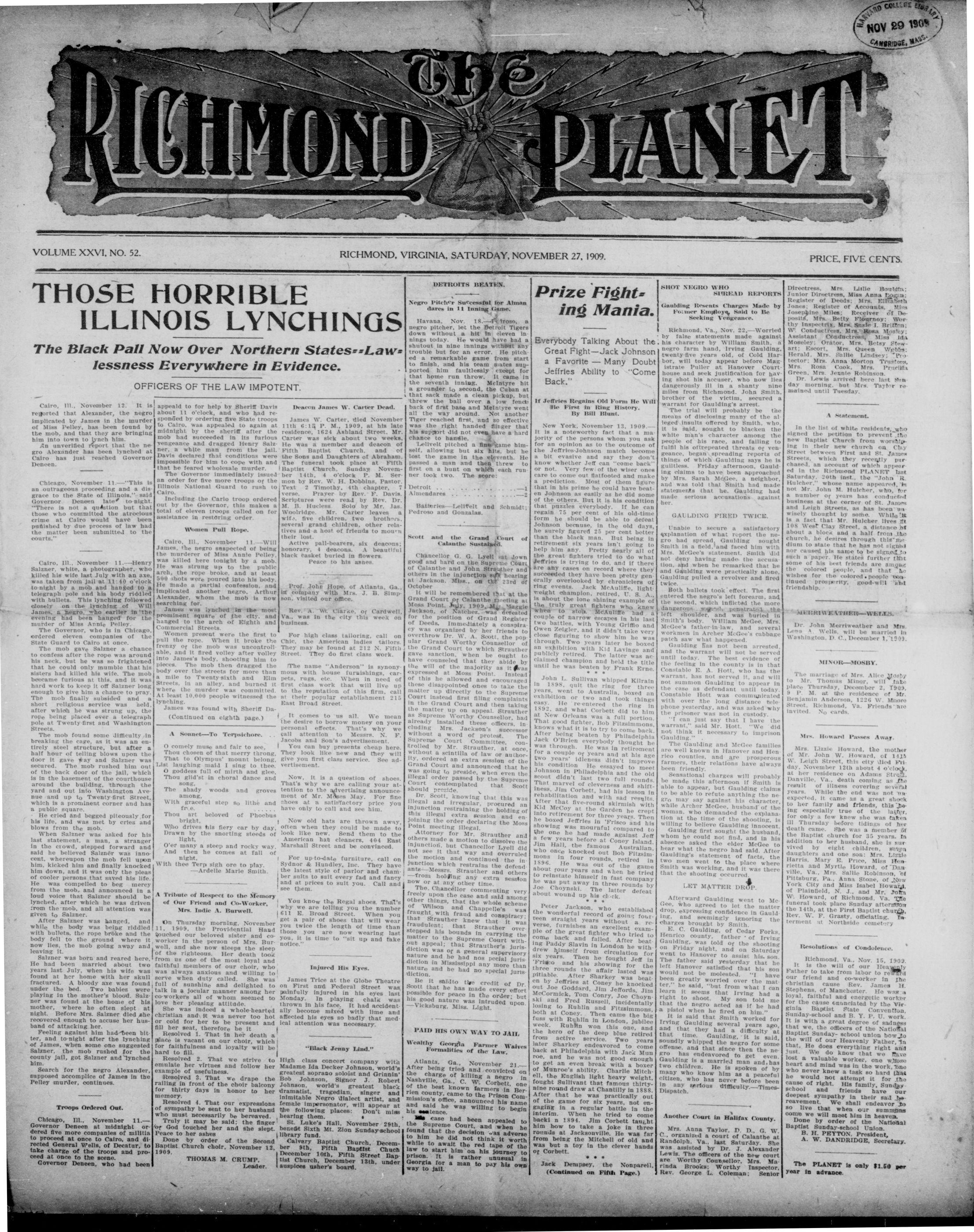
THOSE HORRIBLE ILLINOIS LYNCHINGS
The Black Pall Now Over Northern States Lawlessness Everywhere in Evidence.
VOLUME XXVI, NO. 52.
THOSE IN
ILLINOIS
The Black Pall M
lessness
OFF
Cairo, Ill., November 12. It is
reported that Alexander, the negro
implicated by James in the murder
of Miss Pelley, has been found by
the mob, and that they are bringing
him into town to lynch him.
An unverified report that the negro Alexander has been lynched at Cairo has just reached Governor Deneen.
Chicago, November 11—"This is an outrageous proceeding and a disgrace to the State of Illinois," said Governor Deneen late to night. "There is not a question but that those who committed the atrocious crime at Cairo would have been published by due process of law had the matter been submitted to the courts."
Cairo, Ill., November 11.—Henry Salzner, white, a photographer, who killed his wife last July with an axe, was taken from jail at 11:40 o'clock to night by a mob and hanged to a telegraph pole and his body riddled with bullets. This lynching followed closely on the lynching of Will James, a negro who earlier in the evening had been hanged for the murder of Miss Annie Pelley.
The Governor, who is in Chicago, ordered eleven companies of the State Guard to Cairo at once.
The mob gave Salzner a chance to confess after the rope was around his neck, but he was so frightened that he could only mumble that his sisters had killed his wife. The mob became furious at this, and it was hard work to keep it off Salzner long enough to give him a chance to pray. The mob finally subsided and a short religious service was held, after which he was strung up, the rope being placed over a telegraph pole at Twenty first and Washington Streets.
The mob found some difficulty in breaking the cage, as it was an entirely steel structure, but after a half hour of telling blows upon the door it gave way and Salzner was secured. The mob rushed him out of the back door of the jail, which is in the basement of the courthouse around the building, through the yard and out into Washington Avenue and up to $_{0}$ Twenty first Street, which is a prominent corner and has a public square.
He cried and begged piteously for his life, and was met by cries and blows from the mob.
When Salzner was asked for his last statement, a man, a stranger in the crowd, stepped forward and sald he believed Salzner was innocent, whereupon the mob fell upon him, kicked him and finally knocked him down, and it was only the pleas of cooler persons that saved his life. He was compelled to beg mercy from the mob, and announced in a loud voice that Salzner should be lynched, after which he was driven from the mob, and all attention was given $l_0$ Salzner.
After Salzner was hanged, and while the body was being riddled with bullets, the rope broke and the body fell to the ground where it now lies, the mob going away and leaving it.
Salzner was born and reared here, He had been married about two years last July, when his wife was found at her home with her skull fractured. A bloody axe was found under the bed. Two babies were playing in the mother's blood. Salzner was found at the home of his mother, where he often slept at night. Before Mrs. Salzner died she recovered enough to accuse her husband of attacking her.
Feeling against him had been bitter, and to-night after the lynching of James, when some one suggested Salzner, the mob rushed for the county jail, got Salzner and lynched him.
Search for the negro Alexander, supposed accomplice. James in the Pelican.
Troops Ordered Out.
Chicago, Ill. November 11. Governor Deneen at midnight ordered five more companies of militia to proceed at once to Cairo, and directed General Wells, of Decatur, to take charge of the troops and proceed at once to the scene. Governor Deneen, who had been
OFFICERS OF THE LAW IMPOTENT.
It is negro murder and by singing the neeed at governor
this is a dis said night, that noorious appealed to for help by Sheriff Davis about 11 o'clock, and who had resounded by ordering five State troops to Cairo, was appealed to again at midnight by the sheriff after the mob had succeeded in its farious vengeance and dragged Henry Salzner, a white man from the jail Davis declared that conditions were impossible for him to cope with and that he feared wholesale murder.
The Governor immediately issued an order for five more troops of the Illinois National Guard to rush to Cairo.
Including the Carlo troop ordered out by the Governor, this makes a total of eleven troops called on for assistance in restoring order.
Dec Jan 11th resides Carter He wi Fifth The So The Baptis ber 1 mon Text verse. Scriptus M. B. Woolwrit
Women Pull Rope
Cairo, Ill., November 11—Will James, the negro suspected of being the murderer of Miss Annie Pelley, was killed here tonight by a mob. He was strung up to the public arch, the rope broke, and at least 500 shots were poured into his body. He made a partial confession, and implicated another negro, Arthur Alexander, whom the mob is now searching for.
James was lynched in the most prominent square of the city, and hanged to the arch of Eighth and Commercial Streets.
Women present were the first to pull the rope. When it broke the frenzy or the mob was uncontrollable, and it fired volley after volley into James's body, shooting him to pieces. The mob then dragged the body over the streets for more than a mile to Twenty-sixth and Elm Streets, in an alley, and burned it where the murder was committed. At least 10,000 people witnessed the lynching.
James was found with Sheriff Da (Continued on eighth page.)
A Sonnet—To Terpsichore
O comely muse and fair to see,
Thou chosen of that merry throng,
That to Olympus' mount belong,
List laughing maid I sing to thee,
O goddess full of mirth and glee,
Thou gild'st in choral dance and song,
The shady woods and groves among,
With graceful step so lithe and free.
Thou art beloved of Phoebus bright,
Who drives his fiery car by day,
Drawn by the snorting steeds of light.
O'er many a steep and rocky way,
And then he comes at fall of night,
With thee Terp sigh ore to play.
—Ardelle Marie Smith
A Tribute of Respect to the Memory of Our Friend and Co-Worker, Mrs. Indie A. Burwell.
On Thursday morning, November 11, 1909, the Providential Hand touched our beloved sister and coworker in the person of Mrs. Burwell, and she now sleeps the sleep of the righteous. Her death took from us one of the most loyal and faithful members of our choir, who was always anxious and willing to serve when duty called. She was full of sunshine and delighted to talk in a jocular manner among her co-workers all of whom seemed to love her pleasing attitude. She was indeed a whole-hearted Christian and it was never too hot or cold for her to be present and fill her seat, therefore be it.
Resolved 1. That in her death a place is vacant on our choir, which for faithfulness and loyalty will be hard to fill.
Resolved 2. That we strive to emulate her virtues and follow her example of usefulness.
Resolved 3. That we drape the ralling in front of the choir balcony for thirty days in honor to her memory.
Resolved 4. That our expressions of sympathy be sent to her husband who must necessarily be bereaved.
Truly it may be said; the finger or God touched her and she slept. Peace to her ashes
Done by order of the Second Baptist Church choir, November 12, 1909.
THOMAS M. CRUMP.
Leader
---
RICHMOND, VIRGINIA, SATURDAY, NOVEMBER 27, 1909.
Deacon James W. Carter Dead.
James W. Carter, tled November 111th 6:15 P. M., 1909, at his late residence, 1624 Ashland Street. Mr Carter was sick about two weeks. He was a member and deacon of Fifth Baptist Church, and of the Sons and Daughters of Abraham. The funeral took place at Fifth Baptist Church, Sunday November 14th, 4 o'clock P. M. Sermon by Rev. W. H. Dobbins, Paster Text, 2 Timothy, 4th chapter, 7 verse. Prayer by Rev. F. Davis. Scriptures were read by Rev. Dr. M. B. Huuculus Solo by Mr. Jas Woolridge. Mr. Carter leaves a wife, five children, two brothers, several grand children, other relatives and a host of friends to mourn their lost. Active pall-bearers, six deacons; honorary, 4 deacons. A beautiful black casket buried in flowers.
Prof. John Hope, of Atlanta, Ga., in company with Mrs. J. B. Simpson, visited our office.
Rev. A. W. Clarke, of Cardwell, Va., was in the city this week on business.
For high class tailoring, call on Chic, the American ladies tailors. They may be found at 212 N. Fifth Street. They do first class work.
The name "Anderson" is synonymous with house furnishings, carpets, rugs, etc. When in need of first class work that will live up to the reputation of this firm, call at their popular establishment 215 East Broad Street.
It comes to us all. We mean the desire to borrow money on your personal effects. That's why we call attention to Messrs. N. F. Jacobs and Son's advertisement.
You can buy presents cheap here. They look like new and they will give you first class service. See advertisement.
Now, it is a question of shoes. That's why we are calling your attention to the advertising announcement of Mr. Moses May. For fine shoes at a satisfactory price you have only to call and see him.
Now old hats are thrown away, often when they could be made to look like new. Send them to the American hat cleaners, 404 East Marshall Street and be convinced.
For up-to-date furniture, call on Sydnor & Hundley, Inc. They have the latest style of parlor and chamber suits to suit every fad and fancy and at prices to suit you. Call and see them.
You know the Regal shoes. That's why we are telling you the number 611 E. Broad Street. When you get a pair of shoes that will wear you twice the length of time than those you are now wearing last you, it is time to "sit up and take
Injured His Eyes
James Trice at the Globe Theatre on First and Federal Street was painfully injured in his eyes last Monday. In playing chalk was thrown in his face. It had accidentally become mixed with lime and affected his eyes so badly that medical attention was necessary.
"Black Jenny Lind."
High class concert company with Madame Ida Decker Johnson, world's greatest soprano soloist and Grinnin' Bob Johnson, Signor J. Robert Johnson, world's greatest black dramatist, tragedian, singer and imittable Negro dialect artist, and female impersonator, will appear at the following places: Don't miss hearing them.
St. Luke's Hall, November 29th, beneft Sixth Mt. Zion Sunday-school library fund.
Calvary Baptist Church, December 9th, Fifth Baptist Church December 10th, Fifth Street Baptist Church, December 13th, under auspices usher's board.
DETROITS BEATEN
Negro Pitcher Successful for Alman dares in 11 Inning Game.
Havana, Nov. 18.—Fritoso, a negro pitcher, let the Detroit Tigers down without a hit in eleven innings today. He would have had a shutout in nine innings without any trouble but for an error. He pitched a remarkable game from start to finish, and his teammates supported him faultlessly except for that home run throw. It came in the seventh inning. McIntyre hit a grounder to second, the Cuban at that sack made a clean pickup, but threw the ball over a low fence back of first base and McIntyre went all the way around. Not another Tiger reached first, and so effective was the right handed finger that his support did not even have a hard chance to handle. Lelivelt pitched a fine game himself, allowing but six hits, but he lost the game in the eleventh. He passed a man and then threw to first on a bunt on which each runner took two. The score:
Batteries - Leifelt and Schmidt;
Pedroso and Gonzalag.
Scott and the Grand Court of Calanthe Sustained.
Chancellor G. G. Lyell at down good and hard on the Supreme Court of Calanthe and John Strauther and others in the injunction we hearing at Jackson. Miss., on the 23rd of October
It will be remembered that at the Grand Court or Calanthe meeting at Moss Point, July, 1909, Mr. Magde Jackson, of Natchez, was defeated for the position of Grand Register of Deeds. Immediately a conspiracy was organized by her friends to overthrow Dr. W. A. Scott, the popular Grand Worthy Counsellor of the Grand Court to which Strauther gave sanction, when he ought to have counseled that they abide by the will of the majority as it was expressed at Moss Point. Instead of this he allowed and encouraged these disappointed ones to take the matter up directly to the Supreme Court instead first filing complaints in the Grand Court and then taking the matter up on appeal. Strauther as Supreme Worthy Counsellor, had already installed these officers, including Mrs. Jackson's successor without a word of protest. The Supreme Court Committee, controlled by Mr. Strauther, at once, without a seilltina of law or authority, ordered an extra session of the Grand Court and announced that he was going to preside, when even the illegal order passed by the Supreme Court contemplated that Scott should preside.
Dr. Scott, knowing that this was illegal and irregular, procured an injunction restraining the holding of this illegal extra session and enjoining the order declaring the Moss Point meeting illegal.
Attorney for Mr. Strauther and others made a motion to dissolve the injunction, but Chancellor Lyell did not see it that way and overruled the motion and continued the injunction which restrains the defendants—Messrs. Strauther and others—from holding any extra session now or at any other time.
The, Chancellor commenting very freely upon the case and said among other things, that the whole scheme of Wilson and Chappelle's was fraught with fraud and conspiracy; that Strather knew that it was fraudulent; that Strather over stepped his bounds in carrying matter to the Supreme Court without appeal; that Strather's jurisdiction was or a general supervisory nature and he had nos special jurisdiction in Mississippi any more than nature and he had no special jurisdiction.
Be it said to the credit of Dr. Scott that he has made every effort possible for peace in the order; but his good nature was intruded upon.
Vicksburg, Miss. Light.
PAID HIS OWN WAY TO JAIL
Wealthy Georgia Farmer Waives Formalities of the Law.
Atlanta, Ga., November 21. After being tried and convicted on the charge of killing a negro in Nashville, Ga., C. W. Corbett, one of the best known farmers in Berrien county, came to the Prison Commission's office, announced his name and said he was willing to begin his sentence.
case had been appealed to the Supreme Court, and when he found that the decision was adverse to him he did not think it worth while to await the red tape of the law to start him on his journey to prison. It is rather unusual in Georgia for a man to pay his own way to jail.
Prize Fight ing Mania.
Prize Fight ing Mania.
Everybody Talking About the Great Fight-Jack Johnson a Favorite Many Doubt Jeffries Ability to "Come Back."
If Jeffries Regains Old Form He Will
Be First in Ring History.
By Bill Blunt.
New York, November 13, 1909.—It is a noteworthy fact that a majority of the persons whom you ask for an opinion as to the outcome of the Jeffries-Johnson match become a bit evasive and say they don't know whether Jeff can "come back" or not. Very few of the wiser ones care to come out flatfooted and make a prediction. Most of them figure that in his prime he could have beaten Johnson as easily as he did some of the others. But it is his condition that puzzles everybody. If he can regain 75 per cent of his old-time form he should be able to defeat Johnson because, in the old days, he surely figured 25 per cent better than the black man. But being in retirement six years isn't going to help him any. Pretty nearly all of the great fighters tried to do what Jeffries is trying to do, and if there are any cases on record where they succeeded they have been pretty generally overlooked by chronicleers of ring events. Jack McAuliffe, lightweight champion, retired, S. U. A., is about the lone shining example of the truly great fighters who knew when to stop McAuliffe had a couple of narrow escapes in his last two battles, with Young Griffio and Owen Zeigler, and it didn't take very close figuring to show him he was through. Two years later he boxed exhibition with Kid Lavinge and publicly retired. The latter was acclaimed champion and held the title until he was beaten by Frank Erne.
John L. Sullivan whipped Kirkland in 1898, quit the ring for three years, went to Australia, boxed an exhibition or two and took things easy. He re-entered the ring in 1892, and what Corbett did to him at New Orleans was a full portion. That good fighter, Bob Fitzsimmons, knows what it is to try to come back. After being beaten by Philadelphia Jack O'Brien everybody thought he was through. He was in retirement for a couple of years and at his age two years' idleness didn't improve his condition. He essayed to meet Johnson in Philadelphia and the old scout didn't last two full rounds. That marvel of cleverness and shiftiness, Jim Corbett, had his lesson in rehabilitation and with sad results. After that five-round skirmish with Kid McCoy at the Garden he crept into retirement for three years. Then he boxed Jeffries in 'Frisco and his showing was mournful compared to the one he had made against Jeff a few years before at Coney Island. Jim Hall, the famous Australian, who once knocked out Bob Fitzsimmons in four rounds, retired in 1896. He was out of the game about four years and when he tried to reinstate himself in fast company he was put away in three rounds by Joe Choynski. The latter defeat about wound up his clock.
Peter Jackson, who established the wonderful record of going fourteen straight years without a reverse, furnishes an excellent example of the great fighter who tried to come back and failed. After beating Paddy Slavin in London he withdrew himself from circulation for six years. Then he fought Jeff in Frisco and his showing for the three rounds the affair lasted was pitiable. After Sharkey was beaten by Jeffries at Coney he knocked out Joe Goddard, Jim Jeffords, McMcormick, Conry Conry, Joe Choynski and Fred Russell, incidentally losing to Ruhlin and Fitzsimmons, both at Coney. Then came the big fuss with Ruhlin in London, jubilee week. Ruhlin won this one, and the hero of the deep blue retired from active service. Two years later Sharkey endeavored to come back at Philadelphia with Jack Munroe, and he was not good enough to get an even break with a boxer of Munroe's ability. Charlie Mitchell, the English light heavy weight, fought Sullivant that famous thirty-nine round draw at Chantilly in 1888. After that he was practically out of the game for six years, not engaging in a regular battle in the interim. When he tried to come back in 1894. Jim Corbett taught him how to take a joke in three rounds at Jacksonville. He was far from being the Mitchell of old and was but a toy in the clever hands of Corbett.
Jack Dempsey, the Nonparell
(Continued on Fifth Page.)
SHOT NEGRO WHO
SHREAD REPORTS
Gaudling Resents Charges Made by Former Employa. Said to Be Seeking Vengeance.
Richmond, Va., Nov. 22.—Worried by false statements made against his character by William Smith, a negro farm hand, Irving Gauling, twenty-five years old, of Cold Harbor, will today appear before Magistrate Puller at Hanover Courthouse and seek justification for having shot his accuser, who now lies dangerously ill in a shanty nine miles from Richmond. John Smith, brother of the victim, secured a warrant for Gauling's arrest. The trial will probably be the means of disclosing many of the alleged insults offered by Smith, who, it is said, sought to blacken the white man's character among the people of his race, and failing to fulfill his oftrepeated threats or vengeance, began spreading reports of things of which Gauling says he is guiltless. Friday afternoon, Gauling claims to have been approached by Mrs. Sarah McGee, a neighbor, and was told that Smith had made statements that he. Gauling had made serious accusations against her.
GAULDING FIRED TWICE
Unable to secure a satisfactory explanation of what report the negro had spread, Gaulding sought Smith in a field, and faced him with Mrs. McGee's statement. Smith did not deny having made the accusation, and when he remarked that he and Gaulding were practically alone, Gaulding pulled a revolver and fired twice. Both bullets took effect. The first entered the negro's left forearm, and the second, which inflicted the more dangerous wrist, penetrated the left shoulder, and was buried in Smith's body. William McGee, Mrs. McGee's father-in-law, and several workmen in Archer McGee's cabbage patch saw what happened.
Gaudling has not been arrested, and the warrant will not be served until today. The best evidence of the feeling in the county is in that Constable E. A. Hott, who has the warrant, has not served it, and will not summon Gaudling to appear in the case as defendant until today. Constable Hott was communicated with over the long distance telephone yesterday, and was asked why the prisoner was not in custody. "I can just say that I have the warrant," said Mr. Hott. "We did not think it necessary to imprison Gaudling." The Gaudling and McGee families are well known in Hanover and Henrico counties, and are prosperous farmers, their relations have always been friendly.
Sensational charges will probably be made this afternoon if Smith is able to appear, but Gaudling claims to be able to refute anything the negro may say against his character, while Archer McGee, husband of the woman, who demanded the explanation at the time of the shooting, is willing to believe Gaudling innocent. Gaudling first sought the husband, whom he could not find, and in his absence asked the elder McGee to hear what the negro had said. After Gaudling's statement of facts, the two men went to the place where Smith was working, and it was there that the shooting occurred.
LET MATTER DROP
Afterward Gauldding went to McGee, who agreed to let the matter drop, expressing confidence in Gauldding, seemingly ignoring the charges brought.
E. C. Gauldling, of Cedar Forks, Henrico county, father of Irving Gauldling, was told of the shooting on Friday night, and on Saturday went to Hanover to assist his son. The father said yesterday that he left Hanover satisfied that his son would not be molested. "I have been greatly worried over the matter," he said, "but from what I can learn it seems that Irving had a right to shoot. My son told me that the negro acted as if he had a pistol when he fired on him."
it him.
It is said that Smith worked for Irving Gaulding several years ago, and that they had a difficulty at that time. Gaulding, it is said, soundly whipped the negro for some offense, and that since then the negro has endeavored to get even. Gaulding is a married man and, has two children. He is spoken of by many who know him as a peaceful citizen, who has never before been in any serious difficulty.—Times-Dispatch.
Another Court in Halifax County.
Mrs. Anna Taylor, D. D., G. W. C., organized a court of Calanthe at Randolph, Va., last Saturday. She was assisted by Dr. J. Alexander Lewis. The officers of the new court are Worthy Counsellor, Mrs. Marinda Brooks: Worthy Inspector, Rev. George L. Coleman; Senior
PRICE, FIVE CENTS
Directress, Mrs. Little Bouldin;
Junior Directress, Miss Anna Eogan;
Register of Deeds; Mrs. Elizabeth
Jones; Register of Accounts, Miss
Josephine Miles; Receiver of Deposits, Mrs. Betty Flourney; Worthy Inspectry, Mrs. Snake L. Britton;
W. Conductress, Mrs. Rosa Moseley;
Assistant Conductress, Miss Ida Moseley; Orator, Mrs. Betsy Stewart; Escort, Mrs. Queen Webb; Herald, Mrs. Sallie Lindsey; Protector; Mrs. Anna Morton Trustees, Mrs. Rosa Cook, Mrs. Prucilla Green, Mrs. Jennie Robinson.
Dr. Lewis arrived here last Sunday morning, but Mrs. Taylor remained until Tuesday.
A Statement.
In the list of white residents, who signed the petition to prevent the new Baptist Church from worshiping in their new church on Clay Street between First and St. James Streets, which they recently purchased, an account of which appeared in the Richmond PLANET last Saturday, 20th inst. the "John R. Hulcher," whose name appeared, be not Mr. John M. Hulcher, who, for a number of years has conducted business at the corner of St. James and Leigh Streets, as has been unwisely thought by some. While Mr. a fact that Mr. Hulcher lives at 108 West Clay Street, a distance of about a block and a half from the church, he desires through this medium to state that he has not sighed nor caused his name to be signed to such a paper. He states further that some of his best friends are among the colored people, and that he wishes for the colored people continued prosperity, good-will and friendship.
MERRIWEATHER—WELLS.
Dr. John Merriweather and Mrs. Lena A. Wells, will be married in Washington, D. C., December 1, 1900
MINOR—MOSBY.
The marriage of Mrs. Alice Mosby to Mr. Thomas Minor, will take place Thursday, December 2, 1999, 9 P. M. at the residence of Mr. Benjamin Anderson, 1226 W. Monroe Street, Richmond, Va. Friends are invited. $ \mathrm{N}_{0} $ cards.
Mrs. Howard Passes Awar
Mrs. Lizzie Howard, the mother of Mr. John W. Howard, of 141M W. Leigh Street, this city died Friday, November 12th about 4 o'clock at her residence on Adams Strait, Danville, Va., death coming as the result of illness covering several years. While the end was not unexpected, it came as a great shock to her family and friends, this being especially true of the latter, for only a few knew she was taken ill Thursday before tidings of her death came. She was a member of the Baptist church for 35 years. In addition to her husband, she is survived by eight children, seven daughters and one son: Mrs. Lizzie Harris, Mary E. Price, Miss Henrietta and Myrtle Howard, of Danville, Va., Mrs. Sallie Robinson, of Pittsburg, Pa., Anna Stone, of New York City and Miss Isabel Howard, of Plainfield, N. J., and Mr. John W. Howard, of Richmond, Va. The funeral took place Sunday afternoon the 14th, at the First Baptist church, Rev. W. F. Grasty, officiating. Interment at Northside cemetery.
Resolutions of Condolence
Richmond, Va., Nov. 15, 1903.
It is the will of our Heavenly Father to take from labor to reward our friend and co-worker in the christian cause Rev. James H. Stephens, of Manchester. He was a loyal, faithful and energetic worker for the cause enunciated by the Virginia Baptist State Convention, Sunday-school and B. Y. P. U. work. It is with a great degree of sadness that we, the officers of the National Baptist Sunday-school union bow to the will of our Heavenly Father. In that, He does everything right and just. We do know that we have lost a valuable worker, one whose heart and mind was in the work, one who never knew a task so hard that he would not attempt it for the cause of right. His family, Sunday-school and friends have our deepest sympathy in their sad reevaluation. We shall endeavor so live that when our summons come we will meet him in heaven.
Done by order of the National Baptist Sunday-school Union.
B. H. PEYTON, President,
A. W. DANDRIDGE, Secretary.
The PLANET is only $1.50 per year in advance.
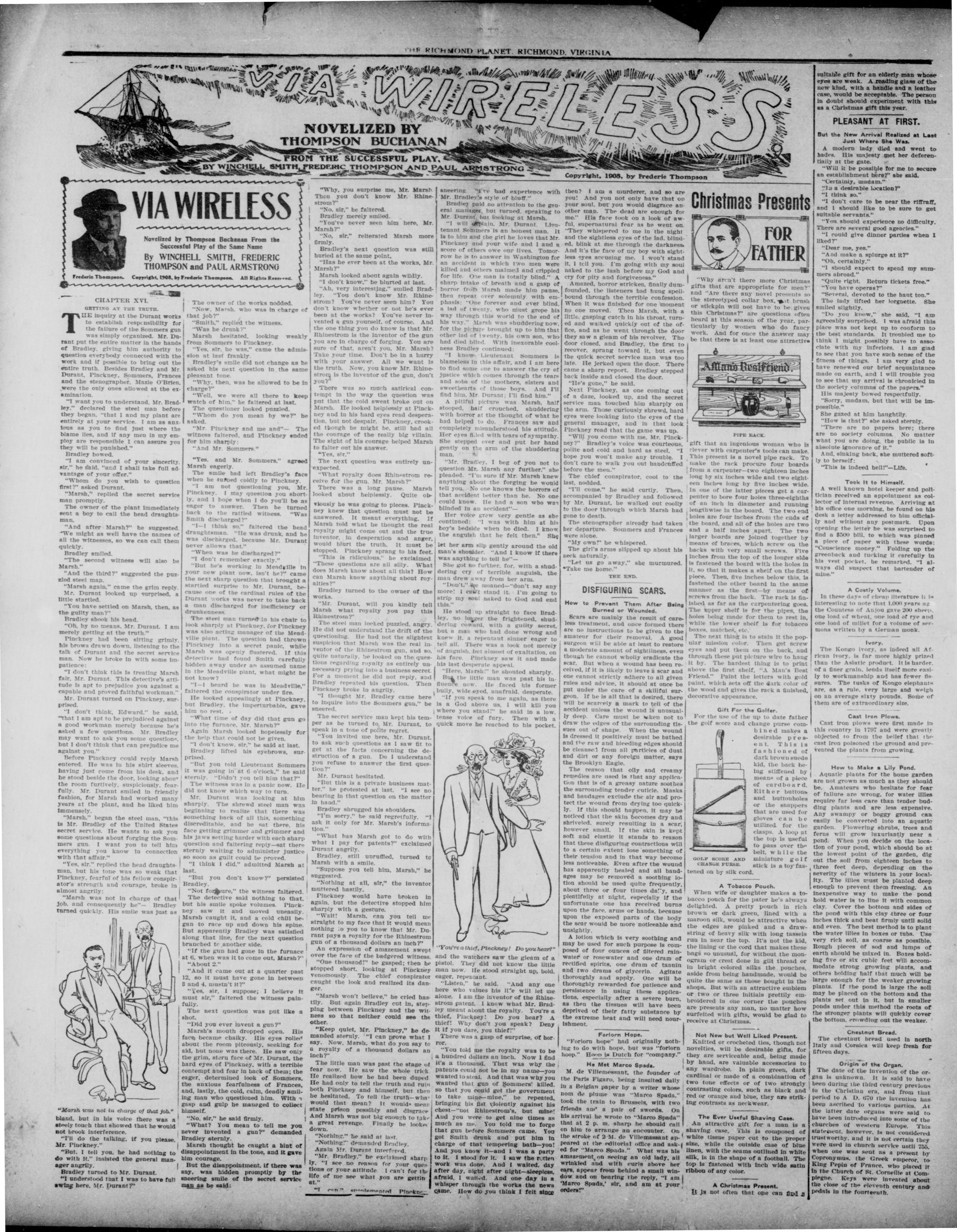
VIA WIRELESS
NOVELIZED BY
THOMPSON BUCHANAN
FROM THE SUCCESSFUL PLAY,
BY WINCHELL SMITH, FREDERIC THOMPSON AND PAUL ARMSTRONG
VIAWIRELESS
Frederic Thompson. Copyright, 1908, by Frederic Thompson. All Rights Reserved.
A.
```markdown
```
THE inquiry at the Durant works to establish responsibility for the failure of the Sommers gun was simply organized. Mr. Durant put the entire matter in the hands of Bradley, giving him authority to question everybody connected with the work and if possible to bring out the entire truth. Besides Bradley and Mr. Durant, Pinckey, Sommers, Frances and the stenographer, Mazie O'Brien, were the only ones allowed at the examination.
"I want you to understand, Mr. Bradley," declared the steel man before they began, "that I and my plant are entirely at your service. I am as anxious as you to find just where the blame lies, and if any men in my employ are responsible I can assure you they will be punished."
Bradley bowed.
"I am convinced of your sincerity, sir," he said, "and I shall take full advantage of your offer."
"Whom do you wish to question first?" asked Durant.
"Marsh," replied the secret service man promptly.
The owner of the plant immediately sent a boy to call the head draughtsman.
"And after Marsh?" he suggested.
"We might as well have the names of all the witnesses, so we can call them quickly.
Bradley smiled.
"The second witness will also be Marsh."
"And the third?" suggested the puzzled steel man.
"Marsh again," came the grim reply.
Mr. Durant looked up surprised, a little startled.
"You have settled on Marsh, then, as the guilty man?"
Bradley shook his head.
"Oh, by no means, Mr. Durant. I am merely getting at the truth." Pinckney had been sitting grimly, his brows drawn down, listening to the talk of Durant and the secret service man. Now he broke in with some impatience:
Mr. Durant turned on Pinckney, surprised.
"I don't think, Edward," he said, "that I am apt to be prejudiced against a good workman merely because he's asked a few questions. Mr. Bradley may want to ask you some questions, but I don't think that can prejudice me against you."
Before Pinckney could reply Marsh entered. He was in his shirt sleeves, having just come from his desk, and he stood beside the door, looking about the room furtively, suspiciously, fearfully. Mr. Durant smiled in friendly fashion, for Marsh had worked many years at the plant, and he liked him immensely.
"Marsh," began the steel man, "this is Mr. Bradley of the United States secret service. He wants to ask you some questions about forging the Sommers gun. I want to tell him everything you know in connection with that affair."
"Yes, slr." replied the head draughtsman, but his tone was so weak that Pinckney, fearful of his fellow conspirator's strength and courage, broke in almost angrily: "Marsh was not in charge of that job, and consequently he"—Bradley turned quickly. His smile was just as
P
"Marsh was not in charge of that job." bland, but in his voice there was a steely touch that showed that he would not brook interference.
"I'll do the talking, if you please, Mr. Pineckney."
"But, I tell you, he had nothing to do with it." insisted the general manager angrily.
Bradley turned to Mr. Durant.
"I understood that I was to have full swing here, Mr. Durant."
The owner of the works nodded.
"Now, Marsh, who was in charge of that job?"
"Smith," replied the witness.
"Was he drunk?"
Marsh hesitated, looking weakly from Sommers to Pinckney.
"Yes, sir, he was," came the admission at last frankly.
Bradley's smile did not change as he asked his next question in the same pleasant tone.
"Why, then, was he allowed to be in charge?"
"Well, we were all there to keep watch of him," he faltered at last.
The questioner looked puzzled.
"Whom do you mean by we?" he asked.
"Mr. Pinckney and me and"— The witness faltered, and Pinckney ended for him sharply;
"And Mr. Sommers."
"Yes, and Mr. Sommers," agreed Marsh eagerly.
The smile had left Bradley's face when he扭ed coldly to Pinckney.
"I am not questioning you, Mr. Pinckney. I may question you shortly, and I hope when I do you'll be as eager to answer. Then he turned back to the rattled witness. "Was Smith discharged?
"I-I think so," faltered the head draughtsman. "He was drunk, and he was discharged, because Mr. Durant never allows that."
"When was he discharged?"
"I don't remember exactly."
"But he's working in Mendigille in your new plant now, isn't he?" came the next sharp question that brought a startled surprise to Mr. Durant, because one of the cardinal rules of the Durant works was never to take back a man discharged for inefficiency or drunkenness.
The steel man turned in his chair to look sharply at Pinckney, for Pinckney was also acting manager of the Meadville plant. The question had thrown Pinckney into a secret panic, while Marsh was openly flustered. If this detective had found Smith carefully hidden away under an assumed name in the Meadville plant, what might he not know?
"I—I beard he was in Meadville," faltered the conspirator under fire.
He looked appealingly at Pinckney, but Bradley, the imperturbable, gave him no rest.
"What time of day did that gun go into the furnace, Mr. Marsh?"
"I don't know, sir," he said at last. Bradley lifted his eyebrows, surprised. "But you told Lieutenant Sommers it was going in at 6 o'clock," he said sternly. "Didn't you tell him that?" The witness was in a panic now. He did not know which way to turn. Mr. Durant was looking at him sharply. The shrewd steel man was beginning to realize that there was something back of all this, something discreditable, and he sat there, his face getting grimmer and grimmer and his jaws setting harder with each sharp question and faltering reply—sat there sternly waiting to administer justice so soon as guilt could be proved. "I think I did," admitted Marsh at last. "But you don't know?" persisted Bradley.
"Not for sure," the witness faltered.
The detective said nothing to that, but his smile spoke volumes. Pinkney saw it and moved uneasily. Marsh caught it, and a cold chill began to race up and down his spine. But apparently Bradley was satisfied along that line, for the next question branched to another side.
"If the gun had gone in the furnace at 6, when was it to come out, Marsh?"
"About 2."
"And it came out at a quarter past 12, so it must have gone in between 3 and 4, mustn't it?"
"Yes, sir, I suppose; I believe it must sir," faltered the witness painfully.
The next question was put like a shot.
"Did you ever invent a gun?"
Marsh's mouth dropped open. His face became chalky. His eyes rolled about the room piteously, seeking for aid, but none was there. He saw only the grim, stern face of Mr. Durant, the hard eyes of Pinckney, with a terrible contempt and fear in back of them; the eager, determined look of Sommers, the anxious fearfulness of Frances, and, lastly, the cold, calm, deadly smiling man who questioned him. With a gasp and gulp he managed to collect himself.
"No, sir," he said firmly.
"What? You mean to tell me you never invented a gun?" demanded Bradley sternly.
Marsh thought he caught a hint of disappointment in the tone, and it gave him courage.
But the disappointment, if there was any, was hidden promptly by the sneering smile of the secret service man as he said:
THE RICHMOND PLANET. RICHMOND. VIRGINIA
"Why, you surprise me, Mr. Marsh.
Then you don't know Mr. Rhine-
strom?"
"No, sir," he faltered.
Bradley merely smiled.
"You've never seen him here, Mr.
Marsh?"
"No, sir," reiterated Marsh more
firmly.
Bradley's next question was still
hurled at the same point.
"Has he ever been at the works, Mr.
Marsh?"
Marsh looked about again wildly.
"I don't know," he blurted at last.
"Ah, very interesting," smiled Bradley.
"You don't know Mr. Rhinestrom? You've never seen him? You don't know whether or not he's ever been at the works? You've never invented a gun yourself, of course. And the one thing you do know is that Mr. Rhinestrom is the inventor of the gun you are in charge of forging. You are sure of that, aren't you, Mr. Marsh? Take your time. Don't be in a hurry with your answer. All we want is the truth. Now, you know Mr. Rhinestrom is the inventor of the gun, don't you?
There was so much satirical contempt in the way the question was put that the cold sweat broke out on Marsh. He looked helplessly at Pinckney and in his hard eyes read desperation, but not despair. Pinckney, crooked though he might be, still had all the courage of the really big villain. The sight of his courage helped Marsh to falter out his answer.
"Yes, sir."
The next question was entirely unexpected.
"What royalty does Rhinestrom receive for the gun, Mr. Marsh?"
There was a long pause. Marsh looked about helplessly. Quite obviously he was going to pieces. Pinckney knew that question must not be answered. It meant everything. If Marsh told what he thought the real royalty might come out and the true inventor, in desperation and anger, would blurt the truth. It must be stopped. Pinckney sprang to his feet. "This is ridiculous." he exclaimed. "These questions are all silly. What does Marsh know about all this? How can Marsh know anything about royalties?" Bradley turned to the owner of the works. "Mr. Duvent, will you kindly tell Marsh what royalty you pay this Rhinestrom?"
The steel man looked puzzled, angry. He did not understand the drift of the questioning. He had not the slightest suspicion that Marsh was the real inventor of the Rhinestrom gun, and so quite naturally, he looked on the questions regarding royalty as entirely unnecessary prying into a business secret. For a moment he did not reply, and Bradley repeated his question. Then Pinckney broke in angrily.
"I thought Mr. Bradley came here to inquire into the Sommers gun," he sneered.
The secret service man kept his temper as he turned to Mr. Durant, to speak in a tone of polite regret.
"You invited me here, Mr. Durant, to ask such questions as I saw fit to get at the facts concerning the destruction of a gun. Do I understand you refuse to answer the first question?"
Mr. Durant hesitated.
"But this is a private business matter," he protested at last. "I see no bearing in that question on the matter in hand."
Bradley shrugged his shoulders.
"I'm sorry," he said regretfully. "I ask it only for Mr. Marsh's information."
"What has Marsh got to do with what I pay for patents?" exclaimed Durant angrily.
Bradley, still unruffled, turned to Marsh with a smile.
"Suppose you tell him, Marsh," he suggested.
"Nothing at all, sir," the inventor muttered hastily.
Pinckney would have broken in again, but the detective stopped him sharply with a gesture.
"Walt! Marsh, can you tell me straight to my face that it would mean nothing so you to know that Mr. Durant pays a royalty for the Rhinestrom gun of a thousand dollars an inch?"
An expression of amazement swept over the face of the badgeded witness.
"One thousand!" he gasped; then he stopped short, looking at Pinckney venomously. The chief conspirator caught the look and realized its danger.
"Marsh won't believe," he cried hastily. But again Bradley cut in, stepping between Pinckney and the witness so that neither could see the other.
"Keep quiet, Mr. Pinckney," he demanded sternly. "I can prove what I say. Now, Marsh, what do you say to a royalty of a thousand dollars and inch?"
The little man was past the stage of fear now. He saw the whole trick. He realized how he had been duped. He had only to tell the truth and ruin both Pinckney and himself, but then he hesitated. To tell the truth—what would that mean? It would—mean state prison possibly and disgrace. And Marsh was not big enough to take a great revenge. Finally he looked down.
"Mr. Bradley," he exclaimed sharply, "I see no reason for your questions or your attitude. I can't for the life of me see what you are getting at."
"I can," supplemented. Pinknoe.
sneering. "I've bad experience with Mr. Bradley's style of bluff." Bradley paid no attention to the general manager, but turned, speaking to Mr. Dursat, but looking at Marsh. "I will obtain, Mr. Durant Lieutenant Sommers is an honest man. It is to him and the girl he loves that Mr. Pinckney and your wife and I and a score of others owe our lives. Tomorrow he is to answer in Washington for an accident in which two men were killed and others malmed and crippled for life. One man is totally blind." A sharp intake of breath and a gasp of horror from Marsh made him pause, then repeat over solemnly with emphasis: "One forever and ever blind, a lad of twenty, who must grope his way through this world to the end of his way." Marsh was shuddering now, for the picture brought up to him that other lad of twenty, his own son, who had died blind. With inexorable coolness Bradley continued:
"I know Lieutenant Sommers is blameless in this affair, and I am here to find some one to answer the cry of justice which comes through the tears and sobs of the mothers, sisters and sweethearts of those boys. And I'll find him, Mr Durant; I'll find him."
A plitful picture was Marsh, half stooped, half crouched, shuddering with horror at the thought of what he had helped to do. Frances saw and completely misunderstood his attitude. Her eyes filed with tears of sympathy. She stepped over and put her hand gently on the arm of the shuddering man.
"Mr. Bradley. I beg of you not to question Mr. Marsh any further," she pleaded. "I'm sure if Mr. Marsh knew anything about the forging he would tell you. No one knows the horrors of that accident better than he. No one could know. He had a son who was blinded in an accident"—
Her voice grew very gentle as she continued: "I was with him at his boy's bedside when he died. I know the anguish that he felt then." She let her arm slip gently around the old man's shoulder. "And I know if there was anything to tell he"—She got no further, for, with a shuddering cry of terrible anguish, the man drew away from her arm. "Don't," he moaned—"don't say any more! I can't stand it. I'm going to strip my soul naked to God and end this." He stood up straight to face Bradley, no longer the frightened, shuddering coward, with a guilty secret, but a man who had done wrong and knew it. a repentant sinner eager to tell all. There was a look not merely of anguish, but almost of exaltation, on his face. Pinckney saw it and made his last desperate appeal.
"Here, Marsh," he shouted sharply. But the little man was past his influence now. He faced his former bully, wide eyed, unfaithful, desperate.
Rogers
and the watchers saw the gleam of a pistol. They did not know the little man now. He stood straight up, bold, eager, repenant.
"Listen," he said. "And any one here who values his life will let me alone. I am the inventor of the Rhine-strom patent. I know what Mr. Bradley meant about the royalty. You're a thief, Pinkney! Do you hear? A thief! Why don't you speak? Deny it if you dare, you thief!"
There was a gasp of surprise, of horror.
"You told me the royalty was to be a hundred dollars an inch. Now I find it's a thousand. That was why the patents could not be in my name—you wanted to steal. And that was why you wanted that gun of Sommers' killed, so that you could get the government to take mine—mine," he repeated, bringing his first violently against his chest—"not Rhinestrom's, but mine! And you were to get nine times as much as me. You told me to forget that gun before Sommers came. You got Smith drunk and put him in charge of that tempering bath—you! And you know it—and I was a party to it. I stood for it. I saw the rotten work was done. And I waited, day after day, night after night—sleepless, afraid, I waited. And one day in a whisper through the works the news game. How do you think I felt since
then? I am a murderer, and so are you! And you not only have that on your soul, but you would disgrace another man. The dead are enough for me." His face took on a look of awful, supernatural fear as he went on. "They whispered to me in the night and the sightless eyes of the lad, blinded, blink at me through the darkness. And it's the face of my boy with sightless eyes accusing me. I won't stand it. I tell you. I'm going with my soul naked to the lash before my God and cry for pity and forgiveness."
Amazed, horror stricken, finally dumfounded, the listeners had hung spell-bound through the terrible confession. When it was finished for one moment no one moved. Then Marsh, with a little, gasping catch in his throat, turned and walked quickly out of the office, and as he went through the door they saw a gleam of his revolver. The door closed, and Bradley, the first to recover, sprang toward it, but even the quick secret service man was too late. He jerked open the door. There came a sharp report. Bradley stepped back inside and closed the door. "He's gone," he said. Next Pinckney, as one coming out of a daze, looked up, and the secret service man touched him sharply on the arm. Those curiously shrewd, hard eyes were looking into the eyes of the general manager, and in that look Pinckney read that the game was up.
"Will you come with me, Mr. Pinkney?" Bradley's voice was courteous, polite and cold and hard as steel. "I hope you won't make any trouble. I don't care to walk you out handcuffed before the men."
The chief conspirator, cool to the last, nodded.
"I'll come," he said curtly. Then, accompanied by Bradley and followed by Mr. Durant, he walked out coolly to the door through which Marsh had gone to death.
The stenographer already had taken her departure. Sommers and Frances were alone.
"My own" he whispered.
The girl's arms slipped up about his neck naturally.
"Let us go away," she murmured.
"Take me home."
DISFIGURING SCARS
How to Prevent Them After Being Burned or Wounded.
Scars are unlucky the result of careless treatment, and once formed there are no instructions to be given to the amateur for their removal. A good surgeon will be able at least to restore a moderate amount of sightliness, even though he cannot wholly eradicate the scar. But when a wound has been received, if it is likely to leave a scar and one cannot strictly adhere to all given rules and advice, it should at once be put under the care of a skillful surgeon. If he is all that is desired, there will be scarcely a mark to tell of the accident unless the wound is unusually deep. Care must be taken not to draw the edges of the surrounding tissues out of shape. When the wound is dressed it positively must be bathed and the raw and bleeding edges should be cleansed from all particles of dust and dirt or any foreign matter, says the Brooklyn Eagle.
The reason that oily and creamy remedies are used is that any application that is of a greasy nature soothes the surrounding tender cuticle. Masks and bandages exclude the air and protect the wound from drying too quickly. If this should happen, it may be noticed that the skin becomes dry and shriveled, surely resulting in a scar, however small. If the skin is kept soft and elastic it stands to reason that these disfiguring contractions will to a certain extent lose something of their tension and in that way become less noticeable. Even after the wound has apparently healed and all bandages may be removed a soothing lotion should be used quite frequently, about three or four times daily, and plentiful at night, especially if the unfortunate one has received burrs upon the face, arms or hands, because upon the exposed parts of the body the scar would be more noticeable and unsightly.
A lotion which is very soothing and may be used for such purpose is composed of four ounces of filtered rainwater or rosewater and one dram of rectified spirits, one dram of tannin and two drams of glycerin. Agitate thoroughly and apply. One will be thoroughly rewarded for patience and persistence in using these applications, especially after a severe burn, as then the tissues will have been deprived of their fatty substance by the extreme heat and will need nourishment.
Forlorn Hope.
"Forlorn hope" had originally nothing to do with hope, but was "forlorn hoop." Hoop is Dutch for "company."
He Met Marco Spada
M. de Villemessant, the founder of the Paris Figaro, being insulted daily in a Belgian paper by a writer whose nom de plume was "Marco Spada," took the train to Brussels, with two friends and a pair of swords. On his arrival he wrote to "Marco Spada" that at 2 p. m. sharp he should call on him to arrange an encounter. On the stroke of 2 M. de Villemessant appeared at the editorial office and asked for "Marco Spada." What was his amazement on seeing an old lady, all wrinkled and with curts above her ears, appear from behind a small window and on hearing the reply, "I am 'Marco Spada', sir, and am at your orders!"
Christmas Presents
FOR
FATHER
"Why aren't there more Christmas gifts that are appropriate for men?" and "Are there any novel presents so the stereotyped collar box, it brush or stickpin will not have to be given this Christmas?" are questions often heard at this season of the year, particularly by women who do fancy work. And for once the answer may be that there is at least one attractive
Alland Bestfriend.
PIPE RACK.
gift that an ingenious woman who is clever with carpenter's tools can make. This present is a novel pipe rack. To make the rack procure four boards from a carpenter—two eighteen inches long by six inches wide and two eighteen inches long by five inches wide. In one of the latter pieces get a carpenter to bore four holes three-eighths of an inch in diameter and running lengthwise in the board. The two end holes are four inches from the ends of the board, and all of the holes are two and a half inches apart. The two larger boards are joined together by means of braces, which screw on the backs with very small screws. Five inches from the top of the longer side is fastened the board with the holes in it, so that it makes a shelf on the first piece. Then, five inches below this, is fastened the other board in the same manner as the first—by means of screws from the back. The rack is finished as far as the carpenter goes. The upper shelf is for the pipes, the holes being made for them to rest in, while the lower shelf is for tobacco boxes, matches, etc.
The next thing is to stain it the popular mission color. Then get screw eyes and put them on the back, and through these put picture wire to hang it by. The hardest thing is to print above the first shelf, "A Man's Best Friend." Paint the letters with gold paint, which sets off the dark color of the wood and gives the rack a finished, decorative appearance.
Gift For the Golfer
For the use of the up to date father the golf score and change purse combined makes a desirable present. This is fashioned of dark brown suede kid, the back being stiffened by means of a piece of cardboard. Either buttons and buttonholes or the snappers that are used for gloves can be utilized for the clasps. A loop at the top is useful to pass over the belt, while the miniature golf stick is a toy fastened on by silk cord.
Pocket
A Tobacco Pouch.
When wife or daughter makes a tobacco pouch for the pater he's always delighted. A pretty pouch in rich brown or dark green, lined with a maroon silk, would be attractive when the edges are pinked and a drawstring of heavy silk with long tassels run in near the top. It's not the kid, the lining or the cord that makes these bugs so unusual, for without the monogram or crest done in gilt thread or in bright colored silks the pouches, aside from being handmade, would be quite the same as those bought in the shops. But with an attractive emblem or two or three initials prettily embroidered in one corner the pouches are presents any man, no matter how surfeited with gifts, would be glad to receive at Christmas.
Not New but Well Liked Present
Knitted or crocheted ties, though not novelties, will be desirable gifts, for they are serviceable and, being made by hand, are valuable accessories to any wardrobe. In plain green, dark cardinal or made of a combination of two tone effects or of two strongly contrasting colors, such as black and red or orange and blue, they are striking contrasts as neckwear.
The Ever Useful Shaving Case.
An attractive gift for a man is a shaving case. This is composed of white tissue paper cut to the proper size, while the outside case of blue linen, with the seams outlined in white silk, is in the shape of a football. The top is fastened with inch wide satin ribbon of any color.
A Christmas Present.
It is not often that one can find a
suitable gift for an elderly man whose eyes are weak. A reading glass of the new kind, with a handle and a leather case, would be acceptable. The person in doubt should experiment with this as a Christmas gift this year.
PLEASANT AT FIRST.
But the New Arrival Realized at Last Just Where She Was. A modern lady died and went to hades. His majesty met her deferentially at the gate. "Will it be possible for me to secure an establishment here?" she said. "Certainly, madam."
"In a desirable location?"
"I think so."
"I don't care to be near the riffraff,
and I should like to be sure to get
suitable servants."
"You should experience no difficulty.
There are several good agencies."
"I could give dinner parties when I
liked?"
"Dear me, yes."
"And make a splurge at it?"
"Oh, certainly."
"I should expect to spend my summers abroad."
"Quite right. Return tickets free."
"You have operas?"
"Several, devoted to the haunt ton."
The lady lifted her lorgnette. She smiled slightly.
"Do you know," she said, "I am agreeably surprised. I was afraid this place was not kept up to conform to the best standards. It troubled me to think I might possibly have to associate with my inferiors. I am glad to see that you have such sense of the fitness of things. I am very glad to have renewed our brief acquaintance made on earth, and I will trouble you to see that my arrival is chronicled in the society columns of the papers."
His majesty bowed respectfully.
"Sorry, madam, but that will be impossible."
She gazed at him haughtily.
"How is that?" she asked sternly.
"There are no papers here; there are no society columns. No matter what you are doing, the public is in absolute ignorance of it."
And, slinking back, she muttered softly to herself:
"This is indeed hell!"—Life.
Took It to Himself
A well known hotel keeper and politician received an appointment as collector of internal revenue. Arriving at his office one morning, he found on his desk a letter addressed to him officially and without any postmark. Upon opening the letter he was surprised to find a $200 bill, to which was pinned a piece of paper with these words: "Conscience money." Folding up the greenback and tucking it carefully in his vest pocket, he remarked, "I always did suspect that bartender of mine."
A Costly Volume.
In these days of cheap literature it is interesting to note that 1,000 years ago the Countess of Anjou gave 200 sheep, one load of wheat, one load of rye and one load of millet for a volume of sermons written by a German monk.
Ivory.
The Kongo ivory, as indeed all African ivory, is far more highly prized than the Asiatic product. It is harder, of a finer grain, lends itself more easily to workmanship and has fewer fissures. The tusks of Kongo elephants are, as a rule, very large and weigh on an average sixty pounds. Some of them are of extraordinary size.
Cast Iron Plows.
Cast iron plows were first made in this country in 1797 and were greatly objected to from the belief that the cast iron poisoned the ground and prevented the plants from growing.
How to Make a Lily Pond.
Aquatic plants for the home garden are not grown as much as they should be. Amateurs who hesitate for fear of failure are wrong, for water illies require far less care than tender budding plants and are less expensive. Any swampy or boggy ground can easily be converted into an aquatic garden. Flowering shrubs, trees and ferns will grow luxuriously near a pond. When you decide on the location of your pond, which should be at the lowest point of the garden, dig out the soil from eighteen inches to three feet deep, depending on the severity of the winters in your locality. The illies must be planted deep enough to prevent them freezing. An inexpensive way to make the pond hold water is to line it with common clay. Cover the bottom and sides of the pond with this clay three or four inches thick and beat firmly until solid and even. The best method is to plant the water illies in boxes or tubs. Use very rich soil, as coarse as possible. Rough pieces of sod and lumps of earth should be mixed in. Boxes holding five or six cubic feet will accommodate strong growing plants, and others holding half that much will be large enough for the weaker growing plants. If the pond is large the soil may be placed on the bottom and the plants set out in it, but in smaller ponds under this method the roots of the stronger plants will quickly cover the bottom, crowding out the weaker.
Chestnut Bread.
The chestnut bread used in north Italy and Corsica will keep fresh for fifteen days.
Origin of the Organ.
The date of the invention of the organ is unknown. It is said to have been during the third century previous to the Christian era, and from that period to A. D. 670 the invention has been ascribed to various parties. At the latter date organs were said to have been introduced into some of the churches of western Europe. This statement, however, is not considered trustworthy, and it is not certain they were used in church service until 755, when one was sent as a present by Copronymis, the Greek emperor, to King Pepin of France, who placed it in the Church of St. Cornellile at Complegne. Keys were invented about the close of the eleventh century and pedals in the fourteenth.
DRIVERS
COPYRIGHT- BY UNDERWOOD & UNDERWOOD
When the stately bird of promise is yet a toothsome dream
As in the noonday sunshine he moves with radiant gleam.
LUBBER LAST
By Grace H. Boutelle
EVER since they had come to Perkinsville De Peyster and his mother had failed to ad just their respective stand points to a mutual harmony.
To begin with, it was spring. With the delicious odor of resinous smoke from the boughs that had banked the house assailing one's nostrils, who could resist joining the dancing silhouettes that circled the bonfire and daring one's fate by leaping across it in swaggering competition as the flames died down?
But she drew lurid pictures of his certain fate if he should repeat the offense. Blind defiance rose insurgent within him. He would go. And then all of a sudden he remembered what his father said and hung his head to think how those grave, kind eyes of his would look at him now.
"Take good care of mamma," he had said at the last. "You must be her big brother and never let her worry about you, she's so little and delicate." And then he had whispered over two or three times. "My pretty little wife, my dear little girl!" And De Peyster had tried with all his might to remember. But often it did seem as if it would have been a little easier if she could have understood that one was disgraced if one did not keep neck and neck with "the other fellows" in every prank they played. There was a long and weary period of doyard discipline after this episode. There were a good many times when De Peyster had to clinch his fists as tight as he could and remember his father very hard.
By and by June came, quivering with gold green sunlight, perfumed with a universal blossoming and pungent with the joy of living. At this time every true joy thrills with the half realized rapture of it all and finds the fullest expression of his ecstasy in going swimming.
Every bright morning in some part of the town there was sure to be a group of boys toeing a line, their necks bobbing eagerly forward and their bodies giving anticipatory jerks and twitches as they waited for the word. When the leader said "Go!" they darted forth, and there was a kaleidoscopic and dissolving view of legs racing madly down a side street that led to the river. Then collars came off, coats followed, as they ran with undiminished speed, the fellow who was farthest ahead sometimes slowing up with magnificent daring to get off his shoes and stockings while the others were still hampered by shirts and trousers, and by the time they tumbled in headlong competition over the bank the nimblest carried their entire wardrobe on their arms and faded whitey into the water while the lagger-furbed at their shoe lacings. The unfortunate who popped into the river, flushed and panting, after all the rest were in was greeted with taunting cries of: "Lubber last! Lubber last!"
De Peyster had never been told not to go in swimming. It had not or curred to his mother as among the list of his possible perils, as she was in blissful ignorance of the fact that "the other fellows" did it. So it was with the thrilling exultance of the Greek runner that he set his toe on the line with the rest and hurled himself forward, head up and elbows in.
The first few rods it felt like flying. His feet scarcely seemed to touch the ground. Then a pair of legs flashed by him, and another and another. He gathered his strength and shot for
ward again, but another pair of legs
were by, and another pair of another
ward again, but another pair of legs went by, and another and another. They were tearing off their coats; they were stripping off their shirts. He felt at his collar, wrenched it off and fung it away, to have both hands free for his coat and shirt. They were almost at the bank now. He could see Micky Daly's white skin dazzle in the sun as he took a splendid dive ahead of the rest. His own feet were growing heavy, and there was a mist before his eyes. The knot in his shoe lacing would not come untied. A savage rage filled him. If he could have cut off his foot to rid himself of the hampering shoe, he would scarcely have besitched. You were ruled out if you went into the water with anything left on. As he struggled and perspired and agonized the two or three whom he had distanced leaped past him, and as he shook the shoe off at last and made a dive he heard the air ringing with "Lubber last! Lubber last!" and slowly realized that it was meant for him.
He tried manfully two or three other days, but it was always the same way. His muscles were flabby from the dooryard discipline, and he could not pick up in a few weeks what the others had acquired through joyous years of summer vagabondage.
He took it quietly and good naturedly, but it went deep.
His mother found out the custom shortly and forbade him to go near the water.
As for De Peyster himself, the numbness of despair settled upon him. Now he could never learn to redeem himself, to have some day perhaps the ineffable joy of being the first in. ahead of Jimmy Spratt. ahead of Micky Daly, ahead of everybody. His career was ended before it had begun.
"But I got to not let her worry." was the rueful conclusion he always reached. And then he breathed hard and winked fast.
Jimmy was his constant friend and brought him alleviating messages from time to time, such as that "the other sellers all say he has lots of sand and kin do as well as the next feller if he has half a chance."
When even these encouraging remarks ceased to comfort, he gave him his own horned tond as a last desperate resort. The effect was wonderfully efficacious, but transitory.
"Id ougher been a girl," said De Peyster many times to himself, "but I wish she didn't want to make believe I am one when I ain't."
This was the nearest to a reproach that he allowed his loyal little heart to entertain, but a baffled, unchillidike look grew in his eyes as he watched his mates go off without him day after day.
In July a light epidemic of scarlet fever prevailed. The oldest inhabitants called it "walking scariatating," the illness was so slight.
Mrs. Van Voert kept De Peyster in the house.
One day De Peyster caught it.
He regarded it rather in the nature of a festal occurrence than otherwise, for all the boys who had had it came up to see him, and, although they were not allowed to stand long, it cheered him amazingly to hear what they were doing, for he had constantly the hope that these new delights they told of one after another would not be on the forbidden list when he was out again.
But after awhile he did not seem to care whether they came or not and one day when told that Micky Daly waited below said languidly: "1 guess I don't care about seeing him just now. I'm sorter tired, but tell him it'll be bully to have him come tomorrow."
But when tomorrow came no one was admitted, for he was tossing about in a weakening struggle with something he did not understand that those who watched by him realized only too well.
He heard a voice as if from very far away.
"You'd better tell him, doctor," it said. "I can't stand it to see him fight for his life like a little Trojan
THE RICHMOND PLANET RICHMOND, VIRGINIA
When it isn't any use."
The voice broke and then went on:
"He's a brave little chap, brave enough to face anything, and it isn't treating him square not to let him say goodby."
De Peyster opened his eyes. The doctor was standing over him.
"You don't have to tell me," said De Peyster for he dimly saw that the old doctor's lips were quivering. "I—I guess—I know."
He felt for his mother's hand.
"I'd like to hear you sing just once first, mansle," he said.
"There's a bully song one of the fellers taught me, 'One Wide River.' I've liked it specially much since—since it worried you to have me go in swimming."
His mother sobbed out a few lines, faltered and stopped.
A look of patient disappointment came over his face.
"Never mind, mamsie; you needn't," he gasped. "I'm going to see it, you know, so it don't matter. Won't the cool water feel good, though! And don't you worry, mamsie. Who's afraid? Father I'll find me!"
He lay quite still a moment; then he whispered:
"I would 'a' liked to try one more run with the fellers-Micky Daly was most always ahead. He's a peach sprinter. You tell him and Jimmy and the other fellers about—about me and the wide river. Tell 'em this time I—I ain't rubber last!"
And he slipped away to find that unknown river, the bravest of little pioneers.
Trouble In the Royal Palace
The Shakespeare club of New Orleans used to give amateur theatrical performances that were distinguished for the local prominence of the actors. Once a social celebrity, with a gorgeous costume, as one of the lords in waiting had only four words to say, "The queen has swooned." As he stepped forward his friends applauded vociferously. Bowing his thanks, he faced the king and said in a very high pitched voice, "The swoon has queened."
There was a roar of laughter, but he waited patiently and made another attempt:
"The swoon has cooed."
Again the walls trembled, and the stage manager said in a voice which could be heard all over the house, "Come off, you doggoned fool!" But the ambitious amateur refused to surrender, and in a rasping falsetto as he was assisted from the stage he screamed, "The coon has sweeted!"—Success Magazine.
A. Wasted Exertion
"You must excuse me for leaving you so abruptly the other day when I suddenly crossed the street."
"What was the trouble?"
"I thought I saw my wife coming, but it was only a creditor."—Cleveland Plain Dealer.
PRESIDENT BUCHANAN'S DAY OF FASTING.
The first general proclamation appointing a fast day was issued by President James Buchanan Dec. 14, 1860, and reads as follows:
"Numerous appeals have been made to me by pious and patriotic associations and citizens, in view of the present distracted and dangerous condition of our country, to recommend that a day be set apart for humiliation, fasting and prayer throughout the Union. In compliance with their request and my own sense of duty I designate Friday, the 4th day of January, 1861, for this purpose and recommend that the people assemble on that day, according to their general forms of worship, to keep it as a solemn fast.
"The union of the states is at the present moment threatened with alarming and immediate danger. Panic and distress of a fearful character prevail throughout the land. Our laboring population are without employment and consequently deprived of the means of earning their bread. Indeed, hope seems to have deserted the minds of men. All classes are in a state of confusion and dismay, and the wisest counsels of our best and purest men are wholly disregarded.
"In this the hour of our calamity and peril to whom shall we resort for relief but to the God of our fathers? His emnipotent arm only can save us from the awful effects of our own crimes and follies, our own ingratitude and guilt toward our Heavenly Father.
"Let us, then, with deep contrition and penitent sorrow unite in humbling ourselves before the Most High in confessing our individual and national sins and in acknowledging the justice of our punishment. Let us implore him to remove from our hearts that false pride of opinion which would impel us to persevere in wrong for the sake of consistency rather than yield a just submission to the unforeseen exigencies by which we are now surrounded. Let us with deep reverence besech him to restore the friendship and good will which prevailed in former days among the people of the several states and, above all, to save us from the horrors of civil war and blood guiltiness. Let our fervent prayers ascend to his throne that he will not desert us in this hour of extreme peril, but remember us as he did our fathers in the darkest days of the Revolution and preserve our constitution and our Union, the work of their hands, for ages yet to come. An omnipotent Providence may overrule existing evils for permanent good. He can make the wrath of man to praise him, and the remainder of wrath he can restrain. Let me invoke every individual, in whatever sphere of life he may be placed, to feel a personal responsibility to God and his country for keeping this day holy and for contributing all in his power to remove our actual and impending difficulties.
Neptune.
Neptune takes over 100 years to make one complete revolution round the sun.
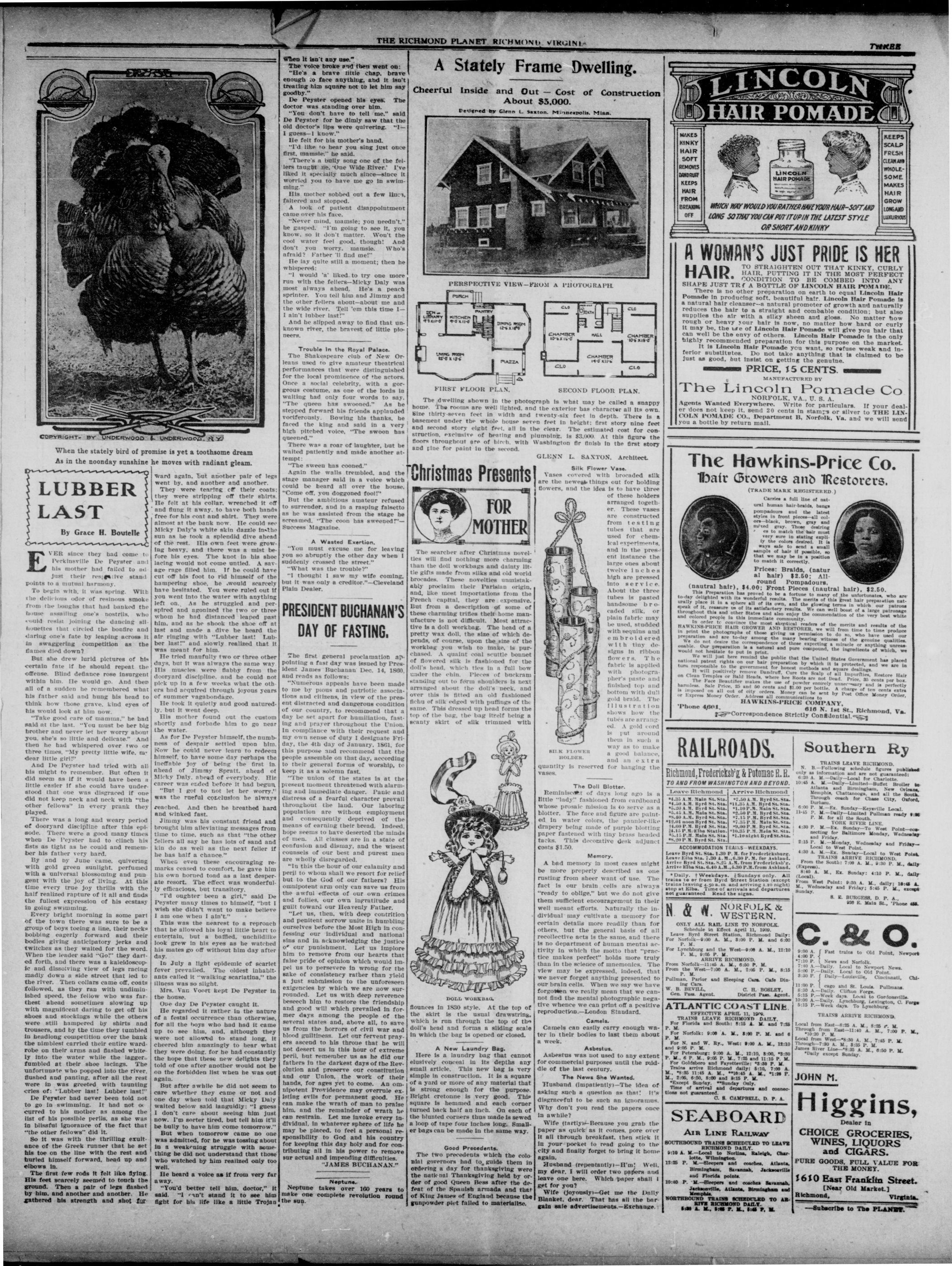
A Stately Frame Dwelling.
DESIGNED BY GLENN L. SAXTON. MINNEAPOLIS, MINN.
PERSPECTIVE VIEW—FROM A PHOTOGRAPH.
The dwelling shown in the photograph is what may be called a snappy home. The rooms are well lighted, and the exterior has character all its own. Size thirty-seven feet in width and twenty-six feet in depth. There is a basement under the whole house seven feet in height; first story nine feet and second story eight feet, all in the clear. The estimated cost for construction, exclusive of heating and plumbing, is $3,000. At this figure the floors throughout are of birch, with Washington fir finish in the first story and pine for paint in the second.
PORCH
DEN
LIBRARY
4'0 X 11'0
KITCHEN
4'0 X 11'0
DIMING ROOM
12'6 X 18'0
LIVING ROOM
15'0 X 13'6
PIAZZA
FIRST FLOOR PLAN.
FOR
MOTHER
The searcher after Christmas novelties will find nothing more charming than the doll workbags and dainty little gifts made from silks and old world brocades. These novelties unmistakably proclaim their Parisian origin, and, like most importations from the French capital, they are expensive. But from a description of some of these charming trifles their home manufacture is not difficult. Most attractive is a doll workbag. The head of a pretty wax doll, the size of which depends, of course, upon the size of the workbag you wish to make, is purchased. A quaint coal scuttle bonnet of flowered silk is fashioned for the doll's head, which ties in a full bow under the chin. Pieces of buckram standing out to form shoulders is next arranged about the doll's neck, and over this is fitted an old fashioned fichu of silk edged with puffings of the same. This dressed up head forms the top of the bag, the bag itself being a scanty skirt of silk trimmed with
```markdown
```
DOLL WORKBAG.
flouores in 1830 style. At the top of the skirt is the usual drawstring, which is run through the top of the doll's head and forms a sliding scale in which the bag is opened or closed.
A New Laundry Bag.
Here is a laundry bag that cannot elusively conceal in its depths any small article. This new bag is very simple in construction. It is a square of a yard or more of any material that is strong enough for the purpose. Bright cretonne is very good. This square is hemmed and each corner turned back half an inch. On each of the blunted corners thus made is sewed a loop of tape four inches long. Smaller bags can be made in the same way.
Good Precedents.
The two precedents which the colonial governors had to guide them in ordering a day for thanksgiving were the national Thanksgiving held by order of good Queen Bess after the defeat of the Spanish armada and that of King James of England because the gunpowder plot failed to materialize.
CLO
BATH
CLO
CHAMBER
10'-6" X 16'-0"
MALL
CHAMBER
10'-6" X 18'-0"
CHAMBER
14'-0" X 17'-6"
CLO
CLO
GLENN L. SAXTON. Architect.
Silk Flower Vase.
Vases covered with brocaded silk are the newest things out for holding flowers, and the idea is to have three
of these holders arranged together. These vases are constructed from testing tubes that are used for chemical experiments, and in the present instance the large ones about twelve inches high are pressed into service. About the three tubes is pasted handsome brocaded silk, or plain fabric may be used, studded with sequins and embroidered with tiny designs in ribbon flowers. The fabric is applied with photographer's paste and finished top and bottom with dull gold braid. The illustration shows how the tubes are arranged. A gold cord is put around them in such a way as to make a good balance, and an extra for holding the
```markdown
```
SILK FLOWER a good balance,
HOLDER. and an extra
quantity is reserved for hanging the
vases.
The Doll Blotter
Reminisce of days long ago is a little "lady" fashioned from cardboard whose prosocial mission is to serve as a blotter. The face and figure are painted in water colors, the pannier-like drapery being made of purple blotting paper fastened with tiny brass headed tacks. This decorative desk adjunct costs $1.50.
Memory.
A bad memory in most cases might be more properly described as one rusting from sheer want of use. The fact is our brain cells are always "ready to oblige," but we do not give them sufficient encouragement in their well meant efforts. Naturally the individual may cultivate a memory for certain details more readily than for others, but the general basis of all recollective acts is the same, and there is no department of human mental activity in which the motto that "practice makes perfect" holds more truly than in the science of mnemonics. The view may be expressed, indeed, that we never forget anything presented to our brain cells. When we say we have forgotten we really mean that we cannot find the mental photographic negative whence we can print off a positive reproduction—London Standard.
Camels.
Camels can easily carry enough water in their bodies to last them about a week.
Asbestus.
Asbestos was not used to any extent for commercial purposes until the middle of the last century.
The News She Wanted.
Husband (impatiently)—The idea of asking such a question as that! 'It's disgraceful to be such an ignorant. Why don't you read the papers once in awhile?
Wife (tartly)—Because you grab the paper as quick as it comes, pore over it all through breakfast, then stick it in your pocket to read going to the city and finally forget to bring it home again.
Husband (repentantly)—H'm! Well, my dear. I will order two papers and leave one here. Which paper shall I get for you?
Wife (joyously)—Get me the Daily Blanket, dear. That has all the bargain sale advertisements—Exchange.
LINCOLN
HAIR POMADE
MAKES
KINKY
HAIR
SOFT
REMOVES
DANDRUFT
KEEPS
HAIR
FROM
BREADED
OFF
LINCOLN
HAIR POMADE
KEEPS
SCALP
FRESH
CLEAN AND
WHOLE-
SOME
MAKES
HAIR
GROW
LONG AND
LUXURIOUS
WHICH WAY WOULD YOU RATHER HAVE YOUR HAIR-SOFT AND
LONG SO THAT YOU CAN PUT IT UP IN THE LATEST STYLE
OR SHORT AND KINKY
A WOMAN'S JUST PRIDE IS HER
HAIR. TO STRAIGHTEN OUT THAT KINKY, CURLY HAIR, PUTTING IT IN THE MOST PERFECT CONDITION TO BE COMBED INTO ANY SHAPE JUST TRACE A BOTTLE OF LINCOLN HAIR TOWEL.
There is no other preparation on earth to equal Lincoln Hair Pomade in producing soft, beautiful hair. Lincoln Hair Pomade is a natural hair cleanser-a natural promoter of growth and naturally reduces the hair to a straight and combable condition; but also supplies the air with a silky sheen and gloss. No matter how rough or heavy your hair is now, no matter how hard or curly it may be, the use of Lincoln Hair Pomade will give you hair that can well be the envy of others. Lincoln Hair Pomade is the only highly recommended preparation for this purpose on the market.
It is Lincoln Hair Pomade you want, so refuse weak and inferior substitutes. Do not take anything that is claimed to be just as good, but insist on getting the genuine
The Lincoln Pomade Co
NORFOLK, VA, IU 8 A
Agents Wanted Everywhere. Write for particulars. If your dealer does not keep it, send 20 cents in stamers or silver to THE LEN.COLN POMADE CO. Department B, Norfolk, Va. and we will send you a bottle to return mail.
The Hawkins-Price Co. Hair Growers and Restorers.
(TRADE MARK REGISTERED)
Carries a full line of natural human hair-braids, bangs pompadours and the latest styles in front pieces black and gray—black, brown and mixed gray. Those desiring es to match the hair must very sure in stating expliency colors desired. It is sway to make a small sample of hair if possible, so that we may in a position to match it correctly.
Prices: Braida, (natur al hair) $2.50; All-round Pompadours.
round hair) (naural hair), $4.00; Front Piece
This Preparation has its proven to be a to-day delighted with its wearable, urally place it in a sphere all of its own, and speak of it, reassure us of its satisfactory rest throughout this and other States and also en and colored people in this immediate community. HAWKINS-PRICE HAIR GROWER ANNIEER in print the photographs of those giving us preparation and are to-day among the man. We do not desire the correspondence of the onable. Do not hesitate and print would not hesitate to put in print. We will just here remind the public the national patent rights on our hair preparation turn responsible to the government for honor. We will be unburdled, unbruff, on Clean Temples or Bald Heads. The Face Beautifier makes the use of harmless, Sale Price, 25 and 50 cents and it is imposed on all out of city orders. Money or Express Money Order. All address all communication.
(nautral hair), $4.00; Front Pieces (nautral hair), $2.50.
This Preparation has proved to be a fortune to many of the unfortunate, who are to-day delighted with its wonderful results. The merits of this great hair preparation naturally draw it in a sphere all of its own, and the glowing terms in which our patrons speak of its satisfactory results. We can well boast of a large patronage throughout this and other States, and commendation of the very best white and colored people in this immediate community.
In order to convince the most akqiual readers of the merits and results of the HAWKINS PHOTOGRAPH HAIR GROWER AND RESTORER, we will from time to time produce in print the photographs of among the many giving us permission to do so, who have used our preparation and are to-day witness of the genuine qualities. We do not desire the correspondence of these extra goods or anything unreasonable. Our preparation is a natural and pure compound, the ingredients of which, we would not hesitate to put in print.
We will will public that the United States Government has placed national patent rights on our hair preparation by which we are protected, and we are in turn responsible to the government for honest methods and accurate details.
We will positively remove Dandruff, Cure the Scalp of all impaired Hairrest on Clean Temples or Bald Heads, where hee Roots are not Dead. Price, 35 cents per box. We will make the use of powder entirely unseasoned and is perfectly harmless. Sale Price, 25 and 50 cents per bottle. A charge of ten cents extra is imposed on all of out city orders. Money can be sent by Post Office Money Order, or Express Money Order. Address all communications to:
HAWKINS-PRICE COMPANY.
'Phone 4601.
616 N. 1st St., Richmond, Va.
RAILROADS.
Richmond, Fredericksbly & Potomac R. R.
TO AND FROM WASHINGTON AND BEYOND.
Leave Richmond
*4.35 A.M. Main Nt. Nt. Nt.
*5.20 A.M. Byrd Nt. Nt. Nt.
*5.20 A.M. Byrd Nt. Nt.
*5.20 A.M. Byrd Nt. Nt.
*5.20 A.M. Byrd Nt. Nt.
*12.01 noon Byrd Nt. Nt.
*14.00 P.M. Main Nt. Nt.
*14.00 P.M. Main Nt. Nt.
*15.15 P.M. Main Nt. Nt.
*15.15 P.M. Main Nt. Nt.
ACCOMMODATION TRAINS—WEEKDAYS.
Leave Bldg. 1. 12. 30 P.M. for Fredericksburg.
Leave Bldg. 2. 7. 20 P.M. for Aslband.
Leave Bldg. 3. 12. 30 P.M. for Fredericksburg.
Arrive Ebba Nt. 6. 40 A.M. 6. 30 P.M. from Aslband.
*Daily, † weekdays. † Sundays only. All trains to or from Bldg. 1. 20 P.M. for Fredericksburg (except trains leaving 4. 50 a.m. and arriving 12 noon) departures not guaranteed. Read the signs.
N. & W. NORFOLK & WESTERN
Byrd Byrd Street Station, Richmond Daily:
For Lease - 8:00 A. M. 8:00 P. M. and 6:00
P. M.
For Lynchburg and the West-9:00 A. M. 12:10
P. M. 6:00 A. M. 12:10
ARRIVE RICHMOND.
From Norfolk-11:46 A. M. 8:50 P. M.
From the West-7:00 A. M. 2:06 P. M. 8:15 P. M.
Pullman, Parlor and Sleeping Cars. Cafe Dining Cars.
ATLANTIC COAST LINE
TRANS LEAVE RIGHTMOND DAILY.
For Florida and South: 8125 A. M. and 7:23
P. M.
For Norfolk: 9:00 A. M., 8:00 P. M. and 6
P. M.
For N. and W. Ry., West: 8:00 A. M., 12:10
and 9:05 P. M.
For Peterburg: 9:00 A. M., 12:10, 8:00; *3:30
P. M., 12:10, 8:00; *1:15 M. P.
For Goldbore and Fayetteville: 9:00 A. M.
Trains arrive Richmond daily: 8:10, 7:00 A. M.
*8:38, 11:45 A. M., *10:45 A. M., *1:29 P. M.
*2:06, 6:50, 8:00 and 8:15 P. M.
*Except Sunday. *Sunday Only.
Time of arrival and departures and con-
nections not guaranteed.
C. S. CAMPBRELL, D. P. A.
SEABOARD
AIR LINE RAILWAY
SOUTHBOUND TRAINS SCHEDULED TO LEAVE
RHUMOND DAILY.
9:10 A. M.-Local to Nollins, Raleigh, Char-
lotte, Wilmington.
12:25 P. M.-Sleepers and coaches, Atlanta,
Birmingham, Savannah, Jacksonville
and Florida points.
10:40 P. M.-Sleepers and coaches Savannah,
Jacksonville, Atlanta, Birmingham and
Memphis.
NORTHBOUND TRAINS SCHEDULED TO AR-
RIVE RHUMOND DAILY.
5:20 A. M., 5:25 P. M., 5:25 P. M.
A. B. C. D. E. F. G. H. I. J. K. L. M. N. O. P. Q. R. S. T. U. V. W. X. Y. Z.
'Phone 4604
deces (naudal hair), $2.50.
fortune to many of the unfortunate, who are
the merits of this great hair preparation nat-
ed and the glowing terms in which our patrons
we. We can well boast of a large patronage
the commendation of the very best white
unity.
real readers of the merits and results of the
FOOTER, we will from time to time produce
our own products, which we have used, our
bearing witness of the genuine qualities,
one expecting a miracle or anything unre-
sure compound, the ingredients of which, we
that the United States Government has placed
on by which it is protected, and we are in
the possession of the Board of Restore Hair
Roots are not Dead. Price, 50 cents per box,
powder entirely unmatured and is perfectly
100 per bottle. A charge of ten cents extra
can be sent by Post Office Money Order,
MERC COMPANY,
616 N. 1st St., Richmond, Va.
Strictly Confidential.
Southern Ry
TRAIN8 LEAVE RICHMOND
GIRMOND.
N. B.-Following schedule, published only as information and are not guaranteed;
6.25 A. M.-Daily-Local for Charlotte.
10.48 A. M.-Local foriler to Atlanta and Birthingham, New Orleans, Memphis, Chattanooga, and all the South.
Tampa coach for Coach City, Oxford, Durham.
6:00 P. M.—Ex. Sunday—Keysville Local. 11:15 P. M. Duluth Local.
11:15 P. M.-Daily-Limited Pullman ready 9:30
P. M. for all the South,
WOYORK GIVER LINE.
4:30 P. M.-Ex. Sunday-To West Point-connect
for Baltimore Monday, Wednesday and
Friday.
2:15 P. M.-Monday, Wednesday and Friday-
Local to West Point.
4:30 P. M.-Monday-Local to West Point,
TRAINS ARHIVE RIGGIMON.
From the South: 7:00 A. M., 9:30 P. M., daily
(Flexpress).
P. M. Ex. Sunday: 4:10 P. M., daily
(Local).
From West Point: 9:30 A. M., daily; 10:45
A. M., Wednesday and Friday; 5:45 P. M., except
C. & O.
11:00 P: Cargo and St. Louis. Pullmans.
8:30 A: Daily. Clifton Forge.
10:00 A: Day weekdays. Local to Gordonsville.
10:00 A: Day Northbrook. Lexington, C. Forge
15:00 P: Week days.
M. 8:25 f. M.
Through from East-11:40 A. M. 7:00 P. M.
*10:30 P. M.*
1:30 P.M.
Local from West--8:30 A.M. 7:45 P.M.
Through--7:30 A.M. 8:35 P.M.
James River Line--8:35 A.M. 6:50 P.M.
*Daily except Sunday.
JOHN M.
Higgins,
Dealer in
CHOICE GROCERIES,
WINES, LIQUORS
and CIGARS.
PURE GOODS, FULL VALUE FOR
THE MONEY.
1610 East Franklin Street.
[Near Old Market.]
Richmond, Virginia.
—Subscribe to The PLANET.
```markdown
```
TWKEE
A. B. C. D. E. F. G. H. I. J. K. L. M. N. O. P. Q. R. S. T. U. V. W. X. Y. Z.
S. E. BURGESS, D. P. A.
920 E. Main St., Phone 488
THE YANET
Published every Saturday by JOHN MITCHELL
JR., at 311 N. Fourth Street, Richmond, Va.
JOHN MITCHELL, JR., - EDITOR
All communications intended for publication
should be sent so as to reach us by Wednesday
TERMS IN ADVANCE
One Copy, one year, - - - - - $1.50
One Copy, eight months, - - - - - 1.00
One Copy, six months, - - - - - .86
One Copy, four months, - - - - - .58
One Copy, three months, - - - - - .40
Single Copy, - - - - - .05
ADVERTISING RATES.
For one inch, one insertion.....$ . 40
For one inch, each subsequent insertion.....40
For two inches, three months.....8.00
For two inches, six months.....10.00
For two inches, nine months.....14.00
For two inches, twelve months.....20.00
Mandatory Inserts, six inch.....7.00
Standing and Transient Notices per line.....70
POSTAGE STAMPS OF A HIGHER DENOMINATION THAN TWO CENTS NOT RECEIVED ON SUBSCRIPTIONS.
THE PLANET is issued weekly. The subscription price is $1.50 per year in advance.
price is $1.50 per year in advance. There are four ways by which money can be sent. You can send it by a Money Order, by bank Check or Draft, or an Express Money Order, and when none of these can be provided, Registered Letter. A Money Order at your Post Office, payable at the Richmond Post Office and we will be responsible for its late arrival. MONEY ORDERS can be obtained at any office of the American Express Co., the United States Express Co., and the Well's Fargo and Co. Express Company. We will be responsible for money sent by any of these companies. MONEY ORDERS are safe and convenient way for forwarding money. REGISTERED LETTER.—If a Money Order, Post Office or an Express Office is not within the United States Express Co., you better wish to send us on payment of ten cents. Then, if the Letter is lost or stolen, it can be traced. You can send money in this way. You can send money to us on payment of ten cents. Then, if the Letter is lost or stolen, it can be traced. You can send money in this way. We cannot be responsible for money sent in letters in any other way than one of the four ways mentioned above. If you send your money in any other way, you must do it at your own
RENEWALS, ETC., If you do not want THE PLANET continued for another year after your subscription has run out, you then notify us by Postal Card to discontinue it. The courts have decided that subscribers to newspapers who do not order their paper discontinued at the expiration of time for which it has been paid are required for the payment of the subscription up to date when they ordr the paper discontinued.
COMMUNICATIONS—When writing to us to renew your subscription we use the ordinary paper, you should give your name and address in full otherwise we cannot find your name on our books.
DALL'NORLE OF ADDRESS—In order to change the address of a subscriber, we must be sent the former as well as the present address.
Entered at the Post Office at Richmond, Va. as second class matter.
SATURDAY. NOV. 27, 1909.
METES PUNISHMENT
The Supreme Court of the United States has seen fit to impose a punishment of ninety days imprisonment upon Joseph F. Shipp, sheriff of Chattanooga, Tennessee, Luther Williams and Nick Nolan and sixty days imprisonment upon Jeremiah Gibson, jailer, Henry Padgett and William Mayse, for permitting the lynching of Ed Johnson, a colored man, whose legal execution for assaulting a white woman had been stayed by the Supreme Court or the United States until the case could be reviewed by that tribunal. With the exception of Shipp and Gibson, the others were punished for participating in the lynching.
We presume that these men will now realize that it was not a question as to Johnson's guilt or innocence, but whether the law or the mob shall be supreme. This brings closely home the danger of lynching and emphasizes the fact that continued lawlessness is $s_0$ dangerous that it is absolutely necessary that it shall be stamped out. It is a noticeable fact that the punishment was pronounced by a Democratic Chief Justice and that his action seems to have been upheld by every member of that supreme tribunal. Colored men throughout the country and white ones too for that matter will realize that eternal principles are as yet in evidence and that calime will bring in time its own punishment.
A sheriff, whose duty it is to arrest other people has now been arrested and a jailer, whose duty it is to jail other people is now in jail. It is the irony of fate. The lawless elements in Tennessee may utter dire threats, but the unerring hand of the law is now being exercised within the shadow of the national capital and the evil effects of lynch-law are being realized throughout this broad land of ours.
COLORED MEN LOYAL
Despite the fact that the pay of the men in the army has been increased in all of its branches, the practice of deserting continues. Here is an extract from the report given to the public:
"Continued extensive desertions from the United States army during the last fiscal year forms the leading feature of the annual report of Adjt. Gen. Ainsworth. After showing that 4,993 men deserted from the enlisted force of the regular army, Gen. Ainsworth states that only a strict enforcement of severe penalties will diminish materially the practice of taking "French leave" on the part of the soldier. Gen. Ainsworth says the abolition of the canteen, the monotony of garrison life, the increasing amount of work and study demanded of a soldier, and the ease with which remu-
---
nerative employment can be obtained in civil life in these prosperous times are causes of the desertions.
Enlistment in the army in time of peace is not uncommonly regarded as evidence of worthlessness on the part of the recruit, and desertion in such a time is generally looked upon as nothing more culpable than the breach of a civil contract for services, says the general.
Adjutant General Ainsworth does not withhold any facts although they are highly creditable to the colored soldiers, many of whom were virtually "kicked out of the army". Here is what he says:
The percentage of desertions among the white troops is about ten times greater than among the colored men in the service. Of the men who deserted during the year, 1,013 were apprehended and 315 surrendered.
On October 15 the actual strength of the army, including the Philippine Scouts, was 81,778, and on the same day, one year previous the strength was 78,166. On October 15, 1909, there were 7,356 vacancies in the army, compared with 9,558 on the same day of 1908.
The colored people are always true. They suffer punishment and submit to misrepresentation, but they labor on in the service of the country.
THOSE ILLINOIS LYNCHINGS.
The lynching of Will James, colored, the alleged murderer of Miss Annie Pelley, white, and Henry Salzner, white, for the alleged murder of his wife, at Cairo, Illinois, November 12, 1909, adds another black chapter to the history of that state. It shows plainly that there are men and women, capable of committing as heinous crimes as the ones with which these men stood charged. The graphic incitations of the deeds of savagery read like pages from a dime novel. It is almost inconceivable that men, women and children, living in a Christian country could be guilty of such acts of savagery as the newspaper reports describe.
There is no longer any need to discuss the acts of savagery in either Turkey or the Isles of the sea. We have them here in the state of Illinois. As an evidence of the absolute deprivacy of these people, it will be well to cite instances. Here is what the telegraphic reports say:
Of James' body nothing remained after the lynching. The corpse was dragged to the alley where the body of Miss Pelley was found. Then it was decapitated, and the head placed on a pole. The torso was cut open, the heart taken out, and divided into small bits, and passed among the crowd for souvenirs. The rope was soaked in the blood, and also divided among the lynchers. What was left was burned.
The ghastly head remained on the pole until long after daylight. Not an undertaker in the city would take charge of it, and finally the city's "dead wagon" was sent to the place. It is supposed that the head was buried on the city dump.
Before the head was disposed of thousands swarmed about the neighborhood. The greater part of this crowd was composed of women and children. Youngsters who were too small see easily were raised above the heads of the crowd, often by their parents.
Salzner's body was claimed by his father. Some difficulty was experienced in rescuing the corpse from the mob.
Is there anything in the historical accounts of or the mob fury of the Middle Ages or the frenzied actions of the people during the French Revolution that will surpass in horror and depravity this Twentieth Century lynching in one of the wealthiest and most populous states of this Republic?
The following remarks are quoted:
"A regiment couldn't have stopped the work of last night's mob," declared Mayor Parsons, and Sheriff Davis echoed this sentiment, adding: "There would have been wholesale bloodshed had soldiers been here last night."
To our mind it is time that the sacrifice be made. The mob leaders must be punished at the scene of their crimes and the strong arm of the law should make its power felt at the time that these people are openly defying its authority. It is this dallying with the lawless elements that is causing us to pay this price of blood. The policy of condoning lawlessness and "cooing" to evil has its origin in Washington. Political influence is being utilized to prevent sworn officials from doing their duty. If the state government and the national government cannot or will not protect a prisoner, then the prisoner should be armed and given the right to protect himself.
Whether by the soldiers or by the sheriffs or by the law-abiding citizens this lawless spirit must be curbed and men and women of this stripe and calibre must be sent to the Indian's happy hunting grounds.
AN ECHO FROM NEW YORK
The Hampton, Va. Southern Workman in its issue for November reproduces the speech delivered by President William H. Taft, at Carnegie Hall, New York, Wednesday, February 23, 1909. There are some of the sentiments expressed in that
THE RICHMOND PLANET, RICHMOND, VIRGINIA
speech which will tend to give a clearer insight into the plans and purposes of this distinguished occupant of the White House and which may tend to explain away not only his official acts with reference to the appointment of colored men to office in the Southland, but will also give added significance to his promise to the white people in this city that he would do more for them during the three years in which he expects to wield the sceptre of President of the nation.
"Now, as I said, if you study the Congressional Record you will see that there are some statesmen who say that it is impossible for the Negro and the white race to live together, that the solution is beyond the hope of human effort. Well, the ten millions are here and what are you going to do about it?
There are some who propose that we should move them bodily out of the country. They don't say where they don't say how, and they don't say when, but out of the country they are to go. And when there is an attempt to move five hundred of them out of the state in which it is said their relations to the whites are most inharmonious, you have a riot the minute you propose to move them, on the part of and by the very men with whom they cannot live.
He continued;
"It seems to me that this is the reducitio ad absurdum with reference to the suggestion that expatriation is a solution or this question. The solemn, scientific statement of a man that the races cannot live together, even though it appears in a Congressional Record, ought not to occupy our minds for a moment; because they are living together and they have lived together for over a hundred years. Now, the question is whether we or they, or all of us together can make that living together better for both races. It is a problem that is set before us and it does not help us to say that we cannot work it out.
He then goes upon the presumption that there is a race problem in this country, so far as it relates to the colored people. He does not seem to understand that the real problem is whether or not this government has the inherent power and authority to enforce its own laws. But here is the most significant part of his remarks:
Race feeling, race prejudice, is a fact, and a man who does not recognize it is just exactly as illogical as the man who says that ten millions of people now in the country cannot live with the other seventy millions who are here, when they are already living here. There is race feeling and you cannot dispose of if by saying that it ought not to exist, and that is part of the problem.
Mr. Taft then is of the opinion that he should recognize this race feeling to the extent of pandering to it and that we should not dispose of it by saying that it should not exist. Well what is the difference of disposing of it by saying that it should not exist and disposing of it by saying that it does exist and by complying with the demands of those who cater to and approve this racial antipathy. President Taft then asks a question that he asks. He says:
"Now how are you going to wipe it out to the extent of making it so that it shall not produce injustice and a lack of harmony between the two races? Well, I think you are going to work it out.
This is what we call in plain English "begging the question". He "marched up the hill and marched down again."
He said:
"It is true that the ancestors of the Negroes to-day were brought here against their will. The Negroes who are here are Americans; they are entitled to our aid and sympathy. This is the only country and the only home they know. Ours is the only flag they can live under and it is a flag they have shown themselves willing to die for. I should feel very much discouraged, if I did not believe that the Negro was going to work out his own salvation. I believe it from what I have already said, and I have had the pleasure of addressing a number of Negro audiences in the South.
He tells us that we are entitled to aid and sympathy, but he does not stand up and tell us that we are entitled to all of our rights and privileges under the Constitution of the United States. We question the right of Hon. Williara H. Taft, as President or the United States to recognize race prejudice in the discharge of his duties as President of the United States. He does not seem to realize and understand that the progressive, independent colored men, who have reached the parting of the ways and with education and money are fighting the battle of life, resent this feeling which places all of us in the category with the helpless colored people in the rice fields, the sugar plantations and the cotton fields of the Southland.
There is a new Negro now upon the field of action and he insists upon his right to pay taxes and to hold office. We are very much of the opinion that President Taft is allied with that small army of apologists and political trimmers, who fear the Negro-haters of the country and swap fundamental principles for the transient popularity of this day and time. We reiterate that President Taft is a lovable
statesman, but on the rights of the Negro as a citizen he is all wrong and cannot be depended upon in close quarters to support us any more than the average Negro-hating southern Democrat can be expected to espouse our cause.
It is true that unwise Negro leaders have done us much harm and that those colored men, who should have demanded a hearing have been backward in facing the issues presented. Still there can be no excuse for a statesman of President Taft's ability and experience to blunder to the extent of saying or believing that as President of the United States he has the legal right to bar any citizen be he white or black from holding office because he is objected to by citizens of a community on account of his race, color or previous condition of servitude.
There are some things that some men are sworn not to do and it seems to us that this is one of the things that the distinguished Ohloan must under the Constitution of the United States live up to or stultify not only himself, but the party that he has the honor to represent.
THE OIL TRUST WILL APPEAL
Decree Dissolving It to Go to U. S. Supreme Court.
The World's Greatest Corporation Violated the Sherman Anti-Trust Law and is Shattered by Decree of Circuit Court—May End Monopoly.
The Standard Oil company will appeal to the United States supreme court from the decision og the court in St. Paul, Minn., dissolving the oil trust. It is said the appeal will be made regardless of the nature of the decree or the grounds on which it is based.
The case was heard in the United States circuit court at St. Louis in April, 1909, by Circuit Judges Sanborn, of St. Paul; Van Devanter, of Cheyenne; Hook, of Leavenworth, and Adams, of St. Louis.
Judge Sanborn, of St. Paul, the presiding judge, wrote the opinion and the decree, in which all the judges concur, and sent them with a concurring opinion of Judge Hook to Judge Adams, in St. Louis, who filed them and entered the decree in that city. The decree declared the Standard Oil company to be a combination in restraint of trade, within the meaning of the Sherman anti-trust law of July 2, 1890. By the decree the company is restrained from continuing in interstate business, together with all its subsidiaries, until after the dissolution ordered in the decree has been accomplished, the decree to go into effect in thirty days unless an appeal is taken in the meantime.
It appears from the concurring opinion written by Judge Hook that the company cannot do business under any other form with the object of stifing competition, for he says on this subject that it is thought that with the end of the company the monopoly will naturally disappear, but should it not do so, and the members of the combination retire from it, except one who might perpetuate the monopoly by the aggregation of the physical properties and instrumentalities, it would constitute a violation of the decree of the court.
In the trial of the case the point was made that the Standard Oil company was a beneficial corporation in that it, by reason of economy of operation, reduced the price of its product. This, Judge Hook says, can have no weight.
It is not a criminal case, nor has it anything to do with the famous $29,000,000 fine. As it is a civil suit, no penalty will fall upon either the corporation itself or the seven men named as the chief conspirators.
The case was argued by Frank B. Kellogg, of St. Paul, and Charles B. Morrison, of Chicago, for the United States, and John T. Milburn, of Buffalo; David T. Watson, of Pittsburgh; Moritz Rosenthal, of Chicago, and John G. Johnson, of Philadelphia, on behalf of the defendants. It was brought to enjoin John D. Rockefereller, William Rockefereller, Henry M. Flagler, Henry H. Rogers, John D. Archbold, Oliver H. Payne, Charles M. Pratt, the Standard Oil Company of New Jersey, and about seventy other corporations, from maintaining a combination and conspiracy in restraint of trade, to monopolize interstate and international commerce, and the decree grants the injunction sought by the government.
Drops 73 In Custom House
The weeding out from the customs service in New York city of the men who have been implicated in the sugar frauds and other schemes to cheat the government, but against whom no evidence of actual commission of crime has been obtained, began in earnest when Collector Loeb announced the discharge of James F. Vall, formerly deputy surveyor in charge of the weighing division; George E. Bedell, an inspector and formerly chief clerk in charge of the same division; James P. Hyland and Joseph O'Carrall, foreman of weighing districts, and eighteen other weighers and gaugers, whose names are not mentioned in the official report given out at the custom house. So far as could be learned, the men granted immunity and a retention of their jobs
DUGGINS' REMOVAL SALE!
It is Your Opportunity to purchase the Choicest of Clothing and Underwear at the first of the Season at prices that will not be equaled by any Store this Year.
We are going to move, and it is our desire to sell every dollar's worth of present stock before vacating 00 Broad Street. You owe it to yourself and family to visit this store. Here are prices that in justice to yourself you should see these Garments. Come here to-day. RAINCOATS—The Reductions on Raincoats are so generous you cannot fail to take advantage of them. Prices will not be lower.
Sam'l E. Duggins, Inc. Don't Forget the Place--OO Broad St.
MEN'S HATS.
$4.00 Hats, removal...$2.98
$2.50 Hats, removal...$1.89
$1.50 Hats, removal...98c
$1.25 Hats, removal...75c
Sam'lE
Don't Forg
for testifying against Philip Musica at his trial for cheating the government out of duties on cheese, are included among the men whose heads went into the basket. Whether or not any of the discharged employees will have to face criminal charges later is a question which both Collector Loeb and United States Attorney Stimson refused to answer.
All Customs Frauds to Be Pressed.
Criminal prosecutions against the "sleeper trunk" customs frauds, pressing of indictments to avoid lapses under the statute of limitations and customs investigation generally, were discussed at a conference at the treasury department in Washington.
Secretary MacVegh, Attorney General Wickersham, Collector Loeb and United States District Attorney Wise, of the southern district of New York, participated.
Incidentally, Secretary MacVeagh announced that the $2,000,000 odd which the American Sugar Refining company had paid to the government on account of evasion of duties, was regarded by the government as a complete settlement for all its underweighing frauds.
That amount, however, he said, affected no other evasions of duty and in no wise figured as to any other matters, and the government purposed to recover much more money because of frauds the trust had committed.
After the conference Mr. MacVeagh said that the sugar frauds were overshadowing in interest one of the most important phases of the whole inves
Ugation, the commission of frauds by importers with trunks with false bottoms involving losses of millions to the government. Collector Loeb explained that while this had been possible in the past, rules had been adopted under the present regime which would prevent such frauds in the future.
Rattlesnake Kills Girl
Miss Belle Jones, eighteen years old, daughter of the leading merchant of Amsterdam, Ga., is dead from being struck by a great rattler while walking in a flower garden of her home. The snake was colled under a rose bush and struck Miss Jones as she was gathering flowers. The snake struck the girl on the leg between the ankle and knee and clung there. The girl ran screaming to the house, dragging the snake with her. Her father, who met her, snatched the snake from her leg with his hands and killed it. The snake measured seven feet long and was of enormous girth. The marks on the girl's leg were over three inches apart. Physicians were summoned, but were unable to save the girl. She died in terrible agony five hours after being struck by the snake.
Battled For Life with Wounded Buck
Locked for half an hour in the horns of a slightly wounded and dangerous buck, Stephen Chalmers, well known as an author and magazine contributor, engaged in a life or death struggle in the twilight on Burn hill, eight encounters from Saranac Lake, N. Y.
Finally grasping with one hand his
MEN'S UNDERWEAR.
$2.00 garments . . . $1.48
$1.50 garments . . . $98c
$1.00 Red Flannel . . . 59c
75c Fleece Lined . . . 37 1-2c
ns, Inc.
0 Broad St.
shofgun, the stock of which had been broken by a blow at the deer's head. Chalmers discharged the load into the buck's breast. Chalmers first wounded the deer, slightly stunning it. He dropped his gun and reached for his knife to put the deer to death. It was gone, and before he could recover his gun the buck rose to its feet and charged him. Chalmers' hands were badly lacerated by the antlers of the deer, but other wise he is none the worse for his ex hausting struggle.
Roosevelt Party Are Well
Reports received in Nairobi, British East Africa, from the Roosevelt hunt ing expedition are that all the members are well and will return to Londani Nov. 30.
During the hunting on the Guas Ing hsi plateau Colonel Roosevelt and Kermit killed four elephants for the American Museum of Natural History in New York.
The party took many other trophies including five horned giraffes, a leop ard, a roan bushbuck, a Jackson's hartebeeste, an oribi, a singing topi a bohor and a kob.
Atlantic City's Huge Profit
Nearly $10,000,000 in cash has been deposited in the Atlantic City banks as the profits of one of the biggest seasons on record. Figures shown by reports of the eight banks and trust companies place the exact total at $8,991,C11. Local financiers declare their belief that the addition of deposits in building and loan and other funds will run the total season's savings of the resort's population up to $12,000,000.
AC YUET
Prize Fight ing Mania.
Prize Fight ing Mania.
Continued from the First page.
easily the best middleweight of his time until the advent of Bob Fitzsimmons, was dethroned by * the Australian at New Orleans. With the exception of a bout or two he was out of the ring a tride over four years. In 1895 they matched him to box Tommy Ryan at Cozy Island. It was a most pathetic spectacle and brought tears to the eyes of many of Dempsey's admirers who had known him when he was invincible. As an act of mercy, the unequal contest was stopped in the third round. Five months later the gallant warrior made his last public appearance at a benefit tendered him at Madison Square Garden. Shortly after he passed a way at Portland, Ore. Some say tuberculosis others that he died of a broken heart. After Kid McCoy defeated Jack Twin Sullivan at Los Angeles in twenty rounds, he forsook the ring for four years. He always took good care of himself, but when he boxed Jim Stewart he found it was impossible to "come back" and although he won by a fair margin he was by no means the McCoy who had beaten Gus Ruhlin, Tommy Ryan, Peter Maher, Dan Creedon and a score of others.
Paddy Slavin, the Sydney Cornstalk, was another who tried to come back and failed. He retired in 1902, was in retirement for five years, and though he was one of the best heavyweights of his day, was knocked out in two rounds by Nick Burley at Victoria, B.C., when he next entered the -ring. He was credited with making the hardest fight against Peter Jackson the black champion ever engaged in. In Kid Lavigne was beaten by Jimmy Britt in San Francisco in 1902. Five years later, after a long course of training, he re-entered the ring with young Erne at Philadelphia. He made a sad show against the
speedy Quaker and was woefully outclassed. That clever English lightweight, Jabez White, retired after defeating Spike Sullivan in London in 1902. Three years later he was induced to enter the ring with Jimmy Britt. He was thirty-two years of age at the time, and, although he retained his cleverness, steam was gone and he lost to Britt. Since then he has done nothing of consequence in the ring. One could go and libel and cite instances where talented boxers tried to "come back" but the above will give a fair idea of how difficult it is to do so. Jeffries may be able to do it, and the good wishes the sporting clans are with him, but the task is a hard one and few have succeeded.
The sad death of Willus Britt,
Stanley Ketchel's young manager,
was partly due to sudden wealth
easily acquired. Britt, always a
soldier of fortune, brought Ketchel
East last spring and arranged two
battles with "Philadelphia B"
O'Brien, which netted about $25.000. Of this amount the reckless
young manager received nearly a
third, and with it he proceeded to
cut a wide swat. Nothing was too
good for him. Late suppers, with
an abundance of wine, automobiles,
line clothes and other luxuries soon
put a crimp in the bank roll, and
when Ketchel failed to knock Papke
out inside twenty rounds, Britt lost
$2,500 in wagers—all that was left.
Britt borrowed more money and bet
every dollar of it on Ketchel to beat
Jack Johnson. When the big negro
won by a knock-out Britt was pen-
less, his vision of a great fortune
was gone, and his heart was broken.
It was the same old story.
Squandered wealth earnest in pugilism proved to be a fetal.
It has often been said that no persons supported by the public live in such reckless luxury as star pugilists and their closest associates. A great fighter may reign only for a few years at the head, of his class, but during that period he is generally a high roller and goes the route. He has a far more rugged constitution than the rich man's son, who was never meant for hard work, for he is compelled to undergo a course of training for a strenuous battle every now and then, which provides renewed physical endurance. "If the ordinary man lived like some of these pugilists," said a veteran trainer the other day, "he'd be a physical wreck in less than a year. A majority of these fighters, however, do a certain amount of daily exercise to keep their weight down, and in that way they do not feel the effects of a spree.
"If the wise pugilist gets a heavy cold what does he do? Refire to bed like most men? Not much. He dons a heavy sweater and goes out for a run on the road. He simply sweats it out if he can, and if he can't, why he is then forced to seek medical aid like an ordinary individual. But that seldom proves to be the case, for open air exercise and cold bats generally suffice.
This was the way Fitzsimons and Tommy Ryan doctored themselves, and they kept themselves in excellent condition for many years. Fitz never indulged in a night of merriment that he didn't get out of bed early the next morning and take a hard run to open the pores. But the other star fighters like John L. Sullivan and Jack McAuliffe didn't go to $t_0$ such trouble and were soon too fat to accomplish anything in the ring. If they caught a cold they went to a Turkish bath, where they could rest in solid comfort.
CHRISTMAS! SURPRISE SALE!!
```markdown
```
OUR STORE
Has been entirely renovated and decorated and is now equipped with Electric Elevator and Comfortable Private Rooms where Customers may examine goods under the most favorable circumstances.
The INNER PLAYER Piano
In Your Home
Would give a pleasure that now is impossible. Anyone can play any piece of music, any time—from Ragtime to Grand Opera—whether you have ever taken a music lesson or not. Doesn't that sound good to you?
Be sure you get an INNER-PLAYER. This is the only place in Richmond where they are sold. There are 3 of them, The Conover Inner-Player The Cable Inner Player
The Kingsbury Inner Player and the Euphona Player Plano.
FROM $550 TO $1,000.
"Singing Bird," "Lady Love," "Have You the Front Door Open," &c. &c.
Hundreds of Songs at 5 Cents, Thousands of Vocal and Instrumental Pieces, 10c.
A Few Dollars Will Make Your Old Piano Look New if You Send It to Our
We Overhaul and Remodel All Kinds of Planos. 12 Factory Experts do the Work in Our Own Big Factory, 211 N. Third Street. Ask for Oug Yearly Tuning Contract.
Sullivan was one of the most luxurious champions that ever appeared inside the ropes. He lived like a prince and never allowed teatrical engagements or fights to disturb his repose. He drank, ate, and slumbered when he felt like it. What was the result? From a raw boned, muscular young giant he became a ponderous elephant, prematurely old, weighing more than 335 pounds. His kidneys and liver went back on him and his physician ordered him to cut out liquor entirely or die. So John swore off and hasn't touched a drop since.
"In high life Sullivan was a wonder. I've seen him in the old days get away with a quart of whiskey at a sitting. But he never neglected his appetite for rich food, and in that way he counteracted the effect of strong drink. Sullivan got money so easily that he did not know the value of it. He couldn't spend it fast enough, and he probably ran through more than a million before he settled down and began to save
"A modern ring champion can spend money too. It comes easy and goes the same way. He generally has a staff of attendants that costs a heap. First comes his business manager, a person who can talk easily, issue challenges, be on the alert in making matches, and knows how to get space in the newspapers. Then there is the press agent, who must invent fairy tales concerning the alleged adventures of the pug. Then there must be an advance agent and a sparring partner who can take a walloping with good naked.
"In addition to this retinue some champions have a staff of handlers, rubbers, cooks, and admirers who try to act the part, and entertainers. It's no easy matter to keep a fighter in good humor when he's in training, and those who can succeed in this respect are usually worth something.
You Ought To See It
The greatest magazine published in the whole world is published by a negro at No. 74 Highland Street, Boston, Mass., U. S. A. It costs $2.50 per annum; single copies are 25 cents each. Sold only by special agents, wao make $2.00, $5.00 and $7.00 per day selling them. Agents fee is $1.00. No intelligent man or woman of negro blood need be idle or go hungry if they sell this book. Everybody wants it. It sells at sight. Address T. T. L. O. L., Magazine-Editor, 74 Highland Street, Boston, Massachusetts, U. S. A. See it now.
It treats on hidden facts and lost things. It brings hidden things and lost people to light and reveals secrets that the world has never known. You ought to read it. $50.00 reward will be given to the one who can find a magazine that equals it, or as great a proposition offered as it sets before the negro race, as is offered the race now. Buy it. Be sure you read it now.
Special Agent.
Subscribe to the PLANET.
THE RICHMOND PLANET, RICHMOND, VIRGINIA
In all our Sixteen Years of Business Life in Richmond, the CABLE PIANO COMPANY has never been better prepared to take care of Holiday Orders than on this, the approaching Festive Season of 1909.
A Real Christmas Surprise Is Here for You.
This Sale Ends Christmas Eye.
Old INSTRUMENTS Taken in Exchange and Liberal Terms Made, if desired
$3.50 RECIPE CURES WEAK
MEN—FREE
Send Name and Address Today—
You Can Have It Free and Be
Strong and Vigorous.
I have in my possession a prescription for nervous debility, lack of vigor, weakened manhood, falling memory and lame back, brought on by excesses, unnatural drains, or the follies of youth, that has cured so many worn and nervous men right in their own homes—without any additional help or medicine—that I think every man who wishes to regain his manly power and virility, quickly and quietly, should have a copy. So I have determined to send a copy of the prescription free of charge, in a plain, ordinary sealed envelope to any man who will write me for it.
This prescription comes from a physician who has made a special study or men and I am convinced it is the surest acting combination for the cure of deficient manhood and vigor failure ever put together.
I think I owe it to my fellow man to send them a copy in confidence so that any man anywhere who is weak and discouraged with repeated failures may stop drugging himself with harmful patent medicines, secure what I believe is the quickest-acting restorative, upbuilding, SPOT-TOUCHING remedy ever devised, and so cure himself at home quietly and quickly. Just drop me a line like this: Dr. A. E. Robinson, 3895 Luck Building, Detroit, Mich., and I will send you a copy of this splendid recipe in a plain ordinary envelope free of charge. A great many doctors would charge $3.00 to $5.00 for merely writing out a prescription like this—but I send it entirely free.
STATEMENT OF THE FINANCIAL CONDITION OF
The Mechanics Savings Bank, of Richmond, Located at Richmond, In the County of Henrico, State of Virginia, at the Close of Business 16th day of November, 1909, Made to the State Corporation Commission
RESOURCES.
Loans and Discounts . . . $16563.76
Overdrafts.
LIABILITIES
LIABILITIES.
Capital stock paid in... $26030.00
Surplus fund ... 6250.00
SURPRISE LOT.
15 New Pianos.
Exquisitely Designed Cases of
Mahomety and Oak.
SPECIFICATIONS
SPECIFICATIONS
New Improved Scale, 7 1-3 Octaves; 3 Unisons Throughout;
Excellent Felt Hammers; Overstrung Bass; Ivory Keys; Nickel Tuning Pins; Fine Repeat Ing Action; Built Up Pin Block;
$235.00 KAJUE
25.00 VALUE
CHRISTMAS TREASURE $23.00
$10 Cash - $2 Per Week.
SQUARE PIANOS, $100.00.
Pianos Which Sold at From
$350 to $650. Easy Terms.
SAMPLES:
1 Chickering, Carved Legs. In
Perfect Condition, 7 1-3 Octaves.
1 Wm. Knabe, Carved Legs. In
Perfect Condition, 7 1-3 Octaves.
1 Steinway, Carved Legs. In
Perfect Condition, 7 1-3 Octaves.
We have also put in Perfect
Condition for this Sale a large
number of Parlor and Chapel
Organs. $30 to 50.
en in Exchange and Liberal
e, if desired
o Company,
'Phone, Madison-2734.
Individual deposits subject
to check
Time certificates of deposit
Cashier's checks outstand-
J. THOMAS HEWIN,
Notary Public.
My commission expires April 18
1910.
GETS HUMAN FLESH IN MAIL
Colorado Judge Receives Strange Missive From Enemy.
Colorado Springs, Colo., Nov. 24.—Justice of the Peace A. P. Toombs received two pieces of human flesh through the mails. Accompanying them was a note explaining that they had been cut from a smallpox patient, the writer expressing the wish that the judge might catch the disease and die.
In the meantime Toombs has reported the case to the federal authorities for investigation, and a member of the city detective department also has been assigned to work out the mystery.
Toombs is unaware of the existence of any enemy unless it be some one upon whom he has inflicted punishment in his official capacity.
Shoots Son For Hawk
York, Pa., Nov. 24.—John Koller, of Glen Rock, while preparing to shoot a hawk, which had been stealing his chickens, accidentally shot his eleven-year-old son, Erwin. in the foot. The shot penetrated the boy's left foot. Unless blood poisoning sets in he will recover.
Fifteen Hanged In Russia.
Saratov, Russia. Nov. 24.—Fifteen prisoners were wanged here. A fellow prisoner volunteered as a public hangman.
ASTOR YACHT SAFE
Missing Boat Was at San Juan, Porto Rico, on Nov. 17.
New York, Nov. 24.—The report of Captain Furst, of the Red D liner Caracas, that he had left Colonel John
OUR STOCK
Provides a wide range of most attractive and useful Christmas Gifts, and we earnestly urge you to call and make an early purchase. Make your purchase NOW and it will be delivered Christmas Eve.
Everybody Ought to Have a VICTOR TALKING MACHINE. It's a Gift that Lasts and proves an ever welcome Entertainer. The CABLE PIANO COMPANY has the Largest VICTOR Stock Machines, Records and Supplies South of New York.
GET A VICTOR FOR XMAS.
$10 up to $100. Easy Terms.
Come and We Will Gladly
Play Anything You Want to
Hear. New Records on Sale.
28th of Every Month.
SMALL GOODS DEPT
Very Low Christmas Prices.
Violins, Banjos, Mandolins,
Guitars, Accordeons, Music
Boxes, Autoharps, Cornets,
Clarionets, Occarins, Harmonicas,
Music Rolls, Satchels,
Sheet Music, Cabinets, Piano
Scarfs. Music Books of All
Kinds.
AND REMEMBER
They All Go at This Christmas
Surprise Sale at Prices that
Will Astonish You.
We Carry the Largest and Finest
Line of Violin, Mandolin
Banjo & Guitar Strings in the
South. Also Fixtures for all
Kinds of Small Instruments.
THERE'S A BARGAIN FOR YOU
IN THIS WONDERFUL XMAS SALE. IT'S THE BEST CHANCE EVER OFFERED YOU FOR DEPENDABLE GOODS AT LOW PRICES.
Jacob Actor's yacht, the Nourmahal in the harbor of San Juan on Nov. 15 was confirmed by Captain James Dalton and the officers of the Insular line steamship Harry Luckenbach, in from Porto Rico. Captain Dalton and his chief engineer, A. D. Emery, dispelled all doubts as to the safety of the Nourmahal by declaring that when the Luckenbach sailed out of San Juan on Nov. 17, two days after Captain Furst had seen the Nourmahal, she was still at anchor off San Juan and showing no evidences of having encountered rough weather on her trip from San Domingo.
Chief Engineer Emery was formerly an assistant engineer aboard the Nourmahal, so there is no doubt about his ability to identify her even if Captain Dalton might have any doubt about her identity.
DRIVEN INSANE BY CHRISTIAN SCIENCE
Former Lancaster Man Loses Mind in New Haven, Conn.
New Haven, Conn., Nov. 14—According to the testimony in the probate court here of Drs. Seymour L. Spier and Max Mailhouse, Christian Science/ has driven Elam Martin, a cigarmaker, hopelessly insane.
Martin, who came to this city from Lancaster, Pa., several years ago, has worked steadily and accumulated several thousand dollars which is on deposit in the local savings banks. Two weeks ago he became a member of the local Christian Science church. Every spare moment he spent poring over the Christian Science text books. The problems seemed to weigh on his mind and finally unbalanced him.
A week ago his landlady was startled by Martin's statement that there was no reason why he could not go to Lancaster with 30 cents, because Christ himself had travelled all over the world with less than a dollar. Martin went to the Hebrew Temple Mishkan Israel, in the center of the city, and stripped himself of every stitch of clothes he had on him. He made a platform of his clothes and, with the Bible in his hand, began to address the negah.
GOV. HADLEY INJURED
Forced to End Hunting Trip by Badly Swollen Hand.
Springfield, Mo. Nov. 24.—Governor Hadley, who has been hunting in the Taney county hunting preserve, was forced to leave there for Jefferson City on account of a badly swollen hand, caused by a fall. Physicians advised the governor to return to his home at once, as they feared blood poisoning might develop.
THE COHEN CO.
ONE HUNDRED DOZEN SHIRTWAISTS At $1.00 Worth $2 & $2.50
Seven
Great Wonders
of the
Waist World
THE GREATEST SHIRTWAIST BARGAIN IN YEARS—Perfectly Made White Linen-Like Waists, in Seven Neatly Tailored and Embroidered Styles, EXACTLY LIKE THE ABOVE ILLUSTRATIONS.
The Finest Shirtwaists Made by a Leading New York State Manufacturer. One Hundred Dozen on Sale, Beginning To-morrow, at JUST $1.00 EACH, Instead of $2.00 and $2.50, ALL SIZES.
Prompt Attention Given Mail Orders.
Sale of Women's Finest $22.50 & $25 Tailor Made Suits at $15.00.
The greatest bargain wonder of the year strictly hand-tailored 48-inch Coat Suits, in this season's most beautiful styles—made of elegant quality hard-finished worsteds, in best shades of navy blue, green, gray, and all black; coats full satin lined. All sizes to start with; the best $22.50 and $25.00 Suits of the season, on sale for ..... $15.00
The Famous Clothing Co. $10 & $15 Suits
THE FAMOUS CLOTHING CO.,
124 EAST Broad Street.
```markdown
```
FIVE
These are easily the peer of any garments hereabouts costing from $15 to $25 each. Fashioned, too, in a faultless way, with great care exercised in their tailoring, so that they may be right up to "The Famous" requirement. They must be "right" to be here.
Fall Overcoats $10 and $15
Two special Values in light and heavyweight Overcoats. Both are unusual at the prices asked.
Garments most expertly tailored and created in the most fashionable manner.
They were built in one of America's greatest tailor shops, where only expert workmen find employment. Real Worth $15 to $25.
"The Famous" Brand
of Tailored Trousers
$3.00 and $4.00
Would be unusual if priced
at $5 and $6. Newest effects.
Many patterns.
Our Soft and Stiff
Hats at $2.00
Every stylish shape or
block that Fashion suggests
for Fall and Winter. Unmatched at the price outside
of "The Famous."
a we.
—_—_—_——
ies atic.
He acti
ms a
\y
\
dV
eS ig?
saTURDAy NOV. 23, 19
PAULON SELF
DENIAL |
mS a
2a ae
GOLDEN TEXT. et good neither to
tha eereby thy brother ntumblethe ee
Rom, 14-21
Suggestion and Practical Thought.
Ofie—The School of Self-Control.
‘Temperance means the control of all
the lower parts of a man’s being by
his reason, his conscience, and his
wilL It ts “keeping the soul on top.”
‘The all pervasive thought in the
Yerses of the lesson for today is this
self-control, the basis of temperance.
Why are we all, even the youngest
children, placed in the midst of so
many temptations, to lic, to steal, to
aS to drink Intoxictaing liquors,
tovbe selfish, and disobedient?
Because there is no other way of
opening the door to man’s highest pos-
siMiities, his fullest development, his
Purest holiness, bis greatest happi-
mesh, his largest usefulness. All who
would become strong and useful must
sain (heir power largely through vic-
tory"ovor temptation. It is thus that
th€ soul “bullds fteelt larger man.
sions.” Tt is a chief factor in educa-
tion Men cultivate courage through
things that test courage. They grow
‘m faith through the things that try
thelr faith. They learn bus’ness by
taking the risks of business. People
without trials and temptations are al-
ways failures .
Why are we so full of impulses and
passions, of faculties and powers that
may be used for good or for evil? Be-
cauke the question of life with every
man fs the question of self-control, of
temperance. Prof. Thomson in ‘his
Frain and Personality says that “the
‘Will creates the man." “We make our
‘own brains” by repeated choices which
aresacts of Will. “The Will is the
ranking official of all in man.” |
Why then do we pray, Lead us
not into temptation? Because there
atecplenty of temptations for our edu-
catibg without our seoking for more.
Recaline our only true attitude toward
temptation is that of a fighter, a con.
queror. Whosoever goes willingly,
with desire, into temptation ts already.
more than half fallen. The mad man,
described in the Greyson Letters, had
an. {fllusion that he was acquainted
with the devil. “They say the de'll
ts very busy in tempting men; but he
maun hae an easy time o't, 'm think
ing. All of them meet him more than
half way. Mk ané seems to gang to
bim and say, “Haena ye some dainty
teniptation for me today, now, Daddy
Satad? I'm sair wracked for a coax.
fog temptation.’ "
A learned professor wrote the other
Gay that people ought to drink a little
wine moderately, In order to. train
themselves In self-control. But that ts
to throw open the castle of your life to
th® enemy. It gives him every ad-
vantage. For the tempter is like those
reople who go in a large band to haze |
a simple ‘freshman, or as was once
the custom In a national military’
school to make an untrained newcom- |
er fight an athlete of an upper class.
Two—Away with the Stumbling
Block of the Saloon. Hon. Neal Dow
was lecturing. one summer evening,
end the flies and gnats gathered in
such swarms around the lamp near
him that he took his handkerchief and
wayed them away. They went for a
Ume, bet soon retrrned. He repeated
his movements with his handkerchief,
with the same results Finally, he
turhed around and blew out the light;
and heneeforward the insects were no
longer attracted, and kept away. So
watning people away from saloons
will not be enough; you must extin-
gnish the saloons themselves.
‘Three.—The Only Safe Way. Don't
Regin—A little couplet, written for
children, holds weighty wisdom:
From drink, with ts sorrow snd ruin and
‘en,
J murely am safe if I never bexin.
Said & young man to me once:
“When I feel a thirst coming on that
brings visions of the delight of its
eh ing, 1 drink all the water that I
clifen creat deal more ten T went--
and_then think of something else.”
“Bat,” one asks, “must I not use
wine because others abuse it?”
Does every one who drinks wine be-
come @ drunkard?
By no means. But no one ever be-
comes a drunkurd who refused to take
the first glass.
Several times men have tried to sail
ectoss the Atlantic in a very small
boat. it was very dangerous and
some succeeded.
But if you cross in one of the great
Minera, which can carry more than
2000 persons, and can laugh at and
‘spoft with the waves that would over-
whelm the little boat, you are as safe
sa you are at home. When I eross the
Al tie I take the great liner.
some millionaire should offer me
41 im gold on condition that.
with Tt 1 should take a drunkards
cops ‘appetite for strong drink, and
ron own risk, I would refuse it in-
stantly, though I went to the poor.
houwe the next day,
Don’t begin, because it is easy to go
fown into the depths, but very hard
to return, one of the hardest victortos
ever won by man. I heard Mr. Ed-
ward Carswell, fm @ lecture, tel! of #
huagiclon who offered to change any
Brigh} Day nto an SMlot,. 5° moe
5 ee CaO
consented to have him try his power
on her son. The boy went forward:
the magician made bis passes; soon
the bright look fades away from the
boy's face, a vacant stare takes {ts
place, and the boy becomes an idiotic
fool. At length the mother asks the
magicion to change him back again.
fat hte be cou'é. aot So.
STUDY THE GENERAL EFFECT
Weil to Remember is the Fact That
We the Whole of a Thing
‘That Gaaeee
Get out of the habit of casting s
Single eye on some unimportant de
tall of the styles, and look out for a
more general effect.
“Being well dressed” stands al.
‘ways for the general whole, and not
for some little ineffectual "point of
one’s costume. What matters it if
‘one’s coat revers slope gently down
or turn at a sharp angle, if the coat
48 correct in its line and length?
In fact, the styles vary to sult a
hundred different faces, and who shail
say that, because the sharply cut col-
lar or stiff tie be an accepted style, it
must be worn when only rounded,
softened outlines are becoming? A
sleeve that is cut on one of the cor-
Tect lines for the season will give
enough of the pervailing outline to
carry blouse, collar and tie.
It’s the whole of a thing that counts,
after all, and there's a certain small.
Ress of outlook in the striving after
Uttle things and a bigness in con-
sidering the sum total. There is «
Uttle old-time habit that the dress-
maker with the soul of an artist 1s
trying to educate out of her inartistic
patrons—that habit of matching a
single thread of silk in the weave of
cloth when buying the trimming mate-
rial. Buttons, too, are chosen in this
way with no intention of the unexpect-
ed contrast they present. It is rare,
indeed, to thus reproduce some iso
lated strain of color in a material of
a cosiume and gain a satisfying re
sult. :
The theory of totalities holds par-
Hoularly well in millinery. ‘The hat's
shape and the year’s main method of
trimming mean more toward securing
a stylish result than the strict fol
lowing of a certain designated flower
or feather, i
LUSTROUS SILKS LOSE FAVOR
Women of Fashion Turning to the
Duller Though Still Supple
aoe
: ° :
Is Your Hair Beautiful
~~ Soft, Silky and Long?
4 ») A Doesit comb easily without breaking?
ve - Fy Is it straight ?
> at EB dows It smooth out nicely?
& eet an Go tup i {the charm-
~ =n
as make you proud of it?
F ITE I) Reames you cannot say YES to all of the
4) CNS Lay ‘above questions, = you need
rt) er {, Nelson’s
eo .
i ich » Hair Dressing
y a i A o
EN suibcaes tiga Gatsmies Coc hseeed
pay wg meter Torn ne eet ace oe
é, sepa tlm antes ooh heme etapa
SS igret anaes stmes era eoneae
, | _Use Nelson's Hair Dressing poi777)9°"
Tou tel Canoga Senet Las
anos tt) YooSeloorekovece arenes ee ee
Nelson's Hair Dressing j.r1z7 5 Meiers wremet, sar tn tam
SINE atm Coma eS emt
NELSON MANUFACTURING CO., Richmond, Va.
Live Agents Wanted. Write Quick for Terms.
it is predicted by those who are
wise concerning materials that crepe
Weaves will have a great vogue, and
this prophecy seems to be borne out
by the more beautiful gowns of the
year.
It ts certain that satin in any case
‘will not be nearly so popular as last
year. Lustrous silks have been so
much worn that women seem to have
tired of them and, for a change, turned
to the duller though still supple mate-
rials, >
Crepe de chine will probably prove
the most satisfactory of the hand.
somer materials, for it is so pliable
that It may be used for the many
draped effects in vogue and at the
same time it is heavy enough to fall
prettily and gracefully around the fig-
ure. It is also a material that lends
itself to hand embrotderies, and it com-
Vines well with all kinds of Ince. A
new material also promises to make
its appearance during the season to
come. This is satin, but without the
sheen that this material has hereto.
fore possessed. It is called, peach:
Dlow satin, for the surface is not per-
fectly smooth, but is slightly downy,
like the skin of a peach.
GIRL’S DRESS OF PINK LINEN
Material Is a Favorite of the Season
for Costumes of This De.
‘scription. |
Linen this year is made in such
fevely sett qualities and . dctetans'
that it will be a
favorite material
for girls’ dresses;
the one illustrated
here is n a pretty
pink, trimmed up
each side the open-
ing on skirt, with
brown outtons and
braid loops,
The bodice is
trimmed to corre-
spond; the open-
ing of front be-
ing lightly braid.
ed round, as are
the turned-up cuffs
which finish the
telescope sleeves.
‘The vest and un-
dersleeves are of
tucked spotted
AY
ENA
an
ij
|e Nd
Hh 3 \\
ee @ pe Oy) a et geen ls ge eer es ha 6 ee a ee
3 :
3 3
: N. WINSTON, |
: - 2
005 OE SPT
3 CONFECTIONER. 3
3 Headquarters for Pure Ice-Cream
3 Wholesale and Retail.
$ Special Attention to Family Trade, Picnics, Excur-
3 sions, Sunday Schools, Lawn Parties, Etc.
3 Furnished on Short Notice.
= Choice Pound and Wedding Cakes fur-
3
= nished to Order. Foreign and Domestic
3 FRUITS AND DELICACIES.
N. WINSTON,
537 Brook Ave., Richmond, Va.
Phone, 2253.
muslin. Waist-band of brown silk. _
Materials required: Eight yards 42
inches wide, six dozen buttons, one
yard muslin 30 inches wide, about
etght yards braid.
To Make Hatpins.
It is the thing just now to have all
the hatpins used at ong time match.
‘This may become quite an extrava.
ance, since the modern hat neéessi-
tates at least four pins.
One ingenious girl has made her
self various sets of pins at the cost of
a few cents. She buys ordinary black
and white headed hatpins—the bigger
the head the better. She also lays in
An assortment of sealing wax and gets
out ber color box.
The heads of the pins are dipped in
the melted wax a number of times un-|
til none of the under surface shows.
When dry it ts painted with flecks of
gold, silver or black, according to the
color of the pip. A green or blue pin
is dashed with gold paint. The girl who
finds scarlet too flery tones it down
with black, whjle lavender and white
wax are effective when flecked with
silver.
‘Plaster of paris can be ysed in the
same way. Color after it is dry and
stiff. This lasts better than the seal-
ing wax which is apt to crack
quickly.
he MO eek the eee ER ee eer a
; Geo. ©. Brown, Pxorocrapner, — |
; GOS North 2nd St., - Richmond, Va.
NNIAL; =
, EEO .
TN Aa,
(PONG dy =
SRO GPa ck eg
rages ge
| Improvements Is Phoeographic Outdoor Wert tented, Ranson sae
~ Rnigbts of Pytbias,
N. A.,S. A, E. A., A. AND A.
OF This organization is one of the most powerful in the country and its
ba OX progress has been phenominal. The Grand Lodge of Virginia has juris-
J SBS diction over all of the cities and counties in this state. Thirty males
“| F are required to organize a new lodge. The benefits paid constitute one
ee of its strongest features, but the principles are greater than anything
orn) AS | else. Founded on Friendship, based on Charity and established on Be-
s ke § nevolence, the respectable, upright people of the state will find it an order
ores worthy of their heartiest support.
ae? It pays an'endowment and burial benefit of of $200.00 for all ages. It
e pays $4.00 per week sick dues. The badge costing 75 cents each is the
ouly absolutely necessary regalla, For information concerning the organzaition of lodges
apply at the main offiee.
Vhe Courts of Calanth My
The Courts of Calanthe %*
sostue Memale Department of the Order. It requires a membership of
thirty pers os to organize a court. Its members are pledged to exhibit
Fidelity, exercise Harmony and prove Love one for the other. It pays
an endowment and burial benefit of $150.00. It pays $3.00 per week sick
dues. The only expense for regalia is the cost of the badge, 50 cents and
a rosette, costing 25 cents for funeral occasions.
For all information concerning special rates of membership in the lodges and courts, address
John Mitchell, J
ohn Mitchell, Jr.,
311 N. 4th Street.
THE RICHMOND PLANET. RICHMOND, VIRGINIA.
ie Se
a=. LA
i WZ Bill |
| RE (i i
E> iw DAL
Fy, air of i
REGAL SHOES\
| en |
x Soar eo ec
oe
The Avery College Training School. :
——
The Avery College Training School Offers Special Inducements
to Young Colored Women to Become Skilled Artists in Dressmaking,
Millinery and Domestic Science. The Andrew Carnegie Hospital
Qonnected with This Institution, Offers Splendid Opportunities to
the Ambitious Young Colored Women to Become Trained Nurses.
Uniforms are Furnished Free, Board, Furnished Room, Laundry and
= Monthly Compensation are Offered to the Young Women in Train-
ing. Address all Communications to
JOSEPH D. MAHONEY, Superintendent,
Box 154, Northside, Pittsburgh, Pa.
$OOS9SS0OSO05S5055N550044044464.444.4444 4455454444424 424,-.
SET IN HER WAY.
Sweet Mary Jane nat fourteen Gays, and
wouldn't deign to rise
Although her folks tried every way to
make her realize
That it was quite unladylike to ait all
day and night,
And never change her attitude or rouse
her appetite
They coaxed and teased and threatened
her, and still she would not stand,
And when they tried to raise, her up she
Bit then'on the band:
They didn't want to do her harm, or call
in the police,
And yet they sorrowed at the thought of
Mary Jane's dsceane.
But Mary Jane knew what was best,
she wiser was than men.
She sat until she'd had her set, for Mary
was a hen,
NERVE.
He shambled into the fashionable
tanch room and seated himaeif uneee
a artidotel pate
“Er—well, me maT” snapped, the
swell walter, elevating until Kr wes on
4 line with the ceiling.
“How much is your planked steak?”
runes’ “waliest cna. Grestrena
‘The unwelcome caller looked as
though ha had: beum’ bit oc: tae wens
with a baseball bet
Three dollars and twenty-five ceots
for a plead sisek?
You
‘There was a painful pense and then
the stranger, fubed deep’ Gove inte
the pocket of his trisenre: ota ence
fecth's dime. “Hare, bom tee aior
T only wont és:puas'=
MISTAKEN, THOUGH.
am oo coat
oe
= 4
ed
Joe—Pa, that rooster ran and
flapped his wings six times, and then
crowed. Why, pa?
Joe's Pa—Very likely, my son, he
crowed because he, too, thought he
had solved the problem of aerial nav.
igation.
PROFITABLE PROVERBS.
The rich ruleth over the poor, but tt
Is so willed that they pay for their
fun,
The mouth of a strange woman is
® pit, and strange women are ident.
fied with knockout drops.
Remove not the anctent landmark
which thy forefathers have set, but
Fide over It with thy touring car.
Train up a child in the way he
should go, and when he is old he will
be dead easy with his own offspring.
A good name is rather to be chosen
than great riches, but if a young fel-
low can get both he'd better snap on
to her.—Boston Herald.
LITERARY NOTES.
Shakespeare ts perhaps the greatest
writer who ever lived.
The critics now question the verac-
ity of Baron Munchausen
Henceforth A. Conan Doyle ts to de.
vote his attention exclustyely to stor.
les of the detective type.
Elinor Glyn’s classic will not be ex-
tensively used next year as a text-
book in the theological seminaries.
Aldrich plays gently on the heart-
strings, but John Kendrick Bangs. —
judge. i
THE ECONOMY,
- 303—5 North Third St
SEIN EY
TAILORING
CLEANING, DYEING ANL
REPAIRING
CHITMAN M. WHITE,
PROPRIETOR.
BOARDING & LODGING
Rates Reasonable. All the Comfort:
‘#% otttome «4
Orders received by letter or telexrapi
MRS. BOOKER LEPTWICH,
816 N. 2nd St., Bichmond, Vs
————____.
BLACKWELL & BRO.
ENO PAINTER
Practical House and Sign Painters
Graining and General Goatrac
tore.
+ALL WORK GUARANTERD.....
Cards, Letters or Orders,
~-Gtve us & tefal, you will never regret tt...
Address, 608 St. Peter Street,
RICHMOND. VA.
"Phone 5688,
JURGEN'S SON
[Before saaking your: qerchcse
you would do well to call at
the most reliable furniture
house in the city and see the
fine line of
REFRIGERATORS,
MATTINGS,
OIL-CLOTHS
= in fact everything that is
needed in house’ furnishings,
| RUGS AND
| CARPETS
Of every description; also the
latest designs in ROCKERS
and special CHAIRS
Our goods are the best for the price and
the price is very low,
C. G. JURGEN’S SON,
ADAMS AND Broap Streets,
:
John Vaughan,
sus-e17 N. 18th St, Richmond, Va.
Fiset Chase LenechsSibomn.” Monts oe
| All Hours. Furnished Rooms,
Day or by the Week. Low-
| est Raion.
Good Car Service to all Points of City,
innominate
A. Hayes
Games ann. whasencong.
727 North Second Stree?
. RESIDENCE, 725 N. 2nd St. é
First-class hacxs o1d Caskets of
sil descriptions. I have « spare
room for bodies when the famitly
dave not a suitable piace. All coun.
wa Youe ‘op glen
=
ed to the new style Oak Caskets
Call and eee me and you shall -
waited on inaividuaity.
"Phone, 2778.
STRAUS’ SPECIAL
SIRAUS' SPECIAL
Old WI Club,
En sf rant Sp pita
Cigars and Topaseor’ eee Hawes,
=
ISAAC STRAUS & CO.,
422 E. Broad St.,
Richmond, Virginia.
H F Jonathan
FISH, OYSTERS AND
PRODUCE.
114 N. 17th St, RICHMOND, VA.
ALL ORDERS WILL RECEIVE
PROMPT ATTENTION.
Long Distance "Phone, 752.
SCHOOL SHOES,
=
Capitol Shoe & Supply
Company,
No. 210 East Broad Street,
A complete stock of Boys,"
Misses,’ Men's, Ladies,’ &
Children's Shoes.
ALL THE LATEST STYLES,
Se eee 8880008
DR, P. B. RAMSEY,
DENTIST,
115 East Leigh St.
“PHONE, 816.
seoeeaeeceen ne wear
60 YEARS*
EXPERIENCE
Anrove sending nmreteS ores ey
troosepueesete Conbaential HARE SDOK: ‘on Potonae
“Petqnts taser Brough Monn See eeetoe
Zoe
Scientific American.
HAUDN 8 C02 ome ow Fork
Let the PLANET do your Job-work
S. W. ROBINSON,
NO. 23 NORTH I8TH ST.
DEALER IN
FINE WINES, LIQUORS,
CIGARS, &c.
Ber All Stock Sold as Guarantecd.wq
PROMPT ATTENTION.
Your patronage is reepecttully solicited,
The Conquest of the Pole
By Dr. FREDERICK A. COOK
Copyright, 1909, by the New York
Herald Company, Registered In
Canada In Accordance With Copy-
right Act. Copyright In Mexi-
co Under Laws of the Republic
of Mexico. All Rights Reserved
ON snowshoes and with spread
legs I led the way. The sleds
with light loads followed. The
surface vibrated as we moved along, but the spiked handle of the lee ax did not easily pass through. For about two miles we walked with an easy tread and considerable anxiety, but we had all been on similar ice before and we knew that with a ready line and careful watchfulness there was no great danger. A cold bath, however, in that temperature, forty degrees below, could have had some serious consequences. In two crossings all our supplies were safely landed on the north shores, and from there the lead had a more picturesque effect. For a time this huge separation in the pack was a mystery to me. At first sight there seemed to be no good reason for its existence. Peary had found a similar break north of Robeson channel. It seemed likely that what we saw was an extension of the same lead following at a distance the general trend of the northernmost land extension.
This is precisely what one finds on a smaller scale wherever two ice packs come together. Here we have the pack of the central polar sea meeting the land ice. The movement of the land pack is intermittent and usually along the coast. The shallows, grounded ice and projecting points interfere with a steady drift. The movement of the central pack is quite constant and almost in every direction.
The tides, the currents and the winds each give momentum to the floating mass. This lead is the breaking line between the two bodies of ice. It widens as the pack separates, narrows or widens with an easterly or westerly drift, according to the pressure of the central pack. Early in
COPYRIGHT 1809 BY NY HERALD CO.
A BAD PRESSURE ANGLE.
the season when the pack is little crevassed and not elastic it is probably wide; later, as the entire sea of ice becomes active, it may disappear or shift to a line nearer the land.
New Ice Stops Drift.
In low temperature new ice forms rapidly, and this offers an obstruction to the drift of the old ice. As the heavy central ice is pressed against the unyielding land pack the small ice is ground up, and even heavy floes are crushed. This reduced mass of small ice is pasted and cemented along the shores of the big lead, leaving a broad band of troublesome surface as a serious barrier to sled travel. It seems quite likely that this lead, or a condition similar to it, extends entirely around the polar sea as a buffer between the land and the middle pack. With the big lead and its many possibilities for troublesome delay behind, a course was set to reach the eighty-fifth parallel on the ninety-seventh meridian. What little movement was noted on the ice had been easterly, and to allow for this drift we aimed to keep a line slightly west of the pole.
The wind was not a troublesome factor as we forged along for the first day over this central pack. After a run of eleven hours the pedometer registered twenty-three miles, but we had taken a zigzag course and therefore only placed seventeen miles to our credit. The night was beautiful. The sun sank into a purple haze, and soon there appeared three suns in prismatic colors, and these soon settled into the frozen sea. During the night a narrow band of orange brightened the northern skies, while the pack surface glowed in magnificent shades of violet and lilac and pale purple blue.
Land Clouds Still Visible.
Satisfactory observations at noon on March 24 gave our position at latitude 83 degrees 31 minutes, longitude 90 degrees 27 minutes. The land clouds of Grant Land were still visible, and a low bank of mist in the west occasionally brightened, offering an outline suggestive of land. This we believed to be Crocker Land, but mist persistently screened the horizon and did not offer an opportunity to study the contour.
Until midday the time was used for observations and a study of the land conditions. The dogs sniffed the air as if scenting game, but after a diligent
search one seal blowhole was found and an old bear track, but no alga or other small life was detected in the water of the crevices. At the big lead a few algae were gathered, but here the sea was sterile. The signs of seal and bear, however, were encouraging for a possible food supply. In returning the season would be more advanced, and the life might move northward, thus permitting an extension of
The Big Lead---An Arctic Hurricane---Narrow Escape From Death When Ice Parted
[SEVENTH ARTICLE]
The time allowance of our rations. Though the heat of the sun was barely felt, its rays began to pierce the eye with painful effects. The bright light, being reflected from the spotless surface of the storm driven snows, could not long be endured even by the Eskimos without some protection. The amber colored goggles that we had made at Annootok from the glass of the photographic supplies now proved a priceless discovery. They effectually removed one of the greatest torments to arctic travel.
The darkened or smoky glasses, blue glasses and ordinary automobile goggles had all been tried with indifferent results. They failed for one reason or another, mostly because of an insufficient range of vision or a faulty construction, making it impossible to proceed more than a few minutes without removing the accumulated condensation.
Relief In Amber Glasses.
This trouble was entirely eliminated in our goggles. The amber glass screened only the active rays which injure the eye, but did not interfere with the range of vision. Indeed, the eye, relieved of the snow glare, was better enabled to see distant objects than through fieldglasses. It is frequently most difficult to detect icy irregularities on cloudy days. The amber glass also dispels this trouble perfectly, enabling the eye to search carefully every nook and crevice through the vague incandescence which blinds the observer in hazy weather. The amber glass therefore reduces not the quantity of light, as do smoky glasses, but the quality. We were not only relieved of the pain and fatigue of snow glare, but the amber color gave a touch of cheer and warmth to our chilled horizon of blues.
ALL RIGHTS RESERVED
So thoroughly were we in love with these goggles that later they were worn while asleep, with the double object of screening the strong light which passes through the eyelids and also to keep the forehead warm.
On this march in the early part of the afternoon the weather proved good and the ice, though newly crevassed, improved as we advanced. The late start spread our day's work close to the chill of midnight, and before we were quite ready to camp there were signs of another gale from the west. Little sooty clouds with ragged edges scurried along at an alarming pace, and beyond a huge smoky bank blackened the pearly glitter.
Suitable camping ice was sought, and in the course of an hour an igloo was built. The structure was built stronger than usual. Double tiers of snow blocks were placed to the windward and a little water was thrown over the top to cement the blocks. The dogs were fastened to the lee of hummocks, and the sleds were securely lashed and fastened to the ice.
We expected a hurricane and had not long to wait to taste of its bitters. Before we were at rest in our bags the wind brushed the snows with a force inconceivable. The air thickened with rushing drift. In a few moments the dogs and sleds were buried under banks of snow and great drifts encircled the igloo. The cemented blocks of our dome withstood the sweep of the blast very well, but many small holes were burrowed through the snow wall, permitting some drift to enter.
Early in the morning, after a rush of but a few hours, the storm ceased as suddenly as it came and left a stillness which was appalling. The dogs soon began to howl desperately, as if attacked by a bear, and we rushed out, seeking guns, but there was no approaching creature.
It was a combined signal of distress. The storm driven snows had buried and bound them in unyielding frost.
They had partly uncovered themselves, but by trace and harness they were frozen to hardened masses, so much so that few could rise and stretch, which is a severe torment to dogs after a storm. We freed their traces, beat the cemented snows from their furs with sticks, and their curling tails and pointed noses told of common gratitude.
As we skirmished about for a little stretch ourselves the sun rose over the northern blue, flashing the newly driven snows in warm tones. The temperature during the storm rose to 26 below, but now the thermometer sank rapidly below 40. The west was still smoky, and the weather did not seem quite settled. It was too early to start, so we disrobed again, slipped into the bags and sought a quiet slumber. A few hours later we were rudely
THE RICHMOND PLANET, RICHMOND, VIRGINIA
Story to Commence Soon. The Lure of the Mask
G. Hyden
A story of the most alluring character in fiction. Such a woman in real life often decides the destiny of a nation. To read of her is as interesting and exciting as it would be to meet her. You will find the story fascinating from beginning to end.
By Harold MacGrath
awakened by loud explosive notises. Looking about, nothing unusual was detected about the igloo, and a peep through the eye port gave no cause for the disturbance. It was concluded that the ice was cracking from the sudden change of temperature in quite the usual harmless manner, and we turned over to prolong the bag comforts.
Then there came a series of thundering noises, with which the ice quivered. Ahwelah arose and said that the house was breaking. I turned to rise and sank into a newly formed crevasse, which up to that moment was bridged by snow. A man in a bag is a helpless creature, and with water below and tumbling blocks of snow from above pressing one deeper and deeper the case was far from humorous at a temperature of 48 below.
Still, the boys laughed heartily. Their hands, however, were quickly occupied. Ahwelah grabbed my bag and rolled me over on snow of doubtful security. They then slipped into furs with electric quickness and tossed the things out on safe ice.
In the extreme cold the water froze in sheets about the bag, and when the ice was beaten off the reindeer skin was, to my pleasure, found quite dry. A few moments more of sleep and we might all have found a resting place in the chilling deep. That experience kept us ever watchful for the dangers of the spreading ice in all calms after storms.
The ice about was much disturbed, and numerous black lines of water opened on every side, from which oozed jets of frosty steam. The great difference between the temperature of the sea and that of the air made a contrast of 76 degrees, and the open spots of ice water appeared to be boiling.
Anxious to move along away from the troubled angle of ice, the usual breakfast was simplified. Melting some snow, we poured down the ice liquid as an eye opener and then began at the half pound bowler of penniless
but with cold fingers, blue tips and no possible shelter the stuff was unusually hard.
To warm up the sleds were prepared and under the lash the dogs jumped into harness with a bound. The pemican, somewhat reduced with the ax was ground under the molars as we went along. The teeth were thus kept from chattering, and the stomach was fired with durable fuel.
As we advanced the ice improved to some extent, and with a little search a safe crossing was found over all of the new crevices, though a strong west erly wind carried a piercing cold. Good progress was made, but we were not allowed to forget at any time that we were invading the forbidden domains of polar environment.
The Bitter Cold.
In starting before the end of the winter night and camping on the open ice fields in the long northward march we had first accustomed our eyes to a frigid darkness and then to a perpetual glitter with shivers. This proved to be the coldest season of the year. We should have been hardened to all kinds of arctic torment, but man only gains that advantage when the pulse ceases to beat.
Far from land, far from other life, there was nothing to arouse a warming spirit. Along the land there had been calms and gales and an inspiring contrast, even in the dark days and nights, but here the frigid world was felt at its worst. The wind, which came persistently from the west—now strong, now feeble, but always sharp—inflicted a pain to which we never became accustomed.
The kind of torture most felt in this wind and humid air of an arctic pack was a picturesque mask of ice about the face. Every bit of exhaled moisture condensed and froze either to the facial hair or to the line of fox tails about the hood. It made a comical caricature of us.
The frequent turns in this course brought both sides to the wind and arranged a line of icicles from every
hair offering a convenient nucleus. These lines of crystal offered a pleasing dash of light and color as we looked at each other, but they did not afford much amusement to the individual exhibiting them. Such hairs as had not been pulled from the lips and the chin were first weighted, and then the wind cooled the breath to the long hair with which we protected our heads and left a mass of dangling frost.
An Icy Coating.
Accumulated moisture from the eyes coated the eyelashes and brows. The humidity escaping about the forehead left a crescent of snow above, while that escaping under the chin, combined with falling breath, made a semicircle of ice. The most uncomfortable leeches, however, were those that had formed on the coarse hair within the nostrils. It is to free the face of this kind of decoration that the Eskimos pull the facial hair out by the roots; hence the real poverty of mustaches and beards.
Absentminded
"Wilkins is the most absentminded cuss I ever met."
"How so?"
"The last time he got in the barber's chair he planned the newspaper around his neck and began to read the towel."
—Philadelphia Record.
Leipzig University In 1822.
The Burschenschaft Blatt in an article devoted to Leipzig university publishes the "students' debt restrictions" which were in vogue in 1822. According to this, a student's debts were limited as follows: For books, $12; music and musical instruments, $4; writing material, $1; wearing apparel, $20; material for clothes, $3; watchmaking and other artisan labor, $6; bookbinding, $3; shoemaking, $12. The list also limited the student's debts for beer to $10 and for all other beverages to $1 a year. As to luxuries, no student could remain in good standing if he owed more than $4 in a year for articles coming under this head.
MORE MONEY—RACE PROGRESS.
If colored people groom themselves daintily, destroy perspiration odors, remove grease shine from the face and use our new discoveries for improving the skin and dressing the hair, they will be better received in the business world, make more money and advance faster.
The Chemical Wonder Company of New York is the best business friend colored people have. It improves their bodies as Dr. Booker W. Washington improves their minds. That company manufactures nine Chemical Wonders, which will make colored people as attractive as individual peculiarities will permit. Colored men in New York who use these Wonders hold better situations in banks, clubs and business houses and women have better positions, marry better, get along better.
(1) Complexion Wonder Creme will light up any colored face (black or brown), every time it is used. To prove this on one trial, we send demonstration sample for 10 cents. Regular jar 50 cents postpaid.
(2) Magneto-Metallic Comb called Wonder Comb. Can be healed before using to help straighten and dress the hair. Costs 50 cents and will last a life time.
(3) Wonder Uncurl. When this pomade dressing is in the hair the kinks can be uncurled and the hair becomes flexible. When heated into the scalp and through the hair with a Wonder Comb, any stiff, knotty hair will dress well. 50 cents postpaid.
(4) Wonder Hair Grow fertilizes the scalp and makes hair grow long, just as fertilizers in the soil make corn stalks grow. 50 cents postpaid.
(5) Odor Wonder Powder instantly destroys perspiration odor. People who neglect such chemical cleansing are obnoxious. 50 cents. postpaid.
(6) Odor Wonder Liquid. This fine toilet water surrounds the body with delicate perfume. When used with Odor Wonder Powder the condition of the body becomes perfect. If you can spare 50 cents extra order this luxury. 50 cents postpaid.
(7) Wonder Foot Powder keeps the feet dainty. 50 cents postpaid.
(8) Wonder Wash. A shampoo to clean from dandruff and insure the health of the hair and scalp. 50 cents postpaid.
(9) Shell Pink Creme will give light brown girls beautiful pink cheeks without made up appearance. 50 cents postpaid.
We guarantee all these Wonders as represented. We give advice about hair, skin and scalp. Will send book on Attractiveness free. We will prove true business friends of colored people. We wish one agent for every locality and guarantee against loss. Only $2 capital required.
Always write to M. B. BERGER & CO., 2 Rector Street, New York. We market all the Chemical Wonder Company preparations.
Everything Everything
IN FURNITURE AND
FURNITURE SPECIALTIES
FLOOR COVERINGS
SYDNOR & HUNDLEY, INC.
Leaders.
709 711 713 EAST BROAD STREET.
Funeral Director, Embalmer and Liveryman. All orders promptly filled at short notice by telegraph or telephone. Halls rented for meetings and nice entertainments. Plenty of room with all necessary conveniences. Large picnic or band wagons for hire at reasonable rates and nothing but first-class, carriages, buggies, etc. Keep constantly on hand fine funeral supplies.
MEALS at All Hours—Hot or Cold. Board by Day, Week or Month. SOFT DRINKS.
---
PROF. D. D. BRUCE, M. D.,
Strange, Wonderful, but True are
the awe stricken tests given by The
Great Australian Medium.
PROF. D. D. BRUCE, M. D.
the only living Apostle of Science
of the Mysteries.
$5000 in Gold to any one in the
World to compete with him. Pess-
sessing more power than any four
mediums combined.
No card, trance or hand humbug.
Greatest Hindoo Medium in the World.
SO GREAT IS HIS POWER that he can tell you while in a Clairvoyant state, all you wish to know with out a word being spoken. Come, all ye unbelievers, scoffers and jeers, bring all your skeptism with you—he will open your eyes to the private chamber mystery. Come all ye broken hearted wives, all with low spirits and let him lift the burden from your aching and jealous heart. He challenges the World to compete with him in causing a speedy marriage with the one you
SEVEN
love; uniting the separated and bring back the lost one. Traces lost or stolen goods. Unearths hidden treasures. Removes evil influences Crosses, Spells, Ill Luck, cures tricks and Conjurations, gives Luck and Success in all you undertake. Cures the Tobacco and Liquor Habits. Allows the Captive to be set Free.
He is the only one that will give a Written Guarantee to complete your business or refund your money. Are you sick? Do you know what the trouble is with you? Come and Consult Nature's Doctor.
Rheumatiam, Insomnia, Hysteria and all Diseases cured. Points given on Horse Racing and all Games of Chance.
No matter what alls you, some and see this wonderful man. Reader have you noticed that some people have a hard time to get along, no matter how they tell, while others have success? Many wealthy men and women owe their success to this wonderful man.
He will tell you whom you will marry. Will you be happy? He will tell you who your friends and enemies are. Can you tell? Don't take a leap in the dark, but be advised by this wonderful man. Greatest Prophet in existence.
He always Succeeds when others fail. This is the chance of a life time. Don't let it pass you.
Office hours: 9 A. M. to 9:30 P. M.
Office hours: 9 A.M. to 9:30 P.M.
Sunday: 2:30 to 7:30 P.M.
N. B.—Our consultation Fee is
50 cents. Sittings, $1.00. All letters
containing $1.00 will be answered in full.
MAIN OFFICE:
510 S. 8th Street, Philadelphia, Pa
THE PLANET
Those Horrible Illinois Lynchings.
(Continued From First Page.)
vis between Krank, Ill., and Belk
nap by the Cairo crowd, who went
up this afternoon. The crowd over
powered others and took the
negro from them, and after a con-
ference it was 'decided to bring
their prisoner back to this city and
lynch him.
AVOIDED MOB FOR 24 HOURS
Sheriff Davis had been fleeing from the mob for twenty-four hours with the prisoner. Driven from town to town by menacing crowds, the sheriff had taken to the woods with James, but the persistent search or the summary avengers proved effective at last.
Fully 1,000 persons went out to find the negro, and when the parsers arrived in Cairo with their quarry they were met by a howling mob of 5000 others bent on slaying the negro.
They marched the negro direct to the public arch, sweeping the street like a flock of sheep might tread a narrow lane.
Many women were in the crowd anxious to help do the work.
Sheriff Davis, having been foiled in his attempt to hide the negro, pleaded for the life of the prisoner, but without avail. When Cairo was reached Sheriff Davis was taken in charge by a part of the mob, while the rest rushed the negro rapidly to his funeral.
The mob that chased the sherif and the negro was so large that it stoured the entire country from the hills to the plains, a distance of about sixteen miles.
LYING ON BANK OF CREEK
When found by the mob, the negro was handcuffed between two of ficers, and all three were lying on the bank of a creek. All three were so weak from hunger, exposure and the futile attempts to elude the mob that they were not able to make much resistance.
Sheriff Davis tonight said that he deplored the lynching. He had made every possible resistance in his power, but the crowd was so large that he could do absolutely nothing. He said after taking James from Caliro he had to leave the train at Dongola last night to elude a molwaiting for him at a town ahead. He made an effort to get a rig at Dongola, but found it impossible as the news had been spread over the country, and every one knowing the crime that the negro had committed refused to give assistance in eluding the pursuers. They even refused food in many cases.
At every point where he tried to board a train he was blocked by a menacing crowd.
After a long, exhausting, foodless walk the sheriff and his deputies had lain down with the prisoner to rest.
SEARCHERS FIND PRISONERS.
At dusk scouts of the searchers found the three, and news was sent along the line to the scattered mob to board a Big Four train at Belknap. This order was obeyed, and a numerous crowd was on the train when it reached here about 8 o'clock. The negro was marched right through the principal streets to the most public place under the city arch at Eighth and Commercial Streets.
While in the custody of the mob coming here, the negro would not talk about the crime, but when he stood under the arch, he weakened, and confessed that he slew Miss Pelley. He said that Arthur Alex-ander was implicated in the
The attempt at hanging followed quickly. The growling of the mob the grinding of the rope and the struggles of the negro ere stopped a moment only by the snapping of the rope. The 10,000 persons who had looked on and danced in glee, shot forth armed men almost magically and they filled the negro with bullets. Then, not satisfied with vengeance the mob dragged the body to the place where Miss Pelley's body, bound, gagged and bruised, had been found. A roaring fire was built and the body was incinerated. James, who came from the South, sald Miss Pelley had been assaulted and murdered after a terrific fight. Sheriff Davis to-night sent to Springfield for State troops.
Riot Follows Lynching
Springfield, Ill., November 11. Sheriff Frank E. Davis of Alexander county, wired here to Governor Deneen for assistance in quelling disorder to night after the rioting at Cairo, and the lynching there of the negro James. Governor Deneen was in Chicago, and could not be reached immediately, but orders were immediately transmitted by the Lleutenant-Governor to have Company K, Fourth Infantry, Illinois National Guard, stationed at Cairo, to respond to the orders of the sheriff.
Colonel R. J. Shand, of the adjutant-general's office, wass ent on the first train to investigate conditions. —Times-Dispatch.
We have received an invitation to be present at the laying of the corner stone of the new science hall at Howard University, Tuesday, November 23, at 3 P. M.
NEW TRIAL IS LIKELY
Legal Technicality Found In Case of Jim Robinson.
Richmond, Va., Nov. 23.—As a further complication to the "grain graft" case it seems likely that Judge Witt will grant Jim Robinson, the driver of Alvey Brothers, a new trial. Jim was convicted in the Police Court about two months ago of the charge of having stolen 190 pounds of oats from the city. He was given ninety days in jail. Several days later W. Kirk Mathews appeared as the driver's counsel and took an appeal. In the Hustings Court this sentence was affirmed last Saturday. Mr. Mathews made a motion for a new trial upon the grounds that the verdict was contrary to the law and evidence, and Judge Witt agreed to hear argument upon this motion on December 3d.
The motion of Mr. Mathews, it is understood, will be based upon a generally recognized principle of law, and, in the opinion of prominent legal minds, Judge Witt will recognize the claim and grant the negro a new trial. If he doesn't it is probable that the case will go to the Supreme Court. The point at issue is rather difficult for a lay mind to grasp.
When the negro appeared in court Commonwealth's Attorney Folkes asked that the warrant against him be amended. The motion of Mr. Folkes was granted, and Jim Robinson, instead of being tried for stealing 190 pounds of oats, was charged with stealing the value of 190 pounds of oats. The oats have been valued at about $3.50. The law upon this point is very clear—to a lawyer.
It says that a warrant may be changed in form, but not in substance. For instance:
If a man steals a horse the warrant against him may be changed so far as the technical terms are concerned—it may be changed to say that he stole the horse by day, instead of at night, but the warrant could not be changed so as to charge him with stealing a mule. He must be charged with the specific offense. Now, Robinson was charged with stealing 190 pounds of oats, and the warrant was so changed as to charge him with stealing the value of 190 pounds of oats—two totally different propositions in a legal sense. Not a word has been made public by Robinson, charging anyone with stealing the equivalent of 190 pounds of oats, and so far as is publicly known no such equivalent was ever stolen. The police never proved any such thing, and never suggested it. They never showed that the negro disposed of any oats.
The futility of charging the man with stealing something for which he had no earthly use and of which he made no use, so far as is known, confronted Mr. Folkes and believing he had the charge amended, so as to
He did reach him in the only manner in which it could be $ \mathrm{e} $ done and the $ \mathrm{n e g r o} $ was convicted. The opinion is expressed, however, by a high legal authority, that the conviction will not stand. Therefore the Alvey case is still higher in the air.—Richmond, Va. Evening Journal.
DECISION AGAINST MARBLES
Action of Supreme Court in Case of Misspuri Negro.
Washington, November 15.—The habeas corpus case of Albert Marbles, coming from the United States Circuit Court for the Eastern District of Missouri, was decided today by the Supreme Court of the United States against Marbles. Marbles, a negro, sought to resist extradition from St. Louis, Mis. to Warren county, Miss., where he was charged with assault with intent to kill. Marbles contended that "the race feeling and race prejudice is so bitter in the State or Mississippi against negroes that he is now in danger, if removed to that State, of assassination, and that he cannot have a fair trial in any of the courts of that State." He also alleges that the requisition proceeding had been irregular. The United States Circuit Court for the Eastern District of Missouri refused the writ, and that decision was today affirmed.
SEEK INJUNCTION.
White Citizens Would Restrain Colored People from Using Meeting House.
In a meeting Sunday afternoon of the Richmond Civic League it was decided to file application in the Chancery Court for an injunction restraining the new Baptist Church (colored) from using the Friends' Meeting House, on West Clay Street, as a house of worship. The colored congregation recently purchased the property.
It was also decided to give financial help to the colored congregation and to begin a crusade against galoons near colored churches, colored schools and on streets in colored communities. — Times-Dispatch, November 23, 1909.
$100.00 Endowment Paid
Norfolk, Va., Nov. 20, 1909.
This is to certify that we have received from John Mitchell, Jr.,
Grand Worthy Counsellor of the Grand Court of Virginia, Order of Calanthe ($100.00). One Hundred Dollars in payment of the deathclaim of Sister Julia Wood, who was a member of Victoria Court, No. 52, of Norfolk, Va.
Annie Monroe, W. C.,
Cornelia Skinner, R. of D.,
Maggie Riddick, W. C.
THE ROND PLANET, RICHMOND, VIRGINIA
HIGH CLASS TAILORING ESTABLISHMENT
FOR COLORED PEOPLE.
Just received a full line of New Materials and New Styles which enable us to furnish up-to-date Ladies' Tailor-Made Suits at very reasonable prices.
ALSO FANCY GOWNS as well as plain.
ALL WORK ABSOLUTELY GUARANTEED.
CHIC
American Ladies'
Tailors,
212 North 5th Street,
Richmond, Va.
$5 FREE
To any one who gives correct answer:
"How long did it take Noah to
Build the Ark?"
Internally with safety.
Is the best romedy for
same Back, Stiff Joints
Colds, Strains, Sprains.
FOR ALL CREATION
NOAHS
LINIMENT
SEEDS OF NATURAL MILK
NOAH REMEDY CO.
RICHMOND, VA.
In the clerk's office of the Circuit Court of Chesterfield County, November 17, 1909.
Julia L. Robinson; Plaintiff, vs.
James A. Robinson, Defendant.
The object of this suit is to obtain a divorce a vinculo matrimonii upon statutory grounds; and affidavit having this day been made and filed that due diligence has been used to ascertain the whereabouts of said defendant without effect, and that he is believed to be a non-resident or the State of Virginia, it is ordered that the said defendant James A. Robinson appear here within fifteen days after the due publication of this order in the Richmond PLANET, a newspaper published in Richmond, Va. and do what is necessary to protect his interest in this suit.
A copy—Teste:
PHILIP V. COGBILL, Clerk
C. Mimmus, p. 9.
$50.00 Endowment Paid
Newark, N. J., Nov. 23, 1909.
This is $t_0$ certify that I have received from John Mitchell, Jr.,
Grand Worthy Counsellor of the
Grand Court of Virginia, Order of
Calanthe (50,00) Fifty Dollars in payment of the death-claim of Sister Roberta Watkins, who was a member of Julia's Court, No. 235,
of Richmond, Va.
Signed: ELIZABETH BRISCOE,
Beneficiary.
Something New.
The Sacred Union Correspondence Club, the first and only of its kind to be established and operated by and for the benefit of the Colored people of America.
This club is operated for the purpose of introducing marriageable people of both sex, of every age, rank, religion and circumstance and residing in every part of the country.
No matter where you live, nor what your circumstance may be, if you wish to have lots of fun and correspondents and find your true companion, who is to accompany you through life, write to THE SACRED UNION CORRESPONDENCE CLUB, Howardsville, Va. 3-mo.
Bell Phone—Locust 1774-A
HOTEL MACEO.
1418 Lombard St., Philadelphia. Finely Equipped. All Modern Improvements. Restaurant and Cafe. First-Class .Meals Served. European Style. Strangers Can be Accommodated. Write for further information. L. A. HUGHES, Proprietor.
The Walk-Over Shoe
TRADE MARK REG US PNJ OFF
GER E KELITI COMPANY
Moses May.
Broad Street.
607 Broa
607 Broad Street.
Anderson's
A MIND THAT WE ARE
SPECIALISTS IN
ETS, RUGS and
CURTAINS.
Seen ANDERSON'S Collection of
ings, You've Missed Some-
Worth Looking at and
Worth Buying.
Artieres, $5.00 Per Pair.
Anderson & Sons,
E. Broad St.
THE MAGIC SHAMPOO
DRIER
AND HAIR-STRAIGHTENER.
Anden
BEAR IN MIND
SPECIAL
CARPETS,
LACE CURT
If You Haven't Seen ANE
Floor Coverings, You
thing Worth L
Worth I
Special Portieres
Geo. W. Anden
215 E. B.
THE MAGIC IS TWO TIMES LARGER THAN PICTURE: 11 16 9
STEEL HEATING HAR
ALUMINUM CORP
LADIES LOOK!
Every ladie
hair if she
Magic dress
straighten the
ing bar which brons the hair, is alone, put into the
The Aluminum Comb is easily detached from
ed the comb goes back into place and is held by
The Magic Heater is also suitable for curly
hand bar. Magic Shampoo Drier $1.00. Magic A
Write for literature today.
Anderson's
BEAR IN MIND THAT WE ARE SPECIALISTS IN
If You Haven't Seen ANDERSON'S Collection of Floor Coverings, You've Missed Something Worth Looking at and Worth Buying.
Special Portieres, $5.00 Per Pair.
Geo. W. Anderson & Sons,
215 E. Broad St.
Every lady can have a beautiful and luxurious head of hair if she uses a MAGIC. After a shampoo or bath the Magic dries the hair, removing the dandruff; and it will straighten the curliest head of hair.
A copy—Teste
P. P. WINSTON,
Clerk.
C. F. Whittle, p. q.
---
---
```markdown
```
Magic Shampoo Drier Co.
In the Law and Equity Court of the
City of Richmond, this 16th day
of November, 1909.
Alfred McKinney, Plaintiff,
Against In Chancery
Alice McKinney Defendant.
The object of this suit is to obtain
a divorce, a Vinculo Matrimonii,
by the plaintiff against the defendant.
And an affidavit having been
made and filed that the defendant
Alice McKinney, is a non-resident
of the State of Virginia; it is ordered
that she appear here within
fifteen days after the due publication
of this order, and do whatever
may be necessary to protect her
interest herein.
A copy—Teste:
P. P. WINSTON, Clerk.
To ALICE McKinney:
You'll take notice that I shall on the 6th day of January, 1910, at the office of Phil B. Shield, room numbered 60, Chamber of Commerce building, situated S. W. corner 9th and Main Streets, in the City of Richmond, Va., between the hours of 9 o'clock A. M. and 6 o'clock P. M., of that day, proceed to take the depositions of witnesses to be read as evidence in my behalf in a certain suit in Chancery, depending in the Law and Equity Court for the City of Richmond, Va., wherein you are defendant and I am plaintiff, and if, from any cause the taking of the said depositions be not commenced on that day, or, if commenced be not concluded on that day the taking of the same will be adjourned and continued from day to day, or from time to time at the same place and between the same hours, until the same shall be concluded.
Respectfully,
ALFRED McKINNEY,
By Counsel.
J. Henry Crutchfield, p. q.,
Office, 1215 E. Broad St.,
Richmond, Va.
If Others Can't Fit You
Hat Repairing.
Soft and Stiff Hats Cleaned, 25cts.; Cleaned and Blocked, 50cts.
Binding, Bands and Sweet Leathers.
The Old Reliable Hat Makers and Renovators. Hats Made to Order. Stetson Shape a Specialty.
AMERICAN HAT CLEANERS,
Shop, 404 E. Marshall St.
MAILED ANYWHERE IN U.S. $100
SEE MONEY BY POST OFFICE OR ORDER
Minneapolis, Minnesota.
VIRGINIA:
In the Law and Equity Court of the City of Richmond, the 5th day of November 1909.
Aaddle S. Long, Chas. S. Long, her husband, and Cassander N. Sellers, their Attorney in fact, Defendants.
The object of this suit is for specific performance of a contract and to compel the defendants Aaddle S. Long and Chas. S. Long, to execute and deliver to the purchaser Lucinda S. Daggett, a good and sufficient deed, conveying all of their right, title and interest, in that parcel of land with the improvements thereon, lying and being in the city of Richmond, Va., fronting on William Street twenty-feet, and running back between parallel lines one hundred and thirty feet, the same being an undivided interest in the real estate of which Geo. W. Daggett died intestate, seized and possessed.
An affidavit having been made and filed, that the defendants Addie S. Long, Chas. S. Long, her husband and Cassander N. Sellers, their attorney in fact, are not residents of the State of Virginia, it is ordered that they appear here within fifteen days after due publication of this order, and do whatsoever is necessary to protect their interest herein.
Subscribe to the PLANET. Only
$1.50 per year in advance. Have
you paid your subscription? If not,
why not?
N. F. Jacobs & Son,
Ninth St. Loan Office.
UNREDEEMED PLEDGES FOR SALE
DIAMONDS, WATCHES, JEWELRY, GUNS,
PISTOLS. WEARING APPAREL
OF ALL KINDS.
Complete Line of Hardware and all kinds of Musical
Instruments—Drums, Brass and String Instru-
ments Bought, Sold and Exchanged.
9th ST. LOAN OFFICE,
214, 216, 218 & 220 N. 9th St.
RICHMOND, VIRGINIA.
For 100,000 to 1,000,000 Volunteers in the
Who Will Give From One Hour at Least to One Day in Labor Free to Help Promote a Sure Plan to Deliver the Negro People From Poverty in America, Which is Now So Fast Overtaking the Race.
(Special to the True Light Army Director General.)
Office, 74 Highland St., Boston, Mass.
Dear Sir:—I understand that you have a sure plan to deliver the Negro people of America from the woeful and helpless condition which is so swiftly coming upon us as a race and that in order to get this plan to all the members or the race this year, you have called for 100,000 to 1,000,000 volunteer helpers of the race who are willing to give a day in labor or at least one hour in labor free to help the True Light Army to get this sure plan for our success to all of our people this year. Now, sir my name is _____. You may call on me at any time you will, and I will give you one _____ free in labor at my home district to help put your plan in the hands of our people.
Take notice, all dear ones in the Negro race who will unite with the united workers of the True Light Army and help by giving from one hour to one day in labor free to help get our plans of delivering the Negro race from ruination in America. Please fill out the above blank, and mail it to the True Light Army, 74 Highland Street, Boston, Mass.
P. S.—The labor will be light and easy. Any one who can walk a mile in two hours can do the work.
Orders by Telephone or Telegraph filled. Weddings, Suppers and Entertainments promptly attended.
MRS. JOSIE A. GRAHAM
Virginia's Most Successful Hair Culturist.
...PARLORS.....
108 E. Leigh St., - Richmond,
'Phone, 1034.
Private Parlors, Confidential Inter-
views and Correspondence.
The largest and most up-to-date
Hair Dressing Parlors in Richmond
The very best preparations that can
be made for the hair, scalp, face
and skin.
Graham's Superior Scalp Food for
growing hair on bald heads and
bare temples 25cts. per jar. B
mail. 35cts.
Graham's Superior Orange Flower.
Skin Fo. for developing and beaut-
fying the skin. 25cts a jar. By mail
35cts.
Graham's Superior Velvet Liqueur
Powder for giving the face a bea-
tiful fair color. 25 cents a bottle.
By mail 35cts.
Graham's Vegetable Hair Dye the best on market giving a rich natural color, $1.00 per bottle. By mail $1.25.
Mrs. Granam makes a specialty of massaging and beautifying ladies faces for parties and public gatherings, 35 cents.
Mrs. Granam shampoos the head and puts it in a healthy condition 25 cents.
All ladies who attend parties and other social gatherings should have their finger nails manicured and made beautiful, 25 cents.
Mrs. Graham's preparations set at sight. Ladies living in other cities and towns can make good money by selling these preparations Write for terms to Mrs. J. A. Graham, No, 108 E. Leigh St, Riesm. MD.
Clairvoyant
MADAM ELDON—Scientific Palmist,
clairvoyant and astrologist. Free
test reading by mail. Send birth-
date and five 2c. stamps. 414 A
St. Washington, D. C. 4-t
Ford's Hair Pomade
Fifty years of success have proved the merits of this preparation.
What is more attractive than a beautiful head of hair? It has been the ambition of women in all ages. The use of Ford's Hair Mask is unusual, even more harsh, hardy, curly hair softener, more pliable and glossy, easy to comb and arrange in any style desired consistent with its length, as long as the Pomade remains in the hair. This result may be obtained in a short application according to directions. Two to four applications a month will keep the hair in satisfactory condition, and two to four bottles, regular size, are usually sufficient for a year. Directions with every bottle.
Ford's Hair Pomade
removes and prevents dandruff, imigrates the scalp and keeps it from getting harsh and it stops itching and prevents the hair from falling. It helps life and vigor. Absolutely harmless. Used with splendid results even on children and infants. Delicately perfumed, its use is a measure. A most satisfactory toilet preparation for indies, gentlemen and children.
---