Richmond Planet
Saturday, December 4, 1909
Richmond, Virginia
Page text (machine-generated)
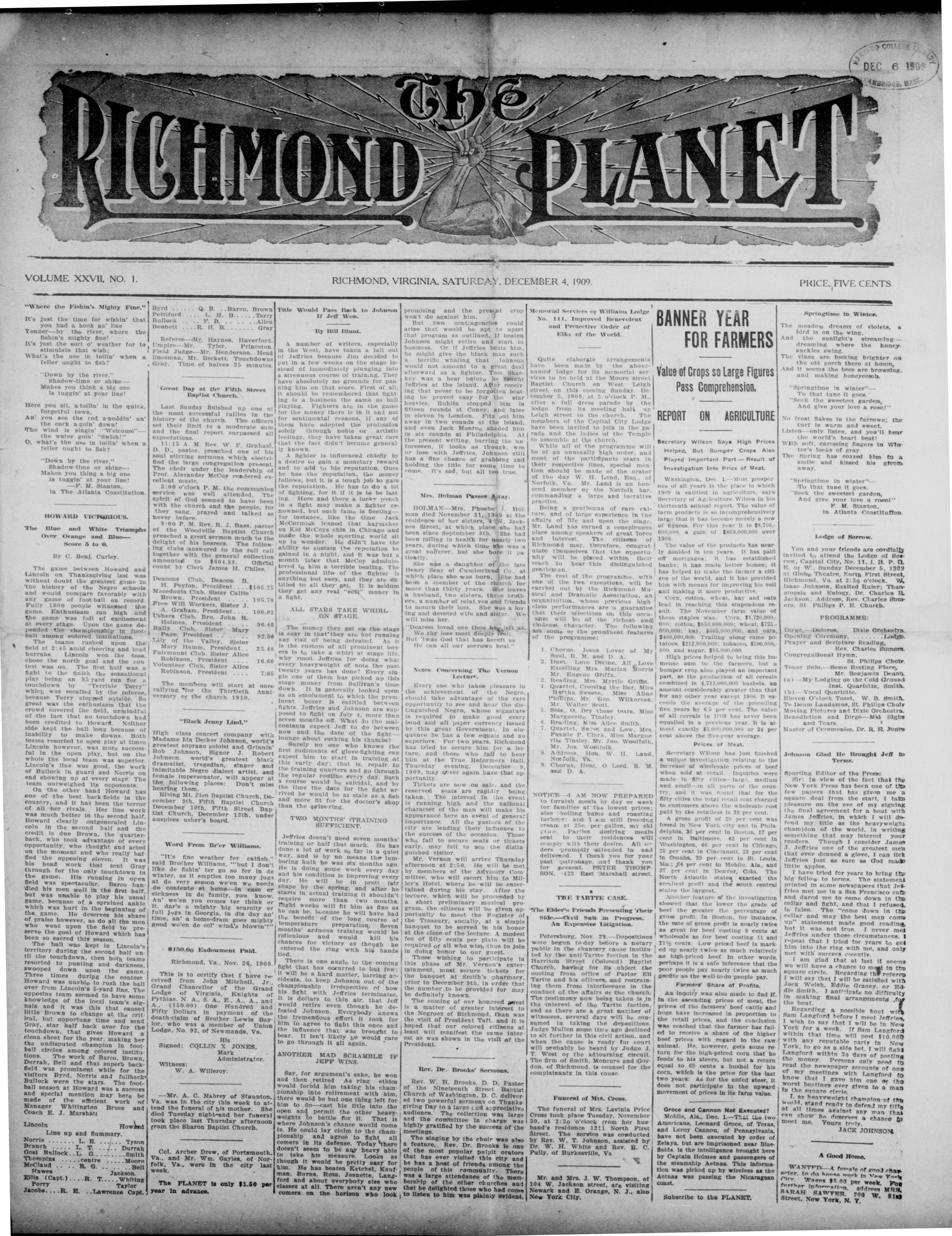
THE RICHMOND PLANET
"Down by the river."
Shadow-time or shine—
Makes you think a big one
Is tuggin' at your line!
Here you sit, a tollin' in the quick
forgetful town.
"Down by the river,"
Shadow-time or shine—
Makes you thing a big one
is tuggin' at your line!
—F. M. Stanton,
In The Atlanta Constitution
HOWARD VICTORIOUS
The Blue and White Triumphs
Over Orange and Blue—
Score 5 to 0.
By C. Benj. Curley.
The game between Howard and Lincoln on Thanksgiving last was without doubt the greatest game in the history of the Negro schools and would compare favorably with any game of football on record. Fully 1800 people witnessed the game. Enthusiasm ran high and the game was full of excitement at every stage. Upon the game depended the championship in football among colored institutions.
The teams rushed upon the field at 2:45 amid cheering and loud hurrahs. Lincoln won the toss, chose the north goal and the contest was on. The first half was a fight to the finish the sensational play being the 5-yard run for a touchdown by "Terrible Terry" which was recalled by the referee, because Terry stepped outside. So great was the enthusiasm that the crowd covered the field, unmindful of the fact that no touchdown had been credited to Howard. Neither side kept the ball long because of inability to make downs. Both teams resorted to open play at times Lincoln however, was more successful in the open play, but on the whole the local team was superior. Lincoln's line was good, the work of Bullock in guard and Norris on end showing up at every stage. The team outweighed its opponents.
opponents.
On the other hand Howard has one of the best back fields in the country, and it has been the terror of all her rivals. Her line work was much better in the second half. Howard clearly outgeneraled Lincoln in the second half and the credit is due Brown, the quarterback, who took advantage of every opportunity, who thought and acted on the moment and who really baffled the opposing eleven. It was his head work that sent Gray through for the only touchdown in the game. His running in open field was spectacular. Barco handled his men well in the first half, but was unable to play his usual game, because of a sprained ankle which was hurt in the beginning of the game. He deserves his share of praise however, as do all the men who went upon the field to preserve the goal of Howard which has been so sacred this season.
The ball was kept in Lincoln's territory during the second half until the touchdown, then both teams resorted to punting and darkness, swooped down upon the game. Three times during the contest Howard was unable to rush the ball over from Lincoln's 5-yard line. The opposing team seemed to have some knowledge of the local team's signals and it was this that caused Little Brown to change at the critical, but opportune time and send Gray, star half back over for the touchdown, that gives Howard a clean sheet for the year, making her the undisputed champion in football circles among colored institutions. The work of Barco, Brown, Durrah, Bell and that superb backfield was prominent while for the visitors Byrd, Norris and fullback Bullock were the stars. The football season at Howard was a success and special mention may here be made of the efficient work of Manager Whitington Bruce and Coach E. J. Marshatt
Byrd . . . . . Q. B. . . Barco, Brown
Pettiford . . . . L. H. B. . . Terry
Bullock . . . F. B. . . Allen
Bennett . . . R. H. B. . Gray
Referee—Mr. Haynes, Haverford,
Umpire—Mr. Tyler, Princeton,
Field Judge—Mr. Henderson, Head
linesman, Mr. Beckett, Touchdowns
Gray. Time of halves 35 minutes.
Great Day at the Fifth Street Baptist Church.
Last Sunday finished up one of the most successful rallies in the history of the church. The officers set their limit to a moderate sum and the final report surpassed all expectations. 11:15 A. M. Rev. W. F. Graham, D. D., pastor, preached one of his soul stirring sermons which electrified the large congregation present. The choir under the leadership of Prof. Alexander McCoy rendered excellent music. 2:00 o'clock P. M. the communion service was well attended. The spirit of God seemed to have been with the church and the people, for they sang, prayed and talked as never before. 8:00 P. M. Rev. R. J. Bass, pastor of the Woodville Baptist Church preached a great sermon much to the delight of his hearers. The following clubs answered to the roil call together with the general collection amounted to $604.88. Official count by Clerk James H. Chiles.
Deacons Club, Deacon B. H. Peyton, President. $105.75
Macedonia Club, Sister Callie Brown, President. 105.70
Free Will Workers, Sister J. A. Graham, President. 100.02
Ushers Club, Bro. John R. Holmes, President. 96.42
Rally Club, Sister Mary Page, President. 92.56
Lily of the Valley, Sister Mary Hamm, President. 25.48
Fairmount Club, Sister Alice Robinson, President. 16.60
Volunteer Club, Sister Alice Robinson, President. 7.05
The members will start at once rallying for the Thirtieth Anniversary of the church 1910.
"Black Jenny Lind."
High class concert company with Madame Ida Decker Johnson, world's greatest soprano soloist and Grinnin' Bob Johnson, Signor J. Robert Johnson, world's greatest black dramatist, tragedian, singer and inimitable Negro dialect artist, and female impersonator, will appear at the following places: Don't miss hearing them.
Rising Mt. Zion Baptist Church, December 9th, Fifth Baptist Church December 10th, Fifth Street Baptist Church, December 13th, under auspices usher's board.
Word From Br'er Williams
"It's fine weather for catfish," said Brother Williams, "but I don't like de fishin' ter go so fer in de winter, as it empties too many jugs at de very season we'en we needs de contents at home—in ease or sickness in de family, you know. An' we'en you comes ter think er, it dar's a mighty big scarcity er full jugs in Georgia, in dis day an' time, an' an' we-dram goes mighty good we'en de col' wind's blowin'"
$150.00 Endowment Paid
Richmond, Va., Nov. 26, 1909.
This is to certify that I have received from John Mitchell, Jr.
Grand Chancellor of the Grand Lodge of Virginia, Knights of
Pythias, N. A., S. A., E., A., A., and
A., (150.00) One Hundred and Fifty Dollars in payment of the death-claim of Brother Lewis Baylor, who was a member of Union Lodge, No. 92, of Newmands, Va.
His
Signed: CQLLIN X JONES,
Mark
Administrator.
Witness:
W. A. Willeroy.
—Mr. A. C. Mabrey of Staunton, Va. was in the city this week to attend the funeral of his mother. She died Tuesday night-and her funeral took place last Thursday afternoon from the Sharon Baptist Church.
Col. Archer Drew, of Portsmouth, Va., and Mr. Wm. Gayles, of Norfolk, Va., were in the city last week.
The PLANET is only $1.50 per year in advance.
RICHMOND, VIRGINIA, SATURDAY, DECEMBER 4, 1909.
Title Would Pass Back to Johnson
If Jeff Won.
By Bill Blunt.
A number of writers, especially in the West, have taken a fall out of Jeffries because Jim decided to put in a few weeks on the stage instead of immediately plunging into a strenuous course of training. They have absolutely no grounds for panning him on that score. First of all, it should be remembered that fighting is a business the same as ball playing. Fighters are in the game for the money there is in it and not for sentimental reasons. If any of them have adopted the profession solely through noble or artistic feelings, they have taken great care that the fact didn't become generally known.
A fighter is influenced chiefly by a desire to gain a monetary reward and to add to his reputation. Once he has the reputation, the money follows, but it is a tough job to gain the reputation. He has to do a lot of fighting, for it if it is to be lasting. Here and there a lucky punch in a fight may make a fighter renowned, but such fame is fleeting—for instance, like the time Jack McCormick leaned that haymaker on Kid McCoy's chin in Chicago and made the whole sporting world sit up in wonder. He didn't have the ability to sustain the reputation he gained in a night, and it was but a month later that McCoy administered to him a terrible beating. The professional life of the fighter is anything but easy, and they are entitled to all the they get. It is seldom they get any real "sort" money in a fight.
ALL STARS TAKE WHIRL ON STAGE.
The money they get on the stage is easy in that they are not running any risk of being defeated. As it is the custom of all prominent boxers is to take a whirl at stage life, why roast Jeffries for doing what every heavyweight of note the past twenty years has done? Every single one of them has picked up this stage money from Sullivan's time down. It is generally looked upon as an emulment to which the prominent boxer is entitled between fights. Jeffries and Johnson are supposed to fight on July 4, more than seven months off. What do the malcontents expect Jeff to do between now and the date of the fight—lounge about sucking his thumbs?
Surely no one who knows the first rudiments of glove-fighting can expect him to start in training at this early day; that is, repair to the training quarters and go through the regular routine every day. Such a course would be suicidal, and by the time the date for the fight arrived he would be as stale as a fish and more fit for the doctor's shop than the prize-ring.
TWO MONTHS' TRAINING
SUFFICIENT.
Jeffries doesn't need seven months' training or half that much. He has done a lot of work so far in a quiet way, and is by no means the lumbering hulk he was six months ago. He is doing some work every day and his condition is improving every day. He will be in proper fair shape by the spring, and after he starts in actual training it shouldn't require more than two months. Night weeks will fit him as fine as he can be, because he will have the benefit of the long course of temperature preparation. Seven months' arduous training would be ridiculous and would kill his chances for victory as though he entered the ring with his hands tied.
There is one angle to the coming fight that has occurred to but few; it will be a hard matter, barring accidents, to keep Johnson out of the championship irrespective of how his fight with Jeffries terminates. It is dollars to thin air, that Jeff would retire even though he defeated Johnson. Everybody knows the tremendous effort it took for him to agree to fight this once and the influence that was brought to bear. It isn't likely he would care to go through it all again.
ANOTHER MAD SCRAMBLE IF
JEFF WINS.
Say, for argument's sake, he won and then retired. As ring ethics would forbid him taking his championship into retirement with him, there would be but one thing left for him to do—cast his title into the open and permit the other heavyweights to battle for it. That is where Johnson's chance would come in. He could lay claim to the championship and agree to fight all comers in its defense. Today there doesn't seem to be any heavy able to take his measure. Looks as though it would be pretty easy for him. He has beaten Ketchel, Kaufman, Burns, Ross, Jeanette, Langford and about everybody else who classes at all. There aren't any new comers on the horizon who look
promising and the present crop
won't do against him.
won't do against him.
But two contingencies could arise that would be apt to upset that program as outlined. If beaten Johnson might retire and start in business. Or if Jeffries beats him, he might give the black man such a terrific whaling that Johnson would not amount to a great deal afterward as a fighter. Tom Sharkey was a bear before he fought Jeffries at the island. After receiving that never to be forgotten beating he proved easy for the star heavies. Ruhlin stopped him in fifteen rounds at Coney, and later in eleven in London. Fitz put him away in two rounds at the island, and even Jack Monroo shaded him in six rounds at Philadelphia. At the present writing, barring the unconscious looks as though, win or lose with Jeffries, Johnson still has a fine chance of grabbing and holding the title for some time to come. It's sad, but all too true.
Mrs. Holman Passes Away
HOLMAN—Mrs. Phoebe J. Holman died November 21, 1909 at the residence of her sisters, 4 W. Jackson Street, at which place she had been since September 8th. She had been railing in health for nearly two years, during which time she was a great sufferer, but she bore it patiently.
She was a daughter of the late Henry Seay of Cumberland Co., at which place she was born. She had been a member of the church for more than thirty years. She leaves a husband, two sisters, three brothers, a number of relat.vcs and friends to mourn their loss. She was a loving and devoted wife and sister. We will miss her.
"Dearest loved one thou hath left us. We thy loss most deeply feel. But 'twas God that has bereft us. He can all our sorrows heal!"
Notes Concerning The Vernon Lecture.
Every one who takes pleasure in the achievement of the Negro, should take advantage of the rare opportunity to see and hear the distinguished Negro, whose signature is required to make good every bond and all paper currency issued by this great Government. In eloquence he has a few equals and no superiors. For two years, Richmond has tried to secure him for a lecture, and those who fall to hear him at the True Reformers Hall, Thursday evening, December 9, 1909, may never again have that opportunity. Tickets are now on sale, and the reserved seats are rapidly being taken. The interest in the event is running high and the national character of the man will make his appearance here an event of general importance. All the pastors of the city are lending their influence to the success of the occasion. Those who fall to secure seats or tickets early, may fall to see the distinguished visitor.
Mr. Vernon will arrive Thursday afternoon at 2:50. He will be met by members of the Advisory Committee, who will escort him to Miller's Hotel, where he will be entertained during his stay. After the lecture, which will be proceeded by a short preliminary musical program, the citizens will be given opportunity to meet the Register of the Treasury, socially, at a simple banquet to be served in his honor at the close of the lecture. A modest fee of fifty cents per plate will be required of all who wish thus to join in doing honor to our guest.
Those wishing to participate in this phase of Mr. Vernon's entertainment, must secure tickets for the banquet at Smith's pharmacy, prior to December 9th, in order that the number to be provided for may be definitely known.
The coming of our honored guest is a matter of greater interest to the Negroes of Richmond, than was the visit of President Taft, and it is hoped that our colored citizens at least will manifest the same interest as was shown in the visit of the President.
Rev. Dr. Brooks' Sermons.
Rev. W. H. Brooks. D. D. Pastor of the Nineteenth Street Baptist Church of Washington, D. C. delivered two powerful sermons on Thanksgiving Day to a large and appreciative audience. The collection was large and the committee in charge was highly gratified by the success of the meetings. The singing by the choir was also a feature. Rev. Dr. Brooks is one of the most popular pulpit orators that has ever visited this city and he has a host of friends among the people of this community. There was a large attendance of the membership of the other churches and that he delighted those who had come to listen to him was plainly evident.
Memorial Services or Williams Lodge No. 111, Improved Benevolent and Protective Order of Elks of the World.
Quite elaborate arrangements have been made by the above-named lodge for its memorial services to be held at the Moore street Baptist Church on West Leigh street on this coming Sunday, December 5, 1809, at 3 o'clock P.M., after a full dress parade by the lodge from its meeting halk up Leigh street to the church. The members of the Capital City Lodge have been invited to join in the parade and the ladies of the Temple to assemble at the church. While all of the programme will be of an unusually high order, and most of the participants stars in their respective lines, special mention should be made of the orator of the day W. H. Land, Esq., of Norfolk, Va. Mr. Land is an honored member of the Norfolk bar, commanding a large and lucrative practice. Being a gentleman of rare culture, and of large experience in the affairs of life and upon the stage, Mr. Land has earned a conspicuous place among speakers of great force and interest. The citizens of Richmond may, therefore, congratulate themselves that the opportunity will be placed within their reach to hear this distinguished gentleman.
The rest of the programme, with one of the two exceptions, will be carried out by the Richmond Musical and Dramatic Association, an organization, whose previous high-class performances are a guarantee that their selections on this occasion will be of the richest and charlest character. The following are some or the prominent features of the programme:
1. Chorus, Jesus Lover of My Soul, R. M. and D. A.
2. Duet, Love Divine, All Love Excelling Mrs. Marian Morris Mr. Eugene Griffin.
3. Reading, Mrs. Myrtle Griffis.
4. Quartet, Crossing the Bar, Miss Barline Street, Miss Alline Phillips, Mr. Geo. Wilkerson, Mr. Walter Scott.
5. Sole, O. Dry those tears, Miss Marguerite Tinsley.
6. Reading, Miss Alice Smith.
7. Quartet, Sweet and Low, Mrs. Fannie P. Clark, Miss Marguerite Tinsley, Mr. Jno. Woolfolk, Mr. Jos. Woolfolk.
8. Address, Hon. W. H. Land, Norfolk, Va.
9. Chorus, Hear, O Lord, R. M. and D. A.
NOTICE — I AM NOW PREPARED to furnish meals by day or week for families at the lowest prices; also boiling hams and roasting turkeys; and I am still freezing cream at 25c. per gallon, my old price. Parties desiring meals sent to their residences will comply with their desire. All orders promptly attended to and delivered. I thank you for your past patronage, and thank you for present. PETER THOMPSON. 422 East Marshall street.
THE TARTTE CASE
The Elder's Friends Presenting their Side.—Civil Suit in Progress. An Expensive Litigation.
Petersburg, Nov. 29.—Depositions were begun to day before a notary public in the chancery cause instituted by the anti-Tartre faction in the Harrison Street (Colored) Baptist Church, having for its object the ousting from office of Pastor Eli Tartre and his officers, and restraining them from interference in the conduct of the affairs or the church. The testimony now being taken is in the interest of the Tartre faction, and as there are a great number of witnesses, several days will be consumed in taking the depositions. Judge Mullen some time ago declined to sit further in this civil action, and when the cause is ready for court will probably be heard by Judge J. T. West or the adjourning circuit. The firm of Smith, Moncure and Gordon, of Richmond, is counsel for the complainants in this cause.
Funeral of Mys. Cross
The funeral of Mrs. Lavinia Price Cross took place Tuesday, November 30, at 2:30 o'clock from her husband's residence 1211 North First Street. The service was conducted by Rev. W. T. Johnson, assisted by Dr. W. H. White and Rev. B. C. Pully, of Burkesville, Va.
Mr. and Mrs. J. W. Thompson, of 104 W. Jackson street, are visiting Newark and E. Orange, N. J., also New York City.
BANNER YEAR FOR FARMERS
Value of Crops so Large Figures Pass Comprehension.
Secretary Wilson Says High Prices Helped, But Bumper Crops Also Played Important Part—Result of Investigation Into Price of Meat.
Washington, Dec. 1.—Most prosperous of all years is the place to which 1909 is entitled in agriculture, says Secretary of Agriculture Wilson in his thirteenth annual report. The value of farm products is so incomprehensively large that it has become merely a row of figures. For this year it is $8,760,000,000, a gain of $869,000,000 over 1908.
The value of the products has nearly doubled in ten years. It has paid off mortgages; it has established banks; it has made better homes; it has helped to make the farmer a citizen of the world, and it has provided him with means for improving his soil and making it more productive.
Corn, cotton, wheat, hay and oats lead in reaching this stupendous result. The November farm value of these staples was. Corn, $1,720,000,000; cotton, $850,000,000; wheat, $725,000,000; hay, $665,000,000, and oats, $400,000,000. Trailing along came potatoes, $212,000,000; tobacco, $100,000,000, and sugar, $95,000,000.
High prices helped to bring this immense sum to the farmers, but a bumper crop also played an important part, as the production of all cereals combined is 4,711,000,000 bushels, an amount considerably greater than that for any other year except 1906. It exceeds the average of the preceding five years by 6.5 per cent. The value of all cereals in 1899 has never been equalled in a previous year. It is almost exactly $3,000,000,000 or 24 per cent above the five-year average.
Prices of Meat.
Secretary Wilson has just finished a unique investigation relating to the increase of wholesale prices of beef when sold at retail. Inquiries were made in fifty cities—large, medium and small—in all parts of the country, and it was found that for the fifty cities the total retail cost charged to customers above the wholesale cost paid by the retailless is 38 per cent. A gross profit of 20 per cent was found in New York city and in Philadelphia, 36 per cent in Boston, 17 per cent in Baltimore, 42 per cent in Washington, 46 per cent in Chicago, 25 per cent in Cincinnati, 23 per cent in Omaha, 39 per cent in St. Louis, Ma.; 64 per cent in Mobile, Ala., and 37 per cent in Denver, Colo. The North Atlantic states exacted the smallest profit and the south central states the largest.
Another feature of the investigation showed that the lower the grade of beef the greater the percentage of gross profit. In Boston, for instance, the rate of gross profit is nearly twice as great for beef costing 8 cents at wholesale as for beef costing 11 and 11½ cents. Low priced beef is marked up nearly twice as much as high-priced beef. In other words, perhaps it is a safe inference that the poor people pay nearly twice as much profits as the well-to-do people pay.
Farmers' Share of Profits.
An inquiry was also made to find if, in the ascending prices of meat, the prices of the farmers' beef cattle and hogs have increased in proportion to the retail prices, and the conclusion was reached that the farmer has failed to receive a share of the higher beef prices with regard to the raw animal. He, however, gets some return for the high-priced corn that he feeds to his steers, but not a return equal to 60 cents a bushel for his corn, which is the price for the last two years. As for the unfed steer, it does not participate in the upward movement of prices in its farm value.
Groce and Cannon Not Executed?
Groce and Cannon Not Executed?
Mobile, Ala., Dec. 1—That the two Americans, Leonard Groce, of Texas, and Leroy Cannon, of Pennsylvania, have not been executed by order of Zelaya, but are imprisoned near Bluefields, is the intelligence brought here by Captain Holmes and passengers of the steamship Aetnas. This information was picked up by wireless as the Aetnas was passing the Nicaraguan coast.
Subscribe to the PLANET
Springtime in Winter.
The meadow dreams of violets, a bird is on the wing,
And the sunlight's streaming—dreaming were the honey-sucking swing.
"Springtime in winter"—
To that tune it goes.
"Seek the sweetest garden,
And give your love a rose!"
No frost flakes in the furrows; the
turf is warm and sweet.
Listen—only listen, and you'll hear
The Spring has coaxed him to a smile and kissed his groom away.
"Springtime in winter"—
To that tune it goes.
"Seek the sweetest garden,
And give your love a roseel"
F. M. Stanton,
in Atlanta Constitution
Lodge of Sorrow.
You and your friends are cordially invited to attend the Lodge of Sorrow, Capital City, No. 11, I. B. P. U. E. or W. Sunday December 5, 1993 at Globe Theatre, North First Street, Richmond, Va. at 2:30 o'clock. W. Isaac Johnson, Exalted Ruler; Thanatopis and Eulogy, Dr. Charles R. Jackson; Address, Rev. Charles Somers, St. Phillips P. E., Chureh.
PROGRAMME:
Dirge,—Dolores, Dixie Orchestra,
Opening Ceremony, ..... Lodg
Prayer and Scripture Reading,
Rev. Charles Somers,
Congregational Hymn,
St. Phillips Choir,
Tenor Solo,—Some Resting Place,
Mr. Benjamin Dean,
(a)—My Lodging on the Cold Ground
Inst. Quarlette, Smith.
(b)—Vocal Quartette,
Eleven O'clock Toast, W. B. Smith.
Te Deum Laudamus, St. Phillips Choir
Moving Pictures and Dixie Orchestra.
Benediction and Dirge—Mid Sights
and Tears.
and Years.
Master of Ceremonies, Dr. R. E. Jones
Johnson Glad He Brought Jeff to Terms.
Sporting Editor of the Press:
Sir: In view of the fact that the New York Press has been one of the few papers that has given me a square deal from the start, I take pleasure on the eve of my signing the final agreement for a bout with James Jeffries, in which I will defend my title as the heavyweight champion of the world, in writing something that may interest your readers. Though I consider James J. Jeffries one of the greatest men that ever donned a glove, I can lick Jeffries just as sure as God made little apples.
I have tried for years to bring the big fellow to terms. The statement printed in some newspapers that Jeffries met me in a San Francisco cane and dared me to come down in the cellar and fight, and that I refused, is false. The "come down in the cellar and may the best man come up" statement made good reading, but it was not true. I never met Jeffries under those circumstances. I repeat that I tried for years to get him into the ring with me, and only met with success recently.
I am glad that at last it seems we will have a chance to meet in the square circle. Regarding the referrer I will say that I will be satisfied with Jack Welsh, Eddie Graney, or Eddie Smith. I anticipate no difficulty in making final arrangements for the bout.
Regarding a possible bout with Sam Langford before I meet Jeffries, I wish to say that I will be in New York for a week. If Sam Langford within that time will post $10,000 with any reputable party in New York, to go as a side bet, I will fight Langford within 30 days of posting the money. Persons only need to read the newspaper accounts of one of my meetings with Langford to know that I gave him one or the worst beatings ever given to a man in the square circle.
I, as heavyweight champion of the world, stand ready to defend my title at all times against any man that can show he deserves a chance to meet me. Yours truly.
JACK JOHNSON
A Good Home.
WANTED—A female of good character, to do house work in New York City. Wages $5.00 per week. For further information, address MRS. SARAH SAWYER. 200 N. $181 Street, New York, N. Y.
THE
---
What humans are chiefly hunting for nowadays is inspiration in one form or another. This story cannot fail to give its reader inspiration, and therefore its value can hardly be overestimated. The magic of the love of man for woman, that, aroused simply by the sound of a voice, causes a young millionaire to cross oceans and traverse foreign lands to find his fate was never better pictured. The story is intensely romantic and alluringly mysterious. The insidious evils of unwise marriage with foreign "noblemen" are cleverly shown, and the familiar Italian brand of intrigue is laid bare. The author shows that the reward of patience and purity is happiness and that the wages of sin is death. He makes you laugh when he pictures the adventures of an American comic opera troupe stranded in foreign lands. He makes you thrill with the wanderlust when he describes La Bella Napoli and the vine covered slopes that rim the Mediterranean.
CHAPTER I
OUT of the unromantic night out of the somber blurring January fog, came a voice lifted in song, a soprano, rich, full and round, young yet matured, sweet and mysterious as a night bird's, haunting and elusive as the murmur of the sea in a shell a lilt from "La Fille de Mue. Angot," a light opera long since forgotten in New York. Hennilard, genuinely astounded, lowered his pipe and listened. The voice rose and sank and soared again, drawing nearer and nearer. It was joyous and unrestrained, and there was youth in it, the touch of spring and the breath of flowers. The music was Lecocq's-that is to say, French—but the tongue was of a country which Hillard knew to be the garden of the world. Presently be observed a shadow emerge from the yellow mist, to come within the circle of light, which, faint as it was, limmed in against the nothingness beyond the form of a woman. She walked directly under his window.
As the invisible comes suddenly out of the future to assume distinct proportions which either make or mar us, so did this unknown cantatrice come out of the fog that night and enter into Hillard's life, to readjust its ambitions, to divert its aimless course, to give impetus to it and a direcness which bitherto it had not known.
"Ah."
He leaned over the sill at a perilous angle, the bright conl of his pipe spilling comet-wise to the areaway below. He was only subconscious of having spoken, but this syllable was sufficient to spoil the enchantment. The voice ceased abruptly, with an odd break. The singer looked up. Possibly her astonishment surpassed even that of her audience. For a few minutes she had forgotten that she was in New York; she had forgotten the pain in her heart; there had been only an irresistible longing to sing.
Though she raised her face, he could distinguish no feature, for the light was behind. However, he was a man who made up his mind quickly. Brunette or blond, beautiful or otherwise. It needed but a moment to find out. Even as this decision was made he was in the upper hall, taking the stairs two at a bound. He ran out into the night hereheaded. Up the street he saw a flying shadow. Plainly she had anticipated his impulse. She was gone. He cupped his ear with his hand in vain. There was nothing but fog and silence.
"Well, if this doesn't beat the Dutch!" he murmured.
He laughed disappointedly. It did not matter that he was three and thirty. He still retained youth enough to feel chagrined at such a trivial defeat. Here had been something like a genuine adventure, and it had slipped like water through his clumsy fingers.
"Denece take the fog! But for that I'd have caught her."
But reason promptly asked him what he should have done had he caught the singer. Yes, supposing he had, what excuse would he have had to offer? Who could she be? What peculiar whimsical freak had sent her singing past his window at 1 o'clock of the morning? A grand opera singer returning home from a late supper? But he dismissed this opinion even as he advanced it. He knew something about grand opera singers. They attend late suppers, it is true, but they ride home in luxurious carriages and never risk their golden voices in this careless if romantic fashion. As for being a comic opera star, he refused
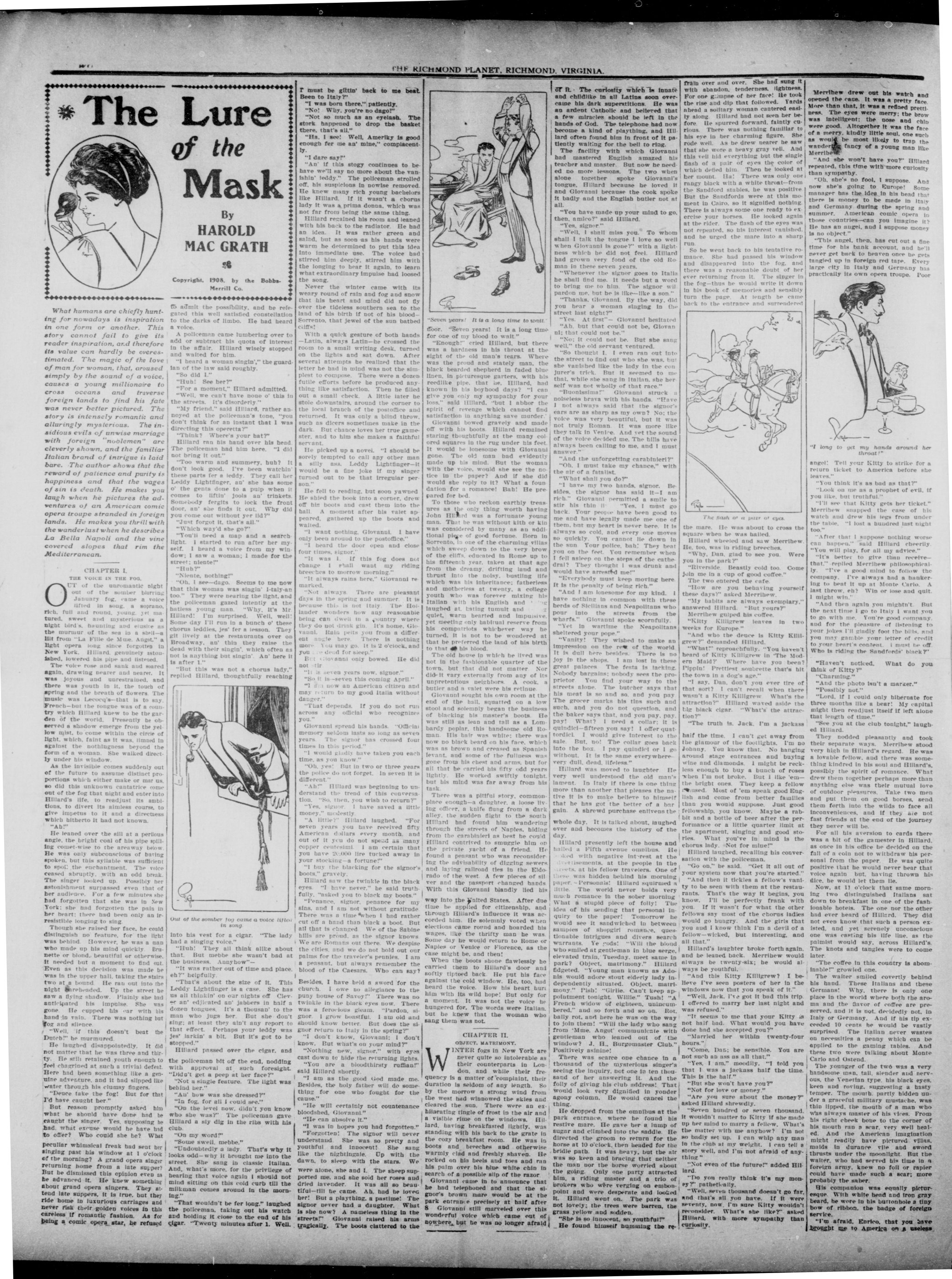
Lure of the Mask
By HAROLD MAC GRATH
Copyright, 1908, by the Bobba-
Merrill Co.
to admit the possibility, and he refigured this well satisfied constellation to the darks of limbo. He had heard a voice.
A policeman came lumbering over to add or subtract his quota of interest in the affair. Hillard wisely stopped and waited for him.
"I heard a woman singin'," the guardian of the law said roughly.
"So did I."
"Huh! see her?"
"For a moment," Hillard admitted.
"Well, we can't have none o' this in the streets. It's disorderly."
"My friend," said Hillard, rather annoyed at the policeman's tone, "you don't think for an instant that I was directing this operetta?"
"Think? Where's your hat?"
Hillard ran his hand over his head.
The policeman had him here. "I did not bring it out."
"Too warm and summery, huh? It don't look good. I've been watchin' these parts for a leddy. They call her Leddy Lightingfer, an' she has some o' the gents done to a pulp when it comes to liftin' jools an' trinkets. Somebody fergits to lock the front door, an' she finds it out. Why did you come out without yer lid?" "Just forgot it, that's all."
"Which way'd she go?"
"You'll need a map and a searchlight. I started to run after her myself. I heard a voice from my window; I saw a woman; I made for the street; niente!"
"Huh?"
"Niente, nothing!"
"Oh, I see--dago. Seems to me now that this woman was singin' t-alary-and too." They were nearing the light, and the policeman gazed intently at the hatties young man. "Why, it's Mr. Hillard! I'm surprised. Well, well! Some day I'll run in a bunch o' these chorus leddles, jes' for a lesson. They git lively at the restaurants over on Broadway, an' thin they raise the dead with their singin', which often as not is anything but singin'. An' here it is after 1." "But this was not a chorus lady," replied Hillard, thoughtfully reaching
Pg.
Out of the somber top came a voice lttten in song
into his vest for a cigar. "The lady had a singing voice."
"Hub! They all think alike about that. But mbebe she wasn't bad at the business. Annyhow"—
"It was rather out of time and place. eh?] helpfully.
"That's about the size of it. This Leddy Lightfinger is a case. She has us all thinkin' on our nights off Clever an' edicated an' jabbers in half a dozen tongues. It's a thousand' to the man who jugs her. But she don't sing; at least they ain't any report to that effect. Perhaps your leddy was jes' larkin' a bit. But it got to be stopped."
Hilliard passed over the cigar, and the policeman bit off the end, nodding with approval at such foresight. "Didn't get a peep at her face?"
"Not a single feature. The light was behind her."
"In fog, for all I could see."
"On the level now, didn't you know who she was?" The policeman gave Hillard a sly dig in the ribs with his club.
"On my word!"
"Some swell, mebbe."
"Undoubtedly a lady. That's why it looks oddly—why it brought me into the street. She sang in classic Italian. And, what's more, for the privilege of hearing that voice again I should not mind sitting on this cold curb till the milkman comes around in the morning."
"That wouldn't be far long," laughed the policeman, taking out his watch and holding it close to the end of his cigar. "Twenty minutes after I. Well."
CHE RICHMOND PLANET, RICHMOND, VIRGINIA
I must be gittin' back to me beat. Been to Italy?"
"I was born there," patiently.
"Not! Why, you're no dagi!"
"Not so much as an eyelash. The stork happened to drop the basket there, that's all."
"Ha. I see! Well, Ameriky is good enough for me an' mine," complacently.
"I dare say!"
"An' if this stogy continues to behave we'll say no more about the vanishin' teddy." The policeman strolled off, his suspicions in nowise removed. He knew many rich young bachelors like Hillard. If it wasn't a chorus lady it was a prima donna, which was far from being the same thing.
Hillard regained his room and leaned with his back to the radiator. He had an idea. It was rather green and salad, but as soon as his hands were warm he determined to put this idea into immediate use. The voice had stirred him deeply, stirred him with the longing to hear it again, to learn what extraordinary impulse had loosed the song.
Never the winter came with its weary round of rain and fog and snow that his heart and mind did not fly over the tideless southern sea to the land of his birth if not of his blood—Sorrento, that jewel of the sun batbed ciffs!
With a quick gesture of both hands—Latin, always Latin—he crossed the room to a small writing desk, turned on the lights and sat down. After several attempts he realized that the letter he had in mind was not the simplest to compose. There were a dozen futile efforts before he produced anything like satisfaction. Then he filled out a small check. A little later he stole downstairs, around the corner to the local branch of the postoffice and returned. It was only a blind throw, such as dicers sometimes make in the dark. But chance loves her true gamester, and to him she makes a faithful servant.
He picked up a novel. "I should be sorely tempted to call any other man a silly ass. Leddy Lightinger—I would be a fine joke if my singer turned out to be that irregular person."
He fell to reading, but soon yawned. He shied the book into a corner, drew off his boots and cast them into the hall. A moment after his valet appeared, gathered up the boots and waited.
"I want nothing. Giovanni. I have only been around to the postoffice."
"I heard the door open and close four times, signor."
"It was 1. If this fog does not change I shall want my riding breeches to morrow morning."
"It always rains here," Glovanni remarked.
"Not always. There are pleasant days in the spring and summer. It is because this is not Italy. The Hollander wonders how any reasonable being can dwell in a country where they do not drink grin. It's home. Glovanni. Rain pelts you from a different angle here. There is nothing more. You may go. It is 2 o'clock, and you are dead for sleep."
But Giovanni only bowed. He did not sit.
"It is seven years now, signor." "So it is—seven this coming April." "I did now an American citizen and may return to my good Italia without danger." "That depends. If you do not run across any official who recognizes you." Giovanni spread his hands. "Official memory seldom lasts so long as seven years. The signor has crossed four times in this period." "I would gladly have taken you each time, as you know." "Oh, yes. But in two or three years the police do not forget. In seven it is different." "Ah." Hillard was beginning to understand the trend of this conversation. "So, then, you wish to return?" "Yes, signor. I have saved a little money," modestly.
"A little?!" Hillard laughed. "For seven years you have received fifty American dollars every month, and out of it you do not spend as many copper centsimi. I am certain that you have 20,000 lire tucked away in your stocking—a fortune!" "I buy the blacking for the signor's boots," gravely. Hillard saw the twinkle in the black eyes. "I have never," he said truthfully, "asked you to black my boots." "Penance, signor, penance for my sins, and I am not without gratitude. There was a time when I had rather cut off a hand than black a boot. But all that is changed. We of the Sabine hills are proud, as the signor knows. We are Romans out there. We despise the cities, and we do not hold out our palms for the traveler's pennies. I am a peasant, but always remember the blood of the Caesars. Who can say?
Besides, I have held a sword for the church. I owe no allegiance to the puny house of Savoy!" There was no twinkle in the black eyes now. There was a ferocious gleam. "Pardon, signor, I grow boastful. I am old and should know better. But does the signor return to Italy in the spring?" "I don't know, Glovanni; I don't
"I don't know, Glovanni; I don't know. But what's on your mind?"
"Nothing new, signor," with eyes cast down to hide the returning lights.
"You are a bloodthirsty ruffian!"
sald Hillard shortly.
"I am as the good God made me. Besides, the holy father will do something for one who fought for the cause."
"He will certainly not countenance bloodshed, Glovanni."
"He can absolve it."
"I was in hopes you had forgotten."
"Forgotten! The signor will never understand. She was so pretty and youthful and innocent! She sang like the nightingale. Up with the dawn, to sleep with the stars. We were alone, she and I. The sheep supported me, and she sold her roses and dried lavender. It was all so beautiful—he he came. Ah, had he loved her! But a plaything, a pastime! The signor never had a daughter. What is she now? A nameless thing in the streets!" Glovanni raised his arms tragically. The boots clattered to the
G.
"Seven years! It is a long time to wait. door. "Seven years! It is a long time for one of my blood to wait." "Enough!" cried Hillard, but there was a hardness in his throat at the sight of the old man's tears. Where was the proud and stately man, the black bearded shepherd in faded blue linen, in picturesque garters, with his reedlike pipe, that lie. Hillard, had known in his boyhood days? "I can give you only my sympathy for your loss." said Hillard, "but I aborh the spirit of revenge which cannot find satisfaction in anything save murder."
Glovanni bowed gravely and made off with his boots. Hillard remained staring thoughtfully at the many colored squares in the rug under his feet. It would be lonesome with Glovanni gone. The old man had evidently made up his mind. But the woman with the voice, would she see the notice in the paper? And if she did would she reply to it? What a foundation for a romance! Bab! He prepared for bed.
To those who reckon earthly treasures as the only thing worth having John Hillard was a fortunate young man. That he was without kith or kin was considered by many as an additional piece of good fortune. Born in Sorrento, in one of the charming villas which sweep down to the very brow of the cliffs, educated in Rome up to his fifteenth year, taken at that age from the dreamy, drifting land and thrust into the noisy, bustling life which was his inheritance; fatherless and motherless at twenty, a college youth who was forever mixing his Italian with his English and laughed at, hating tumult and quiet, warm hearted and impulsive, yet meeting only habitual reserve from his compatriots whichever way he turned. It is not to be wondered at that he preferred the land of his birth to that his blood.
The old house in which he lived was not in the fashionable quarter of the town, but that did not matter. Nor did it vary externally from any of its unpretentious neighbors. A cook, a butler and a valet were his retinue.
Giovanni sought his own room at the end of the hall, squatted on a low stool and solemnly began the business of blacking his master's boots. He was still as lean and tall as a Lombardy poplar, this handsome old Roman. His hair was white; there was now no black beard on his face, which was as brown and creased as Spanish levant, and some of the fullness was gone from his chest and arms, but for all that he carried his fifty odd years lightly. He worked swiftly tonight, but his mind was far away from his task.
There was a pitiful story, commonplace enough—a daughter, a loose living officer, a kulle flung from a dark alley, the sudden flight to the south Hillard had found him wandering through the streets of Naples, hiding from the carabineri as best he could. Hillard contrived to smuggle him on the private yacht of a friend. He found a peasant who was reconsidering the advisability of digging sewers and laying railroad ties in the Elrodado of the west. A few pieces of silver and the passport changed hands. With this Glovanni blandly lied his way into the United States. After due time he applied for citizenship, and through Hillard's influence it was accorded him. He solemnly voted when elections came round and hoarded his wages, like the thrifty man he was. Some day he would return to Rome or Naples or Venice or Florence, as the case might be, and then!
When the boots shone flawlessly he carried them to Hillard's door and softly tipped back. He put his face against the cold window. He, too, had heard the voice. How his heart hurt him with its wild hope! But only for a moment. It was not the voice he hungered for. The words were italian, but he knew that the woman who sang them was not.
WINTER foes in New York are never quite so intolerable as their counterparts in London, and while their frequency is a matter of complaint, their duration is seldom of any length. So by the morrow a strong wind from the west had winnowed the skies and cleared the sun. There were an exhilarating tingle of frost in the air and a visible rime on the windows. Hillard, having breakfast lightly, was standing with his back to the grate in the cozy breakfast room. He was in boots and breeches and otherwise warmly clad and freshly shaven. He rocked on his heels and toes and ran his palm over his blue white chin in search of a possible slip of the razor. Glovanni came in to announce that he had telephoned and that the signor's brown mare would be at the park entrance precisely at half after 8 Glovanni still marveled over this wonderful voice which came out of nowhere, but he was no longer afraid
OF it. The curiosity which is innate and childlike in all Latins soon overcome his dark superstitions. He was an ardent Catholic and believed that a few miracles should be left in the hands of God. The telephone had now become a kind of plaything, and Hillard often found him in front of it patiently waiting for the bell to ring. The facility with which Glovanni had mastered English amazed his teacher and master. But now he needed no more lessons. The two when alone together spoke Glovanni's tongue. Hillard because he loved it and Glovanni because the cook spoke it badly and the English butler not at all.
"You have made up your mind to go, then amico?" said Hillard.
"Well, I shall miss you. To whom shall I talk the tongue I love so well when Giovanni is gone?" with a lightness which he did not feel. Hillard had grown very fond of the old Roman in these seven years.
"Thanks, Glovannl. By the way, did you hear a woman singing in the street last night?" "Yes. At first"— Glovannl hesitated "Ah, but that could not be, Glovannl; that could not be."
"No; it could not be. But she sang well," the old servant ventured.
"So thought I. I even ran out into the street to find out who she was, but she vanished like the lady in the conjurer's trick. But it seemed to me that, while she sang in Italian, she herself was not wholly of that race."
"Buonissima!" Glovanni struck a noiseless brava with his hands. "Have I not always said that the signor's ears are as sharp as my own? No; the voice was very beautiful, but it was not truly Roman. It was more like they talk in Venice. And yet the sound of the voice decided me. The bills have always been calling to me, and I must answer."
"And the unforgetting carabinleri?"
"Oh. I must take my chance," with the air of a fatalist.
"What shall you do?"
"I have my two hands, signor. Besides, the signor has said it—I am rich!" Giovanni permitted a smile to stir his thin thigh. "Yes. I must go back. Your people have been good to me and have legally made me one of them, but my heart is never here. It is always so cold, and every one moves so quickly. You cannot lie down in the sun. Your police, bah! They beat you on the feet. You remember when I fell asleep on the steps of the cathedral? They thought I was drunk and would have arrested me."
"Everybody must keep moving here. It is the penalty of being rich." "And I am lonesome for my kind. I have nothing in common with these herds of Stellians and Neapolitans who pour into the streets from the wharfs." Giovanni spoke scornfully.
"Yet in wartime the Neapolitans sheltered your none."
"Vanity! They wished to make an impression on the re- of the world. It is dull here besides. There is no joy in the shops. I am lost in these great palaces The festa is lacking. Nobody bargains; nobody sees the propetor You find your way to the streets alone. The butcher says that his meat is so and so, and you pay. The grocer marks his tins such and such, and you do not question, and the baker says that, and you pay, pay pay! What? I need a collar; it is quindel- fifteen you say! I offer quintordiel. I would give interest to the sale. But, no! The collar goes back into the box. I pay quindel or I go without. It is the same everywhere very dull, dead, lifeless."
Hillard was moved to laughter. He very well understood the old man's lament. In Italy if there is one thing more than another that pleases the native it is to make believe to himself that he has got the better of a bargain. A shrewd purchase entitles the
whole day. It is talked about, laughed over and becomes the history of the day.
Hillard presently left the house and hailed a Fifth avenue onomhus. He looked with negative int-rest at the advertisements, at the people in the streets, at his fellow travelers. One of these was hidden behind his morning paper. "Personsis! Hillard squirmed a little. The world never holds very much romance in the sober morning. What a stupid piece of folly! The idea of his sending that personal inquiry to the paper! Tomorrow he would see it sandwiched in between samples of shopgirl romance, questionable intrigues and divers search warrants. Ye gods! "Will the blond who smiled at gentleman in blue serge, elevated train, Tuesday, meet same in park? Object, matrimony." Hillard fidgeted. "Young man known as Adonis would adore stout elderly lady independently situated. Object, matrimony." Pish! "Girl. Can't keep appointment tonight. Willie." Tush! "A French widow of eighteen, unincumbered, and so forth and so on. Rot, bally rot, and here he was on the way to join them! "Will the lady who sang from 'Mme. Angot' communicate with gentleman who leaned out of the window? J. H., Burgomaster Club." Positively asinine!
There was scare one chance in a thousand of the mysterious singer's seeing the inquiry, not one in ten thousand of her answering it. And the folly of giving his club address! That would look very dignified in yonder agony column. He would cancel the thing.
He dropped from the omnibus at the park entrance, where he found his restive mare. He gave her a lump of sugar and climbed into the saddle. He directed the groom to return for the horse at 10 o'clock, then headed for the bridle path. It was heavy, but the air was so keen and bracing that neither the man nor the horse worried about the going. Only one party attracted him, a riding master and a trio of brokers who were verging on embon-point and were desperate and looked it. Hillard went on. The park was not lovely; the trees were barren, the grass yellow and sodden.
"She is so innocent, so youthful!"
He found himself humming the re-
train over and over. She had sung it with abandon, tenderness, lightness. For one gimpse of her face! He took the rise and dip that followed. Yards ahead a softhair woman cauntered easily along. Hillard had not seen her before. He spurred forward, faintly curious. There was nothing familiar to his eye in her charming figure. She rode well. As he drew nearer he saw that she wore a heavy gray veil. And this veil hid everything but the single flash of a pair of eyes the color of which defied him. Then he looked at her mount. Hat! There was only one rangy black with a white throat—from the Sandford stables, he was positive. But the Sandfords were at this moment in Cairo, so it signified nothing. There is always some one ready to exercise your horses. He looked again at the rider. The flash of the eyes was not repeated, so his interest vanished, and he urged the mare into a sharp run.
So he went back to his tentative romance. She had passed his window and disappeared into the fog, and there was a reasonable doubt of her ever returning from it. The singer in the fog—thus he would write it down in his book of memories and sensibly turn the page. At length he came back to the entrance and surrendered
P.
The flash or a pair of eyes.
the mare. He was about to cross the
square when he was halted.
Hillard wheeled and saw Merrihew.
He too, was in riding breeches.
"Why, Dan, gind to see you. Were you in the park?"
"Riverside, Beastly cold too. Come join me in a cup of good coffee."
The two entered the cafe.
"How are you behaving yourself these days?" asked Merrihew.
"My habits are always exemplary," answered Hillard. "But yours?"
Merrihew guiped his coffee.
"Kitty Killigrew leaves in two weeks for Europe."
"And who the deuce is Kitty Killigrew? demanded Hillard.
"What?' reproachfully. 'You haven't heard of Kitty Killigrew in 'The Modern Maid?' Where have you been?' Pippin! Prettiest soubrette that's hit the town in a dog's age."
"I say, Dan, don't you ever tire of that sort? I can't recall when there wasn't a Kitty Killigrew. What's the attraction?" Hillard waved aside the big black cigar. "What's the attraction?"
"The truth is. Jack. I'm a jackass
half the time. I can't get away from the glamour of the footlights. I'm no Johnny. You know that. No hanging around stage entrances and buying wine and diamonds. I might be reckless enough to buy a bunch of roses when I'm not broke. But I like 'em—the bright ones. They keep a fellow used. Most of 'em speak good English and come from better families than you would suppose. Just good fellowship, you know. Maybe a rabbit and a bottle of beer after the performance or a little quarter limit at the apartment, singing and good stories. What you've in mind is the chorus lady. "Not for mine!"
Hillard laughed, recalling his conversation with the policeman.
"Go on," he said. "Get it all out of your system now that you're started."
"And then it tickles a fellow's vanity to be seen with them at the restaurants. That's the way it begins, you know. I'll be perfectly frank with you. If it wasn't for what the other fellows say most of the chorus ladies would go hungry. And the girls that you and I know think I'm a devil of a fellow-wicked, but interesting, and all that."
Hillard's laughter broke forth again, and he leaned back. Merrihew would always be twenty-six; he would always be youthful.
"And this Kitty Killgrew? I believe I've seen posters of her in the windows now that you speak of it."
"Well, Jack, I've got it bad this trip. I offered to marry her last night and was refused."
"It seems to me that your Kitty is not half bad. What would you have done had she accepted you?" "Married her within twenty-four hours."
"Come, Dan; be sensible. You are not such an ass as all that."
"Yes, I am." moodily. "I told you that I was a jackass half the time. This is the half."
"But she won't have you?"
"Not for love or money."
"Are you sure about the money?"
asked Hillard shrewdly.
"Seven hundred or seven thousand,
it wouldn't matter to Kitty if she made up her mind to marry a fellow. What's the matter with me anyhow? I'm not so badly set up. I can whip any man in the club at my weight. I can tell a story well, and I'm not afraid of anything"
"Not even of the future!" added Hillard.
"Do you really think it's my money?" pathetically.
"Well, seven thousand doesn't go far, and that's all you have. If it were seventy, now, I'm sure Kitty wouldn't reconsider. What's she like?" asked Hillard, with more sympathy than curiosity.
Merribwe drew out his watch and opened the case. It was a pretty face. More than that, it was a refined prettiness. The eyes were merry; the brow was intelligent; the nose and chin were good. Altogether it was the face of a merry, kindly little soul, one such as would be most likely to trap the wandering fancy of a young man like Merribwe.
"And she won't have you?" Hillard repeated, this time with more curiosity than sympathy.
"Oh, she's no fool, I suppose. And now she's going to Europe! Some manager has the idea in his head that there is money to be made in Italy and Germany during the spring and summer. American comic opera in those countries—can you imagine it? He has an angel, and I suppose money is no object."
"This angel, then, has cut out a fine time for his bank account, and he'll never get back to heaven once he gets tangled up in foreign red tape. Every large city in Italy and Germany has practically its own opera troupe. Poor
"I long to get my hands around he throat!"
angel! Tell your Kitty to strike for a return ticket to America before she leaves."
"You think it's as bad as that?"
"Look on me as a prophet of evil, if you like, but truthful."
"I'll see that Kitty gets her ticket."
Merrilhew snapped the case of his watch and drew his legs from under the table.
"I lost a hundred last night too."
"After that I suppose nothing worse can happen," said Hillard cheerily.
"You will play, for all my advice."
"It's better to give than receive—that," replied Merrilhew philosophically.
"I've a good mind to follow the company. I've always had a bankering to beat it up at Monte Carlo. A last throw, eh? Win or lose and quit. I might win."
"And then again you mightn't. But the next time I go to Italy I want you to go with me. You're good company, and for the pleasure of listening to your jokes I'll giddy foot the bills, and you may gamble your letter of credit to your heart's content. I must be off. Who is riding the Sandfords' black?"
"Haven't noticed. What do you think of Kitty?"
"Charming."
"And the photo isn't a marker."
"Possibly not."
"Lord, if I could only hibernate for three months like a bear! My capital might then readjust itself if left alone that length of time."
"See you at the club tonight," laughed Hillard.
They nodded pleasantly and took their separate ways. Merrihew stood very high in Hillard's regard. He was a lovable fellow, and there was something kindred in his soul and Hillard's, possibly the spirit of romance. What drew them together perhaps more than anything else was their mutual love of outdoor pleasures. Take two men and put them on good horses, send them forth into the wilds to face all inconveniences, and if they are not fast friends at the end of the journey they never will be.
For all his aversion to cards there was a bit of the gamester in Hillard, as once in his office he decided on the fall of a coin not to withdraw his personal from the paper. He was quite positive that he would never bear that voice again but, having thrown his dice, he would let them lie.
Now, at 11 o'clock that same morning two distinguished Italians sat down to breakfast in one of the fashionable hotels. The one nor the other had ever heard of Hillard. They did not even know that such a person existed, and yet scenely unconscious one was casting his life line, as the palmist would say, across Hillard's. The knots and tangles were to come later.
"The coffee in this country is abominable." crowled one.
The waiter smiled covertly behind his hand. These Italians and these Germans! Why, there is only one place in the world where both the aroma and the flavor of coffee are preserved, and it is not, decidedly not, in Italy or Germany. And if his tip exceeded 10 cents he would be vastly surprised. The Italian never wastes on necessities a penny which can be applied to the gaming tables. And these two were talking about Monte Carlo and Ostend.
The younger of the two was a very handsome man, tall, slender and nervous, the Venetian type, his black eyes, keen and roving, suggesting a hasty temper. The mouth partly hidden under a graceful military mustache, was thin lipped, the mouth of a man who was always master of his vices. From his right cheek bone to the corner of his mouth ran a scar, very well healed. And the American imagination might readily have pictured villas, maids in durance vile and sword thrusts under the moonlight. But the waiter, who had served his time in a foreign army, knew no foll or rapier could have made such a scar; more probably the saber.
His companion was equally pictureque. With white head and iron gray beard, he wore in his buttonhole a tiny bow of ribbon, the badge of foreign service.
"I'm afraid. Enrico, that you have brought me to America on a useless
THE PLANET
SATURDAY....DEC. 4, 1909.
adventure," said the diplomat.
"She is here in New York, and I shall find her. I must have money—must! I owe you the incredible amount of 100,000 fire. There are millions under my hand, and I cannot touch a penny."
"Do not let your debt to me worry you."
"You are so very good, Gluseppe!" "Have we not grown up together? Sometimes I think I am partly to blame for your extravagance. But a friend is a friend or he is not."
"But be who borrows from his friend loses him. Observe how I am placed. It is maddening. I have had a dozen opportunities to marry riches. This millstone is eternally round my neck. I have gone through my part of the fortune which was left us independently. She has all of bers, and that is why she is so strong. I am absolutely helpless."
"Poor friend! These American women! They all believe that a man must have no pecedillos once he has signed the marriage contract. Body of Bacchus! The sacrament does not make a man less human than he was before. But this one is clever. She might be Italian born."
"Her mother was Italian. It is the schooling in this country that has made her so clever. The only thing Italian about her is her hatred. She is my countrywoman there. Without her consent I can touch nothing, and if I divorce her—pouff—all goes to the state. Sometimes I long to get my two hands round her white throat. One mistake, one little mistake! I am willing to swear that she loved me in the beginning. And I was a fool not to profit by this sentiment. Give me patience, patience. If I say to her, 'So much and you may have your freedom, there is always that cursed will. The crown of Italy will never withdraw its hand. No With his wife's family on his hands, especially her brother, the king will never waive his rights.' "And, remember, we have but ten days."
"We shall not find time heavy. I know a few rich butchers and grocers who call themselves the aristocracy And some of them play bridge and earcate"
"The diplomat smiled in antiquity "I have followed her step by step to the boat at Naples. She is here. She will not be hard to find. She has wealthy friends."
"You say she is beautiful?"
"Yes, and a beautiful woman cannot hide Think of it! Chateaux and villas and splendid rents, all waiting to be gormanized by the state! Let us get out into the air before I become excited and forget where I am."
The waiter stopped forward with the coats and hats.
[TO BE CONTINUED.]
The Panama Canal
The Panama canal was suggested for the islands of Panama as early as 1520 by Angel Sanvedra, but for a long time all such suggestions met with determined opposition from Spain, who made it a capital offense to seek or make known any improvement on the existing route from Porto Bello to Panama. More recently Louis Napoleon, when a prisoner at Ham, spent much time considering the practicability of such a scheme. It was not, however, until the California gold rush of 1849 that any accurate knowledge of the topographical conditions was obtained, and even then thirty more years elapsed before the actual site was chosen by an international body and the work begun.
Sour Cream Fudge
A delicious candy is made with sour cream. The cream should be just lopped and should not have stood long enough to become bitter. Mix a cupful of it with three cupfuls of brown sugar. Cook it on the stove until it forms a grain when a little is stirred in a sauce. Then add butter the size of a walnut and half a pound of chopped nuts. Walnuts or almonds may be used or even peanuts. The walnuts are the best for the purpose. Let the candy, or fudge, for this is practically what it is, cool a few moments and then begin to beat it. When it begins to grow thick pour it into buttered pans and cut into squares when hardened. A few drops of vanilla may be used if liked. -New York Tribune
very Polite.
"Now, Robby. If you don't want to go to Bessie Hunks' party you must write a note and tell her so, and be sure to let it be polite. You will find some ideas of the proper thing in this book of etiquette." said Mrs. Carhart to her little son.
Robby struggled with the problem for an hour or more and then presented for his mother's inspection the following truthful but somewhat unconventional effusion:
"Mr. Robert Carhart declines with pleasure Miss Bessie Hunks' kind invitation for the 14th and thanks her extremely for having given him the opportunity of doing so."—Liverpool Mercury.
The story is told of an elderly woman, a member of the "inner circle" of Philadelphia society, who was much affected by news of the death of a man of social aspirations which had not, it is sad to relate, been aided by his well known benevolence.
"Mr. Blank was in many respects an admirable character," said the old lady, "and it was a real pity that his lowly origin made impossible our recognition of him. Poor, dear, vulgar creature! We could not know him in Philadelphia, but we shall meet him in heaven"—Lipopcott's.
SENTENCE SERMONS
Some plenty aspires so much it cannot perspire.
The faith that can be hidden never stays healthy.
If you are a saint you will want to be something.
Habitual regret simply puts the headlight on the tail end.
The only way to keep faith sweet is to keep it in service.
They who go out to hit the high places land on the dump.
It's wise to be afraid of the spirituality that fears morality.
It is often safer to trust an old prejudice than a new appetite.
The tight fisted usuplly think they have a great grip on the rock.
The impress of your life depends on what you are trying to express.
The more painful a man's piety the more prone is he to prescribe it.
It's a bad thing to be moved in meeting unless you move elsewhere.
A little human affection is worth a lot of argument about the divine love.
The people who draw the most exact pictures of the infinite one often do least to reproduce the original.
The folks are always practicing "Nothing in my hand I bring" are always ready to call the church a failure.
Many a man thinks he is selling the garments of truth when he is only endeavoring to induce others to adopt his style of clothes—Henry F. Cope in Chicago Tribune.
REFLECTIONS OF A BACHELOR
The easiest thing to see is why a woman thinks she has pretty ankles.
There's nobody who wouldn't rather be a live liar than a dead truth-teller.
If a man happens to know who wrote "Yankee Doodle" he thinks he's musical.
The reason a girl won't let a man kiss her is she knows he will do it anyhow.
A man can get wildly excited over a political question unless he understands it.
A woman gets her theories out of reading novels; her facts out of raising babies.
One good thing about a college education is a boy gets it before he is too old to mend.
The reason girls always follow their mother's advice about men is they say they do, especially when it isn't true.
No amount of money can reconcile a woman to lack of sentiment; no amount of sentiment can reconcile a man to lack of money.
What a woman likes about a servant is when she smashes an old family cup she can make up for it by telling the latest neighborhood gossip.—New York Press.
CHEERFUL COMMENT.
How are we going to discover the discoverer?
Keep your airship far away from the electric wires, Mr. Avigator.
The pole controversy has crowded quite a number of subjects out of the papers that were more distasteful and of less value.
Edgar A. Guest in the Detroit Free Press says: "A little marriage is a dangerous thing." Did he get that tip from Tom Thumb?
And now comes the announcement that there is no life on Mars. Is it possible the astronomer has his glass leveled at Philadelphia?
Train hold-ups are becoming so frequent that a fellow naturally falls to wondering if it wouldn't be safer to walk to the suburbs on a pay-day evening.
WIDOWS
Why isn't a grass widow green?
A widow and her weeds are soon parted.
Never tell a widow that you are not worthy of her. She knows better.
Widows make the most contented wives. They know what not to expect.
Behold the difference: For consolation the widow has her weeds, the widower his weed.
A widow is never more dangerous than when she tells a youth that she was never really happy in her married life.—Smart Set.
The Mad Rush.
Gunner—Isn't it monotonous at these summer hotels?
Guyer—Not at all. You should see our exciting games of shuffleboard?
Why, they play that on ships.
Guyer—I know, and they play it at our summer hotel. It you shuffle our summeh hotel. If you don't shuffle lively you don't get any board at all.
THE RICHMOND PLANET. RICHMOND, VIRGINIA
Christmas Presents
FOR BROTHER
For reasons of sentiment and economy it is often preferable to fashion Christmas presents for brothers at home. A few suggestions are given for articles that combine the three qualities of attractiveness, usefulness and inexposiveness.
There are lots of brothers who own phonographs who will be happy Christmas morning if they find that some member of the family has made them a holder for phonograph disks. This album is made slightly larger than a square that would box a disk. Its page, are of heavy cardboard, and around each page is folded a sheet of heavy paper with a circular opening in the center of each fold. This provides a pocket on each side of the page in which a record disk can be kept.
PHONOGRAPH ALBUM.
its name visible through a circular opening. If the disks are kept in the album in alphabetical order and the pages indexed the finding of any record desired is a matter of seconds, and the risk of breakage is eliminated.
Soldier Suit For Small Boys
Soldier Suit For Small Boys.
Boys from six to twelve years of age always love to play at soldiering, so why not make one of them a sure enough rough rider suit in which to indulge his warriorlike activities? There are patterns on the market that make such a suit a simple garment to manufacture. The material used is khaki, with brown trimmings. The suit consists of jacket and regulation long trousers. The jacket has a number of pockets with pointed overlaps. The same pattern trimmed with red and yellow cotton strips cut up into fringe could easily be transformed into an Indian suit, and with a feathered headaddress the costume would be complete.
Something Clever In Bankniver
The question of a really attractive gift for a man is solved to some extent by a novelty in the way of a penknife. The new idea is a silver knife of the finest quality, with an emblem worked out in colored French enamels inserted in the case. The insignia of his college society or his crest is attractively wrought in colors, making the little keepsake something quite out of the usual run. Girls who are adept at making arts and crafts jewelry would find no difficulty in working the emblems into the silver penknife.
A Novelty In Leather
One of the new leather triple cases for bills and all manner of memoranda would be a fine Christmas present. The top case holds a thin, shallow watch which has a white surface and black lettering. It is large and distinct and is readily seen and so thin that it does not make a bulge in the case.
Necktie Holder
Necklace holders are not new things in the way of gifts, but they have the advantage of being useful and always acceptable. Two or three such affairs are not too many for the collection of ties the college boy or up to date man has among his numerous belongings. The newest necklace holder that has been brought out for Christmas is oval in shape and about a foot or more in length. It is made of a stout piece of cardboard, which may be purchased already cut in the shops or cut by the maker of the offering, as desired. This oval is covered with a piece of grayish heavy crash which is embroidered in sampler fashion in
TIE RACK
NECKLE HOLDER.
odd old time colorings. The wooden frame from which the ties are hung is also to be bought and is fastened through the cardboard and held in place with carpenter's nuts. To make the gift more personal the monogram of the recipient may be embroidered on the crash.
A Laundry Book.
For the college girl a laundry book is fine. Select a neat rice paper for the leaves and cut the double cover from red paper of a heavy variety, then tie the leaves together with red baby ribbon. Between the leaves of white paper are blue carbon paper slips, so that a duplicate copy is made when one marks off her laundry.
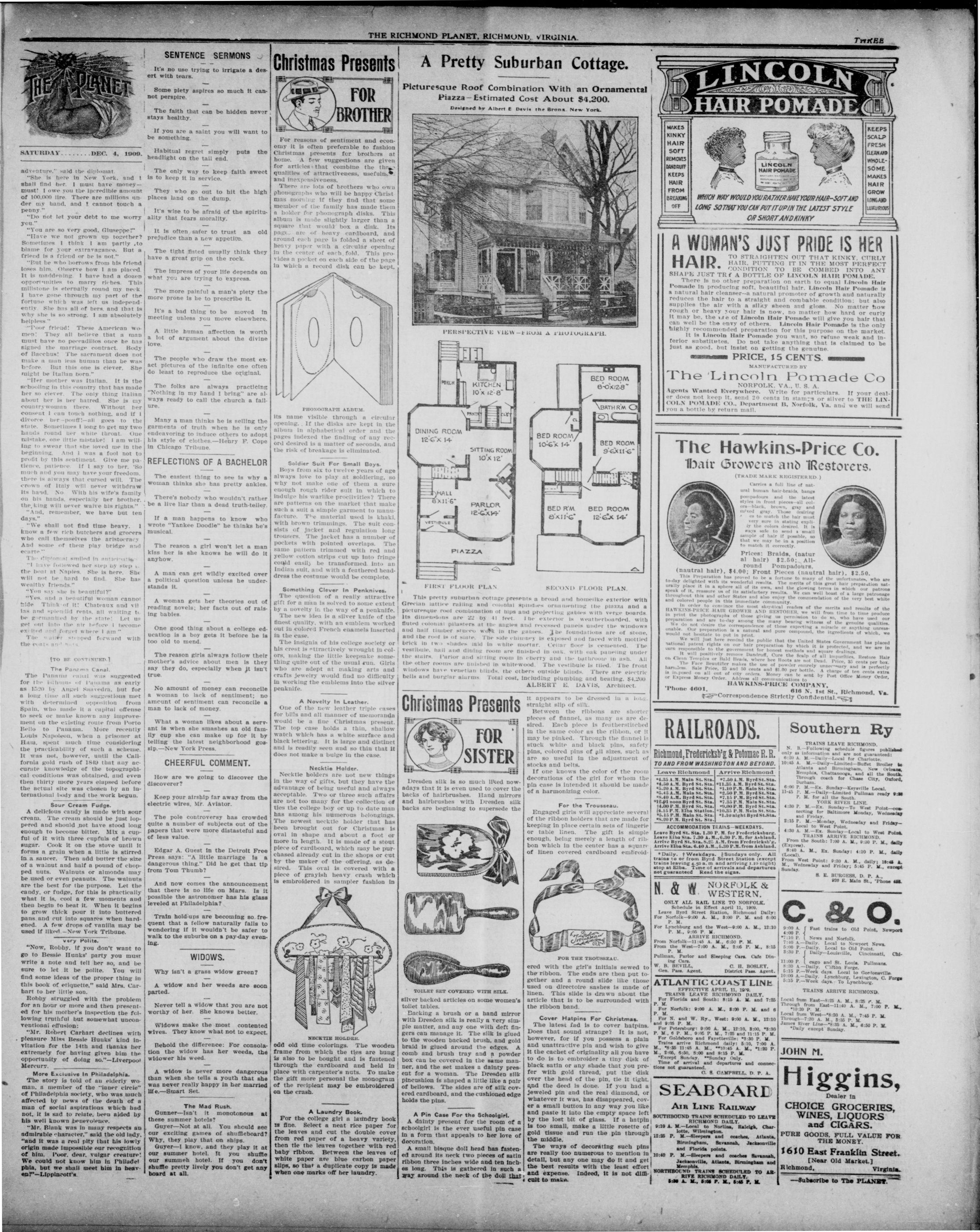
A Pretty Suburban Cottage.
Designed by Albert E Davis the Bronx, New York.
PERSPECTIVE VIEW
POCKH
KITCHEN
10'X 12'-8"
PANTRY
CLEST
DINING ROOM
12'-6" X 14"
SITTING ROOM
10'X 12'
HALL
8'X11'-6"
PARLOR
12'-6" X 14'
VESTIBULE
PIAZZA
FIRST FLOOR PLAN
This pretty suburban cottage pres-
Grecian lattice railing and coonat s
picturesque roof combination of hips a
Its dimensions are 22 by 41 feet.
fluted colonial pilasters at the angles s
and half timber stucco work in the
and the roof is of state. The side chin
brick in two shades mid in white u
vestibule, hall and dining room are t
the stairs. Parlor and sitting room in
the other rooms are finished in white
windows have venetian blinds, the ot-
bells and burglar alarms. Total cost,
THE HOME OF THE MAYOR
PERSPECTIVE VIEW-FROM A PHOTOGRAPH.
This pretty suburban cottage presents a broad and homelike exterior with Grecian lattice railing and colonial spindles ornamenting the pizza and a picturesque roof combination of hips and projecting gables with verge boards. Its dimensions are 22 by 41 feet. The exterior is weatherboarded, with fluted colonial pilasters at the angles and recessed panels under the windows and half timber stucco work in the gables. The foundations are of stone, and the roof is of sate. The side chimney is exposed and faced with mottled brick in two shades and in white mortar. Celar floor is cemented. The vestibule, hall and dining room are finished in oak, with oak paneing under the stairs. Parlor and sitting room in cherry and the bathroom in ash. All the other rooms are finished in whitewood. The vestibule is tied. The front windows have venetian blinds, the others outside blinds. There are electric bells and burglar alarms. Total cost, including plumbing and heating, $4,200.
Christmas Presents
FOR
SISTER
Dresden silk is so much liked nowadays that it is even used to cover the backs of hairbrushes. Hand mirrors and hairbrushes with Dresden silk backs are beginning to supersede the
1
silver backed articles on some women's toilet tables.
Backing a brush or a hand mirror with Dresden silk is really a very simple matter, and any one with deft fingers can manage it. The silk is gued to the wooden backed brush, and gold braid is gued around the edges. A comb and brush tray and a powder box can be covered in the same manner, and the set makes a dainty present for a woman. The Dresden silk pincushion is shaped a little like a pair of bellows. The sides are of silk covered cardboard, and the cushioned edge holds the pins.
A Pin Case For the Schoolgirl
A dainty present for the room of a schoolgirl is the ever useful pin case in a form that appeals to her love of decoration.
A small bisque doll head has fastened around its neck two pieces of satin ribbon three inches wide and ten inches long. This is gathered in such a way around the neck of the doll that
FROM A PHOTOGRAPH.
BED ROOM
8'0"x12'8"
BATH RM
BED ROOM
10'6"x14"
BED ROOM
9'6"x11'6"
BED RM
8'x11'6"
BED ROOM
12'6"x14'
SECOND FLOOR PLAN.
a broad and homelike exterior with
handles ornamenting the pizza and a
and projecting gables with verge boards.
The exterior is weatherboarded, with
and recessed panels under the windows
gables. The foundations are of stone,
many is exposed and faced with mottied
mortar. Celar floor is cemented. The
fished in oak, with oak paneling under
cherry and the bathrobe in ash. All
ood. The vestibule is tiled. The front
pers outside blinds. There are electric
including plumbing and heating. $4,200
ALBERT E. DAVIS, Architect.
It appears to be dressed in a long,
straight slip of silk.
Between the ribbons are shorter pieces of fannel, as many as are desired. Each piece is featherstitched in the same color as the ribbon, or it may be pinked. Through the fannel is stuck white and black pins, safety pins, colored pins of all sizes, such as are so useful in the adjustment of stocks and belts. If one knows the color of the room decorations of the girl for whom the pin case is intended it should be made of a harmonizing color.
For the Trousseau.
Engaged girls will appreciate several of the ribbon holders that are made for keeping in place certain sets of lingerie or table linen. The gift is simple enough, being merely a length of ribbon which in the center has a square of linen covered cardboard embroid-
FOR THE TROUSSEAU.
ered with the girl's initials sewed to the ribbon. The ends are then put together and a round slide like those used on directoire sashes is made of linen. This slide is drawn about the article that is to be surrounded with the ribbon band.
Cover Hatoins For Christmas
Cover Hatpins For Christmas.
The latest hat is to cover hatpins. Does that sound strange? It is not, however, for if you possess a plain and unattractive pin and to give it the cachet of originality all you have to do is to embroider a tiny disk of black satin or any shade that you prefer with gold thread, put the disk over the head of the pin, tie it tight, and the deed is done. If you had a jeweled pin and the real diamond, or whatever it was, has disappeared, cover a small button in any way you like and paste it into the empty space left by the lost bit of glass. If a hatpin is too small, make a little rosette of gold tissue and run the pin through the middle.
The ways of decorating such pins are really too numerous to mention in detail, but any one may do it and get the best results with the least effort and expense. Indeed, it is not difficult to make.
---
TWREE
LINCOLN
HAIR POMADE
MAKES
KINKY
HAIR
SOFT
REMOVES
DANDRUFF
KEEPS
HAIR
FROM
BREADING
OFF
LINCOLN
HAIR POMADE
KEEPS
SCALP
FRESH
CLEAN AND
WHOLE-
SOME
MAKES
HAIR
GROW
LONG AND
LUXURIOUS
WHICH WAY WOULD YOU RATHER HAVE YOUR HAIR-SOFT AND
LONG SO THAT YOU CAN PUT IT UP IN THE LATEST STYLE
OR SHORT AND KINKY
A WOMAN'S JUST PRIDE IS HER
Agents Wanted Everywhere. Write for particulars. If your deal
er does not keep it, send 20 cents in stamps or silver to THE LIN
COLN POMADE CO. Department B, Norfolk, Va. and we will send
you a bottle to return mail.
The Hawkins-Price Co. Hair Growers and Restorers.
(TRADE MARK REGISTERED.)
NORA
Carries a full line of natural human hair braids, bangs ponadpads and the latest styles in front pieces—like colorful blouses in stated gray. Those desiring us to match the hair must in stating equality the colors in our hair, ways safe to send a small sample of hair if possible, so that we can position to match it correctly.
A. B.
Prices: Braids, (natur al hair) $2.50; All-round Pompadours, (nautral hair), $4.00; Front Pieces (nautral hair), $2.50.
This Preparation has proved to be a fortune to many of the unfortunate, who are to-day delighted with its wonderful results. The merits of this great hair preparation naturally provide all of its own, and the glowing terms in which our patrons speak of it, reassure us of its value. We can well boast of a large patronage throughout this and other States and also enjoy the commendation of the very best white and colored people in this immediate community.
In order to convince the most skeptical readers of the merits and results of the HAWKINS HAIR HAIR RESTORER, we will from time to time produce in print the photographs of those giving us the opportunity to have our preparation and are to-day among the many bearing witness of the merits of which, we would not hesitate to call the public that the United States Government has placed national patent rights on our hair preparation by which it is protected, and we are in earn responsible to the government for honest methods and square dealings.
Our preparation is a natural and pure compound, the ingredients of which, we would not hesitate to call the public that the United States Government has placed national patent rights on our hair preparation by which it is protected, and we are in earn responsible to the government for honest methods and square dealings.
The Face Beautifier makes the use of powder enriched with Dead. Price, 35 cents per box.
Sale Price, 25 and 50 cents and $1.00 per bottle. A charge of ten cents extra is imposed on all out of city orders. Money can be sent by Post Office Money Order, or Express Money Order. Gift communications to
HAWKINS BROADWAY
'Phone 4601
616 N. 1st St., Richmond, Va.
Correspondence Strictly Confidential.
RAILROADS.
Southern Ry
TRAINS LEAVE RICHMOND.
N. B.-Following schedule figures published only as information and are not guaranteed:
6:20 A. M.-Daily-Local for Charlotte.
Richmond, Frederick'skig & Potomac R. R.
TO AND FROM WASHINGTON AND BEYOND.
45 A M—Daily-Limited—Buffet Broiler to
Birmingham, Birmingham, New Orleans,
Memphis, chaffonning, and all the South.
Through for Chase City, Oxford,
Durham.
11-45 M. Daily-Limited Pullman ready 9:30
P. M. Hewlett
YORK RIVER LINE.
4:30 P. M. Hewlett Sunday-To West Point-connecting
for Baltimore Monday, Wednesday
and Friday.
2.15 P. M.—Monday, Wednesday and Friday
—Local to West Point.
4.20.
ACCOMMODATION TRAINS—WEEKDAYS
Leave Bydr St. N., 1.30 P. M. for Frederickburg,
Leave Elba St. N., 2.30 P. M. for 6.30 P. M. for Aslash,
Leave Elba St. N., 3.30 P. M. for 6.30 P. M. for Aslash,
Arrive Elba St. N., 6.40 P. M. for 6.30 P. M. from Aslash.
FOOTBALL
TRAINS ARRIVE RICHMOND.
From the South: 7:00 A. M.; 9:30 P. M., daily
(10 rows).
8:00 A. M., Ex. Sunday: 4:00 P. M., daily
(Local).
*Daily,* † Weekdays, † Sundays only. All trains to or from Bydst Street Station (except trains leaving 4.50 a.m. and arriving 1.10 night) are guaranteed. Departures not guaranteed. Read the signs.
From West Point: 9:20 A. M., dally; 10:48 A.
M., Wednesday and Friday; 5:45 A. M., exegrd
Sunday. S. E. BURGESS, D. P. A.
920 E. Main St., Phone 658.
N. & W. NORFOLK & WESTERN
C. & O.
ONLY ALL RAIL LINE TO NORFOLE
ONLY ALL RAIL LINE TO NORFOLK
Schedule in Effect April 11, 1909.
Leave Broad Street Station, Richmond一日.
For Norfolk - 9:00 A. M., 8:00 P. M. and 6:00
P. M.
For Lynchburg and the West - 9:00 A. M., 12:10
P. M., 9:05 P. M.
9:00 A. P. Fast trains to Old Point, Newport
4:00 P. Newport
ARRIVE RICHMOND.
From Norfolk—11:45 A. M., 6:50 P. M.
From the West—7:00 A. M., 2:46 P. M., 8:15
P. M.
3:30 P. Daily. Local to Old Point.
3:30 P. [Daily-Louisville, Cincinnati, Chl-
Pullman, Parlor and Sleeping Cara. Cafe Dining Care.
11:00 P. C (esgo and St. Louis. Pullmans.
8:30 A. Daily. Clifton Forge.
8:30 A. Week days. Local to Gordonville.
10:00 A. Daily. Lexington, G. Forge.
15:25 P. Week days. To Dayton.
W. B. BEVILL.
Gen. Pass. Agent.
C. H. BOSLEY.
District Pass. Agent.
ATLANTIC COAST LINE
EFFECTIVE APRIL 31, 1929
TRAINS ARRIVE RICHMOND
TRANS LEAVE RIGHMOND MAIL.
For Florida and South: 815 A. M. and 7:28
P. M.
M. 28-525 A. M. 8, 25 r. M.
Through from East-11-40 A. M. 7, 000 P. M.
From East-11-40 P. M.
10:30 P.M. M.
London P. M. - 8:30 A. M., 7:45 P. M.
London T. 7:30 A. M., 8:35 P. M.
James River Line - 6:30 A. M., 6:50 P. M.
*Daily except Sunday.*
For N. and W. Ry. West: 9:00 A. M. 12:10
and 9:25 P. M.
For Goldaboro and Fayetteville: 8:30 A. M. 12:10 B. M. 8:30 *P. M.*
6 P. M. 6:05 P. M. 7:15 and 11:15 P. M.
For Goldaboro and Fayetteville: 8:30 P. M.
Trains arrive Richmond daily: 5:10, 7:00 A. M.
12:10 B. M. 7:15 and 11:15 P. M.
2:05, 6:50, 8:00 and 11:5 P. M.
JOHN M.
Time of arrival and departures and connections not guaranteed.
C. B. GAMPRELL, D. P. A.
SEABOARD
SOUTHBOUND TRANS SCHEDULED TO LEAVE
RICHMOND DAILY.
9:10 A. M.—Local to Norlina, Raleigh, Charlotte, Wilmington.
PURE GOODS, FULL VALUE FOR
THE MONEY.
10:40 P. M. Sleepers and coaches Savannah,
Merrillville, Atlanta, Birmingham and
Memphis
NORTHBOUND TRAINS SCHEDULED TO ARRIVE RICHMOND DAILY.
5:28 P. M. Sleepers and coaches Savannah,
FOUR
THE PLANET
TERMS IN ADVANCE.
One Copy, one year, - - - - $1.50
One Copy, eight months, - - - - 1.00
One Copy, six months, - - - - .80
One Copy, four months, - - - - .50
One Copy, three months, - - - - .40
Single Copy, - - - - .05
ADVERTISING RATES
tion price is $1.50 per year in advance. There are four ways by which money can be obtained: by Bank Check or Draft, or an Expense Money Order, by Bank Check or Draft, or an Expense Money Order, and when none of those can be procured, in Registered Letter, a Money Order at your Post Office, payable at the Richmond Post Office and we will be responsible for its late arrival. MONEY ORDERS can be obtained at any office of the American Express Co., the United States Express Co., and the Well's Earg and Co.'s Express Company. We will be responsible for money sent by any of these companies, and we will be safe and convenient way for forwarding money. REGISTERED LETTER—If a Money Order, Post Office or an Express Office is not within the United States Express Co., you better wish to send us on payment of per cent. Then, if the Letter is lost or stolen, it can be traced. You can send money in this way. We cannot be responsible for money sent in letters in any other way than one of the four ways mentioned above. If you send your money in any other way, you must do it at your own
RENEWALS. ETC. If you do not want THE PLANET continued for another year after your subscription has run out, you then notify us by email to discontinue it. Your accounts have decided that subscribers to newspapers who do not order their paper discontinued at the expiration of time for which it has been paid are paid back to them. You must have up to date when they ordt r the paper discontinued.
COMMUNICATIONS.—When writing to us to renew your subscription or to discontinue your payment for the payment of the subscription up to date when they ordt r the paper discontinued.
CHANGE OF ADDRESS.—In order to change the address of a subscriber, we must send the former as well as the present address.
Entered at the Post Office at Richmond, Va. as second matter.
SATURDAY. DEC. 4, 1909.
THE NEGROES PRODUCING POWER.
It is almost inconceivable that a Republican statesman of Hon. Shelby M. Cullom's calibre and standing should have erred to such an extent as to give voice to such utterances as have been attributed to him. In a speech alleged to have been delivered by this distinguished Senator from Illinois, he is quoted as follows:
"But I am satisfied, that if the Negro were not a factor in politics in the South, there wouldn't be a State in that section which would not be in line with our party, and which would not support our candidates and their principles. Take a State like Alabama, for instance. There is a community which possesses vast coal, iron and other industries demanding a protective tariff. With her rank States like Tennessee, Texas and others. They all want be protected industrially and the people are ready to join us were it not for the Negro. How can you blame communities like South Carolina and Mississippi, for instance, for voting the Democratic ticket when in some sections the portion of colored population is ten blacks to one white? It is in communities like these that the white people are afraid."
Now as a matter of fact, there is not a state south of the Mason and Dixon line, with the lone exception of West Virginia where the colored citizens are a political factor. They are about just as much in evidence in all of the rest or them, so far as exercising any political influence in the voting as would be a running Chinaman or a dead Indian. The white South lives on its prejudices. It has a rankling feeling that was engendered by four years of fratricidal strife and every effort now being made is in the direction of having the loyal North admit that the South was right, without necessarily stating that the North was wrong
With the placing of the statue of President of the late Confederacy, Jefferson Davis in the National Capital and the unveiling of the statue of Commander in Chief Robert E. Lee in that same neighborhood, coupled with the elimination of the Thirteenth, Fourteenth and Fifteenth Amendments to the Constitution of the United States will come a fulfillment of all of the hopes of the radical, moss-back Negro-haters of the Southland.
It may be well to state that there are thousands and tens of thousands of liberal minded, farseeing white men down here, who have no such ideas and who indulge in no such hopes. They are sincere in their representations to the Northerners with whom they come in contact. But as a matter of fact, these southern gentlemen are not in the majority and they have a difficult time in holding down their associates, who have
"eyes that see not and ears, that hear not." While we were pondering over Senator Culliom's remarks, we noted the following remarks upon the wealth of the country in general and the wealth of the South in particular. We have done some little figuring on our own account and we produce herewith figures and statistics in support of our statements relative to the producing power of these Negroes who now seem to be the footballs for every public man, Democrat or Republican who is desirous of attracting the attention of the reading public. Here is the extract:
Of the $8,200,000,000 that the farms of the United States have yielded in 1909 the Souther's share is $2,400,000,000, according to estimates that the Manufacturers' record gives in this week's issue, based on the latest available reports. Of the Souther's total between $900,000,000 and $1,000,000,000 represents the crop of cotton, with its seeds, now coming on the market, an increase or between $100,000,000 and $200,000,000 over 1908, though the number of bases this year probably will be more than 2,000,000 less than last year's crop.
In the value of crops, cotton ranks second to corn, with wheat and hay following. Averaging annually between 70 and 80 per cent of the world's crop, the cotton crop of this country constituting the foundation for a manufacturing industry second only to that of iron and steel, appeals more strongly than any other American crop to the imagination of mankind, and, consequently tends to divert attention from the great importance of the South as a grower of other crops, notwithstanding the acreage and the energies devoted to cotton.
An inking or its standing in this particular is given in the following comparison of the South with the rest of the United States as to certain 1909 crops common to most parts of the country:
Corn, bushels, United States
2,767,316,000, The South, 735,
829,000, bushels 724,768,000, The
South 60,781,000 Oats bushelsUnited
States, 985,618,000, The South, 50,
489,000; Rye, bushels, United States
31,066,000, The South, 1,194,000;
Irish potatoes, bushels, United
States 367,473,000, The South, 29-
851,000; Tobacco, pounds, United
States, 895,185,100, The South,
698,018,000; Hay, tons, United
States, 64,166,000, The South, 4,
604,000;
In comparing these crops should be borne in mind that the comparatively small amount of hay raised in the South, less than one fourteenth of a total hay crop of the country, is due largely to the fact that in vast areas of the South laying by of forage for the winter is unnecessary. Moreover, there was a falling off in the hay crop for the whole country this year, the drought in portions of the South especially in States beyond the Mississippi, making its influence felt in this case, as in the case of corn, wheat, and other grain crops. In Texas alone there was a falling off of 84,700,000 bushels in corn, and of 4,000,000 bushels in wheat, and a halving of the oat crop.
In corn there were increases of about 8,000,000 bushels in Georgia, 18,000,000 bushels in Kentucky, 17,000,000 bushels in Louisiana, 7,800,000 bushels in South Carolina and 2,500,000 bushels in West Virginia, but these gains were not sufficient to overcome the decrease in Texas and slighter decreases in other States.
So, too, the gains in wheat in Arkansas, Georgia, and South Carolina were not sufficient to overcome the decreases in other States, which made a total decrease of 6,000,000 bushels. With leading 1909 crops, other than cotton, should be included about 20,000,000 bushels of rice, sugar cane, citrus fruits, apples, peaches, sweet potatoes, and small fruits and vegetables, that, to the value of more than $100,000,000 annually, are rushed to the Northern and Western markets.
This report tells about the South, but says absolutely nothing about the Negroes, who are the producing power of this section. While statistics as a rule are dry, it seems to us that colored people, and white people too for that matter would be interested to ponder over what these colored folks are doing in adding to the material wealth of the country. The United States census bulletin, 8, on Page 93 gives the per cent. of the producing power of the colored people of the United States. Based upon those statistics, we have taken the time to figure out the approximate quantity of the products, which are cited in the article referred to and show just how much of it is produced by the colored people of the United States.
We have also figured the total amount in dollars, so that any one may realize to what extent colored people are aiding in the rehabilitation and in the prosperity and progress of the Southland. According to this computation, the colored people, now known as Negroes produced in 1909, (102,390,692) one hundred and two million, three hundred and ninety thousand, six hundred and ninety-two bushels of the corn cited in the report.
These same Negroes produced (4,348,608) four million, three hundred and forty-eight thousand, six hundred and eight bushels of wheat. They produced (3,942,472) three million, nine hundred and forty-two thousand, four hundred and seventy-two bushels of oats.
They produced (62,132) sixty two thousand, one hundred and thirty-two bushels of rye. They produced two bushels of rye. They produced (3,307,257) three million three hundred and fifty-seven bushels of potatoes. These same Negroes raised (91,308,880) ninety-one million three hundred and eight thousand, eight
THE RICHMOND PLANET, RICHMOND, VIRGINIA
hundred and eighty pounds of tobacco.
They raised (320,830) three hundred and twenty thousand, eight hundred and thirty tons of hay. These are the people that Senator Cullom alleges to be the cause of the breach between the North and the South.
Upon the basis of the statement that the value of the crop of cotton raised will approximate nine hundred million dollars upon the lowest basis, we have figured that of this amount the colored people of the Southland added to the wealth of the country for just one year, that of 1909, the sum of ($351,000,000.) three hundred and fifty-one million dollars.
Of the total value of these crops for the year of 1909, the Negroes produced crops to the value of ($565,800,000) five hundred and sixty-five million, eight hundred thousand dollars. It is inconceivable to us that men, great men, statesmen, who should know these things should be so blind and so permeated with race prejudice as $t_0$ be unwilling to concede to the "brother in black" his proper place in the equation of the nation. Well may be exclaim:
"We are coming, coming proudly. We are crying, crying loudly. O, for justice from the rulers of the
O. for justice from the rulers of the laud.
And that justice will be given,
For the mighty God of heaven holds
the balances of power in His hand."
FEAR TRADE WAR WITH CANADA
Congressman Mann Will Introduce a Number of Bills In the House That Is Expected to Open Up the Tariff Argument—Payne Pooh-Pooh Revision Talk.
Stand-pat Republicans in Washington do not like the clamor coming from various quarters for another revision of the tariff by the present congress. They are very much provoked over the situation and are particularly incensed with Representatives James R. Mann, of Illinois, who has announced a purpose to introduce a series of bills in the house that is expected to open up the tariff for serious discussion at the coming session. Mr. Mann's prominence and his affiliation with the Cannon organization make his course something to be reckoned with.
Representative Sereno E. Payne, of New York, chairman of the committee on ways and means, who has just come to town, pooh-poohs the idea that the house may be induced this winter to revise the tariff in whole as demanded by Republican insurgents in the west or in part as proposed by Representative Mann.
It is a pretty prevalent belief in Washington that the Mann bills, relating in the main to the trade relations of the United States with Canada, will offer an excuse for agitation by Republicans such as Senator Cummins, of Iowa, who insists that the party failed to conform to its platform pledges of 1908- when it placed the Payne tariff act before the president or approval. One of Mr. Mann's bills provides for a change in the wood pulp print paper schedule of the new tariff law; another exempts Canadian products from the application of the maximum tariff, and a third provides for postponing the date upon which the maximum tariff shall become effective.
Representative Mann announced that he was prompted to introduce the bills because of a fear that if the tariff law was enforced in its present form a disastrous trade war with Canada would result. This fear is said to be shared with some administration leaders. Whether the Mann bills will have the support of the administration has not been disclosed. Nor is it known what attitude Speaker Cannon will assume toward the measures. In addition to the significance attached to the purpose of Mr. Mann's move to revise the tariff by reason of the fact that he is one of the chief lieutenants of Speaker Cannon, Mr. Mann has been a frequent caller at the White Hopse lately, and it is understood that he acquainted the president with his determination to introduce bills for a partial revision of the tariff.
The administration, it is known, is very much concerned over the present trade relations of this country with Canada, and is apprehensive that commercial warfare with Canada would be more hurtful in its influence upon American trade than would be the minimum rates to Canadian products, as well as to the products of other countries, while certain senators and representatives contend that through the instrumentality of the maximum and minimum tariff they reviewed the rates upward instead of downward.
Women Die to Save Their Men
The tragedy grew out of a family feud between the Christians and Daniels on the borders of Kentucky and West Virginia. The Christians live in Mingo county, West Virginia, and the Daniels in Pike county, Kentucky. About three weeks ago George Christian ventured to the Kentucky side and was killed by Jim Daniels.
The men we e brothers-in-law and had formerly been allies.
The Christsians swore out warrants for Jim Daniels and his brother Charles and led a posse of Pike county officers to serve them at the Daniels home.
When the officers had approached within a few feet of the house, Mrs. Daniels and her daughter opened fire with rifles, one of the posse receiving a bullet in the acm.
Mrs. Daniels was first shot down and her daughter stood over her and fired upon the posse until she dropped dead across her mother, pierced by three bullets.
By their self-sacrifice the mother and daughter had enabled the men to escape.
Reorganization In the Navy
A sweeping reorganization of the naval establishment of the United States was begun on Dec. 1. Practically the whole reorganization scheme was put into operation without additional legislation by congress.
The principal features of the reorganization are as follows:
The creation of an advisory council of four officers of rank and experience to act as advisers to the secretary of the navy.
The grouping of the burcaus of the department into two main divisions of material and personnel, according to the nature of their duties.
The establishment of a division of operations of the fleet.
The establishment of a comprehensive inspection system of a permanent organization, whose officers shall be periodically changed, who will come mainly from the active fleet and be conversant with the latest ships and the modern methods of drill and organization.
The establishment of a modern and efficient cost keeping system in the navy department and at navy yards.
The separation of the navy yard work into the two natural divisions of hull and machinery.
The adoption of a rule that commandants and captains of navy yards shall be selected for their knowledge and experience and that their tenure of office shall be long enough to insure continuous administrative policy.
A recommendation for the abolishment of the bureau of equipment, whose duties will be divided among the bureaus of steam engineering, construction and repairs and supplies and accounts.
The abolishment of the board of construction.
Mob Whips 'Phone Official
H. C. Gilchrist, of Detroit, Mich., superintendent of the local telephone exchange at Dawson, Ga., has been cruelly whipped by a number of citizens on account of an attempt by him to force girls employed in the telephone exchange to accept a negro porter as escort.
Gilchrist's offense was committed on Saturday night. One of the girls was detained rather late and was afraid to go home alone. Gilchrist told the girl the negro could escort her. She refused indignantly and told her companions. All the girls in the exchange struck and Gilchrist resigned, stating that the people of Dawson were too sensitive about the negro question.
Meanwhile a mob was gathering, and when Gilchrist tried to escape in an automobile his car was halted and he was taken out and whipped till blood flowed. He also was forced to sign an abject apology to the telephone girls and then allowed to go.
Seal Bodies Up In Cherry Mine
The St. Paul mine, at Cherry, Ill., in which 310 coal miners were entombed by fire and explosion on Saturday, Nov. 13, has been sealed up. The fire was gaining such headway that it was thought best to cut off all alr. The shaft will probably remain closed for several weeks. The bodies of nearly 200 men are entombed within its depths. The concrete wall has hermetically closed the fire-secured mouth of the mine. Hope of ever recovering the bodies of these victim has vanished in the face of the step taken by the mine officials. The sealing of the mine was the last recourse.
Washington's Tent Sold
Miss Mary Custis Lee, of Richmond, Va. the only daughter of General Robert E. Lee, the Confederate leader, has sold the George Washington tent, in which piece of canvas the Father of his Country lived during the Revolutionary War, to the Valley Forge Museum of Pennsylvania for $5000, which proceeds have been donated by Miss Lee to the Home for Needy Confederate Women in this city.
The tent has been an heirloom in the family of the Virginia Lees since the Revolutionary days.
New Butter Swindle
Through the arrest and the indictment by the federal grand jury of A. E. Graham, of Janesville, Wis., the United States authorities say that they have disclosed the operations of an organized gang of butter swindlers who are working the country. By means of a machine perfected by Graham, oleomargarine was refined and given the appearance, taste and smell of creamy butter, it is declared. The alleged fraud was detected only after analysis of some of the "butter."
Rabbits Lure Dogs to Death
Many valuable hunting hounds have met their death by electrocution on the third rail in New Jersey since the gunning season opened, and the rabbits seem to have learned that they can end the chase and save their little lives by luring the hounds across the railroad tracks. Very few rabbits are killed on the rails.
With one leap they can clear both third rails, while the pursuing dog generally meets its fate or is shocked so badly that it gives up the chase.
Stabbed Sweetheart to Death
Miss Etta Burba, the twenty-year-old daughter of a mill owner at Vincennes, Ind., was stabbed to death by her lover, Oscar Savage. Savage had been drinking and Burta tried to eject him from the house, when he turned upon the father with a knife. Miss
DUGGINS' REMOVAL SALE!
It is Your Opportunity to purchase the Choicest of Clothing and Uderwear at the first of the Season at prices that will not be equaled by any Store this Year.
We are going to move, and it is our desire to sell every dollar's worth of present stock before vacating 00 Broad Street. You owe it to yourself and family to visit this store. Here are prices that in justice to yourself you should see these Garments. Come here to-day. RAINCOATS—The Reductions on Raincoats are so generous you cannot fail to take advantage of them. Prices will not be lower.
Sam'l E. Duggins, Inc.
$4.00 Hats, removal...$2.98
$2.50 Hats, removal...$1.89
$1.50 Hats, removal...98c
$1.25 Hats, removal...75c
Sam'lE
Don't Forg
Burba rushed between her father and
her enraged lover and, blind with rage,
he drove the knife into her heart. She
fell at his feet and died instantly.
Travels Fast on Skis
Nels Larsen, a Norwegian, gave a remarkable exhibition of proficiency in the use of skis at Caldwell, N. J. He ran down the western slope of Caldwell mountain to Pinebrook, a distance of nearly four miles, in four and three-quarter minutes. Larson covered the first mile in about half a minute.
Powdered Baby With Arsenic; Dead. A neighbor woman, who was taking care of the twelve months-old baby of Mrs. Frank Davis, of Sallsbury, Ill., sprinkled the child with powdered arsenic which she mistook for talcums powder. The baby died.
2300 SWITCHMEN STRIKE
Employees of Thirteen Northwestern Railroads Ask More Pay.
St. Paul, Minn., Dec. 1.—Switchmen of all the thirteen railroads in the great northwest, numbering 2300 employees, went on strike. A strike order was issued by Frank T. Hawley, president of the Switchmen's Union of North America. The order affects all the railroads between Lake Superior and the Pacific coast. Both sides stand firm.
The men demand an advance of 6 cents an hour, double pay for all Sunday work and overtime in excess of ten hours, and certain changes in service conditions. At the present time there is no hope of concessions by the railroads.
Mahanoy City, Pa., Dec. 1.—Every twenty-four hours is increasing the seriousness of the drought in this region, adding to the perplexities of the coal companies, industries and other consumers of water. The New Boston colliery, owned by Jones, Delano & Co., employing 600 men and boys, shut down as a result of the drought. In this city and Girardville the supply is limited to a few hours daily to the homes, while little, if any, is sent to the collieries.
So far the Reading has used tank trains which ply between Lakeside and Girardville, supplying the dozen or more collieries with more than 200 tanks as a cost exceeding $250 a day. In the Ashland and Shamokin districts Gordon reservoir and the Susquehanna river are being utilized to keep the collieries in operation.
Park Place. Morea and several other individual operations are being worked only every other day on account of the lack of water. At Lakeside, the source of the Reading's supply, the water is fast diminishing, and it is only a question of a short time until even this is exhausted.
$2.00 garments . . . $1.48
$1.50 garments . . . 98c
$1.00 Red Flannel . . . 59c
75c Fleece Lined . . 37 1-2c
ns, Inc.
O Broad St.
90 Per Cent of Deaths Due to Diseases.
Ithaca, N. Y., Dec. 1—Ninety per cent of the deaths in this country are caused by disease, 2 per cent by old age and about 8 per cent by violence, said Director V. A. Moore, of the State Veterinary college at Cornell university.
New Orleans' Richest Man Dead.
New Orleans, Dec. 1—Isadore Newman, banker and street railroad man, and probably the wealthiest man in New Orleans is dead. He was seventy two years of age. Mr. Newman's fortune is estimated at $10,000,000.
Faces Death For Assault
Wilmington, Del., Dec. 1. — George Colobo, a Greek, charged with felonious assault on Mary Lefkowicz, a ten-year-old Polish girl, in his room at 407 West Second street, was found guilty by a jury in court after the trial had been before them for two days. The penalty for this charge is death. The case is one of the most vile ones that was ever heard here.
1909 DECEMBER 1909
SUN MON TUE WED THU FRI SAT
| | | | 1 | 2 | 3 | 4 |
| :--- | :--- | :--- | :--- | :--- | :--- | :--- |
| | | | 5 | 6 | 7 | 8 | 9 | 10 | 11 |
| | | | 12 | 13 | 14 | 15 | 16 | 17 | 18 |
| | | 19 | 20 | 21 | 22 | 23 | 24 | 25 |
| | 26 | 27 | 28 | 29 | 30 | 31 | | |
---
THE PLANET
CONDENSED NEWS ITEMS.
Friday, November 26
The steam barge Flint, loaded with limestone and salt, was burned off North Point, Mich., but the crew was rescued.
Mrs. Harriet Hill, twenty-nine years old, was killed in a roadhouse at Munsing, Mich., the shot coming through the window.
The Virginia Western railway was chartered at Richmond to build a line 106 miles long from a point in Highland county, Va., to Clifton Forge, Va.
Postmasters who loan United States mail sacks in large quantities to other than publishers and news agents have been admonished to heed the limitations of the department's regulations.
Bradham hall, the girls' dormitory of the South Carolina State Agricultural and Mechanical College or Negroes, at Orangeburg, S. C., together with the dining hall and kitchen, were burned.
Saturday, November 27
Benjamin S. Cable, the Chicago lawyer, has accepted the assistant secretaryship of commerce and labor.
After cutting the throats of Burt Wools and John S. Smith, at Jacksonville, Fl., Jesse Altman was shot and killed.
Sixteen persons were injured when a car at Denver, Colo., left the rails, crashed over the curb and overturned on the sidewalk.
With two automatic revolvers, William Ward, sixteen years old, of Cincinnati, held at bay a crowd of angry negroes until rescued by the police.
Edward Braun, a bartender, was arrested at Cleveland, O., on the charge of assault to kill Arthur Dunn, an official of the Marine Firemen's union.
Monday, November 29.
The Logan Natural Gas and Trust company, at Tiffin, O., has sued Joseph Loudenslager for $3078 for stolen gas.
The Burley Tobacco society has offered to sell 120,000,000 pounds of tobacco to the American Tobacco company.
A feud at Houston, Tex., resulted in the killing of Paul and Lee Dunham, for whose death Ed Weber is under arrest.
Caught by machinery, Michael Bologn, fourteen years old, was dragged into the elevators at Morea, Pa., and fatally crushed.
A steer belonging to George Drummer, near Marletta, Pa., stepped on the cover of an old well and fell to the bottom, forty feet below, where it was shot.
Tuesday, November 30.
One hundred and forty horses were cremated in a livery stable fire at Kansas City, Mo.
In a street duel with knives at Alcita, near Bradford, Ark., Miss Nora Owens was stabbed over the heart and killed by Miss Stella Belk.
George Benton, a youth who tried to rob the People's bank of Mazomanie, Wis., was sentenced to fourteen years in the state reformary.
After killing William Walls and probably fatally shooting Hal Holland while returning from a dance near Dalton, Ga., Pickett Collum surrendered to the police.
Mrs. Mary Jones, whose chicken coop had been looted in Chicago seven times recently, shot a negro whom she saw by the light of the moon crouching near the coop.
Wednesday, December 1.
Baron Rosen, the Russian ambassador to the United States, arrived on the steamer Kronprinzessin Cecilia in New York from abroad, accompanied by his family.
The congressional party which has been inspecting the progress of the work on the Panama canal and examining conditions in general in the canal zone, have returned.
Telegraphers employed by the Illinois Central Railroad company in Chicago have demanded a wage increase and improved working conditions for the 1400 operators employed.
Five hundred million feet of lumber was destroyed by the recent tornadoes in the south, according to John A. Bruce, of Strader, La., president of the American Lumber Traders' Congress.
Federal Judge Waddill, in the Norfolk and Southern railway receivership litigation at Norfolk, Va., has directed the issuance of $422,865 in additional receivers' certificates for the purchase of rolling stock.
Bride Dies In Dentist's Chair
Watortown, Dec. 1. — Mrs. Harry Peet, of Oncanta, a bride of seventeen years, died under chloroform in a dentist's chair here.
PRODUCE QUOTATIONS
The Latest Closing Prices For Produce
and Live Stock.
PHILADELPHIA — FLOUR firm;
winter low grades, $4.50@4.75; winte
clear, $4.90@5.10; city mills, fancy,
$6@6.25.
RYE FLOUR firm, at $4.35@4.50
per barrel.
WHATE steady; No. 2 red, $1.12
@1.12
CORN steady; No. 2 yellow.
@ CORN steady; No. 2 yellow, local, 72% at 72%c.
OATS firm; No. 2 white, 46c; lower grades, 44%c.
POULTRY Live steady; hens, 15%@ 6c; old roosters, 11c; Dressed steed; choice fowls, 16c; old roosters, 12c.
BUTTER steady; extra creamy, 35c, per lb.
EGGS firm; selected, 40@42c; nearby 37c; w-stern, 37c.
POULTRY steady, at 58@60c, per bushel.
Live Stock Markets
PITTSBURG(Union Stock Yards)—
CATTLE steady; choice, $6.80@7.10;
prime, $8.50@6.75;
CINEMA
CHRISTMAS! SURPRISE SALE!!
---
OUR STORE
Has been entirely renovated and decorated and is now equipped with Electric Elevator and Comfortable Private Rooms where Customers may examine goods under the most favorable circumstances.
The INNER PLAYER Piano
In Your Home
Would give a pleasure that now is impossible. Anyone can play any piece of music, anytime—from Ragtime to Grand Opera—whether you have ever taken a music lesson or not. Doesn't that sound good to you?
Be sure you get an INNER-PLAYER. This is the only place in Richmond where they are sold. There are 3 of them, The Conover Inner-Player The Cable Inner Player
The Kingsbury Inner Player and the Enphoma Player Piano.
FROM $550 TO $1,000.
ALL THE LATEST SONGS
"Singing Bird," "Lady Love," "Have You the Front Door Open," &c. &c.
Hundreds of Songs at 5 Cents, Thousands of Vocal and Instrumental Pieces, 10c.
A Few Dollars Will Make Your Old Piano Look New if You Send It to Our
PIANO HOSPITAL
We Overhaul! and Remodel
All Kinds of Planos. 12 Factory Experts do the Work in
Our Own Big Factory, 211 N.
Third Street. Ask for Our
Yearly Tuning Contract.
@5; culls and common. $2@3; Iainbs.
$5@7.60; veal calves. $9@9.50.
HOGS active and higher; prl20
heavies. $4.55; mediums. $8.45@8.50;
heavy Yorkers. $8.40@8.45; light
Yorkers. $8.20@8.25; plugs. $8.10@8.15;
roughs. $7@7.75.
INJURED MIDDY IMPROVES
Earl Wilson, Football Victim, Is Able to Sit Up.
Annapolis, Md., Dec. 1. - For the first time since the accident on Oct. 16, when a verebrae of his neck was broken during a football game, Midshipman Earl D. Wilson was able to sit up. His general condition remains good and his spirits excellent.
A course of electrical and massage treatment has been begun and good results are expected.
Since the operation on Nov. 14 there has been a slight improvement in the paralysis.
HARRIMAN LEFT $149,000,000
Dead Magnate's Estate Appraised at
That Figure.
New York, Dec. 1.—The final appraisal of the estate of the late E. H. Harriman, as completed in Orange county, puts it at $149,000,000. The estate is made up of railroad stocks and bonds, principally Union Pacific and Southern Pacific, and real estate.
General Booth Faces Blindness.
London, Dec. 1.—A cataract is rapidly forming on the remaining eye of General Booth, head of the Salvaon Army. An operation is inevitable.
KILLED BY BOYS' PRANK
Man Tripped by Cord Across Sidewalk
Dies of Injuries.
Trenton, N. J., Dec 1.—The pranks of several young boys who stretched a cord across a sidewalk to trip pedestrians resulted in the death of William Steinmetz, a blacksmith. He was tripped about a week ago, and in falling cut a deep gash on his head. He was picked up in an unconscious condition and taken to a hospital. The youngsters who stretched the rope ran away and have not been identified.
Retired Farmer a Suicide at 82.
Wilmington, Del., Dec 1.—While suffering with melancholia at his residence, near Middletown, Manlove Davis, aged eighty-two years, a retired farmer, killed himself with a shotgun. He left a note telling his family that he had committed suicide. He had been ill for several months.
Apollo Belvidere
The celebrated statue, Apollo Belvidere, is supposed to be from the chisel of the Greek sculptor Calamis, who flourished in the fifth century B. C. It is called the Belvidere from the Belvidere gallery of the Vatican, in Rome, where it stands. It was discovered in 1563 among the ruins of Antium, and was purchased by Pope Julius II.
THE RICHMOND PLANET, RICHMOND, VIRGINIA
Richmond, the CABLE PIANO COMPANY
A Real Christmas Surprise Is Here for You.
This Sale Ends Christmas Eve.
Old INSTRUMENTS Taken in Exchange and Liberal Terms Made, if desired
40 USED PIANOS
4 Conovers, in Perfect Condition,
Regular Price, $550. XMAS
PRICE, $325.00
1 Handsome Emmerson, Upright
Piano. Regular Price, $450.
XMAS PRICE, $225.00
4 Large Size Wellington Pianos.
Regular Price, $350. XMAS
PRICE, $175.00
Old INSTRUMENTS Take
Terms Mad
Cable Pian
213 E. Broad St.
$3.50 RECIPE CURES WEAK
MEN—FREE
Send Name and Address Today—You Can Have It Free and Be Strong and Vigorous.
I have in my possession a prescription for nervous debility, lack of vigor, weakened manhood, falling memory and lame back, brought on by excesses, unnatural drains, or the follies of youth, that has cured so many worn and nervous men right in their own homes—without any additional help or medicine—that I think every man who wishes to regain his manly power and virility, quickly and quietly, should have a copy. So I have determined to send a copy of the prescription free of charge, in a plain, ordinary sealed envelope to any man who will write me for it.
This prescription comes from a physician who has, made a special study or men and I am convinced it is the surest acting combination for the cure of deficient manhood and vigor failure ever put together.
I think I owe it to my fellow man to send them a copy in confidence so that any man anywhere who is weak and discouraged with repeated failures may stop drugging himself with harmful patent medicines, secure what I believe is the quickest-acting restorative, upbuilding, SPOT-TOUCHING remedy ever devised, and so cure himself at home quietly and quickly. Just drop me a line like this: Dr. A. E. Robinson, 3895 Luck Building, Detroit, Mich., and I will send you a copy of this splendid recipe in a plain ordinary envelope free of charge. A great many doctors would charge $3.00 to $5.00 for merely writing out a prescription like this—but I send it entirely free.
The Horse's Head
According to an authority on things equine, it is easy to discover a horse's character by the shape of its nose. If there is a gentle curve to the profile and at the same time the ears are pointed and sensitive you usually find the animal gentle and at the same time high spirited. If, on the other hand, the horse has a dent in the middle of his nose it is safe to set him down as treacherous and vicious. The Roman nosed horse is certain to be a good animal for hard work and safe to drive, but he is apt to be slow. A horse with a slight concavity in the profile will need coaxing. A horse that droops his ears is apt to be lazy as well as vicious.
Supreme Test For Shoes.
"Will you guarantee," said the youth who was beginning to stay out late or casually, "that these shoes won't squeak?"
"I can't guarantee it," replied the salesman reassuringly, "but I'm sure they won't."
"Well, I want to put 'em to the supreme test. Have you got a stairway handy?"
"Why, I hardly understand."
"Well, if they don't squeak when I try to creep noiselessly upstairs they never will."—Exchange.
SPECIFICATIONS
New Improved Scale, 7 1 3 Octaves;
3 Unisons Throughout;
Excellent Felt Hammers; Overstrung Bass; Ivory Keys; Nickled Tuning Pins; Fine Repeating Action; Built Up Pin Block.
$225.00 VALUE
CHRISTMAS PRICE, $225.00.
$10 Cash-$2 Per Week.
Christmas Eve.
SQUARE PIANOS, $100.00.
Pianos Which Sold at From $350 to $650. Easy Terms.
SAMPLES:
1 Chickering, Carved Legs. In Perfect Condition, 7 1-3 Octaves.
1 Wm. Knabe, Carved Legs. In Perfect Condition, 7 1-3 Octaves.
1 Steinway, Carved Legs. In Perfect Condition, 7 1-3 Octaves.
We have also put in Perfect Condition for this Sale a large number of Parlor and Chapel Organs. $30 to 50.
en in Exchange and Liberal e, if desired
o Company,
'Phone, Madison-2734.
PEERS REJECT NEW BUDGET
Throw Gauntlet to People by Adopting Amendment.
VOTE IS 320 TO 75
Great Battle in British Parliament
Over Shifting the Burden of Taxation From the Masses to the Rich Now Goes to the Voters.
London, Dec. 1.—With the adoption of Lord Lansdowne's amendment by the house of lords by the vote of 350 to 75, the climax was reached in the grave struggle between the peasants and the people over the shifting of the burden of taxation from the masses to the rich and titled landholders.
By the adoption of Lord Lansdowne's motion declaring that the house of lords "is not justified in giving its consent to this bill until it has been submitted to the judgment of the country," the peers cling down the gauntlet to the nation.
Parliament probably will be pro-rogued by the king, and the voters of England, Ireland, Scotland and Wales will ballot on the budget early in the new year.
A Memorable Day.
It was a day in the history of the house of lords long to be remembered. The session was given over to the concluding arguments on the budget, and the debate was the most interesting that has been heard in the upper chamber in many years.
The interest of the members and other auditors was intense throughout, the galleries were more crowded than on any preceding day since the debate began, and the peers, whose presence, in view of a probable division, was urgently requested by party whips, gathered in force.
Now the country looks eager for the consequences, which may limit themselves to the result of a general election a few weeks hance, or as most ministerialists angrily assert, will gather force until the upper house is swept out of existence in the near future. The present government has deliberately forced the present issue. The budget, which is now dead, contained legislation which the house of lords had rejected with unquestioned right in previous bills. To have approved these measures when incorporated with the finance bill would be in effect for the house of lords to resign all legislative functions. This clear question, unfortunately, cannot go before the country at the pending election. It is only one of the issues to be decided. Both sides display equal confidence at the opening of the fray.
---
OUR STOCK
Provides a wide range of most attractive and useful Christmas Gifts, and we earnestly urge you to call and make an early purchase. Make your purchase NOW and it will be delivered Christmas Eve.
Everybody Ought to Have a VICTOR TALKING MACHINE. It's a Gift that Lasts and proves an ever welcome Entertainer. The CABLE PLANO COMPANY has the Largest VICTOR Stock Machines, Records and Supplies South of New York.
GET A VICTOR TALKING MACHINE
GET A VICTOR FOR XMAS
$10 up to $100. Easy Terms.
Come and We Will Gladly
Play Anything You Want to
Hear. New Records on Sale.
28th of Every Month.
SMALL GOODS DEPT
Very Low Christmas Prices.
Violins, Banjos, Mandolins,
Guitars, Accordoneons, Music
Boxes, Autoharps, Cornets,
Clarionets, Occarinos, Harmonics,
Music Rolls, Sautchels,
Sheet Music, Cabinets, Piano
Scarfs, Music Books of All
Kinds.
AND REMEMBER
They All Go at This Christmas
Surprise Sale at Prices that
Will Astonish You
We Carry the Largest and Finest Line of Violin, Mandolin Banjo & Guitar Strings in the South, Also Fixatures for all Kinds of Small Instruments.
THERE'S A BARGAIN FOR YOU
IN THIS WONDERFUL XMAS SALE. IT'S THE BEST CHANCE EVER OFFERED YOU FOR DEPENDABLE GOODS AT LOW PRICES.
HEARD PLOT TO KILL JOHN D. ROCKEFELLER
Cleveland Police Guard Oil King's Mansion.
Cleveland, O., Dec. 1.—Acting upon information given by a man who said that he overheard a conversation in which plans to assassinate John D. Rockefeller were discussed, the East Cleveland police guarded Forest Hill, the oil magnate's home. Several auspicious men were ordered away from the place.
The police of Cleveland and other towns in this vicinity are working on the case.
The information was given by Sawyer Smith, of Minerva, who declares that he heard the plot being hatched by two men at Alliance, O., on Sunday night.
Sawyer Smith, who is a lumber dealer, said that while he was visiting in Alliance Sunday night he accidentally came near two men near a railway track.
Smith soon learned that the men were plotting against Rockefeller and that they were to be paid well for either killing or kidnapping him. It was agreed by them that it would be easier to kill and the reward would be the same, Smith says.
Extra precaution was used by the Cleveland police in guarding Rockefeller when he departed for his New York home from the East One Hundred and Fifth street station.
Play at Monte Carlo.
Play at Monte Carlo.
When the rooms are not crowded at Monte Carlo the play averages just over one coup per minute.
BATTLE IN NICARAGUA
Government Troops Defeated In Five-Hour Fight With Rebels. Bluefields, Nicaragua, Dec. 1, by wireless to Colon. After five hours'ighting the revolutionary forces commanded by General Matuty defeated 100 Zelayantroops at a point called Las Saljinas. Several standards and a quantity of arms and ammunition fell into the hands of General Matuty. The Zelayaisists lost eighty killed and many wounded. The losses of the revolutionary forces, who fought behind boulders and availed themselves of every protection, was twenty killed. The steamer Stvanger arrived from New York with arms and ammunition. Recruits have arrived from many places, and their accession has materially strengthened the revolution. The impression prevails among the revolutionary authorities that the trouble cannot last much longer, although Zelaya claims differently.
Reliable information has been received to the effect that Zelaya has less than 3000 troops with whom to attack and regain the Atlantic coast.
Famous $10. & $15. SUITS
are Easily the Peer of Garments Sold Hereabouts for Almost Twice as Much.
Fashioned, too, in a Faultless Way, with Great Care Exercised in their Tailoring, so that they may be Right up to "THE FA MOUS" Requirement. They Must be "Right" to be Here. Garments most Expertly Tailored and Created in the most Fashionable Manner. They were Built in one of America's Greatest Tailor Shops, where only Expert Workmen Find Employment. Real Worth $15 to $25.
WE HAVE NO CONNECTION WITH ANY OTHER CLOTHING STORE IN THIS CITY.
The Famous
CLOTHING CO.
ECHO.
Tell me, 'mldst the heather lying,
Puffing at a cheap Manila,
What it is that sets me sighing
For the hand of rich Priscila?
Echo: "Siller!"
Though she's homely, don't suppose I
With that fact am unacquainted;
Though her face is wondrous rosy,
Echo says it isn't painted!
Echo: "An't it!"
But she scorns me; her extensive
Wealth she very highly prizes.
Is there nothing inexpensive
That a lady's love endures?
Echo: "Ice!"
Echo, if you had my chances
At a ball would you be bolder?
What would you do when she dances
With her hand upon your shoulder?
Echo: "Hold her!"
Yes, you right, no girl shall show to Me, the last of the O'Gradys.
Succe contempt, so she may go to
(What's the word to use to ladies?) Echo:
One Woman's Way.
"I suppose," said the American youth, who had just been handed a frosty digit, "you wouldn't marry for a title, would you?"
"I should say not," replied the heiress. "A girl who marries for anything but love is foolish."
"Well," rejoined the young man, "I'm glad of that—even if I am a loser."
"But I don't mind saying," continued the girl with the obese bank balance, "that a man will have to have a title before I can love him."
After the brick house had been pushed over on him, figuratively speaking, the young man batted out a home run.
As One Finds Them
The visitor entered the editorial rooms of the great magazine. "Gracious!" exclaimed the visitor in surprise. "Who is that chap laughing as though his sides would split?" "Ah, that's Penner, the chap who writes up those articles about business depressions, etc." "That's queer. And who is the lanky chap with the lugubrious expression, who looks as though he had lost every friend in the world?" "Oh, that's Homer Happy, the man that turns out that 'When the World Is Going Wrong—Smile!' poetry by the column."
PROOF.
HERO
MEDAL
"Do you believe married men or bachelors are the braver?" "Married men. If they were not, all men would be bachelors."
Spending Is Harder
"Any blockhead can make money," The old counterfeiter said; "But the man who tries to spend it Musf have a level head."
Dressed for the Part
"What subject have you taken for your address at the Civic club?" "Woman's moral obligations as a citizen." "What a lovely subject. And what are you going to wear?" "That new gown I brought home with me from Paris. And just think; I had it so cleverly packed in with my old clothes that the custom house inspector never discovered it was there."
RIVI
Wanted a Handout
"I suppose," began the kind lady, before Mr. Husky Hasbeen got a chance to exercise his voice, "that you want to chop some wood in exchange for a square meal, don't you?" "I'd like ter oblige yer, day," replied the dusty traveler, "but it's bim more'n twenty years since I done ennothing in dat line."
"Well, said the k. l., "here's where you can practice till you get your hand in."
"Nothin' doin', lady," rejoined the hobo. "Wot I'm lookin' fer is a hand-out. See."
And the kind lady fell in a faint.
Great Scheme.
"Great Caesar, old man," exclaimed Gunner, as he opened the door and found his friend's house brilliantly illuminated at noonday. "What does this mean? Why are all those blankets over the windows and why is the gas burning in the day time?"
"Sh!" whispered Guyer, cautiously, "it's a scheme of mine."
"What kind of a scheme?"
"Why, my wife is in the country and I tell her I remain home every night and read. I've got to get rid of some gas somehow so it will go on the bill at the end of the month."
AND HE DID.
C.
St. Peter—Well, Towne, you're here earlier than I expected, and why such mirth?
Towne—You see—tee, hee—Sinnick told me a funny story, and I thought I'd die laughing.
The Three Favors.
There's three things in life 'at I've allus said
There's nuthin' on airth that kin beat 'em'
The two first are slices of home-made bread.
An' the third is the stummick t' eat 'em!
The Limit.
"I don't mind 'em wearing pants-a-loon gowns," said the man viciously.
"Henry," said his wife, "be careful what you say."
"And I don't mind women driving automobiles and playing golf."
"Now, Henry!"
"And I don't object so much chasing after the ballot, if they want it, but doggone me, I hate to see them riding motorcycles."
Prescience.
Young Actor—I say, wife, what makes the baby give such sudden grins in his sleep?
Wife—Mamma says he sees the angels when he does that.
Young Actor—Then I'll bet a fiver he is grinning to think how he is going to "work" those angels, when he gets 'em on his string.
In Confidence.
"Do your cows give much milk?" queried the fair summer boarder.
"Do they!" echoed the old farmer. "Say, jist atween yew an' me, they give so all-fired much thet we dloot 't well water we sell tew th' campers with it."
The Conquest of the Pole
By Dr. FREDERICK A. COOK
Copyright, 1909, by the New York
Herald Company, Registered In
Canada In Accordance With Copy-
righ. Act. Copyright In Mexi-
co Under Laws of the Republic
of Mexico. All Rights Reserved
DURING two days of chilly blu-
ster the sleds were forced along
with encouraging results and
on the evening of March 26, with a pedometer and other method of dead reckoning for position, we were placed at latitude 84 degrees 53 minutes. The western horizon remained persistently undisturbed. A brisk storm, it seemed, was gathering, but it was a long time in couring eastward. On the evening of the 26th we prepared for the blast and built the igloo stronger than usual, hoping that the horizon would be cleared by a good blow on the morrow and afford us a day of rest. The long, steady marches, without time for recuperation, had begun to check our enthusiasm. In the daily monotony of hardship we had learned to appreciate mars and more the joy of the sleeping bag. It was the only animal comfort which afforded a relief to our life of frigids, and with it we tried to force upon the weary body in the long marches a pleasing anticipation.
In the evening, after the blocks of snow walled a dome in which we could
THE NEW LAND PHOTOGRAPHED
breathe quiet air, the blue flame lamps sang the notes of gastronomical delights. A heaven given drink of ice water was first indulged in to quench the chronic thirst, and then the process of disrobing began, one at a time, for there was not room for all to act at once.
Tea In an Hour.
The fur stuffed boots were pulled, and the bearskin pants were stripped. Then half of the body was quickly pushed into the bag. A brick of pemmlan was next taken out, and the teeth were set to the grind of this bonelike substance. The appetite was always large, but a half pound of cold withered beef and tallow changes a hungry man's thoughts effectually.
The tea, an hour in making, was now ready, and we rose on elbows to take it. Under the influence of the warm drink the fur coat with its mask of ice was removed. Next the shirt, with its ring of ice about the waist, comes off giving the last sense of shivers. Pushing farther into the bag, the hood was pulled over the face, and we were lost to the world of ice.
The warm sense of mental and physical pleasure which follows is an interesting study. The movement of others, the sting of the air, the noise of torturing winds, the blinding rays of a heatless sun, the pains of driving snows and all the bitter elements were absent. The mind, freed of the agitation of frost, wandered to home and better times under these peculiar circumstances: there comes a pleasing sense with the touch of one's own warm skin, while the companionship of the arms and legs, freed of their cumbersome furs, makes a new discovery in the art of getting next to oneself.
In the Heart of a Storm.
On March 27 it blew a half gale at night, but at noon on the following day the wind eased. The bright sun and rising temperature were too tempting to remain quiescent, and, though the west was still darkened by threatening clouds, the dogs were put to the sleds and off they went among the wind swept hummocks. We had not gone many miles before the first rush of a storm struck us. Throwing ourselves over the sleds, we waited the passing of the ice blast.
we waited the passing of the ice blast. There was no suitable snow near to begin the erection of a shelter, but a few miles northward was a promising area for camp, and to this we hoped to take ourselves after a few moments' rest. The squall soon spent its force, and in the wind which followed good progress was made without suffering severely. The temperature was #1 degrees below zero F, and the barometer 29.65. Once in moving order, the drivers required very little encouragement to prolong the effort to a fair day's march in spite of the weather. As the sun settled in the western gloom the wind increased its fury and forced us into camp. Before the gloom was finished a steady, rasping wind brushed the bummocks and piled up the snow in large dunes like the sands of home shores.
The snow house was not cemented with water. The tone of the wind did not seem to indicate danger, and, furthermore, we were beginning to realize the great need of fuel economy. We therefore did not deem it prudent to use oil for the fire to melt snow, except to quench thirst.
Not particularly anxious about the
In the Heart of a Storm.
New Land Sighted--Mid-
Polar Basin a Lifeless
World
[EIGHTH ARTICLE]
outcome of the storm and with senses
blunted by overwork and benumbed
with cold, we sought the comfort of
the bars.
Buried Under the Snow.
Awakened in the course of a few hours by drifts of snow about our feet, it was noted that the wind had burrowed holes in the weak spots through the snow wall. Still, we were bound not to be cheated out of a few hours' sleep, and with one eye open we turned over. Later I was awakened by falling snow blocks.
Forcing my head out of the ice incased hood, I saw that the dome had been swept away and that we were being buried under a dangerous weight of snow. In some way I had tossef about sufficiently during sleep to keep on top of the accumulating drift, but my companions were out of sight and did not respond to a loud call.
After a little search a blowhole was located, and in response to another call came Eskimo shouts. Violent efforts were made to free their bags, but the snow settled on them tighter with each tussle.
I was surprised a few moments later as I was digging their breathing place
MIS MELENDED
open to feel them burrowing through the snow. They had entered the bag without undressing and half emerged with shirt and pants on, but without feet.
After a little more digging their boots were uncovered, and then, with protected feet, the bag was freed and placed on the side of the igloo. Into it the boys crept in full dress, except coats. I rolled out to their side in my bag.
Move on Refreshed
The air came in hissing spouts, like jets of steam from an engine, but soon after noon of the 29th the ice under our heads brightened. It became possible to breathe without being choked with floating crystals, and as the ice about the facial furs was broken a little blue was detected in the west.
The dogs were freed of snow entanglements and fed, and a shelter was made in which to melt snow and make tea. A double ration was eaten, and then the sleds began to move again.
Soon the sun burst through the separating clouds and raised ice spires in towers of glitter. The wind then ceased entirely, and a scene of crystal glory was laid over the storm swept fields. With full stomachs, fair weather and a much needed rest, we moved with inspirations anew. Indeed, we felt refreshed as one does after a cold bath.
The pack had been much disturbed, and considerable time and distance were lost in seeking a workable line of travel. Camping at midnight, we had only made nine miles for a day's effort.
Awakening in time for observations on the morning of the 30th, the weather was found beautifully clear. The fog, which had persistently screened the west, had vanished, and land was discovered at some distance west, extending parallel to the line of march. The observations placed us at latitude 84 degrees 50 minutes, longitude 95 degrees 36 minutes.
A Long Coast Line.
In the occasional clearing speils for several days we had seen sharply defined land clouds drifting over a low band of pearly fog, and we had expected to see land when this veil lifted. We had, however, not anticipated to see so long a line of coast. The land as we saw it gave the impression of being two islands, but our observations were insufficient to warrant such an assertion. They may be islands; they may be a part of a larger land extending far to the west. What was seen of the most southerly coast extends from 83 degrees 20 minutes to 83 degrees 51 minutes, close to the one hundred and second meridian.
This land has an irregular mountainous sky line, is perhaps eighteen hundred feet high and resembles in its upper reaches the highlands of Helberg island. The lower shore line was at no time visible.
From 84 degrees 23 minutes, extending to 85 degrees 11 minutes, close to the one hundred and second meridian, the coast is quite straight. Its upper surface is flat and mostly ice capped, rising in steep cliffs to about twelve hundred feet. The lower surface was so indistinctly seen that we were unable to detect glacial streams or ice walls. Both lands were hopelessly buried under accumulated snows.
We were eager to set foot on the newly discovered coast, for we believed then, as proved by later experience, that these were the earth's northernmost rocks, but the pressing need for rapid advances in the aim of our main mission did not permit of de-
THE RICHMOND PLANET, RICHMOND, VIRGINIA
fours. Resolutions were re-enforced and energy was harbored to press onward for the pole in an air line.
Fair Marches Made.
Fair Marches Made.
Every observation, however, indicated an easterly drift, and a westerly course must be continuously forced to counterbalance the movement. A curtain was drawn over the land in the afternoon of March 31, and we saw no more of it. Day after day we now pushed along in desperate northward efforts. Strong winds and fractured, irregular ice increased the difficulties. Progress was slow.
In one way or other we managed to gain a fair march between storms during each twenty-four hours. In an occasional spell of stillness mirages spread screens of fantasy out for our entertainment. Curious cliffs, odd shaped mountains and inverted ice walls were displayed in attractive colors. Discoveries were made often, but with clearer horizon the deception was detected.
On April 3 the barometer remained steady and the thermometer sank. The weather became settied and clear. The pack became a more permanent glitter of color and joy. At noon there was now a dazzling light, while the sun at midnight sank for but a few moments under a persistent northerly haze, leaving the frosted blues bathed in noonday splendor.
In these days we made long marches. The ice steadily improved. Fields became larger and thicker, the pressure lines less frequent and less troublesome. Nothing changed materially. The horizon moved; our footing was seemingly a solid crust of ice, but it shifted eastward. All was in motion. Often we were too tired to build snow houses, and in sheer exhaustion we blownacked in the lee of hummocks. Here the overworked body called for sleep, but the mind refused to close the eye.
In a Lifeless World.
There was a weird attraction in the anomaly of our surroundings which aroused the spirits. We had passed beyond the range of all life. For many days we had not seen a suggestion of animated nature. There were no longer footprints to indicate other life; no breath spouts escaped from the frosted bosom of the sea.
Even the sea algae of the surface waters were no longer detected. We were alone, all alone, in a lifeless world. We had come to this mental blank in slow but progressive stages. As we sailed from the barren areas of the fisher folk along the outposts of civilization the complex luxury of the metropolis was lost and the brain called for food.
Beyond, in the half savage wilderness of Danish Greenland, there was the dawn of a new life of primitive delight. Still farther along, in the ultima Thule of the aborigines, the sun rose over the days of prehistoric joys. Advancing beyond the haunts of man, we reached the noonday splendor of thought in times before man's creation.
Now, as we pushed beyond the habitat of all creatures, ever onward, into the sterile wastes, the sun sets. Beyond were night and hopelessness. With eager eyes we searched the dusky plains of frost, but there was no speck of life to grace the purple run of death.
In this mid-polar basin the ice does not readily escape and disentangle. It is probably in motion at all times of the year, and in the readjustment of the fields following motion and expansion there are open spaces of water, and these during most months are quickly sheeted with new ice.
Measuring the Ice.
In these troubled areas we were given frequent opportunities to measure ice thickness, and from our observations we have come to the conclusion that the ice during one year does not freeze to a depth of more than about ten feet. But much of the ice of the central pack reaches a depth of from twenty to twenty-five feet, and occasionally we crossed fields fifty feet thick. These invariably showed signs of many years of surface upbuilding. It is very difficult to surmise the amount of submerged freezing after the first year, but the very uniform thickness of the antarctic sea ice leads to the suggestion that a limit is reached in the second year, when the ice, with its cover of snow, is so thick that very little is added afterward from below.
Increase in size after that is probably in the main the result of addition to the superstructure. Frequent falls of snow, combined with the alternate melting and freezing of summer and a process similar to the upbuilding of glacial ice, are mainly responsible for the growth in thickness. The very heavy, undulating field which give character to the mid-polar ice and escape along the east and west coasts of Greenland are therefore mostly augmented from the surface.
The Human Face
Rosa Bouheur, the great painter of animals, had a system of unmonies which was exceedingly quiet. She could trace in the faces of those people who visited her a resemblance to some sort of animal. For instance, if some one reminded her of a certain lady she would probably hesitate for a moment and then say, "Oh, yes, the lady with the camel face," or, "Oh, I remember—she had a cow face." This memory system was not flattering to her friends, but it showed how saturated she was with a knowledge of animals and their characteristics. On every human face she found a likeness to some animal she bad studied and delineated.
The Explanation.
A New York clergyman who was preaching in a neighboring village astonished the congregation by saying, "I wish to return to New York by the first train, as I have a wife and five children there and have never seen one of them." This declaration excited the most painful curiosity among the good people, which was allayed, however, when it became known that the "one" which the clergyman had never seen was one that had been born since he left home the day before.
HORTICULTURE
TOE EXTERMINATES WEEDS
Successful Methods of Destroying Pernicious Milkweed, Horse Nettle and Quack Grass.
BY L. H. PAMMEL,
Agricultural Experiment College,
Ames, Ia.
Milkweed is a deep-rooted perennial and where abundant in small grain fields it is rather difficult to remove. The plowing should always be shal-
1. 2.
Quack Grass.
low, as the roots are deep seated and new plants spring up from where the roots are cut off. The plowing should be followed by disking and harrowing to expose as many of the roots as possible and it should be turned into pasture as soon as possible.
Horse nettle is one of the most troublesome weeds to deal with. Like morning glory and milkweed, it is a deeprooted perennial. The roots are known to extend into the soil as much as three to four feet. Cultivation should be shallow. When the weed is common, disk thoroughly and harrow, exposing the roots. When a field is covered with it it is better to summer fallow, then cultivate thoroughly and hoe during the entire season, or sow with oats, plow when harvested; disk and harrow for the remainder of the season. The same method used for Canada thistle may also be applied.
In wild timothy or dropeseed grass the character of these "roots" is so different from that of the roots of quack grass and the other perennial weeds that we have mentioned before that it is not difficult to exterminate. The roots of this weed and the allied species are more or less clustered. By giving a shallow plowing of four or
a
Dropseed Grass. five inches and harrowing to expose the roots to the sun they were killed, no growth making its appearance during the rest of the season. Quack grass is one of the most persistent of the perennial weeds. The roots of quack grass are shallow, the vast majority occurring within less than six inches of the surface of the ground.
HOME-MADE GARDEN ROLLER
Implement Is Frequently Needed for
Various Purposes—Can Be Made
From Barrel or Keg.
A Light roller is frequently needed
in the garden for various purposes.
frequently needed
various purposes.
The accompanying
illustration shows
an effective roller
made from a barrel
or keg.
A steel rod is run
Garden Roller. The accompanying illustration shows an effective roller made from a barrel or keg. A steel rod is run through the center of the barrel head as indicated, to which is attached the handle from an old push cart.
Spraying at the Proper Time and In the Right Method Productive of Good Results.
Professor Ball of Utah and other workers on the Pacific coast have revolutionized spraying for the codling moth where this insect alone is to be combated. They find by one or at most
Two sprayings, judiciously timed and properly applied, almost the entire fruit crop can be saved. Ball's method is based primarily on two important facts. He claims that wherever upon the apple the eggs of the first brood are laid a great majority of the young worms coming therefrom crawl to the calyx and enter there; secondly, that immediately after the petals fall there are two cavities at the calyx end, the stamen "bars" roofing the lower of the two cavities.
The young larva enters the apple by eating through the floor of the lower cavity. Ball's idea was to get the poison lodged in sufficient quantity in the lower cavity, where it would do some good. To accomplish this he sprayed from above, while the apples were still erect. But for a few days after the petals fall these stamen "bars" are so tightly pressed together as to make it very difficult for the liquid to penetrate to the lower cavity. By waiting a week or ten days, even though the calyx lobes are closing at that time, these bars have shrunk, enabling a careful workman to place a big dose of poison in the lower chamber, where it is needed. The nozzle should be held above the apples, and made to give, not a mist, but a forcible and substantial spray, directly down upon the fruit. Later than this, however, spraying with these principles in view would be of little avail because the calyx lobes are almost completely closed. Ball's work shows that enough poison is retained from two early sprayings to kill an average of 90 per cent. of the worms of the first brood and 74 per cent. of the second brood. To accomplish good results the spray must be a forceful one used abundantly and from above the fruit.
MULTIPLE HOE AND RAKE SET
Combines Almost Everything Needed
In Ordinary Garden—Reversible Blade Feature.
This multiple hoe and rake set combines almost everything that is required of the kind in an ordinary garden. A special feature is a hoe with a reversible blade, which can be easily
Hoe and Rake Set
set for use as a "Dutch" hoe or draw hoe as desired. A rake, earthing tool, or sharp-pointed hoe, can also be fitted to the one socket and handle, says Popular Mechanics. Each tool is provided with a top pin, which fits in and revolves in a hole in the socket. The tool is fitted in position by a strong screw, which binds in a tapered hole in the pin in such a way that neither tool nor screw can work loose.
SHRUBS MAKE FOR BEAUTY
Tonic is a Good Thing for a Debilitated Plant as Well as Human Organism.
If you have shrubs that do not seem to be doing well it is a good plan to dig out the sod for a radius of a couple of feet and replace with rich soil and well-rotted manure in proportion of about two-thirds soil and one-third manure.
We always have a heap of well-rotted manure in one corner of the garden or orchard, where it will be handy for use about the yard, and when we see a plant or tree that needs nourishment we go to this heap and get a part of a wheelbarrow load, finish the filling with good soil and fill in about the sick plant and keep it well stirred for a few days, and the way that plant booms is a caution
You should understand that plants have ailments just as human beings do, and there is apt to be trouble with the circulation and assimilative organs, and you should proceed accordingly. Remember that a tonic is a good thing for a debilitated plant as well as the human organism.
Sometimes we have a tree or shrub that is too erratic in its growth and may need cutting back to cause it to assume a more pleasing shape. Where your lawn is small and not suitable for large trees there are scores of small yet beautiful specimens that can be used.
In the blue spruce there is an evergreen that grows slowly and will not crowd the view, and yet its gorgeous color and symmetry of form make it the king of ornamentals; then there is the arbor vitae, a beautiful tree that adds grace to the landscape, and its vivid green is charming.-J. O. Shroyer.
Cultivation Helps Fruit
Cultivation through the summer will help bush and vine fruits to grow without check and to form fruit buds for next season's crop. Cultivation of fruit trees should be discontinued early enough so that the young growth will have time to mature and harden before the growing season closes.
Why He Didn't
Two gentlemen, shooting in Scotland, sat down to lunch. On taking a bottle of whisky out, one of them noticed that the cork had been tampered with, and, knowing the character of their gillie, at once accused him of having been at the lunch basket.
"I fear that you have been drinking the whisky, Sandy."
"Na, na, sir, I ha not, fur the cork wouldna coom oot!"
Up to Date.
Drummer—So the coal oil got near the butter and flavored it, eh? I suppose you'll lose it?
Storekeeper Jason—Oh, no, stranger. I've just put a sign over it, "Try the New Petroleum Butter," and it is going like hot cakes.
JAMESTOWN. TERCENTENNIAL. EXPOSITION. MCNVII.
COMMEMORATING
THE FIRST
PERMANENT INTEGRITY
OF ENGLISH-SPEAKING
PEOPLE IN AMERICA
AWARDED TO
GEORGE O. BROWN
Fine Photographs. True to Life. High-class Service. Latest
Improvements in Photographic Out-door Work Executed. Reasonable Estimates and Prompt Service...Pictures Enlarged from Old Negatives or Photographs.
Fine Photographs. True to Life. High-class Service. Latest Improvements in Photographic Out-door Work Executed. Reasonable Estimates and Prompt Service...Pictures Enlarged from Old Negatives or Photographs.
MORE MONEY—RACE PROGRESS.
If colored people groom themselves daintily, destroy perspiration odors, remove grease shine from the face and use our new discoveries for improving the skin and dressing the hair, they will be better received in the business world, make more money and advance faster.
The Chemical Wonder Company of New York is the best business friend colored people have. It improves their bodies as Dr. Booker T. Washington improves their minds. That company manufactures nine Chemical Wonders, which will make colored people as attractive as individual peculiarities will permit. Colored men in New York who use these Wonders hold better situations in banks, clubs and business houses and women have better positions, marry better, get along better.
(1) Complexion Wonder Creme will light up any colored face (black or brown), every time it is used. To prove this on one trial, we send demonstration sample for 10 cents. Regular jar 50 cents postpaid.
(2) Magneto-Metallic Comb called Wonder Comb. Can be heated before using to help straighten and dress the hair. Costs 50 cents and will last a life time.
(3) Wonder Uncurl. When this pomade dressing is in the hair the kinks can be curled and the hair becomes flexible. When heated into the scalp and through the hair with a Wonder Comb, any stiff, knotty hair will dress well. 50 cents postpaid.
(4) Wonder Hair Grow fertilizes the scalp and makes hair grow long, just as fertilizers in the soil make corn stalks grow. 50 cents postpaid.
(5) Odor Wonder Powder instantly destroys perspiration odor. People who neglect such chemical cleansing are obnoxious. 50 cents postpaid.
(6) Odor Wonder Liquid. This fine toilet water surrounds the body with delicate perfume. When used with Odor Wonder Powder the condition of the body becomes perfect. If you can spare 50 cents extra order this luxury. 50 cents postpaid.
(7) Wonder Foot Powder keeps the feet dainty. 50 cents postpaid.
(8) Wonder Wash. A shampoo to clean from dandruff and insure the bright of the hair and scalp. 50 cents postpaid.
(9) Shell Pink Creme will give light brown girls beautiful pink cheeks without any appearance. 50 cents postpaid.
We guarantee all these Wonders will send book on Attractiveness free. We will prove true business friends of other
free. We will prove true business friends of colored people.
We wish one agent for every locality and guarantee against loss.
Only $2 capital required.
Always write to M. B. BERGER & CO., 2 Rector Street, New York.
We market all the Chemical Wonder Company preparations.
Everything Everything
IN FURNITURE AND
FURNITURE SPECIALTIES
FLOOR COVERINGS
SYDNOR & HUNDLEY, INC.
Leaders.
709 711 713 EAST BROAD STREET.
'Phone, 577. Richmond, Va
A. D. PRICE,
Funeral Director, Embalmer and Liveryman.
All orders promptly filled at short notice by telegraph or telephone. Hails rented for meetings and nice entertainments. Plenty of room with all necessary conveniences. Large picnic or band wagons for hire at reasonable rates and nothing but first-class, carriages, buggies, etc. Keep constantly on hand fine funeral supplies.
No. 212 East Leigh Street.
(Residence Next Door)
OPEN ALL DAY AND NIGHT.—Man on Duty All Night.
PROF. D. D. BRUCE, M. D.,
Strange. Wonderful, but True are
the awe stricken tests given by The
Great Australian Medium.
PROF. D. D. BRUCE, M. D.
the only living Apostle of Science
of the Mysteries.
$5000 in Gold to any one in the
World to compete with him. Pessessing more power than any four mediums combined.
No card, trance or hand humbug.
Greatest Hindoo Medium in the World.
SO GREAT IS HIS POWER that he can tell you while in a Clairvoyaut state, all you wish to know with out a word being spoken. Come, all ye unbelievers, scoffers and jeers, bring all your skepticism with you—he will open your eyes to the private chamber mystery. Come all ye broken hearted wives, all with low spirits and let him lift the burden from your aching and jealous heart. He challenges the World to compete with him in causing a speedy marriage with the one you
SEVEN
love; uniting the separated and bring back the lost one. Traces lost or stolen goods. Unearths hidden treasures. Removes evil influences Crosses, Spells, Ill Luck, cures tricks and Conjurations, gives Luck and Success in all you undertake. Curea the Tobacco and Liquor Habits. Allows the Captive to be set Free.
He is the only one that will give a Written Guarantee to complete your business or refund your money. Are you sick? Do you know what the trouble is with you? Come and Consult Nature's Doctor.
Rheumatiam, Insomnia, Hysteria and all Diseases cured. Points given on Horse Racing and all Games of Chance.
No matter what alls you, come and see this wonderful man. Reader have you noticed that some people have a hard time to get along, no matter how they toll, while others have success? Many wealthy men and women owe their success to this wonderful man.
He will tell you whom you will marry. Will you be happy? He will tell you who your friends and enemies are. Can you tell? Don't take a leap in the dark, but be advised by this wonderful man. Greatest Prophet in existence.
He always Succeeds when others fall. This is the chance of a life time. Don't let it pass you.
Office hours: 9 A. M. to 9:30 P. M.
Sunday: 2:30 to 7:30 P. M.
N. B.—Our consultation Fee is
15 cents. Sittings, $1.00.
All letters contain $1.00 will be
answered in full.
MAIN OFFICE:
BIG H
THE PLANET
RAM'S HORN BROWN'S PHILOSOPHY.
Some people never look up as long as they can stand up.
An enemy is an enemy, whether he carles a flag or a musket.
The organ's sweetest music does not come from the biggest pipes.
No school will do us much good unless we make life itself our school.
The sin that is not entirely blotted out will soon cover the whole page again.
Sometimes the meeting is closed the tightest the moment the leader says it is open.
Tell your troubles only to the Lord, and you will soon have joys to tell to everybody.
The thing that makes a bulldog famous is that he hangs on like grim death to the end.
No man has done his whole duty to God who has done less than his duty toward his next door neighbor.
The man who blows into an old gun to see whether it is loaded, never makes the foolkiller any trouble.
Aim high. It won't hurt your gun any more to knock feathers out of an eagle than to splinter a barn door.
A woman can jump at a conclusion and hit it with both feet while a man is bringing his wits around the corner.
If every Christian always looked happy, how soon it would kill the saloon business and crowd the churches.
POINTED PARAGRAPHS
It's easier for a girl to be clever than pretty.
The man who does his best seldom has to look for a job.
The average man is a poor judge of his own importance.
It's just like a woman to forgive a man who doesn't deserve it.
Unconventional people can be as tiresome as the conventional brand.
Keep love at the boiling point and it will soon simmer down to nothing.
After a man gets married he has less to say about what he can or cannot afford.
If promises were like railroad restaurant pie crusts, fewer of them would be broken
The aviator who patterns his machine after riches should be able to fly in any kind of weather
When a strange woman comes to town the first thing the native females do is to find fault with her clothes.
A man never reaches the highest degree of contentment until he becomes perfectly indifferent, and then he has nothing to live for.
WHEN YOU HAVE FOUND YOUR PLACE.
You will be happy in it—contented,
joyous, cheerful, energetic.
You will go to your task with de-
light and leave it with regret
Your work will be a perpetual tonic
to you. There will be no drudgery
in it.
You will feel yourself growing in
your work, and your life broadening
and deepening
The days will be all too short for
you. Dinner time and closing time
will come before you realize it.
You will not apologize because you
are not this or that, because you will
have found your place and will be sat
isfied
"All your faculties will give their consent to your work; will say "Amen" to your occupation. There will be no protest anywhere in your nature
You will not feel humiliated because you are a farmer or a blacksmith, or a shoemaker; because, whatever your occupation or profession, you will be an artist instead of an artisan
Life will be a glory, not a grind.—Orris Swett Marden in Success Magazine
PUCKERINGS.
When we read about men writing poetry in prison we can't help but admire the ingenuity of their revenge.
The trouble with the man who knows it all is that he resents any attempt at keeping his knowledge up to date.
Very few words answer the purpose of rudimentary writing, as witness.
vocabulary of savages and of young persons in love
sometimes it seems easiest to num-
ber such cases by counting the
Doubtful Compliment
"By the way," drawled Percy Pickle as he removed his hat with the rainbow band and sought a shadowy spot on the front porch, "what has become of your father?" ,
"Papa?" laughed the pretty girl. "Oh, papa has invented an afrship. And do you know, he actually named it after you?"
"After me? Gracious! What a compliment!"
"Yes; he said it was so flighty."
Another Theory
"Here is another diet theory," remarked the boarder who is always raking up odd items.
"Let's have it," spoke up the comedian boarder as he chased a fly from his coffee.
"Well, a foreign professor says we could live on onions and strong cheese and thrive. That would be cheap living."
"Exceedingly. It would only be two scents."
Prehistoric Pete—Great Scott! Why don't you get your hair cut?
Antediluvian Arthur—Well, I went to see the barber this afternoon, but do you know, old chap, he hasn't got a sharp rock in the place.
No Hot Air
No Hot Air
The deaf man have tainted
And gone, each tainted her
And talkless him, and none know who
The banquet speakers were.
Her Idea of Farming
Husband—Well, I went out to see that little country place we saw advertised and I've made up my mind to buy it.
Wife—Oh, then, we'll move away from the hateful city for good?
Husband—Yes. It's a fine place, but there's only 12 acres of ground, and half of that is covered by a pond of water.
Wife—Say, that will be nice. We can raise pond lilies and watermelons in it.
Sophisticated.
"My goodness, Cyrus." exclaimed Aunt Betsey as she grasped her husband's sleeve and pulled him toward a window where a fine display of goods had been arranged. "look what them signs says, 'Fine Bargains in clothes. Half off.' Do you s'pose it can be true?" "Naw, there's some catch about it, I'll bet. You can't trust these people. They're all sharpers. I s'pose if you went in and tried to get any of them things half off you'd find that they'd make you take half your clo's off before they'd trade with you."
STATEMENT OF THE FINANCIAL CONDITION OF
The Nickel Savings Bank, Located at Richmond, in the County of Henrico, State of Virginia, at the Close of Business, November 16, 1909, Made to the State Corporation Commission.
RESOURCES
Loans and Discounts..... $ 9518.99
Overdrafts—
secured. $356.07, unsecured. None..... 356.07
Other real estate owned. 15260.00
Furniture and Fixtures..... 2100.00
Exchanges and Checks for next day's clearings..... 29.20
Due from National Banks 1059.73
Paper Currency..... 2628.00
Fractional paper currency,
nickels and cents..... 169.83
Gold coin..... 490.00
Silver coin..... 148.70
Total..... $31,760.52
LIABILITIES
Capital stock paid in... $ 8930.00
Surplus fund ... 1165.20
Individual deposits subject to check ... 18384.13
Demand certificates of deposit ... 3281.19
Total $31,760.52
I. R. F. Tancil, do solemnly swear that the above is a true statement of the financial condition of the Nickel Savings Bank, located at Richmond, in the County of Hennico, State of Virginia, at the close of business on the 16th day of November, 1909, to the best of my knowledge and belief.
R. F. TANCIL,
Cashier.
Correst—Attest:
Benj. Smith,
Elliah Burkley,
R. J. Bass.
Directors.
State, of Virginia, City of Richmond
Sworn to and subscribed before
me by R. F. Tancil, this 30th day of
November, 1909.
ROSCOE C. BROWN,
Notary Public.
My commission expires Sept. 6, 1913
HIGH CLASS
TAILORING
FSTABISHMENT
FOR COLORED PEOPLE.
Just received a full line of
New Materials
and New Styles
which enable us to furnish
up-to-date Ladies' Tailor-
Made Suits at very rea-
sonable prices.
ALSO FANCY GOWNS
as well as plain.
ALL WORK ABSOLUTELY
GUARANTEED.
CHIC
American Ladies'
Tailors,
212 North 5th Street,
Richmond, Va.
$5 FREE
1 any one who gives correct answer:
"How to
toh to
Build the Ark?"
The question will be decided Dec. 20, 1999, when all winners' names will be published in this paper, or notified by mail. An article on the subject will be furnished by a distinguished clerky-judgment.
Nosh's Liniment is the best remedy for all Nerve Bone and the Muscle Aches and Pains.
Nosh's Liniment is Triple Strength and Most Penetrating—therefore Most Effective.
Noah's Liniment contains no alcohol or polysaline drugs and can be taken internally with safety. Noah's Liniment is the best remedy for Rheumatism, Sciatica, Lamine Back, Stiff Joints and Muscle Pain.
Cuta, Crème,
Collic, Toothache, Neu-
talgia, Pains of the
Bone and Muscle Achess
and Pains. If first bottle
falls to reflux you耳
may have to try. Ask bottle to
honey. Sold by Drug and Cen-
tury. Mailed on receipt of prize
FOR ALL CREATION
NOAHS
LINIMENT
NOAH REMEDY CO.
RICHMOND, VA.
VIRGINIA:
In the clerk's office of the Circuit Court of Chesterfield County, November 17, 1909.
Julia L. Robinson, Plaintiff, vs.
James A. Robinson, Defendant.
The object of this suit is to obtain a divorce a vinculo matrimonii upon statutory grounds; and affidavit having this day been made and filed that due diligence has been used to ascertain the whereabouts of said defendant without effect, and that he is believed to be a non-resident or the State of Virginia. It is ordered that the said defendant James A. Robinson appear here within fifteen days after the due publication of this order in the Richmond PLANET, a newspaper published in Richmond, Va., and do what is necessary to protect his interest in this suit.
PHILIP V. COGBILL, Clerk
C. Mimms, p. g.
Something New.
The Sacred Union Correspondence Club, the first and only of its kind, to be established and operated by and for the benefit of the Colored people of America.
This club is operated for the purpose of introducing marriageable people of both sex, of every age, rank, religion and circumstance and residing in every part of the country.
No matter where you live, nor what your circumstance may be, if you wish to have lots of fun and correspondents and find your true companion, who is to accompany you through life, write to THE SACRED UNION CORRESPONDENCE CLUB, Howardsville, Va. $-mo.
You Ought To See It
The greatest magazine published in the whole world is published by a negro at No. 74 Highland Street, Boston, Mass., U. S. A. It costs $2.50 per annum: single copies are 25 cents each. Sold only by special agents, who make $1.00, $5.00 and $7.00 per day selling them. Agents fee is $1.00. No intelligent man or woman of negro blood need be this life or go hungry if they sell this book. Everybody wants it. It sells at sight. Address T. T. L. O. L. Magazine-Editor, 74 Highland Street, Boston, Massachusetts, U. S. A. See it now. It treats on hidden facts and lost things. It brings hidden things and lost people to light and reveals secrets that the world has never known. You ought to read it $50.00 reward will be given to the one who can find a magazine that equals it, or as great a proposition offered as it sets before the necro race, as is offered the race now. Buy it. Be sure you read it now.
Special Agent.
OND PLANET RICHMOND. VIRGINIA
The Walk-Over Shoe
Moses May. Broad Street.
607 Broad Street.
erson's
MIND THAT WE ARE
SPECIALISTS IN
ETS, RUGS and
CURTAINS.
Been ANDERSON'S Collection of
ings, You've Missed Some-
Worth Looking at and
Worth Buying.
Artieres, $5.00 Per Pair.
Anderson & Sons,
E. Broad St.
THE MAGIC SHAMPOO
DRIER
AND HAIR-STRAIGHTENER.
Anderson's
BEAR IN MIND THAT WE ARE SPECIALISTS IN
If You Haven't Seen ANDERSON'S Collection of Floor Coverings, You've Missed Something Worth Looking at and Worth Buying.
Special Portieres, $5.00 Per Pair.
Geo. W. Anderson & Sons,
215 E. Broad St.
LADIES LOOK!
Every lady can have a beautiful and luxurant head of hair if she uses a MAGIC. After a shampoo or bath the Magic will not burn or injure the hair, because the comb is never heated. The steel heating pad of the hair, is alone, put into the frame of the alcohol or gas heater. The Aluminum Heater is heated, after the bar is heated the comb goes back into place and is held by a turn of the handle. The Magic Heater is also suitable for curling irons, has a cover and can be carried in a bag. Write for Literature today.
---
TRADE MARK REG US PAT OFF
GEP [ KETT & COMPANY ]
607 Broa
Anden
BEAR IN MIND
SPECIAL
CARPETS
LACE CURT
If You Haven't Seen ANY
Floor Coverings, You
thing Worth It
Worth
Special Portieres
Geo. W. Ande
215 E. B.
THE MAGIC IS TWO TIMES LARGER THAN PICTURE IT IS
STEEL HEATING HAR
ALUMINUM CORP
LADIES LOOK!
Every lace
hair if she
makes straighten the
bing bar which iron the hair, is alone, put into the
The Aluminum Comb is easily detached from
ed the comb goes back into place and is held by
The Magic Heater is also suitable for curly
hand hair. Magic Shampoo Drier $1.00. Magic
Write for Literature today.
Magic Shampoo Drier Co.
VIRGINIA:
In the Law and Equity Court of the City of Richmond, this 16th day of November, 1909.
Alfred McKinney, Plaintiff,
Against In Chancery
Alice McKinney Defendant.
The object of this suit is to obtain a divorce, a Vinculo Matrimonii, by the plaintiff against the defendant. And an affidavit having been made and filed that the defendant Alice McKinney, is a non-resident of the State of Virginia; it is ordered that she appear here within fifteen days after the due publication of this order, and do whatever may be necessary to protect her interest herein.
To ALICE McKINNEY:—
You'll take notice that I shall on the 6th day of January, 1910, at the office of Phil B. Shield, room numbered 60, Chamber of Commerce building, situated S. W. corner 9th and Main Streets, in the City of Richmond, Va., between the hours of 9 o'clock A. M. and 6 o'clock P. M., of that day, proceed to take the depositions of witnesses to be read as evidence in my behalf in a certain suit in Chancery, depending in the Law and Equity Court for the City of Richmond, Va., wherein you are defendant and I am plaintiff, and if, from any cause the taking of the sald depositions be not commenced on that day, or, if commenced be not concluded on that day the taking of the same will be adjourned and continued from day to day, or from time to time at the same place and between the same hours, until the same shall be concluded.
Respectfully,
ALFRED McKINNEY,
By Counsel.
J. Henry Crutchfield, p. q.,
Office, 1215 E. Broad St.,
Richmond, Va.
If Others Can't Fit You
Hat Repairing.
Soft and Stiff Hats Cleaned, 25cts,
Cleaned and Blocked, 50cts.
Binding, Bands and Sweat Leathers
The Old Reliable Hat Makers and
Renovators. Hats Made to
Order. Stetson Shape
a Specialty.
AMERICAN HAT CLEANERS,
Shop, 404 E. Marshall St.
MAILED ANYWHERE IN U.S. $100
SEWD MONEY BY POST OR MONEY ORDER
Minneapolis, Minnesota.
VIRGINIA:
In the Law and Equity Court of the City of Richmond, the 5th day or November 1909.
Aaddle S. Long, Chas. S. Long, her husband, and Cassander N. Sellers, their Attorney in fact, Defendants.
The object of this suit is for specific performance of a contract and to compel the defendants Aaddle S. Long, Chas. S. Long, to execute and deliver to the presbyside India da S. Daggett, a good and sufficient deed, conveying all of their right, title and interest, in that parcel of land with the improvements thereon, lying and being in the city of Richmond, Va., fronting on William Street twenty-feet, and running back between parallel lines one hundred and thirty feet, the same being an undivided interest in the real estate of which Goo. W. Daggett died intestate, selzed and possessed.
An affidavit having been made and filed, that the defendants Addie S. Long, Chas. S. Long, her husband and Cassander S. Neller, their attorney in fact, are not residents of the State of Virginia, it is ordered that they appear here within fifteen days after due publication of this order, and do whatsoever is necessary to protect their interest herein.
a copy—Teate*
C. F. Whittle, p. q.
Subscribe to the PLANET. Only
$1.50 per year in advance. Have
you paid your subscription? If not,
why not?
3
N. F. Jacobs
Ninth St. L.
UNREDEEMED PL
DIAMONDS, WATCHER
PISTOLS. WEAR
OF ALL
Complete Line of Hardware
Instruments—Drums, E
ments Bought, So
9th ST. L.
214, 216. 218 &
RICHMOND
Application
For 100,000 to 1,000,
Negro
Who Will Give From One Hour a
to Help Promote a Sure Plan
Poverty in America, Which is N
(Special to the True Light
Office, 74 Highland
Dear Sir:—I understand that
the Negro people of America fro
tion which is so swiftly coming up
to get this plan to all the mem
called for 100,000 to 1,000,000 w
are willing to give a day in labor
to help the True Light Army to
to all of our people this
is
you will, and I will give you one
district to help put your plan
Address me at
Take notice, all dear ones l
with the united workers of the Tr
from one hour to one day in labor
livering the Negro race from ruin
the above blank, and mail it to the
Street, Boston, Mass.
P. S.—The labor will be light
a mile in two hours can do the w
W. I. JO
Funeral Director
Office & Warerooms, 207
HACKS F
Orders by Telephone or Te
Suppers and Entertainment
Jacobs & Co. St. Loan Office
DEEMED PLEDGES FOR
WATCHES, JEWELLE
COLOLS, WEARING APPAR
OF ALL KINDS.
One of Hardware and all kind
tools—Drums, Brass and String
Bought, Sold and Exchanged
ST. LOAN OFFICE
S. 218 & 220 N.
RICHMOND, VIRGINIA.
Application B
100 to 1,000,000 Volunteer
Negro Race
From One Hour at Least to One Day
a Sure Plan to Deliver the North
America, Which is Now So Fast Over
by the True Light Army Director
office, 74 Highland St., Boston, N.
understand that you have a sur-
vity coming upon us as a race he
all the members of the race ther
to 1,000,000 volunteer helpers
a day in labor or at least one
Light Army to get this sure plan
people this year. Now,
You may call on
all give you one free in
out your plan in the hand.
All dear ones in the Negro race
workers of the True Light Army are
one day in labor free to help get
race from ruination in America
and mail it to the True Light Ar-
gress.
Labor will be light and easy. Any
ers can do the work.
M. JOHNS
Director and E-
terrooms, 207 N. Foushee St.
CKS FOR H
Telephone or Telegraph filled
and Entertainment promptly
DIAMONDS, WATCHES, JEWELRY, GUNS, PISTOLS. WEARING APPAREL OF ALL KINDS. Complete Line of Hardware and all kinds of Musical Instruments—Drums, Brass and String Instruments Bought, Sold and Exchanged.
214,216.218 & 220 N.9th St RICHMOND,VIRGINIA.
For 100,000 to 1,000,000 Volunteers in the
Who Will Give From One Hour at Least to One Day in Labor Free to Help Promote a Sure Plan to Deliver the Negro People From Poverty in America, Which is Now So Fast Overtaking the Race.
(Special to the True Light Army Director General.)
Office, 74 Highland St., Boston, Mass.
Dear Sir:—I understand that you have a sure plan to deliver the Negro people of America from the woeful and helpless condition which is so swiftly coming upon us as a race and that in order to get this plan to all the members or the race this year, you have called for 100,000 to 1,000,000 volunteer helpers of the race who are willing to give a day in labor or at least one hour in labor free to help the True Light Army to get this sure plan for our success to all of our people this year. Now, sir my name is _____. You may call on me at any time you will, and I will give you one _____ (free in labor at my home district to help put your plan in the hands of our people.
Take notice, all dear ones in the Negro race who will unite with the united workers of the True Light Army and help by giving from one hour to one day in labor free to help get our plans of delivering the Negro race from rulination in America. Please fill out the above blank, and mail it to the True Light Army, 74 Highland Street, Boston, Mass.
P. S.—The labor will be light and easy. Any one who $ \mathrm{o} $ can walk a mile in two hours can do the work.
Orders by Telephone or Telegraph filled. Weddings, Suppers and Entertainments promptly attended.
MRS. JOSIE A. GRAHAM
Virginia's Most Successful Hair Culturist.
...PARLORS...
108 E. Leigh St., - Richmond,
'Phone, 1034
Private Parlors, Confidential and
views and Correspondence.
The largest and most up-to-date
Hair Dressing Parlors in Richmond.
The very best preparations that can
be made for the hair, scalp, face
and skin.
Grenham's Superior Scalp Food for
growing hair on bald heads and
bare temples 25cts. per jar.
25cts.
Graham's Superior Velvot Liqui
Powder for giving the face a bea
tiful fair color, 25 cents a bottle.
By mail 35cts.
Graham's Vegetable Hair Dye the
best on market giving a rich natu
color, $1.00 per bottle. By mail
$1.25.
Mrs. Graham makes a specialty of
massaging and beautifying ladies
faces for parries and public gatha
ings, 35 cents.
Mrs. Graham shampoos the hea
and puts it in a healthy condition
25 cents.
All ladies who attend parties an
other social gatherings should bav
their finger nails manicured and
made beautiful, 25 cents.
Mrs. Graham's preparations set
at sight. Ladies living in other c
ities and towns can make good mo
ey by selling these preparations.
Write for terms to Mrs. J. A. G
Graham. No. 108 E. Leigh St., Rie
mond. Va.
Your subscription for the PLANET is due. Have you paid it? If not, why not. Renew your subscription now as the holidays are fast approaching.
---
Telephone, 686.
Lbs & Son,
Loan Office.
EDGES FOR SALE
LBS, JEWELRY, GUNS,
STRING APPAREL
AND KINDS.
are and all kinds of Musical
Brass and String Instru-
d and Exchanged.
AN OFFICE,
220 N. 9th St
VIRGINIA.
Mon Blank
1000 Volunteers in the
Race
Least to One Day in Labor Free
to Deliver the Negro People From
Now So Fast Overtaking the Race.
Army Director General.)
And St., Boston, Mass.
If you have a sure plan to deliver
on the woeful and helpless condi-
tion us as a race and that in order
or the race this year, you have
volunteer helpers of the race who
or at least one hour in labor free
get this sure plan for our success
year. Now, sir my name.
You may call on me at any time
free in labor at my home
in the hands of our people.
In the Negro race who will unite
the Light Army and help by giving
free to help get our plans of de-
tation in America. Please fill out
the True Light Army, 74 Highland
and easy. Any one who can walk
work.
JHNSON,
and Embalmer,
N. Foushee St. Cor. Broad.
OR HIRE.
Tolegraph filled. Weddings,
events promptly attended.
Residence in Building
Ford's Hair Pomade
Fifty, years of success have proved the merits of this preparation.
What is more attractive than a beautiful head of hair? It has been the ambition of women in all ages. The use of Ford's Hair Pomade makes stubborn, harsh, kinky or curly hair softer, more pliable and glossy, and it is also more durable in any style of dressing consistent with its length, as long as the Pomade remains in the hair. This result may be obtained by one thorough application of Pomade to dressings. Two to three months will keep the hair in satisfactory condition, and two to four bottles, regular size, are usually sufficient for a year. Directions with every bottle.
Ford's Hair Pomade removes and prevents dandruff, invigorates the scalp and keeps it from getting harsh and itching. It also helps in failing out or breaking out and gives it new life and vigor. Absolutely harmless. Used on babies and infants. Delicately perfumed, its use is a constant pleasure. A most satisfactory toilet preparation for ladies, gentlemen and
The Richmond PLANET can be purchased from our agent Mr. I. J. Holden, 974 Ferry Avenue, Camden, N. J.
```markdown
```