Richmond Planet
Saturday, December 11, 1909
Richmond, Virginia
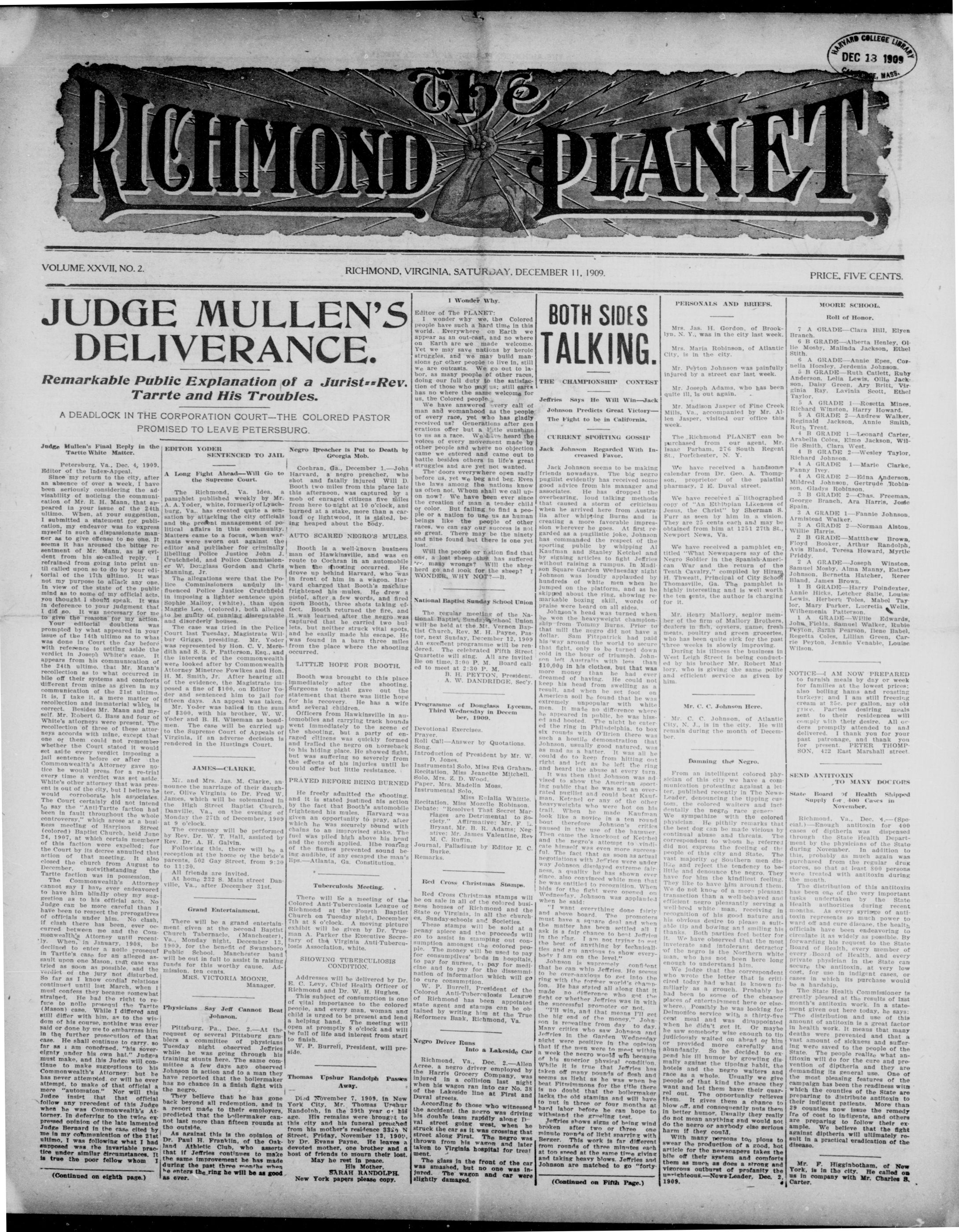
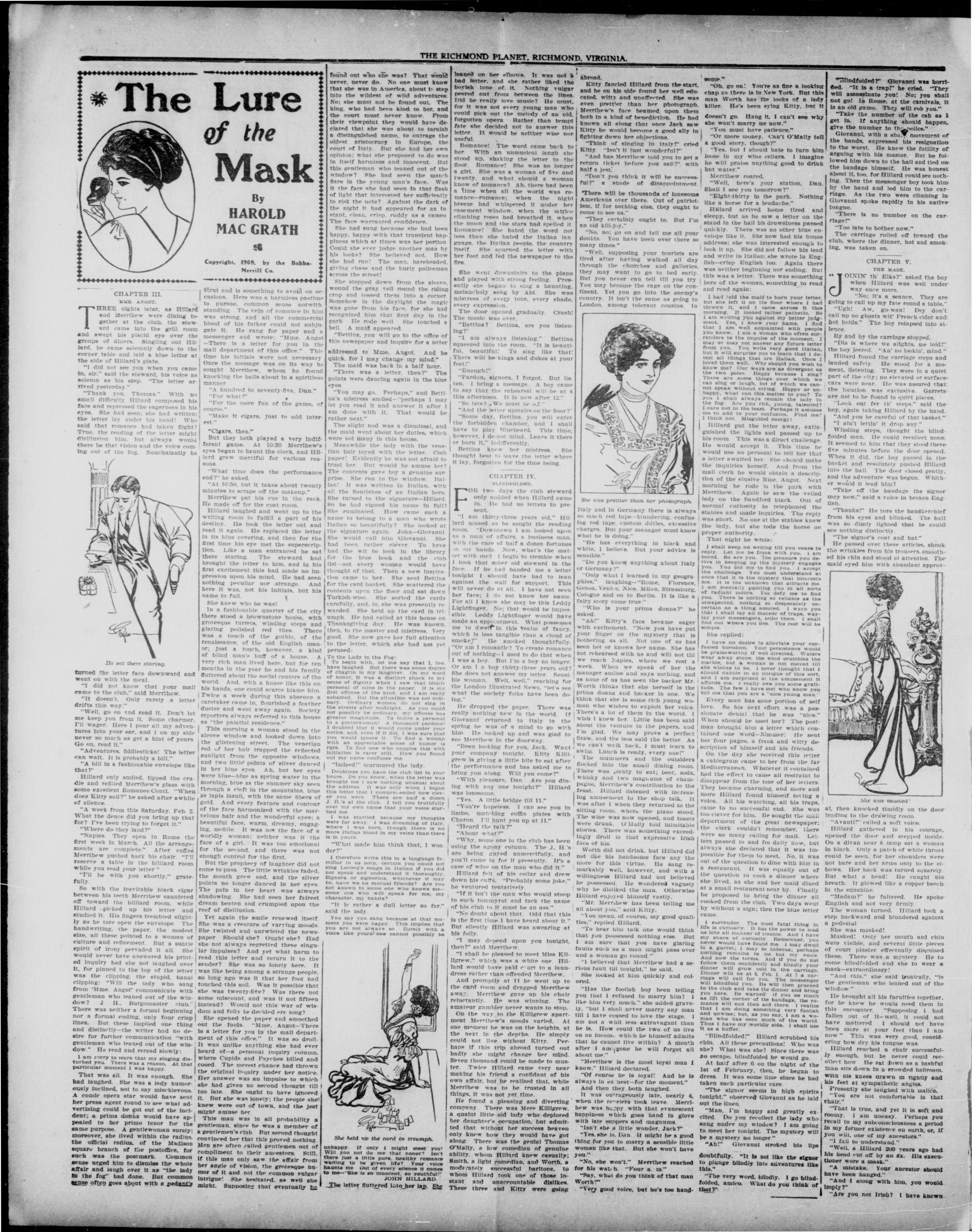
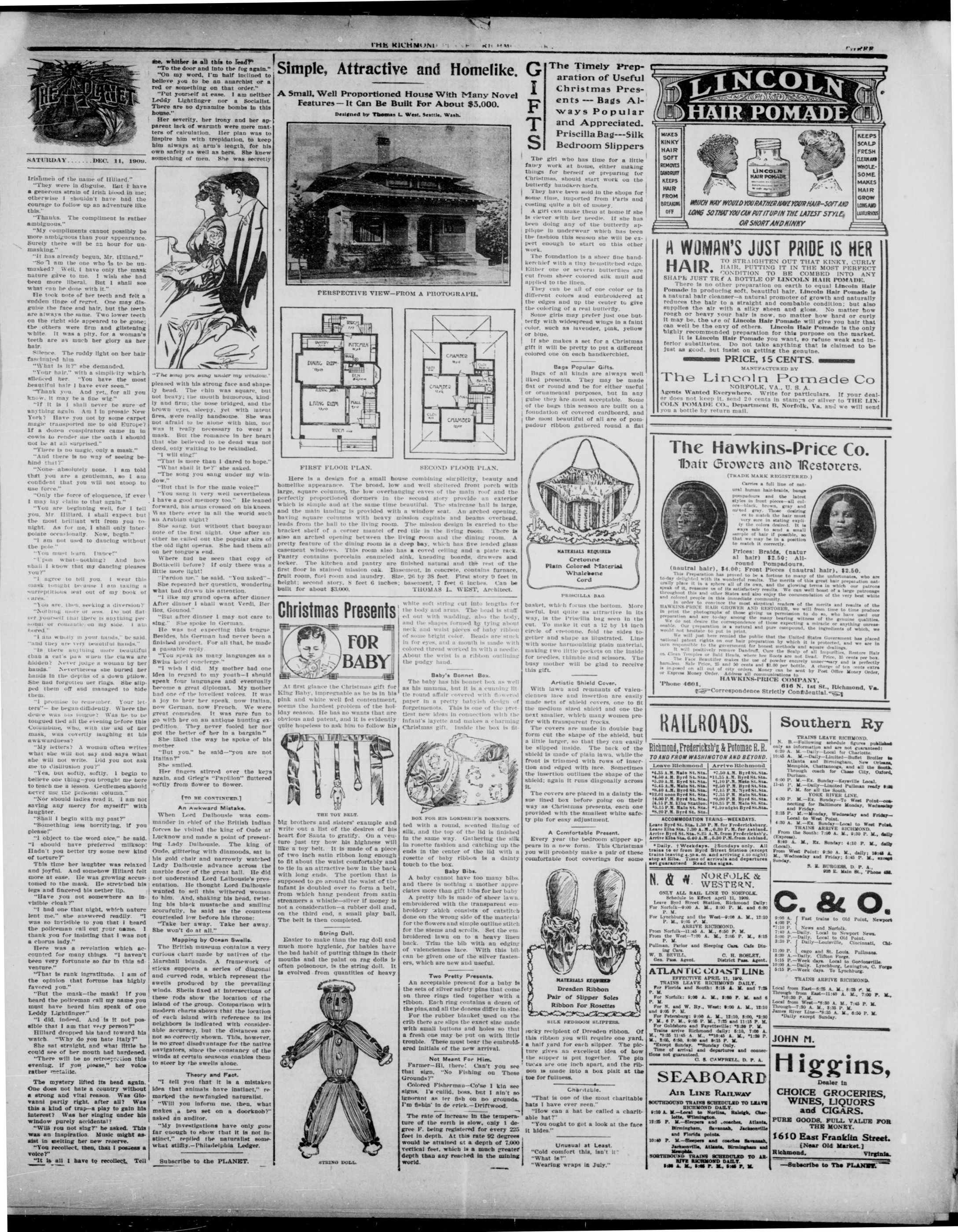
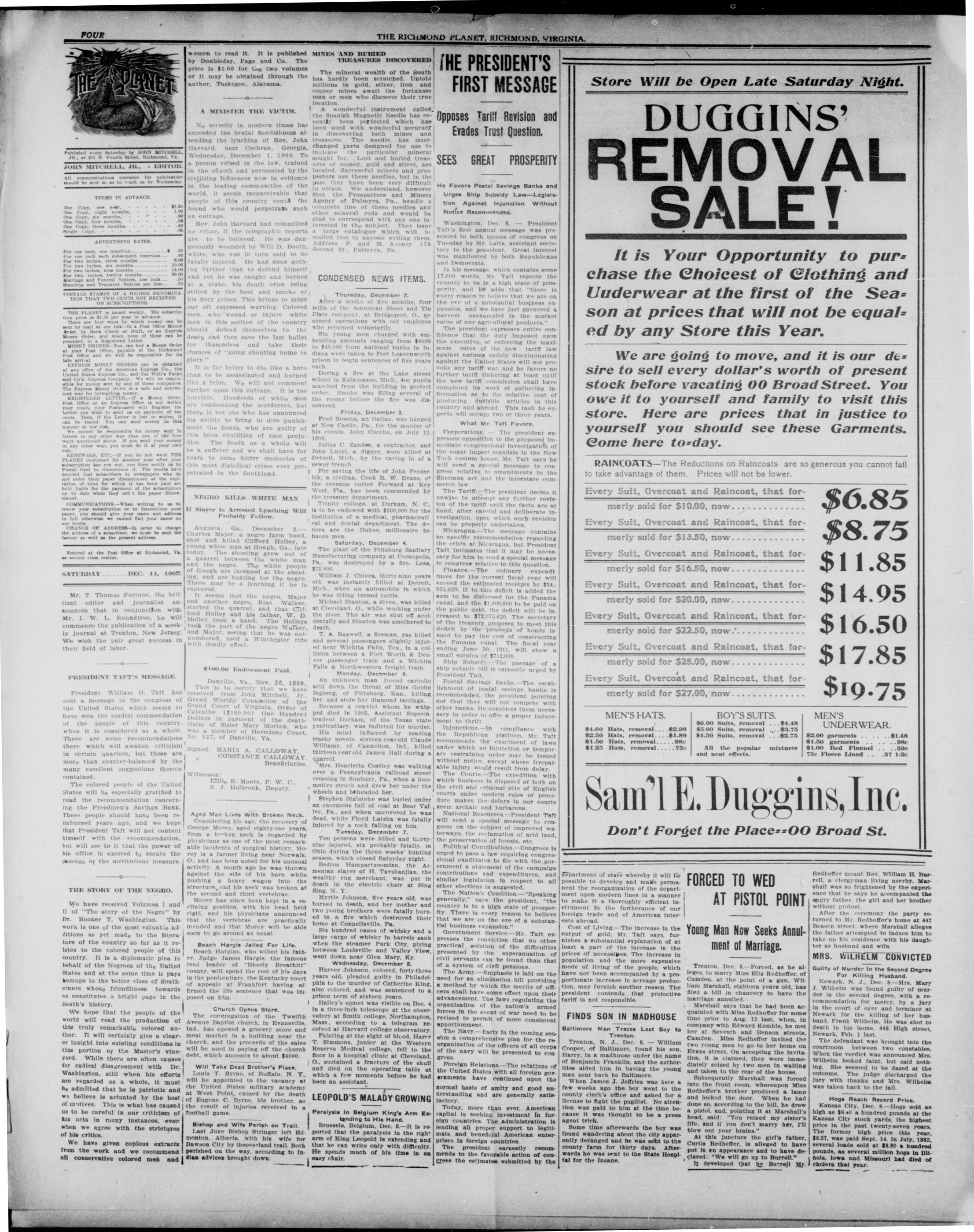
Page text (machine-generated)
THE RICHMOND PLANET
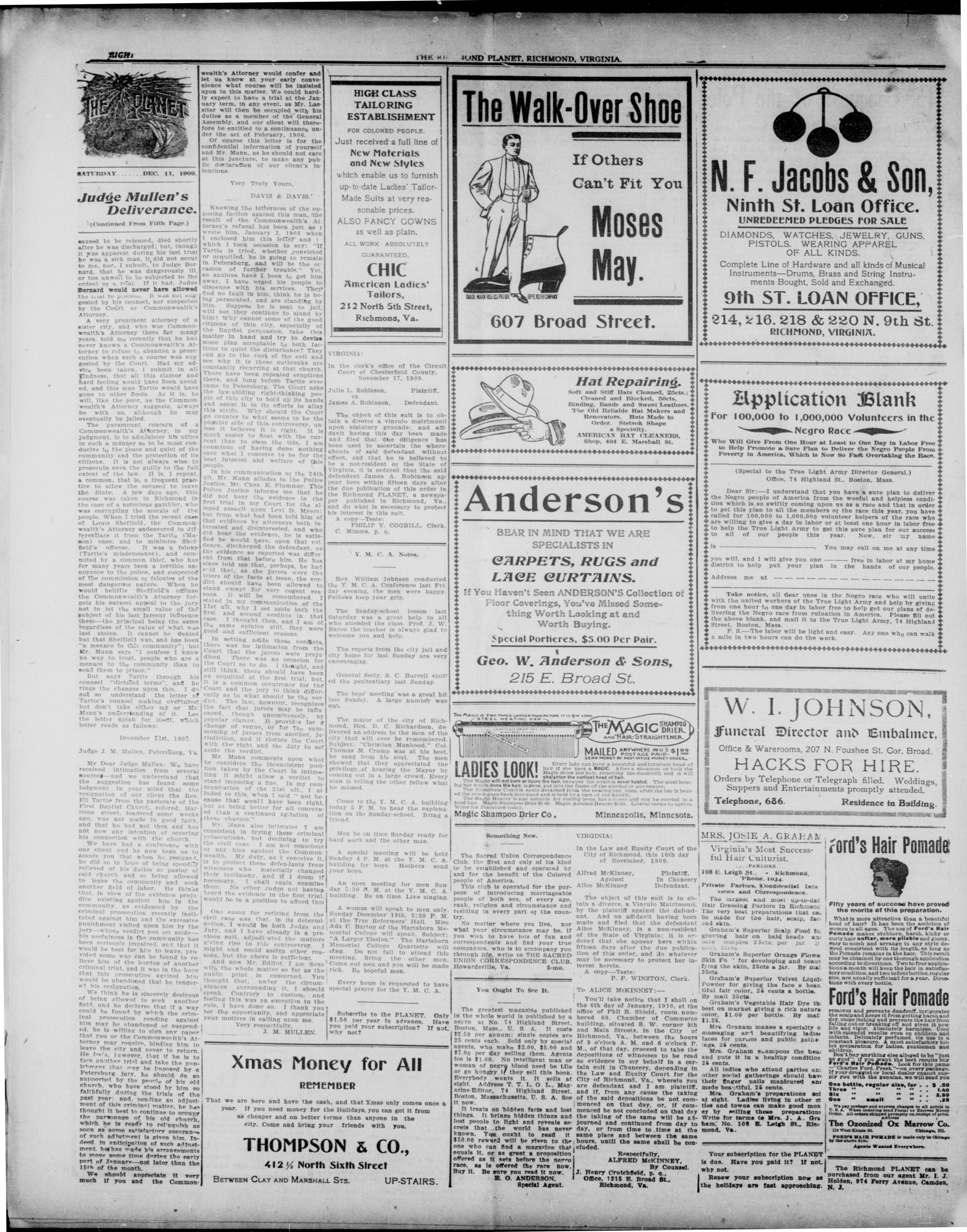
JUDGE MULLEN'S DELIVERANCE.
Remarkable Public Explanation of a Jurist==Rev. Tarrte and His Troubles.
A DEADLOCK IN THE CORPORATION COURT-THE COLORED PASTOR PROMISED TO LEAVE PETERSBURG.
VOLUME XXVII, NO. 2.
JUDGE
DEL
Remarkable Pub
Tar
A DEADLOCK IN THE
PRO
Judge Mullen's Final Reply in the Tarte White, Matter.
Petersburg, Va., Dec. 4, 1909.
Editor of the Index-Appeal.
Since my return to the city, after an absence of over a week, I have been seriously considering the advisability of noticing the communication of Mr. R. H. Mann, that appeared in your issue of the 24th ultimo. When, at your suggestion, I submitted a statement for publication, my endeavor was to express myself in such a dispassionate manner as to give offense to no one. It seems it has aroused the bitter resentment of Mr. Mann, as is evident from his so-called reply. I refrained from going into print until called upon so to do by your editorial of the 17th ultimo. It was not my purpose to attack any one. In view of the state of the public mind as to some of my official acts, you thought I should speak. It was in deference to your judgment that I did so. It was necessary for me to give the reasons for
Your editorial doubtless was prompted by what appeared in your issue of the 14th ultimo as to what was done in Court the day before with reference to setting aside the verdict in Joseph White's case. It appears from his communication of the 24th ultimo, that Mr. Mann's recollection as to what occurred in bile off their systems and comforts different from mine as given in my communication of the 21st ultimo. It is, I take it, a mere matter of recollection and immaterial which is correct. Besides Mr. Mann and myself, Mr. Robert G. Bass and four of White's attorneys were present. The recollection of three of these attorneys accords with mine, except that one or them could not remember whether the Court stated it would set aside every verdict imposing a jail sentence before or after the Commonwealth's Attorney gave notice he would press for a re-trial every time a verdict was set aside. White's other attorney that was present is out of the city, but I believe he would corroborate his associates. The Court certainly did not intend to say the "AntiTartre fact had been in fault throughout the whole controversy," which arose at a business meeting of Harrison Street (colored) Baptist Church, held June 24, 1907, at which certain members of this fact were expelled; for the Court by its decree annulled that action of that meeting. It also closed the church from August to December, notwithstanding the Tartre fact was in existence.
The Commonwealth's Attorney cannot say I have, ever endeavored to have him blindly obey my suggestion as to his official acts. No Judge can be more careful than I have been to respect the prerogatives of officials under him. No clash, if clash there has been, ever occurred between me and the Commonwealth's Attorney until recently. When, in January, 1908, he declined to enter a noile prosequil in Tartre's case for an alleged assault upon one Mason, that case was tried as soon as possible, and the verdict of the jury not disturbed. So far as I know cordial relations continued until last March, when I must confess they became somewhat strained. He had the right to refuse to nolle prosequil the Tartre (Mason) case. While I differed and still differ with him, as to the wisdom of his course, nothing was ever said or done by me to embarrass him in the further prosecution of that case. He shall continue to carry, so far as I am concerned, "his sovereignty under his own hat." Judges must make, and this Judge will continue to make suggestions to his Commonwealth's Attorney: but he has never attempted, or will he ever attempt, to make of that official a mere "automaton." Nor will this Judge insist that that official follow any precedent of this Judge when he was Commonwealth's Attorney. In deferring to the twice expressed opinion of the late lamented Judge Bernard in the case cited by me in my communication of the 21st ultime. I was following what I had supposed was the invariable practice under similar circumstances. It is true the poor fellow whom I
(Continued on eighth page.)
EDITOR YODER
SENTENCED TO JAIL
A Long Fight Ahead—Will Go to the Supreme Court.
The Richmond, Va. Idea, a pamphlet published weekly by Mr. A. A. Yoder, white, formerly of Lychburg, Va., has created quite a sensation by attacking the city officials and the present management of political affairs in this community, Matters came to a focus, when warrants were sworn out against the editor and publisher for criminally libelling Police Justice John J. Crutchfield, and Police Commissioner W. Douglass Gordon and Chris Manning, Jr.
The allegations were that the Police Commissioners unduly influenced Police Justice Crutchfield in imposing a lighter sentence upon Sophie Malloy, (white), than upon Maggie Lee, (colored), both alleged to be guilty of running disreputable and disorderly houses.
The case was tried in the Police Court last Tuesday, Magistrate Willbur Griggs, presiding. Mr. Yoder was represented by H. C. V. Meredith and S. S. P. Patterson, Esq., and the interests of the commonwealth were looked after by Commonwealth Attorney Minetree Fowkes and Hon. H. M. Smith, Jr. After hearing all of the evidence, the Magistrate imposed a fine of $100, on Editor Yoder and sentenced him to jail for fifteen days. An appeal was taken. Mr. Yoder was bailed in the sum of $300, with his brother, W. W. Yoder and B. H. Wiseman as bondmen. The case will be carried up to the Supreme Court of Appeals of Virginia, if an adverse decision is rendered in the Hustings Court.
JAMES—CLARKE
Mr. and Mrs. Jas. M. Clarke, announce the marriage of their daughter, Olive Virginia to Dr. Fred W. James, which will be solemnized in the High Street Baptist Church, Danville, Va., on the evening of Monday the 27th of December, 1909 at 9 o'clock. The ceremony will be performed by Rev. Dr. W. T. Hall, assisted by Rev. Dr. A. H. Galvin. Following this, there will be a reception at the home or the bride's parents, 502 Gay Street, from 9:30 to 11:30. All friends are invited. At home 232 S. Main street Danville, Va., after December 31st.
Grand Entertainment
There will be a grand entertainment given at the second Baptist Church Tabernacle, (Manchester), Va., Monday night, December 13, 1903, for the benefit of Swansboro Public School. Manchester band will be out in full to assist in raising funds for this worthy cause. Admission, ten cents.
MRS. VICTORIA MOONE,
Manager.
Physicians Say Jeff Cannot Beat Johnson.
Pittsburg, Pa., Dec. 2.—At the request of several Pittsburg gamblers a committee of physicians Tuesday night observed Jeffries while he was going through his training stunts here. The same committee a few days ago observed Johnson in action and to a man they have reported that the boilermaker has no chance in a finish fight with the negro. They believe that he has gone back beyond all redemption, and in a report made to their employers, predicted that the boilermaker cannot last more than fifteen rounds at the outside. As against this is the opinion of Dr. Paul H. Franklin, of the Oakland Athletic Club, who asserts that if Jeffries continues to make the same improvement he has made during the past three months when he enters the ring he will be as good as ever.
RICHMOND, VIRGINIA, SATURDAY, DECEMBER 11, 1909
Negro Breacher is Put to Death by Georgia Mob.
Cochran, Ga., December 1.—John Harvard, a negro preacher, who shot and fatally injured Will D. Booth two miles from this place late this afternoon, was captured by a mob of enraged citizens five miles from here to night at 10 o'clock, and burned at a stake, more than a carload of lightwood, it is stated, being heaped about the body.
AUTO SCARED NEGRO'S MULES
Booth is a well-known business man of Hawkinsville, and was en route to Cochran in an automobile when the shooting occurred. He drove up behind Harvard, who was in front of him in a wagon. Harvard charged that Booth's machine frightened his mules. He drew a pistol, after a few words, and fired upon Booth, three shots taking effect. Booth returned the fire, and it was learned after the negro was captured that he carried two bullets, but neither struck vital spots, and he easily made his escape. He was found in a barn three miles from the place where the shooting occurred.
LITTLE HOPE FOR BOOTH
Booth was brought to this place immediately after the shooting. Surgeons to-night gave out the statement that there was little hope for his recovery. He has a wife and several children. Officers from Hawkinsville in automobiles and carrying track hounds went immediately to the scene of the shooting, but a party of enraged citizens was quickly formed and trafied the negro on horseback to his hiding place. He showed fight, but was suffering so severely from the effects of his injuries until he could offer but little resistance.
PRAYED BEFORE BEING BURNED
He freely admitted the shooting, and it is stated justified his action by the fact that Booth's automobile frightened his mules. Harvard was given an opportunity to pray, after which he was securely bound with chains to an improvised stake. The fuel was piled high above his head and the torch applied. He roaring of the flames prevented sound being audible, if any escaped the man's lips.—Atlanta, Ga. Constitution.
Tuberculosis Meeting.
There will be a meeting of the Colored Anti-Tuberculosis League of Richmond at the Fourth Baptist Church on Tuesday night, December 7th at 8 o'clock. A moving picture he is given by Dr. Trueman A. Parkes, Executive Secretary of the Virginia Anti-Tuberculosis Association, white
SHOWING TUBERCULIOSIS CONDITION
Addresses will be delivered by Dr. E. C. Levy, Chief Health Officer of Richmond and Dr. W. H. Hughes.
This subject of consumption is one of vital importance to the colored people, and every man, woman and child is urged to be present and lend a helping hand. The meeting will open at promptly 8 o'clock and will be full of life and interest from start to finish.
W. P. Burrell, President, will preside.
Thomas Upshur Randolph Passes
Away.
Died November 7, 1909, in New York City, Mr. Thomas Upshur Randolph, in the 39th year of his age. His remains were brought to this city and his funeral preached from his mother's residence 3320 N Street, Friday, November 12, 1909, by Dr. Evans Payne. He leaves a devoted mother, one brother and a host of friends to mourn their lost.
1 Wonder Why.
Editor of The PLANET:
I wonder what we, the Colored people have such a hard time in this world. Everywhere on Earth we appear as an out-cast, and no where on Earth are we made welcome. Yet we may save nations by heroic struggles, and we may build mansions for other people to live in, still we are outcasts. We go out to labor, as many people of other races, doing our full duty to the satisfaction of those who may us; still earth has no where the same welcome for us, the Colored people.
We have answered every call of man and womanhood as the people of every race, yet who has gladly received us? Generations after gen erations offer but a little sunshine to us as a race. We have heard the voices of every movement made by other people and where no objection came we entered and came out to battle besides others in life's great struggles and are yet not wanted. The doors everywhere open sadly before us, yet we beg and beg. Even the laws among the nations know us often not. Whom shall we call upon now? We have ever since the creation of man a tender child color. But falling to find a people a nation to use us as human beings like the people of other races, we can say our success is not so great. There may be the ninety and nine found but there is one yet lost. Will the people or nation find that one, a lost sheep that has suffered too many wrongs? Will the sheep herd go and look for the sheep? I WONDER. WHY NOT—B
National Baptist Sunday School Union
The regular meeting of the National Baptist, Sunday School, Union will be held at the Mt. Vernon Baptist Church, Rev. M. H. Payne, Pastor, next Sunday, December 12, 1999. An excellent programme will be rendered. The celebrated Fifth Street Quartette will sing. All are invited Be on time, 3:00 P. M. Board called to meet at 2:30 P. M. B. H. PEYTON, President. A. W. DANDRIDGE, Soc.
Programme of Douglass Lyceum
Third Wednesday in Decem
bearer
Devotional Exercises.
Prayer.
Roll Call—Answer by Quotations.
Song.
Introduction of President by Mr. W
D. Jones.
Instrumental Solo, Miss Eva Graham
Recitation, Miss Jeanette Mitchell.
Solo, Mrs. Z. D. Wood.
Paper, Mrs. Madelin Moss.
Instrumental Solo,
Miss Eulalia Whittle.
Recitation, Miss Mozelle Robinson.
Debate: "Resolved That Secret Marriages are Detrimental to Society." Affirmative; Mr. F. L. Bryant, B. R. A. Adams; Negative; Mr. J. R. Adams Valentine, Rev. M. C. Ruffin.
Journal, Palladium by Editor E. C. Burke.
Remarks
Red Cross Christmas Stamps
Red Cross Christmas stamps will be on sale in all of the colored business houses of Richmond and the State or Virginia, in all the churches, Sunday-schools and Societies.
These stamps will be sold at a penny apiece and the proceeds will go to assist in stamping out consumption amongst the colored people. The money will be used to pay for consumptives' beds in hospitals, to pay for nurses, to pay for medicine and to pay for the dissemination of information which will go to cure consumption.
W. P. Burrell, President of the Colored Anti-Tuberculosis League of Richmond has been appointed state agent and stamps can be obtained by writing him at the True Reformers Bank, Richmond, Va.
Negro Driver Runs Into a Lakeside Car
Richmond, Va., Dec. 2.—Allen Acree, a negro driver employed by the Harris Grocery Company, was injured in a collision last night when his wagon ran into car No. 38 of the Lakeside line at First and Duval streets.
According to those who witnessed the accident, the negro was driving his double team rapidly along Duval street going west, when he struck the car as it was crossing that street along First. The negro was thrown from his wagon and later taken to Virginia hospital for treatment.
The glass in the front of the car was smashed, but no one was injured. The wagon and car were slightly damaged.
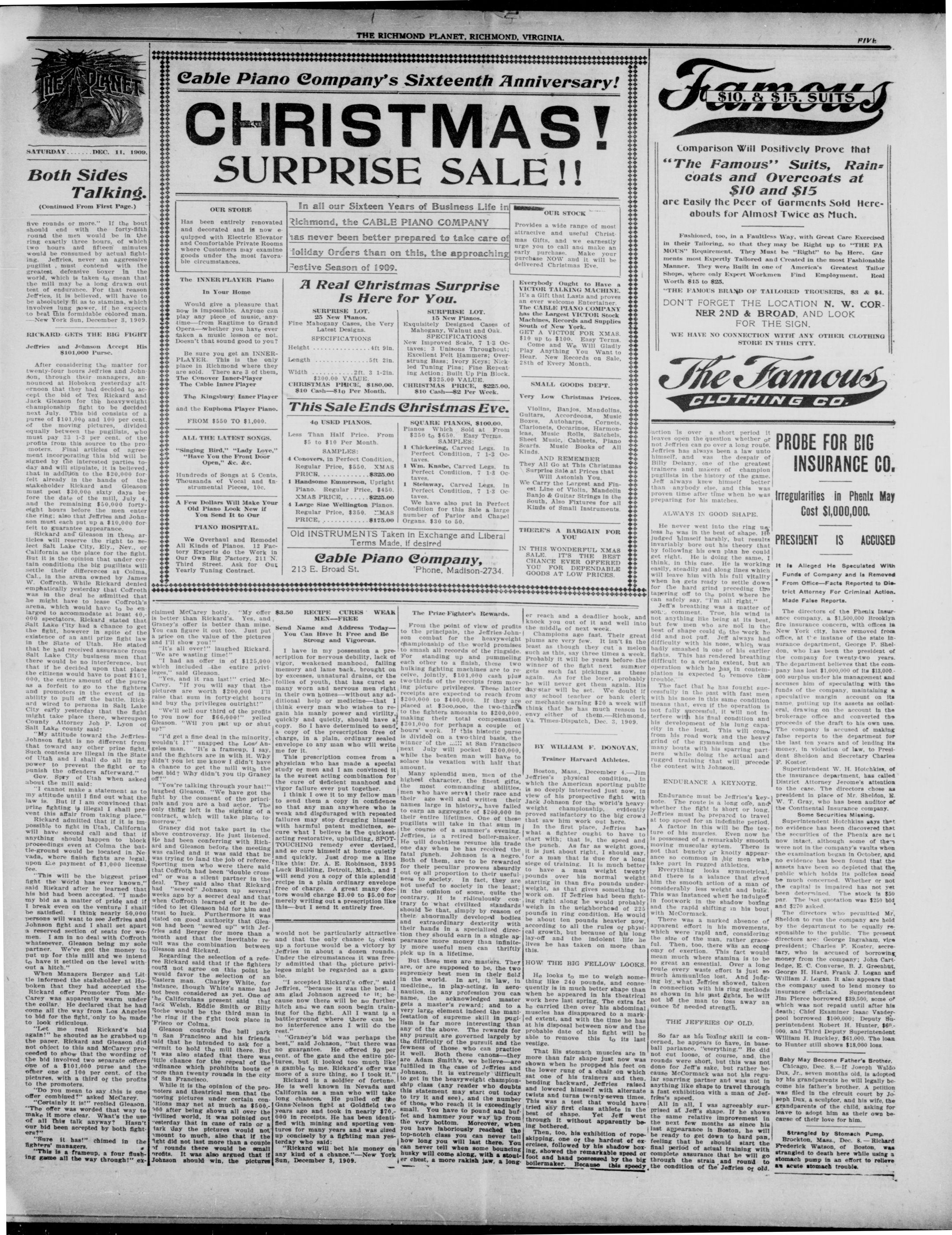
BOTH SIDES TALKING.
THE CHAMPIONSHIP CONTEST
Jeffries Says He Will Win—Jack Johnson Predicts Great Victory—The Fight to be in California.
CURRENT SPORTING GOSSIP
Jack Johnson Regarded With Increased Favor.
Jack Johnson seems to be making friends nowadays. The big negro pugilist evidently has received some good advice from his manager and associates. He has dropped the overbearing, loud talking methods that caused a storm of criticism when he arrived here from Australia after whipping Burns and is creating a more favorable impression wherever he goes. At first, regarded as a pugilistic joke, Johnson has commanded the respect of the sporting public by whipping Al Kaufman and Stanley Ketchel and by signing articles to fight Jeffries without raising a rumpus. In Madison Square Garden Wednesday night Johnson was loudly applauded by hundreds of white men when he jumped on the platform, and as he skipped about the ring, showing remarkable boxing skill, words of praise were heard on all sides.
Johnson's head was turned when he won the heavyweight championship from Tommy Burns. Prior to that mill the negro did not have a dollar. Sam Fitzpatrick had paid his way around the world to secure that fight, only to be turned down cold in the hour of triumph. Johnson left Australia with less than $10,000 in his clothes, but that was more money than he had ever dreamed of having. He could not keep his head from swelling as a result, and when he set foot on American soil he found that he was extremely unpopular with white men. It made no difference where he appeared in public, he was hissed and hooted. The night he entered the ring in Philadelphia, to box six rounds with O'Brien there was such a hostile demonstration that Johnson, usually good natured, was made a hatter. It was all he could do to keep from hitting out right and left as he left the ring and heard the
It was then that Johnson was advised to show the American sporting public that he did not an overrated pugilist and could beat Kaufman, Ketchel or any of the other heavyweights who were he on his trail. When he made Kaufman look like a novice in a ten round bout therefore Johnson's critics paused in the use of the hammer. Then came the knockout of Ketchel and the negro's attempt to vindicate himself was even more successful. The fact that as soon as actual negotiations with Jeffries were under way Johnson displayed extreme fairness, a quality he has shown ever since also convinced white men that he was entitled to recognition. When bids for the fight were opened on Wednesday, Johnson was applauded when he said: "I want everything done fairly and above board. The promoters must have a square deal and when the matter has been settled all I ask is a fair chance to be terrified in the ring. I am not trying to get the best of anything by technicalities and am anxious to show everybody I am on the level."
Johnson is supremely confident that he can whip Jeffries. He seems to be over-anxious to get into the ring with the world's former champion. He has stated all along that it made no difference who got the fight or whether Jeffries was in with the successful promoter or not.
"I'll win, and that means I'll get the big end of the money." Johnson is receding from day to day. Many critics who saw Johnson and Jeffries in the Garden Wednesday night were positive in the opinion that if the men were to meet within a week the necro would win because of his superior physical condition. While it is true that Jeffries has taken off many pounds of flesh and seems as light as he was when he beat Fitzsimmons for the title there is no doubt that the boilermaker lacks the old stamina and will have to put in three or four months at hard labor before he can hope to withstand the grueling test.
Jeffries shows signs of being wind broken after two or three one minute rounds of light snarring with Berger. This work is far different from rounds of three minutes each at top speed at the same time giving and taking heavy blows. Jeffries and Johnson are matched to go "forty- (Continued on Fifth Page.)
PERSONALS AND BRIEFS.
Mrs. Jas. H. Gordon, of Brooklyn, N. Y., was in the city last week.
Mrs. Maria Robinson, of Atlantic City, is in the city.
Mr. Peyton Johnson was painfully injured by a street car last week.
Mr. Joseph Adams, who has been quite ill, is out again.
Mr. Madison Jasper of Fine Creek Mills, Va., accompanied by Mr. Allen Jasper, visited our office this week.
The Richmond PLANET can be purchased from our agent, Mr. Isaac Parham, 276 South Regent St., Porchester, N. Y.
We have received a handsome calendar from Dr. Geo. A. Thompson, proprietor of the palatih pharmacy, 2 E. Duval street.
We have received a lithographed copy of "An Ethiopian Likeness of Jesus, the Christ" by Sherman S. Furr as seen by him in a vision. They are 25 cents each and may be obtained from him at 1251 27th St., Newport News, Va.
We have received a pamphlet entitled "What Newspapers say of the Negro Soldier in the Spanish-American War and the return of the Tenth Cavalry," compiled by Hiram H. Thwawatt, Principal of City School Thomasville, Ga. The pamphlet is highly interesting and is well worth the ten gents, the author is charging for it.
Mr. Henry Mallory, senior member of the firm of Mallory Brothers, dealers in fish, oysters, game, fresh meats, poultry and green groceries, who has been quite sick for the past three weeks is slowly improving. During his illness the business in West Leigh Street is being conducted by his brother Mr. Robert Mallory, who is giving the same polite and efficient service as given by him.
Mr. C. C. Johnson Here
Mr. C. C. Johnson, of Atlantic City, N. J., is in the city. He will remain during the month of December.
Damning the Negro.
From an intelligent colored physician of this city we have a communication protesting against a letter, published recently in The News-Leader, denouncing the tipping custom, the colored waiters and incidentally the negro race genera. We sympathize with the colored physician. He pithily remarks that the best dog can be made vicious by continual abuse and threats. The correspondent to whom he referred did not express the feeling of the people of this city and State. The vast majority of Southern men dislike and reject the tendency to be little and denounce the negro. They have for him the kindiest feeling. They like to have him around them. We do not know of a more pleasant transaction than a well-behaved and efficient negro pleasantly serving a well-bred white man, receiving in recognition of his good nature and his obvious desire to please a suitable tip and bowing and smiling his thanks. Both parties feel better for it. We have observed that the most inverteate and intolerant detractor of the negro is the Northern white man, who has not been here long enough to understand him.
We judge that the correspondent who wrote the letter that is criticized today had what is known familiarly as a grouch. Probably he had been to some of the cheaper places of entertainment here or elsewhere. Possibly he was looking for Delmonico service with a thirty-five cent meal and was disappointed when he didn't get it. Or maybe he saw somebody wise enough to tip judiciously waited on ahead of him or provided more carefully and abundantly. So he decided to expend his ill humor by growling dismally against the tipping habit, the hotels and the negro waiters and race as a whole. Usually we give people of that kind the snace they want and let them have their quarrel out. The opportunity relieves them. It gives them a chance to blow off, and consequently puts them in better humor. Usually they really do not mean anything and would not do the negro or anybody else serious harm if they could.
With many persons to plons to swear the production of a good, hot article for the newspapers takes the bile off their system and comforts them as much as does a strong and vigorous outburst of profanity the unrighteous.—News-Leader, Dec. 2, 1909.
PRICE, FIVE CENTS
MOORE SCHOOL
Roll of Honor.
7 A GRADE—Clara Hill, Elyen Branch.
8 B GRADE—Alberta Henley, Olivia Mosby, Malinda Jackson, Ethel Stith.
9 A GRADE—Annie Epes, Cornelia Horsley, Jerdenia Johnson.
Cornelia Horsley, Jerdenia Johnson.
5 B GRADE—Ruth Cattley, Ruby Anderson, Lelia Lewis, Ollie Jackson, Daisy Green, Ary Britt, Virginia Ray, Lavinia Scott, Ethel Taylor.
5 A GRADE 1—Rosetta Mines, Richard Winston, Harry Howard.
5 A GRADE 2—Andrew Walker, Reginald Jackson, Annie Smith, Ruth Trent.
4 B GRADE 1—Leonard Carter, Arabella Coles, Elmo Jackson, Willie Smith, Clara West.
4 B GRADE 2—Wesley Taylor, Richard Johnson.
4 A GRADE 1—Marie Clarke, Fanny Ivey.
4 A GRADE 2—Edna Anderson, Mildred Johnson, Gertrude Robinson, Gladys Robinson.
3 B GRADE 2—Chas, Freeman, George Branch, Ara Harris, Josie Spain.
3 A GRADE 1—Fannie Johnson, Armistead Walker.
3 A GRADE 2—Norman Alston, Willie Harris.
2 B GRADE—Mattthew Brown, Floyd Booker, Arthur Randolph, Avis Bland, Teresa Howard, Myrtle Priddy.
2 A GRADE—Joseph Winston, Samuel Mosby, Alma Manny, Esther Johnson, Bernetta Hatcher, Rerer Bland, James Brown.
1 B GRADE—Harry Polindexer, Annie Hicks, Letcher Salie, Louise Lewis, Herbert Toles, Mabel Taylor, Mary Purker, Lucretia Wells, Wilhemia Patterson.
1 A GRADE—Wilie Edwards, John Fields, Samuel Walker, Rubie Peyton, Sarah Pearson, Hene Babel, Regetta Coles, Lillian Green, Carrie Peyton, Jennie Venable, Louise Wilson.
NOTICE- I AM NOW PREPARED to furnish meals by day or week for families at the lowest prices; also boiling hams and roasting turkeys; and I am still freezing cream at 25c. per gallon, my old price. Parties desiring meals sent to their residences will comply with their desire. All orders promptly attended to and delivered. I thank you for your past patronage, and thank you for present. PETER THOMPSON, 422 East Marshall street.
SEND ANTITOXIN
TO MANY DOCTORS
State Board of Health Shipped
Supply Cases in
November
Richmond, Va., Dec. 4.—(Special.)—Enough antitoxin for 400 cases of diptheria was dispensed through the State Health Department by the physicians of the State during November. In addition to this, probably as much again was purchased from the regular drug stores, so that at least $00 persons were treated with antitoxin during the month.
The distribution of this antitoxin has been one of the very important tasks undertaken by the State Health authorities during recent months. As every syringe of antitoxin represents so much power to ward off and cure disease, the health officials have been endeavoring to circulate it as widely as possible. By forwarding his request to the State Board of Health, every member of every Board of Health, and every private physician in the State can secure the antitoxin, at very low cost, for use in indigent cases, or cases in which its purchase would be a hardship.
The State Health Commissioner is greatly pleased at the results of last month's antitoxin work. In a statement given out here today, he says: "The distribution and use of this amount of antitoxin is a great factor in health work. It means that many deaths were prevented and that a vast amount of sickness and suffering were saved to the people of the State. The people realize, what antitoxin will do for the cure and prevention of diphtheria and they are demanding its general use. One of the most pleasing features of the campaign has been the readiness with which the counties of the State are preparing to distribute antitoxin to their indigent patients. More than 29 counties now issue the remedy fre of cost to indigents, and others are preparing to follow their example. We believe that the fight against diphtheria will ultimately result in a practical eradication of the disease.
Mr. F. Higginbotham, of New York, is in the city. He called on us in company with Mr. Charles S. Carter.
«The Lure
Ae of the ,
Mask
a ‘en
; ‘\ MAC GRATH 7
oe eee
REE nights inter, as Hitard
and Sterribew were dining to
gether at the club, the stew-
ard came into the grill room
and swept bis placid eye over the
groups of divers, Singling out HU-
lard. be came solemnly down to the
corner table and Ieid a blue letter at
the side of Hillard’s piate.
“1 id not see you when you came
in, sir.” said the steward. bis voice as
solemn as bis step. “The letter ar
rived yesterday.”
“Thank sou. Thomas.” With no
small aificulty Hillard composed his
face and repressed the eagerness 19 his
eyes. She bad seen: she had written:
the letter lay under his hand! Whe
sald that romance had taken fight?
True. the reading of the letter might
Gisitiasion him. but always would
there be that vision and the voice com.
ing out of the fog. Nonchalantiy be
I
Dae
[Paw
A
ay LING
‘ps ‘ AY
= . \s ry
ey W
ie
turned the letter face downward and
went on with the meal
“I did not know that your mail
ame to the club.” sald Merrihow.
“It doesn't. Onis rarely a letter
rifts this way.”
“Well, go ou end read {t. Don't tet
me keep you from {t. Some charmer,
Tl wager. Here 1 pour all my adven
tures into your ear. and 1 on my side
Rever so much as get a hint of yours
Go on, read tt.”
“Adventures, Oddlesticks! ‘The letter
ean walt. 11s probably a bill.”
“A bill in a fashionable envelope Itke
thar”
Hillard only smiled, tipped the cra.
die and refilled Merribew's glass with
some exceilent Romanee Cont, “When
does Kitty sail?" be asked after awhile
of silence.
“A week from this Saturday. Feb. 2.
‘What the deuce did you bring up that
for? I've been trying to forget it”
“Where do they land?"
“Naples. They open in Rome the
frst week in March. All the arrange:
ments are complete” After coffee
Merrihew pushed back his chair. “I'l
Feserve a table in the billiard room
while you read your letter
“I'll be with yon shortly,” grate.
fully.
So with the inevitable black cigar
between his teeth Merrinew sauntered
off toward the billiard room, while
Billard .picked up his tetter and
studied It. His Gngers trembied slight
ly as he tore open the envelope. ‘The
handwriting. the paper, the modest
ize, all these poloted to a woman of
culture and refinement. But a sublie
epirit of irony pervaded It all. She
Would never have answered bis print-
€d inquiry had she not laughed over
it, for pinned to the top of the letter
was the clipping. the stupid. banal
clipping: “Will the iady who sang
from “Mme. Angot’ communicate witb
gentleman who leaned out of the win-
dow? J. H. Burgomaster club.”
‘There was neither a formal beginning
nor a formal ending. only four ertsp|
lines. But these implied one thing
And distinetiy—the writer had no de.
sire for further communication “with
entleman who leaned out of the win-
ow.” He read and reread slowly:
1am sorry to learn that my singing dis-
tured you. There was a reason At that
Particular moment 1 was happy
‘That was all. It was enough. She
had laughed. She was a iady bumor-
ously inclined. not to say mischievous.
A comic opera star would have sent
her press agent round to see what ad-
Vertising could be got out of the inci-
‘Sent. mitten one oun ave ap-|
Pealed to ber primo tenor for the
same purpose. A gentlewoman surely;
moreover, sbe fived within the radius.
the official radius, of the Madison
square branch of the postoffice, for
such was the postmark. Common
sense urged bim to dismiss the whole
gitelr and laugh over it as “the Indy
‘the fog” had done. But common
eense often goes about with « pedant’s
to pursue, common sense notwith
standing. The vein of romance in him
was strong. and all the commercial
blood of his father could not subse
gate it. He rang for paper and a
Messenger and wrote: “Mme, Angot
—There is a letter for you in the
mail department of this office.” This
time bis Inttlals were not necessary
Once the message was on its way he
sought Merrihew. whom be found
knocking the balls about tn @ spiritiess
manner
“A hundred to seventy-five, Dan.”
“For what?" °
“For the mere fun of the game, of
“Make {t cigars. just to add inter-
est”
“Cigars, thea.”
But they both played « very indi:
ferent game. At 10:30 Merrihew's
eyes began to haunt the clock, and Hil-
lard grew merciful for various rea.
“What time does the performance
end?” be asked
“At 10:50, but It takes about twenty
minutes to scrape off the makeup.”
Merrihew put bis cue in the rack
He made off for the coat room
Hillard laughed and went up to the
writing room to fulfl a part of bis
destiny. He took the letter out and
read it again. He replaced the letter
in its blue covering, and then for the
Brat time his eye met the superscrip-
tion. Like a man entranced he sat
there staring. The steward bad
brought the letter to him, and in bis
first excitement this had made no im
Pression upon bis mind. He had seen
nothing peculiar nor strange. And
bere it was, not his tnitials, but his
name tn full ‘
She knew who be wast
In a fashionable quarter of the city
there stood a brownstone houke, with
Erotesque turrets, winding steps and
Blaring polished red tiles. There
Was a touch of the gothic, of the
Feuaissance, of the old English man.
OF; Just a touch, however. a kind
of blind man’s bum of a house. A
Yery rich man lived here. but for ten
months in the year he and bis family
Guttered about the soctal centers of the
World. And, with a houxe like this on
bis hands, ove could scarce blame bitn.
Twice a week during this absence a
caretaker came in, fourished a feather
duster and went away again. Society
reporters always referred to this house
as “the palatial residence.”
This morning a woman stood in the
alcove window and looked down Into
the glistening street. ‘The venetian
red of ber balr trapped the reflected
sunlight from the opposite windows,
and two littlé points of silver danced
in ber blue eyes. Ah. but her eyes
were blue—blue as spring water in the
morning. blue as the summer sky seen
through a cleft in the mountains, blue
as Inpig Inzull, with the same Gbers of
gold. And every feature and contour
of the face harmonized with the mar-
velous hatr and the wonderful eyes: a
beautiful face, warm, dreamy, engag.
ing. mobile. It was pot the face of a
worldly woman; nelther was it the
face of a girl. It was too emotional
for the second, and there was not
enough contro! for the first
But the prophecy of laughter did not
rome to pass. The little wrinkles faded.
the mouth grew sad, and the silver
points no longer danced in her eyes.
The pain in her heart was always
shadowing. She bad seen her fairest
tream beaten and crumpled upon the
eet of disillusion.
Yet again the smile renewed Itself
she was @ creature of varring moods.
She twisted and untwisted the news-
aper Should she? Ought she? Aad
he not always regretted these singu-
ar impulses? And yet what harm to
ead this letter and return it to the
ender? She was so lonely here. It
ras like being among a strange people,
© long ago was It that ber foot bad
ouched this soil. Was ft possible that
he was twenty-fite? Was there not
jome raiscount. and was It not fifteen
nstead? Wonld not this war of wis-
jom and folly be decided ere long?
She opened the paper and smoothed
ut the folds. “Mme. Angot—There
8 a letter for you to the mall depart-
nent of this office.” It was so droll.
t was unlike aoything she had ever
eard of—a personal inquiry column.
where Cupids and Psyches billed and.
coed. § The merest chance bad thrown:
he original inquiry under ber notice.
ler answer was an tmpuise to which
he had given vo second thought till |
oo late. She ought to bare ignored
t But she was lonely: the people si
new were out of town, and the jest
night amuse ber
‘This mao was tn all probability a
jentieman. since he was a member of
Rentlemen's club But second thought
onrinced her that this proved nothing.
fe are often called gentlewen out of
ompliment to their ancestors. Still.
f this man only saw the affair from
er angle of vision. the grotesque bu-
nor of If and not the common vulgar |
ceaticienah «ilies? Rinne cde tee ee oa ee
THE RICHMOND PLANET, RICHMOND. VIRGINIA.
cee, Ge Se. he ee ae ee
that she was ip Amertea. about te step
co se snien. rot omens
No; she must not be found out.
king. who had beeo kind to ber, and
the court must never know. From
thelr viewpoint they would have de
clared that she was about to taruish
‘8 distinguished name, to outrage the
oldest aristocracy in furope. the
court of Italy. But she had her own
opinion: what she proposed to do was
in itself harmiess and innocent But
this gentleman who leaned out of the
window? She bad seen the mateb
fare ip the young man’s face. Was
‘it the face she had seen fm that fash
of Hight that Interested her suffictentiy
to risk the note? Against the dark of
the night {t had appeared for an to
stant, clean, crisp. ruddy as a cameo
The face warranted confidence.
She had suog because she had been
bappy. happy with that transient hap-
‘pioess which at times was ber portion
Could she ever Judge another man bs
his looks? She believed not. How
sbe bad run! The man, bareheaded.
xiting chase and the burly policeman
Across the street!
She stepped down from the alcove,
wound the gray veil round the riding
crop and toxsed them Into a corner
Somehow to the daylight the magi
Was gone from bis face. for she had
recognized him that Grst day tn the
park. He rode well She touched »
bell, A maid appeared.
“Rettina, you will go to the office of
thls newspaper and inquire for a letter
addressed to Mme. Angot. And be
Quick, for 1 may change my mind.”
‘The maid was back tp a half hour.
“There was a letter, then?" The
polnts were dancing again in the blue
ees
“You may go. Perhaps,” and Bettl-
na's mistress smiled—“perbaps | may
let you read tt and answer it after 1
am done with It, ‘That would be
rather neat.”
The slight nod was a dismissal, and
the maid went about her dutfes, which
were not many In this house.
Meanwhile the lady with the vene-
tian bal toyed with the letter. Chub
paper! Evidently be was not afraid to
trust her. But would he amuse her?
The contents give her a genuine sur-
prise. She ran to the window. Ital
fan! It was written In Itallan, with
all the flourishes of an Italian. born
She turned to the signature—Hillard.
So be hid signed bis name In full?
She ruminated. How came such a
name to belong toa man who wrote
Italian so beautifully? She looked at
the signature again. John—Gtovannt
She would call him Glovannt. | She
had ten rather clever To have
had the wit to look in the brary
for the blue book and the club
Ust—not every woman would have
thought of that. ‘Then « new tnspira
ion came to ber. She sent Retina
for the card basket. She scattered the
contents upon the foor and sat down
Turkish-wise. She sorted the cards
enrefully, and, 10, she wan presently re
warded. She held up the card in tri
amph. He had called at this house op
Thanksgiving day. He was known,
then, to the master and mistress. Very
good. She now gave her full attention
to the letter, which she had not yet
perused:
To the Lady in the For:
To begin with, let ine say that 1, too
nave laughed. tive there wax some derres
of chagrin In my laughter. On my word
of honor. ft was a distinct shock to my
sense of dignity, when I saw that !iotle
personal of tine in the paper. It my
iret offense of the kind, and | am really
nshained. [hut the aituation was not ordi.
mary. Ordinary ‘women “do not. sing
he streets after midnight. As you could
not possibly te ordinary. my oenae has
greater magnitude. ‘To indive personal
oa Kentiewoman! A thousand. pardons!
I doubted that it would come under: your
notice, and. even if it did. I was eure that
you would ignore it ‘To find a woman
with "ap “appreciable sense’ of humor is
rare. "To find one who couples this with
aitiation ts rarer. atiit. How you found
but ray name confusew me
“Indeed"” murmured the lady.
Doubtiess you have the club list tm your
poune. Do you know, when the fetter was
prouRin me I'taw nothing unusual about
he address. it wan only when 1 began
his letter that | comprenended how elev
wr you were. ‘There are naif a Goren
J Hw at the club. I tell you trothtuly
seer my own hame that Your volee slat
ed me
1 as martied because my thoughts
were faraway. I wan dreaming of Italy,
where I was born. though there. if no
more itatian blood in my veins than there
= tn youre .
“What made bim think that, I won.
ler?”
A therefore write this in a language fx
niliar to us both. certain you could, Hot
ing Lecoca's sonics In italian tf you did
ot apeaw and understand it thoroughly.
iignora or mgnorina, ‘whichever Wt ay
have we no mutual friends? Are you
ot Known to some one who, known mee
ome one who will speak for me. my
haracter. my habits?
“It ts rather ® dull letter so far,”
ald the indy
You say you aang because at that mo-
nent you were nappy. This implies that
Ou are nol always ao” Surely with a
oice like Yours! one cannot possibly” be
{ SS {i
| a a
| |
<P
i AZ ah)
SS sme
Cie
»
SEQ Als
(-* . ) A) |
I
i ty?
Ons
Gua.»
‘She hela wp the card tm triumph.
unhappy. if only 1 might mest you!
Wilt you not do. me that honor? tent
there just 4 little pure, healthy romance
waiting to Ge given lite? Your voice
haunts me Out of every silence It comen
to me—"Bhe Wo 40 innocent, so youtntulr”
JOHN ‘HILLARD.
The letter fluttered isto her inp. She
ean - Fe
on ber elbows It was not &
osiah tone of it. Nothing vulgar
Peered ont from between the Hines.
‘DIG be really love music? He ust,
for it was not every young map who
could pick out the melody of an old.
forgotten opera Rather than tempt
fate she decided not to answer this
letter. It would be neither wixe vor
useful. .
Romance! The word came back to
her With an unmusical laugh she
stood up. shaking the letter to the
floor. Romance! She was no longer
a gitl, She was a woman of Sve and
twenty, and what should a woman
know of romance? Ah. there bad been
a time when all the world was ro-
mence—romance; when the night
breeze had whispered it under her
casement window. when the tsttice
climbing roses bed breathed ft. when
the moon and the stars bad spelled it
Romance! She bated the word not
less than she hated the ftallan inn
guage, the Italian people, the country
itself. She spurned the letter with
ber foot and fed the newspaper to the
fre.
Bhe went downstairs to the piano
and played with stroog feeling. Pres-
ently she began to sing a baunting,
melancholy wong by Abt She was
mistress of every tone, every shade,
every expression.
The door opened gradually. Crash!
The music was over
“Bettina? Bettina, are you lsten-
ing?
“Lam always Ilstening.” Bettina
squeezed into the room. “It is beaut!
fui, beautiful! To sing lke that:
There will be kings and dukes at your
feet!”
“Eoough!*
“Pardoa, signora, 1 forgot. But lis
ten. 1 bring a message. A boy came
to say that the rehearsal will be at 4
this afternoon. It Is now after 12" |
“So late?.«We must be oF
“And the letter upstairs on the floor?” |
“Some day, Bettina, you will enter |
the forbidden chamber, and 1 shalt
have to play iluebeand ‘This time,
however, Ido not mind. Leave it there
or burn it," indifferently
Bettina knew her mistress. She
thought best to leave the letter where
it lay, forgotten for the time being.
CHAPTER IV.
OR two days the club steward
only nodded when Hillard came
In, He bad no letters to pre
nent.
“1 am thirty-three years old.” Hit
lard mised as he sought the reading
room. “Downtown I atm looked upan
As a man of affairs, a business tan
with the care of half a dozen fortunes
n ws hands. Now, what's the mat
er with me? 1 begin’to tremble when
1 ook that sober old stewart in the
fave. If be had handed me a letter
tonight 1 sbould have had to lean
Against the wall for support. This
Will never do ot all. 1 have not seen
her face; 1 do not know ber name
For all 1 know she way be this Leddy
Lighttinger. No; that would be timpos
sible. Leddy Lightfinger would have
made an appointment. What possesses
me to dwelfio this Tealm of fancy.
Which 1s less tangible than a cloud of
smoke?" He smoked thoughtfully
“Or am I romantle? To create romauce
out of nothing—1 used to do that when
Iwasa boy. Bot I'm a boy no longer.
Or am In boy thirty-three years old?
She does not answer my letter. Sens!
ble woman. Well, well,” reaching for
the London Itlustrated News. “let's wee
what the society folks have bees do-
ing.”
He dropped the paper. There was
really nothing new In the world. If
Glovann! returned to ttaly in the
spring he was of m mind to go with
him. He looked up and was giad to
see Merrihew In the doorway.
“Reen looking for you, Jack. Want
your company tonight. Kitty Kilt
grew fs giving @ little bite to eat after
the performance and has aaked me to
bring you along. Will sou come?”
“With pleasure, Dan. Are you din-
ing with any one tonight?” Hillard
was lonesome,
“Yes. A little bridge till 11."
“You're hopeless. 1 can see you In
limbo, matching coffin plates with
Charon. I'll hunt you up at 11."
“Heard the talk?"
“About what?
“Why. some one in the club hax been
using the agony column. The J. H's
are being used unmercifally, and
you'll come In for It presentis, It's a
case of wine on the man who did It”
Hillard felt of bis collar and drew
down bis cuffs. “Probably some Joke.”
be ventured tentatively
“If it fsn't the man who would xtoop
to such tommyrot and tack the name
of his club to It must be an ass”
“No doubt abont that. Odd that this
fs the first time I have beard abont it.”
Bur sileotly Hillard was swearing at
his folly.
“1 may depend upon you tonight,
then?” said Merrihew.
“T shall be pleased to meet Miss Kil-
grew." which was a white one Fiil-
lard would bave pald curt toa Inun-
dress rather than offended Merrihew.
And promptiy at 11 be went up to
the card room and dragged Merrihew
awa>. Merrihew gave up his chair
reluctantly. He was winning. The
amateur gimbler never wants to stop.
Op the way to the Killigrew apart-
ment Merrihew's moods varied. At
one Moment be was on the heights. at
the next In the depths. He simply
could not live without Kitty. Per-
haps if this trip abroad turned out
badly she might change ber mind.
Seven thousand could be made to mus-
ter. Twice fIillard enme very near
making bis friend a confidant of his
own affair, but he realized that, while
Merrihew was to be trusted In all
things, it was not yet time. ;
He found a pleasing and diverting
company. ‘There was Mere Killigrew.
A quaint litle old Indy who deplored
her daughter's occupation, but admit-
fed that without her success beaven
only knew how would have got
slong. There Yas the genial Thomas
cna . & low comedisn of genuine
ul . whom knew a
Smith. a light oom and Sorts
moderately snecessful baritove, to
whom Hillard took one of in
tant and anaceountable
nant and @ le disiikes.
Sareea,
Kitty fancied Hillard trom the start,
and he on bis side found her well edu:
cated, witts and unaffected. She was
even prettier than ber photograph.
“Merrihew's face beamed upon. them
both in x kind of benediction, He bad
Known all along that once Jack saw
Kitty he would become a good ally in
fighting down ber objections.
_“Phink of singing In Italy! ried
Kitty “Isn't tt fust wonderful?”
“And has Merrihew told you to get a
return ticket before you sail?" with
half a jest!
“Don't you think It will be success-
fault @ shade of disappointment
‘There will be thousands of lonesome
Americans over there. Out of patriot.
ism, If for nothing else, they ought to
come to see us."
“They certainly ought to. But I'm
ap old kill-Joy.”
“No, no: go on and tell me all your
doubts. You have been over tbere so
many times”
“Well, supposing your touristy are
tired after having walked all day
through the churches and galleries.
they may want to go to bed early
But you never can tell till you try
You way become the rage on the con-
tinent. Yet you go Into the enemy's
country. It ten't the same as going to
London, among tolerant cousina. In
fs Me
as i tee
= —: |
¥ ~~
,. =&
f x
=")
> LS
<8) \Y. Re
Rs relents
| 2 Sa
fy
Se fis 4
Sf fe be
eee \¥—to 9
Soe Wee ne” Chan Aer pretegrage.
Italy and tn Germany there is always
so much ted tape—blundering. confus.
fog red tape, custom duties, excessive
charges. ut your manager must know
what he Is doing.”
“He bas everything in black and
white, | believe. But your advice ts
/ sensible.”
| “Do sou koow anything about Italy
or Gerwany ?*
Only what | learned in my geogra.
phies.” laugbing—“Rome, Florence,
Genoa, Venice, Nice, Milun, Strassburg,
Cologue and on to Berlin. It ts like a
fairy story come true.”
“Avbo ia sour prima donna?" he
asked
“Ah?” Kitty's face became eager
with excitement. “Now you bave put
our floger on the mystery that ts
bothering us all, Not one of us bas
‘Ace ber or knows ber name. She has
‘Dot rebearsed with us and will not till
‘we reach Naples, where we rest a
Week. Whea we speak of her the
wanuger siniies und says nothing, and
28 noue of us has seen the backer Mr.
Worth things that sbe herself is the
Prima donua aud backer tn one. We
Think that abe Is some rich young wo-
man who wishes to explolt ber volce.
‘There's a lot of them ty the world. 1
Wish | kuew her. Little has been sald
about tbe venture In the papers, and
Vm glad. We may prove a perfect
faze, uud the less sald the better. As
Wwe can't welk back. 1 must learn to
swim. Luuch ts ready, every oue!”
The muwuers and the outsiders
flocked Into the small dining room.
There was yleuty to eat; beer, soda,
Whisky aud two maxuums of chan:
Payne, Merribew’s coutribution to the
feast. Hillard listened with increas:
ing amusewent to the shop talk. It
was after 1 when they returned to the
sitting room. where the plano stood.
‘The wine was now opened, and tousts
Were drunk. O'Mally told inimitable
Stories, ‘There was something exceed.
fogly droll in that expressive irish
face of bis.
Worth did not drink, bat Hillard did
not like bis handsome face any the
tore for this virtue. He sang re-
ouarkably well, bowever, and with a
willingness Hillard bad not believed
he possessed. He wondered vaguely
why be disiiked the man. Otherwise
Hiltard enjoyed bimsett vastly,
“Mr, Merribew bas beeo telling me
ail about you,” said Kitty.
“You wean, of course, my good quali-
ties.” replied Hillard.
“To bear ti utlk one would think
that you possessed nothing else. But
1 am sure that you bave glaring
faults sucb us a oan might pass over
and a womao go round"
“L believed that Merribew bad a se-
rious fault ll tonight.” he said.
Sbe looked at bim quickly and col-
ored.
“Has the foolish boy been telling
you that I refused to marry bim? 1
lke hiw very much,” she added grave-
ly, “but 1 shall never marry any man
till 1 have cased to love the stage. I
a Dot a whit less extravagant than
he is, How could the two of us live
op ao incom. which be himself admits
that be cannot live within? A month
after 1 am\gone he will forget all
about me.”
“Merrihew is the most loyal man 1
know.” Hilinrd dectared,
“Of course he ts loyal! And be ts
always iu ea uest—for the moment.”
And then they both laughed.
it was outrageously late, nearly 4,
when the revelers took leave. Merri-
hew was hoopy with that evanescent
happiness which goes hand fo glove
with late suppers and magoums.
“Isn't abe a little wonder, Jack?”
“Yes. abe ix, Dan. it might be a good
thing for you to marry a sensible little
woman {ike that. But sbe won't bave
you.
“No, abe won't.” Merrihew reached
for bls wath. “Four a m.”
“Sas. whet do you think of that man
Worth”
‘eome” ee
ee
"Ob, go OB: You're as fine a roe
chap as there is in New York. But tl
man Worth has the looks of a indy
‘Killer. He's been eying Kitty, but It
doesn't go. Hang tt. I can't see why
ssbe won't marry me now.”
“You must bare patience.”
| “Or more moves. Can't O'Mally tel
‘& good story, though?”
! “Yes. but 1 should bate to turn bim
joose ip my wine cellars. 1 imagine
he will praise anything good to drink
but water.”
Merriiew roared.
“Well, here's your station, Dan.
Shall | see you tomorrow?"
“Bight-thirty in the park. Nothing
Uke a borse for a headache.”
Hillard arrived home tired and
‘ sleepy, but as he saw a letter on the
staud In the ball bis drowsiness passed
‘quickly. ‘There was no other bite en-
¥elope like it, She pow had tis house
address; she was interested enough to
Hook It up. She did not follow his lend
and write Ip Italian; she wrote iu Eng-
Ush—crisp English too. Again there
was neither beginning nor ending. But
this was a letter. ‘There was something
| here of the woman, something to read
and read again:
1 had old the maid to burn your letter,
but she left it on the Soor where 1 had
throwa. it, and 1 came across it Uns
morning. "It" looked rather pathetic. So
Lam writing you aguinst my better judg-
ment. Yes, J know your name. 1 find
that "1 am’ well acquainted with people
you know. farm a woman who often sure
Tenders to the impulse of the moment. i
may or may hot auawer any future letter
from you. You write very good Italian,
but It will surprise you to learn that I de-
test all things that are Italian “Once i
loved them well. Why should you wish to.
know me? Our ways are as divergent as
the two poles. “Happy because I sing?
There are some things over which we
can sing or laugh, but of which we can-
ot speax without crying. “Happy or un-
happy. what can Uils matter to you? ‘To
you I shall always remain the indy tn
the fog “Are sou rkb, young, talented?
Leare not in the least. "Perhaps it amuses
ine to add to your confusion Pind me?
Tthime not. Alisguided enerayt
| Hilllard put the letter away, extin
guished the lights and passed up to
bis room. This was a direct challenge.
He would accept It This time he
Would use no persoual to tell ber that
a letter awaited her. She should make
the inquiries herself. And from the
mail clerk he would obtain a deserip
tion of the elusive Mme. Angot. Next
morning he rode in the park with
Merribew. Again be saw the velled
lads on the Sandford black. Out of
normal curiosity he telephoned the
stables and made inquiries. ‘The reply
was short. No ope at the stables knew
the lady, but she rode the horse on
Proper authority.
That night he wrote:
1 shall keep on writing ti! you cease to
reply. Let ine be frank with you. tam
bored. So are you. ‘The pleasure you de-
Five in keeping’ up this mystery eogages
you. You bid-me to find you | accept
the challenge. "You must Understand at
once that It ts the mystery that interests
me. itt the unknown that attracts me
1 am mentaily painting you in all sorts
of radiant colors. You dety me to fad
you. There in nothing 90 reliable aa the
Unexpected, nottung to desperately une
certain asa thing astured. T warn you
that I shail lay ail manner of traps, way:
lay your messengers, bribe them. i small
find ‘out where you live. The rest will be
simple.
ee
1 have no desire to alleviate your con.
fessed boredomn. "Your peramence, would
be praiseworthy If well Uirected. Waters
Wear away stone, the wind crumbles the
marble, Out a woman Is not moved till
she wishes to be. I never thought that 1
Should dabole in an intrigue of this sort,
Snd 1 am surprised at the amusement ii
afforda me. I'really owe Sou some grati-
tude. “The few | have met who Know YOU
tell me that You are & “nice Young man
Every un has some portion of self
love. “So bis next effort was a pas-
slonate denial thut be was “nice.”
When should be meet ber? The post-
man brought bim a fetter which cou-
talued ope word—Nimmer: He seat
ber four pages. a frauk and witty de
scription of bLimself and bts friends,
Op the day she received this tetter
® cablegram came to ber from the far
Mediterranean, Whatever it contained
had the effect to cause all restralat to
disappear from the tone of her witers.
They became charmiug. and more and
more Hillard found blmself loving a,
voice. All his watcbing, all bis traps.
came to no successful end. She was
too clever for bim. He sought the wait
department of the great newspaper:
the clerk couldn't remember, there
Were so many calling for mail. Let
ters passed to and fro daily now, but
always she declared that It was im-
Possible for them to meet. No, it was
out of the question to dine with him in
@ restaurant. It was equally out of
the question to cook a dinuer where
She lived, as she and her maid dined
at a small restaurant near by. Finally
he proposed to bring the dinner ail
cooked from the club, Two days went
by without o sign; then the biue letter
came.
1 surrender. The most fatal thing in
Ife is curiosity. It has the power to lead
ts into all manner of trouble, And | have
my share of curiosity Remember, you
hever would have foun¢ mel may dwell
$5 @, Barret: | may be chew
"Blindfolded geeraeal wes borrt
pe “It ts a trapr” he erled. “They
Sill aseassinate you! | No: you sbal
not go! 1 Rome. at the carvivais, it
is an old game. ‘They will rob you.”
“Take the number of the cab as 1
get im. If anything should bappen,
give the number to thanolice.”
Giovanni, with a abiW movement of
the bands, expressed bis resignation
to the worst. He knew the futility of
arguing with bis master. But be fol-
Jowed bim down to the hall and tied om
the bandage himself. He was honest
about it. too, for Hillard could see noth-
ing. Then the messenger boy took him
by the hand and led him to the car-
riage. As the two were climbing Ip
Giovanni spoke rapidly in his native
tongue.
“There ts no number on the car.
rage!”
“Too Inte to bother now.”
The carriage rolled off toward the
club, where the dinner, hot aad smok-
ing, was taken on
CHAPTER Y.
See MAR.
“J OINDY th’ Elks?” asked the boy
when Hillard was well under
way once more.
“No; it's a seance. They are
going to call up my fate round a table.”
| “Ugh! Aw, gowan! Dey don't
call up no ghosts wit’ French cider and:
bot bolds.” ‘The boy relapsed into sl-
lence,
By and by the carriage stopped.
| “Dis ts where we alight, me lold!"
the boy Jeered. “An* no lookin’, mind.”
Hillard found the carriage steps and
Janded safely. He stood for a mo-
Ment, listening. They were in a quiet
Dart of the city; po elevated or surface-
cars were near. He was assured that
the tocation was exclusive. Garrets:
are not to be found in quirt piaces,
“Lock out fer th’ steps.” said the
boy, aguin taking Hillard by the band.
“Aud you be careful of that basket”
“I ain't lettin’ it drop any.”
Winding steps, thought the blind.
folded man. He could recollect none.
It seemed to him that they stood there-
five minutes before the door opened.
When it did. the boy passed in the
basket and resolutely pusted Hillard
into the ball. The door closed gently.
and the adventure was begun. Whith
er would it lead him?
“Take of the bandage the signor
may now.” sald a voice in broken Eng
lish.
“Thanks!” He tore the handkerchief
from bis eyes and biivked Tbe hall
Was #o dimly lighted that he could
see nothing distinctly
“The sigvor’s coat and hat.”
He passed over these articles, shook
the wrinkles from his trousers, smooth-
ed bis chin and stood at attention. The
anid evel bis Wich abuahads corse.
Yr |
| LAs S 4
Yan ToaS
CN) “aay
iN hea
L f A\ he e
ii f ae ¥]
ie
al, then knocked timidiy on the door
lending to the drawing room.
“Avanti called a soft volce.
Hillard gathered tn his courage.
opened the door and stepped inside.
On a divan uear & amp sat a woman
4p black. Only a patch of white throat
could be seen, for ber shoulders were
not bare and her arms only to the el
bows. Her back was trned squarely
But what a bead: He caught nis
breath. It glowed like a copper beech
fn the sunshine.
“Madam?” he faltered. He spoke
English and not very firmly
The woman turned. Hillard took a
step backward and blundered agatust
& pedestal
She was masked!
Masked: Only her mouth and chio
Were visible, and several little pieces
of court plaster effectually disgnised
these, There was a mystery. He to
come blindfolded and she to weer a
mask—extracrdinary!
“And this.” she sald ironically, “ts
the gentleman who leaned out of the
window."
He brought all bis faculties tozether.
for be knew he woula need them in
this encounter, “Supposing 1 bad
fallen out of it—well. It could not
have mattered 1 should not have
been more at your feet thao 1 am
now” TEis was very ood, consid.
ering bow dry his tongue was.
Hillard reached a ehatr successful-
Jy enough, but be never could rec-
collect how Ale eat down asa bashful
man sits down In a erowded ballroom.
witn nis knees arawn m ngnty and
his feet at sympathetic angles,
Presently she jaughed with malice.
“You are uot comfortable io that
thair.”
“That ts true, and yet it is soft and
Foomy. J am uneasy. Verbaps sou
Fecall to my subcousclousness a period
ip my former existence ov earth, or, if
You will, one of my aucesturs.”
“1 fail to anderstand.”
“Well, @ iillard 200 years ago had
his bead cut of by au dx. His execu-
Uoner wore a mask."
“A mistake. Your ancestor should
have been hunged.”
“And { along with him, would |
imply se
“Are you not Irish? l have known.
ae
ere owse
Ages - y
Ne ieee tee)
SATURDAY. DEC. 11, 1900.
courage to follow up an adventure like
this.”
“Thanks. ‘The compliment 1s rather
ambiguous.”
“My compliments cannot possibly be
more ambiguous than your appearance.
Surely there will be 22 hour for un-
masking.”
“It bas already begun, Mr, HUlard."
~So1 am the one who 4s to be un-
asked? Well, 1 have only the mask
nature give to me. 1 wish she bad
‘deen more liberal. But 1 shall see
what can be done with it.”
He took pote of ber teeth and felt a
sudden tinge of rezret. One may dis-
guise the face and hair, but the teeth
are always the same, Two lower teeth
‘on the right side appeared to be gone;
the others were Orm and glistening
white. it was a pity, for a woman's
teeth are as mucb ber glory as her
bair.
Silence. ‘The ruddy ight on her bair
fascinated him
“What Is It?" she demanded.
“Your hair.” with a simplicity which
silenced her. “You beve the most
beautifnl bair | bave ever seen.”
“Thank you. And set, for all you
‘now. It may bea tine wig.”
“If it is | shall never be sure-of
Anything again. Am I tp prosalc New
York? Have you not by some carpet
magic transported me to old Europe?
Af a dozen conspirators came in tn
<owis to render me the oath 1 should
Got be at ali surprised.”
“There ts no magic, only a mask.”
“And there Is no way of seeing be-
hind that?”
“None absolutely none. 1 am told
that you are a gentleman, ao t am
confident that you will not stoop to
use force.”
“Only the force of eloquence, if ever
1 may lay claim to that again.”
“You are beginning well, for 1 tet!
you, Mr. Hillard. 1 shall expect but
the most brilliant wit from you to-
night. As for me, I shatl only inter.
Polate occasionally. Now, begin.”
“Iam pot used to dancing without
the pole”
“You must Warn Dancet*
“Upon whbat—uothing? And how
sbali 1 koow that my dancing pleases
your"
“L agree to tell you. 1 wear this
cask tonizbt becauee Lam taking a
Murreptitions wat out of my book of
“You are. then, seeking a diversion?
SRotbing uote oF vest Do vot tat
ter yourselt that there 1s austuing per
SOMA OF FoUMutiC oO My side. 1 ath
tored.”
“haw wholly a your hands,” be said
“and they ace Very Geautitul bends.”
“IS there anything wore beautiful
chap @ cat's paw wien the claws are
hidden? Never joage « wowan by ber
bunds.” Nevertueiess sbe buried ber
hands tn the deptus of « down pillow.
‘She bad forgotten uer rings. She slip.
ed them of and managed to hide
thes.
“I promise t remember. Your tet
ters"— he began dithdenuy. Where the
eure wits is luuguer Was be to be
tongued Und all the evening defore this
Combine, whe, with tue wid of ber
mask, was covery imughing et bis
awk Wwurdvess?
“My letters? A woman often writes
what she will not say and says what
sbe will not write, Did you aot ask
ime to disillusion sou?"
“Yes, but softly, softly. 1 begin tw
believe one thing—you bronght me here
to teach me a lesson. Gentlemen should
kever usc the personal columa.”
“Nor should ladies read i. 1 am not
saving any mercy for myself!” with
laughter.
“Shall 1 begin with my past?”
“Something less horrifying, if you
please!”
“1 object to the word nice,” be said.
“1 should have preferred milksop:
Hadn't you better try some new kind
‘of torture?”
‘This time her laughter was reinxed
and Joyfnl, And somehow Hillard felt
more at ease. He was growing accus-
tomed to the mask. He stretched bis
legs and Gneered bis nether lip.
“Have you not somewhere an tn
visible cloak?”
“I bad one that night, which nature
lent me." she answered readily. “I
was so Invisible to you that I beard
the policeman call out your name 1
thank you for insisting that 1 was not
‘a chorus Indy.”
Here was a revciation which ac-
counted for many things. “I haven't
been very fortunate so far in this ad
venture.”
“That ts rank ingratitude. 1 am of
the opinion that fortune has highly
favored sou.”
“But the mask-the mask! If you
heard the policeman call my name you
must bare heard him speak of one
Leddy Lightfinger.”
“| did. Indeed. And ts t not pos-
sible that Iam that very person?”
Hillard dropped his hand toward bis
watch. “Why do you bate Italy?”
She sat straight. and what Mitte he
‘could see of her mouth had hardened.
“There will be no retrosrcciion this
‘evening. if you please,” her voice
rather metallic.
‘The mystery lifted tts head again.
‘One does not hate a country without
@ strong and vital reason. Was Glo-
yanni party right, after all? Was
this @ kind of trap~a play to gain his
fnterest? Was her singing under his
aitiiiain deidahe nian?
the, whither is all this to lead?
“To the door and tnto the fog again.”
“On my word, I'm half inclined to
believe you to be an anarchist or a
red or something on that order.”
“Pat yourself at ease. 1 am neltber
Leddy “Lightinger nor a Socialist.
‘There are vo dynamite bombs in this
house.”
Her severity. her irony and ber ap-
parent lack of warmth were mere mat.
ters of calculation. Her plan was to
inspire him with trepidation, to keep
bim always at arm’s length, for bis
‘own safety as well as bers, She knew
something of men. She was secretly
= * :
wd
rs
“RG
2 jp,
ey
| P(A.
qy YY x
igo
mei ——
“The sng you aang under my window.”
pleased with his strong face and shape
ly head. The chin was square. but
pot bewvy: the mouth bumerous, kind
ly and firin; the nose bridged, und the
brown exes, sleepy, yet with latent
Gres, were really handsome. She was
Bot afraid to be alone with bln, vor
was it really necessary to wear a
ask. But the romance tn ber heart
that she believed to be dead was not
dead, only waiting to be rekindled.
“1 will sing!”
“That is more than | dared to bope.”
“What shail it be?” she usked.
~The song you sang under my win.
dow."
“But that Is for the male voice!”
“You sang it very well nevertheless
I bave a goo! memory too." He leaned
forward, his arms crossed o0 bis knees
Was there ever im all the world such
i“ ‘Arabian wight
She sung. but without that buoyany
note of the first ulgbt. Ove after an
other be called out the popular airs of
the old light operus. She had them al
on ber tongue's end,
Where bad be seen that copy of
Botticelli before? If only there was s
Uittle more light!
“Pardon me,” be said. ~You asked”—
She repeated ber question, wondering
what bad drawn bls attention.
“1 ike my grand opera after dinner
After dinner 1 shail want Verdi, Ber
loz. Gounod.”
“But after dinner 1 may not care t
slog.” She spoke tn German.
He wax not expecting this tongue
Besides, his German bad never been 2
finished product. For all that, he made
a passable reply
“You xpeak as wary languages as a
Swiss hotel conclerge”
“I wish I did. My mother had one
fdea in regard to my yoath—I should
speak four languages and eventually
Decome a great diplomat. My mother
bad one of the lovellest voices. It was
joy to hear her speak, now Italian.
now German, now French, We were
great comrades. It was rare fun tc
go with ber on an antique bunting ex-
Pedition. They never fooled ber nor
got the better of her In a bargain”
She liked the way he spoke of bis
mother
“But you." he sald—“you are not
Htaltan?*
She smiled.
Her Gngers stirred over the keys
again, and Grieg’s “Paptilon” fluttered
softly from flower to dower.
{ro me conTINvED.}
An Awkward Mistake,
When Lord Dalhousle was com.
mander in chief of the British Indian
forces be visited the king of Oude at
Lucknow and made a point of present:
ing Lady Dalhousie, The king of
‘Onde, gilttering with diamonds, sat tn
his gold chair and narrowly watched
Lady Dalhousie advance across the
marble floor of the great ball. He did
not understand Lord Lalhousie’s pres
entation. He thought Lord Dalhousie
wanted to sell this withered woman
to him. And, shaking bis head, twist
ing his black mustache and smitins
scorafully, he said as the countess
courtesied low before his throne:
“Take her away. Take her away.
She won't do at all.”
Meseite by Cccean Swelle.
‘The British museum contains a very
curious chart made by vatives of the
Marshall islands. A framework of
sticks supports a series of diagonal
and curved rods, which represent the
swells produced by the prevailing
winds. Shells fixed at intersections of
these rods show the location of the
istand of the group. Comparison with
modern charts shows that the location
of each island with reference to Its
neighbors is indicated with consider-
able accuracy, but the distances are
hot so correctly shown. This, however,
is no great disadvantage for the native
vavigators, since the constancy of the
winds at certain seasons enables them
to steer by the swells alove,
Theory and Fact.
“T tell you that it is a mistaken
idea that animals bave instinct,” re
marked the newfangled naturalist.
“ “Will you inform me, then, what
makes a ben set on a doorknob’
asked an auditor.
“My Investigations have only gone
far enough to sbow that it is not in-
‘stinet.” replied the naturalist some-
‘What stidly.—Philadelphia Ledger.
Subscribe to the PLANET.
THE KICHMUNL
*
Simple, Attractive and Homelike.
A Small, Well Proportioned House With Many Novel
Features —It Can Be Built For About $3,000.
jagilae eet Get sede
j : age oor =.
eee * : " i
BPS: ME ae ae : e i
Pe ee oaks Sess a ‘ i
Si ee
ee a > pe “ =|
Se ~~ aa cee AS
Ps BN | Bl ie
‘ 5 i al a
Pee eee
oe ee a
' NS Pao
ete, || SZ
(eed | SS
("BS || as
tt - a
iff | | Ket
Here ts a design for a small house combiving siurplicity, beauty and
homelixe appearance. ‘The brosd. low aod well sheltered frost porch, with
large, square columns, the low overhanging eaves of the main roof and the
Partectiy beepetisanch Wecmieeh: fw the icone story prorsie en cheeior
‘Which ls slaps apd at tbe onme tine becutiful. ‘The staircase ball te large,
and the mbin landing fo provided with « window seat. Auarebed opening.
baring square columns with heavy mission capitals and beams overhead,
Jeads frow the ball to the living room. ‘The tlsslon design im carried to the
bracket ahelf of 1 corner mantel of red tile In the living foom. ‘There te
ihe ba, aichid ‘openiig: between the. Hrag oom and tee Giiing roost. A
Pretty featore of the dining room isa deep Bay, which bas Sve iraded glast
Cancenent windows. ‘Tule room als bass coved celllog aad a plate fact.
Pantry cootaine porcelain ‘coameled sick, Kueading ‘beards, drawers and
locker. The kitcben and pantry are finished natural and the rest of the
Seat Bice ta Stsiaed taleaioa cal. Saavesenr. tp commie, coetalun fureace,
frait room, fuel room and lausdry. Gler, 20 by 98 fect. First story 9 feet im
height; second story, 8 feet 6 Inches; basement, 7 feet 6 Inches. Can be
built for about $3,000, THOMAS L. WEST, Architect.
th : | white soft string cot tito teagthe fer
ristmas Presents the body aud eres. ‘Tbe heed ie stalf
fd out with wadding, also the body,
: Tt Sie: ts Sana toeneng ay Kring aneon
= p= WE Ses as crise pleted of bang inte
i 4é Ot some bright cola, Bann uve erack
\ sabored Gareed Warten Lx esd nocd
Anoet the wrint fe. ribbon eurtiaiiy
BABY] ve
pS) pe Baby's Bonnet Box.
tes baby eas Aly hommes box: as won
At first glance the Christmas gift for] as his mamma, but It Is a cunnine Nt
King Baby, impregnable as he ts in bis! tie round affair covered with flowered
pink and white well fed contentment, paper Iu a pretty, habsish, dates ot
Seems the handeat problem of the hol’ forgecmenots, Tiss tw oue of the pret
Iday season. He has no wants that are thest new ideas In connection with the
obvious and patent, and it is evidently infant's layette and makes a charming
quite hopeless to ask bim to follow bis, Christmas gift, Inside the box is fit
Uf. Cap,
y 1s <i pp £4
( a5 o-- 1G
nS la a
mae oo g
Pena. Sos te
: Vie. fet
alee
vox Yon ur LOMDANIP's omNETs.
ted with a round, scented lining of
‘silk, and the top of the lid is finished
fm the same way. Gathering the silk
Im rosette fashion and catehing up the
ends in the center of the lid’ with
rosette of baby ribbon is a dainty
touch to the box.
Baby Bibs.
A baby cannot have too many bibs.
and there is othing mother appre
elates more than gift bibs for ber baby
‘A pretty bib fs made of sheer lavwn
embroidered with the transparent eu
Droldery “whlch consists of eatstiteb
done on the wrong side of the material
for the flowers and simple outline stitch
for the stems and scrolls. Set the em
broidered Jawn on to @ heavy linen
back. Trim the bib with an edging
of valenciennes lace. With this bib
can be given one of the silver fasten.
ers, which are new and useful.
An acceptable present for a baby ts
the sets of silver safety pins that come
on three rings ted together with a
stbbon. Each ring contains a dozen of
the pins, and all the dozens differ in size.
For the rubber blanket used on the
eri there are slips the exact size made
with smali buttons and holes so that
@ fresh one may be put on with little
trouble. These must bear the embrotd-
ered initials of the new arrival.
Not Meant For Him.
Farmer—Hi, there! Can't you see
that sign. “No Fishing on These
Grounds?”
Colored Fishermav—Co'se I kia see
signs. I's cuilid, boss, but I ain't 80
ignorant ax ter fixh on no grounds.
T'm Gxbin’ in de crick.— Driftwood.
‘The rate of increase tn the tempera-
ture of the eorth is slow, only 1 de-
gree F. being registered for every 225
feet in depth. At this rate 92 degrees
Would be attained at a depth of 7.000
Fettical feet, which is a much greater
depth than any reached in the mining
‘world.
FIRST FLOOR PLAN.
Christmas Presents
k¥y¥-5/ BABY)
en FOR |
S¥y..5/ BABY)
~ ie
OSS
Lt ————
At frat glance the Christias jlft for
King Babs, tmprenable as he fs in bia
pink and white well fed contentment,
seems the hardest problem of the hol
day season. He bas no wants that are
obvious and patent, aud It 4s evidently
quite hopeless to ask him to follow bis
ee tar eos
big brothers and sisters’ example and
“write out a list of the desires of his
‘heart for Santa to gratify. On a vew
‘ture just try how his highness will
lke a toy belt. It ts made of a plece
of two Inch satin ribbon long enough
to fit about the waist comfortably and
to tle in an attractive bow in the back
with long ends. The portion that Is
supposed to go around the waist of the
Infant is doubled over to form a belt,
from which hang pendent from satin
streamers a whistle—silver if money ts
not a consideration—a rubber doll and,
on the third end, n small play ball.
‘The belt ts then completed.
. String Doll.
- Baster to make than the rag doll and
much more hygtente, for babies have
the bad habit of putting things in thelr
mouths and the paint on rag dolls te
often poisonous, is the string doll. It
4s evolved from quantities of heavy
f i ae fi
NNT
Li, x A
er SN
Woy
Wy
Y/IW\’)
(WH p(y \
oe e
SECOND FLOOR PLAN.
pe yy eS eg
BOX FOR HIS LOKDSHIP'S BONNETS.
Baby Bibs.
‘ian Dati: Dalian.
Not Meent For Mim.
G The Timely Prep-
aration of Useful
J Christmas Pres-
FE ents --- Bags Al-
ways Popular
eR and Appreciated.
Priscilla Bag---Silk
Ss Bedroom Slippers
| The girl who has time for a little
fauey work at home, elther making
‘things for herself of preparing tor
Christmas, should start work on the
buttertly haudkercniers
"They bave been suid tu the shops for
some tue, Imported from Parts and
costing quite a bit of mouey.
A BIEL can wake thew at bome If she
is clever with ber uvedie, If sbe bas
been doing any of the vutterty up
pllyue to underwear which bas been
the faxbion this seuson she will be ex-
‘pert enough to start ou this other
work.
‘The foundation ts a sheer tne hand-
kerchiet with a tiny beustitebed edie
Either ove or severai buttertlies are
cut from sheer colored silk mull and
applied to the tiven,
‘Tues can be ull of one color or tn
different colors and embroidered at
the edges and up the ceuter tu give
the coloring of a reat butterfly.
Some girls may prefer Just one but.
tertly with widespread wings Io a faint
color, such as laveuder, pink, yellow
or bive.
Lf she mukes a set for a Christmas
gift It will be pretty to put a different
colored one on each bandkerchiet.
‘bass es Oi,
Bags of all kinds are always well
ued presenta. ‘They may be wade
at or round and be for either seful
of oruamnental porposes, bat in any
gules thes Are snvet acceptable, Sonn
ot the bags thin season are bellt on 8
foundation of covered cardboard, and
the ost beautiful of all are of pom
Dadour tibbon gathered round a fat
AER,
Y) y
2 i K 1 g
Bi Snes sone SE
MATERIALS REQUIRED )
Cretonne {
} Plain Colored Materiat
j Whalebene
Cord
ectsgie ce
basket, which forms the bottom. More
useful. but quite as attractive in its
way, Is the Priscilla bag seen in the
cut. ‘To make it cut a 12 by 14 inet
circle of cretonne, fold the sides to
getber and shape as Ulustrated. Line
with some harmoulzing plaln material
mnaking two little pockets on the inside
for needles, thimble and scissors. ‘The
busy mother will be glad to receive
this gift.
Artistic Shield Cover.
With lawo aud remnants of valen-
clennes lace and insertion are easily
made sets of shield covers, one to fit
the medium sized shield and one the
next smatier, which many women pre-
fer with transparent frocks.
‘The covers are made in double bag
form cut the sbape of the shield, but
a little larger, so that they can easily
be slipped Inside. The back of the
shield is made of plain lawn, while the
front is trimmed with rows of inser-
ton and edged with Ince. Sometimes
the lusertion outiiues the sbape of the
‘shield; again It runs dingonally across
it
‘The covers are placed ina dainty tis.
sue lined box before going on thelr
way as Christmas presents, each one
provided with the smallest white safe.
ty pln for easy adjustment.
& Comtereitls Prec
Every yeur the bedroom slipper ap-
pears in a new form. ‘This Christmas
you wilt probably make a palr of these
Comfortable foot coverings for some
AN eZ
\ ‘ey,
\ Zi y ay
hy oY
we ee)
SIG "
A
ON a
wy Beane!
eae i awe rs
Pt a
ee Vw {}
6 WY ey 5
§ MATERIALS KEQVIEED \
i Dresden Ribbon
f) Pair of Slipper Soles
f} Ribbon For Rosettes
Pea ACARI
SILK REDKOOM SLIPPERS.
vacky recipleat of Dresden ribbon. Of
this ribbon you will require one yard,
@ halt yard for each slipper. ‘Tbe ple-
ture gives an excellent idea of bow
the stipper i# put together. Tbe pla
tueds ure one inch apart, and the rib-
fou 1 wade into a box plait at the
toe for fuliness.
ERE iy
“That is one of the most charitable
hats I have ever seen.”
“How can a hat be called a charit-
able hat?”
“You ought to get a look at the face
it hides.”
Unusual at Least.
“Cold comfort this, fsn't it’
| “What tn?"
| “Wearing wraps in July.”
___——_—=F? ——_—___1
ppee leony
7 : Ta ©
Kp ene SO ar
ED ARS LOC Ryan
a
wxes fees Gate KEEPS
KINKY, jREAETS ae We oi SCALP
vain |] gee i ee | |recsn
‘SOFT Es in ad ON eGyf \\cunm
emowes a aw wHOLE-
nea = LINcoERE — SOME
KEEPS b= = = ge | Manes
HAR YS (=e Tinie
FROM crow
reanne|| BUCY NAY WOULD YOU RATHER KANE YOUR HAIR-SOFTAND |) c¥G a
OFF |] LONG SO THAT YOU CW PUT ITUPIN THE LATEST STYLE, }|wxun0)
| —— LL =
A WOMAN'S JUST PRIDE IS HER
TO STRAIGHTEN OUT THAT KINKY, CURLY
HAIR, tarcvorxe 2 os Tie wost bexreer
* CONDITION TO BE COMBED INTO ANY
SHAPE JUST TR£ A BOTTLE OF LINCOLN HAIR POMADE.
There ts no other preparation on earth to equal Lincoln, Hate
Pomade In producing soft. beautitel bait. Lincoln Halr Pomade ts
A natural hair cleauser-a uatural promoter of growth and oaturally
Teduces the hair toa atralght and. combable condition: ‘but also
supplies the air with a silky sheen and gloss. No matter how
Tough or heavy your hair (snow, no matter how hard or cerly
ft may be, the ise of Lincoln Hale Pomade will give you bale thee
can well be the envy of others. Lincoln Hair Pomade ts the only
‘highly recommended preparation for this purpose on the market.
it ts Lincoln Hair Pomade you want, #0 Tetuse weak and tn
ferior substitwtes. Do not take anything that is claimed to be
Just as good, but Insist on getting the genutne.
quan PRICE, $5 CENTS. ame
MANUFACTURED BY
The Lincoln Pomade Co
NORFOLK, VA., U.8. A.
Agents Wanted Everywhere. Write for patticulars. If your deal-
er does not keep it, send 20 cents in stamps or silver to THE. LIN-|
COLN POMADE CO.. Department B, Norfolk, Va. ani se will fend
you's bottle by reach wat
The Hawkins-Price Co.
Dair Growers and Restorers.
* BS rat uma airtenide, Benge pon
SI eer et ay
I oe i Re aes \
bt seat tia ae ee Y
aay? ; ene im wating eit L |
oy) hale Frei Na
NN Prices: Braids, (natur
Nagas AT bai) $2800 AI
round. Pompadours,
(aautral hair), $4.00: Front Pieces Caautral hair), $2.60. |
tecday onighted with ie wSehetal Pets, eaten See Marana he ae |
Seen Wa wil Some bee seemee too public that the United States Goverament has placed
HAWKINSTIUCE COMPANY,
"Phone 4601, 616 N. tst St., Richmond, Va.
tay" Correspondence Strictly Confilential. ap
; es
Richmond, Fredericksh’g & Potomac R. R.
TO AND FROM WASHINGTON AND BEYOND.
“Tenveitieuated | ArriveRionaeel
2435 1-H, Mae We: meal 07.30 0-Byrd un
ae Bete cee gene pret ie
SORE wire gcaiel ttoe'w auisae aes
$6.45 AM. Male St. Sta.) 92.60 P.M. Byrd St. Sta.
seg Amc mpeg tee-| six soreness
oigat aces ede: ete] Seas ar ates Rees
Tel B'0 Bra Se Ste], saan Fem. Byrd bea
[EERE Bt stsaen:| oro’ boa: mete nt ae
6.15 PM. Male St. Sta) *110afebt Byrd SUSta.
SoBe Bed be es
neCOMMODATION TRAINS WEEKDAYS.
egret stan 1)? foe Peedercaaberg.
Petts Blea Sta tol atncee Bon foraettan
Krrrelnyed te sinessa CNet fredenen.
Aiarektbans: eo em sese Pan. from haniaed
“Dally. | Weekdays. Suodays only. all
rales tb of Wea ante miner sxteion Yonctet
Sapaltatne Meee iengemstcer careers
Sotrearamtsed' Buss thavigas:
Ss
N. & &, NOREOLK &
XN. » WESTERN.
ONLY ALL RAIL, LINE TO NOMFOLK.
Theluie fo uct ape an, te
Leave Byrd Beret Batiog, Btchmoed_ Daly
or Netg-oi A. My HoT. Me and 6
For Lyackturg and, the Weat0:00 A. M., 12:10
Pts ec
‘iti ixcmMoxD.
Prom Nortel tas A Meese
Fron Se, Wost-ts as See So Pa, a
Pullman, Parlor and Sleeping Cam Cate Dio-
ing Care. “
w. 3 Sev, ©. m. nome,
Ph ah SSK Rac
ATLAN TIC CO4ST LINE
EFFECTIVE APRIL 13, 19.
TRAINS LEAVE RICHMOND. DAILY.
Yor Florida and South: 8:18 4. Me and 7:38
ri
Vor Norfolk: 9:00 A.M, #500 FM. and 6
r.
For M. and W. Ry, Wort: 8:00 A. Mt, 18:20
ad 0:05 Po
For Petersburg: 9:00 A. M., 12:10, 8:00, 4:30
PM. OPM, 9:08 P.M. TS and 11:18 PM
For Goldsboro and Fayetteville: "8:30 P.M.
Traine arrive Richmond dally: 6:10, 7500 A.
M88 Tes AM, SIONS A Me, LD P.
a
‘Time ot rvivai_amd departures and comne
Hous bot guaranteed.
‘©. 8 CAMPREDL. D. PAL
Arr Lins Rarway
SOUTHDOUND TRAINS SCHEOULED TO LEAVE
10 A. M—Local to Notion, Raleigh, Char
ea
18:35 P. "Sh eleepere aad scosches, Atlanta,
Birminghaen, Savanaah, Jacksonetlle
and Florida. potnta
10: P. M.~GSleepers and couches Surunash,
Jackooarille, Atlante, Birmingsam and
SORTEROUNG TRAINS SCURDCLED TO AR.
‘IV RICHMOND DAILY.
soe kM, bee P.M, oes
Ceeeee
eee
«Rann
4p
tea
See
it ese
oss
plete
2? Exspemsrcnat
pee
ee
=
a
soe ae
Po
Seo
SES eee
ee ee
par
cca gees
feieratms teens
See
races
Cc & oO
| e e
$2 A f Te train to OU Poi, Newpet
ie
E50 FL xeon and. Nortel
Ties Abily” Leak te Spat. Newe
S00 P—Dally. Local to Old elas
a0 P. Dalip Lenten Gecainatt, one
12:00. | cago ant 8. Looe. Pullmean
ta Katy. “Chanes Fone
bas B-—Weak day ‘Cott So Gontoerli
1055 Dally. “Urmeate taaneree eo penge
tas F—Week ange to Epica
TRAINS ARRIVE nicmMOND.
Lecal trom Rast—8:95 A.M. 0:38 9. 0
Tirgugh om ‘basalt ke, ba5 a,
Sino Pe
Lac from West—*890 A. ML. 148 PL aL
Trout 9:20 A Meas Pl
Teme River Lite i364 “ha esto Pa,
“bully"cxept Seni
JOHN M.
Higgi
iggins,
Dealer tn
CHOICE GROCERIES,
WINES, LIQUORS
and CIGARS.
PURE GOODS, FULL VALUE FOR
‘THE MONEY.
4640 East Franklin Street.
iNear O14 Market.)
Richmond, Virginia.
Sa
THE PLANET
All communications intended for publication should be sent as to I teach us by Wednesday.
TERMS IN ADVANCE
tion price is $1.50 per year in invoices. Money order can be sent by mail at our risk—In a Post Office Money Order, by bank Check or Draft, or an Express Money Order, and when none of these can be presented, you may request a Letter. MONEY ORDER, by mail a Money Order at your Post Office payable at the Richmond Post Office and we will be responsible for its late arrival. MONEY ORDERS can be obtained at any office of the American Express Co., the United States Express Co., and the Well's Fargo and Co.'s Express Company. We will be responsible for money sent by any of these companies within the United States, safe and convenient way for forwarding money. REGISTERED LETTER. If a Money Order, Post Office or an Express Order within the United States, safe and convenient way you wish to send us on payment of ten cents. Then, if the Letter is lost or stolen, it can be traced. You can send money in this way. Better you wish to send us on payment of ten cents. We cannot be responsible for money sent in letters in any other way than one of the four ways mentioned above. If you send your money in any other way, you must do it at your own
RENEWALS, ETC.—If you do not want THE PLANET continued for another year after your subscription has run out, you out, you us by hand. Call to discontinue it. The courts have decided that subscribers to newspapers who do not order their paper discontinued at the expiration of time for which it has been paid are paid a table for the payment of the paper up to date when they ord r the paper discontinued.
COMMUNICATIONS.—When writing to us to renew your subscription or to discontinue your paper you should give your name and address full description we cannot find your on our books.
CHANGE OF ADDRESS.—In order to change the address of a subscriber, we must be sent the termer as well as the present address.
Entered at the Post Office at Richmond, Va. as second class matter.
SATURDAY. DEC. 11, 1905.
Mr. T. Thomas Fortune, the brilliant editor and journalist announces that in conjunction with Mr. I. W. L. Roundtree, he will commence the publication of a weekly journal at Trenton, New Jersey. We wish the pair great success in their field of labor.
PRESIDENT TAFT'S MESSAGE
President William H. Taft has sent a message to the congress of the United States which seems to have won the cordial commendation of the people of this country, when it is considered as a whole. There are some recommendations there which will awaken criticism in certain quarters, but these are more than counter-balanced by the many excellent suggestions therein contained.
The colored people of the United States will be $ \mathrm{e} $ especially gratified to read the recommendation concerning the Freedmen's Savings Bank. These people should have $ \mathrm{e} $ been reimbursed years ago, and we hope that President Taft will not content himself with the recommendation, but will see to it that the power of his office is exerted $ \mathrm{t}_{0} $ secure the message or the meritorious measure.
---
THE STORY OF THE NEGRO.
We have received Volumes I and II of "The story of the Negro" by Dr. Booker T. Washington. This work is one of the most valuable additions as yet made to the literature of the country so far as it relates to the colored people of this country. It is a diplomatic plea in behalf of the Negroes of the United States and at the same time it pays homage to the better class of Southerners whose friendliness towards us constitutes a bright page in the South's history.
We hope that the people of the world will read the production of this truly remarkable colored author. It will certainly give a clearer insight into existing conditions in this portion of the Master's vineyard. While there are often causes for radical disagreement with Dr. Washington, still when his efforts are regarded as a whole, it must be $ \mathrm{b}_{0} $ admitted that he is patriotic and we believe is actuated by the best of motives. This is what has caused us to be careful in our criticism of his acts in many instances, even when we agree with the strictures of his critics.
We have given copious extracts from the work and we recommend all conservative colored men and
---
women to read it. It is published by Doubleday, Page and Co. The price is $3.00 for the two volumes or it may be obtained through the author, Tuskegee, Alabama.
A MINISTER THE VICTIM
No atrocity in modern times has exceeded the brutal flendishness attending the lynching of Rev. John Harvard, near Cochran, Georgia, Wednesday, December 1, 1909. To a person vexed in the law, trained in the church and permeated by the civilizing influences now in evidence in the leading communities of the world, it seems inconceivable that people of this country could be found who would perpetrate such an outrage.
Rev. John Harvard had committed no crime, if the telegraphic reports are to be believed. He was dangerously wounded by Will D. Booth, white, who was in turn said to be fatally injured. He had done nothing further than to defend himself and yet he was caught and burned at a stake, his death cries being stilled by the heat and smoke of his fiery prison. This brings to mind our oft expressed warning. Colored men, who wound or injure white men in this section of the country should defend themselves to the death and then save the last bullet for themselves and take their chances of "going shouting home to glory."
It is far better to die like a hero than to be assassinated and burned like a felon. We will not comment further upon this outrage. It is too horrible. Hundreds of white men are condemning the murderers, but there is not one who has announced his ability to bring to dire punishment the fiends, who are guilty of this lates eabillition of race prejudice. The South as a whole will be a sufferer and we shall have for years to come bitter memories of this most diabolical crime ever perpetrated in the Southland.
NEGRO KILLS WHITE MAN
If Slayer Is Arrested Lynching Will Probably Follow.
Augusta, Ga., December 2.—Charles Major, a negro farm hand, shot and killed Clifford Holley, a young white man at Gough, Ga., late today. The shooting grew out of a quarrel between the white man and the negro. The white people of Gough are incensed at the shooting, and are hunting for the negro. There may be a lynching if he is captured.
It seems that the negro, Major and another negro, Rias Walker, started the quarrel, and that Clifford Holley and his father, W. D. Holley took a hand. Holley took the part of the negro Walker and Major, seeing that he was out numbered, used a Winchester rifle with deadly effect.
$100.00 Endowment Paid.
Danville, Va. Nov. 26, 1909.
This is to certify that we have
received from John Mitchell, Jr.
Grand Worthy Counselor of the
Grand Court of Virginia, Order of
Calanthe ($100.00) One Hundred
Dollars in payment of the death-
claim of Sister Mary Morton, who
was a member of Hermione Court,
No. 127, of Danville, Va.
Signed: MARIA A. CALLOWAY,
CONSTANCE CALLOWAY,
Beneficiaries
Witnesses:
Lillie B. Moore, P. W. C.,
S. J. Holbrook, Deputy.
Aged Man Lives With Broken Neck. Considering his age, the recovery of George Morey, aged eighty-one years from a broken neck is regarded by physicians as one of the most remarkable incidents of surgical history. Morey is a farmer living near Norwalk O., and has been noted for his unusual activity. A month ago he was thrown against the side of his barn while pushing a heavy wagon into the structure, and his neck was broken at the second and third vertebrae. Morey has since been kept in a reclining position, with his head held rigid, and his physicians announced that the vertebrae are practically mended and that Morey will be able soon to go around as usual.
Beach Hargia Jailed For Life.
Beach Hargins, who willed his father, Judge James Hargis, the famous feud leader of "Bloody Breathtit" county, will spend the rest of his days in the penitentiary, the Kentucky court of appeals at Frankfort having affirmed the life sentence that was imposed on him.
Church Opens Store
The congregation of the Twelfth Avenue Baptist church, in Evansville, Ind., has opened a grocery store and meat market in a building near the church, and the proceeds of the sales will be used in paying off the church debt, which amounts to about $4000.
Will Take Dead Brother's Place
Louis T. Byrne, of Buffalo, N. Y., will be appointed to the vacancy at the United States military academy at West Point, caused by the death of Eugene C. Byrne, his brother, as the result of injuries received in a football game.
Bishop and Wife Perish on Trail.
Last June Bishop Stringer left Edmonton, Alberta, with his wife for Dawson City by the overland trail. Both perished on the way, according to Indian advices brought down.
THE RICHMOND PLANET, RICHMOND, VIRGINIA
MINES AND BURIED TREASURES DISCOVERED The mineral wealth of the South has hardly been scratched. Untold millions in gold, silver, iron and copper mines await the fortunate man men who discover their true location
A wonderful instrument called the Spanish Magnetic Needle has recently been perfected which has been used with wonderful accuracy in discovering both mines and treasures. The needle has interchanged parts designed for use to indicate the particular mineral sought for. Lost and buried treasures of money, gold and silver, are located. Successful miners and prospectors use these needles, but in the past they have been very difficult to obtain. We understand, however that the Prospectors and Miners Agency of Palmyra, Pa., handle a complete line of these needles and other mineral rods and would be glad to correspond with any one interested in the subject. They issue a large catalogue which will be mailed free to anyone writing them. Address P. and M. Agency 179 Second St., Palmyra, Pa.
CONDENSED NEWS ITEMS.
Thursday, December 2.
After a strike of five months, four mills of the American Sheet and Tin Plate company, at Bridgeport, O., resumed operations with old employees who returned voluntarily.
Six young men charged with embezzling amounts ranging from $4000 to $40,000 from national banks in Indiana were taken to Fort Leavenworth prison to begin sentences of five years each.
During a fire at the Lake street school in Kalamazoo, Mich., 400 pupils marched from the building in perfect order. Smoke was filling several of the rooms before the fire was discovered.
Friday, December 3.
Fred Rosena, an Italian, was hanged at New Castle, Pa., for the murder of his cousin, John Coccho, on July 12, 1908.
Julius C. Zander, a contractor, and John Luski, a digger, were killed at Detroit, Mich., by the caving in of a sewer trench.
For saving the life of John Frederick, a civilian, Cook R. W. Evans, of the revenue cutter Forward at Key West, Fla., has been commended by the treasury department.
Trinity college, at Durham, N. C., is to be endowed with $500,000 for the institution of a medical, pharmaceutical and dental department. The donors are the Dukes, millionaire tobacco men.
Saturday, December 4.
The plant of the Pittsburgh Sanitary Manufacturing company at Coraopolis, Pa., was destroyed by a fire. Loss, $75,000.
William J. Chiera, thirty-nine years old, was instantly killed at Detroit, Mich., when an automobile in which he was riding turned turtle.
Michael Stanton, a diven, was killed at Cleveland, O., while working under the river. The air was shut off accidentally and Stanton was smothered to death.
T. A. Bagwell, a fireman, yas killed and several passengers slightly injured near Wichita Falls, Tex., in a collision between a Fort Worth & Denver passenger train and a Wichita Falls & Northwestern freight train.
Monday, December 6.
An unknown man forced carbolic acid down the throat of Miss Goldie Ingberg, of Pittsburg, Kan., killing her, and stole her diamond tarrings.
Because a convict whom he whipped died in 1905, Assistant Superintendent Durham, of the Texas state renitentiary, was indicted for murder. His mind inflamed by reading trashy novels, sixteen-year-old Claudie Williams, of Cannelton, Ind., killed thirteen-year-old James Hall during a quarrel. Mrs. Henrietta Costley was walking over a Pennsylvania railroad street crossing in Sunbury, Pa., when a locomotive struck and drew her under the wheels and boltheaded her. Stephen Stalatstone was buried under an enormous fall of coal at Bear Valley, Pa., and when uncovered he was dead, while Floyd Latsha was fatally injured by a rock falling on him. Tuesday, December 7. Ten persons were killed and thirty-nine injured, six probably fatal, in Ohio during the three weeks' hunting season, which closed Saturday night.
Bedros Hampartzoomian, the Armenian slayer of H. Tavshianjan, the wealthy rug merchant, was put in death in the electric chair at Sing Sing, N. Y.
Myrtle Johnson, five years old, was burned to death, and her mother and two young brothers were fatally burned in a fire which destroyed their home at Connellsville, Pa.
Six hundred cases of whisky and a large cargo of whisky in barrels sank when the steamer Park City, plying between Louisville and Valley View, went down near Glen Mary, Ky.
Wednesday, December 8.
Harvey Johnson, colored, forty-three years old, pleaded guilty in Philadelphia to the murder of Catherine King, also colored, and was sentenced to a prison term of sixteen years.
Halley's comet was visible on Dec. 4 in a three-inch telescope at the observatory at Smith college, Northampton, Mass., according to a telegram received at Harvard college observatory.
Faintning at the sight of blood. Harry T. Simmons, junior at the Western Reserve Medical college, fell to the floor in a hospital clinic at Cleveland, O., sustained a fracture of the skull and died on the operating table at which a few moments before he had been an assistant.
LEOPOLD'S MALADY GROWING
Paralysis In Belgium King's Arm Extending to His Hand.
Brussels, Belgium, Dec. 8. It is reported that the paralysis in the right arm of King Leopold is extending and that he can write only with difficulty.
He spends much of his time in an easy chair.
He Favors Postal Savings Banks and Urges Ship Subsidy Law—Legislation Against Injunction Without Notice Recommended.
Washington, Dec. 8. — President Tatt's first annual message was presented to both houses of congress on Tuesday by Mr. Latta, assistant secretary to the president. Great interest was manifested by both Republicans and Democrats.
In his message, which contains some 17,000 words, Mr. Tatt reports the country to be in a high state of prosperity, and he adds that "there is every reason to believe that we are on the eve of a substantial business expansion, and we have just garnered a harvest unexamined in the market value of our agricultural products."
The president expresses entire confidence that the duty imposed upon the executive, of enforcing the maximum rates of the new tariff law against nations unduly discriminating against the United States will not provoke any tariff war, and he favors no further tariff tinkering at least until the new tariff commission shall have completed its work of gathering information as to the relative cost of producing dutiful articles in this country and abroad. This task he expects will occupy two or three years.
What Mr. Taft Favors.
Corporations. — The president expresses opposition to the proposed immediate congressional investigation of the sugar import scandals in the New York custom house. Mr. Taft says he will send a special message to congress relative to amendments to the Sherman act and the interstate commerce law.
The Tariff. — The president deems it unwise to attempt any further revision of the tariff until the facts are at hand, after careful and deliberate investigation, upon which such revision can be properly undertaken.
Nicaragua. — The message contains no specific recommendation regarding the crisis at Nicaragua, but President Taft intimates that it may be necessary for him to send a special message to congress relative to this question.
Finance.—The ordinary expenditures for the current fiscal year will exceed the estimated receipts by $34,075,620. If to this deficit is added the sum to be disbursed for the Panama canal, and the $1,000,000 to be paid on the public debt, the deficit will be increased to $73,075,620. The secretary of the treasury proposes to meet this deficit by the proceeds of bonds issued to pay the cost of constructing the Panama canal. The fiscal year ending June 30, 1911, will show a small surplus of $712,000.
Shlp Subsidy.—The passage of a ship subsidy bill is earnestly urged by President Taft.
Postal Savings Banks.—The establishment of postal savings banks is recommended, the president pointing out that they will not compete with other banks. He considers them necessary in order to offer a proper inducement to thrift.
Injunctions—In compliance with the Republican platform, Mr. Taft recommends the enactment of laws under which no injunction or temporary restraining order may be issued without notice, except where irreparable injury would result from delay. The Courts.—The expedition with which business is disposed of both on the civil and criminal side of English courts under modern rules of procedure makes the delays in our courts seem archaic and barbarous. National Resources.—President Taft will send a special message to congress on the subject of improved waterways, the reclamation of arid land, the preservation of forests, etc. Political Contributions.—Congress is urged to pass a law requiring congressional candidates to file with the government a statement of the campaign contributions and expenditures, and similar legislation in respect to all other elections is suggested.
The Nation's Condition."—"Speaking generally," says the president, "the country is in a high state of prosperity. There is every reason to believe that we are on the eve of a substantial business expansion."
Government Service—Mr. Taft expresses the conviction that no other practical solution of the difficulties presented by the superannuation of civil servants can be found than that of a system of civil pensions.
The Army.—Emphasis is laid on the need for an elimination bill providing a method by which the merits of officers shall have some effect upon their advancement. The laws regulating the organization of the nation's armed forces in the event of war need to be revised to permit of more consistent apportionment.
The Navy.—Early in the coming session a comprehensive plan for the reorganization of the officers of all corps of the navy will be presented to congress.
Foreign Relations.—The relations of the United States with all foreign governments have continued upon the normal basis of amity and good understanding and are generally satisfactory. Today, more than ever, American capital is seeking investment in foreign countries. The administration is lending all proper support to legitimate and beneficial American enterprises in foreign countries. The president earnestly recommends to the favorable action of congress the estimates submitted by the
Store Will be Open Late Saturday Night.
DUGGINS' REMOVAL SALE!
It is Your Opportunity to purchase the Choicest of Clothing and Underwear at the first of the Season at prices that will not be equaled by any Store this Year.
We are going to move, and it is our desire to sell every dollar's worth of present stock before vacating 00 Broad Street. You owe it to yourself and family to visit this store. Here are prices that in justice to yourself you should see these Garments. Come here to-day.
RAINCOATS—The Reductions on Raincoats are so generous you cannot fail to take advantage of them. Prices will not be lower.
Sam'l E. Duggins, Inc. Don't Forget the Place--OO Broad St.
$4.00 Hats, removal.....$2.98
$2.50 Hats, removal.....$1.89
$1.50 Hats, removal.....98c
$1.25 Hats, removal.....75c
Sam'l F
Don't Forg
department of state whereby it will be possible to develop and make permanent the reorganization of the department upon modern lines in a manner to make it a thoroughly efficient instrument in the furtherance of our foreign trade and of American interests abroad.
Cost of Living.—The increase in the output of gold, Mr. Taft says, furnishes a substantial explanation of at least a part of the increase in the prices of necessities. The increase in population and the more expensive mode of living of the people, which have not been accompanied by a proportionate increase in acreage production, may furnish another reason. The president contends that protective tariff is not responsible.
FINDS SON IN MADHOUSE
Baltimore Man Traces Lost Boy to Trenton.
Trenton, N. J., Dec. 8. — William Cooper, of Baltimore, found his son, Harry, in a madhouse under the name of Benjamin Franklin, and the authorities aided him in having the young man sent back to Baltimore.
When James J. Jeffries was here a few weeks ago the boy went to the county clerk's office and asked for a license to fight the pugillist. No attention was paid to him at the time because it was thought to be a press agent trick.
Some time afterwards the boy was found wandering about the city apparently deranged and he was sent to the county farm for thirty days. Afterwards he was sent to the State Hospital for the Insane.
---
Young Man Now Seeks Annulment of Marriage.
Trenton, Dec. 8.—Forced, as he alleges, to marry Miss Ella Redheffer, of Camden, at the point of a gun. William Marshall, eighteen years old, has filed a bill in chancery to have the marriage annulled.
Marshall says that he had been acquainted with Miss Redheffer for some time prior to Aug. 12 last, when, in company with Edward Kemble, he met her at Seventh and Benson streets, Camden. Miss Redheffer invited the two young men to go to her home on Evans street. On accepting the invitation, it is claimed, they were immediately seized by two men in waiting and taken to the rear of the house.
Subsequently Marshall was forced into the front room, whereupon Miss Redheffer's brother produced a lamp and locked the door. When he had done so, according to the bill, he drew a pistol, and, pointing it at Marshall's head, said: "You ruined my sister's life, and if you don't marry her, I'll blow out your brains."
At this juncture the girl's father, Curtis Redheffer, is alleged to have put in an appearance and to have declared: "We will go up to Burrell." It developed that by Burrell Mr.
Redheffer meant Rev. William H. Burrell, a clergyman living nearby. Marshall was so frightened by the experience that he says he accompanied the angry father, the girl and her brother without protest.
After the ceremony the party returned to Mr. Redheffer's home at 442 Benson street, where Marshall alleges the father attempted to induce him to take up his residence with his daughter as husband and wife.
MRS. WILHELM CONVICTED
Gullity of Murder In the Second Degree For Killing Husband.
Newark, N. J., Dec. 8—Mrs. Mary J. Wilhelm was found guilty of murder in the second degree, with a recommendation for mercy, by a jury in the court of oyer and terminer at Newark for the killing of her husband, Frank Wilhelm. He was shot to death in his home, 448 High street, Newark, Feb. 1 last. The defendant was brought into the courtroom between two constables. When the verdict was announced Mrs. Wilhelm looked faint, but said nothing. She seemed to be dazed at the outcome. The judge discharged the jury with thanks and Mrs. Wilhelm was taken back to the fall.
Hogs Reach Record Price
Kansas City, Dec. 8.—Hogs sold as high as $8.40 a hundred pounds at the Kansas City stock yards, the highest price in the past twenty-seven years. The former high price this year, $8.37, was paid Sept. 14. In July, 1882, several loads sold at $8.80 a hundred pounds, as several million hogs in Illinois, Iowa and Missouri had died of cholera that year.
---
THE PLANET
Both Sides Talking.
(Continued From First Page.)
five rounds or more." If the bout should end with the forty-fifth round the men would be in the ring exactly three hours, of which two hours and fifteen minutes would be consumed by actual fighting. Jeffries, never an aggressive pugilist, must contend with the greatest defensive boxer in the world, which is taken $t_0$ mean that the mill may be a long drawn out test of endurance. For that reason Jeffries, it is believed, will have to be absolutely fit as to stamina, which involves lung power, if he expects to beat this formidable colored man.
—New York Sun, December 3, 1909.
RICKARD GETS THE BIG FIGHT
Jeffries and Johnson Accept His
$101,000 Purse.
After considering the matter for twenty-four hours Jeffries and Johnson, through their managers, announced at Hoboken yesterday afternoon that they had decided to accept the bid of Tex Rickard and Jack Gleason for the heavyweight championship fight to be decided next July. This bid consists of a purse of $101,000 and 100 per cent. of the moving pictures, divided equally between the pugilists, who must pay 33 1-3 per cent. of the profits from this source to the promoters. Final articles of agreement incorporating this bid will be signed by the interested parties today and will stipulate, it is believed, that in addition to the $20,000 forfeit already in the hands of the stakeholder Rickard and Gleason must post $20,000 sixty days before the date of the mill, July 4, and the remaining $50,000 forty-eight hours before the men enter the ring; also that Jeffries and Johnson must each put up a $10,000 forfeit to guarantee appearance.
Rickard and Gleason in these articles will reserve the right to select Salt Lake City, Ely, Nev., or California as the place for the fight. But it is the opinion that under certain conditions the big pilgrims will settle their differences at Colma, Cal., in the arena owned by James W. Coffroth. While Rickard denied emphatically yesterday that Coffroth was in the deal he admitted that he might have to lease Coffroth's arena, which would have to be enlarged to accommodate at least 40,000 spectators. Rickard stated that Salt Lake City had a chance to get the fight, however in spite of the existence of an anti prize fight in the State of Utah. He stated that he had received assurance from Salt Lake city business men that there would be no interference, but that if he decided upon that place the citizens would have to post $161,000, the entire amount of the purse as a forfeit to go to the fighters and promoters in the event of inability to pull off the battle. Rickard wired to persons in Salt Lake City early yesterday that the fight might take place there, whereupon County Attorney Job P. Lyon of Salt Lake county said:
"My attitude toward the Jeffries-Johnson fight is no different from that toward any other prize fight. Such contests are illegal in the State of Utah and I shall do all in my power to prevent the fight or to punish the offenders afterward." Gov. Spry of Utah when asked about the mill said: "I cannot make a statement as to my attitude until I find out what the law is. But if I am convinced that prize fighting is illegal I shall prevent this affair from taking place." Richard admitted that if it is impossible to fight in Utah, California will have second call and that if anything should happen to block proceedings even Colma the battle-ground would be located in Nevada, where finish fights are legal, upon the payment of $1,000 license fee.
"This will be the biggest prize fight the world has ever known," said Riekard after he learned that his bid had been accepted. "I made my bid as a matter of pride and if I break even on the venture I shall be satisfied. I think nearly 50,000 persons will want to see Jeffries and Johnson fight and I shall set apart a reserved section of seats for women. I am in no deal with Coffroth whatsoever. Gleason being my sole partner. We've got the money to put up for this mill and we intend to have settled on the level without it." When Managers Berger and Little informed the stakeholder at Hoboken that they had accepted the Riekard offer Promoter Tom McCarey was apparently warm under the collar. He declared that he had come all the way from Los Angeles to bid for the fight, only to be made to look ridiculous.
"Let me read Rickard's bid again!" he shouted as he grabbed up the paper. Rickard and Gleason did not object to this and McCarey proceeded to show that the wording of the bid involved two separate offers one of a $101,000 purse and the other one of 100 per cent. of the pictures, with a third of the profits to the promoters.
"Do you mean to say this is one offer combined?" asked McCarey.
"Certainly it is!" replied Gleason.
"The offer was worded that way to make it more clear. What's the use of all this talk anyway? Hasn't our bid been accepted by both fighters?"
"Sure it has!" chimed in the fighters' managers.
"This is a frameup, a four flushing game all the way through" ex-
CHRISTMAS! SURPRISE SALE!!
```markdown
```
OUR STORE
Has been entirely renovated and decorated and is now equipped with Electric Elevator and Comfortable Private Rooms where Customers may examine goods under the most favorable circumstances.
The INNER PLAYER Piano
In Your Home
Would give a pleasure that now is impossible. Anyone can play any piece of music, anytime—from Ragtime to Grand Opera—whether you have ever taken a music lesson or not. Doesn't that sound good to you?
Be sure you get an INNER-PLAYER. This is the only place in Richmond where they are sold. There are 3 of them, The Conover Inner-Player The Cable Inner Player
FROM $550 TO $1,000
"Singing Bird," "Lady Love," "Have You the Front Door Open," &c. &c.
Hundreds of Songs at 5 Cents, Thousands of Vocal and Instrumental Pieces, 10c.
A Few Dollars Will Make Your Old Piano Look New if You Send It to Our
We Overhaul and Remodel All Kinds of Planos. 12 Factory Experts do the Work in Our Big Factory, 211 N. Third Street. Ask for Our Yearly Tuning Contract.
claimed McCarey hotly. "My offer is better than Rickard's. Yes, and Graney's offer is better than mine. You can figure it out too. Just put a price on the value of the pictures and I'll show you!" "It's all over!" laughed Rickard. "We are wasting time!" "I had an offer in of $125,000 which included the entire privileges," said Gleason. "Yes, and it ran last!" cried McCarey. "If you will say that the pictures are worth $200,000. I'll raise that sum in forty-eight hours and buy the privileges outright!" "We'll sell our third of the profits to you now for $66,000!" yelled Gleason. "Will you put up or shut up?" "I'd get a fine deal in the minority, wouldn't I?" snapped the Los Angeles man. "It's a frameup, I say, and the fighters are in with it. Why didn't you let me know I didn't have a chance to get the mill with the best bld? Why didn't you tip Graney off?"
"You're talking through your hat!" laughed Gleason. "We have got the fight by the consent of the principals and you are a bad actor. The only thing left is the signing of a contract, which will take place tomorrow."
Graney did not take part in the above controversy. He just listened. He had been conferring with Richard and Gleason before the meeting was called and it was said that he was trying to land the job of referee. Sporting men who were there said that Cofforth had been "double crossed" or was a silent partner in the deal. They said also that Rickard had "sewed" Johnson up several weeks ago by a secret deal and that when Cofforth learned of it he decided to let Gleason bid for him and trust to luck. Furthermore it was stated on good authority that Gleason had been "sewed up" with Jeffries and Berger for more than a month and that the inevitable result was the combination between Gleason and Rickard.
Regarding the selection of a reiteree Rickard said that if the fighters could not agree on this point he would favor the selection of an Eastern man. Charley White, for instance, though White's name had not been considered as yet. One of the Californians present said that the Velsh. Eddie Smith or Billy Roche would be the third man in the ring if the fight took place in Frisco or Colma.
Gleason controls the hall park in San Francisco and his friends said that he intended to ask for a permit to hold the mill there. But it was also stated that there was little chance for the repeal of the ordinance which prohibits bouts of more than twenty rounds in the city of San Francisco.
While it is the opinion of the promoters and the theatrical men that the moving pictures under certain conditions may net at much as $500, 100 after being shown all over the civilized world, it was pointed out yesterday that in case of rain or a dark day the pictures would not amount to much, also that if the light did not last more than a couple of rounds there would be small profits. It was also argued that if Johnson should win, the pictures
THE RICHMOND PLANET, RICHMOND, VIRGINIA
A Real Christmas Surprise Is Here for You.
This Sale Ends Christmas Eve.
Old INSTRUMENTS Taken in Exchange and Liberal Terms Made, if desired
Cable Piano Company,
213 E. Broad St. Phone. Madison-2734
40 USED PIANOS.
4 Conovers, in Perfect Condition,
Regular Price, $550. XMAS
PRICE. $325.00
1 Handsome Emmerson, Upright
Piano. Regular Price, $450.
XMAS PRICE. $225.00
4 Large Size Wellington Planos.
Regular Price, $350. XMAS
PRICE. $175.00
Old INSTRUMENTS Take
Terms Mad
Cable Pian
213 E. Broad St.
$3.50 RECIPE CURES WEAK
MEN—FREE
Send Name and Address Today
You Can Have it Free and Be
Ready
I have in my possession a prescription for nervous debility, lack of vigor, weakened manhood, falling memory and lame back, brought on by excesses, unnatural drains, or the follies of youth, that has cured so many worn and nervous men right in their own homes—without any additional help or medicine—that I think every man who wishes to regain his manly power and virility, quickly and quietly, should have a copy. So I have determined to send a copy of the prescription free of charge, in a plain, ordinary sealed envelope to any man who will write me for it.
This prescription comes from a physician who has made a special study or men and I am convinced it is the surest acting combination for the cure of deficient manhood and vigor failure ever put together.
I think I owe it to my fellow man to send them a copy in confidence so that any man anywhere who is weak and discouraged with repeated failures may stop drugging himself with harmful patent medicines, secure what I believe is the quickest-acting restorative, upbuilding, SPOTTOUCHING remedy ever devised, and so cure himself at home quietly and quickly. Just drop me a line like this: Dr. A. E. Robinson, 3895 Luck Building, Detroit, Mich., and I will send you a copy of this splendid recipe in a plain ordinary envelope free of charge. A great many doctors would charge $3.00 to $5.00 for merely writing out a prescription like this—but I send it entirely free.
would not be particularly attractive and that the only chance to clean up a fortune would be a victory by Jeffries in about a dozen rounds. Under the circumstances it was freely admitted that the picture privileges might be regarded as a gamble.
"I accepted Rickard's offer," said Jeffries, "because it was the best. I am glad Johnson agreed to it; because now there will be no further hitch and we can soon begin training for the fight. All I want is a battle-ground where there can be no interference and I will do the rest."
"Graney's bid was perhaps the best," said Johnson, "but there was no guarantee. He offered 90 per cent of the gate and the entire pictures, but it looked too much like a gamble to me. Rickard's offer was more of a sure thing, so I took it."
Rickard is a soldier of fortune. He is well known in Nevada and California as a man who will take long chances. He pulled off the Gans-Nelson fight at Goldfield two years ago and took in nearly $70,000 in receipts. He has been identified with mining and sporting ventures for many years and was sized up concisely by a fighting man yesterday who said:
"Rickard will bet his money on any kind of a chance."—New York Sun, December 3, 1909.
Exquisitely Designed Cases of
Mahogany, Walnut and Oak.
*NEGREIF*
SPECIFICATIONS
New Improved Scale, 7 1-3 Octaves; 3 Unisons Throughout;
Excellent Felt Hammers; Overstrung Bass; Ivory Keys; Nickled Tuning Pins; Fine Repeating Action; Built Up Pin Block.
$325.00 VALUE
CHRISTMAS PRICE, $25.00.
$10 Cash - $2 Per Week.
SQUARE PIANOS, $100.00.
Pianos Which Sold at From
$350 to $650. Easy Terms.
SAMPLES:
1 Chickering, Carved Legs. In Perfect Condition, 7 1-3 Oc-taves.
1 Wm. Knabe, Carved Legs. In Perfect Condition, 7 1-3 Oc-taves.
1 Steinway, Carved Legs. In Perfect Condition, 7 1-3 Oc-taves.
We have also put in Perfect Condition for this Sale a large number of Parlor and Chapel Organs. $30 to 50.
en in Exchange and Liberal
e, if desired
Co Company,
'Phone, Madison-2734.
The Prize Fighter's Rewards.
From the point of view of profits to the principals, the Jeffries Johnson combat for the heavyweight championship of the world promises to smash all records of the ringside. For standing up and pummeling each other to a finish, these two hulking fighting machines are to receive, jointly, $101,000 cash plus two-thirds of the receipts from moving picture privileges. These latter receipts are expected to reach from $200,000 to $400,000. If they are placed at $300,000, the two-thirds to the fighters amounts to $200,000, making their total compensation $301,000 for perhaps a couple of hours' work. If this historic purse is divided on a two-third basis, the winner of the mall at San Francisco next July will pocket $200,000, while the beaten man will have to solace his vexation with half that amount.
Many splendid men, men of the highest character, the finest gifts, the most commanding abilities, men who have serve their race and their age well and written their names large in history have failed to earn an aggregate of $200,000 in their entire lifetimes. In one of these pugilists will take in that sum in the course of a summer's evening, Jeffries, is a retired boiler-maker. He will doubtless resume his trade one day when he has received the fatal punch. Johnson is a negro. Both of them, are to be rewarded for their peculiar prowess aburdly out or all proportion to their usefulness to society. In fact, they are not useful to society in the least; in the opinion of some, quite the contrary. It is ridiculously contrary to what civilized standards should be that, simply by reason of their abnormally developed bodies and extraordinary dexterity with their hands in a specialized direction they should earn in a single appearance more money than infinitely more useful men can thriftly pick up in a lifetime.
But these men are masters. They are, or are supposed to be, the two supremely best men in their field in the world. In art, in law, in medicine, in play-acting, in aeronautics, in any profession you can name, the acknowledged master gets a master's reward; and to a very large element indeed the manifestation of supreme skill in jugglism is far more interesting than any of the above. The rewards for any pursuit are governed largely by the difficulty of the pursuit and the fewness of those who can practice it well. Both these canons—they are Adam Smith's, we believe—are fulfilled in the case of Jeffries and Johnson. It is extremely difficult to get in the heavyweight championship class (any reader who doubts this statement may start out today to try it and see), and the number of those who reach it is exceedingly small. You have to pound and buffet and hammer your way up from the very bottom. Moreover, when you have laboriously reached the top-notch class you can never tell how long you will last there. You can never tell when some bouncing husky will come along, with a stouter chest, a more rakih jaw, a long
---
Provides a wide range of most attractive and useful Christmas Gifts, and we earnestly urge you to call and make an early purchase. Make your purchase NOW and it will be delivered Christmas Eve.
Everybody Ought to Have a VICTOR TALKING MACHINE. It's a Gift that Lasts and proves an ever welcome Entertainer. The CABLE PIANO COMPANY has the Largest VICTOR Stock Machines, Records and Supplies South of New York.
GET A VICTOR FOR XMAS.
$10 up to $100. Easy Terms.
Come and We Will Gladly
Play Anything You Want to
Hear. New Records on Sale,
28th of Every Month.
SMALL GOODS DEPT
Very Low Christmas Prices
Violins, Banjos, Mandolins,
Guitars, Accordeons, Music
Boxes, Autoharps, Cornets,
Clarionets, Occarinos, Harmonicas, Music Rolls, Satchels,
Sheet Music, Cabinets, Piano
Scarfs, Music Books of All
Kinds.
AND REMEMBER
They All Go to This Christmas
Surprise Sale at Prices that
Will Astonish You
We Carry the Largest and Finest Line of Violin, Mandolin Banjo & Guitar Strings in the South, Also Fixtures for all Kinds of Small Instruments.
THEE'S A BARGAIN FOR YOU
IN THIS WONDERFUL XMAS SALE. IT'S THE BEST CHANCE EVER OFFERED YOU FOR DEPENDABLE GOODS AT LOW PRICES.
er reach and a deadlier hook, and knock you out of it and well into the middle of next week. Champions age fast. Their great plums are very few. It isn't in the least as though they cut a melon such as this, say three times a week. Probably it will be years before the winner of the fight next summer gets such fat pickings as these again. As for the loser, probably he will never get them again. His day star will be set. We doubt if any school teacher or bank clerks or mechanic earning $20 a week will think that he has much reason to envy either of them—Richmond, Va. Times-Dispatch. Dec. 3, 1909.
BY WILLIAM F. DONOVAN.
Trainer Harvard Athletes.
Boston, Mass., December 4.—Jim Jeffries's physical condition, in which the American sporting public is so deeply interested just now, in view of his prospective fight with Jack Johnson for the world's heavyweight championship, evidently proved satisfactory to the big crowd that saw him work out here.
In the first place, Jeffries has what a fighter ought to have to start with; that is, the speed and the punch. As far as weight goes, it is just about right. I should say, for a man that is due for a long stage of training. It is much better to have a man weight twenty pounds over his normal weight starting in than five pounds underweight, as that gives something to work on. If Jeffries had been fighting right along he would probably weigh in the neighborhood of 225 pounds in ring condition. He would be about ten pounds heavier now, according to all the rules of physical growth, but because of his long lay-off and the indolent life he lives he has taken on more than this.
HOW THE BIG FELLOW LOOKS
He looks to me to weigh something like 240 pounds, and consequently is in much better shape than when he appeared in his theatrical work here last spring. The extra fat he carried then over his abdominal muscles has disappeared to a marked extent, and with the time he has at his disposal between now and the probable date of his fight will be able to remove this to its last vestige.
That his stomach muscles are in more than fair shape just now was shown when he propped his feet on the lower rung of a chair on which sat one of his trainers and then, bending backward, Jeffries raised and lowered himself with alternate twists and turns twenty-seven times. This was a test that would have tried any first class athlete in the best of shape. Yet Jeff went through it without apparently being bothered.
Then, too, his exhibition of rope-skipping, one or the hardest of exercises, followed by his shadow boxing, showed the remarkable speed of foot and hand possessed by the big bolleraker. Because this speed
Famous $10. & $15. SUITS
are Easily the Peer of Garments Sold Hereabouts for Almost Twice as Much.
Fashioned, too, in a Faultless Way, with Great Care Exercised in their Tailoring, so that they may be Right up to "THE FA MOUS" Requirement. They Must be "Right" to be Here. Garments most Expertly Tailored and Created in the most Fashionable Manner. They were Built in one of America's Greatest Tailor Shops, where only Expert Workmen Find Employment. Real Worth $15 to $25.
"THE FAMOUS BRAND OF TAILORED TROUSERS, $3 & $4.
DON'T FORGET THE LOCATION N. W. COR.
WE HAVE NO CONNECTION WITH ANY OTHER CLOTHING STORE IN THIS CITY.
The Famous
CLOTHING CO.
action is over a short period it leaves open the question whether or not Jeffries can go over a long route, Jeffries has always been a law unto himself, and was the despair of Billy Delany, one of the greatest trainers and makers of champion pugilists in the history of the game. Jeff always knew himself better than anybody else, and this was proven time after time when he was preparing for his matches.
ALWAYS IN GOOD SHAPE
He never went into the ring unless he was in the best of shape. He judged himself harshly, but results invariably bore out his theory that by following his own plan he could get right. He is doing the same. I think, in this case. He is working easily, steadily and along lines which will leave him with his full vitality when he gets ready to settle down for the hard grind preceding the tapering off to the point where he can safely say, "I'm all right." Jeff's breathing was a matter of son's comment. True, his wind is not anything like being at its best, but few men who are not in the best of shape could do the work he did and not puff. Jeff always had difficulty with his nose, which was badly smashed in one of his earlier flights. This has rendered breathing difficult to a certain extent, but an operation which he has in contemplation is expected to remove this trouble.
The fact that he has fought successfully in the past with fast men with his nose in this same condition means that, even if the operation is not fully successful, it will not interfere with his final condition and his development of his lung capacity in the least. This will come from his road work and the heavy grind of the gymnasium and the many bouts with his sparring partners while doing the actual and rugged training that will precede the contest with Johnson.
ENDURANCE A KEYNOTE
Endurance must be Jeffries's keynote. The route is a long one, and whether the fight is short or long, Jeffries must be prepared to travel at top speed for an indefinite period. A factor in this will be the texture of his muscles. Even now he is possessed of a remarkably smooth moving muscular system. There is not that bunchy or knotty appearance so common in big men who take part in rugged athletics. Everything looks symmetrical, and there is a balance that gave him the smooth action of a man of considerably less weight and bulk. This was instanced when he indulged in footwork in the shadow boxing and the rapid shifting in his bout with McCormack.
There was a marked absence of apparent effort in his movements, which were rapid and, considering the size of the man, rather graceful. Then, too, there was an economy of exertion. This fact would mean much where stamina is to be so great an essential. Over a long route every waste effort is just so much ammunition lost. And judging by what Jeffries showed, taken in connection with his ring methods as shown in his just fights, he will not be the man to toss away an ounce of needed strength.
THE JEFFRIES OF OLD
So far as his foixing skill is concerned, he appears to have, in baseball parlance, "everything." He did not cut loose, of course, and the rounds were short, but this was not done for Jeff's sake, but rather because McCormack was not his regular sparring partner and was not in anything like shape to travel through a fast exhibition with a man of Jeffries's speed.
All in all, I was agreeably surprised at Jeff's shape. If he shows the same relative improvement in the next few months as since his last appearance in Boston, he will be ready to get down to hard pan, feeling that he should start the final period of actual training with complete assurance that he will go through the strain and round to the condition of the Jeffries or old.
FIVE
PROBE FOR BIG INSURANCE CO.
Irregularities in Phenix May Cost $1,000,000.
PRESIDENT IS ACCUSED
It Is Alleged He Speculated With Funds of Company and Is Removed From Office—Facts Reported to District Attorney For Criminal Action. Made False Reports.
The directors of the Phoenix Insurance company, a $1,500,000 Brooklyn fire insurance concern, with offices in New York city, have removed from office, at the instate of the state insurance department, George P. Sheldon, who has been the president of the company for twenty-two years. The department believes that the company has lost $1,000,000 of its $13,000,000 surplus under his management and accuses him of speculating with the funds of the company, maintaining a speculative margin account on its name putting up its assets as collateral, drawing on the account in the brokerage office and converted the proceeds of the draft to his own use. The company is accused of making false reports to the department for the last ten years and of lending its money, in violation of law, to President Sheldon and Secretary Charles F. Koster.
Superintendent W. H. Hotchkiss, of the insurance department, has called District Attorney Jerome's attention to the case. The directors chose as president in place of Mr. Sheldon, E. W. T. Gray, who has been auditor of the Continental Insurance company.
Some Securities Missing.
Some Securities Missing.
Superintendent Hotchkiss says that no evidence has been discovered that the securities of the Phenix are not now intact, although some of them were not in the company's vaults when the examination began in October, and no evidence has been found that the assets have been so depleted that the public which holds its policies need be much concerned. Whether or not the capital is impaired has not yet been determined. The stock is $50 par. The last quotation was $250 bid and $270 asked.
The directors who permitted Mr. Sheldon to run the company are held by the department to be equally responsible to the public. The present directors are: George Ingraham, vice president; Charles F. Koster, secretary, who is accused of borrowing money from the company; John Cartledge, E. C. Converse, B. J. Greenhut, George H. Hard, Frank J. Logan and William J. Logan. It also appears that the company used to lend money to insurance officials. Superintendent Jim Pierce borrowed $39,500, some of which was not repaid until after his death; Chief Examiner Isaac Vanderpool borrowed $100,000; Deputy Superintendent Robert H. Hunter, $60,000, and Third Deputy Superintendent William H. Buckley, $61,000. The loan to Hunter still shows $18,000 loss.
Baby May Become Father's Brother.
Chicago, Dec. 8. Dec. 8 If Joseph Waldo
Dux, Jr., seven months old, is adopted
by his grandparents he will legally
become his father's brother. A petition
was filed in the circuit court by
Joseph Dux, a sculptor, and his wife,
the grandparents of the child, asking for
leave to adopt him as their own
because of their love for him.
Strangled by Stomach Pump.
Brockton, Mass., Dec. 8. Richard
Frederick Watson, of Boston, was
strangled to death here while using a
stomach pump in an effort to rollieve
an acute stomach trouble.
The Conquest of the Pole
By Dr. FREDERICK A. COOK
Copyright, 1909, by the New York Herald Company, Registered In Canada In Accordance With Copyright Act. Copyright In Mexico Under Laws of the Republic of Mexico. All Rights Reserved
OVER the newly discovered coast lines was written Bradley Land, in honor of John R. Bradley, the benefactor of the expedition. As we passed north of this land there was nothing substantial upon which to fix the eye.
There was at no time a perfectly clear horizon, but the weather was good enough to permit frequent nautical observations. The course was lined on uninteresting blank sheets, but there were elusive signs of land frequent enough to keep up an exploring enthusiasm.
Thus day after day the marches were forced, the incidents and the positions were recorded, but the adventures were promptly forgotten in the mental bleach of the next day's effort. The night of April 7 was made notable by the swing of the sun at midnight. For a number of nights it made grim faces at us in its setting. A teasing mist, drawn as a curtain over the northern sea at midnight, had given curious advantages for celestial staging; settling into this haze we were
NEW YORK CITY. NEW BY THE NEW YORK CITY CO.
THROUGH NANSEN'S SOUND.
unable to determine sharply the advent of the midnight sun, but here was a spectacular play which interested us immensely.
Now the great bulk was drawn out egg shaped, with horizontal lines drawn through it. Again it was pressed into a basin with flaming fires, burning behind a curtain of frost; blue at other times, it appeared like a huge vase, and it required very little imagination to see purple and violet flowers.
The change was often like magic, but the last display was invariably a face—distorted faces of men or animals were made to suit our fancy.
We had therefore followed the sun's northward advance—from its first peep at midday above the south ice of the
polar gateway to its sweep of the northern ice at midnight. From the end of the polar night late in February to the first of the double days and midnight suns we had forced a trail through darkness, blood hardening temperature and over leg breaking irregularities of an unknown world of ice to an area 200 miles from the pole
The Midnight Sun
Now we had the sun unmistakably at midnight, and its new story was quite an incentive to our life of shivers. Observations on April 8 placed camp at latitude 86 degrees 36 minutes, longitude 94 degrees 2 minutes. In spite of what seemed like long marches we had advanced only 106 miles in nine days. Much of our hard work was lost in circuitous twists around troublesome pressure lines and high, irregular fields of very old ice. The drift ice was throwing us to the east with sufficient force to give us some anxiety, but with eyes closed to danger and hardships the double days of fatigue and glitter quickly followed one another.
The temperature, ranging between 36 and 46 degrees below zero F., kept persistently near the freezing point of mercury, and, though the perpetual sun gave light and color to the cheerless wastes, we were not impressed with any appreciable sense of warmth. Indeed, the sunbeams seemed to make the frost of the air pierce with a more painful sting.
There was a weird play of orgles, seemingly most impressive at this time-clouds of steam rose from the frozen seas. In marching over the golden glitter snow scalds the face, while the nose is bleached with frost. The sun rose into zones of fire and set into burning fields of ice, but with pain we breathe the chill of death.
In camp a grip of the knife left painful burns from cold metal. To the frozen finger the water was hot. With wine spirits the fire was lighted, while oil delighted the stomach. In dreams heaven was hot, the other place was cold. All nature was false. We seemed to be nearing the chilled fname of a new hades. In our hard life there was nothing genuinely warm. The congenial appearances were all deception, but death offered only cold comfort. There was no advantage in suicide.
We should have enjoyed this curious experience, but with endless bodily discomforts, combined in aching muscles and an overbearing languor, there could be no real joys from the glories of nature. The pleasure was reserved for a later retrospect.
We now changed our working hours from day to night, beginning usually at 10 and ending at 7. The big marches and prolonged hours of travel with which fortune favored us earlier
---
North of Bradley Land.
Amazing Sensations of
Dr. Cook and His Two
Companions
[NINTH ARTICLE]
no longer possible. Weather conditions were more important in determining the day's run than the hands of the chronometers.
When the storms threatened the start was delayed, and in strong blows the march was shortened, but in one way or another we usually found a few hours in each turn of the dial during which a march could be forced between winds. It mattered little whether we traveled night or day—all hours and all days were alike to us—for we had no accustomed time of rest, no Sundays, no holiday, no landmarks or mileposts to pass. To advance and expend the energy accumulated during one sleep at the cost of our pound of penicunan was the one sole aim in life.
The observations of April 11 gave latitude 87 degrees 20 minutes, longitude 95 minutes 19 seconds. The pack disturbance of Bradley Land was less and less noted in the northward movement. The fields became heavier, larger and less crevassed. Fewer troublesome old foes and less crushed new
THE SUNSHINE
ice were encountered. With the im-
proved conditions the fire of a racing
spirit came for a brief spell.
Passing Highest Reach
Passing Highest Reach.
We had now passed the highest reaches of all our predecessors and had gained the inspiration of the farthest north for ourselves. The time was at hand, however, to consider seriously the necessity of an early return.
obstly the necessity of an early return. Nearly half of the food allowance had been used. In the long marches supplies had been more liberally used than antecipated, and now our dog teams were much reduced in numbers. A hard necessity had forced the cruel law of the survival of the fittest, for the less useful dogs were fed to the steady working survivors. Owing to the food limits and the advancing season we could not prudently continue the outward march a fortnight longer. We had dragged ourselves 300 miles over the polar sea in twenty-four days. Including delays and detours, this gave an average of nearly thirteen miles daily on an air line in our course. There remained an unknown line of 160 miles before our ambitions could be satisfied. The same average advance which we had made on the pack would take us to the pole in thirteen days. There were food and fuel enough to risk this adventure.
Work and Observations.
In the diary of the succeeding days' doings there appear numerous tabulations of work and observations. In the new cracks the thickness of the ice was measured. The water was examined for life. The technical details for the making and breaking of ice were studied, and some attention was given to the altitude of uplifted and submerged irregularities. Atmospheric, surface water and ice temperatures were taken, the barometer was noted, the cloud formations, weather conditions and ice drifts were tabulated. There was a continuous routine of work which does not appear here. It belongs to the specific details of the history of the exploration, which will appear in the later publication of scientific data.
This work, like the effort of the foot in the daily drive of duty, became more or less automatic and does not at any time enter as an active part of the story. As we now run along over seemingly endless fields of ice the physical appearances come under a careful scrutiny. I watched daily for possible signs of dangerous failure in strength, for serious disability now meant a fatal termination.
A disabled man could neither continue nor return, but every examination gave another reason to push human endurance to the limit of the strain of every fiber and cell. The hard work which followed, under an occasional burst of burning sunbeams, brought intense thirst.
Forcing the habit of the camel, we managed to take enough water before starting to keep sufficient liquid in the veins for the day's march, but it was difficult to await the melting of the ice at camping time.
In two sittings—evening and morning—each took an average of three quarts of water daily. This included the tea and also the luxury of an occasional soup. There was water about everywhere in heaps, but it was in crystals, and before the thirst could be quenched several ounces of precious fuel, which had been carried thousands of miles, must be used. And still this water, so expensive and so
Soup a Luxury.
THE RICHMOND PLANET, RICHMOND, VIRGINIA
Necessary to us, ultimately became the greatest bane to comfort. It escaped through the pores of the skin, saturated the boots, formed a band of ice under the knee and a belt of frost about the waist, while the face was nearly always incased in a mask of icicles from the breath—a necessary part of our hard lot in life, and we learned to take the torture philosophically. "From ice it comes, to ice it goes," like the other elements of the body, when the good preacher pronounces the last words "from dust to dust."
From the eighty-seventh to the eighty-eighth parallel we passed for two days over old ice without pressure lines or hummocks. There was no discernible line of demarcation for the fields, and it was quite impossible to determine if we were on land or sea ice. The barometer indicated no elevation, but the ice had the hard, waving surface of glacial ice, with only superficial crevasses. The water obtained from this was not salty, but all of the upper surface of the ice of the polar sea makes similar water. The nautical observations did not seem to indicate a drift, but nevertheless the combined tabulations do not warrant the positive assertion of either land or sea for this area.
An Air Line Course.
This ice gave a cheering prospect. A plain of purple and blue rain in easy undulations to the limits of vision without the usual barriers of uplifted blocks. Over it a direct air line course was possible. Progress, however, was quite as difficult as over the irregular pack. The snow was crusted with large crystals. An increased friction reduced the speed, while the surface, too hard for snowshoes, was also too weak to give a secure footing. The loneliness, the monotony, the hardship of steady, unrelieved travel were now keenly felt.
It is not often that man's horsepower is put to the test as ours was. We were compelled to develop a working energy to the limit of animal capacity. Day after day we had pushed along at the same steady pace over plains of frost and through a mental desert.
As the eye opened at the end of an ice slumber the fire was lighted little by little, the stomach was filled with liquids and solids, mostly cold—enough to last for the day, for there could be no halt or waste of fuel for midday feeding. We next got into harness and paced off the day's pull under the lash of duty. We worked until standing became impossible—longer in light winds, shorter in strong winds, but always until the feet became numb and heavy.
Then came the arduous task of building a snow house. In this the eyes, no longer able to wink, closed, but soon the empty stomach complained, and it was filled up again—not with things that pleased the palate, only hard fuel to feed the inner fires, while the ear sought the soft side of ice to dispel fatigue; no pleasure in mental recreation, nothing to arouse the soul from its icy inclusion.
To eat, to sleep, to press one foot ahead of the other, was our steady vocation, like the horse to the cart, but we had not his advantage of an agreeable climate and a comfortable stable at night.
Where Madness Sits.
Words and pictures cannot adequately describe the maddening influence of this sameness of polar glitter, combined with bitter winds, extreme cold and an overworked body. To me there was always the inspiration of antidipation of the outcome of ultimate success, but for my young savage companions it was a torment almost beyond endurance. Their weariness was made evident by a lax use of the whip and an indifferent urging of the dogs. They were, however, brave and faithful to the bitter end, seldom allowing selfish ambitions or uncontrollable passions seriously to interfere with the main effort of the expedition.
On the morning of April 13 a strain of agitating torment reached a breaking point. For days there had been a steady cutting wind from the west, which drove despair to its lowest reaches. The west again blackened to renew its soul despairing blast. The sun was screened with ugly vapors, and the path was as cheerless as the arctic night.
No torment could be worse than that never ceasing rush of lee air. Ahwelah bent over his sled and refused to move. His dogs turped and looked inquiringly. I walked over and stood by his side. Etukishuk came near and stood motionless, staring blankly at the southern skies. Large tears fell from Ahwelah's eyes and piled a little frost of sadness in the blue of his own shadow for several minutes. Not a word was uttered, but I knew that each felt that the time had come to free the fetters of human passions. Slowly Ahwelah said, "Unne singg pa—oo-ah-tonle i-o-doria ("It is well to die—beyond is impossible").
Titles In Spain.
The assumption of a title in Spain, whether inherited or conferred, entails the contribution of a lump sum to the national exchequer. The amount payable is graduated according to rank, a duke having to pay £1,000 for each of his ducal titles. The heads of some of the older families, where as many as fourteen titles are occasionally grouped, abandon a few titles until enough money is saved to take them up again, for they can always be revived on payment of the fees. Grandees of Spain have to pay £2,200 for their dignity, and as they number close to 300 their contributions make a useful addition to the national revenue.—London Mail.
English Lord Chancellor.
The lord chancellor, who presides over the debates in the house of lords, need not be a peer.
Rhubarb.
The rhubarb of medicine is a very different plant from that of which we eat the stalks in the form of rhubarb tart. It is smaller, with round leaves, and it is the root, not the stalk, which is valuable. At one time most of the rhubarb root came from Asin Minor. Now it is being grown in other localities.
GARDEN FARM
CLAMP BRACKET TO BUILDING
Fastened to Structure Is Found More Convenient Than Hooks as Can Be Raised or Lowered.
Two clamps six inches long may be used to fasten a bracket to the joist of a building and will be found more
```markdown
```
Clamping Bracket.
convenient than hooks since it can be lowered or raised to suit the workmen by simply loosening the clamps and moving the bracket as desired.
The clamps used in the accompanying illustration are similar to those which fasten a cutter to the beam of a plow and are fastened in the same manner.
Brackets can be made out of two planks three or four feet in length, nailed together at right angles and braced by a third board as shown.
The bracket is then fastened to the building by boring holes for the clamps and fastening the clamps around the loist.
STRONG SLING FOR BARRELS
Illustration Showing How to Fasten
Rope to Bucket for Dipping
Water from Well.
The sketch shows a very handy way for fastening a rope to a barrel for
dipping water from a well, or for swinging a paint bucket from the
roof of a building. If necessary to
Rope Sling for Barrels
set the bucket or barrel down, wind the rope with wire or string to prevent slacking and loosening. As long, however, as the bucket hangs the rope will remain tight and firm. The idea of fastening the rope is clearly brought out in the sketch.
CHEAPLY-MADE BEAN CUTTER
Home-Made Harvester, Very Handy on Any Farm—Can Be Made from Plows of a Cultivator.
A home-made harvester is shown in the sketch. Take off one gang of plows
plows from a double cultivator and remove the shovels. In place of one shovel put knife 18 inches
plows from a double cultivator and remove the shovels. In place of one shovel put on a knife 18 inches, with a bent end to bolt to the plow stock as shown in sketch. Hitch one horse to this and holding the knife on the ground you can cut off the beans rapidly.
Single Germ Best Seed
The department of agriculture is experimenting with a view to securing a single germ beet seed. Last year's investigations were successful in increasing the percentage of the single germ seed 50 per cent, as compared to 25 per cent, for the year single seed plants this percentage may be still further increased.
Scald the Water Utensils
Utensils and troughs for food and water should be frequently scalded with boiling water, afterwards being thoroughly cleaned. Though a little extra work may be required, this cleaning up is a good preventive of many diseases and may save work and loss later.
Good Profit in Orchard.
Many farmers consider their orchards as strictly a side issue. If they would give the trees proper attention they would derive a good profit.
GOOD ROADS AID FARMERS
Many Millions of Produce Hauled Over Country Roads of United States at Big Cost.
There is no difference among well informed people as to the cost of bad roads; nor is there any longer a question as to where the burden of the cost is most severely felt. There are
hauled over the country roads of the United States every year 265,000,000 tons of produce, equal to 30 per cent. of the railway tonnage of the country. The average haul from farm to railway is 9.4 miles and the average cost per ton per mile is between 23 and 25 cents. In Germany over better roads the cost is ten cents per ton per mile at the maximum and seven cents per ton per mile at the minimum. The loss suffered by the American farmer and consumer, figured on the basis of the German wagon road toil, is immense. If it were saved from year to year it would soon constitute a fund sufficient to improve all of the common highways of the country.
L. W. Page, who has collected a great deal of valuable information on this subject, and who talks about road improvement intelligently and reasonably, is not among those who clamor for the federalization of the highways. On the contrary, he deplores the all too prevalent idea that nothing can be done in this country until the federal government puts its hand to the wheel, or its hand into its pocket. The states, in his opinion, should take the initiative, or, at least, prove their sincerity by setting an example for national government.
STAIR STEP FROM SHOE BOX
Illustration Given Herewith Showing
Manner in Which the Arrang-
ment May Be Effected.
A handy shoe box can be placed
under a stair step in the manner
Stair Step Shop Box
shown in the accompanying illustration. The step A forms the lid of the box which is hinged to the board connecting the two steps. The dotted lines at C show the boards forming one end of the box and D is a small block nailed to the floor to which the end boards are fastened. In case the stairs are set against the wall and a banister forms the outer end, about six inches of the step may be left on either side of the lid to obviate this difficulty.
FARM HORSE WITHOUT SHOES
Should Be Allowed to Go Without Shoes for at Least Three Months Every Year.
Every farm horse should, if possible, be allowed to go without his shoes at least two or three months every year. In fact, it is hardly necessary to shoe a horse on the farm unless he is to go on the hard roads or work on hard soil where he is required to do much heavy pulling. Without shoes a horse's hoof will grow out and regain its natural shape which is always more or less changed by continuous shoeing. Horses condemned by the street railway companies hoofbound, cracked and otherwise injured have been taken on farms, their shoes pulled off, and turned out to pasture, thoroughly cured within six months. In fact the farmers around the large cities used to find this class of animals a cheap supply, many of which turned out to be first-class horses, showing that all that was needed was rest on the ground without their shoes.
DISK HARROW IS VERY USEFUL
Rapidly Coming Into Vogue as Most Important Tillage Implement in Grain Farming.
The disk harrow is coming into vogue as the most important tillage implement for grain farming. Nothing will conserve more moisture by using it on stubble after harvest and before plowing time than the disk. It may be used as a cultivator for sum-
A Disk Harrow.
mer fallowing. On ground where small grains are to follow such crops as beets or potatoes the use of the disk will often make plowing unnecessary.
Care of Farm Team
The farm team should not be highly pampered, but should be kept in a good vigorous condition and not allowed to become run down and become thin in flesh and feeble.
"This college intimates that you should donate another chair," said the secretary.
"Another chair," snapped the crabbed multimillionaire. "Why, they must think I'm easy."
"Weil, sir, in that case why not donate an easy chair?"
"I heard there were some startling developments in the Bangs family."
"Dear me! What is the matter?"
"The eldest boy has just become an amateur photographer."
Dick—They say Belle was all "up in the air" when Jack proposed to her. Dolly—Yes, very high up in the air. He proposed on a roof garden.
JAMESTOWN TER CENTENNIAL EXPOSITION MC-NVII
COMMEMORATING
THE FIRST
PERMANENT LANGUAGE
OF ENGLISH-SPEAKING
PEOPLE IN AMERICA
AWARDED TO
GEORGE D. BROWN
Fine Photographs. True to Life. High-class Service. Latest
Improvements in Photographic Out-door Work Executed. Reasonable Estimates and Prompt Service...Pictures Enlarged from Old Negatives or Photographs.
Fine Photographs. True to Life. High-class Service. Latest Improvements in Photographic Out-door Work Executed. Reasonable Estimates and Prompt Service...Pictures Enlarged from Old Negatives or Photographs.
MORE MONEY—RACE PROGRESS
or colored people groom themselves daintily, destroy perspiration odors, remove grease shine from the face and use our new discoveries for improving the skin and dressing the hair, they will be better received in the business world, make more money and advance faster.
The Chemical Wonder Company of New York is the best business friend colored people have. It improves their bodies as Dr. Booker T. Washington improves their minds. That company manufactures nium Chemical Wonders, which will make colored people as attractive as individual peculiarities will permit. Colored men in New York who use these Wonders hold better situations in banks, clubs and business houses and women have better positions, marry better, get along better.
(1) Complexion Wonder Creme will light up any colored face (black or brown), every time it is used. To prove this on one trial, we send demonstration sample for 10 cents. Regular jar 50 cents postpaid.
(2) Magneto-Metallic Comb called Wonder Comb. Can be heated before using to help straighten and dress the hair. Costs 50 cents and will last a life time.
(3) Wonder Uuncurl. When this pomade dressing is in the hair the kinks can be curled and the hair becomes flexible. When heated into the scalp and through the hair with a Wonder Comb, any stiff knotty hair will dress well. 50 cents postpaid.
give advice free about hair, skin and scalp. Will send book on Attractiveness free. We will prove true business friends of colored people. We wish one agent for every locality and guarantee against loss. Only $2 capital required. Always write to M. B. BERGER & CO., 2 Rector Street, New York. We market all the Chemical Wonder Company preparations.
Everything Everything
IN FURNITURE AND
FURNITURE SPECIALTIES
FLOOR COVERINGS
SYDNOR & HUNDLEY, INC.
Leaders.
709 711 713 EAST BROAD STREET.
'Phone, 577. Richmond, Va
A. D. PRICE,
Funeral Director, Embalmer and Liveryman.
All orders promptly filled at short notice by telegraph or telephone. Halls rented for meetings and nice entertainments. Plenty of room with all necessary conveniences. Large picnic or band wagons for hire at reasonable rates and nothing but first-class, carriages, buggies, etc. Keep constantly on hand fine funeral supplies.
No. 212 East Leigh Street.
(Residence Next Door)
OPEN ALL DAY AND NIGHT.—Man on Duty All Night.
PROF. D. D. BRUCE, M. D.,
Strange, Wonderful, but True are
the awe stricken tests given by The
Great Australian Medium.
PROF. D. D. BRUCE, M. D.
the only living Apostle of Science
of the Mysteries.
$5000 in Gold to any one in the
World to compete with him. Pes-
sessing more power than any four
mediums combined.
No card, trance or hand humbug.
Greatest Hindoo Medium in the World.
SO GREAT IS HIS POWER that he can tell you while in a Clairvoyaut state, all you wish to know with out a word being spoken. Come, all ye unbelievers, goffers and jeers, bring all your skepticism with you—he will open your eyes to the private chamber mystery. Come all ye broken hearted wives, all with low spirits and let him lift the burden from your aching and jealous heart. He challenges the World to compete with him in causing a speedy marriage with the one you
SEVEN
love; uniting the separated and bring back the lost one. Traces log or stolen goods. Unearths hidden treasures. Removes evil influences. Crosses, Spells, Ill Luck, cures tricks and Conjurations, gives Luck and Success in all you undertake. Curse the Tobacco and Liquor Habits. Allows the Captive to be set Free.
He is the only one that will give a Written Guarantee to complete your business or refund your money. Are you sick? Do you know what the trouble is with you? Come and Consult Nature's Doctor.
Rheumatiam, Insomnia, Hysteria and all Diseases cured. Points given on Horse Racing and all Games of Chance.
No matter what alls you, come and see this wonderful man. Reader have you noticed that some people have a hard time to get along, no matter how they toll, while others have success? Many wealthy men and women owe their success to this wonderful man.
He will tell you whom you will marry. Will you be happy? He will tell you who your friends and enemies are. Can you tell? Don't take a leap in the dark, but be advised by this wonderful man. Greatest Prophet in existence.
He always Succeeds when others fall. This is the chance of a Life time. Don't let it pass you.
Office hours: 9 A. M. to 9:30 P. M. Sunday: 2:30 to 7:30 P. M.
N. B.—Our consultation Fee in
50 cents. Sittings, $1.00. All let-
ters containing $1.00 will be
answered in full.
THE PLANET
Judge Mullen's Deliverance.
(Continued From Fifth Page.)
caused to be released, died shortly after he was discharged; but, though it was apparent during his last trial he was a sick man, it did not occur to me, nor, I submit, to Judge Bernard, that he was dangerously ill, or too unwell to be subjected to the ordeal or a trial. If it had, Judge Bernard would never have allowed the trial to proceed. It was not suggested by his counsel, nor suspected by the Court or Commonwealth's Attorney.
A very prominent attorney of a sister city, and who was Commonwealth's Attorney there for many years, told me recently that he had never known a Commonwealth's Attorney to refuse to *bounce* on a prosecution when such a course was suggested by the Court. Had my advice been taken, I submit in all Kindness, that all this clamor and hard feeling would have been avoided, and this man Tarttte would have gone to other fields. As He wrote in the press, as Commonwealth's Attorney suggests, always be with us, although he may eventually be lailed.
The paramount concern of a Commonwealth's Attorney, in my judgment, is to administer his office in such a manner as to be most conductive $t_0$ the peace and quiet of the community and the protection of its citizens. It is not always wise to prosecute even the guilty to the full extent of the law. It is. I repeat, a common that is, a frequent practice to allow the accused to leave the State. A few days ago, this course was taken in Richmond in the case of a notorious gambler, who was corrupping the morals of the people. When I tried the recent case of Louis Sheffield, the Commonwealth's Attorney endeavored to differentiate it from the Tartre (Mason) case, and to minimize Sheffield's offense. It was a felony (Tartre's misdemeanor), and committed by a common thief, who has for many years been a terrible annoyance to the police, and suspected of the commission of felonies of the most dangerous nature. When he would belittle Sheffield's offense the Commonwealth's Attorney forgets his earnest appeal to the jury not to let the small value of the subject of his last larceny influence—the principal being the same regardless of the value of what was last stolen. It cannot be denied but that Sheffield was, and has been a "menace to this community"; but Mr. Mann says "I confess I know no way to treat, people who are a menace to the community than to send them to prison."
But says Tartte through his counsel "dictaTed terms", and he rings the changes upon this. I do not so understand the letter of Tartte's counsel making overtures that don take either my or Mr. Mannan's making of it. Let the letter speak for itself, which letter reads as follows:
December 31st. 1907
Judge J. M. Mullen, Petersburg, Va.
My Dear Judge Mullen: We have received intimation from several sources—and we understand that the suggestion has found some lodgment in your mind that the resignation of our client the Rev. Eli Tartte from the pastorate of the First Baptist Church, colored. Harrison street, tendered some weeks ago, was not made in good faith, and that he had not then and has not now any intention of severing his connection with the church.
We have had a conference with our client and he now begs us to assure you that when he resigns, he did so in hope of being speedily relieved of his duties as pastor of said church and or being allowed to leave the community and seek another field of labor. He thinks that, in view of the evidence prejudice existing against him in the community, as evidenced by the criminal prosecution recently instituted against him and the excessive punishment visited upon him by the jury—whose verdict you set aside—his usefulness in the community has been seriously impaired, and that it would be best for him to leave, provided some way can be found to relieve him of the burden of another criminal trial, and it was in the hope that this prosecution against him would be abandoned that he tendered his resignation.
We think he is sincerely desirous of being allowed to seek another field, and he declares that if a way could be found by which the criminal prosecution pending against him may be abandoned or suspended, he is willing to sien any paper that you or the Commonwealth's Attorney may require, binding him to leave the city and never to return. He feels, however, that if he is to face another trial and take the punishment that may be imposed by a Petersburg jury, he should do so supported by the people of his old church, who have stood by him so faithfully during the trials of the past year; and, pending an adjustment of this criminal matter, he has thought it best to continue to occupy the parsonage of his old church, which he is ready to relinquish as soon as some satisfactory assurance of such adjustment is given him. Indeed, in anticipation of such adjustment, he has made his arrangements to move some time during the early part of January—not later than the 15th of the month.
We should appreciate it very much if you and the Common-
wealth's Attorney would confer and let us know at your early convenience what course will be insisted upon in this matter. We could hardly expect to have a trial at the January term, in any event, as Mr. Lassiter will then be occupied with his duties as a member of the General Assembly, and our client will therefore be entitled to a continuance under the act of February, 1906. Of course this letter is for the confidence and information of yourself and Mr. Mann, as he would not care at this juncture, to make any public declaration of our client's intentions.
Very Truly Yours.
DAVIS & DAVIS."
Knowing the biteriness of the opposing faction against this man, the result of the Commonwealth's Attorney's refusal has been just as I wrote him, January 2, 1908 when I enclosed him this letter and which I took occasion to say: "If Tartte is tried, whether convicted or acquitted, he is going to remain in Petersburg, and will be the occasion of further trouble." Yet, so anxious have I been to get him away, I have urged his people to dispense with his services. They find no fault in him, think he is being persecuted, and are standing by him. Suppose he is sent to jail, will not they continue to stand by him? Why cannot some of the good citizens of this city, especially of the Baptist persuasion, take this matter in hand and try to devise some plan acceptable to both factions to quiet the disturbance? They can go to the root of the evil and see why it is these outbreaks are constantly recurring at that church. There have been repeated eruptions there, and long before Tartte ever came to Petersburg. The Court asks the law-abiding right-thinking people of this city to hold up its hands and assist it in its efforts to allay this strife. Why should the Court go counter to what seems to be the popular side of this controversy, unless it believes it is right. It is much easier to float with the current than to stem the tide. I am conscious of having done nothing save what I conceive to be for the best interest and welfare of this people.
In his communication of the 24th ult. Mr. Mann alludes to the Police Justice, Mr. Chas, E. Plummer. This Police Justice informs me that he did not hear the evidence in the first trial in my Court for the alleged assault upon Levi D. Myers; but from what had been told him of that evidence by attorneys both interested and disinterested, and who did hear the evidence, he is satisfied he would have, upon that evidence, discharged the defendant, as the evidence so reported was different from that before him. He has since told me that, perhaps, he had said that, as the jurors were the triers of the facts at issue, the verdict should have been allowed to stand except for very cogent reasons. It will be remembered I stated in my communication of the 21st ult. why I set aside both the first and second verdicts in that case. I thought then, and I am of the same opinion still, they were good and sufficient reasons.
In setting aside these verdicts, there was no intimation from the Court that the jurors were prejudiced. There was no occasion for the Court so to do. I thought, and still think, there should have been an acquittal at the first trial, but, it is a common occurrence for the Court and the jury to think differently as to what should be the verdict. The law, however, recognizes the fact that jurors may be influenced, though unconciously, by popular clamor. It provides for a change of venue, or for the summoning of jurors from another, jurisdiction, and it clothes the Court with the right and the duty to set aside the verdict.
Mr. Mann comments upon what he considers the inconsistent position taken by the Court in intimating it might allow a verdict to stand imposing a fine. In my communication of the 21st ult., I alluded to this, when I said "not because that would have been right, but as being better for all concerned than a continued agitation of these charges." Mr. Mann also intimates I am consistent in trying these criminal prosecutions, but declining to try the civil case. I am not conscious of any bias against the Commonwealth. My duty, as I conceive it, is to protect these defendants from witnesses who materially changed their testimony, and if I deem it necessary, shall again examine them. No other judge not having heard the evidence in the first trial, would be in a position to afford this
One eason for retiring from the civil case was that, in its determination, I would be both Judge and Jury, and I have already in a previous suit, adjudicated the matters giving rise to this controversy. I might and could assign other reasons, but the above is sufficient. And now Mr. Editor, I am done with the whole matter so far as the public print is concerned. You thought that, under the circumstances surrounding it, I should speak. Contrary to custom, and feeling this was an exception to the rule, I have done so. I thank you for the opportunity, and appreciate your motives in calling upon me. Very respectfully. J. M. MULLEN.
Xmas Money for All
That we are here and have the cash, and that Xmas only comes once a year. If you need money for the Holidays, you can get it from us cheaper and on better terms than anyone in the city. Come and bring your friends with you.
412 1/2 North Sixth Street BETWEEN CLAY AND MARSHALL STS.
HIGH CLASS
TAILORING
ESTABLISHMENT
FOR COLORED PEOPLE.
Just received a full line of New Materials and New Styles which enable us to furnish up-to-date Ladies' Tailor-Made Suits at very reasonable prices.
ALSO FANCY GOWNS as well as plain.
ALL WORK ABSOLUTELY GUARANTEED.
CHIC
American Ladies'
Tailors,
212 North 5th Street,
Richmond, Va.
VIRGINIA:
VIRGINIA:
In the clerk's office of the Circuit Court of Chesterfield County, November 17, 1909.
James A. Robinson, Defendant.
The object of this suit is to obtain a divorce a vinculo matrimonii upon statutory grounds; and affidavit having this day been made and filed that due diligence has been used to ascertain the whereabouts of said defendant without effect, and that he is believed to be a non-resident or the State of Virginia, it is ordered that the said defendant James A. Robinson appear here within fifteen days after the due publication of this order in the Richmond PLANET, a newspaper published in Richmond, Va., and do what is necessary to protect his interest in this suit.
A copy—Teste:
PHLIP V. COGBILL, Clerk.
C. Mimmus, p. 9.
Y. M. C. A. Notes.
Rev. William Johnson conducted
the Y. M. C. A. Conference last
Friday evening, the men were happy.
Fellows keep your grip.
The Sunday-school lesson last
Saturday was a great help to all
who attended the class. Prof. J. W.
Barco the teacher is always glad to
welcome you and help.
The reports from the city jail and
city home for last Sunday are very
encouraging.
General Secty. S. C. Burrell visiti
ed the penitentiary last Sunday.
The boys' meeting was a great hit
last Sunday. A large number was
out.
The mayor of the city of Richmond, Hon. D. C. Richardson, delivered an address to the men of the city that will ever be remembered. Subject: "Christian Manhood." Col. Thomas M. Crump was at his best, he sang from his soul. The men showed that they appreciated the privilege of hearing the Mayor by coming out in a large crowd. Every man is telling the other fellow what he missed.
Come to the Y. M. C. A. building today 5 P. M. to hear the explanation on the Sunday-school. Bring a friend.
Men be on time Sunday ready for hard work and the other man.
A special meeting will be held Sunday 4 P. M. at the Y. M. C. A. building for boys. Mothers send your boys.
An open meeting for men Sunday 5:30 P. M. at the Y. M. C. A. building. Be on time. Live singing.
A woman will speak to men only. Sunday December 19th, 3:30 P. M. at the True Reformers' Hall. Miss Ada C. Baytop of the Hartshorn Memorial College will speak. Subject: "A Larger Vission." The Hartshorn Memorial College Quartette will sing. Do not fail to attend this meeting. Bring the other man. Come out man and you will be made rich. Be hopeful men.
Every home is requested to have special prayer for the Y. M. C. A.
Subscribe to the PLANET. Only $1.50 per year in advance. Have you paid your subscription? If not, why not?
hey for All
MEMBER
fish, and that Xmas only comes once a the Holidays, you can get it from terms than anyone in the our friends with you.
ON & CO.,
---
THE RH 4OND PLANET, RICHMOND, VIRGINIA
UP-STAIRS
The Walk-Over Shoe
TRADE MARK REG U.S.PAT.GOE
GREAT E KEITH COMPANY
If Others Can't Fit You
607 Broad Street.
```markdown
```
Hat Repairing.
Soft and Stiff Hats Cleaned, 25cts.; Cleaned and Blocked, 50cts.
Binding, Bands and Sweat Leathers.
The Old Reliable Hat Makers and Renovators. Hats Made to Order. Stetson Shape a Specialty.
AMERICAN HAT CLEANERS,
Shop, 404 E. Marshall St.
Anderson's
BEAR IN MIND THAT WE ARE
SPECIALISTS IN
CARPETS, RUGS and
LACE CURTAINS.
If You Haven't Seen ANDERSON'S Collection of
Floor Coverings, You've Missed Some-
thing Worth Looking at and
Worth Buying.
Special Portieres, $5.00 Per Pair.
Geo. W. Anderson & Sons,
215 E. Broad St.
MAILED ANYWHERE IN US $100 POSTAGE PAYED SEND HONEY BEFORE ORDER.
LADIES LOOK!
Every lady can have a beautiful and luxurant head of hair if she uses a MAGIC. After a shampoo or bath the Magic dries the hair, removing the dandruff; and it will harden the hair. The Hairdressing Company has already described from the book, after the bar is heated the comb goes back into place and is held by a turn of the hand.
The Magic Heater is also suitable for curling irons, has a cover and can be carried in a hand. The Magic Drier $100. Magic Alcohol Heater $50. Liberal terms to agents. Write for literature today.
Magic Shampoo Drier Co.
Minneapolis. Minnesota.
Something New.
VIRGINIA:
In the Law and Equity Court of the City of Richmond, this 16th day of November, 1909.
The Sacred Union Correspondence Club, the first and only of its kind to be established and operated by the Colored People of America.
Alfred McKinney
Against
Alice McKinney
This club is operated for the purpose of introducing marriageable people of both sex, of every age, rank, religion and circumstance and residing in every part of the country.
The object of this suit is to obtain a divorce, a Vinculo Matrimonii, by the plaintiff against the defendant. And an affidavit having been made and filed that the defendant Alice McKinney, is a non-resident of the State of Virginia; it is ordered that she appear here within fifteen days after the due publication of this order, and do whatever may be necessary to protect her interest herein.
No matter where you live, nor what your circumstance may be, if you wish to have lots of fun and correspondents and find your true companion, who is to accompany you through life, write to THE SACRED UNION CORRESPONDENCE CLUB, Howardsville, Va. S-mo.
You Ought To See It.
To ALICE McKINNEY:—
You'll take notice that I shall on the 6th day of January, 1910, at the office of Phil B. Shield, room numbered 60, Chamber of Commerce building, situated S. W. corner 9th and Main Streets, in the City of Richmond, Va., between the hours of 9 o'clock A. M. and 6 o'clock P. M., of that day, proceed to take the depositions of witnesses to be read as evidence in my behalf in a certain suit in Chancery, depending in the Law and Equity Court for the City of Richmond, Va., wherein you are defendant and I am plaintiff, and if, from any cause the taking of the said depositions be not commenced on that day, or, if commenced be not concluded on that day the taking of the same will be adjoined and continued from day to day, or from time to time at the same place and between the same hours, until the same shall be concluded.
The greatest magazine published in the whole world is published by a negro at No. 74 Highland Street, Boston, Mass., U. S. A. It costs $2.50 per annum; single copies are 25 cents each. Sold only by special agents, who make $3.00, $5.00 and $7.00 per day selling them. Agents fee is $1.00. No intelligent man or woman of negro blood need be idle or go hungry if they sell this book. Everybody wants it. It sells at sight. Address T. T. L. O. L. Magazine-Editor, 74 Highland Street, Boston, Massachusetts, U. S. A. See it now.
It treats on hidden facts and lost things. It brings hidden things and lost people to light and reveals secrets that the world has never known. You ought to read it $50.00 reward will be given to the one who can find a magazine that equals it, or as great a proposition offered as it sets before the negro race, as is offered the race now. Buy it. Be sure you read it now.
Respectfully,
ALFRED MCKINNEY,
By Counsel.
J. Henry Crutchfield, p. q.
Office, 1215 E. Broad St.,
Richmond, Va.
Special Agent.
DIAMONDS, WATCHES, JEWELRY, GUNS,
PISTOLS. WEARING APPAREL
OF ALL KINDS.
Complete Line of Hardware and all kinds of Musical
Instruments—Drums, Brass and String Instru-
ments Bought, Sold and Exchanged.
9th ST. LOAN OFFICE,
214, 216, 218 & 220 N. 9th St.
RICHMOND, VIRGINIA.
Who Will Give From One Hour at Least to One Day in Labor Free to Help Promote a Sure Plan to Deliver the Negro People From Poverty in America, Which is Now So Fast Overtaking the Race.
(Special to the True Light Army Director General.)
Office, 74 Highland St., Boston, Mass.
Dear Sir:—I understand that you have a sure plan to deliver the Negro people of America from the woeful and helpless condition which is so swiftly coming upon us as a race and that in order to get this plan to all the members or the race this year, you have called for 100,000 to 1,000,000 volunteer helpers of the race who are willing to give a day in labor or at least one hour in labor free to help the True Light Army to get this sure plan for our success to all of our people this year. Now, sir my name
you will, and I will give you one _____ free in labor at my home
district to help put your plan in the hands of our people.
Take notice, all dear ones in the Negro race who will unite with the united workers of the True Light Army and help by giving from one hour to one hour in labor free to help get our plans of delivering the Negro race from ruination in America. Please fill out the above blank, and mall it to the True Light Army, 74 Highland Street, Boston, Mass.
P. S.—The labor will be light and easy. Any one who can walk a mile in two hours can do the work.
Orders by Telephone or Telegraph filled. Weddings, Suppers and Entertainments promptly attended. Telephone, 686. Residence in Building
MRS. JOSIE A. GRAHAM
Virginia's Most Successful Hair Culturist.
PARLORS
108 E. Leigh St., Richmond,
'Phone, 1034.
Plaintiff.
In Chancery
Defendant.
Private Parlour, Confidential less
views and Correspondence.
The largest and most up-to-date
Hair Dressing Parlors in Richmond.
The very best preparations that can
be made for the hair, scalp, face
and skin.
Graham's Superior Scalp Food for
growing hair on bald heads and
bare temples 25cts. per jar. By
mail. 35cts.
Graham's Superior Orange Flower
Skin Fo. for developing and beauti-
fying the skin, 25cts a jar. By mail
35cts.
Graham's Superior Velvet Liqui-
Powder for giving the face a bea-
tiful fair color, 25 cents a bottle.
By mail. 35cts.
Graham's Vegetable Hair Dye the
best on market giving a rich natura-
color, $1.00 per bottle. By mail.
$1.25.
Mrs. Granam makes a specialty of
massaging an and beautifying ladder
faces for parures and public gather-
ings. 35 cents.
Mrs. Graham schampoos the head and puts it in a healthy condition. 25 cents. All ladies who attend parties and other social gatherings should have their finger nails manicured and made beautiful. 25 cents. Mrs. Graham's preparations sol at sight. Ladies living in other cities and towns can make good money by selling these preparations Write for terms to Mrs. J. A. Graham, No. 108 E. Leigh St., Rieson, MD.
Your subscription for the PLANET is due. Have you paid it? If not, why not.
Renew your subscription now as the holidays are fast approaching.
You may call on me at any time
free in labor at my home
in the hands of our people.
in the Negro race who will unite
True Light Army and help by giving
her free to help get our plans of de-
nation in America. Please fill out
the True Light Army, 74 Highland
and easy. Any one who can walk
work.
JHNSON,
er and Embalmer,
N. Foushee St. Cor. Broad.
ATOR HIRE.
telegraph filled. Weddings,
ments promptly attended.
Residence in Building.
Ford's Hair Pomade
Fifty years of success have proved the merits of this preparation.
What is more attractive than a beautiful head of hair? It has been the ambition of women in all ages. The use of Ford's Hair Pomade makes stubborn, harsh, kinky or early hair softer, more pliable and glossy, easy to comb and arrange in any style, and stred consistent with its length, as long as the Pomade remains in the hair. This result may be obtained by one thorough application according to directions. Two to four applications a month will keep the hair in satisfactory condition, and two to four bottles, regular size, are usually sufficient for a year. Directions with every bottle.
Ford's Hair Pomade
removes and prevents dandruff, invigorates the scalp and keeps it from getting harsh and it helps in balancing it and prevents falling out or breaking off and gives it new strength. It is beautifully harmed. Used with splendid realities for babies, infants. Delicately perfumed, its use is a constant pleasure. A most satisfactory toil preparation for ladies, gentlemen and children. Don't buy anything else alleged to be "just a man's stuff" and present it to Ford's Hair Pomade. Look for this same "Charles Ford, Presst." on every package. If your drugstler or local dealer cannot supply with the genuine, we will send you One bottle, regular size, for $ . $ Three $ . $ 1.40 Six $ . $ 1.50 One $ . $ 25 We pay postage and express charges to all points in U.S. When ordering from Ford's Order. All orders shipped promptly on receipt of price. Address
The Ozonized Ox Marrow Co.
118 West Kinstle St.
Chicago, IL
FORD'S HAIR POMADE is made only in Chicago by the showroom. Agents Wanted Everywhere.
The Richmond PLANET can be purchased from our agent Mr. I. J. Holden, 974 Ferry Avenue, Camden, N. J.