Richmond Planet
Saturday, December 18, 1909
Richmond, Virginia
Page text (machine-generated)
THE RICHMOND PLANET
VOLUME XXVII. NO. 3.
SAYS HE MADE COOK'S RECORDS
Sea Captain Declares He Faked Polar Records.
AGREED TO PAY $4500
Expert Navigator Claims to Have Manufactured Explorer's Polar Observations and That Dr. Cook Disappeared Before Paying the Amount He Had Promised.
August Wedel Loose, a sea captain, has made an affidavit in New York city that Dr. Frederick A. Cook had hired him to fake observations for submission to the Danish scientists who are about to pass on Dr. Cook's claim that he discovered the North Pole on April 21. 1908. Cook's whereabouts at present is unknown to his most intimate friends.
Captain Loose is backed up by George H. Dunkle, an insurance broker of this city, who has made a sworn statement that he brought Captain Loose and Dr. Cook together and that he arranged the deal by which he and Loose were to get $4000 from Dr. Cook, with an additional bonus of $500 if the University of Copenhagen accepted Cook's records. Dunkle says in his affidavit that Dr. Cook disappeared after paying only $260, and that the doctor's failure to make good is the reason that he and Captain Loose have shown up the fake.
Were Suspicious of Cook
Captain Loose and Mr. Dunkle say that they became auspicious of Cook when they read his story in the New York Herald, and that they believed Cook was getting too nearly to the end of his rope that he would be willing to pay big money to anybody who would supply him with astronomical and other data that would stand the acid test.
Dunkle arranged an interview with Cook through the doctor's backer, John R. Bradley. The doctor said he would be glad of Captain Loose's help on a few points.
Captain Loose says he pointed out to the doctor that there were some tremendous mistakes in the observations that were printed in Cook's story in the Herald, and that the doctor admitted that there were mistakes, and said he was anxious to have them corrected.
"When I left Dr. Cook," Loose makes affidavit, "it was with the understanding that I was to get for him the charts he wanted, together with a number of books on polar exploration, and that I was to work out from the narrative in the Herald all his sights for latitude and longitude based upon the latitudes as published. The latitudes carried Dr. Cook from Svartevaag to the pole. The doctor handed me a slip of paper on which he had written the observations he wanted from Svartevaag north."
Worked Out Observations.
The doctor, according to Loose, submitted other data, explaining what figures of latitude and longitude he wanted. Captain Loose hustled out and got for the doctor an admiralty chart, Bowditch's complete nautical tables, Anfinsen's tables for correction of altitudes of heavenly bodies, the American nautical almanac for several years, Lloyd's calendar of 1908, three admiralty charts covering Smith sound and the polar regions, Nos. 260, 274 and 275; Bliss' almanac for 1908 and a Negus almanac for 1907. Before the captain saw Dr. Cook again he had worked out some observations of stars which he "might have been at Anorak." It was on Nov. 6 that Captain Loose met Dr. Cook at the Hotel Gramatan. The doctor took the Anorakok observations and stuck them into his pocket.
Loose and Dunkle had adjoining rooms at the Gramatan on the same door as Dr. Cook's room, and the doctor, according to their statements, came to Loose's room and watched the navigator or talked with him while he was sweating over the fake figures.
Dunkle says that Cook handed him 260 at the Gramatan and promised to call at Dunkle's office the Monday following the completion of the fraudulent observations and have $740.
"That will make $1000, with the other money I have given you." Dunkle swears Cook said. "The rest of the $2500 I promised you I will pay by the time that the records leave on the steamer." Dr. Cook failed to show up at Dunkle's office on Monday. Dunkle nailed him at the Gramatan the next day, but Dr. Cook dodged, Dunkle says. Then Dr. Cook disappeared completely and the partners got tired of waiting.
Grand Time at Helena—His Many Friends in Evidence
Helena, Ark., Nov. 29. "Honor to whom honor is due," was carried out tonight by the citizens of Helena and the Baptists, Methodists, and all other church going people and members of Arkansas when they assembled from all over the state, and celebrated the Twenty-fifth Wedding Anniversary of Dr. and Mrs. E. C. Morris, the recognized leaders of the Negro Baptists of the United States, throughout the United States.
Dr. Morris and his companion have demonstrated to the world that marriage is not a failure, but is full of happiness and success.
From the marriage five children were born, and they are strong active children. Two have graduated from the Arkansas Baptist College, Elias Jr., and Miss Mattle E. Morris, the latter is a teacher in the public schools of Helena, and the former is teaching at Trenton, Frederick Douglass Morris, is booked to graduate from Howard University, next Spring, while the other two smaller ones are in public school.
Twenty-five years ago, the Rev. E. C. Morris left Helena for Fackler, ala., where he made a trip and there won and secured the hand of Miss Fannie Austin. He was then pastoring the Centenial Baptist Church, where he has pastored for years.
He returned with his bride, who was saluted by the members of the church, and extended a cordial welcome. Mrs. Morris was modest, unassuming, yet polished, refined and cultured.
The palatial residence of Dr. and Mrs. E. C. Morris was appropriately decorated with ferns, and cut flowers, the flowers sending forth their fragrance to greet the large numbers of Friends and admirers of Dr. Morris. He is doing a great work for God and his race.
It may not be known by many that Dr. E. C. Morris is the leader of the Negro Baptist in this country. For the past seventeen years he has been unanimously elected President of the convention The National Baptist Convention is said to be the largest and most influential organization in this country among Negroes.
Many telegrams were received from various parts of the United States, some from bishops, public men, newspaper men, and immediate friends. The telegram from Hon. Chas. Banks, not only congratulated Dr. and Mrs. Morris, for having reached the twenty-fifth year of their marriage, but spoke of his work for the race and to the Baptist denomination.
Then came tokens. The Rev. Dr. J. F. Thomas, of Chicago, led off with a substantial token, $12.50, then came other silver offerings, each desiring to show their appreciation to the leader. Then followed other presents, of silver. The silver dimes, dollars amounted to fifty dollars.
Refreshments were served. Dr. Morris presented his wife with a fine diamond ring.
CHAS. STEWART
FIREMAN HAS FALL
Thaddeus R. Pond Is Badly Burt
While in Charge of Shifting
Thaddeus R. Pond, of 412 North Twenty-third street, was taken to the Memorial Hospital last night, suffering from injuries received in a fall from an engine. Pond is employed as a fireman on the Chesapeake and Ohio Railway, and was in charge of a shifting engine when he fell. He sustained injuries to his back, which, although not believed to be very serious, may result in internal complications. The accident occurred last night, about 7 o'clock, in the Richmond yards.
—Times-Dispatch, Dec. 13, 1909.
At Home
Dr. John Merriweather and wife will be at home to their friends 820 N. Second street, Tuesday even ing, December 28th, 1909, from 8:30 to 10:30 P. M.
Black Jennie Lind to Sing at Fifth Street Baptist Church.
Owing to the inclement weather on last Monday night, Black Jennie Lind will sing on next Monday night December 20, 1909, at the Fifth Street Baptist Church. All persons holding tickets may use them on that date. Come early and get a good seat. Usher Board of the Fifth Street Baptist Church, JOHN R. HOLMES, Pres., FRANK REDD, Secy.
THE BOXING FIGHTER
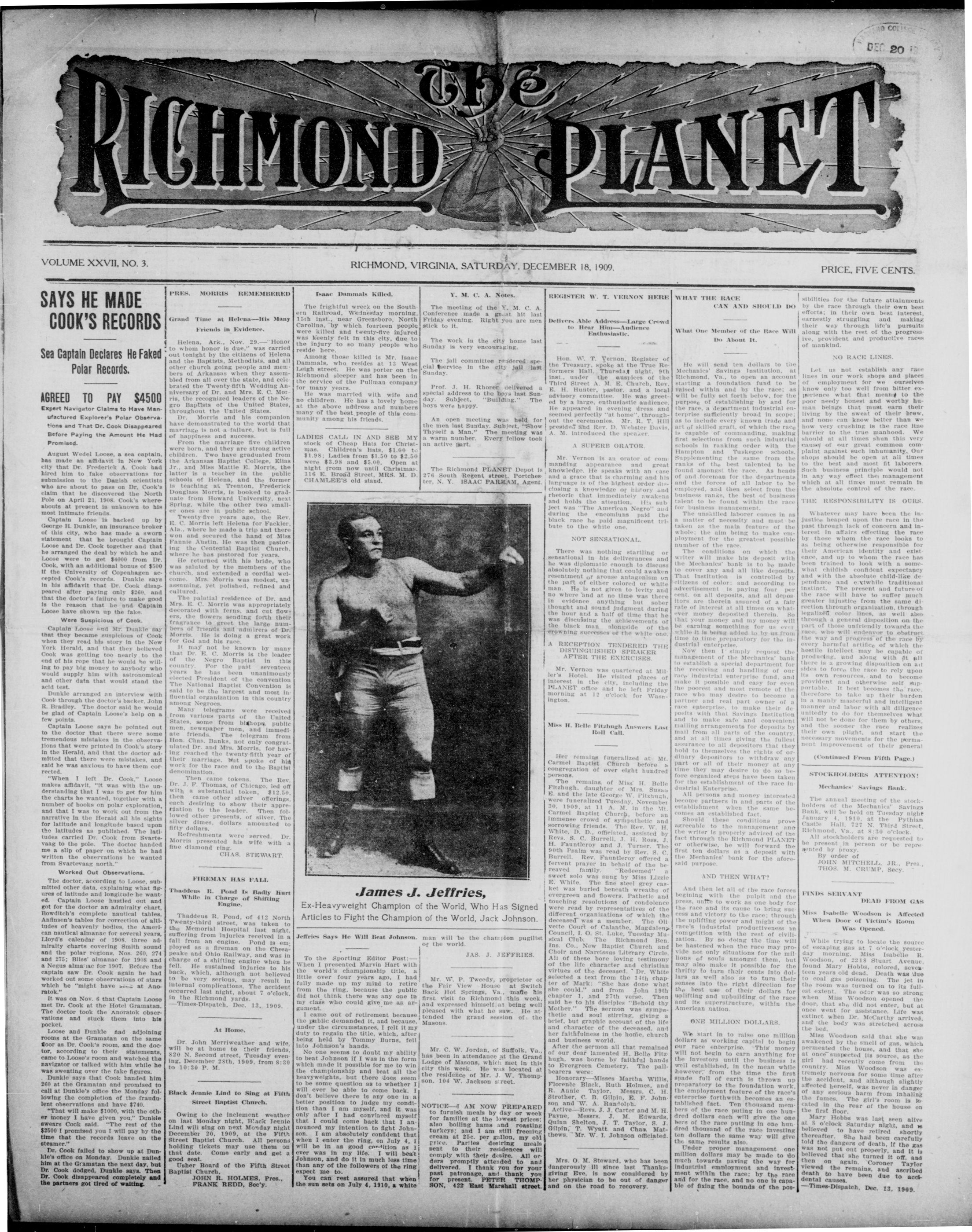
Ex-Heavyweight Champion of the World, Who Has Signed Articles to Fight the Champion of the World, Jack Johnson. Jeffries Says He Will Beat Johnson. man will be the champion puglist of the world.
Isaac Dammals Killed.
The frightful wreck on the Southern Railroad, Wednesday morning, 15th inst., near Greensboro, North Carolina, by which fourteen people were killed and twenty-five injured was keenly felt in this city, due to the injury to so many people who reside here.
Among those killed is Mr. Isaac Dammals, who resides at 13 West Leigh street. He was porter on the Richmond sleeper and has been in the service of the Pullman company for many years.
He was married with wife and no children. He has a lovely home at the above address and numbers many of the best people of this community among his friends.
LADIES CALL IN AND SEE MY stock of cheap Hats for Christmas. Children's Hats, $1.00 to $1.98; Ladies from $1.50 to $2.50 were $3.98 and $5.00. Open at night from now until Christmas. 316 E. Broad Street, MRS. M. D. CHAMLEE'S old stand.
James J.
Ex-Heavyweight Champion of
Articles to Fight the Champion
Jeffries Says He Will Beat Johnson.
To the Sporting Editor Post:—When I presented Marvin Hart with the world's championship title, a little over four years ago, I had fully made up my mind to retire from the ring, because the public did not think there was any one in my class who could give me an argument.
I came out of retirement because the public demanded it, and because, under the circumstances, I felt it my duty to regain the title, which, after being held by Tommy Burns, fell into Johnson's hands.
No one seems to doubt my ability to beat Johnson if I was in the form which made it possible for me to win the championship and beat all the heavyweights, but there does seem to be some question as to whether I will ever be able to come back. I don't believe there is any one in a better position to judge my condition than I am myself, and it was only after I had convinced myself that I could come back that I announced my intention to fight Johnson. I am absolutely confident that when I enter the ring, on July 4, I will be in as good condition as I ever was in my life. I will beat Johnson, and do it in much less time than any of the followers of the ring expect me to.
You can rest assured that when the sun sets on July 4, 1910, a white
---
Y. M. C. A. Notes.
The meeting of the Y. M. C. A. Conference made a great hit last Friday evening. Right you are men stick to it.
The work in the city home last Sunday is very encouraging.
The jail committee rendered special service in the city jail last Sunday.
Prof. J. H. Rhorer delivered a special address to the boys last Sunday. Subject, "Building." The boys were happy.
An open meeting was held for the men last Sunday. Subject, "Show Thyself a Man." The meeting was a warm number. Every fellow took an active part.
The Richmond PLANET Depot is 276 South Regent street, Portches
ter, N. Y. ISAAC PARRAM, Agent
Jeffries,
of the World, Who Has Signed
of the World, Jack Johnson.
man will be the champion pugilist
of the world.
JAS. J. JEFFRIES
Mr. W. P. Tweedy, proprietor of the Fair View House at Switch Back Hot Springs, Va., mailed his first visit to Richmond this week and expressed himself as being well pleased with what he saw. He attended the grand session of the Masons.
Mr. C. W, Jordan, of Suffolk, Va. has been in attendance at the Grand Lodge of Masons, which met in this city this week. He was located at the residence of Mr. J. W. Thompson. 104 W. Jackson street.
NOTICE—I AM NOW PREPARED to furnish meals by day or week for families at the lowest prices; also boiling hams and roasting turkeys; and I am still freezing cream at 25c. per gallon, my old price. Parties desiring meals sent to their residences will comply with their desire. All orders promptly attended to and delivered. I thank you for your past patronage, and thank you for present. PETER THOMPSON, 422 East Marshall street.
Delivers Able Address-Large Crowd to Heartfelt Audience
Enthusiastic
Hon. W. T. Vernon. Register of the Treasury, spoke at the True Reformers Hall. Thursday night, 9th inst., under the auspices of the Third Street A. M. E. Church, Rev. E. H. Hunter, pastor, and a local advisory committee. He was greeted by a large, enthusiastic audience. He appeared in evening dress and seemed perfectly "at home", throughout the ceremonies. Mr. R. T. Hill presided and Rev. D. Webster Davis, A. M. introduced the speaker.
A SUPERB ORATOR
Mr. Vernon is an orator of commanding appearance and great knowledge. He speaks with an case and a grace that is charming and his language is of the highest order disclosing a knowledge of history and rhetoric that immediately awakens and holds the attention. His subject was "The American Negro" and during the encomiens paid the black race he paid magnificent tribute to the white one.
NOT SENSATIONAL
There was nothing startling or sensational in his deliverances and he was diplomatic enough to discuss absolutely nothing that could awaken resentment or arouse antagonism on the part of either colored or white man. He is not given to levity and no where and at no time was there in evidence anything but sober thought and sound judgment during the hour and a half of time that he was discussing the achievements of the black man alongside of the crowning successes of the white one.
A RECEPTION TENDERED THE DISTINGUISHED SPEAKER AFTER THE EXERCISES.
Mr. Vernon was quartered at Miller's Hotel. He visited places of interest in the city, including the PLANET office and he left Friday morning at 12 o'clock for Washington.
Miss H. Belle Fitzhugh Answers Last Roll. Call.
Her remains funeralized at Mt Carmel Baptist Church before a congregation of over eight hundred persons.
The remains, of Miss H. Belle Fitzhugh, daughter of Mrs. Susan E. and the late George W. Fitzhugh, were funeralized Tuesday, November 30, 1909, at 11 A. M. in the Mt. Carmel Baptist Church, before an immense crowd of sympathetic and sorrowing friends. The Rev. W. H. White, D. D., officiated, assisted by Revs. S. C. Burrell, J. H. Ross, J. H. Fauntleroy and J. Turner. The 90th Psalm was read by Rev. S. C. Burrell. Rev. Fauntleroy offered a fervent prayer in behalf of the bereaved family. "Redeemed" a sweet solo was sung by Miss Lizzle E. White. The fine steel grey casket was buried beneath wreaths of evergreen and flowers. Pathetic and touching resolutions of condolence were read by representatives of the different organizations of which the deceased was a member. The Oil vette Court of Calanthe, Magdalene Council, I. O. St. Luke, Tuesday Musical Club. The Richmond Ben. Ins. Co., New Baptist Church and Choir and Narcissus Literary Circle. All of these bore loving testimony of the life character and Christian virtues of the deceased. Dr. White selected a text from the 14th chapter of Mark: "She has done what she could." and from John 19th chapter 1, and 27th verse. Then he said he to his disciples "Behold the Mother." The sermon was sympathetic and soul stirring, giving a brief, but graphic account of the life and character of the deceased, and her faithfulness in the home, church and business world.
After the sermon all that remained of our dear lamented H. Belle Fitzhugh, was borne by faithful hands to Evergreen Cemetery. The pall-bearers were:
Honorary—Misses Martha Willis, Florence Black, Ruth Holmes, and R. Annie Taylor, Messrs. C. H. Strother, C. B. Gilpin, E. F. Johnson and W. A. Randolph.
Active—Revs. J. J. Carter and M. H. Payne, Messrs. J. M. Edwards, Quinn Shelton, J. T. Taylor, S. J. Gilpin, T. Wyatt and Chas. Matthews. Mr. W. I. Johnson officiated.
Mrs. O. M. Steward, who has been dangerously ill since last Thanksgiving Eve, is now considered by her physician to be out of danger and on the road to recovery.
CAN AND SHOULD DO
He will send ten dollars to the Mechanics' Savings Institution, at Richmond, Va., to open an account starting a foundation fund to be raised within and by the race; as will be fully set forth below, for the purpose of establishing by and for the race, a department industrial enterprise sufficiently broad in scope; as to include every known trade and art of skilled graft, of which the race is capable of commanding, making first selections from such industrial schools in ranking order with the Hampton and Tuskegee schools. Supplementing the same from the ranks of the best talented to be found amongst the race. As heads of and foreman for the departments and the forces of all labor to be employed, and then select from the business ranks, the best of business talent to be found within the race for business management. The unskilled laborer comes in as a matter of necessity and must be taken as the main feature of the whole; the aim being to make employment for the greatest possible number of the race.
The conditions on which the writer will make his deposit with the Mechanics' bank is to be made to cover any and all like deposits. That institution is controlled by citizens of color; and according to advertisement is paying four per cent. on all deposits, and all depositors are therein assured of a fair rate of interest at all times on whatever money deposited therein. So that your money and my money will be earning something for us ever while it is being added to by us from time to time preparatory for the industrial enterprise.
Now then I simply request the management of the Mechanics' bank to establish a special department for the receiving and handling of our race industrial enterprise fund, and make it possible and easy for even the poorest and most remote of the race who may desire to become a partner and real part owner of a race enterprise, to make their deposits with that Savings Institution and to make safe and convenient mailing arrangements for deposits by mail from all parts of the country, and at all times giving the fullest assurance to all depositors that they hold to themselves the rights of ordinary depositors to withdraw any part or all of their money at any time they may desire to do so before organized steps have been taken for the establishment of the race industrial Enterprise.
All persons and money interested become partners in and parts of the establishment when the same becomes an established fact. Should these conditions prove agreeable to the management and the writer is properly advised of the fact through the Richmond PLANET or otherwise, he will forward the first ten dollars as a deposit with the Mechanics' bank for the aforesaid purpose.
AND THEN WHAT?
And then let all of the race forces begin with the pulpit and the press, unite to work as one body for the race and its cause to bring success and victory to the race; through the uplifting power and might of the race's industrial productiveness an competition with the rest of civilization. By so doing the time will be hastened when the race may provide not only situations for the millions of souls amongst them, but may also make it possible for the thrifty to turn their cents into dollars as well as also to turn their senses into the right direction for the best use of their dollars for uplifting and upbuilding of the race and its superstructure, within the American nation.
ONE MILLION DOLLARS
We start in to raise one million dollars as working capital to begin our race enterprise. This money will not begin to earn anything for the investors until the business is well established, in the mean while however, from the time the first spade full of earth is thrown up preparatory to the foundation work, the employment feature of the race enterprise forthwith becomes an established fact. Ten thousand members of the race putting in one hundred dollars each will give the one bers of the race putting in one hundred thousand of the race investing ten dollars the same way will give the same results also.
Under proper management one million dollars may be made to do much towards paving the way for industrial employment and investment within the race; by the race and for the race, and no one is capable of fixing the bounds of the pos-
PRICE, FIVE CENTS.
sibilities for the future attainments by the race through their own best efforts; in their own best interest, earnestly struggling and making their way through life's pursuits along with the rest of the progressive, provident and productive races of mankind.
NO RACE LINES
Let us not establish any race lines in our work shops and places of employment for we ourselves know only too well from bitter experience what that means to the poor needy honest and worthy human beings that must earn their living by the sweat of their brow, and none can know better than we how very crushing is the race line barrier to the true manhood. We should at all times shun this very cause of our great common complaint against such inhumanity. Our shops should be open at all times to the best and most fit laborers. Such business principle would not in any way effect the management which at all times must remain in the absolute control of the race.
THE RESPONSIBILITY IS OURS
Whatever may have been the injustice heaped upon the race in the past through lack of concern and interest in affairs effecting the race by those whom the race looks to as being otherwise responsible for their American identity and existence, and up to whom the race has been trained to look with a somewhat childish confident expectancy and with the absolute child-like dependence and extwil traditional instinct. The present and future of the race will have to suffer much greater injustice from the same direction through organization, through legalized color lines, as well also through a general disposition on the part of those unfriendly towards the race, who will endeavor to obstruct the way and progress of the race by every harmful artifice of which the hostile intellect may be capable of producing, and along with it all there is a growing disposition on his sides to force the race to rely upon its own resources, and to become provident and otherwise self supportable. It best becomes the race, therefore to take up their burden in a manly masterful and intelligent manner and labor with all diligence unitedly to do for themselves what will not be done for them by others, and the sooner the race realizes their own plight, and start the necessary movements for the permanent improvement of their general
(Continued From Fifth Page.)
STOCKHOLDERS ATTENTION!
Mechanics' Savings Bank
The annual meeting of the stock-
holders of the Mechanics' Savings
Bank, will be held on Tuesday night
January 4, 1910, at the Pythian
Castle Hall, 727 N. Third Street,
Richmond, Va., at 8:30 o'clock.
All stockholders are requested to
be present in person or be re-
presented by proxy.
By order of
JOHN MITCHELL, JR., Pres.
THOS. M. CRUMP, Secy.
FINDS SERVANT DEAD FROM GAS
Miss Isabelle Woodson is Affected
When Door of Victim's Room
Was Opened.
While trying to locate the source
of escaping gas at 7 o'clock yesterday
morning, Miss Isabelle R. Woodson, of 2218 Stuart Avenue,
found Mary Hobbs, colored, seventeen years old dead. Death was due
to coal gas poisoning. The jet in
the room was turned on to its fullest extent. The odor was so strong when Miss Woodson opened the
door, that she did not enter, but at once went for assistance. Life was
extinct when Dr. McCarthy arrived,
and the body was stretched across
the bed.
Miss Woodson said that she was
awakened by the smell of gas, which
permeated the house, and that she
at once suspected its source, as the
girl had recently come from the
country. Miss Woodson was ex-
tremely nervous for some time after
the accident, and although slightly
affected herself, was never in danger
of any serious harm from inhaling
the fumes. The girl's room is
located in the rear of the house on
the first floor.
Mary Hobbs was last seen alive at S o'clock Saturday night, and he believed to have retired shortly thereafter. She had been carefully told the dangers of death, if the gas was not put out properly, and it is believed that she turned it off, and then on again. Coroner Taylor viewed the remains, and ascribed death to have been due to accidental causes.
—Times-Dispatch, Dec. 13, 1909
TWO
1910
CHAPTER VI.
INTO THE FOO AGAIN.
PRESENTLY she spoke, still playing softly.
"My father was an American, my mother Italian. But I have lived in Europe nearly all my life. There! You have more of my history than I intended telling you." The music went dreamily.
"I knew it! Who but an American woman would have the courage to do what you are doing tonight? Who but one of mine own countrywomen would trust me so wholly and accept me so frankly for what I am—an American gentleman?"
"Softly!" she warned. "You will dig a pit for your vanity."
"No. I am an American gentleman and I am proud of it, though this statement in your ears may have a school boy ring."
"A nobility in this country? Impossible!"
"Not the kind you find in the Almanach de Gotha. I speak of the nobility of the heart and the mind." He was very much in earnest now.
"Indeed!" The music stopped, and she turned. She regarded his earnestness with favor. He continued:
"I have traveled much. I have found noblemen everywhere, in all climes, and also I have found beasts. Oh, I confess that my country is not wholly free from the beast! But the beast here is a beast-shim! . . . discredited, outcast. On the other side, if he be mentioned in the Almanach, they give him sashes and decorations. And they credit us with being money mad! It is not true."
"But, if you are not money mad, why these great fortunes?" dubiously.
"At a certain age a fortune in this country doubles itself without any effort on the part of the owner. Few of us marry for money, and when we do we at least have the manhood to keep the letter of our bargain."
"And when you marry?" she queried.
"Well, it is generally the woman we love. Dowries are not considered.
There is no social law which forbids a dowerless girl to marry a dowerless man," laughing. "But over there it is always and eternally a business contract simply. You know that."
"Yes, a business contract," listlessly.
"But they talk of nobility on the other side. That is it; they talk, talk—Italy, France, Germany! Why, I had rather be the son of an English farmer than a prince on the continent. And I had rather be what I am than the greatest nobleman in England."
"Go on, go on! I like it. What do you call it—jingo?" she laughed.
"Call it what you will. Look at the men we produce. Three or four hundred years ago Europe gave us great poets, great artists, great soldiers, great churchmen and great rascals. I admire a great rascal when he is a Napoleon, a Talleyrand, a Machiavellii. But a petty one! We have no art, no music, no antiquity, but we have a race of gentlemen. The old country is not breeding them nowadays."
"Signora, dinner is served," the maid announced.
"Signora!" thought Hillard.
"After you, Mr. Hillard." she said.
He bowed and passed on before her, but not till he had passed did he understand the maneuver. To follow her would have been nothing less than the temptation to pluck at the strings of her mask. Would he have touched it? He could not say.
That dinner! Was he in New York? Was it not Badgad, the bottle and the genii? Had he ever, even in his most romantic dreams, expected to turn a page so charming, so enchanting or so dangerous to his peace of mind, a game of magical hide and seek?
And she? A whim, a fantastic, unaccountable whim—the whim of a woman seeking forgetfulness, not counting the cost nor caring, simply a whim.
On the little table was a Tuscany brass lamp of three wicks, fed by olive oil. It was sufficient to light the table, but the rest of the room was sunk in darkness. He half understood that there was a definite purpose in this semi-illumination. She had no wish that he should by chance recognize anything familiar in this house.
"May I ask you one question?" he asked.
"No," promptly. There was something in his eyes that made her grow wary of a sudden.
"Then I shan't ask it. I shall not ask you if you are married."
"And I shall not say one way or the other."
She smiled, and he laughed quietly.
A running conversation; a fencing match with words and phrases; time after time she touched him, but with all his skill he could not break through her guard.
"And that interesting dissertation on the American gentleman?" she said fely.
"That's the trouble with posing as a moralist. One must live up to the precepts. Would you believe me if I told you that at the age of three and thirty I am still heart whole?"
She married. "I trust you will not
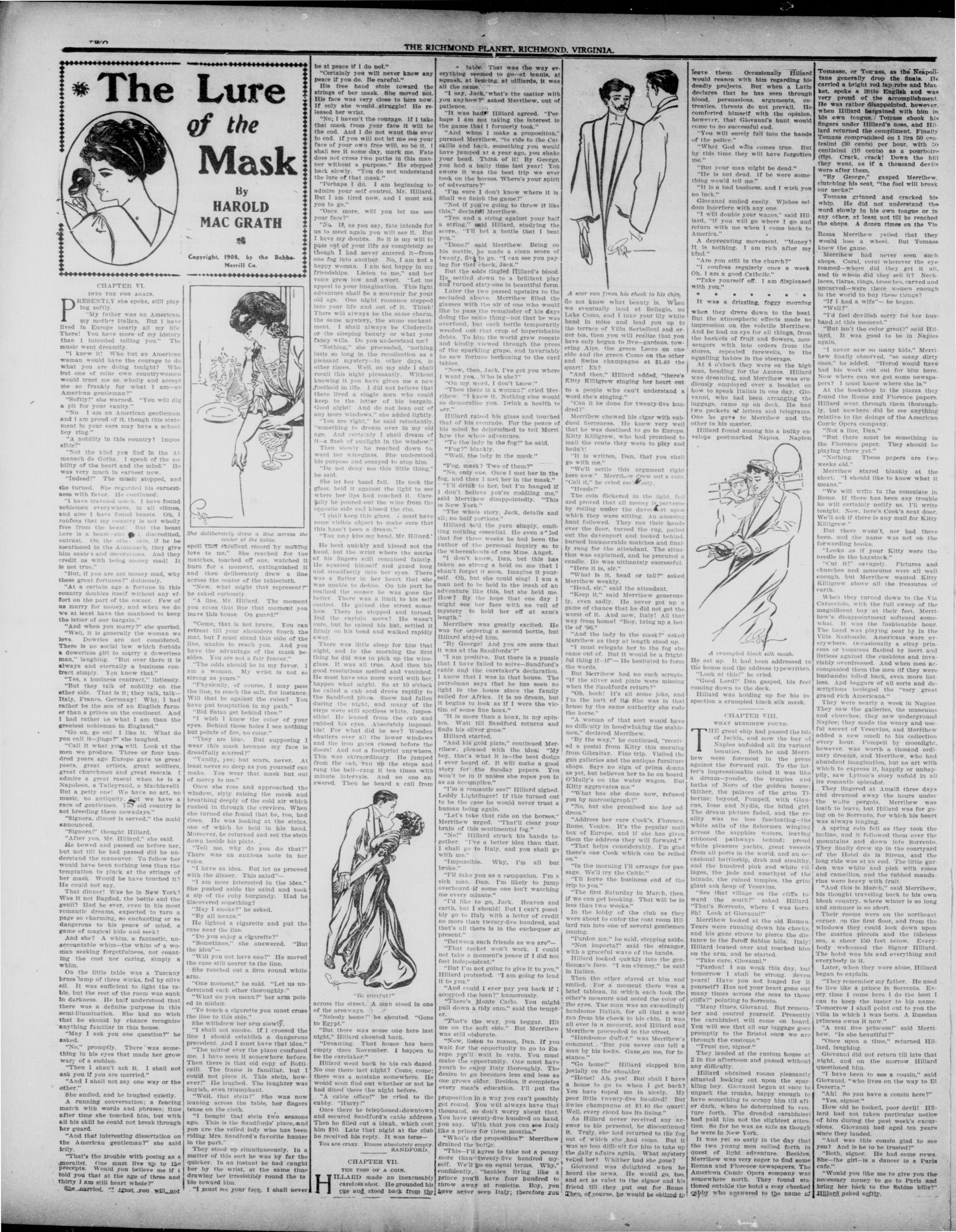
Lure of the Mask
Copyright, 1908, by the Bobbs-
Merrill Co.
P. G.
She deliberately drew a line across the center of the table. spoll that excellent record by making love to me." She reached for the matches, touched off one, watched it burn for a moment, extinguished it and then deliberately drew a line across the center of the tablecloth. "Now, what might that represent?" he asked curiously. "A line, Mr. Hillard. The moment you cross that line that moment you leave this house. On guard!" "Come, that is not brave. You can retreat till your shoulders touch the mat, but I must stand this side of the line, unable to reach you. And you have the advantage of the mask besides. You are not a fair fencer." "The odds should be in my favor. I am a woman. My wrist is not so strong as yours."
"Physically, of course, I may pass the line, to reach the salt, for instance. Will that be against the rules? You have put temptation in my path."
"Bid Satan get behind thee."
"I wish I knew the color of your eyes. Behind those holes I see nothing but points of fire, no color."
"They are blue. But supposing I wear this mask because my face is dreadfully scarred."
"Vanity, yes; but scars, never. At least never so deep as you yourself can make. You wear that mask but out of mercy to me."
Once she rose and approached the window, slyly raising the mask and breathing deeply of the cold air which rushed in through the crevices. When she turned she found that he, too, had risen. He was looking at the steins, one of which he held in his hand. Moreover, he returned and set the stein down beside his plate.
"Tell me, why do you do that?" There was an anxious note in her voice.
"I have an idea. But let us proceed with the dinner. This salad"—
"I am more interested in the idea." She pushed aside the salad and took a sip of the ruby burgundy. Had he discovered something?
"May I smoke?" he asked.
"By all means."
He lighted a cigarette and put the case near the line.
"Do you enjoy a cigarette?"
"Sometimes," she answered. "But the idea"—
"Will you not have one?" He moved the case still nearer to the line.
She reached out a firm round white arm.
"One moment," he said. "Let us understand each other thoroughly."
"What do you mean?" her arm poised in midair.
"To touch a cigarette you must cross the line to this side."
She withdrew her arm slowly.
"I shall not smoke." If I crossed the line I should establish a dangerous precedent. And I must have that idea."
"The mirror over the piano confused me. I have seen it somewhere before. Then there is that old copy of Botticelli. The frame is familiar, but I could not place it. This stein, however?" He laughed. The laughter was boyish, even triumphant.
"Well, that stein?" She was now leaning across the table, her fingers tense on the cloth.
"I bought that stein two seasons ago. This is the Sandfords' place, and you are the velled lady who has been riding Mrs. Sandford's favorite hunter in the park."
They stood up simultaneously. In a matter of this sort he was by far the quicker. In an instant he had caught her by the wrist, at the same time drawing her irresistibly round the table toward him.
"I must see your face. I shall never
THE RICHMOND PLANET, RICHMOND, VIRGINIA
be at peace if I do not."
"Certainly you will never know any peace if you do. Be careful."
His free hand stole toward the strings of her mask. She moved not. His face was very close to hers now. If only she would struggle! He released her wrist.
"No; I haven't the courage. If I take that mask from your face it will be the end. And I do not want this ever to end. If you will not let me see your face of your own free will, so be it. I shall see it some day, mark me. Fate does not cross two paths in this manner without a purpose." He stepped back slowly. "You do not understand the lure of that mask."
"Perhaps I do. I am beginning to admire your self control, Mr. Hillard. But I am tired now, and I must ask you to go."
"Once more, will you let me see your face?"
"No. If, as you say, fate intends for us to meet again you will see it. But I have my doubts. So it is my will to pass out of your life as completely as though I had never entered it—from one fog into another. No, I am not a happy woman. I am not happy in my friendships. Listen to me," and her voice grew low and sweet. "Let me appeal to your imagination. This light adventure shall be a souvenir for your old age. One night romance stepped into your life and out of it. Think! There will always be the same charm, the same mystery, the same enchantment. I shall always be Cinderella or the sleeping beauty or what your fancy wills. Do you understand me?
"Nothing," she proceeded, "nothing lasts so long in the recollection as a pleasant mystery—in other days, in other times. Well, on my side I shall recall this night pleasantly. Without knowing it you have given me a new foothold in life. I did not believe that there lived a single man who could keep to the letter of his bargain. Good night! And do not lean out of any more windows," she added lightly.
"You are right," he said reluctantly, "something to dream over in my old age. And certainly I shall dream of it—a flash of sunlight in the window." Then slowly he reached down toward her wineglass. She understood his purpose and essayed to stop him.
"Do not deny me this little thing," he said.
She let her hand fall. He took the glass, held it against the light to see where her lips had touched it. Carefully he poured out the wine from the opposite side and kissed the rim.
"I shall keep this glass." I must have some visible object to make sure that this hasn't been a dream."
"You may kiss my hand, Mr. Hillard."
He bent quickly and kissed not the hand, but the wrist where the marks of his fingers still remained faintly. He squared himself and gazed long and steadfastly into her eyes. There was a flutter in her heart that she was unable to define. On his part he realized the sooner he was gone the better. There was a limit to his self control. He gained the street somehow. There he stopped and turned. Did the curtain move? He wasn't sure, but he raised his hat, settled it firmly on his head and walked rapidly away.
There was little sleep for him that night, and in the morning the first thing he did was to pick up the wine-glass. It was all true. And then his good resolutions melted and vanished. He must have one more word with her, happen what might. So at 10 o'clock he called a cab and drove rapidly to the Sandford place. Snow had fallen during the night, and many of the steps were still spotless white. Impossible! He leaned from the cab and rubbed his eyes. Absolutely impossible! For what did he see? Wooden shutters over all the lower windows and the iron gates closed before the doors! And not a footprint anywhere. This was extraordinary. He jumped from the cab, ran up the steps and rang the bell—rang it ten times with minute intervals. And no one answered. Then he heard a call from
C. G.
"Be careful!"
across the street. A man stood in one of the areaways.
"Nobody home" he shouted. "Gone to Egypt."
"But there was some one here last night," Hillard shouted back.
"Dreaming. That house has been empty since November. I happen to be the caretaker."
Hillard went back to his cab dazed. No one there last night? Come, come; there was a mistake somewhere. He would soon find out whether or not he had dined there the night before.
"A cable office!" he cried to the cabby. "Hurry."
Once there he telephoned downtown and secured Sandford's cable address. Then he filled out a blank, which cost him $10. Late that night at the club he received his reply. It was terse—
You are crazy. House absolutely groovy.
House absolutely empty
SANDFORD.
CHAPTER VII.
ILLARD made an inexcusbly careless shot. He grounded his gue and stood back from the
table. That was the way every thing seemed to go—at tennis, at squash, at lencing, at billiards, it was all the same.
"I say, Jack, what's the matter with you anyhow?" asked Merrilhew, out of patience.
"It was bad!" Hillard agreed. "Perhaps I am not taking the interest in the game that I formerly took."
"And when I make a proposition," pursued Merrilhew, "to ride to the Catskills and back, something you would have jumped at a year ago, you shake your head. Think of it! By George, you had a bully time last year! You swore it was the best trip we ever took on the horses. Where's your spirit of adventure?"
"I'm sure I don't know where it is. Shall we finish the game?"
"Not if you're going to throw it like this," declared Merrilhew.
"Ten and a string against your half a string," said Hillard, studying the score, "I'll bet a bottle that I beat you."
"Done!" said Merrihew. Being on his mettle, he made a clean score of twenty, five to go. "I can see you paying for that check, Jack."
But the odd tinged Hillard's blood. He settled down to a brilliant play and turned sixty-one in beautiful form.
Later the two passed upstairs to the secluded alcove. Merrihew filled the glasses with the air of one who would like to pass the remainder of his days doing the same thing—not that he was overfond, but each bottle temporarily weeded out that crop of imperishable debts. To him the world grew rosette and kindly viewed through the press of the sparkling grape, and invariably he saw fortune beckoning to the card tables.
"Now, then, Jack. I've got you where I want you. Who is she?"
"On my word. I don't know."
"Then there is a woman" cried Merrihew. "I knew it. Nothing else would so demoralize you. Drink a health to her."
Hillard raised his glass and touched that of his comrade. For the peace of his mind he determined to tell Merrihew the whole adventure.
"To the lady in the fog" he said.
"Fog?" blankly.
"Well, the lady in the mask."
"Fog, mask? Two of them?"
"No, only one. Once I met her in the fog, and then I met her in the mask."
"I'll drink to her, but I'm hanged if I don't believe you're coddling me," said Merrihew disappointedly. "This is New York."
"The whole story, Jack, details and all; no half portions."
Hillard told the yarn simply, omitting nothing essential. He even a"Jed that for three weeks he had been the author of the personal inquiry as to the whereabouts of one Mine. Angot.
"I don't know, Dan, but this has taken so strong a hold on me that I shan't forget it soon. Imagine it yourself. Oh, but she could sing! I am a man not to be held in the leash of an adventure like this, but she held me. How? By the hope that one day I might see her face with no veil of mystery to hold her off at arm's length."
Merrihew was greatly excited. He was for ordering a second bottle, but Hillard stayed him.
"By George! And you are sure that it was at the Sandfords?"
"I am positive. But there is a puzzle that I have failed to solve—Sandford's cable and the caretaker's declaration. I know that I was in that house. The patrolman says that he has seen no light in the house since the family sailed for Africa. It is no dream, but it begins to look as if I were the victim of some fine hoax."
"It is more than a hoax, in my opinion. Wait till Sandford returns and finds his silver gone."
Hillard started.
"And his gold plate," continued Merrihew, pleased with the ideal "My boy, that's what it is—the best dodge I ever heard of. It will make a good story for the Sunday papers. You won't be in it unless she ropes you in as an accomplice."
"I'm a romantic ass!" Hillard sighed. Leddy Lightfinger! If this turned out to be the case he would never trust a human being again.
"Let's take that ride on the horses," Merrihew urged. "That'll clear your brain of this sentimental fog."
"No!" Hillard struck his hands together. "I've a better idea than that. I shall go to Italy, and you shall go with me."
"Impossible. Why, I'm all but broke."
"I'll take you as a companion. I'm a sick man, Dan. I'm likely to jump overboard if some one isn't watching me every minute."
"I'd like to go, Jack. Heaven and earth, but I should. But I can't possibly go to Italy with a letter of credit no more than twenty-five hundred, and that's all there is in the exchequer at present."
"Between such friends as we are"—
"That racket won't work. I could not take a moment's peace if I did not feel independent."
"But I'm not going to give it to you." Hillard protested. "I am going to lend it to you."
"And could I ever pay you back if I accepted the loan?" humorously.
"There's Monte Carlo. You might pull down a tidy sum," said the tempter.
"That's the way, you beggar. Hit me on the soft side." But Merrihew was still obdurate.
"Now, listen to reason, Dan. If you wait for the opportunity to go to Europe yon'll wait in vain. You must make the opportunity. One must have youth to enjoy Italy thoroughly. The desire to go becomes less and less as one grows older. Besides, it completes every man's education. I'll put the proposition in a way you can't possibly get round. You will always have that thousand, so don't worry about that. You have twenty-five hundred on hand, you say. With that you can see Italy like a prince for three months." "What's the proposition?" Merrifew drained the bottle.
"This—I'll agree to take not a penny more than twenty-five hundred myself. We'll go on equal terms. Why?" confidently, "besides living like a prince you'll have four hundred to throw away at roulette. Boy, you have never seen Italy; therefore you
C.
A scar ran from his check to his chin.
do not know what beauty is.
when we eventually land at Bellagio, on
Lake Como, and I take your illly white
hand in mine and lead you up to
the terrace of Villa Serbelloni and or-
der tea, then you will realize that you
have only begun to live--gardens, tow-
ering Alps, the green Lecco on one
side and the green Como on the other
and Swiss champagne at $1.40 the
quart! Eh?
"And then," Hillard added, "there's
Kitty Killigrew singing her heart out
to a people who can't understand
a word she's singing."
"Can it be done for twenty-five
hundred?"
Merritt chewed his cigar with sub-
dued fierceness. He knew very well
that he was destined to go to Europe.
Kitty Killigrew, who had promised to
mail the route they were to play and
hadn't!
"It is written, Dan, that you shall
go with me."
"We'll settle this argument right here now." Merrilhew drew out a coin "Call it," he cried recklessly. "Heads!" The coin flickered in the light, felt and proved that all money is perverse by rolling under the davenport upon which they were sitting. An amusing hunt followed. They ran their hands over the floor, turned the rug, pulled out the davenport and looked behind, burned innumerable matches and finally rang for the attendant. The situation was explained, and he procured a candle. He was ultimately successful. "Here it is, sir." "What is it, head or tail?" asked Merrilhew weakly. "Head, sir," said the attendant. "Keep it," said Merrilhew generously, even sadly. He never got up a game of chance that he did not get the worst of it. And now, Italy! All that way from home! "Boy, bring up a bottle of '96."
"And the lady in the mask?" asked Merrhew as they at length stood up. "I must relegate her to the fog she came out of. But it would be a frightful thing if—if"—He hesitated to form the words.
But Merrhew had no such scruple. "If the silver and plate were missing when the Sandfords return?" "Oh. bosh! It's all some joke, and I'm the butt of it. She was in that house by the same authority she rode the horse."
"A woman of that sort would have no difficulty in hoodwinking the stablemen," declared Merrhew.
"By the way," he continued, "received a postal from Kitty this morning from Gibraltar. Fine trip. Visited the gun galleries and the antique furniture shops. Says no sign of prima donna as yet, but believes her to be on board. O'Mally's on the water wagon. But Kitty aggravates me."
"What has she done now, refused you by marconigraph?"
"No, but she promised me her address."
"Address her care Cook's, Florence, Rome, Venice. It's the popular mail box of Europe, and if she has given them the address they will forward."
"That helps considerably. I'm glad there's one Cook which can be relied on."
"In the morning I'll arrange for passage. We'll try the Celtic."
"I'll leave the business end of the trip to you."
"The first Saturday in March, then, if we can get booking. That will be in less than two weeks."
In the lobby of the club as they were about to enter the coat room Hillard ran into one of several gentlemen issuing.
"Pardon me," he said, stepping aside.
"Non importa!" said the stranger, with a graceful wave of the hands.
Hillard looked quickly into the gentleman's face. "I am clumsy," he said in Italian.
Then the other stared at him and smiled. For a moment there was a brief tableau, in which each took the other's measure and noted the color of the eyes. The man was an exceedingly handsome Italian, for all that a scar ran from his cheek to his chin. It was all over in a moment, and Hillard and Merrithw proceeded to the street.
"Handsome duffer," was Merrithw's comment. "But you never can tell a man by his looks. Gaze on me, for instance."
"Go home!" Hillard slapped him jovially on the shoulder.
"Home! Ah, yes! But shall I have a home to go to when I get back? You have roped me in nicely. My poor little twenty-five hundred! But Swiss champagne at $1.40 the quart! Well, every cloud has its lining."
As Hillard never received any answer to his personal, he discontinued it. Truly, she had returned to the fog out of which she had come. But it was no less difficult for him to take up the daily affairs again. What mystery veiled her? Whither had she gone?
Gloyauil was delighted when he heard the news. He would go, too, and act as valet to the signor and his friend till they put out for Rome. Then, of course, he would be obliged to
leave them. Occasionally Hillard would reason with him regarding his deadly projects. But when a Latin declares that he has seen through blood, persuasions, arguments, entreaties, threats do not prevail. He comforted himself with the opinion, however, that Giovanni's hunt would come to no successful end.
"You will surely fall into the hands of the police."
"What God wills comes true. But by this time they will have forgotten me."
"But your man might be dead."
"He is not dead. If he were something would tell me."
"It is a bad business, and I wish you no luck."
Giovanni smiled easily. Wjhes seldom interfere with any one.
"I will double your wages," said Hillard. "if you will go where I go and return with me when I come back to America."
A deprecating movement. "Money?
It is nothing. I am rich after my knd."
"Are you still in the church?"
"I confess regularly once a week.
Oh. I am a good Cathcille."
"Take yourself off. I am displeased with you."
It was a drizzling, foggy morning
when they drove down to the boat.
But the atmospheric effects made no impression on the volatile Merrithew.
And he had an eye for all things, from the baskets of fruit and flowers, messengers with late orders from the stores, repeated farewells, to the squalling babies in the steerage.
At 4 o'clock they were on the high seas, heading for the Azores. Hillard was dreaming, and Merrihew was studiously employed over a booklet on how to speak Italian in one day. Giovanni, who had been arranging the luggage, came up on deck. He had two packets of letters and telegrams. One he gave to Merrihew and the other to his master.
Hillard found among his a bulky envelope postmarked Naples. Naples
C. F.
A crumpled black silk mask. He sat up. It had been addressed to the house and the address typewritten. "Look at this!" he cried. "Good Lord!" Dan gasped, his feet coming down to the deck. Hillard was holding up for his inspection a crumpled black silk mask.
CHAPTER VIII
THE great ship had passed the Isle of Ischia, and now the bay of Naples unfolded all its variant
beauties. Both he and Merrihhew were foremost in the press against the forward rail. To the latter's impressionable mind it was like a dream-yonder, the temples and baths of Nero of the golden house; thither, the palaces of the grim Tiberius; beyond, Pompell, with Glaucus, Ione and Nydia, the blind girl. The dream picture faded, and the reality was no less fascinating—the white sails of the fishermen winging across the sapphire waters, leaving ribboned pathways behind; proud white pleasure yachts, great vessels from all ports in the world, and an occasional battleship, drab and stealthy, and the hundred pink and white villages, the jade and amethyst of the islands, the ruined temples, the grim giant ash heap of Vesuvius.
"See that village on the cliffs toward the south?" asked Hillard. "That's Sorrento, where I was born. Sh! Look at Glovanni!"
Merrhrew looked at the old Roman.
Tears were running down his cheeks,
and his gaze strove to pierce the distance to the faroff Sabine hills. Italy!
Hillard leaned over and touched him on the arm, and he started.
"Take care, Glovanni."
"Pardon! I am weak this day, but tomorrow I shall be strong. Seven years! Have you not longed for it yourself? Has not your heart gone out many times across the seas to those cliffs?" pointing to Sorrento.
"Many times, Glovanni. But remember and control yourself. Presently the carabinier will come on board. You will see that all our luggage goes promptly to the Bristol once we are through the customs."
"Trust me, signor."
They landed at the custom house at 2 in the afternoon and passed without any difficulty.
Hillard obtained rooms pleasantly situated looking out upon the sparkling bay. Glovanni began at once to unpack the trunks, happy enough to have something to occupy him till after dark, when he determined to venture forth. The dreaded carabinerl had paid him not the slightest attention. So far he was as safe as though he were in New York.
It was yet so early in the day that the two young men sailed forth in quest of light adventure. Besides, Merrihew was very eager to find some Roman and Florence newspapers. The American Comic Opera company was somewhere north. They found stationed outside the hotel a rosy cheeked gabby who answered to the name of
Tomasso, or Torass, as the Neapolitans generally drop the finals. He carried a bright red lap robe and blanket, spoke a little English and was very proud of the accomplishment. He was rather disappointed, however, when Hillard bargained with him in his own tongue. Tomass shook his fingers under Hillard's nose, and Hillard returned the compliment. Finally Tomass compromised on 1 lira 50 centimis (30 cents) per hour, with 50 centimis (10 cents) as a pouboirie (tip). Crack, crack! Down the hill they went, as if a thousand devils were after them.
"By George," gasped Merthew, clutching his seat, "the fool will break our necks!"
Tomass grinned and cracked his whip. He did not understand the word slowly in his own tongue or in any other, at least not till he reached the shops. A dozen times on the Vla
Roma Merrihew yelled that they would lose a wheel. But Tomass knew the game.
Merrihew had never seen such shops. Coral, coral wherever the eye roamed—where did they get it all, and to whom did they sell it? Necklaces, tiaras, rings, broaches, carved and uncarved—were there women enough in the world to buy these things?
"If I had a wife"—he began.
"Well?"
"I'd feel devilish sorry for her husband at this moment."
"But isn't the color great?" said Hillard. It was good to be in Naples again.
"I never saw so many kids," Merrihew finally observed. "so many dirty ones," he added. "Hero would have had his work cut out for him here. Now where can we get some newspapers? I must know where she is."
At the bookshop in the plaza they found the Rome and Florence papers. Hillard went through them thoroughly, but nowhere did he see anything relative to the dolings of the American Comic Opera company.
"Not a line, Dan."
"But there must be something in the Florence paper. They should be playing there yet."
"Nothing. These papers are two weeks old."
Merrithw stared blankly at the sheet. "I should like to know what it means."
"We will write to the consulate in Rome. If there has been any trouble he will certainly notify us. I'll write tonight. Now, here's Cook's next door. We'll ask if there is any mail for Kitty Killigrew."
But there wasn't, nor had there been, and the name was not on the forwarding books.
"Looks as if your Kitty were the needle in the haystack."
"Cut It!" savagely. Pictures and churches and museums were all well enough, but Merrihew wanted Kitty Killigrew above all the treasures of earth.
When they turned down to the Via Caracciolo, with the full sweep of the magnificent bay at their feet, Merrihew's disappointment softened somewhat. It was the fashionable hour. The band was playing near by in the Villa Nazionale. Americans were everywhere. Occasionally a stray princess or 'countess flashed by inert and listless against the cushions and invariably overdressed. And when men accompanied them the men (if they were husbands) lolled back, even more listless. And beggars of all sorts and descriptions besieged the "very great grand rich Americans."
They were nearly a week in Naples. They saw the galleries, the museums and churches; they saw underground Naples; they made the weary and useful ascent of Vesuvius, and Merrilhew added a new smell to his collection every hour. Pompeli by moonlight, however, was worth a thousand ordinary dreams, and Merrilhew, who had abundant imagination, but no art with which to express it, happily or unhappily, saw Lytton's story unfold in all its romantic splendor. They lingered at Amalfi three days and dreamed away the hours under the white pergola. Merrilhew was loath to leave, but Hillard was for going on to Sorrento, for which his heart was always longing.
A spring rain fell as they took the incline, and it followed them over the mountains and down into Sorrento. They finally drew up in the courtyard of the Hotel de la Sirena, and the long ride was at an end. The little garden was white and pink with roses and camellias, and the tubed mandarins were heavy with fruit.
"And this is March," said Merrihew, his thought travelling back to his own bleak country, where winter is so long and summer is so short.
Their rooms were on the northeast corner, on the first floor, and from the windows they could look down upon the marina piccola and the tideless sea, a sheer 150 feet below. Everybody welcomed the Signor Hillard. The hotel was his and everything and everybody in it.
Later, when they were alone, Hillard began to explain.
"They remember my father. He used to live like a prince in Sorrento. Every time I come here I do the best I can to keep the luster to his name. Tomorrow I shall point out to you the villa in which I was born. A Russian princess owns it now."
"A real live princess!" said Merrihew. "Is she beautiful?"
"Once upon a time," returned Hillard, laughing. Glovanni did not return till late that night, and on the morrow Hillard questioned him.
"I have been to see a cousin," said Glovanni, "who lives on the way to El Deserta."
"Ah! So you have a cousin here?"
"Yes, signor."
How old be looked, poor devil! Hillard had not taken particular notice of him during the past week's excursions. Glovanni had aged ten years since they landed.
"And was this cousin glad to see you? And is he to be trusted?"
"Both, signor. He had some news. She—the girl—is a dancer in a Paris cafe." "Would you like me to give you the necessary money to go to Paris and bring her back to the Sabine hills?" Hillard asked softly.
mains ema
ean aT RYs .
Payee
HAR AANET.
Ci Ss
_ zt = by
SATURDAY...-...DEOL 1m, 1900
~ “T shall go to Paris, signor—after”
“What fs bis name?” Hillard had
never till this moment asked this ques.
tion,
“I know it. That ts sufficient. He
ts high, signor. very high, yet 1 shall
reach him. If I told you his name”—
“There wonld be the posstbiity of
wy warning hil.”
“That is why T hesitate.”
“¥on are a Catholic. Glovannt.”
Glovannt signified that he was.
“Does not the God of all Cathoilcs,
‘9g all Christians, In fact—does he not
say that vengeance is bis and that he
will repay?”
“But there are so many of us, st
‘Ruor, So Many of Us small and of slight
smportance, that, likely enough, God,
with all his larger cares, bas not the
tine to remember us What may bap-
pen to him tn the hereafter does not
concern me, for he will certainly be
fu the purgatory of the rich and I fn
the purgatory of the poor. It must be
now, now!
“Go your own way," ua Hillard,
dismissing him. “I sha:l never urge
you again."
Glovaunt gone, Hillard teaned against
the casement. ‘The sun was bright this
morning, amt the air was clear. He
could seo Naples distinctly. Below,
the fishermen and their wives, their
bare feet plowing tn the wet sands,
were drawing tn the nets, swaying
thelr bodies gracefully.
And then Merrihew burst tn upon
him wildly excited and flourished the
hotel register.
“Look at this!” he erled breathless.
ly. He flung the book on the table and
Polpted with shaking finger.
Hillard came forward, and this ts
what be saw:
‘Thomas O*Matly
James Senith
‘Arthur Worth
La Stxnorina Capricciosa
Kitty Killigrew
Am. Comle Opera Co., N. ¥.
“Kitty has been here!"
“Perfectly true. But 1 wonder"—
“Wonder about what?" asked Merri-
hhew.
“Who La Sisnorina Capricciosa ts
Whimsical, indeed. She must be the
mysterious prima donna.”
Millard studied the easy flowing
hard and ran bis fingers through his
fate rhousbtcutty.
What i 17 asked Merrthew curi
ents
{om wondering where [have seen
Hoof hawdwerttin before”
\wother fertnizht found the pate
tak in Napies aftor sqvending a week
on Capel At the hotel they found a
fateh of mwth There wis a better
which held particular interest to Mer
rihew It was frome the consul at
Rome, a rely te Hittard’s Inquiries
regarding the Awert an Comic Opera
company
“We'll new thd out where your
charming Kitty i” Willard sald,
breaking the sea,
Bot they didn't On the contrary,
the writer hadn't the slightest Idea
where the play uctors were or had
gone. They had opened a two weeks"
engagement at the Teatro Quirino,
There had been a good house on th:
opening night. The remainder of the
Week did not show the sale of a bun:
dred Uckets, The American manager
had shown ucither foresight nor com-
mon sense, and his bicker withdrew
bis support. The percentage demand-
<4 by the managers In Florence, Genoa,
Milan and Venice was #0 exotbi
tant (although they had agreed to a
moderate term in the beginning) that
At would have been nothing short of
foolhardiness to try to fill the book-
ings. The singing of the prima donna,
6 % ss
ANS
\
“Y
Ie
Ie BS
Sz
however, had created a highly favora-
ble impression among the critics, bul
she was unknown. The writer also
advised Mr. Hillard not to put his
money im any like adventure.
“That's hard luck,” growled Merri
hew, who saw his hopes go down the
horizon.
“But it makes me out a pretty good
Prophet,” was Hillard’s rejoinder.
“The angel's money gave out. Toc
many obstacles. To conquer 2 people
and a government by light opera—it
can't be done here. And so the Ameri
can Comic Opera company at the pres-
ent moment 1s yegetating in some little
Roarding house waiting for money
w MMerriiew gnawed the end of his
cane. All his pleasant dreams had
burst lke soap bubbles. Had they not
always done so? There would be uo
Jaunts with Kitty, uo pleasant little
excursions, no litte suppers after the
performance. And what's a Michel-
angelo or a Titian when a man’s in love?
“Brace up, Dan, Who knows? Kitty
may be on the high seas—that Is, if
She bas taken my advice and got a
return ticket. I'l give you a dinner at
the Bertotini tonight, and yon may
have the mui of any vintage you
like. We'll bave Tomass drive us down
the Vin Caracefolo. It will take some
of the dissppointment out of your
fystem.”
‘They had ridden up and down the
Via Caracciolo twice when they espied
& huge automobile, ultramarine biue
It piissed with a cloud of dust and a
rumble which was thunderous. Hillard
half rose from his seat.
“Somebody you know?" asked Merri-
hew
“The tan at the wheel looked @ bit
ike Sandford.”
“Sandford? By George, that would
be jolly!”
“Perhaps they will come this way
again, Tomas, follow that motor.”
Sure enough, when the car reached
the Largo Vittoria it wheeled and
came rumbling back. This time Hl
lard had no doubts. He stood up and
waved his arms. The automobile
barked and groaned and came to a
stand
“Hello, Sandford!
“Jack Hillard, as 1 lve, and Dan
Merribew! Nell," turning to one of
the three pretty women In the ton
neau, “what did I tell you? 1 felt
It in my bones that we would run
Across some one we knew.”
“Or over them,” bis wife laughed.
When we meet an old friend in a
foreign land, one who bas accepted
our dinners and with whom we have
often dined, what is left but to fall on
his neck and weep? There was. then,
over this meeting much ado witb hand.
shaking and compliments, handsbak-
ing and questions, and, as tn all eases
Uke this. every one talked at once—
how was old New York, how was
the winter in Cairo, and so forth
and so op—till- a policeman. politely
told them that this was not a private
thoroushfare and that they were
blocking the way. So they parted, the
two young men having promised to
dine with the Sandford party that
evening,
“What luck, Dan!” Hillard was ex.
uberant
“Saves you the price of a dinner.”
“I wasn't thinking of that. But 1
shall find out all about her tonight.”
Who?"
“The Indy in the fog, the masquer.
ading lady!
{ro ne conTINcED.)
|The Mar itacture of Plate Glass.
The casting table of a plate glass
| factory ix about twenty feet long. Bf
teen feet wide and six tnebes thick
‘Strips of irou on each side afford &
bearing for the rotiers and determine
the thickness of the plate to be east
The molten glass Is poured on the ta
ble, and the roller, passing from end
to end. spreads the glass to a uniform
‘thickness. The glass after cooting rap
ldly fs transferred to the annealin:
oven, where it remains several days
When taken out it is very rough abd
uneven and in that state is used for
skylights and other purposes where
‘strength fs lesired rather than trans
Parency, ‘The greater part of the glass
however, is ground, smoothed and pol
tshed. =e
bee RNY PSE Ty
Dutch artixts were the frst to make
& practice of representing incidents of
domestic life in the netual surround
ings of the home as well as the occu
Datious, pastimes, amusements and
humors of everyday folk, both in pros
Derous and in bumble circumstances
For this new kind of picture thi
French have furnished the name
“genre” (pronounced zbonr. It hb
usual to call these subjects, whether
Painted by the Dutch or by other art
ists who have adopted the same sub.
Jects, us genre pictures, or, more def
initely, as pictures of domestic genre.
of peasant genre. or humorous or po
Ute genre, and so on, according t
thelr particular character—Charles H
Caffin Ip St. Nicholas,
Big Ideas.
When Mrs. P. thought Robbie old
enough to wear trousers she, like
many another frugal mother, brough
out an old pulr of her husband's ar
began to cit them over. “What ar
you doing, mamma?" asked small Rob
“I am cutting out a nice little palr o
trousers for you.” said mamma, think:
ing how much pleasure it would giv:
‘him. “But, mamma, why do you cut
them little? If you would only leav.
them big, lke ‘they are, everybods
would know then that | am a man,’
replied Robbie, much grieved.—De
Mneator.
Cikecels Gattis”
‘Oh, love, love, love!
Love ti like a dizziness.
It winna let a poor body
Gang about his biziness
—Scotch Lament.
Lost.
“Did Jones lose contro! of his auto?”
“Completely. The cook uses it all
the time!"—Puck.
In Africa.
Roses are red,
Viotets blue,
Ob, dindia, diets,
Where are your
“Houston Post.
“One Virtue.
Among the prisoners brought before
& Chicago police magistrate oue Mon.
day morning was one, a beggar, whose
face was by no means an unfamiliar
one to the judge.
“I am informed that you bave again
been found begging in the Public
streets,” said bis honor sternly, “and
yet you carried in your pocket over
$10 in currency.”
“Yes, your hovor,” proudly returned
the mendicant. “I may not be as in
dustrions as some; but, sir, 1 am oo
spendthrift”"—Exchange,
Subscribe to the PLANET.
THE RICHMOND PLANET, RICHMOND. VIRGINIA
G Suggestions About
| Hand Wrought
. J Jewelry --- Ingen-
F ious and Useful
Handkerchief
z CT Case --- Novel and
Attractive Waist
S Hanger £2 #2
Watch fobs are favorite presents to
men from gtris who are clever at de-
signing and making band wrought
Jewelry. Fobs of copper set with
variscite, a pretty greep stone, and
mounted on tan suede of a beavy
quality are very smart. It is a fasb-
lon, t00, to have belt buckles made out
of old watch cases and from old ple-
ture frames, not to mention charming
girdies from old fashioned chased and
fretwork napkin rings. The ring 1s
cut into perpendicular strips, the strips
being fastened together with silver
chains in an ornamental design. Old
coins are often Joined together for
dog coliars, and quaint buttons are set
in metal bands for Gilets, These are
only a few suggestions for girls who
are interested in arts and crafts work.
Vas tices
A usefal bandkerchief case can be
made by purchasing flowered ribbon
with a satin edge. Get the Lg the
width of a handkerchief wien ft is
folded into a square, allowing a Iittle
for the Gish. ‘Tura’ both eh over a
Ite" snore (thawte feqaies “ETS
» OU
EAN re
cd {' | Va
fa y Ain
fs i th .!
Be iY W) Ves
pene ML Mis
ee _— 7
CRE aE a eC
arent aque
Two Embroidered
Handkerchiefs
Ribbon
eae
pocket handkerchief and overcast the
edge of the strip and of the turnovers
together to make the two pockets
Hem the edges and fold the pockets
together for packing. This little case
fs particularly nice to carry one’s
mouchoirs in when traveling.
Siete Wie i
Few women can resist the appeal of
& daintily made aprou. For sewing
or at a chafing dish an apron ts indis
Pensable, and many pervons lke to
Wear one around the house at lgbt
tasks that do uot require them to be
enveloped a more serviceable aprous.
A dainty affair of this kind, one that
Would make nice Christmas present.
4s so simpte ip construction that any
‘oue can develop It.
All that Is needed ts a square of thin
marerial—Persian lawn, sheer uainsook
(or fine barred dimly. ‘The size of the
Square can be vuried from a yard to
forty incbes or even more, aceonting
to the height of the wearer and the de-
sired length of the apron.
Make an fncb wide bem on the four
sides and bemstiteh It on one or both
edges of the drawn threads, as pre-
ferred.
Hold the square to you with a point
at the bust tiue, and at the watst line
shape it by several groups of fine
lengthwise tucks to form a small bib
top. On exch side of the point so
formed put thes of the material two
Inches and a balf wide. These may be
hemstitcbed all around, or they can be
hemmed on the edges and finished in a
deep bemstitched bem at the bottom,
‘This dainty apron 1s capable of many
variations. “In addition to the tem-
stitebiug, a bowknot design coo be
worked In the corner that forms the
bib and at the bottom corner directly
below {f, of the four corners can be em-
broidered, those opposite the bib line
taking a smailer motif.
An Individual touch ean be given by
hemstitehing as deseribed and working
in the bib corner g large ovel medal
Hon with a monogram tn the center.
‘Touches of color could be introduced
in the embroidery with good effect.
A Novel Waist Hanger.
Here is a new sbirt waist holder
that is made by cutting white card.
ee
ty
bX,
S130
tan
CHES iz
a> sy
FP arenas arom RY
White Cardboard
Design From Wall Paper
Baby Ribbon
Reo KR aAerilhod Ps
SKY WAIST HOLDER.
board tweaty-one fuehes to length and
nine inches in depth in the form of the
illustration. Cut a floral design from
wall paper and paste on the front. Make
two boles in the top for the baby rib-
bon loop, one yard being necessary,
and the holder is completed.
‘The Major's Mistake,
“He's not what you call strictls
handsome.” said the major, beatin
through his eyeglasses on an utterl;
hideous baby as be lay howling {
bis mother’s arms, “but it's the kind
of face that grows on, you,”
“It's pot the king of face that eves
grew on you,” was the indignant and
unexpected reply of the maternal be
ing. “You'd be better looking if 11
had!”"—London Grapbic.
HOMEMADE GIFTS.
Something Made by the Giver Is Al-
ways Appreciated.
Christmas is coming, and all the in-
Sustrious ones are beginning to won-
der what they will make for thelr
friends, what kinds of offerings they
can design that will lave two virtues
evidence of loving care and real use
fulness. Under this bead will come
the lavender sachet tMlustrated. It ts
made of cream colored scrim and ts
embroidered in the cross stitch with
A Iittle dower design worked in laren.
’ Sy
Sr Bal
| 4 elite: As |
| Soar i
or : == |
(Gee xaremuus erovmes “wd
Five Cent Package of Lavender
Small Piece of Muslin
A Bit of Serim
. Lavender Embroidery
~~, silk *
x ees ee
der silk, while a wall of Troy ts done
around tbe outer edge of the sachet
to hide all evidences of the stitebing.
‘To make this Ittle gift one would
require a five cent package of dried
lavender, a bit of mustin measuring
6 by 10 inches. a piece of scrim 8 by
12 inebes and three shades of lavender
embroidery silk. Make a bag of the
tmustin measuring 3 by‘ inches, of
course taking off enough for one-quar-
ter Inch seams; Ol! it with the laven-
der and sew it up. Fold the serim so
it measures 4 by 6 Inches and em-
broider the design in the middle of one
side. The basket should be done with
the middie color, the two center flow-
ers and the leaves of the darkest shade
and the rest of the flowers fp the
lightest shade: This done, sew the
Setim op three sides on the machine,
wrong side out. This will make the
bag. Now turn it right side out and
sew it like a French seam one-half
ineb from the outer edge.
‘This will leave the third side, which
will be at either one end of the other,
still open, and through this put the
mustin bag of lavender. The sachet
then needs only to be sewed up on the
remaining side. the embroidery done
over the stitches, aud the gift will be
complete,
a An Benbreidecy Ancen,
A dainty little sewing aproo seen re
cently struck the keynote of newness
and could be easily copied for a Christ.
mas present, It wus made of fine
muslin in a deep cream shade, and the
lower end was turned up aboat four
| inches. An inch wide bem at the top
‘of the pocket aud another at the top
of the apron were run with leaf green
ribbons and Ued at the ends in soft
Fosettes. The pocket that extended
across the aprow and the thy “band”
Pockets above were decorated with
brilliant cretonpe roses, and a leaf or
two were applied to the materia! by
‘buttonholing in green embroldery silk.
ae
. A Smart Hatbox.
| This ts a gift easy to make and one
that will be appreciated by the wounan
Who is short of drawer or cupboard
‘room. This hatbox is @ good, strong
Zz
IGE
(Ratt Ses
(YD Se cod
iets ae ey
ORO I cn
HAYS AEP fi?
) “XX” §
“AXE
MATERIALS REQUIRED i
iA An Ordinary Milliner’s ¢
j Hatbor \
sive oe sexikins
O Floral Wall Paper A
ordinary milliner’s batbox (be sure to
choose oue of large size) gioritied into
quite an ornamental affair.
The hatbox ts first neatly lined {aside
with plain sateen or wasbing silk and
then is covered all over the outside
with dainty patterned chintz or cre-
— ‘The sewing is all done at the
edges with good, firm stitches, and
then each edge is neatly bound with
ribbon, gailoon or braid to cover the
sewing.
| This batbox should be completed by
a large, neatly bemmed square of the
lining to cover the bat when placed to
the box. An embroidered monogram
in the corver of this square would
aot: a dainty Ouish to the box.
. Grandmother's Present.
| Am attractive litle workbasket is
made in this way: (se for the bottom
‘& soft, pliable woven basket on which
@ design of daisies and leaves can be
worked with raifia in the shades to
suit. After this is doisbed the basket
should be lived with green rajah silk,
which comes about eight inches be
yond the edge of the basket. A casing
is made at the top of this and the bag
drawn together with green ribbon.
A basket of this sort will be found
very convenient for holding a bal! of
yarn, letting the end come out at the
top.
Biemarci’s Caommment
Prince Bismarck was once pressed
by a certain American official to rec
ommend his son for a diplomatk
Place. “Fe is a very remarkable fei
low,” said the proud father, “He
‘speaks seven languages.”
“Indeed!” said Bismarck, who did
not hold a very high opinion of liv
guistic acquirements. “What a won:
derful bead waiter he would make.”
Christmas Presents
FOR |
(pate
At () AND |
L\ of 2 AUNTIE_|
SE canto
. AND
DTZ NINT
eet ae
ing basket of the straw variety, which
em a
Sie ar tte
Sen din f t
cm, Seana
ket somewhat on the order of a mat-
Ee ameat wie gro a
se ise ced
ch rst it an
tn crn i a
sans
beth aie
cera srt ed he
mo an tn he na
sence ae
rr rain tt ps
sai or can yu a
ree ft ern
fie ten hein
ct ise of ee
pe ed a, het
to cit che pa
cit oe tatine
A Bs
pro Re,
7. Pent, ~
LS yah
SN a Se
wat A eed
See ee
x pw ait
at pe
Seido ven i attached ‘with ‘baby. em
Hod ah ewecy? and sauall Bale ef
pelenort ave Ghele handles ceorsted
tie watetos so ule oa toe
Sllch scared ts a oop ceils eae
pack ata
Wika tedeec™ wise
Grandmother will appreciate a sew-
ing bag as a Christmas gift perhaps
more than anything else you can give
her. ‘This bag is especially sulted for
a sewing bag, as it fs easily folded and
can be carried in a small hand bag
when she goes visiting. One yard and
& quarter each of plain pink taffeta and
Dresden silks are required. Both silks
are cut on the bias and divided Into
three pleces, then sewed together alter.
nately, thus—first pink, then Dresdey,
then pink, and so on. ‘The foundation
‘of the bag is a circle of soft cardboard
five inches in circumference. This is
covered neatly with pink taffeta silk
‘on both sides, for which a quarter yard
of pink taffeta silk is required. After
base is covered gather silk and sew
‘on to base. This forms the bottom of
bag. To make top, turn in silk about
two inches from the top and stitch
down neatly, then make another row
of stitching one-half inch above this
row. ‘This forms a place through
which the running string is run. Ove
yard of narrow soft taffeta ribbon is
‘used for a running string.
eee
A Smart Breakfast Tray.
If you are handy with your embroid-
ery needle make one of the smart trays
that are the most up to date, Christmas
presents the shops are showing. The
iSse sea
ee
cee:
ae IR ESS |
Lay ts of mahogany of any. wood yom
size to wend up an tavalkd's breakfast
poe or for the serviag of afternoon
tea. The unique part of the gift ts to
be found in the plece of old world
embroldery—or modern, if you prefer—
‘which ti fuade oa crash or satin the
exact alse of the tray and covered with
a Piece Of glams. ‘The howe carpenter
could easily amake the tray, which ia
of oblong shape, with a rather low rail
all about it, and decorative brase ban-
dies may be bought to make the tray
ery hhandesmbe apd professionel look-
ing as well
‘The Hatpin Vase,
“Auntie will donbuless be charmed
PO acherch tare lo coneenntbag ieieae!
pin vase. For
this receptacle a
pressed glass
flower holder 1s
used. A plain
surface 1s best,
but a cut vase
will answer the
same purpose. At
the flaring part
of the vase are
pasted rose pet-
als made of pink
satin ribbon, and
about the petals
to stimulate the
calyx are bunch-
es of green baby
ribbon. Hanging
pendent from the
rose are long
loops of the rib-
bon, and at the
base of the vase
are other bunches
>
Ta)
Zip
xe
aoe
Ma
an
Ske
AS
eo
‘don. It is » pretty ittle hatpin holder
and something aulte novel.
————_—
Ready with a Sneer.
“I wonder why it is,” remarked the
fluffy-haired girl who writes type Be
tween her tridally stunts at the board.
ing house, “that as a rule men laugh
and women weep at weddings?”
“The fact that they are not the
principals fn the affair probably has
something to do with it," answered
the pessimistic old bachelor at the
pedal extremeity of the mahogany.
i) HAIR POMADE @i
fe = Gals
DANO RUE ~~ “4 SOME
=| FS Ea oo
eReAKn|| MAIGY WAY WOULD YOU RATHER HAVE YOUR HAIR-SOFT AND LONGAND
OFF _}| CONG SOTA YOU CAN PUTITUPIN THE LATEST STYLE \\wxui
ss ORSHORTANDIINKY ——1
A WOMAN'S JUST PRIDE IS HER
TO STRAIGHTEN OUT THAT KINKY, CURLY
HAIR HAIR, PUTTING IT IN THE MOST PERFECT
¢ CONDITION TO BE COMBED INTO ANY
SHAPE JUST TR£ A BOTTLE OF LINCOLN HAIR POMADE.
There ts no other preparation on earth to equal Lincoln Hair
Pomade tn producing soft, beautiful hair. Lincoln Hair Pomade is
@ natural hair cleanser—a natural promoter of growth and naturally
reduces the hair to a straight and combable condition; but also
supplies the atr with a ally sheen and gloss, No matros hoo
rough or heavy sour hair ts now, no matter how hard or cooly
it may be, the ite of Lincoln Hair Pomade will give you hair that
can well be the envy of others. Lincoln Hair Pomade is the only
‘highly recommended preparation for this purpose on the market.
1k ie Lincoln Halr Pomade you want, #0 refuse weak wad i
ferior substitutes. Do not take anything that is claimed to be
Just as good, but Insist on getting the genutas.
wmmemm PRICE, {5 CENTS. smu
MANUPACTORED BY
Che Lincoln Pomade Co.
NORFOLK, VA., U.S. A.
Agents Wanted Everywhere. Write for particulars. If your deal-
er does not Keep it, send 20 cents in Stamens or silver to Tae oat
COLN POMADE CO., Department B, Norfolk, Va, aad we cin aa
you a bottle by retura mail
hair Growers and Restorers.
ee ~ ural homan hair-braida, bange pine .
rg ‘ Cayton to troeb places all ake .
Eva Be rus ean tien aca \
ie i 3 Soccer Sa
= S sample of balr 4 presibies wo “S
et J] shat we tay be ine poniicn eat
NX “ Z Prices: Braids, (natur
é al hair) $2.50; All-
round Pompadouts,
(nautral hair), $4.00; Front Pieces (nautral hair), $2.50.
tocday Salghted itr ine eee ees “Tisaentest int oee tee meee
on ke Rup Bention’ eter Ooreesel powder cueirely tannery on a to. pertectiy
HAWKINS-PRICE COMPANY,
‘Phone 4001, G16 N. Int Bt., Richmond, Va.
"Correspondence Strictly Confillential. qq
| Correspondence Strict
ene teers
; =
Richmond, Fredericksb’g & Potomac R.R.
TO AND FROM WASHINGTON AND BEYOND.
Leave Richmond | Arrive Richmond
S435 A.M, Male St Stal 07-5043. Byrd st.sta
SHO A Bora Shee oncaceae miraneae:
SES 2b BIG SESS| “Mtg pow cia bt pea
SER ARES) SE Bates
Sie £3 Brrgatceie| SE3 po niraneceee
oieat noms myrane bin] eae e: Ralent we
Heooe a Bird Rt sie] saan how: Anda sis
{Et Eat Elbe steuse’ ross Fae Meine gas
Sis -m. antec ate] ststeuigheByraseaie:
SStve- Byres hte
ACCOMMODATION TRAINS WEEKDAYS,
egre By ta 129M. fer Wederickabare.
Ga¥% Blo i arte cetan hae for sented:
Iialve pyre Sinise is tenes Fcbencneata:
APA kiko sta: Sto Lem sosio Ra. tron atiand:
“Daily. { Weetdaye, {Sundays only. Al
ealee 10 of om byed sleet Seaton facet
Soper ake’ Hevet avian cotcsanere
Setgvarantsed. Wess the tigass
N & W, NORFOLK &
* WESTERN.
ONLY ALL RATL LINE TO NORFOLK.
Scholle i Eact Apel 1h, ame
Leave “Byrd ‘Stree Seatigns Richer! Daily:
vee Nectar kM Bie Mad C8
For Lynchburg and the West—0:00 A. M., 12:10
Pee Fa a
“atte RICHMOND,
From Norfolk “iS A Meo FM
From thee Wet tea ice fue Po a, es
Pullman, Parlor and Sleeping Cama Cafe Din-
‘op cae
wn havi, cm. nosur,
eee «= ne
ATLANTIC COAST LINE.
EPPECTIVE APRIL 11, a9,
TRAINS LEAVE RICHMOWD. DAILY.
or Porida and South: 8:16 A. Mand 7:
r
pFaf Novtole: 0:00 A. ML, 6:00 PM. and «
“For N. and W. Ry., West: 0:00 A. M., 12:1
Ser Petenberg: 0:00 A.M. 19:10, 9:00, 9:5
For : 9:00 A. M., 12:10, 9:00, 98:
Fe ie 0% Me, 78 and he Po
rot’ Goldvboro and Fayetteville: i
Trajoa arrive Richmond daily: 6:10, 7:00 A
Mi 88S TS ALM, Das a ML) Lae
MES, te at oh Fie
Tine et arti and dears and. coun
tons not guaranteed.
© & CAMPBELL, D.P. A.
——_—_—_—_———“s"*.
Singing Lessons.
Mrs. Bilkins—Do you think it {s
worth while for my daughter to go on
taking singing lessons” She has been
at it for five years and cannot sing
yet
Prof. von Note—Dit you expect her
to learn to zing? She will neffer zing
fn zee vide vorld,
“Then, why didn't you say so long
ago? x
“I thought you merely wanted to
strengthen her lungs.” —Weekly Tele
graph.
TWRRE
TRAINS LEAVE RicHMOND,
X. B—Fellowing echedsle Beurey” published
valy a information and are not arantents
by 'A. Me DalLocal for Charon,
10:6 A; "Me—Dallpstimtted beast” Broter te
Momphi “Chattnsogt acd ci the eae
Tirough’ coach fore Chane City Gone,
Darbar.
6:00 RMBs. Bunday—Keroile Local.
USF. M—Deity"timited Pullman Seedy. 9:80
PL MC toe all che seat
Mie buntaye te Wet Po
+90 Pwo 3, West Polat cow:
secting for alte Monsey, Wetoaslag
tnd Friday.
215 PM Moday, Wedomday and. Friay—
Local ta Wert Fone,
+90 A" M—Re"Sumiay" Local to. West Polat,
TRAIN Attnive ‘RictMOND”
Prom the South: 7:08 A. M., 9:30 P. M, dally
prem
SGA M., Re Sunday: 4:10 P.M, daly
ua.
trom Weet Point: 9:30 A.M, days 10005
Mi Wedenday and Pray; 628 9 as
unaage
a 8. E BURGESS, DP. a,
020K. Maia Be; “Phone «as.
., & Oo.
SWE [vis SORTS ch Poe ee
ine
Ser eel acta
Tas Ge a Me
bs Sapeiy. teat Serre
SRE Pitan oo one
fesare sae en a eee
19 Loree sat. owe
tae EAeae eT oncucram
8 Chany get fe Carter
238 BRE ay, li
<eAtas fanits Wien,
Leintinah-ab x cal
Te tae
are
Lt SSeS oy cep
Has eg Me?
eae GE cae sa
ete
JOHN M.
geome
Higgi
Iggins,
Dealer tn
CHOICE GROCERIES,
and CIGARS
PURE GOODS, FULL VALUE FoR
THE MONEY.
16140 East Franklin Street.
UNear Old Market.)
Richmond, ‘Virgiate.
FOUR
THE PLANET
Published every Saturday by JOHN MITCHELL,
JR., at 311 N. Fourth Street, Richmond, Va.
JOHN MITCHELL, JR., - EDITOR.
All communications intended for publication
should be sent so as to reach us by Wednesday.
TERMS IN ADVANCE
One Copy, one year, - - - - $1.50
One Copy, two months, - - - - 1.00
One Copy, six months, - - - - .80
One Copy, four months, - - - - .50
One Copy, three months, - - - - .40
Single Copy, - - - - .00
ADVERTISING RATES.
REGISTERED LETTER.—If a Money Order, Post Office or an Express Office is not within your reach, your Postmaster will Register the money mentioned above. If you send your money to the courts. Then, if the Letter is lost or stolen, it can be traced. You can send money in this manner at our risk.
We cannot be responsible for money sent in letters in any way other than one of the four mail mentioned above. If you send your money in any other way, you must do it at your own risk.
RENEWALS, ETC.—If you do not want THIS PAPER continued on another page, your subscription has run out. If you notify your by Post Card to discontinue it. The courts have decided that subscribers to newspapers who do not order their paper discontinued at the expiration of time for which it has been paid are up to date when they and r the paper discontinued.
COMMUNICATIONS.—When writing to us to renew your subscription or to discontinue your paper, you should give your name and address in full otherwise we cannot find your name on our CHANGE OF ADDRESS.—In order to change the address of a subscriber, we must be sent the former as well as the present address.
Entered at the Post Office at Richmond, Va. as second class matter.
SATURDAY.....DEC. 18, 1909.
We received a very handsome invitation to the 25th wedding anniversary of Mr. and Mrs. R. C. Carter at their residence 3323 La Salle St., St. Louis, Mo. December 17th 1909
---
We have received an invitation to attend the twenty-fifth wedding anniversary of Mr. and Mrs. G. A. Nevels, Tuesday, December 21, 1909 at Braddock, Pa.
---
We received an invitation to attend the annual sacred session of Columbia Lodge, No. 85, I. B. P. O. E. of W. at the Metropolitan Baptist Church, Washington, D. C. December 5, 1909 at 8 P. M., Mr. C. D. Freeman, Exalted Ruler.
O
Mrs. Ida Wells Barnett is out in a ringing communication to the Illinois State Register and the Illinois State Journal opposing the application of Sheriff Frank E. Davis, who lost his position on account of permitting the lynching of a colored and a white man at Cairo, Ill.
The ex Sheriff is a Republican and being put out of office, he is being succeeded by a Democrat. We do not see that this changes the situation. It only indicates that the Republican sheriff should not be reinstated. If he had done his duty as a Republican, some other murders might have lost their lives, but he would not have lost his office. Governor Deneen has an opportunity to show just what kind of material is in the Executive Office at Springfield.
0
PRESIDENT TAFT NAMES
DEMOCRAT.
It seems to us that all criticism of colored men who have voted for Hon. William J. Bryan or for any other Democrat should cease. President William H. Taft had the temerity to send to the United States Senate last Monday the name of Judge Horace H. Lurton, a Democrat and a resident of Tennessee, a rock-ribbed Democratic state to succeed Associate Justice Rufus H. Peckham, deceased. Couple this with President Taft's policy not to appoint colored men to political office in the Southland, and you have conclusive evidence that President Taft is about as much a Republican gauged by old-lined standards as Speaker Cannon could or ex-Senator Foraker is a Democrat. Is it not about time for the col-
---
ored men of this country to open their eyes and be truly conscious of the situation? Party lines are being broken down if such a thing is possible and it behooves every citizen of color to go about his political business with an open mind. It seems now that President Taft was elected president for the express purpose of appointing men who opposed him to office. It is high treason for colored men to vote against the Republican Party or for a Democratic candidate, but it is all right for a Republican President to do it.
This last act of the President or the nation should thoroughly convince even the most doubtful Republican that there is no hope in the White House of the nation for the Negroes as a political factor. If we desire favors, we should apply to the Democratic leaders in our localities for them and should they refuse, then there is no use appealing to the gentlemen in the White House. We have reached a point where, politically speaking, the blind should be able to see and the deaf should be able to hear and as to the dumb, well, we suppose they are speaking already.
THE SEMI-CENTENNIAL EXPOSITION.
The Semi-Centennial American Emancipation Exposition Company has been organized in Georgia with Hon. R. R. Wright, of Savannah, Georgia, as President. It is the intention of the promoters of the movement to hold an exposition in 1913 and the matter will be pushed to a successful consummation. President Taft has recommended the project and on last Monday, Senator Depew, of New York, introduced a bill making an appropriation of two hundred and fifty thousand dollars for this purpose.
Colored folks will understand it better when it is stated that this amount is just a quarter of a million dollars. There is no reason in the world why the measure should not pass well-nigh unanimously for the Senators from Georgia are backing the project and they are receiving the cordial co-operation of other southern Senators.
It seems to us that the nation cannot afford to do otherwise than to approve of this project and to make an appropriation in keeping with the importance of the occasion.
Washington, D. C., December 14.—By a joint resolution offered in Congress, a committee of seven persons to investigate the prospects for a semi-centennial celebration of the emancipation proclamation in 1913 is provided. Congressmen E. L. Taylor, Jr., of Ohio, and William A. Rodenberg, of Illinois, chairman of the Committee on Industrial Arts and Expositions, are the authors of the resolution. Five thousand dollars is appropriated for the expenses of the commission, which will serve without pay.
The fiftieth anniversary of the emancipation of the colored people of this country will be observed if all plans carry, in the year of 1913 and President William H. Taft has recommended that the project receive the support and financial aid of the President of the United States. The leading spirit in this movement outside of Booker T. Washington, A. M. is Prof R. R. WWright, President of the Georgia State Industrial College at Savannah, Ga.
The Semi-Centennial American Emancipation Exposition Company has been organized and will be duly chartered under the laws of Georgia with the following officers: President R. R. Wright, Savannah, Ga.; First Vice-President, John Mitchell, Jr., Richmond, Va.; Second Vice-President, N. B. Young, of Florida; Third Vice-President, J. E. Shephard, Durham, N. C.; Fourth Vice-President, S. N. Brown, Washington, D. C.; Fifth Vice-President, M. M. Ponton, Mississippi; Sixth Vice-President, R. D. Brooks, Alabama; Seventh Vice-President, S. W. Bacote, Missouri; Secretary W. G. Johnson, Macon, Ga.; Assistant Secretary, W. O. Emory, Macon, Ga.; Treasurer, Thomas E. Miller, South Carolina, Advisory Committee, Dr. E. C. Morris, of Arkansas, Bishop C. S. Smith, of Georgia, Bishop Alexander Walters, of New York.
Congress has been asked to appropriate a quarter million dollars for the purpose. The Georgia delegation has agreed to favor the bill we understand and the indications are that the measure will be favorably acted upon at this session of congress. The following explains itself:
Washington, Dec. 13.—Senator Depew today introduced a bill providing that the Government participate in an Afro-American exposition in celebration of the fiftieth anniversary of the proclamation of emancipation.
The bill authorizes an appropriation of $250,000 for Government participation in the semi-centennial celebration. A commission is contemplated by the bill to be known as "the Centennial Emancipation Commission" and which is to consist of the Secretaries of the Treasury, War and Navy. The commission is authorized to work in cooperation with the American Eman-
THE RICHMOND PLANET, RICHMOND, VIRGINIA
cipation Exposition Company of Savannah, Ga., which has taken the initiative in the matter of celebrating the semi-centennial of the emancipation proclamation.
Senator Depew's bill recites that "great benefits have resulted and astonishing prosperity has been made to the persons emancipated and their descendants as well as to the whole American nation, all of which should be made manifest to the country and the whole world by a suitable exposition."
That powerful influences in both houses of congress are behind the movement is further evidenced by the following:
VACATION DONE.
Bright Boy
The pretty Sunday school teacher had been telling the class about the great Sahara desert.
"And, boys," she said in conclusion, "the camel can go eight days without water."
"That's nothing," spoke up Jimmy on the end seat. "I know some horses that go all the summer without water and carry people on their backs every day."
"Gracious, Jimmy! You mustn't exaggerate in Sunday school."
"I'm not exaggerating, ma'am. They are the flying horses on the summer park merry-go-round."
Best Fireside Brightener
A lady going into the kitchen one morning was surprised to find her servant, a raw Irish girl, giving the range a final rub with part of the Weekly Mercury of that particular week.
"Norah!" she angrily exclaimed, "how dare you use that paper for such a purpose before anybody has had a chance to read it?"
"Shure, mum," answered Norah, "Ol heard ye say that it was the best fireside brightener ye'd come across so Ol thought Old give it a thrial, mum!"
A
Waggles—Please, ma'am, would
youse mind givin' me a few pennies
't git somethin' to eat?
Mrs. Wrink—No, I won't. You are
the ugliest specimen of humanity I
ever saw.
Waggles—I ain't so orful homely,
ma'am. It's only in de presence uv
such uncommon beauty dat I make
sich a bad show.
Boys of to-day are lucky boys.
I want to say to you;
Dads don't speak with a bootjack now
The way dads used to do.
Suited to the Place.
"Well, this is certainly crazy management!" cried the chairman of the committee investigating the state institution. "But you must remember," pleaded the superintendent, "that this is an insane asylum."
Nervy Bird
"Mamma," said the exasperated young lady, "I wish you wouldn't hang that old parrot out on the front porch these evenings."
"Why not, my dear?" asked her mother in surprise.
"Why, I think before, you bought him he must have belonged to a street-car conductor. Every two or three minutes when Edwin calls he chirps out: 'Sit closer, please.' It is too embarrassing for anything."
GONE THE LONG JOURNEY.
(Scene, the nursery.) Mamma—Let your little brother play with your marbles at once, sir, like a nice, unselfish boy. He'll give them all back to you. Willie—No, he won't; he's swallowed eight of them already.
DECLARE WAR ON STEEL TRUST
Labor Leaders Prepare For a Bitter Struggle.
TO APPEAL TO GOVERNMENT
Will Call on the President and Congress to Investigate the Steel Corporation — Declare Conditions Are Bad—issue a Statement.
Pittsburg, Dec. 15. — Labor leaders who have been in conference for the past two days in the Monongahela house adopted resolutions and declared war on the United States Steel corporation. There are forty-five of the leading and most influential labor leaders in the conference, and their decision that the big steel corporation must be curbed and forced to recognize the rights of the workmen is country-wide.
The men in the conference represent every big labor union in the country, and they call upon the federal government, the governors of states, officials of counties and municipalities to take steps to bring the big corporation to realize that the condition of the workmen in their plants must be alleviated. A committee will be appointed to call upon the governors and other government officials and lay their grievances before them. Funds are also asked to aid the movement. The statement in part is:
"A crisis in the affairs of labor has arisen. The gigantic trust, the United States Steel corporation, has used and is using its great wealth and power in an effort to rob the toilers not only of a livelihood, but of their right of American manhood, and of the opportunity to resist its further encroachments.
"The United States Steel corporation has declared war on labor. In its secret councils this corporation has decreed that the only obstacle to its complete sway—organized labor—shall be crushed. This soulless corporation represents nothing but dollars, knowing neither body nor soul. Its god is the almighty dollar.
"In view of the great wrongs perpetrated by the United States Steel corporation, not only against the workers, but the whole public generally, we recommend that a committee be appoluted by this conference to wait upon the president of the United States, the senate and the speaker of the house of representatives, for the purpose of laying before them the grievances from which labor suffers at the hands of this corporation, and the committee herein provided demand a thorough investigation as to the legality of the actions and the existence under the law of the United States Steel corporation.
"We, therefore, recommend that committees be appointed by this conference to wait upon the governors of states and other officials of counties and municipalities as are in control where the United States Steel corporation has plants located, for the purpose of presenting to these officials the great wrongs inflicted upon the people of these communities, and that the committee demand an investigation of the complaints made, and where charges made are substantiated by evidence, the officers responsible therefor be removed, and the wrongs immediately righted."
INSANE ABOUT HELEN TAFT
Former School Teacher Under Sanity Probe.
New York, Dec. 15.—Ellis L. Rossen, formerly principal of a New York public school, appeared in court where his sanity will be investigated, chiefly because he has delusions concerning Miss Helen Taft, daughter of the president.
According to the testimony, Rossen imagined Miss Taft, disguised as a nurse, had visited Bellevue, where he was confined previously, and had left a sum of money for him.
Rossen was detained in Washington last spring for annoying President and Mrs. Taft, according to an affidavit submitted.
6663 ROOSEVELT SKINS
Smithsonian Institution Enumerates Trophies of African Expedition. Washington, Dec. 15.—The Smithsonian African expedition headed by former President Theodore Roosevelt had up to Dec. 10 taken 6663 skins, of which less than one-half have been received at the institution here. The collection consists of 243 large mammals, 1500 small mammals and 1356 birds. The collection has a series of human skulls picked up along the line of the ancient slave trail.
A Wonderful Herd of Cows.
Columbus, Mo., Dec. 15.—A wonderful dairy herd of nine cows is owned by the college of agriculture of the University of Missouri. Eight of the nine cows have each a butter record of 700 pounds in a year, and the ninth has produced nineteen pounds of butter in a week and forty-seven quarts of mink in a day. There are only seventeen cows of the Jersey breed anywhere that have made records of more than 700 pounds of butter in a year, and five of these were in Missouri's exhibit at the state fair at Sedalia this year. These five cows were bred and are owned by the college.
Had Fortune In Hand Bag
Monterey, Cal., Dec. 15. — Holding fast to a handbag in which were $12,000 worth of diamonds and other jewelry, $20,000 in railroad and industrial bonds and insurance policies for $30,000 on property in Oakland, a woman about fifty-five years old, was found ill in the street. She had a letter addressed to a Mrs. Ina L. Cummings, in Oakland.
DUGGINS' REMOVAL SALE!
It is Your Opportunity to purchase the Choicest of Clothing and Uderwear at the first of the Season at prices that will not be equaled by any Store this Year.
We are going to move, and it is our desire to sell every dollar's worth of present stock before vacating 00 Broad Street. You owe it to yourself and family to visit this store. Here are prices that in justice to yourself you should see these Garments. Come here to-day. RAINCOATS—The Reductions on Raincoats are so generous you cannot fail to take advantage of them. Prices will not be lower.
Sam'lE.Duggins,Inc.
Don't Forget the Place==00 Broad St.
MEN'S HATS.
$4.10 Hats, removal... $2.98
$2.50 Hats, removal... $1.89
$1.50 Hats, removal... .98c
$4.25 Hats, removal... .75c
Sam'lE
Don't Forg
LEOPOLD RALLIES
FROM OPERATION
"Well, I Pulled Through," His Greeting to Crown Prince.
Brussels, Dec. 15.—"Well, I pulled through, after all." Thus King Leopold, chuckling contentedly, greeted Crown Prince Albert and Premier Schollert, following his operation for intestinal trouble. Not only the physicians attending the royal patient, but court officials and Belgians generally were amazed at the vitality of his majesty to rally so successfully from an operation which was decided as a last resort to save the king's life.
When, following the operation, his majesty regained consciousness he was told of what had been accomplished and expressed great satisfaction. He said that the removal of the obstruction in the intestines afforded him marked relief. The physicians now are more hopeful of the ultimate recovery of the royal patient.
There is the greatest mystery regarding the possibility of the king receiving his daughters, the Princesses Louise and Stephanie. A rumor to the effect that he would welcome Louise to his bedside is unconfirmed, and all Brussels is speculating on the outcome of the family dissension. American Minister Henry Lane Wilson has expressed to the royal family
nis sympathy in the hour of their anxiety and keeps himself informed as to his majesty's condition.
FOR URBAN MAIL DELIVERY
Bill In Congress to Extend Postal Facilities to Small Towns
Washington. Dec. 15.—Folks who live in the little towns of just a few thousand population will have all the postal facilities enjoyed by people in the great cities, if a bill introduced in the house by Representative Griest, of Pennsylvania, goes through. The bill proposes the establishment of an urban mail delivery service in such little towns where there are second or third class post offices, and it contemplates a feature of the mail service which may be viewed as an extension of the rural delivery, while in fact it also embodies the principles of the city delivery service.
GRAFT IN CANADA
Fourteen Officials of Montreal to Be Brought to Trial.
Montreal, Canada, Dec. 15.—As the result of exposures made in Judge Cannon's report on civic conditions in Montreal, it is announced that steps will be taken at once to bring to trial the fourteen officials and others, including eight aldermen, charged with malfaissance. According to Judge Cannon's report, one-quarter of the city's income for the past six years, or $7,200,000, has been feloniously used by the aldermen.
Falls Dead Going For Doctor.
Laurel, Del., Dec. 15.—John Jones, aged thirty-two years, a Wetipin
$2.00 garments . . . . $1.48
$1.50 garments . . . . $98c
$1.00 Red Flannel . . . . 59c
75c Fleece Lined . . . . 37 1-2c
ns, Inc.
0 Broad St.
farmer, dropped dead while hitching up a horse to go for a doctor to attend his wife, who had been taken suddenly ill with acute indigestion. A five-year-old son discovered the body of Jones and informed his sick mother. Mrs. Jones in the meantime had become unconscious from her sufferings and the shock of her husband's death and is in a precarious condition.
Wife Dies, Shock Kills Huaband. Delphos, O. O., Dec. 15.—Mrs. Isabel Bowman, aged seventy years, died suddenly of apoplexy, and the shock killed her invalid husband, William Bowman, aged seventy-five years, a few hours later.
1400 Students at Princeton. Princeton, N. J., Dec. 15.—According to the university catalogue, Princeton university's registration for the present academic year is 1400, which number is the highest ever attained with the exception of 1908 and 1904.
Baby Fatally Bitten by Rats
Chicago, Dec. 15.—Mary Polich, aged nine weeks, was probably fatally bitten about the face and head by rats while her mother was away from her home. When the mother returned from marketing she saw rats swarming about the baby's cradle and fainted.
Girl Roots Wrong: Palpted Red
Girl Roots Wrong; Painted Red.
The state bord of regents started an investigation into the hazing of Miss Mattie Taylor, a student of the Fairmont State Normal school, at Fairmont, W. Va., who was given an ice bath and painted red, it is alleged, because she rooted for the wrong football team recently.
THE PLANET
SATURDAY.....DEC. 18, 1909.
WHAT THE RACE
CAN AND SHOULD DO
condition, the better will be their chances for success.
STOP WHINING
The time for the childish and dependent whining of the helpless beings, is now in the rear of the race, and we at present confront condrise and stand forth in the full majesty and might of the intelligence and worth of the race, and make conditions, positions, and rank for yourselves along with the most thrifty and progressive of mankind, as becomes a worthy and intelligent people to do, and just what others are leaving for you to do in your own behalf as a race.
OBJECTS AND SUBJECTS
So long as a race or class of people is held in the public's mind and before the eyes of the public, as objects of charity, dependent upon others for their providential care, as so many wards and charges, such a race or class of people are also made to become the common subjects for abuse and ill treatment of all other unfriendly and inhuman persons in general regardless of the heartaches, pain sufferings and deaths, it brings to the victims. This disposition and custom among mankind, is old an establishment as is the history of all human races and peoples. And seems destined to grow with the ages to the end of time.
NO SELFISHNESS
All must understand clearly that the writer intends this to be in every sense made purely and fully a race industriell enterprise, from beginning throughout, and that he is not heading a body of personal friends in any scheme asking the race to send their money to Elberon, N. J. to an uncertain and otherwise unknown treasurer. Neither does the writer agree to send his money to an unknown and irresponsible depository and savings institution.
The Mechanics' Bank of Richmond, Va., seems to be in the fairest of standing amongst the citizens of color throughout the country as a safe and sound responsible savings bank. The managers being some of the most active business men of the race, in the country.
ALL WILL HAVE A VOICE
At the proper time for organization all parties to the affair will have their say in the selection of the management and in the arrangement for business, and it is confidently believed and hoped, that when the money ceases to earn the banking interest be and put to work in the race industrial enterprise, that it will then begin on its way to earn dollars for its investors where it formally could be made to earn cents only, and greatest of all importance to the race is the positive assurance, that it is to be made at once to start in to make employment and place in the progressive business life of the American nation for the race and fellow Americans of color.
WHERE TO BEGIN
It is claimed by some of the race journals, that most or the cotton grown in this country is grown by members of the race, and yet not one of those journals tells us of as much as a single cotton mill or factory or work shop, manufacturing cotton goods, and giving employment to the race, that is in the control and ownership of members of the race.
OUR INDUSTRIAL ENTERPRISE
Our industrial enterprise should be established in the cotton centre and be made to handle a very great deal of this commodity and wealth producing farm king, all the way from the farm into the very home of the consumers of the finest manufactured articles of cotton.
WOOD
It is said of members of our race that they are the chief wood choppers of the American nation, and yet we know of no great manufacturing of wooden-wares, that is done by members of the race, giving employment to those of the race possessing a skillful knowledge of the finer arts in wood work, in the owner-ship of our fellow citizens of color.
Our enterprise should be bounded on the one side by wood-lands making it all the more easy to fall and to haul the trees from forest to mill and work shop, to be made into the most useful and marketable articles of wooden wares for the world at large, by the skill and art from within the races industrial enterprise establishment.
MINERALS
All the better for our department industrial establishment, should we also be able to find such a central location that would put us in easy touch with mineral lands of some importance and worth, from which might be drawn by those of the race skilled in minerals and mining, the best that nature will give to be made of use to all mankind, through the skill and industry or employed in our establishment, most profitably to all concerned. It is along such employment and wealth making lines and avenues as the
CHRISTMAS! SURPRISE SALE!!
---
OUR STORE
Has been entirely renovated and decorated and is now equipped with Electric Elevator and Comfortable Private Rooms where Customers may examine goods under the most favorable circumstances.
The INNER PLAYER Piano
In Your Home
Would give a pleasure that now is impossible. Anyone can play any piece of music, anytime—from Ragtime to Grand Opera—whether you have ever taken a music lesson or not. Doesn't that sound good to you?
Be sure you get an INNER-PLAYER. This is the only place in Richmond where they are sold. There are 3 of them, The Conover Inner-Player The Cable Inner Player
The Kingsbury Inner Player and the Euphona Player Piano.
FROM $550 TO $1,000.
ALL THE LATEST SONGS
"Singing Bird," "Lady Love," "Have You the Front Door Open," &c. &c.
Hundreds of Songs at 5 Cents, Thousands of Vocal and Instrumental Pieces, 10c.
A Few Dollars Will Make Your Old Piano Look New if You Send It to Our
PIANO HOSPITAL
We Overhaul and Remodel
All Kinds of Planos. 12 Factory Experts do the Work in
Our Own Big Factory, 211 N.
Third Street. Ask for Our
Yearly Tuning Contract.
My Dear Mr. Mitchell, to your query "What are we to do about it"*, and which is made also to include Mr. Stemons to whom my answer is also extended, and I can only hope and trust that I do not stand alone of all the race in giving this answer, nevertheless I shall not assume the authority to speak for others of the race on this, nor any other subject. I insist however, that by such race unity of action in their own behalf, its intelligent worth and fitness as a race would become firmly established among the rest of the thrifty and progressive races of mankind.
A GREAT FAULT OF THE RACE
By allowing themselves to remain in a state nigh unto that of absolute dependence upon others to create produce, and supply pretty much about everything that is needed for the comfort of the home and person and life in general. The race is certainly very largely at fault for existing conditions effecting the race generally, and if the race really prefer continuing to subject themselves to the treatment meted them by others; then to undertake the work of doing what should be done in their behalf in order to change the state of affairs, they are not justified in expecting the full sympathy of others, and are certainly apt to go on into the ages with their common cry and complaint against others unheeded, and future generations of the race will come and go amid constantly growing and changing conditions hostile to the best interest of the race. And members of the race will always be compelled to appear in the attitude of the wretched beggar at the gate with hat in hand, when seeking employment and must be thankful accordingly for whatever is given them' even though should it be presented to them at times from the tip end of the hardest part of the heaviest of shoe leather.
Really the writer has been told that some members of the race are known to have been compelled to accept smart kicks and blows in return for their humble request for a job and at the same time they are also driven off in the most cruel and inhuman manner without employment.
Mr. Stemons may be able within the not distant future, to add to his list other cities and other lines of businesses and employment shutting out the citizens of color, along with Atlantic City and its hotels, that may be made to mean a very great deal more to our people than does Atlantic City and the hotels there.
The year (1913) will be the Fiftieth Anniversary of the freedom of the race, and plans are under way for a great celebration and exposition by the race, chiefly to show to the world the wonderful progress of the race since its Emancipation. And while Tuskegee will have first rank and place in the great show
THE RICHMOND PLANET, RICHMOND, VIRGINIA
Richmond, the CABLE PIANO COMPANY
A Real Christmas Surprise Is Here for You.
This Sale Ends Christmas Eve.
Old INSTRUMENTS Taken in Exchange and Liberal Terms Made, if desired
Cable Piano Company,
213 E. Broad St. Phone. Madison-2734
4 Large Size Wellington Pianos.
Regular Price, $350. XMAS
PRICE, $175.00
Old INSTRUMENTS Take
Terms Made
Cable Piano
213 E. Broad St.
RECIPE CURES WEAK
MEN-FREE
Send Name and Address Today-
You Can Have it Fresno and Be
Loving You
I have in my possession a prescription for nervous debility, lack of vigor, weakened manhood, failing memory and lame back, brought on by excesses, unnatural drains, or the follies of youth, that has cured so many worn and nervous men right in their own homes—without any additional help or medicine—that I think every man who wishes to regain his manly power and virility, quickly and quietly, should have a copy. So I have determined to send a copy of the prescription free of charge, in a plain, ordinary sealed envelope to any man who will write me for it.
This prescription comes from a physician who has made a special study or men and I am convinced it is the surest acting combination for the cure of deficient manhood and vigor failure ever put together.
I think I owe it to my fellow man to send them a copy in confidence so that any man anywhere who is weak and discouraged with repeated failures may stop drugging himself with harmful patent medicines, secure what I believe is the quickest-acting restorative, upbuilding, SPOT-TOUCHING remedy ever devised, and so cure himself at home quietly and quickly. Just drop me a line like this: Dr. A. E. Robinson, 3895 Luck Building, Detroit, Mich., and I will send you a copy of this splendid recipe in a plain ordinary envelope free of charge. A great many doctors would charge $3.00 to $5.00 for merely writing out a prescription like this—but I send it entirely free.
the race as such in fact is so far from measuring up to so high a standard set by such an institution, that it would simply be about as so much stage play to the galleries in the name of the race, should that institution become to be the whole show, as it were for the race in showing what great progress it has made since freedom. Truly Tuskegee is doing wonderful works for the race. That is not however the race doing wonders for itself and does not speak for the race in any manner as showing its great progress as a provident and productive race. Tuskegee is doing much to fit the race to become productive and provident, and its show in (1913) should be fully seen in that light with the greatest possible credit to Tuskegee college and its management.
FOUNDATION
If by the time of the race's celebration in 1913 the race shall have even prepared for the foundation of a race department industrial enterprise establishment, and can display plans for its intended establishment with efforts actually being made by the race otherwise for the successful outcome of the plans exhibited for the purpose of providing permanent place and employment for the
SPECIFICATIONS
New Improved Scale, 7 13 Octaves; 3 Unisons Throughout;
Excellent Felt Hammers; Overstrung Bass; Ivory Keys; Nickled Tuning Pins; Fine Repeating Action; Built Up Pin Block.
$325.00 VALUE
CHRISTMAS PRICE. $235.00.
$10, Cash—$2, Per Week.
SQUARE PIANOS, $100.00.
Pianos Which Sold at From
$350 t₀ $650. Easy Terms.
SAMPLES:
1 Chickering, Carved Legs. In
Perfect Condition, 7 1-3 Octaves.
Steinway, Carved Legs. In
Perfect Condition, 7 1-3 Octa-
taves.
We have also put in Perfect
Condition for this Sale a large
number of Parlor and Chapel
Organs. $30 to 50.
en in Exchange and Liberal
es, if desired.
Co Company,
'Phone, Madison-2734.
race and by the race, thus taking a firm stand for the industrial and provident assistance in establishing the independence of the race in the matter of employment. A long stride will have been taken by the race, that must certainly tend to show a proper step taken by the race, that will give them rank and standing along with the most provident and progressive peoples.
NO CHARITY
Th race is not asked herein to a work of charity, nor to contribute to a fund to aid in seeking redress through the courts for wrongs done to the race. But is simply shown a plain duty which the race alone owes to itself, and which is of great importance to the present and all future generations of the race, and should be of gratest concern and interest to the present generation to bring about a change and improved conditions through their own efforts, through their own intelligence and industry.
This or a similar plan can and should be worked out by the intelligence and industry of the race, and until something shall have been accomplished along these lines the same old troubles will continue to grow with the times and ages. And the cries of the race fall more and more upon deaf ears and hardened hearts and the future of the race to become still more uncertain as time rolls on. For this work will never be done for the race by others.
To arms fellow race-men and fight your battle bravely, industriously, and nobly unto victory intelligently, and thus prove to the world your true worth as a race. Let your works give the answer that should be given to all who will ask. What are we to do about it?
J. D. WILSON,
Elberon, N. J.
Dec. 6, 1909.
That Seaside Cottage.
Genial Real Estate Agent—Where's the beach? Why, all you have to do is to go to the top of that second hill and you'll see a trolley station. Wait for the red car; ride to the third stop; then walk across the little bridge to the elevated, and at the end of the lime take the little boat across the bay and you'll find yourself within two minutes' walk of the greatest beach in the country—Puck.
In 1915
Suddenly the great game in the summer of 1915 stopped.
"What's the trouble?" shouted the grand stand. "Let the game go on!" "Make them play!" thundered the bleachers. "Soak the umpire!" Just then the manager came out and held up his hand.
"Patience, gentlemen, patience! The game will go on just as soon as the fly cops chase that fleet of airships from over the diamond. Those on them are catching the balls as fast as they are batted upward." And then the fly cops began to fly from every direction.
OUR STOCK
Provides a wide range of most attractive and useful Christmas Gifts, and we earnestly urge you to call and make an early purchase. Make your purchase NOW and it will be delivered Christmas Eve.
Everybody Ought to Have a VICTOR TALKING MACHINE. It's a Gift that Lasts and proves an ever welcome Entertainer. The CABLE PIANO COMPANY has the Largest VICTOR Stock Machines, Records and Supplies South of New York.
GET A VICTOR FOR XMAS.
GET A VICTOR FOR XMAS.
$10 up to $100. Easy Terms.
Come and We Will Gladly
Play Anything You Want to
Hear. New Records on Sale,
28th of Every Month.
SMALL GOODS DEPT
Very Low Christmas Prices
Violins, Banjos, Mandolins,
Guitars, Accordeons, Music
Boxes, Autoharps, Cornets,
Clarionets, Occarinos, Harmon-
icas, Music Rolls, Satchels,
Sheet Music, Cabinets, Piano
Scarfs, Music Books of All
Kinds.
AND REMEMBER
We Carry the Largest and Finest Line of Violin, Mandolin Banjo & Guitar Strings in the South, Also Flitures for all Kinds of Small Instruments
THERE'S A BARGAIN FOR YOU
IN THIS WONDERFUL XMAS SALE. IT'S THE BEST CHANCE EVER OFFERED YOU FOR DEPENDABLE GOODS AT LOW PRICES.
CONDENSED NEWS ITEMS.
Thursday, December 9.
Anna Anderson, the first woman in Warren county, Pa., to be charged with murder, was placed on trial at Warren, accused of having shot and killed her lover.
"We will go to Washington and present facts that will force radical activities in the matter of the New York Cotton Exchange," declared President Charles S. Barrett, of the Farmers' union, at Atlanta, Ga.
Over 100 men employed in the tank and boiler shops of the Richmond, Va., branch of the American Locomotive works walked out, following the issuance of an order changing the system of pay from a daily wage system to a time or bonus system.
Friday, December 10.
Laura Johnson, the only known woman bookmaker in Chicago, pleaded guilty and was fined $5 and costs.
One man was killed, another is missing and four others were seriously injured in a fire which destroyed an Italian boarding house at Youngstown, O.
Fourteen men of the second company of native constabulary, stationed at Davao, Mindanao, Philippine Islands, which mutinied on the night of June 6, were sentenced to death after being convicted of the murder of Roy Libby.
J. R. Cahill, investigator for the labor department of the board of trade of England, who is now in Chicago, says: "I can't understand how we can buy bread in England for one-third the price you pay in Chicago when you send us our wheat."
Saturday, December 11.
Two Polanders have been arrested at a Blaney, Mich., lumber camp in connection with the murder of fourteen-year-old Hattie Zinda, in Milwaukee, Nov. 12.
C. Sawyer, H. Kime and C. Wagner were killed by an explosion in the brass mill of the Austin Powder company's plant at Glen Willow, near Cleveland, O.
William J. Moxley, of Chicago, was sworn in as representative of the Sixth Illinois district to succeed William Lorimer, who resigned to take a seat in the United States senate.
George F. Hedrick, of Albany, N. Y., was elected president of the International Brotherhood of Painters, Decorators and Paperhangers at the biennial convention at Cincinnati. O.
Monday. December 13.
Victim of a hideous crime, thirteen-year-old Helen Brown was murdered at Detroit.
Seven men were injured, two fatally, by an illuminating gas explosion in a saloon at Lexington, Ky.
The war department plans to send its Wright aeroplane to some southern city for experiments during the winter.
Augustus Kocher, a retired farmer, despondent because of ill health, committed suicide in Moore township, near Easton, Pa.
James Reeder, track foreman for the Pennsylvania Railroad company, of Tyrone, Pa., was struck by a train and
Famous $10. & $15. SUITS
are Easily the Peer of Garments Sold Hereabouts for Almost Twice as Much.
Fashioned, too, in a Faultless Way, with Great Care Exercised in their Tailoring, so that they may be Right up to "THE FA MOUS" Requirement. They Must be "Right" to be Here. Garments most Expertly Tailored and Created in the most Fashionable Manner. They were Built in one of America's Greatest Tailor Shops, where only Expert Workmen Find Employment. Real Worth $15 to $25.
"THE FAMOUS BRAND OF TAILORED TROUSERS, $3 & $4.
WE HAVE NO CONNECTION WITH ANY OTHER CLOTHING STORE IN THIS CITY.
The Famous
CLOTHING CO.
ground to pieces.
Tuesday, December 14.
John Thomas, a former supervisor of Batavia, N. Y., wanted at that place for the theft of $3500, was arrested at Salt Lake City, Utah.
John Richards, his wife and son, Thomas Richards, were asphyxiated by fumes from a gas stove in their home at Topeka, Kan.
Through the parting of an elevator cable in the good Newrich building at Akron, O., James Yenna was killed and Guy Larocco fatally hurt.
Nelson Davis, aged nineteen years, and Mary Mylanher, aged twenty-one years, both school teachers, were drowned while skating on the Portage river at Oak Harbor, O.
Wednesday, December 15.
The Grand Opera building, housing the office and plant of the Peoria Journal and the Peoria Demokrat, was burned, entailing a loss of $200,000.
Ortis Hamilton, formerly adjutant general of Washington, was found guilty by a jury at Olympia, Wash., of embezzling $1800 of state military funds by forged vouchers. Theodore R. Ballard, former president of the Merchants' Exchange in St. Louis and prominent in Democratic politics in Missouri, was killed by an automobile driven by a boy. A rescuing party, headed by State Mine Inspector Norwood, found the bodies of the seven miners entombed several days ago in the Baker mine of the West Kentucky Coal company, near Wheatercroft, Ky.
PRODUCE QUOTATIONS
The Latest Closing Prices For Produce
and Live Stock.
PHILADELPHIA — FLOUR steady;
winter low grades. $4.40@4.60; winter
clear. $4.80@5; city mills, fancy. $0
@6.20.
RYE FLOUR quiet, at $4.35@4.50
per barrel.
WHEAT steady; No. 2 red, $1.18
@1.20.
CORN steady; No. 2 yellow, local.
67@69c.
OATS firm; No. 2 white, 50½@51c;
lower grades, 48½c.
POULTRY: Live steady; hens, 13½
@14c; old roosters, 10c. Dressed
steady; choice fowls, 17c; old roosters,
12c.
BUTTER steady; extra creamy,
35½c. per lb.
EGGS firm; selected, 35@37c; nearby,
31c.; western, 31c.
POTATOES steady, at 58@60c. per bushel.
Live Stock Markets
PITTSBURG (Union Stock Yards)—
CATTLE steady; choice, $.80@7.10;
prime, $.85@6.75;
SHEEP higher; prime wethers, $.52@
$.50; culls and common, $2@3;
lambs, $.55@8.50; veal calves, $3
@8;
HOGS active; prime heavies, $.86@
$.65; mediums, $.85; heavy Yorks,
$.84@8.50; light Yorkers, $.84@
8.55; pigs, $.83@8.40; roughs, $7@8.
Much the Same
"No," said the first dear girl, "I've no use for those summer young men. They remind me of Dresden china dolls."
"No," answered No. 1. "They get broke so easily."
Professional Influence
"Nell says she never knows how her fance will be from one day to another. Sometimes he is very warm in pressing his suit, and then he is quite cold."
"Tell Nell not to worry. You know, he is a weather expert."
Of Course Not
"I see where a writer says: 'Good-by to the fairy tale.'"
"Are all the married men dead?"
Hardest Ever
Hardest Ever.
"What is the kissing problem?"
"How to laud one."
A Sufferer.
"He says he is a sufferer from heart trouble."
A Sufferer.
"Yes, he married the girl he was in love with."
FIVE
When Mrs. Emma Scheuerman returned to her flat in New York she found her pet bull terrier, Buster, covered with blood and crouched whining under a table.
Passing to an adjoining room, she was horrified to find her brother, Carl Limperi, a clerk, forty-three years old, stretched dead on the floor, the face horribly mutilated by the dog's teeth. It is believed that Limperi, who was subject to apoplexy, fell unconscious and was attacked by the animal.
Assisted In Murder of Father
While his daughter Lucy held his arms behind him, so that he could not shoot, Oliver C. Ulmer was probably fatally stabbed by Benjamin Bruister at Butler, Ala.
The casualty was the result of a feud. Ulmer was bent on revenge.
The body of his son was found on Bruister's doorstep last week, and he was said to have been killed because of a love affair with a daughter of the Bruister clan.
Haunted by His Victim
Ralph Reedy, who in August killed Morris Bender, at Orwin, near Pottsville, Pa., crushing his skull with a stone and afterwards cutting his throat, and who is now serving twenty years, is going insane and will never live out his sentence. He continually sees the face of his victim before him. His crime will bear upon him until his death, he being unable to sleep because he says he is haunted.
Girl Gives For Love Unseen
Leaving a note, which is accepted by her parents as a confession that she loved a man whom they declared she had never seen. Miss Mary Scott, of a belltimore, Md., committed suicide by swallowing carbolic acid. The man referred to in the letter lives in Harrisburg, Pa. They said their daughter, who was about twenty years of age, had known him only through a girl friend.
Dog Bites Woman's Nose
Mrs. Emily Becker, of New York, tried to rout her pet fox terrier Gyp from her bed, and the dog fastened its teeth in her nose. Relatives more solicitous than well advised tried to beat and pull instead of choke the dog off. When he finally came away it was with the tip of his mistress' nose between his teeth.
CENTRAL BANK BILL IN
Measure Provides For Capital of $100,000,000 and Branches.
Washington, Dec. 15.—A bill providing for a Central National Bank of America, to be established at Washington, with branches in various cities throughout the country, was introduced by Representative Fornes, of New York.
The bank is to have a capital of a hundred million dollars, three-fifths of which is to be subscribed for by the United States treasury through an issue of fifty-year gold bonds. The remaining two-fifths is to be offered to the various national banks of the country.
Branches are provided for in New York, Chicago, New Orleans, Boston, Denver, St. Louis, Atlanta, San Francisco and Portland, Ore.
LAUGHS HERSELF TO DEATH
Husband's Funny Story Told at Midnight Proves Fatal.
Lancaster, Pa., Dec. 15.—Laughter over a funny story told her by her husband caused the death of Mrs. Daniel F. Shimp, of Ephrata. Mrs. Shimp, who had not been in the best of health recently, retired early. Her husband awoke her about midnight and told her a funny story he had heard. This caused the woman to laugh heartily, and the exertion proved too much for her weakened heart. She was laughing as she died.
"He's a nice chap to take a girl fishing, I must say."
"Why, what did he do?"
"He fished."—Kansas City Journal.
SIX
THE PLANET
QUARTERLY REVIEW
Sunday School Lesson for Dec. 19, 1909
Specially Arranged for This Paper
GOLDEN TEXT—"I have fought a good fight, I have finished my course, I have kept the faith." 2 Tim 4.7.
One of the most interesting of the general reviews may be made through references in literature to persons and events in the Acts.
Let each scholar have a pencil and paper and note down that to which reference is made in the literary quotations read by the teacher.
Or the references may be given to the class as a whole and the answers be made orally, each scholar contributing what he knows, till among them all the right answers may be obtained.
The review beyond the above should take in the whole life of Paul. Extent of Time. From the conversion of Paul to his death at Rome, about 30 years. Give the dates.
Early Biography. Tell all you can about Paul's early life, his relatives, his birthplace, education, experiences, how he came to be a foreign missionary.
Friends and Helpers, from the earliest time till his death.
Paul's Travels, especially in his missionary work. Name the countries and the cities, tracing on the map his journeys, noting what he did in each place, particularly his success as a missionary.
The Churches Founded by Paul and what he did for them.
The Epistles He Wrote.
His Experiences, as recorded by Luke and in his epistles.
His Death at Rome.
His Chief Characteristics.
The Motives and Truths which were the inspiration of his career as a missionary.
A Regular Examination of written answers to a select list of questions is always a most useful method of review, probably the best method in many cases.
The Travel Club should meet at some home, and, with pictures, or sterescope and map, travel with St Paul and look at scenes amd which he lived and worked.
REAL SOURCE OF STRENGTH
Abounding Love of the Saviour Wherein in the Christian Serves and Is Served.
Christ's love does not depend on our faith, but our faith depends on his love. Our service depends on his love, also. We need to feed our faith there if we are to serve him at all. "If any man serve me, let him follow me." The way to serve is to be a disciple; to sit at his feet, to learn of him. Before we can do his work we must drink of his spirit and let him teach us his secret. Before we can serve him we must be humble enough to let him serve us. "Behold," said Thomas a Kempis, "all things are thine which I have and whereby I serve thee. And yet confrariwise thou rather servest me than I thee."
This is the root of our faith, the source of our strength, and the very heart of our communion: Namely, that the Son of Man came not to be ministered unto but to minister. There are other aspects of religion, the fight of faith, the witness to the truth, Christian service, and the whole issue in practice of Christian love, but this first, and this last, also, and this all the time, that our spiritual life depends utterly on Christ. Creep close to the warmth of his love; get near to the source of all your joy and service. Let the Son of Man minister to you, serve you with his own sweet courtesy.—Hugh Black, M. A.
The Life in Christ
"I am come," said Christ, "that they might have life, and that they might have it more abundantly." The world does not realize it—but "to live is Christ"; that is, to know and serve Christ is really and truly to live; whereas the service of the world and self is mere existence. So far from being a cramping, restrictive influence, allegiance to Christ is an introduction to an infinitely wider and fuller experience. "All things are yours, and ye are Christ's, and Christ is God's." To see life in its true sense is to realize its expanding possibilities as the grace of God enlarges its scope. In the realm and service of God everything abounds—love abounds; grace abounds; life abounds.
Evidence of the Father's Love.
We ought not to be surprised at the coming of sorrow or suffering. It is a part of our common lot, to be accepted candidly and to be borne bravely. Let none of us conclude in consequence of pain that God is not good, that He is not wise, and that He has ceased to love His child, for nothing could be farther from the fact. He is the sum of all that is good. His plans never miscarry, and sorrow 's to the child of God an exalted evidence of the Father's love.
Need Men for the Ministry
It is reported that there is a great lack of candidates for the ministry in the provinces of Canada, Nova Scotia, Newfoundland, New Brunswick and Prince Edward Island. In the growin-
wet there is said to be a demand for
50 to 75 new candidates each year,
and were it not for the supplies received each year from England many pastorates would remain empty.
Some people get so little out of religion because they are so anxious to get so much for themselves.
Weak Eyes.
If your eyes are weak and are easily tired when reading and sewing, it probably means that your general health is below par. A nourishing diet and plenty of sleep, combined with exercise in the open air, are important. When you must work rest your eyes occasionally for a few minutes at a time, and always work in a good light—in daylight if possible.
Credit One More to the Hen
The scratching of an industrious hen under the porch of the house of William M. Skinner of Lakewood, N. J., recently brought to light some thousands of dollars' worth of jewelry stolen from the Skinner residence last April. It is thought the thief was afraid to attempt the sale of the jewelry for fear of apprehension and hid the loot under the porch.
The Lonely Farmer
A Newtonbutler (Ireland), farmer has written to the Enniskillen Guardians asking them to help him in finding a wife, "I have asked several girls," he states, "but somehow the Irish girls have not the same feeling for a lonely man as what the English ladies have. I would be anxious to get an English lady, as I like their way of speaking."
Room Papered with Stamps
Richard Sharp of the Jubilee stamp house, North Bersted, Bognor, has been collecting postage stamps for 44 years. He has an entire room papered with them and festoons of stamps hang across the room. There are about five million stamps in all and their face value is £80,000.—London Evening Standard.
Suicide Facts
According to a compilation recently published, there were 7,643 suicides in Prussia in 1908. The most remarkable point about the statistics is that there were more suicides in summer than in winter. It appears, according to the figures, that people have the least inclination to quit this life on Saturday and Sunday.
Ambergris.
The essential characteristic of ambergris is the penetrating and peculiar odor, similar to that of musk. It is so powerful and so diffusive in its perfume that the most minute quantity when mingled with any other strong scent is still perceptible.—New York Times.
Pride Is Necessary
Pride may be allowed to this or that degree, else a man cannot keep up his dignity. In gluttony there must be eating, in drunkenness there must be drinking. It is not the eating, nor is it the drinking that is to be 'blamed, but the excess. So in pride—John Selden.
Division of Salary
"What!" exclaimed Mrs. Flatleigh.
"You don't mean to tell me you pay a girl $10 a week for cooking?" Oh, no." replied Mrs. Urbandale. "We only pay her $2 a week for cooking. The other $8 is for staying"—Chicago Daily News.
Roman Post Houses
Post houses on Roman roads were erected every five or six miles. Each of them was constantly provided with 40 horses and 100 miles a day was an easy journey. Any one using these posts must show a mandate from the emperor.
There's the Rub
"Died in poverty!" cried the philosopher, scornfully. "Died in poverty, did he, an' you expect me to sympathize? What is there in dying in poverty. I've got to live in it."—Sporting Times.
A grain of fine sand would cover one hundred of the minute scales of the human skin, and yet each of these scales in turn covers from three hundred to five hundred pores.
Moderation
Do nothing that you know will hurt you and when you do what is beneficial do it in moderation. Eurlipdes declared: "Moderation is the noblest gift of heaven."
Cannibal Cave Dwellers
Recent discoveries in Norway of human bones mixed with hearth ashes indicate that the cave dwellers of the North Cape were cannibals.
A Tight Place.
Stout Party (who has dropped cigar)
—Now, which can I afford to lose—
my cigar or my back button.—London
Opinion.
Monopoly Not Desired
Since our own faults are so thoroughly enjoyable, we are always happy to find that others possess them.
Consumes Much Butter Daily
An authority says that New York city consumes 718,000 pounds of butter every day in the year.
Tortoises Consumed in England.
England eats between 30,000 and 40,000 tortoises every year.
A Stirrer Up of Trouble.
Anger is a stone cast into a waspa nest.—Malabar proverb.
Nature's Limit
Beyond his power the bravest cannot fight.—Homer.
THE RICHMOND PLANET, RICHMOND, VIRGINIA
YOU
Want a
Pair of
—and so does every other well-dressed man here. They're the smartest shoes that money can buy—exact reproductions of expensive metropolitan custom models. They're made in quarter-sizes, giving you an exact fit. Regal Shoes are the greatest shoe values in the world—that's why we sell them.
Let us show you the new Spring styles.
Is Your Hair Beautiful
Soft, S
NELS
pomade
It makes your hair
tangled hair as
It keeps it from
and gives it tha
Use Nelson's
Your head will keep clean.
Soft, Silky and Long?
NELSON'S HAIR DRESSING is the finest hair pomade on the face of the earth for colored people. It makes your hair grow fast! it makes atubom, kinky and tangled hair as soft and supple as silk. It makes healthy. It keeps it from splitting or breaking off. It makes it rich and gives it that charm so longed for by all true ladies.
Nelson's Hair Dressing and you'll never have dandruff. It will keep clean. The roots of your hair will have the necessary salp disease. You will be delighted with its delicate perfume. Dressing is put up in handsome four-ounce square tin boxes, like the lady holds in her hand. Druggists and box. If you can't get it, send us 30 cents and we will mail you it now, or sit right down and write us. Address ACTURING CO., Richmond, Va. Ed. Write Quick for Terms. VINSTON,
Use Nelson's Hair Dressing and you'll never have dandruff. Your head will keep clean. The roots of your hair will have the necessary ever have scalp disease. You will be delighted with its delicate appearance.
amount of oil. You will never have scalp disease. You
Nelson's Hair Dressing is put up in
agents everywhere sell it at 25 cents a box. If you can
you a full size box postpaid. Go and buy it now, or sit r
NELSON MANUFACTURING
Live Agents Wanted.
N. WINS
Nelson's Hair Dressing is put up in handsome four-ounce square tin baskets, like the lady holds in her hand. Druggists and agents everywhere sell it at 25 cents a box. If you can't get it, send us 30 cents and we will mail you a full size box postpaid. Go and buy it now, or sit right down and write us. Address
NELSON MANUFACTURING CO., Richmond, Va.
N. WINSTON,
CONFECTIONER.
Headquarters for Pure P
Wholesale and Rel
Special Attention to Family Trade,
sions, Sunday Schools, Lawn P
Furnished on Short No.
Choice Pound and Wedding
nished to Order. Foreign and
FRUITS AND DELICAC
N. WINSTO
537 Brook Ave., R
'Phone, 2253.
rers for Pure Ice-Cream
Resale and Retail.
To Family Trade, Picnics, Excur-
Schools, Lawn Parties, Etc.
Hed on Short Notice.
and Wedding Cakes fur-
r. Foreign and Domestic
AND DELICACIES.
WINSTON,
Richmond, Va.
Phone, 2253.
Headquarters for Pure Ice-Cream Wholesale and Refail. Special Attention to Family Trade, Picnics, Excursions, Sunday Schools, Lawn Parties, Etc. Furnished on Short Notice. Choice Pound and Wedding Cakes furnished to Order. Foreign and Domestic FRUITS AND DELICACIES.
537 Brook Ave., Richmond, Va.
'Phone, 2253.
How good it seemed to me last night
To lie in bed and hear
The rain drops patter on the roof.
Wave none to interfere
With my stray up and close
The windows right away"
I simply went to sleep again—
For she left yesterday.
I was not scared from slumber sweet
Last night and told to go
To empty straight the ice box pan
Ere it should overflow.
But on my downy couch I stayed
Contented with my lot.
And woke this morn to find a flood—
The ice box I forgot.
She's gone away, and no one now
Rominds me what to do;
I've spilled her parlor curtains, and
I am good as new.
The kitchen for warmished be
I think I'll send again.
And have her hurry back again
Before the home's a wreck.
"Edison says he has perfected his storage battery so as to put the horse in the has-been class."
"He need not have troubled so far as I am concerned, the horse has always been in the 'never-was' class for me."
"Things are not evenly balanced in this world," remarked the thoughtful thinker.
"How's that?" queried the dense party.
"There should be more leisure for men of business and more business for men of leisure," answered the t.t.
FORGETFULNESS.
Not for Him.
As It Should Be.
Does it comb easily without breaking?
Is it straight?
Does it smooth out nicely?
Can you do it up in all of the charming styles, so it will stay, and make you proud of it?
Is it long and full of life?
If you cannot say YES to all of the above questions, then you need
Nelson's Hair Dressing
THE UNCONQUERABLE FOE.
John Bright once described the variety of stage fright with which he was familiar with telling and quotable point. He was discussing public speaking with George Dawson, an eminent Englishman of his day, when, according to a paragraph in the late David Christie Murray's "Recollections," he said:
"Tell me, Friend George, you have, I suppose, as large an experience in public speaking as any man in England. Have you any acquaintance with the old nervous tremor?" "No," Dawson replied, "or if I have, it is a mere monetary qualm, which is gone before I can realize it." "Now, for my part," said the great tribune, "I have never risen to address an audience, large or small, without experiencing a shaking at the knees and a sense of a scientific vacuum behind the waistcoat."—Youths' Companion.
Count Hickoff—See, my love, I draw ze one heart and arrow in ze white beach sand. Will you have me now? Pretty Girl—No, count. Sanct artists these days have a hard time to support themselves without supporting a wife.
Sententious Father — The proper study of mankind is man.
Frivolous Son—Then is it the correct thing to "con" other people?
Cold Turndown.
Twisting a Maxim.
knights of Pythias,
This organization is one of the most powerful in the country and its progress has been phenominal. The Grand Lodge of Virginia has jurisdiction over all of the cities and counties in this state. Thirty males are required to organize a new lodge. The benefits paid constitute one of its strongest features, but the principles are greater than anything else. Founded on Friendship, based on Charity and established on Beevolence, the respectable, upright people of the state will find it an order worthy of their heartiest support.
It pays an endowment and burial benefit of of $200.00 for all ages. It pays $4.00 per week sick dues. The badge costing 75 cents each is the only absolutely necessary regalia. For information concerning the organization of lodges apply at the main office.
The Courts of Calanthe
Is the Female Department of the Order. It requires a membership of thirty persons to organize a court. Its members are pledged to exhibit Fidelity, exercise Harmony and prove Love one for the other. It pays an endowment and burial benefit of $150.00. It pays $300 per week sick dues. The only expense for regalia is the cost of the badge, 50 cents and a rosette, costing 25 cents for funeral occasions.
For all information concerning special rates of membership in the lodges and courts, address
John Mitchell, Jr., 311 N. 4th Street.
KNIGHTS OF PYTHIAST
C. E. B.
only absolutely necessary rega
apply at the main office.
The Court
Is the Female Department of the
thirty persons to organize a co
Fidelity, exercise Harmony and
an endowment and burial bene
dues. The only expense for re
rosette, costing 25 cents for fi
For all information concerning
John
31
IN 1910.
IN 1910.
Father's in his airship
Gone to spend the day,
Looking after loans and bonds
In Europe, over the way;
Mother who cares comfort,
And do not care pain.
Is shipping, via wireless,
In Paris, at her home.
Brother, who in deep seas
Has a coral grove.
Is going in his submarine
Among his crops to rove.
Uncle, in the navy.
Who's left his ship a span.
Is shooting through pneumatic tubes
To join her in Japan.
Sister, who's a suffragette.
Has worked reforms so rare
That even the ward meetings
They open now with prayer.
And when tired by her labor,
And soiled and soiled.
She goes to spend for pleasure
A week-end at the pole.
Much in a Name
"What become of that paper you were going to start in the interest of uplifting the poor tramp?" asked the interviewer.
"Ah, it fell through," confessed the great reformer, with much agitation, "and all on account of the blooming carelessness of the printer."
"Did he make a grave error?"
"I should say so. You know the paper was to be named the 'Bar of Hope.' Well, that idiot of a printer changed it to the 'Bar of Soap,' and as soon as my constituents heard the name they started running and they are running yet."
Resourceful Tommy
"Tommy," called the mother from the parlor, "did you sprinkle the pavement as I told you so Uncle Jerry can sweep?"
"No, ma," answered Tommy, from the bathroom, "I'm busy giving your little poode a bath."
"The poode a bath? Why, I told you to sprinkle the pavement."
"Yes, but, ma, if I give the poode a bath he will go out on the pavement and shake himself and then it will be sprinkled just right for Uncle Jerry's broom."
RECOGNITION
A
"Darling," he cried, throwing aside all reserve, "do you not know me?" As he took her to his bosom, she sobbed: "Your face is familiar, although I can't quite recall your name."
An Ordeal.
"Father," said little Rollo, "what is an expert witness?" "In many cases, my son, an expert witness is a man who is willing, for a consideration, to go on the stand and let the lawyers give him the third degree."
The Retort Evasive
She~Look here, I've been told you go to bucket shops.
A Fixed Belief
"My dear woman, is your husband an altruist"
"Law, no, mum. He and his folks has always been homeopaths."
N. A., S. A., E. A., A. AND A.
organization is one of the most powerful has been phenominal. The Grand over all of the cities and counties is needed to organize a new lodge. The longest features, but the principles is based on Friendship, based on Charity, the respectable, upright people of their heartiest support. An endowment and burial benefit of per week sick dues. The badge regalia. For information concerning courts of Calantia of the Order. It requires a memorial court. Its members are pledged and prove Love one for the other. Benefit of $150.00. It pays $300 per regalia is the cost of the badge, 50 funeral occasions.
ing special rates of membership in
Mitchell
11 N. 4th
THE ECONOMY,
303-5 North Third St
FINE
TAILORING
CLEANING, DYEING AND
REPAIRING
CHITMAN M. WHITE,
PROPRIETOR.
BOARDING & LODGING
Rates Reasonable. All the Comforts
of Home
Orders received by letter or telegraph
MRS. BOOKER LEFTWICH.
PROPRIETRESS,
816 N. 2nd St., Richmond, Va
BLACKWELL & BRO.
ONE OF THE LEADING PAINTERS
Practical House and Sign Painters
Graining and General Contractors.
.....ALL WORK GUARANTEED.....
Cards, Letters or Orders.
.Give us a trial, you will never regret it....
Address, 608 St. Peter Street,
RICHMOND. VA.
.Phone 5688.
JURGEN'S SON
Before making your purchase you would do well to call at the most reliable furniture house in the city and see the fine line of REFRIGERATORS, MATTINGS, OIL-CLOTHS And in fact everything that is needed in house furnishings.
Of every description; also the latest designs in ROCKERS and special CHAIRS Our goods are the best for the price and the price is very low. C. G. JURGEN'S SON, ADAMS AND BROAD STREETS.
John Vaughan,
First Class Lunch Room. Meals at
All Hours. Furnished Rooms,
Day or by the Week. Low-
est Rates.
Good Car Service to all Points of City.
A. Hayes
OFFICE AND WARE-ROOMS.
727 North Second Street
RESIDENCE, 725 N. 2nd St.
First-class hacks and Caskets of all descriptions. I have a spare room for bodies when the family have not 1 suitable place. All country orders are given special attention. Your special attention is called to the new style Oak Caskets Call and see me and you shall be waited on individually. Phone 2778
#
I, Jr.,
Street.
STRAUS' SPECIAL
Old Yacht Club.
Will Satisfy the lover of the righ
kin of stimulant. Special prices.
We have all grades of good liquor,
Cigars and Tobacco. Call and see
us.
ISAAC STRAUS & CO.,
422 E. Broad St.,
Richmond, Virginia.
H F Jonathan
FISH, OYSTERS AND
PRODUCE.
114 N. 17th St., RICHMOND, VA.
ALL ORDERS WILL RECEIVE
PROMPT ATTENTION.
Long Distance 'Phone', 759.
SCHOOL SHOES.
No. 210 East Broad Street.
A complete stock of Boys,' Misses,' Men's, Ladies,' & Children's Shoes.
ALL THE LATEST STYLES.
---
DR. P. B. RAMSEY,
DENTIST,
115 East Leigh St.
'PHONE, 816.
```markdown
```
60 YEARS' EXPERIENCE
PATENTS
TRACE MARKS
DESIGNS
COPYRIGHTS & C.
Anyone sending a sketch and description may quickly ascertain our opinion free whether an invention is patentable. Companies strictly confidential. HANDBOOK on Patents may free. Other agency for securing patents. Patents taken through Munn & Co. receive special notice, without charges, in the
Scientific American.
A handsomely illustrated weekly. Largest publication of any scientific journal. Terms, $4 a year; four months. $1. Sold by all newsletters.
MUNN & Co. 361 Broadway, New York
Branch Office, 63 F St., Washington, D.C.
Let the PLANET do your Job-work
S. W. ROBINSON
NO. 23 NORTH 18TH ST.
FINE WINES, LIQUORS CIGARS, &c. All Stock Sold as Guaranteed. PROMPT ATTENTION. Your patronage is respectfully solicited.
The Conquest of the Pole
By Dr. FREDERICK A. COOK
Copyright, 1909, by the New York Herald Company. Registered In Canada In Accordance With Copyright Act. Copyright In Mexico Under Law of the Republic of Mexico. All Rights Reserved
THE observations of April 14 gave latitude 88 degrees 21 minutes, longitude 95 degrees 52 minutes. We were but 100 miles from the pole, but there was nothing to relieve the mental strain of the icy despair. The wind came with the same satanic cut from the west. With teeth set and newly sharpened resolutions, we set out for that last 100 miles. Some dogs had gone into the stomachs of their hungry companions, but there still remained a sufficient pull of well tried brute force for each sled, and, though their noisy vigor had been lost in the long drag, they still
COPYRIGHT 1909 BY THE NEW YORK PERIOD
DR. COOK ON BOARD THE HANS BOEDE.
broke the frigid silence with an occasional outburst. A little fresh enthusiasm from the drivers was quickly followed by canine activity.
We were in good trim to cover distance economically. The sledges were light; our bodies were thin. All the muscles had shrived, but the dogs retained much of their strength. Thus stripped for the last lap, one horizon after another was lifted.
In the forced effort which followed we were frequently overheated. The temperature 'was steady at 44 degrees below zero F., but perspiration came with ease and a certain amount of pleasure. Later, however, there followed a train of suffering for many days. The delight of the birdskin shirt was changed for the chill of the wet blanket. The mittens, the boots and the fur stockings became quite useless until dried out.
Furs Soon Dried.
Fortunately, at this time the sun was warm enough to dry the furs in about three days if lashed to the sunny side of the sled. In these last days we felt more keenly the pangs of perspiration than in all our earlier adventures.
The amber colored goggles were persistently used, and they afforded a protection to the eyes which was quite a revelation, but in spite of every precaution our distorted, frozen, burned and withered faces lined a map of the hardships en route.
We were curious looking savages. The perpetual glitter induced a squint which distorted the face in a remarkable manner. The strong light reflected from the crystal surface threw the muscles about the eye into a state of chronic contraction. The pupil was reduced to a mere pinhole.
There was no end of trouble at hand in endeavoring to keep the windows of the soul open, and all of the effect was run together in a set expression of hardship and wrinkles which should be called the boreal sonnt.
Nearing the Pole
This boreal squint is a part of the russet bronze physiognomy which fails to the lot of every arctic explorer. The early winds, with a piercing temperature, start a flush of scarlet, while frequent frostbites leave figures in black. Later the burning sun browns the skin; subsequently strong winds sop the moisture, harden the skin and leave open fissures.
The hard work and reduced nourishment contract the muscles, dispel the fat and leave the skin to shrivel up in folds. The imprint of the goggles, the set expression of hard lines and the mental blank of the environment have removed all spiritual animation. We have the color and the lines of old russet apples and would easily pass for prehistoric progenitors of man.
In the enforced effort to spread out the stiffened legs over the last reaches there was no longer sufficient energy at camping times to erect a snow shelter. The silk tent was then pressed into use.
Though the temperature was still very low when the sun was high, its congeal rays pierced the silk fabric and rested softly on our brows closed in heavy slumber. In strong winds it was still necessary to erect a sheltering wall to shield the tent.
Optical Illusions.
Signs of land were still seen every day, but they were deceptive optical illusions and a mere verdict of fancy. It seemed that something must happen, some line must cross our horizon, to mark the important area into which we were pressing. When the sun was low the eye ran over moving plains in bright waves of color to dancing horizons. The mirages turned things topsy turvy. Inverted lands and queer objects ever rose and fell in shrouds of mystery, but all of this was due to the atmospheric magic of the midnight sun. With a lucky series of daily astronomical observations our position was
The Pole at Last---Amid Singing of Eskimos and Howling of Dogs Explorer Reaches "Big Nail." [TENTH ARTICLE]
now accurately fixed for each stage of progress. As we neared the pole the imagination quickened, and a restless, almost hysteric excitement came over us. The boys fancied they saw beaver and seals, and I had a new land under observation frequently, but with a change in the direction of light or an altered trend in our temperament the horizon cleared and we became eager only to push farther into the mystery. From the eighty-eighth to the eighty-ninth the ice was in very large fields and the surface was less irregular, but in other respects it was about the same as below the eighty-seventh. We noticed here also an extension of the range of vision. We seemed to see longer distances and the ice along the horizon had a less angular outline.
The color of the sky and the ice also changed to deeper purple blues. We had no way of checking these impressions by other observations. The eagerness to find something unusual may have fired the imagination, but since the earth is flattened at the pole perhaps a widened horizon should be detected.
At S o'clock on the morning of April 10 we camped on a picturesque old field with convenient hummocks, to which we could easily rise for the frequent outlook which we now maintained. The tent was pitched. The dogs were silenced by blocks of pennican. In us new enthusiasm was aroused by a liberal pot of pea soup and a few chips of frozen meat, and then we bathed in life giving sunbeams, screened from the piercing air by silk strands. It was a beautiful day, and had our sense of appreciation not been blunted by accumulated fatigue we would have greatly enjoyed the play of light and color in the ever changing scene of sparkle.
The Eskilmos were soon lost in a profound sleep, the only comfort in their hard lives, but I remained awake, as had been my habit on succeeding days, to get nautical observations. The longitude calculations lined us at 94 degrees 3 minutes. At noon the sun's altitude was carefully set on the sextant, and the latitude quickly reduced gave 89 degrees 31 minutes—twenty-nine miles from the pole.
My heart jumped for joy, and the unconscious commotion which I was creating awakened Etukishuk. I told him that in two average marches we would reach the "tigi shu" (the big nail).
Ahwelah was awakened with a kick, and together they went out to a hummock and through glasses sought for a mark to locate so important a place as the terrestrial axis. If but one sleep beyond it must be seen.
I tried to explain that the pole was not visible to the eye; that its position was located only by a repeated use of the various instruments. This entirely satisfied their curiosity, and they burst out in hurrahs of joy. For two hours they chanted and danced the passions of wild life.
Sleep Is Impossible.
It was the first real sign of pleasure or rational emotion which they had shown for several weeks. For some time I had entertained the fear that we no longer possessed the strength to return to land, but the unbridled flow of vigor dispelled that idea.
More sleep was quite impossible. We brewed an extra pot of tea, prepared a favorite broth of pemmican, dug up a surprise of fangy biscuits and filled up on good things to the limit of the allowance for our final feast days. The dogs, which had joined the chorus of gladness, were given an extra lump of pemmican. A few hours more were agreeably spent in the tent, and then we started with a new spirit for the uttermost north.
We were excited to a fever heat. The feet were light on this run. Even the dogs caught the infectious enthusiasm and rushed along at a pace which made it difficult for me to keep a sufficient advance to set a good course. The horizon was still searched for something to mark the approaching boreal center, but nothing unusual was seen. It was the same expanse of moving seas of ice on which we had lived for 500 miles. But, looking through gladdened eyes, the scene assumed a new glory. There were plains of gold fenced in purple walls, with gilded crests. It was one of the few days on the stormy pack when all nature smiled with cheering lights.
From my position a few hundred yards ahead of the sleds I could not resist the temptation to turn frequently to see the movement of the dog train with its new fire. In this direction the color scheme was reversed. The fey walls were in gold and burning colors, while the plains represented every shade of purple and blue.
At the North Pole.
Through this sea of color the dogs came with a spirited tread, noses down, tails up and shoulders braced to the straps like charlot horses. The young Eskimos, chanting songs of love, came with easy step. The long whistle was swung with a brisk crack, and all over there rose a cloud of frosted breath. Camp was pitched early in the morning of April 20. The sun was northeast; the pack glowed in tones of lilac; the normal westerly air of shivers brushed our frosty faces. The surprising burst of enthusiasm had been nursed to its limits, and under it a long march was made over average ice with the usual result of overhearing fatigue. Too tired and sleepy to wait for a cup of tea, melted snows were poured down and the penniman was pounded with the ax to ease the task of the jaws. The eyes closed before
THE RICHMOND PLANET, RICHMOND, VIRGINIA
The meal was finished, and the world was lost to us for eight hours. The observation gave latitude 89 degrees 46.5 minutes, longitude 94 degrees 52 minutes.
With the boys singing and the dogs howling we started off after midnight on April 21. The dogs looked large and noble as they came along that day, while Etukshuk and Ahwelah, though thin and ragged, had a dignity as heroes of the greatest human battle which had ever been fought with remarkable success.
We were all lifted to the paradise of winners as we stepped over the snows of a destiny for which we had risked life and willingly suffered the tortures of an icy hell.
The ice under us seemed almost sacred. When the pedometer registered fourteen and a half miles we camped and calmly went to sleep, feeling that we were turning on the earth's axls.
Our position was thus doubly assured, and a necessary day of rest was gained. Etukishuk and Ahwelah enjoyed the day in quiet repose, but I slept very little. My goal was reached; the ambition of my life had been fulfilled. How could I sleep away such overwhelming moments of elation?
The Dream Realized.
At last we had reached the boreal center. The dream of nations had been realized. The race of centuries was ours. The flag was planned to the coveted pole. The year was 1908, the day April 21.
The sun indicated local noon, but time was a negative problem, for here all meridians meet. With a step it was possible to go from one part of the globe to the opposite side—from the hour of midnight to that of midday. Here there are but one day and one night in each year. The latitude was 90 degrees, the temperature -38.7, the atmospheric pressure 29.83. North
A
THE HANS EGEDE, WRICH CARRIED DR
COOK TO DENMARK.
THE HANS EGEDE, WRICH CARRIED DR. COOK TO DENMARK.
east and west had vanished. It was south in every direction, but the compass, pointing to the magnetic pole, was as useful as ever.
Though overjoyed with the success of the conquest our spirits began to change on the next day after all the observations had been taken and the local conditions were studied. A sense of intense loneliness came with a careful scrutiny of the horizon. What a cheerless spot to have aroused the ambition of man for so many ages! Endless fields of purple snows! No life, no land, no spot, to relieve the monotony of frost. We were the only pulsating creatures in a dead world of ice.
On April 23, 1908, Dr. Cook began the long return march. With fair weather, good ice and the inspiration of the home run long distances were at first quickly covered.
With a good deal of anxiety Cook watched the daily reduction of the food supply. It now became evident that the crucial stage of the campaign was to be transferred from the taking of the pole to a final battle for life against famine and frost. Early in July farther southward progress became impossible, and in quest of food he crossed the Firth of Devon into Jones sound. On Feb. 18, 1909, the start was made for Annootok. With a newly prepared equipment the Greenland shores were reached on April 15. Here Dr. Cook was greeted by Harry Whitney and anxious Eskimo friends. To facilitate an early return he moved southward to the Danish settlement and reached Upernavik on May 21, 1909.
A Palace on a Blotter:
Few are aware that the design of the Crystal palace was first drawn on a sheet of blotting paper. One June morning, at Derby, Mr. (afterward Sir Joseph Paxton took his place, as chairman of the way and works committee of the Midland railway, to try a point, man who had failed in his duty. In front of the chairman was spread a large blank piece of blotting paper, and on this Mr. Paxton scribed assiduously as one after the other the witnesses delivered their evidence. At the end one of his colleagues turned to Paxton and said: "As you seem to have noted down the whole evidence, we will take the decision from you."
"The truth is," Paxton whispered, "I know all about this affair already, having accidentally learned every particular last night. This," he added as he held up the blotting paper, "is not a draft of the pointsman's case, but a design for that great industrial exhibition building to be erected (1851) in Hyde park." Eventually, as most people know, this became the palace of glass at Sydenham-London Graphic.
Forests In Ireland
Only a little over one acre in a hundred in Ireland is under timber cultivation.
THE DAIRY
FAULTS IN SILO BUILDING
Unless Walls of Wooden Pits Are
Airtight Much Silage Is Necessarily Wasted.
A writer in farmers' bulletin 353 points out that too often the walls of silos are not made airtight. Unless the walls of wooden silos are made airtight, with tar paper, felt pads or clay worked into the joints, much silage will be wasted. Ninety per cent. of stave silos are not airtight at the foundation. The shrinkage and swelling of staves breaks the cement, which must be frequently mended. Some losses have occurred because the ends of the staves have decayed.
Faulty Silo.
Fig. 1 shows how some durable wood may be used at the bottom of the silo, which is one method of overcoming the difficulty.
The iron bands of the stave silo must frequently be examined or they will fall down as the staves shrink. Sometimes the iron splices rust. Unless a stave silo is well anchored, it may be moved from its foundations or even blown down. The walls of the silo must be rigid or they cannot stand the pressure.
A mistake sometimes made was in building the silo of too large a diameter for the size of the herd, so that the silage spoiled by too long exposure of the surface. In one case a man with a small herd built a silo in his barn 18 feet square and 16 feet high.
After two years' trial this man gave up the use of the silo in disgust because his silage did not keep. A year or two later he sold his farm to a more progressive man, who built partitions across the same silo, making four small silos out of the large one, and had no difficulty in obtaining good silage for stock.
The silos should be deep. The deeper the silo, the better the silage. The diameter should conform to the size of the herd, and if two inches of silage are fed each day there will be no loss from surface exposure.
It is desirable to prevent silage from freezing. The double wall concrete silo and those built of rectangular building the accomplish this object as well as any. Stone silos prevent freezing, but many owners of stone silos do not like them because moisture collects on the inside of the walls and rots the silage along the edge. A roof helps to keep out the frost, rain and snow. The second illustration shows a patent roof which allows the silo to be filled above the top.
Cow's Milk Surpasses
Of the various mammals whose milk is used for food in the different parts of the world may be mentioned the goat in the hilly districts of Europe, the buffalo in India, the lama in South America, the camel in desert countries and the mare on the steppes of Russia and central Asia. Sheep's milk is used in some countries for making cheese and in other ways, and the milk of reindeers is commonly used as food in the arctic regions. With us the milk of the cow so far surpasses all other kirds in importance that unless otherwise specified the word milk is taken to refer to cow's milk only.
Feed for Young Calf
Feed the young calf at least three times a day, and feed smaller amounts at a time. When fed only twice a day the calf becomes so hungry that it drinks the milk too fast and indigestion often results, and indigestion is a source of many troubles. After the calf learns to nibble hay or other solid feeds, the feeding of milk may be reduced to twice a day.
Time for Dehorning
Dehorm the calves when they are a few days old by rubbing the button with caustic potash wet with water. One good application is usually effective. In dehorming older cows do the work in cold weather, when all files are dead, to prevent maggots from infesting the wounds. Secure the head firmly so that no movement can be made when using the saw.
Good Feed for Milk
In sections where alfalfa does not grow it will pay to secure a good supply of clover for dairy feed. Clover is the best milk-producing hay known, and is about equal, pound for pound, to wheat bran. Where you do not grow your own clover a supply can be purchased during the summer for about half of what it will cost in winter or early spring.
CHEESE MAKING ON THE FARM
Need Not Be Hindered Because of Boughten Press-Home-Made One Answers All Purposes.
Cheese making on the farm need not be hindered because of the lack of a boughten press. A home-made press will answer the purpose very well. The accompanying drawing illustrates
Home-Made Press.
as follows: "The lever should be about twelve feet long; a broken wagon tongue answers the purpose very well. Set a strong box, on which the mold may be placed, about three feet from a wall, post or tree; on the latter nail a slat and under it put one end of the lever. Put a circular board about six inches in diameter upon the mold and on this rest the stick or lever. A pall containing a few cobblestones will answer for the weight. Do not apply full pressure at first, but let the weight hang about half way between the mold and the outer end of the stick. Let the cheese remain a few hours in the press; then take out and dress."
MANY CAUSES OF BAD BUTTER
Directions, If Carefully Carried Out, Will Make the Best Kind of Milk Product.
The cause of poor butter on the farm may be traced either to a single poor condition or perhaps several of them. By carefully carrying out the following conditions first class butter should be produced: The cream should be kept in as nearly sweet condition as possible until enough has been gathered for a churning. This should then be soured or ripened. To keep the cream sweet, while gathering enough for a churning, keep the can containing it surrounded with cold water, or perhaps hang it in the well. To ripen, place it where it will become somewhat warmer, at a temperature of 75 to 80 degrees, until it is sore enough, then cool down to a temperature of 55 to 60 degrees, which is right for churning. Let it stand in this temperature for an hour or so before churning, if possible. This will cause the butter to come in a better condition.
COVERED MILK PAIL FAVORED
Dairymen Prefer It Where Clean,
Wholesome Milk Is Desired—
Sensible Reform.
The covered milk pail is growing in
favor with practical dairymen every
day. The open milk pail has been
wholly discarded in dairies where the
Covered Milk Pail.
alm is to produce clean, wholesome milk. It is a wonder that the open milk pail has been used by the better dalrymen as long as it has. There are many types of covered milk pails now on the market. Those with the fewest seams and removable tops are the most in favor with dalrymen who have had experience in the use of covered pails. The introduction of the covered pail is certainly a sensible reform.
HOW TO KEEP MILK PROPERLY
State Dairy Bureau of Massachusetts
Gives Nine Rules for Its
Use and Care.
The state dairy bureau of Massachusetts
at a recent meeting held in Boston
gives the following rules for the
care of milk:
1. Take in milk and cream as soon
as possible after being milked or left
at your door and place in the refrigerator.
2. Keep milk and cream cold until
ready for use. The bottom of the re-
frigrator is colder than the ice container.
3. If ice cannot be had wrap the bottle
in a wet cloth and stand it in
a dish of water by an open window out
of the sun; evaporation of water will
cool the milk.
4. Keep milk or cream covered until
wanted, and in the bottle in which
it is delivered; in open bowls or pitchers
they will absorb odors from food
and collect flies and dust.
5. Pour from the bottle only what milk or cream is needed for immediate use.
6. Milk or cream that has become warm should never be poured back into the bottle of cold milk.
7. Utensils used for milk should be cleansed with cold water and then with boiling water, thoroughly drained and allowed to become cold before being filled with milk.
8. Wash and return all milk or cream bottles daily.
9. Have a separate quart of milk for the baby; what he does not use others may have.
Wrap Fruit in Tissue Paper.
Pears and apples will keep better and retain more of their plumpness and flavor if wrapped separately in tissue paper and stored in a cool place.
Willing to Help.
"But, darling," murmured the love-
born youth, "every night for two weeks
I have been on my bended knees be-
fore you. Have you no pity?"
"I certainly have, Horace," spoke up
the pretty flirt, as she reached for her
hand bag, "here is a whole quarter. Go
have your trousers pressed. After so
much bending they must be baggy at
the knees."
Soft · Job.
"I hate clerking," drawled the slothful youth in the green hatband, "and I would like a position where I could keep my hands soft and white."
"Oh, you would, eh?" spoke up the business man sarcastically. "Then why not get a job as dishwasher in a summer hotel?"
JAMESTOWN TERCENTENNIAL EXPOSITION MCMVII
COMMEMORATING
THE FIRST
PERMANENT-SETTLEMENT
OF REGLISH-SPEAKING
PEOPLE IN AMERICA
AWARDED TO
GEORGE O. BROWN
Fine Photographs. True to Life. High-class Service. Latest
Improvements in Photographic Out-door Work Executed. Reasonable Estimates and Prompt Service... Pictures Enlarged from Old
Negatives or Photographs.
Fine Photographs. True to Life. High-class Service. Latest Improvements in Photographic Out-door Work Executed. Reasonable Estimates and Prompt Service...Pictures Enlarged from Old Negatives or Photographs.
MORE MONEY—RACE PROGRESS.
If colored people groom themselves daintily, destroy perspiration odors, remove grease shine from the face and use our new discoveries for improving the skin and dressing the hair, they will be better received in the business world, make more money and advance faster.
The Chemical Wonder Company of New York is the best business friend colored people have. It improves their bodies as Dr. Booker T. Washington improves their minds. That company manufactures nine Chemical Wonders, which will make colored people as attractive as individual peculiarities will permit. Colored men in New York who use these Wonders hold better situations in banks, clubs and business houses and women have better positions, marry better, get along better.
(1) Complexion Wonder Creme will light up any colored face (black or brown), every time it is used. To prove this on one trial, we send demonstration sample for 10 cents. Regular jar 50 cents postpaid.
(2) Magneto-Metallic Comb called Wonder Comb. Can be heated before using to help straighten and dress the hair. Costs 50 cents and will last a life time.
(3) Wonder Uncurl. When this pomade dressing is in the hair the kinks can be curled and the hair becomes flexible. When heated into the scalp and through the hair with a Wonder Comb, any stiff, knotty hair will dress well. 50 cents postpaid.
(4) Wonder Hair Grow fertilizes the scalp and makes hair grow long, just as fertilizers in the soil make corn stalks grow. 50 cents postpaid.
(5) Odor Wonder Powder instantly destroys perspiration odor. People who neglect such chemical cleansing are obnoxious. 50 cents postpaid.
(6) Odor Wonder Liquid. This fine toilet water surrounds the body with delicate perfume. When used with Odor Wonder Powder the condition of the body becomes perfect. If you can spare 50 cents extra order this luxury. 50 cents postpaid.
(7) Wonder Foot Powder keeps the feet dainty. 50 cents postpaid.
(8) Wonder Wash. A shampoo to clean from dandruff and insure the health of the hair and scalp. 50 cents postpaid.
(9) Shell Pink Creme will give light brown girls beautiful pink cheeks without make up appearance. 50 cents postpaid.
We guarantee all these Wonders as represented. We give advice free about hair, skin and scalp. Will send book on Attractiveness free. We will prove true business friends of colored people.
We wish one agent for every locality and guarantee against loss. Only $2 capital required.
Always write to M. B. BERGER & CO., 2 Rector Street, New York.
We market all the Chemical Wonder Company preparations.
Everything Everything
IN FURNITURE AND
FURNITURE SPECIALTIES
FLOOR COVERINGS
SYDNOR & HUNDLEY, INC.
Leaders.
709 711 713 EAST BROAD STREET.
Funeral Director, Embalmer and Liveryman. All orders promptly filled at short notice by telegraph or telephone. Halls rented for meetings and nice entertainments. Plenty of room with all necessary conveniences. Large plenic or band wagons for hire at reasonable rates and nothing but first-class, carriages, buggies, etc. Keep constantly on hand fine funeral supplies.
PROF. D. D. BRUCE, M. D.,
Strange, Wonderful, but True are
the awe stricken tests given by The
Great Australian Medium.
PROF. D. D. BRUCE, M. D.
the only living Apostle of Science
of the Mysteries.
$5000 in Gold to any one in the
World to compete with him. Possessing more power than any four mediums combined.
No card, trance or hand humbugs.
Greatest Hindoo Medium in the World
SO GREAT IS HIS POWER that he can tell you while in a Clairvoyant state, all you wish to know with out a word being spoken. Come, all ye unbelievers, scoffers and jeers; bring all your skepticism with you—he will open your eyes to the private chamber mystery. Come all ye broken hearted wives, all with low spirits and let him lift the burden from your aching and jealous heart. He challenges the World to compete with him in causing a speedy marriage with the one you
SEVEN
love; uniting the separated and bring back the lost one. Traces lost or stolen goods. Unearths hidden treasures. Removes evil influences Crosses, Spells, Ill Luck, cures tricks and Conjurations, gives Luck and Success in all you undertake. Curea the Tobacco and Liquor Habits. Allows the Captive to be set Free.
He is the only one that will give a Written Guarantee to complete your business or refund your money. Are you slick? Do you know what the trouble is with you? Come and Consult Nature's Doctor.
Rheumatiam, Insomnia, Hysteria and all Diseases cured. Points given on Horse Racing and all Games of Chance.
No matter what alls you, come and see this wonderful man. Reader have you noticed that some people have a hard time to get along, no matter how they toll, while others have success? Many wealthy men and women owe their success to this wonderful man.
He will tell you whom you will marry. Will you be happy? He will tell you who your friends and enemies are. Can you tell? Don't take a leap in the dark, but be advised by this wonderful man. Greatest Prophet in existence.
He always Succeeds when others fall. This is the chance of a life time. Don't let it pass you.
Office hours: 9 A.M. to 9:30 P.M.
Sunday: 2:30 to 7:30 P.M.
N. B.—Our consultation Fee is
50 cents. Sittings, $1.00. All letters
containing $1.00 will be
answered in full.
MAIN OFFICE:
510 S. 8th Street, Philadelphia, Pa