Richmond Planet
Saturday, May 28, 1910
Richmond, Virginia
Page text (machine-generated)
THE RICHMOND PLANET
RACE IRE IN PULPITS
English S. S. Delegates Denounce Parade Exclusion.
With scathing denunciation for the "narrow-minded whites" of Washington, a group of English laymen—all delegates to the world's Sunday School convention—aroused a negro congregation in the Shiloh Baptist Church to the verge of hysteria last night, telling them they were treated in a manner to cause every Christian in the world to hang his head with shame.
The speakers declared the act of the local committee in excluding their colored brethren from the parade was worse than un-Christian; that in England there was no race prejudice or race hatred, and that white and black alike were treated as equals before the law and the Lord.
The addresses were all made by white men, with two exceptions, and in addition to the English speakers, two American delegates—W. N. Hartshorn, of Boston, and Louis Strolber, of Plymouth Church, Brooklyn—spoke in vigorous opposition to the outbreak of "race prejudice" in the convention, and emphasized the difference between the treatment the negro receives in the North and in the South.
ZULU DELEGATE OFFENDED.
The climax was reached when a Zulu delegate, the Rev. John D. Dube told the congregation he had broken bread with his British friends in London and New York restaurants, but had met with a consistent refusal to be served in Washington. He said both his British fellow-delegates and himself had been humiliated by their experiences here, which were entirely unexpected.
"The best I can say for the Washington brethren," said A. L. Richards of Nottingham, England. "is this: 'Forgive them, Lord, for they know not what they do.' The day will never come when I will fail to recognize any man who has accepted Christ, be he the very humblest and most object, as my equal and my brother.
"This unfortunate affair has cast a shadow over the convention, and I am here to say that the action of
(Continued on Eighth Page.)
A Strange Report.
News travelled like wild-fire that Alexander McCoy had dropped dead on Brooke Avenue and Leigh Streets. Rev. Dr. W. F. Graham was on his way to the train when he heard the rumor and he immediately gave up his trip, for Mr. McCoy was leader of his choir and he decided to do all in his power to do honor to the man who had served the church so well. Prof. B. H. Peyton had heard it, but was cautious about giving out the information until the report was confirmed, but a call on the telephone confirmed the rumor and well-night everybody was expressing sympathy over the untimely demise of the well-known and popular choir leader. Then came most surprising information. One man said he had spoken to Mr. McCoy on Leigh Street a few moments before, and he did not look like a dead man.
Then it was announced that a man named McCoy had been taken seriously ill on Brook Avenue and Leigh Streets and that he had been carried to the hospital, but even he was not dead. All orders for flowers for the choir leader were cancelled, while some one quoted Brother McCoy as saying that he did not see why any one should want to think him dead as he attended to his own business and he did not trouble any one. Choir leader Alexander McCoy is teaching music as before and he has no notion of dying if he can help it.
Heard His Last Sermon.
William M. T. Forrester, one of the best known colored men in the United States and a respected citizen in this community sat in the Sharon Baptist Church last Wednesday afternoon from about 3 o'clock until 4:30 listening to the sermon of Rev. A. S. Thomas, D. D. over the remains of Lee T. Hudson. Rev. Thomas was very emphatic at the close of his remarks relative to the necessity of every one being ready to die and of the necessity of making wills and signing insurance papers.
Mr. Forrester sat near the door on the left hand side of the church in apparent good health. He always had a pleasant word for every one. That same evening before 9:30 o'clock, he had walked up to his residence and had taken a seat on his porch as usual, when he was taken with a sudden attack of shortness of breath. Before medical attention could be secured, he had passed away.
HARTSHORN MEMORIAL
COLLEGE
Normal and College Graduation.
The closing exercises of Hartshorn Memorial College took place Thursday night, May 9, 1910, Prof. Lyman B. Tefft, President, presided. He wore the regulation robe and cap. The Normal graduates were attired in white, while the candidate for the degree of Bachelor or Arts Miss Rosa Ethelyn Kirby was attired in a black students' gown and cap. The exercises were of the highest order, all parts being well rendered. The essays were the recipients of a large part of the applause. The singing of the Presidents' Glee Club, first singing class and the quartette, was very complimentary. The singing was under the direction of Mrs. Rosa K. Jones.
PROGRAM.
March, by Graduates.
Anthem, "Angel Voices Ever Singing" Neidiger, First Singing Class.
Prayer, Rev. Randolph.
Anthem, "Breast the Wave, Christian" Shelley, President's Glee Club.
Essay, "The Awakening South," Dora Alston, Weldon, N. C.
Essay, "The Kind of Education," Carrie Lucile Jackson, Hopeful.
Essay, "Water," Gertrude Vernette Washington, Grafton.
Song, "Hunting Flag" Bishop, President's Glee Club.
Essay, "Overcoming Difficulties," Alberta Elizabeth Harris, Bayport.
Essay, "Climb and See," Martha Cornelia Munford, West Norfolk.
Essay, "The Bachelor Girl vs. The Home Maker," Dora Gainer Johnson, Covesville.
Song, "Among the Sheaves of Golden Corn" Peuschel, First Singing Class Diplomas, Normal and Prizes.
Essay, "The Genesis of Revolutions" Rosa Ethelyn Kirby, Hampton.
Song, "Spring Song," Hawley. President's Glee Club.
Song, "A Song of Seasons" Hawley, The Quartette.
Conferring Degrees.
Anthem, "Veni Domine," Mendels-
Anthem, "Veni Domine." Mendelssoh.
GRADUATES.
Normal—Miss Dora Alston, Weldon, N. C.; Miss Carrie Lucie Jackson, Hopeful; Miss Gertrude Vernette Washington, Grafton; Miss Alberta Elizabeth Harris, Bayport; Miss Martha Cornellia Munford, West Norfolk; Miss Dora Gainer Johnson, Covesville.
Degree of Bachelor of Arts—Miss Rosa Ethelyn Kirby, Hampton.
SPECIAL NOTICE!
To the Public:-
Having been closely associated for the past eleven years with my father, the late George O. Brown, in the photograph business, I feel competent to maintain the same standard, that has always characterized our work, promising you the same courteous treatment and careful attention to details.
Thanking you for past patronage, and earnestly soliciting a continuance of same, I am,
Respectfully,
GEO. W. BROWN,
Photographer,
603 North Second Street.
Mr. F. J. Ellett, of Newport News, Va., called on us.
Mr. George W. Rison, of Danville, Va., was in the city last week.
Rev. Paul Ballou is numbered among those who died suddenly.
Mr. Norman J. Childs, of Cincinnati, O., passed through the city last week en route home. Mr. Childs had also visited relatives and friends in Washington, D. C.
Messrs. George Posea Cooper and Elder Green, of the Army War College Dept., Washington, D. C., were in the city last week.
Rev. Geo. E. Morris, D. D., pastor of the Calvary Baptist Church, Morristown, N. J., was in the city this week. He was enthusiastic over the progress of the colored people of this city.
Mrs. S. E. Godfrey, of Charleston, S. C., now residing in New York City, has been here spending some time with her aunt, Mrs. Mary Randall, 3926 Fulton Street. She extends many thanks to her friends and relatives for her pleasant stay.
Mr. George H. Johnson and Mr. Wm. I. Johnson, Jr. were successful in passing the examinations, before the State Embalming Board.
—Mr. A. F. Method is in the city from New York City, visiting the mother of Dr. J. Alexander Lewis, He called on us this week.
RICHMOND, VIRGINIA, SATURDAY, MAY 28, 1910.
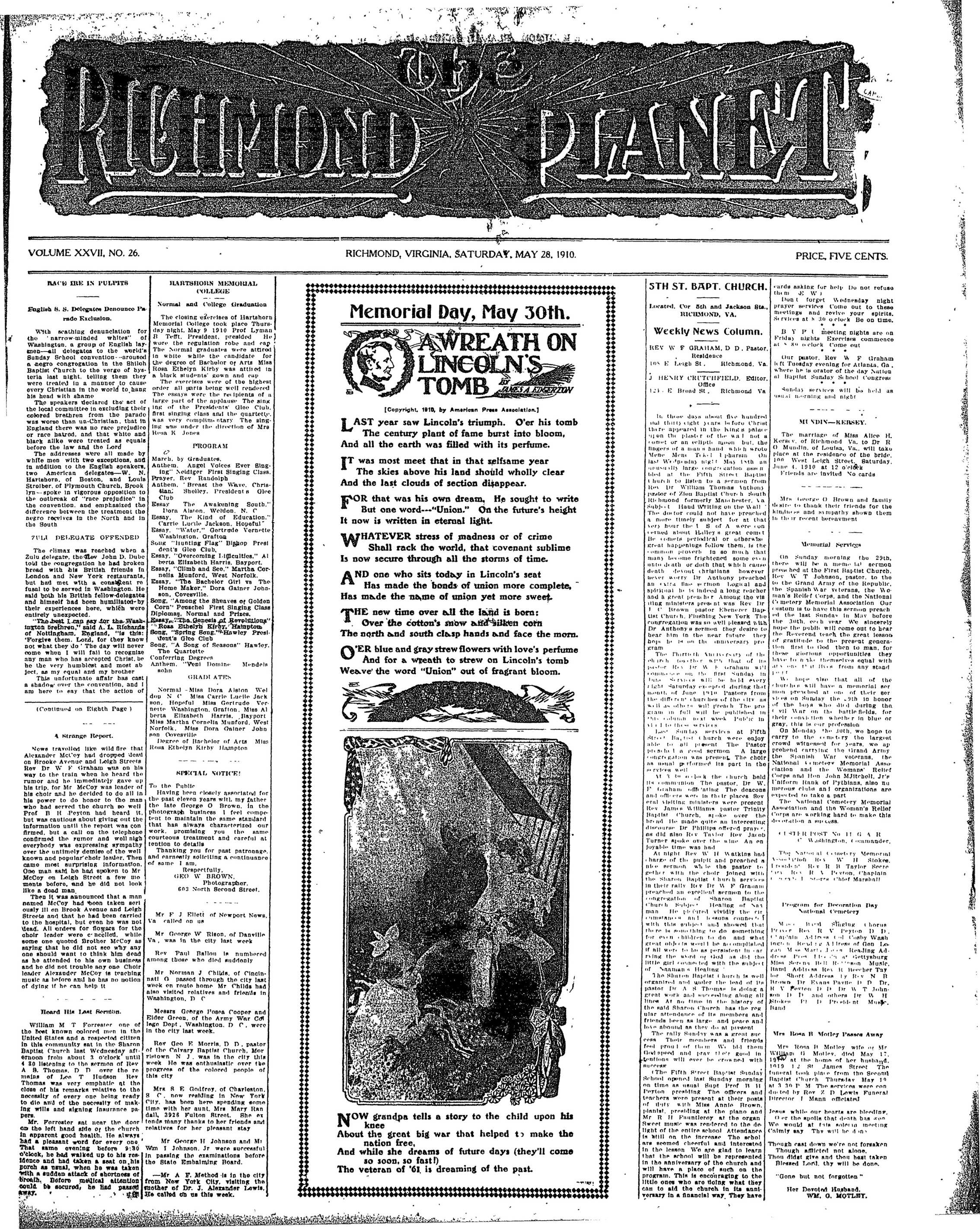
Memorial Day, May 30th.
18
LAST year saw Lincoln's triumph. O'er his tomb The century plant of fame burst into bloom, And all the earth was filled with its perfume.
IT was most meet that in that selfsame year The skies above his land should wholly clear And the last clouds of section disappear.
FOR that was his own dream. He sought to write But one word---"Union." On the future's height It now is written in eternal light.
WHATEVER stress of madness or of crime Shall rack the world, that covenant sublime Is now secure through all the storms of time.
AND one who sits today in Lincoln's seat Has made the bonds of union more complete, Has made the name of union yet more sweet.
O'ER blue and gray strew flowers with love's perfume And for a wreath to strew on Lincoln's tomb Weave the word "Union" out of fragrant bloom.
THE FAMILY OF THE
STATE OF NEW YORK
---
5TH ST. BAPT. CHURCH.
Located, Cor. 5th and Jackson Sts.
RICHMOND, VA.
Weekly News Column.
REV. W. F. GRAHAM, D. D., Pastor
Residence:
108 E. Leigh St., Richmond, Va
J. HENRY CRUTCHFIELD, Editor
Office:
1215 E. Broad St., Richmond, Va
In those days about five hundred and thirty-eight years before Christ there appeared in the King's palace upon the plaster of the wall, not a comet or an ecliptic moon: but, the fingers of a man's hand, which wrote Mene, Mene, Tekel, Upharsin. On last Wednesday night, May 18th, an unusually large congregation assembled at the Fifth Street Baptist Church to listen to a sermon from Rev. Dr. William Thomas Anthony, pastor of Zion Baptist Church South Richmond, formerly Manchester, Va. Subject, "Hand Writing on the Wall." The doctor could not have preached a more timely subject, for at that very hour the U. S. of A. were concerned about Halley's great comet. Be comets periodical or otherwise, great happenings follow them, is the common proverb; in so much that many become frightened, some even unto death, or doth that which cause death, devout christians, however, never worry. Dr. Anthony preached an extra fine sermon. Logical and spiritual, he is indeed a long teacher and a great preacher. Among the visiting ministers present was, Rev. Dr. J. C. Brown, pastor Ebenezer Baptist Church, Flushing New York. The congregation was so well pleased with Dr. Anthony's sermon, they desire to hear him in the near future; they hope he is on the anniversary program.
The Thirtieth Anniversary of the church, together with that of its pastor, Rev. Dr. W. F. Graham, will commence on the first Sunday in June. Services will be held every night, Saturday excepted, during that month of June, 1910. Pastors from the different churches of the city, as well as others, will preach. The program in full will be published in this column, next week. Public invited to these services.
Last Sunday services at Fifth Street Baptist Church were enjoyable to all present. The Pastor preached a good sermon. A large congregation was present. The choir as usual performed its part in the services well.
At 3:30 o'clock the church held its communion. The pastor, Dr. W. F. Graham, officiating, the deacons and officers were in their places. Several visiting ministers were present. Rev. James Williams, pastor Trinity Baptist Church, spoke over the bread. He made quite an interesting discourse. Dr. Phillips offered prayer, as did also Rev. Taylor, Rev. Jacob Turner spoke over the wine. An enjoyable time was had.
At night, Rev. W. H. Watkins had charge of the pulpit and preached a nice sermon, while the pastor together with the choir, joined with the Sharon Baptist Church services in their rally. Rev. Dr. W. F. Graham prescheduled an excellent sermon to the congregation of Sharon Baptist Church. Subject, "Healing of Naaman." He pictured vividly the circumstances and lessons connected with this subject and showed that there is something to do, something for even children to do; and what great objects would be accomplished if all were to be as persistent in carrying the word or God, as did the little girl connected with the subject of "Naaman's Healing."
The Sharon Baptist Church is well organized and under the lead of its pastor, Dr. A. S. Thomas, is doing a great work and succeeding along all lines. At no time in the history of the said Sharon Church, has the regular attendance of its members and friends been as large, and peace and love abound as they do at present.
The rally Sunday was a great success. Their members and friends feel proud of them. We bid them God-speed and pray their good intentions will ever be crowned with success.
(The Fifth Street Baptist Sunday School opened last Sunday morning on time as usual, Supt. Prof. B. H. Peyton, presiding. The officers and teachers were present at their posts of duty, with Miss Annie Brown, pianist, presiding at the piano and Mr. R. H. Fauntleroy, at the organ. Sweet music was rendered to the delight of the entire school. Attendance is still on the increase. The scholars seemed cheerful and interested in the lesson. We are glad to learn that the school will be represented in the anniversary of the church and will have a place of such on the program. This is encouraging to the little ones who are doing what they can to aid the church in its anniversary in a financial way. They have
cards asking for help. Do not refuse them.—E. W.)
Don't forget Wednesday night prayer services. Come out to these meetings and revive your spirits. Services at 8:30 o'clock. Be on time.
B. Y. P. U. meeting nights are on Friday nights. Exercises commence at 8:30 o'clock. Come out.
Our pastor, Rev. W. F. Graham left Tuesday evening for Atlanta, Ga., where he is orator of the day National Baptist Sunday School Congress.
Sunday services will be held as usual morning and night.
MUNDIN—KERSEY
The marriage of Miss Alice H. Kersey, of Richmond, Va. to Dr. R. O. Mundin, of Louisa, Va., will take place at the residence of the bride, 100 West Leigh Street, Saturday, June 4, 1910, at 12 o'clock. Friendship.
Mrs. George O. Brown and family desire to thank their friends for the kindness and sympathy shown them in their recent bereavement.
Memorial Services
On Sunday morning, the 29th, there will be a memorial sermon preached at the First Baptist Church, Rev. W. T. Johnson, pastor, to the to the Grand Army of the Republic, the Spanish-War veterans, the Woman's Relief Corps, and the National Cemetery Memorial Association. Our custom is to have this sermon preached the last Sunday in May before the 39th, each year. We sincerely hope the public will come out to hear the Reverend teach the great lesson of gratitude to the present generation, first to God, then to man, for these glorious opportunities they have to make themselves equal with any one that lives, from any standpoint.
We hope also that all of the churches will have a memorial sermon preached at one of their services on Sunday, the 29th, in honor of the boys who died during the Civil War on the battle-fields, for their conviction, whether in blue or gray, this is our profession.
On Monday, the 30th, we hope to carry to the cemetery the largest crowd witnessed for years, we apprehend carrying, the Grand Army, the Spanish War veterans, the National Cemetery Memorial Association and the Womans' Relief Corps and Hon MJ Mitchell, Jr's, Uniform Rank of Pythians, also numerous clubs and organizations are expected to take a part.
The National Cemetery Memorial Association and the Woman's Relief Corps are working hard to make this decoration a success.
CUSTER POST, No. 11, G. A. R.
C. Washington, Commander
The National Cemetery Memorial Association—Rev. W. H. Stokes, President; Rev. R. B. Taylor, Secretary; Rev. R. V. Peyton, Chaplain; Comrade L. Storrs, Chief Marshall
Program for Decoration Day National Cemetery
Music, Band; Singing, Chorus; Prayer, Rev. R. V. Peyton, D. D. Chaplain; Address, Col. Cosby Washington; Reading Address of Gen. Logan, Miss Maria Jones; Reading Address, Pres. Lincoln at Gettysburg, Miss Serena Bell Robinson; Music, Band; Address, Rev. R. Beecher Taylor; Short Address, by Rev. N. B. Brown; Dr. Evans Payne, D. D., Dr. R. V. Peyton, D. D., Dr. W. T. Johnson, D. D., and others, Dr. W. H. Stokes, Ph. D. President, Music, Band.
Mrs. Rosa B. Motley Passes Away.
Mrs. Rosa B. Motley, wife of Mr. William G. Motley, died May 17, 1910, at the home of her husbaad, 1019 1-2 St. James Street. The funeral took place from the Second Baptist Church, Thursday, May 19, at 3:30 P. M. The services were conducted by Rev. Z. D. Lewis. Funeral Director, I. Mann, officiated.
Jesus, while our hearts are bleeding, O'er the spoils that death has won. We would at this solemn meeting Calmly say—Thy will be done.
Though cast down we're not forsaken Though afflicted not alone, Thou didst give and thou hast taken Blessed Lord, thy will be done.
"Gone but not forgotten."
Her Devoted Husband,
WM. G. MOTLEY.
The MAN in
LOWER TEN
BY MARY RODER'S RINEHART
AUTHOR OF THE CIRCULAR STORAGE
ILLUSTRATIONS BY M. G. KETTNER
COPYRIGHT BY DOVER - NORRLE COMPANY
8YNOP819.
CHAPTER I - Lawrence Blakeley, lawyer, goes to Pittsburgh with the forged knife of the chief witness for the prosecution. John Gilmore, a millionaire in the picture of the girl whom Gilmore admires is his granddaughter Alison West. He says her father is a rascal and a friend of the forger.
CHAPTER II - Standing in line to buy a car, he requests a lady to buy one for her. He takes her lower II and retains lower ten. He takes a man in a drunken stupor in lower ten, and retires in two years.
CHAPTER III - He awakens in lower ten, disappeared and in a street is another clothes likewess have been as hanged for others.
CHAPTER IV - An amateur detective intercepts him in the case. He is heard that the dead man is Simon Harrison of Pittsburgh.
CHAPTER V - Henry Dinkney Built a man who disappeared with it takes a clothes and he is suspected of the murder.
CHAPTER VI - Inakey is arrested in a girl's house. In Ack and seven clothes comes into position.
CHAPTER VII. The insatiable and
genous against all joy is a longtime
The train is we are!
CHAPTER VIII. Bakerley is rested
from the burgee as by the girls in blue
The arm is broken!
CHAPTER IX. Ginger the girl
the Carter is the girl
him her is the girl
parar a sweet
CHAPTER X. The girl
bags is the girl
his pet
CHAPTER XI. The girl
leaves is the girl
pen goes
CHAPTER
of pl.
furry
litr.
billing
sure
sing
a count
strong
ing and
into
peace
temper
for in
tion
when
are
son West, I have been in charge of dream
to conceive and awake to find I had put
out of Mrs Kirk, and I had a hand
What was it that I had put in
making an argument of love?
And that that I had a hand in
use capturing it, be
tween two men and I have to
gether through it, I have to
redeed and made it, I have to
over polling and I have to
years men and I have to and
women cannot be less
I grounded if it had been any
one but Rich
Some things were in the however and I would hold them. The halfway breakfast the queuer hat the pebble in her small show the gold bag with the broken chain the bag. Why, it was in my pocket at that moment.
I got up painfully and found my coat. Yes there was the three bagging with an opulent suggestion of wealth inside. I went back to bed again somewhat dizzy between effort and the touch of the trinket so likely here. I held it up by its broken chain and glanced over it. By careful attention to orders I ought to be out in a day or so. Then I could return it to her. I really ought to do that it was valuable and I wouldn't care to trust it to the mail. I could run down to Richmond and see her once—there was no disgrace to litch in that.
I had no intention of opening the little bag. I put it under my pillow—which was my reason for refusing to have the linen alps changed to Mrs Klopton's dismay. And sometimes during the morning, while I lay under a virgin field of white, ornamented with strange flowers, my cigarettes hidden beyond discovery and Science and Health on a table by my elbow, as if by the mercest accident. I slip my hand under my pillow and touch it reverently.
Mcknight came in about 11. I heard his car at the curb followed almost immediately by his slam at the front door, and his usual clamor on the stairs. He had a bottle under his arm, right surmising that I had been forbidden stimulant, and a large box of cigarettes in his pocket supporting my deprivation
"Well," he said cheerfully. "How did you sleep after keeping me up half the night?"
I slipped my hand around the purse was well covered.
"Have it now or wait till I get the cork out?" he rattled on.
"I don't want anything." I protested.
"I wish you wouldn't be so darned cheerful, Richey." He stopped whiting to stare at me.
"I am saddest when I sing!" he quoted unctuously. "It's pure reaction, Lollie. Today the sky was low; I was digging for my best friend. Today he lies before me, his peavish yesterday. I thought the notes
were burned, to-day I look forward
to a good cross-country chase and
with luck we will draw." His voice
changed suddenly. Yesterday she
was in Seal Harbor Today she is
here.
Here in Washington"I asked as
naturally as I could
You going to stay a week or two"
"Oh I had a little bit and also had a
wondering
And nearly every morning he used
to lay on me
Were you sure that they Recht
It was the real thing this time I suppo
Save the best little kit that
we have for him
And I will work with the as
much as he liked twisting
Dance in the bed and sat
all
ange
to
How
Nobody
I'll be you
have at least five
I wish to thunder
I'll call save it for a day or
I will wrap all eight
Have a drink M. Knight said,
pushing over the table.
Twins. The doctor grinned.
Have two drinks.
But the doctor man refused.
I wouldn't even wear a champagne-colored necklace during business hours he explained. By the way, I had another case from your accident Mr Blakeley last day afternoon "Under the tongue please"
He stuck a thermometer in my mouth.
I had a sudden terrible vision of the amateur detective coming to light, note book (cheerful impertinence and intimidating data "A small man")
I demanded "gray hair"
Keep your mouth closed the doctor said peremptorily. No. A woman, with a fractured skull. Beautiful case Van Kirk was up to his eyes and sent for me. Hemorrhage right-sided paralysis, irregular pupils with all the trimmings. Worked for two hours"
"Did she recover?" McKnight put in. He was examining the doctor with a new awe.
"She lifted her right arm before I left, the doctor finished cheerfully "so the operation was a success even if she should die"
"Good heavens" McKnight broke in "and I thought you were just an ordinary mortal, like the rest of us! Let me touch you for luck. Was she pretty?"
"Yes and young" Had a wealth of bronze-colored hair "Upon my soul, I hatched to cut it"
McKnight and I exchanged glances. "Do you know her name doctor?" I asked
"No" The nurses said her clothes came from a Pittsburgh tailor
"She is not conscious I suppose"
"No she may be tomorrow or in a wook"
He looked at the thermometer, murmured something about liquid diet, avoiding my eye. Mr. Klopton was broiling a chop at the time and took his departure, humming cheerfully as he wont downstairs. McKnight looked after him wistfully
"Jorge I wish I had his constitution" he exclaimed. Nother nerved not heart! What a chauffeur he would make!
But I was serious.
"I have an idea. I said grimly, this small matter of the murder is going to come up again and that your uncle will be in the dance of a fix if it does. If that woman is going to die somebody might be around to take her deposition. She knows a lot if she didn't do it herself. I wish your would go down to the telephone and get the hospital. Find out her name and if she is conscious." McKnight went under protest. I haven't much time he said, looking at his watch. "I'm to meet Mrs. West and Alison at one. I want you to know them Lollis. You would like the mother."
"Why not the daughter?" I
frained. I loughed the little gold bag.
```markdown
```
Gling, when you feel this way just remember there are two less desirable places were you might be. One is jail, and the other is—"He strummed on an imaginary harp with devotional eyes.
But McKnight's light-heartedness layed on me that morning. I lay and framed under my helplessness. When by chance I touched the little gold bag, it seemed to scorch my fingers. Richey, finding me unresponsive, left to keep his lunch engagement with Alison West. As he clattered down the stairs, I turned my back to the morning sunshine and abandoned myself to misery. By what strain on her frayed nerves was Alison West keeping up, I wondered! Under the circumstances, would I daro to return the bag? Knowing that I had it, would she hate me for my knowledge? Or had I exaggerated the importance of the necklace, and in that caso had she forgotten me already?
But McKnight had not gone after all I heard him coming back his voice preaching him, and I groomed with irritation.
Wake up he called "Somebody's sent a lot of flowers." Please hold the box Mrs. Klopton, I'm going out to be run down by an automobile.
I rounded to foble interest My brother's wife is punctilious about such things all the new babies in the family have silver rattles, and all the sick people flowers.
McKnight piled up an armful of roses and held them out to me. Wonder who they're from? He asked imbibing in the box for a card. I have no name yet been a one. He held it up and read it with exasperating slowness.
I waited for an early recovery A COMPANION IN MINORITY.
Well what do you know about that he is confined. That's some thing he told me Lolli.
It was really worth mentioning
I had tried to be with my heart
beating in the cold heat. She had
beaten it all.
peered at me
So he w
had wart
and I lav
tried to
game a
draw g
to fo
my l.
I was in the house for a week. Much of the time I spent in composing and the day I got letters of thanks to Miss Wendy and in growing at the doctor. Mei was draped in daily, but he was as cheerful than usual. Now and then I caught him singing and as if he had something to say, but whatever it was he kept it to himself. Once during the week he went to Baltimore and saw the woman in the hospital there. From the description I had little difficulty in recognizing the young man an who had been with the murdered man in Pittsburgh. But she was still unconscious. An elderly aunt had appeared a gaunt person in black who sat around like a buzzard on a fence according to McKnight, and went in a mixed figure into a damp hairstyle.
On the last day of my first dissonant he stopped in to thrash out a case that was coming up in court the next day and to play a game of double split taie with me.
"Who wob the hall game?" I asked. "We were locked. Ask me some thing I want. Oh by the way, Bronson's on to today."
"I'm glad I'm not on his bond." I said practically. Hell, dear out.
"Not he." McKnight pounced on my ace. He no food. Don't you suppose he knows you took those notes to Pittsburgh." The papers were full of it. And he knows you escaped with your life and a broken arm from the wreck. What do we do next? The common-call continues the case. A deaf man on a dark night would know those notes were missing.
"Don't play so fast. I remonstrated "I have only one arm to your two. Who is trailing Bronson? Did you try to get Johnson?"
"I asked for him, but he had some work on hand."
"The murder's evidently a dead issue," I reflected. "No, I'm not joking. The wreck destroyed all the evidence. But I'm firmly convinced those notes will be offered either to us or to Bronson very soon. Johnson's a blackguard but he a good detective. He could make his fortune as a game dog. What he doing?"
Mcknight put down his cards, and rising, went to the window. As he held the certain back his customary grin looked a little forced.
"To tell you the truth, Lollihe, he said, 'for the last two days he has been watching a well known Washing- attorney named Lawrence Blakeley. He's across the street now.'"
It took a moment for me to grasp what he meant.
"Why it a ridiculous" I asserted. "What would they trail me for? Go over and tell Johnson to get out of there, or I'll pot at him with my revolver."
"You can tell him that yourself"
McKnight paused and bent forward
"Hello here a visitor a little man
with string halt"
"I won't see him." I said firmly
"I've been bothered enough by reporters
We listened together to Mrs Klopton's
expositing tunes in the lower
hall and the creak of the boards as
she came heavily up the stairs. She
had a piece of paper in her hand
from a pocket account-book, and on it
was the name, "Mr Wilson Dudd
Hotchkiss, Important business."
"Oh, well, show him up." I said
resignedly "You'd better put those
cards away. Richey I fancy it the
rector of the church around the corner."
But when the door opened to admit
under the pillow
"Well," he said judiciously, "you've always declared against the immutability and romantic nonsense of every young women—"
"I never said anything of the sort," I retorted furiously.
"There is more satisfaction to be had out of a good saddle horse!" he quoted me. "More excitement out of a pole pony and as for the eternal matrimonial chase, give me instead a good stubble a fox, some decoont dog and a hunter and I'll show you the real joys of the chase!"
"For heavens a ski, go down to the telephone you make my head ache," I said savely.
I hardly know what prompted me to take out the gold purse and look at it. It was an imbuche thing to do call it impulse sentimentality, what you wish I brought it out, one eye on the door for Mrs Klipton has a ready eye and a loose shoe. But the house was quiet. Downstairs Mrs Knight was first with the telephone central and there was an odor of borneol to in the air. I think Mrs Klipton was fascinated out of her theories by the bountiful connection with the fractured arm.
Anwah w I laid up the bag and looked at it. It must have been an fastened for the tent instant there was an awake child on the snowfield of the construction site in the money a wrap of a hawker jacket with a powdery substance and a knickle. I drew my pencil and stared at the peeka
With her the first I from
Ned the things back bag and
trust it being the
I Knew That Bit of Chain
pillows Then I lay back in a cold
perspiration What connection had
Allison West with this crime? Why
had she stared at the gun metal gc
arette case that morning on the trai-
th? What had alarmed her so at the farm
house? What had she taken back to
the gate? Why did she wish she had
not escaped from the wreck? And
last in heaven's name how did a part
of her necklace become torn off and
covered with blood?
Downstairs McKnight was still at
the telephone and amusing himself
with Mrs Klepton in the interval of
waiting
"Who did he come home in a gray soak, when he went away in a blue" he repeated. Well wrecks are queer things Mrs Klopton. The suit may have turned gray with fright. Or perhaps wrecks do as queer stunts as lightning. Friend of mine once was struck by lightning he and the caddy had taken refuge under a tree. After the flash when they recovered consciousness there was my friend in the caddy's clothes, and the caddy in his. And as my friend was a large man and the caddy a very small box—"
McKnight's story was interrupted by the indignant slam of the dining room door. He was obliged to wait some time, and even his eternal cheerfulness was obbing when he finally got the hospital. "Is Dr Van Kirk there?" he asked. "Now there?" Well can you tell me how the patient is whom Dr Williams, from Washington operated on last night? Well I'm glad of that. Is she conscious? Do you happen to know her name? Yes I will hold the line."
There was a long pause then McKnight a voice.
Hello yes. Thank you very much.
Good by.
He came upstairs, two steps at a time.
"Look here, he said bursting into the room, there may be something in your theory, after all The woman's name it may be a coincidence, but it is curious her name is Sullivan."
"What did I tell you?" I said, sitting up suddenly in bed. She's probably a slater of that around 1 in lower seven, and she was afraid of what he might do.
"Well I go there some day soon. She's not comfortable yet. In the meantime, the only thing I can do is to keep an eye through a detective, on the people who try to approach Iron son. We'll have the case continued, anyhow in the hope that the stolos notes will gooner or later turn up."
"Confound this arm," I said, paying for my energy with some excruciating throbs "There's so much to be looked after, and here I am, bandaged, splintered, and generally useless. It's a beastly shame." "Don't forget that I am here," said McKnight pomponally. "And another
Ik a bad and feasted
blood and blood I was
a sort of what I. They
they lay in the were
they lay in the were
at the final in at the
w what later be
for the day
one of the roses she
to be held with her
among my giflows and
nber that it was bin
that I wasn't even
it another that and
bok no ke under
CHAPTER XIII
Faded Roses
"The Stains You See and the Hole Left by the Dirk."
a curiously alert little man, adjusting his glasses with nervous fingers, my face must have shown my dismay.
It was the amateur detective of the Ontario'
I shook hands without enthusiasm. Here was the one survivor of the wrecked car who could do me any amount of harm. There was no hope that he had forgotten any of the intriminating details. In fact he held in his band the very note book which contained them.
His manner was restrained but it was evident he was highly excited. I introduced him to McKnight who has the imagination I lack and who placed him at once mentally.
I only learned yesterday that you had been-earsed, he said rapidly. Terrible accident unsparkable dream about it all night and think about it all day. Heken arm."
No, he just wears the splint to hold it back from other people. He might drawn lazily. I glared at him, there was nothing to be gained by antagonizing the little man.
"Yes a fractured bone, which can form as it snows."
"Humana humana," Pretty good, he crackled. I laughed. I kept up your smile pretty well considering everything.
You seem to have escaped injury. I parried. He was fainting for a thing in his pocket.
Yes, I escaped. he replied abruptly. Remarkable thing. You had a欠款. I would have broken my neck but I landed on your never guess what. I landed first on the very pillow which was under in suspicion at the time of the wreck. You remember don't you? Where did I put that package?"
He found it finally and opened it on a table displaying with some theatricalism a rectangular piece of muslin and a similar patch of striped tickling
Richey touched the piece gingerly. "He George, he said and you carry that strung in your pocket. What if you should mistake it for your handkerchief?" But Mr Hickkiss was not listening. He stood bent somewhat forward, leaning over the table and fixed me with his forefelt like eyes. "Have you seen the evening papers, Mr Blakeley?" he inquired. I glanced to where they lay unopened and shook my head. Then I have a disagreeable task." he said with evident relish. "Of course you will consider the matter of the wain Harrington's death closed, after the wreck I did myself. As far as I was concerned, I meant to let it remain so. There were no other survivors at least home that I know of, and in spite of circumstances there were a number of penns in your favor.
"I verified your identity for instance as soon as I recovered from the shock. Also, I found on inquiring of your tailor that you invariably wore dark clothing."
Mcknight came forward threateningly "And are you anhow?" he demanded "And how is this any business of yours?" Mr Hotchkiss was entirely unruffled "I have a minor position here," he said, reaching for a visiting card. "I am a very small patch on the seat of government, sir."
Mcknight muttered something about certain offensive designs against the said patch and retired grumbling to the window. Our visitor was opening the paper with a tremendous expenditure of energy "Here it is. Listen. He read rap idly aloud
"The Pittaburg police have sent to Baltimore two detectives who are looking up the survivors of the ill-fated Washington Filer. It has transpired that Simon Harrington the Wood street merchant of that city, was not killed in the wreck, but was murdered in his birth the night preceding the accident. Shortly Before the collision, John Sanders, the conductor of the Filer, sent this telegram to the chief of police.
"Body of Simon Harrington found stabbed in his birth lower ton. On tario, at 6 30 this morning.
"JOHN PLANDERS Conductor."
"It is hoped that the survivors of the wrecked car Ontario will be found, to tell what they know of the discovery of the crime.
"Mr John Gilmore head of the steel company for which Mr Harrington was purchasing agent has signified his intention of sifting the matter to the bottom."
"So you see, Hotchkiss concluded,
"there's trouble brewing. You and I
are the only survivors of that unfortunate car."
I did not contradict him, but I knew
of two others at least, Allison West,
and the woman we had left beside the
road that morning babbling incoherently,
her black hair tumbling over
her white face.
"Unless we can find the man who
occupied lower never," I suggested.
"I have already tried and failed. To
find him would not clear you, of
course, unless we could establish some
connection between him and the miserdered man. It is the only thing I see, however. I have learned this much. Hotchkiss concluded: "Lower seven was reserved from Cresson." Cresson' Where Alison West and Mrs. Curtis had taken the train! McKnight came forward and suddenly held out his hand. "Mr. Hotchkiss," he said — I'm sorry if I have been offensive. I thought when you came in that like the Irishman and the government, you were 'fornist' us. If you will put those cheerful reliefs out of sight somewhere, I should be glad to have you due with me at the Incubator' (this name for his bachelor apartment) compared with Johnson you are the great original proclamation.
The strength of this was not on Hotchkiss, but the invitation was clear. They went out together and from my window I watched them get into McKnight's car. It was raining and at the corner the cannonball skidded. Across the street my detective Johnson looked after them with his crooked smile. As he turned up his collar he saw the car and lifted his hat.
I left the window and sat down in the growing dusk. Soon a part of lower seven had got on the car at Cross and I looked at it. The window was wide and I looked at it. The window was wide and I looked at it. The window was wide and I looked at it.
CHAPTER XIV
The Tran Door
By Sunday evening a week after the wreck my friend had landed me to france. The very sight of Johnson a less the risk for luck always within sight of the house kept me constantly entertained. It was on that day that things began to come to a halt as a burning glass of creams glistened to enter me. I dined out that evening in no cheerful face of mind. There had been a postage the day before and I had a pay which is always a bad thing. And she had wrinkled her hair and held a helping to lose the grip. There was no time in town to the town where I was climbing and I had no patience to crane up for the better. Mrs. Johnson herself seemed tired my breast had been sown in to others my meat really for taxation. She had read and actually slowly travelled to the town. The paper was still warm she ventured. The thermometer is now 90.
And this is 2020. I said put
trip down my cup. Where is Euphemia?
I haven't seen her around
or heard a dishish all day.
Euphemia is in bed. Mrs Klopten
said gravel. Is your meat out small
chunk? Mr Lawrence. Mrs Klopten
can't tell me a mystery into an
outdoor. There than any one I
know can say. Are your sheets
damp sigh. And I can tell from her
tone that the house a little stred
has been broken or that I left and
neighbor has appeared. So now I
looked up and asked the question slip
was waiting for.
What's the matter with Euphemia?
I inquired fully.
Frightened into her bed. Mrs.
Klopten raid in a stage whisper
She's had three hot water bottles
and she hasn't done a thing all day
but mean.
She oughtn't to take hot water bottles. I said in my severest tone: "One would make me mean. You need not wait I'll ring if I need anything." Mrs Klopton sailed to the door, where she stopped and whesed indignantly. I only hope you won't laugh on the wrong side of your face some morning Mr Lawrenen," she declared, with Christian fortitude. But I warn you I am going to have the police watch that house next door.
I was half inclined to tell her that both it and we were under police surveillance at that moment. But I like Mrs Klopton in spite of the fact that I make her life a torment for her, so I refrained.
I last night when the paper said it was going to storm, I sent Euphremia to the roof to bring the rugs in. Euphremia had slipped out, although it was her evening in Euphremia went up to the roof; it was 1 o'clock and soon I heard her running downstairs crying. When she got to my room she just folded up on the floor. She said there was a black figure sitting on the parapet of the house next door—the empty house—and that when she appeared it rose and waved long black arms at her and spit like a cat. I had finished my dinner and was lighting a cigarette "If there was any one on there, which I doubt, they probably showed." I suggested. "But if you feel uneasy, I'll take a look around the roof to tonight before I turn in. As far as Euphremia goes, I wouldn't be uneasy about her—doesn't she always have an attack of some sort when Ellina rings in an extra evening on her?"
So I made a superficial examination of the window locks that night, visiting parts of the house that I had not seen since I bought it. Then I went to the roof. Evidently it had not been intended for any purpose save to cover the house, for unlike the houses around, there was no staircase. A ladder and a trap door led to it, and it required some also balancing on my part to get up with my useless arm. I made it however, and found this unexplored part of my domain rather attractive. It was cooler than downstairs, and I sat on the brick parapet and smoked my final cigarette. The roof of the empty house adjoined mine along the back wing, but investigation showed that the trap door across the low dividing way was bolted underneath. There was nothing out of the ordinary anywhere, and so I assured Mrs. Klopton. Needless to say, I did not tell her that I had left the trap.
**DOOR** open to see if it would improve the temperature of the house. I want to bed at midnight, hardly because there was nothing else to do. I turned on the night lamp at the head of my bed, and picked up a volume of Shaw at random (it was "Arms and the Man," and I remember thinking grimly that I was a good bit of a chocolate cream soldier myself), and prepared to go to sleep. Shaw always put me to sleep. I have no apologies to make for what occurred that night, and not even an explanation that I am sure of. I did a foolish thing under impulse, and I have not been sorry
It was something after two when the door-bell rang. It rang quickly, twice. I got up drowsily, for the maids and Mrs. Alopton always lock themselves beyond reach of the bell at night, and put on a dressing gown. The bell rang again on my way downstairs. I lilt the hall light and opened the door. I was wide awake now, and I saw that it was Johnson. His bald head mouth was twisted in a smile "Good heavens, man!" I said irritably. Don't you ever go home and go to bed? He closed the vestibule door behind him and cavalierly turned out the light. Our dialogue was sharp, staccato. "Have you a key to the empty house next door?" he demanded. Somebody in there and the latch is caught! "The houses are alik! The key to this door may fit. Did you see them go in!"
"No. There'a a light moving up from room to room. I saw something like it last night, and I have been watching. The patrolman reported queer doings there a week or so ago."
"A light." I exclaimed. "Do you mean that you"
"Very likely, he said grimly. Have you a revolver?"
"All kinds in the gun rack. I replied and going into the room I came back with a Smith and Wesson. I'm not much use. I explained with this arm but I'll do what I can. There may be somebody there. The servants here have been useless.
Johnson planned the campaign. He suggested on account of my thin darkly with the roof that I got here and cut off escape. In that direction I have Rolson out there, now the patrolman on the beat. He said. He watch below and you about while I search the house. Be as quiet as possible."
I was rather amused I put on some clothes and felt my way carefully up the stairs the resolver swinging free in my pocket my hand on the rail. At the foot of the ladder I stopped and looked up. Above me there was a gray rectangle of sky dotted with stars. It occurred to me that with my one serviceable hand holding the ladder, I was hardly in a position to defend-myself that I was about to hold a body that I am rather careful of when a danger I couldn't see and wasn't particularly known about anyhow. I don't mind saying that the seconds it took me to scramble up the ladder were among the most unpleasant that I recall.
I got to the top however without incident. I could see fairly well after the darkness of the house beneath, but there was nothing suspicious in sight. The roofs separated by two feet of brick wall stretched around me, unbroken save by an occasional chimney. I went very softly over to the other trap, the one belonging to the suspected house. It was closed, but I imagined I could hear Johnson's footsteps ascending heartily. Then even that was gone. A near by clock struck three as I stood waiting. I examined my revolver then for the first time and found it was empty.
I had been rather skeptical until now. I had had the usual tolerant attitude of the man who is summoned from his bed to search for burglaries, combined with the artificial courage of firearms. With the discovery of my empty gun I felt like a man on the top of a volcano in lively eruption. Suddenly I found myself staring incredulously at the trap-door at my feet. I had examined it early in the evening and found it boiled. Did I imagine it or had it raised about an inch? Wasn't it moving slowly as I looked? No I am not a hero. I was started almost into a panic I had one arm, and whoever was raising that trap-door had two. My knees had a queer inclination to bend the wrong way
Johnson's footsteps were distinct enough but he was ordently far below. The trap, raised perhaps two inches now, remained stationary. There was no sound from beneath it; once I thought I heard two or three gasping respirations. I am not sure they were not my own. I wanted desperately to stand on one leg at a time and hold the other up out of focus of a possible revolver.
I did not seen the hand appear. There was nothing there and then it was there, clutching the frame of the trap. I did the only thing I could think of; I put my foot on it.
There was not a sound from beneath. The next moment I was kneeling and had clutched the wrist just above the hand. After a second's struggle, the arm was still. With something real to face, I was myself again.
"Don't move, or I'll stand on the trap and break your arm," I paited. What else could I threaten? I couldn't shoot, I couldn't even fight "Johnson!" I called. And then I realized the thing that stayed with me for a month, the thing I cannot think of even now without a shudder. The hand lay ice cold, strangely quiescent. Under my fingers, an artery was beating feebly. The wrist was as slender as I held the hand to the light. Then I let it drop. "Good Luck," I muttered, and remained on my knees, staring at the spot where the hand had been. It was gone now, there was a faint rattle in the darkness below, and them silence. I hold up my own hand in the starlight and stared at a long scratch in the palm. "A woman!" I paid to my.
(Continued on Seventh Page.)
SATURDAY.....MAY 28, 1010
MY STORY OF MY LIFE
BY
JAMES J.
JEFFRIES
DACTORIAL NEWS
[Copyright 1970 by McClure Newspaper
Great Britain. All rights reserved.]
[Copyright 1970 by McCure Newspaper
Syndicate Copyright in Canada and
Great Britain All rights reserved]
CHAPTER IV
I JUST RAPSED TO BECOME A PROFESS
SIGNAL FIGHTER
I JUST happened to become a fighter. That's the only way to explain it. There had always been some sort of an idea back in my mind that I like to be a champion. I guess every boy has that notion. But I hadn't followed the idea up. Working and hunting took all of my time now. There was a wetter weight fighter named Billy Gallagher at the works. He was a good one to his day a good clever fighter. Billy was always after me. He said I had the makings of a great heavyweight and that I could get a pile of easy money for fighting instead of pulling down a few dollars a day by hard work. Billy was enthusiastic over it but I myself couldn't see where fighting in a ring could touch hunting deer or mountain lions as a sporting proposition and I didn't seem to care much for getting money by punching other people on the nose. I guess I was too good nurtured and for that matter, I never have gone into a fight with much spite toward the other man. Some of my best friends today are the men who have fought me in the ring and been knocked out.
One night a heavyweight fighter who lived in Los Angeles a big lanky nego named Hank Griffin, wandered into a saloon where some of the boys spent their evenings when the day's work was over. He leashed on the bar and began to talk about fighting, as all these fellows do. Griffin was a very good man in those days and had fought and beaten a lot of big fellows all
AS I RAN IN I BEGAN PULLING OFF MY COAT
through the west (our follows knew his reputation but when he began to boost they didn't like it, and when he threw a handful of gold twenties on the bar and said he'd back himself to knock out any man in the town they got together in a corner and talked it over. They decided that young Joffries was about the only man within reach equal to the negro in size and strength. In a few minutes they sent a man running to my house to call me out to fight.
It didn't take long to explain things. In about a minute I was tearing back with them. As I ran in through the door I began pulling my coat off ready to fight him there on the spot. But he explained that there was a slight misunderstanding. He didn't want to fight offhand like that. He meant that he could whip any item in town in a ring with gloves on his hands and with a referee. That was what he meant. He liked to fight me that way and we might as well both make a little money out of it.
That was a new notion to me, but it sounded good. The boys offered to back me with a bet, which suited Griffin well enough, judging from the way he grimmed Gallagher wanted me to fight too. In short, we fixed up a match on the spot and I went home and slept like a log until the alarm clock rang in the morning. There wasn't anything to worry over about the idea of fighting a professional. He didn't look so terrible, and besides that I never did credit negroes with much fighting ability and gameness.
Billy Gallagher wanted me to go into training for the fight, which was to be held in a ball in town. But I wouldn't do it. I went right along with my work and let Griffin go into training.
On-the night of the fight I went straight home from work a little early and to a good dinner. Then I walked down to the hall. The boys were there already, with a lot of other people that I never saw before. All the lights were lit, and in the middle of the hall a regulation boxing ring had been put up on an elevated platform.
We both got stripped for action without much delay. Before I went out to the ring they pulled the gloves over my hands and tied them on. I can remember just how funny boxing gloves felt to me. I never had a pair on before in my life. My hands felt so big and clumsy that I didn't know what to do with them.
We got into the ring. Griffin was a tall fellow, all sinny muscles from head to heels. He wore a wide smile like a hungry man sitting down to a good dinner. But he didn't look very dangerous. I'd seen stronger and bigger men in the shops. The lights and the people interested me more than he did.
At last time was called, and we walked together and shook hands. Then I got the surprise of my life. Almost before I had my hands up he me an awful smash on the nose. You can talk about being hit on the chinor in the stomach or on the ear, but let me tell you that a blow on the nose hurts more than any of them. It makes your eyes fill and blur, and you wonder if your nose is flat. A blow on the nose either makes a man want to stop fighting or it makes him mad. It made me mad. I forgot all about the boxing gloves on my hands for a moment and tore after that coin to break him in two. I went for him just the way I've seen the buits rush at the matadores in the Mexican bull rings. That was just what Griffin wanted. He was a boxer and I was a novice. A boxer can play with a novice, as a rule, and never take a chance. What that negro did to me during the next four or five rounds was a shame. He punished me all over the ring. He landed on my nose and my eyes and my him as he pleased. He just walloped away as fast as he could hit, and I surely did see stars. As for landing on him, I couldn't have hit him with a whip.
But after a few rounds I recovered from my surprise. I took stock and began to figure. There was a man handling me in a way I never dreamed of. This must be the boxing skill that Galbather had told me about. Griffin was hitting me where he pleased but he couldn't either throw me or knock me down and I wasn't tiring at all. The thing for me to do was to find out how he did it to get the combination and then pay him back in his own coin. And I felt sure that if I could ever find him he'd drop
I cooled off as I began to think. I stopped rushing at him in blind ball fashion. Griffin thought I was trying and he began coming to me instead. For awhile he prepped me as hard as he could, trying to put me down. As each blush started I studied out the way he delivered it. Now and then I tried one of his blows in return but, as a rule he either blocked or dunked cleverly or stepped aside a little bit and countermeed me on the chin. The way he could land on me made me feel foolish it made me feel helpless. And yet all the time I knew that in the end I knew him out. I felt sure of that.
I was learning now in every round. In fact I think more knowledge of the Fighting game came to me that night than in a years' learning that followed.
In eight or ten rounds the hero began to show signs of growing tired. He was wearing himself out trying to beat me down and his blows didn't hurt. I could feel the difference now. There didn't seem to be the same weight and sting behind the punches when they landed on me. I began walking into him slowly without at tempting to strike a blow just holding my head forward, crumbling a little with my right hand up near my him and the left stock straight out in front. I learned that trick in my first fight and afterward it won the championship of the for me Tommy Ryan never showed me that "crouch". It was my natural way of fighting.
Now that he was tiring the big nego baffled me by sticking his left hand into my face with light jobs holding me off. I used my right hand nearly all the time, only jabbing at his head now and then with the left for as he tattered me I had learned something and had planned a way to win. I wanted to settle him with one sure punch. I've always liked to win my fights that way.
It was hard to get the opening I waited for. Griffin was still fast on his feet. His dexterity puzzled me. When I saw a chance it had passed before I could get into action.
In my corner after the thirteenth round my second said, "Jim it's 11:00." The lights gave up at 12. I offered him now or you will lose your chance and he'll get the demon on point."
We came up for the fourteenth Griffin was weary but unmarked I was cut and bruised and battered but just as strong and fresh as at the start. Moreover I had begun that fight without any idea of what glove fighting in a ring meant, and by this time I had learned something I began forcing my way in, walking steadily toward Griffin and making him back away as he jabbed at me I straightened up a little and let him have a good opening for my chin. It was a chance for the right Griffin grinning a little shot the right over I bobbed in enough to let the blow slip around my neck and jammed my left fist into his stomach He just dropped in a heap and curled up like a leaf The fight was over The reference counted his ten, he could have counted a hundred. All the boys were slapping me on the back and telling me I was a wonder.
His Tact
Jones (at the ball, to kire. Catterson)
—How beautifully your daughter sits
out her dances.—Life.
THE RICHMOND PLANET, RICHMOND, VIRGINIA.
MY STORY
OF MY
LIFE
BY
JAMES J.
JEFFRIES
[Copyright, 1990 by McClure, Newspaper
and Great Britain, "All rights reserved."]
CHAPTER V
BARD WORK GOOD FOR FIGHTERS, ESPECIALLY IRONWORKING
DIDN'T go right along fighting after knocking out Griffin in my first professional battle. I went back to hard work. It did me good. The very best men I've known in the ring were all men who had worked hard at some time or other and who kept it up to some extent even when in training. The routine of a
PLASTERING OLIGHT TO BE GOOD FOR THE PLASTERING MUSIC
treining camp, running on the road and punching a bag and boxing less enough to produce the best effects.
As great a man as James J. Corbett was when I first knew him, I am satisfied that he would have been stronger and would have had more endurance if he had done heavy work now and then. He was an exception to the rule. For he lived a fairly easy life all the time when not training or right only boxing for pleasure and playing handball.
Bob Fitzsimons was a horseshoe and didn't begin fighting until he was a full grown man. During his years in the ring he liked nothing better than to ally away somewhere every day or two and turn out a lot of horseshoes. Rubin was an ironworker like myself, and strength helped him out more than skill in the ring. Sharkey was a great fighter because working as a sailor for several years made him strong as a bull. Hard work and exposure to the weather toughened him and made him a dangerous man. Sharkey was at his best when he began to fight. He never learned much about beating and was better off when he didn't try to do anything but rush in and slug. For his size he was a wonder, and in our two fights I couldn't help admiring his gameness and toughness. He never got that in training camps.
Other fighters that I never met in the ring because they were of a lighter class have told me that they never fought so well as when they were hard at work Tommy West for its stance, was a great middleweight when I was among the new champions West gave Tommy Ryan the hardest fight of his life and although beaten, battered Ryan up so badly that he didn't get back into fighting shape for more than a year West was a plasterer. During all of his early fights he worked at his trade. I've always thought that a plasterer is overhead work smashing on collings ought to be great for the shoulders and the muscles that drive a stiff punch.
West told me one that when he was working hard at his trade, he never felt tired in a fight and that he could always hit his hardest in the last round as well as the first. When he began getting big purses and lived in a training camp all the time running and boxing instead of handling a trowel he could feel the difference in a short time (offen he went back to plastering over overhead work just for the good it would do to fighting. Working on a farm is very good because it is all out in the sun and wind and there’s nothing else like sunshine and fresh air for an athlete of any kind. Farming interests me as a training proposition, for I had a lot of it myself as a boy and later on as champion of the world with no more men at the time fit to give me a fight. I bought a big alfalfa farm and spent two of the healthiest years of my life doing a farmer a work with my own hands. It beat on the big punching and rope skipping and boxing in the world
But, although all of these varieties of hard work are good and any other kind for that matter I'll have to say that nothing really beats the iron worker's trade. The iron you handle seems to get into your blood and your bones and your muscle.
After winning my first battle I was urged by Billy Gallagher to go on the road and fight everybody. But I was just a seventy-year-old boy and didn't feel like leaving the old place yet. I'm glad I didn't, for the two years of hard work that followed helped give me a good level head, and if anybody needs one it's the young fellow who makes good in the ring.
We offer you, the latest and most artistic photos, at a more moderate figure, than you can obtain elsewhere.
Special attention paid to children. Enlarging and copying interior view work.
We will also be pleased to quote you prices on exterior and from old photos, a speciality.
W. I. JOHNSON, Funeral Director and Embalmer, Office & Warerooms, 207 N Foushee St. Cor. Broad. HACKS FOR HIRE.
Orders by Telephone or Telegraph filled. Weddings, Suppers and Entertainments promptly attended. Telephone: 686 Residence in Building
I hardly know whether I intended to take up fighting or not. I thought I might if I had a good chance but I wasn't in a hurry. I boxed with Tallagher now and then. I had a pretty good opinion of my own character, but, looking back today I must admit that I got off easy sometimes when the newspaper writers called me a "clumsy giant" and a "young elephant." I fought to win and I always did win, and with a knockout at that. What more can anybody want? I was nineteen years old when I lily's urgings and the talk of my friends began to stalk in. At last I grew tired of boxing for fun and decided to change my trade and take a chance. I was pretty well outfitted for fighting. At nineteen I stood six feet two or very close to it, weighed 29 pounds stripped and measured just thirty three inches around the wrist.
Billy Gallagher was quitting to he had been doing a little fighting now and then and had offered a match with Danny Needham, middleweight in those days. Billy was going to San Francisco to train and wanted me to work with him. After his fight he was to look around and match me against some heavy weight.
It is lucky I didn't think much of the money and just about that time. Billy Gallagher and I went to San Francisco. Coilly trained and I worked like a horse with him boxing and rubbing him down and making myself generally useful, not because I regarded the chance of getting coin out of it but because he was my friend and I wanted to help him win. He fought Needham on the date set to a draw. He got his end of the purse, and then he skipped without leaving me a cent. That was my first acquaintance with the rough side of the game. They say there's no gratitude in a fighter. That was my opinion when I knew that I had been left in the lurch by my one friend. However I figured out that he probably needed the money more than I did. I was not broke. But I wasn't a soft-handed dude. I could fight sometimes.
The gentleman's name was Dan Long, and he hailed from Denver. The purse for that night was a thou- sand dollars in good round hard us- ful United States twenty dollar gor- pieces. It looked like a mint to no- after knocking out a few dollars a day handling from. I that thousand of ther- settled things. It made me deed- that there wasn't any trade for me but slinging nets. I have to laugh every time I lttle- about that night with the long. He was a good big fish and strong man- and knew a little so he had no re- reputation than I had. Well we got into the ring on the night of the light and as soon as the bell ring we walked into each other I guess long thought had lay on. But I had seen that purse, and a non- ball wouldn't have stopped me.
The first round I might have been about an even thing. In the second I straightened my soft arm out and punched long right on the knees hard that he did good. The referee counted very hard. I was fouled.
PHONE
We offer you, the latest and moderate figure, than you can obey. Special attention paid to chic interior view work.
We will also be pleased to offer from old photos, a speciality.
Geo. O. Brown
603 North 2nd St.,
W. I. JOE
Funeral Director
Office & Warerooms, 207
HACKS F
Orders by Telephone or Telephone or Telephone, 686.
PROF. D. D. BRUCE, M. D..
Strange, Wonderful, but True are the awe strickon tests given by The Great Australian Medium
PROF. D. D. BRUCE, M. D. the only living Apostle of Science of the Mysteries.
$5000 in Gold to any one in the World to compete with him. Possessing more power than any four mediums combined.
No card, trance or hand humbug.
80 GREAT IS HIS POWER that he can tell you while in a Clairvoyant state, all you wish to know with put a wod being spoken. Come, all ye unbelievers, scoffers and feewers; bring all your skeptidism with you—he will open your eyes to the private chamber mystery. Come all ye broken hearted wives, all with low spirits and let him lift the burden from your aching and jealous heart. He challenges the World to compete with him in causing a speedy marriage with the one you
tell, and that was enough. I got the coin.
Looking back over my first two nights, I can't say that my style has ever changed very much. I have fought a lot of champions and have worked with a lot of good men like Corbett and Fitzsimons in training camps, and yet that trick of crowding a little and using my left hand for the knockout blow has stuck to me. I get them all in the body.
I have never struck a man with my full strength, because I never cared
HAMBOR
15¢
BILLY SKIPPED OUT LEAVING ME WITH
OUT A CENT
BILLY SKIPPED OUT LEAVING ME WITH
OUT A CENT
to risk the result I knock my mom
out carefully. Even in the excitement
of winning the championship from
Iittimmimus I put over the last pun
just hard enough to do the work. I
only needed a top and if I had hit it
force I might have killed him. In no
second fight Ittimmimus cut me
t pieces. He was the shifftighten
in the world. He was trying to chase
my eye and did have me nearly blinded. But for all that I indulged my last
punch and put it in with just for
enough to win.
One reason why I never struck a
blow with my full foe is that I ve
never felt myself being beaten down.
If I ever do then I draw on the lax
reserve and whatever I hit is going to
crack.
TO BE CONTINUED
Remarkable Lorevity
A careful examination is required for an accurate assessment of a patient, residing at a care facility, for the husband being the wife, the wife being both the husband and wife, and workable for the patient.
That Way They Are
Most of these all tell quartets between wives and husbands are in the funny papers and the lady's. They are if you saw a telltale recordords as funny papers. St. Louis Star
The Philosopher of Folly
"I need not tell you says the Philosopher of folly that when an orator starts with the words I need not tell you," he goes right ahead and tells you what he doesn't.
PHOTOS.
and most artistic photos, at a more
stain elsewhere.
Enlarging and copying
quotes you prices on exterior and
PHOTOGRAPHER.
Richmond, Va.
JOHNSON,
r and Embalmer,
N Foushee St. Cor. Broad.
ATOR HIRE.
Telegraph filled. Weddings,
ments promptly attended.
Residence in Building.
love, uniting the separated and bring back the lost one Traces lost or stolen goods Unearths hidden treasures Removes evil influences Crosses, Spoils, Ill Luck, cares tricks and Conjurations, gives Luck and Success in all you undertake. Curse the Tobacco and Liquor Habits. Allow the Captive to be set Free. He is the only one that will give a Written Guarantee to complete your business or refund your money Are you sick? Do you know what the trouble is with you? Come and Consult Nature's Doctor. Rheumatism, Insomnia, Hysteria and all Diseases cured Points given on Horse Racing and all Games of Chance. No matter what alls you, come and see this wonderful man Reader have you noticed that some people have *hard time to get along. no matter how they toll, while others have *success? Many wealthy men and women owe their success to this wonderful man
He will tell you whom you will marry. Will you be happy? He will tell you who your friends and enemies are. Can you tell? Don't take a leap in the dark, but be advised by this wonderful man Greatest Prophet in existence. He always Succeds when others fail. This is the chance of a life time. Don't let it pass you.
Office hours: 9 A.M. to 9:30 P.M.
Sunday: 2:30 to 7:20 P.M.
BURKLEY
B. D. Our consultation Fee is
$ 60 cents, sitting $1.00. All
letters containing $1.00 will be
answered in full:
MAIN OFFICER
$10 B. 8th Street, Philadelphia, Pa.
GRANT AT THE FRONT, 1863.
'Phone, 577 Richmond, Va
A. D. PRICE,
Funeral Director, Embalmer and Liveryman.
All orders promptly filled at short notice by telegraph or telephone. Halls rented for meetings and nice entertainments. Plenty of room with all necessary conveniences. Large picnic or band wagons for hire at reasonable rates and nothing but first-class, carriages, buggies, etc. Keep constantly on hand fine funeral supplier.
No. 212 East Leigh Street.
(Residence Next Door)
OPEN ALL DAY AND NIGHT.—Man on Duty All Night.
The Hawkins-Price Co. Hair Growers and Restorers.
(TRADE MARK REGISTERED)
A full line of natural human hair-braids, bangs pompadours and the latest styles in front pieces-all colors-black, brown, gray and mixed gray. Those desired so to match the hair must very sure in stating appliqué styles in hair. Ways safe to send a small sample of hair if possible, so that we may be in a position to match it correctly.
Prices: Braids, (natur al hair) $2.50; Allround Pompadours.
(nautral hair), $4.00; Front to day delighted with its wonderful results, usually place it to a sphere all of its own, speak of it resale on of its satisfactory reach throughout this state to other flats and slaves and colored people in this immediate comma. In order to continue the most skep HAWKINS PIR HAWKER AND REN in print the photograph of the preparation and are to day among the men. We do not leisure the correspondence of the enable the preparation is a natural and would not be hurt but put the public we will just here remind the public national patent rights on our hair preparation return responsible to the government. It will positively remove Dewdruff. On Clean Temples or Bald Heads, where he Face Beautifier makes the use of harmless hair Prep. And 40 is imposed on all out of city orders. More or Express Money Order Address all commons HAWKINS-PR
Phone 4601. Correspondence B
(nautral hair). $4.00; Front Pieces (nautral hair). $2.50.
4.00; Front Pieces (nautical hair). $2.50.
proved to be a fortune to many of the unfortunate, who are
wonderful results. The merits of this great hair perma-
nation all of its own and the playing terms are all too
satisfactory results. We can well boast of a large pat-
tress States and also enjoy the commendation of the very best white
immediate community hair stylists. Leaders of the merits and results of the
ROWER AND RESTOREK, we will from time to time produce of
these giving us permission to do so, who have used our
among the many hearing witness of the genuine qualities.
and the expecting a miracle or anything unreal
a natural and pure compound, the ingredients of which, we
in print
minimil the public that the United States Government has placed
them in the possession of the necessary and we are in
increment for boosted methods and square dealings.
More Dandruff. Oure the Scalp of all impurities. Restore Hair
Heads, where the Roots are not Dead. Price, 85 cents for box.
The Scalp of all impurities, is perfectly and is perfectly
85 cents and 1.00 per bottle. A charge for such
city orders. Money can be sent by Post Office Money order,
address all communications to
AWKINS-PRICE
COMPANY,
016 N. 1st St., Richmond, Va.
respondence Strictly Confidential
This Preparation has proved to be a fortune to many of the unfortunate, who are today贴身 with their wonderful results. The merits of this great hair preparation naturally place in our hands the opportunity to speak of it, measure of its its satisfactory results. We can well boast of a large patronage throughout this and other States and also enjoy the commendation of the very best white and colored people in this immediate community. The success of the merits and results of the HAWKINS PRICE HAIR GROWER and RESTORER, we will from time to time produce in print the photographs of those giving us permission to do so, who have used our preparation and are to day amid the many hearing witnesses of the genuine qualities. do not require the correspondence of those expecting a miracle or anything unreasonable to be heard in the house and pure compound, the ingredients of which, we would not hesitate to put in print. We will just here remind the public that the United States Government has placed national patent rights on our hair preparation by which it is protected, and we are in turn responsible to the house and pure compound, the ingredients of which, we would not hesitate to put in print. It will positively remove Dandruff, Ours the Scalp of Rearrals Hair on Clean Temples or Hair Heads, where Hoe Roots are not Dead. Price, 25 cents per box. The Place Beautifier makes the use of powder entirely unnecessary and is perfectly harmless to the hair and 60 per bottle. A charge of ten cents extra is imposed on all out of city coffees and by Post Office Money Order, or Express Money Order. Address all communications to: HAWKINS-PRICE COMPANY.
Phone 4601. 616 N. 1st St., Richmond, Va. Correspondence Strictly Confidential.
Richmond, Fredericksb'd & Potomac R. H.
TO AND FROM WASHINGTON AND BEYOND
Leave Richmond
*4.50 A M Byrd Nk Bla.
*5.20 A M Byrd Nk Bla.
*5.45 A M. Mala Nk Bla.
*5.40 A M. Byrd Nk Bla.
*5.40 A M. Byrd Nk Bla.
*6.00 P M Byrd Nk Bla.
*6.15 P M Mala Nk Bla.
*6.20 P M Mala Nk Bla.
*7.50 P M Byrd Nk Bla.
*7.50 P M Byrd Nk Bla.
*9.00 P M Byrd Nk Bla.
*10.40 P M Mala Nk Bla.
*10.50 P M Byrd Nk Bla.
Arrive Richmond
*7.50 A M. Byrd Nk Bla.
*12.6 A M. Kla Station.
*11.35 A M Byrd Nk Bla.
*1.12 P M Mala Nk Bla.
*1.12 P M Mala Nk Bla.
*7.70 P M Byrd Nk Bla.
*7.70 P M Byrd Nk Bla.
*9.00 P M Byrd Nk Bla.
*10.40 P M Mala Nk Bla.
*10.50 P M Byrd Nk Bla.
ACCOMMODATION TRAINS WEEKDAYS
Leave Bryd Hir. Rla. 1.50 P.M. for Fredericksbury.
Arrive Bryd Hir. Hla. 1.45 P.M. for Fredericksbury.
Arrive Bryd Hir. Hla. 1.45 P.M. for Fredericksbury.
Arrive Bryd Hir. Rla. 6.04 A.M. 6.50 P.M. from Ankasha.
*Daily* 1 weekdays. 5 bundays only.
All trains to or from Bryd Bristle Station (Bristle Station) depart at 6.04 A.M. 6.50 P.M. on sunny nights at Riba. Time of arrival and departures not guaranteed. Read the signs.
Schedule in EFFECT April 11, 1999
Leave Bryd Street Station, Richmond Daily
For Norfolk 9:00 A M, 8:00 P M and 6:00
P M
For I yechburg and the West -0:00 A M, 15 10
P M, 0:05 P M
ARRIVE RICHMOND
From Norfolk 11:45 A.M., 0:50 P M
From the West -7:00 A.M., 8:05 P M, 8:15
P M
Pullman, Parlot and Sleeping Cars. Cafe Die
ing Cars.
W N BEVIL. C. H BOSLEY
Gen. Pam. Agnot. District Pam. Agnot
ATLANTIC COAST LINE.
EFFECTIVE APRIL 11, 1900.
THAINS LEAVE RICHMOND DAILY
For Florida and South: 8:18 A.M. and 7:25
P.M.
For Norfolk: 8:00 A.M. 8:00 P.M. and 6
P.M.
For M. and W. Ry. West: 8:00 A.M. 12:10
and 8:00 P.M.
For Petersonburg: 8:00 A.M. 12:10, 8:00 *P.M.*
P. M. 8, P. M. 8, 8:00 P.M. 7, 11:00 and 11:18 P.M.
For Goldsboro and Payetteville: 8:00 P.M. P.
Trins arrive Richmond daily: 8:18, 8:00 A.M.
8:18 *11:45 A.M.*, 8:18 *11:45 A.M.*, 8:18 P.M.
8:18, 8:00, 8:00 and 8:18 P.M.
CHOICE GROCERIES,
WINES, LIQUORS
and CIGARS.
PURE GOODS, FULL VALUE FOR
THE MONEY.
Your subscription to The PLANET is due Have you paid it? If not, why not?
P
RAILROADS.
RAILROADS.
N. & W. NORFOLK &
WESTERN
N. & W. NORFOLK &
WESTERN
ONLY ALL RAIL LINE TO NORFOLK.
100
Southern Ry
# TRAIN LEAVES RICHMOND.
M - B- Following schedule degrees published only as information and are not guaranteed!
6 20 A M - M-Daily-Local for Charlotte.
10 45 A M - Daily-Limited-Buffet Broiler as McMee, Limiting-Himming, O'Dellane, McMee, Memphis, McMee, Through coach for Chase City, Oxford, Burham.
6 00 P Ek, Kubby, Kayville Local.
11 45 P M - Daily-Limited Pullman ready 9:20 P M for all the South.
YORK RIVER LINE
4 50 P M Ez. Rd.州 To West Point-comm
and Baltimore Monly, Wednesday
and Friday
THAINS ARRIVE RICHMOND.
From the South. 7:00 A. M., 9:20 P. M., daily
(Excursion)
8:40 A. M., Ex. Sunday. 4:10 P. M., daily
(Local)
From West Point. 9:30 A. M., daily; 11:38 A.
M., Wednesday and Friday; 8:45 P. M., across
Sunday
B. E. HURGESS, D. P. A.,
928 E. Main St., 'Phone 458.
11:00 P M icago and St. Louis. Fullman.
8:20 A Daily Cilton Forge.
6:15 P - Week days Local to Gordonville.
10:00 A P Lyndsburg, Lathington, Cl. Orgens
6:18 P - Week days To Lyndsburg.
TRAINS ARRIVE RICHMOND.
Local from East -4 8 2 A M. 8:25 P M.
Through from East -11 8 4 A M. 7:00 P M.
* 80 P M
Local from West -8 8 0 A M. 7 48 P M.
Travel from West -8 8 0 A M. 7 48 P M.
James River Line -7 2 8 A M. 6:56 P M.
* Daily except Sunday.
JOHN M.
Higgins, Dealer in
1610 East Franklin Street. [Near Old Market.]
Richmond, Virginia.
---
Published every Saturday by JOHN MITOHELL,
JR., at BILL N. Fourth Street, Richmond, Va.
JOHN MITOHELL JR. - EDITOR.
All communications intended for publication
should be sent so as to reach us by Wednesday
TERMS IN ADVANCE.
One Copy, one year $1.50
One Copy, eight months 1.00
One Copy, six months 8.00
One Copy, four months 6.00
Single Copy, 4.00 4.00
ADVERTISING RATE
For one inch, one insertion $5.00
For one inch each subsequent insertion 4.00
For two inches, three months 6.00
For two inches, nine months 10.00
For two inches, twelve months 14.00
Marriage and Funeral Notices, one inch 10.00
Standing and Transitional Notices per line 10.00
POSTAGE STAMPS OF A HIGHER DENOMINATION THAN THE NOTICE RECEIVED ON SUBSCRIPTION.
THE PLANET is issued weekly. The subscription price is four cents. The advance there are four ways by which money can be sent by mail at our task - in a Post Office Money Order, by Bank Check or Draft, or an Express Money Order, or by three of these can be registered letters.
MONEY ORDERS - You can buy a Money Order at your Post Office, payable at the Richmond Post Office and we will be responsible for it.
EXPRESS MONEY ORDERS can be obtained at any office of the American Express Co. the United States Express Co. and the Wells Fargo and Oce. Express Company. We will be responsible for any order of the Express Company. The Express Money Order is a safe and convenient way for forwarding money.
REGISTERED LETTER - If a Money Order post office or your Postmaster will Register the Letter you wish to send on payment of ten cents. Then, if the Letter is lost or stolen, it can be traced. You can send money in this way. We cannot be responsible for money sent in letters in any other way than one of the four ways mentioned above. If you send your money in any other way you must do it at your own expense.
RENWALS, ETC. If you do not want THE PLANET continued for another year after your subscription has run out, you then notify us by Postal card or do discontinue. The course is to send you a new order not order your discontinued at the expiration of time for which it has been paid are held liable for the payment, of the subscription date when they oed t the paper discontinued.
COMMUNICATIONS—When writing to us to renew your subscription or to discontinue your payment you should give your name and address in full otherwise you cannot find your name on our books.
CHANGE OF ADDRESS In order to change the address of a subscriber, we must be sent the farmer as well as the present address.
Entered at the Post Office at Richmond, Va as second class matter
SATURDAY MAY 28, 1910
Friends of today are often the enemies of tomorrow. Don't forget that
A progressive, thoughtful person
usually finds this a very hard road to
travel.
Some of these people whom God
makes have changed mightily a new
they were manufactured.
It pays better to mind one's own business than it does to go around in offering with everybody else's busi-ness
Women who have heavy household
cares are usually nervous and they
should have the sympathy of their
neighbors.
Ninety percent of our young men think that all is done when they make enough money to dress well and eat drink and sleep at leisure.
Some folks are no contrary that they have to turn around two or three times before they can walk straight down a street.
The Republican Party and its principles have fallen into the hands of men who really subscribe to neither so far as they relate to human rights.
0
People who are in charge of other peoples money should not engage in acrimonious discussions. Capital is tainted and finance will not linger in turbulent neighborhoods
Some married folks are unovenly yoked and they keep the lawyers busy finding out a way to unyoke them without ruining the moral reputations of one or the other parties to the contract.
Some good women are never satisfied unless they are matrimonially hooked up to a good-for-nothing man and some good men are never so cheerful as they are when they are being cafoled and deceived by some good-for-nothing woman. Oh, this is a peculiar world and there are peculiar people is it.
Colored folks who read race newspapers are benefited, if only to the extent of imbibing race pride and are thereby induced to make a mark in life before they go from this world to the other
We feel almost disheartened sometimes to note the disposition of so many of our people to keep in the same old rat and who make no effort to better their condition by seeking other fields of legitimate endeavor.
The straight jane to the poor house has a sign that tells the trayrens to spend all that they make and to get all of the credit that they can. The graveyard you know is just heind the *good house*. You can reach both to coopting on the journey.
o .
Gotts who spend all of their money on dresses and expect to marry some man who is able to support them will often be badly disappointed. A woman with something will usually attend a man with something. A woman with nothing will usually get a man with less than nothing.
A person who troubles nobody and who is careful to look after his own affairs will find that he becomes an object of contempt to the crowd of gossipers who are constantly looking after the interests of the neigh-borhood while their own home affairs are sadly tended of attention.
-- 0 --
The court started some people and many of those who were seated claimed to have professed religion and were accordingly ready for the King's doom. When they saw the heavenly visitor they came to the conclusion that they were willing to stay here longer in this world with the day and his agents.
When a man finds that he cannot support not only a wife but has a hard time finding money enough to support himself he should at once regard himself as a book number and which he would not advise at the world would be better off if like bodies he would go out and hang himself.
A person who is a friend with the mouth and not with the pocket book is a false friend and should be shoved in the future. A friend who will borrow from your pocket book and will not return the amount borrowed at the time promised or at any other time is worse than an intitle. These are two kinds of friends that it would be well for you to shun.
0
He danced with Wesley M T Forster with a thrill throughout the United States among the thou- sands who had known him as Most Worshipful Grand Master of the G O O of O F He was a man of rare good judgment and much ability. He all the best he could and in all of his efforts endeavored to bring credit and honor to this grand old common wealth. He has run his course and he has completed his labor. His late years were devoted to making friends and when he sane into that sleep that knows no waking many who had disregarded with him gathered around his bluer to take the last look at him who had passed to the other short.
RACE DISCRIMINATION
The action of the local committee of Washington, D.C in excluding the colored Sunday school scholars from the parade in honor of the World's Sunday School Association seems to have caused no end of trouble and to have placed the religious bodies of this country in a most unavailble light before the people of the whole world. To counteract the effect of the monumental blunder, Dr Booker T Washington was voted a life member of the Association and the one thousand dollars necessary to complete the task, was voted by members of the Association. Prominent southerners led in the movement. This was a very graceful thing to do and it must be a source of silent gratification to the distinguished American, but nevortifeless it cannot blot out the fact as to the unreasonableness of race discrimination. It has been the policy and custom even in the South to separate the colored people from the white ones, but when it comes to a down-right exclusion, this seems to have emphasized the existence of a prejudice not shared by the army of foreigners who had come to our shores.
Your Subscription for THE PLANET is due. Have you paid it? If not, why not?
Joint Commercement.
Atlanta. Ga., May 20.—Spelman Seminary and Atlanta Baptist College hold joint commencement exercises in the chapel of Spelman Seminary during the past week, and a memorial tablet in honor of Miss Harriet Gilles. The second president of the seminary, the cornerstone of the $40,000 chapel and administration building was laid at the Atlanta Baptist College and twenty-five young women received diplomas from the seminary while fifteen young men left with diplomas from the college, some going out to battle with the world while others will return to take up work at other schools.
Miss Giles came south thirty years ago with the founder of Shelmau Seminary Miss Packard, and there conservated her life to the work of educating young colored girls. At the death of Miss Packard in 1891, Miss Giles was selected as president and held the position until her death last fall. Two nurses from the training department, who were with the president at the time of her death, unveiled the tablet. The services were conducted by Miss Lucy Tapley who is now the president. Flora Zeto representing the students accepted the tablet. Mrs H R. Butler represented the alumnus., and Miss E O Werden represented the faculty.
Ministers representing every phase of work among the colored Baptists were present from all parts of the state to witness the laying of the cornerstone and in some way contributed to the success Prof John Hope who is the president. Is the first colored man to occupy the position having been elected successor to Dr George Sayles, who is superintendent of schools for the American Baptist Home Mission Society, is doing good work and is endorsed by the Baptists of Georgia. The white people have given $35,000, leaving $7,000 to be raised by the colored Baptists.
At the laying of the cornerstone addresses were delivered by Hon B P Abbott chairman of the trustee board Dr Alfred D Jones of the State Baptist Sunday School Convention Proof S H Archer, of the Atlanta Baptist College P James Bryant D D President of the State B P I W J White D D editor of the Georgia Baptist Augusta D D Crawford State Missionary Alumni Association and George Savies D D D of the American Baptist Home Mission Society Following the addresses a collection of over $200 was raised for the new building.
The honorary degree of Doctor of Divinity was conferred on Rev D D Crawford
Rev John E Ford D D, of Jack sonillea Fla pastor of Bethel Institution Church preached the commencement sermon. The commencement exercises were attended by several thousand people. Many were unable to get inside of the chapel.
Card of Thanks
To the Editor of The PLANET
The officers and directors of the League Hospital wish to thank the public in general and the Dike Stock Company through your paper for their kind support. Friday night might have a supported success.
MRS WM MOLLER
Vice President
Passed Away
The funeral of Virginia A. Smith,
beloved wife of Major John G.
Smith 1901 East Lighth Street, took
place last Friday at 3:30 o'clock
from the First Baptist Church, of
which she had long been a faithful
member. She had been sleek for
a long time but she bore her suffering
with Christian fortitude.
Rev W T Johnson, D. D., deliv-
ered a most pathetic sermon.
Funeral Director W Isaac John-
son had charge of the remains.
Hudson Gone.
The funeral of Lee T. Hudson
took place last Wednesday afternoon
at 3 o'clock from the Sharon Baptist
Church, Hey A. S. Thomas, officiated.
He had been ill for some time
and his demise was mourned by a
host of friends. Funeral Director A
D Price had charge of the remains
The Mechanics Savings Bank Building.
The new building of the Mechanics' Savings Bank will be thrown open to the public June 6, 1910 and the opening exercises will continue during that week. Stock will be on sale, safety deposit boxes rented and deposits received in the bank. The structure is a marvel of beauty and it is the garden spot of the city, so far as colored people are concerned. White citizens are almost as enthusiastic over the improvement as the colored. The elevator runs smoothly and the roof garden is a special attraction it is well-nigh impossible to describe the magnificence of this structure It must be seen to be appreciated.
Pine Ex-Governor $2000 for Smuggling
Former Governor Frank West Rollins,
of New Hampshire, was indicted
by the federal grand jury in New York
for attempted smuggling. He pleaded
gully before Judge Hand in the Uni-
ted States circuit court and was fined
$2000.
New Hampshire's former executive,
his wife and son, Douglas Rollins,
were arrested on a complaint sworn to
by Customs Inspector Matthew P.
Carsley at the Cunard dock on May
13, after they had dobarked from the
Lusitania. In their declaration the
Rollins family had sworn to the pos-
session of only one durable article, a
fur coat valued at $800, but a search
of the nine trunks which accompanied
the revealed an amount of dutile
goods' unclaimed, which the indictment
of the grand jury returned placed
at $4738.14.
To the District Deputy Grand Worthy Counsellors, Fast Worthy Counsellors, Worthy Counsellors and Members of Subordinate Courts:
Pursuant to the Constitution which provides that the Sessions of the Grand Court shall be held at the time and place of the meeting of the Grand Lodge, Knights of Pythias, Therefore I hereby declare that the Grand Court shall meet in its Annual Session Tuesday, June 21, 1910 at 10 o'clock in Bristol, Va. and continue in session Wednesday and Thursday, June 22 and 23, 1910.
All Registers of Deeds will for ward at once the Credentials of the Grand Representatives to Miss M. L. Chiles, Grand Worthy Register of Deeds, 114 West Lealgh Street, Richmond, Va. They will give one copy of these Credentials to the Grand Representative, who will bring the same to the Session of the Grand Court. The Credentials must be signed by the Worthy Counselor and the Register of Deeds of the Court of which he is the sole holder. He is also the bearer and be officially stamped with the seal of the Court Black Credentials may be obtained from the Grand Worthy, Register of Deeds.
Courts that have not paid their Semi-annual Taxes for December 31, 1909 and their Endowment Taxes for June 30, 1910 shall not be eligible to representation upon the door of the Grand Court. All Grand Representatives who have not received the Grand Court Degree must pay $1.50 in order to receive the same. Only Worthy Counsellors at the time of their election are entitled to be Grand Representatives. Courts must pay the fee of ($1.50) one dollar and fifty cents for the Grand Representatives who have not received the Grand Court Degree.
The Delegates will pay one full fare going, receiving a certificate receipt from the Ticket Agent. On returning they will pay three-fifths of the regular fare plus twenty-five cents on presenting the certificate properly signed by the Secretary of the meeting.
The Parade will take place Wednesday, June 22, 1910 at 1:30 P.M. The Public Meeting will be held Tuesday & P.M Prominent speakers will address the audience.
For all information concerning board, lodging, etc., address Sir E. M Higgins, District Deputy Grand Chancellor, 507 Clinton Avenue, Bristol, Va.
The Calanthe Roller Fund should be augmented and money should be sent up on the blanks issued for that purpose Members can give whatever they desire. When the amount reaches $3,000, this Department will be put into operation and the old and decrepit members will be kept benefited by this Department after being placed upon the roll in accordance with the rules and regulations of the Calanthe Relief Fund Department.
The Courts are in a prosperous condition and if we continue to avoid personal and petty differences and act as one person in promoting the interests of the order, continued peace and prosperity must crown our efforts.
Given under our hands and the seal of the Grand Court, in the City of Richmond, this 10th day of May, 1910
(Seal) JOHN MITCHELL, JR
Grand Worthy Counsellor
(MISS) M L CHILES
Grand Worthy Register of Deeds
1st Cream After Grin Kills
Eating it, she while recovering from an attack, gripped Lily E. Ness, twenty-three, a popular York Pa. girl, exploded mildly from neuralgia of the heart in the arms of Henry Honk, a friend. Honk brought the delicacy to the girl and applaud the evening at her bedside. As he came to leave she gave a cry of pain and died as he clasped her half raised body.
47 Workmen Drowned.
Forty seven workmen were drowned
through the upstream of a boat in
which a party of ninety four laborers
was being carried across the river
Duelper, near Alexandrovsk, Russia.
The aracaras are a short distance
above and the current at this point is
strong. The boat became unmanage-
able soon after leaving the shore due
probably to overloading Buddently in
midstream it turned turtle.
Cromated by Electricity.
Two trainmen were killed and their bodies cremated by 33,000 volts of electricity, when a Pooris sheper on the Illinois Traction company a system collided with an electric freight train near Loveville ill. Overhead electric wires fell on the cars in the freight train and set fire to the wreckage. The man who were killed were camouflaged by the wires in the wreckage.
Found Check For $185,080
As they wore walking along a business street, in South Bethlehem, Pa., two foreigners found a letter, which which opened was found to contain a check for $185,000, made out in favor of a Pittsburgh concern by the Bethlehem Steel company. An office boy had been given the letter to mail and lost it.
Woman Shoots Self In Heart.
Mrs. Lucy Maull, thirty-five years of age, residing at 1311 West Ninth street, Wilmington, Del., shot herself through the heart, dying instantly. Mrs. Maull is believed to have been mentally deranged at the time. She worked until noon and, going to home, fired the shot while lying in bed.
Queen Lil Lakes 2450,000.
Lillieukalani, former queen of Hawaii, has again met defeat if her effort to secure $450,000, or the remnants from the crown lands in Hawaii. The court of claims has just decided that these lands belonged to the government of Hawaii; also that the queen has personal claim on them.
Special Correspondence.
New York, May 16.—"Northern neutrality," said Mary Church Twirl before an enthusiastic audience at the Berkley Theatre last Saturday evening, "northern neutrality in the crimes of the South against the Negro and the Constitution of the United States is treason." And the audience, representing great wealth and culture, broke into cheers.
Cold and indifferent New York, blind to all save its own importance, deaf to all save the call of the stock barker and the scandal monger, gave in the Second Annual Conference of the National Negro Committee which closed its sessions at the Berkley Theatre Saturday night amid enthusiasm for both the purposes of the Conference and for the victory that the Conference won over the efforts of the tricksters to end the meeting in confusion.
The interest that the leaders of thought and the daily press of New York took in the proceedings of the Conference is an indication of a revival of respect for the Constitution and a sign that the people of the North are no longer blind against the real conditions in the South by either those who falsely declare for power or those who falsely declare for pull. It has taken some time to get the ear and eye of New York, but the labor is swallowed up in the victory.
No more important Convention than the National Negro Committee, excepting possibly the Constitution League which is in heart accord with the purposes of the Committee, now exists this because of the declared purposes of the movement, and because of the character of the men and women behind it and the power and worth of others who while silent in their efforts are, nevertheless consecrated to the cause.
It was for the Rev John Haynes Holmes, the Theodore Parker of the present day and pastor of the Church of the Messiah, New York's leading Unitarian Church, to announce the platform and declare the principle of the National Committee Dr Holmes was sweeping the Conference with his eloquence. "We are told," said Dr Holmes, "that to discuss the question will of them the Southern whites — as though it were not our duty to offend them when they are the arrogant and blinded oppressors of an entire people. Are they not offending us I should like to know, by their denial of the black man of those rights of industrial opportunity and political independence which have been bought and paid for by the blood of tens or thousands of heroes men."
All over the country the colored people may congratulate themselves not upon one but upon many Daniels who have come to judgment Whilst for example Supt Maxwell, of the New York City Schools, was telling at the Saturday sessions of the Conference how the so-called school system of the South, with especial reference to provisions for educating colored children, is a disgrace to the cause of education, the platform was graced by Jacob H Schiff, the great New York banker who has given thousands of dollars for Negro education, Prof John Dewey, of Columbia, and many other of that school of powerful men, men who are coming around to see that the Negro in the South is hopelessly lost unless and until the ballot is restored to him
PERSONNEL OF CONFERENCE
The conference, presided over by Ocawald Garrison Villard, the grandson of Garrison the Great, and editor of the Evening Post, opened for its three days session in the Charities Building. Thursday morning, surrounding Mr Villard were many men and women, white and colored, foremost in the fight for equality under the law for black and white, male and female alike, William English Whiling and Mrs. Walling, John E Mitholland, Moorfield Storey, of Massachusetts, Miss Mary White Orington, Judge Albert E Pillbury, of Massachusetts, Prof Edwin Seligman of Columbia, Mrs Mary Church Torrell, Dr J Milton Woldron, Charles W Chestnut, the author, Dr W'E B DuBols, Dr C'E Bontley, of Chicago, Dr N F Mossell, and Dr W A Sinclair, of Philadelphia, Rev R C Ransom, Mrs. Ida Wells Barnett, of Chicago, and many more, all leaders in the work of a wider freedom and a juster civilization for this country. The first day's session was given over to organization and to a discussion of the moans and ways of reaching the conditions that need, not description, but rather correction.
COOPER UNION CROWDED
Thursday evening a public meeting was held at Cooper Union, Liberty's platform, and the crowd and the enthusiasm put hope into the weak and inspired the most cheerful of those engaged in arousing both the moral sense of the American people and the common sense of the Negro race. One is as about as stupid as the other is rare. It was a night not only of extraordinary oratory but of importance to the struggle that the Negro thinkers and their friends are making hot for place, but for life. The chilf addresses of the evening was made by every speaker, for each brought his own message in his own way, but it was left for Clarence Darrow, the great western-lawyer, to arraign both the American people upon their criminal neglect of the loyal blacks, and the blacks themselves upon their indifference on the one hand and the uncertainty with which they proclaimed their equality and manhood on the other. Mr. Darrow's address covering every phase of the problems of race and labor, was cheered to the echo. His familiarity with the situation was one of the surprises of the meeting. Believing in the surprises of every kind, he boldly declared that no progress could be expected until that platform was announced as the basis of a relentless campaign.
"The problem affecting the Negro," said Mr. Darrow, "whether in the North or in the South, is not one of race, but one of labor. The obsease of the poor is the cause of the Negro, and his cause, is theirs." The other speakers at this meeting included Dr. R. C. Ransom, Mrs. Barnett, who gave an account of the Catro: massage and Congressman
William S. Bonnett, who said that the disenchisement of the Negro and the resultant political situation were a disgrace to the country. The Rev. Percy S. Grant, of the Church or the Ascension, presided. The auditorium contained as many white as colored people and the appointee that greeted the appeals of the speakers came as freely from one race as from the other. The platform was crowded with many of the best known workers for the spread of democracy and equity.
Fridays sessions, held at the Charities building and presided over by Judge Pillsbury, considered the question of disfranchisement. The chairman advanced the opinion, which was enlarged upon by every speaker, whether in prepared speech or impromptu remark, that the woeful condition of the Negro in the South, political, moral, or economic, was traceable to his disfranchisement. The sense of the Conference was that in order to correct this flawant evil, worse than if it existed in half civilized Russia, an educational and moral campaign must be carried on throughout the country. If poetic justice won't do the work, then the practical side or the question must be dwelt upon to the end that the people will come to see how unfair and how disgraceful it is to allow Mississippi one Congressman to every thousand votes and confine New York; to one Congressman to every thirty thousand votes.
In the evening the Conference held its session at the 'Liberal Club where a heart to heart talk between all the members took place. This was one of the most enjoyable of all the sessions.
At the Burkley Theatre Saturday evening, the closing session was held with Prof Bons, of Columbia, Dr. Buhailu Hart, of Harvard, and Mrs Mary Church Terrel] and a southern 'gentleman' as speakers. The southerner got into 'hot water' and was greatly relieved when he got out. Otherwise, the closing session was an enthusiastic one, pledges of support for the cause being as free as the applause that greeted the stirring demand for liberty Earlier in the day, Dr Du Blois, ex-President Bumstead, of Atlanta, and Dr. Max well, of the New York city schools had told how the school system of the south worked, and how the antigonism to suffrage for colored men is growing more wicked and more stubborn every day in every southern state.
The charge against the Negro in the south," said Dr Hart, "that he will not work is a common slander, for nowhere in this country is there a more industrious or a more faithful man than our southern colored people."
Amalgamation according to the distinguished Prof Bonz of Columbia University, whose paper formed one of the charming chapters of the records of the sessions, will not only solve the problem but it is inevitable in this country "Investigation", said Prof Bonz. proves that the difference between the African and Canadian hre those of kind, "not of value". Mrs. Torrell's description of the wrongs and injustices heaped upon the colored women in the South brought tears to many eyes. She discussed lynchings and their relations to disfranchisement and are reigned not only the infamy of the South, but the no less infamous acquiescence of the nation in the brutality rampant all through Dixie. Many southerners heard her remarkable address and joined in the demonstration of approval.
The committee is now a permanent organization and is the only body of its kind seeking to be of practical service in the solution of the vexing political and economic problems that confront the colored people in all sections.
The venerable Moorfield Storey, of Massachusetts, a distinguished son of the Puritan fathers, struck the note when he said, "The Negro will be no longer disfranchised when he himself will not permit the degration "The work we have to do," said Mr Storey "calls for leadership of the highest order, for sacrifice and a devotion to principle which might stand as an example to the world it is an eternal truth that men's fortunes are in their own hands. The whole philosophy of freedom is saddened in Byron's apostrophe to the struggling Greeks, a call that ought to ring forever in the cars of every Negro, "Who would be free themselves must strike the blow"
The following officers were chosen for the committee of one hundred Hon Moorhold Storey, of Boston, National Chairman, John E. Mihilland, of New York, Treasurer, O. G. Villard, Assistant Treasurer, Dr. W. E B Du Bols, Director of Bureau of Research and Publicity, W. E Walling, Chairman of the Executive Committee, Miss Frances Blascoor, Executive Secretary. A number of vice presidents will be selected within a few months. Dr. Du Bols will immediately establish his headquarters in New York and will begin his labors. All over the country the leaders of the Negro and all Americans who believe in liberty, fraternity, and equality ought to put themselves in touch with the committee and help in the great work which it is doing not only for colored people, but for all peoples everywhere, who are struggling from beneath the chastening rod.
Diphtheria In Hena' Dish
Herman Maloy, two years old, the son of John Maloy, a resident of Lake Nuangola, Pa., contracted diphtheria in a peculiar manner. The little follow was playing in the back yard, when he drank water from a platter which was used by the chickens. He at once contracted diphtheria. A physician said the chickens were suffering from rop, a form of diphtheria, and had infected the water. The child is in a critical condition.
Senator Has Whoooping Cough.
Washington, May 25. *Senator John Walter Smith, of Maryland, returned to Washington for the first time in more than a month. He had been ab sent on account of Mrs Smith's death and his own illness. The senator has the whoooping cough. He contracted it a few days ago and thinks he caught it from some of his grandchildren.
$3.50 RECIPE CURBS WEAM
MUN-WREB
Send Name, and Address Today
You Can Have It Free and Be
Strong and Vigorous
I have in my possession a prescription for nervous debility lack of vigor, weakened manhood, failing memory and lameness, brought on by excesses, unnatural drink, or the tolles of youth, that has cured so many worm and nervous men right in their own homes—without any additional help or medicine—that I think every man who wishes to regain his manly power and virility, quickly and quietly, should have a copy. So I have determined to send a copy of the prescription free of charge, in a plain, ordinary scaled envelope to any man who will write me for it.
This prescription comes from a physician who has made a special study or men and I am convinced it is the surest acting combination for the cure of deficient manhood and vigor failure ever put together.
I think I owe it to my fellow man to send them it a copy in confidence so that any man anywhere who is weak and discouraged with repeated failures may stop drugging himself with harmful patent medicines, secure what I believe is the quickest-acting restorative, upbuilding, SPOT-TOUCHING remedy ever devised, and so cure himself at home quietly and quickly. Just drop me a line like this: Dr. A. E. Robinson, $95 Luck Building, Detroit, Mich., and I will send you a copy of this splendid recipe in a plain ordinary envelope free of charge. A great many doctors would charge $3.00 to $5.00 for merely writing out a prescription like this—but I send it entirely free.
PROCLAMATION
Office of the Grand Chancellor.
Grand Lodge of Virginia,
K. of P., N. A., S. A., E., A. A. and A.
311 North Fourth Street.
P P XLVI
Richmond, Va., May 10, 1910.
To the District Deputy Grand Chancellors, Past Chancellors, Chancellor Commanders and Members of Subdinate Lodges 70
Pursuant to the action of the Grand Lodge of Virginia selecting Bristol, Virginia as the place of our next meeting and the Constitution provides that it shall be held on the third Tuesday in June, 1910. Therefore I hereby proclaim that the said session shall be held Tuesday, Wednesday and Thursday, June 21, 22, 23, 1910, in the city before specified. The Grand Lodge will convene at 9 o'clock A. M of the first day. All Keepers of Records and Soal will forward at once the Credentials of the Grand Representative to Col. Thomas M Crump, Grand Keeper of Records and Seal, 511 North Third Street, Richmond, Va. They will give one copy of the credentials to the Grand Representative, who will bring the same to the session of the Grand Lodge. The Credentials must be signed by the Chancellor Commander and Keeper of Records and Seal of the Lodge of which the Grand Representative is a member and be officially stamped with the seal of the Lodge. Blank Credentials may be obtained from the Grand Keeper of Records and Seal.
Lodges that have not paid their Semi-annual Taxes for December $1, 1909 and their Endowment Taxes for June 30, 1910, shall not be obligible to representation upon the floor of the Grand Lodge. All Grand Representatives who have not received the Grand Lodge Degree must pay the sum of ($2.00) two dollars in order to receive the same. Only Past Chancellors at the time of their election are entitled to be Grand Representatives Lodges must pay the fee of ($2.00) two dollars for the Grand Representatives who have not received the Grand Lodge Degree or Fifth Rank.
All members should come prepared to join Mecca Temple, Improved Order of the Knights of Khorassan. The regular charge for this Degree is $10.00 but it will be conferred at the Grand Lodge for $2.00.
The Doilegates will pay one full fare going, receiving a certificate receipt from the Ticket Agent. On returning they will pay three-fifths of the regular fare plus twenty-five cents, on presenting the certificate properly signed by the Secretary of the mooting.
The Grand Parade will take place Wednesday, June 22, 1910, at 1:30 P. M. The Public Mooting will be held Tuesday at 8 P. M. Prominent speakers will address the audience.
For all information concerning board, lodging, etc., address Sir E. M. Higgins, District Deputy Grand Chancellor, 507 Clinton Avenue, Bristol, Va.
Companies going into camp and that will take part in the parade will notify Assistant Adjutant General Roscoe C. Mitchell, 311 North Fourth-Street, Richmond, Va.
The Pythian Rolloff Fund should be augmented and money should be sent up on the blanks issued for that purpose. Members can give whatever they desire. When the amount reaches $3,000 this Department will be put in operation and old and decrepit members will be kept benefited by this Department after being placed upon the roll in accordance with the rules and regulations of the Pythian Relief Fund Department.
The outlook for the Order. in this State is bright and all loyal Pythians should do all in their power to promote harmony and bring peace and prosperity in every section of this Grand Domain.
Given under our hands and the seal of the Grand Lodge of Virginia, in the City of Richmond, this 10th day of May, 1910.
(Seal) JOHN MITCHELL, JR.
Grand Chancellor.
THOMAB M. CRUMP,
Grand Keeper of Records and Seal.
—Your Subscription for THE
PLANET is due. Have you paid it?
If not, why not?
THE RICHMOND PLANET, RICHMOND, VIRGINIA. FIVE
SPORTING GOSSIP.
Heart Action Real Test For Jeffries
and Johnson.
It is believed that Dr. Walter Poet is the only physician who has examined both participants in an important prize fight before the event. The rule has been for each man to make his own selection or have his manager make it for him. As Joffries and Johnson were subjected to a gritual examination by the same expert, the value of his view is obvious. Dr Poet, himself a a variety athlete and a friend of the medical men of crowds, made a study of physical culture in a postgraduate course at Harvard, and has measured and tested more athletes than any other physician in America. What he has to say is without feeling or prejudice and is simply the report of a trained specialist of long experience.
BY WALTER PEET, M. D
New York, May 22.--There has probably never been a contest between two men which has around such world wide interest and excitement as the coming prize fight between James J Jeffries and Jack Johnson.
Before the match was made there was a general public clamor that Jeffries, who was holding back should accept his opponent's challenge to fight for the world's championship.
When Jeffries finally agreed to meet Johnson the sporting populace was satisfied temporarily, but it has been kept on the anxious seat by several unexpected happenings, the latest of which is the great difference in point of time that each contestant had decided on for his hard training.
In the case of all athletes there is a definitely fixed course of training for the various branches of sport, which is largely departed from to any great extent.
For instance, our variety oled oared brow begin light work in the gymnasium three weeks after the Christmas recess and gradually in the spring the brow go on the water in March. This is an old and get custom
DIFFER IN TRAINING
Heretofore prize fighters have varied but slightly in their schedule of preliminary work, but now comes a great surprise. Joffries having plunged suddenly into the severest kind of work several weeks ago, after having lived in comparative luxury and idleness for a number of years, while Johnson has deferred his numerous training until this later day, which is only six weeks before the date of the battle. This is very significant. Early in the season I carefully made a most thorough physical examination of both those giants, with but one day intervening between the visits, and although I found them much alike in the usual measurements taken of athletes, in some points there was a decided variance both physically and psychologically, and also in the important point of "condition." Each, however, is a superb exemplification of the gladiator, and both undoubtedly could stand a close comparison with those of old.
In the first place, the point that bulked out largely was the superb heart condition and heart action of the negro. I got him out of bed early in the morning, a critical time to examine any one, and after a slight preliminary exercise to start his heart going well, I put the stethoscope on him and made a most thorough examination. The result showed as smooth cardiac action as I have ever found in the ideal varsity carman that I have gone over. And this means much, as the cardinal point in an carman, even exceeding muscle in importance, is the heart. On this point we are sure of Johnson.
PREDICTED TROUBLE FOR JEFF
In contradistinction to this clean bill of health) Joffries astounded me by absolutely refusing to allow me to put the stethoscope on him. There was only one conclusion to come to: "Quiil s'excuse, s'excuse"—and this coupled with his question of fat explains the story in a mutiloll. I not only expected, but predicted trouble in Joffries' training, and it has come. The reason for this may not be clear to the layman, but every physician who has followed athletics knows that when an athlete once becomes fat, after an intermission of inactivity, it is about the hardest thing in the world to "come back" as the sporting-mon, call getting into perfect condition. The reason that Joffries plunged into his grueling work so early is simply that he himself, more than any one else, realized the paramount importance of getting rid of his adductor tissue.
Conversely, Johnson, who has never been obese, has, by just enough work, kept himself continuously in more or less good condition without "going stale," as the athletes call being overtrained, and without getting muscle-bound. Johnson knows himself thoroughly and is a very good trainer; and he has made up his mind that a few weeks only of hard work will make him "fit." Thus, it is shown that this discrepancy of the early condition of the men as I found them has necessitated this de-
effected difference in their mode of preliminary preparation.
Another point is that, at this critical time of life, the difference in age, especially as he was fat, militates against the Californiaan's chances to get into condition, there being over three years' discrepancy in this particular.
HARD TO REDUCE WEIGHT.
There is no doubt whatever that when a man has been fat, it is the worst struggle, perhaps, in all training to eliminate this adipose tissue without disastrous results both to the general health and the tone of the heart. Jeffries has been fat. Johnson has not.
When an athlete becomes fat and trains down, the last place that gives up superfluous adipose tissue is the heart, where the fat is laid on, not only around this vital organ, but in between its muscular fibers and fat hammers the heart.
As every student of physical culture, knows, the "wind," which means the ability of withstanding "getting out of breath" under strenuous physical exertion, depends not on the lungs, as is popular supposed, but on the integrity of the heart action. Of course, in specific diseases of the lungs, as, for instance, tuberculosis, there is shortness of breath, but to the ordinarily healthy man, even with a small chest expulsion and, therefore, little cubic lung capacity, the "wind" depends upon the heart, because this organ pumps through the lungs. Whon this is not properly, there is shortness of breath.
The simplest proof of this is found in the many famous runners with extremely small chest measurements, but with good hearts. To keep up the extremely violent exercise a man must undergo in the ring demands a sound heart.
In the second place, a point feared was that because Joffries plunged into a long course of hard training suddenly he could not carry it through without trouble, and this has begun to be shown thus early in two decided pasticulars. Always more or less grouchy, the Californian is often the most irritable of the athlete who is having too much work. This shows it self-very plainly in many crow and football men.
LOSS OF TEMPER HURTS
It is well known that in any athletic contest the lions of temper counts most decidedly against a man, as it not only warps his judgment, but has a direct effect on the heart and nerves, for, as Shakespeare says, "Anger is like a bull hot horse, whose self-motility tires him." Obviously, a prize ring is the hardest place in the world in which to keep one's temper, but Johnson has remarkably good self-control. Then, too, Jeffries, has begun to develop bolls, which is a bad sign.
This simply means that in consuming tissue by hard exertion the efface and waste matter accumulates in the blood, and reduces its resisting power to the entrance of outside germs. The old-timers used to call its absence "clean blood," which is a good way to put it.
Probably the older man has consumed more alcohol of the, two both as regards the number of his drinking years and the concentration—Johnson taking nothing stronger than beer and champagne, and this counts for much as regards the heart.
the difference in height in Joffries favor. He stands 6 feet 2 inches in his standing feet, while Johnson is 1 2.3 inches shorter. Johnson has the thicker neck by one-fourth of an inch, while Joffries beats him in chest measurement 3 inches. The girth of the upper arm (bleeps) shows Johnson one-half inch to the good, and he is also ahead of Joffries in forearm measurement, as is also the case with the thigh, but Joffries has much the larger calf.
In physical conformation the nongroh has a better defense against injury, as his high massively muscled shoulders with his heavy arms and forcearms prove excellent bulwarks for him, while on the other hand the famous crouch of the white man prevents the solar plexus from anything but a glancing blow, and it also keeps the chin and angle of the jaw to a greater extent out of danger except from appurcant blows, which are, of course, not so dangerous as the direct blow, and in Joffries' well-known pose those upporcurs must be well planted by his adversary to do much harm.
JEFF HAS POWERFUL PUNCH
Finally, it has been proven that Jeffries can strike a blow probably harder than any other man was ever known to doliver, and in conjunction with this most important characteristic he can receive tremendously hard blows himself without seemingly being jarred in the least and without finching.
Offsetting this it is safe to say that Johnson, with his good general condition and his excellent heart action described before, can undoubtedly stand fast work and hard exertion much longer without fatigue than can the white man. Johnson is much lighter than his face and can quickly out of danger he much more able. If the battle is drawn out into a great many rounds without damage to either of the combatants, Jeffries is almost sure to tire first and weaken.
Therefore, it comes down to the following outlook:
Jomries, in order to win, must get in one of his famous punches early in the game, else he will tire and lack steam. On the other hand, Johnson to win, must keep away from his opponent for a sufficiently long number of rounds to allow him to become fatigued, and at the same time keep away from the Californian's sledge-hammer blows, until late in the fight, and then sail in—Washington Post, May 22, 1911
Fast Work-Out For Big Black.
San Francisco, Cal., May 23.—Jack Johnson did his boxing at his quartorg this afternoon before just as big crowds as on opening day, and anything, the negro champion had a faster work-out. George Cotton and Marty Gullier, who worked with him were in better trim than a week ago,
ROYAL MAUSOLEUM AT PROGMORE
WESTMINSTER ABBEY
SCENE AT PUNTERY OF QUEEN VICTORIA DUPLICATED AT CEREMONY OF KING EDWARD
and made a better showing. The no-gro warmed well to his work, and insisted on boxing four-rounds with each.
He was anxious to find out from the newspaper critics who were present how they liked his work, and particularly wanted to know if they considered him fast. Cotton was sent back to the camp with his mouth bleeding. After a punch to the stomach in the fourth round, Cutler complained of being sick and stalled until George Little called time.
In addition to his boxing, the bag punching and tossing the medicine ball. Johnson introduced some new exercises with the pulley weights. All told, he was in the gymnasium about an hour. Following the work-out, he wolfged in the presence of a newspaper crowd and tipped the scales at 218-3-4 pounds. A week ago today he wolfged 224 pounds. There is no longer any suggestion of too much stomach.
Johnson will not put on gloves again until Wednesday, but says he will be in the gymnasium every afternoon. After the first of the month, he promises to box four or five times a week, and perhaps every day. The morning was given over to trussing by Johnson until fright stunts, chasing chickens around the yard, playing with his pot tortorrier, sawing and chopping wood, riding a horse and running his automobile.
Jeff in Fine Shape.
Ben Lomond, Cal., May 22 — in the presence of fifty members of the
ROYAL MAUSOLEUM
WESTMINSTER ABBEY
Olympic Club and a number of San Francisco sporting men, Jeffries gave the best boxing exhibition of his present season this morning. He wont through nine fast rounds of sparring with his brother Jack, Joe Choynski and Bob Armstrong, and at the finish there was not a man among the spectators who did not express the opinion that Jeffries is in excellent condition.
The fighter followed the glove work with shadow boxing, rope skipping and two fast games of hand ball. This was followed by five milies on the road and an hour's row on the river. No work was attempted during the afternoon.
Jack Gleason paid his respects to Jeff for the first time since the establishment of the Bon Lomond training camp. The promotor was merely making a friendly call.
Chief of Police Martin, of San Francisco, stated that in the future all prize-ring affairs will be conducted under his personal supervision.
"This goes for the big fight, as well as for the lesser bouts," he said. "The fight fans should be protected, and I believe I know enough of the game to see that its patrons do not get the worst of it. The moment a fight looks peculiar to me I will stop it without consulting either reforce or promoter."
MAX SECOND JOHNSON
"BIR" Delaney Is Likely to Handle Champion" July 4th.
BY W. W. NAUGHTON.
San Francisco, May 24,—"I think I will have Mr. Dolanoy to sound me in my fight with Joffre." Such was Johnson's declaration at the close of an interview with the veteran handler of pugilists, Bill Dolanoy, at the Seal Rock Hotel today. Dolanoy, to all appearances, simply dropped in on Johnson with a number of other sporting men, who wheeled out to the beach camp in an automobile. The members of the party were at lunch when Johnson requested an interview with Dolanoy, and the pair were cloaked together for nearly half an hour.
"Nothing has been bottled yet."
said cautious Dolanoy, "when approached on the subject, "I just paid a casual visit to Johnson with a number of friends, and I am going right back to Harbin Springs. I will be down once or twice again before the date of the fight, and it is highly probable I will be out to see Johnson. I am not going to say that Johnson has not made a proposition to me in regard to seconding him, but, I repeat, nothing has been got tled yet."
When Johnson read in a paper this morning and noted what Jim Corbett had to say about him he knit ted his brows.
"That follow Jim Corbett is having, an awful lot to say about me, more than Jim Joffries, in fact," remarkedack. "He is going to Jeff Joffries' camp to smarten the big follow up, and he knows Joffries will get me inside of fifteen rounds because I am slower on my foot Oh, well. Corbett has his own way or figuring things. I guess. He knows that he was the original race horse of the ring, and as Jeff caught him I suppose he thinks Jeff will surely catch me. But what's the use? Corbett could not be made to understand that he belongs to a bygone school of fighting. The older a fighter gets the valuer he becomes, and I expect when I like like Corbett I will be just as shoest as he is. I'll make a proposition to him. Let him come to my camp before he visits Joffries and have a few turns with the gloves in private."
Jack did not go on the road until after the luncheon hour. He covered about a dozen miles before he returned.
n at Frogmore,
Burial Place of I
The police committee of the board of supervisors today granted the Broadway Theater Club—or, rather, recommendied the granting of a permit to conduct a glove contest of 45 rounds or less in this city on the Fourth of July. The action of the police committee will, beyond doubt, be ratified by the supervisors in full session next Monday.—Washington Post.
McCLURE'S MAGAZINE
(Nontonis for Junn, 1010.
Senator Platt's Autobiography.
Part I Two Nominations of Roosevelt in which the late Republican Boss answers the critics who said he tried to shelve Roosevelt.
The Blue Soquin. Story. R. Austin Freeman. The second of the John Thorndyke detective stories.
A Memory. Poem. Katherine Tynan.
Neighborn, Octavia Roberts. A story of the great Chicago teamster strike. A Little Boy's Lullaby. Poem, Brian Hooker. The Cruelty of our Courts, John M. Glitterman. An investigation of the cruel delays in compensating the widows and orphans of railroad men Chains, Poem, Arthur Stringer. A Text Book Soldier. Story, Donal Hamilton Haines. The King and Queen of Italy, Xavier Paull. "The most domestic couple in Europe" as seen by the old Guardian of Kings. The Griswold Divorce Cage. Story, Owen Olivor. The Speaker and the House, Ashor C. Hinds. The House Parliamentary Clerk writes of the great power of the Speaker and how he got it.
The Griswold Divorce Case. Story,
Frederic Taber Cooper.
How Taft Views His Own Administration,
George Kibbe Turner. An interview with the President, in which he states the purposes and achievements of his administration.
The United States and the War Cloud in Europe, Theodor Schiemann.
An article on the German-English situation by one of the Kaiser's closest friends.
Schiemann on Germany and the World's Peace, Editorial.
25 per cent. 331-3 per cent & 50 per cent. Every piece of Furniture, every yard of Carpet has been included in this sale. Nothing has been withheld! It is the most remarkable sale of choice Furniture and Carpets that will happen in the South during this year.
We must have room"We are overcrowded.
High and medium grade Furniture for the Living Room., Bed Room, Library, Dining Room, Hall, Parlor and Summer Furniture of all kinds REMEMBER that these reductions are bona-fide—that we live up to our advertising It will pay you to come to RICHMOND just to attend this sale. But if you cannot come, then write us at once for photographs of any tule that you are interested in, and the lowest price. You save one-fourth, one-third to one-half on every piece.
Sydnor & Hundley, Inc., 709-11-13 E. Broad St. Richmond, Virginia.
FURNITURE FOR THE HOME BEAUTIFUL
JEFFRIES
official heavyweight championship souvenir medal or watch fob
MADE IN SOLVERMET & VERO ANTIQUE BRONZE
JOHNSON
quality and workmanship is that of High Art Jewelery
SAMPLE
50¢
AGENTS WANTED AT DUE
LIBERAL COMMISSION
CEO. LARSON & CO
JEWELERS BUILDING
BAN FRANCISCO
$150.00 Endowment Paid.
Richmond, Va., May 21, 1910.
This is to certify that I have received from John Mitchell, Jr.
Grand Chancellor of the Grand
Lodge of Virginia, Knights of Pythias, N. A., S. A., E., A. A., and A. A. (150.00) One Hundred and Fifty
Dollars in payment of the death
claim of Brother W. W. Mann, who
was a member of Moravian Lodge,
No. 13, of Danville, Va.
Signed: SUSIE MANN,
Administratrix.
Per GEO, W. RISON.
Subscribe to the PLANET.
A*STAUNCH FRIEND OF THE NEGRO
THE INDEPENDENT was founded in 1848 as a Weekly Magazine to secure the freedom of American slaves. In the sixty-two years that have followed, it has always been the friend and champion of the Negro Race. We have printed frequent articles from prominent Negroes and have closely followed their activities and successes. This attitude has cost us many thousand subscribers, but we have the courage of our own convictions. We feel we are publishing a Magazine that every Negro should read
SEND $1.00 FOR SIX MONTHS
To acquaint you with the character and policy of THE INDEPENDENT, we shall be glad to accept a six months subscription for one dollar. Our regular price is $3 a year. We believe that by reading THE INDEPENDENT you will realize our fair attitude and position. Remember, THE INDEPENDENT is an Illustrated Weekly Magazine, and that you will therefore receive 20 copies for about four cents each. Use this blank
Find One Dollar for which please send
every week for Six Months
Inclosed find One Dollar
INDEPENDENT every week for
Inclosed find One Dollar for which please send me THE
INDEPENDENT every week for Six Months
In writing, mention The PLANET.
B LINCOLN
HAIR P
MAKES KINKY HAIR SOFT REMOVES DRAught KEEPS HAIR FROM DREAMS OFF
WHICH HAIR WOULD YOU HAIR LONG, SO WHAT YOU CAN PUT ON OR SHOP ON?
A WOMAN'S JUST HAIR TO. STRAIGHTEN HAIR, PUTTING CONDITION TO SHAPE JUST TRY A BOTTLE OF THERE is no other preparation Pomade in producing soft, beautiful a natural hair cleanser—a natural reduces the hair to a straight supplies the hair with a silky rough or heavy your hair is not it may be, the use of Lincoln Hair can well be the envy of others, highly recommended preparation It is Lincoln Hair Pomade foror substitutes. Do not take it as good, but insist on getting the PRICE, 10 MANUFACT
The Lincoln NORFOLK, Agents Wanted Everywhere. We or does not keep it, send 20 cont COLN POMADE CO., Department you a bottle by return mail.
LINCOLN
HAIR POMADE
HOW WOULD YOU RAZZER HAVE YOUR HAIR-SHORT YOU CAN RUT IT UP IN THE LATEST STYLE OR SHORT AND KINNY
MAN'S JUST PRIDE
TO. STRAIGHTEN OUT THAT KNIT HAIR, PUTTING IT IN THE MOIST CONDITION TO BE COMBED BY A BOTTLE OF LINCOLN HAIR, other preparation on earth to quench soft, beautiful hair. Lincoln Hairenser—a natural promoter of growth to a straight and combable condition with a silky shoon and gloss. If your hair is now, no matter how much of Lincoln Hair Pomade will give envy of others. Lincoln Hair Pomade preparation for this purposon of Hair Pomade you want, so refuse. Do not take anything that is clast on getting the gonuine.
PRICE, 15 CENTS.
MANUFACTURED BY
lincoln Pomade
NORFOLK, VA., U. 8, A.
Everywhere. Write for particulars, it, send 20 cents in stamps or silver DO., Department B, Norfolk, Va., and return mail.
WHICH HAT WOULD YOU RAZZLE HEY YOUR HAIR-SOFT AND
LOOSE SO ZINGY YOU CAN POT STUP IN THE LATEST STYLE
ON SHOE AND BUNNY
HAIR TO STRAIGHTEN OUT THAT KINKY, CURLY HAIR, PUTTING IT IN THE MOST PERFECT CONDITION TO BE COMBED INTO ANY SHAPE JUST TRY A BOTTLE OF LINOINO HAIR POMADE.
There is no other preparation on earth to equal Lincoln Hair Pomade in production of beautiful hair. Lincoln Hair Pomade is a natural hair cleaner—a mixture of growth and naturally reduces the hair to a straight and combable condition. Pomade supplies the hair with a silky shoon and gloss. No matter how rough or heavy your hair is now, no matter how hard or curly it may be, the use of Lincoln Hair Pomade will give you hair that can well be the envy of others. Lincoln Hair Pomade is the only highly recommended preparation for this purpose on the market.
It in Lincoln Hair Pomade you want, so refuse weak and inflexible hair. It is claimed that it is claimed to be just as good, but insist on getting the gainege.
Agents Wanted Everywhere. Write for particulars. If your ideal does not keep it, send 20 cots in stamps or silver to TEH LIN-COLIN POMADE CO., Department B, Norfolk, Va., and we will send you a bottle by return mail.
Whereabouts of Mr. Martin.
Kindly lot me know what you can of a party by the name of Armistead A. Martin. I think he has some relatives in Richmond and, his mother residues in New London, Conn.
He disappeared from home very mysteriously April 13, 1910.
If you can furnish any information of his whereabouts or his relatives, please communicate with his wife, MRS. A. A. MARTIN, 727 Gates Ave. Brooklyn, N. Y.
THE INDEPENDENT
130 FULTON STREET
NEW YORK
Regular Subscription Price
$3,00 a Year
for which please send me Tax
Six Months
COLN POMADE
KEEPS SCALP FRESH CLEAN AND WHOLE-SOME MAKES HAIR GROW LONG AND LUXURIOUS.
HER GIVE YOUR HAIR-SOFT AND STOP IN THE LATEST STYLE AND KINKY.
ST PRIDE IS HER
ON OUT THAT KINKY, CURLY IT IN THE MOST PERFECT TO BE COMBED IN ANY OF LINCOOLN HAIR POMADE.
On on earth to equal Lincoln Hairful hair. Lincoln Hair Pomade is a promoter of growth and naturally and combable condition; but also shone and gloss. No matter how low, no matter how hard or curly Hair Pomade will give you hair that Lincoln Hair Pomade is the only for this purpose on the market.
You want, so refuse weak and in anything that is claimed to be just a genuine.
5 CENTS.
FEATURED BY
Pomade Co.
WA., U. 8, A.
Write for particulars. If your deal is in stamps or silver to THE LINB, Norfolk, Va., and we will send
Our New Line of Calendars.
We have a full line of calendars for 1911 from the J. W. Butler Paper Company, of Chicago, Ill. They are the latest designs and will meet with favor from every one who will take the time to examine them. Call to our office and see them.
Washington and Lincoln: Booklet-
Poems. Gems for American homes;
in national colors and design.
Agents wanted. 15 cents each; one
of each. 30 cents. Address LUCIAN
B. WATKINS, Ft. Russell; Wyo.
SATURDAY... MAY 28, 1910
The Multitudes Fed
Sunday School Lesson for May 29, 1910
Specially Arranged for This Paper
LESSON TITLE Matters 14 12 15 15 22
20 Minutes Series 19 20
GOLLEN T. T. Jones said unto them, I am the head of life. John 4 6
TIME- The setting of the lesson in the spring A. J. of the last two weeks later in the fall. The first lesson at the northern end of the school was the second further down to the east. Epiphanie Magdala. Magdalene. Epiphanie.
Suggestion and Practical Thought.
The Sick Multitasker Matt 14 13, 14, 15 29 31. These two intracases, though plainly separate yet have so many resemblances that they may host be considered together as it in parallel columns, and we must combine the accounts of all the evangelists.
On what occasion were the five thousand fed? Our Lord had just heard of the tragic death of John the Baptist, and when he heard of it he departed thence" (the place in which the news reached him is not named) by ship into a desert place apart". He was filled with sadness at this murder of his cousin and herald. Moreover, the event was an indication of the perils amid which he himself walked, and he may have withdrawn to avoid them, for his hour had not yet come. Besides, Horod sought to see him (Luke), and we may be sure that that hated had no desire to see Horod. Mark also tells us that the disciples had just returned from their preaching tour through Galilee and Jesus withdrew that they might rest and that he might give them further instruction in quiet as well as talk over their experiences with them. All these motives coincided.
What miracles preceded the two feedings of the multitude? In each oase a great crowd gathered around Jesus. In those oases those strong faces were particularly eloquent, for so many of them were suffering faces. There were the lame blind, dumb, malmed, and many others, all cast down at Jesus feet.
What was the result of this healing? What it should be whoever breathes blesses men. The multitude wowed, and they glorified the God of Israel? They were read) to listen with all their hearts to (brist a teaching and remained persistently the five thousand all day and the four thousand for three days.
The Hungry Mills, the Mat 14
16. 15. 12 Our first impression was moved by more than the sophistication of the multitudes. We by their hunger in the fire in the front of the crowd were passover plight in large part (John 6 4) with no bones nearby to which to go. In the second case the multitude were in their own country, but the villages were few in the Deacolpils.
The second miracle, with so many circumstances like the first, has been considered by certain critics to be only the first miracle displayed by a different tradition. In these are pointed differences that rob out the idea.
The Challenge to Faith Matt 14
16-18, 15-33 34 Who suggested feeding the multitudes, in each case, John tells of an earlier conversation with Philip, in which our Lord asked that discipline whose faith seemingly had special need of strengthening (see John 14, 8, 9). Whose are we to buy bread, that these may eat? But John, ever careful to guard his Master from misunderstanding adds that Jesus said this merely to test Philip, since he himself know well what miracle was to come.
What supplies were available for feeding these nine thousand and more? In the first case, only a last simple lunch, consisting of five leaves (or rather, round flat cakes like large crackers) or course barley bread, together with two of the little dried or pickled fishes caught by millions in the lake and eaten along with the bread. In the second case seven "loaves" could be mashed and a few of these little fishes.
The Hungry Fell Matt 14 19-21.
16 25-29 How did the savour arrange the multitude in an orderly way on the grass, in garden plots.
What was the first step in the miracle? In each case Christ asked a blessing in accordance with his custom, thus instructing us not to touch a meal until we had given thanks to him who giveth us this food — 'Chrysaton.
What was the second step in the miracle? Christ broke off pieces of the bread and gave them to the disciples, for them to give to the multitude. This was the least ostentious way of performing the wonders.
What was the third step in the miracle? The sequence giving of the fishes (are Mark). Some would give the poor only the largest necessities, bread only the Lord adds fish — Spurgon.
What was the last step in the miracle? Preserving for future use, at Christ's command (John 6:12) the fragments of the feast.
Gather up the fragments of opportunity, as Uncle John Vossar did the day waiting for a friend in a Boston hotel, he determined not to waste the time and went right up to a fashionably dressed lady beginning in spite of her haughty republic, to speak with her about Carter and the new birth. He read it to her and offered
prayer. Later, with tears in her eyes, who told her husband about it. He asked, "Why did you tell him it was nons of his business?" "She replied, "Dear, if you had been there and heard him, you would have thought it was his business"
THE LITTLE BRIDGE BURNER.
A Civil War Story.
[Copyright, 1910, by American Press Association]
"HELLO! You boy, there."
A boy about twelve years old housing in a field dropped his hoe and came to the rail fence that divided the field from the road. A company of cavalry with one piece of artillery was waiting for him, at the head their captain. It was he who had called the tar. The little fellow climbed the fence sitting on the top rail with a leg on each side of it. His trousers were rolled above the knees, his brown legs were covered with tongue clay, his forehead protruded from a rent in a dingy straw hat, no cost covered his gaitsure, and there was not much shirt. One thing
contrasted with the rest an intelligent cow tenance and a pair of correct, restless eyes.
[Illustration of a man pouring water over a river]
So many any con-
federates around
here to do any?
asked the officer
"I? Been any
rebels? No."
"Why do you
call them rebels?"
"I'mno, unless
that's what pop
that's 'em."
"Your pop's
known?"
"Yes, so'm I"
It was a sum
mer afternoon. A
murmur breeze was
loving over the
presentation not
"MEN AND WOMEN COVERED a mild breather was
AIDS and no one showed over the
TOMA plantation not
yet disturbed by war. The other un-
minder of the poor female soldier sat on
the bare thighs of some matter ext
direct of a grief of tears to him.
How far is it to the bridge?" he
asked the law.
"Bout the mate."
"Straight road."
"Want to go, either from here you un-
I have to follow this road that a way
pointing to a matter that a minum
mum crosses the barn by the ford
to the field and through a smart street
to timber. Then you
Come along and show us the way
get up here behind me.
The officer lifted the law to a neat
below him and gave the order "For
ward."
"Haven't heard of any soldiers be-
ing at the bridge have you?"
"No."
"How long since you have heard
from it?"
"Tap must a' come across it glistid on his way from the postoffice. He didn't say nothin' about sugars that."
These bluecaps were the tip of the rightank of Sherman's foremost advance. They had been ordered to destroy a bridge provided the Confederates had not guarded it. If they were there the captain had orders to drive them away to effect his purpose.
"Can we soe the bridge," he asked the boy, "before we got to it?"
"Yes; from the top of a hill a couple of miles this side."
When they reached the crest indicated there beneath them in the distance was a wooden bridge. The captain brought his fieldpasses to bear
and saw that it was not guarded. But scattered about on the up- undulating ground between him and it were clusters of white teens. He uttered an exclamation of dis- appointment.
```markdown
```
"They would eat up our little force," he said to one of his lieutenants
"I see no artillery, and we got a gun" replied the other
"The gun will only blind us if we attack we'll have to make a dash."
we'll have to "THE LITTLE RASCAL
make a dash." HAS STARTED IT.
"What y' want to do?" asked the
boy.
The captain made no reply. He was
absorbed in thinking of some way to
carry out his object even if he lost
every man in his command. The lientenant told the boy that they wished to
burn the bridge.
"I wonder," said the little follow
thoughtfully, "if I could do it."
The captain turned sharply to the
prophet of this remarkable plan. A boy to do what armed troops dare not
try to do!
How the urbain succeeded in winning consent to his plan the captain himself, who tells the story, cannot give a satisfactory account. Combustibles had been brought along, and the most fiery and compact of these were concealed about the boy's person. A bundle of pitch pine was also given him, which in itself would not attract attention in the place where pine is plenty. The captain took his little emissary as far as he dared, then set him down to proceed without attracting attention, give him a hug and bade him goodbye with a fervent "God bless you, my boy!" Then the officer returned to the hiltop and watched.
An hour later a light smoke cloud rose from the bridge. "By jungo," he exclaims, "the little ransal has started it anyway."
"You mean the little hero," said the lieutenant. "All now depends upon their not discovering the fire till it is too late."
A tongue of flame flashed up and was followed by another. Then there was a burrying in one of the camps, and in a few minutes a dozen men mounted and rode to the bridge. Meanwhile a volume of smoke mingled with name rose from the bridge and slotted slowly away. Then figure, minute from a distance, were seen trying to quench the fire. But they had nothing to work with. The bridge burned on, broke in the middle and fell into the stream.
The work accomplished, the captain sent his force back under command
of the leutenant to report the fact to his superior He remained with a view of getting tildings from the little bridge burner Darkness was setting in when a spot appeared down the road it moved but slowly Suddenly the capital started to meet it The boy bridge burner staggered toward him and fell in to his arms. Then he noticed that the little fellow had burned was cut
D
FELL INTO HIS ARMS. clothing was cow, ered with blood. A Confederate had shot him, not knowing that he was a child, just as he was disappearing in some bushes after accomplishing his work.
The little bridge burner recovered. He was too young to enter the Union army but the government educated him to command men in its next war
POULTRY IN HIS BASS DRUM.
Unlucky Drummer Had to Share His Prize With the Colonel.
During the latter years of the war the armies were frequently obliged to make rapid marches without their provision trains and at other times were obliged to pass through devastated regions, where there was not the slightest prospect of obtaining anything in the way of food. As a result of all this the men were constantly devising ways and means of obtaining secreting and transporting food about their persons.
On one of the marches of the Army of the Cumberland the soldiers had orders not to forage, but as their rations were rather low it took sharp watching on the part of the officers to present the men from foraging whenever the chickens presented itself, in one occasion the bass drummer of one of the regimental bands managed to secure two turkeys and six chickens which he secreted in the interior of his bass drum. When they reached camp that evening the hand was ordered out to play for a review that had been arranged on the spur of the moment for a distinguished officer who had arrived on a boat. All this haph ponded before the bass drummer had time to remove his live poultry from the inside of his drum, and of course when he struck it it gave forth no sound whatever. This exasperated the colonel, who shouted repeatedly to drum harder. Finally, in a great rage, he came down to where the latter stood pounding for dear life and sweating like a field hand.
"Why in blank, blank, blank don't you beat that drum louder?" he shouted.
"Colonel," said the drummer in a voice husky with anguish, "there's two turkets and six chickens inside this drum, and half of them are for you."
"Well, why in blazes didn't you say so?" the colonel replied "Fall out at once and go back to your quarters."
As a matter of course the colonel subsequently shared in the repast.
Rallied by General Steedman.
When the line of General Steedman's division of the reserve corps was wavering in the face of the leaden hall at Chickamauga he rode out and took the flag from the color bearer.
"Go back, boys-go back," he exclaimed, "but the flag can't go with you." He was a man of powerful figure. The line was strengthened and swept on against the foe.
MORE "YOUNGEST VETERANS."
Recent Discussion Brings Forward Two Under Sixty.
That highly interesting here, the "youngest veteran" of the civil war, continues to bob up secretly now and then. He seems, to be almost if not quite as numerous as the last survivor of the charge of the Light brigade at Balaklava. The surprisingly large number of men still living who enlisted when more lads helps to uphold the statement frequently made by individuals and proved by the records of the war department that the great conflict was fought and won by boy- young fellows who enlisted in their teens. The records show a preponderance of such early enlistments.
Last March a New York paper printed a brief obituary of the "youngest veteran," who had just died at the age of sixty-two. The editor received a good of communications from claimants to that distinction. One modern veteran from Brooklyn, signing him self simply "Cavaliere," wrote, "I served two years and six months and am not yet sixty-two." Then E. Blemie, living in another part of Greater New York, giving his birth date as Jan. 31, 1840, came forward with this statement: "I served under Sheridan and Custer in the Shenandoah valley until the close of the war, and I have a year yet to hang on to the saddle be fore I reach sixty-two." Youngest Veteran Blemie was checked by Charles Carr of Brooklyn, formerly of Company C, Fourth Ohio cavalry, who said he was born March
18, 1894, nearly Ten weeks later than Blamby, and "served throughout the Atlanta campaign under General Ehrman."
From New Jersey came the claim of David W. Bryan, only fifty-nine years old, who served as bugler in Company H. Second New Jersey cavalry. Youngest Veteran Bryan seemed to have the pennant, but Michael Donoho of Au burn, N. X., assuilled his position and captured the standard, being still under duty-nice. Born May 27, 1651, Donoho joined D'Appennelle's zouaves and went to the front in 1801. Afterward he served with the One Hundred and Forty-ninth New York regiment, being mustered out at Syracuse Aug. 10, 1803. Youngest Veteran Donoho, according to this record, was only a ten-year-old when he joined the zouaves and began to wear the buggy brooches and the soft sash belt of that branch of the service.
It is highly probable that if this friendly controversy had extended to the west there would have been several youthful veterans somewhere around the edges of sixty to lay claim to the honor.
A MEMORIAL DAY REFLECTION
A MEMORIAL DAY REFLECTION
By ROBERTUS LOVE.
1661
Ah, there was thrill up
the biggle note of the
days of any-one!
"To tittle, to tittle!" was
the shrill of the life
of sword and gun.
73
And "Come, ob, comel was the call of the war the crowding ranks and march away to the marial fray by the Rappahannock 'oak
And we dreamed of fame and a deadless name and the hero's high applaud.
1910. Ab, there is dunge in the
```markdown
```
Memorial day!
And "Death, death, death"
is the bugle's breath
in music melts
away.
But "Come, oh, come!" is the call of the drum—come into the graveyard lore
And the bloomsppray, as a tribute lay on the soldier's crumbling stone.
We are old and big as we marshal now in the days of our nation's peace.
And we dream no more
of the canon a tiger,
but of stiffs and
life's increase
GRANT BEFORE VICKSBURG.
[Copyright, 1940, by American Press Association]
IN the latter part of 1802, when General Grant was preparing to make a movement by land to reach the rear of Vicksburg, in accordance with the plans he had made for the capture of that city, he saw that he did not have a sufficient number of men to command success and that it was imperative that he should have 8,000 or 10,000 more. His plans had been sent to Washington and approved, but to his request for the answer came that he must go ahead with the force already under his command. In response to this Grant informed the president that he could not do it, that the attempt would end in failure and that the expedition would better be abandoned than attempted without reinforcements. Determined
that the war department should fully understand the situation, he ordered a former member of his staff, General M. D. Leggett of Ohio, then commanding one of his brigades, to proceed to Washington and lay the whole matter before Mr. Lincoln and the secretary of war.
A man is writing on a desk.
General Legret had a personal acquaintance with Secretary Stanton
LISTENED WITH THE MAJOR personality with CLOSEST ATTENTION. Secretary Stanton and know there was little hope of changing his mind when once made up and accordingly decided to gain access to the president before the secretary of war should forestall him by the presentation of the war department side of the case. He therefore called upon the secretary at 8 o'clock in the morning of the day after his arrival and said to him: "Mr. Stanton, I wish you would take me to Mr. Lincoln, introduce me to him and let me do the talking. I don't want you to rule my case with objections." "All right," was the response, and the call was made. General Leggatt was permitted to present General Grant's idea as fully and clearly as possible while Mr. Lincoln listened.
When he had concluded the president took him in hand and gave him the most severe and critical cross examination he had ever undergone as to the situation in the west, Grant's purposes, etc. Mr. Siganson added seven questions of his own, and when he had
knights of Pythias,
This organization is one of the most powerful in the country, and its progress has been phenominal. The Grand Lodge of Virginia has jurisdiction over all of the cities and counties in this state. Thirty males are required to organize a new lodge. The benefits paid constitute one of its strongest features, but the principles are greater than anything else. Founded on Friendship, based on Charity and established on Nevolence, the respectable, upright people of the state will find it an order worthy of their heartiest support.
It pays an endowment and burial benefit of of $200.00 for all ages. It pays $4.00 per week sick dues. The badge costing 75 cents each is the only absolutely necessary regalia. For information concerning the organization of lodges apply at the main office.
The Courts of Calanthe
Is the Female Department of the Order. It requires a membership of thirty persons to organize a court. Its members are pledged to exhibit Fidelity, exercise Harmony and prove Love one for the other. It pays an endowment and burial benefit of $150.00. It pays $3.00 per week sick dues. The only expense for regalia is the cost of the badge, 50 cents and a rosette, costing 25 cents for funeral occasions.
For all information concerning special rates of membership in the lodges and courts, address
John Mitchell, Jr., 311 N. 4th Street.
A
CAMP OF FRENCH'S BRIGADE, VIRGINIA, 1864.
KRUGEN UN KRUGEN
1820
ended the plan, quietly remarked "Well, he must have the troops" "But where will you get them?" asked the secretary. Turning to General Leggett, the president said, "How many men must he have". "Sixteen thousand," General Leggett responded. Turning to the secretary, the president asked a series of questions as to the disposition of certain forces not then in the field—how many were at Cleveland, how many at Detroit, how many here and how many there—until he had gone over the available force in the west and had demonstrat ed that 12,000 or 10,000 troops could be sent to Grant. Then Mr Lincoln asked General Leggett when he intended to leave Washington. "At 5 p.m.," the general answered "Well, I want you until then," said Mr Lincoln.
A carriage was ordered and the two entered it and were driven to the Soldiers' home, where the president was then living. Of all the questions, and close examinations General Legget had ever experienced those of that day were the most severe. It must be borne in mind that the Grant who was then planning so great
Grant who was it and important a move as the reduction of Vicksburg was not the Grant of Appomattox, but only of Donelson and Henry, and known then to neither Mr. Lincoln nor fame, in the later days. But the president was determined to learn all he could from the witness then present, and as General Leggett was loyal in heart as well as in
KWAI
General Leggett QUESTIONING GEN was loyal in heart ERAL LEGGETT 111 in speech to his chief and had already had a dawning realization of the great figure Grant was to play in the civil war his responses were clear and to the point and visibly impressed Mr Lincoln as being as hero as they were complimentary. General Leggett returned to the west, and when the Union troops marched into Metsburg he had the honor, although suffering from severe wounds, to ride into that city at the head of the first brigade which was granted the privilege of being the first to enter, receive the surrender and raise the Union flag.
Expensive Hotels
Probably the most expensive hotel
up the world are those at Munos, 1,000
miles up the Amazon. They are
extremely ill kept, yet the daily rate is
$9 gold and $18 for a room with bath.
Eggs cost 15 cents each, milk 75 cents
a quart bottle.
ALL WORK GUARANTEED
Cards, Letters or Orders.
Give us a trial, you will never regret it...
Address, 608 St. Peter Street;
RICHMOND, VA.
'Phone 6088.
60 YEARS' EXPERIENCE
PATENTS
TRADE MARKS DESIGN
COPYRIGHT A.C.
Anyone selling a sketch and description may quickly ascertain our opinion from whether an invention is patented. We commissionations strictly patented. HARDBOOK on Patents sent from U.S. agencies (including patentants sent from U.S. agencies). MUNN & Co. receives special notice, without objection, in the Scientific American.
A handsomely illustrated weekly. Largest current publication of patent information. Sold by new addresses.
MUNN & Co. 301 Broadway, New York
800-222-2222
A. Hayes
OFFICE AND WARN ROOMS,
727 North Second Street,
RESIDENCE, 725 N. 2nd St.
First class Hacks and Caskets of
All Descriptions. I have a Spare
Room for BODIES when the Family
have not a Suitable Place. All Coun-
try Orders are Given Special Atten-
tion. Your Special Attention is Called
to the New Style OAK CABKETS.
Call and See Me and You Shall be
Waited On Individually.
"Phone: Madison-2778.
Early icehouses.
In American techno-houses have been known for at least 200 years. They were first very primitive affairs, being nothing more than deep cellars, the flooring made of boards or stone, upon which was placed a layer of straw or sawdust. The sides were lined with boards set about a foot from the wall, and this space was filled in with sawdust, tan bark or straw. A rough hatched roof completed the structure, which was then filled with lee, between the layers of which tan bark or sawdust was strewed.
Acetylene Lights.
Yellowish flames in acetylene lights indicate leaks in the connections that admit air.
---
the membership of to exhibit it. It pays per week sick 50 cents and the lodges and courts, address I, Jr., Street.
THE ECONOMY,
303-5 North Third St
FINE
TAILORING
CLEANING, DYRING AND
REPAIRING
CHITMAN M. WHITE,
PROPRIETOR.
STRAUS' SPECIAL
Old Yacht Club,
PURE WHISKEY
Will satisfy the lover of the rights kin of stimulant. Special prices. We have all grades of good liquors; Cigars and Tobacco. Call and see us.
ISAAC STRAUS & CO., 422 E. Broad St., Richmond, Virginia.
H F Jonathan
FISH, OYSTERS AND
PRODUCE.
144 N. 17th B. BIGMUND, VA.
ALL ORDERS WILL RECEIVE
PROMPT ATTENTION.
Long Distance 'Fhese', 763.
SCHOOL SHOES.
Capitol Shoe & Supply Company,
No. 210 East Broad Street.
A complete stock of Boys,' Misses,' Men's, Ladies,' & Children's Shoes.
ALL THE LATEST STYLES.
JURGEN'S SON
Before making your purchase you would do well to call at the most reliable furniture house in the city and see the fine line of
REFRIGERATORS,
MATTINGS,
OIL-CLOTHS
And in fact everything that is needed in house furnishings.
RUGS AND
CARPETS
Of every description; also the latest designs in ROCKERS and special CHAIRS
Our goods are the best for the price and the price is very low.
C. G. JURGEN'S SON,
ADAMS AND BROAD STREETS
EDWARD VII., LATE KING OF ENGLAND
Character Study of the Distinguished Sovereign Who Was Europe's First Diplomat and Head of the Greatest Empire In History of the World.
PENHAPS the chief trait of King Edward VII was tacet. He was the master of form, of fashion, of etiquette. He was an embodiment of that much missed word "gentleman," an incarnation of the conventional and the correct. He was high priest of the gospel of custom. With him courtesy was a fine art and usage was the highest authority. While his life knew many scandals, they were so decoirs that they were forgiven. He was the gentleman even in his vices. As Prince of Wales his role was a difficult one—difficult in the sense that, while he was next to the throne and often called upon to represent the throne, yet he must never overstep the bounds and assume any of the prerogatives of the crown. The universal testimony is that he was letter perfect in the role. As king he showed another aspect of the same quality. He was his own foreign minister, the first diplomat of Europe. Here he was in a larger field of form, the otiquette of nations. It was the one field which by haught and training he was best fitted to fill. His nice observance of the proprieties extended to internal affairs. While he was king in fact as well as name, he never went beyond the close limits that free England had set about his office. To put it in a word, he never made breaks. Despite his punctilious regard for the formalities, it is said that the late
```markdown
```
[A portrait of a man with a beard and a crown, wearing a military uniform with a sword and a helmet.]
THE LATE KING EDWARD VIL
king personally, disliked fuss and feathers. If so he managed to conceal the fact most effectually. He probably had more fuss and feathers than any other man on earth, except the kaiser. If he did not enjoy that sort of thing he was both a great martyr and a great actor. It does seem rather amusing that modern up to date nations rig out their kings in plumes and glitter and ribbons like a schoolgirl or a butler, but perhaps it is no more amusing than the fact that they have kings at all. Maybe the two things go together and are in keeping. But it is not surprising that the gorge of a full grown man should rise at it. So if Edward did not like fuss and feathers the fact is much to his credit.
His Genial Popularity.
Another thing is to be said in his favor. Aside from his office, he was popular as a man. This was true when he was Prince of Wales and true when he was king. It was frequently stated that if Great Britain were a republic and plain Albert Edward Wettin offered himself as an independent candidate for the presidency he would have been elected by an immense majority. An amusing though touching illustration of his general popularity comes to mind. An Australian gentleman was once in London and, observing a carriage with two mounted policemen in front, asked his own bus driver as to what personage was inside the closed carriage.
"What! He!" he was the reply. "Don't cher know? That's 'is most grysian." "What! The king?" "Yus: that's 'I'm right enough."
Surprise was expressed that the escort was so small. How were these two policemen to protect the king in case of a row? The driver lagged. "Why, 'oog' goin' to 'urt' im, matter? There ain't no one in London to touch a 'air of 'is' end. 'E's a good bloke, so is."
This expressed the feeling of the man in the street who in the case of danger had have been his sovereign's volunteer bodyguard. It was the conviction that Edward was "a good bloke," which was felt not only throughout Great Britain and her colonies, but in practically all lands, that gave him his hold on the heart of the world. His efforts to end the Boer war and magnanimous treatment of the bishops, his friendship for peace and diplomatic alliance with other European nations looking to a prevention of war, his alliance from the continent.
An Eminently Safe Man With Sound Principles and Attractive Human Qualities--Beloved by the British Masses--A Statesmanlike Peacemaker.
and party, his personal leaning toward democracy, also toward advancement and humanitarian measures, his kindly attitude to Ireland and furtherance of liberal concessions in her behalf, his gentlemanly and considerate bearing, his exploits as a hunter of big game, his success as a farmer and raiser of prize stock, his popularity among the tenants on his estates, his social qualities and reputation as a good fellow and sport, his model qualities as a husband and father, his common sense and tactful deportment, the universal good will left him as a legacy by his mother—all these, coupled with the fact that he was head of the greatest empire in history, combined to give Edward VII an enviable place in the world's esteem.
The World's First Gentleman.
He was not a great man perhaps, not a genius in any sense of the word, not a mighty captain, not a reformer or a leader of new departures, but an eminently safe man, with sound principles, good impulses and attractive human qualities. He will probably not occupy a large place in the world's history, but will be remembered as a likable man in spite of his crown. So long as there must be kings it is a pity there are not more of his type. Perhaps the best thing about him was that he could efface himself, knew his place and kept it, was never afflicted
f.
Would that cause sometimes objection among rulers—a swelled head. He had enough poise to refrain from making himself a laughingstock. He never took himself too seriously. He was sane, wise and comfortable, an enlarged edition of a good natured English squire. While he was not a more figurehead, neither did he make himself a nuisance. He did not modle with things that did not concern him, avoided the Midiculous attitude of trying to pose as a universal overseer. Even before he became king he was generally acclaimed as the world's first gentleman, and it was his personal quality quite as much as his helpless to the throne that gave him this primary
Edward WIL. was born in Buckingham palace Nov. 9, 1841 "Is it a boy?" asked the Duke of Wellington of the nurse. "It's a prince, your grace," answered the indignant woman. It was a distinction that would be appreciated by a toady. The world is thankful for the fact that it was a boy as well as a prince and that he grew up to be a man as well as a king. In the home circle the future king was called Bertle. He showed no startling originality either in youth or afterward. In all his long life he said nothing that the world considered worth quoting or remembering. While he had titles, offices and distinctions by the score, the only things he ever actually achieved by his own efforts were the winning of the Derby and the many prizes he took for blooded stock roared on his estate at Sandringham. Measured from the intellectual side, his life was sufficiently common.
place. Yet he was only educated, had the most distinguished private tutors and finished his university course at Oxford. He spoke several languages with ease and in his day was perhaps the best royal linguist in Europe. The gift of many tongues is a social accomplishment, and in anything that pertained to social life he was at home. The first really important event in Edward's life was his visit to the United States and Canada in 1800. While in Washington he stayed with President Buchanan at the White House. On a visit to Mount Vernon he planted a chestnut tree by the side of the grave of Washington, the man who had whipped the prince's royal ancestor, George III. There is evidence that Albert Edward did not care much for King George, however, since he was inimitable kind of Thackeray, who laughed the foolish
WHIP as cutting as that of Junius. It is not on record that this trip to the United States had anything to do with Queen Victoria's friendship for the north during the civil war, yet it is by no means impossible that her mind was unconsciously influenced by talks with her eldest son and prospective successor. The very fact that he had been her hero and knew the situation at first hand would cause her to seek light from him. Americans may therefore owe the dead king more than they know.
KING GEORGE THE
Life Story of "the Sailor Prince" Who Has Become Monarch of the British Empire -- A Mischievous Lad and Great Lover of the Sea.
Devoted to Sports -- Able Busi Practical Ex ships--The B
Loval to His Friends.
One of the most admirable traits of the king was his loyalty to his friends. It mattered not what fate overtook them, his hand was open to them still. There is the well known case of the officer in the Beer war who came home practically disgraced, but who found no change in his former crony and then royal master As Prince of Wales Edward had not access to state secrets, but this was more than made up to him by his freedom to form friendships with leading men all over Europe. One of the strangest and closest of these associations was with Gambotta, the republican leader of France. It was one of the most suspicious intimates of the prince's life but was by no means the only indication of his liberal tendencies.
There must have been a peculiar charm about the person and manners of this king that gave him such sustained popularity throughout life, a popularity that enabled him to set the fashions for the English speaking world. So universal was the liking for him that even the scandals blazoned abroad were unable to shake it. Today about all the world remembers of the most notorious one of these episodes is the phrase coined concerning his efforts to protect the name of a woman, "He perjured himself like a gentleman."
Another charming trait of his character was his loyalty to his mother. Before his accession he uniformly forbade the drinking of his health standing, remarking that he was only a subject. He went often to the theater, but refused to have his coming or going noticed or announced. He also insisted on paying for his boxes and ordered that if he were late the play should not wait for him. The same thoughtfulness for others was shown in other ways. Lord Savile, who often entertained the king, was once asked about his royal guest
"My dear sir," he replied, "you would never know that he is other than an ordinary guest. He has the utmost consideration for every one, down to the servants, and nothing noys him more than to think he has put any one out of the way. He falls in with any suggestions made for his entertainment, and I have in my time had many guests who occasioned no considerably more trouble."
His Marriage a Love Match
The marriage of the Prince of Wales to Alexandra of Denmark was due to a love match. One of the incidents still remembered was the presentation of a ring to the bride, the setting of which was made of precious stones whose initial letters spelled his name, "Bertie." They were a beryl an emerald, a ruby, a turquoise, a jacinth and a second emerald. In the public treatment of his wife and sons the king always showed the same like observance of the proprieties and conventions that marked all the other affairs of his life.
That this courtesy was natural and not assumed is revealed by an old story of a fire and a reporter. The Prince of Wales one day went to a fire with the Duke of Sutherland. Wanting to know the details, he asked them of a newspaper man. At the end of the interview he handed the scribe a cigar. Tearing a sheet out of his notebook, the reporter carefully wrapped this up and put it in his pocket. "Don't you smoke?" asked the prince. "Obey, your royal highness," answered the reporter, "but I am not likely ever to get another cigar from the Prince of Wales." The prince laughed and, once more producing his cigar case, said, "You had better have another one—this time to smoke."
King Edward was about five feet eight inches tall and weighed in the neighborhood of 200 pounds. He was not especially devoted to athletics or exercise, but did much or less hunting and spent as much time as possible on his farm at Sandringham. He was an inveterate smoker, was fond of midnight dinners and liked the pleasures and comforts of life.
In the field of statesmanship his most conspicuous activity was in the line of composing difficulties. He was ever patching up quarters among his friends and after he came to the throne enlarged his pacific efforts to the courts of Europe. In future, therefore, he will probably be best remembered as the peacemaker
TAFT AS SPEAKER
He Will Attend Five College Commencements. Washington, May 25. - President Taft was graduated from Yale thirty two years ago, but he is to be one of the leading commencement orators this summer. Already Mr Taft has accepted invitations to attend commencements at five institutions of learning outside of the District of Columbia, and it is possible that he will also be asked to participate in several of the local affairs. In addition to one he has accepted to date
The first commencement on the presidential schedule is that of Bryn Mawr, where Miss Helen Taft goes to school. On June 8 the president will be at Ada, O., where the exercises of Ohio-Northern university are to be held. On June 18 the president will attend two commencements, one at Villa Nova, where he is to be made a doctor of jurisprudence, and the other at Lincoln college, a negro institution. These two colleges are in eastern Pennsylvania, not far apart, and the president can easily make the distance between them, going possibly by automobile. On June 22 the president will go back to Yale to hear, his son Robert brate at the commencement exercises.
KING GEORGE THE FIFTH
Life Story of "the Sailor Prince" Who Has Become Monarch of the British Empire -- A Mischievous Lad and Great Lover of the Sea.
"THE king is dead! Long live the king!" The cry which has been heard at intervals in England for more than a thousand years is heard once more. The kings confine and go, but the king ships lives on. Of old it was a title of almost terrifying power, the complete sovereignty of a nation concentrated in one man. Now it is little more than a name. Yet tradition, social prestige and some vestiges of political power make it might even yet. The idea of royalty yet dominates the European mind. The king may be shorn of many of his prerogatives, but he is still the king.
Edward VII, kindly and tactful genetian, fondly named "the first gentleman of Europe," was known of all men George V is scarcely known by
KING
A
KING GEORGE V
his own subjects. He is forty five years old, and as he games of a long lived family, should have an extended reign. The title he takes is not particularly promising as the other royal Georges were a title III starred Thackeryn reviewed them with bitter sarcasm, nor have other writers have more sparing George I, commemorated in mind and appearance, touched by some scandals of bribery and mistresses, advised to indicate at the bursting of the south sea bubble which was laid at his door, reigned from 1714 to 1727 George III even more medicine and obstinate than his father and of equally lionous life still knew enough to choose good ministers. He carried the reign forward to 1700 George III, on the throne for sixty years, of more ability but of more obstinacy than his grandfather George III is chiefly remembered as the king who lost America to England George IV, reigned but ten years, yet had more matrimonial misfortunes than all the other Georges and gave England all of that royal name she could stomach. That was eighty years ago, and the world can forget much in eighty years. Let us hope that George V will redeem the name. He certainly cannot make it worse, not only because of the supreme sadness of the other Georges, but because the people of England now rule the realm and the king has little opportunity for evil even if he had the disposition to be bad.
The new king, whose full name is George Frederick Ernest Albert, is the second son of King Edward and Queen Alexandra. Born on June 1, 1895, he came next in line of succession through the death on Jan 14, 1892, of his older brother, Albert Victor Christian Edward.
As a lad the king had a very mischievous disposition, and his many pranks led his father to send him to "to tone him down a bit." He spent some years before the mast, got into a troublesome love affair, but finally emerged with serious habits and a reputation that has since clung to his name "the sailor prince of the British岛."
The chief events of King George's life thus far have been his marriage and his trip around the world. On July 6, 1803, he was united to Princess Victoria Mary, of Teck, popularly known as "Princess May," the grand daughter of the first Duke of Cambridge, Queen Victoria's uncle, a charming and cultured woman, who is none the less popular in England because she is the first English born wife of an English king since the time of James II. They have six children, of whom the oldest, Prince Edward Albert Christian George Andrew Patrick David, will some day, if he lives, be king of England.
As William Howard, Taft is the greatest traveler among American presidents, so George V. is the greatest traveler among English sovereigns. His Dacchiana crushes represented no less than 44,670 miles.
BY WALTON WILLIAMS.
A Second Son.
Devoted to All Outdoor Sports -- Exceptionally Able Business Man. Practical Expert on Airships--The Four Georges Who Preceded Him.
During his colonial tour six years ago he and the queen traveled over 45,000 miles, of which 33,000 were by sea, and in all those journeys, with the exception of Port Said, he never saw foot on any land where the union jack did not fly
Again, on his famous trip to India the prince traveled 8,807 miles by rail way alone. He spent twenty eight nights in the train and delivered life speeches and performed a multitude of ceremonies
Canada is better acquainted with the personality of King George than she was with that of King Edward, who only once visited the Dominion.
In the seven months during which he was away from home in 1901 the new king traveled 40,000 miles by water and many hundreds of miles on
GEORGE A
mind, a total distance of more than twice around the world.
He left the country on his long tour as the Duke of Cornwall and York a few days after his return on Nov. 10th. he was given the title of Prince of Wales and Larl of Chester. In he paid a brief visit to India.
The king is devoted to outdoor sports and is regarded as one of the best tennis players in England. He also to play whist with members of his family and intimate friends.
During the last ten or fifteen years he has spent most of his time at home visiting his estates and superintending the education of his children.
For that time his life has been called most unexciting. In marked contrast to that of his father. The old king, said a recent correspondent "weighted with the crown, rushes up and down the land in motorcars and special trains, attending christenings, race meetings, receptions, garden parties, semistate and state functions, morning, moon and night.
"The son, whose only trouble seems to be the riddle of killing time, sits in his room at Marlborough House phasing stamps into an album or reading a book. He does absolutely nothing and does it with such a masterly inactivity as to house one almost to enthusiasm at the idea of how successfully this proud prince manages to white away his golden days.
"The prince, the princess and the rest of the family are up bedtimes, which means about 8 o'clock in the morning. There is the ordinary breakfast of a well to do English family, and the head of it begins the intervals between bacon and eggs with the morning papers. After breakfast there are charity letters to dictate to a secretary, for even the Prince of Wales is not exempt from the laissez-faire stream of bogging letters and appeals from charitable institutions which weight down the postman's bag at every delivery.
"Having completed this the beautiful task of the day, the prince goes for a walk in S. Jones park or Hyde park, accompanied by one of his equivues who live in Marlborough House, and when this constitutional is over it it is time to go back and prepare for lunch. Somewhere there is a guest, but more often the meal is taken only in the company of one of the equivues and a lady of the princes' household. Lunchon over, there must be some stamps to sort. The prince's stamp collection is the finest in the world and is said to be worth more than $500,000.
"Then comes another walk in the park and then a book to read until tea time, when there are generally one or two visitors. Dinner, at half past 8 o'clock p. m., is quite informal, with a guest or two only here and there. If the royal couple go to the theater, dinner is set for 7, but as they do not often go to the theater the evening is spent quietly at home, the prince reading a book and the princess doing some useful fancy work with the needle.
A Sedentary Life
"Bed at half past 10 o'clock p. m. Is this not truly a picture of beautiful domestic Bless? Nevertheless I am quite certain that when the Prince of Wales comes into his own he will surprise the British people by his mental grasp of affairs, his wide sympathy with all classes of the people and his inherited capacity for governing."
Growth of Popularity.
Lately, however, the prince, at the express command of his father, had taken a more active part in public affairs. With this increased activity there came an increase—or perhaps a more correct word would be a growth—of popularity, which probably pleased no one more than King Edward. Like his father the new king is not a good speaker. But he can say what he wishes to say, and, if he speaks torsely, it is always to the point, while he is an exceptionally able man of business. So far as can be judged, the new king's sympathies are not so wide as those of his father, but his interests are multifarious. He is a practical expert on airships, and, of course, his naval knowledge is profound. Probably no one knows as much about hospital management as he does, and his speech some years ago about the Brussels exhibition won marked notice not only in England, but on the continent.
By Inclination King Georges's tastes are sedentary, except that he is fond of shooting, but almost daily he rides for an hour
The Sailor King.
Since he was called "the sailor prince," George V will doubtless become known as "the sailor king."
He is a great lover of the sea, and he has often said that had he not been of royal blood he would have entered the navy and by hook or by crook have risen to the post of admiral. When a youngster in 1877, a few days short of twelfo years of age, he stepped ahead the Britannia at Portsmouth for a naval training he undertook exactly the same work as his fellow cadets. And later, when he passed into the navy and served with various warships in the seven seas, he spared himself no task that fell to the lot of others. Indeed he frequently under took duties which did not come within his sphere. I wanted to learn my profession, he said and one doesn't become a sailor by walking up and down the sea.
An English writer writing for an American paper once pointed a sketch of the new ship.
He literally taught the critic the *the* he is a *girl* in *Gauch*. He has not inherited his father's quick moving mind
His speeches are rather terrible per formulas to read of literature. He has
to do him justice he had no desire to do them, he would far rather be on
O
VICTORIA MARY, THE NEW QUEEN,
a quarterdeck. But he cannot escape the penalties of his position. Hardly a week goes by without his being obliged to deliver a public speech on some subject of which he probably knows nothing of which at any rate, he cannot possibly know more than the alphabet. A slave man would get used to such orbits would even learn how to emerge from their triumphantly. But fifteen years at son is not a good preparation for this kind of work, and the prince would be further than a few amabile companies awkwardly expressed. Very possibly the English public would prefer not to have it otherwise. A brilliant prince would strike a great man. Englhamas as improper."
PRODUCE QUOTATIONS
The Latest Closing Prices For Produce and Live Stock
PHILADELPHIA FLOUR dull winter low grades $30c 45c winter clear $40c 45c city indies fancy $675c6
RYE FLOUR steady per barrel $1444c4
WHEAT quiet. No 2 recl $107c1
110
CORN quiet No 2 yellow local 59c70c
BATS steady No 2 white 45c
490c lower grades 47c
POULTRY 14w steady, bams 18c
189c, old roofers 14c Dressed firm, choice fowls 18c, old roofters 14c
BUTTER quiet, extra creamery, 28c9c per lb
EOGS steady, selected, 25 © 27c, nearby 22c, western, 22c
POTATOES quiet, at 28©20c bush
PITTIBURG (Union Stock Yards)
CATTIL 13rd firm, choice. $30 $10, prime.
$75.75.
SHEEP ahead, prime wethers. $50
$75.75, culls and common. $20,24.24,
lambx. $40 $80, veal calves. $50.
GOOD Steady, prime heavies, maid
dish and heavy Yorkers. $9.85, light
Yorkers and pigs. $9.50,9.50, roughs,
$8.75.
Good Reason.
Professor — Why does the earth
move? Hirdrup (absent)?—Cant pay
the rent, I suppose.
The Man in
Lower Ten
By Mary Roberts Rinehart
Author of
The Circular Starkcase
Illustrations by M. J. KETTNER
self stupidly "By all that's ridiculous a woman"
Johnson was striking matches below and swearing softly to himself.
"How the devil do you get to the roof?" he called "I think I've broken my nose"
He found the ladder after a short search and stood at the bottom looking up at me. Well I suppose you haven't seen him." he inquired.
A man playing the harp.
The Wrest Was Slender
"There are enough darted cobbholes in this house to hire a patrol wagon load of thieves." He lighted a fresh match. "He loves hers another door." By the sound of his diminishing footsteps I agreed it was a rear station. He came up again in ten minutes or so the time with the policeman. He gave all right to said ruefully. If you could be in touch with your business Robinson you have watched the back door.
"I'm not twins. Robinson was surely." "Well I broke in as cheerfully as I could." If you are through with this jolly little affair and can get down my ladder without having my housekeeper ring the burglar alarm I have some good Monica gahla whisky—eh"
They came without a second invitation across the roof and with them safely away from the house I breath ed more freely. Been in the den I fulfilled my promise which Johnson drank to the toast, going through the rye." He examined my gun rack with the eye of a compulsor and even when he was about to go he cast a loving eye back at the weapons "Ever been in the army?" he inquired "No." I said with a bitterness that he notied but failed to comprehend. "I'm a chocolate cream soldier-you don't read Shaw, I suppose, Johnson!" "Never laid of him the detective said loud" "couldn't Well good night, Mr Blinkley. Much obliged. At the door he be hit and coughed
"I suppose you understand Mr Blakeley, he will awkwardly, that this is sure to be all in the days we work I will keep it but its duty is to keep it dry air. So it will be an open minded I will be you can talk to what I am watching at all
( TO BE CONTINUED )
No Wonder He Thrived
Willie lived in a family where everything was sterilized. The word was rather too big for him to remember, but he thought he got near enough to it when he answered the Indy's question, "How is the baby?" with "His growing fine, me, am, he gets colliu-lold milk."
A Reason.
"Do be quiet. Don't you know that there's a visitor in the next room?" said Frances to her little brother "How do you know? You haven't been in." "But," said Frances, "I heard mamma saying 'My dear to paps.' - Tit Bits
HEREDITARY.
Orville Toper> So you think Bertle resembles mo, ebt? Now, in what respect, my dear?
Mrs. Fondmar> Well, uncle, the little fellow is always so full of spirits, don't you know!
This world would be a better place
And more, forsooth, like heaven,
there were not so many weights
'Whore bent on "gilling gown."
E. H. H.
Nowport News, Va.
Zlon Baptist Church rejoices over the matchless success in their grand rally which enables them to make their last payment on their church debt. Our energetic and hustling pastor, Rev C. E. Jones, B. D., deserves much credit. He has proven to be an honest, upright, and worthy pastor, a credit to his race and denomination.
He is indeed greatly assisted by his stirring and graceful wife, Mrs. Allee A. Jones, for she is indeed a preacher's wife who leadership among the members, stands for the success of the church. She is an active missionary and real acceptable leader among women. She is the president of the Woman's Baptist District Educational Convention, of Midwater, with such leaders, who leaus us as Christ leads them. They have developed other workers of permanence and worth. To call the names of these workers who have so gracefully followed the leaders and with earnest toll and labor, brought the church to success, would be inducted a consumption of time and energy.
the captains who have made for themselves a record of church workers that never will be forgotten. Who were deservedly supported by many of the good members. The reports were as follows:
Dorcas Society, Mrs. C. E. Jones,
President, Mrs. Ola S. Harris, Secretary, $161.65.
The Blooming Rose Club, Mrs.
Mary M. Coleman, President, Mrs.
Nora Keen, Secretary, $185.30.
The Busy Bee Club, Mrs. S. B.
Prec, President, Mrs. Sarah McBrayer, Secretary, $210.35.
The Star of the East, Mrs. Annie Curtis, President, Mrs. Sarah Piett, Secretary, $21.82.
Zion Traveler's Club, Mrs. Ola S.
Harris, President, Mrs. Carrie Burton, Secretary, $66.20.
The Lily of the Valley Club, Mrs.
Nancy Jackson, President, Mrs. Mary Graves, Secretary, $60.05.
King Solomon's Club, Mr. B J.
McBrayer, President, Mr. S. M. Johnson, Secretary, $70.25, Pastor Rev.
C. E. Jones, $40.31.
Sunday School, Deacon J. C Allen. $5.00.
B. Y. P. U., Prof Ewolls Jones,
President, $3.00.
Total $233.83.
For this we thank the Lord
members and friends.
The burning or the mortgage will
take place first Sunday in July,
which Dr. R. H. Howling, D. D, L.
D., will deliver the celebrated ser-
mon.
Yours for Christ,
DEA. J. C. ALLEN
Y. M. C. A. Noten.
Our General Secretary S. C. Burrell attended the World's Sunday School Association Convention which met in Washington. He reports that he never attended a more helpful meeting. Christ was the watchword Pres. Moyers saw that the saving of the children was kept before the delegates.
Mr. George R. Burrell conducted the meetings in the city home last Sunday. The inmates were happy.
The Jail Committee made a great hit in the Jail last Sunday. The prisoners gave the very best of attention. One prisoner was won for Christ
Editor C. B. Gaston and Master Richard Ballard gave short addresses to the boys last Sunday. Secy. Bernard L. Allen conducted the meeting. We are after the boys every time. Mothers give us your boys every Sunday 4 P. M at the Y. M. C. A. building.
"Things that Lono their Taste" was the subject for the men's meeting last Sunday, by Prof J. W. Barco, of the Virginia Union University. Every man got a thought for himself. The Professor shot from the shoulder and got the game every time. Weat & Kemp's Orchestra rendered special music which was enjoyed.
Men bo on time Sunday ready for hard work and the other man.
Master Leroy E. Ragland will ad
uress the boys Sunday 4 P. M. at
the Y. M. C. A. building. Mastar
Bernard Taylor will conduct
the meeting. All boys are invited.
No man should miss the great
meeting for men Sunday 3:20 P. M.
at the True Reformors' Hall. Dr. D.
Webster Davis will deliver a special
address. Subject, "The Withered
Hand." The Star Quartetto will sing.
(Messam, Frank Mayo, Bon). Doane,
Joseph Matthews and Lewis Bland.
This is the great tag meeting. Get a
tag; wear it. Do on time 3:00 P. M.
Get a good seat. Crowd the hall. Free
for all men, come.
A lecture for men only will be
given by Dr. H. J. Brown. Sunday
June 6th. 3:30 P. M. under the
aupices of the Y. M. C. A. True Reformors' Hall. Admission free. Get a
card. Bring an offering. Only men
will be admitted. Some secret things
that men ought to know. Tell the
other man. Pack the hall. Come and
get the help which every man needs.
Keep praying for the Y. M. C. A.
Every home is requested to remem-
ber the Y. M. C. A. in her family
devotion.
HOME FURNISHING CO. 123 WEST BROAD ST.
RACE IRE IN PULPITS
(Continued from First Page.)
the local committee does not receive the indorsement of the British delegates I bobble in the progress of the negro race. I believe that he will in Christ he saved, and that in the life beyond he will stand as our equal."
Paul Monk, of London, made a brief plea for recognition of the negro, and said their exclusion from the Friday Sunday school parade was unacceptable. In his country such an affair would be impossible, he said, because the negro was a son of freedom, and was given every opportunity to reach his highest possibilities.
FIX BLAME ON LOCAL MEN.
Messrs. Jennings, Whitton, and Gillett, of Brighton, England, spoke in similar vein, saying the negro had been Christianized, and that it was against all Christian principle to cherish race prejudice or race hatred.
All the speakers emphasized the fact that the exclusion should not go forth to the world as the act of the sixth world's Sunday school convention, but that the Wassington committee should be made to take the entire responsibility.
"This has been the saddest week of my entire life," said the Rev. J. Milton Waldron, pastor of the church. "The cause of Christianity amping the negroes of Washington has been given a fearful blow. I am at a loss to understand how the cruel act of the Washington committee was decided upon When it is considered that the colored people of Washington have sent delegates to all the great conventions of this world-wide organization that they have always been willing to work in harmony with their white brethren in any Christian work, the significance of that act becomes appalling It is a horrible thing to contemplate under the wing of Christianity."
The congregation packed the church and frequently interrupted the speakers with applause.
NEGROES DENOUNCE COMMITTEE
Clearing the national Sunday school convention from all suspicion of "race prejudice" and placing all responsibility for the recent trouble on the local committee of arrangements, the negro pastors of the city issued an open letter to the delegates yesterday. It relates to action taken by the negro clergy at a meeting in the Walker Memorial Church, and contains the following statements.
"It is the sense of this meeting that there does not appear to us from anything that has been done that there has been any discrimination against us on the part of the executive committee of the World's Sunday School Association.
"The colored people of the District of Columbia have been discriminated against by the local committee of the world's Sunday school convention.
"We herewith express to the executive committee our deep satisfaction that, as far as it does appear, it has at no time ignored the spirit and teachings of Jesus Christ in its efforts to bring together the races and nations of the world to further the cause of Christ among the peoples of the whole earth; and we are pained beyond expression that the local committee, made up of white Christians who belong to the same religious bodies as ourselves, should example of their Lord and Master and have respect to persons" and II treat their brothren in the Lord on account of their race and color.
"We are yours in the unwavering belief in the Fatherhood of God, the brotherhood of all men, the Messiah ship of Jesus Christ, the Son of God, and the divinity of the Holy Spirit.
"A. C. GARNER, 8cc.,
"D. E. WISEMAN,
"E. S. WILLIAMS,
"E. J. GRIMKE."
DELEGATES APLAUDA MINISTER.
A sensational arrangement of the exclusion of the local negro churches from the parade was made by the Rev John Rold Shannon in its Metropolitan Mothodist Episcopal Church yesterday morning. The congregation largely composed of vicarless delegates, discharged at the conventional aspects of a church norm by breaking into prolonged applause.
"As one of the pastors of Washington," said Dr. Shannon, "I want from this Metropolitan pulpit to make rehearsal protest against the action of the local committee in excluding from last Friday's parade the colored delegates to the Sunday school convention. The action is un-Christian. It is at war with the spirit of the gospel. It is most unfortunate that such a thing should take place in a world-wide Sunday school convention, that above all other gatherings should illustrate and exemplify Christ's doctrine of Christian brotherhood."
Applause also greeted Dr. Shannon when he involved against the build-
THE RICHMOND PLANET, RICHMOND, VIRGINIA.
ing of more battleships and dreadnoughts as a wild waste of the poope's money.
Fifteen delegates from Great Britain attended services in Plymouth Congregational Church, Seventoenth and P Street northwest, and in brief the congregation asked the they knew no color in the Lord Jesus. They expressed gratification that the race prejudice charge was purely local.
CAPITAL LIKE OLD JERUSALEM.
Comparing Washington at the present hour with Jerusalem at the height of its glory, the Rev. F. B. Meyer, president of the world's Sunday school convention, delivered an impressive sermon in Calvary Baptist Church yesterday morning.
"Washington is a fair reproduction of that ancient city," he said, "at this moment, when a multitude of people from every part of the world is attending the Sunday school convention.
"In the golden autumn time great multitudes of people had been gathered in Jerusalem, the most beautiful city of the ancient world. They had come to take part in the feast of the tabernacles. People poured in from every quarter of the known world, and the city was overcrowded."
At the Sunday school services in the Calvary Church there was a large attendance of visitors, and the capacity of the school auditorium was taxed. The work by the Vaughn class was especially admired.—Washington Post, May 23, 1910.
Tag Day!
Monday, May 30, 1910, will be tag Day for Eureka Co. No. I, K of P,
Purchase a Tag and aid us to get to Bristol without walking.
HAIR AND SCALP REMEDIES.
The world's great remedy for Dandruff, Cure Scalp Diseases, Ball Headedness and Bare Temples, which trouble the people of the world so much today. I have the best known remedy on the market. Dr. Conrad's Crystalline Hair Dressing grows hair on ball heads and bare temples. 25 and 50 cents per jar.
Dr. Conrad's Hair Invigorator, 25 and 50 cents per bottle. It stimulates the roots of the hair. Dr. Conrad's Face Cream, 25 cents per jar. Dr. Conrad's Talcum Powder, 35 cents per bottle. Send 10 cents and got a Dr. Conrad's Crystalline Hair Dressing.
We sell also wigs from $15 to $20, and $25 a piece.
Transformation pieces, $2.50, 2.25 inches long, 9 inch pump, $1.50; 18 inch pump $2.00; puffs, 25 cents a piece. Switches, $1.50 to $2.00. Coronation brads, $2, and 8. Send sample of hair when ordering.
Address all communications to DR. L. CONRAD, 798 Main Street, Cambridge, Mass. Write today. The Conrad Manufacturing Co.
Wants to Find Them.
Information wanted of Dave Glow who once pastored a church in Richmond, also the naming of the church. I would also like to communicate with a family by the name of Strange. My husband, Samuel Strange was from Richmond. He left there when he joined the Army. He had two sons, one was named Warren. His sisters were Calla, Cinnah and Irene, his brother was called Dick or Richard. They were the children of Mary and David Strange. Address all particulars to MRS. HATTIE STRANGE 810 Bowser Street, Lexington, Ky.
WANTED—Steady Reliable Colored
Mon for Factory Work. Apply
Eighth and Perry Sta., Washington Ward.
Your subscription for the PLANET is due. Have you paid it? If not, why not.
ONE DOLLAR A WEEK!
Will Keep You or Your Wife Dressed Up Swell
YOU DON'T HAVE TO WAIT UNTIL THEY ARE
PAID FOR, YOU CAN WEAR THEM
WHILE PAYING FOR THEM.
Men's Suits, made in the latest fashions, made to your measure,
300 different patterns, fancy or plain cuffs or pockets full
peg legs, side buckles, long coats, full padded
shoulders and full flare backs.
Ladies' Handsome Coat-Suits, Beautiful Silk Dresses, Silk or
HeattheBloom Petticoats, Etc.
Most anyone can spare a Dollar a Week Without Missing it, and it
will keep you dressed in the newest and latest Clothing.
KEEP DRESSED IN THE HEIGHT OF FASH-
ION ON $1.00 A WEEK
M. H. Whitehill Clothing Company,
517·EAST.MAIN ST., RICHMOND, VA (BETWEEN FIFTH AND SIXTH.)
Bands of Calanthe.
Constitute a Feature, and persons cannot do better to let the little ones join. Children received from Two to Twelve Years.
Benefits: $1.00 to $1.50 per week when sick, and $30.00 to $40.00, at death. Matrons wanted in all localities. For organization of new bands and all particulars, write to MRS. ANNA TAYLOR, W. M., 120 West Hill Street, Richmond, Va.
Makes the Hair Grow.
An Ideal Scalp Food and Hair Tonic. The poor of all other Hair Dressings. On sale at all first class drug stores. 25 cents, the box, the bottle. Soap- 25 cents the cake. Agents Wanted. COLUMBIA CHEMICAL CO. Newport News, Va.
LOOK! READ!! THINK AND ACT!!!
Star of Zion Union Reform Royal Relief Corporation of Virginia.
This is an ideal organization, founded upon a solid financial basis and chartered under the laws of the state of Virginia, March 16, 1809. In this brotherhood, members do not die to win. They can win in life as well as in death. This fraternity offers protection to the whole family upon a single fraternal membership. Where else on earth is the same offer made? Persons of sound mind, good health, good moral character, good temperate habits, can join upon application to any Agent, Deputy or S. G. W. Secretary, any of its departments. Initiation fees: out rates now in force $1.50 and $2.00. Policies from $50.00 to $135.00. Bick benefits per week, $2.00 for eight weeks with no reductions. Paid out for deaths in 1809, $8,275.50. Paid out for sickness, $1,684.00. Paid out for heirs of members, $670.54.
For further information write to B. G. W. Secretary. Agenda
wanted. Write Friday to B. B. BAPTIST, S. G. W. 869y., Box 81,
Boydton, Va.
Look! Look!
If you are coming North, come to see us. Positions for Male and Females. Hotel, Clubs and Private Families. In and out of city, Fifteen to twenty positions filled daily. Our demand is 1 rigger than our supply. NEW YORK GUAR ANTEE EMPLOYMENT BURDAU. A. G. Thompson, Prop., 339 West 59th Street, New York City.
PURE IRISH
LINEN
Tailor made waist, embroidery pleats, $1.25. Pure Iman Suit, $6, any color, value $10. Linen dust-usts, $4. Taffeta Silk Petticoats, $4. Wedding sets, very fine, $6 to $10. Write to-day for Free pillow cover, catalogue, and dressgoods samples. Prices wholesale. JOHN J. O'HARE, 20 West 27th Street, New York. (Linon Warehouse.)
Nothing on earth is so valuable as a human mind. If a classmate is worth petting at great trouble and cooch, much more is the mind of a boy or young man worth all the polishing that the schools can give in. The best education is one you good for, providing Amelia. Who would choose a poor physician to give a few coats when health is in danger. And who would choose an interior school to save a few dollars when a better school will increase the strength of character and of mind for life and prepare one for a larger usefulness?
Va. Union University Offers the Best Higher Education to COLORED YOUNG MEN.
THE THEROLOGICAL COURSE has for many years been the standard course for colored Baptist Schools. Hebrew, Greek and all the regular subjects given in Northern Seminaries are given here. One hundred students for the ministry are enrolled in different departments of the school.
ITS NINE GRANITE BUILDING, its easily equipped science laboratories, its library of 12,000 volumes, its able faculty and its full courses of study enable Virginia Union University to offer colored young men an education equal to that enjoyed by the needed of other races. For further information, address the President.
VIRGINIA UNION UNIVERSITY.
NENTY FOR YOUNG MEN AND WOMEN.
ness. Only a small amount of cash required.
Culture and Tonsorial Art teaches the art of
making, Shampooing, Massage, Dermatology,
ness 15 years. Accommodations arranged for
Course from $10.00 up.
Culture and Tonsorial Art, Inc., 823 Lonox
city, Samuel A. Kelsey, President, Mme. A. Carrer.
Hair Beautiful
Soft, Silky and Long?
Does it comb easily without breaking?
Is it straight?
Does it smooth out nicely?
Can you do it up in any of the charm-
ing styles, so it will stay, and
make you proud of it?
Is it long and full of life?
If you cannot say YES to all of the
above questions, then you need
Nelson's
Hair Dressing
NELSON'S HAIR DRESSING is the finest hair
ponde on the face of the earth for colored people.
It makes your hair grow fast it makes燥躁, kinky and
angled hair not and applies so soft. It makes healthy
it keeps it from splitting or breaking off. It makes it rich
and gives it that charm no longer for by all true ladies.
Use Nelson's Hair Dressing have dandruff,
and will keep clean. The face of your hair must have the necessary
weals disease. You will be delighted with its delicate perfume.
Dressing is put up in handmade four-course square tin baker-
like the lady holds in her hand. Druggists and
entra a box. If you can't get it, send us 80 cents and we will mat
and buy it now, or at right down and write us. Address
FACTURING CO., Richmond, Va.
anted.
Write Quick for Terms.
TER
St.
bing,
Pitting.
12.
Learn a paying business. Only a small amount of cash required. The School of Beauty Culture and Tonsorial Art teaches the art of Hair Dressing, Hair Making, Champooling, Massage, Dermatology, Chiropody, etc. in business 15 years. Accommodations arranged for out of town students. Course from $10.00 up.
The School of Beauty Culture and Tonsorial Art, Inc., 828 Lenox Avenue, New York City, Samuel A. Kelsey, President, Mme. A. Carter Kelsey, Soc.Treasurer.
Is Your Hair Beautiful
Nelson's Hair Dressing is put up in handouts four-course square tin baskets, like the Lady holds in her hand. Drugs and agents everywhere call it 25 cents box. If you can't get it, send us 80 cents and we will mail you a full size box postal. Go and buy it now, as it right down write us. Address
721 N. SECOND ST.
For Correct Plumbing,
Steam, and Gas Pitting.
Philoio Monroe 2742.
BLOOD TONIC,
"THE RED MAN'S GIFT TO SUM-
FERING HUMANITY."
An Invaluable Remedy for Serofula,
Rheumatism, Eczema, Tetter, and
All Diseases Arising From
Impure Condition of Blood.
Can be found at
JOHN G. SMITH,
1301 East Leigh Street.
—See our Stock of Calendars for
1911, before placing your order.
If you want results, put your adv. in The PLANET.
MANN & Co.,
E. Duval St., Richmond, Va.
High Grade Caskets at the Lowest Prices.
Made Promptly—Either Day or Night.
Residence, 116 E. Leigh St.
ISHAM MA
ISHAM MANN & Co.,
Undertaker, 9 E. Duval St., Richmond, Va.
First Class Service. High Grade Caskets at the Lowest Prices.
All Orders Attended Promptly—Either Day or Night.
Phone, Monroe 2400. Residence, 116 E. Lough St.
```markdown
```
"CHEROKEE"
Subscribe to The PLANET.
THE OLD RELIABLE DRESSING FOR
KINNY OR CURLY MARITAS USE RAIN
STORAGE, HARBOR RAIN SOFTEN, MORE
PLAINABLE AND GLOSSY FOOT CLEAR AND
POT UP IN ANY STYLE THE LENGTH WILL
PEDIGREE WRITE FOR TESTIMONIES, TELLING
THIS THIS REMAINABLE ENERGY MARRIAGE
SHORT, KINNY HAIR GROW LONG AND
WINKY, BEST POPULAR OF THE MARRIAGE
FOR DADMURDER, TUITION OF THE SCALP
AND TALKING OUT OF THE FAIR
DEMAND OF MOTIVATIONS GET THE
CEREMONIAL POT IN ITS 30 AND 50 BOTTLES
WITH CHARLES FORD'S
NAME, ON EVERY PACKAGE.
SOLD BY DRUGGISTS.
IF YOUR DRUGGIST CANNOT SUPPLY
WELL SHE WILL SEND IT TO YOU DIRECT
AS THE FOLLOWING PRICE SHALL SEED
BOTTLE 24.5LARGE BOTTLE 20.
THE OCCURRED OX MARRIAGE CO.
26 LAKE ST. DUPONT, CHICAGO, IL.
AGENTS WANTED.