Richmond Planet
Saturday, October 29, 1910
Richmond, Virginia
Page text (machine-generated)
THE RICHMOND PLANET
Editor Mitchell's Long Journey.
A Train Robbery in Louisiana==Graphic Recital of a Mail Clerk==Looked Down a Revolver Barrel. Robbers Escaped==The Troubles in Texas. Some White Men's Concubines. A COLORED MAN'S BLOODY EXPERIENCE—PROGRESS AND PERSECUTION FOR COLORED MEN—GOOD TIMES IN THE CITIES—LAWLESSNESS IN THE RURAL DISTRICTS
VOLUME XXVII, NO. 48.
Editor
A Train Robber
a Mail Clerk=H
Robbers Escape
Some W
A COLORED MAN'S BLO
FOR COLORED MEN
(Continued From Last Week.)
We met Rev. J. T. B. Leban of Balk win, La. enroute home from one of his charges. We had been travelling so long that we thought we were in Texas, but as a matter of fact we were still in Louisiana. We learned more about this part of the Southland. Many colored people are prospering in this section and many of them are well to do. In the o tlying sections though, away from the cities a colored man does not dare display evidences of prosperity.
TOO FAST FOR THE COUNTRY
The po whites, those who are not successful themselves and who enjoy the success of the Negroes will drive the colored farmer or planter away and either force him to sell out his holdings for a mere song or make him run for his life. Colored men are able to buy automobiles, but they do not dare do so. Should a colored man appear driving an automobile, he would be driven from the neighborhood and the car confiscated.
WHITE MEN ARROGANT
White men continue to be intimate with colored women and in the worst form. In many instances they live with them openly and rear up large families. Sald one, "A colored man dare not go with some colored women. Should he walk with one of these white men's concubines, a white man is liable to warningly say to him 'I saw you walking with Sal. You must stay away from her.'" This is enough. Should he fail to obey, the colored man is ordered from the neighborhood, and should he then fail to obey, he must take the consequences, which are sure to follow.
COLORED PREACHERS MUST
OBEY ORDERS
A colored preacher does not dare turn out of his church a colored woman who is guilty of living with a white man. Should such a woman be cited to appear before the church for exclusion the white man will see the Negro preacher and say to him something like this, "Parson, I hear that Mary is having some trouble down at your church. Mary is a good girl. If you want help for your church, come and get it, but don't turn Mary out of the church. If you turn her out, take her back again."
NOTICES GIVEN
This is usually enough. The colored preacher knows what it means. Should he insist on turning the colored woman out, who is guilty of moral conduct, that preacher will be driven out of that neighborhood. If a colored man makes himself obnoxious by talking too much or by using language that is said to incite the colored people, a white man will meet him and tell him that he had better leave. The colored mary will report the case to the sheriff. He will tell the colored man that he can protect him in the day-time, but that he can not be responsible for his safety in the night-time.
COLORED PHYSICIANS BARRED OUT.
As a rule the colored man leaves on first notice. In many sections colored professional men are not permitted to locate. They do not allow colored physicians to enter. Dr. Lowry, colored is located at Donalds ville, Louisiana, and no other colored physician is permitted to locate there He was reared in that parish and this is a special privilege accorded to him. Colored physicians are located in some sections of Louisiana, but there are many places where it would be as much as their lives are worth should they locate there.
COLORED GIRLS AS MOURNERS
We had listened to this recital with ever increasing interest. Two colored girls apparently about 18 years of age were seated in the coach with us. They were attired in black. One
of them lived in New Orleans. Her name was Miss Violette Farr. She had heard that her mother died in one of the parishes several weeks before and she was going to a small town, where she had friends, to get one of them to either go up in the parish himself or go with her to find out if the report was true and bring the remains to the city.
NO ONE INTERFERES
She said that where she was going the family was reared by a wealthy white man, a close relative to the Governor of the State. We were surprised. Where does he live? "He lives with these colored people," she said. Do you mean to say that this wealthy white man lives with the colored woman and that he has reared a family by her. The girl answered. "Yes, Oh, he's a Sanders. No one interferes with him. I am going to stop with his daughters." When she reached the town, no one was there to meet her and we waved an adieu as the train pulled out for Texas.
A BOLD TRAIN ROBBERY
There was a startling report relative to the train that preceded the one out of New Orleans, on which we travelled. When we crossed the river the train crew were discussing the robbery of the night before. We reproduce herewith the statement of the mail clerk. One of these clerks was a colored man:
"If you have never looked down the muzzle of a revolver at close range and have never held a sack while a gentlemanly bandit scooped into that sack valuable packages you are sworn to protect, you will never know how I and my four companions felt at Avondale Monday night when the mail car of the Southern Pacific on which we were at work, was robbed," said J. A. St. Germain of 617 Glirard Street yesterday. Mr. Germain has been for thirty-one years an employee of the government in the postal service, and he experienced his first holdup Monday evening at Avondale, just across the river from New Orleans. His home is in New Orleans.
"Our train left New Orleans exactly at 9 o'clock, and as soon as we pulled out the boys started to work at once on the mail. I was in charge of the car, and under me were J. A. McNeill and F. Massey, clerks; K. M. Kramel, who was making his first trip for instructions, and G. E. Reeze a substitute clerk. Before pulling out I noticed two men walk around our car towards the engine, but as many passengers do that I did not give the matter a second thought.
"We reached Avondale at 10:10 o'clock—on time. On the ferry over our train was broken into three parts With our section were the engine and tender, mail car, express car and one coach. We had just pulled up the inline on this side of the river when I heard the gruff command, 'Hands up!' I thought, of course, some of the men were playing a joke, so I kept on with my writing and assorting. The next moment the cold steel muzzie of a gun was pressed to my neck and I was commanded to throw up my hands or I would surely be shot. I threw them up. Then I glanced about the car and took my bearings. There were but two of the men.
TWO BANDITS DESCRIBED
"One man was short and stocky, probably 5 feet 4 inches in height and of 165 pounds weight. He was the leader and gave all the commands The other man was tall and thin, of about 5 feet 11 inches in height and of approximately 150 pounds weight. The short man gave his entire attention to me and the tall man took care of my clerks. He ordered them to lie flat on the floor of the car and to roll under the tables. This they did. Both men were clothed in whole piece overalls, of blue material Over the head of each was pulled a hood, of black material, which ex-
RICHMOND, VIRGINIA, SATURDAY, OCTOBER 29, 1910
NATIONAL THEATRE
FINE WHOLE
WINE
BEER
FOOLINSKY'S
THE MOCKERY
OF
HUMAN LIVES
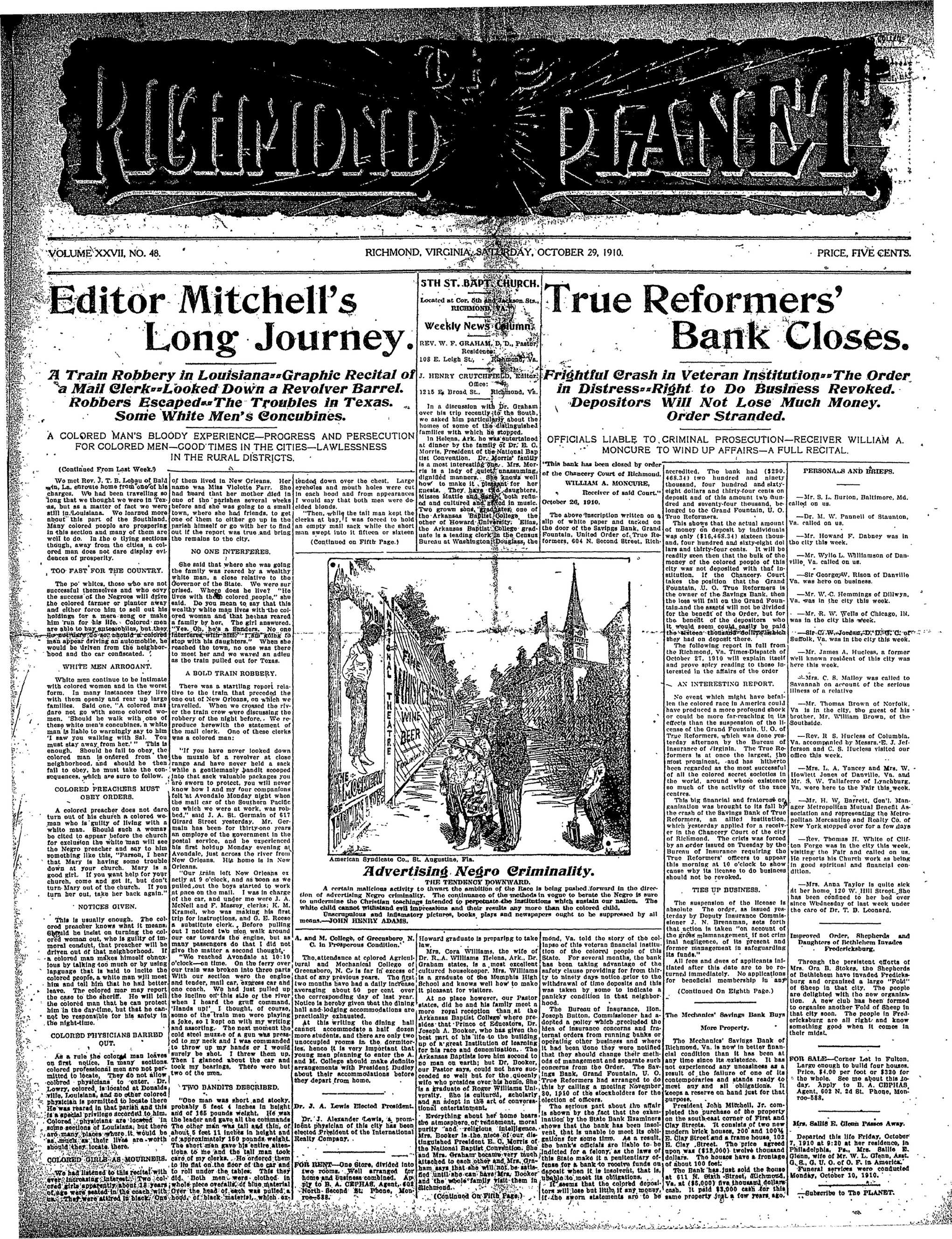
Advertising Negro Criminality.
A certain malicious activity to thwart the ambition of the Kace is being pushed forward in the direction of advertising Negro criminality. The continuance of the methods in vogue to berate the Negro is sure to undermine the Christian teachings intended to perpetuate the institutions which sustain our nation. The white child cannot withstand evil impressions and their results any more than the colored child. Unscrupulous and inflammatory pictures, books, plays and newspapers ought to be suppressed by all means.—JOHN HENRY ADAMS.
tended down over the chest. Large eyeboles and mouth holes were cut in each hood and from appearances I would say that both men were decided blonds.
"Then, while the tall man kept the clerks at bay, I was forced to hold an empty mail sack while the short man swept into it fifteen or sixteen
(Continued on Fifth Page.)
American Syndicate Co., S.
Advert
A certain malicious activity
tion of advertising Negro criminal
to undermine the Christian teachin
white child cannot withstand evil in
Unscrupulous and inflamato
means.—JOHN HENRY ADAMS.
A. and M. College, of Greensboro, N.
C. in Prosperous Condition.
The attendance at colored Agricultural and Mechanical College of Greensboro, N. C. is far in excess of that of any previous years. The first two months have had a daily increase averaging about 50 per cent, over the corresponding day of last year. Notice is hereby given that the dining hall and lodging accommodations are practically exhausted. At this writing the dining hall cannot accommodate a half dozen more students, and there are only two unoccupied rooms in the dormitories, hence it is very important that young men planning to enter the A. and M. College should make definite arrangements with President Dudley about their accommodations before they depart from home.
Dr. J. A. Lewis Elected President
Dr. J. Alexander Lewis, a prominent physician of this city has been elected President of the International Realty Company.
FOR RENT-One Store, divided into two rooms. Well arranged for home and business combined. Apply to B. A. CEPHAS, Agent, 602 North Second St. Phone, Monroe-588.
5TH ST. BAPT. CHURCH.
Located at Cor. 5th and Jackson Sts.,
RICHMOND, VA.
Weekly News Column.
REV. W. F. GRAHAM, D. D., Pastor,
Residence:
108 E. Leigh St., Richmond, Va.
J. HENRY CRUTCHFIELD, Editor,
Office:
1215 E. Broad St., Richmond, Va.
In a discussion with Dr. Graham
over his trip recently to the South,
we asked him particularly about the
homes of some of the distinguished
families with which he stopped.
In Helena, Ark. he was entertained
at dinner by the family of Dr. E. C.
Morris, President of the National Baptist Convention. Dr. Morris' family
is a most interesting one. Mrs. Morris is a lady of quiet, unassuming,
dignified manners. She knows well
bow to make it pleasant for her
guests. They have two daughters,
Misses Mattle and Sarah, both refined
and cultured and g rated in music.
Two grown sons, graduates, one of
the Arkansas Baptist College, the
other of Howard University. Elias,
the Arkansas Baptist College graduate
is a leading clerk in the Census
Bureau at Washington; Douglass, the
St. Augustine, Fla.
Rising Negro Crime
THE TENDENCY DOWNWARD.
It to thwart the ambition of the Race in city. The continuance of the methods it intended to perpetuate the institute impressions and their results any moreory pictures, books, plays and newspap
Howard graduate is preparing to take law.
Mrs. Cora Williams, the wife of Dr. R. A. Williams Helena, Ark., Dr. Graham states, is a most excellent cultured housekeeper. Mrs. Williams is a graduate of the Memphis High School and knows well how to make it pleasant for visitors.
At no place however, our Pastor states, did he and his family meet a more royal reception than at the Arkansas Baptist College where presides that Prince of Educators, Dr. Joseph A. Booker, who has given the best part of his life to the building up of a great Institution of learning for his race and denomination. The Arkansas Baptists love him second to no man on earth; but Dr. Booker, our Pastor says, could not have succeeded so well but for the queenly wife who presides for his home. She is a graduate of Roger Williams University. She is cultured, scholarly and an adept in the art of conversational entertainment.
Everything about her home bears the atmosphere of refinement, moral purity and religious intelligence. Mrs. Booker is the niece of our distinguished President E. C. Morris of the National Baptist Convention. She and Mrs. Graham became very much attached to each other and Mrs. Graham says that she will not be satisfied until she can have Mrs. Booker and the whole family visit them in Richmond.
(Continued On Fifth Page.)
---
True Reformers' Bank Closes.
Frightful Crash in Veteran Institution==The Order in Distress==Right to Do Business Revoked. Depositors Will Not Lose Much Money. Order Stranded.
OFFICIALS LIABLE TO CRIMINAL PROSECUTION—RECEIVER WILLIAM A. MONCURE TO WIND UP AFFAIRS—A FULL RECITAL.
“This bank has been closed by order of the Chancery Court of Richmond. WILLIAM A. MONCURE, Receiver of said Court.” October 26, 1910.
The above inscription written on a slip of white paper and tacked on the door of the Savings Bank, Grand Fountain, United Order of True Reformers, 604 N. Second Street, Rich.
accredited. The bank had ($290,468.34) two hundred and ninety thousand, four hundred and sixty-eight dollars and thirty-four cents on deposit and of this amount two hundred and seventy-four thousand, belonged to the Grand Fountain, U. O. True Reformers.
This shows that the actual amount of money on deposit by individuals was only ($16,468.34) sixteen thousand.
PERSONALS AND BRIEF'S.
Mr. S. L. Burton, Baltimore, Md. called on us.
Dr. M. W. Pannell of Staunton, Va. called on us.
Mr. Howard F. Dabney was in
ninality.
is being pushed forward in the direc-
in vogue to berate the Negro is sure
dions which sustain our nation. The
e than the colored child.
pers ought to be suppressed by all
mond, Va. told the story of the collapse of this veteran financial institution of the colored people of this State. For several months, the bank has been taking advantage of the safety clause providing for from thirty to ninety days notice prior to the withdrawal of time deposits and this was taken by some to indicate a panicky condition in that neighborhood.
The Bureau of Insurance, Hon. Joseph Button, Commissioner had adopted a policy which precluded the idea of insurance concerns and fraternal orders from running banks or operating other business and where it had been done they were notified that they should change their methods of management and separate such concerns from the Order. The Savings Bank, Grand Fountain, U. O. True Reformers had arranged to do this by calling a meeting November 30, 1910 of the stockholders for the election of officers.
The serious part about the affair is shown by the fact that the examination by the State Bank Examiners shows that the bank has been insolvent, that is unable to meet its obligations for some time. As a result, the bank's officials are liable to be indicted for a felony, as the laws of this State make it a penitentiary offense for a bank to receive funds on deposit when it is insolvent, that is, unable to meet its obligations.
It seems that the colored depositors will lose but little if any money, if the sworn statements are to be
---
accredited. The bank had ($290,468.34) two hundred and ninety thousand, four hundred and sixty-eight dollars and thirty-four cents on deposit and of this amount two hundred and seventy-four thousand, belonged to the Grand Fountain, U. O. True Reformers.
This shows that the actual amount of money on deposit by individuals was only ($16,468.34) sixteen thousand, four hundred and sixty-eight dollars and thirty-four cents. It will be readily seen then that the bulk of the money of the colored people of this city was not deposited with that institution. If the Chaneyer Court takes the position that the Grand Fountain, U. O. True Reformers is the owner of the Savings Bank, then the loss will fall on the Grand Fountain and the assets will not be divided for the benefit of the Order, but for the benefit of the depositors who it would seem could easily be paid the sixteen thousand dollars which they had on deposit there.
The following report in full from the Richmond, Va. Times-Dispatch of October 27, 1910 will explain itself and prove spicy reading to those interested in the affairs of the order.
AN INTERESTING REPORT
No event might have befallen the colored race in America could have produced a more profound shock or could be more far-reaching in its effects than the suspension of the license of the Grand Fountain, U. O. of True Reformers, which was done yesterday afternoon by the Bureau of Insurance of Virginia. The True Reformers is at once the largest, the most prominent, and has hitherto been regarded as the most successful of all the colored secret societies in the world, around whose existence so much of the activity of the race centres. This big financial and fraternal organization was brought to its fall by the crash of the Savings Bank of True Reformers, an allied institution, which yesterday applied for a receiver in the Chancery Court of the city of Richmond. The crisis was forced by an order issued on Tuesday by the Bureau of Insurance requiring the True Reformers' officers to appear this morning at 10 o'clock to show cause why its license to do business should not be revoked.
TIES UP BUSINESS
The suspension of the license is absolute. The order, as issued yesterday by Deputy Insurance Commissioner J. N. Brenaman, sets forth that action is taken "on account of the gross mismanagement, if not criminal negligence, of its present and former management in safeguarding its funds." All fees and dues of applicants initiated after this date are to be returned immediately. No applications for beneficial membership in any (Continued On Eighth Page.)
The Mechanics' Savings Bank Buys
More Property.
The Mechanics' Savings Bank of Richmond, Va. is now in better financial condition than it has been at any time since its existence. It has not experienced any uneasiness as a result of the failure of one of its contemporaries and stands ready to meet any and all obligations. It keeps a reserve on hand just for that purpose.
President John Mitchell, Jr. completed the purchase of the property on the south-east corner of First and Clay Streets. It consists of two new modern brick houses, 100 and 100½ E. Clay Street and a frame house, 102 E. Clay Street. The price agreed upon was $12,000 twelve thousand dollars. The houses have a frontage of about 100 feet.
The Bank has just sold the house at 611 N. Sixth Street, Richmond, Va. at ($5,000) five thousand dollars cash. It paid $3,000 cash for this same property just a few years ago.
ers'
Closes.
ution==The Order
iness Revoked.
Much Money.
—RECEIVER WILLIAM A.
FULL RECITAL.
PERSONALS AND BRIEFES
Mr. S. L. Burton, Baltimore, Md. called on us.
Dr. M. W. Pannell of Staunton, Va. called on us.
Mr. Howard F. Dabney was in the city this week.
Mr. Wylie L. Williamson of Danville, Va. called on us.
Sir George W. Rison of Danville Va. was here on business.
Mr. W. C. Hemmings of Dillwyn, Va. was in the city this week.
Mr. R. W. Wells of Chicago, Ill. was in the city this week.
Sir C. W. Jordan, D. D. G. C. of Suffolk, Va. was in the city this week.
Mr. James A. Hucless, a former well known resident of this city was here this week.
Mrs. C. S. Malloy was called to Savannah on account of the serious illness of a relative.
Mr. Thomas Brown of Norfolk, Va. is in the city, the guest of his brother, Mr. William Brown, of the Southside.
Rev. R. S. Hucless of Columbia, Va. accompanied by Messrs. E. J. Jefferson and C. S. Hucless visited our office this week.
—Mrs. L. A. Yancey and Mrs. W. Howlett Jones of Danville, Va. and Mr. S. W. Taliaferro of Lynchburg, Va. were here to the Fair this week.
—Mr. H. W. Barrett, Gen'l. Manager Metropolitan Mutual Benefit Association and representing the Metropolitan Mercantine and Realty Co. of New York stopped over for a few days
—Rev. Thomas H. White of Clifton Forge was in the city this week, visiting the Fair and called on us. He reports his Church work as being in good spiritual and financial condition.
—Mrs. Anna Taylor is quite sick at her home, 120 W. Hill Street. She has been confined to her bed ever since Wednesday of last week under the care of Dr. T. B. Leonard.
Improved Order, Shepherds and
Daughter of the Islemen Invades
Frederickkirch
Through the persistent efforts of Mrs. Ora B. Stokes, the Shepherds of Bethlehem have invaded Fredicksburg and organized a large "Fold" of Sheep in that city. The people are delighted with the new organization. A new club has been formed to organize another Fold of Sheep in that city soon. The people in Fredicksburg are all right and know something good when it comes in their midst.
FOR SALE—Corner Lot in Fulton.
Large enough to build four houses.
Price, $4.00 per foot or $320 for
the whole. See me about this to
day. Apply to B. A. CEPHAS
Agent, 602 N. 2d St. Phone, Mon-
roe-588.
Mrs. Sallie E. Glenn Passes Away.
Departed this life Friday, October 7, 1910 at 9:20 at her residence, in Philadelphia, Pa., Mrs. Sallie E. Glenn, wife of Mr. W. L. Glenn, Asst. G. S., G. U. O. of O. F. in America.
Funeral services were conducted Monday, October 10, 1910.
—Subscribe to The PLANET.
The Silver Horde By REX BEACH Author of "The Spoilers" and "The Barrier"
COPYRIGHT. 1809. BY
CHAPTER XV.
THE main body of salmon struck into the Kalirk river on the first day of July. For a week past the run had been slowly growing while the cameras tested themselves, but on the openings day of the new month the horde issued boldly forth from the depths of the sea, and the battle began in earnest.
At times they swam with clawing fins exposed. Again they churned the placid waters until swift combers raced across the shallow bars like tidal waves, while the deeper channels were shot through with shadow forms or pierced by the lightning glint of oil. They were driven in with the food tide to retreat again with the ebb, but there was neither haste nor caution in their progress. They had come in answer to the breeding call of the sea, and its exultation was upon them, driving them relentlessly onward. They had no voice against its overmarching smell.
The time had come for man to take his toll.
At Emerson's cannery there fell a sudden panic, for fifty fishermen coll. Returning from the banks on the night before the run started, they stacked their gear and notified Boyd Emerson of their determination. Then, despite his utmost efforts to dissuade them, they took their packs upon their shoulders and marched up the beach to Willis Marsh's plant. Larson, the day foreman, acted as their spokesman, and Boyd recognized too late the result of that conversation he had interrupted on the night of the cherry. This defection diminished his boat crew by more than half, and, while the shoremen mostly maintained their loyalty, the choice of putting up a pack secured him. Boyd swallowed his pride and went straightway to his enemy.
He found Marsh well recovered from his flesh wound of a week or more before, yet extremely cautious for his safety, as he evidenced by conducting the interview before witnesses.
"We are short handed, and I gave instructions to secure every available man," he announced at the conclusion of Emerson's story. "It is not my fault if your-men prefer to work for me." "Then you force me to retaliate," said Boyd. "I shall hire your men out from under you."
Marsh laughed provokingly
"Try it! I am a good organizer, if
nothing else. If you send emissaries
to my plants it will cause certain
violence, and I think you had better
avoid that, for we outnumber you ten
to one."
Emerson left in disgust. Nor had
he hit upon any method of relief when
Cherry came down to the plant on the
following morning. She inquired
straightway
"What are you doing about it? You
can't afford to lose an hour."
"I have sent a man to each of the
other plants to birefrain at any
price, but I have no hope that they
will succeed. Marsh has his crews too
well in hand for that."
Cherry nodded. "They wouldn't
do them now. He'd never let
them return to this country if they
did. Meanwhile the rest of your force
is on the banks, I presume."
"Yes."
"How many bons have you?"
"Ten."
"Heavenal And this is the first day of the run! It looks bad, doesn't it? Has the trap been to fill?"
"No. George is down there now. I guess Marsh succeeded in corking it. Meanwhile all the other plants are working while my Chinks are playing fantan. I seem to bring misfortune upon every one connected with me, don't it? he added. "I'm afraid I'm a poor sort."
How boyish he was, the girl thought tenderly, yet how splendidly brave he had been throughout the fight. There was a voiceless, maternal yearning in her heart as she asked him gravely: "If you fall now it will mean—the end of everything, will it not?"
"Yes." He squared his tired shoulders. "But I am not beaten yet. You taught me, never to give up, Cherry. If I have to go back home without a catch and see Hilliard take this plant over, why—I'll begin once at something now, and some day I will succeed. But I shall give up. I can what ain'toin we catch and then begin all over again next season."
"And--suppose you don't succeed!" Suppose Hilliard won't carry you!" "Then I shall try something else. Maybe I shall go to mining again. I don't know. Anyhow, she would not let me grow disheartened if she were here. She wouldn't let me quit. She isn't that sort." Cherry Mollette stirred and shifted her gaze uncertainly to the glenning bay. Abremont of them the fleet of fishing boats were drifting, with the tide. In the distance others were dotted clear away to where the opal ocean lay. A tug was passing, and she saw the sun flash from the cargo in its tow, while the faint echo of a song came waking to her car. She stood so for a long moment, fighting manfully with herself, then wheeled upon him suddenly. There was a new tone in her voice as she said: "If you will let me have one, of your launches I may be able to help you." "How?" he demanded quickly. "Never mind how. It's a long chance and hardly worth trying, but--may I take the boat!"
" Certainly," said ba. "There's one
being at the dock."
bring at the dock,
the show and saw
be aboard, then waved, goodbye and
---
HARPER & BROTHERS
walked moodily back to the office, gratified that she should try to help him, yet certain that she could not succeed where he and George had failed "Fingerless" Fraser had breakfasted late, as was his luxurious custom, and shortly before noon, in the course of his disattached meandering, he found his friend in the office, lost in somber thought. It was the first time in many weeks that he had seen this mood in Boyd, and after a fruitless effort to make him talk he fell into his old habit of imaginary reading, drowning away to himself as if from a printed page:
"Your stay among us has not been very pleasant, but it? Mr. Emerson inquired.
"Not so that you could notice it, replied our hero, 'I don't like fish, and I never did."
"That is the result of prejudice; the fish is a noble animal," Mr. Emerson declared.
"He's not an animal at all," our her gently corrected. "He's a biped—a regular wild biped, without either love of home or affection for his children. The salmon is of a low order of intelligence and has it Queen Anne stint to his roof. No person with a retracting forehead like that knows very much. The only other member of the animal kingdom that is as foolish as the salmon is Alton Clyde. The fish has got a shade the best of it over him, but as for friendship and the gentler emotions—why, the salmon hasn't got them at all. The only thing he's got is a million eggs and a sense of direction. If he had a spark of intelligence he'd lay one egg a year, like a been, and thus live for a million years. But does he? Not on your Sarony! He's a spendthrift and turns his eggs loose a hatful at a time. He's worse than a shotgun. And then, too, he's as clampon as a Harvard graduate and don't associate with nobody out of his own set. No, sr! Give me a warm blooded animal that suckles its young. I'll take a farmer every time."
"These are points I had never considered," said Mr Emerson, "but every business has its drawings, you'll agree. If I have failed as a host, what can I do to entertain you while you grace our midst?
"You can do most anything," remarked his handsome companion. You can climb a tree or do anything except fish all the time.
"But it is a dark night without, and I fear some mischief is afoot.
"True! But yonder 'beauthecous gel'"
Roused by the familiarity of these lines, Emerson looked up from his occupation and smiled at Fraser's serious pantomime.
"What about that the beauteous gel and the mischief that is afoot?" Oh, I heard all about your trouble it just left the posthouse." Oh, he said." The posthouse-Clyde's joint. Ain't he a calamity?"
"In what way?"
"Well, I like silence and quietude. I'm a fool about my quiet, but Clyde"—He paused an if in search for suitable expression. "Well, whenever I try to say anything he interrupts me." After another pause he went on: "He's dead sore on this place, too, and whirns around like a litter of pups. He says he was mised into coiling up hero and has a lunch he's going to lose his bank roll." "Last night's episode frightened him, I daro say." "Yes. Ever since he got that wallop on the burr in Seattle a guinea pig could lick him hand to hand. You'd think that ten thou' he put up was all the wealth of the inkers." "The wealth of what?" "Inkern! That's a tribe of mexican. However, I suppose I'd hang in there, same as he does if He had a mayonnaise head like his. He an awful since as a business man." "So he's homecick. eb?" "Surel Offered to sell me his stock." Fraser throw back his head and gave vent to one of his rare laughs. "Ain't that a rure?"
"Here he comes now," Boyd announced, with a glance out the window, and the next instant Alton Clyde entered, a picture of dejection.
"Goal. This is fierce, isn't it?" the clubman began, finging bliss into the nearest chair. "They tell me it's all off finally. What are you going to do?"
"Put up what fish I can with a short crew," said Boyd.
"We'll lose a lot of money."
"Probably."
Clyde's tone was querulous as he continued:
"I'm-sorry. I ever went into this thing. You bet if I had known as much in Chicago as I know now I wished I had thing on to my money and stayed at home."
"You know as much as we did," Boyd declared curly.
"Oh, it's all right for you to talk. You haven't taken any coin in the deal, but I'm a rotten business man, and I'll never make my auto back again if I lose it."
"Don't whine about it," said Boyd
and lose big arms.
"Then we are going to lose, eh!" quarried Clyde in a scared voice. "I thought maybe you had a plan. Look here!" he began an instant later. "Cherry pulled the suit once before. Why don't you let her see what she can do with Math?" Boy seated the speaker's face.
"I mean she can work him if she tries, the same way she worked Hilliard."
"March isn't in the mood to listen to arguments. I have tried that."
"Who said anything about arguments? You know what I mean."
"I don't care to listen to that sort of talk."
"Why not? I'm entitled to have my say in things." Clyde was growing indignant. "I put in $10,000 of my own money and $20,000 besides on your insurance. That's $35,000 more than you put up."
"Nevertheless it doesn't give you the right to insult the girl."
"I insult her! Bohl You're no fool Boyd. Why did Hilliard advance that loan."
"Because he wanted to, I dare say."
"What's the use of keeping that up? You know as well as I do that she worked him, and worked him well. She'd it again if you sacked her. She'd do anything for you."
CHAPTER XVL
B OYD broke out roughly: "I tell you, I've beard enough of that talk, Alton. Anybody but an idiot would know that Cherry is far too good for what you suggest. And when you insult her you insult me." "Oh, she's good enough," said Clyde. "They're all good, but not perhaps in the way you uizen."
"How do you know?"
"I don't know, but Fraser does. He's known her for years. Haven't you, Fraser?" But the adventurer's face was like wood as they turned toward him.
"I don't know nothing," replied "Fingerless" Fraser, with an admirable show of ignorance.
"Well, judge for yourself." Clyde turned again to Emerson. "Who is she? Where did she come from? What is she doing here alone? Answer that. Now, she's interested in this deal just as much as any of us, and if you don't ask her to take a hand I'm going to put it up to her myself."
"You'll do nothing of the sort!" Boyd cried saragely.
Clyde rose hastily, and his voice was shaking with excitement as he stammered.
"See here. Boyd, you're to blame for this trouble, and now you either get un out of it or buy my stock."
"You know that I can't buy your stock."
"Then I'll sell wherever I can. I have been stung, and I want my money. Only remember, I offered the stock to you first."
"You've got a swell chance to make a turn in Kalvik," said Fraser. "Why don't you take it to Marsh?"
"I will!" declared Alton.
"You wouldn't do a trick like that?" Emerson questioned quickly.
"Why not? You won't listen to my advice. You're playing with other people's money, and it doesn't matter to you whether you win or lose. If this enterprise fails I suppose you can promote another."
"Get out!" Royd ordered. In such a tone that the speaker obeyed with ludicrous basse.
"Did you know Cherry before you came to Kalvik?" Royd asked, searching his companion's face with a look the man could not evade.
"Only casual."
"Where?"
"None—the year of the big rush."
"During the mining troubles, eh?"
"Sure."
"What was she doing?"
"Mindling her business. She's good at that." Fraser's eyes had become green and fahy, as usual.
"What do you know about her?"
"Well, I know that a lot of fellows would go through for her at the drop of a hat. She could have most anything they've got. I guess, most of them miners at Nome would give his right eye or his only child, or any little thing like that, if she asked it."
"What else?"
"Well, she was always considered a right good looking party—"
"Yes, yes; of course. But what do you know about the girl herself? Who is she? What is her history?"
"What is her warrior the very best poor detective? confessed "Fingleress." Fraser.
"I've often noticed that about myself. If I was the kind that goes sn吞ing around into other people's business, listening to all the gossip I'm told, I make a good witness. But I ain't. No, siri! I'm a rotten witness."
Despite this indirect ruhke, Boyd might have continued his questioning
BILAN
had not George Bait's heavy step sounded outside. A moment later the big fellow entered. "What did you find at the traps?" asked Emerson eagerly. "Nothing." George spoke shortly. "The fish struck in this morning, but our trap is corked." He wrenched off his rubber boots and fled them savagely under a bench.
"What luck with the boats?" "Not much. Marsh's men are trying to surround our gill netters, and we ain't got enough boats to protect ourselves." He looked up meaningly from under his hefty brown and injured, "How much luck are we going to stand for this?"
"What do you mean? I've got not
know what to do."
sambled the and eyes fanning. "You and I can get Willa Maran."
Emeron shot a quick glance at Fraser, who was staring fixedly at Big George.
"He's got it right enough, and it's bound to come to a killing some day, so the sooner the better," the fisherman ran on. "We can get him tonight if you say so. Are you in on it?" Boal faced the window slowly, while the other followed him with anxious eyes. Insidhe the Foom a desthike alience settled.
Moreover, Mildred Wayland was soon to arrive—the yacht had we expelled daily, and the warden had him, would find that Marah had vanquished him. She would turn elsewhere—perhaps to the very man who had contributed his undoing. At thought of this a sort of desperation seemed to master him; he began to mutilate alience.
"What did you say?" queried Balt.
"I said that you are right. The time is close at hand, for some sort of a reckoning," answered Boyd in a harsh, strained voice.
"Good!"
Emerson was upon the point of turning when his eyes fell upon a picture that made him start, then gaze more intensely. Out upon the placid waters, abreast of the plant, the launch in which Cherry had departed was approaching, and it was loaded down with men. Not only were they crowded upon the craft itself, but trailing behind it like the fall of a kite was a long line of canoes, and these also were pooped.
"Look wonder!" cried Boyd.
"What?"
Cherry has got a crew—"His voice broke, and he bolted forward the door as Big George leaped to the window."
"Ijnus!" wildly shouted the giant, and without stopping to stamp his foot into his boots he rushed out barefoot after Boyd and Fraser. Together the three men reached the dock in time to help Cherry up the ladder.
"What does this mean? Boyd asked her breathlessly "Will these follow work?"
"That's what they're here for," said the girl. After her swarmed a crowd of slant eyed, copper bued Alouts. Those in the kraks awnest cast off and paddled toward the beach.
"I've got fifty men, the best on the river. I tried to get more, but—there aren't any more."
"Fingerless!" Praser slapped himself resoundingly upon the thigh and exploded profusely. Boyd seized the girls hands in his arms, tearing them. "The memory of his desperate resolution of a moment before swept over him suddenly and his voice trembled with a great thankfulness.
"Don't thank me!" Cherry exclaimed. "It was more Constantine's work than mine."
"But I don't understand. These are Marsh's men."
"To be sure, but I was good to them when they were hungry last winter, and I prevailed upon them to come. They aren't very good fishermen. They're awful lazy and they won't work half as hard as white men, but it's the best I could do." She lingered gladly, more than repaid by the look in her companion's face. "Now get me some lunch. I'm fairly starved."
Big George, when he had fully grasped the situation, became the boes fisherman on the instant. Before the others had reached the cookhouse he was buasted in laying out his crows and distributing his gear. The imporable and happened; victory was in sight; the hood was running. He cared to know no more.
That night the doors of the fish dock ground beneath a weight of silver sided salmon, piled waist high to a tall man. All through the cool, dim lit hours the ranks of Chinese butchers hacked and glit and slashed with swift, sure, tireless strokes, while the great building echeod hollowly to the clank of machines and the blissing signs of the soldering furnaces.
It seemed to Boyd that he had never felt such emulation as during the days that followed. He trod upon air; his head was in the clouds. He joked with his men, inspiring them with his own good humor and untiring energy. He was never idle save during the old hours that he snatched for sleep.
While the daily output was disappearing, Emerson drew consolation from the prospect that his pack would be large enough at least to avert utter ruin.
Up at the trust's headquarters Willis Marsh was in a fine furry. As far as possible his subordinates folded him. On the day after Boyd's delivery Constantine sought him out in company with several of the native fishermen, translating their demand to be paid for the fish they had caught.
"Can't they wait until the end of the week?" Emerson inquired.
"Not. They got no money—they got no grub. They say little baby is hungry, and they like money-now. So soon they buy grub, they work some more."
"Very well. Here is an order on the bookkeeper."
Bordt tore a leaf from his notebook and wrote a few words on it, telling the men to present it at the office. As Constantine was about to leave he called to him:
"Walt! I want to talk with you."
The breed halted.
"How long, have you known Mr. Marsh?"
"Me know him long time."
"Do you like blm?"
A blicker ran over the fellow's copper face as he replied:
"Yes. Him good man."
"You used to work for him, did you not?"
"Yes."
"Why did you quit?"
Constantine hesitated slightly before answering, "Me go work for Cherry."
"Why?"
"She good to my little brother. You savvy little children—so big!"
"Yes, I've seen him. Has a fine little fellow. By the way, do you remember that night about two weeks ago when I was at Cherry's house—night you and your sister went out?" "I member."
"Where did you go?"
Considineh elfthed walrus soled boots. "What for you ask?"
"Never mind! Where did you go when you left the house?"
"Me go Indian village. What for you ask?"
"Nothing. Only, if you ever have any trouble with Mr. Marab I may be able to help you. I like you, and I don't like him."
The breed grunted unintelligibly and was about to leave when Boyd reached
WITH A STARTLED CITY, CONSTANTINE
THRILPH. HIS FACE CONSTABLED.
forth suddenly and plucked the fellow's sheat: knife from its scabband. With a started cry, Constantine whirled, his face convulsed, his nostrils dilated like those of a frightened horse.
But Emerson merely fingered the Indian's weapon carelessly, remarking: "That is a curious knife you have, I have noticed it several times."
He eyed him shrewdly for a moment, then handed the blinde back with a smile. Constantino slipped it into its place and strode away without a word. It was considerably later in the day when Boyd discovered the Indians to whom he had given the note asking Constantine on the dock. Soaring in argument with them, he approached to demand an explanation, whereupon the quarter breed hold out a silver dollar in his palm with the words: "These men say this money no good." "What do you mean?" "It no good. No can buy grub at company store."
It was evident that even Constance tinea was vaguely distrustful. Another native extended a coin, saying: "What more want like this."
Boyd took the piece and examined it whereupon a light broke upon him. The coin was stamped with the initials of one of the old fishing companies and he instantly recognized a run practiced in the north during the day of the first trading concerns. It had been the custom of these companies to pay their Indians in coins bearing their own impress and to refuse to other specie at their posts, thus compelling the natives to trade at company stores. Seeing that his words carried no conviction, Emerson gave up at last, saying: "If the company store won't take the money I'll sell you whatever you need from the commissary. We are not grown up and may trouble over a little thing like this."
He marched the natives in a body to the storehouse, where he saw to it that they received what provisions they needed and assisted them in loading their canoes.
But his amusement at the episode gave way to unceasiness on the following morning when the Aleuts failed to report for work, and by noon his anxiety resolved itself into strong auspicion.
Bait had returned from the banks earlier in the morning with news of a struggle between his white crew and Marsh's men. George's boats had been surrounded during the night, nets had been cut and several encounters had occurred, resulting in serious injury to his men. The giant, in no amble mood, had returned for re-enforcements, stating that the aliens would every hour. Hearing of the desertion of the natives, he burst into profanity, then armed himself and returned to the banks, while Boyd, now thoroughly alarmed, took a launch and sped up the river to Chery's house in the hope that she could prevail upon her own recruits to return.
He found the girl ready to accompany him, and they were about to embark when Chakawana came running from the house as if in sudden fright.
"Where you go?" she asked her mistress.
"I am going to the Indian village. You stay here."
"No, not I no stop here alone. I go 'long too.' She cast a glance over her shoulder.
"But, Chakawana, what is the matter? Are you afraid?"
"Yea." Chakawana nodded her pretty head vigorously.
"What are you afraid of?" Boyd asked, but she merely stared at him with eyes as black and round on oxheart cherries, then removed her entreaty. When she had received permission and had hurried back to the house her mistress romarked, with a puzzled frown.
"I don't know what to make of her, Sho and Constantine have been acting very strangely of late. She used to be the happiest sort of creature, always laughing and singing, but she has changed entirely during the last few weeks. Both she and Constantine are forever whispering to each other and skulking about until I am getting nervous myself." Then, as the Indian girl came flying back with her tiny baby brother in her arms, Cherry added: "Shya's pretty, isn't she? I can't bear my people around me."
At the church village, in spite of
every effort she and Boyd could make,
the Indians retreated to go back to
work.
Since, they can't use your money at
the story, they don't seem to care
whether it is good or not." Cherry announced after a time. "Oh, but it maddeningly." She stamped her foot aggrily. "And I was so proud of my work. I thought. I had really done something to help at last. But I don't know what more we can do. I've reached the end of my rope." "So have I," he confessed. "Even with these fifty Alouts we weren't running at more than half capacity, but we were making a showing at least. Now!" He funged up his hands in a gesture of despair. "George is in trouble, as usual. Marah's men have cut our nets, and the yacht may arrive at any time."
"Tho yacht! What yacht!"
"Mr. Wayland's yacht. He is making a tour of this coast with the other officers of the trust and—Midred." "Is—is she coming here?" demanded Cherry in a strained voice. "Yes." "Why didn't you tell me?" "I don't know; I didn't think you would be interested." "So she can't wait? She is so eager that she follows you from Chicago clear up into this wilderness. Then you won't need my assistance any more, will you?" Her lids drooped, half hiding her eyes, and her face hardened. "Of course I shall need your help. Her coming won't make any difference." "It strikes me that you have allowed me to make a fool of myself long enough," said Cherry chirngy. "Here I have been breaking my heart over this enterprise, while you have known all the time that she was coming. Why, you have merely used me—and George, and all the rest of us, for that matter." She laughed harshly.
"You don't understand," said Boyd. "Miss Wayland."
"Oh, yes. I do. I dare say it will gratify her to straighten out your troubles. A word from her lips and your worries will vanish like a mist. Let us acknowledge ourselves beaten and bog her to save us."
Boyd shook his head in negation, but she gave him no time for speech. "It seems that you wanted to pose as a hero before her and employed us to build up your triumph. Well, I am glad we failed. I am glad Willis Marsh showed you how very helpless you are. Let her come to your rescue now. I'm through. Do you understand? I'm through."
Emerson gazed at her in astonishment, but outstretched had been so unexpected, but he realized that he owed her so much to take offense.
"Miss Wayland will take no hand in my affairs. I doubt if she will even realize what this trouble is all about," he said, a trifle stiffly. "I suppose I did want to play the hero, and I dared say I did use you and the others, but you knew that all the time."
"Why won't she help you?" queried Cherry. "Doesn't she care enough about you? Doesn't she know enough to understand your plight." "Yes, but this is my fight, and I've got to make good without her assistance. She isn't the sort to marry a failure, and she has left to make my own way. Besides, she would not dare go contrary to her father's wishes even if she desired. That is part of her education. Oh, Wayne Wayland's opposition isn't all I have had to overcome. I have had to show his daughter that I am one of her own kind, for she hates weakness."
"And you think that woman loves you! Why, she isn't a woman at all. She doesn't know what love means. When a woman loves, do you imagine she cares for money or fame or success? If I cared for a man do you think I stop to ask my father if I might marry him or wait for my lover to prove himself worthy of me? Do you think I send him through the hell you have suffered to try his metal? She languished ouright. "Why, I'd become what he was, and I'dight with him. I give him all I had—money, position, friends, influence, my people objected I tell them to go. I give I give them my aid to him. I give every dollar, every wife and feminine device that I possessed, in his service. When a woman loves who doesn't care what the world says. The man may be a weakling or worse, but he is still her lover, and she will go to him." The words had come tumbling forth until Cherry was forced to pause for breath.
"You don't understand," said Boyd. "You are primitive; you have lived in the open. She is exactly your opposite. Conservation is bred in her, and she can't help her nature. It was hard even for me to understand at first, but when I saw her life, when I saw how she had been reared from childhood, I understood perfectly. I would not have her other than she is. It is enough for me to know that in her own way she cares for me."
Cherry toasted her head in derision.
"For my part I prefer red blood to sap, and when I love I want to know it. I don't want to have it proved to me he a problem in geometry. I want to love and hate and do wild, impulsive things against my own judgment." "Have you ever loved in that way?"
"Have you ever loved in that way?" he inquired abruptly. "Yes," she answered without hesitation, looking him squarely in the eye with an expression he could not fathom. "Thank heaven, I'm not the artificial kind! As you say, I'm primitive. I have lived!" Her crimson lips curled scornfully.
"I didn't expect you to understand her," he said. "But she loves me. And I-well, she is my religion. A man must have some God. He can't worship his own image. The chancery hatchoed slowly to the chair, and made her way into the launch. All the way back she kept silence, and Boyd, confused by her attack upon the citadel of his faith and strangely sore at heart, made no effort at apace.
"Flaggrass!" Fraser met him at the water's edge. "Where in the devil have you been?" he crief breathlessly. "At the Indian village after hain Why?"
"Big George is in more trouble. He
sent for, beet, two hours ago. I was
just going in, beat, it, down there."
"what's up!"
"There six of your man in the bank houses all beat up. They don't look like they'd run any more for awhile. Marsha's men throw their saffron overboard, and they had another fight. Thinks are getting warm."
"We can't allow ourselves to be driven from the banks," said Boyd quickly. "I'll get the shoresmen together right away. Find Alton and bring him along. We'll need every man we can set."
"Nothing doing with that party.
He's quit like a house cat and gone to bed."
"Very well; he's no good anyhow.
He's better out of the way."
He hurried through the building, now silent and half deserted, gathering a crew; then leaving only the orientals and the watchman to guard the plant, he loaded his men into the boats and set out.
All that afternoon and on through the long, murky hours of the night the battle ranged on the lower reaches of the Kalvik. Boat crews chashed hard with winked nails and fought with winked fists, with oars and clubs, and when these failed they drove at one another with wicked one tinned fish "puce." All night the hordes of salmon swarmed upward toward the fatal waters of their birth, through sagging nets that were torn and silt, beneath keels that rocked to the impact of struggling, heedless bodies.
CHAPTER XVII.
B the sun slanted up between the southward hills out from the gossamer baza that is like flames in the sky the green area is a white rabbit.
To Boyd Emerson she seemed like an angel of mercy, and he stood forth upon the deck of his launch searching her lungrily for the sight of a woman's figure. When he had that seen the ship rounding the point he had uttered a cry, then fallen silent watching her as she drew near, headless of his surroundings. His heart was leaping: his breath was choking him. It seemed as if he must about Mildred's name aloud and stretch his arms out to her. Of course she would see him as the Grande Dame passed. She would be looking for him, he know. She would be standing there, wet with the dew, searching with all her eyes. Doubless she had waited patiently at her post from the instant land came into sight. Seized by a sudden pancake she pass him unnoticed, he ordered his launch near the yacht's course. His eyes roved over the confession of an unformed officer upon the bridge and the bronze faces of the watch staring over the run. He saw close drawn curtains over the cabiners were still sleep. Then as he stood there heavy hearted, drooping with fatigue, his wet body chilled by the morning's breath, the Grande Dame gilded past, and he found the shell beneath his feet rocking in her wake.
George Rait lattened him and brought his own launch alongside.
"What craft is that?" he inquired.
"She is the company's product. What the N. A. P. A. officers aboard."
"Some of our boys is hurt pretty bad," he observed.
"I've told them to take in their nets and go back to the plant."
"We all need breakfast."
"I don't want, nothing. I'm going over to the trap."
Emerson shrugged his shoulders listlessly; he was very tired. "What is the use? It won't pay us to lift it."
"I've watched that point of land for five years, and I never seen fish act this way before." But browled stubbornly.
"If they don't strike in today we better close down. Marsh's men cut half our nets and crippled more than half our crew last night." He began to rumble curses. "Say, we made a mistake the other day, didn't we? We ought to have put that feller away. It ain't to lob yet."
"Walt. Wayne Wayland is aboard that yacht. I know him. He's a hard man, and I've heard strange stories about him, but I don't believe he knows all that Marah has been doing. I'm going to see him and tell him everything."
"Spoise he turns you down?"
"Then there will be time enough to consider what you suggest. I don't like to think about it."
"You don't have to to." said Balt. lowering his voice so that the helmmen could not hear. "I've been thinking it over all night, and it looks like Id ought to do it myself. Marsh is coming to me anyhow, and I'm older than you. It isn't right for a young man to take a chance. They get me you can run, the business alone."
Boyd laid his band on his companion's shoulder.
"No," he said. "Perhaps I wouldn't stick at murder—I don't know. But I won't profit by another man's crime, and if it comes to that I'll take my share of the risk and the guillot. What over you do, I stand with you. But we'll hope for better things. It's up easy thing, for me to go to, Mr. Wayland asking a favor. You see, his daughter is— Well, [I] want to see her very badly." Bolt good shrewdly.
He eyed me and said, "I make it dead wrong for you to fake a hand. If it's necessary to get Marsh I'll do it alone. With him out of the way I think you can make a go of it. He's like a rattler—somebody's got to stomp on blink. Now I'm off for the old man says."
Hoyd returned to the cannery with the old mood of self disguish and bitterly heavy upon him. He realised that George's offer to commit murder had not shocked him as much as upon the first mention. He knew that he had thought of shading human blood with as little complication as if the intended veltim had been some noxious animal. He felt, indeed, that if his love for Mildred made him a criminal who would be soiled by his disloathing and for her sake he shrank from the idea of violence, yet he laughed the energy at that time to put it from him. Well, his would go to her hands; him would go to his hands; he failed than he would look for for
SATURDAY...OCTOBER 20, 1010.
Himself. He could not find it in his heart to spare his enemy.
At the plant he found Alton Clyde tremendously excited at the arrival of the yacht and eager to visit his friends.
He sent him to the launch and after a hasty breakfast joined him.
On their way out Boyd felt a return of that misrising which had mastered him on his first meeting with Mildred in Chicago. For the second time he was bringing her failure instead of the promised victory.
Willis Murbh was ahead of him, standing with Mr. Wayland at the rail. Some one else was with them. Boyd's heart leaped wildly as he recognized her. He would have known that slim figure anywhere. And Murdred saw him, too, pointing him out to her companions.
With knees shaking under him he came stumbling up the landing ladder, a tall, gaunt figure of a man in rough clothing and boots stained with the sea salt. He looked older by five years than the girl he had met and she often collected and his lips cracked by the wind, but his eyes were saddened with the old light. His smile was for her alone.
He never remembered the spoken greetings nor the looks the others gave him, for her soft, cool hands lay in his hard, feverish palms, and she was smiling up at him.
Alton Clyde was at his heels, and he felt Mildred disengage her hand. He tore his eyes away from her face long enough to nod at Marsh, who gave film a menacing look, then turned to Wayne Wayland. The old man was saying something, and Boyd answered film unintelligibly, after which he took Mildred's hands once more with such an air of unconscious proprietorship that Willie Marsh grew pale to the lips of whom Boyd had not noticed until now came down the deck—men and women with fieldglasses and cameras swung over their shoulders. He found that he was being introduced to them by Mildred, whose voice betrayed no tremor and whose manners were as collected as if this were her own drawing room and the man at her side a casual acquaintance. The strangers mingled with the little group, leveled their glasses and made senseless remarks after the manner of tourists the world over. Boyd gathered somewhat to see the heavy stockholdings of the their wives. He led Mildred to a deck chair and seated himself beside her.
"At last! he breathed. "You are here, Mildred. You really came, after all!"
"Yes, Boyd."
"And are you glad?"
"Indeed I am. The trip has been wonderful."
"It doesn't seem possible. I can't believe that this is really you—that I am not dreaming, as usual."
"And you? How have you been?"
"I've been well—I guess I have. I haven't had time to think of myself, oh my lady!" His voice broke with tenderness, and he laid his hand gently upon her.
She withdrew it quickly.
"No here! Remember where we are. You are not looking well, Boyd. I don't know how you look now you so bad. Perhaps it is your clothes."
"I am tired," he confessed, feeling anew the weariness of the past twenty-four hours. He correctly stalked a fold of her dress, unmintaining. "You are here after all. And you love me, Mildred? You haven't changed, have you?"
"Not at all. Have you?"
His deep breath and the light that named into his face was her answer.
"I want to be alone with you," he cried huskily. "My arms ache for you. Come away from here; this is torture. I'm like a man dying of thirst."
No woman could have behold his burning egerness without an answering thrill, and although Mildred sat motionless, her lilies dropped slightly and a faint color finger her cheeks.
Her idle hands clasped themselves rigidly.
"You are always the same," she smiled. "You sweep me away from myself and from everything. I have never seen any one like you. There are people everywhere. Father is somewhere close by."
"I don't care—"
"I do."
My launch is alongside. Let me take you asleep and show you what I have done. I want to go ashore with the Berrya and Mr. Marsh."
"Marsh."
"Now don't get tragic! We are all going to look over his plant and, have lunch there. They are expecting me. Oh, dear!" she cried plaintively. "I have seen and heard nothing but canneries ever since we left Vancouver. The men talk nothing but fish and packs and markets and dividends. It's all deadly stupid, and I'm wretchedly tired of it. Father is the worst of the lot of course."
Emerson's eyes shifted to his own cannery. "You haven't seen mine—cure" said he.
"Oh, yes. I have. Mr. Marsh pointed it out to father and me. It looks just like all the others." There was an irritable pause before who ran on. "Do you hear that only one interesting feature here? Do you my hollow, and that is the way, the way." Those funny crooked pipes and those little wads of tobacco are too ridiculous." The lightness of the wounds damped his arbor and brought back the pains of failure.
"I was down with the sailing nest at the month of the bay, this morning when you came in. I thought I might see you, he said.
"At that hour? Heavenal I was sound asleep. It was hard enough to get up, when we were called. Father might have instructed the captain not to steam so fast."
Boyd stared at her in hurt surprise, but she was smiling at Alton Clyde in the distance and did not observe his look.
"Don't you care even to hear what I have done?" he inquired.
"Of course," said Mildred, bringing her eyes back to him.
Boyd finally did her of his disappointments, the obstacles he had met and overcome, avoiding Marsh's name and refraining from placing the blame where it belonged. When he had concluded she shook her head.
"It is too bad. But Mr. Marsh told us all about it before you came. Boyd, I never thought well of this enterprise. Of course I didn't say anything against it, you were so enthusiastic, but you really ought to try something big. I am sure you have the ability. Why, the successful men I know at home have no more intelligence than you, and they haven't half your force. As for this—well, I think you can accomplish more important things than catching fish."
"Important!" he cried. "Why, the salmon, industry is one of the most important on the coast." It employs 10,000 men in Alaska alone, and they produce $10,000 every year. "Oh, why!" he into statistics," said Mildred lightly: "they make my head ache. What I mean is that a fisherman is nothing like—an attorney or a broker or an architect, for instance; he is more like a miner. Pardon me, Boyd, but look at your clothes." She began to laugh. "Why, you look like a common laborer!"
"I might have slicked up a bit," he acknowledged lamely, "but when you came I forgot everything else." "I was dreadfully embarrassed when I introduced you to the Berry and the rest. I darrosy they thought you were on the wrong side." Never before had Boyd known the least constraint in Mildred's presence, but now he felt the rebuke behind her careless manner, and it wounded him
"WHY, YOU LOOK LIKE A COMMON LA
BOBBI!"
"WHY, YOU LOOK LIKE A COMMON LA-
BORN!"
deeply. He did not speak, and after
a moment she went on with an abrupt
change of subject:
"So that funny little house over there
against the hill is where the mysti-
rious woman lives!"
"Cherry Malote."
"Yes, How did you learn that?"
"Yes. How do you think that," Mr. Marsh pointed it out. He said she came up on the same ship with you."
"That is true."
"Why didn't you tell me? Why did not you write me that she was with you in Seattle?"
"I don't know; I didn't think of it."
She regarded him coolly.
"Has anybody discovered who or what she is?"
"Why are you so curious about her?"
"Mildred shrugged her shoulders."
"Your discussion with Willis Marsh that night at our house interested me very much." I thought I would ask Mr. Marsh to bring her ground when we went ashore. It would be rather amusing. She wouldn't come out to the yacht and return my call, would she?" Boyd smiled at her frank concern at this possibility.
"You don't know the kind of girl she is," he said. "She isn't at all what you think. I don't believe you would be able to meet her in the way you suggest."
"Indeed!" Mildred arched her brows. "What?"
From her look of surprise he know that he had touched on dangerous ground, and he made hako to lead the conversation back to its former channel. He wished to impress Mildred with the fact that if he had not quite succeeded he had by no means failed, but she listened indifferently, with the air of humoring an insistent child.
"I wish you would give it up and try something else," she said at last. "This is no place for you. Why, you are losing all your old wit and buoyancy; you are actually growing serious, and sorbus people are at all amusing."
Just then Alton Clyde and a group of people, among whom was Willis Marsh, emerged from the cabin, talking and laughing. Mildred arose, saying:
"Here come the Berry, ready to go ashore."
"When may I see you again?" he inquired quickly.
"You may come out this evening."
His eyes blaked as he answered, "I shall counsel."
"Mr. Emerson can't accompany us. He whales to be father." "I just for this in the cabin," said Marah. He helped the ladder to the ladder, and a moment later Emerson wayed the party ladder, then turned to the saloon in search of Wayne Wayland. [For as common.]
The Scrap Book
He Wouldn't Repeat
When Harry Lauder, went to London for the first time the stage reputation he had made in the provinces had not made much of an impression on the metropolis. With a shrewd sense of the vaue of striking effects, Lauder decided he would arouse the Londoners to his peculiar merits in a novel, in manner. From some boneyard or other the most skeleton-like specimen of horseshoe hoof dnd. On this he planned to make his first stage entrance.
20
The old home
was tractable
enough with Lauder
astride airsure
less turn
in the wings,
but
RUBBED his ACHING ing his turn in BACK. the wings, but when the little fellow urged him forward for the grand entrance there was a balk a buck, and Harry was ingoriously shot to the front of the stage over the horse's head, the animal peering after him with what might be termed an anused expression. Lauder painted a rose to his feet, while the gallery applauded and stamped and cried loudly: "Do it again. 'Arry; do it again!" Lauder rubbed his aching back, felt quotently of his bones, looked back at the horse, and, turning to the audience, he said:
"Like — I, will!"
| And he didn't, but thereafter his popularity was assured. —judge.
The Face of Life
Life cried to Youth: "I bear the cryptic key.
I grant you two desires, but only two.
What gifts have I to crown, and comfort
Youth answered: "I am blind, and I would
see.
Open, eyed and let me look on thee."
"Twak done. He saw the faces of life and
then
Cried brokenly, "Now make me blind again!"
An aspiring jugglist went on for a preliminary bout at one of the athletic clubs not long ago. As he pulled on his gloves he beckoned the referee over and asked him to make an announcement. The referee obliged. "Kid Binks desires me to say," he shouted. "that this is his first appearance in any ring." The pair of fighters fiddled for a moment, and that the Kid Binks anticest W
make an "announcement. The referee obliged. "Kid Blinks desires me to say," he shouted, "that this is his first appearance in any ring."
The pair of fighters fiddled for a moment, and then Kid Blinks' antagonist, slipped one over. THE ONLY LION KEEP Kid Blinks fell so hard that he fairly splashed. The referee began to count him out; but the intelligent Mr. Blinks looked up and whispered something to him. The obliging referee turned and addressed the audience. "Mr. Blinks," said he, "wishes me to supplement his statement of a moment ago. This is also his last appearance in any ring"—Cincinnati Times-Star.
What the Books Cost Him.
When Colonel Robert G. Ingersoll was living in Pecoria he was called upon one day by General John A. Logan. The colonel was upstairs at the time, and General Logan was ushered into the library, where on a table were three volumes of Voltaire's works, an edition de luxe representing all that was best in the bookbinder's art. General Logan picked them up one at a time, absorbed in his admiration of their beauties. While so engaged Colonel Ingersoll entered the room. "Colonel," said the general, bolding one of the volumes in his hands, "this is the most magnificent volume that I do not want to seem important, but would you mind telling me what these books cost you?" "Those books," began the colonel, the winkle in his eye growing brighter at each word, "cost me—the governorship of Illinois."
Hiz Low, Voice.
The late Justice Brewer was presiding years ago over a civil case in which one of the important witnesses was a horse doctor named Williams. The doctor was, a small man with a weak little voice, and the counsel on both sides, as well as the court and jury, had great difficulty in hearing his testimony.
During cross examination the counsel for the plaintiff became exasperated and began to prod and harry the little man.
"Dr. Williams," he aboutted, "if we are over going to get anywhere with this case you must speak up so the court will hear you. Speak up loud and strong, also, and give veterinary tried, but it was evidently no use. Whether from embarrassment of inability the sound would not come.
"Well, your honor," began the counsel indignantly, when Judge Brewer stopped him with a gesture. Leaning over the bench he said in his kindly tone:
"Mr. Attorney, you must be patient with the doctor. He cannot help it. Years spent in the stick room have apparently made speaking low a second nature with him."—Green Bag.
A WOMAN AND A CHECK.
Mrs. Black Was Not Absolutely Help-
lies in Money Matters.
Some few persons still cherish the
idea that all women are absolutely
helpless in business matters, and that
they are so lacking in financial ability
that they cannot safely be trusted, as
had been in the sash of paying all the household bills, at the end of each month, and his wife, though allowed unlimited credit, had never had an allowance. One day, the Blacks happened to be passing the comparatively new building in which the bank was situated.
"Do you know, John." remarked Mrs. Black. "I have actually never been inside the bank since it was built more than two years ago!"
"You haven't!" exclaimed John. "If that's the case I guess I'd better give you a check this month and let you pay the bills. Do you think you'd know how to cash it?"
Mrs. Black received the check, which, by the way, happened to be an unusually large one that mouth.
That evening Mr. Black asked, not without sarcasm, if she had succeeded in indorsing it properly.
"Oh yes!" returned Mrs. Black cheerfully.
"How many bills did you pay?"
"None. It seemed stiffly to waste all that money paying bills."
Then what in the world did you do with "Oh." returned the little woman seendy. "I just deposited it in my name and opened an account of my own with it!"
Setting Her Right
On one of the corners of a busy thoroughfare sat an old man blind and minus one, leg. A sympathetic lady who was passing stopped and gazed at him in pity.
Finally she approached him and began asking him questions. She asked him if he were married, how many children he had, where he had worked last, how he had met with the accident that had incapacitated him for work and a thousand other questions.
Finally the unfortunate one became peevish. "Madam," he exclaimed harshly, "you may think this is an information bureau. It is not. It is a collecting agency." — Cincinnati Commercial Tribune.
Plair. Clothes Man.
In a small South American state which had recently undergone a change of administration the new potentate summoned an artist and ordered new designs for all the official uniforms. "I wish showy girtumes, very showy," he said, "for the people are impressed by them. I have here some sketches that I myself have made. Look them over and be guided by these ideas as far as possible." The artist examined the sketches carefully. "This," he said, turning the pages, "is evidently for the navy and this for the army, but. If you please, what is this—a long red plume on a three cornered hat, yellow dress coat trimmed with purple, and—" "That," replied the chief of state gravely, "is for the secret police."
His Hilarious Outburst:
There is a dourly looking but substantial Scot living in London whose business ability is above the average, but everything he does is done with the glum and melancholy air of a man constantly wrestling with some problem of the soul. He rarely speaks unless spoken to. He never smiles, and his eyes have a fixed but intense expression. And he has been returning London with his family. The whole party were Scotch, but the glum man's companions were of genial type. One of them told a humorous tale, over which the roast laughed up-
HE TOOK ONE AIDE.
roariously. "Not so the 'human problem. He sat in a corner of the railway carriage glowering at his mithful friends. Half an hour afterward, however, when all were stalling at a street corner before separating, he turned to me and said, 'How slowly? 'He would observe that I did n' laugh at yond story. Well, I saw the joke. Ye might not think it, but I have a keen sense of humor."
Grass and Glass
A Scotman was employed to mow the lawn of a close faded old lady. She insisted that he must cut it very short, adding that one inch at the bottom was worth two at the top. He did it so well that she was moved to produce a whisky bottle and a gin, which she filled about half full.
"Fill it up, mem," said Sandy, "for it's no like the grass. An inch at the tap's worth two at the bottom."
---
How to Renw Color of Bricks.
When red bricks of a fireplace got discolored with soot or have white spots on them rub with a brick polish.
the paste for which can be obtained at a brickyard or paint store
the paste for which can be rub the bricks well with inseed oil, giving them all they will absorb. This treatment may be repeated several times if the bricks are much discolored. Where brick pavements are discolored with mosaic or green mold scrub with a strong solution of household ammonia and water or with washing soda and hot water.
"I heard him say that his standard
PERT PARAGRAPHS.
NEVER give up the fight. At the darkest moment your rich uncle may do and leave all his money to an orphan asylum. You will then be in good trim for a hard fight.
Don't believe all the man says. He may have something to sell.
Lots of people will give a cup of cold water in charity, but will shy when it comes to giving a dinn.
The man who tries to run downp a rumor probably got his training carrying a pinch of salt around a garden where little birds abound.
And now it is the typhoid fly. Pretty soon those wise doctors will accuse the busy bee of giving us pericarditis.
A woman will stay at home from a bargain sale any day to try to solve a picture puzzle.
A man is known by the company he keeps, a woman by the clothes she wears.
A woman in a bubble skirt and a too obvious mouse will fornish a circus for a bystander.
The man who uses his religion only on Sundays probably figures that every day will be Sunday in the hereafter.
Jewelled, blown in the bottle fall campaign.
Insane
As of yore
An more
So if such a thing could bel
We are a free
And independent race.
Who being the case,
We do not doft the lid
To any royal kid.
To any kingly wreck
In the bolton you shallack
And the sink in his brain
That he was born to reign.
No, and not much!
Bush
Is not
Our unhappy lot.
We have a better way
Of saying you shall say
What kind of high toned laws we will obey.
We, the people, pay the freight
As we the state.
And if a ruler doesn't suit
The boot
For him.
Write
His career to a fare ye well
And tell
Him goodby,
We know the supply
Will not run short,
And so we sort
Over the list.
Paint it with our horny flat
Against another name.
Lead him to the Hall of Fame
And shout
Go!
Here
We are all set for another year!"
Needs Attention
"My Jimmie just loves to go to school."
"Does he?"
"Indeed he does."
"Let me tell you something."
"What is it?"
"That boy needs looking after."
No Good Reason.
No Good Mission.
"I have a perfectly good excuse."
"You have?"
A Difference Then
A Difference Trian.
You will, though lacking piece and rank.
Not find the world incurred.
If you have money in the bank
Unless the bank is busted.
Perfectly Possible.
"What is the cure for the divorce
evil?"
Fooled Him.
AND ELECTION DAY
"Bo Jones is running for office?"
"Yes; he says he board the call of his country."
"Hub! That was only the whistle of the steam roller."
She's Agreed.
"Well, Marjorie, how do you like the game?"
"So this is baseball."
"In't it stunting?"
"Yes; it isn't cunning?"
**HOW TO Prevent Haveling.**
In cutting out walnuts of any cloth that ravels overcant each piece an almond with and yellow and green trouble with, and yields raveling when the dining is done. Blind the armholes after alcoes are sewed in place on all such fabrics that are made up without lining. Use binding fibbon, as it strengthens the armhole and prevents the raveling and fraying so liable to occur in some goods.
**How To Make Oatmeal Grits.**
To make delicious oatmeal grits milk a cup of oatmeal in a cup of song milk; let it soak overnight and then add one teaspoonful of soda, a well-baked egg and half a cup of sugar. Bitte in doubt enough to make a batter.
SACK FOR THE BABY.
Little Flannel Garments Beautified With Silk Borders Make Most Suitable Presents to Infants.
Even in the warmest weather a tiny baby is not safe in the open air without a sack of some sort. To combine beauty and utility these little light fabric, sacks should be pretty embroidered, and therein lies inspiration for many a loving mother and devoted maiden nunt.
Take, for instance, a little sack of baby blue French channel cut in kimono style. The sides are shaded from the armpits down, and the square
sleeves, slashed also, are fastened by bows of blue ribbon, which also decorates the wide neck. Every edge is buttonholed in white, and there are sprays of white flowers worked in over and over stitch on the sleeves and on the side panels of the front. The great advantage of this sack is that it gives room for growth and thus is likely to have a longer life than the tightly cut little garment that is laid away in lavender after a few months.
For a larger baby is the elaborately embroidered sack in white French fennelle. Give it a pointed sailor collar and slash the cuffs, which are turned back. There are pointed slashes of about two inches in length at the sides and the middle of the back also, which insures a fit to the square cut of the sack. The embroidery, bowknots and sprigs of forgetments, should be in over and over and stem stitch, with a scalloped edge closely buttoned. Then line the sack with white china silk. White crape, also lined with china silk, makes a novel and beautiful sack for the lucky baby who is presented with it. The neck is cut round, with a rounded V shape in front, as shown in the illustration. There are wide turn back cuffs, and the sleeves and shoulder breadths are full. There is a square slash in the middle of the back. The embroidery is done in old rose silk, and the same stitches and scalloped buttonhole edge are used as before. The sack is fastened by means of wide old rose ribbon.
Either china silk or challis makes up well for a tiny sock cut in with a V stock and very wide sleeves, a little on the kimono type, especially in the cuffs and the square, straight bottom edge. The scalloping should again be very close, and the dainty flower sprigs are embroidered on the two back panels as well as the two front. Back and front there is an outline of a sailor collar in buttonhole stitch, though actually there is no collar at all. The whole effect is as dainty and cool looking as it can be.
These little sacks are a solution of the "what to give the baby" problem. They are easily made and look about ten times thick and cool when they are worn. Any mother will be bound to have one for her babe, and any friend or relative of the new arrival will be only too glad to give her self-charming employment by making up and working one. The best of them is that the baby cannot have too many, and there is therefore no danger of repetition.
HEALTH AND BEAUTY
It is very necessary to cleanso the tooth thoroughly before retiring at night. Use a soft brush and a good tooth powder.
- Sweet oil rubbed into the roots of the hair will often allay the unpleasant irritation from which dry scalps often suffer.
Dipping the fingers in cold water and rubbing the gums every morning before breakfast will aid the circulation and is of great benefit to unhealthy, dabby gums.
Bliting the lips-makes them hard and colorless. Rub a little cold cream, colored with a little cochineal, into them if they are rough or inclined to be sore.
Wool stockings are often irritating to tender feet. Substitute heavy cotton ones, and salt or alcohol baths will stimulate the circulation of the feet, which is generally the main cause of chilblains.
Never eat uncooked food, fruit or vegetables that have been exposed to the dust of the street without first thoroughly cleansing them. Many internal diseases have been attributed to the eating of gritty fruit and vegetables.
Even the strongest eyes may be strained by suddenly raising the window blinds in the morning or suddenly switching on a glare of light in a darkened room without first shading the eyes. Quick change from darkness or dim light to sunshine or dazzling light is a distinct tax on the eyes. Another precaution worth remembering in the care of the eyes is not to exert them immediately after rising. Never read or study before breakfast.
As It Impressed Him.
Fanchible Editor—What's the general effect of the new "hobble skirt"? Bridge Editor—Woll, if it is the one I saw on one of the elevated loop platforms the other afternoon is a correct sample, the general effect is hard; to describe, But, the particular effect is to lower the waist line to a point just below the knees.
STRAIGHT
DISTILLERY
WHISKEY
3 GALS. $4.50
4½ GALS. 6.75
EXPRESS
PAID.
AT
DISTILLERY
PRICE
What money Distillery Whiskey, we
mean it. We do not handle com-
pounds and chemical mixtures. If
the goods you buy and use are not
we represent it and better than you
ever bought at the price, return them
and we will REFUND your money.
TOUR CHANCE OF COURT, RATE ON GIN.
WEEKLY
$4.50
$6.75
$3.00
$5.50
Express Paid to any office of Adams
or Southern Express Company.
STONEWALL DISTILLING CO.
1453HULLST.RICHMOND.VA.
RAILROADS.
N. & W. NORFOLK &
WESTERN.
N. & W. NORFOLK &
WESTERN.
ONLY ALL NAIL LINE TO NORFOLK
Schedule In Eclipse June 12, 1910.
Leave Leaf in Richmond, N.W.
FOR NORFOLK: 18:10 A.M. M. 8:00 A.M.; 8:00 P.M.
; 4:10 P.M. M. 7:00 P.M.
FOR LYNCHBURG AND THE WEST—6:15 A.M.
8:30 A.M. A. M.; b 12:10 A.M. a 0:00 P.M.
9:20 A.M.
Arrive Richmond from Norfolk—b 11:35 A.M.
a 11:40 A.M. b 5:50 P.M. b 10:25 P.M. c 11:20
P.M. from the West; b 6:00 A.M. a 1:50 P.M.
8:30 A.M. b 12:10 A.M. b 10:25 P.M.
"Daily a daily except Sunday, b Sunday only"
Pullihan, Parlor and Sleeping Cars, Cafe Dining
Cars.
O. H. JOSHLE, BISJOSH
W. B. BRYILL. D. P A., Richmond, Va.
Q. P. A., Roanoke, Va.
ATLANTIC COAST LINE
ATLANTIC COAST LINE
---
EFFECTIVE APRIL 11, 1909.
THRING LEAF RICHMOND DAILY
For Florida and South: 8:18 A.M. and 7:18
For Norfolk: 8:38 A.M. 8:00 P.M. and 6
For M. and W. RY. West: 8:00 A.M. 19:18
and 8:05 P.M.
For Peterborough: 8:00 A.M. 18:10, 8:20
P.M.
For Goldsboro and Fayetteville: 8:18 P.M.
Traim above Richmond daily: 8:18, 7:00
P.M.
8:28 11:16 A.M. 8:18 A.M. 11:18 P.M.
8:00, 8:05 A.M. 8:18 P.M.
Only time of arrival and departure and non-
museum not guaranteed.
G. S. CAMPBELL, B. P. A.
Southern Ry
N. B.—Following schedule figures published as information and not guaranteed.
6:10 A. M.—Local for Charlotte, Durham and Telford.
A. M.—Daily. Limited. For all points South. Drawing Room Bubet Sleeping Car to Memphis, via Ashleev and Charleston.
3:00 P. M.—Eu. Sunday. Local for Durham and intermediate stations.
P. M.—R. M. Bunley. Keysville Local.
11:45 P. M.—Bunley. Keysville points South. Pullman limited. 2:30 P. M.
YORK RIVER LINE
13:20 P M - FX. Sunday To West Point, conc.
13:30 A M - Sun. and Sunday To West Point, M - Mose.
14:30 A M - Sun. and Sunday To West Point, M - Mose.
TRAINS ARRIVE RICHMOND.
From the Bouth: 7:00 A. M. 8:08 P. M. daly
2. M. Ek. Bunday: 12:56 P. M. Ek. Bunday.
2. P. M.
From West Point, 9:30 A. M. daily; 11:16 A.
M. Wed., 10:30 A. M. Sunday.
B. E. R. BURGESS, 9:30 A.
290 East Main Street, Phone, Madison-882.
C. & O.
9:00 A. Daily, Fast trains to Old Patish.
9:00 P. (Newport News and Norfolk.
9:00 P. Local to Newport News.
9:00 P. Daily, Local to Old Point.
9:00 P. Daily, Loudville and Ocincatt.
11:00 P. (Pollinna.
6115 P.-Work days. Local to Gorcowsville.
6115 P.-Daily. To Lyckhoville.
TRAINS ARRIVE RICHMOND.
Local from East-Kent-6:15 A. M. 1:50 P. M.
Through from East-11:25 A. M. 6:10 P. M.
Through from West-9:30 A. M. 8:30 A. M.
7:10 P. M.
Through-7:00 A. M. 2:45 P. M.
James River Line-6:15 A. M. 6:00 P. M.
"Daily except Sunday.
Your subscription to The PLANET
is done. Have you paid it? If not, what
should you do?
published every Saturday by JOHN MITOHELL, JR., at All N. Fourth Street, Richmond, Va.
JOHN MITOHELL, JR., - EDITOR.
All communications intended for publication should be sent as to reach us by Wednesday,
TERMS IN ADVANCE
Our Copy, one year,
One Copy, eight months,
One Copy, six months,
One Copy, four months,
One Copy, three months,
Single Copy,
ADVERTISING BATEEL
For one inch, one insertion .....8
For one inch each subsequent insertion...
For two inches, three months.....
For two inches, six months.....
For two inches, nine months.....
For two inches, twelve months.....
Marriage and Funeral Notices, one loch.....
Standing and Transient Notices per line..
POSTAGE STAMPS OF A HILOTHER DENOMINATION THAN TWO CENTS NOT RECEIVED ON SUBSCRIPTIONS.
THE PLANET is issued weekly. The subscription order is $1.00 per year in advance.
MONEY ORDERS—You can buy a Money Order at your Post Office, payable at the Richmond Post Office and we will be responsible for its delivery.
EMERGENCY-MONEY ORDERS can be obtained at any office of the American Express Co., the United States Express Co., and the Wells Fargo and Co. Express Company. We will be responsible for any emergency money order. The Express Money Order is a safe and convenient way for forwarding money.
REGISTERED LETTER—If a Money Order, Post Office or an Express Office is not within your reach, your Postmaster will Register the Letter you wish to send us on payment of the money order. You can send money that can be traced. You can send money in this manner at our risk.
We cannot be responsible for money sent in the letter, but we can send that of the four ways mentioned above. If you send your money on any other way, you must do it at your own risk.
MONEWALS, ETO—If you do not want THE PLANET postined for another year after your subscription has run out, you then notify us by Postal Card to discontinue it. The sources have to be sent to us by mail and order their paper discontinued at the expiration time for which it has been paid are liable for the payment of the subscription up to data when they order the paper discontinued.
COMMUNICATIONS—When writing to us to envision your subscription or to disconnect your phone, you should give your names and addresses to all subscribers we cannot find your name on our books.
CHANGE OF ADDRESS—In order to change the address of a subscriber, we must be sent the former as well as the present address.
Foltered at the Post Office at Richmond, Va., we second class matter.
SATURDAY... OCTOBER 20, 1910.
Religion of the Lord Jesus Christ is "mighty good." but many of the leaders of the Church have brought it into disregue.
---
President Taft is not in the time-
light any more. Ex-President Roosevelt is occupying the front of the stage and assumes the right to speak for both the Republican Party and for the administration.
Colored men are taking an active part in politics in the doubtful states and many of them will get that recognition under state administration that they have been denied under national administrations.
Harpers Weekly is bitterly opposing Colt Roosevelt and his Party. It claims that the name Republican has been erased and the word Roosevelt inserted in its place and it will not support the Roosevelt Party although it will support President Taft and his administration.
---
The announcement that President Taft has decided to appoint Hon. William H. Lewis of Boston, Assistant Attorney General of the United States will be gratifying information to the colored people of the United States. If he will appoint a colored man to succeed Mr. Lewis the matter will be-doubly satisfactory. We would like to know and understand the inside situation of this affair but it is neverthiocas very gratifying to every well-thinking colored man in this country.
EVOLUTION OF A PARTY.
It seems like the "irony of fate" that Senator Dolliver should have died at this momentous time and that Senator La. Follette should be dangerously ill just when their services are most needed by the Insurgents of the country.
Of course Col. Roosevelt is rendering signal service in the fight and has taken command in person of the cohorts which have been waging a genocide warfare upon Spokas Can.
non and his supporters.
It seems plainly evident that the political battle now being waged in New York will largely determine the future polley of the Republican Party of the nation. If Col Roosevelt wins he will unquestionably be the recognized leader of the Roosevelt Party which should be the name applied to the present Republican Party.
Will the colored Republicans fare better under Mr. Roosevelt than under Mr. Tatt? Will the black allies led by Hon. Charles W. Anderson of New York with the cordial approval of Dr. Booker, T. Washington be accorded official recognition and be elevated to political offices in this country, or will they be allowed political expenses before election day and after that time be forgotten?
These questions demand an answer and the pledges required should be forthcoming or else we shall find ourselves in a position more humilating than the one we now occupy. The disintegration of the Negro vote is setting in. Coloradon are now affiliating with all parties and the result will finally be that individual recognition will take the place of that vouchsafed to organized bodies.
THE DOWNFALL OF THE TRUE REFORMERS.
---
The financial disaster which has overtaken the Grand Fountain, United Order of True Reformers in general and the Savings Bank, Grand Fountain, U. $ ^{4} $ O. T. R. in particular will not surprise any one of ordinary intelligence, who has observed the trend of events in that organization during the past ten or more years.
It was this journal which announced in clarion tones the beginning of its dissolution. When its distinguished founder over-leaped himself, evidently upon the advice of his close advisers to "get rich quick" at the expense of the Order, and sold to the corporation for ($50,000) fifty thousand dollars, its own secret righthistle work and its own constitution, basing the sale upon the possession of two copyrights which had cost him just one dollar, we then declared that the end would come sooner or later and that the men interested in the deal would pay the penalty.
We have lived to see the full realization of our prediction both as to the man and the organization. The former is dead and the latter is in its death-throes with its thousands of innocent victims as the sufferers. It rounds us of the biblical declaration that the sins of the fathers shall be visited upon the children, even unto the third and the fourth generation.
But then it is useless to dwell upon the past. It is far better to look to the future and by-gones be by-gones. We are certainly pained by the disclosures, which whilo being something worse than we expected, yet they bear out the private information which has been furnished to us for two years or more.
It proves too the value of the Bureau of Insurance and the Banking Department of the State Corporation Commission, which is engaged in correcting conditions in a charitable and business way and affording solvent concerns an opportunity to conform to modern methods of business.
We are glad to note that the Joposits will hardly exceed sixteen thousand dollars and we see no need why this amount should not be forthcoming from the wreckage if the ownership of the bank can be successfully lodged with the Grand Fountain, United Order of True Reformers.
will require a master mind to pilot the fraternal department of the Order through this malestrom of financial destruction. Still it can be done and we hope that the strong men and women "in the paws" so to speak will make up their minds not to let the Order die. Those of us who have criticised it have done so in a spirit which wished it well. We saw the breakers ahead and we warned the leaders. The result is well-known.
We call upon them now to make another start. Rid the Order of those' who have been foremost in bringing about its undoing and make one more short to regain the prestige and capture the good record which they have lost.
The colored people of the country should not be dismayed or disheartened by this disaster. They should try over again and redouble their efforts to demonstrate their ability to successfully launch and operate great financial enterprises. Our people must learn though to discriminate between leaders of ability and the leader of only the "mouth persuasion."
Financial ventures cannot be entrusted to the crowd or to men who are emotional only and not sincere and practical. If the downfall of the True Reformers will tend, to rid the organizations of these kind of people and cause men of rare worth and ability to gravitate to the top, instead of being, by the clamor of the mob, forced to the bottom, then the disaster which has overtaken this great organization will not have been in vain.
For the conservative "standpatters" here's the correct conventional Chamberfield Overcoat; simple, dignified elegance, silk lined of course, oxford or other dark shades. Prices $25 to $40.
With serge linings, $15 to $22.50.
Now for the young man who intends to avoid, the regulation style, hero are innovations; a form fitting, double-broasted overcoat with long skirt, gray with dark soft gilds, also other striking designs, $15 to $35.
Cravenette Rain or Shine Coats are wonderfully handy—$12.50 to $35.
English slip-ons, a big roomy garment with raigan sleeves—just the thing for antolats—$25.
English Walking-coat Suits—a true test of the Berry ability to fit—$22, $25 and $30.
C. N. Benylla
Main and Eleventh Streets.
SIMEON E. BALDWIN.
Threatens to Sue Colonel Roosevelt. For Libel.
```markdown
```
Howard Gould to Marry Actress.
Friends of Howard Gould in Paris are not surprised to hear of his reported engagement to Kathryn Hutchinson, the actress. For several months past it has been known that he was infatuated with the actress. They have been constantly together.
Gould has been cruising in his yacht in northern waters during the summer. Kathryn Hutchinson was a member of the small party aboard. He was seen in Paris with her during the summer, when they dined often together at well known Bohoman resorts.
Howard Gould's attachment to Kathryn Hutchinson has been common talk here for some time. His friends believe he will follow Frank Gould's example in refusing to reveal whether he intends to marry the woman with whom his name is associated, allowing his associates, as well as the public generally, to make whatever guesses they wish.
Catches Strange Flah.
A strange fish, such as never before has been seen on the water front at Boston, having a head nearly twice as large as its body, was caught off City Point by William Mcintyre, of South Boston.
The fish is four and a half feet long. The head is two feet eight inches in diameter. The mouth extends nearly across the whole front of the head and contains fifty teeth and a tongue one foot across and two inches thick. There are no lips, the teeth being on the edge of the mouth and visible when the mouth is closed. The body tapers almost to a point. The fins have a spread of a foot each and are attached to the back of the head.
---
Student Accused of Bigamy.
Harry A. Roosback, aged twenty-three years, of New Haven, Conn., who made the claim that, he was a Yale student and the son of an Albany, N. Y., millionaire, was bound over to the higher court from the police court in bonds of $2000 on the charge of bigamy. Mary A. Sebas of this city, testified that she was married to him in Millerton, N. Y., three years ago. He deserted her and their baby about a month ago. He and Anna Sherwin, of Brooklyn, N. Y., wore married in this city.
Crissan Sentenced to Death.
Cripple sentenced to death
Dr. Hawley Harvoy Crippon must
die for the murder of his actress
wife, Bello Elmorro, was decreed by
swift British justice in London. After
only thirty minutes' deliberation, an-
cceeding a trial lasting five days, a
jury found the American dontist-guilty
of the murder of his wife Cora, an
American woman, known on the stage
as Belle Elmorro, and Lord Chief Jus-
lice Alvorstone, who provided at the
trial, sentenced Crippon to be hanged
on Nov. 8.
Toe was cultivated in China 2,700
years before the Christian era and in
that country was first used as a bow-
erage.
Declared Not Guilty of Being an Accessory After the Fact in Murder of Belle Elmore
After a trial that lasted but a few hours in the New Balloy criminal court in London a jury found Ethel Clara Lennox not guilty as an accessory after the fact in the murder of Corn Belle Cricken, for whose death her husband, Dr Hawley H. Cricken, will die on the gallows on Nov. 8.
From the first Miss Lenovo has maintained innocence of any knowledge of the crime, but the crown charged that her behavior after the disappearance of Mrs. Cricken, or Belle Elmore, as she was known on the sting, who such as to botrya a guilty knowledge of the murder.
When arraigned Miss Lenovo pleaded not guilty and witnesses were examined by the prosecution to show that she had perforations of great mental distress, following Belle Elmore's death.
The crown prosecutor introduced only such evidence as had been brought out in the earlier hearings.
Under Influence of Crippen.
Miss Loneve's counsel asked the jury to bear in mind that his client had been under the influence of Crippen, one of the most dangerous criminals of recent years, since she was sixteen years of age.
This, he asserted, accounted for her flight with the doctor. There was no proof that she had guilty knowledge of the crime. Counsel said that he took upon his own shoulders the responsibility for not putting Miss Loneve in the witness box.
Lord Chifl Justice Alverstone, in summing up, said that he saw no reason why Dr. Crippen should have told Miss Loneve a story different from that which he told to others.
When the prisoner had pleaded Lord Chifl Justice Alverstone called Richard, D. Mull, crown prosecutor, who outlined the case against the accused.
It was clear, Mr. Murl said, that the intrigue between Dr. Cripson and Miss Leneve constituted the moNve for the murder of Cripson's wife. He dwelt particularly upon the evidence of Mrs. Jackson, Miss Leneve's landiay, at the preliminary hearing, and which will be introduced at this trial.
The illness of the accused on the night of her interview with Mrs. Jackson was not, the prosecutor said, an ordinary illnss, but a condition of horror, the explanation of which was the knowledge that had come to her that Cripson had murdered his wife.
Thore was a sequel to the Cripson case when the high court imposed a fine of $1000 upon Assistant Editor Berris for contempt of court in permitting publication in the London Chropicle of & story assorting that Dr. Cripson had purchased hyoscin and had confessed to the murder of his wife. The court ordered that Peris be imprisoned until the fine is paid.
STEEL CANAL LOCK GATES
Pittsburg Mill to Start Work on Big Contract For Panama.
The manufacture of 65,000 tons of structural steel for the Panama canal lock gates, at a cost of $5,500,000, has been started in one of the Pittsburgh mills, and the first shipment will be made in three weeks.
The erection of the gates is expected to be started about Jan. 1, and it will take nearly three years to complete the job:
There will be forty-six sets of gates of structural steel. Each lock will have two of these gates, one leaf of which will weigh 600 tons and will be 65 feet wide and 77 feet high.
There will be twenty sets of these gates at Gatun, twelve at Padro Miguel and the rest at Mirarofos.
Oldt Blouse With Crople
In a letter sent to her mother, Bessie, the eighteen-year-old daughter of Mr. and Mrs. John Anderson, of York, Pa., told of her elopement and marriage to Harry Mayor. The parents of the girl opposed her marriage to Mayor, for the reason that he had been a cripple from birth and could only get about oh crutches.
Fine In Conflicts' Plot to Escape. Convicts are charged by the penitentiary officials at Columbia, Ohio, with starting a fire that destroyed stamp shop No.4, behind the walls of the penitentiary. Convicts say that there was a plot among the convicts to escape during the excitement, but this was frustrated by the timely discovery of the fire.
Taft Congratulates "Shoot" Winners. President Taft sent lotors of congratulation to the winners of the most important three championship matches at the national rifle tournament at Camp Perry in August.
Broke Neck in Fall Down Stairs.
Falling down a flight of steps at the home of a relative at Shamokin Pa.
Mrs. Elizabeth. Heckert's neck was broken, causing instant death.
Governor Fort Appoints Mrs. Cleveland
Mrs. Frances Polom Gloveland, the widow of the former president, was named by Governor Fort, of New Jersey, as one of the managers of the woman's reformatory, the execution of which was authorized by the last legislature. Mrs. Cleveland has taken a deep interest in charitable and correctional work among women in this state.
Judge Baldwin, of Conn., Threatens to Bring Sult.
Friends of Judge Anderson, of Indianapolis, Whom Roosevelt Denounced, Are Also Indignant.
How. Simeon E. Baldwin, ex-chief justice or the supreme court of Connecticut and Democracy nominee for governor of Connecticut at the conning election, sent an open letter to Theodore Roosevelt, informing him that he had misrepresented him in his political speech at Concord, N.H., last Saturday, if the newspaper reports were correct, and demanding a retraction of the false statements, because they were likely to hurt the judge's standing as a lawyer and prejudice his candidacy for governor. Judge Baldwin, it is understood, means to bring an action for Jillol.
Judge Baldwin's letter in part is as follows:
"The Hon. Theodore Roosevelt, LL.D.
"Dear Sir—In the newspaper reports of a speech delivered by you at Concord, N. H., on Oct. 22, it is stated that you remarked; that the Democratic party of Connecticut had nominated for governor a former judge who was a man who took the view that it was competent for the workman, when driven to any employment, to grind him to blind himself not to be compensated if he lost life or limb in that occupation.
"I nogr took such a view.
"I never stated that I took such a view.
"Such a view would be opposed to the settled principles of law, and no competent lawyer could or would take it.
"I trust that your remarks at Concord were misrepresented. If not, you certainly were misinformed.
"If you did, in fact, make the charge against me or one substantially of that character, I write to request that you would retract it, as it is one calculated to affect my standing as a lawyer (at least among those who do not know me), as well as to prejudice my position as a candidate for public office."
Judge Anderson's Friends Indignant.
The friends of Judge Albert B. Anderson, who was denounced at the Columbia club, in Indiapolis, Ind., by Mr. Roosevelt as a "danned crook and jackass," have written him from all parts of the state, and many have called upon him to express their indignation and at the same time assure him that nothing which the former president could say would have any effect upon those who know him and are familiar with his honorable record as a citizen and a judge.
Some of them have indicated that they would be glad to unite in a testimonial and have it sent broadcast over the country, but there is little prospect that the judge would consent to this. Those who have talked with him, while not professing to speak for him, do not believe he will notice the insult.
Notwithstanding his silence there is great indignation that he should have been characterized as a "crook and jackass" by Mr. Roosevelt, and some of the former president's warmest friends are among the number who believe he wantonly charged Judge Anderson with that which he in no sense deserves.
Why Balloon Was Abandoned.
Walter, Wellman, and his five companions, who were rescued at sea from the dirigible balloon 'America by the steamship Trent, Captain Charles E. Down, of the Royal blight Steam Packet company, about 375 miles east of Norfolk, Va., Tuesday morning while attempting to fly from Atlantic City to Europe, reached New York aboard the Tront.
Mr. Wellman, still wearing the kahlai aviation clothes which he has worn since sailing from Atlantic City in the balloon last Saturday morning, showed no more ill effects of the voyage than did his companions, other than that he was somewhat pale and carried one arm in a sling owing to an injury, to the little finger of his right hand.
After Mr. Wellman had groomed his wife, his four daughters, Mr. Vanman and Mrs. Loud, who is the aged mother of Mrs. Vanman and of Engineer Albert Louis Loud, of the America's crow, the newspaper men worked their way to Mr. Wellman's side to ask him the reasons for the abandonment of the dirigible and consequent lack of success of the voyage.
Mr. Wellman surprised his interviewers by stating that the airship had met with no serious engine troubles and that the escape of gas from the bag was negligible. In two statements signed by Mr. Wellman just after the rescue and in conversation with Captain Down and passengers on the Trent, Mr. Wellman was quoted as saying that the dirigible had not with shapels so serious that the balloon when sighted by the Trent could have remained above the sea only a few hours longer and that her machinery had gone away.
"The equilibrator was our great trouble," Mr. Wellman explained. "Before starting out on this balloon voyage we were of the opinion that no dirigible, could reach Europe without an equilibrator. Now we know that a dirigible, cannot get there, with an equilibrator. The equilibrator, which being partly formed of small tanks of gasoline arranged in links and trailing it, fell down into the ocean, was the very cause of our being compelled to throw overboard some of our gasoline on Sunday, night and Monday. The trailing tail had the balloon back and at times pulled it down through the
OFFICES FOR RENT.
WELL LIGHTED, WELL VENTILATED OFFICES FOR RENT IN THE NEW MECHANICS' SAVINGS BANK BUILDING.
LIGHT, HEAT AND JANITOR SERVICE INCLUDED AT A RENTAL OF FROM $5.00 PER MONTH UPWARDS. THIS IS ONE OF THE MOST PALATIAL AND CONVENIENT STRUCTURES IN THE CITY AND THE SERVICE RENDERED IS FIRST-CLASS.
An Ideal Scalp Food and Hair Tonic. The peer of all other Hair Dressings. On sale at all first class drug stores. 25 cents the box, the bottle. Soap- 25 cents the cake. Agents Wanted. HAIR-VIM CHEMICAL CO. (ING.) 548 Florida Avenue, N. W., Washington, D. C.
◆ Lectures by Distinguished Men will be Delivered Throughout
◆ the Entire Course. It will be Thorough in Every Particular. It
◆ ONE HUNDRED YOUNG MEN ARE DESIRED TO ENTER THIS
◆ PARTICULAR, DEPARTMENT.
The Regular School Term Opens October 12, 1910. All Applications for Admission must be Made by September 18, 1910.
For Further Information Address.
D. J. FARRAR, CONTRACTOR AND BUILDER,
ALL BUNDS OR CARPENTRY.
Special Attention Paid to the Testing or Contracts for Building of Any Style or Architecture, Job/Work a Specialty.
and we had to ballast ship at the cost of a loss of gasoline dropped to the waves. Try against. Well, something better than our equilibrator will have to be invented. Until it is I cannot answer definitely when I shall make another trial. The balloon was in good condition when abandoned."
Six Killed in Bolter Explosion. A bolter explosion killed six firemen, fatally wounded two others and threw 2000 women and girls and halted as many men into a panic at the bigging and rope plant of the American Manufacturing company, at. Greenpoint, across the East river from New York. When the big bolter in the two-story brick warehouse attached to the plant blow up, there was a rush for the doors. Many of the weaker ones were trampled under foot.
All the time the building was shaking, as another boiler blew up with great violence. The police reserves succeeded in quieting the disorder and in stealing the onrush from the factory buildings into the rain. When picked up the bodies of the six firemen were terribly mutilated. It was with difficulty that they were recognized. The other two firemen were rushed to a hospital in a dying condition.
David B. Hill Is Dead.
David B. Hill, ex-United States senator and former governor of New York, died suddenly at Wolffer's Roost, his count, y home near Albany, N. Y. He was sixty-seven years old and unmarried.
About two weeks ago Mr. Hill was seized with a billion attack while at his law office in Albany, and although his condition was not considered serious at the time, his physician advised him to remain at home for a few days until he recovered.
A cold developed and a few days later alarming reports of his condition were circulated. These reports were denied by friends; in fact, the senator appeared to be on the road to recovery until Wednesday night, when he suffered a sinking spell, which resulted in his death.
Robbed of $10,000 In Gama.
James C. Foster, a salesman from Columbus, O. has made complaint to the police in Chicago that he had been robbed of two sample cases containing $10,000 worth of jewelry while he was in a hotel, lobby here. According to his statements, he left the sample cases on the floor in front of the cashier's desk to step to the cigar counter. When he returned a minute later the sample cases had vanished.
Doomed to Die In Six Minutes
Chicago
assassination of Mathew Orwain of Jackson Ky. and the subsequent immediate trial because of the loss of moh plague. On October 1st he was taken into custody and sentenced to death by a jury which was confiscated, mistreated and then hurried for execution. On the keeping. Crawford's schedule were attending his funeral when this was taking place.
Wins-Nobel Prize, For Medicine.
The Nobel prize for medicine has been awarded to Dr. Albrecht Kossel, professor of physiology at Heldelberg university.
Bear Admiral Read Dies
Rear Admiral John J. Read, U. S.
N. retired, died at his home in Mount
Holly, N. J. Heart disease caused his
death.
$3.50 RECIPE CURES WEAK
MEN—FREE
Send Name and Address Today
You Can Have It Free and Be
Strong and Vigorous.
I have in my possession a prescription for nervous debility, lack of vigor, weakened manhood, falling memory and lame pack; brought on by excesses, unnatural drains, or the follies of youth, that has cured so many worn and nervous men right in their own homes—without any additional help or medicine—that I think every man who wishes to regain his many power and virility, quickly and quietly, should have a copy. So I have determined to send a copy of the prescription free of charge, in a plain, ordinary sealed envelope to any man who will write out this prescription. This prescription comes from a physician who has made a special study of men and I am convinced it is the surest acting combination for the cure of deficient manhood and vigor failure ever put together.
I think I owe it to my follow man to send them a copy in confidence so that any man anywhere who is weak and discouraged with repeated failures may stop drugging himself with harmful patent medicines, secure what I believe is the quickest acting restorative, upbuilding, SPOT-remediation, and cure himself at home quietly and quickly. Just drop me a line like this: Dr. A. E. Robinson, 3895 Luck Building, Detroit, Mich., and I will send you a copy of this splendid recipe in a plain ordinary envelope free of charge. A great many doctors would charge $3.00 to $5.00 for merely writing out a prescription like this—but I send it entirely free.
FOR RENT. VENTILATED OFFICES
Editor Mitchell's Long Journey.
(Continued From First Page.)
Iposo bundles which were on my desk and with which I was working at the luna. These packages were 'local matter,' consigned from New Orleans to points on the Southern Pacific line between New Orleans and Beaumont. No Houston packages are missing.
VALUABLE PACKAGES HID.
"Much of my registered matter and packages designed for banks, in which currency is presumably sent, was in my desk drawer, locked up. When I was commanded to throw up my hands I backed up against this desk and the drawer was hid from view. In addition, it is my custom to cover bank packages, mine of sight, and several of these were in the bar at the time and were overlooked by the robbers.
"None of the trainmen had any idea that we wore being held up, for in a moment or so, the engineer gave his preliminary startling whistle. Then the two men backed out of the car, with a further instruction to us not to raise a fuss. As they left, the short man who had been directing his attentions at me, cocked his revolver and again throwing his gun in my face, said, 'I've got a notion to get you, just for luck.' I thought my time had come. He evidently thought better of it, and the two men slid from the car door out into the darkness. When outside the car they fired two shots, but neither struck the car.
"When I was certain both men had gone my men and I gave the alarm, and the telegraph operator at Avondale, a quarter of a mile away, was notified. He sounded the alarm up and down the line.
ALARM QUICKLY GIVEN.
"It was exactly thirteen minutes from the time the men entered my car until the alarm was sounded. I looked at my watch just as the men stepped in the door and it registered 10:10 P. M. I looked again as the operator clicked on the signal that we had been robbed. It was 10:23. Detectives were instructed to meet us at the next stop, which they did, and we brought them through the door we were all work from fright. It is no laughing matter to stand with your arms in the air for thirteen minutes, knowing that if you make a crooked move your head will be blown off.
"As to the value of the articles taken or as to the amount of money overlooked I can not say. We receive all of our packages, parcels and letters in 'jackets,' for which we receipt. They are directed to the postmaster at a certain station, and we in turn got a receipt from the man to whom we deliver the package. We can not tell whether, we are carrying a shoot of blank paper or a million dollars. Of course, our bank packages, generally carry currency from New Orleans banks to be distributed to the people, but these packages, as I told you, were covered up, or in the drawer, and were—un touched. While I do not know of a certain, yet I am under the impression that the total loss will not exceed $100."
In the absence of Postmaster Seth B. Strong his private secretary gave out a statement to the effect that the estimated amount of currency in the car at the time billed to Houston was $250,000.
TOO MUCH COCA:COLA.
We had drunk two bottles of Coca Cola. We did not feel well an hour afterwards although the effect at first was exhilarating. We wished to stop at Houston and thus carry out our idea of travelling in the wavy time in Texas and sleeping in some town at night. If we could have scoured a beeth in either the regular Pullman or the Tourist Car, we would have gone on to San Antonio, Texas.
CONTRARY TO TEXAS LAW.
The porter thought a berth could be obtained in the Tourist Car and tried to secure one without success. The Ticket Collector of the Sunset Route asked us if we intended getting a berth. We told him we would do so if we could. He promised to send out the Pullman Conductor and he did so. He was a small, wry man. In reply to our query he stated, that it was contrary to the laws of Texas to sell us a berth in either the regular or in the Tourist Pullman.
A STOP AT HOUSTON.
He was sorry but he could do nothing for us. We decided then to stop at Houston and so informed the porter. He escorted a carriage and the driver carried us to two places to find lodging place, but without success. We knew Editor Charles N. Love of the Texas Freeman by reputation and we were soon at his cozy residence. He was aroused by Driver Wilfred Price, and when the name of John Mitchell, Jr. was mentioned, he asked if it was the Editor of The PLANET.
MR. LOVE, DREETS US.
more towing wate for us, and we were soon being inspected by Mr. Love, the now saw us for the first time in his life. His first movement was to call up the Editor of the daily paper and announce that we were in the city unroute to the Annual Session of the "American Bankers' Association, at Los Angeles. It was not long before we were "sleeping the sleep of the just," enjoying a much needed repose in one of the most-progressive cities in the Southland.
LEADING COLORED MEN THERE.
Morning came and Mrs. Love prepared an appetizing breakfast after which Mr. Love took us for a drive through the principal thoroughfares of Houston. He had previously notified the leading colored man of Houston and they met and greeted us at the colored drugstore previous to our departure that morning for San Antonio, Texas.
Among those we met were Mesa. J. B. Trepagnier, John M. Atkinson, R. J. B. Boll, R. F. L. Lights, L. A. Howard W. L. Jackson, A. A. Glmore, J. Loon Jones, William Wilkerson, Jr. S. Watson, H. H. Lothridge, M. V. Morris, F. L. Lights, George W. Jenkins, Miles Augusta Somerville.
DOING MUCH BUSINESS
The colored people of Houston are progressive. They have a fine drug store and in it is located the Orgon Banking Company's establishment, which is doing a good business. We visited the grocery store there and we were gratified at the evidences of progress. We left at 10 o'clock for Sun Antopio, reaching there at 6:30 that afternoon, where we were met by Prof. S. J. Sutton, principal of Douglass High School and by Mr. R. D. Jones, another one of our old-time friends.
IN SAN ANTONIO.
They were glad to see us and we were soon in Mr. Jones' carriage on our way to Prof. S. J. Sutton's residence, where we were to reside during our two 'days' stay in this typical Southern City. Prof. Sutton has a large family, but we were-soon comfortably quartered and after a conversation upon live topics, we sought our couch and we were-soon wrapped in slumber.
THE SIGHTS OF A CITY.
The next morning Mr. Jones gave us an outing in his carriage. We visited the points of interest. We went over into the Mexican quarter, and we visited a club house there operated by colored men. The popularities of the Mexicans were everywhere in evidence. We noticed their women and their men. They may be soot after night-fall-with their lamps and their lunches. They seem to do a good business.
THE FANOUS ALAMO.
We visited the Alamo where Davy Crockett and his friends lost their lives in the fight with Mexico for Texan independence. The Alamo is still preserved as the place of the conflict and the whiles are as strong today apparently as they wore on the battlefield. The Mexicans and the Mexicans were triumphant and succeeded in annihilating the garrison of patriotic defenders.
THE PICTURE OF DAVY CROCKETT.
It is interesting to go inside of this historic structure, look at the relics and to hear the recital of the aged white lady who has charge of the souvenir department of the structure. We saw a fine oil painting there of Davy Crockett. It was donated to the institution to be bung on the walls. The son of Hon. John S. Wise Assistant District Attorney of New York was the donor. The story of the great fight, together with pictures of Gen. Santa Ann. the Mexican ComMANDER, who was afterwards forced to surrender by the Toxans may be the story of the formerly of Richmond and a graduate of the Richmond Normal and High School, Class of '83 was our guide. He has a wry 'traveler in his "Texas pony," which attached to his carriage travels at an oven ad regular pace. Mr. Jones and his Madame have a cozy and attractive place on Blum Street.
LOST HAIR MADE USEFUL
We saw white ladies bring the combings from their hair and Mrs. Jones and her husband would convert these into plats and switches. We noticed the way it was done and it was a revelation to us. Mrs. Jones has many fine dogs which she affectionately calls her "children." We saw in the plas- or public park many kind of plants. One was the conifer, which we called the bromo. When this year passes it will be one hundred years before it will bloom again. From the looks of the bloom we would not wait one hundred days to see it bloom for it is prettier without blooms.
DR. CAMERON'S AUTOMOBILE.
Arrangements had been made with Dr. J. B. Cameron to take us out for an automobile ride and, true to his word he was at Mr. D. J. Dons' establishment on time with his machine. This physician is doing a most profitable business here and is highly respected. It may be well to state that Dr. Cameron occupies a vantage point between the races. He could declare himself to be a white person and no one outside of his home, city or place of birth, would dispute the claim. It is only when he says that he is a Negro that one would rise up, and dispute the claim. Be he Negro or white man, we were the guest of a white man who positively assists that he is a colored man; when we started on that spectacular touring expedition of San Antonio and its vicinity.
A. NARROW ESCAPE
We had gone but a short distance when we narrowly escaped a collision with a streetcar due to the motorist's indifference towards the crowd.
"killed the motor," as Dr. Cameron stated it, and thereby wasted gasoline. The car is practically new, but Dr. Cameron is an enthusiast and we enjoyed the ride. We had one other close call, but as a "miss is as good as a mille," we shall lot that pass. We were carried through the grounds of Fort Sam Houston and we saw the army wagons, the deer in the open-space, the prisoners in their sombre uniform as they worked under guards with loaded rifles, the officers' rifles and the parade grounds and barracks.
AN EX-POLICEMAN'S STORY.
We returned to the city by another route. As we visited one of the parks, we wore conducted to a restaurant, conducted by Mr. I. J: Portor, who was at one time on the police force of San Antonio, Texas. We saw that he wore a gold badge, and upon a closer investigation found it to be an emblem given him by his enthusiastic admirors and he was dubbed the most popular police officer in the city. In conversing with him we found that he had quite a thrilling experience while he was a policeman. He is now off the force.
HIS WATCH SAVED HIM.
It seems that two white robbers were accosted by him and one of them fired upon him. The ball struck a gold watch which he carried and dented it, making it useless for further service. We saw the watch and it looked as though it had been wrecked by a charge of dynamite. The bullet had crushed in the outer case and the works, but it saved the police officer's life, for had the bullet entered his body at that point, stated Dr. Cameron, it would have been suicid death.
COLORED MAN FIRED.
As quick as a flash, the colored policeman returned fire and his bullion ranged through the robber's private and passed entirely through him. As strings as it may seem he ultimately recovered. Ex-Officer Porter spoke of the affair in a most cavalier manner and from the looks of him he is a "deed shot" and ready for another skirmish.
PROF. SUTTON'S OUTFIT.
We were soon enroute to the residence of Prof. S. J. Sutton, 430 N. Cherry Street where before night had fallen upon the earth, we had reached in time to enjoy a rdpast prepared by his faithful "better half." Arrangements had been made for a reception to us by Douglass Club of San Antonio. Prof. Sutton hitched up his horse and we were soon on our way to the place selected for the evenings entertainment.
A SOUTHERN MANSION.
Before we reached the palatial men sion we could see the electric light shining in all of its refugient brilliance from the ceiling of the porch, throwing out in magnificent relief the big white columns of the structure and giving it the aspect of a Southern planter's home. We did not speak as an orator, but we talked as a conversationalist much to the aid of the persons there exhibited, and we had to listen to a recital of our experiences and the never-ending wonder of the Mechanics' Savings Bank building, interior and exterior pictures of which we showed to them.
A FINE BANQUET.
As for the banquet at Mrs. Johnson's residence, it is not possible to properly describe it. Possibly some member of the club may be able to do so. We do not as a rule, eat at night but all fear of the morrow vanished upon the appetizing vands were placed upon the table and courde after course followed. It was nearly 11 o'clock when the reception ended. We met the following gentlemen: A. J. Russell, A. K. Leound, J. H. Holt, Prof. J. R. Morris, Prof. S. H. Gates, Prof. H. M. Tarvoy, Prof. O. Bacon, Prof. G. W. Williams, Prof. P. F. Roberts, Prof. S. J. Sutton, O. J. Carter, Mr. Williamson, J. M. Bumbr, Frank Tuckor, A. North, Dr. G. J. Starnes, Alexander Johnson, A. J. Johnson.
THAT SURPRISING MENU
The monu was furnished by Miss Holly of the Department of Domestic Science in the High School, and she was assisted by Misses Pinkney and Ellis of the Senior Class of the School. Had we the power, we would have issued diplomas to all of them, being fully satisfied by the experience we had in the loading hotels of the country that they had reached the topmost round in the ladder of their domestic science endeavor.
THE PYTHIANS DISPERSED.
Wo were then carried to the K. of P. Castillo where the Knights of Pythias of San Antonio had assembled to greet us. They evidently believed that the charms of the Johnson home had the tendency to keep us all during the nighttime and they had scattered a few moments before our arrival. They had expected us at 10 o'clock. We saw San Antonio under electric light and Prof. Sutton carried us through the Mexican quarter, where the lanterns of the Mexicans showed us their catables which they sold to all who were hungry after a day's labor. Prof. Sutton has mastered much of the Mexican language and responded to the salutations of the drivers as he passed them by. There are Mexicanometers, drivers of carringes, laborers and preachers. They are swarthy and Indian looking.
PEACEFUL SLUMBER.
They are also engaged in business. We saw many stores operated by them. A few moments later, a tired Virginian and much compliments Afro-American banker and journalist was sleeping the sleep of the last in a fax, residence, far away from home and associates, and utterly oblivious of any fear, or approaching danger. We were in a state not for its blood, thriftless, for its cold, lessness, for its cold, hardened self to the Negroes, but for civilized Ban
RICHMOND, VA.
TESTIMONIALS.
Richmond, Va., June 6, 1910
Dr. Wimpoerg;
Dear Sir- I take great pleasure in stating that the Spectacles you fitted to my eyes, also those of by wife's eyes, have given perfect satisfaction. REV. R. V. PEYTON, 1015 St. James St. Pastor-6th Mt. Zion Bapt. Abt. Richmond, Va., June 2, 1910. Dr. B. Winnings:
Dear Sir—In reply to your letter, will say that the Spectacles I purchased from you are the best I have over had, and I am only too pleased to recommend you to my friends.
Sincerely yours.
PROF. J. E. JONES, 520 St. James St
Richmond, Va., May 25, '10.
Dr. Wimpeleberg:
My DearSir..My wife was troubled with severe headaches for a long time. A friend advised me that I had better have you look after her eyes. The glasses you gave her removed the trouble and I have not.
oven presumo to come. It is a fine city, beautiful in its attractiveness and hospitable in its entertainments.
FRIENDLY CO-OPERATON.
We were in the hands of friends who stowed us clear of places where we would be barred from entrance on account of our color and whilo we were there we saw no evidences of that curse of the Southland—unrestrained race prejudice towards the citizens of color.
DOUGLASS HIGH SCHOOL EN-
TERTAINS.
The next day we hirthd in company with Mr. Robert D. Jones at the Douglass High School. That admirable instructor in domestic science presided over the report to the extent of sending up dishes just, as fast as we wanted them. We were sched uled for an address to the purpuls and we delivered one, much to their cidification and enjoyment. We left then for other scenes and on Friday morning, September 30th, 1910 left for our long journey in the attempt to coss the largest state in the Union, an empire in itself, the commonwealth of Texas.
Fifth Street Bapt. Church. (Continued From Fifth Page.)
The Booker children are all musical, Misses Mattie, Carrie and Helen are stars of the family, and they-bear the imprint of a Godly mothers' training. The young, ladies made it very pleasant for our Pastor's daughters. Master Robert. Booker is the oldest son and he is ambitious and looks forward to making his mark in the footsteps of a noble father.
Services at Fifth Street Baptist Church Sunday were grend. in the morning Pastor F. F. Graham proch to the church on Saturday. At 3:30 o'clock the Church assembled to partake of communion. Several visiting ministers were present and took part in the services. All presont had an enjoyable time. A large congregation was present. At night the Pastor, preached a fine sermon. Pastor W. F. G-aham will preach next Sunday morning, and night.
---
(Sunday morning Superintendent,
Prof. B. H. Peyton opened Sunday
School at 9:30 o'clock sharp. Quite
a number of officers and teachers
were present on time. We are glad
to see everything moving onward
and upward. The motto text for
next Sunday is Be on Time. Every
thing seems to be in a flourishing con-
dition—Estelle D. Ward.)
Come out next Wednesday night to the
Prayer Service. Pastor will be
present and wants to see you at this
meeting.
board her complain since.
REV. A. HOBBS, Pastor Mt. Calvary
Baptist Church.
Richmond, Va., 1st of June, 1910.
Dr. Wimchberg:
Dear Sir—For several years past my wife had been distressed with continual pain in the head and wasn't able to sew or read on account of the type running' all into one. Since she bought those Spectacles from you she sows, roads, &c, and I nover hear her complain.
REV. A. H. JACKSON, Pastor First Baptist Church, Middleton, Va.
Richmond, Va., June 9th, 1910.
Dr. B. Wimpeberg:
Dear Sir—The Spectacles I got from you were the best of satisfaction, and I have recommended you to a number of my acquaintances REV. G. D. PINCKNEY, Pastor St. Paul Baptist Church (West End.)
Also, Testimonials from Rev. R. O. Johnson, 1218 Moore Street, and Rev. T. S. Burleigh, 822 St. Paul St.
Taft Registered by Mail.
It will not be necessary for President Taft to go to Cincinnati to register, as he has registered and didvail. His name has been put on the list and he will leave Washington on Nov. 7 to cast his ballot in Cincinnati the next day.
FERDINAND P. EARLE.
Become a III. After Falling to Reconcilé French Wife.
He of Affinity Fame Failed to Reconcile French Wife.
Fordland Pinney Earle, who has returned to his home at Monroe, Orange county, N. Y., from Europe, where he had been trying to patch up his difficulties with his French wife, but failed, is now ill. For several days past he has been confined to his bed with a severe cold. It is not belovled that his illness will result seriously.
PAID TRIBUTE TO SAVE DAUGHTER
Boarder Mulcted Woman of $265 by Thrbats.
The fear that her daughter would be kidnapped caused Mrs. Eva L. Buffing, of Chicago, to pay tribute demanded in a series of letters, which it developed in the United States court were written by a member of her own household.
This was shown when H. H. Downer was arraigned before United States Commissioner - Mark A. Footo on a charge of writing threatening letters.
Downer had been a trusted roomer at Mrs. Buffing's home. Two months ago he was married and brought his wife to live in the house. Shortly afterward Mrs Buffing, who had just inherited $1000 from her father, received a letter signed "Black Hand" and demanding $150.
Downer was greatly interested and advised Mrs. Buffing to regard all stipulations and pay the money. Five days later she received another demand, which Downer advised her to pay. This was repeated until she had paid $275. Then she advised postal inspectors and Downer was arrested. He was held to the grand jury in $5000 bonds.
ROBBED IN CHURCH
Trifle Stale, 824, and Diamond, Ring From Woman to the Kneit in Pew. While Mrs. Mary Brynes was attending early mass. In the Church of St. Rose of Lima, in West One Hundred and Slay-sifth street, New York, her pocketbook, containing $24.85 in cash and a diamond ring valued at $100, was stolen from her.
Mrs. Brynes placed her handbag on the seat beside her when she entered the church. When she looked for it, a few moments later the bag was open—and the pocketbook gone.
No one had been in the pew with her, and Mrs. Brynes could not recall having seen any person in the pew behind her own.
Mrs. Brynes had hoon ill for some time, and the loss of the ring has seriously affected her condition. It was given to her many years ago by her husband, now dead.
ODD CURE FOR BLINDNESS
Negro Drives Tack into Back of Vio-
tual's Head.
William Williams, a nogro, leain fall at Atlanta, Ga., charged with swindling by an odd cure for blindness of his discovery.
His remedy was to drive a tack into the back of a blind nogro's skull and charge $2.50 for the operation.
Robert Ward, the victim, told the court that the tack was not very painful, but that Williams' manner of taking the $2.50 "hurt 'sardul."
Kills Police Chief
A special received in New Orleans from Colba, Spanish Honduras, says that Antonio Davila, nephew of President Davila, is under arrest there, charged with the murder of Jose Balleloser, director of police. The latter was killed following a warning given by Balleloser to a woman with whom young Davila associated, that disorderly conduct at her house must cease. Davila left the house with the police chief, but when a short distance from the place he drew a revolver and shot the officer dead.
Planet Dies In Reading Hospital.
Monroe Z. Poller, fifty-five years of age, studied abroad and appeared as plantist in concerns in the great music centers of Europe, where his skill attracted attention, died in Reading, Pa. hospital.
U. S. STEEL EARNINGS
Net Profits For Quarter Ended Sep
30 Shrink $3,000,000
Net earnings of the United States Steel corporation for the three months ended Sept. 30 were $37,355,167.
This was about what had been expected. This compares with $40,170,980 for the previous quarter, and $38,246,607 in the corresponding quarter a year ago.
The regular quarterly dividends of 1% per cent on the preferred and 1% per cent on the common stock were declared.
The surplus on Sept. 30, after all charges and dividends, was $3,578,063, against $6,410,093 for the June quarter, and $6,352,531 for quarter ended March 31.
The unfulfilled orders on hand Sept. 30, which were-made public on Oct. 10, were 3,158 168 tons, the lowest, with one excption, over reported.
SATURDAY...OCTOBER 29, 1910.
LIVE STOCK
CURRYCOMB AND BRUSH.
Combination Is Excellent Device For Care of Horses, Saves Time and Is Comparatively Inexpensive.
The automobile threatens to put the horse out of business, but Improvements in the methods of caring for the faithful animal are still being made. The illustration shows a device recently brought to the attention of the Unit-
Currycomb and Brush.
ed States army. It consists of a combined currycomb and horse brush. The upper view shows it opened so that the brush may follow the comb over the horse. The lower sketch shows the brush folded back to allow the use of either currycomb or brush separately.
IMPORTANÇE OF PASTURAGE.
Too Little Attention Paid to the Production of Hay-Pastures Are Cheapest Means of Feeding.
The need of pasture lands capable of sustaining large herds of cows is one of the pressing issues for agriculturists throughout the eastern states. It is declared that there is no more important subject from the standpoint of a number of farmers than the producing of dairy products, and men of brains who have made a study of the subject have demonstrated that there is profit to be made in the business today as well as at any other time in the history of the country.
So important is the general subject of pasturage considered by thinking men that Cornell University College of Agriculture has issued a valuable bulletin on the subject. This is summarized as follows
"The greatest agricultural resource of New York is its exceptional adaptation for the growth of grass. Yet the hay crop has received little attention, and pastures have rarely received any care. Land is seldom seded with the right kinds of grass for the production of a permanent pasture. Usually the same seeding is used for hay and pasture—that is, timothy and clover. But these are short lived plants and will soon be replaced by weeds unless the long lived pasture plants are seeded with them.
"Pastures furnish our cheapest feed. The pasture for one cow one day costs 3-6 cents; hay or hay and silage costs 12-15 cents; grain, 12-15 cents. A good pasture will replace all the hay and much of the grain. Pasture usually produces more milk than other feed at one-fifth to one-tenth of the cost.
"Evidently the most profitable way to keep stock is to have an abundance of good pasture all summer. Too frequently the pasture has to be supplemented by summer feeding. Only on the high priced lands near large cities and on sandy soils that do not hold grass can summer feeding compare favourably with pasture.
"It would certainly seem good policy to consider means of increasing the efficiency of our pastures. They are one of our most profitable farm crops and give large returns for any care that they receive. The increasing cost of feed makes this care important."
"The bulletin gives detailed information concerning the growth and habits of various kinds of grasses and clovers suitable for pasture and adds:
"It will be seen that the most expensive pasture land in the United States is in the middle west. This is the land that was most largely responsible for the decline in animal production in the east. Even the arid land is no longer cheap pasture. The rich lands of the middle west are so valuable for the production of corn and wheat that they are not likely to be extensively used for grazing. Their use for this purpose was a matter that could last only while population was scarce. On the other hand, the great natural crops of New York are trees and grass. One third of our improved farm land is in hay and one-third in pasture. These natural crops, together with our large city population, will in the long run determine our agricultural products. We will ultimately sell large quantities of hay, milk, potatoes, apples, butter, wool, meat, lumber and horses.
"The first demand is, of course, for milk and hay for our cities, since these products cannot be shipped long distances, but these demands require only a part of the area of the states mentioned. The trouble during the past generation has been that, land that should have, have, producing, sheep, horses and lumber, was driven out of these, industries by competition, with free land, and it also, was used for producing hay and milk, with the assistance of
Rs. The recent rise in the, price of western land seems to indicate that the time is near at hand when the production of sheep, horses, butter and lumber will occupy a much larger place as profitable industries particularly in the state of New York."
MILO FATTENS CALVES.
When Fad on Skimmilk, Milo Provides
Good Substitute For Fat Whiho
·Has Been Removed.
When milk is skimmed before being fed to a calf the fat is removed, and some cheaper material must be substituted which, when eaten, will perform the same service to the calf's body as the fat would in the cream.
The cheapest substitute for fat is some grain rich in starch, as starch, after being digested, performs the same duty in the body as fat, a much greater quantity, however, being required.
An ideal grain to feed calves having skimmilk is ground milo. Milo not only supplies the place of the cream, but it is mildly constipating and, properly fed, overcomes the tendency of the skimmilk to cause scours.
The ground milo should be fed dry to skimmilk calves immediately after they have finished drinking their allowance of skimmilk. It should never be mixed with the milk.
When mixed with the skimmilk the ground milo is bolted, being chewed little or none at all. It remains undigested and has an irritating effect on the stomach and intestines, often producing severe scouring.
After the young calf has finished drinking his skimmilk take a handful of ground milo and rub it lightly upon the outside of his lips. He will spend an hour liking it off and chewing it. In a few days he will in this way have acquired a taste for the milo meal, and then the meal can be given to him dry in a box.
The calf will spend a great deal of time chewing a small quantity of the dry, fine meal, and the more he chews it the better it will digest.
Give a pint at a feed after the calf has learned to like the ground milo and gradually increase the quantity as he needs it to keep in good flesh.
VAT FOR CATTLE DIPPING.
Method Employed In' Western States Has Proved Success, Completely Submerging Animal Twice.
The plan of the cattle dipping plant shown here is one that is used largely in the west with a large degree of success.
At the entrance of the vat is a trap, as shown in Fig 1, swaging on a pivot, and when a steer goes on to this trap it would tip up and precipitate the animal into the vat. It was found that this was not satisfactory and this
trap was changed to a slight incline, covering the incline with a piece of sheet steel eight feet in length. This incline has a drop of eight or ten inches in six feet, and by wetting it before the cattle go on to it it becomes very slippery and acts as a toboggan slide, so that when they go out on this incline they slide off into the vat, completely submerging themselves, as the solution in the vat is about six feet deep.
This vat is made from two inch yellow pins, the vat itself being set in the ground about six or eight feet. The ribs to hold the sides as well as the bottom are 4 by 3 placed about four feet apart and bolted both at the top and bottom so as to form a complete band around the tanks as shown at Fig. 2.
The planks are beveled on the edges and the cracks packed with oakum,
which makes a tighter joint than if they were tongued and grooved. The cost of one of these plants without boiler will average from $175 to $250, according to the material, labor and point at which it is constructed. Let a man stand on the top of the vat with a pole arranged with an iron fork to go over the neck so as to crowd the steer under a second time, so that in swimming the length of the vat the animal is completely submerged twice.
LIVE STOCK NOTES
Fattening hops should not be made to wait for their food. Regularity in feeding is essential.
The community reputation for one kind of stock is worth dollars to every man living in that neighborhood.
Few sheep have as good care as they ought to have. Too many farmers leave them to shift for themselves. They can't do their best that way. Make much of your sheep. They are one of the best kind of property on the farm.
Count the cost of raising a calf till it is three years old, then figure up what it costs to raise a good three-year-old colt. Opposite the cost of much place the sum it would sell for at that time. Note the clear, crisp on each, and you won't be slow in looking around for some good, well bred brood mates.
Some men are always going to make hay while the sun shines—tomorrow.
Remain in Bedchair in Lapinette.
FARM BYPRODUCTS VALUABLE
For Feeding Hogs, Which Should Particularly Be Capt Where Much Corn Is Grown.
Hogs by nature are designed especially for the consumption of concentrated feeds, such as grain. Of late years more roughage in the form of pasture has been utilized. This, however, is only one of several important factors. The hog must have the principal part to do with the marketing of the concentrated foodstuffs and byproducts, such as milk and wastes from the farm. Where milk is produced in large quantities hogs are almost essential except in unusual conditions. Where much corn is grown hogs fit in well. In fact, the hog is a valuable adjunct in the disposition of all the grains and waste byproducts. However, it must be remembered that hogs grown in large numbers are not proportionately so profitable as when a smaller number are grown. Many people have made the mistake of getting overenthusiastic as to the profits to be realized in pork production and have attempted far more than they could efficiently manage, with the result that prospective profits were absorbed in expenses and losses. Here, as everywhere, success depends on good judgment.
With all the pork producer's pains, the return which he will receive from the sale of his hogs must depend in large measure upon the manner in which he markets them. He should if possible—and the price offered agrees fairly well with the quotations seen in the market reports—sell to a local buyer for cash in the home feed lot.
Thus all risks and anxieties are avoided; the animals show off to the best advantage; no loss of weight occurs in transportation. If, however, the hogs must be shipped to a stockyard commission house for sale it should be only to a firm concerning whose reliability there can be no doubt.
If the shipment is large enough it will pay the farmer to accompany it to see that the hogs are well cared for in transit and to learn the market demands and ways. Once an honest, "dependable" dealer is found the best policy is to stick to him year after year. Better prices are accured for uniform lots of hogs than for mixed lots. Ofen a few neighbors by keeping but one breed of hogs and marketing together will be able to sell oge or more carloads of uniform porkers.
A WINDOW TABLE
Room Saving Devices May Be Used For
Writing Purposes or Serve as
Means of Decoration.
The device shown in the illustration makes a handy table for flowers, seedlings, etc., either outside or interior, where space is small. It is made by
Window Table.
securing a plank of serviceable size to
the wall or window casings, by utilis-
ing a couple of strong hinges on the
underside of said plank. Further support
is given by large wires held by
screw eyes to the table, and so on.
FARM
NOTES
There are very few hogs that will be
troubled with sore teeth from eating
the windfalls from the apple orchard
this year.
Hauling manure in August is hot
work, but the usual dryness of it
makes the loading easier, and the
spreader does the unloading. Who
after using a sprender would go back
to unloading by hand?
The motorcycle is finding favor with the mail carriers now that the roads are dry and smooth. They are able to make their twenty-five mile trip in about two and one-half hours, which is "going some" when the stops they make are taken into consideration. Those having shallow wells and shallow ponds or water holes are finding themselves short on stock water. Every day spell adds more deep, permanent wells to the country, for when folks get short on water they will do something, and that something usually means a good well.
The rural free delivery of mail and the telephone have helped make the farmer's life more pleasant. Now, with better roads and an automobile, together with up to data machinery to get the work done in season so as to have time to do a little visiting occasionally, it would almost seem that the farmer had come to his own.
PUNGENCIES
An English title is always one of the season's "best sellers."
"Poets are born, not made." Which is only another way of blaming it on the poor storm.
A change disk is morally a trying man that's broken into society.
"Sir," said the deputy-greedy leading man, his criticalism of my performance of the Rightful Duke, was rude and thoughtless and harsh in the extreme. "You say," Tattersley Kean, as the duke, had an entirely onerous conception of the part, and his acting was worse than his conception."
"Yes, I remember," said the dramatic crifle. "He was my honest opinion, you understand."
"Of course, of course," cried the doctor; "but you might have expressed the same sentiment in a little different form."
"For instance," queried the crifle. "Well, you might have said: 'Tatortley Kean; the well-known Shakepearean interprator, was fitted with a role that was entirely uncongenial, and in which he had no opportunity to display his unmistakable talents.' The crifle-looked thoughtful.
"Well, yes," he said, "that would have been different."
Otherwise.
"Do you know that there is danger of catching deadly diseases from street car straps?"
"No, I didn't know that; I remember, though, that I used to suffer great inconvenience from hold-back straps."
"That is odd! Caused blisters on your hands did they?"
"No, not on my hands; 'twas a hold-back strap that dad used to wallop me with."
HE DIDN'T GIVE UP.
I knew a man who journeyed once
Upon a Fullman car.
Bat in the smoker, told a joke
And smoked a black cigar.
And yawned a hundred times or so,
And took a little nap.
And sprawled himself this way and that,
And wore a linen cap.
And bought three papers on the way,
And read some magazines,
And scraped acquaintance with a girl,
A "beach" still in her teens.
And did 'most everything. I guess,
A lonely chap will do
When traveling for half a day,
Or e'en the whole day through.
He did 'most everything. I say,
But one; by stratagem
The wily porter failed to get
A quarter out of him.
Tom—I have the key to her heart. Dick—You must have robbed a bank.
Pretty Mean.
The meanest man in town,
I guess, must be the chap
Who, when the home team lost, declared
He didn't care a rap.
Couldn't Do It Now,
"Atlas supported the earth."
"But that was before the cost of living was so high."
JOHN M.
Higgins, DEALER IN
CHOICE GROCERIES,
WINES, LIQUORS
and CIGARS.
PURE GOODS, FULL VALUE FOR
THE MONEY.
1610 East Franklin Street.
(Near Old Market.)
RICHMOND. VIRGINIA
GO YEARS' EXPERIENCE
PATENTS
TRADE MARKS
DESIGNS
CORONISER A.C.
Appeals against the sake and possession of
their property in possession of the
throne is presumably payable to Corporation
from the State of New York for the loss of
their property from Ohio agency for making a
petition takes through Menn & Co. treasury
Scientific American.
Historically distinguished work. Journal of
documentation of any scientific journal. Tithe. By a
MUNN & Co. subsidiary. New York
MUNN & Co. subsidiary. New York
E. Hayes,
Residence, 725 N. 2nd St.
First class Hacks and Cankers of
All Descriptibles. I have a Spare
Room for BODIES when the Family
have not a suitable Place. All coun-
trict Orders are Given. Special Atten-
tion. Your Special Attention is
called to the New Style GAK GABKETT.
Call and See Me, and You shall be
Waived on Individually.
This organization is one of the most powerful in the country, and its progress has been phenomenal. The Grand Lodge of Virginia has jurisdiction over all of the cities and counties in this state. Thirty males are required to organize a new lodge. The benefits paid constitute one of its strongest features, but the principles are greater than anything else. Founded on Friendship, based on Charity and established on Benevolence, the respectable, upright people of the state will find it an order worthy of their heartiest support. It pays an endowment and burial benefit of of $200.00 for all ages. It pays $4.00 per week sick dues. The badge costing 75 cents each is the
only absolutely necessary regalia. For info apply at the main office.
The Courts of
Is the Female Department of the Order. In thirty persons to organize a court. Its mem Fidelity, exercise Harmony and prove Love an endowment and burial benefit of $150,000 dues. The only expense for regalia is the co rosette, costing 25 cents for funeral occasion.
For all information concerning special rates
John Mit
311 N
The Mecha Savings B
NORTH-WEST COR. 3rd and C
RICHMOND, VA.
The Courts of Calanthe
Is the Female Department of the Order. It requires a membership of thirty persons to organize a court. Its members are pledged to exhibit Fidelity, exercise Harmony and prove Love one for the other. It pays an endowment and burial benefit of $150.00. It pays $3.00 per week sick dues. The only expense for regalia is the cost of the badge, 50 cents and a rosette, costing 25 cents for funeral occasions.
For all information concerning special rates of membership in the lodges and courts, address
John Mitchell, Jr., 311 N. 4th Street.
The Mechanics' Savings Bank,
NORTH-WEST COR. 3rd and CLAY STS. RICHMOND, VA.
Invites Your Patronage and Requests Your Deposit. Money Received by Mail, Telegraph or Express. It Has the Ohly LAMINATED STEEL ROUND DOOR VAULT in Virginia. Savings Accounts and the Funds of Benevolent, Social or Secret Organizations Received on Deposit.
MONEY LOANED ON REAL ESTATE OR ON SATISFACTORY NEGOTIABLE NOTES.
INGS Bank Roor Garden
Under Competent Management.
the Moonlight or Electric Lights;
at of Stock on Sale.
address
CHELL, JR., PRESIDENT,
311 N. Fourth St., Richmond, Va.
LER,
Bldg., Richmond, Va.
The Mechanics' Savings Bank
Is Now Open to the Public Under Competition
Enjoy Yourself There Under the Moonlight or
Just as You Prefer.
A Limited Amount of Stock on S
For further information, address
JOHN MITCHELL, JR., PR
311 N. Fourth S
THOMAS H. WYATT, CASHIER,
Mechanics' Savings Bank Bldg., Richmond
The Mechanics' Savings Bank Roof Garden
Is Now Open to the Public Under Competent Management. Enjoy Yourself There Under the Moonlight or Electric Lights; Just us,You Prefer. A Limited Amount of Stock on Sale.
BOARD OF DIRECTORS:
JOHN R. CHILES, THOMAS SMITH, JOHN MITCHELL, JR.
THOMAS M. CRUMP, Secretary, R. W. WHITING, W. F. GRA
THOMAS H. WYATT, A. D. PRICE, E. R. JEFFERSON
D. J. CHAYERS, H. L. JACKSON, JOHN T.
THE NATIONAL RELIGIOUS
SCHOOL, Durham, North Car
Offers the Following Special Courses:
I. RELIGIOUS TRAINING. This Course is
ed to those who Desire Training as Settlement Wor
Y. M. C. A. and Y. W. C. A. Secretaries, Evangelist.
JJ. TRAINING FOR THE CHRISTIAN MIN
partment will Train Young Men Especially in Prair
Art of Reaching and Saving Men. This Course
ough. The Teachers have been Selected with Grou
III. DEPARTMENT OF MUSIC—Vocal and
IV. LITERARY BRANCHES—Academic and
V. COMMERCIAL DEPARTMENT.
JOHN MITCHELL, JR., H. F. JONATHAN,
WHITING, W. F. GRAHAM, J. J. CARTER,
E. R. JEFFERSON, P. D. RAMSEY,
JACKSON, JOHN T. TATTLOR.
JOIN R. CHILEZ, THOMAS SMITH, JOIN MITCHELL, JR., H. F. JONATHAN,
THOMAS M. CRUMP, Secretary, R. W. WHITING, W. F. ORAHAM, J. J. CARTER,
THOMAS H. WYATT, A. D. PRICE, E. R. JEFFERSON, P. D. RAMSEY,
D. J. CHAVING, H. L. JACKSON, JOHN T. TATLOR.
THE NATIONAL RELIGIOUS TRAINING
SCHOOL, Durham. North Carolina.
Others the Following Special Course:
I. RELIGIOUS TRAINING. This Course is Especially Adapted to those Who Desire Training as Settlement Workmen, Deadonoses, Y. M. C. A. and Y. W. C. A. Secretaries, Evangelists & Home Visitors.
JJ. TRAINING FOR THE CHRISTIAN MINISTRY. This Department will Train Young Men especially in Practical Theology, the Art of Reaching and Saving Men. This Course will be Very Thorough. The Teachers have been Selected with Great Care.
III. DEPARTMENT OF MUSIC—Vocal and Instrumental.
IV. LITERARY BRANCHES—Academic and Collegiate.
V. COMMERCIAL DEPARTMENT.
VI. DEPARTMENT OF INDUSTRY.
Young Men and Women, to a Limited Number, who are Worthy will be helped. All Applications for Admission Must be Made by September 15, 1910.
Young Men and Women, to a Limited Number will be helped. All Applications for Admission September 15, 1910.
REGULAR SCHOOL TERM BEGINS OCTOBER
For Further Information, Address,
PRESIDENT, National Religious Training School
SEE
WM. CARTER
Alphene
FOR FURTHER INFORMATION, SOURCE,
PRESIDENT, National Religious Training School, Durham, N. O.
721 N. Second St.
For Correct Plumbing,
Steam and Gas Fitting
Thomas, Minneapolis
KNIGHTS D'ETIERSA
IN GENEVA
THE HISTORY OF THE
MUSEUM
Accounts of Business Firms Sollicited. Polite Attention. Safety Deposit Boxes for the Safety of Deeds, Wills, Insurance Policies. Jewelry, Private Papers, Etc. for Rent at $3.00 Per Year and Upwards.
图
```markdown
```
the lodges and courts, address
I, Jr.,
Street.
THE ECONOMY,
303-5 North Third St
CLEANING, DYEING AND REPAIRING.
CHITMAN M. WHITE,
PROPRIETOR.
STRAUS' SPECIAL
Old Yacht Club.
Will Satisfy the Lover of the Right
Kind of Stimulant. Special Prices
We Have All Grades of Good Le-
quors, Cigars and Tobacco. Call
and See Us.
ISAAC STRAUS & CO.,
422 E. Broad St.,
Richmond, Virginia.
H F Jonathan
FISH, OYSTERS AND
PRODUCE.
114 N. 17th St., RICHMOND, VA.
ALL ORDERS WILL RECEIVE
PROMPT ATTENTION.
Long Distance 'Phone, Madison-752.
BLACKWELL & BRO.
ONE OF THE LEADING PAINTERS
PRACTICAL HOUSE AND SIGN PAINTERS, GRAINING AND GENERAL CONTRACTORS.
All Work Unaranteed. Cards, Letters or Orders. Give Us a Trial You Will Never Regret It.
ADDRESS:
608 St. Peter Street, Richmond, Va.
Telephone, Madison-5688.
JURGEN'S SON
Before making your purchase you would do well to call at the most reliable furniture house in the city and see the fine line of
REFRIGERATORS,
MATTINGS,
OIL-CLOTHS
And in fact everything that is needed in house furnishings.
RUGS AND
CARPETS
Of every description; also the latest designs, in ROCKERS and special CHAIRS Our goods are the best, for the price and the price is very low. C. G. JURGEN'S SON, ADAMS AND BROAD STREETS
Our Office
Is equipped with the most modern up-to-date machinery and this is in the hands of skilled workmen. We have a Mergenthaler Linotype of recent construction, which is supplied with the latest job fonts. We do book and pamphlet work. We do rule and figure composition. We furnish and print the finest wedding stationery as well as supply folders, programs, cards, tassels with both inside and outside envelopes.
We furnish folders and cards for masquerade parties. We print these jobs in any color ink desired. When desired they will be printed in either gold, silver or copper, or appropriate tints, making lovely contrasts.
Address all communications to
311 North
DECORATIVE APPLIQUE
Wide Range of Usefulness For This Work.
Rillowcases, Shelf Covers and Various Articles of Apparel Among Uses to Which the Art Lends Itself.
It is really quite remarkable how many uses applique can be put to. Not only can it be used, for ornamenting dresses, but sideboard cloths, cushions, table covers, curtains and portieres can all be ornamented with this decorative form of needlework. The quickness with which the results can be obtained makes it not only very practical, but a very fascinating form of needlecraft, and when good design, good coloring and beautiful needlework go hand in hand the applique becomes a source of pleasure.
Our illustrations are suggestive of what can be done in this way. Very beautiful is the tan velvet waistcoat with an applique of brown silk velvet outlined and worked with innumerable stitches. A decorative waistcoat of this kind could be worn separately.
```markdown
```
with a street street or could add the finishing touches to a house, gown.
Cushions are specially well suited for applique. The illustration showing the rose motif is of old rose and green linen appliqued on ivory linen. Instead of the rose being cut up, a circle of old rose linen is hung on the groundwork, and the petals are indicated by a paler shade of dead pink embroidery. The leaves are all the same shade of green and are outlined with a very dark shade of green with a paler shade finish. Some of the stems are made of the lightest shade, while others have the darkest shade of green. There is just enough variety in this cushion to make it interesting, and yet its whole treatment is extremely decorative.
A sideboard cloth is made of old ivory homepun with an appliqué of blue and green bloom linen. Peacock blue is used for the couching through out and for the parallel linen. The design is a corona motif worked in
OUR JOB DEPARTMENT.
shades of paler blue, a bit of orange crowning the appliqué. This design could be used for many purposes. It would make a charming finish across the bottom of a sash curtain and above the hem of a wide valance, or it could be used to ornament table runners, now so fashionable. Of course for a dinner table only cream or white could be used for the groundwork.
Very decorative little luncheon sets can be made in appliqué. The square table center of pomegranate motif can be carried out in cream or white linen or even coarse unbleached homespun, which is even richer in effect than the bleached linen, with an appliqué repeating the colors of the dining room. A square mat for the center of the table and smaller mats under each plate, with a long, narrow tray cloth at either end of the table, make a decorative and somewhat unusual set for luncheon. This would be improved with hemstitching on all four sides. Nothing adds to a house more than very decorative table covers for the sitting rooms. Our illustration of a tablecloth shows a conventional design suggestive of tullips. The color
37
scheme is blue and green, and linen is the material used. A narrow green cord outlines the entire design. This could be quickly worked and taken up at odd moments. The lines quartering the cloth could be omitted or not, according to the choice of the worker. The illustration shown may suggest to the mind of the clever needleworker all kinds of motifs and designs which she can work out for herself or improve upon.
Made of Remnants and Can Easily Be Put Together by the Handy Needleworker.
If you have plenty of short lengths of ribbons and are wondering what in the world you will do with them gase at the drawings before you that represent but a few of the possibilities that pieces of ribbon offer to industrious fingers.
The first one is a silk bag for fancy work; or for coins and handkerchiefs that young girls take with them to their parties and dances.
It is made of ribbons from four to six inches in width, and this is the way: measure the lengths for the bag. At one end-of-each strip there must be made the pointed petal form that gives the flowerlike top. It is better to finish each petal before newing together the stripe. Cut the same shape, exactly from plain sort silk and new silk for a flaring, tumbling the potated shape so that the means will work.
We Carry
A choice stock of printing sundries and our supply rooms have an assortment that will please the most fastidious. We print programs, hand-bills, posters, visiting cards, business cards, bill heads, special designs in book-keeping, financial cards and books, order books, statements, note-heads, letter heads, placards, minutes, pamphlets of every description, envelopes, large and small, streamers, badges, milk-tickets, labels, seals, policies, supplies for insurance companies and benevolent and secret orders.
We can print any thing from a label, the size of a postage stamp to a poster as large as your front door.
JOHN MITCHELL, JR.,
```markdown
```
Now baste the strips upon an oblong piece of tissue paper, allowing one-half inch between the straight sides of the ribbon and sew together by catstitch.
ing with rope silk in white or a color to match the lining. The whole should then be lined with soft silk of a plain color, the straight edge gathered and attached to a silk covered disk of cardboard. Drawing strings of ribbon or velvet or a silk cord should be the additional touch. There is another way that points to the ribbon or the remnant box and leads to success. Little sachets of scraps of ribbon, heart shaped, round and square; little holders for powder leaves and needle or pin cases for travelers, are a few suggestions. The little pieces of ribbon are helpful when the gluer wishes to put a little of her own work into the gift
Frills For Trimming.
Frills of white footing for trimming simple white frocks of lawn and batiste are a pretty fashion of this season. Then it stands the laundry so well and is so much easier to do up than lace or embroidery that the plain white not banding will become popular as a trimming both for children's frocks and dresses for grownup people.
A very dalty girlish looking frock seen recently was of sheer white lawn, the skirt covered with scant ruffles set on some inches apart and each one edged with a frill of footing. The baby waist was taken into a square shaped band of wider footing, and cuffs of the same flushed three-quarter sleeves.
HEALTH
AND
BEAUTY
A change in diet is often as beneficial as a change of occupation.
In many cases weakness and disease are due to oxygen starvation. Shallow breathing should be discouraged and deep breathing made a part of
We Arranged It For You.
IT TOOK TIME AND LOTS OF WRITING AND TALKING, BUT WE SUCCEEDED, AND NOW YOU CAN PROFIT WITH US.
We Have Just Closed a Big Deal
With THE WEEKLY TIMES-DISPATCH, of Richmond, Va.; The Progressive Farmer and Gazette, of Raleigh, N. C.; Mothers' Magazine—all live ones—and, in addition, the.above combination has secured the exclusive privilege to use THE FARMERS' FAVORITE JACK KNIFE in this Offer.
$3.05 VALUE FOR $1.75.
THE WEEKLY TIMES-DISPATCH, 6 months... $ .50
The Progressive Farmer and Gazette, 6 months... .50
Mothers' Magazine, 6 months... .25
Farmers' Favorite Jack Knife (postage prepaid)... 1.00
THE RICHMOND PLANET, 6 months... .80
311 N. 4th St., Richmond, Va.
(Cut Out and Send this Advertisement with your Remittance) $1.75
We offer you, the Latest and Most Artistic Photos, at a More Moderate Figure than you can obtain elsewhere.
Special Attention: Paid to Children. Enlarging and Copying Interior View Work.
We will also be Pleased to Quote you Prices on Exterior and from Old Photos. A Specialty.
daily practice. It increases the vitality and improves the blood.
Improper manicuring is often the cause of the white spots on finger nails. Be careful not to use any hard metal in cleaning them, but substitute an orange wood stick, using that very gently.
Juicy fruits are a valuable item in the dietary of a pretty girl and should be partaken of more freely than is usually the case. If fewer sweets and more ripe fruit were taken there would be prettier complexions and better health.
The smell of mint is a successful remedy for sleepliness. A small sponge is soaked in mint perfume and put in a linen bag. This bag is suspended at the head of the bed or placed under the pillow. Many who have tried it have found it very soothing.
The greatest care should be taken in any dealings with a corn. Very serious results not infrequently follow an injury by uncleash instruments in scraping or cutting a corn. If you are obliged to resort to the aid of instruments insist that they should be bolted for five minutes. - Pearson's Weekly.
Subscribe to The LANET. Only $1.50 per year in advance.
d our sup-
will please
programs,
business
book-keep-
er books,
placards,
enve-
rages, milk-
ages for in-
and secret
label, the
as large as
As large a
printing o
exception.
ding Plat-
in all of our
papers, m
out any t
about it.
ILL, JR.,
Richmond
d It For You.
STING AND TALKING, BUT WE SUCH
CAN PROFIT WITH US.
Closed a Big Deal
DISPATCH, of Richmond, Va.;
azette, of Raleigh, N. C.; Moth-
and, in addition, the above combi-
privilege to use THE FARM-
FE in this Offer.
FE FOR $1.75.
DISPATCH, 6 months...$ .50
azette, 6 months...50
.25
(postage prepaid)...1.00
NET, 6 months...80
$3.05
Pies to New Subscribers.)
DAY DIRECT TO
M MITCHELL, JR.,
11 N. 4th St., Richmond, Va.
(ment with your Remittance) $1.75
TOS.
Most Artistic Photos, at a More
main elsewhere.
Children. Enlarging and Copying
Quote you Prices on Exterior and
PHOTOGRAPHER,
Richmond, Va.
The Proper Size.
"For years," admitted the old bachelor, "I have made the mistake of hiding my light under a bushel." "Yes," rejoined the young widow, "I have often wondered why you used a bushel for that purpose when a pint cup would have answered the purpose."
Picturesque.
"Mrs. Spicey won Mrs. Sportleigh's new French hat at bridge last week."
"Good gracious! Does she wear it?"
"Of course she does. She's awfully proud of it. And that's where Mrs. Sportleigh gets her revenge."
"How so?"
"When Mrs. Spicey wears the hat it looks like a Fall war bonnet or a concrete hitching-post."
Presence of Mind.
He—Our love is opposed and we are destined to be unhappy all our lives; Let's commit suicide and die together.
She—All tight, dailing. I couldn't live without you.
He—How shall we do it?
She—Don't you think ice cream plalmines would be about the quickest way?
PHOTOS.
We Have
As large and as fine a fine of calendar printing concern in the State. We exception. We take orders for Engraving Plate jobs, and we guarantee us in all of our work. We print magazine papers, monthly journals, and if we out any thing in our specifications about it. Our prices are reasonable
As large and as fine a line of calendars as any printing concern in the State. We make no exception. We take orders for Engraved Wedding Plate Jobs, and we guarantee satisfaction in all of our work. We print magazines, newspapers, monthly journals, and if we have left out any thing in our specifications, write us about it. Our prices are reasonable.
R.,
Dammond, Virginia.
You.
BUT WE SUCK
Dammond, Va.; C.; Moth-
ove combi-
E FARM-
hs...$ .50
.50
.25
1.00
.80
$3.05
Dammond, Va.
ance) $1.75
'Phone, 577.
A. D. B
Funeral Director, Embl
All Orders promptly filled at
ephone. Halls rented for me
Plenty of room with all necessa-
Band Wagons for Hire at reasona-
Carriages, Buggies, etc. Keep
supplies.
No. 212 Ea
(Residence
OPEN ALL DAY AND NIGHT
W. I. JO
Funeral Director
Office & Warerooms, 207
HACKS B
Orders by Telephone or T
Suppers and Entertain
Telephone, 686.
A. D. PRICE,
Funeral Director, Embalmer and Liveryman.
All Orders promptly filled at short notice by telegraph or telephone. Halls rented for meetings and nice Entertainments. Plenty of room with all necessary conveniences. Largo Picnic or Band Wagons for Hire at reasonable rates and nothing but first-class Carriages, Buggies, etc. Keep constantly on hand fine funeral supplies.
No. 212 East Leigh Street.
(Residence Next Door.)
W. I. JOHNSON,
Funeral Director and Embalmer,
Office & Warerooms, 207 N. Foushee St. Cor. Broad.
HACKS FOR HIRE.
Orders by Telephone or Telegraph filled. Weddings,
Suppers and Entertainments promptly attended.
Telephone, 686. Residence in Building.
```markdown
```
PROF. D. D. BRUCE, M. D.,
Strange, Wonderful, but True are
the Awe Stricken Toasts given by
the Great Australian Medium.
PROF. D. D. BRUCE, M. D.,
The Only Living Apostle of Science
of the Mysteries.
$6000 IN GOLD TO ANYONE IN
the World to Compete with him,
Possessing more Power than any
Four Mediums combined.
No Card, Trance or Hand, Harming
GREATEST HINDOO MEDIUM IN
THE WORLD;
So Great is his Power that he can tell you while in a Clairvoyant state all you wish to know without a word being spoken. Come, all ye unbelievers, scoffers and jeers; bring all your scapegism with you—he will open your eyes to the Private Chamber Mytery. Come, all ye broken-hearted wives, all with low spirits and let him lift the burden from your aching and jealous heart. He Challenges the 'World to compete with him in canning a speedy mar-
rriage with the one you love; uniting
the separated and bring back the
lost one. Traces lost or stolen goods
Unearths hidden treasures. Removes
evil influences, Crosses, Spells, Ill
Luck, Cures Tricks and Conjurations,
gives Luck and Success in all you
undertake. Cures the Tobacco-Habits.
Allows the captive to be set free
He is the only one that will give
a Written Quarantoo to complete
your business or refund your money.
Are you slick? Do you know what
the trouble is with you? Come, and
Consult Nature's Doctor.
Rheumatism, Insomnia, Hystoria,
and all Discagos cured. Points given
on Horse Racing and all Games
of Chance.
No matter what asks you, come and see this wonderful man. Reader, have you noticed that some people have a hard time to get along no matter how they toll, while others have success? Many wealthy men and women owe their success to this wonderful man.
He will tell you whom you will marry. Will you be happy? He will tell you who your friends and enemies are. Can you toll? Don't take a leap in the dark, but be advised by this word yful man. Greatest Phophet in Existence.
He always succeeds when others fail. This is the chance of a lifetime. Don't let it pass you.
OFFICE HOURS: 9 A. M. to 9:30
P. M. Sunday: 9:30 to 7:30 P. M.
N. B.—Our Consultation Fee is 50 cents. Sittings, $1.00. All letters containing $1.00 will be answered in full.
510 S. 8th Street. Philadelphia, Pa.
ALG. LUNEDA
True Reformers' Bank Closes
branch of the association must be considered or any infiltrations permitted in this State while the order is effective.
Still, out of the wreck of the insurance society, the bank and the allied industrial and mercantile concern, the Bureau of insurance hopes to get enough salvage to permit the True Reformers to continue in business as an individual organization. From all accounts, it is impossible that the bank can over again reopen its doors, but the fraternal organization has always been in good circumstances, and would have today been in splendid financial condition but for its alliances with the bank and other enterprises.
HAS LOST MONEY
The whole trouble has arisen from the apparently irresistible tendency of Negro insurance officials to start banks and later to engage in other lines of business, which usually take the money earned by the original or parent order. In but few instances have such plans succeeded.
With a membership of approximately 60,000, nearly half of whom are Virginia and the others scattered over the Atlantic States, the True Reformers' officials have, either through ignorance and gross mismanagement, or, as the order of the Insurance Bureau intimates, "If not criminal negligence," succeeded in so disposing of the assets as to make it doubtful if the order can again resume business. It may be wiped from the face of the earth, taking with it the hopes and labor and dollars of 60,000 members, representing in a large degree the sober, industrious, thrifty element of the colored race in America.
Unfortunately as is the liquidation of the Savings Bank, it is as nothing at all compared with the conataination and dismay which will pervade the Negroes of the Atlantic States at the troubles of the insurance society, and no doubt the public will join in the hope of the Insurance Bureau that the order may yet be set on its feet.
CONDITION IS BAD
Nothing can more forcibly depict the financial condition of the now defunct bank than a brief statement. According to its own published statement to the State Corporation Commission, as of date September 1st last, it had total deposits of $290,468.34, including time certificates, doos subject to check and cashier's checks outstanding. Yet the Grand Fountain of True Reformers alone could pay the bank approximately $274,000 and in turn the bank owes the order $6110 of borrowed money, making a total which is due the order by the bank of about $335,100.
The alloged bookkeeping methods of the bank beggar description: Mortgage loans are twisted in over conceivable way, showing as assets when they are really in possession of outside banks as collateral, securities for loans which the bank has contracted. Money has been poured for a long time into an allied concern known as the Reformers' Mercantile and Industrial Association, which runs a chain of stores and a printing office. For all, this mismanagement and loss the insurance order has had to pay, as its funds have been used. The Negro managers have apparently been totally unable to realize that they have three distinct organizations but have persistently regarded the business enterprises as three branches of the same concern.
CAN'T PAY CLAIMS.
As to the insurance order itself, it has been found in the examination just made by the Bureau of Insurance that the bank is holding $57,000 worth of checks drawn by the order to pay insurance claims, which the bank has been unable to honor. In addition, so far as can be learned the True Reformors owe other unpaid claims to the amount of $120,000. The figures given above indicate clearly that it could pay these without the slightest trouble if it could use the money which belongs to it in the bank.
But when the bank's affairs are wound up by the receiver the salvage may or may not be sufficient to pay off the insurance order's debts. If it is, the order may yet get on its feet by pocketing its losses, which are certain to be heavy, by proceeding to do business on its current income, and by forever eschewing all combinations of any sort with any other kind of business enterprise whatever.
The application for a receiver for the Savings Bank of True Reformers was made by the order. As it is all in the family, with the same officers and the same interests, there was no resistance. Judge Daniel Grinnan at once appointed William A. Moncurc, of the law firm of Smith, Moncurc and Gordon, counsel for the order, as receiver. He gave bond at once in the sum of $50,000, with the Virginia in Trust Company as surety and began an inventory of the property of the institution.
WAS POPULAR ORDER.
For nearly thirty years the True
Formers has held a leading place
In the *admiralty and affection* of the colored people of this part of the country, its home office, with its bank and, its printing office, are located on Second Street near Leigh, in Richmond. Only a few weeks ago the biennial session of the Grand Tountain was held here, at which time, on demand of the Bureau of Insurance, W. L. Taylor was pusted from the presidency and A. W. Holmes was elected in his place. It was hoped at that time that the order would be placed on a sounder basis, but the real condition of affairs in the bank was not then known and has apparently precluded such a hap by issues of its troubles. The order's success was phenomenal from the start. Thousands of members flocked to its headquarters, and there are now nearly 2,500 subordinate, lodges scattered over the Southern and Middle States and in the Middle West.
In 1888 the Savings Bank was chartered. Stock was subscribed to by individual members of the order. The charter of the bank provides that its board of directors shall be the board of directors of the True Reformers. Stock was sold on the condition that at the death of the stockholder it should revert to the bank, and no provision was made for its reissuance.
CHECKS HELD UP.
For some time, complaint have been coming to the Bureau of insurance as to the non-payment of insurance claims by the True Reformers. As long as n year ago officials of the department warned the officers of the allied institutions that unless they dropped the bank it would sooner or later involve the entire enterprise in disaster. But nothing was done. However, last spring, prompted by many complaints, the department held an examination and found that the bank was holding up checks for more than $50,000, drawn by the treasurer of the order and accepted by the same man as cashier of the bank, but placed in a drawer. The checks had been charged off on the books of the order, but the bank could not pay the money. Acting on demands made by the Insurance people, a piece of property was sold, and these claims liquidated. But apparently no lesson was learned from this experience, for the same condition is now found to exist.
The Bureau of Insurance has been constantly hampered because of its lack of authority to examine the bank. The order would show that it had a bank, but the actuation of the department were unable to discover, whether or not the bank could put up the amount if required.
JOINT EXAMINATION
When the State Bank Examining Department was organized during the past summer, under the new law, the insurance Bureau requested that an examination be made of the True Reformers' Bank, which the new department, with many calls on its time, was unable to do at first. At last, however, the examination was begun on Tuesday of last week, and it was announced that, churny same Dave Development being at the bank, books of the order, while Examiner C. C. Barksdale was having a glance at the bank.
By the next day the condition of affairs had become so evident to the examiners that the Bureau of Insurance ordered the officials of the True Reformers not to put any more money belonging to the order on deposit with the bank. Since that day all monies belonging to the order have been placed in another bank. As the examination progressed it was found that while the books are not in such condition as to permit an accurate statement to be made, the amount due the order is approximately $335,100, of which $274,000 is in deposits and $61,100 in money borrowed by the bank from the order.
ORDER ISSUED.
Upon learning of the condition of affairs Deputy Commissioner Brena man issued the following order:
"October 25, 1910.
"To the Officers, Directors and Trustees of the Grand United Order of True Reformers, Richmond, Virginia:
"This is to notify the officers, directors and trustees of the Grand United Order of True Reformers to appear at the Bureau of Insurance at 10 A. M., Thursday, October 27, 1910, to show cause why the license of the Grand United Order of True Reformers to transact business in the State of Virginia as a fraternal benchtical association should not be suspended or permanently revoked on account of gross mismanagement and non-payment of death claims.
"Yours truly,
("Signed) J. N. BRENAMAN,
"Dog Commissioner of Insurance."
QUICK RESULTS.
Apparently this letter flushed the application for the receiver for the bank. An order was issued also on Tuesday morning by the State Corporation Commission, giving the bank ten days within which to make things square, but this time did not expire until Friday of next week. On the afternoon of the day prior to the one on which, in all probability, the license of the insurance order would have been revoked, a receiver was asked for the bank. Thereupon, for the protection of the colored public prompt action was taken by the department. With the formal notice of suspension of the license, Deputy Commissioner Breanne M. Letter to the officer of the True Reformers, notify that it would now be unnecessary to appear this morning. The order will be effective until it can be found what the society will get from the ruins of the bank.
Mr. Brenaman said last night that his office had shown this organization every consideration. As a matter of fact, allowances were made for it that; would perhaps not have been made for a white order, in consideration of colored people's inexperience in such matters.
A year ago he warned the officers that they were on dangerous ground in trying to carry on a bank and
other enterprises as closely connected with the organization. He had hopes still, he said, that the fraternal beneficial association would be able to continue in business.
LICENSE SUSPENDED.
The formal order issued yesterday follows:
"October 26, 1919.
"To the Grand United Order of
True Reformers, W. P. Burrell,
Secretary, Richmond, V.A.":
"This is to notify you that the license of the Grand, United Order of True Reformers to transact business in this State as a fraternal beneficiary association is suspended on account of the gross mismanagement, if not criminal negligence of its present and former management in safeguarding its funds. The fees and dues of all applicants for beneficial membership who are initiated into the organization on or after this date in lodges located in the State of Virginia must be immediately returned to the applicants. No applications for beneficial membership in any branch of the association must be considered nor any initiations permitted with the commencement of the State of Virginia order is effective. This order will remain effective until the affairs of the Savings Bank of the True Reformers and of the Reformers' Moreantile and Industrial Association are liquidated, either by order of court or otherwise, or until the money on deposit in the bank and other assets of the Grand United Order of True Reformers in the possession of said bank have been returned to the association.
"(Signed) J. N. BRENAMAN
"Dep. Commissioner of Insurance."
$3.50 RECIPE CURES WEAK $3.50
MEN-FREE
Send Name and Address To-day-
You Can Have It Free and Be
Strong and Vigorous.
I have in my possession a prescription for nervous debility, lack of vigor, weakened manhood, failing memory, and lame back, brought on by excesses, unnatural dratins, or the follies of youth, that has cured so many worn and nervous men right in their own homes—without any additional help or medicine—that I think every man who wishes to regain his many power and virility, quickly and quietly, should have a copy. So I have determined to send a copy of the prescription free of charge, in a plain ordinary envelope to any man who will write me for it.
This prescription comes from a physician who has made a special study of men and I am convinced it is the surest-acting combination for the cure of deficient manhood and vigor failure ever put together.
I think I owe it to my fellow man to send them a copy in confidence so that any man anywhere who is weak and discouraged with repotted failures may stop drugging himself with harmful patent medicines, secure what I believe is the quickest-aging restorative, upholding, SPOT-TOUCH ING Remedy ever devised and so cure himself at home quietly and quickly. Just drop me on the like Dr. BJ. H. Dr. BJ. H. Lock-Building, Detroit Mich., and I will send you a copy of this splendid recipe in a plain ordinary envelope, free of charge. A great many doctors would charge $3.00 to $5.00 for merely writing out a prescription like this—but I send it entirely free.
Contributors to the Bonded Debt Fund of the Negro Baptist Old Folks Home, 508 W. Baker Street.
Mrs. Hattie Davenport. $1.00
Mr. Washington Carroll. 1.00
Mrs. Susan S. Blackwell. 1.00
Miss Amanda Norman. 1.00
Mrs. Idi B. Hill. 1.00
Mr. William J. Davis. 1.00
Mrs. Lothia Smith. 5.0
Mrs. A. D. Price. 5.0
Miss Pearl L. Bland. 5.0
Mrs. J. J. Carter. 5.0
Mrs. Catherine Braxton. 5.0
Mrs. Martha C. S. Langhorne. 5.0
Mr. H. S. Waddy. 1.00
Mr. H. M. Cannon. 1.00
Mr. Thomas D. Ryland. 1.00
Mrs. Martha A. Ryland. 5.0
Mrs. Ruth R. Dandridge. 5.0
Mrs. Amanda Williams. 1.00
Mr. Sydney J. Branch. 1.00
Mr. James Frayer. 1.00
Mrs. Rosa Dixon. 1.00
Mrs. Kate Jackson. 1.00
Mr. Smilk Granderson. 1.00
Mr. T. E. Bolling. 1.00
Rev. W. H. Dobbins. 1.00
Mrs. S. Woodson. 5.0
Miss Julia Green. 1.00
Miss Jane Lunford. 5.0
Miss Sally Mills. 1.00
Mr. Albert Hill. 1.00
E. Council, No. 1, G. S. 2.00
St. Mary L. G. S. 2.00
Mrs. R. Morton. 5.0
Mrs. M. Robinson. 5.0
Mr. E. Davis. 1.00
Mr. D. Winfield. 1.00
Mr. J. W. Thompson. 1.00
Mrs. F. Hamilton. 5.0
Mr. N. W. Boulding. 2.00
Mr. Q. Shelton. 1.00
Mrs. Amanda Denison. 1.00
Mrs. Martha P. Langhorne. 5.0
Miss Mamie Robinson. 5.0
Mr. Booker Leftwich. 1.00
Usher Board, Ebenzoer Church 2.00
Mrs. Elta Shackgiford. 6.0
Mrs. Rosa Tilman. 1.00
Miss Mary Henry. 1.00
Miss Minorva Braxton. 5.0
Mrs. Fannie Tinley. 5.0
Mrs. M. L. Walker. 10.00
Pratt's Council, 82, St. Luke. 3.00
Mr. James Edwards. 1.00
Mr. George A. Rood. 2.00
Mrs. M. Bookgr. 5.0
Mrs. M. Liggis. 5.0
Mrs. N. Smith. 1.00
Mrs. Gortjude Davis. 5.0
Mrs. Booker Leftwich. 1.00
Mr. A. V. James. 1.00
Mrs. Hannah Branch. 1.00
Miss Fannie Brown. 1.00
Miss Katie O. Bolling. 1.00
Mr. John R. Chiles. 5.0
Miss Lacy B. Chiles. 5.0
Miss Maggie Robinson. 5.0
Mr. Lewis Hall. 1.00
Mr. John Langhorne. 1.00
Mr. Lee Thompson. 1.00
Mr. Cornellus Bland. 1.00
Cash. 1.00
This Season Our Showing of BRASS and METAL BEDS Contains Many Exceptionally Beautiful Ones.
Nothing is More Tasty than a Room Inexpensively Fitted with DRESSER, CHIPPONIER, DRESSING TABLE & One of these BEDS As We Buy in Large Quantities, Naturally We Have a More Varied Assortment for You to Select From.
WRITE FOR FULL PARTICULARS.
Mr. W. S. Peyton
Miss Julia Fauntleroy
Mr. Paul Robinson
Mrs. Lucy Robinson
Mrs. Sarah Allen
Mr. Edward Jefferson
Mr. George W. Holmes, Jr.
J. Thomas Hewing' Esq.
Mrs. Lillian A. Payne
Mr. D. J. Farrar
Mr. W. W. Wood
Mr. James H. Smith
Mrs. Allico S. Houston
Mrs. A. Washington
Mr. B. A. Cephas
Mr. Thomas M. Crump
Mr. W. E. Baker
Mr. W. E. Randolph
Mr. J. T. Carter
Mr. Samud Morgan
Mr. W. A. Jordan
Mr. Charles N. Jackson
Mr. Edward Stewart
M. A. D. Pritze
Mr. B. L. Jordan
M. A. T. Banks
Mrs. Catheridge J. Banks
Mrs. Colista Burrell
Cash
Mrs. Fannie Waddy
Mrs. Mary Evans
Mrs. Margaret Scott
Mr. Peter Shackelford
Miss Virginia Cullins
Mrs. Bottie G. McCraw
Mrs. Charlotte Jones
Mrs. Martha E. Muso
Mr. James H. Twino
Mrs. Laura Twino
Cash
Miss Kate Dandridge
BEATS DREXEL'S HEIGHT RECORD
Johnstone Makes New Mark For Altitude Flying.
BRAVED SNOW AND RAIN
Daring Aviator Circled Up Until Snow Began to Freeze on His Glasses. De Leasage Lost Bearings in a Fog.
Ralph Johnston at the international aviation tournament at Belmont park, near New York, climbed into the air until a shuttle storm at an altitude of 7203 feet compelled him to coast back to earth, but his climb was entirely satisfactory to young Mr. Johnstone, in that it established a new American altitude record.
On the previous day J. Armstrong-Droxel had taken the American altitude record of 6175 feet away from the Wright machines, established by Walter Brookins at Atlantic City, July 9, by scaring to a height of 7105 feet and in the monoplans at that. To win it back unspectively in an old type Wright biplane explains why Wilbur Wright waved his hat in joy at Johnstone's foot.
He started up to long spirals and continued to go up. The spatter of rails that hit surprised faces as the crowd looked up and southeast toward the Johnstone speck not to Johnstone before it drove the crowd to coven. At first it was that far drieks up where
He sailed, hardly thick enough to conceal him entirely from the watchers below. But as he got toward his record mark, the rain changed to wet snow on his goggles.
Then the snow began to froze in a crust upon the goggle glasses and he had to watch for a steady moment to pull them off. By this time the wind and cold and sleet snow almost a milfo and a half above the real estate had left him blinded and numb, and the storm wasn't helping his engines. The engines still were working, but Johnstone's muscles were approaching the quitting hour.
As he started finally toward the earth he slid into, weather that blotted him entirely from view. At a height of about 4000 feet and to the east of the aviation field, Johnstone dove out of a mist bank with his engine throttled down; and he finished his flight with a long volpiano dive to a spot a few feet from his starting point.
Count Lost In Fog.
Count de Losses earlier had tried for attitude in his Blorlot, but at a height of 6391 feet he began to lose his bearings in the fog and rain aloft. Below him, Count de Losses said later, he could see three race tracks, and when he at last was sure which was the Belmont track he dropped while the dropping was good.
The hourly distance competitions were not particularly interesting. In the first of the day Latham, in his Antioffite, covered twenty laps, a distance of 31.07 miles. Grahame-White covered only two laps, his Farman biplane giving him all kinds of trouble. In the second hourly distance contest there was considerable jockeying by Mars and McCurdy, of the Curls camp, against Grahame-White, but the latter won out.
The distribution of prize money was as follows: Latham, $400; Grahame-White, $250; Mars, $100; McCurdy, $50; Count de Loseps, $250; Hoxey, $575; Johnstone, $625; Radley, $500, and Molsant, $250.
The total earnings up to date are as follows: Grahame-White, $1780; Hoxey, $1575; Molsant, $1200; Johnstone, $775; Latham, $650; Count de Loseps, $600; Drexel, $500; Radley, $500; Auburn, $100; Brookins, $100; Mars, $100; Ely, $100; McCurdy, $500; Willard, $50.
- German Aviator Killed.
Leuteanent Mente, the army aviator, was killed at the aviation meeting at Madgeburg, Germany. The officer was in the air, when something went wrong with his acropiane and it fell to the ground. The machine was demolished.
New Train Service to and from Florida.
SOUTHERN'S SOUTHEASTERN
LDUTED
Will be inaugurated Sunday, November 27, 1910, via SOUTHERN RAILWAY between New York, Washington and Florida.
Train to consist of high class electrically lighted coach and Pollman equipment; also Dining Car service.
This train, as well as all of our other through trains will arrive at and depart-from the new Pennsylvanian Station, Seventh Avenue and Third-second Street, New York City.
Nothing on earth is so valuable as a human mind. If a diamond is worth polishing at great trouble and cost, much more is the mind of a boy or young man worth all the polishing that the schools can give it. The best education is not too good for a promising tooth. Who would choose a poor physician to save a few cents when health is for despair? And who would choose an inferior school to save a few dollars when a better school will increase the strength of character and of mind for life and prepare one for a larger usefulness!
ITS THEROLOGICAL COURSE has for many years been the standard course for colorado Baptist Schools. Hebrew, Greek and all the regular subjects given in Northern Seminaries are given here. One hundred students for the ministry, are enrolled in different departments of the school.
IINE NINE GRANITE BUILDINGS, its finely equipped science laboratories, its library of 18,000 volumes, its able faculty and its full courses of study enable Virginia Union University offer colored young men an education equal to that enjoyed by the honored of other races. For further information, address the President.
VIRGINIA UNION UNIVERSITY.
RICHLAND, VIRGINIA.
ISHAM MANN & Co.,
Undertaker, 9 E. Duval St., Richmond, Va.
First Class Service. High Grade Caskets. at the Lowest Prices.
All Orders Attended Promptly—Either Day or Night.
'Phone, Monroe 2400. Residence, 118 E. Ledgh St.
The Independent A STAUNCH FRIEND OF THE NEGRO
THE INDEPENDENT was founded in 1848 as a Weekly Magazine to secure the freedom of American slaves. In the sixty-two years that have followed, it has always been the friend and champion of the Negro Race. We have printed frequent articles from prominent Negroes and have closely followed their activities and successes. This attitude has cost us many thousand subscribers, but we have the courage of our own convictions. We feel we are publishing a Magazine that every Negro should read.
SEND $1.00 FOR SIX MONTHS
To acquaint you with the character and policy of THE INDEPENDENT, we shall be glad to accept a six months subscription for one dollar. Our regular price is $3 a year. We believe that by reading THE INDEPENDENT you will realize our fair attitude and position. Remember, THE INDEPENDENT is an Illustrated Weekly Magazine, and that you will therefore receive 26 copies for about four cents each. Use this blank.
Enclosed find One Dollar for which please send the TIME
INDEPENDENCE every week for Six Months.
Hallowen on Party at Pythian Castle.
Excelsior Court, Order of Galanthe
will give a Hallowen on Party Monday
night, October 81, 1910 at Pythian
Castle, 727 North Third Street.
A lno time is anticipated by all.
Handsome prize to the boat masked
person. Admission, 15 Cents.
Executive Committee—Miss M. L.
Chiles, Mrs. Sarah G. Taylor, Miss
Marla L. Simlt.
OUR CALENDARS FOX 1011.
We have a complete list of Calendars for 1911 from the J. W. Butler Paper Company of Chicago, Ill. They are the latest designs and will meet with favor from every one who will take the time to examine them. Call at our once and so them.
FOR RENT or SALE—Sunyuels
Theatre, Staunton, Va. For full
particulars see or write R. L. PAN-
GNELL. 330 N. Augusta St.
Subscribe to the PLANET.
Nelson's Hair Dressing can be secured from the agent, Mr. Joseph Evans, 2602 Webster Avenue, Pittsburg, Pa.
Richmond PLANET.for Sale at
YOUNG & OLD'S ELECTRIC EMPORIUM, 1606 South St., Phila., Pa.
Nothing on earth is so valuable as a bus
at great trouble and cost, much more is the
telling that the schools can give it.
roach. Who would choose a bridges
FORD'S
HAIR POMADE
THE OLD RELIABLE DRESSING FOR
KINNY ON CURLY HAIR, IT'S USE MAKES
STUBBORN, HARSH HAIR SOFTER, MORE
MILABLE AND GLOSSY, EASY TO CRAB AND
PUT WITH ANY STYLE THE LENGTH WILL
PRINT WHITE FOR TEXTMORE, TELLING
HOW, THIS REMARKABLE REMEDY MAKES
SMOOT, KINNY HAIR, GROW LONG AND
WAVY. BEST POMADE ON THE MARKET
FOR DANDRUPP, ITEMS OF THE SCALP
AND FALLING OUT OF THE HAIR,
BEWARE OF INITIATIONS, GET THE
GUMME, PUT OF IN ENGLAND AND 50+ BOTTLES
WITH CHARLES, FORD'S
NAME ON EVERY PACKAGE.
SOLD BY DRUGGISTS.
IF YOUR DRUGGIST CANNOT SUPPLY
YOU WE WILL SEND IT TO YOU DIRECT
AT THE FOLLOWING PICES, SMALL SEED
BOTTLE 25+ LARGE SIZED BOTTLE 50+
THE OZONIZED OX MARROW CO.
216 LAKE S DEPT.
CHICAGO, IL.
AGENTS WANTED.