Richmond Planet
Saturday, December 10, 1910
Richmond, Virginia
Page text (machine-generated)
The RICHMOND PLANET
The True Reformers.
COMMITTEEMAN CRUTCHFIELD'S REPLY.—TAKES ISSUE WITH MR. TAYLOR—THE EXAMINATION OF THE RECORDS—THAT NINETEEN HUNDRED DOLLAR SHORTAGE—NO UNFAIR ADVANTAGE TAKEN.
Grand Worthy Master Holmes Demands the Money.
VOLUME XXVIII, NO. 2.
The True
COMMITTEEMAN CRUTCH
ISSUE WITH MR. TAYLOR
OF THE RECORDS—THE
DRED DOLLAR SHOP
ADVANTAGE
Grand Worthy Master Ho
The Stockholders of the True Reformers' Bank were to have met the latter part of November for the purpose of electing officers and separating the Bank from the Order in accordance with the ruling of the Bureau of Insurance, that fraternal insurance organizations are not to be permitted to operate in conjunction with either saving banks or industrial organizations.
RECEIVERS STILL WORKING
The failure of the Bank made that meeting unnecessary and no further action has been taken towards the resurrection of the defunct bankin institution. The Receivers are busily engaged in compiling the accounts and investigating every item on the books of the bank and they have given no intimation as to when they will be ready to submit a report.
MR. TAYLOR AND THE CGM
The statement of ex-Superintendent Thomas W. Taylor relative to his accounts in connection with the True Reformers Old Folks Home created something of a sensation and was the subject of general comment. Attorney J. Henry Crutchfield of the Special Committee to examine the accounts of Mr. Taylor and which committee, together with the Executive Committee was severely criticised, made the following statement:
COMMITTEEMAN CRUTCHFIELD'S
REPLY.
"Mr. Taylor did not show on his books any record of the one hundred dollars paid to him by Mr. Robertson. Thomas W. Taylor was with the Committee at the beginning of the examination until we had gone over all the books, which took 19 days. He refused to be with the Committee to give any information whatever unless he was paid and he was paid $2.50 per day for 19 days. During that part of the examination in going over the books, he had paper and pencil and took down item after item on the books along with the Committee.
WOULD LET HIM KNOW
"We had nothing to do after he left but to compile our report, a copy of which he had taken along with the Committee, except making comparison with the books in the Reformer office and the Bank. He left before we made that. We informed Mr. Taylor that when we were ready to report, we would let him know the time so he could be present if he wanted to.
IN CONFERENCE TOGETHER
"We called him up Saturday, November 19th and told him we would make our report to the Grand Worthy Master that day. We did so. We heard nothing more concerning it until the Committee and Mr. Tom Taylor were notified to appear before the Executive Committee the following Wednesday. Mr. Taylor and the Committee appeared. Mr. Taylor then asked for two or three days to look over the report. They gave him until the following Saturday to examine the report and stated that as he had been with the Committee, it was not necessary for him to have any more time. They gave him ten days in which to present to them the amount due, after having deducted from the report any amount that he could make clear to the Committee he ought not to pay.
SAID HE WAS SATISFIED
"Mr. Taylor met the Committee Friday and Saturday and went over the report with them, as far as he cared to go and stated that he was satisfied, that so far as the Committee was concerned they were right, but that he had more money in Bank to the credit of the Old Folks Hom than the Cashier reported him as having and that he was going to look after his funds in Bank, and asked (Continued On Eighth Page.)
Miss Mary Fitzhugh Here
The star concert, given by the Richmond Operatic and Literary Association of which Mr. Thomas H. Wyatt is President and Mr. H. Q. Carter is Director, from a point of entertainment was a success at the Fifth Street Baptist Church, November 29th.
Miss Mary Fitzhugh, the blind soprano was a surprise to those who had never before heard her sina. She has a voice of wonderful volume and sweetness and she seemed to enjoy the performance as much as any one else. The audience was wildly enthusiastic and the encores were long and persistent. It was soon evident that she was practically, "the whole show," if one would judge by the enthusiasm that she caused among those who had come to hear her.
Madame E. Azalia Hackley made a touching appeal for her. Madame Hackley is theatrical in appearance and commanding and lovable in person and constituted a diamond setting to this star performance.
JOHNSON—BROADIE
The marriage of Mrs. Virginia Broadie to Mr. Sidney J. Johnson took place Wednesday, November 30, 1910 at 202 East Leigh Street, the residence of Rev. Z. D. Lewis, D. D., who performed the ceremony. The couple have received the congratulations of their many friends.
For Sale or Exchange
Brick property, new and modern, yielding $330.00 annually, located in Newport News, Va. Owner is nonresident and will sell cheap. Recent large contracts secured by the Newport News Shipyard will menu much for Newport News real estate. Address, B. A. CEPHAS, 602 N. Second Street, Richmond, Va.
Notice to the Public
I have opened my office as Collecting Agency in the Mechanics' Bank Building, Rooms 305 and 307, third floor.
Special attention paid to long standing accounts and unpaid bills. Bills promptly collected and money accounted for. Your patronage kindly solicited.
L. R. EDMONDS
TAKE NOTICE
The 1910 Southern Aid Messenger is now in preparation for the press. All who desire advertising space may obtain space and rates on application for same. The 1910 Messenger will eclipse all former editions; will be profusely illustrated and for free distribution, assuring the best results from this unique advertising medium.
Address all communications to Advertising Department, Southern Aid Society of Virginia (Ine). No. 527 North Second Street, Richmond, Va.
Capital City and Williams Lodge of Elks held their anniversary exercises at the Second Baptist Church last Sunday, December 1, 1910. Mr. J. T. Carter, our popular stenographer, conducted the ceremony. The program was interesting. Mr. J. T. Carter, as Exalted Ruler of Williams Lodge of I. B. P. of Independent Order of Elks, displayed very explicitly his executive ability and unselfish principles.
Mr. R. T. Corbill, Sr. and Mr. Honson of the Southside, who have been on the sick list for the last two weeks are convalescent.
RICHMOND, VIRGINIA, SATURDAY, DECEMBER 10, 1910
WEST PLAN PASSES FIRST.
Branch Adopts Ordinance, 16 to 5, Despite Protests.—Cummings on Negro's Stand.
The West ordinance passed the First Branch City Council last night by a vote of 16 to 5.
Harry S. Cummings, the colored Councilman from the Seventeenth Ward, and Councilman Henry A. Ulrich, from the Fifteenth Ward, protested against its passage after the ordinance had been given its third reading and before the vote was taken. Councilman Augustus C. Binswanger, of the Fourteenth Ward, who also voted against it, explained his vote by giving the reasons upon which he opposed the passage of the measure. All those who spoke against it contended that the ordinance was unconstitutional.
Those voting for the ordinance were President Cherry, Councilmen Trafeltferre, Greene, Betz, Gettenmuler, Frank, Whiteford, Lee, Heatwole Wist, Hellmann, Etchison, Wienefe'd Muse, Hiller and Hoffman. Those voting against the ordinance were Messrs. Klein, Mullinik, Binswanger, Ulrich and Cummings.
ATTITUDE OF NEGROES
During his plea before the First Branch to defeat the ordinance Councilman Cummings sali:
"The passage of this ordinance is based upon mistaken presumption. It is presumed and charged that Negroes are invading white neighborhoods—that is, they are, without law or reason and regardless of the rights of the owners of property in those localities, taking possession of property wrongfully. Such is so far from the true situation that I unhesitatingly say that there is not a house in Baltimore, in what was or is a white neighborhood, that ever was, is or will be bought or rented except such has or will be bought or rented not only with the approval and consent but at the earnest solicitation of the white owner or agent of that house. Who, therefore, is to blame the owner or agent, or the purchaser and tenant?
"No decent, respectable, law-abiding osiored person has so changed his home except to surround himself and family with better home conditions, to breathe more and purer air to have more and better sanitary conditions, to make his wife and children look better, learn more, feel better, live better in sight of God and man, and become to their city and State more useful citizens. Could a people have a more laudable ambition?
"Are not the thousands of dollars spent for our education, the many sermons and lectures preached and delivered, the maaly, gentlemanly conduct and example set by the good white men and women of this community—are all of these not to be profited by? Are we not to follow the good? Must we be forced by legislation of this kind to turn our faces to the dark and cloudy past or shall we be encouragement turn with a smile and with eternal bore within our bosom, press forward to the sunlight of a glorious future?"
MR. ULRICH'S REASON
Mr. Ulrich said he did not believe those who voted for the ordinance would be fulfilling the oath of their office. He said he felt assured that they knew it was a violation of the Federal Constitution. If the ordinance was passed, Mr. Ulrich said he did not believe it would ever be enforced.
Mr. Binswanger said he considered such a measure a backward step. A similar measure, he said, had been introduced in the last Legislature, by one of the representatives from Somerset county, to apply to Crisfield. This bill, he said, had been declared unconstitutional by the Attorney General of the State. Mr. Binswanger further said that if the ordinance passed there would be no room for the expansion of the Negro, and he did not consider it a fair proposition—Baltimore Sun. Tuesday, Dec. 6th
A Magnificent Building
Mechanics' Bank of Richmond, Va., is a savings institution known as the Mechanics' Savings Bank. Our genial and progressive friend, John Mitchell, Jr., is president. They have constructed a magnificent bank building four stories, with all the modern conveniences for banking purposes, with a round door vault patterned after the one in the Mercantile Trust Co. of St. Louis. This solid and commodious bank building and the business the institution does is one of the strongest evidences of Negro progress. Success to the bank and Mitchell.—St. Louis, Mo., Advance.
MORE ABOUT THE DYNAMITE
OUTRAGE.—THE FUNERAL
OF THE VICTIMS.
A Peculiar Climate.—The Scene in The American Barkers' Association Meeting.—The Only Colored Representative.
(Continued From Last Week.)
In view of the seriousness of the situation and the commotion caused by the cutrage, it may be well to give some of the details in connection with the dynamiting of the newspaper plant of the Los Angeles, Cal., Times. The fight against the labor unions had been successfully carried on in this city. Gen. Harrison Gray Otis, the millionaire owner of the times, was the central figure, and his journal was regarded as the leading newspaper in Los Angeles.
His plant was penned by nonunion labor. He was in El Paso Friday, September 30, 1910, enroute to Los Angeles, and had led on the same train, the Golden State Limited, Friday afternoon that we had taken Saturday afternoon. It was 1 o'clock Saturday morning that a terrific explosion occurred, which was heard or miles, and which shattered the glass in every building in the vicinity. More than 50 employees, who were at work in the Times building, were effected, and nearly twenty of them met instant death. The building was soon in flames, and a scene of indescribable confusion followed.
NO COLORED FOLKS IN THE
FUNERALS
Only white men lost their lives. The detectives traced the miscreants to the neighborhood of San Francisco, where the dycamite and giant powder was purchased, and secured descriptions of the men. The search led to Mexico and then to South America. Up to this writing, however, the guilty parties have not been apprehended. The representatives of the labor unions disavowed responsibility for the outrage, and offered their services in hunting down the criminals.
A COLORED MAN'S DISCOVERY.
The colored gardener at the residence of General Otis discovered an infernal machine in the yard of General Otis and turned it over to a police officer, who carefully examined it and who made it harmless just in time, for it was set to explode a few moments later. Despite all of this, General Otis showed no fear whatever, and a few afternoons thereafter we saw him sitting peacefully on his porch, just as though nothing had happened.
SAD SCENES IN THE TEMPLE
The funerals of the victims took place Sunday, October 9, 1910, in the Temple Auditorium, where during the past week the wealth of the country had been in session. The account of the agonizing scene beggars description as the heart-rending wails of the families of the victims rent the air. The sermon was a veritable philipic, and its of feet was wierd and far-reaching. The funeral cars and their mourners wended their way to the cemetery, where those remains will rest until the soundive of the last trump.
A MORNING IN LOS ANGELES
The mornings in Los Angeles are peculiar. They look like those in the East on a rainy day, but almost invariably at 10 or 11 o'clock the sun bursts through the fog which overhangs the city, and then you have a beautiful sunshiny day. We arose on that Tuesday morning early, much refreshed, and strolled out to the newsstand to get a morning paper. We found that the sessions of the American Bankers' Association would be held at the Temple Auditorium in the heart of the city, and not very far from the Hotel Alex.
(Continued on Fifth Page.)
Supposed Corpse Sits Up and Eads Argument About Inquest.
Respiration and Pulsation Cease and Physicians Pronounce Man Dead—He Gives Them a Shock.
Special to The Washington Post.
Burlington, N. J., Nov. 30.—Ten minutes after physicians had pronounced him dead and an undertaker was waiting to take charge of his body, the supposed corpse of a Burlington township farmer, named Buzby, suddenly broke up an argument as to which coroner should sit upon his sudden and mysterious demise and gave a crowd in the Hotel Metropolitan the scare of their lives last night.
A brother found Buzby lying face downward, and apparently lifeless, in a hotel room. He summoned Dr. J. B. Cassady and other physicians. Buzby responded to none of the remedies, and was given up for dead, and Undertaker W. W. Slack was summoned to remove his body to the morgue.
Upon the arrival of the undertaker there was difference of opinion whether Coroner Bisbion or Coroner-elect Leconey should be notified.
The discussion waxed warm, and at its height the "corpse" moved, threw off the blanket covering his face, and sat up on the street.
"Why, Bill, where am I, what's the matter?" he exclaimed as the terror-striken crowd fell back. Then he again relapsed, but the surprised physicists were able to revive him, and he is expected to recover.
Doctors say Buzhy's case is one of the strangest on record. They say the farmer was in absolute coma, caused by a peculiar kidney trouble, at least ten minutes, with a total cessation of respiration and pulsation. Even the extremities of the body had begun to cool when powerful drugs, at first apparently in effectual, dragged him back from death.
Fine Specimen of Printer's Art
We are in receipt of a very beautiful booklet giving the description of the Mechanics' Savings Bank of Richmond, Va., of which the peerless editor and great financier, Hon. John Mitchell, Jr., is president. The booklet shows that the bank is in a splendid condition, having done more than two million dollars worth of business since it opened its doors in 1902. The institution reflects credit upon the race as well as those closely concerned, and is proof positive that the Negro is able to handle his own money, when it comes to the banking business. The booklet is the work of the Planet office and is a fine specimen of the printer's art. - Red Star, W. Va. Sentinel.
Bothern Aid Society Buye Value@ole
Property in Norfolk, Va
The Southern Aid Society has just closed a deal for the two bull'ings corner Queen and St. Paul Streets, Norfolk, Va. for $10,000.00. This property is next to the Colored Y. M. C. A.
The Southern Workman
The December number of the Southern Workman (an illustrated monthly devoted to backward races and published by Hampton Institute) contains the second chapter of the important article on African Agriculture by Monroe N. Work of the Research Department of Tuskegee Institute, and a paper by John M. Gandy of Petersburg, Va., which throws interesting sidelights on the race question and is entitled "The Young Southern White Man and the Negro." The wide scope of this magazine is indicated by the titles of the following papers: "Conservative Policy for the Philippines:" "Progress in Porto Rico:" "The Awakening of Asia;" "Kidnapping in China." Henry Roe Cloud, the brilliant young Winnbegio Indian who was graduated this year from Yale, contributes a paper on "The Indian of To-day." The number also contains an Indian Christmas Story—"The Good Medicine Tree"—by William Justin Harsha.
—Did you read Merchant Miller Letter?
You'll find it in this issue
WANTED-A young colored girl, with good references. Apply to No. 15 East Grace Street.
Matt. Henson's Story.
AN INTERVIEW WITH THE COLORED TRAVELLER. THE ESQUIMAUX AND THEIR PECULIARITIES-A FREEZING CLIMATE-NEVER DIE IN THE HOUSE-THE RESTING PLACE OF THE CORPSE.
With him relative to his
Arctic regions, and his
Commander Peary to the
porter in a store in Wash
and he, "when Commander
In there to purchase a
asked one of the favored
and there if he knew of
to would like to go with
a arsaga and South Ameri-
d him that he thought
would like to go and be
I talked with Mr. Peary
me that he would send
when he needed me and
I come at once when he
TO SOUTH AMERICA.
time afterwards, I received
I gave many of these to Commander
Peary, but have twenty-two that I
kept for myself. Yes, we had a falling
out and it was when we got back
to this country. I only received for-
tly dollars per month, when I was
out on these trips, except the last trip,
when he paid me fifty dollars per
month. I did not receive this a-
month after I returned. I wrote to
Mr. Peary several times and he did
not answer my letters. I told him
that I was a man of family and need-
ed money. I was about to lecture.
MUST NOT EXHIBIT PICTURE.
"He finally wrote me not to exhibit
the pictures I had, but as I had
then signed a contract to go in vain
ville. I could not break the contract
He evidently got angry about this
I was travelling for a year and went
to the Pacific Coast and did well.
WENT TO SOUTH AMERICA
"A short time afterwards, I received a letter from Commander Peary containing ten dollars and directing me to come to New York at once and be ready to report the next day. I left for New York and was there that night. I went with him to South America and then took trips with him to Greenland. How did I learn the Esquimau language? Just picked it up. They have no written language, no school-houses. They will not learn English and so there is nothing to do but for us to learn Esquimau. They are a kind-hearted people and will divide the last meal with you.
LIVING IN AN ICE HOUSE
"They live in snow houses or igloos, and when one crawls in there and burns an alcohol lamp, it is quite warm in there. I mean warm as compared to what it is on the outside for the thermometer is anywhere from thirty to fifty degrees below zero and as we neared the pole, it was frequently sixty-five degrees below zero. The skins and furs worn shed water and we rarely got wet. When we did, coating of ice was formed, which we scraped off. The Esquilaum dogs are trained to pull heavy loads. The sledges we make are lashed together. There are no nails anywhere about them. They have a running base of about twelve feet and extend about sixteen feet over all.
DO NOT DIE IN THE HOUSE
"Esquimaux do not die in their huts or igloos. When a person is about to die, he is carried outside to die. He will not last long out there either."
"How do they bury their dead?"
"Oh, they cover the bodies up with blocks of ice, and if the dogs don't get to them and eat them up first they will remain there until they are carried off by wild animals. No, we did not use sleeping bags on this trip. While they keep you warm, the moles from the breath freezes the face. The cold weather in the Arctic is something fierce. The face would get numb. I would take my hand and hold it to my face to warm it and when I would take it away, I would be covered with blood.
A HORRIBLE DISEASE
"Our faces were like a piece of raw beef. It was quite a while even after I got over it. My face looked as though I had the leprosy. We had a bad skin disease too that gave all of us much trouble. The skin hung in folds on our legs and ankles. You could shove your fist into it. Commander Peary was bad off. It was a cross between scurvy and some other disease. I drank the warm blood from a seal that had just been cut open by the Esquilaux. I also chewed the raw meat of the seal just like the Esquilaux do. How did I taste? Just about like a piece of shoe sole. I got all-right in a few weeks.
THE BEST REMEDY
"We use petroleum or vaseline for the face whenever we return to the ship and this is the best remedy, usually led the teams in the exploration work. I carried a kodak cam
PRICE, FIVE CENTS.
on's Story.
HE COLORED TRAVELLER.
THEIR PECULIARITIES—A
—NEVER DIE IN THE
OSTING PLACE OF
ORPSE.
era with me and took many pictures.
I gave many of these to Commander
Peary, but have twenty-two that I
kept for myself. Yes, we had a falking out and it was when we got back to this country. I only received forty dollars per month, when I was out on these trips, except the last trip, when he paid me fifty dollars per month. I did not receive this amount after I returned. I wrote to Mr. Peary several times and he did not answer my letters. I told him that I was a man of family and needed money. I was about to lecture.
MUST NOT EXHIBIT PICTURES
"He finally wrote me not to exhibit the pictures I had, but as I had then signed a contract to go in vaude ville, I could not break the contract. He evidently got angry about this. I was travelling for a year and went to the Pacific Coast and did well. I thought hard of it because I had saved Commander Peary's life several times. He lost all of his toes, but the small one on one foot by frost bite. I hauled him once about three hundred miles when he was disabled. With the Esquimaux, we brought him back to civilization.
SUCCEEDED WHERE OTHERS
FAILED
"He has been always noted for doing what no one else could do. He built a dry-dock once for the government when all of the other engineers had failed."
After listening to Mr. Henson's recital of how young ice is crossed and how Marvin lost his life, together with much talk in the Esquimau language, seeing the hands of our watch had passed twelve o'clock, we left Mr. Henson's room in Miller's Hotel and a few moments later were comfortably tucked under blankets within the pleasant surroundings of our own home.
KILLS NEGRO IN HIS HOMB
Mill Foreman of Danville Says Gun Was Discharged Accidentally.
Special to The Washington Post.
Danville, Va., Nov. 30.—Will Mebane, a negro, 19 years old, son of "Pink" Mebane, now in the Chatham jail awaiting execution for the murder of his wife, Fannie Mebane, last August, was shot and killed last night by Alexander Bollinger, a foreman for the Riverside Cotton Mills. The shooting occurred at about midnight at the home of Bollinger, where Mebane had gone to see a colored servant. Bollinger saw the negro in the kitchen, and says the latter started to run, jostling him and accidentally discharging a shotgun he had in his hands.
The dead negro was the cause of the murder of his mother. His father was unable to control him, and the mother sided with the son. Mebane, Sr., became enraged and killed his wife. The son fled.
An Example of Self-Help
The Mechanics' Savings Bank of Richmond, Va., of which John Mitchell, Jr., is president, has issued a beautiful booklet, in blue and gold, in which are descriptions and half-tones of the exterior and interior of its new four-story bank building. The bank is capitalized at $100,000 and has bad, during its eight years of existence, deposits aggregating $2,762,236.66. As an example of self-help and of Negro capacity for financial operations none better can be found in the country.—Charleston, W. Va., Advocate.
CORNS BOTHER YOU?—Send Ten
Cents for our Antiseptic Corn Plas-
ter and be relieved. Why suffer
Agents Wanted. Virtue Remedy
Co., 1001 N. Broadway, Balto, Mo
```markdown
```
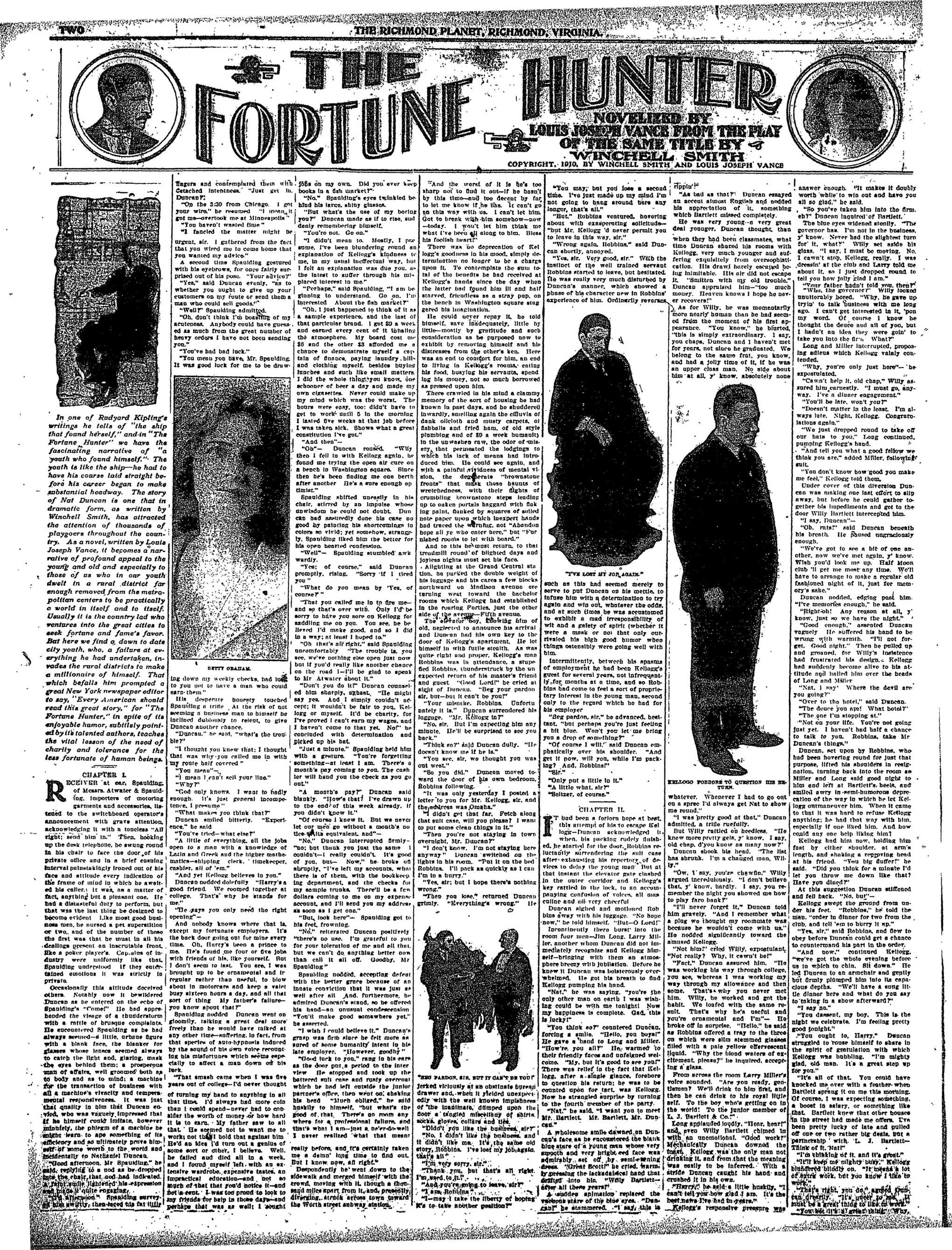
In one of Rudyard Kiplinger's writings he tells of "the ship that found herself," and in "The Fortune Hunter" we have the fascinating narrative of "o youth who found himself." The youth is like the ship—he had to have his course laid straight before his career began to make substantial headway. The story of Nat Duncan is one that in dramatic form, as written by Winchell Smith, has attracted the attention of thousands of playgoers throughout the country. As a novel, written by Louis Joseph Vance, it becomes a narrative of profound appeal to the young and old and especially to those of us who in our youth dwelt in a rural district far enough removed from the metropolitan centers to be practically a world in itself and to itself. Usually it is the country lad who ventures into the great cities to seek fortune and fame's favor. But here we find a, down to date city youth, who, a failure at ev
erything he had undertaken, invades the rural districts to make a millionaire of himself. That which befalls him prompted a great New York newspaper editor to say, "Every American should read this great story," for "The Fortune Hunter," in spite of its enjoyable humor, subtly pointed by its talented authors, teaches the vital lesson of the need of charity and tolerance for the less fortunate of human beings.
CHAPTER 1
R
garments and accessories, instructed to the switchboard operator's announcement with grave attention, acknowledging it with a toneless "All right; send him in." Then, booking up the desk telephone, he awaung round in his chair to face the door of his private office and in a brief ensuing interval palmstakingly froned out of his face and attitude every indication of the frame of mind in which he awaisted his caller. It was, as a matter of fact, anything but a pleasant one. He had a disdainful duty to perform, but that was the last thing he designed to become evident. Like most good business men, he nursed a pet superstition or two, and of the number of those the first was that he must in all his dealings present an inscrutable front, like a poker player's. Capitals of industry were uniformly like that. Spandling understood if they entertained emotions it was strictly in private.
Occasionally this attitude deceived others. Notably now it bewildered Duncan as he entered on the echo of Spaulding's "Come!". He had apprehended the vision of a thunderstorm with a mattle of brusque complaints. He encountered Spaulding as he had always seemed—a little, urbane figure with a blank face, the blanker for glasses whose lenses seemed always to catch the light and, glaring, mack the eyes behind them; a prosperous man of affairs, well groomed both as to body and as to mind; a machine for the transaction of business with all a machine's elasticity and temperamental responsiveness. It was just that quality in him that Duncan envisioned, who was vaguely impressed that if he himself could imitate, however minutely, the phlegm of a machine he might learn to ascribe something of its efficiency and so ultimately prove himself of some worth to the world and incidentally to National Duncan. "Good afternoon, Mr Spaulding," he said, replyting to a nod as he dropped into the chair, that nod had indicated, and replytung himself his expression and quite obite rearranging.
affection. *Financial survey*
*business survey, then-taxed this fact*
Engers and contemplated them with
detached intentness. "Just get in.
Duncan's?
On the 3:30 from Chicago. I got
your wire" he resumed "i moan, it
got me-overlook me at Minneapolis"
"You haven't waited time"
"I fancied the matter might be
urgent, sir. I gathered from the fact
that you wired me to come home that
you wanted my advice."
A second time Spaulding gestured
with his eyebrows, for once fairly sur-
prised out of his pose. "Your advice?"
"Yea," said Duncan eruely, "as to
whether you ought to give up your
customers on my route or send them a
man who could sell goods."
"Well?" Spaulding admitted.
"Oh don't think I'm boasting of my
acuteness. Anybody could have guessed
as much from the great number of
heavy orders I have not been sending
you."
"You've had bad luck."
"You mean you have, Mr. Spurling.
It was good luck for me to be draw.
1930
DETTY GRAHAM
ing down my weekly checks, bad luck to you not to have a man who could earn them."
His desperate honesty touched Spandling a trifle. At the risk of not seeing a business man to himself he inclined dubiously to relect, to give Duncan another chance.
"Duncan," he said, "what's the trouble?
"I thought you knew that: I thought that was why you called me in with my route half covered."
"You mean"—
"I mean I can't sell your line."
"Why?"
"God only knows. I want to badly enough. It's just general incompetence. I presume."
"What makes you think that?"
Duncan smiled bitterly.
"Experience, he said."
"You're tried—what else?"
"A little of everything, all the jobs open to a man with a knowledge of Latin and Greek and the higher mathematics—shiping clerk, timekeeper, canaler, all of 'em."
"And yet Kellogg believes in you." Duncan nodded dolorfully "Harry's a good friend. We roomed at college. That's why he stands for me."
"He says you only need the right opening."
And nobody knows where that is, except my fortunate employers. It's the back door going out for mine every time. Oh, Harry's been a prince to me. He's found me four or five jobs with friends of his, like yourself. But I don't seem to last. You see, I was brought up to be ornamental and irregular rather than useful, to blow about in motorcars and keep a valet busy sixteen hours a day, and all that sort of thing My father's failure—you know about that?"
Spainling nodded Duncan went on gloomily, talking a great deal more freely than he would have talked at any other time—suffering, in fact, from that species of auto-hypnosis induced by the sound of his own voice recounting his misfortunes which seems especially to affect a man down off his luck.
"That smash came when I was five years out of college. I'd never thought
of turning my hand to anything in all that time. I'd always had more coin than I could spend—never had to consider the worth of money or how hard it is to earn. My father saw to all that. He seemed not to want me to work not that I should hold that against him He'd an idea I'd turn out a genius of some sort or other. I believe. Well, he failed and died all in a week, and I found myself left with an extensive wardrobe, expensive tastes, an impractical education—and, not so much of that that you should notice it—and not a lesson. I was too proud to look to my friends for help in those days—and perhaps that was as well; I sought
jobs on my own. Did you ever keep books in a fish market? "No." Spandling's eyes twinkled behind his large, shiny glasses. "But what's the use of my boring you?" Duncan made as if to rise, and deny remembering himself. "You're not. Go on." "I didn't mean to. Mostly, I presume, I've been blundering round an explanation of Kellogg's kindness to me, in my usual ineffectual way, but I fell an explanation was due you, as the interest to suffer through his misplaced interest in me." "Forbear," said Spandling. "I am beginning to understand. Go on. I'm interested. About the fish market."
"Oh. I just happened to think of it as a sample experience, and the last of that particular brand. I got $0 a week and earned every cent of it inhaling the atmosphere. My board cost me $0 and the other $3 afforded me a chance to demonstrate myself a captain of finance, paying laundry, bill and clothing myself, besides buying lunches and such like small matters. I did the whole thing: you know, one schooner of beer a day and made my own clogsets. Never could make up my mind which was the worst. The hours were easy, too: didn't have to get to work until 5 in the morning I lasted five weeks at that job before I was taken sick. Shows what a great constitution I got."
"Ob—" Duncan roused. "Wily,
then I fell in with Kellogg again,
be found me trying the open air cure on
a bench in Washington square. Since
then he's been finding me one berth
after another. He's a sure enough op-
timat."
Spaulding abilted uneasily in his
chair, stirred by an impulse whose
unwisdom he could not doubt. Duncan
can had assuredly done his case no
good by painting his shortcomings in
colors no vivid; yet somehow, strangely.
Spaulding liked him the better for
his open hearted confession.
"Well—" Spaulding stumbled 'awk
wardly.
"Yes, of course," said Duncan
promptly, rising. "Sorry if I tired
you."
"What do you mean by 'Yes, of
course'?"
"That you called me in to the me- and so that's over with. Only I'd be sorry to have you sore on Kellogg for saddling me on you. You see, be he leried I'd mink good, and so I did in a way; at least I huped to."
"Oh that's all right," said Spaulding comfortably. "The trouble is, you see, we've nothing else open just now but if you'd really like another chance on the road I—I'll be glad to speak to Air Alwater about it."
"Don't you do it?" Duncan counselled him sharply, nghast. "He might say yea. And I simply couldn't accept; it wouldn't be fair to you. Kellogg or myself. It'd be charity, for I've proved I can't earn my wages, and I haven't come to that yet. No!" he concluded with determination and picked up his hat.
"Just a minute." Spandling held him with a gesture. "You're forgetting something—at least I am. There's a month's pay coming to you. The cashier will hand you the check as you go out."
"A month's pay?" Duncan said bliskily. "How's that I've drawn up to the end of this week already. If you didn't know it."
"Of course I knew it. But we never let our men go without a month's no-tax equivalent, and—"
"No." Duncan interrupted firmly; "no; but think you just the same. I couldn't—I really couldn't. It's good of you, but—" Now, he broke off abruptly. "I've left my accounts, what there is of them, with the bookkeeping department, and the checks for my sample trunks. There'll be a few dollars coming to me on my expense account, and I'll send you my address as soon as I get one."
"But, look here." Spandling got to his feet, frowning.
"No," reiterated Duncan positively "there's no use. I'm grateful to you for your toleration of me and all that, but we can't do anything better now than call it all off. Goodby, Mr Spaulding."
Spainling nodded, accepting defeat with the better grace because of an innate conviction that it was just as well after all. And, furthermore, he admired Duncan's stand, so be offered his hand—an unusual condescension "You'll make good somewhere yet," he asserted.
"I wish I could believe it." Duncan's grasp was firce since he felt more assured of some humanity latent in his late employer. "However, goodby."
"Good luck to you," rang in his ear as the door put, a period to the inter view. He stopped and took up the battered wilt case and rushed overmost which he had left outside the junior partner's office, then went on, shaking his head "Murch obliged," he said hunkily to himself, "but what's the good of, that. There's no room any where for a professional failure, and that's what I am—just a never-dwell I never realized what that meant really before, and it's certainly taken me a damn' long time to find out. But I know, now, all right."
Despondently he went down to the sidewalk and merged himself with the crowd, moving with it, though a thousand miles apart from it, and precisely differing, struck across town toward the Worth street subway station.
"And the worst of it is he's too sharp not to find it out—if he hasn't by this time—and too decent by far to let me know if he liahs. It can't go on this way with us. I can't let him. Got to break with him somehow—now today. I won't let him think me what I've been all along to him. Bless his foolish heart."
There was no depreciation of Kellog's goodness in his mood, simply determination no longer to be a charge upon it. To contemplate the sum total of the benefits he had received at Kellog's hands since the day when the latter had found him ill and half starved, friendless as a strray pup, on the bench in Washington square staggered his imagination.
He couldeyer repay it, he told himself, save inadequately, little by little—mostly by gratitude and such consideration as be purposed now to exhibit by removing himself and his distresses from the other's ken. Here was an end to comfort for him, an end to living in Kelkogg's rooms, eating his food, buoying his servants, spending his money, not so much borrowed as pressed upon him.
There crawled in his mind a clammy memory of the sort of housing he had known in past days, and he shuddered inwardly, smiling again the effulgence of dank oilcloth and musty carpets, of fashballs and fried ham, of old style plumbing and of 3D a week humanity in the unwashed raw, the odor of misery, that permeated the lodgings to which his lack of means had introduced him. He could see again, and with a painful ridicule of mental vision, the darkerate "brownstone fronts" that mask those haunts of wretchedness, with their digits of crumbling brownstone steps leading up to oaken tails haggard with faking paint, flanked by squares of soiled note paper upon which inexpert hands had traced the warning, not "Abandon hope all ye who enter here," but "Furnished rooms to let with board."
And to this he must return, to that tendrill round of blighted days and loosely nights must set his face.
Alighting at the Grand Central station, he parked the double weight of his luggage and his carves a few blocks northward on Madison Avenue are turning west toward the bachelor rooms which Kellogg had established in the couring Forties, just the other side of the avenue. Fifth avenue.
The elevator "boy," knowing him of old, neglected to announce his arrival and Dumman had his own key to the door of Kellogg's apartment. He let himself in with full stealth. As was quite right and proper, Kellogg's man Robbins was in attendance, a stupefied Robbins, thunderstruck by the unexpected return of his master's friend and guest. "Good Lord!" he cried at sight of Dumman. "Beg your pardon sir, but—but it can't be you."
"Your mistake. Robbins. Unfortunately it is." Dumcan surrendered his luggage. "Mr. Kellogg in?"
"No sir, But I'm expecting him any minute. He'll be surprised to see you back."
"Think so?" said Duncan dully. "He doesn't know me if he is."
"You see, air, we thought you was out west."
"So you did." Duncan moved toward the door of his own bedroom, Robbins following.
"It was only yesterday I posted a letter to you for Mr. Kellogg, air, and the address was Omaha."
"I didn't get that far. Fetch along that suit case, will you please? I want to put some clean things in it."
"Then you're not staying in town overnight, Mr. Duncan?"
"I don't know, I'm not staying here anyway" Duncan switched on the lights in his room. "Put it on the bed. Robbins. I'll pack as quickly as I can I'm in a hurry."
"Yes, air; but I hope there's nothing wrong."
"Then you lose," returned Duncan grimly. "Everything's wrong." He
```markdown
```
HEN PARDON, SIR, BUT IT CAN BE YOUR jerked viciously at an obnitebate bribery drawer and, when it yielded unexpectedly with the well known impulses of the insinuate, damped upon the floor a tangled miscellany of shirts,袜子, gloves, collars and ties. "Didn't you like the business, sir?" "No. I didn't like the business, and it didn't like me. It's the same old story, Nobbia. I've lost my job, agaits, that's all."
"I'm very sorry, sir."
"Thank you, but that's all right.
I'm used to it."
"And you're going to leave, sir."
"I am Rohhina."
"I—may I take the liberty of hoping
It's to take another position."
```markdown
```
KELLOGO FORBORGE TO QUESTION HIS RETURN.
whatever. Whenever I had to go out on a spree I always get Nat to show me round."
"I was pretty good at that." Duncan admitted, a trilie ruefully.
But Willy rattled on heedless. "He knew more pretty gels, y know, I am, old chap, d'you know as many now?"
Duncan shook his head. "The list has shrunk. I'm a changed man, Willy."
"Ow. I say, you're chewin." Willy argued incredulously. "I don't believe that, y'know, hardy. I say, you remember the night you showed me how to play faro bank?"
"I'll never forget it." Duncan told him gravely. "And I remember what a plug wo thought my roommate was because he wouldn't come with us." He nodded significantly toward the amused Kellogg.
"Not him" cried Willy. expostulant. "Not really? Why, it couldn't be!"
"Fact," Duncan assured him. "He was working his way through college, you see, whereas I was working my way through my allowance and then some. That's why you never met him. Willy, he worked and got the habit. We loafed with the same result. That's why he's useful and you're ornamental and I'm"—He broke off in surprise. "Hello," he said as Robbins offered a tray to the three on which we all stained glasses filled with a pale yellow effervescent liquid. "Why the blood enters of excitement, please" he inquired, accepting a glass.
From across the room Larry Miller's voice sounded. "Are you ready, gentleman? We'll drink to him first, and then he can drink to his royal little self. To the boy who's getting on in the world: To the junior member of L. J. Barlett & Co."
Long applauded loudly. "Hear, hear," and given Willy Hartlett chipped in with an unmotifonal. "Good work!" Mechanically Duncan downed the board. Kellogg was the only man not drinking it, and from that the meaning was easily to be inferred. With a stride Duncan caught his hand and crushed it in his own.
"Harry," he said a little huskily. "I can't tell you how glad I am. It's the best news I've had in years." Kellogg's responsive pressure was
"You may, but you lose a second time. I've just made up my mind I'm not going to hang around here any longer, that's all."
"But," Robbins ventured, hovering about with exasperating solicitude—"but Mr. Kellogg'd never permit you to leave in this way, sir."
"Wrong again, Robbins," said Duncan shortly, annoyed.
"Yes, sir. Very good, sir." With the instinct of the well trained servant Robbins started to leave, but hesitated. He was really very much disturbed by Duncan's manner, which showed a phase of his character new in Robbins' experience of him. Ordinarily reverence
A
"IVE LOST MY JOR AGAIN."
such as this had seemed merely to serve to put Duncan on his mettle, to infuse him with a determination to try again and win out, whatever the odds, and at such times he was accustomed to exhibit a mad irresponsibility of wit and a galaxy of spirit (whether it were a mask or not) that only outrivaled his high good humor when things ostensibly were going well with him.
Intermittently, between his apasms of employment he had been Kellogg's guest for several years, not infrequently for months at a time, and so Robbins had come to feel a sort of proprietary interest in the young man, second only to the regard which he had for his employer.
"Beg pardon, sir," he advanced, hesitant, "but perhaps you're just feeling a bit blue. Won't you let me bring you a drop of something?"
"Of course I will," said Duncan em-
phatically over his shoulder. "And
get it now, will you, while I'm pack-
ing? And, Robbins!"
"Sir."
"Only put a little in it."
"A little what, sir."
"Seltzer, of course."
CHAPTER IL
IT had been a forlorn hope at beet,
this attempt of his to escape Kellogg—Duncan acknowledged it
when, his packing rigely finished,
he started for the door, Robbins reluctantly surrendering the assault case after exhausting his repertory, of devices to doxy the young man. But at that instant the elevator gate clashed in the outer corridor and Kellogg's key rattled in the lock, to an accompanying confusion of voices, all unaculine and all very cheerful.
Duncan sighed and motioned Robbins away with his luggage. "No hope now," he told himself. "But-O Lord! Incontinently there burst into the room four men—Jim Long, Larry Murray, another whom Duncan did not immediately recognize and Kellogg himself—bringing with them an atmosphere brewey with jubilation. Before he knew it Duncan was bolstered overwhelmed. He got his breath to find Kellogg pumping his hand.
"Nat," he was saying, "you're the only other man on earth I was wishing could be with me tonight! Now my happiness is complete. God, this is lucky!"
"You think so?" countered Duncan, forcing a smile. "Hello, you boy!" He gave a hand to Long and Miller. "How're you all?" He warmed to their friendly faces and unfeligned welcome. "Mr. but it's good to see you!" There was relief in the fact that Kellogg, after a single glance, forebore to question his return; he was to be counted upon for tact, was Kellogg. Now he strangled surprise by turning to the fourth member of the party.
"Nat," he said, "I want you to meet Mr. Bartlett. Mr. Bartlett, Mr. Duncan."
A wholesome smile dawned, on Duncan's face, as he encountered the blank blue stare of a young man whose very smooth and very bright red face was admirably, set off, by semi-wearing dress. "Great Scott" he cried, warmly greeting the lackadailed hand that designed into his. "Willy Bartlett—after all these years!"
A widescreen animation replaced the vowels stare of the blue eyes. "Duncan" he stimmered. "I say, this is
**Rippin'**<sup>14</sup>
"As bad as that?" Duncan essayed an accent almost English and nodded his appreciation of it, something which Bartlett missed completely.
He was very young—a very great deal younger. Duncan thought, than when they had been classmates, what time Duncan shared his rooms with Kullogg, very much younger and suffering exquisitely from overexplastification. His drawly barely escaped being immobile. His air did not escape it. "Snitten with my old trouble." Duncan appraised him—"too much money. Heaven knows I hope he never recovers!"
As for Willy, he was momentarily more nearly human than he had seemed from the moment of his first appearance. "You know," he blurted, "this is simply extraordinary. I say, you chap, Duncan and I haven't met for years, not since he graduated. We belong to the same frut, you know, and had a jolly time of it, if he was an upper class man. No side about him at all, y' know, absolutely none
answer enough. "It makes it doubly
worth while to win out and have you
ed all so glad," he said.
ing. "So you've taken him into the firm.
eb?" Duncan inquired of Bartlett.
The blue eyes widened stoutly. "The governor has. I'm not in the business, y know. Never had the slightest turn for it, what?" Willy set aside his glass. "I say, I must be moving. No, I cann't stop, Kellogg. real. I was dressed at the club and Larry told me about it, so I just dropped round to tell you how jolly gild I am."
"Who father had told you, then?" "Who, the governor?" Willy looked unutterably bored. "Why, he gave up tryin' to talk business with me long ago. I can't get interested in it, 'pon my word. Of course I know he thought the deuce and all of you, but I hadn't an idea they were goin' to take you into the first. What?"
Long and Miller interrupted, proposing adieu which Kellogg valy contended.
"Why, you're only just here"—"be expostulated."
"Cannot help it, old chap." Willy assured him curtly. "I must go, anyway. I've a dinner engagement."
"You'll be late, won't you?"
"Doesn't matter in the least. I'm always late. Night. Kellogg. Congratulations again."
"We just dropped round to take off our hats to you." Long continued, pumping Kellogg's hand.
"And tell you what a good fellow we think you are." added Miller, following suit.
"You don't know how good you make me feel." Kellogg told them.
Under cover of this diversion Duncan was muking one last effort to slip away, but before he could gather together his impediments and get to the door Willy Hartlett intercepted him.
"I say, Duncan."
"Ob, ruts!" said Duncan beneath his breath. He paused ungraciously enough.
"We've got to see a bit of one another, now we're met again, y know. Wish you look me up. Half Moon club you'll get me most any time. We'll have to arrange to make a regular old fashioned night of it, just for memory's sake."
Duncan nodded, edging post him. "I've memories enough," he said.
"Right-oh! Any reason at all, y know, just so we have the night."
"Good enough," assented Duncan vaguely. He suffered his hand to be wring with warmth. "I'll not forget. Good night." Then he pulled up and groaned, for Willy's insistence had frustrated his design. Kellogg had suddenly become alive to his attitude and halted him over the heads of Long and Miller.
"Nat, I say" Where the devil are you going?
"Over to the hotel," said Duncan.
"The deuce you are! What hotel?" "The one I'm stopping at."
"Not on your life. You're not going just yet. I haven't had half a chance to talk to you. Robbins, take Mr Duncan's things."
Duncan, set upon by Robbins, who had been hovering round for just that purpose, lifted his shoulders in resignation, turning back into the room as Miller and Long said good night to him and left at Bartlett's, heels, and smiled awry in semi-humorous deprecation of the way in which he let Kellogg outmaneuver him. When it came to that it was hard to refuse Kellogg anything; he had that way with him, especially if one liked him. And how could any one help liking him?
Kellogg had him now, holding him fast by either shoulder, at arm's length, and shaking a repressing head at his friend. "You big duffer!" he said. "Did you think for a minute I let you throw me down like that? Have you dined?"
At this suggestion Duncan stiffened and fell back. "No, but"
Kellogg swept the ground from under his feet. "Robbins," he told the man, "order in dinner for two from the club, and tell 'em to burry it up."
"Yes, sir," said Robbins, and drew to obey before Duncan could get a chance to countermand his part in the order.
"And now," continued Kellogg, "we've got the whole evening before us in which to chin. Sit down." He led Duncan to an armchair and gently but firmly plumped him into its capacious depths. "We'll have a song little dinner here and what do you say to taking in a show afterward?" "I say no."
"You dissent, my boy. This is the night we celebrate. I'm feeling pretty good tonight."
"You ought to, Harry." Duncan struggled to rouse himself to share in the spirit of gratulation with which Kellogg was bubbling. "I'm mighty glad, old man. It's a great step up for you."
"It's all of that. You could have knocked me over with a feather when Bartlett spring it on me this morning. Of course, I was expecting something, a boost in salary, or something like that. Bartlett knew that other houses in the street had made me offers. I've been pretty lucky of late and pulled off one or two rather big deals, but a partnership with L. J. Bartlett—Think of it. Matt."
"I'm thinking of it, and it's great." "I'll keep me mighty busy." Kellogg blundered blubbly on. "It has a lot of great work, but you know I like to work."
"That's right, you don't need Dunlane to dream. It's just need to work. It must be a great thing to like to work." "You have to like great things." Why.
```markdown
```
I couldn't exist if I couldn't work.
You remember that time I laid off for a ninth in the country for my health's sake? I never forget it—hanging round all the time, with my hands empty—every one else with something to do. I wouldn't go through with it again for a fortune. Never felt so useless and in the way—"
"But," interrupted Duncan, knitting his brows as he grappled with this problem, "you were independent, weren't you? You had money—could pay your board?"
"QI course. Nevertheless I felt in the way."
"That's funny."
"It's straight."
"I know it is. It wouldn't be you if you didn't love work. It wouldn't be me if I did." Look here, Harry. "Buppow you didn't have any money and
NATHANIEL RUSSAN.
couldn't pay your board and had nothing to do. How'd you feel in that case?
"I don't know. Anyhow that's rot."
"No, it isn't rot. I'm trying to make you understand how I feel when—when it's that way with me, as it generally is." He raised one hand and let it fall with a gesture of dispondency so eloquent that it roused Kollogg out of his own preoccupation.
Why? Why? He routinely sympathize with itself that I forgot. I hadn't looked, for you till tomorrow."
"You knew, then?"
"I met Atwater at lunch today. He told me. Said he was sorry, but—"
told me. Said he was sorry, but—"Yes. everybody is always sorry, but." Kellogg let his hand fall on Duncan's shoulder: "I'm sorry, too, old man. But don't lose heart. I know it's pretty tough on a fellow—" "The toughest part of it is that you got the job for me, and I had to fall down." "Don't think of that. It's not your fault—" "You're the only man who believes that, Harry." "Back up. I'll stumble across better opening for you before long, and." "Stop right there. I'm through—" "Don't talk that way. Nat. I'll get you in right somewhere." "You're the best hearted man alive, Harry, but I see you blasted first."
"Walt." Kellogg dominated his attention. "Here's this man Burnham. You don't know him, but he's as keen as they make 'em. He's on the track of some wonderful scheme for making illuminating gas from crude oil. If it goes through, if the invention's really practicable, it's bound to work a revolution. He's down in Washington now—left this afternoon to look up the patients. Now, he needs me to get the ear of the Standard Oil people, and I'll get you in there.
"What right, ye go to do that?" demanded Duncan. "What the dickens do I know about illuminating gas or crude oil? Burnham d' never thank you for the likes o' me."
"But, thunder, you can learn. All you need—"
"Now, see here, Harry!" Duncan gave him pause with a manner not to be denied. "Once and for all time understand I'm through having you recommend an incompetent just because we're friends."
"Abd I'm through living on you while I'm out of a job. That's final."
"But, man, listen to me—when we were at college"—
"That was another matter."
"How many times did you pay the room rent when I was strapped? How many times did your money pull me through when I had had to quit and forcelt my degree because I couldn't earn enough to keep on?"
"That different. You earned enough mainly to square up. You don't owe me anything."
"I owe you the gratitude for the friendly hand that put me in the way of earning—that kept me going when the ditch was just reversed you wouldn't do just as I did—make good in the world and, when it's convenient, to me. As for living here, you're perfectly welcome."
"I know it—and more." Duncan assented a little wearyly. "Don't think I door appreciate all you've done for me. I'm sure, and you must understand that I can't keep on living on you and I won't."
For 'for' *kɔːrɪŋ* *bɑːlɪfɪd*, *kellogg* *statɪd* at
*kɔːrɪŋ* *bɑːlɪfɪd*, *kellogg* *statɪd* at
*kɔːrɪŋ* *bɑːlɪfɪd* strong *to* *kɔːrɪŋ* *bɑːlɪfɪd*;
*mæsse* *statɪd* strong *to* *kɔːrɪŋ* *bɑːlɪfɪd*
get his attitude. a length Kellogg wants rendered, accepting defeat. "Well—He shuffled, uncomfortably. "If you insist."
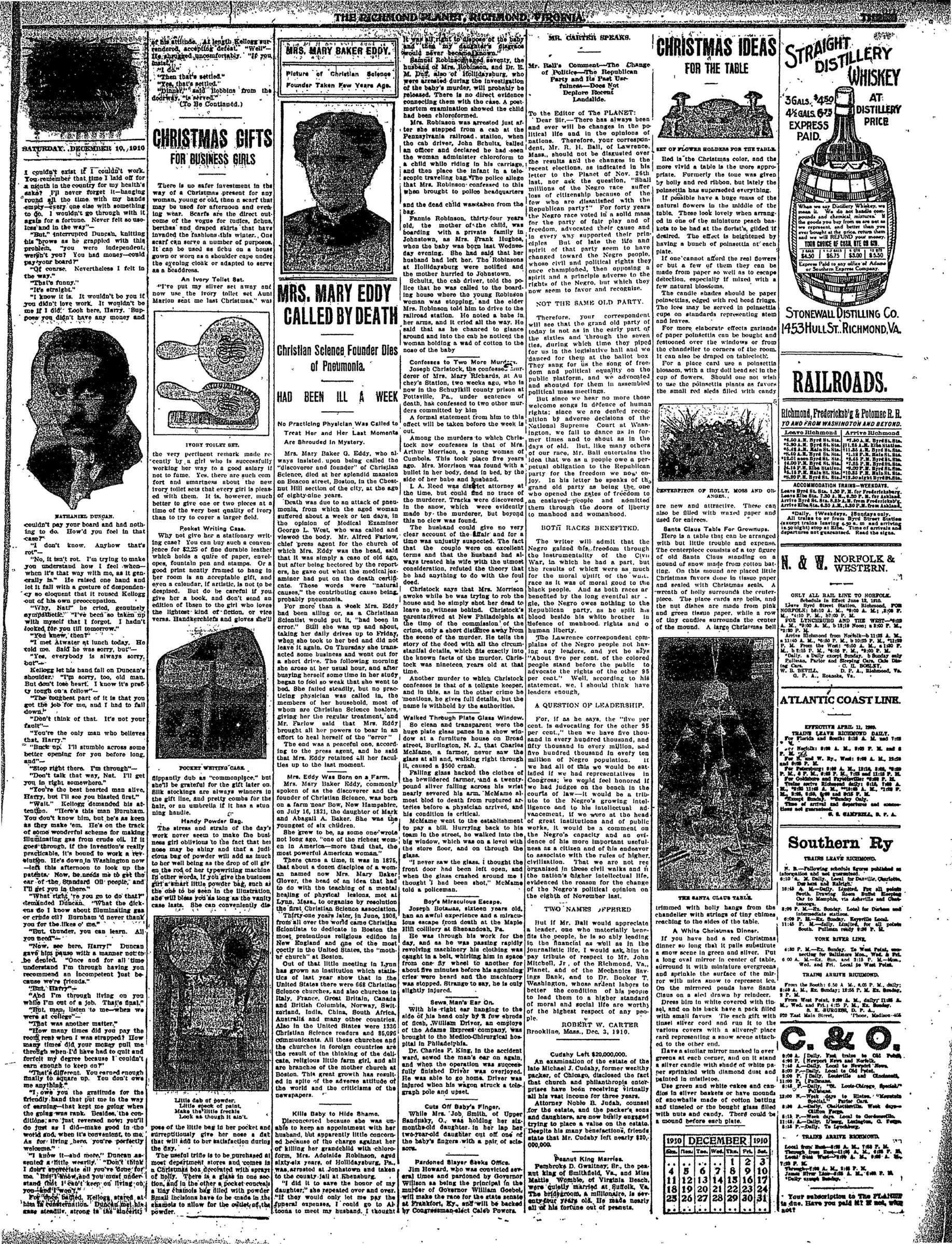
CHRISTMAS GIFTS FOR BUSINESS GIRLS
There is no safer investment in the way of a Christmas present for any woman, young or old, then a scarf that may be used for old, then a evening wear. Scarfs are the directive come of the vogue for tunic, fuchsia, berthas and draped skirts that have invaded the fashions this winter. One scarf can serve a number of purposes. It can be used as fuchsia on a house gown or worn as a shoulder cap under the opening cloak or adapted to serve as a headaddress.
An Ivory Toilet Set.
"I've put my silver set away and now use the ivory toilet set Aunt Marlon sent me last Christmas." was
IVORY TOILET SET.
the very pertinent remark made recently by a girl who is successfully working her way to a good salary not to fame. Yes, there are such comfort and smartness about the new ivory toilet sets that every girl is pleased with them. It is, however, much better to give one or two pieces at a time of the very best quality of ivory than to try to corer a target field.
Pocket Writing Case.
Why not give her a stationary writing case? You can buy such a convenience for $2.25 of fine durable leather which holds a quire of paper, envelope, fountain pen and stamp. Or a good print neatly framed to hang in her room is an acceptable gift, and even a calendar, if artistic, is not to be missed. You can give her a book, and don't send an edition of them to the girl who loves the lightest kind of fiction, or vice versa. Handkerchiefs and gloves she'll
POCKET WRITING CASE
Slippantly dub as "commonplace," but she'll be grateful for the gift later on. Silk stockings are always winners in the gift line, and pretty combs for the hair, or an umbrella if it has a stunning handle.
Handy Powder Bag.
The stress and strain of the day's work never seem to make the bush ness girl oblivious to the fact that her nose may be shiny and that a judicious bag of powder will add as much to her well being as the drop of oil gill on the rod of her typewriting machine if other words. If you give the business girl a smart little powder bag, such as the one to be seen in the illustration she will bless you as long as the vanity case lasts. She can conveniently dis
Little dab of powder.
Little spoon of paint.
Make the little fewish.
Look as though it isn't.
pose of the little bag in her pocket and surreptitiously give her nose a dart that will add to her satisfaction during the day. The useful trifle is to be purchased at most department stores and comes in a Christmas box decorated with spray of holly. There is a glass in one section, and in the other a pocket conceals the trifle. The powder Small enclosures have to be made that chambers to allow for the outlet of the powder.
M. H. H.
MRS. MARY EDDY CALLED BY DEATH
No Practicing Physician Was Called to Treat Her and Her Last Moments Are Shrouded in Mystery.
Mrs. Mary Baker G. Eddy, who always insisted upon being called the "discoverer and founder" of Christian Science, died at her splendid mansion on Beacon street, Boston, in the Chestnut Hill section of the city, at the age of eighty-nine years.
Death was due to an attack of pneumonia, from which the aged woman suffered about a week or ten days, in the opinion of Medical Examiner George L. West, who was called and viewed the body, Mr. Alfred Farlow, chief press agent for the church of which Mrs. Eddy was the head, said that it was simply a case of old age, but after being hectored by the reporters, he gave out what the medical examiner had put on the death certificate. These words were "natural causes," the contributing cause being, probably pneumonia.
For more than a week Mrs. Eddy had been alluring or, as a Christian Scientist would put it, "had been in error." Still she was up and about, taking her daily drives up to Friday, when she took to her bed and did not leave it again. On Thursday she transacted some business and wont out for her work, but she also arose at her usual hour, and after busying herself some time in her study began to feel so weak that she wanted to bed. She failed steadily, but no practicing physician was called in, the members of her household, most of whom are Christian Science healers, giving her the regular treatment, and Mr. Farlow said that Mrs. Eddy brought all her powers to boar in an effort to heal herself of the "error" according to the press agent, and he said that Mrs. Eddy brought all her faculties up to the last moment.
Mrs. Eddy Was Born on a Farm.
Mrs. Mary Baker Eddy, commonly spoken of as the discoverer and the founder of Christian Science, was born on a farm near Bow, New Hampshire, on July 16, 1821, the daughter of Mark and Abagail A. Baker. She was the youngest of six children. She grew to be, as some one wrote not long ago, "one of the richest women in America—more than that, the most powerful American woman." There came a time, it was in 1875, that about a dozen disciples of a woman named now Mrs. Mary Baker Glover, the head of an idea that had to do with the teaching of a mental healing of physical lesions, met at Lyon, Maza, to organise by resolution the first Christian Science association. "Thirty-one years later, in June, 1808, from all over the world came Christian Scolonists to dedicate in Boston the most protracted religious edifice in New England and one of the most costly in the United States, the "mother church" at Boston.
Out of that little meeting in Lyon has grown an institution which statistics of last year show that in the United States there were 668 Christian Science churches, and also churches in Italy, France, Great Britain, Canada and British Columbia, Norway, Switzerland, India, China, South Africa, Australia and many other countries. Also in the United States were 1330 Christian Science readers and 86,996 communicants. All these churches and the churches in foreign countries are the result of the thinking of the delicate, religious little farm girl, and all are branches of the mother church at Boston. This great growth has resulted in spite of the adverse attitude of the world and the criticisms of the newspapers.
Killa Baby to Hide Shame.
Disconcerted because she was unable to keep an appointment with her husband, but apparently little concerned because of the charge against her of killing her grandchild with chloroform, Mrs. Adolide Robinson, aged sixty-six years, of Holidayburg, Pa., was arrested at Johnstown and taken to the county jail at Eisenburg. "I did it to save the honor of my daughter," she repeated over and over. "If they would only let me pay the funeral expenses, I could go to Atocha to meet my husband. I thought
it was Mr. right to dispose of the baby and "then my guardians' distance would never be become known." Samuel Robinson sequestered seventy, the husband of Mrs. Robinson, and Dr. E. M. Dug, also of Holidayburg, who were arrested during the investigation of the baby's murder, will probably be released. There is no direct evidence connecting them with the case. A postmortem examination showed the child had been chloroformed.
Mrs. Robbison was arrested just after she stepped from a cab at the Pennsylvania railroad, station, when the cab driver, John Behcula, called an officer, and declared he had seen the woman administer chloroform to a child while riding in his carriage, and then place the infant in a telescopic traveling bag. The police allege that Mrs. Robinson confessed to this when brought to police headquarters
and the dead child was taken from the bag.
Fannie Robinson, thirty-four years old, the mother of the child, was boarding with a private family in Johnstown, as Mrs. Frank Hughes, when the baby was born last Wednesday evening. She had said that her mother was a Holidaybursd were notified and the mother hurried to Johnstown.
Schultz, the cab driver, told the police that he was called to the boarding house where the young Robinson woman was stopping, and the elder Mrs. Robinson told him to drive to the railroad station. He noted a babe in her arms, and it cried all the way. He said that as he chanced to glance around and into the cab he noticed the woman holding a wad of cotton to the nose of the baby
Confesses to Two More Murders.
Joseph Christock, the confessor, murderer of Mrs. Mary Richards, at Auchey's Station, two weeks ago, who is now in the Schuylkill county prison at Pottville, Pa., under sentence of death, has confessed to two other murders committed by him
A formal statement from him to this effect will be taken before the week is out. Among the murders to which Christock now confesses is that of Mrs. Arthur Morrison, a young woman of Cumbola. This took place five years ago. Mrs. Morrison was found with a bullet in her body, dead in bed, by the side of her habe and husband.
L. A. Reed was disident attorney at the time, but could find no trace of the murderer. Tracks were discovered in the snow, which were evidently made by the murderer, but beyond this no clue was found.
The husband could give no very clear account of the affair and for a time was unjustly suspected. The fact that the couple were on excellent terms with the murderer ways treated his wife with the utmost consideration, refuted the theory that he had anything to do with the foul due.
Christock says that Mrs. Morrison awoke while he was trying to rob the house and he simply hit her dead to leave no, witness behind. Christock's parents arrived at New Philadelphia at the time of the commission of the crime, only a short distance away from the scene of the murder. He tells the story of the deed with all the circumferences which he knew the known facts of the murder. Christock was nineteen years old at that time.
Another murder to which Christok confesses is that of a (olligate keeper, and in this, as in the other crime he is not) a man who is withheld the name is withheld by the authorities.
Walked Through Plate Glass Window
Walked Through Plate Glass Window. So clean and transparent were the huge plate glass panes in a show window at a furniture house on Broadway. A farmer, noon saw the McMame, a farmer, never saw the glass at all and, walking right through it, caused a $50 crush. Palling glass hacked the clothes of the bewildered farmer, and a twenty-pound silver falling across his wrist nearly severed his arm. McMame almost blot to death from ruptured arteries before a physician arrived, and his condition is critical. McMame went to the establishment to pay a bill. Hurrying back to his team in the street, he walked into the big window, which was on a level with the store floor, and on through the glass. "I never saw the glass, I thought the front door had been left open, and when the glass crashed around me I thought I had been shot," McMame told a policeman.
Boy's Miraculous Escape
Joseph Botanus, sixteen years old, has an awful experience and a miraculous escape from death at the Maple Hill collage at Sheenandosh, Pa. He was through his work for the day, and as he was passing rapidly revolving machinery his clothing was caught in a belt, whirling him in space for about five minutes before the machinery cries were heard and the machinery was stopped. Strange to say, he is only slightly injured.
Sewa Man'a Ear On.
With his right ear hanging to the side of his head only by a few strobs of flesh, William Driver, an employee of the Adams Express company, was brought to the Medico-Chirurgical hospital in Philadelphia. Dr. Charles F. King, in the accident warden, came on again, and when the operation was fully finished Driver was overjoyed. He was able to go home. Driver was injured when his wagon struck a telegraph pole and upset.
Cuts Off Baby's Finger.
While Mrs. Jab. Smith, of Upper Sandyuk, O. was holding her six-month-old daughter. in her lap her two-year-old daughter out off one of the baby's fingers. with a pair of scissors.
Pardoned Blaver Saks Office
Jim Howard, who was convicted several times and pardoned by Governor Willson as being the principal in the murder of Governor William Goebel, will make race for the state senate a priority. He is supported by Congressman Caleb Porter.
Mr. Hall's Comment—The Change of Politics—The Republican Party and Its Past Usefulness—Does Not Deplete Recent Landslide.
*Their Editor.* Darwin Thore has always been and ever will be changes in the political life and in the opinions of nations. Therefore, your correspondent, Mr. R. H. Ball, of Lawrence, Mass., should not be disgusted over the results and the changes in the recent elections, as indicated in his letter to the Planet of Nov. 26th last, nor ask the question, "How many millions of people suffer loss of citizenship because of the fact that who are disaffected with the Republican party?" For forty years the Negro race voted in a solid mass for the party of fair play and of freedom, advocated their cause and in every way supported their principles. But of late the life and spirit of that party seem to changed toward a more people, whose political rights they once championed, then opposing a civil and a principle adverse to the rights of the Negro, but which they now seem to favor and recognize.
NOT THE SAME OLD PARTY
Therefore, your correspondent will see that the grand old party of today is not as in the early part of the sixties and through the seventies, during which time they piped for us in the legislative hall and we danced for them at the ballot box. They sang for us the song of freedom and political equality on the public plaza and advocated and筹集ed for them in assembled political mass meetings. But since we hear no more those welcome songs in defence of human rights; since we are dented recognition by adverse decisions of the National Supreme Court at Washington, we fail to dance as in former times and to shout as in the days of old. But, like many others of our race, Mr. Ball entertains the idea that we as a people owe a perpetual obligation to the Republican party for the freedom we now enjoy. We are the grand old party as being the one who opened the gates of freedom to an enslaved people and admitted them through the doors of liberty to manhood and womanhood.
BOTH RACES BENEFITED
The writer will admit that the Negro gained his freedom through the instrumentality of the Civil War, in which he had a part, but the results of which were as much for the moral upift of the white race as it was of moral good to the black people. And as both races are benefited by the long eventful strife, the Negro owes nothing to the Republican party, as he spit his blood beside his white brother in defence of manhood rights and of human liberty.
The Lawrencor correspondent complains that the Negro people not having any leaders, and yet he says "About five per cent. of the colored people stand before the public to advocate the rights of the other 95 per cent." Well, according to his statement, we. I should think have leaders enough.
A QUESTION OF LEADERSHIP.
For, if as he says, the "five per cent. is advocating for the other 55 per cent." then we have five thousand in every hundred thousand, and fifty thousand in every million, and five hundred thousand in every ten million of Negro population. If we had all of this we would be satisfied if we had representatives in Congress; we would feel honored if we had judges on the bench in the courts of law—it would be a tribute to the Negro's growing intelligence and to his intellectual advancement. If we were at the head of the court and of public works, it would be the Negro's capacity and an evidence of his more important usefulness as a citizen and of this endeavor to associate with the rules of higher civilization. That we are not organized in these civil walks and in the nation's higher intellectual life, evidenced the reason for the change of the Negro's political opinion on the elbgh of November last.
TWO NAMES JEFFERED
But if Mr. Ball would appreciate a leader, one who materially benefits the people, he is so ably leading in the financial as well as in the journalistic life. I would ask him to pay tribute of respect to Mr. John Mitchell, Jr., of the Richmond, Va., Planet, and of the Mechanics Savings Bank, and to Dr. Booker T. Mahoney, an ardent laborers to better the condition of all people to lead them to a higher level of moral and social life are worthy of the highest respect of any people.
ROBERT W. CARTER
Brooklyn, Mass., Dec. 3, 1910.
Curshy Left $20,000,000
An examination of the estate of the late Michael J. Cudahy, former wealthy packer, of Chicago, disclosed the fact that church and philanthropies enterprises have been receiving virtually all his vast income for three years. Attorney Noble B. Judah, counsel for the estate, and the packer's sons, have been receiving almost nothing trying to place a value on the estate. Despite his many benefactions, friends state that Mr. Cudahy left nearly $20,000,000.
Peanut King Marries
Pembroke D. Gwaltney, Sr., the peanut kling of Smithfield, Va., and Miss Mattie Womble, of Virginia Beach, grew quite married, Funky, Va. He was born in Funky, Va., early four years old. He made nearly all of his fortune out of peanuts.
CHRISTMAS IDEAS FOR THE TABLE
BET OF FLOWER HOLDERS FOR THE TABLE.
Red is the Christmas color, and the more vivid a table is the more appropriate. Formerly the tone was given by holly and red ribbon, but lately the polinsettia has superseded everything. If possible have a huge mass of the natural flowers in the middle of the table. These look lovely when arranged in one of the miniature peach baskets to be had at the forlata's glided if desired. The effect is heightened by having a bunch of polinsettia at each plate.
If one cannot afford the real flowers or but a few of them they can be made from paper so well as to escape detection, especially if mixed with a few natural blossoms.
The candle shades should be paper polisectias, edged with red head fringe. The lice may be served in polisectias cupe on standards representing stem and leaves.
For more elaborate effects garlands of paper polisectias can be bought and festooned on the windows or from the chandelier to corners of the room. It can also be draped on tablolibt: For a place canal use a polisectias blossom, with a tiny doll bead set in the cup of flowers. Should one not wish to use the polisectias plants as favors the small red sleds filled with candy.
CENTERPIECE OF HOLLY, MOSS AND ORANGE.
are new and attractive. These can also be filled with warm paper and used for enires.
Santa Claus Table For Grownups.
Here is a table that can be arranged with but little trouble and expense.
The centerpiece consists of a toy figure of old Santa Claus standing on a mound of snow made from cotton batting. On this mound are placed little Christmas flavors done in tissue paper and sealed with Christmas seals.
A wreath of holly surrounds the centerpiece. The place cards are bells, and the nut dishes are made from pink and green tissue paper, while a row of tiny candies surrounds the center of the mound. A large Christmas bell
```markdown
```
THE SANTA CLAUS TABLE
trimmed with holly hangs from the
chandelier with strings of tiny chimes
reaching to the sides of the table.
A. White Christmas Dinner.
A White Christmas Dinner.
If you have had a red Christmas dinner so long that it palls substitute a snow scene in green and silver. Put a snow scene in green and silver around it with miniatures overgreens and sprinkle the surface of the mirror with mica snow to represent ice. On the mirrored ponds have Santa Claus on a sleet drawn by reindeer. Dress him in white covered with tinsel, and on his back have a pack filled with small favors. Each gift with tinsel silver cord and run it to the various covers with a silver place card representing a snow scene attached to the other end.
Have a similar mirror masked in over greens at each corner, and on it stand a silver candle with shade of white paint and tinselled in silver diamond dust and painted in mistletoe.
Use green and white cakes and candies in silver baskets or have mounds of snowballs made of cotton batting and tinselled or the bought glass filled with nuts and candy. There could be a mound before each plate.
1910 DECEMBER 1910
Mon. Tue. Wed. Thu. Fri. Sat.
.. .. .. .. 1 2 3
4 5 6 7 8 9 10
11 12 13 14 15 16 17
18 19 20 21 22 23 24
25 26 27 28 29 30 31
.. .. .. .. .. .. ..
STRAIGHT DISTILLERY WHISKEY
36 GALS. 450
4 1/2 GALS. 675
EXPRESS PAID.
AT DISTILLERY PRICE
When you are Distillery Whiskey we make it. We do not handle compounds and chemical mixtures. If the goods you buy from us are not as we represent, we do not. But you ever bought at the price, return them and we will REFUND your money.
TOTAL CHOICE OF GOAL BITE ON GO.
GALS. $4.50
4 1/2 GALS. $5.75
4 1/2 GALS. $3.00
4 1/2 GALS. $1.50
Excuse Feld to any office of Adela or Southern Express Company.
STONEWALL DISTILLING CO.
1453HULLST.RICHMOND.VA.
RAILROADS.
ACCOMMODATION TRAINS - WEEKDAYS.
Leave Bray St. 1.50 P.M. 5.10 P.M. for Frederickburg.
Leave Bray St. 1.50 P.M. 5.20 P.M. for Ashland.
Leave Bray St. 1.50 P.M. 5.30 P.M. for Arrive Bray St. 6.20 P.M. 6.50 P.M. from Ashland.
*Daily: 1 weekdays, (Sundays only.
All trains to or from Bray Street Stations
(except trains leaving 4.90 p.m. and arriving
departures not guaranteed). Read the sign.
N. & W. NORFOLK & WESTERN
N. & W. NORFOLK & WESTERN
ONLY ALL RAILLINE TO NORFOLK
Schedules in Effect June 18, 1970.
Lawsave: Beverly Station: Richmond,
NORFOLK; Beverly Station: Richmond,
M; 3:00 P.M.
*4:10 P.M. 8:00 P.M.
FOR LYNCHBURG AND THE WEST - 06:25
M. a. b. 11:18 Noon; b. 0:00 P.M.
*8:20 P.M.
Arrive Richmond from Lynchburg - 11:25 A.M.
*11:40 A.M. 8:50 P.M. b. 10:25 P.M. *11:25
P.M. from the West: *8:50 A.M. a. 1:30 P.M.
*11:30 P.M. b. 10:30 P.M.
*Daily, a daily except Sunday, b Sunday only
*Daily, a Daily except Sunday, b Sunday only
Peninsula, Parlor and Shoping Gate, Gate Dining
Cars, C. B. BOLKY,
W. B. BEVILLA,
D. P. A. Richmond, Va.
G. P. A. Botnoke, Va.
ATLANTIC COAST LINE.
EFFECTIVE APRIL 11, 1984
For Florida and South: 8:38 A. M. and 7:38
M.
For New York: 8:38 A. M. 8:38 P. M. and 8
M.
For and W. Ry. West: 8:38 A. M. 12:38
and 8:38 P. M.
For February: 8:38 A. M. 12:18 8:38
P. M.
For Goldshire and Parvibrister: 8:38 P. M.
Trine arrive Richmond daily: 8:18 A. M.
8:38 11:18 A. M. *18:38 A. M. 7:18 P. M.
8:38 10:58 A. M. 8:18 P. M.
Only
Time of arrival and departure and con-
nections not guaranteed.
G. S. CAMPBELL, B. P. A.
Southern Ry
TRAINS LEAVE HUCKSON.
N. B.-Following schedule figures published on
information and as a resource.
8:10 A. M. Daily, Loc for Duville, Charleston,
Dusen and Ralgh:
10:48 A. M.-Daily, Lifted. For all points
provided by Traveler Karen Burke. Hopping
Ou to Memphis, Adville and Chattanooga.
8:00 P. M.—Ex. Bunny. Local for Dirham and intermediate stations.
6:100 P. M.—Rz. Sunday, Keysville Local
6:495 P. M.—Rz. Sunday, Keysville Local
police
Pollyglen, Pollyglen
Pollyglen, Pollyglen
YORK RIVER LINK
4:30 P. M.-X. Rx. Bzzy. Xt Week Funds, Funds
4:30 P. M.-X. Rx. Bzzy. Xt Week Funds, Funds
4:30 P. M.-X. Rx. Bzzy. Xt Week Funds, Funds
4:30 P. M.-X. Rx. Bzzy. Xt Week Funds, Funds
TRAINS ARRIVE BRUIMORD.
From the South: 6:50 A. M. 8:05 P. M. daily;
8:40 M. E. Sunday; 12:50 P. M. Ex Broder,
From West Point, 9:30 A. M. daily; 11:55 A.
M. Wed. and Fr. 1:35 P. M. E. Sunday,
From Dallas, 10:30 P. M. Ex Broder,
650 East Main Street, 'Phone, Madison-466
8:00 A. Daily. Park trains to Old Pint.
8:00 A. Daily. Railroad to Madison.
8:00 A. Daily. Local to Newport Stown.
8:00 P. Daily. Local to Old Pint.
8:00 P. Daily. Local to Woodlawn and Lincolnstown.
11:00 P. Palmhill.
8:45 F.—Dalry, "St. Louis-Chicago, Special!"
Pulitzer.
6:12 P-West dawn local to Gordondale
6:13 P-West dawn local to Gordondale
6:14 P-Daily, To Leedsport
6:15 P-Daily, To Leedsport
TRAINS ARRIVE RICHMOND
Local River Bank-8-125 A.M. 7:00 P.M.
Through Town Creek-11-25 A.M. 6:50 P.M.
Local River West-7-125 A.M. 6:50 P.M.
Tuesday
Through-7-125 A.M. 6:50 P.M.
James River Lake-8-125 A.M. 6:00 P.M.
Daily tramp Sunday.
* Your subscription to The FLASHFUN is due. Have you paid it? If not, what not?
---
published every Saturday by JOHN MITCHELL
JL. at 211 M. Fourth Street, Richmond, Va.
All communications (intended for publication
should be sent so as to reach us) on
Wednesday.
TERMS IN ADVANCE
One Copy, one year,
One Copy, eight months,
One Copy, six months,
One Copy, four months,
One Copy, three months,
Single Copy,
ADVERTISING RATES
For one inch, one inch (mertion) . . . 8.50
For one inch each subsequent insertion . . . 8.50
For two inches, six months . . . 8.50
For two inches, six months . . . 10.00
For two inches, six months . . . 14.00
Kerberos, Jewelry, One inch . . . 5.00
Standing and Translucent Notices one inch . . . 5.00
Standing and Translucent Notices one inch . . . 5.00
POSTAGE STAMPS OF A HIGHER DENOMINATION THAN TWO CENTS NOT RECEIVED ON SUBSCRIPTIONS.
THE PLANET is issued weekly. The subscription price is $1.50 per year in advance. The money by which money can be billed at our risk-in a Post Office Money Writer, by Bank Check or Draft, or an Express Money Order, will be three mails in a Reprinted Letter.
MONEY ORDERS—You can buy a Money Order at your Post Office, payable at the Richmond Post Office and we will be responsible for it. EXPRESN MONEY ORDERS can be obtained at any office of the American Express Co. on the United States Express Co. and the Well's Fargo Co. Express Co. or any of these companies. The Express Money Order is a safe and convenient way for forwarding money. REGISTERED LETTER.—If a Money Order, Post Office or an Express Co. will register the letter you wish to send as payment of ten cents. Then, If the Letter is lost or stolen, it can be traced. You can send money in this way. We cannot be responsible for money sent in letters in any other way than one of the four ways mentioned above. If you send your money in any other way, you must do it at your own expense. NEWALW, ETC.—If you want not the PLANET planned for another year after your subscription has run out, you then notify us by Post Card to discuss it. The cards have to be sent to the Post Office and not order your paper discontinued at the expiration of time for which it has been paid or date when they end or the paper discontinued.
COMMUNICATION—When writing to us to
receive your subscription or to directenquiries your
address should give you special thanks and
in full otherwise we can send your name on
our books.
CHANGE OF ADDRESS—In order to change
the address we must send the sent
former as well as the present address.
Fetched at the Post Office at Richmond, Va.
on second class matter.
SATURDAY...DECEMBER 10, 1910
We return thanks for an invitation
to the dedication of the new Sclern
Hall, Tuesday, December 13, 1910
a 3:30 P. M. Addresses to be do
deployed by President Henry S Price
st. Dr. Booker T Washington and
Dr. William H. Welch
---
Miss Hallel Q Brown who
been abroad in the interest of Wil
berforce, Ohio University has return
ed and with her comes the information
that she has succeeded in induc
ing a wealthy English lady to donat
thirteen thousand dollars to that in
situation They are all happy ther
now
---
Proprietor Chris J. Perry made a mistake from a journalistic stand point when he added that veteran journalist, T. Thomas Fortune toe his editorial staff The Phil adolpha, Ga. Tribune, always good and progressive race journe now ranks in editorial ability with the great publications of the country
We have received a most ountaining march-two-step entitled "Mama I Brought Home the Bacon." The author is Prof. Pastor Pelevalor ex-President of the New Amsterdam Musical Association. It is dedicated to Jack Johnson, the Champion Heavy-weight Pugilist of the World. It may be obtained by acceasin Prof. Pelevalor at 159 W 51st St. New York, N. Y.
---
The recent attack made upon Dr. Booker T. Washington and his poli-
cles by Hon. John E. Milholland and the upon letter of leading colori-
mon sent to the people of England b.
way of the press of the United State
and Great Britain are the most se-
rious and damaging onslaughts that
have ever been made upon this dis-
signified leader of the citizens o.
color.
While these critiques have had a tendency to solidify Dr. Washington's
friends, they have nevertheless tend
as to lesson his influence among man-
ny influential persons and indirectly
the race has been shown up in a
disparaging light. It emphasizes the
fact too that the factions in our own
make cannot be harmonized or weld
together under any one recognizer
leadership.
President Tatt's message to the Congress is one of the best ever issued from the White House. Its length will preclude all ideas of its being read by the public, but here and there the subjects discussed are of such vital interest as to insure for it a favorable consideration.
The diplomatic suggestion that the boundaries of the District of Columbia be extended into Virginia and that the improvements made by the National Government be of a kind and character to those made in Washington, even though the question of title to the land remains with Virginia will necessarily attract favorable comment.
President Taft referrates his opinion that the depositors of the defunct Freedmon's Savings Bank should be reimbursed by the National Government. It is earnestly hoped that this recommendation will be favorably acted upon before the original depositors are all dead. He also urges the appointment of a commission to consider the advisability of celebrating the fifth anniversary of the freedom of the colored people in this country. wife has mapped out much work for the Congress, enough in fact for two Congresses and it is hoped that unity of action in both branches will accomplish much during the last few weeks now left to this representative department of the government
"THE WHITE MAN"
. The wave of race prejudice now swooping over the country seems to have affected one of the most gifted ladies in the world to-day. We refer to Mrs. Ella Wheeler Wilcox. In the Cosmopolitan for December she writes:
Whover the white man's foot have trod,
(Oh, far does the white man stray)
A hold road riffles the virginal sod.
And the forest wakes out of it dream of God,
To yield him the right of way
For this is the law by the power of thought
For worse, or for better ar miracles wrought.
Wherever the white man's pathway leads
(Far, far, has that pathway gone)
The earth is littered with broken creeds.
And always the dark man's tent recedes.
And the white man pushes on
For this is the law: be it good or ill
All things must yield to the strong or will.
Wherever the white man's light is
ahed
(Oh, far has that light been
thrown)
Though nature has suffered, and
beauty fled.
The goal of the race has been thrus
ahead
And the might of the race ha
grown.
For this is the law: be it cruel o
kind.
The universe aways to the power o
mind.
Our brilliant Mr. Lucian B. Wat
kins has seen fit to write another in
reply Here it is:
THE BLACK MAN.
(An answer to Mrs. Ellie Wheeler Wilcox's poem, entitled, "The White Mare." In "The Cosmopolitan," for December, 1910.)
Br Lucian B Walkins
The black man's lot has been to plod
Thru the years that mark the way
Where the white man's swifter feet
have trod.
Yet, as part of the plan of the One
Great God.
"The last shall be first and the first shall be last."
"Wherever the white man's pathwa, leads,"
(And upward he has gone)
The black man, fraught with Car and Needs.
Shall rise on the wreck of broken creeds.
For his soul cries, "On and off!
The Holy Writ: (be it strange or odd)
Ethiopia shall stretch out her hands unto God."
The white man's gift of mind or might
Shall glow into thoughts as golden bright
These two poems furnish food to reflection from both angles. It may be that Mrs. Ella Wheelor Wilcox has not changed in her attitude or wavered in her devotion to great principles. She is but recording the truths of recent history rather than endorsing the crimes which her line portrays.
Still, it would be well to remember the wall of the historian wher
at the end of Grecian fame and glory he said: "Twas Greece, but living Greece so more." The same might be said of the Roman Empire when it was announced that its glory had departed. It would not be out of place too to dwell upon the Persian Empire and the achievements of its rulers and biblical history to replete with instances of where "nations forgot God in prayer," crushed out the poor and lowly and went down to rise no more.
The white man would do well not take warning for "The Rise and Fall of Nations" show that history but repeats itself and that the 'White Man' is in the ascendancy in this cycle of years and the Black Man during another period of the world's history. It may be the Yellow Man's turn next and this can only be delayed by observing the precepts of right living and by doing unto other races as you would have other races do unto you.
It might be well to remark in conclusion that the law to which Mrs. Wilcox refers is man made law and has no place in the decalogue of great principles of justice, equity and divine commands.
---
Juke D) J. Morris of the United States Circuit Court of Maryland continues his very able decision as follows.
Prior to January 1, 1865, by the Constitution of Maryland, only "white" male citizens of the United States having the required length of residence were entitled to vote, and therefore, by the letter of the Maryland law prior to January 1, 1865 the plaintiff, Anderson, being a black man was not entitled to vote, and Howard add Brown not being descended from persons who being white were entitled to vote were likewise not entitled to vote, and the defendants upon that ground solely denied to the plain title registration.
Upon this state of facts and of the supreme law of the land, have not the defendants, contrary to that law discriminated against the plaintiffs in the denying to them the right to vote because of their race and color, and have not the statutes enacted for that purpose given them a right of action? It is true that the words 'race' and 'color' are not used in the statute of Maryland but the meaning of the law is as plain as if the very words had been made use of, and the meaning, intention and effect of the law, and not its phraseology, which is important. No one is possible moaning for this provision has been suggested except the discrimination which by this provision has been suggested except the discrimination which by it is plainly indicated.
This being so what is the effect of the Fifth Amendment? It is declared by the Supreme Court to have the effect of obliterating from the statutes so much of their provisions as create the forbidden discrimination. Neal vs. Delpware. 102 U. S. 370.
This argument is so plain that a child can understand it. He says further.
In the case of United States vs. Reese, 92 U. S. 214. Chlof Justice Waite said (pp 217-218).
"The Fifteenth Amendment does not confer the right of suffrage upon anyone. It prevents the States, or the United States, however, from giving preference, in this particular to one citizen of the United States over another on account of race, color or previous condition of servitude. Before its adoption, this could be done. It was as much within the power of a State to exclude citizens of the United States from voting on account of race, etc., as it was on account of age, property or education. Now it is not. If citizens of one race having certain qualifications are permitted by law to vote, those of another having the same qualifications must be. Previous to this amendment there was no constitutional warranty against the discrimination there is. It follows that the amendment has invested the citizen of the United States with a new constitutional right which is within the protecting power of Congress. That right is exemption from discrimination in the exercise of the elective franchise on account of race, color or previous condition of servitude. This, under the express provisions of the second section of the amendment, Congress may enforce by 'appropriate legislation'
In Exparte Yarbrough, 110 U. S., 651, Mr. Justice Miller, speaking for the court, said p. 684
And again
"The Fifteenth Amendment of the Constitution, by its limitation on the power of the States in the exercise of their right to prescribe the qualifications of voters in their own elections, and by its limitation of the power of the United States over that subject, clearly shows that the right of suffrage was considered to be of supreme importance to the national government, and was not intended, to be left within the exclusive control of the States."
And again:
"While it is true, as was said by this court in United States va. Rossee, 92 U. G., 214, that this article gives no affirmative right to the colored man to vote, and is designed primarily to prevent discrimination against him whenever the right to vote may be granted to others, it is easy to see that, made some circumstances, it may operate
as the immediate power of a right to vote. "In all cases where the former slave holding slaves had not removed from their constituencies the words 'white man' as 'qualification for voting this provision all', in effect, confers on him the right to vote, because, being paramount to the State law, it annulled the discriminating word 'white', and thus left him in the enjoyment of the same right as white persons. And such would be the effect of any future constitutional provision of a State which should give the right of voting exclusively to white people."
Neale vs. Dolawaro, 103 U. S. 370.
"In such cases the Fifteenth Article of Amendment docs, proprio vigore, substantially confer on the negro the right to vote, and Congress has the power to protect and enforce that right."
That the Fifteenth Amendment has proprio vigor the effort of eliminating the qualifying adjective "white" from all State Constitutions and laws in fixing the qualifications of voters has been fully recognized by the Court of Appeals of Maryland in numerous cases Schaffer vs Gilbert, 73 Md. 66, Southerland vs Norris, 74 Md. 326, Hanna vs Young, 84 Md. 179; Pope vs Williams, 95 Md. 59.
It is therefore apparent that in enforcing the discriminating provisions of the State statute, the registers were doing and intended to do an act forbidden by the supreme law of the land, and for doing which the State statutes could afford them no protection.
Judge Morris continues
It is suggested in argument that if the clause in question of the Maryland statute is, by the Fifteenth Amendment, rendered invalid the whole statute falls with it, and the registers had no power to register anyone under it. This was held in Giles vs. Harris, 189 U. S., 475, where the complainant alleged that the whole registration scheme of the Alabama Constitution was a fraud on the Constitution of the United States and void and asked the court in an equity suit to so declare, at the same time, asking the court to decree that the complainant be registered. The court held that if the complainant's contention was sustained and the whole scheme declared void, there was no warrant of law for registering him at all.
The plaintiffs make no such allegation or contention in this case. The law is recognized as valid in all its provisions except the one which discriminates, and the plaintiffs allege that but for that discriminating clause they would have been entitled to register.
The above argument and statement of facts disposed of the effort of the defendants to have the entire election law declared invalid if the confession relative to the unconstitutionality of any section of it was sustained. The able jurist continues.
We are now to consider whether it was a requisite of good pleading that the declaration should allow that the defendants acted wilfully maliciously, fraudulently or corruptly. In order to render them legally liable in these suits which are brought to enforce the statutory remedy given by Section 2004 and Section 1979.
It is to be observed that there can be no right of action under the Fifteenth Amendment, and these sections of the Revised Statutes unleash the discrimination and denial was in pursuance of a State law
Therefore, if the defendants' contention, could be upheld, the defendant in such a suit could always plead that he did not act malicious or willfully or in bad faith, because he was acting in obedience to the laws of the State.
The purpose of Congress in these sections is distinctly stated to be to give a right of action and an effective safeguard against deprivation of a right by the enforcing of a statute of the State; and when it says (Section 1978) that "every person who, under color of any statute of any State, subjects or causes to be subjected any citizen of the United States to deprivation of any right, privileges or immunities secured by the Constitution and laws, shall be liable to the party injured in an action that the person can what it mean but that the enforcment of the State law is of itself the property which gives rise to the cause of action"; could it be made to appear that the officer appointed to enforce a State law acted was guilty of malice in doing what the State law commanded him?
The common sense of the situation would seem to be that the law forbidding the deprivation or abridgment of the right to vote on account of race or color being the supreme law, any State law commanding such deprivation or abridgemen is nurgulatory and not to be obeyed by any one; and any one who does enforce it does so at his known peril, and is made liable to an action for damages by the simple act of enforcing a void law to the injury of the plaintiff in the suit, and no allegation of malice need be alleged or proved.
The above statement of the law too plain and convinding for further comment. He says:
There are restrictions of the right of voting which might, in fact, operate to exclude all colored men, which would not be one to the objection of discriminating on account of race or color. As for instance, it is supposeable that a property qualification might, in fact, result, in some localities, in all colored men being excluded; and the same might be the result. In same localities, from an educational test; and it could not be said although that the result intended, that it was a discrimination on account of race or color; but would be referable to a different test.
But looking at the Constitution
and Law of Maryland, prior to January 1, 1888, how can it be said, with any show of season that any but white men could vote, then—and how can the court close its open to the obvious fact that it is for reason solely that the test is inserted. No Maryland Act of 1908, and is of the court all notice of the fact that during all the forty years since the adoption of the Fifteenth Amendment, colored men have been allowed to register and vote in Maryland until the enactment by the Maryland Statutes of 19087
It was primarily the right of sub- sageage which was to be protected as against any restrictive legislation of the States which was the subject matter dealt with by the Fifteenth Amendment and the Revised Statutes; and considering the purpose of the law, it does not seem that any other construction can be defensible. United States vs. Reese, 92 U. S., 214-218.
The argument gets better and better until it reaches its final conclusion. Here it is:
It is urged by the defendants that the inhibitions of the Fifteenth Amendment against the denial of the right to vote of citizens of the United States on account of race or color, must be held to apply only to the right to vote at Congressional elections derived from the United States, and does not apply to the right to vote at State or Municipal elections given by the State.
The Fifteenth Amendment was proclaimed March 30, 1870, and by the Act of May 31, 1870. Congress undertook to exercise the powers it understood were granted it by the Amendment and passed the Act, now Section 2004, proving expressly that all citizens of the United States otherwise qualified should be entitled and allowed to vote at all elections in any State, territory, county, city, with distinction of race or color, any constitution, law, custom, usage or regulation of any State or territory to the contrary, notwithstanding.
Nothing in the way of interpretation by the legislative body, which itself had framed the amendment, could be more significant than the enactment passed by Congress immediately upon its adoption. I do not find in the cases cited from the Supreme Court anything opposed to that interpretation.
It seems clear that when, by the Fifteenth Amendment, it is declared that the right of citizens of the United States to vote shall not be denied or abridged by any State on account of race or color, it means what Congress understood it to namely. The right to vote at all public elections.
It is further urged by the dofendants that the Fifteenth Amendment be construed as forbidding discrimination at State municipal' elections, it is beyond the power of the States to so amend and therefore it should not receive that construction.
I do not appreciate the force of this contention.
That the Amendment declaring all personagem in the United States to be citizens of the United States, and of the State where they reside, without discrimination on account of race or color, is beyond the amending power is not suggested; and if so, it cannot be reasonably maintained that to declare that such means shall not be deprived of the rights of suffrage because of race or color, beyond the amending power. One of the laws from the other. It is my judgment that each of the declarations states a law, the right of action is validly given by the constitution and laws of the United States and that the demurriers should be overruled
Now the question goes up to th Supreme Court of the United States which tribunal will have an opportunity of exercising its ability to either render an adverse decision o to ignore the points at issue. I will have a difficult task in this case Viewed from any angle of justice it must either sustain Judge Morril or declare unconstitutional thos Acts of Congress, which in accordance with the provisions of the Constitution of the United States were passed for the enforcement of the plain provisions of the Fifteenth Amendment. It is gratifying though to know that there are federal judges, who will expound the law as they find it despite the denunciation of the No gro-haters and the walls of the wicked.
The Joy of Boyhood.
Beside the name that flickers
And lights the innermok
A little urchin snicker
A sleepy snorkel
The ear it would not tinkle,
But to the hungry boy
The ancient joes in pickle
Give only honest joy.
The creatures that inhabit
His pages are alive.
The chipmunk and the rabbit
Who for the honors arrive,
The slow and dry snail
In him have found believer
As each unfolds a tail.
The gallant on a charger
Who bravely rides away
Unto his eyes looks larger
Than mount of modern day.
The snail who wanders through the halls
In pity drives him frantic
Until her lover calls.
Who would not trade his acres,
His treasures and his lore
If he could but find takers
To be a boy once more.
Why Patrick Henry Bald It.
Why Patrik Henry Said It.
An Indian boy at Hampton wrote
the following in a composition on Patrik Henry: "Patrick Henry was not a very bright boy. He had blue eyes and light hair. He got married and then said, 'Give me liberty or give me death.'"
The Store With The Big GLASS FRONT
E. Want & Co.,
MERCHANT TAILORS
PHONE MAD. 7098
1805 E. Main St.,
RICHMOND, VA.
Young Man, Have You a Trade?
Good Barbers earn from $15 to $25 weekly. We have the highest and best school in the world. Good Barbers are always in demand. We furnish a full set of tools, including two razors, pair of shavers, razor strap, neck duster, clippers, razor horn, comb and brush two jackets and a case for your tools, which are yours at the end of your course, and also give you a diploma and help you secure a position. All for $45. How can we do it? Big sales and small profits. We turn out a thousand students yearly and have a pay department in which a student may enter on his second month and receive in each one-half money taken in on his chair.
TRADE TAUGHT IN EIGHT WEEKS.
WISE & COSTELLO.
New York Barber School.
WELL LIGHTED, WELL VENTILATED OFFICES FOR RENT IN THE NEW MECHANICS SAVINGS BANK BUILDING. LIGHT, HEAT AND JANITOR SERVICE INCLUDED AT A RENTAL OF FROM $5.00 PER MONTH UPWARDS. THIS IS ONE OF THE MOST PALATIAL AND CONVENIENT STRUCTURES IN THE CITY AND THE SERVICE BENDED IS FIRST-CLASS.
---
D. J. FARRAR, CONTRACTOR AND BUILDER.
ALL KINDS OF CARPENTRY.
OFFICE ROOM, NO. 405, MECANICIAN'S LAVING BANK BUILDING
Phone Monro-2637
RESIDENCE, 610 N. FIRST STREET - SHOP IN REAR.
Phone Monro-3166.
Special Attention Paid to the Takking of Contracts for Building of
Any Style or Architecture. Job Work a Speciality.
$4.50 RECIPIT OURSE WMAA
Good Kane and Address You're
I have in my possession a prescription for nervous debility, lack of vigor, weakened manhood, falling memory and lame back, brought on by excesses, unnatural drains, or the fellies of youth, that has cured us many worn and nervous men right in their own homes—without any additional help, or medicine—that I think every man who waits to register his many power and virility, quickly and quietly, should have a copy. So I have determined to send a copy of the prescription free of charge, in a plain ordinary sealed envelope to any man who will write me for it.
This prescription comes from a physician who has made a special study of men and I am convinced it is the surreal-acting combination for the cure of deficient manhood and vigor failure ever put together.
I think I owe it to my fellow man to send them a copy in confidence so that any man anywhere who is weak and discouraged with repeated failures may stop drugging,himself with harmful patent medicines, secure what I believe is the quickest-acting restorative, upbuilding, SPOT TOUCH Remedy ever devised, and so cure himself with selfless and quickly. just drop me a line like this: DR. A. E. ROBINSON, $295 Luck Building, Detroit Mich., and I will send you a copy of this splendid recipe in a plain ordinary envelope, free of charge. A great many doctors would charge $3.00 to $6.00 for merely writing out a prescription like this—but I send it entirely free:
"Bilgings says his youngest boy is going to be a lawyer, it will be so."
"He has the gift of cross examination. He asks questions that are simply calculated to embarrass people without caring two cents about the an sisters." - Washington Star.
The Store With The
E. Warr
MERCHANT
PHONE MAD. 7098
Young Man, Harbor
WANTED—500 YOUNG CO.
BARBER
Good Barbers earn from $15
and best school in the world. Good
furnish a full set of tools, including
strop, neck duster, clippers, razors
ets and a case for your tools, whi
course, and also give you a diploma.
All for $45. How can we do it?
turn out a thousand students year
which a student may enter on his a
one-half money taken in on his ch
TRADE TAUGHT IN EIGHT WEEKS.
WISE & C.
New York Barber School.
OFFICES FOR
WELL LIGHTED, WELL LIGHTED
FOR RENT IN THE N
SAVINGS BANK
LIGHT, HEAT AND JANITOR
RENTAL OF FROM $5.00 PER M
OF THE MOST PALATIAL AND
THE CITY AND THE SERVICE RE
Apply to the AGENTS,
MECHANICS' S
214 East Clay Street,
D. J. FARRAR, CONTINU
ALL KINDS OF
OFFICE ROOM, NO. 405, MECHAN
Phone Mount
RESIDENCE, 610 N. FIRST
Phone Mount
Special Attention Paid to the Tak
Any Style or Architecture.
Editor Murphy's Birthday.
Baltimore, Md., Dec. 1.—A number of prominent citizens here are arranging to give a testimonial banquet to Mr. J. H. Murphy, publisher of the Afro-American Ledger, who will be 70 years old Christmas Day.
Mr. Murphy is a native of this city and a veteran of the Civil War. He followed various puruals until 20 years ago, when he bought a job printing outfit and started in to learn the printing business. Having gained a liking for newspaper work by serving as the local correspondent of the New York Age, he began the publication of the Standard. In January, 1908, he purchased the
WANTED—Colored Farmers for good bottom land, within fifty miles of Memphis, in Mississippi and Arkansas. Good teams, good horses, and good treatment. Apply to W. E. COX, care Plantors_Cotton Co., 64 S. Front St., Memphis, Tenn.
Big GLASS FRONT
nt & Co.,
T TAILORS
1805 E. Main St.,
RICHMOND, VA.
Have You a Trade?
COLORED MEN TO LEARN
IT'S TRADE.
To $25 weekly. We have the largest
and Barbers are always in demand. We
give two razors, pair of shears, razor
phone, comb and brush and two jack-
ich are yours at the end of your
ma and help you secure a position.
Big sales and small profits. We
only and have a pay department in
second month and receive in each
pair.
POSTELLO.
215 Brouwer.
FOR RENT.
VENTILATED OFFICES
NEW MECHANICS'
BANK BUILDING.
PER SERVICE INCLUDED AT 2
MONTH UPWARDS. THIS IS ONE
CONVENIENT STRUCTURES IN
WENDERED IS FIRST-CLASS.
or to
SAVINGS BANK,
Richmond, Virginia.
CONTRACTOR AND BUILDER.
CARPENTRY.
MECHANICS' SAVINGS BANK BUILDING
Pro-2687.
STREET—SHOP IN REAR.
Pro-3160.
Binding of Contracts for Building of
Job Work a Specialty.
Afro-American, giving his personal notes to cover the purchase price. With an abiding faith in the future of race journalism, he worked day and night to place the paper on a paying basis. In 1909 he bought out the Ledger and consolidated it with the Afro-American. He has since seen the venture grow, until today the Afro-American Ledger has grown to be one of the best-known paying journalistic ventures of the era. As an editor, Mr. Murphy has always been a man of independent views, as well as a deep student of racial affairs and conditions. He is a thirty-third degree Mason, imperial recorder of the Mystic Barbers and a prominent serman of the African Methodist Church.
---
SATURDAY, DECEMBER 10, 1910.
Editor Mitchell's Long Journey.
(continued From First Page.)
andria, the headquarters of the As sociation.
WHEN LADIES IN EVIDENCE
Rev. J. T. Hill, Ph. D., consented to accompany us there, and he did so, bidding us admonition at the main entrance. As we walked in we saw young white ladies, with pink carcations to attach to the lapel of the coats of the delegates. This was a somewhat new experience to us, and we sought to evade them. But not so—the eyes of the local committee were on the lookout for the button or pin that we wore on the lapel of our coat, and we found ourselves a prisoner, with the buttons as they call them, beautifully ornamenting the lapel of our modern Priaca Albert.
TRATED LIKE OTHER FOLKS.
As we passed into this fine structure the white porters handed us literature of a financial kind, souvenire and the like. As we procured further, other young white ladies importued us to drink lemonade which they had prepared, free of charge, for the delegates—and we were one of the delegates. When we entered the Luditorium polite white ushers inquired to the name of the State from which we halted, and upon receiving a response showed us to the seats allotted to Virginia and above which a gold embroidered banner floated, bearing that emblem.
1.
NO COLOR LINE THERE
If we belonged to the Negro race, we did not know it. If our color was also white, we saw no evidence of it, for nowhere in this large, magnificently freescoed structure did we see a mirror to remind us that we had come through great troubles, trials and tribulations to the elevated platform of financial prosperity, where we could sit down upon a basis of equality for one week at least with the wealthiest citizens in all of this land. But then we appeared to be "used to it." There was no sign of uneaseliness upon our part.
Virginians filed into the seats beside us and at times spoke to us. Other bankers who had met us be fore greeted us and made inquiries as to the progress of our institution. We gave out the handsqmelyprinted booklets of the Mechanics' Savings Bank, feeling embarrassed only by the smallness of our capital and deposits, as compared to the wealthy financial institutions whose representatives could be seen on every hand.
ASHAMED OF ONLY A MILLION DOLLARS.
We were reminded, too, of the complaint of a banker from Michigan, who remarked at the session at Chicago that he was ashamed to show his bank statement after he reached Chicago and saw so many large banking institutions with their large deposits, as his bank had only a million dollars on deposit. The Temple Auditorium is nothing more or less than a theatre. Its spacious stage was magnificently decorated. An organ was just in front, and it was so built that its pipes extended up to the colling, being invisible except for the openings at the top, through which the volume at the top, through which the satisfaction of the multitude who nightly crowd its doors.
THE PRESIDENT'S ADDRESS
The annual address of President Lewis H. Pierson of New York was a feature. It might be woll to remark that he is said to have conceived and carried out the idea of running the million dollar special trains from New York to Los Angeles. The report was listened to with rept attention and he was loudly an pleaded at its conclusion. The report of the General Secretary showed that 4564 banks had joined the Association during the past year. The membership of the Association is 11,405. The aggregate capital, surplus and deposits represented in the merican Bankers' Association are (114,000,000,000) fourteen billion dollars or as it is familiarly stated, fourteen thousand million dollars.
COLORED FOLKS NOT MEN-
TIONED.
The annual income of the Association is $192.972.00. There are 184 members of the American Bankers' Association in Virginia. Recess for luncheon came at 1 o'clock and many able addresses were scheduled. During all of the time we sat there, no mention was made in any way that would have led one to believe that the citizen of color existed in this country. In other meetings in some way even when not in a spirit of condemnation, some speaker had referred to the colored race. But this
time, white men were talking to a marital offenses and we were among that class, all alone as a racial representative and who, but one other member, with seeming facial charac teristics and that was a Japanese banker, who sat about forty feet away.
REV. JOHNSON'S LABORS.
This night we want to Passadena, California, which is resched by trotley car. We were accompanied by Editor J. Edwin Hill of the New Age and by Rev. J. T. Hill, D. D, and our guide. Rev. R. W. Johnson and his accomplished, wife greeted us and we were soon enjoying supper, preparatory to going over to Friendship Baptist Church of which this popular diviner is pastor. His passage is in the rear of the Church. The edifice was filled, every sent taken. We were tired, but we delivered an address which brought forth applause and in the conclusion of our remarks, many came forward to grasp our hand and to learn personally of conditions in Virginia. Rev. Johnson is doing a great work here and he has succeeded in wiping out nearly the entire debt during his brief stay in this community.
EVERYBODY BOOSTERS.
It is a remarkable fact in connection with the people on the Pacific Coast that everybody speaks well of that section. The climate is praised the earth is said to be the richest anywhere in the world and the people are pronounced to be as hospitable as any on the globe. White and colored folks sing the same song. The office of The New Age was visited, too, and Publisher Hill is a study. He does much job work and is at his best when he is telling of how he invested his hard earned dollars in that newspaper plant, with other folks running it, and thon had to purchase the interests of others in order to even have a hope of being reimbursed for his outlay. He has a nice office. His cylinder press work is done elsewhere.
JUST WALKING
We were walking along one of the brilliantly lighted thoroughfares and we saw a typical colored boy just in front of us, with apparently nothing to do. He was tossing into the air small pebbles or chips of coal and catching them as they came down again. Whether he caught or missed he never cared, he pitched up, others. A smaller boy called to him and asked him where he was going. He paid no attention to him, so far as stopping his pastime. He was going a bead and he answered in a "don't care" way, "No-whore, just walking." His reply was impressive. It portrayed the condition of the colored race in so many parts of the country, North, East, South and West. They are going no-where, just walking.
New U. B. Steel Pension Plan.
The United States Steel corporation has made public in New York its second plan for the protection of workmen at times of disability from injury and in old age. It comes in the shape of a pension system for long service.
Judge Gary announced the details as follows:
Plans have now been consummated, to begin on Jan. 1, 1911, to pay pensions from the United States Steel and Carnegie pension fund, which was established last spring by the United States Steel corporation and Andrew Carnegie.
For this purpose the United States Steel corporation provided $0,000,000, which, with the Carnegie relief fund of $4,000,000, created by Andrew Carnegie on March 12, 1901, makes up a joint fund of $12,000,000. This pension fund is administered by a board of twelve trustees, through a manager appointed by the board.
Under the pension rules three classes of pensions are provided.
First—Pensions by compulsory retirement, granted to an employee who has been twenty years or longer in the service and have reached the age of seventy years for men and sixty years for women.
Second—Pensions by retirement at their request, granted to employees who have been twenty years or longer in the service and have reached the age of fifty years for men and fifty years for women.
Third—Pensions for permanent incapacity, granted to employees who have been twenty years or longer in the service and have become permanently totally incapacitated through no fault of their own.
Poase Riddles Negro.
Mack Neal, a negro, who shot one person to death and wounded four others, it is reported from Waverly, Va., the scene of the shooting, was riddled with bullets by a posse that surrounded the negro.
Neal fired eleven times through a window of a house occupied by Anna and Etta Johnson, killing the former and badly wounding t. latter, and Paul Brow, who was h. o house at the time.
While hiding from the posse, Neal fired upon Leslie and "Spooka" Jackson, boys on their way to work. Both were badly hurt. The ambushed attack on the boys was unprovoked.
46.13d Live In Atlantic City.
A revised statement of the population of Atlantic City, N. J., which has just been issued, by the census bureau gives the number of inhabitants 45,130. This is an increase of 18,312 or 65.8 per cent over 27,888 in 1900. The population of Virginia is 2,061,612, a gain of 11.2 per cent over the population of 1900, which was 1,854,184. The gain for the preceding decade was an even 13 per cent. California's population is 2,377,549. This is a gain of 60.1 per cent over its population of 1,488,053 in 1900. The gain from 1890 to 1900 was only 22 per cent.
Two Killed by Sea
A loose-fix feature caused the death of John T. Braal, and his wife, miller, relatives, who were found anhydrata in their jooms at Pawtucket, R. I.
BATH TUB TRUST IS INDICTED
---
Sixteen Firms Charged With Violating Anti-Trust Law.
THE OUTPUT IS CONTROLLED
Are Charged With Fixing Prices and Blacklisting the Independents Who Cut.
The anti-trust campaign of Attorney General Wickersham has shifted to Detroit, Mich.
The result is that indictments were returned by the federal grand jury against sixteen firms and thirty-two individuals, alligned to have secured control of 85 per cent. of the annual output of enamel ironware, bathtubs, sinks, lavatories, etc., in the United States.
The criminal proceedings grew out of a civil suit to dissolve the alloged combination, begun by the government in the federal court at Baltimore, hearings being held in Chicago, Pittsburgh and New York within the last forty days.
It is charged by the federal officials that as the result of a ten-days' meeting at Mount Clomga, Mich., last April, a fund of $7000 was raised to set in motion a plan that resulted in giving to the defendants control of sixteen manufacturers and nearly 400 jobbers, representing an output of approximately $10,000,000 a year. The two indictments against each defendant contain six and four counts respectively and charge that the defendants controlling 85 per cent of the annual output combined to restrain the trade of manufacturers and of jobbers of plumbing supplies by refusing to sell to jobbers handling the goods of so-called independents, by the fading of re-sale prices, by the division of the United States into eleven zones and refusing to sell to jobbers who would not maintain the re-sale prices established by the alleged agreement of the defendants.
It is charged that the effect of these re-sale prices is to make the price of the articles manufactured by the combination the same throughout the United States and to eliminate the competition of jobbers as well as of manufacturers.
The indictments charge also that the defendants compelled the jobbers to enter into uniform contracts and that all the defendants refused to sell to any jobber unless he would sign such a contract.
The government officials took the ground that the evidence taken in the civil suit established that the defendants attempted to disguise their combination by the subterfuge of purchasing the patents on certain tools and licensing certain firms to use these tools.
The government places great weight upon the testimony of Edwin L. Wayman, of Pittsburgh, Pa., who is described as the licensor of the alleged combination, and whose testimony already given in the civil suit has given him immunity from being made a defendant in the criminal proceedings. The government charges that Wayman obtained $7000 from the People's State bank, of Detroit, by giving 100 shares of the Standard Sanitary Manufacturing company as security, and that in using this fund to purchase several patents, $6000 went back to the Standard Manufacturing company for patents that it is alleged to have turned over to the combination. Wayman is not a voluntary witness.
The government charges that Wayman collected $5 per furnace per day from each of the sixteen defendant firms, some of which had as many as eighty furnaces, and that after two months those firms that did not violate the agreement were to receive a rebate of 80 per cent of this contribution. Wayman's collection, it is alleged, ran as high as $700 per day.
The defendants against whom indictments were found will be required to appear at once in the United States court in Detroit and give bonds for their appearance.
Dr. John Da Costa La Dead.
Dr. John C Da Costa, one of the most widely known physicians of Philadelphia, died at his home, 1022 Spruce street. He succumbed to uremia and kidney trouble, complicated by bad heart action.
Louisiana Elects U. S. Senator
The Louisiana legislature in extra session elected Judge T B. Thornton, of Alexandria, as United States senator to succeed Senator McEnry, who died last July. The term begins at once.
Jersey's New Adjutant General.
Colonel Austin Colgate, of Orange, was appointed adjutant general of New Jersey by Governor Fort. He succeeds Colonial James S Kigor, retired, of Trenton.
Bankers Coin 10.10 15 Ys
Banker Gets 10 to 18 Years.
August Roykop entered a plea of guilty to five counts of the indictment charging him with embozlement in the funds of the Fidelity Trust company at Louisville, Ky. The total of his defalcations was $1,490,000. amount was reduced by recovery $1,190,000. Roykop was given a sentence of from ten to eleven years in the penitentiary, this penalty covering all his offences. Roykop was secretary of the company's banking department
Boy Killed at Football
Harry Lee, aged seventeen years, was killed at Winsted, Conn., in a game of football between the Tiernary Cadets and an independent team composed principally of Gilbert Preparatory school cadets.
Young Lee's skull was fractured and he died a few minutes after the accident and before medical aid could reach him.
CHRISTMAS GIFTS FOR MOTHER AND FATHER
Everything has its place in the great economy of things, and the useful Christmas present is not barred out. In the great array of gifts spread out to choose from it is not well in every case to be led away from the useful by the mere glitter of brass and crystal.
There are other useful gifts besides collage and pajamas, bathrobes and corset covers. Each person's home life suggests hundreds of needs which do not touch too closely on the personal and which yet may be numbered among the useful.
Why Not Buy Mother a Bsp?
Mother can never have too many shopping bags, for they have an unpleasant habit of wearing out very
```markdown
```
VELVET SHOPPING BAG.
rapidly. Then if she is a mother who likes to keep up to the minute in her fashion she will appreciate a shopping bag such as the model seen in the illustration. Light gray velvet is the fabric used, and it is hand painted in soft colors. The appearance is much like suede, but it is ever so much newer and shorter than the average bag of commerce. The handles are also of the velvet. It is fitted with a long purse between two open compartments
Gifts In Maupin jewelry.
Gifts In Mourning Jewelry.
When mourning is worn there are useful and attractive gifts to be found in the shops. Among them are black onyx beads, a necklace or a lorgnette chain in gun metal. An umbrella with one of the new gun metal handles is always appreciated. Or what do you think of a dull jet comb for the hair?
For Elderly Women.
For Elderly Woman.
If she is an elderly woman a Spanish lace scarf, or Schu would be a nice gift. These scarfs come all the way in price from $4 to $15. Down comforter shawl, or a woolen collared skirt, are a good choice, also pretty shoulder shawl. If she is a really old lady a lace dress cap or a pair of black kid glove will aut, or a purchased knitting stand may be purchased from $3 up. And For grandma this present is indeed a useful one. Silk or satin for a waist is another gift to be labeled useful.
Furniture Gifts
A lamp, a mirror, a sewing stand, a magazine rack, a desk and chair, a great easy chair or perhaps a sewing chair, a handsome library table, one of the beautiful bookcases, any of the beautiful books offered, a jardinere or a vase for flowers, a cabinet to hold an overflow of treasures, desk or writing table fittings to harmonize with other furnishing, a framed photograph, an old print or a fine reproduction of a famous painting.
For Bollad Handkarchiefs.
A handkerchief bag is fashioned from half a fringed towel twenty-three inches long and twelve inches wide. This is first embroidered in with small flowers, such as violets or forgetmenots. Damp and iron on the wrong side, then sew it up and stitch across the bottom. The hoop at the top is half of an embroidery frame six inches in diameter, which is hemmed in by hand. To suspend it use inch wide satin ribbon.
Silver Eyeglass Cases
A silver eyeglass case would be a happy offering either to gather or mother. If father is to receive the case a black leather affair with his monogram done in silver on one side would be most appropriate. Mother would doubleless; rather have an all silver case. If the head of the house
SMART KYEOLAS3 CARE
goes in for athletics give, with a golf bag—the one he has may be worn out—or a dozen golf balls and perhaps a new putter; if he's fond of bridge or whist, some packs of handsome cards; watch fob or a brass desk set—and in plain dull brass they are stunting. For the motorist there are auto records and if money's no object plank players and talking machines are on the market waiting for a purchaser
A Nut Set For Mother
Mother would be pleased with a set of six paper ice cream cups covered with red crape paper and tled with red ribbon and a spray of holly. These filled with homemade salted peanuts or candy, would make a charming addition to the Christmas dinner table.
---
A sheet iron hat, weighing about two tons and standing eight feet high, has arrived at Atlanta, Ga., on a flat car from Richmond, Va.
The hat is in payment of a gift beween the editors of the Richmond Evening Journal and the Atlanta Journal as to which city would show the biggest population in the 1910 census returns.
OLD FAVORITES.
BISTERS OF MUSIC.
"WHO SAYS?" said the spirit of music
And enlisted on her poena.
"Bweet sorrow, sing louu." Borrow
answered.
"I cannot for tears."
"BRIGHT hope, give a tongue to the
poena
I read in shine spea
Hope answered "My thoughts are all
clouded
And lost in the skies"
"THEN, joy, put thy mouth to the builge
A hot for my sake"
Calm creature, she sleeps in the sunshine
And will not awake
BUT bush: A soft sound stealth on-
ward
Like the flight of a dove
Ah I find that the song that is sweetest
Concea ever from love!
-Barry Cornwall.
DIXIE
SOUTHIRONS, hear your country call you!
Up, lost wore so than death befall
you
To arms! To arms! To arms in Dixie!
Le, all the beacon fires are lighted!
Let all hearts be now united!
To arms! To arms! To arms in Dixie!
Advance the flag of Dixie!
Hurrah! Hurrah!
For Dixie's last take our stand
And live or die for Dixie!
To arms, to arms,
And conquer peace for Dixie!
To arms, to arms,
And conquer peace for Dixie!
Hear the northern thunders mutter
Northern flaps in south whitset!
Bend them back your three defiance!
Stamp upon the accured alliance!
Fear no danger! Shun no lash!
Lift up ridge, pike and saxon!
Shoulder pressing the shoulder!
Let the odds make it harder!
How the south swathes the earth!
At your cannon a tear!
For far a tear! For far a tear!
Wrongs indulge, mislead
Strong as lions swift as enclaves.
Back to their heir's hone hunt these beagles!
Cut the unequal body saunter!
Let them heave each other plunder!
Sweep upon your country's altar
Caster your saint
Till the spoilers are defaced
Till the Lord's work is completed
Halt not till our federation
Secure among earth a powers its station
Then, at peace and crowned with story,
Hear your children tell the story
If the loved ones weep in sadness
Victory comes, taking them gladness.
To arms!
Exhult pride pride banish sorrow
Bombs chase twins away tomorrow
To arms! To arms! To arms in Dixie!
Advance the flag of Dixie!
Hail! Hurrah!
For Dixie's land we take our stand
And live or die for Dixie!
To arms! To arms!
And conquer peace for Dixie!
To arms! To arms!
And conquer peace for Dixie!
—General Albert Pike.
OVER THE HILLS.
THE VAST LANDS.
They saw the snow mountains roiled
And heaved along the nameless lands
Like mighty billows, saw the gold
Of sudden rains, and felt the hush
Of heaven when the day sat down
And hid his face in ducky hands.
—Joaquin Miller
THE LAND OF THE STORY BOOKS.
At evening when the ship is ill
Around the fire my parents sit.
They sit at home and talk and sing
And do not play at anything
NOW, with my little gun, I crawl
All in the dark along the wall
And follow round the forest track
Away behind the soft back.
THERE in the night, where none can
spy.
All in my hunter's camp I lie
And play at books that I have read
Till it is time to go to bed.
THESE are the hills, three are the
I SEE the others for away.
As if I in freitl camp they lay
And I like to an Indian brout
Around their party provided about
SO when my nurses come in for me
Home I return across the sea
And go to bed with backward looks
At my dear wife I look
— Robert Louis蒸爵曼
OLD AUTUMN.
IBAW old autumn in the miny morn
stand shadowless, like silence listening
To silence (for no lonely bird would sing
into his hollow ear from wood fortorn
shaking his languid locks all dewy bright
With tangled guzzner that fell by night,
Pearling his coronet of golden corn.
Largest Submarine Plant.
United States naval officers on duty in Narragansett bay waters, Learned that the largest submarine torpedo boat plant in the world is being built at New London, Conn., and will be completed early next year. Submarines and their parts will be manufactured at the new plant in inland of Quincy, Mass. Fuel oil engines and other war munitions will also be made.
LINCOLN
HAIR POMADE
MAKES KINKY HAIR SOFT REMOVES DANDRUSH KEeps HAIR FROM BREAKING OFF
LINCOLN HAIR POMADE
WHICH WAY WOULD YOU RATHER HAVE YOUR HAIR-SOFT AND LONG, SO THAT YOU CAN PUT IT UP IN THE LATEST STYLE OR SHORT AND KINKY
KEEPS SCALP FRESH CLEANED WHOLE-SOME MAKES HAIR GROW LARGER AND LUSTER BROOKS
There is no other preparation on earth to equal Lincoln Hair Pomade in producing soft, beautiful hair. Lincoln Hair Pomade is a natural hair cleanser—a natural promoter of growth and naturally reduces the hair to a straight and combable condition; but also supplies the hair with a silky sheen and gloss. No matter how rough or heavy your hair is now, no matter how hard or curly it may be, the use of Lincoln Hair Pomade will give you hair that can well be the envy of others. Lincoln Hair Pomade is the only highly recommended preparation for this purpose on the market.
It is Lincoln Hair Pomade you want, so refuse weak and inferior substitutes. Do not take anything that is claimed to be just as good, but instead on getting the genuine.
Agents Wanted Everywhere. Write for particulars. If your visual
does not keep it, send 20 cont in stamps or silver to THE LAN-
OLN POMADE CO., Department B, Norfolk, Va., and we will send
you a bottle by return mail.
GOLDEN OPPORTUNITY.
NORTH CAROLINA AGRICULTURAL & MECHANICAL COLLEGE
Young Man, Golden Opportunity Knows at Your Door to day.
If You Would Enjoy Some of the High Blessings Opportunity
Is Offering You, W. be At once to the A. M. COLLEGE for Catalog
and Learn How You Can Become Independent as a Scientific Farmer,
a Skillful Mechanic or an Experienced Technician.
Record Lodging or British Overseas Travel.
Board, Lodging and Tuition, $7.00 Per Month. For Free Tuition or Further Information, Address,
The cottage palatial of seventeen gables,
The batehouse, the launches, the steam
yacht, the yawl
The tennis and squash courts, the green-
house, the staircase.
The hounds and the hunters I fondly
recall.
On each of these items of fund recollection
I linger in the years of my manhood to
dwell.
And for one I confess an especial affection.
The smart de luxe bucket that hung in
the well.
The quaint oak bucket, the gold mounted
bucket.
The Tiffany bucket that hung in the
well
Champagne is a mocker and strong drink is raging.
The thirst that causes on the subsequent morn
And now when I wake with a case of "hot copper"
And while a head with a maximum swell
My fancy reverts to that place of popper's
And sight for that bucket that hung in the well-
The silver lined bucket, the gold mounted
The monogrammied bucket that hung in the well-
-Bert Lezton Taylor in Life
EXPECTATION.
POLL on O shining sun
To the ear caras
To the ear caras of eve
The soft salt breeze
Shine out O stars and light
My darling's pathway bright
A through summer night
She's a star
THE SECRET.
YOU ask me what I love in you.
What virtue you possess
Which most appeals, your youth,
Your truth or just your loveliness?
And I will tell you true my dear,
I love you just because you're queer!
NOT all your beauty nor your youth
Nor aught that you possess
Appears in your life.
As just your foolishness.
Ah, yes, my dear, you're dear to me
Because you seem so queer to me!
THE world is full of lovely maids.
Whom all acknowledge fair,
And maid-me who are quite as true
For whom I do not care
I love you dear—and this is true—
Just for the silly things you do
-Idier.
'ARRY ON DISCONTENT.
YOU can't 'ave everything you want.
There ain't a bloke hon earth.
That doesn't sigh for something. Hi.
Don't care how much he's worth.
The poor man sighs for money.
To hease 'is load of care;
The rich man rube 'is shiny pate
An' wishes 'e had 'air
The middle clures wants motorcars.
But can't hafford 'em quite.
Poor beggars would be satiified
If they could get a bille
**IK HIP** 'am hand bread, would's
The rich man eight hand, eight
Hand whishes 'e'd a stomach that
Would stand for a pheasant plum.
I'll don't care 'ow much that you 'ave
Nor 'ow much you may get.
There's always something that you want.
So he's not used to tread.
The poor man 'as is little wants;
He's not used to tread.
'is stomach's either host of wheat
Horse 'e' 'as no 'air.
-Detroit Free Frush
BUPLICATION
I SEEK no smile from fortune
Nor呐 release from pain
And yet I crave high portion
Of life's most golden gain
THIS is the prayer that ruddery
My ship in any sea
Thursday, in the sun and shadows,
God, let me call on free!
— Leight Mitchell. Hedgew.
MY SHIP8
IF all the ships I have at sea
Should come n-sailing home to me
Welched down with gems and alk and
Ah, well, the harbor could not hold
Bo many sails as there would be
If all my ships came in from seaf
IF half my ships came home from sea
And brought their precious freight be
me-
Ah, well, I should have wealth as great
As any king who sits in state.
So rich the treasures that would be
In half my ships now out at sea!
IF just one ship I have at sea
Should come n-sailing home to me-
Ah, well, the storm clouds then might
IF that one ship went down at sea
And all the others came to me
Weight down with gems and wealth
told.
With glory, honor, riches, gold.
The poorest soul on earth I'd be
If that one ship came not to me.
O BKIFR, be calm! O winds, blow snow!
Blow all my ships safe home to me
But if thou sondest some wrack,
To overmere come sailing back.
But my ship be bavilv in the
But bring my love ship home to me.
- Ella Wheeler Wilson.
THE VICTOR.
NOT he alone who worldly power
And honor bore.
Nor he who for some talent rare
The laurel ware.
BUT he to whom hard luck was all
Fate chose to send.
Yet he maintained a dawntemt fight
'Into the sea.'
- Charlotte Becker in New York San
GENERAL MARKETS
PHILADELPHIA --- FLOUR quiet:
PHILADELPHIA --- $10,900 city mil-
lage, $29,900
39: cwt. lower grade, 37½ c%
14½: OLKW, 17½ c%, benn, 14½
14½: cold roosters, 17½ c%, breden
steady; turkeys, choice, 14½€25€
foenil, 17€17€; cold roosters,
18½€25€
BUTTER steady; extra creamy,
31c_per_lb
Live Stock Markets
PITTBBI'RU (Union Stock Yards-
strong choice, choice 1) $65-
$65; prlpa $65
SHEEP flow prime wethers, $4.10
$4.25, culls and corn on $1.50 $2.50
lambs, $4.00, walrush $1.75
HOGS in cattle, free rinder and
medians $7.50, veal $7.65
$7.70, Pork, veal $8.00, 7.90 pigs,
$7.85 7.90, roughs, $6.50
— Subscfibe to the PLANET.
COLN
OMADE
KEEPS
SATURDAY. DECEMBER 10, 1910
PRESIDENT SENDS IN MESSAGE
Mr. Taft Stands Pat on Anti-Trust Laws—Calls For Upbuilding of Merchant Marine—Urges Ship Subsidy. The most striking feature of President Taft's second annual message, which was sent to congress on Tuesday, is his announcement that he has invited expressions from the other powers of the world on the proposition of limiting armaments by international agreement.
The general tone of the message is reassuring to business. The time has come, in the president's opinion, when congress can pause from legislating for the regulation of corporations and the restraint of business and watch the effect of the laws already on the statute books. The activities of the government, he says, should be directed toward economy of administration and enlargement of opportunities for foreign trade, the upbuilding of home industries and the strengthening of the confidence of capital in domestic investment.
There will be go tariff revision upon the president's recommendation in the present session and probably not until the meeting of the Sixty-second congress in December, 1911. The president recommends that the present tariff board be put on a permanent basis, independent of politics. The president makes no recommendation for the amendment of the Sherman anti-trust law and only one or two of minor importance for amendment of the interstate commerce act. He is, however, in favor of the physical valuation of railroads by the interstate commerce commission and the passage of a national incorporation act for industrial and other companies. The following are the other prominent features of the message
Conservation -- The president urges conservation legislation at this session. He asks power to withdraw more forest lands in six western states. The message urged leasing government coal, phosphate and oil lands with provision for readjusting rental and royalties and with conditions to prevent monopoly. He asks to separate phosphate deposits from the surface. The message recommends regarding water power sites either that they be leased by the federal government with similar restrictions as in coal lands, and with conditions to regulate rates or that the sites be patented to states to be leased in similar manner, providing that they be forfeited to federal government if conditions are violated. He will treat reclamation projects in a special message.
Tariff.—Mr Taft declares there will be no chance for revising the tariff before the next congress. He opposes any general revision, whether done under the policy of protection or not. He wants a permanent tariff commission, so any revision can be based on a non-partisan ascertainting of facts. He declares the new law a model for obtaining revenue and praises the corporation tax features. He hopes for rockproply with Canada. Ship Bobsidy.—The president recommends strongly some form of ship subsidy, especially to South America. Lumber Monopoly.—The message points out danger of a lumber monopoly which may necessitate free trade in lumber. Alaska.—The president favors the commission form of government for Alaska and declares against government aid in developing railroads.
Labor.—Mr. Taft disapproves of the ponding eight-hour-day bill, but asks that the present law be enlarged to include work on ships, armor and large gun. He urges the passage of the ponding Moon injunction and favors laws for the inspection of locomotive bolts and the enlargement of dangerous clearances.
Classified Service.—The message advocates legislation to place in the classified service all local offices under the departments of justice, treasury, post-office, interior and commerce and labor, the president believing this would aid the cause of efficient government and of better politics. He specially recommends that all first, second and third class postmasters be placed in the classified service, and argues that the "office of naval officer of the port be abolished and that many small custom districts be done away with.
Panama Canal.-Mr. Taft urges fortification of the canal as a safeguard against a "dosporate and irresponsible enemy," and advocates an amendment to the interstate commerce laws to prevent railroads from owning or controlling ships in the trade through the canal. He wants the government to maintain drydocks, coaling stations and repair shops. Postal Affairs.-The message advocates establishing parcel post in connection, with the rural free delivery and the extension of the postal banks. Mr. Taft believes the postal deficit will
be wiped out this fiscal year, and he urges that the second class mail rate on magazines be raised.
Treasury.—The president estimates the ordinary receipts of the next fiscal year at $880,000,000 and ordinary expenditures (exclusive of Panama canal at $650,494,013, or $52,964,887 less than in current year). He estimates the canal expenditures at $65,000,000, including $19,000,000 for fortifications leaving a deficit of $1,000,000, or if the fortification plan is not carried out a surplus of $12,000,000. He makes a plea for nonpartisan currency reform.
Army.—Mr. Taft wants an increase in number of officers to form skeleton volunteer force and urges a new voluntor act. He confines fortification work to Corregidor, Philippines, and Pearl Harbor, Hawaii.
Navy.—The message advocates the abolition of some navy yards and wants big naval station at Guantanamo, mo, Cuba. The president earnestly urges the two battleship program and seeks more rapid advancement of flag officers.
Courts.—Mr Taft urges reform of judicial procedure to lessen cost of litigation and to relieve the supreme court. He advocates higher salaries for judges and draws attention to the prosecution of custom frauds and especially prosecutions of "bucket shops" and mail frauds.
Arbitration.—The president expresses gratification at the success of the arbitration of the fisheries dispute with Great Britain and the Orinoco case with Venezuela. He hopes for the establishment of an international prize court.
Far East.-Mr Taft is pleased by the Hukang railway loan agreement, placing the United States on exact equality with the European powers, and compends the state department's policy in adding the $50,000,000 loan to China by American bankers.
Latin America.-The president praises Pan American Congress's agreement on trade mark, copyright and patent conventions and forces closer commercial relations with Latin America.
Agriculture.-The message says the agricultural products this year have a value of $8,260,000,000 or $305,000,000 more than last year. It urges an appropriation for more extensive reforesting.
Economy.-The president lays stress on the economy practiced in every department and says he is organizing experts to promote economy and efficiency. He declares against "pork barrel" methods in public buildings and river and harbor bills.
Miscellaneous—Mr Taft wants congress to honor Peary for his North Polo discovery. He favors gradually buying legations and embassies. He urges the passage of a civil government bill for Porto Rico. The president does not want the immigration station at New York enlarged, but wants more allens sent to other ports. He favors civil service retirement legislation.
STRANGE ANIMAL FED ON SHEEP AND PIGS
For several months an animal, that it was believed was a panther, although no panthers have been seen near Middletown, N. Y., for twenty years, had been terrorizing the people of White's Pond, carrying off young sheep and pigs and making itself generally disagreeable, has been killed. Although hunted for months by scores of good shots, it remained for C. M. Wlsner, of White's Pond, to land the prize and the $50 reward that was offered for it, dead or alive. Mr Wlsner shot the animal in a swamp two miles from his home. Following the shooting the animal was inspected by many people, including Game Warden Coy, and no one has yet named it. It was about seven feet long and had a small brown tail, with a black streak the full length Some believed it to be a lynx and others that it is some animal that escaped from the menagerie of a circus that visited the vicinity early last summer.
TO PENSION GRASS WIDOWS
A bill toponam grass widows was introduced in the house of representatives by representative Rucker, of Missouri. He didn't intend it exactly by that way, but the opening paragraph of the bill, as he wrote it, provides for a government bounty to the widows of surviving officers and enlisted men who served in the Indian wars between 1865 and 1863. The bill clerk, although somewhat startled when he read the measure, is holding it for possible correction.
TWO LYNCHED TOGETHER
Bodies of Men Arrested For Born Burning Found Hanging From Tree.
Two colored men were found hanging to a tree at Double Branch, two miles from Monroeville, Ala.
The colored men had been arrested on a charge of burning a barn.
Governor Fort Appointed a Judge.
Assemblyman Mark A. Bullivan, of Hudson county, was appointed by Governor Fort, of New Jersey to succeed the late James B. Dill as judge of the court of errors and appeals.
Drops Dead Romping With Child.
While he was romping with his granddaughter, aged Jesse H. Tyson of Towamencin, near Norristown, Pa., a farmer, dropped dead of cerebral hemorrhage. He was aged seventy- six years.
He Was a Jonah.
"Wouldn't you bet on a sure thing?"
"But you see if wouldn't be a sure thing if I bet on it."
(New York Evening Journal)
We received from Mr. Dubois, an able member of the Negro race, a letter of protest, dignified and tenorate, against recent plans of white men concerning ingroves.
First is mentioned the proposition in Baltimore to segregate the colored people and compel them to live within certain restricted districts of the city.
It is true that the establishment of homes of colored people in neighborhoods hitherto unfrequented by them causes antagonism and may produce trouble and disturb real estate values. But it is also true that it is dangerous, unjust and unworthy of this century to regive the obsolete ghetto system, denying to certain human beings the right to live where they please and where they can
We suppose that a white man who owns a house has a legal right to sell it to a negro if he pleases. And we suppose that the highest court in the country will sustain the right of a colored man to LIVE in his own home, subject to the tax laws and regulations of his neighborhood. Probably the plan to compel a hundred thousand colored people in Baltimore to live all together in one neighborhood could not legally be enforced.
Certainly such a plan would result in creating in that city one great centre of dangerous discontent, one possible cause of riot and acute race conflict.
If the white people say to the colored men. You shall not live in our neighborhood! the colored citizens would have a perfect right, surely to forbid the whites to live in their part of the city. And there would be a city divided against itself most dangerously.
The peculiarities and antagonism of the coloured people. If such exist would be developed and intensified under such a compulsory Negro settlement. There would be inevitable clashes with the whites living on the edge of that settlement.
We do not believe that the Balti more idea can be carried out with out producing intensified hatreds, riots and bloodshed even supposing it to be legal.
Certainly the matter is one which should be discussed temporarily and good naturedly by blacks and whites alike. The whites should always re-member in their dealings with the colored race that the latter race is here AGAINST ITS WILL. NOT OF ITS OWN ACCORD, and through great injustice Criminal white men running slave ships for the worst kind of profit brought the unfortunate Africans to America against their will. They were beaten murdered, they died by thousands of disease in the stifling holds of ships, and the survivors were made slaves when they got here. They have only just escaped from slavery.
With very few exceptions this is the first, or at most the second, generation of the colored people able to read or write
The negroes have endured great wrongs at the hands of the white man, and accepting occasional crimes, which whites themselves commit also, the negroes have been patient, law abiding and immensely useful to this country.
The South understands the colored man far better than the North. What we write and what we say is written with emphatic recognition of the fact that the problem of the colored race is very largely a problem of and for the South.
However we know that in the South where the colored people are understood and appreciated, their property rights are rigorously respected, they are encouraged to save and to bur, and are treated us friends, not as pariads. We believe that this idea of segregation will not be pushed or widely indoors. If the colored people choose to live together, that is their privilege. BUT NO COMPULSION.
There are millions of colored men and women in America—a nation within our nation. They have built up some of our greatest national products. Their labor created the wealth of the South under the direction of the white man's knowledge.
It is a fact, of course, that the white race, in power and in knowledge, greatly excels the colored race, as it excels the yellow and the brown races.
It is a fact that the whites must and will continue to control legislation, politics and administration everywhere in this country. But all property rights, religious rights and personal rights of the colored man are and should be as sacred as the rights of any white man. We beloove that to be the sentiment of the Southern people. We believe that the African race has improved greatly in every point of view by contact with the race that has the traditions of centuries of education. The man or woman who talks of social equality is an evil mischief maker and the worst enemy of the colored man. "Socially a man may do as he pleases. The white man, as an individual or as a race, has a perfect right to declare social equality with any other race, but the colored man has exactly the same right. Each HAS THE RIGHT TO KEEP TO HIMSELF and no right to intrude himself upon the other.
But this Baltimore proposition, which may have no higher motive than to protect certain real estate interest that imagine themselves threatened, and that would forbid the colored man to invest his mount in competition with others and to occupy his own property when purchased, would stir up trouble out of all proportion to any imaginary benefit.
REV. DR. JONES SPEAKS
A Letter From Homestead, Pa.
Homestead, Pa., Nov. 26, 1910.
The writer, has been a subscriber and reader of The Richmond PLAN-HT for more than twenty years, and while reading the issue of the 26th cut, noted those words, "Mr. Ball Disagusted, He. Calls for a Race Leader. The Past Record of the Republican Party."
"We simply write to commend all the said and add to the same by saying that after a careful review of the past and knowing men as I do at present, I know of no man of my race better prepared to shoulder that great responsibility as an honest, faithful and fearless leader than the Ion John Mitchell, Jr. and I call upon all people in this country irrespective of creed or conditions to lift their voices and demand that he accept it, since we all know that as stated above that all men cannot be leaders of a race and that they must follow some one or we as a race must come to naught.
NO ONE RESPECTS US.
To day no one respects us because we are scattered in sentiment and vote, and can be led at the will of those who wish our down-fall. Mr. Mitchell knows the political conditions of the colored people North and South and as an Editor he has many facts before him, all of which can be used to better the condition of the race, by putting them before the reading public.
We are not ignorant of the fact that there are hundreds of able men connected with the colored race, North and South, editors, publishers, doctors, teachers, inventors, lawyers and preachers, and notwithstanding all these facts, yet we don't believe that the colored race produces a man better fitted from every view point than the Hon John Mitchell, Jr. A man, who is now connected with the moulded people of the world, a man, who can sit in counsel and advise and confer with financiers of a hundred years of experience.
THEY STOP TO LISTEN
Yet these men stop to listen and catch a word of advice coming from the lips of Hon. John Mitchell. Jr., a man whose life has been threatened a thousand times over because he dared to lift his voice in the defense of his race, while others of the race with the same facts before them simply spoke in a corner and some who had and now have the ear of the whole world simply whispered, and at that, very low, about our real condition in this country.
We know that many "no calls" will hour up from one end of the country to the other, but what we need is a man of truth, honesty and courage, a man who will find out the conditions of the people in every part of this great country and be able to advise us to when to vote and for whom to vote in all national elections that affect the race, whether North or South. This man selected as a leader should have a cabinet of able men representing every part of the United States. The said leader and his cabinet should meet once a year and talk over political conditions and advise the colored voters of these United States. When this is done somebody will come to see us, and come quickly through our leaders.
A PLAN OFFERED
Every State in the Union should be represented in this Cabinet by at least two representatives chosen by the States in mass meetings to serve five years, before re-election, the leader to serve ten years subject to re-election by a majority vote of the several States. These are a part of the things that the writer has in mind and action thereon may appear a long ways off, but unless some such steps are taken the colored voters of America are doomed to political destruction, both North and South. We blush with shame when we look upon the dead carcass of one of the greatest men in America, Hon J B Foraker, who led politically because he dared to lift his voice in the defense of an innocent people, a people who the law says are innocent until proven guilty, which was never done. Cast my vote for John Mitchell, Jr. of Richmond, Va. with more to follow.
Box 206, Homestead, Pa.
—Subscribe to The PLANET.
OUR CALENDARS FOR 1911.
We have a complete line of Calendars for 1911 from the J. W. Butler Paper Company of Chicago, Ill. They are the latest designs and will meet with favor from every one who will take the time to examine them. Call at our office and see them.
Nelson's Hair Dressing can be secured from the agent, Mr. Joseph Evans, 2602 Webster Avenue, Pittsburg, Pa.
E. Hayes,
First-class Hacks, and Caskets of
All Descriptions. I have a Spare
Room for BODIES when the Family
have, not a suitable Place. All country Orders are Given, Special Attention. Your Special Attention is called to the New Style, OAK, CASKETS, Call and See Me and You shall be Waited on Individually.
These, Madison 2756.
Knights of Dythias,
This organization is one of the most powerful in the country and its progress has been phenomenal. The Grand Lodge of Virginia has jurisdiction over all of the cities and counties in this state. Thirty males are required to organize a new lodge. The benefits paid constitute one of its strongest features, but the principles are greater than anything else. Founded on Friendship, based on Charity and established on Revenolence, the respectable, upright people of the state will find it an order worthy of their heartiest support.
It pays an endowment and burial benefit of of $200.00 for all ages. It pays $4.00 per week sick dues. The badge costing 75 cents each is the only absolutely necessary regalia. For information concerning the organization of lodges apply at the main office.
The Courts of Calanthe
Is the Female Department of the Order. It requires a membership of thirty persons to organize a court. Its members are pledged to exhibit Fidelity, exercise Harmony and prove Love one for the other. It pays an endowment and burial benefit of $150.00. It pays $3.00 per week sick dues. The only expense for regalia is the cost of the badge, 50 cents and a rosette, costing 25 cents for funeral occasions.
For all information concerning special rates of membership in the lodges and courts, address
John Mitchell, Jr., 311 N. 4th Street.
Nothing on earth is so valuable as a human mind. If a diamond is worth polishing at great trouble and cost, much more is the mind of a boy or young man worth all the polishing that the schools can give it. The first education is not too good for a promising youth. Who would choose a poor physician to save a few cents when health is in danger? And who would choose an inferior school to save a few dollars when a better school will increase the strength of character and of mind for life and prepare one for a larger usefulness?
Va. Union University Offers the Best Higher Education to COLORED YOUNG MEN.
IT HAS A PINE ACADEMY course including manual training for those who have coached commercial school projects. Its requirements and standing are as high as those of any college for white youth in the Bible, according to the rating of the Carringia Board.
ITS THEOLOGICAL COURSE has for many years been the standard course for colored Baptist Schools. Hebrew, Greek and all the regular subjects given in Northern Seminaries are offered. One hundred students for the ministry are enrolled in different departments of the school.
ITS NINE GRANTE BUILDINGS, its finest equipped science laboratories, its library of 12,000 volumes, its able faculty and its full courses of study enable Virginia Union University to offer colored young men an education equal to that enjoyed by the favored of other races.
For further information, address the President,
VIRGINIA UNION UNIVERSITY.
RIGHLAND, VIRGINIA.
ENGLISH TO FRENCH
only absolutely necessary regu-
apply at the main office.
The Court
Is the Female Department of the
thirty persons to organize a co-
Fidelity, exercise Harmony and
an endowment and burial bene-
dues. The only expense for me
a rosette, costing 25 cents for
For all information concerning
John
3
Nothing on earth is so valuable as a
at great trouble and cost, much more is the
pollinating that the schools can give it. The
youth. Who would choose a poor physician
and who would choose an inferior school to
increase the strength of character and of
thefulness?
Dormitory, Virginia
Va. Union
Offers the Best H
COLORED V
IT HAS A FINE ACADEMY course in
completed common school subjects.
ITS COLLEGE COURSE is broad and
high at home of any college for whiten
of the College Board.
ITS THEOLOGICAL COURSE has for me
Baptist Schools. Hebrew, Greek and all the
are given here. One hundred students for the
of the school.
ITS NINE GRANITE BUILDINGS, its
of 12,000 volumes, its able faculty and its
University to offer colored young men an
of other races.
For further information, address the Pr
VIRGIN
ISHAM M.
Undertaker, 9 E. Dur
First Class Service. High Grade
All Orders Attended Prom
'Phone, Menroe 2409.
JOHN M.
Higgins, DEALER IN
CHOICE GROCERIES,
WINES, LIQUORS
& CIGARS.
PURE GOODS, FULL VALUE FOR
THE MONEY.
1610 East Franklin Street.
(Near Old Market.)
60 YEARS' EXPERIENCE
PATENTS
TRADE MARKS
DESIGN
COPYRIGHT & C.
Anyone seeking a book or description may
individually publish it, or have it published
invented in probable plausibility. Commission
and free of charge may be made to the
author for use in the publication of
material taken from the book. Prices are
notated per page in the
Scientific American.
A book of illustrated works. Journals of
the American Association of Illustrators.
A book of articles on the history of all perennial
subjects. The American Association of Illustrators.
Subscribe to The PLANET.
FUNERAL DIRECTOR AND EM-
BALMER
Open Day and Night.
Office and Warerooms:
8006 1/4 P Street
Office 'Phone, 2327-L.
Residence 'Phone, 6619;
1234 St. John Street.
RICHMOND, VA.
SEE
WM. CARTER
721 N. SECOND ST.
For Correct Plumbing,
Steam and Gas Fitting.
Phone, Morroso-1210.
—Richmond L.ANET for Sale at
YOUNG & OLD'S ELECTRIC EM-
FORUM, 1409 South St., Palla, Pa.
Send in your Subscription for The PLANET to-day.
```markdown
```
the lodges and courts, address
I, Jr.,
Street.
THE ECONOMY
303-5 North Third St
FINE
CLEANING, DYEING AND REPAIRING.
CHITMAN M. WHITE,
PROPRIETOR.
STRAUS' SPECIAL
Old Yacht Club,
PURE WHISKEY
Will Satisfy the Lover of the High
Kind of Stimulant. Special Prices
We Have All Grades of Good Liquor,
Cigars and Tobacco. Call
and See Us.
ISAAC STRAUS & CO.,
422 E. Broad St.,
Richmond, Virginia.
H F Jonathan
FISH, OYSTERS AND
PRODUCE.
114 N. 17th St. RICHMOND, VA.
ALL ORDERS WILL RECEIVE
PROMPT ATTENTION.
Long Distance Phone, Madison, 753.
BLACKWELL & BRO.
ONE OF THE LEADING PAINTERS
PRACTICAL HOUSE AND SIGN PAINTERS, GRAINING AND GENERAL CONTRACTORS.
All Work Guaranteed: Cards, Letters or Orders. Give Us a Trial You Will Never Regret It.
608 St. Peter Street, Richmond, Va.
Telephone, Medford, 4688.
JURGEN'S SON
Before making your purchase you would do well to call at the most reliable furniture house in the city and see the fine line of:
REFRIGERATORS,
MATTINGS,
OIL-CLOTHS
And in fact everything that is needed in house furnishings,
RUGS AND
CARPETS
Of every description; also the latest designs in ROCKERS and special CHAIRS
Our goods are the best for the price and the price is very low.
C. G. JURGEN'S SON,
ADAMS AND BROAD STRINGS
Our Office
Is equipped with the most modern up-to-date machinery and this is in the hands of skilled workmen. We have a Mergenthaler Linotype of recent construction, which is supplied with the latest job fonts. We do book and pamphlet work. We do rule and figure composition. We furnish and print the finest wedding stationery as well as supply folders, programs, cards, tassels with both inside and outside envelopes.
We furnish folders and cards for masquerade parties. We print these jobs in any color ink desired. When desired they will be printed in either gold, silver or copper, or appropriate tints, making lovely contrasts.
Address all communications to
311 North
BLOUSES MATCH.
Paris Deorees They May Be Equal to Suits In Color.
May Also Be Trimmed With the Same Fabric, Especially If Material of the Suit Is
If you are economical you should shower praises upon the latest Paris fashion.
For it is nothing more nor less than the wearing with a tailored suit of a blouse exactly matching that suit in color and often trimmed with the same fabric, especially if the suit material be velvet. This gives the effect of a one piece dress, and yet the suit is ready for all occasions.
These blouses are all being made with the long shoulder line, with three quarter sleeves, with high collars (the collarless day has gone, alas) and with tiny chinmettes and under sleeves of lace. The latter may be of the color of the blouse or it may be white, whichever is more becoming. A frequent trimming is rows of small buttons, sometimes not no large as shoe buttons.
A good suggestion is a chiffon and velvet blouse of the new gray brown "patou" to go with a velvet suit. The chiffon is to be gathered over a velvet bib, which is fastened by imitation tortoise shell buttons with soutache loops. These buttocks should match the shell ones of the coat.
Then there is a blouse which is also designed for wear with a velvet suit, but a black one this time. It is of black chiffon over nattier blue, the whole blouse being mounted over a white batiste foundation. On the yoke and cuffs is a band of black velvet to complete the one piece effect. The chemsaltie and 'sleeves are of lace or figured net, the small round buttons of silver.
Next comes a blouse made for a dark blue serge suit. This serge should form half of the blouse, the real being of dark blue chiffon, with buttons, as usual, holding the two parts together. On the sleeves and under the yoke the chiffon is hemstitched, and there is a double over-sleeve. A new touch in a blouse of this kind is to have cuffs and collar of plain chiffon piped with satin.
What do you think of a blouse of not only the same color, but the same fabric as a suit—a corbean blue satin finished cloth so supple that it can easily be draped on the bodice? A deep bodice top and the sleeves are of silk volle in the same shade. The same idea can be carried out in silk or satin for a heavy cloth or retinue suit.
Our model is for wear with a black suit. It is a chiffon blouse over bright china blue or blue nattler. The lace on the front plaits is applied to the blue underblouse and the chiffon veiled over it. The buttons are flat pearl ones about the size of a dime. Volle de soie and net share with chiffon the flavored places in fabrics for these blouses, and the combination of black and nattler blue is another favorite.
OUR JOB DEPARTMENT.
311 North Fourth Street,
M
skirt and using it as trimming on the blouse. Thus with two yards of chiffon of the same color and a few odd buttons the new blouse would be complete.
To Keep Needles
A soda mint bottle with a little screw top makes an excellent holder for needles to keep in the working. It is especially good for damp climates, as the needles will not rust. It can be made a thing of beauty by covering it with a bit of the material of which the bag is made (preferably silk, as this will work up better), and a workbag given for a present is doubly acceptable if some such little thing as this is added to give a distinctive touch
The French Fold.
To make a milliner's or French fold, cut the material three times the width that the fold is to be when it is finished. Then fold a third of this width back on the wrong side and fold down over this raw edge the remaining part. Turn in the raw edge before doing this. Finally slipstitch this edge to the thickness underneath, being careful not to let the stitches go all the way through.
ATTRACTIVE ÄPRON DESIGN.
This Very Appropriate Present For a Bride May Be Worked Out In Many Different Stitches.
A most appropriate gift, into which a great amount of personality may be worked, is the profite heart shaped apron here illustrated.
One-half of the work is also shown in order to illustrate more clearly for the needlewoman who wishes to copy this pattern. The pocket is on one side only, although you can give double the room if you wish by repeating it on the other side.
It is advisable to use fine handkorchief linen for the gift. It cannot be too good in quality, and as the material comes double width there is very little required for the apron pockets and strings.
You will, do well to use, a soft, mely
carried cotton for working the flowers.
Hemstitch for the, the stem, and, when
though the leaves are not suggested
THE RICHMOND PLANET, RICHMOND, VIRGINIA
We Carry
A choice stock of printing sundries and our supply rooms have an assortment that will please the most fastidious. We print programs, hand-bills, posters, visiting cards, business cards, bill heads, special designs in book-keeping, financial cards and books, order books, statements, note-heads, letter heads, placards, minutes, pamphlets of every description, envelopes, large and small, streamers, badges, milk-tickets, labels, seals, policies, supplies for insurance companies and benevolent and secret orders.
We can print any thing from a label, the size of a postage stamp to a poster as large as your front door.
JOHN MITCHELL, JR.,
```markdown
```
For this work, half solid and half seed stitch which you know, is fine back stitching in parallel lines—in effective On line linen the roses can be worked. In outline on the plain petals, the turned over edges being solid and giving a solid effect that is lovely on the linen. Work the oval centers solid and use French knots at the end of the stamens.
A padding of a chain stitch before you buttonhole each scallop will give a fine, durable edge. Then you will work the pocket separately and, when finished, buttonhole on with fine stitches.
The strings can be of fine mull about three inches wide, or you might attach swiss beading through which white ribbon can be run, allowing enough at each end for ties.
Don't you think that your fortunate friend will appreciate the whole thing? For sewing or for chaining dish parts or just for the pretty afternoon apron this pattern is most attractive.
TRIMMED WITH WIDE BRAID.
---
Braid trimming are exceptionally wide, for eight inches across the front of a garment is not an unusual measurement. Of course these white braids are expensive, ranging from $4 to $5 for a single yard.
This animal velvet suit is effective.
We Arranged It For You.
IT TOOK TIME AND LOTS OF WRITING AND TALKING, BUT WE SUCCEED, AND NOW YOU CAN PROFIT WITH US.
With THE WEEKLY TIMES-DISPATCH, of Richmond, Va.; The Progressive Farmer and Gazette, of Raleigh, N. C.; Mothers' Magazine—all live ones—and, in addition, the above combination has secured the exclusive privilege to use THE FARMERS' FAVORITE JACK KNIFE in this Offer.
$3.05 VALUE FOR $1.75.
THE WEEKLY TIMES-L
The Progressive Farmer and O
Mothers' Magazine, 6 months
Farmers' Favorite Jack Knife
THE RICHMOND PLAN
(This Offer Only App
SEND YOUR ORDER TO-D-
JOHN
3
(Out Out and Send this Advertisement)
PHOTO
We offer you, the Latest and
Moderate Figure than you can ob-
Special Attention Paid to the
Interior View Work.
We will also be pleased to
from Old Photos, A Specialty.
Geo. O. Brown
603 North 2nd St.,
WEEKLY TIMES-DISPATCH, 6 months.
Aggressive Farmer and Gazette, 6 months.
Magazine, 6 months.
Favorite Jack Knife (postage prepaid).
RICHMOND PLANET, 6 months.
(This Offer Only Applies to New Subscribers.)
OUR ORDER TO-DAY DIRECT TO
JOHN MITCHELL, JR.
311 N. 4th St., Richmond
and Send this Advertisement with your Remittance
PHOTOS.
Offer you, the Latest and Most Artistic Photos, a
Figure than you can obtain elsewhere.
All Attention Paid to Children. Enlarging and
New Work.
Will also be Planned to Quote you Prices on Extra
Photos, A Specialty.
O. O. Brown, PHOTOGRAPH
2nd 2nd St., Richmond
THE WEEKLY TIMES-DISPATCH, 6 months... $ .50
The Progressive Farmer and Gazette, 6 months... .50
Mothers' Magazine, 6 months... .25
Farmers' Favorite Jack Knife (postage prepaid)... 1.00
THE RICHMOND PLANET, 6 months... .80
We offer you, the Latest and Most Artistic Photos, at a More Moderate Figure than you can obtain elsewhere. Special Attention Paid to Children. Enlarging and Copying Interior View Work. We will also be pleased to Quote you Prices on Exterior and from Old Photos, A Specialty.
trimmed with wide braid in panel style. Uncent velvet in a pepper, and salt effect is combined with plain black panne velvet with extremely smart result. Cord ornaments and deep fringe complete the richness of this clever little costume.
Laundering Frills.
Before putting in the laundry the one side plaited frills and frilled collars, which are so pretty and popular and yet so hard to "do up," run a row of basting stitches about an inch from the outer edge. That will hold the plains in position while washing and will save time and trouble later in ironing. This is especially true if you are not the proud possessor of a patient plaiting iron.
These frills by the way, should when possible be made separate from the blouse and buttoned, hooked or pinched on so that they do not have to go so often to the tub. They really do not get dirty so quickly as the more exposed parts of the blouse, and they are a great nuisance usually to wash and iron, even with that precaution mentioned. If you buy a ready-made blouse with frills stitched on, it is an easy matter to rip them off and supply buttons and buttonholes.
d our sup-
will pllease
programs,
business
book-keep-
er books,
placards,
ion, enve-
ges, milk-
es for in-
and secret
label, the
is large as
As large a
printing c
exception.
ding Plate
in all of our
papers, mu-
out any th
about it.
LL, JR.,
Richmon
d It For You.
TING AND TALKING, BUT WE SUC-
CAN PROFIT WITH US.
Closed a Big Deal
DISPATCH, of Richmond, Va.;
azette, of Raleigh, N. C.; Moth-
and, in addition, the above combi-
te privilege to use THE FARM-
FE in this Offer.
Richmond, Virginia.
DISPATCH, 6 months. $ .50
Gazette, 6 months. .50
.25
(postage prepaid) 1.00
NET, 6 months. .80
$3.05
DAY DIRECT TO
JON MITCHELL, JR.
11 N. 4th St., Richmond, Va.
(ment with your Remittance) $1.75
OTOS.
1 Most Artistic Photos, at a More
main elsewhere.
Children. Enlarging and Copying
Quote you Prices on Exterior and
PHOTOGRAPHER,
Richmond, Va.
Jusfully Incensed.
"Why did she get angry at that man who was spending his vacation in their neighborhood?"
"She asked him if he had met her daughter, and he said yes, that he had seen all the sights of the neighborhood."
Practical Gift.
Papkins—I'll take this toy corner.
Dealer—Hat it is out of order, sir.
It won't blow at all. I'll have it repaired.
Papkins—No, I want it just as it is.
It's a birthday present for my five-year-old son and heir.
Joker—I hear how they captured that western train robber?
Poker—I thought he escaped.
Joker—No, he stole a pair of shoes and they pinched him—Amherst Four-Leaf Clover.
The One Big Trouble.
"Dar's one big trouble, wid you lazy innner," said Brother Dickey.
"An' what's it?"
"You'll never 'nd de nigger in de woodpile if you have ter cut, de wood for all ter him!"
PHOTOS.
We Have
As large and as fine a line of calendar printing concern in the State. We exception. We take orders for Engraving Plate jobs, and we guarantee sales in all of our work. We print magazine papers, monthly journals, and if we out any thing in our specifications, about it. Our prices are reasonable.
UR.,
Richmond, Virginia.
You.
OUT WE SUCKS.
Richmond, Va.;
C.; Moth-remove combi-
HE FARM-
ths. $ .50
.50
.25
1.00
.80
$3.05
R.,
Richmond, Va.
(attance) $1.75
'Phone, 577.
A. D. H.
Funeral Director, Embl
All Orders promptly filled on telephone. Halls rented for more Plenty of room with all necessities. Band Wagona for Hire at reasonable Carringes, Buggies, etc. Keep supplies.
No. 212 Ea.
(Residence)
OPEN ALL DAY AND NIGHT
W. I. JO
Funeral Director
Office & Warerooms, 207
HACKS B
Orders by Telephone or Tele-
Suppers and Entertainment
Telephone, 686.
As large and as fine a line of calendars as any printing concern in the State. We make no exception. We take orders for Engraved Wedding Plate jobs, and we guarantee satisfaction in all of our work. We print magazines, newspapers, monthly journals, and if we have left out any thing in our specifications, write us about it. Our prices are reasonable.
Funeral Director, Embalmer and Liveryman.
All Orders promptly filled at short notice by telegraph or telephone. Halls rented for meetings and nice Entertailments. Plenty of room with all necessary conveniences. Large Plastic or Band Wagons for Hire at reasonable rates and nothing but first-class Carringes, Buggies, etc. Keep constantly on hand fine funeral supplies.
W. I. JOHNSON,
Funeral Director and Embalmer,
Office & Warerooms, 207 N. Foushee St. Cor. Broad.
HACKS FOR HIRE.
Orders by Telephone or Telegraph filled. Weddings,
Suppers and Entertainments promptly attended,
Telephone, 686. Residence in Building.
PROF. D. D. BRUCE, M. D.,
Strange, Wonderful, but True are
the Awo Stricken Toats given by
the Great Australian Medium.
PROF. D, D, BRUCE, M, D.,
The Only Living Apostle of Science
of the Mysteries.
$5000 IN GOLD TO ANYONE IN
the World to Compete with him.
Possessing more Power than any
four Mediums combined.
Your Medium Combined.
No Card, Trance or Hand Humbug.
GREATEST HINDOO MEDIUM IN
THE WORLD:
So Great is his Power that he can
tell you white in a Clairvoyant state
all you wish to know without a word
being spoken. Come, all ya unbelievers, scotters and fevers: bring
all your scepticism with you—he will
open your eyes to the Private Chamber
Mystery. Come, all ya broken-hearted wives, all with low spirits
and let him lift the burden from
your aching and feolous heart. He
Challenges the! World to compete
with kind in chastising a speedy marriage with the one you love! hurling
the semiskirted and bring back the
Jost one. Traces lost or stolen goods
Unearths hidden treasures. Removes
evil influences, Crosses, Spoils, Hill
Luck, Cures Tricks and Conjurations,
gives Luck and Success in all you
undertake. Cures the Tobacco Habits.
Allows the captive to be set free.
He is the only one that will give
a Written Guarantee to complete
your business or refund your money.
Are you sick? Do you know what
the trouble l. with you? Come,
and Consult Nature's Doctor.
Rhoumismism, Insomnia, Hysteria,
and all Diseases cured. Points given
on Horse Racing and all Games
of Chance.
No matter what alls you come
and see this wonderful man. Reader,
have you noticed that some people
have a hard time to get along
no matter how they toll, while others
has success? Many wealthy men
and women owe their success to
this wonderful man.
He will tell you whom you will marry. Will you be happy? He will tell you who your friends and enemies are. Can you tell? Don't take a leap in the dark, but be advised by this wond rful man. Greatest Phophet in Existence. Ho always succeeds when others fail. This is the chance of a lifetime. Don't let it pass you.
OFFICE HOURS: 8 A. M. to 9:26
P. M. Sunday: 2:30 to 7:30 P. M.
N. B.—Our. Consultation Feb. 15
50 cents. Sittings, $1.00. All labors containing $1.00 will be answered in full.
All Letters Must Have a Two-Cont
Stamp.
MAIN OFFICE:
5120 G. 6th Street, BRAZILAND, Ft.
HELLO
The Call of Africa
Luited to the tune: "From Greep
land's Ice Mountains."
O, sons of Cush, my mother
In piteous tones now calls.
On you to leave your brother.
Who holds you as his thrails.
Your fatherland invites you
From o'er the world entitled.
To part with him who fights you.
Come home, be reconciled
The white man ne'er will love you.
Though be your friend, he may.
He'll always be above you
While in his land you stay.
Mon once enslaved to others.
Though noble they may be.
Can ne'er with them be brothers
Nor claim equality.
Old Africa is bleeding'
Blood drips from every pore.
Benighted, she is pleading
For light she needs most gore
O. sons and daughters, hear her.
It is your mother's cry.
And will you not go near her.
Say, will you let her die"
See' riches and empire
And diamonds, gold and land'
And that which is yet higher—
Freedom she holds in hand.
O. mother, they are coming'
Only abide thy time.
For. God that time is summing.
They'll hall from every clime.
O M STEWARD
A WARNING.
Gloomy Conditions.—Colored Labor Barred Out.
To the Editor of The PLANET.
Dear Sir—Through the columns of your valuable paper kindly permit me to call the attention of our people, who have sons and daughters under their care, and our young people in general, who are contemplating coming North in order to better their condition, to certain important facts about the changed conditions here in the North.
A CHANGE IN CONDITIONS
While it is true that about twenty-five years ago when I first came out here, an intelligent and industrious young colored man or woman found very little difficulty, in securing very profitable employment almost anywhere, and especially in private families, hotels and barber shops. But now all this is changed. Most of the private families, the best and safest place for the colored girl to seek employment are either moving into apartment houses where one servant is expected to do the work of two or three, and the remainder of them are gradually changing from colored to white servants.
THE POOREST JOBS
Indeed, with very few exceptions the only places where the colored servant has been retained are where the wages are insufficient or the work is more than one servant ought to be expected to do, and one has to long a long time, in those portions of this and all other Northern cities where enough servants are kept and sufficient wages are paid for the work that is expected to be done (and I have some knowledge of them all) before he can see the face of a colored servant on the door stops or about other parts of the house.
BARBER SHOPS GONE TOO
Then the barber shops have passed almost entirely into the hands of the white people, mostly the Italian and the hotels are rapidly replacing the once famous colored whiter with the white. Now, when one stops to consider the further fact that the labor untous have the colored practically barred from all other avenues of employment that are in any way profitable, the full force of my argument perhaps can be seen.
UNBATISFACTORY ENVIRON
MENTS.
Then the environments here in the North are not just what they should be for boys and girls of tender years. The white people of the old school who strove to help us years ago because we had been in slavery are nearly all dead and the old color of mothers and fathers who once upon the time could be depended upon to throw their protecting arm around the wayward boy and girl are nearly all also dead and the young element of people out here now both white and colored have but little interest in anybody or thing except them selves and how to get the "Almighty Dollar."
And the boy or the girl who has any incitulation whatever to stray from the path of right living will find but little, pnt in their way to prevent them from doing so; and especially is this true if that straying will in any way prove profitable to either of these elements.
READY TO PROVE ASSERTIONS.
This I know is a scathing indictment but I am prepared to prove any assertion herein made, and can easily point to conditions in New York, Boston, Atlantic City and Philadelphia that will safely bear me out. The North now has about as many colored people as it can well accommodate and those young colored men
and women with some education and any reasonable prospects of success where they are, will in nine cases out of ten find themselves disappointed if they give those prospects up and come North hoping to better their condition
5 THE MATTER OF DRESS.
There is one other thing I wish to speak of before I conclude and that is the matter of dress. The fact that some of our young men and women and especially the women come out here and succeed in getting to getter a lot of fine clothing to take back down South and flaunt them in the faces of those, young men and women who remain at home and try to better their condition there is a temptation to some of them to break away and come up to do likewise. But to all such let me say look well before you leap.
THOSE FINE CLOTHING
Those fine clothing are but "Dead Sea Fruit." In most cases the yuggar men have spent the greater portion of their caratings for them and the young women have given not only their money but in many cases their health and all that goes to make up a noble womanhood and a good wife and mother for them. Now when we consider the matter in this light, is the game worth th candle?
SAMUEL W. ROBINSON.
4212 Hidlow St. W. Phila. Pa.
4212 Ludlow St. W. Phila. Pa.
HONOR ROLL MOORE SCHOOL
Moore School, through its Princl
pal, Mr H I G Carlton, has reported
to the SuperIntendent, Dr J A. C
Chandler, the following Roll of Hon
or for November
7A GRADE Joseph Monroe Jack
son
6B GRADE Ruth Catlett, Ollie
Mosby, Ethel Taylor, Daisy Green, E
lizabeth Johnson, Elizabeth Watkins
6A GRADE Harry Howard, Rich
and Winston, Rosetta Mines, Andrew
Watker
5B GRADE, NO 1—Koan Mosby
Elma Jackson
5B GRADE, NO 2—Virginia Allie
Marlon Harris, Violet Jackson, Ruth
Trent
5A GRADE, NO 1—Mildred John
son, Ollie Bassett, Gladys Robinson
Lillie Dabney, Louise Jackson, Will
iam Henderson.
5A GRADE, NO 2—Fanny Ivay
Annie Nicholas.
4B GRADE—Katie Soay, Herber
Withers
4A GRADE—W B Harris, Lugurtha Jackson, Sarah Pryor, Harry Pryor
3B GRADE, NO. 1—Arthur Randolph, Myrtle Pridy
2B GRADE, NO. 2—Ruth Gilles, 2
3A GRADE, NO. 1—Eather Johnson, 2
2B GRADE—Walter Allen, Annet Hicks, 2, Sarah Johnson, 2.
2A GRADE—John Fields, Washington Norrell, Samuel Walker, Regenta Coles, Lillian Green, Rubio Peyton
1B GRADE—Leslie Hicks, Howard Johnson, Willie Walker, Eva Bassett Willanna Bradley, Elnora Gregory Bessle Harrison, Mary Lewis, Blanche Smith
1A GRADE William Green, Lois Iso-Brown Carrie Toler, Pocahonta Whitely, Rosa Booker
Very Low Rates Account Christmas
Holiday Via Southern Railway.
Southern Railway announces very reduced fare tickets from all points on sale December 15th, 16th, 17th 21st, 22nd, 23rd, 24th, 25th and 21st. 1910. January 1st, 1911, limited to return until January 1st, 1911 account Christmas Holiday Ticket good on regular trains. Excellent schedines.
For full information, fares, etc. apply to nearest Ticket Agent, or write, S E BURGESS, D P A, 920 E Main Street, Richmond, Va.
Always Losing His Boat.
A colored man calling himself, "Captain John E. Simpson" and at times sailing under other names has been persistently swindling both white and colored people in Norfolk, Portsmouth, Newport News and Phoobus His plan has been to represent that he has money in a colored bank in this city. He gets his victim to write to John Mitchell, Jr., President and toll him to send him six hundred and fifty dollars or some like amount at once to the person who is writing the letter or advancing him a small sum of money until he has gotten his money from Richmond.
He alleges that he is captain of a sailing vessel, which according to his letters has been lost near Thimble Light of Buckrook Beach and as he has been carrying on this kind of swindling for about two years, that boat is presumably wrecked every two or three weeks. He asks that the letter be sent to him in care of the person who advances the money. He never comes back to see if the money comes as he directs. We have written continuously to the people, who send those letters, but we have had quite a time to keep up with him.
Keep clear of Captain John E. Simpson or anybody who looks like him.
Office Hours: 8 A. M. to 6 P. M.
DR. P. B. RAMSEY,
BURGON DENTIST.
Office: Mechanic Savings Bank
Building, Rooms 201-6, and Floor,
BIGHORND,
VIRGINIA.
(Continued From First Page.)
if there was any objection to his having a copy of the report.
HAS TWO COPIES.
"No one objected and Mr. Taylor has a copy of the report, which is the second: one of which he made out himself and the other as the one that the Committee complied, every act of the Committee has been honest and straightforward, giving Mr Taylor the benefit of every doubt, which Mr. Taylor in company with the accountant of the Order found out that there were several doubts, which the Committee gave him the benefit of. Mr Taylor was also told that if he desired the report responded it was his privilege, but that it would not be repaired on any one item, but on the whole from the beginning to the ending.
WANTED TO EXPLAIN AWAY
"Mr. Taylor asked the Committee if they had any objection to his explaining away the $(1967.66) nineteen hundred and sixty-seven dollar and sixty-six cents discrepancy. The Committee told him that they had submitted their report and if the Executive Committee chose to give him that amount it was none of the Committee's business, that their report was honest and just and he know it.
MORE MONEY ADDED
"The mate no attempt to explain away any item of the ($197.66) nineteen hundred and sixty-seven dollars and sixty six cents, but attempted to try to disprove other items, which the Committee reported and stated should in their judgment be added to this amount. Instead of succeeding in explaining away any item, a new item amounting to ($40) forty dollars was found, which a mount was never on the books. But for circumstances which are not necessary now to explain would never have come up is now added to the amount due by him.
"This explanation appears because Mr Taylor stated in the last issue of The PLANET that there was a put up job on him, which statement he knows is false."
WILL TRY TO COLLECT THE
MONEY
There are five hundred dollars more which are open to question, and I which added to the present alleged shortage would make Mr Taylor's indebtedness to the Grand Fountain, or rather the Old Folk's Home de partement of it foot up twenty-five hundred dollars. It seems to be Grand Worthy Master A W. Holmes intention to force young Taylor to pay this entire, amount or to take legal steps to collect it.
To the Colored Ministers of Richmond, Virginia.
Dear Brethren
Have you lost sight of the fact that every dollar you earn comes from the colored people of Richmond isn't it fair that you should spend some of your money with them? There are colored enterprises in Richmond that are gapping for unlucky breath on account of your trade an your influence. You are largely re sponsible for our condition here in business. You fail to tell Sam to d because you don't yourself.
You have forgotten that there is a Clothing Store on Broad Street owned and controlled by colored people. Where do you buy your groceries, clothing, hats, shoes and unwear? We are sure you do no trade with us.
Out of 35 or 40 Ministers in Richmond we do not get 5 per cont. of their trade. I am sorry to have the people out of Richmond to know this. Wont you please stop and think and see your mistake? All of the color of business houses in Richmond know this is true but some how they have been a little timid to tell you.
Stop ending fault and saying we cannot please you and we do not keep what you eat and wear but call and examine our goods before spending your money with other races and try and build up your own first. If we fall to suit you in, our stock, we can make your clothing to measure in any style you wish as we make suits and overcoats ranging in price from $15.00 to $75.00. If there is any race problem to solve this is the only way to do it as no race of people will ever rise or amount to anything without being in touch with the financial conditions of the world. Hoping that after reading this the you will give us more of your trade and influence, I remain. Respectfully yours, I J. MILLER. 314 E Broad Street, R moud, Va
$150.00 Endowment Paid.
Roanoko, Va., Nov. 20, 1910.
This is to certify that I have received from John Mitchell, Jr. Grand Chancellor of the Grand Lodge of Virginia, Knights of Pythas, N. A., S. A., E. A., A. and A. ($150.00) One Hundred and Fifty Dollars in payment of the death claim of Brother James Tylor, who was a member of Roanoko Lodge, No 51 of Roanoko, Va.
Signed—T. R. Tillett.
Administrator
Witness—Dr. I. D. Burrell, D. D. G.
Industrial Union Training School and
Normal, Preparatory and Orphanage Departments. We have a vacancy for a few smart girls in our Domestic Department where they can earn mopay while working, to school, Write at once, to INDUSTRIAL UNION TRAINING SCHOOL, Box 205, Southern Pines, Moore County, N.O.
One Solid Car-load
NEW
PIANOS
$149.00 EACH.
Read the Specifications of
these Pianos and compare the
grade with some of the Instruments sold elsewhere at $300
The price of these Planos is not inflated, as so often is the case where "Guessing Contests" and "Robate Certificates" are given. There are no discount off and "un" "something-for-nothing" offer attached. These Planos are sold to you on their morits—as full value for the money asked—in strict accordance with the well-known policy of the Cable Piano Company in all its transactions.
IN MAHOGANY, WALNUT AND OAK.
Height, 4 feet, 9 inches; Length, 5 feet, 2 in.; Width, 2 feet, 3 1/2 in.
Scale—New Improved Upright Scale; 7 1-3 octaves; three unisons throughout; overstrung bass; nickled tuning plus; fine repeating action; full metal plate; built-up pin block; excellent felt hammers; ivory keys.
Case—Double veneered; patent trap work and mudifier attachment; hand-carved pilasters; highly finished varish work; soil id moldings on top frame; Boston fall; nickled-plated continuous hinges on fall
The Regular Cable Line of High-grade Pianos Includes the Conover, the Cable, the Kingsbury, the Schubert, the Wellington and the DeKoven 10 Car Loads for the Christmas Sale. 10
The Usual Liberal Holiday Discount on New Pianos.
Of the great many bargains we offer, none will prove more attractive than the following Flightly Used Upright and Grand Planos of the best standard makes. These instruments have passed through our Factory Repair Department, and to all intents and purposes are practically as good as now. They will be sold at this sale from 25 percent, to 50 per cent. of their former value. If you are interested in the purchase of a Plano, study each proposition carefully.
CABLE PIANO CO.
$1,000 Conover Pastor Grand
slightly used but in perfect condition;
holiday price.....$500
One Second Hand Pastor Grand
Steinway Plano...rosewood case;
holiday price.....$285
One Slightly Used Mason and
Hamlin Grand, Style A; regular
price.....$800; holiday price.....$650
Two $750 Slightly Used Mason
and Hamlin Largo Slope Uprights,
holiday price.....$550
Savestal Slightly Used $600 Mason
and Hamlin Uprights; holiday
price.....$490
Two Slightly Used $550 Mason and Hamlin Uprights; holiday price.
$475
Two $75 Slightly Used Conover Planos.
$100
Ton $326, $250, $375 Slightly Used Kingsbury Planos, in mongay, walnut and oak cases; holiday prices.
$258
Two $550 Slightly Used Conover Planos.
$375
Two $525 Slightly Used Conover Planos.
$350
Two $500 Slightly Used Conover Planos.
$325
Buy while the stocks are unbroken, and you have time in which to think and to choose just what you wish.
The SYDNOR & HUNDLEY STORE is full of the best in Furniture, Rugs, Carpets, Etc.
You can shop here to great advantage.
Write us Now for Particulars.
Sydnor & Hundley, Inc.,
709-711-713 E. Broad St., RICHMOND, VA.
Furniture For The Home Beautiful.
HAIR-VIM
TRADE MARK
HAIR-VIM CHEMICAL COMPANY, INC.
(Successor to Columbia Chemical Company, of Newport News, Va.)
Manufacturers of HAIR-VIM, HAIR-VIM SOAP, LIQUID HAIR-VIM, BEAU-TE-VIM CREAM AND OWL CORN SALVE.
Beware of Imitations and Imposters Advertising the Goods from Newport News, Va., the Old Home Office.
Good Agents Wanted. Liberal Commissions Paid. Write to-day.
MRS. J. P. H. COLEMAN, Phar. D., President-Manager.
643 Florida Avenue, N. W., Washington, D. C.
Long Distance Phone, North 8250-m.
Whiskey 5¢ Bottle!
24 Samples $120 Express Prepaid
People who buy whiskey, brand and gin by mail always send the money from the store to the bar. If not pressed, prefers to drink up the adulterated whiskey "stiff" rather than go to the trouble of re-shipping and demanding himself against fraud and misrepresentation and demand value received for every dollar invested. To show what we can give in exchange for your hard work, please send us our product and demand value prepaid to any place in the U. R. 24 Sample Bottles (only be each) of all our brand, secured—and in the same box we will place a bill good for $10.00 for each bottle. We will accept any bottle of any brand, no object and that we are distillers and the largest order whiskey house in the south, and can save your money on all your purchases—quality considered.
OLD N. C. DISTILLERY, JACKSONVILLE, FLA.
A Curious Document.
The laurels of Booker T. Washington seem to make much too loud a rustling in the ears of some other colored citizens. Such is the first thought after reading the address published yesterday to Great Britain and Europe, signed by a number of more or less conspicuous Negroes. If we may say so with no supplion of impertinence, the tone of the document is that of the "exes," a class much given to crying "Ichabod," and mourning over the wickness of the times. Among the signers are a "former chairman," a "former clerk of court," a "late United States Consul," a former Alderman, a man "for six years member of the Legislature of Ohio," an "ox-Consul," an "ox Member of Congress." And there are two or three editors of colored papers and heads of colored organizations, naturally, if unconsciously, inclined to magnify the grievances of their clients.
Irrespective of the propriety of looking to foreign sources for help which they cannot give, there is an ironic bitterness in appealing to Englishmen, whose color blindness is so notorious in Egypt and India, for instance.
All this is mostly matter of taste. As to the substance of the grievances complained of—and there are real and great grievances—not all of them are peculiar to the colored race. Lynching is a national diversion. The kind entertainment of "scabus" is not confined to colored "scabs." This momentous race problem, economic, political, social, affecting the whites even more than the blacks, is not advanced toward a settlement by heated rhetoric; nor is public respect, now felt by all intelligent and thoughtful] whites for all industrious and useful colored citizens of good will, to be increased by a pawish and fruitless walling on the part of any of them. By diligence, by orderless, by thrift, they will rise, as they are rising. However accomplished these uninvited spokesman may be, they are not helping their cause. By patience and perseverance and energy, not by impatient lamentations, is the work of toleration, of political equality, of education, of religious and moral elevation and of material prosperity to be carried on and accomplished.—N. Y. Sun, Dec. 2, 1918.
3 GALLONS BY $3.75
EXPRESS
STRAIGHT WHISKEY
To show new customers what we can send in exchange for their hard earned dollars, we are willing to lose $10,000.00 by calling the price on our Pure Straight Whiskey and name the following unhard-of-features:
3 full gallons whiskey... $3.75
4 full gallons whiskey... 4.80
12 full quarts whiskey... 4.80
24 full pints whiskey... 4.75
This is regular old-time whiskey and distilled in the South, by bourst of Carolina people. We give you the finest measured whiskey in the world, and sealed. If you don't agree it is worth $2.50 per gallon, keep 3 quarts. Return balance and we'll send short distances. Returns and mail your order direct to the Carrier; President (at all other offices) or your father for further information. ATLANTICCOAST DIST CO.
The leading members of the In Bad club are those who imagine that everybody's 'down on' them.
Opportunity, far from "knocking but once upon the door," camps permanently upon the doorsteps of most of us.
The chap who said "There is no balm in Gilead" probably waited for the balm to be delivered at his door with the morning's milk—Clarence La Cullen.
When Patience Ceates.
"Do you think it possible to combine religion and baseball?"
"Not if the umpire shows a yellow streak."
His Specialty.
"That gambler has a lot of ivy on his house."
"I suppose he likes things around him that produce suckers."
S. W. ROBINSON
19 & 21 N. 18TH ST.
Dealer 'n
Fine Wines, Liquors,
Cigars, &c
ALL STOCK SOLD
AS QUALIFIED.
PROMPT ATTENTION.
Your Patronage is Respectfully
Solicited.
FORD'S
HAIR POMADE
THE OLD RELIABLE, DRESSING FOR
JUNKY OR CURRY HAIR. IT'S USE MAKE
STUBBORN, HARSH HAIR SORTER, MORE
PLEASABLE AND GLOSSY. EASY TO TEND AND
PUT UP IN ANY STYLE THE LENGTH WILL
PERMIT. WRITE FOR TESTIMONIES, TELLING
HOW THIS REMARKABLE REMEDY MAKEES
SHORT, KINNY HAIR GROW LONG AND
WAVY. BEST POSSADE ON THE MARKET
FOR DANDRUFF, ITCHING OF THE SCALP
AND FALLING OUT OF THE HAIR.
BEWARE OF IMITATIONS, GET THE
GONNELLE UP IN 25 AND 50+ BOTTLES
WITH CHARLES FORD'S
NAME ON EVERY PACKAGE.
SOLD BY DRUGGISTS.
IF YOUR DRUGGIST CANNOT SUPPLY
YOU WILL SEND IT TO YOUR DIRECT
AT THE FOLLOWING FACE: SMALL SIZED
BOTTLE 25+ LARGE SIZED BOTTLE 50+
THE OZIZONIZED OR MARROW OR
25 LAKE SEAWEED. 25 MOSSGROUND. ALL
AGENTS WANTED.