Richmond Planet
Saturday, January 7, 1911
Richmond, Virginia
Page text (machine-generated)
RICHMOND PLANET
VOLUME XXVIII, NO. 6.
RICHMOND, VIRGINIA, SATURDAY, JANUARY 7, 1911
PRICE, FIVE CENTS.
No Report Restricted Yet—Prouble
in Other States—Suits Threatened
The Members Still Loyal—A Com-
promise, Needed—Nickel Savings
Bank Receiver Not Ready Either.
No news from the Receiver of the
Savings Bank, Grand Fountain,
United Order of, True Reformers may
be said to be good news. The man-
agement is doing business in the gera-
ment, just as though nothing had
happened. People who are in the
Order and in the Class. Departments
must continue to pay up in order to
keep benefits and on this rests the
future success of the organization.
The Insurance Commissioner,
of North Carolina has revoked the
license of the Order to do business in
that State.
· WILL FIGHT FOR THE PROPERTY
In the other States, or at least in many of them, the members of the Order are about to institute court proceedings to attach the property of the Order, or rather that property which is allied to belong to the Order. The mortgages on this property will be a factor, however, for in selling it this will clear the title. If this litigation is given full play the result will be that what little that is left out of the present embarrassments will be eaten up by the litigation.
A COMMISSION NEEDED
It seems then that some method should be worked out to harmonize these conflicting interests, but up to this time no effort has been made to bring about this much desired result. The Nickel Savings Bank receiver, Mr. A. J. Chewning, Jr., is not ready to report and an effort will be made no doubt to hypothecate some of the paper of the institution. It will be sometime before it can be decently ascertained as to the financial condition of the institution and learn decently the amount that the depositors will receive of their money.
MOORE SCHOOL
Honor pupils at Moore School for the month of December:
Seventh A Grade—Joseph Monroe
Jackson.
Sixth B Grade—Ollie Mosby, Irene
Minor and Elizabeth Watkins.
Sixth A Grade—Rosetta Mines,
Andrew Walker, Ruth Pemberton,
Harry Howard, Richard Winston and
Author Wilkerson.
Fifth B Grade—Elma Jackson,
Mozelle Hicks, Ethel Knight,
and Rosa Mosby.
Fifth B (2) Grade—Virginia Allen,
Marion Harris, Violet Jackson
and Ruth Trent.
Five A Grade—Mildred Johnson,
Lilie Dabhy, Louise Jackson, Ollie Dassett and Gladys Robinson.
Five A (2) Grade—Annie Nicholas and Fanny Ivey.
Fourth B- Grade—Herbort Wither.
Fourth A- Grade—W. B. Harris, Lugurtha Jackson and Harry Pryer.
Third B- Grade—Arthur Randolph.
Third B (2) Grade—Ruth Gilles.
3.
3 A Grade-Esther Johnson, Thos.
Foy and Frank Kallley.
Third A (2) Grade—Henry Young and Mamie Johnson.
Second, B, Grade—Lester, Sallie,
Mabel Taylor and Lacresta Wells.
Second A. Grade—John Fields,
Samuel Walker, Regatta Coles, Lilian Green, Teolanda Juhanus, Rubie Peyton and Joanie Yenable.
One B. Grade—Louise Hicks, Thos.
Johnson, Howard, Johnson, Willie
Weller, Sye Bassett, Wilanna Bradley,
Elinora Gregory, Bessie Harris,
Mary Lawis and Blanche Smith.
Ine A. Grade—James Chiles, William
Green, Lorenzo Hill, Louise
Brown, Rosa Booker, Carrie Toler,
Viola Wilson and Pocahontas White-
ly.
FOR SALE
I want to make a quick sale of a small house on St. John Street, and a six-room house on Chamun Street. A small cash payment will buy either. Apply to B. A. Cepheus Agent, 403 North Second Street
The recent attack made upon Dr. Booker, C. Washington and his policies by Hon. John E. Milliland and the open letter of leading colored men sent to the people of England by way of the press of the United States and Great Britain are the most serious and damaging and waging that have ever been made
upon this distinguished leader of the citizens of color.
While these criticisms have had a tendency to solidify Dr. Washington's friends, they have nevertheless tended to lesson his influence among many, influential persons and directly the race has been shown up in a disparaging light. It emphasizes the fact too that the factions in our own ranks cannot be harmonized or welded together under any one recognized leader.—Richmond Planet.
The above statement by Editor John Mitchell, while being very far reaching, and marvelous, seems to hit the nail on the head when in its last sentence he declares that the factions in our own ranks cannot be harmonized or welded together under any one recognized leader. Might he not have made this same statement with the entire degrees of emphasis about the white race? Taking the lamentable results of the war, the war of the republican party, the defeat of the Republican party because of factions in their own ranks and a refusal to recognize any one man their leader, seems to prove the same thing with other races.—Keystone (W. Va.) McDowell Times.
MONROE SCHOOL
The Principal of Monroe School,
Professor H. G. Carlton, has reported
to Dr. J. A. C. Chandler, Superintendent,
the following list of pupils on
the roll of honor for the month end-
ing December 31, 1910.
Honor pupils are those who have
obtained the rating on a scholarship,
based upon the work of the
entire month, who are perfect in
department and who have no unexcused cases of absence or tardiness against them.
Fourth B Grade—George Epps,
Bonishka Warner.
Third B Grade—George W. Johnson.
Third A—George Mitchell, Irone
Washington, Mattie Jasper, Elizabeth
Lowis, Lillie Smithors, Vivian Wutson and Ada Washington.
Second B Grade—Cornellia Meade,
Alytre Hackett and Albert Ford.
Second A Grade—Edith Knight,
Charlotte Frazier, Gertrude Daniels,
Eva Dickerson, Percy Harris, Viola
Logan, Gertrude Logan, Viola Johnson,
Viola Robertson, Louis Hall,
Junius Eggleston, Waverly Groene
and Lottie Frazier.
First B Grade—Sophia Booker,
Alice Booker and Odjella Taylor.
First A Grade—Eliza Collins, Ruth
Wesley and James Meale.
FOR RENT.
3 room flat, N. First Street
3 room flat, W. Leigh Street.
2 inseam rooms, W. Leigh St.
3 room flat, W. Goddin Street.
3 room cottage, Carlton Street.
1 store, St. James Street.
2 stores, Graham Street.
Apply to B. A. Caphas, Agent,
602 North Second Street.
Stockholders' Meeting.
Notice is hereby given that the next regular meeting of the Stockholders of The Richmond Beneficial Ins. Co. will be held at the office of the company, 728 North Second St. Richmond, Va., Thursday, Jan. 12, 1911, at 8 o'clock P. M.
B. F. F. JOHNSON,
President.
JNO. T. TAYLOR,
Secretary.
Stockholders' Meeting.
The annual meeting of the stockholders of the American Beneficial Insurance Company will be held at Price's Hall, No. 212 B. Leigh Street Wednesday, Jan. 18, 1911, at 8 o'clock sharp.
American Beneficial Insurance Company.
W. F. GRAHAM,
President.
B. H. PEYTON,
Secretary.
EARN FROM $10 TO $20 PRIOR WEEK.
The Richmond School of Beauty Culture offers an exceptional opportunity to young women to take up Hair Dressing. Scalp Treat-
ment, Facial Massage, Shampooing, Manicuring, also Hair Weaving. Our teachers are specialists in every branch.
NIGHT BESSIONE — Diplomas given.
Tessitans, secured. Gart is small. Call or write for particulars.
No. 819 N. Second Rt. Richmond, Va.
Editor Mitchell's Long Journey.
Up the Coast to San Francisco.—A Palatial Hotel and Its Service.—The Golden Gate and Its Protection.—A Steamer Aground.—Jack Johnson's Training Quarters.
A CHANGE OF CLIMATE.
It was not long before we realised that we were leaving the land of perpetual summer. Have you ever been insulted of a paladin? Fullman yoyoteh trail, which carries nothing but first-class passengers, and on which the ordinary first-class tickets are not good. Let us describe it. When you enter a polite colored porter grasps your satchel and upon your showing him your seat assignment lands you in comfort. Arm-armed, you are moved to move your tired figure. in the back is an automatic centrepiece, so arranged on springs as to give when you recline in that plush haven of root and comfort.
- A PARLOR CAR AND ITS ADVANTAGES.
The windows are wide and so arranged as to make the car practically all windows. If you find the atmosphere warm and the air balmy the porter will raise one of these windows and place a wind or dust shield in one end of it for you. If you prefer, the window will only be raised slightly and a wire screen inserted, through which the air and no dust can pass. A buffer or broller on these cars, and you can have a luncheon if you so desire, at prices which would make the average man "sit up and take notice" and a miserble with a broken heart.
A QUESTION OF TIPS.
But the wealthy people who travel are used to the prices and consider the service to be an asset which is well worth the amount charged. It depends upon the affability and usefulness of the porter as to the size of the tip that he will receive when the end of the journey is reached. Some wealthy people, though, will give only five or ten cents, while some others give twenty cents when the 15 cents given as the regulation fee, and 15 cents is said to be a reasonably fair compensation. It would not do for the passenger of the five and ten-cent variety to hear the expressions of the porters after they have received tips of this amount and size.
ONCE MORE IN A DINING CAR
It was in the midst of such soothes and comforts as those that we traveled from, Los Angeles to San Francisco. For hours we gazed upon the waters of the Pacific Ocean. At times the heavy mist settled and led one to believe that a heavy rainstorm was threatening. We saw the waves as they dashed against the precipitous banks of California and finally when the luncheon time came we sought the dining car, where polite waiters served all of the delicious of the season. Did we eat? Yes. Did we order toulouse and get what we wanted. Did we get what we and then tip the waiter in the bargain. Oh, yes. But then it was once a year that this duty was to be performed, and we were living now in the atmosphere of the wealthy surrounded by all the comforts that money could afford.
THAT HEAVENLY LAND.
We may well repeat here that we realised at times that we were in the heavenly land on earth, where the imagination could have its play and be fully realized in the magnificent treatment which was being accorded us. We could indeed repeat the good old hymn:
"Oh, the transporting enraptured scene.
That rises to my sight.
Sweet fields arrayed in living green And rivers of delight."
Darkknobs spread itself over the land. We could hear only the rumble of the train as we dashed northward to the city of San Francisco. It was after 9 o'clock that night when we received notice that this tap of our long journey was about to come to an end.
We arrived at the station in San Francisco. We were colored, gentlemen, standing, and peering into an faces of the passengers. One of them approached us and the instruction when followed.
made us feel, angel, number, anna here
at Los Angeles, they were, Dr. W. W. Bornall, Mr. L. L. Bardell,
Mr. Joseph Franklin, of the Western
Outlook, and Mr. W. Jackson, Mr.
F. James, S. Saunders, and Mr. H. W.
Jones. They had been expecting us
and had made arrangements for our
care in Oakland, California, a city
just across the bay from San Francisco
and occupying about the same
position to that city as does Brooklyn to New York and as Camden does to Philadelphia.
We were soon before a magnificent new structure. We were united up to the clerk's desk. The local committee continued business there for a few minutes when the hotel register was presented to us and the colored banker from Virginia was one of the guests of Hotel Bt. Blair. A call to a white bell-boy or rather a sign and he had our suit-case in his hand. Bidding our friends and admirers goodnight, we entered the elevator and the white elevator boy and us on the floor that we were to spend the night. A few steps further, the door was opened by the polite attendant, a tip of twenty-five cents and a smile and a bow and we were left along to view our surroundings.
TWAS BLISS. DIVINE.
Everything here was new. The bed was a dream. The floor was carpeted, and a bathroom adjoining gave to us all of the comforts, of home. We had hot and cold water. Here, too, was a house telephone, through which we could talk to any one in the city and to any one in San Francisco. It was not long before we were swimming" in that bathroom, and we benefited and a much refreshed man. We squiggle the comfort of that bed and a few moments. We had absolutely nothing to worry us. We spent but a few moments in contemplation of our pleasant surroundings.
A MORNING'S AWAKENING
We went to bed to sleep, and we slept. Dr. H. W. Jones had given us his 'phone number. The next morning we awoke early and after writing a reasonable time called him up, but missed him. We decided to go down to breakfast. We were greeted in a most pleasant manner by the attendants of the hotel, for it had no doubt been noised among them that a member of the American Bankers' Association was there for a brief stay. We renched the dining room, went to a table and a white waiter hurriedly approached and took our hat, furnished us with a menu card and left us to place our order on a table which he furnished. Here, too, was a white headwaiter, who was an interested observer. Just in front of us sat a short white gentleman with a bald head. He had the bread and the table was before him, but soon after we sat down he got up, passed out and was seen no more that day by us. This worried us a little, but we tried to believe that he had vacated his place for other reasons than that we were in the dining room with him.
FRENCH SERVICE
Now here was another problem. We found that we were practically in a French hotel; for the menu, the bill of fare was to a great extent in the French language. We were worried as to how we should get what we wanted, so we took our chances at fish, and when we were served we found that we had gotten what in our section of the country, would pass for parch, we ate heartily, tipped the wafer and disappeared. We had called up Rev. O. W. H. Nelson, pastor of the Bethel A. M. E. Church of San Francisco. He wanted us to come over and meet him, and told us that he would be at the ferry. The best way to recognise him would be to look for an Irishman. He is colored only in name.
ONE AND YET THE OTHER
We followed his advice and found one of the most pleasant Negro white men we have ever met. We proceeded to take in the sights of San Francisco from short range. No one would dream that an earthquake and ever racked this place of magnificent buildings. The sky scrapers were in evidence on every side. We finally went out to the Gilden. Gate and gazed upon one of the most magnificent harbors in the world. We went to the Cliff House and had lunchson. We stood on the edge of the rocky precipice and looked at the waves as they broke in myriads of sprays against the jutting, jagged evidences of God's handwork. It was something magnificent.
(Continued on Fifth Page.)
Miss Fannie, E. Halliday, who
teaches in the Graded School of
Fayetteville, N. J., spent the hei-
days here, the guest of the mother,
El. J. Patterson, the returned
home last Sunday.
Editor of The Planet:
Dear Sir,—For years I have been searching to find the solution to one of, the greatest problems that ever confronted a race of people, and I hope it has not all been in vain. But first, let me say something of the personal power of the Good Shepherd who watches and cares for the flock. His responsibility is one of great trust, attending His flock by day and night. It places Him as a Mighty Ruler, and our respect for His personal power can never be too great. Now, in the face of the above facts, what is the lesson of the Shepherd for us, the colored people. And what is the need of the hour? The waves of hardship of the colored people appear to have started from the birth of our ancestors. And for the thousands of years journeydate the hands of oppression are used. In the prominent colored people name a national leader—an able, intelligent man, who will be to us what the Great Shepherd is to His flock. I feel sure if all malice and spite on the part of all of us can be laid aside the national leader will do much for the suffering millions.
I ask the editors of the colored people's press to help in this way by publishing this article in their papers and books and magazines and let the public say who the national leader shall be. This leader must come. And, my dear friends, our cause is in your hands. You can make the conditions better or worse. Do you want us to go forward? Do you believe our prestige is at stake and that the hour of service to your people is at hand? If so you will do your part. What is your opinion of a national leader? Write to W. N. L., and get your friends to do the same.
AIDS NEGRO Y. M. C. A.
Chicago, Jan 1 A move to extend the scope of the Young Men's Christian Association to Nogroes today was began with an offer by Julius Rosenwald, a merchant, to give $25,000 to every city that will raise $75,900 to be spent for a Y. M. C. A. building for Nogroes The offer is good for five years, and the only stipulation is that the entire sum must be spent for land, building and furnishings. The offer was made at a meeting at which plans were completed for a Young Men's Christian Association building for Chicago Nogroes Mr. Rosenwald gave $25,000 for the Chicago building, which is, according to Y. M. C. A. officers, the first move of the association to aid in a solution of the race problem. "It seems to me that both in the interests of the Nogroes and of the country It is essential that there should be no every community, having large number of Nogroes, a building primarily for men and boys," said Mr. Rosenwald. "They have not yet in their own ranks a sufficient number of persons whose means would, enable them to establish and equip such a building and it is expected in my judgment the duty of the white people to aid in supplying this need." L. W. Messer, general secretary of the Chicago association, is placed in charge of awards, and he is empowered to deliver the $25,000 to any city as soon as $50,000 of the necessary $75,000 is pledged.
N. W. Harris, head of a banking house, also contributed $25,000 for the Negro association building in Chicago. An organization of $250 Negroes was formed which will begin training the task of raising at least $50,000 for a building in the Negro quarter of Chicago.
LOBT.
A Female Setter, white with black ticks all over body. Head partly black, tail clipped little. Five dolls reward it returned to Judge Scott, 402 East Franklin Street, Richmond, Va.
Miss M. I. Chiles, the well-known teacher and Grand Worthy Register of Deeds, has been indisposed during the week. She is slowly improving. Mr. W. W.-Hill is confined to his residence. Mr. W. J. Chayvers has returned to the city and is installed in the Mechanical Savings Bank building.
A RIGHTEOUS DECLISION.
Contract Labor—The Rights of a Citizen.
- Upholding the Constitution, and laws the gender as an safeguard to the freedom of labor, the Supreme Court, through Justice Hughes today declared unconstitutional the "contract labor law" of Alabama.
- The law in question provides that
if a 'laborer, with intent to defraud, entered into a contract to labor for another and quit before money advanced under the contract had been repaid he should be guilty of a misdemonstrant. The quitting was made by the law a prime facie presumption of intent to defraud.
The Supreme Court today held that the law in operation furnished a convenient instrument for the coercion which the Constitution and the act of Congress forbid; and that it was "an instrument of compulsion peculiarly effective against the poor and the ignorant, its most likely victims."
The provisions of the Constitution and laws designed to secure enduring prosperity, which depended upon freedom of contract, "would soon become a barren form," said Justice Hughes, who announced the opinion of the court, "if it were possible to establish a statutory presumption of this sort, and to hold over the benas of laborers the threat of punishment for crime under the name of fraud, but merely upon evidence of failure to work out their debts."
CASE OF NEGRO LABORER.
The question of the constitutionality of the laws was raised in the case of Alonza Bailey, a negro laborer for the Riverside Company. Bailey made a contract to labor as a farm hand for one year, received $15 advanced pay, to be returned at the rate of $2 25 a month during his service, but quit work after a month and a few days. He was arrested, convicted and assessed a fine of twice the amount of the advanced pay, one-half of which was to go to his former employer and one-half to the State.
When his case came to the Supreme Court the Department of Justice was allowed to participate in the arguments "as a friend of the court" claiming that the Thirteenth Amendment to the Constitution was violated by the law in question. The Supreme Court of Alabama had upheld the constitutionality of the law.
Justice Hughes said that the court at the outset dismissed the point that Bailey was a black man, because there was nothing in the statute that disclosed a discrimination against Negroes.
1. 100% 100% 100% 100% 100% 100% 100% 100% 100% 100% 100% 100% 100% 100% 100% 100% 100% 100% 100% 100% 100%
BALTIMORE WILL KEEP
NEGROES OFF WHITE STREETS
Main Points of the Use.
The accused - William V (Gallagher,
a hardware merchant at 1640
Pennsylvania Avenue
Complaintants - White residents in the 1800 block of Arryle Avonogue.
the 1600 block of Argyle Avenue.
Charge—Violating the West ordinance by renting to negroes a house at 1623 Argyle Avenue, when more than half the residents in that block are white.
Mr. Gallagher, who will be given a hearing before Justice Tyson, at the Northwestern Police Station, this afternoon, says the renting of the house was in the hands of his agent; that he did not specify whether it was to be rented to whites or blacks, and further that the transaction was completed before December 19th, when the ordinance went into effect.
If Mr. Gallagher is found guilty he can be fined not less than $100 or imprisonment from thirty days to twelve months.
(From the Baltimore Sun)
(From the Baltimore Sun)
The first arrest was made yesterday under the West ordinance for the segregation of negroes, which went into effect last Monday.
William V. Gallagher, who keeps a hardware store at 1640 Pennsylvania Avenue, was arrested on the charge of renting to negroes a house at 1023 Arkle Avenue. More than half the residents in the block are white.
A warrant was issued by Justice Tyron yesterday morning on application of Sorgandi Hurley, who said residents of the block had complained to him that the family commenced to move into the house on Thursday. It is alleged that the house was rented to Catherine Dixon, colored, and the charge of violating the ordinance will also be preferred against her.
The case will be given a hearing before Justice Tyron this afternoon.
MR. GALLAGHER SURPRISED.
Mr. Gallagher, whose home is on Pennsylvania Avenue, West Arlington, was notified that there was a warrant for his arrest. He was greatly surprised, and said he did not know the house had been rented
to negroes, but that he had put it in the hands of J. W. Lyons, 560 Laureus Street, a real estate agent. Mr. Lyons is a member of the Northwest Improvement Association, which took an active part in the fight for segregation, and says he is in favor of the side of the street he question. One is vacant, one occupied by a white family and two by colored families.
After consulting with Mr. Lyons, Mr. Gallagher said the house had been rented before December 19th, when the ordinance went into effect, and that the negroes had delayed moving in. He said he was a Republican, but favored the West ordinance.
"I didn't know the agent had rented the house to negroes," said Mr. Gallagher, "and Iave never seen the family. Of course, I would not have permitted any violation of the law, but the house was rented before the signing of the ordinance.
In spite of the fact that I am the owner of the house on account of the ordinance I am still heartily in favor of it. I am a Republican, but agree with those who believe in the segregation of negroes. As there were already several negro families in this block, I didn't specify that the house had to be rented to a white family when I turned it over to Mr. Lyons, but told him is rent it to the 'best advantage.'
MR POE DOUBTS DEFENSIS PLEA
City Solicitor Poo was asked if this plea was satisfactory. He was not of the opinion that the time of wenting had anything to do with it. "As I understand," he said, "it is stated in the ordinance that a 'negro' is not to move in or begged to occupy a house in a block more than 50 per cent. white. In that case I do not see that the time the house was rented but any bearing upon the subject."
POWER OF DISPOSAL
Whether or not Justice Tyson will hold a preliminary hearing or dispose of the case is unsettled. Mr. Poe said he was uncertain on this point, but thought such cases would fall under the jurisdiction of a police magistrate, and that Justice Tyson would have the power to dispose of the case unless Mr Gallagher asked a trial by jury.
According to the ordinance, the fine which can be imposed is not less than $100, or from thirty days to twelve month's imprisonment. A question, which has been troubling some of those who urged the passage of the ordinance is whether a negro tenant can continue to occupy the house if the fine is paid. There is no paragraph in the ordinance which says the occupant must move out after a fine is imposed, but it seems the consensus of opinion of lawyers, including Mr Mitten Dashley, author of the ordinance, that it would be a "continuing offense" and the offender could be repeatedly fired until he did move out.
WHAT THE AGENT SAYS
Mr. Lyons, who is one of the officials of the Lafayette Real Estate Company, and who acted as the agent in renting the house, said he had completed the transaction before December 19th. He arreed that he had seen no harm in renting it to negroes, as several colored families already lived in the block. Statistics show, however, that more than 50 per cent. of the residents are white.
The white residents, who were the first to complain, are anxious that the negroes move out. A member of the Harlem Improvement Association, which fought for the ordinance, said he hoped the argument that the house had been rented before the signing of the ordinance would have no effect on the decision of the court.
"The ordinance was under discussion so long that every real estate agent know about it." he said, "and must have known he was treading on dangerous ground to go directly against it." Much depends on this, the first case, and so who live in the neighborhood and have fought for the passage of the ordinance that not expect justice to be so distorted as to permit willful offenders to go free."
Catherine Dixon said last night that she signed the papers renting the house and made the first week's payment at 7:30 o'clock Monday morning, December 19th. That is in the day the ordinance was signed. She declared that Mr. Gallagher had known for sometime that she was to rent the house, and that she had tried to rent the house from him personally, but he sent her to Mr. Lyonna.
(This case has since been dismissed.—Ed.)
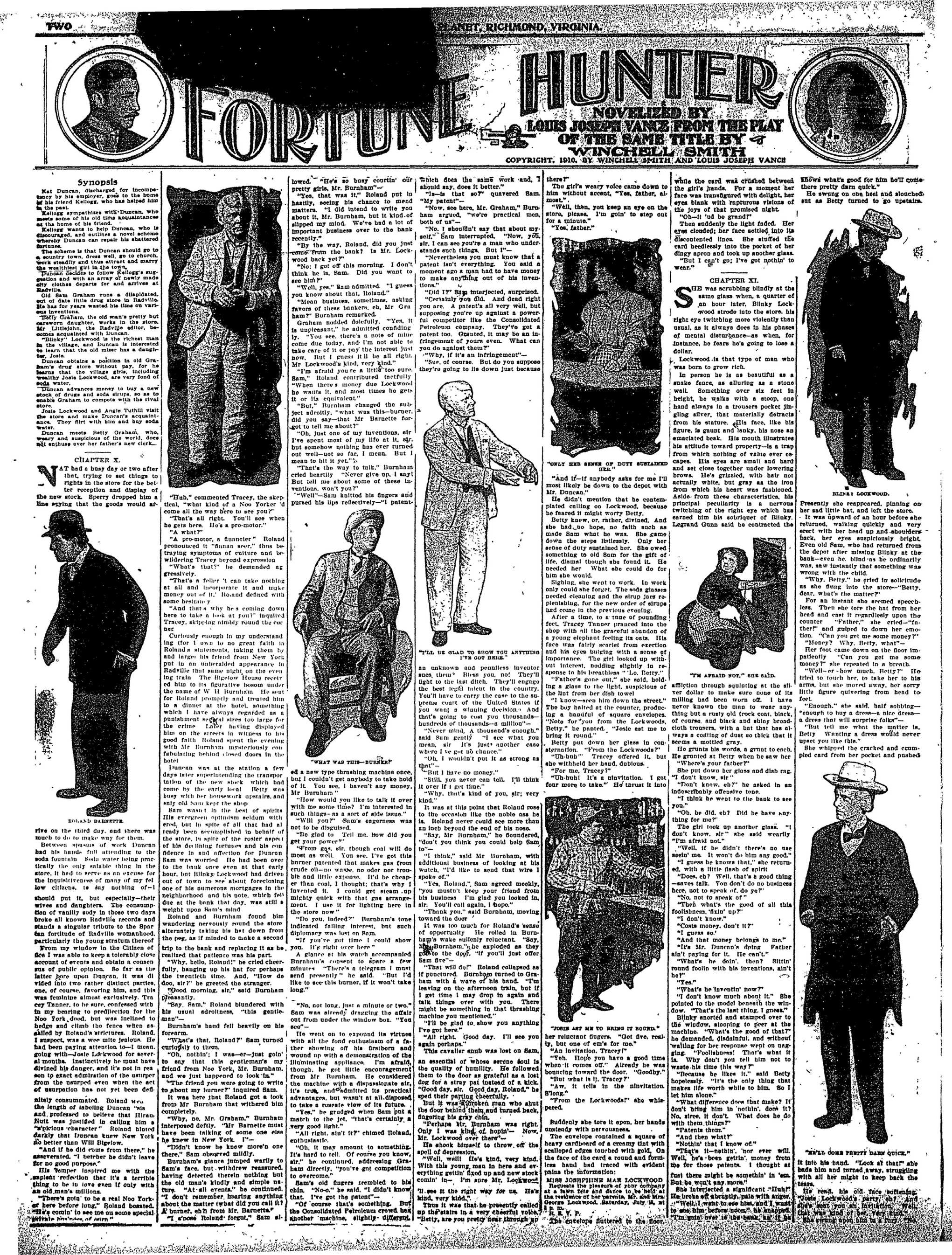
Synopsis
Kat Duncan, discharged, for incompetency by his employer, goes to the home in his friend Kellogg, who has helped him in the past. Symptomatic with Duncan, who meets some of his old time acquaintances at the home of his friend.
Kellogg wants to help Duncan, who is discouraged, and outlines a novel scheme whereby Duncan can repair his shattered roof. The scheme is that Duncan should go to a country town, dress well, go to church, work steadily and thus attract and marry the wealthiest girl in the town.
Duncan decides to follow Kellogg's suggestion and with an array of made possessions departs for and arrives at Radville.
Old Sam Graham runs a dilapidated out of date little drug store in Radville. He has for years wasted his time on various intentions.
My friend, the old man's pretty but carworn daughter, works in the store. Mr Littlejohn, the Radville editor, becomes acquainted with Duncan.
"Blinky" Lockwood is the richest man in the village, and Duncan is interested in learn that the old miser has a daughter.
Duncan obtains a position in old Graham's drug store without pay, for he learns that the village girls, including wealthy Josie Lockwood, are very fond of soda water. Advances money to buy a new stock of drugs and soda strums, so as to enable Graham to compete with the rival store.
Josie Lockwood and Angie Tuthill visit the store and make Duncan's acquaintance. They first with blim and buy soda water.
Graham meets Betty Graham, who, weary and suspicious of the world, does not enthuse over her father's new clerk.
CHAPTER X.
NAT had a busy day or two after that, trying to set things to rights in the store for the better reception and display of the new stock. Sperry dropped him a line saying that the goods would ar
```markdown
```
ROLAND DARNETTE
rive on the third day, and there was much to do to make way for them.
Between spans of work Duncan had his hands full attending to the soda fountain. Soda water being principally the only saluble thing in the store, it had to serve as an excuse for the inquisitiveness of many of my fellow citizens, to say nothing of—I should put it, but especially—their wives and daughters. The consumption of vanilly soda in those two days broke all known Radville records and stands a singular tribute to the Spar can fortitude of Radville womanhood, particularly the young stratum thereof.
From my window in the Citizen of Face I was able to keep a tolerably close account of events and obtain a consent sus of public opinion. So far as the latter pore upon Dangan, it was divided into two rather distinct parties, one, of course, favoring him, and this was feminine almost exclusively. Tracy Tanner, to be sure, confessed with in my bearing to predilection for the Noo York, dood, but was inclined to hedge and climb the fence when assailed by Rolland's structures. Roland, I suspect, was a woe mite jealousy. He had been paying attention to—I mean, going with—Josie Lockwood for several months. Instinctively he must have divined his danger, and it's not in reason to exact admiration of the usurper from the usurped even when the act of usurpation has not yet been definitely consummated. Roland was the length of
and, professed to believe that Hilran Nutt was justified in calling him a "spiky character" Roland blunted darkly that Duncan knew New York do better than Will Biglow.
"And if he did come from there," he answered, "I bether he didn't leave for no good purpose."
His temper inspired me with the splendid reflection that it's a terrible thing to be in love even if only with an old man's millions.
"There's gold to be a real Noo York here before long." Roland boasted. "He's comin' to see me on some special private business of return."
A. H.
"Hub," commented Tracey, the skeptical, "what kind of a Noo Yorker'd come all the way here to see you?"
"That's all right. You'll see when he gets here. He's a pro-motor."
"A what?"
"A pro-motor, a funnacter." Roland pronounced it "finnan seer," thus be traying symptoms of culture and bewildering Tracey beyond expression
"What's that?" he demanded agressively.
"That's a feller' it can take nothing at all and incorporate it and make money out of it." Roland defined with some hesitancy.
"And that's why he is coming down here to take a look at you?" inquired Tracey, skipping nimbly round the corner.
Curiously enough in my understanding (for I own to no great faith in Roland's statements, taking them by and larger his friend from New York put in an unheralded appearance in Radville that same night on the evening train. The Bigelow House reserved him to its figurative bosom under the name of W H Burrahum. He sent for Roland promptly and treated him to a dinner at the hotel, something which I have always regarded as a punishment several acres too large for the crime. Later having displayed him on the streets in witness to his good faith Roland spent the evening with Mr Burrahum mysteriously confabulating behind closed doors in the hotel. Duncan was at the station a few days later superintending the transportation of the new stock which had come by the early local. Betty was busy with her housework upstairs, and only old Sam kept the shop.
Sam wasn't in the best of spirits His evergreen optimism seldom withered, but in spite of all that had already been accomplished in behalf of the store, in spite of the roster aspect of his declining fortunes and his confidence in and affection for Duncan Sam was worried. He had been over to the bank once even at that early hour, but Blinky Lockwood had driven out of town to see about foreclosing one of his numerous mortgages in the neighborhood and his note, which fell due at the bank that day, was still a weight upon Sam's mind. Roland and Burnham found blim wandering nervously round the store alternately taking his hat down from the peg, as if minded to make a second trip to the bank and replacing it as he realized that patience was his part. "Why, hello, Roland!" he cried cheerfully, hanging up his hat for perhaps the twentieth time. And, "How do doo, sir?" he greeted the stranger.
"Good morning, sir," said Burnham pleasantly.
"Say, Sam," Roland blundered with his usual adroltness, "this gentleman."
Burnham's hand fell heavily on his forearm.
"What's that, Roland? Sam turned curiously to them.
"Oh, nothin'! I was—er—just goln' to say that this gentleman's my friend from Noo York, Mr. Burnham, and we just happened to look in."
"The friend you were going to write
to about my burner" inquired Sam.
about my birth I required Sam.
It was here that Roland got a look
from Mr Burnham that withered him
completely.
"Why, no. Mr. Graham," Burnham interposed deftly. "Mr Barnette must have been talking of some one else he knew in New York. I"— "Didn't know he knew more'n one there." Sam observed mildly. Burnham's glance jumped wartly to Sam's face, but, withdrew reassured, having detected therein nothing but the old man's kindly and simple nature. "At all events," he continued. "I don't remember, hearing anything about the matter (what did you call it?) burner, shh from Mr. Barnetta." "I stoke Ronald, forgot." Sam al-
lowed. "He's so busy courtin' our pretty girls, Mr. Burnham."
"Yes, that was it." Roland put in hastily, seeing his chance to mend matters. "I did intend to write you about it, Mr. Burnham, but it kind of slipped my mind. We've had a lot of important business over to the bank recently."
"By the way, Roland, did you just come from the bank? Is Mr. Lockwood back yet?
"No: I got off this morning. I don't think he is. Sam. Did you want to see him?
"Well, yes." Sam admitted. "I guess you know about that, Roland."
"Mean business, sometimes, asking flavors of these bankers, eh, Mr Graham!" Burnham remarked.
Graham nodded dolefully. "Yes, it is unpleasant," he admitted concluding. "You see, there's a note of mine come due today, and I'm not able to take care of it or pay the interest just now. But I guess it will be all right. Mr Lockwood's kind, very kind."
"I'm afraid you're a little too sure. Bam." Roland contributed tactfully "When there's money due Lockwood he wants it, and most times he gets it or its equivalent."
"But, Burnham changed the subject adroitly, "what was this—burger, did you say—that Mr Barnette forgot to tell me about?"
"Oh, just one of my inventions, sir. I've spent most of my life at it, sir, but somehow nothing has ever turned out well—not so far, I mean. But I mean to hit it yet.""
"That's the way to talk." Burnham cried heartily "Never give up, I say! But tell me about some of these inventions, won't you?"
"Well" kultled his fingers and pursed his lips reflectively—I patent-
```markdown
```
"WHAT WAS THIS--BURNER?"
ed a new type thrashing machine once,
but I couldn't get anybody to take hold of it. You see, I haven't any money,
Mr Burnham."
"How would you like to talk it over with me some time? I'm interested in such things—as a sort of side issue."
"Will you?" Sam's eagerness was not to be disguised.
"Do glad to. Tell me. how did you get your power?"
"From gas, sir, though coal will do most as well. You see, I've got this burner patented that makes gas from crude oil—no waste, no odor nor trouble and little expense. It'd be cheaper than coal, I thought; that's why I invented it. I could get steam, up mighty quick with that gas arrangement. I use it for lighting here in the store now."
"Do you, indeed?" Burnham's tone indicated falling interest, but such diplomacy was lost on Sam.
"If you're got time I could show you. It's right over here."
A glance at his watch accompanied Burnham's consent to share a few minutes "There's a telegram I must send presently" he said. "But I'd like to see this burner, if it won't take long."
"No, not long, just a minute or two. Sam was already dragging the affair out from under the window box. "You see"—
He went on to expound its virtues with all the fond enthusiasm of a father showing off his firstborn and wound up with a demonstration of the illuminating appliance. I'm afraid, though, he got little encouragement from Mr Burnham. He considered the machine with a dispassionate air, it's true, and admitted its practical advantages, but wasn't at all disposed to take a roseate view of its future.
"Yes," he grudged when Sam put a match to the jet, "that's certainly a very good light."
"All right, ain't it?" chimed Holland, enthusiastic.
"Oh, it may amount to something. It's hard to tell. Of course you know, sir," he continued, addressing Graham directly, "you've got competition to overcome."
Sam's old fingers trembled to his chin. "No-o," he said. "I didn't know that. I've got the patent."
"Of course that's something. But the Consolidated Petroleum crowd has another machine, slightly different."
Which does the same work and, I should say, does it better."
"I is that so?" quavered Sam. "My patent?"—
"Now, see here, Mr. Graham," Burnham argued, "we're practical men, both of us"—
"No. I shouldn't say that about myself." Sam interrupted. "Now, you, sir, I can see you're a man who understands such things. But I"—
"Nevertheless you must know that a patent isn't everything. You said a moment ago a man had to have money to make anything out of his inventions."
"Did I?" Sam interjected, surprised.
"Certainly you did. And dead right you are. A patent's all very well, but supposing you're up against a powerful competitor like the Consolidated Petroleum company. They've got a patent too. Granted, it may be an infringement of yours even. What can you do against them?"
"Why, if it's an hrringingmom?"—
"Why, if you're going to go down, just because
1
"WILL BE GLAD TO SHOW YOU ANYTHING
I'VE GOT HERE"
an unknown and penniless inventor
suces them? Bless you, no! They'll
fight to the last ditch. They'll engage
the best legal talent in the country.
You'll have to carry the case to the
supreme court of the United States if
you want a winning decision. And
that's going to cost you thousands—
hundreds of thousands—a million"—
"Never mind, A thousand's enough."
said Sam gently "I see what you
mean, sir. It's just another case
where we've got no chance."
"Oh, I wouldn't put it as strong as
that"—
"But I have no money."
"Stik, you never can talk. I'll think it over if I got time."
"Why, that's kind of you, sir; very kind."
It was at this point that Roland rose to the occasion like the noble ass he is. Roland never could see more than an inch beyond the end of his nose.
"Bay, Mr Burnham," he foundered, "don't you think you could help Sam to—"
"I think," said Mr Burnham, with additional business of looking at his watch, "I'd like to send that wire I spoke of."
"Yes, Roland," Sam agreed mockly, "you mustn't keep your friend from his business. I'm glad you looked in, sir. You'll call again, I hope."
"Thank you," said Burnham, moving toward the door.
It was too much for Roland's sense of opportunity. He rolled in Burnham's wake suddenly reluctant. "Say, Mary, Burnham," he exploded as they got to the doop, "if you'll just offer Sam fire."
"That will do!" Roland collapsed as if punctured. Burnham turned to Graham with a wave of his hand. "I'm leaving on the afternoon train, but if I get time I may drop in again and talk things over with you. There might be something in that thrashing machine you mentioned."
"I'll be glad to, show you anything I've got here."
"All right. Good day. I'll see you again perhaps."
This cavaller anub was lost on Sam.
an essential of whose serene soul is the quality of humility. He followed them to the door as grateful as a lost dog for a stray pat instead of a kick. "Good day, sir. Good day, Roland," he sped their parting cheerfully. But it was broken man who shut the door behind them and turned back, fingering his gray chin.
"Perhaps Mr. Burmham was right. Only I was kind of hopin'— Now, Mr. Lockwood over there"—
He shook himself to throw off the spell of depression.
"Well, well! He's kind, very kind. With this young man in here and everything gettin' fixed up and new stock comin' in— I'm sure Mr. Lockwood.
"I see it the right way for us. He's kind, very kind."
Thus it was that he presently called up the stairs in a very cheerful voice. "Betty, are you pretty near through up
The girl's weary voice came down to him without accent, "Yes, father, almost." "Well, then, you keep an eye on the store, please. I'm goin' to step out for a minute."
10
"ONLY HER SENSE OF DUTY SUSTAINED HER."
"ONLY HER SENSE OF DUTY SUSTAINED HER"
"And if—if anybody asks for me I'll most likely be down to the depot with Mr. Duncan."
He didn't mention that he contemplated calling on Lockwood, because he feared it might worry Betty.
Betty knew, or, rather, divined. And she had, no hope, no faith such as made Sam what he was. She came down the steps listlessly. Only her sense of duty sustained her. She owed something to old Sam for the gift of life, dismal though she found it. He needed her. What she could do for him she would.
Sighing, she went to work. In work only could she forget. The soda glasses needed cleaning and the slurp jars repleasing, for the new order of slurps had come in the previous evening.
After a time, to a tinue of pounding feet, Tracey Tanner pranced into the shop with all the graceful abandon of a young elephant feeling its oats. His face was fairly scarlet from exertion and his eyes building with a sense of importance. The girl looked up without interest, nodding slightly in response to his breathless "Lo. Betty." "Father's gone out," she said, holding a glass to the light, suspicious of the lint from her dish towel. "I know—seen him down the street." The boy halted at the counter, producing a handful of square envelopes. "Note for you from the Lockwoods, Betty," he panted. "Josie as me to bring it round." Betty put down her glass in consternation. "From the Lockwoods?" "Ub-huh." Tracey offered it, but she withheld her hand, dubious. "For me, Tracey?" "Ub-huh! It's a invitation. I got four more to take." He thrust it into
```markdown
```
"JOBS ARE MY MEN TO BRING IT BOUND."
her irritant fingers. "Got five, really, but one of em's for me."
"An invitation, Tracey"
"Teh. Hope you have a good time when it comes off." Already he was bouncing toward the door. "Goodby."
"But what is it, Tracey?"
"Aw, it tells in the nivitation. Blong."
"From the Lockwoods" she whispered.
Suddenly she tore it open, her hands unstendy with nervousness.
The envelope contained a square of heavy cardboard of a creamy tint with scalloped edges touched with gold. On the face of the card a round and forlorn hand had traced with evident pains the information:
MISS JOSHINE MAR LOCKWOOD
Requests the pleasure of your company at a twin tete and dance to be held at the residence of her parvature, Mr. and Mrs. George Lockwood. Saturday, July 14, at 10 a.m.
The envelope fluttered to the floor.
while the card was crushed between the girl's jaws. For a moment her face was transfigured with delight, her eyes blank with rapturous visions of the joys of that promised night.
"Oh—it 'ud be grand!" Then suddenly the light faded. Her eyes clouded; her face settled, into its discontented lines. She stuffed the card headlessly into the pocket of her dingy apron and took another glass.
"But I can't go; I've got nothing to
"But I can't go; I've got nothin' to wear."
CHAPTER XI
SHE was scrubbing blindly at the same glass when, a quarter of an hour later, Blinky Lockwood strode into the store, his right eye twitching more violently than usual, as it always does in his phases of mental disturbance—as when, for instance, he fears he's going to lose a dollar. Lockwood is that type of man who was born to grow rich.
In person he is as beautiful as a snake fence, as alluring as a stone wall. Something over six feet in height, he walks with a stoop, one hand always in a trousers pocket jingling silver, that materially detracts from his stature. His face, like his figure, is gaud and lanky, his nose an emaculated beak. His mouth illustrates his attitude toward property—is a trap from which nothing of value ever escapes. His eyes are small and hard and set close together under lowering brows. He's grizzled, with hair not actually white, but gray as the iron from which his heart was fashioned. Aside from these characteristics, his principal peculiarity is a nervous twitching of the right eye which has earned him his sobriquet of Blinky. Legrand Gunn said he contracted the
"I'M AFRAID NOT." SUE SAID.
affliction through squinting at the silver dollar to make sure none of its milling had been worn off. I have never known the man to wear anything but a rusty old frock coat, black, of course, and black and silky broadcloth trousers, with a hat that has always a coating of dust so thick that it seems a mottled gray.
He grunts his words, a grunt to ench.
He grunted at Betty when no saw her "Where's your father?"
She put down her glass and dish rag. "I don't know, sir."
"Don't know, eh?" he asked in an indoctrably offensive tone.
"I think he went to the bank to see you."
"Oh, he did, eb." Did he have anything for me?
The girl took up another glass. "I don't know, air!" she said wearily "I'm afraid not."
"Well, if he didn't there's no use seein' me. It won't do him any good."
"I guess he knows that," she returned, with a little flash of spirit.
"Does, eh? Well, that's a good thing—saves talk. You don't do no business here, not to speak of, do you?"
"No, not to speak of."
"Then what's the good of all this foolishness, fixin' up?"
"I don't know."
"Costs money, don't it?"
"I guess so.'
"And that money belongs to me."
"It's Mr. Duncan's doing. Father ain't paying for it. He can't."
"What's he doin', then? Slittin' round foolin' with his inventions, ain't he?"
"Yes."
"What's he inventin' now?"
"I don't know much about it." She pointed to the model beneath the window. "That's the last titing. I guess."
Blinky snorted and stamped over to the window, stooping to peer at the machine. "What's the good of that?" he demanded, disdainful, and without walling for her response went on nagging. "Foolishness! That's what it is. Why don't you tell him not to waste his time this way?"
"Because he likes it." said Betty hopelessly. "It's the only thing that makes life worth while to him. So I let him alone."
"What difference does that make? It don't bring him in 'nothin', does it? No, since, it don't. What does he do with them things?"
"Patents them."
"What?"
"And then what?"
"Nothin' that I know of."
"That's it—nothin', 'nor ever will. Well, he's been gettin', money from the for those patents. I thought at just there might be somethin' in 'em. But, he won't say any more."
She interfected a significant "Huh!"
He broke off abruptly, pals with anger.
"Well, I want to see him, and I want to see him before more, he snapped.
"I'm gone, beet to the break, beet to the break."
Knows what's good for him he'll come
there pretty darn quick."
He swung on one heel and slouched
of ant as Betty turned to go upstairs.
10
PRESENTLY she reappeared, pinning on her sad little hat, and left the store. It was upward of an hour before she returned, walking quickly and very erect with her head up and shoulders back, her eyes suspiciously bright. Even old Sam, who had returned from the depot after missing Blinky at the bank—even he, blind as he ordinarily was, saw instantly that something was wrong with the child.
"Why, Betty," he cried in solicitude as she flung into the store—"Betty, dear, what's the matter?"
For an instant she seemed speechless. Then she tore the hat from her head and cast it regardless upon the counter. "Father," she cried—"father" and gulped to down her emotion. "Can you get me some money?"
"Money? Why, Betty, what?"
Her foot came down on the floor impatiently. "Can you get me some money?" she repeated in a breath.
"Well- or- how much, Betty?" He tried to touch her, to take her to his arms, but she moved away, her sorry little figure quittering from head to feet.
"Enough." she said, half sobbing—"enough to buy a dress—a nice dress—a dress that will surprise folks"—"But tell me what the matter is, Betty Wanting a dress would never upset you like this."
She whipped the cracked and crumpled card from her pocket and pushed
```markdown
```
MEDD GOME PERTY DAN QUICK"
It into his hand. "Look at that!" she bade him and turned away, struggling with all her might to keep back the tears.
He read, his old face softening. Josie Lockwood's party, eh? And she sent you an invitation. Well that was kind of her. Very kind."
She swung upon him in a fury. "Fur?"
SATURDAY...JANUARY 7, 1011.
it was not kind. It was mean! It was
mean!"
"Oh, Betty." he begged in consternation,
"don't say that. I'm sure"—
"Oh, you don't know! I heard the girls talkin' in the postoffice—Angie Tuthill and Mame Gortison and Besale Gabriel. I was round by the boxes where they couldn't see me, but I could hear them, and they were laughin' because I was invited. They said the reason Josie did it was because she knew I didn't have anything to wear, and she wanted to hear what, excuse I'd make for not goin'. Ah. I heard them!"
"Oh, but Betty, Betty," he plumed, "don't you 'mind what they say Don't!"
"But I do mind! I can't help mindin' They're mean!" She paused, her features hardening. "I'm goin' to that party!" she declared tensely; "I'm goin' to that party," and—and I'm goin' to have a dress to go in too! I don't care what I do—I'm goin' to have that dress!"
Sam would have soothed her as best he might, but she would neither look at nor come near him.
"We'll see," he said gently. "We'll see. I'll try—"
She turned on him, exasperated beyond thought. "That only means you can't help me!"
"Oh, no, it doesn't. I'll do what I can."
"Have you got any money now?"
He hung his head to avoid her blazing eyes. "Well—no—not at present, but here's this new stock and—"
"That doesn't mean anything, and you know it. You owe that note to Mr. Lockwood, don't you? And you can't pay it."
"Not today, Betty, but he'll give me a little more time, I'm sure. He's kind, very kind."
"You don't know him. He's as mean—as mean as dirt—as mean as Josie."
"Betty!"
"Then if you did get any money you'd have to give it to him, wouldn't you?"
"Yes, but I'm sure—I think it'll come all right."
"Ah. what's the use of talkin' that way? What's the use of talkin' at
"KOW DON'T BAY THAT."
all? I know you can't do anything for me, and so do your".
Sam had dropped into his chair, unable to stand before this storm; he stared now, mute with amazement, at this child who had so long, so uncomplainingly, shared his poverty and privations, grown suddenly to the stature of a woman—and a tormented, passionate woman, stung to the quick by the injustice of her lot. He put out a hand in a feeble gesture of placation, but she brushed it away as she bent toward him, speaking so quickly that her words stumbled and ran into one another
"I can't understand it!" she raged.
"Why is it that I have to be more shabby than any other girl in town? Why is it that the others have all the fun and all the drudgery? Why is it that I can't ever go anywhere with the boys and girls and laugh—and have a good time like the rest do?"
Sam bent his head to the blast. In his lap his hands worked nervously. But he could not answer her.
"It it aln't that I mind the cookin' and doin' the housework and—all the rest—but why is it you can never give me anything at it? Why must it be that every one looks down on us and sneers and laughs at us? Why is it that half the time we haven't got enough to eat? Other men manage to take care of their families and give their children things to wear. You've got only us two to look after, and you can't even do that. It isn't right. It isn't decent, and if I were you I'd be ashamed of myself"—
Her temper had spent itself, and with this final cry she checked abruptly, with a catch at her breath for shame of what she had let herself say. But, childlike, she was not ready to own her sorrow, and she turned her back, trembling.
Bam, too, was shaken. In his 'heart he knew there was justification for her indictment, truth in what she bad said. And he was heartbroken for her. He got up unsteadily and put a gentle hand upon her shoulder. "Why, Betty-1-"
A dry sob interrupted him. He pulled himself together and forced his voice to a tone of confidence. "Just be a little patient, dear. I'm sure things will be better with us soon. Just a little more patience; that's all. Why, there was a gentleman here this morning from Noo York city talkin' about an invention of mine. The girl moved realistically, shaking his hand. 'Invitalis!' she echoed
Bilsterly. "Oh. Father! Everybody knows they're no good! You've been wastin' time on 'em ever since I can remember, and you've never made a dollar out of one yot."
He bowed to the truth of this, then again braced up bravely. "But this gentleman seemed quite interested. He's over to the Biglowon House now. I think I'll step over and have a talk with him"—
"You'd much better go and have a talk with Blinky Lockwood," she told him brutally. "He's waitin' for you at the bank and said he wasn't golin' to walk after 12 o'clock neither."
"Well, perhaps you're right. I'll go there. It's after 12, but"— He started to get his hat and stopped with an exclamation. "Why, Natl! I didn't know you'd got back!"
Duncan was at the back of the store clearing the last rumants of the old stock from the shelves. "Yes," he said pleasantly, without turning. "I've been here some time cleaning up the cellar to make room for the stuff that's coming in. I came upatairs just a moment ago, but you were so busy talking you didn't notice me."
He paused, swept the empty shelves with a calculating glance and came out around the end of the counter. "Everything's in tipton shape," he said. "I checked up the bill of biding myself, and there's not a thing missing, not a bit of breakage. Mr Graham," he continued, dropping a gentle hand on the old man's shoulder, "you're going to have the finest drug store in the state within six months. With the stuff that Sperry has sent us we can make Sothern & Lee look like 65 cents on the dollar. We're going to make things hum in this old shop, and don't you forget it." He laughed lightly, with a note of encouragement. But he avoided Graham's eyes even as he did Betty's. He could not meet the pitiful look of the former, any more than that stare of hostility and defiance in the latter. "It's good of you, my boy," Graham quavered. "I—but I'm afraid it won't."
"Now don't say that!" Duncan interposed firmly "And don't let me keep you. I think you said you were going out on business? And I'll be busy enough right here."
And, without exactly knowing how it had come about, Graham found himself in the street, stumbling downtown toward the bank.
When he had gone Duncan would have returned to the shelters for a final redding up. He desired least of all things an encounter with Botty in her present frame of mind. With a sad don movement she threw herself in front of Duncan.
"So you were listening!"
"I'm sorry," he said uncomfortably
"I didn't mean to hear anything," he
argued plaintively. "I was in the
room before I understood and by the
time I did it was "too late you had
finished."
"Ob, don't try to explain. I—I hate
you!" she continued
He held her eyes in inquiringly "Yes,
he said in the tone of one who solves a
puzzling problem. "I believe you do."
She looked away, shaking with passion.
"You just better believe it."
"But," he went quietly, "you
don't hate your father, too, do you,
Miss Graham?
"What do you mean by that, Mr.
Duncan?"
"I mean," he said, faltering. "I'm
going to give you a bit of advice.
Don't you talk to your father again
the way you did just now."
"Well, you ain't me!" she cried savagely. "You ain't me! Understand that? When I want advice from you I'll ask for it. Until I do you lot me alone."
"Very well," he replied so calmly that she lost her bearings for a moment. And inevitably this, emphasizing as it did all that she resented most in him—his education, wit, address.
"IT'S GOOD OF YOU, MY BOY."
advantages of every sort—only served
further to infuriate the child.
"Oh, I know why you talk that
way!" she said, rubbing her poor little
hands together.
"Do you?" he asked in wonder.
"Yes, I do you!"
Buddely she found words—poverty stricken words, it's true, but the best she had wherewith to express herself. And for a little they flowed from her Bips, a wailing, scathing torrent. "It's because you go to church all the time and try to look like a saint and—and try to make out you're too religious for anything and like to hear yourself give!' Christian advice to poor miserable sinners like me. You think that's just too lovely of you. That's why you said it, if you want to know. Folks wonder what you're doing here, don't they? Guess you know that, and like it too. It makes 'em look at you and talk about you, and that's what you like. I could tell 'em. You're only here to show off your good clothes and your finger nails and the way you part your hair and—and all the other things you do that nobody in Noo York would pay any attention to."
"A pretty good guess at that," he acknowledged candidly.
"Yes, it is, and I know it, and you know it. Oh, it's easy enough to give advice when you're got 'plenty of money and fine clothes and—but—" "I understand," he said when she
paused to get a grip upon narsen and find again the words she needed. "You needn't say any move. The only res-
```markdown
```
"IVE SLEPT ON PARK BENCHES"
son I said what I did, was because I'm strong for your father and—well, I wanted to do you a good turn too."
"I don't want your apologies."
"All right. Only think over what I said some time."
"I he a good reason for saying what I did."
"I know you had."
"How do you know?"
"Because I am not what you think I am altogether."
"I guess you're not," she snapped. "But I don't mean what you mean. I mean you think I'm conceived and rich and don't know what trouble is. Well, you're mistaken. Many's the time I've dodged round corners to avoid meeting men I knew would invite me to have dinner or lunchon or a drink—of soda—or something—for fear they'd find out that I couldn't treat in return. Many a time I've gone hungry for days and weeks and slept on park benches until an old friend found me and took me home with blim"
She eyered blim with attention.
"But it's your father I wanted to talk about," he hurried on. "I'd bet a lot he knows more than any other man in this town, and, besides, he's a fine, square, good hearted old gentleman. Anybody can see that. Only he's got one terrible fault—he doesn't know how to make money. And that's mighty tough on you—though it's just as tough on him. But when you roast him for it, as you did just now, you only make him feel as miserable as a yellow dog, and that doesn't help matters a little bit. He can't change into a sharp business crook now—he's too old a man. Before long he won't be with you at all, and when he's gone you be sore on yourself sure if you keep on throwing it into him the way I heard you, and that's on the level." "I—I won't do it again," she faltered, twisting her hands together. "Bully for you!" he cried and, with an abrupt if artificial resumption of
SHE GRASSED HIS ARM TIMIDLY.
his businesslike air, turned away to a showcase to spare her the embarrassment of his regard
"I didn't think," said the voice behind him; "I didn't mean to. Something happened that almost drove me wild and—"
"I know," he said gently
After a bit she spoke again, "I'll go up and get dinner ready now."
He heard her footsteps as she crossed to the door and opened it. There followed a pause. Then she came hurriedly back. He faced about to meet her eyes shining with wonder. She grasped his arm timidly.
"I wanted to ask you," she said hastily, "if—was it this friend you spoke about—that found you in the park—who set you on the road to fortune?
"That's what he said," Duncan answered whimsically.
[TO USE CONTINUEN.]
War Veteran Murdered.
Struck on the head with a hatchet while he was asleep on a couch in the dining room of his house, Richard Mercer, seventy-one years old, a veteran of the Civil War, who resided at Grove. a
Samuel four miles from West Oberster,
Pa, was murdered last Monday; afternoon.
The aged man had been killed with a hatchet, and the imbibition, covered with blood, was found near the house.
The murder was discovered Wednesday by a farmer named William Bell. He passed the home of Mercer and saw a loaf of bread on the porch. As the bread was there Tuesday morning, Bell thought that something had happened to Mercer. He looked through a window of the house, stepping the road and saw the body lying on the sofa. Then he summoned other farmers and they entered the house to investigate.
The veteran had been struck on the head with a hatchet while he was asleep. The walls of the house near the couch were spattered, with blood and the hatchet was found in the rear of a small building near the home, which Mercer had used as a cabinet shop.
The motive for the murder is a question to be determined by the police and other officials of Chester county. Nothing had apparently been disturbed, but it is believed the murderer obtained a sum of moggy that was in the house.
BANDITS HOLD-UP LIMITED EXPRESS
Southern Pacific passenger train No 1, the Overland Limited, westbound, was held up by two masked mon at Reese, nine miles west of Ogden, Utah.
William Davis, a colored porter, was shot and killed by the robbers. A. W Taylor, another porter, was seriously wounded, and three passengers, one of them a woman, were slightly hurt. All the passengers on the train, numbering twenty-seven, were robbed of their valuables and $2000 to $2500 in cash. After completing their work the robbers drove away in a wagon.
The robbers did not attempt to enter the express car, but devoted their entire attention to the Pullman cars, where they made a rich haul among the California bound passengers. They held the train for more than an hour while they went 'through the possessions of the passengers.
No passenger escaped the robbers and the trainmen also lost their money, watches and other valuables.
The killing of Davis and the wounding of Taylor were unprovoked. The two porters were in a drawing room of a Pullman, and made no move to resist when the robbers entered.
One of the robbers asked his confederate "What will we do with them?" The reply was "Kill them!" Davis was shot dend and Taylor was desperately wounded.
Turning to Hancock, a brakoman, who was holding the open sack into which the robbers were putting their loot, and who was an unwilling witness to the tragedy, the murderer asked "Did I kill them?" "I guess you did," answered the brakoman. Taylor credits his escape from death to his foliage death when he fell to the floor wounded in the arm
$111,500,000 IS MINTED
$105,000,000 In Gold Turned Out In
United States in 1910.
The mints of the United States duri-
ng 1910 sent out more than $111,500,
000 in coin, of which nearly $105,000,
000 was in gold.
The total colage of silver was com-
paratively insignificant, it being less
than $4,000,000. Three million dollars
in pennies and five-cent pieces were
coloned.
More than 6,000,000 pieces were
coloned for the Philippine Islands and
nearly 1,000,000 pieces were coloned on
contract for Costa Rica.
No Sunday Funerals In Passale.
Sunday funerals in Passale, N. J.
are now a thing of the post, for the
Coach Drivers' union gave all under-
takers notice that at a recent meting
the drivers decided to no longer work
on the Sabbath.
WILLIAM E. COREY.
President of Steel Trust Tenders His Resignation.
J.
President of U. S. Steel Corporation
Will Retire.
William Ellis Carey, president of
the United States Steel Corporation
since the resignation of Charles M.
Schwab, the first president, seven
Don't Ruin Your Hair
with poisonous pomades—hot irons—
hot combs and other harmful hair lotions.
Use ZOTINA
FOR THE HAIR
Original and Only Scientific Remedy
Guaranteed to Straighten the Hair
Make it soft and pliable, easy to comb, glossy and beautiful
Used by the Entire Profession
Price, 50c. and $1.00 by mail
Manufactured only by the
ZOTINA REMEDY COMPANY
Tampa, Fla.
Dept. 20
AGENTS WANTED
HAIR-VIM
TRADE MARK
HAIR-VIM CHEMICAL COMPANY, INC.
(Successor to Columbia Chemical Company, of Newport News, Va.)
Manufacturers of HAIR-VIM, HAIR-VIM SOAP, LIQUID HAIR-VIM, BEAU-TE-VIM CREAM AND OWL CORN SALVE.
Howare of Imitations and Imposters Advertising the Goods from Newport News, Va., the Old Home Office.
Good Agents Wanted. Liberal Commissions Paid. Write to-day.
MRS. J. P. H. COLEMAN, Phar. D., President-Manager.
643 Florida Avenue, N. W., Washington, D. C.
Long Distance Phone, North 8250-m.
years ago, himself tendered a formal resignation at a regular meeting of the finance committee in New York. To all intents and purposes the resignation has been accepted. The finance committee passed upon it favorably, and it will come formally before the board of directors at their regular quarterly meeting on the 25th of the month. That they will accept it there is no doubt. Even to some of the directors of the company Mr Corey's resignation came as a surprise. In 1907, when Mr Corey married Mabelle Gilman, the actress. It was widely reported that he would be succeeded as president and the wife was a faction of the board which rather openly favored his retirement. It is understood that his retirement has no relation to his domestic affairs.
College Returns $40,000 to Widow.
An endowment of $40,000 has been refused by Washington and Jefferson college, at Washington, Pa., because the widow and six children of the donor need the money. It is believed the testator overestimated the value of his estate.
Newark, O., Lyncher Given 20 Years.
Twenty years in the pententennial was the sentence passed upon Montella Watha, of Newark, O., who was convicted of manslaughter on Dec 17, on a charge of having taken part in the Lynching of Carl Etherington, a "dry" detective, last July. A motion for a new trial was overruled.
Congress Takes Recess.
Congress has adjourned for the holiday recess until Jan 5. Little bus nees was done in either house owing to the difficulty of keeping enough members in their seats to insure a quorum
GENERAL MARKETS
PHILADELPHIA — FLOUR quiet
winter clear, $355.64 $390, city mills,
fancy, $7.54 $4
RYE FLOUR quiet, at $4415 per
barrel
HEAT quiet, No 2 red, new, $94
$95c
CORN quiet, No 2 50$50$c
OATS ready, No 2 white 38$38$
lower grades, 37$37$
POULTRY Love steady, hens 14$14$
14$14%, old rosters, 10$10$16 Dressed
firm, turkey choice, 21$21$26 cho
coffee for old rosters, 10$10$16
BUTTER steady, extra creamy, $3
per lb
EGGS firm, selected, 42644c., near
brn, 23e, univ. 37c.
by 37c 'wolsten, 37c
FORTEOS study, at 58@6c
bushed
Live Stock Markets.
PITTBURG (Union Stock Yards) $2
chance, choice $40 $6.60.
PIRRE, $26.99 $3.5
PIRRE, $26.99 $3.5
SHEEP stendy, prime wethers, $4 10
@4 25, culls and common. $2 3, veal
calvals, $3 10, lambs, $3 6 75
HOGS higher, prime hooves, $1.15,
milk, $3 10, lambs, $3 6 75
$3 15@8 20, Light Yorkers, $2 8@8 40,
plugs, $3 9@8 40, roughs, $7 6 40
BANK GUARANTEES VALID
Supreme Court Says Western Laws Are Constitutional.
The supreme court of the United States uphold the constitutionality of the Oklahoma law, guaranteeing bank deposits, also the constitutionality of like laws in Nebraska and Kansas.
How to Make a Christmas Ball.
Take two wooden hoops and, after placing one inside the other so they are at right angles, make a network of wire around them so as to form a hollow ball. Stick into this countless bunches of holly and stud it with berries frosted with snow powder. Fasten ribbons to it from which to suspend the presents. Hang the ball from the ceiling by a piece of ribbon, which can be run through a hook so the ball can be raised out of the way until it is time to distribute the presents. The Christmas ball is a pretty and inexpensive substitute for the Christmas tree.
How to Tie Shoes Comfortably.
Man who have trouble with shoes because the lace does not stay tight over the instep, but becomes so tight at the top as to be uncomfortable, can avoid the discomfort by a little care. Lace the shoe tightly until halfway up, then pass the string a second time over the hooks and then lace the rest
of the hook loosely. The double turn
over the hooks at the instep will keep
the lower portion of the being tight
and the upper portion will remain
loose.
"Labor Contract" Law Upset.
The fight made by the federal gov-
ernment to have the "labor contract"
law of Alabama declared unconstitutional was crowned with success when the supreme court of the United States held the law invalid. The government claimed the law reduced hundreds of negroes to a state of peonage.
Welched Over 500 Pounds
William Eke son, who probably weighed more than any officeholder in the country, is dead at his home in Elizabeth N J Pneumonia was the cause of death Mr. Ekerson out weighed President Taft by at least 200 pounds, baling over 500 pounds.
Fire started in the Hollenberg Musical company's building and destroyed an entire block of houses at Little Rock, Ark. The loss on the buildings and stocks of the goods amounted to $1,000,000
How to Make Tamarind Water
How to Make Tamarind Water
The pulp of the tamarind, that is to be found in New York markets, has a peculiar "tang" and is used in a chilled beverage called "tamarind water".
Remove the seeds and pulp from the pods stripping off every particle of hard wood fiber that may cling to
It to a cupful of shredded tamarins add a pint of boiling water. Stir the mixture thoroughly until it is thick. Add a cupful of sugar and squeeze as much of the mixture through a strainer as possible. Set it near ice to cool then add crushed ice and enough water to crush it a little. It should be very cold when served. Tamarind water, it is said, was once as popular as lemonade. It is still used occasionally for patients suffering from slight fever and is recommended for billion troubles. It is also administered to children instead of castor oil, as it is so much attractive in flavor. This fruit is in season the year around, but it is host in the months of May and June.
THE SEASONS
SPRING'S a maid that knows no lover,
Fearless eyed and fancy free
Snowy blossoms drop above her,
Flowery grazes kiss her knee
SUMMER wear a crown of roses.
For the maid becomes a bride
On her cheeks are glowing poises.
In her eyes a world of pride
AUTUMN is a good wife jolly.
Mellow as her gathered fruit.
Twinkling eyes that laugh at folly.
Ruddy cheeks and lips to boot
WINTER is a queen of sorrows
Thrown noft, austerly white,
Gazing down the lovely murrows
To the inevitable night.
~/all Mall Gazette.
EVER A BONG BOMEWHERE
There is ever a something singa
alway
There's the song of the lark when
the skies are clear.
And the song of the thrush when the
skies are gray.
The sunshine showers across the grain,
and the bluebird trills in the orchard
And in and out when the eaves drip rain
The swallows are twittering ceaselessly
There is ever a song somewhere, my dear,
There is ever a song somewhere
There is ever a song somewhere, my dear,
In the midnight black or the midday
blue
The robin pipes when the sun is here,
And the cricket chirrups the whole night
through.
The buds may blow, and the fruit may grow.
And the autumn leaves drop crisp and
sore.
But, whether the sun or the rain or the
snow.
AT DISTILLERY PRICE
PAID.
When we say Dustillery Whiskey, we mean it. We do not handle compounds and chemical mixtures. If the goods you buy from us are not as we represent, and better than you ever bought at the price, return them and we will REFUND your money
YOUR CHOICE OF CORN, RTE OR SIN
3 0413 4 07 6413 6 013 12 018
$4.50 $6.75 $3.00 $5.50
Express Paid to any office of Adams or Southern Express Company
STONEWALL DISTILLING CO.
1453HULLST..RICHMOND.VA.
RAILROADS.
Richmond, Frederick's B. G & Potomac R. R. TO AND FROM WASHINGTON AND BEYOND.
Leave Richmond Arrive Richmond
*4.0 A.M. Byrd 8t.8ta.
*5.20 A.M. Byrd 8t.8ta.
*6.40 A.M. Byrd 8t.8ta.
*12.01 oom Byrd 8t.8ta.
*1.00 P.M. Byrd 8t.8ta.
*4.16 P.M. Elba Station.
*1.15 P.M. Elma St. 8ta.
*2.0 P.M. Byrd 8t.8ta.
*7.50 A.M. Byrd 8t.8ta.
*11.25 A.M. Elba Station.
*11.35 A.M. Byrd 8t.8ta.
*1.12 P.M. Elma St. 8ta.
*2.45 P.M. Byrd 8t.8ta.
*7.15 P.M. Byrd 8t.8ta.
*9.00 P.M. Byrd 8t.8ta.
*10.35 P.M. Elma St. 8ta.
*12.00 night Byrd 8t.8ta.
ACCOMMODATION TRAINS—WEEKDAYS.
Leave Bryd H. Sta. 1.20 P. M. for Frederickburg.
Leave Blae Sta. 7.30 A. M. 6.80 P. M. for Abankl.
Arrive Bryd H. Sta. A. M. 1.10 P. M. from Frederickburg.
Arrive Blae Sta. 6.30 A. M. 6.30 P. M. from Abankl.
*Daily.* {Weeksdays.} Sundays only.
All trains to Bryd H. Sta. for stations
(except trains leaving 4.50 a.m. and arriving
at 50 nights) stop at Blae. Time of arrivals and
departures not guaranteed. Read the signs.
N. & W. NORFOLK & WESTERN.
ONLY ALL RAIL LINE TO NORFOLK.
Schedule in May 1910.
Leave Bryd Street Station, Richmond, FOR
NORFOLK 8:10 A. M. 9:00 A. M.; 8:00 P.
M. 4:10 P. M. 8:00 P. M.
Arrive Blichmond from Northfell - b-11:25 A. M.
a 11:40 A. M; "6:30 P. M; b 10:25 P. M; "11:25
A. M; b 10:25 P. M; b 10:25 P. M; b 10:25 P. M;
b 11:25 P. M; "9:05 P. M; "9:05 P. M; b 10:25 P. M;
"Daily a daily except Sunday. b Sunday only
Pollanon, Parlor and Sleeping Gars. Cale Dining
Cars. G. H. BOLLEY, W. B. DEVIL, G. H. A., Bichmond, W.
G. P. A., Roanoke, Fa.
ATLANTIC COAST LINK
EFFECTIVE APRIL 11, 1952.
TRAINS LEAVE RICHMOND DAILY.
For Florida and South: 8:15 A. M. and 7:00
M.
For Norfolk: 8:38 A. M. 8:00 P. M. and 8
P. M.
For W. and W. Wy., West: 8:00 A. M. 8:10
and 8:08 P. M.
For Petersburg: 8:08 A. M. 15:18, 8:08, 8:08
P. M. 6 P. M. 8:08 P. M. 7:08 and 12:18 P. M.
For Golddove and Frystlewell: 12:18 P. M.
For Golddove and Frystlewell: 8:18, 1:08
M. 8:28, 11:45 A. M., **8:08 A. M., **11:08
P. M., 8:08, 8:08, 9:00 and 9:15 P. M.
*Except Sunday. **Sunday Only.
Time of arrival and departure and commu-
Time of arrival and departure and concessions not guaranteed.
Southern Ry
TRAINS LEAVE RICHMOND.
N B—Following schedule figures published on information bulletin for 106 Danville, Charleston, Durham and Raleigh.
10:45 A. M.-Daily. Limited. For all points to Drawing Room Basket Bleeding Car to Memphis, via Asheville and Chattanooga.
8:00 P. M.-Ex. Sunday. Local for Durham and intermediate stations.
6:00 M. M.-Daily. Lyville Local.
11:45 P. M.-daily. Limited. for all points South. Pullman ready 8:00 P. M.
YORK RIVER LINE
4:30 P. M.—Fx. Sunday. To West Point, comment
for Baltimore, Mn. Wed. & Fri.
6:00 A. M.—Fx. sun. and. 2:15 P. M.—Mom.
Wed. and Ft. Local. To West Point.
TRAINS ARRIVE RICHMOND.
From the South: 8:50 A. M., 8:05 P. M., dally.
8:48 A. M., Ex. Sunday; 12:05 P. M., Ex. Sunday.
From West Point: 8:20 A. M., dally; 11:08 A.
M., Wed. and Fr.; 4:25 P. M., Ex. Sunday.
B. E. BURGESB. D. P. A.
20 East Main Street. 'Phone, Madison-428
C & O
8:00 A. Daily. Fast trains to Old Point.
8:48 P. Newport News and Norfolk.
8:00 E. Daily. Locals to Newport News.
8:00 E. Daily. Locals to Newport News.
12:00 M.-Week days to Clinton. "Mountain
Special." Parter Ora.
12:30 A.-Daily, Chryslerville. Week day-
ning. Clinton Fargo.
11:15 P.-Daily, Llervg. to Cardinalville.
11:15 A.-Daily, Llervg. Lockington, O. Fargo.
11:15 P.-Daily. To Lynchburg.
TRAINS ARRIVE RICHMOND.
Local from Math--8:15 A.M. 1:59 P.M.
Through from East--11:55 A.M. 8:25 P.M.
Local from West--7:20 A.M. 9:00 A.M.
7:20 P.M.
Through--7:00 A.M. 2:55 P.M.
James Street Lane--8:35 A.M. 9:00 P.M.
"Daily except Sunday."
Your subscription to The FLAIRS is due. Have you paid it? It not, what not?
REPEAT
Published every Saturday by JOHN MITCHELL
Jt., at Bll N. Fourth Street, Hichnood, Va.
All communications intended for publication should be sent so as to reach us by Wednesday.
TERMS IN ADVANCE.
One Copy, one year.....$1.00
One Copy, eight months.....1.00
One Copy, six months.....$0.00
One Copy, four months.....$0.00
One Copy, three months.....$0.00
Single Copy.....$0.00
ADVERTISING RATES
For one inch, one insertion.....$0
For two inches, three months.....$0
For two inches, six months.....$0.00
For two inches, twelve months.....$0.00
For two inches, twelve months.....$0.00
Marriage and Funeral Notices, one inch.....$0
Standing and Transient Notices per line.....$0
PORTAGE STAMPS OF A HIGHER DENOMINATION THAN TWO CENTS NOT RECEIVED ON SUBSCRIPTION.
THE PLANET is served weekly. The subscript price is $1.00 per year in advance.
There are four ways by which money can be by mail at our stock in a Post Office Money Brier. by Bank Check or Draft, or an Express Mail. by Post Office Letter, these are ma, be postured, in a Hysterical Letter.
MONEY ORDERS: You can buy a Money Order at your Post Office, payable at the Richmond Post Office and we will be responsible for its late arrival.
EKPHEN MONEY ORDERS can be obtained at the Office of the American Express Co., the United States Express Co., and the Wall's Purgo and Co's Express Company. We will be responsible for money sent by any of these companies. The Express Money Order is a safe and convenient way for forwarding money.
REGHTRED LETTLE—If a Money Order, Post Office or an Express Office is not within your rules, you will send us a payment of taxes. Then, if the Letter is lost or stolen, it can be trained. You can send money in this manner at our.risk.
We cannot be responsible for money sent in letters in any other way than one of the four ways mentioned above. If you send your money to any other way, you must do it at your own risk.
RENEWALE, ETO—If you do not want THE PLANET continued for another year after your subscription has run out, you then notify us by Postal Card to discontinue it. The courts have decided that subscribers to newspapers who do not order their paper discontinued at the expiration of time for which it has been paid are liable for the payment of the subscription up to date when they end-it the paperக் discup
COMMUNICATION—When writing to us to renew your subscription or to discontinue your payment, you should give your name and address in the envelope we can send your name on our books.
CHANGE OF ADDRESS—In order to change your address, we must be sent the longer, the more well written.
SATURDAY... JANUARY 7, 1911
SOUTHERN JURISTS AND THE
TREASIDENT.
---
The Richmond (Va.) Times Dispatch is saying some "mighty good" things editorially nowadays and they carry with those statements the stamp of truth. There are numerous instances of miscarriages of justice in the Southern States when the causes at issue are between a Negro and the white man. But, as a rule, this is in the cases of magistrates and juries. Southern judges higher up have always been disposed to accord justice in keeping with the State laws, by which they must be guided. When the legislatures enact laws, no matter bow precedent to the Negroes, they have not considered it within their province to set them aside. We have known instances where they have rendered decisions in the interest of poor, helpless colored people, which would have done credit to the greatest legal minds that have ever sat upon a bench.
We have repeatedly stated that we would sooner trust our interests to the Supreme Court of Appeals of Virginia than we would to the Supreme Court of the United States. Our reasons are that in the case of the former, you will soon know whether that tribunal is for or against you, and the jurists in this Commonwealth are not liable to be in favor of the colored people, whose cause they favor. They can, therefore, speak out boldly and they do not hesitate to do so. In the cases of the Federal judges, they seem to be "tender-footed" on this race question and are susceptible to ridicule.
There are notable exceptions, as in the case of Judge Emory Speer, but he lives in Georgia. For our part, the elevation of Mr. Justice Edw. D. White to the position of Chief Justice is entirely satisfactory to us as a Southerner. Still, it shows a species of "tondyism" on the part of the Chief Executive of the nation, from a party standpoint, and indicates that he is not squarely in accord with the principles of the great organization which elected him. People like, the genuine article nowadays, and not spurious imitations. They like a Republican and not a Republican-Democrat. They like a Democrat and not a Democrat-Republican. They want a半官半人 to be either a
fowl, and not a kaleidescope repre- to the
sanitation of both parties.
This is now and has always been our objection to President Taft, who personally is one of the most lovable man, who ever eat in the White House. He does not seem to be a man of positive convictions, and every wind which comes in any force can change blim. He is a "stand-patron" today and an "insurgent" tomorrow, and neither the next day. He charms a minute and disguets the next, until one goes out to find the man who can truly diagnose his condition or a chemist who can analyze his make up. In the past such a man "rides for a fall," and usually goes into his grave with the contempt of both of the organizations which he tried to serve. But then we have written more than we intended upon this subject. Our desire was to furnish an introduction for the admirable editorial article from the Richmond (Va.) Times-Dispatch of Dec 31, 1910.
According to the New York Evening Post a Parkersburg W Va. paper says
"In the light of President Taft's appointment of Edward Douglas White, a Democrat of the far South, to be chief justice, the appointment of a colored man as assistant attorney general seems hardly when a spectacle of a colored lawyer, he be ever so saintate and learned, advocate the cause of the United States before her highest tribunal" predeceded over by a Southern gentleman and a Democrat, can hardly be imagined"
Commenting on this The Times has to say
"It is well new and then to have the extreme of prejudice thus frankly stated. If only because it enables us to perceive whither unstrrained race dislike can carry us"
In our view, both of those stale
ments are wholly erroneous. Neither
seems to realize that Mr Chief Jus-
te White has often in the long
years of his judicial career, board
many a colored advocate pleads
before him. Some months ago an
instance of this sort occurred to our
knowledge. In all these years the
chief justice predecline and secre-
tionalism have never been laid at
the door of the great head of our
highest court. The past speaks
amply for the future of location
to the chief postsecondary can in no way
after the judicial attitude of Mr
Chief Justice White.
For the benefit of the New York Times it might be added that the judges of the South are not unfriendly in their relations with colored ad vocates. They realize as Northern judges cannot the great disadvantage and obstacles with which the colored lawyer has had to contend in order to make a living in his profession and they are pretty likely in these case to give him whatever he can from kindness and sympathy. The attitude of the Southern judge toward the colored man is distinctly unjudged. If anything, he leans toward the man in black. If he be respectable, law abiding, and not arrogant and assuming.
If the Times would read The Times-Dispatch more careful), it would learn many things, which would give it a broader and more understanding outlook on the race question. Less than a year ago this newspaper printed a story which was reprinted in Boston and many other parts of the country. It told about a delegation of colored people representing their race who presented to Judge Allt of the Hustings Court of this city a handsome silver testimonial in recognition of the fact that he had always given the square don to the colored folk of this city. They declared that in all his long years of judicial service he had been fair and just to them.
The Southern bench is fair to the colored lawyer, and to colored men, whatever their walk in life, because it knows the race, its idiosyncrasies, its training its modes of thought, its life, its feeling, its good and evil intentions. Mercy and equity dwell with the Southern judge in his dealings with the man in black. Is it thus in the North?
Further comment is unnecessary.
---
THE AGE'S OBSERVATIONS
The New York Age seems disposed to criticise our position, with reference to President Taft. We publish its remarks in full in another column. If some of our remarks seem to be inconsistent, it is because the acts of the Chief Executive of the nation are of a similar kind and character. In view of the semi-official announcement that the appointment of Attorney William H. Lewis will not be made and it was a semi-official announcement that told that it would be made, we feel like exclaiming in the words of the Saylour, "I have found no such faith, nay, not even in Israel."
The charge as the Ago states is a serious one and yet the acts of the President, from a party standpoint are even more serious. We have now asserted that all colored appointees under the present administration did not have, or were required to get the endorsation of the white South. What we did say though and the idea we intended to convey was that a colored man, a Negro, an Afro-American could get an office through the endorsation of the Democratic representatives from the South better than he could through any other channel and he could save time and patience, if he could arrange to make his application by this route.
Even Dr. Booker T. Washington owes his great power and influence to the cordial approval of his plans
and methods by the White South. This harmonizes our statement for Dr. Washington has been the first gentleman of prominence to recognize this fact and as a result, he is one of the most influential and prominent figures in the dispensation of political patronage to the Negroes in this country to-day. But even, the great influence of Dr. Washington and his friends has not been sufficient to land some of the high positions which he desired for his friends and supporters. We find that the anti-Negro influence among certain southern representatives outwigh the influence of some of the pro-Negro southerners, who are supporting this distinguished diplomat and educator
As a result, President Taft is being openly charged with the very serious offense of having broken a promise after he had made it. We do not see that anybody should be blamed for this confusing condition, but that good-natured and well-meaning occupant of the White House, who resists over-anxious to please everybody but the same time and especially the husbands of some of the beautiful ladies whom he met in the Southland. We have always been as "straight as a shingle," but if you try to follow President Taft in his gyrations, his endeavors to accord a square deal to the colored citizens without offending the Negroating contingent in this section of the country, you will not only see double, but you will dream of hobgobblers at night.
Wants to Find Him.
We would like to know the whereabouts of Richard Lewis, Jr. He was last heard from March, 1909 He was then at Portsmouth, Va. His mother's name is Harriet Lewis and his father's name is Richard Lewis, Sr all of North Emporia, Va. If any one knows of his whereabouts or can furnish any information concerning him, please write his parents at North Emporia, Va., as they are very anxious to find him.
The East Indian Hair Pomade Co.
The wonderful East Indian Hair Treatment is the one to use for straightening the hair growing and beautifying it. Have pretty, long and straight hair and stop it from being kinky, splitting and falling out. We can give it to you. We can do anything for the hair you want done, we are hair specialists with over 15 years' experience. We have customers everywhere. We are honouring you. If we fail we will refund you money drop a postal before buying for testimonials. We will be glad to refer you to customers. Price by mail $2.25 Last three months. But you will not regret it. Acout paid salary Wanted everywhere
EYES
TESTED FREE
To See Or Not to See Is the
Question.
If your eyes feel painful, hot or
uncomfortable, or if they grow
weary while reading, sewing, ironing
or looking at near objects of
any kind, or if print blurs, your
eyesight is defective, and should be
attended to. The sooner the better
I test eyes free and St glasson
and spectacles of all kinds. Lennes
changed and repair work of all
eyes to satisfaction guaranteed
Private visita mine request.
If M. WILLIAMS, JR. Orphan,
a graduate from the National Optical
College of St. Louis, Mo.; also,
a Theological student of Virginia
'Colon University
Of Louisville Second Street.
Hourst, all day bathtub and from
2:30 to 6:30 o'clock each week
days 'Phone. Madison. 2817
**JOINS** BOTHER YOU? Send
10 Cents for our Autospe
ciple Plaster and be realloy
ed With Agents Wanted
VIRTUE REMEDY CO. 1001 N
Broadway, Balto, Md. Trial Sam
nple for Two C企 Stamp.
$150.00 Endowment Paid.
Portsmouth, Va., Jan. 4, 1911.
This is to certify that I have received from John Mitchell, Jr., Grand Chamomile of the Grand Lodge
Virginia, Knights of Pythia,
N. A. E., A. J., and ($150.
00) One Hundred and Fifty Dhilas in payment of the death-claim of ther Joseph E. Porter, who was a member of Puritan Lodge, No. 101 of Portsmouth, Va.
B.O.S. WEAK
MIN-FREE
Bend Name and Address To-day-
You Can Have It Free and Be
Strong and Vigorous.
I have in my possession a prescription for nervous debility, lack of vigor, weakened manhood, falling memory and lame back, brought on by excesses, unnatural drains, or the follies of youth, that has cured so many worn and nervous men right in their homes, without any additional help needed, that this man every man who wishes to attain many power and virility, quickly and quietly, should have a copy. So I have determined to send a copy of the prescription free of charge, in a plain ordinary sealed envelope to any man who will write me for it.
This prescription comes from a physician who has made a special prescription and I am convinced it is the surest combination for the cure of depletion, and vigor failure over, put together.
I think I owe it to my follow-man to send them a copy in confidence so that any man anywhere who is weak and discouraged with repeated failures may stop drugging himself with harmful patent medicines, secure what I believe is the quickest-acting restorative, upholding, SPOT-TOUCH ING. Romedy ever developed and so himself at home quietly and quickly like this: DR. A. E. BROBINSON $895 Luck-Building, Detroit Mich. will send you a copy of this splendid recipe in a plain ordinary envelope, free of charge. A great many doctors would charge $3.00 to $6.00 for merely writing out a prescription like this—but I send it entirely free.
HARDWOOD FLOORS.
How to Acquire One of Successfully Polished Oak.
The two principal hard woods used for floors are maple and oak. Of them the latter is in more common use for all kinds of floors. To achieve a successfully polished oak floor is by no means a simple and easy process, but the result is well worth the expenditure of labor and money, since it is practically inductible and improves in appearance with age.
Oak flooring leaves the factory in perfect condition. It has been kiln dried, tongued and grooved and end matched. The care of the lumber after it reaches the builder's hands is of the greatest consequence to the success of the floor. It should be protected from moisture and from rough handling such as may mar the sur face. After it has been held the best process is that of smoothing. The lumber is, of course, smoothed before it is laid, but it will nevertheless require a more minute process of scrapping in order to remove the "waves" which slight differences in the quality of the boards will give rise to. This process is one of the most important, since after the finish is put on imperfections will show up even more platyly than before. Every housewife knows of the small rough patches in a bare floor which gather dirt and which it is impossible to clean.
During the process of scraping the part of the floor which has been finished should be covered no as to be protected from footprints and any other possible injury to the surface. It is much better if possible, to have the painting and finished after plastering, painting and plastering are all done so that it will not be used to walk on the floor. This makes them somewhat more expensive, however.
After the scraping and smoothing processes are completed the floor should have a coat of a paste filter. This filter is rubbed thoroughly into the wood, and then the superfluous paste is removed. This paste filter may be incorporated with coloring matter, and in this manner any one of a variety of tapes may be given to the floor. After the filter has dried the finishing process is completed by the application of one, two and sometimes three coats of varnish, each one being allowed to dry before the next one is applied. Floor varnishes nowadays have been improved until they do not crack or show beel prints if a good quality is employed.
GOOD THINGS FOR WINTER.
How to Make Tomato Butter and Citron Melon Preserve
Tomato butter hns not the instipid sweetness of ordinary fruit butters and therefore can be used much more freely. It can be spread over bread with or instead of butter, and in one household at least it has maternally reduced the butter bill. It makes a delicious substitute for catchup with cold meats at lunchon. The results calls for three plates of pooled and minced potatoes, two cupfuls of brown sugar, three-quarter of a cupful of vinegar, two teaspoonfuls of salt, two of cinnamon and one of cloves. Let the mixture boil down until very thick and then seal up in sterilized platters.
To pickle yellow tomatoes put three quarts of the fruit carefully washed on the store with two pints of sugar and a scauf half pint of vinegar. Add salt, cinnamon and cloves to suit the taste, using about half an much clove and clanamon and having one half the spiced powdered and the other half whole. Cook the pickle very slowly on the back of the stove for several hours so that each little tomato will preserve its shape and will be perfectly tender and thoroughly permeated with the spices. It it is cooked the tomatoes will be likely to fall apart and make an unslightly looking dish. The spices should be used liberally. A reliable recipe for preserved citron melon calls for half a pound of sugar, one lesson and a big spoonful of raisins to every pound of citron. After weighing the citron peel it, cut it into chunks and put it into boiling water, just barely enough to cover it. While the fruit is boiling add the sugar and lemon and then when tender stir the raisins through it and seal in glass jars that have been properly sterilized.
TURKEY CARVING POINTERS
How the Thanksgiving Bird Can Be
Diamondbelting Grizzly
When carving the *Temkagung bird*
it is not often necessary to cut up the
whole body of the turkey. But where
every scrap of the meat will be needed
or you wish to exercise your skill
proceed to carve in this manner:
Put the fork in firmly across the middle of the breastbone. Cut through the skin between the leg and body. Bond the leg over and cut off at the joint. If the turkey be very tender or overcooked the side bone will separate from the back and come away with the second joint, making it more difficult to separate the thigh from the leg. Cut through the top of the shoulder and tie the wing at the joint. Cut off the leg and wing on the other side. Curve the breast on each side in thin slices, slanting slightly toward the wing. Be careful to take a portion of crisp outside with each slice. Shave off the crisp skin near the neck in order to reach the stuffing. Insert the point of the knife at the front of the breastbone, turn back the wishbone and separate it. Cut through the cartilage on each side, separating the collar bones from the breast. Tip the body slightly over and alip the knife under the end of the shoulder blade; turn it over toward the opposite side. Cut through the process on the opposite side. Cut through the ribs, separating the breastbone from the back. Lay the breast one side and remove the fork from it.
Take the stuffing from the back
Turn the back over, place the knife
midway just below the ribs and with
the fork lift up the tail end, separating
the back from the body. Place
the fork in the middle of the backbone
from one end to the other on each
side, freeing the side bone. Then
divide the legs and wings at the joints.
The joint in the leg is not quite in
the middle of the bend, but a trilinear
thigh. It requires some practice
to strike these joints in the right spot.
Cut off the meat from each side of the
bone in the second joint and leg, as
these, when large, are more, than one
person requires, and it is inconvenient
to have so large bones on one's plate.
It is easier to dislush the carving before beginning to serve. An expert carver will have the whole third disjointed and literally in pieces with a very few strokes of the knife.-Mrs. D. A. Lincoln in "Carving and Sewing."
TIPS FOR FISHERMEN.
How to Preserve Fish by Packing Them In Paper.
The following method of preserving fish, originated by the Danish fisheries agent in London, England, although meant for commercial fishermen and fish dealers, will be none the less interesting and valuable to sportmen.
The main point in the preservation, written Consul General Wallace C. Boud of Copenhagen in Recreation, appears to be to inclose the fish in some cheap and convenient material which will keep out the air and prevent the intrusion of injurious aerial bacteria.
By this method of packing the fish in paper before placing them on crushed ice the air is excluded and the ice water is prevented from reaching the fish. The effects of the ice through the paper are the development of agy bacteria that might be ahead of the fish. In order to attain this result it is absolutely necessary that the fish be treated while alive, or at least when quite fresh, and it is therefore better to undertake the treatment on board the fishing boats.
The fish should be cut while it is yet alive, the insides removed and the gills cut away. The head, however, ought always to be left. The sound, where such is found, is cut through lengthwise and all the blood under it is removed. The fish must be cut so far back that all the blood accumulated at the anus can easily be removed. The fish is then cleaned and scrubbed well in salt water, inside as well as out, with a stiff brush until all the blood stains are removed. As soon as the fish has lain long enough for all the blood to run off it must be carefully observed that no bloody water remains in the belly the fish is packed in the paper, which must be square in order to obtain the best packing and each side at least one and one half times the length of the fish.
How to Care For Boston Ferns.
Plant in a mixture of leaf mold, loam and a little sand to make porous. Water only when the soil begins to look dry. Feed when the fern has started growing with tea maude from cow manne once or twice a week. If the fern pots are set in jardinieres don't let the water settle or it will sour soil. Sprinkle once in awhile. A shower bath or a piece of raw meat once a month is a good fertilizer. Fern rest in winter and in March begin to grow, then in October begin to rest. Feed tea only in growing months, March or April to October.
How to Clean 8dfa Pillows
Many soft cushions cannot be washed. To clean these make a paste of starch and water and rub over the soiled pillow. Leave a generous amount on the cushions until it dries, then brush off with a whisk broom.
How to Get Bid of Files.
To rid the kitchen of files close windows and boll a pint of water to which have been added ten drops of carbolic acid vigorously for five minutes. Then raise windows, and the dries that are not dead will fly out.
THE TALLY.
IT isn't the job we intend to do.
Or the labor we've just begun.
That puts us right on the ledger sheet.
It's the work we have really done.
OUR credit is built up on things we do.
Our debt on things we shirk.
The man who totals the biggest plus.
Is the man who completes his work.
GOOD intentions do not pay bills;
a car is easy to plan.
To watch the video, boy.
To do is the job of a man.
Our early New Year Offerings consist of limited numbers of Odd Dressors, Chiffoniers, Tables, Rockers and other articles left over from December selling.
On these we will give big discounts for quick selling.
Write us.
Sydnor & Hundley, Inc.,
709-711-713 E. Broad St., RICHMOND, VA.
Furniture For The Home Beautiful.
OFFICES FOR RENT.
WELL LIGHTED, WELL VENTILATED OFFICES FOR RENT IN THE NEW MECHANICS' SAVINGS BANK BUILDING.
LIGHT, HEAT AND JANITOR SERVICE, INCLUDED AT A RENTAL OF FROM $5.00 PER MONTH UPWARDS. THIS IS ONE OF THE MOST PALATIAL AND CONVENIENT STRUCTURES IN THE CITY AND THE SERVICE RENDERED IS FIRST-CLASS.
Apply to the AGENTS, or to MECHANICS' SAVINGS BANK,
214 East Clay Street, Richmond, Virginia.
Assets Represented
Over $130,000,000.00
OFFICE TIMES BUILDING.
Richmond, Virginia, January 2, 1911.
The undersigned have this day formed a co-partnership under the firm name of "JEFFERSON & HARVIE" for the purpose of conducting a General Insurance Business, Fire, Life, Accident, Liability and Automobile Insurance in the latest and most popular forms, placed promptly and on short notice. We will continue to represent the "OLD HARTFORD" FIRE INSURANCE CO., and the Accident Department of the AETNA LIFE INSURANCE CO. The continued patronage of our friends and is respectfully solicited.
D. J. FARRAR, CONTRACTOR AND BUILDER.
ALL KINDS OF CAR ENTRY.
OFFICE ROOM, NO. 405. MECHANICS' SAVINGS BANK BUILDING
Phone Monroe-2037.
RESIDENCE, 610 N. FIRST STREET - SHOP IN REAR.
Phone Monroe-2166.
Special Attention Paid to the Taking of Contracts for Building of
Any Style or Architecture. Job Work a Specialty.
* Young Man, Golden Opportunity Knocks as Your Door to day.
* If You Would Enjoy Some of the Rich Blessings Opportunity is Offering You, W. do at Once to the A. & M. COLLEGE for Catalog and Learn How You Can Become Independent as a Scientific Farmer, a Skillful Mechanic or an Experienced Teacher.
Board, Lodging and Tution $4.00 Per Month. For Free Tuition or Further Information, Address.
Telephone, Madison--2574-J.
D. J. FARRAR, Co.
ALL KINDS
OFFICE ROOM, NO. 405, MECRO
Phone M
RESIDENCE, 610 N. FIRE
Phone M
Special Attention Paid to the T
Any Style or Architecture
GOLDEN OPEN
NORTH CAROLIN. AGRICULTURE
Young Man, Golden Opportun
If You Would Enjoy Some
is Offering You, W. so at Once to
and Learn How You Can Become
a Skillful Mechanic or an Experi
Board, Lodging and Tuition
ation or Further Information, Add
PRES. JAMES B. DUDLEY, A.
POINTED PARAGRAPHS.
Balcony supply the political machine with high-ball bearings.
If a man could only unload his experience for half it cost!
It's human nature to believe all the good we hear of ourselves.
Wise is the man who can keep his face closed at the right time.
It is a great pity that the chap who invented trouble didn't take out a perpetual patent on it.
No matter how much a woman loves her husband she just can't help abusing him now and then.
A pretty girl is only reason for falling in love with the homestead man of her acquaintance in—bucunae.
It seems to be another bit of human nature to want to pat a man on the back if he wins and to kick him if he loses.—Chicago News.
A CALBE STATE
The referee hold up his hand.
"Them last two rounds don't count."
he hoarsely announced. "Tb' fight
will have to start all over again."
A low growl ran through the vast audience.
"What's th' trouble, Reddy? shrieked a fiery faced man in the tenth row.
"Th' trouble is," he explained, "that th' moving-picture man has struck a bad spot in his film an' th' pictures is no good. Are you ready up there, perfessor? All right. Shake hands, boys."
And the battle made a fresh start.
An Awful Jolt
"I see you have a new automobile," said Viggen, enviously.
"Yes," responded Biggs as he slowed up the machine near the alleyway, "and it's a beauty. Everything works like clockwork."
"It's good."
"What else are you putture-proof."
GEORGE C. JEFFERSON.
W. GORDON HARVIB.
CONTRACTOR AND BUILDER.
OF CARI ENTRY.
MANAGERS' SAVINGS BANK BUILDING
course-2027.
ST STREET—SHOP IN REAR.
caroose-2166.
Making of Contracts for Building of
New Job Work a Specialty.
PORTUNITY.
NURAL & MECHANICAL COLLEGE.
unity Knocks at Your Door so day,
of the Rich Blessings Opportunity
the A. & M. COLLEGE for Catalog
Independent as a Scientific Farmer,
good Teacher.
$3.00 Per Month. For Free Tul-
ruses,
and M. College, Greensboro, N. O.
"And she goes like the wind."
"Gee whizz! Wish I owned one."
"By the way, are you fond of riding?"
"Am I fond of riding? Well, I should say so."
"Well, here's a street-car transfer I just found. I won't need it and you can ride home on it."
Mrs. Grouty—Whenever a man gets himself into trouble he invariably drags a woman in after him.
Mr. Grouty—Oh, I don't know. How about Jonah and the whale?
The Family.
A poole and a rubber plant
The Newlyweds prefer;
That it's very rare suicide alarms
Are making such a stir.
True Womanly.
Poor Mrs. Flubb, whose dead and gone
Was often heard to say
She didn't care how things turned out,
Just so she had her way.
In the Suburbs.
"Are you going to have a garden
this summer?"
"I think not."
"Aren't you going to try to raise
anything?"
"Oh yes! I'm trying to raise the
marriage."
THE RICHMOND PLANET, RICHMOND, VIRGINIA. FIVB
Editor Mitchell's Long Journey.
A FORTIFIED HARBOR.
No one can stand on shore and gaze out upon the Golden Gate as the entrance to, the harbor of San Francisco, California is called the sublime reverence for the Creator. The fortifications can be seen upon the rocks across the bay and the forces of the United States are here to defend the garden spot of the Pacific against foreign invasion. We had a pair of field glasses and we could see the run ground in the harbor and tugs were busily engaged in endeavoring to pull it off again.
STEAMSHIP AGROUND.
A portion of the cargo, amounting to fifteen thousand dollars had been dumped into the bay without result. We continued our trip and we were soon shown the training quarters of Jack Johnson, the place where he went in training to meet James J. Jeffries. People were strolling along the sea shore and children were enjoying themselves. The overcrowd which we did not see was La Lanterne, very well visible here. We then went to Golden Gate Park and we were told that murders are constant by taking place in this vast area of park land and the police seem to be powerless to check them.
THE COMMITTEE ANXIOUS
We returned to the city and called up Mr. H. W. Jones We went over to Oakland and learned that the local committee had become well-ignorant tic over our disappearance in a strange city. We felt embarrassed by the Nielson. Invitations began to pour in. We learned too that Mr. George W. Mitchell and his wife, who were such devoted admirers of the Planet were both dead. A dinner was schedled for Monday night and then an address by the colored band from Lyndon B. Johnson, the United States Army had been secured to introduce us to the California audience and a few moments later, we were at Hotel St. Mark, appearing inter as the financial delegate from the East, chad in flowing robes and the richest citizens of the United States on this side of the Golden Gate of the Pacific.
STOCKHOLDERS MEET
Harmonious Session.—The President Makes Address.—The Cashier's Report.—Great Success.—Much Progress.
The meeting of the stockholders of the Mechanics' Savings Bank was held last Tuesday night at Pyrban Castle, 727 North Third Street. The rain was coming down in torrents at the church, and the hall was filled to overflowing. The most perfect harmony proviled. Prayer was offered by Rev. W. T. Johnson, D. D., pastor of the First Baptist Church. Secretary Thomas stockholders and found that a quorum was present.
THE PRESIDENT'S ADDRESS
President John Mitchell, Jr., presided. Upon reading his report he called upon Vice-President H. F. Jonathan to preside. Mr. Mitchell's address was exhaustive and dealt with his trip to Los Angeles, as well as with the great 'financial question now under discussion by the bankers of the country. He was listened to and rapt attention, although he consumed much of his delivery. He explained too the methods in vogue which enabled the Mechanics' Savings Bank to ride the recent financial storm in this city.
INTERESTING CITATIONS
He gave facts and figures which showed that from Jan. 31, 1910, to November 10, 1910, the bank had increased its deposits ($65,968,848), nine thousand, nine hundred and eighty-one dollars and eighty-four cents. The progress of this increase was shown. The increase of gross resources was shown as follows: from June 30, 1910, to June 20, 1910, ($23,906,863), twenty-three thousand, nine hundred and six dollars and eight cents. The increase in deposits for the same period of time was ($22,257,60). twenty-two thousand, two hundred and fifty-seven dollars and sixty cents. From June 30, 1910, to September 1, 1910, the increase in gross resources was ($17,280,73). seventeen dollars and hundred and eighty-one dollars and thirteen cents. The increase in deposits was ($5,981,40). fifteen thousand, eight hundred and sixty-one dollars and forty cents.
A FINE SHOWING
From September 1, 1910, to Nov.
10, 1910, the increase in gross re-
sources, was twenty-five thousand,
twelve hundred and fiftyseven dollars
and seven cents. The deposits for
the same period of time showed an
increase of $20,813.14, twenty
thousand, eight hundred and twelve
dollars and fourteen cents. The
aggregate deposits since the organization
of the bank were as follows:
1900.104 $12,915.14
1903.104 $186,796.61
1904.104 $262,537.86
1905.104 $319,052.88
1906.104 $333,911.24
1907.104 $481,243.65
1908.104 $496,710.90
1909.104 $480,082.58
1910.104 $584,524.86
Total $3,286,761.62
The increase in aggregate deposits
during the period was ($104,
462.28) one hundred and four
thousand, four hundred and sixty-two
dollars and twenty-two cents.
RECENT FAILURES.
The President dealt with the recent failures hero and the effect on the confidence of the colored people of this community. He explained that the disaster which had overtaken the other colored institutions had not even rocked the financial vessel of the colored people. The colored people had not lost confidence in this leading financial institution among colored people.
A PRACTICAL STUDY.
He impressed upon the stockholders the necessity of a close practical study of banking and declared that it was a science that merited the closest attention in order to bring success. His remarks were well received and he was applauded at the conclusion.
CASHIER'S FINAL REPORT.
The report of the cashier was the best he has ever made. It dealt with the work of banking in every phase. He showed wherein the Mechanical Savings Bank was solvent and why it had been able to meet its obligatory requirements. He gave an itemized report of expenses. His romarks were interesting and showed conclusively that he understood his subject.
DIRECTORS ELECTED.
Then came the election of directors. The following constituted the new board: John Mitchell, Jr., H F Jonathan, Thomas M. Crump, Thi H. Wyatt, J. J. Cartor, E. R. Eoffo, H. Watt, J. J. Cartor, E. R. Eoffo, A. D. Price, P. B. Ramesey, Thomas Smith, R. W. Whiting, D. J. Chavers, John R. Chiles. The board was immediately convened by the president in the parlor, while Dr. J. J. Smallwood predeided over the officers' meeting. Rev. H. H. Whitt, D. D., of Chiton Forge, Va., delivered an enthusiastic address.
THE BOARD MEETS
The following officers were elected by the Board of Directors, President, John Mitchell, Jr.; Vice-President, H. P. Jonathan; Cashier, Thomas H. Wyntt, Secretary, Thomas M. Crumpt, Paying Teller, Walter T. Davis.
The board then adjourned and President Mitchell returned to the office for meeting. He canonized the stockholder banker, make financial institutions and do nothing to injure them in the efforts to succeed.
TIMELY ADVICE.
It was natural for them and was to be expected that they would speak well for the Mechanics' Savings Bank but they should do the game with reference to the other colored institution. The Mechanics' Bank did not expect to build itself up upon the ruins of any other institution, and hoped that they all would enjoy prosperity.
A FINE SUPPER
He then notified the stockholder that supper was ready and they filed to the dining hall below, where the tables were handsomely and tastefully decorated. Mr. W. E. Brown was the caterer, and the supper waz one of the best over served in that fine restaurant, when the last word was said. The Rev. Dr. W. F. Graham blessed the table and the people ate.
Will Succeed As a Race.
(The Interstate Reporter)
We are publishing in another column of this issue a statement of our views of the Mechanics' Savings Bank of New York, which they state that we failure of two other Negro banks in that city have not shaken the confidence of the Negroes there with Norg's brunka. We are glad to note this fact, for our people will have to have confidence in them themselves, no matter what they do. If we less confidence each other on account of the failure of the Negroes there, we will succeed as a race. The tilling will have to do as a race will be to move the failures out of the way and just push on. We are not the only people that started in business of any kind and failed—in fact, we get all that we have and all that we do from the people among whom we had there had not ever been a failure of the Negroes, who folks we might be charged with, the originators of bank failures, but banks were falling before such as a Negro bank was thought of, so it is nothing new, and it will have to also go down in history that when one institution owned by Negroes fall that they will not confidence in all men's ability to work with them. These failures come from different sources of some of them come from the lack of knowledge to operate them, and some of them from dishonesty; there are others which fall on account of the jealous spirit that is in the breast of some of the members of the concern; but let it be either of the causes, we should not think that of our people are incapable of doing the work we would do doing. If we don't have confidence in ourselves, who can we expect to have it in fact. If the doctor don't have confidence in his own medicine, he
cannot expect his patients to have any in it, and if the doctor is not willing to take his own medicine for the same cause, which he prescribes it for his patient, who can he expect to have confidence in him and be able to treat him. We must learn to trust one another no matter what the past has been.
FIFTH ANNUAL CONFERENCE OF
THE PRINCIPALS OF THE
HIGHER COLored SCHOOLS OF
VIRGINIA.
The Fifth Annual Conference of Principals of the higher colored schools of Virginia was held at the University, according to announcement, December 27th and 28th. Septupletown schools were invited on the program as announced, with one exception, was present and spoke upon his subject.
The general topics of the conference wore two: Preparation in School for Life, and Increased School Efficiency upon the first topic of the agenda upon Mr. Jackson Davis, Assistant of Rural Colored Schools in Virginia, and Miss Lotte Jefferson, Supervisor of Schools, Contrailia; Major R. R. Moton, Hampton Institute; Major James McGrow, St. Paul Normal and Virginia Industrial and Industrial Institute, and Principal F. W. Wilson, of Thyne Institute. The chief emphasis was placed upon teaching and training in morals and practical preparation of a student for earning a living, especially in agriculture. Several of the methods of school life could be used for moral training, the athletes, the manual work and the classroom exercises. They spoke of the necessity and the method of giving positive instruction in the different phases of moral development of young men and young women the great hygienic laws of sexual morality. The necessity of securing the co-operation of students was mentioned, and different methods of doing this were described. The dangers in athletics and in the preventing excesses and in developing high ideals among the athletes were discussed. As Professor B. F. McWilliams said, the conference showed itself to be thoroughly abreast of the educational thought of this country, and indeed of the importance to the importance and the methods of moral training of young people.
Professor R P Stearnes, Secretary of the State Board of Education, discussed the ideals and the fallings of the schools in the preparation of teachers. One of the most interesting topics under discussion was the relation between public and private secondary local schools. It was felt that the secondary schools had sufficient justification in teaching the elementary branches wherever there were no public schools near enough to do it and wherever the work of the public schools was inferior, or the term short. In other cases the conference evidently felt that it was desirable that schools to come to some agreement to avoid friction as far as possible.
Besides the old and familiar voices at the conference, such as Major Moton, Mr. Jackson Davis, Professor Owen, Professor W. T. B. Williams and Principal J. H. Johnson, it was a picture to have some of the best students in Virginia so long, and have not been identified with this phase of our work Major McGrew, of St. Paul, made a very favorable impression, as did also Principal Thomas S. Bruce, of Nansomso industrial institute, and Principal T. K. Iwain. The conference proved very interesting and instructive to those who were present.
Happy New Year For Pastor Graham
A large number of the Fifth St Baptist Church members proceeded on last Monday night and gave the pastor and his family a pleasant surprise. Notwithstanding they have been coming to the home of the pastor and his family ten years, yet Mrs. J. A. Graham declared that last Monday night crowned them all in the sweetness and joyfulness of the meeting. Deacon John W. Howard was master of ceremonies, and made a happy speech of Deacon James H. Page, R. W. Moss, John Moss and Trustee J. W. Johnson. Then followed short speeches by Mr. Walker Gray and nearly every person present. It was a time long to be remembered. The pastor was proseudate, the purse of greenbacks and silver, the following members were present:
Mrs. Callio Brown, Sarah Powely
Ella Hill, Mary Page, Mary Mayo
Jane James, Ball Roes, Jennie Cheat-
ham, Laura Bonds, Jemimih Moss,
Laura Bonds, Martha Soy, Emily
Lena, Columbia Moss, Jamie
Jennette Mitchell Brooks,
Rosa Robinson, Johnson Katie
Loss Moss, Cora Schophorn, Martha
Cooper, Neille Horn, Mollie Lows,
Josephine Mayer, Mary Frayer, Car-
lina Moss, Sharon Schophorn,
Bella Llowe, Alice Rooson, Mary
Scott, Lillie, Hardy, Ross Jackson,
Virginia Turner, Georgia Williams,
Addie Lemos, Slater Matthews and
daughter, E. Jones; Brohron<sup>1</sup>, Lewis
Cheatham, James Page, S. P. Brown,
Josephine Moss, James Moss,
John A. Moss, James Lee,
Powhatan Bake, Mack Pearson, E.
Coloman, Walker Gray, John R.
Lev A. J. Johnson, A<sub>4</sub> J. Wash-
king, Peter Anderson, Christopher
Brown, Bruce Brown,
Charence Dance, Slister Janelle
Lee and Usher Dance.
PRISONER ACQUITTED—JUDGES
CONDEMNED—A LAY SER-
MON BY EVANALINE.
The scene, is laid in Palliatine. The prisoner is a beautiful young woman, whose repentant, and dejected, attitude denotes a guilty conscience, like
is utterly triumphant. No one takes her part, or observes the least interest in her ultimate fate. She is in the midst of a large concourse of people, upon whose faces, cold indifference or morbid curiosity is easily depicted. In all this crowd of people—men, women and children—no hand is raised in her defence, no voice interposes for mercy. Her very life is in danger, for many are chiming for her death. Very rarely, she would seem to injure; but the mob is obdurate. If she were the daughter or wife of a Roman citizen, the Roman soldiers would swiftly rescue her from this Jewish mob. But the city is a Jewish one, and although the Jews have been subdued and made tributary to the Roman Government, it seems to be the policy of the Government to allow the Jews to enforce their own religious laws in the honor of the interference of the Roman soldiers, who simply look on with stoic indifference or disinterested curiosity.
Some dozen or more men seem to be the leaders of the mob. Several of them are bent with age, having long, flowing gray board, while others are of middle age and others yet quite young. These leaders talky and laughing women in the presence of a young man, who has just been engaged in addressing a large body of people. He is plainly dressed and evidently enjoys the respect of the common people, while it is easy to see that the leaders fear him and acknowledge his support. They address him, they address him, as "Master," and this they would not do if they did not know that he was more than a match for them in logic and knowledge. As they drag the covering girl before him the ringinger addresses him, "Master," he says, this woman was taken in by her, "Now Moses in the law commanded us that such should be stoned, but what sayst thou?"
The young man stooped down and wrote on the ground with his finger, "I am not going to ever, as they continued to ask him, he raised himself' up and said to them: 'He that is without sin among you, let him first cast a stone
Again he, stooped and wrote on the ground. The accusers being convicted of their own conscience—for they well know that none of them were clear of sin, although they were so hot on the trail of their reponent sinner—had by one repentant sinner—that they all gone leaving the woman standing in the midst. When Jesus—for it was He to whom the mob had brought the woman—raised Himself up the second time and saw that the leaders were, all gone. He said: "Woman, whore are those, thine accusers? Hath no man condemned them said to Jesus of Jesus: "Neither do I condemn thee: Go and sin no more." The lesson to be drawn from this incident is that we are not licensed to sin by violating the Commandments, but that we should be merciful in dealing with those who may be found guilty. Had those champions of the law of Moses been sinnerly toward that repentant creature whom they had overtaken in sin as they were to condone sin in themselves, they would have remembered and executed another Commandment of God as they sought to do in the case of the one of Moses. That Commandment may be found in Hesperus, 5, and coda as follows in the offices, and the knowledge of God more than burnt offerings." Jesus Himself refers to this Commandment in His defence of His disciples whom the Pharisees condemned for plucking and eating corn as they passed through the fields on the Sabbath day. See Matt, xl. 7. Let us make special note of the fact that there are two sides to the Lord's dealing with the guilt of sin, but it is as certain that He told her to sin no more. We must not therefore, only repent, but we must put away our sing from us.
Read Jno., will, 1-12, and see if you do not agree with me that the whole transaction there narrated does not emphasize the narrowness, inhumanity and meanness of man versus the greatness, goodness and mercy of God. And that we need constantly to pray
INSTALLATION OF OFFICERS.
Gets Gold Medal—Other Presents.
The installation of the officers of
the Baptist Sunday-School Union of
Rhondown took place at the Moore
Street Baptist Church Sunday after
noon at 3:30 P. M. The following
offers were installed:
President-W. P. Epps.
Vice-President—John L. Ballard.
Recording Secretary — Douglase
Edwards.
Assistant-W. H. James.
Corresponding Secretary—Phillip
Anderson
Assistant—Miss Aurelia Randolph
Choristor—I. H. Carter.
Assistant—John Herndon.
Bible Instructor—J. S. Spottwood
The installation address was delivered
by the Rev. R. H. Bishop.
Baptist Sunday-School Convention.
Mr. R. T. Hill.
A hanshole gold modal was presented to Mr. W. P. Burrell, the passing President, for his faithfulness during the past eight years as President.
The passing ceremony was made by Rev. B. H. Taylor with an eloquent address, in which he worthily complimented the passing President for his valuable service and support to the Union. In every fitting words he accepted the praise to lend the Union any possible support.
Bibles were awarded to Miss Lena Coro, of Sixth Mt. Zion School, and Miss Julia Cheltham, of Mooreville. The Prize: banners were awarded—the Ebenezer and Sixth Mt. Zion Schools for the largest amounts of money in the "button contest." Prides were awarded to sixth Mt. Zion school log books, to the highest number winning the baler, the highest number of times during the year.
MARDI GRAS CELLEBRATIONS,
NEW ORLEANS, MOBILE AND
PENSACOLA.
Very low rates via Southern Railway.
Tickets on sale Feb. 21 to
27, 1911, inclusive, and limited to
reach original starting point not later than midnight of March 11, 1911,
unless extended.
For complete information, consult nearest Southern Railway Tick Agent, or write to S. E. Burgess, D. P. A., 920 E. Main Street, Richmond, Va.
ATTORNEY CHILES' PROPOSITION
True Reformers Can "Come Back"
30, 1910
Editing of the *Jungle*.
Dear Shr.--For weeks now, I have been attentively reading in the columns of your Revolving Planet concerning the failure, etc., of the True Reformer Order and its Bank. I have digested all. I have thus read the bank's talk and correspondence, and have arrived at the conclusion that all is not lost. We need not be disheartened. This is a heavy and a hard blow, to both Order and Bank, yet there is hope of both recovering themselves and "coming back" in good and substantial permanent favor with its bank. We have seen many different communities, where the Order has existence
CALAMITY TO MANY
I am personally acquainted with some of the men who have had major control of both order and Bank in Richmond. They were and are men of character. But because they have by misconduct in management of affairs brought calamity upon both the Order, Bank and people who dealt with them, many people are still do anything to destroy them. Some of the said men to show that they have not intentionally done legal or moral wrong have expressed willingness and are ready to lay all they have of their possessions on the altar to help remedy the evil resulting by any wrong act on their behalf. All men who possessible have refused and declined to offer, or to do anything to help make amends.
SHOULD BE SHOWN MERCY.
The former, in any judgment, should be shown mercy, they show an evidence that what they did was not of heart, but head, but the latter should be held to strict account ability, both at criminal and civil court, for whatever wrongful act was committed, and the calamity upon the said Order, Bank and the patrons of both.
Those who have had control and management of the Order and Banks are the ones responsible, and they should, as above stated, be held accountable. Then let all who make proper amends, as far as they can, and send them everything they can to help the Order and Bank to be placed on a Order and better basis do.
PEOPLE HAVE RIGHTS
Those who will not make such amounds should be dealt with as they deserve. The people have some rights, the members and patrons have some rights, Those whether few or many, ought to be properly protected. Carefully considering all I have read and heard about sad failures I have arrived at the conclusion that both Order and Bank can be enabled to "come back," re-established both in the hearts of the loyal people of Richmond: also the hearts of members and friends of the Order all over the land. With God's favor and proper co-operation of the forces that may, and can be, set in place, we should be advised, the object can be rightly accomplished. Therefore, let us not think that all is lost.
WILL HOPE AND PRAY
Let us not be faint hearted, but take courage and have hope. There is sufficient vitality yet left to resuscitate the Order and nurture it back to full grown, strong existence. Therefore, let us up each hope, trust and pray that proper and right counsel may be obtained to pilot the way of this old ship through her deep gloomy sea of trouble.
Yours for the host interest of all,
J. ALEX.
DEMOCRATS IN THE SADDLE.
(New York Age)
The appointment of so many Democrats to high office by Mr. Taft alarmes many Republicans of the old school, of the same school as the Age, that sees but refuses to recognize the passing of parties. "The old school of a newer political group that will we imagine, be called the American party, or by some such suggestive name. The Richmond Planet, whose interesting editor long ago turned aside from politics to business, notes signs of fear in opposition according to the newspaper to the appointment of W. H. Lewis to W. H. Lewis as Assistant Attorney-General, and gives signs of fear that the selection will not ultimately be made. The Ako Believes that he will be made, be made, be made, be made. Taft would make it, just as he said that he would appoint Charles Cottrell Collector of Internal Revenue at Honolulu, and despite protests, braggadocio and fasten threats, made it. Mr. Taft may not always please us; but nevertheless he has will and courage behind that captivating smile.
The Planet observes that the Southern Democrats have now a higher hand in public affairs, under a higher hand in administration, than they have even a higher hand than they played under either of Cleveland's regimes:
A Negro to get office under the present administration needs only the advice of the white South. With such recommendations in his hands he can preside over the duties of his office, even before his commission has been handed down from the President. The South
is in the saddle at Washington, and a man is blind indeed who cannot see it. For getting there and getting a plenty of what is wanted, the present corps of Democratic leaders have not been surpassed in the history of the world.
This is a serious charge the Planet makes. It may, in part, be true, and comparatively it may not be true at all. The Ago knows, as many others know, that all the colored appointees under the present administration did not have, nor were they required to have, "the endorsation of all under the stand that we do not overlook influences apparent to those who read as they run."
But, pray, how does the esteemed Planet harmonize that statement with the other equally interesting observation in the same outpouring of a heart heavy laden, that the whole "business" again throws the time light against the sufficient figure of the country's greatest Negro as a referee and dispenser of patronage. There is nothing rotten in Denmark, but the country is all, but two such strong statements in one breath are confusing to those given to beholden arrange sights with both eyes wide open.
---
JUDGE SPEAKER TIRTUE TO
BRAVE COLUMBUS JAILER
(From The Macon News.)
The Cedars, Macon, Ga., December 19, 1910.—Editor Newe! I have this moment laid aside my paper to offer you the assurance of my gratitude to the noble editor of this evening, entitled "The Death of a Hero." Vividly does it portray the cowardly murder of the Jailer of Muscogee county as he sought to defend a prisoner from a lynching mob, more vividly does it depict the unfinishing courage of this simple Georgian, as all alone and unharmed, faithless to protect the cowering wretch society, the constitution and laws had placed in his keeping. This plain man, Jailer Phelt, had in his charge not alone the trembling prisoner but every personal right which, won by the swords and the blood of heroes, and recorded by the press of ages had come to be a free government. A mob is described by a gifted Frenchman as a "many-headed monster." It is the ruthless destroyer of every principle, purpose and benefit for which men entered into the social compact, the security of innocence, the preservation of property, the security of consciousness, the personal safety and personal right which is the meaning of the word "liberty," the dignity and authority of governors and judges, the power of pardon, the righteous influence of the press, the impartiality of trials—indeed, every principle of constitutional and individual right the wisest man in the world have devised, won and perpetuated for the benefit of mankind.
I need not turn to other constitutions, not even the Constitution of the United States. There stands the Constitution of Georgia, framed and adopted when the State had regained its own, by men of our own fibre, renowned lawyers and statesmen, almost to a man, who officers and soldiers in the gray, worshiping the State and delisting the loftiest traditions of our historic past. By these men framed, it was adopted on the 5th day of December, 1877. It is but the expression of personal rights secured by law from the 'time whereof the memory of man runneth not to the contrary'. In the second paragraph, we find it declares that the "protection of persons and property is the paramount duty of government and shall be impartial and common." The laws of this State shall be deprived of life, liberty or property except by due process of law." In the fifth charge, "Every person charged with an offense, against the laws of this State shall have the privileges and benefit of counsel, shall be furnished on demand with a copy of the accusation and a list of the witnesses on whose testimony the charge against him is founded; shall have compulsory process to obtain the testimony of a person with the witnesses testifying for him, and shall have a public and a speedy trial by an impartial jury."
This is the right of every man, no matter how high his condition or how low his estate. Does it not in exorbitably follow that when a person accused of crime is put to death by the mob, matter how widely known the villain is, the justice he deserves the charge of crime, the most sacred safeguards to conserve the constitutional liberty of all are trampled into bloody filthiness by the insane and furious passions of men who have hung in their origination without responsibility freemen, but like brutes without discourse of reason? In resisting a murderous through the brave, simple, many official of one of Georgia's fairest counties soberly down his life in defense of the free government, adopted by all the men to secure all that men hold dear.
In one of the most famous regiments of the Grand Army which bore the victorious eagles of the emperor so every capital of Europe, there had for long marched and fought a soldier who, from his helmet, was the emperor to every duty, even the humbleest of his stainless record, was acclaimed by all his comrades as the "First grenadier of France." He was noble by birth, but was content to serve in the ranks. Finally, on the crest of battle, he fell; but his name has never been evaded from the glorious legion of the rugged regiment. Much more than a century ago, by when the roll is daily called and the name "La Tour 'Auvergne' is reached, the rites of the long line crash to the present, the sword of the officer in command flashes to salute and the oldest sergeant stops forward and exclaims, "Dad upon you." Equal recompense is due the humble hero who yesterday gave up his life in defense of the constitutional justice of his State and country.
DEGREE ENTERED
IN TANTTE CASE
Petersburg, Va., Doc. 22, 1910.
Judge J. F. West, of the Third Judicial District, presiding in the Hustings Court, entered another decree in the chancery cause of Avery instructions to Commissioner Joseph D. Price as to how he shall execute the decree of reference entered on July 21, 1910, directing him to obtain a correct and complete roll of members of the Harrison Street墩olored) and that he shall settle the settlement of the factional troubles in that church. The decree entered today directs the commissioner to put upon the roll of the Harrison Street Church the names of all of the plaintiffs, except Dobber Jackson, of the roll of all the defendants except Bill Tartte, and in completing the roll the commissioner is required to use as a basis, but subject to any proper corrections, the roll book kept by the late John F. Crawder as church clerk the roll book the recorded minutes referred to in the evidence in the cause.
Following this decree, Commissioner Price is expected to begin work on the memorial skp roll at once and, it is hoped, to complete it before the next annual church meeting, so that a pastor and officers of the church can be legally and properly shepherded in membership hw o elected, and the factional troubles be resolved. The latter, the Harrison Street troubles, which have engendered bitter factional differences in the church, have been before the courts is one way or another for several years.
Can't Get Over Being Black.
(Times-Dispatch, Dec. 2, 1910)
Abraham Lincoln was entirely right when he said that two divers races could not live on the same soil on terms of political equality. The negroes in the United States are beginning to so that the Great Emancipation overthrew human nature and race limitations.
Professor W E Burkhardt DuBois Ph D, and thirty one other colored men and negroes have united in 'an appeal to England and Europe' for "moral support in this crusade for the recognition of manhood, despite adventitious differences of race. They have been held responsible for this conscious and unconscious misrepresentation of the truth, of which they alligece Booker Washington has been guilty in macking the people in England and Europe believe that the negro problem in America is in process of satisfactory solution. In fact, they charge that "Mr Washington's large financial responsibilities have made him dependent on the people and that for this reason, he has for years been compelled to tell not the whole truth, but that part of it which certain powerful interests in America wish to appear as the whole truth." In view of the fact that the only "certain powerful interests in America" which have imposed "large financial responsibilities" upon him have been men like Andrew Carnegie, who declared in a recent public address that or were no better than the American negro is today, would seem to knock this complaint on the head.
The appellants, however, toll their own story of how they are deprived of the ballot, the most educated of their number, white the most unaltered of the whites are permitted to vote, how 'the proportion of school students on white' and 'in every walk of life we meet discrimination based solely on race and color', how 'a persistent caste prescription seeks to force us and confuse us to mental occupations'; how in twenty-five years 3,500 negroes have been lynched, and how the laws are unimaginable; and how a universal demand in the South that on all occasions social courtesies shall be denied any person of known negro descent, even to the extent of refusing to apply the titles of 'Mr. 'Mrs. and Miss.' and of how 'when we seek to buy property in better quarters we are sometimes in danger of violence, or, as now in Baltimore, of actual legislation to prevent.'
It is a hard luck story, but it admits that in the course of a generation the nongroves have "rid ourselves of nearly two-thirds of our illiteracy and of the lack of property" in the light of this fact, or these two facts, the people of England and Europe will doubtless conclude that the nongroves have done wonderfully well, far better than the other class, or in the same condition, have ever done anywhere also in the world and will be influenced by these admissions to husband their "moral support" for, by the way, the way that America who are compelled to deal with a zero problem do not care two cents.
The difference between Washington and the man who have signed the "appeal" is that he has really accomplished marvelous work with people he has been taking up their time to try to correct the mistake of Providence in making them black instead of white. It is a pitiful case, but it can't be helped except by a philosophic bearing on the part of the no-nonsense man to make them content with the condition in which they have been placed.
The *initial blunder* the negroes have made is in trying to be what they are not. The white people do not ask to be placed on an equality with them, do not seek residence with them, do not wish to attend the best of them, do not care, the best of them, do not good neighbors with the negroes would protect them in all their rights of life and property. Booker Washington understands the situation fully and has often said, that the best friends the negroes have are the white people of the South. He is worth a cowpen full of the blonde, professors, barriliors, editors for the *improved* who have appealed for the *improved* England and Europe. He would take the moral support of the white people of the South than the moral support of all the world else, and he is entitled to it for what he has done
LIFE ALERT
SATURDAY.. JANUARY 7, 1911
BUSINESS MAXIMS.
Make your pennies count and the dollars will come
Make men have confidence in your ability and your integrity
Make your work so good that it will be valuable to any employer
Make your courage equal to your strength They are both needed
Make your work helpful to others if you want it to be helpful to you
Make men respect you rather than fear you Respect always outlives fear
Make the most of your opportunities They are too precious to be wasted.
Make your work accurate If the foundation is not solid the structure is not safe
Make yourself and others realize you are in the world because you are a man
Make your success through your own ability instead of through an other's folly
Make no one responsible for your shortcomings but yourself You are the master of your work.
Make the smallest task worth while and the big things will come without your hunting for them.
Make the end of your work as good as the beginning Don't forget the last stroke can spoil the job
Make light of your disappointments, and lighter of your successes They are to be used, not to be dwelt upon
WITH THE SAGES.
The real advantage of being unm媚 meled by the pait is largely forfeited when one is content to remain un taught by it also. - W D Howells
Wherever I find a great deal of gratitude in a poor man I take it for granted there would be an much generosity if he were a rich man — Pope.
If thou would at have all about thee like the colors of some fresh picture in a clear light be temperate in all things, and of a peaceful heart with thy fellows — Walter Pater.
Wisdom whispered yesterday in the ear of my mind, 'Go and, in thy frailty retain still thy endurance' Still make patience their chief purpose; in sickness and grief and want always be patient!' — Hafz
Money is not needful, power is not needful, cleverness is not needful; fame is not needful, liberty is not needful, even health is not the one thing needful, but character alone.—John Stuart Blackie
Sow the seeds of life—humbleness, pure-heartedness, love; and in the long eternity which lies before every minutest grain will come up again with an increase of thirty, sixty, or a hundredfold—Robertson.
It is probable that nearly all who think of conduct at all think of it too much; it is certain we all think too much of sin. We are not condemned for doing wrong, but for not doing right.—R. I. Stevenson
INVOCATIONS.
Humility, walk at my elbow—and keep my proud spirit from quailing.
Nerve, uphold me. I see it in others; truly, thou are a help in these days.
Goodness, uphold me—though, goodness knows, my neighbor needs it more.
Talent, let me rely on thee—for I have one talent and no napkin to hide it under.
Politeness, come as near as possible, even to the bosom of my family, and dwell there—also enter the trolley car.
Unselfishness, force thyself upon me—for thou hast not been near me for a long time, and thy face is almost unknown.
Indifference, I need thee. I need thee when I see that which I should not see, the great fallings of others, which I have not. To be indifferent and love the erring ones requires mighty indifference. I need thee. Comel—C. L. Crittention, in Smart Set.
All Off.
"War in the east was very imminent in the magazine I take."
"Well?"
"But the darn thing changed edbortn."
"If you suddenly found yourself face to face with President Taft, what would you do?"
"Oh. I guess I'd ask him for a match."
Oh, the primest little maid,
Just the most prelace of missees
Never thought of love, she said,
Took no sort of stork in kassas.
Quite impure in child's darts,
Laughed at hearts of authors sighing
When they told of aching hearts
All such symptoms still decaying
But all this was long age
Well, I should say, was last summert
You read the account I Ibno,
In the papers, twice a summer
How she managed to slope
With a curly mongol actor
In this stunt of hers I hope
Common sense was not a factor
Two Reasons
Seymour-I don't intend to marry until I reach the years of discretion
Ashey In that case you will never marry
Seymour-How do you make that out?
Ashey In the first place, you would never reach the years of discretion, even if you lived a thousand years, in the second place if you did reach the years of discretion you would know enough not to marry
DOWN, NOT UP.
Henderson- Does your wife ever call you up at your office?
call you up at your office?
Henpeck No she waits until I get home and then she calls me down.
Not Much More.
She wore a most treating smile.
This public outfit and cute.
And a little bit of jeans down at the
shore.
Higgins How were the airplane races yesterday?
Wiggins Good only for the fact that the track was too heavy for making records
Higgins What do you mean?
Wiggins They were pulled off over Pittsburgh, you know - Pick
An Unfair Advantage.
"Oh they have lobsters" exclaimed the fair maid as she glanced over the restaurant menu card. "And I dearly love them."
"I'm glad of that," replied the young man in the case, "as I have frequently been accused of being a lobster."
A Born Diplomat
His Wife—John, yesterday was my birthday and you never even thought to bring me a box of candy.
Her Husband—I am sorry, my dear, but there isn't a thing about your appearance to remind me that you are a day older than you were a year ago.
Tim—I see dat Joe Simpson's goll's gone back on him
Tom—Huh' dat's easy Der feller she's goll' wld now, his mudder keepg er candy store
Always Losing His Boat.
A colored man calling himself,
"Captain John E. Simpson" and at times sailing under other names has been persistently swindling both white and colored people in Norfolk, Portsmouth, Newport News and Phoebus. His plan has been to represent that he has money in a colored bank in this city. He gets his victim to write to John Mitchell, Jr., President and tell him to send him six hundred and fifty dollars or some like amount at once to the person who is writing the letter or advancing him a small sum of money until he has gotten his money from Richmond.
He alleges that he is captain of a sailing vessel, which according to his letters has been lost near Thimble Light off Buckroe Beach and as he has been carrying on this kind of swindling for about two years, that boat is presumably wrecked every two-or three weeks. He asks that the letter be sent to him in care of the person who advances the money. He never comes back to see if the money comes as he directs. We have written continuously to the people, who send these letters, but we have had quite a time to keep up with him.
Keep clear of Captain John E. Himpson or anybody who looks like him.
TELLS HARDSHIP OF IMMIGRANTS
Secretary Nagel Suggests Changes in Law.
Says More Equitable System Can Be Found—Expects a Banner Year If 1911.
Secretary Nagel's annual report contains many important recommendations for changes and improvements in the various bureaues and branches of the department of commerce and labor.
Great popular interest attaches to the immigration and naturalization of allons and much of the secretary's report is devoted to that subject.
One of the hardships of the present immigration laws, Secretary Nagel believes is the separation of families. In many instances a father is admitted and his wife and children are barred out after the pioneer has made a home. The secretary believes that a more equitable system could be found, and says he assumes it is the purpose of the law to keep families together and not to separate them. The secretary suggests that some system by which inquiry should be made about the families of immigrants before the fathers and sons are admitted, should be put into practice.
Unless immigration can be diverted from Elsas island or reduced, there is need for additions to the facilities there. At no port is there any adequate provision for handling immigrants, declares the secretary, although in most places sites have already been bought by the government for buildings to be used for these purposes.
Stricter regulation of steamship companies in the immigrant traffic is urged in the report and a system of fines for companies which bring insane immigrants or those afflicted with contagious disease is proposed. The secretary declares that the immigration officials even find it unwise to allow allen employees of steamships to land on American soil without applying the usual examination to them.
While the fiscal year 1910 brought a total of 1,128,037 immigrants to the United States the prelimition is made that the coming year will approach the banner year 1957, when more than 1,285,000 aliens came in. Of all those who came this year more than 274,000 admitted they had been assisted by friends. All the immigrants brought a total of $85,174.6 with them, a per capita of about $7.
The bulk of the immigration continues to be drawn from southern and eastern Europe Two per cent of all who applied for admission were turn ed back They numbered 24 270 in all, as against 10 411 in 1998. Although no increase in attempts to import contract labor is apparent, 1700 allens were deported as such during the year Strieter legislation to govern that class of immigration is recommended
Secretary Nagel refers briefly to violations of the white slave law, and declares that immigration officials are able to cope with only a fraction of the violations If the traffic is to be stamped out, he says, states and municipalities must take a more active interest.
FOUR CHILDREN BURNED
Acetylene Gas Plant Wrecks and Sets House on Fire
Word has just reached Ogdensburg, N.Y. from Warwick of the burning to death of the four young children of Oxide Barit
The explosion of an acetylene gas appagus in the house caused the fire. The four children, who were sleeping in the upper part of the house, were literally roasted alive. The father and mother, occupying a bedroom down stairs, were severely burned while deavouring to rescue their children.
The whole side wall of the house was blown from its foundation by the force of the explosion, and when the first assistance came the building was a mass of flames.
The charred bodies of the children were later found in the ruins. The victims were Rachel, aged seven years; Lucille, aged five; Mariola, aged four; and Marie, aged three years old.
Two Sons Burned as Mother Shops.
While Mrs. William Sombory,
Dover, N. J., was out shopping for
Christmas two of her children, whom
she had locked in a room on the
second floor, were burned to death. The
children were aged two and one-half
and six years respectively.
A neighbor discovered the fire and,
breaking into the house, tried to pull
the little ones out of bed, where they
had sought refuge. One of the children
was so badly burned that he died
in a few minutes and the other was
dead in the bed
Triplets For a Xmas Present.
Three healthy babies, one of whom
weighs ten pounds, was the unusual
Christmas gift to Maurice Sweeney,
a watchman in a McKeecap, Pa., mill,
who found the Christmas presents at
his home on his return from work.
Although he has his doubts about being able to support the three children comfortably. Sweeney says it is the best Christmas gift he ever received, and he vows he will name the ten-pound boy Maurice, in honor of himself.
Admiral Dewey Is 73.
Admiral George Deway celebrated his seventy-third birthday anniversary Monday at his home in Washington. The admiral is in excellent health and every day can be found at his desk in the Mills building, where he is serving as president of the general board of
Start the New Year right. Select your agent now. If you select me, you will receive fair, square and honest service.
B. A. CEPHAS, Agent,
604 N. Second St.
3 WE WHISKEY
595
GALLONS PAY $1
EXPRESS
100 PROOF
This Whiskey is 100 in proof, 100 per cent pure, 100 per cent honest, 100 per cent an institution, nor a bland. It’s just greeting, pure, honest, straight 100 proof Whiskey, honest, straight 100 proof Whiskey, best in the best in the Hitspe and there’s no use in telling a long story about its goodness, after testing the same you are not satisfied and charge in other for the $or you add and your friends drink on. We need money and trade which our give away price:
3 Gallons [Express Paid] - $5.95
4 Gallons [Express Paid] - $7.75
12 Quart[s [Express Paid]] - $6.65
by Southern or Adrian Express City.
If you return this book, and address your order
directly to Southern Express City,
John L. Kaiser, he will repay it be
on a Sam's Christmas Jury at
Whiskey Fork. Order today here.
ATLANTIC COAST DIST. CO.
JACKSONVILLE FLA. RICHMOND VA.
FT. SMITH, ARK
FORD'S
HAIR POMADE
THE OLD RELIABLE DRESSING FOR KINNY OR CURLY HAIR. IT'S USE MAKES STUBBORN, HARSH HAIR SOFTER, MORE PLIABLE AND GLOSSY, EASY TO CMB AND PUT UP IN ANY STYLE THE LENGTH WILL PERMIT WRITE FOR TESTMONIES, TELLING HOW THIS REMARKABLE REMEDY MAKES SHORT, KINNY HAIR GROW LONG AND WAVY. BEST PONADE ON THE MARKET FOR DANDRUFF, ITCHING OF THE SCALP AND FALLING OUT OF THE HAIR. BEWARE OF IMITATIONS, GET THE GENUINE, PUT UP IN 25* AND 50* BOTTLES WITH CHARLES FORD'S NAME ON EVERY PACKAGE.
SOLD BY DRUGGISTS.
IF YOUR DRUGGIST CANNOT SUPPLY
YOU WE WILL SEND IT TO YOU DIRECT
AT THE FOLLOWING PRICES, SMALL SIZED
BOTTLE 25* LARGE SIZED BOTTLE 50*
THE OZONIZED OX MARROW CO.
216 LAKE ST. DEPT. 10E CHICAGO, ILL.
AGENTS WANTED.
'Phone, Monroe-2686.
Office Hours: 6 A. M. to 6 P. M.
BURGEON DENTIST.
Office: Mechanics' Savings Bank
Building, Rooms 201-5, Bad Floor.
RICHMOND,
VIRGINIA.
S. W. ROBINSON
19 & 21 N. 16TH St.
Dealer in
Fine Wines, Liquors,
Cigars, &c
ALL STOCK SOLD
AS GUARANTEED.
PROMPT ATTENTION.
Your Patronage is Respectfully
Solicited.
OUR CALENDARS FOR 1911.
We have a complete line of Calendars for 1911 from the J. W. Butter Paper Company of Chicago, Ill. They are the latest designs and will meet with favor from every one who will take the time to examine them. Call at our office and see them.
Nelson's Hair Dressing can be secured from the agent, Mr. Joseph Evans, 2892 Webster Avenue, Pittsburg, Pa.
A. Hayes,
First-class Hants and Caskets of All Descriptions. I have a Spare Room for RODIMS when the Family have not a suitable Place. All country Orders are Given. Special Attention. Your Special Attention is called to the New Style, OAK CASKETS, CALM and See Me and You shall be Written on Individuality. Toulouse, Moulton E78E.
knights of Pythias,
This organization is one of the most powerful in the country and its progress has been phenomenal. The Grand Lodge of Virginia has jurisdiction over all of the cities and counties in this state. Thirty males are required to organize a new lodge. The benefits paid constitute one of its strongest features, but the principles are greater than anything else. Founded on Friendship, based on Charity and established on Benevolence, the respectable, upright people of the state will find it an order worthy of their heartiest support.
It pays an endowment and burial benefit of of $200.00 for all ages. It pays $4.00 per week sick dues. The badge costing 75 cents each is the only absolutely necessary regalia. For information concerning the organization of lodges apply at the main office.
only absolutely necessary reg
apply at the main office.
The Court
Is the Female Department of
thirty persons to organize a co-
Fidelity, exercise Harmony a
an endowment and burial bene-
dues. The only expense for
a rosette, costing 25 cents for
For all information concerning
John
3
Nothing on earth is so valuable as a
at great trouble and cost, much more is the
pollishing that the schools can give it. The
youth. Who would choose a poor physician
And who would choose an inferior school to
increase the strength of character and of
carefulness?
The Courts of Calanthe
Is the Female Department of the Order. It requires a membership of thirty persons to organize a court. Its members are pledged to exhibit Fidelity, exercise Harmony and prove Love one for the other. It pays an endowment and burial benefit of $150.00. It pays $3.00 per week sick dues. The only expense for regalia is the cost of the badge, 50 cents and a rosette, costing 25 cents for funeral occasions.
For all information concerning special rates of membership in the lodges and courts, address
John Mitchell, Jr., 311 N. 4th Street.
Nothing on earth is so valuable as a human mind. If a diamond is worth polishing at great trouble and cost, much more is the mind of a boy or young man worth all the polishing that the schools can give it. The best education is not too good for a promising youth. Who would choose a poor physician to save a few cents when health is in danger and who would choose an inferior school to save a few dollars when a better school will increase the strength of character and of mind for life and prepare one for a larger usefulness?
Dormitory, Virginia Union University.
Va. Union
Offers the Best H
COLORED V
IT HAS A FINE ACADEMY course tha
completed common school subjects.
ITS COLLEGE COURSE is broad and
as high as those of any college for whi
of the Democratic Board.
ITS THROLOGICAL COURSE has for our
Baptist Schools. Hebrew, Greek and all tha
are given here. One hundred students for tha
of the schools.
ITS NINE ORANTÉ BUILDINGS, Ra
of 12,000 volvence, its able faculty and its
University to offer colored young men as a
of other races.
For further information, address the Pr
VIRGIN
ISHAM MZ
Undertaker, 9 E. Dut
First Class Service. High Grad
All Orders Attended Prom
Phone, Monroe 2400.
JOHN M.
Higgins,
DEALER IN
M. Union University
masters the Best Higher Education
COLORED YOUNG MEN.
THE ACADEMIC course including manual training
on school subjects.
THE COURSE is broad and complete. Its requirements
of any college for white youth in the State, accord
Board.
THE COURSE has for many years been the standard
Hebrew, Greek and all the regular subjects given to
one hundred students for the ministry are enrolled in de-
grantor buildings. Its early equipped minors labor,
its able faculty and its full course of study make
colored young men an education equal to that sub-
information, address the President,
VIRGINIA UNION UNI-
RICHMOND, VIRGINIA
THAM MANN & CO.
Waker, 9 E. Duval St., Richmond
Service. High Grade Caskets at the L
orders Attended Promptly—Either Day or
June 2400.
Residence, 111
Alpheus
Church
Va. Union University
ITS COLLEGE COURSE is broad and complete. Its requirements and standing are as high as those of any college for white youth in the State, according to the rating of the Carnegie Board.
ITS THROLOGICAL COURSE has for many years been the standard course for colored Baptist schools. Our course is designed to teach students in Florida are given here. One hundred students for the ministry are enrolled in different departments of the school.
ITS NINE ORGANTE BUILDINGS. Its finally equipped science laboratories. Its library of 12,000 volumes, its aerial facility and its full course of study enable Virginia Union University to offer colored young men an education equal to that enjoyed by the favored of other races.
For further information, address the President,
VIRGINIA UNION UNIVERSITY,
RICHMOND, VIRGINIA.
ISHAM MANN & Co.,
Undertaker, 9 E. Duval St., Richmond, Va.
CHOICE GROCHRIES,
WINES, LIQUORS
≌ and CIGARS.
1610 East Franklin Street.
(Near Old Market.)
RICHMOND, VIRGINIA
60 YEARS' EXPERIENCE
PATENTS
TRADE MARKS
DESIGNS
Arrows seeding a sketch and description may quickly ascertain any printing from whether an original print is being produced. Manifest on receipt sent free. Offer agent for procuring patents. Please contact above. To receive special offers, without charge, in the
Scientific American.
A bonsam of literature and work, Lawn etc.
A bonsam of literature and work, Lawn etc.
A bonsam of literature and work, Lawn etc.
MUHN & Co 2018 Tuesday, New York
Branch O. Ct. Pt. Washington, N. L.
—Reference to The PLANET.
KNIGHTS OF FAYTHIKS
COLLEGE
University
higher Education to
YOUNG MEN.
including manual training for those who have
compleats. Its requirements and standing are
growth in the State, according to the rating
my years been the standard course for colored
regular subjects given in Northern Seminaries
ministry are enrolled in different departments
only equipped with micros laboratories. Its library
fall courses enable Virginia Under
education equal to that enjoyed by the favored
District.
UNION UNIVERSITY.
RICHMOND, VIRGINIA.
ANN & Co.,
Val St., Richmond, Va.
Caskets at the Lowest Prices.
Only—Either Day or Night.
Residence, 118 E. Leigh St.
Alpheus Scott
Church Hill
FUNERAI, DIRECTOR AND EM-BALMER
Residence Phone, 6610;
1224 St. John Street.
RICHMOND, VA.
SEE
WM. CARTER
721 N. SECOND St.
For Correct Plumbing,
Steam and Gas Fitting.
Thom, Monroe - 1210.
—Ribbonman 1. ANNT. for Sale AT
YOUNG. & OLD. BLNOTRON MF
FORIUM. 1440 South St., Phila., Pa.
```markdown
```
the lodges and courts, address
l, Jr.,
Street.
THE ECONOMY,
303-5 North Third St
FINE
TAILORING
CLEANING, DYING AND
REPAIRING.
CHITMAN M. WHITE,
PROPRIETOR.
STRAUS' SPECIAL
Old Yacht Club,
PURE WHISKEY
Will Satisfy the Lover of the Right
Kind of Stimulant. Special Prices
We Have All Grades of Good Liquors, Cigars and Tobacco. Call
and See Us.
ISAAC STRAUS & CO.,
422 E. Broad St.,
Richmond, Virginia.
H F Jonathan
FISH, OYSTERS AND
PRODUCE.
114 N. 17th St., RICHMOND, VA.
ALL ORDERS WILL RECEIVE
PROMPT ATTENTION.
Long Distance 'Phone, Madison-753.
BLACKWELL & BRO.
ONE OF THE LEADING PAINTERS
PRACTICAL HOUSE AND SIGNS
PAINTERS, GRAINING AND GENERAL CONTRACTORS.
All Work Guaranteed. Cards, Lectors or Orders. Give Us a Triad You Will Never Regret It.
ADDRESS:
608 St. Peter Street, Richmond, Va.
Telephone, Madison-6568.
JURGEN'S SON
Before making your purchase you would do well to call at the most reliable furniture house in the city and see the fine line of
REFRIGERATORS,
MATTINGS,
OIL-CLOTHS
And in fact everything that is needed in house furnishings.
RUGS AND
CARPETS
Of every description; also the latest designs in ROCKERS and special CHAIRS
Our goods are the best for the price and the price is very low.
C. G. JURGEN'S SON;
ADAMS AND BROAD BROAD
NO FAILURE HERE.
THE MECHANICS' SAVINGS BANK
Has steadily increased its deposits in the face of the business failures of others. It stands ready and willing to pay over on demand to timid depositors every dollar they have with us. This proves our ability to meet our obligations. It means that we have the backing and the collateral which enable us to walk upright.
Now is the Time to Begin Saving.
We Have Safety Deposit Boxes for Rent. They are proof against all kinds of disaster.
Over Twenty-five Thousand Dollars increase in gross resources Over Twenty Thousand Dollars Increase in Deposits.
A Limited Amount of Stock on Sale. For All Information, Apply to JOHN MITCHELL, JR., President.
WE HAVE THE BANK SAFES FOR YOUR OWN HOME, IN WHICH YOU CAN SEE THE MONEY GROW.
Persons who have LOST their MON
EY in Other Institutions, which were
not so Sound as Ours, can BORROW
MONEY HERE. We Receive Money
On Deposit, and We LOAN MONEY
On Demand.
Polite Attention. Prompt Service.
We are Members of the American Bankers' Association of the United States. Our Correspondents are the National Park Bank of New York, with Deposits Aggregating Ninety nine Million Dollars, and the American National Bank of Richmond, Va. with Deposits Aggregating Four Million Dollars. We are Conducting Business on Modern Banking Principles, and We Have the Backing to Ensure Success.
```markdown
```
JOHN MITCHELL, JR.
E. R. JEFFERSON.
JOHN R. CHILES.
R. W. WHITING.
N. W. CORNER THIRD AND CLAY STS.
The image provided is too blurry to accurately recognize any text or details. It appears to be a grayscale photograph of a room with various furniture and decorations.
VIEW OF THE INTERIOR OF THE DANKING BOOM—Seen from the top of the Vestibule. The Vault Door Closed. The metal in the Vault weighs 38 tons, outside is 13 inches of concrete including porcelain brick. The white Italian Marble Clock has United States Observatory Time, being electrically set and adjusted from Washington, D. C.
No Wild-Cat Banking Here.
OFFICERS AND BOARD OF DIRECTORS:
D. J. CHAVERS.
W. F. GRAHAM.
JOHN T. TAYLOR.
THOMAS M. CRUMP.
J. J. CARTER.
A. D. PRICE.
P. B. RAMSEY.
H. L. JACKSON.
2.
THESE FIGURES TELL THE STORY.
Gross Resources, as Shown and Reported to the Banking Department State Corporation Commission:
November 10, 1910, $214,085.20
September 1, 1910 188,820.19
Increase in Two Months, $25,250.07
DEPOSITS.
November 10, 1910, $173,808.33
September 1, 1910 153,050.19
Increase in Two Months $20,812.14
```markdown
```
or All
resident.
THOMAS H. WYATT.
H. F. JONATHAN.
THOMAS SMITH.