Richmond Planet
Saturday, February 18, 1911
Richmond, Virginia
Page text (machine-generated)
THE RICHMOND PLANET
VOLUME XXVIII, NO. 12.
RICHMOND, VIRGINIA, SATURDAY, FEBRUARY 18, 1911.
PRICE, FIVE CENTS.
Editor Mitchell's Long Journey.
Hungry and No Food in Sight—In the Great Royal Gorga—A Talkative Passenger—In Pebble, Col. The History of the Great Old Man Men Mood—A Masacred Fourteen Men Hanged—A Graphic Roctal.
(Continued From Last Week)
It was not long before we weared of the monotony of listening to the rumbling of the train, and we waited rattiously for the porter to make down our berth. When he did so, we disappeared behind the curtain and a few moments later we wore in dreamland Sleep came as a welcome panacan—a God-sent blessing to us after the thrilling experiences in Salt Lake City. We awoke the next morning with a start. We went to the observation car and sat there alone, for none of the other passengers were in evidence. It was cool and we gazed out of the window during those early morning hours. It was Sunday, but we saw no evidence of in the air, and we were not alone. Later we saw them at work, just like any other day. In many instances as we passed a station we saw houses which ended in the hillsides. They were "dig-outs." You would see a front door, windows and then, the other part of the house would end in a bank of earth.
TRAIN LOST MUCH TIME.
We thought that it might be the entrance to a mine, but one of the train crew told us that it was a house, that was all. Later, passengers came in and they sat about. Then inquiries for breakfast were made. They were told that the train which left Salt Lake City on time with us was now four hours late and still losing time. We would get breakfast when we got to the main junction, there being no dinner on the train and the one for us would be taken on at that point. A Jew, who was unusually talkative, kept all of us amused by his caustic criticisms and trite sayings.
HAPPY YOUNGSTERS.
A football team was taken aboard at one of the stations. Some of them had apples and some of the passengers succeeded in getting some of them. We saw men building houses, hauling wood and digging ditches on this Sunday morning, just as though it was any other day of the week. It was a strange sight. We had left a city of churches. Now we were among a class of people who know no God. The pangs of hunger were now being mostly as it was about 11 o'clock, at the complaints from the passengers were loud and viciousous. There was no sign of food at any of the stations. We did not even see any live chickens, much less dead ones and the logical conclusion seemed to be that we had at last reached a country where people lived without eating.
BELIEF FOR THE HUNGRY.
When we reached Glenwood Springs we heard the welcome dinner boil. The train stopped there ten minutes, but it was much longer than that before we pulled out from that station. We were now on the schedule of an excursion train, an extra, and we were sld-tracked for every freight train. A diner was attached to the train, and we were once more on our way to Pueblo. We phased trains loaded with amd grants. They were all going West, none South. We went into the dining car and we were served in a manor which made up for the many inconveniences from which we had suffered.
CONVERSING PASSENGERS.
We had hoped to pass through the Grand Canon of Colorado during the day time, but this idea was displaced and many of the passengers, including the ladies, were bewailing their luck. We were companions in misery. The fact that we were President of a bank was known by all of them, and they conversed with us familiarly. Some of the bankers discussed banking questions. The Hebrew never tired in his conversation, but he wore all of the other passions to a frazzle. He was sure of every subject he discussed. When he found no one else to converse with him he landed on us, and we had a most pleasant conversation for a long time after the others had retreated to the other part of the train.
lished. We had raised at the snow-capred mountain peaks and looked at the winding rivulets as they flowed down the mountain sides, sometimes forming beautiful cataracts. We saw a white lady, most attractively gowned, who sat on the rear of the observation car. She arose to come through the dog. She could not open it, and we proceeded to open it for her. She was very careful, our courtesy than she would have to a man in Europe. We were surprised, but said nothing and gave no indication of our embarrassment.
TALKED WITH A MORMON.
Later we went on the outside and sat down, while the cool night air and cloudy sky tended to both brace and depress us. We were talking to a yon g white gentleman, who was seated at our side, and after learning that he came from Salt Lake City we discussed Mormonism with them. We had not talked very long before we found out that we were talking to Mormon. He was woll up the laurel on his chest with his conversation would lead one to believe that he was not a strict Mormon, and yet his argument led up in favor of the great organization to which he belonged.
THE MOUNT OF THE HOLY CROSS
The train was now going through gorge after gorge, and canon after canon. We passed the Mount of the Holy Cross. It is nearly fourteen thousand feet above the sea level. We were talking with a gentleman, who seemed to be in charge of the division. He had climbed up to the rear end of the train and he was about as hardy a specimen of a man as we over saw. He seemed to be a person of iron nerve—a man who held a position and one who commanded bodywear. On the day he won him from the start, and when he learned from some of the white men that we were a banker, the president of a colored corporation, his interest was intensified. He wanted our card, and we gave it to him. We looked up and saw standing in the doorway the lady for whom we had opened the car door and who accorded to us no recognition. Her face was wreathed in smiles, as she stood at the side of her male escort. She pointed out the various places as she told where she had been. She spoke to us direct now and we gave her one of the Mechanics' Savings Bank booklets. She said she lived on a ranch at the top of that canon and that she would leave at Canon City.
THE GREAT ROYAL GORGE.
We were in the Royal Gorge of the Grand Canon. We crossed-over the famous swinging bridge. It was formerly supported by beams arranged at aracute angle, and from this the bridge swung. It has since, though, been provided with a foundation and an additional means of safety. Looking upward we could see the edge of the top, which appeared not over three hundred feet above us, and yet it was said to be over 2300 feet high. The lady no longer occupies the central lily. The ornamentation of the through which we were passing, "Don't fall to see our new sign at Canon City," she said, as she passed into the car to prepare for leaving the train at the station.
THE HANDICAP OF CASTE.
We thought deeply. Here was a practical demonstration of the "way of the world." Here was a iqn Vigilian, with a dark skin, handicapped by the system of caste, and yet through it all there was a ray of recognition, a glimmer of hope, when it was ascertained that something had happened. Nothing despleased could become the respected and that ability, good-breeding and money will win the way for even the most down-trodden of the humble race of people in the Southland. We intended to stop at Publio, Colorado, and we had written Mr. I, L, James to that effect, but the train porter came out and said that the train was now seven hours late and that the bed was ready. We would not be disturbed, but the train could possibly later. We decided to go on to Denver, not being sure that our friend, James, would be awaiting our arrival, and we would not know what to do in a strange city.
BETRACING THE ROUTE.
We went to bed and whom we awoke found ourselves in that same car on a railway sliding in Denver. The porter told us that Mr. James came to the car that night, but that he would not permit him to awaken us. We regretted this, for we would have gotten up and have gone with him. We went to the telegraph of one of the towns where the Suita Fo route back to Pueblo. This diversion cost us just ten dollars, but we wished to keep our word with him. When we reached Pueblo we found no one to meet us. We went to the barber shop at the station, and to our surprise found Mr. Edward Thompson, brother of Rev. (Continued On Fifth Paragraph)
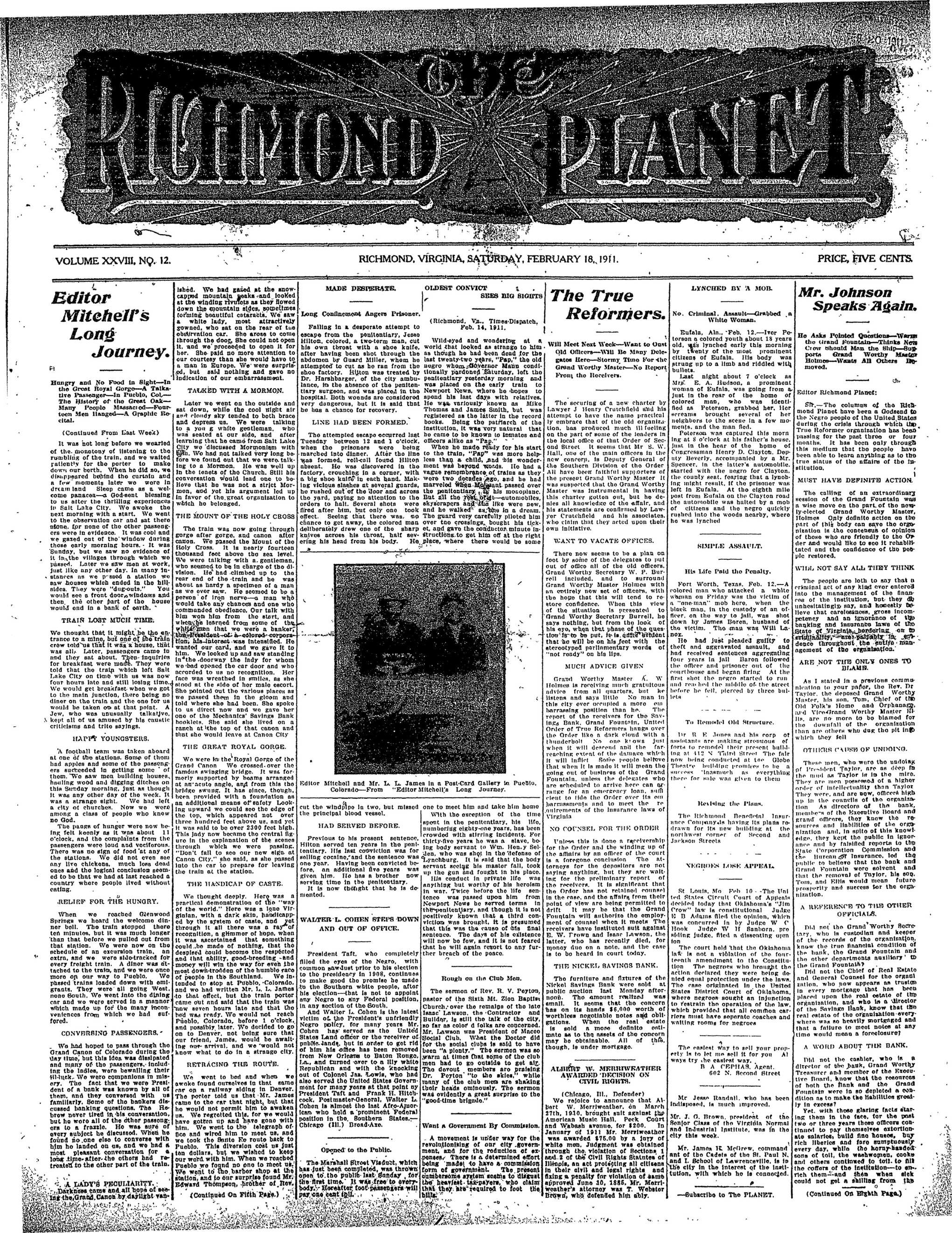
Editor Mitchell and Mr. L. L. James in a Post-Card Gallery in Pueblo, Colorado—From "Editor Mitchell's Long Journey."
MADE DESHERATE.
Long Confinement Angers Prisoner.
Falling in a desperate attempt to escape from the penitentiary, Jesse Hilton, colored, a two-term man, cut his own throat with a shoe knife, after having been shot through the abdomen by Guard Miller, whom he attempted to cut as he ran from the shoe factory. Hilton was treated by Dr. Harshbarger, of the city ambulance, in the absence of the penitentiary surgeon, and was placed in the hospital. Both wounds are considered very dangerous, but it is said that he has a chance for recovery.
LINE HAD BEEN FORMED.
The attempted escape occurred last Tuesday between 12 and 1 o'clock, when the prisoners were being marched into dinner. After the line was formed, roll-call found Hilton absent. He was discovered in the factory, crouching in a corner, with a big shoe kufft in each hand. Making vicious slashes at several guards, he rushed out of the door and across the yard, paying no attention to the orders to halt. Several shots were fired after him, but only one took effect. Seeing that there was, no chance to get away, the colored man deliberately drew one of the sharp knives across his throat, half severing his head from his body. He
Editor Mitchell and Mr. L. L. James
Colorado—From "Editor S.
cut the windpipe in two, but missed
the principal blood vessel.
HAD SERVED BEFORE.
Previous to his present sentence, Hilton served ten years in the penitentiary. His last conviction was for selling cocaine, and the sentence was one year. Having been convicted before, an additional five years was given him. He has a brother now serving time in the penitentiary. It is now thought that he is deprived.
WALTER L. COHEN STEPS DOWN
AND OUT OF OFFICE.
President Taft, who completely filled the eyes of the Negro, with common sawdust prior to his election to the presidency in 1908, continues to make good the promise he made to the Southern white people, after the Civil War, to any Negro to any Federal position, in any section of the South.
And Walter L. Cohen is the latest victim of the President's unfriendly Negro policy, for many years Mr. Cohen has served as the United States Land officer or the receiver of public Janda, but in order to get rid of him his office has been removed from New Orleans to Baton Rouge, La., and turned over to a nily white Republican and with the "knocking" effect of his arrest also served the United States Government for many years at that point by President Taft and Frank H. Hitchcock, Postmaster-General, Walter L. Cohen is almost the last Afro-American who hold a prominent Federal position in the, Southern States,—Chicago (Ill.) Broad-Axe.
Opened to the Public.
The Marshall fittest Vladet, which has just been completed, was thrown open to the pubilb last sanday for the first time. It was free to everybody. Hereafter foot passengers will pay one cent full.
(Richmond, Vn., Times-Dispatch, Feb. 14, 1911.
Wild-eyed and wondering at a world that looked as strange to him as though he had been dead for the last twenty-two years, "Pap," the old negro whom Governor Mann conditionally pardoned Saturday, left the penitentiary yesterday morning and was placed on the early train to Newport News, where he hopes to spend his last days with relatives. He was variously known as Mike Thomas and James Smith, but was registered as the latter in the record books. Being the pariarch of the institution, it was very natural that he came to be known to inmates and officers alike as "Pap."
When he made ready for his start to the train, "Pap" was more helpless than child, and his wonderment was beyond him. Had a vague remembrance of trains with wore two decades ago, and he had marveled when Moyleston passed over the penitentiary, at his moscaple. But all the rest — automobiles, skyscrapers and like they were now, and he walked — as time in a dream. The guard very carefully plotted him over the crossings, bought his ticket, and gave the conductor minute instructions to get him off at the right place, where there would be some
es in a Post-Card Gallery in Pueblo, Mitchell's Long Journey.
one to meet him and take him home
With the exception of the time spent in the pentiment, his life, numbering eighty-one years, has been crowded with stirring incidents. For thirty-five years he was a slave, body servant to Wm. Henry Seldon, who was shot in the defense of Lynchburg. It is said that the body servant serviced his master fall, took up the gun and fought in his place.
His conduct in private life was anything but worthy of his heroism in war. Twice before the life sentence was passed upon him from Newport News he served terms in the pentiment, and though it is not positively known that a third conviction was brought, it is presumed that this was the cause of his final sentence. The days of his existence will now be fow, and it is not feared that he will again resort to any further breach of the peace.
Rough on the Club Mon.
The sermon of Rev. R. V. Poyton, pastor of the Sixth Mt. Zion Baptist Church, over the remains of the late Isaac Lawson, the Contractor and Builder, is still the talk of the city, so far as color d folks are concerned, Lawson was a Moe of Moor Social. What the Doctor did for the social clubs is said to have been "plenty". The sermon was so warm at times that some of the club men had to go outside to get air. The devout members are praising Dr. Poyton "to the skies", while many of the club men are shaking their heads ominously. The sermon was evidently a great surprise to the "good-time bride."
Want A Government By Commission.
A movement is under way for the revolutionising of our city government, and for the reduction of expenses. There is a determined effort being made to have a commission form of government. The present cumbersome system seems to disguise the heaviest taxpayers, who claim that they are required to foot the bills.
The True Reformers.
Will Meet Next Week—Want to Oust
Old Officers—Will Be Many Delegates
Hero—Stormy, Time For the
Grand Worthy Master—No Report
From the Receivers.
The securing of a new charter by Lawyer J. Henry Crutchfield and his attempt to have the name practically embrace that of the old organization, has produced much ill feeling on the part of some of the leaders in the local office of that Order of Second Street. It seems that Mr S. W. Hall, one of the main officers in the new concern, is Deputy General of the Southern Division of the Order. All have been faithful supporters of the present Grand Worthy Master It was suspected that the Grand Worthy Master was Instrumental In helping the prison out, but he has all knowledge of the affair, and his statements are confirmed by Lawyer Crutchfield and his associates, who claim that they acted upon their own initiative.
WANT TO VACATE OFFICES
There now seems to be a plan on foot by some of the delegates to put out of office all of the old officers. Grand Worthy Secretary W. P. Burrell included, and to surround Grand Worthy Master Holmes with an entirely new set of officers, with the hope that this will tend to restore confidence. When this view of the situation is presented to Grand Worthy Secretary Burrell the hardnosed but from the look of his eye, when that phase of the question is to be put, it is quite evident that he will be on his foot with the asterotyped parliamentary words of "not randy" on his lips.
MUCH ADVICE GIVEN
Grand Worthy Master A. W. Holmes is receiving much gratitude advice from all quarters, but he listens and says little. No man in this city ever occupied a more embarrassing position than he. The report of the receivers for the Savings Bank, Grand Fountain, United Order of Trio Reformers hangs over the Order like a dark cloud with a thunderbolt. No one knows just when it will descend and the far-reaching extent of the damage it will inflict. So far, the belebron of the Order it will mean the going out of business of the Grand Fountain, unless the delegates who are scheduled to arrive here can arrange for an emergency loan, sufficient to hide the Order over its own embarrassments and to meet the requirements of the insurance laws of Virginia.
NO COUNSEL FOR THE ORDER
Unless this is done a recoverability for the Order and the winding up of the aminis by an officer of the court is a foregone conclusion. The attorneys for the depositors are not saying anything, but they are waiting for the preliminary report of the receivers. It is significant that the Order has not retained counsel in the case, and the affairs from their point of view are being permitted to drift. It may be that the Order Foundals have employed a course of counsel when it meets. The receivers have instituted suit against E. W. Brown and Isaac Lawson, the latter, who has recently died, for money due on a note, and the case is to be heard in court today.
THE NICKEL BAVINGS BANK.
The furniture and fixtures of the Nickel Savings Bank were sold at public auction last Monday afternoon. The amount realized was small. It seems that the concern has on its hands $6,000 worth of worthless negotiable notes and obligations. When the real estate is sold a more definite estimate as to the assets of the concern may be obtainable. All of this, though, is under mortgage.
ALBERT W. MERRINWEATHER
AWARDED DECISION ON
CIVIL RIGHTS.
(Chicago Ill Defender)
Chicago, Ill., 10-20-02
We volunteered to march that Abbott and Announcement on March 27th, 1910, brought suit against the American Music Hall. Pock Court and Wabash avenue, for $200. In January of 1911 Mr. Warrweather was awarded $75.00 by a jury of white men. Judgment was obtained through the violation of Sections 1 and 2 of the Civil Rights Statutes of Illinois, an act protecting all citizens in their civil and legal rights and fixing a penalty for violation of same approved June 10, 1855. Mr. Warrweather's attorney was T. Webster Brown, who defended him ably.
LYNCHED BY 'A MOR.
No. Criminal. Assault—Grabbed a White Woman.
Eufala, Aln., Feb. 12. —Iver Peterson a colored youth about 18 years old, was lynched early this morning by twenty of the most prominent citizens of Eufala. His body was strung up to a limb and riddled with bullets.
Last night about 7 o'clock as Mrs. E. A. Hudson, a prominent woman of Eufala, was going from a just in the rear of the home of colored man, who was identified as Peterson, grabbed her. Her screams brought several of her neighbors to the scene in a few moments, and the man fled.
Peterson was captured this morning at 8 o'clock at his father's house, just in the hear of the home of Congressman Henry D. Clayton. Deputy Beverly, accompanied by a Mr. Spencer, in the latter's automobile. The county seat, forging that a blooming might result. If the prisoner was left in Eufala. At the eighth mile post from Eufala on the Clayton road the automobile was halted by a moth of citizens and the negro quickly rushed into the woods nearby, where he was lynched
SIMPLE ASSAULT.
His Life Paid the Penalty.
Fort Worth, Texas. Feb. 12.—A colored man who attacked a white woman on Friday was the victim of a "one-man" mob here, when the black man, in the custody of an officer, on the way to jail, was shot by Jesse Brown when the victim. The man was Will Launx.
He had just pleaded guilty to theft and aggravated assault, and had received sentences aggregating four years in jail. Baron followed the officer and prisoner out of the courthouse and began firing. At the first shot the negro started to run and reached the middle of the street before he fell, pierced by three bullets.
To Remodel Old Structure
Dr R E Jones and his corp. of assistants are making strenuous of forts to remodel their present building at 412 N Third Street. The fair now being conducted at toe Globe Theatre building promises to be a success 'Inasmuch as everything there for sale was given to them
Revising the Plans.
The Richmond Beneficial Insurance Company is having its plans redrawn for its new building at the corner of Second and Jackson Streets.
NEGROES LOSE APPEAL
St. Louis, Mo. Feb 10 - The United States Circuit Court of Appeals decided today that Oklahoma's "Jim Crow" law is constitutional. Judge E B Adams filed the opinion, which was concurred in by Judge W C Hook. Judge W H Sanborn, presiding judge, filed a dissenting opinion. The court held that the Oklahoma law is not a violation of the fourteenth amendment to the Constitution. The negroes who brought the action declared they were being denied equal protection under the laws. The case originated in the United States District Court of Oklahoma, where negroes sought an injunction to restrain the operation of the law, which provided that all common carriers must have separate coaches and waiting rooms for negroes.
The easiest way to sell your property is to let me sell it for you. All ways try the easiest way.
B A CEPHAS, Agent.
602 N. Second Street
Mr Jesse Randall, who has been indisposed, is much improved.
Mr. J. G. Brown, president of the Senior Class of the Virginia Normal and Industrial Institute, was in the city this week.
Mr. James K. McIrewell, commandant of the Cadets of the St. Paul N. and L. School of Lawrenceville, is in the city in the interest of the institution, with which he is connected.
Subscribe to The PLANET.
PRICE, FIVE CENTS.
Mr. Johnson Speaks Again.
Ho Asks Pointed Questions—Warns the Grand Fountain—Thinks New Crow Should Man the Ship—Supports Grand Worthy Master Holmes—Wants All Others Improved.
Editor Richmond Planet:
SR.—The columns of the Richmond Planet have been a Godsand to the Negro people of the United States during the crisis through which the True Reformer organization has been passing for the past three or four months. It has been only through rededication that it only became able to learn anything as to the true status of the affairs of the institution.
MUST HAVE DEFINITE ACTION.
The calling of an extraordinary session of the Grand Fountain was a wise move on the part of the newly-elected Grand Worthy Master, Holmes. Only dofitte action on the part of this body can save the organization of those who are friendly to the Order and would like to see it rehabilitated and the confidence of the people restored.
WILL NOT SAY ALL THEY THINK
The people are loth to any that a criminal act of any kind ever entered into the management of the finances of the institution, but they do unhesitatingly say, and honestly believe that carelessness, gross incompetence and an ignorance of the banking and insurance laws of the state of Virginia, hordering on the criminals, are particularly the evidence throughout the entire management of the eralnation.
ARE NOT THE ONLY ONES TO
BLAME.
As I stated in a previous communication to your pawer, the Rev. Dr Taylor, the deposed Grand Worthy Master, his son, Tom, Chief of the Old Folk's Home and Orphanage, and Vice Grand Worthy Master Bills, are no more to be blamed for the downfall of the organization than are others who dug the pit in which they fell
OTHERS CAUSE OF UNDOING.
These men, who were the undoing of President Taylor, are as deep in the mud as Taylor is in the miro. They are men possessed of a higher order of intellectual than Taylor. They were, and are now, officers high up in the councils of the organization. As directors of the bank, members of the Executive Board and grand officers, they know the resources and liabilities of the organization, and, in spite of this knowledge, they kept the public in ignorance and by falsified reports to the State Corporation Commission and the Bureau of Insurance, lod the public to believe that the bank and Grand Fountain were solvent and that the removal of Taylor, his son, Tom, and Ellis would mean future prosperity and success for the organization.
A REFERENCE TO THE OTHER OFFICIALS.
Did not the Grand Worthy Secretary, who is custodian and keeper of the records of the organization, know the true financial condition of the bank, the Grand Fountain and the other departments auxiliary to the Grand Fountain? Did not the Chief of Real Estate and General Counsel for the organization, who now appears an trustee in every mortgage that has been placed upon the real estate of the organization, and who is a director of the Savings Bank, know that the real estate of the organization every where was so heavily mortgaged and that a failure to meet notes at any time would mean a foreclosure?
A WORD ABOUT THE BANK.
Did not the cashier, who is a director of the Bank, Grand Worthy Treasurer and member of the Executive Board, know that the resources of both the Bank and the Grand Fountain were in so deplored a condition as to make the liabilities greatly in excess?
Fet. with those glaring facts staring them in the face, for the past two or three years these officers continued to pay themselves extortionate salaries, build five houses, buy rich liberics and forso sumptuously every day, while the horny-handed sons of toil, the washwomen, cooks and others continued to toll, to fill the coffers of the institution—to enrich them—and then when slick could not get a shilling from the
(Continued On Eighth Page.)
"Alias Jimmy Valentine"
Novelized by
FREDERICK R.
TOOMBS
From the Great
Play
by PAUL
ARMSTRONG
Copyright, 1910, by
American Press
Association
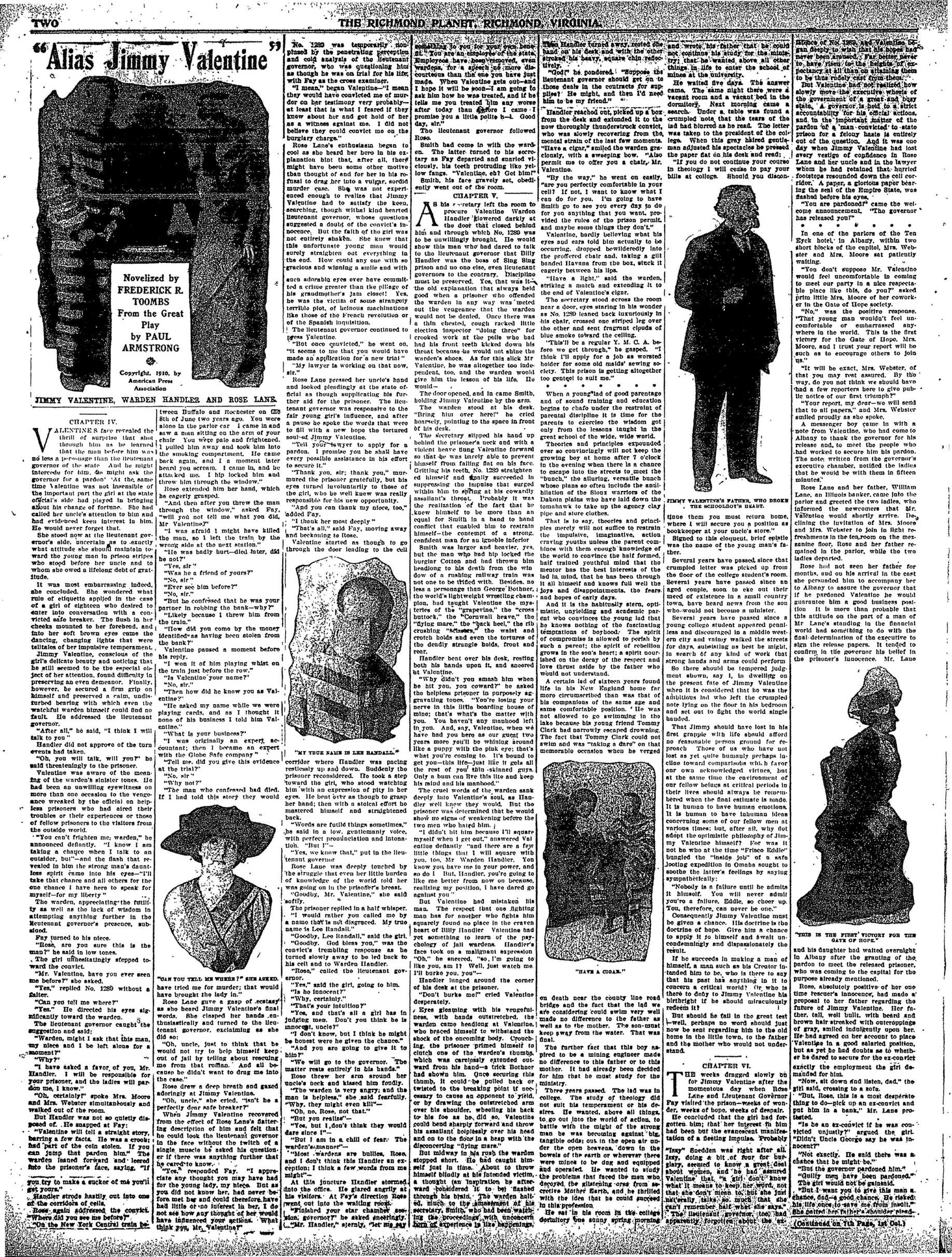
JIMMY VALENTINE, WARDEN HANDLER AND ROSE LANE
CHAPTER IV.
VALENTINE'S face revealed the thrill of surprise that shot through him as he learned that the man before him was no less a personage than the lieutenant governor of the state. And he might intercede for him, he might ask the governor for a pardon. 'At the same time Valentine was not insensitive of the important part the girl at the state official's side had played in bringing about his change of fortune. She had called her uncle's attention to him and had evidenced keen interest in him. He would never forget that. She stood now at the lieutenant governor's side, uncertain as to exactly what attitude she should maintain toward the young man in prison strips who stood before her uncle and to whom she owed a lifelong debt of gratitude.
It was most embarrassing indeed, she concluded. She wondered what rule of etiquette applied in the case of a girl of eighteen who desired to enter into conversation with a convicted safe breaker. The flush in her cheeks mounted to her forehead, and into her soft brown eyes came the dancing, changing lights that were telltales of her impulsive temperament. Jimmy Valentine, conscious of the girl's delicate beauty and noticing that he still seemed to be the especial object of her attention, found difficulty in preserving an even demeanor. Finally, he secured a firm grip on himself and preserved a calm, undisturbed bearing with which even the watchful warden himself could find no fault. He addressed the lieutenant governor.
"After all," he said, "I think I will talk to you."
Handler did not approve of the turn events had taken.
"Oh, you will talk, will you?" he said threateningly to the prisoner.
Valentine was aware of the meaning of the warden's sinister stones. He had been an unwilling eyewitness on more than one occasion to the vengeance wreaked by the official on helpless prisoners who had aired their troubles or their experiences or those of fellow prisoners to the visitors from the outside world.
"You can't frighten me; warden," he announced defiantly. "I know I am taking a chance when I talk to an outsider, but"—and the flash that revealed in him the strong man's damnation in his eyes "I take that chance and all others for the one chance I have here to speak for myself—for my liberty."
The warden, appreciating the futility as well as the lack of wisdom in attempting anything further in the keenant governor's presence, subsided.
Fay turned to his niece.
"Rose, are you sure this is the man?" he said in low tones.
The girl unheeledatingly stepped toward the convict.
"Mr. Valentine, have you ever seen me before?" she asked.
"Ten," replied No. 1280 without a salter.
"Can you tell me where?"
"Ten." He directed his eyes significantly toward the warden.
The lieutenant governor caught the suggestion and said: "Warden, might I ask that this man, my niece and I be left alone for a moment?" "Why?" "I have asked a favor of you, Mr. Handier. I will be responsible for your prisoner, and the ladies will pardon me, I know." "Oh, certainly!" spoke Mrs. Moore and Mrs. Webster simultaneously and walked out of the room. But Handier was not so quietly disposed of. He snapped at Fay: "Valentine will tell a straight story, barring a faux fact. He was a crook; had part of the coin stolen. If you can jump that pardon him." The warden issued forward and leaped into the prisoner's face, saying, "If you try to make a sucker of me you'll get yours." Handier strode hastily, out into one of the corridors of cells.
Boss again addressed the convict.
"Where did you see me before?"
"On the New York Central train be-
tween Buffalo and Rockster on the 8th of June two years ago. You were alone in the parlor car. I came in and saw a man sitting on the arm of your chair. You were pale and frightened. I pulled him away and took him into the smoking compartment. He came back again, and I a moment later heard you scream. I came in, and he attacked me. I hip locked him and threw him through the window." Hose extended him her hand, which he eagerly grasped.
"And then after you threw the man through the window," asked Fay, "will you not tell me what you did, Mr Valentine?"
"I was afraid I might have killed the man, so I left the train by the wrong side at the next station." "He was badly hurt—died later, did he not?"
"Yes, sir."
"Was he a friend of yours?"
"No, sir."
"Ever see him before?"
"No, sir."
"But he confessed that he was your partner in robbing the bank—why?"
"Likely because I threw him from the train."
"How did you come by the money identified—as having been stolen from the bank?"
"Valentine paused a moment before his reply."
"I won it of him playing whilst on the train just before the row."
"Is Valentine your name?"
"No, sir."
"Then how did he know you as Valentine?"
"He asked my name while we were playing cards, and as I thought it none of his business I told him Valentine."
"What is your business?"
"I was originally an expert accountant; then I became an expert with the Globe Safe company."
"Tell me, did you give this evidence at the trial?"
"No, sir."
"Why not?"
"The man who confessed had died. If I had told this story they would
"CAN YOU TELL ME WHEN?" SHE ASKED. have tried me for murder; that would have brought the lady in."
Rose Lane gave a gasp of ecstasy as she heard Jimmy Valentine's final words. She clasped her hands enthusiastically and turned to the lieutenant governor, exclaiming as she did so:
"Oh, uncle, just to think that he would not try to help himself keep out of jail by telling about rescuing me from that ruffian. And all because he didn't want to drag me into the case."
Rose drew a deep breath and gazed adoringly at Jimmy Valentine.
"Oh, uncle," she cried, "not he a perfectly door safe breaker?"
When Jimmy Valentine recovered from the effect of Rose Lane's fattering description of him and felt that he could look the lieutenant governor in the face without the twitch of a single muscle he asked his question if there was anything further that he cared to know.
"Yes," responded Fay. "I appreciate any thought you may have had for the young lady, my niece. But as you did not know her, had never before met her and could therefore have seen her. I don't see how any thought of her would have influenced your actions. What think you, Mr. Valentine?"
No. 1280 was temporarily nonplussed by the penetrating perception and cold analysis of the lieutenant governor, who was questioning him as though he was on trial for his life with Fay as the cross examiner.
"I mean," began Valentine—"I mean they would have convicted me of murder on her testimony very probably—at least that is what I feared if they know about her and got hold of her as a witness against me. I did not believe they could convict me on the burglary charge."
something to you for your eyes beheld. You are an employee of the state. Employees have been removed, even wardens, for a speech and more discontentous than the one you have just made. When Valentine gets out—and I hope it will be soon—I am going to ask him how he was treated, and if he tells me you treated him any wore after today than before I came. I promise you a little polite h—I Good day, sir."
The lieutenant governor followed Rosa.
Then Handler turned away, rested the hand on his desk and with the other stroked his heavy, square chin redefinitely.
"God!" he pondered. "Suppose the lieutenant governor should get on to those deals in the contracts for supplies. He might, and then I'd need him to be my friend."
He waited five days. This answer came. The same night there were a vacant room and a vacant bed in the dormitory. Next morning came a search. Under a table was found a crumpled note that the tears of the lad had blurred as he read. The letter was taken to the president of the colony. When this was blurred gently.
Hopes of No. 1280, and Valentine degen simply to wish that his hopes had never been wavered. For below never to have seen the height of importance at all than on attaining them to be thus ridely cast from them.
But Valentine had not realized how slowly move the executive wheels of the government of a great and busy state. A governor is held to a strict accountability for his official actions, and in the important matter of the pardon of a man convicted to state prison for a felony haste is entirely
Rose Lano's enthusiasm began to cool as she sheared her hero in his explanation hint that, after all, there might have been some other motive than thought of and for her in his refusal to drag her into a vulgar, sorridd murder case. She was not experienced enough to realize that Jimmy Valentine had to satisfy the keen, searching, though wild kind hearted lieutenant governor, whose questions suggested a doubt of the convict's innocence. But the faith of the girl was not entirely shaken. She knew that this unfortunate young man would surely straighten out everything in the end. How could any one with so gracious and winning a smile and with such adorable eyes ever have committed a crime greater than the pillage of his grandmother's jam close! Yes, he was the victim of some strangely terrible plot, of helpless machinations like those of the French revolution or of the Spanish inquisition.
The lieutenant governor continued to press Valentine.
"But once convicted," he went on, "it seems to me that you would have made an application for a new trial."
"My lawyer is working on that now, sir."
Rose Lane pressed her uncle's hand and looked pleasingly at the state official as though supplicating his further aid for the prisoner. The lieutenant governor was responsive to the fair young girl's influence, and after a pause he spoke the words that were to fill with a new hope the tortured soul of Jimmy Valentine.
"Tell your lawyer to apply for a pardon. I promise you he shall have every possible assistance in his effort to secure it."
"Thank you, sir; thank you," murmured the prisoner gratefully, but his eyes turned involuntarily to those of the girl, who he well knew was really responsible for his new opportunity.
"And you can thank my niece, too," added Fay.
"I thank her most deeply."
"That's all," said Fay, moving away and beckoning to Rose. Valentine started as though to go through the door lending to the cell
"MY TRUE FANK IS LEE BANDALL."
corridor where Handler was pacing restlessly up and down. Suddenly the prisoner reconsidered. He took a step toward the girl, who stood watching him with an expression of pity in her eyes. He bent over as though to grasp her hand; then with a stolical effort he mastered himself and straightened back.
"Words are futile things sometimes," he said in a low, gentlemanly voice, with perfect pronunciation and intonation. "But I—
Yes, we know that," put in the lieutenant governor. "He was deeply touched by the struggle that even her little burden of knowledge of the world told her was going on in the prisoner's breast.
"Goodby, Mr. Valentine," she said softly.
The prisoner replied in a half whisper.
"I would rather you called me by a name that is not disgraced. My true name is Lee Randail."
"Goodbyy, Lee standall," said the girl,
"Goodbyy, God bless you," was the convict's trembling response as he turned slowly away to be led back to him and to Warden Stander.
"Rose," called the lieutenant governor.
"Yen," said the girl, going to him.
"Is he innocent?"
"Why, certainly."
"That's your intuition?"
"Yes, and that's all a girl has in judging men. Don't you think he is innocent, uncle?" "I don't know, but I think he might be most he given the chance." "And you are going to give it to him!"
"The warden is very angry; and the man is helpless," she said fearfully.
"Why, they might even kill—"
"Oh, no, Rose, not that."
"But you realise—"
"Yes, but I, don't think they would dare since 1—"
"But I am in a chill of fear. The warden's manner—"
"Most wardens are bullies, Rose, and I don't think this Handler an exception; I think a few words from me might—"
"At this juncture Handler stormed into the office. He glared angrily at his visitors. At Fay's direction Rose went out into the walking room."
"Finished your star chamber session, governor?" he asked sneezingly.
"Mr. Handler," sizzled, "let me say
Something to you for your time. You are an employee of the Employees, have been employed, even wounded, for a year, and have discourtesed that one you have just made. When Valentine gets out—and I hope it will be soon—I am going to ask him how he was treated, and if he tells me you treated him any worms after today than before I came I promise you a little polite b—L Good day, alr."
The lieutenant governor followed Rose.
Smith had come in with the warden. The latter turned to his secretary as Fay departed and snarled viciously, his teeth prudding like yellow fangs. "Valentine, eh? Got him!" Smith, his face gravely set, obediently, went out of the room.
CHAPTER V.
As his secretary left the room to procure Valentine Warden Handler flowered darkly at the door that closed behind him and through which No. 1283 was to be unwillingly brought. He would show this man who had dared to talk to the lieutenant governor that Billy Handler was the boss of Sing Sing prison and no one else, even lieutenant governors to the contrary. Discipline must be preserved. Yes, that was it. The old explanation that always held good when a prisoner who offended the warden in any way was 'metted out the vengeance that the warden would not be denied. Once there was a thin chestlet, cough racked little election inspector "doing three" for crooked in a diaphragm, who had his front teeth hicked down his throat because he would not shine the warden's shoes. As for this slick Mr Valentine, he was altogether too independent, too, and the warden would give him the lesson of his life. He would
The door opened, and in came Smith, holding Jimmy Valentine by the arm. The warden stood at his desk. "Bring him over here!" he cried boastfully, pointing to the space in front of his desk. The secretary slipped his hand up behind the prisoner's neck and with a violent heave dung Valentine forward so that he was barely able to prevent himself from falling flat on his face. Gritting his teeth, No. 1230 straightened himself and finally succeeded in suppressing the impulse that surged within him to spit at his cowardly assailant's throat. Probably it was the realization of the fact that he knew himself to be more than an equal for Smith in a hand to hand conflict that enabled him to restrain himself—the contempt of a strong, confident man for an ignoble inferior
Smith was larger and heavier, yes, but the man who had hip locked the burglar Cotton and had thrown him headlong to his death from the window of a rushing railway train was not one to be tilted with. Besides, no less a personage than George Bothner, the world's lightweight wrestling champion, had taught Valentine the mysteries of the "grapevine," the "cross buttock," the "Cornwall heave," the "flying mare," the "back heel," the rib crushing, the "valley and creech holds and even the tortures of the dendy strangle holds, front and rear.
Handler bent over his desk, resting both his hands upon it, and sneered at Valentine.
"Why didn't you smash him when he hit you, you coward?" he asked the helpless prisoner in purposely aggratulating tones. "You're losing your nerve in this little boarding house of mine; that's what's the matter with you. In you, you are. And, say, Valentine, when we have had you here as our guest two years more you'll be whining around a puppy with the plink eye; that's what you're coming to. It's bound to get you—this life—just like it gels all the rest of you' thin-skinned guys. Only a bum can live this and keep his mind and his manhood." The cruel words of the warden sank the prisoner. He wasHandler well knew they could. But the prisoner was determined that he would show no signs of weakening before the two men who hated him.
"I didn't hit him because I'll square myself when I get out," answered Valentine defiantly "and there are a few little things that I will square with you, too, Mr Warden Handler. You know you have me in your power, and so I do. But, Handler, you're going to like me better from now on because, realizing my position, I have dared go against you."
But Valentine had mistaken his man's respect that one fighting man has for another who fights him squarely found no place in the craven heart of Billy Handler Valentine had yet something to learn of the psychology of jail wardens. Handler's face took on a mallgrain expression "Oh" he sneered, "so, I'm going to like you, am I? Well, just watch me. I'll burke you, you"—
Handler lingered around the corner of his desk at the prisoner. "Don't burke me!" cried Valentine desperately.
Eyes gleaming with his vengefulness, with hands outstretched, the warden came headlong at Valentine, who braced himself to withstand the shock of the oncoming body. Crouching, the prisoner primed himself to clutch one of the warden's thumbs, which was carelessly extended outward from his hand—a trick Bothner had shown him. Once securing this thumb, it could be pulled back or twisted to the breaking point if necessary to cause an opponent to yield, or by drawing the outstretched arm over his shoulder, wheeling his back to his foe as he did so. Valentine could bend sharply forward and throw his assailant hopelessly over his head and on to the floor in a heap with the disconcerting "firing mare."
But midway in his rush the warden stopped short. He had caught himself just in time. About to throw himself blindly at his intended victim, a thought (in Inspiration he afterward considered it to be) 'bashed through his braid.' The warden halted, much to the amusement of his secretary, Smith, who had been watching the proceedings, with unconcerned form of experience in like happenings.
Then Handler turned away, rested one hand on his desk and with the other stroked his heavy, square chin reflectively.
"God!" he pondered. "Suppose the lieutenant governor should get on to those deeds in the contracts for supplies!" He might, and then I'd need him to be my friend."
Handler reached out, picked up a box from the desk and extended it to the now thoroughly thunderstruck convict, who was slowly recovering from the mental strain of the last few moments. "Have a cigar," smiled the warden graciously, with a sweeping bow. "Also permit me to offer you a chair, Mr. Valentine.
"By the way," he went on easily, "are you perfectly comfortable in your cell? If not, I want to know what I can do for you. I'm going to have Smith go to see you every day to do for you anything that you want, provided the rules of the prison permit, and maybe some things they don't."
Valentine, hardly bellowing what his eyes and ears told him actually to be occurring, dropped bewilderedly into the proffered chal and, taking a gift banded Havanna from the box, stock it eagerly between his lips.
"Have a light," said the warden, striking a match and extending it to the end of Valentine's cigar.
The secretary stood across the room near a door, eyes staring in his wonder as N. 1290 leaned back urinuriously in his chair, crossed one strap leg over the other, wrapped lipids of blue smoke toward the ceiling.
"This'll be a regular Y. M. C. A. before we get through," he gasped.
"I think I'll apply for a job as worsted holder for some old maids' sewing society. This prison is getting altogether too genteel to suit me."
When a young *lad* of good parentage and of sound training and education begins to chafe under the restraint of parental discipline it is time for the parents to exercise the wisdom got only from the lesson taught in the great school of the city, wide world, theories and principles expounded even convincingly will not keep the growing boy at home after 7 o'clock in the evening when there is a chance to escape into the streets to meet the "bunch." the alluring, versatile bunch whose plans so often include the annihilation of the Sloux warriors of the Dakota plains who have laid down the tomahawk to take up the agency clay pipe and store clothes.
That is to say, theories and principles merely will not suffice to restrain the impulsive, imaginative, action craving youths unless the parent combines with them enough knowledge of the world to convince the half formed, half trained youthful mind that the mentor has the best interests of the lad in mind, that he has been through all it himself and knows full well the joys and disappointments, the fears and hopes of early days. And it is the habitually stern, optimistic, unyielding and academic parent who covinces the young lad that he knows nothing of the fascinating world around him. The spirit of compromise is allowed to perish by such a parent; the spirit of rebellion grows in the son's heart; a spirit nourished on the decay of the respect and love thrust aside by the father who would not understand.
A certain lad of sixteen years found life in his New England home far more circumscribed than was that of his companions of the same age and same comfortable position. 'He was not allowed to go swimming in the lake because his young friend Tommy Clark was swimming in the fact that Tommy Clark could not swim and was "taking a dare" on that memorable occasion when he verged
```markdown
```
"HAVE A CIGAR."
on death near the county line road bridge and the fact that the lad we are considering could swim very well made no difference to the father as well as to the mother. The son must keep away from the water. That was final. The farther fact that this boy aspired to be a mining engineer made no difference to this father or to this mother. It had already been decided for him that he must study for the ministry.
Three years passed. The lad was in college. The study of theology did not suit his temperament or his desires. He wanted, above all things, to go out into the world of action, to battle with the might of the strong man he was becoming against 'big, tangible odds' out in the open air under the open heavens, down in the rain or on wherever there were mines to be dug and seized and operated. He wanted to study the problems that faced the men who deceived the glitched ones from secretive Mother Earth, and he thrilled with the idea that he could succeed in this profession.
He sat in the room in the college dormitory. The sunny spring morning
and wrote his father that he could not continue his study for the ministry, that he wanted above all other things in life to enter the school of mines in life to enter the school of the university.
He waited five days. The answer came. The same night there were a vacant room and a vacant bed in the dormitory. Next morning came a search. Under a table was found a crumpled note that the tears of the lad had bloured as he read. The letter was taken to the president of the college. When this gray haired gentleman adjusted his spectacles he pressed the paper flat on his desk and read: "If you do not continue your course in theology I will cease to pay your bills at college. Should you discon-
```markdown
```
JIMMY VALENTINE'S FATHER, WHO BROKE
THE SCHOOLBOY'S HEART.
JIMMY VALENTINE'S FATHER, WHO BROKE
THE SCHOOLBOY'S HEART.
Since them you must return home,
where I will secure you a position as
bookkeeper at your uncle's store."
Signed to this eloquent, brief epifix
was the name of the young man's father.
Several years have passed since that
crumpled letter was picked up from
the floor of the college student's room.
Several years have passed since an
agged couple, soon to ek out their
need of existence in a small country
town, have heard news from the son
who would not become a minister.
Several years have passed since a young college student appeared pennileas and discouraged in a middle western city and valyng walked the streets for days, substituting as beat be might, in search of any kind of work that strong hands and arms could perform. So there should be tempered judgment shown, say I, in dwelling on the present fate of Jimmy Valentine in its conscience that he was the abstinence of the left, not note lying on the floor in his bedroom and set out to fight the world single handed.
That Jimmy should have lost in his first grapple with life should afford no reasonable person ground for reproach. Those of us who have not lost as yet quite humanly perhaps include toward comparison with h favor our own acknowledged virtues, but at the same time the environment of our fellow beings at critical periods in their lives should always be remembered the final estimate is made. It is human to have human emotions. It is human to have inhuman ideas concerning some of our fellow men at various times; but, after all, why not adopt the optimistic philosophy of Jimmy Valentine himself? For was it not he who at the time "Frisco Eddie" bungled the "inside job" of a safe Joeting expedition in Omaha sought to soothe the latter's feelings by saying sympathetically:
"Nobody is a failure until he admits it himself. You will never admit you're a failure, Eddle, so choer up. You, therefore, can never be one."
Consequently Jimmy Valentine must be given a chance. His doctrine is the doctrine of hope. Give him a chance to apply it to himself and awaken uncondemningly and dispassionately the result.
If he succeeds in making a man of himself, a man such as his Creator intended him to be, who is there to say that his past has anything in it to concern a critical world? Or, who is there to deny to Jimmy Valentine his birthright if he should miraculously redeem it?
But should he fall in the great test well, perhaps no word should just now be sent regarding him to the old home in the little town, to the father and the mother who would not understand.
CHAPTER VI
THE weeks dragged slowly but for Jimmy Valentine after the momentous day when Rose Loves Literature. Grace
He concluded that the girl had forgotten him; that her interest in him had been but the evanescent manifestation of a feeling impulse. Probably "Issy" Sweden was right after all. Issy, doing a bit of, four for burglary, seemed to know a great deal about women, and he had assured Valentine that, "a girl don't know what it means to keep her word, not that she don't mean to, but she just naturally, talks so much, that she can't remember half what she says." The insultant governor, too, had
Brice of No. 1898, and Valentine, began deeply to wish that his hopes had never been aimed. For far better never to have risen to the heights of expectancy at all than on attaining them to be thus rudely cast from them. But Valentine had not realized how slowly move the executive, whelms of the government of a great and busy state. A governor is held to a strict accountability for his official actions, and in the important matter of the government of the state, a prison for a felon hints is entirely out of the question. And it was one day when Jimmy Valentine had lost every vestige of confidence in Rose Lane and her uncle and in the lawyer whom he had retained that hurried footsteps resounded down the corridor. A paper, a glorious paper bearing the seal of the Empire State, was washed before his eyes.
"You are pardoned!" came the welcome announcement. "The governor has released you!"
In one of the parlors of the Ten Eyck hotel, in Albany, within two short blocks of the capitol, Mrs. Webster and Mrs. Moore sat patiently waiting.
"You don't suppose Mr. Valentine would feel uncomfortable in coming to meet our party in a nice respectable place like this, do you?" asked prim little Mrs. Moore of her coworker in the Gate of Hope society.
"No," was the positivo response.
"That young man wouldn't feel uncomfortable or embarrassed anywhere in the world. This is the first victory for the Gate of Hope. Mrs. Moore, and I trust your report will be such as to encourage others to join us."
"It will be exact, Mrs. Webster, of that you may rest assured. By the way, do you not think we should have a few reporters here to give public notice of our first triumph?"
"Your report, my dear—we will send that to all papers." and Mrs. Webster smiled mildly as she spoke.
A messenger boy came in with a note from Valentine, who had come to Albany to thank the governor for his release and, to meet the people who had worked to secure him his pardon. The note written from the governor's executive chamber, notified the ladies that he would be with them in fifteen minutes."
Rose Lane and her father, William Lane, an Illinois banker, came into the parlor and greeted the two ladies, who informed the newcomers that Mr. Valentine would shortly arrive. Declining the invitation of Mrs. Moore and Mrs. Webster to join in light refreshments in the tea room on the mezzanine floor, Rose and her father remained in the parlor, while the two ladies departed.
Rose had not seen her father for months, and on his arrival in the cast she persuaded blim to accompany her to Albany to assure the governor that if he pardoned Valentine he would guarantee blim a good business position. It is more than probable that this attitude on the part of a man of Mr Lance's standing in the financial world had something to do with the final determination of the executive to sign the release papers. It tended to confirm in the governor his belief in the prisoner's innocence. Mr. Lanoe
```markdown
```
"THIS IS THE FIRST VICTORY FOR THE GATE OF HONE."
and his daughter had waited overnight in Albany after the granting of the pardon to meet the released prisoner, who was coming to the capital for the purpose already mentioned.
Rose, absolutely positive of her one-time rescuer's innocence, had made a proposal to her father regarding the future of Jimmy Valentine. Her father, tall, well built, with beard and brown hair streaked with outerppings of gray, smiled indulgently upon her. He had agreed on her account to place Valentine in a good salaried position, but as yet he had doubts as to whether he dared to secure for the ex-conflict exactly the employment the girl demanded for him.
"Now, sit down and listen, dad," the girl said, crossing to a note.
"But, Rose, this is a most desperate thing to—pick up an ox-conflict and put him in a bank." Mr. Lane protested.
"Is he an ex-convict if he was con-
victed unjustly?" argued the girl.
"Didn't Uncle George say he was in-
nocent?"
"Not exactly. He said there was a
chance that he might be."
"But the governor pardoned him."
"Quilty may have been pardoned."
"The girl would not be gallaind."
"But I want you to give this man a chance, dead—a good chance. He raked his life once, to save the from insult."
He matted her father a murder plaque.
STILL, KICKING BECAUSE HE IS A NEGRO.
(Richmond, Va., Times-Dispatch) Professor W. E. Burghardt Du bois, of the Atlanta University, is still talking about race prejudice in the United States. He made a speech at the Twentieth Century Club in Boston the other night on "The Individual Negro and Society." In which he said that race feeling is not only tremendously greater than it was ten years ago, but that it is increasing in every way, and that unless it is stopped it means trouble in the United States, and in other chemists employed by Staley Attorney Robb, were made public.
The reports are against the theory of cyanide poisoning and agree that death in each instance came from carbon monoxide poisoning.
Carbon monoxide is a gas supposed to have been given off by a stove in the Elosser parlor. Dr. Glasser's report is at great length, while Dr. Lynch's came by telegram and says samples show the presence of carbon monoxide, and that death was undoubtedly due to carbon monoxide poisoning.
433 Members In Next Congress.
FAMILY OF SEVEN KILLED BY GAS
Father, Mother and Five Children Found Dead.
Legislation in the senate.
Vice President Sherman and Bensor Boott were also in conference with the president.
The message the Massachusetts and Montana senators took from the White House to their colleagues was that there must be a vote on the agreement at this session or congress will be called back.
Although Messrs. Crane and Carter declined to discuss their mission the news soon leaked out that the president was insistent on a vote.
It is said he made plain his belief that the country generally favors a lower grades, 28½c.
Poultry: Live stock; hens, 16¾c; poultry, 15¾c; duck, 14¾c; turkey, 12¾c; choice farm, turkeys, choice, 28½c; choice farm, 16½c; old roosters, 11¾c.
Butter steady; extra creamery, 29¾c.
BUTTER steady; extra creamery, 29¾c.
POTATOES firm: 60¾c5c, bushel.
Live Stock Markets.
PITTBUURG (Union Stock Yards)—CATTLE HIGHS, choline, -$6.00@6.86; prime, $6.40@6.60.
SHEEP slow; prime wethers, $4.25@4.40; culls and common, $2.50@3.15; lambs, $2.50@2.90; veal calves, $3.50@3.00.
DEMANDS DEFEAT OF RECIPROCITY
Calls Agreement a Cunning Trap to Save Taft at Expense of Canadian People.
The Montreal Daily Star appeals to Promier Laurier for the defeat of the reciprocity trade agreement between the United States and Canada.
It says: "Theor is only one man in Canada who can avert the monace that lurks in reciprocity. That man is Sir Wilfrid Laurier. He is the master of the situation. If he appeals to the loyalty of his followers, there is too much reason to fear that they will vote the agreement through.
"But it is equally true that If Sir Wilfrid Laurier does that, on sober second thought, he dare not recommend this astounding commercial revolution to a people to preserve their [dependence], the agreement will not be ratified.
"Moreover, such a declaration from Sir Wilfrid Laurier would be far more welcome to the bulk of his followers, both in and out of parliament, than a bugle call to stand up and vote—and possibly die politically—for a bargain which may save the success of Taft in Republican politics, but which will eventually terminate the career of Canada as an important nation. Now the inward meaning of the shrewd framed offer of the long-headed American government when we first saw it. It was as cunning a trap as was ever laid. The master bargainers at Washington haven't lost their skill." The Star then goes on to say that reciprocity, as suggested, would cut confederation at a half dozen vital points and adds.
"The provinces by the sea will be isolated, their industrial future neglected, the articles that lose to old age, the wars that end and the Americans will think of them only as a collection of fishing villages.
"Quobice will become the 'backyard' and lumber camp of New England. Our-farm products will give the New England factories cheap food for their work people—without ultimately raising the price for our farmers; and our forests and mines will food them raw materials until they are orally eaten by the enormous appetites of American industrialism. We will be lucky, indeed, if the national morherrone stops there. The exodus of our sons and daughters to the New England factory towns, which has been so severe a drain in the past, may well bleed us to death when Montreal has been strangled in its own dead railway lines, when the killing of the now transcontinental has killed the agitated hopes of Quebec city, and when the militant trials town have found their home market flowing merilly over the border.
"Today Sir Wilfred Laurier has the ball at his foot. He is the one man to save the situation. The Canadian people nover watched him so eagerly, so anxiously, as they are doing at this moment. Thousands of his best friends hope that he will not see the true boaring of the tremendous issue which lies in his hands and that they can add another jowel to his crown as a patriot statesman who loves his country so well that he wouldn't think twice of risking her life to put profits in the pockets of a few clamorous people. "This is not a business matter he is considering; and the political fate of him will be the seal of Sir John A. Macdonald, with the eyes of the empire builders of history on him, with all the future waiting to award its judgment, he is deciding for or against the annexation of Canada to the American union."
Bherman Sayas Buhaldy BILL
The senate passed the ocean mall subsidy bill, which authorises the postmaster general to enter into contracts for carrying the malls to South American ports and to the Philippines, Japan, China and Australia, at a rate of $4 a mile on the outward voyage to vessels of the second class and $2 a mile on the outward voyage to vessels of the third class. He also decided to be paid in any one year, however, is limited to $4,000,000, and under no circumstances shall exceed that amount of money received on account of foreign malls. This is the first important administration measure to be passed by the senate this session.
The bill went through under conditions that give very little encouragement to its friends. On two separate roll calls on the passage of the measure, the vice president exercised his preagricative and thus saved the measure from defeat.
-We will send The PLANET
youat friends for $1.50 per year.
SPIRIT, KICKING BECAUSE HE IS A
NEGRO.
(Richmond, Va., *TimesDispatch*)
Professor W. E. Burghardt Duolux, of the Atlanta University, is still talking about race prejudice in the United States. He made a speech to the Twentieth Century Foundation, "The Individual Negro and Society," in which he said that race feeling is not only tremendously greater than it was ton years ago, but that it is increasing in every way, and that unless it is stopped it means trouble for the black community and parts of the world. He probably had in mind the feeling against the negro "up North"; the conditions Down South have not materially changed and will never change. The negro down here will always be the negro, occupies the place respected by white neighbors, when he is worthy of respect, helped by them when he deserves help, protected by law in his rights to prosper by his own industry, and yet always the negro, moving in his own orbit and, when left to his own devices, content in his own life. It may not be so "up North."
Dubois said to, the Twentieth Century Club: "You do not realize how far this discrimination goes in the Northern cities. In the North of the United States it is a question with me whether I can get a meal at any time of day or not. It is a question of refusal, not acceptance. Evan in building where I live, send my secretary and have my lunch brought down simply because I want to avoid trouble." This is probably not true; that is to say, it is true only because Dubois wants to take his meals at places which are reserved for white customers. If he would go to some colored restaurant, or the restaurant he has a dubious job, he would be served precisely as other customers of these places are served and without being refused, insulted or trounced. Why should he expect to be served where he knows he is not wanted, and why should a dining-room or restaurant catering to white people be expected to serve him in a restaurant, or a little better, than the white people? Doublicity, he is a better man than the majority of the white men in Boston; but for some reason which we do not understand the Almighty did not make him altogether white, and nobody in Boston or anywhere can change this fact. He would not think it nearly so much of the white men in the right way, and not try to make himself and his race what they are not.
Dubois does not think that segregation will solve the race problem; yet that was the solution which the Great Creator designed when in making of the world in his book *Omnidemicium*. He determined the bounds of their habitat. It is true, as Dubois said, that the negro problem "is a great human problem," and the men and women of this race should be recognized as an important group, and mean that they are to be extended any special privileges or advantages on account of their race. Well-behaved negroes can always "get a meal at any time of day," in the South without refusal, in insult or harassment, in the places where meals are served to this class of customers. We suppose that it is the same way up North. Why should a negro object to eating with negroes at a negro eating house? How would a negro be for not eating to eat with his long as he does not care to eat with people of his own kind?
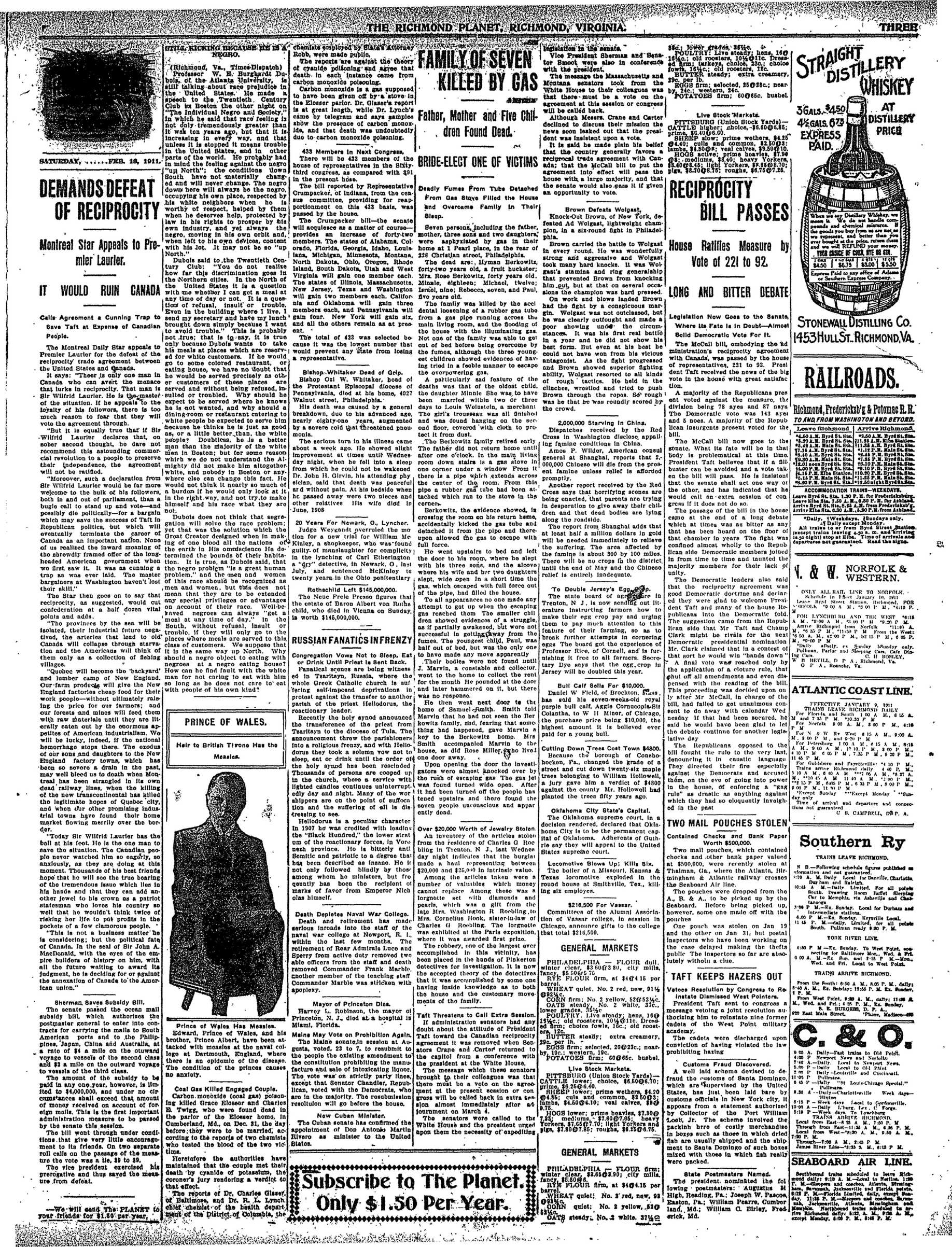
PRINCE OF WALES.
Heir to British Tirone Has the Meaales.
Prince of Wales Has Missles.
Edward, Prince of Wales, and his brother, Prince Albert, have been attacked with missiles at the naval college at Dartmouth, England, where there is an epidemic of the disease.
The condition of the princes causes no anxiety.
Coal Gas Killed Engaged Couple.
Carbon monoxide (coal gas) poisoning killed Grace Elosser and Charles B. Twigg, who were found dead in the parlor of the Elosser home, in Cumberland, Md., on Dec. 31, the day before; they were to be married, according to the reports of two chemists who tested the blood of the two victims.
Horstinfore the authorities have maintained that the couple met their death by cyanide of potassium, the coroner's jury rendering a verdict to that effect.
The reports of Dr. Charles Glaser, of Baltimore, and Dr. R. L. Lynch, chief chemist of the health department of the District of Columbia, the
Subscribe to The Planet. Only $1.50 Per Year.
---
The reports are against the theory of cyanide poisoning and agree that death in each instance came from carbon monoxide poisoning.
Carbon monoxide is a gas supposed to have been given off by a store in the Elosser parlor. Dr. Glaser's report is at great length, while Dr. Lyruch's came by telegram and says samples show the presence of carbon monoxide, and that death was undoubtedly due to carbon monoxide poisoning.
433 Members In Next Congress.
There will be 433 members of the house of representatives in the Bikhiyah third compartment with 391 in the present house.
The bill reported by Representative Crumpacker, of Indiana, from the census committee, providing for re-portionment on this 433 basis, was passed by the house.
The Grumpacker bill—the senate will acquilease as a matter of course—provides an increase of forty-two members. The states of Alabama, Colorado, Florida, Georgia, Idaho, Louisiana, Michigan, Minnesota, Montana, North Dakota, Ohio, Oregon, Utah Island, South Dakota, Utah and West Virginia will gain one member each. The states of Illinois, Massachusetts, New Jersey, Texas and Washington will gain two members each. California and Oklahoma will gain three members each, and Pennsylvania will gain four. New York will gain six, and all the others remain as at present. The total of 433 was selected because it was the lowest number that would prevent any State from losing a representative.
Bishop-Whitaker Dead of Grip, Bishop Ori Z. Whitaker, board of the Protestant Episcopal diocese of Pennsylvania, died at his home, 4027 Walnut street, Philadelphia.
His death was caused by a general breakdown, due to his advanced age, nearly eighty-one years, augmented by a severe cold that threatened pneumonia.
The serious turn in his illness came about a week ago. He showed slight improvement at times until Wednesday night, when he fell into a sleep from which he could not be waked. Dr. John H. Glirin, his attending physician, said that death was peaceful and without pain. At his bedside when he passed away were two pieces and other relatives. His wife died in June, 1908.
20 Years For Newark, O., Lyncher. Judge Weykay peruvianed the motion for a new trial for William McKinley, the ninth president of the guilty of manslaughter for complexity in the lynching of Carl Etherington in a "dry" detective, in Newark, O., last July, and sentenced McKinley to twenty years in the Ohio penitentiary.
Bothschild Left $145,000,000.
The Neue Freie Presse figures that the estate of Baron Albert von Rotha child, who died in Vienna on Sunday, is worth $145,000,000.
RUSSIAN FANATICS INFRENZY
Congregation Vows not to Sleep, Eat or Drink Until Pristine Is Sent Back. Fanatical scenes are being witnessed in Tsaritayn, Russia, where the whole Greek Catholic church is suffering self-imposed divinations in protest against the transfer to another parish of the priest Hellodorus, the revered saint. Recently the holy synod announced the transference of the priest from Tsaritayn to the diocese of Tula. The announcement throw the parishioners into a religious frenzy, and with Hellodorus they took a solemn vow not to sleep, eat or drink until the order of the holy synod has been rescinded. Thousands of persons are cooped up in the church, where a service with lighted candles continues uninterrupted. The shippers are on the point of suffocation and the suffering of all is distressing to see.
Hellodorus is a peculiar character. In 1907 he was credited with leading the "Black Hundred," the lower stratum of the reactionary forces. In Vornesh province. He is bitterly anti-Semitic and patriotic to a degree that has been described as insane. He is not only followed blindly by those among whom he ministers, but frequently has been the recipient of marks of favor from Emperor Nicholas himself.
Death Dopletes Naval War College. Death and retirement has made serious inroads into the staff of the naval war college at Newport. He lost five months. The retirement of Rear Admiral Luce and Sperry from active duty removed two able officers from the staff and death removed Commander Frank Marble, another member of the teaching staff Commander Marble was struck with apoplexy.
Maxor of Princeton Dias
Harry O. Robinson, the mayor of Princeton, N. J., died at a hospital in Miami, Florida.
Maine May Vote on Prohibition Again. The Maine senate session at Augusta, voted, 23 to 7, to resubmit to the people the existing amendment to the constitution prohibiting the manufacture and sale of intoxicating liquor. The vote was on artfully party lines, except that Senator Chandler, Republican, voted with the Democrats, who are in the majority. The resubmission resolution will go before the house.
New Cuban Ministers
The Cuban senate has confirmed the appointment of Don Antonio Martin Rivero as minister to the United States.
Deadly Fumes From Tube Detached From Gas Stave Filled the House and Overcame Family in Their Sleep.
Seven person, including the father, mother, three sons and two daughters, were asphyxiated by gas in their home at 1 Pearl place, in the rear of 228 Christian street, Philadelphia.
The dead are: Hyman Berkowitz, forty-two years old, a fruit buckster; Mrs. Rose Berkowitz, forty years old, Minale, eleighteen; Michael, twelve; Israel, nine; Rebecca, seven, and Paul, five years old.
The family was killed by the accidental loosening of a rubber gas tube from a gas pipe running across the main living room, and the flooding of the house with the illuminating gas. The child, alone, able to out bed before being overbye of the fumus, although the three young children showed evidences of having tried in a feeble manner to escape the overwarming gas.
A particularly sad feature of the deaths was that of the oldest child, the daughter Minnie She was, to have been married within two or three days to Louis Wolstetin, a merchant. The girl's trousseau was all finished and was found hanging on the second floor, covered with cloth to protect it from dust. The Berkowitz family retired early. The father did not return home until after one o'clock. In the main living room down stairs is a gas stove in one corner under a window. From it there is a pipe which extends across the center of the room. From this pipe a rubber gas tube had been attached which run to the stove in the corner. Berkowitz, the evidence showed, is crossing the room on his return home, accidentally kicked the gas tube and detached it from the pipe and thereupon allowed the gas to escape with full force.
He went upstairs to bed and left the door to his room, where he slept with his three sons, and the alcove where his wife and her two daughters slept, wide open. In a short time the gas, which escaped with full force out of the pipe, had filled the house. He attempted to make an attempt to get up when the escaping gas reached them. The smaller children showed evidences of a struggle, as if partially awakened, but were not successful in getting away from the fumes. The youngest child, Paul, was half out of bed, but was the only one to have made any move apparently. Their bodies were not found until J. Marvin, a conatable and collector, wished for the month. He pounded at the door and later hammered on it, but there was no response.
He then went next door to the home of Samuel Smith. Smith told Marvin that he had not seen the Berkowitz family, and, fearing that something had happened, gave Marvin a key to the Berkowitz home. Mrs Smith accompanied Marvin to the house, as did Rose Miller who lived one door away.
Upon opening the door the invictors were almost knocked over by the rush of escaping gas The gas肝 was found turned wide open. After it had been turned off the people has tended upstairs and there found the seven people unconscious and apparently dead.
Over $20,000 Worth of Jewelry Stolen.
An inventory of the articles stolen from the residence of Charles G Roebling in Trenton. N. J., last Wednesday day night indicates that the burglar made a haul representing between $20,000 and $25,000 in intricate value.
Among the articles taken were a number of valuables which money cannot replace. Among those was a lorgnotte set with diamonds and pearls, which was a gift from the late Mrs. Washington R Roobling, to Mrs. Corrineus Hook, sister-in-law of Charles I. Roobling. The lorgnotte set was found in a location where it was awarded first prize. The robbery, one of the largest ever accomplished in this vicinity, has been placed in the hands of Pinkerton detectives for investigation. It is now the accepted theory of the detectives that it was accomplished by some one having inside knowledge as to both the house and the customary movements of the family.
Taft Threatens to Call Extra Session. If administration senators had any doubt about the attitude of President Obama toward the account it was removed when Senators Crane and Cartier returned to the captiol from a conference with the president at the White House.
The message which these senators brought to their colleagues was that there must be a vote on the agreement at the present session or congress will be called back in extra session almost immediately after adjournment on March 4. The senators were called to the White House and the president urged upon them the necessity of expediting
Vice President Sherman and Senator Smoot were also in conference with the president.
The message the Massachusetts and Montana senators took from the White House to their colleagues was that they must be a vote on the agreement at this session or congress will be called back.
Although Messrs. Crane and Carter declined to discuss their mission the news soon leaked out that the president was insistent upon his vote. If he did, he plainly his belief that the country generally favors a reciprocal trade agreement with Canada; that the McCall bill to put the agreement into effect will pass the house with a large majority, and that the senate would also pass it if given an opportunity to vote.
Brown Defeats Wolgast.
Knock-Out Brown, of New York, defeated Ad Wolgast, lightweight champion, in a six-round fight in Philadelphia.
Brown carried the battle to Wolgast in every round. He was wonderfully strong and aggressive and Wolgast took many hard knocks. It was Wolgast's atamina and ring generalship that prevented Brown from knocking him_out, but at that on several occasions the champion was hard pressed. On work and blows landed Brown had the fight by a conspicuous margin. Wolgast was not outclassed, but he was clearly outfought and made a poor showing undo the circumstances. It was his first real battle against the ropes, but he was best form. But even at his host he could not have won from his virtuous antagonist. As the fight progressed and Brown showed superior fighting ability, Wolgast resorted to all kinds of rough tactics. He held in the clinches, wrestled and tried to push Brown through the ropes. So rough was he that he was roundly scored by the crowd.
2,000,000 Starving In China.
Dispatches received by the Red Cross in Washington disclose appalling famine conditions in China. Amos P. Wilder, American consul general at Shanghai, reports that 2,000,000 Chinese will die from the present famine unless relief is afforded promptly.
Another report received by the Red Cross says that horrifying scenes are being enacted, that parents are trying in desecration to give away their children and that dead bodies are lying along the roadside.
The report from Shanghai adds that at least half a million dollars in gold will be needed immediately to relieve the suffering. The area affected by the famine is about 300 by 100 miles. There will be no crops in the district until the end of May and the Chinese relief is entire) inadequate.
To Double Jersey's Egg crop. The state board of agriculture in Trenton, N J. is now sending out literature instructing farmers how to make their egg crop crop and urging them to pay much attention to this feature of their farming, so as to benefit the farmers. The egg board the got the experience of Professor Rice, of Cornell, and is furnishing it free to all farmers. Secretary Dye says that the egg, crop in Jersey will be doubled this year.
Bull Calf Solle For $10,000
Daniel W. Field, of Brockton, St. Louis, has sold his seven-weeks-old royal purple bull calf, Angle Cornucopia-Spilola, to H W Miner, of Chicago the purchase price being $10,000, the highest amount it is believed ever paid for a young bull.
Cutting Down Trees Coat Town $4800. Because the borough of Brockton, Ph., changed the grade of a street and cut down twenty-sixtuple trees belonging to William Hollowell, a jury gave him a verdict of $4800 against the county Mr. Hollowell had planted the trees fifty years ago.
Oklahoma City State's Capital
The Oklahoma supreme court, in a decision rendered, declared that Oklahoma City is to be the permanent capital of Oklahoma. Adherents of Gustlie any they will appeal to the United States supreme court.
Locomotive Blows Up; Kills Six.
The boiler of a Missouri, Kansas & Texas locomotive exploded in the round house at Smithville, Tex., killing six employees.
$216,500 For Vearar.
Committee of the Alumni Association of Vassar college, in session in Chicago, announce gifts to the college that total $216,500.
GENERAL MARKETS
PHIJADELPHIA — FLOUR dull,
winter clear, $ 80 @ 18, city mills,
$ 50 @ 67
RYE FLOUR dull, at $4 @ 15 por
barrel.
WHEAT quot. No. 2 red, new, 91%
CORN farm. No. 2 yellow, $2 @ 23c,
OATS steady. No. 2 white, 32c,
lower grades, 12c,
hens, hens, hens, 16c,
old roosters, 10% @ 13c. Dresed
dirm; choice fowls, 10% old roosters.
BUTTER steady, extra creamy,
2c per lb. .
EGS firm selected, 20@ 23c; nont
nogy. POTATOES firm, $60 @ 65c, buneal
Live Stock Markets
PITTSBUIJG (Union Stock Yards)—
choice,
choles,
6.80; 6.50;
Glimp,
6.80; 6.40;
Glimp,
HILEEP lower; prime wethers, $4.20
@4.85; culs and common, $5.80; lams,
$4.60; 6.10; veal calves, $9.75.
HOGS lower; prime hoavies, $7.80
7.85; medium; $7.85; boaty
Yorkers, $7.65; 7.70; light Yorkers
and slag, $7.80; 7.85; roughs, $7.65; 7.70
GENERAL MARKETS
PHILADELPHIA — FLOUR firm;
winter clear, $2.65.90 $1.60; cilmilla
frye; RYR FLOUR firm, at $4.15 per
barrel.
WHEAT quiet! No. 3 red, new, 92
OURN quiet! No. 2 yellow, $2.50
OATS steady! No. 2 white, 37½
```markdown
```
POULTRY: Live steady; hens, 160
164c.; old roosters, 104@11c. Dressed firm; turkeys, choice, 23c.; choice fowls, 164c.; old roosters, 12c.
BUTTER steady; extra creamery,
ROGS firm; selected, 25®iC; near;
ROGS firm; selected, 25®iC; near;
POTATOES firm; 60®iC; bushel
Live Stock Market
PTFBUTTBUG (Unload Stock Yards)-
GATTLE BUG
choice, $60.88;&$8.88;
choice, $60.88;&$8.88;
SHIPEP slow; prime wethers, $4.25
SHIPEP slow; prime wethers, $4.25
lambs, $4.50; vel calves, $3.50; lambs, $4.50; vel calves, $3.50
RECIPROCITY BILL PASSES
House Ratifies Measure by Vote of 221 to 92.
LONG AND BITTER DEBATE
Legislation Now Goes to the Senate.
What the Fate is in Doubt—Almost
Bold Democratic Vote For It.
The McCall bill, ombodying the
administration's redproctify agreement
with Canada, was passed by the house
of representatives, 221 to 93. Prost
dent Taft received the news of the big
vote in the house with great satisfaction.
A majority of the Republicans presen-
t voted against the measure, the
division being 78 ayes and 87 nays.
The Democratic vote was 143 ayes
and 5 nues. A majority of the Republi-
can insurgents present voted for the
bill.
The McCall bill now goes to the
senate. What its fate will be in that
body is problematical at this time.
President Taft believe that if a fil-
buster can be avoided and a vote taker
can be held, the Senate should set one way or
the other, and has indicated that he
would call an extra session of con-
gress if it does not do so.
The passage of the bill in the house came at the end of a long debate which at times was as bitter as any that has been board on the floor of that chamber in years. The fight was confined almost wholly to the Republican side Democratic members joined in from time to time and taunted the party members for their lack of unity. The Democratic leaders also said that the reciproity agreement was good Democratic doctrine and declared they were glad to welcome President Taft and many of the house Republicans into the Democratic fold. The suggestion came from the Republican side that Mr. Taft and Champion Democrat President nomination Mr. Clark claimed that in a contest of that sort he would win "bands down"
A final vote was reached only by the application of a cloture rule, that gutt off all amendments and even dispensed with the reading of the bill. This proceeding was called upon by after Mr McCall, in charge of the bill, to be called to get unimplemented to do away with calendar Wednesday if that had been secured, he said he would have been glad to let the debate continue for another legislative day. The Republican opposed to the bill fought the rule to the very last, denouncing it in cannic language. They directed their fire especially against the Democrat and accused him of denying it in the house of enforcing a "gag rule" as drastic as anything against which they had so eloquently inveighed in the past.
TWO MAIL POUCHES STOLEN
Contained Checks and Bank Paper
Worth $500,000.
Two mail pouches, which contained checks and other bank paper valued at $50,000, were recently stolen at Thalman, Ga, where the Atlanta, Birmingham & Atlantic railway crosses the Seaboard Air Line. The pouches were dropped from the A., B, & A., to be picked up by the Seaboard. Before being picked up, however, some one made off with the pouches. The pouche was stolen on Jan 19 and the other on Jan 31; but postal inspectors who have been working on the case delayed making the thefts public. The inspectors so far are absolutely without a clue.
TAFT KEEPS HAZERS OUT
Vetoes Resolution by Congress to reinstate Dismissed West Pointers. President Taft sent to congress a message voting a joint resolution authorizing him to reinstate nine former cadets of the West Point military academy. The cadets were discharged upon conviction of having violated the law prohibiting having
Customs Fraud Discovered
A well laid scheme dovised to defraud the customs of Santa Domingo, which are supervised by the United States, has just been laid bare by customs officials in New York city, it appears from a statement authorized by Collector of the Port William Loeb, Jr. The scheme involved the packhill bure of costly merchandise in boats such as those in which dried fish are usually shipped and the shipment to Santa Domingo of such boxes mixed with those in which fish really were packed.
State Postmasters Named.
The president nominated the following postmasters: Augustus M High, Reading, Pa.; Joseph W. Pascoe, Easton, Pa.; William Pearre, Cumberland, Md.; William C. Birley, Frederick, Md.
5 Daily except Monday.
All trails to be taken by Bustion
(except trail leaving 400 m. in. and arriving
is 50 right) stop at Eibla. Time of arrival and
departures not guaranteed. Read the signs.
V. & W. NORFOLK & WESTERN.
ONLY ALL RAIL LINE TO NORFOLK.
ONLY ALL RAIL LINE TO NORFOLK.
Lease Bank Street Station (RICHMOND), FOR NORFOLK.
9:00 A M, 13:00 P M, 14:10 P M.
FOR LYNCHBURG AND THE WEST:
18:15 A M, 19:00 P M, 20:30 P M.
19:00 A M, 19:00 P M, 20:30 P M.
16:50 P M, 11:10 P M. From the West:
16:50 P M, 11:10 P M. From the West:
9:00 P M, 10:30 P M, 12:15 P M, 6:05 P M.
Daily, daily, daily, e Sunday, Sunday only.
Daily, daily, parlor and library, Dining Cars.
Daily, daily, D.P.A. Richmond), VA.
D.P.A. Richmond), VA.
ATLANTIC COAST LINE
PERFECTIVE JANUARY 9, 1921
THIRD WEEK END DAILY
THIRD WEEK END
For Florida and South 1 00 M. M. 8, 15
M and 7, 35 P. M. 100, 35 P. M.
For Norfolk 9, 00 A. M. 8, 00 P. M. 4, 20
P. M.
For Norfolk 0 00 A. M. 8 00 P. M. 4:10
P M
For N & W Rv Wet 6 15 A M; 9:00 A
M; 8 00 P M, and 9:20 P M.
For Petersburg 100 A M 6 15 A M 8 18
A M 9 00 A M 12 10 P M 8 00 P M
9 00 P M 7 35 P M 9 20 P M
14 14 P M
For Goldbardo and Faytertelle- "10 A P M
Traina arrive Rithmond daily 40 A P M
5 10 A P M 8 00 P M 8 57 A P M
"10 45 A P M 10 A P M 8 00 P M
"25 I P M 6 60 P M 6 35 P M 8 00 P M
9 00 P M 11 30 P M
*Except Sunday ***Except Monday ***Sunday only
Southern Ry
Southern Ry
TRAINS LEAVE RICHMOND.
N D.—Following schedule figures published
information and not guaranteed.
Daville, Danville, Charlotte
Durham and Halifax.
10:48 A M.—Daily. Limited. For all points
to Kernville. Upon Sleeping
to Kernville. At Adrienne and Chath-
ango.
3:00 Bury. Local for Durham
and interstate stations.
6:00 P M.—Ez. Sunday. Keysville Local.
8:00 P M.—Ez. Sunday. Keysville Local.
South. Duluth, Palm Lake P M.
YORK RIVER LINE
4:50 P M—Ex. Sunday. To West Point, eoe-necting for Baltimore Mon., Wed. & FrL 0 00 A. M.-Fx Sun. and 2:15 P M.-Mon. Wed. and FrL Local to West Point
TRAINING ARRIVE RICHMOND.
From the Booth: 6:50 A M. R05 M. d. Malfy
B. x. Rb. Buxby: 17:56 A M. R05 M. d. Buxby.
B. x. Rb. Buxby: 17:56 A M. R05 M. d. Buxby.
From West Point, 8:30 A. M. daily; 11:35 A.
M. Wed. and 12:30 I. P. M. K. Bunday.
B. N. BUCKLOR, 8:30 A.
270 East Main Street, "Phos., Madison-688
C. & O.
9:00 A. Daily—Fast trains to Old Point.
9:00 A. Newport News and Norfolk.
7:40 A. Daily—Local to Newport News.
7:40 P. Daily—Local to Old Point.
2:00 P. Daily—Louisville and Cincinnati.
11:00 P. Pollination.
6.45 P - Bellville "The Louis-Chicago Special."
8.20 A - Dallany - Charlotteville Week day
8.15 P - Wakeau have local to Gaylordsville.
8.15 P - Dallany - Lurg. burg. C. Forg.
8.18 P - Lurg. burg. to Lynchburg
Local from East - A - 25 A 3.00 P. M.
Through from East - 11-15 A 3.00 P. M.
8.20 W - West - A - 20 A 3.00 M. 8.30 A. M.
7.30 P. M.
Through—7:00 A M. 2:45 P M.
James River Lake—7:23 A M. 6:15 P M.
Beethbound trades scheduled to leave Richmond daily: 9:10 A.M.—Local to Netfina, 1:30 T.M.—Sleepers and coaches, Atlanta, Birmingham, Savannah, Jacksonville and Florida patients, 8:12 P.M.—Florida Limited, daily, except Sunday, 11:15 P.M.—Sleepers and coaches, ஊராยுவ, Jacksonville, Atlanta, Birmingham and Hampshire, Northbound treks scheduled to arrive Richmond daily: 8:22 A.M., 9:30 A.M., except Monday, 6:05 P.M., 8:45 P.M.
---
FOUR
Published every Saturday by JOHN MITCHELL,
JR. at 811 N. Fourth Street, Hickmoor, Va.
JOHN MITCHELL, JR., ... EDITOR
All communications intended for publication
should be sent ad as to reach us by Wednesday
One Copy, per year 81 60
One Copy, eight months 81 60
One Copy, twelve months 81 60
One Copy, four months 81 60
One Copy, three months 81 60
Magic Copy 81 60
ADVERTISING RATER
For one inch, one insertion
For two inches, three insertion
For two inches, three months
For two inches, six months
For two inches, nine months
For two inches, twelve months
Marriage and Funeral Natives, one inch
Marriage and Transitional Natives, per line 10
POSTAGE STAMPS OF A HOUSE DENOMINATION THAT YOU WILL RECEIVED ON SUBSCRIPTIONS
THE PLACE YOU HIRED over your subscriber
are four ways by which money can be
received. There are four ways by which money can be
received by a Bank Check or Draft, or on a Money
Order, and when none of these can be
received by a Money Order, you can buy a Money Order
at your Post Office payable at the Richmond
United States Express Office and we will be responsible for its late arrival.
EXPRESS MONEY ORDERS can be obtained
from the Express Company. We will be
required to do an Express Company. We will be
required to do an Express Company. The Express Money Order is a safe and easy
way for foraging money. Money Order
Post Office or an Express Office is not within
your reach your Postmaster will register
cents. Then, if the Letter is lost of course it
can be travel. You can send money to it
RENEMISAL, FTC. If you do not want THE
REMEMBERSHIP you cannot purchase it.
Subscriptions may be notified by
Postal Card to discontinue it. The courts have
recommended that you order their paper discontinued at the
repiration of time for which it is being used.
You may order the paper up to date when they order the paper discontinued.
COMMUNICATIONS - When writing to us to
rewrite your subscription or to discontinue it,
please send your information to us in full, otherwise we cannot fill your name on
ORANGE OF ADDRESS In order to change
the address of a subscriber we must be put
the former as well as the present address.
Entered at the Post Office at Richmond, Va
as second class matter
SATURDAY, FEB. 18, 1911
We think that President Win Howard
Taft has won the title of "Dem-
ocrat-republican President of the
United States" The Reciprocity Bill
passed the House of Representatives
with a majority of the Republican
members voting against it. He now
seems to be "a man without a parity."
0.
Senator Ellin Root seems to have some selfish sliders down the signal column of the Southern Senators when he told them that the election of those legislators by a direct vote would be another centralization of power which would endanger the unconstitutional provisions of the unconstitutional constitutions in the several Southern States. We could have told them this long before Senator Root told them. It is a commonense as well as a legal logical outcome of tinkering with the Constitution of the United States
_____
JUDGE HUNDLEY'S BLUNDER
---
The action of Judge George J Hundley in criticizing the Supreme Court of Appalachia of Virginia is said to be without a parallel in the legal annals of the State, but it is no more than what might be expected of a gentleman of his traits and temperament His lecture to the colored race delivered upon the occasion of the trial of the Buckingham prisoners, who were alleged to have killed white people and burned the house in which they resided and which was said to be the result of a conspiracy will be remembered by those who have read closely these columns.
We believed then that he was a gentleman, not at all suited to discharge the duties of the position which he occupied. It seemed to us that the position of prosecuting attorney would be better suited to both his ability, temperament and disposition. Now he has had the audacity to decline to do what the supreme tribunal directed him to do. If he has been a soldier, his training has served him to no purpose. He states that it is exclusively within the jurisdiction of the trial court to name the court to which the venge should be
changed.
We do not find in the statute referred to any basis for this contention. Inasmuch as the Supreme Court is supreme in Virginia, to a layman, it would seem to be ridiculous to argue that it did not have the lawful right to do just what it did do. Judge Hundley might take an appeal to the Supreme Court of Appeals of the United States and have that tribunal pass upon this question. Certainly as the judicial department is co-ordinate with the executive and the legislative departments of the government and on questions of law, superior, it would seem that the best thing for him to have done would have been to "pocket" his ombrassment and concoal his feelings.
Certainly this outburst of temper has done nothing more than to make him notorious and emphasized the fact that he is wholly united to discharge the duties of office.
If the Supreme Court of Appeals of Virginia showed a lack of courtesy he showed a lack of good breeding. If may be well to remark that the august tribunal showed high appreciation of the legal ability of Judge S. B. Witt, and we take the chance of saying that he will not be gullible of any breach of legal etiquette either in Buckingham county or in Richmond City. If Judge Hindley would tender his resignation as Judge, we are of the opinion that he would do the bench a service.
A WORD ABOUT THE CONSTITUT
TION.
---
Those persons who assert that the segregation of the races can be legally accomplished by city ordinances evidently have been looking only at the Fourteenth Amendment to the Constitution of the United States and not at the Constitution of Virginia Article 1, Section 1 of that instrument reads:
"That all men are by nature equally free and independent and have certain inherent rights, of which when they enter into a state of society they cannot by any compact, deprive or direct" their posterior—namely with the means of life and liberty, with the means of acquiring and possessing property, and pursuing and obtaining happiness and safety."
It seems to us that this settles the matter. Webster denies the word "posses" as follows
"To occupy in person to hold or have actually in one own keeeping to have and to hold. To have a just right to, to have a right to to be number of to own to have an to possess property an estate a book. If, then, I own a house and lot on the St. Set in this city I can be debarred from exercising authority over the house which I own? Can a law be passed taking from me without compensation or condemnation for public uses the property to which I hold title? This question is answered by Section 12 of the same Article, which roads
That no person shall be deprived of his property without due process of law
This seems to settle the question and those who run counter to these specific provisions are "riding for a fall." Moreover, if some white man or some colored man is willing to forge and yield up these fundamental rights and guarantees, this action does not affect a citizen who is un willing to yield up and surrender his rights and privileges. We are not looking to any Supreme Court of the United States for any of the rights denied to us by the people of this community or by any of its officials. The Supreme Court of Appeals of Virginia is good enough for us. Our fundamental rights of citizenship are protected by the Constitution of Virginia, and when men who can see no further than their noses attempt to infringe upon these rights, we have enough of this world's goods, think God, to main them before the proper tribunal and within the hearing of Virginia jurists, who realize that this Commonwealth is more than a name.
0.0.0.0
PROF. DU BOIS' OBSERVATIONS
Our esteemed contemporary, the Richmond, Va. Times Dispatch, has seen fit to comment upon the remarks of that able scholar and economist. Prof W E W Burghardt Du Bols, made before the Twentieth Century Club of Boston, Mass., recently, we reproduce its comment in another column. Professor Du Bols is credited with saying that rue-feeling is tremendously greater than it was ten years ago. He tells the truth when he makes the statement. The cause is directly attributable to the attitude of the so-called Republican leaders at Washington. Colonel Theodore Roosevelt did more to intensify this feeling than any gentleman who has over occupied the White House. The Brownville affair and his miserable attitude in connection therewith increased the race feeling
in both the white people and the colored ones. Conservative white people omnipresent when we were referred to in any manner and remained silent ever perpetrated upon soldiers in the regular army was visited upon what it take the innocent members of Companies B, C and D of the Twenty-Fifth Infantry. Even Senator Joseph Benson this Foraker, the idol of the North, could judicial not stem the tide, and he went up in the manly against a losing proposition, which ultimately resulted in his deportation, which ultimately resulted in his retirement from public life.
It is difficult for the conservative element of "time-serving" colored men who believe in various expedients and subtle, grovelling submissionists to understand the spirit which actuates these men. We understand (we believe and this is why we have not soon fit to criticize and condemn them. They are charged at three with making the Negro's road rough and his bod hard, but in the end good will come of their agitation. It has always been so. The shades of William Lloyd Garrison, Wendell Phillips, Frederick Groo.
In what follows may exist the reason for Dr. Washington's lack of popularity among the colored leaders of the capital at Washington. He says:
I do not think that I over shared that feeling of so many others of my race. I never liked the atmosphere of Washington. I early saw that it was impossible to build up a race of which the leaders were spending most of their time, thought, and energy willing to get into office, or having to take after their in. So for the greater part of the effect of the excitement about this case has been greatly to exaggerate the importance of holding a Government position. The average Negro naturally feels that there must be some special Value that as an inholding a position which white people don't want him to hold, simply because he is a Negro. It leads him to believe that it is in some way more honorable or respectable to work for the Government as an official, rather than for the community and himself as a private citizen.
Dr. Washington then admits that following amusing story; it may pos-
The Times-Dispatch says the Negro down here will always be the Negro. This may be true, and it may be that we shall never be other than the Negro. but we believe that some of us will outstrip the others in the cycle of years and take our proper position among the citizens of this section of the country. As the matter now stands, the Times-Dispatch diagnoses conditions correctly. We are willing for it to continue to believe just what it now believes. The white gentlemen of its type and character regard the Negroes in the same light as they do a fine horse, a favorite dog or a pet lamb. They will do anything in the world for these favorites, and they must know their places and keep in them.
We have lived in the South all of our lives—in fact, we were born here, and it is utterly impossible to argue logically with a distinguished gentleman of the type and calibre of the editor of the Richmond (Va.) Times-Dispatch. In order to argue the truths of the Bible with a man you must first find a believer in the Bible. In order to argue with a Southerner, you must first find one who believes in the constitutionality of the Thirteenth and Fourteenth and Fifteenth Amendments of the Constitution of the United States. When you find one who believes that these provisions are lawfully upon the statute books of this country, then you have found one who believes in and accepts the citizenship of the Negroes.
When you find a white man who believes in and accepts the citizen ship of the Negroes you will not find one who will for a moment argue that a public servant enjoying a franchise or license to do public business and to serve the public has the right to discriminate against any citizen, one of the public that has licensed him to do business. You will not find one who will argue that a hotel keeper or restaurant proprietor has the legal right to force a white or a colored citizen to walk ten or twelve blocks to secure a public accommodation which might be obtained by walking only a few steps.
The law is specific that there shall be no discrimination against a citizen on account of his race, color or previous condition of service. This applies to a white man's case as much as it does to a colored man's case. These discriminating practices may be exercised against aliens and warrants of the nation, but not against citizens. These discriminations cannot be exercised against foreigners, who come under the "favored nation" clauses of the treaties. But we cannot argue these questions with our distinguished friend and Southerner, because he sees through green glasses. He cannot see us in the light of genuine citizenship.
If we could make him a Negro though for about one month, we could completely convert him, but we cannot do this. He cannot imitate himself in the condition, and in the predestination of the oppressed. The trouble with Prof Du Bois and those of his kind is that they have been given the white man's education and training with the white man's powers of keen discernment and then loaded down with the Negro's handicaps and placed in the Negro's limited orbit of material and financial endeavor. It galls him and his until he is driven to the point of madness. He is don'd, too, the money, the necessary amount of cash in order to appear in the sphere for which his talents and aspirations on title him. He has all of these he might take up a residence in Europe where he could assume a place among the most favored people of the Old World.
When the TimesDispatch editor refers to the conditions surrounding the Negroes of the lower type, he forgets that the bird in the cage, when released, will return to its place of captivity. So it is with the average Negro, who has had the yoke of oppression upon his neck so long that he feels ill at case without it. But, sir, there is a new Negro coming upon the fold of action. He is handicapped by a lack of opportunity and money, but he is howing away and 'following in the foot-steps of brilliant white man, who have gone on before. We shall not reach the summit of our aspirations, today or tomorrow or the next day; but we shall struggle onward until our hopes have been realized. Prof. Du Bois is representing this type of Negro manhood. Sometimes he makes mistakes and sometimes he shows poor judgment in much that he has to say, but it is because he has been educated in the school of the white man and where he 'recognizes no race, no castes, only pure American manhood and stateman
ship.
It is difficult for the conservatively element of "time-serving" colored men who believe in various expeditients and subtle, groveling submissions to understand the spirit which actuates these men. We understand if we believe and this is why we have not seen fit to criticize and condemn them. They are charged at times with making the Nogrees road rough and his bad hard, but in the end good will come of their agitation. It has always been so. The shades of William Lloyd Garrison, Wendell Phillips, Frederick Douglass and a host of others rise before us and beckon us on to greater endeavors. The fire of persecution is increasing and a President of the United States in direct violation of his cathd of office has recognized the polar line in his official utterances and documents, but all of this is but the beginning of the end.
We thank God for friends of the Times-Dispatch type and we believe they mean well but the patriotic self-sacrifice, determined colored men will struggle onward until they stand out in the sunlight of an enamulated citizenship enjoying all of the rights and privileges that any white citizen enjoy.
"A man is thought a knave or fool, or bigot plotting crime. Who, for the advancement of his race is wiser than his time. For him the sack shall distill, for him the axe be barred, for him the gibbet shall be built, for him the stake prepared. Him shall the scorn and wrath of men Purpose with deadly aim, And mallice, envy, spite and lice shall desiccate his name. But he shall honor at the last As round and round we run, And ever the Wrong is proved to be wrong, And ever is Justice done."
DR. BOOKER T, WASHINGTON'S
NARRATIVE.
Dr Booker T. Winstonburg, the leading citizen of color in this country, today writes a most interesting narrative in the World's Work for February, and incidentally makes some admissions which are all important at this stage of his activity. Adversa criticism, abuse and undeserved vilification have all been showered upon his revered head and he has given no indication to the world at large that he noticed or minded it. Even in this wonderful series of communications, he says absolutely nothing either in praise or in condemnation of his critics and his accusers.
He assumes the attitude of the Southern gentleman, who makes it a rule never to reply to any but his equals. Dr Washington, when he is under fire observes this rule with the additional precaution that he neither replies to the caustic criticisms of either his equals or his superiors. We have read all that he has been diplomatic enough to say, and we must admit that we have been surprised at some of his utterances in these the most interesting declarations of his position that he has ever given to the public.
Dr Washington is secretive by nature. We hope that we will not be misunderstood to the extent of having any one believe that Dr Washington does not appreciate fully a compliment and feel keenly a condemination. Under his rhinoceros skin of impurifiable indifference is a cuticle as sensitive as that of a fawn and as delicate as that of an infant. He has men and associates who speak for him and who take care that a sentiment is formed in his favor. In this he is wise. We do not know his equal among the long list of leaders of our race. He is wise in his day and generation. He is as wise as a serpent, but not as harmless as a dove, as many of his bitterest enemies have learned to their sorrow. He never strikes back for the reason he has no need to do so, his friends strike back for him. But to this rather remarkable narrative. He says:
Some years ago—and not so very many, either—I think that I should have been perfectly afoe in saying that the highest ambition of the average man is to sort of office or to have some sort of job that connected him with the Government. Just to be able to live in the Capitol City was a sort of distinction, and the man who ran an elevator or merely held a desk, particularly the windows or the elevator, belonged to the United States Government) felt that he was in some way superior to a man who cleaned windows or ran an elevator in any other part of the city. He felt that he was an office-holder:
There has been a great change in this respect in recent years. Many members of my race have learned to be more responsible for more money and be of more service to the community in almost any other position than that of an employee or office-holder under the Government. Knowing the number of recent employees who have refused positions of honor and trust in the Government service because they did not care to give up their business/infosters, Notwithstanding the fact that still has a positive attraction, and even fascination for the average N
In what may may exist the reason for Dr. Washington's lack of popularity among the colored leaders of the capital at Washington, He says:
I do not think that I ever shared that feeling of so many others of my race. I moved like the atmosphere of Washington. I early saw that it happened to me up in which the leaders were spending most of their time, thought, and energy in trying to get into office, or in trying to stay there, after they were in. So, for the greater part of them, and oven now I rarely spend in that city which I do not look upon as a day practically thrown away.
This is a "good one" on the people of this great American city and may handicap the actions of Dr. Wehlington's friends in that garden spot of this Republic. But who can blame him for his position in this matter? It is not that he means any offense by what he says, but his enemies will construe it to his detriment. Still many colored business men have felt the same way about the nation's capital. He continues:
I do not like police, and yet, in recent years, I have had some experience in political matters. However, I have never had any questions of any kind can ever entirely escape having something to do with politics, no matter how slight or by what name it is called. And, in fact, it was just because it was one that I took no political office at all. I was a side of an honorary one, that such connection as I have had with politics came about.
This is the first direct admission that we have over seen or heard from the pen or lips of Dr. Washington that he has been actually engaged in politics; that he left the high postal as an educator and economist, listened to the siren voice of the political temper and under the guise of improving political conditions, "shied his castor" in the political ring and became the referee for the "prince" of politicians. He tells why he disliked politics in the following language.
One thing that has taught me to dislike politics is the observation that, as soon as any person or thing becomes the subject of political discussion, he or it at once assumes in the public mind an importance out of all proportion to real merits. Time has shown me that a community (sometimes a whole county or State) wrought up to the highest pitch of oxertment over the appointment of some person to a political position paying perhaps not more than $25 or $50 a month. At the same time I have seen in India that the head of a manufacturing house or receive an appointment to some important educational position that paid three or four times as much money (or perhaps purchase a farm), where just as much executive ability was required to position or causing comment in the newspapers. I have also seen white men and colored men reign important positions in private life where they were earning much more than they could get under the Government simply because of the false and misleading information they attached to a political position. All this has given me a distaste for political life.
This is true; and it has been one of the anomalies and surprises to every person who has taken the trouble to investigate the subject Still. Dr Washington made the same blunder in a slightly different way. He did not groom his job, but he sacrificed his time and damaged his reputation by dictating the appointment of colored men to office. He stultified himself, too, by going into the very field of political endeavor which for a decade, he had criticized and condemned. His jealous enemies did not fall to take advantage of his blunders, and even now his great prestige and influence must necessarily suffer as a result of this, his greatest mistake. As a further illustration of his assertions, he says:
In Mississippi, for example, a colored man and his wife had charge, a few years ago, of a post-office. In some way or other a great discussion was started in regard to this case, and before long the whole community was in a state of excitement because little inter in the post-office was given up and the colored man, Mr. W. W. Cox, started a bank in the same town. At the present time he is the president of the bank, and his wife assists him. As bankers they receive three or four times as much office. The bank is patronized by both white and colored people, and when last I heard of it, it was in a flourishing condition. As president of a Negro bank, Mr. Cox is performing a much greater service to the community than he could possibly do, and no doubt a great many people in his town who would be able to fill the position of postmaster, but there are very few who could start and successfully carry on an institution that would so benefit the community as a Negro bank. While there are many people in the office was a political one, Mr. Cox occupied for some time the occupation of the whole State of Mississippi; in fact, he (or rather his wife) was for a brief occupation almost a national figure. Now he is occupying a much more munificent and important position in the community and has attracted attention to anything outside of the community in which he lives.
He speaks truly when he remarks
The effect of the excitement about this case has been greatly to exaggerate the importance of holding a Government position, by averaging the special value that they have some special value, to him as an individual, as well as to his race, in holding a position which white people don't want him to hold, simply because he is a Negro. It leads him to bellow that it is in some way the work for the Government as an official, rather than for the community and himself as a private citizen.
Dr. Washington then admits that one phase of political activity led to another, and that listening to the siren voice of the templar in naming colored men for political office, he at last yielded to the influence himself and that he formally accepted the appointment to a political office and then shrank the duties and the responsibilities which he had in a moment of over-heresion assumed. We have no doubt that he agreed to take the political job under the impression that he could be of some benefit to his people in general and the Liberians in particular.
Here is what he says:
Because of these facts, as well as for other reasons, I have never sought nor accepted a political position. During President Roosevelt's administration I was asked to go to a Commission of the United States to consider whether I should accept this position, it was urged that, because of the work that I had already done in this country for my own people and because my name was already known to some extent, the people of the United States should be understaffed to undertake the work that the Government wanted done. While I did not like the job and could ill spare the time from the work which I was trying to do for the people of my own race in the United States, I was willing to the position. I was very happy, however, when President Taft kindly decided to relieve me from the necessity of making the trip and allowed my secretary, Mr. Emmett J. Scott, to go to Africa in my stead. This would be aiding in building a Government job. But there are other ways of getting into politics than by holding office.
The last romark is significant. No one knows now better than Dr. Washington that there are other ways of getting into politics than by holding office. We were always of the opinion that Dr. Washington should not have held that Liberian Commissionship job by proxy; that he should not have sent his servant to do what he should have done himself. Hon. Emmett J. Scott is a young man of rare attalments and great ability, but he is overshadowed by the transcendent ability of his chief. The position was dwarfed by the change. The official clothes of United States Commissioner Booker T. Washington Sited loosely upon the shapely form of his substitute, and all because they were made for Booker T. Washington and not for Emmett J. Scott.
The rules of propriety demanded that Dr. Washington should have resigned the position outright and permitted the President of the United States to look elsewhere for a colored man of the size and calibre of the distinguished sage of Tuskegee. We have never before expressed this opinion in these columns but we felt tempted several times so to do; but did not from the fact that we did not care to embarrass the brilliant discipline of this great leader. But this is our own opinion, and it seems to us to be in keeping with the rules of propriety.
We do not presume that Dr. Washington raised himself in the estimation of the Liberians other by his actions. They might have presumed that the position was boltting; that it did not measure up to the high sounding title which the name and designation would imply. But we must stop this line of comment. It may tend to create friction, and this is furthest away from our intentions Dr. Washington continues:
In the case of the average man, it has seemed to me that as soon as he gets into office he becomes an entirely different man. Some men change for the better under the weight of responsibility; others change for the worse. I never could understand what there is in American politics that so fatally alters the character of a man. I have known men who, in their private life and in their business, keep their word—men who would never, directly or indirectly, deceive any one with whom they were associated. When they took politics off all this changed.
It would seem then that Dr. Washington had a narrow escape and that Hon. Hammett J. Scott may be subject to this same alliment. We are frank to eay, though, that from what we have heard about this young Southerner, he is an exception to the rule or he did not hold that political job long enough to become affected by his environments. Thoro may be though more in what Dr. Washington says along this line than what appears upon the surface. His lance guise may apply to that distinguished gentleman who now occupies the White House. It is a well-known fact that President Trump promised that he would appoint Assistant District 'Attorney' Warren H. 'Lewis,' of Boston, Massachusetts, Assistant Attorney General of the United States, and when, objections were made, by the Negro hater, it was self-socially announced that the appointee
Now more comes him. Walter L. Coben, administrator of the board, Dice in New Orleans, said why that President Tatt assured and promised him a reappointment. "It has not come to him yet, and some of the daily reports have announced that he would lose his office. When it is remembered, too, that according to Dr. Washington's attitude in standing by ex-President Roosevelt in the recent New York contest, he had President Tatt in mind when he relates the following amusing story; it may possess more than a passing interest:
I once asked a colored back-driver in Washington hotel certain colored man whom I had known in private life (but, who was holding a prominent office) was getting on. The old driver had in education, but he a judge of education, but he summed up the case in this way:
"Dare is one thing about Mr.——; you can always depend on him." The old shook his head and laughed. Then he added: "If he tells you she's going to do anything, you can always depute upon it that she doesn't do it." This sort of change that comes over people after they get office is not confined, however, to the Negro race. Other races seem to suffer in the same way. I have seen mon who in the ordinary affairs of life were cool and level-headed grow suspicious and jealous, give up interest in everything, neglect their business, somehow neglect their family; they seemed to lose their mental and moral balance as soon as they started in quest of an office.
Dr. Washington becomes a little more specific as he proceeds. He says:
Of course, not all men who go into politics are affected in the way that I have described. Let me add that I have known many public men and have studied them carefully, but the best and highest example of man that was the same in political office is that of the life of Colonel Theodore Roosevelt. He is not the only example, but he is the most conspicuous one in this respect that I have ever known.
If this is not a "back-handed lick" at President Taft, what is it? He pays this following glowing tribute to ex-President Roosevelt:
I was thrown, comparatively early in my career, into contact with Colonel Roosevelt. He was just the sort of man to whom any one who was trying to do work of any kind for the improvement of any race or type of humanity would naturally go for advice and help. I have seen him under many circumstances. One thing that has impressed me most about him is that I have never known him to overlook or forget a single promise—in fact, he seems to forget nothing, not even the most trivial incidents. I found him the same when he was President that he was as a private citizen, or as Vice-President of the United States. In fact, I have no hesitation in saying that I consider him the highest type of all-round man that I have ever met.
This is saying a great deal, and it will be appreciated by the distinguished resident of Oyster Bay, New York. He says
One of the most striking things about Mr Roosevelt, both in private and public life, is his frankness. I have often amazed at the absolute directness and candor of his words, and how he hides anything. In fact, he seems to think aloud. Many people have referred to him as being impulsive and an acting without, due consideration. From what I have seen in the book through it, he has reached the conclusion that what people describe as impulsiveness in him is nothing else but quickness of thought. While other people are thinking around a question, he through it. He reached his conclusions in a way that is not considering the preliminaries. He cuts across the field, as it were, in his methods of thinking. It is true that in doing so he often takes great chances and risks much. But Colonel Roosevelt is not taking chances when it is necessary to take them. I remember that on one occasion, when it seemed to me that he had risked a great deal in pursuing a certain level of accession to him that it seemed to me that he had taken a great chance.
"One never wins a battle." he replied, "unless he takes some risks."
Ho comments upon Mr. Rosevelt's characterisitica further:
Another characteristic of Colonel Roosevelt, as compared with many other prominent men in public life, is that he rarely forgets or forsakes it. That he once made this confidence in the public that he always knows where to find him—and that, in my opinion, accounts to a large degree for his immune popularity. His friend,participant in the war, may become a public position, may become unpopular with the public, but unless that friend has disgraced himself, Mr. Roosevelt will always stand by him; and is not afraid or ashamed to respect the world he respects a man who has run the world to stand by his friends, whether in public or private life, and Mr. Roosevelt has frequently gained popularity by doing things that more disrespect politicians would have been afraid to do.
We are of the opinion that he has diagnosed ex-President Roosevelt's disease correctly. He continues:
I first became acquainted with Mr. Roosevelt through correspondence, Later, in one of my talks, with him—and this was at a time when there seemed little chance of his ever being present, for it, for years before, had even been possible that position—we stated, to me in the frankest manner, that some day he
```markdown
```
would like to be President of the United States. The average man, under such circumstances, would not have thought aloud. If he believed that there was a remote opportunity of gaining the Presidency, he would have said that he was not seeking the office; that his friends were thrusting it on him; that he did not have the ability to be President, and so forth. Not so, with Colonel Roosevelt. He spoke out, as is his custom, that which was in his mind. Even then, many years before he attained his ambition, he began to outline to me how he wanted to help not only the Negro, but the whole South, should he ever become President. I question whether any man ever went into the Presidency with a more sincere desire to be of real service to the South than Mr. Roosevelt did.
It is this sincere desire to be of real service to the South that has wrecked the political aspirations of every Republican statesman who has undertaken the task. They strive to accomplish results by fundamentally wrong methods and by leaving behind them the great principles of right, truth and justice and by entering the questional arena of political expediency along the avenues of race prejudice. Man's whims and prejudices must give way in the face of divine principles and proceps. All of these latter-day statesmen are having divine principles and proceps give way before race prejudice. They deceive themselves in thinking that any permanent good is accomplished. The cankerous disease is only checked, not eliminated. It is increased in virulence, not diminished in severity.
History proves this, and the Divine Master has sent forth to all the world indisputable evidence of the futility of all such efforts. Dr. Washington says:
Practically everything that he tried to do for the South while he was President was outlined in conversations to me many years before it became known to most people that he had the slightest chance of becoming President. What he did was not a matter of impulse, but the result of carefully matured plans.
This indicates that Dr. Washington and ex-President Roosevelt were something more than acquaintances. They were intimate friends. Doctor Washington continues his admissions.
An incident which occurred immediately after he became President will illustrate the way in which Mr. Roosevelt's mind works upon a public problem. After the death of President McKinley, he resolved a letter from him, written in his own hand, on the very day he took the oath of office at Buffalo, as President—or was it the day following—in which he asked me to meet him in Washington. He wanted to talk over with me the plans for helping the South that we had discussed years before. This plan had lain matured in his mind for months and years, and as soon as the opportunity came he acted upon it.
This also leader should not overlook the fact and the public should realize that the high esteem in which Dr Washington was held by Colonel Roosevelt was due primarily to the influence of white men from the South, emphasized by the cordial approval by the philanthropists of the North. Dr Washington became great by those two recommendations for the far-scoring Southernors saw that with his efforts and his transconduct skill as a money-gotter he, would serve a dual purpose. He would pour millions into this section of the country through the bequests and donations of the Northern millionaires, and he would be all powerful in convincing distinguished Northern leaders of the Roosevelt type of the good intentions and purposes of the Southern white politicians who wanted office.
The plan was to lessen the number of colored moh holding political offices in the Southland and increase the quality. Every decrease in offices for the black man was an increase in offices for the white one. This was the tiny stream that wormed its way through the Uyke of racial political integrity and leaves of office-holding strength. The kind and character of men recommended by Dr. Washington will stand as a monument to his wisdom and his good intentions. But he overlooked the truths of history and he did not realize that with this concession would come the demand for other concessions until the whole superstructure which the Republican party and the Negroes had been forty years in building would be swept away forever.
Colonel Roosevelt made the mistake in presuming that the South needed help. In this he was mistaken—they were the politicians, the omooseekers, who needed help, and they got it. The South had millions of capital invested in its mills, its
factories, its plantations, its educational institutions, its railroads, its assembling lines, its business enterprises. Colonel Roseveil seemed to think that it needed offices. It had too many of these already, for every State official, from the Mason and Dixon Line to Mexico and the Gulf was a white man and a Southerner. However, he thought he was helping the South, and he proceeded to do it by putting colored men out of offices and putting white men in the offices held by the colored men who formed a skeleton company of office-holders within the confines of the section cited.
Even this action did not thrill the South sufficiently, and it did not make the distinguished Rough Rider as popular as he presumed that he would be, and so he went further, until his name rang from one end of the country to the other. But enough for this week. We shall deal further in the discussion of this most interesting subject and give our opinion upon a question, which even now is not a dead issue.
Editor Mitchell's Long Journey.
(Continued From First Page.)
Thomas H. Brigge, of this city. He said that Mr. James had left word for him to direct us to his place.
GOT AHEAD OF THE TELEGRAM
When we called up Mr. James' residence we learned that our telegram had not been delivered. It may be well to state that while travelling through Colorado the day before we had seen orchards which were said to yield as much as $4,000 per year to five acres. The fruit is perfectly sound and no sign of worms is over in evidence in this dry atmosphere. We saw on the board of one of these orchards where the yield had been as high as one thousand dollars' worth of apples to the acre.
QRIPPLE CREEK GOLD IN
EVIDENCE.
We had left our suit-case in Denver, and so we were unconcerned. We accordingly walked through the streets of Pueblo alone and we engaged in the pastime of gazing in the windows as we passed. We saw much Cripple Creek gold advertisement. It was in the shape of rings and trinkets and the prices were from $2 upwards. We wanted to go to Cripple Creek, but found that it would take too much time, and had a schedule, so to speak, although afterwards we regretted that we did not go to the place where the great strike took place several years ago and where the test of strength was between the Union of the Miners, the mine owners and the State of Colorado. Many colored men are working there.
COULD REST AT LAST
We reached Mr. James residence and his accomplished Madame ushered us into the parlor and gave us a greeting which made us feel at home. It was not long before Mr. James returned and then our contendment was complete. We took charge, so to speak. We called up Dr. J H P. Westbrook, the "livewire" in this section of the country, and he informed us that he had arranged for us a dinner in our honor for the next day. We agreed to be there, and then we sat down, wrote "copy" for the Planet, and prepared to take a drive with Mr. James through the streets and suburbs of Pueblo. We enjoyed the trip. We were shown the adobe houses of the Mexicans and the Indians.
THAT MINERAL PALACE
We visited the Mineral Palace, where the Colorado Mineral Congress had been held. Inside wore the mining products of Colorado. Old King Coal was a feature it was a man or immigre of a man of mammouth proportions. It was made of coal and other minerals. There was much here to interest the geologist and the traveler. We lingered long. We saw the Old Monarch, a tree which is said to be 380 years old. Its circumference is 28 feet and its height 88 feet. It was cut down in South Pueblo June 25, 1883, at a cost of $250. This tree is known throughout Colorado as the oldest landmark in the State
FOURTEEN MEN'LANGED THERE
During the Pike's Peak excitement this old tree sheltered many a worry traveler. In 1850 thore were thirty persons massacred by the Indiana white camping near this tree. Wild Bill, Buffalo Bill and other noted Indian fighters have built their camp fires under this garrow. It is said that fourteen men have been found for the lilian times. The first white woman who died in Colorado was buried under its branches. We looked at this tree with reverence, not unmixed with awe.
AN EDITORIAL GREETING
We visited the grounds of the insane asylum, but felt-much rolled when that horse carried us to another section of the city. We met Mr. W. H. Benjamin, and then we saw a sign, "The Colorado Times." We stopped there and met Mr. M. B. Brooks, the editor and proprietor. He graped our hand in a deafy gesture, and we were as a person who had met his best friend. We had taken in the sights of Pueblo and darkness was settling over the entire city. We drove to the livery stable and surrendered the team and then we wandered up and down the business streets of
this most interesting municipality.
SITTING FOR A PICTURE.
We suggested that we go into the Post Card Studio and have our pictures taken. Mr. James assented, and so we took our seats in the automobile. It was a surprise for Mrs. James and also for our many friends in our home city. We were promised the post-cards in twenty minutes, but when we returned in an hour's time we were told that we would have to sit over again; as the previous ones were not satisfactory. As a matter of fact, the man had attempted to make them in the absence of his wife, who was really the photographer.
REFRESHING SLEEP.
We returned, to Mr. James' residence and had supper, after which we retired in a room that brought to us contentment and happiness, and we slept until a late hour the next morning. No Pullman Palace Sleeping Car could equal the refreshing slumber which had come to us. We were soon ready for breakfast, and then for our trip to Denver, where our friends awaited our arrival. It is noodles to describe the economy between Nashville and Denver. 'It is heavenly.' It is the garden spot of the great West, and we appreciated the scenes which came before us again as we whirled towards this great metropolis.
A RICHMONDER GREETS US.
We arrived in Union Station and proceeded to the Sante Foil Railroad offices, where we met polite officials, who took pleasure in telling us about Mr. George Burrell, formerly of Richmond, but now married and living in the Far West. To say that he was glad to see us expresses it mildly. We walked then up to the Elite Drug Store, owned by Dr. J. H. P. Westbrook, and J. A. Harper, D. D. S., and managed by Dr. Thos. Cohen. He made us welcome. We had gone to the side entrance over which we saw the sign of Dr. Westbrook. We ascertained the stairs when a lady opened the door, and then after telling us that the Doctor was downstairs in the Drug store, shut it hastily.
EDITOR FRANKLIN'S OFFICE.
She had a face of charming sweetness, and we afterwards learned that she was Mrs. J. H. P. Westbrook. He had just moved into the rooms above and all was confusion there. This accounted for the Madame's enbassment, and the Doctor laughed heartily. We were made welcome. We visited the office of the Denver Stateman, where we met Mrs. Franklin, the mother of Editor C. A. Franklin. Later we met Mr. Franklin himself. He was as hate and as hearty as ever. He keeps busy. His new journal is well thought of in this section, and he "lets no grass grow under his feet" in hustling for business.
EDITOR RIVERS' CONSIDERATION
We next visited the office of the Colorado Statesman, where Editor J. D. Rivers and his accomplished Madame were in evidence. She is a composer, and she keeps things neat and trim in the room which is used both as an office and composing room. We spent pleasant moments there, too. In company with Dr. Weatbrook, George Burrell and Mr. Rivers We saw Editor Rivers give his wife a one-dollar bill, and he made the remark that he always gave her this amount each day for her benefit. He was a model husband we thought, but we did not tell her that afterwards we saw him with a wad of bills from which he extracted a five dollar note, much to our surprise and amusement.
AN INTERESTING PROGRAM
A reception was on the program, as well as a visit to the theatre, to see the moving pictures of the Johnson-Jeffries fight for the afternoon and night's entertainment. As the latter was prohibited in our city we made a special effort for the night for the benefit and education of our readers. We saw the fight and it richly repaid us for the time and effort expended in so doing.
8100.00 ENDOWMENT PAID
Lynchburg, Va. Feb 11, 1911.
This is to certify that I have received from John Mitchell, Jr, Grand Worthy Counselor of the Grand Court of Virginia, Order of Calhaneh ($100 000), One Hundred Dollars, in payment of the death claim of Brother Charles Mayo, who was a member of St Paul Court, No. 97, of Lynchburg, Va.
Signed —
ELIZA MAKO,
Beneficiary.
Witness —
Mary S. Lynch.
Gertrude Patterson, S. D., G. W C.
U S G. P.atterson, S. P., G. C.
$150.00 ENDOWMENT PAID
Richmond, Va., Feb. 13, 1911.
This is to certify that I have received from John Mitchell, Jr., Grand Chancellor of the Grand Lodge of Virginia, Knights of Pythias, N. A., B. A., E., A., A. and A. (1500),
B. A., E., A. and A. (1500),
in payment of the death claim of Brother Joseph C. Taylor, who was a member of Invincible Lodge, No. 66, of Richmond, Va.
Witness:—
W. P. Epps,
Robert Gray, S. D., G. C.
Snake Inside Killa Horse
A horse owned by John Haley, of near Mount Cuba, Del, died the other day despite the treatment of a Kennelt, Baurcet veterinarian, who was called in.
The animal was cut open to determine the cause of death, and three lizards and a snake were found near the lungs and heart.
It is supposed that the lizards were swallowed in a gash of walnut, but how
the snake entered the animal is a mystery. It pressed against the horse's heart, causing death.
PERSONAL ITEMS FROM LOS ANGELES.
Los Angeles, Cal., Feb. 10, 1911.
Secretary Green, of Los Angeles Y. M. C. A., makes up the staff for the year of various committees: Chairmans For—Finance, T. W. Troy;
Property, Wm. Bowers; Membership, E. Waller; Religious Work, I. F. Talbott; Educational Work, I. F. Talbott; Educational and Social, T. W. Walto; Hospital, J. C. Burdett; Jet and Court Work, A. D. Lacoy; Physical, F. M. Roberta; Boys, Jesse Kimbrough; Glae Club, I. H. Stevens.
Roy, G. M. Tillman, pastor in charge of the First A. M. E. Church, Passadena, addressed the Y. M. C. A. last Sunday.
The department is planning to go after the conditional gift of $25,000 by Mr. Rosewald, a millionaire of Chicago.
GIRL MARRIES AT LUNCH HOUR.
Miss Della Yeates, who came to our city about four months ago from Kansas City, while absent from business at lunch hour was married to Mr. Wm. Pane, of Jersey City, N. J. Mina Yeates is a graduate of Lincoln University of Kansas, and was employed here as clerk for the "Up-to-Date Hand Laundry". "The New York House Cleaning Company" has moved in its new quarters. 624 East 8th Street, Los Angeles, Cal.
P S : If you are hungry, stop in
at "Dawson's Cafe, 411 Central Ave.
or 910 San Pedro Street. Beat service
in the city.
$100.00 ENDOWMENT PAID.
Norfolk, Va, Feb 17, 1911
This is to certify that I have received from John Mitchell, Jr.
Grand Worthy Counselor of the Grand Court of Virginia, Order of Calanthe ($100.00), One Hundred Dollars in payment of the death claim of Sister Robocotta Hicks, who was a member of Lily of the Valley Court No. 247, of Norfolk, Va
Witness —
Emma Kelly.
M. Hage.
Sarah Govinton
Fannie Cooke, D D
$3.50 Recipe Free.
Send Name and Address Today—
You Can Have It Free and Be
Strong and Vigorous.
I have in my possesses a prescription for nervous dobility, lack of vigor, weakened manhood, falling memory and hame back, brought on by excesses, unnatural drains, or the follicles of youth, that has cursed so many men and nervous men right in their own homes—without any additional help or medicine—that I think every man who wishes to regain his many power and virility, quickly and quietly, should have a copy. So I have determined to send a copy of the prescription free of charge, in a plain ordinary envelope to any man who will write me for it.
This prescription comes from a physician who has made a special study of men and I am convinced it is the surest-acting combination for the cure of doctent manhood and vigor failure ever put together.
I think I owe it to my follow man to send them a copy in confidence so that any man anywhere who is weak and discouraged with repeated failures may stop drugging himself with harmful patent medicines, secure what I believe is the quickest-acting restorative, upbuilding, SPOT-TOUCH ING Remedy ever devised and so cure himself at home quietly and quickly. Just because I don't need Dr. E. ROHINSON, 3895 Luck Building, Detroit Mich., and I will mud you a copy of this splendid recipe in a plain ordinary envelope, free of charge. A great many doctors would charge $3.00 to $5.00 for merely writing out a prescription like this—but I send it entirely free.
EYES
YESTED FREE
If your eyes feel painful, hot or uncomfortable, or if they grow scary while reading, sewing, ironing or looking at near objects of any kind, or if print blurs, your eyesight is defective, and should be attended to. The sooner the better.
I test eyes free and fit glasses and spectacles of all kinds. Lenses changed and repair work of all kinds. Done. Satisfaction guaranteed. Private. Done upon request. H. M. WILLIAMS, JR. Optometrist, a graduate from the National Optical College of St. Louis, Mo.; also a Theological student of Virginia Union University.
Office: 617 N. Second Street.
Hours: all day Saturday and from 2:30 to 5:20 o'clock other week days.
Phone: Madison, 3817.
HOW TO SAVE MONEY ON FURNITURE.
Nine times out of ten, when you purchase your Furniture from a limited stock you pay the top of market prices without getting tiptop QUALITY.
By Purchasing your Furniture from us, you have an unlimited Stock to choose from.
The Size of our Purchases Insures us Lowest Prices.
Write us for particulars—Save on your purchases.
Sydnor & Hundley, Inc.,
709-711-713 E. Broad St., RICHMOND, VA.
Furniture For The Home Beautiful.
OFFICES FOR RENT.
WELL LIGHTED, WELL VENTILATED OFFICES FOR RENT IN THE NEW MECHANICS' SAVINGS BANK BUILDING.
LIGHT, HEAT AND JANITOR SERVICE INCLUDED AT A RENTAL OF FROM $6.00 PER MONTH UPWARDS. THIS IS ONE OF THE MOST PALATIAL AND CONVENIENT STRUCTURES IN THE CITY AND THE SERVICE RENDERED IS FIRST-CLASS.
Apply to the AGENTS, or to MECHANICS' SAVINGS BANK,
214 East Clay Street, Richmond, Virginia.
Fine Funeral Supplies, Fine Hacks and Hearses, First Class Service.
HIGH GRADE CASKETS AT THE LOWEST PRICES.
All Orders Promptly Attended—Either Day or Night.
Hall for Meetings and Entertainments.
NO. 9 EAST DUVAL STREET.
RESIDENCE—118 East Leigh Street.
Don't Ruin Your Hair
with poisonous pomades — hot irons —
hot combs and other harmful hair lotions
Use ZOTINA
FOR THE HAIR
Original and Only Scientific Remedy
Guaranteed to Straighten the Hair
Make it soft and pliable, easy to comb, glossy and beautiful
Used by the Entire Profession
Price, 50c. and $1.00 by mail
Manufactured only by the
ZOTINA REMEDY COMPANY
Tampa, Fla.
Dept. 29
AGENTS WANTED
HAIR-VIM CHEMICAL COMPANY, INC.
(Successor to Columbia Chemical Company, of Newport News, Va.)
Manufacturers of HAIR-VIM, HAIR-VIM SOAP, LIQUID HAIR-VIM, BEAU-TE-VIM CREAM AND OWL CORN SALVE.
Boware of Imitations and Imposters Advertising the Goods from Newport News, Va., the Old Home Office.
Good Agents Wanted. Liberal Commissions Paid. Write to-day.
MRS. J. P. H. COLEMAN, Phar, D., President-Manager.
643 Florida Avenue, N. W., Washington, D. C.
Long Distance Phone, North 8250-m.
Is Your Hair Beautiful
Soft, Silky and Long?
Does it comb easily without breaking?
Is it straight?
Does it smooth out neatly?
Can you do it up in any of the charming styles, so it will stay and make you proud of it?
Is it long and full of life?
If you cannot say YES to all of the above questions, then you need
NELSON'S HAIR DRESSING to the finest hair
ponde on the face of the earth for colored people.
It makes your hair grow fast! it makes stubborn, khinky and
tangled hair as soft and purple as skin! It makes it healthy:
It keeps it from splitting, or breaking off. It makes it rich
and gives it that charm so long for by all true ladies.
SUBSCRIBE TO THE RICHMOND PLANET.
W. H. White, 501 W. Leigh Street.
Peter Thompson, 422 E. Marshall Street.
R. B. Sampson, 525 N. 2d St.
E. D. Thomas, 804 St. James St.
J. I. Nixon, 406 W. Leigh St.
Wm. H. Scott, 2218 E. Main St.
Miss Ruth Cary, 1018 N. 2d St.
N. Winston, 537 Brook Ave.
J. S. M. Singleton, 38th and 9-Mile Road.
James Faulkner, 309 N. 1st St.
J. T. Thompson, 1409 Hull Street,
Washington Ward.
C. D. Griffin, 224 S. 2d St.
Mrs. Edley Green, 303 Hull Street,
Washington Ward.
William B. Smith, 3 W. Leigh St.
Joese W. Sbreaves, 85 Liberty St.
Wm. Killins.
SALT LAKE CITY, UTAH.
Charles Ludwig, P. O. Box 1776.
PITTSBURG, PA.
Jos. Evans, 2602 Wubster Ave.
T. H. Harrison, 1310 Wylio Ave.
PHILADELPHIA, PA.
W. Schure, 1218 Pine Street.
E. P. Mackens, 1118 Pine Street.
James E. Warwick, 254 S. 11th St.
Mrs. Lavinia Aldridge, 521 S. 12th
Street.
Young & Olds, 1060 South St.
Rev. W. Honri Robinson, 420 B 11th
Street.
NEWPORT NEWS, VA.
Freddie Smith, 1358 29th St.
O. J. Harris, 1128 30th St.
DANVILLE, VA
PROVIDENCE, R I.
Douglas A. A., P. A., 910 Westminster Street.
E A. Williams, 200 W. 63d St.
J E. Schmidt, 263 W. 35th St.
Anthony Burrell, 131 W. 53d St.
LOUISVILLE, KY.
Jesse E Brown, 1216 W. Green St.
BALTIMORE, MD.
Mrs G H. Carter, 502 W Biddle St.
BUFFALO, N Y.
A. Conloy, 7 Potter Street.
DENVER, COL
L. B. Banks, 2314 Arapahoe St.
PRINCETON, N J
Beverly Williams, 23 John St.
Young & Olds, 43 Withespoon St.
ST. LOUIS, MO.
W A. Price, 5 N. 14th St.
HUNTINGTON, W VA.
Wm C Claybrook, 821 18th St.
DRAKES BRANCH, VA.
Clem Green
WASHINGTON, D C.
Charles L. Barnes, 1020 U. Street,
N W
LOS ANGELES, CAL.
A D Lacey, 790 San Pedro St.
L G Eggleston, 812 Maple Ave.
FREEMAN, W VA.
Lungston H Thompson
ATLANTIC CITY, N J.
A E Edwards, 1908 Arctic Ave.
NEW ORLEANS, LA.
A O Smith, 202 S Rampart St.
ASBURY PARK, N J
Rouzeberry Bell, 925 Lake Ave.
NEWARK, N J
E W Russell, 82 Stone St
PLAINFIELD, N J
S P Kelley, 115 Madison Ave.
ELLISVILLE, MISS.
D J Randolph
BOSTON, MASS
J W White 532 Tremont St
C Branum, 657 Shawmut Ave.
Wm A Dahney, 545 Herkimer St.
John S Ashby, 47 Lexington Ave.
TARBORO, N. C.
V E Howard
WILMINGTON, N. C.
Wm H Moore
NORFOLK, VA.
John DeBonna, 610 Church St.
Thomas E. W Perry, 2 Jones's
Place.
ATLANTA, GA.
Hopkins Book Concern.
U. S. Gibson, 240 Auburn Ave.
STAUNTON, VA.
A. C Mabrey, 127 E Main St.
SATURDAY, .....FRI. 18, 1911.
Segregation of the Races.
Segregation of the Races.
Editor The News Leader:
It is with gaudino regret that I made in your admirable issue of the 4th instant that the young and popular councilman, Mr. A. L. Vonderfohr, proposes to introduce in the council of this city an ordinance, segregating the races. Knowing this gentleman personally as a Christian, connected with a church which has always taken a friendly interest in our people and eschewed class legislation as affecting the races, I am confident that he is acting as sponsor for his neighbors and not on his own initiative.
THE AGITATION DEPLORED
I deplore the agitation of this question all the more because it will tend to rupture the friendly relationship now existing in this community between what I believe to be the best white people in the world and the most colored people in the universe. The results obtained will not pay for constant part of the damage done by the ill-fitting aroused. I regret it, too, because it advertises to the country at large that there is friction existing here between the races, when as a matter of fact, none is in evidence. The police department can be consulted upon this point for the competent chief and his corps of assistants and officers know that the colored people co-operate in every possible way in the approhension of the criminal charges.
CITY OFFICIALS FRIENDLY
As for the adult jurists who preside over our courts, it is known that they are revered and respected by the colossal people of this community. Our finance books have never been numbered by any race legislation, and the privileges accorded to the Mechanical Savings Bank, an institution capitalized at $100,000, came through a Democratic council and a Democratic building inspector, cordially approved by a Democratic mayor. They knew that they were adding to the taxable values of this community and making sure the future prosperity of the city in which we live.
NO DESIRE TO CAUSE TROUBLE.
During my recent trip to the Pacific coast and at the annual meeting of the American Bankers' Association, of which I am the only colored member, who has ever attended its sessions, this fact was emphasized it is especially humiliating to me and my colleagues to have the impression forth to the country that we are approaching upon the white people, just as though we were attempting to colonize or locate colored families in Franklin or Graco streets or on Monument avenue. There are of course, colored people in these localities eating and sleeping inside of white folks' houses but they are a kind of white folks who know the value of negroes of the better class, and they are in these neighborhoods by the direct command of the same white folks who represent the wealth and intelligence of this community. We note, too, that in this ordinance Mr. Vondollohr's constituents had to exempt these kind of negroes. They are the servant class and to have attacked them would have raised a protest from some of the best families in the city.
COLORED POLKS WELCOME
THURS.
Some of these butlers, hostlers, chamber mids and waiters have purchased homes outside and they endear to live in close proximity to their work. None of them intend, though, to embarrass or interfere with the peace and happiness of any of their white neighbors, with whom they desire to live on the most friendly forms. It is noodles to state that I am a property owner in the ward which Mr. Vondertohr represents, and I have done everything in my power to increase real estate values and not to docease them.
AN INCREASE IN VALUES.
From the prices now being asked for real estate in this neighborhood, I think I have succeeded, for they rival those in Lee District and other popular white neighborhoods. The anticholy as well as ludicrous part of the affair is that many of those people, who are most vociferous in their protests have other directly or indirectly offered to sell their property to me and my colleagues at greatly advanced prices.
THE QUESTION OF CONSTIT
TIONALITY
The constitutionality of the proposed ordinance I do not care to disruce. If the very able city attorney, who represents me and mine as well as the white folks, says it is constitutional, it is constitutional—until a court of competent jurisdiction deprives otherwise. Suffice it to say, that I learn now that if I discriminate against a colored citizen, it is all right if I discriminate against a white one as well. If I lawfully debar a colored man from the exercise of his rights and privileges under the bill of rights of Virginia, it is lawful, provided I debar a white man from his rights and privileges.
But, what good can name, of this
application? What is the need for a
long legal contest at the expense of the tax-payers of this community? Why should there be a long legal content dragging its weary course up to the supreme court of Virginia? Mr. Editor, it was only the other day that the House of Representatives, by unanimous consent eliminated the words from a bill, "War of the robberion." It was done that we might have peace and that a reunited country should be peopled by a reunited citizenship, all working for the prosperity of the nation and the glory of the flag.
PEACE WASTED.
Why should not a similar spirit exist in this community? Every step taken by the progressive, property-buying colored people has been taken with the cordial co-operation and in many instances, upon the friendly advice of the better class of white people in this community. Let us have peace. The Virginia negroes have been at a premium in the North, East, South and West for a century. In many instances, colored men from other States have claimed Virginia as their birthplace in order to secure good jobs. Shall we force them down below par?
MEANT NO HARM.
The advancement of our people or encroachment. If you please, has been due to the logical result of the increase in population. The white folks have gone to Lee District, Glenter Park, Lee Annex, and they left vacant houses on the outskirts of the residential section occupied by well-to-do colored people. Somebody must occupy them. These better class of white folks invited us so to do, and these protesting white folks in many instances want us to do the same thing, but at their prices. We meant no hamb. To show our good intentions, we will buy up all of this property at its assessed valuation and settle the embarrassing phase of the question.
NO HANDICAPS WANTED
We were with the white folks in the beginning and we shall be with them to the end. The better class of colored folks are doing the best they can elevate themselves in the scale of material prosperity and practical endeavor. They do not wish to handicap themselves by any such segregation laws as have marred the ordinance books of Baltimore, Md.
THE BOAST OF SOUTHERNERS
It has always been the bonest of Southerners that Northerners should come South in order to learn how to deal with negroes. Certainly we are not to abandon this position and admit that we had to go North for information and plans and methods upon this all important subject. Let Councilman Vonderlehr advise his constituents to paste this ordinance in a scrap-book. There it will do no injury to any of us, whereas if it is placed upon the ordinance books of this city it will prove a source of expense and annoyance for many years to come. Let us have peace. Respectfully submitted.
JOHN MITCHELL, JR.
Richmond Va. Feb. 6, 1911.
FROM LOS ANGELES, CAL.
Spoke for the Work—Matrimonial Troubles—Killed a Mexican.
Los Angeles, Cal., Feb 4, 1911
Major Joe F. Harden, founder of the Colored Department of the Y. M. C. A., spoke for the Los Angeles Branch on Sunday, Feb 5, 1911. He was received most cordially by the Association and the colored citizens with an overcrowded house. The speaker said many encouraging things to the men and showed great interest for the said race His lifelong friendship and hope in the race have in part come to pass, and he was indeed proud to note the success in the Golden West in the business, financially, morally, religiously and intellectually I believe he said that the success of the race depends solely on the moral construction and the religious habits Many of the men after the meeting closed shook hands with the speaker, and he showed with all in his integrities that he was friendly with them
BRIDE WELCOMES HER HUSBAND
WITH SMILE AT THE JAIL
Miss Dora Brown, who sloped with Mr Herman Fauconnier November 10, 1911, was in evidence. The couple was arrested a few days later by the request of the bride's parents. The bride was placed in the Florence Whittier Home for a few days until the case was tried. When asked by the judge whether she would prefer to remain at home with her parents or be confined in the home until she was of age, she answered: "I would rather remain in the home. I love him and if I cannot be with him I prefer to remain in the home until I am of age, then I will live with my husband." The court held the groom Mr Fauconnier, for swearing that his wife's age was 18, when she was only 16. He was then placed under $3,000 bond to await trial. As no bond was given at that time, he remained in the county jail until Feb. 3, 1911, at which time bond was secured by Rev. Anderson and J. N. Sellers. I was the bride of her and all responsibility of testimony and stated that Mr Fauconnier did not know her correct age; but, she told him she was 18 her last birthday. This enabled the court to give the young man bond on recommendation.
Miss Brown is a graduate of the High School in 1909, and was also a graduate of music in 1910. We hope that the parents will agree at the final trial, and that they may be permitted to live together as a man and wife. The defendant is 31 years of age.
KILLED BY A LUNATIC.
Mr. Benjamin Shppard was arrested on Nov. 11, 1910. In this city on Third Street, between Main and Spring Streets. Mr. Shppard went into a mad-spell and shot and killed a Mexican who was passing at that time. He claimed a crowd of people were coming to Lynch him. A large
crowd of people gathered around him, and ran him down; and with the assistance of an officer put him under arrest and placed him in the county jail. After investigating the case, it was found that he had been in the insane saylum for two years in North Carolina. He carried with him all the time a 44-callibre Colts revolver for protection, and at this time was discussing religion when he went into this spell. After an inquest was held he was pronounced insane and was sent to the insane saylum at Patton. He died on the 21st of January. A day later he was buried. Mrs. Wolford, his sister, was not satisfied, and ordered the body to be taken up and brought to Los Angeles. After an examination, it was found that he died of injuries. Whether he received these injuries at the time of his arrest or at the saylum, we do not know. There will be further investigation made. The body was buried by A. J. Roberts & Son, by Los Angeles, Jan. 31, 1911.
WM. THOMPON'S DEATH PUZZLES THE PEOPLE.
Wm Thompson, who was employed by the Southern Pacific Company as dining car waiter, from Los Angeles to Las Vegas. Nevada, was mysteriously killed at the time which has not yet been known. After three days the body was found in Las Vegas. The white papers claim it was a suicide, but the evidence does not sustain this statement. He was shot in the right side. A bullet passed through the abdomen to the left and another bullet from the right side struck the lower part of his heart, which caused his death. Mr. Thompson was 31 years of age and was a graduate of the Clafton University, and entered the Ohio College, where he was studying medicine, and would have graduated in the latter part of 1911. There were not any injuries on his body, as the papers stated—only a scratch on his nose and a mark on his head where he was stitched. The Christian gentleman and identified by his Christian work all his life. His mother, Mrs Thompson, is a member of the Second Baptist Church. He has an account in the First National Bank of $300, and on his person was found $300, which the Uton Pacific Company holds for identification.
He was engaged to Miss Sandie Anderson of this city. The wedding was to take place in the near future Miss Anderson is one of the promising young ladies of this city. She is an active worker in the Baptist Young People's Union of the Second Baptist Church Rev J L. McCoy officiated at the funeral which was held at the undertaking parlor of A. J Roberts & Son, of this city
Criticism of the Supreme Court of Appeals in a manner probably unparalleled in the history of Virginia appears in an order entered by Judge George J. Hundley, of the Circuit Court of Buckingham county. In the murder cases from that county which have been so prominent in the courts of late Judge Hundley refuses to enter the order required by the Supreme Court for a change of venue, and, in accordance with his request, Governor Mann yesterday designated Judge S. B Witt, of the Hustings Court of Richmond, to sit in Buckingham and grant the order.
Judge Hundley evidently feels deeply in this matter, for he comments that the order of the Suprema Court "appears to lack that fine spirit of courtesy and comity which one court has the right to expect of another, and especially of a court possessing the power and prestige of a self and for this office. Respect for him impels him to say this much, and he ends by the remark that he could not say less and will not say more.
IMPORTANT MURDER CASE.
A review of the caso is necessary for an understanding of this action on the part of Judge Hundley, which started the officials at the Capitol yesterday. About two years ago, two old men named Stuart were found dead in the charred ruins of their cabin. They were regarded as milsers, and robbery was presumed to have been the incentive. For some time there was no clue, but, following the relation of a dream by a resident of Buckingham, three men were arrested—W Dallas Wright, white, and Ed. Jones and Richard Kerkina, colored. The principal eviction apologized that he was the "confession of two nongroos, who claimed that they had been compelled to accompany the murderers to the Stuart cabin on the night of the crime All three were convolted and sentenced to death
On an appeal to the Supreme Court, the latter body reversed the lower court as to the two negroes, on the ground that the feeling against the accused men in Bucklingham entitled them to a change of venue. Accordingly, the higher court ordered that the prisoners be tried in the Hustings Court of the city of Richmond, "without carrying the accused back to Buckingham county." They have for some time been confined in the Henrico county jail in Richmond.
DUTY OF LOWER COURT
Judge Hundley makes the point in an order entered in the Buckingham court, that it is exclusively within the jurisdiction of the trial court to name the court to which the venue should be changed. He adds that the would not have sent the cases "to so remote a point as the city of Richmond" had it been left to him, but would have remanded them to a neighboring county, "where the prisoners could have had an absolutely fair trial."
For these reasons he refuses to enter the necessary order. Judge Witt will go to Buckingham on February, 23 and render the order, changing the venue to Richmond, without taking the prisoners to that court.
The remarks of Judge Hundley, which are made part of the Buckingham record, are as follows:
REQUESTS ANOTHER JUDGE.
ferred an order directing the Circuit Court of Bankingham to order the venue for the trial of Richard Perkins and Ed. Jones to be changed to the Hustings Court of the city of Richmond, without carrying the accused back to Bankingham county, and the judge of said Circuit Court of Bankingham being of opinion that these cases, which have already been pending in the courts for nearly two years, should be specially disposed of, has ordered a special form of said court to be held on Thursday, February 23, 1911. And the judge of said court being further of opinion that under the circumstances he should not preside over said court whilst any matters connected with the cases of the said Ed. Jones and Richard Perkins, or the case of W. Dallas Wright, are being considered or dealt with, doth hereby request the Governor of Virginia to designate some other judge to hold the said special term of court and to do all things necessary or proper to be done in the cases mentioned.
"The judge of said Circuit Court, in availing himself of the privileges accorded him by section 4039 of the Code of Virginia, deems it due to himself to state and enter of record some of his reasons for so doing. The judge of this court is of opinion that section 4036 of the Code of Virginia invests this court, exclusively, with the discretion to determine and name the court to which the venue in those cases should be changed—a discretion which is liable to be reviewed on appeal, after it has been exercised, but until exercised by the court on whom it is conferred, no rightful power exists anywhere for prosecution or direct action. The judge of this court, if allowed to exercise this discretion, would have deemed this prejudicial to the cause of justice to send these cases for trial to so remote a point as the city of Richmond, when they might have been sent to some neighboring county, easily accessible to the witnesses, and where the prisoners could have had an absolutely fair trial.
' LACKING IN COURTESY. '
"Viewed in this light, the order of the Supreme Court appears to lack that fine spirit of courtesy and comity which one court has the right to expect of another, and especially of a court possessing the power and prestige of a court of last resort. A sense of proper respect for himself, for the dignity of the office which he holds and for the high tribunal which issued the order, impels him most regrettfully to say this much He could not say less and will not say more.
"The clerk of the Circuit Court of Buckingham is directed to enter this record and to certify the same to the Governor of this State, as required by law."
PROVED AN ALIBI
Judge Acquitted Him.
Thomas Lightfoot, colored, who was under indictment for foloniously assaulting Mrs. Lena Bonaldi, of Third and Baker streets, wife of Frank Bonaldi, was acquitted late Monday afternoon in the Hustings Court.
The man was arrested on the night of the assault, which occurred several months ago. He denied guilt, and yesterday successfully proved an alibi.
Mrs. Bonaldi was rendered unconscious by the blow, and long lay at the point of death
Stabbed in Head.
Garfield Banks, colored, was stabbed in the head by an unknown colored man at Third and Baker streets last Monday night
Always Losing His Boat.
A colored man calling himself,
"Captain John E. Simpson" and at times sailing under other names has been persistently swindling both white and colored people in Norfolk, Portsmouth, Newport News and Phoebus. His plan has been to represent that he has money in a colored bank in this city. He gets his victim to write to John Mitchell, Jr., President and tell him to send him six hundred and fifty dollars or some like amount at once to the person who is writing the letter or advancing him a small sum of money until he has gotten his money from Richmond.
He alleges that he is captain of a sailing vessel, which according to his letters has been lost near Thimble Light of Buckroo Beach and as he has been carrying on this kind of swindling for about two years, that boat is presumably wrecked every two or three weeks. He asks that the letter be sent to him in care of the person who advances the money. He never comes back to see if the money comes as he directs. We have written continuously to the people, who send these letters, but we have quite a time to keep up with him.
Keep clear of Captain John B. Simpson or anybody who looks like him.
DR. P. B. RAMSEY,
SURGON DENTIST.
Office: Mechanics' Savings Bank
Building, Rooms 501-8, Bed Floor.
RICHMOND,
VIRGINIA.
Nelson's Hair Dressing can be secured from the apex, Mr. Joseph Evans, 5803 Webster Avenue, Pittsburg, Pa.
This organization is one of the most powerful in the country and its progress has been phenomenal. The Grand Lodge of Virginia has jurisdiction over all of the cities and counties in this state. Thirty males are required to organize a new lodge. The benefits paid constitute one of its strongest features, but the principles are greater than anything else. Founded on Friendship, based on Charity and established on Benefolence, the respectable, upright people of the state will find it an order worthy of their heartiest support.
It pays an endowment and burial benefit of of $200.00 for all ages. It pays $4.00 per week sick dues. The badge costing 75 cents each is the necessary regalia. For information concerning the organization of lodges in office.
only absolutely necessary reg. apply at the main office.
The Court
Is the Female Department of thirty persons to organize a c. Fidelity, exercise Harmony and an endowment and burial benefits. The only expense for a rosette, costing 25 cents for all information concerning John 3
Nothing on earth is so valuable as a set great trouble and cost, much more in the polishing that the schools can give it. The youth who would choose a poor physician and who would choose an inferior school should the strength of character and of usefulness?
Dormitory, Virginia
Va. Union Offers the Best H. COLORED V.
ITS RAS A FINE ACADEMY course in completed common school subjects.
ITS COLLEGE COURSE is broad and as high as those of any college for white of the American Board.
ITS THEROLOGICAL COURSE has for many Baptist schools Hebrew, Greek and all that are given here. One hundred students for the school.
ITS GRANITE BUILDINGS, its a of 12,000 volumes, its able faculty and its University to offer colored young men as of other races.
For further information, address the Press VIRGINIA
JOHN M.
Higgins, DEALER IN CHOICE GROCERIES, WINES, LIQUORS and CIGARS.
PURE GOODS; FULL VALUE FOR THE MONEY.
1610 East Franklin Street. (Near Old Market.)
RICHMOND, VIRGINIA
The Courts of Calanthe
The Courts of Calanthe
Is the Female Department of the Order. It requires a membership of thirty persons to organize a court. Its members are pledged to exhibit Fidelity, exercise Harmony and prove Love one for the other. It pays an endowment and burial benefit of $150.00. It pays $3.00 per week sick dues. The only expense for regalia is the cost of the badge, 50 cents and a rosette, costing 25 cents for funeral occasions.
For all information concerning special rates of membership in the lodges and courts, address
John Mitchell, Jr., 311 N. 4th Street.
Nothing on earth is so valuable as a human mind. If a diamond is worth polishing as great trouble and cost, much more is the glad of a boy or young man worth all the polishing than the schools can give it. The best education is not too good for young youth. Who would choose a poor physician to save a few cents when health is in danger? And who would choose an laborer school to save a few dollars when a better school will increase the strength of character and of mind for life and prepare one for a larger usefulness?
12. HAS A VITAMIN C COURSE INCLUDING MAINING DRAINING FOR THE USE WHO WOULD
ITS COLLEGE COURSE is broad and complete. Its requirements and standing are
as high as those of any college for white youth in the State, according to the rating
of the Carnegie Board.
ITS THEOLOGICAL COURSE has for many years been the standard course for colored Baptist schools. Hebrew, Greek and all the regular subjects given in Northern Seminaries are given here. One hundred students for the ministry are enrolled in different departments of the school.
ITS NINE GRANITE BUILDINGS, its finely equipped science laboratories, its library of 12,000 volumes, its able faculty and its full sources of study enable Virginia Union University to offer colored young men an education equal to that enjoyed by the favored of other colleges. For further information, address the President,
VIRGINIA UNION UNIVERSITY.
RICHMOND, VIRGINIA.
Alpheus Scott
Church Hill
FUNERAL DIRECTOR AND EMM BALMER
Open Day and Night.
Office and Warerooms:
2000 1/4 P Street
Office Phone, 2337-L
Residence Phone, 6619;
1824 St. John Street,
RICHMOND, VA.
SEE
WM. CARTER
---
A. Hayes,
S. W. ROBINSON
19 & 21 N. 18TH ST.
First-class Hacks and Caskets of
All Descriptions. I have a Spare
Room for BOBIES when the Family
have not a suitable Place. All country Orders are Given Special Attention. Your Special Attention is called in the New Style CAR, CASKETS, CALL and See Me and You shall be Waited on Individually.
Phone, Madison 5788.
KRICH RUH AHREU
60 YEARS' EXPERIENCE
PATENTS
TRADE MARKS
DESIGNS
COPYRIGHTS & C.
Anyone seeking a sketch and description may
invoice it probably付价. COMPUTATION
invention is probably付价. MADBOOK on Patients
striately confidential. MADBOOK on Patients
patients taken through Annn & Co. present
special notice, without charge, in the
Scientific American.
A monthly illustrated journal. Term, 94,
a year, year months. $1. Bold by all new editions.
MUNN & Co. 381 broads. New York
Brown Co. 100 W. Washington, 10
Residence, 725 N. 2nd St.
721 N. SECOND ST.
For Correct Plumbing,
Steam and Gas Fitting.
Tbone, Monroe-1216.
—Gend in your Subscription for The PLANET to-day.
```markdown
```
in the lodges and courts, address ill, Jr. Street.
THE ECONOMY,
303-5 North Third St
FINE
TAILORING
CLEANING, DYHING AND
REPAIRING.
CHITMAN M. WHITE,
PROPRIETOR.
STRAUS' SPECIAL Old Yacht Club.
Will Satisfy the Lover on the High
Kind of Stimulant. Special Prices
We Have All Grades of Good La-
quorn, Cigars and Tobacco. Call
and See Us.
ISAAC STRAUS & CO.,
422 E. Broad St.
H F Jonathan
FISH, OYSTERS AND
PRODUCE.
114 N. 17th St., RICHMOND, VA.
ALL ORDERS WILL RECHIVE
PROMPT ATTENTION.
Long Distance 'Phone, Madison-759.
BLACKWELL & BRO.
ONE OF THE LEADING PAINTERS
PRACTICAL HOUSE AND SIGN
PAINTERS, GRAINING AND GENE
BRAL CONTRACTORS.
All Work Guaranteed. Cards, Letters or Orders. Give Us a Trial You Will Never Regret It.
608 St. Peter Street, Richmond, Va.
Telephone, Madison-6588.
JURGEN'S SON
Before making your purchase you would do well to call at the most reliable furniture house in the city and see the fine line of REFRIGERATORS, MATTINGS, OIL-CLOTHS And in fact everything that is needed in house furnishings.
Of every description; also the latest designs in ROCKERS and special CHAIRS Our goods are the best for the price and the price is very low.
C. G. JURGEN'S SON, ADAMS AND BROAD STREETS
The image provided is too blurry and low-resolution to accurately recognize any text. It appears to be a grayscale image with indistinct shapes and patterns.
"Alias Jimmy Valentine"
Novelized by FREDERICK R. TOOMBS From the Great Play by PAUL ARMSTRONG
ingly and affectionately.
"I know I, know," declared Mr. Lane.
"And you must see him." Rose was becoming fearful of the end.
"Oh, I'll see him, of course, but to put him to work in the bank—why, Rose, it seems like flying in the face or Providence."
"Dad, doesn't it mean anything to you that I want it done?" Tears began to gather in the girl's eyes.
"Why, of course," relented the father.
"Your mother loft you 40 percent of the bank stock, and that alone would make me listen did you see it to even ask it, but who knows about him, and suppose it became known who he was and what he had done?"
"I've thought of all that, and I want you to risk it, and my 40 per cent wants you to risk it."
"And your heart, Rose?" The father's keen eyes searched the young girl's beautiful face.
"Yes," she cried, raling and meeting her father's eyes undiminishing with her own; "I've known men who thought they were heroes all my life, who talked of themselves and bored me to death. And one day from a clear sky, when I was struggling in the arms of a blear eyed bruto who beat me if I dared move a hand, this man came.
"There was no blare of bugles or anything but utter courage. He made the ruffian leave me. His voice was low. I could scarcely bear what he said, but there was a note of command and a threat of death in it, and the bruto disregarded it, and he mastered him, a beast twice his size. He fought silently and killed him. And all my life that man owns me."
Mr. Lane was only half started at the open declaration of his daughter of her admiration and gratitude for and sentimental interest in the exconvict Jimmy Valentine. His trained intuition had already told him that she was more than casually concerned in the fare of this mystifying young man, whose record was apparently so bad and whose personality and ambitions were certainly impressive in their good qualities. Truth to tell, Mr. Lane was considerably disturbed at the situation, but he determined to accept it philosophically for the present and to scratch carefully the future development.
"Rosso!" the father exclaimed as the girl concluded her statement. While he had realized her attraction toward the released prisoner, he had not guessed of the depth of her feeling for him.
"It's no good to be shocked, dad," anawered the girl. "It's true. And then he went to prison on the death rattle of a beast like that, and I'm going to make it good to him if he's a man. And he is; every drop of my blood tells me so."
"And you don't even know his name?"
"Yes, I do."
"He gave you one, I know, but even that!"
"Well, what of it? Does a name mean anything to real men and women? No. The one comes—the one in all the world—and, well—that's all there is to love."
A pause ensued. The father was first to speak.
"Do you think he knows how you feel? he asked sympathetically.
"No, nor he never will-unless you some day—believe him—worthy of me."
"You promise that?" relievedly.
"I promise, dad."
"Will you wait until I see the governor, Rose? Let us go to see him and ask his opinion of the matter."
"Gladly, and he will believe in him, I know," and the girl enthusiastically. She heard a step behind her, and she turned.
There, with his hat in his hand, well groomed and wearing a well cut suit of brown clothes—light brown, the fashionable color—there stood Jimmy Valentine.
"Mr. Valentine" exclaimed the girl.
"Miss Lane, how do you do?" stepping quickly forward, extending his hand.
"This is my father." She presented Valentine to Mr. Lane, who welcomed him pleasantly.
Farther conversation by the three was interrupted by the entrance of Mrs. Moore and Mrs. Webster, returning from the tea room. Mr. Lane and Hose departed to go to the governor
chamber, and the two members of the Gate of Hope society and Jimmy Valentine seated themselves.
"And now, Mr. Valentine, concerning your future," began Mrs. Webster, "what do you contemplate doing?"
. "Get a position."
"We have already arranged that for you, Mr. Valentine," announced Mrs. Moor, complacently.
"That is very thoughtful, indies, butt"
"Mrs. Moore did not exactly convey the entire facts," interjected Mrs. Webster.
"Not"
"We have a choice of three positions for you, Mr. Valentine," went on Mrs. Webster. "One is in a grain elevator."
"Yee," smiled Valentine "I can imagine that would be a safe place for one under suspicion of robbing a bank." The indies failed to detect the velled note of sarcasm.
"The second," informed Mrs. Moor, "is as a bookkeeper or chocker in a scrap iron yard."
"Bull under suspicion, I see," commented Valentine dryly.
"And the third as the first male officer in the Gate of Hope society," Mrs. Webster proudly declaimed.
"Yee," agreed the other charity worker.
"Treasurer?" the ex-convict queried
significantly.
"No; secretary!" both the ladies cried simultaneously.
"I hold that honored-position now," resumed Mr. Moore. "but were you
```markdown
```
THERE STOOD JIMMY VALENTINE
willing to accept it we would pay a
salary. We agree that your knowl-
edge of the—the"—
"The inside," suggested Valentine.
"Exactly—would be a great help to
us."
"Doubtless."
"Yes, ladies. In fact, I decline all your positions."
The Gate of -Hope representatives rose and assumed expressions of extreme indignation at the unexpected repulse and refusal of their well meant but ill advised offers.
"Ingratitude" they exclaimed.
Valentine, who had deprecated their advances because of their evident mistrust of him in spite of his pardon, as shown by the nature of the positions they had offered him, resolved on a course of action that would, he thought, dispose of them and at the same time afford him a long craved amusement.
"No; please do not say that," he protested elaborately. "No, no. I refuse the positions you offer me because I fear the world would misunderstand."
"What do you mean?" asked one of the ladies.
"Oh, you see," went on Valentine whistlessly, "if I accepted help from you ladies the world might say that you—er—were in love with me!" "Oh-h-h!" ejaculated the astonished ladies.
"Let the world say what it dared" proclaimed the pedantic little Mrs. Moore, lifting her chin defiantly.
"And so goodby, my dear ladies," said Valentine, bowing almost to the floor.
With anger in their glance and their walks, chins and noses pointing almost toward the ceiling, the two members of the Gate of Hope society stalked out of the hotel parlor.
Jimmy Valentine, chuckling in his amusement, sank into a chair to await the return of Miss Lane and her father, Miss Lane—Rose Lane—the girl who had saved him from the horrors of that "bit of ten" at Sing Sing. How beautiful she was, he murmured. She had a heart. And she cared something for No. 1229; that was apparent. Just how much did she care? Just what did she care? If a man lived straight he might in time win such a girl for his own. Yes; that was life. And Jimmy Valentine now had his chance to "go straight," he reasoned. Stranger things had happened. The girl had revealed already, had she not, that she knew a prison sentence could not kill the good in a man if a single germ of it yet lingered in him? The old life was behind him now. The future gleamed bright and beckoned him on. Never again would be.
"Jimmy Jimmy!" A harsh whisper hissed like that.
Jimmy Valentine started up in amaza. That voice, that whisper He had not heard it since the night the Hartford "Daisy" had broken up that midnight surprise party in the vaults of the Fifth National bank. Hardly believing, his care, hardly daring to turn, yet he did turn, and he saw, crouching half behind one of the red velvet portieres of one of the hotel parlor entrances, the figure of Red—the face and the brick red hair of Red Finnagan, his old time poworker.
WOMAN'S STUDY OF A JOKE.
The Fun of It Comes When Her Curiosity Begins to Get Busy.
Mr. Emingerins was reading to his wife such stray bits from the evening paper as he thought would interest her. Presently he began to laugh with great glee.
What is that is so funny, John? she inquired, seeing that he was not intending to read the item to her.
"Why, here's something about a darky in Kentucky that came limping into a store, and when the proprietor
Nothing to breathe Quick as a daist Nowhere to fall at Nowhere to sit Nothing to comb Nowhere to sleep Nothing to weep Nothing to bury Nothing to stug Agh, well alas.
SIR WILFRID LAURIER.
-Premier g of Canada Asked to
Defeat Proposed Rescrocity.
17
Forty tons of dynamite exploded on the Jersey water front in the middle of 5,000,000 people and 6,000,000 things happened.
Radiating from the North river end of pler No. 7 in the Jersey Central's freight terminal in Communpaw, the concussion rocked Manhattan from end to end. Jersey trombled for many miles back of the marshes. Away out in Long Island people started up in trembling buildings and thought it was an earthquake. Everywhere the skyscrapers vibrated and spilled window glass into the streets.
In the immediate neighborhood of the explosion the destruction was so complete that it was next to impossible to determine the number of the killed or the precise reason a car load of dynamite and a quantity stored in two lighters let go. It is probable that thirty men lost their lives and that twenty-five of these wore blown to pieces near the pier end.
Old Guard Beaten In Senate
By a piece of very clever parliamentary maneuvering on the part of the Republican progressives and the Democrats in the senate the Republican "old guard" was out-generalized and the "resolution for the direct election of senators by popular vote was made the unfinished business of the senate.
This means that the resolution to submit this constitutional amendment to the states will be before the senate to the exclusion of all excepting privileged business until a final vote is had.
The overthrow of the "old guard" by a series of skirmishes in parliamentary tactics followed and annuated an earlier decision of the senate to make the Alaskan coal land bill, a conversion measure, the unfinished business.
A THRIETY TENOR.
Tamagno Walked, but His Carriage Bill Had to Be Paid.
Several years ago a tenor named Tamagno was engaged to come to America and sing at the Metropolitan Opera House, New York. He was paid $1,000 a night. This is a sum which would make many people willing to put up with small extra expenses, but not so Tamagno. Before leaving Europe he made a stipulation that he be furnished with a carriage to and from the opera house every night. This was inserted in the contract.
When he arrived he found a carriage waiting at the pier. He rode uptown—always at the expense of the opera company—and took a look around. Then he decided to put up at the Markborough hotel, which happened to be only three short blocks from the Metropolitan Opera House. Every time he sang his walked up to the opera house, refusing to take a carriage. He said he had just as soon walk. When it came time for him to return to Europe he presented a bill for over $200 "for carriages to and from the opera."
"But you didn't take a carriage," said the manager of the opera company.
Tamagno bowed low and invited the manager to look at the contract. He repeated the same suggestion whenever anything was said to it. The result, of course, was that the $200 had to be paid. He stood out for it with as much insistence as if he hadn't seen a dollar for a month, and all the time he was getting $1,000 a night.
---
Great Earth Slide into Panama Canal.
Another great earth slide a mile long has started to move in the Culebra cut in the Panama canal.
The slide has already completely covered the thirty-five-foot bank of the canal opposite, the towpath with 250, 600 cubic yards of material.
The slide began, according to the canal record, Jan. 18, on the west bank of the canal, opposite the Culebra hotel.
Up to Jan. 25 the earth had not encroached on the railroad tracks in the lower part of the cut to any extent, and the regular operations there were not interfered with. Some hardly shifting of frame houses became necessary to save them from the earth slide.
WOMAN'S STUDY OF A JOKE
The Fun of It Comes When Her Curiosity Begins to Run.
Mr. Smuggins was reading to his wife such stray bits from the evening paper as he thought would interest her. Presently he began to laugh with great glee.
"What is it that is so funny, John?" she inquired, seeing that he was not intending to read the faint to her.
"Why, here's something about a darky in Kentucky that came limping into a store, and when the proprietor asked him what aled his feet he said a man had hit him over the head with a maul when he was standing on a hard sidewalk."
"I don't see anything funny in that," she protested.
"Can't you see that his head"—And he began laughing again:
"No, I can't," she insisted. "I think it was cruel of some one to strike him like that, and he should have been punished for it."
"Really?" Inquired Mr. Smuggins, looking at his wife seriously.
"Of course I do. Don't you?"
"Well, there are worse things, I suppose," he said, "but if you think he ought to be punished I won't say a word."
He resumed reading, and for five minutes silence prevailed.
"John," inquired Mrs. Smugglins after the interval, "how did it hurt his feet so to be hit over the head."
Then Mr. Smugglins fairly roared, and Mrs. Smugglins went out of the room in high dudgeon. — William S. Lampton in Judge.
Prince Howlors (English)
Lord Raleigh was the first man to see the invisible armada. In India a man out of cask may not marry a woman out of another cask. *Snowman wrote to Newman."*
Tessony webte "in kehshaddin"
Tessony webte "in kehshaddin"
and children
to mormon his gend.
Thomas Becket used to wash the feet of leopards.
Henry I. died of eating Palfreys.
Louis XVI. was gelatinized during the French revolution.
Romulus obtained the first citizens for Home by opening a lunatic asylum.
The Rhino is bordered by wooden mountains.
Algebraical symbols are used when you don't know what you are talking about.
Geometry teaches us how to bisex angels.
Gravitation is that which if there were none we should all fly away.
A renegade is a man who kills a king.
The press today is the mouth organ of the people.
A lloe is an aversion to the truth.
A denon is the lowest kind of Christian.
Pythagoras built a bridge for asses.
Etymology is a man who catches butterflies and stuffs them. Reported in University Correspondent by English Pupils.
A Lawyer's Evidence
Two young lawyers, members of the bar but a few weeks, had grown rather obstreperous in the offices of one of the court clerks.
"Here, you get out of here!" said the clerk.
"We don't have to," the more talks tive one promptly answered. "We've got a right in here. We're lawyers."
"Ah, go on," the clerk replied "you're nothing of the kind"
"Sure we are," the spokesman rejoined. Then, turning to his comrade, he commanded, "Buck, go over and get your sign." Success Magazine.
4. Thoughtless Question
"No; I never have," replied the lady in the studio.
"Well, that painting of mine over there is an Italian sunset."
Economy.
"Can't you make that a little cheaper? I don't eat much and don't sleep very well-" Browning's magazine.
Another Knock
First Actor-1 approached the clerk of the Red Dog inn and told him actors deserved special terms.
Second Actor—Ab, indeed! And what did he say?
First Actor—He said they deserved six month terms in the county work-house.
When the Wives Come Home.
It's a different world from base to dome.
It's a sweeter land, when the wives come home.
The grind don't seem like to use to seem,
And the old home emits in the arms of
them.
When the wives come home. When the
wives come home.
It's a different world from base to base.
—Baltimore Sun.
Resemblance
After the victim's ear was gone, his face battered beyond recognition, two teeth loose and his nose disjointed the thugs desolated.
"How much do I owe you?" he asked between groans.
"Owe us!" they echoed. "What do you?"
The victim smiled.
"Big jardin," he said falsely. "My mind must have wandered. I thought it was a hotel barber giving me face reassurance."
NOTHING to do but work.
Nothing to eat but food.
Nothing to wear but clothes.
To keep one from going nausea.
Nothing to breathe but air.
Quick as a dish 'is gone.
Nowhere to fall but off.
Nowhere to stand but on.
Nothing to comb but hair.
Nowhere to sleep but in bed.
Nothing to weep but tears.
Nothing to bury but dead.
Nothing to sing but songs.
Ah, well, alas, alack!
Nowhere to go but out.
Nowhere to come but back.
Nothing to see but sight.
Nothing to quench but thirst.
Nothing to have but what we've got.
Thus through life we are cursed.
Nothing to strike but a gall;
Everything moves that goes.
Nothing at all but unseen.
Can ever withstand these woes.
-Ben King.
Third Person Wanted.
A gentleman met a young woman formerly a servant in his house and said to her:
"Well, I thought you would have been married before now."
"Oh no, sor," she said, "but there's two waitin'."
"Two! he exclaimed. "Why, you don't intend to marry two, do you? Who are they?"
"Why," she replied natively, "the two that's waitin' is the priest an' me."—St. Louis Post-Dispatch.
His Condition Implying
It was a case of the jinjians.
"Is he dangerously ill, doctor?" asked the nurse.
"Not now," answered the doctor, straightening out his cuffs. "I have strapped him securely to the bed, and he can move neither hand nor foot. You can go in now and watch him with perfect safety."—Chicago Tribune.
The Limit.
One day a little boy of four was naughty and was threatened by his mother to be shut up in the henhouse as a punishment.
"Very well, mother," said the child; "you can shut me in the henhouse if you like, but one thing I can tell you—I won't lay you any eggs."—New York World.
Modern Business
Visitor-What do you call this-fire drill?
Clerk-No. 3Mr. Bonds, president of our concern, just dropped dead in his private office, and the boys are moving up into their new positions as quickly as possible, so that no time will be lost-Puck.
The Right Man.
Manager (whisporping) - Reporter coming up hero to describe your diamonds. The Leading Lady - Goodness! Do you think he will say they are as big as walnuts?" Manager-Ob. yes, that is safe. He is the chap who describes "hallstones as big as hen eggs". - Exchange.
Recording Good Chos
"I have you done anything to make any one else happy today!"
"Yes. I've confessed to the woman next door that the set of furs which my husband gave me cost $10 less than her husband paid for her."—Chicago Record-Herald
They Look Alike
"One should never judge by outward appearances," said the moralizer.
"That's right." rejoined the demoralizer. "The coat of an honest man and that of a grafter may be cut from the same cloth." -Chicago News.
Short.
"What makes you so grochy?"
"Financial matters."
"Are you short this week?"
"Short! Say, I'm so short that when my corns hurt I think I've got a headache!"—Cleveland Leader.
No Easy Matter.
"What is meant by 'higher mathematics,' par?"
"It's the science by which we are able to figure out a woman's age"—Chicago News.
His Rise and Fall.
"My husband was a very high strung person."
"Yes; I've heard he was hung on Pike's peak"—Louis's Weekly.
Had the Idea.
Little Lucille had gone to church alone and when asked to repeat the text replied, "Don't get scared; you'll get your quilt." The mother chanced to meet the minister several days later and told him what her daughter said his text had been.
"Well," he replied, "she had the idea in other words. It was, 'Fear not, for I send you a Comforter.'"—New York World
Two Kinda
Dibbs—He had no iron will.
Dibbs—I thought he was extremely mild.
Dibbs—That wasn't what I meant.
Dibbs—What then?
Dibbs—I referred to the fact that all he left his family was his Lake Superior mine—New York Journal.
Water Power
* We offer you, the Latest and Most Anticipated Photos, at a More
Moderate Figure than you can obtain elsewhere.
* Special Attention Paid to Children. Enlarging and Capping
* Interior View Work.
* We will also be F pleased to Quote you Prices on Entrance and
* from Old Photos, A Speciality.
Funeral Director, Embalmer and Livryman.
All Orders promptly filled at short notice by telegraph or telephone. Halls rented for meetings and nice Entertainment. Plenty of room with all necessary conveniences. Large Picnic or Band Wagons for Hire at reasonable rates and nothing but first-class Carriages, Buggies, etc. Keep constantly on hand fine funeral supplies.
No. 212 East Leigh Street.
(Residence Next Door.)
OPEN ALL DAY AND NIGHT—Man on Duty All Night.
W. I. JOHNSON,
Funeral Director and Embalmer,
Office & Warerooms, 207 N. Foushee St. Cor. Broad.
HACKS FOR HIRE.
Orders by Telephone or Telegraph filled. Weddings,
Suppers and Entertainments promptly attended.
Telephone, 686. Residence in Building.
water power?" said the forestry expert.
"1 am," answered Mr Dustin Stax.
"A man doesn't appreciate the power there is in water till he has had as much to do with the stock market as I have."—Washington Star.
An Indefinite Premise.
"Young man, you gave me your
sent."
"Yes, sir."
"Well, you keep doing these kindly
acts and some day somebody may
leave you several hundred thousand
dollars."—Loukville Courrier-Journal.
A MOUNTAIN FEUDETTA.
There's a little town named Dingress
In the West Virginia hills.
Where you can be some Hatfields
and a frequency of 511.
And a twisting memory tells me
Once a mail resided there
With a face like a Muttona
With a hair like theirs
Though I wounded her all that summer,
Every piece a flood of joy.
In the end she threw me over
And cloaked with Hill Mety
There were mighty lively doings
For a month or something more,
There were mighty stunting matches
Ard of funerals a score.
And the whole world heard of Dingoes,
Where they used to be some Hatfields
And a frequency of kills
—Cincinnati Commercial Tribune.
Perfect For Once.
"At least Miss Gwace said I am perfect in one thing."
"Who did? And what was that?"
"Desshie girl said I was a perfect idiot."
A. Perfect System.
"I can't save anything. What I want is a patent bank that will take my pay envelope away from me every Saturday night and hand me lunch money every day."
"What you want is a wife."—Kansas City Journal.
Lady Tramp.
"Please, mum, there's a lady tramp at the back door."
"What does she want?"
"Wants to know if you have an old sheath skirt or some castoff puff that you don't need." - Washington Herald.
A Blunder.
A "queer statement for a minister to make when he is trying to get men to go to heaven."
Mary'a Lambs.
If Mary'd used her little lamb
In just the way she should
She would have done without a doubt.
The future ages good.
For instance, had she started in sheep farming, by the bree.
There would have been no many new Lamb wouldn't be so high.
-Ontoite Star.
100
Strango. Wonderful, but True are the Aster Strickler sketches given by the Strickler brothers.
PROF. D. D. BRUCE. M. D.
$5000 IN GOLD TO ANYONE IN
the World to Compete with him.
Possessing move Power than any
four Medjusa combined.
No Card, Trance or Hand Humbug
GREATEST HINDOO MEDIUM IN
THE WORLD.
So Great is his Power that he can
tell you white in a Chairvoyant state
all you wish to know without a word
being spoken. Come, all ye unbelieve-
vors, scaffers and jeersers: bring
all your scepticism with you—he will
open your eyes to the Private Cham-
ber Mystery. Conne, all ye brokoh-
hearted wives, all with low spirits
and bet him lift the burden from
your aching and jealous heart. He
Challenges the World to compete
with him in causing a speedy marriage with the one you love, uniting
the separated and bring back the
last one. Traces lost or stolen goods
Unreachable additions. Removes
evil influence. Infractions. Luck,
Curces Triks and Conjurations,
gives Luck and Success in all you
undertake. Cures the Tobacco Hab-
ta. Allows the captive to be safe
He is the only one that will give a Written Guarantee to complete your business or refund your money. Are you sick? Do you know what the trouble! with you? Como, and Consult 'Natureu' Doctor. Rheumatism, Inseminia, Hysteria, and all Disease cured. Points given on Horse Racing and all Games of Chance.
No matter what alls you, come and see this wonderful man. Reader, have you noticed that some people have a hard time to get along no matter how they toll, while others have success? Many wealthy men and women owe their success so this wonderful man.
He will tell you whom you will marry. Will you be happy? He will tell you who your friends and enemies are. Can you tell? Don't take a leap in the dark, but be advised by this wond rful man. Greatest Phophet in Existence.
He always succeeds when others fall. This is the chance of a lifetime. Don't let it pass you.
OFFICE HOURS: $ A. M. to $ 1.00
P. M. Sunday: 2:30 to 7:00 P. M.
N. B.—Our Consultation Free is
50 cents. Sittings, $1.00. All
letters containing $1.60 will be answer
ed in full.
All Letters Must Have a Two-Oent
Stamp.
MAIN OFFICE:
510 6. 8th Street, Philadelphia, Pa
Industrial Union Training School and
Orphanage for Boys and Girls
Normal, Preparatory and Geography Department. We have a vacation for a few smart girls in our Business Department where they can earn money while going to school. Write at once to INDUSTRIAL. UMION TRAINING SCHOOL, Danville, Southern Plains, Missouri. Call
EIGHT
Mr. Johnson Speaks Again.
Mr. Johnson Speaks Again.
(Continued From First Page.)
treasury of their Fountains, as the treasuries were closed?
UNDERTAKERS WOULD NOT
CREDIT THEM.
So tardy has the Grand Fountain been in paying death claims to the bonheliaries of deceased members here that the Washington undertake ers long since refused to bury a person whose relatives or friends had no other collateral to offer as security for the burial expenses than a policy in the True Reformer organization.
OFFICIALS SUED FOR DEBT
It has been reported here in Washington that the receivers of the defunct bank have already instituted suit against several of the members of the Executive Board of the organization to recover money which the bank removed from the bank on no other security than their personal notes.
BORDERS ON CRIMINALITY
I know not as to the correctness of this report, but if it is true that the funds of the bank were loaned to its officers, by and with the concession of the executive Board, such offence would seem to me irregular, if not criminal
OLD FOLK'S HOME EMBARRASS
MENTS
Gross mismanagement has been charged against the management of the 'Old Folk's Home Woll, is it to be expected otherwise when this same Executive Board allowed Taylor's son, Toin, to run the Home according to his way of thinking for fully ten years, requiring him to account to no one but his father and himself? The Grand Fountain even paid him and his wife, as matron salaries out of its funds.
WHAT HAS BECOME OF THE
MONEY?
In the name of fair play, honesty and right, I ask what has become of the thousands of dollars contributed yearly in the Old Folk's Home rallies and what has become of the money that must have come in from sales of farm produce?
And were the stores, printing plant, recital department and hotel operations as were the bank and the Old Folk's Home?
If they were did not other officers of the institution beside Taylor Ellis and Taylor's son Tom, know of this condition of affairs?
THINKS ALL ARE GUILTY
If they did then they are as culpable as these three. If they did not, then what kind of officers were they—figureheads?
If Taylor, Ellis and Taylor's son Tom, are or were guilty of misanagement, then the other officers were partisans criminis $\textcircled{8}$ the offence
Summing up the case as it presents itself to an intelligent public the whole bunch of officers have been guilty of gross mismanagement of the people's money intrusted into their care and keeping
WHITE MEN PUNISHED FOR
SIMILAR OFFENSES
For such gross mismanagement of the funds of institutions of this kind, white men in Virginia have been indicted by grand juries and have had to plead at the bar of courts of justice for deliverance. And all have not always been freed. The Grand Fountain, which assembles in Richmond February 21st, will be asked to retain these officers who have been parties to the undoing of the organization.
NO IMPROVEMENT WITHOUT A CHANGE
What right have the people to expect a better management in the future than in the past if Grand Worthy Master Holmes is to be surrounded with the same men other than Taylor, his son, Tom, and Ellis?
Straws tell which way the wind blows, and recent happenings outside of the True Reformer organization show that these officers have all lost the patience with the colored people of the State, and for no other reason than the people have had their confidence in them shaken by the dire calamity brought about by the failure of the institution.
A REFERENCE TO OTHER BODIES
The cashier, for many years treasurer of the First Baptical Church of Richmond, I am told, was beaten for re-election since the bank failure. The Grand Worthy Secretary, for a number of years president of the Baptist, Sunday-School Union of Richmond, was defeated for re-election since the failure of the organization.
The Attorney, District Deputy of the Virginia Grand Lodge of Masons and candidate for junior Deacon at the last grand annual communication was defeated.
The deposed President's congregation has asked for his resignation as pastor of his church in Richmond. Do not these incidents appear alarming?
formerly Bank and the suspension by the State Insurance-Commissioner's office of the license of the Grand Fountain to do business in Virginia have caused the people in church and society to sit up and take notice, does it not stand to reason that the Grand Fountain to assemble the 21st instant should do likewise? Never before in the more than twenty-five years of the life of the Grand Fountain, Uptidt Order of True Reformers has there been a session of the Grand Fountain upon the action of which hung the actual life of the organization.
THE PARAMOUNT ISSUE.
The paramount issue which will confront the delegates will be. Shall we legislate to save the Order which Wm Washington Browne founded, or shall we legislate to satisfy those who ousted Taylor, Elius and Taylor's son, Tom? The perpetuity of the organization is at stake—the power to robabilize it take the burning issue. The Order can be saved. Let the body surround Grand Worry Master Holmes with a new law of officers who are not parties to the gross mismanagement which has well-nigh wrecked the institution—and in time confidence will be restored and the organization will regain the prestige which it has lost.
WILL WRECK THE SHIP.
On the other hand if the Grand
Fountain to convene shall continue
in office the men who have scuttled
the grand old ship, it is evident that
head will be caught but breakers
and storms which will sooner or later
completely wreck the ship en-
gulfing the ship in Aq. 8, or
which will also use the institution
to perish from the face of the earth
forever.
AND NOW. FINALLY.
True Reformers have been solonely and sadly warned within the past few months of the gross inability of the present officers of the institution to successfully conduct the affairs of the organization
WILL CRY AGAINST IT
If the Grand Fountain, which convenes next week, continues these old officers in harness they will do it with the voice of the Negro people of the United States crying against it—a people who have been outraged and treated most shamely.
They will do it while the voice of Wm Washington Browne is crying from the ground against it, and pleading, 'Let not fists be written 'God forbid!'
J IRVING JOHNSON
Washington D C
Feb. 11, 1911
Washington, D. C. Feb 10—Through the injection of the race question into the hitherto comparatively commonplace discussion in the Senate of the resolution providing for the election of Senators by direct vote, Senator Root, of New York, and Senator Bacon, of Georgia today lifted that controversy to a plane of almost sensational inter
The incident arose in connection with extended remarks made by Senator Root in opposition to the Borah resolution. The New York Senator said that the national government could not afford to barter away the privilege of supervising senatorial elections in the South, if need should arise for such supervisor. Also, in speaking of the observance of the Fourteenth and Fifteenth Amendments to the Constitution, he said that from time to time "things happen" in the Southern States which should not be permitted by the States and which should be corrected, if not by the States themselves, then by national government. Later he took possession to emphasize this statement.
When first made the declaration caused a visible stir on the Democratic side of the chamber, and the feeling was intensified by the repetition. It at once became manifest that if anything further was lacking to insure opposition by the Southern Senators to the resolution it had been supplied by Mr Root
DRAGGED IN FOR PURPOSE.
Senator Borah, who has change of the measure, charged that the race question had been dragged into the case for the purpose of alienating the minority.
When Mr. Root concluded his speech about 3 o'clock he left the chamber. Mr. Bacon immediately expressed a desire for specifications regarding the things which the New York Senator had said "happen in the South" which ought to call for Federal intervention, but the depliant did not reach Mr. Root until after Senator Beveridge had made a formal reply to the New York Senator's apology and the Sonate was prepared to adjourn.
After 6 o'clock Mr. Bacon revived the Southern question. Repeating the remarks of the New Yorker, Mr. Bacon addressed himself directly to Mr Root and asked: "What are the things to which the Senator refers?"
Mr. Root, in response, said that he had had reference to the voluntary renteror by the government of the power to enforce the protection of the suffrage privileges of the Southern negroes. Facing Sonator Bacon and speaking with great deliberation, Mr. Root enumerated the peonage system, the lynching of negroes and the disfranchising provisions, such as the "grandfather causes," in the Constitutions of many of the Southern States, as some of the things calculated to deprive the black man of that equal protection-which the Constitution guarantees.
FORCE IS THREATENED
"The people of the United States are willing to fold their hands and wish the southern people Godspread in working out their delicate problem, so long as they do so in kindness; but if there should be such impress-
sion as to call for the exercise of the power of the United States to enforce the amendments, that power will be exercised, and it ought to be. Mr. Bacon replied that such questions as lynching and peonage were in nowise cognate to the subject under discussion. He accounted for lynchings on the ground of severe provocation, which, he said, deprived men of their reason and made demons of them. He found one cause for them in the sparsity of population, and to show that this crime is confined to no one part of the country, said there had been a lynching in New York, in which the victim was burned to death. As for the charge of peonage, he declared that, there was no practice in the South world that man. Indicating doubt as to Mr. Root having had such offenses in mind, Mr. Bacon said he was sure the New York Senator was really invigorating against supposed offenses against the franchise.
"Perfectly," responded Mr. Root. Then he added: "If the Constitution should be so amended as to provide for election of Sonatars by direct vote the national government must retain the power to make those elections free and unhampered. Without this privilege, the government of the United States surrenders the power of its own preservation."
"Does the Sonator contend for the power of Congress to annual laws now, such the statute books of the States, such the grandfather's clause?" asked Mr. Bacon.
"Without the slightest doubt," said the New Yorker.
PUT ON NOTICE.
"Well," returned the Georgian, "the Senator has certainly put us on notice."
"I meant to put you and also the country on notice," replied Mr. Root, speaking with force.
Replying, Mr. Bacon said that to change the manner of electing Senators without giving the States control was a grave risk. Speaking of past experiences of the South, he said.
"If Southern people had not contended heroically against conditions which confronted them, civilization would have been destroyed in the South and if it would have been but a short time before it would have been destroyed in the entire nation."
After a few remarks by Senator Fletcher, of Florida, regarding the so-called peonage system of the South, the incident closed for the day, with Senator Borah's declaration that everybody knew perfectly well why the question of lynchings and peonage had been brought into the controversy.
STOP! STOP! STOP USING DRUGS
Every little bit of drug taken into the stomach poisons the whole system. If you are suffering with the following diseases Indigestion Dyspepsia, Constipation Rheumatism, Consumption, etc. Men's Diseases, please don't take any drug, but any direct for a Radical Cure. One Million People have been cured last year through this New Method. There is no failure in it.
THE HEALTHOLOGY,
407 Carlton Ave.
Brooklyn, N Y
```markdown
```
The easiest way to rent your property is to let me rent it for you. All ways try the easiest way. B A Victorian Asst. 602 Second Street
---
Wants to Find Them.
Editor of The Planet
Dear Sir, Kindly advertise in your paper if there is any one in the city of Ritchmond that is a sister to Nancy Robinson of 165 Rockaway Road Imaalea L I N Y
Nancy Robinson has a daughter by the name of Octava, and the (little) mother, and daughter are dead and the sister is wanted to settle her sister's estates. Please put this in your paper, and if the ad is answered please notify me at once
My address is
JOHN H WOODSON,
23 Jacob Place,
Jamalea, N Y.
Summer School and Chauquiau of the Dome Religious Training School, Doha
The National Religious, Training School opens the Summer School and Chitaquinta July 6th and closes August 13th Teachers and lecturers who are specialists in their particular lines will be in charge of the instruction and lectures. Rare advantages offered in theology, teachers' courses, literary, domestic science, business and industry. Many applications already filed. Last summer's success tells us we will not be able to accommodate all of our applications. Fill you in with us. Bulletins ready after March 1, 1911, announcing all features. For full particulars, address
NATIONAL RELIGIOUS
TRAINING SCHOOL.
Durha 1, N. C.
Jas E Shepard, President.
Wants To Find Hima
I would like to know the whereabouts of my brother, Robert L. Carrinton, hikngtgreggcat etalas carrington. He was last heard from in 1908 in Guntersville, Alabama. His mother's name is Polly Carrington, South Boston, Halifax County, Va. If any one knows of his whereabouts, upleatol shrdl shrd shrd shd shoots, please write the shdr shater. Lis she wrote, at 1200 U Street, N.W. Liberal reward offered for such information.
Jno. Poindexter
Practical House and Sign Painting. Shop, 1112 N. First Street. All Work Guaranteed.
Last Cut in Prices
DURING OUR STOCK REDUCTION SALE
ON SALE TO-DAY
100 Pairs Women's Tan Button Shoes, were $4, now $1.85
(Sizes, 2 to 4 1/2)
200 Pairs Women's Gun Metal, Cloth Top, were $4.00,
now.....(Sizes, 3 to 8).....$2.75
100 Pairs Women's Cloth Top, Pat. Button, were $4.00,
now.....(Sizes, 3 to 8).....$2.75
Lot No. 2
200 Pairs Women's Pat. Button, Cloth Top, were $4.50,
now.....(Sizes, 2 to 4).....$2.85
200 Pairs Women's Pat. Blucher, Broad Toe, were $4.00,
now.....(Sizes 3 to 8).....$2.75
100 Pairs Women's Tan Blucher Shoe, were $4, now $1.85
(Sizes, 2 to 4 1/4)
Capitol Shoe and Supply Co.,
D. J. FARRAR, CONTRACTOR AND BUILDER.
ALL RINGS OF CARPENTRY.
OFFICE ROOM, NO. 405, MECHANICS SAVINGS BANK BUILDING
Phone Monroe-2837.
RESIDENCE, 611 N. FIRST STREET—SHOP IN REAR.
Phone-2101.
Special Attention Fuld to the Taking of Contracts for Building of
Any Style of Architecture. Job Work a Specialty.
FROM DRAKES BRANCH
Dr F L. Hall, pastor of St. Mickel Baptist Church, preached Sunday from 1st Kings, 1929, occasion being the funeral of Harriot Ann Galimore daughter of George Gallimore, of Richmond, who died here a few weeks ago.
A Musical Literary Concert will be given by the High School at Morrison Grove Baptist Church Feb. 17th at S oclock P. M. There will be singing, speaking and comic dialogues. Everybody is invited.
D E Hamilton, Carpenter, will do all kinds of building and job work. Can furnish all materials that me suit you in a drawing before ordering your materials.
Alex Wilson, Agent for New York Wall-Paper, Company, will Wall Paper your house from cellar to attic Drop a card
Box 45, Charlotte C. H. Va.
When you want something good to eat, something nice something to satisfy hunger and suit your taste go to
Mrs. Fannie Fores'
The Y. M. C. A literary hold a special program last Friday evening. Solon were sang by Mr. Darlus Harris and the other discipline. Select Reading by Mr. Joseph England. Debate Resolved. That the Cold Storage He Abolished. Affirmative, Messrs. Sales and Walls; negative, Messrs. Gaston and Smith. After a very hard battle the affirmative won. The critic, Mr. Lorenza Johnson, did not fail to do his part. The mon all left feeling that they had spent a very profitable hour.
A very large number was out last Saturday to hear the explanation on the Sunday-School Lesson. Keep this up.
Last Sunday was another great day to the glory of God and the helping of the other man.
At 9:30 A. M. the Workers' Meeting at the Y. M. C. A. was well attended.
The City Home Committee at 10
A. M. was hard at work among the
inmates, and all were happy.
Soyen prisoners were led to accept
Jesus Christ in the city jail by the
committee at 10:20 A. M.
At 4 P. M. at the Y. M. C. A. the
boys rendered a splendid program.
Master George R. P. Burroll con-
ducted the meeting. Song by the
boys. Scriptures read by Master
Geo. Gregory. Prayer, Master Robt.
Porvall. Song, the boys. A specia-
n address, Master Geo. Howell. Bolo,
Master Henry. Mallory. Romarks by
General Secretary B. C. Burroll. Special
paper, Master Riphard Ballard.
Song, the boys. Benediction, Mr.
Lorenza Johnson. Mothers, keep
sending your boys.
Today at 5 P. M. you and your
---
-
Y. M. C. A. NOTES.
Button, Cloth Top, were $4.50,
(Sizes, 2 to 4).....$2.85
Bucher, Broad Toe, were $4.00,
(Sizes 3 to 8).....$2.75
Bucher Shoe, were $4, now $1.85
(2 to 4 1/2)
and Button Shoes, were $2.50,
(Sizes, 3 to 8).....$1.25
COTOL Shoe a
Broad Street,
TRACTOR AND, BUILDER.
CARPENTRY.
SAVINGS BANK BUILDING
Shoe-2837.
STREET—SHOP IN REAR.
Shoe-2100.
Selling of Contracts for Building of
Job Work a Specialty.
friends are expected to attend the class for the explanation on the Sunday School Lesson.
Workers Meeting at 9 30 A M at the Y M. C A.
Rev Bolling will address the men Sunday at 5 30 P M at the Y. M. C. A. Mr Joseph Wolfolk will sing a special solo. Come and bring the other man
Rey D. Webster Davis will lecture at 5th St Bapt Church Tuesday. February 28, 1911 Subject, "Who is the Devil Anyhow" Admission. Ten Cents
COLORED ELKS HUNTING FOR
MORE TROUBLE.
Judge Edmund Waddell, Jr. who has had the time of his life in listening to the quarrelling factions of the colored kiks has decided to revoke his previous decree appointing a commission of colored men to adjust the difficulties and will refer the whole affair to a Master, who will hear evidence and make a report thereon. Some white gentleman of promience will in all probability be appointed.
FORD'S
HAIR POMADE
THE OLD RELIABLE DRESSING FOR
NINKY OR CURY HAIR. USE MAKES
STUBBORN, HARSH HAIR SOFTER, MORE
PLAINABLE AND GLOSSY, EASY TO COME AND
UP IN ANY STYLE THE LENGTH WILL
PERFICIENT, WRITE FOR TECHNICIANS, TELLING
HOW THIS REMARKABLE REMEDY MAKE
SHORT, NINKY HAIR: GROW LONG AND
WAKY, BEST PONSADE ON THE MARKET
FOR DARBUFF, ITCHING OF THE SCALP
AND FALLING OUT OF THE HAIR.
BEWARE OF IMITATIONS, GET THE
GENUINE, PUT UP IN 25* AND 50* BUTTERS
WITH CHARLES. FORD'S
NAME ON EVERY PACKAGE.
SOLD BY DRUGGISTS.
IF YOUR DRUGGIST CANNOT SUPPLY
YOU WE WILL SEND IT TO YOU DIRECT
AT THE FOLLOWING Prices: SMALL SIZED
BOTTLE 25* LARGE SIZED BOTTLE 50*
THE OZONIZED OX MARROW CO.
216 LAKE ST. DEPT. 107 JOHNSON RL.
AGENTS WANTED
Lot No.3
All Children's prices to make re immense stock of and Supply Rich
Mme McGIFTED CLAIR
The gifted clairvoyant, the great double (coul) ve.1. She is one of voyants of New Orleans. She is an omist. She tells plainly what you sing your brain and mind. With a course of influence to enable you has made thousands of homes have verse of St. Matthew: "Blessed are he called the children of God." Sence where there is confusion. Heart will never forsake you, but sooner if you will only hold this several ladies of your city say: "Us. My husband and I separated since I called on this lady, he return happy. This young lady says: "To write me I called on this lady can't afford to miss consulting their characters. She challenges love, losses, business, family and separated, causes specialty marriage cards allowed in her place of bus strictly a Christian lady, and ten If you are painful or alling, think to see her. She spent eight years has traveled through 34 States, Head St. John, 9th chapter, 33d God, he could do nothing."
"I for one, as one in the midst treatment of my husband and the time and money, until I consult soon be a year. Through her he today he presents me with a love a home. Tongue can't praise her.
Thousands are flocking to see powerful consultation when headof all who called. Don't put off, enjoy future happiness. You me Don't delay. Highly endorsed by lawyers and doctors, and come leading lodges, the S. M. T., Unit, the Calathan Court. The church the name of United Sisters of C and loved by all. God has endowed to aid humanity. She deals.
She wants to hear from all Address MADAM McNAIRDEE, 11nd. Positively no attention paid closed.
Blucher, Fancy Wine
Pat. Blucher, Straight
Button, High Heel,
Button, High Heel,
Metal Blucher, were
Pat. and Gun McNair
now.
Children's Shoe
make room
stock of spruce
Supply Co.
Richmond
The McNair
LIFTED CLAIRWELL
alrvoyant, the great fear
She is one of the
Merricans. She is a living
plainly, and tends of homes happy.
Down: "Blessed are the
children of God." She re-
ceive is confusion. Your
forsake you, but will
only hood this lady's
your city say: "Ye, we
and I separated over
this lady, he returned
lady says. The one
used on this lady and wi-
ness consulting this girl
She challenges the wi-
ness, family and finan-
cies a spoety marriages with
her place of business.
Man lady, and tends on
or allying, think you
spent eight years in
34 chapter, 33d verse,
nothing."
one in the midst. My
husband and the way,
until I consulted this
Through her he has
me with a lovely lo-
can't praise her too he
flocking to see this
when headed home.
Don't put off, but
business. You may call
high endorsed by all the
stors, and come well re-
signed S. M. T., United Or-
dert. The church social
United Sisters of Charity
God has endowed her
family. She deals in no
to hear from all that
McNAIRDEE, 1103 N.
No attention paid to lo-
200 Pairs Men's Pat. Blucher, Fancy Wing Tip, were $4.50,
now. $2.75
250 Pairs Men's Pat. Blucher, Straight Tip, were $4.00,
now. $2.75
250 Pairs Men's Tan Button, High Heel, Nob Toe, were $4,
now. $2.75
180 Pairs Men's Pat. Button, High Heel, Nob Toe, were $4,
now. $2.75
250 Pairs Men's Gun Metal Blucher, were $4, now. $2.75
280 Pairs Men's Tan, Pat. and Gun Metal Shoes, were up
to $4.50, now. $1.85
All Children's Shoes at cut
prices to make room for our
immense stock of spring goods
Mme McNairdee
GIFTED CLAIRVOYANT
The gifted clairvoyant, the great female wonder, born with the double (saul) veil. She is one of the old ancient Southern Clairvoyant of New Orleans. She is a living phrenologist and physiologist. She tells plainly what you are adapted for in life by reading your brain and mind. With a grasp of her hand she gives you a course of influence to enable you to overcome all bad luck. She has made thousands of homes happy. Read the fifth chapter, 9a verse of St. Matthew: "Blessed are the peacemakers for they shall be called the children of God." She reunites the separated, makes peace where there is confusion. Your husband or wife or sweet-heart will never forsake you, but will love you and marry you sooner if you will only bode this lady's consultation. Read what several ladies of your city say: "Yo, we believe her a Godsone to us. My husband and I separated over a year ago, and just think, since I called on this lady, he returned to me. We are together and happy. This young lady says: The one I loved refused to call or write me. I called on this lady and we are now engaged. You can't afford to miss consulting this gifted lady. She is gifted to send characters. She challenges the world to excel her advice on love, losses, business, family and financial troubles. Renounces the separated, causes spoody marriages with one of your choice. No cards allowed in her place of business. No one's ill wishes filled; strictly a Christian lady, and tends entirely on her heavenly advice. If you are painful or alting, think you have been withercrafted, go to see her. She spent eight years in the jungles of Africa, and has traveled through 34 states doing good wherever she went. Read St. John, 9th chapter, 33d verse: "If this man is not of God, he could do nothing."
"I, for one, as one in the midst. My heart ached from the cruel treatment of my husband and the way he would throw away his time and money, until I consulted this wonderful lady. It will soon be a year. Through her he has been a loving husband, and today he presents me with a lovely lot on which he will build a home. Tongue can't praise her too highly.
Thousands are flocking to see this wonderful lady daily. Her powerful consultation when heeded has sent sunshine to the homes of all who called. Don't put off, but call at once, if you wish to enjoy future happiness. You may call at all hours, also Sunday, Don't delay. Highly endorsed by all the press, teachers, preachers, lawyers and doctors, and come well recommended by four of the leading lodges, the S. M. T., United Order of True Reformers, also the Calathan Court. The church society of her-home, known by the name of United Sisters of Charity of the Missionary Church, and loved by all. God has endowed her with an unspoakable blossoming to aid humanity. She deals in nothing to be ashamed of.
She wants to hear from all that are in trouble or distress. Address MADAM McNAIRDEE, 1103 N. Senate Avo., Indianapolis, Ind.
Positively no attention paid to letters without one dollar inclosed.
W. HENRY SMITH AND SONS.
General Contractors and Builders
1218 ST. JOHN STREKT,
'Phone Monroe-174. ..
We have the only complete Job-
holder list. A share of
your paycheck is solicited.
We have, also with us our Mr. Waldron, from New York City, with the finest line of Wall Papers, of 1911 Models you ever saw, and a Paper Haigor with years of experience. He has a method we guard as the paper abt to not loose or come from the wall. Call us up. We will call and show you what we
---
have. We have no competition. inprices; we are the lowest. To advertise our work, we are going to do this line for the next 60 days at actual cost to advertise and establish our business. If not satisfactory we want no pay.
SHEET MUSIC