Richmond Planet
Saturday, March 4, 1911
Richmond, Virginia
Page text (machine-generated)
THE RICHMOND PLANET
---
Grand Fountain Delegates Hopeful.
Rally to Save the Order. Other Disclosures. Attorney J. Thomas Newsome "a Live Wire."
WILL MAKE A DEAL WITH CREDITORS—A LIGHT ON THE HORIZON—WILL APPEAL TO THE MEMBERS TO STAND FIRM.
The Grand Fountain, United Order of True Reformers, adjourned Thursday night, or rather Friday morning, February 24th, at about 1 o'clock. The closing scenes were exciting. The body had virtually decided to retain the Deputy Generals at a flat salary of $50 per month, but this was reversed. The offices were abolished with the exception of one Deputy General, for the entire field, and this position was given to W. L. Anderson, of Beaver Dam, Va.
SESSION, gone of the officers seemed to know anything and all questions asked were answered with the convenient. "I don't know." Even the Grand Worthy Master didn't know.
FOUND THE MINUTES.
Finally the committee of which Mr. J. H. Braxton was a very active member, found the minutes and when he began reading and calling ney of this city, who has just been names of those who had made appointed general counsel for the REFORMERS BANK CASE.
Colored Attorney Will Bring Criminal Action Against Officers.
(Special to The Evening Journal)
Newport News, Va. Feb. 26. Action will shortly be brought by J. Thomas Newsome, a colored attor when he began reading and calling ney of this city, who has just been names of those who had made appointed general counsel for the
REV. CARPENTER GOES, TOO.
Rev. J. T. Carpenter, who has been with the Order, practically since its organization, went down in the crash. He made a fervid speech that awakened sympathy, but the cry to unload downed his apples, and he went out with the abolishing of the office which formerly held the position, among efforts to remove both A. W. Homes and W. P. Burrell, but the conservative elements prevailed, and they were retained.
WANTED REGISTER VERNON.
Rev. W. T. Vernon, the present Register of the Treasury, was named by some for the position of Grand Worthy Master, and Mr. Holmes was consulted about it, but he would not listen to the proposition. The officers finally elected are as follows:
A. W. Holmes, Grand Worthy Master, Richmond, Va.
W. L. Anderson, Grand Worthy Vice Master, Beaver Dunn, Va.
W. P. Burrell Grand Worthy Secretary, Richmond, Va.
Dr. John H. Moriweather, Grand Worthy Treasurer, Richmond, Va.
Rev. Geo E. Morris, Grand Worthy Chaplain; Morristown, N. J.
Mrs. L. D. Hodge, Grand Worthy Gul'e, Montgomery, W. Va.
G. E. Hankey, Brown.
Mr. Henkiah Brown. Granta
Worthy Assistant Guide, Annapolis.
Md.
Mr. J R. Wilson. Grand Worthy
Picket Guard, Danville, Va.
Mr. Floyd Ross, Grand Worthy
Sontinel, St. Louis, Mo.
Mrs. M. L. Howard, Grand Worthy
Right Hornal, Atlanta, Ga.
Mrs. M. J. Gibson, Grand Worthy
Left Hornal, Indianapolis, Ind.
Mr. B A Graves, Richmond Va.
Editor and Manager of Reformer.
BOARD OF DIRECTORS.
A. W. Holmes, Richmond, Va.; W. L. Anderson, Boaver Dam, Va.; W. P. Burrell, Richmond, Va.; Mrs. Rosa Thompson, Philadelphia, Pa.; Rev. George E. Morris, Morristown, N. J.; Dr. John Morrweather Richmond, Va.; Prof. James B. Dudley, Greensboro, N. C.; Mr. Adolphus Humbles, Lynchburg, Va.; Mr. W. R. Griffin, Washington, D. C.; Dr. W. T. Johnson, Richmond, Va.; Dr. W. Floyd, lors, R. Louis Mo. Dr. E. Dinginger, Richmond, N. C.; Mr. D. Warren, Pittsburgh, Pa.; Mr. Joz. Ward, Richmond, Va.
It was decided that every member of the organization contribute special assignment, and every one donating as much as $F to this special fund would receive a premium in the form of the history of the 86 years of the Grand Fountain. At the closing meeting Friday night cash was donated to the amount of $700 and subscription to the amount of about $8,000 was recorded.
Rev. Dr. W. F. Graham states that the statement in The Plan later Dr. W. F. Graham led off with a plaque to loan the Order $1,000" is untrue. He says that he stated that he would loan the Order $1,000 if 100 persons would agree to do the same thing—that in, he would be one of the hundred.
MANY MEMBERS DESERT.
The True Reformers have lost thirty thousand members since the fallout of the Savings Bank of the Grand Mountain, United Order or True Reformers. The present membership is sold to be between 25,000 and 29,000. At one time during the
session, gone of the officers seemed to know anything and all questions asked were answered with the convenient, "I don't know." Even the Grand Worthy Master didn't know.
FOUND THE MINUTES.
Finally the committee of which Mr. J. H. Braxton was a very active member, found the minutes and when he began reading and calling names of those who had made motions, the faces of some of the officers were studies. Grand Worthy Secretary admitted that he knew, but that he had a wife and family to support and she found that it was his business to obey the orders of his superiors, who would have to take the responsibility. The deeds to the property could not be traced and the authority for the mortgaging of much of the property was in doubt.
SPECIAL REPORT NOT PRESENTED.
The special report of the receivers of the Savings Bank, Grand Fountain, United Order of True Reformers, was never brought before the body. The liabilities of the bank will be approximately $200,000, which added to the $171,000 indebtedness of the Order, will make in the neighborhood of $371,000.
The declaration of the receivers that the bank did not owe the Order will be good news to the depositors of the defunct concern. They will need to defund it as a result of this. All of the property of the Order, which will be sold as being to the Savings Bank, will go with the assets to be distributed to them.
LAWYER NEWSOME "A LIVE
WIRE".
The election of Lawyer J. Thomas Newsome as attorney for the Order came as a surprise, as he was not even a delegate to the Grand Fountain. It is known that he had many claims against the Order in his possession, and this no doubt accounts for his being on the ground. Anyway, his knowledge and his timely advice won for him a place among the committeemen and he was elected attorney at a salary of $100 per month. He is required to move to Richmond. He asked for from sixty to ninety days in which to do this.
AN EMBARRASSING PREDICAMENT.
Attorney Nowsome is in an embarrassing predicament with his pocketful of claims against the Order which he represents, and he must necessarily yeld up what promised to be a handsome profit for him. He is a brilliant attorney and stands among the ablest attorneys in the country. He is also the that he would inaugurate a house-cleaning program has been met with smiles of approval in some quarters and consternation in some others.
A REV. TAYLOR'S SALARY.
The alligation that ltow. W. L. Taylor, orx-Worthy Master, overdrew his salary, is met by the statement that the Executive. Board voted to him a, the money that he received. The law is said to be that all of the acts of the Executive Board shall be confirmed by the Grand Fountain. As the Grand Fountain never confirmed the action in indicating the salaries, it is contended that money that he received above $200 per month was unlawfully obtained and should be refunded. It extends over a period of nine years, and the milltant delegates hope that Rev. Taylor will be kind enough to fork up this amount.
WILL NOT BE WILLING.
As Rev. Taylor has declined to make even a contribution to the special fund now being raised, and not even one hundred dollars appear (Continued on Eighth Page.)
RICHMOND, VIRGINIA, SATURDAY, MARCH 4, 1911.
REFORMERS BANK CASE.
Colored Attorney Will Bring Criminal Action Against Officers.
(Special to The Evening Journal)
Newport News, V., Feb. 26. Action will shortly be brought by S. Thomas Newsome, a colored attorney of this city, who has just been appointed general counsel for the Grand Council of the True Reformers, against officers of the defunct True Reformers Bank for restitution of valuable property, which it is claimed really belongs to the True Reformers and are fraudulently hold in the names of the officers. This action will be followed by presentations to the grand jury and criminal action is expected to follow. Newsome states that there are officials of the bank who drew salaries of $2,000 and $3,000 a year and were able to amass fortunes of $75,000 to $100,000 in ten years.
Newsome states that actiona will be brought throughout the country to recover valuable real estate properties owned by the Grand Council which were sold by the bank without warrant. These properties aggregate nearly a half million dollars, and, it is claima, are now held without title. White attorneys will be employed to prosecute these suits. Christian & Christian will be retained in Richmond, although they have not yet been advised. They will be employed to except to the findings of the receivers for the bank, unless that statement shows that the property of the bank is in reality the property of the Grand Fountain. Newsome was elected general counsel at a meeting in Richmond on Wednesday. The meeting was attended by 900 delegates of the Order, representing thirty-seven States and the District of Columbia.
From Huntington, W. Va.
Huntington, W. Va., Feb. 26, 1911.
Rev. I. A. Thurgut, pastor of the 16th-Street Baptist Church, has installed a pipe organ, valued at $2,000. The Sunday-school class of this church will give an entertainment to the benefit of the Sunday-school Thurgut Night. March 24. The teacher of this class is Miss E. Marcella Mangrum.
WANTS TO LOCATE RELATIVES
Mrs Minty Bell (formerly Miss Allen). Of Konner, La., would like to locate her relatives, whom she left some thirty-five or forty years ago in Warrenton and Front Royal, Va. The names of her relatives are Harry Allen, her father- Ann Allen, mother- Henry and Thomas Allen, Charlotte, Ellen and Gracy Allen, brothers and sisters.
If any of those are located, please notify
MRS. MINTY BELL,
Konner, La.
P. O. Box 137.
COREY LYCEUM.
Editor The Planet:
Editor The Pictur:
Dear Sir.—The public is invited to attend the Eleventh Annual Public exercise of the Corey Lyceum, which will take place in the University Chapel, Friday evening, March 10, 1911, at a quarter past eight o'clock. Admission free. The character of the exercise is a Symposium on Wgman. Madame Bernard Gillpin, one of Richmond's most accomplished solitars, will sing.
—Put your ads. in The PLANET.
COLORED PEOPLE'S PROPERTY
The report of the Auditor of Public Accounts for the fiscal year ending September 30, 1910, shows that the colored people of Virginia pay taxes on real and personal property to the amount of ($274,056,056) twenty-seven million, seven hundred and sixty-eight thousand and fifty-six dollars. As this amount is based on three-fourths of the actual value of the property, the colored people own property, both real and personal to the amount of ($37,024,074) thirty-seven million and twenty-four thousand and seventy-four dollars. The colored people of Richmond Va. pay taxes on real and personal property to the value of ($2,878,352) two million, eight hundred and seventy-eight thousand, two hundred and thirty-six dollars, based on a 75 per cent, valuation the actual value, is ($2,327,666) three million, eight hundred and thirty-seven thousand, six hundred and sixty-six dollars. The assessed valuation of the property owned by the colored people in the cities named
Alexandria $194,245
Bristol 59,835
Buena Vista 9,534
Charlotteville 220,710
Clifton Forge 66,245
Dauville 429,081
Fredericksburg 95,197
Lynchburg 724,570
Norton News 397,560
Norfolk 415,990
Potersburg 677,040
Portsmouth 503,940
Radford 22,490
Ryanoke 285,484
Braunton 160,107
Williamburg 91,680
Winchester 74,546
AN OPPORTUNITY FOR COLORED
WOMEN.
For five Dollars we will set you
up in a good paying business of your
own Large profits. We have helped
others, why not you. Call or write
for particulars.
SOUTHERN HAIR GOODS CO.
510 North Second Street,
Richmond, Va
I write deeds, wills, auditfalls and acknowledgements. Buy, sell and rent property. Go anywhere for business
B. A CEPHAS,
Real Estate Agent and Notary Public
677 N Second Street
Phone, Monroo, 588.
A Distinguished Bishop Coming.
Richmond is to be favored with a visit from Bishop L. J. Coppin, D. D., who has episcopal control of the diocese, including Third-Street A M E Church of this city. The Bishop is not only a ripe scholar, but a great preacher and lecturer. He will exorcise his gifts along both lines while here, preaching at said church Sunday morning, March 12th, and lecture on Monday night, March 13.
Full particulars will be announced later. He will be the guest of Rev. E. H. Hunter while here.
—Subscribe to The PLANET.
Rev. Peter C. Davis, of Warrenton, N. C., called on us in company with Mr. A. Washington.
Attorney John Clinton was admitted to practice in the Supreme Court of Appeals of Virginia this week.
Miss Arsena Robinson, the daughter of Mr. and Mrs. Norman Wesley, is extremely ill at her parent's residence, 707 East Franklin Street.
Rev. George E. Morris, D. D.; J. Morrisdown, N. J. was a delegate to the extra session of the G. U. O. of True Reformers, which convened in this city last week. He reported his church as being in excellent condition.
Mr. M. T. Balley, Chief of the Chicago Division called on us. He has taken the LL. B. and LL. M. degrees of the Illinois College of Law.
When you rent your property out,
you want an agent who will take the
worries off you. I do this for all of my
m clients.
B. A. OSPHAS, Agent
802 N. Second Street
Segregate the Colored People
The Ordinance is Recommended by
the Committee.—Colored Leaders
Protest in Vain.—Will Make Great
Changes.—Likely to Pass Both
Branches of the Council.—Legal
Litigation in Sight.
The Committee on Ordinances,
Charter and Reform. to which was
referred the Vonderlehr ordinance
for the segregation of the races,
was discussed and approved at a
meeting of that body last Monday
night at 8 o'clock. A large delegation
of white and colored people was
present. The committee is composed
of Mosser James A. Moncurc,
Nephew Martin IV, Moose, A.C.
Nephew Martin Gustaf Jacob Umlauf,
G. K. Pollock, L. R. Brown, John
Hirschberg, W. D. Butler, A. L. Vonderlehr and George H. Lumdsen. Mr. Umlauf is chairman and Mr. Marx
Gunst sub-chairman.
REVERSAL OF USUAL ORDER.
When the consideration of the segregation ordinance was before the body, the chairman called for those who were opposed to it. It may be well to remark that every consolation and courtesy were shown the colored delegation, and a space was cleared inside of the rail and they were given seats therein. John Mitchell, Jr., arose and informed the chairman that he was of the opinion that the affirmative side should be heard first. The chairman ruled that the committee had decided otherwise and Mr. Mitchell was forced to proceed at a manifest disadvantage. He had previously consulted some of his white friends in the Council Chamber and had ascertained that the committee had already virtually decided the matter and that the ordinance would be recommended.
MINDS MADE UP BEFOREHAND
He spoke to Mr Vonderloer and found that he was sure that it would be reported favorably. There was nothing to do but to state reasons therefor and to register a protest. He declared that injury had already been done the law-abiding colored people of this community by the introduction of the resolution. It had advertised Richmond as having an undesirable Negro population. Even the Dominion of Canada had taken notice of the agitation and had barred a body of colored men from the soil of that country. He declared that the relationship between the white and colored people in this community was most friendly. He could not see any good reason for disturbing that relationship.
INJURED COLORED PEOPLE'S REPUTATION.
This ordinance branded the colored people of this community un desirable citizens and injured their good name. The colored people here had shown no disposition to encroach upon the territory of the white people. This advancement was along the lines of natural growth and had taken place before, for Leigh street had formerly been occupied by white people. They had gone west and augmented Avenue. Gintror Park and other places. He had called on the editor of the New Herald, and in talking with him about the formation of that journal on the segregation of the races had told him that there was no trouble between the colored and white people.
SANCTITY OF HOME
He had admitted that there was none. Why then should a remedy be sought for what did not exist? You might as well put a fly blister on a man when he has no pain. Mr. Mitchell spoke of the white man's love of liberty, and his determination to protect his property and his home. He is so sensitive upon this point that it is a recognized principle of law that every man's home is his home. And yet this resolution provides that the white man can be arrested and carried out by the Police Justice and find; and put just so, the Police Justice so select for living in his own home—if that home is in a locality where the greater number of residents are colored people. This same rule applies to colored people.
ATTACK UPON PROPERTY RIGHTS.
He claimed that this was an assault upon property rights of the individual. There was a difference between separation in the matter of concerns working under a public franchise, a corporation. All of the instances cited by the City Attorney in his able opinion related to corporations, and none to individuals. A man had a right to unrestricted possession of his own private prop-(Continued On Eighth Page.)
A. VOICE FROM SOUTH CAROLINA
Rev. Dr. Moses Speaks Plainly—He is Pleased With the Editorials and the "Long Journey."
Newberry, S. C., Feb. 25, 1911.
Hon. John Mitchell, Jr., Richmond, Va.
My Dear Brother Mitchell,—I am writing because I think thousands of your readers feel just as I do, and I want you to know it.
I want to thank you for those able editorials on "Dr. Booker T. Washington's" Narrative and congratulate you on that literary gem you have given us on "Editor Mitchell's Long Journey."
In my opinion, it surpasses everything that we kind I have read from a colored writer, and ranks well with the very best current literature on travel, regardless of race. You have simply opened up the great West to us in a way which made me feel that we went with you and saw much which we would have overlooked had you not been along.
DESCRIPTION OF THE FIGHT.
Your description of the Jeffries-Johnson fight" as you saw it in the moving pictures beats Jack London, and the whole bunch of sporting editors who were there from all over the world, and puts in the shade their best literary, efforts in the descriptions of that greatest contest of physical manhood the world has ever witnessed, the like of which will never be seen again.
Woll sir, you literally exhibited the moving pictures of the Jeffries-Johnson fight everywhere the Planet went this week. And I am glad you did it.
OPPOSED ON GENERAL PRINCIPLES
On general principles I am opposed to prize fighting. But after the white people generally pre-omphasized the outcome of the Reuo contest as an example of the physical superiority and prowess of the sons of the white people, the Reuo became anxious about the reaction of the outcome on the hero race.
And I have always foit, that the American people acted cowardly In not allowing the pictures of the contest to be exhibited.
ITS LITERARY MERIT
But it is the literary merit of your description as compared to the sporting editors which I mean to commend You beat the boys who saw the real thing. The remarkable thing which shows that you are a "star reporter" as well as an author editor is that you are nother a sport nor a professional sporting editor, but a serious journalist, with the burden of creating favorable sentiment for uplifting a hampered people—a business man and a noted Baptist layman. Good for you, Brother John.
I thought once we were going to lose the Editor in the Banker, but I am satisfied we cannot lose you. You are an editor to the manor born You know what to say and how to say it—and you hold your peace when there is nothing to say.
HELPING THE RACE GREATLY
You are helping the race in giving those long extracts from Dr. Washington's narrative in the "World's Work." And your comments are making us study the article.
You know I have never been a living worshipor of Dr. Washington, but I tell you the more I study the man and his methods the better I like him. First of all, he is a model Christian gentleman, and he has made good, and he is growing in favor with God and man; and I, for one, am glad that he has been forced into politics. We need a man of his type to do just what he has done, and is doing.
18 NOT RESPONSIBLE
I do not think Dr. Washington is responsible for the monumental blunder which Jrove every colored officerhead in the Southland from the salaried position which he was holding.
In spite of seeming blunders, somehow I can trust Roosevelt and Washington to do the right thing.
And I have cursed Colonel Roosevelt about those soldiers as much as any other man.
I like your editors on Dr. Washington and other public men, because they seem to strengthen confidence in their virtues while pointing and what seems to you their errors.
I am anxiously awelting your comments on the Brownsville trouble.
WANTED—A No. 1 House Girl, capable of halping in dining room. Call before 10 o'clock A. M. at 2315 W. Grace Street.
PRICE. FIVE CENTS.
Editor Mitchell's Long Journey.
Scence in Omaha and Chicago.—A Day at Columbus.—On a Virginia Dining Car.—A Conductor's Embarrassment.—The End of the Narrative.
(Continued From Last Week)
We reached Omaha after a dull day of railway travel. The scenes along the route were not of a kind or of a character to attract attention. We saw an automobile outside of a village. The owner was laboring to get it in shape in order to return to the city. We arrived at the station in Omaha and did not see Mr. T. P. Mahammitt, proprietor of the Enterprise. We called up his office by telephone and learned that he had left the office to meet us. We had been there but a few moments when we saw the smiling face of this quiet man of the West.
MR. MAHAMMITT'S RESIDENCE.
From his office we wont to his residence, where his Madame prepared an appetizing repast for us. We met Mr. M. F. Slingleton, Mr. A. J. Pinkett and Mr. Joseph Carr. We were to leave that night for Chicago, but the train was late. It was nearly three o'clock before we left the station. We had secured a berth, but the use of it was limited, for morning came soon after we had felt as though we had just laid down for a night's rest. We arrived at Chicago the next morning at about 4 o'clock, although we were duo there at 1 o'clock.
MR. HOLT'S HOSTELLY.
We located at The Brun.wick, Mr. George W Holt proprietor We found this place modern in its furnishings and equipments. Mr Holt operates a place in St Louis also. Our outfit was left in the check room and so we decided to adjend a night in the hotel. The son was to return to the city that night from Meridian, Miss. We waited Mr R T Mott's place that
(Continued On Fifth Page )
NICKEL SAVINGS BANK.
Cullings From the Recolver's Report
The report of the receiver for the Nickel Savings Bank, which report has been filed by the able Mr.-A. J. Chowning, Jr. gives some interesting information.
The bank owned 54 feet 6 inches on the northwest corner of 29th and Leigh streets—that is its banking house which is valued at $6,440. On this was a mortgage bearing date of Dec 20, 1906, and amounting to $4,700. It owned 33 feet on M. St. near 31st street, valued at $960, and this carries a mortgage of 646,000, dated Dec. 12, 1905.
It owned 51 feet on M street, between 30th and 31st street, valued at $1,160, and 33 feet on the same street, near 31st street, valued at $200, and 38 feet on 31st street, between M and N streets valued at $390. It owned 50 feet on 30th and 31st street between M and N streets, valued at $800, and 17-12 feet on 30th streets, between M and- N streets, no. 709, $200. On these last named places of property there is a mortgage indebtedness of $1,120.
There are 1,000 shares of stock of the Real Estate and Bonding Co. (Inc.), W. J. Johnson, provident, and J. R. Pollard, secretary, and treasurer. Iar value $10 per person, whose credit is worthless, has a past due note of $1,020,53, and another note of $206. The two notes are endorsed only by himself.
There is another note for $2,000,
maturing March 1, 1911, and another
for the same amount, maturing
September 1, 1911. There is an ower
for the same amount, maturing
March 1, 1912. This makes $6,374-
52. The value of all of them is
questionable. There is one note for
$4,000 maturing May 30, 1911,
which is good for its face value.
There is another note for $2,965,
which is unendorsed and is past due,
maturing Jan. 31 1911. As it is
made payable to self and is not
endorsed, it is worth less.
There is another note there for
$570, and it has 12 endorses. It is
past due, maturing Jan. 10, 1911,
and it has not been paid. It is
good note. There is a $3,000 mortgage note of doubtful value, as it is
a second mortgage. There is another note of $126.40, and as it is
payable to "self" and is not endorsed, it is worthless. There are two notes, agreeing for $450, secured by deed of trust. The outstanding notes amount to $6,673.
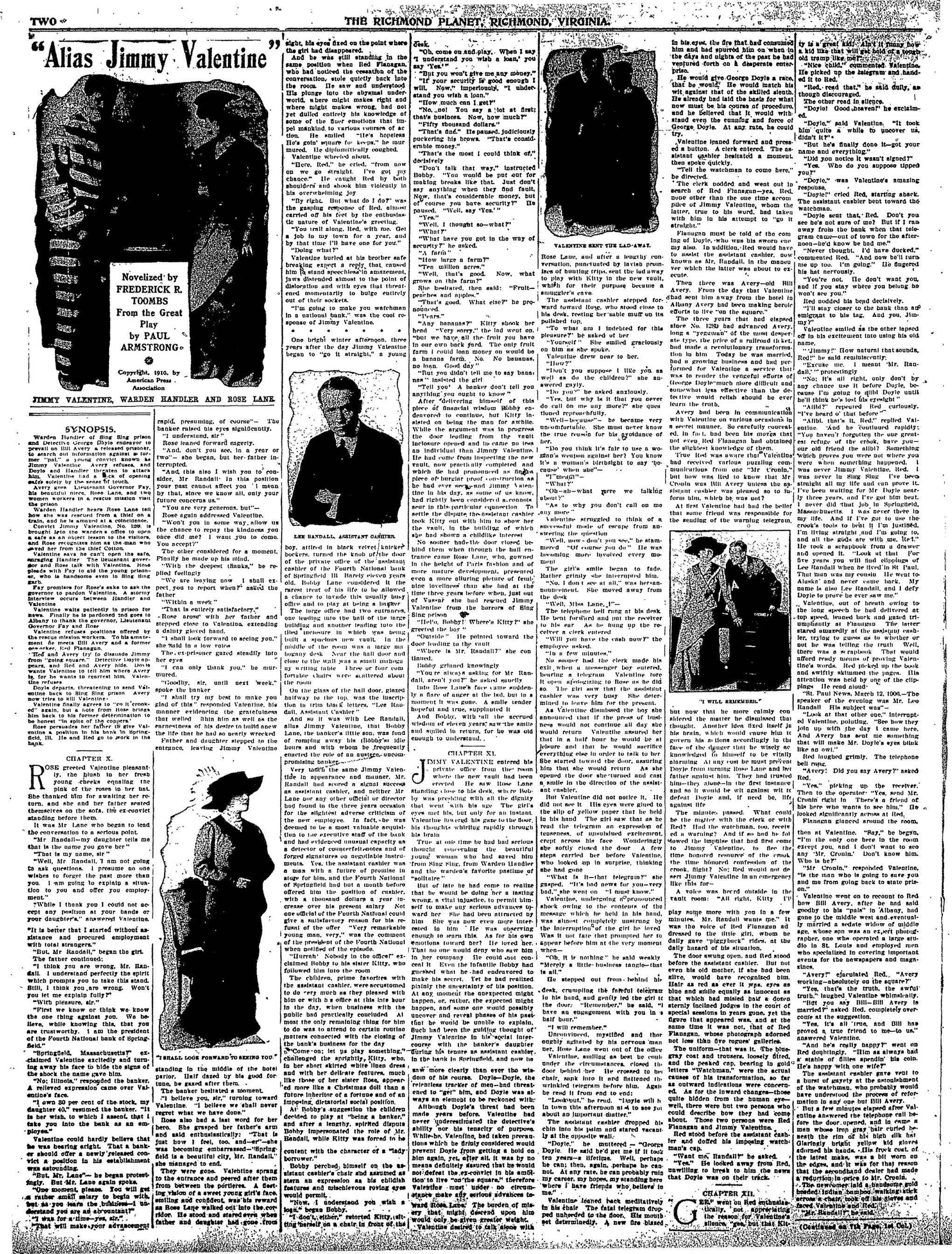
"Alias Jimmy Valentine
Novelized by
FREDERICK R.
TOOMBS
From the Great
Play
by PAUL
ARMSTRONG
Copyright, 1910, by
American Press
Association
TWO
SYNOPSIS.
Warden Handler of Bing Sing prison and Detective George Dyble endeavor to prevail on Bill Avery a released prisoner, to search out information against former "pal" a young convict known as James Dyble and Handler threaten to attack him. Valentine had a Bick of opening safe solely by the sense of touch.
Avery goes. Lieutenant Governor Fay, his beautiful niece, Rose Lane, and two women workers in a rescue mission visit the prison.
Warden Handler bears Rose Lane tells a train, and he is amazed at a coincidence. Convict Jimmy Valentine, No. 129, is brought into the warden's office to open a safe as an object lesson to the visitors, and Rose recognizes him as the man who saved her from the thief Cotton. The safe, causingHandler The lieutenant governor and Rose talk with Valentine. Rose pleads with Fay to aid the young prisoner, who is handsome even in Sing Sing garb.
Fay promises for Rose's sake to ask the governor to pardon Valentine. A stormy occurrence between Handler and Valentine Valentine waits patiently in prison for news. Finally he is pardoned and goes to Albany to thank the governor, Lieutenant Governor Fay and Rose. Valentine refuses positions offered by the prisoner. To his ammendment the meets Bill Avery and a former worker, Flanagan.
"Red and Avery try to dislodge Jimmy from "going square." Detective Boyle appears, and Red and Avery hide. Boyle continues to tell him where Avery is, for he wants to rearrate him. Valentine refuses. Doyle departs, threatening to send Valentine back to Bing Sing prison. Avery now tries to kill Valentine. The police say, "to 'oit 'crooked' again, but a note from Iose brings him back to his former determination to be honest "in spite of the copera." Rose persuades her father to give Valentine a position in his bank in Springfield, IL. He and Red go to work in the bank.
CHAPTER X.
ROSE greeted Valentine pleasantly, the plush in her fresh young cheeks equaling the pink of the roses in her hnt. She thanked blim for awaiting her return, and she and her father seated themselves on the sofa, the ex-convict standing before them.
"Mr Randall--my daughter tells me that is the name you gave her"
"That is my name, sir"
"Well, Mr Randall, I am not going to ask questions. I presume no one wishes to forget the past more than you. I am going to explain a situation to you and offer you employment."
"While I thank you I could not accept any position at your hands or your daughters." answered Valentine.
"It is better that I started without assistance and procured employment with total strangers."
"But, Mr Randall," began the girl.
The father continued:
"I think you are wrong, Mr. Randall. I understand perfectly the spirit which prompts you to take this stand. Still, I think you are wrong. Won't you let me explain fully?"
"With pleasure, sir."
"First we know or think we know the one thing against you. We believe, while knowing this, that you are trustworthy. I am the president of the Fourth National bank of Springfield."
"Springfield, Massachusetts!" exclaimed Valentine excitedly and turning away his face to hide the signs of the shock the name gave him.
"No; Illinois," respoked the banker. A relieved expression came over Valentine's face.
"I own 80 per cent of the stock, my daughter 40," resumed the banker. "It is her wish, to which I assent, that I take you into the bank as an employee."
Valentine could hardly believe that he was bearing aright. That a banker should offer a newly released convict a position in his establishment was astounding.
"But, Mr. Lane"—he began protestingly. But Mr. Lane again spoke. "One moment, please. You will get a rather small salary to begin with, but as you learn the business, I understand you are an accountant?" "I was for a time—you, sir." "That will make your adrastement
rapid, preemning, of course"— The banker raised his eyes significantly,
"I understand, sir"
Rose leaned forward eagerly.
"And, don't you see, in a year or two"— she began, but her father interrupted.
"And this also I wish you to consider, Mr Randall. In this position your past cannot affect you I mean by that, since we know all, only your future concerns us."
"You are very generous, but"— Rose again addressed Valentine.
"Won't you in some way, allow us the chance to repay the kindness you once did me? I want you to come. You accept?"
The other considered for a moment. Finally he made up his mind.
"With the deepest thanks," he replied feelingly.
"We are leaving now I shall expect you to report when?" asked the father.
"Within a week."
"That is entirely satisfactory."
That is utterly satisfactory.
Rose arose with her father and stepped close to Valentine, extending a dainty gloved hand.
"I shall look forward to seeing you," she said in a low voice.
The exp prisoner gazed steadily into her eyes.
"I can only thank you," he murmured.
"Goodly, sir, until next week," spoke the banker.
"I shall try my best to make you glad of this" responded Valentine, his manner evidencing the gratefulness that welled. Thin him as well as the earnestness of his desire to build anew the life that he had so nearly wrecked.
Father and daughter stepped to the entrance, leaving Jimmy Valentine
```markdown
```
"SHALL LOOK FORWARD TO BEING YOU," standing in the middle of the hotel parlor. Half dazed by his good fortune, he gazed after them.
The banker besiated a moment. "I believe you, sir," turning toward Valentine. "I believe we shall never regret what we have done."
Rose also had a last word for her hero. She grasped her father's arm and said enthusiastically: "That is just how I feel, too, and—er—she was becoming embarrassed—"Springfield is a beautiful city, Mr. Randall," she managed to end.
They were gone. Valentine sprang to the entrance and peered after them from between the portiere. A flaunting vision of a sweet young girl's face, smiling and confident, was his reward. An Rose Lane walked out into the corridor. He stood and stared even when father and daughter had gone from
sight, his eyes fixed on the point where the girl had disappeared.
And he was still standing in the same position when Red Flanagan, who had noticed the cessation of the conversation, stole quietly back into the room. He saw and understood His plunge into the abyssal underworld, where might makes right and where might makes wrong, had not yet dulled entirely his knowledge of some of the finer emotions that impel mankind, to various courses of action. He smiled "it's hopeless He's gone square for keeps," he murmured. He diplomatically coughed.
Jeak
"Oh, come on and play. When I say I understand you wish a loan," you say "Yes!"
"But you won't give me any money."
"If your security is good enough I will. Now," imperiously, "I understand you wish a loan."
"How much can I get?"
"No, no! You say a lot at first; that's business. Now, how much?"
"Fifty thousand dollars."
"That's find." He paused, judiciously puckering his brows. "That's considerable money."
"That's the most I could think of."
"Here, Red," he cried, "from now on we go straight. I've got my chance." He caught Red by both shoulders and shook him violently in his overwhelming joy.
"By right. But what do I do?" was the gasping response of Red, almost carried off his feet by the enthusiastic nature of Valentine's greeting.
"You trail along, Red, with me. Get a job in my town for a year, and by that time I'll have one for you."
"Doing what?"
Valentine burped at his brother safe breaking expert a reply that caused him to stand speechless in amazement, jaws distended almost to the point of dislocation and with eyes that threatened momentarily to bulge entirely out of their sockets.
"I'm going to make you watchman in a national bank." was the cool response of Jimmy Valentine.
One bright winter afternoon, three years after the day Jimmy Valentine began to "go it straight," a young
LEE BANDALL, ASSISTANT CASTOR.
boy, attired in black velvet / knickerbocker, turned the knob of the door of the private office of the assistant cashier of the Fourth National bank of Springfield III. Hardly eleven years old. Bobby Lane considered it the rarest treat of his life to be allowed a chance to invade this usually busy office and to play at being a baggerv. The large office and two entrances, one leading into the hall of the large building and another reading into the thief "encourage in which was being built a spacious new vault. In the middle of the room was a large mahogany desk. Near the hall door and close to the wall was a small mahogany writing table. Three or four comfortable chairs were scattered about the room.
On the glass of the hall door, glazed halfway to the top, was the inscription in trim black letters, "Lee Randall. Assistant Cashier."
And so it was with Lee Randall,
alias Jimmy Valentine, that Bobby
Lane, the banker's little son, was fond
of romping away his (Bobby's) idie
hours and with whom he frequently
enacted the role of an usturer, uncompromising banker.
Very truth, the same Jimmy Valentide in appearance and manner, Mr Randall had accrued a signal success as assistant cashier, and neither Mr Lane nor any other official or director had found in the three years occasion for the slightest adverse criticism of the new employee. In fact, he was deemed to be a most valuable acquisition to the executive staff of the bank and had evidenced unusual capacity as a detector of counterfeitnotes and of forged signatures on negotiable instruments. Yes, the assistant cashier was a man with a future of promise in store for him, and the Fourth National of Springfield had but a month before offered him the position of cashier, with a thousand dollars a year increase over his present salary. Not one official of the Fourth National could give a satisfactory reason for his refusal of the offer "Very remarkable young man, very," was the comment of the president of the Fourth National when notified of the episode.
"Hurrah!" Nobody in the office" exclaimed Bobby to his sister Kitty, who followed him into the room. The children, prime favorites with the assistant cashier, were accustomed to do very much as they pleased with him or with his office at this late hour in the day, when business with the public had practically concluded. Almost the only remaining thing for him to do was to attend to certain routine matters connected with the closing of the bank's business for the day. "Come-on; let us play something," challenged the sprightly, Kitty, who, in her short skirted white linen dress and with her delicate features, much like those of her sister Rose, appeared more like a Christmas doll than a future inheritor of a fortune and of an impressing dictatorial social position.
At Bobby's suggestion the children decided to play at "being a banker," and after a lengthy, spirited dispute Bobby impersonated the role of Mr. Handall, while Kitty was forced to be content with the character of a "lady borrower."
Bobby perched, himself on the assistant cashier's chair and assumed as stern an expression as his childish features and mischievous roving eyes would permit.
"Now, I understand you with a knan." I began Bobby.
"I doo," either, "retorted Kitty, sitting
herself on a chair in front of the
"Oh, come on and play. When I say I understand you wish a loan," you say "Yes."
"But you won't give me any money." "If your security is good enough I will. Now, imperiously, I understand you wish a loan."
"How much can I get?" "No, not You say a lot at first; that's business. Now, how much?" "Fifty thousand dollars."
"That's and." He paused, judiciously puckering his brows. "That's considerable money."
"That's the most I could think of," decisively.
"Don't talk that way," instructed Bobby. "You would be put out for making breaks like that. Just don't say anything when they find fault. Now, that's considerable money, but of course you have security?" He paused. "Well, say Yes."
"Yeah."
"Well, I thought so—what?" "What?"
"What have you got in the way of security?" he asked.
"A farm!"
"How large a farm?"
"Ten million acres."
"Well, that's good. Now, what grows on this farm?"
She bealtated, then said: "Fruit—pearches and apples."
"That's good. What else?" he pronounced.
"Pears."
"Any bananas?" Kitty shook her head. "Very sorry," the ind wout on. "but we have all the fruit you have in our own back yard. The only fruit farm I could loan money on would be a banana farm. No. No bananas, no loan. Good day!"
"But you didn't tell me to say bananas," insisted the girl.
"Tell you!" A banker don't tell you anything you ought to know."
After "delivering himself of this piece of financial wisdom Bobby endowed to continue, but Kittery insisted on being the man for awhile. While the argument was in progress the door leading from the vault enclosure opened and he came no less an individual than Jimmy Valentine. He had come from inspecting the new vault, now practically completed and which he had pronounced as a fingerpiece of burglar proof construction as he had ever seen and Jimmy Valentine in his day, as some of us know, had rightly been considered a connoisseur in this particular connection. To settle the dispute the assistant cashier took Kittery out with him to show her the vault, in the building of which she had shown a childlike interest
No sooner had the door closed behind them when through the hall entrance came Rose Lane, who, gowned in the height of Paris fashion and of more mature development, presented even a more alluring picture of female loveliness than she had at the time three years before when. Just out of Vassar she had resumed Jimmy Valentine from the horrors of Sing Sing prison
"Hello, Bobby! Where's Kitty?" she greeted the bar.
"Outside." He pointed toward the door leading to the vault.
"Where is Mr. Randall?" she continued.
Bobby grinned knowingly.
Into Rose Lane's face came suddenly a faint of anger at the bad, but in a moment it was gone. A smile tender hopeful and true, plumped it. And Bobby, with all the accrued wisdom of eleven years, saw the smile and spilled in return, for he was old enough to understand.
CHAPTER X1
JIMMY VALENTINE entered his private office from the room where the new vault had been erected. He saw Rose Lane standing close to his desk, where Robby was presiding with all the dignity that went with his age. The girl's eyes met his, but only for an instant. Valentine lowered his gaze to the floor, his thoughts whirling rapidly through his brain. True at one time he had had serious thought concerning the beautiful young woman who had saved him from Sing Sing, from Warden Hander and the warden's favorite pastime of "solitude."
But of late he had come to realize that he would be doing her a lasting wrong, a vital injustice, to permit himself to make any serious advances toward her. She had been attracted by him. She was now even more interested in him. He was observing enough to learn this. As for his own emotions toward her? He loved her. That no one would deny who saw him in her company. He could not conceal it. Even the infantile Bobby had guessed what he had endeavored to make his secret. Yet he had realized plainly the uncertainty of his position. At any moment the unexpected might happen, or, rather, the expected might happen, and some one would possibly uncover and reveal phases of his past that he would be unable to explain. Such had been the guiding thought of Jimmy Valentine in his social intercourse with the banker's daughter during his tenure as assistant canker in the bank in Springfield, and now he
saw more clearly than ever the wiathood of his course. Doyle—Doyle, the relentless tracker of men—had threatened to "get" him, and Doyle was always an element to be reckoned with: Although Doyle's threat had been made years before, Valentine had never underestimated the detective's ability nor his tenacity of purpose. While he, Valentine, had taken precautions which he firmly considered would prevent Doyle from getting a hold on him again, yet, after all, it was by no means definitely assured that he would not defeat the ex-convict in his ambition to live "on the square," therefore Valentine must under no circumstances make any serious advances toward Rosa Luna. The burden of mystery that might descend upon him would only be given greater weight. Valentine desired to talk alone with
True Red was aware that Valentine had received various puzzling communications from one "Mr Cronlin." but how was Red to know that Mr Cronlin was Hilt Avery unless the assistant cashier was pleased so to inform him, which he was not?
play some more with you in a few minutes. Mr. Randall wants me. It was the voice of Red Flannagan addressed to the little girl, whom he daily gave "piggyback" rides, at the daily hazard of his situation.
The door swung open, and Red stood before the assistant cashier. But not even his old mother, if she had been alike, would have recognized him. Hair as red as ever it was, eyes as blue and shille equally as innocent as that which had mistied half a dozen sternly inclined judges in the court of special sessions in years gone, yet the figure that appeared was, and at the same time it was not, that of Red Flannagan, whose photograph adorned not less than five regen galleries.
The uniform—that was it. The blue-gray coat and trousers, loosely fitted, and the peaked cap, bearing in gold letters "Watchman," were the actual causes of his transformation, so far as outward indications were concerned. As for the inward changes—those quite hidden from the human eye—well, there were but two persons who could describe how they had come about. Those two persons were Red Flansgan and Jimmy Valenting.
```markdown
```
VALENTINE SENT THE LAD-AWAY.
Rose Lane, and after a lengthy conversation, punctuated by laziness promises of hunting trips, sent the lad away to play with Kitty in the new result, which for their purpose became a snuggle cave.
The assistant cashier stepped forward toward Rioge, who stood close to his desk, resting her sable muff on its polished top.
"To what am I indebted for this pleasure?" he asked of her.
"Youself." She smiled graciously on him as she spoke.
Valentine drew near to her.
"How?"
"Don't you suppose I like you as well as do the children?" she answered gravely.
"Do you?" he asked anxiously.
"Yes, but why is it that you never do call on me any more?" she questioned reluctantly.
"Well—because"— he became very uncomfortable. She must never know the true reason for his avoidance of her.
"Do you think it's fair to use a woman's weapon against her? You know it's a woman's birthright to say 'because when she'—
"I mean"—
"What?"
"Oh—uh—what were we talking about?"
"As to why you don't call on me, any more."
Valentine struggled to think of a successful mode of escape from answering the question.
"Well, now—don't you see," he stammered. "Of course you do." He was becoming more involved every moment.
The girl's smile began to fade. Rather grimly she interrupted him.
"Well, Miss Lane, 1"—
The telephone bell rang at his desk.
He bent forward and put the receiver
to his ear. As he hung up the receiver a clerk entered.
"Will you have the cash now?" the employee asked.
"In a few minutes."
No sooner had the clerk made his exit when a messenger boy entered, bearing a telegram Valentine tore it open apologizing to Rose as he did so. The girl saw that the assistant cashier was very busy. She determined to leave him for the present.
As Valentine dismissed the boy she announced that if the press of business would not continue all day she would return Valentine assured her that in a half hour he would be at leisure and that he would sacrifice everything else in order to talk to her. She started toward the door, assuring him that she would return. As she opened the door she turned and cast a smile in the direction of the assistant cashier.
But Valentine did not notice it. He did not see it. His eyes were glued to the slip of yellow paper that he held in his hand. The girl saw that as he read the telegram an expression of tenseness, of unsubduced excitement, crept across his face. Wonderingly she softly closed the door. A few steps carried her before Valentine, who looked up in surprise, thinking she had gone
"What is it—that telegram?" she gasped. "It's bad news for you—very bad," she went on. "I must know."
Valentine, undergoing a pronounced shock owing to the contents of the message which he held in his hand, was almost completely unnaught by the interruption of the girl he loved. Was it not fate that prompted her to appear before him at the very moment when—
"Oh, it is nothing" he said weakly. "Merely a little business tangle—that is all."
He stepped out from behind his desk, crumpling the faintful telegram to his hand, and gently led the girl to the door. "Remember," he said, "I have an engagement with you in a half hour." "I will remember." Unconcerned, my satisfied and then roughly agitated by his nervous manner, Rose Lane went out of the office. Valentine, smiling as best he could under the circumstances, closed the door behind her. He crossed to her chair, sank into it and flattened the wrinkled telegram before him. Again he read it from end to end: "Lookout," he read, "Doyle will be in town this afternoon at 4 to see you about an important dinner." The assistant cashier dropped his chin into his palm and stared vacantly at the opposite wall.
"Doyle," he muttered — "George Doyle. He said he'd get me if it took ten years—a lifetime. Well, perhaps he can; then, again, perhaps he cannot. At any rate, he can probably ruin my career, my hopes, my standing here where I have friends who believe in me."
Valentine leaned back meditatively in his chair. The fatal telegram dropped unheeded to the floor. His mouth set determinedly. A new fire blazed
went on Red Saturday, faced Valentine and Red,
tically, not appreciating Mr. Handall" he said,
the reason for Valentine's
In his age, the dye that had consumed him and had spurred him on when in the days and nights of the past he had ventured forth on a desperate enterprise.
He would give George Doyle a race, that he would. He would match his wit against that of the skilled sleuth. He already had laid the basis for what now must be his course of procedure, and he believed that it would withstand even the cunning and force of George Doyle. At any rate, he could try.
Valentine leaned forward and pressed a button. A clerk entered. The assistant cashier hesitated a moment, then spoke quickly.
"Tell the watchman to come here," he directed.
"The clerk nodded and went out in search of Red Flanagan-yea, Red, none other than the one time account price of Jimmy Valentine, whom the latter, true to his word, had taken with him in his attempt to "go it straight."
Flanagan must be told of the coming of Doyle, who was his sword one my also. In addition, Red would have to assist the assistant cashier, now known as Mr. Randall, in the maneuver which the latter was about to execute.
Then there was Avery-old Bill Avery. From the day that Valentine had sent him away from the hotel in Albany Avery had been making herole efforts to live "on the square."
The three years that had elapsed since No. 1200 had advanced Avery, long a "pegman" of the most desperate type, the price of a railroad ticket, had made a revolutionary transformation in him. Today he was married, had a growing business and had performed for Valentine a service that was to render the vengeful efforts of George Doyle much more difficult and somewhat less effective than the detective would relish should be ever learn the truth.
Avery had been in communication with Valentine on various occasions in a secret manner. So carefully concealed in fact, had been his movies that not even Flamagan had obtained the slightest knowledge of them.
At first Valentine had bad the belief that some friend was responsible for the sending of the warning telegraph,
"I WILL REMEMBER."
but now that he more calmly considered the matter he dismissed that thought. Another idea fixed itself in his brain, which would cause him to govern his actions accordingly in the face of the danger that he wisely as knowledged to himself to be vitally alarming. At any cost he must prevent Doyle from turning those Lane and her father against him. They had trusted him—they alone—in the first instance and so it would be wilt against wilt to defeat Doyle and, if need be, life against life.
The minutes, passed. What could be the matter with the clerk or with Red? Had the watchman, too, received a warning? And if so had he feltowed the impulse that had first come to Jimmy Valentine, to flee the time honored resource of the crook the time honored confession of the crook, flight? No; Red would not desert Jimmy Valentine in an emergency like this for-
A voice was hernied outside in the
vault room: "All right, Kitty! I'll
Red stood before the assistant cashier and dosed his imposing watchman's cap.
"Want me, Handall?" he asked.
"Yes." He looked away from Red, unwilling to break to him the news that Doyle was on their track.
CHAPTER XII.
G
"Nice child," commented Valentine.
He picked up the telegraph and handed it to Red.
"Red, read that," he said dully, as though discouraged.
The other read in silence.
"Doyle! Good, heaven!" he exclaimed.
"Doyle," said Valentine. "It took him quite a while to uncover us, didn't it?"
"But he's finally done it—got your name and everything?"
"Did you notice it wasn't signed?"
"Yes. Who do you suppose tipped you?"
"Doyle," was Valentine's amazing response.
"Doyle!" cried Red, starting aback. The assistant ensailer bent toward the watchman.
"Doyle sent that, Red. Don't you see he's not sure of me? But if I ran away from the bank when that telegram came—out of town for the afternoon—he'd know he had me."
"Never thought. I'd have ducked," commented Red. "And now he'll turn me up too. I'm going." He fingered his hat nervously.
"You're not. He don't want you and if you stay where you belong he won't see you."
Red nodded his bend decisively.
"I'll stay closer to the bank than an emigrant to his tag. And you, Jimmy."
Valentine smiled as the other lapped off in his excitement into using his old name.
"Jimmy!" Now natural that sounds, Red!" he said reminiscently.
"Excuse me. I meant 'Mr. Randall.'" protestingly
"No; It's all right, only don't by any chance use it before Doyle, because I'm going to quibble Doyle until he'll think he's lost his eyesight."
"Alibi?" repeated red curiously.
"I've heard o' that before."
"Albil, that's it. Red," replied Valentine. "And he continued rapidly: "You haven't forgotten the one greatest refuge of the crook, have you our old friend the albil? Something which proves you were not where you were when something happened. I was never Jimmy Valentine, Red. I was never in Sing Sing I've been straight all my life and can prove it. I've been waiting for Mr Doyle nearly three years, and I've got him beat. I never did that Job in Springfield, Massachusetts. I was never there in my life. And if I've got to use the crook's tools to beat it I'm justified. I'm living straight and I'm going to, and all the gods are with me. Red." He took a scrapbook from a drawer and opened it. "Look at that For five years you will find clippings of Lee Randall when he lived in St Paul. That man was my cousin. He went to Alaska' and never came back. My name is also Lee Randall, and I defy Doyle to prove he ever saw me."
Valentine, out of breath owing to the long speech he had delivered at top speed, leaped back and gazed triumphantly at Flamingo. The latter stared amazedly at the assistant cashier, trying to guess us to whether or not he was telling the truth. Well, there was a scrapbook. That would afford ready means of proving Valentine's words. Red picked up the book and swiftly skimmed the pages. His attention was held by one of the clippings. He read aloud:
"St. Paul New, March 12, 1900.—The speaker of the evening was Mr. Lee Randall. His subject was"—
"Look at that other one." Interrupted Valentine, pointing. "See how they join up with the day I came here. And Avery has sent me something that will make Mr. Doyle's eyes blink like an owl."
Red laughed grimly. The telephone bell ring.
"Avery! Did you say Avery?" asked Red.
"Yes," picking up the receiver.
Then to the operator: "Yes, send Mr. Croutin right in. There's a friend of his here who wants to see him."
He looked significantly across at Red.
Flanagan glanced around the room, then at Valentine. "Ray," he began, "I'm the only one here in the room except you, and I don't want to see any Mr. Croutin." Don't know him. Who is he?
"Mr. Croutin," responded Valentine, "is the man who is going to sure you and me from going back to state prison."
Valentine went on to count to Red how Bill Avery, after he had goodbye to his "pals" in Albany, had gone to the middle west and eventually married a sedate widow of middle age, whose son was an expert photographer, one who operated a large studio in St. Louis and employed men who specialized in covering important events for the newspapers and magazines.
"Avery!" ejaculated Red... "Avery working—absolutely on the square?"
"Yes, that's the truth, the awful truth." laughed Valentine whimically.
"But you say Bill-Bill Avery is married?" asked Red, completely overcome at the suggestion.
"Yes, it's all true, and Bill has proved a true friend to me—to us," answered Valentine.
"And he's really happy!" went on Red doubledly. "Him as always had a stable of dillies spendin' his coin. He's happy with one wife!"
The assistant handler gave vent to a burst of pajama at the astonishment of the watchman, who probably would have understood the process of reformation in any one but Bill Avery. But a few minutes elapsed after Valentine answered the telephone call before the door opened, and in came a man whose iron gray hair curled beneath the rim of his high silk that Glarlingly bright yellow kid gloves adorned his hands. His frock coat of the latest make, was a bit worn on the edges, and it was for that reason that the secondhand dealer had made a reduction in price to Mr. Crossin.
The newcomer laid a bandoneon gold
headed, indian bamboo, walking sticks
arrows on a chair, book on the steps and
saved Valentine and Red.
```markdown
```
An address delivered by John E. Mililand Under the Auspices of The National Association for the Advancement of Colored People, at the Friends' Meeting House, Philadelphia, on Washington's Birthday, 1911.
Not the least surprising feature of this subject is the popular ignorance in regard to Federal aided education. Except perhaps those whose business in life makes knowledge on the subject compulsory, this remark apparently applies to elements of our population, great groups of people whom to know nothing about it. Organs of public opinion display an ignorance in its discussion shocking to contemplate. Statesmen or allied statesmen look upon it as a wholly untried experiment. I bear personal testimony that a President of, the United States expressed himself on the as Naught it has not been nor innovation in possible conflict with organic law.
And yet if there be any principle thoroughly engrafted in Federal statute it is this, the extension of which we are now advocating. I do not reiterate only to the Morrill Acts of the 90s or of 60s or even to the imperial "Ordinance of 1787" that caused Daniel Webster to declare, "I doubt whether any one single law, ancient or modern, has produced effects of more distinct, marked and lasting character, that united express opinion in its favor which fill pages of legislative history and which should be familiar to every man or woman interested in the cause of popular-education.
In theory and in practice State aid to education is as old as the Republic; it runs back and clear through the Colonial period, because the Colonial period was dominated, to a splendid extent, by thrives with ideas far in advance of the Old World, whence they came, and possessing to a surprising degree a general attainment that enabled them to draw lessons from the great experiments in human government throughout the history of ancient, medieval and modern times, and to teach them, as it teaches us, that the greatest monarch to liberty is ignorance; and that illiteracy drags the charlatan whools of progress, blazes the way from freedom down to slavery and that no cheaper human defence than the enlightenment of the monarchs a task than which government has no more important function.
Throughout the ages it is pleasing rable to observe the unanimity of great minds on this point, even under very different conditions. Our outward appearance, but the great ancient civilization, but the suffer so severely by comparison. The movement in England today for a comprehensive plan of national education in place of the voluntary systems that have prevailed, admirable to the extent that they are more positive than what the excavations disclose among the ruins of old Ninovach
There is not a public library in New York, Paris, London or Berlin more illustrative of this spirit, this devotion to learning, than that found in the palace of the great Assurbanipal with its endless volumes on religion, history, mythology and other legendary lore, such natural sciences as astronomy, literature, grammar, rhetoric and the laws and customs of many peoples, representing the crude beginning of a sociological philosophy of libraries for those old libraries at Ninoviah, for a mass of more than one hundred tablets. There are more than ten thousand tablets, and their contents would cover in ordinary form of our present books more than five hundred quarto volumes of as many pages each.
The educational zeal of this monarch is typical of those who led the nations of antiquity to conquest and glory like the world conquering Alexander whose devotions to Greek culture rivalled his marvelous military genius and drew from him that passion for war when risking his life in the Indian Ocean. Athenaeus, you little know what dangers in incur, what toils I endure for your applause."
The Sorbonne of Paris is no more significant than wore the great Chaldean, Egyptian and Egyptian schools and libraries now traco in imperishable histories and in languages long dead to human utterance. The military prowess of the Ptolemaics must not blind us to their zeal for education.
"Great captains with their guns and drums,"
Disturb the judgment of the hour."
We must not forget that more than 600 years saw in Alexandria a body of men who knew 800 years before Christ lived and complete system of higher education and founded the first great university whose influence was felt not alone in Greece and Rome, but subsequently throughout all medieval and modern Europe, even to this day.
It is a curious fact and one which speaks well for Lacademian common sense that Sparta should have realized the treatment and importance of the State controlling its directing education long before its illicit rival, Athens, for, as you will recall the famous Academy of Athens neither founded nor supported by the government. It represented for years the voluntary system and personal benavolence, but had imperial endowments not been usually forlouching it is doubtful if the Greedan capt-
tol would have continued so long the great educational centre for Italy and the provinces of the Roman Empire.
Trace the history of education down through all its various ramifications after the advent of Christianity, and you will find, as Gibbon clearly demonstrates, that throughout the Roman World the cultuation of youth is supported at public environs from ex-communion and Marcus Aurelius down almost to Charles the First, the first in our modern world to establish schools by the State and usher in what Hallman aptly terms "the golden age of universities"; and if it is indoed a terrible indictment of our Republic that now falls to see as this great ruler now is, it is the most recent thousand years ago—irz, that most lasting reform is impossible until the curse of illiteracy has been abolished. Were Charles alive today and in contemplation of our nation's shameful plight, I can almost hear him say with characteristic emphasis: "If the Negro environment is condition in the South, you must be the white as well as the black. The Negro's environment must be made better, more unprejudiced, more tolerant, more onlitened, if he is to have the full benefits of education and culture. Give the South good abundance, good roads everywhere, and good roads of its affairs, firm but just, will allow—at least, that is a reasonable probability. Long experience favors such a conclusion.
It may be said that these ancient educational systems were limited in scope, limited to the upper or ruling, or, at most, only went so far as the middle classes. I might grab it—although the facts do not compete to do so, without weakening the argument from: history, for the references to the long experience is that they represent was and is obvious to every clear thoughtful mind, that a nationalized scheme of education was considered a prime function by every great government worthy of the name, whether it be that sublime theocracy of the Middle East, Israel, whose prophets spoke from complete inspiration of the Most High and whose priests kept knowledge for the people or in the absolute monarchies of Chaldea, Babylon, Assyria and Egypt; in democratic Athens or imperial Rome, in Mohammedan Baghdad or those noble Irish monasteries, in royal Germany, Republican France and all national England—with one and all it was or less being conviction that education is not incidental duty, to be discharged by subordinate States, provinces or municipalities at will, much less to be left to the philanthropic impulses of groups or individuals. The best thought of the world, ancient, modern, Christian, Pagan or Agnostic, French or Gentile Chinese or Japanese, Greek or Maranian, Oriental or Occidental is and always has been in support of this proposition.
These five or six million children denied by our stupid, narrow, barbarous policy, access to even the most rudimentary forms of education are of those who own the coming years, they are among the chief assets of the country. The significance of their education cannot possibly be overestimated. No grace in our national life should be carefully conserved. A young Edison, or one greater than he, be who broods at Mentle Park, may be today wandering in the almlessness of childhood over the hills of Alabama. Another Marconi may be lasing his way down on the Sawyer's knee away down on his mother's knee. Pasteurs may come out of the Carolina houses already swarm the West and East. Beetohovens and Wagners Tennyons and Lowells may be growing up amid conditions so harsh as to freeze every genial current of their young souls for many a poet sown by nature with "vision and facet" who has felt amidst the poverty and shame has metatched an environment, that it was his fate to live and do unhard with voiceless thought."
Do not tell me that a congenial atmosphere has nothing to do with the case. Poetry, philosophy, painting, sculpture, all the arts are developed by proper surroundings. Just as much as in high thinking and lofty meditations, drawing-room or civilization these things can no more help raising a crop of poets, painters, philosophers and story-tellers than she can fall to raise in her well-tilled fields the barley, rye, wheat and corn. And this is true of France and of Ger
many of Italy and of Rome, Egypt and Judah. We would have had Hottentot contributions to the literature of political: economy and Esquimoux filing applications at the Patent Office. Up to data no very remarkable mechanical invention has come to us either from Senegambie or Kamechatka and from the French or German to be roaring an original opera for this or next season in Philadelphia, New York or London.
I repeat, the welfare of the children is of paramount importance, and if there is anything more amazing, incomprehensible, and unspeakably pathetic it is our willingness as a nation to spend millions upon millions in subsidizing industries, improving waterways, deepening harbors, erecting coast defences, digging canals, drilling armies and building tunnels, ten years will be on the slag heap, or failing to provide for a system of Federal Alamed Education that will make it impossible for any American boy or girl to be deprived of public school advantages.
Glance for a moment at what we are doing. We boast of our wonderful school systems, but let us look at the grim facts of the situation. The common school population of the United States in 1908, was, according to official compilations, about 25,000,000, equally divided between boys and girls from the ages of five to eighteen years. The enrollment returned was about 17,000,000; the latter was about very much less. That is to say, about one-third of our children of school are even enrolled, and it is allogher within reasonable inference to assume that very little more, probably less, than half, are in attendance. There are, of course, practical if not satisfactory, reasons, undoubtedly that will explain the failure to en-
roll and attend school by a very large part of this year, army of 1,400,000 or more absentees from the nation as brought out by the nation to speak with precise knowledge on the subject, that the reason why at least five or six million of these children do not enroll and do not attend is because there are no school facilities whatever provided for them. This is the tormenting truth, and this nation must face and face immediately if we are going to maintain our position among the civilized nations of the earth and be considered that republic whose other name is "Opportunity" for all. This is not a shocking state of affairs and auber minded citizen to contemplate that we must revise all notions on this subject. But let us go further.
There was expended that year for popular education about $322,000,000, $317,000,000 of which was derived from local and State taxations, $42,000,000 more from other sources, State and local and from the United States Government was received about $22,500,000, or a trifle more than our interest on the public debt; about one-half of what was voted for pandemonium day one-twelfth of what we will pay, our army and navy this year and one-twentieth of what we shall probably spend on our Panama Canal.
These comparisons are not made by way of criticism upon the public expenditure in any direction indicated—that is not my purpose at this time; what I want to drive home. If I would want it, the beggarly treatment that is is not education. Neither have I desired to overlook the highly creditable fact that in the very year mentioned, 1908, $33,000,000 was contributed to the institutions of the various States giving agricultural instruction money being the income from the Local Funds, the Morrill Acts, the Nelson Amendment, etc., and other appropriations from the Federal Treasury.
But I am not holding a brief to night for any industrial school or school of technology or agriculture. I speak for the common schools, the inexhaustible sources from which come the armes of those in part who subsequently in the regular order of progress, enter into the higher branches of learning. My plan for the masses, however, is really a plea for all, the highest and the lowest, you want to make your technical education, your colleges and your universities, they should be—that is, to surpass in their scope and sound scholarship any Germany or France has accomplished Oxford and Cambridge contemplated then you must begin at the very bottom round of the ladder and see that your ladder is firmly planted.
"No system of public education," said Huxley, "is worth the name of national unless it secures a great educational ladder gone end of which gutter and the other in the university. True dada were never spoken by my friend education I dwell upon the "gutter" tonight "A church on every hill and a school house in every valley" was a cry that rang through the New England states of brain and conscience, but the regions of the Uni- where a school boll is never heard of causing in their vastness and desolation though the population awards in helplessness and misery.
Well, what are we going to do about it? Are we to sit down in helpless contemplation and say with the Soudanese, "Kismit, it is the will of Allah," or are we to address ourselves to the task in thorough going American fashion and never abandon until the work is done? But why do we longer handle the sacrifice? Why any further sacrifice? Why longer handcap the lives of the little ones? A Federal Education Bill is the absolute imperious requirement of the situation and the man or woman who does not realize this does not understand existing conditions or the way to mend them. We have tried every other way, pecuniary, conventional means, and I still result at least one whole State does not spend a dollar per capita and the popular education, and it is state who should know that even in Montgomery county, Alabama, only a few cents per capita was expanded last year in the education of colored children. Dr. Booker T Washington himself confesses that Negro school teachers in that salary than is paid for many of the Alabama convicts. Nevertheless, within two years two Alabama Negro boys has successfully passed the rigorous examinations of the Rhodes Scholarship, one of them beating no less than ten white competitors for the honor.
So far as regards the long array of private undertakings, they are merely pointing the direction in which this great government of ours owner or later must go, if it is to realize its manifest destiny. The Slater Flower, Howard, Hampton, Tuskegee, all round together, are togather suddenly in order to merit serious discussion as a solution of the problem. Not only indequate, they are objectionable from another and higher viewpoint.
But let us proceed a little further in our investigation. I am going to confine the inquiry for the St. Louis to Alabama, because that is the St. Louis which the voluntary school experiment has been tried so thoroughly for a quarter of a century. That is the St. Louis which it was said twenty years ago that there was no need of the Blair Bill to provide national support of common school education, because common school education was going to be provided for locally by State and by the philanthropy of the North, which has been pouring its sigh
don't rain upon Tuskegee and similar institutions for the last twenty-five years.
"What are the results?" According to the official figures of 1907 and 1908, there were about 638,000 school children in Alabama. Of these were enrolled, leaving over 300,000 in school of a school enrollment. It is fair to assume that the number enrolled fully twenty-five per cent. did not attend, thus leaving in the State of Alabama about 400,000 children developed education, even of most rudimentary majority are white. Neglected in the vital matter of education, this mulititude is growing up in gross ignorance, doomed to poverty, frequently to crime, because of that ignorance.
Tallapoosa county is a fair example of the average hill county in Alabama. It has only three towns of more than 1,000 population. The report of the Alabama Department of Education for 1906-7 states that the school population of whites in Tallapoosa to be 7,273, and blacks, 4,196, and in the county to be 7,273. There were enrolled in the county during the scholastic year of 1906-7 4,319 whites, and 6,563 coloured. Total enrolment, therefore, 5,974. The average attendance of the whites was 3,560 and blacks 1,238, total being 4,788. The average length of duration of the white schools was 130 days and of the colored schools 85 days.
A melancholy recital, you say, but that of "this imperial city of Jefferson" is not more cheerful. Birmingham is the county seat and the population of the county in 1906-7 was 22,912 whites and 12,125 colored. The enrollment was 14,605 whites and 5,282 blacks and the 22,290 white children of school there was an average attendance or 8,621. The average attendance of colored was 2,839.
Think of it! There are, according to these figures gathered from the Alabama Educational Department almost 15,000 white and more than 9,000 colored children out of school throughout the scholastic year of 1908-7, and this in the county that contains the industrial metropolis of Birmingham—and in the State where voluntary industrial school experiments has been going on at Tuskegee for a century under the personal management of its gifted founder, Dr. Booker T. Washington.
It is pretty late in the day—late in the evening also I might add—to go into the question of the proposed bills constitutionality. I only touch upon this phase of the question that you may not for one instant suppose it partakes in any degree of that thing of shreds and patches, that species of sublimated - demagoguery which passes occasionally under the title of 'New Nationalism' and for which the people of the United States of America desirated they have as little use as the people for crowns, thrasus, plum breeches and the other adornments of hereditary rights and privileges.
No, this proposition, novel as it may appear to a generation that forgets everything more than forty-eight hours old, is, as I said at the outset, not now Like liberty itself, it is of an ancient house and however this government differed among those on other points of State and National policy on this their unanimity is simply amazing.
Geographical lines were lost in these famous discussions of national education. The Adams of Massachusetts were not more erroneous in its support than Thomas Jefferson or James Monroe of Virginia. That the Adams had Hamilton should be for such a man could surprise none of us, but in the constitutional Convention of 1787 it was Pinecrest of South Carolina, backed by Madison, of Virginia, who advocated the establishment of a national university at Washington. Wilson and Gouvernour Morris supported the plan, but the matter was dropped, not because he thought to be unconstitutional, but was agreed that Congress already had sufficient power "to enact laws for the national education," a conclusion that was never successfully questioned nor apparently deplored by the most zealous upholders of State rights in the great debates of those days, or in the Congressional battle over the coroll laws nor during the ten year rattled by Senator Blair's historical measure, the defiant of which put back this country's educational progress far more than fifteen degrees, for the blow struck then was one that will be felt in effect through more than one generation.
In that Blair Bill debate appeared such National State Right champions in advocacy of this measure as Gutland, of Arkansas, afterwards Attorney-general in President Cleveland's administration; the scholarly, accomplished Lamar, later on Justice of the Supreme Court; Confederate warriors like Gordon and Hampton; Intellective giants such as Pugh—in brief, the most powerful representatives of the South; Congress stood shoulder to shoulder to bear, Boar, Allison, Morton, Dawes, Ewarts, Edmunds and the real statesmen of the West, precisely as Monroe and Kissel had joined hands in support of essentially the same proposition more than a hundred years before.
But of all the sincerely, potential advocates of national education none have left on record nobler sentiments in support of the idea than he whose name we celebrate today. It was George Washington who presided over the convention in his very first message to Congress pears these strong, inspiring word: "There is nothing more deserving your patronage than the promotion of science and literature. Knowledge in every country is the surest basis in which happiness. In one, as ours, in which the government receive their impurities, immediately from the sense of the country it is proportionately essential."
That last sentence is a gossip of classical expression, the language of a statesman whose fame this world will never let die because he legislated for the ages and fought for principles universal in application; eternal in duration.
He saw bur inconsistency in this matter as the fathers did on the question of slavery, for in 1798 when consideration was given to the National Military Academy, at West
Point he urges in his message a natural curiosity, assuring Himself that Congress should know how much a flourishing state of the arts and sciences contributes to national prosperity and reputation.
"True it is," he continues, "that our count y contains many seminaries of learning highly respectable and useful; but the funds upon which they do narrow to command the ablest professors of different departments of liberal learning the institution contemplated, though they would be excellent auxiliaries."
That argument belongs to this hour as maqub as to the far-away period to which it is chronologically attached.
What a perfect understanding of the whole matter it displays, and what a matter it smokes with the shallow reasoning of their opponents who would darken counsel by words without knowledge!
Follow. I beg you the sweep of this succeeding paragraph with the visits it opens up of the proposed University's ultimate magnificent influence, breaking down provincialism, lessening class hatred, curing the blighting causes of race creed or color prejudice, and bringing together of the youth from points of the land, North, South, safe, and West, seek to turn the powers of national pride into the dynamic force of national feeling. "Among the motives to such an institution the assimilation of principles, opinions, and manners of our countrymen by the common education of a portion of our youth from every quarter well-deserves attention, the more homogeneous our can be made in those particulars the greater will be our prospects of permanent inclusion, and a primary object of such national institution should be the education of our youth in the science of government."
It may be too much to assert that if Washington's ideas and those of his associates on this subject had been given effect at that time there would have been no Civil War, but it is certainly within the possibilities if the probabilities that the awful devastating, raternal strife might have been voiced, for the part played by the unenlightened public opinion as well as wickedness in that immortal struggle cannot be unduly emphasized.
Finally, I leave this subject with the words concerning it that appear in his own Imperishable Farwell Address "Promote, then, as an adjunct of primary importance institutions for the general diffusion of knowledge in proportion as the structure of the government gives force to public opinion, it is essential that public opinion be enlightened."
- AKIL Canada Bar Our Negroes?
(Washington, D. C., Post)
"Canada for Caucasians." Yes, our reciprocal neighbor has taken the surprising step of placing some 100 native-born Americans in the same category with the undesirable Adalberts of the United States swarms with agents sent to by the Canadian land department to inducements to our white farmers to emigrate to the limitless virgin dolmins in Alberta and Saskatchewan, the pioneer installation of a negro government arrived at Winnipeg from this side of the boundary they were tabooed to "undesirabled" and turned back
No explanation has been offered in elucidation of the new policy. The door was banged to in our face with the process of treaty, gentlemen's agreement, or what not. The reports from the determination indicate that the determination negroes was arrived at suddenly, and may or may not be a permanent policy.
The present treaty of commerce and navigation between the United States and Great Britain, ratified in 1815, provides as follows
There shall be between the Territories of the United States of America and all the Territories of His Brittanic Majesty in Europe a reciprocal liberty of commerce. The inhabitants of the countries respectively shall have Liberty freely and securely to come in with their ships and cargoes to the places. Porta and Rivers in the Territories aforesaid to which other Foreigners are permitted to come, to enter into the same, to remain and reside in any of the said Territories respectively, also to hire and occupy Houses and Warehouses for the purposes of their commerce, and generally the Merchants and Traders of each Nation respectively shall enjoy the most complete protection and security for their Commerce.
This "reciprocal liberty of commerce" apilies, however, only to British territory in "Europe." There is no boundary between the United States and Britain relating to rights of travel, the land and residence in Canada or the East Asia. When an influx of Hindus was the threat in California, it was held that the United States had a right to exclude them, there being no treaty in the past. And it may be that Canada has a right to exclude any kind of Americans have no right to treaty to trade, travel or reside in Canada.
But conceding that Canada is acting within her rights in excluding American blacks, it is hardly likely that such a policy will be pursued. The State Department is in duty to protest to Great Britain. The American negro is on the free list of every other race in the western hemisphere. He should be as free to come and go across the Canadian boundary as anywhere else. Passports issued to him are entitled to the same recognition as those issued to his white fellow-citizens. Doublicts the State Department will be found to be as zealous in protecting the black man from discrimination as it was eager to avoid discrimination against the Japanese. Presumably a word from the British foreign office will cause the Canadian government to cease its discrimination against American citizens because of their color. More imprecision inferences than the prejudices of White people would provoke sublimation in the matter, the Canadian authorities might be extremely reluctant to press the point, since in
slence would disclose the glaring aburduity of Canada's present pretensions as a "nation," and might go tar to cause her to take, charge the country, and make her in fact an independent and sovereign nation.
McCLURE'S MAGAZINE.
dor
for
hough
as."
From a Skyscraper. 'A Poem
Allan Updegraff
our
to
sec
McAdoo and the Subway
Burton J. Hendrick
that
the
that
wha-
whith.
The Honeymoon. A Play
Arnold Bennett
Illustrations by Frederic Dorr Steele
"There's Rosomary." A Poem
Olivie Tilford Dargan
vor
ace.
son.
plin.
other
the
test.
mal.
na.
vices
on
ers
nth
oth
our
trt.
CONTENTS FOR MARCH. 1911.
From a Skyscraper. 'A Poem
Allan Updegraff
our
to
sec
McAdoo and the Subway
Burton J. Hendrick
that
the
that
wha-
whith.
The Honeymoon. A Play
Arnold Bennett
Illustrations by Frederic Dorr Steele
"There's Rosomary." A Poem
Olivie Tilford Dargan
vor
ace.
son.
plin.
other
the
test.
mal.
na.
vices
on
ers
nth
oth
our
trt.
In the Funerals. A Story
Helen Green
Illustrations by H. T. Dunn.
Will Congress Put Our Navy on the
Soa?
The story of Secretary Meyer's Flight
Against Waste Bureaucracy
Some Letters and Their Writers
Ellen Terry
Great Cases of Detective Burns
Dana Gatlin
Illustrations by Jay Hambidge.
The Test. A Story
Frances A. Ludwig
Illustrations by Cyrus Foamire
The Masters of Capital in America
John Moody and George Kibbe
Turner
The Standard Oil Company—Bankers
The Tooth of Anar A Story
Lucille Baldwin Van Slyke
Illustrations by Windslaw T Beni
Interior. A Poem. Judraic Colum
The Case of Richard Meynoll.
A Novel—
Mrs Humphry Ward
Fruition. A Poem
Katharine Tynan
A Lost Job A Story
Arthur E. McFarlane
WOMAN KILLED FOR HER MONKEY
That Marla Woodfork, an aged colored woman, who lived in 1630 Blair street, was murdered with an ax and was fully established by the coroner's jury which examined into the case. The ax with which she was killed was exhibited as part of the evidence. The ax was witnesses, but none could throw any light on the brutal murder except the fact that it was committed for the purposes of robbery. The old woman was a miser, but none knew the exact nature of the crime. Receiving K. O. Burnett, a grocer, at 939 St. Bardy street, who testified that shortly before her death she made a small purchase at his store, and, in making change, dropped an unusually large roll of money. There was still colored girl in the store at the time, but her name is not known.
The body was found by Police Officers Krug and Joininga last Tuesday night, after people living downstairs, believing that something was wrong, had telephoned to the Second Police Station, asking that an investigation be made. They found the man dend in the middle of the floor, and his clothes torn from her body. But the telephoned making an official report of the murder until after 1 o'clock the next day. Then Detectives' Bailey, Wren and Wiltshire were dispatched to the house. It was rather into to begin work, but the detectives have followed since every little clue they could find. And the murder been officially reported once as is required to be done in much the detectives might have been able to find the mystery before the criminal could so effectually hide his trail.
ARRESTED ON SUSPICION.
Believing that she can, throw light on the murder of Martin Woodford, or that she may even have criminal knowledge of the murder, Detective Sorgentea Wren, Bailley and Wiltshire last night arrested Rosa Randall, colored, as a suspicious character. She is twenty-four years old.
The woman lived on the first floor of the same house in which the age negress met her death by boul play, she was dated last night that the three officers took up other clues which have come to the knowledge, and if it is expected that the mystery may soon be cleared away.
—Richmond (Va.) Times-Dispatch; Feb 22, 1911
$150.00 ENDOWMENT PAID
Norfolk, Va. Feb. 24, 1911.
This is to certify that I have received from John Mitchell, Jr.
Grand Chancellor of the Grand Lodge of Virginia, Knights of Pythias, N.
A. B., A., B., A., A. and A. ($150,00)
A. B. Hundred and Fifty Dollars, in payment of the death claim of Brother Lewis Walker, who was a member of Pythias Lodge, No. 21, of Norfolk, Va.
Signed:—
J. M. HARRISON
Attorney.
Witness:—
Wm. L. Christian, C. C.
John H. Dagenes, V. C.
Emmanuel Owens, K. of R. S.
M. Isbell, D. D., G. C.
$150.00 ENDOWMENT PAID
Norfolk, Va., Feb. 22, 1911.
This is to certify that I have received from John Mitchell, Jr.,
Grand. Chancellor of the Grand
Lodge of Virginia, Knights of Pritha
N. Lodge of G. A. E., A. A., and A. A.
(9150,000). On硬盘 and Fifty
Dollars in payment of the death
claim of Brother Benj. R. Boulding,
who was a member of Conway
Lodge, No. 25, of Norfolk, Va.
Witness:
William H. Tyler, G. C.
B. M. Canaday, K. of R. and S.
M. Iabell, D. D, G. C.
STRAIGHT DISTILLERY WHISKEY
3GALS. $450
4½GALS. 673
EXPRESS PAID.
AT DISTILLERY PRICE
When we say Distillery Whiskey, we mean it. We do not handle compounds and chemical mixtures. If the goods they buy are not as we represent, and better than you ever bought at the price, return them and we will REFUND your money.
TOWHICH CHOICE CHOICE FOR YOU
TAXABLE PRICE $4.50 OIL $6.75 GHT $3.00 GHT $5.50
Express Paid to any office of Adams or Southern Express Company.
STONEWALL DISTILLING CO.
1453HULLST.RICHMOND.VA.
RAILROADS.
ACCOMMODATION TRAINS - WEEKDAYS.
Leave Bray St. S.t. 1.50 A.M. P. for Forsbergkauz.
Arrive Bray St. S.t. 1.50 A.M. Forsbergkauz.
Arrive Bray St. S.t. 8.55 A.M. H. from Forsbergkauz.
Arrive Bray St. S.t. 8.55 A.M. P. from Ashkali.
* Daily, weekdays, Tuesdays only.*
* All trains to or from Byrd Street Station (except trains leaving 4.50 a.m. and arriving 5.00 a.m.) departed not guaranteed. Read the letter.*
N. & W. NORFOLK & WESTERN.
ONLY ALL-RAIL LINE TO NORFOLK.
Schedule in Effect January 10, 9,011.
Schedule by Breet Station, Richmond, FOR
LORFOLK: '9:00 A.M., M:3:00 P.M., M:4:10 P.
M:FOR LORFINGH AND THE WEST: '6:18
M:FOR LORFINGH AND THE WEST: '9:20 P.M.
M:FOR LORFINGH AND THE WEST: '10:30 P.
A arrive Richmond from the West: '6:35 P.M., '11:30 P.M. From the West: '6:50 A.M., '8:20 P.M., '8:25 P.M., '6:05 P.M.
Daily a daily, ex Sunday b Sunday only,
Pallman, Parler and Sleepy Carr, Cafe
Dining Car.
O. H. BOBLEY,
W. BRIVILL, D. P. A., Richmond, Va.
G. W. ROBVILL, R. A., Rosvale, Va.
ATLANTIC COAST LINE
EFFECTIVE JANUARY 9, 1911.
TRAINS LEAVE RICHMOND DAILY.
For Florida and South: 1:00 A.M., 8:15 A.M. and 7:35 P.M. *10:30 P.M.
For Norfolk: 9:00 A.M., 8:00 P.M., 6:18 P.M.
For N.K. W.R. West: 6:15 A.M., 9:00 A.M., 3:00 P.M., and 9:20 P.M.
For Petersburg: 1:00 A.M., 6:15 A.M., 8:15 A.M., 9:00 A.M., 12:10 P.M., 8:00 P.M., 4:10 P.M., 6:05 P.M., 7:35 P.M., 9:20 P.M., 11:45 P.M.
For Goldboro and Fayetteville: *4:10 P.M., Traine arrive Richmond daily: 4:40 P.M., 5:10 A.M., 6:40 A.M., ***7:05 A.M., *8:57 P.M., **10:45 A.M., 11:40 A.M., **2:00 P.M., **2:15 P.M., 6:05 P.M., 6:35 P.M., 8:00 P.M., 9:00 P.M., 11:30 P.M.
For Sunday ***Except Monday. **Sunday only
Time of arrival and departure and completion not guaranteed
O. S. CAMPBELL D. P. A.
Southern Ry
Southern Ry
TRAINS LEAVE BICHMOND.
N. R.—Following schedule groom published as information and pot guaranteed.
D. R.—Following schedule for Daniell, Charlotte, Durham and Haley.
10:48 A. M.—Daily. Limited. For all grooming.
B. M.—Drawing Room Buffet Sleeping Car to Montville, Virginia and Chad C. Maconge.
8:00 P. M.-Ez. Sunday, Local for Durham and
intermediate stations.
8:15 P. M.-Kyiv, Karyolil Local.
11:46 P. M.-daily, Limited, for all people
Bohul. Pullman ready 8:00 P. M.
YORK RIVER LINE
4:30 P. M.-Ez. Sunday. To West Point, point
for Baltimore Balloons. Wed. & Fr.
6:00 A. M.-Ez. Brun. and 2:15 P. M.-Mon.
Wed. and Pt. Lun. to West Point.
TRAING ABRIYE RICHMOND.
From the Boreth: 6:00 A. 1 M. 8:05 P. 1 M. dalyfs
From the Boreth: Rt. Boundary: 12:55 P. 1 M. Rt. Boundary
2 P. M.
From West Point, 8:30 A. M. "dally"; 11:28 M. W. Wed, and D. K. Kau, Sunday.
R. J. BURGER, D. K. Kau, Sunday.
9:30 East Main Street, "Fhoo, Madison-689
C. & O.
8:00 A. Dally-Fort trains to Old Point.
8:00 P. Newport News and Norfolk.
8:00 D. Daily, Local to Newport News.
8:00 P. Daily, Local to Quincy.
8:00 P. Daily-Lorchester and Cincinnati.
11:00 P. Pullman.
10:00 A. Daily. L. Burg. Lee. C. Forre.
6:18 P. Week from Yorkshire.
TRAINER ARRIVE NIGHTMOV.
Local from West. 7:50 P. M.
Through from East-11th. 8:25 P. M.
Local from West. 8:30 A. M. 8:56 A. M.
7:00 P. M.
SEABOARD AIR LINE
Southbound tritor scheduled to have Richmond daily; 9:18 A.M.-Local to Newark, 7:00 P.M.-Sleeping and oosebea, Atleton, Shrunham, Swanshah, Jacksonville and Florida polson, 8:18 P.M.-Florida Localized daily, through Bayday, 11:48 P.M.-Shiraputia and SWandel, Survank, Jacksonville, Atleton, Birmingham and Mishapha, Northbound tritor scheduled to arrive Richmond daily; 8:00 A.M.-Local to Newark, 8:00 A.M.-South Monday, 8:00 P.M.-Shiraputia, P.M.
Published every Saturday by JOHN MITCHELL,
JR., at 211 N. Fourth Street, Richmond, Va.
JOHN MITCHELL, JR., ... EDITOR
All communications intended for publication
should be sent no as to reach us by Wednesday.
THUMB IN ADVANCE
One Copy, per year ..... $1.00
One Copy, eight months ..... $1.00
One Copy, six months ..... $0.80
One Copy, four months ..... $0.50
One Copy, three months ..... $0.40
Single Copy ..... $0.05
ADVERTISING RATES.
For one inch, one insertion ..... $ .50
For one inch each subsequent insertion ..... $9
For two inches, three months ..... $6.00
For two inches, six months ..... $10.00
For two inches, nine months ..... $14.00
For two inches, twelve months ..... $20.00
Marriage and Fetalry Notices, one inch
Stamping and Transient Notices, per line ..... $10
FORTAGE STAMPS OF A BROKER DENOMINATION THAN TWO CENTS NOT RECEIVED ON SUBSCRIPTIONS.
THIK PLANET is lured weekly. The subscription
price is $1.50 per year, in advance.
There are four ways by which money can be sent by mail at our risk: in a Post Office Money Order, by Bank Check or Draft, or an Ripen Money Order. In all these cases there can be Bank Check, in a Ripen Money Order, or a Letterhead.
MONEY ORDERS - You can buy it. Money Order
Post Office, and we will be responsible for its
delivery.
EXPRESS MONEY ORDERS can be obtained at any office of the American Express Company, the U.S. Postal Service, and Co.'s Express Company. We will be responsible for money sent by any of these companies. The Express Money Order is a sale and conveyance of money sent to us by the Express Company. REGISTERED LETTER—If a Money Order, Post Office or an Express Office is not within your reach, you can send it to us on payment of ten cents. Then, if the Letter is lost or stolen, it can be traced. You can send money in this way. We cannot be responsible for money sent in letters in any other way than one of the four ways mentioned above. If you send your money in any other way, you must do it at your own risk.
RENewALS, ETC—If you do not want THE PLANET continued for another year after your subscription has run out, you then notify by mail or by email that you decide that subscribers to newspapers who do not order their paper discontinued at the expiration of time should be paid to the payment of the subscription up to date when they order the paper discontinued.
COMMUNICATION—When writing to us to renew your subscription or to discontinue your paper, you should give your name and address in full, otherwise we cannot find your name on
CHANGE OF ADDRESS.—In order to change the address of a subscriber we must be sent the former as well as the present address.
Entered at the Post Office at Richmond, Va.
an second-class matter
SATURDAY MARCH 4, 1911
DR. BOOKER T. WASHINGTON'S
NARRATIVE.
Dr. Booker T Washington, in his "Chapters From My Experiences" in the World's Work tells about his disagreement with ex-President Roosevelt in the discharge of the colored soldiers of the Twenty-Fifth United States Infantry. It is interesting reading. We now have confirmed what we had learned through private sources. He says
Now that the excitement in regard to it is all over, it may not be out of place, perhaps, for me to recall the famous order disbanding a certain portion of the Twenty-fifth Infantry (a Negro regiment) because of the outbreak at Brownsville, Texas, particularly since this is an ill illustration of the trait in Mr. Roosevelt to which I have referred. I do not mind stating here that I did not agree with Mr. Roosevelt, of punishing those old soldiers, even that they were guilty. In his usual frank way, he told me several days prior to issuing that order what he was going to do.
I urged that he find some other method of punishing the soldiers. While, in some matters, I was perhaps instrumental in getting him to change an opinion that he had formed, in this case he told me that his mind was perfectly clear and that he had reached a definite decision which he would not change because he was certain that he was right.
This seems to demonstrate to a moral certainty that there is something radically wrong with the distinguished New Yorker. How he could argue that the punishing of the guilty with the innocent and the innocent with the guilty in violation of all law, both human and divine, is in itself a mystery to us. It looks as though his moral senses are warped or that he has failed to properly consider the case of Sodom and Gomorrah as told in the Scriptures, when the God of heaven agreed to spare the city with its thousands of inhabitants, if he could find even ten righteous, and he finally even reduced this number.
Out of the one hundred and thirty odd soldiers, it was admitted that not over twenty could have been guilty of the offenses charged, but Colonel Roosevelt set himself up as accuser, judge and jury, and then after punishing the man virtually abolished the pardoning board, whereby they might find relief in the years to come. This is the one
dark spot upon his escutcheon, that will haunt him until his eyes are closed in death. The injustice of his action is emphasised every time the affair is mentioned. Dr. Washington says:
At the time this famous order was issued there was no man in the world who was so beloved by the ten million of Negroes in America as Colonel Roosevelt. His praises were sung by them on every possible occasion. He was their idol. Within a few days' I might almost say hours—as a consequence of this order, the songs of praise of ten millions of people were turned into a chorus of criticism and censure.
Mr. Roosevelt was over and over agains urged and beought by many of his best friends, both white and colored, to modify or change this order. Even President Taft, who was at that time Secretary of War, urged him to withdraw the order or modify it. I urged him to do the same thing. He stood his ground and refused. He said that he was convinced that he was right and that events would justify his course.
This is a strong plea in favor of himself and in favor of the present occupant of the White House. If Colonel Roosevelt were right, then Hon Wm. H Taft and Dr Booker T Washington were wrong. Looking at it from another angle, though, what was President Taft's duty in the premiere? He urged President Roosevelt to do, what he afterwards as President of the United States refused to do. He permitted the wrong to be consummated, and some of the best men who ever entered the service to be permanently disgraced and everlastingly punished. It seems to us that this was the time for him to show some moral courage and undo the wrong, to wipe out the injustice to which these colored soldiers had been subjected
Did President Roosevelt bring his influence to bear to keep him from doing this or did he act upon his own volition in the matter? We are of the opinion, though, that President Roosevelt had promised the Negro haters of the Southland, in one of his sporadic outbursts, that he would not reinstate these colored soldiers, that he would drive them out of the service and that he would stand by his action. They left his presence with their faces wreathed in smiles for with this action would come a return of Southern favor, which he had sacrificed by the so-called blunder in dining with Dr Booker T. Washington in the White House at Washington.
Colonel Roosevelt evidently felt the sting of criticism in this matter keenly. He could not help but feel that he had made a mistake for the reason that Dr. Booker T. Washington in his own narrative says that he should respect the customs and prejudices of the Negro-haters of this section of "God's country." But Col. Roosevelt held to his course and steadfastly refused to reverse his actions. We say now that we believe that he was pledged to do this and that he was carrying out his characteristic trait of not breaking his word or breaking a pledge. In our opinion, events have not justified this course. Dr. Washington has admitted that he disagreed with the rough-riding Roosevelt and he now bears to the other side. He says:
Notwithstanding the fact that I was deeply concerned in the out come of this offer, I confess that I could not but admire the patience with which Mr. Roosevelt waited for the storm to blow over. I do not think that the criticisms and denunciation which he received had the effect of swerving him in the least from the general course that he had determined to pursue with regard to the colored people of the country He was just as friendly in his attitude to them after the Brownsville affair as before.
We do not see that he should change his course with reference to the colored people or that he should be less friendly with them than before, for Dr Booker T. Washington may be said to be "the colored people" in this instance. He did not call at the White House, though, an often as formerly, and he always made it a point to find out the hours for luncheon and then called at some other time. While Colonel Roosevelt was being denounced on one side, he was being praised on the other side. He saw all of the leading Southern newspapers, and they kept up a chorus of praise or song service in his favor, while but few of the race journals found their way before the eye of the distinguished occupant of the White house.
He was hailed as a hero throughout this section, and why should he care? He had counteracted the effect of that Booker T. Washington dinner, and now he was content. When Dr. Washington says that Col. Roosevelt was just as friendly towards the colored people as before and that their denunciation of him did not swerve him from his purpose, we are of the opinion that he has "the boot on the wrong leg." The colored people were the ones not to have the friendly attitude, not Mr. Roosevelt. The colored folks had gotten the blow squerely between the eyes, and the effect of it was so far reshaping that the injury done may be seen today from one section of this country to the other.
As a result, we are being treated as pariads and the waves of gratitude and persecution are being ex-
tended to some of the leading colored men in the land. Education, good-breeding, religious training and money are not recognized as a result of the race prejudice which is now sweeping over this land of ours. This is now being supplemented by segregation laws, which are sapping at the foundation principles of the white man's citizenship and necessarily endangering the rights and privileges of the black man's citizenship.
Dr. Washington's references remind us of the story told. A man who had just been bitten by a dog was asked: "Is that dog mad?" "Mad!" he replied in astonishment; "no, it is me that's mad." So it was with ex-President Roosevelt. He had no reason to be other than friendly. Had he not delivered the blow to the colored people with sledgehammer force? They were the ones who were not so friendly in their attitude towards him, and they had a right to be.
There are numbars of colored men throughout the country who have "warmed" towards ex-President Roosevelt as a means of getting even with President Taft, but the rank and file will never trust him again, on this side of the Jordan. They regard him as a cracked pitcher. It has been broken and no matter how it is resigned you will never hear the ring again. The colored folks will never trust Colonel Roosevelt again. We must necessarily disagree with Dr. Washington's statements, when he says
Months have passed since the issuing of the order the agitation has subsided and the bitterness has dis appeared I think that I am safe in saying that, while the majority of colored people still feel that Colonel Roosevelt made a mistake in issuing the order, there is no individual who is more popular and more loved by the ten millions of Negroes in America than he.
If this is true, it goes far to show that these Negroes are not worthy of exercising the rights of citizenship. They cannot stultify themselves in matters where great principles are involved. We know that Dr. Washington is an enthusiastic admirer of Colonel Roosevelt, and we have every reason to believe that he would like to see him again in the White House, but we have our doubts as to his ability to rally around him in his support of Roosevelt, the Negro electorate of the United States. Some of us have "long remembrances" and a strong disposition to even up old scores, and this will account for the disposition of so many of us under the names and cognomenms of the Independent League, Niagara Movement, Democratic Club, socialist Organization, Citizens' Reform Association, Prohibitionist and other similar organizations to divert attention from the so-called Republican Party under the leadership of Colonel Roosevelt and the marching orders of President Taft.
Dr. Washington and no other one race leader can control them in the face of existing conditions. The opposition to Colonel Roosevelt is deep seated, and he has done absolutely nothing to lead one to believe that he has regretted the blunder of a lifetime, that he made in the cases of these colored soldiers, at the behest of the Negro-haters of the Southland. It was enough to say then and to emphasize now that he would not have dared to have treated a white regiment in a similar manner. Had he done so, he could hardly have remained his time out in the White House at Washington. Dr Washington's narrative though seems to prove that the action of the National Negro Business League in endorsing Col Theodore Roosevelt for President of the United States was a pre-arranged affair, and that Hon. Charles W. Anderson could give some interesting "underground" information in connection therowith. He was giving positive evidence of his appreciation of the honor conferred upon him by the great statesman.
It also tends to show that the movement to endorse Colonel Roosevelt for the Presidency had the support of the distinguished educator and political referee himself. He underestimated though the popularity of the leading citizen in all of this land for the defeat in New York brought to the surface the fact that the moneyed interests of the country will persistently oppose him and that neither Colonel Roosevelt nor his friends can expect any support from the distinguished occupant of the White House.
Still, Dr. Washington's attacks upon President Taft, no matter how covertly made, are having their effect for this week. Hon. Wm. H. Lewis, of Boston, Mass., has been nominated for the position of Assistant Attorney-General of the United States.
We shall not make any predictions as to his confirmation. There are powers at work to prevent this, but we see no good reason why he should not be. He has served his loft and master well from a political standpoint, and he is about the closest political friend that Dr. Washington has in this country. His elevation to the position and confirmation for the same would be a fitting conclusion to the political ca
roar of this remarkable leader of the colored people in this country. With the nomination of Hon. J. C. Napier and his confirmation, the enemies of Dr. Washington would realize that he has refused to join "the down and out" political club and that he has come unto his own again.
Where is the Hon. Henry Lincoln Johnson these days? And what will Most Worshipful Grand Master Edw. 8. Morris do in the premises? The political outlook has shifted, the political forces of Dr. Booker T. Washington have rallied and he has come unto his own again. Thus we see the kaleidoscope changes incident to political life. President Taft is in the running for renomination. He hopes to control the next National Republican Convention and win out, provided Colonel Theodore Roosevelt does not succeed in stampeding it. Can he drive a stake in the political ground deep enough to hold Dr. Booker T. Washington, of Alabama, and Hon. Charles W. Anderson, of New York, to his side of the contention in the next national convention, provided Colonel Roosevelt is a candidate for the presidential honors? This is the issue, and on this will hinge the future success of the present occupant of the White House. Colonel Roosevelt is not talking politics those days. His political sun seems to have set, but he is a creature of surprises, and he may stalk across the stage and set the delegates wild for the time being. It may be well to remark that the renomination of President Taft will not mean his re-election. Every day indicates that the Republican party under Mr. Taft is closely akin to what the Democratic party was under Mr. Bryan. The Republicans have only two statesmen whom they can nominate. Since the retirement of Mr. Bryan, the Democratic party has half a dozen.
We shall note with keen interest the outcome. The discussion of this subject leads us to inquire as to the political relationship of that great organization. Despite theonials of many of its leaders, the testimony of Dr Booker T. Washington as culled from the World's Work, would seem to indicate that he has been in politics without knowing it. The members allied with this great organization have innocently been drafted into politics by the skilled politicians who have attended its sessions.
Certainly the admission of Dr. Washington confirming the fact that he has been during "Roosevelt's reign" the "king" of politicians, in that he has named every colored man who has been recommended for political and official preferment by a President of the United States during the last six years or thereabouts, would tend to make the conservative citizen believe that the National Negro Business League has been a most important instrument in furthering the political ambitions of Dr Washington and his lieutenants.
Why, then, should not Dr. Booker T. Washington be recognized and accepted as the great national leader? He has been given the right of way by the leading white men of the country, and his word will go ten times as far as the word of any other race leader in this country today. Why will not all of the colored people accept and follow him? Can any other colored man approach him in experience, ability, sound common sense and in the ability to get and hold the car of the public? These are the questions to which we shall devote some discussion in these columns, and it may be that we shall invite a discussion of reasonable length upon this all important subject. For our part, we shall discuss disgressionately the facts in his favor and the obstacles in the way of his final elevation to the chief place in the hearts of all the colored leaders. But enough for this week, for this closes our comment upon "Dr. Booker T. Washington's narrative."
Fort Worth, Texas, Feb 28 — For three hours last night a mob of a thousand men and boys had possession of the downtown section. Half a dozen negroes were roughly handled, scores of others were chased, and thousands of dollars of damage done to buildings occupied by negroes.
The trouble started when a picture show exclusively for negroes opened its doors at 8 o'clock. Almost immediately afterward the mob began to gather.
Then a volley of rocks and bricks were hurled into the building, wrecking the place and scattering its occupants. The mob then began a systematic for negroes. The mob threw a machine through the Man. Houston and Commerce streets, the principal business thoroughfares of the city, the roltiers invaded every place where a Negro was seen, and if the unlucky darkyar was not fortunate enough to outrun his persecutors he was sat upon and beaten.
In the height of the trouble the excitement was added to by the shooting and killing, of a negro porter by a bartender in, an uptown saloon. At midnight a bird shower of rain disfigured the rioters.
Send Name and Address To Day—
You Can Have It Free and Be
Strong and Vigorous.
I have in my possession a prescription for nervous debility, lack of vigor, weakened manhood, falling memory and lame back, brought on by excesses, unnatural drains, or the tolls of youth, that has curred so many worn and nervous men right in their own homes—without any additional help or medicine—that I think every man who wishes to regain his many power and virility, quickly and quietly, should have a copy. So I have determined to send a copy of the prescription free of charge, in a plain ordinary sealed envelope lb any manhood, to you. This prescription comes from a physician who has made a special study of men and I am convinced, it is the surrest-acting combination for the cure of deficient manhood and vikor failure over put together.
I think I owe it to my fellow man to send them a copy in confidence so that any man anywhere who is weak and discouraged with repeated failures may stop drugging himself with harmful patent medicines, secure what I believe is the quickest-acting restorative, ppbuilding, BPOT-TOUCH ING Remody ever devised and so cure himself at home quietly and quickly. Just drop me a line to this DR. BINNON at MONROE SKOOL Building, Detroit Mich., and I will send you a copy of this splendid recipe in a plain ordinary envelope, free of charge. A great many doctors would charge $3.00 to $6.00 for merely writing out a prescription like this—but I send it entirely free.
From Drake's Branch.
Drakes Branch, Vn.
Rev S D L leak preached Sunday at Wheeler Presbyterian Church from First Kings, 18-33. Rev Leak is now on this field, but is building himself swiftly in the confidence of the people.
Least Thursday night Dabney Smith of Charlotte Courthouse, had the misfortune to lose by fire a stable, three horses and feed plows, etc., amounting in value to about $900. The fire is believed to be of incendial origin. The building was not insured.
"Tell Judge Hundley he'd gone fox hunting, catch him if he could," read a note found on Edward Marshall's bed in jail; but Marshall had broken out and was gone. He was caught in Clover and brought back the next day. Edward is held wattle-tong of the grand jury, the charge of shooting told Watkins, of Koysville, with intent to kill.
—
Farmery' Week at the Colored A. & M. College.
The second annual farmers' conference opened at the A. and M. College on February 21st and continued until February 25th. A large number of farmers from all parts of the State were present prominent among whom were S. W. R. Stade, of Wake; J. F. Lyttle, Oliver Peeler and Prof. Stinson, of Mckleenburg; W. R. Richardson and Rev. Quick, of Anson, R. W. Alexander, L. W. White, Al. Russell and Beauf, Walker, of Cabarrus, Haywood Williams and A. J. Dragenrethold, of Chatham. The formal opening took place at 10 o'clock Tuesday morning in the college chapel. President Dudley, being absent from the city, the farmers were welcomed to the college by Prof. J. H. Bluford, director of the agricultural department. Lester Gorman delivered during the day by Prof. Gonver, of the State Department of Agriculture, on "Durrying in the South"; B. B. Flowe, Assistant State Veterinarian, on "The Common Diseases of Livestock." During the afternoon session practical and instructive talks were given by J. K. Lyttle, S. W. R. Stade and others.
The session on Wednesday was given over to lectures and practical demonstrations. In the forenoon lectures were given by Prof. Conover and Dr. Flowe. A clinic of sick animals was also held by Dr. Flowe in the forenoon. In the afternoon, after hearing a number of practical talks from some of the farmers, Prof C. R. Hudson, State Agent for the Farmers' Co-operative Demonstration Work Bureau of Plant Industry, Washington, D. C., gave a talk to the farmers. W. R. Richmond, Anson county, said that during the past year he had made on twenty-three acres of land 16 bales of cotton, 100 wheat and 190 bushels oats, and sold $100 worth of pigs. W. White, of Cabarus, in speaking said his motto was "never let your wagon break down going away from town, but let it break down going to town with things to sell."
Thursday was "seed corn day" and lectures were delivered by Mr. C. R. Hudson, State Agent; Prof. Burgess, from the State Department of Agriculture; Prof. Sherman, State Entomologist, and Prof. C. K. Graham, of Hampton Institute, and Mr. Long, a former trustee of the institution, but now connected with the Department of Agriculture; in charge of the Farmers' Co-operative Demonstration. He spoke in the highest terms of the work of the college.
On Friday Dr. Stodman of the National Department of Agriculture, delivered two lectures on the work of the department and on the work of the office farmers' institutes. Prof. Sherman, State Entomologist, gave two lectures on spraying and spraying mixtures. Professor Conover gave his final lecture on dairying.
Colored renters come to me because my office is close by, and because I keep open day and night. Property owners should think of this when looking for colored tenants.
READ What The PLANET'S Add
vertices say and profit
thereby. Please mention us when
answering them.
One of the most influential, and respected colored men in the whole South is John Mitchell, Jr., of Richmond, Va. He is president of a successful bank; is the head of the colored Knights of Pythias in Virginia; has many investments, and owns an up-to-date printing office and a prosperous newspaper—The Planet. His nephew, Roscoe, operates the Linotype, and his run by the knight also gels a greater versatility from the machine. The finest kind of job work is done, by judicious use of the small job fonts of matrices, with which the office is provided in considerable number.
Among those recently produced is a policy of insurance used in the colored Knights of Pythias Order, which is indeed a work of art. Set within a very heavy-fancy border, the De Vinnie Outline matrices, in 12 point, are used for the body of the policy, and the effect is unique—not gaudy, but in extreme good taste. The advertising columns of the paper are full of tasty display, set on the Lindotype, and scarcely a job, large or small, goes out of the office, but Linotype work, well done, is its feature. The machinist-operator mentioned above is a graduate of the instruction department at our factory. His success simply accentuates what can be accomplished by any good printer who will apply himself diligently to the work in hand. Linotype Bulletin.
The Second Baptist Mission.
The trustees of the Second Baptist Mission have purchased a house and lot 75x101 feet on Spring street, Manhattan Park, adjoining Suda's Bakery, near the Fair Grounds. The following are the trustees: William A. Loving, Howard Johnson, Sam'l Nash and Oliver Gatling.
All are welcome to join and help.
—Eastern State Journal, Feb. 11, White Plains, N.J.
Mr. Glenn Speaks Plainly.
Philadelphia, Pa., Feb. 27, 1911,
Hon. John Mitchell, Jr., Richmond,
Va.
Dear Sir, I have just finished
reading your narrative "Editor
Mitchell's Long Journey" in the last
issue of The Planet, and the splendid
description you have given of
your long journey is well worth
reading again and again. Indeed,
we feel indebted for the many
interesting articles you have written
on that subject. Many of us have
not had the good fortune to visit the
Far West, and the excellent pan
pictures that you have presented to us
from week to week cannot be
surpassed.
MANY CONTRIBUTORS SILENT.
"I notice that many of the old contributors have been silent for a long time; I hope that none of them have become indifferent toward the dear
Planet.
Perhaps, like myself, they are in the midst of life's battle, home's cares and duties seem to increase each day, until time for recreation and reading, or self improvement is almost crowded out.
May the everlasting arms of love and energy uphold, sustain and strengthen your great work, if the sincere wish of an ardent friend and brother,
Very respectfully,
W. L. GLENN.
MAX SEPARATE RACES
(Washington, D. C., Post, Feb. 21, 1911)
Race feeling which developed here last Saturday among the Southern delegates to the Salvation Army conference resulted in the abandonment, for the time being, of the army's plans for the organization of a movement among the negroes of the United States.
A storm of protest went up from the officers from the South when a Northern delegate proposed that white officers be required to conduct meetings among the negroes. They virtually declared they would not assume such duties, with the result the committee repudiated at the same meeting to draft a plan for the new work was discharged before it had time to commence work. The conference was adjourned yesterday morning without further illusion to the proposed work among the negroes.
Commander Erangeline Booth, head of the American Salvation Army, said yesterday before leaving York, that, if necessary, a Salvation Army with negroes to conduct the meetings, will be organized.
PROJECT DROPPED TEMPORARILY.
"We thought it better to drop the matter temporarily," said Miss Booth "owing to the feeling among our Southern officers. They have worked amid a vast negro population for years, and I presume they know more about the colored people than the rest of us. I have no criticism to make against them. Our plans were never matured. I think the matter was never formally discussed among us until Saturday.
"There are practically no negroes engaged in Salvation Army work in this country. In India we have native officers and we have a supportive role should be just well, if not better, to have colored officers here.
The negroes are badly in need of such help as we can give them. I am confident we shall accomplish a great deal for their general welfare."
—Nelson's Hair Dressing can be secured from the Agent, Mr. Joseph Evans, 2603 Webster Avenue, Pittsburg, Pa.
Damon Co. No. 99, U. R. B. of P, held its third annual banquet at Sunnyside Hall; Friday, night, the 24th. A large and, representative gathering of people tabled and enjoyed the program and refreshments that the committee had provided.
When the boys ask you to help them do all you can for them, as they want to take the whole company to the Grand Lodge and go in camp.
We are told that a move is on foot for Staunton to have a hospital. It is a good thing, mjch needed in our city. Go ahead, we are with you.
Well, it seems that wedding bells are beginning to ring. Look out for March.
We are sorry to note that all the True Reformers are on the sick list.
There is much sickness among us now, and our up-to-date Dr. S. L. Scott is on the go day and night.
Sunday was a beautiful day and all the churches were well attended.
Who welcome Mrs. Nannie Crump Dickinson to our city and homes, hoping that she may be of great help to us along the line of Court or Calanthe and K. of P. work.
Should you want The Planet by week, month of year see A. C. Mabrey, 132 E. Main street.
Say, you Mr. Man Bad, if you don't stop knocking me we are going to show you up again.
RECIPROCITY OR EXTRA SESSION
ALSO WARNS DEMOGRATS
Declares Attempt to Revise Tariff as Rider to Reciprocity Treaty Will Be Promptly Vetooed.
Through Representative McCall, of Massachusetts, President Taft notifies congress and the country of his intention to call it a special session of congress, in the event of the failure by the senate to vote on the Canadian reciprocity agreement.
The president's determination in this matter is clearly "disclosed" in a formal statement given out by the Massachusetts representative as he was leaving the White House after a conference with Mr. Taft. Opponents of the reciprocity plan in the senate have been hoping that the special session talk would prove groundless, but the statement knocks the last prop from under them on this score.
Representative McCall, obviously speaking by authority of the president, not only makes it clear that congress will be called back if the senate fails to vote on the agreement, but also serves notice that members who block action on reciprocity at this session will be held responsible for any business depression or disturbance that may result from attempted tariff revision by the Democrats in a special session.
The McCall statement goes further. Through it President Taft emphasizes his warning to the Republican party that unless they are prepared now to yield something in the interest of a reasonable policy of protection an opposition will spring up that will wipe from the statute books "the last trace of a protective tariff."
The McCall statement conveys a plain intimation to the Democrats that President Taft will veto any tariff revision that is not in keeping with his own theory of protective principles. This obviously is intended as a warning to the Democrats that any attempt by them to tack the reciprocity treaty to a radical tariff revision measure in a special session would be blocked by executive action when the measure reaches the White House. Representative McCall's statement makes it apparent that Mr. Taft is not talking special session by way of a threat. The president's attitude is precisely as outlined in these dispatches more than a week ago. He feels obligated under the formal agreement with Canada to call a special session in the event of the failure of congress to act before March 4 next.
The agreement between the two countries pledges each to use its "ultimate efforts" to bring about the passage of the legislation. The president feels that his power to call an extraordinary session of congress is included in this "ultimate efforts" pledge and that he is in honor bound to fill it.
Brown Defends Wolnast.
Knock-Out Brown, of New York, defeated Ad Wolgast, lightweight champion, in a six-round fight in Philadelphia. Brown carried the battle to Wolgast in every round. He was wonderfully strong, and aggressive and Wolgast took many hard knocks. It was Wolgast's stamina and ring generalship that prevented Brown from knocking him out, but at that on several occasions the champion was hard pressed.
Gats Thirty Years For Murder.
The jury in the case of Cyrene Lee Hammond, in May Landing, N. J., who was charged with the murder of Henry Foote in Atlanta City, in November, last returned a verdict of guilty of murder in the second degree. The court sentenced Hammond to a term of thirty years in the state prison at hard labor.
steady down pour of rain had, thoroughly willed and, disgusted us and we longed to be on the road again.
```markdown
```
Editor Mitchell's Long Journey.
(Continued From First Fago.)
night. He has a restaurant and cafe in conjunction with his theatre.
MR. MOTT AND HIS BUSINESS.
Mr. Lott is a remarkable character. We entered his cafe and we saw there guests, both male and female of the race with which we are identified. They were eating and drinking the beat the city attends. We saw, too, colored men dressed in the height of fashion. Polite waiters fitted to and fro and, a special one waffled upon them. They had bottles of champagne on the table before them. Mr. Mott saw us looking at them, and he remarked than they were comedians.
VIOH SALARIED ARTISTS.
They are the highest salaried colored men of their class in the profession. They come here and enjoy themselves. We sat for twenty minutes or more looking at the couples who came and went and who evidently were in the whirl of free and easy life. They sought happiness in easy life and sinful pleasures no doubt. They dressed well and they had no thought of the dark cloud of race prejudice hovering over them. They did not make any effort to struggle for the goal of financial and industrial success. They sought out the easiest way.
LIKED THE SHOW OF THE STAGE.
Still, there were colored men and women of rare ability and of special entitlements. They shone through, on the stage and they took pleasure in the applause of the audience and the glamer and show of the vaudeville theaters. Mr. Mott was a study. Here he was running a business with every evidence of success in with every indication of prosperity, but he, stillly, maintained that his business. We were surprised at this innovation and with the other improvement, but all the time he came back at us with the same statement—he was losing money.
A STAR PERFORMER.
We had been in the Pekin Theatre and we had seen some star colored performers. We had seen them rival some of the best performances of the white race. We had seen a clever quick change artist, who attracted our attention. We do not know now that we have his name correct, but we remembered when we asked about him that Mr. Mott said: "Oh, that's Tom Brown—he's been on the stage already at the business, too. From appearing as a dude, he came back as an aged man, with all of the wheezing peculiarities of an old man.
WHITE AND COLORED FOLKS THERE.
The audience was composed of white and colored people. The entertainment was well calculated to drive dull care away. Finally we went to the Brunswick, where we roomed with Mr. J. R. Ward, of Mansfield, Illinois. He became so interested in The Planet that he ordered it sent to his address. He left for home early the next morning. We met Major General R. R. Jackson at the headquarters of the Uniform Rank, Knights of Pythian, M. A., B. A., B., A. A, and A. He was in his usual good humor. We visited the Fraternal Printing Shop, 2551 State Street, where Major-Genial Jackson is president and Fred. M. Wateeled secretary. We saw Mr. R. A. Jackson here.
ATTORNEY MORRIS' OFFICE
He was formerly employed in Richmond, Atlantic City, Philadelphia, and now in the metropolis of the Middle West. It had been raining all day and we were handcapped in our efforts to see friends in Chicago. We called on Mr. Edward B. Morris, Most Worshipful Grand Master of the Odd Fellows. He was busily engaged. White men were consulting him. We stood in cappion room and silhouettes were roomed 'in conversation. We did not make queries known, but a sharp-sighted minister who was present recognized us and greeted us cordially and finally notified the distinguished lawyer that we were present.
IN THE STREETS OF CHICAGO.
We were in a burry and shook his hand, and in a few minutes, bowed ourselves out. Mr. Morris seemed to be in a study from which even our presence did not seem to arouse him. We took care that we did not delay and that we did not ask any question. We came to the street below, and then took the stroll through the streets of Ohio. It possessed a never-ending source of interest to us. We decided to see about the transportation, and we found that we could reach Columbus by leaving that slight and spend the day in the capital of Ohio. The
IN ANOTHER THEATRE.
"We secured Pulkman accommodations and we were to leave at 11 o'clock. We had an engagement with Hon. Edward D. Green, who was then in the throes of his candidacy for the legislature. He made the arrangements for the theatre to see the play, "The Deep Purple." We secured reserved seats and we enjoyed the play, which was of the highest order. When we came out we went to a lunch room and from there to the station. We old him good enough to watch the sheltering condes of that palatial hotel on wheels. When we swoke the next morning we were traveling through Ohio. We reached Columbus at about 10 o'clock, and after breakfast in the depot restaurant walked up into the city.
THE CAPITAL OF OHIO.
It was Saturday, and it had been many years since we had walked the streets of this historic metropolis. We went to the State House and we looked over the war rolls. We saw, too, the unary monuments. The one of McKinley at the entrance of the Capitol Grounds is quite noticeable. A drum corp of Grand Army men were enjoying themselves and planting the public by playing old preachers on a life and a number of the songs with the second panther mass drum. The drum corp ed and finally a mood of curious people allathered. The men ranged in ages from 60 to 80 years and they played with all the forces of the old times.
FROG FOR DINNER
We did not meet Mr. Wm. A. Burk until we about to leave the city. We talked to Rev. C. D. White over the 'phono. We had previously taken a ride on the street car and we had seen as much of the city as we could, but we could not find our bearings. The city had changed much since our visit of some twelve years before, and we felt as though we had come here now for the first time. The new depot was a revelation. Finally we went back to the depot for dinner. We saw on the bill of fare frog legs. We had seen these frog legs in Milwaukee years before, but we had never tasted any.
AN APPETIZING REPAST.
For the time being we pocketed our repugnance and we ate a dish of frog's legs. How we could eat them was a mystery to us. We had heard that it was a most appetizing dish, so we determined to make the trial. Finally the waiter came with this dish. The legs were fried if batter and we proceeded to do what we thought we never would be able to do—eat frog. We cleaned up that dish, and but for modesty would have ordered more. Spring chicken is fine, but fried frog is much better.
A MECHANIC IN BRONZE.
We went back to the city and met Mr. Hurke, who showed us some of the city and who expressed regret that he had not seen us sooner. We saw the design in bronze of a mechanic. It was so arranged that the electric light shone through the anvil. The glass being red, it gave the appearance of metal heated red-hot, and we felt that this was a fitting emblem for the Mechanics' Savings Bank. The model was imported from Paris. As a result, this work of art may now be seen through the front window of that palatial building.
FEW PERSONS THERE
We secured our Pullman ticket, and shortly afterwards went to bed. When we awoke we wore -passing through the Flat Top region of West Virginia. We arose and soon afterwards took in the sights of the country through which we were passing. We finally decided to get breakfast and we entered the dining car. Most of the passengers had completed the meal, and we were among the last to be served. There were only four or five people in the car. We walked in and the dining car conductor came forward and looked at us in wonderment.
A CONDUCTOR'S EMBARRASS-MENT.
We answered his query as to what we wanted with the simple statement "Breakfast, please." It seems to us that you could have knocked that conductor down, so astounded was he at the statement. He stammered out something and we told him that we were in the next Pullman car. He told us to wait a few minutes. We waited. He walked nervously back in the car, while the waiters served those few white people, who had lingered. We still waited. Finally he came to a table and began fixing his accounts. We passed him our engraved plate visiting card, "John Mitchell, Jr., President Mechanics' Savings Bank, Richmond, Va." He looked at it. We quietly informed him that we would return to our Pullman car, and when he was ready would be obliged if he would send a wafter to notify us. He nodded acquiescence.
THE ORDER WAS READY.
We returned to the car and sat down. Sometimes afterwards a polite waiter came in and gave us a pad on which to write our order for breakfast. We wrote it and he bowed himself out. Presently he came back again and told us that the order was ready. We went in the dining car and found that everything had been prepared in first-class order. There was just one white gentleman in there with his child. We distributed circulars to the waiters and passed one of our booklets of the Mechanica' Savings Bank to that surprised dining car conductor. His face softened now and his pose was a study.
WAITERS INTERESTED.
The waiters, were, greatly interested, and showed their approval. One of them, was a minister, he said, who was, working in order to get
THE RICHMOND PLANET, RICHMOND, VIRGINIA.
AGENTS FOR THE PLANET.
RICHMOND, VA.
W. H. White, 501 W. Leigh Street.
Peter Thompson, 422 E. Marshall Street.
R. B. Sampson, 523 N. 2d St.
E. D. Thomas, 804 St. James St.
J. J. Nikon, 406 W. Leigh St.
Wm. H. Scott, 2218 E. Main St.
Miss Ruth Carry, 1018 N. 2d St.
Armed Men O.
For over two
armed men have
the home of Thou
son, Ga., so as
gushed author a
known assassin
large posse has
in scouring the
to capture the
Four suspicipio
detained for furt
Mr. Watson h
MANY MILES TRAVELED.
We returned to the Fullman car, and for the time being we were lost in reverry. We had traveled from Richmond to New Orleans, from there to El Paso, Texas, then to Los Angeles, San Francisco, Salt Lake City, Denver and Omaha, Chicago and Columbus, a distance approximately of 8,000 miles, and with the lone exception of the State of Texas, had been served in first-class style. Now we were in our home State, and we had secured service even here, though under slightly embarrassing conditions. We had seen the blight of race prejudice, and we were now on the last lap of our long journey.
IN BYRD-STREET STATION.
We reached Petersburg, and we were now subject to local conditions once more, for the Pullman car in which we had secured passage went on to Norfolk, and there was no Pullman car on this train. We got out with our luggage and we entered the colored compartment of the Richmond and Petersburg Railroad train. A few moments later we were in the Hyrd-Street station, whore R. C. Mitchell and S. S. Baker were in living with one of Mr. A. D. Price's carriages here home at last, much benefited by home experiences. We had written up a full account of our experiences, coupled with the editorial "We" rather than with the pedantic "I." Many persons, no doubt, presume that we had company when as a matter of fact, it was only John Mitchell, Jr., having the experiences and doing the writing.
CAN PROFIT BY THE EXPERIENCES
We did not intend to spin out this story to such a great length, but the steadily increasing interest of our readers and the calls for back issues caused us to press onward. We are of the opinion that a "great lesson can be drawn from our experiences, and that many thoughtful persons will profit by our experiences. If it will nerve young men and women of our race to greater efforts and cause them to make the best of their surroundings where they are realizing that the dark blighting cloud of race prejudice hangs like a pall over the entire country, then this effort will not be in vain.
THOUGHTS ON THE FUTURE.
Certainly in the years that shall come to us, we shall again scan these lines, think over days that are past and gone and revive in our breast again memories of the experiences we had as the star performer in the recital of the facts in connection with "Editor Mitchell's Long Journey."
$100.00 ENDOWMENT PAID.
---
Houston, Va., Feb. 27, 1911.
This is to certify that I have resolved from John Mitchell, Jr.
Grand Worthy Counsellor of the Grand Court of Virginia, Order of Calanthe ($100.00); One Hundred Dollars, in payment of the death claim of Sister Mamie Easley, who was a member of White Rose Court No. 118, of Houston, Va.
Witness:—
H C. White.
Fannie L. Coleman, D D., G. W. C
TOLEDO NOTES
Mrs. Sarah Martin, of 628 E. Broadway, was called to Screws, N.Y., on account of the death of her father
Miss Emma Robertson, of Emright street, is seriously ill. She is secretary of the Free Olivers' Club.
The funeral of Clarence Folding, one of the oldest restaurant keepers in Toledo, was held from the Friendship Mission, Rev. J. C. Taylor officiating.
Oscar Cartier, better known as Zip, the oldest cook in Toledo, died February 13. The remains lie in estate D. Murphy & Son's Understaking Parliars.
The funeral of F. Rix, a native of South Carolina, was conducted from D. J. Murphy & Son's Understaking Parliars. Rev. Wm. Wels officiated.
Interment was in Calvary Cemetery.
Meetings have been conducted all the week by Rev. Wing, of Texas.
Miss Jane Feet, of Detroit, is the guest of Miss Ranson, St. John Street.
Summer School and Chautauquq of the National Religious Training School, Durham, N. C.
The National Religious Training School opens the Summer School and Chauquaita August, 13th. Teachers and lecturers who are specialists in their particular lines will be in charge of the instruction and lectures. Rare advantages offered in theology, teachers' courses, literary, domestic science, business and industry. Many applications already filed. Last summer's success tells us we will not be able to accommodate all our applicants. Fill your application with us now. Bulletin ready after March 1, 1911, announcing all features. For full particulars, address.
NATIONAL RELIGIOUS TRAINING SCHOOL.
Durham 4, N. G.
Jas. E. Shepard, President.
AGENTS FOR THE PLANET.
RICHMOND, VA.
W. H. White, 501 W. Leigh Street.
Peter Thompson, 422 E. Marshall Street.
R. B. Sampson, 523 N. 2d St.
E. D. Thomas, 804 St. James St.
J. J. Nixon, 406 W. Leigh St.
Wm. H. Scott, 2218 E. Main St.
Miss Ruth Cary, 1018 N. 2d St.
N. Winston, 537 Brook Ave.
J. M. Singleton, 22th and 9-Mile Road.
James Faulkner, 509 N. 1st St.
J. T. Thompson, 1409 Hull Street,
Washington Ward.
C. D. Grim, 224 B. 2d St.
Mrs. Edley Green, 303 Hull Street,
Washington Ward.
William B. Smith, 3 W. Leigh St.
Tom Bird.
Thomas Page.
R. G. Booker, 619 N. 2nd Street.
LONG BRANCH, N. J.
Jesse W. Suresay, 88 Liberty St.
HACKENBACK, N. J.
D. H. Hassell, R. R. Ave. Nr Clay St.
MEDOWELL, ALA.
Wnl. Killing.
SALT LAKE CITY, UTAH.
Charles Ludwig, P. O. Box 1776.
PITTSBURG, PA.
Joe, Evans, 2620 Webster Ave.
T. H. Harrison, 1310 Wylie Ave.
PHILADELPHIA, PA.
W. Schuro, 1218 Pine Street.
E. P. Mackens, 1118 Pine Street.
James E. Warwick, 254 B. 11th St.
Mrs. Lavinia Aldridge, 521 G. 12th Street.
Young & Olds, 1606 South St.
Rev. W. Heurl Robinson, 420 B 11th Street.
NEWPORT NEWS, VA.
Freddie Smith, 1358 29th St.
O. J. Harris, 1128 30th St.
DANVILLE, VA.
Harry A Clark, 117 Craghead St.
PROVIDENCE, R. I.
Douglass A. A., P. A., 910 Westminster Street.
NEW YORK, N. Y.
E. A. Williams, 200 W. 838 St.
J. E. Schmidt, 263 W. 351th St.
Anthony Burrell, 121 W. 533d St.
LOUISVILLE, KY.
Jesse E. Brown, 1216 W. Green St.
BALTIMORE, MD.
Mrs. G. H. Carter, 502 W. Biddle St.
BUFFALO, N. Y.
A. Conley, 7 Potter Street.
PRINCETON, N. J.
Beverly Williams, 23 John St.
Young & Olds, 43 Witherspoon St.
ST. LOUIS, MO.
W. A. Price, 5 N. 14th St.
HUNTINGTON, W. VA.
Wm. C. Claybrook, 821 18th St.
DRAKES BRANCH, VA.
Clem Green.
WASHINGTON, D. C.
Charles L. Barnes, 1020 U. Street.
N. W.
LOS ANGELES, CALL.
A. D. Lacey, 790 San Pedro St.
L. G. Eggleston, 812 Maple Ave.
FREEMAN, W. VA.
Langston H. Thompson.
ATLANTIC CITY, N J.
A. E. Edwards, 1908 Arctic Ave.
NEW ORLEANS, LA.
A. O. Smith, 202 S. Rampart St.
ASBURY PARK, N. J.
Rouzeberry Bell, 925 Lake Ave.
NEWARK, N. J.
E. W. Russell, 82 Stone St.
PLAINFIELD, N. J.
S. P. Kelley, 115 Madison Ave.
ELLISVILLE, MISS.
D. J. Randolph.
BOSTON, MASS.
J. W. White, 832 Tremont St.
C. Branum, 607 Shawmut Ave.
BROOKLYN, N. Y.
Wm. A. Dabney, 645 Hokimer St.
John S. Ashby, 47 Loxington Ave.
TARBORO, N. C.
V. E. Howard.
WILMINGTON, N. C.
Wm. H. Moore.
NORFOLK, VA.
John DeBona, 610 Church St.
Thomas E. W. Perry, 2 Jones's
Place.
ATLANTA, GA.
Hopkins Book Concern.
U. S. Gibson, 240 Auburn Ave.
STAUNTON VA.
J. H. Allen, 120 S. Augusta St.
A. C. Mabroy, 127 E. Main St.
LYNCHBURG, VA.
Imperial News Agency, 1813-17th St.
TOLEDO, OHIO.
Green Eaton, 646 E. Central Ave.
DEMOPOLIS, ALA.
Miss Annie L. Spencer, Box 224.
CHICAGO, IL.
Wm. H. Jones, 1904 W. Lake St.
CLIFTON FORGE VA.
John N. Thomas.
OKLAHOMA.
Jos. A. Jones, 908 B. Abbinson St.
WINGSTON, N. C.
Lemuel Banks, 236-7 1-3 St.
For over twenty-four hours twenty-armed men have been on guard about the home of Thomas Watson in Thomson, Ga., so as to protect the distinguished author and politician from unknown assassins. In the meantime a large pose has been busily engaged in scouring the surrounding country to capture the men who took his life. Four suspicious person have been detained for further investigation.
detained for further inveigation.
Mr. Watson has offered a reward of $500 for the apprehension of the guilty parties. The author is firmly convinced that his life in danger, either on account of his political writings or because of his attacks on the Roman Catholics.
---
Expect Locusts in Pennsylvania.
Pennsylvania State Zoologist surface stated in Harrisburg that from reports he had received he looked for an invasion of the seventeen year-old locust of York, Lancaster, Dauphin, Chester, Montgomery, Ducks, Lebanon, Berks and Lohigh counties this year.
The locusts appeared in this district seventeen years ago and were also noticed in 1902 and 1905, but not in any great number.
The zoologist urges that persons intending, to plant trees in land which was swept over by locusts on their last invasion should not do so until June, and that trees on tracts similarly visited should not be pruned until summer.
GENERAL MARKETS
PHILADELPHIA — FLOUR dull;
winter clear, $30 @ 6.75, city mills,
fancy, $52 @ 6.75.
RYE FLOUR firm, at $4 @ 4.15 por
barrel
MEAT quiet, No. 2 red, new, 91%
@ 82%c.
CORN firm, No. 2 yellow, 51% @ 52%
OATS steady, No. 2 white, 37c;
lower grinder, Live steady, hens, 16%
16%c, old roosters, 11%11c Dresed
ead steady, choice fowls, 17c; old
roosters, 13c
BUTTER steady, extra creamy,
28%c
EGGS firm, selected, 23%c; nearby,
22c, western, 22c
POTATOES firm, 20%c buahol
Russia to Move Against China. The Russian government has advised the state department in Washington of its intention to make a military demonstration against China. The details of the proposed movement haven't been received. The Russian government promises to send further information on the subject to the state department as soon as possible. It appears that the Russian government, weared of what it regards as persistent disregard by China of her treaty obligations toward Russia, is about to bring pressure to bear to enforce her rights, even to the extent of a military demonstration in the prov-
nce of ill, the seat of the present
broule.
That war will not result from the latest move of the Russian government is the confident belief in diplomatic circles here, for it is generally understood that the Chinese are totally unprepared to meet such a foe as Russia at this juncture. So it is expected that China will appeal to the powers, including America, for fair play. What amount of support she will receive cannot safely be foretold.
EYES
TESTED FREE
To See Or Not to See Is the
Question.
If your eyes feel painful, hot or
incomfortable, or if they grow
scary while reading, sewing , ironing
or looking at near objects of
any kind, or if print blurs, your
eyesight is defective, and should be
attended to. The sooner the better.
I test eyes free and fit 'glasses and spectacles of all kinds. Lenses changed and repair work of all kinds done. Satisfaction guaranteed. Private vista made upon request. If. M. WILLIAMS, JR., Optometrist, a graduate from the National Optical College of St. Louis, Mo.; also a Theological student of Virginia Union University.
Office, 617 N. Second Street.
Hours, all day Saturday and from 2:30 to 5:30 o'clock other week days. 'Phone, Madison, 2817.
C. A.
Wants To Find Him:
I would like to know the whereabouts of my brother, Robert L. Carrinton, kbghfgggarg cotool eta Carrington. He was last heard from in 1908 in Guntersville, Alabama. His mother's name is Polly Carrington, bout Boub Boston, Halifax County, Va. If any one knows of his whereabouts, please write his sister, Lizie C. Love, at 1200 U Street, N. W. Liberal roward offered for such information.
Wants to Find Them.
Editor of The Planet:
Dear Sir,—Kindly advertise in your paper if there is any one in the city of Richmond that is a sister to Nate Robinson, a Rockaway Road, Road, Jasmine, L. I, N. Y.
Nancy Robinson has a daughter by the name of Octavia, and the (both) mother and daughter are dead, and the sister is wanted to settle her sister's estates. Please put this in your paper, and if the ad. is answered please notify me at once.
My address is:
JOHN H. WOODSON,
28 Jacob Place,
Female, N. T.
During certain seasons-often times much more. Our buyer personally visits the markets and selects it. You can find what you want here at the right price. Write us for blue prints. Sydnor & Hundley, Inc., 709-711-713 E. Broad St., RICHMOND, VA. Furniture For The Home Beautiful.
OFFICES FOR RENT.
WELL LIGHTED, WELL VENTILATED OFFICES FOR RENT IN THE NEW MECHANICS' SAVINGS BANK BUILDING.
LIGHT, HEAT AND JANITOR SERVICE INCLUDED AT A RENTAL OF FROM $5.90 PER MONTH UPWARDS. THIS IS ONE OF THE MOST PALATIAL AND CONVENIENT STRUCTURES IN THE CITY AND THE SERVICE RENDERED IS FIRST-CLASS.
FUNERAL DIRECTOR, EMBALMER AND LIVERYMAN:
Fine Funeral Supplies, Fine Hacks and Hoarses, First Class Service.
HIGH GRADE CASKETS AT THE LOWEST PRICES.
All Orders Promptly Attended—Either Day or Night.
Hall for Meetings and Entertainments.
NO. 9 EAST DUVAL STREET.
RESIDENCE—118 East Leigh Street.
HAIR-VIM CHEMICAL COMPANY, INC. (Successor to Columbia Chemical Company, of Newport News, Va.) Manufacturers of HAIR-VIM, HAIR-VIM SOAP, LIQUID HAIR-VIM, BEAU-TE-VIM CREAM AND OWL CORN SALVE.
Beware of Imitations and Imposters Advertising the Goods from Newport News, Va., the Old Home Office.
Good Agents Wanted. Liberal Commissions Paid. Write to-day.
MRS. J. P. H. COLEMAN, Phar. D., President-Manager.
643 Florida Avenue, N. W., Washington, D. C.
Long Distance Phone, North 8259-m.
Is Your Hair Beautiful
Soft, Silky and Long?
Does it come easily without breaking?
Is it straight?
Does it smooth out nicely?
Can you do it up in any of the charming styles, so it will stay, and make you proud of it?
Is it long and full of life?
If you cannot say YES to all of the above questions, then you need
NELSON'S HAIR DRESSING is the flair hair pomade on the face of the earth for colored people. It makes your hair grow faster it makes stubborn, kinky and tangled hair as soft and people as silk. It makes it healthy. It keeps it from splitting or breaking off. It makes it thick and gives it that soaring so long, for all true ladies.
Nelson's Hair Dressing is put up in handmade four-square square tins base,
like the lady holds in her hand. Drugstore and agents everywhere still sit at 25 cents a box. If you can't get it, send us 80 cents and we will mail you a full size box postpaid. Go and buy it now, all right down and write us. Address
PENSIONS! PENSIONS!!
If you ever served in any of the Wars of the U. B. You are Entitled to a Pension. If You are now Drawing a Pension of less than $12.00 per month, If You are over 62 years of age, You are Entitled to an Increase. If you are the Widow or Dependent Sister of a Deceased Soldier, Sailor, or Marine You are Entitled to a Pension of $12.00 per month. If You Want a Pension, or an Increase, Write me the Facts, and I Will File Your Claim and Secure Your Pension or Increase.
HERMAN W. GRANT, Att'y., Room 609, F. B., N. W., Wash., D. C.
D. J. FARRAR, CONTRACTOR AND BUILDER.
ALL KINDS OF CARPENTRY.
OFFICE ROOM, NO. 405, MECHANICS SAVINGS BANK BUILDING
Those Moores-2627.
RESIDENCE, 610 N. FIRST STREET—SHOP IN BBAR.
Those Moores-2166.
Special Attention Fold to the Taking of Contracts for Building of Any Style of Architecture. Job Work a Specialty.
LE PLAITER
FROM BRAZIL
Our Correspondent Makes a Mistake
Sentiment and Statements Not Ours.
The writer of the following article mistook the clipping from the New York Journal (Democrat) for the editorial utterances of The PLANET. We did not write the article in question and we are not responsible for the sentiments therein contained.
[Editor]
BALIA, BRAZIL, Jan 29, 1911
Mr. John Mitchell, Jr., Publisher and Editor of The Planet, Richmond, Va. U.S.A.
Dear Editor,—May I call your attention to an article in your journal of Dec 10, 1910, page 6, column 3, in treating the Dubois's letter I hope, however that I am not over sensitive on these points in this respect. But I must confess my inability to just agree with the wording of two sections of the article which, while it may be new to your columns, is not at all a new idea—namely, you state that the South understands the colored man far better than the North. This you emphasized with the statement that the problem of the colored race is very large with the South. You say that they are appreciated there, that their property rights are religiously respected, that they are treated as friends—not pariads. You also say that the whites must and will, continue to control and administer everywhere in the country. Again you state that all property rights, religious rights and personal rights of the colored man are as sacred as that of the whites. You insult all who are liberal enough to say that he or she believes in social equality by calling them names.
Notwithstanding all this, we note, in large letters "Two Lynched Together Suspects of Burning a Barn" These and like statements made by men of the race and those who are supposed to know are logical puzzles, for the greatest logicians, when said under similar circumstances I know, too that this is the harangue of Dr B T Washington I wish also to note that it is, or was, that of Thomas B Hill and Ben Tillman It was the spirit which moved George White and others from Washington and made Tillman so bold in his Senatorial speeches I will not attempt, however, to discourse the subject here but will ask a few questions which any person might ask, or those which every one should think of before expatiating thereupon
What kind of government have you in America? What is meant by a rejubilee? Who are the people? What qualifies a citizen? What has your Constitution to say about that? What are the rights of a citizen? Is the request to be given trial in an unfair authorized according to the highest laws of the land. Incouraged in personal rights of your land? Are you aliens or natives? What makes an American? What laws and customs do you live by? What is law, and what is its purpose? Where were you born? Do the colored people adhere to any foreign or ancient customs forbidden by the law of the land? Do they refuse to support the government? Do they refuse to serve in your army and navy? Are they anarchists? Are they rebels? Where were you born? Where do you live? Do you pay taxes? Are you free to choose your vices? Vives that right has a white man that the black did not have and why? What is society? What imponent by equality? What has the black race learned from the white, superior race, that the white did not first learn from the black? From whence came all of your sciences? From whence Cadmus into Greece? From Carthargo came Catholicism, did it not? More than 3,000 years ago an African king carried Free-Masonry into China, did he not? Whose is the most perfect and difficult tongue of man?
You all seem to acknowledge yourselves the white man's inferior. Why is this? Is it because of previous conditions of servitude? Will you name the race who never saw slavery, or something just as bad? Where is your logic for the publication referred to? I know what some people think when they talk like that. But I will tell you that it is a very poor policy.
There is nothing which you can do or say that will please the white race but to get off the earth and say it is all theirs. And even then some would say that you had better not let them all go—they may be planning a surprise for us.
I tell you that Major Taylor, Geo Dixlag, Joe Walcol and Jack Johnson did not talk that way. They have preached more truth with their fists and feet than most men have with their pen and tongue.
These things said by you is an acknowledgement of your unwillingness to shoulder your own responsibilities. which I hope is a mistake. It also takes away that little respect you have gained. These things remind me of the book written by Mr. Thomas, of Everet, Mass. The black race seems to be under a hypnotic spell. But I would have them know that they are not an inferior race. They were scattered and brought low on account of their sins. It was God who did it—not man. And it will be Him who will collect them and raise them up again. They not to man, but God, and do right. Money, land or anything else if useless without the Godgiven rights of man. I do not think Mr. John Mitchell, Jr., inferior to J. P. Morgan, if he is honest! Nor any other such comparison.
I am one who believes in absolute equality to all men, and honor and glory to God, which is in heaven, and in our very souls. For this kind I live, and for the same I am willing to help. I hoping to be properly understood, I beg to acknowledge myself your most humble servant.
BORAH ENTERTAINS SKNATE.
Washington, Feb. 16—Senator Borah of Idaho, made a strong final appeal to the Senate today to pass the resolution proposing an amendment to the Constitution providing for popular election of Senators. The Idaho Senator discussed not only the constitutional phases of the question but the negro problem in a way that pleased Southern Democratic Senators. So attractive was the statement of the race problem to cement of the race problem as set forth by Senator Borah that Southern Senators who have been disturbed over the proposed Sutherland and Depoe amendments, which would reserve to the Federal Government control over popular elections of Senators, laid aside their notes and law books and announced to their colleagues that Senator Borah had left nothing desirable to be said. They added that they were ready for a vote.
The opponents of the resolution were, however, not prepared to let the resolution go to a vote Senators Carter of Montana, Nelson of Minnesota, and Sutherland of Utah, anounced that they desired to make speeches, and it was finally agree that the consideration of the resolution should be suspended and resumed tomorrow immediately after the routine morning business. Some of the Southern Senators admitted after the Senate adjourned that if the vote had been taken before adjournment today the chance of passing the resolution, even with the Sutherland amendment added would have been about even. Senators who are opposed to the resolution explained that they had asked that the matter go over because several of their number were missing and they feared that it might not be possible to arrange pairs for them.
The resolution was taken up in the Senate at 2 o'clock this afternoon and the debate continued until nearly 5 o'clock. Senator Borah occupied the floor most of the time but was subjected to a running fire of questions from the opponents of the resolution.
The most impressive part of Mr. Borah's speech was his conclusion, in which he discussed the race problem. He said that it had been hugged into the debate by Senator Root and others for the sole purpose of defeating the resolution. He declared that the ruse questionnetonlured that the race question whereby had appeared either in the North or the South, had been dealt with in about the same way. He admitted that in the North States the whites had shown the same weakness in meeting the question. This was popularly aggrieved to the Southern people. He cited instances of race riots in Colorado, Illinois and Ohio.
"The negro has been used as a political football about as long as our sense of decency and the developing intelligence of the negro will permit," said the Senator from Idaho. If we have a constitutional power which may be used to benefit the negro we ought to use it. If we have no such constitutional power or no wrong is being practised we ought no longer to mislead the negro, and we ought to have the courage to state to him some plain and palpable truths. We ought at least to cause this surfeiting the negro upon sonorite applications of rhetoric."
The Senator told his Republican colleagues that the party to which they belonged presented a most remarkable spectacle before the country in this debate in which so much concern had been shown for the preservation of constitutional power a order that the Federal Government might protect the negro in his exercise of the elective franchise.
"It has been asserted over and over again in this debate," said Senator Borah. "that there is a power in the Constitution to protect the negroes against the 'grandfather clause' and other disqualifying amendments to the constitutions of some of the Southern States. If we have such power why do we not enforce it." Senator Borah argued that no power was being surrendered in the direct election regulation by the Federal Government that was necessary to protect any individual in the close of his constitutional rights. He said that the negro had been misled as to what the Federal Government could and would do to protect him.
"We ought no longer to put into the Congressional Record and embalm there the tender protestations given from year to year in campaign and campaign. The colored race has advanced to that point where we may well dispense with this perennial distribution of political noothing syrup and give him some substantial food in the way of plain facts. Let us conceal nothing and the truth is that the negro is beginning to learn his first great and sad lesson in the upward struggle of civilization.
"He is beginning to realize that the white man, whether in the North or in the South, is a member of one and the same race—and that in his blood is the virus of domination, of rule and of power; that while the slave chains have been broken the industrial chains are being forged and his race will inevitably wear those chains unless through self-discipline and self-help and frugality and industry and patience and long suffering they are strong enough themselves to break them. It is a badge of suffurance placed upon them by the inscrutable wisdom of their Maker, and it can only be solved through their own efforts and through the sympathy, encouragement and aid of those who have the courage to speak to them as to their real rights and opportunities."
The Senator met the arguments advanced by Senator Root and Senator Butherland, that the proposed resolution yielded entire control over the popular elections for Senators in the House, by citing the fact that Congress had passed laws regulating
The validity of the law has been attacked, but it has stood the test in Put your ad. in The PLANET.
the election of presidential electors in the States in the absence of any express constitutional reservation of power to do so. The Senator from Idaho admitted that the resolution without the Sutherland or Dewey amendments conceded to the States a certain amount of power regarding the manner of holding elections for Senators, but he contended that the power so conceded could be more properly exercised by the States on account of local conditions than it could be by the Federal Government under the direct election resolution still retained ample power to protect every citizen, including colored voters, in every constitutional right.
BLOCKS DIRECT VOTE.
Springfield III. Feb 11 — Representative Edward Green, the only Negro in the Forty-seventh general assembly, has succeeded in holding up a joint resolution asking the Illinois delegation in congress to support the resolution calling for a constitutional amendment to provide for the election of senators by the direct vote of the people.
Representative Green told the members of the judiciary committee that if congress adopted the resolution it now has before it, the direct will be to practically disfranchise the negro with the sanction of the financial body in every state in which there is a "grandfather" clause in the constitution.
The resolution went through the Senate without a dissenting vote, but when it was sent over to the House Green moved it to committed to the judiciary committee and there he made a fight which hold it up for a wee at least, and probably forever.
. OBJECTS TO CLAUSE
The provision in the resolution before congress to which the colored legislator objects is as follows. The electors of each State (meaning those to vote for senators) shall have the qualifications requisite for electors of the most numerous branch of the State legislature." This language was put into this resolution at the request of the Southern Senators." said Green "If you white people want to elect your senators by direct vote the people of my race will be with you but that is what you want say so Don't talk to me and I will proclaim proposition like this which will practically disfranchise millions of men in this country who are not of your own color. Give us a square deal and we will be with you
"In all of the Southern States they have this language in their constitutions and then they disfranchise the black man with a grandfather clause or some such other subterfuge. If this resolution goes through in its present form it will put congress on record as favoring the disfranchisement of the colored man, and will pave the way for any state in the union to deprive us of our right to vote if it wishes to do so."
CHIPERFIELD TAKES A HAND.
Representative Chiperhold went to the support of Green, saying that none of the lawyers present would dare oppose Green on his plan for a "square deal" in a campaign speech. He said the Negroes ought to be given as fair treatment in committee as they are promised when candidates are seeking their votes. And by unanimous consent consideration of the joint resolution was postponed.
The committee reported out for passage House Bill 42, which requires all officers handling, funds to make a yearly report within thirty days and a report from the House bills 92 and 118 were reported out with the recommendation that they do not pass.
The first of these levied a penalty of 5 per cent per annum on unpaid bills and the other provided that a landlord having a lien upon crops might enforce by distress warrant in the event that his tenant did not live up to the letter of his lease.
The livestock and dairy committee of the Senate appointed a subcommittee of three to go to Chicago next week to hear testimony for the enlightenment of the committee in the consideration of Senator Glackin's bill to regulate the storing of foodstuffs in cold-storage warehouses Somators Olson, Barr and Carroll were deputized to make the investigation. They will hear the owners of cold-storage warehouses, members of the pure food commission and Health Commissioner W A. Evans, of Chicago.
The elections committee of the House has thrown out one of the fifteen contests pending before it. Adolph F. Gormer, a socialist, who believes he is entitled to the seat of Representative Charles A. Karch, is the man whose case was dropped on the ground that he did not file his contest in the proper manner and the committee is therefore, without jurisdiction, Karch, a "dry" Democrat, has a load of nearly 4,000 votes over the socialist.
NEGRO SOLON OFFERS
A NEW RIOT PENALTY.
(Springfield, Ill., Evening News, Fob. 14, 1911)
Representative Edward D. Green, of Chicago, the only nrogro in the legislature, is still after mobs and riots. He is responsible for the stringent riot act now in force, but he is not satisfied with it. Today he offered an amendment which should it be accepted by the legislature. will make rioting an unprofitable business. The present law of which Green is the author, provides that a sheriff may be removed from office by the Governor in case a prisoner in his custody has been seized by a mob and lynched. The sheriff of Alexander county was removed by Governor Doneen under this act and there have been threats that an effort would be made to repeal it.
STOOD COURT TEST.
the higher court and repeal is the only method of getting it off the books.
So far from believing that he made a mistake in writing that law, however. Representative Green thinks that he did not go quite far enough. He made his law only in connection with the amendment offered today includes conservators of the peace constables, coroners, etc.
In other words, if the amendment is accepted, by the general assembly, it will give the Governor power to remove a mayor, a chief of police, member of the city council or any one else who does not do his duty in quolling a riot and preventing mob violence.
GOVERNOR HAS SOLE POWER
Like the present law, the amendment gives the Governor the sole power. In case ten persons petition the Governor to take up the case he may make an investigation and he is the judge. If he decides the officials should be ousted, there is no appeal. The law also prohibits an official who has been ousted from an office on this ground ever again holding that office
(Times-Dispatch, Feb 17, 1911)
Running into an open switch between Clopton and South Richmond, the ongino drawing northbound at Atlantic Coast Line passenger train No. 85 was derailed yesterday morning at 5 16 oclock Fireman McDougal and both legs badly crushed and Mall Street D lumphries of Fayetteville, N.C. C juries jured 'about the hands. No one else among the crew and passengers was hurt
McDougall's right leg was amputated at the Memorial Hospital yesterday, but it is expected that the other may be saved. No part of the train except the engine and tender left the rails, but two box cars loaded with leaf tobacco were struck and split open. Though it is positively known that the accident was caused by the negligence of some yard employee, the exact responsibility cannot be fixed until after an investigation, which the officials will hold at once. The train was within the yard limita and running about eighteen miles an hour, otherwise the damage and loss of life doubled would have been great
When it left the rails the engine went for some distance along the track and plowed deep into the earth. The tender was overturned and the mall conch, in which Clerk Humphries was at work, had the front end stove in, but it did not leave the rails. McDougal was found plinned under the debris, and the track was torn up for some distance. A wrecking crew was soon on the job, and in about half an hour the train was pulled into the city by a yard engine Altogether No $2 was delayed about an hour. Between 1 and 2 o'clock yesterday afternoon the wreckage had been cleared away and the tracks repaired.
The train was in charge of Engineer Frank Phillips, of South Richmond, and Conductor J W Cotton, of Petersburg. It is said that only a few minutes before the passenger was due, the yard engine, moving box cars, cleared the switch, and it is expected that some member of the crew is responsible for the accident.
—Old papers at The PLANET Of face at 15 cents per hundred
Always Losing His Boat.
A colored man calling, himself, "Captain John E. Simpson" and at times sailing under other names has been persistently swimming both white and colored people in Norfolk, Portsmouth, Newport News and Phoebus. His plan has been to represent that he has money in a colored bank in this city. He gets his victim to write to John Mitchell, Jr., President and tell him to send him six hundred and fifty dollars or some like amount at once to the person who is writing the letter or advancing him a small sum of money until he has gotten his money from Richmond.
He alleges that he is captain of a sailing vessel, which according to his letters has been lost near Thimble Light off Buckroe Beach and as he has been carrying, on this kind of swindling for about two years, that boat is presumably wrecked every two or three weeks. He asks that the letter he sent to him in care of the person who advances the money. He never comes back to see if the money comes as he directs. We have written continuously to the people, who send these letters, but we have had quite a time to keep up with him.
Keep clear of Captain John E. Simpson or anybody who looks like him.
Phone, Monroe-0086.
Office Hours: 8 A. M. to 6 P. M.
```markdown
```
BUTTONBANK DISTRICT
Office: Mechanics Savings Bank
Building, Rooms 801-5, 814 Floor.
BICONDON,
VIRGINIA.
knights of Pythias,
This organization is one of the most powerful in the country and its progress has been phenomenal. The Grand Lodge of Virginia has jurisdiction over all of the cities and counties in this state. Thirty males are required to organize a new lodge. The benefits paid constitute one of its strongest features, but the principles are greater than anything else. Founded on Friendship, based on Charity and established on Benevolence, the respectable, upright people of the state will find it an order worthy of their heartiest support.
It pays an endowment and burial benefit of of $200.00 for all ages. It pays $4.00 per week sick dues. The badge costing 75 cents each is the only absolutely necessary regalia. For information concerning the organization of lodges apply at the main office.
The Courts of Calanthe
Is the Female Department of the Order. It requires a membership of thirty persons to organize a court. Its members are pledged to exhibit Fidelity, exercise Harmony and prove Love one for the other. It pays an endowment and burial benefit of $150.00. It pays $3.00 per week sick dues. The only expense for regalia is the cost of the badge, 50 cents and a rosette, costing 25 cents for funeral occasions.
For all information concerning special rates of membership in the lodges and courts, address
John Mitchell, Jr., 311 N. 4th Street.
Nothing on earth is so valuable as a human mind. If a diamond is worth polishing at great trouble and cost, much more is the mind of a boy or young man worth all the polishing that the schools can give it. The best education is not too good for a promising youth. Who would choose a poor physician to save a few cents when health is in danger? And who would choose an infertile school to save a few dollars when a better school will increase the strength of character and of mind for life, and prepare ease for a larger usefulness?
Va. Union University Offers the Best Higher Education to COLORED YOUNG MEN
ITS COLLEGE COURSE is broad and complete. Its requirements and standing are as high as those of any college for white youth in the State, according to the rating of its faculty. ITS THEOLOGICAL COURSE has for many years been the standard course for colored Baptist Schools. Hebrew, Greek and all the regular subjects given in Northern Seminaries are given here. One hundred students for the ministry are enrolled in different departments of ITS NINE GRANITE BUILDINGS. We fully equipped science laboratorist, its library of 12,000 volumes, its able faculty and its full courses of study enable Virginia Unites to offer colored young men an education equal to that enjoyed by the favor of other
KNIGHTS OF PENHYS
LONDON
only absolutely necessary regu-
apply at the main office.
The Court
Is the Female Department of the
thirty persons to organize a co-
Fidelity, exercise Harmony and
an endowment and burial ben-
dies. The only expense for me
a rosette, costing 25 cents for me.
For all information concernin
John
3'
Nothing on earth is so valuable as a b
at great trouble and cost, much more is the
polishing that the schools can give it. The
youth. Who would choose a poor physician?
And who would choose an inferior school to
increase the strength of character and of
unfashion?
Dormitory, Virginia
Va. Union
Offers the Best H
COLORED V
IT HAS A FINE ACADEMY course in
completed common school subjects.
ITS COLLEGE COURSE is broad and
as high as those of any college for white
of the Overseed Board.
ITS THEOLOGICAL COURSE has for me
Baptist Schools. Hebrew, Greek and all the
are given here. One hundred students for the
of the school.
ITS WINE GRANITE BUILDINGS, its B
of 12,000 volumes, its able faculty and its
University to offer colored young men an en-
of other races.
For further information, address the Pro-
VIRGIN
JOHN M.
Higgins,
DEALER IN
CHOICE GROCERIES,
WINES, LIQUORS
and CIGARS.
PURE GOODS, FULL VALUE FOR
THE MONEY.
1610 East Franklin Street.
(Near Old Market.)
RICHMOND, VIRGINIA
60 YEARS'
EXPERIENCE
PATENTS
TRADE MARKS
DESIGNS
Anyone sending a sketch and description may quickly ascertain one opinion free whether an invention is probably patentable. Communication particularly confidential. HANDBOOK on "latent sent free. Oldest agency for securing patients. Latent taken through Mann & Co. receive special notice, without charge, in the
Scientific American.
A handsomely illustrated weekly. Largest circulation of any scientific journal. Terms: 63 a year; four months, $L$ sold by all newdealers.
MUNN & Co. 361 Broadway, New York
Breach O. No. 65 F. St. Washington, D.C.
A. Hayes,
. 727 NORTH SECOND STREET.
First-class Hacks and Caskets of All Descriptions. I have a Spare Room for BOIIES when the Family have not a suitable Place. All country Orders are Given Special Attention. Your Special Attention is called to the New York GAK CASKETE. Call and See Me and You shall be Waited on Individually. Thomas, McKenna STREO.
WM. CARTER
721 N. SECOND ST.
For Correct Plumbing,
Steam and Gas Fitting.
Thone, Monroe-1816.
—Send in your Subscription for The PLANET to-day.
#
the lodges and courts, address
I, Jr.,
Street.
THE ECONOMY,
303-5 North Third St
FINE
CLEANING, DYING AND REPAIRING.
CHITMAN M. WHITE,
PROPRIETOR.
STRAUS' SPECIAL
Old Yacht Club.
Will Satisfy the Lover on the Right Kind of Stimulant. Special Prices We Have All Grades of Good Liquors, Cigars and Tobacco. Call and See Us. ISAAC STRAUS & CO., 422 E. Broad St., Richmond, Virginia.
H F Jonathan
FISH, OYSTERS AND PRODUCE.
114 N. 17th St. RICHMOND, VA.
ALL 'ORDERS' WILL RECEIVE
PROMPT ATTENTION.
Long Distance 'Phone', Madison-753.
BLACKWELL & BRO.
ONE OF THE LEADING PAINTERS
PRACTICAL HOUSE AND SIGN
PAINTERS, GRAINING AND GENERAL CONTRACTORS.
All Work Guaranteed. Cards, Letters or Orders. Give Us a Trial You Will Never Regret It.
ADDRESS:
608 St. Peter Street, Richmond, Va.
Telephone, Madison-5688.
JURGEN'S SON
Before making your purchase you would do well to call at the most reliable furniture house in the city and see the fine line of
REFRIGERATORS,
MATTINGS,
OIL-CLOTHS
And in fact everything that is needed in house furnishings.
RUGS AND
CARPETS
Of every description; also the latest design in ROCKERS and special CHAIRS Our goods are the best for the price and the price is very low.
C. G. JURGEN'S SON,
ADAMS AND BROAD STRINGS
```markdown
```
"Alias Jimmy Valentine"
Novelized by
FREDERICK R. TOOMBS
From the Great
Play by
PAUL ARMSTRONG
Copyright, 1910, by American Press Association
(Continued From Second Page.)
"Ye, Mr. Cronlin"
"Cronlin be blowed," cried Red, start-
ing forward "It's Bill Avery. How
about you, old pal?"
Avery, pleased at the enthusiastic
welcome and at the sight of both of
his old friends, shook hands with
each. Then he drew back and looked
from one to the other "Think of us
```markdown
```
"MIL CHROIN" PACED VALENTINE AND BED. three hein' left alone together like this in a real bank." he said significantly, and his two bearers could not restrain laughter at the thought of what the circumstances would have meant to them in days now put behind them
"Did you get the picture?" asked Avery of Valentine. "You told me to send it, but I wanted to see you. That double negative is a wonder."
Valentine looked understandably at him. He rose from his chair, picked up the telegram from his desk and extended it to Avery.
"Yes, it's all right," he said. "And it came just in time. Today is the day I'll need it," pointing to the telegram. "Read that!"
Avery read the message. The palor of unnerving fear came upon him. His broad draped forward and he glanced approximately about him. His hand trembled as he laid the paper on the desk. He sank hopelessly into a chair "Doyle," the old man chucked—"Doyle." He said he had slept me, and now he'll do it—or else he'll make me pay blackmail. You never can tell how much a copper wants for keepin' quiet.
"Oh, don't get blue," encouraged Valentine. "He doesn't want you fellows. It's me that he is after." He examined a large photograph which Avery had sent him. It showed the tables and guests at a large banquet in a magnificently appointed restaurant. "Yes, I think this warn me," he remarked. He held it, before Red, asking, "What's this?" "Flashlight of a banquet." "Who is this on the right of the toastmaster?" pointing at a face in the picture.
"You"
"Pipe the date," went on the assailant earlier. "Feb. 9, 1900. Do you remember where I was on that date? He gazed curiously at Red Avery watched the proceeding with rare interest. The watchman became thoughtful. At last a bipedal wrinkle marked his forehead "Why-why-you-were-in-Bing Ring-prison-on-that-date," he replied confusedly. Valentine and Avery laughed in their superior knowledge. "No, no." protested Valentine, "this photograph proves I was at a banquet in St. Paul. I'll beat Doyle and I'll make him like it." "You can't," was Avery's pessimistic comment. "You said we couldn't go square, any of us, and we all have," was Valentine's reponder. "And if we can beat the thing inside of us that calls we can beat one man that hunts."
Gme a study as the young man soon re-enlisted with a tray on which new banknotes-of large denominations were piled among glistening rows of gold coin.
"Great snakes, what a chance!" exclaimed the one time thief, looking from Valentine to the watchman.
"This is no place for me. Oh, just for one grab and the quick getaway." He mopped his wrinkled brow. "I'm sweating like a polar bear on the fourth of July."
"Haven't got it out of your blood yet, ebt?" asked Valentine.
"Not the craying for real money. I learned to let the wheat in the grain elevator alone after a month or two, but coarse money like that—now!" The old man stared fascinated at the entangling tray.
"Well, we watched each other for awhile," commented Red, pointing to his chief.
And isn't neither of you ever snatched even one bundle?" asked. Avery incredulously.
"Well, you better get me out of here. I'm going to have lockjaw in both hands in a minute." He reached for big hat and stick.
"No, you're not," put in Valentine. "Come on, Red," he said, walking to the vault room door. "I'm going to prove to Bill that he's honest. He's going to watch' that money till we come back"
Avery cried out in protest, but Red followed his superior, and the time worn thief, who had confessed to his friends the weakness that he well knew yet lurked within him, was left alone in the banking office before a tray containing $13,000 in cash. With in reach was 'the door leading into the open hallway through which it was but a few seconds' dawn to the busy street, where a man would immediately be lost to view in the passing throng
"It's a dirty trick," muttered the old man, stirring after the others. A shaft of yellow light reflected from one of the golden colons caught his eye, dreezed into his very brain, into the thin red blood that wrapped through his hardening veins. He stopped. He turned full around and slowly, with hands eagerly outstretched, lifted back to the table hearing the precious burden. His brows narrowed down over his pale gray eyes, his fingers, long talons in their curved fixedness, began to nervously twitch. Then Avery jerked himself away of a sudden. He straightened himself up and started toward the vault room dour to summon Valentine. But even as he did so his glance rose back to the alluring iris. He was drawn to it as the nerveless rabbit that succumbs to the insidious charm of the oscillating head of the hungry python.
He stepped to the tray. He seized two packages of hundred dollar bills, thrust them into his pockets, then clutched two more. The fever had him. His eyes shone with the fire of gone days and gone nights. His poisoned blood sang through his veins. Then he stopped once more. He raised his head.
"And have the copperps after me again," he murmured thoughtfully. He laid down a package. "And 'double cross' a pal thief put me straight. Not me got it!" He replaced the re-mainder of the money. "And coin that comes crooked never was any good." Avery stood before the tray of money. Now he looked at the tempting fortune with the sure knowledge that he had conquered—that he had faced his greatest test and had not been found wanting.
The thought of how narrowly he had escaped committing the meanest crime of his career came over him, and he realized that he had been on the verge of plunging himself into the death dealing life from which Valentine had rescued him. Ungovernable rage possessed him at his insane impace into the gut that he had cast from him. He swung his fist at the neatly stacked piles of gold pieces. "Curse you, curse you!" he cried in frenzy. The tray and its contents crashed to the floor and the money scattered in all directions. Valentine and lied, hearing the noise came rushing in from the vault room. They saw the floor littered with banknotes and coins. And crumbling for lonely in a chair was the figure of old Bill Avery. His hands were pressed over his eyes and he soiled in the angry that gripped the soul which had been restored to him.
[TO BE CONTINUED.]
Hattien Troops Massacre Robots.
Government troops led by President Simon, of Haiti, got beyond control of their officers at Quanaminh, and after capturing the town, burned all the buildings and massacred all the inhabitants that were unable to make their escape.
Jean Prosper, a citizen of France, was attacked, his eighteen-year-old son was killed and his home was burned.
Mossongois arriving at Cape Haitien gave the first detailed account of President Simon's ruthless campaign against the rebels. The insurgents had captured Fort Liberty and Quanaminh. President Simon set out for the disaffected territory at the head of five columns of troops. He was accompanied by his daughter, Colocasia. The army occupied Fort Liberty without a shot having been fired. Nevertheless a large number of arrests of those suspected of tronchery to the government were made and the suspects were shot.
The army then moved on to Quanna minth. The rebels were found in possession of the town and they offered resistance. No mercy was shown by Simon's forces, and sanguinary fighting followed. The rebels were soon beaten back, but the officers could not stop the advance of their men. The soldiers, got out of hand and the pillaging that followed was horrible. The inhabitants who had not died were killed and the town burned. In the meantime another force, under Minister of the Interior Jeremiah, captured the town of Vallierie, to the south of Quanna minth, and it is expected that this will be burned.
THE RICHMOND PLANET, RICHMOND, VIRGINIA.
LORDS VETO BILL UP IN COMMONS
Historic Change in Great Britain's Constitution Will Come With Its Adoption.
Premier Asquith introduced in the house of commons in London the government bill to abolish the veto power of the house of lords. If it passes it will accomplish a historic change in the parliamentary system of Great Britain.
The greatest controversy known in England for several generations began with both sides apparently determined not to yield except to superior force. A full house faced Mr Asquith when he rose to make the customary explanatory statement on the introduction of a measure of such moment Tickets for seats in the public galleries had been exhausted weeks before and the diplomatic and peers balances were thronged with interested ones.
The premier lost no time in letting the opposition know that he felt the country was behind him, and therefore did not hesitate to reintroduce the bill without a change of a word in the form in which it had its first reading last year. The measure, he said, had gone before the electorate at the recent elections and had been endorsed by the return of its supporters to the house of commons with a majority of 126.
Mr Asquith declared that when the lords rejected the budget of 1809 they committed political suicide. History would say that it was the most stupendous act of political blindness over perpetrated Hereditary in origin, irresponsible in the exercise of its powers and overwhelmingly partisan in its actual composition—that was the body to which the law intrusted the right to delay and check the considered decisions of elected representatives of the people.
The premier said he did not propose to dispense with a second chamber. They had already suffered enough from the evils of what was practically a single-chamber government, but the country required an immediate remedy for the present evil, and could not await a release from the dangerous and intolerable situation until the long and laborious process necessary for the creation of a new second chamber had been completed.
Mr Asquith was followed by A. J. Balfour. The leader of the opposition commented upon the absence of all evidence of a council noisy spirit in the premier's speech. All were agreed, he said, that there should be a modification of the relation of the two houses, but the re-construction of the house of its's should be the subject of cautious deliberation. The bicameral system, pervail and the house of committees must be the predominant power.
Mr Patton said he was convinced that some deeds of heredity was necessary for the treatment chamber He desired a peaceful arrangement, and he would do so so that a great struggle might be settled without controversial violence which it was especially desirable to avoid in a national year, but there were some issues so great that no compromise was possible, and if fought out they must be carried over the heads of the Unionist party.
TO HONOR CARDINAL
Will Erect Gibbons Hall at Catholic University at Washington. A movement is to be projected by the American hierarchy of the Catholic church to erect a $200,000 building at the Catholic university at Washington, to be known as the Cardinal Gibbons hall. This gift to the university is to commemorate the fifteenth anniversary of Cardinal Gibbons' ordination to the priesthood and his twenty-fifth year as a member of the Sacred College of Cardinals. The funds to meet the cost of this building will be collected in all of the Catholic dioceses in the United States. Ground will be broken on June 30, which will be the cardinal's anniversary day. The building will be of gray stone, in Tudor Gothic architecture it will have a frontage of nearly 200 feet on Michigan avenue and will extend along the west line of the university grounds Gibbons hall will be used for dormitories and administration offices.
Takea Himself to jail.
It was a much surprised man when Warden Collins, of the Northampton county fail, in South Bethlehem, Pa., opened the prison doof in response to a knock and was then handed a paper committing the bearer, James McGuire, to jail for thirty days. McGuire promised Squire Enlight that he would go to jail without an oscort.
Lynchers Gate Fifteen Year
Oliver Timmons, the third man to be tried on the charge of murder in connection with the lynching of Carl Etherington, the Anti-Balloon league detective, in Newark, Ohio, last July, was sentenced to serve fifteen years in the Ohio penitentiary. He was convicted of manlaughter.
Live Stock Markets.
PITTSBURG (Union Stock Tards)—
CATTLE lower; bchoice, $6.10$6.10; $6.40;
prime, $6.10$6.25. higher; prime, wathers,
$6.40$6.75. higher and common, $3.20
$2; lintk, $5; $6; veal calves, $3.50
$10.25.
HOGB higher; prime heavies, $7.50
$7.55; mediums, $7.50; $7.55; heavy
$8; $15; $15; $30; rough, $0.85
$0.75. nigs, $1.15; $1.50; rough, $0.85
$0.75.
c
After a spicy trial botora an ecclesiastical body of the central Pennsylvania conterence of the Methodist Episcopal church, which hasted nine bursa, Rev Harry Daniels, pastor of the West Street Methodist Episcopal church, of York, Pa, and chairman of the Anti-Saloon league, was a quitted of charges of alleged improper conduct, made by Mrs Edward M Scrum, a pretty young woman, formerly a probationer of his church. Mrs Schrom previously made an affidavit before a local alderman, charging her former pastor with attempting to induce her to come into his parlor for purposes unbecoming the Christian minister.
The woman alleges that Rev Daniels, after she had entered the parsonage, pulled down the blinds and locked the door so that outsiders couldn't poor in. She threatened to make an outtery, which prevented him from attempting further liberties. Whigthese rumors became current upon the charges. Rev Daniels asked to be heard before a church council that he might vindicate himself against the charges. Rev Dr. W W Evans, superintendent of the Harrisburg district, called a meeting and印 pointed an ecclesiastical jury to hear and try the case.
After hearing both sides, Rev Daniels was found to be "not guilty" and that there were evidences of conspiracy, as he had proven a complete alibl as to the dates made in the charges upon which the offences were alleged to have been committed
BOSS COX INDICTED
Cincinnati Political Leader Is Charged With Perjury.
George B. Cox, banker and so-called political boss of Hamilton county, was indicted by the Hamilton county grand jury in Cludennatt, O, on a charge of perjury.
The charge was made as a result of a comparison of a record of the 1966 grand jury with testimony given out by John A Gibson, a former county treasurer.
Cox testified in 1906 that he had not received affy portion of the gratuities which the state investigat- in commission discovered had been paid by verious banks to at least three former county treasurers.
APPROVES INDIAN STATUE
House Agrees to Resolution For Flig
ure In New York Harbor
Goulden resolution providing for a heroic statue of the North American Indian on a federal reservation in New York harbor, was agreed to by the house. The Improved Order of Red Men had endorsed the bill. The project, which involves no expense to the government, was started in 1909 in New York, at a meeting of army officers, Indian "warriors" and well known New Yorkers at the home of Rodman Wanamaker, of Philadelphia.
Carrie Nation Near Death
According to word r ceived by Eureka Springs friends of Carrie Nation, under treatment at a sanitarium in Leavenworth, Kan., she is unconscious the greater portion of the time. The physicians say she can survive only a few days.
Would Revise Tariff at Extra Session.
If an extra session of congress is called by President Taft the Democrats of the house will start at once to revise several schedules of the Payno-Aldrich tariff act. An authoritative statement to this effect was made by Representative Underwood, of Alabama, who has been selected as chairman of the new committee on wars and means.
Accused Father-in-Law and New York Millionaire of Allenating Affections of His Wife.
It was learned in Baltimore that Dr Smith Hollis McKim will not institute proceedings for the allenation of the affections of his wife, who was recently granted a divorce. An agreement was signed in New York to this effect.
Those who were to have been defendants are Dr McKim's father-in-law, Dr Isaac E Emerson, of Baltimore; his former wife, Dr Emerson's daughter, and Alfred G Vanderbilt. The agreement was the result of a conference held in the office of Herbfield & Wolf, lawyers
Papers were signed at this conference which release Mr. Yanderbilt, Dr Emerson, his daughter and Mrs Frederick McCormick from any legal action resultant from Mrs. McKim divorcing her husband. Dr McKim was awarded a sum of money which will be paid in some annual installations, as well as a lump sum which was awarded chiefly for counsel fees. When questioned about the matter, Mr Hershfield said "I can say this much," he said, "that there has been consummated an arrangement by which Dr McKim has agreed to end all existing and possible litigation relative to the alleged alienation of his wife's affections. That is all."
The agreement reached was the result of a series of conferences that have been held for some time. Repo s have been made from time to time that Dr McKim intereded to bring suit against Mr. Vandorbilt for alleged alienation of his wife's affections, and there have also appeaed reports that an engagement existed between Mrs. McKim and young Vandorbilt
Mrs McKim and Mrs McCormick were great friends, and it is hinted that Captain Emerson may marry Mrs McCormick when he secures his divorce.
It is understood that the sum involved will be paid semi annually and will be so payable until Dr McKim's death, with the proviso, of course, that no action of any kind is brought by him against any of those mentioned. It is further understood that should Dr McKim die within five years a sum of money is to be paid to his sister, but that if he should live for that length of time and die thereafter, the payment of the annuity shall cease.
That she paid $35 to have her husband put out of the way and stood and saw him murdered, was the admission credited to Mrs. Lena Cusumano by her sister, when the latter testified at the trial of Mrs. Cusumano on the murder charge in the superior court in Plymouth, Mass.
The sister, Mrs. Acculsa do Legart, of Boston, testified that Mrs. Cusumano visited her home a few days before the body of Frank Cusumano was found in the surf, at Sunset Beach, Hull, and in discussing his disappearance, said.
"My head told me to have him killed. I paid $35 and had him killed."
"Are you sure he is dead? Aren't they fooling you?" the sister asked.
The reply of Mrs. Cusumano, as given by the witness, was
"I saw it done with my own eyes. They gave him one blow in the neck with the axe."
"Where is he hurried?" the questioner perilated, according to her testimony
"He can't burried, but wrapped up a quilt tied with wire and thrown into the sea at 3 o'clock at night." Mrs. Cuamuano is said to have replied.
Bon Marries Father
A unique marriage ceremony was one which was performed in Malone, N. Y., when Rev E. Scott Farley, pastor of the First Baptist church at Horkler, officiated at the wedding of his father, Rev E. J Farley, pastor of the First Baptist church of Oncanta, to Miss Katherina Hawley, of this village. It is the first time in the matrimonial annals of northern New York that a son has been the officiating clergyman at the marriage of his own father.
8hot His Brother.
Charles Avery, twenty-two years of age, shot his brother Calvin, thirty-seven years old, at the home of the latter in Noblesville, Ind. Bad feeling had existed between the two brothers, and when Charles want to the home of Calvin they met with revolvers. Nine shots were fired. Calvin was shot through the right breast and a lung penetrated. He can live only a short time. He is married and in the father of six children. Charles Avery is unmarried. He escaped.
Rich Farmer Bhot to Death
Jeremiah Shaffer, sixty years old, one of the wealthiest farmers in the vicinity of Somerset, Pa., was mysteriously shot and killed near his home. The bullet entered the back of his head and there is no clue to the murderer. State troopers with bloodhounds are investigating.
We offer you, the Latest and Most Artistic Photos, at a More
Moderate Figure than you can obtain elsewhere.
Special Attention Paid to Children. Enlarging and Copying
Interior View Work.
Funeral Director, Embalmer and Liveryman.
All Orders promptly filled at short notice by telegraph or telephone. Halls rented for meetings and also Entertainment.
Plenty of room with all necessary convalescences. Large Picnic or Band Wagons for Hire-at reasonable rates and nothing but first-class Carriages, Buggies, etc. Keep constantly on hand first funeral supplies.
W. I. JOHNSON. Funeral Director and Embalmer, Office & Warerooms, 207 N Foushee St. Cor. Broad. HACKS FOR HIRE. Orders by Telephone or Telegraph filled. Weddings, Suppers and Entertainments promptly attended. Telephone, 686. Residence in Building.
A Close Corporation
"I want to get a line on that fellow Whom does he care for principally"
"Himself"
"But has he co companion?"
"Oh, yes, he quite啦"
Miss Jackson - Youah singing brings
tears to my eyes. Mr Johnson it re-
minds me of my poor dead father.
Mr Johnson. Wez he a singer!
Miss Jackson-No. ho wuz a fish
peddler
HANDLE FOR BRUSH.
Will Greatly Lighten Labor of Scrubbing, as It Can Be Done Whilst Standing.
With the common rubbing brush the worker must perform big labor in a stooping position. To lighten this hard task provide a handle for an or finery brush by attaching a socket on the wood back. Make the socket of light metal cut one half inch smaller all around than the top of the brush.
Scrubbing Brush With Handle.
Cut the metal in from both sides about one third the way lengthwise and form the shorter end into a ferrule. Then bend the other end up at an angle and fasten with screws to the back of the brush. To add strength an extra strip of iron can be put around the ferrule part and fastened to the brush top. An old broom handle should now be inserted in the ferrule and fastened with screws.
By means of this device which can be attached to a new brush when the first is worn out scrubbing can be done in a standing position just as effectively as in the old way.
How to Spot 'Em
"I shall not wed until I can marry a hero."
"Well, you show the first man who proposes to you a schedule of the cost of living and if he still asks you to take him for your meal ticket he is a hare."—Houston Post.
Safe Offer.
"That storekeeper has offered a suit of clothes to the best guesser."
"What must he guess, the number of seed in a pumpkin?"
"No, who is to blame for the high cost of living."
SEVEN
5
11
24
Strange, Wonderful, but True are the Awe Strickon Toasts given by the Great Australian Medium.
PROF. D. D. BRUCE, M. D.
The Only Living Apostle of Science of the Mysteries.
$5000 IN GOLD TO ANYONE IN the World to Compete with him. Possessing more Power than any four Mediums combined.
No Card, Trance or Hand Humbug.
GREATEST HINDOO MEDIUM IN
THE WORLD.
So Great is his Power that he can tell you while in a Chairvoyant state all you wish to know without a word being spoken. Come, all ye unbelievers, scoffers and jeersers: bring all your scotism with you—be will open your eyes to the Private Chamber Mystery. Come, all ye broken-hearted wives, all with low spirits and let him lift the burden from your aching and jealous heart. He Challenges the World to compete with him in causing a speedy marriage with the one you love, uniting the separated and bring back the lost one. Traces lost or stolen goods Unearths hidden treasures. Removes evil influences. Crosses, Spills, Ill Luck, Tricks and Conjurations, gives Luck and Success in all you undertake. Curces the Tobacco Habits. Allows the captive to be set free
He is the only one that will give a Written Guarantee to complete your business or refund your money, Are you sick? Do you know what the trouble' with you? Come, and Consult Nature's Doctor, Rheumatism, Insomnia, Hysteria, and all Diseases cured. Points given on Horse Racing and all Games of Chance.
No matter what all you, come and see this wonderful man. Reader, have you noticed that some people have a hard time to get along no matter how they toll, while others have success! Many wealthy men and women owe their success to this wonderful man.
He will tell you whom you will marry, Will you be happy? He will tell you who your friends and enemies are. Can you tell? Don't take a leap in the dark, but be advised by this wondrous man. Greatest Phophet in Existence.
He always succeeds when others fall. This is the chance of a lifetime. Don't let it pass you.
P. M. Sunday: 8:30 to 7:30 P. M.
N. B.—Our Consultation Fee is
50 cents. Slittings, $1.00. All letters
containing $1.00 will be answer
ed in full.
All Letters Must Have a Two-Cent
Stamp.
MAIN OFFICE:
510 6. 8th Street, Philadelphia, Pa.
Industrial Union Training School and
Orphanage for Boys and Girls.
Normal, Preparatory and Orphanage Departments. We have a vacancy for a few smart girls in our Domestic Department where they can earn money while going to school. Write at once to INDUSTRIAL UNION TRAINING SCHOOL, Box 805, Southern Pines, Moore County, N. U.
MHVQA
Grand Fountain Delegates Hopeful.
opposite his name in the Reformer, it is highly believed that he will be willing to refund over twenty thousand dollars at this or any other time. Some of the retrenching delegates wanted Grand Worthy Master A. W. Holmes' salary reduced and tried to have the motion put to that effect. The Grand Worthy Master carried this, though, with the statement that he had reduced his own salary before, and would do so again if he deemed it necessary. Further discussion of this phase of the question was shut off
CREDITORS TO BE MERCIFUL
Arrangements are under way to ask the creditors to accept forty cents, more or less, on the dollar in order to enable the Order to come unto its own again. This relates to the death claims. The reduction of the liabilities by this method will reduce the amount of cash to be raised. The Order must raise 14,140 00 outside of its obligations, now accruing and its running expenses must be in evidence in twelve months. When this requirement is compiled with, Insurance Commissioner Button will then permit the Order to solicit new business.
DELEGATES HOPEFUL
The feeling among those delegates who remained to the last was pessimistic, and they felt that the money would be forthcoming to relieve the Order The Board of Directors or Executive Committee was composed of men who are well drilled in this kind of work The Grand Fountain decided to levy a special tax assessment and all of the friends of the Order are requested to donate to this or any other amount to help them.
ABLE MEN HERE
The Fountains which remained loyal sent the best material here to represent them, and the composition of this body was in striking contrast to that of years past and gone. There is no doubt the Order can be rejuvenated, if it can get the time in which to regenerate itself. It will need a shrewd, skillful, financing leader and skilled men as his advisors to accomplish this result. The Order should raise four thousand dollars. This is really the amount it should have, and the best thing to do is to set about getting it.
CAN RAISE THE MONEY
It may take five years to secure the money, but it should be secured, and it can be secured, if dismay and fear do not set in and squander the members, who now remain loyal. The Old Foaks' home investigation seems to have been lost sight of in the general discussion. The facts in the case were gone into by the committee of the Grand Foundation. It seems that the agreement entered into with Taylor to submit the matter to the accountant and abide by his findings has blocked further action at present.
WILL COME UPON MERITS
The special committee did not seem to look with favor on this arrangement and it has not confirmed the Grand Worthy Master's action. The matter is scheduled to come up now on its merits regardless of this arrangement, and the investigating committee will meet with Mr. Taylor and go over the whole report together with the agreement made reached and the discrepancies either emphasized or eliminated. No definite action has been taken about the mutilation of the books in the Reform or office.
THE BALLY MONEY.
The way of it is just this All of the contributions for the Old Folks' Home were published in the Reformer, the organ of the Order. While some one cut up and destroyed the receipt book in which Mr. T. W. Taylor signed for such sums of money as were turned over to him, they did not think to destroy the files of the Reformer, in which these amdunts were published. This shows that much money was received, or which there is no record in Taylor's accounts, for his cash book for this period is also lost or destroyed, as reported by the accountant.
DESTROYED BOOKS IN BOTH
PLACES.
It will be seen then that the person who destroyed the records in the Reformer office destroyed the 'cashbook in Taylor's possession. The Reformer people say that the money was paid over to the Old Folks' Home, and Mr. Taylor's attorneys simply request that they prove it. There is but one thing on which both can agree, and that is that the money was paid in the Reformer office Conditions in the Reformer Offices or rather in the offices of the Grand Fountain'. United Order of True Reformers, are in a chaotic condition.
CAN HOLD BOARD RESPONSIBLE
Speaking of the overdrafts for Rev. Taylor's salary, persons of a legal turn of mind, are of the opinion that if the Executive Committee overwarn
Rev. Taylor, then the members of this board, as individuals, would be responsible. As other salaries were raised, too, it is a question as to whether some of the deter officers will not be asked to refund, as they of them receive payments under the forcure law, it is hardly possible that they could be made to put the money back into the coffers of the Grand Fountain.
THE WAY TO DO IT.
Still, they might be able to do this by proceeding against Rev. Taylor as a member of the Executive Board, who is alleged to have done an unlawful thing. The Old Folks' Rome is now entted to $23,000, which's now being withheld until some of the titles in certain lots are cleared. Twenty-thousand dollars were deposited in the Savings Bank, O of T. There are argue that to have $27,000, which are alleged to have been divided among cert. in people, but this has not as yet been traced to any definite source, in order that a positive statement can be made in connection therewith.
HOPE FOR SUCCESS.
The officers now in charge promise that a rigid investigation shall be inaugurated and that the people shall know the truth. They have gone about raising the $37,000 as required by Commissioner Button, and all are hoping that their efforts may be crowned with success. Treasurer John E Morty eather has qualified, and entered upon the duties of his office. His selection has given general satisfaction. He understands that he will be unhampered and that every opportunity will be afforded him to make a success of the position assigned to him.
THE TWO OFFICERS
Treaser or Moriweather's salary was fixed at $60 per month Manager B A Graves was made editor as well, and his salary fixed at $60 per month. There was no opposition to Manager Graves, who seems to have been the most middle of the road and making friends on both sides of the contention.
MR TAYLOR SPEAKS AGAIN
Mr Thomas W Tayler seems to have been greatly wrought up at the session when he found out that the committee to whom his case had been referred had the investigating committee's report and did not have the report of the accountant. He submitted his copy of the report, however. In speaking of his having been ousted from the meeting of the Granada mountain on account of all legal failure on his part to pay his dues in his subordinate fountain, he said 'I want to set myself right before the public. It would appear from the report that I had been drawing all out from the Order and putting all theroin.
HAS NOT PAID ANY DUES
I have not paid any dues in a fountain for about 10 or 12 years. I am a life member. The dividends from the stock in the bank were said to keep me benefited in the Order and in the Class Department. I was advised by my counsel not to pay any dues. I was surprised to hear one one in the meeting say that there was some one in there who was not a member of the Order, and I was more than surprised when my name was called. There were others in that meeting in the same boat with me, but they did not say anything to me. I suppose they wore so busy making arrangements to make my father give back a part of his salary that they did not want me to hear it.
CLAIMS LIFE MEMBERSHIP
I am a life member, and my counsel advises me that I should not pay any dues until the receive a for the bank make a report. They were after me, and as I said before, prejudice was behind all of it. I expect to arrange to make a payment of the amount found against me by the accountant, and then I shall be free to express myself
In order to sell your property, you need the services of a hustling agent. Tell me what you have, and if I fail to sell it, then no charges B A CEPHAS. Agent, 602 N Second Street.
Segregate the Colored People
(Continued From First Page.)
erty White men had been known to defend this right to the extent of shooting down officers of the law who dared invade those rights, and the courts had sustained them in it.
VIRTUAL CONFISCATION
Now it was proposed to say that the owner of property could not exercise the right of ownership to the extent of living in his own property. This was a confession of his rights and would be a question for the courts. He then called for the opinion of the City Attorney, and showed that he had stated that it was a question as to whether this ordinance enclosed upon vested rights. He had sought shelter under the broad interpretation of police powers. It is a well-known fact that the police powers are exercised on the outside of residential property.
THE PLEA WOULD NOT STAND.
He declared that the pleas that it was not a discrimination on account of race, color or previous condition of servitude would no. stand. You once say to a white man that you shall not live in this block because you and pre white, and you say to a colored man that you shall not live in another or block because you are colored. This the speaker contended was a double discrimination on account of race and color. He called attention to the fact that laboring white men, who had become worn down by labor in the machine shores and other places often opened places of bus-
ineas, and as a rule wait your alone, count said that while he would vote
the colored people to open, store, ..... for the ordinance, he was friendly to,
him.
MUST LIVE ELSEWHERE
Under the provisions of this gordy nance, they could open places of business anywhere, but they could not live there with their families. They could not have their wives to help them in their own stores. They must live elsewhere and thus the expenses of the place would be increased because they would be forced to employ help. If the house had two stories, they could not rent out the upstairs, for a white family and so be forced to rent out the ground floor that they could rent it to a colored family and thus white and colored, under the provisions of this ordinance, could live in the same house.
VACATE ALLEY HOUSES
It would have a tendency, too, to vacate alley houses, for unless a colored person was employed in the block in, which she lived, she could not rent a servant room on a white person's premises, where she was not employed. On the other hand, it exempted servants who did live in the block from the operations of the ordinance, and thereby became class legislation and made it unconstitutional for that reason. He called attention to the fact that it was poor policy for a progressive city to advertise the undesirable character of any portion of its inhabitants
EMPHASIZED HIS STATEMENTS
At times the speaker turned to the colored men sitting there and emphasized his remarks by saying that they had no purpose to embarrass the white people of this community, with whom they had lived on most friendly terms or related instances of the friendship extinguishing between the better class of white people and the better class of colored people. He knew who knew who were these people who wanted colored people separated from the white people, when they had grown up together, they had played together and white men had slept with colored men together.
INSTANCES OF FRIENDSHIP.
He related too about the friendship of a colored boy for the white one, which had not been torn隶earby by the onrush of years. He related instances where this fidelity and friendship had been shown in many ways. He pleaded with the committee not to reflect upon the colored people of this community by the passing of any such ordinance. He declared that the resolution had been voted down by the City Council of Kansas City, Missouri. It had been declared unconstitutional by the court in Baltimore. While the point on which it had been declared unconstitutional was a technical one, there were other grounds for the pleas of constitutionality large enough to drive a six mule team through it.
THE STATE COURT GOOD
ENOUGH.
Mr Mitchell stated that the City Attorney evidently had his eyes on the Constitution of the United States and not on the Bill of Rights of Virginia. He read the extract from that instrument and declared that he did not look either to Congress or to the President of the United States. The Supreme Court of Appeals, well good enough for him and His Excellency, William Hodges Mann, as high an official as he would to get his rights. He was a Virginian. Mr. Mitchell concluded his remarks with a brilliant generation. His remarks had a profound effect.
OTHER COLORED MEN SPEAK.
Chairman Umlauf asked if any one else desired to speak, and he waited patiently for some one to respond. Mr J W Johnson arose and asked some questions as to when the colored people were to go to Mr. I. J Miller wanted to know what would become of his business Wm. H. H. Huguen, M. D. discussed the question from a sanitary standpoint. Mr E J. Cook showed that there were no vacant houses or lots for colored people in the area allotted to them. Dr P S B. Steward read a paper. Dr P B Romsey and Rev. T J. J. Modesby spoke.
WHITE WIDOWS REPRESENTED
Attorney Harvey Wilson said that he represented a white widow, who asked for the passage of the ordinance, and another representative of another white widow arose and made the same request. The pastor of a white church in Fairmont, who said that he was a resident of that locality and in the deed that the specification was made that none of the property should be sold to colored people before 1917. Other men spoke. One foaldist from Clay street was particularly bitter. He read from a copy of The Planet on the Jack Johnson night, in which Editor Mitchell had said "Thua ended the great fight. We had seen here in Denver what we could see nowhere in the Southland. The exclusion of these pictures in the various States was evidently due to the fact that it was not desired that the truth should be known."
OTHER CITATIONS
That is the way the speaker declared that Mitchell talked in Denver. It was not like he talked in Richmond. He might be able to fool the committee, but he couldn't fool him. He read also from an editorial on Mitchell's urging that the fight against all kinds of race discrimination should go on. The speaker did not let his hearer know that all he read statements made in Richmond and not in Denver, for they were extracts from the Richmond (Va.) Planet and were made by Editor Mitchell while he was in Richmond.
THE CHAIRMAN EMPHATIC
Chairman Umlaut vacated his chair and called Mr. Gustu to the station while he smoke on the order nance. He advised the colored people that the legislation was the best thing that could harm to them and he named every member would vote in favor of its passed. It could then be seen that the entire affair had been predetermined. Mr. Marx
the colored people and the colored alshouse, was evidence of that fact. Applause on the, white people's side during the discussion at one time was allied by the chair, Colonel C. B. Wingo advocated the passage of the resolution because he wanted to arrest and all of his tenants in seven houses in that neighborhood had threatened to move
FATHER HANNIGAN PROTESTS.
Quite a commotion ensued when Futher Charles Hannigan made his way to the front in opposition to the proposed ordinance and gave as his reason therefor that it would prevent his bringing sisters there from other sections of the country to aid in the work. Undef of the resolution his work would be hanged draped and subarrangement of the sisters to attempt his church. When it was ascertained that this would exempt corrupted churches it was voted down.
COMMITTEE UNANIMOUS
The committee voted unanimously to recommend the ordinances. There was a dead calm when the vote was announced. The assemblage broke up in small groups and discussed the situation. Several white gentlemen approached Mr. Mitchell and advised him that the whole affair would work out all right for the colored people. It was evident that many kindly disposed white men felt embarrassed over the outcome.
Many others felt uncomfortable, and one of them said that the City Attorney had not be so "coockure" about the constitutionality of the ordinances. It is known that Editor Mitchell has been in many expensive legal contensions on five points of law, and that his attorneys have been sustained by the Supremo Court in all of them.
A SHIP WITHOUT A PILOT.
Mr. Ball Speaks Again.
Editor of The Planet
Dear Sir,--During the year of 1882 I saw a ship without a pilot on board, still there were many souls aboard of the ship, and later on I saw many more ships carrying millions of souls, yet no port on board to direct it into port. Belg interested, I asked about the pilots of these ships, and I was told that for centuries these ships had beaunt floating over mid-ocean without a single leader. I replied, can it be possible, sir, that these millions of souls for centuries never had a leader whose national duty was to look out for those struggling millions". His answer was "Again I asked him to tell the reason. "Well, he said, "all want the same place, and if Mr. B doesn't get it, Mr. Y. shall not have it." "Well, what about these millions who are suffering for a teacher?" "But you have asked me questions and I pray you to tell me what is the object you have in view."
"Now, so long-as you are frank about the matter, I just as soon out with it. But first, do you believe that a single person in all the world would object to these millions having a national leader?"
"Well, no, I don't. You wanted me to tell my object. I am a member of the family of these suffering millions and believe it to be a shame; that we suffer so. Many wrongs occur because we have no leader to follow, and I can assure you, sir, that this is the reason, and the only reason, why the prostige of the colored people has gone down in stead of up the hill. Now that I have told you a part of my mission, do you join the movement for a national leader?"
Why, you have opened my eyes, and I see no objection to a national leader. So long as it only means peace.
"Yes, sir, only peace is its aim, and we want 12 good men whose influence can meet the will of the people, and these 12 men will find some one in the millions of colored people who is capable of leadership—and the responsibility of such a man will be a Star of Peace, both North, South, East and West." Well, sir, from what you have stated me, I am glad to say that if the right name is named by this body of intelligent men, there will be peace tomorrow where trouble is today.
"Just so, because we will have a lender who will leave self and dollar out of the case and work to bring respect and peace to the millions who appear to be hated by almost every race of people of the world. The name of Negro has closed the voice of many noble heroes, who once upon a time told the press of our sufferings, and now we are asking in good faith for a leader, because we are crying for help. And we call upon you to send out from the 15,000,000 Africans, or the American colored people, a leader. If not from your school, go out on the farms. We must, and will, have a man at the head who must treat our cause outside of the insults of calling us Negroes. And now, dear readers, name who over you think best. Write plainly, sign your name and address. Send answers for the Reviewing Committees to R. H. Ball, 28 Franklin St., Lawrence, Mass.
DRUGS.
A REPORT Is in Circulation that RICHARDSON's DRUG STORE, Corner 17th and Venable Streets does not cater to the Colored Trade and Prescriptions written by Colored Doctors. I want to Contradict this and Say Most Emphatically I Have Always Given Colored People My Courtenous Attention and Most Sincerely Desire Their Patronage.
RESPECTFULLY.
W. W. RICHARDSON.
(Richmond, Va., Timed-Dispatch)
After an extended hearing of both sides of the question, the Council Committee on Ordinance, Charter and Reform last night by a unanimous vote, recommended to the Council the Vonderleur race segregation ordinance. While not restricting the ownership of property, it provides that no white person shall reside on any block the majority of the residents of which are colored, and that no colored people shall live on a block where the majority of residents are white. Survants and employees are exempted. The paper does not affect those in present occupying homes in a neighborhood of the other color.
An amendment proposed at the instance of Rev. Father Hammannig exempting charitable institutions and religious societies and settlement workers from the provisions of the act was rejected after it had been pointed out that it would allow colored churches on white streets. Father Hammannig also said such exemptions as were necessary for the continuation of all reputable missions among colored people would be granted from time to time.
MITCHELL LEADS OPPOSITION.
John Mitchell, Jr., president of a colored bank at Third and Clay streets, led a large delegation of very respectable colored citizens in opposition. The affirmative side was in the main composed of property-owners on Clay street, which seems to be the bone of contention.
Mitchell and his followers pointed out very clearly that the races were already well segregated in Litchmond, and that it had been best for both races that it had been so, but that the present area assigned to colored people was not large enough, being the same as in former years, despite the increase in negro population, while by annexation and in other ways the white sections have been greatly enlarged from time to time by improvement of residential streets. Mitchell told of owning houses on Clay street, rented through agents to white people, and gave figures to show the wonderful success of his race. It was shown that there was no want property between Brook street and Eighth street north of Clay street, that the overcrowding of the negro section was a menace to the health of the entire city, white and colored, and the question was raised whether under the ordinance, colored men now renting and operating Broad street stores could renew their leases.
CLAY STREET THE FIGHTING GROUND
Several property owners spoke in favor of the ordinance, telling of the sudden depreciation in values in certain sections whenever it was even reported that a negro had bought property. Colonel Charles E. Wingo told of one instance on Linden street, where a number of houses had been vacated because a man was sold to a nogro, and Rev. Mur Burrison sold conditions in Fairmount, where the condition in the deed as to making it a white settlement from the time it was laid off.
Most of the petitionors, however, were residents of Clay street, on which the negroes have recently acquired a church and a bank, and which has seemed to many the natural development for the better class of negroes. Leigh street west of third, having changed from white to colored within the past few years. Colonel Wingo thought that the city should set apart some section of the city for the growth of the negro race, and so prevent sudden depreciation in property values and the danger of race clashes. While the speech of Mitchell had made a most excellent impression on the committee, an editorial he had published in a negro newspaper was of a different tone and served to a large extent to counteract the effect of his remarks when it was read by a City-street citizen.
WOULD OPEN NEW NEGRO
QUARTER.
As soon as the vote had been taken Messra, Pollock and Vonderlehr consulted the City Attorney and asked him to draw the preliminary papers for the appointment of a committee to look into the advisability of annexing a section in the vicinity of the Virginia Union University, a colored institution on the Brook turnip, through which it is proposed that the city open streets and make other improvements to provide for what seems clearly needed—room for growth for the overcrowded negro quarter. It was the opinion of members of committee that under the ordinance, with sufficient capital, might buy in the majority of any block in the city, and after taking possession, vote out their minority neighbors, making any block in an section colored by a vote of a majority of the residents. The patron of the ordinance thought this was not the case: that colored men might own property anywhere in the city even on Monument avenue, but that under the law, even if they owned the entire block, a colored person could not move into and occupy a house in a section altogether white
NEGRO NAMED BY TAFT
Wm. H. Lewis to He Assistant Attorney-General of Department of Justice.
Washington, Feb. 28.—President Taft today nominated Wm. H. Lewis of Boston, a negro, to be an assistant Attorney-General of the Department of Justice. This is the first time that a negro has been named for such a prominent position in the department.
Lewis, who is at present an assistant United States attorney at Boston, is one of the best known nogro lawyers in the United States. He will succeed John G. Thompson, who realigned recently to take private law practice in Danville, Ill. The place pays $5,000 a year.
Constitute a Feature, and Persons Cannot do Better to Let the Little One Do Join. Children received from Two to Twelve Years.
BENEFITS-$1.00 to $1.50 per week when sick and $30.00 to $40.00 at death. Matrona wanted in all Localities. For organization of New Bands and all particulars, write
MIS. ANNA TAYLOR, W. M., 120 West Hill Street, Richmond, Va.
SENATE REJECTS DIRECT ELECTION
DEFEATED BY "LAME DUCKS"
Members Whose Terms Expire With
This Congress Voted Against Popular Election of United States Senators.
United States senators will not be elected by a direct vote of the people. The resolution to submit to the states an amendment to the constitution providing for a direct vote was deceded in the senate.
Nearly all of the senators whose terms expire with this congress, generally known as, "lame ducks," voted against the resolution.
Fifty-four senators voted for the resolution and thirty-three voted against it. A two-thirds vote, or in this case fifty-eight, is required to pass a resolution for a constitutional amendment.
Following is the way the senators voted:
Yeas — Balloy, Beveridge, Borah, Bourne, Bradley, Briggs, Bristow, Brown, Burkett, Burton, Carter, Chamberlain, Clapp, Clark (Wyoming), Clarko (Arkansas), Culberson, Cullom, Compina, Curtis, Davis, Dixon, Dupont, Fryo, Gamble, Gore, Gronna, Guggenheim, Jones, LaFollette, McCumber, Martin, Nelson - Newlands, Nixon, Overman, Owen, Paynter, Perkins, Piles, Rayner, Shively, Simmons, Smith (Maryland), Smith (Michigan), Smith (South Carolina), Stephenson, Stone, Sutherland, Swanson, Saylor, Thornton, Warner, Watson, Young. Total. 54.
Nays—Bacon, Bankhead, Brandgege, Bulkeley, Burham, Burrows, Crane, Depow, Dick, Dillingham, Fletcher, Filtat, Foster, Gallinger, Halo, Hoyburn, Jobston, Kuan, Lodge, Lorimer, Money, Oliver, Page, Penrose; Pory, Richardson, Root, Scott, Smoot, Tailferro, Tillman, Warron, Wetmore. Total. 33
Senator Gallinger at first voted aye, but later said it was an inadvertence and asked to be recorded in the negative.
The absentees were Senators Aldrich, Crawford, Frazier and Torrell, of Georgia. It was announced that had they been present Frazier would have voted aye, Torrell may there was no announcement about Senator Aldrich.
Senator Crawford entering after the roll call was complete, said he had been delayed by a stalled street car and would have voted aye. This would have made the maximum vote possibly for the resolution fifty-six.
When the resolution was declared lost there was no demonstration, but from the Democratic side on the door there were several modulated calls of "Good" Good!" The Sutherland amendment had made the measure unpopular with some of the far southern senators. Senator Borah, who has been in charge of the resolution, was gratified over the result. "While, he said, "I would like very much to have had four more votes, yet I am gratified with the results. When it is demonstrated that the senate stands within four of two-thirds, it is certain that the real light is over. "The resolution will be again introduced at the next session of congress, regular or extraordinary, and urged unmitigatingly. The friends of the measure may rest assured that the subject will not be permitted to be forgotten. The next congress, in my judgment, will pass favorably on the resolution."
SWANSUN REAPPOINTED
U. 8. Senator Will Serve Until Virginia Legislature Masta.
Gov. nor Mann, of Virginia, has reappointed Senator Claude A. Swanson, now filling the unexpired term of the late Senator Dantol.
This reappointment is to cover the period between the expiration of Senator Swanson's commission on March 4 to thirty days after the next meeting of the state legislature.
Datha Enda "Playing Doctor."
Katharine, the nine-month-old daughter of John Falkish, of Alton town, Pa. died from a dose of carbolic
acid. The childen of the family had "played doctor" and gave her the polson
U. S. Cruiser Ordered to Halft.
The United States scout cruiser Birmingham was ordered from Mobile, Ala., to Port au Prince, Halft, where she will replace the gunboat Dolphin and observe developments in the unsettled condition of affairs in that republic.
VIRGINIA: In the Law and Equity Court of the City of Richmond, the 17th day of Feb., 1911.
Ida B. Holmon.....Plaintiff vs.
John H. Holmon.....Defendant In Chancery.
The object of this suit is to obtain a divorce and vinculo matrimonium from the defendant, John H. Holmon by the plaintiff, Ida B. Holmon
And it appearing from an affidavit this day filed, that the defendant is a non-resident of the State of Virginia, it is ordered that the said Jno. H Holmon do appear here - within fifteen days after due publication of this order. In accordance with law, and do what may be necessary to protect his interest herein.
A Copy—Teste!
P. P. WINSTON, Clerk.
C. F. Whittle, P. Q.
FORD'S
HAIR POMADE
THE OLD RELIABLE DRESSING FOR RINKY OR CURRY MAIL. IT'S USE MAKES STUBBORN, HARSH HAIR SOFTED, MORE PLIABLE AND GLOSSY, EASY TO CABB AND UP IN ANY STYLE THE LENGTH WILL PERMIT, WRITE FOR TESTINOEFE, TELLING HOW THIS REMARKABLE BEMADE MAKES SHORT, RINKY HAIR GROW LONG AND WAY. BEST PORADE ON THE MARNET FOR DANDRIFT, ITCHING OF THE SCALP AND FALLING OUT OF THE HAIR. REWARE OF IMITATIONS, GET THE GENERATE UP IN 25S AND 50S BOTTLES WITH CHARLES FORD'S NAME ON EVERY PACKAGE.
SOLD BY DRUGGISTS.
IF YOUR DRUGGIST CANNOT SUPPLY
YOU WEILL SEND IT TO YOU DIRECT
AT THE FORMAL PRICES, SMALL SIZED
BOTTLE, 25* LARGE SIZED BOTTLE.50*
THE OZONIZED OX MARROW CO.
216 LAKE ST. DEPT. 107 CHICAGO, IL.
AGENTS WANTED.
W. HENRY SMITH AND SONS.
General Contractors and Builders,
1218 ST. JOHN STREET,
'Phone Monroo-174.
..Buildings of Every Description...
We have the only complete Jobbing Shop in the City. A share of your patronage solicited.
We have also with us our Mr. Waldron, from New York City, with the finest lines of Wall Papers, of 1811 Models you ever saw; and a Paper Hanger with years of experience. He has a method we guarantee the paper not to get loose or come from the wall. Call us up. We will call and show you what we have. We have no competition in prices; we are the losers. Our advertisers are going to do this line for the next 60 days at actual cost to advertise and establish our business. If not satisfactory we want no pay.
SHEET MUSIC