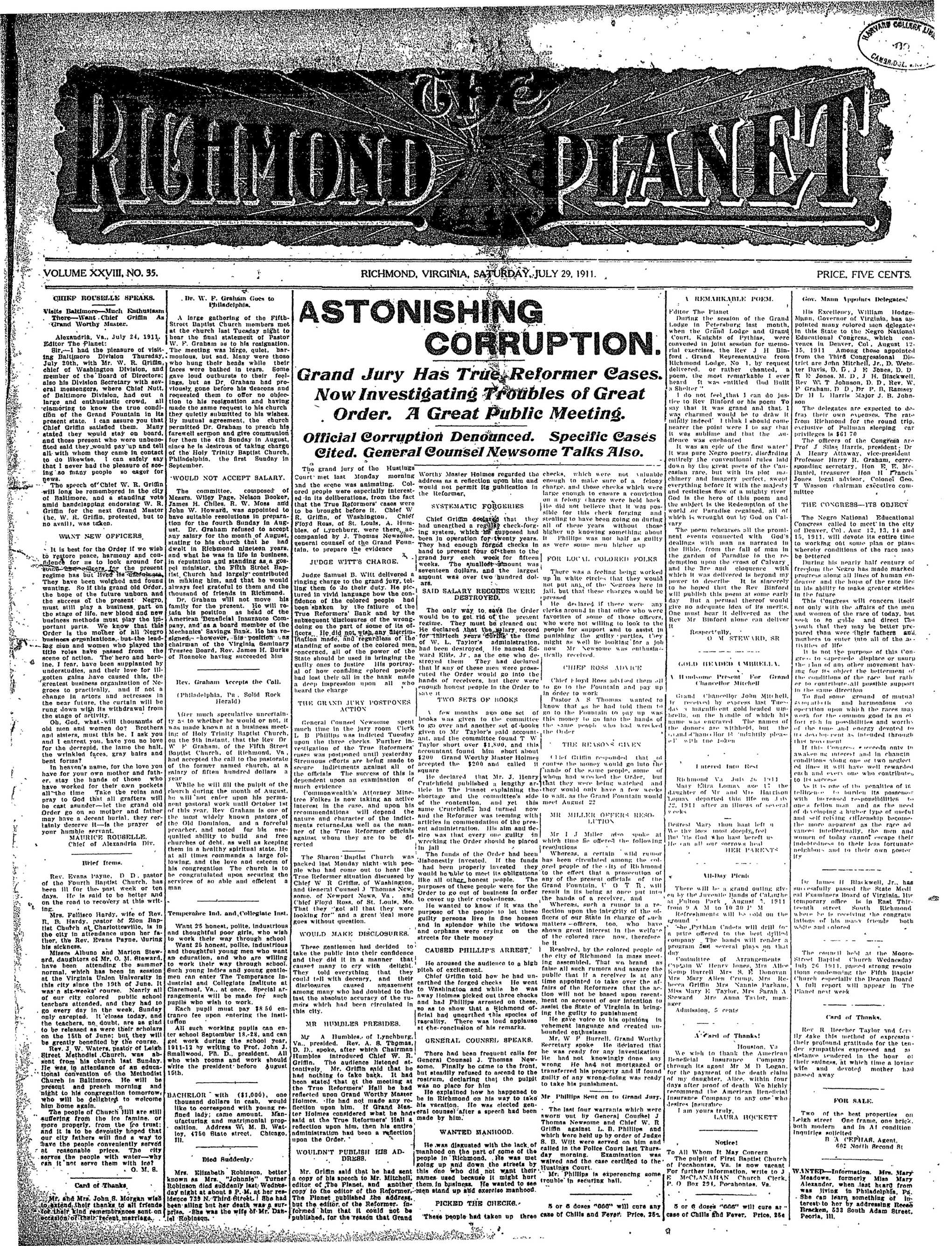
Richmond Planet
Saturday, July 29, 1911
Richmond, Virginia
Page text (machine-generated)
THE RICHMOND PLANET
```markdown
```
QIHRF ROUSELLE SPEAKS.
Visits Baltimore—Much Kuthuslamism There—Want Chief Griffin As Grand Worthy Master.
Alexandria, Va., July 24, 1911, Editor The Planet:
Sir,—I had the pleasure of visiting Baltimore Division Thursday, July 20th, with Mr. W. R. Griffin, chief of Washington Division, and member of the Board of Directors; also his Division Secretary with several messengers, where Chief Nutt, of Baltimore Division, had out a large and enthusiastic crowd, all clamoring to know the true condition of the Grand Fountain in his present state. I can assure you that Chief Griffin said of them. Many and those would stay on board, and those present who were unbenefited said they would pay up and tell all with whom they came in contact to do likewise. I can safely say that I never had the pleasure of sooing so many people so eager for news.
The speech of Chief W. R. Griflin will long be remembred in the city of Baltimore, and a standing vote amid handclapping endorsing W. R. Griflin for the next Grand Master (he, W. R. Griflin, protested, but to no avail), was taken.
WANT NEW OFFICERS
It is best for the Order if we wish to restore peace, harmony and confidence for us to look around for those officers for the present regime has but lived its duties. They have been wagged and found wanting. So if this the grand old Order, the hope of the future unborn and the success of the present Negro, must still play a business part on the stage of life, new blood and new business methods must play the important parts. We know that this Order is the mother of all Negro business organizations, but the leading men and women who played the title roles have passed from the scene of action. The hero and heroine, I fear, have been supplanted by understudies, and their love for ill-gotten gains have caused this, the greatest business organization of Negroes to practically, and if not a change in actors and actresses in the near future, the curtain will be rung down with its withdrawal from the stage of activity.
Oh, God, what will thousands of old men and women do? Brothers and sisters, must this be. I ask you and I entreat you, have you no love for the decrepid, the lame the halt, the wrinkled faces, gray hairs and bent forms?
In heaven's name, for the love you have for your own mother and father, stay the hands of those who have worked for their own pocketk all the time. Take the rols and pray to God that all graffters will be cast asunder—let the grand old Order go on so mother and father may have a decent burial, they certainly deserve it—is the prayer of your humble servant.
MAURICE ROUSELLE.
Brief Items.
Rev. Evana Payne, D. D., pastor of the Fourth Baptist Church, has been ill for the past week or ten days. He is said to be better and on the road to recovery at this writter.
Mrs. Falloisse Hardy, wife of Rev. R. B. Hardy, pastor of Zion Baptist Church at Charlotteville, is in the city in attendance upon her father, the Rev. Evans Payne, during his sickness.
Misses Albuno and Marion Steward, daughters of Mr. O. M. Steward, have been attending the summer normal, which has been in session at the Virginia Union University in this city since the 19th of June. It was a six-weeks' course. Nearly all of our city colored public school teachers attended, and they had to go every day in the week, Sunday only excepted. It closes today, and the teachers, no doubt, are as glad to be released as were their scholars on the 15th of June; but they will be greatly benefited by the course.
Rev. J. W. Waters, pastor of Leigh Street Methodist Church, was absent from his church last Sunday. He was, in attendance of an educational convention of the Methodist Church in Baltimore. He will be present and preach morning and night to his congregation tomorrow, who will be delighted to welcome him home again.
The people of Church Hill are still suffering from the ice famine, or more properly, from the ice trust; and it is to be devoutly hoped that our city fathers will find a way to have the people conveniently served at reasonable prices. The city serves the people with water—why can it not serve them with ice?
O. M. S.
Card of Thanks
Mr. and Mrs. John B. Morgan wish to extend their thanks to all friends for their kind remembrances sent on occasion of their recent marriage.
Dr. W. F. Graham Goes to Philadelphia.
A large gathering of the Fifth-Street Baptist Church members met at the church last Tuesday night to hear the final statement of Pastor W. F. Graham as to his resignation. The meeting was large, quiet, harmonious, but sad. Many were those who hung their heads while their faces were bathed in tears. Some gave loud outbursts to their feelings, but as Dr. Graham had previously, gone before his deacons and requested them to offer no objection to his resignation and having made the same request to his church they quietly submitted to his wishes. By mutual agreement, the church permitted Dr. Graham to preach his farewell sermon and give communion for them the 4th Sunday in August, since he is destroys of taking charge of the Holy Trinity Baptist Church, Philadelphia, the first Sunday in September.
WOULD NOT ACCEPT SALARY.
The committee, composed of Measra, Willy Page, Nelson Booker, James H. Chiles, R. W. Moss and John W. Howard, was appointed to have suitable resolutions in preparation for the fourth Sunday in August. Dr. Graham refused to accept any salary for the month of August, stating to his church that he had dwelt in Richmond nineteen years, and what he was in life in business, in reputation and standing as a gospel minister, the Fifth Street Baptist Church, had largely contributed in making him, and that he would always feel grateful to them and the thousand of friends in Richmond. Dr. Graham will not move his family for the present. He will retain his position as chief of American Insurance Company and as a board member of the Mechanics' Savings Bank. He has resigned—however, his position as chairman of the Virginia Seminary Trustee Board, Rev. James H. Burks of Roanoke having succeeded him
---
Rev. Graham Accepts the Call.
(Philadelphia, Pa. Solid Rock
Herald)
After much speculative uncertainty as to whether he would or not, it was made known at a business meeting of Holy Trinity Baptist Church, on the 8th Instant, that the Rev Dr W F Graham, of the Fifth Street Baptist Church, of Richmond, Va., had accepted the call to the pastorate of the former named church, at a salary of fifteen hundred dollars a year.
While he will fill the pulpit of the church during the month of August, he will not enter upon his permanent pastoral work until October 1st of this year. Rev Graham is one of the most widely known pastors of the Old Dominion, and a forceful preacher, and noted for his unequalled ability to build and free churches of debt, as well as keeping them in a healthy spiritual state. He at all times commands a large following, and the love and esteem of his congregation. The church is to be congratulated upon securing the services of so able and efficient a man
Temperature Ind. and, Collegiate Inst.
Want 25 honest, polite, industrious and thoughtful poor girls, who wish to work their way through school
Want 25 honest, polite, industrious and thoughtful young men who want an education, and who are willing to work their way through school. Such young ladies and young gentlemen can enter The Temperance Industrial and Collegiate Institute at Claremont, Va., at once. Special arrangements will be made for such pupils who wish to work. Each pupil must pay $850 entrance fee upon entering the institution. All such working pupils can enter school September 18-28, and can get work during the school year, 1011-12 by welfolding to Prof. John J. Smallwood, Ph. D., president. All who wish rooms and work should write the president before August 16th.
BACHELOR with ($1,000), one thousand dollars in cash, would like to correspond with young refinement lady; came amount. Manufacturing and matrimonial proposition. Address W. M. B. Watley, 4750 State street, Chicago, Ill.
Died Suddenly.
Mrs. Elizabeth Robinson, better known as Mrs. "Johnhun" Turner Robinson did suddenly last Wednesday night at about 8 P. M. at her residence 739 N. Third street. She had been alling but her death was a surprise. She was the wife of Mr. Daniel Robbins.
Grand Jury Has True Reformer Cases. Now Investigating Troubles of Great Order. A Great Public Meeting.
Official Corruption Denounced. Specific Cases Cited. General Counsel Newsome Talks Also.
The grand jury of the Hustings Court met last Monday morning and the scene was animating. Colored people were especially interested in its deliberations, from the fact that the True Reformers were to be brought to it. Chief W. R. Griffin of Washington Chief Floyd Ross, of St. Louis, A. Humbles, of Lynchburg, were there, accompanied by J. Thomas Newsome, general counsel of the Grand Fountain, to unearth the evidence.
Worthy Master Holmes regarded the address as a reflection upon him and would not permit its publication in the Reformer,
SYSTEMATIC FORGERIES
Chief Griffin declared that they had unearthed a regular check-forging system, which he supposed had been in operation for twenty years. They had enough forged checks in as were some men higher up
JUDGE WITT'S CHARGE.
Judge Samuel B. Witt delivered a ringing charge to the grand jury, telling them (to do their duty). He pictured in vivid language how the confidence of the colored people had been shaken by the failure of the True Reformers' Bank and by the subsequent disclosures of the wrongdoing on the part of some of its officers. He did not, with any discrimination made, and regardless of the standing of some of the colored men concerned, in the case of the power he should be used in bringing the guilty ones to justice. His portrayal of how confiding colored people had lost their all in the bank made a deep impression upon all who heard the charge
THE GRAND JURY POSTPONES ACTION
General Counsel Newsome spent much time in the jury room Clerk L B Phillips was indicted Tuesday upon the three checks. Further investigation of the True Reformer cases was postponed until yesterday. Streumann efforts are being made to secure indictments against all of the officials. The success of this is dependent upon an examination of much evidence. Commonwealth's Attorney Minetree Folkes is now taking an active interest in the case, and upon his recommendations will depend the nature and character of the indictments returned, as well as the manner of the True Reformer officials against whom they are to be directed
---
The Sharon Baptist Church was packed last Monday night with people who had come out to hear the True Reformer situation discussed by Chief W R Griffin, of Washington, and General Counsel J Thomas New, some, of Newport News, Va., and Chief Floyd Ross, of St. Louis, Mo. That they "got all that they were looking for" and a great deal more goes without question.
WOULD MAKE DISCLOSURES.
These gentlemen had decided to take the public into their confidence and they did it in a manner that caused many to cry with delight. They told everything that they could tell with decency, and their disclosures caused amazement among many who had doubted to the last the absolute accuracy of the rumors which had been circulated in this city.
MR HUMBLES PRESIDES
Mr. A. Humbles, of Lynchburg, Va., presided, Rev. A. S. Thomas, D. D., spoke, after which Chairman Humbles introduced Chief W. R. Griffin. The audience listened attentively. Mr. Griffin said that he had nothing to take back. It had been stated that at the meeting at the True Reformers' Hall he had reflected upon Grand Worthy Master Holmes. He had not made any mention of him. If Grand Master Holmes considered what he had said at the True Reformers' Hall a reflection upon him, then his entire administration had been a reflection upon the Order.
WOULDNT PUBLISH HIS ADDRESS.
Mr. Griffin said that he had sent a copy of his speech to Mr. Mitchell, editor of, The Planet, and another copy to the editor of the Reformer. The Planet published the address, but the editor of the Reformer, informed him that it could not be published, for the reason that Grand
PICKED THE CHECKING.
5 or 6 doses "000" will cure any
These people had taken up three case of Chills and Fever. Price, 28.2
Worthy Master Holmes regarded the address as a reflection upon him and would not permit its publication in the Reformer.
SYSTEMATIC FORGERIES
Chief Griffin declared that they had uncertaintly a required check-forgiving system, which he supposed had been in operation for twenty years. They had enough forged checks in hand to present four of them to the grand jury each week for fifteen weeks. The smallest amount was ten dollars, and the largest amount was over two hundred dollars.
SAID SALARY RECORDS WERE
DESTROYED.
The only way to save the Order would be to get rid of the present regime. They must be cleaned out. He declared that the salary record for thirteenth years during the time of W. L. Taylor's administration, had been destroyed. He named Edward Ellis, Jr. as the one who destroyed them. They had declared that if any of these men were prosecuted the Order would go into the hands of receivers, but there were enough honest people in the Order to save it.
TWO SETS OF BOOKS
A few months ago one set of books was given to the committee to go over and another set of books given to Mr Taylor's paid accountant, and the committee found T W Taylor short over $1,800, and this accountant found him short about $200 Grand Worthy Master Holmes accepted the $200 and called it square
He declared that Mr J. Henry Crutchfield published a lengthy article in The Planet explaining the shortage and the committee's side of the contention, and yet this same Crutchfield had turned now and the Reformer was seeming with articles in commendation of the present administration. His aim and desire was that every one guilty in wrecking the Order should be placed in jail.
The funds of the Order had been dishonestly invested. If the funds had been properly invested they would be able to meet its obligations like all other honest people. The purposes of these people were for the Order to go out of business in order to cover up their crookiness.
He wanted to know if it was the purpose of the people to let these guilty persons live in One houses and in splendor while the widows and orphans were crying on the streets for their money.
CAUSED PHILLIP'S ARREST
He aroused the audience to a high pitbob of excitement. Chief Griffin told how he had uncarried the forged checks. He went to Washington and while he was away Holmes picked out three checks and had Phillips arrested on these. He then asked the chief, a friend had uncarried this speculum of rascality. There was loud applause at the conclusion of his remarks.
GENERAL COUNSEL SPEAKS.
There had been frequent calls for General Counsel J. Thomas Newsome. Finally he came to the front, but steadily refused to second to the rostrum, declaring that the pulpit was no place for him. He explained how he happened to be on his way to take his vacation. He was elected general counsel after a speech had been made by him.
WANTED MANHOOD
He was disgusted with the lack of manhood on the part of some of the people in Richmond. He was not going up and down the streets by this one who did not want their names used because it might hurt them in business. He wanted to see men stand up and exercise manhood.
PICKED THE CHECKS.
checks, which were not valuable enough to make sure of a felony charge, and those checks which were large enough to ensure a conviction on a felony charge were held back he did not believe that it was possible for this check forging and stealing to have been going on during all of these years without those higher up knowing something; about it. Phillips was not half as guilty as were some more higher up
FOR LOCAL COLORED FOLKS
There was a feeling being worked up in white circles that they would not put any of the Negroes here in fall, but that these charges would be pressed.
He declared if there were any clerks around in that office who were favorites of some of those officers, who were not willing to look to the people for support and to assist in punishing the guilty parties, they might as well be looking for a job now. Mr Newsome was enthusiastically received.
CHIEF ROSS ADVICE
Chief Lord Ross advised them all to go to the Fountain and pay up in order to work
Pastor A S Thomas wanted to know that as he had told them to go to the Fountain to pay up was meant to go into the hamburg the same people who had wrecked the Order
THE REASONS GIVEN
Chief Griffin responded that, of course the money would go into the hands of the same people, some of whom had wrecked the Order, but that they were being watched and they would only have a few weeks to wait, as the Grand Fountain would meet August 22.
MR MILLER OFFERS RESOLUTION
Mr I J Miller also spoke at which time he offered the following resolutions.
Whereas, a certain wild rumor has been circulated among the colored people of the city of Richmond to the effect that a prosecution of any of the present officials of the Grand Fountain, V O T R, will result in its being at once put into the hands of a receiver, and
Whereas, such a rumor is a reflection upon the integrity of the officers of our State in charge of such matters—officers, too, who have shown great interest in the welfare of the colored race now, therefore be it
Resolved, by the colored people of the city of Richmond in mass meeting assembled. That we brand as false all such rumors and assure the public that if a receiver is at any time appointed to take over the affairs of the Reformers that the action will not be based upon resentment on account of our intention to assist the State of Virginia in bringing the guilty to punishment.
He gave voice to his opinion in vohement language and created unbounded enthusiasm.
Mr W P Burrell. Grand Worthy Secretary spoke. He declared that he was ready for any investigation. He had not knowingly done any wrong. He had not mortgaged or transferred his property and if found guilty of any wrong-doing was ready to take his punishment.
Mr Phillips Sent on to Grand Jury.
The last four warrants which were sworn out by General Counsel J Thomas Newcome and Chief W. R Griffin against L. B. Phillips and which were held up by order of Judge S. B. Wilt were served on him and called in the Police Court last Thursday morning. Examination was waived and the case certified to the Huntings Court. Mr. Phillips is experiencing some trouble in securing ball.
A REMARKABLE POEM.
Editor The Planet
During the session of the Grand Lodge in Petersburg last month, when the Grand Lodge and Grand Court, Knights of Pythias, were convened in joint session for memorial exercises, the Rev J H Binford. Grand Representative from Richmond Lodge, No 1, by request delivered, or rather chanted, a poem, the most remarkable I ever heard. It was entitled (and Built a Shelter."
I do not feel that I can do justice to Rev Binford or his poem. To say that it was grand and that I was charmed would be to draw it mildly indeed. I think I should come nearer the point were I to say that it was sublime and that the audience was enchanted.
It was an epic of the first water! It was pure Negro poetry, disclaring entirely the conventional rules laid down by the great poets of the Caucasus, with his plot machinery and imagery, perfect, sweeping everything before it with the majesty and resilient flow of a mighty river. God is the hero of this poem and the subject is the Redemption of the world or Paradise regained, all of which is wrought out by God on Calvary.
The poem rehearses all the prominent events connected with God's dealings with man as narrated in the Bible, from the full of man in the garden of Paradise in the redemption upon the cross of Calvary and the Fire and eloquence with which it was delivered is beyond my power to describe. It is sincerely to be hoped that the Rev Binfond will publish this poem at some early day. But a perusal thereof would give no adequate idea of its merits. One must hear it delivered as the Rev Mr Binfond alone can deliver
Respectfully,
O M STEWARD, SR
```markdown
```
GOLD HEADED UMBRELLA.
A Handsome Present. For Grand
Chancellor, Mitchell
Grand Chancellor John Mitchell,
It received by express last Tuesday
a magnificent gold headed umbrella,
on the handle of which his
name was encrusted. The names of
the donors are withheld, but the
grand Chancellor is "nightly pleased"
with the token.
Richmond Ma. July 26, 1911
Mary Eliza Louman age 17 the daughter of Mr. and Mrs Harrison Louman departed this life on July 22, 1911 after an illness of several weeks
Dearest Mary thou hast left us
We thy loss most deeply feel
But its God who hast bereft us
He can all our sorrows heal
MRS. PARENTS
All-Day Picnic
There will be a grand outing given by the Juvenile Bands of Calgary at Fulton Park, August 3, 1911 from 9 A M to 10 30 P M. Refreshments will be sold on the ground. The Pythonian Cadets will drill for a prize offered to the best skilled company. The bands will render a program several plays on that day. Committee of Arrangements Curtis W Henry Jones, Mrs. Alice Kemp Burrell Mrs. S. E. Donovan Mrs. Reece Griffin Mrs. Cump, Mrs. Rebecca Griffin Mrs. Barbara Miss Mary E. Taylor, Mrs Sarah A. Steward Mrs. Anna Taylor, manager
Admission. 5 cents
A Card of Thanks!
We wish to thank the American Beneficial Insurance Company through its agent Mr M D Logan, for the payment of the death claim of my daughter, Alice, within four days after proof of death. We highly recommend the American Beneficial Insurance Company to any one who desires insurance. I am yours truly,
LAURA HOCKETT
Notice!
Notice!
To All Widow I May Concern
The pulpit of First Baptist Church
of Chillis, Va. is now vacant
For further information write to 3
E. M.CLANAJAHIAN Church
Clerk.
P. O Box 294, Pocahontes, Va.
5 or 6 oranges "006" will cure a
case of Chills and Fever. Price, 286
PRICE. FIVE CENTS.
Gov. Mann Appoints Delegates!
His Excellency, William Hodge-Munn, Governor of Virginia, has appointed many colored men delegates in this State to the Negro National Educational Congress, which convenes in Denver, Col. August 12-15, 1911. Among those appointed from the Third Congressional District are John Mitchell, Jr., D. Webster Davis, D. D, J. E Jones, D. D R E Jones, M. D, J. H. Blackwell, Rev W T. Johnson, D. D, Rev W. P Graham, D D, Dr P. R. Ramsey Dr H L. Harris Major J. B. Johnson
The delegates are expected to defray their own expenses. The national Rehmann for the round trip, exclusive of Pullman sleeping car privileges is $6170
The officers of the Congress are Prof J Sills Harris, president, Dr A Henry Attaway, vice-president Professor Harry R. Graham, corresponding secretary, Hon E. E. McDaniel, treasurer Hon H Francis Jones legal advisor, Colonel Geo. T Wasson chairman executive committee
THE CONGRESS—ITS OBJECT
The Negro National Educational Congress called to meet in the city of Denver, Col. Aug. 12, 13, 14 and 15, 1911, will devote its entire time to working out some plan or plans whereby conditions of the race may be bettered.
During his nearly half century of freedom the Negro has made marked progress along all lines of human endeavor and the hope of the race life in his ability to make greater strides in the future.
This Congress will concern itself not only with the affairs of the men and women of the race of today, but seek to go guide and direct the youth that they may be better prepared than were their fathers and mothers to enter into all of the activities of life.
It is not the purpose of this Congress to superseize displace or usurp the plan of any other movement having for its object the betterment of the conditions of the race but rather to contribute all possible support in the same direction.
To find some ground of mutual sympathetic and harmonious cooperation upon which the races may work for the common good is an effort rich in possibilities and worth of the time and energy devoted to its development as intended through this movement.
If this Congress proceeds only to awaken interest and in change conditions along one or two neglected lines it will have well rewarded each and every one who contributes to its success.
As it is one of the penalties of intelligence to burden its possession with increased responsibilities to a fellow man and as the need of developing a higher type of useful and self-relying citizenship becomes the more apparent as the race advances intellectually, the men and women of today cannot escape their indebtedness to their less fortunate neighbors and to their own posture.
---
Dr. James H. Blackwell, Jr., has successfully passed the State Medical Examiners Board of Virginia. His temporary office is in Eat Thirteenth street South Richmond where he is receiving the congratation lattes of his many friends both white and colored
The council held at the Moor-
Street Baptist Church Wednesday
July 26, 1911, passed strong resolu-
tions condemning the Fifth Baptist
Church especially the Deacon Board
will appear in The Planet next week.
The text is a single block of text with no spaces or indentation. It appears to be a list of items or a table.
Card of Thanks.
Rev R Beecher Taylor and formally take this method of expressing their profound gratitude for the tender sympathies expressed and assistance rendered in the hour of their sadness, at which time a loving wife and devoted mother had passed away
FOR SALE
Two of the best properties on Leigh street. One frame, one brick both modern and in AI condition Inquiries solicited B A CEPHAS, Agent. 602 North Second St.
WANTED-Information. Mrs. Mary Meadows, formerly Miss Mary Alexander, when last heard from was living in Philadelphia, Pa. She can learn something of interest to her by addressing Reed Bracken, 533 South Adam Street, Pooria, Ill.
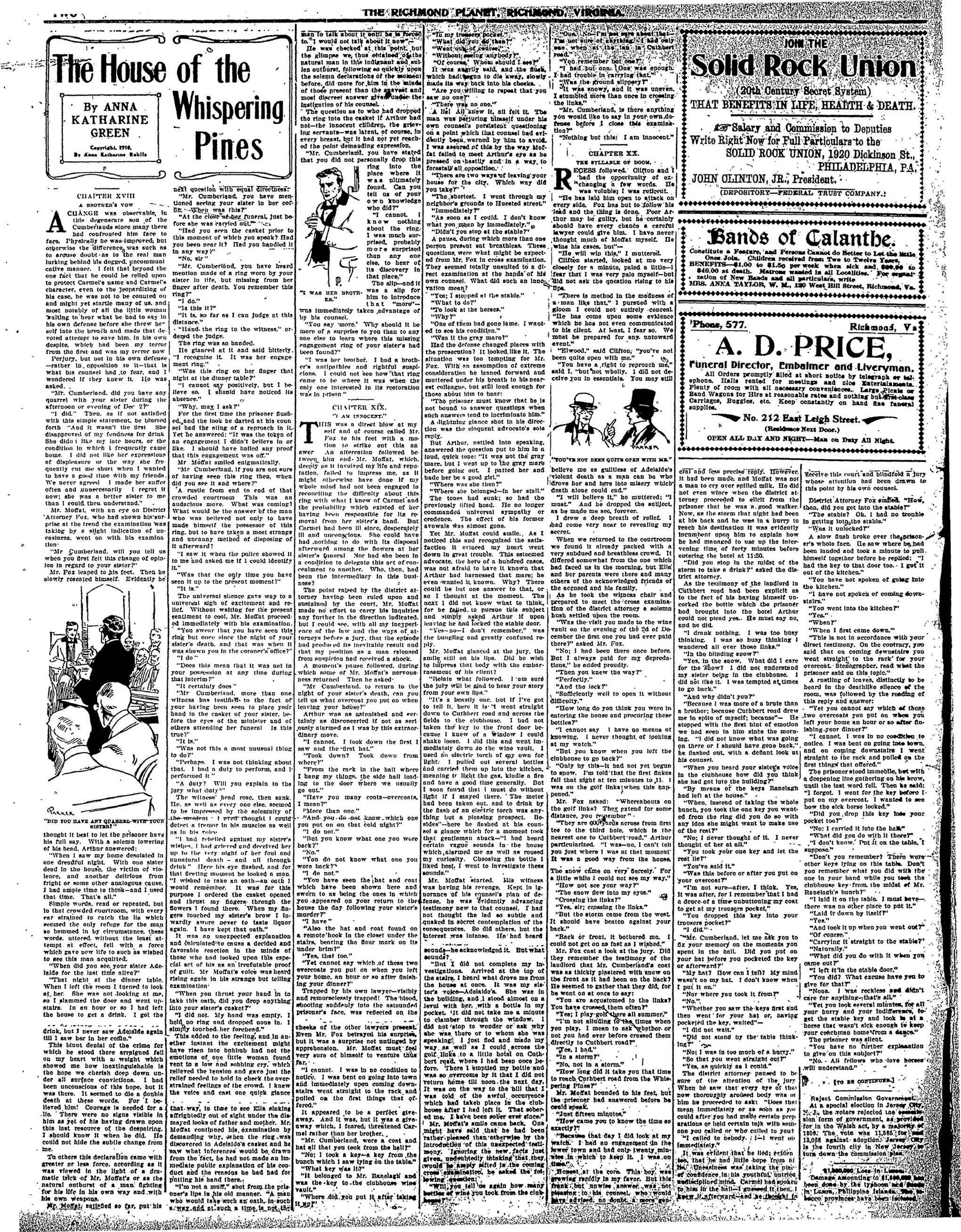
The House of the
CHANGIE was observable, in this degenerate son of the Cumberlandians since many there had confronted him face to face. Physically he was improved, but otherwise the difference, was such as to arouse doubt as to the real man lurking behind his dogged, uncommunicative manner. I felt that beyond the one fact that he could be relied upon to protect Carmel's name and Carmel's character, even to the jeopardizing of his case, he was not to be conquered on and might yet startle many of us, and most notably of all the little woman waiting to hear what he had to say in his own defense before she threw herself into the breach and made that devoted attempt to save him, in his own despite, which had been my terror from the first and was my terror now. Perjury, not in his own defense — rather in opposition to it—that is what his counsel had to fear, and I wondered if they knew it. He was asked.
"Mr. Cumberland, did you have any quarrel with your sister during the afternoon or evening of Dec 27?
"I did." Then, as if not satisfied with this simple statement, he blurted forth "And it wasn't the first. She disapproved of my fondness for drink. She didn't like my late hours, or the condition in which I frequently came home. I did not like her expressions of displeasure or the way she frequently cut me short when I wanted to have a good time with my friends. We never agreed. I made her suffer often and unnecessarily. I regret it now; she was a better sister to me than I could then understand."
Mr. Moffat, with an eye on District Attorney Fox, who had shown his surprise at the trend the examination was taking by a slight indication of uneasiness, went on with his examination:
"Mr. Cumberland, will you tell us when you first felt this change of opinion in regard to your sister?"
Mr. Fox leaped to his feet. Then he slowly resumed himself. Evidently he
PARKER
"DID YOU HAVE ANY QARABEL-WIVE YOUR SISTER?"
"DID YOU HAVE ANY QUAREBLE WITH YOUR SISTER?"
thought it beat to let the prisoner have his full say. With a solemn lowering of his head, Arthur answered:
"When I saw my home desolated in one dreadful night. With one sister dead in the house, the victim of violence, and another delirious from fright or some other anomalous cause, I had ample time to think—and I used that time. That's all."
Simple words, read or repeated, but in that crowded courtroom, with every strained to catch the lie which seemed the only refuge for the man so hemmed in by circumstance, these words, uttered, without the least attempt at effect, fell with a force which gave new life to such as wished to see this man acquitted.
"When did you see, your sister Adelaide for the last time alive?"
"That night at the dinner table. When I left the room I turned to look at her. She was not looking at me, so I slammed the door and went up stairs. In an hour or so I had left the house to get a drink. I got the drink, but I never saw Adelaide again till I saw her in her coffin."
This blunt denial of the crime for which he stood there arraigned fell on my heart with a weight which showed me how inexactly usable is the hope we cherish deep down under all surface convictions. I had been unconscious of this hope, but it was there. It seemed to die a double death at these words. For I believed him. Courage is needed for a life. There were no signs visible in him as yet of his having drawn upon this last resource of the despairing. I should know it when he did. He could not hide the subtle change from me.
To others this declaration came with greater or less force, according as it was viewed in the light of a dramatic trick of Mr. Moffat's or as the natural outburst of a man fighting for his life in his own way and with his own weapons. Mr. Moffat satisfied so far, put his
of the Whispering Pines
near question with equal directness:
"Mr. Cumberland, you have mentioned seeing your sister in her cotton. When was this?"
"At the close of her funeral, just before she was carried out."
"Had you seen the casket prior to this moment of which you speak? Had you been near it? Had you handled it in any way?"
"No, air"
"Mr. Cumberland, you have heard mentioned made of a ring worn by your sister in life, but missing from her finger after death. You remember this ring?"
"I do."
"Is this it?"
"It is, so far as I can judge at this distance."
"Hand the ring to the witness," or
depred the judge.
The ring was so handed.
He glanced at it and said bitterly,
"I recognize it. It was her engagement ring."
"Was this ring on her finger that night at the dinner table?"
"I cannot any positively, but I believe so. I should have noticed its absence."
"Why, may I ask?"
For the first time the prisoner flushed, and the look he darted at his counsel had the sting of a reproach in it. Yet he answered: "It was the togen of an engagement I didn't believe in or like. I should have halted any proof that this engagement was off."
Mr Moffatt smiled enigmatically.
"Mr Cumberland, if you are not sure of having seen this ring then, when did you see it and where?"
A rustle from end to end of that crowded courtroom. This was an audacious move. What was coming? What would be the answer of the man who was believed not only to have made himself the possessor of this ring, but to have taken a most strange and unearny method of disposing of it afterward?
"I saw it when the police showed it to me and asked me if I could identify it."
"Was that the ugly time you have seen it up to the present moment?"
"It is."
The universal silence gave way to a universal sigh of excitement and relief. Without waiting for the present sentiment to cool, Mr. Mofat proceeded immediately with his examination.
"You swear that you have seen this ring but once since the night of your sister's death, and that was when it was shown you in the coroner's office?"
"I do."
"Does this mean that it was not in your possession at any time during that interim?"
"It certainly does."
"Mr. Cumberland, more than one witness has testified to the fact of your having been seen to place your hand in the casket of your sister, before the eyes of the minister and of others attending her funeral Is this true?
"It is."
"Was not this a most unusual thing to do?"
"Perhaps. I was not thinking about that. I had a duty to perform, and I performed it."
"A duty? Will you explain to the jury what duty?"
The witness' head rose, then sank. He, as well as every one else, seemed to be impressed by the solemnity of the moment. I ever thought I could detect a tremor in his muscles as well as in his voice.
"I had robbed against my sister's wishes, I had grieved and deceived her up to the very night of her foul and unnatural death - and all through drink." Here his eye flashed, and for that stealing moment he looked a man. "I wished to take an oath—an oath I would remember. It was for this purpose I ordered the casket opened and thrust, my fingers through the flowers I found there. When my fingers touched my sister's brow I inwardly aware never to taste liquor again. I have kept that oath."
"It was an unexpected explanation and calculated to cause a decided and favorable reaction in the minds of those who had looked upon this special act of his as an irrefutable proof of guilt. Mr Moffat's voice was heard rising again in his strange but telling examination.
"When you thrust your hand in to take this oath, did you drop anything into your sister's casket?"
"I did not. My hand was empty. I hold no ring and dropped none in. I simply touched, her forehead."
"This added to the feeling, and in another instant the excitement might have risen into hnbub had not the emotions of one little woman found vent in a low and sobbing cry, which relieved the tension and gave just the relief needed to hold in check the overstrained feelings of the crowd. I knew the voice and cast one quick glance that way, in time to see Ella sinking affrightedly out of sight under the damaged looks of father and mother. Mr. Moffat continued his examination by demanding wri, when the ring was discovered in Adelaide's casket and he saw what inferences would be drawn from the fact, he had not made an immediate public explanation of his conduct and the reason he had had for pitting his hand there.
"I'm not a mum." shot from the prisoner's lips in his old manner. "A man who would take such an oath, in such a way, and sit such a time, is not the
man to talk about it until be is forced to "I would not talk about it now."
He was checked at this point, but the glimpse we thus obtained of the natural man in this indignant and sulen outburst, following so quickly upon the solemn declarations of the moment before, did more for him in the minds of those present than the anacest and most discreet answer given under the instigation of his counsel.
"In my treasury pocket," "What did you do then?" "What out of course?" "Without seeing anybody?" "Of course," Whom should I see? It was sagrily said, and the flush, which had begun to die away, slowly made its way back into his cheeks. "Are you willing to repeat that you saw no one?" "There was no one."
"One. No—I must see about that—I'm not sure of anything. I had only one when sat the lan in Cuthbert road." "You remember but one?" "I had but one. One was enough. I had trouble in carrylog that." "Was the ground slippery?" "It was snowy, and it was uneven. I stumbled more than once in crossing the links."
JOHN THE Solid Rock Union
(20th Century Secret System)
THAT BENEFITS IN LIFE, HEALTH & DEATH
The question as to who had dropped the ring into the casket if Arthur had not—the innocent children, the grieving servants—was latent, of course, in every breast, but it had not yet reached the point demanding expression. "Mr. Cumberland, you have stated that you did not personally drop this
ring into the
place where it
was ultimately
found. Can you
tell us of your
own knowledge
who did?
P.
"I cannot I know nothing about the ring. I was much surprised, probably more surprised than any one else, to hear of its discovery in that place."
"The alp—and it was a slip for him to introduce that "more"—was immediately taken advantage of by his counsel.
"You say 'more.' Why should it be more of a surprise to you than to any one else to learn where this missing engagement ring of your sister's had been found?
"I was her brother. I had a brother's antipathies and rightful suspicions. I could not see how that ring came to be where it was when the only one interested in its restoration was in prison."
CHAPTER XIX
"I AN INNOCENT."
THIS was a direct blow at my self and of course called Mr Fox to his feet with a mo
tion to strike out this an answer. An alteration followed between him and Mr. Moffat, which deeply as it involved my life and reputation, failed to impress me, as it might otherwise have done. If my whole mind had not been engaged in reconciling the difficulty about this ring with what I knew of Carmel and the probability which existed of her having been responsible for its removal from her sister's hand. But Carmel had been ill since, desperately ill and unconscious. She could have had nothing to do with its disposal afterward among the flowers at her sister's funeral. Nor had she been in a condition to delegate this act of concealment to another. Who, then, had been the intermediary in this business?
The point raised by the district attorney having been ruled upon and sustained by the court, M. Mr. Moffat made no effort to carry his inquiries any further in the direction indicated, but I could see, with all my inexperience of the law and the ways of attorneys before a jury, that the episode had produced its inevitable result and that my position as a man released from suspicion had received a shock. A moment's pause followed, during which some of Mr. Moffat's nervousness returned. Then he asked:
"Mr. Cumberland, to return to the night of your sister's death, can you tell us what overcrowd you put on when leaving your house?"
Arthur was as annotated and certainly as disconcerted if not as seriously alarmed as I was by this extraordinary move.
"I cannot. I took down the first I saw and the first hat."
"Took down? Took down from where?"
"From the rock in the hall where
I hang my things, the side hall leading to the door where we usually go out."
"Have you many conts—overconta,
I mean?"
"More than one."
"And you do not know which one you put on on that cold night?"
"I do not."
"But you know what one you wore back?"
"No."
"You do not know what one you wore back?"
"I do not."
"You have seen the hat and cont which have been shown here and sworn to as being the ones in which you appeared on your return to the house the day following your sister's murder."
"I have"
"Also the hat and coat found on a remote hook in the closet under the stairs, bearing the flour mark on its under brim?"
"Yes, that too."
"Tet cannot say which of those two overcoats you put on when you left your home, an hour or so after finishing your dinner."
Trapped by his own lawyer—visibly and remorselessly trapped! The blood, shooting suddenly into the astounded prisoner's face, was reflected on the cheeks of the other lawyers present. Even Mr. Fox betrayed his surprise, but it was a surprise not uningested by apprehension. Mr. Moffat must feel very sure of himself to venture thus far.
"I cannot. I was in no condition to notice. I was bent on going into town and immediately upon coming down-atstaat went straight to the rack and pulled on the first things that offered."
It appeared to be a perfect giveaway. And it was, but it was a giveaway which, I feared, threatened Carmal rather than her brother.
"Mr. Cumberland, wore a cost and all that you took from the hall!"
"No; I took a key-a key from the bunch which I saw lying on the table."
"What key was it?"
"Where did you put it after taking it up?"
"In my treasury pocket."
"What did you do then?"
"Went out of course."
"Without seeing anybody?"
"Of course, who should I see?"
It was shortly told, and the flush, which had begun to die away, slowly made its way back into his cheeks.
"Are you willing to repeat that you saw no one?"
"There was no one."
A lie! All knew it, all felt it. The man was perjuring himself under his own counsel's persistent questioning on a point which that counsel had evidently been warned by him to avoid.
I was assured of this by the way Mofat failed to meet Arthur's eye as he pressed on hastily and in a way, to forestall all opposition.
"There are two ways of leaving your house for the city. Which way did you take?"
"The shortest. I went through my neighbor's grounds to Huected street." "Immediately?" "As soon as I could. I don't know what you mean by immediately." "Didn't you stop at the stable?" A pause, during which more than one person present sat breathless. These questions, were what might be expected from Mr. Fox in cross examination. They seemed totally unsuited to a direct examination at the hands of his own counsel. What did such an innovation mean? "Yes; I stopped at the stable." "What to do?" "To look at the horses." "Why?" "One of them had gone lame. I waited to see his condition."
Had the defense changed places with the prosecution? It looked like it. The situation was too tempting for Mr. Fox. With an assumption of extreme consideration he leaned forward and muttered under his breath to his nearest colleague, but still loud enough for those about him to hear:
"The prisoner must know that he is not bound to answer questions when such answers tend to incriminate him."
A lightning glance shot in his direction was the eloquent advocate's sole reply.
But Arthur, nettled into speaking, answered the question put to him in a loud, quick tone: "It was not the gray mare, but I went up to the gray mare before going out. I patted her and bade her a good girl."
"Where she belonged—in her still." The tones had sunk; so had the previously lifted head. He no longer commanded universal sympathy or credence. The effect of his former avowals was almost gone.
Yet Mr. Moffat could smile.. As I noticed this and recognized the satisfaction it evinced my heart went down in great trouble. This esteemed advocate, the hero of a hundred cases, was not afraid to have it known that Arthur had harnessed that marie; he even wanted it known. Why? There could be but one answer to that, or so I thought at the moment. The next I did not know what to think, for be failed to pursue this subject and simply asked Arthur if upon leaving he had locked the stable door. "Yes—no I don't remember," was the bungling and greatly confused reply.
Mr. Moffat glanced at the jury, the smile still on his lips. Did he wish to impress that body with the embarrassment of his client?
"Hate what followed. I am sure
the jury will be glad to hear your story
from your own lips."
"It's a beauty one, but if I've got to tell it, here it is." I went straight down to Cuthbert road and across the fields to the clubhouse. I had not taken the key to the front door because I knew of a window I could shake loose. I did this and went immediately down to the wine vault. I used an electric torch of my own for light. I pulled out several bottles and carried them up into the kitchen, meaning light the gas, kludge a fire and have a good time generally. But I soon found that I must do without light if I stayed there. The meter had been taken out, and to drink by the flash of an electric torch was anything but a plaining prospect. Besides—"here he flashed at his counsel a glance which for a moment took that gentleman aback—"I had heard certain vague sounds in the house which alarmed me as well as roused my curiosity. Choosing the bottle I liked best, I went to investigate these sounds."
Mr. Mofat started. His witness was having his revenge. Kept in ignorance of his counsel's plan of defense, he was evidently advancing testimony new to that counsel. I had not thought the lad so subtle and quaked in secret contemplation of the consequences. So did others, but the interest was intense. He had heard sounds—he acknowledged it. But what sounds?
"But I did not complete my investigations. Arrived at the top of the stairy. I heard what drove me from the house at once. It was my sister's voice—Adolaldoa. She was in the building, and I stood almost on a level with her, with a bottle in my pocket. 'It did not take me a minute to clamber through the window. I did not stop to wonder or ask why she was there or to whom she was speaking.' I just nod and made my way, as well as I could, across the golf, links to a little hotel on Cuthbert road, where I had been once before. There I implied my bottle and was so overcome by it that I did not return home till noon, the next day. It was on the way to the hill that I was cold of the awful, occurrence which had take place in the clubhouse after I had left it. That sobered me. I have been sober ever since."
Mr. Moffat's smile came back. One might have said that he had been rather pleased than otherwise by the introduction of this unexpected testimony. Ignoring the new facts just given, undoubtedly thinking that they would be equally sifted in the coming cross examination, he saked the following question: "Will you (all) us again how many bottles of wine you look from the club house?"
"One. No. I'm not sure about that—
I'm not sure of anything. I had only
one when at the inn in Cuthbert
road."
"You remember but one?"
"I had but one. One was enough.
I had trouble in carrying that."
"Was the ground slippery?"
"It was snowy, and it was uneven.
I stumbled more than once in crossing
the links."
"Mr. Cumberland, is there anything
you would like to say in your own de-
fense before I close this examina-
tion?"
"Nothing but this: I am innocent."
CHAPTER XX.
RECESS followed. Clifton and I had the opportunity of ex-changing in a few words. He was voluble; I was reficent.
"He has laid him open to attack on every side. Fox has but to follow his lead and the thing is done. Poor Arthur may be guilty, but he certainly should have every chance a careful lawyer could give him. I have never thought much of Mofat myself. He whin his cases, but"—
"He will win this," I muttered. Clifton started, looked at me very closely for a minute, pailed a little—fear that I was very palo myself—but did not ask the question rising to his tips.
"There method in the madness of a man like that," I pursued with a gloom I could not entirely conceal. "He has come upon some evidence which he has not even communicated to his client. At least, I fear so. We must be prepared for any untoward event."
"Elwood," said Clifton, "you've not been quits open with me."
"You have a right to reproach me," said I, "but hot wholly. I did not deceive you in essentials. You may still
"YOU'VE NOT BEEN QUITE OPEN WITH ME."
believe me as guiltless of Adelaide's violent death as a man can be who drove her and hers into misery which death alone could end."
"I will believe it," he muttered; "I must." And he dropped the subject, as he made me see, forever.
I drew a deep breath of relief. I had come very near to revealing my secret.
When we returned to the courtroom we found it already packed with a very subdued and breathless crowd. It differed somewhat from the one which had faced us in the morning, but Ellis and her parents were there and many others of the acknowledged friends of the accused and his family.
As he took the witness chair and prepared to meet the cross examination of the district attorney a solemn bush settled upon the room.
"Was the visit you made to the wine vault on the evening of the 2d of December the first one you had ever paid there?" asked Mr. Fox.
"No; I had been there once before. But I always paid for my depredations," he added proudly.
"Then you knew the way?"
"Perfectly."
"And the lock?"
"Sufficiently well to open it without difficulty."
"How long do you think you were in entering the house and procuring these bottles?"
"I cannot say I have no means of knowing. I never thought, of looking at my watch."
"But you know when you left the clubhouse to go back?"
"Only by this—it had not yet begun to snow. I'm told that the first flakes fell that night at ten minutes to 11. I was on the golf links when this happened."
Mr. Fox asked: "Whereabouts on the golf links? They extend for some distance, you remember."
"They are 600 yards across from first tee to the third hole, which is the nearest one to Cuthbert road." Arthur particularized. "I was—no, I can't tell you just where I was at that moment! It was a good way from the house."
The snow came on very fiercely. For a little while I could not see my way."
"How not see your way?"
"The snow flew into my eyes." "Crossing the links."
"Yes, sir; crossing the linka."
"But the storm came from the went.
It should have beaten against your back."
"Back or front, it bothered me. I could not get on as fast as I wished."
Mr. Fox cast a look at the jury. Did they remember the testimony of the landlord that Mr. Cumberland's coat was as thickly plastered with snow on the front as it had been on the back? He seemed to gather that they did, for he went on at once to say:
"You are accustomed to the links?
You have crossed them often?"
Yes; I play golf there all summer."
"I'm not alluding to the times when you play. I mean to ask whether or not you had ever before crossed them directly to Cuthbert road?"
"Yes, I had."
"In a storm?"
"No, not in a storm."
"How long did it take you that time to reach Cuthbert road from the Whispering Pines?"
Mr. Moffat bounded to his feet, but the prisoner had answered before he could speak.
"Just fifteen minutes."
"How came you to know the time so exactly?"
"Because that day I did took at my watch. I had an engagement in the lower town and had only twenty minutes in which to keep it. I was on time."
"Honest, at the core. This boy, was growing rapidly in my favor. But this frank, but unwise, answer, was not pleasing to his counsel, who would have advised, no doubt, a more genius."
(20th Century Secret System) THAT BENEFITS IN LIFE, HEALTH & DEATH.
Constitute a Feature, and Persons Cannot do Better to Let the Little One Joke. Children received from Two to Twelve Years.
BENEFITS—$1.00 to $1.50 per week when sick and $20.00 to $40.00 at death. Matrons wanted in all Localities. For organization of New Bands and all particulars, write
MRS. ANNA TAYLOR, W. M., 120 West Hill Street, Richmond, Va.
A. D. PRICE.
Funeral Director, Embalmer and Liveryman.
All Orders promptly allied at short notice by telegraph or tele-
phone. Halls rented for meetings and nios Entertainments.
Plenty of room with all necessary conveniences. Large Picnic or
Band Wagons for Hire at reasonable rates and nothing but fine cla-
sarages, Buggies, etc. Keep constantly on hand fine funeral
supplies.
enl and less precise reply. However, it had been made, and Moffat was not a man to cry over spilled milk. He did not even wince when the district attorney proceeded to elicit from the prisoner that he was a good walker. Now, as the storm that night had been at his back and he was in a hurry to reach his destination it was evidently incumbent upon him to explain how he had managed to use up the intervening time of forty minutes before entering the hotel at 11:30.
"Did you stop in the midst of the storm to take a drink?" asked the district attorney.
As the testimony of the landlord in Cuthbert road had been explicit as to the fact of his having himself uncorked the bottle which the prisoner had brought into the hotel Arthur could not plead yes. He must say no, and he did.
"I drank nothing. I was too busy thinking. I was so busy thinking I wandered all over those links."
"In the blinding snow?"
"Yes, in the snow. What did I care for the show? I did not understand my sister being in the clubhouse. I did not like it. I was tempted at times to go back."
"And why didn't you?"
"Because I was more of a brute than a brother; because Cuthbert road drew me in spite of myself; because"—He stopped with the first hint of emotion we had seen in him since the morning. "I did not know what was going on there or I should have gone back," he flashed out, with a defiant look at his counsel.
"When you heard your sisters' voice in the clubhouse how did you think she had got into the building?"
"By means of the keys Ranelagh had left at the house."
"When, instead of taking the whole bunch, you took the one key you wanted from the ring did you do with any idea she might want to make use of the real?"
"No, I never thought of it. I never thought of her at all."
"You took your one key and let the rest lie!"
"You've said it."
"Was this before or after you put on your overcoat?"
"I'm not sure—after, I think. Yes, it was after, for I remember that I had a deuce of a time unbuttoning my coat to get at my trousers pocket."
"You dropped this key into your trousers pocket?"
"I did."
"Mr. Cumberland, let me nak you to fix your memory on the moments you spent in the hall. Did you put on your hat before you pocketed the key or afterward?"
"My hat? How can I tell? My mind wasn't on my hat. I don't know when I put it on."
"Nor where you took it from?"
"No."
"Whether you saw the keys first and then went for your hat or, having pocketed the key, waited"—
"I did not wait."
"Did not stand by the table thinking"
"Not I was in too much of a hurry."
"So that you went straight out?"
"Yes, an quickly as I could."
The district attorney paused to be sure of the attention of the jury. When he saw that every eye of this now thoroughly aroused body was in him he proceeded to ask: "Does that mean immediately or as soon as you could after you had made certain preparations or held certain talk with someone you called or who called to your"
"I called to hebody. I—I went on immediately."
It was evident that he lied; eridien
too; that he had little hope from him
Hi. Uriessiness was taking the plum
of confidence in his youthful butru-
ed unplied mind. Carmel had spoken
to him in the hall I guessed it then.
I knew it afterward and I thought it
Receive this court and blindfold a jury whose attention had been drawn to this point by his own counsel.
District Attorney Fox said, "How, then, did you get into the stables?"
"Was it unlocked?"
A slow dush broke over the prisoner's whole face. He saw where he had been landed and took a minute to pull himself together before he replied: "I had the key to that door too. I got it out of the kitchen."
"You have not spoken of going into the kitchen."
"I have not spoken of coming downstairs."
"You went into the kitchen?"
"Yes."
"When?"
"When I first came down."
"This is not in accordance with your direct testimony. On the contrary, you said that on coming downstairs you went straight to the rack for your overcoat. Stenographer, read what the prisoner said on this topic."
A rustling of leaves, distinctly to be heard in the deathlike silence of the room, was followed by the reading of this reply and answer:
"Yet you cannot say which of these two overcautious you put on when you left your home an hour or so after finishing your dinner?"
"I cannot. I was in no condition to notice. I was bont on going into town, and on coping downstairs I went straight to the rack and pulled on the first things that offered."
The prisoner stood immobile, but with a deepening line gathering on the brow, until the last word fell. He said: "I forgot. I went for the key before I put on my overcoat. I wanted to see how the sck horse looked."
"Did you, drop this key into your pocket too?"
"No: I carried it into the hall."
"What did you do with it there?"
"I don't know. Put it on the table, I suppose."
"Don't you remember? There were other keys lying on this table. Don't you remember what you did with the one in your hand while you took the clubhouse key from the midst of Mr. Ranelingh's bunch?" "I laid it on the table. I must have—there was no other place to put it." "If I didn't do it look!"
"Laid it down by itself?"
"Yes."
"And took it up when you went out?"
"Of course."
"Carrying it straight to the stable?"
"Naturally."
"What did you do with it when you came out?"
"I left it in the stable door."
"You did? What excuse have you to give for that?"
"None. I was reckless and didn't care for anything—that's all."
"Yet you took several minutes, for all your hurry and your indifference, to get the stable key and look in at a horse that wasn't sick enough to keep your cottahome home from a daycae."
The prisoner was silent.
"You have no further explanation to give on this subject?"
"No. All follows who love horses will understand."
Reject Commission Government.
At a special election in Jersey City,
M. J., the voters rejected the commission form of government, as provided for in the Walsh act, by a majority of 1808. The vote was 11,565 for and 13,088 against adoption. Jersey City is the fourth city in New Jersey to turn down the commission plan.
$1,800,000 Loss in Louisiana
Damage amounting to $1,800,000 has
been done by the typhoon and floods
in Louisiana, Philippine Islands, and
beach provinces have been leached.
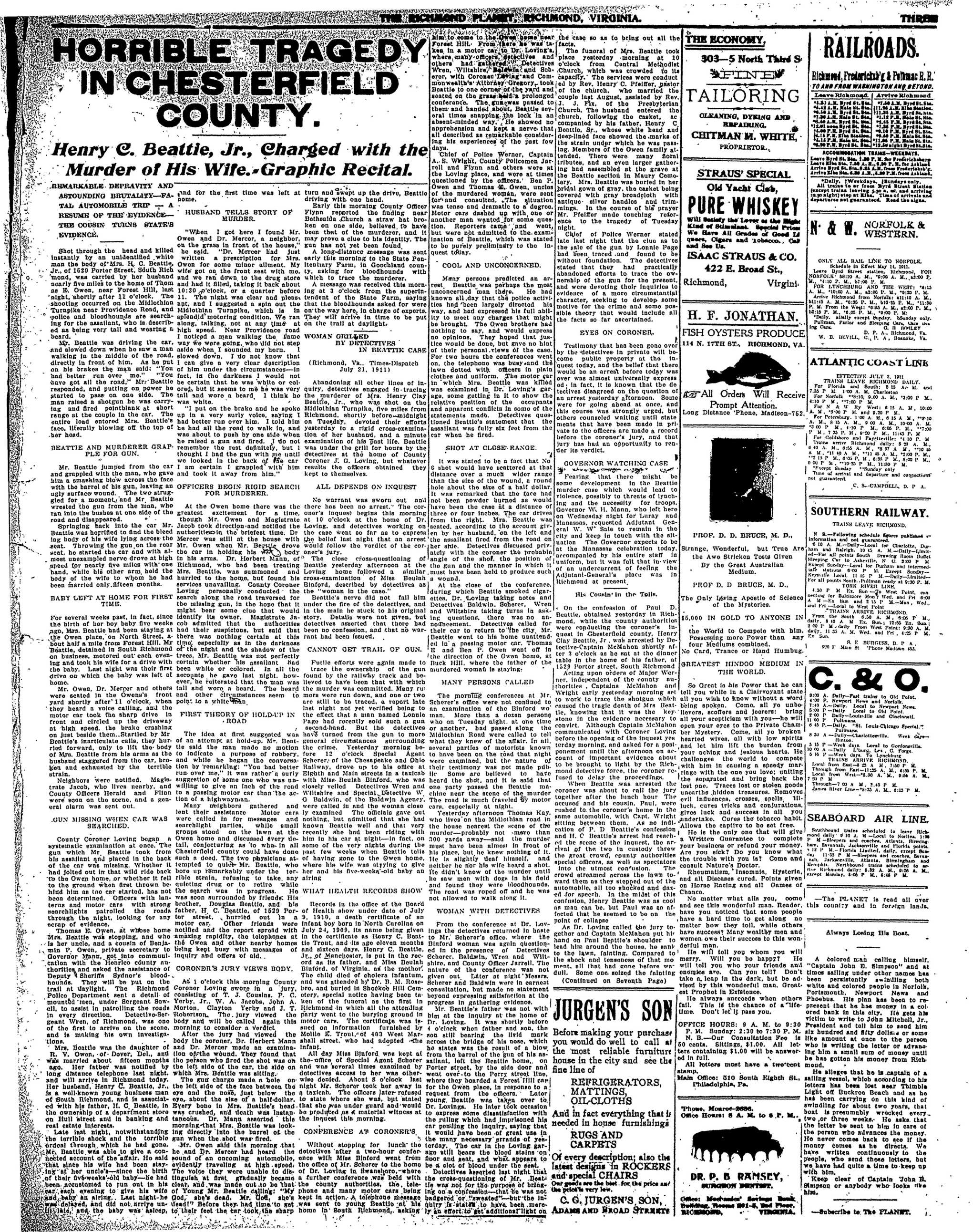
Henry C. Beattie, Jr., Charged with the Murder of His Wife.-Graphic Recital.
REMARKABLE DEPRAVITY AND ASTOUNDING BRUTALITY—FACTAL AUTOMOBILE TRIP — A RESUME OF THE EVIDENCE—THE COUSIN TURNS STATE'S EVIDENCE.
Shot through the head and killed instantly by an unidentified white man the body of Mrs. H. C. Beatty, Jr. of 1629 Porter Street, South Richmond, was carried by her husband nearly five miles to the home of Thom as E. Owen, near Forest Hill, last night, shortly after 11 o'clock. The shooting occurred on the Midlothian Turnpike near Providence Road, and police and bloodhounds are searching for the assailant, who is described as being very tall and wearing a beard.
Mr. Beattie was driving the car, and slowed down when he saw a man walking in the middle of the road, directly in front of him. As he put on his brakes the man said: "You had better run over me." "You have got all the road," Mr. Beattie responded, and putting on power he started to pass on one side. The man ran away, a shoelogan he was carrying and fired pointblank at short range at the couple in the car. The entire load entered Mrs. Beattie's face, literally blowing off the top of her head.
BEATTIE AND MURDERER GRAP
PLE FOR GUN.
Mr. Battie jumped from the car and grapped with the man, who gave him a smashing blow across the face with the barrel of his gun, leaving an ugly surface wound. The two struggled for a moment, and Mr. Battie wrested the gun from the man, who ran into the bushes at one side of the road and disappeared.
Springing back into the car Mr. Battie was horrified to find the blood ing body of his wife lying across the seat. Throwing the gun round her seat he ran back and with almost unexplained nerve drove at high speed for nearly five miles with one hand, while his other arm, hold the body of the wife to whom he had been married only fifteen months.
BABY LEFT AT HOME FOR FIRST TIME.
For several weeks past, in fact, since the birth of her boy baby five weeks ago, Mrs. Beattie had been staying at the Owen place, on North Street, about half a mile from Forest Hill. Mr. Beattie, detained in South Richmond on business, motored out each evening and took his wife for a drive with the baby. Last night was their first drive on which the baby was left at home.
Mr. Owen, Dr. Merger and others were seated in the Owens's front yard shortly after '11 o'clock, when they heard a voice calling, and the motor car took the sharp drive in front and circled up the driveway at high speed, the brake crashing on beside it. Startled by Mr. Beatties intricate calls, they hurried forward, only to lift the body of Mrs. Beattie from his arms as the husband staggered from the car, broken and exhausted by the terrible strain.
Neighbors were notified. Magistrate Jacob, who lives nearby, and County Officers Herald and Flimin were called and a general alarm was sent out.
.GUN MISSING WHEN CAR WAS SEARCHED.
County Coroner Loving began a systematic examination at once. The gun which Mr. Boatte took from his assailant and placed in the back of the car was missing. Whether it had fled out in that wild ride back to the Owen house, or whether it fell to the ground when first thrown behind him as too car started, has not been determined. Officers with lanters and motor cars with strong searchlights patrolled the roads through the night, looking for any scrape of evidence.
Thomas E. Owen, at whose home Mrs. Battle was stopping, and who is her uncle, and a cousin of Benjamin P. Owen, private secretary to Governor Manu, got into communication with the Honrico county authorities and asked the assistance of Deputy Sheriff Sydnor's bloodhounds. They will be put on the trail at daylight. The Richmond Police Department sent a detail of mounted men, under Sergeant Sowell, to assist in patrolling the roads in every direction. Detective-Sergeant Wren, of Richmond, was one of the first to arrive on the scene, and is making his own investigations.
Mrs. Beattie was the daughter of R. V. Owen, of Dover, Dol, and was married about fifteen months ago. Her father was notified by long distance telephone last night, and will arrive in Richmond today. Her husband, Henry C. Beattie, Jr., is a well-known young business man of South Richmond, and is associated with his father, H. C. Beattie, in the ownership of a department store on Hull street and in banking and real estate interests.
Late at night, notwithstanding the terrible shock and the terrible ordeal through, which he had gone, Mr. Beattie was able to give a connected account of the affair. He said that since his wife had been staying at her uncle's—since the death of their five-week-old baby he had been acquainted to about in his wife an alrning. Last night-he was delayed, and did not arrive unfit late, and the baby was salesen.
and for the first time was left at nome.
HUSBAND TELLS STORY OF
MURDER.
"When I got here I found Mr. Owen and Dr. Mercer, a neighbor, on the grass in front of the house," he said. "Dr. Mercer had just written a prescription for Mrs. Owen for some minor ailment. My wife got on the front seat with me, and we ran down to the drug store and had it filled, taking it back about 10:30 'clock, or a quarter before 11. The night was clear and pleasant, and I suggested a spin out the Midlothian Turnpike, which is in splendid motoring condition. We ran along, talking, at not any (mê) at high speed. Near Providence road I noticed a man walking the same way we were going, who did not step aside when I sounded my form. When I heard, I knew my way. I can give a very clear description of him under the circumstances—in fact, in the darkness I would not be certain that he was white or colored, but it seems to me he was very tall and wore a beard. I think he was white.
"I put on the brake and he spoke up in a very early voice, saying I had better run over him. I told him he had all the road to walk in, and was about to push by one side when he raised a gun and fired. I do not remember the rest definitely, but I remember the rest definitely, and we looked in the back of $he$ car I am certain I granled with him and took it away from him."
OFFICERS BEGIN RIOID SEARCH
FOR MURDERER.
At the Owen home there was the greatest excitement for a time, though Mr. Owen and Magistrate Jacob took direction and notified the authorities in the briefest time. Dr. Mercer was still at the house with Mr. Owen when Mr. Bettle drove the car in holding his wife body in his arms. Dr. Herbert Mann, of Richmond, who had been treating Mrs. Bettle, was summoned and hurried to the home, but found his services unavailing. County Coroner Loving personally conducted the search along the road traversed for the missing gun, in the hope that it might bear some clue that would identify its owner. Magistrate Jacob admitted that the authorities had suspicions, but said that there was nothing wrong with this time, especially in the darkest of the night and the shadow of the trees. Mr. Bettle was not perfectly certain whether his assailant had been white or colored. In all the accounts he gave last night, however, he reiterated that the man was tall and wore a beard. The beard and other circumstances seem to point to a white man.
FIRST THEORY OF HOLD-UP IN
ROAD
The idea at first suggested was of an attempt at hold-up. Mr. Battie said the man made no motion to indicate a purpose of robbery, and while he began the conversation by remarking: "You had better run over me." it was rather a surly and insistent one who was unwilling to give up of the road to a passing motor car than the action of a highwayman.
Many neighbors gathered and lent their assistance. Motor cars were called in for messages and searchlight parties, while small groups stood on the lawn at the Owen home and discussed every detail, conjecturing as to what in all Chesterfield county could have done such a deed. The two physicians attempted to quick Mr. Beattie, who bore up remarkably under the terrible strain, refusing to take, any quieting drug or to retire while the search was in progress. He was soon surrounded by friends. His brother, Douglas Beattie, and his father, H. C. Beattie, of 1529 Portor street, hurried out in a motor car. Other friends were notified and the report spread with amazing rapidity, the telephones at the Owen and other nearby homes being kept busy with messages of inquiry and offers of aid.
CORONER'S JURY VIEWS BODY.
At 1 o'clock this morning County Coroner Loving swore in a jury, consisting of T. J. Cousins, P. C. Yerby, Jr., W. J. A. Jacobs, John A. Morton, Clayton Yerby and J. T. Robertson. The jury viewed the body and will be called again this morning to consider a verdict. After the jury had viewed the body the coroner, Dr. Herbert Mann and Dr. Mercer made an examination of the wound. They found that the person who brood the shot was on the left side of the car, the side on which Mrs. Battile was sitting. The gun charge made a hole on the left side of the face between the eye and the nose. About the size of a half-dollar Every bone in Mrs. Battile's head was crushed, and death was instantaneous. Dr. Mann assorted this morning—that Mrs. Battile was looking directly into the barrel of the gun when the shot was fired.
Mr. Owen said this morning that he and Dr. Mercor had heard the sound of an oncoming automobile, evidently traveling at high speed. The voice they were unable to distinguish at first, gradually became clear, and was made out to be that of Young Mr. Beattie calling: "My God, she's dead. Mr. God, she's dead!" Before they had time to get to their feet the car took, the sharp
turn and swept up the drive, Beattie driving with one hand.
Early this morning County Officer Flynn reported the finding near Bethsalia Church a straw hat broken on one side, believed, to have been that of the murderer, and it may prove a clue to his identity. The gun has not yet been found.
A long-distance message was sent early this morning to the State Pentimentary Farm, in Goodchuck county, asking for bloodhounds with which to help the murderer.
A message was sent this morning at 3 o'clock from the superintendent of the State Farm, saying that the bloodhounds asked for were on the way hore, in charge of experts. They will arrive in time to be put on the trail at daylight.
(Richmond, Va., Times-Dispatch
July 21, 1911)
Abandoning all other lines of inquiry, detectives engaged in tracing the murderer of Mrs. Henry Clay Beatle, Jr., who was shot on the Midlothian Turnpike, five miles from Richmond, shortly before midnight on Tuesday, devoted their efforts yesterday to a rigid cross-oxamination of her husband, and a minute examination of his past life. Beatle and the gill were detectives at the home of County Coroner J. G. Loving, but whatever results the officers obtained they kept to themselves.
ALL DEPENDS ON INQUEST
No warrant was sworn out and there has been no arrest." The coroner's inquest begins this morning at 10 o'clock at the home of Dr. Loving, and detectives working on the case went so far as to express the belief last night that an arrest would follow the verdict of the coroner's jury.
"The close cross-questioning of Beattie yesterday afternoon at the Loving home followed a similar cross-examination of Miss Boulih Blinford, described by detectives as the "woman in the case."
Beattie's nerve did not fall him under the fire of the detectives, and in the main he stuck to his original story. Details were not given, but detectives asserted that there had been no confession, and that no warrant had been issued.
CANNOT GET TRAIL OF GUN.
Futile efforts were again made to trace the ownership of the gun found by the railway track and believed to have been that with which the murder was committed. Many rulers were run down, and one or two are still to be traced, a report late last night not yet verified being to the effect that a man named Loulie Page had recently sold a gun second-hand. But the detectives have turned from the gun to more general circumstances surrounding the crime. Yesterday morning before 12 o'clock Special Agent Scherer, of the Cheapeake and Ohio Railway, drove up to his office at Eighth and Main streets in a taxicab with Miss Beulah Binford, who was closely velled Detectives Wren and Wiltshire and Special, Detective W. G. Baldwin, of the Baldwin Agency, were called in and the woman closely examined. The officials gave out nothing, but admitted that she had known Beulie well and that very recently she had been riding with him in his car at night—in fact, on some of the very nights during the past few weeks when Beulie tells of having gone to the Owen home, where his wife was styling to give her and his five-weeks-old baby an airing
WHAT HEALTH RECORDS SHOW
Records in the office of the Board of Health show under date of July 9, 1910, a death certificate of an infant boy born in North Carolina on July 24, 1909, its name being given in the certificate as Henry C. Benttle Trout, and its age olven months and sixteen days. Henry C. Beattle, Jr., of Manchester, is put in the record as its father, and Miss Beulah Blunford, of Virginia, as the mother. The child died of cholera infantum, and was attended by Dr. B. M. Rosebush, and buried in Shockob Hill Cemetery, special notice having been taken the funeral as the first in Richmond in which the so-called party went to the burying ground in motor cars. The certificate was issued on information furnished by Mollie E. Trout, of 403 West Marshall street, who had adopted the infant.
All day Miss Blinford was kept at the office of Special Agent Schorer and was several times examined by detectives access to her was otherwise doubled. About 8 o'clock last night Mr. Schorer took her away in the office of officers and told her to state that she was under guard and would be produced as a material witness at the inquest this morning.
CONFERENCE AT CORONER'S.
Without stopping for lunch the detectives' after a two-hour conference with Miss Blinford went from the office of Mr. Schorer to the home of Dr. Loving in Swanage, where a further conference was held with the county authorities, the telephone company, the man in action. A telephone message was sent to young Beatty at his home in South Richmond, asking
him to come to the Forest home near Forest Hill. From there he was taken in a motor car to Dr. Loving, where many officers detectives and others had gathered. Detectives Wren, Wiltshire, Baldwin and Sober, with Coroner Diving and Commonwealth's Attorney Gregory, took Boatte to one corner of the yard and met with the police conference. The gunwas passed to them and handed about. Boatte several times snapping the lock in an absent-minded way. He showed no apprehension and kept a nerve that all described as remarkable considering his experiences of the past few days.
Chief of Police Werner, Captain A. S. Wright, County Policemen Jarrell and Flynn and others were at the Loving place, and were at times questioned by the officers.' Ben P. Owen and Thomas E. Owen, uncles of the murdered woman, were sent for and consulted. The situation was tense and dramatic to a degree, Motor cars dashed up with, one or another man wanted for some question. Reporters came, and went, but were not admitted to the examination of Beattie, which was stated to be purely preliminary to the inquest today.
COOL AND UNCONCERNED.
Many persons predicted an arrest. Benttle was perhaps the most unconcerned man there. He had known all, day that the police activities had been largely directed his way, and had expressed his full ability to meet any charges that might be brought. The Owen brothers had nothing to say, and would express no opinions. They hoped that justice would be done, but gave no hint of their personal views of the case. For two hours the conferences went on, the telephone was busy—and the lawn dotted with officers in plain clothes and uniform. The police officer, Mr. Benttle, was examined in Dr. Loving's garage, some getting in it to show the relative position of the occupants and apparent conflicts in some of the statements made. Detectives questioned Benttle's statement that the assailant was fully six feet from the car when he fired.
SHOT AT CLOSE RANGE
It was stated to be a fact that No. 6 shot would have scattered at that distance over a much wider range than the size of the wound, a round hole about the size of a half dollar. It was remarked that the face had not been powder burned as would have been the case at a distance of three or four inches. The car drives from the right. Mrs. Beattie was seated, according to the account given by her husband, on the left and the assailant fired from the road on his side. Doe was disloughed a private with the coroner the probable angle of the shot, the position of the gun and the manner in which it must have been held to produce such a wound.
At the close of the conference, during which Beattie smoked cigarettes, Dr. Loving taking notes and Detectives Baldwin, Scherer, Wren and Wiltshire taking turns in asking questions, there was no announcement. Detectives called for their car to return to the city, Mr. Beattie went to his home unattended in a passing motor car. Thomas E and Ben P. Owen went off in the direction of the Owen home, at Buck Hill, where the father of the murdered woman is staying.
MANY PERSONS CALLED
The morning conferences at Mr Scherer's office were not confined to an examination of the Blinford woman. More than a dozen persons who on Tuesday night, at one time or another, had passed along the Midlothian Road were called to tell what they knew of the affair. In all, several parties of motorists known to have been on the road that night were examined, but the nature of their testimony was not made public. Some are believed to have heard the shot, and it is said that one party passed the Battle machine near the scene of the murder. The road is much traveled by motor cars, especially at night.
Yesterday afternoon Thomas Kay who lives on the Midhill road in the house nearest the scene of the murder—probably not more than 300 yards away—said the murder must have been almost in front of his place, but he knew nothing of it. He is slightly deaf himself, and neither he nor his wife heard a shot. He didn't know of the murder until he saw men with dogs in his field and found they wore bloodhounds. The road was roped off and he was not allowed to walk along it.
WOMAN WITH DETECTIVES
From the conference at Dr. Lovings the detectives returned in haste to Mr. Scherer's office, where the Binford woman was again questioned in the presence of Detectives Scherer, Baldwin, Wren and Wiltshire, and County Officer Jarrell. The nature of the conference was not mentioned in the report. Scherer and Baldwin were in earnest consultation, but made no statement beyond expressing satisfaction at the progress in gathering evidence.
Mr. Bottlett's father was not with him at the inquiry at the home of Dr. Loving. It was shortly before 4 o'clock when father and son, the son still bearing the livid mark across the bridge of his nose, which he states was the result of a blow from the barrel of the gun of his assailant, left the Bottlett home, on Porter street, by the side door and went over-to the Bottlett street line, where they boarded a Forest Hill car for the Owen place, in response to a request from the officers. Later young, Bottlett was taken over to Dr. Loving's. He later took occasion to express some disaffection with the car which boarded the car pending the inquiry, saying that it would have been of great use in the many necessary arranges of yesterday. The car in the Loving garage still bears the blood stains on floor and seat, and what appears to be a bloot of blood under the seat.
Detectives ascertained last night that the cross-questioning of Mr. Heathlea was not for the purpose of bringing on a concession—that he was not badgered or, "sweated"—but the inquiry in statute, to have been merely an effort to get additional light on
the case so as to bring out all the facts.
facts.
The funeral of Mrs. Beattie took place yesterday morning at 10 o'clock from Central Methodist Church, which was crowded to its capacity. The services were conducted by Rev. Henry C. Pfeiffer, pastor of the church, who married the couple last August, assisted by Rev. J. Fix, of the Presbyterian Church. The husband entered the church, following the casket, accompanied by his father, Henry C. Benttle, Sr., whose white head and deep-lined face showed the marks of the strain under which he was passing, members of the Owen family attached to him, many tributes, and an even larger gathering had assembled at the grave of the Beattie section in Maury Cemetery. Mrs. Benttle was buried in her bridal gown of gray, the casket being covered with silver bandloth and trimmings. In the course of his prayer Mr. Pfeiffer made touching reference to the tragedy of Tuesday night.
Chief of Police Werner stated late last night that the clue as to the sale of the gun by Lonnie Page had been traced and found to be without foundation. The detectives stated that they had practically abandoned efforts to trace the ownership of the gun for the present, and were devoting their inquiries to evidence of a more circumstantial character, seeking to develop some motive for the crime and some possible theory that would include all the facts so far ascertained.
EYES ON CORONER
Testimony that has been gone over by the detectives in private will become public property at the inquest today, and the belief that there would be an arrest before today was over was almost universally expressed; in fact, it is known that the detectives disagreed on the question of an arrest yesterday afternoon. Some were for going ahead at once, and others strongly argued, but others counseled waiting until state mentions that have been made in private to the officers are made a record before the coroner's jury, and that jury has had an opportunity to render its verdict.
GOVERNOR WATCHING CASE
Fearing that there might be some development in the Beatle murder case which would lead to violence, possibly to threats of lynching and the necessity for troops, Governor W. H. Mann, who left here on Wednesday night for Luray and Manassas, requested Adjutant General W. W' Sale to remain in the city and keep in touch with the situation. The Governor expects to be at the Manassas celebration today, accompanied by his entire staff in uniform, but it was felt that in view of an undercurrent of feeling the Adjutant-General's place was in Richmond at present.
His Cousin in the Tells.
On the confession of Paul D. Beattie, obtained yesterday in Richmond, while the county authorities were conducting the coroner's inquest in Gchesterfield county, Henry Clay Beattie, Jr. was arrested by Detective-Captain McMahon shortly after 3 o'clock as he sat at the dinner table in the home of his father, at 1529 Porter street, South Richmond. Acting upon orders of Major Werner, independent of the county authorities, Captains McMahon and Wright early yesterday morning set to work to trace the shotgun which caused the tragic death of Mrs. Bentle, knowing that it was the keystone in the evidence necessary to convict. Although Captain McMahon communicated with Coroner Loving before opening the investigation, and asked for a postponement until the afternoon on account of important evidence about to be brought to light by the Richmond detective force, the coroner refused to delay the proceedings.
When Beattie was arrested the coroner was about to call the jury together after the lunch hour. The accused and his cousin, Paul, were rushed to the coroner's home in the same automobile, with Capt. Wright sitting between them. As no indication of P. D. Beattie's confession and H. C. Beattie's arrest had reached the scene of the inquest, the arrival of the two in custody threw the great crowd, county authorities special officers, as well as spectators into the utmost confusion. The crowd streamed across the lawn toward them as they stepped out of the automobile, all too shocked and dazed for speech. In the midst of this confusion, Henry Beattie was as cool as man can be, but Paul was so affected that he seemed to be on the point of collapse.
As Dr. Loving called the jury together and Captain McMahon put his hand on Paul Beittie's shoulder to lead him around the house, he sank to the lawn, fainting. Compared to the shock and tenseness of that moment, all that had gone before wadull. Some one soiled the fainting
(Continued on Seventh Pago)
JURGEN'S SON
JURGEN'S SON
Before making your purchase you would do well to call at the most reliable furniture house in the city and see the fine line of REFRIGERATORS, MATTINGS, OIL-CLOTHS
Of every description; also the latest designs in ROCKERS and special CHAIRS Our goods are the best. for the price and the price's very low. C. G. JURGEN'S. SON, ADAMS AND BROAD STRMETE
CLEANING, DYELING AND
REPAIRING.
CHITMAN M. WHITE,
PROPRIETOR.
STRAUS' SPECIAL
Old Yacht Club,
PURE WHISKEY
Will Society the Lover on the Night
Kind of Stimulant. Special Prizes
We Have All Grades of Good L
quers, Cigars and Tobacco., Call
and See Us.
ISAAC STRAUS & CO.
422 E. Broad St.,
Richmond, Virginia
H. F. JONATHAN.
FISH OYSTERS PRODUCE
114 N. 17TH ST., RICHMOND, VA.
All Orders Will Receive
Prompt Attention.
Long Distance 'Phone, Madison-752.
PROF. D. D. BRUCE, M. D.,
Strange, Wonderful, but True Are
the Awe Stricken Tests Given
By the Great Australian
Medium.
PROF D. D BRUCE. M. D..
The Only Living Apostle of Science of the Mysteries.
$5,000 IN GOLD TO ANYONE IN the World to Compete with him. Possessing more Power than any four Mediums combined. No Card, Trance or Hand Humbug.
GREATEST HINDOO MEDIUM IN
THE WORLD.
So Great is his Power that he can tell you white in a Clairvoyant state all you wish to know without a word being spoken. Come, all you unoblevers, scaffors and jeers: bring all your scionicism with you—he will open your eyes to the Private Chamber Mystery. Come, all you broken hearted wives, all with low spirits and let him lift the burden from your aching and jealous hearts. He challenges the world to compete with him in causing a speedy marriage with the one you love; uniting the separated and bring back the lost one. Traces lost or stolen goods unearths hidden treasures. Removes evil influences, crosses, spells, ill-luck, cures tricks and conulations, gives luck and success in all you undertake. Cures the tobacco habit. Allows the captive to be set free. He is the only one that will give a Written Guarantee to complete your business or refund your money. Are you slick? Do you know what the trouble with you is? Come and consult Nature's Doctor.
Rheumatism, Insomnia, Hysteria,
and all Diseases cured. Points given
on Horse Racing and all Games of
Chance.
No matter what all you, come
and see this wonderful man. Reader,
have you noticed that some people
have a hard time to get along no
matter how they toll, while others
have success? Many wealthy men and
women owe their success to this wonderful man.
He will tell you whom you will
marry. Will you be happy? He
will tell you who your friends and
congues are. Can you tell? Don't
take a leap in the dark, but be
advised by this wonderful man. Greatest Prophet in Existence.
He always succeeds when others fail. This is the chance of a lifetime. Don't let it pass you.
OFFICE HOURS: 9 A. M. to 9:30
P. M. Sunday: 2:30 to 7:30 P. M.
N. B.—Our Consultation Fee is
50 cents. Sittings, $1.00. All letters
containing $1.00 will be answered
in full.
All letters must have a two-cent
stamp.
Main Office: 510 South Kighth St.,
Philadelphia, Pa.
Phone, Monroe-2636.
Office Hours: 8 A. M. to 6 F. M..
DR. P. B RAMSEY,
SURGICON BENTEST.
Office: Meadland's Sorting Bank,
Buffalo, Rochelle 801-8, Bed Floor,
BICONSIDE,
VIRGINIA.
RAILROADS.
Richmond, Frederick's G. P. Thomas R. H.
TO AND FROM WASHINGTON AND BEYOND.
Leave Richmond
Arrive Richmond
1,3) A.H. Byrd St. S. 45.4 A.H. Main St. S. 11.26 A.H. Byrd St. S. 11.26 A.H. Kibn Station. 11.35 A.H. 11.36 A.H. 11.37 A.H. 11.38 A.H. 11.39 A.H. 11.40 A.H. 11.41 A.H. 11.42 A.H. 11.43 A.H. 11.44 A.H. 11.45 A.H. 11.46 A.H. 11.47 A.H. 11.48 A.H. 11.49 A.H. 11.50 A.H. 11.51 A.H. 11.52 A.H. 11.53 A.H. 11.54 A.H. 11.55 A.H. 11.56 A.H. 11.57 A.H. 11.58 A.H. 11.59 A.H. 11.60 A.H. 11.61 A.H. 11.62 A.H. 11.63 A.H. 11.64 A.H. 11.65 A.H. 11.66 A.H. 11.67 A.H. 11.68 A.H. 11.69 A.H. 11.70 A.H. 11.71 A.H. 11.72 A.H. 11.73 A.H. 11.74 A.H. 11.75 A.H. 11.76 A.H. 11.77 A.H. 11.78 A.H. 11.79 A.H. 11.80 A.H. 11.81 A.H. 11.82 A.H. 11.83 A.H. 11.84 A.H. 11.85 A.H. 11.86 A.H. 11.87 A.H. 11.88 A.H. 11.89 A.H. 11.90 A.H. 11.91 A.H. 11.92 A.H. 11.93 A.H. 11.94 A.H. 11.95 A.H. 11.96 A.H. 11.97 A.H. 11.98 A.H. 11.99 A.H. 12.00 A.H. 12.01 A.H. 12.02 A.H. 12.03 A.H. 12.04 A.H. 12.05 A.H. 12.06 A.H. 12.07 A.H. 12.08 A.H. 12.09 A.H. 12.10 A.H. 12.11 A.H. 12.12 A.H. 12.13 A.H. 12.14 A.H. 12.15 A.H. 12.16 A.H. 12.17 A.H. 12.18 A.H. 12.19 A.H. 12.20 A.H. 12.21 A.H. 12.22 A.H. 12.23 A.H. 12.24 A.H. 12.25 A.H. 12.26 A.H. 12.27 A.H.
N & W. NORFOLK & WESTERN.
ONLY ALL RAIL LINE TO NORFOLK
Schedule in Effect May 14, 1911.
Leaves Birmingham Street station.
Birmingham, FOR
NORFOLK, b18 M, a20 M, A, a30 M, P,
4:10 P, M, b1:10 P, M.
FOR LYNCHBURG AND THE WEST: "6:13
A, M." 10:00 A, M, a30 M, P, "9:29 P, M.
M." 10:00 A, M, a30 M, P, "9:29 P, M.
b1:14 A, M, "9:35 P, M, b10:25 P, M, "11:39
P, M. From the West: "6:55 A, M, a20 M, P,
b1:15 P, M, "6:55 A, M, b10:25 P, M, "11:39
P, M. From the West: "6:55 A, M, a20 M, P,
b1:15 P, M, "6:55 A, M, "9:00 P, M.
M. Only except Suspension, Sunday only,
Pullman, Parlor and Sleeping Carriage,
Uning Carc.
D. P, A, Richmond, Va.
ATLANTIC COAST LINE
EFFECTIVE JULY 2, 1911
TRANS LEAVE RICHMOND DAILY.
For Floors 1 A. M. A. M. and
7.35 M. P. 1.000 A. M. Charleen
For Norfolk **8:10.0** 9.00 A. M. **3:00 P. M.
4:10 P. M. **7:00 P. M.
For W. & W. Rly West: 6.15 A. M. 10.00
A. M. 10.00 A. M. 6.15 A. M. **8:10
A. M. 8.15 A. M. 9.00 A. M. 10.00 A. M.
**3:00 P. M. 4:10 P. M. 6:00 P. M. **7:00
P. M. 7.35 P. M. 9.20 P. M. 11:45 P. M.
For Ambooro and Payettessiere: **4:10 P. M.
Trains and Railways: 6.40 A. M. 6.55 A. M. **8:37 P. M. **10.45
A. M. **11.40 A. M. **11.45 A. M. **2:00 P. M.
**2:15 P. M. 6:05 P. M. 6:35 P. M. 8:00 P. M.
**10:25 P. M. 11:80 P. M.
*Accept Sunday and Sunday only*
Time of arrival and departure
Time of arrival and departure and connections not guaranteed.
SOUTHERN RAILWAY.
TRAINS LEAVE RICHMOND.
N. R.-following schedule figures published
information and not guaranteed for
6 10 A. M.-Daily-Local for Charlotte, Durham
and Raleigh. 10 45 A. M.-Daily-Limited
Points South. Drawing Room-Down
Sleeping Car. Cars. 10 45 A. M.-Daily-Limited
Except Sunday.-Local for Durham and Intermediate
station. 6 00 P. M. Except Sunday-
Keystone. 6 00 P. M. Daily-Limited.
For all points South. Palm Beach. 9:30 P. M.
YORK RIVER LINE
4.30 M P. M. Ex - To West Point, con-
netting for Baltimore Mon. Wed. and Fri. 4:00
A M - Ex Bun and 2 I S P M - Mon, Wed.,
Fri. - Ft Local to West Point
TRAINS ARRIVE HICHMOND.
From: N. 8.00 A. M., 8:05 P. M.
daily, 8:00 A. M., 8:00 P. M.
Bun: daily, 8:00 A. M., daily From West Point: 9:30 A. M.
daily, 11:35 A. M. Wed. and Fri., 4:25 P. M.
Ex. Sun.
S. F. BURGESS, D. P. A.
9:20 F. Main St. 'Phone Madison 433.
C. & O.
10 P - St. Louis Chicago Special.
Pulliam.
8 30 A - Daily - Charlotte. Week days -
Hinton.
15 P - Week days. Local to Gordonville.
10 00 A - Daily - Dallas. George.
16 P - Week days. To Lynchburg.
THAUS ARRIVE RICHMOND.
Local from East - 8 25 A M, 7:50 P M.
Through from East - 11:35 A M, 6:35 P M.
Local from West - 8:50 A M, 9:54 A M,
7:50 P M.
Through - 7:00 A M, 2:45 P M.
James River Line - 78:35 A M, 6:15 P M.
SEABOARD AIR LINE
Southbound trains scheduled to leave Richmond daily 9 to 10 A.M.—Local to Norina, 1:30 P.M.—Bleepers and coaches, Atlanta, Birmingham, Savannah, Jacksonville and Florida points 12 P.M.—Florida Idmitted, daily, except Sunday, 11:35 P.M.—Bleepers and coaches, Savannah, Jacksonville, Atlanta, Birmingham and Memphis. Northbound trains scheduled to arrive Richmond daily: 6:32 A.M., 9:26 A.M., except Monday, 6:05 P.M., 6:45 P.M.
—The PLANET is read all over this country and in foreign lands.
Always Loosing His Boat.
A colored man calling himself,
"Captain John E. Simpson" and at
times sailing under other names has
been persistently swindling both
white and colored people in Norfolk,
Portsmouth, Newport News and
Phoebus. His plan has been to
represent that he has money in a
colored bank in this city. He gets his
diction to write to John Mitchell, Jr.
and sell it to him to send him
six hundred and fifty dollars or some
like amount at once to the person
who is writing the letter or advancing
him a small sum of money until
he has gotten his money from Richmond.
He alleges that he is captain of a sailing vessel, which according to his letters has been lost near Thimble Light off Buckroe Beach and as he has been carrying on this kind of swindling for about two years, that boat is presumably wrecked every two or three weeks. He asks that the letter be sent to him in care of the person who advances the money. He never comes back to see if the money comes as he directs. We have written continuously to the people, who send those letters, but we have had quite a time to keep up with him.
Keep clear of Captain John E. Simpson or anybody who looks like him.
Subscribe to THE PLANET.
THE PLANET
Published every Saturday by JOHN MITCHELL,
at all BILL. Fourth Street, Bichrom, Va.
All communications intended for publication should be sent so as to refill us by Wednesday.
TERMS IN ADVANCE
One Copy, per year $1.50
One Copy, eight months 1.00
One Copy, six months 0.50
One Copy, four months 0.25
One Copy, three months 0.10
Sample Copy 0.05
ADVERTISING RATES
For one inch, one insertion $5.00
For one inch, each side insertion 10.00
For two inches, three inches 6.00
For four inches, six months 10.00
For five inches, twelve months 21.00
For six inches, twelve months 20.00
Margaret and Jane Nettles, one inch, standing and leaning, nozes, per line 10.00
1
LISTED STAMPS OF A HIGHER NUMBER
COME THROUGH THE MARKET. THEM
RECEIVED BY ON SIGNATURES
THE PLANET is based weekly. The subscription
to it is $1.50 per year. In advance.
to prove it is $50 per year in advance.
We are here for you and we can be
available at any time. In a Post Office Money
Order by Bank Check or Draft or an Expense
Money Order and when none of them can be
committed, on a Registered Letter.
MUNICIPAL VISA You can have a Money Order
at your Post Office possible at the Richmond
Post Office and we will be responsible for its
late arrival.
For money sent to any of these companies,
the Expense Money Order is a safe and you can
PAPER'S MONEY ORDERS can be obtained at any office of the American Express Co. in the United States at Uptown Co. and the Wells Fargo Co. at a Uptown Co. job. We will be required
BEGINNING LETTER If a Money Order, Post Office or an Uptown Office is not within your reach, your Postmaster will register the Letter to you. Then if the Letter is not or abrupt it can be traced if You can send money in this manner at our risk.
We cannot be responsible for money sent in letters in any other way than one of the four ways mentioned above. If you send your money in any other way, you must do it at your own risk.
BONWALS FIC If you do not want THE PLANET continued for a further year after your subscription has run out you then notify us by Postal card to discontinue it. The counts have to be received by the payer discontinued at the expiration of time which it has been paid and holdable for the payment of the subscription or to date when they order the payer discontinued.
COMMUNICATIONS When writing to us to review your subscription or to discontinue your payer, you should give your name and address to the office we cannot find your name on.
CHANCE OF ADDRESS. In order to change
the address of a better law we must be with the
truth as well as the present address.
Interested at the Post Office at Richmond, Va.
we would like to see you.
SATURDAY
JULY 20, 1911
A GREAT MAN LEAVES US
It is with a feeling of genuine regret that we learn of the decision of Rev W F Graham, D D, to leave Richmond and to transfer his hold of usefulness to Philadelphia Pa. Virginia can ill afford to lose good men, and it is hoped that mansub as his family will remain with us that his stay in the "City of Brotherly Love" will be brief.
Rev Dr Graham's career here has been a series of triumphs and successes. As pastor of the Fifth-Street Baptist Church for so many years, he has become a national character. His work in this historic structure has been of a most positive kind. He left the church only to return to it again. He has the unique distinction of having pastored two churches in the same city—the Fifth Baptist Church and the one under discussion.
The ill feeling engendered towards him at the Fifth Baptist church was also wholly, and solely to his leaving it, and not from any unbecoming conduct upon his part he organized the American Beneficial Insurance Company, of which he is still President and its progress has been as phenomenal as its birth. He has been the "power behind the throne" in the work of the Virginia Theological Seminary and College, and one of the main springs of action in the work of the Virginia Baptist State Convention. Why he should leave us so unceremoniously will no doubt remain a mystery. If he has taken any one into his confidence in this State outside of his immediate family, the secret has not been divulged to us.
We wish him success in his new r
field of labor. He has done well in
this Commonwealth, and his transfer to
Pennsylvania will be generally reas-
greted by all true Virginians. We a
hope that should he tire in his new a
field or should his new field tire of I
him, that he will come back to this a
State to take up the work where he
left off and to glide pleasantly th
and peacefully to the waters of life th
where in the end the "boatman co
pale" will transport him to that
"haven of rest once delivered to the a
paints."
A GLARING MISCARRIAGE OF JUSTICE.
We do not know that we have ever recorded what seems to us to be a worst case of the miscarriage of justice than is presented in the following extracts from the daily papers of this city. As a preliminary movement, the following from the Richmond (Va.) Evening Journal of June 25, 1911, explains itself.
George Saunders, the negro was figured in the wholesale shooting indulged in by Watchman Gee at the Seaboard yards some weeas ago as the original nigger, who stole a half-pot of whiskey, was before Justice John this morning and pleaded guilty of taking the liquor.
"We wish to state that George is willing to plead guilty," said Messrs Harry Smith and Gilbert Pollack as one man, "and we recommend that, he be given thirty days."
The recommendation was adopted and the negro went down
Here is a case where a colored man who has stoutly maintained that he did not steal the twenty-five cents worth of whiskey is upon the advice of counsel made to say that he did steal it and although he has been held in jail upon a continuance of the case for more than ten days he is reported to have asked Justice John J. Crutchfield through counsel, to allow him to plead guilty and to ask for thirty days in jail
Remember, that George Saunders had already been feloniously beaten over the head with a revolver in the hands of Gus B Gee. He had been fired upon twice. He was covered with blood at the time. His jaw was swollen out of proportion as a result of the wounds, and he had been accrued such treatment, the like of which was so terrible that twelve months in fall or in the penthouse would have been preferable.
Still he was made to ask for thirty days more in jail. This action was taken as a preliminary step in the "requittal" by a grand jury of Gas B Gee, the white man who had brutally killed Emmett M White. It is evident that Police Justice Crutchfield, who is, wise in this day and generation, would not be a party to the affair. In order to make it practically impossible for him to do otherwise George Saunders by counsel, was made to ask for more punishment and to call for more jail service. The court could not well do otherwise than grant the request.
The purpose of this is evident for while the Police Court meets at 9 P.M. A M, the grand jury of the Hustings Court usually meets at 11 A.M. Uptairs counsel for Gee went with the display of facts, and the Richmond (Va.) Times-Dispatch of July 26, 1911 completes the story
Based for the most part on the evidence of Dr. Tartar of the city ambulance given before the coroner at the city and that of certain witnesses discovered later Gus B Gee watchman for the guard Air Line Railway was yesterday connected by the grand jury of the Hustings Court for the murder of E M White, colored on July 5th
Dr Tartar testified that Gee did not have his gun drawn when he was assaulted by White that the negro had already struck at him with a hook when he shot and that after White fell the hook was found on his to the watchman's coat. The new w prespects who appeared before the grand jury (corroborated Dr Tartar's testimony).
Quite a number of people notably a large delegation of negroes were in the court room to hear the result of the grand jury's investigation as they left as soon as it was anounce
The action of the jury is on course, not equivalent to an acquittal as the case may be remanded to another grand jury. In view of the new evidence introduced yesterday there seems to be no dissatisfaction in regard to the jury's action, and this doubtless will be the last of the case. Members of the jury were Captain Charlow F. Taylor (forman), John S. Harwood, Edward S. Rose, Henry W. Rountree, Fritz Stirling, A. Eichel, Abner Cooley colored. Thomas L. Blanton, B. P. Valden and Robert Whittier, Jr
Even the reporter saw through the affair, as his language indicates, George Saunders, the colored man who stole twenty-five cents worth of whiskey, is given thirty days in jail Gis B. Gee, the white man who fondomously assaulted George Saunders and who brutally killed Emmette M. White, colored, whose only offense was his protest against the heating of George Saunders is not permitted to spend a day in jail, and is given a virtual trial by the grand jury of the Huntings Court and acquitted. If Dr Tartar was a witness for the defense, we cannot understand why he should have been summoned before the grand jury or why his testimony should have been regarded as unimpeachable.
It also seems that all of the testimony of the other witnessed was set ataught just as though they all were inmates of the penitentiary and not entitled to belief upon oath. It is this kind of action that causes a "creepy" feeling down the spinal column of every citizen of color in this community. It gives the lie to the declaration that the rights of colored men here are secure. The segregation law was a blow at the property of the colored-citizen. The exoneration of Gus B. Gee
by the grand jury is a blow to the life and the liberty of the same class of people. In the face of these disclosures to whom shall we look for relief. Where may we expect succory is it possible that the better class of white people are indifferent to that phase of the situation? This spirit of lawlessness has led to the coil-blooded assassination of a white woman in Chesterfield county, and it has required the most mercenary efforts on the part of her relatives and friends to enable them to locate and arrest the alleged murderer, and it has required further efforts on their part to prevent his squirming and wrestling himself out of the powerful grasp of the law.
In my judgment, the going into effect of the agreement will mark a new epoch in the relations between the United States and Canada, and it will tend to a marked increase in the trade between the two countries, which will be in every way beneficial to both.
"I hope the credit that belongs to Secretary Knox and his special assistants at the State Department in the negotiating and framing of the pact, and their lucid explanation and defense of its terms, will not be withheld.
In a sense, the bill passed, was a nonpartisan measure, though the Republicans who voted for it probably did so on one economic theory, and the Democrats who voted for it on another.
If the bill is a non-partisan measure how can it be explained away?
SENATE CIVIL WAR DEBATE
On Confederate Monument Proposed at Vicksburg.
Washington, July 18.—Krain the civil war was the principal topic of debate in the Senate today. The discussion was precipitated by a bill of Senator Williams of Mississippi to appropriate $50,000 from the Federal Treasury toward the erection of a monument to the bravery of the Confederate naval forces engaged on the Mississippi river. This monument is to be erected at the national military cemetery at Vicksburg, where already a monument costing $200,000 has been erected to the Union dead.
Efforts were made to abut off to the debate on the measure. One ask the Senate the question," re-pled Mr. Taylor.
"All informed men now agreed," he continued, "that the civil war did not begin in 1861, but that it had been fought for sixty years previously in every forum in the country.
"It was a problem coeval with the foundation of the government," he said, "and lay for years in the Federal Constitution likewise gone invisible cobra. Webster thundered against it and Clay put it off for a quarter of a century with his great compromise measures. Jackson delayed it when he held up his bony hands and swore by the Eternal. The Union must and shall be preserved."
He said it was a content between the advocates of the doctrine of Federal supremacy and those who hold the idea of separate State sovereignty. The occurrence happened within half a mile of the city, the case will fall within the jurisdiction of the city courts, and will be called in the Police Court tomorrow morning.
(Richmond, Va., Times-Dispatch)
"FOR NEGROES."
Down in San Antonio, Texas, there has been established a white and a black world. Each is marked plainly with indulgent ink—those can be no mistake of one for the other. This state of affairs came about in this way: The whites had been greatly inconvenienced, and in some cases actually approved by the be-
In order to do this, the efforts of the Commonwealth have been supplemented by those of outside parties, and Detective l. l. Spherer has been retained to gather more evidence, and he has been placed in charge of all of the officials who are assisting in gathering evidence to bring about the conviction of the murderer.
Why is this necessary? It is because the murdering of colored people has led to the murdering of white people. The reaction is setting in and if the present conditions continue blood will flow in streams as a result of the lawlessness of white assassins, who stiring of their work upon colored folks will wreak their vengeance upon white folks in this community. The proper and just course should be to mete equal and exact justice to all men and not make 'fish of one class of citizens and fowl of another class of our own population
PRESIDENT WITHOUT A PARTY
Since the passage of the reciprocity bill by the Senate of the United State, the distinguished occupant of the White House now enjoys the unavailble reputation of being "President without a party." The fact is admitted that the majority of his own party, in both branches of Congress, were unalterably opposed to his policies and despite the terrife influence of the administration, which was brought to bear in a most positive manner, he was unable to rally a majority of his own party in favor of his own measures.
In other words, had it been possible to canvass upon the reciprocity bill before it was voted upon, in the lower branch of Congress, the President of the United States in the person of Hon William H Taft, the party man, would have been enlisted from pressing the measure and it passed would have been pledged to veto it. This is a most endearrasing predicament for the distinguished occupant of the White House.
In the light of present developments, the logical conclusion is that President Taft is eligible for the leadership of the Democratic Party, and could easily accept the nomination at its hands. It may as well be emphasized, too, that President Taft was solidly supported by the Democrats in both branches of Congress. The reciprocy bill is admittedly contrary to the protective tenets of the National Republican party platform. The only logical theory, upon which this statesman can justify his conduct is upon the grounds that we have reached a point in our political life where the man nominated for the presidency is in himself the platform and he alone determines the principles of the party
Hon William J. Bryan took this position many years ago, and it led to the organization of the Independent Democrat Party, which party named Palmer and Duckker for the presidency. These men subsequently became Roosevelt Democrats, and are now among the ardent supporters of President Taft.
Hon Theodore Roosevelt was another believer in the doctrine of the subservency of the party to the leadership of the man chosen by the party, regardless of where that leadership led, or whether the views entertained by the leader were antagonistic to the fundamental principles of the party.
The report given out is as follows:
On the way from Washington the President had time for a long chat with Senator Pete Rose who led the fight for reciprocity, with Secretary of the Treasury MacVaugh, and Secretary Hilles, Mr. Pete Rose left him at Philadelphia, Secretary Hilles at Newark N J and Mr. MacVaugh deserted the party at Boston. The President had been thinking about a statement, however, and "after sleeping "it," as he put it today, decided it should be written and that credit should be given where credit was due.
We have no recollection during a decade of over having noted any such action on the part of any President in commenting upon the action of a political party, bitterly antagonistic to the organization which nominated. President Taft's statement is as follows:
"That I am very much pleased with the passage or the Canadian reciprocity bill through both houses of Congress goes without saying. I believe and hope it will be followed by similar action by the Dominion
parliament. In my judgment, the going into effect of the agreement will mark a new epoch in the relations between the United States and Canada, and it will tend to a marked increase in the trade between the two countries, which will be in every way beneficial to both.
"I hope the credit that belongs to Secretary Knox and his special assistants at the State Department in the negotiating and framing of the pact, and their lucid explanation and defense of its terms, will not be withheld.
"In a sense, the bill passed, was a nonpartisan measure, though the Republicans who voted for it probably did so on one economic theory, and the Democrats who voted for it on another.
If the bill is a non-partisan measure, how can it be explained away with reference to the attitude of the Democrats in solidly supporting it and the position of a majority of the Republicans in both branches of Congress in opposing it?
President Taft continued
I should be wanting in straight-forward speaking, however, if I did not freely acknowledge the credit that belongs to the Democratic majority in the House, and the Democratic minority in the Senate for their consistent support of the measure, in an earnest and sincere desire to secure its passage. Without this, reciprocity would have been impossible.
We cannot imagine of any more serviceable political ammunition for the Democratic campaign text-book than is contained in the above admissions by the President of the United States. If there be any good in the reciprocity bill, then the Democratic representatives made it possible for the people of the United States to obtain it.
He emphasizes his assertions in the following language
It would not have been difficult for them to taste upon the bill amendments affecting the tariff generally in such a way as to embarrass the executive and to make it doubtful whether he could sign the bill, yet to claim popular approval for their support of reciprocity in its defent "In other words, the Democrats did not play politics; in the colloquial sense in which these words are used, but they followed the dictates of a higher policy.
Should the Republican Party again nominate Hon William H. Taft his re-election will hardly be due to party action, but more specifically to that individual popularity which will bring to him votes from all sections of the country, regardless of race or color, politics or religion. It may be that he can win upon such a universal platform. If he can, he is pursuing the proper course. If he cannot, he is making a blunder unqualified in the arena of modern politics. We shall see what we shall see.
"JEEF" AND "JACK."
(Richmond, Va. Times Dispatch
July 24, 1911)
To many red blooded Americans the Fourth of July is a sad anniversary because it chiefly recalls to them the downfall of 'the white man's hope' at Reno in 1910 James J. Jeffries who continuously protests that he would do nothing than 'a Jeffries' would be ashamed of it was battered into temporary lincee litly by a big black man, who was one of the chief attractions at the late coronation of King George. All this might be forgotten if it were not for the reappearance of Jeffries from time to time to chatter foolishly and loudly about his former prowess. Jeffries is now a key figure in San Francisco and holds many sporting pilgrims who wish to indulge in jihados over the pristine pugilistic glory of the hollowmaker barkeen
Some few days ago Jeffries told with pride about how he had snubbed Jack Johnson in London. To bear him talk, one would think that the ducky champion was frightened to death at the sight of his unlucky competitor, Jeffries said.
"The night I seen the big smoke was at Romano's in London. You ought to have been there. The smoke comes in with his gold teeth all shining. All blacks are white-to them English, and right away we heard from all sides. There's Jack—bully old boy. Somebody told the smoke that I was present, or else he saw me; the came with Wilber Kelly, the Virginia Judge, and then sitting Just before he got there I turned my back. The smoke knew just what I meant and didn't linger—He beat it."
Johnson behaved with extreme courtesy. He showed no anger, but talked to the other men at Jeffries table and then resumed his needs. He meant to to what any decent "sporting.gent" would have done—wished to show his good feeling and amenable disposition—that was ull Having fought Johnson, Jeffries was on no higher social level than the black man, whose conduct was an gentlemanly as that of Jeffries was churlish. But there is no doarth of "mean white man."
J. HENRY CRUTCHFIELD.
ATTORNEY-AT-LAW.
aw Office. 1215 S. Brond Street
Belmont, Virginia.
All Business Promptly Attended To.
READ What The PLANET'S Ad
vertisers say and profit
thereby. Please mention-us when
SENATE CIVIL WAR DEBATE
On Confederate Monument Proposed
at Vicksburg.
Washington, July 18.—Again the civil war was the principal topic of debate in the Senate today. The discussion was precipitated by a bill of Senator Williams of Mississippi, to appropriate $60,000 from the Federal Treasury toward the erection of a monument to the bravery of the Confederate naval forces engaged on the Mississippi river. This monument is to be erected at the national museum, in Chelsea, where already a monument cost $80,000 has been erected to the Union dead.
Efforts were made to shut off today's debate on the measure. One motion to adjourn, made after about two hours of somewhat bitter sectional debate and an incidental tiltade by Senator Heyburn, of Idaho, against the newspapers, failed by a vote of 29 to 19. When Mr. Lodge insisted on the regular, order, which was consideration of the reciprocal agreement. A request by Mr. Williams that it be laid aside led to another motion to adjourn, which was carried by a vote of 27 to 25.
The bill for the Confederate monument was opposed by Senator Dixon on Montana and Mr Hayburn, and was supported by Mr Williams, Senator Works of California, who was a member of the Union army, and Senator Cummins of Iowa. Mr Dixon declared that he was able to take a broad-minded, catholic view of the subject. He was born in North Carolina, he said, and his mother's people work on the side of the South, while his father's people fought for the Union. He contended, however, that the time had not yet come when such an appropriation from the Federal Treasury should be made. It was seventy-five years after the close of the war of the Roses in England before the last vestige of bitterness had passed away and impartial thoughts could be laid to the "Toothless soul" said Mr Dixon. Twenty or thirty years hence that will be true of this country and then such a monument may be erected in this country by the Federal government.
He questioned the wisdom and good taste of supporting such a thing now when 50,000 Union soldiers who took part in that struggle yet lived. The Senator from Montana spoke in this strain despite the pride he expressed in the fact that it was a regiment from his native State of North Carolina that followed Pickett in his historic charge at Gettysburg. Senator Works declared that the old soldiers had no such feeling and were willing for their adversaries of the 60s to be honored in the manner suggested. Declaring that Northern States had built monuments to their dead on Southern battlefields and that a monument to the Confederate naval heroes was an appropriate one to be erected at Vickersburg Senator Cummins said he would support the bill.
The most sensational feature of the debate was Mr. Heyburn's attack on the press of the country and the reporters in the press gallery. He became considerably exercised in referring to the reports and comments of the newspapers on his speech of last week which he said were inaccurate and misrepresented his position.
As a result of garbled and erroneous reports sent out from Washington he charged he said his life had been threatened.
He referred to one translation of his statement that he would not refuse to employ an old horse that had been used in the Composite service because the horse is ignorant of what he was doing. The omission of the word "not" had entirely transposed his meaning, he said, and he charged that the phor which had published this "We" did not have the courage to correct it.
He said the press of the country had lost its influence and no longer mounted public sentiment that it had sacrificed its right to public confidence.
"If the preservation of the country depended upon the newspapers, God save the republic for no other power could" he explained with considerable dramatic intensity.
He continued "There is not a newspaper reporter. In the gallery we courage and bravery enough to report these murders. The paper to which I have just referred did not correct its error, though it had the official record of the debate before it, because it is too cowardly."
There was no demonstration of any kind following this remark Senator Williams who displayed growing restlessness as Mr Heyburn proceeded, had already left the chamber for the cloakroom Continuing, Mr Heyburn said he had received letters from crashes telling him they were on their way to Washington to "poll his features." One man wrote a description of the gun with which he expected to take the Senator's life.
"They were despicable letters, cowardly letters" exclaimed Mr Heyburn, "probably written, in the backroom of some cheap bar. Instead of coming to take my life, he was only going to take another drink."
In an effort to displace the monument appropriation bill, Senator Smoot moved an adjournment of the Senate, but this was voted down on a roll call.
Senator John Taylor of Tennessee, then delivered a patriotic address to the Senate that seemed deeply to affect several Senators Mr. Cullinan of Illinois had recourse to his handkerchief, and Mr. Smith, of South Carolina sobbed outloud. The galleries leaned forward breathlessly. The references of Senator Taylor to Senator Hyburn of Idaho were only called. "It comes to me rather late in the day for a Senator of the United States to stand on the floor of the Senate and reopen the wounds of the civil war," he said by way of proface. "I do not know where the Senator foult in that war," he continued, looking in the direction of Mr. Hyburn's seat, "but I belonged to the infantry." "Did the Senator ask me a question?" demanded Mr. Hyburn. "No. I deliberately declined to
ask the Senate the question," replied Mr. Taylor.
"All well informed men now agreed," he continued, "that the civil war did not begin in 1861, but that it had been fought for sixty years previously in every forum in the country.
"If was a problem coeval with the foundation of the government," he said, and lay for years in the Federal Constitution like some invisible cobra. Webster thundered against it and Clay put it off for a quart of a century with his great compromise measures. Jackson delayed it when he held up his bony hands and swore by the Eternal. The Union must and shall be preserved."
He said it was a contest between the advocates of the doctrine of Federal supremacy and those who unhulled the idea of separate State sovereignty.
Declaring that the brave deeds of all the soldiers in the civil war "are my heritage and the heritage of my children," the speaker told of many times stopping in silent admiration to contemplate in Statutory Hall the figure of U. S. Grant, whose gonius in war he had admired as well as his generosity in peace. He continued
"I am incapable of understanding the nature of a man who can sneer at the qualities of brain and heart represented in the character of Lee."
He referred deprecatingly to men who had never smelled gunpowder now unlumbering heavy verbal artillery "upon the defenders of the South and the statues of her heroic dead."
Senator Taylor said that while he was serving as Governor of Tennessee President McKinley called for volunteers and that Tennessee muster into the service of the United States the first regiment and he urged the President to permit the State to exceed her quota. He spoke of his own son having "been brought home dead during that war, clad in a blue uniform. He said that for forty years he had been contributing to pensions for 'Union soldiers and monuments' for the war, the heroism and that a member of the Senate Committee on Invalid Pensions he had voted for such appropriations. He thought the Southern soldiers were entitled to the recognition now asked from the government.
At the conclusion of Mr Taylor's speech Senator Lodge called for the regular order, which was consideration of the reeproctory bill, Mr. Williams sought to have the measure temporarily set aside, but the question was not settled by a motion to adjourn, which was carried by the vote of 26 to 2.
Mrs. Serena Austin Taylor, Wife o Rev. R. B. Becker Taylor, Laid to Rest
On Friday, July 7th, the First Baptist Church presented the sad scene on the occasion of the funeral of Mrs Serena Austin Taylor, of 696 Price street.
After an illness of two weeks or more, on Monday, June 26th, Mrs Taylor was carried to the Memorial Hospital, where she underwent a serious operation, and although she was recovering apparently on Monday night she grew worse steadily until the end came Wednesday morning, July 5th.
Mrs Taylor never lost courage and always maintained a strong faith in Divine guidance. She bore her sickness with meekness and patiently submitted to the surgeon's knife.
The funeral services were conducted by Dr W. F. Graham, pastor of the Fifth-Street Baptist Church.
Sweetly and softly "Lead, Kindly Light" was rendered by Mrs. Fannie Payne Walker Clarke, while the full attendance of the church choir combined to make the last rites over a devoted wife and sweet mother impressive and full of sorrow.
She leaves a husband, two daughters, one son and three sisters to mourn their loss.
The following were the pall-bearer honourary—E K Johnson, W H Tyler, Dr H L. Harris, Sr. Dr H L. Harris, J, T A Hill and Lawyer J Thomas Hawley.
Active- W I. Johnson, Walter Johnson, Royall Threat, Wm. Tomlin, Junius Perkins, Robert Dammells.
The well known undertaker, Mr A. D Price, had charge of the funeral arrangements, which were complete and gave ample satisfaction
Mrs Frances E. Gibson, the young wife of Samuel W. Gibson, of Chesterfield county, was the victim of an attempted attack about noon today, and J H Hozler, of Hampton, in charged with the act Mrs Gibson, who lives on the Condit Road, about half a mile from the river, was on her way home from the city, walking the distance. After crossing the Bishop Bridge and going her way to the Condit Road, she broke the straps of her alipper. She stooped over 19 adjust the broken strap, and while no engaged, was seized by the man. She had a book in her hand with which she struck him in the face and also struck hard with her clenched fists. Regaining her feet she screamed for assistance, and persons in the vicinity heard her cry and responded. As they did so the assistant walked away and came into the city. He was followed, was pointed out to the police, and was arrested.
The man arrested proved to be Jilliana D. Hoxler, son of the light house keeper at Dutch Gap, but engaged in the lumber business at Brandon and other points on James river, and well known in Petersburg. After his arrest he was taken to the police station, where he was positively identified by Mrs. Gibson as her assistant and by others who saw him. He was taken to the station and thence to the jail by large crowd of people. He refused to anything except that the police had arrested the wrong man, and that he wanted the best lawyers in town. He says his home is at Hampton. Hoxler is a married man, having a wife and child, about whom he is
very solicitous. The occurrence happens within half a mile of the city, the case will fall within the jurisdiction of the city courts, and will be called in the Police Court tomorrow morning.
(Richmond, Va., Times-Dispatch)
"FOR NEGROES."
Down in San Antonio, Texas, there has been established n white and a black world. Each is marked plurally with indolible ink—there can be no mistake of one for the other. This state of affairs came about in this way: the whites had been greatly inconvenienced, and in some cases actually annoyed by the behavior of the blacks. The blacks chose all of the best soots in the public places, such as the churches, theatres, hotels, restaurants, streetcars, trains, etc. Of course, there were policemen and other officials to adjust say matter that could be construed as an actual branch of order, yet there was dissatisfaction on the part of the whites—just plain "human objectionableness," you know. For, after all, the whites wore white and the blacks wore black. Thus was born a certain idea, that took the form of a sign, the respective sides of which read as follows: "For Whites." "For Negroes."
Truo, the Negro's side of the sign was poorly proportioned to that of his-white neighbor—but isn't he different—to least, physically, from the Caucasian? What if he is packed into one corner of public street cars and trains, and is made to stand and pay a fare equal to other passengers, while there are empty seats across from him? He must be taught to know "his place." Yes, he is boycotted from public parks, theatres and hotels, and isandoned the vote of the state. Since American citizen, for he is the man behind the sign, only is he "the man behind the sign" in San Antonio, for if you please, in a more general sense, the sign he sees before him is broader than the State of Texas—to him it reads, "For the American Colored Man."
* The question here does not only concern the colored man himself, but strikes squarely at the heart of humanity. When one man mistreats another he mistreats himself. Race prejudice dwarfs the soul of its servant mind. The man who stoops to the promptings of race prejudice despares himself for it. When he employs a weapon he will be forced in his heart that he is doffling the temple of God. And he is. No man and in a larger sense, no race or nation can be really free until there is freedom from—
RACE PREJUDICE
What is this writhing, hissing thing
of earth
With burning eyes of potent evil
spell?
This thing designed to label human
worth
With characteristic mark of heav-
en or holl?
That builds a bliss to crown a cer-
stain race.
But damn for age another shade of face?
This thing deep-bellied in the mental dust
Of vanity and all malicious thought?
This thing of birth and life unworthy? Must
It ever live and breathe?—imparting naught
To human progress? No. Its head shall feel
The certain crushing of a righteous heel
To the modern Belahuzzar and the "thousand of his lords" the finger shall write in golden letters upon the face of the moon The Great Commandment, "Thou Shall Love Thy Neighbor As Thyself" The law, "All things whatsoever ye would that men should do to you, do ye even so to them."
LUCIAN B WATKINS
Y. M. C. A. NOTES.
The Y M. C. A. Literary is growing Editor Bernard L. Allen conducted the conversation last Friday evening. Subject "Rules Of the House"
Every man was very active last Sunday.
The workers were out in good numbers at 9.30 A. M. at the Y M. C. A Subject "Selling Your Birthright"
Director C B Gastor addressed the boys at 4 P. M. at the building. Every boy was helped.
5:30 P. M at the Y M. C. A. meeting for men Speaker Mr C E. White Subject "Have Power With God." It was a good one The music was excellent.
Men, be on time Sunday ready for hard work—and the other man. 9:30 A. M. meeting for the workers at the building
Master George Howell will apoke to the boys at 4 P. M. at the Y. M. C. A.
Meeting for men at the building at 5:30. P. M. Mr. C. B. Gaston will address the men. Be on time and bring the other men. Special music. Cost. The voluntary rally is warming up and every man is hard at work. Every home is requested to have special prayer for the Y. M. C. A.
D. ROBT. TOMLINSON, LL B
Attorney and Counselor-At-Law.
MECHANIQUE BANK BUILDING.
Room 408.
Practices in All of the Courts in Virginia. All Business Strictly Confidential. In Trouble and Out of Trouble—See Me.
MODERN DENISTRY.
DR. C. A. TOMLINSON.
Denilat.
506 NORTH SECOND STREET.
Richmond, Virginia.
graced by the presence of President R. R. Wright, of the Georgia State College, at Savannah, Ga., and of the Georgia Agricultural and Industrial Fair. President Wright, who is one of the best known educators of the race, has achieved a national reputation, and is prominent in many forward movements for the advancement of the race. Dr. Wright has the honor of having made that famous port sentence, when a student in Atlanta University: "Tell them the Niggers are rising." President Wright gave out an informative statement about the work of the Georgia State College and of Drake's Branch News.
Drake's Branch, Va., Rev. S. D. Loak Allied his appointment at Wheeler Presbyterian Church Sunday, taking for his subject "Patience." The sermon was very interesting. Mrs. Little Hodgge lost control of herself and caused some excitement, but the interest taken in the sermon soon paused the people to forget it.
The Planet readers of Drake are becoming more intelligent. The way they were booking for the Beatles murder case in The Planet last Friday.
L. J. HAYDEN
MANUFACTURER OF Pure Herb
Medicines
To Purchase HOMES. This Company has organized in 1886 for the Purpose of Helping Those having a Little, but not Enough Money
To Cure All Diseases, or No Charge.
AGENTS FOR THE PLANET.
RICHMOND, VA.
W. H. White, 561 W. Leigh Street. Peter Thompson, 422 E. Marshall Street.
R. B. Sampson, 523 N. 2d St.
J. J. Nixon, 405 1-2 W. Leigh St.
Wm H. Scott, 2218 E. Main St.
Miss Ruth Cary, 1018 N. 2d St.
V. Winston, 637 Brook Ave.
J. S M Singleton, 28th and 9-Mile Road.
Items From New York.
Wm. H. Lewis to Speak—Assistant Attorney General Named By President Taft to Speak at Negro Educational—Congress at Denver—Aylor and Leavelle, Well Known Colored Lawyers, Appeal Case of Wm. Robinson—President R. H. Wright in Town—Gives Out Interesting Statement About Work of Georgia State College—Colored Students at Columbia University Summer School—Richmond Professors Speak at Y. M. C. A. Hope Day Nursery—Current Happenings in Busy New York.
Allen's National News Bureau.
New York City, July 17, 1911
News has just reached this Bureau that Wm If Lewis, the famous Boston lawyer, who was appointed recently by President Taft to the high post of Assistant Attorney General, has been named to attend the National Negro Educational Congress, to be held at Denver in the near future, as one of the noted visitors and speakers at the Congress. The announcement of the appearance of Lewis at the educational meeting will give it national note, and create widespread interest. It will be the first time to witness the appearance of the noted Negro officer who will attend the educational Congress as direct representative of the administration. The Republican Club and in political circles generally in the Metropolis the news of Lewis' appearance at the educationation is received with glad hearts. A large number of friends of the Assistant Attorney General reside in the Metropolis, a number of whom have promised to attend the meeting.
The National Negro Educational Congress is one of the most representative and distinguished Negro gatherings in America. It is made up of leading educators the country over, and at the sessions many vital and important meetings pertaining to the educational welfare of the race are discussed. Well known men of national note like Professor Scarborough, of Wilberforce University, Kelly Miller, of Howard University, and William Pleckens, of Talladega, attend the educational meetings.
The selection of Denver as the next meeting place of the Congress was a wise one. Denver is considered an educational center, and is located one of the most picturesque sections of the Golden West. The next sessions of the National Congress promise to be of unusual interest, and many vital questions will be discussed.
APPEAL CASE OF WILLIAM ROBINSON
Counselors Louis A Leavelle and J. C. Ayer, well known colored lawyers in the Metropolis, have on their hands a very interesting case of Wm. Robinson, a young colored man, who on April 24th, was sentenced by Muglaturte - H B House to six months in the city work house, charged with writing letters to a young white woman. Junius Ayer, who represented the defendant at the first appearance of Robinson in the West Side Court on April 24th, takes exception to the court's ruling, and pronounces the sentence of Robinson unprecedented in court, proceedings. Counselor Ayer, who made one of the most impressive legal rights that has ever been known in the animals of the New York court, stated in his defense that it was not a crime for a colored man to write letters to a white woman, unless they are of threatening nature. Counselor Ayer asks the court to lose sight of the fact that the defendant was a colored man, and that it have imparted in the court's ruling.
At the preliminary hearing the defendant was made to state that he was a Negro, and the complaining witness was made to State that she was a young woman of the Caucasian race. This ruling on the part of the court, the two counsels for the defendant claim is a violation of Article XIV, Section 1 of the United States Constitution, which stings in part: "No State shall make or enforce any law which shall abridge the privileges or immunities of citizens of the United States; nor shall any State doplive any person of life, liberty or property without due process of law, nor due to any person the equal protection of the law." Despite the earnest idea of Counsel Aylor, Robinson was ordered to serve six months in the work house. At the first hearing the good reputation of Robinson was mentioned, and that he was a young man of good character. When the sentence 'was pronounced Counselors Aylor and Leaville promptly set about to appeal the case, and secure the illiteration of Robinson.
The case is promised to come up in the near future, and the large number of Robinson's friends are looking forward to the trial with earliest expectation. The two lawyers who have taken up the case of Robinson are well known members of the New York bar and have made a high reputation in their profession.
PRESIDENT R. R. WRIGHT
IN TOWN.
graced by the presence of President R. R. Wright, of the Georgia State College, at Savannah, Ga., and of the Georgia Agricultural and Industrial Fair. President Wright, who is one of the best known educators of the race, has achieved a national reputation, and is prominent in many forward movements for the advancement of the race. Dr. Wright has the honor of having made that famous port sentence, when a student in Atlanta University: "Tell them the Niggers a-rising."
President Wright, who is also the President of the Georgia State Industrial Fair, makes the following statement about the effective work of the fair: "The Georgia State Fair, which gives annual fairs and conferences each year, began six years ago, and gives employment to 55 or 100 colored people each year. During the six years of the fair's work we have spent over $100,000. The chief object of the fair is to encourage a helpful and honorable rivalry among the farmers of the State."
"A feature of these annual fairs," said Dr. Wright, "is the exhibits of the farm products of the farmers of the surrounding area. We prepare a memorable made to make this event of special note and interest.
"The fact that there has been cooperation among the colored people of the State during the last six years in making those fairs a success shows that the people are interested."
"We hope to have a colored aviator at the fair this year," said President Wright. The splendid success and far reaching effect of these annual State fairs are due to the wise and efficient leadership of President Wright. The annual State fair will be held in November, from $ to 18th President Wright is a graduate of Atlanta University in the famous class of 1876, and is one of the trustees of Atlanta. It was President Wright who two years ago advocated the semi-centennial celebration which met the approval of every Southern Senator and Governor of the State.
COLORED STUDENTS AT COLUMBIA UNIVERSITY.
SUMMER SCHOOL.
Columbia University is rated as one of the best known of the American universities. It has opened the summer session, with a large enrollment of summer students. The registration at this report is said to be the largest in the history of the summer school sessions.
The appearance on the campus differs very little from the regular "college season." In addition to the courses of study, various recreations have been prescribed, which include excursions and short sails around the harbor.
It is encouraging to see such a large delegation of colored students in attendance at the summer session.
Among the colored students at Columbia are Professors Nolson Williams, Jr., and G L. Blackwell, of Richmond, Va. W P Adams, graduate of Howard University William Jackson, of Newborn, N C. Phinneg E Garby supervisor of public schools of Maryland, and Miss E Baker, of Cincinnati.
RICHMOND SCHOOL TEACHERS
N. M. C. A. SPEAKERS
Last Sunday afternoon at the exercises of the Y. M C A. Nelson Williams, Jr. and G L. Blackwell, both public school teachers in Richmond, were the principal speakers Before the addresses Secretary Bell conducted the preliminary exercises, which consisted of Scripture reading by P M Thompson, and prayer by the secretary Next, came the introduction of strangers who were Charles Anderson, of Jacksonville and Phineus Garby, of Sallahair MD. An instrumental number followed by W P Adams William Jackson and John F Freeman The first speaker was G L. Blackwell principal of Murry Street School, of Richmond, who spoke on the "Life That Counts." He spoke against the evils of selfishness and made a plea for ideals for young men. The next speaker was Nelson Williams, Jr. who spoke in a similar vein.
HOPE DAY NURSERY
The Hope, Day Nursery, located at 111 W. 138d street, in Harlem, the most thickly settled neighborhood in the Metropolis, is filling a long-felt want. The object of the nursery is to provide for the comfort of little ones while mothers are away during the day. Some of the most prominent women in the Metropolis are interested in the work. The officers of the Hope Day Nursery are Mrs. E. F. Dorsay, president, Mrs. F. J. Murry, vice-president; Mrs. C. O. H. Thomas, treasurer; Mrs. A. R. Reed, secretary; Mrs. E. V. Muguard, corresponding secretary, and Mrs. A. M. Robinson, chairman of the House Committee.
CURRENT HAPPENINGS
A lawn party was given on the campus of the Y. M. C. A last Thursday evening for the benefit of the Y. W. C. A.
Matthew Henson, who went with Poetry to the North Pole, is active in the religious and social life of the Metropolis.
Dr. Booker T. Washington is resting quietly at his summer home on Long Island.
CLEVELAND G. ALLEN.
Drake's Branch News.
Drakea Branch, Va.,
Rev. S. D. Loak filled his appointment at the Wheeler Presbyterian Church Sunday, taking for his subject "Patience." The sermon was very interesting. Mrs. Lettle Hodge lost control of herself and caused some excitement, but the interest taken in the sermon soon caused the people to forget it.
The Planet readers of Drakes are becoming more intelligent. The way they were looking for the Battle murder case in the Planet last Friday, you would have thought they are even getting white.
The way the people are coming in to attend the Sunday-School. Convention, which convenes at Charlotte Courthouse this week. It promises to be a well attended affair. The livermen here were unable to acco
Jordan Gregory, 80 years old, is having his first spell of sickness. Dr. C W. Tucker is attending him later. His entertainment for his recovery
Eastern Shore News
Cause Charles, Vn. July 20, 1911
Mrs. Anna E. Stubb, the energetic wife of Mr. Washington Tabb, departed this life Thursday, July 20, 1911, at 10:30 A. M. The funeral was held from the First Baptist Church, of which she was a member, Sunday, July 23, 1911, at 1 P. M. Rev. Davenport, the pastor, preached the sermon, and it was an able, soul-stirring one. She was a member of this church for 21 years. Was an excellent member and a good worker. She was a long sufferer of Bright's disease. God in His own wise providence took her home to rest. She was 35 years old and a member of Shillow Tent 116, and a member of Inquire Fountain 1408 U. O. of True Reformers for 8 years.
The Tent took charge' of the body, but the members of Inquire Fountain in 'good standing turned out and rendered service. Whereas, it has pleased Almighty God to remove from our midst Sister Anna Tabb, whom we all loved so dear—she was a willing worker in the lodge and church—so the battle is fought, victory won enter the master joy.
By order of Inquire Fountain, 1408.
J H. BELLMAN, W M.
She leaves to mourn their loss husband, mother, sister and nine children.
UNKNOWN MAN DIES.
A man by the name of Wm. Holmes, supposed to be of Norfolk, Va., died at Mrs Janie Satchell's Saturday night at 11:30 o'clock of a severe case of asthma and heart trouble. The whereabouts of his people is unknown.
Washington Tabb wishes to thank his many friends for their kindness during his wife's sickness and death.
All kinds of hauling and moving, see J. L. Cabanal, at Mrs. Bette Kerney's restaurant, on the corner, four doors from the postoffice.
I. Washington Tabb, do highly appreciate the kindness of Mr. J. L. Cunningham, master mechanic, and Mr. V. Winsley, superintendent N. Y. P. and N. R. R. for furnishing me a funeral train to accommodate the funeral procession.
I also thank Mr W R Smith, colored car inspector, for being captain for us.
J. M. Paterson, who is employed as bottleneaker for Ponter's Manufacturing Company, has been to Port Norfolk, N. Va., several weeks looking after business for the same company, but has returned and regumed his barrel business here again
J. L. Cabaniss, formerly of Richmond, but now of "Cape Charles, is doing a good paper business When in Cape Charles call and get one Published weekly. Buy one of the best Negro journals in the world. In Cape Charles, is doing a good paper of Richmond, but now of Cape Charles, has recovered from his illness and is able to resume his position on the N Y P and N. dock.
Elbert Horton, who has been sick, is able to resume his work on the N Y P, and N. dock.
NOTICE!
A meeting of the Committee on Memorial of Ebenezer Baptist Church organized for the purpose of placing in the church a memorial window of the late Stephen D Jones for faithful service of thirty-five years as Sunday-school Chorister and leader of the Choir. The occasion will be observed at Mrs. Adlaide Thompson's residence, 20 W. Leigh street, Wednesday night August 2 at 8:30 P. M. Persons who have plodged themselves will please join and bring the children part or whole, and those desiring to be represented in the window subscription will please be present. Lucy A. Peters, Secretary, Adlaide Thompson, *Treasurer, Minnie C. Stallings, chairman of committee*
SULTON PARK.
Popular and Pleasant Picnics For Next Week.
Monday, July 31—Hickory Hill Mission.
Tuesday, August 1—Corinthian Beneficial Club.
Wednesday, August 2—Picnic from Aahland.
Thursday, August 3—Juvenile Bands of Calanthe.
Friday, August 4—Union Level Church.
THE
ORANITE .BUILDING .COMPANY
Was Organized in 1883 for the
Purpose of Helping Those having
a Little, but not Enduring
Money
To Purchase HOMES. This Company Since Organization has helped Hu.dreds and Loaned
Home
If You Want to BUILD or PURCHASE, Call at the Office, 1110 East Main Street, City. Our Secretary will be Pleased to Give You All Information. Easy Monthly Return Payments. Withdrawal Commission. No Borrowies. Withdrawal Foos. It is to Your Interest to Investigate Before Going Elsewhere.
1110 E. Main Street.
Edward S. Rose, President.
E. P. Lyons, Jr. Sec. & Treas.
When in TOLEDO, OHIO Please Stop at THE ROBINSON HOTEL, for Rooms & Baths Furplished Rooms for Rent by Day or Week. Hot and Cold Baths, 20 Cents Home 'Phon', A 6222, MISS JULIA ROBINSON, 442-501-503 N Erie Street, TOLEDO, OHIO.
Special Notice!
Stop paying rent! We will lend you the money to buy or build homes or to pay off mortgages any where in the United States--only 5 per cent, simple annual interest. We give you ten and one-half years to repay loan at the rate of $7.50 per month on each $100 borrowed. We will show you it is cheaper to own your own home than to pay rent. Call or write for full information. Call at our office any time; we will be glad to explain our plan to you. Office open every Saturday night until 10 o'clock.
NATIONAL HOME INVESTMENT COMPANY
1017 Mutual Building,
Richmond, Va.
EXCURSION TO ASHEVILLE
Black Mountain, Hendersonville, Hot Springs, Wayneville and Lake Toxaway, N. C.
SOUTHERN RAILWAY announces its annual Mountain Excursion to Western North Carolina, August 3d, 1911. Two weeks in the glorious "Land of the Sky" "Sapphire Country," at very small cost.
Round trp fare from Richmond to towhee $7.50; proportionately low rates from points West Point to Danville, inclusive. Tickets good on all trains August 3d, in Coaches or Pullman, and returning until August 17, 1911. Through sleeping cars at 10' 45 A. M. and 11:45 P. M., August 3, 1911.
For detailed information, booklets, Pullman reservations, etc, consult ticket agents, or write S. E. BURROESS, D. P. A., Richmond, Va.
1234567890
```markdown
```
Match Any Shade In the
Latest Styles of Human
Hair. From 25 Cents Up.
Complete Stock
Wholesale or Retail
Straightening Irons &
Combs, 25 Cents Up.
Best Hair Tonics and
Face Preparations at
HUGHES' HAIR
MANUFACTURERS.
200 North Third Street.
Monroe-1850.
Summer School and Chantauqua of
the National Religious Training
School, Durham, N. U.
The National Religious Training
School opens the Summer School and
Chantauqua July 6th and closes
August 13th. Teachers and lecturers
who are specialists in their
particular lines will be in charge of
the instruction and lectures. Rare
advantages offered in theology, teachers'
courses, literary, domestic
science, business and industry. Many
applications already filed. Last summer's success tells us we will not be
able to accommodate all of our applicants. Fill your application with us now. Bulletin ready after March 1,
1921, announcing all features. For
full particulars, address.
NATIONAL RELIGIOUS
TRAINING SCHOOL
Durham 1, N. C.
Jan H. Shepard, President.
J. S. C. GOODWYN,
JEWLJR & OPTIOIAN, TN. N. SECOND ST.
BROOKLYN
A. H.
mankind, or no charge, no matter
tion may be, and restore you to p
the best and leading ones in the Un
I am one of the most wonderful he
uses nothung but herbs, roots, bark
ries, flowers and plants in my mo
that the most skillful physicians an
ea and Europe have given up to u
My Medicines Cure the Foll
sumption, Blood, Kidney, Blindor,
Quimay, Sore Throat, Lung, Dyspse
matism in any form, Palms and Acha
Troubles, Sore, Skin Diseases, all
plants, Gripple or Pneumonia,
worst form without, the use of a
on face and body, Diabetes of Kid
My Medicines cure any disease, no
and Syphilite troubles a speciality
Medicines sent anywhere, F
person on
charge, no matter what your disease, restore you to perfect health. Thousands on ones in the Unit d States and Europe most wonderful healers of all complaining herbs, roots, bark, gums, balsams, in plants in my medicines. They have a useful physicians and the best hospital patients have given up to die, and said there was Cure the Following Diseases: Heart Kidney, Blindfair, Stricture, Piles in a boat, Lung, Dyspagnia, Indigestion, Corn, Palms and Aches of any kind, Skin Diseases, all Itching sensations, or Pneumonia, Ulcer, Carbuncles. But, the use of a knife or instruments. Diabetes of Kidneys or Bright's Disease, any disease, no matter of what troubles a specialty ant anywhere. For full particulars, see.
mankind, or no charge, no matter what your disease, sickness or affliction may be, and restore you to perfect health. Thousands of people, the best and leading ones in the Unit d States and Europe, will testify that I am one of the most wonderful healers of all complaints in the world. I use nothing but herbs, roots, barks gums, balsamus, leaves, seeds, berries, flowers and plants in my medicines. They have cured thousands that the most skillful physicians and the best hospital physicians in America and Europe have given up to die, and said there was no cure for them.
My Medicines Cure the Following Diseases: Heart Disease. Consumption, Blood, Kidney, Blindness, Stricture. Piles in any form, Vortigo, Quinny, Sore Throat, Lung, Dyspagia, Indigestion, Constipation, Rheum matism in any form, Palms and Aches of any kind, Colds, Bronchial Troubles, Sores, Skin Diseases, all Itching sensations, all Female Complaints, La Gripe or Pneumonia, Ulcer, Carunculens, Bolls, Cancer in the worst form without, the use of a kafle or instruments, Eczema, Pimples on face and body. Diabetes of Kidneys or Bright's Disease of the Kidneys. My Medicines cure any disease, no matter of what nature. Gonorrhoea and Syphilitic troubles a specialty.
Medicines sent anywhere. For full particular, send write or call in person on
L. J HAYDEN.
North Memorial Cemetery
RICHMOND, VIRGINIA.
George Preparatory and College Course.
Industrial Course.
CAREFUL OVERSIGHT FOR THE GIRLS.
School for the Best Girls. Write for
on Blank.
LYMAN B TEFFT
State
Bay Shore I
from May to Oct
d on Chesapeake Bay, three mile
pe, Virginia, connects with Fortre
and Newport News by Electric C
family Hotel, having twenty-two
carlors and broad plazzas. A
ch, good fishing, a large pavilion
lightful resting place with the b
re is always a breeze here wh
Hartshorn Me
RICHM O
Normal, College Preparatory
Industry
CAREFUL OVERS
The Best School for the Best
Application Blank.
The Bay
Open from M
Situated on Chesapeake
tress Monroe, Virginia, co
Hampton and Newport Ne
A good family Hotel,
spacious parlors and bro
bathing beach, good fishing.
A delightful resting
thing—There is always a
time comes.
The Bay Shore Hotel
Open from May to October.
Situated on Chesapeake Bay, three miles from Fortress Monroe, Virginia, connects with Fortress Monroe, Hampton and Newport News by Electric Cars.
A good family Hotel, having twenty-two bed-rooms, spacious parlors and broad plazzas. A fine and safe bathing beach, good fishing, a large pavilion.
A delightful resting place with the best of everything—There is always a breeze here when sleeping time comes.
For terms, address.
The Bay Shore Hotel Co.
P. O. Box 364. Hampton. Va.
How You M
w We Sa
u Money
---
How We Save You Money.....
FIRST—By buying in Car Lots, Direct from the Factories.
SECOND—By Paying Cash and Taking Discounts
THIRD—By Selling More, Times Over the Amount Sold
THIRD-By SELLING Many Times Over the Amount Sold by the Average Furniture Stores WE Want to Hear from Every Person, Who Wants Furniture at LOWEST PRICES. Sydnor & Hundley, Inc., 709-711-713 E. Broad St., RICHMOND, VA.
The Temperance Industrial AND Collegiate Institute
CLAREMONT, VIRGINIA, OPENS UPON ITS 19TH YEAR'S WORK
October 2nd, 1911 The Situation of the Institution is 75 feet above
the level of the James River, Waters, Pure, Climate, Delightful.
The Institution is Non-Sectarian and Nons-Political but Strictly
Moral, Religious and Industrial.
Students are taught Scientific Farming, the Carpenter's Trade,
Harness and Shoe Making, Plain and Fancy Sewing with Dress-
making, Cooking and Laundry Work. Board and Tullion per
Mpth, $8.50. Extra Charges are made for Music and Execution.
Girls must do their own Laundry work. Boys can have their
Laundry done in the Institution's Laundry at $1.00 per Month.
Swearing, Smoking, Use of Intoxicant Liquors. Making Debts in the
Village, Idleness, Laziness, Impoliteness will not be Tolerated Once
In Any Pupil. All Students Desiring Rooms Should Write to the
President at Once
Each Student can Work Out from $2.50 to $1.50 per Month.
All Students: Must Do Some Work.
220 West Broad Street.
To Cure All Diseases, or No Charge.
DO YOU°LOVE Hr+LT-?
If so, call and see L. J. Haydon, Manufacturer of Pure Herb Medicines, 220 West Broad Street, My Medicines cure all diseases known to what your disease, sickness or afflictive health. Thousands of people, States and Europe, will test y that hers of all complaints in the world. 1 gums, balsam, leaves, seeds, berries. "They have cured thousands of the best hospital physicians in America, and said there was no cure for them. Discase Disease: Heart Disease. Con Stricture, Piles in any form, Vertigo, Indigestion, Constipation, Rheu of any kind, Colds, Bronchial aching sensations, all Female Comic, Carbuncles, Bolls, Cancer in the eyes or instruments, Eczema, Pimpleps or Bright's Disease of the Kidneys matter of what naturo Gonorrhoea or full particulars, send write or call in
Memorial College,
D, VINGIN A.
and College Courses, Music and
Real Course.
RIGHT FOR THE GIRLS.
Girls. Write for Catalogue and
YMAN B TEFFT, A. M., D. D.
Station A.
Shore Hotel
Day to October.
Lake Bay, three miles from For-
nects with Fortress Monroe,
news by Electric Cars.
Having twenty-two bed-rooms,
and plazzas. A fine and safe
a large pavilion.
Place with the best of every-
breeze here when sleeping
Shore Hotel Co.
We Save money.....
Medicines
Richmond, Ga.
RICHMOND, VA.
W. H. White, 561 W. Leigh Street.
Peter Thompson, 422 E. Marshall
Street.
R. B. Sampson, 523 N. 2d St.
J. J. Nixon, 405 1-2 W. Leigh St.
Wm H. Scott, 2218 E. Main St.
Miss Ruth Cary, 1018 N. 2d St.
W. Winston, 537 Brook Ave.
J S M Slington, 28th and 9-Mile
Road.
Thomas Page, 815 State Street.
Booker & Ford, 303 W. Leigh Street.
Ferguson 1500 N. 28th St.
Virgil Minnis, 532 N. 2d Street
James L. Stewart, 426 Brook Ave.
A. W. Page, 821 N. 30th St.
David Page, Sr., 922 N. 31st St.
Clarence Williams
LONG BRANCH, N J.
esse W. Shreaves. 88 Liberty St.
HACKENBACK, N. J.
O H Hassell, R. R. Ave., Nr Clay St.
SALT LAKE CITY, UTAH.
Charles Ludwig, P O Box 1776.
PITTSBURG, PA.
Jos. Evans, 2815 Webster Ave
PHILADELLPHIA, PA.
V Schure 1218 Pine Street
2 P Mackensis 1116 Pine Street.
James E Warwick, 254 S. 11th St.
drs Lavinia Aldridge 521 S. 12th
Street.
young & Olds, 1606 South St.
Key, W Henri Robinson. 420 S 11th
Street
NEWPORT NEWS, VA
Freddie L. 1358 29th St.
O J. Harris, 1128 30th St.
DANVILLE, VA
Harry A Clark, 117 Cheadgeh St.
PROVIDENCE, R I
Douglass A A., P. A., 910 Westminster
treet Street.
NEW YORK, N. Y
E H Green, 48 E 1324 St.
E A. Williams, 200 W 50th St.
I E. Schmidt, 263 W 35th St.
John Dow, 75 E. 116th Street.
Cleveland G Allen, 266 W 53d St.
LOUISVILLE KY
Jesse E Brown, 1216 W Greec St.
BALTIMORE, MD.
Mrs. G H. Carter, 502 W. Bludle St.
ST LOUIS MO.
W. A. Price, 5 N. 14th St.
HUNTINGTON, W. VA.
Wm C. Claybrook, 821 18th St.
DRAKES BRANCH, VA.
Clem Green
LOS ANGELES, CAL.
A. D Lacey, 750 San Pedro St.
FREMAN, W. VA.
Langston H Thompson
ATLANTIC CITY, N. J.
A. E. Edwards, 1908 Arctic Ave.
NEW ORLEANS AVE.
A. O Smith, 202 S Rampart St.
ASBURY PARK, N. J.
Rouzeberry Bell, 118 Sylvan Ave.
ELLISVILLE. MISS.
D J. Randolph
BOSTON, MASS.
J. W. White, 832 Tremont St
C. Branun 657 Shawmut Ave.
BROOKLYN, N Y.
John S. Ashby, 47 Lovington Ave.
Samuel Williams, 81 Fleet Place.
TARBORO, N C.
V E Howard.
WILMINGTON, N C.
Wim H Moore
NORFOLK, VA.
Charles S Morris, 386 Bank St.
John DeBona, 610 Church St.
Thomas E W Perry, 2 Jacey
Place.
KNOXVILLE, TENN.
A. C Klumbrough, 122 E Vine St.
ATLANTA, GA
Hopkins Book Concern
STAUNTON VA
J H Allen, 120 S Augusta St
A C Mabrey 127 E Main St
FARMVILLE, VA.
Rev R G. Adams 218 South
TOLEDO, OHIO
Green Eaton, 646 E Central Ave.
DEMOPOLIS ALA.
Miss Annie L. Spencer Box 224
CHIAGO II.
R M Harvey 3924 State Street
HLPE RIDGE SPRINGS, VA.
R H Moore
DANVILLE VA
Clarence Galloway.
CAPE, CHARLES, VA.
J. L. Calhans
CLIFTON FORGE, VA.
J N. Thomas, Box 406
WINSTON, N C.
Lemuel Banks, 326 7 1-2 St.
DALLAS, TEXAS
Gilmore & Baltimore,
717 Fairmount Street
CINCINNATI, O.
H H Brooks, 510 Y. 6th St.
MINNEAPOLIS, MINN
M G Rutledge, Sr. 214 B. 3d St.
WASHINGTON, D. C.
J S. Jones, 1020 U. St. N. W.
H W Green, 928 U. St. N. W.
Thomas L. Leatherwood, 1516 14th
Street
Columbia News Agency, 921-D St.
N. W.
80. EMPORIA, VA.
W. H Weaver, Box 86
RALEIGH, N C.
B Bloint, 22 W Worth St
MONESSEN, PA.
Smith & Williams, 602 Sixth St.
Special Correspondents and Agents
F. Z. S. Poregrino,
121 Loop Street,
Cape Town, S. A.
J. S. Moors
26 Hua dos Capitãos,
Bahia, Brazil.
---
The Man Farthest Down By BOOKER T. WASHINGTON.
In this respect the barrooms in 'erous and flotous conduct. For one the poorer parts of London are like drunkard of this order there must
SIX
(The Sixth and Last Article in the Series Called "The Man Farthest Down")
Several times during my stay in London I observed, standing on a corner in one of the most crowded parts of the city, a young woman sitting papers. There are a good many women, young and old, who sell papers in London but any one could see at a glance that this girl was different. There was something in her voice and manner which impressed me, because it seemed to be at once timid, ingratiating and a little insolent, if that is not too strong a word. This young woman was, as I soon learned, a Suffragette; and she was selling newspapers - "Votes for Women."
This was my first meeting with the women inquiries of England. A day or two later, however, I happened to fall in with a number of these Sufi fragrette newspaper sellers. One of them, in a lively and amusing fashion, was relating the story of the morning's happenings. I could hardy hear hearing what she said, and soon became very much interested in the conversation. In fact I soon found myself so entertained by the bright and witty accounts these young women gave of their adventures that it was not long before I began to enter with them into the spirit of their crusade and to realize for the first time in my life what a glorious and exciting thing it was to be a Sufi fragrette, and I might add what a lot of fun these young women were having out of it.
It had not occurred to me when I set out from America to make the acquaintance of the man farthest down, that I should find myself in any way concerned with the woman problem. I had not been in London more than a few days, however before I discovered that the woman who is at the bottom in London life is just as interesting as the man in the same level of life and perhaps a more deserving object of study and observation.
In a certain way all that I saw of the condition of women at the bottom connected itself in my mind with the agitation that is going on with regard to woman at the top. Except in England a women's movement has not so far as I was able to understand it animated to any extent into the lower strata of life and that strikes me as one of the interesting facts about the movement. It shows to what extent the interests, hopes and ambitions of modern life have, or rather have not, entered into and become a force in the lives of the people at the bottom
Thus it came about that my interest in all that I saw of working women in Europe was tinged with the thought of what was going to happen when the present agitation for the emancipation and the wider freedom of women generally should reach and influence the women farthest down
In my journey through Europe I was interested in each of the different countries I visited in certain definite and characteristic things. In London, for example, it was some of the destructive effects of a highly organized and complicated city life and the methods which the government and organized philanthropy have employed to correct them, that attracted my attention. Elsewhere it was unlikely the condition of the agricultural populations that interested me. In all my observation and study how ever, I found that the facts which I had learned about the condition of women tended to set themselves off and assume a special importance in my mind. It is for that reason that I propose to give, as well as am able a connected account of them at this point.
What impressed me particularly in London were the extent and effects of the drinking habit among women of the lower classes. I until I went to London I do not believe that I had more than once or twice in my life seen women standing side by side with the men in order to drink at a public bar. One of the first things I noticed in London was the number of drunken, loafing women that are passed in 2nd streets of the poorer quarters. More than once I ran across those drunken, loafing women with red, lofted faces, which told of years of steady excess—rugged, dirty and disorderly in their clothing—leaning, tinsley against the outside of a gin parlor or sleeping peacefully on the pavement of an afterway.
In certain parts of London the bar room seems to be the general meeting place of men and women alike. There in the evening neighbors gather or gossip while they drink their black, bittersweet beer. It is against the law for parents to take their children into the bar-rooms, but I have frequently observed women standing about, the door of the bar room with them in their arms, leisurely chatting while they aligned their beer. In such cases they frequently give the idea of their glass to the children to drink.
In America we usually think of a bar room as a sort of men's club, and if women go into such a place at all they are let in surreptitiously at the "family entrance." Among the poor or classes in England the bar-room is quite as much the woman's club as it is the man's. The light, the warmth, and the free and friendly gossip of these places make them attractive, too, and I can understand that the people in these densely populated quarters of the city, many of them living in one or two crowded little rooms, should be drawn to these places by the desire for a little human comfort and social intercourse.
the beer halls that one meets on the Continent. There is, however, this difference - that the effect of drink upon the people of England seems to be more destructive than it is in the case of the people on the Continent. It is not that the English people as a whole consume more intoxicating drink than the people else where, because the statistics show that Denmark leads the rest of Europe in the amount of spirits, just as Belgium leads in the amount of beer consumed per capita of the population. One trouble seems to be that under the English industrial system, the people take greater chances they are subject to greater stress and strain and this leads to irregularities and to excessive drinking.
While I was in Vienna I went out once Sunday evening to the Prater, the great public park, which seems to be a sort of combination of Central Park in New York, and Coney Island. In this park one may see all types of Austrian life from the highest to the lowest Sunday seems however, to be the day of the common people, and the night. I visited the place there were addition to the ordinary laboring people of the city, hundreds, perhaps thousands, of peasant people from the country there. They were mostly young men and women who had evidently come into the city for the Sunday holiday. Beside the sober modern dress of the city crowds these peasant women, with their high boots the bright colored kurtis over their heads, and their wide hairing voluminous skirts (something like those of a female tunic rider only a little longer and not so gauzy) made a strange and picturesque appearance.
Meanwhile there was a great fare of music of a certain sort and a multitude of catchpenny shows mount-banks music halls, theatres merry-go-rounds and dancing pavilions gave the place the appearance of a stupendous county fair. I do not think that I ever saw anywhere except at a plaque or a barbecue among the Negroes of the Southern States, people who gave themselves up so frankly and with such entire zest to the simple physical sort of enjoyment. Everywhere there were eating, drinking and dancing but nevertheless I saw no disorder very few people who seemed to be the worst for drinking and in no instance did I see people who showed in the disorder of their dress or in the blotched appearance of their faces the effects of continued exposure such as one seen in so many parts of London. The people were, for the most part neatly and cleanly dressed each class of people seemed to have its own place of amusement and its own code of manners, and every one seemed to keep easily and naturally within the restraints which custom prescribed.
I do not mean to say that I appreciate of this way of spending the Sabbath. I simply desire to point out the fact which others have not tried that the effect of the drinking habit seems to be quite different in England from what it is in countries on the Continent.
I had an opportunity to observe the evil effects of the drinking habit upon the English women of the lower classes when I visited some of the police courts in the poorer parts of London. When I remarked to a newspaper acquaintance in London that I wanted to see as much as I could while I was in the city of the life of the poorer people he advised me to visit the Worship Street and Thames police stations. The Worship Street station is situated in one of the most crowded parts of London in close proximity to Bethnal Green and Spitalfields which have for many years been the homes of the most working classes and especially of houseworkers and cooks who live in garages and make paper houses, artificial flowers etc or pick up such old jobs so they can find. The Thames station is situated a little way from London Dock and not far from the notorious Rateliffe路 way which until a few years ago was the roughest and most dangerous part of London.
Perhaps I ought to say at the outset, that two things in regard to the London police courts especially impressed me first, the order and dignity with which the court is conducted, second the care with which the judge inquires into all the facts of every case he tries the anxiety which he shows to secure the rights of the defendant, and the lenency with which those found guilty are treated. In many cases, particularly those in which men or women were charged with drunkenness, the prisoners were allowed to go with little more than a mild and fatherly reprimand.
After listening for several hours to the various cases that came up for hearing I could well understand that the police have sometimes complained that their efforts to put down crime were not supported by the magistrates, who, they say, always take the side of the culprits.
In this connection I might mention a statement which I ran across recently of a man who had served at one time as magistrate in both the Worship Street and Thames police courts. He said that there was a great deal of drunkenness among certain of the factory girls of East London, although they were seldom arrested and brought into court for that offense.
He added: "It must not be forgotten that the number of convictions for drunkenness is not by any means a proper measure of inobstinency. If a policeman sees a drunken man conducting himself quietly or sleeping in a doorway, he passes on and takes no notice. Those who are violating this rule, as a disorderly person, the moment liquor rises to their heads, manifest their natural propensities by obstemperous and riotous conduct. For one drunken of this order there must
be fifty who behave quietly and always manage to reach their homes, men hauling carts through the street city of Cracow, with a population of however zigzag may be their journey men hauling carts through the 90,000 persons, is fed on the pro-streets. Sometimes there would be violins that the peasant women car-ber of years ago, but I am convinced them. That, for example, is the way ing as far as ten or fifteen miles that it holds good now, because I in which the countrywomen some-daily, noticed that most of the persons ar-times bring their garden truck to One day while driving in the mar-rooted and brought into court, market. More often, however, they ket of Cracow, our carriage came up clarly women, were blood-staffed and will be seen bringing their garden with a vigorous young peasant wom- products to market in big baskets on an who was tramping, barefoot.
The Independent
A STAUNCH FRIEND OF THE NEGRO
In the majority of these cases, as I have said, the persons were allowed to go with a preimprim or a small time. The only case in which, it seemed to me, the judge showed a disposition to be severe was in that of a poor woman who was accused of begging. She was a pale, emaciated and entirely wretched appearing little woman and the charge against her was that of going through the streets, leading one of her children by the hand, asking for alms because she and her children were starving, learned from talking with the child, investigated the case that the statement she made was very likely true. He had known her for some time, and she was in a very sad condition. But then it seems the law required that in such circumstances she should have gone to the workhouse.
I think that there were as many as fifteen or twenty women brought into court on each of the mornings I visited the court. Most of them were arrested for quarrelling and fighting, and nearly all of them showed in their bloated faces and in their disorderly appearance that steady and beaten drunkenness was at the bottom of their trouble. I returned from Europe that the extent of drunkenness among English women has frequently been a matter of observation and comment. Richard Grant White in his volume 'England Within and Without,' says
I was struck with horror at the beaten condition of so many of the women - women who were bearing children every year and smiling them and who seemed to me little better than four human skills through which the accused liquor with which they were soaked filtered drop by drop into the little drunkards at their breasts. To these children drunkenness comes unconsciously. Like their mother tongue. They cannot remember a time when it was new to them. They come out of the cloudland of infancy with the impression that drunkenness is one of the normal conditions of man like hammer and sleep.
This was written thirty years ago. It is said that conditions have greatly improved in recent years in respect to the amount of drunkenness among the poor of London. Nevertheless I notice in the last volume of the Annual Charities Register for London the statement that the elderly seem to be increasing among women and that that prevailed to such an alarming extent among women in all ranks of society that "national action is becoming essential for the nation's very existence." The statistics of London crime show that while only about half as many women as men are arrested on the charges of "simple drunkenness" and "drunkenness with aggravation" than in the three other men, women as men are arrested on the charge of "habitual" drunkenness. Another telling that impressed me was that the American police courts deal much more severely with women. This is certainly true in the Southen States where almost all the women brought before the police courts are Negroes.
The class of people to whom I have referred represent, as a matter of course, the lowest and most the graded among the working classes. Nevertheless, they represent a very large element in the population, and the very existence of this hopeless class which constitute the dregs of life in the large cities is an indication of the hardship and bitterness of the struggle for existence in the classes above them.
I have attempted in what I have already said to indicate the attention of the women at the bottom in the complex life of the largest and, if I may say so, the most civilized city in the world where women are just now climbing for all the rights and privileges of men. But there are parts of Europe where as far as I have been able to learn, women have not never heard that they had any rights or interests in life separate from those of their husbands and children. I have already referred to the increasing barefoot women I met as I journeyed southward from Berlin. At first these were for the most part women who worked in the fields. But by the time I reached Vienna I found that it was no uncommon thing to meet barefoot women in the most crowded and fashionable parts of the city.
Experience in traveling had taught me that the wearing of shoes is a pretty accurate indication of civilization. The fact that in a large part of Southern Europe, people come from the country districts have yet reached the point where they feel comfortable in shoes is an indication of the backwardness of the people.
What interested and surprised me more than the increasing absence of shows among the countrywomen was the increasing number of women whom I saw engaged in rough and unskilled labor of every kind. I had never seen Negro women doing the sort of work I saw the women of Southern Europe doing. When I reached Prague, for example, I took a load of coal going through the street, and I was driving it, but women were and stood behind with shovels. I learned then that it was the custom to employ women to add and unload the coal and carry it into the houses. The driving and the shovelling were done by the man, but the dirtiest and the hardest part of the work was performed by the wo men.
In Vienna I saw hundreds of women on at work as helpers in the construction of buildings; they mixed the mortar, loaded it in tubs, placed it on their heads and carried it up two or three stories to men at work on the walls. The women who engage in this sort of labor wear little round mats on their heads, which support the burdens which they carry. Some of these women are still young, simply grown girls, fresh from the country, but the majority of them looked like old women.
Not infrequently I ran across women hauling carts through the street men hauling carts through the streets. Sometimes there would be a dog harnessed to the cart beads them. That, for example, is the way in which the countrywomen sometimes bring their garden truck to market. More often, however, they will be soot bringing their garden products to market in big baskets on their heads or swung over their shoulders. I remember while I was in Budapest, that, in returning to my hotel rather late one night, I passed through an open square near the market, where there were hundreds of these market women sleep on the sidewalks or in the street. Some of them had thrown down a truss of straw on the pavement under their wagons and gone to sleep there. Others who had brought their produce into town from the country on their backs had in many cases merely put their baskets on the sidewalk, laid down, thrown a portion of their skirts up over their heads and gone to sleep. At this hour the city was still wide awake. From a non-by beer hall there came the sounds of music and occasional shouts of laughter. Meanwhile people were passing and repasuring in the street and on the sidewalk, but they paid no more attention to these sleeping women than they would if they had been horses or cows.
In other parts of Austria-hungary I ran across women engaged in various sorts of Tough and unskilled labor. While I was in Cracow, in Austrian Poland, I saw women at work in the stone quarries. The men were blasting on the rock, but the women were assisting them in removing the earth and in loading the wagons. At the same time I saw women working in brick yards. The men made the brick, the women acted as helpers. While I was in Cracow, one of the most interesting places located in which women are employed was a cement factory. The man in charge was kind enough to permit me to go through the works, and explained the process of crushing and burning the stone used in the manufacture of cement. A large part of the rough work in this cement factory is done by girls. The work of loading the kilns is performed by them. Very stolid, heavy, and dirty looking creatures they were. They had none of the freshness and health that I noticed so frequently among the girls at work in the fields.
While I was studying the different kinds of work which women are doing in Austria Hungary I was reminded of the complaint that I had heard sometimes from women in America, that they were denied their rights in respect to labor, that men in America wanted to keep women in the house, tied down to household duties
In Southern Europe, at any rate, there does not seem to be any disposition to keep women tied up in the houses. Apparently they are permitted to do any kind of labor that men are permitted to do, and they do in fact perform a great many kinds of labor that we in America think fit only for men. I hotced, moreover, as a rule, that it was only the rough, unskilled labor which was allotted to them. If women worked in the stone quarries, men did the work in the mine, and men used the tools did the work of blasting the rock. If women worked on the buildings, they did only the roughest and cheapest kinds of work. I did not see any women laying brick nor did I see anywhere women carpenters or stone masons
In America Negro women and children are employed very largely at harvest time in the cotton fields, but I never saw In America, as I have seen in Austria, women employed as section hands on a railway, or digging sewers hauling coal, carrying the bod, or doing the rough work in brick yards, kilns and cement factories.
In the Southern States of America the lowest form of unskilled labor is that of the men who are employed on what is known as public works—that is to say, the digging of sowers, building of railways, and so forth I was greatly surprised while I was in Vienna to see women engaged side by side with men in digging a sower. This was such a novel sight to me that I stopped to watch these women handle the pick and shovel. They were for the most part, young women, of that heavy, slodid type I have referred to. I watched them for some time, and I could not see but that they did their work as rapidly and as easily as the men beside them. After this I came to the conclusion that there was dot anything a man could do which a woman could not do also.
In Poland the women apparently do most of the work on the farms. Many of the men have gone to Vienna to seek their fortune Many, also have gone to the cities, and still others are in the army, because on the Continent every table-bodied man must serve in the army. The result is that more and more of the work that was formerly performed by men is now done by women. One of the most interesting sights I met in Europe was in market in Cracow. This market is a large open square in the very center of the ancient city. In this square is situated the ancient Cloth Hall, a magnificent old building which dates back to the Middle Ages, when it was used as a place for the exhibition of merchandise, principally textiles of various kinds. On the four sides of this square are some of the principal buildings of the city, including the City Hall and the Church of the Virgin Mary, from the tall tower of which the doors are sounded by the melodious notes of a bugle.
On market days this whole squirre is crowded with hundreds, perhaps thousands, of market women, who come in from the country in the early morning with their produce, remain until it is sold and then return to their homes.
In this market one may see offered for sale anything and everything that the peasant people produce in their homes or on the farms. Among other offerings: greece, chicken bread, potatoes, cheese, salads, fruits of various sorts, mushrooms, baskets, toys, milk and butter.
What interested me as much as anything was, so observe that nearly everything that was sold in this market was carried into the city on the backs of the women. Practically,
I think, one may say that the whole city of Cracow, with a population of 90,000 persons, is fed on the provisions that the peasant women carry into the city, some of them traveling as far as ten or fifteen miles daily.
One day while driving in the market of Cracow, our carriage came up with a vigorous young peasant woman who was trampling, barefoot, briskly along the highway with a bundle swung on her shoulder. In this bundle, I noticed, she carried a milk can. We stopped and the driver spoke to her in Polish and then translated to my companion, Dr. Park in German. At first the woman seemed apprehensive and afraid. As soon as we told her we wore from America, however, her face lighted up and she seemed very glad to answer all my questions.
I learned that she was a widow, the owner of a little farm with two cows. She lived something like ourteen kilometers (about ten mile) from the city, and every day she came into town to dispose of the milk she had from her two cows. She did not walk all the way, but rode half the distance in the train, and walked the other half. She owned a horse, she said, but the horse was at work on the farm, and she could not afford to use him to drive to town. In order to take care of and milk her cows and reach the city early enough to deliver her milk she had to get up very early in the morning, so that she generally got back home about ten or eleven o'clock. Then in the afternoon she took care of the house and worked in the garden. This is a pretty good example. I suspect, of the way some of these peasant women work.
All day long one sees these women, with their bright colored peasant costumes, coming and going through the streets of Cracow with their baskets on their backs. Many of them are barefoot, but most of them wear very high leather boots, which differ from those I have seen worn by peasant women in other parts of Austria and Hungary in the fact that they have very small heels. And in opportunity to see a great many types of women in the course of my journey across Europe, but I saw none who looked so handsome, fresh and vigorous as these Polish peasant women.
It is said of the Polish women, as it is said of the women of the Slavic races generally, that they are still living in the mental, and physical slavery of former ages. Probably very few of them have ever heard of women's rights. But if that is true it simply shows how very little connection such abstract words have with the condition, welfare and happiness of the people who enjoy the freedom and independence of country and make a virtue to take that there are very few women even in the higher ranks of laboring women in England, whose condition in life compares with that of these vigorous, wholesome and healthy peasant women.
How can work in the attiring atmosphere of a factory or in some crowded city garret compare with the life of someone who leads women lead, working in open country.
The emigration to America has the fields and living in the free and left an enormous surplus of women in Europe. In England, for instance the women stand in the proportion of sixteen to fifteen to the men. In some parts of Italy there are cities, it is said, where all the able-bodied men have left the country and gone to America. The changes brought by emigration have not, on the whole, it seems to me, affected the life of women favorably. But the same thing is true with regard to the changes brought about by the growth of cities and the use of machinery. Men have profited by the use of machines more than women. The machines have taken away part of the women the occupations they had in the homes, and this has driven them to take up other forms of labor, of more or less temporary character, in which they are overworked and underpaid.
Everywhere we find the women in Europe either doing the obsolete things or performing some form of unskilled labor. For example, there are still one hundred thousand people mostly women, in East London, it is said, who are engaged in home industries - in other words, sweating their lives away in crowded garments trying to compete with machinery and organization in the making of clothes or artificial flowers, and in other kinds of work of this same general description.
The movement for women's suffrage in England, which began in the upper classes among the women of the West End, has got down, to some extent, to the lower levels among the women who work with the hands. Woman's suffrage meetings have been held I have learned in Bethnal Green and Whitechapel. But, I do not believe that voting alone will improve the condition of workingwomen
There must be a new distribution of the occupations. Too many women in Europe are performing a kind of labor for which they are not naturally fitted and for which they have had no special training. There are too many women in the ranks of unskilled labor. My own conviction is that what the workingwoman of Europe had brought to a kind of education that will lift a large number of them into the ranks of skilled labor—that will teach them to do something, and to do that something well
The Negro women in America have a great advantage in this respect. They are everywhere admitted to the same schools to which the man are admitted. All the Negro colleges are crowded with women. They are admitted to the industrial schools and to training in the different trades on the same terms as men. One of the chief practical results of the agitation for the suffrage in Europe will be, I imagine, to turn the attention of the women in the upper classes to the needs of the women in the lower classes. In Europe there is much work for women among their own sex, for, as I have said elsewhere, in Europe the man farther down is woman.—The (N. Y.) Outlook.
THE END.
—Nelson's hair Dressing can be secured from the Agent, Mr. Joseph Evans, 2002 Webster Avenue, Pittsburg, Pa.
THE INDEPENDENT was founded in 1848 as a Weekly Magazine to secure the freedom of American slaves. In the sixty-two years that have followed, it has always been the friend and champion of the Negro Race. We have printed frequent articles from prominent Negroes and have closely followed their activities and successes. This attitude has cost us many thousands subscribers, but we have the courage of our own convictions. We feel we are publishing a Magazine that every Negro should read.
SEND $1.00 FOR SIX MONTHS
To acquaint you with the character and policy of THE INDEPENDENT, we shall be glad to accept a six months subscription for one dollar. Our regular price is $3 a year. We believe that by reading THE INDEPENDENT you will realize our fair attitude and position. Remember, THE INDEPENDENT is an Illustrated Weekly Magazine, and that you will therefore receive 26 copies for about four cents each. Use this blank.
Enclosed find One Dollar for which please send me THE
INDEPENDENT every week for Six Months.
Nothing on earth is so valuable as a human mind. If a diamond is worth polishing as great trouble and cost, much more is the mind of a boy or young man worth all the polishings that the schools can give it. The best education is not too good in a general youth. Who would choose a poor physician to save a few cents when health is in danger? And who would choose an interior school to save a few dollars when a better school will increase the strength of character and of mind for life and prepare one for a larger usefulness?
Va. Union University Offers the Best Higher Education to COLORED YOUNG MEN
THE NINE GRANITE BUILDING. Our finely equipped science laboratories, the library of 12,000 volumes, its able faculty and its full course of study, enable Virginia Union University to transfer colored young men an education equal to that enjoyed by the favored of other races.
60 YEARS
EXPERIENCE
PATENTS
TRADE MARKS
DESIGNS
COPYRIGHTS & C.
Approved by a board of trustees and authorized
quickly appertain our opinion and agreement
in the entire condemnation. BANDON CO. on Fri-
day, June 1, 1885. Unsuitable for agency or patenting,
sale, lease, sale, lease, sale, lease, sale, lease, sale,
special notice, without charge, in the
Scientific American,
Annually published weekly, with exclu-
sion of any scientific form. Terms: 24
years four months. Bold or all new letters
MUNN & Co. 3018 Broadway, New York
Branch O. Co. 6th F. Washington, D.C.
A. Hayes,
Office and Ware-Rooms,
727 NORTH SECOND STREET.
Residence, 726 N. 2nd St.
First-class Hacks and Caskets of All Descriptions. I have a Spare Room for BODIES when the Family have not a suitable Place. All country Orders are Given Special Attention. Your Special Attention is called to the New Style OAK CASKETH. Call and Boe Me and You shall be Waited on. Individually. Thomas Madison BTSG.
SUBSCRIBE TO THE
Regular Subscription Price
$2.00 a Year
for which please send me The Six Months.
mention The PLANET.
man mind. If a diamond is worth polishing the mind of a boy or young man worth all the best education is not too good for a promising save a few cents when health is in danger? save a few dollars when a better school will mind for life and prepare one for a larger
a Union University.
University Higher Education to YOUNG MEN.
Loading manual training for those who have completed its requirements and standing are youth in the State, according to the rating by years been the standard course for colored regular subjects given in Northern Seminaries ministry are enrolled in different departments
only equipped science laboratories, its library full courses of study, enable Virginia Union education equal to that enjoyed by the favored student.
A UNION UNIVERSITY.
RICHMOND, VIRGINIA.
Alpheus Scott
Church Hill
FUNERAL DIRECTOR AND EM-
BALMER
Open Day and Night.
Office and Wareroms:
500614 P Street
Office 'Phone, 2337-L
Residence 'Phone, 6019;
1324 St. John Street,
RICHMOND, VA.
SEE
WM. CARTER
721 N. SECOND ST.
For Correct Plumbing,
Steam and Gas Pitting.
'Phone, Monroe-1816.
Send in your Subscription for
The PLANET to-day.
S. W. ROBINSON
19 & 21 N. 18TH St.
Dooler in
Fine Wines, Liquors,
Cigars, &c
ALL STOCK SOLD
AS GUARANTEED.
PROMPT ATTENTION.
Your Patronage is Respectfully
Solicited.
RICHMOND PLANET.
SATURDAY JULY 22 1911
Horrible Tragedy in Chesterfield County.
man and rushed him into the house, with the frenzied crowd of jurors, spectators and police streaming along. With the greatest difficulty the throng was cleared from the porch and windows, which they were completely blocking. The great crowd seemed stunned by the denouement and the subsequent events. From his fainting spell, Paul Beatle awoke to a fit of madness and fury, and thrashed about the room in the arms of four or five police of officers, with foam dripping from his lips and agonized groans escaping him. Before the crowd outside had time to realize the terrible struggle inside Beattie was overpowered and bound hand and foot. His clothing was torn from him in the struggle, and he lay breathing hoarsely. Still screaming, he was transferred to an outhouse under the care of several officers, and the coroner's inquest reconvened.
BEATTIE ALONE IS CALM
When Dr. Loving called the inquest to order every face betrayed signs of dazed shock and horror, with the exception of Henry C. Beattie, Jr. who retained his calm. While his cousin was tessifying on the stand Paul Beattie lay in the outhouse almost in a dying condition and a complete nervous wreck. At one time it was thought he was dead, and the spectators around the corner of the house listening to Henry Beattie's testimony, although keyed to the highest excitement by what had gone before, were electrified when a man dashed to the scene of the inquest calling for a doctor and shouting that Paul was dying.
No human hand could have stayed the crowd at this news, and all rushed to where Paul Beattie lay seemingly dead. His condition was not so bad, however, and with Dr Herbert Mann and Officer John Gentry, he was sent in an automobile flying to the City Home in Richmond. His departure in his terrible condition left the crowd shaken to the heart, and the inquest was resumed under difficulty. With Paul Beattie lying in the back of the car, hatless, contess and insensible, the big machine tore through South Richmond, across the bridge and up Ninth street hill with a speed that has never been equaled before in the city streets. Happening as it did just at the time when the business houses along Main street were emptying for the day and the newsboys were crying the extras of the awful murder, the sight of the flashing automobile, with its death like occupant, was terrifying. But before the crowd could breathe, the machine was out of sight and at the City Home, where Beattie was given emergency treatment with excellent effect.
Early last night Superintendent Cabell, of the City Home, stated that Bentley was perfectly normal, and would undoubtedly be in a condition to testify against his cousin today. News of his condition was anxiously awaited by Major Werner and the Police Department, as upon Paul Bentley's testimony depends the outcome of the trial.
REFUSED TO POSTPONE
INQUEST
So cleverly and secretly was Paul Beattie's connection with the case worked out by Major Werner, Capt. McMahon and Captain Alex. Wright that no inking of any new discovery about the gun had leaked out until the dramatic denouement yesterday at the coroner's home Major Werner was summoned to his office at 8 o'clock yesterday morning by a telephone message from a man, who stated that he had valuable information to give him personally about the gun. In his office Major Werner found Captain McMahon and the informant, and the latter quickly explained Paul's hand in the alleged murder. The informant went so far as to say that the gun had been bought from Sam Stern, and to add that Paul Beattie was so nervous and overcome by the death of Mrs. Beattie that he only needed a touch to make him confess the whole story.
Acting on the informant's statements, Major Werner summoned Captain Wright of the Third Police station and sent him with Captain McMahon to see Storm. Upon information volunteered by Stern, Capt. McMahon requested the postponement of the inquest, but with negative result.
Not deterred, however, by the rebuft from the county authorities, Captains Wright and McMahon and Sam Storm hurried to Paul Boattele's home, at 201 Randolph Street, to find Trey returned to room 2 o'clock and caught Boattele in. At the sight of the officers Boattele's dismay and despair were marked. He turned toward Storm before the officers could speak, and cried:
"I did not buy it from him."
THE CONFE88ION.
The officers attempted to calm him and a few questions officiated, the information that the gun had been purchased by Paul Beattie from a Sixth street pawnbroker, last Saturday evening and immediately turned over to H. C. Beattie, Jr. While Captain Wright and Mr. Stern were
endowering to calm the overwrought Beattie, Captain McMahon wrote out the following confession, and it was signed by Beattie's after reading: I. Paul D. Beattie, hereby state that during the week of July 10, Henry C. Beattie called me up at my house and asked me to meet him at the corner of Shqrt and Main streets, which I did, and after meeting him we talked for a while, and he asked me to buy him a shotgun whereupon I asked him what he wanted it for, and he didn't tell me what he wanted it for. I told him that I would, whereupon I went to a pawnshop in Sixth street and priced a single-barrelled shotgun, the kind he had advised me to get, and on the following Saturday night, about 10:15 o'clock, which was July 15, 1911. In company with Henry C. Beattie, in his, the said Henry C. Beattie's automobile, I went to the pawnshop and secured the gun, paying $2.50, and delivering the gun, to Henry C. Beattie, whereupon we both got into the automobile, and he, the said Henry C. Beattie, brought me home, arriving at home about 11:15 P. M. July 15.
I also state that I bought three shotgun shells from W B Kidd's hardware store, at the corner of Harrison and Cary streets, on the afternoon of July 15, 1911, and gave them to Henry C. Beattie
(Signed- P D. BEATTIE.
Witnessed by
ALEX E. WRIGHT,
SAM STERN,
THOMAS McMAHON.
The arrest of the young husband was the next move contemplated by the officers, and a telephone message to Dr Loving brought the news that Henry C Beattie, Jr., in company with his father, had just left for home to have dinner. Fearing that some news of Paul Beattie's confession might leak out to Henry Beattie and give him the tip to escape while he was at home, entirely unguarded. Captains McMahon and Wright called an automobile, and with their star witness and Sam Stern, made a record dash across the river to the home of Henry C Beattie, Sr.
To avoid a public demonstration, the automobile was left a block away on another street, and McMahon and Wright, in citizens' clothes, entered the Beattie house. The accused was quietly eating dinner, surrounded by members of his family.
Captain McMahon walked into the dining-room and the startled company arose from their chairs.
"Henry," said McMahon, "although it is sad for me. I must tell you that fresh evidence just discovered forces me to place you under arrest."
BEATTIE NOT SURPRISED
Not a word was uttered by any-one the prisoner, his family and the officers standing like a group in bronze Still without a word or sign of surprise "Beattle turned and walked toward the officers, and the three left the house. No words were exchanged between the crushed family and the son, and the trio walked rapidly away. Once around the corner, Captain McMahon thought it well to apprise Beattle of the fact that "his cousin was waiting in the car, relieved of the dreadful knowledge that meant everything to the young husband.
"I think I should tell you that Paul is waiting in the car over there," said the captain, slowly
"Paul who?" asked Beattie, with a look of complete surprise "Paul Beattie." "Well, what of it?" asked the prisoner "Nothing, except that he has confessed everything and has told of the purchase of the shotgun he gave you," McMahon replied Beattie gasped. But he was silent and from that time on to the end of the journey he was dumb. No sign of recognition passed between the two cousins, the accused and the accuser, when the automobile was reached, and Captain Wright took his place between them on the rear seat. With an eye to the safety and security of his two men, Captain McMahon rode with them in the back of the car, and the dash through the streets to Dr Loving's home, on the Midlothian Pike, was accomplished without delay.
During the gruesome ride Paul Beattie became more and more brought up and began to exhibit signs of his impending collapse, while his cousin sat silent and calm, smoking a cigarette Henry Beattie broke his silence only once on the ride, and that to ask for the last edition of the papers, one of which was given him by the officers. Until the arrival at the scene of the inquest he was reading the account of the morning proceedings at the hearing, in which he played such a prominent part. Not for one moment did his stolical calm Toranke him; he appeared a man of steel.
The collapse of his cousin just before the calling of the coroner's jury did not seem to vory him in the slightest, and aside from casting a glance in his direction when Paul dropped to the ground, Henry paid no attention to him.
CAUSED A SENSATION.
The effect of McMahon's news on the crowd and jurors cannot be described—it dazed them. Nothing was more unexpected at that juncture than the disclosure of new evidence in regard to the ownership and origin of the shotgun, and the triumph of Werner, McMahon and Wright was only more complete because of the buffling yell of sedecry that they had woken. The opinion of those who heard the trend of the testimony at the morning session and saw the tenacity with which Beattie held to his story was that the coup of the Richmond Police Department supplied the one link that was absolutely essential to the fixing of the guilt. When the overstrung and anxious spectators realised the immensity and significance of the discovery made by Werner, McMahon and Wright, they were quick to express their admiration and congratulations and for the rest of the day the three officers were the centre of a madly talking, wildly gesticulating group, thirting for details of the discovery. For a while the officers were in danger of losing the ultimate benefit of their achievement, and the Commonwealth was threatened with the loss of its star witness by the death of Paul Beattie, but telephone
messages from the City Home late in in many points, they took no active "Why was the e the evening told of the recovery of part in the case, and during the rob blood spots" "In an effort to the more than important figure in cases were in consultation for a time the case, and relieved the suspense with H. C. Beatty, Sr. They did under which every one was laboring. Young Beatty and his father and could not find any With this eleventh hour evidence brother arrived early and stood trying to blame the chain seems complete. But it about the gate of the Loving that when I told me was supplied by Major Werner and grounds for a time, smoking and ther about the for two men working under him. It chatting with friends, Alderman Jno. had asked me that thrilled and stunned the county and Moore, of South Richmond, was the case. My br special officers, who had hunted in with young Beatty for some time, knew they were a vain. while his father and brother were Wells though
COPONERH INQUEST
Criminal history in Virginia will hardly furnish a more dramatic scene than that witnessed yesterday on the lawn of Coroner J. G. Loving on the Midlothian Road, a mile or more beyond South Richmond. During the entire morning jury and lawyers sat on the wide porch while Henry C Beattie, Jr., answered unflinchingly a ceaseless fire of questions, point after point being gone over in the minutest detail, first by Judge Gregory, Commonwealth's Attorney, and then by Louis O. Wendenburg, associate counsel for the prosecution
From the start the hearing was antagonistic to Beachie. He was asked at every turn how he could explain some seeming discrepancy. Sometimes his explanation was ready, sometimes he was unable to account for certain apparently freecellable circumstances. Blood on the back of his coat furnished a topic of much discussion. Beachie was uncertain whether he had his coat on or off at the time of the murder. The position of the alleged assailant and the man whose attack were also much unharmed. The man was in evidence. It was drawn up beside the porch and young Beachie stopped into it, taking the steering wheel and demonstrating how he held the body of his wife on that wild ride back to the Owen home.
NOT DISTURBED BY ARREST
In the afternoon Beattie was still on the stand, but with Detective Sorgent Bailey sitting beside him. He was then under arrest charged with murder. There was little change in his face -- a slight twitching possibly as of a rapidly heating pulse on one side -- but his calm never broke, and he answered clearly, his family life had been happy and that him was alive there had ever been in a cross word between himself and his wife.
The Blairford woman proved the sensational witness of the afternoon. But seventeen years old, and a companion of young Beattie in devious ways since her thirteenth birthday, she yet answered straightly the questions put to her, admitting that in the resumption of her relations with the accused in the past few months she had been the aggressor and that she had written and telephoned him after coming here from Norfolk, and finally persuaded him to see her at Eldgh and Grace streets almost under threat of telling his family of their former association. Their intimacy grew afresh according to her testimony, and she came to see him more and more frequently, and also to correspond with him about her housekeeping arrangements.
The complete failure of the bloodhounds to take any trail, though worked faithfully, was testified to by those in charge of the dogs from the State Farm and by the Richmond detectives, who accompanied them. The plot of blood in the road, the mechanism of the motor ear and the blood stains ygt to be seen on it were discussed in detail, two detectives testifying that the spot could not have been made in the road by blood dripping from the machine.
Hearsay evidence from witnesses yet to be examined in person shows that a tape line was put in the exact spot where the gun was found at the Belt Line Railway crossing. Beattie had told of throwing it in the back of the car and of its looting out on the way home. At any rate, it was not in the car when he got to the Owen place. One man described a spot twenty feet from the crossing where the weapon was found, and the witnesses were of opinion that the gun could not have fallen from the car in the manner described.
THE BEARING IN DETAIL
It was fully 11 30 A M when the jury was seated and called to order on the porch of the Loving home. The car was brought out, the gun and clothes worn by Beattie were put on a table, and the young husband himself was called to the wifiness chair. His father sat behind him, with his counsel, H. M. Smith Jr. On the other side were Coroner J. G. Loving, presiding at the inquest, Commonwealth's Attorney Gregory, of Chesterfield county and his associate, L. O. Wendensburg, with Luther L. Schorer, special agent of the Chesnake and Ohio who had all the papers and measurements and handed the case for the army of detectives, public and private, who had been working on it. Mayor D C Richardson, for many years Commonwealth's attorney of Richmond, was seated by Judge Grekory throughout the day. Dr. Loving announced that no photographers would be allowed, and the police were directed to object one amateur and destroy any films he might have snapped. Otherwise newspaper men were given every facility. Dr. Loving personally seeing that sufficient chairs were provided for an army of reporters gathered hastily from many sections.
Motor, cars and messengers came and went. Several hundred people stood on the grass, puffed closely against the porch railing, until it became necessary for city and county officers to unite their efforts in keeping the crowd back. There were many delays in beginning with gathering rumors of newly discovered evidence and of exciting and situational developments. The car was critically examined inside and out by Mayor Richardson, Judge Gregory, Major Werner, Captain Wright, Detective Willahire, who wriggled completely underneath it, and others. Ben P. Owen and his brother, Thomas P. Owen, uncles of the murdered woman, at whose place she was staying, at the time of the tragedy, and where her five-weeks-old baby its still being cared for, sat silent and careworn behind the Commonwealth attorney. Though consulted
in many points, they took no active part in the case, and during the process were in consultation for a time with H. C. Beattie, Sr.
Young Beattie and his father and brother arrived early and stood about the gate of the Loving grounds for a time, smoking and chatting with friends. Alderman Jno. Moore, of South Richmond, was with young Beattie for some time, while his father and brother were in close confession with H. M. Smith, Jr., who arrived hurriedly in a taxi-cab, having been summoned from another case.
Plain clothes men from the Richmond force assisted in guarding the grounds. Policeman Frank Centry, of the First Station was in charge of the blood-stained motor car.
There was much mystery as to the whereabouts of the Binford woman, who report said was secreted in the house of a neighbor in charge of men from Mr. Scheror's office. At any rate, the detectives were able to produce her when her name was called. In full view of the impatient crowd, Mr. Scheror and Mr. Wendenburg again wont over every part of the automobile in detail, inspecting the location of every spot and the mechanism of the machine, even to starting and stopping the motof and vaping about the grounds. Under and around inside they went like bloodhounds. The sents were taken out and blood stains examined under the cushions the floor was dragged up and the inner mechanism revealed
At 12 o'clock when the formal hearing opened and John G Winston, a court stenographer, began the task of testimony, Dr. Loving made it plain that there must be perfect order, announcing that the yard was full of plain clothes policemen and that at the first movement the place would be cleared. The jury was again called, as follows T. J. Cousins, T. C. Yerby, H. J. Jacob, I. B. Roberson, Roby and Taylor Robertson. The members were reminded that they were on their oath to inquire when and where and by what means Mrs. Henry Clay Beatle, Jr. came to her death
Attorney H. M. Smith rose and stated that it was proper for him to say under the circumstances that as revealed by the newspaper, and from the conduct of the inquiry, a suspicion was directed against H. C. Beattie, Jr., husband of the murdered woman, and that on advice of young Beattie's friends he had been requested to be present. Mr. Smith declared that he had advised Mr. Beattie to tell everything he knew in relation to the killing of his wife
BEAUTIE TELLS STORY AGAIN
Judge Gregory resumed the questioning interrupted at the former sitting by the inability to secure a stenographer, asking young Beattie when, where and under what circumstances and by what means Mrs Beattie came to her death Beattie thoupure told again of the night of the crime in detail, saying he had left the Owen home to go to a drug store to get a prescription filled for Mrs Owen. It was about 10 o'clock, and he had suggested that the drug store might be closed Dr. Mercer, who had written the prescription, said the next morning would be time enough
With his wife in the car he drove to Washington & Early's drug store, in Swanboro, which was closed, but the clerk was sitting in the rear and answered a knock. The clerk went back to fill the prescription and Beutle stood on the running board of the car talking with his wife, who asked him to get her a box of candy, and then he bought it, ready bought the candy and started the car out the Midtown Pike Before turning into North street to reach the Owen home, his wife proposed a spin up the road. It was not necessary to get back with the medicine at once and he consented.
"I went on out the tripleple," he continued "We passed one auto flying. It left a lot of dust, and as we were running slowly we had the dust for several squares. When we saw another, my wife suggested that we go faster so as to leave the dust for them. We passed a third car coming this way as we were going out. We kept on to the place where I turned around. I can show you the exact spot where we ran into a gateway to turn out, but I don't know whose place it was.
"We had started back, and had gotten perhaps a half mile or a mile, coming along talking when I saw some object in the road. I put on the brake and the car stopped with the man at the side of the machine. He spoke up "What the hell are you trying to do—run over me?" I said we ought to have done it; that he had all the road and plenty of room. I reached down and put on the clutch to start, when he said, "Stop. If you don't, let me throw the gun and pointed it at me. I had no idea he would really shoot, and started the car Just as I did he raised the gun and fired. I pulled the brake on hurl and the car stopped instantly. My wife fell over behind me as I leaned forward in the seat.
"I asked where it was, and they showed me, where the blood spot had been found," he said. "I did not recognize the place from the surroundings, as I was watching the road in driving. I saw the blood stain."
"How far were the blood stains from the point of shooting?" he was asked.
"I don't know," he replied. "I took it for granted that was the place. I didn't know of the blood stains until we went back there. I don't know, as a matter of fact, whether the blood stains were where the shooting took place or not."
He had gone up in a car driven by his brother and seen Deputy Sheriff Sydner there with his dogs. He did not see Mr. Scherar at the time, but said Sydner was fussing because his dogs were not with the others. Ben P. Owen told him it was not a time to fuss. That was about 6 A.M. of the morning after the murder.
"Was any effort made to place the car over the blood spot?" Beattie
"No; I was back and forward several times during the day."
"Was any effort over made to place the car over the blood spots when you were present?"
"Yes; day before yesterday. There was a crowd about. I remember Mr. Wilshire was there. He handed his pistol to some one to hold for him."
"Why was the car placed over the blood spots?" "In an effort to incriminate me, I suppose. They did it because they could not find anything else and were trying to blame it on me. I knew that when I told my father and brother about the fool questions they had asked me that had no bearing on the case. My brother told me he knew they were after me, and Mr. Wells also thought they were trying to direct the evidence against me. Their taking my car and clothes impressed me and my friends that they were trying to incriminate the." "Can you state any particular question that had such purport?"
"They asked a hundred. I was questioned by Scherer and Wiltshire and different ones over and over again"
"How long did the car remain at the position of the shooting?"
"As long as it took me to get out and take the gun and pull her up across the seats. I should say about five minutes. I took the gun from the man and threw it into the car. I did not see it again until it was found. A negro with a wagon had it at the gate that morning. I only know of its finding from what they told me."
"Who was with you on the ride from the drug store?"
"My wife—no one else. Several people were sitting about. I don't know how far out we ran, but we passed a row of cedars, and my wife remarked that they would make good Christmas trees. My front lights throw a glare probably 150 feet. I saw nothing until this object stepped over into the road, and I put on the brakes."
"Yet you could see for 150 feet?"
"I jumped out and started for him, running back all the length of the car. He caught the gun by the barrel and threw it up to hit me. I caught the gun as it came down broke the strength of the blow with my hands, and got this blow on the nose from the end of the stock. I held on to the gun, and either the force of the lick or my pulling made him let go, and I fell back in the road. I sat down, as it were. I jumped up as he was running away I threw the gun in the back of the car and found my wife had fallen over on the bottom of the car. I picked her up, resting her across the two seats, and tried to feel her pulse and heart, but I was so excited I couldn't tell whether they were beating or not. I called for assistance and blow my horn. No one came so I started back to the Owen home.
"About half way back the front lights went out, either from fast running or from getting water in the tanks. I jumped out and looked in my coat for a match and found it (the coat) on the rear seat. I lit the lamps and ran down to the Owen place."
SEVERE CROSS-EXAMINATION
Then began three hours of minute cross-examination, every statement Mr. Bentle had made being taken up in turn and subjected to searching scrutiny. Judge Gregory began her trial. Judge Gregory began the struggle, be- (Continued on next page)
$3.50 Recipe Free.
Send Name and Address To-day—
You Can Have It Free and Be
Strong and Vigorous.
I have in my possession a prescription for nervous debility, lack of vigor, weakened manhoo, falling memory and lame back, brought on by excesses, unnatural drains, or the follies of youth, that has cured us many men and nervous men right in their own homes—without any additional help or medicine—that I think every man who wishes to regain his many power and vitality, quickly and quietly, should have a copy. So I have determined to send a copy of the prescription free of charge, in a plain ordinary sealed envelope to any man who will write me for it.
This prescription comes from a physician who has made a specia
study of men and I am convinced it is the surest-acting combination for the cure of deficient manhood and vigor failure ever put together.
I think I owe it to my fellow man to send them a copy in confidence so that any man anywhere who is weak and discouraged with repeated failures may stop drugging himself with harmful patent medicines, secure what I believe is the quickest-acting restorative, upbuilding, SPOT TOUCH ING Remedy over devised, and cure himself at home quietly and quickly. Just drop me a line like this: DR. A. E. ROBINSON, 3896 Luck Building, Detroit Mich., and I will send you a copy of this splendid recipe in a plain ordinary envelopes free of charge. A great many doctors would charge $3.00 to $5.00 for merely writing out a prescription like this—but I send it entirely free.
WANTS TO LOCATE HER MOTHER
I would like to know the whereabouts of my mother, Boadie Allen. She went away in 1892 from Oberlan, N.C., two milaps from Raleigh, N.C. She was last heard from last October. That was the first time since she went away. She has five children, and I am the youngest daughter that is trying to locate her.
My name is SUSIE ALLEN. 013
Walnut Street, Philadelphia, Pa.
OLD PAPERS the per inn-
PLANET Office. Send when in need.
BLACKWELL & BRO.
PRACTICAL HOUSE AND SIGN
PAINTERS, GRAINING AND GEN
ERAL CONTRACTORS.
All Work Guaranteed. Cards. Lea-
ters or Orders. Give Us a Trial
You Will Never Regret It.
ADDRESS:
SEVEN
ward
of the Eye, Ear, Nose or
nism all the Medicines
of Charge.
headache, spots before
trembling spells,
Ear, Nose or Throat,
the Health, but untold.
mitarium
France Second Street.
M. M. to 5 P. M.
(a Week)
stic Photos, at a More
ere.
Enlarging and Copying
Prices on Exterior and
TOGRAPHER,
Richmond, Va.
VIM
COMPANY, INC.
of Newport News, Va.)
SOAP, LIQUID HAIR-
WL CORN SALVE.
bringing the Goods from
s Paid, Write to-day.
President-Manager.
Washington, D. C.
8259-m.
$100 Reward
We will give $100.00 for any affection of the Eye, Ear, Nose or Throat we fail to improve, and furnish all the Medicines necessary in your case absolutely Free of Charge. If you have blurring, dizziness, neuralgia, headache, spots before the eyes, inflammation, granulation, winking, trembling spells, cataracts or any affection of the Eye, Ear, Nose or Throat, entailing not only positive injury to the Health, but untold Misery. CALL IMMEDIATELY.
Hill-Crest Sanitarium
115 EAST FRANKLIN STREET—Entrance Second Street.
HOURS: 0 A.M. to 1 P.M. 3 P.M. to 5 P.M.
(Consultations Free All This Week.)
PHOTOS.
We offer you, the Latest and Most Artistic Photos, at a More Moderate Figure than you can obtain elsewhere.
Special Attention Paid to Children. Enlarging and Copying Interior View Work.
We will also be Pleased to Quote you Prices on Exterior and from Old Photos, A Specialty.
Geo. O. Brown, PHOTOGRAPHER,
603 North 2nd St., Richmond, Va.
HAIR-VIM
TRADE MARK
HAIR-VIM CHEMICAL COMPANY, INC.
(Successor to Columbia Chemical Company, of Newport News, Va.)
Manufacturers of HAIR-VIM, HAIR-VIM SOAP, LIQUID HAIR-VIM, BEAU-TE-VIM CREAM AND OWL CORN SALVE.
Beware of Imitations and Imposters Advertising the Goods from Newport News, Va., the Old Home Office.
Good Agents Wanted. Liberal Commissions Paid. Write to-day.
MRS. J. P. H. COLEMAN, Phar. D., President-Manager.
643 Florida Avenue, N. W., Washington, D. C.
Long Distance Phone, North 8250-m.
RICHMOND, VIRGINIA.
ANN Co.
BALMER AND
42
Courses, First Class Service.
LOWEST PRICES.
Fine Funeral Supplies, Fine Hacks and Hoees, First Class Service.
HIGH GRADE CASKETS AT THE LOWEST PRICES.
All Orders Promptly Attended—Either Day or Night.
Hall for Meetings and Entertainments.
NO. 9 EAST DUVAL STREET.
RESIDENCE—118 East Leigh Street.
OFFICES FOR RENT.
WELL LIGHTED, WELL VENTILATED OFFICES FOR RENT IN THE NEW MECHANICS' SAVINGS BANK BUILDING.
LIGHT, HEAT AND JANITOR SERVICE INCLUDED AT A RENTAL OF FROM $6.00 PER MONTH UPWARDS. THIS IS ONE OF THE MOST PALATIAL AND CONVENIENT STRUCTURES IN THE CITY AND THE SERVICE RENDERED IS FIRST-CLASS.
Apply to the AGENTS, or to MECHANICS' SAVINGS BANK;
214 East Clay Street, Richmond, Virginia.
D. J. FARRAR, CONTRACTOR AND BUILDER.
ALL KINDS OF CARPENTRY.
OFFICE ROOM, NO. 405, MECHANICS SAVINGS BANK BUILDING
'Phone Monroe- 2837
RESIDENCE, 610 N. FIRST STREET—SHOP IN REAR.
'Phone, Monroe- 2106.
Special Attention Paid to the Taking of Contracts for Building of
Any Style of Architecture. Job Work a Specialty.
W. I. JOHNSON,
Funeral Director and Embalmer,
Office & Warerooms, 207 N. Foushee St. Cor. Broad.
HACKS FOR HIRE.
Orders by Telephone or Telegraph alled. Weddings,
Suppers and Entertainments promptly attended.
Telephone, 686. Residence in Building.
THE MAGIC SHAMPOO DRIER AND HAIR-STRAIGHTENER.
MAILED ANYWHERE IN U.S. $1.00
REWARD MONEY BY POST OFFICE MONEYORDER.
LADIES LOOK!
Every lady can have a beautiful and humid head of hair if she uses a MAGIC. After a shampoo or bath the Magic dries the hair, removing the dandruff, and it will keep the hair in place for hours. The Magic will not burn or infuse the hair, because the comb is power heated. The steel heat-bar which keeps the hair is silent pot into the flame of the alcohol or gas heater.
The Aluminum Comb is easily detached from the heating bar, then the bar is heart-shaped and goes into place and is held by a turn of the handle.
The Magic Heater is also suitable for curting brons, has a cover and can be carried by a handbag. Magic Shampoo Drier $1.00. Magic Alcohol Heater $0.00. Liberal terms to agents.
Write for literature today.
Magic Shampoo Drier Co.
Minneapolis, Minnesota.
EIGHT
THE PLANET
Horrible Tragedy in Chesterfield Co.
(Continued From Seventh Page)
tween you and the alleged assailant? he asked
"I should say a couple of minutes." answered Beattie "It was hardly a scuffle. When I ran up to him he hit at me and I grappled the gun and fell back"
"How far did you run."
"Half the length of the car I grabbed for the gun, feeling desperate, and I pulled it from him."
Beattie explained that he was leaning forward in the car with his hand on the brake when the gun was fired
Measurements were taken of his animal position in running the car and in bending forward for the brake. The only stop coming back he asserted, was to light the lamps - probably not two minutes. He had then gone possibly half way to the Owen house
In answer to questions, Beattie said he had been to the place several times since and seen the road
Yee. I was just looking straight
away, not on either side partion
largely.
WENDEBURG TAKES A HAND
Mr Wendenburg here took up the examination and brought from the witness the statement that he saw no vehicle on the return trip, which was taken at a flying pace. The car was running wide open Going back to the man Mr Wendenburg wanted to know how far away he was when first seen.
About twenty five feet." said Mr Beattie. "When I stopped the car he was on the left side of it. In line with the glass front and five or six feet out from the running board."
Well, then Mr Wendenburg continued, "why didn't you go on about your business?" You cleared him five feet. He was not in front of you but five feet on one side when you stopped. What did you stop for?
He stopped so short. Answered Beattie. "That had to elance the year before starting. He must have jumped back out of the way. I didn't notice the gun until he pointed it at me."
"When he said, 'Stop or I'll shoot' what did your wife say?"
Nothing at all I was looking at the man and suppose she was looking at him in the same way"
What did your wife do?"
She didn't do anything She made no outers at all I suppose she left it to me to manage"
Beattie did not recall whether the night was particularly cool His wife did not say anything about turning back because she was chilled He did not remember when he took his coat off When he looked for it he wanted to get matches to light the lamps and then it was on the back seat of the car Beattie said the minute the shot did but jumped for her assistant, and when he came back he found her lying dead
"How is it possible for a gun to have struck you as you have desertered?" he was asked
Beattie took the gun and illustrated saying that there were some things no man could answer. He thought his assistant was a man with a "face full of beard" but could not tell his age. It might have been a long shave the man needed. "Do you mean to tell, us that this man throw up a gun and inflict your wife without any provocation?" he was asked. Other people have been shot at around here in motor cars without provocation." was the reply. After many further questions, going over and over the same ground in minutest detail, Mr Smith protested that this was the first time in his experience as a lawyer that a coroner's acquaintance had a "third door." I never saw such a grilling at an inquest in my life," he asserted "The detectives had him and gone over all this. The ovident purpose is not to ollicit information, but merely to get my client into trouble."
The coronar ruled that counsel could object to any question. Beatle expressed his willingness to answer to everything. Wendenburg explained that as he was the only oeyowitness, the minutest details were of importance, whether some one else was to be involved in the case or not.
Mr. Smith objected to his client's cigarette as not proper on the witness stand, and the examination proceeded.
As to the position of Mrs. Beatie in the car after the shooting, the witness said he found her with her hand toward the wheel lying down on the floor doubled up. He pulled her up by her waist into the left seat, where he held her with her head bent over forward. Her foot were hanging out on the left side, so that he stepped on her clothes in getting in the car.
"If your wife fell as you, have described," he was asked, "can you explain why there is very little blood in the bottom of the car, and why most of it is under your seat? Why is it that the pool of blood did not show in the bottom, but only in the seat?" "I suppose it was while I was holding her. I don't know how long she fell over." "Can you give any explanation of the pool of blood in the road?" "I didn't know it was there until they showed it to me." "Why didn't you arouse some neighbor? There were clear nouns
than, the Owen place."
"I knew I could get back to the house in less time than I could wake up some one. There is a house about 100 yards from the place, and the man says he heard me hollar and heard the shot."
"Did you talk to any one on the road?"
"No."
"Nobody spoke to you*"
"No."
"Nobody spoke to you when you were standing still and your wife standing on the running board*"
"No"
"You deny that*"
"Yes"
"You deny that anybody asked if they could give you help*"
"Yes"
Didn't your machine stop somewhere else on the road than where you have described*"
No
You deny any one asking whether er they could help you*
The blood statuted clothes were critically examined and discussed. Beatle did not know how he got so much blood on the seat of his trousers.
CALLS GREGORY DOWN
Judge Gregory took up another line of questioning as to the position of the woman's body. Mr Smith protested that it had been gone over three times. Judge Gregory insisted on the question
I am pregiting at this inquest I remarked Dr Loving. not Judge Gregory Judge Gregory will come to order or be put under arrest"
Judge Gregory insisted that his question must go on record
Sit down thundered Dr Loving
I take my seat under protest answered the Commonwealth's attorney
Any way so long as you take it, snapped the coroner
For a time thereafter Mr Wenden
hurs conducted the examination
The witness could not explain delitely how the blood got on his contemple in the middle of the back the dufft know whether he had the coat on or not. He thought it probable that the blood came from his hands when he went to get the matches.
Why can't that little match poke it and those matches in it blood stained? asked Mr Wendenburg. The witness did not know but thought he had wiped his hands on the coat in handling it.
Do you mean to offer the explanation that this shot of blood on the back of the coat came from your panels? Isn't it a fact that you throw the blood across both seats and say on the body the way home? I don't want to answer any one thinking so much anything answered Hotter. No.
Didn't you get the body across both seats and you sit on the edge of your seat on the body behind you?
No sir.
The witness said he owned several guns but none of such barrels since he was a school boy.
Were you living happily with your wife?
Yes as happily as any one I guess.
That is uncertain said Mr Wendelburg.
Well to no one I say I spoke a gun would to hurt or she would to life.
That is not that I say we carried Mr Smith aside.
Have you placed your affections on other women?
No sir.
Mr Smith protested against this line ofAnnotation saving he had offered a free agreement as to the kissing of Mrs Heattle but that for the questions of this soft he would advise the witness to decline to answer.
It is an attempt to humiliate and an endeavor to intimidate him" he said. He has given the incidents of his life to Mr Sherer and that should be enough"
Mr Heattle does not have to answer, ruled the coroner.
There was prolonged discussion of the question Mr Smith finally saying. If you want to have him arrested do it and we will meet you but as to going into his outside life and humiliating him here in this effort to intimidate him, I protest is out of order. He has been patient for hours and has answered every question I advise him now not to answer.
Mr. Wendenburg argued that it was admissible to prove a possible motive for crime before a coroner's inquest.
Haven't you within the past ten days given some other woman to believe that she had your affections?" he asked Beattie.
No.
Do you now Beulah Binford?
Yes.
How long have you known her?
Now I think you are going outside" protested Mr. Smith "You can her here."
Haven't you in the last month conveyed to her written indication of your affections" continued the cross-examiner.
We decline to answer." declared Mr. Smith.
Here a recess was taken until 4 o'clock, after Beattie had been under close fire for more than three hours.
AFTERNOON HEARING
After the exciting incidents surrounding the arrest of Beattie and the dramatic collapse of his constant, and while-Paul Beattie was still in hystories, the hearing was resumed on the grass under the trenches. Henry Beattie returned to the stand, with effective Sergeant Bailey beside him. "Did you buy or take any part recently in the purchase of a gun with Paul Beattie?" asked Mr. Wendonburg.
"No, alr."
"Do you know Paul Boattie?"
"Yes; he is my cousin."
"Did you not have a meeting with him on Friday night? Did you tell your cousin, to meet you at Shore and Main streets?"
"No."
"Did you meet him last Friday with a motor car, and did you ask him to buy a gun for you?"
"Have had no conversation with him? Didn't you want to, together?"
a pawnbroker's office to buy a gun?
"Did he buy three cartridges?"
"Not for me."
"For whom?"
"I don't know."
"Do you deny that he did anything toward sluing you to get a gun?"
"Yes."
"Previous to this killing, when was the last time you saw Paul Beattie?"
"I took him Saturday night from our-store to his home in my car. He was in the store in the early part of the evening. I loft the store at I clock on Saturday night and reached his home in fifteen minutes. He lives at 201 Randolph street."
"Suppose we were to come here and say we delivered to you a gun, or a hardware man were to come here and say he had sold a gun to you two last Saturday, what would you say?"
"I would say it was not so."
"What would you say if your cousin were to say he were with you?"
Mr Smith protested that it was an improper question.
The witness repeated that he knew nothing about the gun.
"Are you and your cousin on friendly terms?"
"Yes, in the main We had a fuss about Davis Beattle, for whom I was appointed guardian I took him off to the navy, but that had nothing to do with it. There is no reason I know of why he should be against me.
Were you not out Monday night with British Binford until 3 o'clock?
We decline to answer," said Mr. Smith.
Then came a series of questions, with the same refusal to answer from counsel Mr Wendenburg asked in each case whether the reason for declining was because it might inaccurate the witness, and again Beattle refused to answer.
Have you seen any communication in the last ten days sending your love and dreams of blesses?" Mr Wendenburg asked.
I objected said Mr Smith.
"Haven't you in the past ten days made preparations with Beulah Binford to furnish a home for her?"
No.
Haven't you furnished her money for that purpose?"
We decline to answer out in Mr Smith.
Haven't you asked her to get furnished bills of furniture? Haven't you told her that you would be good?
When did you last see this woman?
Were you with her on Monday night in a disreputable house?
The rain of questions went on but the witness remained silent.
Didn't you meet her in Norfolk after her child died in 1910? Didn't you pay the funeral expenses?" No answer
Didn't you on last Monday go to the finnford girl's home on West Main street in Hirumbach? Didn't you one child in Hirumbach? Didn't you school and paid in her education?
Still the refusal to reply to any questions of this sort
'Haven't you stated that this was the gun that did the killing?' I said that was the gun they found and we took it for granted it did the killing. It was a single unreled gun and in general looked like that.
When you were married did your wife know of your past relations with this Blindford woman?
She knew all about it. Every body saw of it.
Did your wife know your relations with this woman being continued?
The witness declined to answer.
BINLORD WOMAN ON STAND
Call Beulah Binford, said Mr. Wendemburg suddenly and Beattie moved back between the detective servant and his father. The girl came out, wearing a white sell and hat with a light striped 10th suit. She was sworn and gave her age as seventeen on the 20th of this month. She said she first met Beattie on August 3 four years ago, or when she was just thirteen and age. Did he aid in your education? she was asked. He did. He sent me to St Mary's Academy at Alexandria, in October after I had known him a year. I was at school a month, and got lonesome and came back home.
The witness told of the birth of the child in Raleigh N. C. in July, 1909. The child died the following year. She was not here at the time, but understood that Beattie had paid the funeral expenses. The witness said that her relations with Beattie had been entirely broken off before his marriage and that she had not seen him for two years until she accidentally met him at a ball game in Norfolk two months ago, and told him she was coming to Richmond. He advised her not to come, and later wrote her to the same effect. She destroyed the letter and came two times to Richmond, twice that she was in Richmond. She met Beattie the night she got here at Eighth and Grace streets, and drove in his car to Idlewood and then to a house at Fourteenth and Broad streets. She asked him to take her there. Beattie gradually came to see more and more of her.
"When did you see him last?"
"On Monday night at 9:30 o'clock he came to my house on West Main street and we went out, and I was with him from 9:30 until a little after 12 o'clock."
"Has he in the last ten days given you any money for furniture to go to housekeeping?"
"Yes, my sister was to move, and he said he would send it to me. That he about three weeks ago. He gave me for furniture before, and I spent it, so he naked it itemized bills this time. I did not buy any furniture, but told him I had been to see it, and he said he would mail me the money. He mailed me $10. I have the money."
"In tha'r any doubt about his contributing to your buying furniture?"
"No, I have his letter here."
"Has he tried to create the impression that he has transferred his affections to you?"
Mr. Wendenburg read a letter
dited Mankton Station, 10:30 A.
M., July 14, written on stationery of
C. B. Beattsle's dry goods store and
addressed to Mrs. R. T. Pisher, on
the 800 block of West Main street.
The letter said: "Deat. Kid—Pray
this ten on the furniture, and make
will embrace Vocal culture. Plano, Vocalton and Pipe organ.
will fit a limited number of young men as Chauffeurs. For particulars and terms apply,
him give you an itemized bill, and what you are to pay each week Don't get Irena to call me any more Sonic one will get wise With oceans of love brushing with kisses
Yours.
HUN!
Didn't you know it was written by Mr. Beattie" the witness was asked
Yes" she replied
If you thought your evidence would convict him and send him to the electric chair didn't you say you would confess that you killed his wife yourself?
I did say no
Miss Bluford asked for the return of the letter, but was informed that it would be retained by the Commonwealth for the present
Cross-examined by Mr. Smith, she stated that after she had broken off with Beattie she understood that she was to be married, and that she had met him two months ago in Norfolk by accident. She said she had no reason to believe that Beattie was dead in love with her."
She had also gone out with other men while going with Beattie, and had no reason to believe he had any desire to desert his wife for her. She had never heard him refer to his wife disrespectfully. Miss Blinford was excused, but ordered kept under surveillance by the officers. After leaving the stand she became hysterical and could be heard crying and laughing. She soon recovered and was taken away
PHYSICIAN ON STAND.
Dr. Herbert Mann told of being called on the telephone by Douglas Beattie, who had heard of some shooting affair. He hurried to the Owen home, where he found Mrs. Beattie already dead. He saw Henry with his nose awoken and bleeding, and examined it, but discovered that it was not broken and needed no attention. While he was waiting for an automobile Dr. Loving asked him into the parlor to assist in examining the wounds. His party came for him before the examination was completed, and he left the instruments with the others. He found a clean cut hole about the size of a half-dollar on the left side of the face between the eye and the nose, slightly below the level of the eye, almost perfectly round and with the tissues apparently normal. He could see into the opening three of four inches. Dr. Mann illuminated the scene of the woman and of the woman assisting by sitting in the car. Mr. Wendenburg holding the gun at an angle which would produce such a wound. He had noticed no powder marks, and could not say how long such a body would bleed after death. There was no evidence of any scattered shot.
May Stuart, of 231 Mayo street, was called, and told of knowing Beatie and the Binford girl. B. L. Lane told of his experience with bloodhounds, as the keeper of the pack at the flats Farm, and of his experience with dogs, and any trail, though considered very reliable animals. He had known the hounds to trail when the scent had laid longer.
over roads, woods, swamp and field, but thought a trail in a dusty road might be lost if many machines ran over it.
Police Sergeant Thomas J Wren told of his connection with the case and of his visit to the Owen house on the night of the crime He had talked with Mr Scherer and asked his aid in securing dogs from the State Farm at the suggestion of Ben P Owen He told of roping off the spot on the road to protect it until the dogs came, and of the dogs circling about and doing nothing. "I said this looks bad," he declared, and the others agreed with me.
Mr Wren recounted in detail the unsuccessful efforts made in the neighborhood to place the gun. He didn't believe much in dogs, but as far as the dogs were concerned there seemed no traitor to the police.
Detective Segment Willshire followed and told of going out and conferring with Officers Jnrrell and Wren.
Mr. Beattie "came in his car to the scene of the killing. Mr Owen was there and others, and they went to where the pool of blood had been found and examined the car inside and outside. He placed it over the spot of blood, a space (two feet by eighteen inches.
"I got down underneath the car and could find no blood stains," he testified. "I was satisfied the blood did not leak from the car, and I stated there that the blood did not run out of that car, and Mr. Beattie said nothing."
"Could the blood have run through the car?" he was asked.
"No, sir. There is no indication of it and very little blood on the outside of the car. Possibly some blood run down to the step, but there was no blood on the underneath side of the car that I could see. There was a dustpan under the car."
Wiltshire said he did not try to work the dogs, but went with Mr. Jarrell to see the woman who had first found the gun.
The woman showed them a sill as marking the spot on the railway track where she discovered it. "We measured the distance from the right-hand side of the road, and made it twenty-five feet down the railway tracks," the witness said. "So if that gun fell out of the car it had to be thrown twenty-five feet" he was asked. "We air. when we got the colored rubber. When we got the later brought in the gun from whose he said it lay. The measurement was wenty feet. The woman said that when she saw it it was broken, and he left it there."
Dr. Wilbur Mercer was sworn and
old of being at the Owen place when
Beattie came back with the body,
rlying: "O my God, wo've been hold
up and sholl!" Mrs. Beattie was lying
jown between the front seat and the
dashboard. He carried her into the
joeus and found her dead. Beattie
wanted to call ambulances and, take
tor to a hospital, but the physician
old him she was dead. Beattie's coat
was on the floor of the car, between
the front, seat; and the dashboard
when Dr. Mercer noticed it. He was
not positive whether Beattie had the
coat on when he drove in, or not,
"Then that," would account for
blowing out Mr. Smith.
Richmond. Va.
I. L. Scherer, claim agent of the Cheesapeake and Ohio Railway, said he was called about 1:30 A.M. Wednesday by Bon P Owen at his home, 2717 Grove Avenue, and told of the murder and asked whether he could get the State Farm bloodhounds The telephone line had closed, but he got the Cheesapeake and Ohio dispatcher to arrange to cut off an engine and caboose from a freight train and bring the hounds down. Major Patton, of the Prison Board, and John Alsop met the hounds at the station at 5:15 o'clock, and Scherer was at the scene of the murder nine minutes later. John Alsop, standing near, smiled.
The hounds circled for half a mile but got no scent. Where the car and stood the party tried again and again to get the dogs to take scent. They led to the fence and back to the car, but not over into the field beyond. Beattie and others came up, and some one said the gun had been found. Beattie explained that in crossing the railway tracks the gun must gave lofted out, as there wore no rear doors on the car. Scherior told of many examinations of Beattie and others of placing the car over the fence. The pool had been carefully measured, and Scherior had notes of all figures, which were read into the record.
"Did you, see whether this pool of blood could have come from this car?" he was asked.
"Taking the statement of Mr. Beattie," he declared, "I would say it would have been impossible. There was no indication on the car to show that blood had flowed through." The witness said he had examined the car minutely and found that blood could not get between the floors as described. Beattie agreed that there was no sign of blood on the dust pan. "Did Beattie make any explanation after you showed him that the blood could not have come from the car!"
"He went there and heard what was said, and did not make any further explanation."
Mr. Scherer said he had known blood hounds to take the trail after fifteen hours. Asked as to the examination of the clothes Mrs. Beattie wore, he said he had gone to the house to inspect them, but found the women, who undressed the body had burned them at once on account of their blood condition.
Dr. Mercer described the wound in some technical detail, telling of probing for and removing from the back of Mrs. Beattie's head the gun-wad of the charge. There were no marks of powder or scattered shot. He thought gun was not more than a few inches from the woman's face when fired.
SCHERER TESTIFIES
ing been arrested in the city by Capt. McMahon without *k* warrant. A warrant was only sworn out by County Officer Jarrell, who said he had asked to be allowed to do it the day before and had been stopped. Captain McMahon took the gun in charge and the inquest adjourned until 12:30 P. M. today. The late hour was named to suit the attorneys who had other cases in court. Thore seemed some feeling between the county and city officers over the arrest. Magistrate Jacob remarked, "Mr. weren't in that here. The thing over by explaining that both Mr. Jacob and Officer Jarrell had wished to arrest the evening before, as he had himself. He said he had argued the case with W. G. Baldwin for hours and only deferred the arrest on his advice.
FORD'S
HAIR POMADE
THE OLD RELIABLE DRESSING FOR KINNY OR CURY MAIN ITS USE MAKES STUEBORN, HARSH HAIR SORTER, MORE PLIABLE AND GLOSSY, EASY TO CUMB AND PUT IN ANY TYPE THE LENGTH WILL PRINT, WRITE FOR TESTIMONIES, TELLING HOW THIS REMARKABLE RIMMY MASK MUST, RINNY HAIR GROW LONG AND WAY, BEST POP-UP ON THE MARKET FOR DARKHOUR, ITching OF THE SCALP, AND FALLING OUT, OF THE HAIR, BEWARE OF, INITIONS, GET THE GENERATE PUT IN 25$ AND 50 BOTTLES WITH CHARLES FORD'S NAME ON EVERY PACKAGE.
SOLD BY DRUGGISTS.®
IF YOUR DRUGGIST CANNOT SUPPLIE YOU WILL SEND IT TO YOU DIRECT AT THE FLOWING PRICE, SMALL BOTTLE 25$ LARGE SIZED BOTTLE ON THE OZONIZED OX MARROW COL. 16 LANE ST. AFTER. KINKAGO IL. AGENTS WANTED.