Richmond Planet
Saturday, August 19, 1911
Richmond, Virginia
Page text (machine-generated)
THE RICHMOND PLANET
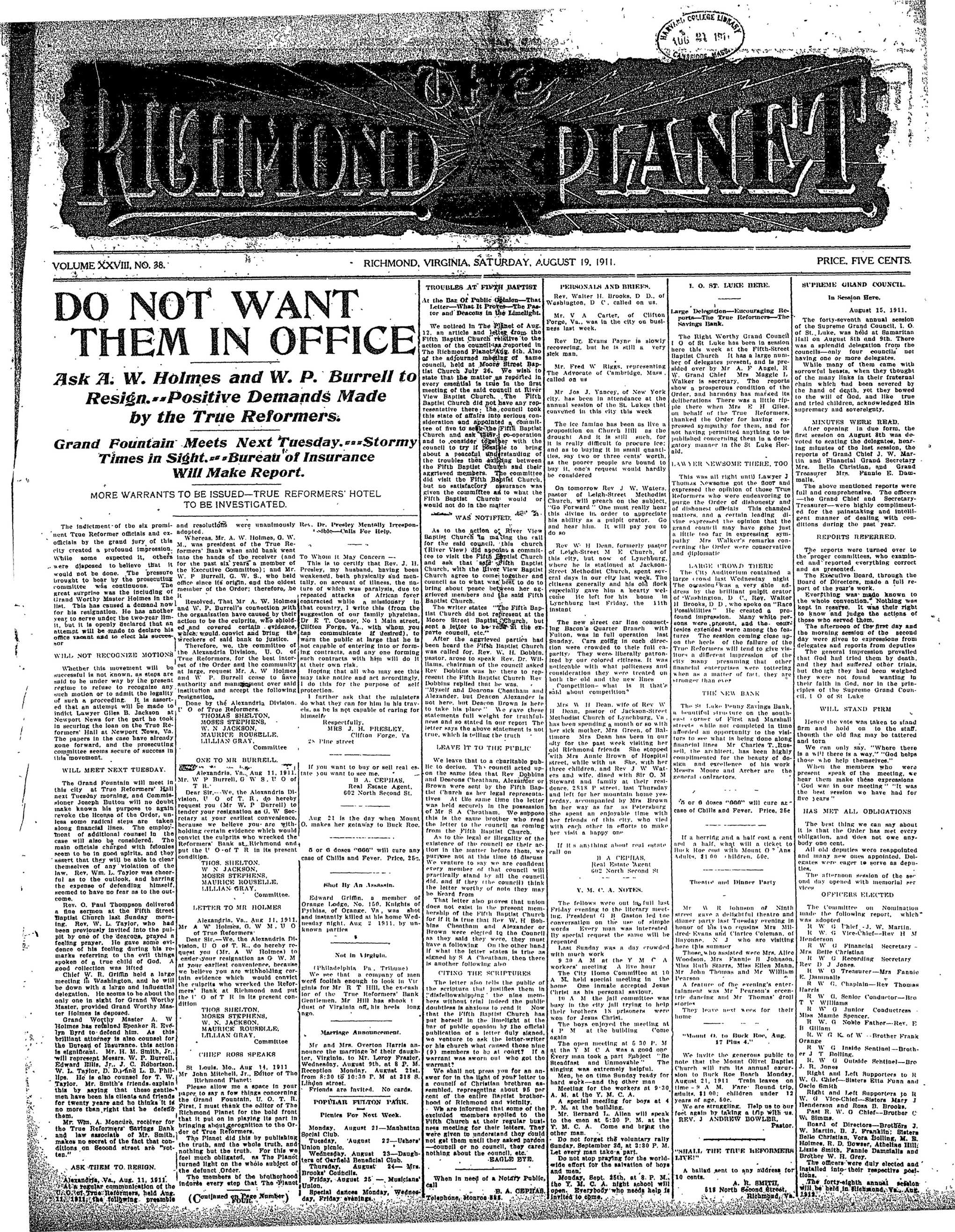
DO NOT WANT THEM IN OFFICE
Ask A. W. Holmes and W. P. Burrell to Resign. Positive Demands Made by the True Reformers.
Grand Fountain Meets Next Tuesday. Stormy Times in Sight. Bureau of Insurance Will Make Report. MORE WARRANTIES TO BE ISSUED—TRUE REFORMERS' HOTEL TO BE INVESTIGATED.
VOLUME XXVIII, NO. 38.
DO NOT THEM
Ask A. W. Ho
Resign.—P
by the
Grand Fountain
Times in S
MORE WARRANTIES
The indictment of the six prominent True Reformer officials and ex-officials by the grand jury of this city created a profound impression. While some expected it, others were disposed to believe that it would not be done. The pressure brought to bear by the prosecuting committee was continuous. The great surprise was the including of Grand Worthy Master Holmes in the list. This has caused a demand now for his resignation. He has another year to wait for the two-year limit, but it is openly declared that an attempt will be made to declare his office vacant and to elect his successor.
WILL NOT RECOGNIZE MOTIONS
Whether this movement will be successful is not known, as stops are said to be under way by the present regime to refuse to recognize any such motion or to admit the legality of such a proceeding. It is assorted that an attempt will be made to indict Lawyer Giles B. Jackson at Newport News for the gerrit he took to press him on the True Reefers' Hall at Newport News, Va. The papers in the case have already gone forward, and the prosecuting committee seems secure of success in this movement.
WILL MEET NEXT TUESDAY
The Grand Fountain will meet in this city at True Reformers' Hall next Tuesday morning, and Commissioner Joseph Button will no doubt make known his purpose to again revoke the license of the Order, unless some radical steps are taken along financial lines. The employment of additional counsel in the case will also be considered. The main ordeals charged with felonies seem to be in good spirits, and they assert that they will be able to clear themselves of any violation of the law. Rev. Wm. L. Taylor was cheerful as to the outlook, and harring the expense of defending himself, seemed to have no fear as to the outcome.
Rev. O. Paul Thompson delivered a fine sermon at the Fifth Street Baptist Church last Sunday morning. Rev. W. L. Taylor, who had been previously invited into the pulpit by one of the deacons, prayed a feeling prayer. He gave evidence of his feeling during his remarks referring to the evil things spoken of a true child of God. A good collection was lifted
---
Chief W. R. Griffin hold a large meeting in Washington, and he will be down with a large and influential delegation. He seems to be about the only one in sight for Grand Worthy Master, provided Grand Worthy Master Holmes is deposed.
Grand Worthy Master A. W. Holmes has retained Speaker R. Evelyn Byrd to defend him. As this brilliant attorney is also counsel for the Bureau of Insurance, this action is significant. Mr. H. M. Smith, Jr. will represent Messrs. W. P. Burrell, Edward Ellis, Jr., J. C. Robertson, W. L. Taylor, D. D. and L. D. Phillips. He is also counsel for T. W. Tipple. He will耐心 explain this by paying that those gentlemen have been his clients and friends for twenty years and he thinks it is no more than right that he defends them.
Mr. Wm. A. Monchure, receiver for the True Reformers' Savings Bank and law associate of Mr. Smith, makes no secret of the fact that conditions on Second street are "rotten."
ASK THEM TO. RESIGN.
Wa. Aug. 11, 1811
communication of the Reformers, held Aug.
falling, preceable
and resolutiona were unanimously adopted. Whereas, Mr. A. W. Holmes, G. W. M., was president of the True Reformers' Bank when said bank went into the hands of the receiver (and for the past six years a member of the Executive Committee); and Mr. W. P. Burrell, G. W. S., who held office since its origin, and the oldest member of the Order; therefore, he it
Resolved, That Mr A. W. Holmes and W. P. Burrell's connection with the organization have caused by their action to be the culprit, who shoiled and covered certain evidence, which would convict and bring the wreckers of said bank to justice.
Therefore, we, the committee of the Alexandria Division, U. O. of True Reformers, for the best interest of the Order and the community at large, request Mr. A. W Holmes and W. P. Burrell cause to have authority and management over said institution and accept the following resignation.
Done by the Alexandria Division, U. O. of True Reformers.
107 PARK RENEGAD
TROLLA BREELTON,
MOSS STEPHENS,
W. N JACKSON,
MAURICE ROUSELLE.
LILLIAN GRAY.
ONE TO MR BURRELL.
Alexandria, Va., Aug 11, 1911.
Mr. W P Burrell, G W S, U O of T R.
Dear Sr.---We, the Alexandria Division, U O of T R, do hereby request you (Mr W P Burrell) to tender your resignation as G W Secretary at your earliest convenience, because we believe you are withholding certain evidence which would convict the culpits who wrecked the Reformers' Bank at Richmond and put the U O-of T R in its present condition.
THOS. SHELTON,
W N JACKSON,
MOSES STEPHENS,
MAURICE USELLE,
LILLIAN GRAY.
LETTER TO MR HOLMES
Alexandrin, Vau. Aug 11, 1911
Mr A W Holmes, G. W M, U O
C. W. H.
Dear Sir—We, the Alexander Division, U O of T R., do hereby request you (Mr. A W Holmes) to enter your resignation as G W M. at your earliest convenience, because we believe you are withholding certain evidence which would convict the culprits who wrecked the Reformers' Bank at Richmond and put the U O of T R in its present condition
THOS SHELTON,
MOSSES STEPHENS,
W, N. JACKSON,
MAURICE ROUSSELLE,
LILLIAN GRAY
Committee
CHUEF R088 SPEAK8
St Louis, Mo. Aug. 14, 1911
Mr John Mitchell, Jr., Editor of The
Richmond Planet:
Please allow me a space in your
paper, to say a few things concerning
the Grand Fountain, U. O. T. R.
First, I must thank the editor of The
Richmond Planet for the bold front
that it put on in playing its part in
bringing about geocognition to the
Order of True Reformers.
I will write briefly by publishing
the truth, and the whole truth, and
nothing but the truth. For this we
feel much obligated, as The Planet
turned light on the whole subject of
the defunct Order.
The members of the brotherhood indorse every step that The Planet
(Continued on Page Number)
Ret. Dr. Presley Mentally Irreponsible - Calls For Help.
To Whom It May Concern -
in it is sure success.
This is to certify that Rov. J. H. Presley, my husband, having been weakened, both physically and mentally, on account of illness, the nature of which was paralysis, due to repeated attacks of African fever contracted while a missionary in that country, I write this (from the suggestion of our family physician, Dr E. T. Connor, No 1 Main street, Clifton Forge, Va., with whom you can communicate if desired), to warn the public at large that he is not capable of entering into or forming contracts, and any one forming such contracts with him will do it at their own risk.
Hoping that all who may see this may take notice and act accordingly, I do hope for the purpose of self protection.
I further ask that the ministers do what they can for him in his travels, as he is not capable of caring for himself.
Respectfully,
MRS J. H. PRESLEY,
Clifton Forge, Va.
21 Pine street
If you want to buy or sell real est
ate you want to see me.
IN CPHIPH.
Real Estate Agent.
602 North, Second St.
---
Aug 21 is the day when Mount
O. makes her gotaway to Buck Roe.
5 or 6 doses "600" will cure any
case of Chills and Fever. Price, 25s.
Shot By An Assassin:
Edward Griffin, a member of Orange Lodge, No. 160, Knights of Pythias, of Orange, Vn., was shot and instantly killed at his home Wednesday night. Aug 2 1911, by unknown parties.
Not in Virginia.
(Philadelphia Pa. , Trilune)
We see that a company of men
were foolish enough to look in Virginia for Mr R T Hill, the ex-cashier of the True Reformers' Bank Gentleman, Mr Hill has shook dust of Virginia off, his heels long ago.
Marriage Announcement.
Mr. and Mrs. Overton Harris and
pounce the marriage of their daughter,
Virginia, to Mr. Leroy Frazier
Wednesday, August 9th, at 8 P. M.
Reception Monday, August 21st
from 8:30 15:10:30 P. M at 318 S.
Linden street.
Friends are invited. No cards.
POPULAR FULTON PARK.
Plenica For Next Week.
Monday, August 21—Manhattan
Social Club.
Tuesday, August 22—Ushors'
Union picnic.
Wednesday, August 23—Daugh-
ter of Carnegie Beneficial Club.
Thursday, August 24—Mrs.
Brooks' Coinslake.
Friday, August 25—Musicians'
Union.
Special dances Monday, Wednesday,
Friday evenings.
TROUBLES AT FIFTH BAPTIST
WAS NOTIFIED.
As to the action of River View Baptist Church in making the call for the said council, this church (River View) did again a committee to visit the Fifth Baptist Church and ask that said Fifth Baptist Church, with the River View Baptist Church agree to come together and council as to what was best to do to bring about peace between her aggreived members and the said Fifth Baptist Church.
The writer states "The Fifth Baptist Church did not represent at the Moore Street Baptist Church, but sent a letter to be resist it the ex-party council, etc."
After the aggrieved parties had been heard of Fifth Baptist Church was called for, Rev. W. H. Dobbin, pastor, arose to speak Rev. Dr. Williams, chairman of the council asked Rev. Dobbin was he there to represent the Fifth Baptist Church Rev Dobbin's replies that he was.
"Myself and Dearens Chantham and Alexander, but Deacon Alexander is not here, but Deacon Brown is here to take his place" We have these statements full weight for truthfulness and so stated in our report The letter says the above statement is not true, which is telling the truth.
LEAVE IT TO THE PUBLIC
We leave that to a charitable public to decide. The council acted upon the same idea that Rev Dobblins and Desearne Cheatham, Alexander or Brown were sent by the Fifth Baptist Church as her legal representatives. At the same time the letter was held secure) in the possession of Mr S A Cheatham. We suppose this is the same brother who read the letter to the council as coming from the Fifth Baptist Church. As to the legal or illegality of the existence of the council or their action in the matter before them, we purpose not at this time to discuss. We venture to say we are confident every member of that council will practically stand by all the council did, and if they (the council) think the letter worthy of note they may be heard from. This letter also proves that union does not have the present membership of the Fifth Baptist Church for it is true that Rev R. H. Bobblins Cheatham and Alexander Brown were elected to the Council as they said they were, they must have a following. On the other hand if what the letter states is true as signed by S A Cheatham, then there is another following also.
CITING THE SCRIPTURES
The letter also tells the public of the scripture that justifies them in "difellowship" the nine members without trial indeed the public doubleness is anxious to read it. Now that the Fifth Baptist Church has put herself in the limelight at the bar of public opinion by the official publication of a letter duly signed, we venture to ask the letter-writer or his church what caused those nine (9) members to be at court? If a sworn out who got the warrants?
We shall not press you for an answer for in the light of your letter to a counsell of Christian brethren assembled, representing about 95 per cent of the entire Baptist brotherhood of Richmond and vicinity.
We are informed that some of the excluded members applied to the Fifth Church at their regular business meeting for their letters. They were given to understand they could not get them until they asked pardon—counsel or no council, they cared
When in need of a Notify Public, call
PERSONALS AND BRIEFS.
Rev, Walter H. Brooks, D. D., of Washington, D. C., called on us.
Mr. V A Carter, of Clifton Forge, Va., was in the city on business last week.
Rev Dr. Evans Payne is slowly recovering, but he is still a very stick man.
Mr. Fred W Riggs, representing The Advocate of Cambridge, Musk, called on us
Mr Jos J. Yancey, of New York city, has been in attendance at the annual session of the St Lukes that convened in this city this week
The ice famine has been as alive a proposition on Church Hill as the drought. And it is still such, for it is really difficult to procure ice; and as to buying it in small quantities, say two or three cents' worth, as the poorer people are bound to buy it, one's request would hardly be considered
On tomorrow Rev J W. Waters, pastor of Leigh-Street Methodist Church, will preach on the subject, "Go Forward." One must really hear this divine in order to appreciate his ability as a pulpit orator. Go and hear him. It will pay you to do so
Rev W H Dean, formerly pastor of Ligh-Street M E Church, of this city, but now of Lynchburg, where he is stationed at Jackson-Street Methodist Church, spent several days in our city last week. The citizens generally and his old flock especially gave him a hearty welcome. He left for his home in Lynchburg last Friday, the 11th instant.
The new street car line connecting Bacon's Quarter Branch with Fulton, was in full operation last Sunday. Cars going in each direction were crowded to their full capacity. They were liberally patronized by our colored citizens. It was noticeable with what politeness and consideration they were treated on both the old and the new lines. Competition- what is it that's said about competition?
Mrs W H Dean, wife of Rev W H Dean, pastor of Jackson-Street Methodist Church of Lynchburg, Va. has been spending a month or so with her sick mother, Mrs Green, of Baltimore. Mrs Dean has been in our city for the past week visiting her old Richmond friends. She stopped with Mrs Anne Brown of Hospital street, while with us. She, with her three children, and Rev J W Waters and wife, dined with Sir O. M. Stewart and family at her residence, 2818 street, last Thursday and left for her mountain home yesterday, accompanied by Mrs Brown on her way as far as Petersburg. She spent an enjoyable time with her friends of this city, who visited with each other in efforts to make her visit a happy one.
If it's anything about real estate call on
B A CEPIAS,
Real Estate Agent
602 North Second St
Y. M. C. A. NOTES
The fellows were out in full last Friday evening to the literary meeting. President G B Gaston led the conversation on the use of simple words. Every man was interested by special request the same will be repeated.
Last Sunday was a day crowded with much work
9 30 A M at the Y M C A worker's meeting A two hour
The City Home Committee at 10 A M held special meeting in the home. One inmate accepted Jesus Christ as his personal saviour.
10 A M the jail committee was busy in the city failing to help their brothers 18 prisoners were won for Jesus Christ.
The boys enjoyed the meeting at 4 P M at the building Come again
The open meeting at 5 30 P. M at the Y M C A was a good one Every man took a part Subject "Be Steadfast and Unmovable" The singing was extremely helpful.
Men, be on time Sunday ready for hard work and the other man Meeting for the workers at 9:30 A. At the Y. M. C. A.
A special meeting for boys at 4 P. M. at the building.
Mr. Bernard L. Alien will speak to the men at 5:30 P. M. at the Y. M. C. A. Come and bring the other man.
Do not forget the voluntary rally Sunday, September 20, at 3:30 P. M. Let every man take a part.
Do not stop praying for the worldwide effort for the salvation of boys and men.
Monday, Sept. 26th, at 8 P. M.
the Y. M. C. A. night school will
open. Everybody who needs help is
invited to come.
I. O. ST. LUKE HERE.
Large Delegation—Encouraging Reports—The True Reformers—The Savings Bank.
The Right Worthy Grand Council I O of St Luke has been in session here this week at the Fifth-Street Baptist Church. It has a large number of delegates present, and is presided over by Mr A. F Angel, R W. Grand Chief Mrs Maggle L Walker is secretary. The reports show a prosperous condition of the Order, and harmony has marked the deliberations. There was a little ripple there when Mrs E Giles, chief of the True Reformers, thanked the Order for having expressed sympathy for them, and for not having permitted anything to be published concerning them in a derogatory manner in the St Luke Horald.
LAWYER NEWSOME THERE, TOO
This was all right until Lawyer J Thomas Newsome got the floor and expressed the opinion of those True Reformers who were endeavoring to purge the Order of dishonesty and of dishonest officials. This changed matters, and a certain leading dishonest reformer, the grand council may have gone just a little too far in expressing sympathy. Mrs Walker's romarks concerning the Order were conservative and diplomatic.
LARGE CROWD THERE
The City Auditorium contained a large crowd last Wednesday night. The occasion "I was a very able address by the brilliant pulpit orator of Washington, D. C., Rev, Walter H. Brooks, D. D., who spoke on "Race Possibilities." He created a profound impression. Many white persons were present, and the countries extended were among the features. The session coming close up on the heels of the failure of the True Reformers will tend to give visitors a different impression of the city many presuming that other financial enterprises were totering when as a matter of fact, they are stronger than ever.
THE NEW BANK
The St Luke Penny Savings Bank, a beautiful structure on the southeast corner of First and Marshall streets while not completed in time afforded an opportunity to the visitors to see what is being done along financial lines. Mr Charles T. Russell, the architect, has been highly complimented for the beauty of design and excellence of his work Messrs Moore and Archer are the general contractors.
---
"6 or 0 doses "000" will cure
cases of Chills and Fever. Price, 25c
---
If a herring and a half cost a cost and a half, what will a ticket to Buck Roof cost with Mount O ? Ans Adults, $1 00 children, 50c.
---
Theatre and Dinner Party
Mr. W R Johnson of Ninth street gave a delightful theatre and dinner party last Tuesday evening in honor of his two cousins Mrs. Mildred Evans and Clarice Coleman, of Bayonne, N J who are visiting here this summer.
Those who assisted were Mrs. Alice Woodson, Mrs. Fannie B Johnson, Miss Ruth Starrs, Miss Ellen Mann, Mr John Thomas and Mr William Pearson.
A feature of the evening's entertainment was Mr. Pearson's eccentric dancing and Mr Thomas' droll stories.
They leave next week for their home.
"Mount 0. to Buck Roe, Aug. 17 Plus 4."
We invite the generous public to note that the Mount Olivet Baptist Church will run its annual excursion to Buck Roe Beach Monday, August 21, 1911. Train leaves on time - 9 A M. Fare Round trip, adults $100; children under 12 years of age, 50c.
We are struggling. Help us to our foot again by taking a trip with us.
REV. J ANDREW BOWLER.
Pastor.
---
"SHALL THE TRUE REFORMER
LIVE!"
A ballad sent to any address for 10 cents.
A. R. SMITH,
518 North Second Street,
Rhishmand, Va.
PRICE. FIVE CENTS.
SUPREME GRAND COUNCIL.
In Session Here.
August 15, 1911.
The forty-seventh annual session of the Supreme Grand Council, I. O. of St. Luke, was held at Samaritan Hall on August 8th and 9th. There was a splendid delegation from the councils—only four councils, not having one or more delegates. While many of them came with sorrowful hearts, when they thought the federal church which had been severed by the hand of death, yet they bowed to the will of God, and like true and tried children, acknowledged His supremacy and sovereignty.
MINUTES WERE READ
After opening in duo form, the first session on August 8th was devoted to seating the delegates, hearing minutes of the last session, the reports of Grand Chief J. W. Martin and Financial Grand Secretary Mrs. Belle Christian, and Grand Treasurer Mrs. Faunio D. Dumnalle.
The above mentioned reports were full and comprehensive. The officers—the Grand Chief and Secretary-Treasurer—were highly complimented for the painstaking and intelligent manner of dealing with conditions during the past year.
REPORTS REFERRED
The reports were turned over to the proper committees, who examined and reported everything correct and as presented.
The Executive Board, through the Board of Directors, made a full report of the year's work.
Everything was made known to the whole convention. Nothing was kept in reserve. It was their right to know and judge the actions of those who served them.
The afternoon of the first day and the morning session of the second day were given to expressions from delegates and reports from deputies.
The general impression provailed that God had tried them by death, and they had suffered other trials, but though they had been weighed they were not found wanting in their faith in God, nor in the principles of the Supreme Grand Council. 1 O of St Luke
WILL STAND FIRM
Hence the vote was taken to stand firm and hold on to the staff, though the old flag may be tattered and torn
We can only say, "Where there is no will there is a way." "God helps those who help themselves."
When the members who were present of the meeting, we hear them make these pronouncement "God war in our meeting" "it was the best session we have had for five years"
HAS MET ALL OBLIGATIONS
The best thing we can say about it is that the Order has met every obligation, and does not owe anybody one cent. All old deputies were reappointed and many new ones appointed. Delocales were eager to serve as deputies. The afternoon session of the second day opened with memorial ser vice.
OFFICERS ELECTED
The Committee on Nomination made the following report, which was adopted
R W G Chief.-J. W. Martin.
R W. G Vice-Chief—Rev H M Henderson
R W G Financial Secretary -
Mrs Belle Christian
R W G Recording Secretary
Rev D J Jones.
R W G Treasurer—Mrs Fannie E. Dumnalle
R W G. Chaplain—Rey Thomas
Harris
R W G. Senior Conductor—Brot
T V Williams
R W G. Junior Conductress
Miss Mamie Spencer.
R W. G Noble Father—Rev. E. B Gilliam
R. W G K. of W --Brother Frank Orange
R W G Inside Sentinel—Brother J T Bolling.
R W G Outside Schtinel—Bro J. R. Jonos
Right and Left Supporters to R W. G. Chief—Sisters Etta Funn and Ocle Smith
Right and Left Supporters to R W. G. Vico-Chief—Sisters Mary J Henderson and Rosa D. Brooks.
Fast R. W. G. Chief—Brother C W. Simms.
Bronwil L. of Directors—Brothers J. W. Martin, D. J. Franklin; Brothers Bolo Christian, Vora Bolling, M. B. Holmets, R. D. Bowser, Athelina Hill; Lizzie Smith, Fannie Dammallis and Brother W. Grey.
The officers were duly elected and installed into their respective positions.
TWO
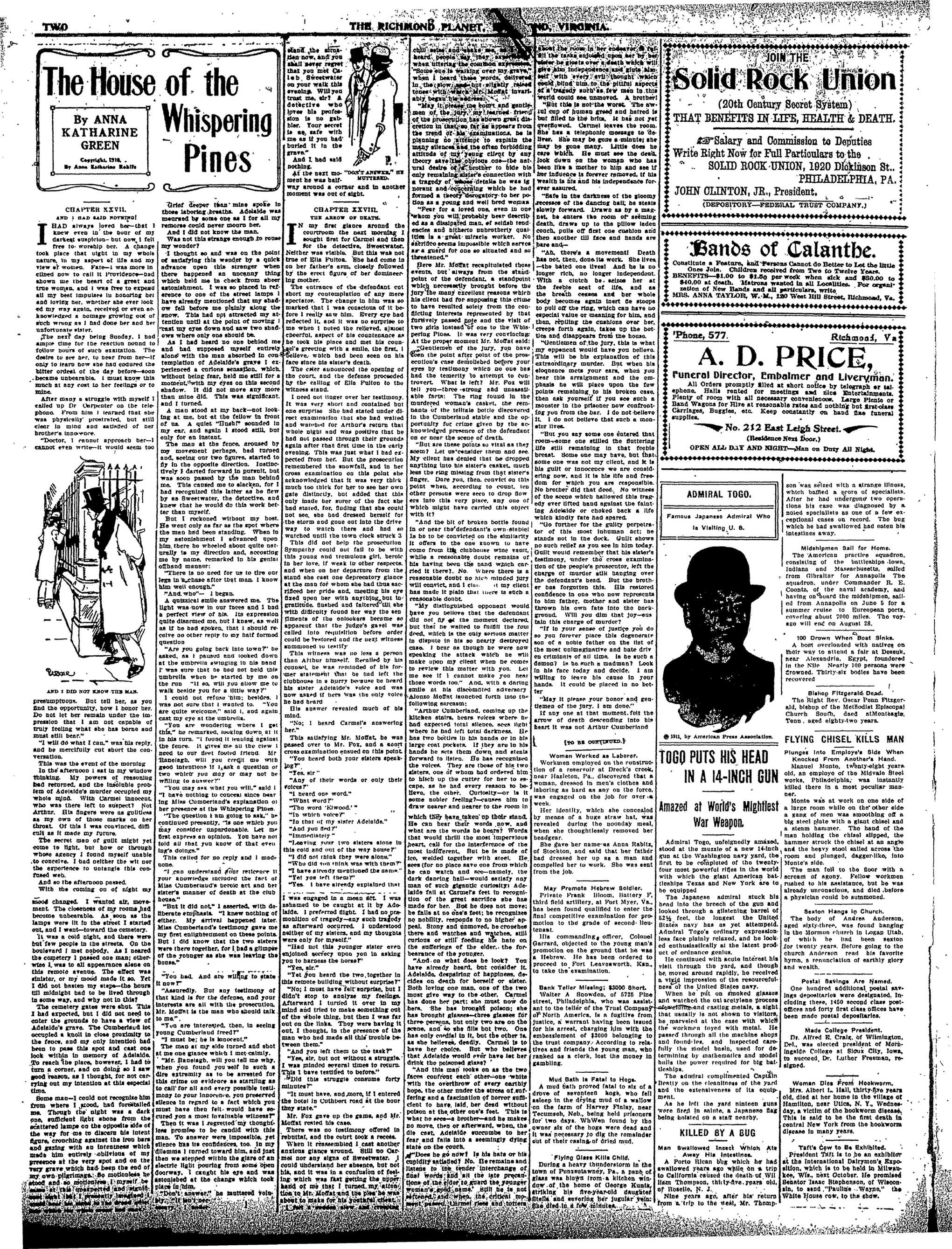
I HAD always loved her—that I knew even in the hour of my darkest suspicion—but now, I felt free to worship her. A change took place that night in my whole nature, in my aspect of life and my view of women. Fate—I was more in cleded now to call it providence—had shown me the heart of a great and true wongen, and I was free to expand all my beat impulses in honoring her and loving her, whether she ever looked ed my way again, received or even knowledged a homage growing out of such wrong as I had done her and her unfortunate sister.
The next day being Sunday, I had ample time for the reaction bound to follow hours of such exaltation. The desire to see her, to hear from her—if only to learn how she had endured the bitter ordeal of the day before—soon became unbearable. I must know this much at any cost to her feelings or to mine.
After many a struggle with myself I called up Dr. Carpenter on the telephone. From him I learned that she was physically prostrated, but still clear in mind and satisfied of her brother's innocence. "Doctor, I cannot approach her—I cannot even write—it would seem too
PUBLIER
AND I DID NOT KNOW THE MAN.
presumptuous. But tell her, as you
find the opportunity, how I honor her.
Do not let her remain under the imp
expression that I am not capable of
truly feeling what she has borne and
must still bear."
"I will do what I can," was his reply,
and he mercifully cut short the con-
versation.
This was the event of the morning.
In the afternoon I sat in my window
thinking. My powers of reasoning
had returned, and the insoluble problem
of Adelaide's murder occupied my
mind. With Carmel innocent,
who was there left to suspect? Not
Arthur. His fingers were as gullible
as my own of those marks on her
threat. Of this I was convinced, diffi-
cult as it made my future.
The secret man of guilt might yet come to light, but how or through whose agency I found myself unable to conceive. I had neither the wit nor the experience to untangle this confused web. And so the afternoon passed. With the coming on of night my mood changed. I wanted air, movement. The closeness of my rooms had become unbearable. As soon as the lamps were lit in the street I started out, and I went—toward the cemetery. It was a cold night, and there were but few people in the streets. On the boulevard I met nobody. As I neared the cemetery I passed one man; otherwise I was to all appearance alone on this remote avenue. The effect was sinister, or my mood made it so. Yet I did not hasten my steps—the hours till midnight to be lived through in some way, and why not in this?
The cemetery gates were shut. This I had expected, but I did not need to enter the grounds to have a view of Adelside's grave. The Cumberland lot occupied a knoll in close proximity to the fence, and my only intention had been to pass this spot and cast one look within in memory of Adelside.
To reach the place, however, I had to turn a corner, and on doing so I saw good reason, as I thought, for not carrying out my intention at this especial time.
Some man—I could not recognize him from where I stood, had forecalled me. Though the night was a dark one, sufficient light shone from the scattered lamps on the opposite side of the way for me to discern his intent figure, crouching against the iron bars and gazing with an intentness which made him entirely oblivious of my presence at the very spot and on the very grave which had been the end of my own pilgrimage. So motionless he stood and so motionless, so myself, be
of the Whispering Pines
Grief deeper than mine spoke in those laboring breaths. Adoldea was meared by some one as I for all my remorse could never moor her. And I did not know the man. Was not this strange enough to rouse my wonder?
I thought so and was on the point of satisfying this wonder by a quick advance upon this stranger when there happened an uncanny thing which held me in check from aberastonishment. I was so placed in reference to one of the street impels I have already mentioned that my shadow fell before me plainly along the snow. This had not attracted my attention until at the point of moving I cast my eyes down and saw two shadows where only one should be. As I had heard no one behind me and had supposed myself entirely along with the man absorbed in contemplation of Adelaide's graves I experienced a curious sensation, which without being fear, held me still for a moment with my eyes on this second shadow. It did not move any more than mine did. This was significant, and I turned.
A man stood at my back—not looking at me, but at the fellow in front of us. A quiet "Hush!" sounded in my ear, and again I stood still, but only for an instant.
The man at the fence, aroused by my movement perhaps, had turned and, seeing our two figures, started to fly in the opposite direction. Instinctively I darted forward in pursuit, but was soon passed by the man behind me. This caused me to slacken, for I had recognized this latter as he new by as Sweetwater, the detective, and knew that he would do this work better than myself.
But I rocked without my host. He went only as far as the spot where the man had been standing. When in my astonishment I advanced upon him, there he wheeled about quite naturally is my direction and, accosting me by name, remarked in his genial offhand manner:
"There is no need for us to tread our legs in a chase after that man. I know him well enough."
"And who"— 1 began.
A quizzical smile answered me. The light was now in our faces and I had a perfect view of his. Its expression quite disarmed me, but I know, as well as if he had spoken, that I should receive no other reply to my half formed question
"Are you going back into town?" he asked, as I paused and looked down at the umbrella swinging in his hand. I was sure that he had not held this umbrella when he started by me on the run "If so, will you allow me to walk beside you for a little way?" I could not refuse him; besides, I was not sure that I wanted to. "You are quite welcome," said I, and again cast my eye at the umbrella.
"You are wondering where I get this," he remarked, looking down at it in his turn. "I found it teasing against the fence. It gives me all the claw I need to our direct footed friend. Mr Tanneagh, will you credit me with good intentions? I ask a question or two which you may or may not be willing to answer."
"You may ask what you will," said I. "I have nothing to conceal since bearing Miss Cumberland's explanation of her presence at the Whisper Pines. "The question I am going to ask, he continued presently, "one which you may consider unpardonable. Let me first express an opinion. You have not told all that you know of that evening's doings."
This called for no reply and I mad none.
"I can understand your reticence if your knowledge included the fact of Miss Cumberland's heroic act and her sister's manner of death at the club house."
"But it did not." I asserted, with deliberate emphasis. "I knew nothing of either. My arrival happened later. Miss Cumberland's testimony gave me my first enlightenment on these points. But I did know that the two sisters were there together, for I had a glimpse of the younger as she was leaving the house."
"You had. And are willing to state it now."
"A assuredly. But any testimony of that kind is for the defense, and your interests are all with the prosecution. Mr. Moffit is the man who should talk to me."
"You are interested, then, in seeing young Cumberland freed!"
"I must be; he is innocent."
The man at my side turned and shot at me one glance which I met calmly.
"Mr. Ranelagh, will you tell me why, when you found you self in such a dire extremity as to be arrested for this crime on evidence as startling as to call for all and every possible testimony to your innocence, you preserved silence in regard to a fact which you must have then felt would have secured you a most invaluable witness."
Then it was I regretted my thoughtless promise to be candid with this man. To answer were impossible, yet silence has its confidence, too. In my dilemma I turned toward him, and just then we stepped within the glare of an electric light pouring from some open doorway. I caught his eye and was astonished at the change which took place in him.
chill sitting and shake me, and hear, people, say, may, express when uttering the common expression, "Some one is walking over my grave, when I heard these words, delivered in the plow, and but slightly raised tones with which Mr. Dickat invariably began his address.
May it please the court and gentlemen of the jury, my learned friend of the prosecution has shown great discretion in that so far as appears from the trend of his examinations, he is planning no attempt to explain the many silences and the often forbidding attitude of my young client by any theory save the obvious one—be natural desire to hide the room in her endeavor to refill the tasks afflicted upon her by her master be giants over a death which will give him independence and glits; also with every evil thought which could blind him to the plausible aspects of a tragedy such as few men in this world could see unmoved. A brother!
But this is not the worst. The awful cup of human greed and hatred is but filled to the brim. It has not yet overflowed. Carnel leaves the room. She has a telephonic message to deliver. She may be gone a minute; she may be gone many. Little does he care which. He must see the dead, look down on the woman who has been like a mother to him and see it.
JOIN THE Solid Rock Union
(20th Century Secret System)
THAT BENEFITS IN LIFE, HEALTH & DEATH.
Salary and Commission to Deputies
Write Right Now for Full Particulars to the
SOLID ROCK UNION, 1920 Dickinson St
stand, the situation now, and you shall never regret that you met Caleb. Sweetwater on your walk this evening. Will you trust me, sir? A detective who loves his profession is no gobbler. Your secret is as safe with me as if you had buried it in the grave."
And I had said nothing.
At the next moment he was half-way around a corner and in another moment was out of sight.
CHAPTER XXVII.
THE ARROW OF DEATH.
IN my first glance around the courtroom the next morning I sought first for Carmel and then for the detective, Bweetwater. Neither was visible. But this was not true of Ella Fulton. She had come in on her father's arm, closely followed by the erect figure of her domineering mother. The entrance of the defendant cut short my contemplation of any mere spectator. The change in him was so marked that I was conscious of it before I really saw him. Every eye had reflected it, and it was no surprise to me when I noted the relieved, almost cheerful, aspect of his countenance as he took his place and met his counsel's greeting with a smile, the first, I believe, which had been seen on his face since his sister's death. The caller announced the opening of the court, and the defense proceeded by the calling of Ella Fulton to the witness stand.
I need not tinger over her testimony. It was very short and contained but one surprise. She had stated under direct examination that she had waited and watched for Arthur's return that whole night and was positive that he had not passed through their grounds again after that first time in the early evening. This was just what I had expected from her. But the prosecution remembered the snowfall, and in her cross examination on this point she acknowledged that it was very thick much too thick for her to see her own gate distinctly, but added that this only made her surer of the fact she had stated, for, finding that she could not see, she had dressed herself for the storm and gone out into the driveway to watch there and had so watched until the town clock struck 3. This did not help the prosecution Sympathy could not fall to be with this young and tremulous girl, hero in her love, if weak in other respects, and when on her departure from the stand she cast one deprecatory glance at the man for whom she had thus sacrificed her pride and, meeting his eye fixed upon her with anything, but ingratiate, flushed and faltered till she with difficulty found her way the sentiments of the onlookers became so apparent that the judge's gavel was called into requisition before order could be restored and the next witness summoned to testify
This witness was no less a person than Arthur himself. Recalled by his counsel, he was reminded of his former statement that he had left the clubhouse in a burry because he heard his sister Adelaide's voice and was now asked if here was the only voice he had heard.
His answer revealed much of his mind.
"No; I heard Carmel's answering her."
This satisfying Mr. Moffat, he was passed over to Mr. Fox, and a court cross examination ensued on this point.
"You heard both your sisters speaking."
"Yes, sir."
"Any of their words or only their voices?"
"I heard one word."
"What word?"
"The word 'kiwood.'"
"In which voice?"
"In that of my sister Adelaida."
"I immediately"
"I leaving your two sisters alone in this cold and out of the way house?"
"I did not think they were alone."
"Who did not think was with them?"
"I have already mentioned the name."
"Yet you left them?"
"Yes. I have already explained that I was engaged in a mean act. I was ashamed to be caught at it by Adolide. I preferred flight. I had no premonition of tragedy—any such tragedy as afterward occurred. I understood neither of my sisters, and my thoughts were only for myself."
"I had not this younger sister even enjoined accretion upon you in asking you to harness the horse?"
"Yet you heard the two, together in this remote building without surprise!" "No, I must have felt surprise, but I didn't stop to analyze my feelings. Afterward I curried it over in my mind and tried to make something out of the whole thing, but then I was far out on the links. They were having it out, I thought, in the presence of the man who had made all this trouble between them." "And you left them to the task?" "Yes, sir, but not without a struggle. I was minded several times to return. This I have testified to before." "Did this struggle consume forty minutes?" "It must have, and more, if I entered the hotel in Cuthbert road at the hour they state." Mr. Fox gave up the game, and Mr. Moffat rested his case.
There was no testimony offered in rebutual, and the court took a recess. When it reassembled I cast another anxions gaze around. Still no Carmel nor any signs of Sweetwater. I could understand her absence, but not his, and it was in a confusion of feeling, which was fast getting the upper hand of me that I turned my attention to Mr. Mofat and the plea he was about to make for my youthful client. I felt a sudden slow and creeping
chil' s name and what he was, and
heard, people say, may they explain
when bittering the common expression,
"Some one is walking over my grave,
when I heard these words, delivered
in the flow, and but slightly raised
tones with which Mr. Monat invariably
began his address.
"May it please, the court and gentleman of the jury, my learned friend of the prosecution has shown great discretion in that so far as appears from the trend of the examinations, he is planning no attempt to explain the many silences and the often forbidding attitudes of my young client by any theory save the obvious one—the natural desire of my brother to hide bias only remaining sister's connection with a tragedy of whose details he was ignorant and concerning which he had formed a theory derogatory to her position as a young and well bred woman. "Fear for a loved one, even in one whom you will probably be described as a dislabeled man, of self tendencies and hitherto unbrotherly qualities is a great miracle worker. No sacrificio seems impossible which serves as a guard for one so situated and so threatened."
Here Mr. Moffat recapitulated those events, but always from the standpoint of the defendant, a standpoint which necessarily brought before the jury the many excellent reasons which his client had for apposing this crime to have resulted solely from the conflicting interests represented by that fortuitously passed note and the visit of two girls instead of one to the Whispering Pines. It was very courting: At the proper moment Mr. Moffat said: Gentlemen of the jury, you have seen the point after point of the prosecution's case demolished before your eyes by testimony which no one has had the tenacity to attempt to controvert. What is left? Mr. Fox will tell you—three strong and unassailable facts: The ring found in the murdered woman's casket, the remnants of the telltale bottle discovered in the Cumberland stable and the opportunity for crime given by the acknowledged presence of the defendant on or near the scene of death.
"But are these points so vital as they seem? Let us consider them and see. My client has denied that he dropped anything into his sister's casket, much less the ring missing from that sister's finger. Dare you, then, convict on this point when, according to count, ten other persons were seen to drop flowers into this very place, any one of which might have carried this object with it."
"And the bit of broken bottle found in or near the defendant's own stainless beo to be convicted on the similarity it offers to the one known to have come from the clubhouse wine vault, while a reasonable doubt remains of his having been the hand which carried it there." No. Where there is a reasonable doubt no high-minded jury will convict, and I can. At my client has made it plain that there is such a reasonable doubt.
"My distinguished opponent would have you believe that the defendant did not fly at the moment declared, but that he waited to fulfill the four deed, which is the only serious matter in dispute in his so nearly destroyed case. I bear as though he were now speaking the attack which he will make upon my client when he comes to review this matter with you. Let me see if I cannot make you hear those words too." And, with a daring smile at his discriminated adversary Alonzo Moffat launched forth into the following sarcasm:
"Arthur Cumberland, coming up the kitchen stair, hears voices where he had expected total silence, sees light where he had left total darkness. He has two bottles in his hands or in his large coat pockets. If they are in his hands he sets them down and stands forward to listen. He has recognized the voices. They are those of his two sisters, one of whom had ordered him to bitch up the cutter for her to escape, as he had every reason to believe, the other. Curiosity—or is it some nobler feeling?—causes him to draw nearer and nearer to the room in
which they have taken up their stand.
He can hear their words now, and what are the words he hears? Words that would thrill the most imperious heart, call for the interference of the most indifferent. But he is made of ice, welded together with steel. He sees (for no place save one from which he can watch and see—namely, the dark dancing hall—would satisfy any man of such gigantic curiosity) Adelaide fall at Carmel's feet in recognition of the great sacrifice she has made for her. But he does not move; he falls at no one's feet; he recognizes no nobility, responds to no higher appeal. Stony and unmoved, he crowes there and watches and watches, still curious or still feeding his hate on the sufferings of the older, the forbearance of the younger.
"And on what does he look? You have already heard, but consider it. Adelaide, despairing of happiness, decides on death for herself or sister. Both living one man, one of the two must give way to the other. Carmel has done her part: she must now do hers. She has brought polson; she has brought glasses—three glasses for three persons, but only two are on the scene, and so she fills but two. One has only condil in it, but the other is, as she believes, deadly. Carmel is to have her choice. But who believes that Adelaide would ever have let her drink the poisoned glass?
"And this map looks on as the two faces confront each other—one white with the overthrow of every earthly hope, the other under the stress of suffering and a fascination of horror sufficient to have, laid, her dead without poison at the other one's feet. This is what he sees—a brother—and he makes no move, then or afterward, when the die cast. Adelaide succumbs to her fear and falls into a seemingly dying state on the couch.
"Does he go now? Is his hate or his capidity satisfied? No. He remains and listens to the tender interchange of final words, and all the late precautions of the elder to guard the younger woman's good name. Still he is not performed and when, the critical moment
about the room in her endayer. We tell the tasks enjoyed on her by her water he goes over a death which will give him independence and gluts himself with every wish thought which could blind him to the pitiful aspects of a tragedy such as few men in this world could see unmoved. A brother: "But this is not the worst. The awful cup of human greed and hatred is but filled to the brim. It has not yet questioned. Carmel leaves the room. She has a telephonic message to deliver. She may be gone a minute; she may be gone many. Little does he care which. He must see the dead, look down on the woman who has been like a mother to him and see if her influence is forever removed, if his wealth is his and his independence forever assured.
"Sate in the darkness of the gloomy recesses of the dancing halls; he steals slowly forward. Drawn as by a magnet, he enters the room of seeming death, draws up to the pillow laden couch, pulls off first one cushion and then another till face and hands are bare and."
"Ah, there's a movement! Death has not, then, done its work. She lives—the baited one lives. And he is no longer rich, no longer independent. With a clutch he selts her at the feeble seat of life, and as the breath censes and her whole body becomes again inert he stoops to pull off the ring, which can have no especial value or meaning for him, and then, ripping the cushions over her, creeps forth again, takes up the bottles and disappears from the house.
"Gentlemen of the jury, this is what my opponent would have you believe. This will be his explanation of this extraordinary murder. But when his eloquence mots your ears, when you hear this arraignment and the emphasis he will place upon the few points remaining to his broken case, then ask yourself if you see such a monster in the prisoner now confronting you from the bar. I do not believe it. I do not believe that such a monster lives.
"But you say some one entended that room—some one still hated the futtering life still remaining in that foble breast. Some one may have, but that some one was not my client, and it is his guilt or innocence we are considering now, and it is his life and freedom for which you are responsible. No brother did that deed. No witness of the scene which hallowed this tragedy ever lifted hand against the fainting Adelaide or choked back a life which kindly fate had spared.
"Do further for the guilty perpetrator of this most human act; he stands not in the dock. Guilt shows no such relief as you see in him today. Guilt would remember that his sister's testimony, under the cross examination of the people's prosecutor, left the charge of murder still hanging over the defendant's head. But the brother has forgotten this. His restored confidence in one who now represents to him father, mother and sister has thrown his own fate into the background. Will you dim that joy—easily this charge of murder?
"If in your sense of justice you do so you forever place this degenerate son of a noble father on the list of the most imaginative and hate drive criminals of all time. Is he such a demon? is he such a madman? Look in his face today and decide. I am willing to leave his cause in your hands. It could be placed in no better
"May it please your honor and gentlemen of the jury. I am done." If any one at that moment, felt the arrow of death descending into his heart it was not Arthur Cumberland
{TO BE CONTINUED.}
Woman Worked as Laborer.
Workmen employed on the construction of a reservoir at Drock's creek, near Hazleton, Pa., discovered that a woman, dressed in men's clothes and laboring as hard as any on the force, was engaged on the job for over a week.
Her identity, which she concealed by means of a huge straw hat, was revealed during the noonday meal, when she thoughtlessly removed her headgear.
She gave her name as Anna Rabitz, of Stockton, and said that her father had dressed her up as a man and compelled her to work. She was sent from the job.
---
May Promote Hebrew Soldier.
Private Frank Bloom, Battery F,
third field artillery, at Fort Myer, Va.
has been found qualified to enter the
final competitive examination for promotion
to the grade of second lieutenant.
His commanding officer, Colonel
Garrard, objected to the young man's
promotion on the ground that he was
a Hebrew. He has been ordered to
proceed to Fort Leavensworth, Kan.
to take the examination.
Bank Teller Missing; $3000 Short.
Walter A Snowden, of 5725 Pine
p街, Philadelphia, who was assistant
to the teller of the Trust Company
of North America, is a fugitive from
justice, a warrant having been issued
for his arrest, charging him with the
embezzlement of $3000 belonging to
the trust company. According to rel-
atives and friends the young man, who
ranked as a clerk, lost the money in
gambling.
Mud Bath is Fatal to Hogs.
A mud bath proved fatal to six of a drove of seventen hogs, who fell asleep in the drying mud of a wallflow on the farm of Harvoy Finlay, near Tecumseh, Nob, being held prisoners for two days. WhEn found by the owner six of the hogs were dead and it was necessary to dig the remainder out of their causing of dried mud.
Flying Glass Kills Child
During a heavy thunderstorm in the town of Punzunutawney, Pa., a pane of glass was blown from a kitchen window of the home of George Kunz, striking his five-year-old daughter Stella and covering her jungular vein. She died in a few minutes.
Salary and Commission to Deputies Write Right Now for Full Partioulars to the SOLID ROCK UNION, 1920 Dickinson St. PHILADELPHIA, PA
Bands of Calanthe.
Constitute a Feature, and Persons Cannot Do Better to Let the little One Join. Children received from Two to Twelve Years.
BENEFITS—$1.00 to $1.50 per week when sick and $8.00 to $40.00 at death. Matrons wanted in all Localities. For organization of New Bands and all particulars, write.
MRS. ANNA TAYLOR, W. M., 130 West Hill Street, Richmond, Va.
Funeral Director, Embalmer and Liveryman.
All Orders promptly allied at short notice by telegraph or telephone. Halles rented for meetings and nice Entertainment. Plenty of room with all necessary conveniences. Large Picnic or Band Wagons for Hire at reasonable rates and nothing but first-class Carriages, Buggies, etc. Keep constantly on hand fine funeral supplies.
```markdown
```
$ \textcircled{2} $1911, by American Press Association.
TOGO PUTS HIS HEAD IN A 14-INCH GUN
Admiral Togo, unbeliedly amazed, stood at the muzzle of a new 14-inch gun at the Washington navy yard, the first to be conplotted of the twenty-four most powerful rifles in the world with which the giant American battleships Texas and New York are to be equipped.
The Japanese admiral stuck his head into the breech of the gun and looked through a glistening barrel of 52½ feet, the longest the United States navy has as yet attempted. Admiral Togo's ordinary expressionless face plainly relaxed, and he looked enthusiastically at the latest product of ordnance genius.
He continued with acute interest his visit through the yard, and though he, moved around rapidly, he received a vivid impression of the resourcefulness of the United Navy.
When he put on smoked glasses and watched the ox acetylene process of welding and casting metals, a sight that usually is not shown to visitors, he marveled at the ease with which the workmen toyed with metal. He passed through all the machine shops and found les, and inspected carefully the model basin, used for determining by mathematics and model hulls the power required for big battleships.
The admiral complimented Captain Bennett on the cleanliness of the yard and the extensiveness of its equipment.
As he left the yard nineteen guns were fired in salute, a Japanese flag being hoisted on a staff nearby.
KILLED BY A BUG
Man Swallowed Insect Which Ate
Away His Intestines.
A Porto Ilican bug which he had
swallowed years ago while on a trip
to California caused the death of Will
Ilam Thompson, thirty-five years old,
of Roselle, N. J.
Nine years ago, after his return
from a trip to the well, Mr. Thompson
son was selzed with a astringent illness, which baffled a gore of specialists. After he had undergone two operations his case was diagnosed by a noted specialists as one of a few exceptional cases on record. The bug which he had swallowed had eaten his intestines away.
Midshipmen Sall for Home.
The American practice squadron, consisting of the battleships Iowa, Indiana and Massachusetts, sailed from Glbaltar for Annapolis The squadron, under Commander R. E. Coontz, of the naval academy, and having on board the midshipmen, sailed from Annapolis on June 5 for a summer cruise to European ports, covering about 7000 miles. The voyage will end on August 28.
100 Drown When Boat Sinks.
A bont overlonded with natives on their way to attend a fair at Dousk, near Alexandria, Egypt, foundered in the Nile. Nearly 100 persons were crowned. Thirty-six bodies have been recovered.
Bishop Fitzgerald, Dead.
The Right Rev. Oscar Penn Fitzgerald, bishop of the Methodist Episcopal Church South, died at Montagle, Tenn. aged eighty-two years.
FLYING CHISEL KILLS MAN
Plunges into Employee's Side When Knocked From Another's Hand.
Manuel Monto, twenty-eight years old, an employee of the Midvale Steel works, Philadelphia; was instantly killed there in a most peculiar manner.
Monte was at work on one side of a large room while on the other side a gang of men was smoothing off a big steel plate with a giant chisel and a steam hammer. The hand of the man holding the chisel slipped, the hammer struck the chisel at an angle and the heavy stool snail crossed the room and plunged, dagger-like, into Monte's side.
The man fell to the floor with a scream of agony. Fellow workmen rushed to his assistance, but he was already unconscious, and died before a physician could be summoned.
Sexton Hanga In Church
The body of Andres Anderson, aged sixty-three, was found banging in the Mormon church in Logan Utah, of which he had been sexton for twenty years. Before going to the church Anderson read his favorite hymn, a renunciation of earthly glory and wealth.
Postal Savings Are Named.
One hundred additional postal savings depositories were designated. Including these, 1450 second class post-offices and forty first class offices have been made postal depositories.
Made College President
Dr. Alfred E. Craig, of Wilmington, Del., was elected president of Morningale College at Sloux City, Iowa, to succeed Dr. Luther Freeman, resigned.
---
Woman Dies From Hookworm,
Mrs. Albert L. Hall, thirty-five years
old, died at her home in the village of
Hamilton, near Ullsace, N. Y., Wednesday,
a victim of the hookworm disease.
This is said to be the first death in
central New York from the hookworm
disease in many years.
Taft's Cow to Be Exhibited.
President Tift is to be an exhibitor
at the International Dairyman's Exposition,
which is to be held in Milwaukee, Wise, next October. He promised Senator Isaac Stephenson, of Wisconsin, to send "Pauline - Wayne," the White House cow, to the show.
---
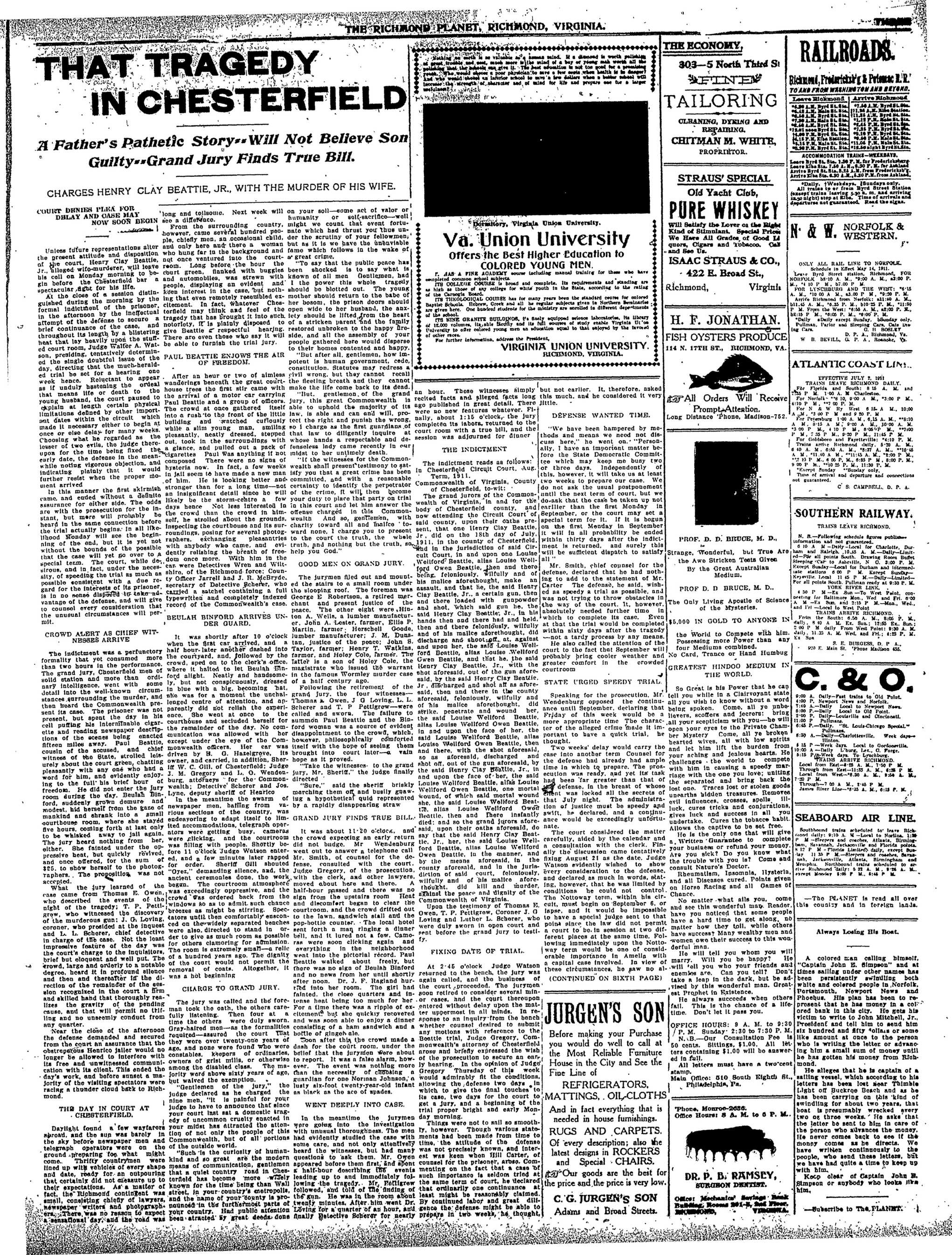
THAT TRAGEDY IN CHESTERFIELD
A Father's Pathetic Story Will Not Believe Son Guilty Grand Jury Finds True Bill.
CHARGES HENRY CLAY BEATTIE, JR., WITH THE MURDER OF HIS WIFE. COURT DENIES PLEA FOR DHLAY AND OCAE MAY NOW SOON BEGIN long and tollsome. Next week will on your soil—some act of valo humanity or self-sacrifice see a difference. From the surrounding country, might we count that ovent to
Unless future representations alter the present attitude and disposition of the court, Henry Clay Beatle, Jr., alleged wife murderer, will leave his cell on Monday morning to begin before the Chesterfield bar a spectacular fight for his life.
At the close of a session distinguished during the morning by the formal indictment of the prisoner, in the afternoon by the ineffectual attempt of the defense to secure a brief continuance of the case, and throughout its length by a blistering heat that lay heavily upon the stuffed court room, Judge Walfor A. Watson, presiding, tentatively determined the single doubtful issue of the day, directing that the much-heralded trial be set for a hearing one week hence. Reluctant to appear as if unduly hastening the ordeal that means life or death to the young husband, the court paused to explain at length certain physical limitations defined by other important dates within the circuit which made it necessary either to begin at once or also delay for many weeks. Choosing what he regarded as the lesser of two evils, the judge theroupon for the time being fixed the early date, the defense in the mean while noting vigorous objection, and indicating plainly that it would further resist when the proper moment arrived
In this manner the first skirmish came, and ended without a definite assurance for either side. The odds are with the prosecution for the instant, but more will probably be heard in the same connection before the trial actually begins: In all likelihood Monday will see the beginning of the end, but it is not without the bounds of the possible that the case will yet go over to a special term. The court, while desirous, and in fact, under the necessity, of speeding the trial as much as possible consistent with a due regard for the interests of its prisoner, is in no sense disposed to take advantage of the defense, and will give counsel every consideration that the unusual circumstances will permit.
CROWD ALERT AS CHIEF WITNESSES ARRIVE
The indictment was a perfunctory condition that yet consumed more than two hours in the performance. The grand jury, Chesterfield men of solid station and more than ordinary intelligence, went with some detail into the well-known circumstances surrounding the murder, and then board the Commonwealth present its case. The prisoner was not present, but spent the day in his cell puffing his intermittable cigarette and reading newspaper descriptions of the scenes being enacted fifteen miles away. Paul Beatty, cousin of the accused, and chief witness of the State, strolled leisurely about the court green, chatting pleasantly with any one who had a word for him, and evidently enjoying to the full his brief hour of freedom. He did not enter the jury room during the day. Beulah Binford, suddenly grown dumure and modest, hid himself from the gaze of mankind and shrank into a small courthouse room, where she stayed five hours, coming forth at last only to be whisked away to jail again. The jury heard nothing from her, either. She fainted under the oppressive heat, but quickly revived, and once offered, for the sum of $25, to show herself to the photographers. The proposition was not accepted.
What the jury learned of the case came from Thomas E. Owen, who described the events of the night of the tragedy; T. P. Pettigrew, who witnessed the discovery of the murderous gun; J. G. Loving, coroner who presided at the inquest and L. L. Schorer, chief detective in charge of the case. Not the least impressive feature of the day was the court's charge to the inquests, brief but olquent and well put. The crowd, large and orderly to a notable degree, heard it in profound silence and then and thereafter in the direction of the remalder of the session recognized in the court a firm and skilled hand that thoroughly realizes the gravity of the pending cause, and that will permit no trifling and no unseemly conduct from any quarter.
Near the close of the afternoon the defense demanded and secured from the court an assurance that the obstreperous Henrico jailer would no longer be allowed to interfere with its free and unwitnessed communication with its client. This ended the day's work, and before sunset a majority of the visiting spectators were racing a thunder cloud back to Richmond.
THE DAY IN COURT AT CHESTERFIELD.
Daylight found a few wayfarers abroad, and the sun was barely in the sky before newspaper men and telegraph operators were on the ground preparing for what might come. Thirty countrymen were lined up with vehicles of every shape and date, ready for an outpouring that certainly did not measure up to their expectations. As a matter of fact, the Richmond contingent was small, consisting chiefly of lawyers, newspaper writers and photographers. There was no reason to expect a sensational day, and the road was
long and tollome. Next week will see a difference.
From the surrounding country, however, came several hundred people, chiefly mon, an occasional child, and only here and there a woman who hung far in the background and not once ventured into the courtroom. Long before the hour the court green, flanked with bugles and automobiles, was strewn with people, displaying an evident and keen interest in the case, but nothing that even remotely resembled excitement. In fact, whatever Chestorfield may think and feel of the tragedy that has brought it into such motorcity, it is plainly disposed to give Battle a respectful hearing. There are even those who say it will be able to furnish the trial jury.
PAUL BEATTIE ENJOWS THE AIR
OF FREEDOM.
After an hour or two of almless wandering beneath the great courthouse trees the first stir came with the arrival of a motor car carrying Paul Beattie and a group of officers. The crowd at once gathered itself into a rush to the front of the little building and watched curiously while a slim young man, smiling pleasantly, neatly dressed, stepped out, took in the surroundings with a glance, and pulled out a pack of cigarettes Paul Was anything if not composed. There were no signs of hysteria now. In fact, a few weeks in fall seem to have made a new man of him. He is looking better and stronger than for a long time—not an insignificant detail since he will likely be the storm-centre a few days hence. Not less interested in the crowd than the crowd in himself, he strolled about the grounds, inspecting the courthouse and its surroundings, posing for several photographers, exchanging pleasantries with anybody who came, and evidently relishing the breath of freedom once more. With him in the can were Detectives Wren and Wiltshire, of the Richmond force; County Officer Jarrell and J. R. McBryde secretary of Detective Scherer, who carried a satchel containing a full typewritten and completely indexed record of the Commonwealth's case
BEULAH BINFORD ARRIVES UNDER GUARD.
It was shortly after 10 o'clock when the first car arrived, and a half hour later another dashed into the courtyard, and, followed by the crowd, sped on to the clerk's office, where it halted to let Beulah Tinford alight. Neatly and handsome, but not conspicuously, dressed in blue with a big, becoming hat, she was for a moment the unchallenged centre of attention, and apparently did not relish the experience. She went at once to the courthouse and secluded herself for the remainder of the day. No communication was allowed with her except under the eye of the Commonwealth officers. His car was driven by Hazeigel, its owner, and carried in addition, Sher-W. C. Gill of Chesterfield; Judge J. M. Gregory and L. O. Wendonburg, attorneys for the Commonwealth; Detective Schorer and Jos. Lynn deputy sheriff of Henrico
In the meantime the swarm of newspaper men, hailing from various sections of the country, was endeavoring to adapt itself to limited accommodations, telegraph operators were getting busy, cameras were clicking, and the courtroom was filling with people. Shortly before 11 o'clock Judge Watson entered, and a few minutes later rapped for order. Sheriff Gill shouted "Oyez." demanding silence, and the ancient ceremonies done, the work began. The courtroom atmosphere was exceedingly oppressive, and the crowd was ordered back from the windows so as to admit such chance browes as might be attiring. spectators until then comfortably enclosed on the widely separated benches were also, directed to stand in order to give as much room as possible for others clamoring for admission. The room is extremely small—a relic of a hundred years ago. The dignity of the court would not permit the removal of coats. Altogether, it was a hot beginning.
CHARGE TO GRAND JURY.
The jury was called and the foreman took the oath, the others carefully listening. Then four at a time the others were duly swned. Gray-hafed mon—as the formalities required—assured the court that they were over twenty-one years of age, and none were found who were constables. Keepers of oak or otherwise among them disabled class. The mahupy were above sixty years of age, but waived the exumption.
"Gentlemen of the jury," the judge declared as he charged the nine men, "it is painful for your judge to have to announce that since your court has sat a domestic tragedy of uncommon cruelty enacted in your midst has attracted the attention of not only the people of this Commonwealth, but of all portions of the outside world.
"Such is the curiosity of humankind and so great are the modern means of communication, gentlemen that a quiet country road in Chesterfield has become more widely known for the time being than Wall street, in your country's metropolis, and the name of your dounty is pronounced in the furthermost parts of your country. Had public attention been attracted by great deeds done
THE RICHMOND PLANET, RICHMOND, VIRGINIA.
on your soil—some act of valor or humanity or sofa-sacrifice—well might we count that event fortunate which had thrust you thus under the scrutiny of your fellowmen, but as it is we have the unavailble fame which follows in the wake of great crime.
"To say that the public peace has been shocked is to say what is known of all men. Gentlemen, had I the power this whole tragedy should be blotted out. The young mother should return to the babe of her bosom, the prison doors should open wide to her husband, the anxiety should be lifted from the heart of a stricken parent and the family restored unbroken to the happy reside, and all the assembly of your people gathered here would disperse to their homes contented and happy. "But after all, gentlemen, how impotent is human government, code, constitution. Statutes may redress a civil wrong, but they cannot recall the fleeting breath and they cannot make the life come back to its dead.
"But, gentlemen, of the grand jury, this great Commonwealth is able to uphold the majority of its law, is able and can and will, protect the right and punish the wrong, so I charge as the first guardians of that law to diligently inquire at whose hands a respectable and defenseless lady came recently in our midst to her untimely death.
"If the witnesses for the Commonwealth shall present testimony to satisfy you that a great crime has been committed, and with a reasonable certainty to identify the perpetrator of the crime, it will then become your duty to place that party on trial in this court and let him answer the offense charged in this Commonwealth. And so, gentlemen, with charity toward all and malice 'toward none, I charge you to present to the court the truth, the whole truth, and nothing but the truth, so help you God."
GOOD MEN ON GRAND JURY
The jurymen filed out and mounted the stairs to a small room under the slipping roof. The foreman was George E. Robertson, a retired merchant and present justice of the peace. The other eight were, Hinton A. Wells, a lumber manufacturer. John A. Lester, farmer, Ellis P. Martin, farmer, Horschell Goode, lumber manufacturer; J. M. Dunstan, justice of the peace; John S. Taylor, justice of the peace; Walt Holoy Cole, farmer. The latter is a son of Holoy Cole, the matriarch who issued the warrant in the famous Wormley murder case of a half century ago.
Following the retirement of the grand jury, the four witnesses—Thomas A. Owen, J G Loving, L. L Scherer and T. P Pottigwore—were called and swore. The failure to summon Paul Beattio and the Binford woman was a source of evident disappointment to the crowd, which, however, philosophically comforted itself with the hope of seeing them brought into court later—a vain hope as it proved.
"Take the witnesses- to the grand jury, Mr. Sheriff," the judge finally directed
"Sure," said the sheriff briskly marching them off and busily gnawing a hypothetical quid represented by a rapidly disappearing straw
GRAND JURY FINDS TRUE BILL.
It was about 11:20 o'clock, and the crowd expecting an early return did not budge. Mr Wendenburg went to answer a telephone call Mr. Smith, of counsel for the defense, consulted with the court. Judge Gregory, of the prosecution, with the clerk, and other lawyers, moved about here and there. A half-hour passed and there was no sign from the upstairs room Heat and discomfort began to clear the courtroom, and the crowd drifted out to the lawn, sandwich stall and the pop-bottle counter. The local hotel sent forth a man ringing a dinner bell, and it lured not a few. Cameras were soon clicking again and everything in the neighborhood went into the pictorial record. Paul Beatle walked about freely, but there was no sign of Boulah Blinford and no news from her until shortly after noon. Dr. J. F. Ragland hurried into her room. The girl hadainted, the close quarters and intense heat being too much for her. For a time there was a ripple of excitement but she quickly recovered and was soon able to enjoy a dinner consolating of her sandwich and a bottle of ginger ale.
Soon after this the court made a dash for the court room, under the belief that the jurymen Were about to report. It was a false alarm, however. The event was nothing more than a court guardian for one Norman Johnson, a lusty six-foot twenty-year-old infant an black in the ace of shades.
WENT DEEPLY INTO CASE.
In the meantime the jurymen were going into the investigation with unusual thoroughness. The men had evidently studied the case with some care, and not only attentively heard the witnesses, but had many questions to ask them. Mr. Owen appeared before them first, and about a half-hour describing the events leading up to and immediately following the tragedy. Mr. Pottigrew followed, and told of the finding of the gun. He was in the room about twenty minutes. After him went Dr. Loving for a quarter of an hour, and finally Detective Schoer for nearly
Nothing on earth is so valuable as a human mind. If a diamond is worth polishing as great trouble no man can remove it by mind of a key, weaving much more than including that the pachy can give it. The best education is not too good for a promising person. The would choose a poor physician to save a few dollars when health is in danger! And who would choose an inferior school to save a few dollars when a better school will increase the strength of character and of mind for life and prepare one for a larger misluck!
ITS COLLEGE COURSE is broad and complete. Its requirements and standing are as high as those of any college for white youth in the Bata, according to the rating of the Carnegie Board.
ITS THIKOLOGICAL COURSE has for many years been the standard course for colored Baptist Schools. Hebrew, Greek and all the regular subjects are in Northern Bunladenies are given here. One hundred students for the ministry are enrolled in different departments.
of the school. THE GRANITE BUILDING, its study equipped science laboratories, its library of 16,000 volumes, itsitable faculty and its full sources of study enable Virginia Utica University to offer colored young men an education to that enjoyed by the favored of other races.
```markdown
```
an hour. Those witnesses simply recited facts and silenced facts long ago published in great detail. There were no new features whatever. Finally, about 1:15 o'clock, the jury completes its iabora, returned to the court room with a true bill, and the session was adjourned for dinner.
THE INDICTMENT
The indictment reads as follows:
In Chesterfield Circuit Court, Aug.
Term, 1811.
Commonwealth of Virginia, County
Virginia.
Upon the testimony of Thomas E. Owen, T. P. Pettigrow, Coroner J. G. Loving and Luther L. Scherer, who were duly sworn in open court and sent before the grand jury to testify.
FIXING DATE OF TRIAL
At 2:45 o'clock Judge Watson returned to the bench, the jury was again called, and the business of the court proceeded. The jurymen soon retired to consider several minor cases, and the court thereupon entered without delay upon the matter uppermost in all minds. In response to an inquiry from the bench whether counsel desired to submit any motions with reference to the Boattle trial, Judge Gregory, Commonwealth's attorney of Chesterfield and briefly expressed the wish of the prosecution to secure an early hearing. In the opinion of Judge Gregory Thursday of this week would admirably fit the conditions, allowing the defense two days in which to give the final touches to its case, two days for the court to get a jury, and a beginning of the trial proper bright and early Monday morning.
Things were not to sail so smoothly, however. Though various statements had been made from time to time, the attitude of the defense was not precisely known, and interest was keen when Hill Carter, of counsel for the prisoner, arrose. Commenting on the fact that a case of such importance is seldom tried at the same term of court, he declared that ordinarily one continuance at least might be reasonably claimed. By continued labor and great diligence the defense might be able to prepare in two weeks, he thought,
but not earlor. It, therefore, asked this much, and he considered it very little.
DEFENSE WANTED TIME.
"We have been hampered by methods and means we need not discuss here," he wont on. "Personally, I have an important matter before the State Democratic Committee which may keep me busy two or three days. Independently of this, however, it will take us at least two weeks to prepare our case. We do not ask the usual postponement until the next term of court, but we do ask that the case be taken up not earlier than the first Monday in September, or the court may set a special term for it. If it is bogun on the first Monday in September it will in all probability be ended within thirty days after the indictment is returned, and surely this will be sufficient dispatch to satisfy all."
Mr. Smith, chief counsel for the defense, declared that he had nothing to add to the statement of Mr. Carter. The defense, he said, wished as speedy a trial as possible, and was not trying to throw obstacles in the way of the court. It, however, absolutely needed further time in which to complete its case. Even at that the trial would be completed within six days after the tragedy had occurred by any means. He also called the attention of the court to the fact that September will probably bring cooler weather and greater comfort in the crowded courtroom.
STATE URGED SPEEDY TRIAL
Speaking for the prosecution, Mr. Wendenburg opposed the continuance until September, declaring that Friday of this week would be a more appropriate time. The character of the alleged crime made it important to have a quick trial, he thought.
Two weeks' delay would carry the case into another term Counsel for the defense had already had ample time in which to prepare. The prosecution was ready, and yet its task had been far greater and that of defense. In the break of whose moment hocked all the secrets of that July night. The administration of justice must be speedy and swift, he declared, and a continuance would be exceedingly unfortunate.
The court considered the matter carefully, aided by the calendar and a consultation with the clerk. Finally the discussion came tentatively fixing August 21 as the date. Judge Watson evidently wished to show every consideration to the defense, and declared as much in words, stating, however, that he was limited by conditions he could not control. The Nottoway term, within his circuit, must begin on September 6, or lapse, and it would be impossible to have a special judge sent to that point since the law did not permit a court to be in session at two different places at the same time. Following immediately upon the Nottoway term would be one of considerable importance in Amelia with a capital case involved. In view of these circumstances, he gave no ali- (CONTINUED ON SIXTH PAGE)
JURGEN'S SON
Before making your Purchase you would do well to call at the Most Reliable Furniture House in the City and See the Fine Line of
REFRIGERATORS,
MATTINGS, OIL-CLOTHS
And in fact everything that is needed in house furnishings.
RUGS AND CARPETS.
Of every description; also the latest designs in ROCKERS and Special - CHAIRS.
Our goods are the best for the price and the price is very low. C.G.JURGEN'S SON Adams and Broad Streets.
303-5 North Third St
FINEN
TAILORING
CLEANING, DYING AND
REPAIRING,
CHITMAN M. WHITE,
PROPRIETOR.
STRAUS' SPECIAL
Old Yacht Club,
PURE WHISKEY
Will Satisfy the Lover on the Right Kind of Stimulant. Special Prices We Have All Grades, of Good Liquors, Cigars and 'tobacco. Call and See Us.
ISAAC STRAUS & CO.,
422 E. Broad St.,
Richmond, Virginia
H. F. JONATHAN.
FISH OYSTERS PRODUCE
114 N. 17TH ST., RICHMOND, VA.
All Orders Will Receive Prompt Attention.
Long Distance Phone, Madison-752.
PROF. D. D. BRUCE, M. D.,
Strange, Wonderful, but True Are
the Awe Stricken Teets Given
By the Great Australian
Medium.
PROF D. D. BRUCE, M. D..
The Only Living Apostle of Science
of the Mysteries.
$5,000 IN GOLD TO ANYONE IN
the World to Compete with him.
Possessing more Power than any
four Mediums combined.
No Card, Trance or Hand Humbug
GREATEST HINDO MEDIUM IN
THE WORLD.
So Great is his Power that he cap tell you while in a Clairoyant state all you wish to know without a word being spoken. Come, all ye jubbelfers, scoffers and jeerers: bring all your scopticism with you—he will open your eyes to the Private Chamber Mystery. Come, all ye broken hearted wives, all with low spirits and let him lift the burden from your aching and jealous hearts. He challenges - the world to compete with him in causing a speedy marriage with the one you love; uniting the separated and bring back the lost one. Traces lost or stolen goods upwards hidden treasures. Removes evil influences, crosses, spells, ill-luck, cures tricks and conjurations, gives luck and success in all you undertake. Cures the tobacco habit. Allows the cantive to be set free.
He is the only one that will give a, Written Guarantee to complete your business or refund your money. Are you sick? Do you know what the trouble with you is? Come and consult Naturo's Doctor. Rheumatism, Insomnia, Hysteria, and all Diseases cured. Points given on Horse Racing and all Games of Chance.
No matter what alls you, come and see this wonderful map. Reader, have you noticed that some people have a hard time to get along, no matter how they toll, while others have success? Many wealthy men and women owe their success to this wonderful man.
He will tell you whom you will marry. Will you be happy? He will 'tell you who your friends and enemies are. Can you tell? Don't take a leap in the dark, but be advised by this wonderful man. Greatest Prophet in Existence.
He always succeeds when others fail. This is the chance of a lifetime. Don't let it pass you.
OFFICE HOURS: 9 A. M. to 9:30
/P. M. Sunday: 2:30 to 7:30 P. M.
N. B.—Our Consultation Fee is 50 cents. Sittings, $1.00. All letters containing $1.00 will be answered in fall.
All letters must have a two-cent stamp.
Main Office: 510 South Eighth St.,
Philadelphia, Pa.
Phoca, Monroe-2636.
Office Hours: 8 A. M. to 6 P. M.
Officer: Mechanics Services Bank
Building, Boons 201-K, and Flower
BANK, BOONS, VIRGINIA.
RAILROADS.
N. & W. NORFOLK & WESTERN.
ONLY ALL, RAIL, LINE TO NORFOLK
Sheds, Nearby
Leave Near Stirling station, Richmond, FOR
NORFOLK b1-10 A. M., "9:00 A. M., a2:00 P. M.,
"14:00 P. M., d7:00 P. M.,
NORFOLK. NOEL WEST: WENT "6:15
A. M., "10:00 A. M., a2:00 P. M., "9:20 P. M.
Arrive Richmond from Norfolk: a1:10 A. M.
b11:45 A. M., "0:15 P. M., d10:25 P. M., "11:50
A. M., "12:50 P. M., d12:25 P. M., "13:50
B. M., "14:50 P. M., "15:00 P. M.,
W B. DEVILL, G P. A., Bonnoke, Va.
ATLANTIC COAST LIN.
EFFECTIVE JULY * 1911
TRAIN LEAVE HICONIM DAILY.
Feb Pflida and South: 8 15 A, M. and
M. Clarkton.
For Norfolk: "8" 10, 90 A, M. "3:00 P M,
4:10 P M, "7" 20 P M.
For N & W Iy West 6 15 A M., 10:00
A. M. 7 0 P. M. 8 20 P. M.
A, M. * 3:00 P M and 9:20 P M.
For Petersburg M. 6:00 P M. 6:00 A, M. * 8:10 A, M.
* 10:10 A, M. 8:00 P M. 8:00 A, M. * 7:00 P M.
* 3:00 P M. 4:10 P M. 8:00 P M. * 7:00 P M.
* 7:35 P M. 9:20 P M. 11:45 P M.
For Goldbobar and Fayetteville: * 4:10 P M.
For main arty. rehomb. daily: * 4:10 P M.
M. 14:00 A, M. * 10:10 A, M. * 10:10 A, M. * 10:10 A, M. * 11:40 A, M. * 11:45 A, M. * 2:00 P M. * 2:15 P M. * 6:00 P M. * 6:55 P M. * 8:00 P M. * 9:00 P M. * 10:25 P M. * 11:30 P M.
* 10:25 P M. Sunday only.
Time of arrival and departure and connections not guaranteed.
SOUTHERN RAILWAY.
TRAINS LEAVE RICHMOND.
N. B.—Following schedule figure publica-
tion and not guaranteed.
Charlotte, Charlotte, Dur-
ham and Raleigh, 10.45 A. M.—Daily-Limited-
For all points south. Drawing Room Buffet
Sleeping "Car to Ashtestle, N. O. 3:00 P. M.
Victory Street for local for Durham and interm-
estrial routes. Keysville, Keysville, Keysville,
Local, Local 11 45 P. M.—Daily-Limited-
For all points south. Pullman ready at 3:00 P. M.
YORK RIVER LINK.
4:30 P. M—Ex-Sun to West Point, con-
teting for Baltimore, from Wed and Fri.
4:30 A. M—Ex-Sun, and 2:15 P. M—Mon., Wed,
and Fri.—Local to West Point
TRAINS ARRIVE RICHMOND.
From the South: 6:50 A. M. 8:05 P. M.
dail.; 8:40 A. M. 10:05 P. M. Bur.
2:00 P. M daily From West Point: 9:00 A. M.
dail.; 11:35 A. M. Wed. and Fri.; 4:25 P. M.
Ex Sue
S. E. BURGESS, D. P A.
9:00 E. Main St. "Phone Madison 435.
C. & O.
9:00 A. Daily—Fast trains to Old Point.
4:00 P. Newport News and Norfolk.
1:00 P. Daily—Local News.
2:00 P. Daily—Local to Old Point.
2:00 P. Daily—Louisville and Cincinnati.
11:00 P. Pullman.
6:43 P.—Dalil. "St. Louis-Chicago Special"
Pullman.
TRANS ARRIVE RICHMOND.
Local from East - 8-125 A M. 7:50 P M.
Through from East - 8-125 A M. 8:525 P M.
Through from West - 8-50 A M. 8:564 P M.
7:20 P M.
SEABOARD AIR LINE
Bouthoud train trains scheduled to leave Richmond tollway: 9:10 A.M. *M*-Local to Northland. 11:30 A.M. *M*-Fleers and coaches, Atlanta, Birmingham. 12:30 A.M. *M*-Fleers and coaches, Atlanta. 12:30 N. 12 P. *M*-Florida Limited daily, except Sunday. 13:30 P. *M*-Fleers and coaches, Savannah. Jacksonville, Atlanta, Birmingham and Bouthoud train trains scheduled to arrive Richmond tollway: 8:00 A.M. *M*-Local to Northland. 8:00 P. *M*-Fleers and coaches, Atlanta.
—The PLANET is read all over this country and in foreign lands.
Always Loaling His Boat.
A colored man calling himself, "Captain John E. Simpson" and at times sailing under other names has been persistently swirling both white and colored people in Norfolk, Portsmouth, Newport News and Poquais. His plan has been to two prophets that he has commissioned in a colored bank in this city. He gets his victim to write to John Mitchell, Jr. President and tell him to send him six hundred and fifty *ollans or some like amount at once to the person who is writing the letter or advancing him a small sum of money until he has gotten his money from Richmond.
He alleges that he is captain of a sailing vessel, which according to his letters has been lost near Thimble Light of Buckraq Beach and as he has been carrying on this kind of swindling for about two years, that boat is presumably wrecked every two or three weeks. He asks that the letter be sent to him in care of the person who advances the money. He never comes back to see if the money comes as he directs. We have written continuously to the people, who send these letters, but we have had quite a time to keep up with him.
Keep clear of Captain John E. Simpson or anybody who looks like him.
Subscribe to The PLANET.
FOUR
Published on
JR., at 311
JOHN MILL
All commun
should be a
One Copy, c
One Copy, c
One Copy, a
One Copy, c
One Copy, f
Single Copy
Published every Saturday by JOHN MITCHELL,
JR., at 811 N. Fourth Street, Richmond, Va.
JOHN MITCHELL, JR., ... EDITOR
All communications intended for publication
should be not so as to reach us by Wednesday.
TERMS IN ADVANCE.
One Copy, per year . . . $1.50
One Copy, eight months . . . 1.00
One Copy, four months . . . 0.50
One Copy, four months . . . 0.40
One Copy, three months . . . 0.30
Single Copy . . . 0.00
ADVERTISING RATES.
For one inch, one insertion
For one inch each subsequent insertion
For two inches, three months
For two inches, six months
For two inches, nine months
For two inches, twelve months
Marriage and Empiral Notices, one inch
Stanning and Transient Notices, per line
POSTAGE STEPS OF A HIGH-TRADE DESIGNED
TION THAN TWO CENTINES NOT RECEIVED
ON SUBSCRIPTIONS.
THE PLANT is issued weekly. The subscription price is $15 per year in advance. There are four other costs. In a Post Office Money Order, by Bank Check or Draft or an Express Money Order, and when made of these can be procured, in a Registered Letter.
MONEY ORDERS You can buy a Money Order at your Post Office payable at the Richmond Post Office and we will be responsible for the late arrival.
for money sent by any of these companies.
The bank order is a safe and convenient for freewraising money.
EXPENSE MONEY ORDERS can be obtained at any one of the American Post Offices or the Wells Fargo office to a Green Company. We will be responsible.
REGISTERED LETTER If a Money Order, Post Office or an Express Office is not within your reach, your Postmaster will Register the Letter you wish to send on payment. You can be travelled to you can send money in this manner at our risk. Receivable for money sent in letters in any other way than one of the four any other way, you must do it at your own
IF NEWARE, FTC. If you do not want THIS PLANET continued for another year after your subscription has run out you then notify us by e-mail (and to your address) to the newspapers to newsletters who do not order their paper distribution) at the expiration of time for which it has been paid, hold liable for the payment of the subscription, up to date when they order the paper discount.
COMMUNICATIONS When writing to us to
remow your subscription or to discuss your
purchase, you should give your name and address
in full otherwise we cannot find your name on
CHANGE OF ADDRESS—In order to change the address of a person, you must also the present address.
Enter at
a predic
SATURDAY
Entertain at the Post Office at Richmond, Va.
as brochure clam matter
SATURDAY ... AUGUST 19, 1911.
THE WORK OF THE MOB
The spread of lawlessness in its worst form is one of the startling results of the condoning of evil in all sections. At Farmersville, Texas, Saturday, Aug. 12, 1911, Commodore Jones, a colored man, got no nearer to a white woman than a telephone, and is said to have used insulting language to her.
A mob regarded this as a crime, and forced him to climb a telegraph pole and then placed a rope around his neck and forced him to jump from the pole.
This was murder pure and simple. Although the murderers are known to the police no effort has been made to either arrest or punish them. A colored man is alleged to have attacked and shot Mrs. Redden Campbell at Durant, Okla., and he was shot and killed by a mob and his body burned to ashes. This colorful man died fighting.
Pennsylvania furnishes a case of burning at the stake, which for disflendish rivals anything that has ever been charged up to Texas Zacharias Walker, a colored man of a lawless type, shot and killed Edgar Rice (white), special officer of the Worth Iron Mills, Saturday, Aug. 12, 1911. He was captured and carried to a hospital. The mob took him from the hospital on the bed to which he was strapped, carried him to the place where he shot the officer, set fire to the bed and burned him to ashes. This occurred at Coatesville, Pa., about thirty miles from Philadelphia, and the murderers are known.
Here is a foudish crime perpetrated in Republican Pennsylvania, which now in barbarism vies with Democratic Texas in the solicitation of the lowest place in foudish barbarism. How long will the Christian people of this nation stand for these species of barbarism? Who will come forward with a drastic remedy which will ensure the existence of future peace? The nameless crime does not figure in any of these cases cited, and there is no reason to believe that the law would not have acted spadely had it been allowed to have its course. Under these circumstances prisoners have no other recourse when arrested but to die fighting.
---
---
PRESIDENT TAFTS PREDICA
MENT.
That President Wm. H. Taft has hopelessly divided his party is evident to the most casual observer. No sooner had he forced the reciprocity bill with Canada through Congress, riding rough shod over the majority of his party in both branches of Congress than a combination of Democrats and insurgent Republicans was affected by which free trade measures were forced through Congress.
As these measures are in keeping with his past policy, he is not only handicapped, but embarrassed. He must now yield what he has previously announced he would approve. The Democrats are holding together, and they are displaying rare judgment, both in their combinations and in the measures that they are passing in Congress. If they* show as much sense in the selection of a candidate for the presidency, than Mr. Taft's days in the White House are numbered. The following telegraphic dispatch shows that Mr Taft's influence is on the wane.
Disregarding a telegraphal request from President Taft For a contrary course, the Senate committee on foreign relations yesterday agreed upon an amendment to the British and French arbitration treaties, eliminating the provision conferring special powers on the proposed joint high commission. In this form the treaties were not approved by President's wishes that action be postponed until next December were set at naught.
The Senate almost immediately gave two hours to consideration of the treaties during which the danger of Old World dominance on any joint high commission was discussed.
The general opinion among Senators seemed to be that the treaties would receive very little. If any, further consideration at this session of Congress.
The telegram from President Taft was sent from Beverly and received by Chairman Cullom prior to the session of the foreign relations committee. It was addressed to the committee and requested that if the treaties were to be amended that action should be postponed until December Before leaving Washington President Taft made strong representations to individual members of the committee urging as vitally important the retention of the provision giving to the joint high commission the right to determine disputed questions without reference to the Senate.
Both President Taft and Secretary of State Knox have taken the position that the paragraph which the committee on foreign relations purposes to amend is necessary to the proper operation of the agreement. The President gave senators to understand that he would not yield without a severe struggle, and his friends express doubt whether he would not prefer the failure of the treaties rather than ratification With the paragraph eliminated The suggestion has been made that the President may even go so far as to withdraw the treaties but some of his closest friends are authority for the statement that instead he will undertake to defeat the suggested amendment.
This shows that the President of the United States is as radical in his bullying policies as was his distinguished predecessor, who, within the quiet precincts of Sagamore Hill, at Buzzard's Day, is enjoying the retirement which the people of the country have forced upon him. It may be that President Taft will stem the tide and check the popular disapproval which is steadily setting in against him, but to us it seems that if he cannot secure Democratic support at the polls of the same volume and intensity that he mustered in Congress, then his defeat in the next national election is a foregone conclusion. He will go down in history as "The President without a Party."
This is to certify that I have received from John Mitchell, Jr., Grand Chancellor of the Grand Lodge of Virginia, Knights of Pythias, N. A. S. A., E. A., A. A. ( $115,000 ). One Hundred and Fifty Dollars in payment of the death claim of Brother David E. Hawkins, who was a member of Cascade Lodge No. 99, of Hot Springs, Yn.
Durant, Okla., Aug. 13.—A mob of 500 whites today captured and shot to death an unidentified negro, who yesterday attacked and shot Mrs Reddon Campbell, near hore, and afterward burned the negro's body. The negro was killed after a running fight lasting more than an hour, in which he exhausted his ammunition: returning the fire of his pursuers. When he fell, volley after volley of bullets were poured into his body by the advancing mob. It was then taken to the home of his victim. Nearly dead from her injuries, Mrs. Campbell identified it as that of her assailant. The mob then burned the corps.
THE RICHMOND PLANET, RICHMOND, VIRGINIA.
Do Not Want Them in Office
(Continued From Page Number)
has taken, together with Chlof W. R. Grifun, Adolphus Humbles and J. Thomas Newsome, attorney, for presenting the wreckers of the Reformer Trust, that this Order can be saved by the assistance of its members and friends.
MEETINGS DID GOOD.
We admire the pluck of the committee who worked against odds to get evidence against the wreckers of the True Reformers. It is known by the brotherhood by the name that Grand Master A. W. Holmes refused to let the committee have the True Reformer Hall in Richmond for public meetings. He said the public meetings were doing no good. But the committee told him that the people in the United States and its possessions must know the truth and the true conditions of the Order. The committee was composed of four men—namely, W. R. Griffin (chairman), Floyd Ross, Adolphus Humbles and J Thomas Newsome, attorney, who has caused the indictments of W L. Taylor, Edward Ellis, Jr. W. P. Burrell, R. T Hill and A. W. Holmes and Thomas W. Taylor to be presented to the Henrico county grand jury.
AN IMPORTANT QUESTION.
The next question is who will take charge of the Grand Fountain's affairs. Will it be men who conceal law violators or will it be men who condemn the law violators? If the Grand Fountain is saved we will have to save it on Tuesday, the 22d of this month. There is no getting around it. They used to sing to you that it does not yet appear. What it would know when it shall appear would know when it shall appear if you condescend that the whole brotherhood snows now just what they meant by singing the hymn.
WILL PROTECT THE BROTHERHOOD.
The hymn of itself meant all right al, but what did the singers mean? Just to the opposite, and the conditions of the Order show it, but what shall the harvest be with those men who have caused so many old men and women whose heads are bloomed for the grave and are too old to get into anything else for protection? This is slinging against the Holy Ghost This is a shame to mankind, but we young members of the Board of Directors shall endeavor to do all that we can to protect these old men and women who have spent their life with the Grand Fountain With best wishes to the brotherhood, I am:
Yours in U T and C.
FLOYD ROSS,
Director
WILL INVESTIGATE HOTEL
REFORMER
The Prosecuting Committee has arranged to investigate all departments of Hotel Reformer when in charge of Manager A W Holmes, who is now Grand Worthy Master. It is reported that the Bureau of Insurance or its representative may advise him to resign his present position. Warrants for the arrest of Mr T. W Taylor for alleged foliages were said to have been sworn out last Thursday.
Temperance Ind. and Collegiate Inst.
Wants 25 honest, polite Industrious and thoughtful poor girls, who wish to work their way through school
Wants 25 honest, polite. Industrious and thoughtful young men who want an education and who are willing to work their way through school
Such young ladies and young gentlemen can enter The Temperance Industrial and Collegiate Institute at Claremont Va. at once Special arrangements will be made for such pupils who wish to work
Each pupil must pay $ 8 60 entrance fee upon entering the institution.
All such working pupils can enter school September 18-28, and can get work during the school year, 1911-12 by writing to Prof. John J Smallwood, Ph. D., president. All who wish rooms and work should write the president before August 15th
$150.00 ENDOWMENT PAID.
Richmond, Va. Aug 16, 1911
This is to certify that I have received from John Mitchell, Jr.
Grand Chancellor of the Grand Lodge of Virginia, Knights of Pythias, N. A, S A, E, A, A and A. ($150.00)
One Hundred and Fifty Dollars, in payment of the death claim of Brother Nicholas Norman, who was a member of Old Dominion Lodge, No. 8, of Richmond, Va.
Signed.....
THORNTON R SCOTT.
Executor.
Witness .....
R R Clark.
Philip H. Pollard
Robert Gray, D. D. G C
5150.00 ENDOWMENT PAID.
Richmond..Va. Aug 11, 1911.
This is to certify that I have received from John Mitchell, Jr.
Grand Chancellor of the Grand Lodge of Virginia, Knights of Phyllas, N. A., S. A., E., A., A. and A. ($150.00). One Hundred and Fifty Dollars in payment of the death claim of Brother Mack Jones, who was a member of Acmo Lodge, No. 148, of Richmond, Va.
Signed:
A. D. PRICE.
Assignmeo.
CURRENT SPORTING GOSPH.
More than twenty heavyweights who are willing to be called "white hopes" have promised to be on hand at the St. Nicholas Rink tonight to take part in the Twentieth Century A. C.'s tournament. The National Sporting Club will conduct another tourney next Thursday night and will accept entries from boxers who win at least one bout at the St. Nicholas Rink arena, which may be carried over until tomorrow night in order to dole the final scram. It is seldom that big follows of no reputation and unknown statice ability have chances to pose before the public, and they would probably remain in obscurity were it not for the fact that Jack Johnson holds the championship in various parts of the country are holding these white hope contests with the idea that a heavyweight with natural fighting ability may be unearthed.
This widespread search for talent has caused unusual interest and wherever such contests are held big crowds turn out to inspect the material in hand. It has been the belief for many years that outside of the ring are numerous big fellows capable of whipping professional fighters but unwilling to give up business for a career in the ring. With club promoters offering money for the services of white hopes it appears that many inexperienced heavy weights are now willing to see what they can accomplish. The heat promenade white heavyweights are Tony Ross, Carl Morris, Porky Flynn, Carl Morris, Al Palzer and others, not one of whom is regarded as a formidable antagonist for Johnson. But a white hope winner must be a pretty hussy proposition to be able to wade through this bunch before earning the right to challenge the big negro.
Among the Wounded champions who are ready to cross arms with one another tonight are Sailor White of Newark who recently knocked out Al Benedict, Al McCoskey, of Elizabeth, Soldier Dellney who has won impromptu scrape in the army, Jim Carroll of Camden a 200 pounder, Jim Clark of Allenhurst, said to be a hard hitter, Jim Reagan,ack Mailley and Bill Hans, local lights; Billy Madden and Jim Stark, of Philadelphia, Dan Henry of Gladstone, Pa, Arthur Polky of Cliope, Mass, who is fairly clever; Barney Feeney and Jim Mahr of Ireland; Joe Puge, astonish and really Englishman, and half a dozen others Harry Polok of the Twentheth Century A. C., said this yesterday of the proposed Langford-O'Brien match.
"I have signed up Jack O'Brien to box Sam Langford at the Twentieth Century A C at any time that may be suitable to the latter within the next three weeks, providing the Bostonian is willing to make the light heavyweight lift of 168 pounds. It was upon Woodman's assurance that Langford would make any weight that was suitable to O'Brien that I wont after the match but nowwithstanding this pledge upon Woodman's part he has apparently run out on his own proposition. I wired him three times and made him a very handsome offer, but as yet have not been even favored with a reply Langford is unfortunely a great fighter, but it is a safe bet that he weighs fully 160 pounds, and as I understand he has made a match with Jim Smith it looks as if he wants to pick out all of the little fellows that he can and at the same time go into the ring himself a good-sized heavy weight."
Inequalities of Justice
(Rhidmond, Va. Evening Journal,
August 5, 1911)
The inequalities of justice—that is
to say, the verdicts of Virginia
juries is an interesting study.
On the day that Gregory was given three years for the embezzlement of $25,000 from a railroad company attention was called to the case of an old negro sent to the penitentiary from one of the counties for seven years for the theft of three hams, which were recovered. Discussing a similar line of thought, the Norfolk Leder-Dispatch says. So rapidly are criminal cases forgiven that it is not often that people have the opportunity to contrast the sentences for similar crimes in different localities, and especially to note to what extent friends and influences help. Here are two cases that are worth considering from the standpoint above mentioned. In one case a man gets three years for embezzling $25,000, and in the other the man gets four years for forging a telegram for $25. Both plead extenuating circumstances.
In Richmond Froight Agent Gregory embezzled $25,000 and fled to the West under an assumed name. He was caught, brought back, plea guilty with "oxonuating circumstances," and was given three years in prison. The "oxenuating circumstances" plea that his salary was too small for a man handling as much money as he did—in other words, that he should have been paid more to he honest. This plea alone ought to have added to the sentence.
This man was at home, with friends and connections, and got off easy.
In Suffolk a young man from Brooklyn, N. Y., forged a telegram for $25. He was in a strange town and without funds. He expected a remittance, and anticipated it by the forgery. The remittance came, but was stolen by the jailor of the post-office—the jailor who stole the money got twelve months in jail.
He only forged the telegraph for the sum he expected by mail, but evidently was to make money in the penitentiary, while the jailer who actually stole the remittances got twelve months in jail.
Governor Mann should look into this cag. of Brownall, of Suffolk.
---
H. A. Spain (white), mailing clerk of the Petersburg postoffice, was arrested that night shortly after 9 o'clock by Postoffice Inspectors C. H. Saffell and Martin on a charge of robbing the mails. Confronted by the inspectors with the accusation of stealing, Spain confessed his crime. He was at once turned over to the city authorities of Petersburg and locked up. He will be given a hearing this morning before United States Commissioner Roper. In the arrest of the clerk the inspectors believe they have uncovered a systematic plan of thieving has been in progress for months, though the accused has only been in the service of the government for about a year, complains as to letters containing money have been frequently made to the Petersburg postoffice authorities.
INSPECTORS AT WORK.
The matter was turned over to the department's secret service. In the past two weeks lost letters became more frequently reported. Not until two days ago was suspicion placed upon Spain.
The inspectors yesterday afternoon left Richmond for Petersburg. Three decoy letters, addressed to firms known to be constantly receiving small sums of money through the open mail, were posted, and the two officers took their place in the postoffice "lookout." They kept their attention riveted upon Spain, and saw him remove the three decoys and slip them into his pocket.
It was immediately afterwards that the cork was accused. He was told that he had in his pocket Seeing that he was clearly trapped, he did so, and it is said, admitted stoaling them and others.
The case will be presented to the Federal grand-jury, which meets in Richmond in October.
Spain he about forty years old. He has a wife and three children. For the past year he has been making his home at Ettick, Chesterfield county, opposite Petersburg — Blenmond (Va ) Times-Dispatch. Aug. 12, 1911
Free School for Colorful Deaf and Blind Children.
The middle of September next, the Virginia State School for Deaf and Blind Children, at Newport News Va., will open its third session; last session 54 pupils were admitted and for next session the authorities are very gossipful of admitting 100 pupils. The trouble has been that the existence of the school is not generally known by the colored people. There are nearly 200 deaf or blind colored children in Virginia, as shown by the State's School Census, as well as by the U.S. Census. The spreading of the information of the existence of the school (the only one in the State) among the colored people depends upon the readers of the county papers. Of the 54 admitted to the school last session fully half of them were sent by white ladies of the State. In the city of Richmond the census shows that more than half a dozen colored deaf or blind children who should be in the school at Newport News, where no charge whatever is made.
Besides given a good working education, the deaf boys are taught carpenter work, sheeamaking, farming etc., the deaf girls, plain and fancy sewing, the making of dresses, garments, etc., cooking, laundering and housekeeping generally. While the blind get a good education which enables them to read countless books and newspapers printed for their use in this country and which the goo-goo boys are free of cost, thus brightening their lives. The blind boys are taught trades by which they can make a comfortable living, such as mattress making; broom making and chair caning. Music also has a prominent part in their training.
Governor Mann, of Virginia, who visited the school last spring, was agreeably surprised at the splendid fancy work shown made by the blind girls. This session the making of dresses, aprons, etc., will be taken up by these girls and the superintendent is considering the introduction of chair caning by the blind girls also. You know any of these people, or any others, do a good thing at once by going to see them and telling them of the great boon that awaits them at the new school at Newport News. Address Wm. C. Ritter, Superintendent, Newport News, Va.
Louisa County News.
Frodericks Hall, Va.
Mrs Martha Payne departed this life August 6, 1911 at 10 o'clock P.M. M she leaves three daughters, two sons-in-law, one slater, 23 grandchildren and a host of friends to mourn their loss.
A precious one from us is gone. A voice we love is stillled. A place is vacant in our home Which never can be filled. FROM HER CHILDREN.
AN OLD CITIZEN OF LOUISA COUNTY.
$150.00 ENDOWMENT PAID
Lynchburg, Va., Aug. 12, 1911.
This is to certify that I have received from John Mitchell, Jr., Grand Chancellor of the Grand Lodge of Virginia, Knights of Pythias, N. A., B. A., E. A., a and A. $ (150.00) One Hundred and Fifty Dollars, in payment of the death claim of Brother Spott Henry, who was a member of Pioneer Lodge. No. 28, of Lynchburg, Va.
U. S. Fetters, D. D., G. C.
W. H. Payno, C. G.
W. J. Wells, K. of, R. and S.
W. H. Higgsonbotham.
Negroes and the City Auditorium
(Richmond, Va., Times-Dispatch)
Rank absurdity is the fabric out of which was woven the contention that the colored people of Richmond may not use the City Auditorium for their legitimate purposes. No sane imagination could be stretched far enough to admit, the view that the Vondorelor ordinance as to race segregation prohibits the use of this municipal building by the colored citizens of this city. To say that tax payers, because they are colored, cannot have the use of a public building which was erected and is maintained out of funds of which they paid their part is a ridiculously absurd position.
Acting City Attorney Anderson declares that he never authorized the statement that the Vondlerh ordinance forbids the use of the City Auditorium by the colored people of Richmond. The Council Committee on Grounds and Buildings, which tactly took the position that colored citizens might not use the auditorium, was grossly ignorant of the law governing one of the chief objects of the committee's own care. The ordinance in question prohibits a colored person from using as a residence or establishing and maintaining as a place of public assembly a house upon any street or alley between two adjacent streets on which a greater number of houses are occupied as residences by white people than are occupied as residences by colored people. But the colored petitioner for the use of the City Auditorium on August 16 seeks neither to establish nor maintain a place residently. The city established this building in 1871. The ordinance does not prevent the casual use of a building, wherever situated, by colored people—in fact, the ordinance has nothing at all to do with the City Auditorium or any other, public building.
The whole trouble is that the Council Committee on Grounds and Buildings has always handled the rental of the auditorium loosely and discriminately. There has been a good deal of juggling with this building. No fixed schedule of prices for its use has been insisted upon, and some have secured the use of this city building for less than others. The committee has assumed large discretionary powers, which it does not possess, with the result that the auditorium has been managed very much as a private affair rather than as a public institution. There can be no justification for a refinement of the use of this ball for the purpose named by Maggie L. Walker for the opening of August 16. The lecture then appears to be given pertains to the moral financial betterment of the colored race an object which is commended by all intelligent people.
The Council Committee on Grounds and Buildings ought never to have shuffled this problem off on Building Inspector Beck, who appears to have acted under a complete misunderstanding of the law in the case. As the next scheduled meeting of this committee will take place after August 16, the date desired by the colored applicants, it is only fair and right that the committee should meet immediately and pass finally upon the question. Chairman Batkins ought to call a special meeting of this committee at once to act upon the matter. If he fails to do it, then three members of the committee should act upon their own initiative and call it themselves. If the committee is going to deny this hall to the colored people it ought to meet and formulate a reasonable excuse, if, indeed, one of them found. To let things stand as they are unjust, to allow a mistaken idea of the law to operate as a valid justification for a groundless discrimination is inexusable. That the committee will deny the use of the hall to these colored people is unimaginable.
(Times-Dispatch, Aug. 10, 1911)
At a special meeting of the Committee on Buildings and Grounds of the City Council last night, the petition of Maggie Walker, head of the organization in Richmond for the City Auditorium for the convention of the Order of St. Luke to be held in Richmond next Wednesday, Aug. 16, was granted. We wish to applaud the team of the committee and to thank it for the wholly proper and reasonable view it has taken of this matter.
The Independent Order of St. Luke is a benevolent society composed of colored people striving for the improvement of their race in the better things that will promote their civilization and their destiny as citizens. It is national in its scope and good in its purpose, and it should have such encouragement in its work as the stronger and better white people can give. There was some question as to whether or not the Vendorior ordinance providing for the segregation of the races in this town applied in a case like this, and there was a disposition to deny the request of the Order for the use of the auditorium; but the better and more reasonable judgment of the Committee on Buildings and Grounds determined the matter last night in a spirit which will have the approval of all good people in Rohlmond, white and black.
It is said that there will be a thousand delegates in attendance upon the convention next week. They will come from all parts of the country, and we are glad that they will have a comfortable hall in which they can conduct their business, thanks to the Committee of the city council. It would have been a sad reflection upon the good faith of the controlling element in Richmond had the petition of the Order been denied. A very large number of the respectable, property-holding, tax-paying negroes of Richmond are connected with this Order, and they are entitled to the consideration which has been extended to them in this instance. The more they can be encouraged in their own efforts to elevate their race, the better for the white people among whom they live and in whose success they should be interested.
FROM DRAKE'S BRANCH, VA.
Shot: From Amber.
Starting off to take her vacation, Miss Lucy Miles was shot Friday evening on the Courthouse road, one mile from here.
The ball struck a split in her corset, coursed downward, leaving a long surface wound under the right arm.
When the party arrived at the Koysville Crossroad, Miss Lizzie Crutcher asked Miss Miles to spend some time with her. Others in the wagon asked her her name. When a short distance from the wagon Miss Miles had to speak to a passerby and a pistol shot was heard.
The girl was carried to her room, where the wound was dressed by Dr. Lucker, and it is hoped she will recover.
So secret has the affair been kept, the officers said this morning they had been unable to get sufficient evidence to make an arrest.
A social party was given at Mr. Whitehead's residence Saturday night and a large number of young people was in attendance. Singing, organ playing and a nice supper were the principal features. Aside from a misunderstanding between Miss Ruth Taylor and Miss Ethel Arrington, which caused some little excitement the affair was enjoyable.
Some of those present were: Misses Mildred, Flossio and Edna Green, Gortrude and Emma Dupes, Allie Carter, Gennie Roberts, Clara Taylor, Gennie and Aryll Saddle M. Haskins, Sue Morgan, Kate Brodgon, Corine Brodgon, Mary and Seal Jackson, Gracie Mason, Sarah Barnes; Messrs. Robert Smith, Abson Moore, Jessie Dally, Maskins Spencer, George Dupce, Jr., W. H. and Milton Hewbanks, Zellie Ellis, Arthur Torrell, Cleveland Read, Thos. Lee and others.
Miss Mary Galimore, of Richmond, insisting her son, L. G. Galimore,
ATTENTION! ARRESTED!
But "Geo Gush!"
(By J. J. Shepperson)
GREAT!
A good advertisement is one whose headline arrests the favorable attention and holds it until the reader is shown by the text why the article or service offered is better, more lasting, more desirable, etc., than offered by the competitor. Disrobey yourself of the advertiser's mantle and assume the prospective's position. Read the ad. you've running and see if you can, if there's anything to cause you to become a customer or continue your patronage. This may seem commonplace, but it is the business end of advertising.
I chance to see in a paper a few days ago this headline: "Where is the Dead?" Of course, I thought some one was offering a book treating on the soul after death. Imagine my surprise when the text described well-cooked, well-seasoned bread, ples, etc., of a well known baker.
This headline was used no doubt to attract attention, and while it served well that purpose, its failure in results was due to the fact that the attention was not favorable.
Most women (and it is women this ad seeks to interest) would throw away such ad, disguised at the idea of associating the dead with broad Askied why she advertised under a blind headline, a prominent manufacturer of hair vigor said: "I never heard of a blind headline." As to results, she thought she could do more business if she had it.
Why not sit down, take an analysis of the business or the service, arrange the selling points and write copy so attention compelling as to fairly drag the crowds your way—not by the nose, but by the hand and head.
People like to be convinced through reading where and why they can get good bargains and economize in spending their money. But when an attempt is made to pull them by the nose the ad is inoffe-
---
Say what you may, to get results (and results are) what progressive business men want) you must advertise, and your success will depend on your ability to article or service oxplotted, plus skill and judgement put in the copy.
FIGHT IS K. O. BROWN'S.
Baltimore. Aug. 7.—"Knockout" Brown, in making his Baltimore debut, easily outpointed Joe Ferguson, of Philadelphia, in ten rounds tonight before the Washington Sporting Club. Ferguson gave Brown a good fight, but that was all, for the much-heralded Gotham lightweight heat the Quaker in every round except the third, when Ferguson held the crowd in amazement by rushing Brown around the ring with repeated blows, and once sending him staggering to the ropes with a well-ground hand that he laughed. It was the only time during the battle that Ferguson really had a look-in with Brown, who fought like a tiger. The longer the mill continued the greater load did the Gothamite open.
LOSER CAN STAND PUNISHMENT.
Ferguson was a marvel when it came to receiving punishment. Time and again, throughout the ten rounds, Brown kept that famous left hand on Ferguson's fist, and while it landed on his knee, force that it could be heard almost all over the house, Ferguson never inched, but stuck it out.
Brown was always alert to score the wallop which would have enabled him to live up to his sobriquet in pugilism, but to the crowd Forguson seemed to be a man with an 'iron jaw. For Brown's blows on the Philadelphian's vulnerable spots had no stop-producing effect whatever.
—Old papers at The PLANET Office at 15 cents per hundred.
---
NEGRO VICTIM OF MOB
TAKEN IN HOSPITAL
Coatesville, Pa., Aug. 13.—Zacharias Walker, a negro desperado, was carried on a cot from the hospital here tonight and burned to a crisp by a mob of men and boys on a fire which ignited about a half mile from town. The negro, who had shot and killed Edgar Rice, a special polifeman of the Worth Iron Mills, last night, was first dragged to the scene of the shooting, begging piously for mercy. He had been arrested by a posse late this afternoon after a search which had stirred the countryside. When the posse finally located him he was found hiding in a cherry tree, and with the last bullet in his revolver shot himself in the mouth, falling from the tree. He was removed to the hospital and placed under police guard.
A few minutes after 9 o'clock a crowd numbering almost 1,000 persons appears at the hospital. The leaders were unable to gain admission, but quickly smashed the window frames and crawled through the corridor. A policeman who had been placed on duty to watch Walker was the only person in the building beside the nurses and patients. The law enforcement officer over the policeman's eyes while others who had entered the building set about to take their man from the hospital.
When Walker was taken to the hospital he was strapped down in order to prevent his escape. The mob, seeing this, gathered up the bed and placing it on the shoulders of four men, started for the country. They left the town by way of the Towerville road, and when half a mile from the hospital stopped at a farm house. Hero they entered a field and quickly gathered up a pile of dry grass and weeds, placed the bed containing their victim upon it. The negro was begging pleasously to be released, but his pleadings fell upon deaf ears. A match was placed to the pile of grass and the flames shot up quickly, entirely enshrouding the screaming victim. That not a vestige of the murderer be left, the mob tore down the fence along the road and piled the rails upon the burning negro.
After waiting for half an hour the mob dispersed as quietly as it had come.
A curious feature of the burning was the fact that there were almost as many women in the crowd as men. During the march from the hospital to the scene of the burning of the negro, a distance of less than three-quarters of a mile, not a politician was encumbered by the determined mob. Even the man on duty in the hospital made no effort to stop the fifteen or more leaders who had gained admittance to the institution.
The only mask worn by the members of the mob were handkerchiefs drawn loosely over their faces.
That the burning of the negro was designed and carried out by love-headed men there can be no doubt. It was not the work of men whose nerves had been wrought up to the danger point by overindulgence, but rather that of a body of determined men who were ready to take any kind of a chance to avenge the death of a respectable citizen who had been shot down in cold blood.
Coatesville is a town of about 10,000 persons, and is located on the main line of the Pennsylvania Rail-road, thirty miles west of Philadelphia.
SMITH NOT DISPOSED
TO PARDON STRIPIANG
Atlanta, Ga., Aug. 15.—Thomas Edgar Stripling former Danville, Va., chief of police, now serving a life sentence in the Georgia pententillary for the murder of W. J. Cormott in Harris county fourteen years ago, may expect no clichency from Governor Hoke Smith.
While the Governor has not assumed the attitude of prejudging Stripling's case in advance of the filing of any application for pardon, it 28 eta eta eta ahr eta eta is stated with authority that he has given no encouragement to friends of Stripling who have approached him with reference to the case, and they have gone away convinced that the filing of an application for clemency would be a waste of time.
When Governor Brown declined to pardon Stripling a few months ago, just after he had been arrested in Danville as the man who escaped from the Harris county jail in 1897 after a sentence of life imprisonment had been passed upon, Stripling's friends declared their intention of laying the case before Governor Brown, and assumed the office to which he had had attached, and it was stated with considerable confidence that Governor Brown's decision in the case would be reversed by the new Governor.
Although he was not in office at the time the case was presented before Governor Smith followed the data closely, and is perhaps as familiar with it as was Governor Brown, when he turned down the recommendation for clemency made by the prison commission.
As Governor Smith must resign within a few months to assume the duties of the office of United States Senator, to which he has been elected, it may be that those who hope to see Stirling pardoned will lay the case before Governor Smith's successor in the gubernatorial of
All the bartenders do not live in the South. On Saturday night a nego named Ezekiel Walker killed Special. Policeman Rice, who discovered him while he was engaged in robbing one of the miners in the neighborhood of Coatesville. The community was terribly aroused by the commission of this crime and started on a hunt for the murderer, who was captured on Sunday after a long chase. Anticipating the fate probably awaiting him, the negro tried to take his own life by shooting himself in the mouth. His alm was bad, however, and he was taken to the local hospital, where after receiving medical attention he was bound to a cot and placed under the special guard of another policeman. Sunday night a mob composed of 400 men battered down the doors of the hospital, seized the negro and carrying him out of the place on the cot dragged him to the place where he had killed Officer Rice, and there put him to death with the most flendish cruelty. Manacled to the cot, his executioners heaped piles of old fence rails and other easily burning material over him and roasted him alive. This is the brief account of the horrible scene as described by the New York Sun:
The lynching was accomplished only after the negro mad from pain had leaped from the blasting fagots piled over him and tried to escape, dragging the bed to which he was bound by his handcuffs.
A crowd of 2,000 watched the mob leaders beat the negro with fence rats and force him shrinking back into the flames.
Three times he bounded up and three times was thrust back, until finally his quivering body fell into the fire. Only then was the mob satisfied.
The account given in The Times says that when the poor wretch attempted to escape from the mob they thrust him back into the flames with pitchforks and the Apaches could not have invented a more terrible death.
Contesville is only about forty miles distant from Philadelphia, the "City of Brotherly Love," and was probably a station on the old Underground Railroad; it is certainly in the heart of one of the great Stutes, which boasts of the civilization of its people, its churches and Sunday schools, its Young Men's Christian Associations, its general plety and respect for law. The mob did its work on Sunday night, one of the reports representing the people running out of the churches to keep up with the progress of the event if not to assist in the burning of the negro. The funeral pile was set in the presence of 2,000 people who stood and gazed at the fearful spectacle, and not one man in the whole company protested against the atrocity. The whole community is said to have stayed awake the whole night expecting trouble with the colored people, and ready to do still further violence upon the slightest provocation. No lynching ever committed in the South was attended by acts of greater barbarity, and while we cannot and do not defend our own crimes we can at least point to this affair in Pennsylvania as 'exceeding in the art of cruelty any act of the mob that has stained our annuals and brutalized us in the eyes of the world.
Only a few years ago one of the most brutal lynchings in American history was committed in Delaware. Negroes have been slain by the mob in New York, in Illinois, in Ohio, in Indiana and in other Northern States, and all to the shame of the American people. The outrages committed against property, the loose methods, the law laws are passed and laws are administered ning to have their effect upon the security of life. What will Pennsylvania do about this awful crime? Nothing. The mob, which was strong enough to defy the law will be strong enough to defeat the law.
—Richmond (Va.) Times-Dispatch
BLACK GENERALS
General Antonio Simon, son of the deposed President of Haytti; General Antoinio-Pierro-Paul, who was private secretary to the black executive, and Generala Ferdinand Petton and Emile Presson, all of them minus the tropical glory of uniforms, arrived here yesterday on the Hamburg-American steampain Allesmania from St. Marc so burdened in valises and pockets with gold coin that they were badly listed and purpured as profusely as cottonfield hands. They did not declare the value of the coin, which is not dutiful, but Deputy Surveyor Raskiewicz guessed that among them they carried between $15,000 and $20,000, or from sixty to eighty pounds. Young Simon had the lion's share.
As nobody among the reporters or customs men spoke the French of Hnyi and as Simon knew nothing of any other dialect, it was hard getting much out of him except through an interpreter whose English was not altogether clear. As interpreted young General Simon said that his father had been cruelly treated and that the whole trouble was due to Americans who had got railroad connections and were going to Paris to live. He said that his father, who is in Jamaica, might follow him. Simon and his compatriots look much like ordinary black men of the West Indies.
Other passengers by the Allomana wore Evans R. Dick, the Wall Street broker, who soled the steam yacht America to the Simon government to be converted into a warship, and Capt. and Mrs. Charles D Palmer, who accompanied him to Hattil. Mr. Dick brought back a large coconut wood cane, which he said was the sort used by Hattilan generals-in-chief to subdue major and minor generals and the plain and lonasome privates. When the army showed a tandemity to robel the generals instead of drawing swords, simply brandished coconut canes, amiring the army on the coconut and taking its guns and plats away from it. This usually restored a spirit of discipline. No general ever went without a coconut cane.
Mme McNay
GIFTED CLAIRVOYANT
The gifted clairvoyant, the great female double (caul) vell. She is one of the ovoyants of New Orleans. She is a living owlist. She tells plainly what you are asking your brain and mind. With a grasp a course of influence to enable you to ove has made thousands of homes happy. Reverse of St. Matthews' "Blessed are the people called the children of God." She rounds peace where there is confusion. Your heart will never forsake you, but will sooner if you will only heed this lady's several ladies of your city say: "Ye, wow us. My husband and I separated over a since I called on this lady, he returned to happy. This young lady says: The one who write me I called on this lady and won't afford to miss consulting this gift send characters. She challenges the work love, losses, business, family and finance separated, causes speedy marriages with gardens allowed in her place of business, strictly a Christian lady, and tends online. If you are painful or asking, think you to see her. She spent eight years in the has traveled through 34 States doing Road St. John, 9th chapter, 33d verse: God, he could do nothing."
"I, for one, as one in the midst. My treatment of my husband and the way I time and money, until I consulted this soon be a year. Through her he has been today he presents me with a lovely lot of home. Tongue can't praise her too high. Thousands are flocking to see this woman powerful consultation when heeds has so of all who called. Don't put off, but can enjoy future happiness. You may call her Don't delay. Highly endorsed by all the lawyers and doctors, and some well-receiving lodgings, the S. M. T., United Order of the Calathedral Court. The church society the name of United Sisters of Charity and loved by all. God has endowed her singing to aid humanity. She deals in nothing. She wants to hear from all that are Address MADAM McNAIRDEE, 1103 N. Ind.
Positively no attention paid to letter closed.
Mme McNairdee
GIFTED CLAIRVOYANT
The gifted clairvoyant, the great female wonder, born with the double (cauli) veil. She is one of the old ancient Southern Clairvoyants of New Orleans. She is a living phrenologist, and physlogist. She tells plainly what you are adapted for in life by reading your brain and mind. With a grasp of her hand she gives you a course of influence to enable you to overcome all bad luck. She has made thousands of homes happy. Read the fifth chapter, 9th verse of St. Matthew's "Blessed are the peacemakers for they shall be called the children of God." She rounthes the separated, makes peace where there is confusion. Your husband or wifq or sweetheart will never forsake you, but will love you and marry you sooner if, you will only heed this lady's consultation. Read what several ladies of your city say: "Ye, we believe her a Godsend to us. My husband and I separated over a year ago, and just think, since I called on this lady, he returned to me. We are together and happy. This young lady says: The one I loved refused to call or write me. I called on this lady and we are now engaged. You can't afford to miss consulting this gifted lady. She is gifted to read characters. She challenges the world to excel her advice on love, losses, business, family and financial troubles. Rounthes the separated, causes speedy marriages with one of your choice. No cards allowed in her place of business. No one's ill wishes filled; strictly a Christian lady, and tends entirely on her heavenly gift. If you are painful or ailing, think you have been withcrafted, to see her. She spent eight years in the jungles of Africa, and has traveled through 34 States doing good wherever she went. Read St. John, 9th chapter, 33d verse: "If this man is not of God, he could do nothing."
"I, for one, as one in the midst. My heart ached from the cruel treatment of my husband and the way he would throw away his time and money, until I consulted this wonderful lady. It will soon be a year. Through her he has been a loving husband, and today he presents me with a lovely lot on which he will build & home. Tongue can not praise her too highly.
Thousands are flocking to see this wonderful lady daily. Her powerful consultation when heeded has sent sunshine to the homes of all who called. Don't put off, but call at once, if you wish to enjoy future happiness. You may call at all hours, also Sunday Don't delay. Highly endorsed by all the press, teachers, preachers, lawyers and doctors, and come well recommended by four of the leading lodges, the S. M. T., United Order of True Reformers, also the Calathan Court. The church society of her home, known by the name of United Sisters of Charity of the Missionary Church, and loved by all. God has endowed her with an unspeakable blessing to aid humanity. She deals in nothing to be lahamed of.
She wants to hear from all that are in trouble or distress. Address MADAM McNAIRDEE, 1103 N. Senate Ave., Indianapolis, Ind.
Positively no attention paid to letters without one dollar inclosed.
In answering please mention The Planet
When Mr. Dick got down to Cape Haytien on July 19 the Simon government was on its last logs. The revolution had been scheduled to start at 11 A. M. that day. At this hour the American fired a salute. The revolutionists thereupon got scared and resolved to put off revolving until later in the day. At 8 P. M. firing was heard on shore and missiles originally projected heavenward fell in showers on the yacht, forcing the skiipper to put up his awnings. There was disorder the next day, due, it was said, to bandits coming into the city and getting drunk. The American and German residents sent out their women and children, fourteen in all, to escape about the yacht on night and returned to shore in the morning. The revolutionists and the government forces chased each other around in a musical comedy spirit, shooting holes in the air. After a while the generals-in-chief came out with their coconut canes and restored tranquility.
Mr. Dick said his little bull terrier spread more terror among revolutionists and the government forces than even the cocoanut canes. Wherever the bull terrior saw a pair of black legs she would bite 'em, and whole companies of warriors fed at her approach. What the government really needed to quell revolutionists were bull pups, and the next time Mr. Dick goes to Haytli he will take dogs—regular dogs of war—instead of steam yachts that the Haytlians expect—to run without coal.
Another Haytli, Charles Fouchard, arrived by the Hamburg-American liner Amerika. He was formerly Minister to Berlin. He will sail for his native land by the Allemannia next Thursday. He says he may be wanted by his party to run for the presidency—New York Suffragette.
Giles Jackson and His Work.
To the Editor of The Times-Dispatch: Sir., I note from issue this morning that there is to be an investigation of the "perpetration of alleged frauds in connection with the Nogro Development Company, of which Giles B. Jackson was president and R. T. Hill secretary," which are alleged to have been committed in Newport News. Now, the fact that I was not president of the Nogro Development Company, but was director-general of the Nogro Department of the Jamestown Exposition, of which R. T. Hill was treasurer, and which was promoted by the said company, to which Congress gave $100,000. I would like to state that the Tercentennial Commission, consulating of the Hon. Wm. H. Tatt, then Secretary of War; Hon. Leslie M. Shaw, then Secretary of the Treasury, and Hon. Victor H. Metcalf, secretary, appointed this company and its management under me as director-general. Upon report of this committee; the commission, of which President Tatt was chairman, signed a paper which gave me a clear bill of health and commanded me upon the honest and straightforward manner in which I had conducted the affairs, and I hold this paper today, and treasured it as a val
Buy Hair Goods by Mail at Wholesale Prices.
Save Half.
This illustrates cur heavy long hair transformation, worth in any retail store $1.75 to $2.00. Our price by mail, 75 cents.
We are large importers of fine human hair, selling direct to consumer by mail at each half store prices.
Send for our free catalog G08 describing the newest styles of New York hair fashions, which we sell by mail at wholesale sale prices.
A handsome gift for a free, with all purchases of one dollar and over.
Natt & Co., 32 Union Square New York City
$150.00 ENDOWMENT PAID.
Richmond, Va., Aug. 9, 1911.
This is to certify that I have received from John Mitchell, Jr.
Grand Chancellor of the Grand Lodge of Virginia, Knights of Pythias, N. A. S. A. E. A. A. and A. $150 000). One Hundred and Fifty Dollars, in payment of the death-calm of Brother Joseph Dortch who was a member of Cavalier Lodge No. 56. of Newport News, Va.
great female wonder, born with the
of the old ancient Southern Clair-
a living phrenologist and physlog-
ou are adapted for in life by read-
a grasp of her hand she gives you
you to overcome all bad luck. She
happy. Read the fifth chapter. 9th
are the peacemakers for they shall
She reunites the separated, makes
Your husband or wifq or sweet-
but will love you and marry you
is lady's consultation. Read what
"Ye, we believe her a Godsend to
and over a year ago, and just think,
turned to me. We are together and
The one I loved refused to call or
and we are now engaged. You
this gifted lady. She is gifted to
the world to excel her advice on
and financial troubles. Rountes
ages with one of your choice. No
business. No one's ill wishes filled;
and entirely on her heavenly gift.
ink you have been witheredraft, go
years in the jungles of Africa, and
is doing good wherever she went.
and verse: "If this man is not of
est. My heart ached from the cruel
the way he would throw away his
lited wonderful lady. It will
she has been a loving husband, and
lovely lot on which he will build
or too highly.
See this wonderful lady daily. Her
bed has sent sunshine to the homes
but call at once, if you wish to
pay call at all hours, also Sunday
all the press, teachers, preachers,
well recommended by four of the
Litited Order of True Reformers, also
society of her home, known by
Charity of the Missionary Church,
wowed her with an unspeakable bless-
ing in nothing to be inhammed of.
All that are in trouble or distress.
1103 N. Sonato Ave., Indianapolis,
to letters without one dollar in-
Planet
unable possession. I have no objection to any further investigation of this company so far as I am concerned, as during my administration I am of nothing derogatory of any of the occurrences connected with me in this work.
If I may be excused I would like to say that the world has given me great credit for this splendid exhibit and is giving me more credit for the production of the "Industrial History of the Nogro Race," written by me, with the assistance of Professor D. Webster Davis. There seems to be joyousy in the hearts of a number of the people who have from time to time trided to besmear me in order to kill and destroy the effect of the great work I have done, but I want to serve notice to the race of this country that when they shall have destroyed me they will have destroyed one who has done more for their upbuilding than any other negro in Virginia, and until I do something contrary to law they should at least let me go on with my work and stop trying to obstruct and hinder me. It is not my fault that others have not been able to do what I have done, although I have pulled off more big things successfully than any other of them, and I simply ask to be let alone.
GILES B. JACKSON.
$100.00 ENDOWMENT PAID,
Richmond, Va., Aug. 11, 1911.
This is to certify that I have received from John Mitchell, Jr.,
Grand Worthy Counselor of the Grand-Court of Virginia, Order of Calanthe ($100.00), One Hundred Dollars in payment of the death-calm of Sister - Lavinia Dell, who was a member of Old Dominion Court, No. 114, of Richmond, Va.
Signed:
A. D. PRICE,
Assignee.
$100.00 ENDOWMENT PAID.
Richmond, Va., Aug. 11, 1911.
This is to certify that I have received from John Mitchell, Jr.
Grand Worthy Counselor of the Grand Court of Virginia, Order of Galanthe ($100.00). One Hundred Dollars in payment of the death-custi-
din of Slater Lavinia Day, who was a member of Josephine Court,
No. 228, of Richmond, Va.
Signed:
A. D. PRICE,
Assignee.
Please Take Notice!
I would like to find the whereabouts of my mother.
My mother and I wore brought from Lynchburg, Va, as near as I can remomber, to Richmond, Va., on a packet boat just before the war. The man who bought us owned a plantation on the edge of the town. We stayed there one year, and my mother was 'the cook. After that year she was sold in Richmond, and the last time she was seen was 'on a Sunday. Then I was sold South. Address all information to GEORGE V WASHINGTON, care Planet Office. 311 North Fourth Street, Richmond, Va.
Special Notlcol
Stop paying rent! We will lend you the money to buy, or build homes or to pay off mortgages any where in the United States—only 5 per cent, simple annual interest. We give you ten and off half-years to repay loan at the rate of $7.50 per month on each $1,000 borrowed. We will show you it la, cheaper to own your own home than to pay rent. Call us office any time; we will be glad to explain our plan to you. Office open every Saturday night until 10 o'clock.
1017 Mutual Building,
Richmond, Va.
D. RUBI TOMLISSON, LLB
Attorney and Counsellor-At-Law.
MECHANICS' BANK BUILDING,
Room 408.
Practices in All the Courts of Virginia. All Business Strictly Confidential. In Trouble and Out of Trouble—See Me!
MODERN DENTISTRY.
DR. C. A. TOMLINSON,
Dentist.
500 NORTH SECOND STREET
Richmond, Virginia.
OFFICE HOURS—8 A.M. to 6 P.M.
7 P.M. to 9 P.M.
Sundays—2 P.M. to 5 P.M.
J. HENRY GRUTCHFIELD.
ATTORNEY-AT-LAW.
Law Office, 1215 E. Broad Street
Richmond, Virginia.
All Business Promptly Attended To
J. S. C. GOODWYN.
JEWELER & OPTICIAN. 720 N. SECOND ST.
RICHMOND, VIRGINIA.
The Only Colored Jewelry Store in the City.
MAKE YOUR OWN
WHISKEY
AT HOME.
Complete instruction for $1.00.
Makes better product than the kind
you buy; costs only a few pennies;
requires no special apparatus. Absolutely lawful and delicious. Sond
one dollar right now. Money back
if not delighted. Address
J. F. OLARK. Conway Ark
Match Any Shade in the
Latest Styles of Human
Hair From 25 Cents Up.
Complete Stock
Wholesale or Retail
Straightening Irons &
Combs, 25 Cents Up.
Best Hair Tonics and
Face Preparations at
HUGHE'S HAIR
MANUFACTURERS.
200 North Third Street.
Monroo-1850.
By so doing, you are always enabled to get what you WANT, not what the merchant with a limited line wants to sell you. Our stock is the largest in the South. Please write us for FREE information. A postal will do.
mankind, or no charge, no matter what
tion may be, and restore you to perfect
the best and leading ones in the Unit d S
I am one of the most wonderful healers
of use nothing but herbs, roots, barks, gun
ries, flowers and plants in my medicines
that the most skillful physicians and the
ica and Europe have given up to ule, and
My Medicines Cure the Following D
sumption, Blood, kidney, Bladder, Strict
Quinny, Sora Throat, Lung, Dyspepsia, I
matism in any form, Palms and Aches of
Troubles, Sores, Skin Diseases, all itching
plants, La-Grippie or Pneumonia, Ulcer,
worst form without the use of a krufe o
on face and body, Diabetes of Kidneys or
My Medicines cure any disease, no matter
and Syphililic troubles a specialty.
Medicines sent anywhere. For full
person on
L. J. HAY
argue, no matter what your disease, restore you to perfect health. Thousands on ones in the Unit D states and Europe best wouldeh healers of all complaining herbs, roots, barks, gums, balsams, leants in my medicine. They have a soul physicians and the best hospital parish given up to toile, and said there was Cure the Following Diseases: Hoare, Kidney, Bladder, Stricture, Piles in Ail, Lung, Dysphepsis, Indigestion, Conn, Palms and Aches of any kind, In Diseases, all Itching sensations, For Pneumonia, Ulcer, Carbuncles, Do the use of a knife or instruments, Diabetes of Kidneys or Bright's Disease any disease, no matter of what natuaries a specialty.
L. J. HAYDEN, Street,
Born Memorial Cemetery
RICHMOND, VIRGINIA.
Large Preparatory and College Course
Industrial Course.
CAREFUL OVERSIGHT FOR THE GIRLS.
Tool for the Best Girls. Write for a Blank.
LYMAN B. TEFFE.
Bay Shore H
From May to Oct
On Chesapeake Bay, three miles Virginia; connects with Fortress Newport News by Electric Car Family Hotel, having twenty-two colors and broad plazas. A clean, good fishing, a large pavilion, faithful resting place with the bells always a breeze here whi
mankind, or no charge, no matter what your disease, sickness or attribution may be, and restore you to perfect health. Thousands of people, the best and leading ones in the Unit d States and Europe, will testify that I am one of the most wonderful healers of all complaints in the world. I use nothing but herbs, roots, barks, gums, balsams, leaves, seeds, berries, flowers and plants in my medicines. They have cured thousands that the most skillful physicians and the best hospital physicians in America and Europe have given up to die, and said there was no cure for them.
My Medicines Cure the Following Diseases: Heart Disease, Consumption, Blood, Kidney, Bladder, Stricture, Piles in any form, Vertigo, Quinny, Sore Throat, Lung, Dyspepsia, Indication, Constipation, Rhumatism in any form, Palms and Aches of any kind, Colds, Bronchial Troubles, Sores, Skin Diseases, all Itching sensations, all Female Complaints, La-Gripe or Pneumonia, Ulcer, Carbuncles, Bolls, Cancer in the worst form without the use of a knife or instruments, Eczema, Plimples on face and body, Diabetes of Kidneys or Bright's Disease of the Kidneys. My Medicines cure any disease, no matter of what nature. Gonorrhoea and Syphilis cure troubles a specialty.
Medicines sent anywhere. For full particulars, send write or call in person on
Hartshorn Memor
RICHMOND, W
Normal, College Preparatory and
Industrial Co.
CAREFUL OVERSIGHT F
The Best School for the Best Girls
Application Blank. LYMA
The Bay Sh
Open from May
Situated on Chesapeake B
tress Monroe, Virginia; connect
Hampton and Newport News by
A good family Hotel, having
spacious parlors and broad p
bathing beach, good fishing, a l
A delightful resting place
thing—There is always a bree
time comes.
Hartshorn Memorial College,
Normal, College Preparatory and College Courses; Music and Industrial Course.
The Bay Shore Hotel
Open from May to October.
Situated on Chesapeake Bay, three miles from Fortress Monroe, Virginia; connects with Fortress Monroe, Hampton and Newport News by Electric Cars.
A good family Hotel, having twenty-two bed-rooms, spacious parlors and broad plazzas. A fine and safe bathing beach, good fishing, a large pavilion.
A delightful resting place with the best of everything—There is always a breeze here when sleeping time comes.
For terms, address.
The Bay Shore Hotel Co.
P. O. Box 364, Hampton, Va.
The
Temperance
AND
Collegiate
CLAREMONT, VIRGINIA, OPENS UP
October 2nd, 1911. The Situation of
the level of the James River; Waton.
The Institution is Non-Sectarian and
Moral, Religious and Industrial.
Students are taught Scientific Fai-
harness and Shoo Making, Plain an-
making, Cooking and Laundry Wor-
mphth, $8.50. Extra Charges are m-
girls must do their own Laundry
Laundry done in the Institution's I
Swearing, Smoking, Use of Intoxicant
Village, Idleness, Laziness, Impoliteness
In Any Pupil. All Students Desiring
President at Once.
Each Student can Work Out from
All Students Must Do Some Work.
The
Perance Indus
AND
Elegiate Institu-
tion
VIRGINIA, OPENS UPON ITS 19TH
11. The Situation of the Institution
No James River; Wators, Puro; Clim-
is Non-Sectarian and Non-Political
and Industrial.
Boys taught Scientific Farming, the Can-
coo Making, Plain and Fancy Sewing
and Laundry Work. Board and
Extra Charges are made for Music
do their own Laundry work. Boys
in the Institution's Laundry at $11
lining, Use of Intoxicant Liquors, Mak-
liness, Laziness. Impoliteness will not be
All Students Desiring Rooms Should
cant can Work Out from $2.50 to $4
Just Do Some Work.
CLAREMONT, VIRGINIA, OPENS UPON ITS 19TH YEAR'S WORK October 2nd, 1911. The Situation of the Institution is 75 feet above the level of the James River; Wators, Puro; Cilimato, Dolightful. The Institution is Non-Sectarian and Non-Political, but Strictly Moral, Religious and Industrial.
Students are taught Scientific Farming, the Carpenter's Trade, Harness and Shoo Making, Plain and Fancy Sowing with Dressmaking, Cooking and Laundry Work, Board and Tution per Mpth, $8.50. Extra Charges are made for Music and Elocution.
Girls must do their own Laundry work. Boys can have their Laundry done in the Institution's Laundry at $1.00 per Month, Swearing, Smoking, Use of Intoxicant Liquors, Making Debts in the Village, Idleness, Laziness, Impoliteness will not be Tolerated Once in Any Pupil. All Students Desiring Rooms Should Write to the President at Once.
Each Student can Work Out from $2.50 to $4.50 per Month. All Students Must Do Some Work.
For further information write to
John J. Smallw
PRESIDE
Lock P. O. Box No. 104.
J. Smallwood, P
PRESIDENT.
No. 104,
Clark
220 West Broad Street,
L. J. HAYDEN
MANUFACTURER OF Pure Herb
To Cure All Diseases, or No Charge.
DO YOU LOVE HEALTH?
If so, call and see L. J. Hayden,
Manufacturer of Pure Herb Medicines, 220 West Broad Street. My
Medicines cure all diseases known to
what your disease, sickness or antiseptic health, Thousands of people, at d States and Europe, will testify that lers of all complaints in the world. I gums, balsams, leaves, seeds, berries. They have cured thousands of the best hospital physicians in America, and said there was no cure for them, during Disease: Heart Disease, Constriction, Pilots in any form, Vertigo, Ossia, Indigestion, Constipation, Rhones of any kind, Colds, Bronchial catching sensations, all Female Comic, Carbuncles, Bells, Cancer in the life or instruments, Eczema, Pimple lesions or Bright's Disease of the Kidneys, matter of what nature. Gonorrhoea or full particulars, send write or call in
AYDEN,
Richmond, Va.
Memorial College,
D, VIRGINIA.
and College Courses; Music and Social Course.
RIGHT FOR THE GIRLS.
Girls. Write for Catalogue and SYMAN B. TEFFT, A. M., D. D. Station A.
Shore Hotel
Day to October.
Take Bay, three miles from Fornects with Fortress Monroe, news by Electric Cars. Having twenty-two bed-rooms, and plazzas. A fine and safe, a large pavilion.
Place with the best of every-breeze here when sleeping
Shore Hotel Co.
The
ce Industrial
AND
Medicines
HIGH GRADE JOB WORK
---
We Do Linotype Work for the Trade.
We print CALENDARS. Our prices are as low as is consistent with First Class Work. We furnish Invitations for Balls, Weddings and Special Entertainments.
We have a Stock Room here in which we carry Book Paper, Bond Paper, Flat Writings, Manilla Paper, Envelopes. Card Board, Wedding Stock. in fact, Every thing in the Printing Line.
That Tragedy in Chesterfield
(CONTINUED FROM ERD PAGE)
ternative but to fix the Beattie trial
for one week hence
PARTER NOTES EXCEPTION
The order was entered and the courtroom buzzed for an instant, messenger boys scurrying away with bulletins, and the crowd taking the opportunity to stretch its cramped and weary legs. The short promptly secured quiet and Mr Carter arrose to note an exception to the ruling of the court in the matter of the trial date Judge Watson called attention to the fact that no record was kept of the proceedings at hand, and stated that he would bear further objections and exceptions when the prisoner is assigned next Monday. The defense intimated strongly that it would continue to resist, and the judge again said that the order was tentative, and that he would make every concession possible.
KICK ON GARNETT
Reference was made by Mr. Carter to the action of the Henrico authorities in the person of Deputy Sheriff Carnett in refusing permission to counsel for the defense to confer with the prisoner except in the presence of the jailer Mr. Wendenburg promptly disclaimed any part in this remarkable proceeding, and declared that he had long ago given his permission for free access to the cell. "We do not ask permission," said Mr. Smith. "We demand it as a right, and desire an order from the court."
The court promptly disposed of the matter and incidentally of Deputy Garnett, declaring that it would give explicit instructions to the superior of Hentico. At the same time counsel for the defense were reminded that while they would be permitted to consult the prisoner and carry other witnesses to the cell without the presence of the jailer, they would be expected to exercise the functions of this official during the time. Mr. Smith took this for granted.
It appears that Garnett, assuming a greater knowledge of the law than courts or counsel, peremptorily denied the ordinary rights of a lawyer with reference to his client, and, moreover, emphasized his authority with some rudeness. Declining to enter into a discussion with the deputy, Mr. Smith simply withdrew, making the best he could of the situation. The court clearly sustained him, and there will probably be no further trouble from Garnett.
This practically concluded the day's work, and the crowd rapidly dwindled. Judge Watson ordered Imal Bastite back to Hancock jail under the same bond. He did not
recognize the presence of the Binford wojan as a witness, and she simply returned to Henrico jail in custody of officials of that county. After disposing of a few minor matters, the majority of the lawyers left the courthouse, with the grand jury still deliberating upon its other cases. Automobiles and street cars were soon whirling the Jichmonders cityward. Followed by a flock of camera-snappers Beulah Binford covering her face with a piece of cardboard made a dash for the waiting motor car and was soon hiding herself behind a back seat. Screens were pulled down and the car hurried off. Half way to Jichmond it was overtaken by a, downpour of rain, but, along with the machine carrying Paul Beattie, made the trip without further incident.
MAS YET BE POSTPONED
Though the odds appear to be favorable to an actual beginning of the trial on Monday it must not be understood that the matter is beyond peradventure. The defense was manifestly displeased with the turn of events and Mr. Smith declared later in the day that while he would now be forced into court in a week, he would not feel that he had had adequate time in which to prepare his case. What the final outcome will be it is impossible to say with certainty. There is a feeling in some quarters that the trial will yet go over perhaps, to a special term. The prosecution is proceeding, however on the assumption that the big struggle will begin in earnest on Monday.
Of one thing however, there can be no doubt. Whenever the trial occurs there will be no need of militia or special constabulary to preserve order in Chesterfield. The torment of the crowd yesterday was excellent. Beattle will get a fair deal, not only in the court, but at the hands of the spectators. Interest in the case is unquestionably great, but there is no show of unusual excitement. The county may even furnish the jury, though this is somewhat questionable. Richmond (Va.) Times-Dispatch Aug 15, 1911
(By R W. Simpson)
Heartbroken, but steadfast in the undying certainty of his boy's innocence Henry C. Beatty, Sr., unfolded last night a story of that same boy's life which makes the charges against him unbelievable.
"I don't care how strong this evidence of the Commonwealth may appear," he said, as his eyes filled quickly with tears. "I can no more believe in his guilt than I can believe that I will be stricken dead at this very moment."
Calmly, then, "without passion, without feeling except that of utter grief, he went back to the time of his boy's birth, describing his habits, his gradual development into manhood, his work, his loyalty to father and home, concealing nothing and without attempt to paint a halo about his head. It was simply an old man's word for his child.
THE RICHMOND PLANET, RICHMOND, VIRGINIA.
Bill-Heads, Letter and Note Heads, Envelopes, Business @ Visiting Cards, Policies, Medical Blanks, Insurance Blanks, Financial Cards, Lodge Books, Labels, Checks, Check Books, Minutes, Pamphlets, Whole Sheet Posters, Handbills, Placards.
We have a supply of Fine Commencement Folders for Graduates of our Educational Hospital Institutions. They are here for Your Inspection.
Devoted to the Interests of the Citizens of Color.
him in his library last night not once was his voice raised in anger.
CUT BY PUBLIC'S VIEW OF HIS SONS CRUELTY
So many cruel things have been said and printed about Henry Olay," he remarked, "that you can't understand how it hurts, you can't realize how it cuts into the heart. Because he is my boy does not mean that he is perfect. But he is misrepresented. They have called him a spendthrift, a term which no more fits him than it would the thriftiest man that ever lived. Why, years ago, when he was attending McGuire's University School, he sought and secured employment during vacation season. When I asked him if he did not want to take a course in higher education, he told me that he was determined to become a business man, that he believed the practical experience he would get in the next three years would better equip him for a business career. He has been in the store with me for eight years now and he was prepared to carry it on if I should be forced to drop out. Why, when he decided to buy an automobile with his own money he would not do that until he had consulted me. We wore very close together."
Regardless of what opinions they may have formed of the murder, the people of South Richmond, where Mr. Beattie has lived for years, cannot think of it without the utmost sympathy and pity for the gray-haired man. Indeed, those nearest him will not discuss R. It hurts too much to think of all that has come about in these exciting weeks. And they know that the son in fall grieves most because of those fears which fall continually upon the grizzled cheek of one at home.
Out of a sense of common decency no effort has been made by this newspaper heretofore, to have Mr. Beattie discuss a tragedy which he can never forget. But out of a sense of justice he was asked if there was not some word he wished to speak on behalf of the child who bears his name. There was no desire to invade the privacy of his home, no desire to have him take up or contradict that wealth of evidence which has been kept broadcast—which has pictured Henry Clay as a cruel, a deliberate, a ghastly murderer. The old man knows that the public has rendered its verdict; unhappily, he known the verdict. But it has not awayed him one lota from the view formed long ago.
DECLARES THAT HENRY MADE ONLY ONE STATEMENT IN JAIL
"I hate to think of it," he said, "and yet I can think of nothing else. I hate to speak of it, yet I feel that I would not be loyal to my son unless I did. And so many, many cruel things have gone forth. Take, for instance, the statements and interviews credited to him. He did say that if the detectives would endeavor to find the real murderer with the same amount of zeal with
You will receive courteous attention and your patronage is earnestly solicited. Out of Town Orders Promptly Attended. If our prices are higher, you can go elsewhere if you can better them in the same grade and class of work. If our prices are lower, we stand ready to accept the business.
311 North Fourth Street, Richmond, Va. Long Distance Telephone, Monroe-2213.
which they had endeavored to fasten the crime on him, his name would soon be cleared. He said that after he had been placed in the county jail with the brand of the coroner's verdict upon his brow. And that was the only statement he has made. Why some of them have put words in my mouth I could not utter, but I could not deny it and have the public feel that I doubted his innocence. I have tried not to read the newspapers. But I have no feeling of resentment toward them."
Once in the midst of the talk Mr. Benttle was interrupted by a telephone call, but he came back and picked up the thread where it had been dropped.
"Henry Clay," said Mr Beattie,
"is twenty-six years, old. Fifteen
months after he he was born we were
blessed with twins—two little girls
—and any mother can understand
the care and attention they received.
Naturally in this circumstance, I began
to look after Henry with more
interest. I watched him grow up,
played with him, and was the one
upon whom he mostly loaned That
companionship broadened as he
became older. He was fond of outdoor
life. He loved his little friends.
FOUR YEARS DE GRIEF THAT
HE CAN NEVER FORGET
"When he was thirteen years old there came upon me four of the most heart-breaking years that any man ever had to face. In that period the twins, my wife and my sister died. I was forced to move in from 'Dupdee,' which I built, so as to give my business closer attention. In those days of grief I had Henry He was not a bad or vicious boy. We got to be mighty good friends. He loved to go with the girls and boys, he was what you might call an outdoor boy, fond or that kind of life. He had one of the first bicycles, and then later on he wanted a motor car, but he wouldn't buy it—with his own savings—without my approval.
When he went into the store eight years ago he immediately took a firm grip on the business situation there. Up to the time that I went to the hospital, a year and a half ago, I had been in the habit of going down every morning to open my store. Henry Clay took that off my shoulders then, and has opened the store over since. I can best explain how close we were by the statement that we always wont back and forth together. He gave very strict attention to the business, gradually dropping into the buying. I always found that while he took a general interest in everything, he gave his time and energy to the shoe and gentlemen's furnishing departments, which were directly under his control. There was never any question as to salary, for, as I explained to him, he would come in eventually for a large individual share of the business, and I thought it best to invest the profits rather than pay him big wages, which would be put in the bank, instead of a growing concern of which we were the owners. This was thoroughly (CONTINUED ON 7TH PAGE.)
Residence, 725 N. 2nd St.
First-class Hacks and Caikots of All Descriptions. I have a Spare Room for BODIES when the Family have not a suitable Place. All country Orders are Given Special Attention. Your Special Attention is called to the New Style OAK CASKETS. Call and See Me and You shall be Waited on Individually.
Phone, Madison 2728.
60 YEARS' EXPERIENCE
PATENTS
TRADE MARKS DESIGNS
Copyright © 2023
Antobe sending a sketch and description to myself, we certain, our definition, free whether an invention is probably patentable. Companies' money is paid to the专利 and the use of Patents sent free. Vinelet agency for securing patents.
Patents Lake Lough Mane is on free to special notice, without charge, in the
Scientific American.
A handsomely illustrated weekly, Larratt's education of any scientific journal. Terms of year for months, $L. Sold by all pewdoalers.
MUNN & Co., 58 Broadway, New York
Bridgwater, N.Y. Washington, D.C.
We Do Press Work for the Trade.
We have a full line of the
nionery to be obtained a
the United States. We sup-
ing Paper and Envelopes.
In the Court
and your patronage is earner.
If our prices are higher, you
one grade and class of work.
the business.
Street, Richmo
Monroe-2213.
The Ind
A STAUNCH FRIEN
THE INDEPENDENT was found
time to secure the freedom of
years that have followed, it
champion of the Negro Race.
from prominent Negroes and
ties and successes. This att
subscribers, but we have the
We feel we are publishing a
read.
SEND $1.00 FOR
To acquaint you with the ch
PENDENT, we shall be glad to
for one dollar. Our regular
that by reading THE INDEP
attitude and position. Remem-
trated Weekly Magazine, and
26 copies for about four cents.
Promptly.
We a full line of the Finest Stars
to be obtained anywhere in
United States: We supply Mourn-
er and Envelopes.
The Country
patronage is earnestly solicited
for prices are higher, you can go else-
nde and class of work. If our price
business.
St, Richmond, Va
-2213.
The Independent
STAUNCH FRIEND OF THE
The Independent was founded in 1848 as a
time to secure the freedom of American slaves.
years that have followed, it has always been
champion of the Negro Race. We have printed
from prominent Negroes and have closely follow-
ties and successes. This attitude has cost us
subscribers, but we have the courage of our c
We feel we are publishing a Magazine that ever
read.
END $1.00 FOR SIX M
To acquaint you with the character and poli-
cies, we shall be glad to accept a six month
for one dollar. Our regular price is $3 a year
that by reading The Independent you will be
attitude and position. Remember, The Independent
trated Weekly Magazine, and that you will th
26 copies for about four cents each. Use this
We have a full line of the Finest Stationery to be obtained anywhere in the United States. We supply Mourning Paper and Envelopes.
A STAUNCH FRIEND OF THE NEGRO
THE INDEPENDENT was founded in 1848 as a Weekly Magazine to secure the freedom of American slaves. In the sixty-two years that have followed, it has always been the friend and champion of the Negro Race. We have printed frequent articles from prominent Negroes and have closely followed their activities and successes. This attitude has cost us many thousand subscribers, but we have the courage of our own convictions. We feel we are publishing a Magazine that every Negro should read.
SEND $1.00 FOR SIX MONTHS
To acquaint you with the character and policy of THE INDEPENDENT, we shall be glad to accept a six months subscription for one dollar. Our regular price is $3 a year. We believe that by reading THE INDEPENDENT you will realize our fair attitude and position. Remember, THE INDEPENDENT is an Illustrated Weekly Magazine, and that you will therefore receive 26 copies for about four cents each. Use this blank.
THE INDEPENDENT
130 FULTON STREET
NEW YORK
Enclosed find One Dollar
INDEPENDENT every week for
In answering please
JOHN M.
Higgins,
DEALER IN
CHOICE GROCERIES,
WINES, LIQUORS
and. CIGARS.
PURE GOODS, FULL VALUE FOR
THE MONEY.
1610 East Franklin Street.
(Near Old Market.)
RICHMOND. VIRGINIA
Enclosed find One Dollar for which please
INDEPENDENT every week for Six Months.
In answering please mention The P
M. SEE
iggins, WM. C
Enclosed find One Dollar for which please send me THE INDEPENDENT every week for Six Months.
Nelson's hair Dressing can be secured from the Agent, Mr. Joseph Evans, 2602 Webster Avenue, Pittsburgh, Pa.
SUBSCRIBE TO THE
BSCRIBE TO THE RICHMOND
SUBSCRIBE TO THE RICHMOND PLANET.
ly.
Finest Sta-
nywhere in
apply Mourn-
entry
stly solicited.
you can go else-
If our prices
nd, Va.
ependent
BEND OF THE NEGRO
ed in 1848 as a Weekly Maga-
American slaves. In the sixty-two
has always been the friend and
We have printed frequent articles
have closely followed their activi-
itude has cost us many thousand
courage of our own convictions.
Magazine that every Negro should
FOR SIX MONTHS
character and policy of THE INDE-
accept a six months subscription
price is $3 a year. We believe.
INDENT you will realize our fair
super. THE INDEPENDENT is an Illus-
that you will therefore receive
each. Use this blank.
for which please send me THE
Six Months.
mention The PLANET.
SEE
WM. CARTER
721 N. SECOND ST.
For Correct Plumbing,
Steam and Gas Fitting.
'Phona, Monroe-1216.'
—Send in your Subscription for The PLANET to-day.
RICHMOND PLANET.
Regular Subscription Price
$3.99 a Year
```markdown
```
That Tragedy in Chesterfield
(CONTINUED FROM 6TH PAGE.)
satisfactory to him, and the salary question was never mentioned again. I might call a rich man. I made it *point* to give the boys a certain amount of spending money every week, and though I never asked what was done with it, I impressed upon them the importance of living 'uprightly, remembering always who they were.
TELLS HOW HE WAS CRUSHED
BY GIRL AND HENRY.
"There was, of course, one incident in his life which hurt me, as it would have hurt any father, yet I realized that Henry was not unlike many other young men in this day and time. But I must say this: Henry was frank with me at all times. The idea that he was afraid of me is preposterous when you come to know how freely we had mingled, hoy companionable we had always been. In his dillings with me he was absolutely truthful. If I asked him a question which a boy might hesitate in answering to his father, he came out like a man. He never, to my knowledge, told me a lie. I can say that truthfulness was his strong characteristic as boy and man his friends and business associates know this, and have often remarked upon it."
As he related incident after incident, Mr. Beattie's strong, honest face had stamped upon it the marks of unutterable woe. Sometimes, knowing that a talk of this kind with a stranger was painful—his tears were mingled with a smile. You could not sit there and look in his eyes without a wild desire to forget that crime.
Some reference was made to Henry's nerve. "He was naturally a strong, athletic boy," said the father, and "I have seen him in close places while driving his automobile when he had to act quickly and decide between two or three moves. But he was cool, clear-handed and he never took the life of the boy. It was that way when a boy he would ride down a railroad embankment on his bicycle in a manner which made me a bit nervous, but he never did it with any desire to be spectacular.
"The consideration which he always showed me in particular, especially since he has grown to manhood brought my heart closer to him. But that was his nature. He was kind, lovable. Please don't understand that I am trying to put him up on a plankle. It is not that. Maybe he wasn't a model young man, as we use that term. Of course, he has his faults, but can't you put yourself in my place in the midst of all this and realise how eager and anxious he was at all times to lighten my burden And suspect him even of it. It was too much Every muscle in the old man's face was making clear the suffering he endured. He moved in his chair, ran his fingers through his white hair, then came back to a point from which he had been unexpectedly diverted.
DIDN'T REALIZE MEANING OF
TRIP
"There is no use denying the fact that I was surprised and grieved when I heard that Henry and the Binford girl had seen each other again. When he told me one day in the spring that he wanted to go down to the Norfolk races I suggested that he ought to go—that a little trip would be enjoyable.
"I never dreamed that he would see her there. Then it has been printed that he was seen in his machine in Chimborazo Park on July 18, joy riding with some girl whose name has never been mentioned. There isn't a word of truth in it. Henry stayed in the store the entire day. We had been having a special sale and were very busy. Almost without a single interruption, he remained at the store every day until we closed; we were there until 6 o'clock on week days and until 10 o'clock every Saturday night. These are facts for which I can vouch, and every one in my store knows it is true."
After those tragic, four years which hastened the snow upon his head, Mr. Beattie frankly admitted that somehow he had taken a new lease on life with his son's marriage, and especially after the birth grandson. No one could doubt the devotion in his heart for Henry's wife.
"One day Henry came and told me that he was going to be married, and truly I was glad." Mr. Beatte continued, "It meant so much to me. His sweetheart was a dear, lovable girl, though I did not appreciate the depth of her character until I had been brought into closer touch with her. We discussed the date—Henry said he thought, the wedding would be in the spring, but at my request he readily agreed to defer it until August. We discussed his plans for the future, and I wanted him to come and live here with us because there was simple room and we were comfortable. Louise—his wife—simply found a place in my heart and dropped there. I loved her, and while Henry by nature was not demonstrative, he was devoted to her, and I tell you as a man, I never heard a cross word between them or never heard of one. There is absolutely no foundation for the unjust, cruel charge that they were nahappy or could not live in peace.
"And then came the birth of the
chilN—a very happy occasion in my life. Just as soon as I was permitted, I went to the room and told Louise that she had brightened my life, that she had made me very happy. As Louise began to improve and got on her feet something was said about taking a trip, but I suggested that they had better abandon that idea, that the baby would receive the best, treatment at home. Louise said she thought it was "Thursday the baby's birth as I sat at her bedside holding the baby in my arms, and told her what happiness she had brought to my heart, she gave me a grateful smile and remarked that she was just as happy as she cared to be.
"When Louise got stronger she was invited over" to Tom Owen's. She went there on Tuesday, I think, expecting to stay until Friday, but some of her relatives were coming to visit her and as my sister was ill, Louise had them come to her uncle's near Forest Hill.
LAST TIME WE SAW LOUISIE
ALIVE.
"On Sunday afternoon, after Louise had been at the Owens' not quite a week, Henry drove my little girl and myself over there and we stayed about two hours that afternoon. When I started back Louise came out to tell me good-by. I made some affectionate romark, and I shall never forget her girlish beauty and happiness. This was the last time I ever saw her alive.
"No matter what has happened, no matter what is said I believe she spoke for her heart what she referred to her happiness and those words will always be a comfort to me."
Though it was evident that Mr. Beatle's thoughts were leading up to the tragedy that has broken his heart, he spoke with the manner of a man who has steeled himself to bear even more. The interviewer followed him without asking questions—without the grating sound of a pen, the words are still fresh to the mind of the man and writes. He was just preparing to tell for the first time his story of that fateful night
"That Tuesday evening I saw Henry as he drove away in his car," he said. "After sitting on the porch for a while I came back into this room where we are sitting, read the news and then decided to go to my room. I had shaved myself and was just preparing to "disghebe and take a bath when I heard the telephone. Douglas answered It. His voice was lifted to my room, and from what he was saying I quickly gathered that there had been an accident, and that Henry was seriously hurt. He could not get any definite information, and I called to him to ring up the Owen home, which he did. I was still under the impression that it was Henry who was hurt
"I determined to go to Mr. Owen's home. Douglas said he would 'phone for a taxi cab, but I remarked that it would take too much time, that we could walk over to the Forest Hill car line. We got there very quickly and found the place in the midst of excitement.
SHOCKED BY NEWS OF DEATH
"I remember walking into the house and seeing Henry lying on a couch in one of the rooms with blood on his face and on his clothes. As quickly as I could I ran over, kneeled down by him and asked him if he was seriously hurt. He said no, he knew how now the accident had happened, my first thought being that the car had been wrecked.
"Seeing that Henry was not hurt I thought of Louise, as I was not sure that she had been driving with him 'Haven't you heard about Louise?' some one asked, and then I was told that she was dead. I uttered some exclamation, and said 'Well, that is worse, and now I hear that that remark has been construed to have another meaning.' As he went over the details of that terrible night, Mr. Bentle showed the most intense emotion 'He was silent, for a time, and then he told of his conversation with Henry and of Henry's account of the killing, from which the son has never varied. There may be doubt and uncertainty and mystery, but there can be no doubt of the real affection which Henry Bentle's father had for the murdered girl
It was touching to hear him speak in the kindiest terms of her. She hid come into his life to soften it. He has never forgotten — he never will forget—those crushing four years of long age. And now, when misery is heaped upon him, his hair is growing whiter, the lines in his honest face are becoming deeper, and his walk loss steady. But his heart, broken though it is, beats unceasingly for his boy, who is branded with a crime, the very thought of which is inconceivable. He is rounding out his fifty-seventh year, and while he is gamely holding on, he is the one painful figure in all this thing.
HEARD SUSPICIONS FROM FRIEND.
There had been a moment or two of silence, broken finally by the one question of the night.
"When did you first hear that Henry was suspected of the murder?" he was asked.
"I first heard the suspicion on Thursday night," he answered, as his face darkened. The funeral of his daughter-in-law was held that day. "I suppose 100 friends called during the evening. One of them took me aside and asked if I had heard who the officers suspected. I said I had not. Then he told me that Henry was suspected, and that in all probability he, would be arrested the next morning. I was stunned. Such a thought had never crossed my mind. This friend suggested that as Henry might be arrested it was proper that he be represented counsel talked the latter over Henry, taken from him his account of the shooting, which was identical with that he had given me two nights previous. Henry evidently told that he was under suspicion from the questions which the detectives had asked. Of course, I have found since that it had been common gaspil since Wednesday, but not until that friend
THE RICHMOND PLANET; RICHMOND, VIRGINIA.
spoke bad I dreamed it.
"You can't imagine one part of the torture through which I have passed. I have lived, in this town for many years. I know the people and they know me. I know that they feel for me; that they know what it is for a father to face a crisis like this, and for me to know that they hate to discuss the case out of sympathy for me and mine is a comfort, the full nature of which I cannot express.
HIS VIEW NOT SHAKEN.
"Yet I know: that the public has formed its opinion — that it is against my boy. I don't care how strong this evidence of the Cogimonewealth may appear I can no more believe in 'Henry's guilt' than I can believe that I will be stricken dead at this moment. He is not that kind of a boy. He had everything to live for.
"He was as proud of his son as I am; he seemed to be happy. I just cannot believe that he deliberately planned that horrible crime and perpetrated it as they have charged. And you could not believe it if you knew him as intimately as I have known him for all these years. I have been silent when he has been denounced. Why, words which wore put into my mouth and printed—words which I did not speak—brought to me a letter signed Justice, condemning me for believing that I misunderstood. There have been those I misunderstood. That I knew the truth, that I knew my boy was guilty. God knows I don't, and He knows that I can't believe he did anything, so brutal. There must be some terrible blunder. If I could only find the truth, I believe it would be as Henry said."
SYMPATHY FOR FATHER
During all these exciting days, when the public was being fed upon rumor, when the case of the Commonwealth was being presented equally, with such eloquence, each strength. There had not come one word from the defense. There was hope in a multitude of hearts that guilt would be placed elsewhere—that would turn away from a man charged with the murder of one he had sworn to cherish and love. And this hope is strongest in the heart of those who know the father There are sisters and brothers and others bound by ties of blood, but somehow Henry Beattie, Sr. stands high as the figure around whom the growing waves of sympathy must attrike. One could but be impressed with the utter shallowness of this insanity talk after an hour with Mr. Beatie. One could not have the nerve to ask him. It was simply a case where a part of the public, at least, had reached into the air to pluck a fleeting theory.
Not once was the name of Paul Beattie brought into the conversation. The fact was suggested to Mr. Beattie that something about that gun could not be grasped — the thought that Henry if he had deliberately planned the murder as charged, would just as deliberately put a chain around his neck and leave the other end dangling at the feet of Paul. But Mr Beattie was not asked to outline the position of the defense. He was simply given an opportunity to say a word for his son—to take those who have condemned him into his confidence. He did not make any morbid play for sympathy. But the fact stings that with this public verdict there has come no word to controvert it—no word except an old father's unswerving faith and an old father's loyalty to one who is sorely tried.
LOYAL ALWAYS TO SON
In all the years that he has lived in Manchester, now a part of this town, there has never been a stain upon the Beattie name. Mr. Beattie has lived a clean and righteous life. He is a Christian by nature. For twenty-old years he has been an elder in the Presbyterian Church. He never lost faith in his God when affiliation came upon him before, he has not lost it now. No man stands higher in the estimation of his neighbor—those sharp, exacting judges, who make and break. Not in the whole Southside can there be found one who would spoke of him; not in the whole Southside can there be found one who would deny him that sympathy he richly deserves. He said last night that he didn't think there was any one who had suffered so much, but he said it quietly—as quietly as he would have said his morning prayer. There is no doubt but that his days will be made shorter, but he will go to his end gamely, loyal to his son—convinced eternally that he has been unjustly accused. His kindly face shows the grief that shakes his breast. There is no bright light in his eyes. Even if his son should come forth vindicated before all men—even if the bearded highwayman should come forth and confess his guilt—that old gentleman's heart is broken. No jury, however merciful can bring joy to his soul again.
Taft Names New Horse "Reciprocity",
President Taft got a new riding
horse from West Virginia shortly after
the Canadian reciprocity bill was
passed. Mr Taft took one look at him
and called him "Reciprocity". The new
steed is sixteen hands high and dappled iron-gray
---
Phipps, Carnegie's Old Partner, Qead,
Major W A Phipps, multi-millionaire of Pittburg, and former partner of Andrew Carnegie, died in Los Angeles, Cal., at the age of fifty-seven years. He is survived by a widow and a brother.
Bong Writer Drowns Himself.
Robert Cole, the great colored song writer, author of "The Girl With the Dreamy Eyes" and other popular melodies, committed suicide by drowning at Catakill, N. Y.
Oliver Breake Neck.
William H. Tuora: twenty-one years old, of Bergenfield, while swimming near Njack, N. D., yived in two feet of water and broke his neck. He goo diel.
LARGE CROPS IS OUTLOOK
Yields of Grain Will Be Smaller Than Last Year, But Large Considering the Lack of Moisture. The Commercial National bank, of Chicago, has issued a summary of its annual crop and business report and gives an optimistic expression as to the conditions of crops, and the coming harvest
The report in part says:
"Considering the general widespread lack of rainfall compared with the average of years, the surprise is the large crops that have been and will be gathered on this continent.
"On the plowed lands, the grain crops of the great agricultural region of the west were excellent in yields, but the grasses requiring more moisture to feed the larger root area were the chief sufferers from the drought.
"The cat crop over the entire country falls below the average yield, its losses bearing a direct proportion to the rainfall.
"Our reports show a total wheat production of $42,000,000 bushels, comparing with the government's final yield of 695,000,000 last year, which is equal to a ten years' average production and 50,000,000 more than the country requires for bread and seed. The aggregate yield of oats is 824,000,000 bushels, nearly 300,000,000 bushels less than the government's final estimate last year, and only 25,000,000 less than a ten years' average production. Corn is in the making and while estimates at this period are subject to great changes in the actual, our correspondents show an aggregate promise of a crop of 2,828,000,000 bushels, which is just 10 per cent under last year, and 100,000,000 bushels over a ten years' average. The hay crop is estimated by our correspondents at 43,000,000 tons, of 17,000,000 tons under last year, and 25 per cent under the ten year average. The minor grains show a variation, barley as much as last year, rye 10 per cent larger, rice, one of the best crops in years, and flax problematic, depending upon rainfall in the northern state, where it is now chiefly raised.
"Though the northern and western sections of the country have suffered, the south has been significantly blessed with a great productivity. Its yields of all grains, except corn, have been above the average, and its cotton production promises to make a record yield. The only danger now confronting this great stall, which provides so large a part of our export trade, is too much rain.
"On a similar condition in 1904 the south made 13,800,000 bales on 31,000,000 acres. Our correspondents report a crop promise now of 14,700,000 bales
"The vegetable cutture has been of footed by the drought, and there is a falling off in many of the principal articles of consumption, notably potatoes, which last year furnished a crop of 280,000 bushels, but which this year is likely to fall under 200,000 bushels, the heaviest losses being in the western and central states, northward the crop has been fairly good. The temato crop is promising, and the bean crop central around the lakes is up to the average. "The net agricultural yield of the country is sufficient for the requirements of the people, and for the maintenance of the stocks, and feeding animals, but there will be no increase in feeding operations or preparations for increasing herds and stock such as marked last autumn."
Blow Safe to Hide Evidence.
At the end of a grilling examination in the office of Captain Richards in the Seventh street police station, Jersey City Samuel Brown, the cashier for the Long Dock Millinery company, whose office, 68 Pavonia avenue, had been set on fire Sunday night, lost his nerve and told bit by bit to the deceptives how he had been stealing money from the firm for months, and how, becoming desperate, he had hired a man to break into the office and destroy the books, which would soon tell of his guilt. He was short about $2500. The man who did the job, Frank Walsh, who had been known to the Newark police for years as a tough character, died in St Francis' hospital, Jersey City, where he had been taken, frightfully burned, after a crude attempt to conceal his crime by arson.
It was partly the fact that Walah's death had been laid to him and partly that the detectives had confined him and led him from one conflagrating statement after another that finally made Brown break down and make his written confession to the police. The statement involved also Patrick J Timmins, a public accountant in Newark, and for years a friend of Brown Captain Richards, with a detective, went to Newark and arrested Timmins
433 Members in New House.
The senate, without a division, passed the bill repositioning the membership of the house of representatives.
The measure fixes the membership of the house after the sixty-second congress at 433, instead of 391, as at present. No state will lose a representative under the new arrangement. The increase in the membership, as compared with the present house, will be forty-two. The bill was not adopted without amendment. Senator Burton got an amendment added which is intended to make it possible for redistricting to be done through the initiative in those
states that have this law. All the Republicans and Clarke, of Arkansas, voted for this and the Democrata against it. He got another adopted which provides that candidates for representative at large shall be nominated in the same manner as candidates for governor, unless otherwise provided by the laws of the state.
$100 Reward
We will give $100.00 for any affection of the Eye, Har, Ipsy or Throat we fail to improve, and furnish all the Medicines necessary in your case absolutely Free of Charge. If you have blurring, dizziness, neuralgia, headache, spots before the eyes, inflammation, granulation, winking, trembling spells, cataracts or any affection of the Eye, Ear, Nose or Throat, entailing not only positive injury to the Health, but untold Misery. CALL IMMEDIATELY.
New York heads the list with an increase of six members: Pennsylvania, 4; California and Oklahoma 3 each; Illinois, Massachusetts, New Jersey, Texas and Washington 2 each, and Alabama, Colorado, Florida, Georgia, Idaho, Louisiana, Michigan, Minnesota, Montana, North Dakota, Ohio, Oregon, Rhode Island, South Dakota, Utah and West Virginia, 1 each
115 EAST FRANKLIN STREET—Entrance Second Street
HOURS: 9 A.M. to 1 P.M. 9 P.M. to 5 P.M.
(Consultations Free All This Week.)
Joseph Vacek, a wealthy carpenter contractor, aged fifty-five years, of Chicago, was found murdered in his home in the southwest section of the city.
PHOTOS.
We offer you, the Latest and Most Artistic Photos, as a More Moderate Figure than you can obtain elsewhere.
Special Attention Paid to Children. Enlarging and Copying Interior View Work.
We will also be Pleased to Quote you Prices on Exterior and from Old Photos. A Specialty.
Geo. O. Brown, PHOTOGRAPHER,
603 North 2nd St., Richmond, Va.
He had been shot in the head Near the body was a letter addressed to Mrs. Vacek, the victim's wife, signed "D. H., which read:
"Your husband is now where he wanted you to be. He told us if we killed you he would give us $600, and we failed. We asked him for the coin anyway, and he did not give it to us, so we got even. He deserved it and not you. I am a perfect gentleman and a friend of yours. Do not mourn for this guy, as he is a coward."
Mrs. Vacek told the police that she left the house with her two children to visit a friend before her husband left his bed. She was questioned at length by the police, and insisted that there had been no family quarrel and could throw no light on the matter.
HAIR VIM
TRADE
Entombed Miner Saved.
Joseph Clary, Imprisoned by a cave in the White Oak mine, near Joplin, Mo., since Sunday morning, was reached, by rescuers.
HAIR-VIM CHEMICAL COMPANY, INC.
(Successor to Columbia Chemical Company, of Newport News, Va.)
Manufacturers of HAIR-VIM, HAIR-VIM SOAP, LIQUID HAIR-VIM, BEAU-TE-VIM CREAM AND OWL CORN SALVE.
When the last spadeful of earth was removed by workmen in the shaft and they dropped through into the drift, Clary threw himself into their arm and wept, while shouts of thunder cheering at the mouth of the mechod down the shaft.
Beware of Institutions and Imposters Advertising the Goods from Newport News, Va., the Old Home Office.
Good Agents Wanted. Liberal Commissions Paid. Write to-day.
Clary, though in fair condition, was greatly weakened His emotion at the sight of his regeneres and the death-like pallor of his face brought tears to the eyes of the hardened miners.
MRS. J. P. H. COLEMAN, Phar. D., President-Manager. 643 Florida Avenue, N. W., Washington, D. C. Long Distance Phone, North S259-m.
At a signal from the rescuers a physician was lowered. He administered stimulant and set foot on top of the earth ten minutes after he was found.
Blind Children Send Taft Gift.
Blind Children Send Taft Gift.
President Taft received a belated silver wedding president It came from the nine children under the protection of the New York Association for the Care of the Blind, whose exhibition was recently opened by the president.
The present was a cardcase woven of silver threads
Floe Funeral Supplies, Floe Hacks and Hearces, First Class Service.
HIGH GRADE CASKETS AT THE LOWEST PRICES.
All Orders Promptly Attended—Either Day or Night.
Hall for Meetings and Entertainments.
$3.50 Recipe Free. For Weak Men.
Send Name and Address Today-
NO. 9 EAST DUVAL STREET.
RESIDENCE—118 East Leigh Street.
You Can Have It Free and Be
OFFICES FOR RENT.
Strong and V.gorou1.
I have in my possession a prescription for nervous debility, lack of vigor, weakened manhoo, falling memory and lame back, brought on by excesses, unnatural drains, or the follicles of youth, that has cured so many worn and nervous men right in their own homes—without any additional help or medicine—that I think every man who wishes to regain his many power and virility, quickly and quietly, should have a copy. So I have determined to send a copy of the prescription free of charge, in a plain ordinary sealed envelope to any man who will write me for it.
WELL LIGHTED, WELL VENTILATED OFFICES FOR RENT IN THE NEW MECHANICS' SAVINGS BANK BUILDING.
LIGHT, HEAT AND JANITOR SERVICE INCLUDED AT A RENTAL OF FROM $6.00 PER MONTH UPWARDS. THIS IS ONE OF THE MOST PALATIAL AND-CONVENIENT STRUCTURES IN THE CITY AND THE SERVICE RENDERED IS FIRST-CLASS.
Apply to the AGENTS, or to MECHANICS' SAVINGS BANK,
214 East Clay Street, Richmond, Virginia.
This prescription comes from a physician who has made a special study of men and who can convince it is the surest-acting combination for the cure of deficient manhood and vigor failure ever put together.
```markdown
```
I think I owe it to my follow-me to send them a copy in confidence so that any man anywhere who is weak and discouraged with repeated fall ures may stop drugging himself with harmful patent medicines, secure what I bellole is t.o. quickest-acting restorative, upbuilding, SPOT-TOUCH ING Remedy ever devised and so cure himself at home quietly and quickly. Just drop me a line on MY 3838 LUXUCK Building, Detroit Mich., and I will send you a copy of this splendid recipe in a plain ordinary envelope, free of charge. A great many doctors would charge $3.00 to $5.00 for more writing out a prescription like this—but I send it entirely free.
D. J. FARRAR, CONTRACTOR AND BUILDER.
ALL KINDS OF CARPENTRY.
OFFICE ROOM, NO. 405 MECHANICS SAVINGS BANK BUILDING
Phone Monroe-2637
RESIDENCE, 610 N. FIRST STREET - SHOP IN REAL
Phone, Monroe-2100.
Special Attention Paid to the Taking of Contracts for Building of
Any Style of Architecture. Job Work a Specialty.
W. I. JOHNSON,
Funeral Director and Embalmer,
Office & Warerooms, 207 N. Foushee St. Cor. Broad.
HACKS FOR HIRE.
Orders by Telephone or Telegraph alled. Weddings,
Suppers and Entertainments promptly attended.
Telephone, 686. Residence in Building.
WANTS TO LOCATE HER MOTHER
I would like to know the whereabouts of my mother, Boodie Allenf. She went away in 1892 from Oberlan, N. C. two miles from Raleigh, N. C. She was last heard from last October. That was the first time since she went to college. She then met me, am the youngest daughter that is trying to locate her.
My name, is SUSIE ALLEN, 913
Walnut Street, Philadelphia, Pa.
OLD PAPERS the per trim-
PANET Office. Send when in need
BLACKWELL & BRO.
PRACTICAL HOUSE AND SIGN
PAINTERS, GRAINING AND GENERAL CONTRACTORS.
All Work Guaranteed. Cards, Letters or Orders. Give Us a Trial You Wish to Install It. DDDRR
EIGHT
To My Lady Love.
Reach me thy hand, oh love,
Across the years,
The folling years'
I'll understand, ah, love,
Dispel my fear—
These cruel fears'
Grant me thy touch of tenderness
Thy stainless kiss and fond caress
Yeah, for the bliss
And joy of this—
Reach me thy hand'
Give me thy heart, oh, love,
Throughout all time—
The winging time'
They'll never part, ah, love,
Thy heart and mine—
My will and thins'
A sweet companionship we'll share
As do the birdlings of the air—
I'll live for thee,
And thou for me—
Give me thy heart'
Vow me thy soul, oh love,
This I implore—
I ask no more'
This is the goal, ah, love.
Of life—the door
To heaven's sweet store'
With soul to soul, attuned with May
Ordained of God! We'll wend our
way
To Paradise
This will suffice
Vow me thy soul!
LUCIAN B. WATKINS
```markdown
```
(By Edward W. Turner, ex-Correspondent of "The Reformer.")
In this age of material progress the world is looking for men and women who are producers of results. Doubt, uncertainty, fear of failure, are the enemies of mankind. No man ever yet accomplished a great deed with doubt clouding his mind. The miracles of civilization have been performed by those who believed in themselves. In spite of ridicule, incredulity and abuse, they maintained unwavering faith in their power to accomplish the tasks to which they had set themselves.
BORN IN VIRGINIA
John W Lewis was born in Care-
line county Va., the 30th day of
August, 1867, of very humble and
poor parentage, which deprived him
of an education. Ten dollars a
year and a suit of clothes was the
first money earned, and this went
to the support of his old and depren-
grandmother, who raised him.
Embarrassed by these surroundings,
he made up his mind to better his
condition, and excel his associates
and neighborhood boys. At sixtoo
years of age he secured a job at a
saw-mill, earning $6 per month,
which greatly satisfied his cravings
and inspired him to push forward,
and seek more inviting climes.
AN IRON WORKER. TOO.
In the spring of '86 he took his departure from native soil, not as the prodigal without hopes, but with great reliance in God and a will to succeed, he entered Harrisburg, Pa., and soon found employment at the iron works and made himself friendly with the 2,000 workmen, who invited him to join their organization. Mr Lewis was elected one of their representatives in labor conventions, where he was placed on Committee of Arbitration and rendered valuable service in settling disputes and complicated questions in the interest of labor, bringing about such adjustment that the employers and employees were all satisfied. His popularity so extended that his services were in demand in the States of Delaware and New Jersey
JOINED KNIGHTS OF LABOR
When the Knights of Labor was organized in Pennsylvania Mr. Lewis was a chartered member, and gave much of his time as an organizer and promulgator of its principles. Thus he was forced to feel the need of an education, that he mightdd more successful work, employed a private teacher, and was prepared to enter night school, where he received excellent training to enable him to carry on his business.
Mr. Lewis came to Washington, D. C., May 2, 1864, and worked as a hod carrier; if was here he saw his associate, workmen, receiving their wages every Saturday night, and before Monday morning they were bonhilies, their money away, away
in some rum-mill or common dive of the city.
ORGANIZED HIS PEOPLE.
This alarming condition appealed to Mr. Lewis, and after a conference with a few of the better thinking men, plans were perfected, and the "Lod-carryers Union" was organized for fraternal and mutual protection. So effective was this move that great results were observed in the homes, wages soon increased from $1.50 to $2.50 per day, better health and full dinner paths were enjoyed. Many commenced to save a part of their earnings and deposit in some bank, others were buying homes in small payments. All this was due to the good judgment and leadership of John W. Lewis.
BECAME TRUE REFORMER
In 1898 Mr Lewis joined the United Order of True Reformers, and became an active worker in all its departments, was elected a delegate to represent the Washington Division at the annual sessions of the Grand Fountain, Richmond Va. Hero has met the leading business and professional men, people of every class and condition in life. Such contact and association from 42 States in the Union was helpful and an inspiration to any progressive mind. After working faithfully for the advancement of this organization for eight years, President and Grand Worthy Master W L. Taylor rewarded Mr Lewis by appointing him custodian of the new hall, southwest corner Twelfth and U streets N. W
Could Not Stand The Oppres
sion
He filled this position for eighteen months and resigned. The discrimination and oppressive sullings made at headquarters against the Washington Division were more than he could tolerate. The protest against the ills we have unfortunately fallen hir to the centralizing of power in the hands of the few (known as the executive committee) and tyrannical bossion, which ignored or failed to respect the opinions of those who demanded an open fair and square deal, to all such were branded disloyal by this regime and either driven out of the Order, or compelled to take the back seat to satisfy that class whose prevailing sentiment was 'the less they knew the better they will obey.'
This reminds us of the fact that we stood up in the annual session of 1901 and protested against the adoption of a constitution which was railroaded through and has caused the present chaotic condition of this organization founded by that master mind and financier, W W Browne, and has made an unparalleled record in the world's history for a quarter of a century. I wonder if we can still sing "I will guide thee" "Truth crushed to earth shall rise again."
STILL ORGANIZING
John W Lewis has the happy faculty and good judgment of keeping in touch with the masses. After resigning as custodian of the hall, he commenced to think out plans for a new organization known as the Laborers' Building and Loan Association. This was a gigantic undertaking while the echoing sounds were ringing in the ears of the people of the Capital Savings Bank. Douglas Building and Loan Association and other co-operative business enterprises which had failed in this city. Mr Lewis plans were ridiculed and he was called a fanatic, yet he determined not to give up. He called around him five faithful persons. Aug 20 1906 organized the Laborers' Building and Loan Association, with cash capital of $1400. The phenomenal success success since its organization is an assurance that it is meeting a much-needed demand of the laboring men and women of this city, upon whose shoulders rest a great part in solving the financial condition of the colored population in this city.
A LARGE MEMBERSHIP
The association has a membership of 700 with real estate valued at $40,000 has just declared its second dividend of 6 per cent to the stockholders. It has passed the experimental stage, and has become a fixture in the community, with its books examined and O K'd by the Comptroller of Currency. United States Treasury Department, its business methods endorsed by the most reliable business men in this city.
Mr John W Lewis is a conundrum strictly in a class to himself, his popularity for honesty and a square den has been established among the people, even his worst enemy will acknowledge that he is among the few of whom it may be said "A good name is more to be preferred than great riches, and loving favor more than silver and gold." He has no diploma or title from any school or college, neither does he possess any commanding flight of rhetoric as an orator -but one thing he may be said His principle is not for sale. When he speaks to the people his thoughts are full of wholesome advice, and receive a ready response. The speech he delivered before the Negro Business League at Louisville, K. Aug. 1909, will ever live in the memory of that convention as a full exponent of the Negro needs and advancements in this country
WILD TELL THE TRUTH
Whenever Mr. Lewis was spoken he has convinced his hearers that he will tell the truth as he sees it, in a good common sense practical manner, which has done much to unite and encourage the masses to have a bank-book, with a good balance to their credit, to purchase a farm or home free of debt and stop renting. Mr. Lewis' life work has been an open book. He was married in 1888 to Miss Amy Fortune, of Caroline county, Va. She has been a great power of strength, standing shoulder to shoulder in all his undertakings; he says if he has accomplished anything in life he attributes it all, to his wife. They have two sons, who are a comfort and credit to them. Mr. Lewis is an active member of the Metropolitan Baptist Church, takes an active part in every departure.
THE RICHMOND PLANET, RICHMOND, VIRGINIA.
ment of the church. As a member of the Ushers' Board, he can be seen every Sunday welcoming visitors and passing the basket for general collection.
STOPPED SALE OF BUILDING.
Since the True Reformers have been in such a dilemma, it should be known that Mr. Lewis has neglected his own organization, made frequent trips to Richmond to find the true status of affairs and provide a remedy if possible to save the institution for the benefit of the decrepid mothers and fathers. When there seemed no power to save, and our boned $80,000 hall was advertised for sale in March, 1911, John W Lewis came upon the scene and influenced a leading banker of this city to become interested. This gentleman went to Richmond, conferred with the receivers of the True Reformers Bank. Immediately satisfactory arrangements were perfected and the sale cancelled, which was a great disappointment to our openness; other organizations and real estate dealers who were waiting their time to buy this mammoth building.
This would have been a living disgrace to the Negroes of this country and a shamful humiliation to the members of the Order.
MEMBER OF BUSINESS LEAGUE
Mr Lewis left the city a few days ago to be present at the National Negro Business League at Little Rock, Arkansas, August 16, 17 and 18, from there he will attend the annual session of the True Reformers at Richmond, Va. August 22-26 This is a very important session much will depend on wisdom and conservative judgment of the delegates, that the organization may be saved from the rock of eternal destruction. We would counsel those who would save the institution to follow these conservative leaders, who will be there to legislate in the interest of the masses, who have no favorite class, but they believe we should get down to the root of this evil—one of the greatest frauds or embezzlement that darken the pages of history. How to the line, let the chips fall where they will or may", no guilty man who is a part of this transaction should escape
MUST SAVE GRAND FOUNTAIN
Let the motto be. Save the Grand
Fountain at all hazards." If this
policy is adhered to, we shall unveil
in our opinion the greatest high-
hand robbery and maladministration
over perpetrated upon a people since
the day the Freedman's Bunk closed
its doors and was declared insolvent.
Mr Lewis with others, will endeavor
to turn on the searchlight at this
annual session and let the world
know the truth, and who has grown
so rich and lived so sumptuously by
misappropriating the people's money
WILL CONTINUE GOOD WORK
At the close of this session Mr. Lewis will return home resume his work as president of the Laborers and Mechanics' Realty Company, with bright anticipation of making this one of the strongest and most useful financial institutions for the race in this city which will reflect credit to the son of toll throughout the country, as well as a terror to civil-dozers. May it be said
To you the glorious work has been assigned
To lift a people, as all nations have been raised.
Halsing the Tune
Editor The Planet
"Brother June please raise the tune!"
"Brother Pace. I can't find the place!"
This repatriate is said to have taken place in one of our churches in ye olden time, when choirs were not so much in vogue
Then congregational singing in the churches was the rule, and choirs the exception. Today it is vice-versa. The choir is certainly a good thing, but too much of a good thing is anything else but good. The choir has evidently cultivated a taste for good music among the people, and good music tends to refinement, and for that reason the choir ought to be encouraged. But when it is allowed to go so far as to usurp the province or privilege of the congregation, then it causes to be useful. The worship of God in His holy sanctuary consists of three distinct services—prayer, preaching and praise, but the sweetest and most generally entered into by all the people is praise. Read the 67th Psalm and see what the sweet singer of Israel says on the subject "Let the people praise thee, O God, let all the people praise Thee. Then shall the earth yield her increase, and God even our own God, shall bless us. God shall bless us, and all the ends of the earth shall fear Him."
Again, read the 150th Psalm, where he says "Lot everything that hath breath praise the Lord!" How dare we, then, so conduct the services of God that the least of His children shall be estopped from joining in the praise of God? When prayer is offered it is by one man, and the rest of the congregation can only join in it by saying amen to that part of it which is in unison with their own feelings. When the preacher branches, it is the same. A service by one man with the consent of some. But when praise is offered, if it be properly conducted, every one, from the least to the greatest, may join in and make the welken ring with the praise of our God.
Grand cantatas and operatic salvos by the choir are very well in their place. They are very entertaining, and I love to listen at them. But I think that at least at the opening and closing of each service of the obach the singing of the praise of God should be so conducted that every one who wishes to do so may participate. The allafter
Van De Vyver College,
ought to line out the hymns for these two services and require the choir to use such plain and familiar tunes as will admit of every one taking part. This may be called old foggyism, but Christ said. The poor ye have always with you.
The time has not been, and will not be, during the militant age of the church when all the members of any save the most aristocratic and erudite congregations will be able to join in the praise of God without proper and adequate assistance. What's the matter with "Old Hundred Antioch" "St Martin," "the Coronation" and such? These tunes are classic they suffused for our ancestors, and why not for us? Let the hymns also for these two services as well as the tunes be plain and familiar.
Unless this be so, how can we ever conscientiously coincide with the immortal Doctor Watts, when he says:
Well crowd thy gates with thank-
ful songs,
High as the heavens our voices
raise.
And earth, with her ten thousand tongues.
Shall all thy courts with sounding praise.
And, when the minister, at the conclusion of the services, gets up and says
Praise God from whom all blessings flow.
Praise Him all creatures here below.
Praise Him above, ye heavenly host.
Praise Father, Son and Holy Ghost.
Let not the choir break out with 'Nearer, My God, to Three,' or some other that suits its fancy but sing the Doxology as lined out by the minister.
Yours for the simplification of the praise of God in His holy sanctuary
O M. STEWARD SR.
$150.00 ENDOWMENT PAID.
Richmond, Va., Aug 9, 1911
This is to certify that I have received from John, Mitchell, Jr. Grand Chancellor of the "Grand Lodge of Virginia, Knights of Rythias, N. A., S. A.,'E., A, A. and A. ($150 000), One Hundred and Fifty Dollars, in payment of the death claim of Brother Thomas Blake, who was a member of Crystal Lodge, No. 166 of Richmond, Va.
Signed:—
CARRIE BLAKE,
Administratrix.
Witness:—
R C. Mitchell, C. C.
FOR SALE!
All the materials in the stable on the
roar end of Lot No. 726 N. Fourth
street, which must be moved from
the premises at once. Apply to
Southern Rail Society of Va. (Inc.)
537 North Second street. Rich
mont. VA.
(Richmond Virginia)
That Christian people in this age of brotherhood and sympathy should carry race prejudice so far as to protest against the rights and privileges of negroes to participate in a great religious movement seems beyond belief. Yet that is what the organized white Bible classes of Norfolk and Portsmouth have done. If the reports published in exchanges are to be credited. It seems that the negroes have organized burial classes in their Sunday schools and desire affiliation with the national organization of the movement. In several places this connection between the local classes and the national organization has been effected. Hence the Tildewuter brethren urge their protest, that the officers of the organization grant no more charrts to negro classes
We are far from understanding that such privileges accorded to the colored people could infringe upon the rights of the white classes or invade the social well-being of the white people. As we understand it, the national organization is for the purpose of lending information and inspiration to local efforts to gather men and women into organized bodies for the purpose of Bible study. No apparent reason suggests itself why negroes should be forbidden the same help in their endeavors to uplift their fellows and build the race up in moral and religious character. Far from seeking the exclusion of the negro, the stronger race, whose obligation to the weaker is manifest in the very relation of things, should encourage and assist him to the full extent of its knowledge and power if we have superior advantage in spiritual progress and moral enlightenment, every claim of our religion makes us debtor to the needs of the inferior race. Only by the recognition of this obligation and the seizure of the opportunity to help, can we hasten the coming of the day when the truths and principles of our faith shall everywhere prevail.
No loss do we fail to appreciate the spirit of the white people, whose exclusiveness would push from the field of religious activity the negro, whose need of enlightenment and encouragement inspires the appeal for a helpful and desirable connection, with the sources of information and inspiration. It appears to find its source in a narrow race prejudice, which is absolutely indefensible in spiritual matters. If the broad platform of Christian charity and sympathy be the right one. If we have rightly interpreted the spirit of the Gospel, it demands sympathy for, and helpfulness toward all men, regardless of color, glass or condition.
The question of social equality is involved only by the most indirect processes of thought, and only in the most remote degree. What is involved is whether the white race, superior in its intellectual resources and in its religious equipment, shall place those resources and that equipment at the command of colored men who desire the moral progress of their race. We think there can be no reasonable motive why the move should be excluded.
Va. Business College.
Business Arithmetic. Short Hand. Typewriting. Gen'l Dictations Legal Forms and Business Practice. Penmanship. Book-Keeping. Commercial Law Spelling and Business Correspondence. Law Music and Domestic Science. We Use Every Effort to Place Our Students in Good Paying Positions There is a large number of Students holding positions of trust in this and other States, such as Professors. Bank Clerks, Insurance Clerks &c. The School is Open the YEAR ROUND—DAY AND NIGHT SESSION. Call or Write for Information
$100.00 ENDOWMENT PAID.
Danville, Va., Aug. 15, 1911
This is to certify that I have received from John Mitchell, Jr.
Grand Worthy Counselor of the Grand Court of Virginia, Order of Calanthe ($100.00), One Hundred Dollars, in payment of the deathclaim of Sister Louise Barkedale, who was a member of Danville Court No 64, of Danville, Va.
Signed -
MRS POLLIE M B HODGE,
Bonofficiary
Witnesses:
U S Cunningham
Leah M. Freeman, R. D
S J Holbrook, D. D, W. C
. $ 150,00 ENDOWMENT PAID.
Forest, Va., Aug. 16, 1911.
This is so certify that I have received from John Mitchell, Jr.
Grand Chancellor of the Grand Lodge of Virginia, Knights of Pythia, N. A, S. A., E. A., A. and A. (150.00). One Hundred and Fifty Dollars, in payment of the destichim of Brother Samuel Talbott, who was a member of Pioneer Lodge No. 36, of Lynchburg, Va.
Witness:—
U. S. G. Patterson, D. D., G. C.
Thos. W. Merchant.
R. J. Merriman.
"I'm on the floor!" "Who'll you have to take you off!" You shall see—if you be in the push. Aug. 7 times 5. When Mount O. goes to Buck Res.
WANTED—Information. Mrs. Mary Meadows, formerly Miss Mary Alexander, when last heard from was living in Philadelphia. She can learn something of interest to her by addressing Roose Trickam, 523 South Adam Street, Pearls, Ill.
THE RICHMOND PLANET is the leading weekly journal in the State. Send in your subscription today. It costs only $1.50 Per Year in advance.
FORD'S
HAIR POMADE
THE OLD RELIABLE DRESSING FOR
KINKY OR CURLY HAIR. IT'S USE MAKES
STUBBORN, MARSH HAIR SOFTER, MORE
PLIABLE AND GLOSSY. EASY TO COB AND
PUT UP IN ANY STYLE THE LENGTH WILL
PERSIST. WRITE FOR TESTIMONIES, TELLING
HOW, THIS REMARKABLE BEARD MAKES
SHORT, KINKY HAIR GROW LONG AND
WAVY. BEST POSAGE ON THE MARKET
FOR DANDRUPT, ITCHING OF THE SCALP
AND FALLING OUT OF THE HAIR.
BEWARE OF IMITATIONS. GET THE
GENERAL EDIT UP IN 25+ AND 80+ BOTTLES
WITH CHARLES FORD'S
NAME ON EVERY PACKAGE.
SOLD BY DRUGGISTS.
IF YOUR DRUGGIST CANNOT SUPPLY
YOU WE WILL SEND IT TO YOU DIRECT
AT THE FOLLOWING PRESS, SMALL-SIZE
BOTTLE 25 LARGE SOLD BOTTLE 40
THE OZORIZED OR MANDARIN CO.
25 LANE ST. DEPT. 109 JOHN AUG. BL.
AGENTS WANTED.