Richmond Planet
Saturday, September 2, 1911
Richmond, Virginia
Page text (machine-generated)
THE RICHMOND PLANET
VOLUME XXVIII, NO. 40.
RICHMOND, VIRGINIA; SATURDAY, SEPTEMBER 2, 1911.
PRICE, FIVE CENTS.
NEW OFFICERS TAKE CHARGE.
Grand Fountain Now Under New Leadership Money Now Flows into the Treasury in Large Streams.
Dr. R. E. Jones Wants Ten Thousand Dollars. Messrs. Griffin and Ross Not Willing to Give It----Grand Rally Here.
The Grand Fountain, United Order of True Reformers, has adjourned. The new officers have taken charge and Mr. W. R. Griffin, of Washington, D. C., now gives orders in place of Mr. A. W. Holmes, who once was the official hand, to whom all of the subordinates looked and went for authority to do this or that. Ar J Frank Douglas is now Grand, Worthy Secretary, and there is a strange feeling there now since the disappearance of Mr. W. P. Burrell, who for a lifetime has discharged the duties of office. Still, it must be admitted that the change has been pondered and that confidence is gradually returning. People are looking in cautiously for the purpose of ascertaining whether or not the new regime is safely stationed in office.
THE GREAT FIGHT
The story of the great light is interesting reading and heroic methods had to be resorted to in order to secure the removal of the officials who had held away so long. The treasury balance is said to have materially increased, and Grand Worthy Master Griffin's ante-declaration that an effort would be made by the Grand Fountain to reimburse the depositors of the defunct bank has created a most favorable impression. The *Bureau of Insurance* is still granting time to the new management. Clubs are to be organized to raise money outside of the regular channels for the purpose of paying off death claims.
DR. R. E. JONES SUES THEM.
Something of a sensation was caused last Tuesday by the filing of notice of suit against Grand Worthy Master W. R. Griffin and Chief Floyd Ross by Dr. R. E Jones, asking for ten thousand dollars damages on account of the searching of his residence at Jonesboro. Va., by detectives, who were looking for the absconding casher, R. T. Hill. It will be remembered that information came to the grand office of the True Reformers that Cashler R. T. Hill had been seen at Jonesboro the Sunday before. The man who gave the information accompanied the detectives. When the party arrived there; light was seen in the Jones mansion and the light went out suddenly.
THE SCENE AT JONESBORO.
The party approached the door and requested permission to search the house, which permission was readily granted. Mr. Hill was not found. It was long past midnight, about 2 A. M., and Dr. R. E. Jones was examining a C. & O. schedule, preparatory to sending his son off to Indianapolis to see his relatives. The girl subsequently returned and the boy took the house. The informant was certain he had seen Mr. Hill there the Sunday, previous, and Dr. R. E. Jones positively declared that they had not seen the missing earlier, and that he had not been in the house.
GENERAL COUNSEL NEWSOME
RETAINED.
As no declaration in the suit has been filed and thirty days is allowed for this action, the basis of the suit will not be known until that time. In the meantime J. Thomas Newman, Fam., has been retained to defend the True Reformer officials. The cause of the indicted True Reformer officials will not be called until the October term of the Hustings Court, and it is understood that the same grand jury will be convened to continue its investigations further.
MEMBERS PLEDGE SUPPORT.
Miriweather has left the city for a few days rest, and is presumed to be improving his mental and physical condition by the recreation.
MECHANIC'S SAVINGS BANK
CHOSEN.
One of the most gratifying surprises of the recent session was the action of the board of directors in recommending the Mechanical Savings Bank as one of the depositories of the Order, and the decision to place ten thousand dollars of the Old Folks Home money there. This recommendation was overlaid minimally ratified by the Grand Fountain, Grand Worthy Master W. R. Griffin declared that this was proof positive that the present management of the Order had not lost confidence in race enterprise. There was a grand rally of the True Reformers last Tuesday night at the True Reformers' Hall Members who had not been inside the edifice for more than ten years there and expressed their willingness to help Pledgees were made and the members got down to work
WOULD NOT DISCUSS IT.
Chief Griffin, now Grand Worthy, would not discuss the Dr R E Jones' suit, but did not seem to be at all willed over the outcome Ex-Grand Worthy Master A. W Holmes and ex-Grand Worthy Secretary W. P. Burrell attended the rally last Tuesday night and pledged their support. Mrs. Holmes took the leadership of one of the clubs organized for the rehabilitation of the Order. No man ever faced more embarrassing conditions than does the present presiding officer, but with a confidence born of determination he has taken up the task with energy and is preaching on what seems to him final success.
MR MITCHELL THREATENS SUIT
Mr. James I. Mitchell, of Newport News, Va., was elected editor and business manager of the Reformer by the Board of Directors of the Grand Fountain. When the report was made to the Grand Fountain last week the body refused to confirm the election, and re-elected Mr. B. A. Graves, of this city, and he is now in charge.
BURRELL AND HOLMES
SILENCED.
Mr. Mitchell was very much disgruntled and we are informed that he has retained counsel) to defend his title and to establish his claims to the office. It is also reported that the Moore Street Baptist Church has silenced Deacon W. P. Burrell as a result of his indictment by the grand jury of the Hustings Court of this city, and the First Baptist Church has silenced Deacon A. W. Holmes for the same reason.
Rov. Downing to Preach Here.
Rev. L. L. Downing, pastor of the Fifth Avenue Presbyterian Church of冉馨, Ys, will preach at the First Presbyterian Church, Sunday, (tomorrow) at 11 A. M. and at 8 P. M. Rev. Downing is well known in this state and the public is invited out to hear him.
Will Build Elsewhere.
It is reported that the building of the Women's Training School and Hospital having been sold, a new site has been secured and a palatial hospital building erected. Dr. R. W. Jones has been appointed.
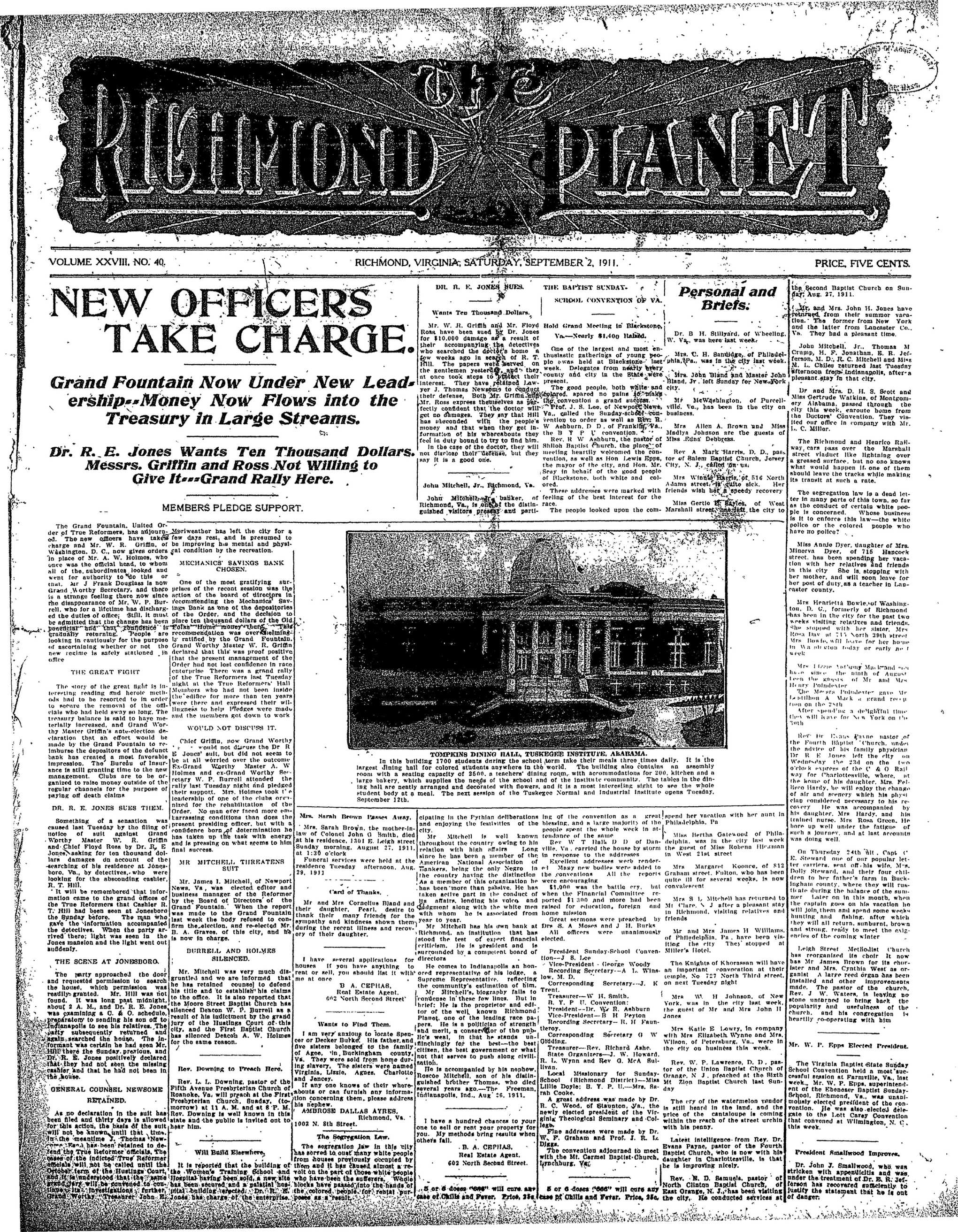
TOMPKINS DINING HALL, TUSKEGEE INSTITUTE, ARABAMA.
In this building 1700 students during the school term take their meals three times daily. It is the largest dining hall for colored students anywhere in the world. The building also contains an assembly room with a seating capacity of 2600, a teachers' dining room, with accommodations for 200, kitchen and a large bakery, which supplies the needs of the school and of the institute community. The tables in the dining hall are neatly arranged and decorated with flowers, and it is a most interesting sight to see the whole student body at a meal. The next session of the Tuskegee Normal and Industrial Institute opens Tuesday, September 12th.
Mrs. Sarah Brown Passes Away.
Mrs. Sarah Brown, the mother-in-law of Colonel John G. Smith, died at his residence, 1301 E. Leigh street Sunday morning, August 27, 1911, at 1:30 o'clock
Funeral services were held at the residence Tuesday afternoon, Aug. 29, 1911
Card of Thanks.
Mr and Mrs Cornollus Bland and their daughter, Pearl, desire to thank their many friends for the sympathy and kindness shown them during the recent illness and recovery of their daughter.
I have several applications for houses. If you have anything to rent or sell, you should list it with me at once.
D A. CEPHAS.
Real Estate Agent.
602 North Second Street
Wants to Find Them.
I am very anxious to locate Spencer or Decker Burked. His father, and five sisters belonged to the family of Agoe, in Buckingham county, Va. They were sold from home during slavery. The sisters were named Virginia, Lizzie, Agnes, Charlotte and Jencye.
If any one knows of their whereabouts or can furnish any information concerning them, please address his nephew AMBROSE DALLAS AYRES, Richmond, Va.
1002 N. 8th Street
The Segregation Law.
The segregation law in this city has sorrowed to out many white people from houses previously occupied by them and it has caused almost a revolt on the part of those white people who have been the sufferers. Whole blocks have passed to the hands of the colored people for restful pur-
TOMPKINS DINING HALL, TUSKEGEE INSTITUTE, ALABAMA.
5 or 6 does "6666" will cure any 5 or 6 does "6666" will cure any case of Chills and Fever. Price, 236. case of Chills and Fever. Price, 236.
Wants Ten Thousand Dollars.
Mr. W. W. Griffith and Mr. Floyd Rosa have been sued by Dr. Jones for $10,000 damage as a result of their accompanying, the detectives who searched the doctor's home a few weeks ago in search of R. T. Hill. The papers were served on the gentlemen yesterday, and they at once took steps to protect their interest. They have retained Lawyer J. Thomas Newcoms to conduct their defense, Both Mr. Griffith and Mr. Ross express themselves as perfectly confident that the doctor will get no damages. They say that Hill has absconded with the people's money and that when they got information of his whereabouts they feel in duty bound to try to find him. In the case of the doctor, they will not dislodge their defense, but they say it is a good one.
John Mitchell, Jr., Richmond, Va.
John Milchhoff, baker, of Richmond, Va., is one of the distinguished visitors present and parti-
TOMPKINS DINING HALL, TUSKEN
building 1700 students during the school
cal for colored students anywhere in the
ing capacity of 2500. a teachers' din-
ch supplies the needs of the school n
y arranged and decorated with flowers
meal. The next session of the Tuske
cipating in the Python deliberations and enjoying the festivities of the city.
Mr Mitchell is well known throughout the country owing to his relation with high affairs. Long since he has been a member of the American National Association of Tankers, being the only Negro in the country having the distinction. As a member of this organization he has been more than passive. He has taken active part in the conduct of his affairs, lending his voice, and judgment along with the white men with whom he is associated from year to year.
Mr Mitchell has his own bank at Richmond, an institution that has stood the test of expert financial criticism. He is president and is surrounded by a competent board of directors.
He comes to Indianapolis an honored representative of his lodge, a Supreme Representative, reflecting
the community's estimation of him.
Mr Mitchell's, biography falls to
conduce in these few lines. But in
brief: He is the proprietor and editor of
the well, known Richmond
Planet, one of the leading race
papers. He is a politician of strength
and merit, a conservator of the public's weal, in that he stands uninfluencing for the best—the best citizen, the best government or what not that serves to push along civilization.
He is accompanied by his nephew, Roscoe Mitchell, son of his distinguished brother Thomas, who died several years ago—The Freeman, Indianapolis, Ind., Aug. 26, 1911.
I have a hundred chances to your one to sell or rent your property for you. My methods bring results when others fall.
B. A. CEPHAS,
Real Estate Agent.
602 North Secbad Street.
5 or 6 doses "Gins" will cure any case of Chills and Fever. Price, 25s.
Hold Grand Meeting in Blackstone
Vn—Nearly $1,400 Island.
One of the largest and most enthusiastic gatherings of young people was held at Blackstone last week. Delegates from nearly every county and city in the State were present.
The good people, both white and colored, spared no pain to make the convention a grand success.
Prof. J. S. Lee, of Newport News, Va., called the Sunday-school convention to order as well as Rev. R. W Ashburn, D. D. of Franklin, Va., the B Y P V convention.
Rev. R W Ashburn, the pastor of Shiloh Baptist Church, the place of meeting heartily welcomed the convention, as well as Hon Lewis Epps, the mayor of the city, and Hon. Mr. Seay in behalf of the good people of Blackstone, both white and colored.
These addresses were marked with feeling of the best interest for the race.
The people looked upon the com-
KEGGER INSTITUTE, AARAMA. In the term take their meals three times a day world. The building also contains living room, with accommodations for 20 and of the institute community. The town, and it is a most interesting sight to observe Normal and Industrial Institute
ing of the convention as a great blessing, and a large majority of the people spent the whole week in attendance of the same
Rev W T Halk D D of Danville, Va. carried the house by storm in response to the addresses
Excellent addresses were rendered. Many new bodies were added to the conventions. All the reports were encouraging
$1,000 was the battle cry, but when the Financial Committee reported $1,300 and more had been raised for education, foreign and home mission
Great sermons were preached by Drs S. A Moses and J H. Burks. All officers were unanimously elected.
President Sunday-School Convention—J S. Lee
Vice-President - George Woody
Recording Secretary—A L. Winslow, M. D.
Corresponding Secretary—J. K Trent.
Treasurer—W H. Smith.
B. Y. P U. Convention:
President—Dr. W R. Ashburn
Vice-President—B J. Peyton
Recording Secretary—R H Faunteroy.
Corresponding Secretary G W Gidding.
Treasurer—Rev. Richard Ashe.
State Organizers—J W. Howard.
R. L. Wynn and Rev G. McA Sullivan.
Local Missionary for Sunday School (Richmond District)—Miss Lille Doyle; B. Y. P. U.—Mrs. Sarah Cooke.
A great address was made by Dr. R. C. Wood, of Staunton, Va., the newly elected president of the Virginia Theological Seminary and College.
Fine addresses were made by Dr. W. F. Graham and Prof. J. R. L. Diggs.
The convention adjourned to meet with the Mt. Carmel Baptist-Church, Lynchburg, Va.
5 or 6 doses "666" will cure any case of Chills and Fever. Price, 25c.
Personal and Briefs.
Dr. B. H. Stilfairy, of Wheeling, W. Va., was here last week.
Mrs. C. H. Sandridge, of Philadelphia, Pa., was in the city last week.
Mrs. John Bland and Master John Bland, Jr. left Sunday for New York city.
Mr. McWashington, of Purcellville, Va., has been in the city on business.
Mrs. Allen A. Brown and Miss Madlya Johnson are the guests of Miss Edna Debress.
Rev A Mark Harris, D. D., pastor of Salem Baptist Church, Jersey City, N. J., called on us.
Mrs Winnie Harris, of 516 North Adams street, Hull qulo slick. Her friends wish her a speedy recovery.
Miss Gertlo H. Bayles, of West Marshall street, St. Louis, the city to
dally. It is the
is an assembly
00. kitchen and a
tables in the din-
to see the whole
opens Tuesday.
spend her vacation with her aunt in Philadelphia, Pa.
Miss Bertha Gatewood of Philadelphia, was in the city last week the guest of Miss Robena Hickman in West 21st street
Mrs Margaret Koonce, of 812 Graham street, Fulton, who has been quite ill for several weeks, is now convalescent
Mrs S. L. Mitchell has returned to Mr Clare, N. J. after a pleasant stay in Richmond, visiting relatives and friends
Mr and Mrs James H. Williams of Philadelphia, Pa. have been visiting the city They stopped at Miller's Hotel.
The Knights of Khorassan will have an important convoitation at their temple, No 727 North Third street, on next Tuesday night
Mrs W. H. Johnson, of New York, was in the city last week, the guest of Mr and Mrs John H Jones
Mrs Katie E. Lowry, in company with Mrs Elizabeth Wynne and Mrs. Wilson, of Petersburg, Va., were in the city on business this week.
Rev. W. P. Lawrence, D. D. pastor of the Union Baptist Church of Orange, N. J. preached at the Bixth Mt Zion Baptist Church last Sunday
The cry of the watermelon vendor in still heard in the land, and the price of the cantaloupe is coming within the reach of the street urchin with his penny.
Latest intelligence from Rey. Dr. Evans Payne, pastor of the Fourth Baptist Church, who is now with his daughter in Charlottesville, is that he is improving nicely.
Rev. E. D. Samuels, pastor of North Clinton Baptist Church, of East Orange, N. J., has been visiting the city. He conducted services at
the Second Baptist Church on Sunday, Aug. 27, 1911.
Mr. and Mrs. John H. Jones have returned from their summer vacation. The former from New York and the latter from Lancaster Co., Va. They had a pleasant time.
John Mitchell. Jr., Thomas M. Crump, H. F. Jonathan, E. R. Jefferson, M. D. R. C. Mitchell and Miss M. L. Chiles returned last Tuesday afternoon from Indianapolis, after a pleasant stay in that city.
Dr and Mrs. D. H. S. Scott and Miss Gertrude Watkins, of Montgomery Alabama, passed through the city this week, carote home from the Doctor's Convention. They visited our office in company with Mr. L. C. Miller.
The Richmond and Henrico Railway, cars pass over the Marshall street vinduct like lightning over a greased surface, but no one knows what would happen if one of them should leave the tracks while making its transit at such a rate.
The segregation law is a dead letter in many parts of this town, so far as the conduct of certain white people is concerned. Whose business is it to enforce this law—the white police or the colored people who have no police?
Miss Annie Dyer, daughter of Mrs. Minerva Dyer, of 715 Hancock street, has been spending her vacation with her relatives and friends in this city. She is stopping with her mother, and will soon leave for her post of duty, as a teacher in Lancaster county.
Mrs Henrietta Bowle, of Washington, D. G., formerly of Richmond, has been in the city for the past two weeks visiting relatives and friends. She stopped with her sister, Mrs Rosa Day at 715 North 29th street. Mrs Howie, will leave for her home in Washington today or early no. 7 week.
Mrs Lizene Anthony Mask and co-base since the ninth of August been the ghost of Mr. and Mrs Henry Pot尔德.
The Meers Pot尔德 gave Mr. Lathamilton A Mark a grand reception on the 29th.
After spending a delightful time they will leave for New York on the 30th
Rev Dr. James Gaine master of the Fourth Baptist Church, under the advice of his family physician Dr R E Jones left the city on Wednesday the 23d on the two oclock express of the C & O Railway for Charlestowille, where, at the home of his daughter, Mrs. Felice Hardy, he will enjoy the change of air and scenery which his physician considered necessary to his recovery. He was accompanied by his daughter, Mrs Hardy, and his trained nurse, Mrs Rosa Green. He hore up well under the fatigue of such a journey, and at last accounts was doing well.
On Thursday 24th alt. Capt C E. Steward one of our popular letter carriers, sent off his wife, Mrs. Dolly Stewart, and their four children to her father's farm in Buckingham county, where they will rustle during the balance of the summer. Later on in this month, when the captain goes on his vacation he will join, them and spend some weeks hunting and fishing, after which they will all return, sunburn, brown and strong, ready to meet the exigencies of the coming winter
Leigh Street Metodistian Church has reorganized its choir It now has Mr James Brown for its churcheater and Mrs. Cynthia West as organist. A large reed organ has been installed and other improvements made. The pastor of the church, Rev. J. W. Waters, in leaving no stone unturned to bring back the popularity and usefulness of the church, and his congregation is heartily co-operating with him.
Mr. W. P. Eppa Elected President.
The Virginia Baptist State Sunday School Convention held a most successful session at Farmville, Va., last week. Mr. W. P. Eips, superintendent of the Edenboro Baptist Sunday School Richmond, Va., was unanimally elected president of the convention. He also delegated to the Lott Carey Convention that convened at Wilmington, N.C., this week.
President Smallwood Improves.
Dr. John J. Smallwood, who was stricken with appendicitis and was under the treatment of Dr. B. R. Jefferson has recovered sufficiently to justify the statement that he is out of danger.
Closing in on the Young Husband. A Mother's Statement. Paul Beattie the Star Witness. The Electric Chair Seen in the Distance.
TWO
JUDGE WATSON GOES
SWIFTLY INTO TRIAL
After he had taken his seat Judge Watson attended to a trivial matter, the renewal of the half of one Geo. Foster, and then said: "Open court, Mr. Sheriff." Sheriff Gill, one of the old type, offered the ancient form, beginning with the word "those present to listen, and if they had matters to be considered by the court to bring them forward."
"Now, Mr Sheriff," said his Honor, casting his eyes about the room to see that everybody, especially the press representatives, about whom he has been solicitous from the beginning, was comfortable. "I'll have to ask you to request the citizens not to crowd the bar and to keep a passageway open for the gress and ingress-of officials and veniement, and to keep especial care of the rail back of the bar, which has been reserved for the press. I have done what I could to make the press representatives comfortable, and the citizens, who have the larger part of the courtroom must not crowd them. The seats are far apart, and there would be more room if all the citizens would stand."
"Gentlemen," cried the shefft,
"you'll have to stand up," and
he brushed his way back to see that his
order was obeyed. There was a low
laugh as he performed his duty and
then looked to the judge for his
approval.
"If necessary, see that the windows
and doors—"
"Yes, sir; yes, sir." Interrupted
the shefft
"Are not crowded," finished the
judge.
BEATTIE CASE CALLED.
Judge Gregory, the Commonwealth's attorney, asked that some condemnation proceedings be filed, and this was done. Then Clerk Cogbill announced that the case to be called was that of the Commonwealth against one Henry Clay Beattie, Jr., for a felony, with L. O Wendenburg and Judge Gregory representing the Commonwealth, and Harry Smith, Jr., and Hill Carter representing the prisoner. "We ask that the prisoner be arraigned," said Mr. Wendenburg, rising.
Mr Carter rose slowly to his feet "We started a week ago today," he began, "when the indictment was first found, in the absence of the accused, and we stated that we expected that we would not be ready at this time. Our expectations justified our fears. Mr. Smith has been engaged the whole time in endeavoring to prepare the case for this day I have afforded only a little assistance. The burden must fall on one of two in counsel, but I have done what I could. We have not completed the work of getting our witnesses, and we ask, not for a continuance to another term of court, but a postponement until today week. We are prepared to make affidavits in court when pleas are given. Judge Gregory arose to make reply, but was interrupted by the court, who said:
"Mr Carter, have you gentlemen any objection to stating when the accused obtained counsel? Of course, I can get this information from witnesses, but it will save time if you will say."
TIME THEY WERE ENGAGED.
"If Your Honor please," said Mr. Smith, who was the first to be employed, "I was consigled in this matter the night before the coroner's inquest I was spoken to, but not engaged. I agreed to appear at the inquest, but there were no definite arrangements then. Definite arrangements were not made until the last Friday in July. I think I may be able to verify this statement by the fact that on the day before pictures of Mr. Carter and myself appeared in The Times-Dispatch, when we had given them authority to state that Mr. Carter and myself were engaged in the case."
"When was the arrest made?"
Mr. Smith went over the dates on his fingers, and replied: "On Friday, the 21st. We were employed on the "That was the first time I saw Boattie," said Mr. Carter, taking the strain up. "I talked to them, but arrangements were not completed, and I was not sure that they had been completed until I saw it in the paper."
Judge Gregory again tried to get a word in, but Judge Watson continued the questioning himself.
"Do I understand that you have not had processes served?" he inquired.
"In one particular I can tell you," said Smith. "We have not been able to get all our evidence. It may be our own fault, but we have not had access to the automobile matter. We thought we would ask Your Honor or to permit us to examine it. We would like to compare it with a machine of like model, a Bulk of the 1909 model. We have tried to find a like machine, but have not been able to do so. We went to Foster's garage to get one, but were not able to secure one. We ask Your Honor to give us permission to have access to this machine for the purposes of defense. We were able only on Saturday to secure the names of two important businesses. We spent two weeks trying to them, but were
the court?" asked Judge Watson.
"Would you mind giving the names of the witnesses?"
"They are witnesses from the Virginia Railway and Power Company," answered Mr. Smith.
"Were they Pace and Whitmore?" asked Mr. Wendenburg.
"Yes, I believe so. The prosecution refused to give us the information about them, and we spent two weeks trying to find them."
"Are they all in the jurisdiction of the court?"
"Yes, I think so, except two, but we can get them, for they readily agreed to come on telegraphic summons."
STATEMENT BY THE COURT
"Well, now, gentlemen," said the court, "it passes without saying that where the life of a human being is at stake it would be a gratification to the court to meet any reasonable request as to fixing the time for trial. Since the matter was tentatively agreed upon a week ago, it would seem that the court is now justified in having the case come to trial at this time. The exigencies of you gentlemen hardly justify me to defer the case. If I accede to a postponement I will have to leave the court open eight or nine days, and I feel I would place the court within narrow confines to set the case for next week. I don't know how long it will take to get a sentence, but I feel very uncertain about the progress of the case if less of the term be given it. I will indulge you any reasonable length of time to summon your witnesses. Against my personal wishes I deem it necessary to begin the case today."
"I would suggest that we go ahead with procuring a jury and set the trial for today week," said Mr Carter. "If we have the opportunity of a delay in getting the jury, it would not matter."
"If Your Honor please," began Mr Gregory for the Commonwealth. "I owe a duty to the prisoner and a duty at the saque time to the Commonwealth. The affidavits of when Mr Smith speaks should be filed before the court, and should contain the grounds for which continuance is asked. This is simply a verbal statement. I submit that the affidavits should be brought before the court now, and the Commonwealth ought to be able to inspect them, to see if they are within the purview of the law. We must know what their grounds are."
"There was no motion for a continuance. The defense asks only for a postponement," explained Judge Watson.
CAN GET THEM QUICKLY
For the purpose of getting the matter on record," broke in Mr. Wendengburg. "I think it proper to say that so far as the two witnesses, Pace and Whitmore, are concerned, that they are employ of the Virginia Railway and Power Company, and can be gotten in two hours. I did not see the young men until last Friday. I do not consider it the duty of the prosecution to tell the defense what its own witnesses say. So far as the automobile matter is concerned, the counsel for the accused had opportunity at the coroner's inquest to examine the machine. It was there, and all who were interested could have looked at it. It is now in the possession of the coroner, and can be seen by any one accompanied by an officer. And we know that Mr Smith appeared as counsel on July 21." "I never had a statement questioned at the bar before," retorted Mr Smith hotly.
"Did you understand it so?" inquired the court.
"And in what respect?" asked Mr. Wendenburg.
"I was not employed to represent this young man then, as I stated," replied Mr Smith sharply. "I was only consulted."
"A distinction without a difference," was the rejoinder of Mr. Wendenburg.
"Do you care to make avidavits?" asked the court, interrupting the fighting between the attorneys. It was agreed to let the matter go as statements on the records. But there was more argument as to when Mr Smith appeared in the case.
"Then you will swear that I appeared before July 21!" he asked Mr Wendenburg.
"I will swear that you appeared before the inquest," replied the other.
"There will be no dispute about the facts," the court interrupted again. "I cannot grant a postponement. Do you note an exception?"
"Yes."
"Note the exception." Mr. Slenographer," said the court.
"Are there any further preliminaries?" asked the court.
WANTED TO QUASH INDICTMENT
Mr. Carter arose to object to the method by which the grand jury had been summoned, and said: "I move to quash the indictment." He was asked, to specify grounds for the motion, but refused as a right. "Do you not think it better to plead abatement, if there be no error upon the record?" asked the court. "He should specify the error, and if there be grounds for the motion he ought to point them out." "The court has asked counsel for the defense to do so, but they are unable or unwilling to do so," requested Judge Watson. "The court
requests that the defense show the error, and overrules the motion. As a matter of fact," continued Judge Watson, "the court has stated that it summoned this as a special grand jury. Are there any other motions, gentleness?" "No," came from the defense. "Mr. Clerk, you may arraign the prisoner." "Henry Clay Beutleth, Jr., stand up?" said Clerk Cogbill. The young man arose steadily and without change of expression and averting his eyes only now and then to glance at those in front of him stared hard at the clerk. The long indictment "was read amid a painful silence in the courtroom. The father of the prisoner sat still with bowed head. "Are you guilty or not guilty?" asked the clerk, as he finished reading the paper. "Not guilty," replied the accused steadily, as Mr Smith raised his hand to interrupt him.
"I move to quash the indictment," the attorney said hurriedly. He argued that the venire facing for both the grand and petit juries had been improperly issued and served, and that the sheriff had committed an error thereon. But he failed to convince the court.
"The motion is overruled," said Judge Watson.
"Well, we wunt the names of all the witnesses summoned by the prosecution, said Mr. Smith." We are attached to that the prosecution is not to be allowed to summon witnesses they have not named."
"Is there any objection?" asked the court.
"We have none," replied Mr. Wendenburg, "but I deny it as a proposition of law."
SEVERE ON KIDD.
"Not all the names of those summoned have been furnished to the clerk," said Mr. Smith. "Many of them have been summoned by the Commonwealth's attorney under a special statute."
"I know of no such law," replied Judge Gregory.
"The court hopes the names will be given, so that the case may go on." urged Judge Watson.
"We have not shown any disposition not to give the names," said Mr. Wendenburg, "but now is the time to explain a few things to the court. We consented days ago to give names of witnesses to the other side. Since then an amateur detected named Kldd went to John Joseph, one of our witnesses, and took him to the jail to identify the person concerned in a certain transaction. He told Joseph that if he did identify Bentle he would be locked up. He was to swear that Bentle was not the man."
"I don't know anything about it." Mr. Smith interjected, "and I don't believe it."
"We ask for an attachment against this young man," continued Mr. Wendenburg, "to have him brought before you to show cause why he should not be punished for contempt of court."
"The matter is not before the court as a record," said Judge Watson, "and I cannot now take it up."
The prosecution intimated, however, that the alleged action of Kidd would be made a matter of record. "We will give them the names of our witnesses as we come to them," went on Mr. Wendenburg. "And we would like them to give us the names of their witnesses. Do you refuse?" he asked, turning to counsel for the defense.
"You have no right to ask it," retorted Mr. Smith, "whereas we have a right to make the demand of you."
CALLING THE VENIRE.
The discussion ended when the court turned and said: "Mr. Sheriff, call the ventre."
"N. W. Farley," cried the clerk, "come forward." He continued (the list of the first ventre, for two were summoned in case of exigency. R. Henry Covington, John T. Dance, E. L. Wilson, J. V. L. Letteroff. Irving M. Hass, Jr., V. W. Fiqun, W. M. Jackson, C. A. Wilkinson, A. T. Bardwell, J. H. Fry, Warren Morrissette, J Ernest Goode, C. H. Duff, W. H. Eanes, R. Cleveland Wooldridge. All are residents of Chesterfield county, "Henry Clay Beatle, Jr," said the clerk, addressing himself to the prisoner, "the jury to try you is about to be called. If you have objection to any of them, say so." Counsel nodded.
"N. W. Farley," called the clerk. In reply to the queries, the ventrerman stated that he lived two and one-half miles this side of Peterburg; was born and raised in Chesterfield; was thirty-seven years old, and was a registered voter.
"Mr. Farley," said the court. "The Commonwealth brings an indictment against Beattie, charging him with the murder of his wife. Do you know anything of your own knowledge concerning the murder?"
"How much do you read the newspapers?"
"Every day. I followed the story carefully, and read up on it pretty good."
"Hare the accounts caused you to form an opinion as to whether the
prisoner is guilty or not?"
prisoner and the prisoners my opinion has been formed. Yes, sir."
"According to the papers my opinion has been formed. Yes, sir."
"Your opinion, you say, has been formed. Is it based on the assumption that the accounts in the papers are true?"
"Yes, sir."
"Now, pay attention to what I ask you," said the court. "Have you formed an opinion as to whether the accounts in the papers are true?"
"No, sir."
"Then, your opinion is based on the assumption of the truth of the accounts."
COVERS EVERY GROUND.
"The law says that one must be tried by a fair and impartial jury," said the judge. "Would what you have read impair your judgment or influence you in deciding the case?" "No, sir." "The law," continued Judge Watson, "assumes that every man charged with a crime is innocent. (Can you be guided by this presumption of law and not be influenced otherwise?"
"Yes. alr."
"Are you related by consanguinity or by other than to the prisoner at the bar, or were you related in like manner to the deceased?"
"No, sir"
"Do you live more than three miles from any point in the Midlothian Turnpike on which the crime was committed?"
"Yes, sr"
"The punishment upon conviction of murder in the first degree is death. Have you any conscientious scruples against the infliction of such punishment?"
"No, sir."
"You said," continued the court, carefully, "that you followed the newspaper accounts of the crime closely. Is your opinion decided? Could you act upon the evidence to be brought before a jury and not be guided by a previous opinion?"
"Yes, sir. I would be guided only by the evidence."
The defense was satisfied, and the first man called from the veneire was accepted. The case had started.
W. M. Jackson, second man called stated that he lived four or five miles from Petersburg, and lived all his life in the county. He is a registered voter, and was not related to Seattle or the deceased. He had no personal knowledge of the crime, and had not heard from others who claimed to know about it. He said he read the papers fairly well.
DOESN'T BELIEVE NEWSPAPERS
"Do you believe everything you see in the newspapers?" asked the court suddenly.
"No, sir, not everything," and a titter went around the courtroom.
"Have you formed a fixed opinion?"
"I might be biased by the papers."
"There are two sorts of opinions," said the court. "One is that opinion which is so fixed that one cannot get rid of it. That is a decided, or a fixed opinion. On the other hand, you may assume certain things to be true, and base your opinion on that, changing it if you found that those things were not true. That is called a hypothetical opinion."
"I object to that definition." interrured Mr. Carter. "A decided opinion is not necessarily a fixed opinion."
"I will amend it," answered the court. "Is your opinion based on the assumption that the newspapers are correct in their accounts?" asked the court, again addressing himself to Mr. Jackson.
"Do you think you would be binned in your judgment?"
"I think I would be."
"Stand aside."
R. Illim Covington was the third called. He is a voter, has lived all his life in Chateaufield, and is about twenty-five years old.
"Have you read the papers?" asked Judge Watson. "I've read them very little," was the answer. "Could you give the prisoner a fair trial?" "Yes, sir." "You have formed no opinion!" asked Mr. Carter, of the defense. "No, sir; I haven't any." Mr. Cofington was accepted.
C. T. Wilkinson, next called, is not related to Heathat or the deceased, and had no personal knowledge of the crime. He had read the papers fairly closely, he said. "Have you formed an opinion as to the case?" he was asked.
"No, sir." Only one side of the case has been printed." "Has anything in the papers caused you to form an ophton blessed to the prisoner?"
GUIDED BY EVIDENCE.
"I think I could report myself so as to be influenced, only by the evidence," replied Mr. Wilkinson. "Have you any scruples as to the infliction of death as a penalty prescribed by law?" "The law prescribes the punishment, and I must support the law," came as the steady reply.
"You have no fixed opinion?" asked Mr. Carter.
"No, sir. My mind would be guided only by the evidence. John T. Dance was called. There was a little noise in the courtroom as Mr. Dance stepped forward.
quiet," ordered Judge Watson.
"Stop that talking," said the shiffr, half rising from his seat at the foot of the bench. "They seem only to be scuffling a little," he said, turning to the court. He laughed a little, and another murmur passed through the room. But it was quiet again within a moment. Dancer was not related to either the prisoner or his dead wife, had formed no opinion, was not prejudiced against the prisoner and could give him a fair trial. He had expressed no opinion. He had lived nearly all his life in Chesterfield county, and is about fifty years old. He said he would not be deterred in rendering a decision by the fact that the extreme penalty for first degree murder is death.
"Are you absolutely unprejudiced?" asked Mr. Smith, of the defense.
"Yes, sir"
Mr Dance was accepted
"Wait a moment," requested the court,
"I forgot to ask Mr. Wilkinson a question. Mr Wilkinson, are you a citizen of Chesterfield county?"
"Yeg. alr."
"How long have you lived here?"
"Only about two months. I moved from here to Lynchburg and then moved back"
"Have you a vote here?"
"No, sir."
"Have you a vote in Lynchburg?"
"No, sir," and the ventreman explained: that he had not received his transfer, owing to circumstances over which he had no control. He was excused.
FORMED NO OPINION.
T. L. Wilson was then called. After he had answered the usual preliminary questions, he was asked if he had read the papers
"I don't read the papers much," he replied "I can read," he explained, thinking it might be considered that he didn't read much because he couldn't read well.
"I haven't much faith in newspapers," he went on. "I read about three accounts of the murder, and did not read the papers every day."
"Have you formed an opinion?"
"No, sir. I couldn't. I don't believe much in the papers. I can give a full account."
The defense did not question him, and he was accepted.
"A. Bardwell," called the clerk. Mr. Bardwell has lived in Chesterfield twelve years, and is a registered voter. He was not related to the prisoner or his dead wife. He said he read the papers every day.
"Have they caused you to form an opinion?" he was asked.
"They have gone a pretty good ways to make me form an opinion," he answered.
"Could you give the prisoner a fair trial?" asked Mr. Wendenburg.
"Yes, sir. I think I could give him a square deal."
But he added that it would take pretty strong evidence to make him change his opinion. He was ordered to stand aside for the time being.
A. L. Fetterolf said he had read nearly all the accounts of the crime. But the papers had had no effect in making him form an opinion, and he had formed none. The papers were one-sided, he had. He has been in Chesterfield twenty-two years, and is a voter. No questions 27 etal etoa eta eta ca were asked by the defense, and he was accented.
Then came J. H. Fry. He has lived in Chesterford twenty-two years, but not a voter, having not voted for eight years. He said he was qualified to vote, but was not a registered voter. He was ordered to stand aside, and the defense excepted to the rejection. The suffrage question had been on the eligibility of jurors was discussed with the, and it was decided to take the quitter of Fry and Wilkinson up later.
"We will except in either case," announced Mr. Smith, "whether they are accepted or relected.
TWO QUICKLY EXCUSED
Warren Morrislette was excused because it was feared that he would not be able to stand the ordinal of a possibly long trial. He has been suffering from asthma. J. Ernest Goode was rejected because he believed the prisoner guilty, and his opinion was too fired.
Irving M. Buss, Jr. qualified, as he had read little in the papers, and had expressed no opinion and had no scruples against the extreme penalty demanded by law. The defense did not question him, and he was accepted.
B. W. Fuqua had not expressed an opinion, and could give a fair trial on the legal presumption of the innocence of the prisoner. He was accepted.
C. H. Duffer claimed exemption on account of his age. He is sixty-nine years old.
W. H. Eanes was called.
"How old are you?" inquired the
court.
"Sixty-three years."
"Do you claim exemption?"
"No, sir."
"Are you healthy?"
"Yes, sir. I'm pretty strong and healthy. I haven't had a doctor for years." He had expressed an opinion from what he had read in the newspapers, but did not believe all he read in them. He said the papers had conflicting accounts.
"What papers do you read?"
"The Times-Dispatch and the Journal," he replied. He said he believed the prisoner was guilty, and it would take strong evidence to make him change his mind. He didn't know whether he could act on the presumption that every man is innocent. He was requested to stand aside for a time. Judge Watson saying that he would like to look up a decision of the Supreme Court in the McCue trial as to the eligibility of a man situated like Mr. Eanes.
R. C. Woodbridge, twenty-six years old, is not a voter, and was asked to stand aside temporarily.
AGAIN MOVED TO QUASH.
"Seven men have been accepted," stated the court, "and three men have been set aside temporarily. If the defense wishes, it may argue now on the suffrage question as it relates to the eligibility of jurors." "We move to quash and discharge this venue. We move to quash the veneira facias summoning a petit jury and the shorif's return thereon," said Mr Carter. But the defense refused to state upon what grounds the motion was made, or to point out the error it alleged, and the motion was overruled. "Do you except to the three men set aside?" the defense was asked. The will except in other case." repNot Mr. Smith, "whether they are accepted or rejected." Mr. Wendenburg arose to ask that the prosecution be allowed a ten-minute conference, and as it was within that time of the adjourning hour—1 o'clock—it was decided to adjourn until 2 o'clock.
Before adjourning Judge Watson addressed those pelt jurors who had been accepted.
"You have been accepted in this case," he said to them, "and you must be exceedingly careful not to talk with any one concerning it, and not permit any one to talk with you. If you should discuss the case with outiders and it should be discovered afterwards, the defense could except, there would be an error in the trial and the case would be greatly delayed. Don't let a human being talk to you about the case. Return to court at 2."
DEFENSE HOLDS ITS
OWN, BUT CRUCIAL
TEST YET TO COME
(By Joseph F Gelsinger)
The defense holds its own
Out of the first shuffle of the cards with life or death the stake, the accusers of Henry Clay Beattie, Jr., drew nothing more tangible than a dreary repetition of inquest testimony, and closed a day of wretched heat and discomfort the gainer by little and the loser by one or two expectations that failed at the critical moment. It was not a determining test--there should be no mistake as to this. The State still stands firm as a rock in its conviction of ultimate success, and the fight has hardly begun.
But that the other side came into it strongly no man can deny. Skirmishing warfare for position, seizing avidly every point, however small; scoring a little here, a little more there. It finished at sunset hopefully as it began, profiting most by the mishaps of the Commonwealth. It launched a final arrow late in the day—a bold and adroit stroke at the very foundation itself. Theoretically fraught, its abilities beyond what at this juncture, this really means nothing but one more exception on the last already long. The indictment will surely stand and the great trial go on.
ENDS WITH BOTH SIDES CONFIDENT.
Both sides withdraw claiming victory, and overnight both, having measured strength and come to respect and fear each other, prepared all the more carefully for another day. A few hours more may bring the death grapple on. In the spotlight glaringly stands Paul Beattie, the accusing cousin, looming large. Upon him, hysterical and weak, seemingly hange the issue now. How he will wendher the storm gathering over his head nons can say. If he stood alone, unsupported, well might the Commonwealth fear. But behind this stripping the State has gathered much of its force, with witness upon witness to hold up his hands, however much he may quail before the searching, trapping wit of counsel or the disconcerting eye of his kinsman within the bar. Today will shrink into insignificance when it comes to this—and it may come today.
ANNIVERSARY OF HIS WEDDING DAY.
And of the prisoner? On the first anniversary of his wedding day he came, charged with the murder of his bride, and faced his judges with little of the half-supercilious confidence of old. It was not the Henry Battle of a week ago. Though scarcely just in such a orisls to watch and weigh every feeding shadow upon the face of a man battling desperately for life, yet there were many who noted the change, and it cannot be ignored. For more than two hours in the morning he sat like a hunted animal at bay. Grim and silent, he saw the first measure of arms, keenly conscious of every, more. War itself. Battle loosing his nerve at last! Many asked the question, but
---
none could answer. Today he /may come back cheerful and light-hearted again. There is no accounting for this strange boy. He is one of mystery and unfathomed depths, if ever one existed, shifting lightly from grave to almost gay. In the afternoon he brightened perceptibly and wont again to his lonely cell. He may be innocent. The public does not believe it; the jury will determine it. Guilty or innocent, he is making a game struggle, in spite of his seeming panic when the first witness went on the stand.
DEFENSE MAKING BIG FIGHT
The defense showed its hand—somewhat. Leaving out of consideration the possible final resort—insanity—it is evident that it will fight from ditch to ditch, yielding nothing. Standing fatly on the prisoner's original story of the crime, it sets forth to prove it reasonable and true. Every technicality of the law will be invoked, and there are many; every loophole, however small, will be tested; every slip in the opposite camp will bring a quick movement. Unimportant or not, any witness who comes will be raked in a steady fire, in the hope that he may yield something—no matter what. On such mites as these are defense will feed, and in the meantime, bhind the scenes, draw up its lines for its great battle—the attack on Paul Beach. Here it will win or lose the case, and all know it. As it stands, the cousin's confession connects Henry directly, definitely and undeniably with the murderous gun. The defense must disprove or discredit it. The Commonwealth says, it cannot. And in the distance hangs the prisoner's life.
GHASTLY CRIME REHEARSED
In the first day the prosecution rehearsed the history of the crime. It set up Henry Beatty's story, with the determination of finally ridding it. It proved his association with the Binford woman. It showed that he spent hours with her on the very night before his young wife was done to death. It pointed to some variations in his accounts of that tragic moment on the Middlothian plice. It proved, inferentially, that though his wife lay dead near him, the husband even then was comparatively cool and calm. It called to the jury's notice the supposed tell-tale footprints near the roadway stump—but here the defense had a qualifying word to say. It laid emphasis on the character of the blood stains in the road and the mute denial they gave of the prisoner's recital. It began to prepare the ground on which to erect its theory of a motive. It exhibited the blood-stained garments of the accused and the gun from which the fatal shot was fired. All this and more did.
But it did not prove what it seemed most anxious of all to prove—that Beattie took measures to see that none but his wife went with him on that midnight ride. One witness, an uncle of the dead girl, knew why the others stayed at home, but only by hearsaay. Another might have blurted it out. But, experienced in the ways of courts and the meaning and objects of the law, this one held his peace. Striving always to be fair, whatever he might personally think, Mr. Owen could not speak of what he knew only at second hand. There was no need for the presiding judge to halt him. He understood the law and obeyed it. The Commonwealth forced and sparred, but to no avail. The witness was indirectly a comfort to the defense and a sharp disappointment to the State. Here it failed. It will try again.
SEVEN WITNESSES IN ALL.
On the whole, the seven witnesses of the day went the gauntlet well. Now and then-one would be led into a contradiction or a doubt where before he seemed sure enough, but generally speaking, they stood fast. The prosecution is being able conducted, with Wendenburg in the forefront, capably assisted by Judge Gregory. Enough has been said of the other side to show that Smith and Carier are bending all their great energies to the task. In its box the jury sits impassive, but closely watching, and ten feet away sits Henry Deattie, watching the jury:
THE DAY IN COURT
Early morn brought animation beyond the custom to quiet countryside haunts. Interest, flagging under the dead dullness of the preceding day, had evidently shot high again, and dust-laden roadways had their patient plodders even with the crack of dawn. The courthouse was the Mecca of all wayfarers now, and seemed likely to hold the control of the stage for a week to come. Plow shares lay idle on the parched fields and farm horses, shaking the weekday grime of the furrows from their scarred coats, sprucefully jogged to town to see the sights.
There were sights to see. No more tiresome repetition of jury-making formulary, came to wear patience down to the point where com- and long ago gone protec-ingly out, and long ago again, the day went with a dash that the same hours of the past to the blush. The story of a monstrous crime, was at last being told, and two women men sat listening, while Beautie clainted, gated, with a hawk's eye trying to fathom their misery.
```markdown
```
It all hung the heat—oppressive, stiffing. The sun dodged every cloud and sent its blasts straight down, pitilessly. Outside the big-leaved trees were stirring busily, but it was a tantalus breeze, that hovered near and never came within reach. Before the judge oven entered the room the court was jammed—witnesses, spectators, one woman.
BEATTIE'S NIGHT IN JAIL.
The prisoner was on the lawn early. With the jailer at his heels Beattie strolled about unmolested almost contentedly it seemed. from the distance. In striking contrast to his late mien, he was in good spirits as he stood at the primitive court green booth, drinking a coca-cola from the bottle.
"I went to sleep at 9:30 last night and woke at 8 this morning," he said, with a laugh.
During the early evening of his first night in the tiny Chesterfield prison he had been heard passing pleasantries with two others lodged across the corridor, their partners or not that vowel, both partners in their guarding him with watchful eyes. There was no need. Beattie saw nothing inviting is the dreary prospect from his barred window, and went to bed with the crickets. A half mile down the road a forest crackled and then burned itself out. He did not even know of this neighborhood excitement.
Presently, as he roamed about the green, the morning crowds began to come and Benttle's peaceful, quiet moment had passed. Before long his father and brother arrived—and he went over for a word with them. After a while the automobile in which he and his murdered wife rode on that night of tragedy was brought out as a memorial brother and some officer, the prisoner being around and around the car, inspecting it from its side. The driver had neglected an ordinary precaution, and the mechanism had been somewhat injured by the trip. Benttle complained bitterly of this.
SESSION OF COURT BEGINS
About 11:30 o'clock the judge entered the court-room, and with a pleasant greeting for all, proceeded slowly to the bench. A moment more and the session began. By this time the place was crowded to suffocation, and the daily problem of disposing to the heat advantage of the small space available was again before the court.
Windows and doors were cleared and the throng was pushed back in the alley beyond the line of the bar. It was not an easy task "Back up, boys, back up!" shouted one desnailing farmer. The court further instructed the sheriff and that worthy man, brandishing four palm leaf fans and working his briskening, heard vigorously, heard and straightway did "Heads up, gentleman," he called, lifting his hand with an expressive gesture, and the crowd rose to its feet, giving room for probably fifty more spectators. The benches are far apart back in the room, and with the people seated much precious space goes to waste.
With a word of warning that no demonstration of any sort would be permitted during the trial, at the same time expressing confidence in his people, and commending them for their admirable department up to this time, the court directed that the prisoner be called. Beattie entered on the right side, finding a path through the crowd with difficulty. Before him strode the sheriff and behind him his jailer. Tast of all came the boy's father. Both were soon sented within the bar, otherwise filled with counsel and distinguished visitors. Douglas Bonitio sat immediately behind his brother. The prisoner glanced hastily over one or two newspapers and then gave his attention closely to the proceedings of the day.
"Is the Commonwealth ready to proceed, gentlemen?" inquired the court.
"The State's attorneys nodded.
"How says the defense?"
Mr. Carter arose and asked that the rule excluding all witnesses except the occupant of the chair be rigidly enforced with the exceptions agreed upon by both sides—Beattle, Sr. Doughlas and Detective Schore. The court acquitted, and also stated that nobody would be excused hereafter without good cause.
WITNESSES SUMMONED.
Witnesses were summoned before the bench five at a time. The short shouted the names and citizens on the outside took up the call. Few answered at first. Then they came better. Standing before the judge, the witnesses were sworn and directed to leave the building keeping within halling distance, but not within a sarshet of the chair. Greatest interest showed itself in the appearance of the uncle of the dead girl, Coronor Loving, two physicians who have figured in the case. Rithmond officers headed by Chief Werner, and one or two women. The rest attracted no particular attention. A number failed to show up at all, but will be on hand when they are really needed. Four negroes completed the list. Defence witnesses were summoned for Saturday, but as a precautionary measure the names were called and were followed with an announcement that any who happened to be present should leave the room at once.
At last it was done and Thomas E. Owen art in the witness chair. The trial was on. Seattle looked steadily down for a moment and then gazed fixedly at the witness. From the other side Owen gave a pair of eyes also beat upon
THE BXAMINATION.
Judge Gregory opened the examination. Slowly, carefully, graphically, Mr. Owen, with an occasional gesture, recounted the events of the night of crime and horror, reckoning Henry's story of the bearded highwayman, describing his sonational arrival with the corps of his wife, commuting on his general appearance and conduct at the moment, and indicating, in some measure the household scene that followed. Beattie scarcely moved. With his arms on the railing in front of him, he leaned slightly forward staring at the speaker. His jawbone worked steadily, stopped, worked again. Something like a hunted look came over the face of the boy—or so it seemed. Faces at best are hailing masks, and one might easily mistake. But to many around him the fact seemed clear. Beattie's bravado was gone. Sorious enough today he was, with sombre, brooding eyes. At one time Mr. Owen referred to the wound in the girl's left cheek, declared he thought it to be about the size of 2 half-dollar.
Beattie's lips moved. "A half-dollar," they said in volleous speech—a curious thing unconciously done perhaps.
Bloody exhibits were brought in, and while the clothes he wore on the night of the homicide were handed piece by piece to the witness for identification, Beattie's eyes followed each. Scherer drew from the big brown pasteboard box another parcel and ripped the strings. The stock of the old Shafft gun came into view and the detective was soon fitting the barrel to it with its murderous and pointed straight upward. The prisoner glanced at it for a moment and then turned his attention to other things. A sharp sound brought his eyes back and gave the crowd a start. Scherer had snapped the lock.
The story went steadily or, counsel for the defense taking numerous notes and occasionally consulting their client. Mr Owen virtually repeated his testimony at the coroner's inquest. He spoke with extreme care at times. Under the rulling of the court, he could make no comment on the conduct of the accused on the night of the crime, but could merely detail his words and acts, leaving the jury to determine their significance. At one time he was asked what assistance Henry Beatty had given him in the midnight search for the slayer of his wife. "None that I can remember, except his desCRIPTION of shoot and the man he said did it." He reply, "He asked me to telephone to his father, but said nothing about the police." Leaning quickly to his counsel, the prisoner spoke rapidly and with emphasis, sharply tapping the rail in front of him with the point of his pencil.
NO HEARSAY EVIDENCE
After all hour the cross-examination began, with Mr. Smith guiding the defense's attack. Trained in law himself by long familiarity with courts, Mr. Owen made an excellent witness from this point of view, and surely dealt fairly with both sides. Several times occasions arose when other Smith or Wendoburg would have given much for a few significant words. But the witness, aware of the rules of evidence, never once skirted the danger line. He needed no instructions from the court. Hear-say evidence, however, badly desired, was still unsaid when he left the stand. Incidentally Judge Watson again gave convincing proof of his ability to steer clear of aboals. The court was ever equal to the emergency. He grasped situations with refreshing insight, and expressed them with equally refreshing candor. All was impartial here and able to an impressive degree. Hair-splitters find no harvest in Chesterfield.
The cross-examination was skillfully handled, and indicated plainly the determination of the defense to testek close to Henry Boutte's story and from this vantage ground light to a finish. Particular emphasis was laid on certain points: that Boutte experienced his delay in arriving at the Owen household early in the night of the murder by referring to a "husted" tire; that he carried a prescription to a druggist, a bottle of medicine later coming back to show he had filled this mission; that his automobile was pointed toward the Midtothian pike when he stopped, and that he merely continued in that direction without having to turn around; that the pike is a popular automobile thoroughfare; that when Henry returned after his awful ride he announced with some show of certainty that the gun would be found in the car; that the witness gnst that night. thought it reasonable to suppose that the absence of the rear doors of the machine might have accounted for the failure to find the gun; that at the time the witness thought it possible the gun might have been jolted out, and even suggested to hystanders the durability of instituting a search at certain rough places, one of them being the Dell Line tracks, where the wedden was subsequently discovered; that the witness saw nothing unusual in Henry's request for a glass of whiskey, but would in all probability have suggested one himself.
In the course of what followed much attention was given to the question of whether or not Henry Bentle did in fact take precautions to have no one with him in the automobile that night but his unfortunate wife. It was brought out that the only people in the Gwen home at the time were the wife of the prisoner, who went with him; the wife of the witness, who was slick; the baby child of the younger Bentle; the mother of the murdered girl, who was upstairs for the baby, end the witness, who did not care to ride in automobile, particularly when speeding.
"Too valuable a life to risk in an automobile!" suggested Mr. Smith.
"Rather valuable to me," said Mr. Owen drilly.
In view of these statements, Mr. Smith declared that after all there was nobody to join the couple, even had they extended an invitation. "There was no reason why, the baby should not have been taken, he replied. "They had done so before.
As to Mrs. Owen, mother of the girl, the witness stated that she, too, might have gone. It was not necessary for her to remain at home with the baby, for the wife of the witness was not too sick to take care of the little one. There was evidently some other reason why neither Mrs. Owen nor the witness was invited on that last ride, and Mr. Owen knows of it, but only by hearay, as previously stated. The Commonwealth belloves it was an intimation from the young husband showing that he desired to be alone with his wife that night. Counsel cleverly tried to bring this out, but it could not be done.
"She was dead, sir." Witness said the words slowly, and his voice trembled alightly.
"Do you know the place where the homicide occurred?" "I know it by having gone there and seen the blood." "Had it been pointed out by the
ATTACK ON INDICTMENT
When the season was resumed, following a recess for dinner, three physicians took the stand in succession and wont into medical technicalities concerning the nature of the wound. The court ruled out a question relating to the probable position of the gun when it was fired and would also not permit, until proper hasla had been laid for it, certain testimony concerning previous attention by physicians to the prisoner. Three women had fled in prospect of this evidence, but now came back, only to fly again a little later on. One of the doctors stated that he observed no powder marks on the face and no indication that the gun-shot load had scattered.
This was designed to show that the gun was closer to the head than the prisoner stated. During his inspection of the body this same physician did not look for grit in the hair and did not find any there, but later discovered some in the blood streaks covering his hands. Here the Commonwealth indicates one line of testimony by which it hopes to prove that the girl was in the road and not in the motor car when shot.
In connection with the succeeding testimony of the physicians developed the attack on the indictment. The county coroner had described his examination of the wound, identifying two No. 6 shot he had received from the cavity and also stating that he had discovered a gun wad in the same place. The condition of the shirt was described in grusene_detail. The wound opened upon the surface compound under the left eye and extended down nearly to the occiput. Portions of brain matter had extruded. Death undoubtedly was due to this wound, all three physicians said.
Then Mr. Smith made his move deliberately. Calling for the indictment, he directed the attention on the court to the fact that the paper plainly sets forth, in precise terms often repeated, that Louise Owen Beattie came to her death from a gunshot wound inflicted in the face. "Therefore he asked that all references in testimony to the depth of the wound be stricken out. No wound except a wound "on the face" could be considered under the indictment, he thought. The court took the matter in advisement. Later Mr. Smith followed with a final stroke. He drew from one of the physicians an expert opinion that a wound "on the face"—that is, one involving the superficial structures of the face—would not cause death. To get to the point, under the indictment as drawn according to the defense, Henry Beattie could not have killed his wife and should go free. The crowd gasped when it understood and then smiled at the adroitness of counsel it will at all events give Mr. Carter opportunity to note another exception.
TOM OWEN TELLS HOW
MOTOR CAR TRU
With Thomas Owen, uncle of the young man's murdered bride on the stand as one of the State's leading witnesses against Henry Clay Beatle, Jr. yesterday morning entered upon the first day of his actual trial on the charge of brutally slaying his wife on the Midlothian Turnpike on the night of July 18. And for the first time, when his own bloody clothes he wore on the night of the murder were placed in evidence there dawned in the eyes of the hitherto stolcal indifferent bly the look of a hunted animal.
The battle which will rage with Henry Beatle as the storm centre was on. Owen, thoroughly versed in the technicalities of the law and as thoroughly versed in court procedure, made an admirable witness, and was thanked for his fairness by Mr. Smith when he left the stand. Judge Watson was now minutes late in entering court. After doing that the press representatives were comfortable and that none had been crowded from his seat. Judge Watson said: "Mr. Sheriff, open court. Deputy Sheriff Goode repeated the ancient formula, and the crowd settled for the first sharp thrusts. "The first thing I will ask you to do:" said the court, "is to slear the inside railing. We are bound to have room and air."
NEEDED AIR IN COURT ROOM.
"Back up thero, boys," warned Sheriff Gill. "Back up." They backed up at the command. Then the sheriff handed fans to the jurors, for the room was hot-and close. The aisles were still crowded, and again the court ordered that they be cleared, and asked the audience to stand so as to give all more room. "Heads up," said the redoubtable sheriff.
"Gentleman," said the judge, the court reminds you that it is in an ordinance upon an important trial. The life of a human being is at stake. It is not only desirable but necessary for the jury to hear the evidence clearly and to understand it thoroughly. The court is satisfied that the department of the citizens will be as it should be, and it is hardly necessary to remind you that quiet must be maintained. It lies within your hands to maintain order, and it is unnecessary to remind you not to show approval or disapproval. I feel that you will not manifest either approval or disapproval during the trial. If you should do so, I shall be forced to deprive you of room at the court. The court hopes it will not be necessary to curse its authority in the promised. Beatle, accompanied by his father, was then brought into the court and took his usual good deeds.
Nothing on earth is more valuable as a human mind. If a diamond is worth polishing as good would and even more more is the mind of a boy or young man worth all the palming that this school can give it. The best education is not too good for a promising youth. Who would benefit a poor physician to save a few cents when health is in danger? And who would chance an inferior school to save a few dollars when a better school will increase the strength of character and of mind for life and prepare one for a larger usefulness!
Dormitory, Virginia Union University. Va. Union University Offers the Best Higher Education to COLORED YOUNG MEN
37TH COLLEGE COURSE is broad and complete. Its requirements and standing are as follows: as a graduate college for white youth in the State, according to the rating of the Carnegie Board.
118 THIOLOGICAL COURSE has for many years been the standard course for colored Baptist Schools. Tibbey, Greek and all a high regular subjects given in Northern Berminates are given here. One hundred students for the ministry are enrolled in different departments of the school.
ITS NINE GRANITE BUILDINGS, its fully equipped science laboratories, its library of 18,000 volumes, its sole faculty and its full sources of study enable Virginia Ur's University to offer colored young men an education equal to that enjoyed by the favored of other races.
on his right and brother just at his back. Many people had gathered at the windows, and they were ordered away, for the crush was so great around the bar that attorneys, prisoner and others behind the bar were uncomfortably hot.
"Is the Commonwealth ready to proceed?" Inquired the court.
"Yes! Your Honor."
"How says counsel for the defense?"
"I don't know, sir."
"We object." said Mr. Smith, and the objection was sustained.
"Where is the spot?"
"On the Midlothian Tyrnplike."
"State to the court and jury and describe how she came back."
DESCRIBES TRAGIC SCENE.
"I heard some voice of a person musing
WITNESSES EXCLU'D
"If your Honor please," said Mr Carter, risinly, "before we proceed we would like to have all the witnesses excluded from the court room. But we except Mr. Schorer and Douglas Beattie."
The court consented, and ordered the roll of witnesses for the State to be called five at a time. A few of the witnesses, whose presence was not necessary at the time, were absent, but the majority was present. Tom Owen was the first to be sworn. "You and each of you solemnly swear that the testimony to he given in this trial shall be the truth, the truth, and nothing but the truth, clerk Cogoll, and the witnesses kissed the Bible. Tom Owen and Major James D Patton, who is also a witness, were allowed to remain in the room, both sides consenting. Major Herr and Detectives L. L. Scherer, T J Wren and J. L. Wiltshire interced together, and were sworn, immediately afterwards retiring.
in County, Constable George Jarrrel announced that Witness W. R. Hart is ill in bed with typhoid fever. There were four colored witnesses, two men and two women, who were sworn separately. Wendenburg and Scherer then went over the names of the witnesses, and announced that they were Bashed: "Call Tom Owen," said the Commonwealth. But before examination was begun, Mr. Smith arose with a request: "If your Honor please," he said, "we would like to have an understanding that none of the witnesses for the Commonwealth shall be excused, for we would have commended many of them ourselves if the Commonwealth had not done so." "None will be excused without good reason," answered the court. "And without our knowledge," added Mr. Smith.
It was announced that the witnesses for the defense would be summoned for Saturday, and to insure that they were in the courtroom and in position to hear the roll of the defense witnesses was called. None answered
TOM OWEN FIRST WITNESS
"Gentleman for the defense," said the court, "the Commonwealth announces itself now ready. The court is at your pleasure." It was at 11:20 when Mr. Owen began. He stated that he resided in Chesterfield county, one and a quarter miles west of the corporation limits of South Richmond on the road running north and south from the Midlothian Turnphe. "Do you know the accused?" asked Commonwealth's Attorney Gregory. "I do." "How long have you known him?" "From his infancy." He also know the wife of the accused. "Was the wife of the accused over at your home?"
"She was at my house a week before the homicide and was there on the day of the homicide."
"What time did she leave your house on that day?"
"She left my house at 12 minutes after 10 o'clock, or sixteen or seventeen minutes after 10." He explained that there was a difference between his watch and that of Beatty.
"Did she return?"
"She did."
"At what time?"
"At about an hour."
"Were you at home when she returned?"
"I was."
"With whom did she return?"
"With her husband."
"What she
"I don't know, sir."
"We object," said Mr. Smith, and the objection was sustained.
"Where is the spot?"
"On the Midlothian Tyrnjike."
"State to the court and jury and describe how she came back."
DESCRIBES TRAGIC SCENE
"I heard some voice of a person passing in an automobile. I didn't know what it was until I recognized the voice of the accused I heard an exclamation, and the car came more rapidly. 'Oh, my God,' or 'Oh' God he screamed. I was sitting under a tree, with an electric light above me. When he got within a few feet of the light I arose He was still shouting. He stopped the car within about eight feet of the tree, and I asked him what was the matter.
"He said. They have killed Louise. He said. They have killed Louise. That didn't convey anything to my mind. My object was to and her. I couldn't see her, and I inscribed to the car, and found her in the front part in the bottom of the car. Where her foot should have been if she were seated her head was lying. She was lying in what I would call a head. My first impression was that her feet were out of the car, as if she had sat down and her head had fallen forward. Her feet were under her, and her knees on the floor of the car. There was a large knot on her forehead, and her head was somewhat twisted. Her hair and head were covered and matted in blood."
"Didn't you hear Seattle say how it had occurred?"
"I don't recall whether I got any explanation from him then."
"How often did he come with car?"
"He came that night, Tuesday night, on Friday night before, and I think perhaps another night."
"Did any other member of the family ever accompany him?"
"Generally another member of the family accompanied them. On Sunday I rode to the icehouse with him, and on Friday night he took everybody but myself."
"Was anything said between you and him on that night before he left?"
(Continued on Sixth Page)
60 YEARS' EXPERIENCE
PATENTS
TRADE MARKS DESIGNS
COPYRIGHTS A.C.
Anyone sending a sketched or painted
quarterly our opinion from another
author is welcome. We are particularly
concerned that HANBOOK Patent
patents are consonant. HANBOOK Patent
patents are consonant. Patent patients
Patients taken through our special notices, without objection in the
Scientific American,
A handmade illustrated weekly. Largest art
A handmade illustrated journal. Journal, $24 a
quarter four months. Journal, $24 a
MUNN & Co. $301 broadway. New York
Branch O. B. W. Washington.
JURGEN'S SON
Before making your Purchase you would do well to call at the Most Reliable Furniture House in the City and See the Fine Line of REFRIGERATORS, MATTINGS, OIL-CLOTHS And in fact everything that is needed in house furnishings. RUGS AND CARPETS. Of every description; also the latest designs in ROCKERS and Special CHAIRS. Our goods are the best for the price and the price is very low.
open
hristmas
from
life
apache
mar-
tating
foods
ill-
lons,
you
Lake Chicago Booleal*
Pulliam.
8:30 A — Daily-Charlotteville. Week day.
6:15 P — Week day. Low to Garrettville.
10:30 A — Daily-Lburg, Lea. C. Forgue.
6:15 P — Week day. Lynchburg.
TRAINS ARRIVE HUROND.
Low from West — 8:25 A. M. 5:50 P. M.
Through from East — 11:25 A. M. 6:35 P. M.
Low from West — 8:50 A. M. 9:54 P. M.
7:00 P. M.
Through — 7:00 A. M. 2:45 P. M.
James River Line — 7:55 A. M. 6:15 P. M.
Always Losing His Boat.
Keep clear of captain John Simpson or anybody who looks like him.
303-5 North Third St
FINE
CLEANING, DYEING AND REPAIRING.
CHITMAN M. WHITE,
PROPRIETOR.
STRAUS' SPECIAL
Old Yacht Club.
Will Satisfy the Lover on the Right
Kind of Stimulant. Special Prices
We Have. All Grades of Good La
quers, Cigars and Tobacco. Call
and See Us.
ISAAC STRAUS & CO.,
422 E. Broad St.,
Richmond, Virginia
H. F. JONATHAN.
Richmond.
FISH OYSTERS PRODUCE
114 N. 17TH ST., RICHMOND, VA.
Long Distance Phone, Madison-752
Strange, Wonderful, but True Are
the Awe Stricken Tests Given
By the Great Australian
Medium.
PROF D. D. BRUCE, M. D..
The Only Living Apostle of Science
of the Mysteries.
$5,000, IN GOLD TO ANYONE IN
the World to Compete with him.
Possessing more Power than any
four Mediums combined.
No Card, Trance or Hand Humbug
GREATEST HINDOO MEDIUM IN
THE WORLD.
So Great is his Power that he can tell you while in a Clairvoyant state all you wish to know without a word being spoken. Come, all ye unobblervors, scaffers and jeersers: bring all your scentification with you—he will open your eyes to the Private Chamber Mystery. Come, all ye broken hearted wives, all with low spirits and let him lift the burden from your aching and jealous hearts. He challenges the world to compete with him in causing a spoody marriage with the one you love; uniting the separated and bring back the lost one. Traces lost or stolen goods unearths hidden treasures. Removes influence, crosses, spells, ill-luck, cures tricks and conjurations, gives luck and success in all you undertake. Cures the tobacco habit. Allows the captive to be set free.
He is the only one that will give a Written Guarantee to complete your business or refund your money. Are you sick? Do you know what the trouble with you is? Come and consult Nature's Doctor.
Rheumatism, Insomnia, Hysteria, and all Diseases caused. Points given on Horse Riding and all Games of Chance.
No matter what alls you, come and see this wonderful man, Reader, have you noticed that some people have a hard time to get along no matter how they tell, while others have success? Many wealthy men and women owe their success to this wonderful man.
He will tell you whom you will marry. Will you be happy? He will tell you who your friends and enemies are. Can you tell? Don't take a leap in the dark, but be advised by this wonderful man. Greatest Prophet in Existence.
He always succeeds when others fall. This is the chance of a life-time. Don't let it pass you.
OFFICE HOURS: 9 A. M. to 9:30
P. M. Bury: 2:30 to 7:30 P. M.
N. B.—Our Consultation Fee is
50 cents, Sittings, $1.00. All
letters containing $1.00 will be answered in full.
All letters must have a two-cent stamp.
Main Office: 510 South Eighth St.
Philadelphia, Pa.
Thoma, Monroe-2036.
Office Hours: 8 A. M. to 6 P. M.
DR. P. B. RAMSEY,
BURGUNDY, DEPENDENT.
Office: Main Street, Burgeau, Nippe
Burgeau Row 201-4, Red Street
Burgeau Row 201-4, Vernonville.
THRE
RAILROADS.
RAILROADS.
Richmond, Frederick's B.Y. of Potomac R.H.
TO AND FROM WASHINGTON AND BEYOND.
Loave Itiomond
*5.30 A.M. Byrd St. Sma
*5.45 A.M. Main St. Sma
*5.50 A.M. Byrd St. Sma
*7.30 A.M. Main St. Sma
*6.10 A.M. Byrd St. Sma
*12.01 N.on Byrd St. Sma
*4.06 P.H. Byrd St. Sma
*1.15 P.H. Kiba States
*5.15 P.H. Main St. Sma
*5.00 P.H. Byrd St. Sma
Artive Richmond
*7.10 A.M. Byrd St. Sma
*11.25 A.M. Kiba States
*11.35 A.M. Byrd St. Sma
*1.15 P.M. Main St. Sma
*2.45 P.M. Byrd St. Sma
*7.25 P.M. Byrd St. Sma
*10.10 P.N. Byrd St. Sma
*5.40 P.M. Main St. Sma
*11.05 P.N. Main St. Sma
*13.50 Nighc Byrd St. Sma
ACCOMMODATION TRANS. - WEEKDAYS.
Leave Brydge St. N. 1.50 m. P. for Frederickway.
Leave Brydge St. N. 1.50 m. P. for Aklaiah.
Arrive Brydge St. N. 1.50 m. P. for Aklaiah.
Arrive Kirklee St. N. 6.50 m. P. from Aklaiah.
*Daily. *Weekdays. Sundays only.
All trolleys to or from Brydge Street Station (
3000 W. 10th St. saving 5.90 m. n. and arriving
is 6.90 nigh) stop at Kirklee and arrivals
and departures not guaranteed. Read the
N & W. NORFOLK & WESTERN
N & W. NORFOLK & WESTERN
ONLY ALL BAIL LINK TO NORFOLK
Schedule in Effect May 14, 1911
Leave Byrd Street station, Richmond, FOR NORFOLK b5:10 A.M., a9:00 A.M., a3:00 P.M., a4:10 P.M., b7:00 P.M.
FOR LYNCHBURG AND THE WEST: a6:15 A.M., a10:00 A.M., a3:00 P.M., a9:20 P.M., Arrive Richmond from Norfolk: a11:40 A.M., b11:46 A.M., a0:35 P.M., b19:25 P.M., a11:30 P.M. From the West: a6:55 A.M., a3:00 P.M., b2:15 P.M., a6:05 P.M., a9:00 P.M.
Daily, daily except Sunday, bSunday only. Pullman, Parlor and Sleeping Cars, Cafe Dressing Cars. C. H. DOSLEY
W. D. BEVILLE, G. D. P. A., Richmond, Va.
G. P. A., Roanoke, Va.
ATLANTIC COAST LINE
EFFECTIVE JULY 2, 1911
TRANSFER LEAVE RICHMOND DAILY.
For Florida Beach: 8:15 A. M. and
7:35 P. M. 1:00 A. M. Christleton.
For Norfolk: **8:10** 9.00 A. M. 3:00 P. M.
(4) 6.00 P. M. 7:00 P. M.
For N. Carolina: West 6.15 A. M. 10.00
A. M. 3:00 P. M. 9:00 P. M.
For Petersburg 8:10 P. M. **8:10**
M. 8:15 A. M. 9:00 A. M. 10:00 A. M.
4:10 P. M. 6:05 P. M. **7:00** P. M.
M. 7:55 P. M. 9:20 P. M. 11:45 P. M.
For Goldsboro and Jesseville: **4:10** P. M.
Trains arrive Richmond 6:20 A. M. 8:27 A. M. **10:45**
6:10 A. M. 6:35 A. M. 8:27 A. M. **11:45** A. M.
10 A. M. **11:45** A. M. 2:00 P. M.
15 P. M. 6:35 P. M. 8:30 P. M.
9:00 P. M. 11:30 P. M.
Except Sunday, **Simply** only.
Time of arrival and departure and connections
not guaranteed.
C. S. CAMPBELL, D. P.
SOUTHERN RAILWAY
SOUTHERN RAILWAY
TRAINS LEAVE RICHMOND.
N. B.—Following schedule agrees published or information and not guaranteed.
6 10 A. M.
Burleson—Local for Charlotte, Durham
ham and Raleigh. 4:00 A. M. Daily—Daily-
For all points South, Drawing Room Buffer
Sleeping Car to Asheville. 6:00 P. M.
M. Except Burleson—Local for Durham inter-
mediate stations. 6:00 P. M. M. Except
Burleson—Local. 11:45 P. M. M. Daily—Daily-
For all points South. Fullhour ready at 9:50 P.
4:30 P. M. RIVER RIVER.
Sun—To Wet Point, connecting for Haltimur Bay and Fri, 4:10 A M—X Sun and 2:15 P M—Mon, Wet, and Fri—Local to Wet Point
TRANS AIRS HICHINO, M.
From the south 6:00 A M, 8:03 P M, daily, 8:40 A X Sun, 12:55 P X Sun, on P M Sun, connecting Wet Point; 9:30 A M, daily, 11:35 A M Wed, and Fri; 4:25 P M X Sun
B. E. BURGESS, D. P. A.
920 E. Main St. Phone Maidson 433.
C. & O.
9:00 A Daily -Fast trains to Oli Polk.
9:00 P Newport News and Norfolk.
10:00 A Daily Local to Newport News.
10:00 P Daily Local to Oli Polk.
12:00 P Louisville and Cincinnati.
11:00 P Pulhamana.
14:55 P
SEABOARD AIR LINE
Southbound trains scheduled to leave Richmond daily 9:10 A.M.—Local to Norlins, 1:30 P.M.—Fleepers and coaches, Atlanta, Birmingham Savannah, Jacksonville and Florida points, 12 P.M.—Florida Limited, daily, except Business, 11:30 P.M.—Fleepers and coaches, Savannah, Jacksonville, Atlanta, Birmingham and Memphis, Northbound trains scheduled to ar- rise Richmond daily: 5:32 A.M. 9:25 A.M., except Monday, 8:56 P.M. 8:46 P.M.
The PLANET is read all over
this country and in foreign lands.
A colored man calling himself "Captain John E. Simpson" and at times sailing under other names has been persistently swindling both white and colored people in Norfolk, Portsmouth, Newport News and Phoebus. His plan has been to represent that he has money in a colored bank in this city. He gets his victim to write to John Mitchell, Jr., President and tell him to send him six hundred and fifty dollars or some like amount at once to the person who is writing the letter or advancing him a small sum of money until he has gotten his money from Richmond.
He alleges that he is captain of a sailing vessel, which according to his letters has been lost near Thimble Light off Buckroe Beach and an he has been carrying on this kind of swindling for about two years, that boat is presumably wrecked over two or three weeks. He asks the letter, be sent to him in care of the person who advances the money. He never comes back to see if the money comes as he directs. We have written continuously to the people, who send these letters, but we have and quite a time to keep us with him.
Published every Saturday by JOHN MITCHELL,
JLH, at 211 N. Fourth Street, Richmond, Va.
JOHN MITCHELL, JR., . . EDITOR
All communications intended for publication should be sent so as to reach us by Wednesday.
TERMS IN ADVANCE.
One Copy, per year . . . 81.50
One Copy, eight months . . . 1.00
One Copy, six months . . . 50
One Copy, four months . . . 50
One Copy, three months . . . 40
Single Copy . . . 65
ADVERTISING HATES.
For one inch one function . . . 6.50
For one inch each subsequent function . . . 6.50
For two inches, three months . . . 6.50
For two inches, six months . . . 10.00
For two inches, one month . . . 14.00
For two inches, twelve months . . . 20.00
Marriage and Power Indices, one inch . . . 20.00
Stamping and Transparent Indices, per line . . . 10
POSTAGE STAMPS OF A MACHINE DENOMINATION THAT IS USED FOR DISPLAYING DENOMINATED ON SUBSCRIPTIONS.
THE PLANET is named weekly. The subscription price is $15 per year, in advance. Your money can be sent by mail at our mail - in a Post Office Money Order, by Bank Check or Draft, or on an Express Money Order, and when none of these can be groceries, in a Registered Letter.
MONEY ORDERS You can buy a Money Order at your Post Office, payable at the Richmond Post Office, and we will be responsible for its late arrival.
The fee for money sent by any of these companies, in advance, is a rate and convenient way for the forwarding money.
EXPRESS MONEY ORDERS can be obtained at any office of the American Express Company. On the request of the person ordering the order and Le's Express Company, We will be response.
BENTHEDT LETTER—If a Money Order, Pool (office or an Lentrine Office is not within your reach, your Poolmaster will request the payment you request if the Letter is lost or stolen it can be travel. You can send money to this manner at our risk.
If you are responsible for money sent in letters in any other way than one of the four ways mentioned above you will send your money to your bank. If you do it at your bank, you will receive a PICTURE OF YOUR MONEY. IF you want THE PLANET continued for another year you can submit your run, you then notify us by Postal Card to discontinue it. The courts have not order their paper discontinued at the expiration of time for which it has been paid are not to date when they order the paper discontinued.
UNICATIONS—When writing to us to renew your subscription or to discontinue your paper, you should give your name and address to the person we cannot find your name on our books.
CHANGE OF ADDRESS—In order to change your subscription or to discontinue your paper, we cannot find your name on our books.
SATURDAY. . . . SEPT. 2, 1011
THE TRUE REFORMERS.
We are of the opinion that the Grand Fountain United Order of True Reformers which was in session in this city here last week, made no mistake in its movements. Worthy Master and Mr Floyd Ross, of St. Louis, Mo. Vice Grand Worthy Master, and Mr J Frank Douglas, of Ronnock, Grand Worthy Secretary Dr John E Merlweather, who in no way connected with the old regime remains Grand Worthy Treasurer. This satisfies the most radical elements in that a clean sweep" has taken place, and the opportunity is now given to outsiders to come in, and do what they can to rehabilitate the Order.
The resignation of Mr. A W Holmes was not due to a question of guilt, but to a question of propriety. He had been indicted by a grand jury, which indicated that there was probable cause of guilt upon his part. Had he been heard in his own behalf, he might have been able to explain away the damning evidence against him. It was necessary then to invoke the rule, "Cusar's wife must be above suspicion" in order to restore confidence in the rank and file and to bring back to the fold the wavering thousands of the True Reformers. It is reported that already a change for the better has been noted. The treasury balance had sunk as low as the five hundred dollar mark, but the figures of today show that it has climbed up to six times that amount and that it is still climbing.
We hope for the beat, that the Order may be able to come back. Certain it is that if this last movement will not produce the desired result then the case is hopeless. The wrecking of the Order must be laid at somebody's door, and now that the man charged with the offense have been removed from the offices, the public will breathe freer and fool that justice will be done. We have regretted the necessity for taking the public into our confidence in this matter, but the colorado business man of this city, could not afford to condone this species of dishonesty or hesitate to express their condemnation of such practices which has not only injured the reputation of this company, but has checked its financial growth along many lines.
```markdown
```
1 We wish the new management success and we shall do all in our power to aid the organization in its struggle for existence.
RACTAL WEAKNESS.
It is indeed unfortunate to note the trend of events so far as they relate to great colored organizations. Our people are disposed to practice all of the vices of the white men and to minimize their virtues. They pay little or no attention to the law and exercise power never contemplated by the founders of the government. In this respect the rights of the minority are ruthlessly dehidied, and all appeals to the written law ruthlessly disregarded. This condition of affairs must lead ultimately to the dissolution of some of our leading fraternal organizations. "Might makes right" seems to be the motto of those in charge of affairs.
The fortunate part of the whole business is that educated colored men and not the ignorant ones are foremost in this attitude of nullification of the law, and what they do is done with their "eyes wide open". Revolts have come as a result of this attitude and the formation of new bodies out of the old ones in everywhere apparent. Whether or not enough honest conscientious colored men can be found to call a halt upon this mode of procedure is the question. Certain it is that the outlook is indeed gloomy for the average colored organization, and it brings forward the question as to whether or not colored people are able to govern themselves.
Much of the unrest now noticeable in colored organizations, both factual, political and economic is due to this method of crushing the minority, regardless of the justice of such a procedure. The policy sets a premium upon insurgency and causes a revolt where otherwise peace and harmony would obtain. In order to secure peculiary advantage, the leaders resort to all kinds of injustice. We regret that this is so, and we can see no cure for the evil save along educational and religious lines, augmented by a compact organization of right-thinking colored men, endowed with ability, intellect and a regard for the fundamental principles of truth and justice.
IDENTIFYING THE LEADERS
The mob seems to have abandoned the noose for the more terrible punishment by burning at the stake. The lynching at Coutteville Pa. has been followed by others in some other parts of the country. It shows that the present methods of defense are antiquated, and that the original methods of offense and defense must be resorted to, not only by the intended victims, but by the officers of the law. The best way to stop mobs is to shoot the life out of it. After it has dispersed it is a difficult task to identify the leaders.
If a riot gun is used with effectiveness and a gattling gun be brought into play, then the molle leaders can be identified. Death is the great identifier. Colored men should sell their lives as dearly as possible. It is no use to submit to arrest when such submission means death by the rope or by the stake route. Far better die by one's own hand than to furnish ammunition to a fendish crowd. We hope that the law-abiding citizens of our race will endeavor to reform the vicious elements so prevalent amongst us, to the end that we may show that our people are making a many effort to excel every other class of people in good behavior.
We know that the dissolute, vicious criminal elements are the cause of much of our troubles, and we must see to it that they are either reformed or lawfully placed where they may do us no harm.
The conditions in this country are far from satisfactory, but we can do much to improve them and to increase the number of white friends who will be ready to come to our assistance
New York State Man's Big Bequest
Just Made Man
Mitchell Valentine, a Westchester county, N. Y., millionaire, who died two years ago, left almost his outfit estate of $2,560,000 to charity, according to the appraisers' report, made public in New York. The Inhmann and Presbyterian hansom of New York are honorees to the $1,146,828 each; the Peabody Home and Indigent Women receives $1,000 and St. Peter's Episcopal church, of Westchester, $10,000. Two nieces receive annual incomes of $1000 each, and to a nephew is given $500 outright.
Driven Mad by Ghost
The physicians at Madrid, Conn., are puzzled by the unusual case of Anthony Zund, of Berlin, Conn. Zund thought that he saw the ghost: his friend, Anthony Vroemia, was murdered on July 30, lying on a table in his home, and was so frightened that he lost the power of speech. He remained dumb until he attended mass, when he regained the power of speech, only to lose his mind completely. He is now declared hopelessly beheaded.
CROWD STUNNED
BY SENSATIONAL
CLDMAX OF TRIAL
(By Joseph F. Gelsinger)
Like a thunderclap the State's accusation came, and white a dazed crowd sat gasping three Beatties smiled incredulously and a fourth, from the witness chair, told in chuckling words the story of the prisoner's life: "I told Henry things were looking very black and I was, gory for him" declared. Paul evenly, referring to a conversation with his cousin two days after the murder: "He said: 'I wish to God I hadn't done it. I wouldn't have done this thing for the dollar dollars. But all she married me how those damned detectives out it was No. 6 shot.' I told him he had got me into a lot of trouble. He said he hadn't, and said he wanted me to stick by him. I told him I was going to tell if they asked me, and he said I had better not do, and told him I was, and then I went home to that night he called me up on the telephone asked me if I had been summoned to the coroner's inquest I told him no, and he chuckled."
WOULD KILL BEFLAUL IF SHE
TOLD
Words fail to describe adequately the seams within the stuffed little courthouse. Stunned breathless the crowd, hanging tease upon every svelable that fell from the lips of the slim young boy upon the stand, cave, one astounded and wondering gape and then sank back buried under amusement. Even wild runner at the point and though startling tug were coming fast until sensations had come to thrill all shrank into the new depths of insignificance now. For sleer blank unintenable surprise and shock the denouncement stands unchanged in the annals of crime. Beatrice the prisoner, standing now close to the death chair, merely smiled. Beatrice the brother, smiled. Beatrice the father smiled. And Beatrice the cousin went on and on and had already rehearsed the story of The purchase of the murderous gun and the delivery of it by him to Henry. An Instant before he had swept his heurers nearly off their feet.
"On Wednesday, the day after the murder I saw Henry at his home in Manchester. He said 'Paul, I want on to do me a favor. I want to tell Fisher's (Beulah Binford) house and tell her if she tells anybody anything about this thing I'll kill her if it takes me a hundred years."
THOUGHT HENRY WOULD MAR
RY HER
Did you deliver the message****
Yes. I went to her house, but
there were several people around.
We took a little walk so as to get
of ourselves I gave her Henry's
message. I went to Well. I reckon
Henry (I) will marry her from
"Stop" thundered counsel from
the defenses' end of the bar.
The objection was sustained. A man's life was trembling in the balance and this last declaration had suddenly overlaid the legal bounds of evidence. The court stern and unmilling acted at once Leading toward the jury the trial judge spoke with precision and profound earnestness. "Gentlemen," he declared, and needed no promptings from counsel. "The statement as to what the woman all is stricken from the record in this case. It must vanish froth your mind. You must forget it as if it had never been said. I caution you and charge you as to this gentlemen. Let the witness proceed."
ATTACK ON PAUL BEATTIE
BEGIN
The bewildered crowd was grimacing for a fresh hold on understanding when the State's last word was said. The assault began. With strident voice Smith, of the prisoner's counsel, hurled himself upon the witness. The great lawyer jumped from his seat, and, as if unconscious of his attitude, stood for several moments, while he fired his "biting moment" at the boy. Presently he dropped him into his chair, and, without a change of tone, kept the force battery up. Now and again he would lean far forward as if to pierce the witness with his blazing eyes.
"Were you not present at the coroner's inquest?" he asked
"Yes"
"Did you say anything then of Henry Beatty's confession?"
"I did not"
"Why?"
"I wasn't asked about it."
"You were on your oath, were you not?"
"Then you didn't tell the whole truth, as you were sworn to do!" "I told about buying the gun for him." "When-did you first speak of this confession?"
"About four days after the murder"
"Wboro woro you then?"
"In the Horticultural hall."
"To whom did you tell it?"
"To Mr. Vandenburg."
"To whom else did you tell it?"
"Nobody."
"Why did you tell it then, and why did you told it before?"
"I hated to do it against my own flesh and blood. It was very damaging to him. I finally told it when came over me that it was my solitude so do. I kept it back as long as I could. I peacefully knew what I was doing at the inquest that day. I was in an awful state. My mind was not clear."
DARED HIM TO SHOW A WORD.
in an instant.` Ibishid blinxo rhoe
of drawn, dazed faces. In his hound
Smith, grapped the full stenographic
record of the inquest, and shook it
of the palo, palo, palo, but
undunted figure in the chair. His voice
was heavy, with scorn.
"Your testimony at the Inquest covers fifty-five typedwritten pages," he shouted. "Take this book and read it word-for-word. Show me a single line to indicate that your mind was not clear."
From the State's side came a protesting voice. "Unheeded Mr. Smith hurried on. His tone riding" high above the murmur.
"Will You take it? I will give you until tomorrow. I will ask the court to adjourn at once. Me show you a phrase."
The court will not adjourn. The attack went on voluntarily and bitter. Paul was in the fiery now, but did not wince. Unfinishedly he stood his ground, and though answers came slowly at times, they came. Back and forth the contest ranged. Aching, miserable limbs were forgotten by the cramped and huddled throng that had spent hours in the stifling courtroom. Bulletine were flying the length and breadth of the land with the story, and the title of hastily scribbled sheets and the messenger's feet across the floor were the only sounds that came to break the dead stillness through watch the two voices sped and clashed and wrangled. Henry Beatte still smiled
STUCK TO STORY OF CONFESSION
Not all that the cousin said was clear and satisfying. From the confession and the message to the woman he could got be shaken by all of him, summer-like blows. Here he stood firm and jolt. But on some other smaller points he fell now and again into a skillfully hid trap. Discrepancies between his testimony now and that the cowher with particular reference to the man, which he first told his wife of the purchase of the gun were plainly shown.
"I don't know whether I said that or not at the coroner's inquest" he finally declared "I hardly know what I said there. My mind was not clear I was in an awful condition that day."
Whatever he was then there was no hysteria now Calm and sane-looking enouge! he told his story in quick, jerky words, as if he had pondered over it long. He endured to explain why he had not carried the gun straight to his cousin instead of brining Henry all the way from Manchester to Richmond, an automobile to get it and carry it back. At that time Henry Beatle had not even asked him to keep the purchase secret. Yet he went this roundabout way to get the weapon to him.
"Did anybody in the pawnshop see Henry Beatle with you when you got the gun?"
No he was half a block away waiting for me.
"Did anybody see him with the gun?"
"No."
CROWD STUNNED BY STORY
Sunset put an end to II. The court arose and gesticulating groups were soon upon the green trying to hammer the thing into another's brain. There was no use. The shock had not yet worn off. Comprehension was a long time dull. Many hasty opinions raced about. Scores belovely curright and took up the boy's light arm, some disbelieved with a shrug of contempt. "I have already laid Paul was the greatest liar in Virginia," remarked Douglas Boattle, the prisoner's brother. "I now repeat that with some extension. I think he is the greatest liar in the universe."
Counsel had little by way of comment. Mining no words, Mr. Smith declared that the prosecution had developed an unheard of turn where witnesses could tell before the coroner a hurry one story and before the trial a hurry another. In the meantime he held in court an embodiment by the Commonwealth. The he said, would 'got have its day—very soon. He was not discouraged. The State's lawyers, who had staged the day's sensations and brought the actors forth with a keen realization of the drama, were more than evidente confident. In the opinion of Mr. Wendonburg, he said. Benttle will pass through the non-examination unshaken. Then the prosecution will introduce corroborative evidence touching the gun purchase and some other features, and soon after that rest its case. Many witnesses now held will not go on at all unless needed in robust. A great mass of evidence will be disregarded and left to be disregarded and left to be disregarded. Beulah Blinford will not go upon the stand. She may have to appear in robust, but will be hold back even then, if possible.
BEATTIE DID NOT WILT.
While the crowd was getting it witter together again and besieging lawyers and detectives for more light, the principals in the day's scene were preparing to quit the scene. With the Henry Boattie went the length of the front lawn and through the gate to waiting automobile. Poering eyes and significant nudges did not disturb him. Not a quilter showed in face. Under guard, he was waiting. The county roads and in an hour close by the Richmond jail, where he spent the night.
It has been said that he reached an end of the nerve yesterday. If he did he concealed the fact bishad of an illaming—so far as the test concerned. In the morning the medics fact, fact, fact, from his ones, and from
lately he saw the black-robed figure of this dead wife, mother, unappexacted sister, the courtroom and walk down the witness chair. Here he undoubtedly waited for an instant. But, whod Paul Chaffin suddenly blurred out those terrible words only laughed. To say that he wiled then is nonsense, His father and brother also smiled incredulously as if they were listening to the wild ravings of a lunatic.
PAUL'S GREAT FIGHT
Back to his Harrico cell the wifes also went under strict orders from the court to communicate with no one. Counsel took their several ways. But soon were bundling to the task again—the prosecution giving the final touches to its case, the defense arming for the now day. With morning bring another onlough bounce Bjorn faces now the ordeal of all his life. Upon him every oyo is turned. The sonon he counsel, keen and brilliant men will spare him nothing. It will be a mighty contest between a pasty-faced weak boy and two great lawyers, pastmasters in the art of courts. If there are any skeletons in his closet they will be rattled now: if there are any raw spots he is hiding they will be so scarred with stains. He had a taste of it yesterday and have gained strength overnight in his skirmish he did not lose much. He will emerge at the end today.
What of his story? Thousand-pounded this and argued the night hours away. It was the theme of the moment in Richmond. Is Paul Beattie telling the truth? Is his mind now "clear?" The thing was so startlingly sprung that the very force of it knocked many songless and destroyed judgment for the moment. The vast majority believe Beatty The Commonwealth's case was so strong without this that it goes without saying the prosecutors not only tell, believe in Paul, but expect him to enforce the jury. Were this not they scarcely have dared to endanger a white band. A few have ventured the hint that Paul is lying to save his own neck. But the "bearded highwayman" was six feet tall and welled about 200 pounds" Paul is a weakling there is nothing of the heroic in his narrow width Besides, the Commonwealth says his alibi is clear. It seems a question of endurance now. The defense with all its might will try to batter him down. The prosecution will he will argue. The jury will judge As to the entitlement that the story was not told at the inquest, the State's lawyers declare bluntly that even had Paul Beattie tellc to recite the confession there they would not have permitted him to do so, but would have held this trump card in reserve.
The Commonwealth, of course, can introduce no more than a question of veracity between the two cousins as far as the confession itself, is concerned. But it will be able to prove by other witnesses—it claims that Paul and Henry Beattie convened together alone at the Beattie home and day in question, and that he visited Bentford. Bentford's house and walked out with the girl an unusual thing for him. It will also be able to prove that Henry Beattie called Paul Beattie up and asked him if he had been summoned to appear at the inquest. As to the gun purchase, it claims to have every salient point covered by other witnesses. It was the ultimax of a day of sonations. Runcor had whetted the public appetite by the prosecution filled the cap. brimming Sated with sonation the crowd seemed glad to get home and breathe normally again.
At the opening of the session Chief Detective Scherer was still on the stand and now under cross-examination. He proved one of the strongest witnesses the State has had. Two chief officers in his stand out beyond all others in his office. Henry Benttle told him in as many words he did not at any time stop his autopsy bite in the road before the "boarded highwayman" (held him up. Yet it has been shown conclusively that a car which could have been no other. Benttle's was standing still in the road as the scene of the crime a few minutes later the fatal shot was fired. In front of him a man and on the running board was a woman wearing a long coat similar to that used by Mrs Benttle.
According to the detective's story, blood could not have dripped from the automobile into the road, as must be the case if Beattie's story is true. The dust pan was contended with more of it was dry and thick. Not all of blood was in the pan, and if it had been there it could not have run. Two hides in the pan were covered and clogged with old dry grease.
DRAMATIC SCENE
Came now the first scene, intensely dramatic The blood-stained clothly dramatic The blood-stained clothes of the prisoner were brought in The name of no witness was called Yet through the door a black-zoed figure, in deep mourning slowly passed and went on to the witness chair. The veil was lifted and the mouth of the dead girl, supposedly hundreds of others away, looked into the faces of the jurymen. Now in fact did Bottle for the infant lose his grip. Palo as a whistle he gave one quick and started glance, and then his eyes fell. A hand that had been tracing leadnagell marks on a shot in front of him moved on but trembled. He looked steadily down for a long time.
Pale, but composed, Mrs. Owen told her story, her voice scarcely rising above a whisper. Her testimony was a body blow, bringing the motive clearly to the front. For a long time she had died her daughter had been unhappy with her frequent crying sorels, she said. At first the young wife had refuted to confide her troubles to her mother, Later she did so. Haltingly, Mrs. Owen explained.
'On the night of the murder the mother of Mrs. Beattie was not the company the couple as she had done to them. The two went out alone.' This was her said. She saw Beattie abed no years over the body not his dead wife.
Counsel retired with the judge for a lengthy argument over the admissibility of certain evidence. In monotime Mrs. Owen sat in the court chair and said, finally the court resumed. Blanked, the last questions and retired. The first sensation had come. The terrific day for the defense was at hand.
WOMEN DRIVEN OUT.
Witness followed witness, and the unprintable page of' the trial was written now. The life history of Beulah Blinford and Henry Bottle was laid bare. There was no quibbling over words. A number of women, once, were repeated suggestions from the majority left. One young girl had finally almost to be driven out. Two women stayed through it all and brazenly faced the scene. At one time an injunction from the sheriff, put with particular emphasis, threw into a gale ¶ laughter. Judy Watson arose from his seat, great displeasure showing plainly in his face.
"A human life hangs in the balance suspended above this courthouse," he said. "There can be no devilly here. If this is repeated I shall be reluctantly forced to clear this room at once of spectators."
The crowd stood subdued and laughed no more that day.
A WATERHAUL
Here and there collateral points came forth. The defense drew two waterhands, one only being of the printable sort. Mr Smith ovidently expected to show that Detective the Binford had assistants ransacked the Binford house with the famous "Dear Kid" letter, "How did this letter get into the hands of Mr Scherer," he asked Mrs Binford, mother of the girl, after a long line of skilful questioning. Mr Binford started to answer "Look at the jury," directed Mr. Smith. In order to get the full effect of it.
-Mrs. Binford turned to the twelve men
"Beulah went home and got it to phim," she said
"Give me a glass of water, please"
said Mr. Hill Carter, apropos of nothing—except thirst
An answer by gno witness or counsel a query as put by his counsel or prisoner greatly. He leaned over stuffed a handkerchief in his mouth and laughed until his face got red.
SEEK MAN WHO CAUSED PANIC
$600 Reward For Person Who Called "Fire" in Theatre.
28 KILLED IN CRUSH
Victima Smothered in Crush in Opera House at Canonsburg, Pa., When Film Exploded.
Rowards have been offered for the arrest and conviction of the person who cried "Fire" in the Morgan Opera house at Canonsburg, Pa., during a moving picture show, causing a panic in which twenty-eight persons were trampled to death and at least forty others hurt.
The polite four that if he is cap tured he will be dealt with violently, as threats are heard on all sides. A report was circulated that a suspect had been arrested. In less than five minutes 1000 persons started on a run for the little lockup, but were told that mistaken and that no arrests had been made.
Then, too, the coroner and his assistants are preparing for the searching inquiry, which is looked to to lay bare all the facts.
Two residents of Cannonsburg are said to have obtained the roll of films and to have placed it in a safe to be used as evidence when the inquest is held.
John McCullough, operator of the moving picture machine, had just thrown the subject of the next sorter of pictures into the entitled "A Little Girl Shall Lead Them when the film exploded and when the cabinet was filled with flames. For several moments the audience, numbing upward of 1500, was totally unaware of the accident, and the operator horically fought down the flames and succeeded, in extinguishing them. Then, his hands burned and all most suffocated, he opened the door of the little box and staggered out. With the opening of the door a dense cloud of smoke poured into the auditorium of the moment some person yelled "Fred!" The camera turned in their seats, saw the smoke jumped to the foot and then started the swirl rush for the long doorway leading to the narrow, eight-foot stairway.
At the stairway they collided and jammed into probably 200 other persons who were awaiting the end of the performance to take the places of those who had seen the show. Immediately the narrow stairway was packed and jammed ten feet high with the dead and dying, the shrieking injured and the screening unhurt, while the crowds of townpeople rushed to the scene and added confusion to the din. Within a few moments after the man flashed, and the panic started the fire whistles were blown. Practically the entire population of the town re-sponded and packed in narrow. Pike street, from which the fatal theater entrance loc. All of them were apparently terror striken and could give little aid. The only cool persons were the firemen and the several members of the police force.
27. Dead in Train Wreck.
Twenty-seven persons are dead, half a dozen more lie at death's door.
WONDERFUL RESULTS
ON COUNT NOTICE
I have used your Permission. In the best thing I have done for bringing my wife, Noe, into my life, I have made my first bottle, but can also wonderful results, writes Miss Louise E. Hayes of Pflueville, B.C.
Try Ford's Hair Pomade for harris
stilbom and; gently, hair and Ford's
Royal White Skip Lotion for the com-
plexion. Ask your druggist for them.
Be sure and get, the genuine (Ford's)
manufactured by the Ozonized On
Marrow Company, Chicago, Ill.
J. MENRY CRUTONFIELD.
ATTORNEY AT LAW.
Law Office.
1216 E. Broad Street.
Richmond, Virginia.
All Business Promptly Attended To.
Please Take Notice
I would like to find the whereabouts of my mother.
My mother and I were brought from Lynchburg, Va., as near as I can remember, to Richmond, Va., on a packet boat just before the war. The man who bought us owned a plantation on the edge of the town. We stayed there one year, and my mother was the cook.
After that year she was sold in Richmond, and the last time she was soon was on a Sunday. Then I was sold South.
Address all information to GEORGE V. WASHINGTON, caro Planet Office.
311 North Fourth Street, Richmond, Va.
seventy others crowd hospital wards from Canandaigua to Rochester, according to the latest figures, as the result of the wreck at Manchester, N. Y., of Lochigh Valley train No. 4, enst bound, behind two powerful locomotives, on a trestle spanning Canandaigua outlet.
A ninety-foot rail on the 400-foot bridge, shattered into seventeen pieces and showing detects in manufacture, marked the wok spot, invokes lignors say, and explains the cause of the disaster.
The first car to leave the track was a diner, which was the fourth car in the train from the engine. In leaving the tracks the diner took with it a Pullman, which was just behind it. While the diner reminded on the roadbed, the Pullman was hurled down a sixft-foot embankment into the outlet. It was in this car that the greatest loss of life was. While other cars, in the train did not get down the embankment their momentum carried them into the rear end of theiner, causing a considerable loss of life and serious injuries in this car.
The scene of the disaster was one of almost indescribable horror. The passengers of the train run about in a state of panic looking for missing friends or relatives who were supposed to have lost their lives in the wreck. Strikes of the injured for a time filled the air, while a large number of surgeons and physicians from the surging towns were busy dressing the injured Priests who were on the train immediately after among the injured and dead, and ministered the last rites of the church to thoke who were still sufficiently alive to take them. Many are the scenes that struck deep in the vitality of even the men familiar with the sight of death.
Mob Burns Negro
A trampled heap of charred wood and ashes in the center of Purcell, Okla., and free and open discussion of the occurrence wherever two, or three men gather together are the reminders of the burning of a man by a mob of at least 200 persons. Men and women, all unmasked, took
part in thou hast to death a negro who had assaulted the wife of a white farmer and had afterward tried to burn the farmhouse to conceal his crime.
It seems doubtful that any official action will be taken by the shepherd of the county, insnusch as he and his men made no effort to stop the work of the mob while the negro was burning.
The man who thus horribly paid for his crime was Peter Carter, thirty-five years old; a"negro" cook on a dining car.
He entered the home of a farmer named Spragger, one mile south of this place, found Mrs. Spragger, a young woman, there alone and assaulted her. He then fired the house and escaped, but nearby farmed the smoke from the house and saved Mrs. Spragger, who was unconscious, from death by fire, although the building was destroyed.
Boy Dios of Hydrophobia
Nineteen-year-old David Young, of 2400 Wallace street, Philadelphia, died of hydrophobia at the Philadelphia general hospital.
Six months ago Young was bitten by a dog, but received no medical treatment; other than home remedies, recently he became mentally affected, injured from spinal trouble, and began to lose his hair. His parents had him removed to the Mothodist hospital, where his case was diagnosed as acute haemla and treatment in accordance therewith was administered. He did not respond, and was removed to the Philadelphia hospital, where a diagnosis showed the man had hydrophobia, but was too far gone to be able to be helped by the Pasteur treatment, which was given him at once.
Preparing 'Force to Guard' Canal
Preparation of a force to guard the
Panama canal was, begun. The entire
Toyota infantry, commanded by, Cokola
and Henry A. Greene, was ordered from
Manuel Antonio, Tex., to the canal zone
near the Pacific entrance, as its per-
manent station. It is planned to estab-
lish a brigade on the canal zones.
SATURDAY.....SEPT. 2, 1911
The Drink Slave.
LQ. burden-bound beneath the yoke of years.
With him into the present, and ahead
His future mirrors but the load of
now.
Who made this thing a burden-bearer?
Who
Sealed up this brain and stiffed here
all thought?
Who dragged to death ambition on
the chest
And silenced here the throbbing
bulge of hope?
Lay, not this charge against his
Maké! No!
He made this creature of the stam-
le stuff
Of paradise; He colled, within this
brain
The lightning of the mighty world
of power;
He lit celestial fires within this soul
To glow of suns and stars a counter-
part.
He stood him upright and proclaimed
his worth.
To have dominion over the land and sea.
To tread the ocean's depth, to mount the winds.
And bathe his fancy in the ethereal dreams.
Of highest beauty—you, behold the man!
The image of his Lord and Master—God!
But, ah, today, where is this manly form!
We miss the twinkle of those beacon eyes.
The mellow music of that throat and tongue.
We search the holy height where last we saw
This Godly glory—lo, 'tis there no more!
Down in the depth of demonism, down
Within the pendemonium where dwell
The slaves of baser passions; there, alas!
The romant of this being, born a king,
Gropes in the blinded way of sin, where lead
The ovils of the cruel cup of drink—Down, down into the night of doom in death!
LUCIAN B WATKINS.
News of the Metropolis.
New York, City, Aug 28, 1911
Rev. Dr. R. C. Ransom, pastor of Bethel A M. E. Church, and a noted race champion, struck out at President Taft last Sunday in a forceful address at the Y. M. C. A., in which he spoke out against every unjust discrimination that is being heaped upon the race. Dr Ransom took the President to task for his letter to the Negro University, in which he stated Negro must be differently educated and occupy a mental position in the situation.
Dr. Ransom urged independence in politics, and declared the time has come when the Negro must show more spirit. Those wore the keynotes Dr Ransom sounded in his masterly defense of the race.
Before Dr. Ransom spoke秘籍 of preliminary exercises. Rev. Dr. J. E. Harpon read the Scripture, and the Rev. C. F. White offered prayer.
In presenting Dr. Ransom, Secretary Bell called him one of the most eloquent pulpit-orators and, race champions in America. He has stood out on all occasions for the manhood rights of the race.
Dr Ransom spoke as follows:
"A great many things have happened in the past few weeks which cause us to wonder about the future. The great trouble it seems to me, between the two races is due to the desire of the white people to keep the Negro down. If the Negro would cause to make progress and keep out of the white man's way, then the Negro would be able to "Fifty years ago and Dr. Ransom, the nation was wounded and smitten and the outcome of the strife was the liberation of the slaves. The Negro has lost all sense of justice, declared Dr. Ransom, and refuses to protest against the wrongs That are hosped upon the race.
"Fifteen years ago the Negro would have protested all over this country against such outrages as happened at Coatsville recently. The two propagandas as advanced by Dr.Washington and Dr. DuBois have failed / to solve the problem. Dr.Washington claims that the getting of boids and a foothold in the industries will solve the problem. No longer than the other days in Oklahoma the Negro was driven from his home and mated through Dr. DuBois and claims that the bullet will solve it, but in Baltimore, where the Negro votes discrimination is heaped upon him."
Launching "out his subject, Dr.Ransom salut: "The leaders of the race have failed to stand up and contend for the rights of the race. They have accepted these discriminations and Jim crow laws. It was here that Dr.Ransom hit out at Lewis and said Negroes, in such office, dare not speak, out against the discrimination on the race.
Dr. Krasen scored Roosevelt, and
mildly him rested the wing, or
mourning a battalion of Negro
troops.
nion known in reference to the Negro in a letter, sent to the commencement exercises at Fisk University, in which he stated, that he believed that the Negro must be educated along different lines and occupy a mental place in the nation.
"Why should the Negro be educated along any different lines?" asked Dr. Ransom.
Dr. Ransom blamed to a large extent the Negro pulpit, and said that the sermons were not practical enough.
Dr. Ransom closed his address by saying: "The time has come when the Negro must stand together and display more spirit and stop submitting to Jim crowisms and other discriminations.
At the conclusion of Dr. Ransom's address he was thoroughly applauded and was tendered an informal reception at the end.
MRS. JOHN HOPE IN THE
METROPOLIS.
Mrs. John Hopo, wife of the pres-
ident of Atlanta Baptist College and
a noted settlement worker, was a
visitor to the Metronoms last week.
Last Thursday evening at the Y. W. C. A., reception was tendered her. A large and representative gathering greeted Mrs. Hope, who spoke about neighborhood in Atlanta. Mrs. Marie Stewart presided and after the singing of "America" called on Mrs. George Haynes, international secretary of the Y. W. C. A., to present Mrs. Hope.
In presenting Mrs. Hope Mrs. Haynes told about the neighborhood work in which she was engaged and how the community life had been buttered by the effective work of the neighborhood club. Mrs. Hope spoke as follows:
In 1898 there was no college community, nor a first class colored settlement. Since the organization of the Neighborhood Club the tone of the community has greatly changed, and less troubles have been reported.
Our work consists of making a house-to-house canvass in the neighborhood and ascertain the mode of living, etc. We have established a literary club, and a circulating library, which has produced a taste for reading.
A strong feature of the work is the Investigating Committee, which has to do with investigating houses of questionable nature in the neighborhood and driving them out of the neighborhood.
The work, I am gind to say, is meeting the approval of the people of Atlanta in a great measure.
Others who spoke complimentary of the work of Mrs Hope were Miss Morgan, who represented the Prof. Al committee; Prof. John Hope, president of Atlanta Baptist College; Cleveland Allen, national newspaper correspondent and manager of Allen's National News Bureau; Prof George Haynes, of Fisk University; Counselor James L. Curtis, Prof. Eugene K. Jones, of Richmond, Va., and Mrs J. L. Curtis
At the conclusion of the addresses refreshments were served.
Others present were Mrs. Lydia Smith, a newspaper correspondent; Rev. W. R. Lawton, Mrs. F. R. Keyser, of the White Rose Home; Mrs. M. C. Lawton, newspaper correspondent; Rev. J. H. King, of Boston; Mrs. Georgia Blinkner, Nacob W. Allen, Edith Leonard, George W. Allen and others.
Professor and Mrs. Hope were sojourning, in the Metropolis, sightseeing, and looking after the interest of Atlanta Baptist College.
BUSINESS LEAGUE DELEGATES
BACK
The delegates who went out to the Business League at Little Rock have returned, looking happy and cheerful. A splendid time was the universal opinion of the delegates. The delegates were James C Thomas, the wealthy undertaker, Fred R. Moore, proprietor of the New York Age; George W Harris, newpaper correspondent; T F Small, a publisher, Charles Henry, a caterer; Samuel Balton and Philip P. Bayton, Jr., the real estate operator.
The delegates have come back to their duties, with greater vim and enthusiasm. Mr. Thomas has been re-elected as a member of the Executive Committee of the National League.
The next session of the league will meet at Chicago, the city out on Lake Michigan
Rev. Dr. W. H. Brooks, for fourteen years pastor of St. Marks M. F. Church, where he has made a high record in Methodism, has returned to the city from a long vacation spent down at Sheepshead Bay. The Doctor laid aside his ecclesiastical duties and spent the time in restful recreation. Dr. Brooks returns much improved in health and with vigor to begin his arduous duties at St. Marks which he completed most of the Metropolitan churches. Dr. Brooks is one of the foremost clergymen in the country. He is prominent in national affairs. Dr. Brooks created a great stir in the Metropolis last year, when he talkout of resigning from his charge.
REV. DR. S. L. CORROTHERS
CANDIDATE, EOR BISHOPRY
Rev. Dr. S. L. Corrothers, a noted Zion churchman and pastor of Gulbrath A. M. E. Zion Church, at Washington, D. C. is a candidate for the Bishopry. Among the candidates for the high office Dr. Corrothers stands out in the forefront of the nom likely to ascend to the honored position in the Zion Church. Dr. Corrothers, who has made a record as pastor at the Nation's Capital, is well known in the Zion connection. At the recent session of the New England Conference at New Haven Dr. Corrothers-dollivered a strong address, in which he spoke out against every unfair discrimination. Dr. Corrothers, besides being active as a churchman, is prominent in international affairs. Dr. Corrothers would grace the Bishop's chair, which is the universal oratory of the
REV. DR. C. T. WALKER IN THE METROPOLIS.
Rev. Dr. C. T. Walkor, of Augusta, Ga., and called the Black Spurgoon, was in the Metropolis last week conducting a series of revivals, at Mercy Seat Baptist-Church, located at Harlem. Dr. Whiktor attracted large crowds nightly, many of whom came from suburban towns to hear the great preacher.
Dr. Walker left for Atlantic City last Friday, where he went to fill important speaking engagements. He is a host of friends in the Metropolis.
THE PASSING SHOW.
Prof. E. W. Houston, traveling representative of the Crisis, dropped in town last week. The Professor's trip carried him through the South, and he was loud in his praise of the people of Richmond.
Among the prominent visitors here are President J. A. Bray, of Miles Memorial College, Birmingham; Prof. John W. Gilbert, financial agent of C. M. E. Church; Dr. Pritchard, of Augusta; Miss Anne Palne, of Washington; Prof. W. A. Boll, of Miles Memorial College; Rev. J. H. King, of Boston; Rev. J. E. Ellis, of Augusta, Ga.; H. B. Groen, of Costa Rica; D. Wilson, of Panama; David D. Jones, international secretary, and Rev. Dr. J. E. Harper, of Cincinnati.
CLEVELAND ALLEN.
Correspondent.
Drako's Branch (Va.) News.
There were over one thousand persons in attendance at the Blue Stone Association, which was in session at Mossingford last week. There was a noticeable earnestness on the part of the Presbyterians and Methodists in caring for the delegates. In thankking the people for their kindness, one speaker told of the old woman who prayed for bread, and when a bad boy dropped it through her chimney, said the死ill did bring it. God sent it.
He said if the Mossingford people were devils, they were the best devils he had ever seen.
In anticipation of trouble, two policemen were appointed; but the lawbreakers remained at home or laid their mantles aside. The Planet sold like "hot cakes" there still being a demand after the supply was exhausted.
Mr. Wm. I. Goussain is spending a short vacation with his mother, Mrs. Agnes Coussain, near Charlotte Courthouse.
He pins up to return to the Virginia Union University and re-Studies in the fall
Mr II C Terry, who has been visiting his parents here, returned to Richmond Wednesday. To her regret, Miss Lizzie Crutcher has been informed that her twin sister, Miss Francis Crutcher, of Brooklyn, is preparing to sail to Paris.
From Blue Ridge.
After a lingering and painful illness, marked by a sorene Christian fortitude, Mrs. Ella Casey, wife of Allen Casey, fell asleep on last Friday morning at 3 o'clock. Mrs. Casey embraced religion at an early age, and was a consistent member of the Blue Ridge Baptist Church. She was also a member of the Woman's Educational Circle, an organization that is doing a great work at this place.
The funeral services took place at 11:30 Saturday morning, conducted by Rev. W. P. Wade.
Now, in spite of the heat and dry weather, the crops through this section are looking better than might be expected. Much of the attention of our people here are turned to agriculture. I regard that industry the most essential occupation our people could engage in.
In order to secure a fast uplift as a race, I believe that if we are to rise in the scale of economy we must be owners and tillers of the soil. Or we must develop settled habit of industry. I am wholly in accord with every movement and effort now being made to better the condition of our race. Our people seem to be well pleased with the Titan. It is being spoken of in complimentary terms by all who read it.
Los Angeles (Cal.) News.
Los Angeles, Cal., Aug. 21, 1911
The Second Baptist Church was well filled on Thursday evening, Aug. 11th to hear the speaker of the evening, in the person of Miss Eva Wilson, a teacher of Domestic Science in Western University, of Kansas City, Kansas.
Miss Wilson delivered to the society one of the best addresses that has been delivered to any literary society in our city. She stated that her birthplace was in Virginia; this carried with it an unusual amount of interest, and that alone counts for the speaker's ability as a teacher.
Miss Wilson made excuses in beginning, that she was not a public speaker, but all who heard her enjoyed her discourse to the highest.
spokesman, but all who heard her enjoyed her discourse to the highest. In the course of her talk some of the things she said were that a society of this kind is much needed in all cities, and if there is anything the girls and boys of our race need a moral and intellectual training. There ought to be a circle of young boys and girls to meet in their various homes from time to time and read wholesome literature, and in this way build up the home circle and broaden the minds of both concerned. In this way the homops are beautified, and our children given good culture.
We should allow our children to
attend the theatre and see good
plays, such as Hamlet, Romeo and
Juliet, Bed Hur, and various other
plays of good character. We should
attend the life and works of our race
leaders and become in teach with the
knowledge of our race.
Human Hair Gifts at less than Half Store Prices.
25c.
As an example, this beautiful pompadour, usually retailing for 75c, sold by mail, direct from importer for 25c.
Our illustrated free catalog G00 describes this and other newest New York styles of hair dressing we sell by mail at half retail price.
Monday evening, Aug. 15, by Mrs A. D. Lacey, of 420 South Daly street, and left Wednesday for San Francisco, enroute to her home.
Mr. Wm. H. Dabney and family, of Washington, D. C., are located in Los Angeles for an indefinite time.
Mr. Dabney addressed the Golden Rule Literary Society "Thursday evening, August 24th on "Individual Effort the Price of Race Success" It was well delivered, and "the audience was highly pleased."
Mr. Bob Owens banqueted a party of sixteen in the grill rooms of his hotel. Special music was arranged for the occasion. The room was beautifully decorated with Japanese lanterns. The guests of honor were Miss Parker and Miss Dickerson.
OLD FOLKS ENJOY ALL-DAY
SERVICE.
The A. M. E. Church, corner of Eighth and Town avenue, has made it a rule for the past two years to dedicate the second Sunday in August as the "Old Folks' Day." About one hundred and fifty aged grandfathers and mothers enjoyed the all-day services held Sunday, August 13th.
Various citizens gave the service of their carriages, automobiles and wagons to convey the old folks to and from the church. The oldest of the attendants was one hundred and thirty years, and another was one hundred and twelfe.
A generous luncheon was prepared for the aged guests, and all enjoyed the feast.
Special hymns were selected for the day.
Rev. Peek is the only pastor of the city that has honored the old people to such an extent.
V. M. C. A. NOTES
Last Friday evening was a warm number with the Y, M, C, A, literary The bee was full of honey. Editor B. L. Allen and his staff showed that they had been very active. Every man was in his place last Sunday, and a hard day's work was done. The workers were in full attendance to the meeting at 9 A M. At 10 A. M. General Secretary S. C Burrell conducted a song service in the pentitientary for the women prisoners. Two were led to accept Jesus Christ. The meetings in the City Home at 10 A M by the committee were of great help to the inmates. At 10 A. M. in the city jail the committee was extremely busy. 17 prisoners were won for Christ. The boys enjoyed the meeting which was held for them at 4 P. M. at the Y, M. C, A.
Mr Wm. Thomas addressed the men at 5:30 P. M. at the building on "I Will Go Where You Sond Me" Every man was helped We were glad to make Mr James H Irvin, of Philadelphia. Men, he on time Sunday ready for hard work—and the other man. Come to the workers' meeting at
The great meeting for men only at 3:30 P. M. at the Pythian Castle. The conditions demand this meeting. Prof. W. Barco will address the men by special request. Special music. The Y. M. C. A. Orchestra. Mr. Crump will sing. Every man is asked to take a part in this great rally. Watch the blues and the reds. Be on time. Every home is requested to have special prayer for the great religious campaign. The season for the work of the Y. M. C. A. will open Sunday, October 1. at 3:30 P. M., at the Third-Street Methodist Church. The pastor the church will attend a special sermon every father and mother is invited to this great opening. Women and men are expected to come. Watch for the date of the lecture, course. Dr. D. Webster Davies. Subject: "The Downs and the Outs." Special music for this hour. Listen.
The Y. M. C. A. night school will
open Monday, Sept. 25th at 8 P. M.
Our work needs more teachers, and
we are glad to say that we have
them.
$100.00 ENDOWMENT PAID,
Danville, Va., Aug. 30, 1911.
This is to certify that I have
received from John Mitchell, Jr.
Grand Worthy Counselor, of
the Grand Court of Virginia, Order of
Calantho ($100.00), One Hundred
Dollars, in payment of the death-
claim of Sister Leslie Staples, whb
was a member of Hermione Court,
No. 127, of Danville, Va.
Interesting Items From Farmville.
Farmville, Va., Aug. 29, 1911.
Joe Smothers, whose home is two miles west of Farmville, was found dead at the crossing at the passenger station last Sunday morning horribly mangled.
Last week will long be remembered among the church-going people. The whole week was spent in preparing for and receiving the delegates from different parts of the State.
Mr. J. C. Carter, formerly of Richmond, was much pleased to shake the hands of his old friends.
Dr. M. B. Jones, of the Richmond Hospital, called on Mrs. Mary Holmes and Mrs. J. C. Carter. They were present at the Richmond Hospital.
Mr. James Fitzgerald had left for his home in W. Va. after spending a week or more with his mother, Mrs. Mollie Fitzgerald, of Grove street.
Mrs. S. W. Jackson and daughter, of 110 West Leigh street, Richmond, Va., left for their home last week, after spending a pleasant week with Mr. and Mrs. Charles S. Blue.
1 Last week we had with us the Virginia Baptist State Sunday-School Convention.
This week we have with us the A. M. E. Convention—and young roosters and pallets will go on the table this week that have been reserved. But, however, we have some chickens. All they want is to raise chickens. All they want is to raise and two old heens—and we will be ready for the convention by next year.
Pastor Weds Organist
After he had preached his farewell sermon to the congregation of the Central Lutheran church at Phoenixville, Pa., the Rev. William George Brubaker announced his marriage to Miss Vida Poulr Rabay. Until last Sunday Rev Brubaker was pastor of the church, but he resigned to accept a call from the Holy Trinity Lutheran church, of Camden Miss Rabay was the organist of the church when she first met the Rev Mr Brubaker.
Smudged Counterfelt Out:
A counterfeit $5 bill on the Fort Dearborn National Bank of Chicago has been brought to the attention of the treasury department at Washington. The counterfeit is a photograph reproduction, on paper of fair quality, but the seal has a photograph reproduction, on paper of fair quality, but the real has a smudged appearance, and the bill, in the opinion of treasury officials, should not deceive any one accustomed to handling money.
Upton Sinclair Seeks Divorce.
Upton Sinclair, author and Socialist, of Arden's colony, near Wilmington, Del, brought suit against his wife, Mrs. Meta Fuller Sinclair, in New York, for divorce on statutory grounds.
Harry Kemp, the young poet, from Lawrence, Kan, is named as co-respondent. Mrs Meta Fuller Sinclair, the wife from whom he is seeking a divorce, told her side of her troubles with her husband.
Boy Killed at Grade Crossing.
One person was killed and another badly hurt in a crossing accident at Dougal, near Reading, Pa., on the Catawissa branch of the offending railway. While a milk team, occupied by Davis Fetzer and his ten-year-old son, Leaster, was driving over the railroad, a locomotive ran into the team. The boy was killed and his father seriously injured. The horses were killed.
Monument to Ralph Johnstone.
The Denver, Colo., board of supervisors voted to erect a monument in honor of Ralph Johnstone, the aviator, who was killed at the meet at Oakland Park, Nov 17 last. The tablet will be placed at the spot where Johnstone's machine fell.
Celebrates 103d Birthday
In full possession of her faculties and able to go about without assistance, Mrs Mary Anne Peterson, New London, Cnn., is celebrating the completion of her 102d year. Her memory is excellent , and she recalls vividly many events of ninety years ago.
Match Any Shade in the Latest Styles of Human Hair From 25 Conts Up. Compleco Stock Wholesale or Retail Straightening Irons & Combs, 25 Conts Up. Best Hair Tonics and Faco Preparations at HUGHES' HAIR MANUFACTURERS. 200 North Third Street. Monroe-1860.
Complete instruction for $1.00.
Makes better product, than the kind
you buy; costs only a few penny; requires no special apparatus. Absolutely lawful and delicious. Read one dollar right now. Money book not delighted. Address
J. P. CRAKK. Oswego, Art
Do It Year In and,Year Out, Because They They Save Money and Get What They Want In
You Should Get Acquainted With Us. Simply Send Postal for Particulars.
PETER H. BURGESS
mankind, or no charge, no matter
action may be, and restore you to p
the best and leading ones in the U
am one of the most wonderful hea
use nothing but herbs, roots, bark
ries, flowers and plants in my me
that the most skillful physicians an
ica and Europe have given up to ull
My Medicines Cure the Follow
umption, Bloed, Kidney, Bladder,
Quinsy, Soro Throat, Lung, Dyspe
matism in any form, Palms and Achie
Troubles, Sorex, Skin Diseases, all
plants, L-Grippo or Pneumonia,
worst form without the use of a k
on face and body, Diabetes of Kidn
My Medicines cure any disease, no a
and Syphilite troubles a specialty,
Medicines sent, anywhere. For
person on
L. J. HA
220 West Broad Street,
Hartshorn Med
RICHMOND
Normal, College Preparatory
Industry
CAREFUL OVERSEE
The Best School for the Best
Application Blank.
The Bay S
Open from M
Situated on Chesapeake
tress Monroe, Virginia; con
Hampton and Newport Ne
A good family Hotel, l
spacious parlors and bro
bathing beach, good fishing
A delightful, resting
thing—There is always a
time comes.
large, no matter what your disease, restore you to perfect health. Thought ones in the Unit D States and Europe best wonderful healers of all complaining herbs, roots, barks./gums, balsams, plants in my medicines. They have all physicians and the best hospital care given up to life, and said there was Cure the Following Diseases: Heart, kidney, Bladder, Stricture, Piles in a lot, Lung, Dyspepsia, Indigication, Pain, Pains and Aches of any kind, In Diseases, all itching sensations, or Pneumonia, Ulcer, Carbuncles, Bottle the yao of a knife or instruments, Diabetes of Kidneys or Bright's Disease any disease, no matter of what natives a specialty, anywhere. For full particulars, see L. J. HAYDEN, Direct.
BORN Memorial Cemetery
RICHMOND, VIRGINIA.
Large Preparatory and College Course, Industrial Servicer.
CAREFUL OVERSIGHT FOR THE GIRLS. School for the Best Girls. Write for a Blank.
LYMAN B: TEFFF.
Bay Shore H
From May to Oct
On Chesapeake Bay, three miles Virginia; connects with Fortress Newport News by Electric City Hotel, having twenty-two colors and broad plazzas. A good fishing, a large pavilion, restful place, with the bays is always a breeze here.
mankind, or no charge, no matter what your disease, sickness or malformation may be, and restore you to perfect health. Thousands of people, the best and leading ones in the Unit D States and Europe, will testify that I am one of the most wonderful healers of all complaints in the world. I use nothing but herbs, roots, barks, gums, balsam, leaves, seeds, berries, flowers and plants in my medicines. They have cured thousands that the most skillful physicians and the best hospital physicians in America and Europe have given up to life, and said there was no cure for them.
My Medicines Cure the Following Diseases: Heart Disease, Consumption, Blood, Blood, Bindder, Stricture, Piles in any form, Vertigo, Quinny, Sore Throat, Lung, Dyspepsia, Indigestion, Constipation, Rheumatism in any form, Palms and Aches of any kind, Colds, Bronchial Troubles, Sore, Skin Diseases, all itching sensations, all Female Complaints, La Grippe or Pneumonia, Ulcer, Carbuncles, Bells, Cancer in the worst form without the use of a knife or instruments, Eczema, Pimples on face and body, Diabetes of Kidneys or Bright's Disease of the Kidneys. My Medicines cure any disease, no matter of what nature. Gonorrhoea and Syphilis trouble a specialty.
Medicines sent, anywhere. For full particulars, send write or call in person on
L. J. HAYDEN,
220 West Broad Street,
Richmond, Va.
The Bay Shore Hotel
Open from May to October.
Situated on Chesapeake Bay, three miles from Fortress Monroe, Virginia; connects with Fortress Monroe, Hampton and Newport News by Electric Cars.
A good family Hotel, having twenty-two bed-rooms, spacious parlors and broad plazzas. A fine and safe bathing beach, good fishing, a large pavilion.
A delightful, resting place, with the best of everything—There is always a breeze here when sleeping time comes.
For terms, address,
The Bay Shore Hotel Co.
P. O. Box 364, Hampton; Va.
Temperand
Collegiate
The Temperance Industrial AND Collegiate Institute
CLAREMONT, VIRGINIA, OPENS UPON ITS 19TH YEAR'S WORK October 2nd, 1911. The Situation of the Institution is 75 feet above the level of the James River; Waters, Puro; Climate, Delightful. The Institution is Non-Sectarian and Non-Political, but Strictly Moral, Religious and Industrial.
Students are taught Scientific Farming, the Carpenter's Trade, Harness and Shoe Making, Plain and Fancy Sewing with Dressmaking, Cooking and Laundry Work. Board and Tuition per Month. $8.50. Extra Charges are made for Music and Elocution.
Girls must do their own Laundry work. Boys can have their Laundry done in the Institution's Laundry at $1.00 per Month, Swearing, Smoking, Use of Intoxicant Liquors, Making Debts in the Village, Idleness, Laziness, Impoliteness will not be Tolerated Once in Any Pupil. All Students Desiring Rooms Should Write to the President at Once.
Each Student can Work Out from $2.50 to $4.50 per Month. All Students Must Do Some Work.
For further information write to
L. J. HAYDEN
MANUFACTURER OF Pure Herb
To Curo All Discases, or No Charge
DO YOU LOVE HEALTH?
If so, call and see L. J. Hayden,
Manufacturer of Pure Herb Medicines,
220 West Broad Street. My
Medicines cure all diseases known to
what your disease, sickness or afflictive health. Thousands of people, at States and Europe, will testify that all of all complaints in the world. I, Regums, balams, leaves, seeds, berries. They have cured thousands of the best hospital physicians in America, and said there was no cure for them. Diseases: Heart Disease, Constricture, Piles in any form, Vertigo, Indigestion, Constipation, Rheumatism of any Kind, Colds, Bronchialaching sensations, all Female Comicer, Carbuncles, Bolls, Cancer in theaffe or instruments, Eczema, Pimples eyes or Bright's Disease of the Kidneys, matter of what nature. Gonorrhoea
for full particulars, send write or call in
AYDEN,
Richmond, Va.
Memorial College,
O, VIRGINIA.
and College Courses; Music and
Course.
RIGHT FOR THE GIRLS.
Girls. Write for Catalogue and
YMAN B. TEFFT, A. M., D. D.
Station A.
Shore Hotel
Day to October.
Kee Bay, three miles from For-
nects with Fortress Monroe,
news by Electric Cars.
Having twenty-two bed-rooms,
and plazas. A fine and safe,
a large pavilion.
Place, with the best of every-
breeze here when sleeping
Shore Hotel Co.
The Industrial
INSTITUTE
Medicines
I
That Horrible Tragedy in Chesterfield Co.
(Continued From Third Page)
WENT TO DRUG STORE
Yes, I asked him to go to the drug store to have a prescription filled. Dr. Mercer had given me for my wife. He said he would, and took the prescription. It was pretty close on the time for the drug store to close and the doctor said that the morning would do. I looked at my watch but I don't remember whether he said it was sixteen or seventeen after 10 or 1, or whether he said it was twelve minutes after 10 or 1. He went off to the store to get the prescription."
"Did he return?"
"He returned."
"Did he bring the prescription?"
"The prescription arrived, but I couldn't say whether he brought it. It didn't arrive before the body did it."
No, sir.
Did you come into the house?
Did you examine the body?
Not particularly. I saw the body after it had been jailed for her trial. There was a hole in the left cheek, a hole in the size of half a dollar. Boston's 1994. I trapped the same words, left a dollar as if she were repeating them in consciousness.
Met hair. continued the witness was lotted with blood and my first impression was that the top of her hand had been shown. I did not assist in removing the body. Dr Main Dr Metzer and Dr Loving examined the body. He stopped a moment to take a drink of water.
"Did you examine any of her clothing?"
"I can't say that I did."
"Did you examine his clothing?"
"Yes."
"Describe the condition of the coat."
I saw his coat and took it from him, and offered him one of my own. I took his coat from him and put it away to keep him from seeing it. I looked at the shirt and saw a spot of blood on each shoulder and a spot on the tail and another on the back.
"Could you recognize the hat?"
"I think I could."
BLOODY CLOTHES IN COURT
The coat the shirt the turtleneck and a linen chair cover were taken from a cardboard box and placed in evidence. The jury looked closely and Beatty's eyes were fastened on the telltale clothes. Everybody could see the blood spots.
"Have you any clothing of the deceased."
"I have something of hers. I pair of her slippers. But they were not shown."
The linen chair cover and Beatty's collar and he wore on the night of the murder were placed in evidence and identified by Owen. The chair cover was covered with blood, and witness explained that the blood had come from Beatty's clothes when he sat on the chair
holds the collar and the updress. said witness "What he saw home he asked for the collar, but it couldn't be found there and he went home without it. I found it afterwards in the room where he had been."
"You say you have some of her clothing"
"Yes I have a pair of her slippers. They were given me by one of the ladies who were kind enough to come to our assistance"
"Were you at the inquest?"
"Yes"
"Was Paul Beattie there?"
"Yes"
"Was the accused there?"
ASKED ABOUT PRISONER
The court notified the lawyers that the witness could be examined by only one at a time. Witness was then asked at to what he knew about heftle, and said that the boy resided with his father and had been employed in his father's store all his life so far as witness knew.
"Do you know of any appointment of your own knowledge made for the night of the homicide?" asked Mr. Gregory.
"I think it would be proper for him to say if there were any preparations made for the reception of the accused," said the court, "provided he knows of his own personal knowledge." But the witness was very careful not to give anything like hearsay evidence, evidently attempting to be as fair as possible with the prisoner.
"Henry remarked to me that he was a little late when he arrived. He said that he lost time from a burned tire. I asked him whereabouts, and he said 'down the road.' He said he had lost an hour, as if he were chagrined at having lost that much time."
"Did Mr. Beattie make any preparations for the reception of her bushand?"
"I don't know of my own knowledge."
"How wae she dressed?"
"I don't know whether she had on a street dress. It was something of dark purple. I got her a wrap, and she had on a tan colored coat like the color of dust."
the subject of a comment made by
hit, to Dr. Mercer. Then the Com-
monwealth finished with the witness
and turned him over to the defense.
"OWEN SUGGESTED DOGS
"In reference to the police question, do you remember that he suggested that he take the car out to look for the gun?" Witness didn't know as he was telephoning himself at the time, so that suggested using blood-hounds. "Let me I did."
"Didn't you hear Beattie say 'do not spare any expense to catch the murderer?' No, I didn't hear him say it." Beattie whispered to his attorney a moment and Mr. Smith asked, "Is Mrs. Walker a member of your family?" "No, She is my wife's mother, but she was not there that night. Mrs. Owen (the grandmother) was upstairs with the baby. My wife was still and was getting out with me." You say that it was usual for Beattie to take some other member of the family out with him in his car; those were the only ones there. Mrs. Walker was asay your wife was sick and Mrs. Owen was upstairs with the baby. You would want to stay with your wife wouldn't you and there was no one to invite." Did you feel sore when he didn't ask you? No, I don't like automobiles much."
and he knows it doesn't hee'
I don't know whether he does or
or I don't object to automobiles
very much. I'm not afraid of them'
I'm very much obliged to you and Mr Smith. But Judge Gregory told me more questions. Do you know of anything that caused Mrs. Owen not to go? he asked.
KNOW ONLY BY HEARSAY
I do know of a reason, but it is hearty. It was not as to her physical limitation and I know of nothing that could have prevented her from going. They have taken the baby with them. My wife was ill but could have gone. The prosecution was attempting to show that heattle had requested other members of the family not to accompany him and his wife on their last ride together but Mr Owen knew of it only by hearsay.
If the baby had awakened? asked Mr Smith. Your wife would have had to attend it if Mrs. Owen had gone wouldn't she?
The duty might have devolved on me.
Then that is probably the reason you didn't go" said Mr. Smith laughing.
What was the reason" asked fred Gregory.
To tell the Were you invited? I was not.
"Have son any personal knowledge why You were not invited?"
I don't know exactly what you mean"
Did you hear anything from the accused himself as to why you were not invited?
No"
Then gentlemen" said the court's conflation column, from other is to why witness was not invited would be hearsay."
BEATTLE WILL
FIGHT FOR LIFE
With the defense silent as the tomb and the Commonwealth almost daily uncovering some fresh and seemingly promising trail, public attention in the Beatle case until now has been centered exclusively upon one side of the picture, with the result that an assumption of the prince's ability "easily" to prove its hideous charge has grown and spread to the innermost bounds of the State and country.
Today there are signs of a change the first trace of a beginning reaction. Here and there an element of doubt is stealing in, and many though still unshaken in their conviction that the husband of the murdered girl actually clubbed and shot her to death are finding themselves questioning the power of the Commonwealth to fasten the crime upon him to the satisfaction of a hard-hearted literal-minded country jury 'confidence born of ex parte testimony shouted from one end of the land to the other is giving place here and there to speculation as to how successfully this apparently impregnable and overpowering structure will withstand the broadsides of the opposing forces
DAY OF RECKONING HERE
The eye of the trial has brought this faith. As long as the day of reasoning remained in the future there was little to disturb the serenity of the busy sleuths. The public looked on gasping, and, while circumstance pitted on circumstance pointing the accusing finger ever more plainly at the indifferent young man in the绰绰 cell scarcely a thought of an ultimate escape entered any head. There seemed but one possible issue to it all—that Henry Bentle too must die. Not a few wondered why he did not put an end to himself and his misery, for a time many waited in hourly expectation of the news.
But none came, and now the day of the defense is at hand. The Commonwealth has produced its case and hereafter can no longer sit in satisfied contemplation of its work: it must go actively and vigilantly forth to defend that which it has so carefully and so laboriously built up. The attack is about to begin, and the onlookers are for the first time realizing fully that there is to be another side. What will it be? In seeking the answer to this question it has been necessary to include in the consideration a survey of the State's case from a new and hostile point of view. Weak spots hitherto unnoticed or disregarded are being found. Porgotten points of law, overlooked in the excitement of the moment, are being called to mind. The pondulum has traversed its arse and seems about to swing back. Where it will finally rest no man can
now say. But a wook ago even this
much would not have been conceded
KEEPS ITS PEACE-AND WISELY.
Looking on, the defense still keeps its peace—and wisely. That it will speak with force and vigor when it does speak no man in his senses now doubts Counsel are silent and inscrutable, but not idle. Smith, a lawyer of many brilliant successes is not the man to let a single opportunity slip his watchful hand. With him lies the general direction of the prisoner's case, the marshaling of the forces for offense and defense. At his side sits Carter, as well known in his way, seeking and seizing error and suspected error. To him is left particularly the task of laying the battleground of the future—the appeal that may be necessary. Able and determining man, helpful in the ways of the law, they have much more to build upon them is generally supposed, and are not public at large it is still not a question of the grilt or innocence of the law. The remarkable unanimity of opinion countries largely unshaken. The doubt is not so much here as in the real strength of the State's case and its ability to prove the charge. And the doubt is growing. This much may as well be recognized now, though the Commonwealth still declares stoutly that it is prepared to meet any contingency.
PRINCIPLES OF LAW
Some elementary principles of law that have figured in other celebrated cases and that will doubtless be pronounced for the guidance of the jury in the present trial, will give an idea of the difficulties in the way As the hearing begins Henry Beatle stands before his peers an innocent mag in the eyes of the law until the State has proven his guilt beyond a reasonable doubt. The burden is not on him but on his accusers. Throughout the entire progress of the trial with reference to the evidence in whole or in any part this presumption applies with force and everywhere the benefit of the doubt goes to the offender.
It is reasonable doubt the law means something serious and substantial, and when it enters into a consideration of the verdict it must concern material facts and not immaterial and non essential circumstances. For the benefit of the Commonwealth the law holds, as expressed by the court in a similar case, that the jury are not to go beyond the evidence to hunt up doubts nor must they entertain such doubts as are merely chimerical or conjectural. A doubt to justify an acquittal must be reasonable doubt, and it must argue from a cauldid and impartial investigation of all the evidence in the case, and unless it is such that the same kind of doubt reposed in the graver transactions of life would cause a reasonable and prudent man to hesitate and pause. It is not sufficient to authorize a verdict of not guilty.
ACCTSED GETS EVERY RIGHT
But, limited only by this definition, the jury will be forced to give to the accused every benefit as a matter of right, and the Commonwealth will have none except that which it definitely and pointedly gains. Even should the jury, by processes of mind which cannot be controlled by guilt that would be satisfactory in an ordinary affair, of life, and yet the evidence to sustain this conclusion be not conflitively produced. It is not that the accused does not guilty means no more than that the guilt of the accused has not been established in the precise specific and narrow form prescribed by law.
The most caution and vigilance are required by the law in the application of circumstantial evidence to the determination of a capital case. The jury may believe from such evidence that there is strong probability of guilt yet if upon the whole evidence, there is any other reasonable hypothesis consistent with innocence, they must accept, though it may appear from the evidence that the probabilities of guilt are greater than the probabilities of innocence. Says the court "Such evidence is always insufficient when, assuming all to be true which the evidence tends to prove, some other reasonable hypothesis may still be true, for it is the actual exclusion of every other reasonable hypothesis which invests mere circumstances with truth. Where the evidence leaves it indifferent as to which of several hypotheses is true or establishes only some finite probability of one hypothesis, such cannot amount to proof, however great the probability may be."
IF NOT HENRY, WHO?
But if Henry Beattie did not kill his wife, who did? Is his story of a boarded and uncut highwayman worthy of belief? Has any circumstance yet pointed really to any other criminal? Again the law speaks 'The failure of the evidence to disclose any other criminal agent than the accused is not a circumstance which may be considered by the jury in determining whether or not he was guilty of the crime wherewith he is charged. The prisoner is presumed to be innocent until his guilt is established, and he is not to be prejudiced by the inability of the Commonwealth to point to any other criminal agent, nor is he called upon to vindicate his own innocence by naming the guilty person.'
Should Beulah Binford tura on the Commonwealth at the last moment, as many believe, the court will exclude from the evidence any statement that she may have previously made, however damaging. The law requires an alleged folio to be present in person throughout his own trial, and specifically provides that no statement made by any witness or other person elsewhere than in the court and in the presence of the accused can constitute evidence against him. Hence, should Beulah elect to cast her lot with the prisoner and deny everything and even repudiate her recent utterances, all this evidence, having an important hearing on the case, will be choked off. The only manner in which it can then be dragged into court will be for the sole purpose of amending the credibility of the witness and
showing that she is unworthy of belief in any particular. The whole story will then get before the jury, but the court will instruct that it be considered only for the purpose stated and be allowed in no other way to influence the verdict. It has been assumed, however, that the evidence even produced in this roundabout and indirect manner will, nevertheless, carry great weight, and this is doubtless true of many juries.
BURDEN ON THE STATE
Every homicide in Virginia is presumed to be murder in the second degree. In order to elevate the offense to murder in the first degree, the burden of proof is upon the Commonwealth and to reduce the offense to manslaughter the burden is upon the prisoner. Any kind of wifful, delibrate and premeditated killing is murder in the first degree. A mortal wound given with a deadly weapon in the previous possession of the slayer, without any provocation, or even with slight provocation, is prima facie wifful, deliberate and premeditated killing and throws upon the prisoner the necessity of showing extinguating circumstances. It is not necessary that the intention to kill should exist any particular length of time prior to the actual killing. It is only necessary that such intention should come into existence for the first time at the moment of the killing or any time previously.
MUST CONVINCE TWELVE
Finally, it must be remembered that the defense will have to convince not one mind but twelve, and the law will go so far as to charge each juryman that he must steadfastly adhere to his own convictions, regardless of how any or all of the others may think
On this point the court in the McCune case quoted often above said, "If upon the trial of a criminal case by a jury the law contemplates the concurrence of twelve minds in the conclusion of guilt before a conviction can be had. Each individual juror must be satisfied beyond a reasonable doubt of the defendant's guilt before he can under his oath, consent to a verdict of guilty. Each juror should feel the responsibility resting upon him as a member of the jury and should realize that his own mind must be convinced beyond a reasonable doubt of the defendant's guilt before he can consent to a verdict of guilty. Therefore if any individual member of the jury, after having duty considered all of the evidence, and after consultation with his fellow-jurors, should entertain reasonable doubt of the defendant's guilt, it is his duty not to surrender his own consciences simply because the balance of the jury entertains different convictions. Not only is this true with re-port to the guilt of the accused, but it is likewise true with respect to 't' degree of the crime."
OPINIONS ALREADY FORMED
It has been suggested that because several of the prospective jurymen in the Seattle case have evidently formed tentative opinions, which however will be subject to modification by the law and the evidence, later defined and presented, a gloomy prospect offers for the defense. This is not necessarily true. A conscientious man, with an opinion which he knows must not be allowed in any way to influence his final judgment, will as often as not, make the best of jurors from the prisoner's viewpoint. The very fact of the existence of such an opinion will cause him often to assert a degree of care even greater than would have been the case had no such consideration entered. Of course it is to be assumed that an oath means nothing and that anions will dominate intellect and conscience alike, the issue is determined in advance. But something must be conceded to the good that in humanity lies and to the inherent desire in all to give every dog his due.
Judge" said one Chesterfield farmer impressively and earnestly, "this prisoner is fighting for his life, and he should have a fair deal I have read the papers, and have, of course, formed some sort of opinion. But I can lay all that aside if I have to enter the jury box." That man is on the fury. It is only fair to say, however, that he is the subject of an exception by the defense.
$3.50 Recipe Free.
For Weak Men.
Send Name and Address Today—
You Can Have It Free and Be
Strong and V.gorouv.
I have in my possession a prescription for nervous debility, lack of vigor, weakened manhoo, falling memory and tame back, brought on by excesses, unnatural drains, or the follicles of youth, that has cured as many worn and nervous men right in their own homes—without any additional helper medicine—that I think every man who wishes to regain his many power and virility, quickly and quietly, should have a copy. So I have determined to send a copy of the prescription free of charge, in a plain ordinary sealed envelope to any man who will write me for it.
This prescription comes from a physician who has made a study of men and I am convinced it is the surreal-acting combination for the cure of deficient manhood and vigor failure ever put together.
I think I owe it to my fellow man to send them a copy in confidence so that any man anywhere who is weak and discouraged with repeated failures may stop drugging himself with harmful patent medicines, secure what I believe is the quickest-acting restorative, upbuilding, BPOT-OUCH RG. Remedy ever devised, and so pure. Hire at home quietly and quickly. drop me a line like this: 'DIM A. D. ROBINSON, 2885 Lucie Building, Detroit Mich., and I will send a gun a copy of this splendid recipe in a plain ordinary envelope, free of charge.' A great many doctors would charge $2.00 to $3.00 for merely writing out a prescription like this—but I send it actually free.
Health Department Issues Warning
and Urges Use of Antitoxin.
Richmond, Va., Aug. 16, 1911.—Strengthened in its belief that most of the diphtheria cases occurring during the winter months come from other cases contracted during the into summer, the State Department of Health today issued its first warning of the season against diphtheria. During the last few days the department has received numerous reports from physicians, telling of cases of diphtheria in their practice. While these are as yet few, in number, experience has convinced the department that these cases need to be lead to other cases and bring about the epidemics which sometime play have among the children of a community
The bulletin issued by the department is as follows: 'In view of the number of diphtheria cases reported to this department during the last few days, the attention of the public is called to the necessity of prompt attention to these early cases of the disease. If they are not properly quarantined and treated, they will spread the infection and make the problem of properly controlling diphtheria next winter much more difficult. If, on the other hand, the early cases are properly cared for, the winter diphtheria will be much reduced.
"The department wishes also to announce that the arrangements for the distribution of antitoxin are now complete. All persons needing this great remedy can secure it at very low rates from this department. Bill will be rendered the purchaser by the manufacturer of the remedy, and there are no restrictions on the sale if taken in time, diphtheria antitoxin is a sure cure and an absolute preventative of diphtheria. Thousands of children in America owe their lives to its use, thousands of deaths are directly due to neglect of this remedy
"As the benefits of diphthon antitoxin depend directly upon the promptness with which it is used. It is very important that local health authorities have a supply of antitoxin on hand for use in emergency. The department is prepared to make arrangements with the boards of supervisors by which this can be done, and urges local authorities to purchase antitoxin for distribution among those who cannot afford to pay even the very low rates charged by the manufacturers.
OPEN DISPENSARY
IN LUENBURG CO.
Press Bookworm Campaign and Treat All Who Have Disease.
Richmond, Va. Aug 16, 1911 With the preliminary work of Inspection and education complete, the State Health Department this week pushed the campaign against hookworm disease one step further and opened a dispensary for the treatment of the disease in Lunenburg county. As fast as arrangements can be made similar dispensaries will be opened in all counties which have been shown to be suffering with a heavy hookworm infection. At these dispensaries a representative of the department will be present to administer the proper treatment for hookworm and to advise with patients who have the disease. While the dispensaries will be conducted with the co-operation of the medical profession and will not conflict with the work of the regular practitioners, it is expected that this method will enable the health authorities to treat many more victims of hookworm disease than could otherwise be reached
Supported by the Rockefeller Sanitary Commission, the Health Department aims at the eradication of hookworm disease from the South, and is moving in that direction as fast as possible Health officials are more encouraged to program the program and do not assume at all improbable that the disease can be wiped from the State in the course of a few years.
CURRENT SPORTING GOSSIP.
(N. Y' Sun, August 17, 1911)
According to ring experts, Sam Langford a victory over Jack O'Brien Tuesday night will be recorded as a "knockout," even though the Philadelphia wasn't unconscious and the referee had not counted ten seconds when he stopped the hout. The fact that the referee prevented Langford from putting O'Brien to sleep, together with the probability that O'Brien might not have arisen after the tenth second in the reason for the prevalent opinion that "K. O." should be placed after the Tar Baby's name in his long drawn out ring record. In California, where big bots are made on knockouts, the money is decided in this manner according to fixed rules, a practice that appears to be governed by common sense. Brutality is unpopular here and referees are expected to prevent it whenever they can interfere in time. When a contestant is hopelessly out classed, as in the case of O'Brien, needless punishment doesn't find favor. Langford showed the mastery therefore without, sending the Philadelphia into the Land of Nod and scored, what is known as a "practical knockout," though not an actual one.
This modern interpretation of the term "knockout" has caused a wide difference of opinion. In former years a beaten man had to be counted out to be considered knocked out. But before such conditions could exert it was often necessary to boat him numerically when he was totally unable, to protect himself. It was because of such brutality that glove fighting became an object of vigorous crushes until in many States it was entirely stopped. Under the new law here unnecessary slugging to boat a man into a combat condition will be prevented as far as possible, so that little reason ab jab against the sport will be avoided.
The Langford-O'Brien affair was widely, talked of yesterday. The general opinion seemed to be that O'Brien's methods inasmuch as the latter showed vastly more science than Smith, but just the same Langford did not cut loose with his accustomed aggressiveness until he had allowed O'Brien to show his speedy skill for a couple of rounds, Langford, however, proved beyond the Langford did not punch O'Brien with the same power that stopped Jim Smith last week. The Tar Baby perhaps needed more time to skip up question of doubt that he possessed unexpected science. When he actually outboxed O'Brien in the fourth round he made Bob Fitzsimmons for one open his eyes in astonishment. Before the bout Fitzsimmons expressed the opinion that Langford could whip any man, white or black, in the world harring Jack Johnson. but after he had seen the Tar Baby under full headway he admitted that Langford might have a change with even Lil' Arthur.
"The beauty about Langford's fighting," said Fitz. "Is that he can take all kinds of punches and keep coming. He is a very clever negro. He doesn't waste his blows and employs deadly accuracy. When he hits he knows how to put all his weight behind the punches. When he gets hurt he knows how to stop. I didn't see a weak point in his work."
O'Brien's signal defeat should be a lesson to other back numbers who are anxious to come back, ring followers said yesterday. He trained faithfully, but as soon as Langford began to drive in the body punches his stamina deserted him Kid McCoy, who was in O'Brien's corner sailed easily as he saw the Quaker go down for the last time. If McCoy had been in O'Brien's shoes he would have been just as easy, no doubt Bob Pittimson made the crowd laugh when he said that he would like to fight Jim Cornett again, and add that instrument prevailed when Sharkie announced that he would rellish a service with Fitz Cornett McCoy Few took this warlike talk seriously, and it's safe to say that none of those old timers will be allowed to box at local clubs They wouldn't draw files.
4.
FROM BRAZIL
Mr John Mitchell, Jr. Editor and Publisher The Richmond Planet U S. A
Dear Sir,—It may seem, by my strain of argument that I am opposed to Mr Washington's system of educating the pegro'
Well, may I say for the benefit of public opinion, that I most assuredly am—from a humane, social, economic political, constitutional and just point of view. Neither is it progressed so non-identical under the condition which is practiced. And I truly think that these are the points which should govern one's thoughts when dealing with the rights of man.
And I wish to know from any breed of a just religion—what is more Godly? And if there is one who with their great religions or any other great and scientific qualifications wishes to defend the system as it now stands. I. In the name of God and pure democracy, will take up the defense of the negro against thepose also to discourse the matter in common with Richmond Planet, where common laws be preferable, and to the true edification of the American people—and especially that for the negro.
And further, it will surely agree with the Tuskegee students' capacity to grasp things. There are several reasons why that I choose The Richmond Planet—namely, as above stated, first, and further, because it is an old negro journal, centered near to the 'negro' Plymouth, and is edited by a negro who comes as near being a success upon his merits as America has yet produced as an up-to-date man of business. And I truly believe that this should give any one the satisfaction of having their own or the Tuskegee side of the subject just and fairly do it with. And again because I believe that The Planet is more, or should be more, extensively read than any other negro journal in America by its own people. I do say most emphatically that the entire system of education applied to Tuskegee Institute under existing conditions, damning to the negro conscience, both in and out of America, and I realize too, that I am speaking contrary to popular opinion, but I likewise believe that truth does not necessitate great eloquence to make it evident. And still more since this matter more directly concerns America. And is in practical demonstration, and that most all of the readers have a much better chance to see with their own eyes the working of this institute, which gives all the advantages to its defenders, which should be according to all appearances most precisely capable to defend whatever opinion adopted.
But I do this foolish thing because as a man only I should be ashamed to meet my God and ask of Him whatever mercy, if I would not dare to speak in His name against a thing which in my opinion is so decidedly wrong. Therefore, I enter into this proposition against all the existing odds with hands down and only trusting in God to defend the truth and an afflicted people.
May it be remembered that in this particular matter I exclude no person or persons so long as they write in The Richmond Planet and adhere to the feasibility of the Turkogoe's system as the proper mode of education for the negro in America until now stands. I, in the name of der present, conditions theroin.
Believing in the superiority and fatherhood of God, and absolute equality among men under any and all similar conditions, I am pleased to sign myself.
Blackstone, Va., Aug. 18, 1821.
This is to certify that I have received from John Mitchell, Jr., Grand Worthy Connaught of the Grand Court of Virginia, Order of Caiangthe ($100.00). One Hundred Dollars, in payment of the death claim of Sister Fannie Morgan, who was a member of Evening Star Court, No. 77, of Blackstone, Va.
Signed:—
his
EDWARD X FITZGERALD.
mark
Beneficiary.
MARCHIA*FITZGHRALD.
Deceased.
Witnesses:—
H. L. Jackson, W. C. No. 77.
George Brydle.
Jennie V. Jackson, D. D. G. W. C
$150.00 ENDOWMENT PAID.
Newport News, Va., 1911.
This is to certify that I have received from John Mitchell, Jr.
Grand Chancellor of the Grand Lodge of Virginia, Knights of Pythias, N. A., S. A., E., A. A. and A. ($150 000). One Hundred and Fifty Dollars. In payment of the deathclaim of Brother Edward Lee, who was a member of Star of the East Lodge. No 58, of Newport News, Va.
Signed:--
JOHN T BARNEY,
Administrator.
Witness --
John Davies, C C
Pete Taylor, K R
Edgar Keene.
FOR SALE!
All the material in the stable on the rear end of Lot No. 726 N. Fourth street, which must be moved from the promises at once. Apply to Southern Aid Society of Va. (Inc.) 527 North Second street, Richmond, Va.
S. W. ROBINSON
19 & 21 N. 18TH St.
Dealer in
Fine Wines, Liquors,
Cigars, &c.
ALL STOCK SOLD
AS GUARANTEED.
PROMPT ATTENTION.
Your Patronage is Respectfully Solicited.
Alpheus Scott
Church Hill
FUNERAL DIRECTOR AND EM
BALMER
Open Day and Night.
Office and Warerooms:
8006¼ P Street
Office 'Phone, 2337-L
Residence 'Phone, 6019;
1224 St. John Street.
RICHMOND, VA.
A. Hayes,
Residence, 725 N. 2nd St.
First-class Hacks and Caskets of
All Descriptions. I have a Spare
Room for BODIES when the Family
have not a suitable Place. All coun-
try Orders are Given Special Attention.
Your Special Attention is called to the New Style OAK CASKETS.
Call and See Me and You shall be
Waited on Individually.
Thomas, Madison 2746.
SEE
WM. CARTER
721 N. SECOND ST.
For Correct Plumbing,
Steam and Gas Fitting.
'Phone, Monroe-1916.
JOHN M.
Higgins,
DEALER IN
CHOICE GROCERIES,
WINES, LIQUORS
and CIGARS.
PURSE GOODS, FULL VALUE FOR
THE MONEY.
1610 East Franklin Street.
(Near Old Market.)
RICHMOND. VIRGINIA.
THE RICHMOND PLANET, RICHMOND, VIRGINIA.
Contesville, Pa., Aug. 14.—Fifteen members of Troop C, State police, came here from Pottsville tonight and are encamped on the outskirts of the town. Under the protection of these men, District Attorney Gawthrop, Sheriff Golder and Chief of Police Usmund propose to arrest the alleged leaders of the mob that stormed the Contesville Hospital last night and burned Zachariah Walker, the tan-colored negro from Phoobus, Va., in Newlin's Hollow, on Ericleidon road, last night. The spot is about a half-mile from town, which is located 40 miles from Philadelphia, on the main line of the Pennsylvania Railroad.
The police were detailed here by Governor Tener at the request of Mr. Gawthrop, who, after sounding the temper of the citizens of Coatesville, decided that the seven-man police force of this little borough was totally inadequate to keep an armed rescue party at a safe distance from the town lock-up.
The police are under the command of Captain C. Wilhelm. Two of them made their appearance on Main street shortly before 8 o'clock, and the news spread out through the mill districts and the negro settlements, "the eighties" and Bernardville like wildfire.
The town changed as if by magic. Where it had been absolutely quiet and Main street almost deserted, three-quarters of the 11,000 real-town residents to the centre of the town and began looking for the newcomers. The first two to arrive went directly to the Spokman House and conferred with Mr. Gawthrop, Sheriff, Golder and Chief, Umstead.
The crowds jammed the pavements and street outside the hotel in an effort to see the State policemen A few jerred, more laughed, but the great majority was content to watch Word was brought to the hotel that the other 13 had arrived and were encamped on the outskirts, and the first arrivals, with the county and borough officers, set out in a motor car to join the late arrivals.
The district attorney refused to discuss his immediate plans, now that the constabulary has arrived, but it was frankly admitted that no arrests would be made tonight, because such a procedure would in all probability provoke a riot.
The arrests will be made while the steel workers are in their shops.
Open threats are being made by the crowds in Main street. The men declare that they will fight any arrests, and are openly deriding the State police.
The troopers are unmounted, but it is expected that their horses will arrive late tonight.
TWENTY ARRESTS PLANNED
At least 20 arrests are expected to follow the mob's action in burning the negro. District Attorney Gawthrop, of Chester county, who came here today with Sheriff Golder, Assistant District Attorney Sproate and Chief of Police Jeffries, of West Chester, have been closed with C. E. Umstead, Chief of Police of Contesville. Their deliberations were of the most secretive nature until tonight, when both Mr. Gawthrop and Chief Umstead declared that, notwithstanding the many charges of political intrigue and dread of arousing popular anger that have been mounting, the the mob the little brick hospital on the hills above Contesville would be arrested, and that it was merely a matter of a few hours when the names of all would be known. The authorities declare that they know where the riotra' spirit was bred and cultivated, and that they would act within 24 hours.
POLICE CHIEF BLAMED
There have been any number of charges by residents of this borough, to the effect that Chief of Police Umstead and his seven men were loth to go to the hospital lawn; that they feared the mob and that when the chief was sought by terror-strike en residents he was not to be found. The chief declared that he was ready to act at any time last night, but that he did not hear of the riot on the Erclidoun road until it was too late. It is known that Umstead did drive to the hospital with Dr. A. Carmichael in the latter's motor car, and arrived on the scene just as the crowd pitched the negro's body on the blaze.
"It was beyond the power of any one human being to stop that mob then. I made a futile demand on several of the trailiors to stop. They said no more attention to me than if I had been a child. They simply howled their derision," declared the chief.
COUNCILMAN ACCUSES CHIBF.
The chief accuser of Umstead today was Richard D. Glbney, chairman of the Polico Committee of the Borough Council. Glbney said this morning there were many reasons to believe that there would be a lynching. He said the crowds on the streets on Sunday afternoon were ugly and gave every evidence of being bent on lynching.
"I was afraid of the collecting crowds on Sunday," he said. "They were silent, but threatening. I told Burgess. Shallcross that the appearance of Rice's friends did not promise wall for Walker. If he was captured, and when he was brought to town yesterday I thought it was damn terrible.
Ab. J. o'clock Sunday night as man who gave his name as Smith
told me a threatening mob was gathering at the hospital. I tried to locate the Burgess, but failed, and called Magistrate Myers's office in an effort to locate Chief Ustend. Norris Wood was in the office and answered the telephone. I asked him if the chief was there, and was told that none of the police officers were near. I asked him to tell the chief that he had bother gather together all the members of the force, and dispute as many other men as he could, and hurry out to the protection of the hospital. By this time the nurses had made an appeal to me.
"There was gross carelessness about the police movements some way or another, for Dr. J. W. Pratt, president of the Board of Health and one of the physicians at the hospital, told me he had notified Burgess Shallcross that there was a dangerous looking crowd at the hospital soon after 7 o'clock. He told me at the same time, and I was preparing to tell Mr. Shallcross, when Doctor Pratt told me he had already notified the Burgess.
"I took no further action than to order the chief of police to take his uien and extra policemen to the hospital, because the recent ordinances and acts of the Legislature have removed from me the authority to force police officers to perform work under my orders. This authority has been given to the Burgess."
LEADERS ARE KNOWN.
After these charges were made known to Umatase, the chief called Gibney to the police headquarters and demanded an explanation. Gibney then modified his statements, and said he was not certain that the chief was beyond the reach of those who wanted him, but that he was left under that impression by several things he had heard. As a matter of fact, the whole situation has taken on a political atmosphere, but Umatase denies the presence of factional political strife. He said:
"I know where the headquarters of the ringleaders are. I have a pretty definite knowledge of the personnel of the band of men who started the feeling that wrested law from its proper administrators and created a lot, and these persons are going to jail."
Despite the off-hand declarations of Umstead that there will be no more rioting, the fact remains that there is a perceptible undercurrent of race hatred here. The negroes are either staying indoors or have left town. Women are under strict injunction to remain indoors after dark. Burgess Shalleroa has asked all the gallokeepers to close up, and requested all the hotels to suspend the sale of liquor. The town is absolutely dry, and save for the groups on the corners the streets are deserted.
"Squire Myers presided at the inquest over the body of Edgar Riee, the special policeman whom Walker and I met Saturday. The verdict was that Riee came to his death through three gunshot wounds fired by Zach Walker."
They deferred inquest over the charred stump that once was Walker until tomorrow.
COUNCIL DEPLORES CRIME
A special meeting of the Borough Council was called this morning, and after deliberating behind closed doors for more than two hours, adopted the following resolutions
Whereas, As a series of desastly crimes have been committed contiguous to and adjoining Contaveville in the murder of Edgar Rice on Saturday night, August 12, by Zach Walker, and the brutal murder of Walker in East Fallowfield township on Sunday night, Aug 13, and while we deplore and regret the reports published broadcast, holding our borough responsible, it is
"Resolved, That the Burgess and Council hereby condemn the brutal murder of Edgar Rice and the mob violence of entering the hospital, and the outrageous, barbaric and cruel action in the murder of Zach Walker, and it is further
"Resolved, That the authorities of Conteville co-operate with the county and State by offering every assistance possible in the apprehension and conviction of those guilty of the outrage."
FEW FOREIGNERS IN MOB.
The mob that took possession of the Eshleton road, stormed the hospital and dragged their victim over the stony path to Newlin's Dell was composed of residents of Coatesville it is definitely known that the foreign element that inhabits the Bornardtown and "The Eighties" section were but a minor part of the mob. Terror kept the negroes in doors or drove them outside the borough limits. The foreign element of the rolling mills—Poles, Huns, Slaws and Swedes—did not participate in the actual lynching of Walker. Witnesses of the affair documented today that it was very much of a social affair. At least a dozen mobs were lined up along the misty, clim-shaded roadway, and each of these machines held a number of smartly dressed persons. Several women were seen in these cars. They tried to escape detection by covering their faces below the eyes with their motor vails.
The ringleaders added a touch of real chivalry to the scene by occasionally stuffing their caps to the women whom they recognized in the cars and in the crowd. Worth Brothers Company, who employed both Rice and Walker, the latter having worked there at odd times as a laborer, declare that they are quite sure that the foreign element did not enter into the amair at all. This is corroborated by the little knots of the young men of Contaville, found on the various corners. Almost everybody admits having been there and witnessing, as best he might, the butting of Walker, but nobody has yet been found who will admit having recognized any of the two score men who throw the negro into the dames and kept him there until he was dead.
RICE'B WIFE DETTER.
The most bitter of all - the many enemies that Walker had in the twwv
is Mrs. Annie Rice, widow of the man whom the negro killed, and for whose death he paid, such a frightful penalty.
"Oh, why did they not let me go along and see the black beast die," she cried this morning.
"Why couldn't I see my husband avenged. I would have sacrificed my arm had I had a chance to light that fire.
"I wanted to go with the men. I knew what they were going to do and begged them on my knees to allow me to go along. Who had a better right? Who is suffering by the death of the best father and husband that ever lived? To whom should the death of that black devil give greater joy than to me?
"But they wouldn't let me go with them."
Tears came into her eyes. They were tears rather of angers than of grief, although she never spoke of Rice but that there was a catch in her throat. The mention of the name of Walker turned her into a tiger. The merest reference to the victim of the inob caused her to clench her fists and set her teeth hard. The mention of the murder of her husband kindled a fire in her eyes that made one wonder how terrible a woman's rage can be.
"When they started for Ercildoun road I put on my hood and started with them. Two of the men grabbed me by the arms and thrust me against the side of the house. They told me that I could not stand at them and told them that I was going, and what was more. I was going to fire the pile on which they threw the negro.
"I ran to the side of the road and began to fight my way through the crowd. But they got me again and wanted to argue with me
t. "I plucked, I begged, I implored. Why would they stop me from avenging Ed They took me back to the house and thrust me inside and slammed the door. Two of the men stayed there for a few minutes to see that I did not got away But s when I saw the men depart I sort of lost my nerve and fell into a chair I was all unstrung and could only pray that the negro, died in terrible agony "Oh, how I hated him. I am glad he is dead It was a horrible, horrible thing It was a ghastly thing to do. What a terrible sight It must have been. You think I'm a terrible woman to talk like this. I know you do. But right in here"—and she struck herself on the breast e—"right in here there was something that would have driven me to the scene and given me the terrible joy of lighting that fire."
Mr. Rice is a little woman, and to all appearances one of the meekest that one might see anywhere. But she was transformed utterly when she spoke of the dead negro and her murdered husband'
'Citizens are now raising a fund for the relief of the Rice family
RACE RIOTS FEARED
The 7 o'clock whistles of the iron works were dreaded by many of the residents today. Many thought that the iron-workers who were in the mob would come to the centre of the town and seek to arouse the negroes to a fighting pitch Predictions of bloodshed were made all day. It has settled once and once again, quietly to the stranger murder and mob violence would be impossible in the meek little valley town.
NEGRO WITNESS HELD.
The negro who witnessed the attack on the hospital kept silence last night. He was too frightened to speak. This foreoon, under the examination of the county officials, he admitted he had recognized the mob landers.
"I guess there aren't no use trying to hide it," he whimpered "But I'm afraid they will do to me like they did to Walker I knew some of the men and I won't try to keep their names secret."
The authorities refused to divulge his further statements, but took immediate action to protect him. With Hope, the man he was taken from the town by a detour through the outskirts, where a motor car whaked the men, under the custody of Sheriff Golden and the District Attorney, Robert S. Gawthrop, to West Chester. There the colored man was again put on the rack and further names divulged by him.
A rumor which gained belief was that the negro population had threatened to break into the Morgue, where the body of Rice reests, and burn it as the whites had done to Walker. An angry mob surrounded the building, and attempt on the part of the negroes, but no negroes were found in the vicinity.
MOB PLANNED ATTACK.
It has been ascertained, according to information secured at West Chester, that a meeting of the ringleaders of the mob was held yesterday afternoon in a rear building in Coatesville, and all the plans carefully arranged. One party was picked to secure the man and another formed to prepare the fire in which he was to be burned. Howo, the policeman, asserts he was assaulted by the six men who went into the building and rendered powerless to protect his prisoner, over whom he was on guard. Howe says that a signal was given in front of the hospital by a pistol being fired. Then a brick was thrown through the wall and the web occurred.
"I was overpoured at once and could do nothing against the odds," he said today. "I tried to get the chain loose and take Walker to another portion of the building, but was pushed aside, and the cot and colored man were dragged out, blood flowing from his wounds, which had opened when one man tore off the bandages.
"I rushed out, and Chief of Police Umstead and I tried to stem the rush, but were unable to do so. The cot and man were dragged to the road, and turned over to the crowd. Then a rope was attached, and the whole dragged to the pile of rubbish prepared beforehand."
COLLECT NEGRO'S REMAINS.
Some time during the night all that was left of the body of Walker, a charred piece of the sarai that could be taken in two hands, was placed in a soap box and carried to the jungle
Constitute is Feature, and Europe Cannot do Better to Let the little
Gee Jane. Children received from Two to Twelve Years.
BENHINES—$1.00 to $1.50 per week, when sick and $30.00 to
$40.00 at death. Mitreons waited in all Localities. For orgi-
nation of New Bonds and all beneficiaries, write
MRS. ANNA TAXLOR, M., 180. West Hill Street, Richmond, Va.
leading to the entrance to the hospital. On the side of the box is scrawled, with a blue crayon: "Return to relatives." The box lay in a ditch on the side of the lane, surrounded by several hundred persons.
This morning the effusions of last night's outrage were apparent on every hand. From the entrance of the hospital, down the lane to the Ercididon road and along that highway for a quarter of a mile southwest, toward Parkesburg, the ground was torn by the progress of the mob and market by the cot on which Walker was dragged to the scene of the lynching.
Miss Sara Townsnd, superintendent of the hospital, is in a highly nervous condition and refuses to add anything to her short description of the mob's action.
HOWE TELLS STORY
Stanley Howe, the policeman, who was on guard over the negro at the Coatesville Hospital, described today the attack of the mob. Howe, a tall broad-shouldered man of athletic build and determined disposition, says he did not have a chance against the hundreds that surounded the hospital.
"I was on duty at the hospital from the time the posee brought Walker into the hospital" wounded until the mob dragged him out," he said. "We did not 'anticipate any serious trouble, and when I was stationed there the ordera were simply to keep the idle curious away."
"Walker, wounded in the mouth, where he had received a self-inflicted bullet, was carried into the hospital about 5:30 o'clock. It was not then dark. He was placed in a ward and I did not see him again. I do not think this wound was serious. For over an hour I sat on a chair in the front hall, but did not have any occasion to go outside or drive anybody away.
"After it grew dark I heard murmurs on the outside, but no threats were heard nor but was there any attempt to enter the building Finally one of the nurses came to me and said that there was a great crowd of men around the hospital. I went to one of the front windows and looked out. The grounds were dark, and lights in the hospital somewhat blinded my view, but by the frequent flicker of matches I could see a dense throng gathered outside. "I went to the slide windows, and there as far as my eyes could see, stretched in a great circle around the building, was a throng of men I could see no women in the crowd. For a time the crowd was somewhat silent, only occasional shouts breaking through the murmur. Then in front of the hospital suddenly came the report of a revolver.
"As if the shot were a signal, an answering yell went up from the mob. It echoed through the rooms and swelled in volume as the crowd rushed forward. The door had already been barred, but I rushed to it and added my shoulder to the locks through the windows around me came stones, crashing through the glass and banging on the floor. Terrified, the nurses rushed stairs while a negro attained rushed while a nurse rushed. I could say whether any nurses or doctors remained downstairs or not. Through the broken windows I could hear the loud shouts and threats of the crowd while the door against which I had thrown my weight trembled with the assault upon it. The locks gave and, unnaided, I could not keep it shut.
"It swung open, and through it rushed the leaders of the mob. Every man was masked. As the door swung inward I stepped back and attempted to draw my revolver. They tell me that the report has gone around that I fired several times into the air. I did not. In fact, I didn't have time. As I renched for my pistol the foremost of the mob were unconscious. As I stepped backward they sprang at me and hurled me over a bench. Then they poured by, and, while I was plunged in a corner under the bench, took Walker from the hospital. As soon as I was released I telephoned to the Chief of Police. Later the Sheriff and District Attorney took me by a roundabout way to West Chester
BUSINESS MEN CONDEMN CRIME
The Coatesville Business Men's Association publicly condemned the atrocity in an announcement made today. The statement reads: "Wo, the members of the Coatesville Business Men's Association, having heard with horror of the outrage committed in our midst last night in the brutal killing and burning of Zachariah Walker, a confessed murderer and at the time under charge of those in legal authority, do hereby place ourselves on record as unanimously condemning this act of outrage
and inhuman brutality against law and order."
HOLD INQUEST TODAY
There has been much criticism of the personnel of the jury that is to sit tomorrow in the inquest over Walker's body. It will be the same as that which rendered a verdict in the death of Rice today.
Funeral Director, Embalmer and Liveryman.
All Orders promptly filled at short notice by telegraph or telephone. Halls rented for meetings and nices Entertainments.
Plenty of foam with all necessary conveniences. Large Pleon or Band Wagons for Hire at reasonable rates and, nothing but first-class Carriages, Buggles, etc. Keep constantly on hand fine funeral supplies.
Chief of Police Unstand is the forloman. The other members are Norman Wood, a newspaper correspondent; John Allon, a policeman, James E. Pugh, Robert Allison, chief of the Worth Brothers Company police, and Andrew Wright, a detective for the Philadelphia and Reading Railway.
NEGROES CONDEMN
COATESVILLE MOB.
PHOTOS.
We offer you, the Latest and Most Artistic Photos, at a More Moderate Figure than you can obtain elsewhere.
Special Attention Paid to Children. Enlarging and Copying Interior Views.
We will also be Pleased to Quote you Prices on Exterior and from Old Photos, A Specialty.
Geo. O. Brown, PHOTOGRAPHER,
603 North 2nd St., Richmond, Va.
Three hundred negroes met in the John Wesley African Methodist Episcopal Church, Artur street, last night and made a formal protest against the lynching of Zachary Walker at Contesville on Sunday night. Addresses were made by D. M. Washington, who presided at the meeting, and Henry Walker, who was chosen secretary. The Rev Dr. W. L. Lee, pastor of the church, also made a condemnatory speech against the summary action taken by the mob. It was decided to issue a call for a general mass-meeting to be held in the John Wesley Church tomorrow night. Persons of every color and creed will be invited, and Chairman Washington says a resolution will be introduced providing for a communication to the Governor, protesting against mob rule, and asking the State Executive to take such petition as will bring the perpetrators of the Contesville lynching to justice
HAIR-VIM
TRADE
HAIR-VIM CHEMICAL COMPANY, INC.
(Successor to Columbia Chemical Company, of Newport News, Va.)
Manufacturers of HAIR-VIM, HAIR-VIM SOAP, LIQUID HAIR-VIM, BEAU-TE-VIM CREAM AND OWL CORN SALVE.
$100.00 ENDOWMENT PAID.
Sinal, Va. Aug 17, 1911.
This is to certify that I have received from John Mitchell, Jr.,
Grand Worthy Counsellor of the Grand Court of Virginia, Order of Calanthe ($100 00). One Hundred Dollars. in payment of the deathclaim of Sister Elizabeth Bassett, who was a member of Willing Workers' Court No 134. of Sinal, Va.
Beware of Imitations and Imposters Advertising the Goods from Newport News, Va., the Old Home Office.
Good Agents Wanted. Liberal Commissions Paid. Write to-day.
MRS. J. P. H. COLEMAN, Phar. D., President-Manager.
643 Florida Avenue, N. W., Washington, D. C.
Long Distance Phone, North 8250-m.
Witnesses —
Paul C Easley, W Pro.
Bessie C Watkins
Fannie L. Coleman D. D. G. W.
$150.60 ENDOWMENT PAID.
This is to certify that I have received from John Mitchell, Jr. Grand Chancellor of the Grand Lodge of Virginia, Knights of Pythias, N A S A E, A, A and A. ($150 000). One Hundred and Fifty Dollars in payment of the deathchalm of Brother Horace Epps, who was a member of Empire Lodge, No 37, of Norfolk, Va.
Fine Funeral Supplies, Fine Hacks and Hearses, First Class Service.
HIGH GRADE CASKETS AT THE LOWEST PRICES.
All Orders Promptly Attended—Either Day or Night.
Hall for Meetings and Entertainments.
NO. 9 EAST DUVAL STREET.
RESIDENCE—118 East Leigh Street.
Signed
MRS SALINA EPPS.
Beneficiary.
Witness
Mrs W A. Davls.
---
OFFICES FOR RENT.
WANTS TO LOCATE HER MOTHER
WELL LIGHTED, WELL VENTILATED OFFICES FOR RENT IN THE NEW MECHANICS' SAVINGS BANK BUILDING.
I would like to know the who-abouts of my mother, Beadie Allen. She went away in 1892 from Oberlan, N. C., two miles from Raleigh, N. C. She was last heard from last October. That was the first time since she went away. She has five children, and I am the youngest daughter that is trying to locate her.
LIGHT, HEAT AND JANITOR SERVICE INCLUDED AT A RENTAL OF FROM $5.00 PER MONTH UPWARDS. THIS IS ONE OF THE MOST PALATIAL AND CONVENIENT STRUCTURES IN THE CITY AND THE SERVICE RENDERED IS FIRST-CLASS.
My name is SUSIE ALLEN, 913
Walnut Street, Philadelphia, Pa.
OLD PAPERS Inc. perhm
PLANET Office. Send when in need.
BLACKWELL & BRO.
ONE OF THE LEADING PAINTERS
PRACTICAL HOUSE AND SIGN
PAINTERS, GRAINING AND GENERAL CONTRACTORS.
All Work Guaranteed. Cards, Letters or Orders. Give Us a Trial You Will Never Regret It.
ADDRESS:
602 St. Peter Street, Richmond, Va
Telephone, Madison-5088.
D. J. FARRAR, CONTRACTOR AND BUILDER,
ALL, KINDS OF CARPENTRY.
OFFICE ROOM, NO. 405, MECHANICS' SAVINGS BANK BUILDING.
'Phone Monroe-2687.
RESIDENCE, N. FIRST STREET—SHOP IN BEAR.
'Phone Monroe-2106.
Special Attention Gift to the Taking of Contracts for Building of
Any Style of Architecture. Job Work a Specialty.
LIE DE NEL
Let All the People Praise God
(67th Psalm)
When in his house assembled
For worship and for prayer
The people of the Lord have come
To find their Maker there
Then let the people praise Him
Let all the people praise'
Hold not then back the least of
them
Let all the people praise'
The organ with its thunder tones
As well sweet melodies.
And human voices harmonize
To round our Saviour's praise
The trained, the strong the sweet
est voice
Word out each line if thus it may
Enable some weak saint
To join in chanting forth his prais
Though he it neer so faint,
'Twil strengthen, gladden some
With praise in sacred song
O M STRWARD
Address of Booker T Washington.
Little Rock Ark Aug 15
Preaching the gospel of optimism
that has made him famous, and
initing the members of his race to
economy, thrift and the highest point
of excellence in industrial and com-
mercial pursuits Booker T. Wash-
ington leader of the Negro race
principal of the famous Tuskegee
Normal and Industrial Institute
delivered the twelfth annual address
before the National Negro Business
League, which potent organization he
founded twelve years ago
Assembled in the Kempner Theatre
to hear his address was an audible
composed of a large number of the best
white people of the city, representative
Negroes of the city and State
and members of the organization In
the course of his remarks, Dr Washington said
This session marries the twelfth year of the existence of the National Negro Business League While it is among the youngest of our national organizations I think we have just cause to feel proud of its growth success and influence Starting in a simple way it has now grown to the point where it brings together at least 100 best men and women of culture. In connection with the national organization there are now in existence about 600 local leagues scattered throughout the United States
The peculiar value of this league however is not in the size of the national organization nor in the number of local leagues, but in the work and influence of the league in turning the attention of members of our race to the rich opportunity that is right about them in their own communities for industrial and business growth. The value of this league consists mainly in the new spirit that it has put into the race a spirit that turns the impossible to the possible from that which is artificial and unstable to that which is natural and enduring.
The National Negro Business League, too is unlike many of the organizations in the fact that it is not a secret organization. It has no grips and pass words and offers no sick and death benefits. Nor is it in any sense a political organization. Let me add too that the Business League is not in opposition to any other organization that is meant to help our race but stands ready to help and co-operate with all other worthy organizations.
I am glad that we are holding this national meeting in the city of Little Rock and in the State of Arkansas. In no other State has the league from the very beginning of its work had more loyal and active followers than in this State. From the first we have had the support and influence of that honored and successful man, J E Bush, and his comrades in Arkansas.
For another reason I am grateful that we have assembled in the State of Arkansas, because in few if any other States have the Negroes made greater progress, and there are few if any communities where the white citizens are more just in their treatment of the Negroes than is true of the city of Little Rock. The interest of the white people in the colored people of Little Rock is shown in the fine school system provided for our race, and the numerous opportunities afforded our race to secure and to promote business and industrial enterprises. Without firm and loyal white friends the Negro could not have made the progress that he has made in Little Rock and throughout the State of Arkansas.
"I sometimes fear that too many of our people are so active in advertising our disadvantages that they fail to rightly appreciate our opportunities. I would not, however, be understood as meaning that no proper occasions and in a proper manner, that we should not protest against wrong; that we should depend mainly for our success upon constructive efforts, rather than mere protest. For a few minutes permit me to go into particulars as to the conditions and opportunities and the progress of our race in the State of Arkansas. Let me use the State of Arkansas as an example of what is possible for the Negro in practically every one of our Southern States. As any nothing
I repeat that my experience and observation convince me that, with few exceptions, where the Nogro is trying to live a decent life, is willing to work, to save money, to advance in all the fundamental things of life, that he will find in the Southern communities as elsewhere white friends who are anxious and willing to encourage him
"In Arkansas for example I had by the official records that there are about 400,000 Negroes that they constitute about 27 percent of the total population of the State. These 400,000 Negroes within 45 years of freedom have accomplished taxable property in Arkansas to the amount of $400,000. According to the official records kept in your State, the colored people in Arkansas paid a local and State taxes $411,000 to ward the support of government in Arkansas during the past year. In proportion to their numbers I question whether the colored people of any other State in the South have made greater progress in material directions than these figures indicate. But we should not be satisfied with what we have accomplished in the past. There is a richer and broader future for us if we can but be made to appreciate what is possible for us in a State like Arkansas.
One of our weaknesses as a race in an increasing degree we must learn to overcome is that of squandering that which we earn, of wasteful and unnecessary expenditure of money and property. One of the objects of this National Negro Business League is to not only teach our race to get hold of things, but to hold on to those which we get.
"For example, I find by the official records that about 40° per cent of the cotton raised in Arkansas is produced by the hands. Negro fur is produced by the hands, saying that the Negroes in Arkansas produced last year about 150,000 bales of cotton valued at about $24,000,000. The question is how much of this $24,000,000 remains in the hands of the race today and how much of it has been spent for things that we could have done without."
The Negro farmers of Arkansas produced last year about 9,600 bushels of corn valued at $7,600,000. The Negro farmers of Arkansas produced last year 19,900 bushels of oats valued at $7,000. They produced last year about 18,000 bushels of wheat valued at $16,000. They produced last year about 112,000 bushels of Irish potatoes and sweet potatoes, valued at about $291,000. The total farm products of the colored farmers of Arkansas are amounted to this $60,000. If we knew what the colored people earned in other occupations such as professional domestic and personal service trade manufacturing and mechanical pursuits the people of our race in this State earned at least $88,000 last year.
'The great question then is how much of this wealth归我们 in our hands in Arkansas?' How much of it has been put into land? How much into houses? How much into the bank? How much into the schools? How much into the churches? How much into the schools? How much are calculated to make us a strong e a more useful intelligent moral and religious race.
In the State of Nassau there are from 100,000 to 400,000 farmers and producers, for still greater progress. I find that in this State there are at least 10 million a res of unproved lands that are capable of producing almost every kind of fruit, and to the past 1 year in Nassau there has been great increase in land acres in which 1 year ago could be purchased for $2 to $1, per acre now selling from $1 to $20 an acre and in which this has grown to high as $190 an acre. We do not as a race improve the opportunities to get hold of our share of these rich and productive lands people of another race and of another color will come in from Europe and reap the golden harvest, which should be ours in part at least.
Taking the southern States as a whole I find that colored farmers last year produced four and a half million tubes of cotton, valued at about $119,000,000. Colored farmers in the South produced last year 15,000,000 bushels of corn valued at about $55,000,000. How many of these millions of dollars today remain in our hands and how much has parted from us?
The colored farmers of the South produced last year four and a half million bushels of oats, valued at over two millions of dollars. They produced last year $50,000 bushels of wheat, valued at nearly four million dollars, and $8,000,000 pounds of tobacco, valued at about nine million dollars.
"It is estimated that the total value of the farm products of colored farmers of the South last year amounted to five hundred million dollars. In addition to what was produced by the farmers, I am safe in saying that those engaged in other gainful occupations such as professional service, domestic and personal service and trade and manufacturing and mechanical pursuits earned last year at least two hundred million dollars, making the total earnings of our race in the South alone something over seven hundred million dollars
I repeat again and again that it is the duty of the Negro minister, the Negro teacher, the Negro business man, of the leaders of our race everywhere to see to it that a larger proportion of the tremendous amount earned by our race is invested in lands, houses, banks, industrial institutions, schools, colleges, churches, so invested that it will remain for all time in the possession of this generation and succeeding generations. If ten per cent, only of our annual earnings were not aside for such investment as I have suggested, the race would have every year seventy millions of dollars, which would go into its permanent enrichment and enlightenment.
"There is another feature of race development to which I cannot fail to call your attention at this time. This refers to the matter of seeing to it that the youths of the race in a larger measure prepare themselves for service in the fundamental skilled trades. Too large a proportion of youbies are content with little odd jobs or hand to mouth calls. Too many of our young men are content to be made waiters or Pullman men."
THE RICHMOND PLANET, RICHMOND, VIRGINIA.
porters, or tip-takers in some easy position that carries little with it that is permanent and dependable in the way of laying a foundation for the present or the future. The whole Southland is full of opportunities for skilled, darkmen at high wages. In Alabama, for example, there are colored men who are earning from $3 to $5 a day as bricklayers. If $3 to $5 a day as Alabama there are colored men who are earning from $5 to $10 per day as skilled laborers in the varlock iron and steel manufacturing enterprises of that State. What I say of Alabama is true of other States.
Without the least fear of exegement I would state that employment can be found for 100 additional Negro architects, 500 Negro contractors, 100 more electrical, engineers, 500 more bricklayers, 500 more carpenters, 500 more plumbers, 500 stationary engineers and 500 more skilled workers in the iron furnaces. This is to say gouging of at least 50,000 places awaiting skilled farmers, dairymen, stockrubers and fruit-growers.
Attention before it is too into our economic and industrial growth will enable the ten million members of our race in the United States to escape many of the pitfalls into which our race has fallen in Liberia, Haiti and elsewhere.
"Just in proportion as our race gives heed to the development of its economic and industrial opportunities will every school, college, university and church be strengthened. Just in proportion as we seize hold of and use the tremendous economic and material opportunities that are at our door will every journalist, teacher, minister, lawyer and doctor share in the benefit and be strengthened. In all the respects to which we have referred and many others a rich and beautiful harvest awaits us as a race and in proportion as we will she find friends and supporters among white people and black people. Let us then, as a race everywhere turn our faces away from the setting sun of gloom and despair toward the rising sun of hope and determination."
Following Dr Washington's address Dr Joseph A Booker president of the Arkansas Baptist College Little Rock, and one of the most resourceful and forceful Negro college presidents in the South, spoke on New School Building by Negroes As president of a districtively negro school for twenty-five years Dr Bowers's experience in this regard proved very valuable Dr Bowers stated that the Arkansas Baptist College was built up of the pennies and nickels and dimes of washerwoman and laborof men for the most part and declared it to be a most helpful example of self help among the negroes of the South Whereas the school twenty-five years ago had nothing but the name be continued it now owns property in the city valued between $600 and $2000 and a ten thousand dollar farm north of Little Rock
"It is a much easier matter to build schools for negroes than to persuade them to build them for themselves," he said. The race today is crowding over black school admissions both in the North and in the south; at these advantages are due to the philiphilogy publishes and participation of the white North and South. Then to the negroes not only help the problem but also is to get the race into the battle and effect of going much of its educational bills. Education today is the pinnacle mount question with the white. He and his child are eager to know and they will find out in any school at any cost. He and all his want intellectual power and social power and they have it by aggregating their schools presidents and professors and labeling them as achievements of the white race for the general spirit and promotion of the white race and the world.
In everything but in civil and business matters negroes are a society unto themselves. With these two exceptions they are a government within a government, a wheel within a wheel. The world would look with strange horror upon them if they should accumulate great wealth, learn to do business in great waters, greet magnificent temples of gods, and care not to build schools or colleges or universities at their own expense.
The white people of this country have spent an immense amount of money to educate the negroes, both in the common schools, college, professional schools and industrial schools. What shall I say to the business men, the financiers of the negro race, with reference to these worthy enterprises? The common people have done much to launch and support them. They have allowed themselves to be grouped according to their religious belief, and rallied nobly in supporting these schools. Most of them are still incomplete, for they are not fully manned, not well equipped not sufficiently large in campaas and number of buildings, and not at all endowed.
"Is it not time for you, our men of means, to come forward with their hundreds and thousands and give those worthy institutions a new lease of life?" It is the most feasible way to advertise your business. perpetuate your memory and relieve those who have fought so nobly and long to maintain the honor of the man who gave the Nation of Islam but the more our leading friends may do, the more our white friends will contribute."
At the morning greason the League had been formally welcomed by addresses by Governor George W. Donahay, Dr E. C. Morris, of Helena, Dr G. W. Hayman and J. G. Thornton, of Little Rock. Several addresses were delivered at the morning session, including "Farming," John W Thomas, Hutchinson, Kan.; "How I Bought" My First Farm, Pickens Black, Auvergne, Ark.; "Truck Farming As An Investment," J. W. Whales, Mannfield, La.; and Spencer Patterson, St. Denla, Md.; "Personal Experience as a Contractor and Builder." Dr. T. Walston, San Antonio, Texas; My T. Walston, San Antonio, Texas; "Maler." J. S. Jones, Houston, Texas; "Manufacturing Sanitary Oils and Mops," George Hoagland; Bloomington, Il.; and "General Merchandising," G. Cross
Van De Vyver College,
North First St., Richmond, Va., Will Open September 18th
will fit a limited number of young men as Chauffeurs. For particulars and terms apply,
709 N. 1st Street,
Brownstock Texas J. P. Jones
of Houston, Texas N. T. Barnes WIL
his Texas and W. L. Willens, Ma-
rquana, Ark
Spend Labor Day at Norfolk
Second annual excursion led by the P. Dombond Operatic and Literary Association assisted by the Eureka Company K of P No 1, and the Municipal Band K of P
Prospects going on this excursion will have an opportunity to visit Ocean View, Virginia Beach, Cape Henry Fortress Monroe, Bruck Beer Beach Hampton, Newport News and many other great points of interest
No time lost from business,
Train leaves Seventh and Byrd Street Station 11 15 Sunday night,
Sept. 3, 1911
Returning, leaves Norfolk Monday night at 8 o'clock
Fare for round-trip $1300
Children under 12 years, 50c.
That Farewell Sermon.
One of the largest gatherings that ever assembled at the 5th St. Baptist Church was there last Sunday morning and afternoon, the occasion being the farewell sermon of Dr. Graham as pastor. He preached and reviewed his work for the last nineteen years. Thousands have been converted under him, more than six hundred and twenty-one, of which $12,000 paid off when he first took charge. The church property has been renovated; beating plant put in, new plume organ put in, a new colling added to the church and many other repairs, at a cost of nearly $10,000. He leaves the church as to its membership, in a healthy condition. Harmony, peace
And the spirit of acknowledgement the pope
work with him, making the pastor
know that the pastor was leaving the church at a time when
they were in full fellowship and accord
with him, the whole deacon
board and church expressing their
unwillingness for him to leave
them. There were grand speeches
made by Messrs. James H. Chiles,
Nick Turpin, Lawyer J. Thomas Hawen,
Deacon Harrison Smith, Lawyer
Leroy Edwards, and Rev. Thomas
Briggs. At the morning service Mr.
Nelson Booker read resolutions prepared
by the church. A $25.00 gold
medal for the first night of the
Constitution was presented by
Mr. James H. Chiles; a $25.00 gold-
headed, came from the church and
citizens was presented by Lawyer J.
Thomas Hawen.
In the afternoon the people gathered in large numbers for communion services. It was a sad hour. The whole church wept as though it was some and funeral occasion. Rev. Z. D. Lewis, Dr. D., spoke over the wine in terms element, forbic and sympathetic. He declared that Dr. Graham's going from Rithmond was a sad fact to him, and that their long-standing friendship intensified the feeling.
Striking and touching speeches were made by Demons Samuel Brown James H. Page and E T Colmanen. These brethren represented the church when they spoke of the loyalty love and the great allegiance of the church to their pastor. Spurlock preached in excellent section at night Collection for the day amounted to $158 00 Philadelphia has secured the services of one of the most useful Baptist preachers in the land. He goes with the best wishes and prayers of all of the good people of the capital of the Old Dominion.
Temperance Industrial and Collegiate Institute
The Temperance Industrial and College Institute opens upon its nineteenth year's work on October 2, 1911. The Institute wants 50 good, respectable boys, girls, men and women who are willing and ready to work. Pupils may enter school on October 2 by paying $8.50 such as entrance fee. $12.00 the 1st of December and $12.00 the 1st of January.
The entire school will cost only $325 50 for all students who desire to work a part of their way through Work will be given to every deserving boy and girl from the time the school opens until it closes, and each pupil will be expected to do a certain amount of work each day while at school. Evening classes will be open to every student from 7 until 9 30 o'clock. All books must be paid for in cash.
The following trades will be taught during the approaching school year: Carpentry, plain and fancy sewing, cooking, laundry work, shoe and harness making, scientific farming (made a specialty). All who desire to come to school write at once for a catalogue, application and circular letter.
Address all such communications to President J. J. Smallwood, Ph D, or J. E. Wallor, bookkeeper and secretary, or Rev C N. Williams, field agent.
Box 164. Claremont, Va
Temperance Ind. and Collegiate Inst.
Wants 25 honest, polite, industrious and thoughtful poor girls, who wish to work their way through school.
Wants 25 honest, polite, industrious and thoughtful young men who want an education, and who are willing to work their way through school. Such young ladies and young gentlemen can enter The Temperature Industrial and Collegiate Institute at Claremont, Va. at once. Special arrangements will be made for such pupils, who wish to work.
Each pupil must pay $8.50 entrance fee upon entering the institution.
All such working pupils can enter school September 18-28, and can get work during the school year, 1911-12 by writing to Prof. John J. Smallwood, Ph.D.; President. All who wish rooms and work should write the President before August 15th.
By A. J. Chewning Company,
. At the request of the owner, we will offer for Sale, at public auction upon the premises, THAT ATTRACTIVE, DETACHED BRICK, DWELLING
THAT ATTRACTIVE, DETACHED BRICK DWELLING, 211 WEST LEIGH STREET.
The splendid location of these dwellings should appeal to every one seeking a comfortable home or choice investment A. J. CHEWNING COMPANY.
Real Estate News.
The P R E. and Insurance Co.
707 North Second street, of which
J J Carter, president, R Thurston,
vice-president, Quinn Shelton, treasurer,
and P H. Ford, manager, are coming into possession of much Jackson Ward earth. Having recently purchased through their agent A. J. Washington, the following properties: 1026 Hickory street, 818 St.
James, 1121 and 1214 St. Peter street, 1101 North Fifth street, 712 North second street.
The properties have been bought as investments and to supply the growing demands of home-seeking. As to the object of the company, it is to assist persons of moderate means to secure homes on reasonable terms; and the company, under its new management, with A. J. Washington an its general agent, is bonding every energy to give to the community the protection of a thoroughly organized investment company that has been financed and well prepared to moqt the growing demands in the investment world. No. 712 North Second street has been lately bought from Rew. W. F. Graham, and will be remodeled in the future into a modern office building, suitable for real estate and private banking and will doubtless be the future home of the company.
J. S. C. GOODWYN.
JEWELER & OFFICIER TH. H. GROUND ST.
RICHMOND, VIRGINIA.
FORD'S
HAIR DOMADE
MAKES WORKING HAIR OF CHEAP
CLASS, SUPERIOR AND MORE PLAIN.
EASY TO CROWD AND POP OF 21-STYLE
THE LENGTH WILL PERMIT CHECKED
FOR PREVENTING HAIR FROM FALLING OUT. MORRIS AND
REQUIRES OF SCALE REVENUE OF INITIATION. GET THE CERTIFICATE. PUT IN
24 AND 60 BOOTS WITH CHARLES FORD'S NAME ON
EVERY PACKAGE
YOUR FORD'S ROYAL WHITE
SKIN LOTION FOR THE COMPLEXION.
MAKES THE SKIN WHITER INMEDIATELY
THE MOST DELICATE SKIN UNDELICELLED
FOR ECZEMA, SALY BLEU, PIMPLE, ROUGH SKIN AND FRECKLES.
SOLD BY DRUGGISTS. IF YOUR DRUGGIST CANNOT
SUPPLY YOU, WE WILL END IT TO YOUR BUSINESS AS THE
GOLDEN FIXELS SNAIL EIGHT BOTTLES. LARGE SIZE BOTTLE.
50% THE MARK. MARSHALL.
232 LAKE R. E. PARK, 800
CAGGAGE-ILL.
AGENTS WAREHOUSE
D. ROBT. TOMLINSON, LLB
Attorney and Counselor-At-Law.
MECHANICS' BANK BUILDING.
Room 408.
Practices in All the Courts of Virginia. All Business Strictly Confidential. In Trouble and Out of Trouble—See Me!
WANTED—Information. Mrs. Mary
Mendows, formerly Miss. Mary
Alexander, when last heard from
was living in Philadelphia, Pa.
She can learn something of. Inter-
tested to her by addressing Heces-
Brecken, 583 South Adam Street,
Peoria, Ill.
THE RICHMOND PLANET is the
leading weekly journal in the State.
Send in your subscription today. It
costs only $1.50 Per Year in advance.