Richmond Planet
Saturday, September 16, 1911
Richmond, Virginia
Page text (machine-generated)
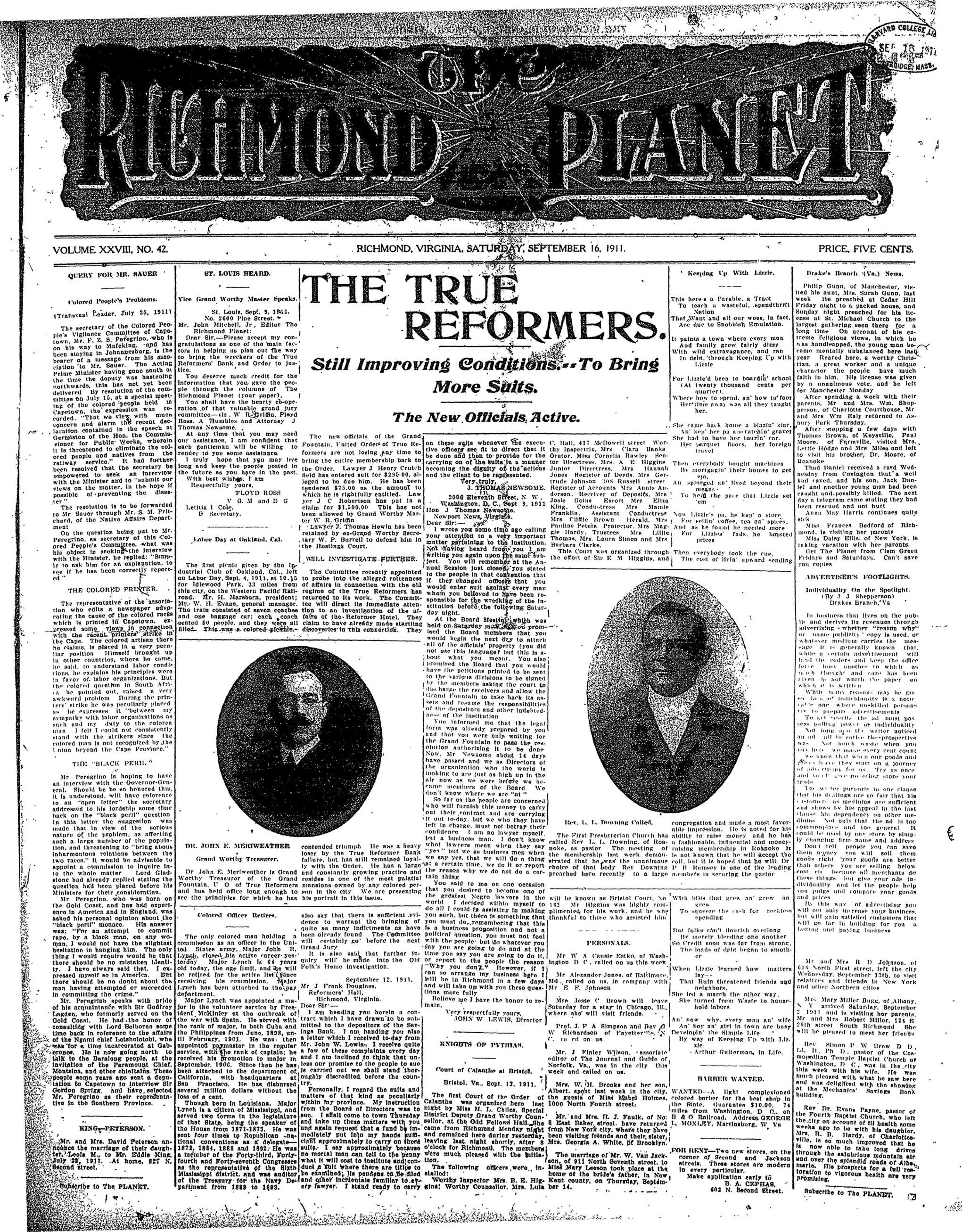
THE RICHMOND PLANET
Colored People's Problems.
(Transvaal Leader, July 25, 1911)
The secretary of the Colored People's Vigilance Committee of Capetown, Mr. F. Z. S. Perretgny, who is on his way to Mafeking, and has been staying in Johannesburg, is the bearer of a message from his association to Mr. Souer. The Acting Prime Minister having gone south at the time the deputy was hastening northwards, this has not yet been delivered by resolution of the committee on July 15, at a special meeting of the colored people held in Capetown, the expression was recorded. "That we view with much concern and alarm the recent declaration contained in the speech at Germiston of the Hon. the Commissioner for Public Works, wherein it is threatened to eliminate the colored people and natives from the railway service." It had further been resolved that the secretary be empowered to seek an interview with the Minister and to "submit our views on the matter, in the hope if possible of preventing the disaster."
The resolution is to be forwarded to Mr. Sauer through Mr. S. M. Pritchard, of the Native Affairs Department.
On the question being put to Mr. Peregrino, as secretary of this Colored People's Committee, what was his object in seeking the interview with the Minister, he replied: "Simply to ask him for an explanation, to see if he has been correctly reported."
THE COLORED PRINTER.
The representative of the association who edits a newspaper advocating the cause of the colored races which is printed in Capetown, expressed some views in connection with the recent printers' strike in the Cape. The colored artisan there he claims, is placed in a very peculiar position. Himself brought up in other countries, where he came, he said, to understand labor conditions, he explains his principles were in favor of labor organizations. But the colored question in South Africa he pointed out, raked a very awkward problem. During the printers' strike he was peculiarly placed as he expresses it "between my sympathy with labor organizations as such and my duty to the coloree man. I felt I could not consistently stand with the strikers since the colored man is not recognized by the union beyond the Cape Province."
TIE "BLACK PERIL"
Mr Peregrino is hoping to have an interview with the Governor-General. Should he be, will have reference to an "open letter" the secretary addressed to his lordship some time back on the "black peril" question in this letter the suggestion was made that in view of the serious nature of the problem, as affecting such a large number of the population, and threatening to "bring about inharmonious relations between the two races." It would be advisable to appoint a commission to inquire into the whole matter. Lord Gladstone had already replied stating the question had been placed before his Minister for their consideration. Mr Peregrino, who was born on the Gold Coast, and has had experience in America and in England, was asked his personal opinion about the "black peril" monace. His answer was: "For an attempt to commit rape, by a black man, on any woman, to kill a man, in the situation in hanging him. The only thing I would require would be that there should be no mistaken identity. I have always said that. I expressed myself so in America. But there should be no doubt about the man having attempted or succeeded in committing the crime."
Mr. Poregrino speaks with pride of his acquaintance with Sir Godfrey Lagden, who formerly served on the Gold Coast. He had the honor of consulting with Lord Solborno some time back in reference to the affairs of the Ngami chief Lotsholotolob, who was for a time incarcerated at Gabarrono. He is now going north to talk to the Baralong people, at the Malaita, in the Paramount of Mokotona, and on the Mokotona. These people some years ago sent a deputation to Capetown to interview Sir Gordon Springg, and have selected Mr. Poregrino as their representative in the Southern Province.
KING-PETERSON.
Mr. and Mrs. David Peterson un-
noble the marriage of their daugh-
ter, Leola M., to Mr. Eddie King,
July 22, 1911. At home, 827 N.
Second street.
[Portrait of a man with a mustache and a suit]
ST. LOUIS HEARD.
Vice Grand Worthy Master Speaks.
St. Louis, Sept. 9, 1841.
No. 2600 Pine Street.
Mr. John Mitchell, Jr. Editor The Richmond Planet:
Dear Sir. Please accept my congratulations as one of the main factors in helping us plan out the way to bring the wreckers of the True Reformers' Bank and Order to Justice.
You deserve much credit for the information that you gave the people through the columns of The Richmond Planet (your paper).
You shall have the hearty co-operation of that valuable grand jury committee—viz. W. R. Griffin, Fleyd Ross. A Humbles and Attorney J Thomas Newsome.
At any time that you may need our assistance, I am confident that each gentleman will be willing to render to you some assistance.
I truly hope that you may live long and keep the people posted in the future as you have in the past.
With best wishes, I am
Respectfully yours.
FLOYD ROSS
V G. M and D G
Letitia I Cole.
B Secretary.
Labor Day at Oakland, Cal.
The first picnic given by the Industrial Club of Oakland, Cal., left on Labor Day, Sept. 4, 1911, at 10.15 for Idlewood Park, 33 miles from this city, on the Western Pacific Railroad. Mr. H. Maraborn, president; Mr. W. H. Evans, general manager. The train consisted of seven coaches and one baggage car; each coach seated 80 people, and they were all filled. This was a colored picnic.
DR. JOHN E. MERIWEATHER
Grand Worthy Treasurer.
Dr John E. Merlweather is Grand Worthy Treasurer of the Grand Fountain, U O of True Reformers and has held office long enough to see the principles for which he has
Colored Officer Retires.
The only colored man holding a commission as an officer in the United States army. Major John R. Lynch, closed his active career yesterday. Major Lynch is 64 years old today, the age limit, and he will be retired for the active life since receiving his commission. Major Lynch has been attached to the pay department.
Major Lynch was appointed a major in the volunteer service by President. McKinley at the outbreak of the war with Spain. He served with the rank of major, in both Cuba and the Philippines from June, 1898, until February, 1901. He was then appointed paymaster in the regular service, with the rank of captain; he received his promotion to major in September, 1906. Since then he has been attached to the department of California, with headquarters at San Francisco. He has disbursed several million dollars without the loss of a cent.
Though born in Louisiana, Major Lynch is a citizen of Mississippi, and served two terms in the legislature of that State, being the speaker of the House from 1871-1873. He was sent four times to Republican national conventions as a delegate—1872, 1884, 1888 and 1892. He was a member of the Forty-third, Forty-fourth and Fort-seventh Congresses as the representative of the Sixth Mississippi district, and was auditor of the Treasury for the Navy Department from 1889 to 1892.
THE TRUE REFORMERS. Still Improving Conditions.--To Bring More Suits. The New Officials Active.
The new officials of the Grand Fountain, United Order of True Reformers are not losing any time to bring the entire membership back to the Order. Lawyer J Henry Crutch field has entered suit for $295,00. alleged to be duo him. He has been tendered $75,00 as the amount to which he is rightfully entitled. Lawyer J C Robertson has put in a claim for $1,500,00. This has not been allowed by Grand Worthy Master W. R. Griffin. Lawyer J. Thomas Hewin has been retained by ex-Grand Worthy Secretary W. P. Burrell to defend him in the Hustings Court.
WILL INVESTIGATE FURTHER
The Committee recently appointed to probe into the alleged rottenness of affairs in connection with the old regime of the True Reformers has returned to its work. The Committee will direct its immediate attention to an investigation of the affairs of the Reformer Hotel. They claim to have already made startling discoveries in this connection. They
contended triumph He was a heavy loser by the True Reformer Bank failure, but has still remained loyal with the Order. He has a large and constantly growing practice and resides in one of the most palatial manSIONs owned by any colored person in the city. We are presenting his portrait in this issue.
also any that there is sufficient evidence to warrant the bringing of quite as many indictments as have been already found The Committee will certainly go before the next Grand Jury.
It is also said that further inquiry will be made into the Old Folk's Home investigation.
September 12, 1911.
Mr J Frank Dougham,
Reformers' Hall,
Richmond, Virginia.
Dear Sir:—
I am handing you herein a contract which I have drawn to be submitted to the depositors of the Savings Bank. I am handing you also letter which I received today from Mr. John W. Lowle. I receive quite a few of these complaints every day and I am inclined to think that unless our promise to the people to sue is carried out we shall stand thoroughly discredited before the country.
Personally, I regard the suits and matters of that kind as peculiarly within my province. My instruction from the Board of Directors was to sue. I allfame to come to town Thursday and take up these matters with you and again request that a fund be immediately put into my hands cumplet approximately to carry on these suits. I say approximately because no mortal man can tell to the penny what it will cost to institute and conduct a suit where there are titles to be examined; his pendens to be filled and other incidentals familiar to estry lawyer. I stand ready to carry
on these suits whenever the executive officers see fit to direct that it be done and then to provide for the carrying on of the suits in a manner becoming the dignity of the actions and the client to be represented.
Very truly,
J. THOMAS NEWSOME.
2006 Eleventh Street, N. W.
Washington, D. C., Sept 9, 1911
Hon J Thomas Newport.
Newport News, Virginia.
Dear Shr: —
I wrote you some time ago calling your attention to a very important matter pertaining to the institution. Not having heard from you I am writing you again upon the same subject. You will remember at the Annual Season just closed you stated to the people in that convention that if they changed officers that you would enter suit against every man whom you believed to have been responsible for the wrecking of the institution before the following Saturday night.
At the Board Meeting, which was held on Saturday morning you promised the Board members that you would be the next day to attach all of the official's property (you did not use this language) but this is about what you. You also promised the Board that you would have the petitions printed to be sent to the various divisions to be signed by the members asking the court to discharge the receivers and allow the Grand Fountain to take back its assets and resume the responsibilities of the depositors and other indebtedness of the institution
You informed me that the legal form was already prepared by you and that you were only waiting for the Grand Fountain to pass the resolution authorizing it to be done Now. Mr Newsome about 14 days have passed and we as Directors of the organization who the world is looking to are just as high up in the air now as we were before we became members of the Board. We don't know where we are "at" So far as the people are concerned who will furnish this money to carry out their contract and are carrying it out to-day, but we who they have felt in charge, must not betray their evidence. I am no lawyer myself, but a business man. I don't know what nature mean when they say "yes" but as business men when we say yes, that we will do a thing at a certain time, we do it or report the reason why we do not do a certain thing. You said to me on one occasion that you desired to become one of the greatest Negro lawyers in the world. I decided within myself to do all I could in assisting in making you such, but there is something that you must do, remembering that this is a business proposition and not a political question, you must not fool with the people; but do whatever you say you are going to do and at the time you say you are going to do it, or report to the people the reason "Why you don't." However, if I can so arrange my business hgo I will be in Richmond in a few days and will take up with you these questions more fully
Believe me I have the honor to remain.
Very respectfully yours.
JOHN W LEWIS, Director
KNIGHTS OF PYTHIA
Court of Calanthe at Bristol.
Bristol, Va., Sept. 13, 1911.
The first Court of the Order of Calanthe was organized here last night by Miss M. L. Chiles, Special District Deputy Grand Worthy Counsellor, at the Odd Follows Hall. She came from Richmond Monday night and remained here during yesterday, leaving last night shortly, after a clock for Richmond. The members were much pleased with the mitigation.
The following officers were installed:
Worthy Inspector Mrs. B. E. Higginie; Worthy Counsellor, Mrs. Lula
```markdown
```
C. Hall, 417 McDowell street Worthy Inspectrix, Mrs Clara Banks Orator, Miss Cornelia Rayley Senior Directress, Mrs A. E Higgins Junior Directress, Mrs Hannah Jones Register of Deeds, Mrs Gertrude Johnson 708 Russell street Register of Accounts Mrs Annie Anderson, Receiver of Deposits, Mrs Josie Colins Escort Mrs Eliza King, Conduitress Mrs Maine Franklin Assistant Conductress Franklin Herald, Pauline Peterson Protector Mrs Maggie Hardy, Trustees Mrs Lillie Thomas, Mrs Laura Simon and Mrs Barbara Clarke. This Court was organized through the effort of Sir E M Higgins, and
Ret. J. L. Downing Called.
The First Presbyterian Church has called Rev L. L. Downing, of Ranoke, as pastor. The meeting of the membership last week demonstrated the importance of choice of that body Rev Downing preached here recently to a large
will be known as Bristol Court, No 162 Mr Higgins was highly complimented for his work, and he was thankful to those who assisted him.
```markdown
```
PERSONALS.
Mr W A Cause Eskow, of Washington D. C., called on us this week.
Mr Alexander Jones, of Baltimore, Md., called on us, in company with Mr E. F. Johnson.
Mrs Jesse C Brown will leave Saturday for a star in Chicago, Ill., where she will visit friends.
Prof J. F A Simpson and Rev W R Richardson of Fayetteville, N. C., read on us.
Mr J Finley Wilson, associate editor of The Journal and Guide of Norfolk, Va., was in the city this week and called on us.
Mrs W. H. Brooks and her son, Albert, spout last week in the city, the guests of Miss Mabel Holmes, 1000 North Fourth street.
Mr. and Mrs. H. J. Faulk, of No. 8 East Baker street, have returned from New York city, where they have been visiting friends and their sister, Mrs. Georgia A. White, of Brooklyn.
The marriage of Mr. W. Van Jackson, of 911 North Seventh street, to Miss Mary Leson took place at the home of the bride's father, in New Kent county, on Thursday, September 14.
Keeping Up With Lizzle.
This here's a Parable, a Tract
To teach a wasteful, spendthrift
Nation
That Want and all our woes, in fact,
Are due to Snobbish Emulation.
It paints a town where every man
And family grew fairly dizzy
With wild extravagance, and ran
In debt, 'through Keeping Up with
Lizzie
For Lizzie'd been to boardin' school
(At twenty thousand cents per
quarter).
Where how to spend, an' how to'foor
Her'time away was all they taught
her.
She came back home a blazin' star,
'An kep' her pa a-scratchin' graver
She had to have her tourin' car.
Her parquet floors, her foreign
travel
Then everybody bought machines
By mortgagin' their homes to get
en.
An splurged an' lived beyond their
means.
To help the pace that Lizzie set
on
Now Lizzie's pa, he kept a store,
For kellin' coffee, tea an' spices.
And as he found he needed more
For Lizzie's fads, he boosted
prices
Then everybody took the cue,
The cost of livin' upward sending
```markdown
```
congregation and made a most favorable impression. He is noted for his ability to raise money and he has a fashionable, influential and money-raising membership in Roanoke it is not known that he will accept the offer. He is also the third Dr. P. H. Ramsey is one of the leading numbers in securing the pastor.
To square the cash for reckless spending
But folks can't flourish overlong
By merely bleeding one another
So Credit soon was far from strong.
The loads of debt began to smother
When Lizzie learned how matters lay...
That Ruin threatened friends and neighbors.
She led a march the other way.
She turned from Waste to household laborers
An' now why, every man an' wife
An' boy an' girl in town are busy
Developin' the Simple Life
By way of Keeping Up with Lizzie
- Arthur Gutterman, In Life.
BARBER WANTED.
WANTED--A light complexioned colored barber for the best shop in the State. Guarantee $10.00. 74 miles from Washington, D. C., on B & O Railroad. Address GEORGE L. MONKEY, Martinsburg, W Va.
FOR RENT—Two new stores, on the corner of Second and Jackson streets. These stores are modern in every particular.
Make application early to
B. A. CKPHAS,
602 N. Second Street.
PRICE, FIVE CENTS.
Drake's Branch (Va.) News.
Philip Gunn, of Manchester, visited his aunt, Mrs. Sarah Gunn, last week He preached at Cedar Hill Friday night to a packed house, and Sunday night preached for his license at St. Michael Church to the largest gathering seen there for a long time On account of his extreme feligious views, in which he was handlapped, the young man became mentally unbalanced here last year Reared here, a worthy Christian, a great worker and a unique character the people have much faith in him. His license was given by a unanimous vote, and he left for Manchester Monday After spending a week with their parents, Mr. and Mrs. Wm. Sheperson, of Charlotte Courthouse, Mr and Mrs Wm. Ealy returned to Ashbury Park Thursday. After stopping a few days with Thomas Brown, of Keysville, Paul Moore, of Formville, visited Mrs. Lefteridge and Mrs. Miles and left to visit his brother, Dr. Moore, of Ronnoke Daniel received a card Wednesday from Covington that a well had caved, and his son, Jack Daniel and another young man had been caught and possibly killed. The next day a telegram came stating they had been rescued and not hurt Anna May Harris continues quite slick Miss Frances Bedford of Richmond, in visiting her parents
Miss Daisy Ellis, of New York, is taking vacation with her parents.
taking vacation with her parents.
Get The Planet from Clem Green
Fridays and Saturdays. Can't save
you copies
ADVERTISER'S FOOTLIGHTS
Individuality On the Spotlight
(By J J Shepperson)
Drakes Branch, Va
In business that lives on the public and derives its revenues through advertising - whether "reason why" or name publicity - copy is used, or whatever medium carries the message. It is generally known that, while a certain advertisement will lead the orders and keep the office force loses another to which as much thought and care has been given is not worth the paper on which it is written.
While in this reason may be given of individuality is a noteworthy one where marked personalty to prepare advertisements.
To get results the ad must possess political power or individuality. Not long ago the writer noticed an ad all to entail the prospective was. Not much waste when you buy here we make every cent count we know that when our goods and others leave they start on a journey of advertising for us. Try us once and we'll give no other store your trade.
The writer purposes in one clause that his drawings are so fair that his customers as mediums are sufficient and shows by his appeal in the last clause his dependency on other mediums. Not only that the ad is too complex and too general. It could be bought by any store by simply changing the word "reason why".
Don't tell people you can save them money you will sell them goods right your goods are better than others you are selling below cost etc because all merchants do these things, but give your sales individuality and let the people help you judge and compare your goods and prices. In this way of advertising you will not only increase your business, but will gain satisfied customers that will go far in building for you a lasting and paying business.
Mr. and Mrs. R. D. Johnson, of 616 North First street, left the city Wednesday, September 13th, to visit relatives and friends in New York and other Northern cities.
Mrs. Mary Miller Bugg, of Albany, N. arrived Saturday, September 2, 1911 and is visiting her parents, Mr. and Mrs. Robert Miller, 124 K 20th street South Richmond. She will be pleased to meet her friends.
Rev Simon P. W Drew D. D. LL. D. Ph. D. pastor of the Cosmopolitan Temple Baptist Church of Washington, D. C. was in the city this week with his wife. He was much pleased with what he saw here and was delighted with the showing at the Mechanics' Savings Bank building.
Rev Dr. Evana Payne, pastor of the Fourth Baptist Church, who left the city on account of ill health some weeks ago to be with his daughter, Mrs. R. B. Hardy, of Charlestonville, is so much improved that he is now able to take long drives through the salubrious mountain air and over the splendid roads of Albemarle. His prospects for a full restoration to vigorous health are very promising.
Subscribe to The PLANET.
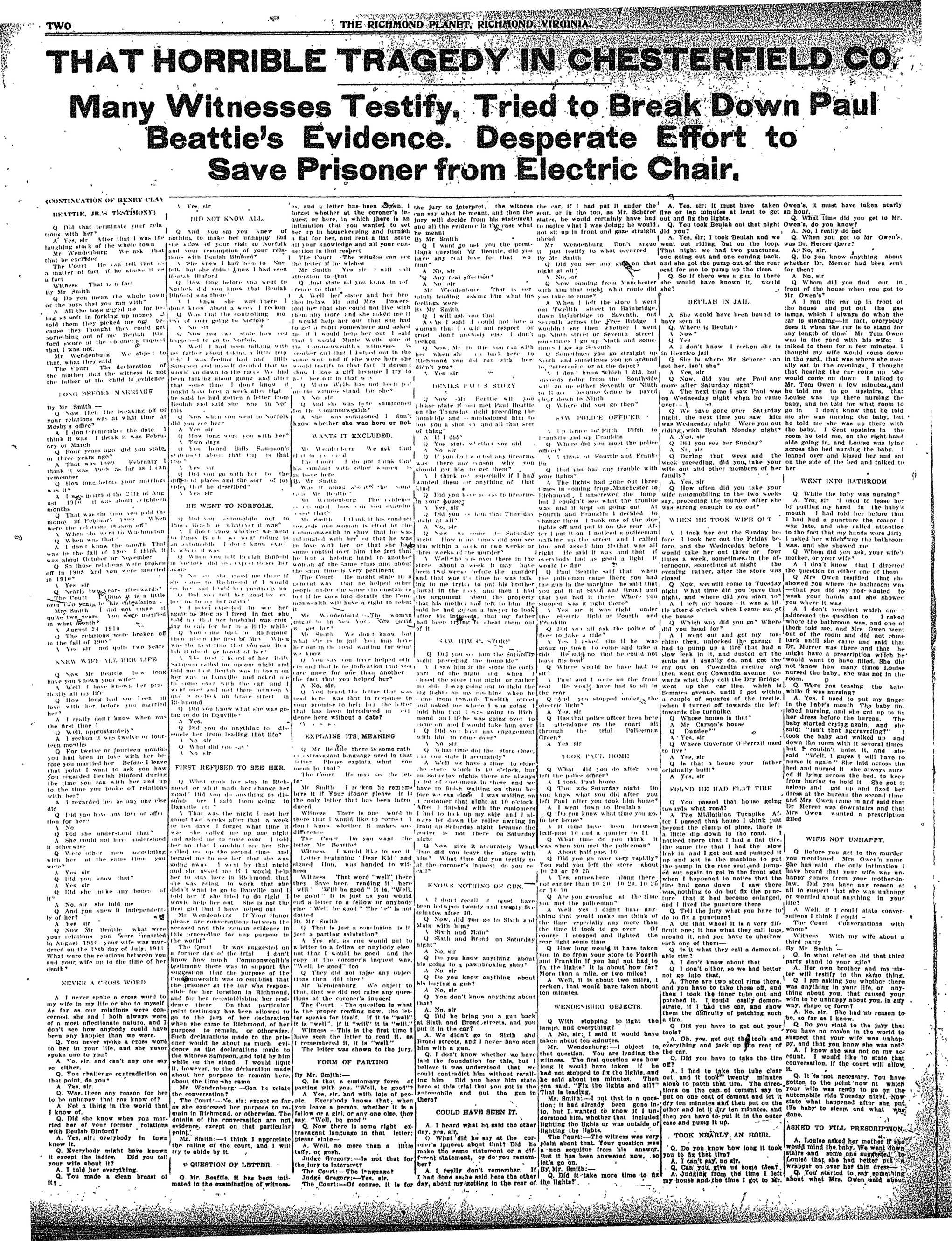
Many Witnesses Testify. Tried to Break Down Paul Beattie's Evidence. Desperate Effort to Save Prisoner from Electric Chair.
TWO
(CONTENTS
Q Did that terminate your rela-
tions with her?
A 'Yes, sir. After that I was the
laughing stock of the whole town
Mr Wendenburg. We ask that
that he be excluded
Witness That is a fact
By Mr Smith
Q Do you mean the whole town
or the boys that you run with?
or the
A. All the boys ginger me for
being so soft in forking up money
told them they picked me up
because they thought they could
something out of me beoulah lit
ford spore at the corner's impact
that I was not.
Mr Wendenburg We object to
that, what they said
The Court The declaration of
the mother that the witness is not
the father of the child is evidence
LONG BEFORE MARRIAGE
Bv Mr Sputh
try me
Q Now then the breaking off of your relations was at what time at Monday's office?
A I don't remember the date.
I think it was I think it was February or March.
ary
Q Four years ago old you state
you wrote, reps. ago?
Q How long before your marriage was it?
A I married the 21st of Aug
ust 1910 it was about eighteen
months
Q That was the time you paid the
mono in February 1909 When
morto the relations broken off
A When she went to Washington
Q When was that?
A I don't know the month That was in the fall of 1905 I think it was about October or November
Q So those relations were broken off in 1905 and you were married in 1910?
A Yes sir
Q Yearly two years afterwards?
The Court China it is a little over two years by his calculation
A. Aukes
Q. The relations were broken on in the fall of 1900?
A. Yes sir not quite two years
KNEW WIFE ALL HER LIFE
Q. Now Mr Beattie low long have you known your wife?
A. Well I have known her practically all my life
Q. How long had you been in love with her before you married her?
A. I really don't know when was the first time I
Q. Well approximately?
A I reckon it was twelve or fourteen months
Q For twelve or fourteen months you had been in love with her before you married her Before I leave that point I want to ask you how you regarded Healh Blinford during the time you ran with her and up to the time you broke off relations with her?
A I regarded her as any one else did
Q Did you have any love or affection for her?
Were other men associating
with her at the same time, you
were?
A. No, sir, she told me.
Q And you knew it independent
ly of her?
A. Xen nlr
Q Now Mr Beattie what were your relations you were "married in August 1910 your wife was murdered on the 15th day of July, 1911 What were the relations between you and your wife up to the time of her death?
A I never spoke a cross word to my wife in my life or she to myself. As far as our relations were concerned, she and I both always were of a most affectionate nature, and I don't see how anybody could have been any happier than we were. Q. You never spoke a cross word to her in your life, and she never spoke one to you? A. No, sir, and can't any one say so either. Q. You challenge contradiction on that point, do you? A. Yes, sir. Q. Was, there any reason for her to be unhappy that you know of? A. Not a thing in the world that I know of. Q. Did she know when you married her of your former relations with Beulah Bintford? A. Yes, sir; everybody in town know it. Q. Everybody might have known it except the ladies. Did you tell your wife about it? A. I told her everything.
Q. You made a clean breast of it?
---
---
NEVER A CROSS WORD
1 Yes, str
Q And you say you knew of nothing to make her unhappy. Did she allow of your visit to Norfolk and your resumption of your relations with Beulah Blindford?
A She knew I had been to Norfolk but she did not know I had been Beulah Blindford
Q How long before you went to Norfolk did you know that Beulah Blindford was there?
A I knew she was there I don't know about a week I reckon
Q Was that the controlling motive of your going to Norfolk?
A No sir
Q Now you can state how you happened to go to Norfolk.
Well I had been talking with you about taking a little trip right. I was leaving and I hilly Saidon and myself decided that we would go down to the races. We had been talking about going and after that some time I don't know it might have been a week after that he said he had gotten a letter from Beulah and said she was in Norfolk.
Q Now when you went to Norfolk did you see her?
A Yes sir
Q How long were you with her?
A Two days
Q You board Billy Sampson's station about that trip is that true
A Yes sir
Q Did you go with her to the different places and the sort of joy that he described?
HE WENT TO NORFOLK
I don't know whether we want to Pine Bay we want riding in an automobile I don't know exactly where it was
Q When you left Beulah Baird in Nottingham did you expect to see her again
N No, she asked me there if she came to Richmond if I would see her and I told her positively no
Q Did she tell her good by expecting to see her again?
I have expected to see her again as Bing as I lived In fact she told me that her husband was coming to talk for her in a little while
Q You came back to Richmond then at the first of May When was the last time that you saw Bing It took up or heard of her
A The last I heard of her Bobby Sanderson called me up one night and told me that Beulah was in town on her way to Danbury and asked me to come over with the car and I went over and met them between N and I took on Grace street in Richmond
Q Did you know what she was going to do in Dugville?
A Yes.
Q Did you do anything to disguise her from leading that life?
A No sir.
Q What did you say?
1 No +lr
FIRST REFUSED TO SEE HER.
Q What made her stay in Richmond or what made her change her mind? Did you do anything to dissuade her I said from going to Danville to?
A That was the night I met her about two weeks after that a week or ten days I forget what time it was she called me up one night and asked me to come over I told her no that I couldn't see her She called me up the second time and begged me to see her that she was going away I wont by that night and she asked me if I would help her to stay here in Richmond, that she was going to work that she didn't want to go to Danville and I told her if she tried to do right I would help her out. She is not the first girl that I have helped out
Mr Wendenbueh If Your Honor please are conversations between the accused and this woman evidence in this proceeding for any purpose in the world?
The Court. It was suggested on a former day of the trial. I don't know how much 'Commonwealth's testimony there was to support the suggestion that the purpose of the Commonwealth was to establish that the prisoner at the bar was responsible for her location in Richmond, and for her re-establishing her residence there. On that particular point testimony has been allowed to go to the jury of her declaration when she came to Richmond, of her purpose to remain, or otherwise. Such declarations made to the prisoner would be about as much evidence as the declarations made to the witness Sampon, and told by him while on the stand. I would lift it, however, to the declaration made about her purpose to remain here, about the time she came.
Mr Wendenburg:—Gan he relate the conversation?
The Court---No. sir; except so far as she exasperated her purpose to remain in Richmond, or otherwise. The details of the conversation are not evidence, except on that particular point. Mr. Smith:—I think I appreciate the ruling of the court, and I will try to abide by it.
QUESTION OF LETTER.
Q. Mr. Boatfe, it has been intimated in the examination of without
yes, and a letter has been given. I
forgot whether at the coroner's
inquest or here, in which there is an
intimation that you wanted to set
her up in housekeeping and furnish
a flat for her, and rent a flat. State
all your knowledge and all your con-
nection in that respect.
The Court - The witness can see
the letter if he wishes.
Mr Smith. Yes sir. I will call
attention to that.
Q Just state and you know in no
tence to that?
A Well her sister and her bro
the helix Mr. and Mrs. Powers
told her that she could not live with
them any more and she asked me if
I would help her out that she had
to get a room somewhere and asked
me if I would help her out I said
that I would Marie Wells one of
the Communists with I loved her
mother girl that I helped out in the
room and if she were here she
would testify to that fact. It doesn't
show I love a girl because I try to
be her out in that way.
Q Marie Wells has not been put
on the witness stand has she?
A No sir.
Q And she was here summoned
for the Commonwealth?
A She was summoned I don't
know whether she was here or not.
WANTS IT EXCLUDED
Mr. Wendelburg. We ask that it be covered.
The Court. I do not think that has contributed with other women is in issue here.
By Mr. Smith.
Was it along about the same to Mr. Battitt?
Mr. Wendelburg. The evidence is credited how can you examine court that?
Mr. Smith. I think it his conduct towards one woman is cited by the commonwealth to show that he was inflicted with her or that he was in love with her or that she has some control over him the fact that he has a helping hand to another woman of the same class and about the same time is very pertinent
The Court. He might state in a capital way that he helped other people under the same circumstances but if he goes into details the Commonwealth will have a right to rebut
Mr. Smith. We don't know but what she is in jail. You may have her out in the road waiting for what we know.
Q You say you have helped others and that you are not indoctrination that you are more for one than another the fact that you helped her?
A No. sr.
Q You heard the letter that was read here was that in response to your promise to help her the letter that has been introduced in our dance here without a date?
EXPLAINS ITS MEANING
Q Mr. Beatle there is some rath-
er aravagant language used in that
letter. Please explain what you
mean to that?
The Court He may see the letter
Mr Smith I re-kon he remem-
ber it If Your honor please it is
the only letter that has been intro-
duced
Witness There is one word in
there that I would like to correct
I don't know whether it makes any
difference
The Court Do you want the
letter Mr. Beatle?
Witness I would like to see it
Letter beginning 'Dear Kid' and
signed Hon. was handed to wit-
ness
Witness That word "well" there
they have been reading it here
will "Will be good" It is. "Well,
be good" It is just as you would
end a letter to a fellow or anybody
else "Well be good" The 'e' is not
dotted
It Mr. Smith
Q That is just a conclusion is it just a parting salutation?
A Yes sir, as you would put to a letter to a fellow or anybody else not that I would be good and the copy at the coroner's inquest was, "Well, he good" too
Q They did not raise any questions then did they?
Mr Wendlenburg We object to that, that we did not raise any questions at the coroner's inquest
The Court - The question is what is the proper reading now, the letter speaks for itself. If it is "well" it is "well"; if it is "well" it is "well".
Witness - This is the first time I have seen the letter to read it, as I remembered it, it is "well".
FORM OF PARTING
By Mr. Smith:—
Q. Is that a customary form of parting with you, "Well, be good?"
A. Yes, air, and with lots of people. Everybody knows that: when you leave a person, whether it is a follow or a girl, or any one else, they say, "Well, be good."
Q. Now there is some right extravagant language in that letter; please state—
A. Well, no more than a little taffy, or gush.
Judge Gregory:—Is not that for the jury to interpret?
the jury to interpret, the witness can say what he meant, and then the jury will decide from his statement and all the evidence in the case what he meant
By Mr Smith
Q I want to ask you the point-blank question Mr. Beatle, did you have any real love for that woman?
A No, sir
Q Any real affection?
A No sir
Mr. Wendenburg That is certainly leading asking him what his feelings were
By Mr Smith
Q I will ask you that
A As I said I could not love a woman that I could not respect or trust don't anybody else I don't reckon
Q Now, Mr. Bowie you run with her when she is a back here to Richmond you did run with her didn't you?
Q Now - Mr. Beattie will you
please state if you met Paul Beattie
on the Thursday night preceding the
homelife and commissioned him to
buy you a shot on and all that sort
of thing?
A If I did?
B You state whether you did
A No sr
C If you had I waited any firearms
was there any reason why you
should get him to get them?
A I think not especially if I had
wanted them or anything of that
kind
Q Did you have access to firearms
in your house?
A Yes, sr
Q Did you be him that Thursday
night at all?
A No, sr
Q Now we come to Saturday
night. How many times did you see
him within a week or two weeks or
three weeks of the murder?
A Well he was over there in the store about a week it may have been two weeks before the murder and that was the time he was talking to me trying to put his brother David in the rays and then I had the argument about the property he had bought for me and I had said he had买回来 just to look
SAM HIM 4, STORE
Q Did you see him the Saturday night preceding the homicide?
A I saw him in the store the early part of the night and when I closed the store that night or rather my side I was going out to light the big lights on my machine when he came from toward Twelfth street and asked me where I was going I told him to go to Litchi mond and if he was going over to come on and I would take him over
Q Did you have any engagement with him to come over?
A No sir
Q What time did the store close on you state it accurately?
A Well we have a time to close the store which is 10 o'clock, but on Saturday nights there are always a lot of customers in there and we have to finish waiting on them before we can close. I was waiting on a customer that night at 10 o'clock. After I finished with the customers I had to look up my side and I always let down the roller awning in front on Saturday night because the porter is not there on Saturday night.
Q Now give it accurately. What time did you leave the store with him? What time did you testify to at the coroner's inquest do you re call?
KNOWS NOTHING OF GUN.
\ I don't recall it must have been between twenty and twenty-five minutes after 10.
Q Now, did you go to Sixth and Main with him?
\ Sixth and Main?
Q Sixth and Broad on Saturday night?
A No, sir
Q Do you know anything about his going to a pawnbroking shop?
A No, sir
Q Do you know anything about his buying a gun?
A No, sir
Q You don't know anything about that?
A. No, sir
Q Did he bring you a gun back at Sixth and Broad, streets, and you put it in the car?
A. We didn't go to Sixth and Broad streets, and I never have seen him with a gun.
Q. I don't know whether we have laid the foundation for this, but I believe it was understood that we could contradict him without recalling him. Did you hear him state here this at trial that you got in the automobile and put the gun in there?
COULD HAVE SEEN IT.
A. I heard what he said the other day, yes, sir.
B. What did he say at the customer's apolog about that? Did he make the same statement or a different statement, or do you remember?
A. I really don't remember. If I had done as he said here the other day, about my getting in the rear of
the car, if I had put it under the sent, or in the top, as Mr. Schorer states, he would certainly have had to nippe what I was doing; he would not sit up in front and gaze straight ahead.
Mr Wendenburg Don't argue it just testify to what occurred By Mr Smith
Q Did you see any girl on that night at all?
A No, sir
Q Now, coming from Manchester with him that night, what route did you take to come?
A When I left the store I went on Twelfth street to Bainbridge, down Bainbridge to Seventh, out Seventh across the Free Bridge I wouldn't say then whether I went up Ninth street or Seventh street sometimes I go up Ninth and sometimes I go up Seventh
Q Sometimes you go straight up Ninth and sometimes you go around in Patterson a or at the depot?
"I don't know which I did, but
on anybody going from the Southside
will be on either Seventh or Ninth
and I believe Grace is paying
that down to Ninth.
SAW POLICE OFFICER
Q Where did you meet the police other?
A I think at Fourth and Franklin
Q Had you had any trouble with your lights?
A The lights had gone out three times in coming from Manchester to Richmond. I unscrewed the lamp but I couldn't see what the trouble was and it kept on going out. At Fourth and Franklin I decided to change them I took one of the side lights off and put it on the rear After I put it on I noticed a policeman walking up the street and I called him and asked him if that was all right. He said it was and that if everybody had as good a light it would be fine.
Q Paul Boottle said that when the policeman came there you had the gun in the machine he said that you got it at Sixth and Broad and that you had it there Where you stopped was it light there.
A You sir it was right under the electric light at Fourth and Franklin
Q Did you all ask the police of four to take a title?
A Yes I asked him if he was going up town to come and take a ride. He said no that he could not leave his heat.
Q Where would he have had to sit?
A Paul and I were on the front seat. He would have had to sit in the rear
Q And you stopped under the electric light?
A Yes, sir
Q Has that police officer been here in attendance on the court all through the trial Policeman Green*
A Yes str
TOOK PAUL HOME
Q What did you do after you left the police officer?
A I took Paul home
Q That was Saturday night so you know what you did after you left Paul after you took him home?
A I went down to Heulens
Q "Do you know what time you go, to her house?"
A It must have been between half-past 10 and a quarter to 11
Q What time do you think it was when you met the policeman?
A About half past 10
Q Did you go over very rapidly?
You said you left the store about 10 20 or 10 25
A Yes, somewhere along there not earlier than 10 20 10 20, 10 25 or 10 30
Q Are you guessing at the time you met the policeman?
A Well yes I didn't have anything that would make me think of the time especially any more than the time it took to go over. Of course I stopped and lighted the rear light some time
Q How long would it have taken you to go from your store to Fourth and Franklin if you had not had to fly the lights? It is about how far More than a mile, or two miles? A Well, it is about two miles, reckon, that would have taken about ten minutes.
WENDENBURG OBJECTS
Q. Wish stopping to light the lamps, and everything?
A. No, sir; I said it would have taken about ten minutes.
Mr. Wendenburg:—I object to that question. You are leading the witness. The first question was how long it would have taken if he had not stopped to fix the lights, and he said about ten minutes. Then you said, "Fix the lights and all?" That is leading.
Mr. Smith:—I put that in a question; it had already been gone into, but I wanted to know if I understood him, whether that included lighting the lights or was outside of lighting the lights.
The Court:—The witness was very plain about that. Your question was a non acquaintance from his answer. But it has been answered now, so let's go on.
By, Mr. Smith:—
Q. Did it take more time to fix the lights?
A. Yes, sir; it must have taken five or ten minutes at least to get out and fix the lights.
Q. You took Beulah out that night. Did you?
A. Yes, sir; I took Beulah and we went out riding, but on the loop. That night we had two punctures, one going out and one coming back, and she got the pump out of the rear seat for me to pump up the tires.
4. Q. So if there was a gun in there would have known it, would she?
BECLAH IN JAIL.
A. She would have been bound to have seen it
Q. Where is Beulah?
A. Now?
Q. Yes
A. I don't know I reckon she is in Heinrich jail
Q. She is where Mr. Schorer can get her, isn't she?
A. Yes, sir
Q. Now did you see Paul any more on Saturday night?
A. The next time I saw Paul was on Wednesday night when he came user - A.
Q Did you see her Sunday?
A No, sir
Q During that week and the week preceded, did you, take your wife out and other members of her family?
A Yes, sir
Q How often did you take your wife automobiling in the two weeks say, preceding the murder after she was strong enough to go out?
WHEN HE TOOK WIFE OUT
A I took her out the Sunday before. I took her out the Friday before, and the Wednesday before. I would take her out three or four times a week, sometimes in the afternoon, sometimes at night the evening rather, after the store was closed
Q Now, we will come to Tuesday night. What time did you leave that night, and where did you start?
A I left my house - it was a little after a clock when I came out of the house
Q Which way did you go? Where did you head for?
A I went out and got my machine then, unlocked the garage. I had to pump up a tire that had a slow leak in it, and dusted off the sents as I usually do, and got the car out on Cowarddy avenue and went out Cowarddy avenue towards what they call the Dry Bridge went up the car line, which is Semmes avenue, until I got within a couple of squares of the trestle, when I turned off towards the left towards the turnpike.
Q Whose house is that?
A Mr Carmon's house
Q Dundee?"
A 'Yes, sir
Q Where Governor O'Ferrall used to live?
FOUND HE HAD FLAT TIRE
Q You passed that house going towards what road?
A The Midlothian Turnpike After I passed that house I think just beyond the clump of plains, there is a little dip down in the road. I noticed there that I had a flat tire, the same tire that I had the slow leak in and I got out and pumped it up and got in the machine to put the pump in the rear seat and jumped out again to get in the front seat when I happened to notice that the tire had gone down I saw there was, nothing to do but fix the puncture that it had become enlarged, and I got to repair there.
Q Tell the jury what you have to do to fix a puncture?
A On that wheel it is a very difficult one; it has what they call lugs around it, and you have to unscrew each one of them—
Q Is it what they call a domountable rim?
Q I don't other, so we had better not go into that.
A. There are two steel rims there, and you have to take those off, and then I took the inner tube out and patched it. I could easily demonstrate, if I had the car, and show them the difficulty of patching such a tire.
Q Did you have to get out your tools?
A. Oh, yes, got out the tools and everything and jack up the rear of the car.
Q. Did you have to take the tire off?
A. I had to take the tube clear out, and it took twenty minutes alone to patch that tire. The directions on the can of cement say to put on one coat of cement and let it dry ten minutes, and then you have to put it in the outer case and pump it up.
TOOK NEARLY AN HOUR.
Q. Do you know how long it took you to go that fire?
A. I can't say, no sir.
Q. Can you, give us some idea?
A. Judging from the time I left my house and the time I got to Mr.
Owon's. It must have taken nearly an hour.
Q. When you got to Mr Owen's,
was Dr. Mercor there?
A. No, sir.
Q. Do you know anything about
whither Dr. Mercor had been sent
for then?
A. No, sir.
Q. Whom did you find out in
front of the house when you got to
Mr Owen's?
A I ran the car up in front of the house and put out the gas lamps, which I always do when the car is standing—in fact, everybody does it when the car is to stand for any length of time. Mr Tom Owen was in the yard with his wife: I talked to them for a few minutes. I thought my wife would come down in the yard, that was where she usually sat in the overlings. I thought that hearing the car come up she would come on down. I talked to Mr. Tom Owen a few minutes, and he told me to go upstairs, that she was there nursing the baby, and he told me she would go in. I don't know that he told me she was nursing the baby, but he told me she was up there with the baby. I went upstairs in the room he told me, on the right-hand side going in, and Louise was lying across the bed nursing the baby. I leaned over and kissed her and sat on the side of the bed and talked to her.
i
WEST INTO BATHROOM
Q While the baby was nursing?
A. Yes, sir. I used to tease her by putting my hand in the baby's mouth. I had told her before that I had had a puncture the reason I was late, and she called attention to the fact that my hands were dirty. I asked her whirlway the bathroom was, and she showed me.
Q Whom did you ask, your wife's mother, or your wife?
A. I don't know that I directed the question to either one of them.
Q Mrs Owen testified that she showed you where the bathroom was—that you did say your wanted to wash your hands and she showed you where it was.
A I don't recollect which one I addressed the question to. I asked where the bathroom was, and one of them told me, and Mrs Owen went out of the room and did not come back until she came and said that Dr. Mercer was there and that he might have a prescription which he would want to have filled. She did not know how many times Louise nursed the baby, she was not in the room. Q. Were you teasing the baby while it was nursing?
A. Yes, I used to put my finger in the baby's mouth. The baby finished nursing, and she got up to fix her dress before the bureau. The baby started crying again, and she said: "Isn't that aggravating?" I took the baby and walked up and down the room with it several times but I couldn't quiet it, and she said "Well, I guess I will have to nurse it again." She laid across the bed and nursed it she always nursed it lying across the bed, to keep from having to hold it. She got it aleep and got up and fixed her dress at the bureau the second time, and Mrs Owen came in and said that Dr Mercer was downstairs and that Mrs Owen wanted a prescription filled
WIFE NOT UNHAPPY
Q Before you get to the murder you mentioned. Mrs Owen's name She has said, the only intimation I have heard that your wife was unhappy comes from your mother-in-law. Did you have any reason at all to suspect that she was unhappy or worried about anything in your life?
A Well, if I could state conversations I think I could -
The Court Conversations with whom-
Witness With my wife about a third party
By Mr Smith -
Q. In what relation did that third party stand to your wife?
A. My brother and my sister will petty to the same thing.
Q. I am asking you whether there was anything in your life, or anything about you, that caused your wife to be unhappy about you, in any way, shape or form?
A. No, sir. She had no reason to be, so far as I know.
Q. Do you state to the jury that you have no reason in the world to suspect that your wife was unhappy, and that you know she was not?
A. I know she was not on my account. I would like to state that conversation, if the court will allow it.
Q. It is not necessary. You have gotten to the point now at which your wife was ready to go on the automobile ride Tuesday night. Now state what happened after she put the baby to sleep, and what was done.
ASKED TO FILL PRESCRIPTION.
A. Louise asked her mother if she would mind the baby. We went down stairs and some one surprised to Louise that she had better put a wrapper on over her thin dress.
Q. You started to say something about what Mrs. Owen said about
“an ae
a oe
ae mS,
Be ae parr.
ae Be a:
- Sxraeee ee
een PANU nr
PE a et Bee
RDAY SBHIPT. 16, 1041.
SATURDAY
da As Rabe Rae TEKS Rea TOON CE
Owen and ho wight want a preserip-
cion Olied.
Q ‘That waa whew you word ahout
yo leave that Dr Mercer camo?
A. Yea, alr, o
. Q@ You had been tiore bow long,
do you suppore?
A About three-quartore of an
nour, oF an hoytr -ahout threesuat-
ivew of ap hours would way
Q. You @tfuck out about the hour.
Whut did you mean”
‘A Well, 1 finully enid st was
about three-yanrters of an hour, to
the heat of iny knowledge: that 16
what TE fnally wnded up with.
PREPARING FOR RIDE.
Q, When you came downstairs,
ald you come down together?
4. Yos, sir, we camo vownstairs
ana came on out I don't know who
it wan suggested thit abo get a wrap
and put {ton Her dress was thin.
Ste went back to look for a coat or
i shawl T don't kiiow wat ft was
cow She couldn't And st, and Mr.
Yom Owen went in and droysht out
nia raincoat My wito put that on.
We want ot to the macbino, sho got
in and f Ht the front lamps, and we
got the prescription from Dr. Mer-
cer T told him at tho timo that 1
didnt tink T could get ft Olled be-
cause the drug stores closed at 10
ovlock. He Bid, “Well, if you can't
got It GNed tonteht, tt fy not vory im~
portant, and In the morning will do.”
Bowe went ont the feft-hand road
to the Midlothian roud and Yown the
turnplke to the drug store.
Q. Whose drug store?
A. Washington & Early's, at the
head of Hull street 1 got out of
the ear there and went in the drug
store to the door, rather, and rat-
ted on the door No one came. 1
kent on rattling. 1 saw some one
sitting Jo the roar who seomed to
‘be writing, and Mnally the drug clerk
came out. J axked him tf he would
Ho preacription for Mr Tom Owen
and he anid certalnly He took the
prescription and went back In the
store I went aut in the street
whore the cur wax and stood on the
running board tatking (o my wiit.
We stayed there T don't know how
long at a rough Ruesn grote ton
minutes. t saw bim coming trom
the tear of the xtore with the pre-
scription, and I went on in «
WIFE IN GOOD HUMOR
Q. Whot were you doing out
thero?,
‘A. Standing on tho running board
tnikiog to my wife, and when T saw
him coming from the rear of the
storo with tho prescription—
Q. Waa your wife In a good Nu-
mor that evening?
‘A. Yen, ir T say we novor bad
any crost words, omt we could hard-
ly be otherwike if we Wid pot. He
was coming from behind the counter
nnd ft went in the drug stoto and
meat him. 1 paid him for tho Re
xcription and asxed him if he fed
any candy. He told mo he bad somo
chocolate almonds, | believe. Ho
took out q box there, and T asked
him {f he had any latgor box, a
pound box Ho said od. I took a
kmaller box. pald for It, and came}
out and got in the car, backed the
car around Clopton street, and hoad-|
ed up tho Afldlotbian Turnpike. When!
we passed Mra Owen's home, or
rathor, Just before that, Toulso ‘ata: |
“Let's take n little apin up the
road; .Dr Mercer auld tho proscrip-'
tlon was not Important"; and we
went on up the trond.
WIFE SUGGESTED SPIN
Q. Whore ‘suggestion was it that
you take n littlo win?
A. My wifo'a. |
@ iad you fntended to go wp the
road ff rhe had not mentioned It.
A. No, sir ‘Tho firat car wo mot
coming down ax I anid, wo met.
threo earn on tho road
Q. You ald that when?
A. Taaid that the night of the
murder. and 1 also sald tt at tho tp-
quest, that three cars passod mo on
tho road,
Q Dedckino the cars,
A. Tho first ono, I thisk it was
after wo crossed tho Delt Line, 1),
don't know how tar. It woe fiying.
+ Q. What sort of a car was It? Giro
some idea. Who was In {tt
A. It was, really running ‘so “fast |
hour 1 could seo it was full of
poople—it wan a big ecar—but J
outdn’t renily say who was fn ft bo-
saure It tan eo fast. Wo wore Titn-|,
ng stow then, Just taking @ IIttlo,
pin.
Q Tow fret wan this car golnn,|}
n your Judgment? You have had a
ood Weal of exporlenco, with auto-|'
nobiloa? : !
_ BAW CAR FLYING BY. t
vA. Yor, air. When I saw tho car|*
vas fying, T moan it wan going fitty||
yr wixty miles no hour., Ae J was in|)
car pansing It. 1 nilght not havo!’
en ablo to Judge the exact epced |!
t that time—It might have been)!
orty mites, “p
Q. Tt was running forty mites“an|!
jour, anyhow, you think? b
A. You, air, it was running fally|é
orty thilee an hour. Every car that!"
Were sil large cars and all ruoning
very fast.
"Q. What ia tho number: of your
jeart - i.
‘As 820.
Q. Does that number look any-
thing Mko D-11?
‘A? Not to mo.»
Ret > 7e 7 EONS
CARRIED BIG NUMBERS.
Q. Did you have that numbor In
lg lottery on tho back of your car?
‘A. Yes, sir, four Inches bleh.
Q! Tho law requires that, doesn’t
ur .
‘A. Yes, sir.
Q. Now, Mr, Boattte, Just state alt
about that ride.
A. We passed threo cars and went
on yp the road, and tho last thing
I romombor before I turned around
that night wav a row of cedar treos
on tho right hand side, and my, wife
remarked to mo, “Wouldn't thoy
make nico Christmas trees?” After
we passud thos wo wont up tho road,
T.don't know, It might havo been a
mnflo that we ran up, and Tran up
into a gate and backed up and turn-
ed around and ran down the rond
again,
Q. Dit you pylnt out to the de
tectives whgro you turned around?
A. Yeu, sit, I pointed out’ that
njght the place I turned around.
Q. Dia they soe the trackagy
AL Yes, str.
@ State why you had to back ub
tn the gate there?
"A. The road 1s vory narrow there,
and thoro 1s q kind of bridge that
rus across the ditch going Into the
nian's yard, and I ran up In the gato
and backed out again.
Q You had to take advantage of
the entrance: into bis yard to turn
argund. did your
“A. Yes, slr. The road at that nar-
touiar upot' Ie about as narrow ax
anywhere to, the whole atrotch.
MEBTS HIGHWAYMAN
- @ Go on {n your own words and
state what happened
A Well, we left there, and, as I
told them’ that aight. whon T got
back. I didn't know whether It was
thres-quarters of a mile or a milo
{rom whero I turned: anyhow. 1
tuened to como back. We wore com-
Ing down tho road I reckon fifteen
mllos an hour, it might havo boon
twenty.tunning along eaky, not thtok-
ing about nasthing pecial, ust talk-
Ing to éach other, when I saw a man
coming from the left-hand sido of
fhe road. Ho was $0 close to mo,
and running at tho speod I was, al-
though {t was not vory fagt, I know
that if 1 did not stop I would hit
him I putron tho brake and stopped
my car. Ani did so, when I stopped
ho wason.tb® left-hand sido of the
car 4 roally did not know he was
there until ho said. “What in the
hel aro you trying to do? Ron over
mo?! ald, “No, but I ought to
have, 1 wag In the middlo of the
road and you hat plenty of root
on elthor sido.” 7
Q. Whero were you, on the right-
band sido, the left-band sfde, or fp
tho centre? e
‘A. Of the road?
Q. Yea,
ALT rockon 1 wan near the cen-
tro. U think T was running down the
centre of the road.
Q. Im that the usual part of the
road for antomobites”
A. Yea
| THREATENED TO SHOOT
Q. Thoy gre Just Ike country peo-
ple In that rospect?
‘A Woll, almost overybody keops
the centro’ of the road, If he knows
his. vebicle, ‘When I'sald that to
him T put In the low goar and réach-
ed over to take off the brako, and
thon he ralvod tho gun and pointed {t
at me, which T had not soon bofore,
and sald “Stop. if you don’t I will
shoot you.” 1 ldn't say anything I
didn’t want to aggravate him or try
to make him mad {m any way, I
didn't think ho wns going to sboot.
Ughought ho would be crazy to. i
ot in tho clutch, T had my band on
tho atooring wheol, I junt slipped tho
throttle around and let n the eluted
Ae [did tho car gave # fork forward
wid I had my.eyo on bim all the
(imo; 1 looked right at him As the
car Jumped he ralacd tho gun and
fired 1 {mmedtately put on tho
brakes ahd stopped again. As bo
fred my wifo fell 1 wae loaning
over thin way with my hand on the
brake, and sho fell back on me.
G_ wihat did. sh falf between?
What was bohind your back?
‘A. Why, the back of my soat
@. That's what I mean. Sho foll
betwoon your back and the back of
the seat? :
A. Yon, sir.
Q. Did’ abe fall towarde you at
Mt
_ @RAPPLRS IN ROAD. !
A I couldn't say to save my lito;
it all happened so quick. On the
spur of the momont I jumpod out of
the car and started towards tho man,
I didn't run, I didn't have long
enough distance to run. He was
standing about tho ronr of the car.
T jumped out of. I dtd ho ralsod his
gun, T don't know whith shoulder
ho raised It ovor, and hit at me. I
saw the motion, but 1 was golng for-
ward and couldn't get out of the
way. [ throw toy hoad back and
caught the gun ag it came down, and
it hit me of the nose. I pulled the
gun out of bis banda, and ‘from
Watting backwards or trom — the
forco of my wrenching 1 got over-
balanced, aigt I wont back on the
Rround. ‘omothing has beon sald
About hlood on tho gun. I havo never|
seen any blood on tha gun, one way]
or-tho other, but Mr. Tom Owen aatd
there was blood on my face’ that
night. :
Mr. Woendenburg:—Don't argue:
* Witness:—Anyway, it ts tho moat
natura} thing in the world for a
wan that is hit.to put bis “hand
an the epot.where be ls.nit. 1 don't!
say F-aid! ‘i don't any I Aldn't,”and
I'dan't sayitho. blood. dropped off io¥
nose,” Anyway, I picked. up'the gun
and threw. ‘it:in the machine, and
the man tam aware se iy. fe
“THE: RICHMOND, PEANRT;: RICHMOND, VIRGINIA.
; Which, way did be got
ie ment op the read. I told
Mr. Tom ‘Owen that, the firat ax
Tinadea acstemage to. thet signe
.& Did you sey “anything to Mr.
Tom Owen, the first man you told
about It, about the man going in the
woods? a
A. No, slr, nor did I say anything
about cranking tho “Bachino or the
an being on-tke right-hand sido p
tho road; nor dli.T say auything tc
Uifin about the man catching tho gun
that way (Indicating).
TOLD TRUE STATEMENT,
Q. Was tho statemont that Mr
‘Tom Owen, the firat witness, made or
tho wtand @ fair and truo statemon!
as far qs you can recall, of what
yor told gim?
A. Yes, alt, of what I told bim
ag far ne I can recall—ag fair as {
could possibly be. If I mado all the
‘statoments the detectives aay In tht
megatime, how could I go to the cor.
one's {Nquest and mako the stato.
mént I did makp, aftor telling the
detectivos theso storioat
Mr. Wendonburg:—Don't argue.
By Mr Sovith:-—
Q. Is the Mret statement you made
to Mr. Owen Iiko tho statement you
made at the coroner's Inquest — tn
reference to the contradicted points}
A. Yes, sir, if I had told the ato-
ries to all of the detectives which
sono of thom say—-that 1 jumpod
jout of the car on the left and ran
around the front—
Mr, Wesdenburg'—tias he the
right to refor to what way uald at
the coroner's Inquest and then tell
me I can't do it?
The Court:—I don't think that {e
Hight, simp the court Is going to tell
Mr. Boattic now not to argue the
caso, but to tell what he knows, You
Bavo two very competent lawyers te
argu to tho Jury for you Just state
what you know
By Mr. Smith-—
Q. Mr. Heattic, have you ever been
& witnesn before, except hore and
ot the coroner’s Inquest, to any ex.
tent?
A. I don’t think T ever bave in ny
Meo
MAN WENT UP ROAD
Q Now you told Mr Tom Owon
that the man was on the teft of your
car. and you told Mr. Tom Owon that
the man went up tho road?
A Yes, sir.
Q And not in the woods --and he
wax the firat man that you ever told
It toe
A Yee, sir,
Q. And he vorroborates you In
that’ resnect*
A. Yea, sir ¥
|, @ Then, after you had wrosted
the gun from the man and he had
gone ye the road, what did you do?
A. T pat (he*gun in tho car, and
then my wife was lying on tho bot-
tom of tho car-—
Q Do you know where you put
the gun--i0 what part of the car?
AI throw ft up in the bak of
the car, [ reckon {t wan on the bot.
tom it migbt bave been on tho scat,
1 Just threw ft In the rear of the
car,
Q. Were there any doors op the
side of the car?
A. No, sir
Q Why uidn’t you follow the
man? That will he ‘asked you, and
T might as well ask tt mysel,
HIS FIRST THOUGHT
A My first thought was to get up
and ko aftét the man, who was gO-
ing off T had gotten tho gun and
be bad ‘run up the road. My second
thought was for my wife; I throw
the gun in the car and went to her.
She was lying down fn the front of
the car on the footboard, 1 got in;
her dresses were lying ovor tho loft
hand side of the car. I romomber
stepping on thom as { got in. I
picked hér ub Ground the waist or
some part of her body, and pulled
her up on the two seats, across the
two seats, het head lying over in
my scat, the driver's oat, and I wan
supporting with my lege the lowor
part of her body acrosu the seat in
that position (Indicating). f felt her
pulke and hor heart, but I know I
couldn't toll Ia my condition whoth-
er sho was Woad or living, I was so
excifed =I could not 1 hollered
“Murder'’ and “Holp!" both, and I
reached ovpr and blow my automo-
bile horn “ Nobody came. It was
dark. and I didn't know where tho
hourxos were around there, although
1 am very familiar with the road,
Knowing that tha doctor waa at Mr.
Tom Owen's, and that it would only
lake a few minutes to get back, I
Kut in my seat, placed my wife In the
xont the originally waa tn-&
Q Was your engine Funding at
that tlme*
RAN CAR WITH ONE HAND. |
A Yor, sir, tho ongino novor
‘topped running. 1 got tn my soat
ind started the car. My wife was Bite,
ing in her seat. I can't explain it
© youw It seemed like ber back was
roken; her hoad was down in her.
= i aa wou ee ee,
A Yor, air, tho ongino novor
stopped running. I got tn my seat
And started the car. My wife was élt-
ting In hor seat. I can't explain it
to youw It seemed like bor back was
broken; her hoad was down in her
lap. 1 put my lof} arm around her
waist and rap tho car with my right
band, 1 sald that night that 1
thought about half way down. 1
dtdn't reatly know where it was. ‘The
Ughts went out. 1 don't know
whethor it was from fast running
and tho alr getting down in. tho
lights or to using a carbide tank.
Everybody knows that sototlmes
wator gots In tho hose ant a siid-
den far will throw the water up, and
it will cnt_off the.gee supply. Any-
how, tho lights went out, and I
Jumpod out of the car. I held my
wifo firat to aco"{f abe ‘would alt in
tho ont, and abe didn't allp out. Bhe
was all down tnt w knot in tha seat.
I. Jamped out of tho car to light my
lanipa ‘and I realizod thon that I,
didn’t havo any coat on. T looked for
¢ and found ft in tho rear of the
car, Fi & match—
Q. Do You know when you took
your coat of? -
A. No, sir, To askott Mr. Tort
oon the next day. if T had sy coat
oft when I feft thore, and he sald
n@ didn't Know. ‘T'vot © mated ant
it my lewpe and got back ih the
ar and came dywa ‘to Mr, Owen's
sous, J don’t remember what 7
irst words war. oe
Q. How fast.8ayyou rim back?
Ar 1 had the: throttle wide: oon,
ay } 014. bofore,’T ean: take that ¢
IG nak, ALY Gr, HetyAhve’ mites’ wi
our with I 2% kuowT had.the eat!
POSPEESLLERL OCDE COPD ODESOOL OP OD OOO OO SO DO SSDI OOOO!
| Kathlag ou alsth Utso valuable ie « boban mind W'S Alamond te worth pallahing
ab ‘touble.and rt te 708
poling ee ery ‘hoa en sioctilon ete Ne toed 5 eat
Tost Wo ould. corona 9 aie few, ala coh Dealt is Lf Langa
ecb weed coe sa aber alate er 2 ey Geis better choot ft
"Increase be etimaginet ‘a28 of cold toe Hiv Bd ‘prepare one tote larger
ae wey oe sf '
A fade, wi Te Ba
Pere eee aes hee
Ree Orin m NRC Mi Cm Tras Rae Ta eee
Ripa iets eat penta nS nc ci viaren sR unr a Serr an ae
Leer NaGin Cana k Mec ee oe MUR Re aM Te aH
Pees vat Se tle RE aati CPE |
fitness ; aii cused
ee mes
ee rae oe
Lace ; pies
*Sponsitery, Virginia Onion Ugiversity, —
- Ma. Union University
Offers the Best Higher Education to
i /COLORED YOUNG MEN.
xia tt A IME ACADIIY scr Uneiing mama trntcg tr that who hare
, ASFTG COLLEGE ‘COURSE a broad and complete. Ite requirements aad standing ary
ay Bi so te of an olen er wha Fvth tothe is orogeny
aap Ca eL RAY COUMEE tay many em te A ana cz fr la
Serie (ons Seared esses foe toe Ehiiry are gareed la dere epee
ot tad Make able Wocity tod it fal Sout of cy cable Yocais Oriey
ey eb eno rover oan ea etvasn eval to ta enor Oy an Bred
Tee tate walormaticn, aire the Praarat,
VIRGINIA UNION UNIVERSITY. |
. RICHMOND, VIRGINIA. '
panne spas a bra baba bbbbhdhdodhobsoobsbhb0ohb6ebhoeni
wide open.
@ Do you recall how close you
were to tho Felt [ime when you
flaed your Hgbts?
‘
WILD RIDE WITH CORPSE
A No. do not. 1 tan recall
going across the ‘Bolt Line. The
car seomed to Jump In the alr about
two feet, and I thought It was going
to turn over. Say that (Indicating)
fg the width of tho road; whore i
crosses the Bolt Line the roadway i
Allod in. I may havo deen running
no fast that { dida't turn to go tc
the regular track. 1 may bavo gone
facront the railroad, That turn a!
Mr Owen's, where you go In bis
road, you turn from the roadway al
rigbt angles past the stop at the cor:
ner, and then you baVe to make 0
figure 3 as you go in the gate. |
don’t say that I held my wife going
around that pace, because it le a
very difficult turn in tho daytime
with both hands and‘running fast
At night and with one band I don't
believe anybody could make thot
turn running fast, T don't say that 1
didn't let go of my wife for an in.
start to make that turd. Anyhow.
when I got In tho yard I hollered tc
attract attention. Mr. Tom Owen, 1
think, was the first one to come tc
the car, 1 told’ blm that my wift
had been shot, I on'teknow wheth
er 1 used the word shot or killed
or murdered or how Anyhow; he
took her out, of tlie car, and Dr.
Mercer at that ttme camo up and
lent hie assistanco in carrying my
wife Into,the ibrary, I think it was.
Anyhow, the firat room on the lett.
1 went in there. Dr. Mercer was In
there, and I asked him if thoro wan
anything I could do, whéther to sond
for the ambulance or tako ber to a
hospital or what. Ho sald, “No thero
is nothing you can do. She Is dead.”
ASKED WHAT HE COULD DO
A. t asked Dr. Morcer whether
there was anything I could do, ‘phone
for the ambulanco oF take her to the
hospital, and ho told me. no, thore
was nothing I could do, that she wae
dead romember going back a sec-
ond time and asking him if he, was
dead, and bo sald, yes. ‘
Q. Do you know wero your coat
wns then, when you got back there?
‘S. Yes, alr. Dr Mercer sald tbat
he picked {t up out of tho front of
the machine, on tho running board
Q On tho what?
A. On the footboard. 1 mean.
Q' That ts tn the front where your
feet go?
A Yor. oir
Q Now, Mr Beattie. did you
give Mr Owon and the officors all
the information that you counl in
referenco to this mattor?
A. Every officer that camo up
there that night 1 told him overy-
thing I knew. Thoy all asked mo
whore it occurred: I told them
didn't know, but that I know ‘oxact-
y where I turned around, and that
| thought it was about throe-quar-
‘era of a mile or a milo from thore:
and I wanted to go up again and
jook for it and take thom up thero,
put they wouldn't let mo do It.
Q. When they asked for tho gun,
what 1% you tell them?
Ac 1 told Mr, Tom Owon tho gun
was in the cnr,
Q. Did you think {t was in the car;
when you told him 00?
A..Yes, sit. We both wont out
o look for the gun together, and
t wasn't Im there, and I told bim
hen {t rust ‘have Jolted out.
BOUNCE AT BELT LIND.
Q. Did you suggest the phice that
It Might have-falted oat?
A. T don't remember that 1 did.
Q. You sald that at tho Beit
Line you do romember having a ter-
rible bounce?
‘A. Yes, alr, 1 romambor tolling
somebody that night that I thought
tho car was golng to tarn ovor, that
M Jumped about two foct and a half
I thought.
Q. At the Belt Line *
A. Yes, alr. wet
Q, Now, Mr, Benttte, did you give
thom a Wosorfption of the man?
A. xo air.
Q. What was the description -you'
rave Of the man, and what ié the
loncription you now give. at the
MAN, Ad neat ag you ¢hn: recall?
Av be arte that 3 gave to every.
boty T told, ‘that it was a targe man,
1a. Woll cas, X could remember— ‘of
cae it, wae all, guetsing, but as
ratizas, Tissue amembar aa fe)
wes lites 3 tan, akout wiz: feet
all; and bie face was fall of heard,|
Kind of scrubby beard.
Q. It was a dark night, was it?
A. Vory dark.
. Q Was the moon upt
A. No, alr,
WOODS CLOSE TO ROAD.
Q. At tho point where the murder
was comasitted, were there woode
on efther sfde of the rom?
A. Thero aro woods up thoro
whera the blood spot is, yor alr.
Q. Do the woods grow up close to
thd road at that point?
A. Yeo, alr.
Q Thick woodst
A. Vory thick
Q. Aro there tall troes on both
sides of the toad?
‘A. Very toll on ono side, not 0
tall on tho othor.
Q Is ita dark spot? That te the
point I want go get at, 2
A. Yen, air.
Q@ When you stand in front of an
automobile thore fs a very good
Mgbt. but when you stand bebind
the lights, do those lamps give you
much Hght debind thom?
A. No, sir, thoy only show In
front,
Q. Why don't thoy show behind?
A. Becauso tho Hight can’t show
through_tho brass on the lamp, amd
they aro made to rofloct in front.
| Q. THF are not made to give
light behing
‘A. No, sir,
Q Thoso ‘are the bright lghte,
whero ate the othor lighta?
A, There are two Ilttio off lamps
en the side, but I don't use those
exceyt {n ease of emorgoncy.
Q. Thoso two were not lighted?
A No, air
Q. Was tho lamp iit behind?
A Yos, sir.
Q The lamp debind, whoro te)
that? Did that throw any light on:
the man to afd yon?
A. That lamp won't show two feet!
in the road: take ft out any night
and {t won't show two feet In tho
road, it {9 moroly put on there :ae,
the rear light on the car.
Q. To warn, people coming trom
vebind? ys
A Yor, str
ON RIGHT-HAND SIDE.
* i 60 YEARS
Spa ae EXPERIENCE
qrrsamertie nahn COTE AS,
SRS Es Reetice peace
eee ee ee
seni emai demas
HAN Coser: Nw fork
: a ¢
JORGEN'S SON
Before making your Purchase
_ you would do well to call at
the Most Reliable” Furniture
House in the City and See the,
Fine Line of
REFRIGERATORS,
MATTINGS, OIL-CLOTHS
-And in-fact everything that is
. heeded in house furnishings.
"RUGS AND CARPETS.
Of every description; also the
’ latest designs in ROCKERS
and Special CHAIRS. -
‘ied goody are the best for
ne price and the pice is, very low.
€.G.JURGEN’S SON
THE ECONOMY,
SS
303—5 North Third S
SEIN EY
TAILORING
" OLEANING, DYEING AND
REPAIRING,
CHITMAN M. WHITE.
PROPRIETOR. ~*
er
. STRAUS’ SPECIAL
Old Yacht Clob,
nserey or terete ew
We Have All Grades of Good Td
quors, Cigars and ‘sobacco, Cab
and Seo Us.
ISAAC'STRAUS & CO.,
422 E. Broad St.,
Richmond, Virginis
H. F. JONATHAN.
wt ee
FISH OYSTERS PRODUCE
114 .N. 17TH 6T., RICHMOND, VA.
A@PAll Orders Will Receive
*Prompt-Attention.
Long Distence ‘Phono, Madison-752
‘eect natin
ra
ae:
PROF. D. D. BRUCE, M D.,
Strange, Wonderful, but True Are
ange: Wondectul, byt Trae:
PROF. D. D. BRUCE, M D.,
Strange, Wonderful, but True Aré
the Awo Stricken Tests Given
By tho Great Australlan
Modium.
PROF D. D. BRUCE, M. D.,
The Only Living Apostle of Sclence
of the gees
¥6.900 IN GOLD. TO ANYONB I>
the World to Compete with him
Possessing morq Power than ao’
four Bfediums combined. \
No Card, Trance or Hand Humbug
w
GREATEST HINDOO MEDIUM IN
THE WORLD, *
So Gfent ts bis Power that ho can
toll you while {n a Clairvoyant state
jalj you wish to know without a word
delug spoken, Come, all ye unbe
Movers, scoffers and {eerers: | bring
all your ecepticism with you—he will
opon your oyes to the Private Cham-
ber Mystéry, Come, all yo broken
bearted wives, aff with low spirits
and Tot him Itt the burden from
your aching and Jealous bearts. He
challenges tho world to compete
with him In causing a spoedy mar
riago with the ono you love; uniting
the separated and bring back tho
lost one, Traces lost or stolon goods
unearths biddon treasures. Removes
evil influences, crosses, spells, i1l-
luck, cures tricks and ‘conjurations,
gives luck and success {n all you
undertake, Cures the tobacco babit.
Allowa tho captive to bo set froo.
Ho {s the only one that will give
a Written Gunranteo to complete
your business or refund your money.
Aro you"Aalck? Do you khow what
tho trouble with you fa? -Come and
consult Naturo’s Doctor
Rheumatism, Insomnia, Hystorta,
and alt Disensos curod. Points givon
op Horse Racing and all Games of
Chance. .
No aatter what alls you, oome
and see this wandorfu) man. Rosder,
hayo you noticed that. some poople
havo a hard timo to got along no
matter how they toll, while othors
havo succoss? Many wealthy men and
women owe their success to this won:
derful man, "
He will ‘toll you whom you ‘will
marry. Will you bo happyt He
will tell you who your frionds and
enemies aro. Can you tell? Don't
tako a leap in tho dark, but bo ad-
vised by this wonderful msn, Great-
est Prophet in Existence.
He always auccceds when others
fall, This is tho chance of a Iifo
mo. Don't let It pass you.
OFFICE HOURS: 9 A. M. to 9:30
P.M. -Bunday: 2:20 to 7:30 P.M.
N. B.—Our Consultation Fee ts
50 conte. Gittings, $1.00, All let-
‘ors contuining $1.00 will bo answer-
4 to fall
All letters must hare A» tworcent
stamp. |
fatn Office: 510 South: Eighth Bt.,
Philadelphia, Pa, 1
Gnod tows! BA. M. to 6 P.M.
“DR. ®. B. RAMSEY,
‘SURORON' DENTS,"
cease ereg fot
‘ THREE
a]
RAILROADS.
. 5 og
Bihmend, Predera Pitenae
TO AMD FROM WASHINGTON AED BEYOND.
“Leave Richmond | Arrive Richmond
hI8 A | eu 77398 re
SE aa
BBE Haniel ate reas
Sete eael atau
‘ere saree,
epee Sure panes
Aep enteral ere eeete
SESS Ree
iecieneer ant a
teeta ts a ep at
Sree parent
Sivas erent
“ile, NSP gE SUS ie
delinisieree et nas ats
departures not guaranteed, Read the sigan.
N: & W NORFOLK &
« WESTERN.
OSEY Alf, TAIL LINE TO NORFOLK.
a Hebel ta ttece Bay 14 tL,
tedve ipa Meet ation, choad, POR
NOWPOLA: eatO a Mee "6500 A. By 45:00 Pe
Neg eke BF 0 a
Font LvscHiitha"AND “Tue Wear: +4 us
AME Mo A At soo i, sae Pa
arrive Hictiond trom Rute "sS@ A, Mee
SiN aha ea ohores "Pe he, S11
P.M Prom ing Wert? we:is A. My atf8 Pe i,
Bisls Pi. neon Fae, "9.60 FM
‘bully “uially taeept funday, bBuaday only.
Pultmaa,” Parlor ad Sheeplag Carn Cafe Duce
tng Care of Boat
Be A Mlcknaody Ye.
Woo. eves, 6. “A, Meveoke, YO
ty
Revecrive JULY 2 amt,
THAING LEAVE. RICHIMOSD DAILY
Yor Voda Vand foutb: 8 5) A. Mk and
7 Bp We tag's Me Chartetn.
Fee Norio. 910, 000 A My 13.09 BM,
10 Sayre Pa
Poe Wey Went 15 4 3c, 10:09
AE see Po Mand a9 Be
vee reienbure | AM. ISAM, 4318
ATTA Wee cos. “aly fo:t0" An ae
Shao A“ 0 Pe “Gas re, 7:09
Pine ee oo Ms eae
or Goldsboro sod Fagetvite! "416 Pe
‘Traine arrive” thicken dally 839. AL
otk Me SSA Me OT ALM, Sash
oe nation a, SHY Gta ML aide PMs
Mets ele. oiee FM ests PW, m0) PL My
Poo hm, so Pike 1h Pa
Stracept umiay”» "Bunny ely
Time of arrival ani departure tod consectloas
not patrantcs
©. 8 CAMPO, DP a
—
SOUTHERN RAILWAY.
eis tance eons.
tater tering, scurdale Boros pobiisead x
abate ttag eile
See et Mea wana, ois
ad, eae ea ee
seperti ae atrial
Reeds “ian ook, Daag town Bete
emis, Sore aarti Se
Sptor ger geal eg
Loni td oN Sah See
Bch tat tal Salaam ate
fab Ce er
can eee EO, se as
we Toe aad tas te Lent
SOR Satine Mane ed a See
sree,
Tate ARNE Elmoxn,
tom EAMELE SOREORDS
alent Se BA es eu.
$00 P Mt daily From Weet Point: 0:39 4 BM.’
ea ts a Wea ee Oe
ae :
Se euros, oma,
ron aa URES det
——
Cc. &£ ©.
oi, salu tin Oia
13 tReet eto
$5 Cpr Race ste Rare
$8 ACBIR" Geet Sheree me |
$3 faup ue a Betta
£2 tart
NG Fett te, tadecnge eal
te
10 4c Wek eae
We
fy pW dare tant to Genie
$i SB Phat tw Soveen
8 Sai Che ag
Is ate Gena
tot REL A Ge
Through from Fast—113 A.M, 6:58 P. e
Pepe omar A et
es
Ree ream tee i
aco reat at a,
SEABOARD AIR LINE.
Sere tne etn te ts
ecyharteSg's Wt a
Sie Les Eile
fae anh i, ANS
Sr papa dias re a
a fly re Soe oo
i, ce eee a
Eine das ara, st
soem iat See be
—
—Tho PLANET fs road all prer
this counizy and in forofgn lamts.
———
Always Losing His Boat,
A colored man calling himself,
“Captain John B. Simpson” and af
times sailiog under other names has
been perslatently gwinling both
white and colored people in Norfolk,
Portamouth, Newport News and
Phoebus. Hie plan bas deen to re-
present that ho hea money tn a col-
ored bank tn this city, Te mete bis
vetim to write to John Mitobell, Jr.,
President and tell him to send’ him
six bundred and.ffty 4ollas or some
Wke amount at ‘once to the person
‘who ta writing the letter or advano-
ing bim s small sum of money until
ho bas gotten hie money from Rich
mond, é
He alleges that he js captain of a
aalling vessel, whieh according to his
letters has been Tost near Thimble
Light off Huckroe Beach acd as he
has been carrying on this kind of
swindling for about two years, that
boat 18 preaumably wrecked every
two or threo wooks: He aska that
the letter be sent. to him In care of
the perton who allrances the money.
He aever comes Rack to aco if the
money comes adhe directa Wo
bate, written contiinouey to. the
peaple, who send’ then letters, af
wa have bad quite a tinie to keep u;
rith him =.
“Keop clear of Captain John m,
td OF anybody who lowka tke
tubecribe to The FLANEY. 7
Published every Saturday by JOHN MITCHELL,
JR., at 311 N. Fourth Street, Richmond, Va.
JOHN MITCHELL, JR., . . EDITOR
All communications intended for publication
should be sent so as to reach us by Wednesday.
TERMS IN ADVANCE
One Copy, per year ..... 81.50
One Copy, right months ..... 1.00
One Copy, six months ..... 81.50
One Copy, four months ..... 60.00
One Copy, three months ..... 40.00
Blank Copy ..... 0.00
For one inch, one inception
For one inch, each subsequent inception
For two inches, six months
For two inches, six months
For two inches, nine months
For two inches, nine months
For two inches, one inch
Banking and Transactions, per line
POSTAGE STAMPS OF A HIGHER DENOMINATION THAN TWO CENTS, NOT REQUIRED ON SUBSCRIPTIONS.
THE PLANET is inundated weekly. The subscription price is $50 per year, which money can be billed at our risk in a Post Office Money Order, by bank check or Draft. Amount Money, and we will be responsible for late arrival.
MONEY ORDERS. You can buy a Money Order at your Post Office payable at the Richmond Office, and we will be responsible for late arrival.
Note: money sent by any of these companies, the Express Money Order, is safe and secure.
EXPRESS MONEY ORDERS can be obtained at any office of the American Post Office, the Wells Fargo and Co. Express Company. So we will be responsible.
REGISTERED LETTER—If a Money Order, Post Office or an Exchange Office will Register your receipt, you will need to register your receipt to what you wish to on payment of ten cents. Then, if the Letter is lost or stolen, can be treasured. You can send money that we cannot be responsible for money that is written in any other way. If you send your money in any other way, you must do it at your own risk.
RENEWALS, KIT—If you do not want THE PLANET continued for another year, you should not subscribe to any subscription to discontinue it. The courts have decided that subscribers to newspapers do not order their list of which items has been paid be liable for the payment of the subscription up to date when they order the part discerned.
COMMUNICATIONS—When writing to us to
request your subscription or to discontinue your
papers, please contact your name and address
all other information we cannot find your name or
our books.
CHANGE OF ADDRESS—In order to change
the address of a subscriber we must be sent the
former as well as the present address.
Entered at the First Office at Blindmoor, Va.
as second-class matter.
SATURDAY SEPT. 10, 1011.
We have received an invitation to
the dedication exercises of the First
Baptist Church at Charlotte, N.C. of
work during his pastorate in this
locality and we congratulate him upon
his success. Rev. D. P S Lewis
pastor.
We have received a most attractive booklet containing interesting poems by Miss Carrie W. Clifford of Washington, D. C. The Lines to Riggison and the 'Foraker and the Twenty-fifth' will easily attract more attention than all of the rest Mr. W. L. Pendleton of Washington D. C. is printer.
_____
FRIGHTFUL CONDITIONS.
---
Mr. Charles Stewart of Chicago, Illinois, sometimes known as J Q Midnight writes a communication which has attracted general attention. We do not know that he is after any one in particular, but we are condent that he is attacking "lots of folks" in general. He says
For a long time we have been trying to see the better side of our external secret orders, but when we look around and see the wholesale looting that is going on, we are compelled to arrive at the conclusion that the sooner the people rise up and take hold of some of our orders the better. What what has been going in Mississippi for years, our secret orders want on in the State of Virginia till the Negroes up there rose up and demanded a peep into the inside and what did they see? They saw the Grand Lodge officers of the True Reformers voting to themselves large salaries and laying hooks and amends, and kinder schools acts, till the bank found to be $290, the short and the money gone into the flanks of those money sharkers. Just think of it. Men and women of poor circumstances, some working hard in the field; some working hard over the wash tub; some even using themselves of something to pay that monthly assessment and men sitting in and wearing, wearing, wearing, summing at fast-paced places, erecting press-brick front buildings as advertisements for themselves, with the pro
poe's money . . . But as I have said,
the people roke up and demanded an
```markdown
```
investigation, and the result was that six of the rascals will go to the State pentagonal. Now, that was in Virginia, that was where he made a great report at each grand lodge, showing great interest on hand in the treasury; that was where a few 143 lawyers and half-drunk preachers were paid to come to the grand lodge and make big nominating bounties for the officers; that was where what little legislation that was done was put off till nearly all of those who might object to the new laws, had to go home on account of their money giving out that was where the delegates were gagged and the men were punished with their manhood and fitness suggested the idea to run for an office, that was where an inhumal palay fellow was promised to be taken care of if he would be quiet (to be taken care of means your railroad fare or your horse) — now this was up in Virginia, where the recommendations of the Grand Master meant law.
The above is drastic language and yet there is much food for thought and logic for action. What is true of the organization to which he refers is true also of some others. No one who does not come in actual contact with these latter-day bosses can have any conception of the *Carr-like* rulings of some of these notated. The laws as enacted are disregarded and appeals are in vain. Pampered benchmen how down all opposition and it is only by a long expensive resort to the Courts that rights denied can be obtained. Most people prefer to wait until the machine and its super-structure tumble by its own weight and this usually takes a long time.
Mr. Stewart continues
We have reeled at length what happened up there and how when the people did open their eyes all the cash was gone and the rascals had their belongings in their wives and so the people were rabbed
Let each and every man and no-gro paper look around and see if he cannot see the samos conditions in Mississippi, why the writer attended a certain grand lodge at Jackson on a few days ago, and felt that the bishop had given him a cane, can give for being there. I saw while there one man, secretary-treasurer of the endowment department, his wife, the exarina of the ladies' department, and the son the grand medical director a noble ntribal, all in one family and all drawing salaries out of one over two wew in the office, and the judge and a must concern and thousands of dollars were thrown away in the form of board and railroad fare Why we should not wonder at the other race denying us the ballot we will not use it to advantage when we have it; if we did we would make a general statement of our views like the Reformers did in Old Virginia, some startling facts would be revealed God grant it
What can be done but to expose these iniquities? The reformus must come from without. It is well-night impossible for it to come from within. The change in the True Reformus was brought about by the public press. We do not know what activated Mr Stewart in his portraitage of those distressing conditions, but we do know that what he has said is true of fraternal orders in some other states.
We have defended the race for a decade but in the face of some of the disclosures, we are staggered. We initiate too few of the white man's virtues and too many of the sizes.
Let the search-light of truth be turned upon these conditions to the end that purification may set in and the race shall not again be disgraced by one of the most monumental failures of modern times.
---O---
TROUBLE AMONG INDEPENDENTS
In it possible that colored people will never be able to agree among themselves and give each other an "square deal!" We have been led to make this enquiry upon reading the last issue of the Martinsburg, West Virginia Presser of which Mr J R Clifford the recently relected President of the National independent Political League is editor. After reading the admirable address to the country, we were of the opinion that the members of the organization were like cooling doves in one nest.
We did not even know that Editor William Monroe Trotter was a candidate for the presidency and we are at a loss to understand how he could have been defeated by three votes in his home city. We do not know it to be a fact, but we would rise a guese that Dr. Booker T. W. Washington has been enjoying his meals better since he noted the election returns at that meeting than he has done for some time. He has a machine with its network throughout the country and there is little gas goes on in colored folks affairs that he does not note and indirectly take a part in its deliberations.
We do not mean to say or in that he took a part in Trotter's defeat or even brought it about. We did not intend to bring Dr. Booker T. W. Washington into this affair. We intended to reproduce extracts from the editorial columns of the Foner Press. It says:
not go to Boston "an avowed candidate" for the presidency of the league. On the contrary, soon as I took Bishop Walter's place, I was reliably told that "Trotter wants the presidency next time," and the same was the talk in Boston. When I would have done none, and would have done none, had not my friends forced me to stand the test, and when that came, notwithstanding the "S2" Boston men and women who by simply paying a dollar at the close of Bishop Walter's lecture, when our league was not in session, and were made voting members in West Virginia, Mr Trotter was defeated by three votes. Take your medicine like a man, as I would have done—you're too big a man to play the baby act.
President Clifford admits that he was induced by his friends to stand necessarily in order to defeat Trotter Now, who were their friends and upon what ground did they base their opposition to the leading agitator and "hell-raiser" in the United States. This language of course is ineglect but really we do not know of any other to properly express our full meaning upon this all important subject. Editor Trotter will not forge Clifford for he knows that when Clifford decided to stand for re-election and finally won that Booker T. Washington smile. The defeat of President Monroe Trotter in his home city was "glory enough for him." It was a vindication of Washington for the treatment that he had received at Trotter's hands.
How could Clifford defeat Trotter in Boston and who would the friends that advised the able West Virginia to administer the solar plexus blow to the accomplished and brilliant son of Massachusetts? These are the questions which will require an answer. For our own part, Clifford is good enough for us Barring Trotter. we do not know a man better fitted for the place and barring Clifford we do not know a man better suited for the place than Trotter. Editor (Clifford's record is without a bleemish. He is able bold and brave and on race questions a man after our oak heart.
Nogman who knows him will question his courage. He has fought not wisely but too well. The disruption in the organization seems to have extended to Rev S. L. Corrothers whom Editor Clifford refers to as Mr S. L. Corrothers. But we must let the William Tell" of West Virginia tell it in his own language. Here is what he says.
M. S. L. Corrothers of Washington D. C. told the many delegates in Boston that "Clifford is a coward; that he is too cowardly to hold public meetings in West Virginia, and that a man's life is in danger in this State, and that once put on in Charles Town, the people put out the lights and run us out," etc. Not a word of it true. A colored man has as much rights in West Virginia as he has in Washington and in many instances in Boston. I did get the court house for him in Charles Town, and I ferry to meet him, but failing to come, hire a team and got a man to bring him up when he got there. Going to Charles Town the courthouse was lighted, and at N.P.M a fine crowd of people white and colored, was there for a vukar bull story and thirty-two minutes, when in came Corrothers. He was introduced and made two egregious blunders—telling a vukar bull story and making a rantankous democratic move, with a rose, asked the people of the meeting to not refuse the purpose of the meeting was not to espouse democracy but to denounce the Brownwell affair. He had nine other places for him to speak, but in the morning he said he to bury in go back to Washington to bury some one and never show up to fill the room. I have held meetings all over this State, I have been fallen for my defense of my client and soon as I got out took my client out of fall where he had been unlawfully put while I was incarcerated and sent him home, have been knocked down in a court room in this city; had my wounds dressed, changed my bloody clothes, went back and fought out the case. I took my bloody shirts, and with my "bike" canvassed this county and spoke in the band stand the public square the day before the next few minutes, waving my bloody shirts and the next day the man who saunted me for companelling the first colored jury in this State, was defeated by over 1300 votes. When I last fell my too sprinkle on me and every one except Plitzer and Clifford, I got on top of my antagonist Stephen Etam, a colored man, ran in and pulled me off of him.
I took up the discrimination at Storer College and fought it out singlehanded to a glorious victory. After being put in jail as stated Justice in Washington, filed charges against T. L. Temen, United States Commissioner, and W. D. Brown, United States Marshal, proved my charges and had both put out of office, and could go on and tell the truth. I was told more, for no one who knows me will lay cowards at my door. Possibly there is not another living Negro who has braved more outrageous wrongs and won more victories than the man Corrothers called a coward did not get that truthful (1) gentry to go through one third what I have.
What will be the end of all of this contention? The "kickers" have kicked. They are now in bad humor with themselves. If they cannot agree with the members of their own organization, how can they hope, to
arrows with the members of any other combine?
We have known J. R. Clifford for more than twenty years and what he says concerning himself is true. We have known of William Monroe Troter for a much less time, and we have realized that he is a theorist of "the first water," who is determined to "give to empty nothing, a habitation and a name." He had a right to ascribe to the presidency of this political organization and we do not doubt but what it would have been the part of wisdom to accord to him his heart's desire. Gauged by the admissions of President Clifford himself, there was some ulteror motive in accomplishing his defeat.
Still, it is not enough to fight over and it may be well "to bury the hatchet" in the face of the impending fight and turn the guns on the enemy. MD. Trotter has bitter opposition within his own camp and it may be well for him to take notice that the underground current which he has put in motion against others at times is now in full force and effect against him.
Who were the friends that placed Editor Clifford in the field and induced him to stand for reelection after he had expressed a desire to retire? This is the question of questions and may serve to enlighten the public upon this all important subject.
In a Deluge of Molasses.
一 二
New Orleans, Sept 11 - Residents of the vicinity of Market and St Thomas streets were overwhelmed today by a great tide of molasses that flowed out of the largest molasses storage depot in the world and turned steel-yards and houses into a sticky mass with which the people and the city officials wrestled tonight. The still are wrestling, and it will be Wednesday before the neighborhood is cleaned up. Shortly after noon the warehouse of the Sugar Planters Storage and Distributing Company burst. The "warehouse" was a reservoir used by the old municipal water works plant. It covered more than a acre of land, high and of brick enforced with steel and concrete. The great weight of the molasses is supposed to have caused them to give way.
With a roar a piece of the wall twenty feet wide broke. The sticky fluid rolled out in a vast gush and spread in all directions. Its depth just after leaving the reservoir was 10 feet. The magazine street a third of a mile away, with a depth of ten inches.
The quantity flowing out was more than a million gallons of crude molasses and the property loss to the company was about $25,000. And to individuals and other corporations it succeeds $25,000.
The weight of the molasses came upon two big city water mans and the heavy pipe crumbled, adding great streams of water to the molasses and swelling the volume of the flood.
The molasses jolted beyond the walls weighed fifteen tons each were carried a hundred feet, and one was left standing on end.
In the streets the fire companies, the police and the white wings, fought vainly. Many residences, mostly of the poorer class, were two feet deep. Tenders and small merchants scrambled to the tops of counters.
Men and women, overtaken in the streets, were rescued with difficulty and many who fell barely escaped sublocation. Two fire horses dragged a horse cart until they were leg deep in the stream, then refused to move out when later they had to be pried out while a fresh team dragged at their traces.
Buckets barrels, pain, everything that would hold it, were used by the thrifty to sweep up the syrup. Women whose bedding, clothes and floor coverings were ruined congratulated themselves that they had remedied the scene of living. Urchins, warned by the police, to keep got of danger, smeared the bluecoats until they were the most "stuck up" coppers in the world.
Tonight a new monarch came with the files. It seemed that every fly in profile Louisiana had gathered in the inundated region and had decided to stay there for many residents in the area. A few submarines in an effort to keep the posts away but still came.
That there was no loss of life is remarkable. A child sleeping on the floor of one house was found licking the molasses and was caught up in the fire. The pyrum stream poured through the door, striking the babes mother above the knees. Two drunken men who had retired upon the floor of a barroom awoke to find a man lying on the floor to foot with molasses. Where the big bullers were thrown across the street a dray was struck and overturned, the driver being thrown ten feet. He escaped with minor bruises. He repaired at once, he said, after the city engineer, has raised a protest.
ODD FELLOWS SPLIT.
(Atlanta, Ga., Brodery )
Montgomery, Ala. —The first district Grand Lodge of the Ancient Order of Odd Fellows was organized in this city a few days ago by J. C. Aubry. A district grand female society was also established in connection with the ancients. The officers of the Grand Lodge are: W. T. Breeding, grand master; Montgomery, A.; C. G. Cohen, grand secretary; M. Andrews; P. L. M. Gowan, deputy grand master; Blah:
John L. Street, grand treasurer,
John M. Tucker, M. Tucker, grand
coworking secretary, Elisa Robert
A. Ross, grand treasurer, Montgomery;
J. R. Perry, grand director;
Maryn; A. A. Ward, grand auditor;
Headland; the Rev. J. E. Matthews,
grand auditor; Harold
Auditor, Auditor, Headland.
The officers of the district female
society are: Mrs. Malinda Street,
Mrs. Rosalie Matthews, Mrs. Josephine
Devial, Mrs. M. I. L. Peopleas,
Mrs. Marie Williams, W. S. Cooper,
Mrs. Viola Cooper and Mrs.
Lilie Palle.
As is well known, on account of the former Grand Master W. L. Houston, the Grand United Order of Odd Fellows has been rent in twain and three states. In eight years, the order threw four years. One of the wings of the Order has cast its lot with the Ancient Order of Odd Fellows under the leadership of J. C. Absbury, of Philadelphia, who has been appointed special deputy to the grand lodge at Leeds. Delegates from sixty lodges assembled at Old Market in response to a call of District Grand Master W. T. Breeding. Intercasting operating ceremonies were held on Tuesday night, when Mr Absbury made his first public address in Alabama. It was received with great enthusiasm and joy. The rain was falling. Old Church church was filled to her doors. The delegates unanimously resolved to become members of the Ancient Order of Odd Fellows. Some of their lodges had already received dispensations. Special Deputy Absbury held the reception all present in the ritualistic works, signs and ceremonies of the Order.
On account of the bad feeling referred to, there are from three to four hundred lodges in Alabama and connected themselves with either of the grand lodges. The fight is now on to get these branches, which constitute the balance of power in that State W. T Breeding, grand master of the Ancestors and a leading doctor is 3 hustles from away back.
Resolutions.
Richmond, Va. Aug. 20, 1911
Whereas, Rev W. F. Graham, D.
D. President of the American Beneficial Insurance Company, has signified to the directors of said company his intention to take up action in the city of Philadelphia, Pa. and,
Whereas, the Rev W. F. Graham, J.D has served the American Beneficial Insurance Company from the time of his incorporation up to the present in the capacity of President; and
Whereas, we feel that it is a moral obligation resting upon us to give some testimonials of his worth as a man, citizen and minister of the Gospel to the citizens of Philadelphia, Pa, and especially so to the congregation of the church to which he been called as pastor, therefore, be it
Resolved, first. That the Board of Directors of the American Beneficial Insurance Company are highly pleased at the fact that the Rev W. F. Graham, as president of his connection with our company at the time, at any rate.
Resolved, second. That we commend Rev W. F. Graham, D D to the citizens of Philadelphia, Pa, and especially so to the congregation of the Holy Spirit, whose worth is well recognized in this community and who will deserves the confidence and respect of said congregation.
Resolved third. That for the years the Rev W F. Graham, D D has been the official act of the church, the official acts and conduct have all been open to inspection by his fellow directors, and there is not one mark of disloyalty against him. The said company which he organized is now in an excellent financial condition, and also is giving employment to the church women and women throughout the State.
Resolved, fourth. That we commend him not alone to the citizens of any particular community, but as one who deserves national honor and preference on account of his untiring and obedience to the voice of
Resolved. Mth. That a copy of these resolutions be published in The Richmond Planet, and a copy be sent to the official board of Holy Trinity Benefit Company, Pa. Done by order of the Board of Directors of the American Beneficial Insurance Company
Committee —
J H CHILES, Chairman
J H HILES, Chairman
B H BRYTON Secretary
LOS ANGELES NOTES
William Thompson, a Pullman porter, is awaiting trial of the Grand Jury for amouggling a Chinaman from El Paso, Texas to Los Angeles. When it was discovered that the yellow man was hid in the sleeping car, Thompson's attention was called to the fact and his reply was "Bee the Conductor." Pullter declares the Conductor's porter declares the Chinaman was in the car and that he was the Conductor's passenger. In reply, porter he said, "I will tell the Judge the rest." The Chinaman knows who he paid."
About three hundred people took advantage of the excursion rate of three, Mollars ($8.00), round trip to San Diego. A number of people
hotels and restaurants were thrown
away, old Mexico, automobiles, and
taxiways were pressed into service to
turnin the colored guest transportation
between the two countries. It is about an hour's ride, from San Diego to Old Mexico. You will be without amu-
ment. A certain Baptist sister of Los Angeles hails when she gets to the glass bottom boat. "I am not going in it." she repiled to her friends. "This is the kind of boat that will to cross the river in." "Is that not?" Well I will die on this side." it replied that Mr. Sterlin Dance and Mr. George Simmons, two of New York's popular Y. M. C. A. bachelor have not found any one in the world to come in. I, we will assist you
HENRY OWEN SWEARS
COPE HAD WORDS
Efforts to recall Dr. A. G. Franklin at the afternoon session of the trial of Henry C. Beattie, Jr. proved unavailing under the order of Judge Wutson. Dr. Franklin was acquitted for witness, and was asked as to the charge made by him against Henry C. Beattie, Jr., for professional services to Beulah Blinford, but the court held that it was not a subject for rebuttal evidence. The brick contractor, was called by his head he had owned and run an automobile for the pass eighteen months, making all his own repairs, and was offered by the State as an automobile export. Mr Smith protested that the State had not been involved in evidence in chief, when Detective Scherer, Detective Whitheme and County Officer Jarrell testified to their examination of the blood-stained car. In reply the defense had offered expert evidence as to the possibility of blood running through the motor vehicle, and this claim was claimed that this was not now a proper subject of rebuttal
ARGUED WITHOUT JURY
The jury was taken out while the question was argued at some length by counsel Mr. Carter hold that the State was attempting to pull in in rebuttal what it had failed to offer in its examination in chief. Judge Gregory argued the case for the Commonwealth. The Commonwealth had taken the blood spot in the road could not have been occasioned from blood leaking from the machine; the defense offered expert automobile men to reply to this contention to show that there was a way by which in that particular car the blood might have dripped over the gasoline tank, and to the road. Judge Janson said the road must be that the Commonwealth also put on experts—the contrary testimony would go on ad infinitum. "Do you mean to tell us," asked Judge Watson, in reply to Mr. Smith's contention, "that Officers Jarrell and Wiltshire were automobile experts." do not," assented Mr. Smith. "though understand Mr. Wiltshire had had practical experience in machinery."
"We learned for the first time on Saturday," asserted Mr. Wodenburg "that human hair clotted in blood was to be found beneath the driveway, but we were told there is no rule in evidence which will exclude important after-discovered evidence." "That may be true," replied Mr. Carter, "when the evidence is reasonable diligence would have ascertained it before the trial. This motor car has been in the possession of the Commonwealth since the inquest. It has been examined again and again, and it confirms that it would hold for the State to be finding such marks about it."
GLARED AT THE PRISONER.
"We wish to show how that hair got under the seat," said Mr. Wendenburg. "We wish to show that the statement of the accused was made in which he brought the body home. The hair clothed with blood is still to be seen just as it was found in the framework under the driver's seat."
During this statement Henry Beatte watched Mr. Wendenburg with wide, staring eyes, as though horrified at the suggestion of the prosecution that he had as a matter of fact said the body of his wife was as taken by the driver's cushion out and placed it against the body, and so sat on it on the way home to the Owen place.
"There must be an end to this strife," ruled the court, after both sides had been fully heard. "If there it any item of testimony which I have received, I will not submit to the jury. I would not feel free to exclude it from the jury. Single circumstances which the court seems to be slight and remote in their bearing, however, must be eliminated. We cannot reopen the case in cholat at the jury but the most essential matters."
Mr. Oliver was recalled and the jury returned.
Judge Watson entered a formal ruling to the effect that in rebuttal the State could introduce evidence not to justify their examination of blood stains on it, but as to the mechanism and the possibility of blood leaking through to the ground.
Mr. Oliver said he would not consider himself an expert on the construction of an automobile. Mr.andenburg answered a protest against the basis for expert testimony had been laid in the case of Carroll Montague, who had testified for the defense.
Mr. Olivier said he had overherses
and repaired machines and under-
stood the Buckle and the maxinery
of the machine. He said he could
Hesitated takes 'car' apart and get it
together again.
WONDERFUL RESULTS ON SHORTE NOTICE
I have used your Pomade. In the best thing I ever used for making curly hair I use, smooth. I have not finished my first bottle, but can see wonderful result, writes Mrs. Louise El Hayes of Pineville, N.C.
Try Ford's Hair Pomade for harsh stubborn and hairy and Ford's Royal White Skin Lotion for the complexion. Ask your druggist for them. Be sure and get the genuine (Ford's) manufactured by the Ozonized Ox Marrow Company, Chicago, Ill.
J. HENRY CRUTCHFIELD.
you take the boards off the floor and the facing of the gasoline tank" he was asked.
"I did."
"I was liquid, such as blood, had been poured on the tank could it have passed to the ground?"
"I made a thorough examination It could have done so at some points. If poured on the top of the tank it could get to the ground from over the centre of the tank it would fall on the transmission."
"Aye the spaces where blood could have leaked to the ground beneath any of the blood stains found on the channel site. If poured Measur. Smith and Carter were prompt with objections, which were sustained.
The machine is in evidence," remarked Mr. Wendenburg. "The jury can go and see it and look at the gasoline tank for themselves."
The witness went on to explain that the brake band covering the transmission would be apt to get very hot when the car had been running some time, and if a few drops of blood had fallen on it they would have been dried out at once. He wanted to go on to show that car brakes were dried out by drying dried out by the heat before running down the sides of the task when he was again stopped by objections and allowed to stand aside.
ALLPORT A WITNESS.
Robert B. Allport was called. He testified that he was vice-president of the Eastern Motor Sales Corporation, and knew of the makes of automobiles in general and had examined this Buck in particular. He placed it in place where Kluider might pass from the gasoline tank to the ground?"
"Yes; there are two spaces, about four inches wide on either side of the brake-band. That band is about nine inches in diameter, leaving about four inches clear on either side. The dust pan extends back almost to the gasoline tank." "Can the jury see those spaces where the machine through and also see by the strokes able to determine for itself whether any blood had passed through?" "By removing the footboards the jury can see for themselves." "Mr. Beattie has testified that on the night his wife was killed he had his machine wide open; that the car had before developed a speed of fifty-five miles an hour, and that the running not loss than forty miles on the Owen home, is that possible. There anything about the condition of this car that makes it impossible."
. . .
"That opens another collateral point." protested Mr. Carter. "If you go into that we will bring oxen to you and you can run that fast with one hand.
TOO DANGEROUS. HE SAYS
"I want to know." persisted. Mr. Wendonburg. "whether it is possible for Mr. Beattie to have done what he said he did? If that car you owe, were running forty miles an hour, if you owe for it to have been run with one hand, and for Mr. Beattie to have hold his wife in her seat with the other hand."
"I would not call it expert testimony," said Judge Watson. "whether a man can run a motor car with one hand."
"Well, I would like to know if it is possible," said Mr. Wendemburg. "The Buick car has what is known as a worm and steering gear," replied Mr. Altport. "There some lost motion in the steering wheel, and the steering wheel is bored more than three inches bored to hold. The mechanism, however, is very sensitive and turns very quickly, making the car a hard one to steer. I should say that in such a car going fifty-five miles an hour it would be impossible to steer with one hand. I would consider it very dangerous to steer with one hand and would not like to undertake it myself, as I would consider it an exceeding dangerous experiment."
Iadore Fortune, a painter, living at 308 Midtothian Turnpike, was a wawn. He said he knew Henry Beattie. Jr., well and dealt at the Battie store on Hull street, in South Bend, for the past two or three years.
"Do you remember when Battie was murdered?" asked Mr. Wendenburg.
"Yes, from the papers."
"And the day previous to the murder were you in the Battie store?"
"Yes, I was in the store.
'What did you buy?'
"A pair of shoes for my boy.'
"Who waited on you?'
"Henry C. Boutillo, Jr.?
What time was it?'
About the minutes to 10 at night. I remember looking
FREES RED ROS *,
a Vey
ee eee Re
ee eRe
a oa
a SRaara
= Meee
an o pe epee
SATURDAY, SEPTEMBER 10, "21
CONVICTED OF MURDER,
MENERY BEATTID MUGT DIE
, {By Joveph F. Geisinger)
‘The verdict ts death.
Through the aful stilincss ot the
crowded, stifling room, tho words,
Tow spoken as they were, rang like
a shriek. Branded now before the
‘world with the foul sin of wife-mur-
-der and condemned to pay to the
Vimit its terrible price, Honry Beat-
tle stood last might straight aad
firm, Nke 8 man of stone, and hoard
his doom unflinching, Beside him,
bowed in grief and sbamo, an old
man leaned stiffly upon one death-
Ike band, and stared vacantly Into
space. Behind bim, chowing @ piece
of Kum dike an ‘automaton, sat ano-
ther younger one, horror and shook
blanching his face. Around bim,
nerves balf-bursting and winds
gradping vainly for reulization, a
‘buddjed throng stood with naked
‘shivering souls, But within him
nothing stirred, it seemed. In an
Ubat twilight tragic scéne before the
anciest bar be alono whose death
knell sounded was calm sad umshak-
en to the end A woman sobbed
alovl, an strong men ‘gulped down
thelrymfeery and, almost gasped for
alr, Dut from Beattie came not #0
Tmuch as the quiver of- au eyelsen.
Whon the court named bis last day
‘upon this earth a faint smile Bicker.
ed ncvors bis ips That was all.
WILD SCENE ON COURT GREEN.
Back to his, cel? in the tiny, dis:
mal jail he went, a convicted felon,
(be most noted criminal of his day
and time—a murdorer living and
yet without a life to esl! his own.
Faithfal to the inst, the ald man
totterad at his side and followed his
boy through the clatiXIng Woors,
strataing him passionately to his
breast before he left him alone to the
ulcepless eolitude of the night. As sf
io thockery of the hour, the harvest
moon flooded ell the country fields,
and the very earth seomed smiling
and at pesco. But through it the
lonely bey walked to a prison from
which he will walk again to deats.
Not for him did the falr felds sulle.
Disgrace and woe unitteradle were
‘bls only part.
‘Gearcely hud he left tho courtroom
vefore a sharp crack as of a revol-
ver broke the dilence that fone oad
dared interrupt. For a moment the
crowd stood rooted to Its tracks, and
then plunged wildly through win-
dowd, and doors to ‘the pitch-kiack
green. ‘Visions of Henry Boattle
dead by hid own hand flushed before
every mind, and fer a moment the
sensation was indescribable. It
needed but this to complete the day.
Men ran madly about burling ques-
flous at ono another and getting 20
anewers. Then thoy suildesly stopp-
ed and Jaughod hystorically. The
Jailer was fumbling at the iron doors
and by bis side, with placid, un-
harmed brow, stood the prisoner. A
doxon yards away an over-ambitious
photographer picked up bis infornal
machine and walked off, woll satis-
flod with pis thoughtless work.
LITTLE HOPE OF SUCCESSFUL
APPEAL.
‘Uniess a Higher court snatches
bim back from the jaws of death,
Henry Beattle wilt go to the electric
chair Between sunrise and sunect of
Noyembor 24, lees than three montas
beace. The prospect before htm now
is a“settled gloom without a rift.
Condemned and sentenced jn a day,
there seoms for him after this no
othér thing ob earth (8 do but pay
the penalty of his crime. Counsef
will press tho fight on, it {6 true,
and will more desperately than over
strive to turn the tide. But thore
\e vo hope. Bills of exceptions and
Prayers for clemoucy can fay no
judgment like this. ‘The trial haa
‘been omfnently fair and square, and
to the prisonor bas gone the benofit
of every doubt, however small, evon
to the pofot of drawfag upon the
court the contempaticit of those who
sat afar and vontured Yo Bivo tholr
ignorance anid inappreciation with »
show of exalted opinion. Mercifuily
tho court give to Henry Beattle oven
mére than was yBquired, Dut In ite
ae Jigs now tho ghattoring of his
néw hope, No, gyouna for appest ts
loft. Whore so little has been de-
njod and so auch" ylolded, no moro
gan bo successfully asked, Not «
lawyer could be found yesterday who
‘would risk dno chance {n a thousana
on a writ of error, TO all st soomed
& guottion of weeks and days ane
moniker ‘BO longer a question for
For-the present tho prisoner, ub-
Mer heavy guard, stays In the as
couvty Jail. ‘Such opportunity to
deo:Ris family will de given him as
the court, in its discretion. may de
“Aldo,.There will bo no ortraoriin-
aty privileges, and on the other hand
2O-inbaman donials, His coll t¢ plain,
‘but comfortable 'as cells go. He
may fat and sleep as ho wills, and
wow and then heve « visitor from
the-outaide world. Loter he may be
femoved fo Richmond under county
Anpervision. The Supreme Court:sits
[1a tho fmt wesk Of November, and
will hear thé onte at onco: If tf acta
Sunfayorably, as all expect, the mar-
ee SOUNDING OF BEATTIIN'S
es “Boow,
By Pilnly the ost carn swith sor.
i logtadation ana
Bag tan ie et
; atgament—the mogk,bril-
ivevae Moard ta ‘Virgie ‘outts,
AATARBROUE “the! iotniog ‘Sintth’ had:
eee eS ee ee he ae
Jand ‘accomplished lawyer, he bai
faade of his weak caso, mora than
any aan had bolloved possible.
Among tho spectators ufany sat tn
astonishment, and delore it | was
done began | thémsolves to fool - x
doubt. Would it be Hkowlse with
the jury? Old bands at the game,
wha bod often staked and rarely
lost onceimilar chances, were willing
to admit the possibility. It seemed
that out of the fragments of a de-
fense"tho prisoner was atter all, cou-
structing a wodgo that tight get win
‘him freedom or at lekst a new trial.
[But tn tts tox the fury sat stolid,
looking and listening, but “not ajray-
ed. Smith spent hie force, and Wen-
denburg took bls wlaco bofote tho
lpar. In a half hour the-defonse had
toppled agala, In an hour tho
jeands of Beattlo's bopo were ‘run-
ning fast: by sunset there could be
‘no question of the result. No more
terrible-excortatfon of a prisoner has
been heard in apy court; no mote
terrific and destructive "onslaught
upon sentiment and alleged fact,
‘The State's attorney was merciless.
‘When he had battered the carefully
Dullt structure Into an unredbgalz-
ablo.mass, he turned bis attontion to
the fefon himself. In languago bit-
ter and utero he painted the bloody
scone upon the lonely pike aud barl-
ed the charge upon the boy before
him. So flerce was his attack that
counsel, springing to thoir feot, de-
mmanded that the court Intorvene, But
the court could not. Nothing could
halt the determined prosecutor, and
ho spoxe to the end as ho bad begun
—and ewept all before him. Had it
needed any word but its own, the
jury found It here. When Wenilen-
burg Anally dropped into Bs seat
there was no longer doubt of the fe
sue
JURY RETIRES WITH CASE
It was done The trial was at an
end at last, and the crucial mo-
ment had come, after days ana
weeks of waiting. A great hush fell
oVer the room. Alt eyes were on
Beattle now Tht prisoner leaned
forward, nervously picked up two
letters and laid them down again.
Then he yawned and smiled. Beside
him sat with seamed and anxious
face the ‘sray-baired father, clinglog
desperately to a last hope. The old
man suddenly roetend throw an arm
about bis son's shoulders, whispor-
ing a word of encouragement Into bis
ear
By direction of the court, the sher-
it escorted the jury to the lawn tor
a brief reat {a tho fresh alr before
they went Into the stuffy upstaira
Conference room. The twolve fled
‘out, the crowd pouring behind them
through windows and doors. Rvory
Tovement of the sphinz-llke squad
was watched now with caroful eye.
A moment later the crowd’ swarm-
ed to tho rear lawn. Beattie was
crossing the green. By him Walked
Rie father, and on bis other sidethe
Jafler, Bulging oyes pursued the doy
relentlessly, Nowhere could he turo
to escape them. In silent wontler-
‘ment the crowd gazed as if Im tas-
elnation apon a man whose life hung
tremblingly upon a thread. Douglas
Beattie walked almicesly about, plain
safforing on his face.
Aftor a few momonts beneath the
Dig trees, the twelve men filed back
Into the room. A mad rusb for
place drove the crowd Into a huddle!
yoass around the side door, The
deputica fought them back a best
they could. The court rapped for
order, and tho jury roll was called.
The prisoner was still absent. ‘Call
bim io, Mr, Sueriff," the jadge di-
rected sharply. While a deputy went
in search of the jailer the crowd con-
tinaed the scuffle-for standing room
Within the cearly vacant bar Smith
and Carter sat side by side, silent
and serious. Tho Commonwealth
lawyers wore on the outside.
Beattle camo back with a nowspa-
Ter in hig hand. He still walket
jauntily, but there was an alr of un-
reality about bim now Ho emlled at
the wrong moments, without cause,
ne If ho were losing a grip on
Uimeelf. Thore ts no wondet. For
all he knew, a death knell might
sound for bim at any momont.
Avout 6:30 o'clock the jury re-
Ured. The court tnformed them that
the oxbibits In the case — bloody
clothing, shotgun, letters aad other
articlee—would be sent to tho room
if desired. Tho indictment and the
instructions Wére then placed in a
largo envelope and banded to the
shorift. “Clear that alslo,” Gill
shouted, and the crowd fell away
Tho twelve mou walked slowly and
si'ently ont, Beatle anziously scan-
nitig oach face as it passod.
LONG MOMENTS OF SUSPENSE.
During the méments .that fol-
lowed the boy endyred stolcally an
orden! almost as crue) as death It-
self. Around bim gathered a mor-
bid throng hoartlossly boring bim
with thelr questioning oyes, Soveral
men gased steadily at bim for ao
hour, as (f he were some strange now
croature upoa the earth, His fathor
never loft bis sido, An eldorly wo-
man in black made her way inefde
the bar and sat down a fow feet be-
hind the prisoner, with’ head dont
THE RICHMOND PLANET, RICHMOND; VIRGINIA.
dashed now in a scrambling mass
‘The jury was coming. More instruc
tlous?. Verdict Nobody “new, Beat
Ale smiled faintly, and thon Taughea
‘outright at the oraning nocks 0!
‘thous fighting so desporately to zet
s-tull viow of hs face, Dougias, bi
brother, pushed his way-in,,and took
{his seat, and counsel followed sooz
afterward. Lamps were hurritaty
lighted, and with tho’ contrariety of
Kerosone wicks flared and siucked un.
til ft seemed for a moment as if
the courthouse would be in darkness
[ton the vordict. was’ pronounced.
‘Not another sound had been heard
from above. It begen to look like
'a false alarm, Presontly the judge
‘entered, with the ‘sheriff close at
his heels. Beéattie glanced hurried-
ly around again. A footfall sound-
‘ed somewhere. Tho sido aisle was
cleared at once, It was no mistake,
A juryman sppeared in the doorway
and after him cme eleven others,
‘The time'was 6:26, four minutes
lees than an hour from the moment
the jury left the room with the in-
dictment. Long and fixedly Benttle
gazed at the men who were to give
him Ife or death, as if he would
ead thelr very souls. The roll was
called.
“Gentlemen of the jury, bave
you agreed upon a verdict?”
The clerk's yolco broke upon a
Rrave-like atlence A socond which
seemed an hoar passed and then the
dreaded answer came.
“We bave.""
All felt ndw that Beattle’s end
had come, and yet there lingered a
abance that he might still go free.
The suspense was horrible. The at-
torneye wore called, and qudgo Grog
ory Was absent. ‘A depiity roshed
after Bim, and presently he came Is,
walking with lead feet. It seemed
that he would never get to his piece
‘With bauoting eyes the pi er
looked on, his jaw-bono muscle
working steadily like a pulee. Judge
{Watson arose Around htm In the
fitful lamplight glare wore packed
200 strained, drawn (aces. Men
breathed hard and fought with the
Smpatience surging In thoir breasts,
‘The court still paused. It wag nec-
essary to warn the crowd again that
there mst bo Gd Uleorder, no word
of approval or disapproval for what
was comtng. At tast the judge sat
down. Beattie stood up, straight as
2 vapling,
| “Gentlemen of the fury, what say
you”" the clerk continued
| “Guilty.”
it came In a chorus from the
‘twelve mon. Beattie atill stood bis
Bound, not quivering His father
Seemed turned to stone—gray and
wan, ten yeara older in a minute.
Douglas bit his piece of gum convul-
sively, bis face ashen. In the crowd
not a mad stirred. The stilfnees waa
frightful A woman covered her
face with both hands and sobbed.’ A
half-groan came from aa over.
‘Wrought Boy in one corner of the
room Outside {the clicking tele-
Brapb keys worked madly.
: oe
Henry Owens Swears Couple Had |
Words, *
$$$
Continued From Fourth Page -
Di sl -
Who did?”
“Tadtd."
"How did that beppoa? Why did
be leave you to fit thé shoes on”
| “He was 1a conversation with a
man. From what I bave recognrzed
since, the man was Paul Beattte.”
“Where did he so to talk to
Paal?"
“It I could show you the arrango-
ment of the counters’"—and the wit.
Bess went foto a graphic tMastration
of the arrangemont of the Interior
of the store. “Ho banded me two
pairs of shoes and 1 fitted them on
‘my doy whilo he was In conversation
with tho man, Pau! Beatle, 1 called
jhie attention ‘several times, I don't
know what passed botween them
| "Did you say anything to him
avout the shoes opting?”
) 1 told him ff they dida't at my
wie was comlox’ down to gire us
both ‘Jeeme Henry’ My wife didn’t
think T could At the sboos, anyway
1 told Henry { would bring Hom
jack if they didn't Mt He sald I
wouldn't bave time that aight. I
sald" “Do you closo at 10 o'clock”
He nald ‘Yes, wo are going to close
Promptly at 10 o'clock tonight "
| DIDN'T SEE HIM IN JAIL.
Mr Smith took the witness fr
cross-oxamination
| “How long wan Paul Beattlo tn
thera?”
I “f should judge teu or @ftoea mia-
utes **
“And during that time Heary was
waiting on you and talking to
Paul?”
ait F
| clcre 08 bets to she: Hoare
Jail to sce Paul Boattio?”
"No, alr I eaw him at tho cot-
oner's Inquest and out bore.”
“Did you learo btm In tho store?"
“No, slr. When I wont over to
tho other part of the stofe to buy
something be disappeared."
| iMMihat timo was itt”
“AL the time Honty waltod om mo
and wrapped up the ahoog It wes
ten minutos’ to 10."
} "What olee did you buy on tho oth-
er side of the store?"
| “E bought two sheote and two pri-
low czses,”
"What t time did you leave tho
store” :
| "E camo out of tho atore about
10 o'clock, probably two or three
tinutes to 10 oF two or thro min-
utes after 10, ‘The dry goots de-
partment had closed before I camp
‘out. “f camo out as T went fn,
through the shod dopartaiont.””
} "80 you don't know wbat timo the
‘shoo Wepartment closedt® —«
“No: T went on up tho atroat.”
“Did you ‘know Paul Boattle™
“T aldo’t know him that nlght—
that te, 1 didn’t know who bé was,
Dut the man I aaw then in the store
talking to*Heary was the man I saw
as Paul Beatile on the. grounds
here cand at the coroner's’ (nquest.”
PAUL BUDDENLY APPRAGR
‘To the surpriee Ot many péonte,
vin alloved shin fa the Hoariss
Jail in Richmond, “Me, Wetdenbarz
Ssnecber cuit tn ie ey eto
The 5 wn
sca ROY SASS: tn Chemie the éoure:
ame’ gaah
‘room by Sheriff Gil,
| “Ts that the man you saw tm the
Boattle more?” eaked Mr. Wenden-
burg of Mr. Fortune,
| ‘Yee, air.” came the answer
‘clearly and prawptly.
MRS PAUL BRATTIB CALLED.
* Both Paul and Féttune were cx-
cured, snd tho Gtate called Mra.
Paul ‘D. Beatle, The young wite
took tho stand. 4 ‘
* "Do you remethber Paul Waving
been brought to his home in an au-
‘tomodiio during the week proceding
‘tho murder of Mrs. Henry Clay Beat-
‘tot oho was asked.
“Yes, on Thursday night about
9:30 o'clock," she answered at once.
“Who was with Bim?" .
“It was 2 young man.”
“Do you “know of ‘your owh
knowledgo who ft wast”
“T couldn't say of my own know!-
jedge. He got out and went around
to front and looket at bie front
lights.”
“Woll, who was it?”
"It looked to me itke Heary Beat-
tle." :
“pid you kndw him before?"
“Yes, oir.”
“Where wore you?"
“Upstairs in my front window *
“What was the color of. the top
ot his machine?"
“It looked black to me from where
Iwas, There were no lights. but the
ighte of the machine, and they
threw the light straight to the
front." *
“How long had Paul been out that
Thursday night?”
“about twanty-five minutes.”
“Were you at hdmwe hen he wont
lout?"
HENRY TELEPHONED HIM.
“Yes. A ‘phone tlessage came
{rom somebody who"wanted Pao}. I
fneard Paul say into the ‘phone: ‘You
fwaat mo to meet you in Sftean min-
utes at Short and Baio otreota?’ and
the be came upstairs apd dressed
and went out.” +
“When did you seo this machine
again."
“Saturday night."
“Was the same man running it?"
even
“What time did yéu seo him and
tbe machine on Saturday night*™
“About fvo minutes atter olovon
o'clock. Pau} got ‘ont and came into
tho Bouse. ‘Tt appeared to me to be
tho same machine. The géneral out-
Mines were’ the same.”
QUESTIONED BY ‘MR. SMITH.
Mr. Smith took the witness tor
[cross-eraminatlon.
“Was the top up or down on
Toursday aight?”
“T think {t was up."
= “Did tho machine you saw on
Saturday night have the same sort
of top as the one on Thursday
night?”
‘It was a tan top on Satarday
bight"
“Who have jou talked with today
fu ~ogard to the color of the top of
ede ca.
air Sherer
Z dodsay was.callad. He
tated that be had howe Parti Ucets
tle for two years 5
“Do you know bis general ropu-
tation for truth rod veracity? * aa‘ead
Mr. Wendenburg
“It ts good Jn my nelghdorbo2d. 4
live within a squaro of Paul Beat-
tle's residence, A
A motion to strike oat tho eri-
dence of this witnesa as not havins|
feufSclent Information as to bia gen-
feral roputation for truth and vera-|
city was overruled,
“it thero-had deen anything
Jagainst bim I would have hoard it,"
[stated the witneas.
BILLY SUNDAY REBUKED
Kanaas Rofuses to Grant Free Charter
For His Church.
. An offort which bas boew made by
‘eharch mombere of Wieblta, Kan., td
procure a treo charter for a corpora
ton to financo a series of mectingt
to be hold in that city by “Billy” Sun
day, the evangelist, fatiod when the
stato chartor board refused to Isouc
tho certificate.
‘The charter woa sked for under «
Jow that gives religious and charitable
institutions cbartere froe
The board hold that carrying gp re
vivals forsproft did not come Under
the provisions of the law *
AGENTS FOR THE PLANET.
RICHMOND, VA.
W. H White, 601 W. Leigh Street.
Petor Thompaon, 422 B. Merahan
Btreat,
'R. B. Sampoon, 623 N 2d St.
‘J. J. Nixon, 406 1-2 W. Loigh 8t.
Wm. H. Scott, 2218 E. Main St,
Mine Roth Cary, 1018 N. 2d Bt,
Winston, 687 Brook Ave.
J. 8 M Bingloton, 28th and $-Mite
| Road.
C. D, Grifts, 224 8, 24 St
William B. Smith, 3 W. Leigh St.
Tow Bird. *
Thomas Pago, 316 Stato Streot.
James I. Stewart, 426 Brook Ave,
David Page, Br., 923 N, Sist 6t.
Claronce Wilfame
__ 1411 Ross Btroct.
M. C, Wallor, 1100 W. Letgh St.
P. Eggieston, 701 W. Leigh St.
LONG BRANCH, N. J. |
Jease W. Sheoaves, 8% Liberty Bt, ,
HACKENSACK, %. J,
DU. Masel, RR Ave. Nr Clay 6t
| , SALT LAKE OITy. UTAH.
Charlee Ludwig, P. 0, Bor 1776,
PITTSBURG, PA.
Jon, Evang, 2415 Webster Ave.
Mrs, Anniv Groonwood,
1604 Wyle Avenue.
eR ae
HF, Muokons, 1116 Pine Btrost,
Jamee.K. "Warwick, 264 &.-11th 6
Bras Katinle ‘Aldridge, 521 6, Lith
Ker witenil Roolehon, 446.0 tien
Tr Biden te ee
PIVE
in : el
Match Any Shade in the
GA, Latest Btyleo of Haman
(SEA Hair Prom 25 Conte Up.
GFEEA Complore Stock
Demme, . Wholesale or Retail
EYGrEaA Straightening Irons &
at *y Combs, 25 Ocats Up,
i ‘Beet Hair Tonics and
PREM © Faco Proparations at
Pg Fi HUGUES' HAIR
feameee] , MANUFACTURERS.
Wes 200 North Third Street.
Stare Monroe-1880,
aie
| * WASHINGTON, D. ©. NEWARK, N. J.
J, 8. Jones, 1020 U Bt, N. W, Wen, H, Nolac, 68 High Bt
H. W. Green, 928 U St, N, W. FLORENGH, & C.
Columbia News Agency, 931-D st.E. B. Webster.
N. We GRAHAM, VA.
RALEIGH, N. C. ‘Mivo B. B. Butler,
SB, Blount, 22 W. Worth Sto ae
jpecial Correspondents Agents
MONESSEN, PA. FZ 8, Perogrino,
Smith & Williams, 602 Sixth Bt. 121 Loop Street,
TAMPA, FLA, Capo Town, 8. A
A. A. Rahalog, 906 Scott St
FARMVILLE, VA. J. 8. Moore
3... Carter, Box 133.) . 26 nam dos Capitacs,
LEESBURG, VA. \ Dabia, Brazi:.
Mise Gora L. Wright.
‘Car Load Lots of Beautiful
Fall Furniture
Now coming in. .
Ws You are cordially Invited to write us for free partl- |
- culars, photographs, descriptions, etc. «4
You can save Money 42m |
And Offer the Wide Range to Choose From. |
Sydnor & Hundiey, Inc., -
709-711-713 E. Broad St., RICHMOND, VA. :
MAKE YOUR OWN
AT HOME. .
Complete instruction for $1.00.
Makes better product than the Rind
you bay; costs only a fow pennies;
requires no special apparatus. Ab-
solutely lawful and delislous, Sand
ono dollar right now, Money back
{ not delighted, Agdrees
J.P. CLARK, Oooway, Ark.
s
a L. J. HAYDEN
f | ae MANUFACTURER OP 7
Map aD Pure Herb :
‘A a ; .
RRO Ssesn ae Nt
i iat Ne 7: Se) ae Medicines
inl Sees, ea Seen
a Both one ae . Berg) To Ocre All Disoases, or No Charge.
[Teeatee AU Od Y
ee payee =O YOU LOVE HEALTH?
Hine ANG Bete py eee
UPR ea Seah It 00, call and sce L. J. Hayden,
Ua) AeA Manufacturer of Puro Horb Mettt:
NN 7 cines, 220 West Broad Street. My
e ‘ Medicines cure all discases knows to
mankind, ot no charge, no matter what your disease, sickness or afflic-
tion may be, and restore you to perfoct health, Thousands of people,
te beat and leading ones in the Unit d States and Europe, will Cestlty that
Tam one of the moat wouderfal healers of all complaints tn the world, I
‘use nothibg but herbs, roots, barks, cums, dalsams, leaves, seeds, ber-
ries, Sowors and plants in my medicines. They hare cured thc
tbat the moat skillful physicians and the dest hospital physicians in f.
tes and Europe have given up to te, and sald there was no care fo: i.
My Medicines Oare the Following Diseases: .Heart Disease, a
sumption, Blood, Kidney, Biadder, Stricture, Piled in any form, Vertigo,
Quinsy, Sore Throat, Lung, Dyspepsia, Indigestion, Constipation, Rheu-
matiam in any form, Pains and Aches of any ‘kind, Colds, Bronchial
Troubles, Sores, Skin Di 3, all Itching sensations, all Female Com.
plaints, La-Grippe or Pisumonia, Ulcer, Carbuncles, Bolls, Cancer in the
worst form without the use of a knife or tnstrumonts, Ecromaé, Pimples
lon face and body, Diabetes of: Kidusys or Bright's Disease of the Kidnoys.
|My Medicines curo any disease, ne matter of what nature. Gonorrhoca
and SyphiMlitic troubles a specialty.
Medicines sent anywhore. For full particulars, seod write or call a
person on
ao L. J. HAYDEN,
229 West Broad ttreet, Richmond, Va,
a
See ee
J, S.C, GOODWYN,
sSiiLeh Se, Tm R. seCOMD Br
S” RIOHMOND, YIDODIA,
The Obty' Colored Sewaley Store iz the Oty.
JGhtust Rodgers, 1512 §” 18th St :
DANVILLE, VA.
Harry A Clark, 117 Craghead St
PROVIDENCE, R. I,
Douglass A. A., P, A., 910 Westming
ter Street.
NEW YORK, NY
E H. Greed, 48 BE, 13 at
B A! Willlame, 200 W. 63d Se.
J. B Schmidt, 268 W. 36th Bt
Mro Laora Dow, 77 5. 116th 6t.
LOUISVILLE, KY.
ieee B. Brown, 1216 W. Green 8t
f BALTIMORE, KD.
Mrs, @ H, Carter, 509 W, Biddle ®t
‘A. Conley, 7 Potter Strect.
“sr Louis Mo. =
‘W. A. Prico, GN. 14th St, eae
HUNTINGTON, W. ¥A.
Wm C Claybrook, 821 18th St.
DRAKES BRANCH, VA.
Clem Groow
LOR ANGELES, CAL.
A.D Lacey. 790 San Pedro St *
NEW ORLEANS, LA,
A. O Smith, 202 8, Rompart &t
ASBURY PARK, N. J.
Rourebery Boll, 118 Sylvan Ave.
| BOSTON, MASS.
J. W. White, 832 Tremont st.
© Branum, 657 Shawmut Ave.
BROOKLYN, N.Y. -
Jobo H. Ashby, 195 Steuben St
Samuel Willisms, $1 Fleet Place,
} TARBORO, W. C.
V. B, Howard,
WILMINGTON, N.C.
Wan, B. Moore,
+ NORFOLK, VA.
Charles 8 Morris, 280 Bank Gt,
John DeBona, 10 Church Bt.
Toomas E. W. Perry, 2 Jower)
Place, :
ATLANTA, GA.
Hopkins Book Concern,
* STAUNTON VA.
J. Hi. Allon, 120 8. Augusta Bt.
A.C. Mabroy, 127 5. Main 8k,
FARMVILLE, VA,
Rey. R. OQ Adams, 218 Eeuth
TOLEDO, OHIO.
Green Eaton, 646 8, Contral Ave.
DEMOPOLI, ALA.
Mus Ann{e L. Spencer. Box 824.
= CHIOAGO: Thu,
R.M. Harvey, 3924 Btate Stree
BLUR RIDGE SPRINGS, Va.
Kise Marion Minter, 3
CAP CHARLES; VA. .
Jb, Cadanisa, 2
: CLIFTON ‘SOROB, VA.
TO Reus rma,
at 1
Gilmere & Baltimere,
TAT Patronouat’Gtreet, °° +
3, D., Bivoka: Tes tain oe,
cfc MINNEAPOLIS, MING.
ea a aan tee ome a de
a ee ee ee ee
‘The BayeShore Hotel
a ETE
Open from May to October.
Situated on Chesapeake Bay, three miles from For-
tress Monroe, Virginia; connects with Fortress Monroe,
Hampton and Newport News by Electric Cars.
A good family Hotel, having twenty-two bed-rooms,
spacious parlors and broad plazzas. A fine and safe
bathing beach, good fishing, a large pavilion.
A delightful resting place with the best of every-
thing—There is always a breeze here when sleeping
time comes.
For terms, address,
The Bay Shore Hotel Co.
: P. 0. Box 364, Hampton, Va.
per Se enor a EEN nS RT ee a ge ee ee Oe
;
i
| jes Che se
;
Temperance Mndustrial
5 - AND ——
> . 4 = ;
| Collegiate Institute |
CLAREMONT, VIRGINIA, OPENS UPON ITS ‘19TH YEAR'S WORK |
} Odtodor 2nd, 1911. Tho Situation of the Institution is 75 feet above |
the lovet of tho James Rivor; Waters, Pure; Climate, Delightful. |
, Tho Institution is Non-Soctarian and ‘Non-Political, but strictly i
- Moral, Religious and [mlustrial, ;
Sa , Students are taught Sclontific Farming, the Carpenter's Trade, |
| Harhess and Shoe Making, Plain and Fancy Sewihg with Drees- |
| making, Cooking amt Laundry Work. Board and Tuition per ’
| Mpnth, $8.50. Extra Charges aro made for Muslo and. Dlocution. |
Girls must do their own Laundry work. Boys can have thelr .
Laundry done tn the Institatlon’s Laundry at $1.00 per Month. |
Swearing, Smoking, Use of Intoxicant Liquors, Making Debts in the 4
Village, Idlenoss,,Lazinoas, Empolitanens will not be Tolerate Once q
‘in Any Pupil, AU Riudenta Dediring Rooms Should Write to the
Preatient at Once, : oy
~ Each Gludent cah Work Out trom $2.56 to $4.50 per Month,
All Btudotls Must Do some Work, =~ aS
. Bur farther information wrije ta :
» John J. Smallwood, Ph. D.,
| ‘PRESIDENT. ” ae
Mook. Bix Ms 20s “6 mins, hemi,
SLX
That Horrible Tragedy in Chesterfield Co.
(Continued From Third Page)
Q. Where is it, what part of the car?
A. It is on the rear of the car.
B. Does the top of the car project over it?
A. Yes, sir, the top touches the lamp.
B. Would the back of the machine keep that rear lamp from throwing any light on the man, or would it throw any light on the man?
A. It couldn't throw forward at all; it shows on the right of the machine.
B. The man was between the front and that rear light?
A. Yes, sir, he was between the front and the back of the car.
B. What was the best description you could give of him under those circumstances?
A. I said he was a tall man, about six foot tall, and he was a large man and had a scrubby beard.
A. Well, I said I didn't know, of course. I didn't know, he might have been forty, he might have been fifty, he might have been sixty, he might have been a hundred, for all I know.
Q. It was just a guess, was it?
A. Yes, sir.
A. Only up as far, na Mr Tom Owen's house.
Q. Were you out there on the occasions described by Mr. Roland Sydnor, when he met a man in an automobile with a yellow top, were you that man?
Q. It has been testified by some young men here that an automobile was standing on the side of the road — a number of young men testified here that an automobile was standing on the side of the road with a man in front and a lady on the running board—those that left Bon Air at half-past 10. I ask your now whether, on the night of the murder, you stopped with your wife, were you standing at the engine and she on the running board when those automobiles passed?
A. No of.
B. During that ride was your wife ever standing on the running board and you out in front fooling with the engine?
A. No, sir, she didn't get out of her seat from the time she left Mr. Tom Owen's house until the murder occurred, and then she fell out. When the man shot that was the only time she was over out of her seat at all. She was never on the running board or any other part of the machine at all, except her seat and right down in front on the footboard.
Q. It has been testified that you identified that gun. Will you state what you know about that gun and all that you know in connection with it?
A. Woll, you are speaking of the statement that Mr. Patton made I rocked. I was in the car that took the gun up to the scene that morning. I don't remember who had the gun or who was holding it; but Major Patton walked up and wanted to know if that was the gun. I volunteered the statement, myself. "Yeah, that's the gun," meaning the gun that was found, and being the only gun around there, or that was plucked up, everybody naturally thought: it was the gun used that night. Q. Had you ever seen the gun, or did you know anything about it until—did you over have a chance to look at the gun at all?
NEVER SAW GUN
A. I never had the gun in my hands to examine it any time.
Q. I mean, after you took it away from the murderer, did you have an opportunity to examine it?
A. No, air. I just throw it up in the car.
Q. Did you seb it again until it was handed to you by somebody on the road?
A. I was down in front of Mr. Tom Owen's, and some one brought it there. I dismember who for Mr. Pottigrow or the negro man who throw it in his wagon had it—I believe he found it. I don't remember who found it.
Q. What did you say about the gun?
A. At that time I don't know that I said anything. I don't remember.
Q. Did you identify it, or was it possible for you to identify it, as the gun you took from the man?
Mr. Wendenburg:—That is a loading question.
By Mr. Smith:—
Q. I will add to it, under all the circumstances.
A. No, sir; I did not identify that as the gun. I merely stated to Major Patton voluntarily; he asked me if that was the gun, and I said yes, meaning the gun that was found Everybody looked for the gun along the road; that was the only gun we could see, and the naturally conduced that it was the gun that my wife was murdered with.
Q. Read the last part of the question and let him answer that.
Two preceding questions read.
Q. Under all the circumstances of the case, was it possible for you to identify that, as the gun you took from the man?
---
saint Charles of Your Honor please, at this point we Wish this witness to get in the car and demonstrate to the jury how the murder was committed, how the shoot was fired, where he was and where she was, and all about it. We would like to do that now, or directly after dinner, just as Your Honor chooses. Witness then stood aside.
DEFENSE SHATTERED
SEAR CLOSE OF TRIAL
Though as it proved afterwards it was not necessary, a merciful judge yesterday morning bade both his own lawyers and the lawyers for the prosecution to subject Henry Clay Beattie, Jr., charged with the murder of his wife, to the heart-breaking stress of further questioning no more than was absolutely needed. But Mr Wendenburg stated to the court that he had only a few more questions to ask and the prisoner was on the stand again for only a few minutes. On one thing Wendenburg harped. He wanted the accused to explain how came it that the gun with which his wife was killed was there at the point at which the murder was committed. And Henry Beattie said that he didn't know, that he had no explanation to offer. And, coming to his rescue on a point of law, the court ruled that Henry Beattie could not properly be called on to explain some other criminal agent's act or the act of that criminal agent, if other criminal agent there were. His own lawyers had no more to ask him, and Henry Beattie, after asking the jurors if they had any questions to ask, left the stand, to remain hereafter as only the most interested spectator at the trial
RIDDLED BY STATE
Then the Commonwealth proceeded to puncture his assertion that he was not with his cousin on the Thursday night preceding the murder that he did not go to Paul Beattie's home and did not take a drink with him in McVey's saloon, McVey himself, Mrs. Houchens. Paul Beattie's, mother-in-law, and Mrs. Nolan, who lives next door to the Houchesens, and others were placed upon the stand to disprove Henry's assertions. And while some of them could not directly swear that it was Henry who accompanied Paul home that night after meeting him as Short and Main streets, the cumulative evidence tends to show that it was none other and could not have been any other who took Paul home on that Thursday night. And there were more witnesses to come Paul's story is being bolstered up Henry's story is being picked to pieces, bit by bit, and there seems to be forthcoming no evidence which can help him prove his words, as to what occurred that night.
DEFENSE BARRIERS TORN DOWN
And after this the State continued its merciless work of tearing down the barriers which the defense has constructed between Henry and an ignoble death. Noblett had sword that on the Sunday morning preceding the trial he had seen Paul on Mayo's Bridge with a single barreled shotgun. The State put on the stand several witnesses who swore that they saw both Paul and Neblett and that Neblett was mistaken, that Paul did not have a gun. The only dream they saw was a revolver in his hip pocket. Noblett had stated that he saw Paul standing in the doorway of the cement house at the end of the bridge with the gun in his hand. Others swore that Paul neither went to the cement house nor came from it while Neblett was on the bridge. It was numbers against one.
BEATTIE AGAIN UNDER FIRE
As court opened Henry took the stand and a glass of water was placed on the stenographer's desk beside him. He took a slip to begin with Judge Watson was the first to speak.
"The court wants to say this" he began. It seems to the court that this case along the main lines has been developed carefully, and it also seems to the court that so far as the evidence is concerned that it would be justified in imposing some limit on the examination. This witness was put on the direct examination yesterday for three hours and on the cross-examination for four hours. The court feels justified under those circumstances in imposing a limit on the cross-examination and on the direct examination. So, the court feels justified in saying that the Commonwealth may question this witness one more hour and that the redirect examination may, last a half-hour."
"We won't be very long with him," answered Mr Wendenburg. Then he began "Yes"
"You stated yesterday," he said, that when you got to the Belt Line you met one car, after that another, and after that still another, all going
WIFE SUGGESTED RIDE
"On yesterday Mr. Smith questioned you as to your intentions in going up the road after getting the medicine You said that Louise said, 'Let's take a spin' and that you went on; and Mr. Smith asked you whose suggestion it was, and you said it was your wife's, that you had not intended to go. That is true, is it not?
"WB! you now explain, if you had no intention of going up the road after getting the medicine, how is it that at the very point you went to, the point of the crime, that this same gun your cousin bought was there at the time?
"I can't say, I hadn't made up my mind to go anywhere. I know nothing of the gun beyond that it was used to kill my wife."
"How did the gun get thjee, the one that killed your wife?" parallested Mr. Wendeburgs.
Well, how did the gun know that you would be there that night? Why
was it waiting for you?"
"We object," said Mr. Carter. And the court ruled that it was not incumbent on the prisoner to explain anything about another criminal or his act. That burden was on the Commonwealth. "That is all," said Mr. Wendon-burd.
"We have no questions to nsk,
wild Mr. Smith.
HURORS GAVE NO ANSWER.
"Well, that was rather a generous limit. I imposed on you. Just now" remarked Judge Watson, and the lawyers amused.
"Have you any questions to ask?" said Bettie to the jury. There was no response, and wiping his mouth, he left the stand. The rebuttal began. Henry Latham "was called. He works at Tenth and Hull streets, and had known the prisoner for eight, ten or twelve years. Do you remember seeing the prisoner on the Thursday night preceding the crime?" asked Mr. Wondonburg.
"I don't know whether it was Monday or Thursday night."
Where were you on either of these nights the night you saw Henry and who was with you?"
I was at Twelfth and Hull streets. Mr. Hilbert and E. L. Kidd were with me. But witness could not determine which night it was, and counsel for the defense objected to the questions because the Commonwealth could not determine which date it was.
"We want to show that the witness was with Henry that Thursday night" said Mr Wendenburg, "and we are prepared to prove it. Tell that occurred on the part of the prisoner as to telephoning on the night you were with Hart." he said, sadly say over the telephone, "be there dressed in his mess." He said I heard him say was he there in fifteen minutes." What did he say about the telephone message?"
TOOK HIM BY SURPRISE
"Well" replied Mr Wendenburg, the witness has taken me by surprise. The point was argued, and the jury refried Mr Wendenburg surrendered the point, and the jury returned. "Wasn't this the language you used?" he asked the witness, "which you gave us, that you heard Bent-in fifteen minutes", but that you didn't know whom he was talking to? Do you deny that? "Yes. I deny that. I didn't say over the telephone."
"He told Hart that he was going to Short and Main, and asked Hart it he were going that fat, too." "After he left the telephone, did he say where he was going?" "He told Hart he was going to Short and Main." But witness couldn't be planned down as to whether this happened on Monday or Thursday night. "Were you paying any particular attention to the conversation?" asked Mr Smith "No." "How many visits did you make to Scherer's office?" "None." "Did you see any other detectives?" "I'm not sure, but I think Detectives Wren and Wiltshire came to me when I was working on Leigh street. They wrote a statement, but wrote a lot in there that I could
"They told you then," said Mr. Smith "all about the conversation, and then put it in and asked you to sign it." They tried to fix Thursday in your mind, didn't they by saying it was Thursday night when this conversation occurred"
Yes, sir"
"Is it a fact that they read you what they had written and asked you if it were so?"
"No, they told me first. They told me what Hart had said."
Do you remember now the language you said Beachie used?" "Yes." "He there in fifteen minutes," wasn't it? "Yes, sir." "SAW HIM THURSDAY NIGHT." W. R. Hart, of 223 East Eleventh street, South Richmond, was called. He had known Henry Beachie fifteen or eighteen years. "Do you remember seeing the prisoner during the week preceding the murder, and what night was it?" "Thursday night."
"Tell about the telephone message."
"He went in and telephoned some one, he there in fifteen minutes. He said he was going to take Paul and his wife out riding."
"What street did he say he was going to?"
"He said he was going to Short and Main."
"Are you sure that all he said was he there in fifteen minutes?" asked Mr Smith. "You would have heard it if he had said more, wouldn't you?"
"I suppose I would."
"Henry didn't make any effort to be secret about it, did he?"
"No, he didn't seem to."
"Did he ask you to take a ride?"
"Yes. He asked me if I was going west, and I said no."
"Didn't he say that he was going as far as Short and Main and that he could take you that far?"
"Yes."
"Did you make a statement to Mr. Scherert?"
"Yes."
I never saw Mr Scherer"
Yey "
it just as I said."
"Your replection is that he was going as far as Short and Main!"
"Yes, sir; that is my recollection.
you know where Beulah
lived?"
"Yes, in the 1600 block West Main."
"Henry knows that, doesn't he?"
"Yes."
"And he said that he would take you as far as Short and Main?"
"Yes, I think so."
"And he really seemed to want you to go."
"Yes, it seemed like he did."
"Almost insisted on your going, didn't he?"
"Yes, I think so."
Then came Mrs A B Houchens, mother-in-law of Paul Beattie, to the stand. She said that both families live together.
"Do you know anything about a telephone message from Henry C. Beattie, Jr., and if so tell the night it was received and what the message, was?"
"Defense objected, but was not sustained
HEARD HENHYS CALL
"It was Thursday night, the 13th of July, and as near as I can get it it was about a o'clock when I heard the telephone bell ring. I answered it and asked the voice who it was, and it said, Henry Beatle. He asked if Paul was there, and I said I thought Paul was upstairs, but that I'd call him. I heard Paul repeat what the message was: that Henry wanted him to meet his at Short and Main in fifteen minutes Paul dressed and went out, and stayed half an hour. When he came back he called up Mrs. Fisher, and said that Henry would be there in a few minutes for his wife's dress, and he asked who it was, and he said "Paul Beatle Henry Bentley's cousin." How did Paul come back?" "In an automobile I got up and heard the machine I heard them talking and both got out. They stopped in front of Mrs. Nolan's. I didn't bear what they said. Then Paul came in and "phone."
How did you know that Henry was out there?
"I heard Paul say. Good night
thought, but I couldn't see his face.
I don't know."
"Tell whether that was Henry's machine Paul came home in that nifty"
"I couldn't say, but I heard Paul say, 'Good night, Henry.'"
WHAT MRS. HOUCHENS SAW
"Were they doing anything around the machine?"
"Yes, fixing the lights."
"Do you remember the time Henry brought Paul home on Saturday night?"
"Yes. It was just striking eleven."
"Was it the same car that was there Thursday night?"
"Yes."
"You say you couldn't see Paul Thursday night," said Mr. Smith.
"Then how could you see the machine?"
"I saw both boys, but did not recognize them until Paul came in."
"Then how did you recognize the machine?"
"I just know it"
"Was the top of the machine up
Thursday night?"
"I think it was."
"Was it up Saturday night?"
"I think it was up both nights."
"Well, how could you tell the
machine?"
"It looked like the machine"
"How can you tell one from an
other? How can you tell a Bulk
from any other, a Cadillac from a
Knox?"
"I can't tell that, but this car had
a yellow top up both nights?"
"Are you positive of that?"
"Yes"
NEVER TOLD HIM TO TELL.
Witness stated that she went to
Mr. Scheruria office once, and then
he came to her house once. Wren,
Wiltshire and Jarrell were also there
once and Captain McMahon and
Captain Wright were there once
"You recognized the fact that Paul was in a bad fix when you heard about the murder, didn't you?" "Not until Paul told about buying the gun." "Didn't you all tell him that he had better tell the police because it looked suspicious against him?" "No, sir; I did not." "You didn't think he was in a bad fix, did you"
"You immediately started to edge Paul out of it didn't you?" "I told him to tell the truth about the matter." "Paul was nearly crazy, wasn't he?" "He didn't seem to be acting crazy." "Was he sick on the Friday following?" "Yes." "Did you ever see him have fits before this?" "They won't fits, just nervous attacks. He has had two of them at my house."
"No, I didn't tell him anything like that."
"Did his wife tell him?"
"I don't know what she told him. I told my husband about it."
I want to ask you this question:
You may that Paul made a clean
night; that he told
you he had bought a gun. Did he
tell you that Henry had
PAULS WIFE VISITED BEATTIES.
"No. He just told us about buying the gun."
"I understand you had never seen Henry before his wife's death?"
"No. I had not. I never had seen him, but Paul's wife visited the Bentleite home, and she's met them all. I never saw Henry till Wednesday night to know him."
"You never-talked with him?"
"Not except over the telephone."
"How do you know it was he talking over the phone?"
"He said it was Henry Beattie."
"Suppose I had called you up and said it was Henry Beattie, would you have known the difference?"
"I don't know about that. He said that it was Henry Beattie, and I recognized the voice the second time he called. It was the same voice."
"But if the first voice was not his, then the second voice was not his," said Mr. Smith.
"That's obvious," said the court.
"When was the second time he called you up?" asked Mr. Wendenburg.
"On the Wednesday night after that Thursday night I recognized his voice."
JOSEPH NOT CERTAIN.
It was announced by the court that Witness J. O. Goode was incapacitated from coming, and John Joseph was called. This place of business is at 1301 West Main street at the corner of short and Main streets, where he conducts a confectionery. He is a Syrian, and has been here twenty years.
"Do you remember seeing Paul Beatite during the week before the murder?" asked Mr. Wendenburg.
"Yes, on the 15th of July."
"What time did he come into your store?"
"He came in between S and 10. I was sitting on the west side and frunk on the east side. I know where he was doing there." The question was ruled out, as witness had no information except through what Paul had said.
"How long was he thore?"
"Seven or eight minutes. A machine came, and Paul got in, and they went up towards Randolph street."
"When was the first time you saw Henry after that?"
"In fall"
"Was he the same man who drove that machine that night?"
"He looks like the same man. But I wouldn't swear to it."
"Have you been to Mr. Schorer's office," asked Mr Smith on cross-examination
"No statement" replied the wit-
ness promptly. "I have been there
once."
Did you go to jail and say
you couldn't identify fury as the
man who drove that machine?
"I told them I couldn't swear to it."
"How long did they keep you
there?"
"No, they didn't tell me."
"You knew what you were going down there for?"
"Yes."
"Who took you there?"
"Mr Wendenburg and Mr. Scherer."
"And they showed you only one man, didn't they?"
"Only one."
"Do you think you could have walked out on the street, and have picked him out?"
"No, no. I can't swear it was the same man."
"Was there glass in front of the machine?"
"Yes."
"Did it have a yellow top?"
"I don't know whether it was yellow or black."
"You can't come nearer the time than between 8 and 10?"
"No, no."
FRANK MASON SAW HIM
Frank Mason was called. He had known Paul three or four years.
"I saw him Thursday night before the murder at Short and Main, in John Joseph's store."
"How long was he there?" "Seven or eight minutes?" "What happened?" "An ankle bob came up and he got in, and she drove west towards Randolph street." "How do you remember that an the night?" "asked the court." "Because I had an engagement at Seventh and Broad streets."
Mr McEyoy was called. He is employed in the saloon at 1000 West Cary street, about three or four squares, he said, cost of Short street. "Do you remember seeing Paul Beattie any time previous to the homeside?" Mr Wendenburg asked him. "I saw Paul and Henry either Wednesday Thursday or Friday night before the murder They were in the saloon, having a bottle of beer. I don't know whether Henry seen me or not."
or hot. Paul spoke to me."
"How did they come up?"
"I don't know."
"How did they go away?"
"I don't know."
"Are you sure it was Paul and Henry?"
"Yes"
"You don't know whether it was Wednesday, Thursday or Friday that you saw them?" asked Mr. Smith.
"No."
"And you wouldn't swear that it
was not Tuesday or Saturday."
NOT SATURDAY NIGHT
"It wasn't Saturday night, because I wasn't there," and without said it was not Tuesday night either.
"What time was it?".
"About 8:30."
"Have you been to Mr Scherfer's office."
"Yes, alr."
you tell him the time of night?"
"As soon."
Did you see Paul Thursday night before the murder at McEvoy's?" Mr. Wendenburg questioned. "Yeah." "Who was with him?" "Henry." "Do you know how they came up and wont away?" "The
There was a machine outside
making a lot of fuss, but I couldn't
award it was their."
"Mr. Roy ought to have heard the machine, 190, oughtn't he?" asked Mr. Smith.
"I don't know. He was busy talking to me."
"Woll, weren't you busy talking to him, too?"
"Maybe he wasn't thinking about it."
"What, were you thinking about it?"
"No." But witness wouldn't swear that the two Beatties camp and went in the machine. He said that Jarrell was the only one he had talked to, though he had answered Mr. Schorer's questions coming out in the machine.
"After they left, did you hear the machine?" asked Mr. Wendenburg.
"No."
"How long afterwards did you fall to hear it?"
"About a minute."
A access was ordered for ten minutes, as the defense wanted to see some witnesses. When they returned, John D. Blair was called. Kylies at 213 West Grace street. He is eighteen years old.
"Were you with the boys who went to a dance at Bon Air the night of the murder?" asked Mr. Smith
"Yes."
"What time did you leave Bon Air?"
"Between 10:15 and 10:30."
"That is more or less of a guess, isn't it?"
"Yes."
"Cominy back, what car were you in?"
"The first car."
"I did your car offer help to any car standing in the road?"
"I don't know whether we said anything. We took the clutch out of the engine and were running on the car's own speed when we passed the other car."
"Where was this car?" "West of the house with a pump on the porch and a borne trough in front of it. We allowed down to see if there were plenty of room." "Who was in the car?"
WOMAN ON RUNNING BOARD
"A lady was standing on the left running board and a man was standing in front of the car, bending over. I couldn't see his face."
"What kind of a hat did she have on?"
"I think she had a vell tied over the hat and pulled down on each side."
"What sort of a car was it?"
"I saw and said it was a Knox car, and I say so now."
"Did you notice the number?"
"Noticed, but wouldn't swear it was 11."
But it looked like the same car I saw in Smith's garage. I had seen the D-11 two nights before and thought this was the same car. It was the same color and had nickel lamps. I said it was the same car."
"The lamps are usually brass, aren't they?"
"Yes"
"Are you now able to repeat that the number was D-11 without suggestion?"
"No more than to say that the make and appearance of the car made me believe it was the D-11 I had seen in Smith's garage.
"What was the color?"
"It looked maroon to me. It was a very pretty color."
"What side of your car did you ride on?"
"On the right"
"What side was the woman standing on?"
"On the left."
"That was the first car you passed," said Mr. Wendenburg.
"How much farther down was the second car?"
"I never noticed a second car."
He explained that he was talking the rest of the way. "We passed a couple of houses, or stores, but I don't remember seeing anything but that car." Blair was ordered to remain.
AS TO NEBLETT'S EVIDENCE.
James Rafter, night watchman on Mayo's Bridge, was called. He said that he was rolleved by Paul Beatte.
"On the Sunday morning previous to the murder, who rolleved you?" asked Mr. Wendonburg.
"Paul, at 7 o'clock."
"It has been testified that there was a gun in the cement house. Did you ever see a gun there?"
"No, I never saw one."
"If it had been there, would you have seen it?"
"If it had been there, would you have seen it?"
"If it had been visible I would have seen it."
"Did Paul have a gun that morning?"
"I didn't examine the whole house, but I looked in the entrance, and I didn't see one there."
"When did you make the examination?"
"Close to 7 o'clock."
"Close to 7 o'clock."
QUESTIONED BY SMITH
"There was not much there thon."
"How large is the building?"
"About forty-five by ten feet."
"Was the cement in bags or bar-rols?"
"No. I couldn't see all around thom; they are packed in so close sometimes." "Couldn't a gun have been hidden in there so that you couldn't see it!"
'No. I was just looking over things, to see that no property had been taken away.'
"Did you watch Paul to see if he took anything away, too?" "No. He is a watchman, just like I am. I don't have to watch watchman." "Did you ever see him oblige up from the river's edge?" "Yes, but I don't know whether he crossed the river or not." "What night was that you saw him come up?"
PAUL78 FATHER-IN-LAW.
H. A. Houchong, father-in-law of Paul Bottlete, was nox't called. He is employed by I. J. Smith & Co. on Mayo's island. Witness stated that he met Paul that Sunday morning on the north side of the island, on the Richmond side of the bridge. "State it he had a gun," said Mr. Wendenburg. "No, only the Sunday morning paper."
"What time was it?"
"Between 6 30 and 7."
"The north side of the bridge is nearly half a mile from the cottage house, isn't it?" asked Mr. Smith.
"Yes about 1,790 feet."
"How far from where you met Paul is it to the cottage house?"
"About 1,100 feet."
"South, towards the south end of the bridge."
LEWIS SAW NO GUN
W. H. Lewis was called. He is employed by the Manchester Bor Board Paper Company, just opposite the Standard Paper Company. "Where were you on the Sunday morning before the crime?" asked Mr Wendenburg. (To Be Continued)
WANTS TO LOCATE HER MOTHER
I would like to know the whereabouts of my mother, Beadie Allen. She went away in 1892 from Oberlan. N. C., two miles from Raleigh, N. C. She was last heard from last October. That was the first time since she went away. She has two children, and I am her daughter that is trying to locate her. My name is SUSIE ALLEN. 913 Walnut Street, Philadelphia, Pa.
S. W. ROBINSON
19 & 21 N. 18TH St.
Dealer in
Fine Wines, Liquors,
Cigars, &c.
ALL STOCK SOLD
AS GUARANTEED.
PROMPT ATTENTION.
Your Patronage is Respectfully
Solicited.
Alpheus Scott
Church Hill
FUNERAL DIRECTOR AND EM.
BALMER
Open Day and Night.
Office, and Warerooms:
8006 1/2 P Street
Office 'Phone, 2337-L
Residence 'Phone, 6619;
1224 St. John Street,
RICHMOND, VA.
A. Hayes,
727 NORTH SECOND STREET.
Residence, 725 N. 3nd St.
First-class Hacks and Caskets of All Descriptions. I have a Spare Room for BODIES when the Family have not a suitable Place. All country Orders are Given Special Attention. Your Special Attention is called to the New Style OAK CASKETS. Call, and See Me and You shall be Waited on Individually. Phone, Madison 2786.
SEF
WM. CARTER
721 N. SECOND ST.
For Correct Plumbing,
Steam and Gas Fitting.
Phone, Monroe-1918.
Higgins,
DEALER IN
CHOICE GROCERIES,
WINES, LIQUORS
and CIGARS.
PURE GOODS, FULL VALUE, FOR
THE MONEY.
1610 East Franklin Street.
(Near Old Market)
RIGHMOND. VIRGINIA.
Nelson's Hair Dressing can be
secured from the Agent, Mr. Joseph
Erkas, 3603 Webster Avenue, Pitts
burg, Pa.
SATURDAY MON. 16, 10T.
HENRY CLAY BEATTIE, JR.
Young Virginian Found Guilty of
Wife Murder.
A.
BEATTIE GUILTY OF WIFE MURDER
Jury After 58 Minutes Convicts Him in First Degree.
OVERCOME BY VERDICT
"I Have Not Lost Yet," He Tells Friends When Execution Is Set For Nov. 24.
Henry Clay Beattie, Jr., was found guilty of murder in the first degree at Chesterfield Court House, Va. The jury had been out for only fifty-eight minutes when it came into court with a verdict of guilty. No degree of guilt was specified, however, and Judge Watson directed that the jury retire again to consider the matter
It seemed only a minute or two that the jury was gone. When they re-entered the foreman announced that the jury held Beattie to be guilty of first degree murder in putting his wife to death on the night of July 18 last. The penalty is electrocution.
The prisoner stood rigidly in the bar as he heard the verdict, his face fushed and his cheeks twitching nervously. When he heard the conviction he sank into his chair and buried his head in his hands. For several minutes he did not speak, and his father beside him also covered his face with his hands.
The foreman's announcement rang out in the quiet court room, the other eleven jurymen simultaneously fairly shouting "Guilty."
Counsel for the defense moved to set aside the verdict on the ground of being contrary to law and evidence and of misdirection by the court and because of various rulings on the evidence excused to by the defense.
The court overruled the motion for a new trial.
Judge Watson stated that the trial consisted almost entirely of questions of fact, and that no questions of law entered materially into the decision of the jury.
The defense asked for ninety days to file a petition for a writ of error to the supreme court of appeals of Virginia. Attorney Wendenburg, for the state, asked that the defense be restricted to within a few days of the meeting of the supreme court in November.
Judge Watson decided that, in view of the fact that there had been little delay in the actual trial of the case the request of counsel for the accused was reasonable and granted a stay of execution for ninety days.
Judge Watson sentenced Boatte, to be electrocuted at Richmond on Nov. 24. Asked if he had anything to say why he should not be sentenced, the prisoner replied: "I have nothing to say."
"I have not lost yet."
The judge stated as a preliminary to passing sentence that he desired to add nothing to the anxiety of the convicted man. He passed sentence as follows:
"The jury has found you guilty in the first degree, and therefore your life is forfeited and the judgment of this court is that on Nov. 24 you be delivered into the custody of the superintendent of the penitentiary and that between the hours of sunrise and sunset your life shall be extinguished; and may God have mercy on your soul."
Banffie's father buried his face in
his hands and appeared outcome. The prisoner smilingly shook hands with several acquaintances. In sending the jury back to fix the degree of guilt, Judge Watson announced that under the Virginia law every murder was presumed to be murder in the second degree unless otherwise specified, and it was incumbent upon the defonae to reduce it to manslaughter.
Girl Horse Thief Leads Posse Chase. A dashing young woman horse thief is leading members of the state constabulary and a band of over 300 farmers and liverymen a merry chase over the hills of Westmorland and Fayette counties of Pennsylvania.
She flew like winds on the back of a foot-footed mustang, she laughed at the farmers and police when they fired a volley of shots after her. None of the bullets took effect.
The young woman is described as being eighteen years old, a decided brunette, and "perfectly" beautiful.
Howard Croushore, of Ruffalsdale, hitched his $350 horse in front, of a store on Monday night. When he returned it was gone, and footprints in the soft earth indicated that it had been taken by a woman. The constabulary were notified and took up the trail.
Altogether the young woman is accused of stealing over forty horses within the last week.
The state police reported that the young woman has been joined by a flashy dressed young man, who also is handsome, and who, like his fair companion, has a foot-footed animal.
The chase no far has covered a distance of eighty-one miles, but the posses and the police have been unable to get closer to the fugitives than a quarter of a mile.
One farmer reported that he was hold up in the road by the young woman and relieved of his gun, with which he intended to shoot her.
Jail Boy Train Wrecker.
Legionard Eake, aged fifteen, living near Fremont, Wis., was arrested by Boo line detectives on the charge of causing the wreck of one of the road's fast trains, Tuesday morning, which resulted in the death of three persons.
On the way to the fall at Fremont Eake is said to have admitted to the detectives that he deliberately broke the lock, but could not lift the switch lever.
Young Eake is said to have told the detectives he was refused a ride on the train and wanted to "get even." He is the son of a former section foreman.
Strike Over Union Button
Because fifteen of the 1000 men employed at the No. 10 colliery of the Lehigh Coal and Navig: in company, at Coalhall, near Pottsville, Pa., refused to wear union buttons on their caps while at work, the union men went on strike.
At the water level of the No. 8 operation of the same company some of the men also refused to wear union buttons on their caps, and 250 of the miners and laborers employed there refused to continue work until these men agreed to wear the union button.
The men who refused to wear buttons are said to be members of the union in good standing.
Exceeded Power in McNamara Case.
Judge Charles Remster, of the Marlon county circuit court in Indianapolis, police court, through which John J. McNamara was extradited to California, is without jurisdiction in extradition cases.
Judge Remater's decision was given in the case of an alloged fugitive, Louis Rochelle, wanted in Ohio. The Rochelle case in many ways was similar to that of McNamara. Judge Remater ruled that superior, circuit and criminal courts only have jurisdiction in extradition cases.
Gets a $10,000 Farm Free.
B. F Glick, realding at Foxholm, N.D, drew homestead No 1 in the Berthold Indian reservation at Minot, N.D. The name of the winner was announced by Judge James W Wilton to the thousands of langleseckers from every brave of the United States, who braved a heavy rain to attend the drawing. The claim'drawn by the winner, who has his first choice of 160 acres of fertile soil, is valued at from $10,000 to $15,000
Dri F. A. March Dead.
Dr Francis Andrew March, professor emeritus of comparative philosophy and English literature at Lafayette college, died at his home on the college campus at Easton, Pa.
He was eighty-six years old. In January last he fell and broke a hip, since which time he had been confined to his bed. His wife died shortly after the accident.
Burgess Swims English Channel.
William Burgess, a Yorkshire man, swam the English channel from Dover to Cape Grinnes. The swimmer landed at Cape Grinnes almost exactly twentiety-four hours after leaving Dover. Burgess has been trying for years to simulate the feat of Captain Wole in 1875, and several times he got within a mile of the goal, only to be swept away-by the recoding tide.
Received $50,000 in Wedding Fees.
During his twenty-seven years as rector of the Trinity Episcopal church, of New Orleans, Ln., Rev. A. Gordon Dakowell has received $50,000 in wedding fees. He has performed 10,036 wedding ceremonies, for which he received an average fee of $5. He has baptized 1099 babies and officiated at 2001 funerals.
Bandits Loot Bank and Rob Eight Men
The Cokeville, Wyo., National bank was entered by two masked men, and eight men who were in the bank at the time were lined up along the wall and searched. The robbers secured about $1500 in money, locked the officers of the bank in the vault and escaped.
Died In Dentist's Chair.
As the result of using chloroform while she was having teeth extracted, Mrw' Adelaide Bourgouse is dead at har home in Hartford, Conn. The anaesthetic was administered by a phry
THE RICHMOND PLANET, RICHMOND, VIRGINIA.
sclian called in by the dentist.
Umpire Killed by Ball.
Struck on the head by a haso ball while umplimg a game at Riveride on-the-Charles, near Boston. Meyer Schlosberg, aged twenty years, is dead.
Fear of Inanity Gauces Suicide.
Peter W. Gerthart, Jr., a merchant of Wormeraville, Pa., and a school board official, killed himself by shooting. He cared Inanity and commitment to the state asylum nearby.
GENERAL MARKETS
PHILADELPHIA — FLOUR quiet;
winter clear, $3.30 $3.70; city mills,
fancy, $5.75μ6;
RYE FLOUR steady, at $4.40 $4.60
per barrel;
WHEAT quiet; No. 2 red, 92μ2
9μ6;
CORN firm; No. 2 yellow, 74μ75 %6;
OATS steady; No. 2 white, 49μ;
lower grades, 47μ8;
TRY firm; Very steady, 13μ1
14μ16% roosters, 18c; Drozen
firm; choice fowls, 17c., old rooste s,
11c.
BUTTER steady; extra cramery,
23c. per lb.
EGGS steady; selected, 28 @ 30c;
nearby, 2c. western, 23c.
POTATOES steady; new, per basket,
65 @ 70c.
Live Stock Markets.
PITTBURGH (Union Stock Yards)—CATTLE strong; choice, $7.25 @ 7.75,
per lb., $8.75 @ 7.25.
SHEEP steady, prime wothers, $4
4.25; culls and common, $1.50;
lambs $3.06, veal valves, $9.90;
beef, heavy, $7.40;
7.45; mediums, $7.65; 7.70, heavy
Yorkers, $7.65; 7.70, light Yorkers,
$7.55; 7.60, plgs, $6; 6.75, roughs, $6
6.50.
Robbers Stay Two; Fall to Get $4000.
An automobile party on a pleasure
trip, while crossing one of the highest
points on the Nesquebon mountains
near Lansdale, Pa., camo upon a
grusene sight when they discovered
the bodies of two dead men in a sin
gle carriage, while the horse was
quietly nibbling grass by the road
side.
An investigation revealed the fact that the dead men were Contractor Joseph Zehner, of Lansford, and Samuel Walkins, of Philadelphia. There was a gaping hole in Mr. Zehner's forehead, and an examination showed that a bullet had entered the rear of his head near the neck, coming out at the forehead Walkins had been shot on the left side of the head near the temple Both had been killed in stantly.
From a point several hundred yards below where the murder occurred was a trail of blood, and it is believed that when the shots were fired the horse took fright and ran away the steep grade and that the outlaws, fearing detection, were afraid to follow. The murders were after big game, but secured nothing for their trouble.
In the morning Joseph Zehner, a stripping contractor for the Lehigh Coal and Navigation company, accounted for Samuel Watkins, of Phila delphia, left on a trip to pay the various men employed on the stripping throughout the valley in the rear of the carriage were two wooden boxes containing in the neighborhood of $4000. This was untouched when the greusome find was made. The state police at Hazleton and at Pottsville were immediately notified and were soon on the scene in autos. All the surrounding mountains were scoured, but the search availed nothing.
Two Italians who were excitedly trying to buy tickets for Elizabeth, N.J., were arrested at Parrville, carbon county, and brought to Mauch Chunk and held as suspects. Two Slavonians were later arrested at Alentown on suspicion.
Stricken Blind in Railroad Station.
Stricken with blindness in Broad street station, Philadelphia, while he was on his way to York, Pa., to an range for a series of exhibition flights in that city, Thomas J. Towle, a Boston aviator, was taken to the Hahnoe mann hospital and placed under the care of physicians.
Doctors told the young man that in their opinion his sight will never return, and he later employed a man to act as his guide back to his Hatern home, where he will sook-the advice of skilled oculists.
Physicians at the hospital gave it as their opinion that the nerves, of the young man's eyes have broken down under the strain to which they have been subjected during recent flights.
Colored Slayer of Two Lynched.
After he, had shaked, the throat of Mrs. Albert Vaughan, daughter of a farmer, shot and killed one of his own race and attacked an aged colored woman, Arthur Dean, colored, was taken in hand by a moth of white and colored man and hanged from a mill shed on one of the principal streets of Augusta, Ark.
Novelist Found Dead in Her Room.
Mrs. Katherine Coul Thurston, the noted novelist, who wrote "The Man querades" and other novels, was found dead at a hotel in Cork, Ireland. Upon refiring, Mrs. Thurston was in her usual health Apoplexy is given as the cause of death.
Workman Falls Fifty Feet.
Lewis He gor, of Philadelphia, a structural worker at the Rittersville Isaiah Hyde, near Bethlehem Pa, fell fifty feet while at work, breaking several ribs and fracturing his skull. He is not expected to live.
Polsoned at Wedding Feast.
Sixty or more men, women and
children were reported recovering
from ptomatean poisoning after eating
cold storage/chickens at a wedding
feast in Chicago.
French Army Airman Killed.
Lieutenant Ludman, of the French
military aviation corps, was killed
when an airplane in which he was
flying crashed to the earth at Villeroix.
Lieutenant Ludman is the seventy-fifth victim of aviation.
Dead at Age of 110.
Mrs. Anne Murphy, a pioneer of
Tulare county, is dead at the Old
Folk's home at San Diego, Cal, aged
110 years.
MAINE WETS LOSE GROUND
Prohibitionists Have 159 Votes In Majority.
Will Oppose In Legislature Any Move of Antls to Pass an Emergency License Law Without a Referendum Vote.
Returns from 519 of the 521 cities, towns and plantations in Maine, of which 250 are furnished by town clerk on the matter of the repeal of constitutional prohibition, have been received and give the following vote:
For repeal, 60,278; against repeal, 60,437. Manority against repeal, 159.
Next in interest to the prohibition question was that of the adoption or rejection of a statewide primary act. Returns thus far received indicate its adoption by a good margin. The official vote from seventy cities and towns at hand show 23,780 favorable and 6362 opposing votes, a majority in favor of 17,418.
On the question of making Augusta forever the seat of government the upstate voters very generally voted in its favor, but Cumberland county, York county and other sections nearer Portland were strong on the other side and the defeat of the proposition was early indicated
Four reasons—the relative increase in the city population, the large emigration of young men to other states and the substitution of French-Canadians in their places, political partisanship in the enforcement and nonenforcement of the prohibition law and the unfavorable influence of summer visitors—are assigned for the close vote by Dr Willur F. Crafts, of Washington, secretary of the International Reform Bureau, and Clinton N. Howard, of Rochester, N. Y., who were active workers in the prohibition campaign.
In a statement issued by Dr Crafts and Mr Howard they review the situation at some length and say
"We believe that the battle should be contested at every point and that the people should oppose any effort on the part of the legislature to pass a license law as an emergency measure which would not be subject to a referendum vote Indeed, it would not be fair to pass a license law until a legislature has been elected on that issue."
CHINESE SOLDIERS IN REBELLION Business Suspended and General Revolt Feared.
A serious rebellion has occurred in the district of Cheng-Tu, China. The soldiers refuse to obey instructions and are trying to bring force against the government control of the railway. The schools are closed in consequence. Business has been suspended, and unless the uprising is stopped it may lead to general rebellion. Conditions are precarious. The missionaries are concentrating here. Four foreign guantbabs provide all protection. Cheng Tu is quiet. The uprising is not at present directed against foreigners
BRIDE OBJECTED TO NAME
Thought Schweitzer Too Close Resemblance to Food Product.
Oscar Schweizer received permission from Justice Delahanty in New York to change his name to Webbier. Oscar did not like the old name he cause it bore a close resemblance to the name of "a well known food product."
The girl he intends to marry did not like it, either, and Schweitzer said he thought his business and social chances would be greatly improved by a change.
Woman Elles 136 Miles.
Holene Duriel made a new marvel in the competition for the women's aviation cup by flying 13-62 miles in Bouy, France, Tuesday. The women's cup is offered for the longest continuous flight made by a woman aviator in the present year. Jane Herrieux had previously covered sixty-three miles.
Woran Cut to Paces by Train.
Miss Annie Balshoska, twenty-four years of age, committed suicide by jumping in front of a New Jersey Central railroad train at the East Twenty-second street station in Bayonne, N. J. Her body was ground to pieces and portions of it, with her shoes, clothing, rosary beads and her prayer book, were found a block away. The woman had been ill and dependent.
Noted Green Goods Man Under Arrest
S. A. Porter, allan George W. Post,
said to be one of the boat known
gold brick and green goods men in
the world, has been arrested in Chicago
on a charge of operating a con-
fidence game. Potter and two compa-
nions, for whom the federal officers are
searching, are said to have netted $1,
500,000 in the last few years by their
schemes.
Girl Sues For Loss of Eye
The parents of Frances Kanskli
fourteen years of age, of Norristown,
Pa. have brought suit against Sydney
Rambo, of Ogontz, claiming $20,000.
They allge that, the girl was shot in
the eye by Rambo and has lost the
sight.
Principal Witness Against Hia
Couain, Henry C. Beattie, JJ
Funeral Director, Embalmer and Liveryman.
All Orders promptly filled at short notice by telegraph or telephone. Halls rented for meetings and nices Entertainment. Plenty of room with all necessary conveniences. Large Picnic or Band Wagons for Hire at reasonable rates and nothing but first-class Carriages, Buggies, etc. Keep constantly on hand fine funeral supplies.
JOHN H. HARRIS
We offer you, the Latest and Most Artistic Photos, at a More
Moderate Figure than you can obtain elsewhere.
Special Attention Paid to Children. Enlarging and Copying
Interior View Work.
HAIR-VIM
TRADE MARK
Photo by American Press Association
GREAT LAVA STREAMS FLOWING FROM ETNA
Country Round the Volcano Covered With Ashes.
(Successor to Columbia Chemical Company, of Newport News, Va.)
Manufacturer of HAIR-VIM, HAIR-VIM SOAP, LIQUID HAIR-VIM, BRAU-TE-VIM CREAM AND OWL CORN SALVE.
Beware of Imitations and Imposters Advertising the Goods from Newport News, Va., the Old Home Office.
Good Agents Wanted. Liberal Commissions Paid. Write to day.
The stream of lava from Mount Actona, near Catania, Italy, is advancing at the rate of 400 yards an hour it is 300 yards wide and eight mile long and threatens both the railroad and the highway
MRS. J. P. H. COLEMAN, Phar. D., President-Manager. 643 Florida Avenue, N. W., Washington, D. C. Long Distance Phone, North 8290-m.
It has cat communication between Linguaglossa and Randuzza and has devastated the pine forests and vineyards of Carcassiglia and Cardonara. Another vent hole has opened a Monte Grigio and the inhabitants, who became panie-stricken, have died to the plains.
Incessant tremors, loud rumbling and explosions are felt and heard, and there are intermittent rains of laplil and ashes.
The fear of the people is augmented by the great heat and the suffocating atmosphere. All the country rounds about is covered with ashes and seems under an immense funeral pall.
Fine Funeral Supplies, Fine Hacks and Hearses, First Class Service
HIGH GRADE CASKETS AT THE LOWEST PRICES.
All Orders Promptly Attended—Either Day or Night.
Hall for Meetings and Entertainment.
Carnegie Sends Taft Golf Sticks.
President Taft received a new set of golf sticks. They are from Andy Carnegie, and reached Beverly from Skibbe Castle with the brand of the Scotia man who made them in Darnock, Mr Carnegie's home, still fresh on the wooden heads of the driver and brave ale. The driver has been nicknamed "Peace."
NO. 9 EAST DUVAL STREET
RESIDENCE—118 East Leigh Street
OFFICES FOR RENT.
Runaway Care Kill Three Miners.
A runaway trip of cars on a slope in the Marvine colliery, near Seraton Pa., killed three miners, John Sebastios, Alexander Konevitz and Paul Lykla.
WELL LIGHTED, WELL VENTILATED OFFICES FOR RENT IN THE NEW MECHANICS' SAVINGS BANK BUILDING.
$3.50 Recipe Free.
LIGHT, HEAT AND JANITOR SERVICE INCLUDED AT A RENTAL OF FROM $6.00 PER MONTH UPWARDS. THIS IS ONE OF THE MOST PALATIAL AND CONVENIENT STRUCTURES IN THE CITY AND THE SERVICE RENDERED IS FIRSTCLASS.
Send Name and Address To-day
You Can Have It Free and Be
Strong and Vigorous.
I have my possession a prescription for nervous disability lack of vigor, weakened manhoo, falling memory and lame back, brought on by excesses, unnatural drills, or the follicles of youth that has curled as many their own homes—without any additional help or medicine—that I think every man who wishes to regain his many power and virility, quickly and quietly, should have a copy. So I have determined to send a copy of the prescription free of charge. In a plain ordinary scaled envelope to any man who will write me for it.
D. J. FARRAR, CONTRACTOR AND BUILDER.
ALL KINDS OF CARPENTRY.
OFFICE ROOM, NO. 405, MECHANICS SAVINGS BANK BUILDING
Phone Monroe-2037.
RESIDENCE, 010 N. FIRST STREET—SHOP IN REAR.
Phone, Monroe-2100.
Special Attention Paid to the Taking of Contracts for Building of
Any Style of Architecture. Job Work a Specialty.
This prescription comes from a physician who has made a special study of men and I am convinced it is the最resticting combination for the cure of deficient manhood and vigor failure ever put together.
I think I owe it to my fellow man to send them a copy in confidence so that any man anywhere who is weak and discouraged with repeated failures may stop drugging himself with harmful patent medicines, secure an adequate restorative, upbuilding, SPOT-TOUCH ING Remedy ever devised and so cure himself at home quietly and quickly. Just drop me a line like this: DR. A. F. ROBINSON. $895 duck building, Detroit Mich., and I will send you a copy of this splendid recipe in a plain ordinary envelope, free of charge. A great many doctors would charge $3.00 to $6.00 for merely writing out a prescription like this—but I send it entirely free.
OLD PAPERS Use per hundred at The PLANET Office. Send when in need.
BLACKWELL & BRO.
PRACTICAL, HOUSE AND BION PAINTERS. GRAINING AND GENERAL CONTRACTORS.
The Mario Heater will also turn or歼灭 the bay, because the coast is near headed. The steel hose bar which will be used in the bay, in Mesa, will into the flame of the book of the bay. The fire will be extinguished by the fire hose bar, and the after bay in the bay of the olympic bobsok into place and is held by a turn of the handle. The Mario Heater is also suitable for current iron, has a cover and can be carried in a hand bag. Mario Shampoo Infer 81 $0. Mario Alcohol Heater 810 $0. Liberal terms to agree. Mario Alcohol Heater 790 $0. Marmalade Chocolate, Truck Co.
All Work Guaranteed, Cards, Let
tents by Orders. Give Us a Trial
You Will Never Forget It.
ADDRESS:
600 St. Peter Street, Richmond, Va
Telephone, Madison-1628.
In a ten round glove light that bristled with science and hard hitting, Sam Langford, the Boston Tar Baby, outpointed Joe Jeannette of Union Hill, N. J., by a small margin, Langford's harder punching enabled him to carry off the honors, such as they were, but Jeannette gave a splendid exhibition of skill. From the first tap of the gong the battle was sensational. No love was lost and the men fought desperately for supremacy. It was not until the tenth round that Langford did enough effective punching to assert himself, and when the gong ended the encounter Jeannette was visibly worried and tired.
Langford depended entirely on short-hooks at close quarters. It was difficult to follow this plan of attack for the reason that Jeannette employed rapid footwork as much as possible. He always was in motion, taking care to keep away from the Tar Baby's fierce blows, and at the same time scoring many points with rapid left hand jabs that finally, closed Langford's left eye. Whenever Jeannette stole the ball, changes its two evident which wished to punish her, for Langford outpunched blim with wonderful strength. But Jeannette knew this better than anybody and preferred to box at long range, rather than take desperate chances in mixups.
Chances for disorder inside of the Garden were reduced to a minimum by the managers of the Madison Square Garden A C, who had profiled by their experience of a week ago. Ten thousand reserved seats were provided, and it was announced that no admissions would be sold under any circumstances. The floor space was ralled off, so that the alesis policed by greycoats were kept clear. The private boxes were distinguished by large lettered signs and the reserved seats behind them were separated from the ordinary arena boxes by a broad promenade. Along the low fences were copiers who were instructed to allow nobody to stand up. The Fire Department insisted upon the enforcement of this rule and also saw to it that the exits were not obstructed.
There was a moderate crush at the entrance in Madison avenue, but an extra number of ticket solders were provided and the fight fans were kept moving. A dozen women were stopped at the gates, although there was no legal reason for this proceeding. The managers, said, however, that it would not help the present situation any to allow women to see the pugilists. The crowd in size did not begin to compare with that which saw the Brown-Wells bout, yet it was big enough to fill the upper part of the house to the overflowing point on the floor, and the militants were put on. The holder of the ticket came in inter and at 9 o'clock probably 7,000 persons were on hand, with others coming in steadily. It was estimated that the gross receipts would exceed the $15,000 mark and might reach $20,000.
Around the ring were many notebooks, including Police Magistrate Corrigan, Bartow S. Weeks, Senator C D. Sullivan, Francis J. Lantry, Frank J. Farrell, Fire Commissioner Joseph Johnson, Edward McDonald, James McAleer, John J McGraw Honest John Kelly, George Constine, Boxing Commissioners John J Dixon and Frank S O'Nell, Charles H. Harvey, Wm Shoa, James E. Gaffney, Thomas F. Foley, Wm Gibson, Eugene McGuire, John A Drake, A B Hudson, Frank McKee, E E Smathers, Al Dryer, Tim Hurst, Christy Matthewc. H. H. Ebets, H W Medicus, Nap Rucker, Norman Elferbeld, Wm Gray, Bob Smith, Congressman Joseph L. Rhinock, S C Hildreth, John Murray, Police Surgeon Marvin Palmer, Dr. Joseph Creamer, Rube Marquard, Larry Doyle, Walter Johnson, Foxhall P, Keene P, J Dwyer, Andrew Miller, Thomas Monahan, Jack McDonald, John Walters L Solichtenstein, Max Blumenthal, Edward Burke, Mara Cassley, Billy Du Bola, Frank Moore, Thomas Jim Flynn, Yorks, Frank Killen, Witt Wills, McA McKenna, O B Krenn, Den Wels
gan, James De Forest, Frank B. Ufer, George Weedon, George McDonald, Albert Palker, Tom O'Rourke W. A. Brady, Bill Brown, Jes McMahon, Rod McMahon, Denny Sullivan, Michael C. Padden, Alderman John J. White, Wm. Roche, Sam C. Austin, Cornellell Fellowes, John D. Dunn, Patty Haley, Joe Humphreys, Sam H. Harris, George M. Cohan, Wille Collier, Wm. Courtleigh, Jerome Siegel, Digby Bell, Senator T D. Sullivan, Al Johnson, Terry McGovern, Tom Sharkey, Jim Corbett, Luke O'Rilly, Charles Brown, Jas J. Hogan, Frank Erne, Buffitz simmons, Billy Maddon, Fred Snaggrass, Josh Devore, Jack Adiol, Billy Job, Lee Harrison, Edward Carroll Dick Roche, James Young, Eddie Fox Barney Bernard, Jack Welch, Bob Daly, Russell Cole, John Huntoon Jack McAuliffe, James Bukley, Phil Hyams, Ross Williams, Dale Dahlen Lawrences Waterbury and many bth era.
Langford came up from Staten Island and late in the afternoon and went to a hotel in Fourth avenue. He said he welled 178 pounds to the ounce and predicted that he would win decisively inside of seven rounds.
After the preliminary houts provided by local boxers had been enthusiastically cheered by the crowd the ring was cleared for action and the necktie heavierweight draw on their fighting shoes up in the hallway treating normals. By that time it was estimated that 300 persons were in the big amphitheatre and everyone had a seat, except about 60 persons who had stayed at the
Madison avenue entrance, where they were in nobody's way.
When Langford and Jeannette appeared, wearing long bath robes, they were cordially received. Langford was looked after by Porky Flyon, Nick Muller, Artie McQueen, Joe Hicks and John Davis. Jeannette's seconds were McKetrick, Willie Murphy, Willie Lewis and Jack Denning.
Both men's hands were enclosed in adhesive bandages and then more linen trunks. The conditions of the match called for ten round under straight Queensberry, the men to work on the blouses at the referee's countdown and to protect themselves at the breakaway. Charles White was the third man in the ring, while the watch and gong were handled by the club's official timekeeper, Charles J. Díeges. Peter Prunty was the master of ceremonies. The battle began at 10:45 o'clock.
First Round - Jeanneette led first and Sam ducked the left. Langford rushed in, landing a left on the ear. They got into a half clench, both landing body blows. Langford rushed again, Jeanneette crossing him on the eye with a hard right. In a mix Jeanneette slipped down, but was up in a jiffy. They went into another mix and clinched. Jeanneette at long range sent several lefts in the face, but he clinched when Langford tore in with body blows Jeanneette missed a hard left and fell as he lost his balance. He jumped up laughing and Langford went after him with a hard assault, having the round by a shade on work.
Second Round—Jeannette put a left on the neck and Langford in a half clichon hammered the ribs with both hands. Sam missed a swing and both fell in a heap. As Jeannette led Langford shot a left hook to the jaw and followed with a right in the body. Jeannette clinched and breaking away he drove a long left to the neck. He repeated this blow while keeping off, but missed the jaw with a terrific uppercut. Jeannette moving around shot in lefts, Langford still trying to land one of his dangerous hooks. Jeannette had the round on points.
Third Round—Jennette shot a left to the nose and slipped away from' $ _{1} $ several swings. He put in more stiff lefts and skipped around the edge of the ring. Langford missed time and again. Then the Tar Baby rushed in close with a tremendous body smash and Joe clipped. Jennette quickly resumed his footwork, but Langford was after him hot foot, reaching the neck with a great right hand swing and putting a left into the body. Jennette stood off and jabbed with some effect Langford finally rushing to close quarters, where he did no harm. Jennette worked the left steadily to the gong and had the round on points.
Fourth Round—Jeannette handed two long lefts and retreated before a fierce rush. Langford got to close quarters and saw a right to the neck that made the chocolate colored boxer clinch Jeannette continued to work at long range until Langford rushed, whereupon both men handed short blows until they broke Jeannette used all of the twenty-four foot ring in avoiding the Tar Baby's Langford got him cornered. Then a left to the stomach and a fierce right on the jaw sent Jeannette down for nine seconds Jeannette rallied as he got up and blocked another fierce onslaught he was coming up at the bell. Langford's round.
Fifth Round - Jeannette, backing away landed light lefts. Langford followed closely and made him clinch with a left in the arm. As he broke Jeannette run away, but the Tar Baby rocked with him a terrific right hand swing on the ear Jeannette clinched and broke. Then he stood up for a mix and Langford shook him with another right on the jaw. In a half clinch Langford drove over the upper incursions and Jeannette backed off to Langford raised a bump over the right clinch and ended the kidneys in a clinch. Jeannette's back扣ed force and Langford torso in regardless of them. It was Langford's round and Jeannette welcomed the bell.
Sixth Round—Langford began forcing it with great vigor Jeanneette backed ground the ring on the defensive and blocked several dangerous punches. Langford worked him into a corner and swung the right to the jaw. Then Jeanneette, breaking ground, put long leans until Sam got nearer and ripped in body punches. Jeanneette missed a hard right for the jaw and clinched, and paid some attention to the body and Jeanneette clinched again. Langford took some fucera and drove a left into the stomach with great force. He landed a right hook and then a double swing on the head. Jeanneette clinched at the bell. Langford's round.
Seventh Round—Langford was up before the bell rang and rushed in at top speed. He drove Jeanneette to the ropes and reached the neck with a hard left, then he crossed him on the mouth with the right and drew first blood. Jeanneette walked around the edge of the ring and threw in lefts Langford missed some terrific swings, and Jeanneette came close put a hard right on the paw. He drew another right on the chin and Langford was rocked, but he came back quickly and forced the light with viciousness. Jeanneette put in more lefts and scored enough points to take the round.
Eighth. Round—Langford's left foot was swollen as he left his chair. Jeannette fought-him at long range, whipping in a fast left. Langford rushed and made his man clinch with several body blows. In a half clutch Langford used short books and then swung a long left to the ear. Jeannette started a dangerous right, but it missed. Then he jumped in with a clean left. Langford kept coming in, but he took more lefts in his persistent attempt to get in close. Jeannette landed three quick right handlers on the head, but Langford drew more blood from the mouth. They got into a clench and remained that way to the bell. Jeannette had the round on points and the crowd cheered wildly.
Ninth Round—Joanette's left went into the eye as Langford rushed. Sam's left eye was closed and Joanette rapped it repeatedly with stiff fabs. Langford tried, to get closer, but Joanette kept moving around rapidly, always throwing in the lefts. Langford t... two short
hooks in, a half clutch and then
throw a right over to the, neck.
Jeannette clinched and broke away.
He put in more lefts and Langford
reached the stomach with a left. He
put another hard left on the jaw.
Jeannette moved the jaw and
received another flick just as time
was up. Jeannette's round by points.
Tenth Round—Jeannette shot in the inovitable left as he moved around quickly. Langford followed fast and ripped in a double swing to the head. He put a right to the jaw and Jeannette fell, grabbing the Tar Baby's leg. Jeannette hung on in a clinch and whom they broke Langford to in with fearful smashes. He rocked Jeannette with hooks on the jaw, but the latter retaliated with a right on the neck. Langford was the stronger at the finish and with two great punches, he made Jeannette clutch, however, and drove in more leets until the bell rang. Langford bud the round and did enough hard hitting to win the fight by a small margin. Jeannette was wildly cheered by his unexpectedly good showing. He surprised even Langford with his cleverness.
Temperance Industrial and Collegiate Institute.
The Temperance Industrial and
Collegiate Institute opens upon its
nineteenth year's work off October
2, 1911. The institute wants 50
good, respectable boys, girls, men
and women who are willing and
ready to work. Pupils may enter
school on October 2d by paying $8.50
each as entrance fee, $12.00 the
1st of December and $12.00 the 1st
of January.
The entire school will cost only
$22.50 for all students who desire
to work a part of their way through.
Work will be given to every deserving boy and girl from the time
the school opens until it closes, and
each pupil will be expected to do
a certain amount of work each day
while at school.
Evening classes will be open to
every student from 7 until 9:30
o'clock. All books must be paid for
in cash.
The following trades will be taught during the approaching school year: Carpentry, plain and fancy sewing, cooking, laundry work, shoe and harness making, scientific farming (made a specialty). All who desire to come to school write at once for a catalogue, application and circular letter.
Address all such communications to President J. J. Smallwood, Ph.D., or J. E. Weller, bookkeeper and secretary, or Rev. C. N. Williams, field agent.
Box 164, Claremont, Va.
THE STATEMENT OF THE FINANCIAL CONDITION OF THE MECHANICS SAVINGS BANK, LOCATED AT RICHMOND, IN THE COUNTY OF HENRICO. STATE OF VIRGINIA AT THE CLOSE OF BUSINESS SEPT. 1, 1911, MADE TO THE STATE CORPORATION COMMISSION
I. Thomas H Wyatt, do solenly swair that the aflove is a true statement of the financial condition of the Mechanies' Savings Bank of Richmond, located at Richmond, in the county of Henrico. State of Virginia, at the close of business on the 1st day of September, 1911, to the best of my knowledge and be-
THOMAS H. WYATT
Cashier.
Correct—Attest:
Thomas M. Crump,
Thomas Smith,
John T. Taylor,
Directors.
State of Virginia.
City of Richmond.
Swan to and submerged before
me by Thomas H. Wollt, Cashier,
this 11th day of September, 1911.
J. THOMAS HEWIN
Notary Public.
My commission expires April 11,
1914.
Wants 25 honest, polite, industrious and thoughtful poor girls, who wish to work their way through school.
Wants 25 honest, polite, industrious and thoughtful young men who want an education, and who are willing to work their way through school. Such young ladies and young gentlemen can enter the Temperature Industrial and Collegiate Institute at Clarmont, Va. at once. Special arrangements will be made for such pupils who wish to work.
Each pupil must pay $3.50 entrance fee upon entering the institution.
All such working pupils can enter school September 18-28, and can get work during the school year, 1911-12 by writing to Prof. John J. Smallwood, Ph.D.-President. All who wish rooms and work should write the President before August 16th.
---
North First St., Richmond, Va. Will Open October 2nd.
will prepare its students to take up the study of Law, Medicine and Journalism.
Automobile Instruction Dept.
will fit a limited number of young men as Chauffeurs.
Owing to an unforeseen delay in the shipment of a part of the equipment of our Van De Vyver College, we regret to announce that we shall have to defer the opening until October 2d.
For particulars and terms apply,
709 N. 1st Street,
Some Reasons Why You Should Attend the Central Fair.
First—Because you owe it to yourself to take an outing for recreation.
Second The fair is held in the country on those balmy days of October when pleasure is pleasure.
Third—Because this is the best colored fair in Virginia.
Fourth—Because you can watch the pace of civilization at this fair.
Fifth—Because the attractions will be greater than ever.
Sixth—Because country homes can be acquired at low rates.
Comp and say the races each day.
October 2, 4, 5, 1911.
E. B. JOHNSON.
President.
W. T. Coleman.
Secretary.
Farmville News.
, Miss Jimmie B. Bugg and Miss Rosa A. Vassor have left, their homes in Lynneburgh. They were the guests of Miss Pearl Hilton. One of our doctors seems to be the main one. The Hezadiah Association met last week at M. Marlah Baptist Church, west of here. They report a very successful scandal in people of Fremont, scammed in large numbers. Prof. S. F. Mason is at his mother's residence to spend a few days for recreation before going South to take charge of a school.
Mrs. Alice Glover and family left last week for Boston, Maa. Wille Branch, of Ely street, is improving. Dr. A. B. S. Mason is much pleased, as the little fellow was suffering from a case of typhoid fever. Missa O. R. and E. W. Bolling, of Cumberland county are expecting a large crowd Wednesday evening for the purpose of raising funds for the school they are trying to establish.
Our boys and girls are making preparations to leave for the several schools all over the State. Some of those that will go outside the State Mr. Philip Billion, and Mr. George Johnson, Augustine and Mr. John Anderson, Howard.
Mr. Joe Brown will enter the medical department of Shaw. Willie Petlis will enter the junior class of the dental department of Howard University.
Bishop J. B. Thornton left Sunday for New York, after spending several weeks in and around Farmville.
ANY, LADY can earn $10.00 weekly copying addresses at your home evenings. Book 10-cents in silver. Tells how. Monarch Manufacturing Company, Washington, D. C.
Charlotte, N. C., 1911.
This is in to certify that I have received from John Mitchell, Jr., Grand Chancellor of the Grand Lodge of Virginia, Knights of Pythias, N. A., S. A., E., A., A. and A. ($150.00). One Hundred and Fifty Dollars, in payment of the deathalain of Brother Daniel Dunham, who was a member of Puritan Lodge. No 101, of Portsmouth, Va.
Signed —
HATTIE DUNHAM,
Beneficary.
Witness —
A. B. Craig.
J. T. Rigler.
$450.00 ENDOWMENT PAID.
Richmond, Va., Sept. 1, 1911.
This is to certify that I have received from John Mitchell, Jr., Grand Chancellor of the Grand Lodge of Virginia, Knights of Prayer of Virginia, (135,000,000). One Hundred and Fifty Dollars, in payment of the deathalism of Brother Charles Freeman, who was a member of Myrtle Lodge, No. 47, of Richmond, Va.
Witness:—
Alex. Wm. Jackson.
Wille Watkins.
Robert Gray, D. D., G. C.
8450.00 ENDOWMENT PAID.
Richmond, Va., Sept. 8, 1911.
This is to certify that I have received from John Mitchell, Jr. Grand Chancellor of the Grand Lodge of Virginia, Knights of Pythia, N.A., S. A.; E. A., A. A., and A. A. (50.00) in payment of Dollars, in payment of the deontchalm of Brother John Judah, who was a member of Richmond Lodge, No. 1, of Richmond, Va.
Witness:—
Norman Woolley.
Robert Gray, D. D., G. C.
$100.00 ENDOWMENT PAID.
Brooklyn, N. Y., 1911.
This is to certify that I have received from John Mitchell, Jr. Grand Worthy Counselor of the Grand Court of Virginia. Order of Calanthe ($100.00), One Hundred Dollars, in payment of the death-cinim of Sister Rosa Friend, who was a member of Auxiliary Court. No. 46, of Petersburg, Va.
Signed:—
EDDIE FRIEND.
Beneficiary.
Witnesses:—
Cella Friend.
```markdown
```
THE SEGREGATION ORDINANCE
Citizens Fined—Appeals Taken.
The segregation ordinance in this city is causing no end of annoyance to white people and much embarrassment to colored ones. The local authorities have not been desolous of forcing the issue and have contented themselves with ordering white and colored people to move and givling them from ten days to two weeks in which to do so. Some of our legal friends decided to find a test case. I asgns that a house on Buchanan street was selected. The man who rented the house moved out and left another man in the flat as a subtenant: An short was made to get this family out, without success. Then Mrs. Mary Hopkins moved into the vacant flat. She was notified to move out, but upon advice of counsel declined to do so.
Justice John J. Crutchfield found her $100.00, upon advice of the city attorney, and the case was appealed. Then a warrant was sworn out for Mr. M. B. Barrett, a letter carrier in the Richmond Postoffice. He bought 204 E. Leigh street, and he claims to have moved in, there first before the law went into effect. His case was continued until the 18th. He subdued a sat to Mr. Robert Cralle who did move in after the ordinance was in effect. The question in Barrett's case is, can a citizen be barred from occupying his own house? If the ruling is held concerning the subtenant that he cannot move in, then Barrett could rent the upstairs to a white tenant without violating the law, and thus upset the very purpose and intention of the ordinance.
THE only school for Negro Youth which has a Military Department equipped by the National Government and commanded by a detailed United States Army Officer.
POLYMER
TRY FORD'S ROYAL WHITE
SKIN LOTION FOR THE COMPLEXION.
MAKES THE SKIN WHITER IMmediately
UPON APPLICATION. WILL NOT INHITATE
THE MOST DELICATE SKIN. UNDELICEL
FOR ECCESMA, BALT SURNAME, PIMPLES,
ROUGH SKIN AND FRECKLES.
SOLD BY DRUGGISTS. IF YOUR DRUGGING CAN'
SPRY YOU LET ME SEND YOU THE SKIN LOTION.
THE OZONIZED BY MARROW CO.
832 LAND ST. DEP. 09
AGENTS WANTED.
Card of Thanks.
We take this method of thanking
our many friends for their kindness
and sympathy, also the lovely floral
designs at the death of our dear
mother, Sarah Taylor, who departed
the life Tuesday, September 6, 1911.
May God's richest blessings rest
with you all.
CHILDREN
WANTED—Information: Mary Jane
Mendous, formerly Miss Mary
Alexander, when last heard from
wan, living in Philadelphia. Pa-
she can learn something of it,
interested in her by addressing Hobey
Huskee, 833 South Adams Street,
Poorville, III.