Richmond Planet
Saturday, October 28, 1911
Richmond, Virginia

Page text (machine-generated)
THE RICHMOND PLANET
VOLUME XXVIII, NUMBER 48.
RICHMOND, VIRGINIA, SATURDAY, OCTOBER 28, 1911.
PRICE, FIVE CENTS.
By Lucian R. Watkins
(After reading Bryant's Thanatopsis)
"Lies down to pleasant dreams." Where buried years
Are stillest, and the purest light of prayer
Rifts through the darkness of the grave; and where
The beauteous calm of peace has silenced fears
And all is sanctified with sighs and tears!
Where music murmurs low and Purls its air
Of sweetness o'er the pulseless brow of Care;
And unto weary souls a rest appears!
The rest that soothes where life's meanings lie
The deepest, and the mystic; gold-on thread
Of faith is strangest; where the ten-lies eye
Of love is clearest.—yea and hate is dead!
The morn of heaven there in gleams shall break
And sleepers to eternal day awake!
Dead Body Still at Johnson's Morgue
The dead man who has been in Funeral Director Johnson's morgue since October 8, 1911, is there now. The mother, accompanied by another, lady and two of Funeral Director A. D. Price's employees, visited the undertaking establishment of Mr. W. Isaac Johnson last Wednesday. No agreement was reached, and only the information was given that Funeral Director R. D. Brown, who is agent for Funeral, Director W. Isaac Johnson, had brought the remains to the Johnson morgue, where they were embalmed and where an expense of $1,000 was entailed.
FUNERAL DIRECTOR BROWN'S
STATEMENT.
In conversation with Funeral Director R. D. Brown, of the firm of Brynwon Brothers, he stated that he was not agent for the firm of Wm. Isaac Johnson & Spons. He had gotten the body from the City Home and placed it in the morgue of Funeral Director Johnson, as he did not have a place of the kind in his own establishment.
MONEY DEMANDED
Mr W. I. Johnson had embalmed the remains and the hauling charges were $5.00. When these were paid the body would be turned over to the family. He seemed to resent the statement or inference that he was agent of any other undertaking firm than that of his own, declaring that the firm of Brown Brothers did an independent undertaking business.
UNDERTAKER PRICE'S POSITION
This places the contention now going on squarely between Funeral Director Price and Funeral Director R D. Brown, representing Brown Brothers. The contention of Funeral Director Price would naturally be that it is not a question between himself and R. D Brown or William Isaac Johnson, but one between them, and the family.
WILL LIVE UP TO CONTRACT.
He has the policy and consequently the money to bury the body, and he will carry out his part of the contract when the family make arrangements to secure the body and place it at his disposal in order. for him (so as he promised them he would do).
WILL KEEP ALL WINTER
In the meantime the body is in Wm. Isaac Johnson's morgue, where no one can go without his consent. Chief of Detectives McMahon called up Mr. Johnson over telephone last Wednesday and made inquiries concerning the case. All possible information was given to him. The Johnson states that he can keep the body all winter with little inconvenience, and that it will still be in a good state of preservation.
Bring your Real Estate business to
me, whether large or small. In other
case, I give it my personal attent
tion.
B. A. CEFHAS,
602 North Second Street.
Services at Fifth-Street Baptist
Church.
Rev. L. F. Sharp, of Berkeley, Va.
will preach at Fifth-Street Baptist
Church: Sunday October 28, 1921,
morning and night.
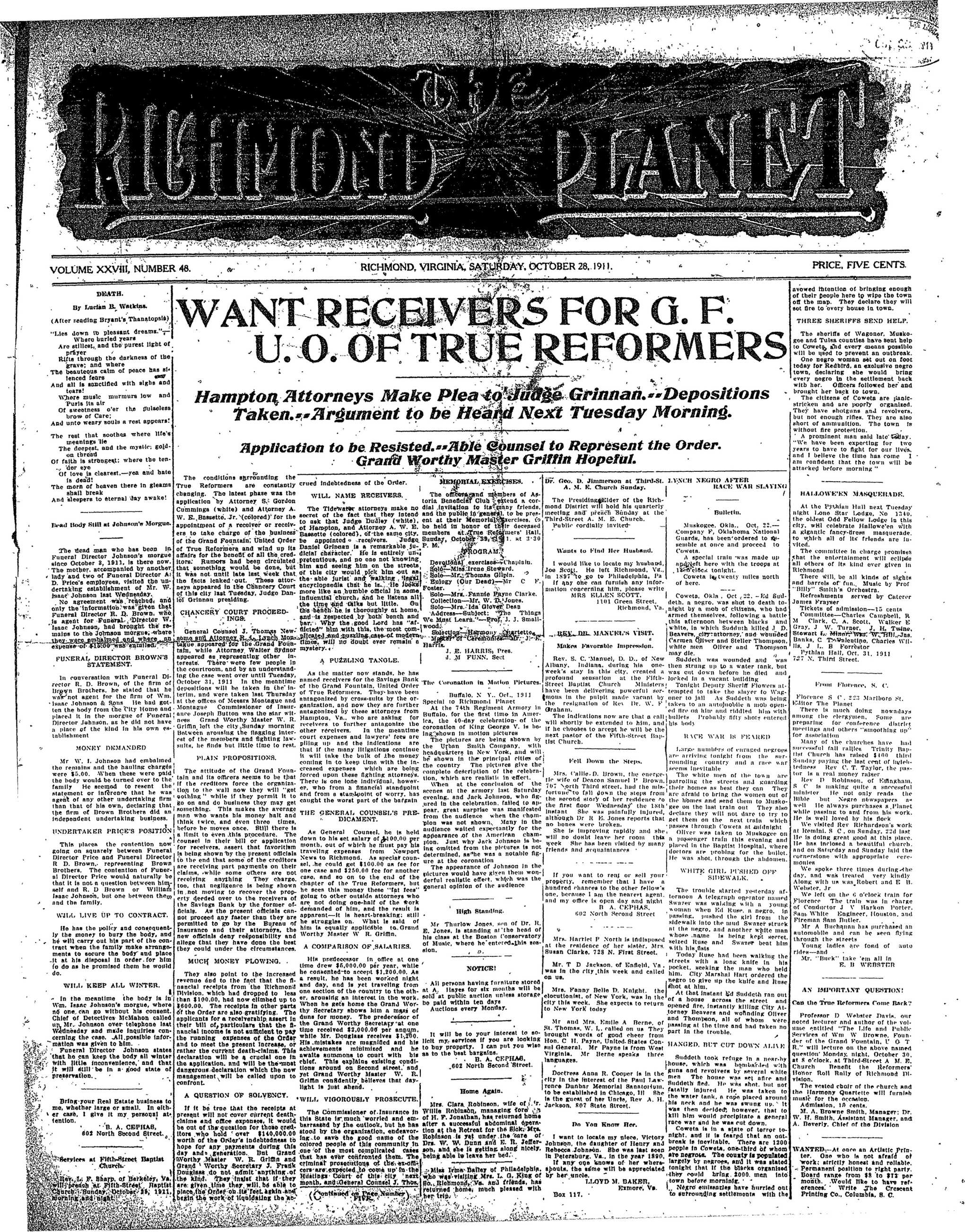
WANT RECEIVERS FOR G. F. U. O. OF TRUE REFORMERS
Hampton Attorneys Make Plea to Judge Grinnan.--Depositions Taken.--Argument to be Heard Next Tuesday Morning.
The conditions surrounding the True Reformers are constantly changing. The latest phase was the application by Attorney S. Gordon Cummings (white) and Attorney A. W. E., Bassetto, Jr. (colored) for the appointment of a receiver or receivers to take charge of the business of the Grand Fountain: United Order of True Reformers and wind up its affairs for the benefit of all the creditors: Rumors had been circulated that something would be done, but it was not until late last week that the facts linked out. These attorneys appeared in the Chancery Court of this city last Tuesday, Judgo Daniel Grippan presiding.
CHANCERY COURT PROCEEDINGS.
General Counsel J. Thomas Newsome and Attorney R. A. Layn Montague appeared for the Grand Monague, while Attorney Walter Sydnon appeared as representing other interests. There were few people in the courtroom, and by an understanding the case went over until Tuesday, October 31, 1911. In the morntime depositions will be taken in the 'interim, and work will be done by Mecca Montague and Montague Commissioner of Insurance Joseph Button was the star witness. Grand Worthy Master W. R. Griffin left the city Sunday morning. Between arranging the flagging interest of the members and fighting lawsuits, he finds but little time to rest.
PLAIN PROPOSITIONS.
The attitude of the Grand Fountain and its officers seems to be that if the creditors force the organization to the wall now they will "got nothing" while if they permit it to go on and do business they may get something. This makes the average man who wants his money halt and think twice, and even three times, before he moves once. Still there is a limit to even this procedure. The counsel in their bill or application for receivers, assert that favoritism is being shown by the present officials to the end that some of the creditors are receiving part payments on their claims, while some others are not recyling anything. They charge too, that negligence is being shown in not being to recover the property obligated to the bank by the Savings Bank by the former officials. As the present officials cannot proceed any faster than they are permitted to go by the Bureau of insurance and their attorneys, the new officials deny responsibility and allege that they have done the best they could under the circumstances.
MUCH MONEY FLOWING.
They also point to the increased revenue due to the fact that the financial receipts from the Richmond Division, which had dropped to less than $100.00, had now climbed up to $600.00. The receipts in other parts of the Order are also gratifying. The applicants for a receivership assert in their bill of particulars that the financial income is not sufficient to pay the running expenses of the Order and to meet the present increase, or rather the current death-calmals. This declaration will be a crucial one in the application, and will be the most dangerous declaration which the new management will be called upon to confront.
If it be true that the receipts at present will not cover current death claims and office expenses, it would be out of the question for those creditors who hold over $140,000.00 worth of the Order's indebtedness to hope for any payments during this period. Worthy Master, W. R. Grimn and Grand 'Worthy Secretary J. Frank Douglas do not admit anything of the kind. They insist that if they are given time they will be able to place the Order on its Test again and begin the work of liquidating the acc
WILL NAME RECEIVERS.
The Tidewater attorneys make no secret of the fact that they intend to ask that Judge Dudley (white), of Hampton, and Attorney A. W. E. Bassette (colored), of the same city, be appointed to receivers. Judge Daniel Grinman is a remarkable judicial character. He is entirely unpretentious, and no one not knowing him and seeing him on the streets of this city would pick him out as the able jurist and walking legal encyclopedia that he is. He looks more like an humble official in some influential church, and he listens to thejmym and will but little to thejmym is thoroughly at home, and is respected by both bench and bar. Why the good Lord has "attracted" him with this, the most complicated and puzzling case of modern times, will no doubt ever remain a mystery.
A PUZZLING TANGLE
As the matter now stands, he has named receivers for the Savings Bank of the Grand Fountain, United Order of True Reformers. They have been antagonized by cross-suits by the organization, and now they are further antagonized by these attorneys from Hampton, Va., who are asking for receivers to further antagonize the other receivers. In the meantime court expenses and lawyers' fees are pilling up and the indications are that if the many litigation continue it takes the bulk of the money coming to the court to be pressed expenses which are being forced upon these fighting attorneys. There is one lone individual, however, who from a financial standpoint and from a standpoint of worry, has caught the worst part of the bargain
THE GENERAL COUNSEL'S PRE-
DICAMENT.
As General Counsel, he is held down to his set salary of $100.00 per month, out of which he must pay his traveling expenses from Newport News to Richmond. As special counsel, he could get $100.00 as fee for one case and $250.00 fee for another case, and so on to the end of the chapter of the True Reformers, but he seen this money these "fat fees" going to other outside attorneys who demanded of him and the result is apparent—it is heart-breaking; still he struggles on. What is said of him is equally applicable to. Grand Worthy Master W. R. Griffin.
A COMPARISON OF SALARIES.
His predecessor, in office at one time drew $6,000.00 per year, while he consented-to accept $1,200.00. As a result, he has been worked night and day, and is yet travelling from one section of the country to the other, arousing an interest in the work. When he gets home the Grand Worthy Secretary shows him a mass of duns for money. The predecessor of the Grand Worthy Secretary-at one time received $2,000.00 per annum, while Mr. Douglas receives $1,260.00. His duns are magnified by his achievement and he awaits summons to court with his chief. This explains existing conditions around On Second street, and yet Grand Worthy Master W. R. Griffin confidently believes that daylight is just ahead.
*WILL VIGOROUSLY PROSECUTE
The Commissioner of Insurance in this State is much worried and embarrassed by the outlook, but he has stood by the organization, endeavoring to save the good name of the colored people of this community in one of the most complicated cases that has ever confronted them. The criminal prosecutions of the ex-occuars are expected, to come up in the Huiatings. Court of this city next month, and General Counsel J. Theos.
The officers and members of Astoria Benedictine Club extend a cordial invitation to its many friends, and the public in general, to be present at their Memorial exercises, to be held in honor of their deceased members at True Reflecters' Hall, Sunday, October 29, 2014. I. at 3:30 P.M.
PROGRAM:
Devotional exercises—Chaplain.
Solo—Miss Jrene Stewart.
Solo—Mr. Thomas Gliphn.
Elogy (Our Dead)—Mr C. P. Foster.
Solo—Mrs. Fannie Payne Clarke.
Collection—Mr. W. D. Jones.
Solo—Mrs. Ida Glover Dean.
Address—Subject: "The Things We Must Learn."—Prof. J. J. Smallwood.
Selection—Harmony Quartette.
Matter of Ceremonies—M. J. E. Harris.
J. E. HARRIS, Pres.
J. M. FUNN, Sect
The Coronation in Motion Pictures
Buffalo, N. Y., Oct. 1911
Special to Richmond Planet
At the 74th Regiment Armory in Buffalo, for the first time in America, the 40-day celebration of the coronation of King George V. is being shown in motion pictures
The pictures are being shown by the Urban Smith Company, with headquarters in New York, and will be shown in the principal cities of the country. The pictures give the complete description of the celebration, which are realistic in effect.
When at the conclusion of the scenes at the armory last Saturday evening, and Jack Johnson, who figure in the celebration, fail to appear, great surprise is manifested from the audience when the champion is not shown. Many in the audience waited expectantly for the appearance of the American champion. Just why Jack Johnson is being omitted from the pictures is not determined, as she was a notable figure at the coronation
The appearance of Johnson in the pictures would have given them wonderful realistic effect, which was the general opinion of the audience
High Standing.
Mr. Thurlow Jones, son of Dr. R. E. Jones, is standing at the head of his class at the Boston Conservatory of Music, where he entered this sonat.
NOTICE!
All persons having furniture stored at A. Hayes for six months will be sold at public auction unless storage be paid within ten days. Monkey
It will be to your interest to solicit my services if you are looking to buy property. I can put you wis as to the best bargains.
B. A. CEPILAS,
602 North Second Street.
Home Again.
Mrs. Clara Robinson, wife of Jr.
Willie Robinson, managing fore-
mier of H. F. Jonathan, has returned home
after a successful abdominal opera-
tion at the Retreat for the Slick. Mrs.
Robinson is yet under the care of
Drs. W. W. Dunn and E. R. Jefferson,
and she is getting along nicely,
being able to leave her bed.
Miss Irma Bailey of Philadelphia,
who was visiting Mrs. L. G. King of
So. Richmond, Va. and friends, has
returned home, much pleased with
Dr. Geo. D. Jimmerson at Third-St.
A. M. E. Church Sunday.
The Presiding Elder of the Richmond District will hold his quarterly meeting and preach Sunday at the Third-Street A. M. E. Church.
Public cordially invited
Wants to Find Her Husband.
I would like to locate my husband, Joe Scott. He left Richmond, Va., in 1897 to go to Philadelphia, Pa. If any one can furnish any information concerning him, please write
DEK. DR. MANUEL'S VISIT.
Makes Favorable Impression.
Rev. S. C. Manuel, D. D., of New Albany, Indiana, during his one-week's stay in this city, created a profound sensation at the Fifth-Street Baptist Church Ministers have been delivering powerful sermons in the pulpit made vacant by the resignation of Rev. Dr. W. F. Graham.
The indications now are that a call will shortly be extended to him, and if he chooses to accept he will be the next pastor of the Fifth-Street Baptist Church.
Fell Down the Steps.
Mrs. 'calle D. Brown, the energetic wife of Deacon Samuel P. Brown, 707 North Third street, had the misfortune to fall down the steps from the second story of her residence to the first door Wednesday the 18th instant. She was painfully injured, although Dr E T E. Jones reports that no one was hurt. She is improving rapidly and she will no doubt leave her room this week. She has been visited by many friends and acquaintances.
A. B. C. D. E. F. G. H. I. J. K. L. M. N. O. P. Q. R. S. T. U. V. W. X. Y. Z.
If you want to rent or sell your property, remember that I have a hundred chances to the other fellow's one, because I am the nearest agent, and my office is located at B. A. CEPHAS, 602 North Second Street
Mrs. Harriet P. North is indisposed at the residence of her sister, Mrs. Susan Clarke, 728 N. First Street.
Mr. T D Jackson, of Enfield, Va. was in the city this week and called on us.
Mrs. Fanny Belle D. Knight, the locutionist, of New York, was in the city this week. She expects to return to New York today
Mr and Mrs Enile A Berne, of St. Thomas, W. L., called on us. They brought words of good cheer from Hon. C. H. Payne, United States Consul General. Mr Payne is from West Virginia. Mr Berne speaks three languages.
Doctress Anna R. Cooper is in the city in the interest of the Paul Lawrence Dunbar Memorial Sanatorium, to be established in Chicago, Ill. She is the guest of her Uncle, Rev A. H. Jackson, 807 Street.
Do You Know Her.
I want to locate my niece, Victory Johnson, the daughter of Henry and Rebecca Johnson. She was last seen in Petersburg, Va., in the year 1890. If any one knows of her whereabouts, the same will be appreciated by her uncle. ILLYD M. BAKER, Exmore, Va.
Box 117.
Bulletin.
Muskogee, Okla., Oct. 22.—Company F, Oklahoma National Guards, has been ordered to assemble at once and proceed to Coweta.
A special train was made up and left here with the troops at 11:45 o'clock tonight.
Coweta is twenty miles north of here.
Coweta, Okla., Oct. 22.—Ed Suddeth, a negro, was shot to death tonight by a mob of citizens, who had armed themselves, following a battle this afternoon between blacks and white, in which Suddeth killed J. D. Beavers, city attorney, and wounded Carmen Oliver and Steller Thompson, white men Oliver and Thompson may die.
Suddeth was wounded and was then strung up to a water tank, but was cut down before he died and locked in a vacant building.
Tonight Deputy Sheriff Flowers attempted to take the skier to Wagner to fall. As Suddeth was being taken to an automobile a mob opened fire on him and riddled him with bullets. Probably fifty shots entered his body.
RACE WAR IS FEARED
Large numbers of injured negroes are arriving tonight from the surrounding country and a race war seems inevitable.
The white men of the town are patrolling the streets and guarding their homes as best they can. They are afraid to bring the women out of the homes and send them to Muskogee on the last train out. They also declare they will not dare to try to get them on the next train which passes through Coweta at midnight. Oliver was taken to Muskogee on a passenger train this evening and placed in the Baptist Hospital, where doctors are probing for the bullet. He was shot, through the abdomen.
WHITE GIRL PUSHED OFF
SIDEWALK.
The trouble started yesterday afternoon. A telegraph operator named Swazer was walking with a young woman when Ed Ruse, a negro, in passing, pushed the girl from the sidewalk into the mud Swazer struck at the negro, and another white man whose name is being kept secret, seized Ruse and Swazer beat him with his fists.
Today Ruse had been walking the streets with a long knife in his pocket, seeking the man who held him, Marshal Hart ordered the negro to give up the knife and Ruse shot at him.
At that instant Ed Suddeth ran out of a house across the street and opened fire, instantly killing City Attorney Beavers and wounding Oliver and Thompson, all of whom were passing at the time and had taken no part in the trouble.
HANGED, BUT CUT DOWN ALIVE
Suddeth took refuge in a nearby house, which was hambared with guns and revolvers by several white men. The house was set afire and Suddeth fled. He was shout, but not fatally injured. He was taken to the water tank, a rope placed around his neck and he was awoken up. It was then decided, however, that to kill him would precipitate a general race war and he was cut down. Coweta is in a state of terror tonight, and it is fearful that an outbreak is inevitable. There are 1200 people in Coweta, one-third of whom are negroes. The county is populated with white men, and was stated tonight that if it were organized they could bring 2000, men into town before morning. More outcasts have hurried in.
1. Negro emissaries have hurried out to surrounding settlements with the
avowed intention of bringing enough of their people here to wipe the town off the map. They declare they will set fire to 'every house in town.
THREE SHERIFFS SEND HELP.
The shorties of Wagoner, Muskogee and Tulsa counties have sent help to Cowet, and every means possible will be used to prevent an outbreak. One negro woman set out on foot today for Redhbird, an exilic negro town, declaring she would bring every negro in the settlement back with her. Officers followed her and brought her back to town.
The citizens of Cowets are pianistricken and are poorly organized. They have shotguns and revolvers, but not enough rifles. They are also short of ammunition. The town is without fire protection.
A prominent man said late today, "We have been expecting for two years to have to fight for our lives, and I believe the time has come. I am confident that the town will be attacked before morning."
HALLOWEEN MASQUERADE
At the Pythian Hall next Tuesday night Lone Star Lodge, No 1240, the oldest Dellow Fellow Lodge in this city, will celebrate Halloween with a gigantic fancy-dress masquerade, to which all of its friends are invited.
The committee in charge promises that the entertainment will eclipse all others of its kind ever given in Richmond.
There will be all kinds of sights and barrels of fun. Music by Prof "Billy" Smith's Orchestra.
Refreshments served by Caterer James Prayer
Tickets of admission—15 cents
Committee—Charles Campbell, R M Cairn, A. Scott, Walker E Gray, J W Turner, J H Twine, Stewart I. Minner-Will, W Hill, Jas. Banks, C T Valentino, Charles Willis, J L. B Forrestor
Pythian Hall, Oct. 11, 1911
727 N. Third Street
Front Florence, S. C
Florence S. C. 223 Marlboro St.
Editor The Planet
There is much doing nowadays among the clergymen. Some are preparing for conference district meetings and others "smoothing up" for association
Many of the churches have had successful fall rallies Trinity Baptist Church has raised $400 third Sunday paying the last cent of hylethodness Rev C. T. Taylor, the pastor is a real money raiser
Rev D Robinson, of Eddingham, S. C is making quite a successful minister He not only reads the Bible but Negro newspapers as well He always purchases a Planet while passing to and from his work He is well loved by his flock
We visited Rev Richardson's work at itemlh, S. C, on Sunday, 22d last He is doing great good at this place. He has included a beautiful church, and on Saturday and Sunday laid the cornerstone with appropriate ceremonies.
We spoke three times during the day, and was treated very kindly Along with us was Robert and E. B. Webster, Jr.
We left on the 6 o'clock train for Florence The train was in charge of Conductor J. V. Harken Porter, Sam White Engineer, Houston, and Fireman Sam Butler.
Mr A Buchanan has purchased an automobile and can be seen flying through the streets
Young ladies are fond of auto rides—and
Mr. "Buck" take 'em all in
E. B. WEBSTER
AN IMPORTANT QUESTION!
Can the True Reformer Come Back?
Professor D Webster Davis, our noted lecturer and author of the volume entitled "The Life and Public Services of Wm W Browne, Founder of the Grand Fountain, U Q T R." will lecture on the above named question Monday, night, October 30, at 8 o'clock, at Third Street A M. E. Church Benefit the Reformers' Honor Roll Rolly of Richmond Division.
The vested choir of the church and the Harmony Quartette will furnish music for the occasion.
Admiration, 10 cents.
M. A. Browne Smith, Manager: Dr. W. H. Smith, Assistant Manager, and A. Beverly, Chief of the Division
WANTED. At once an Artistic Printer.
One who is not afraid of work; artistry honest and reliable.
Permanent position to right party.
Board range from $8 to $12 per month.
Would like to have references.
Write The Crescent Printing Co., Columbia, S. C.
TWO
CHAT JANUARY
A FIETIETH ANNIVERSARY WAR STORY BY F. A MITCHELL.
Copyright, 1892, by American Press Association.
SYNOPSIS
Private Mark Malone, U B. A., gent as
spy to Chattanooga by Genese Thomas,
J. A. B., and others.
Disguised as a countryman, Mark starts for Chattanooga with Jakey. Bourt's brother, Mark is to send Bourt her red handkerchief. Mark is to send Bourt her red handkerchief. Mark and Jakey are given shelter by Laura Pain and her mother Laura suspects Mark is a Union soldier in disguise. She prepares for a confederate Confederate. She prevents her lover, Captain Cameron Fitz Hugh C. B. A., from detailing Mark. Mark learns that a big Confederate army is attacking Chattanooga and planning a northward dash it attempts to escape from Chattanooga. He carries Jakey in safety past the Confederate army, meets a band of Confederate deserts. He and Jakey are then taken prisoners. Mark is imprisoned as a spy Jakey sends Bourt handkerchief to her by a negro, sentenced to death by Pits Hugh, is sentenced to death.
CHAPTER VIII
DE CASE OF PREVIEW.
On the morning after Jakey's interview with the colored woman through the crack in the jailard fence Sourl Slack was washing dishes by an open window in the kitchen, an addition built-ip boards to one of the united houses which formed the Slack dwelling. The sun was shining brightly, and a morning glory she had trained up to grow about the window was fresh with dew. Sourl's heart felt unhappy light. The air was so fresh, the sun was bright; the morning glory flowers had such a companionable look in them that Sourl was very happy.
Suddenly there came to her a quick sinking away from the pleasurable sensation. A sense of danger rushed in to take its place. Surely something horrible was about to happen.
In a moment she heard the clatter of horse's hoofs coming at a gallop. Looking up the road, of which she had a view from the window, she saw a horse covered with foam tearing to ward her, with a negro boy on his
PADMER
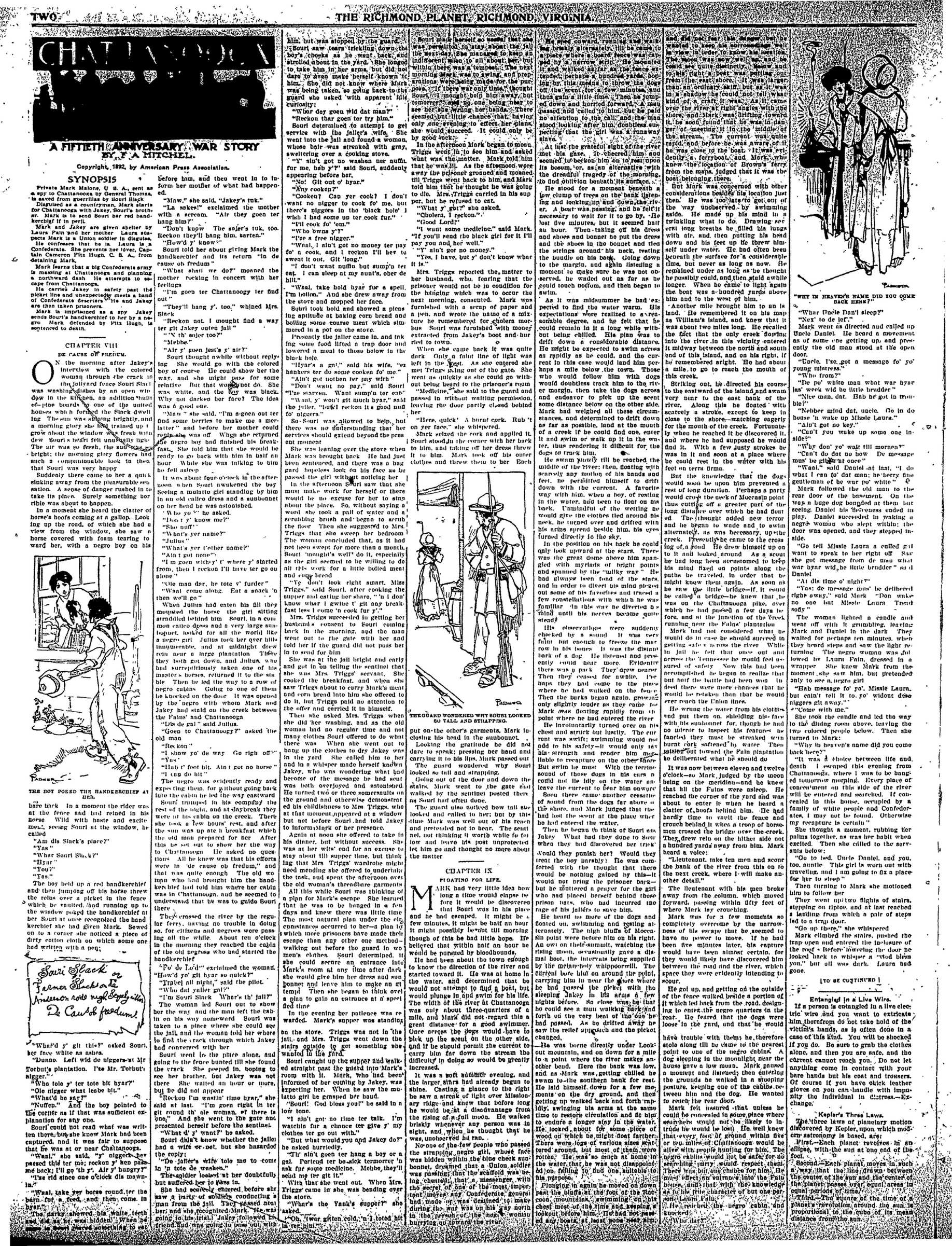
THE BOT POSED THE HANDERCHIEF AT
HEL
bare back. In a moment the rider was
at the fence and had relied in his
Wild with base and excitement,
being Sound at the window, he
called
The boy held up a red handkerchief and then jumping off his horse threw the reins over a picket in the fence which he vaulted, and running up to the window poked the handkerchief at her Sourt at once recognized the handkerchief she had given Mark. Sewed on to a corner she noticed a piece of dirty cotton cloth on which some one had written with a pen:
Sari Black on farmer Sack on the miller note high Supply item De Caual of freedom!
"What'd y' git this?" asked Sourt, her face white as ashes.
"Dunno. Left wid de niggers-at Mr Torbut's plantation. I've Mr. Torbut's nigger."
"Who tole t* ter tote bit btyr"*
"O neiger whig lewbe bit"*
"Lie der liebe"
"Nuffen." And the boy pointed to the corner as if that was sufficient explanation for any one. Sourl could not read what was written there, but she knew Mark had been captured, and it was fair to suppose that he was at or near Chattanooga. "Waal," she said, "y bigger hey passed this ter me; rockon y ken pass me back; I'll go th y. Alf y hungry!" "Ize rid since one o'clock d mawnin." "Waal, take yer horse round, ter the barn, for a feed, and then come in hear."
"Am dis Slack's place?"
"Yas"
"What Sourt Slu, k?"
"Hjur"
"You?"
"Yas"
before him, and then went in to inform her mother of what had happened.
"Maw," she said, "Jakey's tuk."
"La sake!" exclaimed the mother with a scream. "Air they goer ter hang him!"
"Don't know. The sojer's tuk, too. Reckon they'll hang him, karten."
"How'd y' know."
Sourl told her about giving Mark the handkendlef and its return "in de cause oh freedum"
"What shall we do?" moaned the mother rocking in concert with her feelings.
"I'm goer ter Chattanoogy ter and out."
"They'll hang y' too," whined Mrs. Black.
"Reckon I not would find a way ter git Jakey outeer jail."
"N' th' sojer too!"
"Siebhe."
"Air y' goen less y' air!"
Souri thought awhile without replaying. She would go with the colored boy of course. He could show her the way, and she might pass for some relative. But that boy did not do. She was white, and the boy was black. Why not darken her face? The idea was a good one.
"Maw" she said. "I'm a-goon out ter and some berries to make me a merlatter" and before her mother could reply she was off. Whigh she returned the negro boy and finished his breakfast. She told him that she would he ready to go back with him in half an hour. She was talking to him he fell asleep.
It was about four o'clock in the afternoon when Souri awakened the boy. Seeing a mulatto girl standing by him in an old calico dress and a sunbonnet on her head he was astonished. "Who you?" he asked. "Don't you know me?"
"Sho nuff!"
"What's yer name?"
"Julius"
"What's yer other name?"
"Ain't got none!"
"I'm goen with y' t' where y' started from, then I reckon I'll have yer go on alone"
"The man dor, he tote y' furder"
"What come along. Eat a snack to then we'll go"
When Julius had eaten his fill they mounted the horse the girl sitting grilled behind him. Sourl, in a com mon eneo dress and a very large amulet, looked for all the world like a negro girl. Julius took her gree horses innumerable, and at midnight drew remnure a large plantation. There they both got down, and Julius, who had curritually taken one of his masters horses, returned it to the stable. Then he led the way to a row of negro cabins. Going to one of them he knocked on the door. It was opened by the negro with whom Mark and Jakeh had stalled on the creek between the Fains' and Chattanooga
"Gone to Chattanooga?" asked the old man
"Rekon"
"I show yo' de way Go right off!"
"Just"
"Habt' foot hit. Ain't got no horse!"
"I can do hit"
The negro was evidently ready and expressing them, for without going back into the caleb he led the way eastward Souri trumped in his company the rest of the night, and at daybreak they were at his cabin on the creek. There she took a few hours' rest, and after the sun was up ate a breakfast which the old man prepared for her. After this he set out to show her the way to Chattanooga. He asked no questions. All he knew was that his efforts were in do cause ob freum," and that was quite enough. The old man who had brought him the handkerchief had told him where her caleb was in Chattanooga, and he seemed to understand that he was to guide Souri
They crossed the river by the regular ferry, moving no trouble in doing so, for citizens and negroes were passing all the white. About ten o'clock in the morning they reached the cabin of the old negroes who had started the handcuffs
"To'de Lo'd!" exclaimed the woman "How'd you'g get hair so quick?" "Trail' all night," said the pilot. "Who'd bat yuller get?"
"I'm Sourl Shack What's th' fail?" The woman led Sourl out to show her the way and the man left the cabin on his way homeward. Sourl was taken to a place where she could see the fall and the woman told her where to find the crack through which Jakey had conceived with her.
Sourl went to the price alone, and going to the fence bunted till she found the crack. She peeped in, boping to see her brother, but Jakey was not there. She waited an hour or more, but he did not appear
"Heckou I'm wastin' time brad," she said at last. "I'm goin' right in ter git round th' ole woman, if there is one." And she went to the gate and presented herself before the sentinel. "What d'ye wojn? he wojn?" Souri didn't know whether the jailer did or not, but she hazarded the reply: "Do jatser's wife tol me to count in 'n tote de weaken."
The saddler looked at her doubtfully,
but uttered her in Wax in.
but uttered a command before she
saw a party of soldiers conducting a
man from the jail. They passed near
her and she recognized that she was
going to the trial. Judy followed her
friend and was seized by the police.
him, but was stopped by the guard. Bourt saw team trickling down the boy's cooker, so went back, and waved them in the way. Bourt hoped to take him in her arms, but did not dare to even make herself known to him. She did not know where she was being taken, so going back to the guard who asked with apparent curiosity:
He slowed down, running and walked the breakway alternately. It he came to the door, he hurriedly went to the door, he managed to keep an indifferent man to all about him, but withdrew there was a tempest. The next morning dew was to swine, and preparations being made for the purpuree. If there was only time, thought Bourt, it might help him away, but tomorrow, adding one being near to the guard down and hurried forward. A man
He speed onward, running and walked the breakway alternately. It he came to the door, he hurriedly went to the door, he managed to keep an indifferent man to all about him, but withdrew there was a tempest. The next morning dew was to swine, and preparations being made for the purpuree. If there was only time, thought Bourt, it might help him away, but tomorrow, adding one being near to the guard down and hurried forward. A man
"What day goen wid dat man?"
"Reckon that goen for try him."
Bourl determined to attempt to get service with the falser's wife. "She went into the jail and found a woman whose hair was streaked with gray, wetting over a cooking stove.
"Y'niit got no washen ner nuffi for me, hab y'i" said Bourl, suddenly appearing before her.
"No! Git out of 'byar."
"Any cooken?"
"Cooken? Can yer cook? I don't want no bigger to cook fo me, but there's piggers in the 'block hole' I wish I had some un ter cook fur."
"I'll cook fo 'em."
"Who bwns y?"
"I use a free nigger."
"Waal, I ain't got no money ter pay fo a cook, and I reckon I hell to sweat it out. Git long."
"I don't want nuffin but sump'n ter eat. I can sleep at my naut's, ober de hill."
"Waal, take hold hyar fur a spell. I'm hollen." And she drew away from the store and mopped her face.
Squirl took hold and showed a pleasing aptitude at baking corn bread and boiling some course meat which simmered in a pot on the store.
Presently the faller came in, and taking some food lifted a trap door and the black hole to those below in the black hole.
"Iyar's a girl!" sold his wife. "We haunch ter do some cooken fo me."
"Aln't put nothon ter any with."
"Don't want no pay," said Sourl "I'm sweary. Want sumpn' ter ear" "Wah, y' wont git much byar," said the father, "hust' beck it a good nut fo' niggers."
So Sourl was allowed to help, but there was no understanding that her services should extend beyond the pres ent moment. Panicking over the store when Mark was brought back. He had just been sentenced, and there was a big gard hapeless look on his face as he passed the girl without noticing her.
In the afternoon Sourl saw that she must make work for herself or there would be no excuse for her to stam about the place. So, without saying a word she took a pail of water and a scrubbing brush and began to scrub the floor. Then she suggested to Mrs. Tricks that she sweep her bedroom. The woman concluded that, as it had been for more than a month, Sourl intended to do it. It seemed as the girl seemed to be willing to do all this work for a little bolted meat and creee bread
"Ye don't look right smart, Miss Triggs," said Sourl, after cooking the supper and eating her share, "n'I don't know what I gwine 't itg my breakfast less I come 'n cook fur y'."
Miss Triggs succeeded in getting her husband's consent to Sourl coming back in the morning, and the man went out to the gate with her and told her if the guard did not pass her in to send for him.
She was at the jail bright and early and got to in telling the sentinel that she had to go to the jail servant. She cooked the breakfast, and she saw Triggs about to carry Mark's meat and corn bread into him she offered to do it, but Triggs paid no attention to the offer and carried it in himself.
Then she asked Mrs. Triggs when she did her washing, and as the old woman had no regular time and not many clothes Sousl offered to do what there was. When she went out to hang up the clothes to dry Jakey was in the yard. She called him to her and in a whisper made herself known Jakey, who was wondering what had become of the message he had sent was both overjoyed and astonished. He turned two or three somersaults on the ground and otherwise demonstrated his childishness to Mrs Triggs, who was not before Sousl and told Jakey but not before Sousl and told Jakey to inform Mark of her presence.
Again at noon she offered to take in his dinner, but without success. She was at her wife's end for an excuse to stay about till supper time, but thinking that Mrs Triggs' wardrobe might need mending she offered to undertake the task, and spent the afternoon over the old woman's threadbare garments
All this while Sourl was thinking of a plan for Mark's escape. She termed that he was to be hanged in a few days and knew there was little time. The most natural plan under the city constructions occurred to her—a plan by which more prisoners have made their escape than any other one method—walking out before the guard in women's clothes. Sourl determined, it she could secure an entrance into Mark's room at any time after dark she would give him her dress and sun bonnet and leave him to make an attempt. Then she began to think over a plan to gain an entrance at a speeded time. In the evening her patience was rewarded. Mark's supper was standing on the store. Triggs was not in 'the jail, and Mrs. Triggs went down the stairs outside to get something she wanted in the yard.
Bourl caught up the supper and walked straight past the guard into Mark's room with it. Mark, who had been informed of her counting by Jakey, was expecting her. When he saw the mu-tatto girl he grasped her hand.
"Bourl! God bless you!" he said in a low tone.
"I ain't got no time ter talk. I'm watchin' fur a chance ter give 5 y'm clothes ter go out with."
"But what would you and Jakey do?" he asked hurriedly.
"I ain't goen ter hang a boy or a gal. Portend ter be socktermorer ask for some袜咪. Mohbe, they'll send my ter git it."
With that she went out. When Mrs. Trigger came in she was bending over the stove.
"What's the Yank's cupper?" she asked.
Bourt made himself so worried that she was persecuted in Italy about the fall the next day. She managed to keep an indifferent plan to all about her, but within there was a tempest. The next morning she was at a swing, and preparations were being made for the purpose. If there was only time to thought Bourt, I might help him away, but tomorrow, no one being near to see her she wring her hands. There seemed but little chance that having only one evening to effect her plan, she would succeed. It could only be by good luck. The Mark began to moon. Trigles would lie to see him and asked what was the matter. Mark told him that he was ill. As the afternoon wore away the pigeon grounded and mowed till Trigles went back to him, and Mark told him that he thought he was going to die. Mrs. Trigles carried in his sup per, but he refused to eat. "What y' got" she asked. "Cholera, I rocked."
"Good Lord!"
"I want some medicine," said Mark.
"If you'll send the black girl for it I'll pay you and her well."
"Y ain't got no money."
"Yes, I have, but y' don't know what it is."
Mrs. Triggs reported the matter to her husband, who, fearing that the prisoner would not be in condition for the biting which was to occur the next morning, consented. Mark was furnished with a scrap of paper and a pen, and wrote the name of a mixture he remembered for cholera morbus. Sourl was furnished with money extracted from Jakey's boot and hurried to town.
When she came back it was quite dark. Only a faint line of light was left in the foot. As she entered she met Triggs lying out of the gates. She went as quickly as she could go without seeing the room. "Medicine," she said to the guard and passed in without waiting permission, leaving the door partly closed behind her.
"Here, quick!" a burnt cork. Rub it on yer face," she whispered.
Shirk selzed the cork and applied it. Sourl atodun the corner with her heek to him, and taking off her dress threw clothes on her, and threw them to her. Each
Papua
THE OUAND WONDERED WHY SOUNN LOOKED
SO TALL AND SHIFFLING.
put on the other's garments. Mark
inclosing his head in the sunbonnet.
Going out of the door and down the stairs, Mark went to the gate and walked by the sentinel posted there as Squirrel had often done. The guard also noticed how tall she looked and called to her; but by the time Mark was well out of his reach and pretended not to hear. The sentinel, not thinking it worth while to low and leave his post unprotected let him go and thought no more about the matter
CHAPTER 15
FLOATING FOR LIFE
MARK had very little idea how long a time would elapse before it would be discovered that Sourl was in his place and he had escaped. It might be a few minutes, it might be half an hour it might possibly be not till morning though of this he had little hope. He believed that within half an hour he would be pursued by bloodhounds. He had been about the town enough to know the direction of the river and started toward it. He was at home in the water, and determined that he would not attempt to find a boat, but would plunge in and swim for his life. The width of the river at Chattanooga was only about three-quarters of a mile, and Mark did not regard this a great distance for a good swim. Once across the dogs would have to pick up the scout on the other side, and if he should permit the current to carry him far down the stream the difficulty in doing so would be greatly increased.
It was a soft summer evening, and the larger sails had already begun to shine. Casting a glance to the right he saw a streak of light over Missionary ridge, and knew that before long he would be at a disadvantage from the rising of a full moon. He walked bravely whenever any person was in sight, and, when, he thought that he was, unobserved he ran. No one of the few people who passed the strapping, negro girl, whose face was hidden within the blue check sunbonnet, dreamed that a Union soldier was passing that the scaffold was being chanted, that a messenger, with the secret of one of the most important imposters, Confederate appear and made up of men, north of the war, was on his north by the point of the age, women inward toward the star.
He speeled on warriors, like his brother, who had been captured by a narrow sifn. He required it, and walked as far as the fence extended, perhaps a hundred yards, bopping by this means to throw the dogs of the scent for a few minutes, and thus gain a little time. Then he jumped down and hurried forward. A man passed and called to him, but he paid no attention to the call, and the man stood, looking after him, doubleless suspecting that the girl was a runaway slave.
At last the grateful sight of the river met his gaze. It cheered him and seemed to beckon him on to rest upon its bosom, or, as an alternative with the dreadful rudely of the morning, to und bollition beneath its surface.
He stood for a moment beneath a low clump of trees on the bank listening and looking up and down the river. A boat was passing, and he felt it necessary to wait for it to go by. He lost five minutes, but it seemed half an hour. Then taking off his dress and shoes and bonnet he put the dress and the shoes in the bonnet and tied the strings around his neck, resting the bundle on his back. Going down to the margin, and again listening a moment to make sure he was not observed, he waded out as far as he could touch bottom, and then began to swim.
As it was midsummer he had expected to find the water warm. His expectations were realized to a reasonable degree, and he felt that he could remain in it a long while without being chilled. His plan was to drift down a considerable distance. He might be expected to swim across as rapidly as he could, and the current in this case would land him perhaps a mile below the town. Those who would follow him with dogs would doubtless track him to the river, merge then take the dogs across and move on. He would be the same distance below on the other side. Mark had weighed all these circumstances, and determined to drift down as far as possible, land at the mouth of a creek if he could find one, enter it and swim or walk up it in the water, thus rendering it difficult for the dogs to track him.
He swam slowly till he reached the middle of the river; then, floating with scarcely any motion of his hands and feet, he permitted himself to drift down with the current. A favorite way with him, when a boy, of resting in the water, had been to floor on his back. Unmindful of the working he would give the clothes tied around his neck, he turned over and drifted with his arms spread beside him, his eyes turned directly to the sky. In the position on his back he could only look upward at the stars. There was the great dome above him spangled with myriads of bright points and spanned by the "milk way." He had always been fond of the stars, and in order to divert his mind picked out some of his favorites and traced a few constellations with which he was familiar. In this way he diverted a mind until his nerves became quite stead
His observations were suddenly checked by a sound. It was very fair but enough to freeze the murmur in his bones. It was the distant bark of a dog. He distended and probably could hear more. Eridantly there was a pack. They drew nearer. Then they ceased for awhile. For hips they had come to the place where he had walked on the fence. Then the barks began again, growing only slightly louder as they came to Mark was floating rapidly from point where he had entered the river. He inountually turned over on his chest and struck out loudly. The current was swift; swimming would not add to his safety—it would only lay in the water and render him unmobile to receive him shore. But swim he must. With the sound of those dogs in his ears could not lie idly on the water and allow the current to fear him ownew. Soon there came another cessation of sound from the dogs far above in the shate, and Mark judged that the bad lost the scent at the place where he had entered the water.
Then he began to think of Sour and Jakey. What had they done to Sour when they had discovered her trick? Would they punish her? Would they treat the boy insultly? He was comforted with the thought that there would be nothing gained by this-but would not bring the prisoner back—but he interrupted a prayer for the girl who had placed herself behind those prison bars, who had incurred the rage of his jailers to save him.
He heard no more of the dogs and floated on, swimming and resting alternately. The high blinds of Moenclain point were before him on his right. An owl on their summit, watching the rising moon, occasionally gave a daintest boot, the intercourse being supplied by the melancholy whippoillow. The current bore hilt on around the point, carrying him in near the glove where he had passed the pikeet with the sleeping Jackey in his arms a few nights before. No close beet, he that he could see a man walking back and forth on the very beat of the owl he had passed. As he drifted away he saw the relief approach and the pikeet changed.
He was born directly under Look-out mountain, and on down for a mile to a point where the river makes another bend. Here the bank was low, and as Mark was, getting chilled he swam to the southern bank for rest. He laid himself down for a few moments on the dry ground, and then getting up walked back and forth rapidly, awinging his arms at the same time to restor circulation and fit blur endures longer (as) water. He was held for some point of wood of which he might float further. There were logs of various sizes watered around, but most of them were rotten. He was so much at home in the water, that he was not disappointed on falling to dud one suitable to his purpose.
Plumping in again he moved on down past the blues at the foot of the florence mountain, swimming on his chest most of the time and keeping a lookout before him. He had not passed any boats at least none meet him.
and did not fear, the danger, but he wanted to keep the surrounding well in view, in order to know his location. The boat was now well kept and he could now quite distinctly, know and to his right, boat was putting out from the east shore. It was larger than an ordinary skill, but as it was in a shadow he could not tell what kind of a craft it was. As it came over the river at right angles with the shore, and Mark was driving toward it, he so stood found that he was in danger of meeting it in the middle of the stream. The current was quite rapid, and before he was aware of it he was close to the boat. It was evidently a forryboot, and Mark, who knew the location of Brown's ferry from the mains, judged that it was the boat belonging there.
But Mark was concerned with other considerations beaker his location just then. He was too late to get out of the way unobserved, by swimming aside. He made up his mind in a twinkling what to do. Drawing very long breaths he filled his lungs with air, and then putting his head down and his feet up he threw himself under water, often after been in a pool for a considerable time, but never as long as now. He remained under as long as he thought he possibly could, and then guard awhile longer. When he came to light again the boat was a hundred yards above him and to the wot of him.
Another mile brought him to an island. He remembered it on his map as Williana's island, and knew that it was about two miles long. He recalled the fact that the only crook diving into the river in this vicinity entered it midway between the north and south end of this island, and on his right, if he remembered right. He had about a mile, to go to reach the mouth of this creek.
Striking out, he directed his course to the eastward of the island and swam very near to the east bank of the river. Along this he floated with scarcely a stroke, except to keep in close to the shore—watching eagerly for the mouth of the creek. Fortunately when he reached it he discovered it, and where he had supposed he would find it. With a few justly strokes he was in it and soon at a place where he could rest in the water with his feet on term firma.
But the knowledge that the dog would soon be upon him prevented a rest of long duration. Perhaps a party would croak the neck of Moccaalna point thus cutting off a greater part of the long distance over which he had danced. The thought added new terror and he began to wade and to swim alternately, as was necessary, up the creek. I必然地 came to the crossing of a road. He drew himself up on it and looked around. As a scout he had long been accustomed to keep his mind fixed on points along the path he traveled. In order that he might know them again. As soon as he saw the little bridge—if it could be called a bridge—he knew that, she was on the Chattanooga pike, over which he had passed a few days before, and at the junction of the creek running near the Falahe plantation
Mark had not considered what he would do in case he should succeed in getting safety across the river. While in jail he felt that once out and across the Tennessee he would feel assured of safety. Now this had been accomplished he began to realize that but half the battle had been won. In dead there were more chances that he would be taken down than that he would ever recover. He wrote the water from his clothes and put them on, shielding his face with his sunbonnet for, though he had no interior to inspect his features he canned that he must be streaked with burnt corn softened by water. They pitched out toward the Palm plantation to deliberate what he should do.
It was now between eleven and twelve o'clock—so Mark, judged by the moon being on the meridian—and he knew that bill the Fuins were asleep. He reached the corner of the yard and was about to enter it when he heard a clatter of boots behind him. He had hardly time to mutilate the fence and crouch behind it when a troop of horsemen crossed the bridge over the creek. They drew rein on the hither side not a hundred yards away from him. Mark bequeathed them: "Lleutonne tinke ten men and scour the bank of the river from this on to the next creek, where I will make another detail."
The lieutenant with his pen broke away from the column, which moved forward, passing within fifty feet of where Mark lay crouching.
Mark was for a few moments so completely overcome by the narrowness of his escape that he seemed to have no power to move. If he had been five minutes later, his capture would have been almost certain, for they would likely have discovered him between the road and the river, which space they were evidently intending to scour.
He got up, and getting on the outside of the fence walked beside a portion of it which led back from the road, designing to enter, the negro quarters in the rear. He feared that the dogs were loose in the yard, and that he would have trouble with them, he, therefore stole along till he came to the nearest point to one of the negro cubes. A dog sleeping in the moonlight near the house gave a low moan. Mark pounced a moment and listened; then entering the grounds he walked in a stooping posture, keeping one of the cubes between him and the dog. He wanted to reach the rear door.
Mark felt insured that unless he could be concealed in some place where secrecy would not be likely to intrude he would not be lost. He well knew that every foot of ground within five or two miles of Christianaoga would be negro chinna, and every negro chinna would not be safe for no secreting party; warry would respect them. There was but one chance for him. He must direct entrance into the Fath house, and that with the knowledge as to the true character of but one person Laundry Fath. He relied on the negro cabin, and snuck. 'Who did it?'
PARKERDA
"WHY IN HEAVEN'S NAME DID YOU COME BACK HERE?"
"What Uncle Dan't sleep?"
"Nex't to do let?"
Mark went as directed and called up Uncle Daniel. He heard a movement of some one getting up, and presently the old man stood at the open door.
"Uncle, I've got a message fo' so young matress."
"Who from?"
"Do po' white man what war hyar las' week wid he little brudder?"
"Nice man, dat. Hab he got in trouble?"
"Nebber mind dat, uncle. Go in do house, wake up Nina Leaue."
house it wipe up Stissie Laura.
"Ain't got no key."
"Can't you wake up some one inside?"
"Why don' yo wait till mornen?"
"Can't do dat no how De message must be glittered once"
"Waht," said Daniel at last, "I do what I can to dat man; he berry the gentleman et he war po' white"
"Mark followed the old man to the rear door of the basement. On the wag a huge dog bongled at them but seeing Daniel his慧ness ended in play. Daniel succeeded in making a negra woman who slept within; the door was opened, and they stepped inside.
"Go tell Missie Laura a called girl want to talk to her right off. Say she got message from de maw what war byar wid, he little brendder" said Daniel
"At dls time o' night."
"Yas; de message must be delivered right away," said Mark "Don wake no one but Missie Lauren Treat soy"
The woman lighted a candle and went off with it grimbling, leaving Mark and Daniel in the dark. They waited for perhaps ten minutes, when they heard steps and saw the light returning. The negro woman was followed by Laurn Fain, dressed in a wrapper. She knew Mark from the moment, she saw him, but pretended only to see a negro girl.
"Hab message 'yo', Missie Laurn, but can't tell it to, so 'widout des niggers gilt away.'"
"Come with me."
She took the candle and led the way to the dining room, leaving the two colored people below. Then she returned to Mark:
"Why in heaven's name did you come back here?"
"It was a choice between life and, death I escaped this evening from Charlottown, where I was to be banged tomorrow morning. Every place of concenation on this side of the river will be entered and searched. If concealed in this house, occupied by a family of white people and Confederates, I may not be found. Otherwise my recapture is certain."
She thought a moment, rubbing her palms together, as was her habit when excited. Then she called to the servants below:
"Go to bed. Uncle Daniel, and you, too, auntie. This girl is worn out with travelling, and I am going to fix a place for her to sleep."
Then turning to Mark she motioned him to follow her.
They went up two flights of stairs, stepping on tiptoe, and at last reached a landing from which a pair of steps led to a trap door.
"Go up there," she whispered.
Mark climbed the stairs, pushed the trap open and entered the inclosure of the roof. Before lowering the door he put it back to whisper a word these you." but all was dark. Laura had gone.
TO BE CUSTOMIZED
Entangled in a Live Wire.
If a person is entangled in a live electric wire and you want to extricate him therowdo not take hold of the victims' hands, as is often done in a case of this kind. You will be shocked if you do. Be sure to grab the clothes alone, and then you are safe, and the current cannot reach you. Do not let anything come in contact with your bare hands but his coat and trousers. Of course if you have shuck leather gloves on you can handle with impunity the individual in distress.—Exchange.
Kepler's Three Laws.
The three laws of planetary motion discovered by Kepler, upon which modern astronomy is based, are:
First—Each planet revolves in an ellipse, with the sun at one end of the foot.
Second—Each planet moves in such a way that the line drawn between the center of the sun and the center of the planet passes over equal areas in equal periods of time.
Third—The square of the time of a planet moves around the sun is proportional to the square of its distance from the sun.
THE RICHMOND PLANET, RICHMOND, VIRGINIA.
Prof. Moore's Explanation—The Advantages in this New Country.
Bahin, Brazil, Sept. 13, 1911.
Special to The Richmond Planet,
Richmond, Va., U. S. A.:
As my time and health have been such that I could not get what I wanted prepared for this mall, I feel that if I do not say something you may think that I have forgotten you. And I assure you otherwise. I will just say a few words about the climate. You can easily see from your maps that geographical conditions or situation of Brazil is right for the florest and most healthy climate' of
the world. This is just what it is. And especially the State of Bahrain, which is situated about half-way from the two extremes of South America and Brazil and so project out into the Atlantic Ocean in such a way that one might easily think that the whole coast actually waited by the breezes of the ocean's salt air. One is reminded of a special watering place, as there is never that killing heat nor the freezing cold which you have in America North.
WEATHER CONDITIONS FAVORABLE.
I speak of this because I believe it to be one of the points of particular advantage to a poor struggling people. From the very fact that they would not be compelled to change the weight of their clothes so often, so as to meet the conditions of the seasons. In this respect, I am not needed to say that this is an economical advantage of no small importance to the colored people the world over. Here is no great worry about fuel, as charcoal is quite sufficient to cook with. And for mechanical purposes as yet coal is bought from English companies. But in many cases they even burn wood.
BURN WOOD THERE.
Some of the railroads and most of the little steam boats which run on the rivers use wood as fuel, and many of their little stationary engines. At the first thought of this one might say that this lack of coal is to the country a great disadvantage—40 motters not what the climate is. But let us see if this is really the case here in Brazil. The western scope of the country is so situated with mountains that some of the finest falls in all the world are here in Brazil. As science is progressing we can see an end to the great demand for coal as a fuel. And this, of course, is to some advantage to the United States, from the fact that many have already begun to estimate the time that the coal mines will hold out at the general and growing demand for fuel.
But science teaches us that nature can never exhaust itself. And this is very evident as to fuel during these last 200 years, as when one material is exhausted another and a better one is found
NO NEED FOR COAL
Some say that there is plenty of coal in Brazil, and yet others say there is not. But here is one thing that I know: that if things continue as they seem to be going now, Brazil will have very little need for it. And yet be one of the most active countries of the world. One might easily believe that under these great mountains there runs any; quantity of oil. It is also reasonable to think that there must be natural gases. If this is not true, by bridging the many great falls there can be any amount of energy produced for all purposes on land. At sea there will be means found to keep the ships running.
But this is not the great thing which bothers the Negro, but they are items. The great mountain range over to the west of the country brings the temperature to an equal with that of the East, from the fact of its great elevation. Being so close to the centre of the world, I am not needed to tell you that freeze-ups are equally unknown to Brazil.
Those mountains (we are told) hold any amount of riches, in the form of metals and precious stones. For farming, the entire country is verdant the year. round. And although this is one of the most productive countries at all for fruits, it may seem strange to know that there are no great fruit cultivators.
A GREAT ADVANTAGE
Therefore, we see nothing of the great fruit—conservatories which would be so natural in a colder climate. And this in itself is an advantage for the Negro of America, should he choose to come here and interest himself. He knows that in certain countries, and especially North America, and Northern Europe. These are some of the reasons why I say that if you come here looking for some one to hire you and pay you by the day, you are lost before you start.
and body, and rather, as the Irish old in the United States, to help build up, country where you can make yourselves a respectable part—why then, this is your place. And this, in itself, should remind you of the fact that the whole race must learn to strike out upon a more independent basis, and make things right for themselves, as men, only want servants when they can have them at great personal advantages. As soon as they can easily get along without them, they dispose of servants. They do this even with the horse and cow, and how much more with men, whom they have to pay. Men have done away with slavery because it is more convenient to hire him than to own men. And if they must own anything, they prefer a machine, which is less cost. And here is your principal advantage in Brazil. The country is a large one, and in a very healthy zone, and is not overrun with a more advanced population. And neither is the great amount of machinery to compete with here as in other countries.
DR. WASHINGTON'S TRAVELS.
I have before me Mr. Washington's complete story of his travels in South Europe, and I can see nothing in it to inspire the Negro race with any hope of a better future. But, in order not to be selfish, I consulted the views of several others, and their conclusions were like mine—that he compared your conditions with the most unhappy whites of the earth so as to make you content with your conditions. But he killed his own argument, if one would follow him with care. He, as also as he, does defeats the very purpose for which he said he was working. He proved to all that the man who does not take part in the ruling of his country and only practices farming is the tool and jest of the city folk. We will for instance cite you two facts in your own country.
A STRIKING COMPARISON.
"The North was the place of manufacturing, while the South was the farming part of the country. And where is the wealth, brain and power oven today? This is the way to look at matters. We know, as Wm. J. Bryan has said, the farmer is the backbone of a nation. We also know that he is its ass. He carries the heft of the burden and gets very little or no thanks for it.
THE JEW'S WISDOM.
And this is why that the wise Jew never farms—but he holds the treasure of the world. He neither seeks to be a private servant nor does he care to farm. If he does, why the less intelligent person must do the work. And here is where he is wise. The strongest man is not always the wisest. The horse and machinery will do the work if the man will furnish the brain. The thinkers will always be masters. Therefore, I think that Brazil is better, because you can put all of your thoughts into actions for your own benefits. If not what are you going to do when you all get run out of America, which seems to be the ultimate outcome of all this?
The American Negro is progressing like the frog that was in the well only a short distance, but when he tried to get out he would jump up two feet and fall back three. And all because he will not take his own responsibilities in hand as he should
A POINTED QUESTION.
It is not where you are and what you have, but how are you faring and what is your hope? You can take these hints because they are practical. He tells you what an advantage it is to you to speak English. Well, I want to show you that you had as well speak Gorman, and in many cases better, as all other people are given advantage over you in your own country, as you are only wanted where no other people care to go.
This state of affairs is not growing better, according to reports, but I leave that for you to decide. Your children will be soon asking their parents, why should we try so hard to learn when after we have learned we have no chance to operate? And then what will you tell them? But I have another reason for believing that this is the much better country of the two, and that you will have exceptional advantages should you come here. One is that you all seem to be lovers of farming. Well, then, make the best out of that.
FARMING IN BRAZIL
There is no place on earth that I can think of where the man would have better chance to make good than in Brazil. The reasons are many and various. "First, the richness of the soil; second, the even temperature; third, the vast territory; fourth, your knowledge of farms and farming; fifth, these peoples lack of same; sixth, the high duty on everything imported—and, notwithstanding this, most of the edibles are imported mostly from Portugal—seventh. English in this country to you would be of especial advantage, for it is rapidly becoming the commercial language; eighth, because you are used and willing to work hard when you see good pay coming; ninth, because these lack those qualities; tenth, that the Portuguese will not cramp you as does the Saxon: elephant, that you will not him; hope the great trust compass will contain wealth, you might easily be control, market as well as the field; fifteenth, that you need not fear lynching here; sixteenth, that you would-not be oppressed on account of your color; seventeenth, because you are white or black, according to your education and pocketbook; eighteenth, that if you come here your children can some day hope not, only to be assistant supraude judges, but presidents of the land or nation; twentieth, because you will be kind of looked up to, to show these people how things are, done in the most progressive country in the world.
MONEYED MEN WANTED.
And there are many other advantages which one could name, which you can never expect. In the United States, 'Bird I' warn you, upon your own best reputation and good to new.
turn your head this way looking for day, labor. But if some of you with just a small amount of capital at your disposal would come you the common mistakes to show dependence begin to open the way for the day or common laborer. You who may accept my advice in coming to Brazil should not make the common mistake to show dependence upon other people to give you a day's work. A good start often helps one to a good end. These advice, however, may not be encouraged by your white countrymen. But you may ask them why are they flocking this way of late years? And what did one of your Senators mean in Washington a few months ago, when he said to the young men to go South—the South is the coming country. Go and help build it up and help rule it! You know that he was not talking about South Carolina, Florida, Georgia nor Louisiana, neither Mississippi. He meant the tropics, men and women are constantly writing books on for the special benefit of them. I doubt very much if any of them read them.
A REFERENCE TO TRUE,REFORMERS.
If just one or two of those many thousands of dollars which you have lost in the True Reformers had been spent in seeking better ways and means for you all to live, even if in other parts, you would by this time be receiving a profitable dividend on your money, and may have had more respect at home for your common sense. I mean that you should pay a small sum for true and exact information of other countries comparative to your own, where you are the unwelcome guest. You may congratulate yourselves upon your recent achievements, but think what you might have done had you been given the chance of men.
Now, for the good of your children, I beg you make foreign investigations with the outlook to a better future. Think of the Japanese, who within 80 years have done what you have not done in 200 years of regular contact with the white man. And all because they are in a country where each man is considered a part of the whole—that they take active parts in ruling themselves.
Now please excuse my plain talk, for it is all in love... And I rather think that it will do you more good Your humble servant,
I. S. MOORE,
Bahla, Brazil
26 Run dos Capitans
OAKLAND, CAL, NOTES
At the last election held in the state of California there was a clause on the ballot marked "Women Suffrage." It meant that the Women would have the right to vote should that clause gain enough votes in the election.
The election was held on October 10, 1911. At the last count that was taken, October 13, a majority of 1500 was in favor of women voting, therefore California has added to her voting capacity all of the women in the State over 21 years of age in the next Presidential Election on November 5, 1912.
The women of California are rejoicing over their victory and to think that they have an equal right with the men.
$25 00 PRIZE WON BY COLORED
LAWYER
The city of Oakland, California is erecting a new City Hall to cost not less than $1,000,000.00. President Taft made the announcement two or three months ago that he was going to tour the United States. This city appointed a committee to receive and welcome the President. The work on the new City Hall was rushed as fast as possible to have it ready so as to have the Corner-stone Laying the day the President arrived and that he may assist in doing so, he being a Mason and belonging to Killwinning Lodge of Cincinnati.
Three of the leading newspapers offered a prize of $25.00 to any one who wrote a suitable inscription in ten words to be placed on a banner in plain view of every one at the new building. Among some two or three hundred inscriptions, written by all classes of people." This was the one chosen by the Committee: "Oakland Cornerstone City of the Occident and Orient Welcome Taft." It was written by P. J. C. Randell, a prominent colored lawyer of Oakland. The Cashier was amazed when he cashed the $25.00 check to see and know who won it. The cornerstone was laid October 13, 1911 at 5 P. M. by the Masons of San Francisco and Oakland.
Weather Forecast.
Judications of a long dry spell.
"That smart Aleck, young Bogga, is going to quit his place with Fogga. Bogga & Doggieleon." "Bogga tell you so!" "No, Fogga. Bogga doesn't know it yet." "Drowning's magazine."
"I have always worked ten or fifteen hours a day," said the beautiful man. "Well," replied the perverse philosopher. "It must be remarkably easy work or you couldn't do much of it."—Washington Post.
Before and After.
"He told me I was simply stunning in my fancy costume."
"And what did he tell you when the masks were removed?"—Houston Post.
breaking on earth as so valuable as a Human Mind. If a diamond is worth polishing, the mind of a boy or young man worth all the polished teeth the school can give it. The best education is got too good toys providing words. Who would choose a poor payman o save a few cents when health is in danger? And who would choose an inferior school to save a few dollars when a better school will increase the strength of character and of mind for life and prepare one for a larger
Va. Union University Offers the Best Higher Education to COLORED YOUNG MEN
IT HAS A FIRST ACADEMY COURSE including manual training for those who have completed common school subjects.
ITS COLLEGE COURSE is broad and complete. Its requirements and standing are as high as those of any college for white youth in the State, according to the rating of the college.
ITS THEOLOGICAL COURSE has for many years been the standard course for colored Baptist Schools. Hebrew, Greek and all the regular subjects given in Northern Seminaries are given here. One hundred students for the Ministry are enrolled in different departments of the school.
ITS NINE GRANITE BUILDINGS, its finely equipped science laboratories, its library of 12,000 volumes, its able faculty and its full course of study enable Virginia Union University to offer colored men an education equal to that enjoyed by the favored of other races.
For further information, address the President,
VIRGINIA UNION UNIVERSITY,
RICHMOND, VIRGINIA.
Bands of Calanthe
Constitute a Feature, and Persons Cannot do Better to Let the little Ones to Join. Children received from Two to Twelve Years.
BENEFITS—$1.00 to $1.50 per week when sick and $30.00 to $40 at Death. Matrons wanted in all Localities. For organization of New Bands and all particulars, write
MRS. ANNA TAYLOR, W. M., 120 West Hill Street, Richmond, Va.
---
Constitute a Feature, and Persons Cannot do Better to Let the little
人 receive from Two to Twelve Years.
BENEFIT=$1,000 to $1,500.
at Death. Matrons wanted in all Localities. For organization of New Bands and all particulars. write
MRS. ANNA TAYLOR, W. M., 120 West Hill Street, Richmond, Va.
Lowell and Mahaffy.
James Russell Lowell and Professor Mahaffy met for the first time at a friend's house in Birmingham, England, and talked together for four hours. When Lowell drove away in the carriage he exclaimed to his host, "Well, that's one of the most delightful fellows I ever met, and I don't mind if you tell him so!" The friend did so, and Mahaffy received the compliment with equal grace and modesty. "Poor Lowell!" he exclaimed. "To think that he can never have met an Irishman before!"
"The microscope teaches us," says a scientist, "that there are animals, so wonderfully minute that if a thousand of them were ranked, abreast they could easily swim. Without being thrown but of order, through the eye of the finest cambric needle ever made. Yet each of the minute creatures is a highly organized number of particles, capable of moving about, of finding and devouring food and of behaving in all respects as becomes an animal as distinguished from a fragment of unorganized matter. The human mind is utterly incapable of realizing the structure of these little creatures and of fully appreciating their marvellous adaptation to the life they are destined to lead.
Lowell and Mahaffy
Minute Animal Life.
Ralph Walds Emerson's Stove
Ralph Waldo Emerson was a man of rare integrity and very particular about small things. One day a new cooking store had been provided for his house, and, although the store came very highly recommended, it proved thoroughly unsatisfactory and most provoking, as it did everything but what it was expected to do. After awhile the family was in despair, and some one suggested sending it to auction.
"What?" exclaimed Emerson. "Transfer our own peripetry to another, pair of shoulders." No, never, unless the store is labeled Imperfect."
And so "Imperfect" it was labeled and sold at a great discount.
Divers In the Sudan
Little is known of divorce among primitive peoples, consequently an article contributed by a writer in a French review, on the traditional rules for divorce practiced among the Bouduma people, dwelling about Lake Chad, is of interest. If the husband demands divorce we learn that he has to generally renounce the dot. This is always the case if he be a prodigal. A wife demanding divorce without good reasons must restore to her husband double the value of his settlement upon her. If she cannot do so he must wait until she again marries, and the new husband has to take this liability. If the wife has good grounds for divorce she retains the dot.—London Globe
Medieval Monarchs.
Almost every medieval monarch claimed a whole or a part of the dominion of almost every other and insisted on inscribing his claim in his list of official titles. In treatises and all official documents the whole list was religiously copied and as it often happened that the two negotiating monarchs had some of the same titles it became usual to insert a clause in the list, not primejudiciando, in order to indicate that, no matter how absurd, inappropriate of untrue were the titles, they were understood to be inserted because they pleased the monarch who claimed them, that they did not confer a valid claim, and so no harm was likely to result from their use.
Good Gause
*I worship the ground you walk on*
he declared.
"Why shouldn't you!" she asked. "It is worth $000 a front foot and pa own it." Chicago Record Herald.
THE CLASS IN HUMOR.
Members Take Lessons and Show a Few Samples.
THE attentuates carried the profes-
sor of honor tenderly into the
sor of humor tenderly into the laboratory and after upping him up so that even in case of a relapse he could not by any possibility slip to the floor left the room. The hour sounded, and the students trooped in, some of them humming such merry dizzes as the Chopin "Marche Funebre" as adapted by Hickley de Sniggies for use by college students enamored of ragtime.
"Gentlemen," said the professor faintly as the class started itself, "we are today to consider pictorial humor. You will find upon the blackboard a picture, drawn in the best manner of Mr. Charles Howard Montgomery, representing a young woman in a bobble skirt leaning against an onyx mantlepiece, while on a tiger skin rug at her feet a young man in riding breeches is discovered. Through the open window we notice an ocean steamer on its way out to sea, while back of the young lady on the mantle a copy of "Omar Khuyamy" is seen leaning against an ornate clock. To the left is the eastern exposure of a divan. The problem before the class is to find a ditting joke for the picture. Mr. Slabside, what would you suggest?
"She," said Mr. Blabdler—"Did you see Cholle off this morning, Henry?" He—No; I saw him off last night. She—Why, I thought he said this morning. He—So he did. But he was off last night."
The professor suppressed a groan, and then he spoke.
"Mr. Longears, If this picture were submitted to you for a jest, what would you suggest?" he said.
"Well," hesitated Mr Longears, looking anxiously around to see if the exits were clear. "I'd have the girl ask. Have you a Rublyat. Mr Skillington." To which the young man was to reply, "No, Miss Winkleton, I prefer a derby."
A murmur of something went through the class.
"Order, gentlemen," said the professor. "Mr. Longears', joke is not at all a bad one, but it would go far better with what kind of a picture, Mr. Lynx?"
"Why, under the rules," said Mr. Lynx. "I should say that if placed under a black and, while drawing of a young man jumping a lady over the waves at some sensible resort it would be more appropriate."
"Very good, indeed," said the professor. "Mr Blinders, have you anything to suggest in respect to this picture."
"She," said Mr. Blinders. "Would you marry a girl for her money, Chuhlie He—I don't know, Hadya. How much have you got?"
"Excellent!" said the professor, nodding approvingly at Mr. Blinders. "Can you improve on that, Mr. Hubbleigh?"
"I think so, yes, sir," said Doubbleigh. "I'd put it this way. Nhe—This is very sudden, Mr Wiggies; I hardly know what to say. Tummy—I don't you love it, Mr Wiggies. I heard but tell me she'd land today or never."
"The professor removed his glasses.
"Tommy, sir, he frowned. "And
who, pity, is Tommy?"
"Her little brother, sir," said Dubb
leigh weekly.
"His num!" said the professor, in
specting the picture closely. "That
sounds memorious, but I hardly see
where Tommy comes in."
"He's hidden behind the divan, pro-
fessor," explained Dubbleigh.
At this point the professor sustaining
the professor in his chair gave way, and
he toppled weakly to the floor, and by
the time the attendants had restored
film to his equilibrium the bell had
sounded, and the students rushed mad
ly from the room. - Harper's Weekly.
CLEANING, DYEING AND
REPAIRING.
CHITMAN M. WHITE,
PROPRIETOR.
STRAUS' SPECIAL
Old Yacht Club,
PURE WHISKEY
Will Satisfy the Lover on the Right
Kind of Stimulant. Special Price
We Have All Grades of Good L
quore, Cigars and tobacco. Call
and See Us.
ISAAC STRAUS & CO.
422 E. Broad St.,
H. F. JONATHAN.
FISH OYSTERS PRODUCE
114 N. 17TH ST., RICHMOND, VA.
All Orders Will Receive
Prompt Attention.
Long Distance Phone. Madison-752.
PROF. D. D. BRUCE, M. D.,
Strange, Wonderful, but True Are
the Awe Stricken Tests Given
By the Great Australian
Medium.
PROF D. D. BRUCE, M. D.,
The Only Living Apostle of Science
of the Mysteries.
$5.000 IN GOLD TO ANYONE, IN
the World to Compete with him.
Possessing more Power than any
four Mediums combined.
No Card, Trance or Hand Humbug.
GREATEST HINDOO MEDIUM IN
THE WORLD.
So Great is his Power that he can tell you while in a Chirvoyant state all you wish to know without a word being spoken. Come, all ye unbellowers, scoffers and jeerors: bring all your scicoptism with you—he will open your eyes to the Private Chamber Mystery. Come, all ye broken hearted wives, all with low spirits and let him lift the burden from your aching and jealous hearts. He challenges the world to compete with him in causing a speedy marriage with the one you love; uniting the separated and bring back the lost one. Traces lost or stolen goods unearths hidden treasures. Removes evil influences, crosses, spills, ill-luck, cures tricks and conjurations, gives luck and success in all you undertake. Cures the tobacco habit. Allows the captive to be set free.
He is the only one that will give a Written Guarantee to complete your business or refund your money. Are you slick? Do you know what the trouble with you is? Come and consult Nature's Doctor.
Rheumatism, Insomnia, Hysteria, and all Diseases caused. Points given on Horse Racing and all Games of Chance.
No matter what ails you, come and see this wonderful man. Reader, have you noticed that some people have a hard time to get along, no matter how they toll, while others have success? Many wealthy men and women owe their success to this won derful man.
He will tell you whom you will marry. Will you be happy? He will tell you who your friends and enemies are. Can you tell? Don't take a leap in the dark, but be advised by this wonderful man. Greatest Prophet in Existence.
He always succeeds when others fail. This is the chance of a lifetime. Don't let it pass you.
OFFICE HOURS: 9 A. M. 10 t 9:30
P. M. Sunday; 2-30 to 7:30 P. M.
N. B.—Our Consultation Fee is
50 cont. Sittings, $1.00. All letters containing $1.00 will be answered in full.
All letters must have a two-cent stamp.
Main Office: 510 South Eighth St.
Philadelphia, Pa.
Phone, Monroe-2680.
Office Hours: 8 A. M. to 6 P. M.
DR. P. B. RAMSEY,
SURGEON DENTIST.
Office: Mechanics' Savings Bank
Building, Rooms 201-K, 2nd Floor,
RICHMOND,
VIRGINIA.
ACCOMMODATION TRANS - WEEKDAYS.
Leave Bird Sr. 1,120. 1.30 M. F. Marr wrderskrabsh.
Leave Bird Sr. 1,120. 1.30 M. F. Marr wrderskrabsh.
Arlte Bird Sr. 8,120. 8.35 A. M. From Frederikshak.
Arlte Bird Sr. 8,120. 8.35 A. M. From Frederikshak.
Arlte Bird Sr. 8,120. 8.35 A. M. From Abhand.
*Daily. *1-weekdays. *Sundays only.
All trains to or from *Byrd Bustat Station
arriving in 9:00 bight) stop at *Klip. Time of arrival
and departures not guaranteed. Read the skribe.
N: & W. NORFOLK & WESTERN.
ONLY ALL RAIL LINE TO NORFOLK
Schedule in Except May 24, 1974
1911.
Lease lilyd Street station, Richmond, FOR NORFOLK: 8:10 A.M. 9:00 A.M. 12:00 P.M.
* 8:10 P.M. m. 8:70 P.M. M.
FOR LYNCHBURG AND THE WEST: * 6:18 P.M.
Aric Hickman f. m. 8:30 P.M. * 9:20 P.M.
Arist Hickman f. m. 8:50 P.M.
b11:15 A.M. * 8:35 P.M. m. 10:20 P.M. * 9:11 P.M.
P. From the West: * 6:53 A.M. * 8:20 P.M.
b21 5 P.M. * 6:50 P.M. * 9:00 P.M.
Usually, a daily except Sunday, Sunday only,
Pallman, Parlor and Sleeping Car, Care use
larg. cars.
D. P. A. Richmond, Vm.
W. B. BEYLL, G. P. A. Roanoke, Vm.
ATLANTIC COAST LINE
REFECTIVE JULY • 1971
TRAINS LEAVE RICHMOND DAILY
For Florida and South: 8:16 A. M. and
7:35 P. M. 1:00 A. M. Charleston.
For Norfolk: *10* 10:00 A. M. *8:00 P. M.*
4:00 P. M. 10:00 A. M.
For N. & W. Ry West: 6:15 A. M. 10:00
A. M. *3:00 P. M. and 9:20 P. M.
For Peterburg: 1:00 A. M. 6:15 A. M. *8:19
A. M. 15 A. M. 9:00 A. M. 10:00 A. M.
4:10 P. M. 6:05 P. M. *7:00
P. M. 7:55 P. M. 11:45 P. M.
For Goldbabor and Payettemont: 5:20 A. M.
Trains arrive Richmond daily: 5:20 A. M.
6:40 A. M. 6:55 A. M. *8:87 A. M. *10:45
A. M. 11:40 A. M. *11:45 A. M. *2:00 P. M.
*2:15 P. M. 6:35 P. M. 8:00 P. M.
9:00 P. M. *10:25 P. M. 11:30 P. M.
*Frorept Sunday *Sunday only
Time of arrival and departure and connections
not guaranteed
C S. CAMPBELL, D P. A.
SOUTHERN RAILWAY
- Following schedule figures published
- Information guaranteed
0 10 A M--Daily--Charlotte, Durham
and Raleigh. 10:45 A M--Daily--Limited
point south. Drawing Room Buffet
Sleeping Car. 10:45 A M--Daily--Limited
Sunday. 0:00 P. M. Except Sunday--
Keipsi. 0:00 P. M. Daily--Limited
For all points South. Pulman room
at 0:30 P. M.
YORK RYR LINE
M—Rx. Sun.—To West Point, connecting for Baltimore Mon., Aved. and Fri. 6:00 A M—Rx. Sun. and M—Mon. Wed., and Fri—Local to West Point
TRAINS ARRIVE RICHMOND
from the South: 6:50 A M., 8:00 P M. daily. 8:00 A M. Xz Sun.; 12:55 E. Sun.; 2:00 P M. daily. From West Point; 9:30 A M. daily. 11:35 A M. Wed. and Fri.; 4:25 P M. Xz Sun.
S. E. BURGESS, D. P. A., 920 E. Main St. Phone Madison 453.
C. & O.
8:30 A.—Daily—Charlotteville. Week days.
Hinton.
5:15 P.—Week days. Local to Gionlonsville.
10:00 A.—Daily—L'burg Leu. C. Forge.
6:15 P.—Week days. To Lynchburg
TRAINS ARRIVE RICHMOND
Local from East-8:25 A. M., 7:50 P. M.
Through from East-11:35 A. M., 8:35 P. M.
Local from West-8:30 A. M., 8:54 A. M.
7:20 P. M.
Through-7:00 A. M., 2:45 P. M.
James River Line-8:35 A. M., 8:15 P. M.
SEABOARD AIR LINE
Bontonback trains scheduled to leave Richmond daily: 9:10 A.M. - Local to Norfolk. 1:30 A.M. - Birmingham, Savannah, Jacksonville, Atlanta, Birmingham, Savannah, Jacksonville, Atlanta, Birmingham, polota 5:12 P.M. - Florida Intl. daily, dazzle day 11:35 P.M. - Sleepers and coaches, Savannah, Jacksonville, Atlanta, Birmingham, and Memphis. Northbound daily to A.M. to arrive Richmond daily: 5:32 A.M. - 9:25 A.M. except Mosley, 5:05 P.M. - 6:44 P.M.
—The PLANET is read all over this country and in foraçal lands.
Always Losing His Boat.
A colored man calling himself,
"Captain John E. Simpson" and at
times sailing under other names has
been porishently swimming both
white and colored people in Norfolk,
Portsmouth, Newport News and
Phoebus. His plan has been to
represent that he has money in a col-
ored bank in this city. He gets his
victim to write to John Mitchell, Jr.,
President and tell him to send him
six hundred and fifty dollars or some
like amount at once to the person
who is writing the letter or advancing
him a small sum of money until
he has gotten his money from Rich-
mond.
He alleges that he is captain of a sailing vessel, which according to his letters has been lost near Thimble Light off Buckroe Beach and as he has been carrying on this kind of swindling for about two years, that boat is presumably wrecked every two or three weeks. He asks that the letter be sent to him in care of the person who advances the money. He never comes back to see if the money comes as he directs. We have written continuously to the people, who send these letters, but we have had quite a time to keep up with him.
Keop, clear of Captain John B.
Simpson or anybody who looks like
him.
All Business Promptly Attended To.
Published every Saturday by JOHN MITCHELL,
JR., at 813 N. Fourth Street, Richmond, Va.
JOHN MITCHELL, JR., ... EDITOR
All communications intended for publication should be sent so as to reach us by Wednesday.
TERMS IN ADVANCE
One type, per year. $1.50
One type, eight months. $1.00
One type, six months. $0.50
One type, four months. $0.50
One type, three months. $0.50
Single type. $0.05
ADVENTURE RATES. $0.50
For one inch, one insertion. $0.50
For one inch each subsequent insertion. $0.50
For two inches, three months. $0.60
For two inches, six months. $10.00
For two inches, nine months. $14.00
For two inches, twelve months. $20.00
Average and General Notice, one inch $0.00
Standing and Transient Notice, one line $0.10
SECTION STAGES OF A HIGHER DENOMINATION THAN TWO CENTS NOT RECEIVED ON SUBSCRIPTIONS.
THE PLANET is issued weekly. The subscription, notice is $1.50 per year, in advance.
phone price is $15 per year, in finance.
The phone number for our risk - in a Dwell Office Money Order by Bank Check or Draft, or an Express Money Order, and when none of these can be promised, in a Registered Letter.
MONEY ORDERS—You can buy a Money Order in a Post Office, payable at the Richmond Post Office, and we will be responsible for its late charge;
sale for money sent by any of these companies.
the Patent Money Order is a safe and convenient
AMERICAN MONEY ORDERS can be obtained at any office of the American Express Co. the
Bank of America, the Bank of New York and the Bank of America, Company. We will be respo-
RONISTERED LETTER.—If a Money Order, our Order or your Paymaster will Register the Letter you wish to send us on payment of two cents. Then, If the Letter is lost or stolen, it you can send money in this manner at our bank.
We cannot be responsible for money sent in letters that you have written above. If you send your money in any赡疾, you must do it at your own stake.
WELCOME, ETC. If you do not want THE PLANET continued for another year after your subscription has run out, you then notify us by email or by phone. We decide that subscribers to newspapers who do not order their paper discontinued at the expiration of time for which it has been paid, will be updressed up to date when they order the paper discontinued.
MISCELATIONS. When writing to us to renew your subscription or to discount your water, you should give your name and address in full otherwise we cannot find your name on
HANGU OF ADDRESS. In order to change the address of a subscriber we must send the follow- as well as the present address.
Entered at the Post Office at Richmond, Va. as second class matter.
SATURDAY OCTOBER 28, 1911.
A POLICE JUSTICE'S DECISION.
The following telegraphic dispatch to the Richmond (Va.) Evening Journal of this city will be read with interest.
Norfolk, Va. Oct 25 Holding that the measure is unconstitutional Police Justice Duncan today dismissed Ocle Jackson, colored, on a charge of violating the segregation ordinance which has recently been put into effect in Norfolk. In passing on the matter the magistrate said it might be distasteful to white people to have a negro living in their malt, but that he did not believe any law could be passed which would prevent the negro from living where he pleased if he had money to pay rent or buy property, provided he behaved himself. The matter will be carried to the City Court Court and then to the Supreme Court to test the constitutionality of the ordinance.
We have always insisted that there were some conscientious white men in Virginia who would brave public sentiment or seeming public sentiment, in order to do right and carry out the sworn obligations of their office.
Police Justice Duncan is a worthy Virginian, and his fur-seeking judgment, based upon sound legal advice, will attract attention not only throughout the Old Dominion, but from one end of this country to the other.
The declarations made by him are fraught with common sense and impregnated with fair play. We believe that the Supreme Court of Appeals of Virginia will sustain him in his ruling. We have implicit faith in the judicial department of this State, and we are of the opinion that complete and effective justice can be obtained by confining our appeals to the jurists who preside over the destinies of our mother State.
LOWERING THE STANDARD.
Twenty-one students of the Morris Brown College at Atlanta, Georgia, have declared their intention to leave that institution: provided, the Trustees do not reverse their action in electing a gentleman to the presidency of the institution who is not a college graduate, but who is an alumnus of the Normal Department for Allen University. They have asked hear the President-elect to resign, al-though they evidently could not ex-surp him so to do. They claim that asto
this is lowering the standard of the institution—a thing which the Trustees have evidently decided to do.
It would be well for these students who are sending circulars over the country to accept the inevitable and go somewhere else for higher instruction. This is the preliminary step in the lowering of the curriculum of the school. It is evidently being done at the highest of the people who are furnishing the money to run the institution. The sentiment in the Southland now is that the collegiate education is superfluous and should not be given colored people, save at their own expense. The very fact that there are other colleges in Atlanta with college courses is the argument in favor of making Morris Brown College the Morris Brown Normal and Industrial School, with Dr. W. A Fountain as principal and not as President.
The students are correct when they say
* * * * The Trustees themselves have lowered the standard of the school when they placed a man at its head who has not had college training - contending that the body cannot be greater than its head
We do not see though, that the President-elect could be expected to resign a position to which he has evidently been elected for a given purpose. The intention is to build up a low grade school, with a large attendance of low-grade pupils. This will suit the masses for the leaders of a race are few. When difficult tasks present themselves, either in the school-room or on public highways in life, the majority will pass by on the other side. It is evident to us that the proper thing for the dissenting students to do will be to enter the collegiate departments of other institutions, and to lose no time in doing it. The gong has souped the death-mell of higher instruction to Morris Brown College. It was done too with the intention that these students and all others should take notice. The masses are to be educated at the expense of the few, and these few had might as well pack up their belongings and seek refuge in other higher institutions of learning.
It is the Southern white man's way, generously concurred in by a large per cent of the northern white constitutency and cordially approved by the "Sage" of Tuskegee-Institute, Vabiana, Selah
O
CASELY HAYFORD'S TREATISE
Mr Cassidy Hayford continues his historical dissertation upon the people of the Aswantis, Vritica, in his truly remarkable book. He says
Without going into the vexed question as to the original habitat of the Aswantis and Faintis, it is enough for practical purposes to state that they in common with other tribes, once lived in the neighborhood of King Mountains, and were pressed southwards by external conflicts and subsequently by inter-tribal warfare. Nor is any ingenious argument necessary in proof of this. Nature supplies all the argument necessary. They speak the same language with only a difference of accent, such difference being a refinement upon whichever form of speech was the original type.
It is probable the Ashanti type is the original since it is reasonable to suppose that the coast tribes were detached from the Ashanti and not vice versa. There is no tradition showing that the Fantis were ever a distinct and separate people from the Ashanti. Of the other hand, there is historical evidence that, at the dawn of European intercourse with the Gold Coast the Ashanti Union fully recognized the existence and independence of the Fanti Union and the current immigration southwards from the north of tribes now dwelling between Ashanti proper and Fanti proper all of whom have in common the same language with the Ashanti and Fantis, lends weight to this striking fact. At the present moment the guardian to the King Kwamina Enulil of Eastern Wassaw, in the protectorate is one Kojo Burful, an Ashanti man, who is charged with the training of the young and intelligent King
In tracing, then, the Ashanti Native State I am but tracing the Native State of the Gold Coast in its highest development and applicability.
Mr Hayford, having held the foundation to his premises, then prepares to disabuse his readers of all prejudice. Here is what he says.
The reader must be prepared to disabuse his mind of all prejudice in this matter. If you once start with the premises that the Ashanti are a barbarous, blood-thirsty people, whose only lot is to be gradually wiped off the face of the earth, you naturally take a different standpoint from the historian, whose object is the ascertainment of truth from facts as they are, and not an they are supposed or wished to be for purposes of argument or invective. Sensible writers are beginning to think that the Ashanti has been greatly misludged.
Let us be fair to him for once, and follow calmly, if you please, while I attempt to examine his Institutions.
Then follows a statement of the form of government existing in heathen Africa, among a so-called beathen people. It will no doubt surprise the average reader, and astound the average scholar. He
The premier State of the Ashanti Union was, before the expedition of Sir Francis Scott, the State of Kumasi, where the King paramount of all Ashanti east upon the golden stool. In Kumasi proper there were seventy-seven stools, representing seventy-seven public functuaries, as, for example, the Bantuma Chief, or the Chief of the Royal Burial Grove, the Ateni Chief, or the Chief of the Lamp-lighters.
The Akwunium were the aristocrats of Kumasi, from which body a King was selected to sit upon the stool. Not that the King was selected hapnazardly, but the family from which the selection was made belonged, as a matter of course, to the best blood in the land. The Akwunium were consulted in all internal matters. Asaafabukhi was formally at the head of the Akwunium state in the past tenure, not because the Native State idea has been destroyed for that can never be while there are living any Abashanti women to keep in the minds of their sons the ancient traditions of the nation—but because the Native State itself has been disorganized by British aggression and interference
This then shows the power and influence of women even in the wilds of Africa. He explains the system of caste existing which is closely akin to that spoken of in the Scriptures and on the order of that in vogue in every monarchy of the Old World. He says
The King's sons, although they do not succeed to the stool, have a distinct rank in the nobility of Ashanti. They are known by the title of "Sai" or "Osoo". Thus, Sal Bongo, a son of King Kweku Dau, was the father of Osoo-Ansah, the father of Prince John Osoo Ansah, and Prince Albert Osoo Ansah, whom the Colonial Office, a few years back, attempted to discredit in the eyes of the world, but happily without success. The title "Sal" or "Osoo" exactly corresponds to the title "prince." Much ingenuity was used at one time to prove that the Ansahs were not princes.
---
This then, is a masterly explanation of the primitive form of government of the natives, and a most interesting account of how it may be compared with the best organized form of civilized government in the world today. He well says in this work
You may destroy a nation, but it is another thing to destroy the spirit of nationality.
But we shall end a further recital of the contents of this truly remarkable book for this week. We hope to continue the review in our next issue
THREATENED TO KILL TAFT
Minneapolis Man Placed In Jail Pending 'inquiry Into Sanity.
Having repeatedly declared that he would kill President Taft upon the latter's arrival in Minneapolis, Julius Bergerson, fifty two years old, was placed in the county jail at Minneapolis, Minn. Inquiry into his mental condition will be made.
At Mankato President Taft spent an hour in an open automobile and on a speaker's stand while a cold rain was beating upon him. His clothing was drenched Dr. Rhonades, his physician while not alarmed by the experience, is watching closely for fear a cold may develop.
IDA LEWIS IS DEAD
The "Grace, Darling of America" Passes
Away in Newport, R.I.
Away in Newport, R. I.
Ida Lewis, the "Grace Darling of America," and for many years keeper of the Lime Rock lighthouse, who was stricken with apoplexy on Saturday night, died at Newport, R. I.
In recognition of her heroic deeds she was appointed keeper of the lighthouse in 1957 by a special act of congress to succeed her father. She is the only woman who never received this honor. It I said she saved hundreds of lives while serving in this capacity.
Robert Mathér Dles Buddenly
Robert Mather, chairman of the board of directors of the Westinghouse Electric and Manufacturing company and director of many rail roads and banks died at his residence in New York after a short illness. Mather has been confined to his real residence for several days, but the fact of his serious illness did not become generally known until his death.
Gives $120,000 For Norway Heroes.
It was announced in Christianity, Norway, that Andrew Carnegie had given $120,000 for the establishment of a Norwegian Hero Fund.
City of Stan Goos Over Without a Struggle.
Chinese Revolt Spreads East and Nankin is Reported as Being-Near Its Fail.
The city of Sian, China, regarded as one of the government's surest strongholds, has gone over to the rebels without a blow having been struck.
Telegraphic communication with the place has been severed. The secession of this historic refuge of the Chinese court has badly shattered the nerves of the government.
Sian, also known as Si-Ngan and Hsi-Ngan-Fu, is the capital of Shenai province, and has a population estimated at 750,000.
Minister of War General Yin Chang holds his main 1650 still at Sin-Yang-Chow. He states that the rebels have 400 guns, and he declines to move unless he is supplied with additional guns and ammunition and money with which to pay his troops. The government is making every effort to comply with these demands.
Skirmishers at the advance posts of the government troops are keeping in touch with and observing the rebels. A number of emissaries from the revolutionary camp who were attempting to sow disaffection among the loyal soldiers were arrested, and it is believed were executed. The rebel forces are daily gaining adherents, and they are fortifying all points on the Yang-Tse-Kiang They are maintaining order at Chang-Sha and protecting foreigners. A Japanese steamer is standing off that city ready to take foreigners on board in case of emergency.
Official reports from Anking and Wu-Hu state that the public is extremely restless. Silver steamers are making Klu-Kiang their western terminus.
Klu Klang, in the province of Klaan-Si, has fallen into the hands of the rebels. The government house was burned, but there were no other disturbances.
The rebels also captured Hukow, a fortified town fifteen miles east of Klu-Klang. The fall of Klu-Klang and Hukow indicates the spread of the revolution eastward. It also interrupts communication between Shanghai and Hukow, as heretofore wireless and post messages from Hukow have been telegraphed here from Klu-Klang. The American ships have attempted to establish wireless communication along the river, but thus far without success. The cruiser Albany has arrived. No news from Hukow was received, though rumors caused uneasiness. Thousands of refugees are arriving from Nankin, which is reported as likely to fall in a few days. Wu-Hu is the most western point in the direction of Hukow with which telegraphic communication is maintained.
When the rebels took Klu-Klang and burned the government house, it is reported that a number of officials were killed, notwithstanding the presence in the river of a number of Admiral Sah Chen Ping's gunboats The British, German, French and Japanese warships are sheltering foreigners, Klu-Klang has several missionary stations.
It appears to be a question how long the revolutionary government will be able to control the mobs in the towns along the river, but foreigners appear to regard themselves as fairly safe. The Americans at Soochow, in the province of Klang-Sl, and at Foouchow, in Fo-Klen province, have asked that warships be sent there.
The provinces of Shanghai, Che Klang and Po-Klen are showing great unrest and, in fact the entire south east corner of the Chinese empire below Hankow and furthest from Manchu influence, is rapidly becoming inflamed owing to the spread of the news of revolutionary successes in Hu-Poh province, and the inability of the government to strike a decisive blow.
An unconfirmed report has it that the revolutionists have demanded that the Taotal of Shanghai surrender the native city and port to them on condition that order will be maintained.
Two Killed In Man Hunt
In a running fight with a shoeforse posee Cal McRaille, wanted for a double murder at Pineville, Ky., was killed and Deputy Sheriff Thomas, of the posee, received wounds from which he died later at Middlesboro, Ky. The flight occurred in the mountains near Clear Creek. A reward for the capture of McRaille had been outstanding for some time.
$800,000 In Old Trunk
Hidden in the bottom of an old trunk that for thirty-two years was knocked about in San Francisco and Marin counties, a fortune estimated at $800,000 in Mexican government bonds and securities has been recovered in the home of Sirs. Theresa Louise Panson at Mill Valley.
Frost Damages Cotton Grop.
Reports from a score of points in the Texas and Oklahoma cotton belt indicate that a wide area in both states has been visited by killing frosts, which undoubtedly have damaged cotton.
By Kate Farrer in Quarrel,
W. P. Darnell, aged thirty-five years,
was shot and instantly killed by his
eighteen-year-old son at the town of
Pocatignal, Ga. After a quarrel at the
dinner table the son was thrown into an
adjoining room, and returning with a
pistol, opened-fire or his parent. The
coroner's jury held the boy on the
charge of murder.
Los Angeles, Cal., Oct. 1, 1911
Editor, Richmond Planet.
The special Jim Crow message delivered to the colored citizens of Los Angeles Monday, afternoon, October 16th, by President Taft, was, very poorly attended. Of the 20,000 Negroes in this city, only 590 persons by actual count were present, and the majority of them were women. It was the choice of the Afro-American Council to have the President deliver an address especially to the colored people. This was against the wishes of the citizens in general. At 3:30 o'clock the President delivered an address to the citizens of Los Angeles at the Auditorium, to which the public was welcome.
At about 4:10 o'clock he arrived at Blanchard's Hall, where he addressed the small audience of colored citizens. Mr. James Alexander presented the President with a gold tablet, with compliments from the Afro-American Council.
The tablet is said to have cost between $50 and $60.
Rev. J. I. McCoy and his bride arrived in the city October 15th. The church tendered a reception to the Rev. and his bride on Tuesday, October 24th.
Rev. J. A. Stout, pastor of Philip's Chapel of Santa Monica, delivered an address to the Men's Forum Sunday, October 15th, at 4:30 P. M. The trained choir of Philip's Chapel furnished music for the afternoon.
Rev Stout left October 19th for Arkansas, where he will affiliate in his new position as presiding elder of the C. M. E. Church.
The Hand of Roosevelt
New York, Oct. 24.—At the Waldorf-Astoria Hotel tonight, where presidential politics is at boiling heat, the International News Service was given a bit of information, which if true, connects ex-President Roosevelt directly with the Insurgent Republican conference at Chicago last week that launched the boom of Senator La Follette against the renomination of President Taft.
The information came from a man who for twenty-five years has been intimately identified with the inner management of Republican national politics. According to this trustworthy authority, Arthur Vorkis, of Ohio, now assistant secretary of the interior, and who conducted the campaign that resulted in Judge Taft's nomination in 1908, went out to Ohio two weeks ago with an offer from the President for James Rudolph Garfield to accept the Republican nomination for Governor of the Buckeye State next year. This proffer was made in the hope that Garfield would attach himself to the Taft forces and bring into the President's office the insurgent elements of Ohio.
It is said that Mr Garfield virtually agreed to the deal. After considering it a few days he came to New York and without registering at a hotel where he went to Oyster Bay, where for twenty-four hours he was the guest of Colonel
The next that was heard of blu
was when he turned up in the insur-
gent conference at Chicago last week,
the cause of the insurge
movement (for Mr.
Claremont, Va. Oct 24, 1911
Editor The Richmond Planet, Richmond, Va:
Mr. Editor. Through the columns of your most valuable paper I beg for space to acknowledge the great many favors and personal acts of kindness that were done me, and for me, during my recent confinement in the Memorial Hospital and at my home. East Leigh street, in your city. A great many friends from the time of my confinement in the hospital until the present were, and are very solicitous as to my health, and equally free in their acts of kindness and sympathy for the possibility of my recovery. This is the first chance I have had to acknowledge their hospitality and say to the public that none but myself, and He who rules wiser than all and on the earth, knows how much I appreciated the great kindness and sympathy extended during my extreme illness in the months of August and September and the early part of the present month.
From all sections of Virginia and from various sections of the United States Inquiry and tokens of sympathy were sent to my sick room daily, and the good people of Richmond, regardless of creed or color, were exceedingly kind to me and mine.
I want to thank the good friends of my own race and the many white friends who sent me flowers and other tokens of friendship and who called to see me and sent words of consolation. I hope always to live worthy of their confidence and respect steadily shown me.
Thanking you Mr. Editor, for your space, and the good people through you for their most gracious favors, I am.
Snow on Panhandle; Flowers in Bloom,
Snow, said to be the earliest known
in the history of that section,
has been falling over the Panhandle
of Texas and northwestern New Mexico
for the last twenty-four hours* At
Amarillo, where flowers were blooming
and threes were covered in summer
verdure, the sight was novel and
unprecedented. The remainder of the
state is blanketed by a heavy rain,
with the temperature registering 50
degrees.
Dance Mob Dr. Cook
Dines Mon Dr. Cook.
Dr. Frederick A. Cook, the American explorer, who claimed to have discovered the North Pole, was attacked by a street mob in Copenhaven when he arrived with his wifer.
A police escort had to be summoned to take him to his hotel.
Eald, Oklahoma.—At an election held here some time ago, J. J. Reaill and Frank Dunn, (both white), election inspectors, posited against Negroes voting and deprived them of that right. They were arrested, and found guilty and sentenced by the United States District Judge, Judge Cotterol, to one ydr in prison and $100 each. Since that election, the state of Oklahoma has disfranchised Negro in the State regardless of his worth, wealth or educational ability. When will this end come?
Booker's Great Secret of the Mind.
The secret of every human being is the power which they possess to influence and control others. It is important that you should know just what powers for good you possess, and the time that you are ignorant of this power may be considered lost time and opportunity, as "time and tide wait on no man." Learn all you can and understand that knowledge and wisdom is power. Isn't it worth trying for? Be frank, send for the secrets, you will find them just what you need to cultivate a charming and pleasing personality.
You have got to have some way of attracting people. Do not let the present doubt and darkness obscure the light that is waiting to shine on you, and will shine on you all the balance of your life if you take my advice. We take the Bible, as our guide. Now there are diversities of gifts, but the same spirit. And there are differences of administrations, but the same Lord. For to one is given by the spirit the word of wisdom; to another the word of knowledge by the same spirit.
To another faith by the same spirit, to another the gifts of healing by the same spirit.
But all these worketh that one and the selfsame spirit, dividing to every man severally as he will.
By studying the secrets which I possess lovers are brought together; broken-hearted wives are relieved of their jealous forebodings; the 'separated are united and many bad habits cursed. My secrets teach you how to control others; how to speculate; how to succeed in business; how to gain health, wealth and happiness. Just follow the instructions and success and power is yours to have and to hold.
Positively no attention paid to letters unless one dollar is enclosed.
Address all communications to E. Booker, 806 Wylie avenue, Pittsburg, Pa.
AGENTS FOR THE PLANET
RICHMOND, VA.
W. H. White, 501 W. Leigh Street.
Peter Thompson, 422 E. Marsha Street.
R. B. Sampson, 523 N. 2d St.
J. J. Nixon, 405 1-2 W. Leigh St.
Wm. H. Scott, 2218 E. Main St.
Miss Ruth Cary, 1018 N. 2d St.
N. Winston, 537 Brook Ave.
J. S. M. Singleton, 28th and 9-Mill Road.
C. D. Griffin, 224 S. 2d St.
William B. Smith, 3 W. Leigh St.
Tom Bird.
Thomas Page, 815 State Street.
James L. Stewart, 426 Brook Ave.
David Page, Sr., 922 N. 31st St.
Clarence Williams
1411 Ross Street.
M. C. Waller, 1100 W. Leigh St.
P. Eggleston, 701 W. Leigh St.
LONG BRANCH, N J.
Jesse W. Shreaves, 84 Liberty St.
HACKENSACK, N J.
D H. Hassell, R. R. Ave., Nr Clay St
BOSTON, MASS.
J. W. White, 332 Tremont St.
C Branum, 657 Shawmut Ave.
BROOKLYN, N Y.
John H. Ashby, 135 Stouben St.
Samuel Williams, 61 Fleet Place.
TARBORO, N C.
V E. Howard
WILMINGTON, N C.
Wm. H. Moore.
NORFOLK, VA.
Charles S. Morris, 386 Bank St.
John DeBona, 610 Church St.
Thomas E W Perry, 2 Joseph Place.
ATLANTA, GA.
Hopkins Book Concern.
STAUNTON VA.
J. H. Allen, 120 B. Augusta St.
A. C. Mabrey, 127 E. Main St.
FARMVILLE, VA.
Rev. R. G. Adams, 218 South St.
TOLEDO, OHIO.
Green Eaton, 646 E. Central Ave.
DEMOPOLIS, ALA.
Miss Annie L. Spencer, Box 224
Special Correspondents and Agents
F. Z. S. Peregrino,
121 Loop Street,
Gap Town, B. A.
J. S. Moore
26 aua dos Capitaes,
Bahla, Brazil.
OWEN & NICKEN8.
Contractors.
House Painting and Interior
Decorating.
Floor Waxing a Specialty.
308 W. Leigh St. Richmond, Va.
'Phone, Madison 741-J.
J. HENRY ORUTONFIELD.
ATTORNEY AT LAW.
Law Office. 1216 M. Broad St.
Richmond, Virginia.
All Business Promptly Attended To-
€
Want Recelvers for G. F. U. O. T. R. (Continued From Page Number ONE)
Nowsome will be expected to exert himself to push to a successful consummation the work which he has begun. Commonwealth's Attorney Mintree Folkes promises to use his best endeavors to secure convictions in all of the cases, and no one who looks at him or knows him will doubt but what he will keep his word.
APPLICATION FOR RECEIVERSHIP.
The bill or application for receiver or receivers is as follows:
In the Chancery Court of the City of Richmond.
John W. Williams, Personal Representative of R. R. Palmer, deceased, Mary Palmer, Mary E. Haywood, C. E. Jones, Mabel Kelley, Sarah Troy, and Mary B. Jones, who saw in behalf of themselves and all other creditors of the Grand Fountain, of the United Order of True Reformers, a Corporation created and existing under the laws of the State of Virginia, who may come in and contribute to the costs of this suit.
V8.
The Grand Fountain of the United Order of True Reformers, a Corporation as aforesaid, whose principal office is in the City of Richmond, Virginia.
Honorable Daniel Grinnan.
Judge of the Chancery Court of
the City of Richmond
The City of Richmond
Your complaintants, John W. Williams, Personal Representative of the estate of R. R. Palmer, deceased; Mary Palmer, Mary E. Haywood, C. E. Jones, Mabel Kelloy, Sarah Troy and Mary S. Jones, who sat in behalf of themselves and all other creditors of the Grand Fountain of the United Order of True Reformers, a Corporation created and existing under the laws of the State of Virginia, who may come in and contribute to the costs of this suit, respectfully show unto your Honor the following case for equitable relief.
THE CREDITORS PLEA
1st That these complainants are persons who by the terms of the Charter, Constitution and By-laws of the defendant corporation, and their several contracts therewith, are creditors thereof, as beneficiaries under certain policies or death benefit certificates issued and delivered by the defendant corporation; which claims however, the defendant corporation have wholly failed or refused to pay or satisfy in whole or in part. The plaintiff, John W. Williams, files herewith marked exhibit "A", a certified copy of the order of qualification as Personal Representative of the estate of R. R. Palmer, sometimes called Richard Palmer, deceased.
THE DEFENDANT CORPORATION
2pd. That the defendant, "The Grand Fountain of the United Order of True Reformers" is a corporation created and existing under the laws of the State of Virginia with its principal office in the City of Richmond in said Commonwealth, that the objects and purposes of its organization were to secure to colored persons sick and death benefits, etc., as are more fully set out in the Charter of said Corporation and amendments thereto. a copy filled with this bill, marked exhibit "B" and prayed to be read as a part herof.
HAS MANY BRANCHES.
Srd. That the defendant Corporation has a large number of branches or subordinate councils, or found tains as they are sometimes called, located in various parts of the State of Virginia, and in numerous other States of the Union; the names and location of many of which are to these complainants unknown, but all of which according to the knowledge, the formation and belief of complainants are subordinate and tributory to the defendant corporation herein named, and are agencies thereof.
HAD SAME OFFICERS
4th. That until recently the officers of the defendant corporation were at the same time officers and directors of "The Savings Bank of the Grand Fountain of the United Order of True Reformers of Virginia," a Corporation created and existing under the laws of this State. That about a year ago a suit was instituted and is now depending in your Honor's Court wherein the Corporatton herelin named as the defendant, was and is the plaintiff, and the said Banking Corporation defendant.
MIXED AND COMPLICATED
That the officers of the two corporations and their properties were mixed and complicated by reason of the personnel of the officers and directors being the same in both corporations, and by reason of the loose manner of conducting business. That it a alleged in the original bill of complaint in the said suit herein referred to, that the defendant corporation to this bill, was the largest depositor in said Savings Bank, and this these complainants believe true. That the prayer of the bill in the said suit asked the appointment of receivers by your Honor for said Banking corporation; and receivers were duly
North First St., Richmond, Va. OPENED OCTOBER 2nd, 1911.
THE ACADEMIC DEPARTMENT will prepare its Students to Take up the Study of Law, Medicine and Journalism.
THE COMMERCIAL DEPARTMENT offers a thorough training in Book-keeping, Commercial Law, Stenography and Typewriting.
THE DOMESTIC SCIENCE DEPARTMENT will be in charge of the best Teachers in Dressmaking, Millinery, Housekeeping, Cooking and Fine Laundry Work.
THE MUSICAL DEPARTMENT will embrace Vocal Culture, Piano, Vocalion and Pipe Organ.
AUTOMOBILE INSTRUCTION DEPARTMENT will fit a limited number of young men as Chauffers. Automobile School Opens October 15, 1911.
For particulars and terms apply,
REV. CHARLES HANNIGAN, President, 709 North First Street, Richmond, Virginia.
appointed by your Honor for said Banking Corporation, and receivers were duly appointed by the several decrees of this Court, entered respectively on October 26th, 1910 and November 15th, 1910. That the receivers thereby appointed, are now in charge of all of the property and affords to the Banking Corporation, so far as these complainants are informed and advised
5th. That complainants hereby are advised, believe and charge that in order to relieve themselves of personal liability to the depositors and stockholders thereof, the officers and directors of the Grand Fountain, the defendant corporation, who were, also officers and directors of the Banking Corporation have undertaken to convey a large part of the assets of the defendant corporation herein to the said Banking Corporation and to the receivers thereof, thereby attempting to fraudulently dispose of the assets of the defendant corporation herein named, and actually so doing to such an extent as to leave the defendant corporation herein insolvent; rendering nugatory any attentive by these complainants, or any of them, to recover by any action at law, the whole, or any part of the several sums of money due to them, respectively.
OWES MANY OTHERS
The complainants are informed, but lieve and charge that in addition to the debts due to them, which are unpaid, the said defendant corporation is indebted to many other persons holders and beneficiaries under similar contracts to those held by these complainants; and that the amount of these claims aggregates many thousand dollars, which the said defendant corporation, by reason of its insolvency, is unable to pay.
ALLEGES UNJUST DISCRIM
INATION.
6th. That these defendants are informed, believe and 'charge that unjust discrimination has been and is being shown by the officers and directors of the defendant corporation in favor of certain claimants to the detriment, injury and postponement of other claimants including, those of these complainants, that are prior in point of time; and that such funds and assets as are now under the control of the defendant corporation although totally insufficient to satisfy the just claims of these complainants and of a large number of other persons similarly situated and having similar claims, have been and are now being applied unjustly, inequitably and unfairly and without any regard whatever to the vested right and claim of these complainants and others.
NOT BRINGING SUITS TO RECOVER.
Th. That complainants are advised believe and charge that the defendant corporation is not prosecuting with diligence, if it has instituted proper proceedings to recover a large part of its assets, which were wrongfully conveyed, by defendant corporation to the said insolvent bank, known as The Savings Bank of the Grand Fountain of the United Order of True Reformers of Virginia and to the Receivers thereof.
NOT MEETING CURRENT
OBLIGATIONS...
5th. That the defendant corporation, The Grand Pountain of the United Order of True Reformors, is wholly insolvent. And the current revenues of said corporation are not sufficient to defray its operating expenses and the current death benefits that accuse against it from day to day under the certificates issued by it. That by reason of increased assessments that have recently been made, or attempted to be made, the membership of the said defendant corporation is growing smaller and smaller and it is not successful in gaining new members.
That an accounting of the liabilities of said defendant corporation to these claimants and others similarly situated is absolutely necessary and essential to fairness and to equity, and that such an accounting can only be had in a Court of Equity, under proper orders and decrees to be entered by the Chancellor.
ALLEGATIONS OF FAVORITISM
9th. That by reason of the favoritism that has been, and is now being shown by the said defendant corporation to certain claims, which favoritism is adverse and damaging to the rights and claims of these complainants and others, similarly, alienated; that by reason of the squandering and
allocation, actual and attempted, of the assets, of the defendant corporation, and by reason of the multiplicity of the various claims of a similar char acter held by these complainants and others, these complainants and others similarly situated are without adequate remedy at law, and are entitled to relief at the hands of a Court of Equity.
HAVE COMPLIED WITH THE LAWS.
10th. That these complainants and each of them have severally fully complied with all and singular the provisions and requirements of the Constitution and By-laws of the defendant corporation, but notwithstanding this, by reason of the matters and things herein alleged, none of these complainants have received satisfaction in whole or in part for any of their respective claims against the defendant corporation.
11th. That-to avoid a multilplicity of suits and to justify and fairly, administer and distribute the assets of the said defendant corporation, it is essential that a receiver be appointed to administer its affairs, to collect its assets and project to distribute the same under the direction of the Court of Equity.
MUCH DEMANDED
Wherefore the premises considered these complainants pray that the defendant, The Grand Fountain of the United Order of True Reformers, be made a party defendant to this bill and required to answer the same answer under oath being expressly waived; that an injunction be awarded your complaint against each and all of the officers, agents, attorneys, employees and other representatives of the Grand Fountain of the United Order of True Reformers, restraining and enjoining them, and each and all of them from telling, exchanging or in any way disposing of any of the property of the said corporation if any and all character, location and description, real, personal, and mixed tangible and intangible; that a receiver or recyclers, be appointed by this Court to ferventh with take charge of all property and assets of the defendant corporation, and duly administer the same under the direction of this Honorable Court; that the assets and liabilities of said corporation be appertained and determined; that all property and assets which have been fraudulently, improperly and inquitably disposed of or attempted by the defendant corporation be recovered; and that the funds arising under the control of the Court of this case, be fairly and properly distributed, after paying the costs hereof, including reasonable counsel fees to counsel for instituting and prosecuting this suit, towards payment and satisfaction of the claims against said defendant corporation of those complainants and of others similarly situated; and that the Court may award to these complainants such other further and general relief as the nature of this case may require and to equity shall seem meet.
And as in duty bound complainants wi
of will over pray.
JOHN W. WILLIAMS.
Admiral of R. R. Palmer Estate.
JOHN WILLIAMS.
MARY PALMER.
MARY E. HAYWOOD.
C. E. JONES.
MABEL KELLEY.
SARAH TROY.
MARY S. JONES.
S. GORDAN CUMMINGS.
A. W. E. BASSETTE, JR.
Then follows the notary public's
acknowledgment before whom John Int
Williams appeared
DEPOSITIONS TO BE TAKEN
In the Chancery Court of the City of
Richmond.
John W. Williams. Personal Repo-
sitive for etc. et al.
The Grand Fountain of the United Order of True Reformers.
IN CHANCERY
This day came the Plaintiffs by their attorney and asked leave to file their bill guilty sworn to, and the exhibits therewith; and moved the Court, for injunctive and for the appointment of a Receiver or Recolvers of the defendant corporation; and also came the defendant corporation by its attorney, and by consent of the Court and counsel the Plaintiff's bill and exhibits are ordered to be filed, and the hearing upon the motion for injunction and a Receiver is continued until Tuesday, October 31, 1811
Braddock, Pa., Oct 25, 1911.
Editor The Richmond Planet, Rich
mond, Va.;
Counsel for J. W. Hunter entered plea of non-contender and effected a compromise to pay to the Grand Fountain through the court whatever is due as agreed upon between his counsel and myself. Upon such agreement he will be paroled. W. R. GRIFFIN
ADVERTISER'S FOOTLIGHTS
(By J. J. Shepperson)
Drakes Branch, Va
While attention-compelling advertisements go far in the way of building and boosting a business, they should not by any means be considered the advertiser's only resort by which to reach their prospects. There are businesses in which form letters may be used alone, or supplemental to other advertising matter. The first consideration in getting up a form letter is not your interest, but the, interest, of the-person you are addressing. On account of this, many form letters have found their way to the waste basket after the opening lines were read. In order to make sure you are beginning right, do away with the we" style, as "We have just opened our new store, and we think you'll be interested in our line of goods." "We desire to call your attention to the fact that our line of men's and boy's clothing is the most complete to be found in the city."
These kind of letters would not bring many answers, and the number of orders would be still less, because busy people have no time to read what you think about your goods, nor how complete your line is. They don't consider the letter worth the time it takes to read it, and away it goes to the waste basket.
Another thing to consider when writing a form letter is the class of people you are addressing and whether or not an inquiry has been made. As a rule women will read more detail than men and country people more than city people. But you should trust nothing to luck; the first blow should be the knockout one. Make sure that you grip their attention in the first paragraph, and your letter's most sure to be read and considered.
Drake's Branch (Va.) News.
Starting a long-planned separation which seemed destined to come in spite of all that could be done by friends to the contrary Mrs. Fannie Fore, who has successfully conducted in restaurant here for a number of years, left Thursday for parts unknown. It is said that her husband, John Fore, has been cruel to her since their marriage. She tried hard to forget his treatment and to reform him through kindness, but that made him worse. The purchase of a fine horse, double-sent back, wagon and livery license did not suffice to make "Ephraim" turn from his ways.
In the meantime Mrs. Fore (who is a reader of the Planet) became interested in the Beach case, and watched the progress of the trist with one eye, and John with the other. She had, some weeks ago, packed her belongings and provided a place for her mother, who was staying with them.
While, Mr. Fore went out to take a passenger Thursday, his wife, with friends to help her, made her get a-way. When tokl his wife had left, and the landlord, S. P. Lee, had locked the restaurant, Fore began to sing, "On the Road. Somewhere." The song melted into sobs and tears then when an attachment was presented and the horse taken. It is my fault, he said, but she will still be my wife if she comes back. Mrs. J. M. Jeffers is consolescent. Mr. C. M. Shepperson has finished his porch, which adds to the attractiveness of his residence. The people are busy caring their tobacco for market. This means that the factories will open soon.
Drake's Branch, Va., Oct. 24, 1911.
That Mrs. Fannie Fore has arrived at her journey's end was not denied
by her closest friends here today. She is quoted as saying: "I am feeling well, only tired from travelling. My journey was a long, but pleasant one I will begin life anew now and try to forget worry and family cares," etc.
All day and part of the night since Mrs Fore left, hungry people have been trying the door of the restaurant, but it failed to yield Mr Fore has moved over the creek. Mrs Menerva Harris tried to rent the restaurant Saturday, but a person had got ahead of her, whose name was not given
Mr. Fore's whole aim is to locate his wife, and since he acknowledges he was wrong, they will doubtless be able to adjust the matter satisfactorily. They have no children.
(Washington, D. C., Herald, Oct. 20, 1911)
"This movement against me is fostered by two men who, though representing labor unions, do not work at their trades. It is known to labor organizations that I am the last man who would discriminate against them. The incident which has been the cause of resolutions attacking me was trifling and ordinarily would have attracted no attention."
For the first time since the Central Labor Union agreed last Monday night to spread broadcast a set of resolutions condemning him as "an avowed enemy of unionism," and "creature to every trust." Public Printer Samuel B Donnelly, of the Government Printing Office, last night defended his actions.
It was not his desire, he said, to do anything that might give rise to an agitation of the matter now ponding before the Central Labor Union.
"The specific charge brought against me," he continued. "It is discriminating against six union bricklayers who struck because one negro was employed with them. That was the only thing in the resolutions which I am called upon to answer. "My action since this strike was called has, I believe, been logical and governed by precedents in such cases. The work to be done is open to all men save the half dozen who struck The negro who was employed was doing a fair day's work and earning his wages. He was a competent bricklayer and it would have been the grossest injustice to discharge him.
"Since I took my position in the matter, three other negro bricklayers have been employed. They are all doing their work and will be retalied."
"There are 400 negro employees in the Government Printing Office Negro bricklayers work side by side with white bricklayers in the Washington and Brooklyn navy yards. I cannot see why. in the case of the work to be done at the Government Printing Office, the union men should expect an exception to be made in their favor."
Whether or not he would be present at the next meeting of the Central Labor Union and personally answer the charges which have been made against him, Mr Donnelly declined to say.
Emmett L. Adams, who led the fight against Public Printer Donnelly, declared last night that the announcement of his "unfair dealings" would be published broadcast. He charged the present discrimination is paving the way for other alleged wrongs against organized labor.
---
Memorial of the Late Prof. J. H. Torbert.
On Sunday afternoon, October 29, 1911, there will be held in the chapel of the Ft. Valley High and Industrial School, Ft. Valley, Ga. at 3:00 o'clock a Membrinal Service in memory of the late Prof. J. H. Torbert, who was the Assistant Principal and Financial Agent of that Institution.
He died on September 24, 1911.
All of the Ministers of Ft. Valley and their congregaloha have been invited and are expected to be present to take part in the exercise. A number of friends from a distance have expressed their desire to be present and every effort is being put forth to make the occasion creditable and worthy of him whose memory is to be honored. The music will be rendered by the school choirs.
Get the Habit of reading. The PLANET and you will learn something of what is going on in the world. Only $1.50 per year.
Should Be in Every Negro Home. It Encourages Race Pride and Inspires the Colored Youth.
Send 25 Cents for One and $1.00 for (6) Six. Send $2.00 for One Dozen. It is a Great Opportunity for All. Send all Stamps, Post Office Money Order and Registered Letters to
S. S. F., 1251-27th St, Newport News, Va.
Car Load Lots of Beautiful
You are cordially invited to write us for free particulars, photographs, descriptions, etc.
Sydnor & Hundley, Inc.,
709-711-713 E. Broad St., RICHMOND, VA.
Faces Trial Second Time as Stayer of Colonel Swope.
PETER H.
HYOE AGAIN ON TRIAL
Second Hearing of Sweep Poison Case
la Bague
The second trial of Dr B. Clarie Hyde, accused of the death of Colonel Thomas E. Swope, the uncle of Mrs. Hyde, from whom she inherited half a million dollars, was begun before Judge Porterfield in the criminal court at Kansas City, Mo.
After preliminaries were disposed of the work of selecting the jurors from entirely new set of names in the jury wheel was begun
It is probable that no testimony concerning cyanide of potassium will be admitted, but the state will try to show that Colonel Swope's death was caused by atchineine
4000 KILLED IN
BENGHAZI FIGHT
British Consul Wounded and
Consulate Damaged.
In letters that were received at
Malta from Benghazi, Tripoli, the writers estimate the casualties among the inhabitants resulting from the bombardment by the Italian fleet at 4000
The British consulate was badly damaged and Consul John Francis Jones was wounded Several British subjects who had taken refuge in the British consulate were killed or wounded Numerous buildings, including a Maltea church were destroyed Eight Maltea were killed and ten wounded, it is said. The correspondents add that wild panic prevailed in the city.
ATHLETICS DEFEAT GIANTS
Defeat New York Giants in World's
Baries 4 to 2.
Pounding the delivery of Christo-
pier Mathissoon in merciless fashion,
the Athletics not only subdued the
New York Giants by a score of 4 to 2
at Shiloh park, Philadelphia, but also
captured their third game in the
world's championship series
Tuesday's game was the last one
in which the players receive a share
of the money. The gate receipts
amounted to $40,957, the players
share was $22,116.78; each club's
share was $7322.26, while the national
commission's rake-off was $1095.75.
The players' pool resulting from the
four games amounts to $127,910.61, the
winning team will divide 60-per cent
of this sum, while the losers take the
balance. On the figures as given above
each man on the winning team will
receive $5654.76 as his share of the
foeclips, and each man on the losing
team will get $2430.50.
Worst Lost. P.G.
Athletics ..... 2 1 .750
New York ..... 1 2 .250
JURGEN'S SON
Before making your Purchase you would do well to call at the Most Reliable Furniture House in the City and See the Fine Line of
REFRIGERATORS,
MATTINGS, OIL-CLOTHS
And in fact everything that is needed in house furnishings.
RUGS AND CARPETS.
Of every description; also the latest designs in ROCKERS and Special CHAIRS.
Our goods are the best for the price and the price is very low.
C. G. JURGEN'S SON
Adams and Broad Streets.
We have bundles of bundles of old papers. They can be bought for 15 cents per bundle—120 papers to the bundle.
WONDERFUL RESULTS
ON SHORT NOTICE
I have used your Pomade. Its the best thing I ever used for making curly hair lie smooth. I have not finished my first bottle, but can see wonderful results, writes Mrs. Louise E. Hayes of Pineville, S.C.
Try Ford's Hair Pomade for harsh stubborn and unruly hair and Ford's Royal White Skin Lotion for the complexion. Ask your druggist for them. Be sure and get the genuine (Ford's) manufactured by the Ozonized Ox Marrow Company, Chicago, Ill.
MAKE YOUR OWN
WHISKEY
AT HOME.
Complete instruction for $1.00.
Makes better product than the kind
you buy; costs only a few pennies;
requires no special apparatus.
Absolutely lawful and delicious. Send
one dollar right now. Money back
if not deligated. Address
2. F. CLARK.
Try an Advertisement with The PLANET and you will get results. Our job department is capable of handling the best kind of printing.
Woman Kills Seven With Fire.
Mrs Axel Johnson, wife of a prosperous farmer near Braddock, N D.
locked herself and six small children in their home and set fire to the house after saturating the room with kerosene All were burned to death.
Postmaster Sale Hobbed.
The postmaster safe at Sharpsville Pa., was blown open and $3000 to stamps and $1500 in money taken.
Sugar Prices Cut.
All grades of refined sugar were reduced five cents a hundred pounds in New York.
New Tripoli Pestage Stamp.
Philippe are receiving the new Tripoli stamp, which is the ordinary Italian stamp with a Tripoli surcharge.
Little set of teeth.
Samuel Cooper, sleeps three years of age, castoaker at the West Chester, Pa. market, is growing a third set of teeth. He lost his second set a number of years ago. Several months ago two teeth appeared, and two others the just appearing.
SIX
SATURDAY ... OCTOBER 28, 1911
THE RIVAL
"WILL you walk into my parlor?" said science to the fly.
"And tell the spider you will come to see him by and by. He hasn't anything as nice as I have over here."
The meals he gets are wretched, and his old icebox is dry
The pictures are of saccharin, the chairs are made of cheese.
Of what I am exhibiting I have a phonograph
-Clark McAdams in St Louis Post-Disp patch
The Gentle Hint:
A north country collier, anxious to pop the question to a girl whom he bonnetly admired but, unable to sum up courage to ask her the question out right, adopted a method of sounding her as to hi-gad idea of matrimony
"Jenny, ma'am, he said nervously 'Above I受损 my life.'
"Hate ta lady," said Jenny indifferently
"Aye, and Abm a willy for doing so."
"How's that?"
"Why, suppose! Ah get killed pit, where dost I think't money go?"
"Why, to thy feather for sure."
"True enuf, an' it isn't fair; it ought to be paid to the wife."
"To thy wife! Why, that hasn't got one."
"That's just it," said Bill, "but thou's a nice lace, Jenny, and I want thee to hev that money."
"Why couldn't the say so at first? cried Jenny joyfully—Tilt Bita."
Not What Was Expected
A man of a sporting type was traveling by rail when he had a fellow traveler for some distance a couple of north country farmers who had been south on business. The sporting man presently began talking about dogs, a subject that did not interest the agriculturists very deeply.
"I have a dog with a wonderfully keen scent," he said, "and just permit me to tell you that one day after I left home he broke his chain, and, although I had been away for hours, he tracked me and found me merely by scent. What do you think of that?
"I think," replied the burler of the twain, with a yawn, "ye ocht tae tak a bath.
There were no more dog stories after that. The sporting man left the compartment at the next station—London Opinion
We never saw a horse win in a walk, and we've been to the races a bill to top—New York World
HOOD
The Bird-Bee here, young fellow, you want to get hurt!
Faellah Company
"Well, I want to get my life insured," said a very old man who had entered the office of a general agent. "I am afraid our company will not wish to take you as a risk," the agent replied. "How old are you?" "Eighty-Bye." "We never wrote policies for people who are over eighty years old." "What's the matter with your fool company? Do you know that a great many more people die under eighty than over that age?" -judge.
Notoselos Missing.
One of the most avidant characteristics of this horrious age seems to be the absence of horse sense.—Puck.
Affore the Tenaxe
"What is the effect of taking a cold bath every morning?"
"The other one that I've noticed is an unresponsive desire to tell every body about it" - Washington Times.
HE WAS SURELY SWIFT.
Broadway's Livelihood Surprise Ranch
Owner by Activity.
E was the swiftest thing on Broad-
way. He carried a cane built
very much like a cross between a match and a string. His trousers, rolled halfway to his knees, were cut in the latest and most execrable fashion. Above his patent leather shoes could be seen socks of horrible pink. Throwing in all these things and his green tie for good measure, he probably tipped the heels at 114 pounds. But he was wonderfully fond of learning against a bar and telling his friends that he really was the swiftest thing on Broadway.
One day his father called him in and said:
"Take this fifty dollar note and go out and hustle for yourself. You've been talking about how swift you are. Let me see whether you're swift enough to earn your own living."
The young man was told that the ranches of the west were five places in which alcohol and rum could be worked out of the human system. He journeyed forth and accosted a ranch owner with this.
"I'm the swiftest fellow you ever saw. I was known as the swiftest thing on broadway Give me a job!" The much owner looked him over, had a fit of hysterics and decided to get rid of him by giving him a job big enough to kill him.
"There's a Rock of sheep—200 of them," he said. "Go out there and drive them into that corral you see a mile away." When you've done that I'll give you a real job."
In fifty minutes the swiftest thing came back and reported:
"I've got 'em all in--200 sheep and nine lambs."
"There isn't any lambs," objected the ranchman.
"Come and see," suggested the Broadway racer. "I know. I rounded them up."
The ranchman went and took a look. The swiftfoot thing on Broadway had driven into the corral the 200 sheep and nine jack rabbits.—Popular Magazines
Neighborhood Mlxup
The father pigeon, scolding and swearing most profanely, crowded the young pigeon off the roof of the barn.
"I'm not going to feed you any longer, you fat, lazy squall!" he crowded.
"Get out! You're big enough now to take care of yourself."
The young pigeon spread its wings and dropped to the ground unhurt.
A neighbor's cat that had been watching instantly caught and killed the young pigeon. The old bird looked on unconcerned, but the woman who owned the pigeons throw a dipperful of scalding water on the cat. The woman who owned the cat had the other woman arrested for cruelty to animals. Were upon the families in the houses a jobbing proceeded to take slides, and a neighborhood quarrel resulted that still rages. Yes, dear children, the adult male pigeon, considered as a parent, is in some particular no better than the average human parent and is a trouble maker besides—Chicago Tribune.
"Conscience," said Uncle Eben,
"is only a still, small voice, an'
half de time when it tries to
speak up it finds dut de line is
busy."—Washington Star.
She Accompanied Him on the Plane.
Just a Plain Yell.
The baby across the car isle's caught sight of the bibulous individual opposite and let out a shrill yell of alarm. The bibulous person leaned forward. "Baby attendin' college, man'am?" he asked. "No, sir," the mother sharply replied, and the baby yelled again. "Thass ver' funny," the inebriated one. "There's cert'y some class to that yell." Then he gave the child an atrocious wink and fell asleep.—Cleveland Plain Dealer.
Good Example.
"Is your husband at the ball game?" "Yes," replied young Mrs. Torkins. "I think the game exerts a beneficial influence. He is always talking about a lot of men who are making frantic struggles to get home."—Washington Star.
Willing to Overlook It.
Victim—Say, durn ye, you've pulled the wrong loot!
Dental—From the way you hollered I thought I had hold of the right one, but we'll call it my mistake.—Chicago Tribune
A Dead Secret
Jack--I'm awfully in love with Elly,
but I wouldn't have her know it
for the world.
Alice--So she told me.-Boston Transcript.
CONTENT.
The fountain of 'content must spring up in the mind, and he who has so little knowledge of human nature as to seek 'happiness by changing anything but his own disposition will waste his life in fruitless efforts and multiply the griefs, he purposes to remove.—Johnson
WERE hiking along at a two forty
pace.
We're making life seem like a man
we're.
With our nerves wall on edge and our jaws
family set.
We go rushing along. With our brows
lined with sweat
And our hands pale and drown every
every time we dash.
And the goal that we're after is merely
more cash.
We're out for the money, the greenbacks
'and gold.
We're all scared to death we'll be poor when we're old.
We want the mazuma, and want it right.
And we spend all our time, at the desk and the plow.
We're working like navies, refusing to see.
The gold of the sun and the green of the tree.
We've got in a rut that the dollar sign dug.
And we plainly observed by the millionaire bug.
With never a minute for laughter and fun
Or the green of the tree and the gold of the sun
A few of us land in the millionaire clark,
but only to find that our gold is all brass.
That the money we got we would gladly give back
For a gloomish and liver that weren't out of whack.
For legs that were supple and eyes that could see
The gold of the sun and the green of the tree
The trouble with us is we're working too hard
We ought to get out with the kids in the yard.
We ought to let slip a few darts to play
With the friends that we love, and we ought to be gay
The pace is too fast for our nerves and our health. We should laugh more and cut out this chase after wealth — "Detroit Free Press.
Fable of the Mule That Dieted
A Miserly man, wishing to ruin the Feed Store in his ward and believing that beasts as well as men dig their Graves with their Teeth, cut down the Sus-tenance of his faithful Mule to three straws a day.
Finding that this was a Severe Drain upon his Liber-altity, he reduced the number of straws to two and finally to one.
Just when it seemed that the Mule would pull through the Experiment successfully the patient steed lay down to die. In its last moments it sent for his master and said to him: "I regret very much that I have to leave you, for I have been free from Drapainpain for Going On Six Months. If I were in your place, sir, I should start a Samutorum for the treatment of Stomach Trouble Your Dietary Methods ought to make a Rockefeller of you in about Three Weeks."
Acting on the suggestion of the Grateful Animal, the man soon amassed a large Fortune and was mentioned by his admiring neighbors for the office of Cemetery Trustee. Moral- Vices often become Virtues when properly Harnessed -Newark News
```markdown
```
"An expert politician nowadays," remarked the crossroads philosopher, "is a sort of human vacuum cleaner. He gets the dust and you can't see exactly how he does it"—Chicago Tribune.
Unauthorized Liberty.
"Why, Mrs. Jocko, you seem vexed! What's the trouble?"
"Trouble enough, Mrs. Tiger. Dr. Leo is using my portrait to advertise his beauty parlor."
"That's a compliment."
"Not much." Dr. Leo has labeled my photo "Before Taking Our Treatment."—Judge.
No Sign For Pat.
4 M. TO
CORK.
"Be gorrah. I been slittin' here for the last hour, nn' it hain't moved an inch."
For a Change.
"I have been rented in the lap of luxury," said the millionaire's daughter.
"Try mine for a change," suggested the impecunious young man--Phila-delphia' Record.
"Ab! So this is the oldest inhabitant!" said the city man. "A venerable figure, truly! How do you account for his having lived all these years?"
"Well," a trifle acidly replied the landlord of the Bkeedee tavern, "I guess it's b'cu' he's never done anything else."-Puck.
Bad Shot
Mr. Bacon — This paper says that only 85 per cent of the real efficiency of a ton of coal is unlifted. The remainder is wasted.
Mrs. Baron — Well, I guess. John that you did throw at least 12 per cent of that last ton out of the win, down at the candy. You're Statesman?
A VILLAGE TALE
Miss Eliza Rudolph Parker
Miss Lady by desire.
You're and was quite determined.
What'd you do in case of fire.
Thus she reasoned: "I would down me
Wholly without persecution,
Gather up my chief belongings,
their house and the garden.
From his book like skins the parrot,
Cheer partner of my labors.
They'd raise my chamber window
And alarm the sleeping neighbors."
From the sweetest of their dreaming.
She threw vases from the wind w.
Tebahia her own salvation
Itad to seek out while the parrot
Lived with her pet, among with sation.
When the neighbors came they found a
White robed figure wildly screening.
All the fire was soon extinguished,
But she kept on loudly calling:
"Fire! Fire! Fire! Fire!"
In a manner most spelling.
And the neighbor having stopped her,
When they finally departed
Left Miss Jarker single lady,
In the rains broken hearted.
-Somerville Journal.
The Setting Son.
Bromidiums Freshly Treated:
"Now to get down to business," said the diver as he climbed over the side of the ship.
"If you tread on me you will hear of it," threatened the pedals of the church organ.
"My lot is a hard one," remarked Subbus as he started to make a garden and struck solid rock
"There's going to be a dinner in his honor," said the waiter as he wont off with the judge's order.
"A woman always carries her point," remarked Brown as he dodged a row of hatplaps getting out of the car.
"It's pretty tough luck," complained the big trunk, "to find yourself completely strapped when you're getting off on a long voyage."—Boston Transcript
Casua Bell.
"How did Clarence come to get into a disgraceful fight with that camera flend?"
"Well, you see, Clarence was walking in the park last Sunday with his fiancée, Miss Fryte, and whenever the lady got in range of the camera, the man would snap it."
"And so Clarence objected?"
"Well, he spoke to the man about it, and the fellow answered that he was not taking her picture, but only closing the shutter when she passed, because the lens was too valuable to risk."—Toledo Blude.
Valuable Skimmilk
The value of skimilk as a food is not generally appreciated. Along it is an unsatisfactory article of diet, as it must be taken in large quantities for a sufficient amount of nourishment, and it does not "stay by" very long, but combined with bread or used in cooking it forms a nutritious addition to the diet. Two and one-half quarts of skimilk will furnish, nearly the same amount of protein and about the same fuel value as a pound of round stok. Two quarts of skimilk have a greater nutritive value than a quart of oysters.-Designer.
---
A Spider With a Lasso.
Spiders have a number of luscious ways of alluring and catching their prey. A writer in Popular Science describes an American spider which haunts evergreen trees and snares its dinner by means of a kind of lasso. The web of an spider is triangular in form. Two corners of the triangle are attached to twigs, but the other corner, width ends in a single thread, is held by the spider, perched on a neighboring twig. When a fly strikes the web the spider tosses his hold and the elastic threads instantly entangle the victim.
The Chinchilla
The tiny chinchilla, not more than twelve inches long, with a plump little body on short, stout legs, thrives only in the tropics. The little beasts have to be killed with the utmost precaution not to injure their fur, that grows on a skin nearly as tender and soft as a web of silk. A perfect skin not larger than a small pocket handkerchief is a revolution in fur growth. The texture of every hair is finer than floss silk, the length of it nearly an inch and the coloring about that of the soft, undyed nubra feathers.
Natural Protection.
It has been pointed out that to some ground animals nature's color scheme for concealment furnishes almost complete projection. The gull crouching on the ground looks like a bunch of dried leaves. Many snakes and fishes take the precise color of surrounding sand and water. A mackerel from above looks like a decieting ripple, while to fish enemies beneath his white belly will not show against the higher colors of sky and water. The wonderfully beautiful.changes of dolphins and chameleons were not evolved to please the eye, but to protect their lives.
A Sudgestion.
Mrs. Truly - Yes, my dear Mrs.
Goode, we shall be delighted to have
you attend our mothers' donation so-
table—don't go to any expense—
just donate any trite you really have
he use cost—just something useless
about the house.
"Oh, I keee," amies Mrs. Goode
knowingly. But little Ethel who has
been an attentive laconet, suddenly
laps: "Why, mia, you can bring ba,
I heard you tell him this morning he
was, perfectly useless, about the
Great Expectations
A notorious close-laced man was
taking his polling holiday in Scotland,
where shopping (if impractical) was
sad, by drying a 'hard' bagpipe, had
managed to secure the exclusive service
of a first class candle, who was
known to be a 'very' good, player,
Milp, now, said the ambitious Kings
lifman, "I expect to receive" some
really good tips from you during my
stay. You understand?"
"Aye," replied the Scotchman, litching up the heavy bag, "Ah 'Ahm expectin' the like true ye, ye 'ken."—Golf illustrated.
The Game of Quintain:
The game of guillain survives only in the village of Offham Green, in Kent, England. It is so named from an instrument used in tilting on horseback with the lance. It consisted of an upright post, surmounted by a crossbar turning on a pivot, which had at one end a dart board and at the other a ball of sand. The object of the tilter was to strike the board at such a rate of speed that he would be past and out of the way before the bag of sand as it whirled round could hit him in the back.
A Wild Poet
It is believed that the best poetry is written by the untainted child of nature—the wild poet, so to speak. In fact, an enlighten critic has maintained that only barbarisms can write good poetry. This may explain why an editor becomes savage when a poet enters his office. He probably wishes to meet his wild eyed visitor on his own jungle plane. If you wish to see a really and truly wild poet, seek out the bard who has written—
A red wired rose informs the world the spring we are in here
-Judge's Library.
The Terroirs of Ennul.
Most people think that wonderful possessions make for happiness. But no, indeed These rules never bring happiness. Never never, never! And don't you let yourself think so for half a minute. They bring, on the contrary, sadness, weariness and ennui. Oh, is there anything on earth as awful as ennui? It bites into the very soul and saps life of all that is worth white. It is worse than sorrow, worse than slickness, worse than death. Now ennui always engenders other conditions unless you die of it. Lots of people have died of ennui, though the doctors and the coroner call it all sorts of different names. And among the conditions that develop from ennui are ripe and destination - Designer
SEE LIFE IN FULL
Farsightedness and near-ightedness are both defects in human eyesight. The same rule obtains in daily living. The man who looks forever into the far future does not see his nearest duty, and the man who sees only the daily routine close about him cannot advance toward larger things. To "see life steadily and see it whole" should be each man's endeavor.
Her Habit.
"What a traveler the young wife of old Moneybags has developed into! She is always crossing or recrossing the ocean. She certainly keeps the transatlantic line busy." "She's used to keeping the line busy. You know, she was, formerly a telephone girl." -Batt尔里 American.
Awful.
Mrs. Wills—ln't it awful the way people paw over goods in a store?
Mrs. Gillis—Shocking! I went over to the waiter counter this morning and picked up every single garment and there wasn't one that didn't have the marks where somebody had been handling them.—Brooklyn Life.
Granted His Request.
Said the bobo "I went around to a back door today and asked for something to eat" "Madam" I said, "if you will only give me the food you gave your cat I will be satisfied." "If you want to life around the barn and catch mice I haven't any objections," she told me."-Athens Globe
A Luxury.
"But," protested the plain citizen,
"don't you consider honesty a good thing?"
"Sure," replied the politician, "but it's like every other good thing, you've got to make money before you can afford it." - Catholic Standard and Times.
---
A Gold Comparison
"So you are going to give up poetry?"
"I am," replied the earnest youth.
"I'm going to study medicine. A prescription commands unnormally more respect than a poem." — Washington Star.
His Mustaken Idea.
"But, my dear," demonstrated Mr. Meekum, "there's a good deal to be said on both sides."
"No, there isn't," answered his spouse. "I've told you what I think about it, and that's all that is going to be said."—Chicago Tribune.
Needed for Happiness.
The Bible says it is not good for man to live alone, which might seem to indicate that it is necessary to have somebody to quarrel, with in order to be happy—New York Times.
"Who invented the typewriter, man?"
"Some, man who wanted to invent an arc saw for having a pretty messy screen?"
"New York Press."
VINGINIA. In the Hustings. Court
(Part 2). City of Richmond.
This 26TH DAY OF SEPT. 1911.
Kate Purdie.....Plainiff
William Purdie.....Defendant.
In Chancery.
The object of this suit is to obtain
a divorce, a yinculo matrimonii by
the plaintiff from the defendant. And
an amdayt haying been made and
filed, that diligence has been used by
and on behalf of the plaintiff to as-
certain in what county or corp-
ration, William Purdie, the defendant,
is without effect, and that she don't
know his whereabouts; it is ordered
that the said William Purdie, the
defendant, appear here, within fifteen
days after the duo publication of this
order, and do whatever may be neo-
cessary to protect his interest herein.
A copy—Teato:
W. E. DUVAL, Clerk.
By H. G. Duval, D. C.
You will take notice that I shall, on the 23rd day of November, 1911, at the office of Phil B. Shloh, room No. 211, American National Bank Building, situated S. E. corner 10th and Main streets, in the city of Richmond, Va., Between the hours of 9 o'clock A. M. and 6 o'clock P. M., of that day, proceed to take the depositions of witnesses, to be read as evidence in my behalf in a certain suit in chancery depending in the Hustings Court (Part 2), city of Richmond, Va., wherein you are defendant and I am plaintiff, and if from any cause the taking of the said depositions be not commenced on that day, or if commenced be not concluded on that day, the taking of the same will be adjourned and continued from day to day or from time to time at the same place and between the same hours until the same shall have been concluded.
J Henry Grutchfield, p. q
Olney 215 E Broad Street.
Washington, D.C.
VIRGINIA' In the Law and Equity
Walter Evans ..... Defendant
In Chancery.
The object of this suit is to obtain a divorce, a vituolo matrimonii, by the plaintiff from the defendant. And an amdavit having been made and filed that the defendant, Walter Evans, is a non-resident of the State of Virginia. it is ordered that he appear here within fifteen days after the due publication of this order and do whatever may be necessary to protect his interest herein
A Copy—Teste
P P. WINSTON. Clork.
Walter Evans
You'll take notice that I shall, on the 16th day of Nov., 1911, at the office of Phil B Shield, room No. 211. American National Bank Building, situated S. E. corner 10th and Main streets, in the city of Richmond Va., between the hours of 9 o'clock A. M., and 6 o'clock M. P., of that day, proceed to take the depositions of witnesses, to be read as evidence in my behalf in a certain suit in chancery, depending in the Law and Equity Court, or the city of Richmond Va., wherein you are defendant and I am, plaintiff; and, if from any cause the taking of sald depositions be not commenced on that day or if commenced be not concluded on that day, the taking of the same will be adjourned and continued from day to day or from time to time at the same place and between the same hours, until the same shall have been concluded.
LUCY EVANS.
By Counsel
J. Henry Crutchfield, p. q
Office 1215 E. Broad Street.
Richmond, Va.
Bamboo Trees.
The bamboo tree does not blossom until its thirtieth year, when it produces seed profusely and then dies. A family was prevented in India in 1812 by the sudden flowering of the trees, when 50,000 people gathered the seed for food.
H' Excuse.
Housekeeper- You don't look as if you had washed yourself for a month. Tramp- Please, mum, th' doctors say 'th' proper time to bath is two hours after a meal, and I haven't had anything you could call a meal for six weeks.
Her Tempsc.
Hewitt-Does the climate agree with your wife? Jewett-That's more than I'd expect of any climate.-Smart Set.
Hiz Pride
"What's the matter with the waiter?" "I mistook him for a guest, and, he didn't like it."—Lipincott's.
Quite Offhand.
Stardar-Dill that deaf mute orator
make a speeck? Doyle-No. He
spoke offhand-Cleveland Leader.
Barcastic.
He—I certainly I have cobwebs in my
brush. She—why not try a vacuum
cleaner?—Baltimore American.
Unfeminine
Never pin your faith to a woman who says she will be ready in five minutes—and is.—Life.
Cheap.
Howell—Every man has his price.
Powell—Wish, I wouldn't have to borrow to pay yours.—New York Free.
How He Works.
"Do you work by energized initiative effort?" "No, ma'am; I work by the pay."—Ballimore American.
Not Enthusiastic.
Friend—You fought, barheaded?
French Duellist—You, and got a fine sunstrokes—Journal Amusant.
WANTED
Mary Meadowa, formerly Miss Mary Alexander, when last heard from was living in Philadelphia, Pa. She can learn something of interest to her by addressing Reese Bracken, 533 South Adam Street, Peoria, Ill.
FORD'S BARN DOMADE
MOTOR MACHINES AND OTHER MACHINE GROUND, SUPPLIER AND PARTNER, PUBLIC LAND, AND PART OF THE WILLOW WILL BE PURCHASED FOR PREVENTING AND JUSTIFYING BATTLE GROUND AND STORAGE OF SCALE REPAIRS OF MOTOR GROUND. SET UP FOR 20- and 50- BATTLES WITH CHARLES FORD'S NAME, OR EVERY PACKAGE.
TRY FORD'S BURD WHITE
SKIN LOTION. FOR THE COMPLEXION,
MAKES THE SKIN WHITE, HIMMERATELY
UPON, APPLICATION WILL NOT, IRRITATE
THE MOST DELICATE SKIN, UNEXKELLED
FOR ECCEMBA, SALT RUMEN, PHILIPS,
ROUGH SKIN AND FRECHLES.
SOLD BY DRUGGISTS. IF YOUR DRUGGIES CANNOT
SIMPLY YOU WILL SEND IT TO YOU MARK,
FULLING PLEASES FOR YOUR SKIN.
SM. THE OZIMIZED OR MARROW CO.
3232 LAKE ST. DEPT. 330
AGENTS WANTED. CHICAGO,IL.
S. W. RCBINSON
19 & 21 N. 18TH ST.
Dealer in
Fine Wines, Liquors,
Cigars, &c.
ALL STOCK SOLD
AS GUARANTEED.
PROMPT ATTENTION.
Your Patronage is Respectfully
Solicited.
Alpheus Scott
Church Hill
FUNERAL DIRECTOR AND EM-
BALMER
Open Day and Night.
Office and Warerooms:
8006 1/2 P Street
Office 'Phone, 2337-L
Residence 'Phone, 6619;
1224 St. John Street,
RICHMOND, VA.
WANTS TO LOCATE HER MOTHER
I would like to know the whores
abouts of my mother, Bendie Allen.
She went away in 1892 from Oberla-
n, N. C., two miles from Raleigh, N. C.
She was last heard from last October.
That was the first time since she went
away. She has five, children, and I
am the youngest daughter that is
trying to locate her.
My name is SUSIE ALLEN, 913
Walnut Street, Philadelphia, Pa.
A. Hayes,
Residence, 725 N. 2nd St.
First-class Hacks and Caskets of All Descriptions. I have a Spare Room for BODIES when the Family have not a suitable Place. All country Orders are Given Special Attention. Your Special Attention is called to the New Style OAK CASKETS. Call and See Me and You shall be Waited on Individually.
Theme, Madison 2736.
SPEE
WM. CARTER
721 N. SECOND ST.
For Correct Plumbing,
Steam and Gas Fitting.
Phone, Monroe 1818.
JOHN M.
Higgins,
DEALER IN
CHOICE GROCERIES
SATURDAY...OCTOBER 28, 1011
Negro
Bishops
Present
ECHOES FROM THE FOURTH
ECUMENICAL CONGRESS
(Allen's National News Bureau.)
New York City, October 20.—The Fourth Eminentical Methodist Conference which met in the beautiful city of Toronto Canada at the Metropolitan Church from October 4th to 17th, was one of the most representative and notable assemblages ever gathered together on the continent.
To fully appreciate the magnitude and brilliancy of the personnel, one would have to be on the grounds. The great host representing Methodism came from every section of the world and represented every branch of Methodism and every race. Fully 1000 delegates were in attendance at the Conference.
The delegates were divided in the Eastern and Western Sections. The Western section represented the Methodist Churches of the United States and the Eastern Section the Churches of the Foreign Countries.
The beautiful city of Toronto, known as the Queen City of the Province, royally welcomed the great throng and provided amply for the comfort of the delegates. The city of Toronto received the Conference with open arm, even granting to the delegates free transportation and free meals at the large restaurants. The government officials including the Lieutenant-Governor and the Chief Justice held the gates in a brilliant reception, and from the time the Conference opened until the big Conference rose and sang on the last day, "Abide With Me." every moment was crowded
Well known Churchmen like Bishop A. W. Wilson, of the Methodist Episcopal Church South; E. E. Hass, Rev. Dr. A. Carman, General Superintendent of the Methodist Church of Canada; Rev. Henry Hailgh of the Wesleyan M. E. Church; Rev. Dr. Carroll, Editor of the Independent; Rev. Ogata, the pictureque Japanese Minister; Bishop Burt and Rev Shamkiln of Wesleyan University were among them. The colored delegation was especially large and came principally from the United States.
They represented the following branches of the Methodist Church: The M. E., A. M. E., A. M. E. Zlon, C. M. E. and A. M. E. A. Some of the most noted Nogro Churchmen and laymen of Amerien were present and the personnel of the colored delegates won a favorable impression. They contributed largely to the program and shared in the signal honors of the noted conference
The consensus of opinion is that one of the most notable addresses delivered before the Conference was the one delivered by Rev. Dr. J. A Bray, President of Miles Memorial College at Birmingham, who spoke on "Methodism as a Joyous Religion." Dr. Wray was one of the most prominent colored delegates at the Conference. Blahous Walters, Smith and Phillips, representing the three great branches of the colored Methodist Church, were signally honored by the Conference.
Other notable colored delegates were Bishops, G. W. Clinton of the Zion Church; W. B. Derrick; J. W. Garnes, B. P. Lee, of the A. M. E.; Rev, Dr. M. B. Mason, Corresponding Secretary of the Freedman's Aid Society; R. R. Wright, Jr., the noted Sociologist; Bishop Coppin of the A. M. E. Church; Hon. John C. Dancy of Washington; Counselor James L. Curtis of New York; Rev, Dr. A. Henry Attaway, President of the Edwards Water College at Jacksonville, Fla.; Dr. J. S. Jackson, Financial Secretary of the A. M. E. Zion Church Prof. D. J. Jordan of the A. M. E. Church and of Kittrel, N. C., and Bishops C. R. Harris, G. L. Black-well, J. C. Caldwell of the A. M. E. Zion Church and Bishop B. F. Ramsey of the U. A. M. E. Church; Bishop Alstork of the A. M. E. Zion Church and others who will be mentioned later.
The topic discussed before the Ecumenical Conference covered a wide scope and embraced every phase of Methodism and its relation to the Christianization of the world. Before the Conference adjourned resolutions were offered opposing mob violence. The colored women at the Conference were conspicuous figures and were accorded every courtesy of the white women delegates.
Bishop C. S. Smith of Detroit and of the A. M. E. Church, Bishop Alexander Walther of the A. M. B. Zion Church and Hon. Jon C. Dancy of Washington were the three colored delegates to preside at the session.
THE OPENING DAY
to order. The opening sermon was prescheduled by Rev. Henry Hailgh, Press ident. of the Westleyan Methodist Conference, Next came the Sacraments of the Lord's Supper administered by Bishop J. M. Walden, Bishops A. W. Wilson, B. F. Lee and Reva Henry Hailgh, Edwin Dalton and George Facker.
At the afternoon session addresses were made by Ruv, William Briggs, Bishops J. W. Hamilton, H. B. Porks (colored) and E. B. Hass. Responses were made by Revs. Henry Haleh, S. S. Honahaw, Sir Robert Porks and R. W. Essex.
THE COLORED DELEGATES' PART
IN THE PROGRAM.
The colored delegation's contribution to the program began with one of the addresses of welcome delivered by Bishop H. B. Parks of Chicago and of the A. M. E. Church. In an address forceful and earnest, and characteristic of the Bishop, the brotherhood of man was emphasized and the colored Methodists and their part in the world's uplift. In a voice clear and resonant and that rang out over the beautiful church edifice, Bishop Parks sounded the note that the colored man was to play in the great Ecumenical Conference. On the evening session of the second day, Rev. Dr. J. A. Bray, President of the Miles-Memorial College of Arts and Sciences, spoke as a Joyous Religion." Dr. Bray won tremendous applause from the vast audience when he told of what Methodism had done" for the joyous salvation of the world and itsChristianization.
Dr. Bray 'said what had made "Methodism a joyous religion was the old fashioned class and experienced meetings where earnest Christian men and women gave vent to their spiritual feelings. The address of Dr. Bruy was declared to be one of the most notable addresses heard before the Conference. Dr. Bray is one of the leading churchmen and educators of the race. His work as President of the Miles Memorial College at Birmingham has done much for race uplift.
BISHOP SMITH PRESIDES.
The third day's session was witnessed by a notable increase of delegates. Bishop C S. Smith of Detroit and of the African M. E. Church presided. Bishop Smith swuck out from the usual manner of presiding and injected several old fashioned Methodist hymns into the meeting, which won popular favor. Bishop Smith in a happy introductory address spoke about Methodist Unity and Brotherhood.
Bishop Smith was said to be the most pleasing presiding officer. Bishop G. W. Clinton of Charlotte, N. C. and of the A. M. E. Zion Church spoke on "Methodism and its Mission to the Backward Races." Bishop Clinton said that Methodjam was deeply obligated to the backward races and that the great mission of Methodism to the backward races was to assist in helping them to a higher level. The address of Bishop Clinton was one of the addresses to win popular favor.
BISHOP WALTERS PRESIDES.
At the sixth day's session of the Conference the Conference had gotten far under way with its business. Bishop Alexander Walters of New York, the noted Zion Churchman presided and received an ovation when he arrose to speak. The Bishop towered in stately form and made a pleasing presiding officer. Like Bishop Smith Bishop Walters got away from the beaten path of the other Chairmen and put in the meeting a touch of the old Methodist flavor. Bishop C. R. Harris also of the Zion Church and who by his quiet refined demeanor was a favorite at the Conference offered prayer and read the Scripture.
PROF JORDAN DELIVERS ADDRESS.
The address of Prof. D. J. Jordan of Kittrel, N. C. and of the A. M. E. Church on "Special Work of Young People in the Church," was an interesting one and won favor at the Conference
Prof Jordan spoke as follows:
"The youth of Methodism like the youth of a race or nation is always either its most valuable asset or its heaviest liability. This has ever been true because of the period of youth is the time when children are molded into men and in the heart of children is molded into children all the capacities and powers for good or evil that can possibly manifest themselves in the men and women of the succeeding generation."
Continuing, he said, "It is in youth before evil days have come, and while Heaven yet lies about us that we acquire our strength, dream our dreams and form the ideals that shape the courses of our lives in all the years to come. And fortunate it is both, for the child and for society, if during these years of formation and growth the young are kept constantly under those influences that make for the glory of God and the improvement and ultimate salvation of man."
Cloning his address, he said, "And what Methodism has already accomplished through its present leaders is but the glory of the setting sun. He who would behold Methodism at the age of 16 conducting Methodism triumphant, 16 him, his face to the dawn, which shall yet be brought to pass by the host of young Methodists trained in a body, in mind and in spirit for every Christian service."
"At the tenth day's session, Prof. B. G. Atkins, Secretary of Education of the A. M. E. Zion Church spoke on the 'Layman's Movement.'"
Prof. Atkins told of the origin and growth of the Layman's Movement, but displaced the fact that the colored men had not shared in the benefits of the movement as fully as he should. At the session Saturday which was given over to the discussion of "Metahodism and Its Relative to-Temperament, Hon. John C. Dancy of Washington, and Ex-Recorder of Deeds, presided. In an address characteristic of the ex-government official; Mr. Dancy told of the great need of strong Temperance leaders. Bishop E. E. Husainville, Tennessee of the Methodist Episcopal Church, South made an address on Temperance. At the session of the thirteenth day, Bishop L. J. Gibbins
of Philadelphia, of the A. M. E. Church spoke on the Place of the Religious Press in Modern Life. The address of Bishop Coplin was one of the most scholarly productions heard at the Conference. At the last session of the Conference, before adjournment, the Conference passed resolutions, condemning every form of mob violence, and the lynchlaw worked in the country, against the Negro. Rev. L. S. Person of Jackson, Tennessee and of the C. M. E. Church, a prominent colored delegate made a telling address on this subject.
ADDRESSES TIMELY.
The addresses of the colored delegates were all timely and interesting and characterized with much earnestness of purpose. None of the colored delegates spoke over the allotted time and had any cause to be gubmarrassed. The personnel of the colored delegates won favor at the Conference and at the reception at the government house. The Lieutenant-Governor or expressed himself as being pleased with the colored delegates.
SIGNAL HONOR TO COLORED
DELEGATES.
Three colored delegates at the Conference received unusual honors which did credit to the race and the Churches which they represent. Perhaps the most conspicuous colored delegate to figure at the Conference was Bishop C. H. Phillips of Nashville, Tennessee and of the C. M. E. Church. Bishop Phillips had the unusual honor of being elected one of the four Securities of the Ecumenical Conference, which had to do with the keeping of the conference with respect to the first time in the history of the Four Ecumenical Methodist Conference has a colored man served in this capacity.
The honor to Bishop Phillips well signal favor from the press of Toronto and easily made him one of the most notable personages at the great gathering. Bishop Phillips wore his honors well and through it all was the quiet, dignified Bishop. Bishop Phillips has had an interesting career. He was educated at Walden University with the degree of A. B. and later graduated from the Medical Department at Mebarry. He has pastored in many large cities, was once President of Lane College and Editor of the Christian Index, the official church organ. At the General Conference at Nashville in 1902 he was elected to the Bishopric of the Church Bishop Phillips is one of the most scholarly men in the race.
BISHOP SMITH HONORED
Bishop G. S. Smith, of Detroit, Michigan and of the A. M. E. Church was the hero of the hour at the Conference. He was among the six distinguished delegates at the Conference honored by Victoria University with the degree of Doctor of Divinity and the first colored man honored by the University In that capacity, beautiful Convocation Hall where the exorcises were held was crowded with a large and representative gathering made up of the most scholarly men and women of the world.
When, Blahsh Smith arose to get his degree the vast audience broke forth in a cheer and deafening applause and the Victorin University students gave their college yella. Chancelor Burwash of the University congratulated Bishop Smith on being the first-colored man honored by the University.
Bishop Smith immediately won applause when he quoted the famous words of Frederick Douglass. "Measure me not by the heights to which I have attained, but the depth from which I have come." Continuing, he said, "I represent a race that has always been true to the flag under which it has served and a race that has never produced a Judas Iscariot." The honor that came to Bishop Smith opens up another difficult path for the Negro.
BISHOP WALTERS HONORED.
Perhaps the most notable honor came to Bishop Walters of New York, the noted Zion Churchman and race champion, when at the Banquet of the Methodist Union held in Massey Hall under the nauseas of the Methodist Canadian 'Union'. Bishop Walters was made an honored guest being the only colored churchman sented at the guest table. Bishop Walters was one of the Banqt speakers and also pronounced the benediction. This prominence accorded Bishop Walters made him a notable personage at the Banqt, which is said to be the largest ever held at Toronto. On many occasions at the Conference Bishop Walters represented nobly his race and Church.
COLORED WOMEN AT THE CONFERENCE.
The colored women at the Ecumenical Conference figured notably in the Conference proceedings and were shown over every courtesy by the white women of the Conference. They bore themselves well and on every occasion nobly represented their sex and race. Fortunately for the race, the most intelligent and cultured set of women were sent as delegates. At the great Woman's Mass Meeting held under the auspices of the International Committee of World Wide Methodism held at the Elm Street Methodist Church, at which time Mrs. George O. Robinson (white) of Detroit, presided, the colored women were not table speakers.
Among them to speak wero Mrs. Annie Blackwell of Philadelphia and of the A. M. E. Zion Church; Mrs. W. B. Derrick of the A. M. E. Church; Mrs. J. W. Alstork of the A. M. E. Zion Church; Mrs. W. A. Blackwell, Miss H. B. Parks of the A. M. E. Church and Mrs. J. S. Jackson, of the A. M. E. Zion Church. The most telling address at this mooting was delivered by Mrs. Annie Blackwell of Bishop Blackwell of Philadelphia.
MRS. JACKSON HONORED.
At the Banquet given by the Canadian Methodist Women's Union to the visiting woman delegates the occasion of the Banquet; Mrs. W. B. Derrick of Philadelphia; a prominent Club woman was the only colored woman delegate at the Banquet representing the colored women. Mrs. Jackson delivered
a notable address on "Woman's Place in the Missouri Uplift, of the World." The address of Mrs. Jackson was pronounced one of the most inspiring addresses. The conference organized by Mrs. Jackson of the large gathering of cultured women at the meeting. Mrs. Jackson is one of the most prominent women in the race and organized the young colored women's Business Club of Philadelphia, Pr.
THE COLORED DELEGATION IN FULL
Among the other colored delegates who were notable figures at the Conference and shared in the Conference honors were Rev. Dr. J. S. Jackson, Financial Secretary of the A. M. E. Zion Church and a candidate for the Bishopric; Rev. Dr. W. D. Chappelle of the A. M. E. Church and of Allen's University; I. R. R. Wright, Jr, the pooled Sociologist, honored by the University of Pennsylvania; Counselor James L. Curtis, the young popular Attorney of New York; G. C. Clement, Editor the Star of Zion; Dr. W. W. Beckott of New York and of the A. M. E. Church; Hevs R. R. Ball of New Haven; B. W. Swain of Hartford and Pastor of the wealthiest Negro parish in New England; Rev. Dr. J. M. Connor, Persiding Elder of the Little Rock District and a candidate for the Bishopric; Rev. S. P. Folder of Greenville, Miss; Rev. Dr. C. S. Whitted of Providence, R. I.; Rev. James Robinson, Millegville, Ga.; Rev. Dr. William Johnson of Columbus, Ga. and Secretary General Conference of the A. M. E Church; Bishop Ellas Cottrel of the C. M. E Church and of Holly Springs, Miss.; Rev. Mr. Whitehead, of Jamestown, New York; Rev. R. A. Ball of Toronto and Pastor of Notre Dame of College; Rev. G. P. C. Hunt, College Texas; Dr. C. V. Roman of Nashville, who made the most tolling address of the laymen; President W. H. Color of Livingstone College at Salisbury, N. C.; Prof. James E.-Mason, Financial Agent of Livingstone College; Rev. Dr. J. J. Smyer of Yonkers, N. Y. of the A. M. E Zion Church; Rev. J. Muppin, Nashville, Penn., and of the C. M. E, Church; Rev. I. S. Person of Jackson, Penn. and of C. M. E, Church.
When the Ecumenical Conference closed last Tuesday one of the most representative and notable gatherings
gathered in CALIFORNIA
G. ALLEN, Correspondent
FARMVILLE, VA. NEWS.
Farmville, Va., Oct. 23, 1911. Editor The PLANET.
You are so kind in keeping us posted on all current events, we feel duty bound to keep you informed concerning the happenings in and around our town.
The revival being conducted by Rev. R. FK McWoodson, B. D., of New York at the First Baptist Church is still in progress. Seventeen have already made application for membership. The Church is truly spiritually revived and we are looking forward to great results for good in the Church and community. Ray, Mc Woodson will long be remembered by these people and recognized as a man of great Gower in the Gospel of Christ and destined to accomplish much good among our people.
Our Sunday School, under the leadership of Bro. J. D. Mifler, Sr. is in a growing state.
The Public School work under the leadership of Prof. Augustus Griggs and his corps of teachers is being pushed with much earnestness.
The funeral services of Mrs. Rosa White were conducted Wednesday, 3 P. M. at First Baptist Church. Rov R. G. Adams officiated. The service was very impressive. A large number were present to show their appreciation of the deceased fund family. The mother, three sisters and brother will return to Orange, N. J. and Philadelphia, Pa., their future home.
Mrs. Willie Grace Pears of Green Day, Vn. was in town this week and called to see Mrs. M. C Adams.
The Farmville Fair will begin here Tuesday, October 24th. Colored people day Saturday the 23th.
Mrs. P. W. Moore spent a few days in Richmond looking after business. She returned and has been confined to her bed for a day.
Miss Beatrice Pitzald returned from Miss Beatrice to her mure in West Vn. Miss Pearl Hilton, teacher at Belton, Va. came home on a short visit Friday. A certain Dr in our town, who knows what politeness is met her at the station.
Revs? McWoodson and R. G. Adamu took tea on Tuesday with Mr. and Mrs. Adolphus Scott on Virginia St
The Revival Meeting at First Baptist Church will close Wednesday night. Rev. McWoodson will preach his last sermon of this meeting at this meeting. He expects to spend the First Sunday in November in the city of Richmond and then he will leave for the Northern States. Rev. Mrs. R. B. Pase of White Plains, N. Y. is home again.
COURT ASKED TO NAME RECEIVERS.
Grand Fountain, True Reformers, to Resist Application When Matter In Heard.
Application was made in the Chancery Court yesterday for appointment of receivers for the Grand Fountain, United Order True Reformers; Judge Grinnan appointed October 31 as the time for hearing argument on the motion for the receivership, which is asked by John W. Williams, personal representative of the estate of R. H. Palmer, deceased; Mary Palmer, Mary E. Haywood, C. E. Jones, Mabel Kelly, Sarah Troy and Mary B. Jones.
The petition for appointment of a receiver recited the known facts in regard to the failure some months ago of the Bank of the Grand Fountain of the True. Reformers, the directors of the insurance order having also been the directors of the bank. J. is charged, that while the insurance company was the largest single depositor in the bank, and therefore the largest loser, by its failure, the present directors are endeavoring to divert property to the bank to the detriment of the interests of the policy holders and creditors of the issuer.
$3.50 Recipe-Free,
For Weak Men.
Send Name and Address To Day-
You Can Have It Free and Be
Strong and Famous.
I have in my possession a prescription for nervous debility, lack of vigor, weakened manboo, falling mumor and lamenack, lowness by orcereal dread, draining of the foliage of youth that has cured so many worn and nervous men right in their, own homes—without any additional help or medicines—that I think every man who wishes to regain his many power and virility, quickly and quietly, should have a copy. So I have determined to send a copy of the prescription free of charge, in a plain ordinary soiled envelope to any man who will write me for it.
This "prescription comes from a physician" who has made a special study of men and I am convinced it is the surest acting-combination for the uno of deficient manhood and vigor failure ever put together.
I think I owe it to my fellow man to send them a copy in confidence so that any man anywhere who is weak and miscouraged with repeated failures may stop drugging himself with harmful patent medicines, secure what I believe is t.o. quickest-acting restorative, upbuilding, SPOT-TOUCH ING Remedy ever devised and so cure himself at home - quietly and quickly. DR. E. ROBINSON, $88 Luck Building, Detroit Mich., and I will send you a copy of this splendid recipe in a plain ordinary envelope, free of charge. A great many doctors would charge $3.00 to $6.00 for merely writing out a prescription like this—but I send it entirely free.
ance order.
The order having partially reorganized since the exposures of a year ago, will resist the application for a Time-Dispatch, October 24, 1811.
Fleeced Again by 'Old Sport.'
Representing himself, it is alleged, as a reformer of the True Reformers, Eddie Miller, alias William Jennings, alias William Jeffries, but better known to his immediate friends as plain "Old Sport," colored, told Femie Mosely, also colored, who had invested much money in the bank of the organization, that he could recover all her deposit for $10. She declares that she handed over the $10 "Then she sat down and waited. Every night she pressed her nose against the window pane, looking longingly forth into the night for "Old Sport's" coming. He came not. Then she visited "Squire Purdie, and he issued a warrant for the arrest of the man of many aliases. He was brought in by Bicycle Policeman Samuels. As the colored man entered the station, two friends of his passed by. "Why, there's 'Old Sport,' said one of them "He wears a Prince Albert and says he'll be dead—if he'll ever work." But it begins to look as if "Old Sport" had worked a little bit overtime.
In visiting another woman who had lost heavily in the failure of the True Reformers' Bank, Miller is said to have forgotten which alias he had given.
"What name did you say?" he was asked.
"Did I say Jennings or 'Joffrtes?'"
"I dunno, but I reckon it n't no use you hangin' round here," and he departed.
Last Wednesday the Police Justice gave "Old Sport" four months on the road — Richmond, Va. Times-Dispatch.
Policeman -Shot by Fleeing Man.
In an attempt to arrest Bill Freeman, colored, whom he suspected of carrying a concealed weapon, Policeman Louis Bertucel was shot yesterday afternoon in the right knee, a serious injury being inflicted. The shooting occurred in the alley between Main and Franklin Streets and Twenty-third and Twenty-fourth Sts. The man escaped. Bertucel was on his way to arrest a woman on a warrant which he had with him. He was accosted by a colored man, who pointed to another and said that the latter had a gun in his hip pocket. The officer immediately started in pursuit. He called to the man to halt, but the latter only hastened his stops. The officer at the same time quickened his pace and then the man began running, with the policeman in full cry.
FIRED FIVE TIMES.
Turning from Main Street, the man darted into the alloy and took refuge in a house. Still ordering hip to halt, the officer advanced towards the house and began ascending the steps of a high stoop. Placing himself behind the open door, the man reached his arm out from the shelter and began fling. He shot three times, none of the shots taking effect. Bertuel continued to advance, and then the colored man withdrew from his shelter and fired twice from the open. As he omitted his pistol he darted into a room and jumped through a window and into another house. Through several houses he ran, and so escaped.
Bortezuel started to return to the First Station to report the matter, not knowing he was shot. He felt blood trickling down his leg and a sudden twinge, and then realized that he had been wounded. Not waiting to call the city ambulance, he walked to the office of Dr. William H. Parken, 2215 East Broad Street. The physician administered temporary treatment and told Bortezuel to return later for an X-ray examination.
Later Bertucel went to the First Station and reported that he had hoon shot. Captain MoMahon was notified and all the detectives were immediate detailed on the case. The colored man is described as being five feet, five inches tall and weighing about 180 pounds. He wore a black coat and black-striped trousers and a soft black hat.
Bertucel was elected to the police force last week, following the resignation of former Policeman Harmon. He lives with his mother at 1806 E Main Street—Time-Dispatch, October 29, 1986.
Funeral Director, Embalmer and Liveryman.
All Orders promptly allied at short notice by telegraph or telephone. Halls rented for meetings and nice Entertainments. Plenty of room with all necessary conveniences. Large Picnic or Band Wagons for Hire at reasonable rates and nothing but first-class Carriages, Bügglos, etc. Keep constantly on hard fine funeral supplies.
We offer you, the Latest, and Most Artistic Photos, at a More
Moderate Figure than you can obtain elsewhere.
Special Attention Paid to Children. Enlarging and Copying
Interior View Work.
We will also be Pleased to Quote you Prices on Exterior and
from Old Photos, A Specialty.
HAIR-VIM
TRADI
HAIR-VIM CHEMICAL COMPANY, INC.
(Successor to Columbia Chemical Company, of Newport News, Va.)
Manufacturers of HAIR-VIM, HAIR-VIM SOAP, LIQUID HAIR-VIM, BRAU-TE-VIM CREAM AND OWL CORN SALVE.
Beware of Imitations and Imposters Advertising the Goods from Newport News, Va., the Old Home Office.
Good Agents Wanted. Liberal Commissions Paid. Write to-day.
MRS. J. P. H. COLEMAN, Phar. D., President-Manager.
643 Florida Avenue, N. W., Washington, D. C.
Long Distance Phone. North 8250-m.
OFFICES FOR RENT.
WELL LIGHTED, WELL VENTILATED OFFICES FOR RENT IN THE NEW MECHANICS' SAVINGS BANK BUILDING.
LIGHT, HEAT AND JANITOR SERVICE INCLUDED AT A RENTAL OF FROM $5.00 PER MONTH UPWARDS. THIS IS ONE OF THE MOST PALATIAL AND CONVENIENT STRUCTURES IN THE CITY AND THE SERVICE RENDERED IS FIRST-CLASS.
D. J. FARRAR, CONTRACTOR AND BUILDER. ALL KINDS OF CARPENTRY. OFFICE ROOM, NO. 405, MECHANICS SAVINGS BANK BUILDING Phone Monroe-2637. RESIDENCE, 610 N. FIRST STREET—SHOP IN REAR. Phone, Monroe-2100. Special Attention Paid to the Taking of Cottracts for Building of Any Style of Architecture. Job Work a Specialty.
Grow Food on the Farm.
A good way to avoid the credit system is to grow' the living at home. It is usually possible to grow' the most expensive, yet the most necessary, articles of food on the farm.
Milk Giving and Good Treatment.
Milk giving is a habit that responds to encouragement or neglect. It is a function which may develop or diminish by the treatment accorded the cow.
Gravy Spot.
When gravy has been spilled with some hapless dinner on your pet table-cloth rub the grease spot thoroughly with French chalk on both sides of the cloth. Fold the cloth and leave it alone until the next time it is needed. Lightly brush off the chalk with a soft whisk and, presto, your cloth will be as spotless as when freshly laundered.
He Likes Calf's Head.
In a paper published in St. Germain, France, there recently appeared this advertisement: "Gentleman, single, great lover of cuffs head but unable to obtain less than a whole one, which it is impossible for him to consume by himself, desires to find one or more associates who would share a cuffs head with him three times a week."
Where He Is Blow.
"Tom is the swiftest proposition I ever saw." 'is he?' Did he ever owe you any money? -Tolodo Blade.
SEVEN
BLACKWELL & BRO.
ONE OF THE LEADING PAINTERS
PRACTICAL HOUSE AND SIGN
PAINTERS, GRAINING AND GENERAL
CONTRACTORS.
All Work Guaranteed: Cards, Leaf
tors or Orders. Give Us a Trial
You Will Never Regret It.
ADDRESS:
60N St. Peter Street, Richmond, Va.
Telephone, Madison-5688.
OLD PAPERS 15c per hundred at The PLANET Office. Send when in need.
60 YEARS' EXPERIENCE
PATENTS
TRADE MARKS DESIGNS
COPYRIGHTS & C.
Aaron sends his a blank bill for our custom watermark our opinion free whether an invention is promisable patented. Communities in certain states are allowed to send free. Oldest agency for securing patents. Receive special notice, without charges, in the Scientific American.
A handsome illustrated weekly. Largest of any patent office journal. Travels. Years four months. $1. Sold by all newspapers MUNN & Co. 3811 Broadway, New York
THE RICHMOND PLANET, RICHMOND, VIRGINIA.
THE MECHANICS' SAVINGS OF RICHMOND, VIRGINIA,
Now than at any time since the Bank has been organized. This indicates Confidence and Confidence is the Key-note of Success in the BANKING Business.
The image provided is too blurry and pixelated to accurately recognize any text. It appears to be a grayscale photograph with indistinct features.
OUR BANK has been exammed by the Audit Company of New York.
has been examined by the State Bank examiners of Virginia.
Mammoth Round Door of Mechanics' Savings Bank. We have no neea to discuss our soundness and our reliability any more. We have only to request you to bring us your deposits and to urge you to rent a safety deposit box.
Our mammoth Fire and Burglar Proof Round Door Vault which is the "last word" in vault construction tells its own story. Vault experts will tell you about its details of safety. Your own eyes will convince you of the truth of all they say. In addition to all of this we carry a Bank Burglar and Hold-up Insurance, which guarantees us against loss. While not absolutely necessary, save in the matter of "hold-ups" by burglars, it constitutes a double security in safety. Even this is supplemented by our selection of a New York Correspondent, the National Park Bank, a ten million dollar corporation and a Richmond correspondent, the American National Bank, a million dollar corporation. We are in a position to guarantee the safety of the money of our Depositors, and confidence in the safety of the money deposited is the foundation principle of the whole situation. We invite you to continue to open accounts with us. We wish to reach the Half-Million Dollar mark ourselves. We are now just reaching the Quarter of a Million indentation. We discount good Notes with good endorsers. We do not discount bad notes with bad endorsers. We have money to loan right now. If you wish to borrow money and can pay us back, come and see us. If you wish to borrow money and cannot pay us back, go and see some one else.
Our palatial banking house is an ornament to this city. It is at your service. Call and see us for information and for money.
These are our Directors: J. J. CARTER, E. R. JEFFERSON, A. D. PRICE, JOHN T. TAYLOR, THOMAS M. CRUMP, JOHN R. CHILES, H. F. JONATHAN, P. B. RAMSEY, THOMAS H. WYATT, D. J. CHAVERS; W. F. GRAHAM, JOHN MITCHELL, JR., THOMAS SMITH, R. W. WHITING.
North-West Corner Third and Clay Streets, Richmond, Virginia.